———
WEDNESDAY, 27th AUGUST, 1788.
The Court met at Nine o’clock.
———
Judges Present—
THE LORD JUSTICE-CLERK (Lord Braxfield).
LORD HAILES.
LORD ESKGROVE.
|
LORD STONEFIELD.
LORD SWINTON.
|
———
Counsel for the Crown—
The Lord Advocate (Ilay Campbell).
The Solicitor-General (Robert Dundas).
William Tait and James Wolfe Murray, Esqs.,
Advocates-Depute.
Agent—
Mr. Robert Dundas, Clerk to the Signet.
———
Counsel for the Pannel William Brodie—
The Dean of Faculty (Hon. Henry Erskine).
Alexander Wight and Charles Hay, Esqs., Advocates.
Agents—
Mr. Robert Donaldson, W.S., and Mr. Alexander Paterson,
Writer, Edinburgh.
———
Counsel for the Pannel George Smith—
John Clerk and Robert Hamilton, Esqs., Advocates.
Agent—
Mr. Æneas Morrison, Writer, Edinburgh.
CURIA JUSTICIARIA S. D. N. Regis, Tenta in Nova Sessionis domo de
Edinburgh, Vicesimo Septimo die Augusti millesimo septingentesimo
Octogesimo octavo, Per Honorabiles Viros; Robertum M‘Queen de
Braxfield, Dominum Justiciarium Clericum; Dominum Davidem Dalrymple
de Hailes, Baronetum; Davidem Rae de Eskgrove; Joannem Campbell de
Stonefield; et Joannem Swinton de Swinton, Dominos Commissionarios
Justiciariae dict. S. D. N. Regis.
Curia Legitime Affirmata.
INTRAN. William Brodie, sometime Wright and Cabinetmaker in
Edinburgh, and George Smith, sometime Grocer there, both prisoners
in the Tolbooth of Edinburgh,
Pannels.
INDICTED and ACCUSED at the instance of Ilay Campbell, Esq., His
Majesty’s Advocate for His Majesty’s Interest, for the Crime of
Theft attended with House-breaking, in manner mentioned in the
Criminal Indictment raised against them thereanent, bearing as follows:—
WILLIAM BRODIE, sometime Wright and Cabinetmaker in Edinburgh, and
GEORGE SMITH, sometime Grocer there, both prisoners in the Tolbooth
of Edinburgh, You are indicted and accused at the instance of Ilay
Campbell, Esq., His Majesty’s Advocate, for His Majesty’s interest:
THAT ALBEIT, by the laws of this, and of every well-governed realm,
THEFT, more especially when attended with house-breaking, and when
committed by breaking into a house used or kept as an Excise
Office, or other public office, under cloud of night, and from
thence abstracting and stealing money, is a crime of an heinous
nature, and severely punishable: YET TRUE IT IS, AND OF VERITY,
That You, the said William Brodie, and George Smith, are both, and
each, or one or other of You, guilty actors, or art and part, of
the said crime, aggravated as aforesaid: IN SO FAR AS, upon the
night of the 5th day of March, last, in this present year of our
Lord 1788, or upon one or other of the days or nights of that
month, or of February immediately preceding, or of April
immediately following, You, the said William Brodie, and George
Smith, did, by means of false keys, or other instruments, wickedly
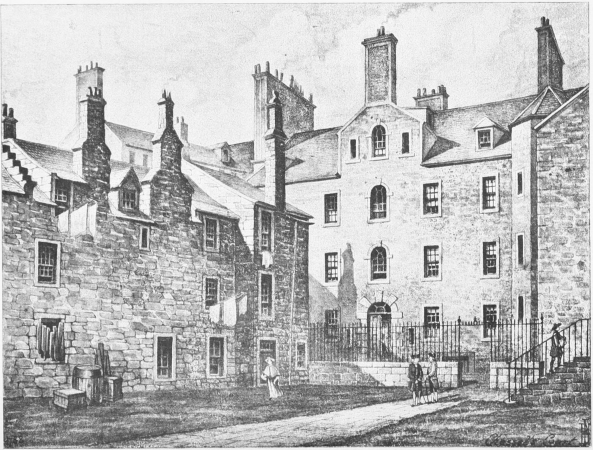
and feloniously break into the house in which the General Excise
Office for Scotland was then kept, in Chessels’s buildings, on the
south side of the High-street of Canongate of Edinburgh, within the
royalty or liberties of the city of Edinburgh, and county of
Edinburgh, and did thence feloniously abstract and steal money, to
the amount of Sixteen pounds Sterling, or thereby, consisting
partly of Bank-notes, and partly of silver and halfpence. And You,
the said George Smith, having been afterwards apprehended, and
brought before Archibald Cockburn, Esq., Sheriff-depute of the
county of Edinburgh, did, in his presence, emit three several
declarations; the first of date the 8th day of March, the second of
date the 10th day of March, and the third of date the 19th day of
March, all in this present year of our Lord 1788: And having
afterwards been brought before John Stewart, Esq.,
Sheriff-substitute of the said county, You did, in his presence,
emit a fourth declaration, of date the 17th day of July, likewise
in this present year 1788: The first of which declarations was
signed by the said Archibald Cockburn, the second and third by you,
the said George Smith, and the said Archibald Cockburn, and the
fourth by you, the said George Smith, and the said John Stewart.
AND FURTHER, You, the said William Brodie, having, in the month of
March last, when the said George Smith was committed to prison,
left Edinburgh, and fled from this country; and having afterwards
been brought back, and taken into custody, did, upon the 17th day
of July, in this present year 1788, in presence of the said
Archibald Cockburn, Esq., emit a declaration, which was signed by
you, the said William Brodie, and the said Archibald Cockburn; the
whole of which declarations, together with a letter written by You,
the said William Brodie, and signed John Dixon, dated at Flushing,
Tuesday, 8th April, 1788, twelve o’clock forenoon, and addressed to
Mr. Matthew Sheriff, upholsterer, Edinburgh; another letter, or two
letters, on one sheet of paper, written by You the said William
Brodie, and signed with your initials, dated Thursday, 10th April,
1788, and addressed to Mr. Michael Henderson, Grass-market,
stabler, Edinburgh; an unsigned scroll, or copy of a letter, in the
hand-writing of You, the said William Brodie, marked No. 1. without
date or address; another unsigned scroll, or copy of a letter, in
the hand-writing of You, the said William Brodie, marked No. 2.
without date or address; an account, or state, in the hand-writing
of You, the said William Brodie, entitled, “A state of my affairs,
as near as I can make out at present from memory, having no other
assistance”; a letter, dated London, 1st May, 1788, signed Lee,
Strachan, and Co. and addressed to Mess. Eml. Walker and Co.,
merchants, Philadelphia; a gold watch, with a chain, seal, and key;
a chest, or trunk, containing various articles; a five-pound
bank-note; an iron coulter of a plough; two iron wedges; an iron
crow; a pair of curling irons or toupee tongs; a spur; a dark
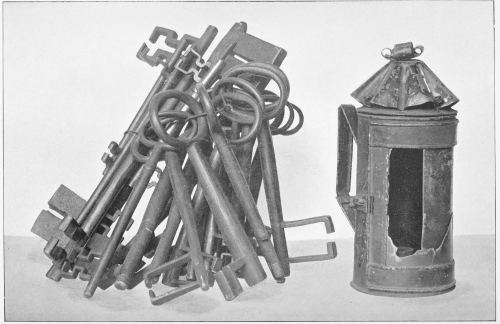
lanthorn; a pair of pistols; several false keys and pick-locks; and
two spring-saws; are all to be used in evidence against You the
said William Brodie and George Smith; and, for that purpose, will
be lodged in the hands of the clerk of the High Court of
Justiciary, before which You are to be tried, in order that You may
have an opportunity of seeing the same: AT LEAST, time and place
foresaid, the said house in which the General Excise Office for
Scotland was then kept as aforesaid, was feloniously broke and
entered into, and a sum of money feloniously and theftuously taken
and stolen therefrom as aforesaid; and You the said William Brodie,
and George Smith, above complained upon, are both, and each, or one
or other of You, guilty thereof, actor or actors, or art and part.
ALL WHICH, or part thereof, being found proven by the verdict of an
assize, before the Lord Justice-General, Lord Justice-Clerk, and
Lords Commissioners of Justiciary, You, the said William Brodie,
and George Smith, OUGHT to be punished with the pains of law, to
deter others from committing the like crimes in all time coming.
ILAY CAMPBELL.
List of Witnesses to be Adduced in the Trial for the
Prosecutor.
1. John Brown alias Humphry Moore, sometime residing in Edinburgh,
present prisoner in the Tolbooth of Canongate of Edinburgh.
2. Andrew Ainslie, sometime shoemaker, present prisoner in the Tolbooth
of Canongate of Edinburgh.
3. Mary Hubbart or Hubburt, spouse of the said George Smith.
4. Grahame Campbell, sometime servant to the said George Smith.
5. Alexander Thomson, accountant of Excise in Edinburgh.
6. Peter M‘Farlane, clerk in the office of the cashier of Excise there.
7. Adam Pearson, assistant secretary of Excise in Edinburgh.
8. Janet Baxter, servant to the said Adam Pearson.
9. William M‘Kay, porter in the Canongate of Edinburgh.
10. John Duncan, doorkeeper to the Excise Office, Edinburgh.
11. Laurence Dundas, housekeeper of the said Excise Office.
12. Margaret Black, late servant to the said Laurence Dundas.
13. Margaret Bain, late servant to the said Laurence Dundas.
14. James Bonar, deputy-solicitor of the Excise, Edinburgh.
15. Robert Smith, wright in Edinburgh, late foreman to the said William
Brodie.
16. Isobel Gilmour, spouse of John Gilmour, ropemaker in West Bow,
Edinburgh.
17. Daniel M‘Lean, waiter to William Drysdale, innkeeper in the New Town
of Edinburgh.
18. Patrick Taylor, smith in Edinburgh.
19. Charles M‘Leod, apprentice to the said Patrick Taylor.
20. Jacobina Pearson, spouse of Hugh Macpherson, shoemaker in
Duddingston, near Edinburgh.
21. John Kinnear, servant to the Earl of Abercorn at Duddingston.
22. Robert Tait, servant to the Earl of Abercorn there.
23. Isobel Wilson, spouse of Adam Robertson, wright in Duddingston.
24. John Clerk, book-keeper to William Drysdale, innkeeper in the New
Town of Edinburgh.
25. David Robertson, merchant in Edinburgh.
26. John Geddes, tobacconist in Mid-Calder and county of Edinburgh.
27. Margaret Tweddle alias Geddes, spouse to the said John Geddes.
28. James Laing, writer in Edinburgh.
29. John M‘Leish, clerk to Mr. Hugh Buchan, City Chamberlain of
Edinburgh.
30. George Williamson, messenger-at-arms in Edinburgh.
31. William Middleton, indweller in Edinburgh.
32. James Murray, sheriff-officer there.
33. Alexander Williamson, sheriff-officer there.
34. James Fraser, sheriff-officer there.
35. Archibald Cockburn, Esq., Sheriff-depute of the county of Edinburgh.
36. John Stewart, Sheriff-Substitute of the said county.
37. William Scott, Procurator-Fiscal of the county of Edinburgh.
38. William Augustus Wishart, clerk to the said William Scott.
39. Joseph Mack, writer in the Sheriff-Clerk’s Office, Edinburgh.
40. Alexander Fraser, grocer and change-keeper in the New Town,
Edinburgh.
41. Laurence Blair, servant to Mr. Charles Hope, advocate.
42. Thomas Longlands, solicitor-at-law in London.
Ilay Campbell.
List of Assize.
1. Andrew Bonar, banker in Edinburgh.
2. Alexander Houston, banker there.
3. Robert Forrester, banker there.
4. Robert Allan, banker there.
5. Henry Jamieson, banker there.
6. John Hay, banker there.
7. William Creech, bookseller there.
8. James Carfrae, merchant there.
9. William Gillespie, merchant there.
10. William Simpson, banker there.
11. George Kinnear, banker there.
12. John Black, merchant there.
13. Francis Blair, merchant there.
14. Elphingston Balfour, bookseller there.
15. Peter Forrester, merchant there.
16. John Thomson, insurance-broker there.
17. Thomas Elder, merchant there.
18. Edward Innes, confectioner there.
19. John Balfour, merchant there.
20. William Fettes, merchant there.
21. John Milne, founder there.
22. Dunbar Pringle, tanner there.
23. Peter Robertson, goldsmith there.
24. Thomas Campbell, merchant there.
25. William Turnbull, merchant there.
26. Alexander Brown, merchant there.
27. Charles Cowan, merchant there.
28. David Paterson, insurance-broker there.
29. Francis Sharp, merchant there.
30. James Donaldson, printer there.
31. John Hutton, stationer there.
32. John Balfour, papermaker there.
33. Robert Young, upholsterer there.
34. John Learmonth, junior, tanner there.
35. Thomas Cleghorn, coachmaker there.
36. Thomas Hutcheson, merchant there.
37. James Craig, corn merchant there.
38. Alexander Bruce, merchant there.
39. Benjamin Yule, baker there.
40. William Smellie, printer there.
41. Orlando Hart, shoemaker there.
42. James Ranken, merchant there.
43. William Young, baker there.
44. William Brown, grocer there.
45. Alexander Weir, painter there.
Rob. M‘Queen.
Dav. Dalrymple.
Dav. Rae.
List of Witnesses To Be Adduced in Exculpation Of
William Brodie.
1. Robert Smith, wright in Edinburgh, late foreman to the said William
Brodie.
2. George M‘Intosh, also wright, and late journeyman to the said William
Brodie.
3. John Niel, also wright, and late journeyman to the said William
Brodie.
4. Arthur Giles, wright in Edinburgh.
5. William Watson, wright in Canongate.
6. William Retson, or Reston, nailer, Portsburgh.
7. James Cargill, ironmonger, Edinburgh.
8. Alexander Miller, ironmonger there.
9. George Burton, ironmonger there.
10. James Goldie, ironmonger there.
11. Daniel MacLean, waiter to William Drysdale, vintner in Edinburgh.
12. George Lees, coachmaker there.
13. Alexander Fergusson, dyer there.
14. Patrick Taylor, smith there.
15. Charles MacLeod, apprentice to Patrick Taylor.
16. Agnes Finlay, spouse to Michael Henderson, stabler, Grassmarket.
17. Alexander MacKay, inner turnkey in the Tolbooth of Edinburgh.
18. James Reid, indweller in Edinburgh, and present prisoner in the
Tolbooth.
19. Alexander Brodie, baker, Nether Bow.
20. James Murray, sheriff-officer.
21. Helen Alison, spouse to William Wallace, mason, Libberton’s Wynd.
22. Jane Watt, residenter there.
23. Peggy Giles, servant to—Grahame, publican at Mutton-hole, near
Edinburgh.
24. Matthew Sheriff, upholsterer in Edinburgh.
Under protestation to add and eik.
Alexander Wight, for the pannel.
The diet having been called “at the instance of Ilay Campbell, Esquire,
His Majesty’s Advocate, for His Majesty’s interest, against William
Brodie, sometime wright and cabinetmaker in Edinburgh, and George Smith,
sometime grocer there,” the Lord Justice-Clerk desired the pannels to
attend to the indictment then to be read.
Mr. Norris, Depute-Clerk of Court, then read aloud the indictment, after
which,
The pannels having been asked to stand up,
The Lord Justice-clerk—William Brodie, you have heard the indictment
raised against you by His Majesty’s Advocate—are you guilty of the
crime therein charged, or not guilty?
William Brodie—My Lord, I am not guilty.
The Lord Justice-clerk—George Smith, you have heard the indictment
raised against you by His Majesty’s Advocate for His Majesty’s
interest—are you guilty of the crime therein charged, or not guilty?
George Smith—Not guilty, my Lord.
The Lord Justice-Clerk then asked the counsel for the pannels if they
had any objection why the said indictment should not be remitted to the
knowledge of the assize.
Mr. Charles Hay—My Lords, I appear as counsel for William Brodie, the
prisoner at the bar. I do not observe anything in this indictment upon
which I can found an objection to the relevancy of it, and therefore I
will at present confine myself to a simple denial of the charge against
Mr. Brodie, and your Lordships will fall to pronounce the usual
interlocutor on the relevancy, in which the prisoner will be allowed a
proof of all facts and circumstances tending to his exculpation.
The Solicitor-General—My Lords, I desire to know the nature and
tendency of the exculpatory evidence proposed to be adduced, in order
that, in the course of leading the proof upon the part of the
prosecutor, we may be prepared to meet it.
The Lord Justice-Clerk—It is not sufficient for the prisoner to deny
the charge if he intends to prove any facts in exculpation; it is but
fair to the public prosecutor and to the gentlemen of the jury that
these should now be mentioned that they may have them in their view in
the course of the trial.
The Dean of Faculty—My Lords, I likewise appear as counsel for William
Brodie, the prisoner at the bar. I admit that it is fair to mention the
facts which are to be insisted on in his defence; and therefore,
adhering to the general denial of the crime charged, we undertake to
prove that Mr. Brodie went, before eight o’clock of that night in which
the Excise Office is said to have been broken into, to the house of
Janet Watt, a person residing in Libberton’s Wynd, with whom he had a
particular connection, and that he remained in that house from the said
hour until about nine o’clock the next morning. This will be instructed
by the woman herself and by other unexceptionable witnesses.
Mr. Robert Hamilton—My Lords, I appear as counsel for the prisoner
George Smith. No objection appears to me upon the relevancy of the
indictment, and the prisoner rests his defence upon a general denial of
the facts charged, having no exculpatory proof to offer.
The Court then pronounced the following interlocutor:—
The Lord Justice-Clerk and Lords Commissioners of Justiciary,
having considered the criminal indictment raised and pursued at the
instance of Ilay Campbell, Esq., His Majesty’s Advocate, for His
Majesty’s interest, against the said William Brodie and George
Smith, pannels, they find the indictment relevant to infer the
pains of law, but allow the pannels and each of them to prove all
facts and circumstances that may tend to exculpate them or
alleviate their guilt, and remit the pannels with the indictment as
found relevant to the knowledge of an assize.
Robert M‘Queen, I.P.D.
The Court were proceeding to select fifteen from amongst the forty-five
gentlemen summoned as jurymen, when it was discovered that some of the
witnesses had not come forward. In about half-an-hour they all arrived.
The Lord Advocate then moved the Court to inflict some fine on those
witnesses by whom the delay had been occasioned; but it being found upon
inquiry that the hour of cause, but no particular hour, was specified in
the citations given them, his Lordship, in respect that the hour of
cause was understood to mean ten o’clock, withdrew his motion, and the
Lord Justice-Clerk, to prevent similar delays, gave directions that in
time coming the citations given to jurymen and witnesses should bear a
specified hour at which their attendance is to be required.
Out of the above forty-five jurymen the following fifteen persons were
named to pass upon the assize of the pannels; and the pannels being
asked if they had any objections why they should not pass upon this
assize, and no objections being made on the contrary, they were all
lawfully sworn in by the following oath, five at a time:—
You swear by Almighty God, and as you shall answer to God at the great
day of judgment, that you will truth say, and no truth conceal, so far
as you are to pass upon this assize.
1. Robert Forrester, banker.
2. Robert Allan, banker.
3. Henry Jamieson, banker.
4. John Hay, banker.
5. William Creech, bookseller.
6. James Carfrae, merchant.
7. John Kinnear, banker.
8. William Fettes, merchant.
9. John Milne, founder.
10. Dunbar Pringle, tanner.
11. Thomas Campbell, merchant.
12. Francis Sharp, merchant.
13. James Donaldson, printer.
14. John Hutton, stationer.
15. Thomas Cleghorn, coachmaker. |
The jury being impanelled and furnished with pen, ink, and paper, and
copies of the indictment being laid before them, the Court ordered the
counsel for the prosecutor to proceed to the evidence.
At this stage, before the evidence was led,
Mr. Wight—My Lords, I likewise attend your Lordships on the part of Mr.
Brodie, and although there does not appear upon the face of this
indictment any sufficient ground for an objection to the relevancy of
it, yet there are some particulars of which I consider it my duty to
take notice; and, in order to save time and trouble to the Court, I
propose to do it now rather than hereafter.
The law of this country has been very careful to give unhappy men in the
situation of the prisoners every opportunity of preparing for their
trials; they are allowed fifteen days after being served with their
indictments; they are furnished with a list of the witnesses’ names and
designations who are to be adduced against them; and the declarations,
writings, and articles to be used in evidence in the course of the trial
are particularly specified. The present indictment, though not
irrelevant, is perhaps laid in the most vague and general manner I have
ever seen. Here there are certain letters and declarations founded on,
and other articles, such as a gold watch with a chain, and seal, and
key, a chest or trunk containing various articles, a five-pound
bank-note, an iron coulter of a plough, &c. These are mentioned in so
vague a manner as not to distinguish them from other articles of the
same kind, consequently in such a manner as not to give the pannels
proper opportunity of preparing for their defence. This is the more
inexcusable that all of these articles admitted of a more accurate
description.
[Here Mr. Wight was interrupted by the Court.]
The Lord Justice-Clerk—Mr. Wight, these objections are out of place;
they ought to be stated when the articles you mention come to be
produced by the prosecutor.
The Dean of Faculty—It is no doubt true that the objection to each of
these articles falls properly to be stated when they are founded upon by
my Lord Advocate; but it was thought proper and respectful to the Court
to state the general objection at this stage of the business in order to
save time.
The Solicitor-General—My Lords, I wish that Mr. Wight may be allowed to
proceed.
The Lord Justice-Clerk—Mr. Wight, go on.
Mr. Wight—I say, my Lords, that the articles mentioned in the
indictment admitted of a more accurate description than that which my
Lord Advocate has given them. The maker’s name and number of the watch
might have been mentioned, the device on the seal, too, ought to have
been specified, also the number of the note and by whom it was issued;
and as to the chest or trunk, which is only described by saying that it
contained sundry articles, there is no particular description of it, or
of any of the articles it contained. It is not said that it is a hair
trunk, or the size or shape of it, or any other
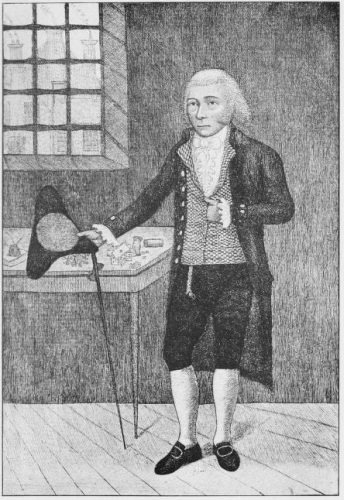
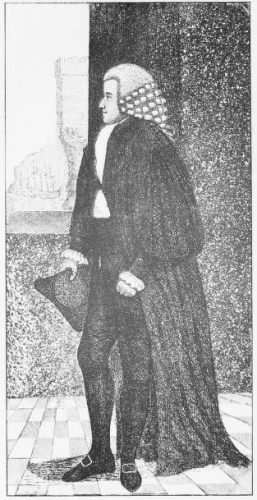 The Solicitor-General (Robert Dundas).
(After Kay.)
mark condescended upon, whereby it could be distinguished. It might have
been mentioned what sort of a trunk it was, whether made of fir, of oak,
or of ash; to whom it belonged, and where and in whose possession it was
found.
To show your Lordships that this is no immaterial objection, I must beg
leave to mention a circumstance that occurred in the present case. Some
days ago, Mr. Brodie’s agent went to the Justiciary Office to examine
the articles founded on in the indictment; and upon inquiring for the
trunk, he was shown a black trunk, a trunk different from the one now to
be used in evidence. Thereafter the counsel for the Crown discovered
they had committed a mistake; they were so much misled by this want of
description that they had sent the trunk referred to, or meant to be
referred, in the libel to the prison to Mr. Brodie, and had lodged a
wrong trunk with the Clerk of Court. They did not discover this mistake
till yesterday morning, and they then applied to the Sheriff for a
warrant to recover the trunk, which is now in Court, out of the
possession of Mr. Brodie, and which was only lodged in the Justiciary
Office yesterday.
Although I have thrown out this general objection, I do not mean to
plead it to the effect of setting aside the libel altogether; yet, when
the prosecutor attempts to apply his evidence to these articles, I
reserve to myself the liberty of making special objections to each
article, as it shall be referred to.
The Solicitor-General—My Lords, I will not take up the time of the
Court in making any answer to the objection stated, as to the manner in
which the watch and the other articles are described in the indictment,
as I have no hesitation to say that it does not deserve one. All these
articles, as well as the other articles libelled on, have been for weeks
past lying in the hands of the Clerks of Court, where the counsel and
agents for the pannels have had full opportunity of examining and taking
from them whatever description they might think proper.
As to the story of the trunk, it is shortly this: there were two trunks
the property of Mr. Brodie; and one of them, containing linens and other
articles, was, from motives of humanity, allowed to remain in his
possession. This was the trunk referred to in the indictment; the other
was, however, sent by mistake to the Justiciary Office, but as soon as
the error was discovered, Mr. Brodie was applied to to deliver up the
proper trunk. This he refused to do, and therefore it became necessary
to apply to the Sheriff, who granted a warrant; in consequence of which
it was recovered from the prisoner and lodged in the Justiciary Office.
This is the plain state of the fact, and, having laid it before your
Lordships, I do not consider it necessary to add one word more to the
subject.
The Lord Advocate—My Lords, if it had been intended to charge the
prisoners with stealing the watch, or any of the other articles, a more
accurate description might have been necessary, but here there is no
such intention—the crime of which the prisoners are accused is breaking
into the Excise Office.
From the nature of the thing, my Lords, as well as from the tenor of the
indictment, it must be evident to every one that it is only meant to
produce these articles in evidence, to refer to them when the witnesses
are examined. It may be necessary, for example, to prove that certain
letters were found in the chest, and to whom the chest belonged; it is
no matter of what form the chest is, and not of the smallest consequence
whether it is identified or not; nay, more, my Lords, there was no
necessity for producing it at all. If every nail of a trunk or every
trinket of a watch, or other articles which it might be necessary to
found upon in trials of this kind, were to be so particularly described
as Mr. Wight has contended for, it would swell indictments to a very
inconvenient and unnecessary length.
The objection that the proper trunk was not produced in sufficient time
to give the prisoner an opportunity of examining it is certainly a very
uncommon one, when it is considered that it was allowed to remain in his
own possession until yesterday; and with regard to the watch, all the
use I mean to make of it is to identify some letters from Mr. Brodie,
which are sealed with the seal appended to it.
The Dean of Faculty—My Lords, what may be the consequence to the
prisoners at the bar of your Lordships repelling the present objection I
do not know. The gentlemen on the other side of the table have taken
care to lay their indictment in such a manner as to leave the counsel
for the prisoners altogether in the dark as to the nature of the proof
they mean to lead and the manner in which these articles are to be used
in evidence; but, my Lords, sure I am of this, that the decision of the
present question is of the greatest importance to the law of this
country. I am not surprised that the Solicitor-General should say that
he will make no answer to the objection, because I am convinced that it
admits of none.
It is no light matter the framing of an indictment; the specification of
the proofs by which it is to be supported is of the utmost consequence.
I am persuaded, my Lords, that I would have no difficulty to satisfy
your Lordships, from the nature of the thing itself, that this objection
is well founded. But I resort to better evidence. I appeal to the Books
of Adjournal on your Lordships’ table, and I call upon the counsel for
the Crown to point out one single instance recorded in them where
articles have been founded on in an indictment and produced in evidence
without being specially described. Having so respectable an authority as
the uniform practice of your Lordships and your predecessors to support
the objection now stated, you will think well before you introduce an
innovation that may be attended with the most dangerous consequences.
We are told that some of the articles in question are of no consequence;
if so, why are they here? I will not enter into the question whether the
trunk was really produced in the Justiciary Office in proper time or
not, as all the indictment says is, that “it will be produced.”
My Lords, there are two kinds of articles produced in criminal trials,
first the corpora delicti, to prove that the crime was actually
committed; and, secondly, articles from which the leading circumstances
are to be inferred. The Lord Advocate admits that the first of these
must be particularly described, but denies the necessity of describing
the second. This is a distinction not known in the law of this country,
and directly contrary to the established forms of criminal procedure.
What would be the consequence were it recognised? Suppose, for instance,
that a person breaks into a house and leaves his hat behind him; nothing
could establish his guilt more clearly than to prove that this hat was
his. But although this is only a leading circumstance, would it be
enough to say that a hat was to be produced in evidence, without
specifying where it was found, or any circumstances attending it, so as
to give the accused an opportunity of proving that it belonged to
another, and not to him?
I will appeal, my Lords, to the practice of the public prosecutor
himself, to show that no such distinction exists. A declaration is an
article used in evidence as well as a gold watch, yet his Lordship does
not think it sufficient to say “a declaration,” without specifying any
other circumstances, such as before whom, and of what date, it was
emitted. On the contrary, there are several declarations referred to in
this indictment, and they are all particularly described. It is the duty
of the public prosecutor to specify every particular, and to say what is
meant to be proved by each article, or in what manner it has been used
in the commission of the crime charged. In the case of Gordon, the
sheep-stealer, a man for whom I was counsel at this bar several years
ago, and who still languishes in prison, notwithstanding his having
received His Majesty’s pardon[1]—your Lordships refused to allow an
article to be produced in evidence which had not been libelled on: and
the articles objected to might as well not have been libelled on at all,
as in the general and vague manner in which they are mentioned in the
indictment.
My Lords, there is another circumstance to which I beg to draw your
Lordships’ particular attention. It is our good fortune to live under a
mild Government; to live in days when there is no danger to be
apprehended from the conduct of the public prosecutor; but worse times
may arrive, and it is for your Lordships to reflect upon what use might
then be made of the present practice if your Lordships were to allow it
to be now introduced. The public prosecutor may, for example, libel upon
a watch, and the Clerk of Court may show one watch in the Justiciary
Office to the prisoner’s counsel or agent, and against the day of trial
may produce another in Court. The principal reason why articles such as
the present are mentioned in the indictment is that the prisoner may be
certain that these articles, and these articles alone, are to be used in
evidence against him; and it is clear that this certainty must be
withdrawn from the prisoner if a vague description is permitted to be
given of them, because, as I have already mentioned, others may be
substituted in their place. If an article of evidence be not
particularly described so as to prevent the possibility of doubt with
regard to the identity of it, the dearest rights of mankind might be
endangered and at the mercy of corrupt men, and no one could say how
fatal the consequences might be.
The Lord Advocate—My Lords, I admit the justice of what the Dean of
Faculty has stated if such an objection as the present were made to the
description of the corpora delicti. If the prisoners were charged with
having stolen the watch or trunk mentioned in the indictment, the
description there given of them would not be sufficient; but, as they
are not the corpora delicti, and are only referred to as circumstances
of evidence, I contend that the description is sufficient; but, rather
than detain the Court longer with an objection of this kind, I will give
up the trunk altogether, as I do not suppose that I shall stand in need
of it; I, however, submit the matter to the Court.
The Lord Justice-Clerk—Your Lordships have heard the objection and
answers on this point. What is your opinion?
Lord Hailes—My Lords, there is no objection made to the production of
the different papers founded on in the indictment, and I do not perceive
that there is any force in the objection as to the gold watch; because,
although the pannel’s counsel cannot know, from the manner in which it
is described in the indictment, what is meant to be proved by it,
neither do they know what is intended to be proved by the different
witnesses who are cited.
The objection with regard to the trunk appears to me to be much more
strong; and I confess that I never saw any article so vaguely stated in
an indictment as it is in the present case, viz., “a trunk containing
various articles.” It is no good answer to the objection that the proper
trunk was not timeously produced, that it was allowed to remain in
Brodie’s possession, because that article is founded on in the libel
against Smith as well as against him. I am therefore inclined to sustain
the objection as to the trunk, but no further.
Lord Eskgrove—My Lords, I am not disposed to abridge in the smallest
degree the security of the subjects of this country, although the law is
here more attentive to the safety of persons accused than in any other
country whatever. Here the pannel must not only be furnished with the
names and designations of the witnesses, but he must also be made
acquainted with every document and article to be used in evidence
against him.
In the present case there are a number of writings, and likewise a
variety of articles, founded on in the indictment; there is no objection
to the production of the papers, but it is objected on the part of the
pannel that the other articles are not particularly described. I do not
think, my Lords, that this objection is much aided by the argument
founded on the declarations and other parts of the libel being more
particularly described than these articles.
The Dean of Faculty has referred your Lordships to the Books of
Adjournal, from which he says that it appears to have been the practice
to describe such articles more minutely; but I have no doubt that a
perusal of these books would furnish many instances where articles have
been described as loosely as they are said to be in the present libel;
and, my Lords, as the pannel’s counsel have neither produced, nor
offered to produce, any decision of this Court finding libels irrelevant
from the articles referred to in them being thus described, I am bound
to hold the objection to be of no force.
My Lords, I can see no injury that will be sustained by the prisoners by
the repelling of the present objection; all the articles were lodged in
the hands of the Clerk of Court, and their agent and counsel had an
opportunity of examining them. The trunk is no doubt vaguely described,
but that appears to me not to be material, because it will not be
sufficient for a witness to say that he found papers or other articles
in a trunk; he must say that he found them in the trunk shown to him in
Court, otherwise his evidence in that particular will be of no
consequence. If the pannels should say that this is a different trunk,
and that they never saw it before, I would listen to the objection; but
as they cannot, and as I can figure no injury to the prisoners in
repelling this objection, I am for over-ruling it.
Lord Stonefield—My Lords, I think the description in this case is
sufficiently full; therefore I am for repelling the objection.
Lord Swinton—My Lords, the present objection is made in the wrong
place; and I cannot so well judge of it in this general shape as I
could have done had it been stated when the particular articles came to
be used in evidence; but I must judge of it in the form in which it has
been brought before the Court.
I think, my Lords, that it ought to be repelled for the reasons your
Lordships have already heard, and because no injury can be done to the
pannels from these articles not having been more particularly described,
as they will have an opportunity of traversing the evidence that may be
brought relating to them. There are many of the articles, such as two
iron wedges, an iron crow, &c., that would not admit of a more
particular description than has been given. Upon the whole, my Lords, I
am for repelling the objection.
The Lord Justice-Clerk—My Lords, the present question is of great
importance to the law of this country. I am one of those who are always
for giving fair-play to pannels, and will never allow any advantage to
be taken of them; but I am likewise for giving fair-play to evidence. It
is frequently necessary, my Lords, that the testimony of witnesses
should be elucidated by articles referred to being produced; but if the
present objections were sustained, I am afraid it would strike against
the admissibility of this kind of evidence altogether; because, let a
public prosecutor describe such articles with the greatest attention, it
still may be contended that they admitted of a more accurate description
than the one given.
By the former state of our law the prosecutor was not allowed to prove
anything that was not particularly specified in the libel; but the Act
153, Parliament 11th, James VI., was introduced to obviate this defect
in our law, and by that Act the prosecutor is allowed to prove every
circumstance to substantiate the charge, or in general art and part of
the charge. It is very true, my Lords, that the humanity of public
prosecutors of late years has induced them to be more special than they
had any occasion to be, but surely they are not cut off from the
generality allowed them by law, although such generality may have been
deviated from through lenity in practice. Apply this to the present
case. It is true that the Lord Advocate, as public prosecutor, has been
induced to state particular circumstances, and to specify the articles
to be founded on; yet that does not alter the law, nor deprive him of
the generality which he is allowed by law. As the names of witnesses are
given, without specifying what they are to say, in the same way it is
only necessary to state that such articles are to be produced in
evidence, but not necessary to specify a description of them; and it is
the duty of the prisoner himself, or those who act for him, to survey
them when lodged in the Justiciary Office. As there is no precise time
against which articles to be founded on are required to be lodged in
the Justiciary Office, there appears to be no undue delay in lodging
this trunk. Had it been pled that it was not lodged debito tempore,
and that the pannel had been injured thereby, then a delay of the trial
must have taken place.
I remember it once happened on a circuit that the articles founded on in
the libel were only lodged the very morning of the trial in the Clerk’s
hands; but I then refused to allow them to be founded on, because the
pannel had not a reasonable time to prepare himself against evidence
that might arise from the production of these articles; but the present
case is very different, and therefore, upon the whole, I am for
repelling the objection.
Mr. John Clerk—My Lord Justice-Clerk, before the interlocutor is
written out, I beg leave to make one objection in behalf of the pannel,
George Smith.
The Lord Justice-Clerk—What! After the Court have delivered their
opinions, it is not decent in you to propose to say anything, and I
apprehend the prisoners are in no danger of suffering anything by your
not being allowed to supply the defects of the Dean of Faculty.
Mr. John Clerk—My Lord, the Dean of Faculty has no authority to plead
for my client.
The Dean of Faculty then moved the Court to allow the general objection
to be entered upon record, and proposed to repeat it and refer to it as
often as any of the particular articles came to be produced in evidence,
which was accordingly agreed to, and the following interlocutor was
pronounced repelling the objection:—
The Lord Justice-Clerk and Lords Commissioners of Justiciary having
considered the foregoing debate, they repel the objection stated to
producing and founding on the articles specified in the objection
and mentioned in the indictment, and allow them to be adduced in
the course of the trial.
Robt. M‘Queen, I.P.D.
The prosecutor, for proof of the indictment, then proceeded to adduce
the following witnesses, who were all lawfully sworn, purged of malice
and partial counsel, and emitted their depositions viva voce in
presence of the Court and jury, without being reduced in writing, in
terms of the late statute.
William Scott
1. William Scott, Procurator-Fiscal of the county of Edinburgh, called
in and sworn.
Examined by Mr. Murray—Mr. Scott, you know the prisoners at the bar?
Were you present when they emitted certain declarations before the
Sheriff-depute of Edinburgh and his substitute?
Witness—I was.
Mr. Murray—Look at these declarations, and tell the Court and the
gentlemen of the jury if they were emitted in your presence by the
pannel, George Smith, freely and voluntarily.
Witness—They were; and the prisoner appeared to me at the time cool and
recollected.
Mr. Murray—Look at this declaration. Was it emitted in your presence by
the other pannel, William Brodie, freely and voluntarily, and he was
cool and recollected?
Witness—It was emitted in my presence freely and voluntarily, and he
was cool and recollected.
Mr. Murray—Do you know anything concerning a warrant that was applied
for against William Brodie in the month of March last? If you do, tell
the Court and the gentlemen of the jury what happened in consequence of
it?
Witness—Upon the afternoon of Monday, the 10th of March last, I, as
Procurator-Fiscal, gave in a petition in my own name to the Sheriff of
Edinburgh, charging Mr. Brodie with breaking into the Excise Office, and
praying for a warrant to apprehend him. A warrant was accordingly
granted, and search diligently made for him that night, but he was not
found, and I afterwards learned that he had gone off for London on the
day preceding.
Cross-examined by Mr. John Clerk, for George Smith—Mr. Scott, you say
you were present when George Smith emitted the declarations which have
been shown you; did Smith, in the course of his different examinations,
say anything more than is contained in these declarations?
Witness—I do not think he did; everything material was taken down. No
compulsion or undue means was used to induce the prisoners to sign these
declarations.
Joseph Mack
2. Joseph Mack, writer in the Sheriff-Clerk’s Office of Edinburgh,
called in and sworn, and shown the declarations above mentioned.
Witness—These declarations were written by me, to the dictation of the
Sheriff, and were emitted by the pannels freely and voluntarily, and the
pannels appeared to me to be cool and recollected when emitting them.
Cross-examined by Mr. John Clerk—Was everything which Smith declared
when examined taken down?
Witness—Everything that was material. With regard to the robbery of
Bruce’s shop—[Here the Court stopped the witness, as that was a matter
which was not before them.]
The Lord Justice-Clerk—Did he desire anything to be taken down that was
not?
Witness—No.
Thomas Longlands
3. Thomas Longlands, solicitor-at-law in London, called in and sworn.
Examined by Mr. William Tait—Mr. Longlands, did you hear of William
Brodie, the prisoner at the bar, having fled from this country in March
last, and of his having been brought back? Tell the Court and the
gentlemen of the jury what you know of the matter?
Witness—In the month of June or July last I was employed by the
officers of the Crown for Scotland to take such steps as appeared to me
to be proper for the discovery of Mr. Brodie. In consequence of this
employment I called frequently at the Secretary of State’s Office, and
had several conversations with Mr. Fraser, Under-Secretary in the office
of Lord Carmarthen, and gave them the information I had received from
Scotland. I likewise waited upon Sir Sampson Wright, of the Public
Office, Bow Street, whose assistance I judged necessary to call in as to
the proper measures to be pursued. As the information received gave
reason to suspect that Mr. Brodie was at Flushing, Ostend, or some place
in Holland, it was agreed upon to send a messenger immediately in search
of him. Sir Sampson Wright recommended to me a Mr. Groves from his
office as a proper person to send to the Continent in search of Mr.
Brodie, and I accordingly despatched him with proper instructions. Mr.
Groves traced Mr. Brodie to Ostend, and learned that he had been there
upon the 4th of June, His Majesty’s birthday, and he was afterwards
traced to Amsterdam, where he was apprehended, identified, and committed
to prison. Upon proper application, he was delivered up to Mr. Groves,
and was brought from thence to London by him. Immediately upon his
arrival at London he was examined before Sir Sampson Wright, and
committed to Tothilfields Bridewell; some time afterwards he was sent to
this country. I was present at the examination of the person brought
back from Amsterdam, and I know the prisoner at the bar to be him. There
was a trunk containing linens and a variety of other articles, belonging
to Mr. Brodie, brought with him from Amsterdam; and I received from Mr.
Cartmeal, one of the persons who came along with him, two watches,
twenty crowns, and some other articles, which he said were found upon
Mr. Brodie; and the watch now upon the table I know to be one of them,
having taken particular notice of the maker’s name and number. [The
counsel for the pannels here repeated the objection against adducing the
watch, as mentioned in the general objection and interlocutor before
taken down.] There was likewise another trunk belonging to Mr. Brodie,
which was sent over from Ostend by Sir John Potter, in consequence of a
letter written to him in my presence by Mr. Groves, after Brodie’s
return to London. This trunk, upon its being brought to London, was
opened by Sir Sampson Wright in my presence, and in the course of
examining the contents of it I discovered a wrapper with some papers,
which I opened, and some of the papers appearing to me to be important,
I transmitted them to the Lord Advocate. [Here the unsigned scrolls were
shown to the witness.] Both Sir Sampson Wright and I put our initials to
them, and I am sure that these are the same, as well from seeing my
initials as from the strength of some of the expressions, which made a
great impression upon me at the time. [The state of affairs and letters
of credit were likewise shown to the witness.] I have seen these before;
they came in a packet to Sir Sampson Wright from Mr. Rich, the English
resident at Amsterdam, and Sir Sampson Wright delivered to me the letter
in which they came with them inclosed.
Cross-examined by the Dean of Faculty—Mr. Longlands, have you any other
cause of knowledge concerning the trunks and other articles being the
property of Mr. Brodie, and the same which were brought from Ostend and
Amsterdam, than the information of Sir Sampson Wright and Mr. Groves?
Witness—No other cause of knowledge than what I have already mentioned,
namely, the letters accompanying the same, which I saw, and my being
present when the trunks were opened.
John Geddes
4. John Geddes, tobacconist in Mid-Calder, called in and sworn.
Examined by the Solicitor-General—Were you lately in London? Do you
know the prisoner? Tell the jury what you know about him?
Witness—I was in London in the month of March last, and my wife and I
took our passage in the “Endeavour,” of Carron, Captain Dent, bound for
Leith. We went on board on a Saturday, and the next day, Sunday, the
vessel fell two or three miles down the river, and then we cast anchor
at Blackwall. In the evening the master went on shore to get hands to
man her, leaving me and my wife on board. About twelve at night a
passenger, who appeared sickly, came on board, in company with Mr.
Hamilton and Mr. Pinkerton, two of the owners of the vessel, and another
gentleman I did not know. These gentlemen remained about half an hour,
and then all went ashore, except the passenger, who remained on board.
He was dressed in a blue great-coat, with a red collar, round wig, black
vest, breeches, and boots. He was allotted a bed in the state-room, near
the fire, as he was sick. The next morning the vessel set sail, but
afterwards ran aground opposite to Tilbury Point, where she remained
about eight or ten days, and we did not get clear of the Thames for a
fortnight. During all that time the passenger remained on board, except
one day that he, along with the master of the vessel and my wife and I,
went on shore, and dined at a neighbouring village, and another day that
he went ashore by himself to get a bottle of milk. For the first two or
three days after the passenger came on board we called him “the
gentleman,” as we did not know his name, but, upon my inquiring of him
what his name was, he told me it was John Dixon.
The Solicitor-General—Would you know that person again?
Witness—I would.
The Solicitor-General—Look at the prisoners at the bar and say if you
know either of them?
[Here the witness pointed out Mr. Brodie to be the same person that had
called himself John Dixon.]—On getting out to sea Mr. Dixon delivered
to the captain a letter from Mr. Hamilton or Mr. Pinkerton, but,
although I desired him to let me read it, I did not see it. In
consequence of this, the captain altered his course and steered for
Holland, and the vessel, although bound for Leith, sailed to Flushing. I
do not think she was driven there by contrary winds, as the wind was
south-west, and fairer for Newcastle or Leith than for Holland. During
the voyage, Mr. Dixon complained much of a sore throat. When we arrived
at Flushing we cleaned ourselves and went ashore, and Mr. Dixon set off
for Ostend in a skiff which he hired for that purpose. On shore, before
he left, Mr. Dixon gave me a packet containing two letters, one of which
had another within it, to carry to Scotland to be delivered in
Edinburgh. One of the letters was directed to Mr. Michael Henderson,
stabler in the Grassmarket, in which there was one inclosed to Mrs. Anne
Grant, Cant’s Close, and the other to Mr. Matthew Sheriff, upholsterer
in Edinburgh, signed and dated as mentioned in the indictment. We did no
business at Flushing, and I am of opinion that the ship did not come
there with that intention. After landing Mr. Dixon we sailed for Leith.
When I arrived in Leith, from the accounts I heard about Brodie, I was
convinced that Dixon and Brodie were the same person. Next day I went to
Mid-Calder, and about three weeks afterwards was at Dalkeith, where I
had occasion to see the newspapers, and the description of Brodie
therein given confirmed me in the above suspicion. I then delivered the
letters to Sheriff Cockburn. I had previously opened the packet and read
them. [The witness was here shown the letters libelled on.] I know that
these are the letters I received from the prisoner and delivered to the
Sheriff.
The Solicitor-General—Did Brodie say that he had any business at
Flushing?
Witness—He mentioned that he had business at Ostend, and Captain Dent
said he was to wait till he returned, and that he supposed he belonged
to the Carron Company; but when the wind came fair, Captain Dent said
he would not wait for him, and the devil a bit of business he supposed
he had.
Cross-examined by the Dean of Faculty—You have told us that you went
ashore when you arrived at Flushing. Pray, sir, did you make any
purchases there?
Witness—None, except a piece or two of nankeen for breeches to myself.
The Dean of Faculty—Did you purchase nothing else?
Witness—Nothing, except two or three handkerchiefs for my own use.
The Dean of Faculty—You will remember, sir, that you are upon your
great oath, and that it is your duty to tell the whole truth.
Lord Hailes—My Lords, the witness should be informed that if he
purchased any contraband goods he has nothing to fear from acknowledging
that he did so.
The Lord Justice-Clerk—It is certainly very proper. [To witness]—John
Geddes, if you made any purchases of contraband goods when you was at
Flushing, it is your duty to inform the Court and the gentlemen of the
jury that you did so, and you have nothing to fear from such an
acknowledgment, because whatever you say here will be no evidence
against you afterwards in the Court of Exchequer or elsewhere.
The Dean of Faculty—Did you purchase no lace, sir, when you was at
Flushing?
Witness—A few yards.
The Dean of Faculty—Why, then, did you say that you purchased nothing
except the nankeen and the handkerchiefs?
Witness—It was my wife and not me that purchased it.
The Dean of Faculty—Did you offer the lace for sale?
Witness—No; there is part of it about a cloak which my wife has here
with her, and I believe part of it about her sister’s.
The Dean of Faculty—And what became of the rest of it? Remember, sir,
you are upon your great oath.
Witness—That was it all, except a few yards I sold at Bathgate for
twenty-two shillings.
The Dean of Faculty—Did you not say even now that you had offered none
of it for sale?
Witness—I said that I offered none of it for sale in this place.
The Dean of Faculty—Did you purchase no tobacco in Flushing?
Witness—I did not, except a little for chewing.
The Dean of Faculty—Did you purchase any gin?
Witness—None, except a little for sea store.
The Dean of Faculty—Pray, sir, when did you open these letters you have
told us of? Was it before or after you came to Leith?
Witness—It was after.
The Dean of Faculty—You told us, sir, that upon reading the newspapers
you discovered that Dixon and Brodie were one and the same person. Pray,
sir, when or where did you first read the newspapers?
Witness—At Dalkeith.
The Dean of Faculty—How long was that after your arrival?
Witness—Three weeks.
The Dean of Faculty—And pray, sir, what was the reason that in all that
time you did not deliver these letters to the persons to whom they were
directed?
Witness—I did not remember that I had such letters when I was in
Edinburgh myself, and I afterwards wished my brother-in-law to deliver
them.
The Dean of Faculty—Did you open the letters?
Witness—I did.
The Dean of Faculty—And what was your reason for doing so?
Witness—I opened them and delivered them to the Sheriff for the good of
my country.
The Dean of Faculty—And would it not have been as much for the good of
the country to have delivered them without opening them?
Witness—I just opened them, and that’s all; I can give no other reason.
The Dean of Faculty—Did you inform any person that you had such
letters?
Witness—I did; I informed John Tweddle, my brother-in-law, who advised
me to deliver them to the persons for whom they were intended. I
afterwards showed them to a gentleman named Mr. Learmonth in Linlithgow,
who wrote a letter by me to a gentleman of this place.[2] By him I was
carried to Mr. Erskine, but he would give me no advice, and therefore I
returned home to Mid-Calder. That same evening, or early next morning,
Mr. Scott, Procurator-Fiscal, and Mr. Williamson, messenger, called upon
me, and I accompanied them to Edinburgh and delivered the letters to the
Sheriff.
The Dean of Faculty—My Lords, as the witness has mentioned his having
called upon me, I beg leave to state to the Court what passed upon the
occasion. He was brought to my house by a gentleman, and he showed me
the letters. I informed him that I was counsel for Mr. Brodie; that he
himself knew best the directions that he had received from the person
who committed these letters to his charge; and that I could give him no
other advice than this, that he ought to do in the matter that which his
own conscience should point out to him as most proper.
The Lord Justice-Clerk—That was a very proper advice, and was just what
I would have expected from the Dean of Faculty.
The Lord Advocate—My Lords, you will have observed that there were
three letters from the prisoner delivered up. It was only judged
necessary to libel on two of them; but if the prisoner thinks that the
other letter, or any of his other papers in my possession, will be of
the least service to him in supporting his defence, I have no objection
to produce them.
Margaret Tweddle
5. Margaret Tweddle, spouse of the said John Geddes, called in and
sworn.
Witness—I was in London with my husband in the month of March last, and
went with him on board of a vessel bound for Leith. One night, when it
was dark, a person, whom I now see a prisoner at the bar, and some
others with him, came on board. The prisoner remained on board, but the
others went ashore in about half-an-hour afterwards. I think the person
had a wig on when he came on board, and he appeared to be in bad health.
He passed by the name of John Dixon. The vessel sailed for the coast of
Holland, and when she arrived there the prisoner went on shore. I saw my
husband receive a packet of letters from Mr. Dixon; but I know nothing
more of them. I never saw these letters afterwards.
Cross-examined by the Dean of Faculty—Did you or your husband make any
purchases while in Flushing?
The Lord Justice-Clerk—Margaret, if you or your husband purchased any
contraband goods when you were at Flushing you will inform the Court and
the gentlemen of the jury that you did so, and you have nothing to fear
from such an acknowledgment, because whatever you say here will be no
evidence against you afterwards in the Court of Exchequer or elsewhere.
Witness—We purchased some pieces of nankeen, some handkerchiefs, and
some yards of lace.
Robert Smith
6. Robert Smith, wright in Edinburgh, called in and sworn.
Witness—I was some time ago foreman to the pannel, Mr. Brodie, and I
remember to have been sent for by him upon the Sunday morning, the 9th
of March, at eight o’clock, after it was reported that the Excise Office
had been broke into. The message was not particular, but such a one as I
usually received from him when he wanted to give me orders about some
work, as he frequently sent for me for that purpose, especially if he
was going to the country. When I came to him he asked me if there were
any news about the people who had broke into the Excise. I answered that
I had been informed that George Smith was committed to prison, and that
Brown had been sent into England in search of Inglis & Horner’s goods. I
added that I hoped he, Mr. Brodie, had no concern in these
depredations; but he returned to me no answer. The reason I asked this
question was that I had often seen my master in their company, and knew
him to be intimate with them. Mr. Brodie told me he was going out of
town for a few days, and sent me a message for a waistcoat and pair of
breeches; but before my return he was gone, and I did not see him again
till after he was brought back to this country. On the Monday evening
following, the 10th of March, a search was made for him, and several
doors of his house were broken open, in virtue of a warrant from the
Sheriff, as I was informed. [Here the witness was shown the two letters
founded on in the indictment, and desired to say whether or not they
were in the handwriting of Mr. Brodie.] I have seen the handwriting of
Mr. Brodie, and I think the writing of these letters very like his, but
I never saw Mr. Brodie subscribe with initials; and as I am no judge of
writing, I cannot say whether I believe these letters to be written by
Mr. Brodie or not. [Here the witness was shown the unsigned scrolls, and
desired to say whether or not he believed they were in the handwriting
of Mr. Brodie.] I never saw Mr. Brodie write so bad a hand as these
letters are written in, nor after the manner in which they are written,
and I do not think that they have been wrote by Mr. Brodie. [Here the
state of affairs referred to in the indictment was shown to the
witness.] I think this is very like the handwriting of Mr. Brodie, much
more so than any of the others.
James Laing
7. James Laing, writer in Edinburgh, called in and sworn.
Witness—I am assistant clerk in the Council Chamber. I know Mr. Brodie,
the prisoner at the bar. I have seen him write, and I am a little
acquainted with his handwriting. [Here the two letters were shown to the
witness.] The writing of these letters is very like Mr. Brodie’s
handwriting. I think they have been wrote by him. [Here the unsigned
scrolls were shown to the witness.] I think these are of Mr. Brodie’s
handwriting too, though worse written. [State of affairs shown to the
witness.] I think this also is written by Mr. Brodie.
John Macleish
8. John Macleish, clerk to Hugh Buchan, City Chamberlain of Edinburgh,
called in and sworn.
Witness—I know Mr. Brodie, the prisoner at the bar, and have had some
opportunity of knowing his handwriting. I have got receipts from him in
the Chamberlain’s office, and have received cards from him. I have
likewise seen him write in his own shop. [Here the witness was shown the
two letters.] I think these letters are of his handwriting. [Shown the
scrolls.] I never saw Mr. Brodie write in so crowded a way, or interline
so much, but, notwithstanding, I think that these are of his
handwriting. [State of affairs shown the witness.] I think that this
also is of Mr. Brodie’s handwriting.
Cross-examined by the Dean of Faculty—How do you come to know Mr.
Brodie’s writing so exactly?
Witness—From many accounts and receipts, of his writing, which I have
in my custody belonging to the office.
John Duncan
9. John Duncan, door-keeper to the Excise Office, Edinburgh, called in
and sworn.
Witness—I have been in that office for thirty-seven years. The doors of
the Excise Office, when it was kept in the Canongate, were usually
locked by me about eight o’clock at night, and I carried the key
immediately thereafter to the housekeeper. A watch was set to guard it
about ten o’clock, and the night watchman went away about five in the
morning. I remember to have locked the door on Wednesday, the 5th of
March last, about a quarter after eight o’clock in the evening, and I
gave the key to one of Mr. Dundas, the housekeeper’s, maid-servants. The
cashier’s room lay within the outer door, which I had locked, as before
mentioned, and it had a double door.
Cross-examined by Mr. Clerk, for George Smith—Pray, sir, was the Excise
Office kept in one or in two houses?
Witness—The Excise Office was kept in a large house; but there was
likewise a small house fronting and adjoining the great one, in which
Mr. Broughton’s office and the Register of Seizures were kept. There was
no communication from the one to the other without going out to the open
air, and the whole were in one court, inclosed by a parapet wall and
iron rail.
William Mackay
10. William Mackay, porter in the Canongate of Edinburgh, called in and
sworn.
Witness—I was employed as a watch to guard the Excise Office when it
was kept in Chessels’s Buildings, and upon Wednesday, the 5th day of
March last, I went to the office at the usual hour, which was a little
before ten o’clock at night. I found one of the leaves of the outer door
open, and the passage door and the door of the cashier’s room also open;
and upon making this discovery I went to Mr. Dundas, the housekeeper’s,
and inquired of the maid who had been last at the office, as the doors
were open. The maid answered John Duncan, the last witness, had left it
about a quarter after eight o’clock. Mr. Dundas’s son, hearing me make
this inquiry, asked what was the matter. When I told him that the door
was broke open, he said, “Then, something worse is done.” Immediately
Mr. and Mrs. Dundas and the whole family went into the office with me
and examined the cashier’s room; we found all the desks and presses
broke open, and the coulter of a plough, and two iron wedges, lying in
the room; and we likewise found a spur in the hall, with part of the
leather of it torn. Mr. Dundas immediately sent me for Mr. Alexander
Thomson, the accountant. I found Mr. Thomson, and he returned with me to
the Excise Office. [Here the witness was shown the coulter of the
plough, the two iron wedges, and the spur.] These are the same articles
which I saw in the Excise Office. [The counsel for the pannels here
repeated the objection against adducing the coulter and two wedges, as
mentioned in the general objection and interlocutor before taken down.]
Alexander Thomson
11. Alexander Thomson, accountant of Excise, called in and sworn.
Witness—I remember that the Excise Office was broke into on Wednesday,
the 5th of March last. When I left the office at the usual hour that
night, about eight o’clock, I locked the door of the cashier’s room
before I left, and carried the key away with me. I saw John Duncan, the
door-keeper, in the hall as I came out. I left in two concealed drawers
below the desk about £600 sterling, and in the desk itself £15 16s.
3½d., being two-thirds of the proceeds of a seizure sent from Greenock,
to be divided amongst three people. About ten o’clock the same evening
the office porter, or watchman, came to me and informed me that the
Excise Office had been broken into. I immediately repaired to the
office, and found Mr. Dundas, the housekeeper, and Mr. Pearson, the
secretary, there; and, along with them, I examined the premises. The
outer door and the passage door appeared to have been opened without
violence, but the door of the cashier’s room seemed to have been forced
with a lever or other instrument; the door of a small press in the room
appeared likewise to have been forced open, and a few shillings, and
some stamps for receipts that were in it, carried off. The key of my
desk, which I usually kept in this place, had likewise been taken out,
and the desk opened with it. The £15 odds, which I had left in the desk,
were gone, and also a receipt for £7 18s. 2d., but the concealed
drawers, in which the £600 was contained, were untouched. These drawers
cannot be opened without first opening the desk, and the keyhole is
concealed by a slip of wood, which might escape a slight observer.
Accordingly it had remained untouched, although the key of it lay in the
desk. Behind the door there was left the coulter of a plough and two
iron wedges—[Here these articles were shown to the witness]—the same
as these now on the table.
Cross-examined by Mr. John Clerk for George Smith—Pray, Mr. Thomson,
was the Excise Office, when in the Canongate, kept in one house or in
two houses?
Witness—It was kept in three houses, or in one large house, consisting
of a front and two wings, and, besides this principal house, there was a
small one fronting, and nearly adjoining to it, in which Mr. Broughton’s
office, Mr. Dick’s office, and the Register of Seizures were kept.
Laurence Dundas
12. Laurence Dundas, housekeeper of the Excise Office, called in and
sworn.
Witness—There was a practice, previous to the time when the Excise
Office was broke into, of locking the door betwixt eight and nine
o’clock at night, and lodging the key in my house, and of putting a
watch upon it at ten o’clock. I remember that upon Wednesday, the 5th of
March last, the door was locked at the usual hour, and the key left by
John Duncan at my house. A little before ten o’clock that night, William
Mackay, the porter employed to watch the office, came to my house and
gave information that the office had been broke open. I immediately went
to the office, and found the outer door, the passage door, and the door
of the cashier’s room, all open. This last-mentioned door seemed to have
been forced with some instrument. Within the room I found the coulter of
a plough and two iron wedges, all of which I now observe upon the table.
Every drawer in the room, except the money drawers, seemed to have been
forced open. I immediately sent for Mr. Thomson, the accountant, and Mr.
Pearson, the secretary, and both of them immediately came to the office.
Mr. Thomson told me that he had about £17 in his desk, which he supposed
was all gone, but he hoped that the money drawers were safe. The key of
the money drawers was found amongst others lying in the desk.
Cross-examined by Mr. John Clerk, for George Smith—Mr. Dundas, was the
Excise Office, when in Chessel’s Buildings, kept in one house or in two
houses?
Witness—Principally in one house, but there was likewise another small
house in which Mr. Broughton’s office, Mr. Dick’s office, and the
Register of Seizures were kept; both houses were inclosed with an iron
rail.
Janet Baxter
13. Janet Baxter, servant to Adam Pearson, assistant secretary of the
Excise, called in and sworn.
Witness—I was out upon a message about eight o’clock at night on
Wednesday, the 5th of March last, and, returning homewards, I met with
an acquaintance, with whom I conversed for a little in the entry to
Chessels’s Buildings, in which my master lived. I then went down the
close, and on my way down I saw a man, dressed in a whitish great-coat
and slouch hat, leaning over the rails at the entry to the court, and,
judging him to be a light or suspicious person, I was afraid of him, and
ran into my master’s house.
James Bonar
14. James Bonar, deputy-solicitor of Excise, Edinburgh, called in and
sworn.
Witness—I recollect having occasion to call at the Excise Office upon
Wednesday, the 5th of March last, about half-past eight in the evening,
and as I thought it was probable that there might be still some person
in the office, I went straight forward to the door without calling for
the key, and finding the door on the latch, I opened it and went in.
Just as I entered, a man, who appeared to be dressed in a black coat and
cocked hat, stepped out. He seemed to be in a hurry, and I stepped aside
to give way to him. He was a square-built man, and was rather taller
than me. I took no suspicion, thinking it was some of the people
belonging to the office, detained later than usual. I went upstairs to
the solicitor’s office, and into the room in which I usually write. I
remained there about ten minutes, came down again, and then went away. I
saw no person either in the entry or the court as I came out.
Isobel Wilson
15. Isobel Wilson, spouse of Adam Robertson, wright in Duddingston,
called in and sworn.
Examined by the Solicitor-General—Pray, madam, do you remember anything
of two persons coming to your house in the month of March last?
Witness—I did not remember, at first, anything of the matter, but
having afterwards seen John Brown [a succeeding witness] in the
Sheriff-Clerk’s Office, he mentioned some circumstances which passed
upon the occasion, which brought to my recollection that there were two
persons in my house at the time you mentioned, and I think that Brown
was one of them. They called for a bottle of porter, which they drank
and paid for, but I do not recollect anything else that passed upon the
occasion.
John Kinnear
16. John Kinnear, servant to the Earl of Abercorn at Duddingston, called
in and sworn.
Witness—I recollect that the coulter of a plough with which I had been
at work and two iron wedges were stolen from a field some time last
spring, but whether in February or March I cannot say, only I recollect
that there was then snow upon the ground. I loosed from work between two
and three o’clock on the day on which the articles were stolen, and went
to Edinburgh, and on my way thither, about four o’clock, I observed two
men in blackish clothes standing upon the ploughed land by the plough to
which the coulter belonged, and there was a black dog at some distance
from them.[3] When I came to work next morning I found the coulter of
the plough and the wedges had been taken away. [Here the coulter and the
wedges referred to in the indictment were shown to the witness.] These
are the coulter and wedges that were stolen from my plough.
Cross-examined by Mr. John Clerk, for George Smith—How do you come to
know that?
Witness—I know this to be the same coulter, my attention being called
to it from this circumstance particularly, that a short time before it
was stolen it was sent to a smith, with instructions to sharpen it the
whole length, that it might be fit for cutting the turf which was to be
ploughed up. He did not observe these instructions, but returned it in
the situation it is now in.
Grahame Campbell
17. Grahame Campbell, sometime servant to the pannel, George Smith,
called in and sworn.
Witness—I was servant to the prisoner, George Smith, and I know the
other prisoner, Mr. Brodie. I never heard of the Excise Office being
broke until I was apprehended, along with my mistress and Andrew
Ainslie, and committed to prison in the beginning of last spring. I have
seen Mr. Brodie, and likewise Andrew Ainslie and John Brown, often in
Mr. Smith’s house, and they were all very frequently there in company
together. In particular I remember their being all there one night about
the dusk of the evening, not long before I was apprehended, but as they
were so frequently at my master’s house I cannot distinguish that night
from any other, nor can I say at what hour they came, only I remember
they were in a room above-stairs, and that Mr. Brodie passed through the
shop and asked my mistress how she did to-night. Mr. Brodie was at this
time in an old-fashioned black coat, and, to the best of my knowledge, I
never saw him in the same dress before. I have seen him in other black
clothes, but they were always of a newer fashion. My master, Smith, was
upstairs with Brown and Ainslie, when Mr. Brodie came in and joined
them. I do not know when they went out, as I was employed below-stairs
in the back cellar; but I think they remained together a considerable
time before they went out. I believe they all went out together, for
when I went into the kitchen my mistress desired me to go upstairs to
put the room in order and wipe down the table, which I did, and at that
time all of them were gone. My master returned in something more than an
hour, and said he had been seeing Mr. Maclean, who is Mr. Drysdale’s
waiter. Mr. Ainslie had been in before him, but had gone out again, and
Brown came in in quest of him, and also went out again. They both
returned about ten or eleven o’clock, and Mr. Brodie then came back
likewise. Mr. Brodie had on at this time the whitish clothes which he
usually wore, and as he passed through the shop he again asked my
mistress how she did to-night. I expressed my surprise to my mistress
that Mr. Brodie should wear such a strange dress when he came in the
first time in his old black clothes, and she answered that it was his
frolick; but I took no notice to her afterwards of his having changed
his dress. They all supped in the kitchen, except Mr. Brodie, who would
not sit down, but walked up and down the room. Brown and Ainslie usually
supped at my master’s. They remained together about two hours. Mr.
Brodie went out first, and Mr. Brown and Mr. Ainslie soon thereafter,
with an intention, as they first said, to go to bed. I think they said
afterwards that they were going to play cards with Mr. Maclean. My
master, George Smith, did not go out again that night.
Cross-examined by the Dean of Faculty, for Brodie—You have mentioned
that Brown and Ainslie and the prisoners at the bar, when they first
met, were a considerable while together. In what manner were they
employed?
Witness—I was for the most part down below in the back cellar; but they
had some bottles of porter together, and either a cold fowl or some
herrings to eat.
The Dean of Faculty—You have said that Mr. Brodie and Brown and Ainslie
were frequently in your master’s house. What did they do when together;
did you ever see them play at any game—at cards or at dice?
Witness—I have often seen them play both at cards and at dice,
sometimes in the kitchen and at others in the room above-stairs, but
chiefly at dice, when Mr. Brodie was present.
The Lord Justice-Clerk—My Lord Advocate, is the witness now at liberty?
I understand she has been detained in prison for some time past?
The Lord Advocate—There is no reason for detaining her any longer; she
was only confined until her evidence should be given in this trial.
The Lord Justice-Clerk—Grahame Campbell, you are now at your liberty.
Mary Hubbart or Hubburt
18. Mary Hubbart or Hubburt was then called.
Mr. John Clerk, for Smith—My Lords, the witness now called is the wife
of George Smith, the pannel at the bar, and therefore I object to her
evidence being taken in this trial.
The Lord Advocate—My Lords, I certainly do not intend to examine this
witness as to any particular that relates to the conduct of her husband,
but I conceive that she is an unexceptionable witness against the other
pannel, Mr. Brodie, and that I am entitled to examine her as to him, if
I keep clear of any question that has a tendency to bring out the guilt
of her husband.
Mr. John Clerk—My Lords, I desire your particular attention to this,
that the two pannels are joined together in one indictment, that they
are charged with being guilty of the same crime; and that they are in
every respect in the same circumstances. I have no conception, my Lords,
of any question tending to the crimination of Mr. Brodie that will not
at the same time bring out the guilt of Mr. Smith.
The Lord Advocate—My Lords, that I may remove all apprehensions
concerning the questions I mean to put, I shall only ask the witness
whether Mr. Brodie was in her house on Wednesday, the 5th of March last;
when he came there; and in what manner he was then dressed?
Lord Hailes—My Lords, it is clear that this woman cannot be examined as
a witness against her husband; but at the same time, although her
husband and Brodie are here tried upon one indictment, I see nothing to
prevent my Lord Advocate from putting such questions to her as do not
affect her own husband, but only the other pannel.
Lord Eskgrove—My Lords, I am of the opinion which has been delivered by
my Lord Hailes.
Lord Stonefield—My Lords, I am of the same opinion.
Lord Swinton—My Lords, I agree with the opinion given.
The Lord Justice-Clerk—My Lords, there is no doubt that a wife cannot
be received as a witness whether for or against her husband, and her
situation is different by our law from that of all other near relations.
If a son, for instance, is brought forward as a witness against his
father, he may no doubt decline to bear testimony, and no Court of law
can compel him to do so; but if he is willing to give his evidence it
may be received. A wife, on the contrary, cannot be received as a
witness, even though she be willing; a judge can pay no regard to what
she says either for or against her husband; and, supposing she had no
objection to give her testimony even to hang him, which might happen, it
must be refused; therefore, my Lords, whatever this woman says that may
infer guilt against her husband must be totally thrown out of
consideration; nor will I suffer one single question to be put or her to
say a single word from which his guilt can be inferred; and the jury are
not to give any attention whatever to it, if it should happen that
anything should drop to the prejudice of her husband.
Mr. John Clerk—My Lord Justice-Clerk—
The Lord Justice-Clerk—What! Mr. Clerk, would you insist on being heard
after the Court have delivered their opinions? It is most indecent to
attempt it.
Mr. John Clerk—I was heard, my Lord, on the general point of the
admissibility of this witness, but not on the special objections which
I have to the questions which my Lord Advocate proposes to put, and on
which the Court have not delivered any opinion.
The Lord Justice-Clerk—Mr. Clerk, this is really intolerable.
The Dean of Faculty—My Lord, although as counsel for Mr. Brodie I am
not entitled to be heard on this subject, I find myself called upon to
interfere as Dean of Faculty. It is perhaps not strictly in order for
Mr. Clerk to insist on being heard after your Lordships have delivered
your opinions, but some indulgence ought to be shown to a young
gentleman.
Lord Hailes—My Lord Justice-Clerk, though Mr. Clerk stated his
objection generally, yet he did not enter into particulars, and I think
he may be allowed now to state what particulars he meant to insist on.
The Lord Justice-Clerk—Mr. Clerk, we will hear what you have to say.
Mr. John Clerk—My Lord, I mean to offer a special objection to the
interrogatory mentioned by my Lord Advocate, on which I have not yet
been heard, nor do I understand that any opinion has been given
respecting it by your Lordships. It is proposed to ask this woman what
dress Mr. Brodie wore when in her husband’s house on the 5th of March
last previous to the robbery of the Excise Office. I formerly observed,
my Lords, that my client and Mr. Brodie are accused of the same crime,
and are nearly in the same circumstances, and this is a question from
the answer to which it may appear that Mr. Brodie was guilty of the
robbery laid to his charge. But at the same time, my Lords, it will
appear that Mr. Brodie was at the house of my client in a suspicious
dress and in suspicious circumstances, and will it not be from thence
concluded that my client was engaged with him in the very design which
he at that time intended to put in execution? Such a presumption would
likewise be most forcibly corroborated by their known intimacy, by their
being frequently concerned in the same pursuits, and, above all, by the
presence of the other two persons who are supposed to have committed
this crime. I say, my Lords, on the supposition that Mr. Brodie is
guilty, the circumstance of his dress is one of the strongest
presumptions that can be figured against my client.
But, farther, my Lords, my client has an interest in preventing the
conviction of Mr. Brodie; if his guilt is not proved an inference is
afforded me of the innocence of my client, for Mr. Brodie being with my
client so recently before the crime was committed presumes that they
were employed in the same manner; and the suspicion against Mr. Brodie
being groundless is an argument that the suspicion against my client is
equally groundless. Now, my Lords, if this woman be examined her
evidence may, though indirectly, tend to the crimination of her husband.
And if the law does not allow the evidence of a wife to be taken
against her husband, I cannot see that there is a good distinction
between her evidence as taken directly and indirectly; and therefore, my
Lords, I hope that your Lordships will sustain the objection.
The Lord Justice-Clerk—The Court will take care not to allow the
witness to give any answer against her husband. But, as she is a good
witness against Brodie, the Court cannot help it if, by establishing his
guilt, a presumption thereby arises against Smith. I am therefore for
repelling the objection.
The objection was repelled accordingly.
[The witness was then brought in.[4]]
Mr. Wight, for the pannel Brodie—My Lords, I must object to this
witness upon another ground, and shall not take up the time of the Court
any longer than simply to state the objection, which appears to me
perfectly irresistible. The law of this country requires that the name
and designation of every witness to be examined against the pannels
should be intimated to them at least fifteen days before; but the name
of the woman who now appears in Court is not to be found in the list of
witnesses served upon the prisoner. There is indeed a “Mary Hubbart or
Hubburt, wife of George Smith,” mentioned as a witness in the
indictment, but the present is no such person; her name is perfectly
different, being Mary Hibbutt, as appears by an extract of the parish
register where she was born, which I now produce. The objection,
therefore, of a misnomer applies in full force to this witness.
The Lord Advocate—This appears to me a very extraordinary and frivolous
objection, for, even supposing the witness’s name is Hibbutt instead of
Hubbart or Hubburt, still there could not possibly be any mistake as to
the person, since she is designed the wife of George Smith, and it is
not pretended that she is not the wife of that person. This woman
emitted several declarations before the Sheriff; in some of them she is
called Mary Hubbart and in others Mary Hubburt. At first she pretended
she could not write, and the only declaration subscribed by her is
signed Mary Smith; so that the prosecutors, who had no other opportunity
of knowing her real name than from the declaration, were left altogether
in the dark as to it. As the witness allowed herself to be called
Hubbart or Hubburt in the declaration without challenge it is not
competent for her now to deny it.
My Lords, it is of no sort of consequence in the present case that there
has been a mistake of a letter or two in the witness’s name; it was
perfectly unnecessary to have designed her in any other way than Mary
Smith, wife to George Smith, and if that would have been sufficient,
certainly an attempt
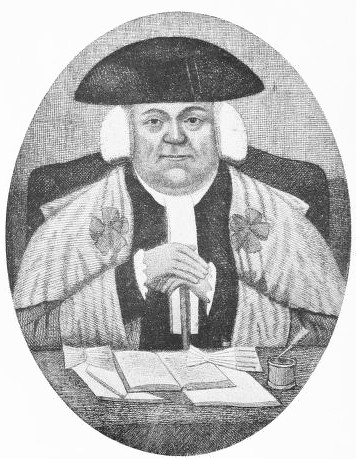 Lord Hailes.
(After Kay.)
to be more particular cannot have the effect of injuring the pannel, and
therefore can be no valid objection against this witness.
The Dean of Faculty—My Lords, I cannot help considering this as a
question of the greatest consequence, for if this objection is not
sustained, then the objection of misnomer cannot have any longer effect,
for if the change of a letter or two, as insisted on by the Lord
Advocate, does not afford that objection, there can be no such thing as
a misnomer, since the whole difference betwixt names consists only in
change of letters.
I am free to admit that if this witness had only been libelled Mary
Smith, wife of George Smith, particularly as she had subscribed her name
Mary Smith, then there could not have been stated any objection to her
examination. But as she is particularised to be Mary Hubbart, it is a
sufficient objection to me that the name of the woman now present is not
Mary Hubbart, but Mary Hibbutt, a perfectly different name. There still
may be a mistake of the person although she is designed wife to George
Smith, for it may happen that Smith may have two wives. There is not a
greater difference betwixt Erskine and Friskin, which last name is not
uncommon in this country, than betwixt Hubbart and Hibbutt. It is all
one under what name she is mentioned in the precognition, as that was
not her doing; neither is it probable that she knew by what name she was
there called. My Lords, there has not been a witness examined here this
day that can know by what name he has been taken down by the Clerk.
The Lord Advocate—My Lords, I beg that the witness may be desired to
write her name.
The Lord Justice-Clerk—Mary Hubburt, you will sign your name.
[The witness signed her name accordingly.]
The Dean of Faculty—My Lord, the witness has subscribed her name
“Hibbutt.”
Lord Hailes—The name of Hobart is the name of the very respectable
family of Buckinghamshire, in England, and I would have supposed that
this woman’s name, since it so nearly resembles it, was the same, and
would not have taken her own word to the contrary. Hibbutt,
nevertheless, is perfectly different from Hubbart, and, however obscure
it might be, still, as it is proved by the parish register to be the
name of the person now called, I consider myself obliged to give weight
to the misnomer.
The Dean of Faculty—I beg pardon for interrupting the Court, but I am
just informed that this point has been decided by Lord Eskgrove and Lord
Stonefield at the Glasgow Circuit, where a misnomer of “James Roberton”
instead of “James Robertson” was sustained. There, there was only the
want of a letter, whereas there is certainly a much greater difference
betwixt the names here in question.
Lord Eskgrove—As to the case mentioned by the Dean of Faculty,
Robertson and Roberton are two perfectly distinct names. In the case
before your Lordships there can be no doubt that if this woman had only
been libelled as wife to George Smith, without her maiden name, there
could have been no question whatever. It is the universal custom in
England that the maiden name sinks into that of the husband’s, but my
great difficulty is, in this case, that the public prosecutor, in giving
this witness a further description than was necessary, has totally
mistaken her name, I do not think that there is any force in her being
called Hubbart in the precognition for the same reason given by the
Dean.
[Here his Lordship was interrupted by the Lord Advocate.]
The Lord Advocate—My Lords, the circumstances which I meant to prove by
the witness are so immaterial that I will give the Court no further
trouble with the matter. I agree to pass from this witness.
Lord Eskgrove—I am very happy I am relieved from deciding it, as I was
going to deliver an opinion for sustaining the objection.
The Lord Justice-Clerk—Mary Hibbutt, you are at liberty to go where you
please.
Daniel Maclean
19. Daniel Maclean, waiter to William Drysdale, innkeeper in the New
Town, called in and sworn.
Witness—On the night of Wednesday, the 5th of March, on which the
Excise Office was broken into, I was in company with John Brown and
Andrew Ainslie in the house of one Fraser in the New Town from about
half-past nine to eleven o’clock at night; we drank some punch together,
and there was one Price and some others in company with us. I remember
to have received a five-pound bank-note from the prisoner, George Smith,
on the next night after the Excise Office was broken into, in order to
purchase a ticket in the mail-coach for his wife to Newcastle. The note
was battered on the back. I carried it to John Clerk, Mr. Drysdale’s
book-keeper, but he could not change it, and therefore I applied to Mr.
Drysdale himself, and then carried back the change of the note, after
deducting the price of the ticket, to Mr. Smith.
John Clerk
20. John Clerk, book-keeper to the before-mentioned William Drysdale,
called in and sworn.
Witness—I remember that Daniel Maclean, Mr. Drysdale’s waiter, came to
me the next night after the Excise Office was broken into for a ticket
in the mail-coach to Newcastle for some person, and offered a
five-pound bank-note in payment. I had not change myself, and therefore
desired him to apply to Mr. Drysdale. He laid the bank-note upon the
table, but I did not then look at it. Mr. Drysdale changed the note. On
the Monday following I received it from Mr. Drysdale, with directions to
carry it to the Sheriff-Clerk’s Office, which I did.
David Robertson
21. David Robertson, merchant in Edinburgh, called in and sworn.
Witness—I am a hardware merchant. I remember that Mr. Brodie, the
prisoner at the bar, purchased a spring saw from me about eight or nine
months ago. [Here one of the saws libelled on was shown to the witness.]
This saw bears my shop mark, and it was such a one that I sold to Mr.
Brodie. [The counsel for the pannels here repeated the objection against
adducing the two spring saws, as mentioned in the general objection and
interlocutor before taken down.] I have sold the same kind of saws to
different persons. Cabinetmakers sometimes make use of such saws in the
way of their business, but Mr. Brodie told me that the one he purchased
was for cutting off the natural spurs of game-cocks. Some time
afterwards another person, whom I do not know, came to my shop and
purchased another spring saw; he asked for such a one as Mr. Brodie had
bought. [Here the other saw was shown to the witness.] This saw also
bears my shop mark, and it was such a one that I sold to the person I
have already mentioned.
William Middleton
22. William Middleton, indweller in Edinburgh, called in and sworn.
Witness—I am in the employment of the Sheriff-Clerk’s Office. I have
been acquainted with John Brown alias Humphry Moore for some time
past, and I remember the robbing of the Excise Office. Brown came to me
upon Friday, the 7th of March last, about eleven o’clock at night, and
informed me that he wanted to make some discoveries concerning that
robbery and the other late robberies which had been committed in this
place. I desired him not to give me any information, but to keep his
mind to himself, and I would take him to a person to whom he might
communicate whatever he had to say. Accordingly I conducted him that
same night to Mr. Scott, the Procurator-Fiscal, and afterwards, at his
own desire, to the bottom of Salisbury Crags, where Brown pointed out a
place in which we found a number of false keys under a large stone.
These we brought to town with us to the Procurator-Fiscal’s house. The
next day I was sent into England along with Brown in search of the goods
belonging to Messrs. Inglis & Horner, silk mercers, which had been
stolen from their shop; and Mr. Frier, a partner of that house,
accompanied us.
The Dean of Faculty—My Lords, it is not proper that the witness should
be allowed to speak of facts that have no relation to the present trial.
The Lord Justice-Clerk—William Middleton, you are to confine yourself
to such facts as relate to or are immediately connected with the
breaking into the Excise Office, which is the charge brought against the
prisoners.
Witness—Upon Sunday, the 16th of March last, the prisoner, George
Smith, was carried at his own desire to the bottom of Warriston’s
Close,[5] and I accompanied him, along with Alexander Williamson and
James Murray, sheriff-officers. Smith there pointed out a hole in a wall
where a false key, a pair of curling irons, and a small iron crow were
hid, which, he said, had been used in breaking open the Excise Office;
whether they were covered with earth or not I cannot say, as the
prisoner himself put in his hand and brought them out. [Here a false
key, a pair of curling irons, and a small iron crow were shown the
witness.] These are the same articles that were so found. [The counsel
for the pannels here repeated the objection against adducing the iron
crow, the curling irons or toupee tongs, and dark lanthorn, as mentioned
in the general objection and interlocutor before taken down.] I was
present at the search that was made in Smith’s house; there was nothing
found in it. I was likewise present on the day following at a search
that was made in Brodie’s house and yard, when one part of a dark
lanthorn was found in a necessary house, and another part in a pen where
fowls or game-cocks had been kept. [Here the dark lanthorn libelled on
was shown to the witness.] These are the two parts of the dark lanthorn
which were so found. The prisoner, George Smith, informed me that the
small crow was used in breaking into the Excise Office.
Cross-examined by the Dean of Faculty—Did Brown inform you, previous to
your going to England, that the prisoner, William Brodie, had any
concern in the robbery of the Excise Office?
Witness—He told me that there was a gentleman whom I knew, and whom I
little suspected, concerned in it, but he did not mention his name.
Alexander Williamson
23. Alexander Williamson, sheriff-officer in Edinburgh, called and
sworn.
Witness—I was present, along with George Williamson and James Murray,
when there was a search made in the house of William Brodie, the
prisoner, upon the 10th of March last, and in the course of the said
search I saw a pair of pistols wrapped in a black stocking taken from
under the earth in the fireplace of a shed in his yard. [Here the
pistols libelled on were shown to the witness wrapped in a green cloth.]
These are the pistols, and they were found in that green cloth. [The
counsel for the pannels here repeated the objection against adducing the
pistols, as mentioned in the general objection and interlocutor before
taken down.]
Cross-examined by the Dean of Faculty—How came you to say that they
were found in a black stocking?
Witness—I saw a black stocking on the table, and that misled me.
The Dean of Faculty—You are to speak from what you know, sir, and not
from what you see on the table.
Witness—I am certain that it was in a green cloth they were found.
James Murray
24. James Murray, sheriff-officer in Edinburgh, called in and sworn.
Witness—I was employed, along with Alexander Williamson and some
others, to search the prisoner’s (William Brodie) house upon the 10th of
March last. In the course of the search we found a pair of pistols in a
green cloth covered with earth in the fireplace of a shed. I think that
it was myself that dug them out of the earth. [Here the pistols libelled
on were shown to the witness.] These are the pistols that were so found.
I afterwards saw one part of the dark lanthorn found in a necessary
house, and another part of a dark lanthorn found in a pen where
game-cocks had been kept. I accompanied the other prisoner, George
Smith, upon the 16th of March, to the bottom of Allan’s Close,[6] and he
there pointed out a hole in a wall, where, he said, there were some
articles hid. I put in my hand and brought out a false key, a pair of
curling irons, and a small crow. [Here the articles formerly produced
were shown to the witness.] These are the same that were so found.
Cross-examined by Mr. John Clerk—You say that you put in your hand and
brought out these articles; are you sure it was not George Smith who did
so?
Witness—I put in my hand; George Smith could not, being handcuffed.
George Williamson
25. George Williamson, messenger-at-arms in Edinburgh, called in and
sworn.
Witness—I was employed with others to search the house of the prisoner,
William Brodie, on the 10th of March last, and found several keys of an
uncommon construction in a room off Brodie’s shop. We likewise found a
pair of pistols wrapped in a green cloth under the earth in the
fireplace of a shed in the woodyard. These were discovered by Smith, the
prisoner, poking with an iron. [Pistols shown to witness.] These are the
same that were so found. We also found several pick-locks in Mr.
Brodie’s house, all of which were lodged by me in the Sheriff-Clerk’s
Office. [Here the pick-locks were shown to witness.] These are the same
pick-locks that were so found. [The counsel for the pannels here
repeated the objection against adducing the pick-locks, as mentioned in
the general objection and interlocutor before taken down.] I was sent in
quest of Mr. Brodie, who was supposed to have gone to London, by Mr.
Scott, the Procurator-Fiscal, upon the 11th of March last. I left
Edinburgh about eleven o’clock at night. When I arrived at Dunbar I got
some accounts of him; Mr. Brodie had left that place in a post-chaise.
At Newcastle I was informed that he had taken the “Flying Mercury”
post-coach to York; and I was afterwards informed that he had continued
in it till he came to London. When I arrived in London I was informed by
the coachman that Mr. Brodie did not go with the coach to the stage
office, but that he had quitted it at the foot of Old Street,
Moorfields. I waited upon Sir Sampson Wright, and at his desire I called
upon Mr. Walker, solicitor-at-law in the Adelphi, and inquired for Mr.
Brodie. He told me he was bad, and that I could not see him. I said I
had a letter for him and wanted only to deliver it; but Mr. Walker
replied that it might perhaps be dangerous to allow me to see him.[7]
The Dean of Faculty—My Lords, without meaning any reflection on the
witness, whom I know and believe to be a very good man and an active
officer, the greatest part of what the witness says is “hearsay.” He
tells your Lordships that he was told one thing at Dunbar; that he
received another piece of information at Newcastle; that a coachman told
him so-and-so in London, and that Mr. Walker said this, that, and the
other thing. My Lords, this is exceedingly improper. I have been taught
to understand that in criminal trials the best evidence that can be got
ought always to be brought; and surely it will not be pretended that
that has been done in the present case. In a question of this kind,
hearsay evidence is not admissible. The witness has said that he was
informed so-and-so by coachmen; why were not these coachmen called as
evidences? He has given you an account of a conversation that passed
between him and Mr. Walker; why is not Mr. Walker brought here to speak
for himself?
The Lord Advocate—My Lords, it was thought a material circumstance to
be proved that the prisoner, William Brodie, fled from this country;
that he secreted himself in London; and the witness, who was sent in
pursuit of him, was considered as a proper person to be examined as to
the fact. In the course of informing the Court what he himself did he
has necessarily mentioned what passed between himself and some other
persons. This cannot be said to have been hearsay evidence, being what
the witness himself knows.
My Lords, the Dean of Faculty has asked why the different post-boys and
coachmen who drove the prisoner to London, why Mr. Walker and others
were not all cited as witnesses? The bringing forward of such a variety
of witnesses is not only unnecessary but expensive. By the forms of
criminal procedure in this country a trial must be finished at one
sederunt; but, my Lords, if the mode contended for by the Dean of
Faculty had been pursued in the present case this trial could not have
been finished in a month.
The Lord Justice-Clerk—George Williamson, you will confine yourself to
what you know or did yourself, and do not speak of what you were told by
others.
Witness—I searched for the prisoner in London, but could not find him.
I also went out to Deal and Dover, but could receive no intelligence of
him. Accounts were afterwards brought to this place that he had been
apprehended in Holland and brought to London. I went to London for him.
He was delivered over to me at Tothilfields Bridewell, and I conducted
him to this place and lodged him in the Tolbooth.[8]
Andrew Ainslie
The Solicitor-General—The next witness is Andrew Ainslie.
The Dean of Faculty—Before this witness is called I rise to state to
the Court an objection against his admissibility. This witness is
alleged to have been guilty of the same crime of which the pannels at
the bar now stand accused, and therefore the objection of his being a
socius criminis might apply to him. But although by our former law the
objection of a witness being socius criminis might render him
inadmissible, yet I have no occasion, nor is it my intention, to insist
on the present objection in that view, for I freely own that the
practice of this Court has for some time past, and with great propriety,
I think, over-ruled that objection.
But, my Lords, I contend that this witness is inadmissible from the
particular circumstances attending his case. For, according to the
information which I have received, when this witness was apprehended and
committed to prison, in the month of March last, to stand trial for this
crime, he never charged Mr. Brodie as having been in any measure
accessory thereto. On Ainslie’s first examination he positively affirmed
that Mr. Brodie had no sort of accession to the crime of which he is now
accused, or was concerned in any other bad action whatever to his
knowledge, unless playing at cards and dice should be reckoned such; and
in the different declarations which he made before the Sheriff he still
persisted in denying that my client had any concern in this robbery. But
after Mr. Brodie was apprehended and brought from Holland Ainslie was
again brought before the Sheriff, when he was informed that either he
himself must be hanged or he must accuse Mr. Brodie. Further, I am now
instructed to say that when this witness was carried before the Sheriff
his life was offered to him on his becoming King’s evidence against Mr.
Brodie, and accusing him of having been concerned in this robbery, and
that, even notwithstanding this offer, he persisted in denying that Mr.
Brodie was guilty of this crime, until John Brown alias Humphry Moore,
another of the witnesses cited, and alleged also to have been a socius
criminis, was allowed to see and converse with him in prison, when at
length he came into the measures proposed. I mean to say nothing against
the conduct of the Sheriff, which may have been very proper—with the
motives which may have influenced a public officer to a particular line
of conduct I have nothing to do—but I state it as an insuperable bar to
the admissibility of this witness, that hopes were suggested to him of
saving his own life by criminating my client. And I offer to prove, by
the evidence of the Sheriff of Edinburgh himself, that a bargain of this
nature was made with Ainslie, and that it was not till then he was
prevailed upon to say that Mr. Brodie had any concern in this crime. No
man could withstand such a temptation, and it is impossible that the
Court can receive the testimony of a witness in such circumstances.
The Lord Advocate—My Lords, I hardly expected that such an objection
would have been made at this time, as it has long been the universal
practice to admit socii criminis as evidence, and at the last trial in
this Court such a witness was received without even an objection being
stated. All the arguments on the other side could only affect the
credibility of the witness, which properly belongs to the jury, and not
the admissibility, which alone is before the Court. It is indeed true,
and I am even surprised that the honourable counsel had not appealed to
the authority, that Sir George Mackenzie has laid it down that socii
criminis could not be admitted as evidence; but upon what principle of
law or reason Sir George formed that opinion I could never discover. Sir
George Mackenzie, indeed, is an author by whom I never was much
instructed. He is often contradictory, always perplexed, and in many
instances unintelligible. But even supposing the law had so stood in his
time, the Court and the practice have long since deviated from it.
My Lords, the fact as stated by the Dean of Faculty is
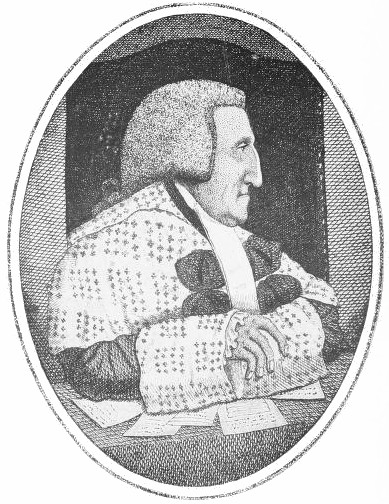 Lord Eskgrove.
(After Kay.)
erroneous in every respect. For although Ainslie in his first
declaration did not accuse Brodie or any other person, and denied all
knowledge of the crime, yet in the second declaration which he emitted
before the Sheriff on the 14th of March, which I now hold in my hand,
and would read did the forms of the Court permit me to do so, he in the
most express terms charges both Brodie and Smith as being equally
concerned in the crime libelled. And, my Lords, it will not easily be
believed—indeed, the thing is incredible—that so respectable an
officer of the law as the Sheriff of Edinburgh would ever have entered
into such stipulations with Ainslie. But even had such transaction taken
place before any inferior judge or magistrate, still that cannot deprive
the public prosecutor of the evidence of this witness, for it will not
be said that any such transaction passed between him and the witness,
and therefore the objection ought to be repelled, reserving the
credibility of his evidence to the jury.
The Dean of Faculty—My Lords, I offer to prove my assertion.
The Lord Advocate—My Lords, I am willing, if the Dean of Faculty and
the Court consent to it, to hold the second declaration, emitted long
before Mr. Brodie was apprehended, as the evidence to be delivered by
Ainslie on this occasion.
Lord Eskgrove—No transaction of any kind can possibly take place where
life and death are concerned; and, therefore, even although the counsel
on the other side consent to such a proposal, the Court would not allow
it.
The Lord Justice-Clerk—Dean of Faculty, do you say that my Lord
Advocate has made a corrupt bargain with the witness to accuse Mr.
Brodie upon condition of receiving a pardon?
The Dean of Faculty—No, my Lord; but I repeat my offer to prove a
bargain to that purpose with the Sheriff.
Lord Hailes—My Lords, the objection of socius criminis, if it ever
was sustained in our law, has long since been obsolete. Nor can I
understand how Sir George Mackenzie laid it down that socii criminis
could not be admitted in evidence, since in his time we have instances
of their having been actually received as witnesses. This assertion of
Sir George Mackenzie’s is, like many others in the same work, founded
neither on principle nor fact. But the Dean of Faculty’s objection
amounts to a kind of reprobator against this witness. But even
supposing that any credit could be given to the circumstances upon which
this objection is principally founded, yet it could not affect the
admissibility of this witness, as it is not pretended to be said that
the alleged stipulation had taken place with the consent of the
prosecutor for the Crown. I am therefore, upon the whole, for repelling
the objection.
Lord Eskgrove—My Lords, there is no doubt that the objection of the
witness being a socius criminis cannot be admitted in the present
state of our law, whatever might have been done formerly. By the common
practice, such witnesses are every day admitted; nor do I see how crimes
of this nature could be discovered if a contrary practice were followed.
As to the special circumstances qualified by the Dean of Faculty, that a
bargain was made by the Sheriff with Ainslie to procure him His
Majesty’s pardon on condition of his accusing the pannel, I am likewise
of opinion that these do not go to his admissibility. For your Lordships
will observe that Ainslie cannot possibly be under any temptation now to
accuse the pannel in consequence of that bargain. If I understand the
law, my Lords, the calling any person as a witness on a trial is
completely departing from any right to indict that person himself as
being guilty of the crime concerning which he is called as a witness.
Nor does it signify whether the pannel be convicted or not; it is clear
that the witness can never be questioned for that crime; and Ainslie is
quite safe from the consequences of his being accessory to the robbery
of the Excise Office, if he was so. But, my Lords, it will be proper,
before examining Mr. Ainslie, to inform him of his situation; and it
will be proper, and the counsel for the pannels are entitled, to put
such questions in initialibus of his evidence as will tend to satisfy
your Lordships and the jury whether such a bargain had been entered into
with him by the Sheriff or not, and how far he considers himself bound
by it.
Lord Stonefield—My Lords, I am for repelling this objection.
Lord Swinton—My Lords, the objection made to the admitting of Andrew
Ainslie is that he was an accomplice. I am clear to repel the objection
in so far as it goes against the admissibility of the witness, but
reserving it in full force, and leaving it to the conscience of the
jury, in so far as it strikes against the credibility of the witness. In
all my practice, ever since I knew this Court, although I have often
heard the objection made, I never knew one instance in which it was
sustained. If the jury were bound to believe every word a witness said,
be his character what it may, there would be good reason for sustaining
the objection, but where objections are reserved against the credibility
of a witness, the jury are left at liberty to believe as much or as
little of what he says as they see good cause for so doing.
The repelling of this objection, which is now the uniform practice, was
founded upon good sense and reason, for as accomplices are best
qualified to make discoveries, so, many crimes, were they excluded from
being witnesses, would pass unpunished; and any hazard of their being
guilty of perjury may be easily prevented by the Court’s informing them
that the evidence they are to give cannot affect themselves.
The Lord Justice-Clerk—My Lords, were such an objection as this to be
sustained, we would find very few instances, as one of your Lordships
has very well observed, where a crime such as the present, of an occult
and secret nature, could be brought to light. My Lords, as to the
objection of the socius criminis, I will not say a single word upon
it. I always thought, my Lords, that it contained in itself a complete
answer, since the allegeance that the witness is a socius criminis
implies that the pannel is guilty of the crime.
What is said by the Dean of Faculty about a supposed bargain betwixt the
Sheriff of Edinburgh and Ainslie is by no means such an objection as
affects his admissibility, although I will not say that his credibility
may not be in some degree diminished by it; and the Dean of Faculty will
be right in making his own use of it to the jury. Had the Dean of
Faculty alleged that this bargain was corruptly made by my Lord
Advocate, I could have understood him. But the Sheriff is only an
inferior officer, and had no power to enter into any such transaction.
Had he been ever so willing he could not have given Ainslie the smallest
security that the terms and conditions of the bargain were to be
fulfilled on the part of the Crown in consequence of Ainslie performing
what was required of him. A higher authority was necessary, and none but
the Lord Advocate himself could with any effect enter into an agreement
with a witness to procure him His Majesty’s pardon for becoming King’s
evidence. It is therefore not enough to say that offers were made him,
whatever they were, by the Sheriff, and we must examine him, reserving
all objections to his credibility.
The Court then pronounced the following interlocutor:—
The Lord Justice-Clerk and Lords Commissioners of Justiciary having
considered the foregoing objections with the answers thereto, they
repel the objections stated, and allow the witness to be examined,
reserving the credibility of his evidence to the jury.
Robt. M‘Queen, I.P.D.
26. Andrew Ainslie, sometime shoemaker in Edinburgh, present prisoner in
the Tolbooth of Canongate of Edinburgh, called in and sworn.
The Lord Justice-Clerk—Andrew Ainslie, you are called here as a witness
to give evidence as to certain matters in which it is generally
understood you yourself had a concern. You are informed by the Court
that whether you had any such concern or not you are in no danger in
telling the truth, for, being called here as a witness, you can never
afterwards be tried for the crime with which the prisoners are charged.
You are to pay no regard to the declarations you formerly emitted;
these are now destroyed. And you will remember that by the great oath
you have sworn you are bound to tell the truth, and if you say anything
to the prejudice of the prisoners which is not true, or if you conceal
any part of the truth with a view to favour them, you will be guilty of
the crime of perjury, and liable to be tried and punished for it, and
you will likewise commit a heinous sin in the sight of God, and thereby
endanger the eternal salvation of your own soul.
Witness—I am acquainted with both William Brodie and George Smith, the
prisoners at the bar, and also with John Brown alias Humphry Moore. I
remember that the Excise Office was broke into upon Wednesday, the 5th
of March last. I knew before that that it was to be broken into, but how
long I cannot tell. Brown and the prisoners and I frequently talked of
it before, and Brown and I went often to the Excise Office in the
evenings in order to observe at what hour the people left it, and in
consequence of repeated observations we discovered that the door was
usually locked about eight o’clock, and that there were two men, an old
and a younger man, who came night about to watch the office about ten
o’clock. Afterwards Brown and I went out one afternoon to a house at
Duddingston, where we drank a bottle of porter, and saw a woman whom I
took to be the landlady. We then went to a field in the neighbourhood,
from which we took the coulter of a plough and two iron wedges, which we
carried to the Salisbury Crags and hid there. At this time there was a
black dog in company with us. We had fixed on Wednesday, the 5th of
March, for committing the said robbery, and we allowed the coulter to
remain in Salisbury Crags until about six o’clock of the evening of that
day, when Brown and I, it being then dusk, went out and brought the
coulter of the plough to the house of the prisoner, George Smith, on
purpose to use it in breaking into the Excise Office. We found Smith at
home, and we expected Mr. Brodie to join us and to accompany us to the
Excise Office. Brodie did not come until a good while after, when he
joined us in the room above-stairs in Smith’s house. Mr. Brodie was at
this time dressed in a light-coloured great-coat, with black clothes
below (in which I had often seen him before), and a cocked hat. When he
came in he had a pistol in his hand, and was singing a verse of what I
understood to be a flash song. By a flash song I mean a highwayman’s
song. We spoke together concerning the Excise Office; and it was settled
upon that I should go before to the Excise Office and get within the
rails and observe when the people went out. I went there accordingly a
little before eight o’clock, carrying the coulter of the plough with me,
and waited till I saw the porter come out with a light and lock the
outer door. In a short while thereafter Smith came to me and asked if
the people were all gone, and when I informed him that they were gone
out Smith then went forward and opened the door with a key, which, I had
heard him say, he had previously made for it, and went into the office.
In about five minutes thereafter Brodie came down the close, and when I
told him that Smith had gone in, but that Brown was not yet come, he
went up the close again towards the street, and returned in a little
with Brown, who said he had been dogging the old man who watched the
office in order to see where he went, and that he had gone home. Brown
then asked me whether or not I had “Great Samuel”—by which he meant the
coulter. I told him I had, and gave it him through the rails, and he and
Brodie then went down towards the door of the office and went in, as I
supposed. I had no arms myself, excepting a stick, but Smith had three
loaded pistols, Brown two, and Brodie one; at least, I saw Brodie, when
he came into Smith’s house, have one in his hand. It had been previously
settled amongst us, before leaving Smith’s house, that Brodie was to
stand in the inside of the outer door, and that Brown and Smith were to
go into the office. I was to remain without to watch, and in case of
danger, to give an alarm to Brodie, which Brodie was to communicate to
Brown and Smith. The signal of alarm agreed upon was to be given by me
in this manner—A single whistle if one man appeared, so that they might
be prepared to secure him; but if more than one man, or any appearance
of danger, I was to give three whistles, in order that those within
might make their escape by the door or by the back windows, as they
thought best. I had an ivory whistle prepared for the purpose, which was
given me by Mr. Brodie in Smith’s house in the afternoon. I took my
station within the rail and leaned down, so that no person either going
in or coming out could see me. Some short while after Brodie and Brown
went into the office, a man came running down the close and went in
also. I gave no alarm, for before I had time to think what I should do
another man came immediately running out at the door and went up the
court. In a very little afterwards, to my great surprise, a second man
came out from the office. I got up and looked at him through the rails,
and perceived that he was none of my three companions. I had not seen
the other man who came out first so distinctly, owing to my lying down
by the side of the parapet wall on which the rail is placed, in order
that I might not be observed. I was afraid that we were discovered; and,
as soon as the second man had gone up the close, I gave the alarm by
three whistles as the agreed-on signal of retreat and ran up the close
myself. I went down St. John’s Street and came round opposite to the
back of the Excise Office, thinking to meet my companions coming out by
the back way, having escaped from the windows. I remained there for some
little time, and, not meeting with them, I then went directly to Smith’s
house. Finding none of them there, and Mrs. Smith telling me that they
were not yet come in, I went back to the Excise Office by the street,
went down the close, saw the door open, and, finding everything quiet, I
returned to Smith’s, where I saw him and Brown. They accused me of not
having given the alarm as I promised, and said that when they came out
they found that Brodie had gone from his place. I told them what I had
observed, and that I had given the alarm. I remained in Smith’s only a
few minutes, and I did not see Brodie again that night.[9] Brown and I
then went over to the house of one Fraser in the New Town, and sent for
Daniel Maclean, Mr. Drysdale’s waiter. We spent the evening with him
there. There was one Price likewise in company with us, and we remained
together till about two o’clock in the morning. It was near eight
o’clock when I went first to the Excise Office, and it was about
half-an-hour afterwards that I quitted my station. Brodie called next
morning at our room—the room occupied by Brown and me. He came in
laughing, and said that he had been with Smith, who had accused him of
running away the previous evening. I told him that I also thought he had
run off; but he said that he had stood true. Brodie had no great-coat on
when he came to the Excise Office and spoke to me at the rails; he was
dressed in black. When the whistle was given me by him in Smith’s house
in the afternoon Brodie had on the white-coloured clothes which he
usually wore. He afterwards changed them before we went to the Excise
Office. Before I left Smith’s I saw Brodie have a pick-lock in his
hands, and I think we all had it in our hands looking at it. Brodie was
in his own hair. I did not observe him have a wig. We had prepared three
crapes to disguise our faces; one of them was intended for Brown,
another for Smith, and the remaining one for myself, but I did not see
either Brown or Smith put a crape in their pockets that night. [Here the
pistols libelled on were shown to the witness.] These pistols belonged
to Mr. Brodie, and Smith had them with him at the Excise Office. They
were given to him by me, and I had borrowed them from Mr. Brodie a month
or two before for another purpose. That same evening Brown told me, as
we went over to the New Town, that they had found sixteen pounds and
some silver in the Excise Office; and on the Friday evening following,
when I called at Smith’s house, in the room above stairs I found Smith
and Brodie, and saw the money lying on a chair. I got a fourth share of
it in small notes, and at the same time I got some gold from Mr. Brodie
in payment of money he owed me. Brodie and Smith also each got a fourth
share of it. There were two five-pound notes amongst the money that was
on the chair, and I signified a desire to have one of them. I
accordingly gave back some of the small notes I had received and some of
the gold and got one of them in exchange. I afterwards gave the note to
Smith, and saw him change it at Drysdale’s in the New Town the same
evening, when he was purchasing a ticket for his wife in the mail-coach
to Newcastle for the next day.[10] Brown and one Price were then
present.
The Solicitor-General—Have you any particular mark by which you could
know the said note again?
Witness—It was a Glasgow note, and battered on the back with paper.
[Here the Solicitor-General proposed to show the witness the bank-note
libelled on.]
The Dean of Faculty—My Lords, here I must interrupt the witness. It is
stated in the libel that a five-pound bank-note is to be produced in
evidence against the pannels; but the witness says that the note given
him to change was a Glasgow five-pound note, and the paper on your
Lordship’s table is a promissory note for five pounds issued by John
Robertson in name of Spiers, Murdoch & Company, a private banking
company in Glasgow. This cannot in propriety of language be termed a
bank-note. In Lombard Street, where such notes as that on the table are
daily negotiated, they never think of calling them bank-notes. This
term, my Lords, is exclusively appropriated to the notes issued by a
bank constituted by a Royal Charter, such as the Bank of England, and
the notes of a private banker are distinguished by the name of banker’s
notes. Neither does such a note come under the description of money, as
it is not a legal tender in payment. I hold in my hand this objection in
writing, which, to save the time of the Court, I shall read, and I crave
that it may be entered on the record.
The Solicitor-General—This objection appears to me to be so entirely
frivolous as hardly to be worthy of an answer. The note in question is
one issued by a very respectable banking company in Glasgow, and well
known in this country by the name of the Glasgow Arms Bank. Such notes
are commonly held to be bank-notes, and are so described in common
language every day. Many instances might likewise be given of their
being described in the same manner in criminal indictments, nor was it
ever before objected that the description was insufficient. We need not
go so far off as Lombard Street; there is no necessity for going
further than the Parliament Close, where thousands of these notes are
issued, known by no other name than that of bank-notes. The honourable
counsel on the other side of the table, as well as myself, have received
the greatest part of our fees in bank-notes of this kind, and both of us
would have reason to complain, I believe, if what we received in that
manner were not really bank-notes or considered as money.
The Dean of Faculty—My Lords, the common use of language, as well as
the technical and legal description of the writing on the table, join in
supporting this objection. That there is a distinction in common phrase
between a bank-note and a banker’s note there can be no doubt. Every
private company which is instituted with a view to the purposes of
banking may indeed issue promissory notes, which meet with a voluntary
credit from the country; but these are distinguished from the public
banks instituted by the authority of Government, and where credit does
not depend upon the goodwill of any individual, as every man must accept
in payment their notes when tendered to him. These notes are alone
properly termed bank-notes as the notes of a bank which is a public
corporation, while the notes of a private company are termed banker’s
notes, or those of an individual. Although the one may, in common
discourse, be sometimes confounded with the other by those who are
ignorant of the real distinction, there is no doubt that that
distinction exists and is acknowledged by any one acquainted with the
subject; and where they are best acquainted with it there the
distinction is most explicitly acknowledged, as in Lombard Street, where
no other term is known for the note of a private banker than a banker’s
note. The inaccuracy of the description in the indictment is therefore
evident, and can by no means be defended by the vulgar error which
sometimes, I admit, is fallen into of confounding it with the note of a
public bank.
My Lords, it will be allowed me that accuracy is at least as necessary
for an indictment as to proceedings in the civil Courts; and your
Lordships cannot have forgotten the late decision upon the application
of the Bankrupt Act, when it was found that money belonging to creditors
could not be lodged in the Bank of Dundee, in respect, the Act declares,
that the bankrupt funds recovered should be lodged in a bank. And if the
Bank of Dundee, my Lords, was held in that judgment not to be a bank
under the meaning of the Act, with what propriety could your Lordships
determine in a criminal case that their notes were bank-notes? No case
can be figured more precisely in point; and if your Lordships approve of
that decision, you will necessarily find that the note on the table is
improperly described, and cannot be used in evidence.
I might safely admit, my Lords, that if this note had been described as
a five-pound bank-note of a certain company, supposing it had been a
bank-note of Sir William Forbes & Company, that this would have been a
good description, for then it would have appeared by the indictment that
the writing meant was a promissory note of that company. But from its
being termed generally a bank-note, I could never suppose that it was
not a note issued by one of the public banks, as that is the description
that applies to no other species of document known in this country. For
these reasons I hope your Lordships will not allow any questions
concerning this paper to be put to the witness.
Lord Hailes—When I had the honour to serve the Crown as a
depute-advocate, I learned from a most eminent judge, Lord Tinwald,
Justice-Clerk, from whom I derived much instruction in the principles of
law, that the note of a private banking company could not be termed in
law a bank-note, nor could it be considered in any respect as money. On
one occasion he obliged me to correct an indictment where I had fallen
into the same error which I perceive here. The word bank-note, in legal
acceptation, is applied exclusively to the notes issued by a bank
instituted by Royal Charter, and I remember well the case alluded to by
the Dean of Faculty, which was determined on the same principles. I am
therefore clear for sustaining the objection.
Lord Eskgrove—My Lords, I am clearly of the opinion that has been given
by my honourable brother. The promissory note of a private banking
company is not held in the language of our law to be a bank-note, and
therefore I am for sustaining the objection.
The Lord Justice-Clerk—I suppose there are none of your Lordships of a
different opinion? The Lords therefore sustain the objection.
The Court then pronounced the following interlocutor:—
The Lord Justice-Clerk and Lords Commissioners of Justiciary having
considered the objection, with the answers thereto, they sustain
the objection to this piece of evidence libelled on, and refuse to
allow the same to be produced.
Robt. M‘Queen, I.P.D.
[Here the witness was shown a false key, a pair of curling irons, a
small iron crow, and the coulter of a plough.]
Witness—I know these articles; they were all used in the breaking into
the Excise Office. The coulter we called “Great Samuel,” and the iron
crow, “Little Samuel.” When I gave the coulter to Brown through the
rails at the Excise Office he asked me if I had “Little Samuel,” and I
said that I believed that Smith had it in his pocket.
Lord Hailes—Andrew Ainslie, you gave an account of this matter formerly
before the Sheriff; but you have been very properly told by the Court
that what you said there is now of no avail, and that your declarations
are destroyed. You have this night, in presence of the Court and the
jury, given evidence against the prisoners at the bar. Before you leave
the Court, I desire you to consult your own breast whether or not you
have said anything to the prejudice of these men that is not true. You
have it still in your power to correct any mistakes you have made, but
this opportunity will never recur to you. If, therefore, you are
conscious of having said anything against the prisoners contrary to
truth, and if you leave this house without informing the Court and the
jury of you having done so, you will commit a most heinous offence
against the Almighty God, and you will be guilty of perjury and of
murder.
Cross-examined by the Dean of Faculty—At what hour went you first to
the Excise Office on the night in which you say it was broke into?
Witness—I left Smith’s house about a quarter before eight o’clock; I
went away before the rest.
The Dean of Faculty—What o’clock was it when you returned the last time
to Smith’s that evening?
Witness—I cannot say, but I think it would be about an hour from the
time I went first to the Excise Office.
The Dean of Faculty—How long were you at the Excise Office before
Brodie came to you?
Witness—About a quarter of an hour; he came to the Excise Office just
about eight o’clock.
The Dean of Faculty—You have said that you had resolved to break into
the Excise Office a considerable while before you carried that design
into execution, and you have told us that it was broke into upon a
Wednesday night? Now, you will inform the Court and the gentlemen of the
jury what your reason was for fixing upon that night more than any
other?
Witness—Brown and I having seen, in consequence of frequent
observations, that an old man watched night about with the other porter,
and knowing that it was his turn to watch on Wednesday night, we
therefore fixed upon that night for carrying our design into execution.
We knew that there was usually nobody in the office from eight to ten
o’clock for the purpose of watching it. I do not remember who it was
that first proposed robbing the Excise Office.
John Brown
27. John Brown alias Humphry Moore, sometime residing in Edinburgh,
present prisoner in the Tolbooth of Canongate of Edinburgh, called.
Mr. Wight, for the pannel, William Brodie—My Lords, before this
witness, who is also a socius criminis, is called in, I have to
object to his being received as a witness upon grounds which, I imagine,
are insuperable. This man, my Lords, was convicted at the General
Quarter Sessions for the county of Middlesex, by the verdict of a jury,
of stealing twenty-one guineas and fourteen doubloons, in consequence of
which he was adjudged to be transported beyond the seas for the term of
seven years, in April, 1784, and this is instantly instructed by a copy
of the said conviction, under the hand of the proper officer, now
produced; and further, the witness, under the name of John Brown, was
banished by the Justices of Peace for Stirlingshire from that county in
September, 1787, upon his confessing a theft committed at Falkirk, as
appears from a certified copy of the said sentence under the hand of the
Clerk of the Peace of the said shire. I shall not take up your
Lordships’ time in proving that a man thus infamous is altogether
inadmissible as a witness in any cause, especially where life is
concerned, and I have no doubt that your Lordships will sustain the
objection.
The Solicitor-General—My Lords, in answer to this objection, I here
produce His Majesty’s most gracious pardon in behalf of this witness,
under the Great Seal of England, dated 28th July last, which, by the law
of England, renders the witness habile and testable.
Mr. Wight—The production of this pardon, my Lords, will by no means
answer the objection which I have stated. The infamy attending the
commission of the crimes of which Brown has been convicted is not,
cannot be, done away by the King’s pardon. He still remains a man
unworthy of credit, in whom the gentlemen of the jury can place no
confidence. His situation, in short, is just the same as it was before
the granting of the pardon, unless that the pardon saves him from the
punishment awarded against his crimes. This doctrine is delivered by Sir
George Mackenzie in very strong terms, and it is the doctrine of common
sense.
[During this time some desultory conversation took place about what was
the felony for which Brown was sentenced, the Lord Advocate saying it
was only swindling.[11]]
The Lord Advocate—My Lords, as to the sentence against Brown, supposed
to have been pronounced by the Justices of Peace for Stirlingshire, it
does not appear with certainty, nor do I know whether Brown, the
witness, be the same person who was the subject of that sentence or not,
as the certified copy of the sentence of banishment produced is against
one John Brown from Ireland. I admit, my Lords, that if he had been
tried by a proper Court and convicted in consequence of the verdict of a
jury that the objection would have been a very good one; but the
sentence of the Justices of Peace here produced cannot afford an
objection which your Lordships can sustain in bar of his evidence.
Granting him to be the same person, there is here no trial or verdict of
a jury. It appears that a petition was presented for him to avoid the
trouble of a trial, and the Clerk of Court has most improperly taken
down an acknowledgment of his guilt. There was no occasion for his
accusing himself, it was sufficient for him to state that he wished to
avoid the consequences of a trial; and therefore, my Lords, this
sentence can in no view of the matter be held to infer his actual guilt
of the crime laid to his charge before the Justices. My Lords, I admit
in the fullest manner the effect of the first sentence against Brown for
the felony, but I maintain that it is completely taken off by the
subsequent pardon.
I do not reckon myself obliged to answer to the general objection of
socius criminis: that is fully answered by the practice and the
uniform course of your Lordships’ decisions. A specialty was argued in
the case of Ainslie; but this witness is in a situation very different.
He never was charged with this crime, nor was he ever liable to the
temptation which it was alleged, for the pannels, might have influenced
the former witness.
My Lords, many daring robberies have been committed in this city, and,
in spite of the utmost vigilance of the police, no discovery could be
made of the perpetrators. At length, upon the Friday after the robbery
of the Excise Office, Brown went to Mr. Middleton, a person employed by
the Sheriff, and told him such circumstances as led to a discovery. From
this, my Lords, I am bound to suppose that he had repented of what he
had done, and I conceived it to be my duty not to prosecute him, but, on
the contrary, to make use of his evidence as a means of discovery of the
rest of his accomplices. After this, my Lords, it was found that he had
been convicted at the Old Bailey. I then applied for advice to those
whom I thought were best enabled to assist me concerning the law of
England on this subject, and I learned, my Lords, that the proper method
to be followed was to apply for a pardon. There is no occasion for
making a mystery of the matter, it was the Recorder of London I did
apply to. He is a gentleman necessarily more versant in these matters
than any other man in the kingdom. By his advice, I applied for a pardon
and accordingly obtained it.
But, my Lords, there was no occasion for a pardon in this case; the
witness, in my opinion, would have been just as admissible without it.
The sentence by which he was condemned is to us entirely a foreign
sentence, and, therefore, upon the universally received principle of
law, that statuta non obligant extra territorium statuentis, it can be
of no force with us, unless from that politeness, termed comitas by
the law, which civilised nations pay to the decrees of each other, and,
accordingly, unless your Lordships shall, ex comitate, be disposed to
give effect to the decree of a foreign Court, this objection is such as
cannot even be listened to in the first instance, the crime said to be
committed by Brown having been committed in England, and the sentence
pronounced against him being the sentence of an English Court.
My Lords, your Lordships in another capacity, in the civil Court, do not
as a matter of course give effect to foreign decrees. In every instance
you must be satisfied that the decree is consistent with equity and
justice before you interpone your authority. And this holds more
particularly in such decrees as infer a penalty, in which case, indeed,
some lawyers think, and my Lord Kames declares himself to be clearly of
that opinion, that no weight whatever is attached to a foreign decree.
But, my Lords, even laying this out of the question, His Majesty’s most
gracious pardon, which I hold in my hand, puts an end to all objection
at once. There is not, indeed, a clearer point than that a pardon from
the King takes away the effects of any former sentence, and makes the
person pardoned precisely the same person he was before the sentence was
pronounced against him.
This question must be judged of according to the law of England, and
English authorities are express to this purpose. Thus Blackstone, B. iv.
ch. 31, in fine says, “The effect of such pardon by the King is to make
the offender a new man, to acquit him of all corporeal penalties and
forfeitures annexed to that offence for which he obtains his pardon, and
not so much to restore his former as to give him a new credit and
capacity.” And another authority, my Lords, equally respectable—I mean
Bacon’s Abridgment, p. 809—lays down exactly the same doctrine. This
witness, therefore, is and must be admissible, notwithstanding the
sentence pronounced against him. He has a new credit and capacity given
him by this pardon, which enables him to be adduced as a witness,
whatever may have been his character previous to obtaining it.
The authority of Sir George Mackenzie has, indeed, been stated as in
opposition to this argument. But things have varied so much since his
days, and his opinions are frequently so loose and confused, that no
weight can be given to his opinion in opposition to such direct and
recent authorities as I have quoted. It is perhaps no great authority,
my Lords; but I hold a newspaper in my hand, from which it would appear
that a case in England exactly in point was determined in July last in
consistency with the authorities I have mentioned; and another case in
the year 1782 was determined in the same manner.
As to the sentence of the Justices of Peace, I confess I was surprised,
my Lords, that the counsel on the other side of the bar should have
urged it, when in so late a case as that of Brown and Wilson, in the
year 1774, your Lordships found that a sentence of the Justices of Peace
was no bar against the admissibility of a witness, nor any sentence
which proceeded without a jury. I therefore sit down, my Lords, in the
full conviction that your Lordships will over-rule the objection against
this witness.
The Dean of Faculty—My Lords, this case, so far as I know, has never
yet been decided by your Lordships. The witness is in a new situation,
and in one so extraordinary that it well deserves your Lordships’
serious consideration, whether he ought, in law or in common justice to
the pannels, to be allowed to give evidence. My Lord Advocate is
mistaken in saying that Brown was not under the same apprehension with
Ainslie when he accused the pannels; for I cannot conceive that any man
could have better ground than he to be afraid of the justice of his
country; and certainly no man ever spoke under more strong and immediate
fears of a halter.
When he made his confession he was under sentence of death, at least he
knew well that he was liable to a capital conviction for not having
transported himself conformable to the sentence at the Old Bailey. He
knew that a pardon was necessary to preserve his life, and that it was
impossible for him to remain in safety without it in this country. The
game he played, therefore, was very evident—he did not accuse Mr.
Brodie at first, and gave no information whatever but against the pannel
Smith. My Lords, was it unnatural for a man of his complexion in such
circumstances to have recourse to fiction? Accordingly, whenever Mr.
Brodie was taken, a strong accusation against him was for the first time
made by Brown, and this pardon was the immediate consequence. Let your
Lordships reflect upon the whole of his conduct; let the jury take it
into their most serious consideration; and I will aver that no evidence
was ever offered under more suspicious circumstances.
The effect of the pardon, my Lords, is another point, and it is one
which involves the most important consequences.
It is admitted on the other side of the bar, and, indeed, without their
admission it is in evidence, that this man John Brown or Humphry Moore
was sentenced to transportation by the Courts in England for a felony.
It is not denied that a sentence of this nature precludes of itself the
admissibility of that person as a witness against whom it is awarded,
but it is said that this sentence is a foreign decree, to which we are
not bound to pay any respect.
My Lords, are not the Courts of this country in the practice every day
of paying respect to foreign decrees? It is true that the decrees of
foreign Courts receive effect in this country only ex comitate. But it
is nothing to me upon what principle the Courts here give effect to such
decrees, if effect be really given. And that such respect is paid to
foreign decrees, unless where they are contrary to our own law, is a
position which no man will contest. To what purpose, then, is it stated,
that this is the sentence of a foreign Court, unless it be stated at the
same time that it is a sentence which your Lordships would not have
pronounced in the same circumstances? The crime of which Brown was
convicted is equally punishable in both parts of this island, and the
effects of the sentence following upon the crime must, therefore, upon
the universal principles by which all nations are now guided, be the
same in both parts of the island also. The objection, then, that the
decree is foreign, cannot be listened to by your Lordships without
overturning those settled maxims by which your decisions, both in this
Court and in another Court where all your Lordships sit, are constantly
directed.
But His Majesty’s pardon, it is said—this pardon now produced to your
Lordships, and obtained for the sole purpose of endeavouring to enable
this man to be a witness—has now placed him in the same situation as if
he had never been condemned.
My Lords, I have heard it said that the King could make a peer, but that
he could not make a gentleman; I am sure that he cannot make a rogue an
honest man. This pardon, therefore, at the utmost can only avert the
punishment which follows from the sentence. It cannot remove the guilt
of this man, though it may save his life. Can it, indeed, my Lords, be
supposed that this amiable prerogative, lodged in the hands of the King
for the wisest of purposes, and to be exerted by him as the father of
his people, should have the effect to let loose persons upon society, as
honest, respectable men, as men who may be witnesses, who may be
jurymen, and may decide upon your lives or my life to-morrow, although
these very persons were yesterday in the eye of the law and the eye of
reason held as hardened villains from whom no man was safe, considered
as wretches guilty of, and fitted to, perpetrate the most abominable
crimes; and that although every man knows them to be the same as they
were, and is equally afraid of, and would as little trust them as before
they obtained a remission of their crimes?
My Lord Advocate has talked of their obtaining a new credit by the
pardon. What is this, my Lords? Can it be a new credit to cheat and rob
and plunder? Is this pardon to operate like a settlement in a banker’s
books, when he opens a new credit upon the next page, after old scores
are cleared off? My Lords, it is impossible. To suppose a pardon to have
such effects is to suppose it the most unjustifiable of all things.
My Lords, I am willing to allow that this pardon should have every
consequence beneficial to Mr. Brown; that he should derive all the
benefit from it which the pardon itself expressly declares to be
competent to him, and that no part of the punishment to which he was
liable before this extension of His Majesty’s clemency can now be
inflicted upon him. But this is very different from the proposition,
that he is a good evidence in this or any other cause; it is no part of
his punishment that he is not allowed to swear away the life of his
neighbour; on the contrary, it is rather a favour to him. That he is
intestable was never a punishment even before the pardon was granted; it
is only a consequence of the sentence for a crime of an infamous nature
which fixes an indelible character upon him, and describes him as a man
whose testimony is worthy of no regard; and that character is no more
removed by the pardon than the original truth and authenticity of the
evidence upon which he was convicted is falsified by it; on the
contrary, the pardon contains in itself the most unexceptionable
evidence of the guilt and infamy of the person who is obliged to plead
it.
Authorities have been quoted on the other side of the bar, but they are
not the authorities of our law. The authority of Sir George Mackenzie is
expressly in their teeth. This is the second time to-day, my Lords, that
I have heard this respectable writer talked lightly of. I cannot but
express my surprise at it. He was undoubtedly a man of the highest
abilities, and he is our only criminal lawyer. I think he is the most
intelligible and clear of all our writers, and I have read him with
great profit. But his authority is to be held light in this matter,
because his opinion is decisive in favour of this objection—an opinion
which, though it were not delivered by such high authority in our law,
is yet so much in unison with the common reason and common feelings of
mankind that I should deem it to require no other support.
The sentence of the Justices of Peace of Stirlingshire, it has been
said, forms no objection to the admissibility of this witness, because
it was pronounced without a jury, as all their sentences are. My Lords,
this is not the reason. Sorry I am to say that, by a decision of your
Lordships, magistrates of burghs and Sheriffs of counties have been
found entitled to whip and imprison British subjects without a jury. But
will it be maintained that persons so punished will not be accounted
infamous and their testimony rejected?
My Lords, the reason why the sentence of the Justices of Peace was held
not to bar the admissibility of a witness was because they are not a
Court of record, and your Lordships could not be legally certified of
what was their judgment. Could this information have been legally
obtained the infamia facti would have been sustained as sufficient
without the infamia juris.
A man is equally infamous in either case if his punishment is merited.
And why is infamia facti not always admitted in our law as a
sufficient bar, but merely because all objections to witnesses must be
instantly verified, which would produce an infinite number of trials
within trials, and, besides, which is far worse, would be trying a man
without a libel, without allowing him time to produce witnesses, and
without a jury. But the infamia facti, if proved—and in this case the
proof is beyond dispute—is equally strong to render a witness
inadmissible as any infamia juris. For it is not merely the sentence
of a Court which makes a man intestable, but the fact that he is a
villain. And this is an additional proof that His Majesty’s pardon,
which undoubtedly does not justify the act, though it saves the actor,
cannot take away the infamy attendant upon the crime of which he stands
convicted.
But the matter does not end here. My Lords, supposing that His Majesty
really had this incomprehensible prerogative of changing, by a sheet of
parchment, a corrupt and dishonest heart, and cleansing it from all its
impurities, I still maintain that it has not been exercised. Where is
the clause in this pardon restoring Brown to his character and
integrity? You have heard the pardon read, and there is no clause in it
to that effect. He is screened against punishment and every effect of a
prosecution; but it would have required a very express clause indeed to
give the pardon the additional force of removing the infamy of his
sentence, and surely the warmest advocates for prerogative cannot be
offended at its being said that the King must exercise that prerogative
before its power can be felt.
My Lords, I shall trouble you with nothing farther upon this subject,
which appears to me very clear. The sentence of the English Court is no
more foreign than those to which the Courts of Scotland give effect
every day. It is such a sentence as your Lordships would have pronounced
had the crime been committed in this country. His Majesty’s pardon
cannot, by our law, restore this man from the infamy annexed to this
sentence, and common reason tells us that it is beyond the power of
kings, because it is beyond the power of man, to reinstate a man in his
original integrity by their fiat.
Lord Hailes—My Lords, the Dean of Faculty has done more for Sir George
Mackenzie than I was ever able to do, though I studied him before the
Dean of Faculty was born. Sir George Mackenzie’s work on the criminal
law is a medley of opinions formed from the civilians, with what
occurred in his own practice, and desultory observations upon them. He
is exceedingly inaccurate. He mentions, for instance, an Act of Sederunt
which has no existence, and in many other instances talks equally
loosely.
With regard to the present objection, my Lords, it is clear that the
decree is foreign. By the articles of the Union, our own laws and forms
of procedure are secured to us, and we have as little connection with
those of England as with the laws of Japan, being as little bound to
obey them. At the same time there is always a comitas to foreign
decrees, where not inconsistent with our own law. Here, however, there
is no necessity to enter into this question, as the sentence in this
case is superseded by the pardon. The sentence of the Justices of Peace
weighs nothing with me. No such sentence ought ever to render a witness
inadmissible, for Justices of Peace are always ready enough to banish a
man who is accused from their own territory. I am therefore for
repelling the objection.
Lord Eskgrove—My Lords, I think this a matter of very great importance.
I am clearly of opinion that it is beyond the prerogative of the Crown
to render a person capable of being a witness by granting him a pardon.
I know no such prerogative.
But, my Lords, the decree here is a foreign decree, and in judging of it
we must consider the law of the country where it was pronounced, and
from the authorities, my Lords, which have been quoted, it appears that
a pardon in England does take off the whole consequence of the sentence.
And in my opinion it would be highly unjust that the English sentence
should be allowed to militate against a person exactly as it would do in
England and not at the same time to give the pardon the same effect
which it would have in that country. The comitas due to the sentence
of an English Court is also due to the pardon, or to the sentence which
an English Court would pronounce in consequence of that pardon. I cannot
figure a more grievous punishment than that of being held out as a
person incapable of giving testimony in any cause; and if by the law of
England all the consequences of a sentence are done away by His
Majesty’s pardon, then this goes among the rest.
Had the crime been committed, or the sentence pronounced, in Scotland I
would have had another opinion. I do not sit here, my Lords, to pass
judgment upon authors long since dead. But the same opinion is delivered
by Dirleton, which is given by Sir George Mackenzie; and his authority
will not, I suppose, be questioned by any lawyer. And I hold it to be
the law of Scotland, that a pardon does not restore the person pardoned,
so as to free him from the infamy attending his crime. But as the law of
England—the law of that country where the crime was committed, and the
sentence pronounced—says otherwise, I am bound to repel the objection.
Lord Stonefield—My Lords, I am for repelling the objection. It was
repelled in the case of Lord Castlehaven in the State trials.
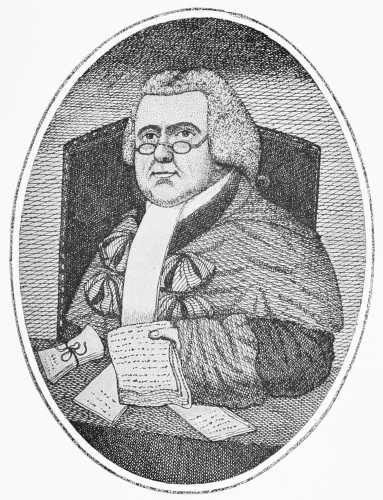 Lord Stonefield.
(After Kay.)
Lord Swinton—My Lords, this is a question of so much delicacy and
importance that I could have wished more time to have weighed what I
have heard from the counsel than the forms of Court will admit of.
The question is—Whether His Majesty’s pardon did so far restore John
Brown to the character and reputation he held before his conviction as
to make his evidence admissible in the present trial?
In substance, my opinion concurs with that of my brethren, for
repelling, in the circumstances of the present case, the objection to
the admissibility of the witness, leaving his credit to the consciences
and good sense of the jury.
Had John Brown’s conviction proceeded upon a jury trial in Scotland, I
would have been of a different opinion. There are, in the first place,
several texts in the civil law upon this topic, all clearly purporting
that a remission, so far from restoring, even blemished, the reputation
of him whom it relieved from punishment. Next, our municipal law is
perfectly explicit to the same effect. The statutes of Robert I., among
others therein debarred from giving evidence, mentions convicts redeemed
from justice. This act is expressly quoted and laid down as law by Sir
George Mackenzie, who is, at least, our most ancient author upon the
criminal law, and there is no practice or decision to the contrary.
These observations, however, I do not apply to the present case, for
here the conviction and sentence are from England. The infamy,
therefore, disabling Brown to be a witness arising in the law of that
country, and coming here, must bring its character and construction and
effects along with it.
I observe that one of these effects was the restoring a criminal
pardoned to the state and character that he held previous to the
conviction. The authorities referred to by the Lord Advocate prove this,
and, in addition to these, I shall only mention to your Lordships Mr.
Justice Buller’s Treatise on Trials, a book of great authority, which
lays down that if a person found guilty, on an indictment for perjury at
common law, be pardoned by the King, he will be a good witness, because
the King has power to take off every part of the punishment.
As to the sentence of the Justices of Peace of the county of
Stirlingshire, banishing Brown by his own consent from that county, no
stress can be laid on it, as it is now a settled point that no sentence
of an inferior Court, proceeding without the verdict of a jury, is
sufficient to set aside any person from being a witness.
The Lord Justice-Clerk—My Lords, I will not say a word about the
sentence of the Justices of Peace, nor of what would have been the case
had the crime been committed, or sentence pronounced, in Scotland. I
would hold the decree in England pro veritate, and give it effect
accordingly. But, my Lords, if the pardon frees this man from the penal
consequences of his sentence, although I were to hold that it does not
rehabilitate him in Scotland, still it leaves only the infamia facti,
for the infamia juris is, eo ipso, done away. And, my Lords, nothing
can set aside a witness unless infamia juris.
The Dean of Faculty argued this objection with great ingenuity, but he
founded his whole argument on the proposition that an infamia facti,
if it was capable of proof, was a sufficient objection to the
admissibility of a witness; and, indeed, unless this proposition were
true, his whole argument falls to the ground. But, my Lords, this
proposition is evidently fallacious, and I need use no other instance
than that of Ainslie, who, like every other King’s evidence, admitted in
the very bosom of his deposition an infamia facti, in so far as he was
concerned in the commission of the crime charged against the pannels,
and yet it was not even pretended that this was an objection to his
admissibility; and your Lordships every day allow the examination of
witnesses in the same situation. I am therefore clear for repelling the
objection.
The Court then pronounced the following interlocutor:—
The Lord Justice-Clerk and Lords Commissioners of Justiciary having
considered the foregoing objections with the answers thereto, they
repel the objections stated and allow the witness to be examined,
reserving the credibility of his evidence to the jury.
Robt. M‘Queen, I.P.D.
[The witness was then called in and sworn.]
The Lord Justice-Clerk—John Brown, you are called here to give evidence
regarding a matter in which it is generally supposed that you yourself
had some concern. You are now informed by the Court that although you
may have had such a concern you are in no danger to speak the truth,
because, being adduced as a witness against the prisoners at the bar,
you cannot be tried for the crime of which they are accused; and you
will take notice that whatever you may have said against these men, in
the different declarations which you emitted before the Sheriff, which
are now destroyed, you are now bound by the great oath which you have
sworn to tell the truth; and that if you say anything to the prejudice
of these men that is not true or if you conceal any part of the truth,
with a view to favour them, you will thereby be guilty of the crime of
perjury, for which you will be liable to be tried by this Court, and
severely punished, and you will commit a heinous offence in the sight of
the Almighty God, and thereby endanger your immortal soul.
Witness—I am acquainted intimately with both the pannels, and have
been frequently in company with them, and with Andrew Ainslie, then a
shoemaker in Edinburgh. I have met Brodie often at Smith’s house and
other places. I know that the General Excise Office in Chessels’s
Buildings was broken into upon Wednesday, the 5th of March last; I was
myself one of them that broke into it, and Andrew Ainslie and the two
prisoners were along with me. George Smith and I were within the office,
Brodie was at the door, and Andrew Ainslie was without, keeping watch.
We had resolved three months before to break into it; and on the 30th of
November last, the night on which the Free Masons made a public
procession last winter, Smith, Ainslie, and I went to the Excise Office
and unlocked the outer door with a false key. We went in together, and
opened the inner door to the hall with a pair of toupee irons, but none
of the keys we had would open the cashier’s door. Smith said a coulter
would be a good thing to open it with. Thinking it too late to remain
longer, we came out again; but we could not lock the outer door with the
key, and therefore left it unlocked. Last spring Ainslie and I went to
Duddingston, and drank a bottle of porter in a house there; afterwards
we went into a field in the neighbourhood, in which there were two
ploughs, and carried off the coulter of one of them, which we hid in
Salisbury Crags. On the evening of the 5th of March last, which was two
or three days afterwards, when it was about dusk, Ainslie and I went out
to Salisbury Crags for the coulter, and brought it in with us to Smith’s
house. Smith was at home, but Brodie was not yet come, although we
expected him. The hour at which we had agreed to meet was seven, but Mr.
Brodie did not come until near eight. The purpose of our meeting was to
go and rob the Excise Office that night. We were in Smith’s room
above-stairs when Brodie joined us, and we there drank some gin and
“black cork,” and ate some herrings and chicken. By “black cork” I mean
Bell’s beer. Mr. Brodie was then dressed in black; in the preceding part
of the day I saw him in white or light-coloured clothes. I do not
remember that he had a great-coat on when he came to us at Smith’s in
the evening. When he entered the room he took a pistol from his pocket,
and repeated the verse of a song of Macheath’s from a play, words
like—“We’ll turn our lead into gold,” or such like.[12] After we were
all met together, it was agreed upon that Ainslie should remain on the
outside of the Excise Office, within the rails, with a whistle, to give
the alarm in case of danger; that Brodie was to be stationed within the
outer door for the same purpose; and that Smith and I should go into the
cashier’s room. Accordingly, Ainslie left Smith’s first, and in some
time after I followed. Brodie was not disguised, but Smith and I had
crapes in our pocket, and Smith had likewise a wig, which, I believe,
had once belonged to Brodie’s father. When I came to the mouth of the
entry to Chessels’s Buildings, I met the old man who usually locked the
door coming out, and went after him and saw him go home. My reason for
so doing was to see that he had not gone on an errand and to return.
When I came back to the court I met Brodie in the entry, who told me
that Smith had gone into the office, and desired me to go in. I went
down the close with him, saw Ainslie at his post, and received the
coulter, or “Great Samuel,” from him, and carried it in with me to the
office. I found the outer door open and Smith in the hall. The outer
door of the cashier’s room was opened by Smith with a pair of curling
irons, and I assisted him to force open the inner door of the cashier’s
room with the coulter and a small iron crow. After we got in, Smith, who
had a dark lanthorn with him, opened every press and desk in the room
where he suspected there was any money; some by violence and others with
keys which we found in the room. We continued there about half-an-hour,
and found about sixteen pounds of money in a desk in the cashier’s room,
which we carried away with us. It consisted of two five-pound notes, six
guinea notes, and some silver. We heard some person come upstairs, and
cocked our pistols, which were loaded with powder and ball. Smith said
he supposed it was some of the clerks going into one of the rooms. We
heard no whistle while we were in the office. When we came downstairs,
Brodie and Ainslie were both gone. We left the outer door of the Excise
Office unlocked, and carried the key away with us. We then came up to
the Canongate, and went across it, and down another street a little
below—Young’s Street. I stopped in the middle of the last street,
pulled off my great-coat and gave it to Smith. I then returned, went
down to the Excise Office door, where everything seemed to be quiet;
afterwards I went to Smith’s house, where in a little I was joined by
Smith, and soon afterwards by Ainslie. I did not remain there long, when
Smith recommended it to me and Ainslie to go over to Fraser’s house in
the New Town, that we might avoid suspicion; and we went accordingly. I
knew at the time that Smith was making a key for the outer door of the
Excise Office. [Here the witness was shown a key.] That is the key he so
made, and with which he opened the door. We had three pair of pistols
along with us, all of which were previously loaded by Smith with powder
and ball. [Here the pistols libelled on were shown the witness.] These
are a pair of them, but whether that pair was carried to the Excise
Office by Smith or me I cannot say. I saw Mr. Brodie have a pistol in
his hand in Smith’s house. When Brodie came to Smith’s first that night
he brought with him some small keys, and a double pick-lock, which we
all looked at. [Here the pick-lock libelled on was shown to the
witness.] This is the same that was used on that occasion. On Friday,
the 7th of March, I was sent for to Smith’s house. Brodie, Smith, and
Ainslie were there, and the money which we got in the Excise Office was
then equally divided between us. I got about four pounds from Brodie to
my share. I saw all the money in Smith’s room above-stairs before it was
divided, and there were two five-pound bank-notes amongst it. On the
same Friday evening, I went with Smith and Ainslie to Drysdale’s, in the
New Town, and saw Smith change one of the five-pound notes there, when
purchasing a ticket for his wife in the mail-coach to Newcastle. I went
to William Middleton on Friday night, the 7th of March last, and told
him that I wished to make a discovery as to the late robberies; he
carried me the same night to Mr. Scott, the Procurator-Fiscal, but I did
not at that time mention anything of Brodie’s concern in them. The next
day I was sent to England to trace some goods taken from Inglis &
Horner’s shop. I returned on the 15th of March, and was the same day
examined by the Sheriff. I was informed that Smith had emitted a
declaration, informing of Brodie’s guilt, in consequence of which he
(Brodie) had absconded, and then for the first time I mentioned that Mr.
Brodie had been concerned with us.[13] Ainslie informed Smith and me
that he had seen two men come up the close before he quitted his post at
the Excise Office and went away. Smith carried the money which was found
in the Excise Office away with him, and he afterwards gave it to Brodie,
who made a fair division of it on the Friday. On the Thursday I did not
see him.
Lord Hailes—John Brown, you have already been told by the Court that
you ought to pay no regard to what was contained in your declarations
before the Sheriff, and that, whatever you may have formerly said, you
cannot now hurt yourself by speaking the truth. I intreat you to reflect
on the evidence you have given this night, and if you are conscious of
having said anything which you ought not to have said, that you may say
so to the Court and to the jury. It is not as yet too late, but if you
neglect the opportunity which you now have it will never recur to you
again; and I earnestly desire you to beware of this, that if you have
said anything this night to the prejudice of these men at the bar that
is not true, and if you do not undeceive the Court and the jury before
you leave this house, you will commit a most heinous sin against the God
of heaven, in whose presence you now stand, and you will be guilty of
perjury and of murder.
Cross-examined by the Dean of Faculty, for William Brodie—When you went
first to Mr. Scott, the Procurator-Fiscal, did you say anything
concerning the breaking of the Excise Office?
Witness—I did.
The Dean of Faculty—Who did you say was concerned with you?
Witness—George Smith. I did not mention either Brodie or Ainslie until
I returned from England.
The Dean of Faculty—Are you sure that Mr. Brodie brought his pistols to
Smith’s in the afternoon?
Witness—I am certain.
The Dean of Faculty—Did you not say that when he came to Smith’s before
eight o’clock he had his pistol in his hand?
Witness—I did.
The Dean of Faculty—How could he have left them at Smith’s, then, in
the afternoon?
Witness—I did not say he left them there; he brought them there, but
carried them away with him again. I am certain as to the small pistols
that Mr. Brodie carried in his breeches pocket.
The Dean of Faculty—Was Mr. Brodie present when the pistols were
loaded?
Witness—He was.
The Dean of Faculty—When did Mr. Brodie first come to Smith’s that day,
and how was he dressed?
Witness—He came in coloured clothes, between dinner and tea.
The Dean of Faculty—Might that be four o’clock?
Witness—I could not tell what o’clock it was.
The Dean of Faculty—Was it after three o’clock that afternoon?
Witness—I am not certain.
The Dean of Faculty—Was it after two o’clock?
Witness—Yes, I am certain it was.
The Dean of Faculty—Were these the pistols he brought with him? [The
pistols produced.]
Witness—No, not these; I did not say these, but another pair, since the
truth must be told. Do not think to trap me; you may make something of
me by fair means, but not by foul. I do not understand the meaning of
being thus teased by impertinent questions.
The Dean of Faculty—The more violent the gentleman is, so much the
better for my client. The jury will take notice of the manner in which
he gives his evidence.
Lord Eskgrove—My Lord Justice-Clerk, the witness should be told that he
ought not to talk in that manner to the counsel.
The Lord Justice-Clerk [to witness]—Mr. Brown, you are going too far;
it is the duty of these gentlemen to put any questions to you which they
think proper, relating to the crime charged.
Witness—My Lord, in giving my evidence, I have said nothing but the
truth, and I have rather softened the matter than otherwise, with regard
to Mr. Brodie.
The Dean of Faculty—At what hour, sir, did you go to the Excise Office
on the night you have mentioned, and when did you return to Smith’s?
Witness—As I was going down to the Excise Office the clock struck
eight, and I was back again at Smith’s house about nine o’clock.
Cross-examined by Mr. John Clerk, for George Smith—Pray, sir, how do
you know that to be the key with which Mr. Smith opened the door of the
Excise Office? You said just now that you were not present when Smith
opened the door; that he was in before you arrived.
Witness—I know very well that that was the key, because I knew he made
it for that purpose.
Mr. John Clerk—But how do you know that he opened the door with that
key on the 5th of March?
Witness—I know he made the key so far back as November last. I know the
key very well; there is not a key in five hundred like it. You will not
show me such a key in Edinburgh. There is no smith in this city could
make such a key.
Mr. John Clerk—That is no answer to my question.
The Lord Justice-Clerk—It is enough to satisfy any sensible man.
Mr. John Clerk—It is for the jury, my Lord, to judge of that.
[To Witness]—You mentioned your having on a great-coat when you broke
into the Excise Office; pray, sir, was that great-coat your own, or to
whom did it belong?
Witness—It belonged to Michael Henderson, stabler in the Grassmarket,
and I carried it home to him the following night.
Mr. John Clerk—Did you carry anything to Mr. Henderson along with it?
Witness—I did not.
The Lord Justice-Clerk—John Brown, you appear to be a clever fellow,
and I hope you will now abandon your dissipated courses, and betake
yourself to some honest employment.
Witness—My Lord, be assured my future life shall make amends for my
past conduct.
The Lord Advocate—My Lord, the parole evidence on the part of the Crown
being now closed, the declarations and other writings, which have been
authenticated in the presence of your Lordships, fall now to be read to
the jury, but as there are some parts of Smith’s declarations which
relate to matters not immediately connected with the subject of the
present trial, I do not desire that these parts of his declarations
should be read by the Clerk of Court or communicated to the jury.
[After some conversation, this proposal, which did much honour to his
Lordship, was agreed to, and such parts of the declarations as were not
read in Court were pasted over with paper, that they might not be looked
into through mistake by the jury after they were inclosed.]
At Edinburgh, 8th March, 1788.
The which day compeared, in presence of Archibald Cockburn, Esq., His
Majesty’s Sheriff-depute of the shire of Edinburgh, George Smith, grocer
in Edinburgh, who, being examined and interrogated by the Sheriff,
declares,
That it is about a year and a half since the declarant came to Scotland;
that he was never in it before; that he was born at Boxford, within four
miles of Newburgh, Berkshire; that the declarant and his wife travelled
the country of England as hawkers, with a horse and cart; that he
brought a horse to this country but no cart; that, when he first came to
Edinburgh, he put up at Michael Henderson’s, having heard his house
mentioned by travellers in England as a traveller’s inn; that he was
taken ill after his arrival in this country, and confined for about four
months in Michael Henderson’s, which obliged him to send for his wife to
this place; that he sent for goods from England, which he sold, as also
his horse, in order to support himself.
That since he came to this country, he has frequented Clark’s in the
Flesh Market Close, which is a gambling house, and in which house he was
in use to meet with a variety of people, and among the rest Andrew
Ainslie and John Brown; that the declarant first got acquainted both
with Ainslie and Brown in Michael Henderson’s; that Ainslie gave himself
out for a shoemaker, but the declarant cannot tell of what profession
Brown is; that the club, as it was called, at Clark’s, as the declarant
believes, has been doing little these three months past; that the
declarant never played there to go very deep, and was never seen to win
or lose above thirty shillings, having never taken more than that sum in
his pocket alongst with him, but, upon recollection, thinks that he has
won above thirty shillings; that the declarant inclines to believe that
John Brown has rather been unfortunate at the club.
Declares and acknowledges that the declarant took a cellar in
Stevenlaw’s Close from a woman whom he now sees in the office; that the
declarant afterwards took Ainslie to the said woman and told her that
this was the gentleman who was to possess her cellar; but he does not
remember of calling him by the name of Campbell, or any other name; that
the declarant gave the rent, which was ten shillings, to Ainslie, who
gave it to the woman.
Declares that the declarant went with Ainslie to Mrs. Clark’s house in
George’s Square, where Ainslie took a stable from that lady, but the
declarant and Ainslie remained in the kitchen, and neither of them saw
Mrs. Clark, as he thinks; that the declarant does not now recollect for
what purpose Ainslie said it was he wanted to rent the stable; that the
declarant saw Ainslie pay five shillings, or some such sum, as a month’s
rent for the stable per advance.
And being interrogated, What was the purpose of the vice which stands in
the cellar of his house?—Declares that he has had that for seven or
eight years, and that he used it for putting tongues in buckles, or any
thing of that sort, but he has not used it since he came to his present
house; that his wife intended to have set out this day on a visit to her
relations in England, and for that purpose the declarant took out for
her a ticket in the mail-coach at Drysdale’s, where he exchanged a
five-pound bank-note and paid for it.
Declares that the black dog now in the office belongs to a neighbour of
his, but, from the declarant’s giving him now and then some bones to
pick, he frequents the declarant’s house, and follows him and his wife;
that the note he exchanged at Drysdale’s the declarant has had in his
possession for above two months past; that he got it from a smuggler,
and it was battered then as it is now. This he declares to be truth, and
declares he cannot write.
Archibald Cockburn.
At Edinburgh, 10th March, 1788.
The which day compeared, in presence of the Sheriff of Edinburgh, George
Smith, formerly examined on Saturday, the 8th current, after having sent
notice to the Sheriff that he wished to speak with him. Came to the
office and told the Sheriff that he wished to have an opportunity of
making a clean breast, and telling the truth, upon which the Sheriff
informed him that, as he, the Sheriff, knew he stood in a very ticklish
situation, it was his duty to let him know that whatever he told or
discovered was not to be accepted of under any condition or promise
whatever, or that his doing so would operate anything in his favour, and
that therefore he was at perfect freedom, either to speak or hold his
tongue, as he judged best. And that the said George Smith having
declared that he wished to tell the truth, and communicate all the
guilty scenes in which he had been concerned for some time past, since
he came to the town of Edinburgh, he was desired to proceed.
Declares that, in the end of October, or beginning of November last, the
declarant, in company with Andrew Ainslie and John Brown, whose real
name is Humphry Moore, went to the College of Edinburgh about one
o’clock in the morning. Having got access at the under gate, they opened
the under door leading to the Library with a false key, which broke in
the lock, and thereafter they broke open the door of the Library with an
iron crow, and carried away the College mace.
Declares that the declarant has, almost since his first arrival in
Edinburgh, been acquainted with Deacon William Brodie, and he saw him
first at Michael Henderson’s, where he was introduced to the declarant
by one Graham at the time the declarant was confined in that house; that
Brodie, in the course of conversation, suggested to the declarant that
several things could be done in this place, if prudently managed, to
great advantage, and proposed to the declarant that they should lay
their heads together for that purpose.
That, in consequence of this concert, the declarant and Brodie were in
use to go about together, in order to find out the proper places where
business could be done with success; that Brodie, in their walks,
carried the declarant to the College Library, where, having observed the
mace standing, Brodie said that they must have it; that Andrew Ainslie
was afterwards sent by the declarant and Brodie to look at the Library,
under pretence of calling for somebody, in order to see if the mace was
always in the same place, as they suspected it might be one day in the
Library and another somewhere else, which would have rendered an attempt
upon the Library precarious; that Ainslie reported that the mace was in
the same place that the declarant and Brodie had seen it, and, upon
getting this report, the theft of the mace was committed as before
mentioned.
Declares that, since the mace was stolen, as the declarant thinks, the
declarant, along with Brown and Ainslie, laid a plan of breaking into
John Tapp’s house and taking his money; that this business was
suggested, and pressed, by Brown, the declarant rather being averse to
it; that Brown told the declarant that he knew the key of Tapp’s shop
opened the door of his house, and brought it to the declarant to look
at, which, upon seeing, the declarant said there was nothing in it,
meaning by that, that the lock to which it belonged could easily be
opened.
Declares that, accordingly, soon after this, and, as he thinks, about
Christmas or near to it, Brown kept Tapp in his shop drinking, and the
declarant and Ainslie, betwixt nine and ten o’clock at night, opened the
door of the house with a false key and took out of his drawers eighteen
guinea notes and a twenty-shilling one, a silver watch, some rings, and
a miniature picture of a gentleman belonging to Tapp’s wife, which
picture they broke for the sake of the gold with which it was backed.
Declares that in the month of August last, as he thinks, the declarant,
in company with William Brodie and Andrew Ainslie, went to a shop in
Leith, which they broke into by means of two pick-lock keys, one for the
padlock and another for the stock-lock; that the declarant and Ainslie
went into the shop and Brodie kept watch, to give an alarm in case of
danger; that from this shop they carried off two pair of wallets full of
tea, which were taken from four chests; that Ainslie was ill at this
time, and Brodie being weakly, Ainslie and he could scarcely manage one
of the wallets, which obliged him to put it into an old press bed (as
the declarant took it to be) which they found standing in a shed in a
field adjoining to the Bonnington Road to Leith; that it was proposed to
lodge the tea in Brodie’s, but he afterwards objected to it, which was
the reason that they never inquired after it more.
That about two months ago the declarant, in company with Andrew Ainslie,
broke into the shop of Inglis, Horner & Company, and took therefrom a
large assortment of valuable goods, composed of silks and cambricks;
that the silks were mostly black, excepting two pieces, a piece of plain
white sattin, a piece of variegated ditto, and a lead-coloured silk, in
quantity about ten yards, which Brown gave to a girl, an acquaintance of
his, of the name of Johnston; that the silks were all sent to England,
except the silk before-mentioned, a piece of black silk of about two
yards and a quarter, in two odd bits, which the declarant gave to his
wife to make a cloak to her child, and about twelve yards and a half of
thick tweel’d black silk for gentlemen’s vests and breeches, and two
yards and a half of black florentine sattin, with about six yards of
cambrick.
That Brodie suggested to the declarant the doing of Inglis & Horner’s
shop, as the goods there were very rich and valuable, and a small bulk
of them carried off would amount to a large sum; that Brodie and the
declarant went frequently to try the pad and stock-lock of Inglis &
Horner’s shop, and they did so most commonly on the Sunday forenoon,
when the people were in church; that the padlock was of a difficult
construction, and was opened at last by a key of the declarant’s own
making; that Brodie made one that did it also, and he on one occasion
went by himself with his key and unlocked the padlock, but could not
lock it again, upon which he came to the declarant and told him what he
had done, which he did also to Ainslie and Brown; that they were all
very angry with him, and said that he had more than likely spoilt the
place after all the trouble they had been about, but Brodie told them he
hoped not, as he had fixed the padlock with a bit stick in a way that it
would not be discovered, and, upon looking at the place afterwards,
which they all did, they found the lock to be just as it was.
Declares that on Wednesday evening, the 5th instant, the declarant,
along with William Brodie, John Brown, and Andrew Ainslie, between the
hours of eight and ten o’clock at night, broke into the Excise Office
and carried off from that about sixteen pounds, consisting of two
five-pound notes, four guinea notes, one twenty-shilling note, and about
seventeen shillings and sixpence in silver; that this money was divided
among them, and Brodie received his share.
That Brodie first planned the Excise Office, and repeatedly carried the
declarant there under pretence of calling for Mr. Corbett from Stirling,
and other people, in order to learn the situation of the place, and, on
one of these occasions, the declarant observed the key of the outer door
hung upon a nail near by it, and, without taking it down, he clapped
some potty upon it, and carried away the wards; that Brodie took a
drawing of the wards of that key, which the declarant thinks he has in
his possession; that Brodie told the declarant how to get into the
cashier’s desk, and where the money lay, which was in two places, and in
each of these places some money was found; that Brodie came to the
knowledge of these circumstances, by being present, when Mr. Corbett,
from Stirling, who is a connection of Brodie’s, drew money at the
cashier’s office.
That, when they broke into the Excise Office, the outer door was opened
by a key which the declarant had filed from the pattern
before-mentioned; that the plan of accomplishing this business was as
follows:—Ainslie was to keep on the outside of the office, hanging over
the palisadoes in the entry with a whistle of ivory, which was purchased
by Brodie the night before, with which, if the man belonging to the
Excise Office came, he was to give one whistle, and if any serious alarm
was perceived he was to give three whistles, and then make the best of
his way to the Excise gardens in the Canongate in order to assist the
declarant, Brodie, and Brown to get out at the back window of the hall,
it being determined in case of surprise to bolt the outer door on the
inside and make the best of their way by the window.
That Ainslie was armed only with a stick, which he left somewhere in the
court, and which stick was purchased by the declarant; that Brodie had a
brace of pistols, the declarant a brace and a half, and Brown a brace,
which the declarant borrowed from Michael Henderson; that these arms
were all loaded with double balls, as they were determined not to be
taken, whatever should be the consequence.
That the declarant and Brown were told afterwards by Brodie and Ainslie
that a person had come running down the court and gone in at the outer
door and upstairs; that upon this Ainslie had given the alarm by a
whistle, as was agreed upon, and made the best of his way, but none of
them in the inside heard the whistle, at least neither Brown nor the
declarant did, and Brodie said he did not; that when the door opened
Brodie was standing behind it, and, upon the person’s running up stairs,
Brodie made off; that the declarant and Brown, when in the cashier’s
room, heard the outer door open, but, trusting to Brodie’s being at the
door and staunch, they did not mind it; that the declarant and Brown,
when coming out of the cashier’s office, heard a person coming hastily
down stairs, which made them stop or they must have met him; that upon
this the declarant said to Brown, “Here must be treachery; get out your
pistols, and cock them,” which they did accordingly; that upon coming to
the outer door they found it shut, the declarant and Brown having seen
the person that came down stairs smash the door after him when he went
away.
That the declarant and Brown went down into Young’s Street, where Brown
gave the declarant a small crow, with some wedges, and a shirt, as also
a large chissel; that the chissel and the shirt were given to Brodie
afterwards, with the bank-notes, the declarant’s dark lanthorn, and two
bottles, which they had carried off from the Excise Office, and took for
wine; that the key with which the outer door was opened, the crow, and a
pair of curling irons with which the outer door of the cashier’s room
was opened, were all hid by the declarant in a wall between the Earthen
Mound and the North Bridge.
That, in virtue of repeated observations, it was discovered that two men
watched the Excise Office time about, and Ainslie and Brown found out
that from eight to ten o’clock at night there was commonly no man in the
Excise Office, which was the reason of the thing being done at that
time.
That it was concerted by Brodie, in case of interruption, by the man
coming into the office before the business was accomplished, to conceal
themselves quietly until he was gone to rest, and then to secure him;
and they were, if this happened, to personate smugglers who came in
search of their property that had been seized, and the declarant had a
wig of Brodie’s father’s in his pocket in order to disguise himself;
that the wig and scarf and small wedges were left in the second arch
from the south of the North Bridge; that the scarf was within the wig.
That Brodie, after having been in the Excise, where he had on black
clothes, went home and changed them to his ordinary dress, of a marbled
colour, and a round hat; and that Brodie told the declarant that his
sister had remarked him changing his dress in such a hurry.
That there is in Brodie’s house a horse-pistol belonging to the
declarant, as also a very large, remarkable key, which Ainslie and
Brodie stole from the Abbey when there was a sale there; that Brodie has
a parcel of keys of different sorts, which he has been altering, and
among them is the key which he had made for Inglis & Horner’s padlock;
that, in Brodie’s bedroom, there is a chest containing a false till, in
which the declarant inclines to think some of Brodie’s false dice and
other things leading to a detection of his guilt may be found.
That the College mace and Tapp’s watch were sent to Chesterfield, under
the direction of William Ward, at William Cowley’s, “Bird in Hand,”
Chesterfield, Derbyshire, to which place, and at which time, the rings
taken from Tapp and the gold from the miniature picture were also sent;
that a private letter was wrote by Brown, as he thinks, to one Tasker,
formerly of this place, and whose real name is Murray, a man of bad
character, which letter had no name at it but only a G. and S., and a
stroke for each of the other letters in the declarant’s name; that the
pocket-book taken from Tapp’s, with the money, was thrown by Ainslie and
the declarant into a deep piece of water to the south of the Meadows.
That the goods taken from Inglis & Horner’s shop were sent to
Chesterfield in trunks, one of which was purchased by the declarant and
another by Ainslie; that the declarant knows the places where they were
purchased, and will point them out.
That the first trunk went from this by the Berwick carriers three weeks
ago on Wednesday next; that the goods were removed from a cellar, in
which they were originally put, in Stevenlaw’s Close, taken for the
purpose, notwithstanding of what was said by the declarant in his
declaration of Saturday last; that Ainslie went and brought a porter
from the street, who received the goods from the declarant and Ainslie
half-way or more up Burnet’s Close, where Brown and Ainslie lodged, near
the bottom; that the porter had no creel, but only ropes, with which he
tied the trunk upon his back; and Ainslie followed him and saw him carry
and deliver it to the Berwick carrier’s quarters, for which he received
sixpence.
That the second parcel of the above goods were sent under the direction
of Elizabeth Scott or Sprott, at William Cowley’s, “Bird in Hand,”
Chesterfield, and the reason of putting this was because the initials of
her name were upon the top of the trunk; that no letter was wrote to
Tasker or Murray about the last parcel of goods, as the declarant’s wife
was to have left this on Saturday last, and the declarant told her he
had some goods for her to dispose of at Chesterfield; but she knew
nothing how the goods were obtained, and is entirely innocent of any
participation or knowledge of his crimes.
Declares that Brodie brought with him to the declarant’s house, a day
before, as he thinks, the Excise Office was robbed, a coil of ropes,
new, which he either had in his possession or must have bought, as also
a strong chissel with a brass virral, and two pieces of wax taper; that
the brass chissel is, as the declarant believes, now in Brodie’s shop or
house.
That the coulter with which the inner door of the Excise Office was
broke open, and two iron wedges, were taken from a plough by Brown and
Ainslie near to Duddingston, as they said, the Friday before; and the
declarant makes no doubt but a black dog, Rodney, might be with them,
which used to follow the declarant and them; that the coulter and wedges
were left in the cashier’s office, and were concealed in Salisbury Crags
from the time the coulter was taken away to the time the Excise Office
was broke. This he declares to be truth.
And further declares that the ropes brought by Brodie, as before
mentioned, are in the declarant’s house, as also a vice and files and a
spring-saw, with which the declarant used to make and alter keys; that
the saw the declarant got from Brodie about five or six months ago; that
the declarant, before this, bought a saw, with a pair of large pincers,
at a hardware shop below Peter Forrester’s, on the High Street, and the
declarant inclines to think that Brodie bought his saw at the same
place; that in the declarant’s drawer, along with the said saw and
files, there will also be found a keyhole saw, which was bought and
given to the declarant by Brodie.
This he also declares to be truth; and declares that the declaration
emitted by him on Saturday last, so far as is inconsistent with the
present, is not true.
George Smith.
Archd. Cockburn.
At Edinburgh, 19th March, 1788.
The which day compeared, in presence of Archibald Cockburn, Esq.,
advocate, His Majesty’s Sheriff-depute of the shire of Edinburgh, George
Smith, present prisoner in the Tolbooth of Edinburgh, who, being
examined, declares,
That the small crow, the false key, and the curling tongs, now shown to
him, are the same that were found by the declarant, William Middleton,
A. Williamson, and J. Murray, in an old dyke on the 16th instant, and
the label annexed to them is signed by the declarant as relative hereto,
of this date.
Declares that the said crow was carried to the Excise Office for the
purpose of opening the desks in the cashier’s room; that the said false
key is the one that opened the outer door of the Excise Office, and the
curling tongs were squared at the point by the declarant and taken to
the Excise Office for the purpose of opening the spring latch of the
outer door of the cashier’s room, which it did.
And, being shown a coulter and two wedges, declares that he believes
they are the same that were used in forcing open the inner door of the
cashier’s room in the Excise Office and were left there.
And, being also shown a spur, with the upper leather at it, declares
that it belonged to William Brodie; and the declarant tore the end of
the leather in order that it might appear, when found, to have dropped
from the foot by its being torn by accident by the buckle; that Brodie
brought the said spur to the declarant’s house, and from thence it was
taken to the Excise Office, on purpose that it might be left there, to
make it believed it had been done by some persons on horseback; that the
spur was left in the Excise Office by John Brown, as the declarant was
told by him upon the declarant’s questioning him if he had done it, and
the label annexed to the spur is signed by the declarant as relative
hereto, of this date.
And, being shown a parcel of ropes which the declarant is now told were
found in his house, declares that the declarant has no doubt but that
they are the same ropes which were brought to the declarant’s house by
Brodie, and, after being knotted into a ladder, were carried to the
Excise Office by the declarant, brought from thence by him, and
unknotted again in the declarant’s house, in which case he now sees they
are.
And, being shown a pick-lock, which the declarant is informed was found
in William Brodie’s counting-room in the shop, declares that it is the
same which William Brodie gave to the declarant in his own house before
they went to the Excise Office, and which Brodie wanted to fasten with
some nails, as the handle of it went round when the pick-lock was much
pressed; declares that the declarant carried that pick-lock to the
Excise Office, and, after they had left it, it was returned by the
declarant to Brodie when under the arch of the North Bridge, where
Brodie’s father’s wig, the scarf, and wedges were left, as mentioned in
his declaration of the 10th instant; and the label annexed to the said
pick-lock is signed by the declarant as relative hereto, of this date.
And being shown a black case, with a lid to it, the case full of potty,
declares that it was found, as the declarant thinks, in Mr. Brodie’s
drawers by the declarant and George Williamson on Monday, the 10th
instant; that the declarant had often seen the said case, with potty in
it, before in Brodie’s possession when in the declarant’s house, and the
declarant approved of Brodie’s keeping the potty in a case, as the lid
prevented an impression of a key when taken from being defaced; and the
said case and potty having now a label annexed to it, the same is signed
by the declarant as relative hereto, of this date.
And, being shown a five-pound note, declares it is the same five-pound
note which the declarant carried to Drysdale’s and changed there, to
purchase his wife a ticket in the Newcastle stage; that the declarant
believes it to be one of the five-pound notes taken from the Excise
Office, they being both of the Glasgow Bank, but the other five-pound
note was not ornamented with the same colour with the one now shown to
him; that the notes were pasted on the back by Brodie, and the one now
produced is signed by the declarant on the back as relative hereto, of
this date.
And being shown a parcel of keys, declares that they are the same which
were pointed out by the declarant concealed in Salisbury Crags, on the
7th instant, to William Middleton, Alexander Williamson, and James
Murray, and the label annexed to them is signed by the declarant as
relative hereto, of this date. Declares that among this parcel there is
the false key which opened the outer door of Inglis & Horner’s shop, to
which the declarant now sees a label annexed, and which is signed by him
as relative hereto, of this date.
And being shown a parcel of keys which were found by the declarant and
George Williamson upon the 10th current, declares that the double clank
among the said parcel was brought by the declarant from Sheffield, and
given to Brodie, the reason of which was for fear it should be found in
the declarant’s possession and thereby create suspicion, but it was not
likely to be discovered in Brodie’s. Declares that the heads and stalks
of two keys in the said parcel were cut from old keys by Brodie, and
were intended to be finished for the purpose of opening the spring latch
of the outer door of the cashier’s room in the Excise Office; that a
false key in the said parcel, finished, was made by Brodie for the
purpose of opening the door of the Chamberlain’s cash room of the city
of Edinburgh; and to the said double clank, the heads and stalks of two
keys for the Chamberlain’s room, the declarant sees labels annexed, of
this date, and are signed by the declarant as relative hereto. The
declarant and Brodie had frequently been at the door of the
Chamberlain’s office, in order to take the impression of the keyhole;
that Brodie showed the declarant the said key after it was made, and
Brodie told the declarant that it did not answer.
And being shown two parcels of keys, with labels annexed to them, and
two pieces of black stockings, declares that they are the property of
the declarant, and were concealed by him in Salisbury Crags, and the
labels annexed to them are signed by the declarant and Sheriff as
relative hereto, of this date.
And being shown two trunks, declares that they are the same two trunks
that were purchased by the declarant and Andrew Ainslie; that the round
one was purchased by the declarant from a man opposite to Todrick’s
Wynd, whom he saw this day in the office, for which the declarant paid
three shillings, and the other was purchased by Ainslie from a man
nearly opposite to Richardson’s, the smith, in the Cowgate; that the
declarant first bargained for it himself, but the declarant afterwards
sent Ainslie, who bought it for five shillings and sixpence, or six
shillings.
That the goods taken from Inglis & Horner’s shop were put into the said
two trunks, sent to the said Berwick carrier’s quarters, and to the
Newcastle waggoner’s, as mentioned in his former declaration; that the
direction on the round trunk is, as he believes, of the handwriting of
Ainslie, and the direction upon the other of the handwriting of Brown,
of which he is certain. All which is truth, &c.
George Smith.
Ar. Cockburn.
At Edinburgh, 17th July, 1788.
The which day compeared, in presence of the Sheriff-Substitute of the
shire of Edinburgh, George Smith, late grocer, Cowgate, now prisoner in
the Tolbooth of Edinburgh, who being examined and interrogated,
declares—
That on the 10th of March last the declarant was carried to Mr. Brodie’s
yard and workshop by Alexander and George Williamson, in order to point
out a place where it was supposed some false keys, which Mr. Brodie had,
were hid.
That in the under workshop, and in the bottom of a vent which was used
as a fireplace for melting the glue, the declarant, when digging for the
false keys, found a little under ground a pair of pistols wrapped in a
piece of green cloth, which the said Alexander and George Williamson
took into custody, and lodged in the Sheriff-clerk’s office.
That the declarant saw the said pistols and piece of green cloth
yesterday in the Sheriff-clerk’s office, and knew them to be the same
that were found as above, and the reason of the declarant’s knowing them
was, that he had these pistols in loan from Mr. Brodie for a
considerable time; and the declarant had the said pistols with him when
the Excise Office was broke into on the evening of the 5th of March
last.
Declares that the same evening, after breaking into the Excise Office,
the declarant delivered the pistols to Mr. Brodie, being afraid of
taking them to the declarant’s house in case of a search. This he
declares to be truth.
George Smith.
John Stewart, Sh. Subst.
At Edinburgh, this 17th July, 1788.
The which day compeared, in presence of Archibald Cockburn, Esq.,
advocate, His Majesty’s Sheriff-depute of the sheriffdom of Edinburgh,
William Brodie, wright and cabinetmaker in Edinburgh, who being examined
and interrogated by the Sheriff, declares—
That he does not at present recollect the name of the vessel in which
the declarant went from the river Thames to Holland in the month of
April last; that is, in which he arrived at Holland in April last.
That, before he left the vessel, he gave some letters, at present he
does not recollect the number, written by himself, to one Geddes, a
passenger on board the vessel.
And being shown a letter directed to Michael Henderson, signed W. B.,
dated Thursday, the 10th of April last, declares that he cannot say that
the letter was not wrote by him and given to Geddes.
And, being interrogated, if one of the letters given to Geddes was not
directed to Mr. Matthew Sheriff, upholsterer in Edinburgh, and signed
John Dixon, dated Flushing, Tuesday, the 8th of April, 1788?—Declares
that the declarant cannot give any positive answer to that question, and
he does not suppose he would have signed any letter at that time by the
name of John Dixon, especially as he had wrote some letters at the same
time, and given them to Geddes, signed by his initials W. B.
Declares that the declarant, when taken into custody at Amsterdam, on
the 26th of June last, went by the name of John Dixon.
Declares that the declarant first became acquainted with George Smith in
Michael Henderson’s a long while ago, when Smith was indisposed and
bedfast there; that the declarant has been in George Smith’s house in
the Cowgate. And being interrogated, declares that he cannot say
positively whether he was in Smith’s house any day of the week before
the declarant left Edinburgh, which, to the best of the declarant’s
recollection, he did upon the 9th of March last, and upon a Sunday, as
he thinks.
Declares that, having received a message that some person in the jail of
Edinburgh wanted to see him, he went there and found it was either Smith
or Ainslie who had been inquiring for him; but the declarant, when going
there, was told by the keeper that neither Smith nor Ainslie could be
seen; and that this was the night preceding his departure from
Edinburgh.
Being interrogated, If reports had not been going of the Excise Office
having been broke into the week before the declarant left Edinburgh, if
he, the declarant, would have taken that step?—declares that it was not
in consequence of that report that he left Edinburgh, but that the
declarant, being acquainted with Smith and Ainslie, then in custody, did
not know what they might be induced to say to his prejudice, was the
cause of his going away.
Declares that the declarant has frequently been in company with John
Brown, alias Humphry Moore (as is reported to be his real name),
Andrew Ainslie, and George Smith, and drank with them.
And, being shown three letters, one dated Thursday, 10th April, 1788,
directed to Mr. Michael Henderson, Grassmarket, signed W. B.; another
dated Flushing, Tuesday, 8th April, 1788, directed to Mr. Matthew
Sheriff, upholsterer in Edinburgh, and signed John Dixon; another, dated
Thursday, 10th April, 1788, directed to Mrs. Anne Grant, Cant’s Close,
Edinburgh, signed, W. B., and, desired to say whether or not the said
three letters are holograph of the declarant?—declares that he does not
incline to give any positive answer, the appearance of writing varies so
much. This he declares to be truth.
Will. Brodie.
Arch. Cockburn.
Copy of a Letter from William Brodie, under the name of John Dixon,
to Mr. Matthew Sheriff, upholsterer in Edinburgh.
Flushing, Tuesday, 8th April, 1788,
12 o’clock forenoon.
My dear Friend,
Sunday, the 23rd ult., I went on board a ship cleared out for
Leith, but by a private bargain with the captain was to be landed
at Ostend. I have been on board ever since the 23rd. Most of the
time we lay aground a little below Gravesend. Owing to thick
weather and cross wind, we are obliged to land here; but this
afternoon I will set off, by water, for Bruges, and then for
Ostend (so I begin my travels where most gentlemen leave them off),
where I shall remain, for some time at least, until I hear from Mr.
Walker; and, indeed, I will require three weeks to recruit, for I
have suffered more from my sore throat than sufficient to depress
the spirits of most men. There was for twenty days I did not eat
ten ounces of solid meat; but, thank God, I am now in a fair way.
My stock is seven guineas, but by I reach to Ostend will be reduced
to less than six. My wardrobe is all on my back, excepting two
check shirts and two white ones, one of them an old rag I had from
my cousin Milton, with an old hat (which I left behind), my coat,
an old blue one, out at the arms and elbows, I also had from him,
with an old striped waistcoat, and a pair of good boots. Perhaps my
cousin judged right, that old things were best for my purpose.
However, no reflections; he is my cousin, and a good prudent lad,
and showed great anxiety for my safety; rather too anxious, for he
would not let me take my black coat with me, nor Mr. Nairn’s
great-coat, which makes me the worse off at present; but I could
not extract one guinea from him, although he owes me twenty-four
pounds for three years past. He turned me over to Mr. Walker, who
supplied me with twelve guineas. He is a gentleman I owe much to. I
wish I may ever have it in my power to show my gratitude to him and
Mr. Nairn. Had Milton been in my place, and me in his, my purse, my
credit, and my wardrobe, my all, should have been at his disposal.
However, let not this go farther, lest it should have an appearance
of reflection upon a worthy man. He cannot help his natural temper.
I would have wrote to Mr. Nairn, but for certain reasons I believe
it is not proper at present. Please to communicate this to him. And
I beg that everything may be sent to me that you, Mr. Nairn, and my
sisters may think useful to me, either in wearing apparel, tools,
or even a small assortment of brass and iron work. Please send my
quadrant and spirit level; they lie in a triangular box in my old
bedroom. My brass-cased measuring line, and three-foot rule, my
silver stock buckle, it is in the locker of my chest, and my
stocks, they will save my neckcloths. If my sister pleases to send
me some hand towels, they will be serviceable to me, whether I keep
a house or a room.
I most earnestly beg of Mr. Nairn that my remittances be as liberal
as possible; for without money I can make but a poor shift; for,
you must think, my days for hard labour is near expiring, although,
with my constitution, I may be able to carry on business for many
years, and perhaps with success.
I have not yet received the trunk with my shirts and stockings, but
will write Mr. Walker to forward it to Ostend, where I will be
under the necessity of buying some things. And I hope by the time
I come to New York I will have some things waiting me there.
Whether it is best to send them by the Clyde or Thames, you and Mr.
Nairn will judge best. And I hope to have a long letter from each
of you, and one from my sister Jeany; and your’s will include your
wife’s. They may be put in with my things, and any other letters my
friends are pleased to send. Direct for Mr. John Dixon, to the care
of the Revd. Mr. Mason, at New York. I am not sure of settling
there, but will make for it as soon as I can.
I have no more time, the boat just going off for Bruges or Ostend.
I am,
Dear Sir,
Yours for ever,
John Dixon.
Wrote on the back thus—
Let my name and destination be a profound secret, for fear of bad
consequences.
(Addressed) Mr. Matthew Sheriff, Upholsterer, Edinburgh.
Copies of two Letters, upon one sheet of paper, from William. Brodie to
Mr. Michael Henderson.
Thursday, 10th April, 1788.
Dear Michael,
I embrace this opportunity of writing you, and I make no doubt but
it will give you, Mrs. Henderson, and a few others satisfaction to
hear that I am well.
Were I to write you all that has happened to me, and the
hairbreadth escapes I made from a well-scented pack of bloodhounds,
it would make a small volume.
I left Edinburgh Sunday, the 9th, and arrived in London Wednesday,
the 12th, where I remained snug and safe in the house of an old
female friend until Sunday, 23rd March (whose care for me I shall
never forget, and only wish I may ever have it in my power to
reward her sufficiently), within 500 yards of Bow Street. I did not
keep the house all this time, but so altered, excepting the scar
under my eye, I think you could not have rapt[14] to me. I saw Mr.
Williamson twice; but, although countrymen commonly shake hands
when they meet from home, yet I did not choose to make so free with
him, notwithstanding he brought a letter to me; he is a clever man,
and I give him credit for his conduct.
My female gave me great uneasiness by introducing a flash man to
me, but she assured me he was a true man, and he proved himself so,
notwithstanding the great reward, and was useful to me. I saw my
picture[15] six hours before exhibited to public view, and my
intelligence of what was doing at Bow Street Office was as good as
ever I had in Edinburgh. I left London on Sunday, 23rd March, and
from that day to this present moment, that I am now writing, have
lived on board a ship, which life agrees vastly well with me. It is
impossible for me at present to give you my address, but I beg you
will write me, or dictate a letter to Thom, and let it be a very
long one, giving me an account of what is likely to become of poor
Ainslie, Smith, and his wife; I hope that neither you, nor any of
your connections, has been innocently involved by those unfortunate
men, or by that designing villain Brown; I make no doubt but he is
now in high favour with Mr. Cockburn, for I can see some strokes of
his pencil in my portrait. May God forgive him for all his crimes
and falsehoods. I hope in a short time to be in Edinburgh, and
confute personally many false aspersions made against me by him and
others. Write me how the main went; how you came on in it; if my
black cock fought and gained, &c., &c. As I can give you no
directions how to write me, you’ll please seal your letter, give it
to Robert Smith, and he will deliver it to my sister, who will take
care that it be conveyed safe to me wherever I may happen to be at
the time, for I will give such directions that everything that is
sent to me shall be forwarded from place to place until it come to
my hand. I have lived now eighteen days on board of ship, and in
good health and spirits, although very bad when I came on board,
having my tongue and throat in one ulcer, not a bit of skin upon
either, and the medicines I took in my friend’s and by her
direction (for she is one of experience), just beginning to
operate; but I found it necessary, at all events, to remove, so I
underwent a complete salivation on board ship. During all my trials
since I left Edinburgh, my spirits nor my presence of mind never
once forsook me, for which I have reason to be thankful. My best
compliments to Mrs. Henderson, and I will order payment of the two
guineas as soon as I have accounts from the gentleman I have
intrusted with my affairs; let her not be anxious about it, for, if
I live, it shall be paid.
Dear Michael,
I am very uneasy on account of Mrs. Grant and my three children by
her; they will miss me more than any other in Scotland; may God, in
His infinite goodness, stir up some friendly aid for their support,
for it is not in my power at present to give them the smallest
assistance; yet I think they will not absolutely starve in a
Christian land where their father once had friends, and who was
always liberal to the distressed.
I beg you will order the inclosed to be delivered into her own
hand; and I will take it kind if Mrs. Henderson will send for her
and give her good advice. I wish she may be enabled to keep what
little furniture she has together.
I think she should endeavour to get her youngest daughter Jean sent
to Aberdeen to her friends, where she will be well brought up, and
I will order an yearly board to be paid for her, perhaps six pounds
per annum; it will be an ease to Mrs. Grant, and better for the
child. My eldest daughter Cecill should be put apprentice to the
milliner or mantua-making business; but I wish she could learn a
little writing and arithmetic first. I wish to God some of my
friends would take some charge of Cecill; she is a fine, sensible
girl, considering the little opportunity she has had for
improvement. I have been now eighteen days on board, and I expect
to land somewhere to-morrow. The ship rolls a good deal, and it is
with some difficulty I get this wrote, and my paper being exhausted
I shall conclude this epistle. Please make my compliments to Mr.
Clark, and a few other friends, and in particular, to Mr. Balmano,
and acquaint him I glimed the scrive[16] I had of him. He is a
gentleman I have a great regard for. Pray do not forget writing me
a long letter. I am,
Dear Michael,
For ever your’s.
W. B.
Pray do not show this scroll to any but your wife.
(Addressed) Mr. Michael Henderson, Grass-market, Stabler,
Edinburgh.
Copy of a Letter or Unsigned Scroll, in the handwriting of William
Brodie, and founded on in the Indictment, marked No. 1.
My dear Sir,
By short instructions sent me when I left London, which I think
were drawn up in my cousin Milton’s hand, I was forbid writing to
any one in Britain, Mr. Walker excepted, for a year or two; but
this order, if necessary, I find it not easy for me to comply with,
for I must correspond with my friends in whatever part of the
globe I am, and I hope they will do so with me, and write them when
an opportunity offers. I have gone through much, in every sense of
the word.—J. D. and M.
I wrote Mr. Walker from this the 12th current. I received an answer
the 18th, and wrote again the 23rd current, and upon receiving his
next I hope to be enabled to embark in the first ship for America,
to whatever port she is bound, which will probably be Charlestown,
South Carolina, as there is a ship lying-to for that port; and
notwithstanding the climate is very hot, and not so salutary to
British constitutions, especially at the time I will arrive, which
will be about the dog days. I will settle there if I think I can do
better than at Philadelphia or New York. Longevity to me is now no
object; but, at any rate, I will be at New York, and I hope to find
there letters, and, if possible, some clothes and tools, otherwise
I will be badly off indeed.
It grieves me to hear my creditors were so rigorous hasty, but well
pleased on hearing the deed and conveyance had the proper effect. I
hope all my creditors will be paid, and a reversion, which can be
no object to the Crown. Were an application made to the Solicitor,
and, if needful, a supplication in my name to his mother, and uncle
the Treasurer, perhaps it might be a means either of quieting or
getting easier through the threatened suit with the Crown; but this
is only my idea.
At any rate, if my clothes and tools must go to sale, a proper
assortment of tools, put into my best chest, might be put up in one
lot, and my wearing apparel and linens in another lot. They are
worth more to me than any one, and I think few in Edinburgh will
bid for them if known they are designed for me; but if any one bids
their value, in God’s name let them have them, otherwise I hope
they will be bought for me. I wish it were possible for me to know,
before I left this, if I might expect them at New York; if
otherwise, I will be under an absolute necessity of laying out what
little money may remain, after paying my passage and clearing my
board and lodging here, to my last shilling, and buying a few
necessaries, otherwise I will land almost naked; and, if possible,
to reach a few tools, both of which, I am informed, are 50 per
cent. dearer in America than here.
I received from Mr. Walker, in all, £12 16s., and he would pay
something for three days I slept in Mr. Rose’s, though I am at
present three guineas in debt to my landlord, and not a stiver in
my pocket for four days past. This is the dearest place I was ever
in.
I beg I may hear from you when at New York, and, if directed to Mr.
John Dixon, to the care of the Reverend Dr. Mason, I will
certainly receive it (as I know no other name there to desire you
to direct it to), for I will certainly call there, whatever part I
land or settle in, in expectation of letters, &c., and, in
particular, a long letter from you, in which please answer the
following questions without reserve. I am prepared to hear the
worst:—How does my dear sisters keep their health? I hope the
shock of my departure, and what followed, has not injured either of
them in health. How did they stand it? Where does my sister Jeany
live? I hope there is no alteration in Mr. Sheriff’s friends to my
dear Jamie. If money is an object, it is all in his favour. How is
Mr. and Mrs. Grant, and Mr. William, to whom I am for ever much
obliged for settling my passage. It was a deep cut, but the more I
am obliged to him and shall never forget it. He is a feeling and a
generous gentleman.
I am sorry I cannot say so much of my cousin Milton, although he,
too, was anxious for my off-going. How does my uncle and Mrs.
Rintoull keep their health? From his conduct and repeated
expressions, I never had much reason to expect anything from him,
but now far less, although I be more needful. I believe few at my
age ever went out more so. At present I am destitute of everything.
I can put every article I have upon my back, and in my pocket. How
does Mrs. Campbell and her son’s family?
Who were the most forward of my creditors to attach? How does my
affairs turn out in the whole? If Robert Smith is employed, has he
been active and attentive? He would need to be looked after,
although he may be useful; and any news or alterations relating to
my friends that may have happened.
What has been done, or likely to be done, with the two unfortunate
men, Smith and Ainslie, and the greater villain, John Brown alias
Humphry Moore? Was John Murray alias Jack Tasker brought from
England?
Whatever these men may say, I had no hand in any of their
depredations, excepting the last, which I shall ever repent, and
the keeping such company, although I doubt not but all will be laid
to me. But let me drop this dreadful subject.
[Signed with the following initials]:—
S. W., T. L., R. S., J. M., J. S.
Copy of a Letter or Unsigned Scroll, in the handwriting of William
Brodie, founded on in the Indictment, marked No. 2.
Pray write me what is become of Anne Grant, and how is her children
disposed of. Cecill is a sensible, clever girl, considering the
little opportunity she has had of improving. My dear little Willie
will be, if I can judge, a brave and hardy boy.
Jean is her mother’s picture, and too young to form any opinion of.
What has become of Jean Watt? She is a devil and a ——. I can form
no opinion of Frank or his young brother; but pray write me how
they are disposed of.
If you please, write me what is become of the two unhappy men,
Smith, and his wife, and Ainslie. Are they yet? Is their trial come
on? and the greater villain John Brown alias Humphry Moore? I
shall ever repent keeping such company, and whatever they may
alledge, I had no direct concern in any of their depredations,
excepting the last fatal one, by which I lost ten pounds in cash;
but I doubt not but all will be laid to my charge, and some that I
never heard of.
[The following is written at the foot of the page:—]
I often went in a retregard. I have been all my life in a
reteregard motion.
[What follows is written on the other side.]
Does Mr. Martin stand his bargain? Is any of my late property sold?
Who is making out my accounts? Has Robert Smith been useful and
active in my affairs? He is double and would need looking after.
Perhaps, in the course of making out and settling my accounts, some
questions may occur that I may solve. If there is any such, please
write them down, and I will answer them in course. Has any
settlement taken place with Mr. Little? I am afraid my affairs will
be a laborious task to you; but I hope all my creditors will be
paid, and a reversion.
If all my moveables are not yet sold, I beg my clothes and linen,
and a set of useful tools may be preserved for me; they are worth
more to me than another.
I wrote more fully some time ago to Mr. Walker on this head, and
also Mr. Sheriff, the 8th April; but I know not if he received it.
Pray let me know if he did, and how he stands affected towards me.
Whatever be his sentiments, I shall always esteem him and regard
him as my brother, but I shall never write another friend until I
hear from you, and have your opinion how they will take it.
Pray, did Captain Dent ever make any discovery who I was when he
arrived at Leith.
[Signed with the following initials]:—
J. L., J. M., R. S., J. S.
A State of my Affairs as near as I can make out at present from Memory,
having no other Assistance.
Copy of a Letter from Messrs. Lee, Strachan & Co., merchants in
London, to Messrs. Emanuel Walker & Co., merchants in Philadelphia.
London, 1st May, 1788.
Messrs. Emanuel Walker & Co.
Sirs,
You will please to supply the bearer, Mr. John Dixon, with cash to
the amount of fifty pounds sterling, taking his bill on Mr. William
Walker, attorney in the Adelphi, London, for the same, which will
be duly honoured, and oblige,
Sirs,
Your most obedient
Humble Servants,
Lee, Strachan & Co.
Messrs. Emanuel Walker & Co., Philadelphia.
[The counsel for Mr. Brodie here observed that the object of the
exculpatory proof was to show that, on Wednesday, the 5th of March last,
the night on which the robbery of the Excise Office was committed, Mr.
Brodie was otherwise employed the whole of that afternoon and evening,
which, if established, excluded the possibility of his being concerned
in that robbery.]
Matthew Sheriff
1. Matthew Sheriff, upholsterer in Edinburgh, called.
The Lord Advocate—My Lords, this gentleman is the brother-in-law of the
prisoner, and therefore is certainly a very improper witness. I am at
all times very averse to object to a witness adduced for a pannel, but I
thought it my duty to mention the fact to your Lordships, and to leave
it with you to determine whether or not this gentleman’s evidence ought
to be received.
Mr. Wight, for William Brodie—My Lords, this is the first time I have
ever heard that a brother-in-law is not a competent witness in a
criminal trial. This gentleman being brother-in-law to the pannel, is a
circumstance which may, and which perhaps ought, to be attended to, as
affecting his credibility, if his testimony stands contradicted by other
proofs; but it is surely no objection to his admissibility.
The Lord Justice-clerk—What do you mean to prove by this witness?
Mr. Wight—My Lord, I mean to prove that he was in company with the
prisoner until about eight o’clock of that night on which the robbery is
said to have been committed.
The Lord Justice-clerk—You may call him in. The circumstance of his
being brother-in-law to the pannel will no doubt go a great length to
discredit his testimony, in so far as it may be contradictory of other
evidence; but this will fall to be considered by the jury when they come
to judge of the proof brought by both parties.
[The witness was then called in and sworn.]
Witness—I know that the prisoner left Edinburgh in March last, and I
think it was on the 9th of March, the Sunday after the Excise Office was
broke into. I dined with him in his own house on the Wednesday
preceding—the 5th of March. I think I went there to dinner about a
quarter before three
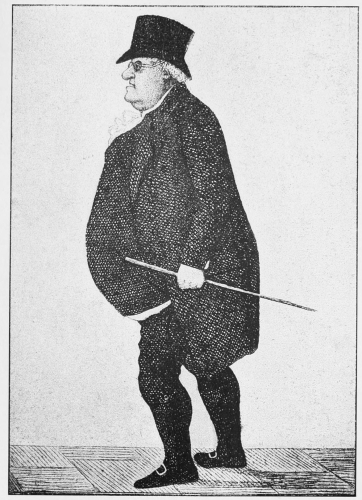 Charles Hay (afterwards Lord Newton).
(After Kay.)
o’clock.[17] Mr. Brodie was then at home. I was in his house from dinner
until within a few minutes of eight o’clock at night. There was present
at dinner in company a stranger gentleman whose name I do not know, the
prisoner’s two sisters, and an old lady, his aunt. We drank together
from dinner to tea, which I think was brought in about six o’clock, and
then the stranger gentleman went away. We sat in the same room all the
while I was there. Mr. Brodie was dressed in lightish-coloured or grey
clothes. Before I came away, Mr. Brodie pressed me to stay supper with
him, but I declined his invitation, saying I was engaged. When I came
away, I left Mr. Brodie in his own house. I went directly from his house
to my own house in Bunker’s Hill.[18] Mr. Brodie dined with me next day
(Thursday), and remained with me in my house from three o’clock until
eleven o’clock at night.[19]
Cross-examined by the Lord Advocate—What was the gentleman’s name who
was in company with you?
Witness—I do not know; I do not remember his name.
The Lord Advocate—Did you hear his name mentioned?
Witness—I may perhaps have heard him named while at table with him, but
as he went away early in the evening, and as I had no reason at the time
to pay any particular attention to his name, it has escaped me.
The Lord Advocate—When did you sit down to dinner?
Witness—We sat down to dinner about three o’clock.
The Lord Advocate—Are you sure Mr. Brodie did not leave the room from
dinner until you parted with him?
Witness—I am certain Mr. Brodie did not leave the room.
The Lord Advocate—Did you, on your way home, hear any clock strike or
bell ring? or how do you know that it was precisely a few minutes from
eight o’clock when you left Mr. Brodie?
Witness—I do not remember to have heard any clock strike or bell ring
on my way home, but I had a clock in my house and a watch in my pocket.
I am sure that I reached my own house within a few minutes of eight,
either before or after it, and I had occasion to remark the hour from
Mr. Brodie being so immediately afterwards accused of having that night
broke into the Excise Office, a thing which I did not then, and which I
do not yet, believe.
Jean Watt
2. Jean Watt, residenter in Libberton’s Wynd, called in and sworn.
The Lord Advocate—I wish to know from this woman whether or not she is
married. (To witness)—Are you married?[20]
Witness—No; I am not married.
[The examination was then allowed to proceed.]
I am well acquainted with the prisoner, William Brodie. I remember that
on Wednesday, the 5th of March last, Mr. Brodie came to my house just at
the time the eight o’clock bell was ringing, and he remained in it all
night, and was not out from the time he came in until a little before
nine o’clock next morning. We went early to bed, about ten o’clock, as
Mr. Brodie complained that night of being much indisposed with a sore
throat.
Cross-examined by the Lord Advocate—How do you recollect that it was
Wednesday night more than any other night of that week?
Witness—On the following Monday I heard that Mr. Brodie was suspected
of being concerned in the breaking into the Excise Office; that his
house had been searched for him; and that he had gone away on the
Sunday. This made me particularly recollect, and also because it was the
last night Mr. Brodie slept in my house. He slept with me that night. I
have a family of children to him. I saw him again on the Saturday night
afterwards, but not till then; and he was in my house in the forenoon of
the Tuesday preceding.
Peggy Giles
3. Peggy Giles, servant to Mr. Graham, publican at Mutton-hole, near
Edinburgh, called in and sworn.
Witness—I was servant to Mrs. Watt, the preceding witness, last winter,
and I remember that the prisoner, Mr. Brodie, came to my mistress’s
house about eight o’clock at night of Wednesday, the 5th of March last,
and that he slept there all night, and remained until about nine o’clock
next morning. My mistress and Mr. Brodie supped together early, about
half-an-hour after eight o’clock, on bread and beer and a piece of
cheese, for which I was sent out soon after Mr. Brodie came in. I was
out about ten minutes, and when I returned Mr. Brodie was still in the
house. I remember when he came in to have heard the eight o’clock bell
ringing.
Gentleman of the Jury—Was it the Magdalen Chapel bell you heard
ringing? or what bell was it?
Witness—It was the Tron Church bell.
Cross-examined by the Lord Advocate—Are you sure of that?
Witness—I am very sure.
Mr. Wight—Pray, where does the Tron Church stand?
Witness--In the Parliament Close.[21]
The Lord Advocate—How do you know that Mr. Brodie slept all night in
your mistress’s house?
Witness—He was in bed when I arose in the morning, and I gave him water
to wash his hands before he went out.
The Lord Advocate—Did you see Brodie in your mistress’s house at any
other time during that week?
Witness—He came back in the forenoon and again in the afternoon of the
same day, that is of Thursday,[22] and likewise on the Saturday night
following. Mr. Brodie was in use to sleep frequently at my mistress’s
house.
Helen Alison
4. Helen Alison or Wallace, spouse to William Wallace, mason, in
Libberton’s Wynd, called in and sworn.
Witness—I reside in Libberton’s Wynd, and I know the prisoner, Mr.
Brodie. I heard of his leaving Edinburgh in March last, and I remember
to have seen him come down Jean Watt’s stair a little before nine
o’clock on the morning of the Thursday before he went off—the 6th of
March. I was then standing at my own door at the foot of the stair; and
I had Francis Brodie, the prisoner’s son, a boy of about seven years of
age, by the hand. As his father, Mr. Brodie, passed he put a halfpenny
into the child’s hand, and clapped him on the head. I said to the boy,
“Poor thing, thou hast been too soon out, or you would have seen your
daddie at home”; he said, “No, I have not been too soon out, for my
daddie has been in the house all night.” After my husband got his
breakfast, I went upstairs to Mrs. Watt, and I said to her in a joking
way, “You will be in good humour to-day, as the good man has been with
you all night.” She answered, “He has; but, poor man, he has not been
well of a sore throat.” On the Monday following, I heard that there were
messengers upstairs in Mrs. Watt’s, searching her house for Mr. Brodie;
and when I went up and was told what was the matter, I said to one
Murray, a sheriff-officer, then present, “Dear sirs, who would have
thought this would have happened, when I saw Mr. Brodie come downstairs
and give a bawbee to his own son on Thursday last?” To which the man
answered, “Indeed, few would have thought it.”
Cross-examined by the Lord Advocate—How do you recollect that it was
upon the Thursday you saw Mr. Brodie come down stairs? Can you give any
reason for doing so?
Witness—Indeed, I can give a reason, but to be sure it is a very mean
one to mention to your Lordships.
Lord Eskgrove—Tell us the reason, good woman.
Witness—I had purchased three pair of shoes on the Wednesday in the
market; that is, a pair for each of my sons, and one for my husband. On
Thursday morning I missed my husband’s shoes, and, thinking they were
stolen, I was waiting for my husband at the door at the time he usually
returned to breakfast, which was about nine o’clock, to see if he knew
anything of them; and had it not been for this I would not have been at
the door nor seen Mr. Brodie come downstairs.
James Murray
5. James Murray, sheriff-officer in Edinburgh, called in and sworn.
Examined by Mr. Wight—Do you remember having searched the house of Jean
Watt, at the foot of Libberton’s Wynd, in the course of your pursuit
after Mr. Brodie?
Witness—I do.
Mr. Wight—What day was that upon?
Witness—It was upon the Tuesday after he left Edinburgh I searched the
house—the 11th of March; but finding nothing in it, I ordered Mrs. Watt
to come up to the Sheriff, and I waited until she got ready.
Mr. Wight—Did you see any person in the house, except Mrs. Watt and her
servant? and had you any conversation with her?
Witness—I saw Mrs. Wallace, who lives at the foot of the wynd, whom I
saw among the witnesses just now, and she said, “Oh, Jean! who would
have thought on Thursday morning, when Mr. Brodie came down this stair
and clapped his son’s head, and put a halfpenny in his hand, that such a
thing as this would be soon after here?” To which I answered, “Indeed,
Mrs. Wallace, I dare say none would have thought it.”
James Laing
6. James Laing, writer in the Council Chamber, Edinburgh, called in and
sworn.
Examined by Mr. Hay—Do you remember of any process being brought before
the magistrates against Mr. Brodie some time before he left this place,
for using false or loaded dice?
Witness—I do.
Mr. Hay—At whose instance was the process?
Witness—At the instance of one Hamilton, a chimney-sweep in Portsburgh.
Mr. Hay—When was this process?
Witness—I do not exactly remember; but steps have been taken in it
within these six months.
Lord Eskgrove—I suppose this Mr. Hamilton is not a common sweep, but a
master who keeps men and boys for the purpose?
Witness—He is a master, as your Lordship observes.
Cross-examined by the Lord Advocate—Do you know Mr. Brodie to be a
gambler?
Witness—I never gambled with him.
Robert Smith
7. Robert Smith, wright in Edinburgh, sometime foreman to Mr. Brodie,
called in and sworn.
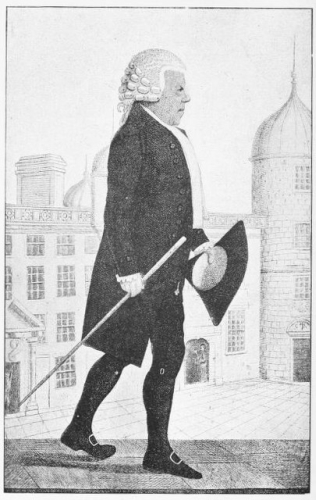 The Lord Advocate (Ilay Campbell).
(Showing the old Parliament House.)
(After Kay.)
Examined by Mr. Hay—Do you know that a spring-saw is a proper
instrument for cutting off the natural spurs of game-cocks, in order to
adopt artificial ones?
Witness—I do.
Mr. Hay—Did you ever see Mr. Brodie using a small spring-saw for that
purpose?
Witness—Frequently.
Mr. Hay—Is a spring-saw a usual and necessary implement for all wrights
and joiners, as well as smiths?
Witness—I have one myself, which I use for cutting off brass knobs and
several other purposes.
Mr. Hay—Are old keys and pick-locks usual and necessary implements for
wrights and smiths?
Witness—They are.
Mr. Hay—Do you know that a box of old keys was always lying open in the
corner of Mr. Brodie’s workshop, to which you and the other men had
access?
Witness—There was; and when a key of any of our customers was either
broke or spoiled, we could often fit the lock from some of these keys.
[Here the witness was shown the keys libelled on.]
Witness—I never remember to have seen any keys of that kind before.
[Here it was proposed to show the witness a pick-lock, and to ask him
whether or not joiners or cabinetmakers kept such an instrument, when
the Lord Advocate admitted that it was not uncommon for a cabinetmaker
to keep such articles as the above. There were several witnesses cited
by Mr. Brodie to prove this fact.]
The exculpatory proof being closed a few minutes after one o’clock of
the morning of the 28th day of August, the Lord Advocate then proceeded
to address the jury.
Lord Advocate
The Lord Advocate—Gentlemen of the jury, it is now my duty to offer
some observations on the import of the evidence which has been led
before you, and as you have already had a very long and fatiguing
sederunt, I shall endeavour to state what occurs to me in as few words
as possible. It is with the greatest concern that I address you in this
case—a case that is attended with circumstances which must occasion to
all of us the most painful sensations; but public justice requires that
these feelings should be repressed.
Gentlemen, the crime with which these prisoners stand charged is of a
most dangerous and heinous nature. It is a crime which, until of late,
was but little known in this country, though now it seems to be every
day growing more frequent, and the practice of it is almost reduced into
a system. It is no longer than fourteen days ago that two men received
their sentence at that bar for a crime of the same nature with this—the
robbery of the Bank of Dundee—which appeared to have been conducted and
perpetrated by an association in that town, similar to the association
which took place, in the heart of this populous city, between the
prisoners at the bar and the other two men whom you saw this day give
evidence against them; and which, had it not been discovered, threatened
the inhabitants of this city with the most dangerous consequences. That
now charged against these prisoners, though of the most flagrant nature,
is but one of many in which there is good ground to believe that this
association has been concerned. And it is your province, gentlemen, if
upon careful examination of the evidence you think these men guilty, to
do that justice to your country which the public safety requires, by
returning a verdict against them.
It is perhaps of no consequence to inquire into what was the former
situation of the prisoners, because that is a circumstance which can
have no weight with you in determining what verdict you are this night
to return.
As for George Smith, he is a stranger in this country, of whom we know
nothing more than what he has been pleased to inform us in his different
declarations, of which a part has not been read for the reasons you
heard mentioned; but from thence you will be led to conjecture that the
parts which were not read contained very little to his advantage. This
man, gentlemen, had the appearance of following a lawful employment and
carrying on trade in a shop in this city; but I am afraid there is too
good reason to conclude that the character of a grocer, which he
assumed, was only meant as a cover to him that he might escape the
observation of the public while he was pursuing objects of a very
different nature. His counsel have attempted no defence, such as the
alibi endeavoured to be proved by the other prisoner; no witnesses
have been examined in his exculpation; and his different declarations,
which though not legal evidence by themselves, yet when corroborated by
the great variety of other evidence led this day, are so full and
complete proofs of his guilt that I do not consider it necessary to add
one word more as to him.
The other prisoner, Mr. Brodie, is in a different situation. He is known
to us all; educated as a gentleman; bred to a respectable business; and
removed from suspicion, as well from his supposed circumstances as from
the rank he held amongst his fellow-citizens. He was far above the reach
of want, and, consequently, of temptation; he had a lawful employment,
which might have enabled him to hold his station in society with
respectability and credit; he has been more than once officially at the
head of his profession, and was a member of the City Council. If,
therefore, he, too, is guilty, his situation, in place of alleviating
his guilt, is a high aggravation of it. If he indeed prevailed upon
himself to descend to the commission of the most detestable crimes, what
excuse can be made for him? That he frequented bad company; that he had
abandoned himself to gambling, and every species of dissipation; that he
has by these means run himself into difficulties, is surely no apology
for him.
But, gentlemen, I am not entitled to proceed without substantiating the
crime libelled against him. I will go on to state the evidence; and if
after a cool and dispassionate consideration, which you are bound to
give, and which from the very great attention you have already bestowed,
I can have no doubt you will give it; if you are not most thoroughly
convinced in your minds that the prisoner is guilty, I do not desire
that you should return a verdict against him. I can have no wish that is
contrary to material justice.
It is totally unnecessary to go over the evidence tending to show that
the Excise Office was actually robbed in the manner mentioned in the
indictment, as I suppose that is a fact which will not be disputed, I
will therefore recapitulate the heads of the evidence, so far as it
appears to me to verify the charge.
Gentlemen, you have heard various objections stated by the prisoners’
counsel against the admissibility of the evidence of Brown and Ainslie,
and therefore I will in the first place call your attention to the other
evidence, against which no objection has or can be made, and which is,
in my opinion, sufficient in itself to establish the guilt of the
pannels; and I shall afterwards speak to the evidence of these two men.
The first circumstance which you have in evidence, and to which I call
your attention, is the intimate connection between the prisoner Brodie
and the other three, Smith, Ainslie, and Brown, who have all confessed
themselves guilty of the crime charged; it is admitted by himself in his
letters and declaration, and is confirmed by the evidence of Smith’s
maid, who said that she had seen them often together in her master’s
house; his being often in company with them, gambling with them in
different houses, and particularly in Clark’s, a house which, from what
we have heard of it this day, ought for the good of society to be razed
to the ground or built up, as houses infected by the plague are in times
of pestilence.
In the second place, gentlemen, the prisoner was in company with these
men on the very night in which the robbery was committed. This is proved
by the testimony of Smith’s maid, Grahame Campbell, a witness who it is
not pretended had any temptation to perjure herself. She tells you that
Brodie came to her master’s house that day in the dusk of the evening;
that they were in the upper room all together, and had some cold fowl
and herrings; that Brodie was then dressed in an old-fashioned black
coat; that she mentioned this circumstance to her mistress; that he went
out with Smith, Brown, and Ainslie; and that when he came back later in
the evening, he had then changed his dress and had on light-coloured
clothes. These are all circumstances highly suspicious, and they would
have been likewise sworn to by Smith’s wife, if she had been allowed to
be examined; but that is unnecessary, as the facts the witness has
deponed to are all probable in themselves, and they are corroborated, to
the extent I have mentioned, by the other evidence, and also by Smith’s
declarations, which last I do not mean to found upon as evidence against
Mr. Brodie, but it is a curious fact.
In the third place, gentlemen, you will observe that the Excise Office
was robbed upon Wednesday, the 5th of March. On the Friday night
following, information was given to the Procurator-Fiscal by Brown; on
the Saturday, Smith and Ainslie were apprehended and committed to
prison. And what happens? Brodie goes to the prison to visit them, but
is denied access. Is it possible to suppose that a gentleman in Mr.
Brodie’s situation would have done this had he been innocent? No,
gentlemen, it is not to be supposed.
But attend to what follows. Early the next morning, Brodie sends for
Robert Smith, his foreman, and asks him if he had heard any news
concerning them; he tells Brodie that Smith, the pannel, and Ainslie
were in prison, and so forth, and adds that he hoped his master was not
concerned with them. Gentlemen, he knew that Smith and Ainslie were Mr.
Brodie’s companions; and you cannot conceive that he would have presumed
to put such a question to his master if he had not been convinced in his
own mind of his master’s guilt. Mr. Brodie makes no answer to this
question. Will it be said that a man conscious of his own innocence
would have remained silent upon such an occasion? Gentlemen, I appeal to
yourselves; how would any one of you have felt, or what answer would you
have returned to a servant who dared put such a question to you?
Brodie at this time tells Smith that he is going out of town for a few
days; but you have it in evidence that he left this country, and fled to
Flushing. In order to account for this flight you are told a story of a
prosecution against him, at the instance of a chimney-sweep, for using
false or loaded dice. This is a very strange circumstance to bring in
exculpation. I have no hesitation to say that it is the most
ignominious defence I ever remember to have heard maintained by a
prisoner at that bar; but you cannot believe that that prosecution was
the occasion of his flight. He was in no greater danger from it then
than he had been in for months before; no step had been taken in that
process which could alarm him at this critical time; and it is mere
mockery, it is altogether a joke, to pretend that from such a
circumstance the prisoner at the bar could have taken up the resolution
of banishing himself from his country for ever.
Besides, Mr. Brodie, in his declaration before the Sheriff, did not
assign this as the cause of his flight. He said that, as he was intimate
with Smith and Ainslie, he was afraid they would accuse him of being
concerned with them in robbing the Excise Office. He did not so much as
mention the defence now set up for him; but his counsel saw that it
would be necessary to account for his conduct in some shape or other,
and no other appearance of defence occurred but this process. It is
impossible to believe this story; and indeed it is impossible to assign
any cause for Mr. Brodie’s conduct consistent with his innocence of the
crime charged against him.
I would, in the next place, gentlemen, have you to attend to the
prisoner’s behaviour when he flies from this place to London. He
secretes himself in London for several weeks; search is made for him,
but he cannot be found; he admits in one of his letters that he knew
that Mr. Williamson was in search of him, but he did not choose an
interview; a vessel is freighted for him by some persons, contrary to
the duty they owed to their country; she is cleared out for Leith; he
goes on board of her in the middle of the night, with a wig on, in
disguise, and under a borrowed name; he is carried to Flushing; he
changes his name to John Dixon, and writes letters to people in
Edinburgh under that false signature, explaining his whole future
operations, in consequence of which letters he is traced and
apprehended, just when he is on the point of going on board of a ship
for New York. If he had been innocent; if he had had nothing else to
fear than the story of the loaded dice, it is not possible that he could
have conducted himself in this manner.
The letters he writes to Geddes are likewise very strong circumstances;
but the other letters, or scrolls, found in his trunk are still
stronger. You have had it clearly proven that all these letters are of
his own handwriting, and in both of the scrolls he expressly
acknowledges the crime for which he now stands at the bar. In one of
them he says that he had no “direct” concern in any of the late
depredations of Smith, Brown, and Ainslie, excepting “the last fatal
one”; in the other the word “direct” is scored out, but in both of them
he acknowledges his accession to the last act; by which he can mean no
other than the robbery of the Excise Office; for it happened on the
Wednesday evening, and Brown gave information of it on the Friday
evening immediately after. It was, therefore, in all probability the
last of the depredations of this dangerous combination; and Mr. Brodie’s
having applied the expression “fatal” to it identifies it beyond all
doubt.
Gentlemen, I beg leave now to bring under your consideration what
happened in this city after Mr. Brodie absconded. You have it in
evidence that his house was searched, and various articles of a very
suspicious nature found. A pair of pistols, identified to have been used
on the occasion of the robbery, is found under the earth, and the place
where they were hid pointed out by the other prisoner Smith; also a dark
lanthorn, the one half of it in one place and the other half of it in
another. Gentlemen, if Mr. Brodie is really innocent, it appears to me
passing strange that these articles should have been so concealed.
All these circumstances, gentlemen, are established by the most
unexceptionable evidence; they are connected with and corroborated by
each other; and they all point to this conclusion, independent
altogether of the direct evidence of Brown and Ainslie, that Mr. Brodie
is guilty of the crime charged. They cannot be accounted for upon any
other supposition.
In the opposite scale, gentlemen, you have the proof of alibi
attempted by the prisoner, which is exceedingly defective and
inconclusive. Alibi is a defence seldom resorted to but in the most
desperate circumstances, and little regard is in general paid to it, for
this good reason that it resolves into an immediate falsification of the
whole evidence brought in support of the charge. It is suspicious at all
times, but it is peculiarly so when the alibi is confined to the same
town in which the crime was committed, within a few minutes’ walk of the
place, and is deponed to by witnesses at a great distance of time.
The first witness, gentlemen, brought by the prisoner to establish this
defence is Matthew Sheriff, his own brother-in-law, by no means an
unexceptionable witness. This gentleman depones that he dined with Mr.
Brodie on Wednesday, the 5th of March, and that he was in company with
him until eight o’clock that night. He is brought forward singly to
prove a fact, which, if true, Mr. Brodie could be at no loss to
establish by other unexceptionable evidence. There was another
gentleman, he tells you, who dined in company with the pannel that day;
and what appears to me to be a very odd circumstance, this gentleman is
not called as a witness; nay, more, although Mr. Sheriff recollects a
great variety of other circumstances, he does not remember this
gentleman’s name. Why is this gentleman not brought forward on this
occasion? Why are not some of the servants of the house, or any other
person, called to support Mr. Sheriff’s testimony? Mr. Sheriff, then, is
only a single witness, and from his near connection with the pannel, he
gives his evidence under circumstances that are suspicious, and
therefore no weight can be allowed to it.
But even supposing Mr, Sheriff’s testimony to be true, it is by no means
inconsistent with the guilt of the prisoner, nor affects the credibility
of the prosecutor’s evidence. Grahame Campbell depones that Brodie did
not come to Smith’s house until about eight o’clock; and allowing him to
have remained with Mr. Sheriff until near eight, the expedition against
the Excise Office was not then begun; and you will recollect that Brodie
was the last who made his appearance at Smith’s, and that he was
expected by his associates a considerable time before he arrived.
Jean Watt is the next witness adduced by the prisoner, who, by her own
evidence, appears to be a woman of an abandoned character. She has a
family to Mr. Brodie, and was denominated by him, in one of his letters,
by the appellation of “a devil.” This witness and her maid no doubt
concur most minutely in a very extraordinary fact, which, if it can be
believed, amounts to a falsification of the whole other evidence, viz.,
that Mr. Brodie came to Watt’s house just at eight o’clock, as the bell
was ringing, and did not leave her house again till nine o’clock next
morning. No doubt she swears pointedly to the night, and so does her
servant; but although these two witnesses agree in the day, the hour,
and even the minute of Mr. Brodie’s coming to Watt’s house on the 5th of
March, yet, when they came to be cross-examined, they did not even agree
in days; for Jean Watt said that she did not see Brodie from the
Thursday morning, at nine o’clock, till the Saturday afternoon
following, yet her maid said that he was twice in the house on the
Thursday, both in the forenoon and afternoon; though Sheriff said that
Brodie was in his house on the Thursday from three o’clock in the
afternoon till eleven o’clock at night. They can give no reason for
fixing the night of his visit at Watt’s house to be Wednesday night,
except the subsequent flight of the prisoner; and therefore it may have
been any other night in that week as well as the one condescended upon.
But, gentlemen, I have no occasion to dispute, and indeed, from the
evidence of Helen Alison, I am inclined to believe that the prisoner
went on the Wednesday night to Mrs. Watt’s house, and slept there that
night; but I have heard nothing, allowing all the witnesses to have
spoken what they believed to be true, that goes to prove that he went
there until after the crime was committed. Gentlemen, the circumstance
which fixes the hour in the memory of both Mrs. Watt and her servant is
the ringing of a bell, and we all know that there is a bell that rings
at ten o’clock as well as at eight. And it is very far from being
improbable that they might both mistake the one bell for the other,
either at the time, or afterwards, upon endeavouring to recollect the
hour at which Brodie came to them.
Allowing, therefore, gentlemen, that all the witnesses adduced by the
prisoner are to be believed, there appears to be nothing in their
testimony contradictory to the evidence of the prisoner’s accession to
the crime charged; and therefore I can have no doubt that, although the
matter rested upon the evidence I have already stated, you could have no
hesitation in pronouncing both the prisoners guilty.
But, gentlemen, when, in addition to that evidence, you take into your
consideration the testimony of Ainslie and Brown, the two associates of
the pannels, if any doubt did remain, it would necessarily be removed.
The counsel for the prisoners, aware of this, have objected to the
admissibility of both of them.
I admit that the credibility of these witnesses is liable to suspicion,
and that if the proof rested upon their evidence alone, I would not call
upon you to find the prisoners guilty upon it, but in so far as their
evidence is corroborated by the general tenor of the other
unexceptionable parts of the proof they are entitled to credit.
To Ainslie it has been objected that a corrupt bargain was made with him
by the Sheriff, which, in other words, amounts to this, that he must be
a false witness. If the prisoners’ counsel were serious in stating this
objection, they ought certainly to have proved it; but, gentlemen, it
proceeded entirely upon a mistake in point of fact—upon a supposition
that Ainslie had not spoke out until Brodie was apprehended. Gentlemen,
I hold Ainslie’s declaration in my hand, and which I offered to read,
and which I would now read, if the forms of the Court would allow me,
emitted a short while after the robbery was committed, and containing a
full and complete disclosure of the whole transaction. But, gentlemen,
you will not, you cannot, suspect that there was any such bargain; that
there was anything in the present case out of the common course.
A similar objection was made by the counsel for the prisoner to the
evidence of Brown, with this addition, that he had been convicted of
felony at the Old Bailey. The last part of this objection, gentlemen, is
completely answered by the pardon which, by the law of England, where
that sentence was pronounced, completely rehabilitated him. Brown is
then in even a more favourable situation than Ainslie, for, as he never
was charged with the crime for which the prisoners are tried, nor any
intention taken up to prosecute him for it, he had even less temptation
than Ainslie to swear falsely.
There is therefore nothing in the objections stated to these witnesses,
and accordingly the Court have found so. These men, gentlemen, have told
you that Brodie was with them when the breaking into the Excise Office
was originally planned that he met them at Smith’s house on the night
when the robbery was committed, in which particular their evidence is
corroborated by the testimony of Grahame Campbell; that he was with them
at the commission of the crime, which is the time when he endeavours to
prove an alibi; that some of the pistols carried to the Excise Office
belonged to him, which pistols were afterwards found in his possession.
They have likewise informed you that it was agreed upon that Brodie
should be stationed within the door and Ainslie without, and this
exactly corresponds with the testimony of James Bonar.
Brown and Ainslie are so consistent with each other and with the whole
other evidence adduced, both real and circumstantial, that I am unable
to discover a single discrepancy in the whole, excepting where Brown and
Ainslie say that, after the robbery, they did not either of them see
Brodie again that evening, but Smith’s maid said that they all met again
in Smith’s house and supped there, and that Brodie supped along with
them. This, however, does not appear to be a fact of any importance or
that tends to discredit either of the witnesses, as it is evident that
Smith’s maid has confounded the first and second meetings together.
But it is unnecessary for me to enlarge upon particulars which cannot
have escaped your own observation, and I shall therefore conclude with
remarking that you have in this case more direct evidence of the
pannels’ guilt, corroborated by a greater variety of circumstances all
coinciding in a most remarkable manner, than I remember to have met with
in any other which has occurred to me in the course of my practice.
Gentlemen, I shall only further add that if the prisoner William Brodie,
a person who from the nature of his employment had frequent
opportunities of being introduced into the houses of others, has been
guilty of the crime laid to his charge, and is allowed to escape
punishment, the consequences to the inhabitants of this populous city
may be of the most serious nature. But, gentlemen, the evidence is
before you, and if, upon a fair and deliberate consideration of it, you
are convinced of the pannels’ guilt, I can have no doubt that you will
do justice to your country by returning a verdict accordingly.
Mr. John Clerk then rose to address the jury on behalf of George Smith.
John Clerk
Mr. Clerk—Gentlemen of the jury, it is now my duty to state the
evidence to you for the pannel, Mr. Smith, and I shall trouble you with
a very few observations only.
My unfortunate client is a very poor man; and although he was in a
situation, before he was apprehended on suspicion of this crime, to
support himself and his family upon the produce of his industry in his
trade as a grocer, he has, in consequence of this unlucky affair, been
reduced to absolute beggary, so that he has not been able to make those
extraordinary exertions either in procuring evidence or counsel, which
the more opulent prisoner has done. He is an Englishman, a stranger in
this country, and in great straits for his life, and whatever is
favourable in his character or conduct is unknown; while, on the other
hand, everything that tended to blacken his character and fix guilt upon
him has been brought forward. He has no one to say a good word for him,
as that great villain, John Brown alias Humphry Moore, has, who, you
will remember, was so highly complimented by their Lordships when he
left that box. But, I, as his most inexperienced and imperfect counsel,
will try and do the best I can for the poor man.
The Lord Justice-Clerk—Be short and concise, sir, at this time of the
morning.
Mr. Clerk—Pray, your Lordship, let me proceed.
The Lord Justice-Clerk—Well then, proceed, young man.
Mr. Clerk—It is easy to account from this cause, gentlemen, for what my
Lord Advocate observed concerning the obscurity of my client’s history
before the robbery of the Excise Office; and I imagine that no argument
against him can be drawn from it. I know that I speak to a jury who will
lay nothing into the scale against him that does not arise from the
evidence which has been adduced.
My Lord Advocate has told you, gentlemen, that the guilt of my
unfortunate client is so clear as to admit of no doubt, and it is in
consequence of that opinion, I suppose, that his Lordship has made so
few observations upon it. I cannot, however, yield my assent to this
proposition; and I shall endeavour to show you, on the contrary,
gentlemen, from a statement of such parts of the proof as affect my
client, that the fair and legal evidence against him is incomplete and
will not warrant a verdict for the Crown.
The evidence may be reduced to three distinct branches—his own
declarations, which have been read; the direct evidence of the witnesses
adduced for the prosecutor to the commission of the crime; and the real
evidence of circumstances.
With regard to the declarations, the Lord Advocate has told
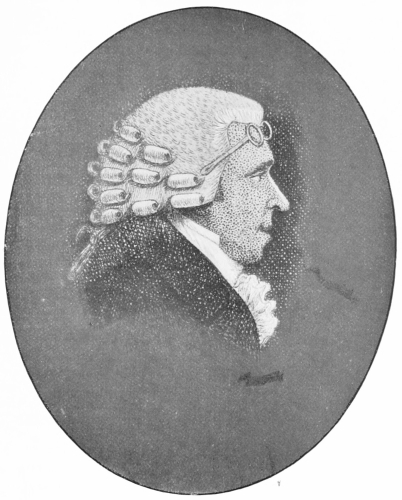 John Clerk (afterwards Lord Eldin).
(After Kay.)
you, gentlemen, that they contain a variety of particulars which have
not been read, and have been omitted by the consent of the pannel; and
from this, his Lordship observed, an inference might be drawn that the
declarations contain many more particulars little to the credit of the
pannel. Gentlemen, an inference more candid, or at least more
charitable, might, in my opinion, be deduced from the circumstance. It
is easy to conceive the state of mind in which the pannel must have been
when apprehended. Connected with those infamous men who were supposed to
have committed the crime, a partner in their most dissolute scenes, no
wonder, gentlemen, that he was struck with terror when seized upon an
accusation of being joined in their guilt.
After having resisted for some time the impressions arising from his
confinement, his panic most naturally increased almost to a delirium; a
fit of temporary frenzy, an insanity, seized him, and he accused himself
of an atrocious crime as the only means of safety. But this accusation
is rejected by his cooler judgment, and accordingly he pleaded not
guilty at this bar. In accusing himself in such a manner, the greater
variety of crimes he laid to his own charge, the greater is the
improbability of their being true, for it was folly to balance the merit
of confessing a crime eagerly inquired after by the guilt of other
crimes which were out of head. And it was folly of such a sort as to
prove that the pannel was incapable of rational conduct; and thus the
credit of his declaration, in so far as it injured himself, is in
charitable reasoning considerably diminished.
But, at all events, gentlemen, it is sufficiently known and
acknowledged, and it was even admitted—at least, it was not denied by
the Lord Advocate himself—that the extrajudicial declaration of a
pannel is not legal evidence against him. It is undoubtedly a
circumstance in evidence, but not of weight to convict unless it be
adminicled by other proof. This will be admitted, on all hands, to be
the law of Scotland, and I shall make no comment on it.
If, therefore, it is shown to your satisfaction that the parole and
circumstantiate evidence is either contradictory, inconsistent, or
incredible, you will lay very little stress on the extrajudicial
confessions of the prisoner.
And this leads me to the second branch of the evidence, or the attempt
at a direct proof of the accession of the pannel, Smith, to the crime
charged.
The first witness after those to the declarations, whose deposition
affects the pannel Smith, is M‘Lean, Mr. Drysdale’s waiter. He is the
nineteenth witness. I need not enter into the particulars of his
evidence, since all of you must recollect that he could say nothing more
than that Smith bought a ticket in the mail-coach for his wife; gave
him in payment a five-pound bank-note, battered on the back, and
received the change. It does not appear from whence the pannel had the
note which he gave to M‘Lean, nor whether it was among the money which
was stolen from the Excise Office or not.
John Clerk, Mr. Drysdale’s cashier, the twentieth witness, could not
even say so much as M‘Lean. It does not appear from either of these
depositions whether the paper on the table was that which was presented
to them or not, as the Court determined that it is not properly
described in the indictment, and on that account it cannot be used in
evidence against the pannel.
I may therefore leave these witnesses, gentlemen; and I am persuaded
that none of you will think that they said anything which militates
against my client in the smallest degree.
Grahame Campbell, the seventeenth witness, was examined as to a variety
of particulars, but her whole deposition, in so far as it regards the
pannel Smith, amounts to no more than that he was in company with
Brodie, Ainslie, and Brown that evening on which the Excise Office was
broken into; that they supped together, ate herrings or a fowl, whilst
she was in a back cellar; and upon her coming out of this back cellar
the company had left the house, and Smith, her master, had likewise gone
out; but there is no evidence of their having gone out together, and
although they had, it does not follow that they went to the Excise
Office together.
It would be very hard if a man should be suspected of a robbery merely
because he leaves his house about the time that the robbery is
committed, and in this case—there is little more; for it was by no
means extraordinary that Brown and Ainslie should be with Mr. Brodie in
Mr. Smith’s house that night, as they were there every night, always
playing at cards and dice, and amusing themselves in company together.
And further, gentlemen, although they had not been drawn together by
constant habits and the love of similar amusements, a good reason was
given why Brown and Ainslie were constantly at the house of Smith. You
were informed that these two men dined and supped there every day, that
is, were day boarders in his house.
Putting all this together, I may dismiss this witness with the same
observation which I applied to the former ones. As far as I understand
her evidence, she said nothing which has a tendency to criminate my
client.
I come next to the testimony of Ainslie and Brown. Gentlemen, you have
heard a variety of objections stated to the admissibility of their
evidence—all of which has been over-ruled by the Court. But
notwithstanding the judgment of their Lordships, I must adhere to these
objections and maintain that they ought not to have been admitted as
witnesses. Gentlemen, I think a great deal of most improper evidence has
been received in this case for the Crown.
The Lord Justice-Clerk—Do you say that, sir, after the judgment which
the Court has pronounced? That, sir, is a most improper observation to
address at the outset to the jury.
Lord Stonefield—It is a positive reflection on the Court.
Lord Hailes—It is a flat accusation that we have admitted improper
evidence.
Lord Eskgrove—I never heard the like of this from any young counsel at
the beginning of his career at this bar.
The Lord Justice-Clerk—With these admonitions, go on, sir; proceed,
sir.
Mr. Clerk—Aweel, my Lords, if I go on, I beg to assail at the outset
the evidence of these two corbies or infernal scoundrels, Ainslie and
Brown.
The Lord Justice-Clerk—Take care, sir, what you say.
Mr. Clerk—Yes, my Lords, I say that they are both most infamous
characters. Gentlemen, you should discard such vagabonds, and not rely
on their evidence in any way; and if you knock out the vile brains of
their evidence in this case, there is nothing else remaining on which
you can convict my poor client, except his own very candid declarations
which I have already explained to you. Gentlemen, these nefarious
witnesses Ainslie and Brown, should have stood at this bar this night in
place of my client, who was happy in his domestic privacy with his poor,
honest, inoffending wife, whom you this day saw—and my heart bleeds for
her. [Here there was some applause from the audience which was at once
suppressed.] Gentlemen, Ainslie contradicts himself, and Brown is not to
be believed. With respect to this said Mr. John Brown alias Humphry
Moore, you had it out of his own mouth that he was a convicted felon in
England, and I say to you that no convicted felon ought, by the good and
glorious law of Scotland, to be received as a witness in this or any
other case in the British dominions.
[Great applause from the audience.]
Macers—Silence in Court.
The Lord Justice-Clerk—Mr. Clerk, please restrict your reflections. The
Court have admitted the witness.
Mr. Clerk—Yes, my Lords, I know that very well, but your Lordships
should not have admitted him, and of that the jury will now judge.
The Lord Justice-Clerk—This is most indecent behaviour. You cannot be
allowed to speak to the admissibility; to the credibility you may.
Lord Stonefield—This young man is again attacking the Court.
Mr. Clerk—No, my Lords, I am not attacking the Court; I am attacking
that villain of a witness, who, I tell your Lordships, is not worth his
value in hemp.
The Lord Justice-Clerk—The Court, sir, have already solemnly decided,
as you know, on the objections raised by the Dean of Faculty, that in
law the objections to these witnesses should be repelled, and they were
repelled accordingly; therefore you should have nothing more to say to
us on that point.
The Dean of Faculty—If it will satisfy Mr. Clerk, I can assure him that
I will plead on this point to the jury, waiving all objections to the
admissibility, which it may be rather irregular to plead after the
decision of the Court.
The Lord Justice-Clerk—Dean of Faculty, I know you will attempt nothing
that is improper.
Mr. Clerk—But, my Lords, the jury are to judge of the law as well as
the facts.[23]
The Lord Justice-Clerk—Sir, I tell you that the jury have nothing to do
with, the law, but to take it simpliciter from me.
Mr. Clerk—That I deny.
[Consternation in Court.]
Lord Hailes—Sir, will you deny the authority of this High Court?
Mr. Clerk—Gentlemen of the jury, notwithstanding of this interruption,
I beg to tell you, with all confidence and all respect, that you are the
judges of the law as well as the facts. You are the judges of the whole
case.
The Lord Justice-Clerk—You are talking nonsense, sir.
Mr. Clerk—My Lord, you had better not snub me in this way. I never mean
to speak nonsense.
The Lord Justice-Clerk—Proceed—gang on, sir.
Mr. Clerk—Gentlemen, I was telling you that this infernal witness was
convicted of felony in England, and how dare he come here to be received
as a witness in this case?
The Lord Advocate—He has, as I have shown you, received His Majesty’s
free pardon.
Mr. Clerk—Yes, I see; but, gentlemen of the jury, I ask you, on your
oaths, can His Majesty make a tainted scoundrel an honest man?
[Great applause in Court.]
The Lord Justice-Clerk—Macers, clear the Court if there is any more
unruly din.
The Lord Advocate [interposing and addressing Mr. Clerk]—Sir, permit me
to say, after this interruption, that the prerogative of mercy is the
brightest jewel in His Majesty’s Crown.
Mr. Clerk—I hope His Majesty’s Crown will never be contaminated by any
villains around it.
[Sensation in Court.]
The Lord Justice-Clerk [to the Lord Advocate]—Do you want his words
noted down?
The Lord Advocate—Oh no, my Lord, not exactly yet. My young friend will
soon cool in his effervescence for his client.
The Lord Justice-Clerk [to Mr. Clerk]—Go on, young man.
Mr. Clerk—Gentlemen of the jury, I was just saying to you, when this
outbreak on the bench occurred, that you were the judges of the law and
of the facts in this case.
The Lord Justice-Clerk—We cannot tolerate this, sir. It is an indignity
to this High Court—a very gross indignity, deserving of the severest
reprobation.
Mr. Clerk—My Lords, I know that your Lordships have determined this
question; but the jury have not. They are judges both of fact and of the
law, and are not bound by your Lordships’ determination, unless it
agrees with their own opinion. Unless I am allowed to speak to the jury
in this manner, I am determined not to speak a word more. I am willing
to sit down if your Lordships command me. [Here Mr. Clerk sat down.]
The Lord Justice-Clerk—Go on, sir; go on to the length of your tether.
[Mr. Clerk then rose and resumed his address.]
Mr. Clerk—Yes, gentlemen, I stand up here as an independent Scottish
advocate, and I tell you, a jury of my countrymen, that you are the
judges of the law as well as of the facts.
The Lord Justice-Clerk—Beware of what you are about, sir.
[Here Mr. Clerk again sat down.]
The Lord Justice-Clerk—Are you done, sir, with your speech?
Mr. Clerk—No, my Lord, I am not.
The Lord Justice-Clerk—Then go on, sir, at your peril.
Lord Hailes—You had better go on, Mr. Clerk. Do go on.
Mr. Clerk—This has been too often repeated. I have met with no
politeness from the Court. You have interrupted me, you have snubbed me
rather too often, my Lord, in the line of my defence. I maintain that
the jury are judges of the law as well as of the facts; and I am
positively resolved that I will proceed no further unless I am allowed
to speak in my own way.
The Lord Justice-Clerk—Then we must now call upon the Dean of Faculty
to proceed with his address for the prisoner Brodie, which the Court
will hear with the greatest attention. [Here the learned Dean shook his
head, as if declining to do so.] Very well. The Court will proceed now
and discharge its duty.
[His Lordship was then about to address the jury in his final charge.]
Mr. Clerk [starting to his feet and shaking his fist at the bench]—Hang
my client if you daur, my Lord, without hearing me in his defence!
[These remarkable words produced the greatest sensation in Court; the
judges retired to the robing-room to hold a consultation; but on their
returning to Court, the Lord Justice-Clerk merely requested Mr. Clerk to
proceed with his speech. Mr. Clerk then continued his address without
further interruption.]
Mr. Clerk—I say, gentlemen, I adhere to all the objections stated on
the proof, both to the admissibility and to the credibility of these
witnesses.
On the other hand, it is obvious, that if they are to be listened to as
good and unexceptionable witnesses, their evidence goes to prove the
guilt of my client in the clearest and most unequivocal manner; so that
the questions come to be, how far are they admissible at all? and how
far are they credible? Is their evidence to be laid aside altogether?
and if not, to what extent is it worthy of belief?
Gentlemen, before I was interrupted, I was going to observe, that in
this branch of the evidence my cause is the same with that which is to
be supported with so much greater abilities by the Dean of Faculty; and
of consequence it would be unnecessary and even impertinent in me to
take up your time in arguing at large upon the subject. I have followed
the same conduct in the other particulars of the proof, where the
pannels are in similar circumstances; and I have only to desire you to
apply the same principles to both cases.
Gentlemen, I come now to the real evidence. Some of the witnesses
deponed that Mr. Smith was taken up to Brodie’s buildings, and there
some of the articles on the table were found, but nothing in this part
of the evidence is inconsistent with the innocence of Smith, who might
be better acquainted with Mr. Brodie’s shop and yard than the officers,
without being a partner in the crimes of which he (Brodie) might be
guilty.
The most material circumstance in the proof relates to the finding of
the iron crow, the curling irons, and key, in the hole of a wall, and
for that reason I reserve it for the last.
There are two capital defects in the evidence of this fact. First, a
glaring contradiction concerning the place where the things were found;
and, secondly, as glaring a contradiction in the account of what passed
at finding them. Middleton says that they were found in Warriston’s
Close; Murray, on the contrary, that they were found in Allan’s Close.
Middleton told you expressly that the pannel put his hand into the hole
in the wall and drew them out; but Murray said that this was impossible,
because he had his hands tied behind him: and this witness farther added
that he himself drew them out.
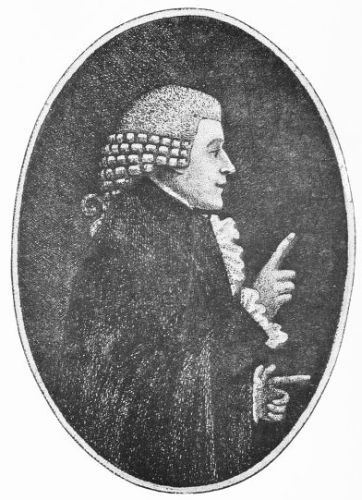 The Dean of Faculty (Hon. Henry Erskine).
(After Kay.)
These are no common mistakes; and I ask, what reliance can be had on
evidence where two such falsehoods appear within the narrow compass of a
few questions? I am willing to grant that there are slight inaccuracies
which rather tend to confirm the truth of a deposition than to render it
suspected; but you cannot suppose errors like these concerning such
marked and important circumstances, as make an impression on the memory
equally indelible with any part of the story, and which in this instance
constitute its leading features.
I say there must be a radical error here, either in the candour of the
witnesses, or in the events which they have related. They are either
perjured, or have been deceived, about the articles on your table; and
in either case their testimony is good for nothing. It is plain that the
iron crow was not found both in Warriston’s Close and in Allan’s Close;
the prisoner was not both fettered and unfettered at the same time; and
it matters not to me which of the witnesses has been deceived. Whoever
it is, it cannot be determined on this trial that any of them spoke the
truth; and of consequence the evidence of both must be laid out of
consideration.
At all events, gentlemen, what have you more than two solitary witnesses
to two contradictory facts, instead of two witnesses to one consistent
event? This can never be reckoned good and legal evidence on a trial for
life, where equity as well as expediency require the most scrupulous
accuracy.
Gentlemen, I have now stated what appear to me to be the most material
circumstances in the proof. I have commented on the depositions of the
witnesses in so far as they may be thought to criminate my client; and
without farther detaining you, I beg leave to conclude by repeating the
proposition which I have endeavoured to maintain, that there has not
been adduced on this trial sufficient legal evidence to warrant a
verdict against Mr. Smith.
At three o’clock in the morning the Dean of Faculty rose to address the
jury on behalf of William Brodie.
Dean of Faculty
The Dean of Faculty—Gentlemen of the jury, the present trial exhibits
in the person of William Brodie, in whose behalf I now address you, a
singular phenomenon in the moral world: a man descended of an ancient
and honourable family, left by a respectable father in opulent
circumstances, and very far from indigence and temptation; educated in
the manners and habits of a gentleman; bred to a reputable occupation,
at the head of which he has frequently stood; and in virtue of that
situation been a member of the Town Council of this great city; who, for
a long series of years, has maintained an irreproachable character in
society, and has often filled offices of honour and trust among his
fellow-citizens, the duties of which he has discharged with attention
and fidelity, standing at the bar of this High Court, accused of having
leagued himself with the meanest and most abandoned of mankind, in the
commission of a crime not less marked with moral depravity on the part
of the perpetrators, than fraught with injury and danger to the public.
God forbid, gentlemen, that I were capable of wishing to press on your
minds these circumstances in my client’s once honourable and happy
situation, with a view of creating in your minds an undue bias in his
favour. Though your discernment were not, as I know it is, sufficient to
secure you against the effect of such considerations, my feelings as a
man, and a sense of my professional duty, would not allow me to resort
to such arguments in opposition to justice, which is no respecter of
persons.
Yet, gentlemen, there is a view in which I am entitled to call your
attention to the former situation and circumstances of this unfortunate
gentleman; for unfortunate I must call him, be the result of the present
trial life or death. In deciding on evidence in support of a criminal
charge, the former character of the prisoner, his probable temptations
to commit the offence with which he is charged, must ever be a material
consideration. A poor, forlorn wretch, without fortune, without friends,
without education, without occupation, is he who is naturalised to
support himself by private or open depredation on the public; and when
such a person is accused, the minds of a jury, though they must presume
his innocence, do not revolt at the charge as improbable. The situation
of such men is charmingly described by an eloquent poet of this
country—
The needy man who has known better days;
One whom distress has spited at the world;
Is he whom tempting fiends would pitch upon
To do such deeds, as make the prosperous men
Lift up their hands and wonder who could do them.[24]
My client was no such man. No circumstance in his situation has afforded
a temptation to be guilty of such wrongs to risk his name, his life, for
the acquisition of what his fortune, his profession, were fully
adequate, honestly and fairly, to procure him.
In these circumstances you are called upon to examine the evidence in
this case with the nicest accuracy. You are bound by more than common
ties to require the fullest and most explicit proofs of such enormous
guilt, so improbable, so unprecedented, before you find a verdict
against a man who was once upon the same respectable footing with
yourselves, and supposed to be governed by the same honourable
principles.
But, gentlemen, while I mentioned the situation which Mr. Brodie once
held in life, his family, his fortune, his friends, I must admit,
however degrading to him the acknowledgment may be, that this unhappy
man, instead of pursuing with industry the useful and reputable
occupation by which his own fortune was acquired, and by which it might
have been preserved, and with it his own peace, honour, and happiness,
has for years past so far yielded himself to idleness and dissipation,
and to what in the present age is too often the sad concomitant of such
habits, an unhappy itch for gambling, as to lead him into the company of
persons with whom, for any other purpose, he would have disdained to
associate.
The unfortunate prisoner, Mr. Brodie, is by no means singular in his
attachment to this vice; nor is it at all confined to the lower stations
of life. People of the highest rank scruple not, in the course of their
gambling, to mix with highwaymen and pickpockets, and to descend to
practices of chicane and cunning which, in any other situation, they
would themselves abhor. It was but the other day that a gentleman of
Brighthelmstone, reputed worth three thousand pounds per annum, was
detected in the very act of using loaded dice, and was obliged to fly
the country for it; which is exactly Mr. Brodie’s situation.[25]
But the gaming table levels all distinctions. There the high and the
low, the rich and the poor, meet together. There, I admit—indeed, I
have thought it necessary to prove the fact, in order to account for so
strange a connection, from the bare existence of which strong arguments
of his guilt have this night been drawn—there, I say, I admit that this
unhappy, this misguided man, learned to endure, and at last to court,
the society of those abandoned, those profligate wretches, who have this
day come forward, in the most suspicious circumstances, to swear him
their accomplice in the felony charged in the indictment.
But though the prisoner at the bar acknowledges with contrition these
habits of folly and dissipation, and the disgraceful connection in
which, to that extent, it unhappily involved him, yet he trusts it will
appear, from a full consideration of the evidence, that
The very head and front of his offending
Has this extent; no more.
And he trusts to the candour and justice of you, gentlemen of the jury,
that you will not allow this unfortunate connection to go further in
your mind, as an ingredient of proof, than it justly ought; and far less
to let suspicions supply the want of that legal evidence which the law
of this free and happy country requires, in order to affect the life of
any of its citizens, however dangerous to society the crimes charged may
be, and however interested the public may be that they should be
convicted.
Gentlemen, with these general observations in view, I intreat you to
attend to the proof on which a verdict is asked from you against the
life of this unfortunate man.
The whole evidence before you consists of three parts. In the first
place, the evidence of Brown and Ainslie, who have acknowledged
themselves guilty of the crime in question, and are the sole witnesses
brought forward directly to fix the guilt on the prisoner; in the second
place, in opposition to this there stands the direct proof of alibi,
established by a number of unexceptionable witnesses; and lastly, the
evidence arising from the various circumstances which are said to
support and confirm the direct testimony of Brown and Ainslie, which,
independent of such confirmation, is admitted to be deserving of little
credit. Upon each of these parts I shall submit to you some remarks,
trusting that you, gentlemen, and the honourable counsel on the other
side of the bar, will correct me should I happen in any instance to
mistake the import or nature of that proof which has been led in your
hearing.
Upon the first part I have already, in the course of the trial,
anticipated almost everything which relates to the evidence of Brown and
Ainslie; I should therefore be ashamed to trouble you with more on that
subject. I do not say that their being themselves accused of the crime
in question should be a ground for totally rejecting their testimony,
which the Court, proceeding on the present law and practice of Scotland,
has allowed to be received. But this I will with confidence maintain,
that the evidence of persons who, in the very outset of their testimony,
confess the most enormous crimes, and thereby cover themselves with
infamy as completely in the eye of reason as if they were convicted by
sentence of a jury, can in no case be entitled to much credit, and when
standing by itself is deserving of none at all.
But it is not on this alone that I impeach the testimony of these bad
men; they stand in a situation different, very different, indeed, from
other witnesses of that description—a situation to which I again
entreat your best attention.
When Ainslie was first examined before the Sheriff, and for a long time
afterwards, he persisted in maintaining the innocence of Mr. Brodie;
nor was it till he learned that Brodie was apprehended, and till he was
informed that to criminate him was the only means of saving his own
life, that he uttered a syllable tending to infer the guilt of my
client. This we offered to prove in the course of the trial, but a proof
was refused by the Court.
The first testimony, therefore, which he gives in the matter is
deliberately false. Is his after-information, or the evidence he has
given this night, the better to be believed that it was wrung from him
by the fear of death, or brought out of him by the hopes of life? It is
vain to say that there is no proof that such means were used with him.
There is real evidence that under these impressions he must have been
when he delated Mr. Brodie. Well did he know that Mr. Brodie, from his
unhappy connection with him and his associates, was suspected of being
accessory to their guilt. He was not so blind as not to see that to the
public prosecutor, whose duty it ever is to choose from various
associates those whose situations make them the most striking examples
of public justice, to accuse and convict such a person as Mr. Brodie was
effectually to secure his own life.
It was a situation too powerful to be overcome even by much more virtue
than the witness could boast of, and, unhappily for Mr. Brodie, his
connection with the witness in scenes of another kind, while it
suggested the accusation, procured it credit. I cannot ask you to
believe without evidence that such a plot was laid, nor am I entitled to
charge it. But surely witnesses in such circumstances should not lightly
be believed. And doing so may lead to consequences of the most dreadful
nature, as every man, unfortunate enough to have been innocently,
perhaps, the companion of villains, may thus by falsehood and treachery
be made their substitutes to the offended laws of their country.
Ainslie’s evidence, therefore, in such a situation, is not only
suspicious, but altogether incredible.
The evidence of Brown is, if possible, still more unworthy of credit
than that of Ainslie. A more hardened and determined villain can hardly
be figured. You saw, gentlemen, the manner in which he gave his
evidence. He appeared more like a man rehearsing and expatiating upon
the patriotic acts he had performed for the good of his country than a
criminal unfolding the black history of his own iniquities. You have it
in proof that he was not only accused but convicted of a former felony,
and sentenced to be transported; that a presentment by the grand jury
stands yet against him for another felony; and that he was banished for
theft by a sentence of the Justices of Peace of Stirlingshire,
proceeding on his own confession.
He has no doubt received His Majesty’s pardon. It has been obtained for
him, at a very great expense, for the sole purpose of enabling him to
be a witness in this cause. But though the Court has determined that
this pardon, the crimes being committed in England, rehabilitates this
man, and that his evidence is admissible; yet no pardon can restore his
credibility, or render him an honest man. The pardon cannot alter the
nature of the criminal; “can the Ethiopian change his skin, or the
leopard his spots?” Is it possible that a King’s pardon can restore
purity of heart, rectitude, and integrity? Can “a piece of parchment
with a seal dangling at it,” a phrase employed on another occasion,
perhaps with less force of application, turn wickedness into honesty,
and transmute infamy into honour? The King has no such prerogative; this
is the prerogative of the King of Kings alone, exerted only towards
repenting offenders; and even with Him such change may well be accounted
a miracle.
In the eye of reason, therefore, Brown is still a notorious convicted
felon, an infamous, unrepenting villain, who, till the 28th July last,
the date of the pardon, would not have been received as a witness even
in a twopenny-halfpenny cause between man and man. And yet upon this
evidence is now to depend the reputation and life of a once respected
citizen! These things need only to be mentioned, gentlemen, in order to
be fully felt, nor will I insult the understanding of so intelligent a
jury by dwelling upon them for a moment longer.
But this, gentlemen, is not all. Mark the game which this man had to
play, and in what manner he has played it. He had not, like Ainslie,
only his accession to this offence to shake himself loose of; a sentence
of transportation hung over his head. This sentence he has not obeyed;
and the penal certification is in England, I suppose, as it is with us,
capital. By accusing a person of such consequence as to make it worth
the while of the servants of the Crown to make him King’s evidence, he
not only freed himself from trial for the offences committed here, but
secured a pardon for the offence of which he stood convicted, as it was
necessary, to qualify him to be a witness, that his former conviction be
done away, and all his former crimes washed off in the fountain of Royal
favour. A bribe of such magnitude flesh and blood could not resist.
Thus, gentlemen, in addition to the profligacy of character, to the load
of infamy under which this man laboured, you see the most powerful
engines which can set in motion the human soul employed to drag him
forward to an accusation which he had not originally made, and which,
but for this, his conscience, hardened as it is, might have prevented
him from ever making.
The Lord Advocate was pleased to commend this witness, as having spoken
out from a desire of doing justice and being of service to his country.
Did his appearance this day indicate any such feelings? Do not the
circumstances in which he brought forward this accusation show the
baseness of his views? He has sworn that at first he did not accuse Mr.
Brodie. No; it was not till his return from England that he took this
course, when, finding that the sacrifice of mean victims was not leading
to any steps being taken to procure him a pardon, and that the other
unhappy prisoner at the bar had confessed his own guilt, but without
accusing Mr. Brodie, he (Brown) gave the lie to his first declaration by
criminating that gentleman; and the pardon, which has this day procured
admission to his testimony, was obtained for him. The measures of the
public prosecutor in this respect were highly proper, believing, as he
no doubt did, the testimony of this man. But I leave it to you,
gentlemen, to consider whether it is possible for any witness to stand
in more suspicious circumstances; and whether, as several of the judges
have told you, that had his conviction been in Scotland instead of
England, they would have rejected his testimony, notwithstanding the
pardon, you should not so lay aside his evidence altogether in justice
to the prisoner, who ought not to suffer for a distinction which,
however founded in law, is contrary to common sense or reason when
applied to the credibility of the witness, of which you alone are the
judges.
I come now, gentlemen, to the direct proof of alibi. And here I
readily confess that a proof of alibi is generally resorted to only
upon the most desperate occasions; and that such proof, when it is in
contradiction to facts clearly substantiated by real evidence or parole
testimony beyond all suspicion, must yield thereto. But, gentlemen, this
is by no means the case here. The alibi is established by the most
direct and complete proof, in opposition to which nothing direct appears
in evidence, unless the testimony of two witnesses, entitled to no
credit from their characters, and swearing in circumstances the most
suspicious. There are, indeed, other circumstances proved; with regard
to which I am to address you afterwards. But these, if the depositions
of Brown and Ainslie be laid aside, must appear to you so light when
weighed against this evidence of alibi that they must kick the beam.
The alibi, gentlemen, is thus proved.
You have, in the first place, the evidence of Mr. Sheriff. This
gentleman, no doubt, is brother-in-law to Mr. Brodie; and it may be said
that this circumstance renders his evidence suspicious. But Mr. Sheriff,
gentlemen, is well known to many of you as a man of character and
reputation, as a person of unblemished conduct, in a rank of life equal
to many of yourselves. And I appeal to you, gentlemen of honour as you
are, whether any of you, judging of this witness, as you would wish to
be judged of yourselves, would for a moment indulge the thought that
even to save the life of his wife’s brother he would deliberately come
forward to cast away his own soul? This gentleman deposes most expressly
that he dined at Mr. Brodie’s house on Wednesday, the 5th of March, the
day on which the Excise Office was broke into, in company with two
ladies and another gentleman; that he staid there till about eight
o’clock; that Mr. Brodie during all that time was never absent from his
company; and that he even asked the witness to stay supper.
Here is a direct contradiction to the evidence of Brown, who swore that
Brodie called at Smith’s in the afternoon of that Wednesday. Which of
the two, gentlemen, are you to believe? But it is needless for me to ask
the question. Were even the former circumstances urged against the
credibility of this man’s evidence not sufficient, you have him here
convicted of the grossest perjury, if Mr. Sheriff is to be believed; for
that gentleman has expressly sworn that they dined at a quarter past
three o’clock, and that Mr. Brodie never left the company while the
witness staid, which was till near eight o’clock.
It was asked on the other side of the bar how Mr. Sheriff, at this
distance of time, came to recollect so precisely that it was upon
Wednesday, the 5th of March, he dined with Mr. Brodie? The answer is
obvious. It was publicly known upon the Monday following, and the
witness has sworn he knew it, that Mr. Brodie was accused of being
concerned in the robbery of the Excise Office. Was it not then
natural—nay, would not the contrary have been altogether
incredible—that Mr. Sheriff, having only four days to look back, should
be able to recollect in a matter that touched so deeply the character,
and might affect the life, of so near a relation, that he dined with him
that very day on which that felony was perpetrated? Which of you,
gentlemen, could not at this time recollect where you dined last
Saturday or Sunday, and the precise time at which you left the company?
If, therefore, Mr. Sheriff is to be believed, and why he should not no
reason can be suggested, the prisoner could not be present, as Brown and
Ainslie have deponed he was, prior to the time Ainslie left Smith’s to
go to the Excise Office; which Ainslie has fixed at a quarter before
eight; nor could he be with them at Smith’s at all, as Brown swears they
all left it a quarter of an hour after Ainslie, and immediately joined
him at the Excise Office.
But Jean Watt depones that Mr. Brodie came to her house at eight o’clock
on the Wednesday evening, when the eight o’clock bell was ringing; her
reason for recollecting these circumstances, too, is a very good one, it
being the last time that ever Mr. Brodie slept in her house. Her
evidence is corroborated by the servant-maid, who depones exactly to
the same purpose. And there is a circumstance, gentlemen, in the
deposition of this witness which well merits your attention. Upon being
asked what bell was ringing, she said it was the bell of the Tron
Church. Here the counsel on the other side of the bar appeared to hug
themselves upon the mistake into which they supposed she had fallen, by
mentioning a bell which, from the distance, she could not possibly hear.
But the matter was cleared up in a moment, when, on being asked where
the Tron Church was, she replied, in the Parliament Close. This,
gentlemen, is the natural simplicity of truth; this proves her to be no
tutored witness, brought forward to rehearse a tale made up beforehand,
or to assign fictitious causes of knowledge.
Both these witnesses concur in deposing that Mr. Brodie staid the whole
night until next morning at nine o’clock in Mrs. Watt’s house; and their
evidence is corroborated by that of Helen Alison, who saw him coming
down stairs at nine on the Thursday morning. The evidence of this good
woman, Helen Alison, is accompanied with circumstances the most natural
and striking, and is confirmed by James Murray, one of the
sheriff-officers employed in the search on the Thursday morning, who
swears to her having at that time mentioned Mr. Brodie’s having been at
Jean Watt’s all the night of the Wednesday and morning of the Thursday
preceding.
The whole of this evidence, taken together, affords a proof the most
conclusive that Mr. Brodie could not be present at the robbery of the
Excise Office. You find him in his own house till the hour of eight;
from that hour till nine on the Thursday morning you find him in the
house of Mrs. Watt. It is impossible then that he could have been at
Smith’s a considerable time before the hour of eight, or that he could
have been present at a robbery which took up an hour in the
perpetration.
It was said, on the other side of the bar, that it was of no avail to
prove an alibi which was merely confined to the city. This is strange
doctrine, gentlemen, and perfectly new. That an alibi may be proved
with greater certainty when the distance is greater than when it is
small, I do not dispute; but does it follow that it may not be proved
though the distance be ever so short? Suppose a felony to have been
committed this day under that window, and that I should be accused of
having been an actor in it. Could not I, gentlemen, bring sufficient
evidence of an alibi, although within a few yards of the place where
it was perpetrated? Could I not substantiate, by this numerous and
respectable assembly, that I was here from nine in the morning till the
present hour, employed in such a manner as to exclude the possibility of
my being any way concerned in such felony? And could it be objected to
such evidence that I had not proved myself absent from town, and that
my alibi was confined to within a few feet of the place where the fact
was committed?
It is to no purpose to say that the witnesses may not be accurate as to
time, and that, making a small allowance for mistakes, the facts they
swear to may be true, consistently with the evidence of Brown and
Ainslie. For supposing Mr. Sheriff to have been mistaken as to the
precise time he left the prisoner that night, he could not be mistaken
as to his being constantly with him from the time of dinner till the
time he left him, whatever it was; and this alone must defeat the
testimony of Brown and Ainslie, who swear to the prisoner’s having been
there in the afternoon long before the meeting, previous to their
setting out for the Excise Office, which cannot possibly be true, if Mr.
Sheriff’s evidence is to be believed.
Here, then, is the most unequivocal and positive proof that the
prisoner, Mr. Brodie, could have no accession whatever to this robbery
of the Excise Office, unless you, gentlemen, shall conclude that the
whole of these witnesses, consistent as they are and corroborated by
circumstances the most simple and natural, have perjured themselves
wilfully and deliberately; while Brown and Ainslie, witnesses, from
their character, unworthy of all belief and swearing in circumstances
the most suspicious, are deponing in the utmost purity of truth and
fairness.
Thus, then, gentlemen, the case would stand were it to be decided on the
direct testimony of the witnesses on both sides weighed against each
other. The circumstantiate proof, however, still remains to be
considered, and I am free to confess that if it shall appear to you that
these circumstances afford a chain of real evidence, either sufficiently
independent of the direct depositions of Brown and Ainslie to prove the
prisoner’s guilt, or so fully to confirm their testimony as to remove
the cloud of suspicion that hangs upon it, as to convince you that they
must be speaking the truth and the witnesses to the alibi the reverse,
your verdict ought to be against the prisoner.
But I humbly maintain that not any of those circumstances nor all of
them put together are sufficient to entitle the evidence of such
witnesses to credit, when the life of a man is at stake, even if the
proof of alibi were out of the question, and far less in the face of
that proof of alibi, which, if the witnesses have not deliberately
perjured themselves, excludes even the possibility of the prisoner’s
guilt. For I hope to show that there is not one of those circumstances,
suspicious as they may appear, that cannot rationally be accounted for
without supposing the guilt of the prisoner, Mr. Brodie; nay, that some
of them are totally inconsistent with the supposition of his having been
guilty of this offence, whatever other errors his fatal connection with
these miscreants may have led him into.
In considering the circumstantiate evidence, gentlemen, you are never to
lose sight of the direct proof I had the honour just now of stating to
you as to the alibi; and as each circumstance passes under your
review, I entreat you to ask yourselves this question, whether it is so
clear, so decisive, so totally irreconcilable with the possibility of
the prisoner’s innocence as to make the suspicious testimony of those
infamous witnesses outweigh the proof of alibi, founded on the
depositions of persons liable to objections on no reasonable suspicion?
The first circumstance founded on is the prisoner’s connection with the
perpetrators of this crime. I readily grant that it is clear from the
evidence that Mr. Brodie was in habits of too great intimacy with these
men. I acknowledge that he appears to have been too deeply engaged in
courses of gambling and dissipation in their company and society. That
his association with such characters was dishonourable to the reputation
of my client, I do not deny.
But, gentlemen, this gambling connection is far from being any proof of
his share of the guilt of the crime now charged against him and the
other prisoner at the bar, though this circumstance, no doubt, gives
possibility to a tale that, without it, would have been rejected at once
as totally incredible. Had Mr. Brodie been in no way connected with
Brown, Ainslie, and Smith, what could they have accused him in? When the
hopes of life were held out to Brown and Ainslie, in order to procure a
discovery of their confederates, however willing they might be to
deceive the public prosecutor, they would have themselves seen that it
was in vain to accuse a man as their associate who had never at any time
been connected with them.
But though his having connected himself with them afforded a plausible
colour to their charge, it does not follow that this connection affords
either a proof or a presumption of Mr. Brodie’s guilt; it is to be
considered rather as the cause of his being accused. Many other persons,
otherwise very respectable, are known to have gamed in company with
these very men, but would this have been sufficient to criminate them
had Brown and Ainslie thought proper to give them also up as their
confederates in this dark business? The folly of haunting, for any
purpose whatever, the company of such men is great indeed, but to
subject the party guilty to the consequence of every enormity of which
such associates may accuse him, on their bare testimony alone, would be
a punishment far beyond the offence, as such men would never fail to
find some unhappy associate of better rank than themselves to substitute
as a sacrifice to the public for crimes to which he had no accession.
The next circumstance founded on in corroboration of the evidence of
Brown and Ainslie, is the alleged proof by the oath of Grahame Campbell
that Mr. Brodie was present with the gang at the house of Smith on the
night the Excise Office was broken into, and left it in their company.
The veracity of this witness I mean not to dispute, but I maintain it to
be impossible that, if she be speaking the truth, the facts she swears
to could happen upon that night, or if she did, it must be fatal to the
whole evidence given by Brown and Ainslie, as it contradicts them in the
most essential particulars.
This witness indeed swears that one night—for she fixes no precise
time—soon before Mr. Brodie left this place, he, Brown, and Ainslie met
at Smith’s house before six o’clock; that they all left it about six;
that between nine and ten they all returned; that they supped there, and
remained about two hours. And she remembers particularly that Brown and
Ainslie sat down to supper, but that Mr. Brodie stood all the time they
ate their meal. But Brown and Ainslie expressly swore that, after coming
out of the Excise Office, they did not see Mr. Brodie again that night,
and that Brown did not meet with him till the Friday, when he for the
first time got an opportunity of abusing him for having left his post.
She differs from them also as to Mr. Brodie’s dress, which she says was,
when he came, an old-fashioned black coat, whereas Brown says it was his
ordinary black coat, and that he wore a white surtout above it. Both
these opposite stories cannot be true, and consequently the young woman
has deponed to what happened on a different night, and her evidence does
not corroborate that of Brown and Ainslie; or, if she swears to that
night, she swears to facts totally inconsistent with the truth of part
of their evidence at least, and thereby destroys the credibility of the
rest of it.
The Lord Advocate has told you that this witness must be mistaken with
regard to their supping, because she has also said that they had ate
some fresh herrings or cold fowl before setting out. I cannot, for my
part, see how their having taken this collation early in the evening can
be any reason for their not supping betwixt nine and ten. And, at any
rate, though she could have mistaken the smaller circumstance of their
eating or not eating after their return, it is utterly incredible that
she should have recollected their all being at Smith’s together between
nine and ten, and continuing together for two hours if, as Brown and
Ainslie depone, they and Mr. Brodie never met that night after the time
the two former went into the Excise Office.
The next circumstance founded on by the prosecutor is the departure of
Mr. Brodie from this country, which is not only held out as a flight
from justice, but as a flight applicable to this particular offence.
That the flight of a person accused of a crime may in some cases be a
strong ingredient in a proof of his guilt, I readily acknowledge, but
it is not necessarily so. If he has not been previously accused of that
particular crime, and other reasons occur sufficient to account for his
leaving his native country, the circumstance is at best equivocal.
In this case it cannot be denied that Mr. Brodie had strong reasons for
taking this step separated from any consideration of guilt connected
with this offence. His gambling connection with these men was too well
known, and though nothing further could be proved against him, it must
be a painful feeling for a man of any spirit to remain in that place
where persons with whom he had been so intimate were taken up by public
justice on charges of so heinous a nature. Joined to this, you find in
evidence that a prosecution was depending before the magistrates of
Edinburgh against my client for using loaded dice. I do not say, nor do
I suppose that this prosecution was well founded, but the very report of
such a charge, when added to the connection he had with these men, must
have rendered his situation so disagreeable as to induce him to leave
Edinburgh, at least for a time, or even to have resolved on settling in
some foreign country, where his former folly and dissipation were
unknown and where his professional skill might enable him to repair his
shattered fortune. What were the real motives of Mr. Brodie it is not
for man to judge, but, if his actions were equivocal, you are bound in
charity, in justice, in humanity, to put the most favourable
construction upon them.
Yet even when he abandoned this country, he does not appear to have
conducted himself as one who never intended to return, or who was afraid
of any consequences to himself, beyond the pain of enduring in his own
country the loss of honest fame. He corresponds, as you find, with his
friends in Edinburgh, and the whole tenor of his conduct seems to be
such as might have been pursued by a person who intended only to retire
out of view for a short time, till the clamour of a prejudiced public
against him should cease. A flight under such circumstances and
conducted in this manner can never be held as proof of guilt, or even as
a circumstance sufficient to stamp credibility on the testimony of a
witness base and profligate beyond all example, deponing under the
strongest temptations to falsehood, unsupported by the direct testimony
of any other witnesses, and directly contradicted by a proof of alibi,
proved by a cloud of witnesses altogether free from suspicion.
With regard to the circumstance attending Mr. Brodie’s departure, his
conduct in London, on shipboard, and on the Continent, the evidence
adduced by the prosecutor is in the highest degree lame and
inconclusive. Indeed it ought totally to be rejected as not the best the
prosecutor had it in his power to bring; and as to his being brought
back to this country, the evidence is very defective. The evidence of
Mr. Longlands consists chiefly of hearsay. Those persons who apprehended
Mr. Brodie, who conducted him back to this country, are not produced as
witnesses. Mr. Walker, who is said to have protected him in London; the
owners of the ship, who are said to have altered the destination of the
vessel to aid his flight; none of them are brought forward. And as
hearsay evidence is only competent where the principal witness is dead
or cannot be had, neither of which is here the case, I submit to you,
gentlemen, whether any part of this evidence ought to have been received
or ought now to be regarded by a jury.
I come now to the evidence arising from the letters said to be written
by my client. Gentlemen, urgent as his case may be, I do not wish to
strain anything or to evade any part of the proof. I do not mean to
contest that these letters are of the handwriting of Mr. Brodie,
although this point has been but slenderly proved. My client has not
himself denied them; I shall admit them to be his. Now these letters
contain nothing which can bring home to him the present charge. They
prove that he was avoiding his native land; that he was anxious for the
fate of these abandoned men; that he was afraid they might accuse him;
but he expressly supposes a false accusation—an accusation that might
equally involve the innocent persons he was writing to. In one passage
he expressly asserts his own innocence. Yet the letters are written in
full confidence, and without any seeming intention to hide anything.
It is true, indeed, that in one of these letters he says that he had no
accession to any of their depredations except the last, which is laid
hold of as a direct acknowledgment of the crime. But, gentlemen,
supposing the word depredation could not be otherwise explained, where
is the evidence that the crime in question was the last of which these
abandoned ruffians were guilty? and if there were such, it would not be
conclusive. The word depredation is generic, and may as well apply to
the depredations of the gaming-table as to acts of theft or
house-breaking; and as there is but too much reason from the evidence,
particularly the process at the instance of Hamilton for defrauding him
by false dice, to believe that this unhappy man was not altogether free
from accession to depredations that may at the gaming table have been
committed by those persons against such as were unfortunate enough to
fall into their hands, why should you, gentlemen, to reach the life of a
fellow-citizen, construe so equivocal an acknowledgment, couched in so
general terms, as applicable to a particular act of guilt; for the proof
of which, against this prisoner, you have nothing but the most
exceptionable of all human testimony, contradicted by the most direct
proof of alibi.
But this is not all. The terms of this acknowledgment, as repeated in
the last of these two scrolls, exclude even the possibility that the
prisoner could refer, or mean to refer, to the breaking of the Excise
Office as the depredation to which he had an accession; for he expressly
says that he lost ten pounds by it; but how, in the nature of things, is
it possible that if he had been concerned in that affair he could have
thereby lost ten pounds, or any sum whatever, seeing Brown and Ainslie
have both sworn that the money was fairly divided, and that each of the
parties concerned received four pounds and some old shillings for his
share? To what other act of depredation, and whether to any committed at
the gaming table, these words refer, it is not for me to suggest nor are
you, gentlemen, bound to inquire; though it would seem that depredations
at the gaming table are the only attacks upon the property of our
neighbour that can be attended with patrimonial loss.
It is enough to exclude these scrolls, and also the letters, from
operating as evidence of the prisoner’s accession to the crime with
which he is charged, that the only accession they acknowledge is
inconsistent with the possibility of his guilt; and if he has been so
far misguided as to have been concerned with those infamous persons in
anything beyond that gambling connection, which he has all along
admitted, it must have been some other offence not yet discovered, or
not hitherto made the subject of prosecution; which, not being charged
in the present indictment, could not have affected the prisoner, though
a proof of it had come out in the course of his trial.
The only remaining circumstance brought in aid of the direct parole
testimony is the different articles which have been found in the house
of the prisoner or elsewhere, and which the prosecutor has attempted to
connect with the commission of the act which is the subject of the
libel. On this head I shall detain you but a moment, there not being the
shadow of evidence to connect any one of them with the prisoner so as to
afford a presumption, and far less evidence, of his guilt.
A dark lanthorn was found in his house, but there is not the appearance
of evidence that it was used at the perpetration of the crime in
question, or was ever out of Mr. Brodie’s own house. The utensil itself
is perfectly innocent. The useful part of it was found in the cock-pen,
and it is well known that cocks are chiefly fed by candle-light. There
were keys and pick-locks found in his house, but it was proved that
these are the ordinary implements of his trade, and not one of those
have been sworn to as having been used by the villains, who best knew
and described the whole mystery of the iniquity. Nay, the only
instruments that were used on that occasion in opening the locks or
forcing the doors were found at the bottom of Allan’s Close or
Warriston’s Close by the officers of justice, led by the other prisoner
Smith to the hole in which they were concealed; and not one of those
articles, being two crows, a key, a pair of curling irons, a coulter of
a plough, and two wedges, is proved to have been in any way connected
with Mr. Brodie, the three first of which Brown and Ainslie admit were
carried to the scene of action by Brown and Smith, while the two last
were stolen by themselves from a field near Duddingston.
True, indeed, it is, that a pair of pistols, which these witnesses say
were the property of the prisoner, Mr. Brodie, were found in a fireplace
in his house; but it is proved by the same witness that these pistols
had not been in the prisoner’s hands for a month before, when he had
lent them to Smith; that they were in Smith’s possession on the night
libelled; and the sheriff-officers have proven that it was Smith himself
who dug out these pistols in Mr. Brodie’s house, which demonstrates that
it was he who hid them there—a circumstance not very reconcilable with
his considering Mr. Brodie as an accessory, as in that case he could not
have chosen a more improper place to conceal them. In case of discovery,
it would become the object of the earliest and most anxious search.
Gentlemen, these observations upon the proof on both sides I submit to
your most careful and deliberate consideration. You have on the one side
a direct and positive proof of alibi; which, if the witnesses are not
foresworn, must preclude the possibility of the prisoner’s guilt; and
that these witnesses have departed from the truth there is not the
shadow of reason to suspect. On the other hand, the whole direct
evidence against the prisoner is the testimony of two witnesses, who,
besides being destitute of all right to be believed as witnesses in any
case, have been brought to give evidence in the present in circumstances
of the very strongest temptation to convict my unhappy client whether
innocent or guilty, as, but for their having accused him, one or both of
them must have stood at this bar in his place. It is for you, gentlemen,
to consider, under all the circumstances of the case, to which of those
contradictory proofs you will adhibit your belief.
In the hands of an upright and intelligent jury I leave this unfortunate
gentleman, confident that whatever verdict you shall pronounce will be
the result of your ripest judgment, tempered, in case of doubt, with
that tenderness with which it becomes you to decide when the fame and
life of a fellow-citizen are at stake.
At half-past four o’clock in the morning the Lord Justice-Clerk
proceeded to charge the jury.
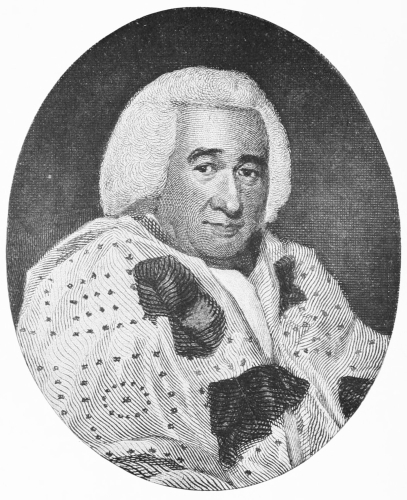 The Lord Justice-Clerk (Lord Braxfield).
(From an Engraving by Beugo after the Portrait by Sir Henry Raeburn.)
Lord Justice-Clerk
The Lord Justice-Clerk—Gentlemen of the jury, the crime which is
charged against the prisoners at the bar is of a kind the most hurtful
to society. The situation of the pannels, and particularly one of them,
is also exceedingly distressful. Mr. Brodie’s father, whom I knew, was a
very respectable man, and that the son of such a man—himself, too,
educated to a respectable profession and who had long lived with
reputation in it—should be arraigned at this bar for a crime so
detestable, is what must affect us all, gentlemen, with sensations of
horror. This unhappy situation seems to have arisen from a habitude of
indulging vices which are too prevalent and fashionable, but it affords
a striking example of the ruin which follows in their train.
That the Excise Office was broke into is not disputed. The question
therefore is, who broke into it? Was it the pannels?
Now, to ascertain this point you have, in the first place, gentlemen,
the evidence of Brown and Ainslie, and if they have sworn truth the
prisoners must be guilty. To the admissibility of these witnesses there
can be no objection. Were not evidence of this sort admissible, there
would not be a possibility of detecting any crime of an occult nature.
Had a corrupt bargain, indeed, been proved, by which they were induced
to give their evidence, there might have been room for an objection to
their admissibility. But no such bargain has even been alleged against
the public prosecutor in the present case. And as to their being
accomplices, this, gentlemen, is no objection at all. A proof by
accomplices may display, it is true, a corruption of manners, which
alone can render such proof necessary. But it is impossible to go into
the idea that their testimony is therefore inadmissible.
Nor is there, in the present case, any reason to suppose that they were
under improper temptations to give their evidence. Each of them was
separately called upon by the Court, and it was explained to each of
them that they ran no hazard unless from not speaking the truth, and
that their being produced as witnesses secured them from all punishment,
except what would follow upon their giving false evidence. Under such
circumstances, you cannot suppose, gentlemen, that they would be guilty
of perjury without any prospect of advantage to themselves, and merely
to swear away the lives of these prisoners at the bar.
Their credibility, to be sure, rests with you, gentlemen; and if you
find anything unnatural or contradictory in their evidence you will
reject it. But there is nothing in it unnatural or contradictory. The
principal objection was made against Brown, but his evidence is
corroborated by that of Ainslie, and the evidence of Ainslie is again
corroborated by that of Brown, and they are both corroborated by all the
other circumstances deposed to. With regard to Smith, you have the best
of all evidence against him, his own declarations, for it surely is not
to be imagined that any man would criminate himself contrary to the
truth. These declarations have been substantiated in your hearing, and
where a corpus delicti is established, as in the present case, to
which these declarations refer, there cannot be a doubt of their being
the very best evidence, and therefore you can be under no difficulty of
returning a verdict against him.
Gentlemen, to be sure these declarations are not legal evidence against
Brodie. But they corroborate the evidence of Brown and Ainslie, who
swear positively against him.
The evidence of Grahame Campbell likewise corroborates that of these
witnesses. With regard to Mr. Brodie, she swears positively to his being
present with them, dressed in an old-fashioned suit of black clothes.
She seems, indeed, to be in a mistake about the prisoner’s having supped
at Smith’s house that night, but the rest of her evidence is clear and
explicit, and concurs precisely with what you have heard from the other
witnesses.
The evidence of Brown and Ainslie likewise corresponds exactly with the
deposition of James Bonar. Ainslie tells you that a man came running
down the close, and it appears that when he opened the door Brodie set
off with himself—and, indeed, to tell you the truth, I could not much
blame him; and Mr. Bonar tells you that he went down the close at the
very time when the robbery was going on, and that when he opened the
door a man stepped out, of a description that exactly corresponds with
the prisoner and the dress he had on that night.
It appears clear also, gentlemen, from the depositions of the
sheriff-officers, that several articles were found upon the search in
Brodie’s house, which Brown and Ainslie depose to have been used in the
robbery of the Excise Office; a pair of pistols, a dark lanthorn, keys,
pick-locks, &c., and many of these last such as never were employed by
Mr. Brodie in the course of his business. So that no doubt can remain in
your mind of the truth of the facts sworn to by these two men, which are
all consistent with, and corroborated by the other evidence.
The crime with which these prisoners are charged, gentlemen, was
committed on Wednesday, the 5th of March. Two persons were taken up for
it, and Brodie absconded. It is established by the evidence that he went
to London, was afterwards put on board a sloop at night, and carried to
Flushing; and that, upon search being made for him, he was apprehended
at Amsterdam and brought back to this country. Gentlemen, when a person
who is accused of a crime flies from justice, it affords a strong
presumption of guilt. An innocent man would not fly without just cause.
The prosecution against him for using false dice could not be the reason
of his flight. Nay, he tells you himself in his declaration that he
absconded because Smith and Ainslie were taken up.
The papers found in the trunk, gentlemen, and the two scrolls, all which
have been proved to be of Mr. Brodie’s handwriting, afford strong
evidence against him. In one of the scrolls there is a fair and full
confession of his direct accession to the robbery of the Excise Office.
He says, “He never was directly concerned in any of their depredations,
except the last fatal one.” This is even a confession of more than is
charged against him, for it must mean that he was concerned, though not
directly, in their other depredations. It is impossible, gentlemen, to
mistake the meaning of this expression, or that it can apply to anything
else than the breaking into the Excise Office.
With regard to the alibi, gentlemen, it is no doubt proved by the oath
of Mr. Sheriff that he was in Brodie’s company from three o’clock of
Wednesday, 5th March, till near eight at night, he having dined in Mr.
Brodie’s house that day along with three ladies, and a gentleman whose
name he does not recollect. But then this rests entirely upon his
evidence, and though I do not mean to say that he has sworn falsely, yet
he is not a witness omni exceptione major, above all exception, being
the brother-in-law of Mr. Brodie. Besides that, gentlemen, allowing the
evidence of Mr. Sheriff, he is still only a single witness, and even in
civil cases a fact cannot be established by the evidence only of one
witness, especially where it is not supported by any other
circumstances. At any rate, the evidence is not inconsistent with the
guilt of the pannel, for the Excise Office was broke into after eight
o’clock, and Mr. Sheriff was in his own house in St. James’s Square
about eight o’clock.
As to the evidence of Jean Watt, who swears that Brodie came to her
house that night at eight o’clock, you are to consider, gentlemen, that
although, to be sure, she is not his wife, yet she is his mistress; and
love is often as deeply rooted between persons of that kidney as between
lawful man and wife. And, as you see, gentlemen, that either she must be
mistaken as to the hour or that the witnesses on the other side must be
wrong, you are to determine with yourselves whether the witnesses for
the prosecution brought forward by the Lord Advocate, who has no
interest but to get at the truth, or this woman, and her servant-maid
who concurs with her, are most entitled to belief. And you can have no
doubt but that the presumption is greatly in favour of the witnesses for
the Crown, who can be influenced by no motives but those of public
justice.
This woman and her servant, Peggy Giles, have no doubt deposed that it
was eight o’clock when Mr. Brodie came to their house; but, gentlemen,
even supposing them to be swearing to what they think true, yet they
still may be mistaken with regard to the precise time; and the mistake
of an hour, or half-an-hour, would reconcile their evidences with the
other proof you have heard. There is a bell rings at ten o’clock as well
as at eight, and these witnesses may very probably have confounded the
one with the other; for I have no doubt that Brodie did come to that
house that night, and staid there till the next morning. Gentlemen, the
law itself makes allowance for mistakes of this kind. Thus in the civil
Court, in a competition between two arrestments, of which one, for
instance, is at eight and another at nine o’clock, they are preferred
parri passu, because the law supposes that the memories of witnesses
may be so frail as not to distinguish short intervals of time with
proper accuracy. So that you see, gentlemen, that even supposing these
witnesses were willing to speak the truth, yet their evidence is
completely reconcilable with the other depositions.
Upon the whole, gentlemen, taking all the circumstances of this case
together, I can have no doubt in my own mind that Mr. Brodie was present
at the breaking into the Excise Office; and as to the other man, Smith,
as I have already said, there can be still less doubt as to him. If you
are of the same opinion, gentlemen, you will return a verdict against
both the prisoners; but if you are of a different opinion, and do not
consider the evidence against Brodie sufficiently strong, you will
separate the one from the other, and bring in a verdict accordingly.
At about six o’clock on Thursday morning, the Lord Justice-Clerk, having
finished his charge to the jury, said that he hoped it would not be
inconvenient for them to return their verdict at twelve o’clock that
day; but, upon the suggestion of one of the jurymen, it was fixed to be
returned at one o’clock.
The Court then pronounced the following interlocutor:—
The Lord Justice-Clerk and Lords Commissioners of Justiciary ordain the
assize instantly to inclose in this place, and to return their verdict
in the same place at one o’clock this afternoon, continue the diet
against the pannels till that time, ordain the haill fifteen assizers
and all concerned then to attend each under the pains of law, and the
pannels in the meantime to be carried back to prison.
The Court then adjourned.