Nitro-Glycerin Patents and Litigation.
It is seldom that any valuable invention has been brought into
public use without costly litigation being entailed on the inventor;
and especially is this the case in chemical discoveries, either by
pretenders who would interfere with the inventor who has turned his
discovery to practical account, on the plea of having previously
conceived the same idea, or by unscrupulous individuals who would
appropriate to their own use, without payment, the fruits of the labors
of other men’s brains; hence the writer did not altogether escape, as
will be seen by the following remarks on the subject.
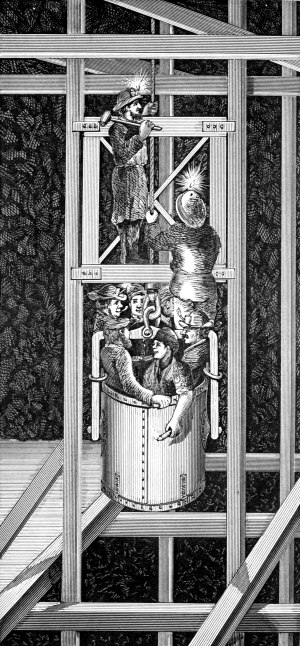
Miners ascending Central Shaft.
I will commence by stating briefly that a patent was granted and four
re-issues of the same made to Alfred Nobel and his assignees, for the
use of Nitro-Glycerin for blasting purposes, when “confined,“ and
for a process of manufacturing the same, by running the glycerin and
mixed acids together rapidly, in suitable proportions, into a tank of
water. Now, it has never been denied that Sobrero was the discoverer of
Nitro-Glycerin, and that it was competent for any one to manufacture
that article. The only point, therefore, on which a patent could be
obtained was for some improved method of making it. Accordingly, in the
course of experiments, I discovered that by passing a current of cold,
compressed air through the mixing glycerin and acids, a very valuable
improvement was effected, economizing time and material, and rendering
the process of manufacturing safer; and for this I obtained a patent on
April 7, 1868.
That my readers may see how far I was correct in my estimate of the
patentable value of my invention, I give below the opinion of eminent
counsel:
New York, July 10, 1869.
Geo. M. Mowbray, Esq.:
Dear Sir:—Pursuant to your request, I have examined your Letters
Patent of the United States for inventions in the manufacture of
Nitro-Glycerin, dated the 7th April, 1868. I recollect of aiding you
in preparing the application for that patent, and of examining it
immediately after it was issued. I believed then that that patent was
good and valid, and nothing since has occurred that has changed my
opinion or shaken my confidence concerning its validity.
I have recently examined copies of the five re-issued patents to
assignees of Alfred Nobel, and I find nothing in them, or any of them,
which impairs the validity of your patent.
I further say, that it is my opinion, and clearly so, that the
manufacture and sale of Nitro-Glycerin made according to the process
described in your patent, does not infringe upon any of the five
re-issued patents granted to the assignees of Nobel; and that so far as
any of those re-issued patents are concerned, or anything else that I
know of, you have a clear right to manufacture and sell Nitro-Glycerin
according to your patent.
Very respectfully,
Geo. Gifford, Counsellor at Law.
This discovery was not allowed to pass unchallenged, for Mr. Tal. P.
Shaffner, having learnt that I had obtained a patent, came forward with
a claim that he had conceived the idea (!) in 1865; and in January,
1869, nearly a year after the application for the patent which was
granted to me, he applied for a patent for the same thing. This
brought our respective rights before the Patent Office in a matter of
interference. However, the following remarks by Mr. John W. Thacher,
Examiner of Interferences, in giving his decision on the case, will
show pretty clearly to whom the right to a patent justly belongs. He
says:
“The principle is well established that he who
first reduces an invention to practical form is entitled to a patent
therefor. Applying this test in this case, the right to a patent seems
to rest entirely in Mowbray, and the invention is accordingly awarded
to the patentee.”
And again Mr. Samuel S. Fisher, the Commissioner of Patents, in
giving his decision, remarks:
“The story of Shaffner is not that of a man who
had invented anything. He had a theory, talked about it, doubted
its value; did not experiment to satisfy himself; until Mowbray was
manufacturing on a large scale; and evidently did not intend to apply
for a patent at all. I can find none of the ear-marks of a perfected
invention, carried beyond the region of experiment; still less of any
trace of diligence. Priority is awarded to Mowbray.”
As previously noted, the Nobel patent with its re-issues, in four
divisions, and twenty-four columns of specifications, containing eight
claims drawn up expressly to intercept infringers, specifically,
emphatically, and unmistakably insisted:
1st. That Nobel discovered it was necessary to confine Nitro-Glycerin
in order to explode it, and that it was practically impossible to
explode it unconfined.
2d. That heat and pressure were the agents necessary for a successful
explosion of Nitro-Glycerin.
The writer, however, discovered that the heat, pressure and
confinement, claimed by the Nobel patent and re-issues, were
unnecessary, by charging an open glass tube with Nitro-Glycerin,
the glass tube being immersed in water, and the Nitro-Glycerin
exploded by the concussion of a cap containing fulminate
of mercury, and so succeeded in extricating himself from
the domain of the Nobel patents and their particular claims.
But he could not extricate himself from litigation; the insolvent
assignee, the United States Blasting Oil Company, clearly perceiving
that the monopoly, as they had termed it, was gone, now resorted to the
“pis aller” of litigation, misrepresentation, and threatening every
one who used Mowbray’s Nitro-Glycerin, with the trouble of making
affidavits, engaging counsel, and collecting evidence, a by no means
to be despised aggressive warfare to contractors, who need all their
time, all their capital, and all their ingenuity, to carry out their
contracts to a profitable result. Guaranteeing the payment of enforced
damages, I met this flank movement by engaging the best counsel, and
resolutely set about terminating the pretensions of these patents.
A Suit in Equity was commenced in the Circuit Court
of the United States, Western District of
Pennsylvania, during the May Term, 1870, by the
United States Blasting Oil Company
of New York, by its President, Tal. P. Shaffner,
vs.
Geo. M. Mowbray, J. H. King,
Chas. Lobb, W. L. Holbrook, James Dickey and A. D. Hatfield.
As the sworn affidavits in the above case, now pending, are of great
importance in substantiating, both practically and legally, the claims
urged in previous observations, on behalf of the “Mowbray system” of
manufacturing and using Nitro-Glycerin, I give below the substance of
the testimony.
Evidence of George F. Barker, Professor of Physiological Chemistry and
Toxicology in the Medical Department of Yale College.
“I have carefully examined the several re-issued patents, Nos. 3,377,
3,378, 3,379, 3,380, 3,381 and 3,382, the four former being divisions
A, B, C and D, of the re-issued patent, granted upon the surrender of
the original patent No. 50,617, dated October 24th, 1865, and the
two latter divisions 1 and 2 of the original patent, also granted
to the assignees of Alfred Nobel, on surrender of the original
patent No. 57,175, dated August 14th, 1866, granted to said Alfred
Nobel. I would further state that in the specifications of the
before-mentioned re-issues it is asserted that Sobrero discovered
that Glycerin was capable of giving, when, mixed with sulphuric and
nitric acids, a substance analogous to gun cotton, which is true;
and that the specifications of the said patents further state that
“Sobrero abandoned further research with the declared opinion that its
combustion or explosion could not be managed”; which statement, having
read all which Sobrero is believed to have published upon the subject,
viz.: his papers published in the Comptes Rendus de L’Academie des
Sciences, Volume XXIV., page 247, printed in Paris A. D. 1847, and in
the Repertoire de Chimie Applique, Volume II., page 400, printed in
Paris in 1860, I have entirely failed to find recorded by him as his
opinion.”
J. E. de Vrij also, in a communication to the British Association,
which was read in July, 1851, and is published in the report of the
association for the year 1851, page 52 (Notices and Abstracts), states
in regard to Nitro-Glycerin, that it “explodes at a moderate heat, as
was shown by experiment, detonating when the drops of Nitro-Glycerin on
paper were struck a smart blow with a hammer.”
The before-mentioned re-issued patents further assert that “in
order to explode the whole, or even a large proportion of the mass
of Nitro-Glycerin, it is necessary to subject it to confinement or
restraint”; which assertion is untrue, for Nitro-Glycerin, when freely
exposed to the air in an open vessel or plate, may be and is capable of
being readily exploded, without confinement, restraint, or pressure,
as I have proved by experiment made at North Adams, on the 17th day of
May, 1870, in exploding upon two occasions a quantity of Nitro-Glycerin
in an open saucer with great violence, on which occasion the
Nitro-Glycerin was exploded by simple concussion in open vessels, the
fulminate cap used as the exploder being suspended above the surface of
the Nitro-Glycerin in the saucer, and distant nearly two inches from
it; so that the application of heat and pressure, or of either of these
agencies, is unnecessary.
The said re-issued patents further assert, that “the degree of
confinement must be sufficient to allow a pressure upon the
Nitro-Glycerin to an extent that 360°F will be realized, so that
decomposition will take place before the liquid can escape the force
or heat of the evolved gases of a percussion cap, etc.”; whereas I
found on the above occasion that when water was interposed between the
Nitro-Glycerin and the percussion cap, so that no measurable increase
of temperature (much less 360°F) could possibly occur in the former,
the Nitro-Glycerin could be exploded.
In the first experiment three tubes, closed at bottom and containing
half an ounce of Nitro-Glycerin each, were placed in water in a
tumbler, being supported an inch from the bottom. Into the water in
the tumblers, and outside of the tubes, distant from them nearly an
inch, the fulminate cap was put. This was then fired, and caused the
explosion of the Nitro-Glycerin through the intervening water. In
the second experiment, using a tub of water in which eleven tubes
containing Nitro-Glycerin were placed, the explosion of six fulminate
caps failed to fire the Nitro-Glycerin, the distance from the tubes at
which they were placed, nearly or quite ten inches, being too great. In
the third experiment five such tubes of Nitro-Glycerin were suspended
in a tub of water distant four or five inches from each other; the
fulminate cap being inserted in the middle tube. On firing this cap
the Nitro-Glycerin in all the tubes was exploded, as judged from the
violent effects produced.
The said re-issued patents further assert that “Gun-cotton will explode
in proportion to the degree of confinement, igniting at 266°F.” The
celebrated chemist of the English War Department, F. A. Abel, who has
made the most extended researches upon gun cotton on record, asserts
in his paper published in the Philosophical transactions for 1869
(an abstract of which appears in the Journal of the Chemical Society
of London for 1869, Volume XXIII., page 11,) “that rows of detached
masses of gun cotton, placed on the ground, and extended 4 or 5 feet,
have been exploded with most destructive results by firing a small
detonating tube in contact with the piece of compressed gun cotton
which formed one extremity of the row or train, the explosion of the
entire quantity being apparently instantaneous and equally violent
throughout.” And further that these and similar experiments “appear to
indicate decisively that such explosion is not a result of the heat
developed by the explosion of the detonating materials.”
I have witnessed the manufacture of Nitro-Glycerin as practised by the
defendant Mowbray, at his works situated near the West Shaft of the
Hoosac Tunnel, in Massachusetts, and after a full examination of the
mode said to have been the invention of Alfred Nobel, and described
in the before-mentioned re-issued patents, find that the process
actually in daily use, at said Mowbray’s works, is that described in
said Mowbray’s patent No. 76,499, dated April 7th, 1868, which process
is substantially different from that described in the complainant’s
re-issues hereinbefore set forth. According to said re-issues, Nobel’s
process consists in running two separate streams, the one of Glycerin,
the other of mixed nitric and sulphuric acids simultaneously into
a conical vessel which is perforated at the lower portion thereof,
through which perforations the mixture of acids and Glycerin passes
into a vessel placed beneath, containing water. In the Mowbray process,
a single fine stream of Glycerin is allowed to run into a previously
cooled mixture of sulphuric and nitric acids, through and into which
cooled mixture of acids is continuously forced, while the Glycerin
is entering, a current of atmospheric air, previously artificially
dried, compressed and cooled. The action of this current of air is an
essentially important and useful one, both upon the process itself
and upon the resulting product. First, as to mechanical effects: it
thoroughly incorporates the ingredients; it removes in part the nitrous
fumes which would otherwise be retained by and contaminate the product,
and it cools the mixture by absorbing the heat produced by the chemical
reaction of the ingredients. Second, as to the chemical effects: by the
action of the oxygen which this air contains it oxidizes the nitrous
acid, which may be present in the acids or may be produced in the
reaction, to nitric acid, and thus economizes the materials, increases
the quantity of the product, and produces a chemically pure article, as
is shown by the fact that the Nitro-Glycerin thus produced is perfectly
colorless, congeals uniformly at the same degree of temperature and
produces, when exploded, no offensive vapors deleterious to the health
of the miners using it. Moreover, as, in my opinion, these nitrous
fumes tend to induce decomposition in the Nitro-Glycerin and thus to
render it unstable, dangerous, and liable to spontaneous explosion, as
is demonstrated to be the case in the analogous substance gun cotton,
the introduction, in the method of Mowbray, of cold, dry, compressed
air into the mixture, in order to get rid of these nitrous fumes, must
be regarded as a substantially new invention.
In my opinion, the character of the Nitro-Glycerin is determined by
the strength of the acids used in its preparation; the stronger the
acids, the purer the product and the more efficient. I verily believe
this: first, because it is true of the precisely analogous compound
gun cotton, which is prepared in the same way; Hadow having proved, as
stated in his paper published in the Quarterly Journal of the Chemical
Society of London in 1854, Volume VII., page 201, that at least three
products are obtained by acting upon cotton by a mixture of sulphuric
and nitric acids, the most explosive being always produced by the
strongest acids; and 2nd, because of similar differences observed
in Nitro-Glycerin made by different experimenters, and believed by
them to be due to like differences in composition; Railton obtained
by analysis, as stated in his paper in the Quarterly Journal of the
Chemical Society of London for 1854, Volume VII., page 222, the
composition now universally adopted as that of Tri-Nitro-Glycerin. De
Vrij believes the product he obtained, Journal de Pharmacie, series
III., Volume XXVIII., page 38, 1855, to be Tri-Nitro-Glycerin, and
Liecke in Dingler’s Polytechnisches Journal, Volume CLXXIX., page 157,
1866, gives methods by which Mono-Nitro-Glycerin, Di-Nitro-Glycerin and
Tri-Nitro-Glycerin may be produced, the essential difference in these
methods being only the strength of the acids employed. Gladstone’s
Report of the British Association for 1856, page 52 (Notices and
Abstracts), has shown that different samples of Nitro-Glycerin
differed in properties according to the amount of water contained in
the Glycerin; this water, by diluting the acids, making them weaker.
Moreover the physiological properties of Nitro-Glycerin have been found
by different experiments to differ widely. Sobrero, its discoverer,
says a very small quantity taken upon the tongue produces a severe
headache for several hours, whence he concludes that it is poisonous.
De Vrij in 1851, says that it is not poisonous, and in 1855 that it
produces headache, though ten drops caused no symptoms of poisoning in
a rabbit. Dr. Herring, in 1849, reported in the American Journal of
Science and Arts, series II., Volume VIII., page 257, observed the
violent headache produced by 1/250 of a grain of Nitro-Glycerin or
Glonoin, as he proposed to call it, and killed a cat with three
drops. Field, in 1858, Pharmaceutical Journal, Volume XVII., page
544, confirmed these results; but Harley and Fuller, reported in
the same place, were unable to obtain them by using other specimens
of Nitro-Glycerin, though they largely increased the dose. Field
consequently says, place given, page 627, “I am daily more convinced
of two important facts connected with it, viz.: the great variation in
the strength of different specimens, and the very marked difference
in the susceptibility to its influence.” In further support of the
opinion that several allied but distinct Nitro-Glycerins have been
made, the wide difference in density and in congealing point may also
be mentioned.
In my opinion the best effect cannot be obtained with commercial
acids, owing to their insufficient strength. I have witnessed at the
defendant Mowbray’s works, at the West shaft of the Hoosac Tunnel, the
preparation of the acids used for making the Nitro-Glycerin, commercial
acids being found deficient in strength, and in my opinion it is to
the use of these stronger acids, combined with the method described in
defendant’s patent, as above mentioned, that the stability, efficiency,
and, above all, the freedom from noxious gases and vapors of the
products of combustion of defendant’s Nitro-Glycerin is due, when
contrasted with that made by complainant, which I have been informed
and verily believe is made with acids of commercial strength, and
produces, when exploded in a mine, gases and vapors highly deleterious
to health.
I have further examined the patent No. 93,113, dated July 27th, 1869,
granted to Mowbray, for exploding Nitro-Glycerin, and have experimented
with the same, the explosions hereinbefore enumerated having been
effected by the method therein described. And this deponent finds that
by said Mowbray’s process of exploding Nitro-Glycerin, as claimed in
his patent, confinement, restraint, or pressure is wholly unnecessary.
In my opinion the same is true in exploding Nitro-Glycerin on a large
scale, as I have been informed, and verily believe that upwards of one
thousand explosions of Nitro-Glycerin are made weekly in the Hoosac
Tunnel by the mode so described in said patent.
I believe, moreover, that the method claimed by Mowbray, in said
patent, differs materially from any of the various modes of exploding
Nitro-Glycerin described in the before-mentioned re-issues granted to
the assignees of A. Nobel, since these various methods specifically
require the Nitro-Glycerin to be under confinement, or subjected to
heat or pressure when confined, in order to explode it; while Mowbray
claims exposing the Nitro-Glycerin to the concussion, agitation, or
percussion of a heavy charge, not less than ten or twelve grains of
pure fulminate of mercury, which fulminate is fired by passing the
electric spark through a priming composition.”
George F. Barker.
June 8, 1870.
Evidence of S. W. Johnson,
Professor of Analytical
and Agricultural Chemistry in Yale College.
“I have read the foregoing affidavit of Professor Geo. F.
Barker; I witnessed the experiments therein described, and
concur in the statement contained in said affidavit.”
Samuel W. Johnson.
June 8, 1870.
Evidence of George M. Mowbray,
Operative Chemist.
“About October, 1867, I concluded an agreement with the Commonwealth of
Massachusetts, to erect Nitro-Glycerin works near the West Shaft of the
Hoosac Tunnel; these erected, I commenced manufacturing Nitro-Glycerin
about the 26th day of December, 1867, and with but few intermissions
have continued to manufacture it for blasting purposes for the tunnel
work ever since. About June 13, 1868, I had a long interview with Mr.
Taliaferro P. Shaffner, the complainant in this suit, when the said
Shaffner proposed to me a consolidation of interests, and told me, if
I would influence J. H. King and Henry Hinckley to advance the sum of
seventy-five thousand dollars, that Robert Rennie of the Lodi Chemical
Works, of Lodi, New Jersey, would credit him with acids to manufacture
Nitro-Glycerin, to the amount of eighty-five thousand dollars, and he
would then purchase land about twenty miles up the Hudson river, and
manufacture Nitro-Glycerin. The proposal I forwarded to J. H. King
and Henry Hinckley, who deemed the same too chimerical to enter upon,
more especially since said Shaffner informed me that one-fifth of the
consolidated association would have to be paid to one Frederick Smith,
one-fifth to said Robert Rennie, and one-fifth to said Shaffner,
on behalf of said U. S. Blasting Oil Company’s engagements, said
Company being deeply indebted to the Lodi Chemical Works, according
to the assertion of Joseph Butterworth, the superintendent at Lodi.
Mr. Shaffner further informed me that the United States Blasting Oil
Company had transferred and assigned all the patent rights conferred
by the Nobel patents to him, and he intended to obtain a re-issue of
the said patents, and with the individual patents obtained by him, and
the patent that had been granted to me in April, 1868, a Company could
be formed that would control the supply of Nitro-Glycerin throughout
the United States. I soon after consulted with J. H. King and Henry
Hinckley, both capitalists, with means, as to the proposals of Tal. P.
Shaffner, and the conclusion that we arrived at, was, that, as all the
cash capital, and the only practicable method of manufacturing a safe,
stable and pure Nitro-Glycerin, was already secured by patent to me,
to place seventy-five thousand dollars at the disposal of the parties
named by Mr. Shaffner would not be a sensible or prudent course, in
view of the condition to which the management of the said Shaffner had
reduced the United States Blasting Oil Company’s affairs financially,
and the failure to supply the demand for Nitro-Glycerin, although the
United States Blasting Oil Company had no competitor in New York;
so I informed said Shaffner that said Hinckley and King would not
advance the money, to wit: seventy-five thousand dollars, under such
arrangements, and the proposition fell through. And I would further
state, that at each of the various interviews—one of them prolonged
for four hours without interruption—the said Tal. P. Shaffner fully
admitted to me that any one could or might make Nitro-Glycerin, either
by the method described by Sobrero, the inventor, in 1846, or by my
patent, granted in 1868, April 7th, without in any way infringing on
the patents issued to A. Nobel, and assigned to said Shaffner, as
President of the United States Blasting Oil Company. And further, on
the 8th December, 1869, I was at Oil City, at the request of the Lake
Shore Nitro-Glycerin Works, and assisted in the explosion of one blast
in three drill holes of Nitro-Glycerin, using a frictional electric
machine, insulated wires, the priming fuse and fulminating charge, as
described in Letters Patent, granted to me, July 27th, 1869, and
being No. 93,113, and entitled “An Improved Method of Exploding
Nitro-Glycerin.” I am well informed of the four re-issued patents,
Nos. 3,377, 3,378, 3,379 and 3,380, and the methods therein described
differ very materially from the method that was practised on the 8th
December, 1869, at the Oil City Tunnel, by me, and particularly in
this very material respect; whereas, by the method practised at the
Tunnel, an operator can blast simultaneously at will one hundred drill
holes; by the methods described in the re-issues above mentioned, it
is absolutely impossible to explode two drill holes simultaneously.
And this difference between the simultaneous blasting of a number of
holes and firing the same number of holes one after the other has been
found in actual results to effect an economy of thirty per cent. in the
cost of blasting out rock in the Hoosac Tunnel. In a book (Exhibit B),
entitled “Liebig and Kopp’s annual report of Chemistry for 1847 and
1848”, pages 376 and 377, volume 2, published in London in 1850, there
is a notice of the comparative power of nitro-cotton and gunpowder,
and reference is there made to the nitro-compounds, made from dextrin,
glycerin and sugar, as being “similarly explosive preparations,” to
gun-cotton and nitro-mannite, which latter is described as a cheap
substitute for fulminating mercury in the manufacture of percussion
caps, and certain comparative experiments with the former (gun-cotton),
as to the relative value of the same, compared with gunpowder, are
mentioned as having been made by the celebrated powder manufacturers,
“Messrs. Hall & Son, of Dartford, in the county of Kent, England.”
After such publication, the claim made by the said Nobel, or his
assignees, in the re-issues before-mentioned, that Nobel discovered
that Nitro-Glycerin could be exploded under confinement is invalid,
for the fact that Nitro-Glycerin had been described as a similarly
explosive preparation to nitro-mannite and nitro-cotton, or gun-cotton,
by its discoverer, Sobrero, necessarily involved, and indeed published
the circumstance of its only being necessary to subject it to the like
conditions of other explosives to effect its explosion. I further state
that in four affidavits filed in this Court, on the 25th of February,
by Taliaferro P. Shaffner, and T. P. Shaffner and E. A. L. Roberts,
jointly, and E. A. L. Roberts singly, and W. M. Shaffner, these parties
have sworn that the mode of exploding at the Oil City Tunnel, December
8th, 1869, was identical and precisely similar to the mode described
in a patent granted to said T. P. Shaffner, December 18th, 1868, and
re-issued April 13th, 1869, No. 3,375, whilst the very same parties
describing the same blasting at said Oil City Tunnel, at the same time,
in the same words, and almost word for word throughout, as positively
have sworn that it was identical, precisely similar to the mode of
blasting described in the re-issues Nos. 3,377, 3,378, 3,379 and 3,380.
Neither of these parties were at any time on the ground during the
operations therein and thereat (to wit, Oil City Tunnel) performed,
except W. M. Shaffner, who was at no time within twenty feet of the
parties operating, and who has erroneously stated that water was poured
on to the Nitro-Glycerin at the bottom of the hole, which to my certain
knowledge was not done. And I ask the attention of this Court, to the
affidavits filed in this cause for the plaintiff, and also in a cause
of Taliaferro P. Shaffner against the same defendants, filed February
25th, 1870, as completely disproving each other.
Geo. M. Mowbray.
February 26, 1870.
Evidence of Phillip Mackey and Timothy Lynch,
foremen of miners at the Hoosac Tunnel.
“We were employed during the month of September, 1868, at the West
Shaft of the Hoosac Tunnel, at the time when Colonel Shaffner, the
complainant, was making experiments with Nitro-Glycerin in the said
tunnel, and assisted him by drilling holes in the rock to receive the
cartridges containing Nitro-Glycerin, and tamping said holes. After
the explosion of the said Nitro-Glycerin, we witnessed its effects on
the miners. These effects were usually to produce a dryness about the
throat, and feeling of thirst, which led the miners to take a drink of
water; immediately thereafter the miners would vomit, and such vomiting
would be followed by severe headache, rendering it necessary for the
miner so affected to be removed to the air, and out of the tunnel, and
the effects of such headache would last for from twelve to eighteen
hours; in fact, the vapors caused by the Nitro-Glycerin exploded by
said Shaffner were of such a noxious character as to disable the miners
generally from continuing their work.
“During the past three years we have often examined the Nitro-Glycerin
manufactured by G. M. Mowbray, and been regularly employed as foremen
of the miners who drilled the holes for receiving the cartridges of
Nitro-Glycerin exploded by said Mowbray and by his assistants, and we
declare that Mowbray’s Nitro-Glycerin differs greatly in appearance
from that used by said Shaffner; that Mowbray’s Nitro-Glycerin is
colorless almost as water, whereas Shaffner’s was orange-colored;
that the explosive effects of said Mowbray’s Nitro-Glycerin were much
greater, so far as we could observe, and that particularly we have
noticed the miners do not suffer from any noxious vapors after the
firing of blasts of said Mowbray’s Nitro-Glycerin, and that during
the three years the Nitro-Glycerin made by Mowbray has been used
in said Tunnel, there has not been a single case where a miner has
been compelled to leave his work by reason of the gases given off by
the explosion of Mowbray’s Nitro-Glycerin. And we consider that the
Nitro-Glycerin made by said Mowbray, and used in the Tunnel; very much
safer to handle, and does not give off noxious gases as compared with
the Nitro-Glycerin made by the United States Blasting Oil Company of
New York, and used by said Shaffner in the Hoosac Tunnel. And we verily
believe that if said Nitro-Glycerin were attempted to be used in the
Tunnel, now that so general a use is made of Nitro-Glycerin, it would
compel the miners to leave their work and seriously retard the progress
of the work by reason thereof, for those who could endure it for a time
would have to carry out those who are unable to move after inhaling the
gases of the Shaffner Nitro-Glycerin, and thus lose time which would
otherwise be employed in doing work.
“We consider it utterly useless to confine the Nitro-Glycerin when
fired by Mowbray’s system.”
Philip Mackey,
Timothy Lynch.
Feb. 16, 1870.
Evidence of John Van Velsor,
Superintendent of
Mowbray’s Nitro-Glycerin works
at the Hoosac Tunnel:
“In October, 1868, I was employed to fit up a Nitro-Glycerin factory at
Fairport, Ohio, and instruct the hands in the process of manufacturing
under Mowbray’s patent of April 7th, 1868. I endorse the evidence of
Messrs. Mackey and Lynch, as to the difference in appearance and smell
between Mowbray’s Nitro-Glycerin and that manufactured under Nobel’s
patent by the United States Nitro-Glycerin Company.
“I have made under Mowbray’s patent upwards of twenty thousand pounds
of Nitro-Glycerin, a great portion of which has been exploded in
the Hoosac Tunnel, by a method patented by Mr. Mowbray, dated July
27th, 1869, No. 93,113. I have exploded on numerous occasions the
Nitro-Glycerin made at said Mowbray’s factory, without subjecting the
same to confinement, by firing a charge of fulminating mercury, say ten
or twelve grains, contained in a wooden or copper cap, by means of the
electric spark. I have witnessed the use of Nitro-Glycerin at the West
Shaft of the Hoosac Tunnel, both in the bench work and in the heading,
where the blasters left the Nitro-Glycerin in the drill holes entirely
unconfined, such being the general practice at the Hoosac Tunnel, so
that in case of the wires not conducting the electricity, or in case of
the priming being defective and not firing the fulminating charge, the
exploder might be removed from the Nitro-Glycerin without danger to the
operator. During the eighteen months I have been in the employ of Mr.
Mowbray, manufacturing Nitro-Glycerin, he has only made Nitro-Glycerin
by his patented method, and by none other.
John van Velsor.
February 18, 1870.
Evidence of A. D. Hatfield.
“I have been employed in blasting in the railroad tunnel at Oil City,
using Nitro-Glycerin furnished by the Lake Shore Nitro-Glycerin
Company, manufactured under Mowbray’s patent. In firing and exploding
the Nitro-Glycerin I have acted under a license from George M. Mowbray,
said Nitro-Glycerin having been exploded without being confined.”
A. D. Hatfield.
February 19, 1870.
Evidence of Charles Lobb,
Railroad Contractor.
“I have been engaged in tunnelling through the hill at Oil City,
Pa., for the Jamestown and Franklin Railroad, and have used for that
purpose Nitro-Glycerin manufactured by the Lake Shore Nitro-Glycerin
Company, under Mowbray’s patent of April 7, 1868. I have tried to
purchase Nitro-Glycerin from Tal. P. Shaffner, President of the United
States Blasting Oil Company, and have been unable to procure the same.
Said Shaffner referred me to E. A. L. Roberts for the purchase of
Nitro-Glycerin, and on application to said Roberts was unable to obtain any.
Charles Lobb.
February 19, 1870.
Evidence of David Crossley.
“I have been engaged in operating oil wells in Pennsylvania, for ten
years. On December 6, 1869, I obtained a torpedo containing six pounds
of Nitro-Glycerin from the agent of Robert’s Torpedo Company, which he
said was from New York, and of the best quality. I had it put into an
oil well where it was exploded by said agent.
“The explosion of said torpedo, in said well, had the effect of
reducing the production of oil in said well from two barrels of oil to
one and a half barrels of oil in a day of twenty-four hours.
“On the sixteenth day of December, 1869, I put in another torpedo
in the same well, which I obtained from the same agent of the same
company. It contained the same quantity of Nitro-Glycerin, which was
represented to me to be the same as before-mentioned. This torpedo was
exploded by the agent in said well on the day last mentioned. Before
the explosion of the torpedo in said well, it produced one and a half
barrels of oil in a day of twenty-four hours, and the explosion of said
torpedo caused no difference in the production of oil from the same
well. About the first day of October, 1868, I employed G. M. Mowbray to
explode a Nitro-Glycerin torpedo in another well of mine. He exploded
said torpedo in said well in my presence. He used in the torpedo six
and a quarter pounds of Nitro-Glycerin. The effect of the explosion
was to increase the production of said well from five barrels to one
hundred barrels in a day of twenty-four hours. After this, Mr. Mowbray
put in and exploded other Nitro-Glycerin torpedoes in wells for me, and
always with the effect of increasing their production.
“Judging from my knowledge as an expert in operating oil wells and the
explosion of torpedoes of all the various kinds therein, I consider that
G. M. Mowbray’s Nitro-Glycerin is far more effective than that of any
other party, or that his method of exploding is more effective.”
David Crossley.
February 19, 1870.
Evidence of Jesse Smith,
Oil Well Operator.
“In November 1869, I had a torpedo from the Roberts Torpedo Company
exploded in my well in Crawford Co., Pa., by their agent. The explosion
was an utter failure, one-half the contents of the torpedo still
remaining in it; this the agent said was Nitro-Glycerin.”
Jesse Smith.
February 19, 1870.
Evidence of George West.
“I am employed in exploding the Nitro-Glycerin in the holes drilled
by the miners in the Oil Creek Tunnel, Pa. I used Nitro-Glycerin from
the Lake Shore Nitro-Glycerin Works, which is very different to that
of the United States Blasting Oil Company, of New York, and requires a
different mode of explosion. I do not use any of the methods described
in Nobel’s patent of October 24, and re-issued April 13, 1869, for
exploding, for the methods therein described would only explode it, if
at all, which I doubt, by hazard, and not with certainty, owing to the
peculiar properties of the Lake Shore Nitro-Glycerin as compared with
what I have seen and used as the Shaffner, or Nobel’s Nitro-Glycerin.
I endorse all the previous evidence as to the difference between the
Nobel or Shaffner Nitro-Glycerin, and that made under Mowbray’s patent.
The method I have used to explode this Nitro-Glycerin, at the Oil
City Tunnel, consists in what is known as the Austrian battery and
electric fuse and fulminating shell; that is, an electric machine,
whose exciting plate is made of ebonite or hard rubber, with insulated
and conducting wire terminals, which are from ¹/₁₆ to ¹/₃₂ of an inch
apart, and between those terminal points a priming composition is
inserted, through which the electric spark being passed, such priming
ignites, giving a flame (insufficient to explode the Nitro-Glycerin,
but) sufficient to inflame a fulminating compound, of which there is
a heavy charge, and this fulminating compound being exploded by the
priming composition, explodes the Nitro-Glycerin. I have never used
the method of exploding with gunpowder as described in the Nobel
patent, No. 50,617, in the tunnel aforesaid, nor elsewhere, but I have
witnessed attempts to explode the Nitro-Glycerin used under Mowbray’s
Patent by means of fuse and gunpowder, as described by Nobel, where
that method failed.”
George West.
February 19, 1870.
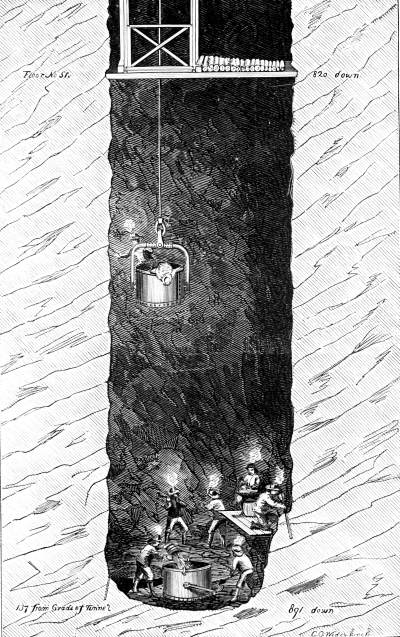
Sinking the Central Shaft.
Evidence of H. Julius Smith.
“I am engaged in the business of manufacturing electric fuses and
introducing explosive compounds to contractors, miners and torpedo men.
I have carefully examined the patents in question re-issued to Tal. P.
Shaffner, and, I find, by the modes therein described, it is impossible
to fire with certainty, and simultaneously, more than two mines charged
with Nitro-Glycerin by any of the methods described in said four
re-issued patents; and to effect any explosion of Nitro-Glycerin by any
of the methods therein described, and materials delivered to the public
by the assignees of the inventor Nobel, it is absolutely essential that
the Nitro-Glycerin should be confined as described in the re-issues in
question. I have also carefully examined the patent issued to George
M. Mowbray, dated July 27th, 1869, and find that the process therein
described of exploding Nitro-Glycerin, does away with the necessity for
confining Nitro-Glycerin in order to explode it. I endorse previous
evidence from my own experience in regard to exploding Nitro-Glycerin
when unconfined under Mowbray’s system. I have also manufactured and
delivered upward of twenty thousand fuses to the contractors of the
Hoosac Tunnel, capable of exploding Nitro-Glycerin when unconfined, at
said Hoosac Tunnel. I have been present when the modes described in
the re-issues of the Nobel patent have been carefully practised, and
entirely failed to fire Nitro-Glycerin, and in one instance immediately
after the failure of the Nobel system, I inserted a fuse of the exact
description, and with the electric appliances as described in Geo. M.
Mowbray’s patent, No. 93,113, dated July 27th, 1869, and the result was
a successful explosion. The modes described in the Nobel re-issues,
Nos. 3,377, 3,378, 3,379 and 3,380, have been abandoned by all
parties with whom I am acquainted, who have important works to carry
through, requiring Nitro-Glycerin to be exploded, and particularly by
the said Tal. P. Shaffner himself, as I have manufactured, sold and
delivered to said Shaffner and others, the apparatus and the exploding
electrical fuses for firing Nitro-Glycerin made by said Shaffner,
and Nitro-Glycerin made by the Lake Shore Nitro-Glycerin Company,
which said fuses or electrical exploders, involve a principle of
firing Nitro-Glycerin of great practical importance and very recent
development, viz., the principle of concussion, so as to effect the
explosion of the entire mass of Nitro-Glycerin instantaneously,
without requiring the explosion to be transmitted from particle to
particle, in this respect differing very materially from the methods
described in the Nobel re-issues above referred to, which require,
first, confinement, and then heat and pressure, to be developed in the
presence of the Nitro-Glycerin.”
H. Julius Smith.
February 24, 1870.
Evidence of James H. King.
“I am one of the proprietors of the Lake Shore Nitro-Glycerin Works,
situated near Painesville, Ohio. I am personally acquainted with
Taliaferro P. Shaffner, and endorse all the evidence of G. M. Mowbray
as to Shaffner’s proposal to consolidate the Nobel and Mowbray patents,
and his admission that the parties he represented did not claim the
exclusive right to manufacture Nitro-Glycerin. I would state that
one W. B. Roberts, of the firm of Roberts & Co., of Titusville,
Pennsylvania, informed me that he is one of the Trustees of the United
States Blasting Oil Company, and that since the commencement of this
suit I have delivered to Roberts & Co., at request of W. B. Roberts,
twelve hundred pounds, or thereabouts, of Nitro-Glycerin manufactured
by the company of which I am a member.
“I manufacture (as a party interested in the Lake Shore Nitro-Glycerin
Works of Painesville) under a license from George M. Mowbray, under a
patent to said Mowbray, bearing date April 7th, 1868.”
J. H. King.
February 25, 1870.
Evidence of James Dickey.
“I am acquainted with Nobel’s system of blasting. I assisted in making
ten explosions in Oil City Tunnel, for Charles Lobb, the contractor.
We did not use any of the methods of exploding specified in Nobel’s
or Shaffner’s patents. We used the improved electrical machine of H.
Julius Smith, patented August 10, 1869, and used the method of firing
and fuse described in G. M. Mowbray’s patent of July 27, 1869, and
which several methods are entirely different from those mentioned in
the several patents claimed by complainant in this case. I used in the
blasts made by me, the Nitro-Glycerin manufactured by the Lake Shore
Nitro-Glycerin Company, under Geo. M. Mowbray’s patent, No. 76,499,
dated April 7, 1868. I endorse the statements of the miners Mackey
and Lynch as to the noxious effects and danger arising from the use
of Shaffner’s Nitro-Glycerin, and the freedom from the same in that
manufactured by Mowbray’s system.”
James Dickey.
February 25, 1870.
Evidence of W. S. Holbrook.
“I was engaged along with James Dickey to perform some blasting in Oil
Creek Tunnel. I endorse his statement as to the kind of Nitro-Glycerin
and the method of exploding used in said tunnel, and further state that
we never used any other process or material.”
W. S. Holbrook.
February 25, 1870.
Evidence of Henry H. Pratt.
“I was foreman at the West Shaft at the Hoosac Tunnel, up to October
15, 1869. In December, 1869, I went to Oil City, Pa., to show Charles
Lobb, the contractor for the Jamestown and Franklin Railroad, how to
use Nitro-Glycerin for blasting rock. The weather being very cold,
warm water was first poured into the holes to prevent the frozen
sides of the drilled hole chilling the Nitro-Glycerin. A charge of
Nitro-Glycerin was then poured through the water, and a small cartridge
of tin being introduced, the charge was fired by means of a frictional
electric machine, connected with a priming fuse and a charge of
fulminating mercury, being the mode set forth and shewn in the Letters
Patent, granted to George M. Mowbray, No. 93,113, and dated July 27th,
1869. I am familiar with the re-issued patents in question, and the
mode by which I exploded said Nitro-Glycerin in said tunnel, as above
described, is very different from the mode described in the patents
re-issued to said U. S. Blasting Oil Company; it would have been
utterly impossible to have fired the said three holes in said tunnel
by the mode stated in the above referred to re-issues at one and the
same moment, as was done by me. I find on examination, that in all the
patents granted to Taliaferro P. Shaffner, Nos. 51,671, 51,674, dated
December 19th, 1865, the mode of firing a consecutive series of fuses
is condemned by said Shaffner, and in patent No. 51,674, that the
specification accompanying said Letters Patent contains the following
words: “Figures 6 and 7 represent the heretofore known mode of
exploding two or more charges by the same electric current, and the
former is shewn as applied to a consecutive series of blasts in line,
and the latter to the heading of a tunnel,” such mode being identically
and exactly what I practised at the Oil City tunnel, and none other. I
confirm all the previous evidence as to the feasibility of exploding
pure Nitro-Glycerin when unconfined, and also as to the good qualities
of the Mowbray Nitro-Glycerin when compared with that made under the
Nobel re-issues.”
H. H Pratt.
February 26, 1870.
Evidence of Otto Burstenbinder,
of New York.
“I have been familiar with the use of Nitro-Glycerin since May, 1865,
and introduced that article from Hamburgh, Germany, in July, 1865.
I witnessed the application of Nitro-Glycerin to blasting purposes
about 20 miles from Hamburgh, when many distinguished citizens were
present, a full account of the results effected being published
afterwards in the principal German newspapers. The mode used to explode
Nitro-Glycerin on that occasion was by fuse and cap, the Nitro-Glycerin
being confined, in one experiment, in a gas-pipe, plugged at each end,
and the fuse led through the plug, and at the end of the fuse there
was a percussion cap attached; in another experiment a wooden plug was
hollowed out conically inside and the cone was filled with gunpowder;
to this plug a fuse was attached and lighted in the usual manner. I
myself fired Nitro-Glycerin in the City of New York, on or about the
fifteenth day of July, A. D. 1865; this was the first time I used
Nitro-Glycerin in the United States, for blasting purposes; the mode of
operation was to pour the Nitro-Glycerin into the naked drill hole, and
lower a wooden plug charged with gunpowder, on to the Nitro-Glycerin,
poured some dry sand on to the plug, and fire a fuse which was situated
on the plug in the usual way.
“I am quite familiar with the Nitro-Glycerin manufactured by the
United States Blasting Oil Company, under Nobel’s patent, and that
manufactured by G. M. Mowbray under his own, and confirm all the
previous evidence as to the superiority of Mowbray’s Nitro-Glycerin,
in explosive power, in absence of color, absence of smell, absence of
nitrous gases, in greater safety through the greater difficulty of
exploding it, and in purity. As an expert of considerable experience
in the use of Nitro-Glycerin, I assert that it is entirely unnecessary
to confine Nitro-Glycerin in order to explode the same, the explosion
being as thorough, and its effects nearly as powerful for blasting
purposes, owing to the extreme instantaneous conversion into gas when
unconfined, provided a proper charge of fulminate be used.
“I have made the explosion of Nitro-Glycerin, and its application to
blasting purposes, my occupation since 1865, and am thoroughly familiar
with its properties, use, and the literature referring to it, and I
have never heard or read that the Nitro-Glycerin made by Sobrero was
incapable of being crystallized, but I verily believe, and have always
found, that Nitro-Glycerin congeals when exposed to a moderately low
temperature.”
Otto Burstenbinder.
June 7, 1870.
Parties using Nitro-Glycerin are requested to note, that on the 19th
of March, 1872, the insolvent U. S. Blasting Oil Company (by the
aid of funds drawn, under litigation also, from the Oil producers
of Pennsylvania, by the notorious torpedo patents), finding their
twenty-four columns of specification and eight claims wholly
inapplicable to the mode of using Nitro-Glycerin as now practised,
surrendered their re-issues, and, as I am of opinion, by the
injudicious oversight of the Examiner, an intimate friend of Mr.
Shaffner, obtained four more re-issues, containing twenty columns of
specification and seventeen claims, thereby, as eminent counsel advise
me, practically abandoning their case up to March 19, 1872.
Counsel further advise me, after full consideration of these last
re-issues, that the litigation has entered upon a new phase, and that
the original patent, the first re-issues, and the second re-issues,
contain in themselves the proof of their utter worthlessness, needing
no other evidence to render them void. But a graver and more serious
charge rests upon the means by which these anomalies have been put on
record in the Patent Office, which will be reviewed by experienced
counsel, before a competent tribunal.
For myself, with resources which I hope and intend to keep unimpaired,
to conduct this business to its final issue, with a pecuniary interest
I am bound to take care of, besides a further amused interest, aroused
during the past four years, by the shifts and pretences of this
impecunious company to avoid trial of a suit instituted by itself,
there will be a courteous desire to accommodate my opponents with the
earliest possible verdict, counsel, judges and jury can arrive at,
consistent with a complete, full and fair investigation of plaintiff’s
pretences and patents.