In locating the site for a defensive firing line,
it must be divided into three sections:—firing
line, immediate support and reserves. In doing
this several opposing factors should be taken
into consideration and their relative importance
judged according to the special circumstances
and objects in view, keeping in mind the probable
lines and manner of defense of the enemy,
and whether the trenches are for permanent or
for temporary use.
This may be summarized under two heads:
first, with the object of attaining the greatest
field that can be covered by defensive fire; and,
second, the greatest security from offensive fire.
It will even be found that these two constructions
will be in conflict. Trenches placed behind
the crest of a hill, say fifty to one hundred
and fifty yards from the top, will hamper the
accuracy of the enemy’s artillery fire. Shooting,
to be effective, calls for a high rate of accuracy,
and here the only observations possible
are from aircraft and balloons; but the enemy
side of the hill will be raised ground to the occupants
of the trench. At night large numbers
of the enemy could collect there, and the dangerous
space to them would merely be the distance
from your fire trench to the crest of the
hill.
The enemy could and would entrench themselves
on their side of the crest and by raising
their parapet enjoy the advantage of a higher
front, which would eventually lead to their entirely
controlling the area behind your trenches,
which are continually used by the relief and
fatigue parties.
It is a principle that grazing rifle fire upon
a defensive enemy is more effective than plunging
fire, but any entrenched position higher
than your own held by an enemy gives them a
tremendous advantage. Regardless of what
opinion may be held as to the maximum depth
of a field of fire required to meet or repel
attacks, whether in masse or open order, it
should be obvious that the greater the depth
of the field of fire and the more extensive the
view of the enemy’s operations, the better it
will be for the defending forces.
Protection from and localization of artillery
fire must be provided by the internal construction
of the trench rather than by a position
that protects but also restricts the field of fire.
There are frequently found in front of a firing
line small areas of ground which are not covered
by direct fire from your trench. A flanking
fire frequently can cover these areas, but in
spite of this, they must be watched constantly
by means of listening posts or concealed observation
posts, which may be hidden by the banks
of rivers, hedges, ruined houses, or whatever
natural existing concealment renders observation
possible.
At night, it is a safe principle to support listening
posts by automatic rifles, trip wires with
noise making arrangements attached to them
as common sense under the circumstances dictates.
Great care and caution must always be
taken to prevent the discovery of these listening
posts by the enemy, and when discovered,
alternative posts should be made or greater
care taken for the protection of the men occupying
these posts, such as overhead protection by
mesh wire against bombing, and the upkeep
of a small supply of bombs and close-range
weapons in the post. The important trenches
on the front having been located with a view
of protecting the immediate front and with due
regard to their relation, tactically, to the
other trenches already located, the connecting
trenches obviously must be subservient to the
more important ones. Every endeavor must be
made to avoid enfilade fires in the flanks, to give
and to receive mutual support, and in particular
to support those flanks which are not protected
otherwise.
It is an essential consideration in the location
of all these trenches that lateral communications
can be established, and that supplies, supports,
reserves, ammunition, etc., together with
the means of retiring if necessary be taken into
account. The distance from the water supplies
and the possibility of concealing approaches
is a further governing factor, although in many
cases an ideal condition cannot be realized.
Then there is the counter attack, in case the
fire trench should be taken, and the kind of soil
which is so essential to its relation to bad
weather and water seepage—these also require
thought and study.
These things are main considerations to be
kept in mind after a line has been settled
on, whether during attack or whether siting
trenches under common circumstances. It is
not expected and is not necessary, when trying
to obtain a position during attack, to keep all
of these conditions in mind, but it is essential
that when the attack has been finished and
things return to slightly more normal circumstances,
that these things be given instant consideration
and proper action taken.
Were such a thing as concealment possible,
it should be the first thing of importance to be
kept in mind. Listening posts, machine gun
positions, reserve dugouts, company, battalion
and regimental headquarters, and similar
things, at some distance behind or on fire lines,
may be concealed, but fire-trenches are sure to
be observed sooner or later (mostly sooner) by
aeroplane and other means of observation, and
it is best that one should admit the impracticability
of concealment at once and take the
proper protective measures. If opportunity for
concealment offers itself, as it may do, according
to the lay of the land, it should be taken
always. It should always be kept in mind that
one should try to place himself in the position
of having the enemy’s point of view, both from
his trenches and his aerial observations.
Advantage should be taken and even care
given along trenches to the extensive cultivation
of the weeds, grasses, etc., that may grow
rapidly in the excavated soil.
It is, and always will be, a matter of much
argument that trenches should not be dug near
hedges, ditches, roads or rows of trees, on account
of easy ranging mark given to the enemy
artillery. In a country where such things are
scarce, the idea may have a leg to stand on, but
certainly to the Western Front it does not apply.
It does not take artillery a moment to approximate
by ranging shot, check by deduction
or addition the range of trenches in any
area, even if lying along a hedge or road. The
ditch or hedge in some cases will provide the
starting of a trench and offer fair amount of
cover from fire to the troops working. A ditch
immediately in front or behind the trench
greatly helps to solve the many and varied difficulties
of drainage, and when in front of a
trench, can be made into a formidable obstacle,
generally by throwing in varied lengths of
barbed wire. Trenches under the cover of a
hedge are very often safe from aerial observation,
and even when located, sniping and observation
can be carried on from them if the contours
of the ground are favorable. It is always
possible to do a certain amount of repairing
and moving of troops only when unobserved
from the enemy’s trenches. If advantage
is not taken of these natural protections,
such as hedges and trees, then they must be destroyed.
It is obvious that a great deal of labor can
be lost and work thrown away if a policy is not
adopted and continued. Battalions relieving
one another up and down the line may waste
a tremendous amount of labor unless the relieved
officer’s policy is explained. If each commanding
officer of a relieving battalion is permitted
to air his own theories, duplication of
work and lack of continuity will exist. Therefore,
it is essential that the officers relieving the
trench be thoroughly informed of work going
on. With this object in view some of the officers
of the relieving battalion should do a tour
of duty (about 24 hours) before their troops
take over the trench. An Officer and Non-Commissioned
Officer are detailed from each relieving
company for this duty. In the trench this
officer is instructed by the senior officer present,
and the non-commissioned officer by the
ranking non-commissioned officer, in the policy
to be continued. The commanding officer of
the occupying company should have a sketch
map of his sector of trench which he turns over
to the relieving officer. This map should show
the work under construction; proposed work;
wire defenses; and if possible, the enemies machine
gun emplacements, observation posts,
snipers and work in progress. The notes accompanying
the map should give the general
conditions concerning the work—depth to which
it is safe to dig, nature of soil, conditions regarding
drainage, and all information in regard
to the enemies’ activities during the period of
occupancy. In addition, the relieving officer has
the trench diary showing all the information
covering every minute detail of the happenings
during that company’s stay in the trenches.
This diary is a continuous record of that particular
sector and remains with the occupying
company until it is relieved and then passes into
the possession of the relieving half company,
and so on, forming a continuous running record
of the policy applying to the upkeep and
methods employed therein. This diary, unless
it is buried to avoid falling into the hands of
the enemy, will continue until the end of the
war. So every half company inherits one from
his predecessor in the line upon its assuming
the obligations previously assumed by its fore-runner,
thus preventing a duplication of work
and assuring continuity of endeavor.
There are certain obvious requirements that
have to become rules. When required to fill
sandbags, always look for the nearest excavation
being made and fill from there, if distance
permits.
As a matter of fact, in every trench there is
a continuous revetting, widening of communications
or control trenches, or driving of a
tunnel to a listening post.
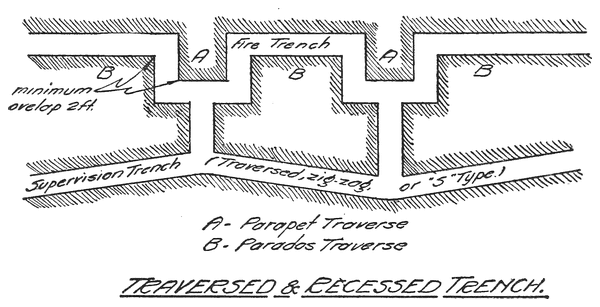
A—Parapet Traverse
B—Parados Traverse
TRAVERSED & RECESSED TRENCH.
Inasmuch as the time for filling sandbags
is never ending, if work is being done and the
earth is not absolutely needed for parapet or
parados, the earth, if dry, should be put in
sandbags, and, if necessary, stored until it is
needed. The repair work that is most necessary
takes precedent and is about as follows: Any
damage to parados or traverses should be immediately
attended to. During the night any
damage to the wire entanglements must be repaired.
Drainage comes next in order of importance,
and this involves the digging of sumps
and deepening of the drainage bottom. These
are the repairs, but improvements must continually
be made in the dugouts and communication
trenches.
The ultimate design of a fire-trench depends
upon its closeness to the enemy. When the
latter are within 150 yards, the traversed fire-trench
shown in sketch should be employed,
as it provides adequate accommodation and protection
for men who may at any moment be
called upon to make use of bomb, bayonet and
bullet; but if the enemy trenches are more than
150 yards distant, the ultimate design would
depend upon the number of machine guns and
automatic rifles available. Each of these guns
has a firing capacity of about 25 rifles. Each
gun therefore gives a reduction in the number
of men required to hold the line, and in consequence
reduces the amount of trench needed to
protect these men.
A design, known as the “T” shaped fire-trench,
makes an adaptable basis for entrenching
under these conditions. Many lengths of
a continuous traversed trench have no great
field of fire, and yet, having been dug, they must
be held, and unless properly held and kept in
repair, they naturally become a source of
danger.
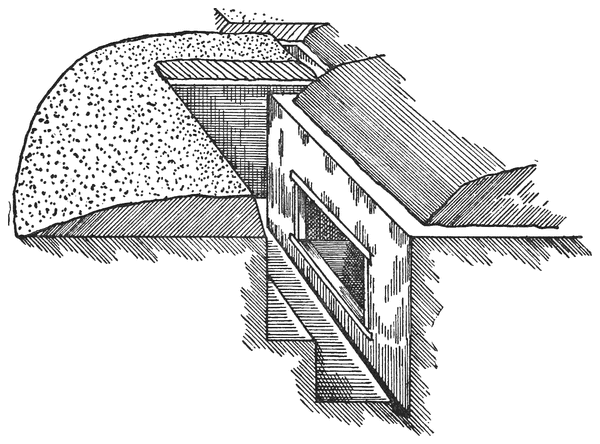
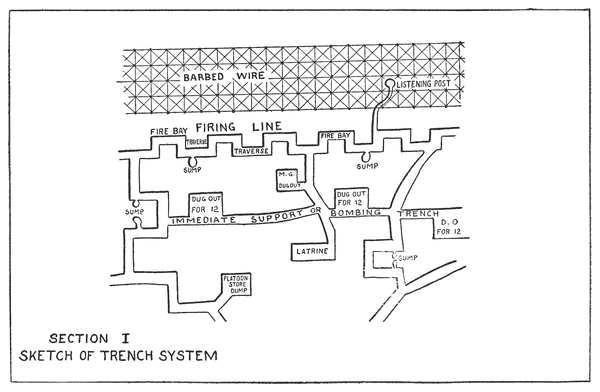
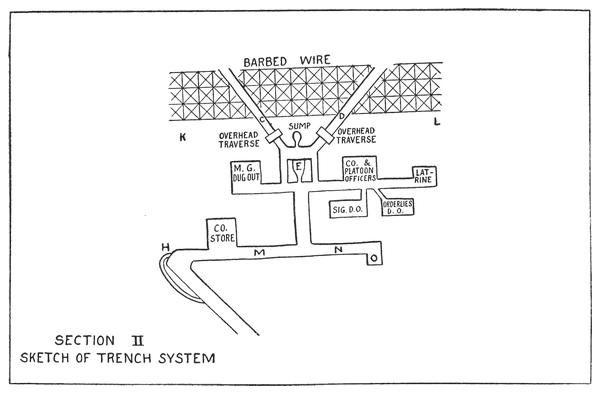
As shown in the sketch, a traversed trench
consists of a series of fire-bays interrupted by
a series of traverses. The object of these being
to localize the effect of shells or bombs landing
in a fire-bay, and preventing enfilade fire down
the length of the trench, as well as localizing
any entry of the enemy into your line.
Dimensions vary up and down the line.
Sometimes according to the lay of the land,
sometimes according to the opinions, whims or
fancies of the regiments making them, but the
following dimensions should be kept in mind,
and it will be found that they show the average
of the whole general line on the Western Front.
Fire-bays generally are from 12 to 18 feet
long (defendable by 4 to 6 men, but accommodating
8 to 12, when necessary) plus a 2-ft. covered
sentry box recessed into the traverse and
giving room for one more man; this depending
entirely on the energy and initiative of the men
occupying the section.
Every traverse averages 9´ x 9´ which includes
a fairly liberal allowance for wear and
tear, and is the minimum allowance for stopping
enfilade fire and localizing fire. As the
width from front to rear varies, depending on
the amount of shell fire, it should be wide
enough to allow a certain amount of lateral
traffic without interfering with those who may
be firing. Three feet may be taken as the maximum
width at the bottom of the trench, that is,
1½´ for traffic and 1½´ for those firing, with a
slope to the sides of from 10 to 15 degrees from
perpendicular, thus lessening the tendency of
the walls, whether revetted or otherwise, to
slide in.
The depth of the trenches varies also, for
the same reasons that cause the width to vary.
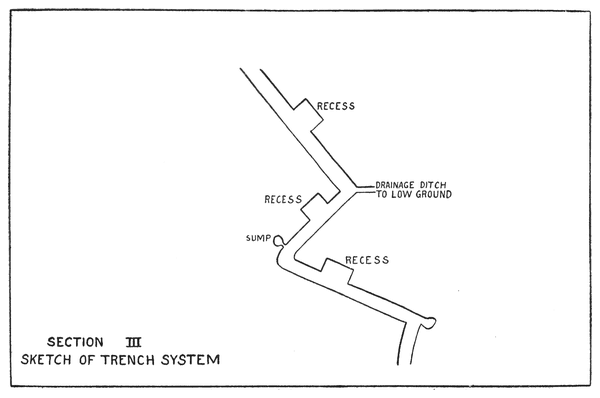
Recesses should also be dug at various and favorable
places for the storing of ammunition
and bombs.
When digging entrenchments without regard
to concealment, the excavated soil is first
of all thrown to the front or enemy’s side of the
trench, thus temporary cover is obtained.
When the entrenchment has reached the proper
depth the artificial raising of the ground is leveled.
The artificially raised portion is known
as the parapet. On the completion of the parapet,
the soil is thrown to the rear side of the
trench, thus forming the parados which gives
a protection from the rear. It is not a good policy
to excavate in front of the parapet, but to
get additional height and thickness as quickly
as possible this is often done. Unless carefully
watched, men will dig this dirt from places
as near the parapet as possible, resulting in the
weakening or total undermining of the parapet
or trench wall. The more gradual the forward
slope of the parapet, the more does it approximate
as it should to the glacis of a fort, consequently
giving less cover to an attacking enemy.
Make use of the ditch or holes from which
the dirt was obtained, as a strong obstacle immediately
in front of your trench, where the enemy
at the last moment may be held up to go
under a very severe rifle and bombing effort.
In normal circumstances, by which I mean when
not exposed to an unduly vigorous machine gun
or artillery fire, the soil should not be taken
from in front of the trench in the manner described
above, closer than 10 to 15 feet from
the actual parapet, unless the holes are adequately
protected by trip wire, as well as barbed
wire. Cases have occurred when valuable information
has been obtained by the enemy lying
in holes thus dug and not properly protected.
The parapet should be kept as low as possible
and made to blend with its surroundings as
much as possible. This is done by taking great
care to cover any signs which show that fresh
work has been done, even to the extent of actually
planting grasses, weeds and roots, such
as grow in the immediate neighborhood, and
giving every encouragement to those that already
grow. This greatly hinders the enemy’s
artillery, as it changes positions up and down
the line; interfering with and hindering the
observations and accurate ranging by their forward
observing officers, checking charts turned
over by relieved batteries.
Bullet-proof nature of a parapet naturally
depends on the soil of which it is composed.
Although it is not necessary to memorize the
minimum of safety, you should keep a general
rule in your head. The parapet should not be
less than five feet, regardless of the kind of
soil. When the trench has been carefully sited
for the actual field of fire from a ground level,
this thickness is best obtained by raising the
ground level artificially as little as possible and
getting the necessary depth by digging, unless
prevented by moisture.
Unnecessary casualties are caused by the
practice of putting a single row of sand bags
along the top of a parapet for temporary purposes
of concealment, as it gives a faulty idea
to the men in the trench as to the real height
of the parapet.
The parados gives protection from the effect
of shell fire bursting behind the trench, and
should be made fire-proof as soon as possible,
although it is not necessary unless concealment
is possible to level it down in a similar manner
to the parapet. As a matter of fact, it should
be at least a foot higher than the parapet, thus
providing a background for the parapet. It has
been known to happen that when the occupants
of a trench have been reached by the enemy
they have vacated their trench and used the
parados as a parapet, much to the surprise and
disgust of the enemy. In a high and irregular
parados, places could even be found which when
not used steadily provide unexpected and safe
observation and sniping posts, but care must be
taken that they are not used too often.
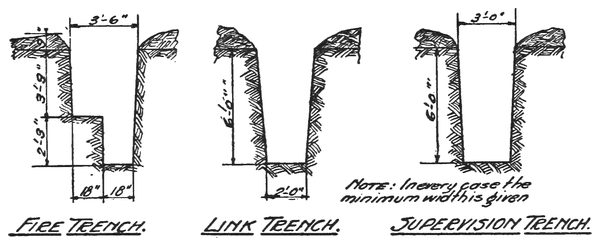
If a trench were used merely for firing,
4½ feet from bottom of trench to top of parapet
would be a sufficient depth. During attack,
however, when fire from loopholes is too restricted,
exposure of head and shoulders over
the parapet becomes necessary, but it is not
necessary to expose men moving along the
trench and not actually firing. If the trench
should be 7´ or 8´ deep, you must provide a platform
at the bottom of the front wall 1¼´ wide
and 4½´ from the top of the parapet. This is
called a fire-step. The rest of the trench can
be deepened to any desired depth, depending on
the energy displayed. If of an extraordinary
depth, steps must be cut to the fire platform.
In a great many different parts of the Western
Front, especially Belgium, it was found that
after digging to a depth of one to three feet
water was encountered to such an extent that it
became impossible to dig any sort of a trench
which would give adequate protection to the
men involved.
Fire Trench.
Supervision Trench.
Link Trench.
When these conditions are run into, breast
work parapets must be artificially built up
above ground level with soil, sods and sandbags,
supported by sandbags, hurdles or close
wire netting, revetment and stakes. The same
principles of thickness, depth, width, slopes,
and in fact everything that applies to a dug-in
trench, applies to breast works.
A—Link Trench, minimum length 5 ft.
“S” & “T” Trench.
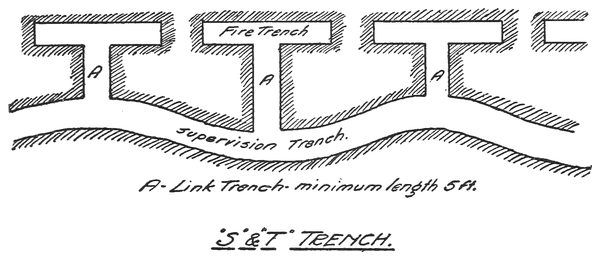
The “T” trench has many more advantages
than the few mentioned in the opening of this
chapter. T fire-bays may be single, double or
treble (that is with one, two or three bays).
Fire-bays in any length up to 15 feet with 8
feet traverses are for firing purposes only, and
the control trench, sometimes known as the
lateral communication trench, as its name implies,
giving lateral communications, is used
for that purpose only. Therefore, the fire-bays
and control trenches can be narrower than
trenches which have to be used for both purposes,
thus lessening the amount of repair and
revetment work required. And the intervening
ground between these fire-bays gives the same
result as a traverse used in a traversed trench
system, and saves the labor of digging a more
intricate system. The control trench gives an
officer or N. C. O. in charge of the T bays a
chance to handle his men and fire in these bays
without struggling around innumerable traverses
and wasting time very often when a minute
lost or gained means lives lost, or part of a
trench system in the hands of the enemy.
T bays may be sited with due and careful
consideration while facing the enemy in an existing
trench system. Thus it gives you the advantage
of being able to take into consideration
all the requirements of the field of fire, control
of isolated areas, and the obtaining of
maximum results from enfilade fire. These T
trenches may be dug out from the old system
without undue exposure of your men and if
distance between the lines permits, and it is entirely
possible to construct a new and generally
more favorable line of trenches within 100
to 200 yards of the enemy’s trenches. Intervening
ground between these T bays must be
completely controlled by entanglements and mobile
machine guns, or automatic rifles, able to
operate from different alternating recesses in
the control trench. Fire platforms should be
placed in recesses at intervals in the control
trench from which covering fire can be given.
Artillery fire, to damage a T trench, must be
very accurate. In a traversed trench a shell
destroys not only lateral communication, but
the defenders as well, whereas with a T shape,
both fire-bays and control trench have to be
ranged and hit. The success of the enemy is
entirely local when capturing one of these T-bays,
and he may be shelled by your own artillery
without any danger or risks to those defending
their T-bays. Control trenches should
be dug first and zigzagged with the longer
stretches facing the enemy. This gives you another
fire-trench as well as a communication
trench, and is also ready for use at any time
needed before the T-bay is completed. On the
completion of the T-bay, the corners of the zigzagged
trench must be rounded off to make it
easier and quicker for the movement of troops
and carrying of stretchers.