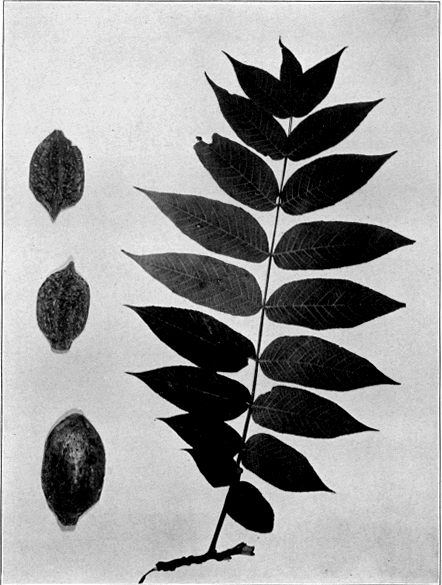
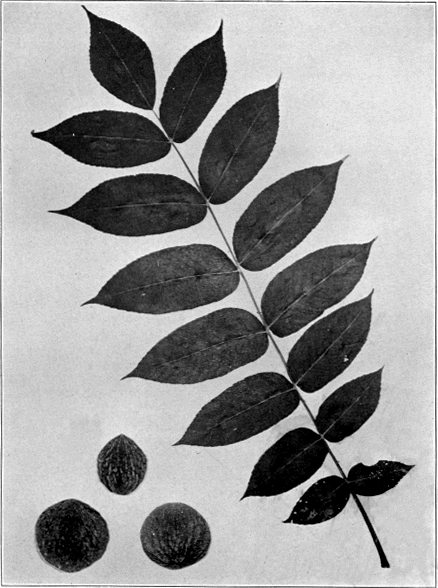
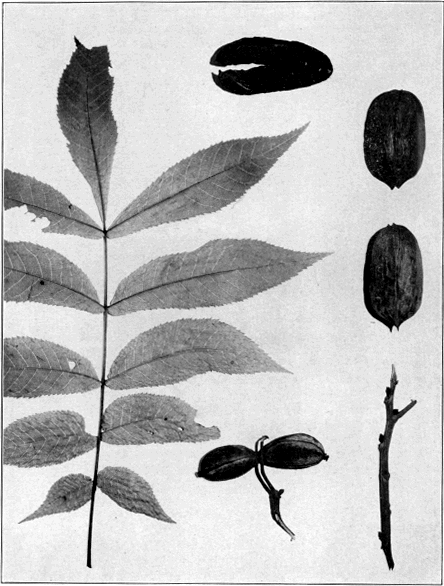
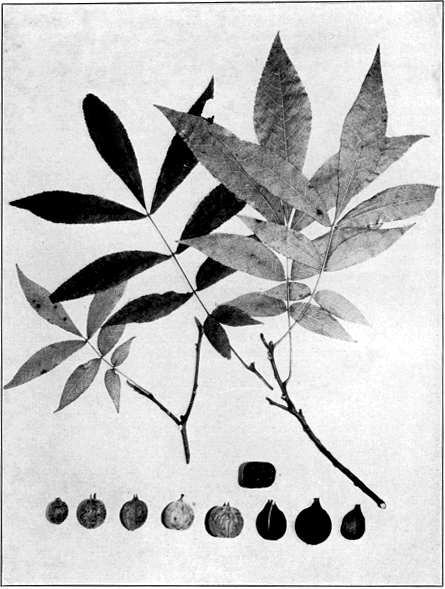
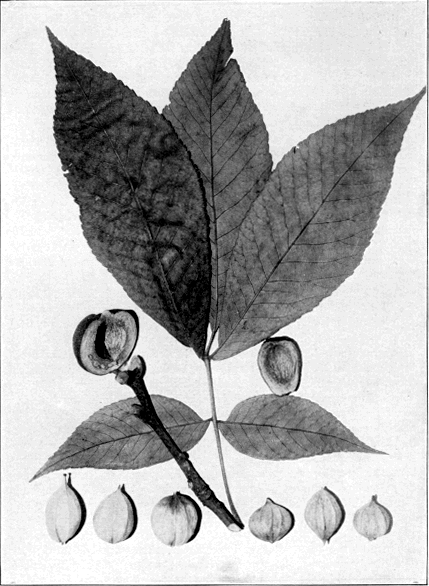
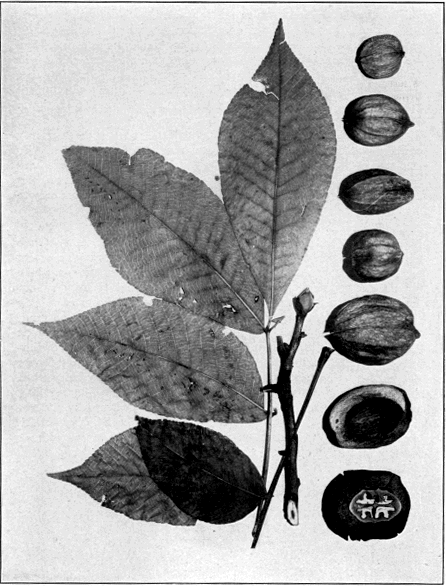
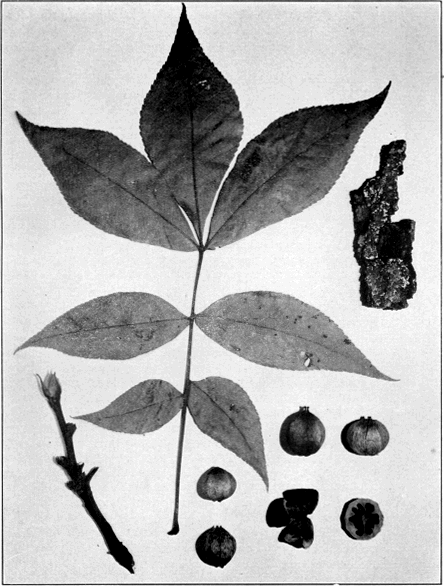
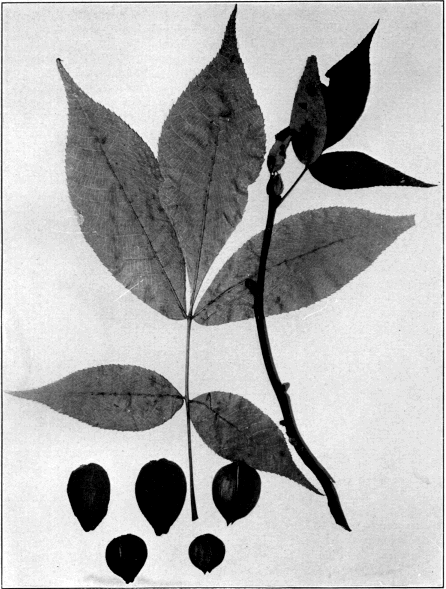
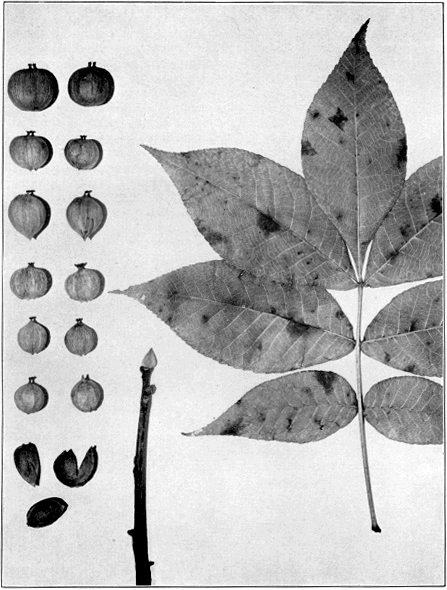
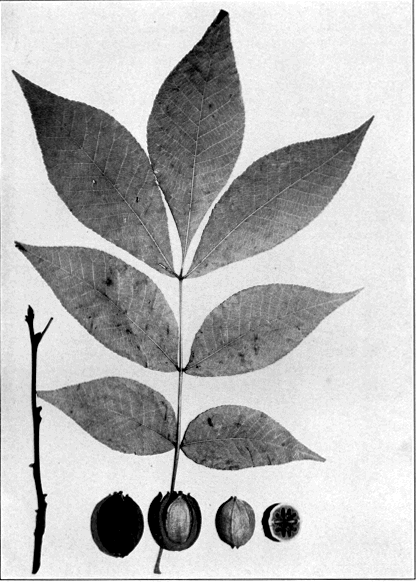
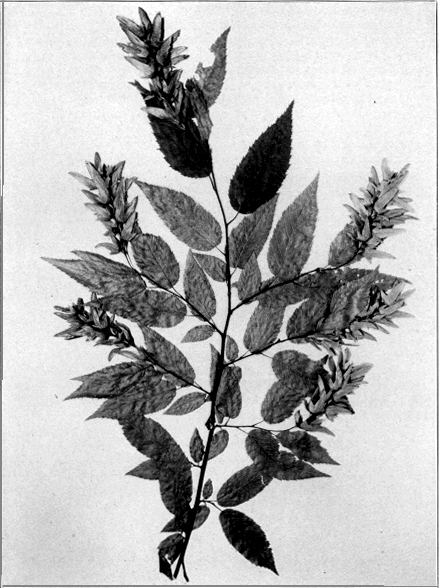
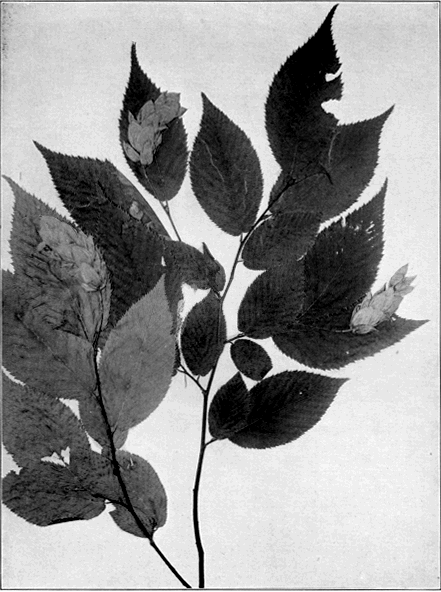
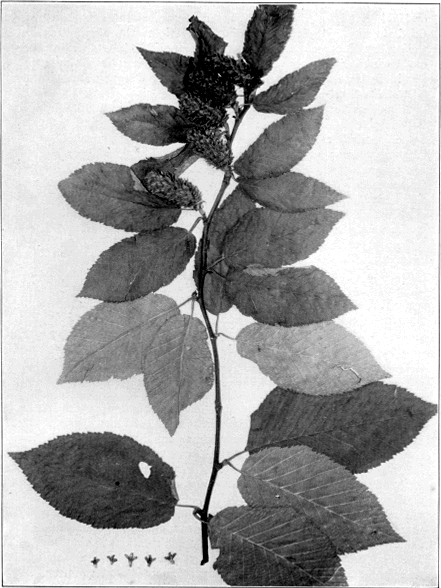
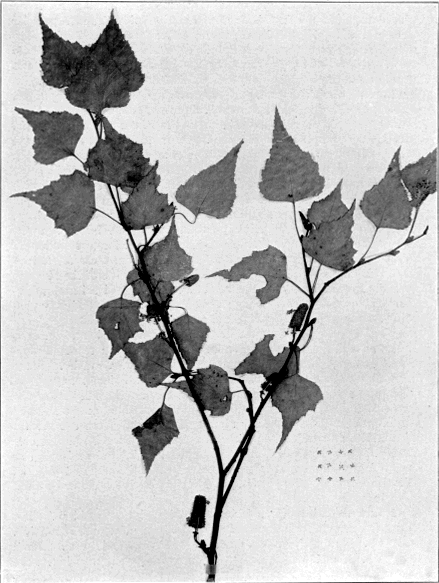
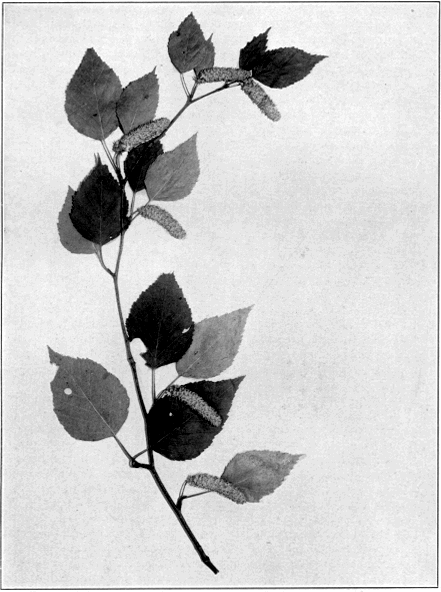
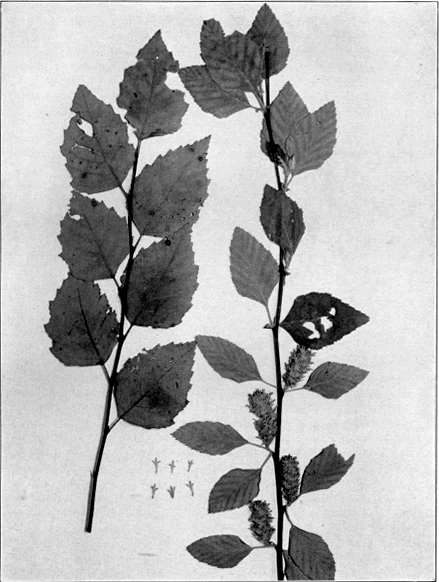
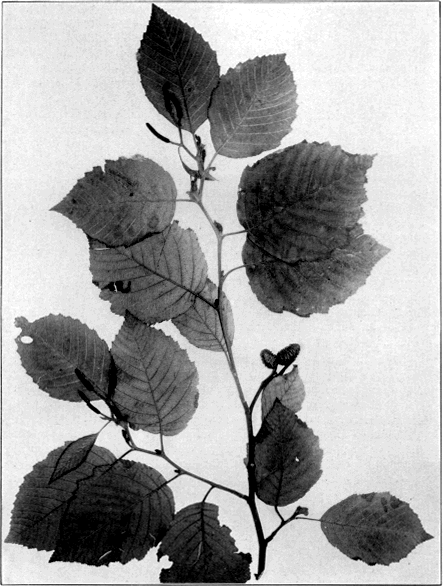
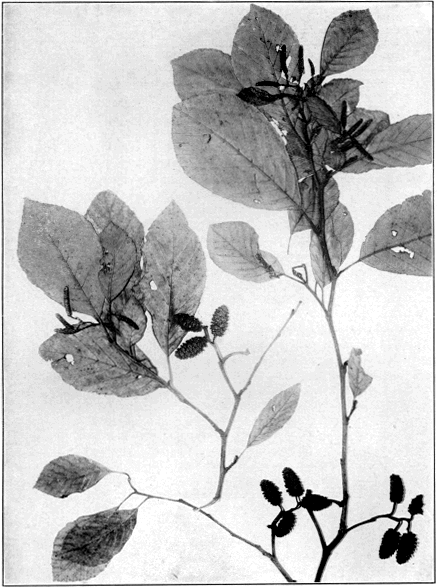
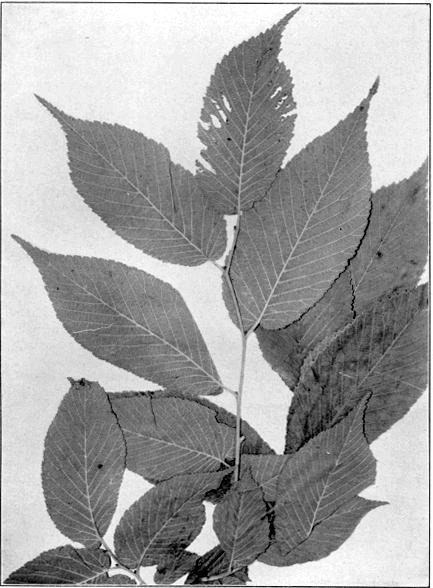
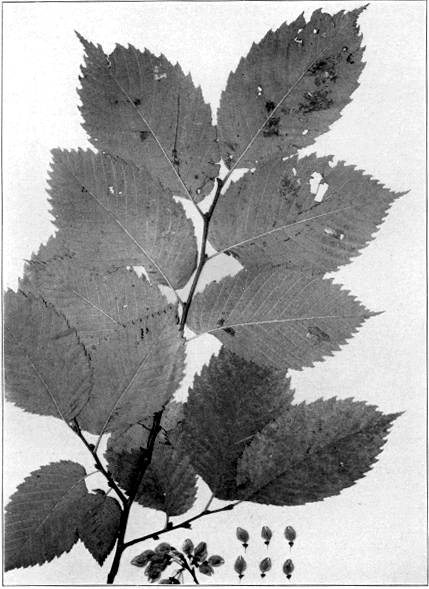
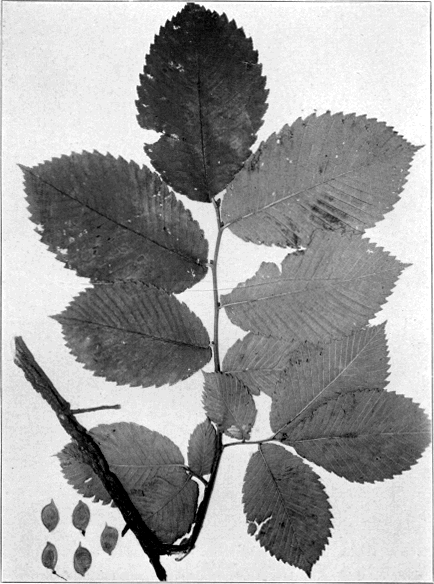
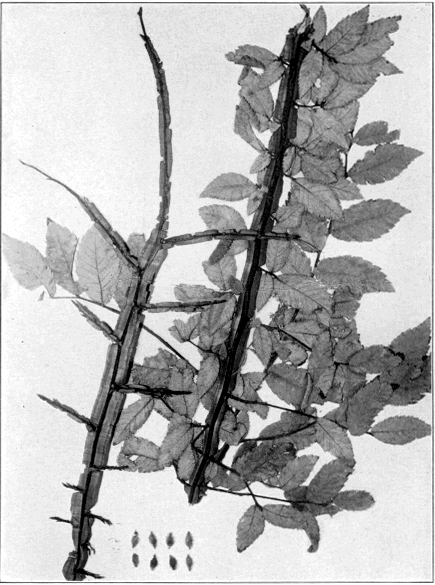
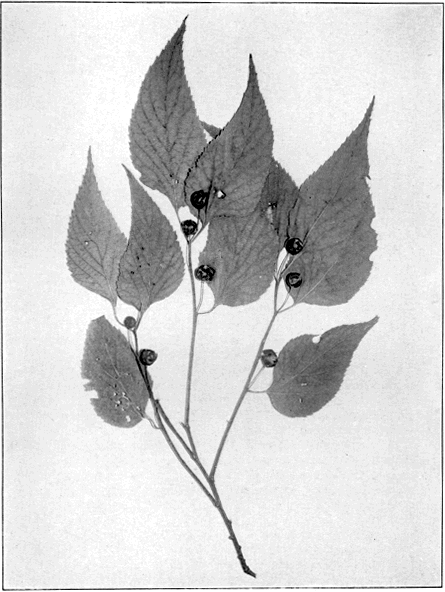
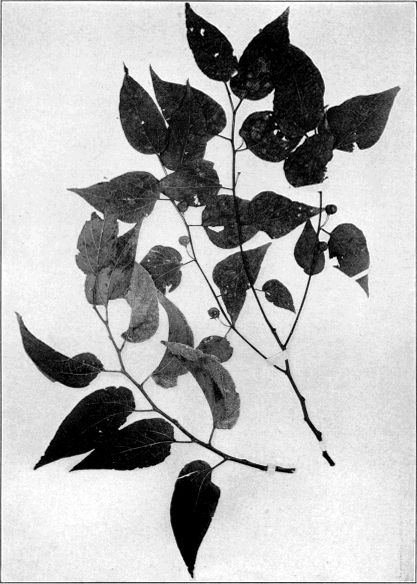
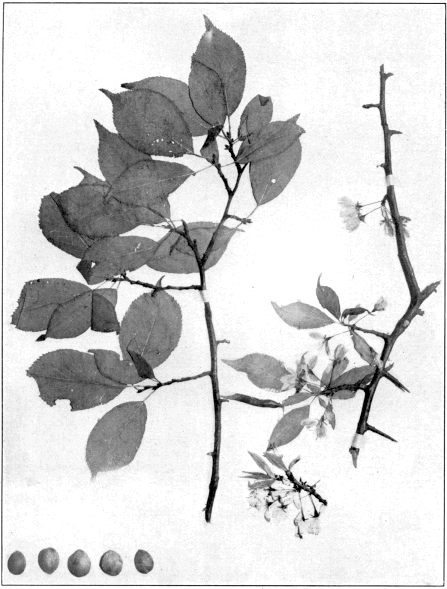
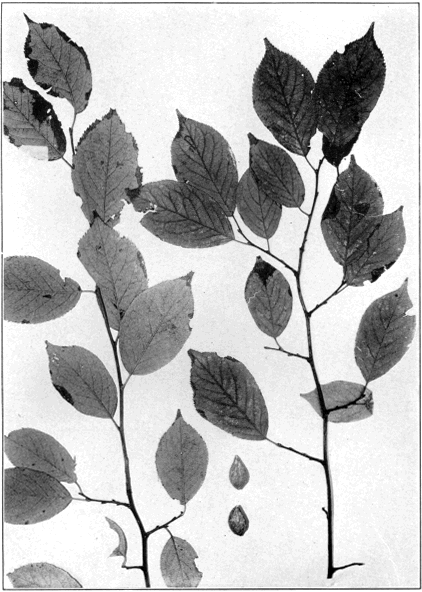
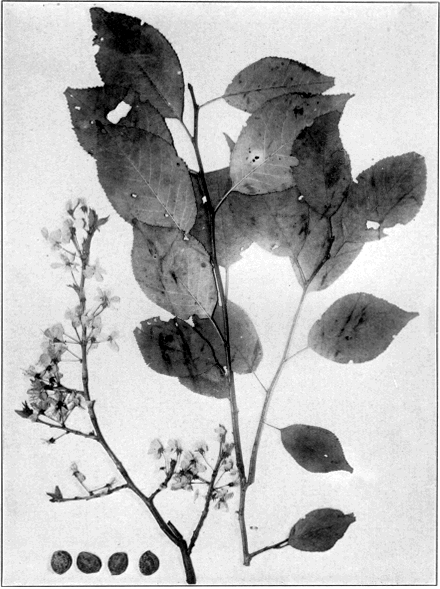
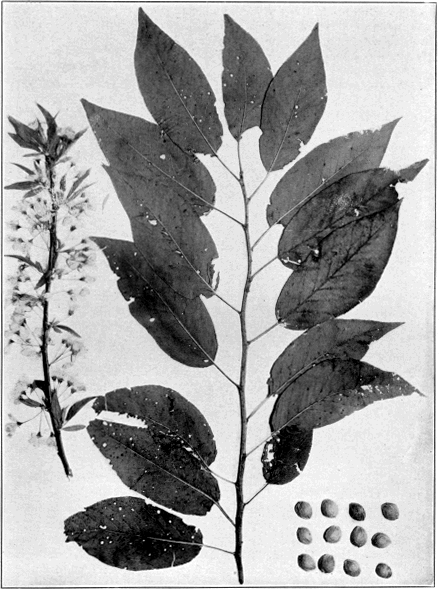
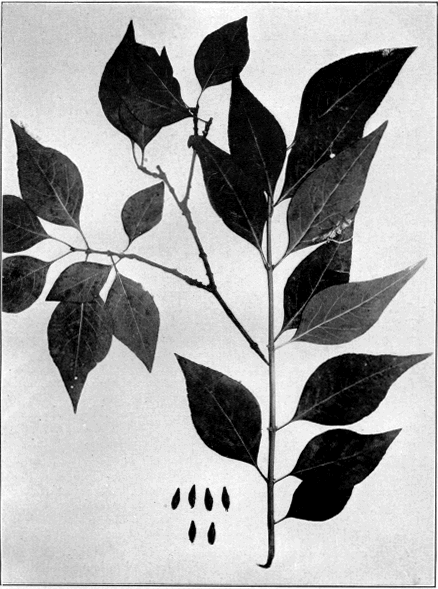
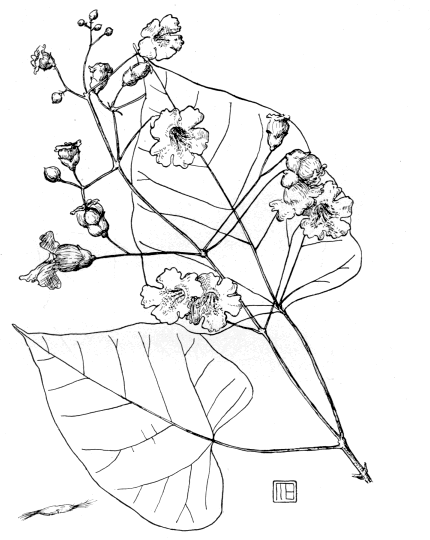
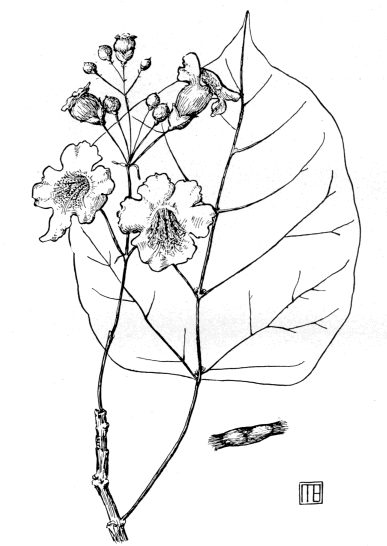
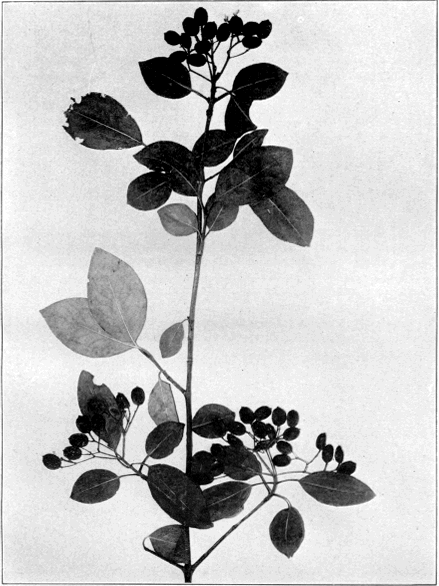
Trees with simple, alternate, petioled leaves; flowers of two kinds;
fruit a one-seeded nut. This is the most important family of trees
occurring in the State.
Winter buds long and slender, at least 4 times as long as wide;
staminate flowers in globose heads on drooping peduncles;
nuts sharply 3-angled |
1 Fagus. |
Winter buds not long and slender and less than 4 times as
long as wide; staminate flowers in slender catkins; nuts
not as above. |
|
Staminate catkins erect or spreading; nut flattened on one
side and enclosed in a spiny, woody husk |
2 Castanea. |
Staminate catkins drooping; nuts not flattened on one side,
seated in a scaly, woody cup |
3 Quercus. |
1. FÀGUS. The Beech.
Fagus grandifòlia Ehrhart. Beech.
Plate 38. Large tall trees
with bark from light to dark gray; twigs densely covered at first with
long hairs, soon becoming glabrous and turning to a reddish-brown;
terminal winter buds about 2 cm. long; leaves ovate to ovate-oblong,
long taper-pointed to merely acute, wedge-shape to cordate at base,
regularly and usually minutely serrate, average blades 7-12 cm. long,
silky when young, becoming at maturity glabrous above and nearly
so beneath except on the veins; flowers appear in May; fruit a bur,
supported on a club-shaped pubescent peduncle about 1.5 cm. long,
covered with short recurved prickles, densely rufous-pubescent, its 4-valves
enclosing the two triangular brown nuts; nuts edible; wood very
hard, strong, usually tough, difficult to season, close-grained, takes a
high polish, sap wood white, heart wood reddish.
Distribution.—Nova Scotia, southern Ontario to Wisconsin, south
to the Gulf States and Texas. It is found in every county of the State,
although it is local in the prairie and dry sandy regions of the northwestern
part of the State. It is a frequent to a very common tree on the
high ground in many parts of the State. If the high ground and hills
of the State are not forested with white and black oak, beech is almost
certain to be the prevailing species. Wherever beech is found it is
usually a frequent to a common tree, and it is not uncommon to see
areas which are almost a pure stand of this species. It is also a frequent
to a common tree in southern Indiana in what is called the
"flats." Here it is associated with sweet gum and pin oak. On the
slopes of hills of the southern counties it is associated with a great
variety of trees. In the central part of the State its most frequent
associate is the sugar maple. In the northern counties it has a wider
range of associates, including white oak, ash, slippery elm, buckeye,
ironwood, etc. It should be added that tulip is a constant associate
except in the "flats." In point of number it ranks as first of Indiana
trees.
Plate 38
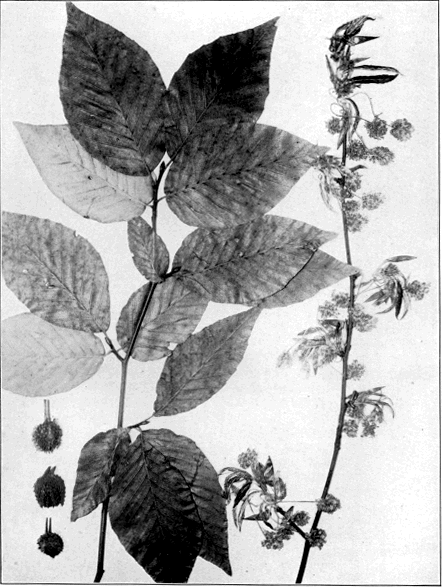
FAGUS GRANDIFOLIA Ehrhart. Beech. (× 1/2.)
Remarks.—Specimens with the habit of retaining their branches
which lop downward, usually have thicker sap wood and are harder to
split. This form is popularly styled the white beech. The form with
smooth tall trunks with upright branches usually has more heart wood,
splits more easily and is popularly distinguished as red beech. The term
yellow beech is variously applied. This species is a large tree in all
parts of the State, although the largest specimens are found in the
southeastern part of the State. In the virgin forests trees almost 1
m. in diameter and 30 m. high were frequent.
Beech was formerly used only for fuel, but in the last few decades
it has been cut and used for many purposes, and the supply is fast
diminishing. The beauty of this tree both in summer and winter,
sunshine or storm makes it one of the most desirable for shade tree
planting, but I have failed to find where it has been successfully used.
It is one of the few trees that does not take to domestication. When
the original forest is reduced to a remnant of beech, as a rule, the
remaining beech will soon begin to die at the top. It is difficult to
transplant. When planted the hole should be filled with earth obtained
from under a living tree, in order to introduce the mycorrhiza
that is necessary to the growth of the tree.
2. CASTÀNEA. The Chestnut.
Castanea dentàta (Marshall) Borkhausen.
Chestnut. Plate 39.
Large trees with deeply fissured bark, smooth on young trees; young
twigs more or less hairy, soon becoming glabrous and a reddish-brown;
leaves lanceolate, average blades 13-22 cm. long, taper-pointed, wedge-shape
or obtuse at the base, coarsely serrate, teeth usually incurved,
at maturity glabrous on both sides; flowers appear after the leaves in
the latter part of June or early in July, the staminate catkins from
the axils of the leaves of the year's growth, 1.5-3 dm. long, pistillate
flowers in heads on short stalks in the axils of the leaves, usually on
the branch beyond the greater part of the staminate catkins; fruit
a globular spiny bur 5-7 cm. in diameter which contains the nuts;
nuts usually 1-3, rarely 5, flattened on one side, edible; wood light,
soft, not strong, checks and warps on seasoning, yellowish-brown,
durable in contact with the ground.
Plate 39
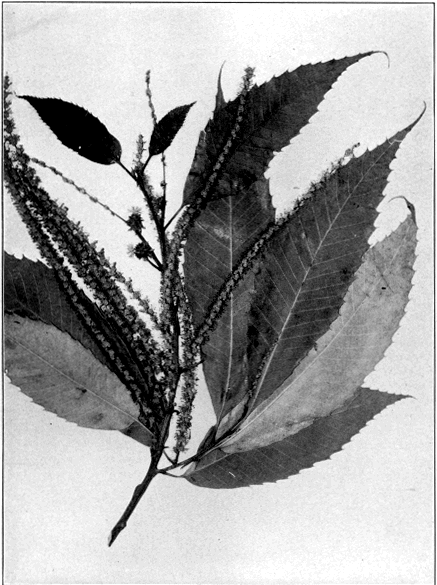
CASTANEA DENTATA (Marshall) Borkhausen. Chestnut. (× 1/2.)
Distribution.—Maine, southern Ontario, Michigan, south to Delaware
and in the mountains to Alabama, and west to Arkansas. In
Indiana it is found locally in the south central counties. The most
northern station where I have seen trees that are native to a certainty
is in Morgan County a short distance north of Martinsville. There
are a few trees on the south bank of White River in Mound Park about
2 miles east of Anderson. This site was formerly an Indian village, and
the trees may have been introduced here. The late A. C. Benedict
formerly of the State Geological Survey, told me he saw a colony in
1878 in Fayette County on the farm of Dr. B. Ball, about 3 miles west
of Connersville on the east side of Little Williams Creek. The trees
were at least 6 dm. in diameter. The western line of distribution would
be a line drawn from Martinsville to a point a few miles west of Shoals
and south to Tell City.
Remarks.—The greatest numbers of this species are found on the
outcrops of the knobstone in Clark, Floyd, Harrison, Jackson, Lawrence,
Martin, Orange and Washington Counties. It grows on high ground,
associated with white and black oak, beech, etc. The species in all of
our area grows to be a large tree. In the Ind. Geol. Rept. 1874:70:1875
there is a reference to a "stump in Jackson County that was 9 ft. and
2 in. in diameter." This species is rather gregarious in habit, and
rarely are isolated trees found. It is quite local in its distribution,
but where found it is usually a common tree. The bark was much used
in tanning, and the timber for poles, ties and posts. The demand for
this species has led to heavy cutting, so that the present supply is practically
limited to inferior or small trees. The nut crop in this State
is usually badly infested by the weevil.
This species is easily propagated by seed or seedlings. It is recommended
for forest planting in all parts of its natural range and other
parts of the State where the soil is very sandy and free from limestone.
This species never attains to an old age when growing close to the
limestone. It grows rapidly and requires little pruning. The only
objection to planting it for forestry purposes is that it might be infested
by the chestnut bark disease which is fatal to this tree. This
disease is far to the east of us, and there are wide barriers to its western
migration. Since a chestnut grove would soon grow into post and
pole size, in the event the grove would be killed by the bark disease,
the crop could be harvested and the loss would be more of the nature
of a disappointment than a financial one. If planted in a cleared area
the seedlings should be spaced about 5×5 feet if no cultivation can
be done. If the trees can be cultivated, plant 7×7 or 8×8 feet and
grow corn for one or two years between the rows.
3. QUÉRCUS. The Oaks.
The leaves of Indiana oaks are deciduous; flowers appear in April
or May, very small, the staminate on slender pendulous catkins, the
pistillate solitary or in clusters in scaly bud-like cups; fruit an acorn
which takes one or two years to mature, ripening in September or
October. The species that mature their fruit the first year are popularly
and commercially classed as "white oaks." Those that mature
their fruit the second year are classed as "red, black or bristle-tipped
oaks."
The oaks are the largest genus of Indiana trees, and commercially
are the most important of all trees of the State. They are the longest
lived of all the trees that occur in the State, and while they have
numerous insect enemies none of them prove fatal to it, except a certain
gall insect.
Note:—In collecting leaf specimens of oaks for identification it
should be borne in mind that the foliage is quite variable. The leaves
of seedlings, coppice shoots and of vigorous shoots of old trees sometimes
vary considerably in size, form and leaf-margins. Also leaves of
old trees that grow in the shade usually have the margins more nearly
entire than the typical leaves. For example leaves may be found on
the lower and interior branches of a pin oak which are not lobed to
beyond the middle, which throws them into the red oak group.
Bark gray, (except in No. 5) more or less scaly; mature leaves
never with bristle tips; fruit maturing the first year. |
|
Mature leaves smooth beneath |
1 Q. alba. |
Mature leaves pubescent beneath. |
|
Primary veins beneath show regular pinnate venation.
Some of the primary veins beneath end in a sinus |
2 Q. bicolor. |
All primary veins beneath end in teeth of the margin
Tips of leaves of fruiting branches sharp-pointed,
usually forming an acute angle; fruit sessile or
nearly so |
3 Q. Muhlenbergii. |
Tips of leaves of fruiting branches rounded or if
sharp-pointed, it rarely forms an acute angle;
fruit peduncled. |
|
Petioles green and woolly pubescent beneath
(rarely almost glabrous); under surface of
leaves velvety to the touch; bark gray, scaly,
of the white oak type; trees of low ground |
4 Q. Michauxii. |
Petioles yellowish and smooth beneath, or rarely
somewhat pubescent; under surface of leaves
not velvety to the touch; bark dark, and
tight, of the red oak type; trees of high ground
(in Indiana confined to the "knobstone" area) |
5 Q. Prinus. |
Primary veins beneath show irregular venation. |
|
Last year's growth pubescent; acorns generally less
than 12 mm. in diameter |
6 Q. stellata. |
Last year's growth glabrous or nearly so; acorns more
than 12 mm. in diameter. |
|
Leaves sinuate dentate, sometimes lobed near the
base, velvety to the touch beneath; peduncles
of fruit longer than the petioles |
2 Q. bicolor. |
Leaves irregularly lobed, harsh or rarely velvety or
smooth to the touch beneath; peduncles of fruit
shorter than the petioles. |
|
Cup of fruit fringed; apex of lobes of leaves generally
rounded; trees of lowland |
7 Q. macrocarpa. |
Cup of fruit not fringed; apex of lobes of leaves
generally acute; trees of swamps in the extreme
southwestern counties of Indiana |
8 Q. lyrata. |
Bark dark, tight and furrowed; leaves with bristle tips; fruit
maturing the second year. |
|
Leaves entire |
9 Q. imbricaria. |
Leaves more or less deeply lobed, the lobes and teeth conspicuously
bristle pointed. |
|
Mature leaves smooth beneath, except tufts of hairs in
the axils. |
|
Leaves lobed to about the middle, the lateral lobes
broadest at the base; cup saucer-shaped; nut about
1.5-2 cm. in diameter; terminal buds reddish |
10 Q. rubra. |
Leaves lobed to beyond the middle, frequently those
grown in dense shade not so deeply lobed, some or
all of the lateral lobes broadest toward the apex. |
|
Cup saucer-shaped, rarely enclosing the nut for
more than 1/3 its length; trees of the low lands
and swamps. |
|
Leaves glossy above; blades usually 10-12 cm. long;
cups usually 1.5 cm. or less broad; terminal
buds chestnut brown |
11 Q. palustris. |
Leaves dull above, usually about 15 cm. long; cups
1.5-2.5 cm. broad, rarely as narrow as 1.5 cm.;
terminal buds grayish brown |
12 Q. Schneckii. |
Cup hemispheric, generally enclosing the nut for
half its length; trees of the uplands. |
|
Inner bark yellowish or orange; kernel of nut
yellowish or orange, and very bitter. |
|
Terminal buds usually 5 mm. or less in length,
ovoid and generally blunt, reddish-brown;
scales of cup closely appressed; trees local
in the extreme northwest part of the
State |
13 Q. ellipsoidalis. |
Terminal buds usually longer than 6 mm., usually
angled and sharp-pointed; scales of cup not
closely appressed; trees of all parts of the
State |
14 Q. velutina. |
Inner bark reddish or gray; kernel white and not
very bitter |
15 Q. coccinea. |
Mature leaves more or less pubescent on the whole under
surface. |
|
Leaves grayish or yellowish pubescent beneath; scales
of cup with a reddish-brown border; nut enclosed
for about 1/3 its length |
16 Q. falcata. |
Leaves brownish or rusty pubescent beneath, sometimes
appearing grayish; scales of cup without a
dark border; nut enclosed for about half of its length. |
|
Leaves expanded at the apex, and generally with
three lobes; mature twigs generally scurvy-pubescent |
17 Q. marilandica. |
Leaves deeply lobed; mature twigs generally glabrous |
14 Q. velutina. |
1. Quercus álba Linnæus. White Oak.
Plate 40. Large
trees with gray, fissured bark, flaky on the branches, on the upper part
of the trunks of some trees the bark loosens at the fissures and peels
back, forming flat strips which remain attached at one side; twigs at
first hairy, becoming smooth; leaves mostly obovate in outline, generally
8-20 cm. long on petioles 0.5-2 cm. long, more or less deeply lobed into
5-9 lobes, the lobes ascending and generally blunt and entire, sometimes
the lobes have one or two secondary lobes, leaves narrowed and oblique
at the base, smooth above, smooth and glaucous beneath; acorns sessile
or on stalks up to 2 cm. long; nuts quite variable on different trees
as to size and shape, ovoid or oblong, 18-30 mm. long; cup flat on the
bottom, tuberculate and encloses about 1/4 of the nut; scales blunt and
woolly.
Distribution.—Maine, southern Ontario, Minnesota south to
Florida and Texas. Found in all parts of Indiana. In point of number
it is exceeded only by the beech, although it has a more general distribution.
It is adapted to many types of soil, and is found in almost all
situations in Indiana except in very wet soils. It is sparingly found
in the sand dune area. On the clay soils of the northern part of the
State it is a frequent to an abundant tree, and in the southern part of
the State it often forms complete stands on the slopes of the hills.
The white oak is one of the largest and possibly the longest lived
tree of Indiana. While it is able to adapt itself to many situations,
it grows to the largest size in a porous, moist and rich soil.
Remarks.—Wood heavy, hard, close-grained, tough, strong and
durable. On account of its abundance, and wide range of uses, it has
always been the most important timber tree of Indiana.
Formerly the woods were full of white oak 1-1.5 meters (3-5 ft.) in
diameter, but today trees of a meter (3 ft.) in diameter with long
straight trunks are rare indeed. Michaux who traveled extensively in
America 1801-1807, while the whole Mississippi Valley was yet a wilderness,
remarks: "The white oak is the most valuable tree in America."
He observed the ruthless destruction of this valuable tree, and
predicted that the supply would soon be depleted, and that America
would be sorry that regulations were not adopted to conserve the supply
of this valuable tree. Michaux's prediction has come true, and yet no
constructive measures have been provided to insure the Nation an adequate
supply of this timber. It should be remembered that it requires
two to three hundred years to grow a white oak a meter in diameter,
and if we are to have white oak of that size in the next generation the
largest of our present stand must be spared for that harvest.
Plate 40
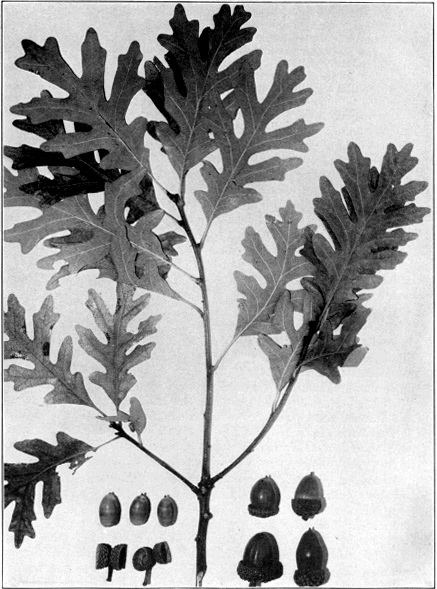
QUERCUS ALBA Linnæus. White Oak. (× 1/2.)
Acorns from different trees to show variation.
White oak was formerly much used in construction work, but it has
become so costly that cheaper woods take its place. At present it is
used principally in cooperage, interior finish, wagon and car stock,
furniture, agricultural implements, crossties, and veneer. Indiana has
the reputation of furnishing the best grade of white oak in the world.
Little attention has been given this valuable species either in horticultural
or forestal planting. This no doubt is due in a great measure
to the slow growth of the tree. It should be used more for shade tree,
ornamental and roadside tree planting. There are good reasons why
white oak should be much used in reforestation. The cheapest and
most successful method of propagating white oak is to plant the seed
in the places where the trees are desired to grow. This is best done by
planting the acorns as soon as they fall or are mature. The best results
will be obtained if the nuts are planted with the small end down, and
covered about an inch deep with earth. If the ground is a hard clay
soil and the small end of the nut is placed down a half inch of earth on
the nut is sufficient. Rodents often destroy the nuts, and if this
danger is apprehended it is best to poison the rodents or to stratify the
seed, or grow seedlings and plant them when they are one year old. In
forestal planting it is suggested that the planting be 4×4 feet.
The white oak is quite variable in the lobing of the leaves, and in
size and shape of the fruit, and in the length of its peduncle. The
variable lobing of the leaves has lead several authors to describe varieties
based on this character. The latest is that of Sargent[32] who describes:
"The trees with leaves less deeply divided, with broad rounded
lobes and usually smaller generally sessile fruit," as Quercus alba
variety latiloba.
Quercus alba × Muhlenbérgii (× Quercus Deami Trelease). This
rare hybrid was discovered in a woods about 3 miles northwest of
Bluffton Indiana by L. A. Williamson and his son E. B. Williamson in
1904.[33]
The tree is still standing and in 1918 bore a heavy crop of seed. A
liberal quantity was sent for propagation to the Arnold Arboretum,
New York Botanical Gardens, and Missouri Botanical Gardens. The
Arboretum succeeded in germinating several seed. The New York
Gardens succeeded in getting 5 seedlings. The Missouri Gardens failed
to get any to germinate. About a gallon of seeds was planted in the
Clark County State forest nursery and all failed.
2. Quercus bícolor Willdenow.
Swamp White Oak. Plate 41.
Large trees; leaves on petioles 5-20 mm. long, 8-18 cm. long, obovate,
wedge-shaped or narrowly rounded at base, rounded or pointed at the
apex, margins coarsely divided with rounded or blunt teeth or somewhat
pinnatifid, primary venation beneath somewhat regular, but usually
some of the veins end in a sinus of the margin, both surfaces hairy at
first, becoming smooth above and remaining velvety pubescent beneath;
the upper surface of the leaf a bronze or dark green and the under surface
grayish due to the dense tomentum, which in some instances becomes
sparse and short, in which case the under surface is a light green;
acorns usually in pairs on stalks 2-7 cm. long; nuts ovoid, 2-2.5 cm. long,
enclosed for 1/3-1/2 their length in the cup; scales of cup acute to
very long acuminate, scurvy pubescent and frequently tuberculate;
kernel sweetish.
Distribution.—Maine, southern Ontario, southern Minnesota south
to Georgia and Arkansas. Found in all parts of Indiana. It is always
found in wet places. In most of its range it is associated with the bur
oak from which it is not commonly separated. In the northern counties
it is usually associated with pin and bur oak, and white elm; in the flats
of the southeastern part of the State it is usually associated with cow
oak and sweet gum, while in the southwestern counties it is found most
commonly with Spanish and pin oak.
Remarks.—Commercially the wood is not distinguished from white
oak, and the cut is sold for that species.
3. Quercus Muhlenbérgii Engelmann. Chinquapin Oak. Sweet
Oak. Yellow Oak. Chestnut Oak.
Plate 42. Large trees; leaves
on petioles 1-3 cm. long, blades very variable in size, shape and leaf
margins, generally 10-20 cm. long, oblong-lanceolate to broadly obovate,
narrowed or rounded and more or less unequal at the base, taper-pointed
at the apex, the apex always forming an acute angle, margins coarsely
and rather regularly toothed, primary veins beneath regular and
straight, and end in a prominent gland in the point of the teeth, teeth
more or less incurved, leaves smooth and dark green above, and grayish
pubescent beneath; acorns generally sessile, but often on short stalks
up to 1 cm. long; nut ovoid to oblong ovoid, 10-18 mm. long, enclosed
for 1/4-1/2 its length in a very thin cup; scales of cup ovate, blunt-pointed
or merely acute, sometimes tuberculate near the base of the
cup, grayish pubescent without; kernel sweet, and the most edible of
all of our oaks.
Plate 41
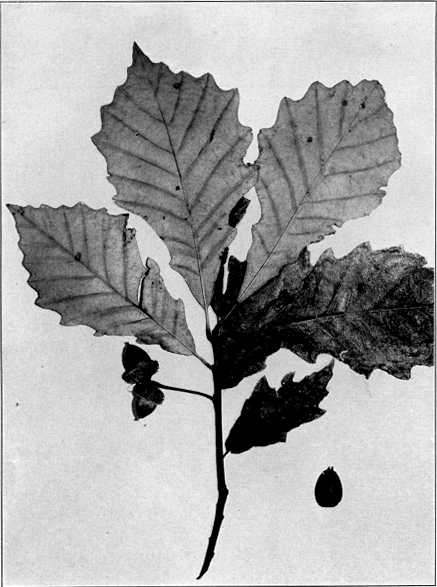
QUERCUS BICOLOR Willdenow. Swamp White Oak. (× 1/2.)
Plate 42
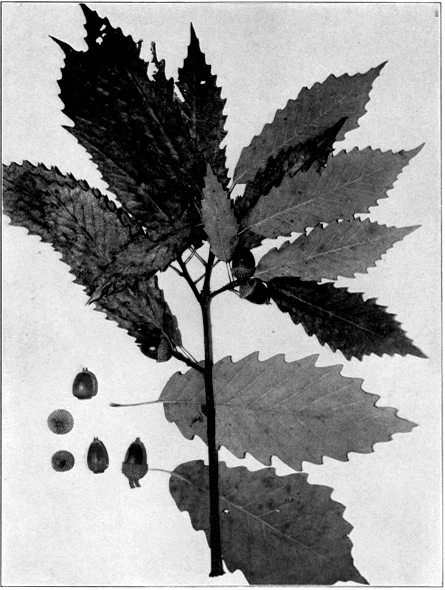
QUERCUS MUHLENBERGII Engelmann. Chinquapin Oak. (× 1/2.)
Detached acorns and leaves from different trees.
Distribution.—Vermont, southwestern Ontario to Wisconsin and
south to Florida and west to Texas. Found in limited numbers in all
parts of Indiana, although Hill's record for Lake county is the only
record in the block of the 12 northwest counties. It is without a doubt
found in every county south of the Wabash River. It is a rare or an
infrequent tree in practically all parts of its range. It is generally found
on the dry banks of streams, river terrace banks, rocky bluffs of streams,
and only rarely in level dry woods. In the southern counties it is
sometimes found on clay or rocky ridges. In most of its range it is
now so rare that most of the inhabitants do not know the tree.
Remarks.—Wood similar to white oak, and with the same uses.
In White County a pioneer was found who knew the tree only by
the name of pigeon oak. He said it received this name from the fact
that the wild pigeons were fond of the acorns.
The leaves of this tree vary greatly in size, shape, and leaf margins.
The fruit also varies on different trees in the shape of the nut, and
the depth of the cup. These variations have lead some authors to
separate the forms and one histological study[34] seems to support minor
differences. It has been observed that the leaves in the top of some
trees may be thick, narrow and with long incurved teeth, while the
leaves of the lower branches will be strongly obovate, thinner, and the
teeth more dentate. In a general study it is best to include the polymorphic
forms under one name. The distribution of the shallow
and deep cup forms is so general that no regional or habitat areas can
be assigned to either of them in Indiana.
4. Quercus Michaúxii Nuttall (Quercus Prinus Sargent). Cow
Oak. Basket Oak.
Plate 43. Large trees; leaves on petioles 1-3 cm.
long, generally 1-2 dm. long, obovate, narrowed or narrowly rounded
at the base, short taper-pointed, the apex generally blunt, the margins
coarsely toothed, the teeth broad and rounded or more rarely
acute, shaded leaves sometimes with margins merely undulate, hairy on
both surfaces when young, becoming at maturity a dark yellow green
and glabrous above, sometimes remaining somewhat pubescent along
the midrib and the principal veins, leaves grayish and woolly pubescent
beneath; acorns solitary or in pairs, sessile or on very short stalks, up to
almost a cm. in length; nuts ovoid or oval with a broad base, enclosed
for about 1/3 their length by the cup, the cups thick and generally
2-3 cm. broad; scales ovate, acute, rather blunt-pointed and more or
less tuberculate near the base of the cup, tomentose on the back; kernel
sweet.
Plate 43
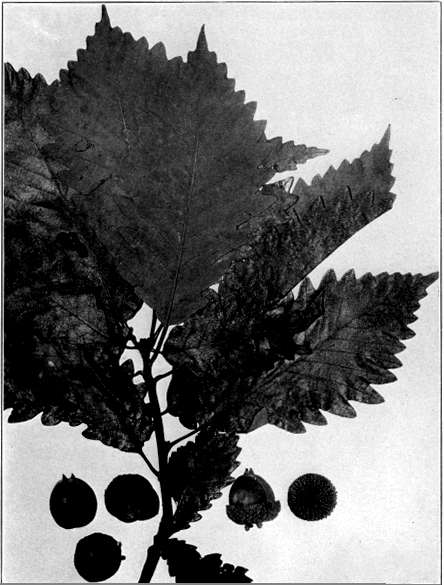
QUERCUS MICHAUXII Nuttall. Cow or Basket Oak. (× 1/2.)
Distribution.—Delaware, southern Indiana, Missouri, south to
Florida and west to Texas. In Indiana it is believed that its distribution
is pretty well known and well defined. It is an inhabitant of low
wet woods, although large trees may be found in fairly dry woods which
have been made dry by drainage. In discussing the distribution it must
be remembered that this species was reported as Quercus Prinus before
the sixth edition of Gray's Manual which was published in 1890.
Gorby's[35] reference to Miami County should be ignored, because he
compiled his list of trees from a list of common names to which he
appended the scientific names. His list includes several species which
are not native, and his water willow (Dianthera americana) is an herbaceous
plant. Wilson's[36] report for Hamilton County I believe also
to be an error. Wilson preserved no specimen. Since Hamilton County
has no cow oak habitat, and Wilson was not acquainted with the
species, I think this reference should be transferred to the broad-leaf
form of Quercus Muhlenbergii. The author has collected and
distributed authentic specimens from a point 21/2 miles southwest of
Napoleon in Ripley County. This species is reported by Meyncke for
Franklin County as scarce, and by Collins for Dearborn County. Since
the habitat of the species is found in these counties, it is fair to admit
them into the range of the species. This species is a frequent to a very
common tree in the flats of Clark, Scott, Jefferson, Jackson, Jennings,
and Ripley Counties, where it is usually associated with beech and
sweet gum. It is now known to range as far north as the northern parts
of Jackson, Jennings and Ripley Counties. It is an infrequent tree of
the Lower Wabash Valley as far north as southern Knox County and
no doubt followed eastward along White River. It follows the Ohio
River eastward at least to a point six miles east of Grandview in Spencer
County. It no doubt was an occasional tree along the Ohio River up
to Dearborn County. It has also been reported by Aiken for Hamilton
County, Ohio. In the Lower Wabash Valley it is associated with
Spanish and pin oak.
Remarks.—Wood and uses similar to white oak. In the flats of
southeastern Indiana it is generally called white oak, and in some
places it is known as bur oak. It grows very rapidly and to a large size.
A tree was measured in 1919 in the Klein woods about 4 miles north of
North Vernon that was 3.57 meters (11 feet, 7 inches) in circumference,
breast high, and was estimated to be 15 m. (50 feet) to the first branch.
This species when grown in the open forms a large oval head, and in
moist soil would make one of the best shade and roadside trees to be had.
It is not known how it would adapt itself to high ground, but it is
believed this species is worthy a trial as a shade tree. It is apparently
hardy in the northern counties.
Quercus Bèadlei Trelease. (Quercus alba × Michauxii). This hybrid
between the white and cow oak was found by the writer in 1913 in
the White River bottoms 3 miles east of Medora in Jackson County.
The tree measured 3.54 meters (139 inches) in circumference breast
high. Specimens were distributed under No. 19,037, and the determination
was made by William Trelease, our leading authority on oaks.
5. Quercus Prìnus Linnæus. (Quercus montana Willdenow of some
recent authors). Chestnut Oak. Plate 44. Medium to large sized
tree; bark dark, tight, deeply fissured, the furrows wide, and the
ridges continuous; leaves on petioles 1-3 cm. long, 1-2 dm. long, obovate
to lanceolate, those growing in the shade usually the widest, rounded at
the base, usually narrowly so or even wedge-shaped, short or long taper-pointed
at the apex, the apex blunt, margins coarsely and nearly regularly
crenate-toothed, the teeth broad and rounded, dark green above
at maturity, a lighter and usually a yellow or grayish green beneath,
only slightly hairy above when young, soon becoming entirely glabrate,
very pubescent beneath when young and usually remaining so until
maturity; petioles, midrib and primary veins beneath are usually
conspicuously yellow, which is a distinctive character of this species;
acorns solitary or in pairs, on short stalks usually about 1 cm. long,
sometimes sessile; nuts large ovoid or oblong-ovoid, 2-3 cm. long, enclosed
generally for about 1/3 their length in a thin cup; scales with
triangular blunt tips, generally somewhat tuberculate and pubescent
on the back; kernel sweet.
Distribution.—Maine, northern shore of Lake Erie, to west central
Indiana and south to northern Georgia and Alabama. In Indiana its
distribution is limited to the knobstone and sandstone area of the State.
Its distribution has been fairly well mapped. Two large trees on the
edge of the top of the bluff of the Ohio River at Marble Hill which is
located in the south corner of Jefferson County is the eastern limit of its
range. It crowns some of the ridges, sometimes extending down the
adjacent slopes a short distance, from Floyd County north to the south
side of Salt Creek in Brown County. Its range then extends west to the
east side of Monroe County, thence southwestward to the west side of
Martin County, thence south to the Ohio River. Where it is found it is
generally such a common tree that the areas are commonly called
chestnut oak ridges and are regarded as our poorest and most stony land.
In Floyd and Clark counties it is usually associated with scrub pine.
In the remainder of its range it is generally associated with black jack
post and black oaks. In our area this species is never found closely
associated with limestone, and reports of this species being found on
limestone areas should be referred to Quercus Muhlenbergii.
Plate 44
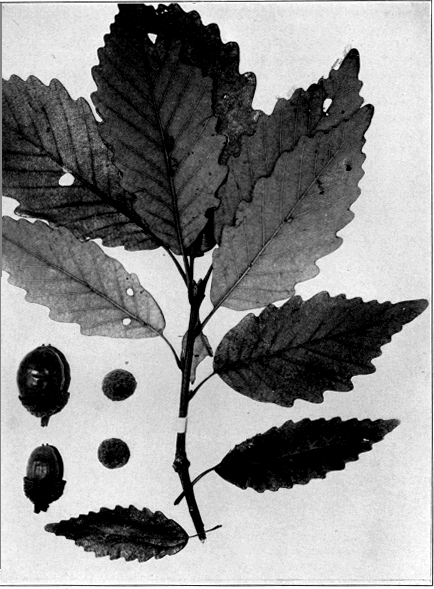
QUERCUS PRINUS Linnæus. Chestnut Oak. (× 1/2.)
Acorns and loose leaves from different trees.
Remarks.—Wood similar and uses generally the same as white oak.
The tree usually grows in such poor situations that it never acquires
a large diameter, and it is only when a tree is found in a cove or in richer
and deeper soil that it grows to a large size. The amount of this species
is very limited and it is therefore of no especial economic importance as
a source of timber supply. The bark is rich in tannin. The crests of
chestnut oak ridges are often cut bare of this species. The trunks are
made into crossties, and the larger branches are peeled for their bark.
The nuts germinate on top of the ground as soon as they fall, or even
before they fall. Usually a large percentage germinate. The tree
grows rapidly where soil conditions are at all favorable. It is believed
that this species should be used to reforest the chestnut oak ridges of
the State, and possibly it would be one of the best to employ on the
slopes of other poor ridges.
6. Quercus stellàta Wangenheim. Post Oak. Plate 45. Medium
to large trees; bark resembles that of the white oak except on old trees
the fissures are deeper when compared with a white oak of equal size,
and the ridges are usually broken into shorter lengths; twigs stout,
yellowish-brown at first, remaining this color more or less to the end of
the season, at first densely covered with hairs which remain throughout
the season, and usually one year old branchlets are more or less tomentose;
leaves on hairy petioles 0.3-3 cm. long, generally about 1 cm.
long; leaves obovate in outline, commonly 1-2 dm. long and about 2/3
as wide, and generally lobed into five principal lobes which are disposed
as follows: the two basal are formed by two deep sinuses just below the
middle of the leaf which cut off a large roughly triangular portion, one
angle of which forms the base, the top two angles prolonged on each
side into a rounded lobe which may be long or short; the terminal lobe is
produced by two deep sinuses which constrict the blade at about
1/4-1/3 its length from the apex; the two basal and two terminal
sinuses form the two lateral lobes which in size are equal to about one
half of the leaf area; the lateral lobes are generally ascending with the
terminal portion usually indented with a shallow sinus which produces
two short lobes; the terminal lobe of the leaf commonly has two or
three shallow secondary lobes; all the lobes of the leaf are rounded; base
of leaf narrowed or rounded; leaves very thick at maturity, when they
first appear both surfaces are densely covered with a yellowish pubescence,
at maturity the upper surface is a dark glossy green, and smooth
or nearly so, except some leaves retain fascicles of hairs, and the midrib
and principal veins may be more or less rough pubescent, the under
surface at maturity is a gray-green, and remains more or less densely
covered with fascicles of hairs; acorns single or in clusters, sessile or
nearly so; nuts small, ovoid 10-15 mm. long and 6-10 mm. wide, inclosed
for about 1/2 their length in the cup; scales ovate, gray or reddish
brown, tomentose on the back, blunt except those near the top of the
cup which are sometimes acute; kernel sweet.
Plate 45
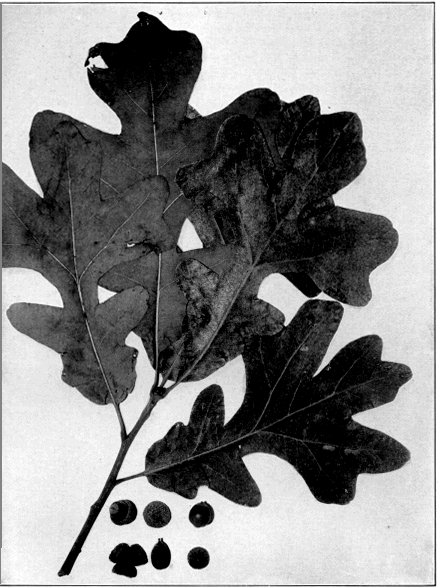
QUERCUS STELLATA Wangenheim. Post Oak. (× 1/2.)
Acorns from different trees.
Distribution.—Massachusetts, Indiana, south to Florida, and west
to Oklahoma and Texas. In Indiana it is confined to the southwestern
part of the State. In our area it is found on the crest of ridges in the
knob area where it is generally associated with black, and black jack
oaks, hence in our poorest and thinnest soils. West of the knob area
it takes up different habitats. From Vigo County southward it is
found on sand ridges associated with black and black jack oaks. West
of the knob area it is frequently found in black oak woods and in Warrick
County about two miles southwest of Tennyson it is a frequent
tree in the Little Pigeon Creek bottoms which are a hard light clay
soil. Here it is associated with pin oak and cork elm (Ulmus alata).
In the Lower Wabash Valley, especially in Point Township of Posey
County in the hard clay of this area it is a frequent to a common tree,
associated with Spanish, pin, swamp, white and shingle oaks, and
sweet gum. In this area it grows to be a large tree.
This species has been reported for Hamilton County by Wilson, but
I regard this reference a wrong identification which will relieve Hamilton
County of the reputation of having "post oak" land. It was reported,
also, by Gorby for Miami County. Since Gorby's list is wholly unreliable,
it is best to drop this reference. Higley and Raddin[37] reported
a single tree near Whiting. Nieuwland[38] reported this species from near
Mineral Springs in Porter County, the report being based on his number
10,207 which I have not seen. There is no reason to doubt these
references, because it is not an unusual thing to find a southern form
jump from southern Indiana to a congenial habitat about Lake Michigan.
Remarks.—Wood is similar but tougher than white oak, and its uses
are the same as white oak. Since in our area the tree is usually medium
sized, most of the trees are worked up into crossties. A tree in
a black oak woods 4 miles east of Washington in Daviess County
measured 2.22 meters (871/2 inches) in circumference breast high.
This species in some localities is called iron oak, and in Gibson County
on the sand dune area it is called sand bur oak.
Plate 46
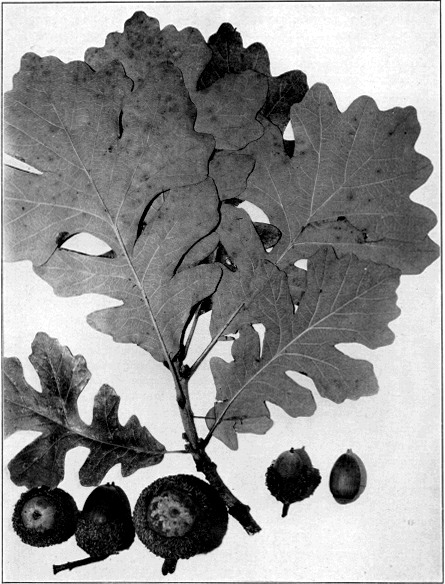
QUERCUS MACROCARPA Michaux. Bur Oak. (× 1/2.)
Acorns from different trees.
The right two belong to the variety OLIVÆFORMIS.
7. Quercus macrocàrpa Michaux. Bur Oak. Plate 46. Large
trees; branchlets of young trees generally develop corky wings which are
usually absent on mature trees; leaves on petioles 1-2 cm. long, obovate
in outline, generally 1-2.5 dm. long, the margins more or less deeply
cut so that there are usually 7 lobes, sometimes only 5, or as many as
9 or 11, sometimes the sinuses extend to the midrib, giving the leaf a
"skeleton" appearance, the lobes are very irregular in shape and variously
arranged, but often appear as if in pairs, lobes rounded and ascending,
the larger lobes are sometimes somewhat lobed, the three terminal
lobes are usually the largest and considered as a whole would equal in
size one half or more of the entire leaf area, the base of the leaf is wedge-shape
or narrowly rounded; leaves at maturity are dark green and
smooth above, or somewhat pubescent along the midrib, a gray-green
and woolly pubescent beneath; acorns usually solitary, sometimes in
pairs or clusters of three, sessile or on short stalks, sometimes on
stalks as long as 2.5 cm.; nuts very variable in size and shape, ovoid to
oblong, often very much depressed at the apex, 2-3 cm. long, enclosed
from 1/3 to almost their entire length in the cup which is fringed at
the top; cups thick and large, sometimes 4.5 cm. in diameter; scales
tomentose on the back and somewhat tuberculate, blunt near the base
of the cup, but at and near the top of the cup they become long attenuate
and on some trees appear almost bristle like; kernel sweet.
Distribution.—Nova Scotia to Manitoba, south to Georgia and
west to Texas and Wyoming. Found in all parts of Indiana, although
we have no reports from the knob area where no doubt it is only local.
It is a tree of wet woods, low borders of streams, etc., except among the
hills of southern Indiana, it is an occasional tree of the slopes. In
favorable habitats it was a frequent to a common tree. Its most
constant associates are white elm, swamp white and red oak, linn,
green and black ash, shellbark hickory, etc. It is sometimes called
mossy-cup oak.
Remarks.—Wood and uses similar to that of white oak. In point
of number, size and value it ranks as one of the most valuable trees of
the State. Michaux[39] says: "A tree three miles from Troy, Ohio, was
measured that was fourteen feet and nine inches in diameter six feet
above the ground. The trunk rises about fifty feet without limbs, and
with scarcely a perceptible diminution in size."
7a. Quercus macrocarpa var. olivæfórmis (Michaux filius)
Gray. This variety is distinguished from the typical form by its shallow
cup, and the long oval nut which is often 3 cm. long. The cup is semi-hemispheric,
and encloses the nut for about one-half its length.
Authentic specimens are at hand from Wells County, and it has been
reported from Gibson and Hamilton Counties. No doubt this form has
a wider range.
8. Quercus lyràta Walter. Overcup Oak. Plate 47. Medium
sized trees; bark generally intermediate between that of the swamp
white and bur oak; leaves on petioles 5-30 mm. long which are generally
somewhat reddish toward the base, 10-20 cm. long, obovate or oblong-obovate,
margins very irregularly divided into 5-9 short or long lobes,
ascending and generally acute, ordinarily the three terminal lobes are
the largest, base of leaves wedge-shape, or narrowly rounded, upper
surface at maturity dark green and smooth, the under surface densely
covered with a thick tomentum to which is added more or less long
and single or fascicled straight hairs; when the leaves are as described
on the under surface they are gray beneath; however, a form occurs
which is yellow green beneath and has little or no tomentum, but is
thickly covered with long single or fascicled straight hairs; acorn single
or in pairs, on stalks generally about 1 cm. long, sometimes the stalks
are 3 cm. long, the stalk lies in a plane at a right angle to the base of the
acorn which is a characteristic of this species; nut depressed-globose,
about 1.5 cm. long, generally almost completely enclosed in the cup,
or sometimes enclosed only for about 2/3 its length; cup generally
very thick at the base, gradually becoming thinner at the top, and often
it splits open; scales tomentose on the back, those near the base,
thick and tuberculate on the back and blunt, but those near the top of
the cup are acute or long attenuate; kernel sweet.
Distribution.—Maryland to Missouri,[40] and south to Florida and
west to Texas. In Indiana it is found only about river sloughs or deep
swamps in the southwestern counties. At present it is known only
from Knox, Gibson, Posey and Spencer Counties. It was reported by
Nieuwland[41] for Marshall County on the authority of Clark. This
specimen was taken during a survey of Lake Maxinkuckee, and is
deposited in the National Museum. I have had the specimen examined
by an authority, who reports that it is some other species. Its habitat
is that of areas that are inundated much of the winter season. It is so
rare that its associates could not be learned. In one place it grew in a
depression lower than a nearby pin oak, and in another place it grew in
a depression in a very low woods, surrounded by sweet gum, big shell
bark hickory, and pin oak. It is generally found singly in depressions,
but it is a common tree on the low border of the west side of Burnett's
pond in Gibson County.
Remarks.—Wood and uses similar to that of white oak. In our
area it is usually known as bur oak.
Plate 47
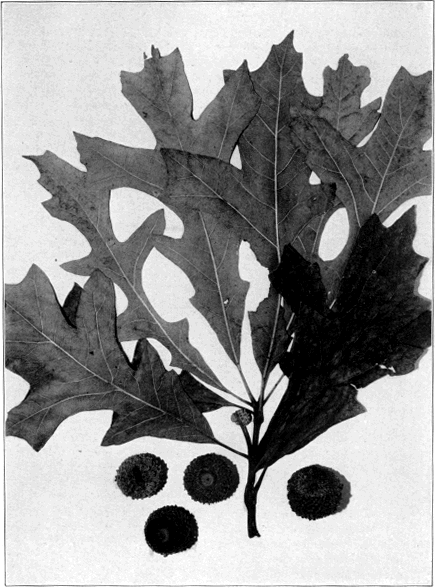
QUERCUS LYRATA Walter. Overcup Oak. (× 1/2.)
Acorns from different trees.
9. Quercus imbricària Michaux.
Shingle Oak. Plate 48.
Medium to large sized trees; leaves on petioles generally 0.5-1 cm. long,
7-16 cm. long, elliptic to oblong-lanceolate, narrowed or rounded at the
base, apex generally sharp-pointed and ending with a bristle, sometimes
very wide leaves are blunt at the apex, margins entire, when they
first appear the upper surface is somewhat woolly and the under surface
whitish with a dense tomentum, soon glabrous and a dark green
above, remaining more or less densely woolly or pubescent beneath;
acorns sessile or nearly so, solitary or in pairs; nuts ovoid, about 1 cm.
long and enclosed for about 1/2 their length in the cup; cup rounded at
the base; scales pubescent on the back and obtuse.
Distribution.—Pennsylvania, Michigan to Nebraska, south to
Georgia and west to Arkansas. Found throughout Indiana. It is essentially
a tree of low ground, but it is sometimes found near the base
of slopes, and in the knob area it is sometimes found on the crest of
ridges. In all parts of Indiana except the southwestern part it is found
only locally and then usually in colonies of a few trees. In Wells County,
I know of only two trees located at the base of a slope bordering a pond
in Jackson Township. In the southwestern part of the State it is
frequent to a common tree in its peculiar habitat. It appears that when
drainage basins decrease in size, and leave sandy river bottoms, and
bordering low sand dunes, that the shingle oak is the first oak to occupy
the area. On the sand ridges it is crowded out by the black, black jack
and post oaks. In the bottoms it is succeeded by pin, Schneck's, Spanish,
swamp white and post oaks. Special notes were made on its distribution
on a trip through Gibson, Pike, Daviess, Greene and Sullivan
Counties, going from Francisco northward through the Patoka bottoms
where in many places it forms pure stands. Usually in situations
a little higher than the pin oak zone. Thence eastward to Winslow
and then north to Sandy Hook in Daviess County, thence north to
Washington, Montgomery, Odon, Newberry, Lyons, Marco and Sullivan.
In its habitat all along this route it was a frequent to a very
common tree. A few miles northeast of Montgomery is a small area
which a pioneer informed me was originally a prairie. Typical prairie
plants are yet found along the roadside and fences in the area. I was
informed that the shingle oak was the only species found on the area,
and on the border of the area. It is believed the mass distribution of
the species was in the area indicated by the preceding route. Both east
and west of this area the species becomes less frequent.
Remarks.—Wood similar to red oak, but much inferior. Evidently
it is rather a slow growing tree, but it might find a use as a shade or
ornamental tree in sandy habitats where the pin oak would not thrive.
It is also called black oak, peach oak, jack oak and water oak.
Plate 48
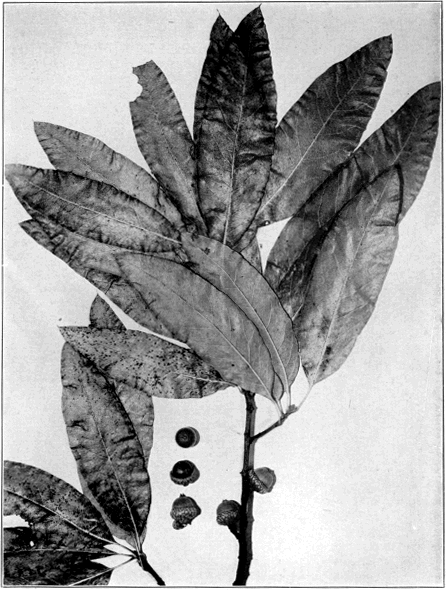
QUERCUS IMBRICARIA Michaux. Shingle Oak. (× 1/2.)
10. Quercus rùbra Linnæus. [Quercus maxima (Marshall) Ashe
of some recent authors]. Red Oak. Plate 49. Large trees; winter
buds ovoid, pointed, reddish, outer scales glabrous, sometimes pubescent
on the edges; twigs soon smooth and reddish; leaves on petioles
2.5-5 cm. long, 10-20 cm. long, oval to oblong-obovate, broadly wedge-shape
or truncate at the base, the margins divided by wide or narrow
sinuses generally into 7-9 lobes, sometimes as many as 11, the lobes not
uniform in size or shape, lobes broadest at the base and ending generally
in 1-5 bristle points, pubescent above and below at first, soon becoming
smooth at maturity and a dark green above, paler and yellowish-green
beneath and smooth or with tufts of tomentum in the axils of the veins;
acorns solitary or in pairs, sessile or on very short stalks; nuts ovoid,
flat at the base, and rounded at the apex, 2-3 cm. long, enclosed for
about 1/4 their length in the shallow cup; cups 2-3 cm. in diameter,
thick, saucer-shape, flat or only slightly rounded at the base; scales
ovate, blunt, appressed, and pubescent on the back; kernel somewhat
bitter, eaten by hogs and cattle, but not relished by wild animals.
Distribution.—Nova Scotia to Minnesota, south to Florida and
west to Texas. Found throughout Indiana, although local in the knob
area. Its preferred habitat is that of moist, rich and fairly well drained
woods. It does not thrive in situations that are inundated much of the
winter season such as the pin oak will endure. In the southern part of
the State, especially in the flats it is frequently found on the high bluffs
of streams and very large forest trees are frequent on a dry wooded
slope of ten acres, on the Davis farm four miles south of Salem. In a
congenial habitat it was a frequent to a common tree, although such a
thing as nearly a pure stand would never be met with, such as was often
formed by the white, black, shingle or pin oak.
Remarks.—Wood hard, heavy, strong, close-grained, but not as
good as white oak in any of its mechanical qualities. Commercially
all of the biennial oaks are usually considered as red oak. The true red
oak, however, is generally considered the best of all the biennial oaks.
Until recently, when white oak became scarce, red oak was not in much
demand, and was used principally for construction material. Now it is
substituted in many places for white oak, and the uses now are in a
great measure the same as those of white oak.
The red oak grows rapidly, and is able to adapt itself to many soil
conditions. It has been used in European countries for two centuries
for shade and ornamental planting. It reproduces easily by planting
the acorns, and should receive attention by woodlot owners as a suitable
species for reinforcing woodlands, or in general forest planting.
Plate 49
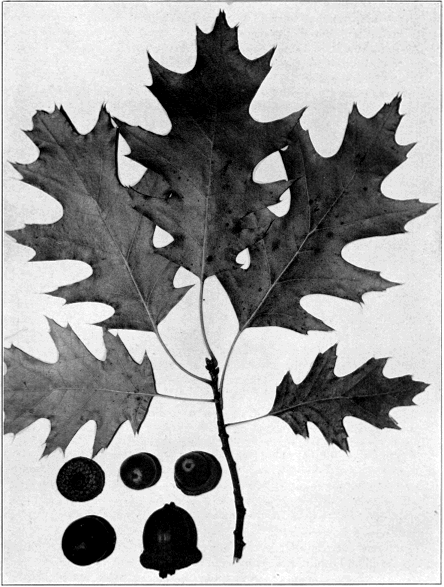
QUERCUS RUBRA Linnæus. Red Oak. (× 1/2.)
Acorns from different trees.
11. Quercus palústris Du Roi. Pin Oak. Plate 50. Medium
to large trees with very tight bark, the furrows shallow and generally
wide; twigs at first pubescent, soon becoming smooth and reddish-brown;
leaves on petioles generally 1-5 cm. long, blades about 7-15 cm.
long, usually about 2/3 as wide, sometimes as wide as long, ovate to
obovate in outline, narrowed to broadly truncate at the base, the
margins divided into 5-7 lobes by deep and wide sinuses, except leaves
that grow in the shade, the sinus cuts the blade to more than half way to
the midrib, the lobes are widest at the base, or sometimes widest near
the apex, the lobes usually somewhat toothed or lobed and end in 1-7
bristle tips, leaves hairy when they first appear, soon becoming glabrate
and a glossy dark green above, a paler green beneath and smooth except
tufts of hairs in the axils of the principal veins; acorns sessile or nearly
so, single or in clusters; nuts subglobose or ovoid, generally 10-12 mm.
long, the ovoid form somewhat smaller, covered about 1/4 their length
by the shallow cups; cups saucer-shape and generally flat on the bottom,
those with the ovoid nuts are rounded on the bottom; scales pubescent
on the back, and rounded or blunt at the apex.
Distribution.—Massachusetts, southwestern Ontario, Michigan to
Iowa and south to Virginia and west to Oklahoma. Found in every
county of Indiana. It is found only in wet situations where it is a
frequent to a common tree. It prefers a hard compact clay soil with
little drainage hence is rarely met with on the low borders of lakes
where the soil is principally organic matter.
Remarks.—Wood similar to red oak, but much inferior to it. It is
tardy in the natural pruning of its lower branches, and when the dead
branches break off they usually do so at some distance from the trunk.
The stumps of the dead branches which penetrate to the center of the
tree have given it the name of pin oak. It is also sometimes called
water oak, and swamp oak.
For street and ornamental planting it is one of the most desirable
oaks to use. It is adapted to a moist soil, grows rapidly, and produces
a dense shade. When grown in the open it develops a pyramidal crown.
The nut of this species always has a depressed form, except a tree or
two in Wells County which produce ovate nuts which are cone-pointed,
and in bulk about half the size of the ordinary form. This form should
be looked for to ascertain its area of distribution.
Plate 50
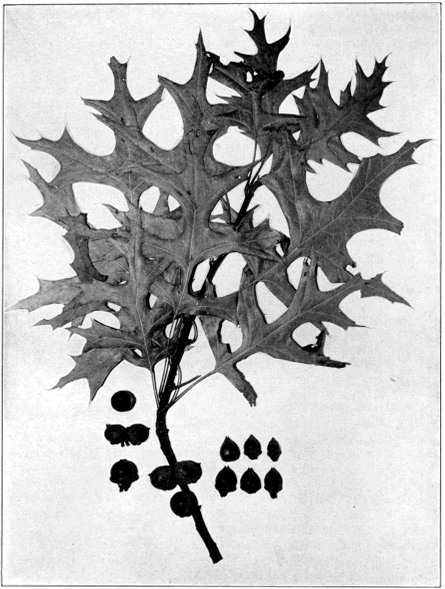
QUERCUS PALUSTRIS Muenchhausen. (× 1/2.)
Acorns from different trees. Those on the left the common form, those on
the right the rare form.
Plate 51
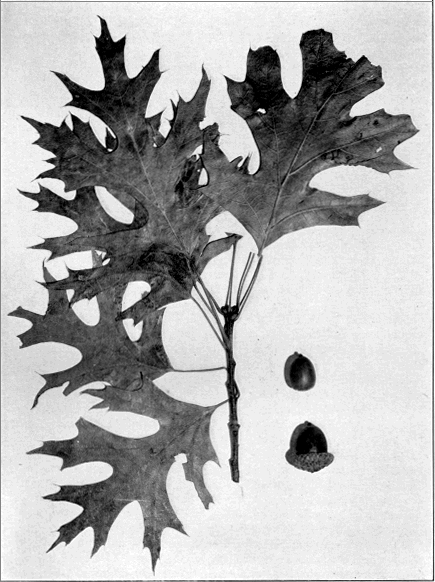
QUERCUS SCHNECKII Britton. Schneck's Oak. (× 1/2.)
Specimens from type tree.
12. Quercus Schnéckii Britton.
Schneck's Oak. Plate 51.
Large trees; bark somewhat intermediate between pin and red oak;
twigs gray by autumn; winter buds large, about 0.5 cm. long, ovoid,
glabrous and gray; leaves on petioles 2-6 cm. long, blades generally
8-18 cm. long, generally truncate at the base, sometimes wedge-shaped,
leaves ovate to obovate in outline, divided into 5-7 lobes, by deep
rounded and wide sinuses, the sinuses cutting the blade to more than
half way to the midrib, except the leaves of lower branches that grow in
the shade, the lobes variable in shape and size, usually the lowest
are the shortest and smaller, the middle the longest and largest, the
lobes are sometimes widest at the base, and sometimes widest at the
apex, the end of the lobes are more or less toothed or lobed; the leaves
at maturity are bright green, glossy and smooth above, a paler and
yellow green and smooth beneath except tufts of hairs in the axils of
the principal veins; acorns solitary or in pairs, usually on stalks about
0.5 cm. long; nuts ovoid, sometimes broadly so, or oblong, broad and
flat or slightly convex at base, usually 1.5-2 cm. long, enclosed in the
cup from 1/4-1/3 their length; cups flat or convex at the base: scales
generally pubescent on the back, gray or with a reddish tip on those of
the Lower Wabash Valley, or reddish gray and with margins more or less
red of trees of the Upper Wabash Valley.
Distribution.—In Indiana this species has been reported only from
Wells, Bartholomew, Vermillion, Knox, Gibson and Posey Counties.
This species was not separated from our common red oak until after all
of the local floras of Indiana had been written, and it may have a much
wider range than is at present known. In Wells County it is the prevailing
"red oak" of the county, and no doubt is distributed throughout
the Wabash Valley. In this area it is associated with all moist
ground species. In the lower Wabash Valley, especially in Gibson,
Knox and Posey Counties it is associated with Spanish, pin, and shingle
oaks, sweet gum, etc. Several trees were noted in Knox County in
Little Cypress swamp where it was associated with cypress, pin oak,
white elm, red maple and swell-butt ash.
Remarks.—This anomalous red oak has a range from Indiana to
Texas. When the attention of authors was directed to it, several new
species were the result. Later authors are not agreed as to whether
this form, which has such a wide range and hence liable to show considerable
variation within such a long range, is one or several species.
C. S. Sargent who for years has studied this form throughout its range
has seen the author's specimens and calls those with shallow cups
typical or nearly typical Quercus Shumardii Buckley[42] and those with the
deep cups Quercus Shumardii variety Schneckii (Britton) Sargent.
The writer has made rather an intensive study of the forms in Wells
County and in the Lower Wabash Valley and has not been able to satisfy
himself that, allowing for a reasonable variation, there is even a
varietal difference in Indiana forms. The description has been drawn
to cover all of the forms of Indiana.
Dr. J. Schneck of Mt. Carmel, Illinois, was one of the first to discover
that this form was not our common red oak, and when he called
Dr. Britton's attention to it, Dr. Britton named it Quercus Schneckii in
honor of its discoverer.
13. Quercus ellipsoidàlis. E. J. Hill.
Hill's Oak. Plate 52.
Medium sized trees; inner bark yellowish; twigs pubescent at first, becoming
smooth and reddish brown by autumn; leaves on petioles 2-5
cm. long, ovate to slightly obovate or nearly orbicular in outline, 7-15
cm. long, wedge-shape or, truncate at the base, margin divided into 5-7
long lobes by wide sinuses which usually extend to more than half
way to the midrib, sinuses rounded at the base, lobes broadest at the
base or the apex, ending in 1-7 bristle points, leaves at first pubescent,
both above and below, soon becoming glabrous above, and smooth
beneath except tufts of hairs in the axils of the principal veins; acorns
nearly sessile or on short stalks, single or in pairs; nuts oval to oblong,
12-20 mm. long, enclosed for 1/3-1/2 their length in the cup; scales
obtuse, light reddish-brown, pubescent on the back; kernel pale yellow
and bitter.
Distribution.—Northwestern Indiana to Manitoba and south to
Iowa. In Indiana it has been reported only from Lake and Porter
Counties by Hill, and from White County by Heimlich. According to
Hill, who has made the most extensive study of the distribution of this
species in our area, the tree is found on sandy and clayey uplands, and
in moist sandy places. It closely resembles the pin oak for which it has
been mistaken. It also resembles the black and scarlet oaks. We have
very little data on the range or distribution of the species in this State.
Quercus velùtina14. Lamarck. Black Oak. Plate 53. Medium
to large sized trees; inner bark yellow or orange; leaves on petioles
2-8 cm. long, ovate oblong or obovate, very variable in outline and in
size, those of young trees and coppice shoots being very large, those of
mature trees usually 12-18 cm. long, wedge-shape or truncate at the
base, the margin divided into 5-9 lobes by wide and usually deep sinuses
which are rounded at the base, the lobes variable in shape and size,
the terminals of many of the lobes toothed or slightly lobed and ending
in one or more bristles, leaves pubescent on both sides at first, soon
becoming smooth, glossy and a dark green above; leaves of fruiting
branches usually smooth beneath except the tufts of brown hairs in the
axils of the principal veins, or rarely more or less pubescent over the
whole under surface, the under surface of leaves of sterile branches and
young trees usually are the most pubescent beneath, the leaves of some
trees are much like those of the scarlet oak, but on the whole are larger;
acorns sessile or nearly so, single or in pairs; nuts ovoid, oblong or subglobose,
1.5-2 cm. long, enclosed for about half their length in the cup-shaped
cup; scales light-brown, densely pubescent on the back, obtuse,
loose above the middle of the cup; kernel bitter.
Plate 52
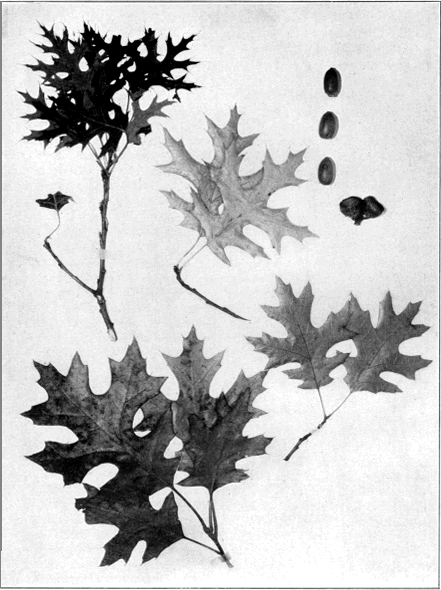
QUERCUS ELLIPSOIDALIS E. J. Hill. Hill's Oak. (× 1/2.)
Specimens from type tree.
Plate 53
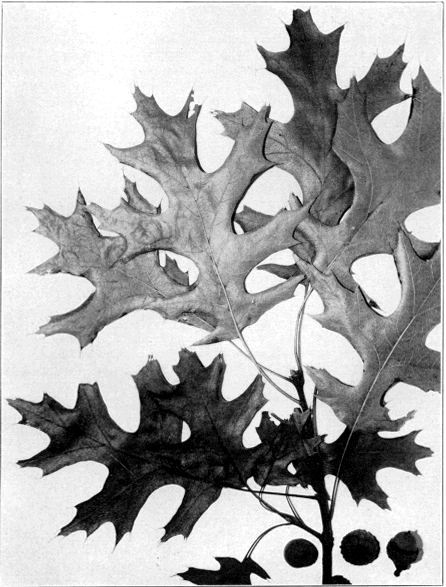
QUERCUS VELUTINA Lamarck. Black Oak. (× 1/2.)
Distribution.—Maine, southern Ontario, southern Minnesota,
southern Nebraska south to Florida and west to Texas. Found
throughout Indiana. It was no doubt found in every county or nearly
every county of the State. It of course would be a rare tree throughout
the rich black loam soils of the central Indiana counties. The black oak
is confined to the poorer soils of the State, such as clay and gravelly
ridges, sand dunes, sand ridges, and the hills of southern Indiana that
are not covered with beech or white oak. It is a frequent to a common
tree in the southwestern part of the State in the bottom lands where it
is associated with Schneck's, shingle, and post oaks. In the northern
part of the State it is generally associated with the white oak and if the
soil is very poor it will form almost pure stands. On the poor ridges of
southern Indiana it is generally associated with the white, and scarlet
oaks, and invades habitats still poorer which are occupied by post,
black jack, or chestnut oaks. Wherever the black oak is found it is
generally more than a frequent tree and is usually a common tree or
forms the principal stand. While the black is not so uniformly distributed
over the State as the white oak, yet in point of numbers it nearly
equals it, or may even exceed it.
In Floyd and Harrison Counties are certain small areas which were
known to the early settlers as the "barrens." These areas were treeless.
They were covered with a growth of some sort of oak which the natives
call "scrub" oak, hazel, and wild plum. The height of the growth in
any part would "not hide a man on horse back." These areas are now
all under cultivation, and are no longer distinguished from the forested
areas. However, many parts of the barrens are now covered with
forests, but these forests are a complete stand of black oak. Last year
one of these areas was cut off, and the age of the trees were ascertained
to be about 65 years old. The barrens of southern Indiana and adjacent
States offer a good problem for ecologists.
Remarks.—Wood similar to that of red oak, but often much inferior.
The uses of the best grades of black oak are practically the same
as red oak.
Where the black and scarlet oaks are associated, the scarlet oak is
rarely separated from it. The two species superficially much resemble
each other. The black oak is always easily distinguished by cutting into
the inner bark which is yellow, while that of scarlet oak is gray or
reddish. The inner bark imparts a yellow color to spittle, and the scarlet
does not. When mature fruiting branches are at hand they may be
separated by the appearance of the acorns. The scales of the cups of the
black oak are dull, and loosely imbricated near the top while those of the
scarlet oak are rather glossy and closely imbricated. The scales of the
scarlet oak, however, become somewhat loose after the acorn has
matured, and fallen for some time.
This species is sometimes called yellow oak. Since the chinquapin
oak is also often called yellow oak, it is best to always call this species
black oak.
15. Quercus coccínea Muenchhausen.
Scarlet Oak. Plate 54.
Medium sized trees with bark resembling the black oak, inner bark
gray or reddish; twigs reddish by autumn; winter buds reddish-brown
and pubescent; leaves on petioles 2.5-6 cm. long, broadly oval to obovate,
blades 7-15 cm. long, truncate or wedge-shape at the base, the
blade divided into 5-7 lobes by deep and wide sinuses which cut the
blade more than half the distance to the midrib, sinuses rounded at the
base, the lobes variable in size and shape, usually the lowest are the
shortest and smallest, the middle lobes the largest and longest, the
lobes widest either at the base or the apex, the terminal part toothed
or lobed, the terminal lobe generally 3-lobed or 3-toothed, both surfaces
of the leaves at first pubescent, soon smooth and a dark glossy green
above, and paler and smooth beneath except tufts of hairs in the axils of
the principal veins; acorns sessile or nearly so, solitary or in pairs; nuts
ovoid to oblong, 1.5-2 cm. long, enclosed for about half their length in
the thick cup-shape cup; scales triangular but blunt, closely appressed,
pubescent on the back except the center which is generally elevated
and smooth and shiny, giving the cup a glossy appearance which easily
separates it from its nearest ally the black oak whose cup is a dull, ash
or reddish gray color; kernel white within, and less bitter than the black
oak.
Distribution.—Maine, southern Ontario to southern Nebraska, south
to North Carolina, Alabama and Arkansas. It has been reported for the
northwest counties and the southern part of Indiana, but we have no
records for the east-central portion of the State. Clark reports it as
common about Winona Lake, but does not report Quercus velutina
which is a common tree of the vicinity, and it is believed that Clark
has confused the two species. In the northern part of the State its
habitat is that of sand and gravel ridges associated with black oak.
In the hill part of southern Indiana it is intimately associated with the
black oak on the poorer ridges. We have no authentic records for the
southwestern counties. The author has Schneck's specimens on which
the record for Gibson and Posey County was based. I determined the
specimens as belonging to the Spanish oak, and William Trelease
verified the determination. I have no doubt that scarlet oak occurred
on the sand ridges of that area.
Plate 54
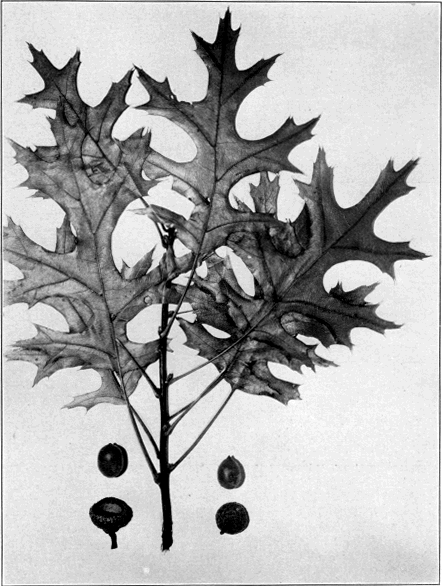
QUERCUS COCCINEA Muenchhausen. Scarlet Oak. (× 1/2.)
In the northern part of the State it is a rare or infrequent tree, while
in favorable habitats in the hill country of the southern part of the
State it is a frequent to a common tree.
Remarks.—Wood similar but much inferior to red oak. The cut in
this State is marketed as black oak, from which it is rarely separated.
16. Quercus falcàta Michaux.
Spanish Oak. Plate 55.
Large trees; bark thick, rather deeply fissured, furrows usually narrow,
ridges generally broad and broken into short lengths, the outer bark
is reddish, except sometimes it becomes grayish by weathering; twigs
densely pubescent at first, remaining more or less pubescent during
the first year, or becoming smooth or nearly so and a reddish brown
by autumn; leaves on petioles 0.5-6 cm. long, ordinarily about 2-3 cm.
long, blades very variable in outline, ovate, ovate-oblong or obovate,
usually somewhat curved, wedge-shaped, rounded or truncate at the
base, shallow or deeply lobed, generally about 2/3 of the distance to the
midrib; lobes 3-11, commonly 5-9, the number, size and shape of the
lobes exceedingly variable, the longest lateral lobes are generally near
the middle of the leaf, sometimes the lowest pair, sometimes the upper
pair are the longest, terminal lobe triangular or oblong, generally widest
at the base, although frequently widest at the apex, lateral lobes widest
at the base and gradually becoming narrower, towards the apex, rarely
somewhat wider at the apex, generally somewhat curved, lobes generally
sharp-pointed, sometimes wide-angled or rounded at the apex, margins
of lobes entire, wavy, toothed or lobed, sinuses wide and rounded at the
base; leaves densely pubescent on both surfaces at first, gradually
becoming smooth and dark green above by autumn, the under surface
remaining covered with a tomentum which is grayish or yellowish;
acorns sessile or nearly so, solitary or in pairs; nuts broadly ovoid,
generally 10-12 mm. long, broadly rounded at the base, rounded at
the apex, enclosed about one-half their length by the cup; cups strongly
convex at the base; scales blunt, grayish and pubescent on their backs,
their margins reddish and generally smooth.
Distribution.—New Jersey and Missouri, south to Florida and west
to Texas. The known distribution in Indiana would be that part of the
State south of a line drawn from Vincennes to North Madison. It is
local except in the southwestern counties. In our area it is found on
both high and low ground. In Jefferson and Clark Counties it is found
only in the flats where it is associated with beech, sweet gum, pin oak,
red maple and black gum. A colony was found in Washington County
on high ground, about eight miles southwest of Salem associated with
black and post oak. In Harrison County about two miles southeast
of Corydon it was found on the crest of a ridge with white and black
oak. In Daviess County about four miles east of Washington it is
associated with black and post oak. In Knox, Gibson, Pike and Warrick
Counties it is local on sand ridges with black oak. It occurs in the
greatest abundance in the river bottoms of Gibson, Posey and Spencer
Counties, where it is generally associated with pin, Schneck's, shingle,
swamp white, black and post oaks, and sweet gum. In the last named
counties it is fairly well distributed, and is a frequent to a common
tree. Brown's[43] report for Fountain County should not be recognized
without a verifying specimen, since his list was compiled from a list
of common names of the trees which he obtained.
Plate 55
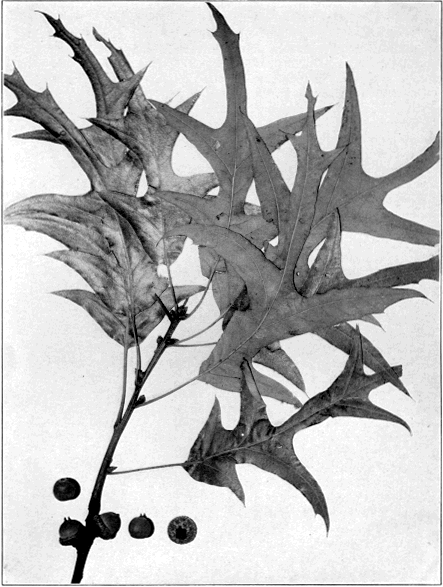
QUERCUS FALCATA Michaux. Spanish Oak. (× 1/2.)
Remarks.—Wood and uses similar to that of red oak. In Indiana
it is all sold as red oak. In all parts of its range in Indiana it is known as
red or black oak. However, the best accepted common name of this
species throughout its range is Spanish oak, and since no other species
is known by this name, it should be used for this species.
The bark of this species varies considerably in color and tightness.
The leaves are exceedingly variable in form. The leaves on the same
tree will vary from 3-lobed to 11-lobed. Usually the lobing is deepest
in the leaves nearest the top of the tree. Leaves of small trees, coppice
shoots, and of the lower branches of some trees are often all or for the
greater part 3-lobed. The color of the pubescence of the lower surface
of the leaves varies from a gray to a yellow-gray. The variations have
lead authors to divide this polymorphic species into several species and
varieties. The author has included all the forms that occur in Indiana
under one name.
This species is variously known as Quercus digitata, Quercus triloba,
Quercus pagodaefolia, and by the most recent authors as Quercus pagoda
and Quercus rubra and its varieties. Specimens in the author's collection
from Jefferson County were reported by Sargent[44] as Quercus
rubra var. triloba.
17. Quercus marilándica Muenchhausen. Black Jack Oak.
Plate 56. Mature trees generally 10-30 cm. in diameter; bark resembles
that of a gnarled black oak; twigs generally scurvy-pubescent the first
year; leaves on petioles from nearly sessile to 2.5 cm. long, usually less
than a cm. long, blades 7-15 cm. long, broadly obovate, often almost as
wide as long, narrowly rounded at the base, with three primary lobes
at the apex, sometimes with two small lateral lobes, the apex is sometimes
almost rounded and the position where the lobes usually occur
is indicated by three primary veins which end in a bristle, the apex
of the leaf is generally about equally divided into three lobes by two
very shallow rounded sinuses, the lobes are rounded or merely acute;
sometimes the terminal lobes develop a secondary lobe, leaves very
pubescent both above and beneath when they first appear, becoming
smooth and glossy above at maturity, and remaining more or less
pubescent beneath; acorns sessile or nearly so, single or in pairs; nuts
ovoid or oblong, 1-1.5 cm. long, broadly rounded at the base, rounded or
somewhat conic at the apex, enclosed for about half their length in the
cup-shaped cup; scales blunt, not closely appressed, pubescent on back,
light reddish-brown; kernel bitter.
Plate 56
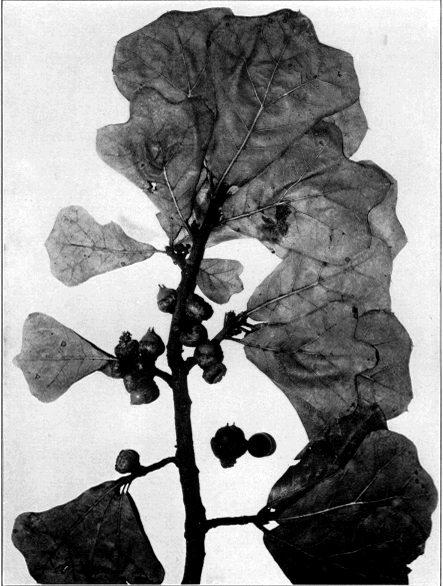
QUERCUS MARILANDICA Muenchhausen. Black Jack Oak. (× 1/2.)
Distribution.—New York to Nebraska, south to Florida and west
to Texas. In Indiana it is known to the author from Sullivan, Greene
and Clark Counties and southwestward. It has been reported from
Jefferson County by Barnes which is no doubt correct. Doubtful
records are those by Brown for Fountain County, Miami County by
Gorby, and Phinney's report for the area of Delaware, Jay, Randolph
and Wayne Counties. It has been reported for the vicinity of Chicago
by Higley and Raddin. It may be local on sterile, sandy ridges of
the northern part of the State, but very local if it does occur. It is
generally found in very poor soil on the crest of ridges associated
with black and post oak. However, it has been found in Greene,
Sullivan and Knox counties on sand ridges and at the base of sand
ridges associated with black and post oak. The species has a very
limited mass distribution and is only occasionally found and in colonies
of a few trees each.
Remarks.—Trees too small and scarce to be of any economic importance.