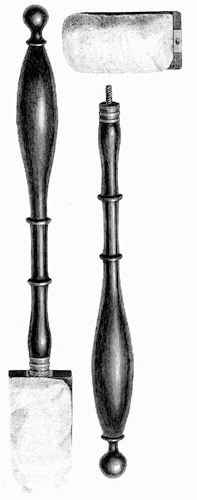
In October, 1835, a paper of mine appeared
in the London Medical and Surgical Journal,
stating the beneficial action of a concentrated
tincture of capsicum for diseases of the eye, by
rubbing it for a few minutes daily over the forehead
and temples with a sponge.
Soon after this I was induced to try what
effect essential oils, possessing powerful stimulating
properties, might possess in removing
amaurosis and diseases generally of the eye.
The formulæ which I use are—
| EMBRO. CARYOPH. CO. |
| ℞—Ol. Caryoph. |
| — Lavand | āā Ʒiv. |
| — Cinnamom. | Ʒss. |
| Sp. Vin. Rect. | ℥iij. |
| M. Ft. Embro. |
| EMBRO. PIMENT. CO. |
| ℞—Ol. Piment. |
| — Rosmar. | āā ℥ss. |
| — Cinnamom. | Ʒss. |
| Sp. Vin. R. | ℥iij. |
| M. Ft. Embro. |
Finding great utility to arise from the use of
the cloves and pimento, it appeared by no means
undesirable or hopeless to administer them internally
for the same complaints. In order to
shield the pungency of these oils I united them
with calcined magnesia, which, by its very strong
affinity with these essential oils, forms a body
nearly solid, and thereby removes all pungency,
warmth, and even smell; for, in this state, it
requires to be held in the mouth for a considerable
time before it produces any warmth or pungency.
They are thus rendered easily taken, in
sufficient quantity, without heat or uneasiness.
Some children are the subjects of many diseases
of the eye, producing blindness from opacities,
&c. I ordered the same to be made into
a powder, in which form it can be taken easily
in any vehicle, without exciting disagreeable
warmth. The formulæ are—
| PIL. CARYOPH. C. |
| ℞—Ol. Caryoph. |
| Magnes. Cal. | āā Ʒi. |
| Ol. Cinnamom. | qtt. vi. |
| M. Ft. Pil. xxiv. |
| PIL. PIMENT. CO. |
| ℞—Ol. Piment. |
| Magnes. Cal. | āā Ʒi. |
| Ol. Cinnamom. | qtt. vi. |
| M. Ft. Pil. xxiv. |
The dose of these pills is one or two thrice a
day.
Expedition is required in the making of these
pills, otherwise it becomes a solid mass, and
unable to be formed into pills.
I have found an alcoholic extract of cloves
and pimento, made into pills with magnesia,
equally efficacious.
| PULV. CARYOPH. C. |
| ℞—Ol. Caryoph. |
| Magnes. Calc. | āā ℥i. |
| Ol. Cinnamom. | Ʒi. |
| M. Ft. Pulv. |
| PULV. PIMENT. CO. |
| ℞—Ol. Piment. |
| Magnes. Calc. | āā ℥i |
| Ol. Cinnamom. | Ʒi |
| M. Ft. Pulv. |
The dose of these powders is from four to eight
grains thrice a day.
In the making of these powders, the oil and
the magnesia ought to be well mixed and
allowed to remain for half-an-hour, then reduce
the mass to fine powder, and keep it in glass
bottles with stoppers.
These medicines, by their local application,
increase the circulation, and give a greater
supply of blood to the deficient organs, and
thereby produce natural tone and power. They
are equally useful in removing chronic diseases,
where thickening and opacity have taken place,
by rousing into activity the absorbent and nervous
influence by their stimulating power.
Among many others possessing the same power,
is a concentrated tincture of pepper nigrum,
ginger, &c.
The internal administration has been found
much more serviceable in chronic diseases of the
eye, such as opacities, &c., than in amaurosis.
The manner of using the embrocations is, by
rubbing the forehead and temples with a sponge
saturated with the liquid. This plan alone,
kept up daily, is beneficial; but the efficacy is
more than doubled if another sponge, with warm
or cold water, is rubbed upon the forehead for a
minute afterwards. By this the energy of the
medicines in inducing a free circulation is greatly
augmented, and greater warmth is rapidly developed.
The rationale, in my opinion, is, that
the large quantity of carbon in some of the
essential oils, and its solubility in alcohol, permits
it, by the friction, to pass through the
cuticle and unite with the oxygen. As the oils
are very insoluble in water, and as the alcohol
has a strong affinity for the water, the carbon is
more readily disengaged, and forms a union with
the oxygen in the vessels, and thereby produces
heat and great activity of circulation. I have
no doubt that that is the reason why many
bodies are so pungent, when put into the
mouth. I have only given two cases—viz.,
John Plunkett and William Dale—as illustrative
of the action of the essential oils.
It will be seen in the following extract from
Tyrrell on the Eye, "Functional amaurosis
arises from a deficient supply of red blood."
He says—
"In these cases there always exists, I believe,
a want of general power and vigour of circulation
at first; but in some instances of long-continued
affection of this kind, the local circulation
never regains its proper force and fulness; and
the supply of blood is inadequate to support the
functions of the part, although the general system
recovers its natural tone and power."
I think this statement very correct, and therefore
the embrocations producing so much additional
circulation, point out at once the essential
oils, along with the water, as its proper remedy.
I here quote Magendie, who corroborates the
plan which I adopt—viz., the medicines being
most useful when applied to the forehead and
temples in amaurosis:—
"Lectures on the Physiology of the Nervous
System, delivered in 1836, in the College of
France, by Majendie."—Lancet, April 29th,
1837, page 186.
"The integrity of both the optic and the fifth
nerves, then, is indispensably necessary for the
exercise of vision, which is lost whenever either
of these nerves is separately destroyed."
Lancet, May 20th, 1837, page 279.
"Nervous pains of long duration and the
greatest intensity have been quickly removed
by topical applications to the temporal region."
Lancet, page 280.
"Amaurosis cannot be considered as a simple
affection of the optic nerve; at least, in the
actual state of the science, it is generally impossible
to say that the fifth nerve has no connexion
with the loss of sight, and in many cases the
connexity is evident. Hence a rule which I
invariably follow of addressing my remedies, in
the first instance, to some of the branches of the
frontal nerve; and I have frequently had the
satisfaction of observing some of these cases of
incomplete amaurosis improve sensibly under
the influence of therapeutic agents applied to
the fifth pair. I would go even further and
say, whenever you have a case of incipient
amaurosis, commence by acting on this nerve,
for it is at once the most expeditious and efficient
method. I cannot, however, quit this
point without assuring you that no physician is
capable of treating diseases of the eye unless
fully in possession of the facts I have just had
the honour of explaining to you. These facts
are daily becoming more numerous and more
convincing, and already a considerable number
of our younger practitioners, who devote themselves
to the study of diseases of the eye, are
fully aware of the immense influence of the fifth
pair of nerves over the exercise of vision."
Lancet, page 281.
"To resume, then, what I have said concerning
the sense of vision and our several experiments,
allow me once more to impress you with
the idea that sight can never be exercised in a
complete and perfect manner without a certain
influence of the fifth pair of nerves; destroy that
influence, and you destroy vision. This is all
we know upon the matter; for up to the present
moment we have been unable to determine how
far this influence extends, or in what manner it
is communicated."
Case of Amaurosis.
John Plunkett, Mermaid Gardens, Hackney,
formerly an attorney's clerk, visited me in
May, 1837, and stated that he had been blind
and obliged to be led about by his children for
the last four years. For five years previously
his sight had been gradually diminishing. He
further stated that he was much troubled with
floating images before his right eye, as well as
with clouds resembling animals, strange goblins,
and sometimes with flashes of lightning, vivid
red, changing into light blue. One great peculiarity
of this miserable man's case was, that
when he threw back his head there appeared a
stream of blood flowing from the top of the
right eye to the centre, where it formed into a
circular pool about the size of a split pea, but
ultimately it became as large as a shilling. It
often remained a considerable time, and then
diminished gradually in red streaks. This was
a matter of great alarm to him. He had been
at several Ophthalmic Institutions for nine years
previously to his visiting me. He has had electricity,
tartarate of antimony, blisters, issues,
stramonium, mercury (until it produced dysentery),
and almost every kind of treatment that
could be suggested, tried, but to no purpose.
When I saw him the pupil was immoveable,
and the eye dull in the anterior, and very
obscure. The left eye was destroyed. He
could not discern, in a bright light, the shadow
of white paper when it was moved between him
and the light.
The compound embrocation of oil of cloves
was used by rubbing it upon the forehead and
temples daily, and in the space of twelve days
he was able to discern objects and could touch
them. In two months he could put his finger
through a ring when held by another person.
He continued occasionally under my care for
about a year, during which time the embrocation
was regularly used. He could walk alone,
and the eye was generally useful, but he was
not able to read with it. He could see objects
at the distance of thirty feet.
The last month he has visited me once or
twice a week, for the purpose of having the
prussic acid vapour applied to his eye, to ascertain
if the sight could be restored sufficiently to
enable him to follow his occupation as a clerk.
In this case an advantage has been gained. The
patient is now able to read a little, which, previously
to the use of the prussic acid vapour, he
was unable to do.
Amaurosis.
William Dale, boot-maker, of 14, Clarence
Gardens, Regent's Park, visited me in July,
1837. He stated, that with his right eye, for
the last year, he could only discern light from
darkness; and that for several months before
he was much troubled by clouds and spots floating
before his eyes. The evening gaslight produced
a continued flashing of light from his eye.
The light looked as if surrounded by all the colours
of the rainbow.
He first went to an Ophthalmic Hospital,
where he was blistered on the temple and salivated.
Nux vomica produced such an effect
upon him that all his limbs were involuntarily
twitched, so as to alarm them exceedingly. He
then left, and went to another institution
for three months; and at length was told that
the optic nerve was injured, so as to render a
restoration of vision impossible. The left eye,
when looked into, had a dark green, muddy hue,
and the pupil was exceedingly dilated and immoveable.
He was unable to distinguish an
object placed before his eyes; yet he states
that he could distinguish light from darkness.
When he applied to me I had the compound
embrocation of pimento applied occasionally to
the forehead and temples, by means of a friction
sponge. During the first month he was able to
discern objects and colours. The pupil acted
under the impression of light almost equal to the
good eye. It was not until this application had
been used for a year that the patient was enabled
to read with the eye.
I saw the patient this day (the 25th of Jan.
1843). The eye, upon examination, appeared
to be in a healthy state. The sight was not so
good as when he left me, and after he left off the
applications, but this he attributes to the circumstance
of his general health not being good,
owing to his having suffered from intermittent
fever.
In January, 1834, I published the first edition
of my work upon Veratria, and gave an account
of two cases of amaurosis, combined with tic-douloureaux,
cured by the external application of
veratria. I there suggested that it was probable
that amaurosis, uncombined with tic-douloureaux,
might be removed by applications of a stimulating
nature to the branches of the fifth pair of
nerves. No notice of this suggestion having
been taken by medical men, I determined to put
the plan into execution, and employed a surgeon
to carry it into effect in St. Giles's Workhouse,
where blind cases were given me for that purpose.
I here extract the case of Eleanor M'Cartney,
for the purpose of showing the power of
capsicum when rubbed upon the forehead and
temples. I select this case of amaurosis for
several reasons; she was the first patient on
whom I tried the efficacy of capsicum. She had
had, seven years previously, a stroke of palsy,
which removed all power of the right side. The
only power recovered was that of the right arm.
The hearing was perfectly gone; and she had
not had the least perception of sight for seven
years. It is now nearly eight years since her
recovery; and, at the present date (27th of Jan.
1843), she can read perfectly well; and has never
had another application since the three first days.
It will also satisfy the minds of many that a recovery
by stimulating applications of this description,
is not of a temporary nature.
I here quote the case as given in my work on
"Painful and Nervous Diseases," page 131.
"Eleanor M'Cartney, aged 40, an inmate
of St Giles's Workhouse, was attacked, seven
years ago, with palsy of the right side, when perception
of light and sound, in the right eye and
ear, was extinguished. There was a constant
and profuse flow of tears, and the pupil was immoveable.
"The treatment commenced on the 19th of
October, 1835, and was continued for three days
only. On the first day after the commencement
of the treatment there was a great abatement of
the flow of tears, and she could perceive light
and light-coloured objects. On the second day
she could see a watch, and direct her hand to it,
and distinguish the palm from the back of the
hand. On the third day she could distinguish
objects with great facility. There was no further
application of the remedy after the third
day. On the fifth day she could read a duodecimo
prayer-book with ease. On the seventh
day the flow of tears ceased, the pupil moved
readily, and her sight and hearing were perfect.
She is still an inmate of the workhouse, and may
be seen on application to the matron, Mrs.
Bailey."