For the sake of regularity, I shall here notice what
might clearly be inferred from what is gone before.
The crown of Abyssinia is hereditary, and has always been
so, in one particular family, supposed to be that of Solomon
by the queen of Saba, Negesta Azab, or queen of the south.
It is nevertheless elective in this line; and there is no law
of the land, nor custom, which gives the eldest son an exclusive
title to succeed to his father.
The practice has indeed been quite the contrary: when,
at the death of a king, his sons are old enough to govern,
and, by some accident, not yet sent prisoners to the mountain,
then the eldest, or he that is next, and not confined, generally
takes possession of the throne by the strength of his
father’s friends; but if no heir is then in the low country,
the choice of the king is always according to the will of the
minister, which passes for that of the people; and, his inclination
and interest being to govern, he never fails to choose
an infant whom thereafter he directs, ruling the kingdom
absolutely during the minority, which generally exhausts,
or is equal to the term of his life.
From this flow all the misfortunes of this unhappy country.
This very defect arises from a desire to institute a more
than ordinary perfect form of government; for the Abyssinians
first position was, “Woe be to the kingdom whose
king is a child;” and this they know must often happen
when succession is left to the course of nature. But when
there was a choice to be made out of two hundred persons
all of the same family, all capable of reigning, it was their
own fault, they thought, if they had not always a prince of
proper age and qualification to rule the kingdom, according
to the necessities of the times, and to preserve the succession
of the family in the house of Solomon, agreeable to the
laws of the land. And indeed it has been this manner of
reasoning, good at first view, though found afterwards but
too fallacious, which has ruined their kingdom in part, and
often brought the whole into the utmost hazard and jeopardy.
The king is anointed with plain oil of olives, which, being
poured upon the crown of his head, he rubs into his
long hair indecently enough with both his hands, pretty
much as his soldiers do with theirs when they get access to
plenty of butter.
The crown is made in the shape of a priest’s mitre, or
head-piece; it is a kind of helmet, covering the king’s forehead,
cheeks, and neck. It is lined with blue taffety; the
outside is half gold and half silver, of the most beautiful filligrane
work.
The crown, in Joas’s time, was burnt, with part of the palace,
on that day when Ras Michael’s dwarf was shot in his
own house before him. The present was since made by
the Greeks from Smyrna, who have large appointments
here, and work with very great taste and elegance, though
they have not near so much encouragement as formerly.
Upon the top of the crown was a ball of red glass, or
chrystal, with several bells of different colours within it. It
seems to me to have formerly been no better than part of
the stopper of a glass-decanter. Be that as it may, it was
lost in Yasous’s time at the defeat of Sennaar; It was found,
however, by a Mahometan, and brought by Guangoul, chief
of the Bertuma Galla, to the frontiers of Tigrè, where Michael,
governor of that province, went with an army in great
ceremony to receive it, and, returning with it, gave it to
king Yasous, making thereby a great advance towards the
king’s favour.
Some people19, among the other unwarranted things they
have advanced, have said, That, at the king’s coronation, a
gold ear-ring is put into his ears, and a drawn sword into
his hand, and that all the people fall down and worship
him; but there is no such ceremony in use, and exhibitions
of this kind, made by the king in public, at no period
seem to have suited the genius of this people. Formerly his
face was never seen, nor any part of him, excepting sometimes
his foot. He sits in a kind of balcony, with lattice-windows
and curtains before him. Even yet he covers his
face on audiences or public occasions, and when in judgment.
On cases of treason, he sits within his balcony, and
speaks through a hole in the side of it, to an officer called
Kal-Hatzè, the “voice or word of the king,” by whom he
sends his questions, or any thing else that occurs, to the
judges who are seated at the council-table.
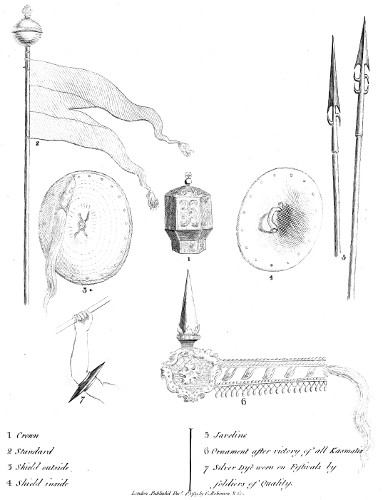 1 Crown
2 Standard
3 Shield outside
4 Shield inside
5 Javelins
6 Ornament after victory of all Kasmatis
7 Silver disc worn on festivals by
soldiers of quality.
London. Publish’d Decr. 1st. 1789 by G. Robinson & Co.
The king goes to church regularly, his guards taking
possession of every avenue and door through which he is to
pass, and nobody is allowed to enter with him, because he
is then on foot, excepting two officers of his bed-chamber
who support him. He kisses the threshold and side-posts
of the church-door, the steps before the altar, and then returns
home: sometimes there is service in the church,
sometimes there is not; but he takes no notice of the difference.
He rides up stairs into the presence-chamber on
a mule, and lights immediately on the carpet before his
throne; and I have sometimes seen great indecencies committed
by the said mule in the presence-chamber, upon a
Persian carpet.
An officer called Serach Massery, with a long whip, begins
cracking and making a noise, worse than twenty
French postillions, at the door of the palace before the dawn
of day. This chases away the hyæna and other wild beasts;
this, too, is the signal for the king’s rising, who sits in judgment
every morning fasting, and after that, about eight
o’clock, he goes to breakfast.
There are six noblemen of the king’s own choosing,
who are called Baalomaal20, or gentlemen of his bed-chamber;
four of these are always with him. There is a seventh,
who is the chief of these, called Azeleffa el Camisha,
groom of the robe, or stole. He is keeper of the king’s
wardrobe, and the first officer of the bed-chamber. These
officers, the black slaves, and some others, serve him as menial
servants, and are in a degree of familiarity with him
unknown to the rest of the subjects.
When the king sits to consult upon civil matters of consequence,
he is shut up in a kind of box opposite to the head of
the council table. The persons that deliberate sit at the table,
and, according to their rank, give their voices, the youngest or
lowest officer always speaking first. The first that give their
votes are the Shalaka, or colonels of the household-troops.
The second are the great butlers, men that have the charge
of the king’s drink. The third is the Badjerund, or keeper
of that apartment in the palace called the lion’s house; and
after these the keeper of the banqueting-house. The next
is called Lika Magwass, an officer that always goes before
the king to hinder the pressure of the crowd. In war, when
the king is marching, he rides constantly round him at a
certain distance, and carries his shield, and his lance; at
least he carries a silver shield, and a lance pointed with the
same metal, before such kings as do not choose to expose
their person. That, however, was not the case in my time,
as the king carried the shield himself, black and unadorned,
of good buffalo’s hide, and his spear sharp-pointed with
iron. His silver ornaments were only used when the campaign
was over, when these were carried by this officer.
Great was the respect shewed formerly to this king in war,
and even when engaged in battle with rebels, his own subjects.
No prince ever lost his life in battle till the coming of
the Europeans into Abyssinia, when both the excommunicating
and murdering of their sovereigns seem to have
been introduced at the same time. The reader will see, in
the course of this history, two instances of this respect being
still kept up: the one at the battle of Limjour, where Fasil,
pretending that he was immediately to attack Ras Michael,
desired that the king might be dressed in his insignia, lest,
not being known, he might be slain by the stranger Galla.
The next was after the battle of Serbraxos, where the king
was thrice in one day engaged with the Begemder troops
for a considerable space of time. These insignia, or marks
of royalty, are a white horse, with small silver bells at his
head, a shield of silver, and a white fillet of fine silk or muslin,
but generally the latter, some inches broad, which is
tied round the upper part of the head over his hair, with a
large double or bow-knot behind, the ends hanging down
to the small of his back, or else flying in the air.
After the Lika Magwass comes the Palambaras; after him
the Fit-Auraris; then the Gera Kasmati, and the Kanya Kasmati,
their names being derived from their rank or order in encamping,
the one on the right, the other on the left of the
king’s tent; Kanya and Gera signifying the right and the
left; after them the Dakakin Billetana Gueta, or the under
chamberlain; then the secretary21 for the king’s commands;
after him the right and left Azages, or generals;
after them Rak Massery, after him the basha, after him
Kasmati of Damot, then of Samen, then Amhara, and, last
of all, Tigrè, before whom stands a golden cup upon a cushion,
and he is called Nebrit, as being governor of Axum,
or keeper of the book of the law supposed to be there.
After the governor of Tigrè comes the Acab Saat, or
guardian of the fire, and the chief ecclesiastical officer of
the king’s household. Some have said that this officer was
appointed to attend the king at the time of eating, and that
it was his province to order both meat and drink to be withdrawn
whenever he saw the king inclined to excess. If this
was really his office, he never used it in my time, nor, as
far as I could learn, for several reigns before. Besides, no
king eats in public, or before any person but slaves; and he
never would chuse that time to commit excess, in which he
might be controuled by a subject, even if it was that subject’s
right to be present when the king eats, as it is not.
After the Acab Saat comes the first master of the household;
then the Betwudet, or Ras; last of all the king gives
his sentence, which is final, and sends it to the table, from
the balcony where he is then sitting, by the officer called, as
aforementioned, Kal-Hatzè.
We meet in Abyssinia with various usages, which many
have hitherto thought to be peculiar to those ancient nations
in which they were first observed; others, not so learned,
have thought they originated in Abyssinia. I shall first
take notice of those that regard the king and court.
The kings of Persia22, like these we are speaking of, were
eligible in one family only, that of the Arsacidæ, and it was
not till that race failed they chose Darius. The title of the
king of Abyssinia is, King of Kings; and such Daniel23 tells us
was that of Nebuchadnezzar. The right of primogeniture
does not so prevail in Abyssinia as to exclude election in the
person of the younger brothers, and this was likewise the
case in Persia24.
In Persia25 a preference was understood to be due to the
king’s lawful children; but there were instances of the natural
child being preferred to the lawful one. Darius, tho’
a bastard, was preferred to Isogius, Xerxes’s lawful son, and
that merely by the election of the people. The same has
always obtained in Abyssinia. A very great part of their
kings are adulterous bastards; others are the issue of concubines,
as we shall see hereafter, but they have been preferred
to the crown by the influence of a party, always under
name of the Voice of the People.
Although the Persian kings26 had various palaces to
which they removed at different times in the year, Pasagarda,
the metropolis of their ancient kings, was observed as
the only place for their coronation; and this, too, was the
case of Abyssinia with their metropolis of Axum.
The next remarkable ceremony in which these two nations
agreed, is that of adoration, inviolably observed in Abyssinia
to this day, as often as you enter the sovereign’s
presence. This is not only kneeling27, but an absolute prostration.
You first fall upon your knees, then upon the
palms of your hands, then incline your head and body till
your forehead touch the earth; and, in case you have an
answer to expect, you lie in that posture till the king, or
somebody from him, desires you to rise. This, too, was the
custom of Persia; Arrian28 says this was first instituted by
Cyrus, and this was precisely the posture in which they adored
God, mentioned in the book of Exodus.
Though the refusal of this ceremony would, in Abyssinia
and Persia, be looked upon as rebellion or insult, yet it seems
in both nations to have met with a mitigation with regard
to strangers, who have refused it without giving any offence.
I remember a Mahometan being twice sent by the
prince of Mecca into Abyssinia during my stay there, who,
neither time, would go farther than to put his hands across
upon his breast, with no very great inclination of his head;
and this I saw was not thought so extraordinary as to give
offence, as it was all he did to his own sovereign and master.
We read, indeed, of a very remarkable instance of the
dispensing with that ceremony being indirectly, yet plainly,
refused in Persia to strangers. Conon29, the Athenian,
had occasion for an interview with Artaxerxes,
king of Persia, upon matters of great concern to both
states; “You shall be introduced to the king by me, says
the Persian minister to Conon, without any delay; do
you only first consider with yourself, whether it is really
of any consequence that you should speak with the
king yourself, or whether it would not be as well for you
to convey to him, by letter, any thing you have to say; for
it is absolutely necessary, if you are introduced into the
king’s presence, that you fall down upon your face and
worship him. If this is disagreeable or offensive to you,
your business shall nevertheless be equally well and quickly
done by me.” To which Conon very sensibly replied,
“For my part, it never can be offensive to me to shew every
degree of respect possible to the person of a king. I only
am afraid that this salutation may be misinterpreted by my
citizens, who, being themselves a sovereign state, may look
upon this submission of their ambassador as a reproach to
themselves, and inconsistent with their independency.” Conon,
therefore, desired to wave his introduction, and that his business
might be done by letters, which was complied with
accordingly.
I have already mentioned transiently the circumstance of
the king not being seen when sitting in council. The manner
of it is this: When he had business formerly, he sat
constantly in a room of his palace, which communicated
with the audience and council by two folding doors or
large windows, the bottom of which were about three steps
from the ground. These doors, or windows, were latticed
with cross bars of wood like a cage, and a thin curtain, or
veil of taffety silk was hung within it; so that, upon darkening
the inner chamber, the king saw every person in the
chamber without, while he himself was not seen at all.
Justin30 tells us, that the person of the king of Persia was
hid to give a greater idea of his majesty; and under Deioces,
king of the Medes, a law was made that nobody might look
upon the king; but the constant wars in which Abyssinia
has been engaged, since the Mahometans took possession of
Adel, have occasioned this troublesome custom to be wholly
laid aside, unless on particular public occasions, and at council,
when they are still observed with the ancient strictness.
And we find, in the history of Abyssinia, that the army and
kingdom have often owed their safety to the personal behaviour
and circumstance of the king distinguishing and exposing
himself in battle, which advantage they must have lost
had the ancient custom been observed. However, to this
day, when he is abroad riding, or sitting in any of his
apartments at home where people are admitted, his head
and forehead are perfectly covered, and one of his hands
covers his mouth, so that nothing but his eyes are seen;
his feet, too, are always covered.
We learn from Apuleus, that this was a custom in Persia;
and this gave an opportunity to the magi to place Oropastus,
the brother of Cambyses, upon the throne, instead of
Merdis who should have succeeded; but the covering of the
face made the difference pass unperceived.
It is the constant practice in Abyssinia to beset the king’s
doors and windows within his hearing, and there, from
early morning to night, to cry for justice as loud as possible,
in a distressed and complaining tone, and in all the different
languages they are masters of, in order to their being admitted
to have their supposed grievances heard. In a country
so ill governed as Abyssinia is, and so perpetually involved
in war, it may be easily supposed there is no want of
people, who have real injuries and violence to complain of:
But if it were not so, this is so much the constant usage,
that when it happens (as in the midst of the rainy season)
that few people can approach the capital, or stand without
in such bad weather, a set of vagrants are provided, maintained,
and paid, whose sole business it is to cry and lament,
as if they had been really very much injured and oppressed;
and this they tell you is for the king’s honour, that he may
not be lonely by the palace being too quiet. This, of all their
absurd customs, was the most grievous and troublesome to
me; and, from a knowledge that it was so, the king, when
he was private, often permitted himself a piece of rather
odd diversion to be a royal one.
There would sometimes, while I was busy in my room in
the rainy season, be four or five hundred people, who all at
once would begin, some roaring and crying, as if they were
in pain, others demanding justice, as if they were that moment
suffering, or if in the instant to be put to death; and
some groaning and sobbing as if just expiring; and this
horrid symphony was so artfully performed that no ear
could distinguish but that it proceeded from real distress.
I was often so surprised as to send the soldiers at the door to
bring in one of them, thinking him come from the country,
to examine who had injured him; many a time he was a
servant of my own, or some other equally known; or, if he
was a stranger, upon asking him what misfortune had befallen
him, he would answer very composedly, Nothing was
the matter with him; that he had been sleeping all day
with the horses; that hearing from the soldiers at the door
I was retired to my apartment, he and his companions had
come to cry and make a noise under my window, to do me
honour before the people, for fear I should be melancholy,
by being too quiet when alone; and therefore hoped that
I would order them drink, that they might continue with
a little more spirit. The violent anger which this did often
put me into did not fail to be punctually reported to the
king, at which he would laugh heartily; and he himself
was often hid not far off, for the sake of being a spectator
of my heavy displeasure.
These complaints, whether real or feigned, have always
for their burden, Rete O Jan boi, which, repeated quick, very
much resembles Prete Janni, the name that was given to
this prince, of which we never yet knew the derivation;
its signification is, “Do me justice, O my king!”
Herodotus31 tells us, that in Persia, the people, in great
crowds and of both sexes, come roaring and crying to the
doors of the palace; and Intaphernes is also said to come
to the door of the king making great lamentations.
I have mentioned a council of state held in Abyssinia in
time of danger or difficulty, where the king sitting invisible,
though present, gives his opinion by an officer called Kal-Hatzè.
Upon his delivering the sentence from the king
the whole assembly rise, and stand upon their feet; and this
they must have done the whole time the council lasted had
the king appeared there in person. According to the circumstances
of the time, the king goes with the majority, or
not; and if, upon a division, there is a majority against him,
he often punishes the majority on the other side, by sending
them to prison for voting against his sentiments; for tho’
it is understood, by calling of the meeting, that the majority
is to determine as to the eligibility of the measure, the
king, by his prerogative, supersedes any majority on the
other side, and so far, I suppose, has been an encroachment
upon the original constitution. This I understand was the
same in Persia.
Xerxes32, being about to declare war against the Greeks,
assembled all the principal chiefs of Asia in council. “That
I may not, says he, be thought to act only by my own judgment,
I have called you together. At the same time, I
think proper to intimate to you, that it is your duty to
obey my will, rather than enter into any deliberation or remonstrances
of your own.”
We will now compare some particulars, the dress and
ornaments of the two kings. The king of Abyssinia wears
his hair long; so did the ancient kings of Persia. We learn
this circumstance from Suetonius and Aurelius Victor33. A
comet had appeared in the war with Persia, and was looked
upon by the Romans as a bad omen. Vespasian laughed at
it, and said, if it portended any ill it was to the king of Persia,
because, like him, it wore long hair.
The diadem was, with the Persians, a mark of royalty, as
with the Abyssinians, being composed of the same materials,
and worn in the same manner. The king of Abyssinia
wears it, while marching, as a mark of sovereignty, that
does not impede or incommode him, as any other heavier
ornament would do, especially in hot weather. This fillet
surrounds his head above the hair, leaving the crown perfectly
uncovered. It is an offence of the first magnitude for
any person, at this time, to wear any thing upon his head,
especially white, unless for Mahometans, who wear caps,
and over them a large white turban; or for priests, who
wear large turbans of muslin also.
This was the diadem of the Persians, as appears from
Lucian34, who calls it a white fillet about the forehead. In
the dialogue between Diogenes and Alexander, the head is
said to be tied round with a white fillet35; and Favorinus,
speaking of Pompey, whose leg was wound round with a
white bandage, says, It is no matter on what part of the
body he wears a diadem. We read in Justin36, that Alexander,
leaping from his horse, by accident wounded Lysimachus
in the forehead with the point of his spear, and the blood
gushed out so violently that it could not be stanched, till
the king took the diadem from his head, and with it
bound up the wound; which at that time was looked
upon as an omen that Lysimachus was to be king, and so
it soon after happened.
The kings of Abyssinia anciently sat upon a gold throne,
which is a large, convenient, oblong, square seat, like a small
bed-stead, covered with Persian carpets, damask, and cloth of
gold, with steps leading up to it. It is still richly gilded;
but the many revolutions and wars have much abridged
their ancient magnificence. The portable throne was a gold
stool, like that curule stool or chair used by the Romans,
which we see on medals. It was, in the Begemder war,
changed to a very beautiful one of the same form inlaid
with gold. Xerxes is said to have been spectator of a naval
fight sitting upon a gold stool37.
It is, in Abyssinia, high-treason to sit upon any seat of
the king’s; and he that presumed to do this would be instantly
hewn to pieces, if there was not some other collateral
proof of his being a madman. The reader will find, in
the course of my history, a very ridiculous accident on this
subject, in the king’s tent, with Guangoul, king of the Bertuma
Galla.
It is probable that Alexander had heard of this law in
Persia, and disapproved of it; for one day, it being extremely
cold, the king, sitting in his chair before the fire, warming
and chaffing his legs, saw a soldier, probably a Persian,
who had lost his feeling by extreme numbness. The king
immediately leaped from his chair, and ordered the soldier
to be set down upon it. The fire soon brought him to his
senses, but he had almost lost them again with fear, by finding
himself in the king’s seat. To whom Alexander said,
“Remember, and distinguish, how much more advantageous
to man my government is than that of the kings
of Persia38. By sitting down on my seat, you have saved
your life; by sitting on theirs, you would infallibly have
lost it.”
In Abyssinia it is considered as a fundamental law of the
land, that none of the royal family, who has any deformity
or bodily defect, shall be allowed to succeed to the crown;
and, for this purpose, any of the princes, who may have
escaped from the mountain of Wechnè, and who are afterwards
taken, are mutilated in some of their members, that
thus they may be disqualified from ever succeeding. In
Persia the same was observed. Procopius39 tells us, that Zames,
the son of Cabades, was excluded from the throne because
he was blind of one eye, the law of Persia prohibiting
any person that had a bodily defect to be elected king.
The kings of Abyssinia were seldom seen by their subjects.
Justin40 says, the Persians hid the person of their king
to increase their reverence for his majesty. And it was a
law of Deioces41, king of the Medes, that nobody should be
permitted to see the king; which regulation was as ancient
as the time of Semiramis, whose son, Ninyas, is said to have
grown old in the palace, without ever having been known
by being seen out of it.
This absurd usage gave rise to many abuses. In Persia42
it produced two officers, who were called the king’s eyes,
and the king’s ear, and who had the dangerous employment,
I mean dangerous for the subject, of seeing and hearing
for their sovereign. In Abyssinia, as I have just said, it
created an officer called the king’s mouth, or voice, for, being
seen by nobody, he spoke of course in the third person,
“Hear what the king says to you”, which is the usual form of all
regal mandates in Abyssinia; and what follows has the force
of law. In the same stile, Josephus thus begins an edict
of Cyrus king of Persia, “Cyrus the king says43,”—And speaking
of Cambyses’s rescript, “Cambyses the king says thus,”—And
Esdras also, “Thus saith Cyrus king of Persia44,”—And
Nebuchadnezzar says to Holofernes, “Thus saith the
Great King, Lord of the whole earth45;”—and this was probably
the origin of edicts, when writing was little used by
sovereigns, and little understood by the subject.
Solemn hunting-matches were always in use both with
the kings of Abyssinia and those of Persia46. In both kingdoms
it was a crime for a subject to strike the game till
such time as the king had thrown his lance at it. This absurd
custom was repealed by Artaxerxes Longimanus in one
kingdom47, and by Yasous the Great in the other, so late as
the beginning of the last century.
The kings of Abyssinia are above all laws. They are
supreme in all causes ecclesiastical and civil; the land and
persons of their subjects are equally their property, and
every inhabitant of their kingdom is born their slave; if
he bears a higher rank it is by the king’s gift; for his nearest
relations are accounted nothing better. The same obtained
in Persia. Aristotle calls the Persian generals and
nobles, slaves of the great king48. Xerxes, reproving Pytheus
the Lydian when seeking to excuse one of his sons from
going to war, says, “You that are my slave, and bound to
follow me with your wife and all your family49.”—And Gobryas50
says to Cyrus, “I deliver myself to you, at once your
companion and your slave.”
There are several kinds of bread in Abyssinia, some of
different sorts of teff, and some of tocusso, which also vary
in quality. The king of Abyssinia eats of wheat bread,
though not of every wheat, but of that only that grows in
the province of Dembea, therefore called the king’s food. It
was so with the kings of Persia, who ate wheat bread, Herodotus
says, but only of a particular kind, as we learn from
Strabo51.
I have shewn, in the course of the foregoing history, that
it always has been, and still is the custom of the kings of
Abyssinia, to marry what number of wives they choose;
that these were not, therefore, all queens; but that among
them there was one who was considered particularly as
queen, and upon her head was placed the crown, and she
was called Iteghè.
Thus, in Persia, we read that Ahasuerus loved Esther52,
who had found grace in his sight more than the other virgins,
and he had placed a golden crown upon her head.
And Josephus53 informs us, that, when Esther54 was brought
before the king, he was exceedingly delighted with her,
and made her his lawful wife, and when she came into the
palace he put a crown upon her head: whether placing
the crown upon the queen’s head had any civil effect
as to regency in Persia as it had in Abyssinia, is what history
does not inform us.
I have already observed, that there is an officer called
Serach Massery, who watches before the king’s gate all
night, and at the dawn of day cracks a whip to chace the
wild beasts out of the town. This, too, is the signal for
the king to rise, and sit down in his judgment-seat. The
same custom was observed in Persia. Early in the morning
an officer entered the king’s chamber, and said to him “Arise,
O king! and take charge of those matters which Oromasdes
has appointed you to the care of.”
The king of Abyssinia never is seen to walk, nor to set
his foot upon the ground, out of his palace; and when he
would dismount from the horse or mule on which he rides,
he has a servant with a stool, who places it properly for
him for that purpose. He rides into the anti-chamber to the
foot of his throne, or to the stool placed in the alcove of his
tent. We are told by Athenaeus55, such was the practice in
Persia, whose king never set his foot upon the ground out of
his palace.
The king of Abyssinia very often judges capital crimes
himself. It is reckoned a favourable judicature, such as,
Claudian says, that of a king in person should be, “Piger ad
pœnas, ad præmia velox.” No man is condemned by the king in
person to die for the first fault, unless the crime be of a
horrid nature, such as parricide or sacrilege. And, in general,
the life and merits of the prisoner are weighed against his
immediate guilt; so that if his first behaviour has had more
merit towards the state than his present delinquency is
thought to have injured it, the one is placed fairly against
the other, and the accused is generally absolved when the
sovereign judges alone.
Herodotus56 praises this as a maxim of the kings of Persia
in capital judgments, almost in the very words that I
have just now used; and he gives an instance of it:—Darius
had condemned Sandoces, one of the king’s judges, to be
crucified for corruption, that is, for having given false judgment
for a bribe. The man was already hung up on the
cross, when the king, considering with himself how many
good services he had done, previous to this, the only offence
which he had committed, ordered him to be pardoned.
The Persian king, in all expeditions, was attended by
judges. We find in Herodotus57, that, in the expedition of
Cambyses, ten of the principal Egyptians were condemned
to die by these judges for every Persian that had been slain by
the people of Memphis. Six judges always attend the king
of Abyssinia to the camp, and, before them, rebels taken on
the field are tried and punished on the spot.
People that the king distinguished by favour, or for any
public action, were in both kingdoms presented with gold
chains, swords, and bracelets58. These in Abyssinia are understood
to be chiefly rewards of military service; yet Poncet
received a gold chain from Yasous the Great. The day
before the battle of Serbraxos, Ayto Engedan received a
silver bridle and saddle, covered with silver plates, from
Ras Michael; and the night after that battle I was myself
honoured with a gold chain from the king upon my reconciliation
with Guebra Mascal, who, for his behaviour
that day, had a large revenue most deservedly assigned to
him, and a considerable territory, consisting of a number
of rich villages, a present known to be more agreeable to
him than a mere mark of honour.
A stranger of fashion, particularly recommended as I
was, not needy in point of money, nor depending from day
to day upon government for subsistence, is generally provided
with one or more villages to furnish him with what
articles he may need, without being obliged to have recourse
to the king or his ministers for every necessary. Amha
Yasous, prince of Shoa, had a large and a royal village, Emfras,
given him to supply him with food for his table; he
had another village in Karoota for wine; a village in Dembea,
the king’s own province, for his wheat; and another in
Begemder for cotton cloths for his servants; and so of the
rest. After I was in the king’s service I had the villages
that belonged to the posts I occupied; and one called Geesh,
in which arises the sources of the Nile, a village of about
18 houses, given me by the king at my own request; for I
might have had a better to furnish me with honey, and confirmed
to me by the rebel Waragna Fasil, who never suffered
me to grow rich by my rents, having never allowed me
to receive but two large jars, so bitter with lupines that
they were of no sort of use to me. I was a gentle master, nor
ever likely to be opulent from the revenues of that country;
and more especially so, as I had under me, as my lieutenant59,
an officer commanding the horse, whose thoughts
were much more upon Jerusalem and the holy sepulchre
than any gains he could get in Abyssinia by his employments.
Thucydides60 informs us, that Themistocles had received
great gifts from Artaxerxes king of Persia, when settled at
Magnesia; the king had given him that city for bread, Lampsacus
for wine, and Myuns to furnish him with victuals.
To these Athenaeus adds two more, Palæscepsis and Percope,
to yield him clothing and furniture. This precisely, to this
day, is the Abyssinian idea, when they conceive they are entertaining
men of rank; for strangers, that come naked and
vagabond among them, without name and character, or
means of subsistence, such as the Greeks in Abyssinia, are
always received as beggars, and neglected as such, till hunger
sets their wits to work to provide for the present exigency,
and low intrigues and practices are employed afterwards
to maintain them in the little advancements which
they have acquired, but no honour or confidence follows,
or very rarely.
In Abyssinia, when the prisoner is condemned in capital
cases, he is not again remitted to prison, which is thought
cruel, but he is immediately carried away, and the sentence
executed upon him. I have given several instances of
this in the annals of the country. Abba Salama, the Acab
Saat, was condemned by the king the morning he entered
Gondar, on his return from Tigré, and immediately hanged,
in the garment of a priest, on a tree at the door of the king’s
palace. Chremation, brother to the usurper Socinios, was
executed that same morning; Guebra Denghel, Ras Michael’s
son-in-law, was likewise executed that same day, immediately
after judgment; and so were several others. The same
was the practice in Persia, as we learn from Xenophon61,
and more plainly from Diodorus62.
The capital punishments in Abyssinia are the cross. Socinios63
first ordered Arzo, his competitor, who had fled
for assistance and refuge to Phineas king of the Falasha, to
be crucified without the camp. We find the same punishment
inflicted by Artaxerxes upon Haman64, who was ordered
to be affixed to the cross till he died. And Polycrates of
Samos, Cicero tells us65, was crucified by order of Orætis,
prætor of Darius.
The next capital punishment is flaying alive. That this
barbarous execution still prevails in Abyssinia is already
proved by the fate of the unfortunate Woosheka, taken
prisoner in the campaign of 1769 while I was in Abyssinia;
a sacrifice made to the vengeance of the beautiful Ozoro
Esther, who, kind and humane as she was in other respects,
could receive no atonement for the death of her husband.
Socrates66 says, that Manes the heretic was flayed alive by
order of the king of Persia, and his skin made into a bottle.
And Procopius67 informs us, that Pacurius ordered Basicius
to be flayed alive, and his skin made into a bottle and hung
upon a high tree. And Agathias68 mentions, that the same
punishment was inflicted upon Nachorages more majorum, according
to ancient custom.
Lapidation, or stoning to death, is the next capital punishment
in Abyssinia. This is chiefly inflicted upon
strangers called Franks, for religious causes. The Catholic
priests in Abyssinia that have been detected there, in these
latter days, have been stoned to death, and their bodies lie
still in the streets of Gondar, in the squares or waste-places,
covered with the heaps of stones which occasioned their
death by being thrown at them. There are three of these
heaps at the church of Abbo, all covering Franciscan friars;
and, besides them, a small pyramid over a boy who was
stoned to death with them, about the first year of the reign
of David the IV.69 This boy was one of four sons that
one of the Franciscan friars had had by an Abyssinian
woman in the reign of Oustas. In Persia we find, that Pagorasus
(according to Ctesias70) was stoned to death by the
order of the king; and the same author says, that Pharnacyas,
one of the murderers of Xerxes, was stoned to death
likewise.
Among capital punishments may be reckoned likewise
the plucking out of the eyes, a cruelty which I have but too
often seen committed in the short stay that I made in Abyssinia.
This is generally inflicted upon rebels. I have already
mentioned, that, after the slaughter of the battle of
Fagitta, twelve chiefs of the Pagan Galla, taken prisoners by
Ras Michael, had their eyes torn out, and were afterwards abandoned
to starve in the valleys below the town. Several prisoners
of another rank, noblemen of Tigré, underwent the
same misfortune; and, what is wonderful, not one of them
died in the operation, nor its consequences, though performed
in the coarsest manner with an iron forceps, or pincers.
Xenophon71 tells us, that this was one of the punishments
used by Cyrus. And Ammianus Marcellinus72 mentions,
that Sapor king of Persia banished Arsaces, whom he had
taken prisoner to a certain castle, after having pulled out
his eyes.
The dead bodies of criminals slain for treason, murder,
and violence, on the high-way at certain times, are seldom
buried in Abyssinia. The streets of Gondar are strewed with
pieces of their carcases, which bring the wild beasts in multitudes
into the city as soon as it becomes dark, so that it
is scarcely possible for any to walk in the night. Too many
instances of this kind will be found throughout my narrative.
The dogs used to bring pieces of human bodies into
the house, and court-yard, to eat them in greater security.
This was most disgustful to me, but so often repeated, that
I was obliged to leave them in possession of such fragments.
We learn from Quintus Curtius73, that Darius having ordered
Charidamus to be put to death, and finding afterwards
that he was innocent, endeavoured to stop the executioner,
though it was too late, as they had already cut his throat;
but, in token of repentance, the king allowed him the liberty
of burial.
I have taken notice, up and down throughout my history,
that the Abyssinians never fight in the night. This too was
a rule among the Persians74.
Notwithstanding the Abyssinians were so anciently
and nearly connected with Egypt, they never seem to have
made use of paper, or papyrus, but imitated the practice of
the Persians, who wrote upon skins, and they do so this day.
This arises from their having early been Jews. In Parthia,
likewise, Pliny75 informs us, the use of papyrus was absolutely
unknown; and though it was discovered that papyrus
grew in the Euphrates, near Babylon, of which they
could make paper, they obstinately rather chose to adhere
to their ancient custom of weaving their letters on cloth of
which they made their garments. The Persians, moreover,
made use of parchment for their records76, to which all their
remarkable transactions were trusted; and to this it is probably
owing we have so many of their customs preserved
to this day. Diodorus Siculus77, speaking of Ctesias, says, he
verified every thing from the royal parchments themselves,
which, in obedience to a certain law, are all placed in order,
and afterwards were communicated to the Greeks.
From this great resemblance in customs between the Persians
and Abyssinians following the fashionable way of
judging about the origin of nations, I should boldly conclude
that the Abyssinians were a colony of Persians, but
this is very well known to be without foundation. The
customs, mentioned as only peculiar to Persia, were common
to all the east; and they were lost when those countries were
over-run and conquered by those who introduced barbarous
customs of their own. The reason why we have so much
left of the Persian customs is, that they were written, and
so not liable to alteration; and, being on parchment, did also
contribute to their preservation. The history which
treats of those ancient and polished nations has preserved
few fragments of their manners entire from the ruins of
time; while Abyssinia, at war with nobody, or at war with
itself only, has preserved the ancient customs which it enjoyed
in common with all the east, and which were only lost
in other kingdoms by the invasion of strangers, a misfortune
Abyssinia has never suffered since the introduction of
letters.
Before I finish what I have to say upon the manners of
this nation, having shewn that they are the same people
with the ancient Egyptians, I would inquire, whether there
is the same conformity of rules in the dietetique regimen,
between them and Egypt, that we should expect to find from
such relation? This is a much surer way of judging than
by resemblance of external customs.
The old Egyptians, as we are told by sacred scripture, did
not eat with strangers; but I believe the observation is extended
farther than ever scripture meant. The instance
given of Joseph’s brethren not being allowed to eat with the
Egyptians was, because Joseph had told Pharaoh that his
brethren78, and Jacob his father, were shepherds, that he
might get from the Egyptians the land of Goshen, a land,
as the name imports, of pasturage and grass, which the Nile
never overflowed, and it was therefore in possession of the
shepherds. Now the shepherds, we are told, were the direct
natural enemies of the Egyptians who lived in towns.
The shepherds also sacrificed the god whom the Egyptians
worshipped. We cannot (says Moses79) sacrifice in this land
the abomination of the Egyptians, lest they stone us. If the
Egyptians did not eat with them, so neither would they with
the Egyptians; but it is a mistake that the Egyptians did not
eat flesh as well as the shepherds, it was only the flesh of certain
animals they differed on, and did not eat.
The Egyptians worshipped the cow80, and the shepherds
lived upon her flesh, which made them a separate people,
that could not eat nor communicate together; and the very
knowledge of this was, as we are informed by scripture,
the reason why Joseph told Pharaoh, when he asked him
what profession his brethren were of, “Your servants, says
Joseph, are shepherds, and their employment the feeding of
cattle;” and this was given out, that the land of Goshen
might be allotted to them, and so they and their descendents
be kept separate from the Egyptians, and not exposed to
mingle in their abominations. Or, though they had abstained
from these abominations, they could not kill cattle for
sacrifice or for food. They would have raised ill-will against
themselves, and, as Moses says, would have been
stoned, and so the end of bringing them to Goshen would
have been frustrated, which was to nurse them in a plentiful
land, in peace and security, till they should attain to
be a mighty people, capable of subduing and filling the
land to which, at the end of their captivity, God was to
lead them.
The Abyssinians neither eat nor drink with strangers,
though they have no reason for this; and it is now a mere
prejudice, because the old occasion for this regulation is lost.
They break, or purify, however, every vessel a stranger of
any kind shall have ate or drank in. The custom then is
copied from the Egyptians, and they have preserved it, tho’
the Egyptian reason does no longer hold.
Some historians say, the Egyptian women anciently enjoyed
a full liberty of intercourse with the males, which
was not the case in the generality of eastern nations; and
we must, therefore, think it was derived from Abyssinia; for
there the women live, as it were, in common, and their enjoyments
and gratification have no other bounds but their
own will. They, however, pretend to have a principle, that,
if they marry, they should be wives of one husband; and yet
this principle does not bind, but, like most of the other duties,
serves to reason upon, and to laugh at, in conversation.
Herodotus tells it was the same with the Egyptians81.
The Egyptians made no account of the mother what her
state was; if the father was free, the child followed the condition
of the father. This is strictly so in Abyssinia. The
king’s child by a negro-slave, bought with money, or taken
in war, is as near in succeeding to the crown, as any one
of twenty children that he has older than that one, and
born of the noblest women of the country.
The men in Egypt82 did neither buy nor sell; the same is
the case in Abyssinia at this day. It is infamy for a man to
go to market to buy any thing. He cannot carry water
or bake bread; but he must wash the cloaths belonging to
both sexes, and, in this function, the women cannot help
him. In Abyssinia the men carried their burdens on their
heads, the women on their shoulders, and this difference,
we are told, obtained in Egypt83. It is plain, that this buying,
in the public market, by women, must have ended whenever
jealousy or sequestration of that sex began; for this reason
it ended early in Egypt, but, for the opposite reason, it subsists
in Abyssinia to this day.
It was a sort of impiety in Egypt to eat a calf; and the
reason was plain, they worshipped the cow. In Abyssinia, to
this day, no man eats veal, although every one very willingly
eats a cow. The Egyptian84 reason no longer subsists as
in the former case, but the prejudice remains, though they
have forgot the reason.
The Abyssinians eat no wild or water-fowl, not even the
goose, which was a great delicacy in Egypt. The reason of
this is, that, upon their conversion to Judaism, they were
forced to relinquish their ancient municipal customs, as far
as they were contrary to the Mosaical law; and the animals,
in their country, not corresponding in form, kind, nor name,
with those mentioned in the Septuagint, or original Hebrew,
it has followed, that there are many of each class that
know not whether they are clean or not; and a wonderful
confusion and uncertainty has followed through ignorance
or mistake, being unwilling to violate the law in any one
instance through not understanding it.
The abhorrence of the old Egyptians for the bean is well
known, and many silly reasons have been assigned for it;
but that which has most met the approbation of the most
learned men is, in my humble opinion, the weakest of them
all. They say, the aversion to the bean arose from its resembling
the phallus; but the crux ansata, or the cross
with the handle to it, which is put in the hand of every
Egyptian hieroglyphic of Isis, Osiris, or whatever the priests
have called them, is likewise agreed by the learned to represent
the phallus; and the figure of these nudities, without
vail or concealment, is plain in all their statues. Now,
I would ask, What is the reason why they abhor a bean because
it represents these parts which, at the same time,
by their own option or choice, are exposed in the hand or
person of every figure which they exhibit to public view?
The bean, however, is not cultivated in Abyssinia, neither is
it in Egypt; lupines grow up in both, and lupines in both
are eradicated like a weed, and lupines were what is called
faba Ægyptiaca.
Though I cannot pretend to know the true reason of
this, yet I will venture to give a guess:—The origin of great
part of religious observances of Egypt began with the worship
of the Nile, and probably at the head of it. The country
of the Agows, as well where the Nile rises as in parts
more distant, is all a honey country; not only their whole
sustenance, but their trade, their tribute to the king, and
the maintenance of a great part of the capital, depends upon
honey and butter, the common food of the better sort
of people when they do not eat flesh; it composes their
drink also in mead or hydromel. Now, this country, when
uncultivated, naturally produces lupines, and the blossoms
of these becoming food for the bees, gives the honey such
a bitterness that no person will eat it, or use it any way in
food or for drink.—After the king had bestowed the village
of Geesh upon me, though with the consent of Fasil its governor,
that egregious shuffler, to make the present of no
use to me, sent me, indeed, the tribute of the honey in very
large jars, but it all tasted so much of the lupines that it
was of no earthly use whatever. Their constant attention
is to weed out this bitter plant; and, when any of those countries
are desolated by war, we may expect a large crop of
lupines immediately to follow, and, for a time, plenty of
bad honey in consequence. It is, then, this destructive bean
that Pythagoras, who, it is said, ate no flesh, regarded as an
object of detestation; it was equally so among the Abyssinians
and Egyptians for the same reason. Both nations, moreover,
have an aversion to hogs flesh, and both avoid the touch
of dogs.
It is here I propose to take notice of an unnatural custom
which prevails universally in Abyssinia, and which in early
ages seems to have been common to the whole world. I did
not think that any person of moderate knowledge in profane
learning could have been ignorant of this remarkable custom
among the nations of the east. But what still more
surprised me, and is the least pardonable part of the whole,
was the ignorance of part of the law of God, the earliest
that was given to man, the most frequently noted, insisted
upon, and prohibited. I have said, in the course of the narrative
of my journey from Masuah, that, a small distance
from Axum, I overtook on the way three travellers, who
seemed to be soldiers, driving a cow before them. They halted
at a brook, threw down the beast, and one of them cut a
pretty large collop of flesh from its buttocks, after which they
drove the cow gently on as before. A violent outcry was raised
in England at hearing this circumstance, which they did not
hesitate to pronounce impossible, when the manners and customs
of Abyssinia were to them utterly unknown. The Jesuits,
established in Abyssinia for above a hundred years,
had told them of that people eating, what they call raw
meat, in every page, and yet they were ignorant of this.
Poncet, too, had done the same, but Poncet they had not read;
and if any writer upon Ethiopia had omitted to mention it,
it was because it was one of those facts too notorious to be
repeated to swell a volume.
It must be from prejudice alone we condemn the eating
of raw flesh; no precept, divine or human, that I know, forbids
it; and if it is true, as later travellers have discovered,
that there are nations ignorant of the use of fire, any law
against eating raw flesh could never have been intended by
God as obligatory upon mankind in general. At any rate,
it is certainly not clearly known, whether the eating raw
flesh was not an earlier and more general practice than by
preparing it with fire; I think it was.
Many wise and learned men have doubted whether it
was at first permitted to man to eat animal food at all. I
do not pretend to give any opinion upon the subject, but
many topics have been maintained successfully upon much
more slender grounds. God, the author of life, and the best
judge of what was proper to maintain it, gave this regimen
to our first parents—“Behold, I have given you every herb
bearing seed, which is upon the face of all the earth, and every
tree, in the which is the fruit of a tree yielding seed: to
you it shall be for meat85.” And though, immediately after,
he mentions both beasts and fowls, and every thing that
creepeth upon the earth, he does not say that he has designed
any of these as meat for man. On the contrary, he
seems to have intended the vegetable creation as food for
both man and beast—“And to every beast of the earth
and to every fowl of the air, and to every thing that
creepeth upon the earth, wherein there is life, I have given
every green herb for meat: and it was so86.” After the
flood, when mankind began to repossess the earth, God gave
Noah a much more extensive permission—“Every moving
thing that liveth shall be meat for you; even as the green
herb have I given you all things87.”
As the criterion of judging of their aptitude for food
was declared to be their moving and having life, a danger appeared
of misinterpretation, and that these creatures should
be used living; a thing which God by no means intended,
and therefore, immediately after, it is said, “But flesh with
the life thereof, which is the blood thereof, shall you not
eat88;” or, as it is rendered by the best interpreters, ‘Flesh, or
members, torn from living animals having the blood in
them, thou shalt not eat.’ We see then, by this prohibition, that
this abuse of eating living meat, or part of animals while yet
alive, was known in the days of Noah, and forbidden after
being so known, and it is precisely what is practised in Abyssinia
to this day. This law, then, was prior to that of Moses, but
it came from the same legislator. It was given to Noah,
and consequently obligatory upon the whole world. Moses,
however, insists upon it throughout his whole law; which
not only shews that this abuse was common, but that it was
deeply rooted in, and interwoven with, the manners of the
Hebrews. He positively prohibits it four times in one
chapter in Deuteronomy89, and thrice in one of the chapters
of Leviticus90—“Thou shalt not eat the blood, for the blood
is the life; thou shalt pour it upon the earth like water.”
Although the many instances of God’s tenderness to the
brute creation, that constantly occur in the Mosaical precepts,
and are a very beautiful part of them, and tho’ the barbarity
of the custom itself might reasonably lead us to think that
humanity alone was a sufficient motive for the prohibition
of eating animals alive, yet nothing can be more certain,
than that greater consequences were annexed to the indulging
in this crime than what was apprehended from a
mere depravity of manners. One91 of the most learned
and sensible men that ever wrote upon the sacred scriptures
observes, that God, in forbidding this practice, uses
more severe certification, and more threatening language,
than against any other sin, excepting idolatry, with which
it is constantly joined. God declares, “I will set my face
against him that eateth blood, in the same manner as I
will against him that sacrificeth his son to Moloch; I will
set my face against him that eateth flesh with blood, till I
cut him off from the people.”
We have an instance in the life of Saul92 that shews the
propensity of the Israelites to this crime. Saul’s army, after
a battle, flew, that is, fell voraciously upon the cattle they had
taken, and threw them upon the ground to cut off their
flesh, and eat them raw, so that the army was defiled by eating
blood, or living animals. To prevent this, Saul caused
roll to him a great stone, and ordered those that killed their
oxen to cut their throats upon that stone. This was the only
lawful way of killing animals for food; the tying of the ox
and throwing it upon the ground was not permitted as equivalent.
The Israelites did probably in that case as the
Abyssinians do at this day; they cut a part of its throat, so
that blood might be seen upon the ground, but nothing mortal
to the animal followed from that wound. But, after laying
his head upon a large stone, and cutting his throat, the
blood fell from on high, or was poured on the ground like
water, and sufficient evidence appeared the creature was
dead before it was attempted to eat it. We have seen that
the Abyssinians came from Palestine a very few years after
this; and we are not to doubt that they then carried with
them this, with many other Jewish customs, which they
have continued to this day.
The author I last quoted says, that it is plain, from all the
books of the eastern nations, that their motive for eating
flesh with the life, or limbs of living animals cut off with
the blood, was from motives of religion, and for the purposes
of idolatry, and so it probably had been among the
Jews; for one of the reasons given in Leviticus for the prohibition
of eating blood, or living flesh, is, that the people
may no longer offer sacrifices to devils, after whom they
have gone a-whoring93. If the reader chooses to be further
informed how very common this practice was, he need only
read the Halacoth Gedaloth, or its translation, where the
whole chapter is taken up with instances of this kind.
That this practice likewise prevailed in Europe, as well
as in Asia and Africa, may be collected from various authors.
The Greeks had their bloody feasts and sacrifices where
they ate living flesh; these were called Omophagia. Arnobius94
says, “Let us pass over the horrid scenes presented
at the Bacchanalian feast, wherein, with a counterfeited fury,
though with a truly depraved heart, you twine a number
of serpents around you, and, pretending to be possessed with
some god, or spirit, you tear to pieces, with bloody mouths,
the bowels of living goats, which cry all the time from the
torture they suffer.” From all this it appears, that the practice
of the Abyssinians eating live animals at this day, was
very far from being new, or, what was nonsensically said,
impossible. And I shall only further observe, that those of my
readers that wish to indulge a spirit of criticism upon the
great variety of customs, men and manners, related in this
history, or have those criticisms attended to, should furnish
themselves with a more decent stock of reading than, in
this instance, they seem to have possessed; or, when another
example occurs of that kind, which they call impossible,
that they would take the truth of it upon my word, and believe
what they are not sufficiently qualified to investigate.
Consistent with the plan of this work, which is to describe
the manners of the several nations through which I
passed, good and bad, as I observed them, I cannot avoid
giving some account of this Polyphemus banquet, as far as
decency will permit me; it is part of the history of a barbarous
people; whatever I might wish, I cannot decline it.
In the capital, where one is safe from surprise at all times,
or in the country or villages, when the rains have become so
constant that the valleys will not bear a horse to pass them,
or that men cannot venture far from home through fear
of being surrounded and swept away by temporary torrents,
occasioned by sudden showers on the mountains; in a word,
when a man can say he is safe at home, and the spear and
shield is hung up in the hall, a number of people of the
best fashion in the villages, of both sexes, courtiers in the palace,
or citizens in the town, meet together to dine between
twelve and one o’clock.
A long table is set in the middle of a large room, and
benches beside it for a number of guests who are invited.
Tables and benches the Portugueze introduced amongst
them; but bull hides, spread upon the ground, served them
before, as they do in the camp and country now. A cow or
bull, one or more, as the company is numerous, is brought
close to the door, and his feet strongly tied. The skin that
hangs down under his chin and throat, which I think we
call the dew-lap in England, is cut only so deep as to arrive
at the fat, of which it totally consists, and, by the separation
of a few small blood-vessels, six or seven drops of
blood only fall upon the ground. They have no stone,
bench, nor altar upon which these cruel assassins lay the animal’s
head in this operation. I should beg his pardon indeed
for calling him an assassin, as he is not so merciful as
to aim at the life, but, on the contrary, to keep the beast alive
till he be totally eat up. Having satisfied the Mosaical law,
according to his conception, by pouring these six or seven
drops upon the ground, two or more of them fall to work;
on the back of the beast, and on each side of the spine
they cut skin-deep; then putting their fingers between the
flesh and the skin, they begin to strip the hide of the animal
half way down his ribs, and so on to the buttock, cutting
the skin wherever it hinders them commodiously to strip
the poor animal bare. All the flesh on the buttocks is cut
off then, and in solid, square pieces, without bones, or much
effusion of blood; and the prodigious noise the animal
makes is a signal for the company to sit down to table.
There are then laid before every guest, instead of plates,
round cakes, if I may so call them, about twice as big as a
pan-cake, and something thicker and tougher. It is unleavened
bread of a sourish taste, far from being disagreeable,
and very easily digested, made of a grain called teff. It
is of different colours, from black to the colour of the whitest
wheat-bread. Three or four of these cakes are generally
put uppermost, for the food of the person opposite to whose
seat they are placed. Beneath these are four or five of ordinary
bread, and of a blackish kind. These serve the master to
wipe his fingers upon; and afterwards the servant, for bread
to his dinner.
Two or three servants then come, each with a square
piece of beef in their bare hands, laying it upon the cakes
of teff, placed like dishes down the table, without cloth or
any thing else beneath them. By this time all the guests
have knives in their hands, and their men have the large
crooked ones, which they put to all sorts of uses during the
time of war. The women have small clasped knives, such
as the worst of the kind made at Birmingham, sold for a
penny each.
The company are so ranged that one man sits between
two women; the man with his long knife cuts a thin piece,
which would be thought a good beef-steak in England,
while you see the motion of the fibres yet perfectly distinct,
and alive in the flesh. No man in Abyssinia, of any fashion
whatever, feeds himself, or touches his own meat. The
women take the steak and cut it length-ways like strings,
about the thickness of your little finger, then crossways into
square pieces, something smaller than dice. This they lay
upon a piece of the teff bread, strongly powdered with black
pepper, or Cayenne pepper, and fossile-salt, they then wrap
it up in the teff bread like a cartridge.
In the mean time, the man having put up his knife, with
each hand resting upon his neighbour’s knee, his body
stooping, his head low and forward, and mouth open very
like an idiot, turns to the one whose cartridge is first ready,
who stuffs the whole of it into his mouth, which is so full
that he is in constant danger of being choked. This is a
mark of grandeur. The greater the man would seem to
be, the larger piece he takes in his mouth; and the more
noise he makes in chewing it, the more polite he is thought
to be. They have, indeed, a proverb that says, “Beggars
and thieves only eat small pieces, or without making a
noise.” Having dispatched this morsel, which he does
very expeditiously, his next female neighbour holds forth
another cartridge, which goes the same way, and so on till
he is satisfied. He never drinks till he has finished eating;
and, before he begins, in gratitude to the fair ones that fed
him, he makes up two small rolls of the same kind and
form; each of his neighbours open their mouths at the
same time, while with each hand he puts their portion into
their mouths. He then falls to drinking out of a large
handsome horn; the ladies eat till they are satisfied, and
then all drink together, “Vive la Joye et la Jeunesse!”
A great deal of mirth and joke goes round, very seldom with
any mixture of acrimony or ill-humour.
All this time, the unfortunate victim at the door is
bleeding indeed, but bleeding little. As long as they can
cut off the flesh from his bones, they do not meddle with
the thighs, or the parts where the great arteries are. At last
they fall upon the thighs likewise; and soon after the animal,
bleeding to death, becomes so tough that the canibals,
who have the rest of it to eat, find very hard work to separate
the flesh from the bones with their teeth like dogs.
In the mean time, those within are very much elevated;
love lights all its fires, and every thing is permitted with
absolute freedom. There is no coyness, no delays, no need
of appointments or retirement to gratify their wishes;
there are no rooms but one, in which they sacrifice both to
Bacchus and to Venus95. The two men nearest the vacuum
a pair have made on the bench by leaving their seats, hold
their upper garment like a skreen before the two that have
left the bench; and, if we may judge by sound, they seem
to think it as great a shame to make love in silence as to
eat.—Replaced in their seats again, the company drink the
happy couple’s health; and their example is followed at different
ends of the table, as each couple is disposed. All this
passes without remark or scandal, not a licentious word is
uttered, nor the most distant joke upon the transaction.
These ladies are, for the most part, women of family and
character, and they and their gallants are reciprocally distinguished
by the name Woodage, which answers to what in Italy
they call Cicisbey; and, indeed, I believe that the name itself,
as well as the practice, is Hebrew; schus chis beiim, signifies attendants
or companions of the bride, or bride’s man, as we call it in
England. The only difference is, that in Europe the intimacy
and attendance continues during the marriage, while,
among the Jews, it was permitted only the few days of the
marriage ceremony. The aversion to Judaism, in the ladies
of Europe, has probably led them to the prolongation of the
term.
It was a custom of the ancient Egyptians to purge themselves
monthly for three days; and the same is still in practice
in Abyssinia. We shall speak more of the reason of this
practice in the botanical part of our work, where a drawing
of a most beautiful tree96, used for this purpose, is
given.
Although we read from the Jesuits a great deal about
marriage and polygamy, yet there is nothing which may be
averred more truly than that there is no such thing as marriage
in Abyssinia, unless that which is contracted by mutual
consent, without other form, subsisting only till dissolved
by dissent of one or other, and to be renewed or repeated
as often as it is agreeable to both parties, who, when
they please, cohabit together again as man and wife, after
having been divorced, had children by others, or whether
they have been married, or had children with others or not.
I remember to have once been at Koscam in presence of the
Iteghè, when, in the circle, there was a woman of great quality,
and seven men who had all been her husbands, none
of whom was the happy spouse at that time.
Upon separation they divide the children. The eldest son
falls to the mother’s first choice, and the eldest daughter to
the father. If there is but one daughter, and all the rest
sons, she is assigned to the father. If there is but one son,
and all the rest daughters, he is the right of the mother. If
the numbers are unequal after the first election, the rest are
divided by lot. There is no such distinction as legitimate
and illegitimate children from the king to the beggar; for
supposing any one of their marriages valid, all the issue of
the rest must be adulterous bastards.
One day Ras Michael asked me, before Abba Salama, (the
Acab Saat) Whether such things as these promiscuous marriages
and divorces were permitted and practised in my
country? I excused myself till I was no longer able; and,
upon his insisting, I was obliged to answer, That even if
scripture had not forbid to us as Christians, as Englishmen
the law restrained us from such practices, by declaring
polygamy felony, or punishable by death.
The king in his marriage uses no other ceremony than
this:—He sends an Azage to the house where the lady lives,
where the officer announces to her, It is the king’s pleasure
that she should remove instantly to the palace. She then
dresses herself in the best manner, and immediately obeys.
Thenceforward he assigns her an apartment in the palace,
and gives her a house elsewhere in any part she chuses.
Then when he makes her Iteghé, it seems to be the nearest
resemblance to marriage; for, whether in the court or the
camp, he orders one of the judges to pronounce in his presence,
That he, the king, has chosen his hand-maid, naming
her for his queen; upon which the crown is put upon
her head, but she is not anointed.
The crown being hereditary in one family, but elective
in the person, and polygamy being permitted, must have
multiplied these heirs very much, and produced constant
disputes, so that it was found necessary to provide a remedy
for the anarchy and effusion of royal blood, which was
otherwise inevitably to follow. The remedy was a humane
and gentle one, they were confined in a good climate upon
a high mountain, and maintained there at the public expence.
They are there taught to read and write, but nothing
else; 750 cloths for wrapping round them, 3000 ounces
of gold, which is 30,000 dollars, or crowns, are allowed
by the state for their maintenance. These princes are hardly
used, and, in troublesome times, often put to death upon
the smallest misinformation. While I was in Abyssinia their
revenue was so grossly misapplied, that some of them were
said to have died with hunger and of cold by the avarice
and hard-heartedness of Michael neglecting to furnish them
necessaries. Nor had the king, as far as ever I could discern,
that fellow-feeling one would have expected from a prince
rescued from that very situation himself; perhaps this was
owing to his fear of Ras Michael.
However that be, and however distressing the situation of
those princes, we cannot but be satisfied with it when we
look to the neighbouring kingdom of Sennaar, or Nubia.
There no mountain is trusted with the confinement of their
princes, but, as soon as the father dies, the throats of all
the collaterals, and all their descendents that can be laid hold
of, are cut; and this is the case with all the black states in
the desert west of Sennaar, Dar Fowr, Selé, and Bagirma.
Great exaggerations have been used in speaking of the
military force of this kingdom. The largest army that ever
was in the field (as far as I could be informed from the oldest
officers) was that in the rebellion before the battle of
Serbraxos. I believe, when they first encamped upon the
lake Tzana, the rebel army altogether might amount to about
50,000 men. In about a fortnight afterwards, many
had deserted; and I do not think (I only speak by hearsay)
that, when the king marched out of Gondar, they were then
above 30,000. I believe when Gojam joined, and it was
known that Michael and his army were to be made prisoners,
that the rebel army increased to above 60,000 men;
cowards and brave, old and young, veteran soldiers and
blackguards, all came to be spectators of that desirable event,
which many of the wisest had despaired of living to
see. I believe the king’s army never amounted to 26,000
men; and, by desertion and other causes, when we retreated
to Gondar, I do not suppose the army was 16,000, mostly
from the province of Tigré. Fasil, indeed, had not joined; and
putting his army of 12,000 men, (I make no account of the
wild Galla beyond the Nile) I do not imagine that any king
of Abyssinia ever commanded 40,000 effective men at any
time, or upon any cause whatever, exclusive of his household
troops.
Their standards are large staves, surmounted at the top
with a hollow ball; below this is a tube in which the staff
is fixed; and immediately below the ball, a narrow stripe
of silk made forked, or swallow-tailed, like a vane, and seldom
much broader. In the war of Begemder we first saw colours
like a flag hoisted for king Theodorus. They were red,
about eight feet long and near three feet broad; but they
never appeared but two days; and the success that attended
their first appearance was such that did not bid fair to bring
them into fashion.
The standards of the infantry have their flags painted
two colours crossways—yellow, white, red, or green. The
horse have all a lion upon their flag97, some a red, some a
green, and some a white lion. The black horse have a yellow
lion, and over it a white star upon a red flag, alluding
to two prophecies, the one, “Judah is a young lion,” and
the other, “There shall come a star out of Judah.” This
had been discontinued for want of cloth till the war of Begemder,
when a large piece was found in Joas’s wardrobe,
and was thought a certain omen of his victory, and of a
long and vigorous reign. This piece of cloth was said to
have been brought from Cairo by Yasous II. for the campaign
of Sennaar, and, with the other standards and colours,
was surrendered to the rebels when the king was made
prisoner.
The king’s household troops should consist of about 8000
infantry, 2000 of which carry firelocks, and supply the place
of archers; bows have been laid aside for near a hundred
years, and are only now used by the Waito Shangalla, and
some other barbarous inconsiderable nations.
These troops are divided into four companies, each under
an officer called Shalaka, which answers to our colonel.
Every twenty men have an officer, every fifty a second,
and every hundred a third; that is, every twenty have one officer
who commands them, but is commanded likewise by an
officer who commands the fifty; so that there are three officers
who command fifty men, six command a hundred,
and thirty command five hundred, over whom is the Shalaka;
and this body they call Bet, which signifies a house, or
apartment, because each of them goes by the name of one of
the king’s apartments. For example, there is an apartment
called Anbasa Bet, or the lion’s house, and a regiment carrying
that name has the charge of it, and their duty is at that apartment,
or that part of the palace where it is; there is another
called Jan Bet, or the elephant’s house, that gives the name to
another regiment; another called Werk Sacala, or the gold
house, which gives its name to another corps; and so on with
the rest; as for the horse, I have spoken of them already.
There are four regiments, that seldom, if ever, amounted
to 1600 men, which depend alone upon the king,
and are all foreigners, at least the officers; these have the
charge of his person while in the field. In times when the
king is out of leading-strings, they amount to four or five
thousand, and then oppress the country, for they have great
privileges. At times when the king’s hands are weak, they
are kept incomplete out of fear and jealousy, which was
the case in my time;—these have been already sufficiently
described.
Three proclamations are made before the king marches.
The first is, “Buy your mules, get ready your provision,
and pay your servants, for, after such a day, they that seek
me here shall not find me.” The second is about a week
after, or according as the exigency is pressing; this is, “Cut
down the kantuffa in the four quarters of the world, for
I do not know where I am going.” This kantuffa is a terrible
thorn which very much molests the king and nobility
in their march, by taking hold of their long hair, and the
cotton cloth they are wrapped in. The third and last proclamation
is, “I am encamped upon the Angrab, or Kahha;
he that does not join me there, I will chastise him for
seven years.” I was long in doubt what this term of seven
years meant, till I recollected the jubilee-year of the Jews,
with whom seven years was a prescription of offences, debts,
and all trespasses.
The rains generally cease the eighth of September; a
sickly season follows till they begin again about the 20th of
October; they then continue pretty constant, but moderate
in quantity, till Hedar St Michael, the eighth of November.
All epidemic diseases cease with the end of these rains, and
it is then the armies begin to march.