However little the reader may be conversant with ancient
histories, in all probability he will know, or have
heard this much in general, that the attempt to reach the
Source of the Nile, the principal subject of this publication,
from very early ages interested all scientific nations: Nor
was this great object feebly prosecuted, as men, the first for
wisdom, for learning, and spirit (a most necessary qualification
in this undertaking) very earnestly interested themselves
about the discovery of the sources of this famous river, till
disappointment followed disappointment so fast, and consequences
produced other consequences so fatal, that the design
was entirely given over, as having, upon the fairest trials, appeared
impracticable. Even conquerors at the head of immense
armies, who had first discovered and then subdued great
part of the world, were forced to lower their tone here, and
dared scarcely to extend their advances toward this discovery,
beyond the limits of bare wishes. At length, if it was not
forgot, it was however totally abandoned from the causes
above mentioned, and with it all further topographical inquiries
in that quarter.
Upon the revival of learning and of the arts, the curiosity
of mankind had returned with unabated vigour towards
this object, but all attempts had met with the same difficulties
as before, till, in the beginning of his Majesty’s reign,
the unconquerable spirit raised in this nation by a long and
glorious war, did very naturally resolve itself into a spirit
of adventure and inquiry at the return of peace, one of the
first-fruits of which was the discovery of these coy fountains1,
till now concealed from the world in general.
The great danger and difficulties of this journey were
well known, but it was likewise known that it had been
completely performed without disappointment or misfortune,
that it had been attended with an apparatus of books
and instruments, which seldom accompanies the travels of
an individual; yet sixteen years had elapsed without any account
appearing, which seemed to mark an unusual self-denial,
or an absolute indifference towards the wishes of the
public.
Men, according to their different genius and dispositions,
attempted by different ways to penetrate the cause of this
silence. The candid, the learned, that species of men, in
fine, for whom only it is worth while to travel or to write, supposing
(perhaps with some degree of truth) that an undeserved
and unexpected neglect and want of patronage had
been at least part of the cause, adopted a manner, which,
being the most liberal, they thought likely to succeed: They
endeavoured to entice me by holding out a prospect of a
more generous disposition in the minds of future ministers,
when I should shew the claim I had upon them by having
promoted the glory of the nation. Others, whom I mention
only for the sake of comparison, below all notice on any
other ground, attempted to succeed in this by anonymous
letters and paragraphs in the newspapers; and thereby absurdly
endeavoured to oblige me to publish an account of
those travels, which they affected at the same time to believe
I had never performed.
But it is with very great pleasure and readiness I do now
declare, that no fantastical or deformed motive, no peevish
disregard, much less contempt of the judgment of the
world, had any part in the delay which has happened to this
publication. I look upon their impatience to see this work
as an earnest of their approbation of it, and a very great
honour done to me; and if I had still any motive to defer
submitting these observations to their judgment, it could
only be that I might employ that interval in polishing and
making them more worthy of their perusal. The candid
and instructed public, the impartial and unprejudiced
foreigner, are tribunals merit should naturally appeal to; it
is there it always has found sure protection against the influence
of cabals, and the virulent strokes of malice, envy,
and ignorance.
It is with a view to give every possible information to
my reader, that in this introduction I lay before him the
motives upon which these travels were undertaken, the order
and manner in which they were executed, and some account
of the work itself, as well of the matter as the distribution
of it.
Every one will remember that period, so glorious to
Britain, the latter end of the ministry of the late Earl of
Chatham. I was then returned from a tour through the greatest
part of Europe, particularly through the whole of Spain
and Portugal, between whom there then was an appearance
of approaching war. I was about to retire to a small patrimony
I had received from my ancestors, in order to embrace
a life of study and reflection, nothing more active
appearing then within my power, when chance threw me
unexpectedly into a very short and very desultory conversation
with Lord Chatham.
It was a few days after this that Mr Wood, then under-secretary
of state, my very zealous and sincere friend, informed
me that Lord Chatham intended to employ me upon
a particular service; that, however, I might go down for a
few weeks to my own country to settle my affairs, but by
all means to be ready upon a call. Nothing could be more
flattering to me than such an offer; when so young, to be
thought worthy by Lord Chatham of any employment, was
doubly a preferment. No time was lost on my side; but,
just after my receiving orders to return to London, his
Lordship had gone to Bath, and resigned his office.
This disappointment, which was the more sensible to
me, that it was the first I had met in public life, was promised
to be made up to me by Lord Egremont and Mr
George Grenville. The former had been long my friend,
but unhappily he was then far gone in a lethargic indisposition,
which threatened, and did very soon put a period to
his existence. With Lord Egremont’s death my expectations
vanished. Further particulars are unnecessary, but I hope
that at least, in part, they remain in that breast where they
naturally ought to be, and where I shall ever think, not
to be forgotten, is to be rewarded.
Seven or eight months were past in an expensive and
fruitless attendance in London, when Lord Halifax was
pleased, not only to propose, but to plan for me a journey
of considerable importance, and which was to take up several
years. His Lordship said, that nothing could be more
ignoble, than that, at such a time of life, at the height of
my reading, health, and activity, I should, as it were, turn
peasant, and voluntarily bury myself in obscurity and idleness;
that though war was now drawing fast to an end,
full as honourable a competition remained among men of
spirit, which should acquit themselves best in the dangerous
line of useful adventure and discovery. “He observed,
that the coast of Barbary, which might be said to be just at
our door, was as yet but partially explored by Dr Shaw, who
had only illustrated (very judiciously indeed) the geographical
labours of Sanson2; that neither Dr Shaw nor Sanson
had been, or had pretended to be, capable of giving the
public any detail of the large and magnificent remains
of ruined architecture which they both vouch to have
seen in great quantities, and of exquisite elegance and perfection,
all over the country. Such had not been their
study, yet such was really the taste that was required in the
present times. He wished therefore that I should be the
first, in the reign just now beginning, to set an example of
making large additions to the royal collection, and he pledged
himself to be my supporter and patron, and to make
good to me, upon this additional merit, the promises which
had been held forth to me by former ministers for other
services.”
The discovery of the Source of the Nile was also a subject
of these conversations, but it was always mentioned to
me with a kind of diffidence, as if to be expected from a
more experienced traveller. Whether this was but another
way of exciting me to the attempt I shall not say; but my
heart in that instant did me justice to suggest, that this, too,
was either to be atchieved by me, or to remain, as it had
done for these last two thousand years, a defiance to all
travellers, and an opprobrium to geography.
Fortune seemed to enter into this scheme. At the very
instant, Mr Aspinwall, very cruelly and ignominiously treated
by the Dey of Algiers, had resigned his consulship, and Mr
Ford, a merchant, formerly the Dey’s acquaintance, was named
in his place. Mr Ford was appointed, and dying a few
days after, the consulship became vacant. Lord Halifax
pressed me to accept of this, as containing all sort of conveniencies
for making the proposed expedition.
This favourable event finally determined me. I had all
my life applied unweariedly, perhaps with more love than
talent, to drawing, the practice of mathematics, and especially
that part necessary to astronomy. The transit of Venus
was at hand. It was certainly known that it would be
visible once at Algiers, and there was great reason to expect
it might be twice. I had furnished myself with a large apparatus
of instruments, the completest of their kind for the
observation. In the choice of these I had been assisted by
my friend Admiral Campbell, and Mr Russel secretary to the
Turkey Company; every other necessary had been provided
in proportion. It was a pleasure now to know that it was
not from a rock or a wood, but from my own house at Algiers,
I could deliberately take measures to place myself in
the list of men of science of all nations, who were then preparing
for the same scientific purpose.
Thus prepared, I set out for Italy, through France; and
though it was in time of war, and some strong objections
had been made to particular passports solicited by our government
from the French secretary of state, Monsieur de
Choiseul most obligingly waved all such exceptions with regard
to me, and most politely assured me, in a letter accompanying
my passport, that those difficulties did not in
any shape regard me, but that I was perfectly at liberty to
pass through, or remain in France, with those that accompanied
me, without limiting their number, as short or as
long a time as should be agreeable to me.
On my arrival at Rome I received orders to proceed to
Naples, there to await his Majesty’s further commands. Sir
Charles Saunders, then with a fleet before Cadiz, had orders
to visit Malta before he returned to England. It was said,
that the grand-master of that Order had behaved so improperly
to Mr Hervey (afterwards Lord Bristol) in the beginning
of the war, and so partially and unjustly between
the two nations during the course of it, that an explanation
on our part was become necessary. The grand-master no
sooner heard of my arrival at Naples, than guessing the
errand, he sent off Cavalier Mazzini to London, where he
at once made his peace and his compliments to his Majesty
upon his accession to the throne.
Nothing remained now but to take possession of my consulship.
I returned without loss of time to Rome, and
thence to Leghorn, where, having embarked on board the
Montreal man of war, I proceeded to Algiers.
While at Naples, I received from slaves, redeemed from
the province of Constantina, accounts of magnificent ruins
they had seen while traversing that country in the camp
with their master the Bey. I saw the absolute necessity there
was for assistance, without which it was impossible for any
one man, however diligent and qualified, to do any thing
but bewilder himself. All my endeavours, however, had
hitherto been unsuccessful to persuade any Italian to put
himself wilfully into the hands of a people constantly looked
upon by them in no better light than pirates.
While I was providing myself with instruments at London,
I thought of one, which, though in a very small form
and imperfect state, had been of great entertainment and
use to me in former travels; this is called a Camera Obscura,
the idea of which I had first taken from the Spectacle
de la Nature of the Abbé Vertot. But the present one was
constructed upon my own principles; I intrusted the execution
of the glasses to Messrs Nairne and Blunt, Mathematical
instrument-makers opposite to the Exchange, whom I had
usually employed upon such occasions, and with whose capacity
and fidelity I had, after frequent trials, the greatest
reason to be satisfied.
This, when finished, became a large and expensive instrument;
but being separated into two pieces, the top and bottom,
and folding compactly with hinges, was neither heavy, cumbersome,
nor inconvenient, and the charge incurred by the additions
and alterations was considerably more than compensated
by the advantages which accrued from them. Its body
was an hexagon of six-feet diameter, with a conical top; in
this, as in a summer-house, the draughtsman sat unseen, and
performed his drawing. There is now, I see, one carried as
a show about the streets, of nearly the same dimensions,
called a Delineator, made on the same principles, and seems
to be an exact imitation of mine.
By means of this instrument, a person of but a moderate
skill in drawing, but habituated to the effect of it, could do
more work, and in a better taste, whilst executing views of
ruined architecture, in one hour, than the readiest draughtsman,
so unassisted, could do in seven; for, with proper care,
patience, and attention, not only the elevation, and every
part of it, is taken with the utmost truth and justest proportion,
but the light and shade, the actual breaches as they
stand, vignettes, or little ornamental shrubs, which generally
hang from and adorn the projections and edges of the several
members, are finely expressed, and beautiful lessons given,
how to transport them with effect to any part where they
appear to be wanting.
Another greater and inestimable advantage is, that all landscapes,
and views of the country, which constitute the background
of the picture, are real, and in the reality shew, very
strikingly indeed, in such a country as Africa, abounding in
picturesque scenes, how much nature is superior to the creation
of the warmest genius or imagination. Momentary
masses of clouds, especially the heavier ones, of stormy skies,
will be fixed by two or three unstudied strokes of a pencil;
and figures and dress, in the most agreeable attitudes and
folds, leave traces that a very ordinary hand might speedily
make his own, or, what is still better, enable him with these
elements to use the assistance of the best artist he can find in
every line of painting, and, by the help of these, give to
each the utmost possible perfection; a practice which I
have constantly preferred and followed with success.
It is true, this instrument has a fundamental defect in
the laws of optics; but this is obvious, and known unavoidably
to exist; and he must be a very ordinary genius
indeed, and very lame, both in theory and practice, that cannot
apply the necessary correction, with little trouble, and
in a very short time.
I was so well pleased with the first trial of this instrument
at Julia Cæsarea, now Shershell, about 60 miles from Algiers,
that I commissioned a smaller one from Italy, which,
though negligently and ignorantly made, did me this good
service, that it enabled me to save my larger and more
perfect one, in my unfortunate shipwreck at Bengazi3, the
ancient Berenice, on the shore of Cyrenaicum; and this was
of infinite service to me in my journey to Palmyra.
Thus far a great part of my wants were well supplied, at
least such as could be foreseen, but I still laboured under many.
Besides that single province of ruined architecture, there
remained several others of equal importance to the public.
The natural history of the country, the manners and languages
of the inhabitants, the history of the heavens, by a
constant observation of, and attention to which, a useful
and intelligible map of the country could be obtained, were
objects of the utmost consequence.
Packing and repacking, mounting and rectifying these
instruments alone, besides the attention and time necessary
in using them, required what would have occupied one man,
if they had been continual, which they luckily were not,
and he sufficiently instructed. I therefore endeavoured to
procure such a number of assistants, that should each bear
his share in these several departments; not one only, but
three or four if possible. I was now engaged, and part of
my pride was to shew, how easy a thing it was to disappoint
the idle prophecies of the ignorant, that this expedition would
be spent in pleasure, without any profit to the public. I wrote
to several correspondents, Mr Lumisden, Mr Strange, Mr Byers,
and others in different parts of Italy, acquainting them of my
situation, and begging their assistance. These gentlemen
kindly used their utmost endeavours, but in vain.
It is true, Mr Chalgrin, a young French student in architecture,
accepted the proposal, and sent a neat specimen of rectilineal
architecture. Even this gentleman might have
been of some use, but his heart failed him; he would have
wished the credit of the undertaking, without the fatigues
of the journey. At last Mr Lumisden, by accident, heard of a
young man who was then studying architecture at Rome, a
native of Bologna, whose name was Luigi Balugani. I can
appeal to Mr Lumisden, now in England, as to the extent of
this person’s practice and knowledge, and that he knew
very little when first sent to me. In the twenty months
which he staid with me at Algiers, by assiduous application
to proper subjects under my instruction, he became a very
considerable help to me, and was the only one that ever I
made use of, or that attended me for a moment, or ever
touched one representation of architecture in any part of my
journey. He contracted an incurable distemper in Palestine,
and died after a long sickness, soon after I entered Ethiopia,
after having suffered constant ill-health from the time he
left Sidon.
While travelling in Spain, it was a thought which frequently
suggested itself to me, how little informed the
world yet was in the history of that kingdom and monarchy.
The Moorish part in particular, when it was most
celebrated for riches and for science, was scarcely known
but from some romances or novels. It seemed an undertaking
worthy of a man of letters to rescue this period
from the oblivion or neglect under which it laboured.
Materials were not wanting for this, as a considerable number
of books remained in a neglected and almost unknown
language, the Arabic. I endeavoured to find access to some
of those Arabian manuscripts, an immense collection of
which were every day perishing in the dust of the escurial,
and was indulged with several conversations of Mr Wall,
then minister, every one of which convinced me, that the
objections to what I wished were founded so strongly
in prejudice, that it was not even in his power to remove
them.
All my success in Europe terminated in the acquisition
of those few printed Arabic books that I had found in Holland,
and these were rather biographers than general historians,
and contained little in point of general information.
The study of these, however, and of Maracci’s Koran, had
made me a very tolerable Arab; a great field was opening
before me in Africa to complete a collection of manuscripts,
an opportunity which I did not neglect.
After a year spent at Algiers, constant conversation with
the natives whilst abroad, and with my manuscripts within
doors, had qualified me to appear in any part of the continent
without the help of an interpreter. Ludolf4 had assured
his readers, that the knowledge of any oriental language
would soon enable them to acquire the Ethiopic, and
I needed only the same number of books to have made my
knowledge of that language go hand in hand with my attainments
in the Arabic. My immediate prospect of setting
out on my journey to the inland parts of Africa, had made
me double my diligence; night and day there was no relaxation
from these studies, although the acquiring any
single language had never been with me either an object of
time or difficulty.
At this instant, instead of obtaining the liberty I had solicited
to depart, orders arrived from the king to expect his
further commands at Algiers, and not to think of stirring
from thence, till a dispute about passports was settled, in
which I certainly had no concern, further than as it regarded
me as his Majesty’s actual servant, for it had originated
entirely from the neglect of the former consul’s letters directed
to the secretary of state at home, before my coming to
Algiers.
The island of Minorca had been taken by the French; and
when the fort of St Philip surrendered by an article common
to all capitulations, it was stipulated, that all papers found
in the fort were to be delivered to the captors. It happened
that among these was a number of blank Mediterranean
passes, which fell therefore into the hands of the French,
and the blanks were filled up by the French governor and
secretary, who very naturally wished to embroil us with the
Barbary states, it being then the time of war with France.
They were sold to Spaniards, Neapolitans, and other enemies
of the Barbary regencies. The check5 (the only proof
that these pirates have of the vessels being a friend) agreed
perfectly with the passport filled up by the French governor,
but the captor seeing that the crew of these vessels
were dark-coloured, wore mustachoes, and spoke no English,
carried the vessel to Algiers, where the British consul detected
the fraud, and was under the disagreeable necessity of
surrendering so many Christians into slavery in the hands
of their enemies.
One or two successful discoveries of this kind made the
hungry pirates believe that the passport of every vessel they
met with, even those of Gibraltar, were false in themselves,
and issued to protect their enemies. Violent commotions
were excited amongst the soldiery, abetted under hand
by several of the neutral consuls there. By every occasion
I had wrote home, but in vain, and the Dey could never
be persuaded of this, as no answer arrived. Government
was occupied with winding up matters at the end
of a war, and this neglect of my letters often brought me
into great danger. At last a temporary remedy was found,
whether it originated from home, or whether it was invented
by the governor of Mahon and Gibraltar, was never
communicated to me, but a surer and more effectual
way of having all the nation at Algiers massacred could
certainly not have been hit upon.
Square pieces of common paper, about the size of a
quarter-sheet, were sealed with the arms of the governor
of Mahon, sometimes with red, sometimes with black wax,
as the family circumstances of that officer required. These
were signed by his signature, countersigned by that of his secretary,
and contained nothing more than a bare and simple
declaration, that the vessel, the bearer of it, was British property.
These papers were called Passavants. The cruiser, uninstructed
in this when he boarded a vessel, asked for his Mediterranean
pass. The mailer answered, He had none, he had
only a passavant, and shewed the paper, which having no
check, the cruiser brought him and his vessel as a good
prize into Algiers. Upon my claiming them, as was my
duty, I was immediately called before the Dey and divan, and
had it not been from personal regard the Turks always
shewed me, I should not have escaped the insults of the
soldiery in my way to the palace. The Dey asked me, upon
my word as a Christian and an Englishman, whether
these written passes were according to treaty, or whether
the word passavant was to be found in any of our treaties
with the Moorish regencies? All equivocation was useless.
I answered, That these passes were not according to treaty;
that the word passavant was not in any treaty I knew of
with any of the Barbary states; that it was a measure necessity
had created, by Minorca’s falling into the hands of
the French, which had never before been the case, but that
the remedy would be found as soon as the greater business of
settling the general peace gave the British ministry time to
breathe. Upon this the Dey, holding several passavants in his
hand, answered, with great emotion, in these memorable
terms, “The British government know that we can neither
read nor write, no not even our own language; we are ignorant
soldiers and sailors, robbers if you will, though we do
not wish to rob you; but war is our trade, and we live by that
only. Tell me how my cruisers are to know that all these
different writings and seals are Governor Mostyn’s, or Governor
Johnston’s, and not the Duke of Medina Sidonia’s, or
Barcelot’s, captain of the king of Spain’s cruisers?” It was
impossible to answer a question so simple and so direct. I
touched then the instant of being cut to pieces by the soldiery,
or of having the whole British Mediterranean trade
carried into the Barbary ports. The candid and open manner
in which I had spoken, the regard and esteem the Dey
always had shewed me, and some other common methods
with the members of the regency, staved off the dangerous
moment, and were the means of procuring time. Admiralty
passes at last came out, and the matter was happily adjusted;
but it was an affair the least pleasing and the least
profitable, and one of the most dangerous in which I was
ever engaged.
All this disagreeable interval I had given to study, and
making myself familiar with every thing that could be necessary
to me in my intended journey. The king’s surgeon
at Algiers, Mr Ball, a man of considerable merit in his profession,
and who lived in my family, had obtained leave to
return home. Before I was deprived of this assistance, I
had made a point of drawing from it all the advantages possible
for my future travels. Mr Ball did not grudge his
time or pains in the instruction he gave me. I had made
myself master of the art of bleeding, which I found consisted
only in a little attention, and in overcoming that diffidence
which the ignorance how the parts lie occasions. Mr
Ball had shewn me the manner of applying several sorts of
bandages, and gave me an idea of dressing some kinds of
sores and wounds. Frequent and very useful lessons, which
I also received from my friend Doctor Russel at Aleppo,
contributed greatly to improve me afterwards in the knowledge
of physic and surgery. I had a small chest of the most
efficacious medicines, a dispensary to teach me to compound
others that were needful, and some short treatises upon
the acute diseases of several countries within the tropics.
Thus instructed, I flatter myself, no offence I hope,
I did not occasion a greater mortality among the Mahometans
and Pagans abroad, than may be attributed to
some of my brother physicians among their fellow Christians
at home.
The rev. Mr Tonyn, the king’s chaplain at Algiers, was
absent upon leave before I arrived in that regency. The
Protestant shipmasters who came into the port, and had
need of spiritual assistance, found here a blank that was not
easily filled up; I should therefore have been obliged to
take upon myself the disagreeable office of burying the
dead, and the more chearful, though more troublesome one,
of marrying and baptizing the living; matters that were
entirely out of my way, but to which the Roman Catholic
clergy would contribute no assistance.
There was a Greek priest, a native of Cyprus, a very venerable
man, past seventy years of age, who had attached
himself to me from my first arrival in Algiers. This man
was of a very social and chearful temper, and had, besides,
a more than ordinary knowledge of his own language. I
had taken him to my house as my chaplain, read Greek
with him daily, and spoke it at times when I could receive
his correction and instruction. It was not that I, at this
time of day, needed to learn Greek, I had long understood
that language perfectly; what I wanted was the
pronunciation, and reading by accent, of which the generality
of English scholars are perfectly ignorant, and to which
it is owing that they apprehend the Greek spoken and
written in the Archipelago is materially different from
that language which we read in books, and which a few
weeks conversation in the islands will teach them it is not.
I had in this, at that time, no other view than mere convenience
during my passage through the Archipelago,
which I intended to visit, without any design of continuing
or studying there: But the reader will afterwards see of
what very material service this acquaintance was to me, so
very essential, indeed, that it contributed more to the success
of my views in Abyssinia than any other help that I obtained
throughout the whole of it. This man’s name was Padre
Christophoro, or Father Christopher. At my leaving Algiers,
finding himself less conveniently situated, he went to
Egypt, to Cairo, where he was promoted to be second in
rank under Mark, patriarch of Alexandria, where I afterwards
found him.
Business of a private nature had at this time obliged me
to present myself at Mahon, a gentleman having promised
to meet me there; I therefore sailed from Algiers, having
taken leave of the Dey, who furnished me with every letter
that I asked, with strong and peremptory orders to all the
officers of his own dominions, pressing recommendatory
ones to the Bey of Tunis and Tripoli, states independent,
indeed, of the Dey of Algiers, but over which the
circumstances of the times had given him a considerable influence.
The violent disputes about the passports had rather raised
than lowered me in his esteem. The letters were given
with the best grace possible, and the orders contained in
them were executed most exactly in all points during my
whole stay in Barbary. Being disappointed in the meeting
I looked for at Mahon, I remained three days in Quarantine
Island, though General Townsend, then deputy-governor, by
every civility and attention in his power, strove to induce
me to come on shore, that he might have an opportunity of
shewing me still more attention and politeness.
My mind being now full of more agreeable ideas than
what had for some time past occupied it, I sailed in a small
vessel from Port Mahon, and, having a fair wind, in a short
time made the coast of Africa, at a cape, or headland, called
Ras el Hamra6, and landed at Bona, a considerable town, the
ancient Aphrodisium7, built from the ruins of Hippo Regius8,
from which it is only two miles distant. It stands on
a large plain, part of which seems to have been once overflowed
by the sea. Its trade consists now in the exportation
of wheat, when, in plentiful years, that trade is permitted
by the government of Algiers. I had a delightful
voyage close down the coast, and passed the small island
Tabarca9, lately a fortification of the Genoese, now in the
hands of the regency of Tunis, who took it by surprise, and
made all the inhabitants slaves. The island is famous for
a coral fishery, and along the coast are immense forests of
large beautiful oaks, more than sufficient to supply the necessities
of all the maritime powers in the Levant, if the quality
of the wood be but equal to the size and beauty of the
tree.
From Tabarca I sailed and anchored at Biserta, the Hippozaritus10
of antiquity, and thence went to pay a visit to
Utica, out of respect to the memory of Cato, without having
sanguine expectations of meeting any thing remarkable
there, and accordingly I found nothing memorable but the
name. It may be said nothing remains of Utica but a
heap of rubbish and of small stones; without the city
the trenches and approaches of the ancient besiegers are
still very perfect.
After doubling Cape Carthage I anchored before the
fortress of the Goletta, a place now of no strength, notwithstanding
the figure it made at the time of the expedition of
Charles V. Rowing along the bay, between the Cape and
this anchorage, I saw several buildings and columns still
standing under water, by which it appeared that old Carthage
had owed part of its destruction to the sea, and hence
likewise may be inferred the absurdity of any attempt to
represent the site of ancient Carthage upon paper. It has
been, besides, at least ten times destroyed, so that the stations,
where its first citizens fell fighting for their liberty, are
covered deep in rubbish, far from being trodden upon by
those unworthy slaves who now are its masters.
Tunis11 is twelve miles distant from this: It is a large and
flourishing city. The people are more civilized than in
Algiers, and the government milder, but the climate is very
far from being so good. Tunis is low, hot, and damp, and
destitute of good water, with which Algiers is supplied from
a thousand springs.
I delivered my letters from the Bey, and obtained permission
to visit the country in whatever direction I should
please. I took with me a French renegado, of the name of
Osman, recommended to me by Monsieur Bartheleny de
Saizieux, consul of France to that state; a gentleman
whose conversation and friendship furnish me still with
some of the most agreeable reflections that result from
my travels. With Osman I took ten spahi, or horse-soldiers,
well armed with firelocks, and pistols, excellent
horsemen, and, as far as I could ever discern upon the few
occasions that presented, as eminent for cowardice, at least,
as they were for horsemanship. This was not the case
with Osman, who was very brave, but he needed a sharp
look-out, that he did not often embroil us where there was
access to women or to wine.
One of the most agreeable favours I received was from a
lady of the Bey, who furnished me with a two-wheeled
covered cart, exactly like those of the bakers in England.
In this I secured my quadrant and telescope from the weather,
and at times put likewise some of the feeblest of my
attendants. Besides these I had ten servants, two of whom
were Irish, who having deserted from the Spanish regiments
in Oran, and being British born, though slaves, as
being Spanish soldiers, were given to me at parting by the
Dey of Algiers.
The coast along which I had sailed was part of Numidia
and Africa Proper, and there I met with no ruins. I resolved
now to distribute my inland journey through the kingdom
of Algiers and Tunis. In order to comprehend the
whole, I first set out along the river Majerda, through a
country perfectly cultivated and inhabited by people under
the controul of government, this river was the ancient Bagrada12.
After passing a triumphal arch of bad taste at Basil-bab,
I came the next day to Thugga13, perhaps more properly
called Tucca, and by the inhabitants Dugga. The reader in
this part should have Doctor Shaw’s Work before him, my
map of the journey not being yet published; and, indeed,
after Shaw’s, it is scarcely necessary to those who need only
an itinerary, as, besides his own observations, he had for basis
those of Sanson.
I found at Dugga a large scene of ruins, among which
one building was easily distinguishable. It was a large
temple of the Corinthian order, all of Parian marble, the columns
fluted, the cornice highly ornamented in the very
best style of sculpture. In the tympanum is an eagle flying
to heaven, with a human figure upon his back, which, by
the many inscriptions that are still remaining, seems to be
intended for that of Trajan, and the apotheosis of that emperor
to be the subject, the temple having been erected by
Adrian to that prince, his benefactor and predecessor. I
spent fifteen days upon the architecture of this temple without
feeling the smallest disgust, or forming a wish to finish it;
it is, with all its parts, still unpublished in my collection. These
beautiful and magnificent remains of ancient taste and
greatness, so easily reached in perfect safety, by a ride along
the Bagrada, full as pleasant and as safe as along the Thames
between London and Oxford, were at Tunis totally unknown.
Doctor Shaw has given the situation of the place,
without saying one word about any thing curious it contains.
From Dugga I continued the upper road to Keff14, formerly
called Sicca Venerea, or Venerea ad Siccam, through
the pleasant plains inhabited by the Welled Yagoube. I
then proceeded to Hydra, the Thunodrunum15 of the ancients.
This is a frontier place between the two kingdoms
of Algiers and Tunis, as Keff is also. It is inhabited by a tribe
of Arabs, whose chief is a marabout, or saint; they are
called Welled Sidi Boogannim, the “sons of the father of
flocks.”
These Arabs are immensely rich, paying no tribute either
to Tunis or Algiers. The pretence for this exemption
is a very singular one. By the institution of their founder,
they are obliged to live upon lions flesh for their daily
food, as far as they can procure it; with this they strictly
comply, and, in consideration of the utility of this their vow,
they are not taxed, like the other Arabs, with payments to
the state. The consequence of this life is, that they are excellent
and well-armed horsemen, exceedingly bold and
undaunted hunters. It is generally imagined, indeed, that
these considerations, and that of their situation on the frontier,
have as much influence in procuring them exemption
from taxes, as the utility of their vow.
There is at Thunodrunum a triumphal arch, which Dr
Shaw thinks is more remarkable for its size than for its
taste or execution; but the size is not extraordinary; on the
other hand, both taste and execution are admirable. It is,
with all its parts, in the King’s collection, and, taking the
whole together, is one of the most beautiful landscapes in
black and white now existing. The distance, as well as the
fore-ground, are both from nature, and exceedingly well
calculated for such representation.
Before Dr Shaw’s travels first acquired the celebrity they
have maintained ever since, there was a circumstance that
very nearly ruined their credit. He had ventured to say in
conversation, that these Welled Sidi Boogannim were eaters
of lions, and this was considered at Oxford, the university
where he had studied, as a traveller’s license on the part of
the Doctor. They took it as a subversion of the natural order
of things, that a man should eat a lion, when it had
long passed as almost the peculiar province of the lion to
eat man. The Doctor flinched under the sagacity and severity
of this criticism; he could not deny that the Welled
Sidi Boogannim did eat lions, as he had repeatedly said;
but he had not yet published his travels, and therefore left
it out of his narrative, and only hinted at it after in his appendix.
With all submission to that learned university, I will not
dispute the lion’s title to eating men; but, since it is not
founded upon patent, no consideration will make me stifle
the merit of Welled Sidi Boogannim, who have turned the
chace upon the enemy. It is an historical fact; and I will
not suffer the public to be misled by a misrepresentation
of it; on the contrary, I do aver, in the face of these fantastic
prejudices, that I have ate the flesh of lions, that is, part
of three lions, in the tents of Welled Sidi Boogannim. The
first was a he-lion, lean, tough, smelling violently of musk,
and had the taste which, I imagine, old horse-flesh would
have. The second was a lioness, which they said had that
year been barren. She had a considerable quantity of fat
within her; and, had it not been for the musky smell that
the flesh had, though in a lesser degree than the former,
and for our foolish prejudices against it, the meat, when
broiled, would not have been very bad. The third was a
lion’s whelp, six or seven months old; it tasted, upon the
whole, the worst of the three. I confess I have no desire
of being again served with such a morsel; but the Arabs,
a brutish and ignorant folk, will, I fear, notwithstanding
the disbelief of the university of Oxford, continue to eat lions
as long as they exist.
From Hydra I passed to the ancient Tipasa16, another
Roman colony, going by the same name to this day. Here
is a most extensive scene of ruins. There is a large temple,
and a four-faced triumphal arch of the Corinthian order,
in the very best taste; both of which are now in the
collection of the King.
I here crossed the river Myskianah, which falls into the
Bagrada, and continuing through one of the most beautiful
and best-cultivated countries in the world, I entered the
eastern province of Algiers, now called Constantina, anciently
the Mauritania Cæsariensis, whose capital, Constantina, is
the ancient metropolis of Syphax. It was called Cirta17,
and, after Julius Cæsar’s conquest, Cirta Sittianorum, from
Caius Sittius who first took it. It is situated upon a high,
gloomy, tremendous precipice. Part only of its aqueduct
remains: the water, which once was carried into the town,
now spills itself from the top of the cliff into a chasm, or
narrow valley, above four hundred feet below. The view
of it is in the King’s collection; a band of robbers, the
figures which adorn it, is a composition from imagination;
all the rest is perfectly real.
The Bey was at this time in his camp, as he was making
war with the Hanneishah, the most powerful tribe of Arabs
in that province. After having refreshed myself in the
Bey’s palace I set out to Seteef, the Sitifi18 of antiquity, the
capital of Mauritania Sitifensis, at some distance from which
I joined the Bey’s army, consisting of about 12,000 men, with
four pieces of cannon. After staying a few days with the
Bey, and obtaining his letters of recommendation, I proceeded
to Taggou-zainah, anciently Diana Veteranorum19, as we
learn by an inscription on a triumphal arch of the Corinthian
order which I found there.
From Taggou-zainah I continued my journey nearly
straight S. E. and arrived at Medrashem, a superb pile of
building, the sepulchre of Syphax, and the other kings of
Numidia, and where, as the Arabs believe, were also deposited
the treasures of those kings. A drawing of this monument
is still unpublished in my collection. Advancing still
to the S. E. through broken ground and some very barren
valleys, which produced nothing but game, I came to Jibbel
Aurez, the Aurasius Mons of the middle age. This is
not one mountain, but an assemblage of many of the most
craggy steeps in Africa.
Here I met, to my great astonishment, a tribe, who, if I
cannot say they were fair like English, were of a shade
lighter than that of the inhabitants of any country to the
southward of Britain. Their hair also was red, and their
eyes blue. They are a savage and independent people; it
required address to approach them with safety, which, however,
I accomplished, (the particulars would take too much
room for this place), was well received, and at perfect liberty
to do whatever I pleased. This tribe is called Neardie.
Each of the tribe, in the middle between their eyes, has a
Greek cross marked with antimony. They are Kabyles.
Though living in tribes, they have among the mountains
huts, built with mud and straw, which they call Dashkras,
whereas the Arabs live in tents on the plains. I imagine
these to be a remnant of Vandals. Procopius20 mentions a
defeat of an army of this nation here, after a desperate resistance,
a remnant of which may be supposed to have maintained
themselves in these mountains. They with great
pleasure confessed their ancestors had been Christians, and
seemed to rejoice much more in that relation than in any
connection with the Moors, with whom they live in perpetual
war: they pay no taxes to the Bey, but live in constant
defiance of him.
As this is the Mons Audus of Ptolemy, here too must be
fixed his Lambesa21, or Lambesentium Colonia, which, by a
hundred Latin inscriptions remaining on the spot, it is attested
to have been. It is now called Tezzoute: the ruins of
the city are very extensive. There are seven of the gates
still standing, and great pieces of the walls solidly built
with square masonry without lime. The buildings remaining
are of very different ages, from Adrian to Aurelian, nay
even to Maximin. One building only, supported by columns
of the Corinthian order, was in good taste; what its use was
I know not. The drawing of this is in the King’s collection.
It was certainly designed for some military purpose,
by the size of the gates; I should suspect a stable for elephants,
or a repository for catapulta, or other large military
machines, though there are no traces left upon the walls indicating
either. Upon the key-stone of the arch of the
principal gate there is a basso-relievo of the standard of a
legion, and upon it an inscription, Legio tertia Augusta,
which legion, we know from history, was quartered here.
Dr Shaw22 says, that there is here a neat, round, Corinthian
temple, called Cubb el Arrousah, the Cupola or Dome of the
Bride or Spouse. Such a building does exist, but it is by no
means of a good taste, nor of the Corinthian order; but of
a long disproportioned Doric, of the time of Aurelian, and
does not merit the attention of any architect. Dr Shaw
never was so far south as Jibbel Aurez, so could only say
this from report.
From Jibbel Aurez nothing occurred in the style of architecture
that was material. Hydra remained on the left
hand. I came to Cassareen, the ancient Colonia Scillitana23,
where I suffered something both from hunger and from fear.
The country was more rugged and broken than any we
had yet seen, and withal less fruitful and inhabited. The
Moors of these parts are a rebellious tribe, called Nememshah,
who had fled from their ordinary obligation of attending
the Bey, and had declared themselves on the part of
the rebel-moors, the Henneishah.
My intentions now were to reach Feriana, the Thala24
of the ancients, where I expected considerable subjects for
study; but in this I was disappointed, and being on the
frontier, and in dangerous times, when several armies were
in the field, I thought it better to steer my course eastward,
and avoid the theatre of war.
Journeying east, I came to Spaitla25, and again got into
the kingdom of Tunis. Spaitla is a corruption of Suffetula26,
which was probably its ancient name before it became a
Roman colony; so called from Suffetes, a magistrature in
all the countries dependent upon Carthage. Spaitla has many
inscriptions, and very extensive and elegant remains.
There are three temples, two of them Corinthian, and one of
the Composite order; a great part of them is entire. A beautiful
and perfect capital of the Composite order, the only perfect
one that now exists, is designed, in all its parts, in a very
large size; and, with the detail of the rest of the ruin, is a
precious monument of what that order was, now in the collection
of the King.
Doctor Shaw, struck with the magnificence of Spaitla,
has attempted something like the three temples, in a stile
much like what one would expect from an ordinary carpenter,
or mason. I hope I have done them more justice, and
I recommend the study of the Composite capital, as of the
Corinthian capital at Dugga, to those who really wish to
know the taste with which these two orders were executed
in the time of the Antonines.
The Welled Omran, a lawless, plundering tribe, inquieted
me much in the eight days I staid at Spaitla. It was a fair
match between coward and coward. With my company, I
was inclosed in a square in which the three temples stood,
where there yet remained a precinct of high walls. These
plunderers would have come in to me, but were afraid of
my fire-arms; and I would have run away from them, had
I not been afraid of meeting their horse in the plain. I was
almost starved to death, when I was relieved by the arrival
of Welled Hassan, and a friendly tribe of Dreeda, that came
to my assistance, and brought me, at once, both safety and
provision.
From Spaitla I went to Gilma, or Oppidum Chilmanense.
There is here a large extent of rubbish and stones,
but no distinct trace of any building whatever.
From Gilma I passed to Muchtar, corruptly now so called.
Its ancient name is Tucca Terebinthina27. Dr Shaw28
says its modern name is Sbeeba, but no such name is known
here. I might have passed more directly from Spaitla southward,
but a large chain of mountains, to whose inhabitants
I had no recommendation, made me prefer the safer and
plainer road by Gilma. At Tucca Terebinthina are two triumphal
arches, the largest of which I suppose equal in taste,
execution, and mass, to any thing now existing in the world.
The lesser is more simple, but very elegant. They are both,
with all the particulars of their parts, not yet engraved, but
still in my collection.
From Muchtar, or Tucca Terebinthina, we came to Kisser29,
which Dr Shaw conjectures to have been the Colonia Assuras
of the ancients, by this it should seem he had not been
there; for there is an inscription upon a triumphal arch
of very good taste, now standing, and many others to be
met with up and down, which confirms beyond doubt his
conjecture to be a just one. There is, besides this, a small
square temple, upon which are carved several instruments
of sacrifice, which are very curious, but the execution of
these is much inferior to the design. It stands on the declivity
of a hill, above a large fertile plain, still called the
Plain of Surse, which is probably a corruption of its ancient
name Assuras.
From Kisser I came to Musti, where there is a triumphal
arch of very good taste, but perfectly in ruins; the
merit of its several parts only could be collected from the
fragments which lie strewed upon the ground.
From Musti30 I proceeded north-eastward to Tubersoke,
thence again to Dugga, and down the Bagrada to Tunis.
My third, or, which may be called my middle journey
through Tunis, was by Zowan, a high mountain, where is
a large aqueduct which formerly carried its water to Carthage.
Thence I came to Jelloula, a village lying below
high mountains on the west; these are the Montes Vassaleti
of Ptolemy31, as the town itself is the Oppidum Usalitanum
of Pliny. I fell here again into the ancient road at Gilma;
and, not satisfied with what I had seen of the beauties of
Spaitla, I passed there five days more, correcting and revising
what I had already committed to paper. Independent
of the treasure I found in the elegance of its buildings, the
town itself is situated in the most beautiful spot in Barbary,
surrounded thick with juniper-trees, and watered by a pleasant
stream that sinks there under the earth, and appears
no more.
Here I left my former road at Cassareen, and proceeding
directly S. E. came to Feriana, the road that I had abandoned
before from prudential motives, Feriana, as has been
before observed, is the ancient Thala, taken and destroyed
by Metellus in his pursuit of Jugurtha. I had formed, I
know not from what reason, sanguine expectations of elegant
remains here, but in this I was disappointed; I found
nothing remarkable but the baths of very warm water32
without the town; in these there was a number of fish,
above four inches in length, not unlike gudgeons. Upon
trying the heat by the thermometer, I remember to have
been much surprised that they could have existed, or even not
been boiled, by continuing long in the heat of this medium.
As I marked the degrees with a pencil while I was myself
naked in the water, the leaf was wetted accidentally, so that I
missed the precise degree I meant to have recorded, and do
not pretend to supply it from memory. The bath is at the
head of the fountain, and the stream runs off to a considerable
distance. I think there were about five or six dozen of
these fish in the pool. I was told likewise, that they went
down into the stream to a certain distance in the day, and
returned to the pool, or warmest and deepest water, at
night.
From Feriana I proceeded S. E. to Gafsa, the ancient Capsa33,
and thence to Tozer, formerly Tisurus34. I then turned
nearly N. E. and entered a large lake of water called the
Lake of Marks, because in the passage of it there is a row
of large trunks of palm-trees set up to guide travellers in
the road which crosses it. Doctor Shaw has settled very
distinctly the geography of this place, and those about
it. It is the Palus Tritonidis35, as he justly observes; this
was the most barren and unpleasant part of my journey
in Africa; barren not only from the nature of its soil, but
by its having no remains of antiquity in the whole course
of it.
From this I came to Gabs, or Tacape36, after passing El
Hammah, the baths which were the Aquas Tacapitanas of
antiquity, where the small river Triton, by the moisture
which it furnishes, most agreeably and suddenly changes
the desert scene, and covers the adjacent fields with all
kinds of flowers and verdure.
I was now arrived upon the lesser Syrtis, and continued
along the sea-coast northward to Inshilla, without having
made any addition to my observations. I turned again to
the N. W. and came to El Gemme37, where there is a very
large and spacious amphitheatre, perfect as to the desolation
of time, had not Mahomet Bey blown up four arches
of it from the foundation, that it might not serve as a fortress
to the rebel Arabs. The sections, elevations, and plans,
with the whole detail of its parts, are in the King’s collection.
I have still remaining, but not finished, the lower or subterraneous
plan of the building, an entrance to which I
forced open in my journey along the coast to Tripoli. This
was made so as to be filled with water by means of a sluice
and aqueduct, which are still entire. The water rose up in
the arena, through a large square-hole faced with hewn-stone
in the middle, when there was occasion for water-games
or naumachia. Doctor Shaw38 imagines this was
intended to contain the pillar that supported the velum,
which covered the spectators from the influence of the sun.
It might have served for both purposes, but it seems to be
too large for the latter, though I confess the more I have
considered the size and construction of these amphitheatres,
the less I have been able to form an idea concerning this
velum, or the manner in which it served the people, how it
was secured, and how it was removed. This was the last
ancient building I visited in the kingdom of Tunis, and I
believe I may confidently say, there is not, either in the territories
of Algiers or Tunis, a fragment of good taste of
which I have not brought a drawing to Britain.
I continued along the coast to Susa, through a fine country
planted with olive trees, and came again to Tunis, not
only without disagreeable accident, but without any interruption
from sickness or other cause. I then took leave of
the Bey, and, with the acknowledgments usual on such
occasions, again set out from Tunis, on a very serious
journey indeed, over the desert to Tripoli, the first part of
which to Gabs was the same road by which I had so
lately returned. From Gabs I proceeded to the island of
Gerba, the Meninx39 Insula, or Island of the Lotophagi.
Doctor Shaw says, the fruit he calls the Lotus is very
frequent all over that coast. I wish he had said what was
this Lotus. To say it is the fruit the most common on that
coast is no description, for there is there no sort of fruit
whatever; no bush, no tree, nor verdure of any kind, excepting
the short grass that borders these countries before
you enter the moving sands of the desert. Doctor Shaw
never was at Gerba, and has taken this particular from
some unfaithful story-teller. The Wargumma and Noile,
two great tribes of Arabs, are masters of these deserts. Sidi
Ismain, whose grandfather, the Bey of Tunis, had been dethroned
and strangled by the Algerines, and who was himself
then prisoner at Algiers, in great repute for valour, and
in great intimacy with me, did often use to say, that he accounted
his having passed that desert on horseback as the
hardiest of all his undertakings.
About four days journey from Tripoli I met the Emir
Hadje conducting the caravan of pilgrims from Fez and
Sus in Morocco, all across Africa to Mecca, that is, from the
Western Ocean, to the western banks of the Red Sea in the
kingdom of Sennaar. He was a middle-aged man, uncle
to the present emperor, of a very uncomely, stupid kind of
countenance. His caravan consisted of about 3000 men,
and, as his people said, from 12,000 to 14,000 camels, part
loaded with merchandise, part with skins of water, flour,
and other kinds of food, for the maintenance of the hadjees;
they were a scurvy, disorderly, unarmed pack, and when my
horsemen, tho’ but fifteen in number, came up with them
in the grey of the morning, they shewed great signs of trepidation,
and were already flying in confusion. When
informed who they were, their fears ceased, and, after
the usual manner of cowards, they became extremely insolent.
At Tripoli I met the Hon. Mr Frazer of Lovat, his Majesty’s
consul in that station, from whom I received every sort of
kindness, comfort, and assistance, which I very much needed
after so rude a journey, made with such diligence that
two of my horses died some days after.
I had hopes of finding something at Lebeda, formerly
Leptis Magna40, three days journey from Tripoli, where are
indeed a great number of buildings, many of which are
covered by the sands; but they are of a bad taste, mostly
ill-proportioned Dorics of the time of Aurelian. Seven
large columns of granite were shipped from this for France,
in the reign of Louis XIV. destined for one of the palaces
he was then building. The eighth was broken on the way,
and lies now upon the shore. Though I was disappointed
at Lebeda, ample amends were made me at Tripoli on my
return.
From Tripoli I sent an English servant to Smyrna with
my books, drawings, and supernumerary instruments, retaining
only extracts from such authors as might be necessary
for me in the Pentapolis, or other parts of the Cyrenaicum.
I then crossed the Gulf of Sidra, formerly known
by the name of the Syrtis Major, and arrived at Bengazi, the
ancient Berenice41, built by Ptolemy Philadelphus.
The brother of the Bey of Tripoli commanded here, a
young man, as weak in understanding as he was in health.
All the province was in extreme confusion. Two tribes of
Arabs, occupying the territory to the west of the town, who
in ordinary years, and in time of peace, were the sources of
its wealth and plenty, had, by the mismanagement of the
Bey, entered into deadly quarrel. The tribe that lived most
to the westward, and which was reputed the weakest, had
beat the most numerous that was nearest the town, called
Welled Abid, and driven them within its walls. The inhabitants
of Bengazi had for a year before been labouring
under a severe famine, and by this accident about
four thousand persons, of all ages and sexes, were
forced in upon them, when perfectly destitute of every
necessary. Ten or twelve people were found dead
every night in the streets, and life was said in many to be
supported by food that human nature shudders at the
thoughts of. Impatient to fly from these Thyestean feasts,
I prevailed upon the Bey to send me out some distance to
the southward, among the Arabs where famine had been
less felt.
I encompassed a great part of the Pentapolis, visited the
ruins of Arsinoe, and, though I was much more feebly recommended
than usual, I happily received neither insult nor injury.
Finding nothing at Arsinoe nor Barca, I continued
my journey to Ras Sem, the petrified city, concerning
which so many monstrous lies were told by the Tripoline
ambassador, Cassem Aga, at the beginning of this century,
and all believed in England, though they carried falsehood
upon the very face of them42. It was not then the age of
incredulity, we were fast advancing to the celebrated epoch
of the man in the pint-bottle, and from that time to be as
absurdly incredulous as we were then the reverse, and with
the same degree of reason.
Ras Sem is five long days journey south from Bengazi; it
has no water, except a spring very disagreeable to the taste,
that appears to be impregnated with alum, and this has
given it the name it bears of Ras Sem, or the Fountain of
Poison, from its bitterness. The whole remains here consist
in the ruins of a tower or fortification, that seems to be
a work full as late as the time of the Vandals. How or
what use they made of this water I cannot possibly guess;
they had no other at the distance of two days journey. I
was not fortunate enough to discover the petrified men and
horses, the women at the churn, the little children, the cats,
the dogs, and the mice, which his Barbarian excellency assured
Sir Hans Sloane existed there: Yet, in vindication of
his Excellency, I must say, that though he propagated, yet he
did not invent this falsehood; the Arabs who conducted me
maintained the same stories to be true, till I was within two
hours of the place, where I found them to be false. I
saw indeed mice43, as they are called, of a very extraordinary
kind, having nothing of petrifaction about them,
but agile and active, so to partake as much of the bird as
the beast.
Approaching now the sea-coast I came to Ptolometa, the
ancient Ptolemais44, the work of Ptolemy Philadelphus, the
walls and gates of which city are still entire. There is a
prodigious number of Greek inscriptions, but there remain
only a few columns of the portico, and an Ionic temple, in
the first manner of executing that order; and therefore,
slight as the remains are, they are treasures in the history
of architecture which are worthy to be preserved. These
are in the King’s collection, with all the parts that could be
recovered.
Here I met a small Greek junk belonging to Lampedosa,
a little island near Crete, which had been unloading
corn, and was now ready to sail. At the same time the
Arabs of Ptolometa told me, that the Welled Ali, a powerful
tribe that occupy the whole country between that place
and Alexandria, were at war among themselves, and had
plundered the caravan of Morocco, of which I have already
spoken, and that the pilgrims composing it had mostly perished,
having been scattered in the desert without water;
that a great famine had been at Derna, the neighbouring
town, to which I intended to go; that a plague had followed,
and the town, which is divided into upper and lower,
was engaged in a civil war. This torrent of ill news was
irresistible, and was of a kind I did not propose to wrestle
with; besides, there was nothing, as far as I knew, that merited
the risk. I resolved, therefore, to fly from this inhospitable
coast, and save to the public, at least, that knowledge
and entertainment I had acquired for them.
I embarked on board the Greek vessel, very ill accoutred,
as we afterwards found, and, though it had plenty of sail,
it had not an ounce of ballast. A number of people, men,
women, and children, flying from the calamities which attend
famine, crowded in unknown to me; but the passage
was short, the vessel light, and the master, as we supposed,
well accustomed to these seas. The contrary of this, however,
was the truth, as we learned afterwards, when too
late, for he was an absolute landsman; proprietor indeed
of the vessel, but this had been his first voyage. We sailed at
dawn of day in as favourable and pleasant weather as ever
I saw at sea. It was the beginning of September, and a
light and steady breeze, though not properly fair, promised
a short and agreeable voyage; but it was not long before
it turned fresh and cold; we then had a violent shower of
hail, and the clouds were gathering as if for thunder. I
observed that we gained no offing, and hoped, if the weather
turned bad, to persuade the Captain to put into Bengazi,
for one inconvenience he presently discovered, that they
had not provision on board for one day.
However, the wind became contrary, and blew a violent
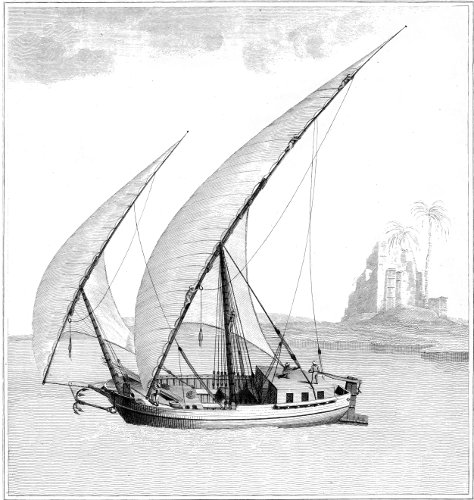
storm, seeming to menace both thunder and rain. The vessel
being in her trim with large latine sails, fell violently to
leeward, and they scarce would have weathered the Cape
that makes the entrance into the harbour of Bengazi, which
is a very bad one, when all at once it struck upon a sunken
rock, and seemed to be set down upon it. The wind at that
instant seemed providentially to calm; but I no sooner observed
the ship had struck than I began to think of my own
situation. We were not far from shore, but there was an
exceeding great swell at sea. Two boats were still towed
astern of them, and had not been hoisted in. Roger M‘Cormack,
my Irish servant, had been a sailor on board the Monarch
before he deserted to the Spanish service. He and
the other, who had likewise been a sailor, presently unlashed
the largest boat, and all three got down into her, followed
by a multitude of people whom we could not hinder,
and there was, indeed, something that bordered on cruelty,
in preventing poor people from using the same means that
we had done for preserving their lives; yet, unless we had
killed them, the prevention was impossible, and, had we
been inclined to that measure, we dared not, as we were
upon a Moorish coast. The most that could be done was,
to get loose from the ship as soon as possible, and two oars
were prepared to row the boat ashore. I had stript myself
to a short under-waistcoat and linen drawers; a silk sash,
or girdle, was wrapt round me; a pencil, small pocket-book,
and watch, were in the breast-pocket of my waistcoat; two
Moorish and two English servants followed me; the rest,
more wise, remained on board.
We were not twice the length of the boat from the vessel
before a wave very nearly filled the boat. A howl of
despair from those that were in her shewed their helpless
state, and that they were conscious of a danger they could
not shun. I saw the fate of all was to be decided by the
very next wave that was rolling in; and apprehensive that
some woman, child, or helpless man would lay hold of me,
and entangle my arms or legs and weigh me down, I cried
to my servants, both in Arabic and English, We are all lost;
if you can swim, follow me; I then let myself down in
the face of the wave. Whether that, or the next, filled the
boat, I know not, as I went to leeward to make my distance
as great as possible. I was a good, strong, and practised swimmer,
in the flower of life, full of health, trained to exercise
and fatigue of every kind. All this, however, which might
have availed much in deep water, was not sufficient when
I came to the surf. I received a violent blow upon my
breast from the eddy wave and reflux, which seemed as
given me by a large branch of a tree, thick cord, or some
elastic weapon. It threw me upon my back, made me swallow
a considerable quantity of water, and had then almost
suffocated me.
I avoided the next wave, by dipping my head and letting
it pass over, but found myself breathless, exceedingly
weary and exhausted. The land, however, was before me,
and close at hand. A large wave floated me up. I had the
prospect of escape still nearer, and endeavoured to prevent
myself from going back into the surf. My heart was strong,
but strength was apparently failing, by being involuntarily
twisted about, and struck on the face and breast by the violence
of the ebbing wave: it now seemed as if nothing remained
but to give up the struggle, and resign to my destiny.
Before I did this I sunk to sound if I could touch the
ground, and found that I reached the sand with my feet,
though the water was still rather deeper than my mouth.
The success of this experiment infused into me the strength
of ten men, and I strove manfully, taking advantage of
floating only with the influx of the wave, and preserving my
strength for the struggle against the ebb, which, by sinking
and touching the ground, I now made more easy. At last,
finding my hands and knees upon the sands, I fixed my
nails into it, and obstinately resisted being carried back at
all, crawling a few feet when the sea had retired. I had
perfectly lost my recollection and understanding, and after
creeping so far as to be out of the reach of the sea, I suppose
I fainted, for from that time I was totally insensible of
any thing that passed around me.
In the mean time the Arabs, who live two short miles
from the shore, came down in crowds to plunder the vessel.
One of the boats was thrown ashore, and they had belonging
to them some others; there was one yet with the wreck,
which scarcely appeared with its gunnel above water. All
the people were now taken on shore, and those only lost
who perished in the boat. What first wakened me from
this semblance of death was a blow with the butt-end of a
lance, shod with iron, upon the juncture of the neck with
the back-bone. This produced a violent sensation of pain;
but it was a mere accident the blow was not with the point,
for the small, short waistcoat, which had been made at Algiers,
the sash and drawers, all in the Turkish fashion, made
the Arabs believe that I was a Turk; and after many blows,
kicks, and curses, they stript me of the little cloathing I had,
and left me naked. They used the rest in the same manner,
then went to their boats to look for the bodies of those that
were drowned.
After the discipline I had received, I had walked, or
crawled up among some white, sandy hillocks, where I sat
down and concealed myself as much as possible. The weather
was then warm, but the evening promised to be cooler,
and it was fast drawing on; there was great danger to be apprehended
if I approached the tents where the women were
while I was naked, for in this case it was very probable I
would receive another bastinado something worse than the
first. Still I was so confused that I had not recollected I
could speak to them in their own language, and it now only
came into my mind, that by the gibberish, in imitation
of Turkish, which the Arab had uttered to me
while he was beating and stripping me, he took me for
a Turk, and to this in all probability the ill-usage was
owing.
An old man and a number of young Arabs came up to
me where I was sitting. I gave them the salute Salam Alicum!
which was only returned by one young man, in a
tone as if he wondered at my impudence. The old man
then asked me, Whether I was a Turk, and what I had to
do there? I replied, I was no Turk, but a poor Christian physician,
a Dervish that went about the world seeking to do
good for God’s sake, was then flying from famine, and going
to Greece to get bread. He then asked me if I was a Cretan?
I said, I had never been in Crete, but came from Tunis,
and was returning to that town, having lost every thing
I had in the shipwreck of that vessel. I said this in so despairing
a tone, that there was no doubt left with the Arab
that the fact was true. A ragged, dirty baracan was immediately
thrown over me, and I was ordered up to a tent, in
the end of which stood a long spear thrust through it, a
mark of sovereignty.
I there saw the Shekh of the tribe, who being in peace
with the Bey of Bengazi, and also with the Shekh of Ptolometa,
after many questions ordered me a plentiful supper,
of which all my servants partook, none of them having perished.
A multitude of consultations followed on their complaints,
of which I freed myself in the best manner I could,
alledging the loss of all my medicines, in order to induce
some of them to seek for the sextant at least, but all to no
purpose, so that, after staying two days among them, the
Shekh restored to us all that had been taken from us, and
mounting us upon camels, and giving us a conductor, he
forwarded us to Bengazi, where we arrived the second day
in the evening. Thence I sent a compliment to the Shekh,
and with it a man from the Bey, intreating that he would
use all possible means to fish up some of my cases, for
which I assured him he should not miss a handsome reward.
Promises and thanks were returned, but I never
heard further of my instruments; all I recovered was a
silver watch of Ellicot, the work of which had been taken
out and broken, some pencils, and a small port-folio, in which
were sketches of Ptolemeta; my pocket-book too was found,
but my pencil was lost, being in a common silver case, and
with them all the astronomical observations which I had
made in Barbary. I there lost a sextant, a parallactic instrument,
a time-piece, a reflecting telescope, an achromatic
one, with many drawings, a copy of M. de la Caille’s ephemerides
down to the year 1775, much to be regretted, as being
full of manuscript marginal notes; a small camera obscura,
some guns, pistols, a blunderbuss, and several other
articles.
I found at Bengazi a small French sloop, the master of
which had been often at Algiers when I was consul there.
I had even, as the master remembered, done him some little
service, for which, contrary to the custom of that sort of
people, he was very grateful. He had come there laden
with corn, and was going up the Archipelago, or towards
the Morea, for more. The cargo he had brought was but a
mite compared to the necessities of the place; it only relieved
the soldiers for a time, and many people of all ages
and sexes were still dying every day.
The harbour of Bengazi is full of fish, and my company
caught a great quantity with a small net; we likewise procured
a multitude with the line, enough to have maintained
a larger number of persons than the family consisted of;
we got vinegar, pepper, and some store of onions; we had
little bread it is true, but still our industry kept us very far
from starving. We endeavoured to instruct these wretches,
gave them pack-thread, and some coarse hooks, by which
they might have subsisted with the smallest attention and
trouble; but they would rather starve in multitudes, striving
to pick up single grains of corn, that were scattered upon the
beach by the bursting of the sacks, or the inattention of the
mariners, than take the pains to watch one hour at the flowing
of the tide for excellent fish, where, after taking one,
they were sure of being masters of multitudes till it was
high water.
The Captain of the small vessel lost no time. He had
done his business well, and though he was returning for
another cargo, yet he offered me what part of his funds I
should need with great frankness. We now sailed with a
fair wind, and in four or five days easy weather landed at
Canea, a considerable fortified place at the west end of the
island of Crete. Here I was taken dangerously ill, occasioned
by the bathing and extraordinary exertions in the sea
of Ptolometa, nor was I in the least the better from the beating
I had received, signs of which I bore very long afterwards.
From Canea I sailed for Rhodes, and there met my books;
I then proceeded to Castelrosso, on the coast of Caramania,
and was there credibly informed that there were very magnificent
remains of ancient buildings a short way from the
shore, on the opposite continent. Caramania is a part of
Asia Minor yet unexplored. But my illness increasing, it
was impossible to execute, or take any measures to secure
protection, or do the business safely, and I was forced to
relinquish this discovery to some more fortunate traveller.
Mr Peyssonel, French consul at Smyrna, a man not more
distinguished for his amiable manners than for his polite
taste in literature, of which he has given several elegant
specimens, furnished me with letters for that part of Caramania,
or Asia Minor, and there is no doubt but they would
have been very efficacious. What increased the obligation
for this kind attention shewn, was, that I had never seen
Mr Peyssonel; and I am truly mortified, that, since my arrival
in England, I have had no opportunity to return my
grateful thanks for this kindness, which I therefore beg
that he will now accept, together with a copy of these travels,
which I have ordered my French bookseller to forward
to him.
From Castelrosso I continued, without any thing remarkable,
till I came to Cyprus; I staid there but half a day, and
arrived at Sidon, where I was most kindly received by Mr
Clerambaut, brother-in-law to Mr Peyssonel, and French
consul at this place; a man in politeness, humanity, and
every social quality of the mind, inferior to none I have ever
known. With him, and a very flourishing, well-informed,
and industrious nation, I continued for some time, then
in a weak state of health, but still making partial excursions
from time to time into the continent of Syria, through
Libanus, and Anti Libanus; but as I made these without
instruments, and passed pretty much in the way of the travellers
who have described these countries before, I leave the
history to those gentlemen, without swelling, by entering
into particular narratives, this Introduction, already too
long.
While at Canea I wrote by way of France, and again
while at Rhodes by way of Smyrna, to particular friends
both in London and France, informing them of my disastrous
situation, and desiring them to send me a moveable quadrant
or sextant, as near as possible to two feet radius, more
or less, a time-keeper, stop-watch, a reflecting telescope, and
one of Dolland’s achromatic ones, as near as possible to
three-feet reflectors, with several other articles which I then
wanted.
I received from Paris and London much about the same
time, and as if it had been dictated by the same person,
nearly the same answer, which was this, That everybody
was employed in making instruments for Danish, Swedish,
and other foreign astronomers; that all those which were
completed had been bought up, and without waiting a
considerable, indefinite time, nothing could be had that could
be depended upon. At the same time I was told, to my
great mortification, that no accounts of me had arrived from
Africa, unless from several idle letters, which had been industriously
wrote by a gentleman whole name I abstain
from mentioning, first, because he is dead, and next, out of
respect to his truly great and worthy relations.
In these letters it was announced, that I was gone with
a Russian caravan through the Curdistan, where I was to
observe the transit of Venus in a place where it was not visible,
and that I was to proceed to China, and return by the
way of the East Indies:—a story which some of his correspondents,
as profligate as himself, industriously circulated at
the time, and which others, perhaps weaker than wicked,
though wicked enough, have affected to believe to this
day.
I conceived a violent indignation at this, and finding
myself so treated in return for so complete a journey as I
had then actually terminated, thought it below me to sacrifice
the best years of my life to daily pain and danger,
when the impression it made in the breasts of my countrymen
seemed to be so weak, so infinitely unworthy of them
or me. One thing only detained me from returning home;
it was my desire of fulfilling my promise to my Sovereign,
and of adding the ruins of Palmyra to those of Africa, already
secured and out of danger.
In my anger I renounced all thoughts of the attempt to
discover the sources of the Nile, and I repeated my orders
no more for either quadrant, telescope, or time-keeper. I
had pencils and paper; and luckily my large camera obscura,
which had escaped the catastrophe of Ptolometa, was arrived
from Smyrna, and then standing before me. I therefore
began to cast about, with my usual care and anxiety,
for the means of obtaining feasible and safe methods of repeating
the famous journey to Palmyra. I found it was
necessary to advance nearer the scene of action. Mr Abbot,
British consul for Tripoli in Syria, kindly invited me, and
after him Mr Vernon, his successor, a very excellent man,
to take up my residence there. From Tripoli there is a
trade in kelp carried on to the salt marshes near Palmyra.
The Shekh of Cariateen, a town just upon the edge of the
desert, had a contract with the basha of Tripoli for a quantity
of this herb for the use of the soap-works. I lost no
time in making a friendship with this man, but his return
amounted to no more than to endeavour to lead me rashly
into real danger, where he knew he had not consequence
enough to give me a moment’s protection.
There are two tribes almost equally powerful who inhabit
the deserts round Palmyra; the one is the Annecy, remarkable
for the finest breed of horses in the world; the
other is the Mowalli, much better soldiers, but fewer in
number, and very little inferior in the excellence of their
horses. The Annecy possess the country towards the S. W.
at the back of Libanus, about Bozra down the Hawran, and
southward towards the borders of Arabia Petrea and Mount
Horeb. The Mowalli inhabit the plains east of Damascus
to the Euphrates, and north to near Aleppo.
These two tribes were not at war, nor were they at peace;
they were upon what is called ill-terms with each other,
which is the most dangerous time for strangers to have any
dealings with either. I learned this as a certainty from a
friend at Hassia, where a Shekh lives, to whom I was recommended
by a letter, as a friend of the basha of Damascus.
This man maintains his influence, not by a number
of forces, but by constantly marrying a relation of one or
both of these tribes of Arabs, who for that reason assist him
in maintaining the security of his road, and he has the care
of that part of it by which the couriers pass from Constantinople
into Egypt, belonging to both these tribes, who
were then at a distance from each other, and roved in flying
squadrons all round Palmyra, by way of maintaining their
right of pasture in places that neither of them chose at that
time to occupy. These, I suppose, are what the English
writers call Wild Arabs, for otherwise, though they are all
wild enough, I do not know one wilder than another. This
is very certain, these young men, composing the flying parties
I speak of, are truly wild while at a distance from their
camp and government; and the stranger that falls in unawares
with them, and escapes with his life, may set himself down
as a fortunate traveller.
Returning from Hassia I would have gone southward to
Baalbec, but it was then besieged by Emir Yousef prince of
the Druses, a Pagan nation, living upon mount Libanus.
Upon that I returned to Tripoli, in Syria, and after some time
set out for Aleppo, travelling northward along the plain of
Jeune betwixt mount Lebanon and the sea.
I visited the ancient Byblus, and bathed with pleasure
in the river Adonis. All here is classic ground. I saw several
considerable ruins of Grecian architecture all very much
defaced. These are already published by Mr Drummond,
and therefore I left them, being never desirous of interfering
with the works of others.
I passed Latikea, formerly Laodicea ad Mare, and then
came to Antioch, and afterwards to Aleppo. The fever and
ague, which I had first caught in my cold bath at Bengazi,
had returned upon me with great violence, after passing
one night encamped in the mulberry gardens behind Sidon.
It had returned in very slight paroxysms several
times, but laid hold of me with more than ordinary violence
on my arrival at Aleppo, where I came just in time to the
house of Mr Belville, a French merchant, to whom I was
addressed for my credit. Never was a more lucky address,
never was there a soul so congenial to my own as was that
of Mr Belville: to say more after this would be praising myself.
To him was immediately added Doctor Patrick Russel,
physician to the British factory there. Without the attention
and friendship of the one, and the skill and anxiety of
the other of these gentlemen, it is probable my travels
would have ended at Aleppo. I recovered slowly. By the
report of these two gentlemen, though I had yet seen nobody,
I became a public care, nor did I ever pass more agreeable
hours than with Mr Thomas the French consul, his family,
and the merchants established there. From Doctor Russel
I was supplied with what I wanted, some books, and
much instruction. Nobody knew the diseases of the East
so well; and perhaps my escaping the fever at Aleppo
was not the only time in which I owed him my life.
Being now restored to health, my first object was the
journey to Palmyra. The Mowalli were encamped at no
great distance from Aleppo. It was without difficulty I found
a sure way to explain my wishes, and to secure the assistance
of Mahomet Kerfan, the Shekh, but from him I learned, in
a manner that I could not doubt, that the way I intended
to go down to Palmyra from the north was tedious, troublesome,
uncertain, and expensive, and that he did not wish me
to undertake it at that time. It is quite superfluous in these
cases to press for particular information; an Arab conductor,
who proceeds with caution, surely means you well. He
told me that he would leave a friend in the house of a certain
Arab at Hamath45, about half-way to Palmyra, and if
in something more than a month I came there, and found
that Arab, I might rely upon him without fear, and he
would conduct me in safety to Palmyra.
I returned to Tripoli, and at the time appointed set out
for Hamath, found my conductor, and proceeded to Hassia.
Coming from Aleppo, I had not passed the lower way again
by Antioch. The river which passes through the plains
where they cultivate their best tobacco, is the Orontes; it was
so swollen with rain, which had fallen in the mountains,
that the ford was no longer visible. Stopping at two miserable
huts inhabited by a base set called Turcomans, I asked
the master of one of them to shew me the ford, which he
very readily undertook to do, and I went, for the length of
some yards, on rough, but very hard and solid ground. The
current before me was, however, so violent, that I had more
than once a desire to turn back, but, not suspecting any
thing, I continued, when on a sudden man and horse fell
out of their depth into the river.
I had a rifled gun flung across my shoulder, with a buff
belt and swivel. As long as that held, it so embarrassed my
hands and legs that I could not swim, and must have sunk;
but luckily the swivel gave way, the gun fell to the bottom
of the river, and was pickt up in dry weather by order of
the basha, at the desire of the French merchants, who kept it
for a relict. I and my horse swam separately ashore; at a
small distance from thence was a caphar46, or turnpike, to
which, when I came to dry myself, the man told me, that
the place where I had crossed was the remains of a stone
bridge now entirely carried away; where I had first entered
was one of the wings of the bridge, from which I had
fallen into the space the first arch occupied, one of the
deepest parts of the river; that the people who had misguided
me were an infamous set of banditti, and that I
might be thankful on many accounts that I had made such
an escape from them, and was now on the opposite side. I
then prevailed on the caphar-man to shew my servants the
right ford.
From Hassia we proceeded with our conductor to Cariateen,
where there is an immense spring of fine water, which
overflows into a large pool. Here, to our great surprise, we
found about two thousand of the Annecy encamped, who
were quarrelling with Hassan our old friend, the kelp-merchant.
This was nothing to us; the quarrel between the
Mowalli and Annecy had it seems been made up; for an
old man from each tribe on horseback accompanied us to
Palmyra: the tribes gave us camels for more commodious
travelling, and we passed the desert between Cariateen and
Palmyra in a day and two nights, going constantly without
sleeping.
Just before we came in sight of the ruins, we ascended
a hill of white gritty stone, in a very narrow-winding road,
such as we call a pass, and, when arrived at the top, there
opened before us the most astonishing, stupendous sight that
perhaps ever appeared to mortal eyes. The whole plain
below, which was very extensive, was covered so thick with
magnificent buildings as that the one seemed to touch the
other, all of fine proportions, all of agreeable forms, all composed
of white stones, which at that distance appeared like
marble. At the end of it stood the palace of the sun, a
building worthy to close so magnificent a scene.
It was impossible for two persons to think of designing
ornaments, or taking measures, and there seemed the less
occasion for this as Mr Wood had done this part already. I
had no intention to publish any thing concerning Palmyra;
besides, it would have been a violation of my first principle
not to interfere with the labours of others; and if this was
a rule I inviolably observed as to strangers, every sentiment
of reason and gratitude obliged me to pay the same respect
to the labours of Mr Wood my friend.
I divided Palmyra into six angular views, always bringing
forward to the first ground an edifice, or principal group
of columns, that deserved it. The state of the buildings are
particularly favourable for this purpose. The columns are
all uncovered to the very bases, the soil upon which the
town is built being hard and fixed ground. These views
are all upon large paper; the columns in some of them are
a foot long; the figures in the fore-ground of the temple of
the sun are some of them near four inches.
Before our departure from Palmyra I observed its latitude
with a Hadley’s quadrant from reflection. The instrument
had probably warped in carriage, as the index
went unpleasantly, and as it were by starts, so that I will not
pretend to give this for an exact observation; yet, after all
the care I could take, I only apprehended that 33° 58´ for the
latitude of Palmyra, would be nearer the truth than any other.
Again, that the distance from the coast in a straight line
being 160 miles, and that remarkable mountainous cape on
the coast of Syria, between Byblus and Tripoli, known by the
name of Theoprosopon, being nearly due west, or under the
same parallel with Palmyra, I conceive the longitude of
that city to be nearly 37° 9´ from the observatory of Greenwich.
From Palmyra I proceeded to Baalbec, distant about 130
miles, and arrived the same day that Emir Yousef had
reduced the town and settled the government, and was decamping
from it on his return home. This was the
luckiest moment possible for me, as I was the Emir’s friend,
and I obtained liberty to do there what I pleased, and to
this indulgence was added the great convenience of the
Emir’s absence, so that I was not troubled by the observance
of any court-ceremony or attendance, or teazed with impertinent
questions.
Baalbec is pleasantly situated in a plain on the west of
Anti Libanus, is finely watered, and abounds in gardens.
It is about fifty miles from Hassia, and about thirty
from the nearest sea-coast, which is the situation of the ancient
Byblus. The interior of the great temple of Baalbec,
supposed to be that of the sun, surpasses any thing at Palmyra,
indeed any sculpture I ever remember to have seen
in stone. All these views of Palmyra and Baalbec are now
in the King’s collection. They are the most magnificent
offering in their line that ever was made by one subject to
his sovereign.
Passing by Tyre, from curiosity only, I came to be a
mournful witness of the truth of that prophecy, That Tyre,
the queen of nations, should be a rock for fishers to dry
their nets on47. Two wretched fishermen, with miserable
nets, having just given over their occupation with very little
success, I engaged them, at the expence of their nets, to
drag in those places where they said shell-fish might be
caught, in hopes to have brought out one of the famous
purple-fish. I did not succeed, but in this I was, I believe, as
lucky as the old fishers had ever been. The purple fish at
Tyre seems to have been only a concealment of their knowledge
of cochineal, as, had they depended upon the fish for
their dye, if the whole city of Tyre applied to nothing else
but fishing, they would not have coloured twenty yards of
cloth in a year. Much fatigued, but satisfied beyond measure
with what I had seen, I arrived in perfect health, and
in the gayest humour possible, at the hospitable mansion of
M. Clerambaut at Sidon.
I found there letters from Europe, which were in a very
different style from the last. From London, my friend Mr
Russel acquainted me, that he had sent me an excellent
reflecting telescope of two feet focal length, moved by
rack-work, and the last Mr Short ever made, which proved
a very excellent instrument; also an achromatic telescope
by Dolland, nearly equal to a three-feet reflector, with a
foot, or stand, very artificially composed of rulers fixed together
by screws. I think this instrument might be improved
by shortening the three principal legs of it. If the
legs of its stand were about six inches shorter, this, without
inconvenience, would take away the little shake it has when
used in the outer air. Perhaps this defect is not in all telescopes
of this construction. It is a pleasant instrument,
and for its size takes very little packing, and is very manageable.
I have brought home both these instruments after performing
the whole journey, and they are now standing in
my library, in the most perfect order; which is rather to be
wondered at from the accounts in which most travellers
seem to agree, that metal speculums, within the tropics, spot
and rust so much as to be useless after a few observations
made at or near the zenith. The fear of this, and the fragility
of glass of achromatic telescopes, were the occasion
of a considerable expence to me; but from experience I found,
that, if a little care be taken, one reflector would be sufficient
for a very long voyage.
From Paris I received a time-piece and a stop-watch made
by M. Lepeaute, dearer than Ellicot’s, and resembling his in
nothing else but the price. The clock was a very neat,
portable instrument, made upon very ingenious, simple principles,
but some of the parts were so grossly neglected in
the execution, and so unequally finished, that it was not
difficult for the meanest novice in the trade to point out the
cause of its irregularity. It remains with me in statu quo.
It has been of very little use to me, and never will be of
much more to any person else. The price is, I am sure, ten
times more than it ought to be in any light I can consider
it.
All these letters still left me in absolute despair about
obtaining a quadrant, and consequently gave me very little
satisfaction, but in some measure confirmed me in my resolution
already taken, to go from Sidon to Egypt; as I had
then seen the greatest part of the good architecture in the
world, in all its degrees of perfection down to its decline, I
wished now only to see it in its origin, and for this it was
necessary to go to Egypt.
Norden, Pococke, and many others, had given very ingenious
accounts of Egyptian architecture in general, of the
disposition and size of their temples, magnificence of their
materials, their hieroglyphics, and the various kinds of
them, of their gilding, of their painting, and their present
state of preservation. I thought something more might be
learnt as to the first proportions of their columns, and
the construction of their plans. Dendera, the ancient
Tentyra, seemed by their accounts to offer a fair field for
this.
I had already collected together a great many observations
on the progress of Greek and Roman architecture in different
ages, drawn not from books or connected with system,
but from the models themselves, which I myself had measured.
I had been long of the opinion, in which I am still
further confirmed, that taste for ancient architecture, founded
upon the examples that Italy alone can furnish, was not
giving ancient architects fair play. What was to be
learned from the first proportions of their plans and elevations
seemed to have remained untouched in Egypt; after
having considered these, I proposed to live in retirement on
my native patrimony, with a fair stock of unexceptionable
materials upon this subject, to serve for a pleasant and useful
amusement in my old age. I hope still these will not be
lost to the public, unless the encouragement be in proportion
to what my labours have already had.
I now received, however, a letter very unexpectedly by
way of Alexandria, which, if it did not overturn, at least
shook these resolutions. The Comte de Buffon Mons. Guys
of Marseilles, and several others well known in the literary
world, had ventured to state to the minister, and through
him to the king of France, Louis XV. how very much it was
to be lamented, that after a man had been found who was
likely to succeed in removing that opprobrium of travellers
and geographers, by discovering the sources of the Nile, one
most unlucky accident, at a most unlucky time, should frustrate
the most promising endeavours. That prince, distinguished
for every good quality of the heart, for benevolence,
beneficence, and a desire of promoting and protecting
learning, ordered a moveable quadrant of his own military
academy at Marseilles, as the nearest and most convenient
port of embarkation, to be taken down and sent to me at
Alexandria.
With this I received a letter from Mr Russel, which informed
me that astronomers had begun to cool in the sanguine
expectations of discovering the precise quantity of
the sun’s parallax by observation of the transit of Venus,
from some apprehension that errors of the observers would
probably be more than the quantity of the equation sought,
and that they now ardently wished for a journey into Abyssinia,
rather than an attempt to settle a nicety for which
the learned had now begun to think the accuracy of our
instruments was not sufficient. A letter from my correspondent
at Alexandria also acquainted me, that the quadrant,
and all other instruments, were in that city.
What followed is the voyage itself, the subject of the
present publication. I am happy, by communicating every
previous circumstance that occurred to me, to have done all
in my power to remove the greatest part of the reasonable
doubts and difficulties which might have perplexed the reader’s
mind, or biassed his judgment in the perusal of the
narrative of the journey, and in this I hope I have succeeded.
I have now one remaining part of my promise to fulfil,
to account for the delay in the publication. It will not be
thought surprising to any that shall reflect on the distant,
dreary, and desert ways by which all letters were necessarily
to pass, or the civil wars then raging in Abyssinia, the
robberies and violences inseparable from a total dissolution
of government, such as happened in my time, that no accounts
for many years, one excepted, ever arrived in Europe.
One letter, accompanied by a bill for a sum borrowed
from a Greek at Gondar, found its way to Cairo; all
the rest had miscarried: my friends at home gave me up
for dead; and, as my death must have happened in circumstances
difficult to have been proved, my property became
as it were an hereditas jacens, without an owner, abandoned
in common to those whose original title extended no further
than temporary possession.
A number of law-suits were the inevitable consequence
of this upon my return. One carried on with a very expensive
obstinacy for the space of ten years, by a very opulent
and active company, was determined finally in the House
of Peers, in the compass of a very few hours, by the well-known
sagacity and penetration of a noble Lord, who, happily
for the subjects of both countries, holds the first office
in the law; and so judicious was the sentence, that harmony,
mutual confidence, and good neighbourhood has
ever since been the consequence of that determination.
Other suits still remained, which unfortunately were
not arrived to the degree of maturity to be so cut off;
they are yet depending; patience and attention, it is hoped,
may bring them to an issue at some future time. No imputation
of rashness can possibly fall upon the decree, since
the action has depended above thirty years.
To these disagreeable avocations, which took up much
time, were added others still more unfortunate. The relentless
ague caught at Bengazi maintained its ground at
times for a space of more than sixteen years, though every
remedy had been used, but in vain; and, what was worst
of all, a lingering distemper had seriously threatened the
life of a most near relation, which, after nine years constant
alarm, where every duty bound me to attention and attendance,
conducted her at last, in very early life, to her
grave48.
The love of solitude is the constant follower of affliction;
this again naturally turns an instructed mind to study. My
friends unanimously assailed me in the part most accessible
when the spirits are weak, which is vanity. They represented
to me how ignoble it was, after all my dangers and
difficulties were over, to be conquered by a misfortune incident
to all men, the indulging of which was unreasonable
in itself, fruitless in its consequences, and so unlike the expectation
I had given my country, by the firmness and intrepidity
of my former character and behaviour. Among
these, the principal and most urgent was a gentleman well
known to the literary world, in which he holds a rank nearly
as distinguished as that to which his virtues entitle him
in civil life; this was the Hon. Daines Barrington, whose
friendship, valuable on every account, had this additional
merit, that it had existed uninterrupted since the days we
were at school. It is to this gentleman’s persuasions, assistance,
protection, and friendship, that the world owes this
publication, if indeed there is any merit in it; at least,
they are certainly indebted to him for the opportunity of
judging whether there is any merit in it or not.
No great time has passed since the work was in hand.
The materials collected upon the spot were very full, and
seldom deferred to be set down beyond the day wherein
the events described happened, but oftner, when speeches
and arguments were to be mentioned, they were noted the
instant afterwards; for, contrary I believe to what is often
the case, I can assure the reader these speeches and conversations
are absolutely real, and not the fabrication of after-hours.
It will perhaps be said, this work hath faults; nay, perhaps,
great ones too, and this I readily confess. But I must
likewise beg leave to say, that I know no books of the kind
that have not nearly as many, and as great, though perhaps
not of the same kind with mine. To see distinctly and accurately,
to describe plainly, dispassionately and truly, is all
that ought to be expected from one in my situation, constantly
surrounded with every sort of difficulty and danger.
It may be said, too, there are faults in the language;
more pains should have been taken. Perhaps it may
be so; yet there has not been wanting a considerable degree
of attention even to this. I have not indeed confined
myself to a painful and slavish nicety that would have produced
nothing but a disagreeable stiffness in the narrative.
It will be remembered likewise, that one of the motives of
my writing is my own amusement, and I would much rather
renounce the subject altogether than walk in fetters
of my own forging. The language is, like the subject, rude
and manly. My paths have not been flowery ones, nor
would it have added any credit to the work, or entertainment
to the reader, to employ in it a stile proper only to
works of imagination and pleasure. These trifling faults
I willingly leave as food to the malice of critics, who perhaps,
were it not for these blemishes, would find no other enjoyment
in the perusal of the work.
It has been said that parties have been formed against
this work. Whether this is really the case I cannot say, nor
have I ever been very anxious in the inquiry. They have
been harmless adversaries at least, for no bad effects, as far
as I know, have ever as yet been the consequences; neither
is it a disquisition that I shall ever enter into, whether this is
owing to the want of will or of power. I rather believe it is
to the former, the want of will, for no one is so perfectly
inconsiderable, as to want the power of doing mischief.
Having now fulfilled my promise to the reader, in giving
him the motive and order of my travels, and the reason
why the publication has been delayed, I shall proceed to the
last article promised, the giving some account of the work
itself. The book is a large one, and expensive by the number
of engravings; this was not at first intended, but the
journey has proved a long one, and matter has increased as it
were insensibly under my hands. It is now come to fill a
great chasm in the history of the universe. It is not intended
to resemble the generality of modern travels, the agreeable
and rational amusement of one vacant day, it is calculated
to employ a greater space of time.
Those that are the best acquainted with Diodorus, Herodotus,
and some other Greek historians, will find some very
considerable difficulties removed; and they that are unacquainted
with these authors, and receive from this work the
first information of the geography, climate, and manners of
these countries, which are little altered, will have no great
occasion to regret they have not searched for information in
more ancient sources.
The work begins with my voyage from Sidon to Alexandria,
and up the Nile to the first cataract. The reader
will not expect that I should dwell long upon the particular
history of Egypt; every other year has furnished us with
some account of it, good or bad; and the two last publications
of M. Savary and Volney seem to have left the subject
thread-bare. This, however, is not the only reason.
After Mr Wood and Mr Dawkins had published their
Ruins of Palmyra, the late king of Denmark, at his own expence,
sent out a number of men, eminent in their several
professions, to make discoveries in the east, of every kind,
with these very flattering instructions, that though they
might, and ought, to visit both Baalbec and Palmyra for
their own studies and improvement, yet he prohibited them
to so far interfere with what the English travellers had done,
as to form any plan of another work similar to theirs. This
compliment was gratefully received; and, as I was directly
to follow this mission, Mr Wood desired me to return it, and
to abstain as much as possible from writing on the same
subjects chosen by M. Niebuhr, at least to abstain either
from criticising or differing from him on such subjects. I
have therefore passed slightly over Egypt and Arabia; perhaps,
indeed, I have said enough of both: if any shall be of
another opinion, they may have recourse to M. Niebuhr’s
more copious work; he was the only person of six who
lived to come home, the rest having died in different parts
of Arabia, without having been able to enter Abyssinia, one
of the objects of their mission.
My leaving Egypt is followed by my survey of the Arabian
gulf as far as the Indian Ocean—Arrival at Masuah—Some
account of the first peopling of Atbara and Abyssinia—Conjectures
concerning language—First ages of the Indian
trade—Foundation of the Abyssinian monarchy, and
various revolutions till the Jewish usurpation about the year
900. These compose the first volume.
The second begins with the restoration of the line of Solomon,
compiled from their own annals, now first translated
from the Ethiopic; the original of which has been lodged
in the British Museum, to satisfy the curiosity of the
public.
The third comprehends my journey from Masuah to
Gondar, and the manners and customs of the Abyssinians,
also two attempts to arrive at the fountains of the Nile—Description
of these sources, and of every thing relating to
that river and its inundation.
The fourth contains my return from the source of the
Nile to Gondar—The campaign of Serbraxos, and revolution
that followed—My return through Sennaar and Beja, or
the Nubian desert, and my arrival at Marseilles.
In overlooking the work I have found one circumstance,
and I think no more, which is not sufficiently clear, and
may create a momentary doubt in the reader’s mind, although
to those who have been sufficiently attentive to the
narrative, I can scarce think it will do this. The difficulty
is, How did you procure funds to support yourself,
and ten men, so long, and so easily, as to enable you to undervalue
the useful character of a physician, and seek neither
to draw money nor protection from it? And how came
it, that, contrary to the usage of other travellers, at Gondar
you maintained a character of independence and equality,
especially at court; instead of crouching, living out of sight
as much as possible, in continual fear of priests, under the
patronage, or rather as servant to some men of power.
To this sensible and well-founded doubt I answer
with great pleasure and readiness, as I would do to all others
of the same kind, if I could possibly divine them:—It
is not at all extraordinary that a stranger like me, and a parcel
of vagabonds like those that were with me, should get themselves
maintained, and find at Gondar a precarious livelihood
for a limited time. A mind ever so little polished and
instructed has infinite superiority over Barbarians, and it is
in circumstances like these that a man sees the great advantages
of education. All the Greeks in Gondar were originally
criminals and vagabonds; they neither had, nor
pretended to any profession, except Petros the king’s chamberlain,
who had been a shoemaker at Rhodes, which profession
at his arrival he carefully concealed. Yet these
were not only maintained, but by degrees, and without
pretending to be physicians, obtained property, commands,
and places.
Hospitality is the virtue of Barbarians, who are hospitable
in the ratio that they are barbarous, and for obvious
reasons this virtue subsides among polished nations in the
same proportion. If on my arrival in Abyssinia I assumed
a spirit of independence, it was from policy and reflection.
I had often thought that the misfortunes which had befallen
other travellers in Abyssinia arose from the base estimation
the people in general entertained of their rank, and the value
of their persons. From this idea I resolved to adopt a
contrary behaviour. I was going to a court where there
was a king of kings, whose throne was surrounded by a number
of high-minded, proud, hereditary, punctilious nobility.
It was impossible, therefore, too much lowliness and
humility could please there.
Mr Murray, the ambassador at Constantinople, in the firman
obtained from the grand signior, had qualified me
with the distinction of Bey-Adzè, which means, not an English
nobleman (a peer) but a noble Englishman, and he
had added likewise, that I was a servant of the king of
Great Britain. All the letters of recommendation, very
many and powerful, from Cairo and Jidda, had constantly
echoed this to every part to which they were addressed.
They announced that I was not a man, such as ordinarily
came to them, to live upon their charity, but had ample
means of my own, and each professed himself guarantee
of that fact, and that they themselves on all occasions were
ready to provide for me, by answering my demands.
The only request of these letters was safety and protection
to my person. It was mentioned that I was a physician, to
introduce a conciliatory circumstance, that I was above practising
for gain. That all I did was from the fear of God,
from charity, and the love of mankind. I was a physician
in the city, a soldier in the field, a courtier every where,
demeaning myself, as conscious that I was not unworthy
of being a companion to the first of their nobility, and the
king’s stranger and guest, which is there a character, as it
was with eastern nations of old, to which a certain sort of
consideration is due. It was in vain to compare myself
with them in any kind of learning, as they have none;
music they have as little; in eating and drinking they were
indeed infinitely my superiors; but in one accomplishment
that came naturally into comparison, which was horsemanship,
I studiously established my superiority.
My long residence among the Arabs had given me more
than ordinary facility in managing the horse; I had brought
my own saddle and bridle with me, and, as the reader will
find, bought my horse of the Baharnagash in the first days
of my journey, such a one as was necessary to carry me,
and him I trained carefully, and studied from the beginning.
The Abyssinians, as the reader will hereafter see, are
the worst horsemen in the world. Their horses are bad,
not equal to our Welsh or our Scotch galloways. Their
furniture is worse. They know not the use of fire-arms on
horseback; they had never seen a double-barrelled gun, nor
did they know that its effect was limited to two discharges,
but that it might have been fired on to infinity. All this
gave me an evident superiority.
To this I may add, that, being in the prime of life, of no
ungracious figure, having an accidental knack, which is
not a trifle, of putting on the dress, and speaking the language
easily and gracefully, I cultivated with the utmost
assiduity the friendship of the fair sex, by the most modest,
respectful distant attendance, and obsequiousness in public,
abating just as much of that in private as suited their
humour and inclinations. I soon acquired a great support
from these at court; jealousy is not a passion of the
Abyssinians, who are in the contrary extreme, even to indifference.
Besides the money I had with me, I had a credit of L.400
upon Yousef Cabil, governor of Jidda. I had another upon
a Turkish merchant there. I had strong and general recommendations,
if I should want supplies, upon Metical Aga,
first minister to the sherriffe of Mecca. This, well managed,
was enough; but when I met my countrymen, the captains
of the English ships from India, they added additional
strength to my finances; they would have poured gold
upon me to facilitate a journey they so much desired upon
several accounts. Captain Thornhill of the Bengal Merchant,
and Captain Thomas Price of the Lion, took the conduct
of my money-affairs under their direction. Their Saraf,
or broker, had in his hands all the commerce that produced
the revenues of Abyssinia, together with great part
of the correspondence of the east; and, by a lucky accident
for me, Captain Price staid all winter with the Lion at Jidda;
nay, so kind and anxious was he as to send over a servant
from Jidda on purpose, upon a report having been
raised that I was slain by the usurper Socinios, though it
was only one of my servants, and the servant of Metical
Aga, who were murdered by that monster, as is said, with
his own hand. Twice he sent over silver to me when I had
plenty of gold, and wanted that metal only to apply it in
furniture and workmanship. I do not pretend to say but
sometimes these supplies failed me, often by my negligence
in not applying in proper time, sometimes by the absence of
merchants, who were all Mahometans, constantly engaged
in business and in journies, and more especially on the king’s
retiring to Tigré, after the battle of Limjour, when I was
abandoned during the usurpation of the unworthy Socinios.
It was then I had recourse to Petros and the Greeks, but
more for their convenience than my own, and very seldom
from necessity. This opulence enabled me to treat upon
equal footing, to do favours as well as to receive them.
Every mountebank-trick was a great accomplishment
there, such as making squibs, crackers, and rockets. There
was no station in the country to which by these accomplishments
I might not have pretended, had I been mad enough
to have ever directed my thoughts that way; and I am certain,
that in vain I might have solicited leave to return,
had not a melancholy despondency, the amor patriæ, seized
me, and my health so far declined as apparently to
threaten death; but I was not even then permitted to
leave Abyssinia till under a very solemn oath I promised to
return.
This manner of conducting myself had likewise its disadvantages.
The reader will see the times, without their
being pointed out to him, in the course of the narrative. It
had very near occasioned me to be murdered at Masuah,
but it was the means of preserving me at Gondar, by putting
me above being insulted or questioned by priests, the fatal
rock upon which all other European travellers had split: it
would have occasioned my death at Sennaar, had I not been
so prudent as to disguise and lay aside the independent carriage
in time. Why should I not now speak as I really
think, or why be guilty of ingratitude which my heart disclaims.
I escaped by the providence and protection of heaven;
and so little store do I set upon the advantage of my
own experience, that I am satisfied, were I to attempt the
same journey again, it would not avail me a straw, or
hinder me from perishing miserably, as others have done,
though perhaps a different way.
I have only to add, that were it probable, as in my decayed
state of health it is not, that I should live to see a second
edition of this work, all well-founded, judicious remarks
suggested should be gratefully and carefully attended
to; but I do solemnly declare to the public in general,
that I never will refute or answer any cavils, captious,
or idle objections, such as every new publication seems
unavoidably to give birth to, nor ever reply to those witticisms
and criticisms that appear in newspapers and periodical
writings. What I have written I have written. My readers
have before them, in the present volumes, all that I shall ever
say, directly or indirectly, upon the subject; and I do, without
one moment’s anxiety, trust my defence to an impartial,
well-informed, and judicious public.
CONTENTS
OF THE
FIRST VOLUME.
| Dedication. |
|
| Introduction, |
Page i |
| BOOK I. |
| THE AUTHOR’S JOURNEY AND VOYAGE FROM SIDON TILL HIS
ARRIVAL AT MASUAH. |
| CHAP. I. |
| The Author sails from Sidon—Touches at Cyprus—Arrives at
Alexandria—Sets out for Rosetto—Embarks on the Nile, and
arrives at Cairo, |
1 |
| CHAP. II. |
| Author’s Reception at Cairo—Procures Letters from the Bey and
the Greek Patriarch—Visits the Pyramids—Observations on their
Construction, |
24 |
| CHAP. III. |
| Leaves Cairo—Embarks on the Nile for Upper Egypt—Visits Metrahenny
and Mohannan—Reasons for supposing this the Situation of Memphis, |
43 |
| CHAP. IV. |
| Leaves Metrahenny—Comes to the Island Halouon—False Pyramid—These
Buildings end—Sugar Canes—Ruins of Antinopolis—Reception there, |
69 |
| CHAP. V. |
| Voyage to Upper Egypt continued—Ashmounein, Ruins there—Gawe
Kibeer Ruins—Mr Norden mistaken—Achmim—Convent of Catholics—Denaera—Magnificent
Ruins—Adventure with a Saint there, |
91 |
| CHAP VI. |
| Arrives at Furshout—Adventure of Friar Christopher—Visits Thebes—Luxor
and Carnac—Large Ruins at Edfu and Esné—Proceeds on his Voyage, |
114 |
| CHAP. VII. |
| Arrives at Syene—Goes to see the Cataract—Remarkable Tombs—The
Situation of Syene—The Aga proposes a visit to Deir and Ibrim—The Author returns to Kenné, |
150 |
| CHAP. VIII. |
| The Author sets out from Kenné—Crosses the Desert of the Thebaid—Visits
the Marble Mountains—Arrives at Cosseir on the Red
Sea—Transactions there, |
169 |
| CHAP. IX. |
| Voyage to Jibbel Zumrud—Returns to Cosseir—Sails from Cosseir—Jassateen
Islands—Arrives at Tor, |
204 |
| CHAP. X. |
| Sails from Tor—Passes the Elanitic Gulf—Sees Raddua—Arrives
at Yambo—Incidents there—Arrives at Jidda, |
239 |
| CHAP. XI. |
| Occurrences at Jidda—Visit of the Vizir—Alarm of the Factory—Great
Civility of the English trading from India—Polygamy—Opinion
of Dr Arbuthnot ill-founded—Contrary to Reason and Experience—Leaves Jidda, |
265 |
| CHAP. XII. |
| Sails from Jidda—Konsodah—Ras Heli, Boundary of Arabia Felix—Arrives
at Loheia—Proceeds to the Straits of the Indian Ocean—Arrives
there—Returns by Azab to Loheia, |
294 |
| CHAP. XIII. |
| Sails for Masuah—Passes a Volcano—Comes to Dahalac—Troubled
with a Ghost—Arrives at Masuah, |
327 |
| BOOK II. |
| ACCOUNT OF THE FIRST AGES OF THE INDIAN AND AFRICAN
TRADE—THE FIRST PEOPLING OF ABYSSINIA AND ATBARA—SOME
CONJECTURES CONCERNING THE ORIGIN OF
LANGUAGE THERE. |
| CHAP. I. |
| Of the Indian Trade in its earliest Ages—Settlement of Ethiopia—Troglodytes—Building
of the first Cities, |
365 |
| CHAP. II. |
| Saba and the South of Africa peopled—Shepherds, their particular
Employment and Circumstances—Abyssinia occupied by seven Stranger
Nations—Specimens of their several Languages—Conjectures
concerning them, |
381 |
| CHAP. III. |
| Origin of Characters or Letters—Ethiopic the first Language—How
and why the Hebrew Letter was formed, |
411 |
| CHAP. IV. |
| Some Account of the Trade-Winds and Monsoons—Application of this
to the Voyage to Ophir and Tarshish, |
427 |
| CHAP. V. |
| Fluctuating State of the India Trade—Hurt by military Expeditions
of the Persians—Revives under the Ptolemies—Falls to Decay under the Romans, |
447 |
| CHAP. VI. |
| Queen of Saba visits Jerusalem—Abyssinian Tradition concerning Her—Supposed
Founder of that Monarchy—Abyssinia embraces the
Jewish Religion—Jewish Hierarchy still retained by the Fatasha—Some
Conjectures concerning their Copy of the Old Testament, |
471 |
| CHAP. VII. |
| Books in use in Abyssinia—Enoch—Abyssinia not converted by the Apostles—Conversion
from Judaism to Christianity by Frumentius, |
493 |
| CHAP. VIII. |
| War of the Elephant—First Appearance of the Small-Pox—Jews
persecute the Christians in Arabia—Defeated by the Abyssinians—Mahomet
pretends a Divine Mission—Opinion concerning the Koran—Revolution
under Judith—Restoration of the Line of Solomon from Shoa, |
510 |
TRAVELS
TO DISCOVER
THE SOURCE OF THE NILE.
BOOK I.
THE AUTHOR’S TRAVELS IN EGYPT—VOYAGE IN THE RED SEA,
TILL HIS ARRIVAL AT MASUAH.
 TO THE