Description of the celebrated Rock Bridge, and
of an immense Cavern.—Description of the
Shenandoa Valley.—Inhabitants mostly Germans.—Soil
and Climate.—Observations on
American Landscapes.—Mode of cutting down
Trees.—High Road to Kentucky, behind Blue
Mountains. — Much frequented.—Uncouth,
inquisitive People.—Lexington.—Staunton.—Military
Titles very common in America.—Causes
thereof.—Winchester.
Winchester, May.
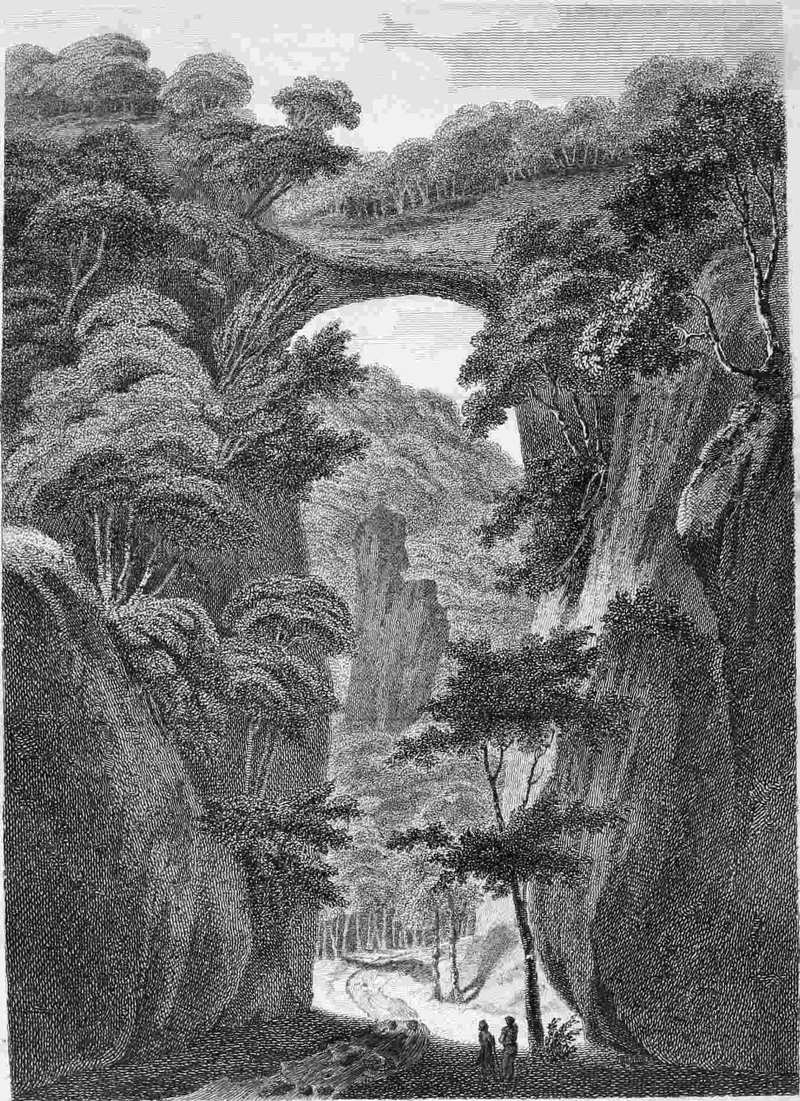
ROCK BRIDGE.
AFTER remaining a considerable time in
Bottetourt County, I again crossed Fluvanna
River into the county of Rockbridge,
so called from the remarkable natural bridge
221of rock that is in it. This bridge stands about
ten miles from Fluvanna River, and nearly the
same distance from the Blue Ridge. It extends
across a deep cleft in a mountain, which,
by some great convulsion of nature, has been
split asunder from top to bottom, and it seems
to have been left there purposely to afford a
passage from one side of the chasm to the
other. The cleft or chasm is about two miles
long, and is in some places upwards of three
hundred feet deep; the depth varies according
to the height of the mountain, being deepest
where the mountain is most lofty. The
breadth of the chasm also varies in different
places; but in every part it is uniformly wider
at top than towards the bottom. That the
two sides of the chasm were once united appears
very evident, not only from projecting
rocks on the one side corresponding with
suitable cavities on the other, but also from
the different strata of earth, sand, clay, &c.
being exactly similar from top to bottom on
both sides; but by what great agent they were
separated, whether by fire or by water, remains
hidden amongst those arcana of nature
which we vainly endeavour to develope.
ROCK BRIDGE.
The arch consists of a solid mass of stone,
or of several stones cemented so strongly together,
that they appear but as one. This
222mass, it is to be supposed, at the time that the
hill was rent asunder, was drawn across the
fissure from adhering closely to one side, and
being loosened from its bed of earth at the
opposite one. It seems as probable, I think,
that the mass of stone forming the arch was
thus forcibly plucked from one side, and drawn
across the fissure, as that the hill should have
remained disunited at this one spot from top to
bottom, and that a passage should afterwards
have been forced through it by water. The
road leading to the bridge runs through a
thick wood, and up a hill, having ascended
which, nearly to the top, you pause for a moment
at finding a sudden discontinuance of
the trees at one side; but the amazement
which fills the mind is great indeed, when, on
going a few paces towards the part which appears
thus open, you find yourself on the
brink of a tremendous precipice. You involuntarily
draw back, stare around, then
again come forward to satisfy yourself that
what you have seen is real, and not the illusions
of fancy. You now perceive, that you
are upon the top of the bridge, to the very
edge of which, on one side, you may approach
with safety, and look down into the abyss,
being protected from falling by a parapet of
fixed rocks. The walls, as it were, of the
bridge at this side are so perpendicular, that
223a person leaning over the parapet of rock
might let fall a plummet from the hand to
the very bottom of the chasm. On the opposite
side this is not the case, nor is there any
parapet; but from the edge of the road, which
runs over the bridge, is a gradual slope to the
brink of the chasm, upon which it is somewhat
dangerous to venture. This slope is
thickly covered with large trees, principally
cedars and pines. The opposite side was also
well furnished with trees formerly, but all
those that grew near the edge of the bridge
have been cut down by different people, for
the sake of seeing them tumble to the bottom.
Before the trees were destroyed in this manner,
you might have passed over the bridge without
having had any idea of being upon it; for
the breadth of it is no less than eighty feet.
The road runs nearly in the middle, and is
frequented daily by waggons.
At the distance of a few yards from the
bridge, a narrow path appears, winding along
the sides of the fissure, amidst immense rocks
and trees, down to the bottom of the bridge.
Here the stupendous arch appears in all its
glory, and seems to touch the very skies. To
behold it without rapture, indeed, is impossible;
and the more critically it is examined,
the more beautiful and the more surprising
does it appear. The height of the bridge to
224the top of the parapet is two hundred and
thirteen feet by admeasurement with a line,
the thickness of the arch forty feet, the span
of the arch at top ninety feet, and the distance
between the abutments at bottom fifty feet.
The abutments consist of a solid mass of limestone
on either side, and, together with the
arch, seem as if they had been chiseled out
by the hand of art. A small stream, called
Cedar Creek, running at the bottom of the
fissure, over bed of rocks, adds much to the
beauty of the scene.
The fissure takes a very sudden turn just
above the bridge, according to the course of
the stream, so that when you stand below, and
look under the arch, the view is intercepted
at the distance of about fifty yards from the
bridge. Mr. Jefferson’s statement, in his Notes,
that the fissure continues strait, terminating
with a pleasing view of the North Mountains,
is quite erroneous. The sides of the chasm
are thickly covered in every part with trees,
excepting where the huge rocks of limestone
appear.
MADDISON’S CAVE.
Besides this view from below, the bridge is
seen to very great advantage from a pinnacle
of rocks, about fifty feet below the top of the
fissure; for here not only the arch is seen in
all its beauty, but the spectator is impressed in
the most forcible manner with ideas of its
225grandeur, from being enabled at the same
time to look down into the profound gulph
over which it passes.
About fifty miles to the northward of the
Rock Bridge, and also behind the Blue Mountains,
there is another very remarkable natural
curiosity; this is a large cavern, known in
the neighbourhood by the name of Maddison’s
Cave. It is in the heart of a mountain,
about two hundred feet high, and which is
so deep on one side, that a person standing
on the top of it, might easily throw a pebble
into the river, which flows round the base;
the opposite side of it is, however, very easy
of ascent, and on this side the path leading
to the cavern runs, excepting for the last
twenty yards, when it suddenly turns along
the steep part of the mountain, which is extremely
rugged, and covered with immense
rocks and trees from top to bottom. The
mouth of the cavern, on this steep side, about
two thirds of the way up, is guarded by a huge
pendent stone, which seems ready to drop
every instant, and it is hardly possible to stoop
under it, without reflecting with a certain degree
of awe, that were it to drop, nothing
could save you from perishing within the
dreary walls of that mansion to which it affords
an entrance.
226Preparatory to entering, the guide, whom
I had procured from a neighbouring house,
lighted the ends of three or four splinters of
pitch pine, a large bundle of which he had
brought with him: they burn out very fast,
but while they last are most excellent torches.
The fire he brought along with him, by means
of a bit of green hiccory wood, which, when
once lighted, will burn slowly without any
blaze till the whole is consumed.
MADDISON’S CAVE.
The first apartment you enter is about
twenty-five feet high, and fifteen broad, and
extends a considerable way to the right and
left, the floor ascending towards the former;
here it is very moist, from the quantity of
water continually trickling from the roof.
Fahrenheit’s thermometer, which stood at 67°
in the air, fell to 61° in this room. A few
yards to the left, on the side opposite to you
on entering, a passage presents itself, which
leads to a sort of anti-chamber as it were,
from whence you proceed into the sound
room, so named from the prodigious reverberation
of the sound of a voice or musical instrument
at the inside. This room is about
twenty feet square; it is arched at top, and
the sides of it, as well as of that apartment
which you first enter, are beautifully ornamented
with stalactites. Returning from hence
227into the antichamber, and afterwards taking
two or three turns to the right and left, you
enter a long passage about thirteen feet wide,
and perhaps about fifteen in height perpendicularly;
but if it was measured from the
floor to the highest part of the roof obliquely,
the distance would be found much greater,
as the walls on both sides slope very considerably,
and finally meet at top. This passage
descends very rapidly, and is, I should suppose,
about sixty yards long. Towards the
end it narrows considerably, and terminates in
a pool of clear water, about three or four feet
deep. How far this pool extends it is impossible
to say. A canoe was once brought down
by a party, for the purpose of examination,
but they said, that after proceeding a little
way upon the water the canoe would not float,
and they were forced to return. Their fears,
most probably, led them to fancy it was so.
I fired a pistol with a ball over the water, but
the report was echoed from the after part of
the cavern, and not from that part beyond the
water, so that I should not suppose the passage
extended much farther than could be traced
with the eye. The walls of this passage consist
of a solid rock of limestone on each side,
which appears to have been separated by
some convulsion. The floor is of a deep sandy
earth, and it has repeatedly been dug up for
228the purpose of getting saltpetre, with which
the earth is strongly impregnated. The
earth, after being dug up, is mixed with water,
and when the grosser particles fall to the
bottom, the water is drawn off and evaporated;
from the residue the saltpetre is procured.
There are many other caverns in this neighbourhood,
and also farther to the westward, in
Virginia; from all of them great quantities of
saltpetre are thus obtained. The gunpowder
made with it, in the back country, forms a
principal article of commerce, and is sent to
Philadelphia in exchange for European manufactures.
MADDISON’S CAVE.
About two thirds of the way down this
long passage, just described, is a large aperture
in the wall on the right, leading to another
apartment, the bottom of which is about
ten feet below the floor of the passage, and it
is no easy matter to get down into it, as
the sides are very steep and extremely slippery.
This is the largest and most beautiful room
in the whole cavern; it is somewhat of an oval
form, about sixty feet in length, thirty in
breadth, and in some parts nearly fifty feet
high. The petrifactions formed by the water
dropping from above are most beautiful, and
hang down from the ceiling in the form of
elegant drapery, the folds of which are similar
to what those of large blankets or carpets
229would be if suspended by one corner in a lofty
room. If struck with a stick a deep hollow
sound is produced, which echoes through the
vaults of the cavern. In other parts of this
room the petrifactions have commenced at the
bottom, and formed in pillars of different
heights; some of them reach nearly to the
roof. If you go to a remote part of this apartment,
and leave a person with a lighted torch
moving about amidst these pillars, a thousand
imaginary forms present themselves, and you
might almost fancy yourself in the infernal regions,
with spectres and monsters on every
side. The floor of this room slopes down gradually
from one end to the other, and terminates
in a pool of water, which appears to be
on a level with that at the end of the long
passage; from their situation it is most probable
that they communicate together. The
thermometer which I had with me stood, in
the remotest part of this chamber, at 55°.
From hence we returned to the mouth of the
cavern, and on coming into the light it appeared
as if we really had been in the infernal
regions, for our faces, hands, and clothes were
smutted all over, every part of the cave being
covered with soot from the smoke of the pine
torches which are so often carried in. The
smoke from the pitch pine is particularly
thick and heavy. Before this cave was much
230visited, and the walls blackened by the smoke,
its beauty, I was told by some of the old inhabitants,
was great indeed, for the petrifactions
on the roof and walls are all of the dead
white kind.
The country immediately behind the Blue
Mountains, between Bottetourt County and
the Patowmac River, is agreeably diversified
with hill and dale, and abounds with extensive
tracts of rich land. The low grounds,
bordering upon the Shenandoah River, which
runs contiguous to the Blue Ridge for upwards
of one hundred miles, are in particular
distinguished for their fertility. These low
grounds are those which, strictly speaking,
constitute the Shenandoah Valley, though in
general the country lying for several miles
distant from the river, and in some parts
very hilly, goes under that name. The natural
herbage is not so fine here as in Bottetourt
County, but when clover is once sown it
grows most luxuriantly; wheat also is produced
in as plentiful crops as in any part of the
United States. Tobacco is not raised excepting
for private use, and but little Indian corn
is sown, as it is liable to be injured by the
nightly frosts, which are common in the
spring.
LANDSCAPES.
The climate here is not so warm as in the
lower parts of the country, on the eastern side
231of the mountains; but it is by no means so
temperate as in Bottetourt County, which,
from being environed with ridges of mountains,
is constantly refreshed with cooling
breezes during summer, and in the winter is
sheltered from the keen blasts from the north
west.
The whole of this country, to the west of
the mountains, is increasing most rapidly in,
population. In the neighbourhood of Winchester
it is so thickly settled, and consequently
so much cleared, that wood is now beginning
to be thought valuable; the farmers are obliged
frequently to send ten or fifteen miles even for
their fence rails. It is only, however, in this
particular neighbourhood that the country is
so much improved; in other places there are
immense tracts of woodlands still remaining,
and in general the hills are all left uncleared.
The hills being thus left covered with trees is
a circumstance which adds much to the beauty
of the country, and intermixed with extensive
fields clothed with the richest verdure, and
watered by the numerous branches of the Shenandoah
River, a variety of pleasing landscapes
are presented to the eye in almost every part of
the route from Bottetourt to the Patowmac,
many of which are considerably heightened
by the appearance of the Blue Mountains in
the back ground.
232With regard to these landscapes however, and
to American landscapes in general, it is to be
observed, that their beauty is much impaired by
the unpicturesque appearance of the angular
fences, and of the stiff wooden houses, which
have at a little distance a heavy, dull, and
gloomy aspect. The stumps of the trees also,
on land newly cleared, are most disagreeable
objects, wherewith the eye is continually assailed.
When trees are felled in America, they
are never cut down close to the ground, but
the trunks are left standing two or three feet
high; for it is found that a woodman can cut
down many more in a day, standing with a
gentle inclination of the body, than if he were
to stoop so as to apply his axe to the bottom
of the tree; it does not make any difference
either to the farmer, whether the stump is left
two or three feet high, or whether it is cut
down level with the ground, as in each case it
would equally be a hindrance to the plough.
These stumps usually decay in the course of
seven or eight years; sometimes however
sooner, sometimes later, according to the quality
of the timber. They never throw up
suckers, as stumps of trees would do in England
if left in that manner.
TOWNS.
The cultivated lands in this country are
mostly parcelled out in small portions; there
are no persons here, as on the other side of the
233mountains, possessing large farms; nor are
there any eminently distinguished by their education
or knowledge from the rest of their fellow
citizens. Poverty also is as much unknown
in this country as great wealth. Each
man owns the house he lives in and the land
which he cultivates, and every one appears to
be in a happy state of mediocrity, and unambitious
of a more elevated situation than what
he himself enjoys.
The free inhabitants consist for the most
part of Germans, who here maintain the same
character as in Pennsylvania and the other
states where they have settled. About one
sixth of the people, on an average, are slaves,
but in some of the counties the proportion is
much less; in Rockbridge the slaves do not
amount to more than an eleventh, and in Shenandoah
County not to more than a twentieth
part of the whole.
Between Fincastle and the Patowmac there
are several towns, as Lexington, Staunton,
Newmarket, Woodstock, Winchester, Strasburgh,
and some others. These towns all stand
on the great road, running north and south
behind the Blue Mountains, and which is the
high road from the northern states to Kentucky.
LEXINGTON.
As I passed along it, I met with great numbers
of people from Kentucky and the new
234state of Tennessee going towards Philadelphia
and Baltimore, and with many others going
in a contrary direction, “to explore,” as they
call it, that is, to search for lands conveniently
situated for new settlements in the western
country. These people all travel on horseback,
with pistols or swords, and a large blanket
folded up under their saddle, which last they
use for sleeping in when obliged to pass the
night in the woods. There is but little occasion
for arms now that peace has been made
with the Indians; but formerly it used to be
a very serious undertaking to go by this route
to Kentucky, and travellers were always obliged
to go forty or fifty in a party, and well prepared
for defence. It would be still dangerous
for any person to venture singly; but if
five or six travel together, they are perfectly
secure. There are houses now scattered along
nearly the whole way from Fincastle to Lexington
in Kentucky, so that it is not necessary
to sleep more than two or three nights in the
woods in going there. Of all the uncouth human
beings I met with in America, these people
from the western country were the most
so; their curiosity was boundless. Frequently
have I been stopped abruptly by one of them
in a solitary part of the road, and in such a
manner, that had it been in another country,
I should have imagined it was a highwayman
235that was going to demand my purse, and
without any further preface, asked where I
came from? if I was acquainted with any
news? where bound to? and finally, my name?—“Stop,
Mister! why I guess now you be
coming from the new state.” “No, Sir,”—“Why
then I guess as how you be coming
from Kentuc[25].” “No, Sir.”—“Oh! why
then, pray now where might you be coming
from?” “From the low country.”—“Why
you must have heard all the news then; pray
now, Mister, what might the price of bacon
be in those parts?” “Upon my word, my
friend, I can’t inform you.”—“Aye, aye; I
see, Mister, you be’n’t one of us; pray now,
Mister, what might your name be?”—A
stranger going the same way is sure of having
the company of these worthy people, so desirous
of information, as far as the next tavern,
where he is seldom suffered to remain for five
minutes, till he is again assailed by a fresh set
with the same questions.
The first town you come to, going northward
from Bottetourt County, is Lexington,
a neat little place, that did contain about one
hundred houses, a court-house, and gaol; but
the greater part of it was destroyed by fire just
before I got there. Great numbers of Irish are
236settled in this place. Thirty miles farther on
stands Staunton. This town carries on a considerable
trade with the back country, and
contains nearly two hundred dwellings, mostly
built of stone, together with a church. This
was the first place on the entire road from
Lynchburgh, one hundred and fifty miles distant,
and which I was about ten days in travelling,
where I was not able to get a bit of fresh
meat, excepting indeed on passing the Blue
Mountains, where they brought me some venison
that had been just killed. I went on fifty
miles further, from Staunton, before I got any
again. Salted pork, boiled with turnip tops
by way of greens, or fried bacon, or fried salted
fish, with warm sallad, dressed with vinegar and
the melted fat which remains in the frying-pan
after dressing the bacon, is the only food
to be got at most of the taverns in this country;
in spring it is the constant food of the
people in the country; and indeed, throughout
the whole year, I am told, salted meat is what
they most generally use.
In every part of America a European is
surprised at finding so many men with military
titles, and still more so at seeing such numbers
of them employed in capacities apparently
so inconsistent with their rank; for it is
nothing uncommon to see a captain in the
shape of a waggoner, a colonel the driver of a
237stage coach, or a general dealing out penny ribbon
behind his counter; but no where, I believe,
is there such a superfluity of these military
personages as in the little town of Staunton;
there is hardly a decent person in it,
excepting lawyers and medical men, but what
is a colonel, a major, or a captain. This is to
be accounted for as follows: in America, every
freeman from the age of sixteen to fifty years,
whose occupation does not absolutely forbid it,
must enrol himself in the militia. In Virginia
alone, the militia amounts to about sixty-two
thousand men, and it is divided into four divisions
and seventeen brigades, to each of which
there is a general and other officers. Were
there no officers therefore, excepting those
actually belonging to the militia, the number
must be very great; but independent of the
militia, there are also volunteer corps in most
of the towns, which have likewise their respective
officers. In Staunton there are two of
these corps, one of cavalry, the other of artillery.
These are formed chiefly of men who
find a certain degree of amusement in exercising
as soldiers, and who are also induced
to associate, by the vanity of appearing in regimentals.
The militia is not assembled
oftener than once in two or three months, and
as it rests with every individual to provide
himself with arms and accoutrements, and no
238stress being laid upon coming in uniform, the
appearance of the men is not very military.
Numbers also of the officers of these volunteer
corps, and of the militia, are resigning
every day; and if a man has been a captain or
a colonel but one day either in the one body
or the other, it seems to be an established rule
that he is to have nominal rank the rest of his
life. Added to all, there are several officers of
the old continental army neither in the militia
nor in the volunteer corps.
Winchester stands one hundred miles to the
northward of Staunton, and is the largest town
in the United States on the western side of the
Blue Mountains. The houses are estimated
at three hundred and fifty, and the inhabitants
at two thousand. There are four churches
in this town, which, as well as the houses, are
plainly built. The streets are regular, but
very narrow. There is nothing particularly
deserving of attention in this place, nor indeed
in any of the other small towns which have
been mentioned, none of them containing more
than seventy houses each.
LETTER XVIII.
239
Description of the Passage of Patowmac and
Shenandoah Rivers through a Break in the
Blue Mountains.—Some Observations on Mr.
Jefferson’s Account of the Scene.—Summary
Account of Maryland.—Arrival at Philadelphia.—Remarks
on the Climate of the
United States.—State of the City of Philadelphia
during the Heat of Summer.—Difficulty
of preserving Butter, Milk, Meat, Fish,
&c.—General Use of Ice.—Of the Winds.—State
of Weather in America depends greatly
upon them.
Philadelphia, June.
HAVING traversed, in various directions,
the country to the west of the Blue Mountains
in Virginia, I came to the Patowmac, at
the place where that river passes through the
Blue Ridge, which Mr. Jefferson, in his Notes
upon Virginia, has represented as one of the
soft “stupendous scenes in nature, and worth
a voyage across the Atlantic.” The approach
towards the place is wild and romantic.
After crossing a number of small hills, which
rise one above the other in succession, you at
last perceive the break in the Blue Ridge; at
the same time the road suddenly turning, winds
240down a long and deep hill, shaded with lofty
trees, whose branches unite over your head.
On one side of the road there are large heaps
of rocks above you, which seem to threaten
destruction to any one that passes under them;
on the other, a deep precipice presents itself,
at the bottom of which is heard the roaring
of the waters, that are concealed from the eye
by the thickness of the foliage. Towards the
end of this hill, about sixty feet above the
level of the water, stands a tavern and a few
houses, and from some fields in the rear of
them the passage of the river through the
mountain is, I think, seen to the best advantage.
PASSAGE OF RIVERS.
The Patowmac on the left comes winding
along through a fertile country towards the
mountain; on the right flows the Shenandoah:
uniting together at the foot of the mountain,
they roll on through the gap; then suddenly
expanding to the breadth of about four hundred
yards, they pass on towards the sea, and
are finally lost to the view amidst surrounding
hills. The rugged appearance of the sides
of the mountain towards the river, and the
large rocks that lie scattered about at the
bottom, many of which have evidently been
split asunder by some great convulsion, “are
monuments,” as Mr. Jefferson observes, of the
“war that has taken place at this spot between
241rivers and mountains; and at first
sight they lead us into an opinion that
mountains were created before rivers began
to flow; that the waters of the Patowmac
and Shenandoah were dammed up
for a time by the Blue Ridge, but continuing to
rise, that they at length broke through
at this spot, and tore the mountain asunder
from its summit to its base.” Certain it is,
that if the Blue Ridge could be again made
entire, an immense body of water would be
formed on the western side of it, by the
Shenandoah and Patowmac rivers, and this
body of water would be deepest, and consequently
would act with more force in sapping
a passage for itself through the mountain,
at the identical spot where the gap now is
than at any other, for this is the lowest spot in
a very extended tract of country. A glance
at the map will be sufficient to satisfy any
person on this point; it will at once be seen,
that all the rivers of the adjacent country
bend their courses hitherwards. Whether
the ridge, however, was left originally entire,
or whether a break was left in it for the passage
of the rivers, it is impossible at this day
to ascertain; but it is very evident that the
sides of the gap have been reduced to their
present rugged state by some great inundation.
Indeed, supposing that the Patowmac
242and Shenandoah ever rose during a flood, a
common circumstance in spring and autumn,
only equally high with what James River did
in 1795, that is fifteen feet above their usual
level, such a circumstance might have occasioned
a very material alteration in the appearance
of the gap.
ROCKS LOOSENED.
The Blue Ridge, on each side of the Patowmac,
is formed, from the foundation to the
summit, of large rocks deposited in beds of
rich soft earth. This earth is very readily
washed away, and in that case the rocks consequently
become loose; indeed, they are frequently
loosened even by heavy showers of
rain. A proof of this came within my own
observation, which I shall never forget. It
had been raining excessively hard the whole
morning of that day on which I arrived at
this place; the evening however was very fine,
and being anxious to behold the scene in every
point of view, I crossed the river, and attended
the mountain at a steep part on the opposite
side, where there was no path, and many
large projecting rocks. I had walked up
about fifty yards, when a large stone that I
set my foot upon, and which appeared to me
perfectly firm, all at once gave way; it had
been loosened by the rain, and brought down
such a heap of others with it in its fall, with
such a tremendous noise at the same time,
243that I thought the whole mountain was coming
upon me, and expected every moment to
be dashed to pieces. I slid down about twenty
feet, and then luckily caught hold of the
branch of a tree, by which I clung; but the
stones still continued to roll down heap after
heap; several times, likewise, after all had
been still for a minute or two, they again began
to fall with increased violence. In this state
of suspense I was kept for a considerable time,
not knowing but that some stone larger than
the rest might give way, and carry down
with it even the tree by which I held. Unacquainted
also with the paths of the mountain,
there seemed to me to be no other way
of getting down, excepting over the fallen
stones, a way which I contemplated with
horror. Night however was coming on very
fast; it was absolutely necessary to quit the situation
I was in, and fortunately I got to the
bottom without receiving any further injury
than two or three slight contusions on my hips
and elbows. The people congratulated me
when I came back on my escape, and informed
me, that the stones very commonly gave
way in this manner after heavy falls of rain;
but on the dissolution of a large body of snow,
immense rocks, they said, would sometimes
roll down with a crash that might be heard
for miles. The consequences then of a large
244rock towards the bottom of the mountain
being undermined by a flood, and giving way,
may be very readily imagined: the rock above
it, robbed of its support, would also fall; this
would bring down with it numbers of others
with which it was connected, and thus a disruption
would be produced from the base to
the very summit of the mountain.
IRON.
The passage of the rivers through the ridge
at this place is certainly a curious scene, and
deserving of attention; but I am far from
thinking with Mr. Jefferson, that it is “one
of the most stupendous scenes in nature,
and worth a voyage across the Atlantic;” nor
has it been my lot to meet with any person
that had been a spectator of the scene, after
reading his description of it, but what also
differed with him very materially in opinion.
To find numberless scenes more stupendous,
it would be needless to go farther than Wales.
A river, it is true, is not to be met with in
that country, equal in size to the Patowmac;
but many are to be seen there rushing over
their stony beds with much more turbulence
and impetuosity than either the Patowmac
or Shenandoah: the rocks, the precipices, and
the mountains of the Blue Ridge at this place
are diminutive and uninteresting also, compared
with those which abound in that country.
Indeed, from every part of Mr. Jefferson’s
245description, it appears as if he had beheld
the scene, not in its present state, but at
the very moment when the disruption happened,
and when every thing was in a state
of tumult and confusion.
After crossing the Patowmac, I passed on
to Frederic in Maryland, which has already
been mentioned, and from thence to Baltimore.
The country between Frederic and Baltimore
is by no means so rich as that west of the
Blue Ridge, but it is tolerably well cultivated.
Iron and copper are found here in many
places. No works of any consequence have
as yet been established for the manufacture of
copper, but there are several extensive iron
works. The iron is of a remarkably tough
quality; indeed, throughout the states of
Maryland, Virginia, and Pennsylvania, it is
generally so; and the utensils made of it, as
pots, kettles, &c. though cast much thinner
than usual in England, will admit of being
pitched into the carts, and thrown about,
without any danger of being broken. The
forges and furnaces are all worked by negroes,
who seem to be particularly suited to such
an occupation, not only on account of their
sable complexions, but because they can sustain
a much greater degree of heat than white
persons without any inconvenience. In the
hottest days in summer they are never without
fires in their huts.
246The farms and plantations in Maryland
consist, in general, of from one hundred to one
thousand acres. In the upper parts of the
state, towards the mountains, the land is divided
into small portions. Grain is what is
principally cultivated, and there are few slaves.
In the lower parts of the state, and in this
part of the country between Frederic and
Baltimore, the plantations are extensive; large
quantities of tobacco are raised, and the labour
is performed almost entirely by negroes. The
persons residing upon these large plantations
live very similar to the planters in Virginia:
all of them have their stewards and overseers,
and they give themselves but little trouble
about the management of the lands. As in
Virginia, the clothing for the slaves, and most
of the implements for husbandry, are manufactured
on each estate. The quarters of the
slaves are situated in the neighbourhood of
the principal dwelling house, which gives
the residence of every planter the appearance
of a little village, just the same as in Virginia.
The houses are for the most part built of
wood, and painted with Spanish brown; and
in front there is generally a long porch, painted
white.
WEATHER.
CLIMATE.
From Baltimore I returned to Philadelphia,
where I arrived on the fourteenth day of June,
after having been absent about three months.
247During the whole of that period the weather
had been extremely variable, scarcely ever remaining
alike four days together. As early
as the fourteenth of March, in Pennsylvania,
Fahrenheit’s thermometer stood at 65° at noon
day, though not more than a week before it
had been so low as 14°. At the latter end
of the month, in Maryland, I scarcely ever
observed it higher than 50° at noon: the evenings
were always cold, and the weather was
squally and wet. In the northern neck of
Virginia, for two or three days together, during
the second week in April, it rose from 80° to
84°, in the middle of the day; but on the wind
suddenly shifting, it fell again, and remained
below 70° for some days. As I passed along
through the lower parts of Virginia, I frequently
afterwards observed it as high as 80°
during the month of April; but on no day in
the month of May, previous to the fourteenth,
did it again rise to the same height; indeed,
so far from it, many of the days were too cold
to be without fires; and on the night of the
ninth instant, when I was in the neighbourhood
of the South-west Mountains, so sharp a
frost took place, that it destroyed all the cherries,
and also most of the early wheat, and of
the young shoots of Indian corn; in some
particular places, for miles together, the young
leaves of the forest trees even were all withered,
248and the country had exactly the appearance
of November. On the tenth instant, the
day after the frost, the thermometer was as
low as 46° in the middle of the day; yet four
days afterwards it stood at 81°. During the
remainder of the month, and during June,
until I reached Philadelphia, it fluctuated between
60° and 80°; the weather was on the
whole fine, but frequently for a day or two
together the air felt extremely raw and disagreeable.
The changes in the state of the
atmosphere were also sometimes very sudden.
On the sixth day of June, when on my way
to Frederic-town, after passing the Patowmac
River, the most remarkable change of this
nature took place which I ever witnessed.
The morning had been oppressively hot; the
thermometer at 81°, and the wind S. S. W.
About one o’clock in the afternoon, a black
cloud appeared in the horizon, and a tremendous
gust came on, accompanied by thunder
and lightning; several large trees were torn
up by the roots by the wind; hailstones, about
three times the size of an ordinary pea, fell
for a few minutes, and afterwards a torrent of
rain came pouring down, nearly as if a water-spout
had broken over head. Just before the
gust came on, I had suspended my thermometer
from a window with a northern aspect, when
it stood at 81°; but on looking at it at the
249end of twenty-three minutes, by which time
the gust was completely over, I found it down
to 59°, a change of 22°. A north-west wind
now set in, the evening was most delightful,
and the thermometer again rose to 65°. In
Pennsylvania the thermometer has been known
to vary fifty degrees in the space of twenty-six
hours.
The climate of the middle and southern
states is extremely variable; the seasons of two
succeeding years are seldom alike; and it
scarcely ever happens that a month passes
over without very great vicissitudes in the
weather taking place. Doctor Rittenhouse
remarked, that whilst he resided in Pennsylvania,
he discovered nightly frosts in every
month of the year excepting July, and even in
that month, during which the heat is always
greater than at any other time of the year, a
cold day or two sometimes intervene, when a
fire is found very agreeable.
The climate of the state of New York is
very similar to that of Pennsylvania, excepting
that in the northern parts of that state, bordering
upon Canada, the winters are always severe
and long. The climate of New Jersey, Delaware,
and the upper parts of Maryland, is also
much the same with that of Pennsylvania; in
the lower parts of Maryland the climate does
not differ materially from that of Virginia to
250the eastward of the Blue Ridge, where it very
rarely happens that the thermometer is as low
as 6° above cipher.
In Pennsylvania, the range of the mercury in
Fahrenheit’s thermometer has been observed
to be from 24° below cipher to 105° above it;
but it is an unusual occurrence for the mercury
to stand at either of these extreme points; in
its approach towards them it commonly draws
much nearer to the extreme of heat than to
that of cold. During the winter of 1795, and
the three preceding years, it did not sink lower
than 10° above cipher; a summer however
seldom passes over that it does not rise to 96°.
It was mentioned as a singular circumstance,
that in 1789 the thermometer never rose higher
than 90°.
CLIMATE.
Of the oppression that is felt from the summer
heats in America, no accurate idea can be
formed without knowing the exact state of
the hygrometer as well as the height of the
thermometer. The moisture of the air varies
very much in different parts of the country;
it also varies in all parts with the winds; and
it is surprising to find what a much greater
degree of heat can be borne without inconvenience
when the air is dry than when it is
moist. In New England, in a remarkably dry
air, the heat is not found more insupportable
when the thermometer stands at 100°, than it
251is in the lower parts of the southern states,
where the air is moist, when the thermometer
stands perhaps at 90°, that is, supposing the
wind to be in the same quarter in both places.
In speaking of Virginia I have taken notice of
the great difference that is found between the
climate of the mountains and the climate of
the low country in that state. The case is the
same in every other part of the country. From
the mountains in New England, along the
different ridges which run through New York,
New Jersey, Pennsylvania, Maryland, and the
southern states, even to the extremity of
Georgia, the heat is never found very oppressive;
whilst as far north as Pennsylvania and
New York, the heat in the low parts of the
country, between the mountains and the ocean,
is frequently intolerable.
WEATHER.
In the course of the few days that I have
spent in Philadelphia during this month, the
thermometer has risen repeatedly to 86° and
for two or three days it stood at 93°. During
these days no one stirred out of doors that was
not compelled to do so; those that could make
it convenient with their business always walked
with umbrellas to shade them from the
sun; light white hats were universally worn,
and the young men appeared dressed in cotton
or linen jackets and trowsers; every gleam of
sunshine seemed to be considered as baneful
252and destructive; the window shutters of each
house were closed early in the morning, so as
to admit no more light than what was absolutely
necessary for domestic business; many
of the houses, indeed, were kept so dark, that
on going into them from the street, it was impossible
at first entrance to perceive who was
present. The best houses in the city are furnished
with Venetian blinds, at the outside, to
the windows and hall doors, which are made to
fold together like common window shutters.
Where they had these they constantly kept
them closed, and the windows and doors were
left open behind them to admit air. A very
different scene was presented in the city as
soon as the sun was set; every house was then
thrown open, and the inhabitants all crowded
into the streets to take their evening walks,
and visit their acquaintance. It appeared every
night as if some grand spectacle was to be
exhibited, for not a street or alley was there
but what was in a state of commotion. This
varied scene usually lasted till about ten o’clock;
at eleven there is no city in the world, perhaps,
so quiet all the year round; at that hour you
may walk over half the town without seeing
the face of a human being, except the watchmen.
Very heavy dews sometimes fall after
these hot days, as soon as the sun is down, and
the nights are then found very cold; at other
253times there are no dews, and the air remains
hot all the night through. For days together
in Philadelphia, the thermometer has been
observed never to be lower than 80° during
any part of the twenty-four hours.
I observe now that meat can never be
kept, but in an ice house or a remarkable
cold cellar, for one day, without being tainted.
Milk generally turns sour in the course of one
or two hours after it comes from the cow.
Fish is never brought to market without being
covered with lumps of ice, and notwithstanding
that care, it frequently happens that
it is not fit to be eat. Butter is brought to
market likewise in ice, which they generally
have in great plenty at every farm house;
indeed it is almost considered as a necessary
of life in these low parts of the country.
Poultry intended for dinner is never killed till
about four hours before the time it is wanted,
and then it is kept immersed in water, without
which precaution it would be tainted. Notwithstanding
all this, I have been told, that
were I to stay in Philadelphia till the latter
end of July or beginning of August, I should
find the heat much more intolerable than it
has been hitherto. Most of the other large
sea-port towns, south of Philadelphia, are
equally hot and disagreeable in summer; and
254Baltimore, Norfolk, and some others, even
more so.
The winds in every part of the country
make a prodigious difference in the temperature
of the air. When the north-west wind
blows, the heat is always found more tolerable
than with any other, although the thermometer
should be at the same height. This wind
is uncommonly dry, and brings with it fresh
animation and vigour to every living thing.
Although this wind is so very piercing in
winter, yet I think the people never complain
so much of cold as when the north-east wind
blows; for my own part I never found the air
so agreeable, let the season of the year be what
it would, as with the north-west wind. The
north-east wind is also cold, but it renders the
air raw and damp. That from the south-east
is damp but warm. Rain or snow usually
falls when the wind comes from any point
towards the east. The south-west wind, like
the north-west, is dry; but it is attended generally
with warm weather. When in a
southerly point, gusts, as they are called, that
is, storms attended with thunder, lightning,
hail, and rain, are common.
WINDS.
It is a matter of no difficulty to account
for these various effects of the winds in America.
The north-west wind, from coming
255over such an immense tract of land, must necessarily
be dry; and coming from regions
eternally covered with mounds of snow and
ice, it must also be cold. The north-east
wind, from traversing the frozen seas, must be
cold likewise; but from passing over such a
large portion of the watry main afterwards, it
brings damps and moistures with it. All those
from the east are damp, and loaded with vapours,
from the same cause. Southerly winds,
from crossing the warm regions between the
tropics, are attended with heat; and the south-west
wind, from passing, like the north-west,
over a great extent of land, is dry at the same
time; none however is so dry as that from the
north-west. It is said, but with what truth I
cannot take upon me to say, that west of
the Alleghany and Appalachian mountains,
which are all in the same range, the south-west
winds are cold and attended with rain.
Those great extremes of heat and cold, observable
on the eastern side of the mountains,
are unknown to the westward of them.
LETTER XIX.
256
Travelling in America without a Companion
not pleasant.—Meet two English Gentlemen.—Set
out together for Canada.—Description
of the Country between Philadelphia and New
York.—Bristol.—Trenton.—Princeton.—College
there.—Some Account of it.—Brunswick.—Posaik
Water-fall.—Copper Mine.—Singular
Discovery thereof.—New York.—Description
of the City.—Character and Manners
of the Inhabitants.—Leave it abruptly
on Account of the Fevers.—Passage up North
River from New York to Albany.—Great
Beauty of the North River.—West Point.—Highlands.—Gusts
of Wind common in passing
them.—Albany.—Description of the City and
Inhabitants.—Celebration of the 4th of July.—Anniversary
of American Independence.
MY DEAR SIR, Albany, July.
PLEASURES OF A COMPANION.
I Was on the point of leaving Philadelphia
for New York, intending from thence to
proceed to Canada, when chance brought me
into the company of two young gentlemen
from England, each of whom was separately
preparing to set off on a similar excursion.
A rational and agreeable companion, to whom
you might communicate the result of your
257observations, and with whom you might interchange
sentiments on all occasions, could
not but be deemed a pleasing acquisition, I
should imagine, by a person on a journey
through a foreign land. Were any one to
be found, however, of a different opinion, I
should venture to affirm, that ere he travelled
far through the United States of America,
where there are so few inhabitants in proportion
to the extent of the country; where,
in going from one town to another, it is frequently
necessary to pass for many miles together
through dreary woods; and where,
even in the towns, a few of those sea-ports
indeed excepted which are open to the Atlantic,
there is such sameness in the customs,
manners, and conversation of the inhabitants,
and so little amongst them that interests either
the head or the heart; he would not only be
induced to think that a companion must add
to the pleasure of a journey, but were absolutely
necessary to prevent its appearing insipid,
and at times highly irksome to him.
For my own part, I had fully determined
in my own mind, upon returning from my tour
beyond the Blue Mountains, never again to
set out on a journey alone through any part of
America, if I could possibly procure an agreeable
companion. The gentlemen I met with
had, as well as myself, travelled widely through
258different parts of the United States, and formed
nearly the same resolution; we accordingly
agreed to go forward to Canada together, and
having engaged a carriage for ourselves as far
as New York, we quitted the close and disagreeable
city of Philadelphia on the twentieth
of June.
The road, for the first twenty-five miles,
runs very near the River Delaware, which
appears to great advantage through openings
in the woods that are scattered along its shores.
From the town of Bristol in particular,
which stands on an elevated part of the banks,
twenty miles above Philadelphia, it is seen
in a most pleasing point of view. The river,
here about one mile wide, winds majestically
round the point whereon the town is
built, and for many miles, both upwards and
downwards, it may be traced through a rich
country, flowing gently along: in general it
is covered with innumerable little sloops and
schooners. Opposite to Bristol stands the city
of Burlington, one of the largest in New Jersey,
built partly upon an island and partly
on the main shore. It makes a good appearance,
and adds considerably to the beauty of
the prospect from Bristol.
Ten miles farther on, opposite to Trenton,
which stands at the head of the sloop navigation,
you cross the river. The falls or rapids,
259that prevent boats from ascending any
higher, appear in full view as you pass, but
their prospect is in no way pleasing; beyond
them, the navigation may be pursued
for upwards of one hundred miles in small
boats. Trenton is the capital of New Jersey,
and contains about two hundred houses,
together with four churches. The streets are
commodious, and the houses neatly built.
The state house, in which congress met for
some time during the war, is a heavy clumsy
edifice.
PRINCETON.
Twelve miles from Trenton, stands Princeton,
a neat town, containing about eighty dwellings
in one long street. Here is a large college,
held in much repute by the neighbouring
states. The number of students amounts to
upwards of seventy; from their appearance,
however, and the course of studies they seem
to be engaged in, like all the other American
colleges I ever saw, it better deserves the title
of a grammar school than a college. The
library, which we were shewn, is most wretched,
consisting, for the most part, of old theological
books, not even arranged with any regularity.
An orrery, contrived by Mr. Rittenhouse,
whose talents are so much boasted
of by his countrymen, stands at one end of
the apartment, but it is quite out of repair, as
well as a few detached parts of a philosophical
260apparatus, enclosed in the same glass case. At
the opposite end of the room are two small
cupboards, which are shewn as the museum.
These contain a couple of small stuffed alligators,
and a few singular fishes, in a miserable
state of preservation, the skins of them
being tattered in innumerable places, from
their being repeatedly tossed about. The
building is very plain, and of stone; it is one
hundred and eighty feet in front, and four stories
high.
NEW JERSEY.
The next stage from Princeton is Brunswick,
containing about two hundred houses;
there is nothing very deserving of attention
in it, excepting it be the very neat and commodious
wooden bridge that has been thrown
across the Raritan River, which is about two
hundred paces over. The part over the channel
is contrived to draw up, and on each side
is a footway guarded by rails, and ornamented
with lamps. Elizabeth Town and Newark,
which you afterwards pass through in succession,
are both of them cheerful lively looking
places: neither of them is paved. Newark is
built in a straggling manner, and has very
much the appearance of a large English village:
there is agreeable society in this town.
These two towns are only eight miles apart,
and each of them has one or two excellent
churches, whose tall spires appear very beautiful
261as you approach at a distance, peeping up
above the woods by which they are encircled.
The state of New Jersey, measured from
north to south, is about one hundred and sixty
miles in length; it varies in breadth from forty
to eighty miles. The northern part of it is
crossed by the blue ridge of mountains, running
through Pennsylvania; and shooting off in
different directions from this ridge, there are
several other small mountains in the neighbourhood.
The southern part of the state, on
the contrary, which lies towards the sea, is
extremely flat and sandy; it is covered for
miles together with pine trees alone, usually
called pine barrens, and is very little cultivated.
The middle part, which is crossed in going
from Philadelphia to New York, abounds
with extensive traits of good land; the soil
varies, however, considerably, in some places
being sandy, in others stoney, and in others
consisting of a rich brown mould. This part
of the state, as far as Newark, is on the whole
well cultivated, and scattered about in different
places are some excellent farm houses; a good
deal of uncleared land, however, still remains.
Beyond Newark the country is extremely flat
and marshy. Between the town and the Posaick
River there is one marsh, which alone
extends upwards of twenty miles, and is about
262two miles wide where you pass over it. The
road is here formed with large logs of wood laid
close together, and on each side are ditches to
keep it dry. This was the first place where
we met with musquitoes, and they annoyed us
not a little in passing. Towards the latter
end of the summer Philadelphia is much infested
with them; but they had not made
their appearance when we left that city. The
Posaik River runs close upon the borders of
this marsh, and there is an excellent wooden
bridge across it, somewhat similar to that at
New Brunswick over the Raritan River.
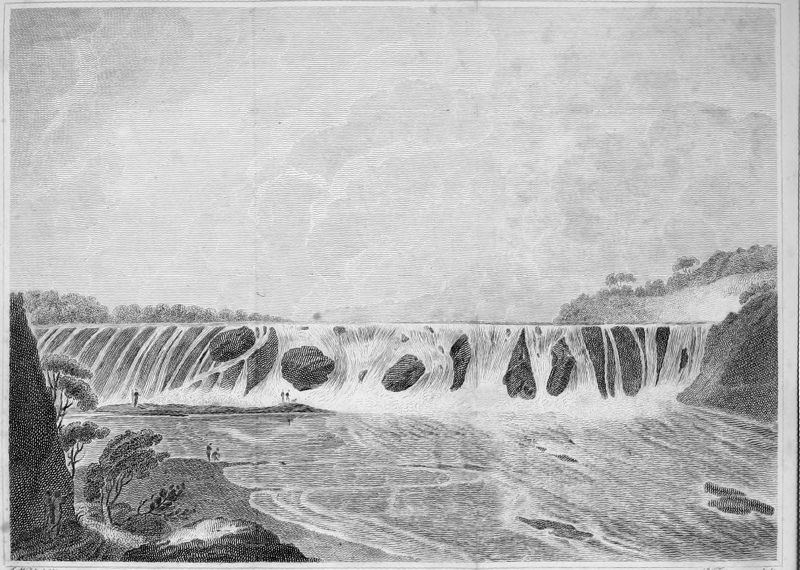
About fifteen miles above it there is a very remarkable
fall in the river. The river, at the
fall, is about forty yards wide, and flows with
a gentle current till it comes within a few perches
of the edge of the fall, when it suddenly
precipitates itself, in one entire sheet, over a
ledge of rocks of nearly eighty feet in perpendicular
height; below, it runs on through a
chasm, formed of immense rocks on each side;
they are higher than the fall, and seem to have
been once united together.
COPPER MINE.
In this neighbourhood there is a very rich
copper mine: repeated attempts have been
made to work it; but whether the price of
labour be too great for such an undertaking,
or the proprietors have not proceeded with
judgment, certain it is, that they have always
263miscarried, and sustained very considerable
losses thereby. This mine was first discovered
in 1751, by a person who, passing along about
three o’clock in the morning, observed a blue
flame, about the size of a man, issuing from
the earth, which afterwards soon died away:
he marked the place with a stake, and when
the hill was opened, several large lumps of virgin
copper were found. The vein of copper
in the mine is said to be much richer now than
when first opened.
From the Posaik to the North River the
country is hilly, barren, and uninteresting, till
you come very near the latter, when a noble
view opens all at once of the city of New York
on the opposite shore, of the harbour, and shipping.
The river, which is very grand, can be
traced for several miles above the city; the
banks are very steep on the Jersey side, and
beautifully wooded, the trees almost dipping
into the water: numbers of vessels plying about
in every part render the scene extremely
sprightly and interesting.
NEW YORK.
New York is built on an island of its own
name, formed by the North and the East Rivers,
and a creek or inlet connecting both of
these together. The island is fourteen miles
long, and, on an average, about one mile in
breadth; at its southern extremity stands the
city, which extends from one river to the other.
264The North, or Hudson River, is nearly two
miles wide; the East, or the North-east one,
as it should rather be called, is not quite so
broad. The depth of water in each, close to
the city, is sufficient for the largest merchant
vessels. The principal seat of trade, however,
is on the East River, and most of the vessels
lie there, as during winter the navigation of
that river is not so soon impeded by the ice.
At this side of the town the houses and stores
are built as closely as possible. The streets are
narrow and inconvenient, and, as but too commonly
is the case in sea-port towns, very dirty,
and, consequently, during the summer season,
dreadfully unhealthy. It was in this part of
the town that the yellow fever raged with such
violence in 1795; and during 1796, many persons
that remained very constantly there also
fell victims to a fever, which, if not the yellow
fever, was very like it. The streets near the
North River are much more airy; but the
most agreeable part of the town is in the neighbourhood
of the battery, on the southern point
of the island, at the confluence of the two
rivers. When New York was in possession of
the English, this battery consisted of two or
more tiers of guns, one above the other; but
it is now cut down, and affords a most charming
walk, and, on a summer’s evening, is
crowded with people, as it is open to the
265breezes from the sea, which render it particularly
agreeable at that season. There is a fine
view from it of the roads, Long and Staten
Islands, and Jersey shore. At the time of high
water the scene is always interesting on account
of the number of vessels sailing in and out of
port; such as go into the East River pass within
a few yards of the walls of the battery.
From the battery a handsome street, about
seventy feet wide, called Broadway, runs due
north through the town; between it and the
North River run several streets at right angles,
as you pass which you catch a view of the water,
and boats plying up and down; the distant
shore of the river also is seen to great advantage.
Had the streets on the opposite side of
Broadway been also carried down to the East
River, the effect would have been beautiful, for
Broadway runs along a ridge or high ground
between the two rivers; it would have contributed
also very much to the health of the
place; if, added to this, a spacious quay had
been formed the entire length of the city, on
either side, instead of having the borders of the
rivers crowded with confused heaps of wooden
store houses, built upon wharfs projecting one
beyond another in every direction, New York
would have been one of the most beautiful sea-ports
in the world. All the sea-ports in America
appear to great disadvantage from the water,
266when you approach near to them, from the
shores being crowded in this manner with irregular
masses of wooden houses, standing as it
were in the water. The federal city, where
they have already begun to erect the same kind
of wooden wharfs and storehouses without
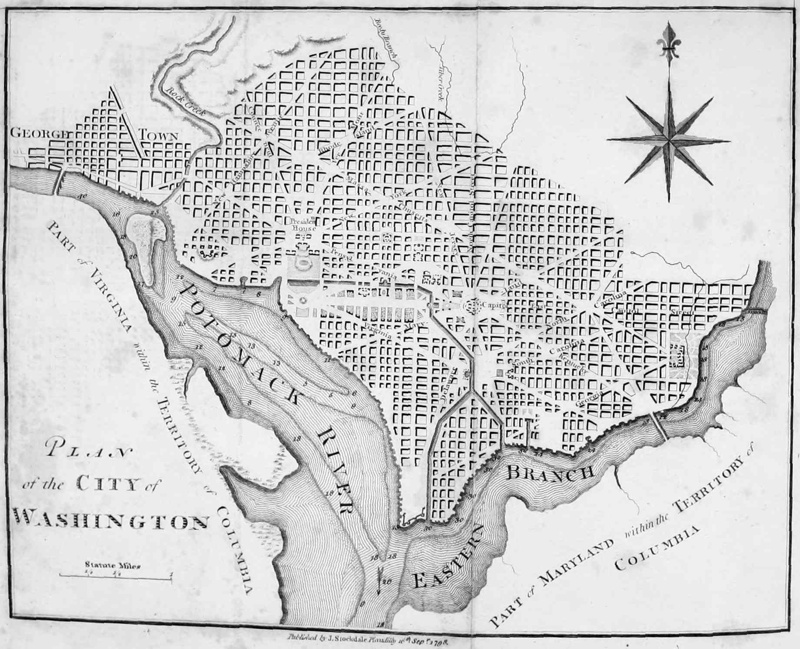
any regularity, will be just the same. It is
astonishing, that in laying out that city a grand
quay was not thought of in the plan; it would
certainly have afforded equal, if not greater
accommodation for the shipping, and it would
have added wonderfully to the embellishment
of the city.
Many of the private houses in New York
are very good, particularly those in Broadway.
Of the public buildings there are none which
are very striking. The churches and houses
for public worship amount to no less than
twenty-two; four of them are for Presbyterians,
three for Episcopalians of the church of
England, three for Dutch Reformists, two for
German Lutherans and Calvinists, two for
Quakers, two for Baptists, two for Methodists,
one for French Protestants, one for Moravians,
one for Roman Catholics, and one for
Jews.
INHABITANTS.
According to the census in 1790, the number
of inhabitants in New York was found to
be thirty thousand one hundred and forty-eight
free persons, and two thousand one hundred
267and eighty slaves; but at present the
number is supposed to amount at least to forty
thousand. The inhabitants have long been
distinguished above those of all the other towns
in the United States, except it be the people
of Charleston, for their politeness, gaiety, and
hospitality; and, indeed, in these points they
are most strikingly superior to the inhabitants
of the other large towns. Their public
amusements consist in dancing and card assemblies,
and theatrical exhibitions; for the former
a spacious suite of rooms has lately been,
erected. The theatre is of wood, and a most
miserable edifice it is; but a new one is now
building on a grand scale, which, it is thought,
will be as much too large for the town as the
other is too small.
PASSAGE TO ALBANY.
Being anxious to proceed on our journey
before the season was too far advanced, and
also particularly desirous of quitting New
York on account of the fevers, which, it was
rumoured, were increasing very fast, we took
our passage for Albany in one of the sloops
trading constantly on the North River, between
New York and that place, and embarked
on the second day of July, about two
o’clock in the afternoon. Scarcely a breath
of air was stirring at the time; but the tide
carried us up at the rate of about two miles
and a half an hour. The sky remained all day
268as serene as possible, and as the water was
perfectly smooth, it reflected in a most beautiful
manner the images of the various objects
on the shore, and of the numerous vessels
dispersed along the river at different distances,
and which seemed to glide along, as
it were, by the power of magic, for the sails,
all hung down loose and motionless. The
sun, setting in all his glory, added fresh beauties
to this calm and peaceable scene, and permitted
us for the last time to behold the
distant spires of New York, illumined by his
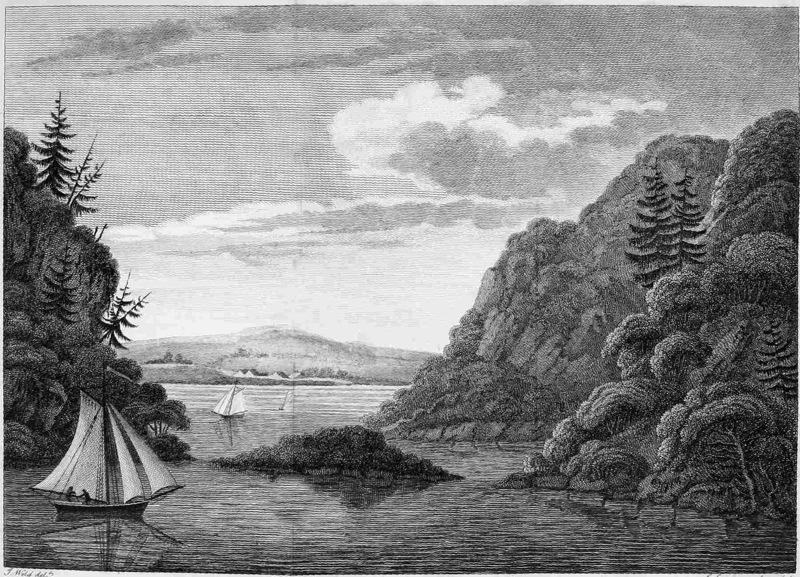
parting rays. To describe all the grand and
beautiful prospects presented to the view on
passing along this noble river, would be an
endless talk; all the various effects that can be
supposed to arise from a happy combination of
wood and water, of hill and dale, are here seen
in the greatest perfection. In some places the
river expands to the breadth of five or six
miles, in others it narrows to that of a few
hundred yards, and in various parts it is interspersed
with islands; in some places again its
course can be traced as far as the eye can
reach, whilst in others it is suddenly lost to the
view, as it winds between its lofty banks;
here mountains covered with rocks and trees
rise almost perpendicularly out of the water;
there a fine champaign country presents itself,
cultivated to the very margin of the river,
269whilst neat farm houses and distant towns
embellish the charming landscapes.
After sunset, a brisk wind sprang up, which
carried us on at the rate of six or seven miles
an hour for a considerable part of the night;
but for some hours we had to lie at anchor at
a place where the navigation of the river was
too difficult to proceed in the dark. Our sloop
was no more than seventy tons burthen by
register; but the accommodations she afforded
were most excellent, and far superior to what
might be expected on board so small a vessel;
the cabin was equally large with that in a common
merchant vessel of three hundred tons,
built for crossing the ocean. This was owing
to the great breadth of her beam, which was
no less than twenty-two feet and a half although
her length was only fifty-five feet. All
the sloops engaged in this trade are built nearly
on the same construction; short, broad, and
very shallow, few of them draw more than five
or six feet water, so that they are only calculated
for sailing upon smooth water.
Early the next morning we found ourselves
opposite to West Point, a place rendered remarkable
in history by the desertion of General
Arnold, during the American war, and the
consequent death of the unfortunate Major
André. The fort stands about one hundred
and fifty feet above the level of the water, on
270the side of a barren hill; no human creature
appearing in it except the solitary sentinel,
who marched backwards and forwards on the
ramparts overgrown with long grass, it had a
most melancholy aspect that perhaps was
heightened by the gloominess of the morning,
and the recollection of all the circumstances
attending the unhappy fate of poor
André.
Near West Point there is also another post,
called Fort Putnam, which, since the peace,
has been suffered to get very much out of
repair; however, steps are now taking to have
it put in good order. Supposing that a rupture
should ever unfortunately again take place
between Great Britain and the United States
of America, these posts would be of the
greatest consequence, as they form a link in
that chain of posts which extend the whole
way along the navigable waters that connect
the British settlements with New York.
ALBANY.
In this neighbourhood the highlands, as
they are called, commence, and extend along
the river on each side for several miles. The
breadth of the river is here considerably contracted,
and such sudden gusts of wind, coming
from between the mountains, sometimes
blow through the narrow passes, that vessels
frequently have their topmasts carried away.
The captain of the sloop we were in, said,
271that his mainsail was once blown into tatters
in an instant, and a part of it carried on shore.
When the sky is lowering, they usually take
in sail going along this part of the river.
About four o’clock in the morning of the
fourth of July we reached Albany, the place
of our destination, one hundred and sixty
miles distant from New York.
Albany is a city, and contains about eleven
hundred houses; the number however is increasing
fast, particularly since the removal of
the state government from New York. In
the old part of the town the streets are very
narrow and the houses are frightful; they are
all built in the old Dutch taste, with the gable
end towards the street, and ornamented on
the top with large iron weather cocks; but in
that part which has been lately erected, the
streets are commodious, and many of the
houses are handsome. Great pains have been
taken to have the streets well paved and
lighted. Here are four places for public
worship, and an hospital. Albany is in summer
time a very disagreeable place; it stands
in a low situation, just on the margin of the
river, which runs very slowly here, and towards
the evening often exhales clouds of vapours;
immediately behind the town, likewise,
is a large sand bank, that prevents a free circulation
of air, while at the same time it
272powerfully reflects the rays of the sun, which
shines in full force upon it the whole day.
Notwithstanding all this, however, the climate
is deemed very salubrious.
The inhabitants of this place, a few years
ago, were almost entirely of Dutch extraction;
but now strangers are flocking to it from all
quarters, as there are few places in America
more advantageously situated for commerce.
The flourishing state of its trade has already
been mentioned; it bids fair to rival that of
New York in process of time.
ALBANY.
The fourth of July, the day of our arrival
at Albany, was the anniversary of the declaration
of American independence, and on our
arrival we were told that great preparations
were making for its celebration[26]. A drum
and trumpet, towards the middle of the day,
gave notice of the commencement of the rejoicings,
and on walking to a hill about a
273quarter of a mile from the town, we saw
sixty men drawn up, partly militia, partly volunteers,
partly infantry, partly cavalry; the
latter were clothed in scarlet, and mounted on
horses of various descriptions. About three
hundred spectators attended. A few rounds
were fired from a three pounder, and some
volleys of small arms. The firing was finished
before one hour was expired, and then the
troops returned to town, a party of militia
officers in uniform marching in the rear, under
the shade of umbrellas, as the day was excessively
hot. Having reached town, the
whole body immediately dispersed. The volunteers
and militia officers afterwards dined
together, and so ended the rejoicings of the
day; no public ball, no general entertainment
was there of any description. A day
still fresh in the memory of every American,
and which appears so glorious in the annals
of their country, would, it might be expected,
have called forth more brilliant and more
general rejoicings; but the downright phlegmatic
people in this neighbourhood, intent
upon making money, and enjoying the solid
advantages of the revolution, are but little
disposed to waste their time in what they consider
idle demonstrations of joy.
LETTER XX.
274
Departure from Albany.—Difficulty of hiring
a Carriage.—Arrival at Cohoz.—Description
of the curious Fall there of the Mohawk
River.—Still-water.—Saratoga.—Few of
the Works remaining there.—Singular Mineral
Springs near Saratoga.—Fort Edward.—Miss
M‘Crea cruelly murdered there by
Indians.—Fort Ann, wretched Road thither.—Some
Observations on the American Woods.—Horses
jaded.—Difficulty of getting forward.—Arrive
at Skenesborough.—Dreadfully
infested by Musquitoes.—Particular Description
of that Insect.—Great Danger
ensues sometimes from their Bite.—Best Remedy.
MY DEAR SIR, Skenesborough, July.
COHOZ FALL.
WE remained in Albany for a few days,
and then set off for Skenesborough,
upon Lake Champlain, in a carriage hired
for the purpose. The hiring of this vehicle
was a matter attended with some trouble, and
detained us longer in the town than we wished
to stay. There were only two carriages to be
had in the whole place, and the owners having
an understanding with each other, and thinking
275that we should be forced to give whatever
price they asked, positively refused to let us
have either of them for less than seventy dollars,
equal to fifteen guineas. We on our part
as positively refused to comply with a demand
which we knew to be exorbitant, and resolved
to wait patiently in Albany for some other
conveyance, rather than submit to such an
imposition. The fellows held out for two
days, but at the end of that time one of them
came to tell us we might have his carriage
for half the price, and accordingly we took it.
Early the next morning we set off, and in
about two hours arrived at the small village of
Cohoz, close to which is the remarkable fall
in the Mohawk River. This river takes its
rise to the north-east of Lake Oneida, and
after a course of one hundred and forty miles,
disembogues into the Hudson or North River,
about ten miles above Albany. The Cohoz
Fall is about three miles distant from its mouth.
The breadth of the river is three hundred
yards; a ledge of rocks extends quite across,
and from the top of them the water falls about
fifty feet perpendicular; the line of the fall
from one side of the river to the other is
nearly straight. The appearance of this fall
varies very much, according to the quantity of
water; when the river is full, the water descends
in an unbroken sheet from one bank
276to the other, whilst at other times the greater
part of the rocks are left uncovered. The
rocks are of a remarkable dark colour, and so
also is the earth in the banks, which rise to a
great height on either side. There is a very
pleasing view of this cataract as you pass over
the bridge across the river, about three quarters
of a mile lower down.
From hence we proceeded along the banks
of the Hudson River, through the town of
Still-water, which receives its name from the
uncommon stillness of the river opposite to it,
and late in the evening reached Saratoga,
thirty-five miles from Albany. This place
contains about forty houses, and a Dutch reformed
church, but they are so scattered about
that it has not the smallest appearance of a
town.
SARATOGA.
In this neighbourhood, upon the borders of
a marsh, are several very remarkable mineral
springs; one of them, in the crater of a rock,
of a pyramidical form, about five feet in height,
is particularly curious. This rock seems to
have been formed by the petrifaction of the
water: all the other springs are likewise surrounded
with petrifactions of the same kind.
The water in the principal spring, except at
the beginning of the summer, when it regularly
overflows, remains about eight inches
below the rim of the crater, and bubbles up
277as if boiling. The crater is nine inches in
diameter. The various properties of the water
have not been yet ascertained with any great
accuracy; but it is said to be impregnated
with a fossile acid and some saline substance;
there is also a great portion of fixed air in it.
An opportunity is here afforded for making
some curious experiments.
If animals be put down into the crater,
they will be immediately suffocated; but if
not kept there too long they recover again
upon being brought into the open air.
If a lighted candle be put down, the flame
will be extinguished in an instant, and not
even the smallest spark left in the wick.
If the water immediately taken from the
spring be put into a bottle, closely corked, and
then shaken, either the cork will be forced
out with an explosion, or the bottle will be
broken; but if lest in an open vessel it becomes
vapid in less than half an hour. The
water is very pungent to the taste, and acts
as a cathartic on some people, as an emetic
on others.
Of the works thrown up at Saratoga by
the British and American armies during the
war, there are now scarcely any remains. The
country round about is well cultivated, and the
trenches have been mostly levelled by the
plough. We here crossed the Hudson River,
278and proceeded along its eastern shore as far as
Fort Edward, where it is lost to the view, for
the road still runs on towards the north, whilst
the river takes a sudden bend to the west.
FORT EDWARD.
Fort Edward was dismantled prior to the
late American war; but the opposite armies,
during that unhappy contest, were both in
the neighbourhood. Many of the people,
whom we found living here, had served as soldiers
in the army, and told us a number of
interesting particulars relative to several events
which happened in this quarter. The landlord
of the tavern where we stopped, for one, related
all the circumstances attending Miss
M‘Crea’s death, and pointed out on a hill, not
far from the house, the very spot where she
was murdered by the Indians, and the place
of her interment. This beautiful young lady
had been engaged to an officer in General
Burgoyne’s army, who, anxious for her safety,
as there were several marauding parties going
about in the neighbourhood where she lived,
sent a party of trusty Indians to escort her to
the camp. These Indians had partly executed
their commission, and were approaching with
their charge in sight of the British camp,
when they were met by another set of Indians
belonging to a different tribe, that was also
attending the British army at this time. In
a few minutes it became a matter of dispute
279between them which should have the honour
of conducting her to the camp; from words
they came to blows, and blood was on the
point of being drawn, when one of their chiefs,
to settle the matter without farther mischief,
went up to Miss M‘Crea, and killed her on
the spot with a blow of his tomahawk. The
object of contention being thus removed, the
Indians returned quietly to the camp. The
enormity of the crime, however, was too great
not to attract public notice, and it turned the
minds of every person against the Indians,
who had not before witnessed their ferocity on
occasions equally shocking to humanity. The
impolicy of employing such barbarians was
now strongly reprobated, and in a short time
afterwards most of them were dismissed from
our army.
WOODS.
Fort Edward stands near the river. The
town of the same name, is at the distance of
one or two hundred yards from it, and contains
about twenty houses. Thus far we had
got on tolerably well; but from hence to
Fort Anne, which was also dismantled prior
to the late war, the road is most wretched,
particularly over a long causeway between the
two forts, formed originally for the transporting
of cannon, the soil here being extremely
moist and heavy. The causeway consists of
large trees laid side by side transversely, some
280of which having decayed, great intervals are
left, wherein the wheels of the carriage were
sometimes locked so fast that the horses alone
could not possibly extricate them. To have
remained in the carriage over this part of the
road would really have been a severe punishment;
for although boasted of as being the
very best in Albany, it had no sort of springs,
and was in fact little better than a common
waggon; we therefore alighted, took our guns,
and amused ourselves with shooting as we
walked along through the woods. The woods
here had a much more majestic appearance
than any that we had before met with on our
way from Philadelphia; this, however, was
owing more to the great height than to the
thickness of the trees, for I could not see one
that appeared more than thirty inches in diameter;
indeed, in general, the girt of the trees
in the woods of America is but very small in
proportion to their height, and trifling in comparison
of that of the forest trees in Great
Britain. The thickest tree I ever saw in the
country was a sycamore, which grew upon the
banks of the Shenandoah River, just at its
junction with the Patowmac, in a bed of rich
earth, close to the water; yet this tree was no
more than about four feet four inches in diameter.
On the low grounds in Kentucky,
and on some of the bottoms in the western
281territory, it is said that trees are commonly to
be met with seven and eight feet in diameter.
Where this is the case, the trees must certainly
grow much farther apart than they do
in the woods in the middle states, towards
the Atlantic, for there they spring up so very
close to each other, that it is absolutely impossible
for them to attain to a great diameter.
The woods here were composed chiefly of
oaks[27], hiccory, hemlock, and beech trees,
intermixed with which, appeared great numbers
of the smooth bark or Weymouth pines,
as they are called, that seem almost peculiar
to this part of the country. A profusion of
wild raspberries were growing in the woods
here, really of a very good flavour: they are
commonly found in the woods to the northward
of this; in Canada they abound every
where.
SKENESBOROUGH.
Beyond Fort Anne, which is situated at the
distance of eight miles from Fort Edward,
the roads being better, we once more mounted
into our vehicle; but the miserable horses,
quite jaded, now made a dead stop; in vain
the driver bawled, and stamped, and swore;
his whip had been previously worn out some
hours, owing to the frequent use he had
made of it, and the animals no longer feeling
282its heavy lash, seemed as determined as the
mules of the abbess of Andouillets to go no
farther. In this situation we could not help
bantering the fellow upon the excellence of
his cattle, which he had boasted so much of at
setting out, and he was ready to cry with vexation
at what we said; but having accidentally
mentioned the sum we had paid for the carriage,
his passion could no longer be restrained,
and it broke forth in all its fury. It appeared
that he was the owner of two of the
horses, and for the use of them, and for driving
the carriage, was to have had one half of
the hire; but the man whom we had agreed
with, and paid at Albany, had given him only
ten dollars as his moiety, assuring him, at the
same time, that it was exactly the half of
what we had given, although in reality it fell
short of the sum by seven dollars and a half.
Thus cheated by his companion, and left in
the lurch by his horses, he vowed vengeance
against him on his return; but as protestations
of this nature would not bring us any sooner
to our journey’s end, and as it was necessary
that something should be immediately done, if
we did not wish to remain all night in the
woods, we suggested the idea, in the mean
time, of his conducting the foremost horses as
postillion, whilst one of our servants should
drive the pair next to the wheel. This plan
283was not started with any degree of seriousness,
for we could not have supposed that a
tall meagre fellow, upwards of six feet high,
and clad in a pair of thin nankeen breeches,
would very readily bestride the raw boned
back of a horse, covered with the profuse exudations
which the intense heat of the weather,
and the labour the animal had gone
through, necessarily excited. As much tired,
however, of our pleasantries as we were of
his vehicle, and thinking of nothing, I believe,
but how he could best get rid of us, he eagerly
embraced the proposal, and accordingly, having
furnished himself with a switch from the
adjoining thicket, he mounted his harnessed
Rosinante. In this style we proceeded; but
more than once did our gigantic postillion turn
round to bemoan the sorry choice he had
made; as often did we urge the necessity of
getting out of the woods; he could make no
answer; so jogging slowly along, we at last
reached the little town of Skenesborough,
much to the amusement of every one who
beheld our equipage, and much to our own
satisfaction; for, owing to the various accidents
we had met with, such as traces breaking,
bridles slipping off the heads of the
horses, and the noble horses themselves sometimes
slipping down, &c. &c. we had been
284no less than five hours in travelling the last
twelve miles.
MUSQUITOES.
Skenesborough stands just above the junction
of Wood Creek with South River, as it
is called in the best maps, but which, by the
people in the neighbourhood, is considered as
a part of Lake Champlain. At present there
are only about twelve houses in the place;
but if the navigation of Wood Creek is ever
opened, so as to connect Lake Champlain
with the North River, a scheme which has
already been seriously thought of, it will,
doubtless, soon become a trading town of considerable
importance, as all the various productions
of the shores of the lake will then
be collected there for the New York and Albany
markets. Notwithstanding all the disadvantages
of a land carriage of forty miles
to the North River, a small portion of flour
and potash, the staple commodities of the
state of New York, is already sent to Skenesborough
from different parts of the lake, to
be forwarded to Albany. A considerable trade
also is carried on through this place, and over
Lake Champlain, between New York and Canada.
Furs and horses principally are sent
from Canada, and in return they get East Indian
goods and various manufactures. Lake
Champlain opens a very ready communication
285between New York and the country bordering
on the St. Lawrence; it is emphatically
called by the Indians, Caniad—Eri Guarunte,
the mouth or door of the country.
MUSQUITOES.
Skenesborough is most dreadfully infested
with musquitoes; so many of them attacked
us the first night of our sleeping there, that
when we arose in the morning our faces and
hands were covered all over with large pustules,
precisely like those of a person in the
small pox. This happened too notwithstanding
that the people of the house, before we
went to bed, had taken all the pains possible to
clear the room of them, by fumigating it with
the smoke of green wood, and afterwards securing
the windows with gauze blinds; and
even on the second night, although we destroyed
many dozens of them on the walls,
after a similar fumigation had been made, yet
we suffered nearly as much. These insects
were of a much larger size than any I ever
saw elsewhere, and their bite was uncommonly
venomous. General Washington told me,
that he never was so much annoyed by musquitoes
in any part of America as in Skenesborough,
for that they used to bite through the
thickest boot. The situation of the place is
indeed peculiarly favourable for them, being
just on the margin of a piece of water, almost
stagnant, and shaded with thick woods.
286The musquito is of the same species with the
common gnat in England, and resembles it
very closely both in size and shape. Like
the gnat it lays its eggs on the surface of
the water, where they are hatched in the
course of a few days, unless the water is
agitated, in which last case they are all destroyed.
From the egg is produced a grub,
which changes to a chrysalis, and afterwards
to a musquito; this last change takes place on
the surface of the water, and if at the moment
that the insect first spreads its wings the
water is not perfectly still and the air calm,
it will be inevitably destroyed; at those parts
of the lake, therefore, which are most exposed,
and where the water is often agitated,
no such thing as a musquito is ever seen;
neither are they ever found along a large and
rapid river, where the shores are lofty and
dry; but in the neighbourhood of marshes,
low grounds, and stagnant waters, they always
abound. Musquitoes appear to be particularly
fond of the fresh blood of Europeans, who always
suffer much more the first year of their
arrival in America than they do afterwards.
The people of the country seem quite to disregard
their attacks. Wherever they fix their
sting, a little tumor or pustule usually arises,
supposed to be occasioned by the fermentation,
when mixed with the blood, of a small quantity
287of liquor which the insect always injects
into the wound it makes with its spicula,
as may be seen through a microscope,
and which it probably does to render the
blood more fluid. The disagreeable itching
this excites is most effectually allayed by the
application of volatile alkali; or if the part
newly stung be scratched and immediately
bathed in cold water, that also affords considerable
relief; but after the venom has been
lodged for any time, scratching only increases
the itching, and it may be attended with great
danger. Repeated instances have occurred of
people having been laid up for months, and
narrowly escaping the loss of a limb, from
imprudently rubbing a part which had been
bitten for a long time. Great ease is also derived
from opening the pustules on the second
day with a lancet, and letting out the blood
and watery matter.
LETTER XXI.
288
Embark on Lake Champlain.—Difficulty of
procuring Provisions at Farms bordering upon
it.—Ticonderoga.—Crown Point.—Great
Beauty of the Scenery.—General Description
of Lake Champlain and the adjacent Country.
Captain Thomas and his Indians arrive at
Crown Point.—Character of Thomas.—Reach
St. John’s.—Description of that Place.—Great
Difference observable in the Face of
the Country, Inhabitants, &c. in Canada and
in the States.—Chambly Castle.—Calashes.—Bons
Dieux.—Town of La Prarie.—Great
Rapidity of the River Saint Lawrence.—Cross
it to Montreal.—Astonishment on seeing
large Ships at Montreal.—Great Depth of the
River.
Montreal, July.
LAKE CHAMPLAIN.
SHORTLY after our arrival in Skenesborough,
we hired a small boat of about ten
tons for the purpose of crossing Lake Champlain.
It was our wish to proceed on the
voyage immediately; but the owner of the
boat asserting that it was impossible to go out
with the wind then blowing, we were for
three days detained in Skenesborough, a delicious
feast for the hungry musquitoes. The
289wind shifted again and again, still it was not
fair in the opinion of our boatman. At last,
being most heartily tired of our quarters, and
suspecting that he did not understand his business
as well as he ought to have done, we resolved
not to abide by his opinion any longer,
but to make an attempt at beating out; and
we had great reason to be pleased with having
done so, as we arrived in Canada three days
before any of the other boats, that did not venture
to move till the wind was quite aft.
We set off about one o’clock; but from the
channel being very narrow, it was impossible
to make much way by tacking. We got no
farther than six miles before sun-set. We then
stopped, and having landed, walked up to some
farm houses, which appeared at a distance, on
the Vermont shore, to procure provisions; for
the boatman had told us it was quite unnecessary
to take in any at Skenesborough, as
there were excellent houses close to the shore
the whole way, where we could get whatever
we wished. At the first we went to, which
was a comfortable log-house, neither bread,
nor meat, nor milk, nor eggs, were to be had;
the house was crowded with children of all
ages, and the people, I suppose, thought they
had but little enough for themselves. At a
second house, we found a venerable old man at
the door, reading a news-paper, who civilly
290offered it to us for our perusal, and began to
talk upon the politics of the day; we thanked
him for his offer, and gave him to understand,
at the same time, that a loaf would be much
more acceptable. Bread there was none; we
got a new Vermont cheese, however. A third
house now remained in sight, and we made a
third attempt at procuring something to eat.
This one was nearly half a mile off, but alas!
it afforded still less than the last; the people
had nothing to dispose of but a little milk.
With the milk and the cheese, therefore, we
returned to our boat, and adding thereto some
biscuits and wine, which we had luckily on
board, the whole afforded us a frugal repast.
LAKE CHAMPLAIN.
The people at the American farm houses
will cheerfully lie three in a bed, rather than
suffer a stranger to go away who comes to seek
for a lodging. As all these houses, however,
which we had visited, were crowded with inhabitants,
we felt no great inclination to ask
for accommodation at any of them, but determined
to sleep on board our little vessel. We
accordingly moored her at a convenient part
of the shore, and each of us having wrapped
himself up in a blanket, which we had been
warned to provide on leaving New York, we
laid ourselves down to sleep. The boat was
decked two thirds of her length forward, and
had a commodious hold; we gave the preference,
291however, because more airy, to the
cabin or after part, fitted up with benches, and
covered with a wooden awning, under which
a man could just sit upright, provided he was
not very tall. The benches, which went
lengthwise, accommodated two of us; and the
third was obliged to put up with the cabin
floor; but a blanket and a bare board, out of
the way of musquitoes, were luxuries after
our accommodations at Skenesborough; our
ears were not assailed by the noise even of a
single one the whole night, and we enjoyed
sounder repose than we had done for many
nights preceding.
The wind remained nearly in the same
point the next morning, but the lake being
wider, we were enabled to proceed faster. We
stopped at one house to breakfast, and at another
to dine. At neither of these, although
they bore the name of taverns, were we able
to procure much more than at the houses
where we had stopped the preceding evening.
At the first we got a little milk, and about
two pounds of bread, absolutely the whole of
what was in the house; and at the second, a
few eggs, and some cold salted fat pork; but
not a morsel of bread was to be had. The
wretched appearance also of this last habitation
was very striking; it consisted of a wooden
frame, merely with a few boards nailed against
292it, the crevices between which were the only
apertures for the admission of light, except the
door; and the roof was so leaky, that we were
sprinkled with the rain even as we sat at the
fire side. That people can live in such a manner,
who have the necessaries and conveniencies
of life within their reach, as much as any
others in the world, is really most astonishing!
It is, however, to be accounted for, by that desire
of making money, which is the predominant
feature in the character of the Americans
in general, and leads the petty farmer in
particular to suffer numberless inconveniencies,
when he can gain by so doing. If he can sell
the produce of his land to advantage, he keeps
as small a part of it as possible for himself, and
lives the whole year round upon salt provisions,
bad bread, and the fish he can catch in
the rivers or lakes in the neighbourhood; if
he has built a comfortable house for himself,
he readily quits it, as soon as finished, for money,
and goes to live in a mere hovel in the
woods till he gets time to build another. Money
is his idol, and to procure it he gladly
foregoes every self-gratification.
TICONDEROGA.
From this miserable habitation, just mentioned,
we departed as soon as the rain was
over, and the wind coming round in our favour,
we got as far as Ticonderoga that night.
The only dwelling here is the tavern, which
293is a large house built of stone. On entering
it we were shewn into a spacious apartment,
crowded with boatmen and people that had
just arrived from St. John’s, in Canada. Seeing
such a number of guests in the house, we
expected nothing less than to be kept an hour
or two till sufficient supper was prepared for
the whole company, so that all might sit down
at once together, which, as I have before said,
is the custom in the country parts of the United
States. Our surprise therefore was great at
perceiving a neat table and a comfortable little
supper speedily laid out for us, and no attempts
made at serving the rest of the company till we
had quite finished. This was departing from
the system of equality in a manner which we
had never witnessed before, and we were at a
loss for some time to account for it; but we
presently heard that the woman of the house
had kept a tavern for the greater part of her
life at Quebec, which resolved the knotty point.
The wife is generally the active person in managing
a country tavern, and the husband attends
to his farm, or has some independent occupation.
The man of this house was a judge,
a sullen demure old gentleman, who sat by the
fire[28], with tattered clothes and dishevelled
294locks, reading a book, totally regardless of every
person in the room.
The old fort and barracks of Ticonderoga
are on the top of a rising ground, just behind
the tavern; they are quite in ruins, and it is not
likely that they will ever be rebuilt, for the
situation is very insecure, being commanded by
a lofty hill called Mount Defiance. The
British got possession of the place the last war
by dragging cannon and mortars up the hill,
and firing down upon the fort.
Early the next morning we left Ticonderoga,
and pursued our voyage to Crown
Point, where we landed to look at the old fort.
Nothing is to be seen there, however, but a
heap of ruins; for shortly before it was given
up by the British, the powder magazine blew
up, by which accident a great part of the works
was destroyed; since the evacuation of it also,
the people in the neighbourhood have been
continually digging in different parts, in hopes
of procuring lead and iron shot; a considerable
quantity was in one instance got out of the
stores that had been buried by the explosion.
The vaults, which were bomb proof, have
been demolished for the sake of the bricks for
building chimneys. At the south side alone
the ditches remain perfect; they are wide and
deep, and cut through immense rocks of limestone;
and from being overgrown towards the
top with different kinds of shrubs, have a grand
295and picturesque appearance. The view from
this spot of the fort, and the old buildings in
it overgrown with ivy, of the lake, and of the
distant mountains beyond it, is indeed altogether
very fine. The fort, and seven hundred
acres of good cleared land adjoining to it, are
the property of the state of New York, and are
leased out at the rate of one hundred and fifty
dollars, equal to £. 33. 10 s. sterling per annum,
which is appropriated for the use of a
college. The farmer who rented it told us,
he principally made use of the land for grazing
cattle; these, in the winter season, when the
lake was frozen, he drove over the ice to Albany,
and there disposed of.
CROWN POINT.
Crown Point is the most advantageous spot
on the shores of Lake Champlain for a military
post, not being commanded by any rising
grounds in the neighbourhood, as Ticonderoga
is, and as the lake is so narrow here, owing
to another point running out on the opposite
side, that it would be absolutely impossible for
a vessel to pass, without being exposed to the
fire of the fort. The Indians call this place
Tek-ya-dough-nigarigee, that is, the two points
immediately opposite to each other: the one
opposite to Crown Point is called Chimney
Point; upon it are a few houses, one of which
is a tavern. While we staid there we were
very agreeably surprised, for the first time, with
296the sight of a large birch canoe upon the lake,
navigated by two or three Indians in the dresses
of their nation. They made for the shore and
soon landed; and shortly after another party,
amounting to six or seven, arrived, that had
come by land.
On board our little vessel we had a poor
Canadian, whom we took in at Skenesborough.
Tempted by the accounts he had heard of the
United States, he quitted his own home in Canada,
where he lived under one of the seigniors,
and had gone as far as Albany, in the neighbourhood
of which place he had worked for
some time with a farmer; but finding, that
although he got higher wages, he had to pay
much more for his provisions than in Canada,
and that he was also most egregiously cheated
by the people, and particularly by his employer,
from whom he could not get even the money
he had earned; finding likewise that he was unable
to procure any redress, from being ignorant
of the English language, the poor fellow
determined to return to Canada, and on his
way thither we met him, without a shilling in
his pocket.
Having asked this little fellow, as we sailed
along, some questions about the Indians, he
immediately gave us a long account of a Captain
Thomas, a chief of the Cachenonaga nation,
in the neighbourhood of whose village he
297said he lived. Thomas, he told us, was a very
rich man, and had a most excellent house, in
which he said he lived as well as a seignior,
and he was sure we should be well received if
we went to see him; he told us also that he had
built a church, and was a christian; that he
was very charitable, and that if he were acquainted
with his present distress he would
certainly make him a present of four or five
dollars. “Oh je vous assure, messieurs, que
c’est un bon sauvage.” It was impossible
not to smile at the little Canadian, who, half
naked himself, and nearly as dark as a mulatto,
concluded his panegyric upon Thomas, by
assuring us, “he was a good savage;” at the
same time we felt a strong desire to behold this
chief, of whom we had heard so much. It was
not long before we were gratified, for the party
of Indians that arrived whilst we were at
Chimney Point were from the Cachenonaga
village, and at their head was Captain Thomas.
CAPTAIN THOMAS.
Thomas appeared to be about forty-five
years of age; he was nearly six feet high, and
very bulky in proportion: this is a sort of make
uncommon among the Indians, who are generally
slender. He was dressed like a white
man, in boots; his hair untied, but cut short;
the people who attended him were all in the
Indian habit. Not one of his followers could
speak a word of English or French; Thomas,
298however, could himself speak both languages.
English he spoke with some little hesitation,
and not correctly; but French seemed as familiar
to him as his native tongue. His principal
attention seemed to be directed towards
trade, which he had pursued with great success,
so much so, indeed, that, as we afterwards
heard, he could get credit in any store in
Montreal for five hundred pounds. He had
along with him at Chimney Point thirty horses
and a quantity of furs in the canoe, which he
was taking for sale to Albany. His people,
he told us, had but very few wants; he took
care to have these always supplied; in return
they brought him furs, taken in hunting; they
attended his horses, and voluntarily accompanied
him when he went on a trading expedition:
his profits therefore must be immense.
During the course of conversation he told us,
that if we came to see him he would make us
very happy; that there were some very handsome
squaws[29] in his village, and that each of
us should have a wife: we promised to visit him
if it was in our power, and parted very good
friends. Thomas, as we afterwards found, is
not a man respected among the Indians in general,
who think much more of a chief that is
a good warrior and hunter, and that retains the
299habits of his nation, than of one that becomes
a trader, and assimilates his manners to those of
the whites.
LAKE CHAMPLAIN.
Lake Champlain is about one hundred and
twenty miles in length, and is of various
breadths; for the first thirty miles, that is, from
South River to Crown Point, it is in no place
more than two miles wide; beyond this, for
the distance of twelve miles, it is five or six
miles across, but then again it narrows, and
again at the end of a few miles expands. That
part called the Broad Lake, because broader
than any other, commences about twenty-five
miles north of Crown Point, and is eighteen
miles across in the widest part. Here the lake
is interspersed with a great number of islands,
the largest of which, formerly called Grande
Isle, now South Hero, is fifteen miles in length,
and, on an average, about four in breadth.
The soil of this island is fertile, and it is said
that five hundred people are settled upon it.
The Broad Lake is nearly fifty miles in length,
and gradually narrows till it terminates in a
large river called Chambly, Richlieu, or Sorelle,
which runs into the St. Lawrence.
The soundings of Lake Champlain, except
at the narrow parts at either end, are in general
very deep; in many places sixty and seventy,
and in some even one hundred fathoms. In
proportion to its breadth and depth, the water
300is more or less clear; in the broad part it is as
pure and transparent as possible. On the west
side, as far as Cumberland Bay, the lake is
bounded for the most part by steep mountains
close to the edge of the water; at Cumberland
Bay the ridge of mountains runs off to the
north west, and the shore farther on is low and
swampy. The East or Vermont shore is not
much elevated, except in a few particular
places; at the distance of twelve miles, however,
from the lake is a considerable mountain.
The shores on both sides are very rocky; where
there are mountains these rocks jut out very
boldly; but at the east side, where the land is
low, they appear but a little above the water.
The islands also, for the most part, are surrounded
with rocks, in some parts, shelving
down into the lake, so that it is dangerous to
approach within one or two miles of them at
particular sides. From some parts of the eastern
shore the rocks also run out in the same manner
for a considerable distance. Sailing along
the shore when a breeze is blowing, a hollow
murmuring noise is always heard from the waters
splashing into the crannies of these rocks.
There are many streams which fall into the
lake: the mouths of all those on the western
side are obstructed by falls, so that none of them
are navigable. Of those on the eastern or
Vermont side, a few only are navigable for
small boats, and that for a short distance.
SCENERY.
301The scenery along various parts of the lake
is extremely grand and picturesque, particularly
beyond Crown Point; the shores are there
beautifully ornamented with hanging woods
and rocks, and the mountains on the western
side rise up in ranges one behind the other in
the most magnificent manner. It was on one
of the finest evenings possible that we passed
along this part of the lake, and the sun setting
in all his glory behind the mountains, spread
the richest tints over every part of the prospect;
the moon also appearing nearly in the full,
shortly after the day had closed, afforded us an
opportunity of beholding the surrounding
scenery in fresh though less brilliant colours.
Our little bark was now gliding smoothly along,
whilst every one of us remained wrapt up in
silent contemplation of the solemn scene, when
suddenly she struck upon one of the shelving
rocks: nothing but hurry and confusion was
now visible on board, every one lending his
assistance; however, at last, with some difficulty,
we got her off; but in a minute she
struck a second time, and after we had again
extricated her, even a third and a fourth time;
at last she stuck so fast that for a short time we
despaired of being able to move her. At the
end of a quarter of an hour, however, we again
fortunately got her into deep water. We had
before suspected that our boatman did not
302know a great deal about the navigation of the
lake, and on questioning him now, it came out,
that he had been a cobler all his life, till within
the last nine months, when he thought proper
to change his business, and turn sailor. All the
knowledge he had of the shores of the lake,
was what he had picked up during that time,
as he sailed straight backward and forward between
St. John’s and Skenesborough. On the
present occasion he had mistaken one bay for
another, and had the waves been as high as
they sometimes are, the boat would inevitably
have been dashed to pieces.
The humble roof of another judge, a plain
Scotch labourer, afforded us shelter for this
night. It was near eleven o’clock, however,
when we got there, and the family having
retired to rest we had to remain rapping and
calling at the door for half an hour at least;
before we could get admittance. The people
at last being roused, opened their doors, cheerfully
got us some supper, and prepared their
best beds for us. In the morning, having
paid our reckoning to the judge, he returned
to his plough, and we to our boat to prosecute
our voyage.
BOUNDARY.
We set off this day with a remarkable fine
breeze, and being desirous of terminating our
voyage as soon as possible, of which we began
now to be somewhat tired, we stopped but
303once in the course of the day, and determined
to sail on all night. A short time after sun
set we passed the boundary between the British
dominions and the United States. Here
we were brought to by an armed brig of
twenty guns, under English colours, stationed
for the purpose of examining all boats passing
up and down the lake: the answers which we
gave to the several questions asked being satisfactory,
we were accordingly suffered to proceed.
Since the surrender of the ports, pursuant
to the late treaty with the United States,
this brig has been removed, and laid up at St.
John’s. When night came on, we wrapped
ourselves up in our blankets, as we had done
on the first night of our voyage, and laid down
upon the cabin floor, where we might possibly
have slept until we got to St. John’s, had we
not been awakened at midnight by the loud
hollas of the sentinel at the British fort on Isle
aux Noix. On examining into the matter, it
appeared that the boat had been driven on
shore, while our sleepy pilot enjoyed his nap
at the helm; and the sentinel, unable to
imagine what we were about, seeing the boat
run up close under the fort, and suspicious of
some attack, I suppose, had turned out the
whole guard; by whom, after being examined
and re-examined, we were finally dismissed.
We now took the command of the boat upon
304ourselves, for the boatman, although he was
more anxious to get to St. John’s than any one
of us, and though he had himself in some-measure
induced us to go on, was so sleepy
that he could not keep his eyes open. Relieving
each other at the helm, we reached St.
John’s by day-break; one hundred and fifty
miles distant from Skenesborough.
Immediately on our landing we were conducted
to the guard house, where we had to
deliver to the serjeant on duty, to be by him
forwarded to the commanding officer, an account
of our names, occupation, and place of
abode, the strictest orders having been issued
by the governor not to suffer any Frenchmen
or other foreigners, or any people who could
not give an exact account of their business in
Canada, to enter into the country.
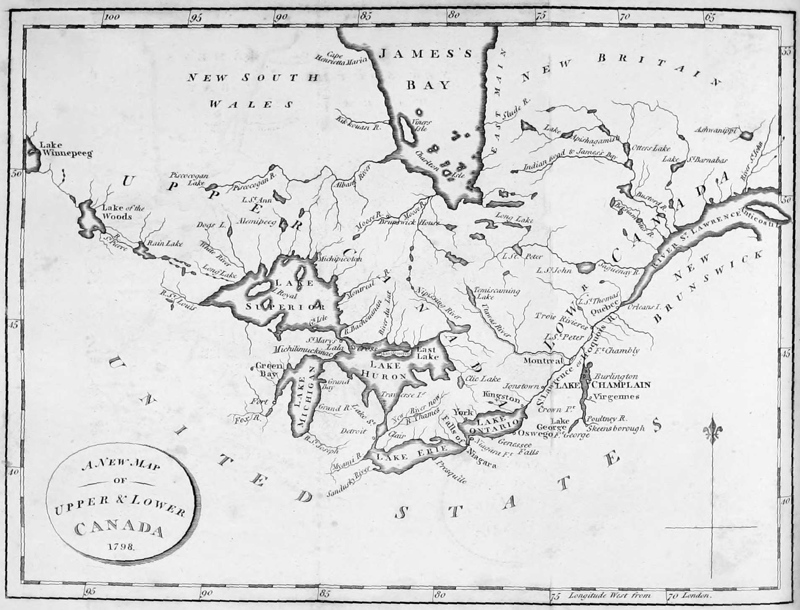
A NEW MAP OF UPPER & LOWER CANADA 1798.
Published Novr. 20th. 1798 by J.Stockdale Piccadilly.
St. John’s is a garrison town; it contains
about fifty miserable wooden dwellings, and
barracks, in which a whole regiment is generally
quartered. The fortifications are entirely
out of order, so much so that it would be
cheaper to erect fresh works than to attempt
to repair them. There is a king’s dock yard
here, well stored with timber, at least, when
we saw it; but in the course of the summer,
after the armed brig which I mentioned was
laid up, all the timber was sold off. The old
hulks of several vessels of force were lying
305opposite the yard. In proportion to the increase
of trade between New York and Lower
Canada this town must improve, as it is the
British port of entry on Lake Champlain.
CHAMBLY.
The country about St. John’s is flat, and
very bare of trees, a dreadful fire in the year
1788 having done great mischief, and destroyed
all the woods for several miles: in some parts
of the neighbourhood the people suffer extremely
during winter from the want of fuel.
At St. John’s we hired a light waggon,
similar to those made use of in the United
States, and set off about noon for La Prarie,
on the banks of the river St. Lawrence. By
the direct road, this is only eighteen miles
distant; but the most agreeable way of going
thither is by Chambly, which is a few miles
farther, on account of seeing the old castle built
there by the French. The castle stands close
to the rapids in Chambly or Sorelle River, and
at a little distance has a grand appearance; the
adjacent country also being very beautiful, the
whole together forms a most interesting scene.
The castle is in tolerably good repair, and a
garrison is constantly kept in it.
As you travel along this road to La Prarie,
after having just arrived from the United States
over Lake Champlain, a variety of objects
forcibly remind you of your having got into a
new country. The British flag, the soldiers
306on duty, the French inhabitants running
about in their red nightcaps, the children
coming to the doors to salute you as you pass,
a thing unknown in any part of the United
States; the compact and neat exterior appearance
of the houses, the calashes, the bons
dieux, the large Roman Catholic churches
and chapels, the convents, the priests in their
robes, the nuns, the friars; all serve to convince
you that you are no longer in any part
of the United States: the language also differs,
French being here universally spoken.
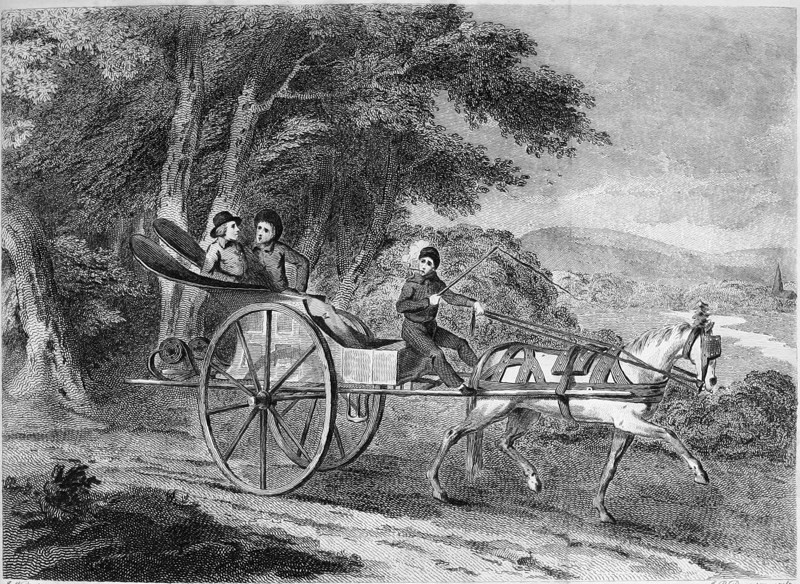
Canadian Calash or Marche-donc.
Published Dec. 22 1798, by J Stockdale, Piccadilly.
MONTREAL.
The calash is a carriage very generally used
in Lower Canada; there is scarcely a farmer
indeed in the country who does not possess
one: it is a sort of one horse chaise, capable
of holding two people besides the driver, who
sits on a kind of box placed over the foot
board expressly for his accommodation. The
body of the calash is hung upon broad straps
of leather, round iron rollers that are placed
behind, by means of which they are shortened
or lengthened. On each side of the carriage
is a little door about two feet high, whereby
you enter it, and which is useful when shut,
in preventing any thing from slipping out.
The harness for the horse is always made in
the old French taste, extremely heavy; it is
studded with brass nails, and to particular parts
307of it are attached small bells, of no use that I
could ever discover but to annoy the passenger.
The bons dieux are large wooden crucifixes,
sometimes upwards of twenty feet in height,
placed on the highway; some of them are
highly ornamented and painted: as the people
pass they pull off their hats, or in some other
way make obeisance to them.
La Prarie de la Madelene contains about
one hundred houses: after stopping an hour or
two there we embarked in a bateau for Montreal.
Montreal is situated on an island of the
same name, on the opposite side of the River
St. Lawrence to that on which la Prarie
stands, but somewhat lower down. The two
towns are nine miles apart, and the river is
about two miles and a quarter wide. The
current here is prodigiously strong, and in particular
places as you cross, the boats are hurried
down the stream, in the midst of large
rocks, with such impetuosity that it seems as
if nothing could save them from being dashed
to pieces; indeed this would certainly be the
case if the men were not uncommonly expert;
but the Canadians are the most dexterous
people perhaps in the world at the management
of bateaux in rapid rivers. After such a
prospect of the River St. Lawrence, it was
not without astonishment that on approaching
308the town of Montreal we beheld ships of upwards
of four hundred tons burthen lying close
to the shore. The difficulties which vessels
have to encounter in getting to Montreal are
immense; I have myself seen them with all
their sails set, and with a smart and favourable
breeze, stationary for an hour together in the
stream, unable to stem it, between the island
of St. Helene and the main land, just below
the town: to stem the current at this place
it is almost necessary that the vessel should be
aided by a storm. The ascent is equally difficult
in several other parts of the river. Owing
to this it is, that the passage from Quebec
to Montreal is generally more tedious than
that across the Atlantic; those ships, therefore,
which trade between Europe and Montreal,
never attempt to make more than one
voyage during the year. Notwithstanding the
rapidity of the stream, the channel of the river
is very deep, and in particular just opposite
to the town. The largest merchant vessels
can there lie so close to the banks, which are
in their natural state, that you may nearly
touch them with your hand as you stand on
the shore.
LETTER XXII.
309
Description of the Town of Montreal.—Of the
public Buildings.—Churches.—Funeral Ceremonies.—Convents.—Barracks.—Fortifications.—Inhabitants
mostly French.—Their
Character and Manners.—Charming Prospects
in the Neighbourhood of the Town.—Amusements
during Summer.—Parties of
Pleasure up the Mountain.—Of the Fur
Trade.—The Manner in which it is carried
on.—Great Enterprise of the North West
Company of Merchants.—Sketch of Mr.
M‘Kenzie’s Expeditions over Land to the
Pacific Ocean.—Differences between the
North West and Hudson’s Bay Companies.
Montreal, July.
THE town of Montreal was laid out pursuant
to the orders of one of the kings
of France, which were, that a town should be
built as high up on the St. Lawrence as it
were possible for vessels to go by sea. In fixing
upon the spot where it stands, his commands
were complied with in the strictest sense.
The town at present contains about twelve
hundred houses, whereof five hundred only
are within the walls; the rest are in the
suburbs, which commence from the north,
310east, and west gates. The houses in the suburbs
are mostly built of wood, but the others are
all of stone; none of them are elegant, but
there are many very comfortable habitations.
In the lower part of the town, towards the
river, where most of the shops stand, they
have a very gloomy appearance, and look like
so many prisons, being all furnished at the
outside with sheet iron shutters to the doors
and windows, which are regularly closed towards
evening, in order to guard against fire.
The town has suffered by fire very materially
at different times, and the inhabitants have
such a dread of it, that all who can afford it
cover the roofs of their houses with tin-plates
instead of shingles. By law they are obliged
to have one or more ladders, in proportion to
the size of the house, always ready on the
roofs.
MONTREAL.
The streets are all very narrow; three of
them run parallel to the river, and these are
intersected by others at right angles, but not
at regular distances. On the side of the
town farthest from the river, and nearly
between the northern and southern extremities,
there is a small square, called La Place
d’Armes, which seems originally to have been
left open to the walls on one side, and to
have been intended for the military to exercise
in; the troops, however, never make use of it
311now, but parade on a long walk, behind the
walls, nearer to the barracks. On the opposite
side of the town, towards the water, is another
small square, where the market is held.
There are six churches in Montreal; one
for English Episcopalians, one for Presbyterians,
and four for Roman Catholics. The
cathedral church belonging to the latter,
which occupies one side of La Place d’Armes,
is a very spacious building, and contains five
altars, all very richly decorated. The doors
of this cathedral are left open the greater part
of the day, and there are, generally, numbers
of old people in it at their prayers, even when
no regular service is going on. On a fine Sunday
in the summer season such multitudes
flock to it, that even the steps at the outside
are covered with people, who, unable to get in,
remain there kneeling with their hats off during
the whole time of divine service. Nearly
all the christenings, marriages, and burials of
the Roman Catholic inhabitants of Montreal
are performed in this church, on which occasions,
as well as before and during the
masses, they always ring the bells, to the great
annoyance of every person that is not a lover
of discords; for instead of pulling the bells,
which are five in number, and really well
toned, with regularity, they jingle them all at
once, without any sort of cadence whatever.
312Our lodgings happened to be in La Place
d’Armes; and during three weeks that we
remained there, I verily believe the bells were
never suffered to remain still for two hours
together, at any one time, except in the
night.
MONTREAL.
The funerals, as in other Roman Catholic
countries, are conducted with great ceremony;
the corpse is always attended to the church
by a number of priests chanting prayers, and
by little boys in white robes and black caps
carrying wax lights. A morning scarcely
ever passed over that one or more of these
processions did not pass under our windows
whilst we were at breakfast; for on the opposite
side of the square to that on which
the cathedral stood, was a sort of chapel, to
which the bodies of all those persons, whose
friends could not afford to pay for an expensive
funeral, were brought, I suppose, in the night,
for we could never see any carried in there,
and from thence conveyed in the morning to
the cathedral. If the priests are paid for it
they go to the house of the deceased, though
it be ever so far distant, and escort the corpse
to the church. Until within a few years past
it was customary to bury all the bodies in the
vaults underneath the cathedral; but now it
is prohibited, lest some putrid disorder should
break out in the town in consequence of such
313numbers being deposited there. The burying
grounds are all without the walls at present.
There are in Montreal four convents, one
of which is of the order of St. Francis; the
number of the friars, however, is reduced now
to two or three, and as by the laws of the
province men can no longer enter into any
religious order, it will of course in a few years
dwindle entirely away. On the female orders
there is no restriction, and they are still well
filled. The Hotel Dieu, founded as early as
1644, for the relief of the sick poor, and
which is the oldest of the convents, contains
thirty “religieuses”—nuns; La Congregation
de Notre Dame, instituted for the instruction
of young girls, contains fifty-seven
sœurs, another sort of nuns; and L’Hospital
Generale, for the accommodation of the infirm
poor, contains eighteen sœurs.
The barracks are agreeably situated near
the river, at the lower end of the town; they
are surrounded by a lofty wall, and calculated
to contain about three hundred men.
The walls round the town are mouldering
away very fast, and in some places are totally
in ruins; the gates, however, remain quite
perfect. The walls were built principally as
a defence against the Indians, by whom the
country was thickly inhabited when Montreal
was founded, and they were found necessary,
314to repel the open attacks of these people as
late as the year 1736. When the large fairs
used to be held in Montreal, to which the
Indians from all parts resorted with their furs,
they were also found extremely useful, as the
inhabitants were thereby enabled to shut out
the Indians at night, who, had they been suffered
to remain in the town, addicted as they
are to drinking, might have been tempted to
commit great outrages, and would have kept
the inhabitants in a continual state of alarm.
In their best state the walls could not have
protected the town against cannon, not even
against a six pounder; nor, indeed, would the
strongest walls be of any use in defending it
against artillery, as it is completely commanded
by the eminences in the island of St. Helene[30],
in the River St. Lawrence. Montreal
has always been an easy conquest to regular
troops.
MONTREAL.
By far the greater number of the inhabitants
of Montreal are of French extraction;
all the eminent merchants, however, and
principal people in the town, are either English,
Scotch, Irish, or their descendants, all of
whom pass for English with the French inhabitants.
The French retain, in a great
315measure, the manners and customs of their
ancestors, as well as the language; they have
an unconquerable aversion to learn English,
and it is very rare to meet with any person
amongst them that can speak it in any manner;
but the English inhabitants are, for the
most part, well acquainted with the French
language.
The people of Montreal, in general, are remarkably
hospitable and attentive to strangers;
they are sociable also amongst themselves, and
fond in the extreme of convivial amusements.
In winter, they keep up such a constant and
friendly intercourse with each other, that it
seems then as if the town were inhabited but
by one large family. During summer they
live somewhat more retired; but throughout
that season a club, formed of all the principal,
inhabitants, both male and female, meet every
week or fortnight, for the purpose of dining at
some agreeable spot in the neighbourhood of
the town.
The island of Montreal is about twenty-eight
miles in length and ten in breadth; it
is the largest of several islands which are
situated in the St. Lawrence, at the mouth of
the Utawa River. Its soil is luxuriant, and
in some parts much cultivated and thickly inhabited.
It is agreeably diversified with hill
and dale, and towards its center, in the neighbourhood
316of Montreal, there are two or three
considerable mountains. The largest of these
stands at the distance of about one mile from
the town, which is named from it. The base
of this mountain is surrounded with neat
country houses and gardens, and partial improvements
have been made about one third
of the way up; the remainder is entirely
covered with lofty trees. On that side towards
the river is a large old monastery, with
extensive inclosures walled in, round which
the ground has been cleared for some distance.
This open part is covered with a rich verdure,
and the woods encircling it, instead of
being overrun with brushwood, are quite clear
at bottom, so that you may here roam about at
pleasure for miles together, shaded, by the lofty
trees, from the rays of the sun.
FUR TRADE.
The view from hence is grand beyond
description. A prodigious expanse of country
is laid open to the eye, with the noble river St.
Lawrence winding through it, which may be
traced from the remotest part of the horizon.
The river comes from the right, and flows
smoothly on after passing down the tremendous
rapids above the town, where it is
hurried over huge rocks with a noise that is
heard even up the mountain. On the left
below you appears the town of Montreal,
with its churches, monasteries, glittering
317spires, and the shipping under its old walls;
several little islands in the river near the town,
partly improved, partly overgrown with wood,
add greatly to the beauty of the scene. La
Prarie with its large church on the distant side
of the river, is seen to the greatest advantage,
and beyond it is a range of lofty mountains
which terminates the prospect. Such an
endless variety and such a grandeur is there in
the view from this part of the mountain, that
even those who are most habituated to the
view always find it a fresh subject of admiration
whenever they contemplate it; and on this
part of the mountain it is that the club which
I mentioned generally assembles. Two stewards
are appointed for the day, who always
chuse some new spot where there is a spring
or rill of water, and an agreeable shade: each
family brings cold provisions, wine, &c.; the
whole is put together, and the company, often
amounting to one hundred persons, sits down
to dinner.
The fur trade is what is chiefly carried on
at Montreal, and it is there that the greater
part of the furs are shipped, which are sent
from Canada to England.
This very lucrative trade is carried on, partly
by what is called the North West Company,
and partly by private individuals on their own
account. The company does not possess any
318particular privileges by law, but from its great
capital merely it is enabled to trade to certain
remote parts of the continent, to the exclusion
of those who do not hold any shares in it. It
was formed originally by the merchants of
Montreal themselves, who wisely considered
that the trade could be carried on to those
distant parts of the continent, inhabited solely
by Indians, with more security and greater
profit, if they joined together in a body, than
if they continued to trade separately. The
stock of the company was divided into forty
shares, and as the number of merchants in the
town at that time was not very great, this
arrangement afforded an opportunity to every
one of them to join in the company if he
thought proper. At present these shares have
all fallen into the hands of a few persons.
CANOES.
The company principally carries on its trade
by means of the Utawas or Grand River, that
falls into the St. Lawrence about thirty miles
above Montreal, and which forms, by its confluence
with that river, “Le Lac de Deux
Montagnes et le Lac St. Louis,”—the lake of
the Two Mountains and the Lake of St. Louis,
wherein are several large islands. To convey
the furs down this river, they make use of
canoes, formed of the bark of the birch tree,
some of which are upon such a large scale
that they are capable of containing two tons,
319but they seldom put so much in them, especially
on this river, it being in many places
shallow, rapid, and full of rocks, and contains
no less than thirty-two portages.
The canoes are navigated by the French
Canadians, who are particularly fond of the
employment, preferring it in general to that
of cultivating the ground. A fleet of them
sets off from Montreal about the month of
May, laden with provisions, consisting chiefly
of biscuit and salt pork, sufficient to last the
crews till their return, and also with the articles
given in barter to the Indians. At some
of the shallow places in the river, it is sufficient
if the men merely get out of the canoes,
and push them on into the deep water; but
at others, where there are dangerous rapids
and sharp rocks, is it necessary for the men to
unlade the canoes, and carry both them and the
cargoes on their shoulders, till they come
again to a safe part of the river. At night
they drag the canoes upon shore, light a fire,
cook their provisions for the following day, and
sleep upon the ground wrapped up in their
blankets. If it happens to rain very hard,
they sometimes shelter themselves with boughs
of trees, but in general they remain under the
canopy of heaven, without any covering but
their blankets: they copy exactly the Indian
mode of life on these occasions, and many of
320them even wear the Indian dresses, which they
find more convenient than their own.
Having ascended the Utawas River for
about two hundred and eighty miles, which it
takes them about eighteen days to perform,
they then cross by a portage into Lake Nispissing,
and from this lake by another portage
they get upon French River, that falls into
Lake Huron on the north-east side; then
coasting along this last lake they pass through
the Straits of St. Mary, where there is another
portage into Lake Superior; and coasting
afterwards along the shores of Lake Superior,
they come to the Grand Portage on
the north-west side of it; from hence by a
chain of small lakes and rivers they proceed on
to the Rainy Lake, to the Lake of the Woods,
and for hundreds of miles beyond it, through
Lake Winnipeg, &c.
M‘KENZIE’S EXPEDITIONS.
The canoes, however, which go so far up
the country, never return the same year;
those intended to bring back cargoes immediately,
stop at the Grand Portage, where the
furs are collected ready for them by the agents
of the company. The furs are made up in
packs of a certain weight, and a particular
number is put into each canoe. By knowing
thus the exact weight of every pack, there can
be no embezzlement; and at the portages
there is no time wasted in allotting to each
321man his load, every one being obliged to carry
so many packs.
At the Grand Portage, and along that immense
chain of lakes and rivers, which extend
beyond Lake Superior, the company has regular
posts, where the agents reside; and with
such astonishing enterprize and industry have
the affairs of this company been carried on,
that trading posts are now established within
five hundred miles of the Pacific Ocean. One
gentleman, indeed, a partner in the house at
Montreal, which now holds the greatest part
of the shares of the company, has even penetrated
to the Pacific Ocean itself. The journal
kept by this gentleman upon the expedition
is, it is said, replete with information of
the most interesting nature. That it has not
been laid before the public long ago, together
with an accurate map of his track, is to
be imputed solely to an unfortunate misunderstanding
which took place between him and
a noble lord high in the confidence of government.
In the first attempt which this adventurous
gentleman, a Mr. M‘Kenzie, made to penetrate
to the ocean, he set out early in the
spring from the remotest of the posts belonging
to the company. He took with him a
single canoe, and a party of chosen men; and
after passing over prodigious traits of land,
322never before traversed by any white person,
at last came to a large river. Here the canoe,
which was carried by the men on their
shoulders, was launched, and having all embarked,
they proceeded down the stream.
From the course this river took for a very
great distance, Mr. M‘Kenzie was led to imagine
that it was one of those rivers he was
in quest of; namely, one which emptied itself
into the Pacific Ocean; but at the end of
several weeks, during which they had worked
their way downward with great eagerness, he
was convinced, from the gradual inclination of
the river towards another quarter, that he
must have been mistaken; and that it was
one of those immense rivers, so numerous on
the continent of North America, that ran into
Baffin’s Bay, or the Arctic Ocean.
M‘KENZIE’S EXPEDITIONS.
The party was now in a very critical situation;
the season was far advanced, and the
length of way which they had to return was
prodigious. If they attempted to go back, and
were overtaken by winter, they must in all
probability perish for want of provisions in an
uninhabited country; if, on the contrary, they
made up their minds to spend the winter
where they were, they had no time to lose in
building huts, and going out to hunt and fish,
that they might have sufficient stores to support
them through that dreary season. Mr.
323M‘Kenzie represented the matter, in the most
open terms, to his men, and left it to themselves
to determine the part they would take.
The men were for going back at all hazards;
and the result was, that they reached their
friends in safety. The difficulties they had to
contend with, and the exertions they made in
returning, were almost surpassing belief.
The second expedition entered upon by
Mr. M‘Kenzie, and which succeeded to his
wishes, was undertaken about three years ago.
He set out in the same manner, but well provided
with several different things, which he
found the want of in the first expedition. He
was extremely well furnished this time with
astronomical instruments, and in particular
with a good time-piece, that he procured from
London. He took a course somewhat different
from the first, and passed through many
nations of Indians who had never before seen
the face of a white man, amongst some of
whom he was for a time in imminent danger;
but he found means at last to conciliate their
good will. From some of these Indians he
learned, that there was a ridge of mountains
at a little distance, beyond which the rivers all
ran in a western direction. Having engaged
some of them therefore for guides, he proceeded
according to their directions until he
came to the mountains, and after ascending
324them with prodigious labour, found, to his great
satisfaction, that the account the Indians had
given was true, and that the rivers on the opposite
side did indeed all run to the west. He
followed the course of one of them, and finally
came to the Pacific Ocean, not far from Nootka
Sound.
HUDSON BAY.
Here he was given to understand by the natives,
and their account was confirmed by the
sight of some little articles they had amongst
them, that an English vessel had quitted the
coast only six weeks before. This was a great
mortification to Mr. M‘Kenzie; for had there
been a ship on the coast, he would most gladly
have embarked in it rather than encounter the
same difficulties, and be exposed to the same
perils, which he had experienced in getting
there; however there was no alternative; he
set out after a short time on his journey back
again, and having found his canoe quite safe
under some bushes, near the head of the river,
where he had hid it, together with some provisions,
left on going down to the coast the
natives might have proved unfriendly, and
have cut off his retreat by seizing upon it, he
finally arrived at one of the trading posts in
security. When I was at Montreal Mr.
M‘Kenzie was not there, and I never had an
opportunity of seeing him afterwards. What
I have here related respecting his two expeditions
325is the substance, to the best of my recollection,
of what I heard from his partners.
Many other individuals belonging to the
North West Company, before Mr. M‘Kenzie
set out, penetrated far into the country in different
directions, and much beyond what any
person had done before them, in order to establish
posts. In some of these excursions they
fell in with the agents of the Hudson Bay Company,
who were also extending their posts from
another quarter: this unexpected meeting between
the two companies, at one time gave
rise to some very unpleasant altercations, and
the Hudson Bay Company threatened the other
with an immediate prosecution for an infringement
of its charter.
By its charter, it seems, the Hudson Bay
Company was allowed the exclusive privilege
of trading to the Bay, and along all the rivers
and waters connected with it. This charter,
however, was granted at a time when the northern
parts of the continent were much less
known than they are now, for to have the exclusive
trade along all the waters connected
with Hudson Bay was, literally speaking, to
have the exclusive trade of the greater part of
the continent of North America. Hudson Bay
by a variety of rivers and lakes, is closely connected
with Lake Superior, and from that
chain of lakes, of which Lake Superior is one,
326there is a water communication throughout all
Canada, and a very great part of the United
States; however, when the agents of the
North-west Company were fixing trading
posts upon some rivers which ran immediately
into Hudson’s Bay, it undoubtedly appeared to
be an infringement of the charter, and so indeed
it must strictly have been, had not the
Hudson’s Bay Company itself infringed its own
charter in the first instance, or at least neglected
to comply with all the stipulations
contained therein. A clause seems to have
been in the charter, which, at the same time
that it granted to the company the exclusive
privilege of trading to Hudson’s Bay, and
along all the waters connected with it, bound
it to erect a new post twelve miles farther to
the westward every year, otherwise the charter
was to become void. This had not been
done; the North-west Company therefore
rested perfectly easy about the menaces of a
prosecution, satisfied that the other company
did not in fact legally possess those privileges
to which it laid claim.
TRADING COMPANIES.
The Hudson’s Bay Company, though it
threatened, never indeed attempted to put its
threats into execution, well knowing the weakness
of its cause, but continued nevertheless to
watch the motions of its rival with a most
jealous eye; and as in extending their respective
327trades, the posts of the two companies
were approximating nearer and nearer to each
other every year, there was great reason to
imagine that their differences, instead of abating,
would become still greater than they were,
and finally, perhaps, lead to consequences of
the most serious nature. A circumstance,
however, unexpectedly took place, at a time
when the greatest enmity subsisted between the
parties, which happily reconciled them to
each other, and terminated all their disputes.
A very powerful nation of Indians, called
the Assiniboins, who inhabit an extended tract
of country to the south-west of Lake Winnipeg,
conceiving that the Hudson’s Bay Company
had encroached unreasonably upon their
territories, and had otherwise maltreated a part
of their tribe, formed the resolution of instantly
destroying a post established by that company
in their neighbourhood. A large body of them
soon collected together, and breathing the
fiercest spirit of revenge, marched unperceived
and unsuspected by the party against whom
their expedition was planned, till within a short
distance of their post. Here they halted according
to custom, waiting only for a favourable
moment to pounce upon their prey. Some
of the agents of the North-west Company,
however, who were scattered about this part of
the country, fortunately got intelligence of their
328design. They knew the weakness of the place
about to be attacked, and forgetting the rivalship
subsisting between them, and thinking only
how to save their countrymen, they immediately
dispatched a messenger to give the party
notice of the assault that was meditated; they
at the same time sent another messenger to
one of their own posts, desiring that instant
succour might be sent to that belonging to the
Hudson Bay Company, which the Indians
were about to plunder. The detachment arrived
before the attack commenced, and the
Indians were repulsed; but had it not been for
the timely assistance their rivals had afforded,
the Hudson Bay people were fully persuaded
that they must have fallen victims to the fury
of the Indians.
This signal piece of service was not undervalued
or forgotten by those who had been
saved; and as the North-west Company was
so much stronger, and on so much better terms
with the Indians in this part of the country
than its rivals, it now evidently appeared to be
the interest of the latter to have the posts of the
North-west Company established as near its
own as possible. This is accordingly done for
their mutual safety, and the two companies are
now on the most friendly terms, and continue
to carry on their trade close to each other.
FUR TRADE.
About two thousand men are employed by
329the North-west Company in their posts in the
upper country. Those who are stationed at
the remote trading posts lead a very savage
life, but little better indeed than that of Indians:
some of them remain far up in the
country for four or five years together. The
head clerk or principal agent generally marries
an Indian girl, the daughter of some eminent
chief, by which he gains in a peculiar manner
the affections of the whole tribe, a matter of
great importance. These marriages, as may be
supposed, are not considered as very binding
by the husband; but that is nothing in the
opinion of an Indian chief, who readily brings
his sister or daughter to you; at the same time
he can only be appeased by blood if a person
attempts to take any improper liberties with
his wife. Amongst no people are the wives
more chaste, or more devoted to their husbands.
Besides the furs and pelts conveyed down
to Montreal from the north-western parts
of the continent, by means of the Utawas
River, there are large quantities also brought
there across the lakes, and down the River St.
Lawrence. These are collected at the various
towns and posts along the Lakes Huron, Erie,
and Ontario, where the trade is open to all
parties, the several posts being protected by
regular troops, at the expence of the government.
330Added likewise to what are thus collected
by the agents of the company, and of
private merchants, there are considerable quantities
brought down to Montreal for sale by
traders, on their own account. Some of these
traders come from parts as remote as the Illinois
Country, bordering on the Mississippi.
They ascend the Mississippi as far as Ouisconsing
River, and from that by a portage of three
miles get upon Fox River, which falls into
Lake Michigan. In the fall of the year, as I
have before mentioned, these two rivers overflow,
and it is then sometimes practicable to
pass in a light canoe from one river to the other,
without any portage whatsoever. From Lake
Michigan they get upon Lake Huron, afterwards
upon Lake Erie, and so on to the St.
Lawrence. Before the month of September is
over, the furs are all brought down to Montreal;
as they arrive they are immediately
shipped, and the vessels dispatched in October,
beyond which month it would be dangerous
for them to remain in the river on account
of the setting in of winter.
Furs are also shipped in considerable quantities
at Quebec, and at the town of Trois
Rivieres. These furs are brought down the
rivers that fall into the St. Lawrence, on the
north side, by Indians.
LETTER XXIII.
331
Voyage to Quebec down the St. Lawrence.—A
Bateau preferable to a Keel Boat.—Town of
Sorelle.—Ship-building there.—Description
of Lake St. Pierre.—Batiscon.—Charming
Scenery along the Banks of St. Lawrence.—In
what respects it differs from the Scenery
along any other River in America.—Canadian
Houses.—Sketch of the Character and manners
of the lower Classes of Canadians.—Their
Superstition.—Anecdote.—St. Augustin Calvaire.—Arrive
at Quebec.
Quebec, August.
SORELLE.
WE remained in Montreal until the first
day of August, when we set off in a bateau
for Quebec, about one hundred and sixty
miles lower down the St. Lawrence. A bateau
is a particular kind of boat, very generally used
upon the large rivers and lakes in Canada.
The bottom of it is perfectly flat, and each end
is built very sharp, and exactly alike. The
sides are about four feet high, and for the convenience
of the rowers, four or five benches are
laid across, sometimes more, according to the
length of the bateau. It is a very heavy awkward
sort of vessel, either for rowing or sailing,
332but it is preferred to a boat with a keel for two
very obvious reasons; first, because it draws
less water, at the same time that it carries a larger
burthen; and secondly, because it is much
safer on lakes or wide rivers, where storms are
frequent: a proof of this came under our observation
the day of our leaving Montreal. We
had reached a wide part of the river, and were
sailing along with a favourable wind, when
suddenly the horizon grew very dark, and a
dreadful storm arose, accompanied with loud
peals of thunder and torrents of rain. Before
the sail could be taken in, the ropes which held
it were snapped in pieces, and the waves began
to dash over the sides of the bateau, though
the water had been quite smooth five minutes
before. It was impossible now to counteract
the force of the wind with oars, and the bateau
was consequently driven on shore, but the bottom
of it being quite flat, it was carried
smoothly upon the beach without sustaining
any injury, and the men leaping out drew it
up on dry land, where we remained out of all
danger till the storm was over. A keel boat,
however, of the same size, could not have approached
nearer to the shore than thirty feet,
and there it would have stuck fast in the sand,
and probably have been filled with water. From
being fitted up as it was, our bateau proved
to be a very pleasant conveyance: it was one of
333a large size, and over the widest part of it an
oilcloth awning was thrown, supported by
hoops similar to the roof of a waggon: thus a
most excellent cabin was formed, large enough,
to contain half a dozen chairs and a table, and
which, at the same time that it afforded shelter
from the inclemency of the weather, was airy,
and sufficiently open to let us see all the beauties
of the prospect on each shore to the
greatest advantage.
It was about eleven o’clock in the morning
when we left Montreal, and at five in the
afternoon we reached the town of Sorelle,
fifteen leagues distant. The current is very
strong the whole way between the two places.
Sorelle stands at the mouth of the river of the
same name, which runs from Lake Champlain
into the St. Lawrence. It was laid out about the
year 1787, and on an extensive plan, with very
wide streets and a large square, but at present
it contains only one hundred houses, are all
very indifferent, and standing widely asunder.
This is the only town on the St. Lawrence,
between Montreal and Quebec, wherein English
is the predominant language. The inhabitants
consist principally of loyalists from the
United States, who took refuge in Canada.
The chief business carried on here is that of
ship-building; there are several vessels annually
launched from fifty to two hundred tons burthen;
334these are floated down to Quebec, and
there rigged. Ship-building is not carried on
to so much advantage in Canada as might be
imagined, all the bolts and other articles of
iron, the blocks, and the cordage, being imported;
so that what is gained by having excellent
timber on the spot is lost in bringing
over these different articles, which are so
bulky, from Europe. The river of Sorelle is
deep at the mouth, and affords good shelter for
ships from the ice, at the breaking up of winter:
it is not navigable far beyond the town,
even in boats, on account of the rapids.
SCENERY.
The next morning we left Sorelle, beyond
which place the St. Lawrence expands to a
great breadth. Here it abounds with small
islands, situated so closely to each other, that
it is impossible to think without astonishment
of large vessels, like those that go to Montreal,
passing between them: the channel through
them is very intricate. This wide part of
the river is called Lac St. Pierre; the greatest
breadth of it is about four leagues and a half,
and its length from the islands at the head of
the lake downwards about eight leagues.
From hence to Quebec the river is in no place
more than two miles across, and in some parts
it narrows to the breadth of three quarters of
a mile. The tide ebbs and flows in the river
within a few leagues of Lac St. Pierre; the
335great expansion of the water at the lake, and
the strong current which sets out from it, prevents
its action higher up.
From Montreal as far as the town of Trois
Rivieres, which stands about four leagues
below Lac St. Pierre, the shores on each side
of the St. Lawrence are very flat; the land
then begins to rise, and on the south-east side
it continues lofty the whole way down to
Quebec. On the opposite side, however, below
Trois Rivieres, the banks vary considerably;
in some places they are high, in others
very low, until you approach within a few
leagues of Quebec, when they assume a bold
and grand appearance on each side. The scenery
along various parts of the river is very
fine: it is impossible, indeed, but that there
must be a variety of pleasing views along a
noble river like the St. Lawrence, winding for
hundreds of miles through a rich country, diversified
with rising grounds, woodlands, and
cultivated plains. What particularly attracts
the attention, however, in going down this
river, is, the beautiful disposition of the towns
and villages on its banks. Nearly all the settlements
in Lower Canada are situated close
upon the borders of the rivers, and from this
circumstance the scenery along the St. Lawrence
and others differs materially from that
along the rivers in the United States. The
336banks of the Hudson river, which are more
cultivated than those of any of the other large
rivers there, are wild and desolate in comparison
with those of the St. Lawrence. For
several leagues below Montreal the houses
stand so closely together, that it appears as
if it were but one village, which extended
the whole way. All the houses have a remarkably
neat appearance at a distance; and
in each village, though it be ever so small,
there is a church. The churches are kept in
the neatest repair, and most of them have
spires, covered, according to the custom of
the country, with tin, that, from being put
on in a particular manner, never becomes
rusty[31]. It is pleasing beyond description to
behold one of these villages opening to the
view, as you sail round a point of land covered
with trees, the houses in it overhanging the
river, and the spires of the churches sparkling
through the groves with which they are encircled,
before the rays of the setting sun.
There is scarcely any part of the river,
where you pass along, for more than a league,
without seeing a village and church.
BATISCON.
The second night of our voyage we landed
337at the village of Batiscon. It stands on the
north-west side of the river, about eighty
miles below Montreal. Here the shore is
very flat and marshy, and for a considerable
distance from it the water is so shallow when
the tide is out, that a bateau even, cannot at
that time come within one hundred yards of
the dry ground. Lower down the river the
shore is in some places extremely rocky.
The first habitation we came to at Batiscon
was a farm house, where we readily got accommodation
for the night. The people
were extremely civil, and did all in their power
to serve us. A small table was quickly set
out, covered with a neat white table cloth,
and bread, milk, eggs, and butter, the best
fare which the house afforded, were brought
to us. These things may always be had in
abundance at every farm house; but it is not
often that you can procure meat of any sort;
in going through Canada, therefore, it is
customary for travellers to carry a provision
basket with them. The houses in Lower
Canada are in general well furnished with
beds, all in the French style, very large, and
raised four or five feet high, with a paillasse,
a mattrass, and a feather bed.
The houses for the most part are built of
logs; but they are much more compact and
better built than those in the United States;
338the logs are made to fit more closely together,
and instead of being left rough and uneven
on the outside, are planed and white
washed. At the inside also the walls are
generally lined with deal boards, whereas in
the United States the common log-houses
are left as rough within as they are without.
One circumstance, however, renders the
Canadian houses very disagreeable, and that
is the inattention of the inhabitants to air
them occasionally by opening the windows, in
consequence of which they have a close
heavy smell within doors. As we travelled
by land from Quebec to Montreal, we scarcely
observed ten houses the whole way with the
windows open, notwithstanding that the weather
was very warm. If you ask the people
why they don’t let a little fresh air into their
houses, their constant answer is, as it is to all
questions of a similar tendency, “Ce n’est
pas la maniere des habitans”—It is not the
custom of the people of the country.
SUPERSTITION.
Some of the lower classes of the French
Canadians have all the gaiety and vivacity of
the people of France; they dance, they sing,
and seem determined not to give way to care;
others, to appearance, have a great deal of
that sullenness and bluntness in their manners
characteristic of the people of the United
States; vanity, however, is the ascendant feature
339in the character of all of them, and by
working upon that you may make them do
what you please. Few of the men can read
or write; the little learning there is amongst
the inhabitants is confined to the women:
a Canadian never makes a bargain, or takes
any step of importance, without consulting
his wife, whose opinion is generally abided
by. Both men and women are sunk in ignorance
and superstition, and blindly devoted to
their priests. The following anecdote may
serve to shew how much they are so.
On the evening before we reached Quebec,
we stopped at the village of St. Augustin Calvaire,
and after having strolled about for some
time, returned to the farm house where we
had taken up our quarters for the night. The
people had cooked some fish, that had been
just caught, while we had been walking
about, and every thing being ready on our return,
we sat down to supper by the light of
a lamp, which was suspended from the ceiling.
The glimmering light, however, that
it afforded, scarcely enabled us to see what
was on the table; we complained of it to the
man of the house, and the lamp was in consequence
trimmed; it was replenished with
oil; taken down and set on the table; still
the light was very bad. “Sacre Dieu!” exclaimed
he, “but you shall not eat your fish
340in the dark;” so saying, he stepped aside to
a small cupboard, took out a candle, and having
lighted it, placed it beside us. All was
now going on well, when the wife, who had
been absent for a few minutes, suddenly returning,
poured forth a volley of the most
terrible execrations against her poor husband
for having presumed to have acted as he had
done. Unable to answer a single word, the
fellow stood aghast, ignorant of what he had
done to offend her; we were quite at a loss
also to know what could have given rise to
such a sudden storm; the wife, however,
snatching up the candle, and hastily extinguishing
it, addressed us in a plaintive tone of
voice, and explained the whole affair. It was
the holy candle—“La chandelle benite,”
which her giddy husband had set on the table;
it had been consecrated at a neighbouring
church, and supposing there should be a tempest
at any time, with thunder and lightning
ever so terrible, yet if the candle were but
kept burning while it lasted, the house, the
barn, and every thing else belonging to it,
were to be secured from all danger. If any of
the family happened to be sick, the candle was
to be lighted, and they were instantly to recover.
It had been given to her that morning
by the priest of the village, with an assurance
that it possessed the miraculous power of
341preserving the family from harm, and she was
confident that what he told her was true.—To
have contradicted the poor woman would
have been useless; for the sake of our ears,
however, we endeavoured to pacify her, and
that being accomplished, we sat down to supper,
and e’en made the most of our fish in the
dark.
The village of St. Augustin Calvaire is
about five leagues from Quebec, at which last
place we arrived early on the next morning,
the fourth of our voyage. When the wind
is fair, and the tide favourable also, it does not
take more than two days to go from Montreal
to Quebec.
LETTER XXIV.
Situation of the City of Quebec.—Divided into
Upper and Lower Town.—Description of
each.—Great Strength of the Upper Town.—Some
Observations on the Capture of Quebec
by the English Army under General Wolfe.—Observations
on Montgomery’s and Arnold’s
Attack during the American War.—Census
of Inhabitants of Quebec.—The Chateau,
the Residence of the Governor.—Monastery
of the Recollets.—College of the
Jesuits.—One Jesuit remaining of great Age.
342—His great Wealth.—His Character.—Nunneries.—Engineer’s
Drawing Room.—State
House.—Armoury.—Barracks.—Market-place.—Dogs
used in Carts.—Grandeur
of the Prospects from Parts of the Upper
Town.—Charming Scenery of the Environs.—Description
of Montmorenci Water Fall.—Of
La Chaudiere Water Fall.
Quebec, August.
THE city of Quebec is situated on a very
lofty point of land, on the north-west
side of the River St. Lawrence. Nearly facing
it, on the opposite shore, there is another point,
and between the two the river is contracted to
the breadth of three quarters of a mile, but
after passing through this strait it expands to
the breadth of five or six miles, taking a great
sweep behind that point whereon Quebec
stands. The city derives its name from the
word Quebec or Quebeio, which signifies in
the Algonquin tongue, a sudden contraction
of a river. The wide part of the river, immediately
before the town, is called The
Bason; and it is sufficiently deep and spacious
to float upwards of one hundred sail of the
line.
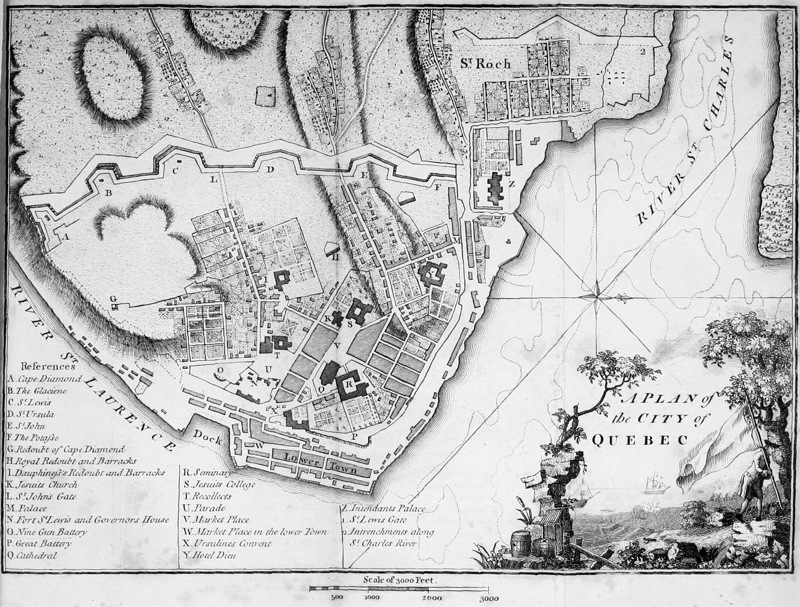
A Plan of the City of Quebec
QUEBEC.
Quebec is divided into two parts; the
upper town, situated on a rock of limestone,
on the top of the point; and the lower town,
343built round the bottom of the point, close
to the water. The rock whereon the upper
town stands, in some places towards the water
rises nearly perpendicularly, so as to be totally
inaccessible; in other places it is not so steep
but that there is a communication between
the two towns, by means of streets winding
up the side of it, though even here the ascent
is so great, that there are long flights of stairs
at one side of the streets for the accommodation
of foot passengers.
The lower town lies very much exposed to
an enemy, being defended merely by a small
battery towards the bason, which at the time
of high tides is nearly on a level with the
water, and by barriers towards the river, in
which guns may be planted when there is any
danger of an attack.
The upper town, however, is a place of
immense strength. Towards the water it is so
strongly guarded by nature, that it is found
unnecessary to have more than very slight
walls; and in some particular places, where
the rock is inaccessible, are no walls at all.
There are several redoubts and batteries however
here. The principal battery, which
points towards the bason, consists of twenty-two
twenty-four pounders, two French
thirty-six pounders, and two large iron mortars;
this battery is flanked by another of six
344guns, that commands the passes from the
lower town.
On the land side, the town owes its strength
solely to the hand of art, and here the fortifications
are stupendous. Considerable additions
and improvements have been made to
them since the place has been in the possession
of Great Britain; but even at the time when
it belonged to France, the works were so
strong, that had it not been for the conduct of
M. de Montcalm, the French general, it is
almost doubtful whether the genius of the immortal
Wolfe himself would not have been
baffled in attempting to reduce it.
GENERAL WOLFE.
Had M. de Montcalm, when the first intelligence
of the British army’s having ascended
the Heights of Abraham was carried to
him, instead of disbelieving the account, and
laughing at it as a thing impossible, marched
immediately to the attack, without giving
General Wolfe time to form his men; or had
he, when the account was confirmed of the
enemy’s procedure, and of their having formed
on the plain, waited for a large division of his
troops, whose station was below the town, and
who might have joined him in two hours,
instead of marching out to give General
Wolfe battle with the troops he had with
him at the time, the fate of the day might
have turned out very differently; or had he,
345instead of hazarding a battle at all, retired
within the walls of the city and defended it,
the place was so strong that there is reason to
think it might have held out until the approach
of winter, when the British ships must
have quitted the river, and General Wolfe
would consequently have been under the necessity
of raising the siege.
General Wolfe thought it a vain attempt to
make an assault on the side of the town
which lies towards the water, where the rock
is so steep, and so easily defended; his object
was to get behind it, and to carry on the attack
on the land side, where there is an extensive
plain adjoining the town, and not a
great deal lower than the highest part of the
point. In order to do so, he first of all attempted
to land his troops some miles below
the town, near the Falls of Montmorenci.
Here the banks of the river are by no means
so difficult of ascent as above the town; but
they were defended by a large division of
the French forces, which had thrown up
several strong redoubts, and, in attempting to
land, Wolfe was repulsed with loss.
GENERAL ARNOLD.
Above Quebec, the banks of the river are
extremely high, and so steep at the same time,
that by the French they were deemed inaccessible.
Foiled, however, in his first attempt
to get on shore, General Wolfe formed the
346bold design of ascending to the top of these
banks, commonly called the Heights of Abraham.
To prepare the way for it, possession
was taken of Point Levi, the point situated
opposite to that on which Quebec stands, and
from thence a heavy bombardment was commenced
on the town, in order to deceive the
enemy. In the mean time boats were prepared;
the troops embarked; they passed the
town with muffled oars, in the night, unobserved,
and landed at a cove, about two miles
above. The soldiers clambered up the heights
with great difficulty, and the guns were
hauled up by means of ropes and pullies fixed
round the trees, with which the banks are
covered from top to bottom. At the top the
plain commences, and extends close under the
walls of the city: here it was that the memorable
battle was fought, in which General
Wolfe unhappily perished, at the very moment
when all his noble exertions were about
to be crowned with that success which they
so eminently deserved. The spot where the
illustrious hero breathed his last is marked
with a large stone, on which a true meridional
line is drawn.
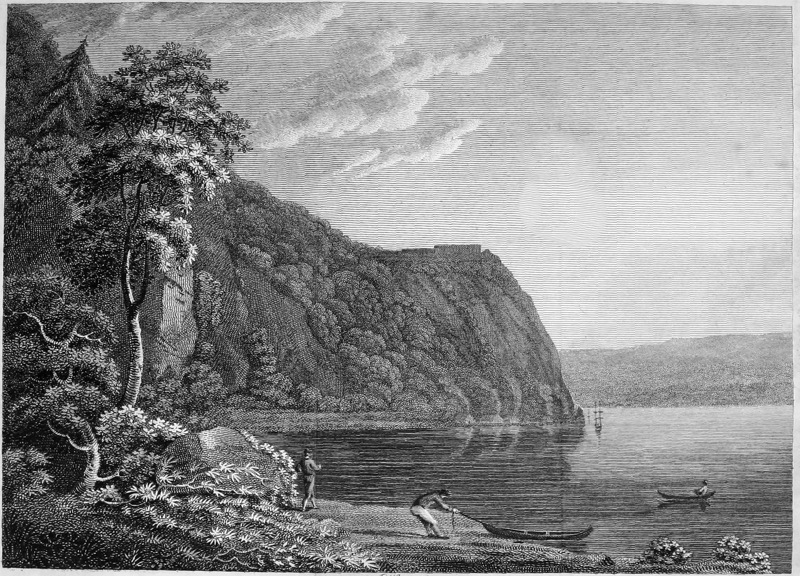
View of Cape Diamond
J Weld del.
Published Dec. 18. 1798, by J. Stockdale, Piccadilly.
Notwithstanding that the great Wolfe
found it such a very difficult task to get possession
of Quebec, and that it has been rendered
so much stronger since his time, yet
347the people of the United States confidently
imagine, at this day, that if there were a rupture
with Great Britain, they need only send
an army thither, and the place must fall into
their hands immediately. Arnold, after his
return from the expedition against the place,
under Montgomery, in the year 1775, used
frequently to declare, that if he had not been
wounded he should certainly have carried it.
But however that expedition may be admired
for its great boldness, it was, in reality, far
from being so nearly attended with success as
the vanity of Arnold has led his countrymen
to imagine.
All thoughts of taking the city by a regular
siege were abandoned by the Americans,
when they came before it; it was only by
attempting to storm it at an unexpected hour
that they saw any probability of wresting it
from the British. The night of the thirty-first
of December was accordingly fixed upon,
and the city was attacked at the same moment
in three places. But although the garrison
were completely surprised, and the greater
part of the rampart guns had been dismounted,
and laid up for the winter, during which season
it was thought impossible for an army to
make an attack so vigorous that cannon
would be wanting to repel it, yet the Americans
were at once baffled in their attempt.
348Arnold, in endeavouring to force St. John’s
Gate, which leads out on the back part of
the town, not far from the plains of Abraham,
was wounded, and repulsed with great loss.
Montgomery surprised the guard of the first
barrier, at one end of the lower town, and
passed it; but at the second he was shot, and
his men were driven back. The third division
of the Americans entered the lower
town in another quarter, which, as I have before
said, lies very much exposed, by passing
over the ice: they remained there for a
day or two, and during that time they set fire
to some buildings, amongst which was one of
the religious houses; but they were finally
dislodged without much difficulty. The two
divisions under Montgomery and Arnold were
repulsed with a mere handful of men: the
different detachments, sent down from the
upper town against the former, did not altogether
amount, it is said, to two hundred men.
Arnold’s attack was the maddest possible;
for St. John’s Gate, and the walls adjoining,
are stupendous, and a person need but see
them to be convinced that any attempt to
storm them must be fruitless without the aid
of heavy artillery, which the Americans had
not.
CITADEL.
Independent of what it owes to its fortifications,
and situation on the top of a rock,
349Quebec is indebted for much of its strength
to the severity and great length of the winter,
as in that season it is wholly impracticable
for a besieging army either to carry on
any works or blockade the town.
It requires about five thousand soldiers to
man the works at Quebec completely. A
large garrison is always kept in it, and abundance
of stores of every description. The
troops are lodged partly in barracks, and
partly in block houses near Cape Diamond,
which is the most elevated part of the point,
and is reckoned to be upwards of one thousand
feet above the level of the river. The Cape
is strongly fortified, and may be considered as
the citadel of Quebec; it commands the town
in every direction, and also the plains at the
outside of the walls. The evening and morning
guns, and all salutes and signals, are fired
from hence. Notwithstanding the great height
of the rock above the river, water may readily
be had even at the very top of it, by sinking
wells of a moderate depth, and in some particular
places, at the sides of the rock, it gushes
out in large streams. The water is of a very
good quality.
No census has been lately taken of the number
of houses and inhabitants in Quebec; but
it is supposed that, including the upper and
lower towns and suburbs, there are at least
350two thousand dwellings; at the rate of six
therefore to each house, the number of inhabitants
would amount to twelve thousand.
About two thirds of the inhabitants are of
French extraction. The society in Quebec is
agreeable, and very extensive for a place of the
size, owing to its being the capital of the
lower province, and therefore the residence
of the governor, different civil officers, principal
lawyers, &c. &c. The large garrison
constantly kept in it makes the place appear
very gay and lively.
The lower town of Quebec is mostly inhibited
by the traders who are concerned with
the shipping, and it is a very disagreeable place.
The streets are narrow and dirty, and owing to
the great height of the houses in most of them,
the air is much confined; in the streets next to
the water also, there is oftentimes an intolerable
stench from the shore when the tide is
out. The upper town, on the contrary, is extremely
agreeable: from its elevated situation
the air is as pure as possible, and the inhabitants
are never oppressed with heat in summer;
it is far, however, from being well laid out, the
streets being narrow and very irregular. The
houses are for the most part built of stone, and
except a few, erected of late years, small, ugly,
and inconvenient.
GOVERNOR’S CHATEAU.
351The chateau, wherein the governor resides,
is a plain building of common stone, situated
in an open place, the houses round which, form
three sides of an oblong square. It consists of
two parts. The old and the new are separated
from each other by a spacious court. The
former stands just on the verge of an inaccessible
part of the rock; behind it, on the outside,
there is a long gallery, from whence, if a pebble
were let drop, it would fall at least sixty feet
perpendicularly. This old part is chiefly taken
up with the public offices, and all the apartments
in it are small and ill contrived; but in
the new part, which stands in front of the other,
facing the square, they are spacious, and tolerably
well finished, but none of them can be
called elegant. This part is inhabited by the
governor’s family. The chateau is built with
out any regularity of design, neither the old
nor the new part having even an uniform front.
It is not a place of strength, as commonly represented.
In the garden adjoining to it is
merely a parapet wall along the edge of the
rock, with embrasures, in which a few small
guns are planted, commanding a part of the
lower town. Every evening during summer,
when the weather is fine, one of the regiments
of the garrison parades in the open place before
the chateau, and the band plays for an hour or
two, at which time the place becomes the resort
352of numbers of the most genteel people of
the town, and has a very gay appearance.
Opposite to the chateau there is a monastery
belonging to the Recollets or Franciscan friars;
a very few only of the order are now left. Contiguous
to this building is the college belonging
to the Jesuits, whose numbers have diminished
even still faster than that of the Recollets;
one old man alone of the brotherhood is
left, and in him are centered the immense possessions
of that once powerful body in Canada,
bringing in a yearly revenue of £. 10,000 sterling.
This old man, whose lot it has been to
outlive all the rest of the order, is by birth a
Swiss: in his youth he was no more than a porter
to the college, but having some merit he
was taken notice of, promoted to a higher
situation, and in the end created a lay brother.
Though a very old man he is extremely healthy;
he possesses an amiable disposition, and is much
beloved on account of the excellent use he
makes of his large fortune, which is chiefly
employed in charitable purposes. On his death
the property falls to the crown.
The nunneries are three in number, and as
there is no restriction upon the female religious
orders, they are all well filled. The largest of
them, called L’Hospital General, stands in the
suburbs, outside of the walls; another, of the
order of St. Ursule, is not far distant from the
chateau.
QUEBEC MARKET.
353The engineer’s drawing room, in which are
kept a variety of models, together with plans
of the fortifications of Quebec and other fortresses
in Canada, is an old building, near the
principal battery. Adjoining thereto stands the
house where the legislative council and assembly
of representatives meet, which is also an
old building, that has been plainly fitted up to
accommodate the legislature.
The armoury is situated near the artillery
barrack, in another part of the town. About
ten thousand stand of arms are kept in it, arranged
in a similar manner with the arms in
the Tower of London, but, if possible, with
greater neatness and more fancy.
The artillery barracks are capable of containing
about five hundred men, but the principal
barracks are calculated to contain a much
larger number; they stand in the market
place, not far distant from the square in which
the chateau is situated, but more in the heart
of the town.
The market of Quebec is extremely well
supplied with provisions every kind, which may
be purchased at a much more moderate price
than in any town I visited in the United States.
It is a matter of curiosity to a stranger to see
the number of dogs yoked in little carts, that
are brought into this market by the people who
attend it. The Canadian dogs are found extremely
354useful in drawing burthens, and there
is scarcely a family in Quebec or Montreal,
that does not keep one or more of them for
that purpose. They are somewhat similar to
the Newfoundland breed, but broader across
the loins, and have shorter and thicker legs;
in general they are handsome, and wonderfully
docile and sagacious; their strength is prodigious;
I have seen a single dog, in more than
one instance, draw a man for a considerable
distance that could not weigh less than ten
stone. People, during the winter season, frequently
perform long journeys on the snow
with half a dozen or more of these animals
yoked in a cariole or sledge.
SUBLIME VIEWS.
I must not conclude this letter without making
mention of the scenery that is exhibited to
the view, from various parts of the upper town
of Quebec, which, for its grandeur, its beauty,
and its diversity, surpasses all that I have hitherto
seen in America, or indeed in any other
part of the globe. In the variegated expanse
that is laid open before you, stupendous rocks,
immense rivers, trackless forests and cultivated
plains, mountains, lakes, towns, and villages,
in turn strike the attention, and the senses are
almost bewildered in contemplating the vastness
of the scene. Nature is here seen on the
grandest scale; and it is scarcely possible for the
imagination to paint to itself any thing more
355sublime than are the several prospects presented
to the sight of the delighted spectator. From
Cape Diamond, situated one thousand feet
above the level of the river, and the loftiest part
of the rock on which the city is built, the prospect
is considered by many as superior to that
from any other spot. A greater extent of
country opens upon you, and the eye is here
enabled to take in more at once, than at any
other place; but to me it appears, that the view
from the cape is by no means so fine as that,
for instance, from the battery; for in surveying
the different objects below you from such a
stupendous height, their magnitude is in a
great measure lost, and it seems as if you were
looking at a draft of the country more than at
the country itself. It is the upper battery that
I allude to, facing the bason, and is about three
hundred feet above the level of the water.
Here, if you stand but a few yards from the edge
of the precipice, you may look down at once
upon the river, the vessels upon which, as they
sail up to the wharfs before the lower town,
appear as if they were coming under your very
feet. The river itself, which is between five
and six miles wide, and visible as far as the
distant end of the island of Orleans, where it
loses itself amidst the mountains that bound
it on each side, is one of the most beautiful
objects in nature, and on a fine still summer’s
356evening it often wears the appearance of a vast
mirror, where the varied rich tints of the sky,
as well as the images of the different objects on
the banks, are seen reflected with inconceivable
lustre. The southern bank of the river, indented
fancifully with bays and promontories,
remains nearly in a state of nature, clothed
with lofty trees; but the opposite shore is
thickly covered with houses, extending as
along other parts of the river already mentioned,
in one uninterrupted village, seemingly,
as far as the eye can reach. On this side the
prospect is terminated by an extensive range of
mountains, the flat lands situated between and
the villages on the banks not being visible to
a spectator at Quebec, it seems as if the mountains
rose directly out of the water, and the
houses were built on their steep and rugged
sides.
BEAUTIFUL SCENERY.
Beautiful as the environs of the city appear
when seen at a distance, they do not appear
less so on a more close inspection; and in passing
through them the eye is entertained with
a most pleasing variety of fine landscapes, whilst
the mind is equally gratified with the appearance
of content and happiness that reigns in
the countenances of the inhabitants. Indeed,
if a country as fruitful as it is picturesque, a
genial and healthy climate, and a tolerable
share of civil and religious liberty, can make
357people happy, none ought to appear more so
than the Canadians, during this delightful season
of the year.
Before I dismiss this subject entirely, I must
give you a brief account of two scenes in the
vicinity of Quebec, more particularly deserving
of attention than any others. The one is
the Fall of the River Montmorenci; the
other, that of the Chaudiere. The former
stream runs into the St. Lawrence, about seven
miles below Quebec; the latter joins the same
river nearly at an equal distance above the
city.
The Montmorenci River runs in a very irregular
course, through a wild and thickly
wooded country, over a bed of broken rocks,
till it comes to the brink of a precipice, down
which it descends in one uninterrupted and
nearly perpendicular fall of two hundred and
forty feet. The stream of water in this river,
except at the time of floods, is but scanty, but
being broken into foam by rushing with such
rapidity as it does over the rocks at the top of
the precipice, it is thereby much dilated, and
in its fall appears to be a sheet of water of no
inconsiderable magnitude. The breadth of the
river at top, from bank to bank, is about fifty
feet only. In its fall, the water has the exact
appearance of snow, as when thrown in heaps
from the roof of a house, and it seemingly descends
358with a very slow motion. The spray
at the bottom is considerable, and when the sun
happens to shine bright in the middle of the
day, the prismatic colours are exhibited in it
in all their variety and lustre. At the bottom
of the precipice the water is confined in a sort
of bason, as it were, by a mass of rock, extending
nearly across the fall, and out of this
it flows with a gentle current to the St. Lawrence,
which is about three hundred yards
distant. The banks of the Montmorenci, below
the precipice, are nearly perpendicular on
one side, and on both inaccessible, so that if a
person be desirous of getting to the bottom of
the fall, he must descend down the banks of
the St. Lawrence, and walk along the margin
of that river till he comes to the chasm through
which the Montmorenci flows. To a person
sailing along the St. Lawrence, past the mouth
of the chasm, the fall appears in great beauty.
GRAND FALLS.
General Haldimand, formerly governor of
Canada, was so much delighted with this cataract,
that he built a dwelling house close to
it, from the parlour windows of which it is
seen in a very advantageous point of view. In
front of the house is a neat lawn, that runs
down the whole way to the St. Lawrence, and
in various parts of it little summer-houses have
been erected, each of which commands a view
of the fall. There is also a summer-house,
359situated nearly at the top of the fall, hanging
directly over the precipice, so that if a bullet
were dropped from the window, it would descend
in a perpendicular line at least two hundred
feet. This house is supported by large
beams of timber, fixed into the sides of the
chasm, and in order to get to it you have to
pass over several flights of steps, and one or two
wooden galleries, which are supported in the
same manner. The view from hence is tremendously
grand. It is said, that the beams
whereon this little edifice is erected are in a
state of decay, and many persons are fearful of
entering into it, lest they should give way; but
being ignorant of the danger, if indeed there
was any, our whole party ventured into it at
once, and staid there a considerable time, notwithstanding
its tremulous motion at every
step we trod. That the beams cannot last for
ever is certain; it would be a wise measure,
therefore, to have them removed or repaired in
proper time, for as long as they remain standing,
persons will be found that will venture
into the unsteady fabrick they support, and
should they give way at a moment when any
persons are in it, the catastrophe must inevitably
be fatal.
The fall in the River Chaudiere is not half
the height of that of the Montmorenci, but
then it is no less than two hundred and fifty
360feet in breadth. The scenery round this cataract
is much superior in every respect to that
in the neighbourhood of the Montmorenci.
Contiguous to the latter there are few trees of
any great magnitude, and nothing is near it to
relieve the eye; you have the fall, and nought
but the fall, to contemplate. The banks of
La Chaudiere, on the contrary, are covered
with trees of the largest growth, and amidst
the piles of broken rocks, which lie scattered
about the place, you have some of the wildest
and most romantic views imaginable. As for
the fall itself, its grandeur varies with the season.
When the river is full, a body of water
comes rushing over the rocks of the precipice
that astonishes the beholder; but in dry
weather, and indeed during the greater part of
the summer, we may say, the quantity of water
is but trifling. At this season there are
few but what would prefer the falls of the
Montmorenci River, and I am tempted to imagine
that, upon the whole, the generality of
people would give it the preference at all
times.
LETTER XXV.
361
Of the Constitution, Government, Laws, and
Religion of the Provinces of Upper and Lower
Canada.—Estimate of the Expenses of the Civil
List, of the Military Establishment, and the
Presents to the Indians.—Salaries of certain
Officers of the Crown.—Imports and Exports.—Taxes.
Quebec.
FROM the time that Canada was ceded to
Great Britain until the year 1774, the internal
affairs of the province were regulated by
the ordinance of the governor alone. In pursuance
of the Quebec Bill, which was then
passed, a legislative council was appointed by
his Majesty in the country; the number of
members was limited to twenty-three. This
council had full power to make all such ordinances
and regulations as were thought expedient
for the welfare of the province; but it
was prohibited from levying any taxes, except
for the purpose of making roads, repairing
public buildings, or the like. Every ordinance
was to be laid before the governor, for his
Majesty’s approbation, within six months from
the time it was passed, and no ordinance, imposing
a greater punishment on any person or
362persons than a fine, or imprisonment for three
months, was valid without his Majesty’s assent,
signified to the council by the governor.
Thus were the affairs of the province regulated
until the year 1791, when an act was
passed in the British parliament, repealing so
much of the Quebec Bill as related to the appointment
of a council, and to the powers that
had been granted to it; and which established
the present form of government.
The country, at the same time, was divided
into two distinct provinces; the province of
Lower Canada, and the province of Upper
Canada. The former is the eastern part of the
old province of Canada; the latter, the western
part, situated on the northern sides of the great
lakes and rivers through which the boundary
line runs that separates the British territories
from those of the United States. The two
provinces are divided from each other by a line,
which runs north, 24° west, commencing at
Point au Baudet, in that part of the river St.
Lawrence called Lake Francis, and continuing
on from thence to the Utawas or Grand
River. The city of Quebec is the capital of the
lower province, as the town of Niagara is of
the upper one.
CONSTITUTION OF CANADA.
The executive power in each province is
vested in the governor, who has for his advice
an executive council appointed by his Majesty.
363The legislative power of each province
is vested in the governor, a legislative council,
and an assembly of the representatives of
the people. Their acts, however, are subject
to the controul of his Majesty, and in some
particular cases to the controul of the British
parliament.
Bills are passed in the council and in the
assembly in a form somewhat similar to that in
which bills are carried through the British
houses of parliament; they are then laid before
the governor, who gives or withholds his assent,
or reserves them for his Majesty’s pleasure.
Such bills as he assents to are put in force
immediately; but he is bound to transmit a
true copy of them to the King, who in council
may declare his disallowance of them within
two years from the time of their being received,
in which case they become void.
Such as are reserved for his Majesty’s assent
are not to be put in force until that is received.
Moreover, every act of the assembly and
council, which goes to repeal or vary the laws
or regulations that were in existence at the
time the present constitution was established
in the country respecting tithes; the appropriation
of land for the support of a protestant
clergy; the constituting and endowing of parsonages
or rectories; the right of presentation
364to the same, and the manner in which the incumbents
shall hold them; the enjoyment and
exercise of any form or mode of worship; the
imposing of any burdens and disqualifications
on account of the same; the rights of the
clergy to recover their accustomed dues; the
imposing or granting of any farther dues or
emoluments to any ecclesiastics; the establishment
and discipline of the church of England;
the King’s prerogative, touching the granting
of waste lands of the crown within the province;
every such act, before it receives the
royal assent, must be laid before both houses
of parliament in Great Britain, and the King
must not give his assent thereto until thirty
days after the same has been laid before parliament;
and in case either house of parliament
presents an address to the King to withhold
his assent to any such act or acts, it cannot
be given.
By an act passed in the eighteenth year of
his present Majesty’s reign, the British parliament
has also the power of making any regulations
which may be found expedient, respecting
the commerce and navigation of the
province, and also of imposing import and
export duties; but all such duties are to be
applied solely to the use of the province, and
in such a manner only as the laws made in
the council and assembly direct.
LEGISLATIVE COUNCIL.
365The legislative council of Lower Canada
consists of fifteen members; that of Upper
Canada of seven. The number of the members
in each province must never be less than
this; but it may be increased whenever his
Majesty thinks fit.
The counsellors are appointed for life, by
an instrument under the great seal of the
province, signed by the governor, who is invested
with powers for that purpose by the
King. No person can be a counsellor who
is not twenty-one years of age, nor any one
who is not a natural born subject, or who has
not been naturalized according to act of parliament.
Whenever his Majesty thinks proper, he
may confer on any persons hereditary titles of
honour, with a right annexed to them of being
summoned to sit in this council, which right
the heir may claim at the age of twenty-one;
the right, however, cannot be acknowledged
if the heir has been absent from the province
without leave of his Majesty, signified to the
council by the governor, for four years together,
between the time of his succeeding to
the right and the time of his demanding it.
The right is forfeited also, if the heir takes an
oath of allegiance to any foreign power before
he demands it, unless his Majesty, by
366an instrument under the great seal of the
province, should decree to the contrary.
If a counsellor, after having taken his seat,
absent himself from the province for two years
successively, without leave from his Majesty,
signified to the council by the governor, his
seat is also thereby vacated.
All hereditary rights, however, of sitting in
council, so forfeited, are only to be suspended
during the life of the defaulters, and on their
death they descend with the titles to the next
heirs[32].
In cases of treason, both the title and right
of sitting in the council are extinguished.
All questions concerning the right of being
summoned to the council are to be determined
by the council; but an appeal may be had from
their decision to his Majesty in his parliament
of Great Britain.
The governor has the power of appointing
and removing the speaker of the council.
The assembly of Lower Canada consists of
fifty members, and that of Upper Canada of
sixteen; neither assembly is ever to consist of
a less number.
THE ASSEMBLY.
The members for districts, circles, or counties,
367are chosen by a majority of the votes of
such persons as are possessed of lands or tenements
in freehold, in fief, in boture, or by
certificate derived under the authority of the
governor and council of Quebec, of the yearly
value of forty shillings, clear of all rents,
charges, &c. The members for towns or
townships are chosen by a majority of the
votes of such persons as possess houses and
lands for their own use, of the yearly value
of five pounds sterling, or as have resided in
the town or township for one year, and paid a
rent for a house during the time, at the rate
of ten pounds yearly.
No person is eligible to serve as a member
of the assembly, who is a member of the legislative
council, or a minister, priest, ecclesiastic,
or religious personage of the church of
England, Rome, or of any other church.
No person is qualified to vote or serve, who
is not twenty-one years of age; nor any person,
not a natural born subject, or who has not
been naturalized, either by law or conquest;
nor any one who has been attainted of treason
in any court in his Majesty’s dominions,
or who has been disqualified by an act of assembly
and council.
Every voter, if called upon, must take an
oath, either in French or English, that he is
of age; that he is qualified to vote according
368to law; and that he has not voted before at
that election.
The governor has the power of appointing
the place of session, and of calling together, of
proroguing, and of dissolving the assembly.
The assembly is not to last longer than four
years, but it may be dissolved sooner. The
governor is bound to call it at least once in
each year.
The oath of a member, on taking his seat,
is comprised in a few words: he promises to
bear true allegiance to the King, as lawful
sovereign of Great Britain, and the province
of Canada dependant upon it; to defend him
against all traitorous conspiracies and attempts
against his person; and to make known to
him all such conspiracies and attempts, which
he may at any time be acquainted with; all
which he promises without mental evasion,
reservation, or equivocation, at the same time
renouncing all pardons and dispensations from
any person or power whatsoever.
The governors of the two provinces are
totally independent of each other in their
civil capacity: in military affairs, the governor
of the lower province takes precedence,
as he is usually created captain general of his
Majesty’s forces in North America.
QUEBEC BILL.
The present system of judicature in each
province was established by the Quebec bill
369of 1774. By this bill it was enacted, that all
persons in the country should be entitled to
hold their lands or possessions in the same
manner as before the conquest, according to
the laws and usages then existing in Canada;
and that all controversies relative to property
or civil rights should also be determined by
the same laws and usages. These old laws
and usages, however, were not to extend to
the lands which might thereafter be granted
by his Britannic Majesty in free and common
socage: here English laws were to be in full
force; so that the English inhabitants[33], who
have settled for the most part on new lands,
are not subject to the controul of these old
French laws, that were existing in Canada
when the country was conquered, except a
dispute concerning property or civil rights
should arise between any of them and the
French inhabitants, in which case the matter
is to be determined by the French laws.
Every friend to civil liberty would wish to
see these laws abolished, for they weigh very
unequally in favour of the rich and of the poor;
but as long as the French inhabitants remain
so wedded as they are at present to old customs,
370and so very ignorant, there is little hope
of seeing any alteration of this nature take
place. At the same time that the French laws
were suffered by the Quebec bill to exist, in
order to conciliate the affections of the French
inhabitants, who were attached to them, the
criminal law of England was established
throughout every part of the country; “and
this was one of the happiest circumstances,”
as the Abbé Raynal observes, “that Canada
could experience; as deliberate, rational,
public trials took place of the impenetrable
mysterious transactions of a cruel inquisition;
and as a tribunal, that had theretofore
been dreadful and sanguinary, was filled
with humane judges, more disposed to acknowledge
innocence than to suppose criminality.”
The governor, the lieutenant governor, or
the person administering the government, the
members of the executive council, the chief
justices of the province, and the judges of the
court of king’s bench, or any five of them,
form a court of appeal, the judges however
excepted of that district from whence the
appeal is made. From the decision of this
court an appeal may be had in certain cases
to the King in council.
TOLERATION.
Every religion is tolerated, in the fullest
extent of the word, in both provinces; and
371no disqualifications are imposed on any persons
on account of their religious opinions.
The Roman Catholic religion is that of a
great majority of the inhabitants; and by the
Quebec bill of 1774, the ecclesiastics of that
persuasion are empowered by law to recover all
the dues which, previous to that period, they
were accustomed to receive, as well as tithes,
that is, from the Roman Catholic inhabitants;
but they cannot exact any dues or tithes from
Protestants, or off lands held by Protestants,
although formerly such lands might have been
subjected to dues and tithes for the support
of the Roman Catholic church. The dues
and tithes from off these lands are still, however,
to be paid; but they are to be paid to
persons appointed by the governor, and the
amount of them is to be reserved, in the hands
of his Majesty’s receiver general, for the support
of the Protestant clergy actually residing
in the province.
By the act of the year 1791, also, it was
ordained, that the governor should allot out
of all lands belonging to the crown, which,
should be granted after that period, one-seventh
for the benefit of a Protestant clergy,
to be solely applicable to their use; and all
such allotments must be particularly specified
in every grant of waste lands, otherwise the
grant is void.
372With the advice of the executive council,
the governor is authorized to constitute or
erect parsonages or rectories, and to endow
them out of these appropriations, and to present
incumbents to them, ordained according
to the rites of the church of England; which
incumbents are to perform the same duties,
and to hold their parsonages or rectories in the
same manner as incumbents of the church
of England do in that country.
The clergy of the church of England, in
both provinces, consists at present of twelve
persons only, including the bishop of Quebec;
that of the church of Rome, however, consists
of no less than one hundred and twenty-six;
viz. a bishop, who takes his title from Quebec,
his “coadjuteur élu,” who is bishop of Canathe,
three vicars general, and one hundred
and sixteen curates and missionaries, all of
whom are resident in the lower province, except
five curates and missionaries.
The number of the dissenting clergy, in both
provinces, is considerably smaller than that of
the clergy of the church of England.
PRESENTS AND SALARIES.
The expences of the civil list in Lower
Canada are estimated at £.20,000 sterling
per annum, one half of which is defrayed by
Great Britain, and the remainder by the province,
out of the duties paid on the importation
of certain articles. The expence of the
373civil list in Upper Canada is considerably less;
perhaps not so much as a fourth of that of
the lower province.
The military establishment in both provinces,
together with the repairs of fortifications,
&c. are computed to cost Great Britain
annually £.100,000 sterling.
The presents distributed amongst the Indians,
and the salaries paid to the different officers
in the Indian department, are estimated
at £.100,000 sterling more, annually.
Amongst the officers in the Indian department
are, superintendants general, deputy superintendants,
inspectors general, deputy inspectors
general, secretaries, assistant secretaries,
storekeepers, clerks, agents, interpreters,
issuers of provisions, surgeons, gunsmiths, &c.
&c. &c. most of whom, in the lower province,
have now sinecure places, as there are but few
Indians in the country; but in the upper province
they have active service to perform. Of
the policy of issuing presents to such a large
amount amongst the Indians, more will be said
in the afterpart of this work.
IMPORT DUTIES.
The following is a statement of some of the
salaries paid to the officers of government in
Lower Canada.
| |
£. |
| Governor general |
2,000 |
| Lieutenant governor |
1,500 |
| 374Executive counsellors, each |
100 |
| Attorney general |
300 |
| Solicitor general |
200 |
| Secretary and register to the province |
400 |
| Clerk of the court of appeals, with firewood and stationary |
120 |
| Secretary to the governor |
200 |
| French secretary to the governor, and translator to the council |
200 |
| Chief justice of Quebec, who is chief justice of the province |
1,200 |
| Chief justice of Montreal |
900 |
| Chief justice of Three Rivers |
300 |
| Receiver general |
400 |
| Surveyor general of lands |
300 |
| Deputy, and allowance for an office |
150 |
| Surveyor of woods |
200 |
| Grand voyer of Quebec |
100 |
| Grand voyer of Montreal |
100 |
| Grand voyer of Three Rivers |
60 |
| Superintendant of provincial post houses |
100 |
| Clerk of the terraro of the king’s domain |
90 |
| Clerk of the crown |
100 |
| Inspector of police at Quebec |
100 |
| Inspector of police at Montreal |
100 |
| Four missionaries to Indians, each |
50 |
| One missionary to Indians |
45 |
| 375Schoolmaster at Quebec |
100 |
| Schoolmaster at Montreal |
50 |
| Schoolmaster at Carlisle, Bay de Chaleurs |
25 |
| Overseers, to prevent fires at Quebec, and to sweep the chimneys of the poor |
60 |
| Salary of the bishop of Quebec, who is bishop of both provinces |
2,000 |
The pensions, between January 1794 and January
1795, amounted to £.1,782. 6s. 7d.
A Statement of the Articles subject to
Duty on Importation into Canada, and of
the Duties payable thereon.
| |
s. d. |
| Brandy and other spirits, the manufacture of Great Britain, per gallon |
. 3 |
| Rum and other spirits, imported from the colonies in the West Indies, per gallon |
. 6 |
| Brandy and spirits of foreign manufacture, imported from Great Britain, per gallon |
1 0 |
| Additional duty on the same, per gallon |
. 3 |
| Rum or spirits manufactured in the United States, per gallon |
1 0 |
| 376Molasses and Syrups imported in British shipping, per gallon |
. 3 |
| Additional duty, per gallon |
. 3 |
| Molasses or Syrups legally imported in other than British shipping, per gallon |
. 6 |
| Additional duty, per gallon |
. 3 |
| Madeira wine, per gallon |
. 6 |
| Other wine |
. 3 |
N.B. Wine can be imported directly
from Madeira, or from any of the African
islands, into Canada; but no European
wine or brandy can be imported,
except through England.
| Loaf or lump sugar, per lb. |
1 |
| Muscovado or clayed sugar |
½ |
| Coffee, per lb. |
2 |
| Leaf tobacco, per lb. |
2 |
| Playing cards, per pack |
2 |
| Salt, the minot |
4 |
N.B. The minot is a measure commonly
used in Canada, which is to the Winchester
bushel, as 100 is to 108,765.
SOIL AND MANUFACTURES.
The imports into Canada consist of all the
various articles which a young country, that
does not manufacture much for its own use,
can be supposed to stand in need of; such as
377earthen ware, hardware, and household furniture,
except of the coarser kinds; woollen
and linen cloths, haberdashery, hosiery, &c.;
paper, stationary, leather and manufactures of
leather, groceries, wines, spirits, West Indian
produce, &c. &c.; cordage of every description,
and even the coarser manufactures of
iron, are also imported.
The soil of the country is well adapted to
the growth of hemp, and great pains have
been taken to introduce the culture of it.
Handbills, explaining the manner in which it
can be raised to the best advantage, have been
assiduously circulated amongst the farmers, and
posted up at all the public houses. It is a
difficult matter, however, to put the French
Canadians out of their old ways, so that very
little hemp has been raised in consequence of
the pains that have been thus taken; and it
is not probable that much will be raised for
a considerable time to come.
Iron ore has been discovered in various
parts of the country; but works for the
smelting and manufacturing of it have been
erected at one place only, in the neighbourhood
of Trois Rivieres. These works were
erected by the king of France some time
before the conquest: they are now the property
of the British government, and are
rented out to the persons who hold them
378at present. When the lease expires, which
will be the case about the year 1800, it is
thought that no one will be found to carry on
the works, as the bank of ore, from whence
they are supplied, is nearly exhausted. The
works consist of a forge and a foundry: iron
stoves are the principal articles manufactured
in the latter; but they are not so much esteemed
as those from England.
Domestic manufactures are carried on in
most parts of Canada, consisting of linen and
of coarse woollen cloths; but by far the greater
part of these articles used in the country is
imported from Great Britain.
The experts from Canada consist of furs
and pelts in immense quantities; of wheat,
flour, flax-seed, potash, timber, staves, and
lumber of all sorts; dried fish, oil, ginseng,
and various medicinal drugs.
The trade between Canada and Great Britain
employs, it is said, about seven thousand
tons of shipping annually.
LETTER XXVI.
379
Of the Soil and Productions of Lower Canada.—Observations
on the Manufacture of Sugar
from the Maple-tree.—Of the Climate of
Lower Canada.—Amusements of People of
all Descriptions during Winter.—Carioles.—Manner
of guarding against the Cold.—Great
Hardiness of the Horses.—State of the
River St. Lawrence on the Dissolution of
Winter.—Rapid Progress of Vegetation during
Spring.—Agreeableness of the Summer
and Autumn Seasons.
Quebec.
THE eastern part of Lower Canada, between
Quebec and the Gulph of St.
Lawrence, is mountainous; between Quebec
and the mouth of the Utawas River also a few
scattered mountains are to be met with; but
higher up the River St. Lawrence the face of
the country is flat.
The soil, except where small tracts of stony
and sandy land intervene, consists principally
of a loose dark coloured earth, and of the
depth of ten or twelve inches, below which
there is a bed of cold clay. This earth towards
the surface is extremely fertile, of which
380there cannot be a greater proof than that it
continues to yield plentiful crops, notwithstanding
its being worked year after year by
the French Canadians, without ever being
manured. It is only within a few years back,
indeed, that any of the Canadians have begun
to manure their lands, and many still continue,
from father to son, to work the same fields
without intermission, and without ever putting
any manure upon them, yet the land is not
exhausted, as it would be in the United States.
The manure principally made use of by those
who are the best farmers is marl, found in
prodigious quantities in many places along the
shores of the River St. Lawrence.
The soil of Lower Canada is particularly
suited to the growth of small grain. Tobacco
also thrives well in it; it is only raised, however,
in small quantities for private use, more
than one half of what is used in the country
being imported. The Canadian tobacco is
of a much milder quality than that grown in
Maryland and Virginia: the snuff made from
it is held in great estimation.
VEGETABLE PRODUCTIONS.
Culinary vegetables of every description
come to the greatest perfection in Canada, as
well as most of the European fruits: the currants,
gooseberries, and raspberries are in particular
very fine; the latter are indigenous,
and are found in profusion in the woods; the
381vine is also indigenous, but the grapes which
it produces in its uncultivated state are very
poor, sour, and but little larger than fine currants.
The variety of trees found in the forests
of Canada is prodigious, and it is supposed
that many kinds are still unknown:
beech trees, oaks, elms, ashes, pines, sycamores,
chesnuts, walnuts, of each of which
several different species are commonly met
with; the sugar maple tree is also found in
almost every part of the country, a tree never
seen but upon good ground. There are two
kinds of this very valuable tree in Canada;
the one called the swamp maple, from its
being generally found upon low lands; the
other, the mountain or curled maple, from
growing upon high dry ground, and from the
grain of the wood being very beautifully variegated
with little stripes and curls. The
former yields a much greater quantity of sap,
in proportion to its size, than the other, but
this sap does not afford so much sugar as that
of the curled maple. A pound of sugar is
frequently procured from two or three gallons
of the sap of the curled maple, whereas no
more than the same quantity can be had from
six or seven gallons of that of the swamp.
The most approved method of getting the
sap is by piercing a hole with an auger in the
382side of the tree, of one inch or an inch and a
half in diameter, and two or three inches in
depth, obliquely upwards; but the most common
mode of coming at it is by cutting a large
gash in the tree with an axe. In each case a
small spout is fixed at the bottom of the
wound, and a vessel is placed underneath to
receive the liquor as it falls.
A maple tree of the diameter of twenty
inches will commonly yield sufficient sap for
making five pounds of sugar each year, and
instances have been known of trees yielding
nearly this quantity annually for a series of
thirty years. Trees that have been gashed
and mangled with an axe will not last by any
means so long as those which have been carefully
pierced with an auger; the axe, however,
is generally used, because the sap distils
much faster from the wound made by it than
from that made by an auger, and it is always
an object with the farmer, to have the sap
brought home, and boiled down as speedily as
possible, in order that the making of sugar
may not interfere with his other agricultural
pursuits. The season for tapping the trees
is when the sap begins to rise, at the commencement
of spring, which is just the time
that the farmer is most busied in making
preparations for sowing his grain.
MAPLE TREES.
It is a very remarkable fact, that these trees,
383after having been tapped for six or seven successive
years, always yield more sap than they
do on being first wounded; this sap, however,
is not so rich as that which the trees distil for
the first time; but from its coming in an increased
portion, as much sugar is generally
procured from a single tree on the fifth or
sixth year of its being tapped as on the first.
The maple is the only sort of raw sugar
made use of in the country parts of Canada;
it is very generally used also by the inhabitants
of the towns, whither it is brought for sale
by the country people who attend the markets,
just the same as any other kind of country
produce. The most common form in which
it is seen is in loaves or thick round cakes,
precisely as it comes out of the vessel where
it is boiled down from the sap. These cakes
are of a very dark colour in general, and very
hard; as they are wanted they are scraped
down with a knife, and when thus reduced
into powder, the sugar appears of a much
lighter cast, and not unlike West Indian muscovada
or grained sugar. If the maple sugar
be carefully boiled with lime, whites of eggs,
blood, or any of the other articles usually employed
for clarifying sugar, and properly granulated,
by the draining off of the molasses,
it is by no means inferior, either in point of
strength, flavour, or appearance to the eye, to
384any West Indian sugar whatsoever: simply
boiled down into cakes with milk or whites
of eggs it is very agreeable to the taste.
The ingenious Dr. Nooth, of Quebec, who
is at the head of the general hospital in Canada,
has made a variety of experiments upon
the manufacture of maple sugar; he has granulated,
and also refined it, so as to render it
equal to the best lump sugar that is made in
England. To convince the Canadians also,
who are as incredulous on some points as they
are credulous on others, that it was really maple
sugar which they saw thus refined, he has
contrived to leave large lumps, exhibiting the
sugar in its different stages towards refinement,
the lower part of the lumps being left hard,
similar to the common cakes, the middle part
granulated, and the upper part refined.
MAPLE TREES.
Dr. Nooth has calculated, that the sale of
the molasses alone would be fully adequate to
the expence of refining the maple sugar, if a
manufactory for that purpose were established.
Some attempts have been made to establish
one of the kind at Quebec, but they have never
succeeded, as the persons by whom they were
made were adventurers that had not sufficient
capitals for such an undertaking. It ought
not, however, to be concluded from this, that
a manufactory of the sort would not succeed if
conducted by judicious persons that had ample
385funds for the business; on the contrary, it is
highly probable that it would answer.
There is great reason also to suppose, that a
manufactory for making the sugar from the
beginning, as well as for refining it, might be
established with advantage.
Several acres together are often met with
in Canada, entirely covered with maple trees
alone; but the trees are most usually found
growing mixed with others, in the proportion
of from thirty to fifty maple trees to every
acre. Thousands and thousands of acres might
be procured, within a very short distance of
the River St. Lawrence, for less than one
shilling an acre, on each of which thirty maple
trees would be found; but supposing that
only twenty-five trees were found on each
acre, then on a track of five thousand acres,
supposing each tree to produce five pounds
of sugar, 5,580 cwt. 2 qrs. 12 lbs. of sugar
might be made annually.
The maple tree attains a growth sufficient
for yielding five pounds of sugar annually in
the space of twenty years; as the oaks and
other kinds of trees, therefore, were cut away
for different purposes, maples might be planted
in their room, which would be ready to be
tapped by the time that the old maple trees
failed. Moreover, if these trees were planted
out in rows regularly, the trouble of collecting
386the sap from them would be much less
than if they stood widely scattered, as they do
in their natural state, and of course the expence
of making the sugar would be considerably
lessened. Added to this, if young maples
were constantly set out in place of the other
trees, as they were cut down, the estate, at the
end of twenty years, would yield ten times
as much sugar as it did originally.
MAPLE SUGAR.
It has been asserted, that the difficulty of
maintaining horses and men in the woods at
the season of the year proper for making the
sugar would be so great, as to render every
plan for the manufactory of the sugar on an
extensive scale abortive. This might be very
true, perhaps, in the United States, where the
subject has been principally discussed, and
where it is that this objection has been made;
but it would not hold good in Canada. Many
tracks, containing five thousand acres each,
of sugar maple land, might be procured in
various parts of the country, no part of any of
which would be more than six English miles
distant from a populous village. The whole
labour of boiling in each year would be over
in the space of six weeks; the trouble therefore
of carrying food during that period, for
the men and horses that were wanting for the
manufactory, from a village into the woods,
would be trifling, and a few huts might be
387built for their accommodation in the woods
at a small expence.
The great labour requisite for conveying
the sap from the trees, that grow so far apart,
to the boiling house, has been adduced as another
objection to the establishment of an
extensive sugar manufactory in the woods.
The sap, as I have before observed, is collected
by private families, by setting a vessel,
into which it drops, under each tree, and from
thence carried by hand to the place where it
is to be boiled. If a regular manufactory,
however, were established, the sap might be
conveyed to the boiling house with far less labour;
small wooden troughs might be placed
under the wounds in each trees, by which
means the sap might easily be conveyed to
the distance of twenty yards, if it were thought
necessary, into reservoirs. Three or four of
these reservoirs might be placed on an acre,
and avenues opened through the woods, so as
to admit carts with proper vessels to pass from
one to the other, in order to convey the sap
to the boiling houses. Mere sheds would answer
for boiling houses, and these might be
erected at various different places on the estate,
in order to save the trouble of carrying the sap
a great way.
The expence of cutting down a few trees,
so as to clear an avenue for a cart, would not
388be much; neither would that of making the
spouts, and common tubs for reservoirs, be
great in a country abounding with wood; the
quantity of labour saved by such means would,
however, be very considerable.
When then, it is considered, that private
families, who have to carry the sap by hand
from each tree to their own houses, and often
at a considerable distance from the woods, in
order to boil it, can, with all this labour, afford
to sell sugar, equally good with that which
comes from the West Indies, at a much lower
price than what the latter is sold at; when it
is considered also, that by going to the small
expence, on the first year, of making a few
wooden spouts and tubs, a very great portion
of labour would be saved, and of course the
profits on the sale of the sugar would be far
greater; there is good foundation for thinking,
that if a manufactory were established on
such a plan as I have hinted at, it would answer
extremely well, and that maple sugar
would in a short time become a principal article
of foreign commerce in Canada.
AIR AND CLIMATE.
The sap of the maple tree is not only useful
in yielding sugar; most excellent vinegar
may likewise be made from it. In company
with several gentlemen I tasted vinegar made
from it by Dr. Nooth, allowed by every one
present to be much superior to the best French
389white wine vinegar; for at the same time that
it possessed equal acidity, it had a more delicious
flavour.
Good table beer may likewise be made
from the sap, which many would mistake for
malt liquor.
If distilled, the sap affords a very fine spirit.
The air of Lower Canada is extremely
pure, and the climate is deemed uncommonly
salubrious, except only in the western parts
of the province, high up the River St. Lawrence,
where, as is the case in almost every
part of the United States south of New England,
between the ocean and the mountains,
the inhabitants suffer to a great degree from
intermittent fevers. From Montreal downwards,
the climate resembles very much that
of the states of New England; the people
live to a good old age, and intermittents are
quite unknown. This great difference in the
healthiness of the two parts of the province
must be attributed to the different aspects of
the country; to the east, Lower Canada, like
New England, is mountainous, but to the west
it is an extended flat.
The extremes of heat and cold in Canada
are amazing; in the months of July and
August the thermometer, according to Fahrenheit,
is often known to rise to 96°, yet a winter
scarcely passes over but even the mercury itself
390freezes. Those very sudden transitions, however,
from heat to cold, so common in the
United States, and so very injurious to the
constitution, are unknown in Canada; the
seasons also are much more regular.
The snow generally begins to fall in November;
but sometimes it comes down as
early as the latter end of October. This is the
most disagreeable part of the whole year; the
air is then cold and raw, and the sky dark and
gloomy; two days seldom pass over together
without a fall either of snow or sleet. By the
end of the first or second week, however, in
December, the clouds are generally dissolved,
the frost sets in, the sky assumes a bright and
azure hue, and for weeks together it continues
the same, without being obscured by a single
cloud.
WINTER AMUSEMENTS.
The greatest degree of cold which they experience
in Canada, is in the month of January,
when for a few days it is sometimes so intense,
that it is impossible for a human being to
remain out of doors for any considerable time,
without evident danger of being frost bitten.
These very cold days, however, do not come
altogether, but intervene generally at some
little distance from each other; and between
them, in the depth of winter, the air is sometimes
so warm that people in exercise, in the
391middle of the day, feel disposed to lay aside the
thick fur cloaks usually worn out of doors.
Those who have ever passed a winter in Canada,
have by no means that dread of its severity,
which some would have who have never
experienced a greater degree of cold than what
is commonly felt in Great Britain; and as for
the Canadians themselves, they prefer the winter
to every other season; indeed I never met
with a Canadian, rich or poor, male or female,
but what was of that opinion; nor ought
this to excite our surprise, when it is considered
that they pass the winter so very differently
from what we do. If a Canadian were
doomed to spend but six weeks only in the
country parts of England, when the ground
was covered with snow, I dare venture to say
that he would be as heartily tired of the sameness
which then pervaded the face of nature,
and as desirous of beholding a green field once
more, as any one of us.
Winter in Canada is the season of general
amusement. The clear frosty weather no
sooner commences, than all thoughts about
business are laid aside, and every one devotes
himself to pleasure. The inhabitants meet in
convivial parties at each other’s houses, and
pass the day with music, dancing, card-playing,
and every social entertainment that can
beguile the time. At Montreal, in particular,
392such a constant and friendly intercourse is kept
up amongst the inhabitants, that, as I have
often heard it mentioned, it appears then as if
the town were inhabited but by one large
family.
WINTER TRAVELLING.
By means of their carioles or sledges, the Canadians
transport themselves over the snow,
from place to place, in the most agreeable
manner, and with a degree of swiftness that appears
almost incredible; for with the same
horse it is possible to go eighty miles in a day,
so light is the draft of one of these carriages,
and so favourable is the snow to the feet of
the horse. The Canadian cariole or sledge is
calculated to hold two persons and a driver; it
is usually drawn by one horse; if two horses
are made use of, they are put one before the
other, as the track in the roads will not admit
of their going abreast. The shape of the carriage
is varied according to fancy, and it is a
matter of emulation amongst the gentlemen,
who shall have the handsomest one. There
are two distinct kinds, however, of carioles, the
open and the covered. The former is commonly
somewhat like the body of a capriole,
put upon two iron runners or slides, similar in
shape to the irons of a pair of skates; the latter
consists of the body of a chariot put on
runners in the same manner, and covered entirely
over with furs, which are found by experience
393to keep out the cold much better than
any other covering whatsoever. Covered carioles
are not much liked, except for the purpose
of going to a party in the evening; for the
great pleasure of carioling consists in seeing
and being seen, and the ladies always go out in
most superb dresses of furs. The carioles glide
over the snow with great smoothness, and so
little noise do they make in sliding along, that
it is necessary to have a number of bells attached
to the harness, or a person continually
sounding a horn to guard against accidents.
The rapidity of the motion, with the sound of
these bells and horns, appears to be very conducive
to cheerfulness, for you seldom see a
dull face in a cariole. The Canadians always
take advantage of the winter season to visit
their friends who live at a distance, as travelling
is then so very expeditious; and this is
another circumstance which contributes, probably
not a little, to render the winter so extremely
agreeable in their eyes.
Though the cold is so very intense in Canada,
yet the inhabitants never suffer from it,
constant experience having taught them how to
guard against it effectually.
DOMESTIC ANIMALS.
In the first place, by means of stoves they
keep their habitations as warm and comfortable
as can be desired. In large houses they
generally have four or five stoves placed in the
394hall, and in the apartments on the ground
floor, from whence flues pass in different directions
through the upper rooms. Besides
these stoves, they likewise frequently have
open fires in the lower apartments; it is more,
however, on account of the cheerful appearance
they give to the room, than for the sake
of the warmth they communicate, as by the
stoves the rooms can be heated to any degree.
Lest any cold blasts should penetrate from
without, they have also double doors, and if the
house stands exposed, even double windows,
about six inches apart. The windows are
made to open lengthwise in the middle, on
hinges, like folding doors, and where they
meet they lock together in a deep groove;
windows of this description, when closed, are
found to keep out the cold air much better
than the common sashes, and in warm weather
they are more agreeable than any other sort, as
they admit more air when opened. Nor do
the inhabitants suffer from cold when they go
abroad; for they never stir out without first
wrapping themselves up in furs from head to
foot. Their caps entirely cover the ears, the
back of the neck, and the greatest part of the
face, leaving nothing exposed except the eyes
and nose; and their large and thick cloaks effectually
secure the body; besides which they
wear fur gloves, muffs, and shoes.
395It is surprising to see how well the Canadian
horses support the cold; after standing
for hours together in the open air at a time
when spirits will freeze, they set off as alertly
as if it were summer. The French Canadians
make no scruple to leave their horses standing
at the door of a house, without any covering,
in the coldest weather, while they are themselves
taking their pleasure. None of the
other domestic animals are as indifferent to the
cold as the horses. During winter all the domestic
animals, not excepting the poultry, are
lodged together in one large stable, that they
may keep each other warm; but in order to
avoid the expence of feeding many through
the winter, as soon as the frost sets in they
generally kill cattle and poultry sufficient to
last them till the return of spring. The carcases
are buried in the ground, and covered
with a heap of snow, and as they are wanted
they are dug up; vegetables are laid up in the
same manner, and they continue very good
throughout the whole winter. The markets
in the towns are always supplied best at this
season, and provisions are then also the cheapest;
for the farmers having nothing else to engage
them, and having a quantity of meat on hand,
that is never injured from being sent to market,
flock to the towns in their carioles in great
numbers, and always well supplied.
396The winter generally continues till the latter
end of April, and sometimes even till May,
when a thaw comes on very suddenly. The
snow soon disappears; but it is a long time
before the immense bodies of ice in the rivers
are dissolved. The scene which presents itself
on the St. Lawrence at this season is most
tremendous. The ice first begins to crack
from side to side, with a report as loud as that
of a cannon. Afterwards, as the waters become
swollen by the melting of the snow, it
is broken into pieces, and hurried down the
stream with prodigious impetuosity; but its
course is often interrupted by the islands
and shallow places in the river; one large
piece is perhaps first stopped, other pieces
come drifting upon that, and at length
prodigious heaps are accumulated, in some
places rising several yards above the level of
the water. Sometimes these mounds of ice are
driven from the islands or rocks, upon which
they have accumulated, by the wind, and are
floated down to the sea in one entire body: if
in going down they happen to strike against
any of the rocks along the shore, the crash is
horrible: at other times they remain in the
same spot where they were first formed, and
continue to obstruct the navigation of the
river for weeks after every appearance of frost
is banished on shore; so very widely also do
397they frequently extend in particular parts of
the river, and so solid are they at the same
time, that in crossing from shore to shore, the
people, instead of being at the trouble of going
round them, make directly for the ice, disembark
upon it, drag their bateaux or canoes
across, and launch them again on the opposite
side. As long as the ice remains in the St.
Lawrence, no ships attempt to pass up or
down; for one of these large bodies of ice is
equally dangerous with a rock.
THAW.
The rapid progress of vegetation in Canada,
as soon as the winter is over, is most astonishing.
Spring has scarcely appeared, when
you find it is summer. In a few days the
fields are clothed with the richest verdure,
and the trees obtain their foliage. The various
productions of the garden come in after
each other in quick succession, and the grain
sown in May affords a rich harvest by the
latter end of July. This part of the year, in
which spring and summer are so happily
blended together, is delightful beyond description;
nature then puts on her gayest attire; at
the same time the heat is never found oppressive;
it is seldom that the mercury in
Fahrenheit’s thermometer then rises above
84°: in July and August the weather becomes
warmer, and a few days often intervene when
the heat is overcoming; during these months
398the mercury sometimes rises to 96°. There
is a great difference, however, in the weather
at this season in different years: during the
whole of the time that I was in the country, I
never observed the thermometer higher than
88°; for the greater part of the months of July
and August it was not higher than 80°, and for
many days together it did not rise beyond 65°,
between Quebec and Montreal.
The fall of the year is a most agreeable
season in Canada, as well as the summer.
It is observed, that there is in general a difference
of about three weeks in the length of
the winter at Montreal and at Quebec, and of
course in the other seasons. When green
peas, strawberries, &c. were entirely gone at
Montreal, we met with them in full season at
Quebec.
LETTER XXVII.
399
Inhabitants of Lower Canada.—Of the Tenures
by which Lands are held.—Not favourable
to the Improvement of the Country.—Some
Observations thereon.—Advantages of settling
in Canada and the United States compared.—Why
Emigrations to the latter Country are
more general.—Description of a journey to
Stoneham Township near Quebec—Description
of the River St. Charles—Of Lake St.
Charles—Of Stoneham Township.
Quebec.
ABOUT five-sixths of the inhabitants of
Lower Canada are of French extraction,
the bulk of whom are peasants, living upon
the lands of the seigniors. Amongst the English
inhabitants devoted to agriculture, but
few, however, are to be found occupying land
under seigniors, not withstanding that several of
the seigniories have fallen into the hands of
Englishmen; the great majority of them hold
the lands which they cultivate by virtue of
certificates from the governor, and these people
for the most part reside in the western parts of
the province, bordering upon the upper parts
of the river St. Lawrence.
400The seigniors, both French and English,
live in a plain simple style; for although the
seigniories in general are extensive, but few of
them afford a very large income to the proprietors.
The revenues of a seigniory arise from certain
fines called lods and vents, which are paid
by the vassals on the alienation of property,
as when a farm, or any part of it, is divided
by a vassal, during his lifetime, amongst his
sons, or when any other than the immediate
issue of a vassal succeeds to his estate, &c. &c.
The revenues arise also from certain fines paid
on the granting of fresh lands to the vassals,
and from the profits of the mills of the seignior,
to which the vassals are bound to send
all their corn to be ground.
This last obligation is sometimes extremely
irksome to the vassal, when, for instance, on a
large seigniory there is not more than one
mill; for although it should be ten miles distant
from his habitation, and he could get his corn
ground on better terms close to his own door,
yet he cannot send it to any other mill than
that belonging to the seignior, under a heavy
penalty.
SEIGNIORIES.
The extent of seigniorial rights in Canada,
particularly in what relates to the levying of
the lods and vents, seems to be by no means
clearly ascertained, so that where the seignior
401happens to be a man of a rapacious disposition,
the vassal is sometimes compelled to pay fines,
which, in strict justice perhaps, ought not to
be demanded. In the first provincial assembly
that was called, this business was brought forward,
and the equity and policy was strongly
urged by some of the English members that
possessed considerable abilities, of having proper
bounds fixed to the power of the seigniors,
and of having all the fines and services due
from their vassals accurately ascertained, and
made generally known: but the French members,
a great number of whom were themselves
seigniors, being strongly attached to old habits,
and thinking that it was conducive to their
interest that their authority should still continue
undefined, opposed the measure with great
warmth; and nothing was done.
Nearly all those parts of Canada which were
inhabited when the country was under French
government, as well as the unoccupied lands
granted to individuals during the same period,
are comprized under different seigniories, and
these, with all the usages and customs thereto
formerly pertaining, were confirmed to the
proprietaries by the Quebec bill, which began
to be in force in May 1775; these lands,
therefore, are held by unquestionable titles.
All the waste lands, however, of the crown,
that have been allotted since the conquest,
402have been granted simply by certificates of occupation,
or licences, from the governor, giving
permission to persons who applied for these
lands to settle upon them, no patents, conveying
a clear possession of them, have ever been
made out; it is merely by courtesy that they
are held; and if a governor thought proper to
reclaim them on the part of the crown, he
has only to say the word, and the titles of the
occupiers sink into air. Thus it is, that although
several persons have expended large
sums of money in procuring, and afterwards
improving townships[34], none of them are yet
enabled to sell a single acre as an indemnification
for these expences; at least no title can
be given with what is offered for sale, and it
is not therefore to be supposed, that purchasers
of such property will easily be found. It is
true, indeed, that the different proprietaries of
these townships have been assured, on the part
of government, that patents shall be granted
to every one of them, and they are fully persuaded
that these will be made out some time
or other; but they have in vain waited for them
for three years, and they are anxiously waiting
for them still[35].
SPECULATIONS.
403Different motives have been assigned for this
conduct on the part of the British government.
In the first place it has been alledged, that the
titles are withheld, in order to prevent speculation
and land-jobbing from rising to the same
height in Canada as they have done in the
United States.
It is a notorious fact, that in the United
States land-jobbing has led to a series of the
most nefarious practices, whereby numbers
have already suffered, and by which still greater
numbers must suffer hereafter. By the machinations
of a few interested individuals, who
have contrived by various methods to get immense
tracts[36] of waste land into their possession,
fictitious demands have been created in
the market for land, the price of it has consequently
been enhanced much beyond its intrinsic
404worth, and these persons have then
taken the opportunity of selling what they had
on hand at an enormous profit. The wealth
that has been accumulated by particular persons
in the United States, in this manner, is
prodigious; and numberless others, witnesses
to their prosperity, have been tempted to make
purchases of land, in hopes of realizing fortunes
in a similar way, by selling out small
portions at an advanced price. Thus it is that
the nominal value of waste land has been
raised so suddenly in the United States; for
large tracts, which ten years before were selling
for a few pence per acre, have sold in numberless
instances, lately, for dollars per acre, an
augmentation in price which the increase of
population alone would by no means have
occasioned. Estates, like articles of merchandize,
have passed, before they have ever been
improved, through the hands of dozens of
people, who never perhaps were within five
hundred miles of them, and the consumer or
farmer, in consequence of the profits laid on by
these people, to whom they have severally belonged,
has had frequently to pay a most exorbitant
price for the little spot which he has
purchased[37].
LAND-JOBBING.
405Speculation and land-jobbing carried to such
a pitch cannot but be deemed great evils in
the community; and to prevent them from extending
into Canada appears to be an object
well worthy the attention of government; but
it seems unnecessary to have recourse for that
purpose to the very exceptionable measure of
withholding a good title to all lands granted
by the crown, a measure disabling the landholder
from taking the proper steps to improve
his estate, which gives rise to distrust and suspicion,
and materially impedes the growing
prosperity of the country.
It appears to me, that land-jobbing could
never arrive at such a height in Canada as to
be productive of similar evils to those already
sprung up from it in the United States, or
similar to those further ones with which the
country is threatened, if no more land were
granted by the crown, to any one individual,
than a township of ten thousand acres; or
406should it be thought that grants of such an extent
even opened too wide a field for speculation,
certain restrictions might be laid upon
the grantee; he might be bound to improve
his township by a clause in the patent, invalidating
the sale of more than a fourth or
fifth of it unless to actual settlers, until a certain
number of people should be resident
thereon[38]. Such a clause would effectually prevent
the evil; for it is the granting of very
extensive tracts of waste lands to individuals,
without binding them in any way to improve
them, which gives rise to speculation and
land-jobbing.
By others it is imagined, that the withholding
of clear titles to the lands is a measure
adopted merely for the purpose of preventing
a diminution of the inhabitants from
taking place by emigration.
EMIGRATION.
Not only townships have been granted by
certificates of occupation, but also numberless
small portions of land, from one hundred acres
upwards, particularly in Upper Canada, to
royalists and others, who have at different periods
407emigrated from the United States. These
people have all of them improved their several
allotments. By withholding any better title,
therefore, than that of a certificate, they are
completely tied down to their farms, unless,
indeed, they think proper to abandon them,
together with the fruits of many years labour,
without receiving any compensation whatsoever
for so doing.
It is not probable, however, that these people,
if they had a clear title to their lands,
would return back to the United States; the
royalists, who were driven out of the country
by the ill treatment of the other inhabitants,
certainly would not; nor would the others,
who have voluntarily quitted the country, return,
whilst self-interest, which led them originally
to come into Canada, operated in favour
of their remaining there. It was the prospect
of getting land on advantageous terms which
induced them to emigrate; land is still a
cheaper article in Canada than in the United
States; and as there is much more waste land
in the former, than in the latter country, in
proportion to the number of the inhabitants,
it will probably continue so for a length of time
to come. In the United States, at present, it
is impossible to get land without paying for it;
and in parts of the country where the soil is
rich, and where some settlements are already
408made, a tract of land, sufficient for a moderate
farm, is scarcely to be procured under
hundreds of dollars. In Canada, however, a
man has only to make application to government,
and on his taking the oath of allegiance,
he immediately gets one hundred acres of excellent
uncleared land, in the neighbourhood
of other settlements, gratis; and if able to improve
it directly, he can get even a larger
quantity. But it is a fact worthy of notice,
which banishes every suspicion relative to a
diminution of the inhabitants taking place by
emigrations into the States, that great numbers
of people from the States actually emigrate
into Canada annually, whilst none of the Canadians,
who have it in their power to dispose
of their property, emigrate into the United
States, except, indeed, a very few of those
who have resided in the towns.
OBSERVATIONS.
According to the opinion of others again,
it is not for either of the purposes already mentioned,
that clear titles are withheld to the
lands granted by the crown, but for that of
binding down to their good behaviour the people
of each province, more particularly the
Americans that have emigrated from the States
lately, who are regarded by many with an eye
of suspicion, notwithstanding they have taken
the oaths of allegiance to the crown. It is
very unfair, however, to imagine that these
409people would be ready to revolt a second time
from Great Britain, if they were made still
more independent than they are now, merely
because they did so on a former occasion, when
their liberties and rights as men and as subjects
of the British empire were so shamefully disregarded;
on the contrary, were clear titles
granted with the lands bestowed by the crown
on them, and the other subjects of the province,
instead of giving rise to disaffection,
there is every reason to think it would make
them still more loyal, and more attached to the
British government, as no invidious distinction
could then be drawn between the condition
of the landholders in the States and
those in Canada. The material rights and liberties
of the people would then be full as extensive
in the one country as in the other; and
as no positive advantage could be gained by a
revolt, it is not likely that Americans, of all
people in the world the most devoted to self-interest,
would expose their persons and properties
in such an attempt.
If, however, the Americans from the States
are people that would abuse such favours from
the crown, why were they admitted into the
province at all? The government might easily
have kept them out, by refusing to them any
grants of lands; but at any rate, were it thought
expedient to admit them, and were such measures
410necessary to keep them in due subjection,
it seems hard that the same measures should
be adopted in regard to the inhabitants of the
province, who stood firm to the British government,
even at the time when the people
in every other part of the continent revolted.
For whatever reason this system of not
granting unexceptionable titles with the land,
which the crown voluntarily bestows on its
faithful subjects, has been adopted, one thing
appears evident, namely, that it has very considerably
retarded the improvement of both
the provinces; and indeed, as long as it is
continued, they must both remain very backward
countries, compared with any of the adjoining
states. Were an opposite system, however,
pursued, and the lands granted merely
with such restrictions as were found absolutely
necessary, in order to prevent jobbing,
the happy effects of a measure of that nature
would soon become visible; the face of the
country would be quickly meliorated, and it is
probable that there would not be any part of
North America, where they would, after a short
period, be able to boast that improvement had
taken place more rapidly.
OBSERVATIONS.
It is very certain, that were the lands granted
in this manner, many more people would annually
emigrate into Canada from the United
States than at present; for there are numbers
411who come yearly into the country to “explore
it,” that return back solely because they cannot
get lands with an indisputable title; I have
repeatedly met with these people myself in
Upper Canada, and have heard them express
the utmost disappointment at not being able
to get lands on such terms even for money;
I have heard others in the States also speak to
the same purport after they had been in Canada;
it is highly probable, moreover, that
many of the people, who leave Great Britain
and Ireland for America, would then be induced
to settle in Canada instead of the United
States, and the British empire would not, in
that case, lose, as it does now, thousands of
valuable citizens every year.
What are the general inducements, may
here be asked, to people to quit Great Britain
for the United States? They have been summed
up by Mr. Cooper[39], in his letters published
in 1794, on the subject of emigrating
to America; and we cannot have recourse, on
the whole, to better authority.
OBSERVATIONS.
“In my mind,” he says, “the first and principal
inducement to a person to quit England
for America is, the total absence of anxiety
412respecting the future success of a family.
There is little fault to find with the government
of America, that is, of the United
States, either in principle or practice. There
are few taxes to pay, and those are of acknowledged
necessity, and moderate in
amount. There are no animosities about religion,
and it is a subject about which few
questions are asked; there are few respecting
political men or political measures; the present
irritation of men’s minds in Great Britain,
and the discordant state of society on
political accounts, is not known there.
The government is the government of the
people, and for the people. There are no
tythes nor game laws; and excise laws upon
spirits only, and similar to the British only in
name. There are no great men of rank, nor
many of great riches; nor have the rich the
power of oppressing the less rich, for poverty
is almost unknown; nor are the streets
crowded with beggars. You see no where
the disgusting and melancholy contrast, so
common in Europe, of vice and filth, and
rags and wretchedness, in the immediate
neighbourhood of the most wanton extravagance,
and the most useless and luxurious parade; nor
are the common people so depraved
as in Great Britain. Quarrels are
uncommon, and boxing matches unknown
413in the streets. There are no military to
keep the people in awe. Robberies are very
rare. All these are real advantages; but
great as they are, they do not weigh with
me so much as the single consideration first
mentioned.”
Any person that has travelled generally
through the United States must acknowledge,
that Mr. Cooper has here spoken with great
partiality; for as to the morality and good
order that prevails amongst the people, he has
applied to all of them what only holds true
with respect to those who live in the most improved
parts of the country.
He is extremely inaccurate also, in representing
the people of the States as free from
all animosities about political measures; on
the contrary, there is no country on the face
of the globe, perhaps, where party spirit runs
higher, where political subjects are more frequently
the topic of conversation amongst all
classes, and where such subjects are more frequently
the cause of rancorous disputations and
lasting differences amongst the people. I have
repeatedly been in towns where one half of the
inhabitants would scarcely deign to speak to
the other half, on account of the difference of
their political opinions; and it is scarcely possible,
in any part of the country, to remain for
a few hours in a mixed company of men, without
414witnessing some acrimonious dispute from
the same cause.
Let us, however, compare the inducements
which he holds out to people in England to
leave that country for America, that is, for the
United States, with the inducements there
would be to settle in Canada, under the premised
supposition, that the land was there
granted in an unexceptionable manner.
From the land being plentiful in Canada,
and consequently at a very low price, but likely
to increase in value, whilst in the States, on
the contrary, it has risen to an exorbitant value,
beyond which it is not likely to rise for some
time to come, there can be no doubt but that
a man of moderate property could provide for
his family with much more ease in Canada
than in the United States, as far as land were
his object.
OBSERVATIONS.
In Canada, also, there is a much greater
opening for young men acquainted with any
business or profession that can be carried on in
America, than there is in the United States.
The expence of settling in Canada would be
far less also than in any one of the States; for
in the former country the necessaries and conveniencies
of life are remarkably cheap, whilst,
on the contrary, in the other they are far dearer
than in England; a man therefore would certainly
have no greater anxiety about the future
415success of a family in Canada than in the
United States, and the absence of this anxiety,
according to Mr. Cooper, is the great inducement
to settle in the States, which weighs with
him more than all other considerations put together.
The taxes of Lower Canada have already
been enumerated; they are of acknowledged
necessity, and much lower in amount and number
than those paid in the States.
There are no animosities in Canada about
religion, and people of all persuasions are on a
perfect equality with each other, except, indeed,
it be the protestant dissenters, who may
happen to live on lands that were subject to
tithes under the French government; they
have to pay tithes to the English episcopalian
clergy; but there is not a dissenter living on
tithe lands, perhaps, in the whole province.
The lands granted since the conquest are not
liable to tithes. The English episcopalian
clergy are provided for by the crown out of the
waste lands; and all dissenters have simply to
pay their own clergy.
There are no game laws in Canada, nor any
excise laws whatsoever.
As for the observation made by Mr. Cooper
in respect to the military, it is almost too futile
to deserve notice. If a soldier, however, be
an object of terror, the timid man will not find
416himself at ease in the United States any more
than in England, as he will meet with soldiers
in New York, on Governor’s Island, at Mifflin
Fort near Philadelphia, at the forts on the
North River, at Niagara, at Detroit, and at
Oswego, &c. on the lakes, and all through the
western country, at the different posts which
were established by General Wayne.
In every other respect, what Mr. Cooper
has said of the United States holds good with
regard to Canada; nay more, it must certainly
in addition be allowed by every unprejudiced
person that has been in both countries, that
morality and good order are much more conspicuous
amongst the Canadians of every description,
than the people of the States;
drunkenness is undoubtedly much less common
amongst them, as is gambling, and also
quarrels.
OBSERVATIONS.
But independent of these inducements to
settle in Canada, there is still another circumstance
which ought to weigh greatly with
every British emigrant, according to the opinion
even of Mr. Cooper himself. After advising
his friends “to go where land is cheap
and fertile, and where it is in a progress of
improvement,” he recommends them “to
go somewhere, if possible, in the neighbourhood
of a few English, whose society, even in
America, is interesting to an English settler,
417who cannot entirely relinquish the memoria
temporis acti;” that is, as he particularly
mentions in another passage, “he
will find their manners and conversation far
more agreeable than those of the Americans,”
and from being chiefly in their company, he
will not be so often tormented with the painful
reflection, that he has not only left, but
absolutely renounced his native country, and
the men whom he once held dear above all
others, and united himself, in their stead, with
people whose vain boasts and ignorant assertions,
however harsh and grating they may
sound to his ears, he must listen to without
murmuring.
Now in Canada, particularly in Lower Canada,
in the neighbourhood of Quebec and
Montreal, an English settler would find himself
surrounded by his countrymen; and although
his moderate circumstances should
have induced him to leave England, yet he
would not be troubled with the disagreeable
reflection that he had totally renounced his
native land, and sworn allegiance to a foreign
power; he would be able to consider with
heartfelt satisfaction, that he was living under
the protection of the country wherein he had
drawn his first breath; that he was contributing
to her prosperity, and the welfare of many
of his countrymen, while he was ameliorating
his own fortune.
418From a due consideration of every one of
the before mentioned circumstances, it appears
evident to me, that there is no part of
America so suitable to an English or Irish settler
as the vicinity of Montreal or Quebec
in Canada, and within twenty miles of each
of these places there is ample room for thousands
of additional inhabitants.
I must not omit here to give some account
of a new settlement in the neighbourhood of
Quebec, which I and my fellow travellers
visited in company with some neighbouring
gentlemen, as it may in some degree tend to
confirm the truth of what I have said respecting
the impolicy of withholding indisputable
titles to the lands lately granted by the crown,
and as it may serve at the same time to shew
how many eligible spots for new settlements
are to be found in the neighbourhood of this
city.
We set off from Quebec in calashes, and
following, with a little deviation only, the
course of the River St. Charles, arrived on
the margin of the lake of the same name,
about twelve miles distant from Quebec.
RIVER AND LAKE ST. CHARLES.
The River St. Charles flows from the lake
into the bason, near Quebec; at its mouth it
is about thirty yards wide, but not navigable
for boats, except for a few miles up, owing to
the numerous rocks and falls. In the spring
419of the year, when it is much swollen by floods,
rafts have been conducted down the whole
way from the lake, but this has not been accomplished
without great difficulty, some
danger, and a considerable loss of time in passing
the different portages. The distance
from the lake to Quebec being so short, land
carriage must always be preferred to a water
conveyance along this river, except it be for
timber.
The course of the St. Charles is very irregular;
in some places it appears almost stagnant,
whilst in others it shoots with wonderful
impetuosity over deep beds of rocks.
The views upon it are very romantic, particularly
in the neighbourhood of Lorette, a
village of the Huron Indians, where the river,
after falling in a beautiful cascade over a ledge
of rocks, winds through a deep dell, shaded
on each side with tall trees.
The face of the country between Quebec
and the lake is extremely pleasing, and in the
neighbourhood of the city, where the settlements
are numerous, well cultivated; but as
you retire from it the settlements become
fewer and fewer, and the country of course
appears wilder. From the top of a hill, about
half a mile from the lake, which commands
a fine view of that and the adjacent country,
not more than five or six houses are to be
420seen, and beyond these there is no settlement
beside that on Stoneham township, the one
under immediate notice.
On arriving at the lake, we found two
canoes in waiting for us, and embarked on
board.
STONEHAM TOWNSHIP.
Lake St. Charles is about four miles and a
half in length, and its breadth on an average
about three quarters of a mile; It consists of
two bodies of water nearly of the same size;
they communicate together by a narrow pass,
through which a smart current sets towards
Quebec. The scenery along the lower part
of the lake is uninteresting, but along the
upper part of it the views are highly picturesque,
particularly upon a first entrance
through the pass. The lake is here interspersed
with large rocks; and close to the
water on one side, as far as the eye can reach,
rocks and trees appear blended together in
the most beautiful manner. The shores are
bold, and richly ornamented with hanging
woods; and the head of the lake being concealed
from the view by several little promontories,
you are led to imagine that the body of
water is far more extensive than in reality.
Towards the upper end the view is terminated
by a range of blue hills, which appear
at a distance, peeping over the tops of the tall
trees. When a few settlements come to be
421made here, open to the lake, for the land bordering
upon it is quite in its natural state, this
must indeed be a heavenly little spot.
The depth of the water in the lake is about
eight feet, in some places more, in others
less. The water is clear, and as several small
streams fall into it to supply what runs off
by the River St. Charles, it is kept constantly
in a state of circulation; but it is not well
tasted, owing as is conceived to the bottom
being in some parts overgrown with weeds.
Prodigious numbers of bull frogs, however, are
found about the shores, which shews that
springs of good water abound near it, for these
creatures are never met with but where the
water is of a good quality.
At the upper part of the lake we landed,
and having proceeded for about half a mile
over some low ground bare of trees, from
being annually flooded on the dissolution of
the snow, we struck into the woods. Here a
road newly cut soon attracted our attention,
and following the course of it for a mile or
two, we at last espied, through a sudden opening
between the trees, the charming little settlement.
The dwelling house, a neat boarded little
mansion painted white, together with the offices,
were situated on a small eminence; to
the right, at the bottom of the slope, stood the
422barn, the largest in all Canada, with a farm
yard exactly in the English style; behind the
barn was laid out a neat garden, at the bottom
of which, over a bed of gravel, ran a purling
stream of the purest water, deep enough, except
in a very dry season, to float a large
canoe. A small lawn laid down in grass appeared
in front of the house, ornamented with
clumps of pines, and in its neighbourhood were
about sixty acres of cleared land. The common
method of clearing land in America is
to grub up all the brushwood and small trees
merely, and to cut down the large trees about
two feet above the ground: the remaining
slumps rot in from six to ten years, according
to the quality of the timber; in the mean time
the farmer ploughs between them the best
way he can, and where they are very numerous
he is sometimes obliged to use even the
spade or the hoe to turn up the soil. The
lands, however, at this settlement had been
cleared in a different manner, for the trees and
roots had all been grubbed up at once. This
mode of proceeding is extremely expensive,
so that few of those destined to make new settlements
could afford to adopt it; and, moreover,
it has not been accurately proved that
it is the most profitable one; but the appearance
of lands so cleared is greatly superior to
those cleared in the common method.
NEAT FARM.
423In another respect also the lands at this settlement
had been cleared in a superior manner
to what is commonly to be met with in America;
for large clumps of trees were left adjoining
to the house, and each field was encircled
with wood, whereby the crops were
secured from the bad effects of storms. The
appearance of cultivated fields thus situated, as
it were, in the midst of a forest, was inconceivably
beautiful.
The economy of this little farm equalled
its beauty, The fields, neatly fenced in and
furnished with handsome gates, were cultivated
according to the Norfolk system of husbandry,
and had been brought to yield the most
plentiful crops of every different sort of grain;
the farm yard was filled with as fine cattle as
could be seen in any country; and the dairy
afforded excellent butter, and abundance of
good cheese.
Besides the dwelling house before mentioned,
there were several log houses on different
parts of this farm, inhabited by the people
who were engaged in clearing the land. All
these appeared delighted with the situation;
nor were such of them as had come a short
time before from England at all displeased
with the climate; they informed me, that they
had enjoyed perfect health from the moment
of their landing, and found no inconvenience
424from the intense cold of the winter season,
which appears such an insuperable objection
to many against settling in Canada.
REFLECTIONS.
This settlement, together with the township
it is situated upon, are the property of a
clergyman formerly resident at Quebec. The
township is ten miles square, commencing
where the most remote of the old seigniories
end, that is, within eighteen miles of the city
of Quebec; but though within this short
distance of a large city, it was almost totally
unknown until about five or six years ago,
when the present proprietor, with a party of
Indians and a few friends, set out himself to
examine the quality of the lands. They proved
to be rich; the timber was luxuriant; the face
of the country agreeably diversified with hill
and dale, interspersed with beautiful lakes, and
interspersed by rivers and mill streams in every
direction. Situated also within six miles of old
settlements, through which there were established
roads, being convenient to a market at
the capital of Canada, and within the reach of
society at least as agreeable, if not more so,
than is to be found in all America, nothing
seemed wanting to render it an eligible spot for
a new settlement; accordingly the proprietor
made application to government; the land was
surveyed, the township marked out, and it was
425allotted to him merely, however, by a certificate
of occupation.
Several other gentlemen, charmed with the
excellent quality and beautiful disposition of
the lands in this part of the country, have
taken up adjoining townships; but at none of
them have any settlements been made, nor is
it probable that any will be, until the proprietaries
get better titles: indeed, it has excited
the surprise of a numerous set of people in the
province, to see even the little settlement I
have spoken of established on land held under
such a tenure.
REFLECTIONS.
That unexceptionable titles may be speedily
made out to these lands is sincerely to be
hoped; for may we not, whenever that measure
shall take place, expect to see these
beautiful provinces, that have so long remained
almost unknown, rising into general notice?
May we not then expect to behold them
increasing rapidly in population, and making
hasty strides towards the attainment of that
degree of prosperity and consequence, which
their soil, climate, and many other natural advantages
have so eminently qualified them for
enjoying? And surely the empire at large
would be greatly benefitted by such a change
in the state of Canada; for as the country increased
in population, it would increase in
426riches, and there would then be a proportionably
greater demand for English manufactures;
a still greater trade would also be carried
on then between Canada and the West
Indies than at present, to the great advantage
of both countries[40]; a circumstance that
would give employment to a greater number
of British ships: as Canada also increased in
wealth, it would be enabled to defray the expences
of its own government, which at present
falls so heavily upon the people of Great
Britain: neither is there reason to imagine
that Canada, if allowed to attain such a state
of prosperity, would be ready to disunite herself
from Great Britain, supposing that Great
Britain should remain as powerful as at present,
and that Canada continued to be governed
with mildness and wisdom; for she
need but turn towards the United States to be
convinced that the great mass of her people
were in the possession of as much happiness
427and liberty as those of the neighbouring country;
and that whatever she might lose by
exposing herself to the horrors of a sanguinary
war, she could gain no essential or immediate
advantages whatsoever, by asserting her own
independence.
- Transcriber’s Notes:
- Missing or obscured punctuation was silently corrected.
- Typographical errors were silently corrected.
- Inconsistent spelling and hyphenation were made consistent only when a predominant
form was found in this book.