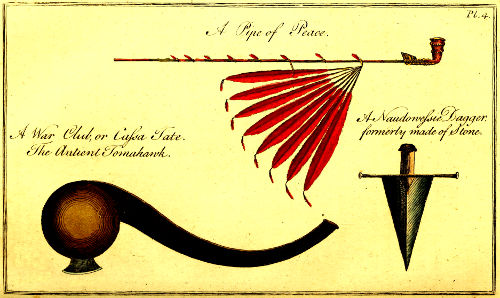
TRAVELS THROUGH THE INTERIOR PARTS OF NORTH AMERICA, IN THE Years 1766, 1767, and 1768.
Transcriber's Note:
The cover image was created by the transcriber and is placed in the public domain.
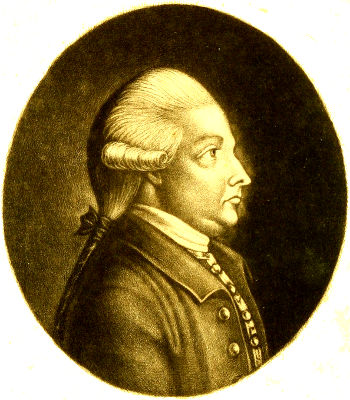
Captn. JONATHAN CARVER.
From the Original Picture in the possession of J.C. Lettsom M.D.
Published as the Act directs, by R. Stewart, No. 287, near Gt. Turnstile, Holborn Novr. 16, 1780.
Printed for C. Dilly, in the Poultry; H. Payne, in Pall-mall; and J. Phillips, in George-Yard, Lombard-Street.
ADVERTISEMENT.
FEW works have had a more rapid sale than the following; two large editions having been disposed of in two years. This induced the proprietors to print a third: but, as soon as this impression was finished, I purchased both the printed copies and the copy-right.
I have since added to the work, some Account of the Author’s life, and an Index to the Travels, which are published separately, for the convenience of the purchasers of the first and second editions; on whom, I was unwilling to raise an extraordinary tax for the third edition.
London, March 30, 1781.
TO JOSEPH BANKS, Esq; PRESIDENT OF THE ROYAL SOCIETY.
SIR,
WHEN the Public are informed that I have long had the Honour of your Acquaintance——that my Design in publishing the following Work has received your Sanction——that the Composition of it has stood the Test of your Judgment——and that it is by your Permission a Name so deservedly eminent in the Literary World is prefixed to it, I need not be apprehensive of its Success; as your Patronage will unquestionably give them Assurance of its Merit.
For this public Testimony of your Favour, in which I pride myself, accept, Sir, my most grateful Acknowledgments; and believe me to be, with great Respect,
AN ADDRESS TO THE PUBLIC. THE SECOND EDITION.
The favourable reception this Work has met with, claims the Author’s most grateful acknowledgments. A large edition having run off in a few months, and the sale appearing to be still unabated, a new impression is become necessary. On this occasion was he to conceal his feelings, and pass over, in silence, a distinction so beneficial and flattering, he would justly incur the imputation of ingratitude. That he might not do this, he takes the opportunity, which now presents itself, of conveying to the Public (though in terms inadequate to the warm emotions of his heart) the sense he entertains of their favour; and thus transmits to them his thanks.
In this new edition, care has been taken to rectify those errors which have unavoidably proceeded from the hurry of the press, and likewise any incorrectness in the language that has found its way into it.
The credibility of some of the incidents related in the following pages, and some of the stories introduced therein, having been questioned, particularly the prognostication of the Indian priest on the banks of Lake Superior, and the story of the Indian and his rattle snake, the author thinks it necessary to avail himself of the same opportunity, to endeavour to eradicate any impressions that might have been made on the minds of his readers, by the apparent improbability of these relations.
As to the former, he has related it just as it happened. Being an eye-witness to the whole transaction (and, he flatters himself, at the time, free from every trace of sceptical obstinacy or enthusiastic credulity) he was consequently able to describe every circumstance minutely and impartially. This he has done; but without endeavouring to account for the means by which it was accomplished. Whether the prediction was the result of prior observations, from which certain consequences were expected to follow by the sagacious priest, and the completion of it merely accidental; or whether he was really endowed with supernatural powers, the narrator left to the judgment of his readers; whose conclusions, he supposes, varied according as the mental faculties of each were disposed to admit or reject facts that cannot be accounted for by natural causes.
The story of the rattle snake was related to him by a French gentleman of undoubted veracity; and were the readers of this work as thoroughly acquainted with the sagacity and instinctive proceedings of that animal, as he is, they would be as well assured of the truth of it. It is well known, that those snakes which have survived through the summer the accidents reptiles are liable to, periodically retire to the woods, at the approach of winter; where each (as curious observers have remarked) takes possession of the cavity it had occupied the preceding year. As soon as the season is propitious, enlivened by the invigorating rays of the sun, they leave these retreats, and make their way to the same spot, though ever so distant, on which they before had found subsistence, and the means of propagating their species. Does it then require any extraordinary exertions of the mind to believe, that one of these regular creatures, after having been kindly treated by its master, should return to the box, in which it had usually been supplied with food, and had met with a comfortable abode, and that nearly about the time the Indian, from former experiments, was able to guess at? It certainly does not; nor will the liberal and ingenuous doubt the truth of a story so well authenticated, because the circumstances appear extraordinary in a country where the subject of it is scarcely known.
These explanations the author hopes will suffice to convince his readers, that he has not, as travellers are sometimes supposed to do, amused them with improbable tales, or wished to acquire importance by making his adventures savour of the marvellous.
SOME ACCOUNT OF CAPTAIN J. CARVER.
THERE is a disposition peculiar to every mind, that early predominates, and continues its influence through every period of life. Many circumstances may, indeed, obscure or divert its progress; but on all interesting occasions this constitutional bias will recur, and exhibit the natural character and genius of the individual.
Jonathan Carver, the author of the following work, was grandson of William Joseph Carver, of Wigan, in Lancashire, who was a captain in the army under king William, and served in Ireland with such distinguished reputation, that that prince was pleased to reward him with the government of Connecticut in New-England, which appears to have been the first appointment to that station by the crown.
Our author was born, anno 1732, at Stillwater, in the province of Connecticut, since rendered famous by the surrender of the army under General Burgoyne; his father, who resided at this place, and acted as a justice of the peace, died, when he was only fifteen years of age. He had received the rudiments of as liberal an education as could be procured in that neighbourhood, and, being designed for the practice of medicine, he was soon after his father’s death placed with a gentleman of that profession in Elizabeth Town, in the same province. A profession that requires not only a close and regular attention, but likewise a steady perseverance, was not suited to that spirit of bold enterprize and adventure, which seemed to be the ruling passion of our author, who, at the age of eighteen, purchased an ensigncy in the Connecticut regiment, in which, as I have been informed, he acquired so much reputation, as to obtain the command of a company. Of this event, however, I have not found the least mention among his papers, nor, indeed, of any other important circumstance of his life till the year 1757, when he was in the army under General Webb, and fortunately escaped the dreadful massacre at Fort William Henry, where nearly 1500 brave troops were destroyed in cold blood by the Indians in the French army of General Montcalm.
In the ensuing year, 1758, a battalion of light infantry, commanded by Colonel Oliver Partridge, was raised in the province of Massachusets Bay, by order of Governor Pownall, for the purpose of invading Canada, in which our author served as second lieutenant of Captain Hawks’s company; and in 1760 he was advanced to be captain of a company in Colonel Whetcomb’s regiment of foot, during the administration of Governor Hutchinson. In Governor Barnard’s time, in 1762, Captain Carver commanded a company of foot in Colonel Saltonstall’s regiment.
I have not been able to collect any anecdotes of our author, during his military services; but from the written recommendations in my hands, of persons high in office, under whom he acted, he appears to have acquitted himself with great reputation, and much to the satisfaction of his superior officers. These recommendations are not confined to military conduct merely; they uniformly introduce him as a person of piety, and of a good moral character. Throughout the narrative of his travels, indeed, an animated regard to the duties of religion is evidently prevalent, which must procure a credibility to the facts he mentions, that might otherwise be suspended. If authors, who have visited countries unknown to their contemporaries, had always been actuated by a sacred regard to truth and moral rectitude, history in general would have been developed with just and convincing relations, and not left involved in doubt and obscurity.
This firm integrity and undaunted courage appeared evident upon every interesting occasion: they were, indeed, essentially requisite to conduct him through the most dangerous enterprizes with a perseverance that is more generally the offspring of true fortitude, than of daring boldness or impetuosity of imagination.
With so many favourable requisites for success and advancement, descended from parents respectable for their military and civil dignity, as well as for their fortune; endued with courage, sagacity, and a spirit of enterprize, rarely united in one individual, it might be an object of enquiry, why Captain Carver, whose conduct was so excellent, in a moral as well as in a military view, should never have been promoted above the command of a company.
It is a truth confirmed by history, that true fortitude is the genuine offspring of an humble mind. Whatever we acquire by industry and labour, we are apt highly to estimate; it is a kind of new creation of our own; and a persuasion of this, inspires ambition, and even a forward ardour for distinction; and what a partial imagination magnifies to ourselves, we naturally magnify to others, and gradually acquire a consequence, and reap rewards adequate, if not superior, to desert: but the naturally brave is naturally modest; what is innate, does not present itself to the imagination as its own; it neither begets vanity, nor excites ambition; and thus great endowments, which might have been cherished, and turned to the most important advantages, are frequently neglected, and lost to society. Whatever natural or acquired excellencies were possessed by Captain Carver, not only seemed unnoticed by himself, but were accompanied by a diffidence, which in some instances was extraordinary indeed; and the reader must be convinced of this, when he is informed, that Captain Carver died, through want, with three commissions in his pocket.
The year after his commission under Colonel Saltonstall was signed, the peace of Versailles took place, namely, anno 1763, when our author, having discharged his military obligations to his country, retired from the army. But his natural turn for enterprize, and the pursuit of novelty, did not suffer him to enjoy a life of useless ease; he began to consider, to use his own sentiments (having rendered his country some services during the war) how he might continue still serviceable, and contribute, as much as lay in his power, to make that vast acquisition of territory, gained by Great Britain in North America, advantageous to it; and here he commences his own biographer, continuing his relation in the following history of his travels, till his visit to England in the year 1769.
Though I have not been able to procure many additional anecdotes of this ingenious traveller, yet a respect to his memory, and a sense of his services to the nation at large, excited a desire to bring together a few outlines of his character, and probably at some future period, when the present unhappy contest between this kingdom and the American colonies shall have subsided, particulars of more importance than I have been able to meet with, may be procured from that part of the world, which he has taken so much useful labour to describe.
This barrenness of materials is, however, in some degree compensated by the important relations he has communicated in the succeeding pages, which not only regard himself, but likewise a part of the great American continent, hitherto almost unknown to the inhabitants of Europe, and even to those of the cultivated parts of the same continent.
In his descriptions of these vast regions, he seems to have embraced every opportunity of pointing out the advantages which might be derived in a commercial view, from a just knowledge of them, and of the policy of the various tribes who possess them. In his picturesque view of the scenery round Lake Pepin, his imagination, animated as it was by the magnitude, the novelty, and grandeur of the objects, is not so far transported, as to interrupt the most scrupulous attention to the situation, as improveable for commercial and national advantages.
In the midst of a new and rich creation, he suggested the probability of rendering this lake, and its variegated environs, the center of immense traffick, with a people whose names and tribes were scarcely known to the commercial parts of either side of the British empire, but whose dispositions and pursuits seemed calculated to promote and secure this interesting and national benefit.
The lake, which is about twenty miles in length, and six in breadth, and through which the Mississippi directs its course, is about two thousand miles from the entrance into the gulf of Mexico, and as many westerly from Quebec, Boston, and New-York; it is situated between 42 and 43 degrees of north latitude. The plains in its vicinity are extensive, and fit for immediate cultivation: elk, deer, and other quadrupeds, including the beaver, otter, mink, martin, sable, musk-rat, and the largest buffaloes in America, are the inhabitants of this region, whilst various species of wild fowl frequent the lake, whose waters are stored with fish in great abundance; vegetation is luxuriant in the meadows, where the maple is indigenous, of whose sap the Indians make great quantities of sugar, capable of fermentation, and of producing spirit; the grapes hang in such clusters, that almost any quantity of brandy might, under a like process, be distilled from them; rice, a grain adapted to many useful purposes of life, is also very plentiful.
The number of hunting Indians, who frequent Lake Pepin, is not less than 2000, each of whom brings about one hundred pounds weight of beaver to barter, which, at the lowest price, in the London market, is five shillings a pound; hence a trade at this place will command annually 200000 crowns worth of furs, besides skins. But there is reason to conclude, that when a general mart is established here, furnished with a sufficient assortment of goods, and a supply of liquors, that there would be a more general resort of traders.
The French, indeed, supported a trade at this lake, before the English had made a conquest of the country; but they never attempted the lucrative branch of distilling spirituous liquors upon the spot, though they have been conveyed hither two thousand miles of difficult carriage, and produced considerable profit.
It may be doubted in a moral, if not in a political view, whether such a traffic of rendering the means of inebriation more easily attainable, should meet with the encouragement of the legislature. Captain Carver, however, computed that 2000 gallons of brandy could be made on the spot, as cheap as in the West-Indies; and that by avoiding the expence of 3000 miles carriage also, the traders would make a saving of 2000 per cent. besides duties and various contingencies: and as, by a moderate computation, every gallon of spirits will produce there what will amount to ten pounds in the London market, it must eventually prove a most lucrative branch of trade, if pursued with proper caution and policy.
The great plenty of the edible necessaries of life, will afford a cheap, easy, and salutary supply; and the goodness of the soil, with very little labour, will render provisions still more easily attainable, and altogether form a place of traffic hitherto unequalled.
From Captain Carver’s long residence in the neighbourhood of Lake Pepin, among the Naudowissie and Chipéway Indians, he acquired a knowledge of their languages, and an intimacy with many of their chiefs, which, with his spirited and judicious conduct in acting as a mediator between these two nations, conciliated their attachment and friendship; and as an acknowledgment of their grateful sense of his happy interference, the Naudowissies gave him a formal grant of a tract of land, lying on the north side of Lake Pepin. The original, duly subscribed by two chiefs, is in my possession; and as an Indian deed of conveyance may prove a curiosity to many readers, I shall here insert a copy of it.
“To Jonathan Carver, a chief under the most mighty and potent George the Third, King of the English and other nations, the fame of whose courageous warriors have reached our ears, and has been more fully told us by our good brother Jonathan aforesaid, whom we rejoice to see come among us, and bring us good news from his country. We, chiefs of the Naudowissies, who have hereto set our seals, do by these presents for ourselves and heirs for ever, in return for the many presents, and other good services done by the said Jonathan to ourselves and allies, give, grant, and convey to him the said Jonathan, and to his heirs and assigns for ever, the whole of a certain tract or territory of land, bounded as follows: (viz.) from the fall of St. Anthony, running on the east banks of the Mississippi, nearly south-east, as far as the south end of Lake Pepin, where the Chipéway river joins the Mississippi, and from thence eastward five days travel, accounting twenty English miles per day, and from thence north six days travel, at twenty English miles per day, and from thence again to the fall of St. Anthony, on a direct straight line. We do for ourselves, heirs, and assigns, for ever, give unto the said Jonathan, his heirs and assigns, for ever, all the said lands, with all the trees, rocks, and rivers therein, reserving for ourselves and heirs the sole liberty of hunting and fishing on land not planted or improved by the said Jonathan, his heirs and assigns, to which we have affixed our respective seals, at the great cave, May the first, one thousand seven hundred and sixty-seven.”
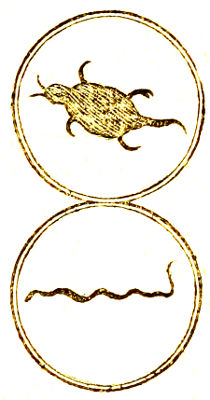
Hawnopawjatin his mark (top)
Otohtongoomlisheaw his mark (bottom)
Soon after the above period, our author concluded to return to Boston, where he arrived in 1768, having been absent two years and five months, during which time he had travelled about seven thousand miles. After digesting his journal and charts, he sailed for England, and arrived there in the year 1769. The reasons which induced him to undertake this voyage, are amply related by himself in his travels (page 177.) to which I refer.
Few objects have excited a more general enquiry than the discovery of a north-west passage, in order to open a communication with the great pacific ocean and the East Indies, by a shorter navigation than by doubling those immense promontories, the Cape of Good Hope or Cape Horn. Every allurement of gain, and national emolument, has been proposed to encourage the attempt, but, hitherto, every attempt hath been fruitless, though the most experienced seamen have engaged in the undertaking. Our traveller suggested an attempt by land, across the north west parts of North America, and actually drew a chart of his proposed route for effecting his project, which, however visionary it may now be deemed, affords at least a proof of the enterprizing spirit of Captain Carver, and which he would, probably, have attempted, had any encouragement been afforded him: (introd. pag. 6. and append. pag. 539, et seq.)
When he visited England, he appeared with the most favourable credentials of his character in every respect: many of these are now in my possession; but that which seemed to promise the most beneficial advantages, was conferred upon him by General Gage, and, in consequence of a petition presented to the king, and referred to the Lords Commissioners of Trade and Plantations, our traveller had formed the fond hope of seeing his labours so far rewarded, as to be reimbursed those sums he had expended in the service of government, agreeable to the relation conveyed in the introduction to his travels.
In a large, free, and widely extended government, where every motion depends upon a variety of springs, the lesser and subordinate movements must be acted upon by the greater, and consequently the more inferior operations of state will be so distant, as not to be perceived in the grand machine: whether Captain Carver’s disappointments resulted from these principles, or that government did not estimate his services in equal proportion to his own idea of them, is not so easily ascertained, as that he thought himself not only neglected, but treated with injustice.
The condition of a suppliant is what his mind must have submitted to with reluctance. Men of superior endowments are liable to be jealous of the least inattention, which they are apt to consider as an insult on their distress. A feeling mind, like his, conscious of its dignity and superior merit, might not be able to stoop to that importunity and adulation, which are sometimes requisite to insure the smiles and favours of those in power; otherwise it might naturally be suggested, that his extensive acquaintance with America, and with the customs and languages of the Indians, in the interior parts of that vast continent, then the theatre of an unnatural and bloody contest, would have pointed him out as a most useful instrument in the hands of government.
With the advantages, however, of an intimate knowledge of Indian affairs, he united a determined loyalty to the king, and a fixed attachment to his American countrymen; and thus the principle of acting agreeably to the feelings of conscience, would equally operate upon him respecting the contending parties. He had repeatedly risked his life in the service of his prince, against whose government he was equally averse from drawing his sword, as against his transatlantic brethren: he might not, therefore, be deemed an important acquisition to the ruling powers here, and the prayer of his petition was scarcely heard in the clamours of popular commotion.
Persons of ingenuity, however oppressed by their own sufferings, in a busy commercial country, may strike out some means of subsistence; but, in a domestic state, where many depend upon the industry of an individual, the difficulty of procuring support is not only rendered more affecting to the feeling mind, but likewise greatly augmented. Captain Carver, after having exhausted his fortune, had now a family to support, without knowing how to turn his abilities to any means of succouring them. Distress of mind begets debility of body, which is still aggravated by penury, and a want of the common necessaries of life. His constitution, naturally firm, gradually grew weaker and weaker; but his regard to his family animated his spirit to exertions beyond the strength of his body, which enabled him to preserve existence through the winter of 1779, by acting as a clerk in a lottery-office; but the vital powers, succoured as they were by this casual support, diminished by certain, though imperceptible, degrees, till at length a putrid fever supervening a long continued dysentery brought on by want, put an end to the life of a man, who, after rendering, at the expence of fortune and health, and the risk of life, many important services to his country, perished through want in the first city of the world.
In size, Captain Carver was rather above the middle stature, and of a firm muscular texture; his features expressed a firmness of mind and boldness of resolution; and he retained a florid complexion to his latest moments.
In conversation he was social and affable, where he was familiar; but his extreme diffidence and modesty kept him in general reserved in company. In his familiar epistles, he commanded an easy and agreeable manner of writing; and some pieces of his poetry, which have been communicated to me, afford proofs of his lively imagination and of the harmony of his versification.
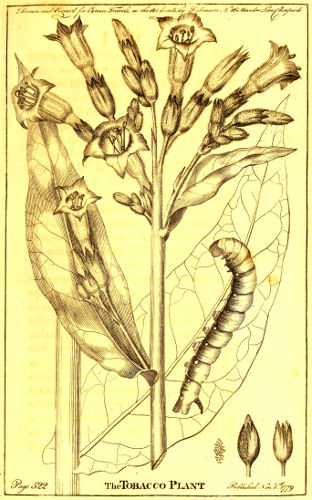
His only authentic publications I have seen are the present work, and a Treatise on the Culture of the Tobacco Plant, anno 1779. The former will speak for itself: the opinion of the public has, indeed, been fully testified by the rapid sale of two large editions of this work in the space of the last two years.
The Treatise on Tobacco is a small octavo of fifty-four pages, containing two engravings of the plant, and an account of its cultivation on the American continent. As this vegetable constitutes one of the most considerable branches of commerce betwixt the old and new hemispheres of the world, and thrives luxuriously in Europe as well as in America, it is now pretty generally known: from the elegance of the plant and beauty of its flowers, it is cultivated in gardens for ornament; in which character it will appear from a view of the annexed engraving of it.
It was first sent into Spain, in 1560: from Tabaco, a province of Yucatan, by Hermandez de Toledo, and from the place of its growth it received the name which it still bears.
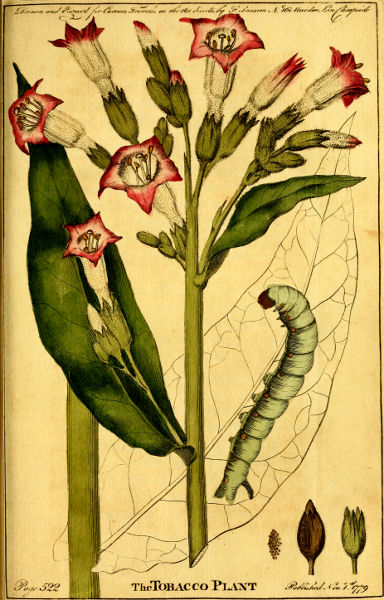
Drawn and Engrav’d for Carver’s Travels, as the act directs by F. Sanson N. 16 Maiden Lane Cheapside
The Tobacco Plant
Published Novr. 1st. 1779
It was called, by the French, Nicotiana, after John Nicot, who went soon after it was discovered, as ambassador to that court, from Francis the Second of Portugal, and carried some of it with him.
Before the present contest between Great-Britain and the Colonies, about 96,000 hogsheads were annually imported from Maryland and Virginia, which, with the duties on the home consumption, and the returns on foreign export, produced an immense revenue to this country.
The general uses of Tobacco are well known; besides which, it is found nearly equal to the best oak-bark for tanning leather, especially with thinner sorts of hides; and would probably be used for this purpose, were it as cheap as the bark of the oak.
Few subjects have been more copiously treated on than Tobacco: Monardes, Stephanus, Everhartus, Thorius, Neander, Pauli, have each wrote upon it largely. Neander published a volume on this subject, entitled, Tobacologia, and ornamented it with plates, to exhibit its cultivation and manner of preparation; and, lately, Captain Carver published the above-mentioned Treatise on the Culture of this Plant, with a view to instruct landholders in the method of cultivating it with profit, and to this pamphlet I shall refer the reader for further particulars.
Our author died on the 31st of January 1780, at the age of forty-eight years, and lies interred in Holywell-Mount burying-ground.
CONTENTS.
| INTRODUCTION, | i |
| The Author sets out from Boston on his Travels, | 17 |
| Description of Fort Michillimackinac, | 18 |
| Description of Fort Le Bay, | 21 |
| Description of the Green Bay, | 26 |
| Description of Lake Michigan, | 28 |
| Arrives at the Town of the Winnebagoes, | 32 |
| Excursion of the Winnebagoes towards the Spanish Settlements, | 35 |
| Description of the Winnebago Lake, | 37 |
| Instance of Resolution of an Indian Woman, | 40 |
| Description of the Fox River, | 41 |
| Remarkable Story of a Rattle Snake, | 43 |
| The great Town of the Saukies, | 46 |
| Upper Town of the Ottagaumies, | 48 |
| Description of the Ouisconsin River, | ib. |
| Lower Town of the Ottagaumies, or La Prairie Le Chien, | 50 |
| An Attack by some Indian Plunderers, | 51 |
| Description of the Mississippi from the Mouth of the Ouisconsin to Lake Pepin, | 54 |
| Description of Lake Pepin, | 55 |
| Remarkable Ruins of an ancient Fortification, | 57 |
| The River Bands of the Naudowessie Indians, | 59 |
| Adventure with a Party of these, and some of the Chipéways, | 60 |
| Description of a remarkable Cave, | 63 |
| Uncommon Behaviour of the Prince of the Winnebagoes at the Falls of St. Anthony, | 66 |
| Description of the Falls, | 69 |
| Extent of the Author’s Travels, | 71 |
| Description of the River St. Pierre, | 74 |
| Sources of the Four great Rivers of North America, | 76 |
| Reflections on their Affinity, | 77 |
| The Naudowessies of the Plains, with whom the Author wintered in the Year 1766, | 80 |
| The Author returns to the Mouth of the River St. Pierre, | 84 |
| Account of a violent Thunder-storm, | 85 |
| Speech made by the Author in a Council held by the Naudowessies at the great Cave, | 86 |
| Adventure with a Party of Indians near Lake Pepin, | 95 |
| Description of the Country adjacent to the River St. Pierre, | 100 |
| Account of different Clays found near the Marble River, | 101 |
| Description of the Chipéway River, | 102 |
| Extraordinary Effects of a Hurricane, | 103 |
| The Author arrives at the Grand Portage on the North-west Borders of Lake Superior, | 107 |
| Account of the Lakes lying farther to the North-west: Lake Bourbon, Lake Winnepeek, Lake Du Bois, Lake La Pluye, Red Lake, &c. | ib. |
| Account of a Nation of Indians supposed to have been tributary to the Mexican Kings, | 118 |
| Account of the shining Mountains, | 121 |
| A singular Prediction of the Chief Priest of the Killistinoes verified, | 123 |
| Description of Lake Superior, | 132 |
| Story of the two Chipéways landing on the Island of Mauropas, | 135 |
| Account of great Quantities of Copper Ore, | 139 |
| Description of the Falls of St. Marie, | 142 |
| Account of Lake Huron, | 144 |
| Account of Saganaum and Thunder Bays, | 145 |
| Extraordinary Phænomenon in the Straights of Michillimackinac, | 146 |
| Description of Lake St. Claire, | 150 |
| Description of the River, Town, and Fort of Detroit, | 153 |
| Remarkable Rain at Detroit, | 153 |
| Attack of Fort Detroit by Pontiac, | 154 |
| Description of Lake Erie, | 166 |
| Description of the River and Falls of Niagara, | 169 |
| Description of Lake Ontario, | 170 |
| Description of the Oniada Lake, Lake Champlain, and Lake George, | 172 |
| Account of a Tract of Land granted to Sir Ferdinando Gorges, and Captain John Mason, | 173 |
| The Author’s Motives for undertaking his Travels, | 177 |
| CHAP. I. | |
| The Origin of the Indians, | 181 |
| Sentiments of various Writers on this Point, | 182 |
| Sentiments of Monsieur Charlevoix, | 192 |
| Sentiments of James Adair, Esq; | 202 |
| Sentiments of the Author of this Work, | 208 |
| Corroboration of the latter by Doctor Robertson | 216 |
| CHAP. II. | |
| Of the Persons, Dress, &c. of the Indians, | 219 |
| An Account of those who have written on this Subject, | 220 |
| Description of the Persons of the Indians, | 223 |
| Description of their Dress, | 225 |
| Description of the Dress of the Ottagaumies, with a Plate, | 229 |
| Description of the Dress of the Naudowessies, with Ditto, | 230 |
| The Manner in which they build their Tents and Huts, | 231 |
| Their domestic Utensils, | 233 |
| CHAP. III. | |
| Of the Manners, Qualifications, &c. of the Indians, | 235 |
| Peculiar Customs of the Women, | 236 |
| The circumspect and stoical Disposition of the Men, | 237 |
| Their amazing Sagacity, | 241 |
| Remarkable Story of one of the Naudowessie Women, | 245 |
| The Liberality of the Indians, and their Opinion respecting Money, | 247 |
| CHAP. IV. | |
| Their Method of reckoning Time, &c. | 250 |
| The Names by which they distinguish the Months, | 251 |
| Their Idea of the Use of Figures, | 253 |
| CHAP. V. | |
| Of their Government, &c. | 255 |
| Their Division into Tribes, | ib. |
| The Chiefs of their Bands, | 257 |
| The Members that compose their Councils, | 259 |
| CHAP. VI. | |
| Of their Feasts, | 262 |
| Their usual Food, | 263 |
| Their Manner of dressing and eating their Victuals, | 264 |
| CHAP. VII. | |
| Of their Dances, | 266 |
| The Manner in which they dance, | 267 |
| The Pipe or Calumate Dance, | 268 |
| The War Dance, | 269 |
| The Pawwaw Dance, | 270 |
| An uncommon Admission into a Society, among the Naudowessies, | 272 |
| The Dance of the Indians on the Banks of the Mississippi, referred to in the Journal, | 279 |
| The Dance of the Sacrifice, | 282 |
| CHAP. VIII. | |
| Of their Hunting, | 283 |
| Their Preparation before they set out, | 285 |
| Their Manner of hunting the Bear, | 286 |
| Their Manner of hunting the Buffalo, Deer, &c. | 287 |
| Their Manner of hunting the Beaver, | 289 |
| CHAP. IX. | |
| Of their Manner of making War, &c. | 293 |
| The Indian Weapons, with a Plate, | 296 |
| Their Motives of making War, | 297 |
| Preparations before they take the Field, | 301 |
| The Manner in which they solicit other Nations to become their Auxiliaries, | 305 |
| Their Manner of declaring War, | 307 |
| Their Method of engaging their Enemies, | 310 |
| An Instance of the Efficacy of it in the Defeat of General Braddock, | 311 |
| A Detail of the Massacre at Fort William-Henry in the Year 1757, | 313 |
| Acuteness and Alacrity of the Indians in pursuing their Enemies, | 327 |
| Their Manner of Scalping, | 328 |
| The Manner in which they retreat and carry off their Prisoners, | 330 |
| A remarkable Instance of Heroism in a Female Prisoner, | 332 |
| Treatment of their Prisoners, | 335 |
| The Origin of their selling Slaves, | 346 |
| CHAP. X. | |
| Of their Manner of making Peace, &c. | 351 |
| Account of an Engagement between the Iroquois and the Ottagaumies and Saukies, | 352 |
| Manner in which they conduct a Treaty of Peace, | 358 |
| Description of the Pipe of Peace, | 359 |
| Description of the Belts of Wampum, | 362 |
| CHAP. XI. | |
| Of their Games, | 363 |
| The Game of the Ball, | 364 |
| The Game of the Bowl or Platter, | 365 |
| CHAP. XII. | |
| Of their Marriage Ceremonies, | 367 |
| The Manner in which the Tribes near Canada celebrate their Marriages, | 369 |
| The Form of Marriage among the Naudowessies, | 373 |
| Their Manner of carrying on an Intrigue, | 375 |
| Of the Indian Names, | 378 |
| CHAP. XIII. | |
| Of their Religion, | 380 |
| Their Ideas of a Supreme Being, | 381 |
| Their Ideas of a future State, | 383 |
| Of their Priests, | 384 |
| The Sentiments of Others on the religious Principles of the Indians opposed, | 386 |
| CHAP. XIV. | |
| Of their Diseases, &c. | 389 |
| The Complaints to which they are chiefly subject, | ib. |
| The Manner in which they construct their Sweating Stoves, | 390 |
| The Methods in which they treat their Diseases, | 391 |
| An extraordinary Instance of the Judgment of an Indian Woman in a desperate Case, | 395 |
| CHAP. XV. | |
| The Manner in which they treat their Dead, | 398 |
| A Specimen of their Funeral Harangues, | 399 |
| Their Method of burying the Dead, | 401 |
| A singular Instance of parental Affection in a Naudowessie Woman, | 403 |
| CHAP. XVI. | |
| A concise Character of the Indians, | 408 |
| Their personal and mental Qualifications, | 409 |
| Their public Character as Members of a Community, | 411 |
| CHAP. XVII. | |
| Of their Language, Hieroglyphicks, &c. | 414 |
| Of the Chipéway Tongue, | 416 |
| Descriptive Specimen of their Hieroglyphicks, | 417 |
| Vocabulary of the Chipéway Language, | 420 |
| Vocabulary of the Naudowessie Language, | 433 |
| CHAP. XVIII. | |
| Of the Beasts, Birds, Fishes, Reptiles, and Insects, which are found in the Interior Parts of North America, | 441 |
| BEASTS. | |
| The Tyger. The Bear, | 442 |
| The Wolf. The Fox, | 444 |
| Dogs. The Cat of the Mountain. The Buffalo, | 445 |
| The Deer, | 446 |
| The Elk, | 447 |
| The Moose, | 448 |
| The Carrabou, | 449 |
| The Carcajou. The Skunk, | 450 |
| The Porcupine, | 453 |
| The Woodchuck. The Racoon, | 454 |
| The Martin. The Musquash, | 455 |
| Squirrels, | 456 |
| The Beaver, | 457 |
| The Otter, | 464 |
| The Mink, | 465 |
| BIRDS. | |
| The Eagle. The Night Hawk, | 466 |
| The Fish Hawk, | 467 |
| The Whipperwill, | 468 |
| The Owl. The Crane. Ducks, | 469 |
| The Teal. The Loon, | 470 |
| The Partridge. The Woodpecker. The Wood Pigeon, | 471 |
| The Blue Jay. The Wakon Bird, | 472 |
| The Blackbird, | 473 |
| The Redbird, | 474 |
| The Whetsaw. The King Bird. The Humming Bird, | 475 |
| FISHES. | |
| The Sturgeon, | 477 |
| The Cat Fish. The Carp. The Chub, | 478 |
| SERPENTS. | |
| The Rattle Snake, | 479 |
| The Long Black Snake, | 485 |
| The Striped or Garter Snake. The Water Snake. The Hissing Snake. The Green Snake. The Thorn-tail Snake, | 486 |
| The Speckled Snake. The Ring Snake. The Two-headed Snake, | 487 |
| The Tortoise or Land Turtle, | 488 |
| LIZARDS. | |
| The Swift Lizard. The Slow Lizard. The Tree Toad, | 488, 489 |
| INSECTS. | |
| The Silk Worm, | 490 |
| The Tobacco Worm. The Bee. The Lightning Bug or Fire Fly, | 491 |
| The Water Bug. The Horned Bug. The Locust, | 493 |
| CHAP. XIX. | |
| Of the Trees, Shrubs, Roots, Herbs, Flowers, | 494 |
| TREES. | |
| The Oak, | 495 |
| The Pine Tree. The Maple, | 496 |
| The Ash, | 497 |
| The Hemlock Tree, | 498 |
| The Bass or White Wood. The Wickopick or Suckwick. The Button Wood, | 499 |
| NUT TREES. | |
| The Butter or Oil Nut, | 500 |
| The Beech Nut. The Pecan Nut, | 501 |
| The Hickory, | 502 |
| FRUIT TREES. | |
| The Vine. The Mulberry Tree. The Crab Apple Tree. The Plum Tree, | 503 |
| The Cherry Tree, | 504 |
| The Sweet Gum Tree, | 505 |
| SHRUBS. | |
| The Willow. Shin Wood, | 506 |
| The Sassafras. The Prickly Ash, | 507 |
| The Moose Wood. The Spoon Wood. The Elder, | 508 |
| The Shrub Oak. The Witch Hazle, | 509 |
| The Myrtle Wax Tree. Winter Green, | 510 |
| The Fever Bush. The Cranberry Bush, | 511 |
| The Choak Berry, | 512 |
| ROOTS and PLANTS. | |
| Spikenard. Sarsaparilla, | 513 |
| Ginsang. Gold Thread, | 514 |
| Solomon’s Seal. Devil’s Bit, | 515 |
| Blood Root, | 516 |
| HERBS. | |
| Sanicle. Rattle Snake Plantain, | 517 |
| Poor Robin’s Plantain. Toad Plantain. Rock Liverwort. Gargit or Skoke. | 518 |
| Skunk Cabbage or Poke, | 519 |
| Wake Robin. Wild Indico. Cat Mint, | 520 |
| FLOWERS, | 521 |
| FARINACEOUS and LEGUMINOUS ROOTS, &c. | |
| Maize or Indian Corn, | 522 |
| Wild Rice, | 523 |
| Beans. The Squash, | 526 |
| APPENDIX. | |
| The Probability of the interior Parts of North America becoming Commercial Colonies, | 527 |
| The Means by which this might be effected, | 529 |
| Tracts of Land pointed out, on which Colonies may be established with the greatest Advantage, | 531 |
| Dissertation on the Discovery of a North-west Passage, | 539 |
| The most certain Way of attaining it, | 540 |
| Plan proposed by Richard Whitworth, Esq. for making an Attempt from a Quarter hitherto unexplored, | 441 |
| The Reason of its being postponed, | 543 |

A
New Map
of
North
America
From the
Latest Discoveries
1778
Engrav’d for Carver’s
Travels
INTRODUCTION.
NO sooner was the late War with France concluded, and Peace established by the Treaty of Versailles in the Year 1763, than I began to consider (having rendered my country some services during the war) how I might continue still serviceable, and contribute, as much as lay in my power, to make that vast acquisition of territory, gained by Great Britain, in North America advantageous to it. It appeared to me indispensably needful, that Government should be acquainted in the first place with the true state of the dominions they were now become possessed of. To this purpose, I determined, as the next proof of my zeal, to explore the most unknown parts of them, and to spare no trouble or expence in acquiring a knowledge that promised to be so useful to my countrymen. I knew that many obstructions would arise to my scheme from the want of good Maps and Charts; for the French, whilst they retained their power in North America, had taken every artful method to keep all other nations, particularly the English, in ignorance of the concerns of the interior parts of it: and to accomplish this design with the greater certainty, they had published inaccurate maps and false accounts; calling the different nations of the Indians by nicknames they had given them, and not by those really appertaining to them. Whether the intention of the French in doing this, was to prevent these nations from being discovered and traded with, or to conceal their discourse, when they talked to each other of the Indian concerns, in their presence, I will not determine; but whatsoever was the cause from which it arose, it tended to mislead.
As a proof that the English had been greatly deceived by these accounts, and that their knowledge relative to Canada had usually been very confined, before the conquest of Crown-Point in 1759, it had been esteemed an impregnable fortress: but no sooner was it taken, than we were convinced that it had acquired its greatest security from false reports, given out by its possessors, and might have been battered down with a few four pounders. Even its situation, which was represented to be so very advantageous, was found to owe its advantages to the same source. It cannot be denied but that some maps of these countries have been published by the French with an appearance of accuracy; but these are of so small a size and drawn on so minute a scale, that they are nearly inexplicable. The sources of the Mississippi, I can assert from my own experience, are greatly misplaced; for when I had explored them, and compared their situation with the French Charts, I found them very erroneously represented, and am satisfied that these were only copied from the rude sketches of the Indians.
Even so lately as their evacuation of Canada they continued their schemes to deceive; leaving no traces by which any knowledge might accrue to their conquerors: for though they were well acquainted with all the Lakes, particularly with Lake Superior, having constantly a vessel of considerable burthen thereon, yet their plans of them are very incorrect. I discovered many errors in the descriptions given therein of its Islands and Bays, during a progress of eleven hundred miles that I coasted it in canoes. They likewise, on giving up the possession of them, took care to leave the places they had occupied in the same uncultivated state they had found them; at the same time destroying all their naval force. I observed myself part of the hulk of a very large vessel, burnt to the water’s edge, just at the opening from the Straits of St. Marie’s into the Lake.
These difficulties, however, were not sufficient to deter me from the undertaking, and I made preparations for setting out. What I chiefly had in view, after gaining a knowledge of the Manners, Customs, Languages, Soil, and natural Productions of the different nations that inhabit the back of the Mississippi, was to ascertain the Breadth of that vast continent, which extends from the Atlantic to the Pacific Ocean, in its broadest part between 43 and 46 Degrees Northern Latitude. Had I been able to accomplish this, I intended to have proposed to Government to establish a Post in some of those parts about the Straits of Annian, which having been first discovered by Sir Francis Drake, of course belong to the English. This I am convinced would greatly facilitate the discovery of a North-west Passage, or a communication between Hudson’s Bay and the Pacific Ocean. An event so desirable, and which has been so often sought for, but without success. Besides this important end, a settlement on that extremity of America would answer many good purposes, and repay every expence the establishment of it might occasion. For it would not only disclose new sources of trade, and promote many useful discoveries, but would open a passage for conveying intelligence to China, and the English settlements in the East Indies, with greater expedition than a tedious voyage by the Cape of Good Hope, or the Straits of Magellan will allow of.
How far the advantages arising from such an enterprize may extend can only be ascertained by the favourable concurrence of future events. But that the completion of the scheme, I have had the honour of first planning and attempting, will some time or other be effected, I make no doubt. From the unhappy divisions that at present subsist between Great Britain and America, it will probably be some years before the attempt is repeated; but whenever it is, and the execution of it carried on with propriety, those who are so fortunate as to succeed, will reap, exclusive of the national advantages that must ensue, Emoluments beyond their most sanguine expectations. And whilst their spirits are elated by their success, perhaps they may bestow some commendations and blessings on the person that first pointed out to them the way. These, though but a shadowy recompence for all my toil, I shall receive with pleasure.
To what power or authority this new world will become dependent, after it has arisen from its present uncultivated state, time alone can discover. But as the seat of Empire from time immemorial has been gradually progressive towards the West, there is no doubt but that at some future period, mighty kingdoms will emerge from these wildernesses, and stately palaces and solemn temples, with gilded spires reaching the skies, supplant the Indian huts, whose only decorations are the barbarous trophies of their vanquished enemies.
As some of the preceding passages have already informed the Reader that the plan I had laid down for penetrating to the Pacific Ocean, proved abortive, it is necessary to add, that this proceeded not from its impracticability (for the farther I went the more convinced I was that it could certainly be accomplished) but from unforeseen disappointments. However, I proceeded so far, that I was able to make such discoveries as will be useful in any future attempt, and prove a good foundation for some more fortunate Successor to build upon. These I shall now lay before the Public in the following pages; and am satisfied that the greatest part of them have never been published by any person that has hitherto treated of the interior Nations of the Indians; particularly, the account I give of the Naudowessies, and the situation of the Heads of the four great rivers that take their rise within a few leagues of each other, nearly about the center of this great continent; viz. The River Bourbon, which empties itself into Hudson’s Bay; the Waters of Saint Lawrence; the Mississippi, and the River Oregon, or the River of the West, that falls into the Pacific Ocean at the Straits of Annian.
The impediments that occasioned my returning, before I had accomplished my purposes, were these. On my arrival at Michillimackinac, the remotest English post, in September 1766, I applied to Mr. Rogers, who was then governor of it, to furnish me with a proper assortment of goods, as presents for the Indians who inhabit the track I intended to pursue. He did this only in part; but promised to supply me with such as were necessary, when I reached the Falls of Saint Anthony. I afterwards learned that the governor fulfilled his promise in ordering the goods to be delivered to me; but those to whose care he intrusted them, instead of conforming to his orders, disposed of them elsewhere.
Disappointed in my expectations from this quarter, I thought it necessary to return to La Prairié Le Chien; for it was impossible to proceed any farther without presents to ensure me a favorable reception. This I did in the beginning of the year 1767, and finding my progress to the Westward thus retarded, I determined to direct my course Northward. I took this step with a view of finding a communication from the Heads of the Mississippi into Lake Superior, in order to meet, at the grand Portage on the North-west side of that lake, the traders that usually come, about this season, from Michillimackinac. Of these I intended to purchase goods, and then to pursue my journey from that quarter by way of the lakes de Pluye, Dubois, and Ounipique to the Heads of the river of the West, which, as I have said before, falls into the Straits of Annian, the termination of my intended progress.
I accomplished the former part of my design, and reached Lake Superior in proper time; but unluckily the traders I met there acquainted me, that they had no goods to spare; those they had with them being barely sufficient to answer their own demands in these remote parts. Thus disappointed a second time, I found myself obliged to return to the place from whence I began my expedition, which I did after continuing some months on the North and East borders of Lake Superior, and exploring the Bays and Rivers that empty themselves into this large body of water.
As it may be expected that I should lay before the Public the reasons that these discoveries, of so much importance to every one who has any connections with America, have not been imparted to them before, notwithstanding they were made upwards of ten years ago, I will give them to the world in a plain and candid manner, and without mingling with them any complaints on account of the ill treatment I have received.
On my arrival in England, I presented a petition to his Majesty in council, praying for a reimbursement of those sums I had expended in the service of government. This was referred to the Lords Commissioners of Trade and Plantations. Their Lordships from the tenor of it thought the intelligence I could give of so much importance to the nation that they ordered me to appear before the Board. This message I obeyed, and underwent a long examination; much I believe to the satisfaction of every Lord present. When it was finished, I requested to know what I should do with my papers; without hesitation the first Lord replied, That I might publish them whenever I pleased. In consequence of this permission, I disposed of them to a bookseller: but when they were nearly ready for the press, an order was issued from the council board, requiring me to deliver, without delay, into the Plantation Office, all my Charts and Journals, with every paper relative to the discoveries I had made. In order to obey this command, I was obliged to re-purchase them from the bookseller, at a very great expence, and deliver them up. This fresh disbursement I endeavoured to get annexed to the account I had already delivered in; but the request was denied me, notwithstanding I had only acted, in the disposal of my papers, conformably to the permission I had received from the Board of Trade. This loss, which amounted to a very considerable sum, I was obliged to bear, and to rest satisfied with an indemnification for my other expences.
Thus situated, my only expectations are from the favour of a generous Public; to whom I shall now communicate my Plans, Journals, and Observations, of which I luckily kept copies, when I delivered the originals into the Plantation Office. And this I do the more readily, as I hear they are mislaid; and there is no probability of their ever being published. To those who are interested in the concerns of the interior parts of North America, from the contiguity of their possessions, or commercial engagements, they will be extremely useful, and fully repay the sum at which they are purchased. To those, who, from a laudable curiosity, wish to be acquainted with the manners and customs of every inhabitant of this globe, the accounts here given of the various nations that inhabit so vast a track of it, a country hitherto almost unexplored, will furnish an ample fund of amusement and gratify their most curious expectations. And I flatter myself they will be as favourably received by the Public, as descriptions of islands, which afford no other entertainment than what arises from their novelty; and discoveries, that seem to promise very few advantages to this country, though acquired at an immense expence.
To make the following Work as comprehensible and entertaining as possible, I shall first give my Readers an account of the route I pursued over this immense continent (through which they will be able to attend me by referring to the plan prefixed) and as I pass on, describe the number of Inhabitants, the situation of the Rivers and Lakes, and the productions of the country. Having done this, I shall treat, in distinct Chapters, of the Manners, Customs, and Languages of the Indians, and to complete the whole, add a Vocabulary of the Words mostly in use among them.
And here it is necessary to bespeak the candour of the learned part of my Readers in the perusal of it, as it is the production of a person unused, from opposite avocations, to literary pursuits. He therefore begs they would not examine it with too critical an eye; especially when he assures them that his attention has been more employed on giving a just description of a country that promises, in some future period, to be an inexhaustible source of riches to that people who shall be so fortunate as to possess it, than on the style or composition; and more careful to render his language intelligible and explicit, than smooth and florid.

A PLAN of Captain Carver’s Travels in the interior Parts of North America in 1766 and 1767.
A JOURNAL OF THE TRAVELS, WITH A DESCRIPTION OF THE COUNTRY, LAKES, &c.
IN June 1766, I set out from Boston, and proceeded by way of Albany and Niagara, to Michillimackinac; a Fort situated between the Lakes Huron and Michigan, and distant from Boston 1300 miles. This being the uttermost of our factories towards the north-west, I considered it as the most convenient place from whence I could begin my intended progress, and enter at once into the Regions I designed to explore.
Referring my Readers to the publications already extant for an Account of those Parts of North America, that, from lying adjacent to the Back-Settlements, have been frequently described, I shall confine myself to a Description of the more interior parts of it, which having been but seldom visited, are consequently but little known. In doing this, I shall in no instance exceed the bounds of truth, or have recourse to those useless and extravagant exaggerations too often made use of by travellers, to excite the curiosity of the public, or to increase their own importance. Nor shall I insert any observations, but such as I have made myself, or, from the credibility of those by whom they were related, am enabled to vouch for their authenticity.
Michillimackinac, from whence I began my travels, is a Fort composed of a strong stockade, and is usually defended by a garrison of one hundred men. It contains about thirty houses, one of which belongs to the governor, and another to the commissary. Several traders also dwell within its fortifications, who find it a convenient situation to traffic with the neighbouring nations. Michillimackinac, in the language of the Chipéway Indians, signifies a Tortoise; and the place is supposed to receive its name from an Island, lying about six or seven miles to the north-east, within light of the Fort, which has the appearance of that animal.
During the Indian war that followed soon after the Conquest of Canada in the year 1763, and which was carried on by an army of confederate nations composed of the Hurons, Miamies, Chipéways, Ottowaws, Pontowattimies, Mississauges, and some other tribes, under the direction of Pontiac, a celebrated Indian warrior, who had always been in the French interest, it was taken by surprize in the following manner: The Indians having settled their plan, drew near the Fort, and began a game at Ball, a pastime much used among them, and not unlike tennis. In the height of their game, at which some of the English officers, not suspecting any deceit, stood looking on, they struck the ball, as if by accident, over the stockade; this they repeated two or three times, to make the deception more complete; till at length, having by this means lulled every suspicion of the centry at the south gate, a party rushed by him; and the rest soon following, they took possession of the Fort, without meeting with any opposition. Having accomplished their design, the Indians had the humanity to spare the lives of the greatest part of the garrison and traders, but they made them all prisoners, and carried them off. However some time after they took them to Montreal, where they were redeemed at a good price. The Fort also was given up again to the English at the peace made with Pontiac by the commander of Detroit the year following.
Having here made the necessary dispositions for pursuing my travels, and obtained a credit from Mr. Rogers, the governor, on some English and Canadian traders who were going to trade on the Mississippi, and received also from him a promise of a fresh supply of goods when I reached the Falls of Saint Anthony, I left the Fort on the 3d of September, in company with these traders. It was agreed, that they should furnish me with such goods as I might want, for presents to the Indian chiefs, during my continuance with them, agreeable to the governor’s order. But when I arrived at the extent of their route, I was to find other guides, and to depend on the goods the governor had promised to supply me with.
We accordingly set out together, and on the 18th arrived at Fort La Bay. This Fort is situated on the southern extremity of a Bay in Lake Michigan, termed by the French the Bay of Puants; but which, since the English have gained possession of all the settlements on this part of the Continent, is called by them the Green Bay. The reason of its being thus denominated, is from its appearance; for on leaving Michillimackinac in the spring season, though the trees there have not even put forth their buds, yet you find the country around La Bay, notwithstanding the passage has not exceeded fourteen days, covered with the finest verdure, and vegetation as forward as it could be were it summer.
This Fort, also, is only surrounded by a stockade, and being much decayed is scarcely defensible against small arms. It was built by the French for the protection of their trade, some time before they were forced to relinquish it; and when Canada and its dependencies were surrendered to the English, it was immediately garrisoned with an officer and thirty men. These were made prisoners by the Menomonies soon after the surprise of Michillimackinac, and the Fort has neither been garrisoned or kept in repair since.
The Bay is about ninety miles long, but differs much in its breadth; being in some places only fifteen miles, in others from twenty to thirty. It lies nearly from north-east to south-west. At the entrance of it from the Lake are a string of islands, extending from north to south, called the Grand Traverse. These are about thirty miles in length, and serve to facilitate the passage of canoes, as they shelter them from the winds, which sometimes come with violence across the Lake. On the side that lies to the south-east is the nearest and best navigation.
The islands of the Grand Traverse are mostly small and rocky. Many of the rocks are of an amazing size, and appear as if they had been fashioned by the hands of artists. On the largest and best of these islands stands a town of the Ottowaws, at which I found one of the most considerable chiefs of that nation, who received me with every honour he could possibly show to a stranger. But what appeared extremely singular to me at the time, and must do so to every person unacquainted with the customs of the Indians, was the reception I met with on landing. As our canoes approached the shore, and had reached within about threescore rods of it, the Indians began a feu-de-joy; in which they fired their pieces loaded with balls; but at the same time they took care to discharge them in such a manner, as to fly a few yards above our heads: during this they ran from one tree or stump to another, shouting and behaving as if they were in the heat of battle. At first I was greatly surprised, and was on the point of ordering my attendants to return their fire, concluding that their intentions were hostile; but being undeceived by some of the traders, who informed me that this was their usual method of receiving the chiefs of other nations, I considered it in its true light, and was pleased with the respect thus paid me.
I remained here one night. Among the presents I made the chiefs, were some spirituous liquors; with which they made themselves merry, and all joined in a dance, that lasted the greatest part of the night. In the morning when I departed, the chief attended me to the shore, and, as soon as I had embarked, offered up, in an audible voice, and with great solemnity, a fervent prayer in my behalf. He prayed “that the Great Spirit would favour me with a prosperous voyage; that he would give me an unclouded sky, and smooth waters, by day, and that I might lie down, by night, on a beaver blanket, enjoying uninterrupted sleep, and pleasant dreams; and also that I might find continual protection under the great pipe of peace.” In this manner he continued his petitions till I could no longer hear them.
I must here observe, that notwithstanding the inhabitants of Europe are apt to entertain horrid ideas of the ferocity of these savages, as they are termed, I received from every tribe of them in the interior parts, the most hospitable and courteous treatment; and am convinced, that till they are contaminated by the example and spirituous liquors of their more refined neighbours, they retain this friendly and inoffensive conduct towards strangers. Their inveteracy and cruelty to their enemies I acknowledge to be a great abatement of the favourable opinion I would wish to entertain of them; but this failing is hereditary, and having received the sanction of immemorial custom, has taken too deep root in their minds to be ever extirpated.
Among this people I eat of a very uncommon kind of bread. The Indians, in general, use but little of this nutritious food: whilst their corn is in the milk, as they term it, that is, just before it begins to ripen, they slice off the kernels from the cob to which they grow, and knead them into a paste. This they are enabled to do without the addition of any liquid, by the milk that flows from them; and when it is effected, they parcel it out into cakes, and inclosing them in leaves of the basswood tree, place them in hot embers, where they are soon baked. And better flavoured bread I never eat in any country.
This place is only a small village containing about twenty-five houses and sixty or seventy warriors. I found nothing there worthy of further remark.
The land on the south-east side of the Green Bay is but very indifferent, being overspread with a heavy growth of hemlock, pine, spruce and fir trees. The communication between Lake Michigan and the Green Bay has been reported by some to be impracticable for the passage of any vessels larger than canoes or boats, on account of the shoals that lie between the islands in the Grand Traverse; but on sounding it I found sufficient depth for a vessel of sixty tons, and the breadth proportionable.
The land adjoining to the bottom of this Bay is very fertile, the country in general level, and the perspective view of it pleasing and extensive.
A few families live in the Fort, which lies on the west-side of the Fox River, and opposite to it, on the east side of its entrance, are some French settlers who cultivate the land, and appear to live very comfortably.
The Green Bay or Bay of Puants is one of those places to which the French, as I have mentioned in the Introduction, have given nicknames. It is termed by the inhabitants of its coasts, the Menomonie Bay; but why the French have denominated it the Puant or Stinking Bay I know not. The reason they themselves give for it is, that it was not with a view to mislead strangers, but that by adopting this method they could converse with each other, concerning the Indians, in their presence, without being understood by them. For it was remarked by the persons who first traded among them, that when they were speaking to each other about them, and mentioned their proper name, they instantly grew suspicious, and concluded that their visiters were either speaking ill of them, or plotting their destruction. To remedy this they gave them some other name. The only bad consequence arising from the practice then introduced is, that English and French geographers, in their plans of the interior parts of America, give different names to the same people, and thereby perplex those who have occasion to refer to them.
Lake Michigan, of which the Green Bay is a part, is divided on the north-east from Lake Huron by the Straits of Michillimackinac; and is situated between forty-two and forty-six degrees of latitude, and between eighty-four and eighty-seven degrees of west longitude. Its greatest length is two hundred and eighty miles, its breadth about forty, and its circumference nearly six hundred. There is a remarkable string of small islands beginning over against Atkin’s Farm, and running about thirty miles south-west into the Lake. These are called the Beaver Islands. Their situation is very pleasant, but the soil is bare. However they afford a beautiful prospect.
On the north-west parts of this Lake the waters branch out into two bays. That which lies towards the north is the Bay of Noquets, and the other the Green Bay just described.
The waters of this as well as the other great Lakes are clear and wholesome, and of sufficient depth for the navigation of large ships. Half the space of the country that lies to the east, and extends to Lake Huron, belongs to the Ottowaw Indians. The line that divides their territories from the Chipéways, runs nearly north and south, and reaches almost from the southern extremity of this Lake, across the high lands, to Michillimackinac, through the center of which it passes. So that when these two tribes happen to meet at the factory, they each encamp on their own dominions, at a few yards distance from the stockade.
The country adjacent either to the east or west side of this lake is composed but of an indifferent soil, except where small brooks or rivers empty themselves into it; on the banks of these it is extremely fertile. Near the borders of the Lake grow a great number of sand cherries, which are not less remarkable for their manner of growth, than for their exquisite flavour. They grow upon a small shrub not more than four feet high, the boughs of which are so loaded that they lie in clusters on the sand. As they grow only on the sand, the warmth of which probably contributes to bring them to such perfection, they are called by the French, cherries de sable, or sand cherries. The size of them does not exceed that of a small musket ball, but they are reckoned superior to any other sort for the purpose of steeping in spirits. There also grow around the Lake gooseberries, black currants, and an abundance of juniper, bearing great quantities of berries of the finest sort.
Sumack likewise grows here in great plenty; the leaf of which, gathered at Michaelmas when it turns red, is much esteemed by the natives. They mix about an equal quantity of it with their tobacco, which causes it to smoke pleasantly. Near this Lake, and indeed about all the great lakes, is found a kind of willow, termed by the French, bois rouge, in English red wood. Its bark, when only of one year’s growth, is of a fine scarlet colour, and appears very beautiful; but as it grows older, it changes into a mixture of grey and red. The stalks of this shrub grow many of them together, and rise to the height of six or eight feet, the largest not exceeding an inch diameter. The bark being scraped from the sticks, and dried and powdered, is also mixed by the Indians with their tobacco, and is held by them in the highest estimation for their winter smoaking. A weed that grows near the great lakes, in rocky places, they use in the summer season. It is called by the Indians, Segockimac, and creeps like a vine on the ground, sometimes extending to eight or ten feet, and bearing a leaf about the size of a silver penny, nearly round; it is of the substance and colour of the laurel, and is, like the tree it resembles, an evergreen. These leaves, dried and powdered, they likewise mix with their tobacco; and, as said before, smoak it only during the summer. By these three succedaneums the pipes of the Indians are well supplied through every season of the year; and as they are great smoakers, they are very careful in properly gathering and preparing them.
On the 20th of September I left the Green Bay, and proceeded up Fox River, still in company with the traders and some Indians. On the 25th I arrived at the great town of the Winnebagoes, situated on a small island just as you enter the east end of Lake Winnebago. Here the queen who presided over this tribe instead of a Sachem, received me with great civility, and entertained me in a very distinguished manner, during the four days I continued with her.
The day after my arrival I held a council with the chiefs, of whom I asked permission to pass through their country, in my way to more remote nations on business of importance. This was readily granted me, the request being esteemed by them as a great compliment paid to their tribe. The Queen sat in the council, but only asked a few questions, or gave some trifling directions in matters relative to the state; for women are never allowed to sit in their councils, except they happen to be invested with the supreme authority, and then it is not customary for them to make any formal speeches as the chiefs do. She was a very ancient woman, small in stature, and not much distinguished by her dress from several young women that attended her. These her attendants seemed greatly pleased whenever I showed any tokens of respect to their queen, particularly when I saluted her, which I frequently did to acquire her favour. On these occasions the good old lady endeavoured to assume a juvenile gaiety, and by her smiles showed she was equally pleased with the attention I paid her.
The time I tarried here, I employed in making the best observations possible on the country, and in collecting the most certain intelligence I could of the origin, language, and customs of this people. From these enquiries I have reason to conclude, that the Winnebagoes originally resided in some of the provinces belonging to New Mexico; and being driven from their native country, either by intestine divisions, or by the extension of the Spanish conquests, they took refuge in these more northern parts about a century ago.
My reasons for adopting this supposition, are, first from their unalienable attachment to the Naudowessie Indians (who, they say, gave them the earliest succour during their emigration) notwithstanding their present residence is more than six hundred miles distant from that people.
Secondly, that their dialect totally differs from every other Indian nation yet discovered; it being a very uncouth guttural jargon, which none of their neighbours will attempt to learn. They converse with other nations in the Chipéway tongue, which is the prevailing language throughout all the tribes, from the Mohawks of Canada to those who inhabit the borders of the Mississippi, and from the Hurons and Illinois to such as dwell near Hudson’s Bay.
Thirdly, from their inveterate hatred to the Spaniards. Some of them informed me that they had made many excursions to the south-west, which took up several moons. An elderly chief more particularly acquainted me, that about forty-six winters ago, he marched, at the head of fifty warriors, towards the south-west, for three moons. That during this expedition, whilst they were crossing a plain, they discovered a body of men on horseback, who belonged to the Black People; for so they call the Spaniards. As soon as they perceived them, they proceeded with caution, and concealed themselves till night came on; when they drew so near as to be able to discern the number and situation of their enemies. Finding they were not able to cope with so great a superiority by day-light, they waited till they had retired to rest; when they rushed upon them, and, after having killed the greatest part of the men, took eighty horses loaded with what they termed white stone. This I suppose to have been silver, as he told me the horses were shod with it, and that their bridles were ornamented with the same. When they had satiated their revenge, they carried off their spoil, and being got so far as to be out of the reach of the Spaniards that had escaped their fury, they left the useless and ponderous burthen, with which the horses were loaded, in the woods, and mounting themselves, in this manner returned to their friends. The party they had thus defeated, I conclude to be the caravan that annually conveys to Mexico, the silver which the Spaniards find in great quantities on the mountains lying near the heads of the Coloredo River: and the plains where the attack was made, probably, some they were obliged to pass over in their way to the heads of the River St. Fee, or Rio del Nord, which falls into the Gulph of Mexico to the west of the Mississippi.
The Winnebagoes can raise about two hundred warriors. Their town contains about fifty houses, which are strongly built with palisades, and the island on which it is situated nearly fifty acres. It lies thirty-five miles, reckoning according to the course of the river, from the Green Bay.
The River, for about four or five miles from the Bay, has a gentle current; after that space, till you arrive at the Winnebago Lake, it is full of rocks and very rapid. At many places we were obliged to land our canoes, and carry them a considerable way. Its breadth, in general, from the Green Bay to the Winnebago Lake, is between seventy and a hundred yards: the land on its borders very good, and thinly wooded with hickery, oak, and hazel.
The Winnebago Lake is about fifteen miles long from east to west, and six miles wide. At its south-east corner, a river falls into it that takes its rise near some of the northern branches of the Illinois River. This I called the Crocodile River, in consequence of a story that prevails among the Indians, of their having destroyed, in some part of it, an animal, which from their description must be a crocodile or an alligator.
The land adjacent to the Lake is very fertile, abounding with grapes, plums, and other fruits, which grow spontaneously. The Winnebagoes raise on it a great quantity of Indian corn, beans, pumpkins, squash, and water melons, with some tobacco. The Lake itself abounds with fish, and in the fall of the year, with geese, ducks, and teal. The latter, which resort to it in great numbers, are remarkably good and extremely fat, and are much better flavoured than those that are found near the sea, as they acquire their excessive fatness by feeding on the wild rice, which grow so plentifully in these parts.
Having made some acceptable presents to the good old queen, and received her blessing, I left the town of the Winnebagoes on the 29th of September, and about twelve miles from it arrived at the place where the Fox River enters the Lake on the north side of it. We proceeded up this river, and on the 7th of October reached the great Carrying Place, which divides it from the Ouisconsin.
The Fox River, from the Green Bay to the Carrying Place, is about one hundred and eighty miles. From the Winnebago Lake to the Carrying Place the current is gentle, and the depth of it considerable; notwithstanding which, in some places it is with difficulty that canoes can pass, through the obstructions they meet with from the rice stalks, which are very large and thick, and grow here in great abundance. The country around it is very fertile and proper in the highest degree for cultivation, excepting in some places near the River, where it is rather too low. It is in no part very woody, and yet can supply sufficient to answer the demands of any number of inhabitants. This river is the greatest resort for wild fowl of every kind that I met with in the whole course of my travels; frequently the sun would be obscured by them for some minutes together.
About forty miles up this river, from the great town of the Winnebagoes, stands a smaller town belonging to that nation.
Deer and bears are very numerous in these parts, and a great many beavers and other furs are taken on the streams that empty themselves into this river.
The River I am treating of, is remarkable for having been, about eighty years ago, the residence of the united bands of the Ottigaumies and the Saukies, whom the French had nicknamed, according to their wonted custom, Des Sacs and Des Reynards, the Sacks and the Foxes, of whom the following anecdote was related to me by an Indian.
About sixty years ago, the French missionaries and traders having received many insults from these people, a party of French and Indians under the command of Captain Morand marched to revenge their wrongs. The captain set out from the Green Bay in the winter, when they were unsuspicious of a visit of this kind, and pursuing his route over the snow to their villages, which lay about fifty miles up the Fox River, came upon them by surprize. Unprepared as they were, he found them an easy conquest, and consequently killed or took prisoners the greatest part of them. On the return of the French to the Green Bay, one of the Indian chiefs in alliance with them, who had a considerable band of the prisoners under his care, stopped to drink at a brook; in the mean time his companions went on: which being observed by one of the women whom they had made captive, she suddenly seized him with both her hands, whilst he stooped to drink, by an exquisitely susceptible part, and held him fast till he expired on the spot. As the chief, from the extreme torture he suffered, was unable to call out to his friends, or to give any alarm, they passed on without knowing what had happened; and the woman having cut the bands of those of her fellow prisoners who were in the rear, with them made her escape. This heroine was ever after treated by her nation as their deliverer, and made a chiefess in her own right, with liberty to entail the same honour on her descendants: an unusual distinction, and permitted only on extraordinary occasions.
About twelve miles before I reached the Carrying Place, I observed several small mountains which extended quite to it. These indeed would only be esteemed as molehills when compared with those on the back of the colonies, but as they were the first I had seen since my leaving Niagara, a track of nearly eleven hundred miles, I could not leave them unnoticed.
The Fox River, where it enters the Winnebago Lake, is about fifty yards wide, but it gradually decreases to the Carrying Place, where it is no more than five yards over, except in a few places where it widens into small lakes, though still of a considerable depth. I cannot recollect any thing else that is remarkable in this River, except that it so serpentines for five miles, as only to gain in that place one quarter of a mile.
The Carrying Place between the Fox and Ouisconsin Rivers is in breadth not more than a mile and three quarters, though in some maps it is so delineated as to appear to be ten miles. And here I cannot help remarking, that all the maps of these parts, I have ever seen, are very erroneous. The rivers in general are described as running in different directions from what they really do; and many branches of them, particularly of the Mississippi, omitted. The distances of places, likewise, are greatly misrepresented. Whether this is done by the French geographers (for the English maps are all copied from theirs) through design, or for want of a just knowledge of the country, I cannot say; but I am satisfied that travellers who depend upon them in the parts I visited, will find themselves much at a loss. Having surveyed with the greatest care, every country through which I passed, I can assert that the plan prefixed to this work is drawn with much greater precision than any extant.
Near one half of the way, between the rivers, is a morass overgrown with a kind of long grass, the rest of it a plain, with some few oak and pine trees growing thereon. I observed here a great number of rattle-snakes. Mons. Pinnisance, a French trader, told me a remarkable story concerning one of these reptiles, of which he said he was an eye-witness. An Indian, belonging to the Menomonie nation, having taken one of them, found means to tame it; and when he had done this, treated it as a Deity; calling it his Great Father, and carrying it with him in a box wherever he went. This the Indian had done for several summers, when Mons. Pinnisance accidentally met with him at this Carrying Place, just as he was setting off for a winter’s hunt. The French gentleman was surprized, one day, to see the Indian place the box which contained his god on the ground, and opening the door give him his liberty; telling him, whilst he did it, to be sure and return by the time he himself should come back, which was to be in the month of May following. As this was but October, Monsieur told the Indian, whose simplicity astonished him, that he fancied he might wait long enough when May arrived, for the arrival of his great father. The Indian was so confident of his creature’s obedience, that he offered to lay the Frenchman a wager of two gallons of rum, that at the time appointed he would come and crawl into his box. This was agreed on, and the second week in May following fixed for the determination of the wager. At that period they both met there again; when the Indian set down his box, and called for his great father. The snake heard him not; and the time being now expired, he acknowledged that he had lost. However, without seeming to be discouraged, he offered to double the bett if his great father came not within two days more. This was further agreed on; when behold on the second day, about one o’clock, the snake arrived, and, of his own accord, crawled into the box, which was placed ready for him. The French gentleman vouched for the truth of this story, and from the accounts I have often received of the docility of those creatures, I see no reason to doubt his veracity.
I observed that the main body of the Fox River came from the south-west, that of the Ouisconsin from the north-east; and also that some of the small branches of these two rivers, in descending into them, doubled, within a few feet of each other, a little to the south of the Carrying Place. That two such Rivers should take their rise so near each other, and after running such different courses, empty themselves into the sea at a distance so amazing (for the former having passed through several great lakes, and run upwards of two thousand miles, falls into the Gulf of St. Lawrence, and the other, after joining the Mississippi, and having run an equal number of miles, disembogues itself into the Gulph of Mexico) is an instance scarcely to be met in the extensive continent of North America. I had an opportunity the year following, of making the same observations on the affinity of various head branches of the waters of the St. Lawrence and the Mississippi to each other; and now bring them as a proof, that the opinion of those geographers, who assert, that rivers taking their rise so near each other, must spring from the same source, is erroneous. For I perceived a visibly distinct separation in all of them, notwithstanding, in some places, they approached so near, that I could have stepped from one to the other.
On the 8th of October we got our canoes into the Ouisconsin River, which at this place is more than a hundred yards wide; and the next day arrived at the Great Town of the Saukies. This is the largest and best built Indian town I ever saw. It contains about ninety houses, each large enough for several families. These are built of hewn plank neatly jointed, and covered with bark so compactly as to keep out the most penetrating rains. Before the doors are placed comfortable sheds, in which the inhabitants sit, when the weather will permit, and smoak their pipes. The streets are regular and spacious; so that it appears more like a civilized town than the abode of savages. The land near the town is very good. In their plantations, which lie adjacent to their houses, and which are neatly laid out, they raise great quantities of Indian corn, beans, melons, &c. so that this place is esteemed the best market for traders to furnish themselves with provisions, of any within eight hundred miles of it.
The Saukies can raise about three hundred warriors, who are generally employed every summer in making incursions into the territories of the Illinois and Pawnee nations, from whence they return with a great number of slaves. But those people frequently retaliate, and, in their turn, destroy many of the Saukies, which I judge to be the reason that they increase no faster.
Whilst I staid here, I took a view of some mountains that lie about fifteen miles to the southward, and abound in lead ore. I ascended one of the highest of these, and had an extensive view of the country. For many miles nothing was to be seen but lesser mountains, which appeared at a distance like haycocks, they being free from trees. Only a few groves of hickery, and stunted oaks, covered some of the vallies. So plentiful is lead here, that I saw large quantities of it lying about the streets in the town belonging to the Saukies, and it seemed to be as good as the produce of other countries.
On the 10th of October we proceeded down the river, and the next day reached the first town of the Ottigaumies. This town contained about fifty houses, but we found most of them deserted, on account of an epidemical disorder that had lately raged among them, and carried off more than one half of the inhabitants. The greater part of those who survived had retired into the woods, to avoid the contagion.
On the 15th we entered that extensive river the Mississippi. The Ouisconsin, from the Carrying Place to the part where it falls into the Mississippi, flows with a smooth but a strong current; the water of it is exceedingly clear, and through it you may perceive a fine and sandy bottom, tolerably free from rocks. In it are a few islands, the soil of which appeared to be good, though somewhat woody. The land near the river also seemed to be, in general, excellent; but that at a distance is very full of mountains, where it is said there are many lead mines.
About five miles from the junction of the rivers, I observed the ruins of a large town in a very pleasing situation. On enquiring of the neighbouring Indians why it was thus deserted, I was informed, that about thirty years ago, the Great Spirit had appeared on the top of a pyramid of rocks, which lay at a little distance from it, towards the west, and warned them to quit their habitations; for the land on which they were built belonged to him, and he had occasion for it. As a proof that he, who gave them these orders, was really the Great Spirit, he further told them, that the grass should immediately spring up on those very rocks from whence he now addressed them, which they knew to be bare and barren. The Indians obeyed, and soon after discovered that this miraculous alteration had taken place. They shewed me the spot, but the growth of the grass appeared to be no ways supernatural. I apprehend this to have been a stratagem of the French or Spaniards to answer some selfish view; but in what manner they effected their purposes I know not.
This people, soon after their removal, built a town on the bank of the Mississippi, near the mouth of the Ouisconsin, at a place called by the French La Prairies les Chiens, which signifies the Dog Plains; it is a large town, and contains about three hundred families; the houses are well built after the Indian manner, and pleasantly situated on a very rich soil, from which they raise every necessary of life in great abundance. I saw here many horses of a good size and shape. This town is the great mart, where all the adjacent tribes, and even those who inhabit the most remote branches of the Mississippi, annually assemble about the latter end of May, bringing with them their furs to dispose of to the traders. But it is not always that they conclude their sale here; this is determined by a general council of the chiefs, who consult whether it would be more conducive to their interest, to sell their goods at this place, or carry them on to Louisiana, or Michillimackinac. According to the decision of this council they either proceed further, or return to their different homes.
The Mississippi, at the entrance of the Ouisconsin, near which stands a mountain of considerable height, is about half a mile over; but opposite to the last mentioned town it appears to be more than a mile wide, and full of islands, the soil of which is extraordinary rich, and but thinly wooded.
A little farther to the west, on the contrary side, a small river falls into the Mississippi, which the French call Le Jaun Riviere, or the Yellow River. Here the traders who had accompanied me hitherto, took up their residence for the winter. I then bought a canoe, and with two servants, one a French Canadian and the other a Mohawk of Canada, on the 19th proceeded up the Mississippi.
About ten days after I had parted from the traders, I landed as I usually did every evening, and having pitched my tent, I ordered my men, when night came on, to lay themselves down to sleep. By a light that I kept burning I then sat down to copy the minutes I had taken in the course of the preceding day. About ten o’clock, having just finished my memorandums, I stepped out of my tent to see what weather it was. As I cast my eyes towards the bank of the river, I thought I saw by the light of the stars which shone bright, something that had the appearance of a herd of beasts coming down a descent at some distance; whilst I was wondering what they could be, one of the number suddenly sprung up and discovered to me the form of a man. In an instant they were all on their legs, and I could count about ten or twelve of them running towards me. I immediately re-entered the tent, and awaking my men, ordered them to take their arms, and follow me. As my first apprehensions were for my canoe, I ran to the water’s side, and found a party of Indians (for such I now discovered them to be) on the point of plundering it. Before I reached them I commanded my men not to fire till I had given the word, being unwilling to begin hostilities unless occasion absolutely required. I accordingly advanced with resolution, close to the points of their spears, they had no other weapons, and brandishing my hanger, asked them with a stern voice, what they wanted. They were staggered at this, and perceiving they were like to meet with a warm reception, turned about and precipitately retreated. We pursued them to an adjacent wood, which they entered, and we saw no more of them. However, for fear of their return, we watched alternately during the remainder of the night. The next day my servants were under great apprehensions, and earnestly entreated me to return to the traders we had lately left. But I told them, that if they would not be esteemed old women (a term of the greatest reproach among the Indians) they must follow me; for I was determined to pursue my intended route, as an Englishman, when once engaged in an adventure, never retreated. On this they got into the canoe, and I walked on the shore to guard them from any further attack. The party of Indians who had thus intended to plunder me, I afterwards found to be some of those straggling bands, that having been driven from among the different tribes to which they belonged for various crimes, now associated themselves together, and, living by plunder, prove very troublesome to travellers who pass this way; nor are even Indians of every tribe spared by them. The traders had before cautioned me to be upon my guard against them, and I would repeat the same caution to those whose business might call them into these parts.
On the first of November I arrived at Lake Pepin, which is rather an extended part of the River Mississippi, that the French have thus denominated, about two hundred miles from the Ouisconsin. The Mississippi below this Lake flows with a gentle current, but the breadth of it is very uncertain, in some places it being upwards of a mile, in others not more than a quarter. This River has a range of mountains on each side throughout the whole of the way; which in particular parts approach near to it, in others lie at a greater distance. The land betwixt the mountains, and on their sides, is generally covered with grass with a few groves of trees interspersed, near which large droves of deer and elk are frequently seen feeding. In many places pyramids of rocks appeared, resembling old ruinous towers; at others amazing precipices; and what is very remarkable, whilst this scene presented itself on one side, the opposite side of the same mountain was covered with the finest herbage, which gradually ascended to its summit. From thence the most beautiful and extensive prospect that imagination can form opens to your view. Verdant plains, fruitful meadows, numerous islands, and all these abounding with a variety of trees that yield amazing quantities of fruit, without care or cultivation, such as the nut-tree, the maple which produces sugar, vines loaded with rich grapes, and plum-trees bending under their blooming burdens, but above all, the fine River flowing gently beneath, and reaching as far as the eye can extend, by turns attract your admiration and excite your wonder.
The Lake is about twenty miles long and near six in breadth; in some places it is very deep, and abounds with various kinds of fish. Great numbers of fowl frequent also this Lake and rivers adjacent, such as storks, swans, geese, brants, and ducks: and in the groves are found great plenty of turkeys and partridges. On the plains are the largest buffaloes of any in America. Here I observed the ruins of a French factory, where it is said Captain St. Pierre resided, and carried on a very great trade with the Naudowessies, before the reduction of Canada.
About sixty miles below this Lake is a mountain remarkably situated; for it stands by itself exactly in the middle of the River, and looks as if it had slidden from the adjacent shore into the stream. It cannot be termed an island, as it rises immediately from the brink of the water to a considerable height. Both the Indians and the French call it the Mountain in the River.
One day having landed on the shore of the Mississippi, some miles below Lake Pepin, whilst my attendants were preparing my dinner, I walked out to take a view of the adjacent country. I had not proceeded far, before I came to a fine, level, open plain, on which I perceived at a little distance, a partial elevation that had the appearance of an intrenchment. On a nearer inspection I had greater reason to suppose that it had really been intended for this many centuries ago. Notwithstanding it was now covered with grass, I could plainly discern that it had once been a breast-work of about four feet in height, extending the best part of a mile, and sufficiently capacious to cover five thousand men. Its form was somewhat circular, and its flanks reached to the River. Though much defaced by time, every angle was distinguishable, and appeared as regular, and fashioned with as much military skill, as if planned by Vauban himself. The ditch was not visible, but I thought on examining more curiously, that I could perceive there certainly had been one. From its situation also, I am convinced that it must have been designed for this purpose. It fronted the country, and the rear was covered by the River; nor was there any rising ground for a considerable way that commanded it; a few straggling oaks were alone to be seen near it. In many places small tracks were worn across it by the feet of the elks and deer, and from the depth of the bed of earth by which it was covered, I was able to draw certain conclusions of its great antiquity. I examined all the angles and every part with great attention, and have often blamed myself since, for not encamping on the spot, and drawing an exact plan of it. To shew that this description is not the offspring of a heated imagination, or the chimerical tale of a mistaken traveller, I find on enquiry since my return, that Mons. St. Pierre and several traders have, at different times, taken notice of similar appearances, on which they have formed the same conjectures, but without examining them so minutely as I did. How a work of this kind could exist in a country that has hitherto (according to the general received opinion) been the seat of war to untutored Indians alone, whose whole stock of military knowledge has only, till within two centuries, amounted to drawing the bow, and whose only breast-work even at present is the thicket, I know not. I have given as exact an account as possible of this singular appearance, and leave to future explorers of these distant regions to discover whether it is a production of nature or art. Perhaps the hints I have here given might lead to a more perfect investigation of it, and give us very different ideas of the ancient state of realms that we at present believe to have been from the earliest period only the habitations of savages.
The Mississippi, as far as the entrance of the River St. Croix, thirty miles above Lake Pepin, is very full of islands; some of which are of a considerable length. On these, also, grow great numbers of the maple or sugar tree, and around them vines loaded with grapes creeping to their very tops. From the Lake upwards few mountains are to be seen, and those but small. Near the River St. Croix reside three bands of the Nawdowessie Indians, called the River Bands.
This nation is composed, at present, of eleven bands. They were originally twelve; but the Assinipoils some years ago revolting, and separating themselves from the others, there remain only at this time eleven. Those I met here are termed the River Bands; because they chiefly dwell near the banks of this River: the other eight are generally distinguished by the title of the Naudowessies of the Plains, and inhabit a country that lies more to the westward. The names of the former are the Nehogatawonahs, the Mawtawbauntowahs, and the Shahsweentowahs, and consist of about four hundred warriors.
A little before I met with these three bands I fell in with a party of the Mawtawbauntowahs, amounting to forty warriors and their families. With these I resided a day or two, during which time five or six of their number, who had been out on an excursion, returned in great haste, and acquainted their companions that a large party of the Chipéway warriors, “enough,” as they expressed themselves, “to swallow them all up,” were close at their heels, and on the point of attacking their little camp. The chiefs applied to me, and desired I would put myself at their head, and lead them out to oppose their enemies. As I was a stranger, and unwilling to excite the anger of either nation, I knew not how to act; and never found myself in a greater dilemma. Had I refused to assist the Naudowessies I should have drawn on myself their displeasure, or had I met the Chipéways with hostile intentions, I should have made that people my foes, and had I been fortunate enough to have escaped their arrows at this time, on some future occasion should probably have experienced the severity of their revenge. In this extremity I chose the middle course, and desired that the Naudowessies would suffer me to meet them, that I might endeavour to avert their fury. To this they reluctantly assented, being persuaded, from the inveteracy which had long prevailed between them, that my remonstrances would be in vain.
Taking my Frenchman with me, who could speak their language, I hastened towards the place where the Chipéways were supposed to be. The Naudowessies during this kept at a distance behind. As I approached them with the pipe of peace, a small party of their chiefs, consisting of about eight or ten, came in a friendly manner towards me; with whom, by means of my interpreter, I held a long conversation; the result of which was, that their rancour being by my persuasions in some measure mollified, they agreed to return back without accomplishing their savage purposes. During our discourse I could perceive, as they lay scattered about, that the party was very numerous, and many of them armed with muskets.
Having happily succeeded in my undertaking, I returned without delay to the Naudowessies, and desired they would instantly remove their camp to some other part of the country, lest their enemies should repent of the promise they had given, and put their intentions in execution. They accordingly followed my advice, and immediately prepared to strike their tents. Whilst they were doing this they loaded me with thanks; and when I had seen them on board their canoes I pursued my route.
To this adventure I was chiefly indebted for the friendly reception I afterwards met with from the Naudowessies of the Plains, and for the respect and honours I received during my abode among them. And when I arrived many months after at the Chipéway village, near the Ottowaw lakes, I found that my fame had reached that place before me. The chiefs received me with great cordiality, and the elder part of them thanked me for the mischief I had prevented. They informed me, that the war between their nation and the Naudowessies had continued without interruption for more than forty winters. That they had long wished to put an end to it, but this was generally prevented by the young warriors of either nation, who could not restrain their ardour when they met. They said, they should be happy if some chief of the same pacific disposition as myself, and who possessed an equal degree of resolution and coolness, would settle in the country between the two nations; for by the interference of such a person an accommodation, which on their parts they sincerely desired, might be brought about. As I did not meet any of the Naudowessies afterwards, I had not an opportunity of forwarding so good a work.
About thirty miles below the Falls of St. Anthony, at which I arrived the tenth day after I left Lake Pepin, is a remarkable cave of an amazing depth. The Indians term it Wakon-teebe, that is, the Dwelling of the Great Spirit. The entrance into it is about ten feet wide, the height of it five feet. The arch within is near fifteen feet high and about thirty feet broad. The bottom of it consists of fine clear sand. About twenty feet from the entrance begins a lake, the water of which is transparent, and extends to an unsearchable distance; for the darkness of the cave prevents all attempts to acquire a knowledge of it. I threw a small pebble towards the interior parts of it with my utmost strength: I could hear that it fell into the water, and notwithstanding it was of so small a size, it caused an astonishing and horrible noise that reverberated through all those gloomy regions. I found in this cave many Indian hieroglyphicks, which appeared very ancient, for time had nearly covered them with moss, so that it was with difficulty I could trace them. They were cut in a rude manner upon the inside of the walls, which were composed of a stone so extremely soft that it might be easily penetrated with a knife: a stone every where to be found near the Mississippi. The cave is only accessible by ascending a narrow, steep passage that lies near the brink of the river.
At a little distance from this dreary cavern is the burying-place of several bands of the Naudowessie Indians: though these people have no fixed residence, living in tents, and abiding but a few months on one spot, yet they always bring the bones of their dead to this place; which they take the opportunity of doing when the chiefs meet to hold their councils, and to settle all public affairs for the ensuing summer.
Ten miles below the Falls of St. Anthony the River St. Pierre, called by the natives the Waddapawmenesotor, falls into the Mississippi from the west. It is not mentioned by Father Hennipin, although a large fair river: this omission, I conclude, must have proceeded from a small island that is situated exactly at its entrance, by which the sight of it is intercepted. I should not have discovered this river myself, had I not taken a view, when I was searching for it, from the high lands opposite, which rise to a great height.
Nearly over against this river I was obliged to leave my canoe, on account of the ice, and travel by land to the Falls of St. Anthony, where I arrived on the 17th of November. The Mississippi from the St. Pierre to this place is rather more rapid than I had hitherto found it, and without islands of any consideration.
Before I left my canoe I overtook a young prince of the Winnebago Indians, who was going on an embassy to some of the bands of the Naudowessies. Finding that I intended to take a view of the Falls, he agreed to accompany me, his curiosity having been often excited by the accounts he had received from some of his chiefs: he accordingly left his family (for the Indians never travel without their households) at this place, under the care of my Mohawk servant, and we proceeded together by land, attended only by my Frenchman, to this celebrated place.
We could distinctly hear the noise of the water full fifteen miles before we reached the Falls; and I was greatly pleased and surprized, when I approached this astonishing work of nature: but I was not long at liberty to indulge these emotions, my attention being called off by the behaviour of my companion.
The prince had no sooner gained the point that overlooks this wonderful cascade, than he began with an audible voice to address the Great Spirit, one of whose places of residence he imagined this to be. He told him that he had come a long way to pay his adorations to him, and now would make him the best offerings in his power. He accordingly first threw his pipe into the stream; then the roll that contained his tobacco; after these, the bracelets he wore on his arms and wrists; next an ornament that encircled his neck, composed of beads and wires; and at last the ear-rings from his ears; in short, he presented to his god every part of his dress that was valuable: during this he frequently smote his breast with great violence, threw his arms about, and appeared to be much agitated.
All this while he continued his adorations, and at length concluded them with fervent petitions that the Great Spirit would constantly afford us his protection on our travels, giving us a bright sun, a blue sky, and clear untroubled waters: nor would he leave the place till we had smoaked together with my pipe in honour of the Great Spirit.
I was greatly surprized at beholding an instance of such elevated devotion in so young an Indian, and instead of ridiculing the ceremonies attending it, as I observed my catholic servant tacitly did, I looked on the prince with a greater degree of respect for these sincere proofs he gave of his piety; and I doubt not but that his offerings and prayers were as acceptable to the universal Parent of mankind, as if they had been made with greater pomp, or in a consecrated place.
Indeed, the whole conduct of this young prince at once amazed and charmed me. During the few days we were together his attention seemed totally to be employed in yielding me every assistance in his power; and even in so short a time he gave me innumerable proofs of the most generous and disinterested friendship; so that on our return I parted from him with great reluctance. Whilst I beheld the artless, yet engaging manners of this unpolished savage, I could not help drawing a comparison between him and some of the more refined inhabitants of civilized countries, not much, I own, in favour of the latter.
The Falls of St. Anthony received their name from Father Louis Hennipin, a French missionary, who travelled into these parts about the year 1680, and was the first European ever seen by the natives. This amazing body of waters, which are above 250 yards over, form a most pleasing cataract; they fall perpendicularly about thirty feet, and the rapids below, in the space of 300 yards more, render the descent considerably greater; so that when viewed at a distance they appear to be much higher than they really are. The above-mentioned traveller has laid them down at above sixty feet; but he has made a greater error in calculating the height of the Falls of Niagara; which he asserts to be 600 feet; whereas from latter observations accurately made, it is well known that it does not exceed 140 feet. But the good father I fear too often had no other foundation for his accounts than report, or, at best, a slight inspection.
In the middle of the Falls stands a small island, about forty feet broad and somewhat longer, on which grow a few cragged hemlock and spruce trees; and about half way between this island and the eastern shore is a rock, lying at the very edge of the Fall, in an oblique position, that appeared to be about five or six feet broad, and thirty or forty long. These Falls vary much from all the others I have seen, as you may approach close to them without finding the least obstruction from any intervening hill or precipice.
The country around them is extremely beautiful. It is not an uninterrupted plain where the eye finds no relief, but composed of many gentle ascents, which in the summer are covered with the finest verdure, and interspersed with little groves, that give a pleasing variety to the prospect. On the whole, when the Falls are included, which may be seen at the distance of four miles, a more pleasing and picturesque view cannot, I believe, be found throughout the universe. I could have wished that I had happened to enjoy this glorious sight at a more seasonable time of the year, whilst the trees and hillocks were clad in nature’s gayest livery, as this must have greatly added to the pleasure I received; however, even then it exceeded my warmest expectations. I have endeavoured to give the Reader as just an idea of this enchanting spot as possible, in the plan annexed; but all description, whether of the pencil or the pen, must fall infinitely short of the original.
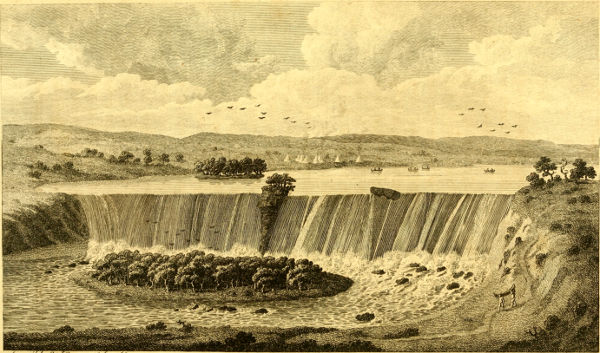
Survey’d by Capt. Carver, Novr. 17, 1766. M. A. Rooker Sculpt.
Height of the Fall 30 feet Perpendr.
The falls of St. Anthony in the River Mississippi,
near 2400 Miles from its entrance into the Gulf of Mexico.
Breadth, near 600 feet.
At a little distance below the Falls stands a small island, of about an acre and half, on which grow a great number of oak trees, every branch of which, able to support the weight, was full of eagles nests. The reason that this kind of birds resort in such numbers to this spot, is that they are here secure from the attacks either of man or beast, their retreat being guarded by the Rapids, which the Indians never attempt to pass. Another reason is, that they find a constant supply of food for themselves and their young, from the animals and fish which are dashed to pieces by the Falls, and driven on the adjacent shore.
Having satisfied my curiosity, as far as the eye of man can be satisfied, I proceeded on, still accompanied by my young friend, till I had reached the River St. Francis, near sixty miles above the Falls. To this river Father Hennipin gave the name of St. Francis, and this was the extent of his travels, as well as mine, towards the north-west. As the season was so advanced, and the weather extremely cold, I was not able to make so many observations on these parts as I otherwise should have done.
It might however, perhaps, be necessary to observe, that in the little tour I made about the Falls, after travelling fourteen miles, by the side of the Mississippi, I came to a river nearly twenty yards wide, which ran from the north-east, called Rum River. And on the 20th of November came to another termed Goose River, about twelve yards wide. On the 21st I arrived at the St. Francis, which is about thirty yards wide. Here the Mississippi itself grows narrow, being not more than ninety yards over; and appears to be chiefly composed of small branches. The ice prevented me from noticing the depth of any of these three rivers.
The country in some places is hilly, but without large mountains; and the land is tolerably good. I observed here many deer and carribboos, some elk, with abundance of beavers, otters, and other furs. A little above this, to the north-east, are a number of small lakes called the Thousand Lakes; the parts about which, though but little frequented, are the best within many miles for hunting, as the hunter never fails of returning loaded beyond his expectations.
The Mississippi has never been explored higher up than the River St. Francis, and only by Father Hennipin and myself thus far. So that we are obliged solely to the Indians, for all the intelligence we are able to give relative to the more northern parts. As this River is not navigable from the sea for vessels of any considerable burthen, much higher up than the Forks of the Ohio, and even that is accomplished with great difficulty, owing to the rapidity of the current, and the windings of the river, those settlements that may be made on the interior branches of it, must be indisputably secure from the attacks of any maritime power. But at the same time the settlers will have the advantage of being able to convey their produce to the sea-ports with great facility, the current of the river from its source to its entrance into the Gulph of Mexico, being extremely favourable for doing this in small craft. This might also in time be facilitated by canals or shorter cuts; and a communication opened by water with New York, Canada, &c. by way of the lakes. The Forks of the Ohio are about nine hundred miles from the mouth of the Mississippi, following the course of the river; and the Messorie two hundred miles above these. From the latter it is about twenty miles to the Illinois River, and from that to the Ouisconsin, which I have given an account of, about eight hundred more.
On the 25th I returned to my canoe, which I had left at the mouth of the River St. Pierre; and here I parted with regret from my young friend the prince of the Winnebagoes. This river being clear of ice by reason of its southern situation, I found nothing to obstruct my passage. On the 28th, being advanced about forty miles, I arrived at a small branch that fell into it from the north; to which, as it had no name that I could distinguish it by, I gave my own; and the Reader will find it in the plan of my travels denominated Carver’s River. About forty miles higher up I came to the Forks of Verd and Red Marble Rivers, which join at some little distance before they enter the St. Pierre.
The River St. Pierre, at its junction with the Mississippi, is about a hundred yards broad, and continues that breadth nearly all the way I sailed upon it. It has a great depth of water, and in some places runs very briskly. About fifty miles from its mouth are some rapids, and much higher up there are many others.
I proceeded up this river about two hundred miles to the country of the Naudowessies of the Plains, which lies a little above the Forks formed by the Verd and Red Marble Rivers, just mentioned, where a branch from the south nearly joins the Messorie River. By the accounts I received from the Indians, I have reason to believe that the River St. Pierre and the Messorie, though they enter the Mississippi twelve hundred miles from each other, take their rise in the same neighbourhood; and this within the space of a mile. The River St. Pierre’s northern branch rises from a number of lakes near the shining mountains; and it is from some of these, also, that a capital branch of the River Bourbon, which runs into Hudson’s Bay, has its sources.
From the intelligence I gained from the Naudowessie Indians, among whom I arrived the 7th of December, and whose language I perfectly acquired during a residence of five months; and also from the accounts I afterwards obtained from the Assinipoils, who speak the same tongue, being a revolted band of the Naudowessies; and from the Killistinoes, neighbours of the Assinipoils, who speak the Chipéway language, and inhabit the heads of the River Bourbon; I say from these nations, together with my own observations, I have learned that the four most capital rivers on the Continent of North America, viz. the St. Lawrence, the Mississippi, the River Bourbon, and the Oregon or the River of the West (as I hinted in my Introduction) have their sources in the same neighbourhood. The waters of the three former are within thirty miles of each other; the latter, however, is rather farther west.
This shews that these parts are the highest lands in North America; and it is an instance not to be paralleled on the other three quarters of the globe, that four rivers of such magnitude should take their rise together, and each, after running separate courses, discharge their waters into different oceans at the distance of two thousand miles from their sources. For in their passage from this spot to the bay of St. Lawrence, east, to the bay of Mexico, south, to Hudson’s Bay, north, and to the bay at the Straights of Annian, west, each of these traverse upwards of two thousand miles.
I shall here give my Readers such reflections as occurred to me, when I had received this interesting information, and had, by numberless inquiries, ascertained the truth of it; that is, as far as it was possible to arrive at a certainty without a personal investigation.
It is well known that the Colonies, particularly those of New England and Canada, are greatly affected, about the time their winter sets in, by a north-west wind, which continues for several months, and renders the cold much more intense there than it is in the interior parts of America. This I can, from my own knowledge, assert, as I found the winter, that I passed to the westward of the Mississippi, far from severe; and the north-west wind blowing on those countries considerably more temperate than I have often experienced it to be nearer the coast. And that this did not arise from an uncertainty of the seasons, but was annually the case, I conclude, both from the small quantity of snow that then fell, and a total disuse of snow shoes by these Indians, without which none of the more eastern nations can possibly travel during the winter.
As naturalists observe, that air resembles water in many respects, particularly by often flowing in a compact body; and that this is generally remarked to be with the current of large streams, and seldom across them, may not the winds that set violently into the Bay of Mexico about the latter end of the year, take their course over the continent in the same direction as the Mississippi does; till meeting with the north winds (that from a similar cause blow up the Bourbon from Hudson’s Bay) they are forced across the great lakes, down the current of the waters of the St. Lawrence, and united, commit those ravages, and occasion those severe winters, experienced in the before-mentioned countries? During their progress over the lakes they become expanded, and consequently affect a greater tract of land than they otherwise would do.
According to my scanty knowledge of natural philosophy this does not appear improbable. Whether it is agreeable to the laws established by naturalists to account for the operations of that element, I know not. However, the description here given of the situation of these vast bodies of water, and their near approach to each other, with my own undigested suppositions of their effect on the winds, may prove perhaps, in abler hands, the means of leading to many useful discoveries.
On the 7th of December, I arrived (as I said before) at the utmost extent of my travels towards the west; where I met with a large party of the Naudowessie Indians, among whom I resided seven months. These constituted a part of the eight bands of the Naudowessies of the Plains; and are termed the Wawpeentowahs, the Tintons, the Asrahcootans, the Mawhaws, and the Schians. The other three bands, whose names are the Schianese, the Chongousceton, and the Waddapawjestin, dwell higher up, to the west of the River St. Pierre, on plains that, according to their account, are unbounded; and probably terminate on the coast of the Pacific Ocean. The Naudowessie nation, when united, consists of more than two thousand warriors. The Assinipoils, who revolted from them, amount to about three hundred; and leagued with the Killistinoes, live in a continual state of enmity with the other eleven bands.
As I proceeded up the River St. Pierre, and had nearly reached the place where these people were encamped, I observed two or three canoes coming down the stream; but no sooner had the Indians that were on board them discovered us, than they rowed toward the land, and leaping ashore with precipitation, left their canoes to float as the current drove them. In a few minutes I perceived some others; who, as soon as they came in sight, followed, with equal speed, the example of their countrymen.
I now thought it necessary to proceed with caution; and therefore kept on the side of the river opposite to that on which the Indians had landed. However, I still continued my course, satisfied that the pipe of Peace which was fixed at the head of my canoe, and the English colours that were flying at the stern, would prove my security. After rowing about half a mile farther, in turning a point, I discovered a great number of tents, and more than a thousand Indians, at a little distance from the shore. Being now nearly opposite to them, I ordered my men to pull directly over, as I was willing to convince the Indians by such a step, that I placed some confidence in them.
As soon as I had reached the land, two of the chiefs presented their hands to me, and led me, amidst the astonished multitude, who had most of them never seen a white man before, to a tent. Into this we entered, and according to the custom that universally prevails among every Indian nation, began to smoke the pipe of Peace. We had not sat long before the crowd became so great, both around, and upon the tent, that we were in danger of being crushed by its fall. On this we returned to the plain, where, having gratified the curiosity of the common people, their wonder abated, and ever after they treated me with great respect.
From the chiefs I met with the most friendly and hospitable reception; which induced me, as the season was so far advanced, to take up my residence among them during the winter. To render my stay as comfortable as possible, I first endeavoured to learn their language. This I soon did, so as to make myself perfectly intelligible, having before acquired some slight knowledge of the language of those Indians that live on the back of the settlements; and in consequence met with every accommodation their manner of living would afford. Nor did I want for such amusements as tended to make so long a period pass cheerfully away. I frequently hunted with them; and at other times beheld with pleasure their recreations and pastimes, which I shall describe hereafter.
Sometimes I sat with the chiefs, and whilst we smoked the friendly pipe, entertained them, in return for the accounts they gave me of their wars and excursions, with a narrative of my own adventures and a description of all the battles fought between the English and the French in America, in many of which I had a personal share. They always paid great attention to my details, and asked many pertinent questions relative to the European methods of making war.
I held these conversations with them in a great measure to procure from them some information relative to the chief point I had constantly in view, that of gaining a knowledge of the situation and produce, both of their own country, and those that lay to the westward of them. Nor was I disappointed in my designs; for I procured from them much useful intelligence. They likewise drew for me plans of all the countries with which they were acquainted; but as I entertained no great opinion of their geographical knowledge, I placed not much dependence on them, and therefore think it unnecessary to give them to the public. Such as I afterwards found confirmed, by other accounts, or by my own observations, make a part of the map prefixed to this work. They draw with a piece of burnt coal, taken from the hearth, upon the inside bark of the birch tree; which is as smooth as paper, and answers the same purposes, notwithstanding it is of a yellow cast. Their sketches are made in a rude manner, but they seem to give as just an idea of a country, although the plan is not so exact, as more experienced draughtsmen could do.
I left the habitations of these hospitable Indians the latter end of April 1767; but did not part from them for several days, as I was accompanied on my journey by near three hundred of them, among whom were many chiefs, to the mouth of the River St. Pierre. At this season, these bands annually go to the Great Cave, before mentioned, to hold a grand council with all the other bands; wherein they settle their operations for the ensuing year. At the same time they carry with them their dead for interment bound up in buffaloes skins. Besides those that accompanied me, others were gone before, and the rest were to follow.
Never did I travel with so cheerful and happy a company. But their mirth met with a hidden and temporary allay from a violent storm that overtook us one day on our passage. We had just landed, and were preparing to set up our tents for the night, when a heavy cloud overspread the heavens, and the most dreadful thunder, lightning, and rain issued from it, that ever I beheld.
The Indians were greatly terrified, and ran to such shelter as they could find; for only a few tents were as yet erected. Apprehensive of the danger that might ensue from standing near any thing which could serve for a conductor, as the cloud appeared to contain such an uncommon quantity of the electrical fluid, I took my stand as far as possible from any covering; chusing rather to be exposed to the peltings of the storm than to receive a fatal stroke. At this the Indians were greatly surprized, and drew conclusions from it not unfavourable to the opinion they already entertained of my resolution. Yet I acknowledge that I was never more affected in my life; for nothing scarcely could exceed the terrific scene. The peals of thunder were so loud that they shook the earth; and the lightning flashed along the ground in streams of sulphur; so that the Indian chiefs themselves, although their courage in war is usually invincible, could not help trembling at the horrid combustion. As soon as the storm was over, they flocked around me, and informed me, that it was a proof of the anger of the evil spirits, whom they were apprehensive that they had highly offended.
When we arrived at the Great Cave, and the Indians had deposited the remains of their deceased friends in the burial-place that stands adjacent to it, they held their great council, into which I was admitted, and at the same time had the honour to be installed or adopted a chief of their bands. On this occasion I made the following speech, which I insert to give my Readers a specimen of the language and manner in which it is necessary to address the Indians, so as to engage their attention, and to render the speaker’s expressions consonant to their ideas. It was delivered on the first day of May 1767.
“My brothers, chiefs of the numerous and powerful Naudowessies! I rejoice that through my long abode with you, I can now speak to you (though after an imperfect manner) in your own tongue, like one of your own children. I rejoice also that I have had an opportunity so frequently to inform you of the glory and power of the Great King that reigns over the English and other nations; who is descended from a very ancient race of sovereigns, as old as the earth and waters; whose feet stand on two great islands, larger than any you have ever seen, amidst the greatest waters in the world; whose head reaches to the sun, and whose arms encircle the whole earth. The number of whose warriors are equal to the trees in the vallies, the stalks of rice in yonder marshes, or the blades of grass on your great plains. Who has hundreds of canoes of his own, of such amazing bigness, that all the waters in your country would not suffice for one of them to swim in; each of which have guns, not small like mine which you see before you, but of such magnitude, that a hundred of your stoutest young men would with difficulty be able to carry one. And these are equally surprizing in their operation against the great king’s enemies when engaged in battle; the terror they carry with them your language wants words to express. You may remember the other day when we were encamping at Wadawpawmenesoter, the black clouds, the wind, the fire, the stupendous noise, the horrible cracks, and the trembling of the earth which then alarmed you, and gave you reason to think your gods were angry with you; not unlike these are the warlike implements of the English when they are fighting the battles of their great King.
“Several of the chiefs of your bands have often told me, in times past, when I dwelt with you in your tents, that they much wished to be counted among the children and allies of the great King my master. You may remember how often you have desired me, when I return again to my own country, to acquaint the great King of your good disposition towards him and his subjects, and that you wished for traders from the English to come among you. Being now about to take my leave of you, and to return to my own country, a long way towards the rising sun, I again ask you to tell me whether you continue of the same mind as when I spoke to you in council last winter; and as there are now several of your chiefs here, who came from the great plains towards the setting of the sun, whom I have never spoke with in council before, I ask you to let me know if you are all willing to acknowledge yourselves the children of my great master the King of the English and other nations, as I shall take the first opportunity to acquaint him of your desires and good intentions. I charge you not to give heed to bad reports; for there are wicked birds flying about among the neighbouring nations, who may whisper evil things in your ears against the English, contrary to what I have told you; you must not believe them, for I have told you the truth.
“And as for the chiefs that are about to go to Michillimackinac, I shall take care to make for them and their suite, a straight road, smooth waters, and a clear sky; that they may go there, and smoke the pipe of Peace, and rest secure on a beaver blanket under the shade of the great tree of peace. Farewell!”
To this speech I received the following answer, from the mouth of the principal chief:
“Good brother! I am now about to speak to you with the mouths of these my brothers, chiefs of the eight bands of the powerful nation of the Naudowessies. We believe and are well satisfied in the truth of every thing you have told us about your great nation, and the Great King our greatest father; for whom we spread this beaver blanket, that his fatherly protection may ever rest easy and safe amongst us his children: your colours and your arms agree with the accounts you have given us about your great nation. We desire that when you return, you will acquaint the Great King how much the Naudowessies wish to be counted among his good children. You may believe us when we tell you that we will not open our ears to any who may dare to speak evil of our Great Father the King of the English and other nations.
“We thank you for what you have done for us in making peace between the Naudowessies and the Chipéways, and hope when you return to us again, that you will complete this good work; and quite dispelling the clouds that intervene, open the blue sky of peace, and cause the bloody hatchet to be deep buried under the roots of the great tree of peace.
“We wish you to remember to represent to our Great Father, how much we desire that traders may be sent to abide among us, with such things as we need, that the hearts of our young men, our wives, and children may be made glad. And may peace subsist between us, so long as the sun, the moon, the earth, and the waters shall endure. Farewell.”
I thought it necessary to caution the Indians against giving heed to any bad reports that may reach them from the neighbouring nations to the disadvantage of the English, as I had heard, at different places through which I passed, that emissaries were still employed by the French to detach those who were friendly to the English from their interest. And I saw, myself, several belts of Wampum that had been delivered for this purpose to some of the tribes I was among. On the delivery of each of these a Talk was held, wherein the Indians were told that the English, who were but a petty people, had stolen that country from their Great Father the king of France whilst he was asleep; but that he would soon awake, and take them again under his protection. These I found were sent from Canada by persons who appeared to be well affected towards the government under which they lived.
Whilst I tarried at the mouth of the River St. Pierre with these friendly Indians, I endeavoured to gain intelligence whether any goods had been sent towards the Falls of St. Anthony for my use, agreeable to the promise I had received from the governor when I left Michillimackinac. But finding from some Indians, who passed by in their return from those parts, that this agreement had not been fulfilled, I was obliged to give up all thoughts of proceeding farther to the north-west by this route, according to my original plan. I therefore returned to La Prairie le Chien, where I procured as many goods from the traders I left there the preceding year as they could spare.
As these however were not sufficient to enable me to renew my first design, I determined to endeavour to make my way across the country of the Chipéways to Lake Superior; in hopes of meeting at the Grand Portage on the north side of it, the traders that annually go from Michillimackinac to the north-west; of whom I doubted not but that I should be able to procure goods enough to answer my purpose, and also to penetrate through those more northern parts to the Straights of Annian.
And I the more readily returned to La Prairie le Chien, as I could by that means the better fulfil the engagement I had made to the party of Naudowessies mentioned at the conclusion of my speech. During my abode with this people, wishing to secure them entirely in the interest of the English, I had advised some of the chiefs to go to Michillimackinac, where they would have an opportunity of trading, and of hearing the accounts that I had entertained them with of my countrymen confirmed. At the same time I had furnished them with a recommendation to the governor, and given them every direction necessary for their voyage.
In consequence of this one of the principal chiefs, and twenty-five of an inferior rank, agreed to go the ensuing summer. This they took an opportunity of doing when they came with the rest of their band to attend the grand council at the mouth of the River St. Pierre. Being obliged, on account of the disappointment I had just been informed of, to return so far down the Mississippi, I could from thence the more easily set them on their journey.
As the intermediate parts of this river are much frequented by the Chipéways, with whom the Naudowessies are continually at war, they thought it more prudent, being but a small party, to take the advantage of the night, than to travel with me by day; accordingly no sooner was the grand council broke up, than I took a friendly leave of these people, from whom I had received innumerable civilities, and pursued once more my voyage.
I reached the eastern side of Lake Pepin the same night, where I went ashore and encamped as usual. The next morning, when I had proceeded some miles farther, I perceived at a distance before me a smoke, which denoted that some Indians were near; and in a short time discovered ten or twelve tents not far from the bank of the river. As I was apprehensive that this was a party of the Rovers I had before met with, I knew not what course to pursue. My attendants persuaded me to endeavour to pass by them on the opposite side of the river; but as I had hitherto found that the best way to ensure a friendly reception from the Indians is to meet them boldly, and without shewing any tokens of fear, I would by no means consent to their proposal. Instead of this I crossed directly over, and landed in the midst of them, for by this time the greatest part of them were standing on the shore.
The first I accosted were Chipéways inhabiting near the Ottowaw lakes; who received me with great cordiality, and shook me by the hand in token of friendship. At some little distance behind these stood a chief remarkably tall and well made, but of so stern an aspect that the most undaunted person could not behold him without feeling some degree of terror. He seemed to have passed the meridian of life, and by the mode in which he was painted and tatowed, I discovered that he was of high rank. However, I approached him in a courteous manner, and expected to have met with the same reception I had done from the others: but to my great surprize he with-held his hand, and looking fiercely at me, said in the Chipéway tongue, “Cawin nishishin saganosh,” that is, “The English are no good.” As he had his tomahawk in his hand, I expected that this laconick sentence would have been followed by a blow; to prevent which I drew a pistol from my belt, and, holding it in a careless position, passed close by him, to let him see I was not afraid of him.
I learned soon after from the other Indians, that this was a chief, called by the French the Grand Sautor, or the Great Chipéway Chief, for they denominate the Chipéways Sautors. They likewise told me that he had been always a steady friend to that people, and when they delivered up Michillimackinac to the English on their evacuation of Canada, the Grand Sautor had sworn that he would ever remain the avowed enemy of its new possessors, as the territories on which the fort is built belonged to him.
Finding him thus disposed, I took care to be constantly upon my guard whilst I staid; but that he might not suppose I was driven away by his frowns, I took up my abode there for the night. I pitched my tent at some distance from the Indians, and had no sooner laid myself down to rest, than I was awakened by my French servant. Having been alarmed by the sound of Indian music, he had run to the outside of the tent, where he beheld a party of the young savages dancing towards us in an extraordinary manner, each carrying in his hand a torch fixed on the top of a long pole. But I shall defer any further account of this uncommon entertainment, which at once surprized and alarmed me, till I treat of the Indian dances.
The next morning I continued my voyage, and before night reached La Prairie le Chien; at which place the party of Naudowessies soon overtook me. Not long after the Grand Sautor also arrived, and before the Naudowessies left that place to continue their journey to Michillimackinac, he found means, in conjunction with some French traders from Louisiana, to draw from me about ten of the Naudowessie chiefs, whom he prevailed upon to go towards those parts.
The remainder proceeded, according to my directions, to the English fort; from whence I afterwards heard that they returned to their own country without any unfortunate accident befalling them, and greatly pleased with the reception they had met with. Whilst not more than half of those who went to the southward, through the difference of that southern climate from their own, lived to reach their abode. And since I came to England I have been informed, that the Grand Sautor having rendered himself more and more disgustful to the English by his inveterate enmity towards them, was at length stabbed in his tent, as he encamped near Michillimackinac, by a trader to whom I had related the foregoing story.
I should have remarked, that whatever Indians happen to meet at La Prairie le Chien, the great mart to which all who inhabit the adjacent countries resort, though the nations to which they belong are at war with each other, yet they are obliged to restrain their enmity, and to forbear all hostile acts during their stay there. This regulation has been long established among them for their mutual convenience, as without it no trade could be carried on. The same rule is observed also at the Red Mountain (afterwards described) from whence they get the stone of which they make their pipes: these being indispensable to the accommodation of every neighbouring tribe, a similar restriction becomes needful, and is of public utility.
The River St. Pierre, which runs through the territories of the Naudowessies, flows through a most delightful country, abounding with all the necessaries of life, that grow spontaneously; and with a little cultivation it might be made to produce even the luxuries of life. Wild rice grows here in great abundance; and every part is filled with trees bending under their loads of fruits, such as plums, grapes, and apples; the meadows are covered with hops, and many sorts of vegetables; whilst the ground is stored with useful roots, with angelica, spikenard, and ground-nuts as large as hens eggs. At a little distance from the sides of the river are eminences, from which you have views that cannot be exceeded even by the most beautiful of those I have already described; amidst these are delightful groves, and such amazing quantities of maples, that they would produce sugar sufficient for any number of inhabitants.
A little way from the mouth of this river, on the north side of it, stands a hill, one part of which, that towards the Mississippi, is composed entirely of white stone, of the same soft nature as that I have before described; for such, indeed, is all the stone in this country. But what appears remarkable is, that the colour of it is as white as the driven snow. The outward part of it was crumbled by the wind and weather into heaps of sand, of which a beautiful composition might be made; or, I am of opinion that, when properly treated, the stone itself would grow harder by time, and have a very noble effect in architecture.
Near that branch which is termed the Marble River, is a mountain, from whence the Indians get a sort of red stone, out of which they hew the bowls of their pipes. In some of these parts is found a black hard clay, or rather stone, of which the Naudowessies make their family utensils. This country likewise abounds with a milk-white clay, of which China ware might be made equal in goodness to the Asiatic; and also with a blue clay that serves the Indians for paint; with this last they contrive, by mixing it with the red stone powdered, to paint themselves of different colours. Those that can get the blue clay here mentioned, paint themselves very much with it; particularly when they are about to begin their sports and pastimes. It is also esteemed by them a mark of peace, as it has a resemblance of a blue sky, which with them is a symbol of it, and made use of in their speeches as a figurative expression to denote peace. When they wish to shew that their inclinations are pacific towards other tribes, they greatly ornament both themselves and their belts with it.
Having concluded my business at La Prairie le Chien, I proceeded once more up the Mississippi as far as the place where the Chipéway River enters it a little below Lake Pepin. Here, having engaged an Indian pilot, I directed him to steer towards the Ottawaw Lakes which lie near the head of this river. This he did, and I arrived at them the beginning of July.
The Chipéway River, at its junction with the Mississippi, is about eighty yards wide, but is much wider as you advance into it. Near thirty miles up it separates into two branches, and I took my course through that which lies to the eastward.
The country adjoining to the river, for about sixty miles, is very level, and on its banks lie fine meadows, where larger droves of buffaloes and elks were feeding, than I had observed in any other part of my travels. The track between the two branches of this river is termed the Road of War between the Chipéway and Naudowessie Indians.
The country to the Falls marked in the plan at the extent of the traders travels, is almost without any timber, and above that very uneven and rugged, and closely wooded with pines, beech, maple, and birch. Here a most remarkable and astonishing sight presented itself to my view. In a wood, on the east of the river, which was about three quarters of a mile in length, and in depth farther than my eye could reach, I observed that every tree, many of which were more than six feet in circumference, was lying flat on the ground torn up by the roots. This appeared to have been done by some extraordinary hurricane that came from the west some years ago, but how many I could not learn, as I found no inhabitants near it, of whom I could gain information. The country on the west side of the river, from being less woody, had escaped in a great measure this havock, as only a few trees were blown down.
Near the heads of this river is a town of the Chipéways, from whence it takes its name. It is situated on each side of the river (which at this place is of no considerable breadth) and lies adjacent to the banks of a small lake. This town contains about forty houses, and can send out upwards of one hundred warriors, many of whom were fine stout young men. The houses of it are built after the Indian manner, and have neat plantations behind them; but the inhabitants, in general, seemed to be the nastiest people I had ever been among. I observed that the women and children indulged themselves in a custom, which though common, in some degree, throughout every Indian nation, appears to be, according to our ideas, of the most nauseous and indelicate nature; that of searching each other’s head, and eating the prey caught therein.
In July I left this town, and having crossed a number of small lakes and carrying places that intervened, came to a head branch of the River St. Croix. This branch I descended to a fork, and then ascended another to its source. On both these rivers I discovered several mines of virgin copper, which was as pure as that found in any other country.
Here I came to a small brook, which my guide thought might be joined at some distance by streams that would at length render it navigable. The water at first was so scanty, that my canoe would by no means swim in it; but having stopped up several old beaver dams which had been broken down by the hunters, I was enabled to proceed for some miles, till by the conjunction of a few brooks, these aids became no longer necessary. In a short time the water increased to a most rapid river, which we descended till it entered into Lake Superior. This river I named after a gentleman that desired to accompany me from the town of the Ottagaumies to the Carrying Place on Lake Superior, Goddard’s River.
To the west of this is another small river, which also empties itself into the Lake. This I termed Strawberry River, from the great number of strawberries of a good size and fine flavour that grew on its banks.
The country from the Ottawaw Lakes to Lake Superior is in general very uneven and thickly covered with woods. The soil in some places tolerably good, in others but indifferent. In the heads of the St. Croix and the Chipéway Rivers are exceeding fine sturgeon. All the wilderness between the Mississippi and Lake Superior is called by the Indians the Moschettoe country, and I thought it most justly named; for, it being then their season, I never saw or felt so many of those insects in my life.
The latter end of July I arrived, after having coasted through West Bay, at the Grand Portage, which lies on the north-west borders of Lake Superior. Here those who go on the north-west trade, to the Lakes De Pluye, Dubois, &c. carry over their canoes and baggage about nine miles, till they come to a number of small lakes, the waters of some of which descend into Lake Superior, and others into the River Bourbon. Lake Superior from West Bay to this place is bounded by rocks, except towards the south-west part of the Bay where I first entered it, there it was tolerably level.
At the Grand Portage is a small bay, before the entrance of which lies an island that intercepts the dreary and uninterrupted view over the Lake which otherwise would have presented itself, and makes the bay serene and pleasant. Here I met a large party of the Killistinoe and Assinipoil Indians, with their respective kings and their families. They were come to this place in order to meet the traders from Michillimackinac, who make this their road to the north-west. From them I received the following account of the Lakes that lie to the north-west of Lake Superior.
Lake Bourbon, the most northern of those yet discovered, received its name from some French traders who accompanied a party of Indians to Hudson’s Bay some years ago; and was thus denominated by them in honour of the royal family of France. It is composed of the waters of the Bourbon River, which, as I have before observed, rises a great way to the southward, not far from the northern heads of the Mississippi.
This Lake is about eighty miles in length, north and south, and is nearly circular. It has no very large islands on it. The land on the eastern side is very good; and to the south-west there are some mountains: in many other parts there are barren plains, bogs, and morasses. Its latitude is between fifty-two and fifty-four degrees north, and it lies nearly south-west from Hudson’s Bay. As through its northern situation the weather there is extremely cold, only a few animals are to be found in the country that borders on it. They gave me but an indifferent account either of the beasts, birds, or fishes. There are indeed some buffaloes of a small size, which are fat and good about the latter end of summer, with a few moose and carribboo deer; however this deficiency is made up by the furs of every sort that are to be met with in great plenty around the Lake. The timber growing here is chiefly fir, cedar, spruce, and some maple.
Lake Winnepeek, or as the French write it Lac Ouinipique, which lies nearest to the foregoing, is composed of the same waters. It is in length about two hundred miles north and south; its breadth has never been properly ascertained, but is supposed to be about one hundred miles in its widest part. This Lake is very full of islands; these are, however, of no great magnitude. Many considerable rivers empty themselves into it, which, as yet, are not distinguished by any names. The waters are stored with fish, such as trout and sturgeon, and also with others of a smaller kind peculiar to these Lakes.
The land on the south-west part of it is very good, especially about the entrance of a large branch of the River Bourbon which flows from the south-west. On this River there is a factory that was built by the French called Fort La Reine, to which the traders from Michillimackinac resort to trade with the Assinipoils and Killistinoes. To this place the Mahahs, who inhabit a country two hundred and fifty miles south-west, come also to trade with them; and bring great quantities of Indian corn to exchange for knives, tomahawks, and other articles. These people are supposed to dwell on some of the branches of the River of the West.
Lake Winnepeek has on the north-east some mountains, and on the east many barren plains. The maple or sugar tree grows here in great plenty, and there is likewise gathered an amazing quantity of rice, which proves that grain will flourish in these northern climates as well as in warmer. Buffaloes, carribboo, and moose deer, are numerous in these parts. The buffaloes of this country differ from those that are found more to the south only in size; the former being much smaller: just as the black cattle of the northern parts of Great Britain differ from English oxen.
On the waters that fall into this Lake, the neighbouring nations take great numbers of excellent furs. Some of these they carry to the factories and settlements belonging to the Hudson’s Bay Company, situated above the entrance of the Bourbon River: but this they do with reluctance on several accounts; for some of the Assinipoils and Killistinoes, who usually traded with the Company’s servants, told me, that if they could be sure of a constant supply of goods from Michillimackinac, they would not trade any where else. They shewed me some cloth and other articles that they had purchased at Hudson’s Bay, with which they were much dissatisfied, thinking they had been greatly imposed upon in the barter.
Allowing that their accounts were true, I could not help joining in their opinion. But this dissatisfaction might probably proceed, in a great measure, from the intrigues of the Canadian traders: for whilst the French were in possession of Michillimackinac, having acquired a thorough knowledge of the trade of the north-west countries, they were employed on that account, after the reduction of Canada, by the English traders there, in the establishment of this trade with which they were themselves quite unacquainted. One of the methods they took to withdraw these Indians from their attachment to the Hudson’s Bay Company, and to engage their good opinion in behalf of their new employers, was by depreciating on all occasions the Company’s goods, and magnifying the advantages that would arise to them from trafficking entirely with the Canadian traders. In this they too well succeeded, and from this, doubtless, did the dissatisfaction the Assinipoils and Killistinoes expressed to me, partly proceed. But another reason augmented it; and this was the length of their journey to the Hudson’s Bay factories, which, they informed me, took them up three months during the summer heats to go and return, and from the smallness of their canoes they could not carry more than a third of the beavers they killed. So that it is not to be wondered at, that these Indians should wish to have traders come to reside among them. It is true that the parts they inhabit are within the limits of the Hudson’s Bay territories, but the Company must be under the necessity of winking at an encroachment of this kind, as the Indians would without doubt protect the traders when among them. Besides, the passports granted to the traders that go from Michillimackinac give them liberty to trade to the north-west about Lake Superior; by which is meant Fort La Reine, Lake Winnepeek, or any other parts of the waters of the Bourbon River, where the Couriers de Bois, or Traders, may make it most convenient to reside.
Lac du Bois, as it is commonly termed by the French in their maps, or in English the Lake of the Wood, is so called from the multiplicity of wood growing on its banks; such as oaks, pines, firs, spruce, &c. This Lake lies still higher up a branch of the River Bourbon, and nearly east from the south end of Lake Winnepeek. It is of great depth in some places. Its length from east to west about seventy miles, and its greatest breadth about forty miles. It has but few islands, and these of no great magnitude. The fishes, fowls, and quadrupeds that are found near it, vary but little from those of the other two lakes. A few of the Killistinoe Indians sometimes encamp on the borders of it to fish and hunt.
This Lake lies in the communication between Lake Superior, and the Lakes Winnepeek and Bourbon. Its waters are not esteemed quite so pure as those of the other lakes, it having, in many places, a muddy bottom.
Lac La Pluye, so called by the French, in English the Rainy Lake, is supposed to have acquired this name from the first travellers, that passed over it, meeting with an uncommon deal of rain; or, as some have affirmed, from a mist like rain occasioned by a perpendicular water-fall that empties itself into a river which lies to the south-west.
This Lake appears to be divided by an isthmus, near the middle, into two parts: the west part is called the Great Rainy Lake, the east, the Little Rainy Lake, as being the least division. It lies a few miles farther to the eastward, on the same branch of the Bourbon, than the last-mentioned Lake. It is in general very shallow in its depth. The broadest part of it is not more than twenty miles, its length, including both, about three hundred miles. In the west part the water is very clear and good; and some excellent fish are taken in it. A great many fowl resort here at the fall of the year. Moose deer are to be found in great plenty, and likewise the carribboo; whose skin for breeches or gloves exceeds by far any other to be met with in North-America. The land on the borders of this Lake is esteemed in some places very good, but rather too thickly covered with wood. Here reside a considerable band of the Chipéways.
Eastward from this Lake lie several small ones, which extend in a string to the great carrying place, and from thence into Lake Superior. Between these little Lakes are several carrying places, which renders the trade to the north-west difficult to accomplish, and exceedingly tedious, as it takes two years to make one voyage from Michillimackinac to these parts.
Red Lake is a comparatively small lake at the head of a branch of the Bourbon River, which is called by some Red River. Its form is nearly round, and about sixty miles in circumference. On one side of it is a tolerable large island, close by which a small river enters. It bears almost south-east both from Lake Winnepeek and from Lake du Bois. The parts adjacent are very little known, or frequented, even by the savages themselves.
Not far from this Lake, a little to the south-west, is another called White Bear Lake, which is nearly about the size of the last mentioned. The waters that compose this Lake are the most northern of any that supply the Mississippi, and may be called with propriety its most remote source. It is fed by two or three small rivers or rather large brooks.
A few miles from it, to the south-east, are a great number of small lakes, none of which are more than ten miles in circumference, that are called the Thousand Lakes. In the adjacent country is reckoned the finest hunting for furs of any on this continent; the Indians who hunt here seldom returning without having their canoes loaded as deep as they can swim.
Having just before observed that this Lake is the utmost northern source of the Mississippi, I shall here further remark, that before this river enters the Gulph of Mexico, it has not run less, through all its meanderings, than three thousand miles; or, in a strait line from north to south, about twenty degrees, which is nearly fourteen hundred English miles.
These Indians informed me, that to the north-west of Lake Winnepeek lies another, whose circumference vastly exceeded any they had given me an account of. They describe it as much larger than Lake Superior. But as it appears to be so far to the north-west, I should imagine that it was not a lake, but rather the Archipelago or broken waters that form the communication between Hudson’s Bay and the northern parts of the Pacific Ocean.
There are an infinite number of small lakes, on the more western parts of the western head-branches of the Mississippi, as well as between these and Lake Winnepeek, but none of them are large enough to suppose either of them to be the lake or waters meant by the Indians.
They likewise informed me, that some of the northern branches of the Messorie and the southern branches of the St. Pierre have a communication with each other, except for a mile; over which they carry their canoes. And by what I could learn from them, this is the road they take when their war parties make their excursions upon the Pawnees and Pawnawnees, nations inhabiting some branches of the Messorie River. In the country belonging to these people it is said, that Mandrakes are frequently found, a species of root resembling human beings of both sexes; and that these are more perfect than such as are discovered about the Nile in Nether-Ethiopia.
A little to the north-west of the heads of the Messorie and the St. Pierre, the Indians further told me, that there was a nation rather smaller and whiter than the neighbouring tribes, who cultivate the ground, and (as far as I could gather from their expressions) in some measure, the arts. To this account they added that some of the nations, who inhabit those parts that lie to the west of the Shining Mountains, have gold so plenty among them that they make their most common utensils of it. These mountains (which I shall describe more particularly hereafter) divide the waters that fall into the South Sea from those that run into the Atlantic.
The people dwelling near them are supposed to be some of the different tribes that were tributary to the Mexican kings, and who fled from their native country to seek an asylum in these parts, about the time of the conquest of Mexico by the Spaniards, more than two centuries ago.
As some confirmation of this supposition it is remarked, that they have chosen the most interior parts for their retreat, being still prepossessed with a notion that the sea-coasts have been infested ever since with monsters vomiting fire, and hurling about thunder and lightning; from whose bowels issued men, who, with unseen instruments, or by the power of magick, killed the harmless Indians at an astonishing distance. From such as these, their fore-fathers (according to a tradition among them that still remains unimpaired) fled to the retired abodes they now inhabit. For as they found that the floating monsters which had thus terrified them could not approach the land, and that those who had descended from their sides did not care to make excursions to any considerable distance from them, they formed a resolution to betake themselves to some country, that lay far from the sea-coasts, where only they could be secure from such diabolical enemies. They accordingly set out with their families, and after a long peregrination, settled themselves near these mountains, where they concluded they had found a place of perfect security.
The Winnebagoes, dwelling on the Fox River (whom I have already treated of) are likewise supposed to be some strolling band from the Mexican countries. But they are able to give only an imperfect account of their original residence. They say they formerly came a great way from the westward, and were driven by wars to take refuge among the Naudowessies; but as they are entirely ignorant of the arts, or of the value of gold, it is rather to be supposed, that they were driven from their ancient settlements by the above-mentioned emigrants, as they passed on towards their present habitation.
These suppositions, however, may want confirmation; for the smaller tribes of Indians are subject to such various alterations in their places of abode, from the wars they are continually engaged in, that it is almost impossible to ascertain, after half a century, the original situation of any of them.
That range of mountains, of which the Shining Mountains are a part, begin at Mexico, and continuing northward on the back, or to the east of California, separate the waters of those numerous rivers that fall either into the Gulph of Mexico, or the Gulph of California. From thence continuing their course still northward, between the sources of the Mississippi and the rivers that run into the South Sea, they appear to end in about forty-seven or forty-eight degrees of north latitude; where a number of rivers arise, and empty themselves either into the South Sea, into Hudson’s Bay, or into the waters that communicate between these two seas.
Among these mountains, those that lie to the west of the River St. Pierre, are called the Shining Mountains, from an infinite number of chrystal stones, of an amazing size, with which they are covered, and which, when the sun shines full upon them, sparkle so as to be seen at a very great distance.
This extraordinary range of mountains is calculated to be more than three thousand miles in length, without any very considerable intervals, which I believe surpasses any thing of the kind in the other quarters of the globe. Probably in future ages they may be found to contain more riches in their bowels, than those of Indostan and Malabar, or that are produced on the Golden Coast of Guinea; nor will I except even the Peruvian Mines. To the west of these mountains, when explored by future Columbuses or Raleighs, may be found other lakes, rivers, and countries, full fraught with all the necessaries or luxuries of life; and where future generations may find an asylum, whether driven from their country by the ravages of lawless tyrants, or by religious persecutions, or reluctantly leaving it to remedy the inconveniences arising from a superabundant increase of inhabitants; whether, I say, impelled by these, or allured by hopes of commercial advantages, there is little doubt but their expectations will be fully gratified in these rich and unexhausted climes.
But to return to the Assinipoils and Killistinoes, whom I left at the Grand Portage, and from whom I received the foregoing account of the lakes that lie to the north-west of this place.
The traders we expected being later this season than usual, and our numbers very considerable, for there were more than three hundred of us, the stock of provision we had brought with us was nearly exhausted, and we waited with impatience for their arrival.
One day, whilst we were all expressing our wishes for this desirable event, and looking from an eminence in hopes of seeing them come over the lake, the chief priest belonging to the band of the Killistinoes told us, that he would endeavour to obtain a conference with the Great Spirit, and know from him when the traders would arrive. I paid little attention to this declaration, supposing that it would be productive of some juggling trick, just sufficiently covered to deceive the ignorant Indians. But the king of that tribe telling me that this was chiefly undertaken by the priest to alleviate my anxiety, and at the same time to convince me how much interest he had with the Great Spirit, I thought it necessary to restrain my animadversions on his design.
The following evening was fixed upon for this spiritual conference. When every thing had been properly prepared, the king came to me and led me to a capacious tent, the covering of which was drawn up, so as to render what was transacting within visible to those who stood without. We found the tent surrounded by a great number of the Indians, but we readily gained admission, and seated ourselves on skins laid on the ground for that purpose.
In the centre I observed that there was a place of an oblong shape, which was composed of stakes stuck in the ground, with intervals between, so as to form a kind of chest or coffin, large enough to contain the body of a man. These were of a middle size, and placed at such a distance from each other, that whatever lay within them was readily to be discerned. The tent was perfectly illuminated by a great number of torches made of splinters cut from the pine or birch tree, which the Indians held in their hands.
In a few minutes the priest entered; when an amazing large elk’s skin being spread on the ground, just at my feet, he laid himself down upon it, after having stript himself of every garment except that which he wore close about his middle. Being now prostrate on his back, he first laid hold of one side of the skin, and folded it over him, and then the other; leaving only his head uncovered. This was no sooner done, than two of the young men who stood by took about forty yards of strong cord, made also of an elk’s hide, and rolled it tight round his body, so that he was completely swathed within the skin. Being thus bound up like an Egyptian Mummy, one took him by the heels, and the other by the head, and lifted him over the pales into the inclosure. I could also now discern him as plain as I had hitherto done, and I took care not to turn my eyes a moment from the object before me, that I might the more readily detect the artifice; for such I doubted not but that it would turn out to be.
The priest had not lain in this situation more than a few seconds, when he began to mutter. This he continued to do for some time, and then by degrees grew louder and louder, till at length he spoke articulately; however what he uttered was in such a mixed jargon of the Chipéway, Ottowaw, and Killistinoe languages, that I could understand but very little of it. Having continued in this tone for a considerable while, he at last exerted his voice to its utmost pitch, sometimes raving and sometimes praying, till he had worked himself into such an agitation, that he foamed at his mouth.
After having remained near three quarters of an hour in the place, and continued his vociferation with unabated vigor, he seemed to be quite exhausted, and remained speechless. But in an instant he sprung upon his feet, notwithstanding at the time he was put in, it appeared impossible for him to move either his legs or arms, and shaking off his covering, as quick as if the bands with which it had been bound were burned asunder, he began to address those who stood around in a firm and audible voice. “My Brothers,” said he, “the Great Spirit has deigned to hold a Talk with his servant at my earnest request. He has not, indeed, told me when the persons we expect will be here, but to-morrow, soon after the sun has reached his highest point in the heavens, a canoe will arrive, and the people in that will inform us when the traders will come.” Having said this, he stepped out of the inclosure, and after he had put on his robes, dismissed the assembly. I own I was greatly astonished at what I had seen; but as I observed that every eye in the company was fixed on me with a view to discover my sentiments, I carefully concealed every emotion.
The next day the sun shone bright, and long before noon all the Indians were gathered together on the eminence that overlooked the lake. The old king came to me and asked me, whether I had so much confidence in what the priest had foretold, as to join his people on the hill, and wait for the completion of it? I told him I was at a loss what opinion to form of the prediction, but that I would readily attend him. On this we walked together to the place where the others were assembled. Every eye was again fixed by turns on me and on the lake; when just as the sun had reached his zenith, agreeable to what the priest had foretold, a canoe came round a point of land about a league distant. The Indians no sooner beheld it, than they sent up an universal shout, and by their looks seemed to triumph in the interest their priest thus evidently had with the Great Spirit.
In less than an hour the canoe reached the shore, when I attended the king and chiefs to receive those who were on board. As soon as the men were landed, we walked all together to the king’s tent, when according to their invariable custom we began to smoke; and this we did, notwithstanding our impatience to know the tidings they brought, without asking any questions; for the Indians are the most deliberate people in the world. However, after some trivial conversation, the king inquired of them whether they had seen any thing of the traders? the men replied, that they had parted from them a few days before, and that they proposed being here the second day from the present. They accordingly arrived at that time greatly to our satisfaction, but more particularly so to that of the Indians, who found by this event the importance both of their priest and of their nation, greatly augmented in the sight of a stranger.
This story I acknowledge appears to carry with it marks of great credulity in the relator. But no one is less tinctured with that weakness than myself. The circumstances of it I own are of a very extraordinary nature; however, as I can vouch for their being free from either exaggeration or misrepresentation, being myself a cool and dispassionate observer of them all, I thought it necessary to give them to the public. And this I do without wishing to mislead the judgment of my Readers, or to make any superstitious impressions on their minds, but leaving them to draw from it what conclusions they please.
I have already observed that the Assinipoils, with a part of whom I met here, are a revolted band of the Naudowessies; who on account of some real or imagined grievances, for the Indians in general are very tenacious of their liberty, had separated themselves from their countrymen, and sought for freedom at the expence of their ease. For the country they now inhabit about the borders of Lake Winnepeek, being much farther north, is not near so fertile or agreeable as that they have relinquished. They still retain the language and manners of their former associates.
The Killistinoes, now the neighbours and allies of the Assinipoils, for they also dwell near the same Lake and on the waters of the River Bourbon, appear to have been originally a tribe of the Chipéways, as they speak their language, though in a different dialect. Their nation consists of about three or four hundred warriors, and they seem to be a hardy brave people. I have already given an account of their country when I treated of Lake Winnepeek. As they reside within the limits of Hudson’s Bay, they generally trade at the factories which belong to that Company, but, for the reasons mentioned before, they frequently come to the place where I happened to join them, in order to meet the traders from Michillimackinac.
The anxiety I had felt on account of the traders delay, was not much alleviated by their arrival. I again found my expectations disappointed, for I was not able to procure the goods I wanted from any of them. I was therefore obliged to give over my designs, and return to the place from whence I first began my extensive circuit. I accordingly took leave of the old king of the Killistinoes, with the chiefs of both bands, and departed. This prince was upwards of sixty years of age, tall and slightly made, but he carried himself very erect. He was of a courteous, affable disposition, and treated me, as did all the chiefs, with great civility.
I observed that this people still continued a custom, that appeared to have been universal before any of them became acquainted with the manners of the Europeans, that of complimenting strangers with the company of their wives; and this is not only practised by the lower ranks, but by the chiefs themselves, who esteem it the greatest proof of courtesy they can give a stranger.
The beginning of October, after having coasted round the north and east borders of Lake Superior, I arrived at Cadot’s Fort, which adjoins to the Falls of St. Marie, and is situated near the south-west corner of it.
Lake Superior, formerly termed the Upper Lake from its northern situation, is so called on account of its being superior in magnitude to any of the lakes on that vast continent. It might justly be termed the Caspian of America, and is supposed to be the largest body of fresh water on the globe. Its circumference, according to the French charts, is about fifteen hundred miles; but I believe, that if it was coasted round, and the utmost extent of every bay taken, it would exceed sixteen hundred.
After I first entered it from Goddard’s River on the west Bay, I coasted near twelve hundred miles of the north and east shores of it, and observed that the greatest part of that extensive tract was bounded by rocks and uneven ground. The water in general appeared to lie on a bed of rocks. When it was calm, and the sun shone bright, I could sit in my canoe, where the depth was upwards of six fathoms, and plainly see huge piles of stone at the bottom, of different shapes, some of which appeared as if they were hewn. The water at this time was as pure and transparent as air; and my canoe seemed as if it hung suspended in that element. It was impossible to look attentively through this limpid medium at the rocks below, without finding, before many minutes were elapsed, your head swim, and your eyes no longer able to behold the dazzling scene.
I discovered also by accident another extraordinary property in the waters of this Lake. Though it was in the month of July that I passed over it, and the surface of the water, from the heat of the superambient air, impregnated with no small degree of warmth, yet on letting down a cup to the depth of about a fathom, the water drawn from thence was so excessively cold, that it had the same effect when received into the mouth as ice.
The situation of this Lake is variously laid down; but from the most exact observations I could make, it lies between forty-six and fifty degrees of north latitude, and between eighty-four and ninety-three degrees of west longitude from the meridian of London.
There are many islands in this Lake, two of which are very large; and if the land of them is proper for cultivation, there appears to be sufficient to form on each a considerable province; especially on Isle Royal, which cannot be less than an hundred miles long, and in many places forty broad. But there is no way at present of ascertaining the exact length or breadth of either. Even the French, who always kept a small schooner on this lake whilst they were in possession of Canada, by which they could have made this discovery, have only acquired a slight knowledge of the external parts of these islands; at least they have never published any account of the internal parts of them, that I could get intelligence of.
Nor was I able to discover from any of the conversations which I held with the neighbouring Indians, that they had ever made any settlements on them, or even landed there in their hunting excursions. From what I could gather by their discourse, they suppose them to have been, from their first information, the residence of the Great Spirit; and relate many ridiculous stories of enchantment and magical tricks that had been experienced by such as were obliged through stress of weather to take shelter on them.
One of the Chipéway chiefs told me, that some of their people being once driven on the island of Mauropas, which lies towards the north-east part of the Lake, found on it large quantities of a heavy shining yellow sand, that from their description must have been gold dust. Being struck with the beautiful appearance of it, in the morning, when they re-entered their canoe, they attempted to bring some away; but a spirit of an amazing size, according to their account sixty feet in height, strode into the water after them, and commanded them to deliver back what they had taken away. Terrified at his gigantic stature, and seeing that he had nearly overtaken them, they were glad to restore their shining treasure; on which they were suffered to depart without further molestation. Since this incident, no Indian that has ever heard of it, will venture near the same haunted coast. Besides this, they recounted to me many other stories of these islands, equally fabulous.
The country on the north and east parts of Lake Superior is very mountainous and barren. The weather being intensely cold in the winter, and the sun having but little power in the summer, vegetation there is very slow; and consequently but little fruit is to be found on its shore. It however produces some few species in great abundance. Whirtleberries of an uncommon size, and fine flavour, grow on the mountains near the Lake in amazing quantities; as do black currants and goosberries in the same luxuriant manner.
But the fruit which exceeds all the others, is a berry resembling a rasberry in its manner of growth, but of a lighter red, and much larger; its taste is far more delicious than the fruit I have compared it to, notwithstanding that it is so highly esteemed in Europe: it grows on a shrub of the nature of a vine, with leaves similar to those of the grape; and I am persuaded that was it transplanted into a warmer and more kindly climate, it would prove a most rare and delicious fruit.
Two very large rivers empty themselves into this Lake, on the north and north-east side; one is called the Nipegon River, or, as the French pronounce it, the Allanipegon, which leads to a band of the Chipéways, inhabiting a lake of the same name, and the other is termed the Michipicooton River, the source of which is situated towards James’s Bay, from whence there is but a short carriage to another river, which empties itself into that bay, at a fort belonging to the Company. It was by this passage that a party of French from Michillimackinac invaded the settlements of that Society in the reign of Queen Anne. Having taken and destroyed their forts, they brought the cannon which they found in them to the fortress from whence they had issued; these were small brass pieces, and remain there to this present time; having, through the usual revolutions of fortune, returned to the possession of their former masters.
Not far from the Nipegon is a small river, that, just before it enters the Lake, has a perpendicular fall from the top of a mountain, of more than six hundred feet. Being very narrow, it appears at a distance like a white garter suspended in the air.
A few Indians inhabit round the eastern borders of this lake, supposed to be the remains of the Algonkins, who formerly possessed this country, but who have been nearly extirpated by the Iroquois of Canada. Lake Superior has near forty rivers that fall into it, some of which are of a considerable size. On the south side of it is a remarkable point or cape, of about sixty miles in length, called Point Chegomegan. It might as properly be termed a peninsula, as it is nearly separated from the continent, on the east side, by a narrow bay that extends from east to west. Canoes have but a short portage across the isthmus, whereas if they coast it round, the voyage is more than an hundred miles.
About that distance to the west of the cape just described, a considerable river falls into the Lake, the head of which is composed of a great assemblage of small streams. This river is remarkable for the abundance of virgin copper that is found on and near its banks. A metal which is met with also in several other places on this coast. I observed that many of the small islands, particularly those on the eastern shores, were covered with copper ore. They appeared like beds of copperas, of which many tuns lay in a small space.
A company of adventurers from England began, soon after the conquest of Canada, to bring away some of this metal, but the distracted situation of affairs in America has obliged them to relinquish their scheme. It might in future times be made a very advantageous trade, as the metal, which costs nothing on the spot, and requires but little expence to get it on board, could be conveyed in boats or canoes through the Falls of St. Marie to the Isle of St. Joseph, which lies at the bottom of the Straights near the entrance into Lake Huron; from thence it might be put on board larger vessels, and in them transported across that Lake to the Falls of Niagara; there being carried by land across the Portage, it might be conveyed without much more obstruction to Quebec. The cheapness and ease with which any quantity of it may be procured, will make up for the length of way that it is necessary to transport it before it reaches the sea-coast, and enable the proprietors to send it to foreign markets on as good terms as it can be exported from other countries.
Lake Superior abounds with variety of fish, the principal and best are the trout and sturgeon, which may be caught at almost any season in the greatest abundance. The trouts in general weigh about twelve pounds, but some are caught that exceed fifty. Besides these, a species of white fish is taken in great quantities here, that resemble a shad in their shape, but they are rather thicker, and less bony; they weigh about four pounds each, and are of a delicious taste. The best way of catching these fish is with a net; but the trout might be taken at all times with the hook. There are likewise many sorts of smaller fish in great plenty here, and which may be taken with ease; among these is a sort resembling a herring, that are generally made use of as a bait for the trout. Very small crabs, not larger than half a crown piece, are found both in this and Lake Michegan.
This Lake is as much affected by storms as the Atlantic Ocean; the waves run as high, and are equally as dangerous to ships. It discharges its waters from the south-east corner, through the Straights of St. Marie. At the upper end of these Straights stands a fort that receives its name from them, commanded by Mons. Cadot, a French Canadian, who being proprietor of the soil, is still permitted to keep possession of it. Near this fort is a very strong rapid, against which, though it is impossible for canoes to ascend, yet when conducted by careful pilots, they might pass down without danger.
Though Lake Superior, as I have before observed, is supplied by near forty rivers, many of which are considerable ones, yet it does not appear that one-tenth part of the waters which are conveyed into it by these rivers are carried off at this evacuation. How such a superabundance of water can be disposed of, as it must certainly be by some means or other, without which the circumference of the lake would be continually enlarging, I know not: that it does not empty itself, as the Mediterranean Sea is supposed to do, by an under current, which perpetually counteracts that near the surface, is certain; for the stream which falls over the rock is not more than five or six feet in depth, and the whole of it passes on through the Straights into the adjacent lake; nor is it probable that so great a quantity can be absorbed by exhalations; consequently they must find a passage through some subterranean cavities, deep, unfathomable, and never to be explored.
The Falls of St. Marie do not descend perpendicularly as those of Niagara or St. Anthony do, but consist of a rapid which continues near three quarters of a mile, over which canoes well piloted might pass.
At the bottom of these Falls, Nature has formed a most commodious station for catching the fish which are to be found there in immense quantities. Persons standing on the rocks that lie adjacent to it, may take with dipping nets, about the months of September and October, the white fish before mentioned; at that season, together with several other species, they croud up to this spot in such amazing shoals, that enough may be taken to supply, when properly cured, thousands of inhabitants throughout the year.
The Straights of St. Marie are about forty miles long, bearing south-east, but varying much in their breadth. The current between the Falls and Lake Huron is not so rapid as might be expected, nor do they prevent the navigation of ships of burden as far up as the island of St. Joseph.
It has been observed by travellers that the entrance into Lake Superior, from these Straights, affords one of the most pleasing prospects in the world. The place in which this might be viewed to the greatest advantage, is just at the opening of the lake, from whence may be seen on the left, many beautiful little islands that extend a considerable way before you; and on the right, an agreeable succession of small points of land, that project a little way into the water, and contribute, with the islands, to render this delightful bason (as it might be termed) calm and secure from the ravages of those tempestuous winds by which the adjoining lake is frequently troubled.
Lake Huron, into which you now enter from the Straights of St. Marie, is the next in magnitude to Lake Superior. It lies between forty-two and forty-six degrees of north latitude, and seventy-nine and eighty-five degrees of west longitude. Its shape is nearly triangular, and its circumference about one thousand miles.
On the north side of it lies an island that is remarkable for being near an hundred miles in length, and no more than eight miles broad. This island is known by the name of Manataulin, which signifies a Place of Spirits, and is considered by the Indians as sacred as those already mentioned in Lake Superior.
About the middle of the south-west side of this lake is Saganaum Bay. The capes that separate this bay from the lake, are about eighteen miles distant from each other; near the middle of the intermediate space stand two islands, which greatly tend to facilitate the passage of canoes and small vessels, by affording them shelter, as without this security it would not be prudent to venture across so wide a sea; and the coasting round the bay would make the voyage long and tedious. This bay is about eighty miles in length, and in general about eighteen or twenty miles broad.
Nearly half way between Saganaum Bay and the north-west corner of the Lake lies another, which is termed Thunder Bay. The Indians, who have frequented these parts from time immemorial, and every European traveller that has passed through it, have unanimously agreed to call it by this name, on account of the continual thunder they have always observed here. The bay is about nine miles broad, and the same in length, and whilst I was passing over it, which took me up near twenty-four hours, it thundered and lightened during the greatest part of the time to an excessive degree.
There appeared to be no visible reason for this that I could discover, nor is the country in general subject to thunder; the hills that stood around were not of a remarkable height, neither did the external parts of them seem to be covered with any sulphureous substance. But as this phænomenon must originate from some natural cause, I conjecture that the shores of the bay, or the adjacent mountains, are either impregnated with an uncommon quantity of sulphureous matter, or contain some metal or mineral apt to attract in a great degree the electrical particles that are hourly borne over them by the passant clouds. But the solution of this, and those other philosophical remarks which casually occur throughout these pages, I leave to the discussion of abler heads.
The fish in Lake Huron are much the same as those in Lake Superior. Some of the land on its banks is very fertile, and proper for cultivation, but in other parts it is sandy and barren. The promontory that separates this lake from Lake Michegan, is composed of a vast plain, upwards of one hundred miles long, but varying in its breadth, being from ten to fifteen miles broad. This track, as I have before observed, is divided into almost an equal portion between the Ottowaw and Chipéway Indians. At the north-east corner this lake has a communication with Lake Michegan, by the Straights of Michillimackinac already described.
I had like to have omitted a very extraordinary circumstance relative to these Straights. According to observations made by the French, whilst they were in possession of the fort, although there is no diurnal flood or ebb to be perceived in these waters, yet, from an exact attention to their state, a periodical alteration in them has been discovered. It was observed that they arose by gradual, but almost imperceptible degrees till they had reached the height of about three feet. This was accomplished in seven years and a half; and in the same space they as gently decreased, till they had reached their former situation; so that in fifteen years they had completed this inexplicable revolution. At the time I was there the truth of these observations could not be confirmed by the English, as they had then been only a few years in possession of the fort; but they all agreed that some alteration in the limits of the Straights was apparent. All these lakes are so affected by the winds, as sometimes to have the appearance of a tide, according as they happen to blow; but this is only temporary and partial.
A great number of the Chipéway Indians live scattered around this Lake, particularly near Saganaum Bay. On its banks are found an amazing quantity of the sand cherries, and in the adjacent country nearly the same fruits as those that grow about the other lakes.
From the Falls of St. Marie I leisurely proceeded back to Michillimackinac, and arrived there the beginning of November 1767, having been fourteen months on this extensive tour, travelled near four thousand miles, and visited twelve nations of Indians lying to the west and north of this place. The winter setting in soon after my arrival, I was obliged to tarry there till the June following, the navigation over Lake Huron for large vessels not being open, on account of the ice, till that time. Meeting here with sociable company, I passed these months very agreeably, and without finding the hours tedious.
One of my chief amusements was that of fishing for trouts. Though the Straights were covered with ice, we found means to make holes through it, and letting down strong lines of fifteen yards in length, to which were fixed three or four hooks baited with the small fish before described, we frequently caught two at a time of forty pounds weight each; but the common size is from ten to twenty pounds. These are most delicious food. The method of preserving them during the three months the winter generally lasts, is by hanging them up in the air; and in one night they will be frozen so hard, that they will keep as well as if they were cured with salt.
I have only pointed out in the plan of my travels the circuit I made from my leaving Michillimackinac till I arrived again at that fort. Those countries that lie nearer to the colonies have been so often and so minutely described, that any further account of them would be useless. I shall therefore only give my Readers in the remainder of my journal, as I at first proposed, a description of the other great lakes of Canada, many of which I have navigated over, and relate at the same time a few particular incidents that I trust will not be found inapplicable or unentertaining.
In June 1768 I left Michillimackinac, and returned in the Gladwyn Schooner, a vessel of about eighty tons burthen, over Lake Huron to Lake St. Claire, where we left the ship, and proceeded in boats to Detroit. This lake is about ninety miles in circumference, and by the way of Huron River, which runs from the south corner of Lake Huron, receives the waters of the three great lakes, Superior, Michegan, and Huron. Its form is rather round, and in some places it is deep enough for the navigation of large vessels, but towards the middle of it there is a bar of sand, which prevents those that are loaded from passing over it. Such as are in ballast only may find water sufficient to carry them quite through; the cargoes, however, of such as are freighted must be taken out, and after being transported across the bar in boats, reshipped again.
The river that runs from Lake St. Claire to Lake Erie (or rather the Straight, for thus it might be termed from its name) is called Detroit, which is in French, the Straight. It runs nearly south, has a gentle current, and depth of water sufficient for ships of considerable burthen. The town of Detroit is situated on the western banks of this river, about nine miles below Lake St. Claire.
Almost opposite, on the eastern shore, is the village of the ancient Hurons: a tribe of Indians which have been treated of by so many writers, that adhering to the restrictions I have laid myself under of only describing places and people little known, or incidents that have passed unnoticed by others, I shall omit giving a description of them. A missionary of the order of Carthusian Friars, by permission of the bishop of Canada, resides among them.
The banks of the River Detroit, both above and below these towns, are covered with settlements that extend more than twenty miles; the country being exceedingly fruitful, and proper for the cultivation of wheat, Indian corn, oats, and peas. It has also many spots of fine pasturage; but as the inhabitants, who are chiefly French that submitted to the English government after the conquest of these parts by General Amherst, are more attentive to the Indian trade than to farming, it is but badly cultivated.
The town of Detroit contains upwards of one hundred houses. The streets are somewhat regular, and have a range of very convenient and handsome barracks, with a spacious parade at the south end. On the west side lies the King’s garden belonging to the governor, which is very well laid out and kept in good order. The fortifications of the town consist of a strong stockade made of round piles, fixed firmly in the ground, and lined with palisades. These are defended by some small bastions, on which are mounted a few indifferent cannon of an inconsiderable size, just sufficient for its defence against the Indians, or an enemy not provided with artillery.
The garrison, in time of peace, consists of two hundred men commanded by a field officer, who acts as chief magistrate under the governor of Canada. Mr. Turnbull, captain of the 60th regiment, or Royal Americans, was commandant when I happened to be there. This gentleman was deservedly esteemed and respected, both by the inhabitants and traders, for the propriety of his conduct; and I am happy to have an opportunity of thus publickly making my acknowledgments to him, for the civilities I received from him during my stay.
In the year 1762, in the month of July, it rained on this town and the parts adjacent, a sulphureous water of the colour and consistence of ink; some of which being collected into bottles, and wrote with appeared perfectly intelligible on the paper, and answered every purpose of that useful liquid. Soon after, the Indian wars already spoken of, broke out in these parts. I mean not to say that this incident was ominous of them, notwithstanding it is well known that innumerable well attested instances of extraordinary phænomena happening before extraordinary events, have been recorded in almost every age by historians of veracity; I only relate the circumstances as a fact of which I was informed by many persons of undoubted probity, and leave my Readers, as I have hitherto done, to draw their own conclusions from it.
Pontiac, under whom the party that surprized Fort Michillimackinac, as related in the former part of this work, acted, was an enterprizing chief or head-warrior of the Miames. During the late war between the English and the French he had been a steady friend to the latter, and continued his inveteracy to the former even after peace had been concluded between these two nations. Unwilling to put an end to the depredations he had been so long engaged in, he collected an army of confederate Indians, consisting of the nations before enumerated, with an intention to renew the war. However, instead of openly attacking the English settlements, he laid a scheme for taking by surprize those forts on the extremities which they had lately gained possession of.
How well the party he detached to take Fort Michillimackinac succeeded, the Reader already knows. To get into his hands Detroit, a place of greater consequence, and much better guarded, required greater resolution, and more consummate art. He of course took the management of this expedition on himself, and drew near it with the principal body of his troops. He was however prevented from carrying his designs into execution by an apparently trivial and unforeseen circumstance. On such does the fate of mighty Empires frequently depend!
The town of Detroit, when Pontiac formed his plan, was garrisoned by about three hundred men commanded by Major Gladwyn, a gallant officer. As at that time every appearance of war was at an end, and the Indians seemed to be on a friendly footing, Pontiac approached the Fort, without exciting any suspicions in the breast of the governor or the inhabitants. He encamped at a little distance from it, and sent to let the commandant know that he was come to trade; and being desirous of brightening the chain of peace between the English and his nation, desired that he and his chiefs may be admitted to hold a council with him. The governor still unsuspicious, and not in the least doubting the sincerity of the Indians, granted their general’s request, and fixed on the next morning for their reception.
The evening of that day, an Indian woman who had been employed by Major Gladwyn to make him a pair of Indian shoes, out of curious elk-skin, brought them home. The Major was so pleased with them, that, intending these as a present for a friend, he ordered her to take the remainder back, and make it into others for himself. He then directed his servant to pay her for those she had done, and dismissed her. The woman went to the door that led to the street, but no further; she there loitered about as if she had not finished the business on which she came. A servant at length observed her, and asked her why she staid there; she gave him, however, no answer.
Some short time after, the governor himself saw her; and enquired of his servant what occasioned her stay. Not being able to get a satisfactory answer, he ordered the woman to be called in. When she came into his presence he desired to know what was the reason of her loitering about, and not hastening home before the gates were shut, that she might complete in due time the work he had given her to do. She told him, after much hesitation, that as he had always behaved with great goodness towards her, she was unwilling to take away the remainder of the skin, because he put so great a value upon it; and yet had not been able to prevail upon herself to tell him so. He then asked her, why she was more reluctant to do so now, than she had been when she made the former pair. With increased reluctance she answered, that she never should be able to bring them back.
His curiosity being now excited, he insisted on her disclosing to him the secret that seemed to be struggling in her bosom for utterance. At last, on receiving a promise that the intelligence she was about to give him should not turn to her prejudice, and that if it appeared to be beneficial she should be rewarded for it, she informed him, that at the council to be held with the Indians the following day, Pontiac and his chiefs intended to murder him; and, after having massacred the garrison and inhabitants, to plunder the town. That for this purpose all the chiefs who were to be admitted into the council-room had cut their guns short, so that they could conceal them under their blankets; with which, at a signal given by their general on delivering the belt, they were all to rise up, and instantly to fire on him and his attendants. Having effected this, they were immediately to rush into the town, where they would find themselves supported by a great number of their warriors, that were to come into it during the sitting of the council, under pretence of trading, but privately armed in the same manner. Having gained from the woman every necessary particular relative to the plot, and also the means by which she acquired a knowledge of them, he dismissed her with injunctions of secrecy, and a promise of fulfilling on his part with punctuality the engagements he had entered into.
The intelligence the governor had just received, gave him great uneasiness; and he immediately consulted the officer who was next to him in command on the subject. But that gentleman considering the information as a story invented for some artful purposes, advised him to pay no attention to it. This conclusion however had happily no weight with him. He thought it prudent to conclude it to be true, till he was convinced that it was not so; and therefore, without revealing his suspicions to any other person, he took every needful precaution that the time would admit of. He walked round the fort during the whole night, and saw himself that every centinel was on duty, and every weapon of defence in proper order.
As he traversed the ramparts which lay nearest to the Indian camp, he heard them in high festivity, and, little imagining that their plot was discovered, probably pleasing themselves with the anticipation of their success. As soon as the morning dawned, he ordered all the garrison under arms; and then imparting his apprehensions to a few of the principal officers, gave them such directions as he thought necessary. At the same time he sent round to all the traders, to inform them, that as it was expected a great number of Indians would enter the town that day, who might be inclined to plunder, he desired they would have their arms ready, and repel every attempt of that kind.
About ten o’clock, Pontiac and his chiefs arrived; and were conducted to the council-chamber, where the governor and his principal officers, each with pistols in their belts, awaited his arrival. As the Indians passed on, they could not help observing that a greater number of troops than usual were drawn up on the parade, or marching about. No sooner were they entered, and seated on the skins prepared for them, than Pontiac asked the governor on what occasion his young men, meaning the soldiers, were thus drawn up, and parading the streets. He received for answer, that it was only intended to keep them perfect in their exercise.
The Indian chief-warrior now began his speech, which contained the strongest professions of friendship and good-will towards the English; and when he came to the delivery of the belt of wampum, the particular mode of which, according to the woman’s information, was to be the signal for his chiefs to fire, the governor and all his attendants drew their swords half-way out of their scabbards; and the soldiers at the same instant made a clattering with their arms before the doors, which had been purposely left open. Pontiac, though one of the boldest of men, immediately turned pale, and trembled; and instead of giving the belt in the manner proposed, delivered it according to the usual way. His chiefs, who had impatiently expected the signal, looked at each other with astonishment, but continued quiet, waiting the result.
The governor in his turn made a speech; but instead of thanking the great warrior for the professions of friendship he had just uttered, he accused him of being a traitor. He told him that the English, who knew every thing, were convinced of his treachery and villainous designs; and as a proof that they were well acquainted with his most secret thoughts and intentions, he stepped towards the Indian chief that sat nearest to him, and drawing aside his blanket discovered the shortened firelock. This entirely disconcerted the Indians, and frustrated their design.
He then continued to tell them, that as he had given his word at the time they desired an audience, that their persons should be safe, he would hold his promise inviolable, though they so little deserved it. However he advised them to make the best of their way out of the fort, lest his young men, on being acquainted with their treacherous purposes, should cut every one of them to pieces. Pontiac endeavoured to contradict the accusation, and to make excuses for his suspicious conduct; but the governor, satisfied of the falsity of his protestations, would not listen to him. The Indians immediately left the fort, but instead of being sensible of the governor’s generous behaviour, they threw off the mask, and the next day made a regular attack upon it.
Major Gladwyn has not escaped censure for this mistaken lenity; for probably had he kept a few of the principal chiefs prisoners, whilst he had them in his power, he might have been able to have brought the whole confederacy to terms, and have prevented a war. But he atoned for this oversight, by the gallant defence he made for more than a year, amidst a variety of discouragements.
During that period some very smart skirmishes happened between the besiegers and the garrison, of which the following was the principal and most bloody. Captain Delzel, a brave officer, prevailed on the governor to give him the command of about two hundred men, and to permit him to attack the enemy’s camp. This being complied with, he sallied from the town before day-break; but Pontiac, receiving from some of his swift-footed warriors, who were constantly employed in watching the motions of the garrison, timely intelligence of their design, he collected together the choicest of his troops, and met the detachment at some distance from his camp, near a place since called Bloody-Bridge. As the Indians were vastly superior in numbers to captain Delzel’s party, he was soon overpowered and driven back. Being now nearly surrounded, he made a vigorous effort to regain the bridge he had just crossed, by which alone he could find a retreat; but in doing this he lost his life, and many of his men fell with him. However, Major Rogers, the second in command, assisted by Lieutenant Breham, found means to draw off the shattered remains of their little army, and conducted them into the fort.
Thus considerably reduced, it was with difficulty the Major could defend the town; notwithstanding which, he held out against the Indians till he was relieved, as after this they made but few attacks on the place, and only continued to blockade it.
The Gladwyn Schooner (that in which I afterwards took my passage from Michillimackinac to Detroit, and which I since learn was lost with all her crew on Lake Erie, through the obstinacy of the commander, who could not be prevailed upon to take in sufficient ballast) arrived about this time near the town with a reinforcement and necessary supplies. But before this vessel could reach the place of its destination, it was most vigorously attacked by a detachment from Pontiac’s army. The Indians surrounded it in their canoes, and made great havock among the crew. At length the captain of the schooner with a considerable number of his men being killed, and the savages beginning to climb up its sides from every quarter, the Lieutenant (Mr. Jacobs, who afterwards commanded, and was lost in it) being determined that the stores should not fall into the enemy’s hands, and seeing no other alternative, ordered the gunner to set fire to the powder-room, and blow the ship up. This order was on the point of being executed, when a chief of the Hurons, who understood the English language, gave out to his friends the intention of the commander. On receiving this intelligence the Indians hurried down the sides of the ship with the greatest precipitation, and got as far from it as possible; whilst the commander immediately took advantage of their consternation, and arrived without any further obstruction at the town.
This seasonable supply gave the garrison fresh spirits; and Pontiac being now convinced that it would not be in his power to reduce the place, proposed an accommodation; the governor wishing as much to get rid of such troublesome enemies, who obstructed the intercourse of the traders with the neighbouring nations, listened to his proposals, and having procured advantageous terms, agreed to a peace. The Indians soon after separated, and returned to their different provinces; nor have they since thought proper to disturb, at least in any great degree, the tranquillity of these parts.
Pontiac henceforward seemed to have laid aside the animosity he had hitherto borne towards the English, and apparently became their zealous friend. To reward this new attachment, and to insure a continuance of it, government allowed him a handsome pension. But his restless and intriguing spirit would not suffer him to be grateful for this allowance, and his conduct, at length grew suspicious; so that going, in the year 1767, to hold a council in the country of the Illinois, a faithful Indian, who was either commissioned by one of the English governors, or instigated by the love he bore the English nation, attended him as a spy; and being convinced from the speech Pontiac made in the council that he still retained his former prejudices against those for whom he now professed a friendship, he plunged his knife into his heart, as soon as he had done speaking, and laid him dead on the spot.
But to return from this digression.
Lake Erie receives the waters by which it is supplied from the three great lakes, through the Straights of Detroit, that lie at its north-west corner. This Lake is situated between forty-one and forty-three degrees of north latitude, and between seventy-eight and eighty-three degrees of west longitude. It is near three hundred miles long from east to west, and about forty in its broadest part: and a remarkable long narrow point lies on its north side, that projects for several miles into the lake towards the south-east.
There are several islands near the west end of it so infested with rattle-snakes, that it is very dangerous to land on them. It is impossible that any place can produce a greater number of all kinds of these reptiles than this does, particularly of the water-snake. The Lake is covered near the banks of the islands with the large pond-lily; the leaves of which lie on the surface of the water so thick, as to cover it entirely for many acres together; and on each of these lay, when I passed over it, wreaths of water-snakes basking in the sun, which amounted to myriads.
The most remarkable of the different species that infest this Lake, is the hissing-snake, which is of the small speckled kind, and about eighteen inches long. When any thing approaches, it flattens itself in a moment, and its spots, which are of various dyes, become visibly brighter through rage; at the same time it blows from its mouth with great force a subtile wind, that is reported to be of a nauseous smell; and if drawn in with the breath of the unwary traveller, will infallibly bring on a decline, that in a few months must prove mortal, there being no remedy yet discovered which can counteract its baneful influence.
The stones and pebbles on the shores of this Lake are most of them tinged, in a greater or less degree, with spots that resemble brass in their colour, but which are of a sulphureous nature. Small pieces, about the size of hazle-nuts, of the same kinds of ore, are found on the lands that lie on its banks, and under the water.
The navigation of this Lake is esteemed more dangerous than any of the others on account of many high lands that lie on the borders of it, and project into the water in a perpendicular direction for many miles together; so that whenever sudden storms arise, canoes and boats are frequently lost, as there is no place for them to find a shelter.
This Lake discharges its waters at the north-east end, into the River Niagara, which runs north and south, and is about thirty-six miles in length; from whence it falls into Lake Ontario. At the entrance of this river, on its eastern shore, lies Fort Niagara; and, about eighteen miles further up, those remarkable Falls which are esteemed one of the most extraordinary productions of nature at present known.
As these have been visited by so many travellers, and so frequently described, I shall omit giving a particular description of them, and only observe, that the waters by which they are supplied, after taking their rise near two thousand miles to the north-west, and passing through the Lakes Superior, Michegan, Huron, and Erie, during which they have been receiving constant accumulations, at length rush down a stupendous precipice of one hundred and forty feet perpendicular; and in a strong rapid, that extends to the distance of eight or nine miles below, fall nearly as much more: this River soon after empties itself into Lake Ontario.
The noise of these Falls might be heard an amazing way. I could plainly distinguish them in a calm morning more than twenty miles. Others have said that at particular times, and when the wind sits fair, the sound of them reaches fifteen leagues.
The land about the Falls is exceedingly hilly and uneven, but the greatest part of that on the Niagara River is very good, especially for grass and pasturage.
Fort Niagara stands nearly at the entrance of the west end of Lake Ontario, and on the east part of the Straights of Niagara. It was taken from the French in the year 1759, by the forces under the command of Sir William Johnson, and at present is defended by a considerable garrison.
Lake Ontario is the next, and least of the five great Lakes of Canada. Its situation is between forty-three and forty-five degrees of latitude, and between seventy-six and seventy-nine degrees of west longitude. The form of it is nearly oval, its greatest length being from north-east to south-west, and in circumference, about six hundred miles. Near the south-east part it receives the waters of the Oswego River, and on the north-east discharges itself into the River Cataraqui. Not far from the place where it issues, Fort Frontenac formerly stood, which was taken from the French during the last war, in the year 1758, by a small army of Provincials under Colonel Bradstreet.
At the entrance of Oswego River stands a fort of the same name, garrisoned only at present by an inconsiderable party. This fort was taken in the year 1756 by the French, when a great part of the garrison, which consisted of the late Shirley’s and Pepperil’s regiments, were massacred in cold blood by the savages.
In Lake Ontario are taken many sorts of fish, among which is the Oswego Bass, of an excellent flavour, and weighing about three or four pounds. There is also a sort called the Cat-head or Pout, which are in general very large, some of them weighing eight or ten pounds; and they are esteemed a rare dish when properly dressed.
On the north-west parts of this Lake, and to the south-east of Lake Huron, is a tribe of Indians called the Missisauges, whose town is denominated Toronto, from the lake on which it lies; but they are not very numerous. The country about Lake Ontario, especially the more north and eastern parts, is composed of good land, and in time may make very flourishing settlements.
The Oniada Lake, situated near the head of the River Oswego, receives the waters of Wood-Creek, which takes its rise not far from the Mohawks River. These two lie so adjacent to each other, that a junction is effected by sluices at Fort Stanwix, about twelve miles from the mouth of the former. This Lake is about thirty miles long from east to west, and near fifteen broad. The country around it belongs to the Oniada Indians.
Lake Champlain, the next in size to Lake Ontario, and which lies nearly east from it, is about eighty miles in length, north and south, and in its broadest part fourteen. It is well stored with fish, and the lands that lie on all the borders of it, or about its rivers, very good.
Lake George, formerly called by the French Lake St. Sacrament, lies to the south-west of the last-mentioned lake, and is about thirty-five miles long from north-east to south-west, but of no great breadth. The country around it is very mountainous, but in the vallies the land is tolerably good.
When these two lakes were first discovered, they were known by no other name than that of the Iroquois Lakes; and I believe in the first plans taken of those parts were so denominated. The Indians also that were then called the Iroquois, are since known by the name of the Five Mohawk Nations, and the Mohawks of Canada. In the late war, the former, which consist of the Onondagoes, the Oniadas, the Senecas, the Tuscarories, and Iroondocks, fought on the side of the English: the latter, which are called the Cohnawaghans, and St. Francis Indians, joined the French.
A vast tract of land that lies between the two last-mentioned lakes and Lake Ontario, was granted in the year 1629 by the Plymouth Company, under a patent they had received from King James I. to Sir Ferdinando Gorges, and to Captain John Mason, the head of that family, afterwards distinguished from others of the same name by the Masons of Connecticut. The countries specified in this grant are said to begin ten miles from the heads of the rivers that run from the east and south into Lake George and Lake Champlain; and continuing from these in a direct line westward, extend to the middle of Lake Ontario; from thence, being bounded by the Cataraqui, or the River of the Iroquois, they take their course through Montreal, as far as Fort Sorrell, which lies at the junction of this river with the Richlieu; and from that point are inclosed by the last-mentioned river till it returns back to the two lakes.
This immense space was granted, by the name of the Province of Laconia, to the aforesaid gentlemen on specified conditions, and under certain penalties; but none of these amounted, in case of omission in the fulfillment of any part of them, to forfeiture, a fine only could be exacted.
On account of the continual wars to which these parts have been subject, from their situation between the settlements of the English, the French, and the Indians, this grant has been suffered to lie dormant by the real proprietors. Notwithstanding which, several towns have been settled since the late war, on the borders of Lake Champlain, and grants made to different people by the governor of New York of part of these territories, which are now become annexed to that province.
There are a great number of lakes on the north of Canada, between Labrador, Lake Superior, and Hudson’s Bay, but these are comparatively small. As they lie out of the track that I pursued, I shall only give a summary account of them. The most westerly of these are the Lakes Nipising and Tamiscaming. The first lies at the head of the French River, and runs into Lake Huron; the other on the Ottowaw River, which empties itself into the Cataraqui, at Montreal. These lakes are each about one hundred miles in circumference.
The next is Lake Mistassin, on the head of Rupert’s River, that falls into James’s Bay. This Lake is so irregular from the large points of land by which it is intersected on every side, that it is difficult either to describe its shape, or to ascertain its size. It however appears on the whole to be more than two hundred miles in circumference.
Lake St. John, which is about eighty miles round, and of a circular form, lies on the Saguenay River, directly north of Quebec, and falls into the St. Lawrence, somewhat north-east of that city. Lake Manikouagone lies near the head of the Black River, which empties itself into the St. Lawrence to the eastward of the last-mentioned river, near the coast of Labrador, and is about sixty miles in circumference. Lake Pertibi, Lake Wincktagan, Lake Etchelaugon, and Lake Papenouagane, with a number of other small lakes, lie near the heads of the Bustard River to the north of the St. Lawrence. Many others, which it is unnecessary to particularize here, are also found between the Lakes Huron and Ontario.
The whole of those I have enumerated, amounting to upwards of twenty, are within the limits of Canada; and from this account it might be deduced, that the northern parts of North America, through these numerous inland seas, contain a greater quantity of water than any other quarter of the globe.
In October 1768 I arrived at Boston, having been absent from it on this expedition two years and five months, and during that time travelled near seven thousand miles. From thence, as soon as I had properly digested my Journal and Charts, I set out for England, to communicate the discoveries I had made, and to render them beneficial to the kingdom. But the prosecution of my plans for reaping these advantages have hitherto been obstructed by the unhappy divisions that have been fomented between Great Britain and the Colonies by their mutual enemies. Should peace once more be restored, I doubt not but that the countries I have described will prove a more abundant source of riches to this nation than either its East or West Indian settlements; and I shall not only pride myself, but sincerely rejoice in being the means of pointing out to it so valuable an acquisition.
I cannot conclude the account of my extensive travels, without expressing my gratitude to that beneficent Being who invisibly protected me through those perils which unavoidably attended so long a tour among fierce and untutored savages.
At the same time let me not be accused of vanity or presumption, if I declare that the motives alledged in the Introduction of this work, were not the only ones that induced me to engage in this arduous undertaking. My views were not solely confined to the advantages that might accrue, either to myself, or the community to which I belonged; but nobler purposes contributed principally to urge me on.
The confined state, both with regard to civil and religious improvements, in which so many of my fellow creatures remained, aroused within my bosom an irresistible inclination to explore the almost unknown regions which they inhabited; and, as a preparatory step towards the introduction of more polished manners, and more humane sentiments, to gain a knowledge of their language, customs, and principles.
I confess that the little benefit too many of the Indian nations have hitherto received from their intercourse with those who denominate themselves Christians, did not tend to encourage my charitable purposes; yet, as many, though not the generality, might receive some benefit from the introduction among them of the policy and religion of the Europeans, without retaining only the errors or vices that from the depravity and perversion of their professors are unhappily attendant on these, I determined to persevere.
Nor could I flatter myself that I should be able to accomplish alone this great design; however, I was willing to contribute as much as lay in my power towards it. In all public undertakings would every one do this, and furnish with alacrity his particular share towards it, what stupendous works might not be completed.
It is true that the Indians are not without some sense of religion, and such as proves that they worship the Great Creator with a degree of purity unknown to nations who have greater opportunities of improvement; but their religious principles are far from being so faultless as described by a learned writer, or unmixed with opinions and ceremonies that greatly lessen their excellency in this point. So that could the doctrines of genuine and vital Christianity be introduced among them, pure and untainted as it flowed from the lips of its Divine Institutor, it would certainly tend to clear away that superstitious or idolatrous dross by which the rationality of their religious tenets are obscured. Its mild and beneficent precepts would likewise conduce to soften their implacable dispositions, and to refine their savage manners; an event most desirable; and happy shall I esteem myself if this publication shall prove the means of pointing out the path by which salutary instructions may be conveyed to them, and the conversion, though but of a few, be the consequence.
OF THE ORIGIN, MANNERS, CUSTOMS, RELIGION, AND LANGUAGE OF THE INDIANS.
CHAPTER I. Of their Origin .
THE means by which America received its first Inhabitants, have, since the time of its discovery by the Europeans, been the subject of numberless disquisitions. Was I to endeavour to collect the different opinions and reasonings of the various writers that have taken up the pen in defence of their conjectures, the enumeration would much exceed the bounds I have prescribed myself, and oblige me to be less explicit on points of greater moment.
From the obscurity in which this debate is enveloped, through the total disuse of letters among every nation of Indians on this extensive continent, and the uncertainty of oral tradition at the distance of so many ages, I fear, that even after the most minute investigation we shall not be able to settle it with any great degree of certainty. And this apprehension will receive additional force, when it is considered that the diversity of language which is apparently distinct between most of the Indians, tends to ascertain that this population was not effected from one particular country, but from several neighbouring ones, and completed at different periods.
Most of the historians or travellers that have treated on the American Aborigines disagree in their sentiments relative to them. Many of the ancients are supposed to have known that this quarter of the globe not only existed, but also that it was inhabited. Plato in his Timæus has asserted, that beyond the island which he calls Atalantis, and which according to his description was situated in the western Ocean, there were a great number of other islands, and behind those a vast Continent.
Oviedo, a celebrated Spanish author of a much later date, has made no scruple to affirm that the Antilles are the famous Hesperides so often mentioned by the poets; which are at length restored to the kings of Spain, the descendants of King Hesperus, who lived upwards of three thousand years ago, and from whom these islands received their name.
Two other Spaniards, the one, Father Gregorio Garcia, a Dominican, the other, Father Joseph De Acosta, a Jesuit, have written on the origin of the Americans.
The former, who had been employed in the missions of Mexico and Peru, endeavoured to prove from the traditions of the Mexicans, Peruvians, and others, which he received on the spot, and from the variety of characters, customs, languages, and religion observable in the different countries of the new world, that different nations had contributed to the peopling of it.
The latter, Father De Acosta, in his examination of the means by which the first Indians of America might have found a passage to that continent, discredits the conclusions of those who have supposed it to be by sea, because no ancient author has made mention of the compass: and concludes, that it must be either by the north of Asia and Europe, which adjoin to each other, or by those regions that lie to the southward of the Straights of Magellan. He also rejects the assertions of such as have advanced that it was peopled by the Hebrews.
John De Laët, a Flemish writer, has controverted the opinions of these Spanish fathers, and of many others who have written on the same subject. The hypothesis he endeavours to establish, is, that America was certainly peopled by the Scythians or Tartars; and that the transmigration of these people happened soon after the dispersion of Noah’s grandsons. He undertakes to show, that the most northern Americans have a greater resemblance, not only in the features of their countenances, but also in their complexion and manner of living, to the Scythians, Tartars, and Samoeides, than to any other nations.
In answer to Grotius, who had asserted that some of the Norwegians passed into America by way of Greenland, and over a vast continent, he says, that it is well known that Greenland was not discovered till the year 964; and both Gomera and Herrera inform us that the Chichimeques were settled on the Lake of Mexico in 721. He adds, that these savages, according to the uniform tradition of the Mexicans who dispossessed them, came from the country since called New Mexico, and from the neighbourhood of California; consequently North America must have been inhabited many ages before it could receive any inhabitants from Norway by way of Greenland.
It is no less certain, he observes, that the real Mexicans founded their empire in 902, after having subdued the Chichimeques, the Otomias, and other barbarous nations, who had taken possession of the country round the Lake of Mexico, and each of whom spoke a language peculiar to themselves. The real Mexicans are likewise supposed to come from some of the countries that lie near California, and that they performed their journey for the most part by land; of course they could not come from Norway.
De Laët further adds, that though some of the inhabitants of North America may have entered it from the north-west, yet, as it is related by Pliny and some other writers, that on many of the islands near the western coast of Africa, particularly on the Canaries, some ancient edifices were seen, it is highly probable from their being now deserted, that the inhabitants may have passed over to America; the passage being neither long nor difficult. This migration, according to the calculation of those authors, must have happened more than two thousand years ago, at a time when the Spaniards were much troubled by the Carthaginians; from whom having obtained a knowledge of Navigation, and the construction of ships, they might have retired to the Antilles, by the way of the western isles, which were exactly half way on their voyage.
He thinks also that Great Britain, Ireland, and the Orcades were extremely proper to admit of a similar conjecture. As a proof, he inserts the following passage from the History of Wales, written by Dr. David Powel in the year 1170.
This historian says, that Madoc, one of the sons of Prince Owen Gwynnith, being disgusted at the civil wars which broke out between his brothers, after the death of their father, fitted out several vessels, and having provided them with every thing necessary for a long voyage, went in quest of new lands to the westward of Ireland; there he discovered very fertile countries, but destitute of inhabitants; when landing part of his people, he returned to Britain, where he raised new levies, and afterwards transported them to his colony.
The Flemish Author then returns to the Scythians, between whom and the Americans he draws a parallel. He observes that several nations of them to the north of the Caspian Sea led a wandering life; which, as well as many other of their customs, and way of living, agrees in many circumstances with the Indians of America. And though the resemblances are not absolutely perfect, yet the emigrants, even before they left their own country, differed from each other, and went not by the same name. Their change of abode affected what remained.
He further says, that a similar likeness exists between several American nations, and the Samoeides who are settled, according to the Russian accounts, on the great River Oby. And it is more natural, continues he, to suppose that Colonies of these nations passed over to America by crossing the icy sea on their sledges, than for the Norwegians to travel all the way Grotius has marked out for them.
This writer makes many other remarks that are equally sensible, and which appear to be just; but he intermixes with these some that are not so well-founded.
Emanuel de Moraez, a Portuguese, in his history of Brazil, asserts that America has been wholly peopled by the Carthaginians and Israelites. He brings as a proof of this assertion the discoveries the former are known to have made at a great distance beyond the coast of Africa. The progress of which being put a stop to by the senate of Carthage, those who happened to be then in the newly discovered countries, being cut off from all communication with their countrymen, and destitute of many necessaries of life, fell into a state of barbarism. As to the Israelites, this author thinks that nothing but circumcision is wanted in order to constitute a perfect resemblance between them and the Brazilians.
George De Hornn, a learned Dutchman, has likewise written on this subject. He sets out with declaring, that he does not believe it possible America could have been peopled before the flood, considering the short space of time which elapsed between the creation of the world and that memorable event. In the next place he lays it down as a principle, that after the deluge, men and other terrestrial animals penetrated into that country both by sea and by land; some through accident, and some from a formed design. That birds got thither by flight; which they were enabled to do by resting on the rocks and islands that are scattered about in the Ocean.
He further observes, that wild beasts may have found a free passage by land; and that if we do not meet with horses or cattle (to which he might have added elephants, camels, rhinoceros, and beasts of many other kinds) it is because those nations that passed thither, were either not acquainted with their use, or had no convenience to support them.
Having totally excluded many nations that others have admitted as the probable first settlers of America, for which he gives substantial reasons, he supposes that it began to be peopled by the north; and maintains, that the primitive colonies spread themselves by the means of the isthmus of Panama through the whole extent of the continent.
He believes that the first founders of the Indian Colonies were Scythians. That the Phœnicians and Carthaginians afterwards got footing in America across the Atlantic Ocean, and the Chinese by way of the Pacific. And that other nations might from time to time have landed there by one or other of these ways, or might possibly have been thrown on the coast by tempests: since, through the whole extent of that Continent, both in its northern and southern parts, we meet with undoubted marks of a mixture of the northern nations with those who have come from other places. And lastly, that some Jews and Christians might have been carried there by such like events, but that this must have happened at a time when the whole of the new world was already peopled.
After all, he acknowledges that great difficulties attend the determination of the question. These, he says, are occasioned in the first place by the imperfect knowledge we have of the extremities of the globe, towards the north and south pole; and in the next place to the havock which the Spaniards, the first discoverers of the new world, made among its most ancient monuments; as witness the great double road betwixt Quito and Cuzco, an undertaking so stupendous, that even the most magnificent of those executed by the Romans cannot be compared to it.
He supposes also another migration of the Phœnicians, than those already mentioned, to have taken place; and this was during a three years voyage made by the Tyrian fleet in the service of King Solomon. He asserts on the authority of Josephus, that the port at which this embarkation was made lay in the Mediterranean. The fleet, he adds, went in quest of elephants teeth and peacocks to the western Coast of Africa, which is Tarsish; then to Ophir for gold, which is Haité, or the island of Hispaniola; and in the latter opinion he is supported by Columbus, who, when he discovered that island, thought he could trace the furnaces in which the gold was refined.
To these migrations which preceded the Christian æra, he adds many others of a later date from different nations, but these I have not time to enumerate. For the same reason I am obliged to pass over numberless writers on this subject; and shall content myself with only giving the sentiments of two or three more.
The first of these is Pierre De Charlevoix, a Frenchman, who, in his journal of a voyage to North America, made so lately as the year 1720, has recapitulated the opinions of a variety of authors on this head, to which he has subjoined his own conjectures. But the latter cannot without some difficulty be extracted, as they are so interwoven with the passages he has quoted, that it requires much attention to discriminate them.
He seems to allow that America might have received its first inhabitants from Tartary and Hyrcania. This he confirms, by observing that the lions and tigers which are found in the former, must have come from those countries, and whose passage serves for a proof that the two hemispheres join to the northward of Asia. He then draws a corroboration of this argument, from a story he says he has often heard related by Father Grollon, a French jesuit, as an undoubted matter of fact.
This Father, after having laboured some time in the missions of New France, passed over to those of China. One day as he was travelling in Tartary, he met a Huron woman whom he had formerly known in Canada. He asked her by what adventure she had been carried into a country so distant from her own. She made answer, that having been taken in war, she had been conducted from nation to nation, till she had reached the place at which she then was.
Monsieur Charlevoix says further, that he had been assured, another Jesuit, passing through Nantz in his return from China, had related much such another affair of a Spanish woman from Florida. She also had been taken by certain Indians, and given to those of a more distant country; and by these again to another nation, till having thus been successively passed from country to country, and traveled through regions extremely cold, she at last found herself in Tartary. Here she had married a Tartar, who had attended the conquerors into China, where she was then settled.
He acknowledges as an allay to the probability of these stories, that those who had sailed farthest to the eastward of Asia, by pursuing the Coast of Jesso or Kamtschatka, have pretended that they had perceived the extremity of this continent; and from thence have concluded that there could not possibly be any communication by land. But he adds that Francis Guella, a Spaniard, is said to have asserted, that this separation is no more than a straight, about one hundred miles over, and that some late voyages of the Japonese give grounds to think that this straight is only a bay, above which there is a passage over land.
He goes on to observe, that though there are few wild beasts to be met with in North America, except a kind of tigers without spots, which are found in the country of the Iroquoise, yet towards the tropics there are lions and real tigers, which, notwithstanding, might have come from Hyrcania and Tartary; for as by advancing gradually southward they met with climates more agreeable to their natures, they have in time abandoned the northern countries.
He quotes both Solinus and Pliny to prove that the Scythian Anthropophagi once depopulated a great extent of country, as far as the promontory Tabin; and also an author of later date, Mark Pol, a Venetian, who, he says, tells us, that to the north-east of China and Tartary there are vast uninhabited countries, which might be sufficient to confirm any conjectures concerning the retreat of a great number of Scythians into America.
To this he adds, that we find in the antients the names of some of these nations. Pliny speaks of the Tabians; Solinus mentions the Apuleans, who had for neighbours the Massagetes, whom Pliny since assures us to have entirely disappeared. Ammianus Marcellinus expresly tells us, that the fear of the Anthropophagi obliged several of the inhabitants of those countries to take refuge elsewhere. From all these authorities Mons. Charlevoix concludes, that there is at least room to conjecture that more than one nation in America had a Scythian or Tartarian original.
He finishes his remarks on the authors he has quoted, by the following observations: It appears to me that this controversy may be reduced to the two following articles; first, how the new world might have been peopled; and secondly, by whom, and by what means it has been peopled.
Nothing, he asserts, may be more easily answered than the first. America might have been peopled as the three other parts of the world have been. Many difficulties have been formed on this subject, which have been deemed insolvable, but which are far from being so. The inhabitants of both hemispheres are certainly the descendants of the same father; the common parent of mankind received an express command from heaven to people the whole world, and accordingly it has been peopled.
To bring this about it was necessary to overcome all difficulties that lay in the way, and they have been got over. Were these difficulties greater with respect to peopling the extremities of Asia, Africa, and Europe, or the transporting men into the islands which lie at a considerable distance from those continents, than to pass over into America? certainly not.
Navigation, which has arrived at so great perfection within these three or four centuries, might possibly have been more perfect in those early ages than at this day. Who can believe that Noah and his immediate descendants knew less of this art than we do? That the builder and pilot of the largest ship that ever was, a ship that was formed to traverse an unbounded ocean, and had so many shoals and quicksands to guard against, should be ignorant of, or should not have communicated to those of his descendants who survived him, and by whose means he was to execute the order of the Great Creator; I say, who can believe he should not have communicated to them the art of sailing upon an ocean, which was not only more calm and pacific, but at the same time confined within its ancient limits?
Admitting this, how easy is it to pass, exclusive of the passage already described, by land from the coast of Africa to Brazil, from the Canaries to the Western Islands, and from them to the Antilles? From the British Isles, or the coast of France, to Newfoundland, the passage is neither long nor difficult; I might say as much of that from China to Japan; from Japan, or the Phillipines, to the Isles Mariannes; and from thence to Mexico.
There are islands at a considerable distance from the continent of Asia, where we have not been surprized to find inhabitants, why then should we wonder to meet with people in America? Nor can it be imagined that the grandsons of Noah, when they were obliged to separate and spread themselves in conformity to the designs of God, over the whole earth, should find it absolutely impossible to people almost one half of it.
I have been more copious in my extracts from this author than I intended, as his reasons appear to be solid, and many of his observations just. From this encomium, however, I must exclude the stories he has introduced of the Huron and Floridan women, which I think I might venture to pronounce fabulous.
I shall only add, to give my Readers a more comprehensive view of Mons. Charlevoix’s dissertation, the method he proposes to come at the truth of what we are in search of.
The only means by which this can be done, he says, is by comparing the languages of the Americans with the different nations, from whence we might suppose they have peregrinated. If we compare the former with those words that are considered as primitives, it might possibly set us upon some happy discovery. And this way of ascending to the original of nations, which is by far the least equivocal, is not so difficult as might be imagined. We have had, and still have, travellers and missionaries who have attained the languages that are spoken in all the provinces of the new world; it would only be necessary to make a collection of their grammars and vocabularies, and to collate them with the dead and living languages of the old world, that pass for originals, and the similarity might easily be traced. Even the different dialects, in spite of the alterations they have undergone, still retain enough of the mother tongue to furnish considerable lights.
Any enquiry into the manners, customs, religion, or traditions of the Americans, in order to discover by that means their origin, he thinks would prove fallacious. A disquisition of that kind, he observes, is only capable of producing a false light, more likely to dazzle, and to make us wander from the right path, than to lead us with certainty to the point proposed.
Ancient traditions are effaced from the minds of such as either have not, or for several ages have been without, those helps that are necessary to preserve them. And in this situation is full one half of the world. New events, and a new arrangement of things, give rise to new traditions, which efface the former, and are themselves effaced in turn. After one or two centuries have passed, there no longer remain any traces of the first traditions; and thus we are involved in a state of uncertainty.
He concludes with the following remarks, among many others. Unforeseen accidents, tempests, and shipwrecks, have certainly contributed to people every habitable part of the world: and ought we to wonder, after this, at perceiving certain resemblances, both of persons and manners, between nations that are most remote from each other, when we find such a difference between those that border on one another? As we are destitute of historical monuments, there is nothing, I repeat it, but a knowledge of the primitive languages that is capable of throwing any light upon these clouds of impenetrable darkness.
By this enquiry we should at least be satisfied, among that prodigious number of various nations inhabiting America, and differing so much in languages from each other, which are those who make use of words totally and entirely different from those of the old world, and who consequently must be reckoned to have passed over to America in the earliest ages, and those who, from the analogy of their language with such as are at present used in the three other parts of the globe, leave room to judge that their migration has been more recent, and which ought to be attributed to shipwrecks, or to some accident similar to those which have been spoken of in the course of this treatise.
I shall only add the opinion of one author more before I give my own sentiments on the subject, and that is of James Adair, Esq; who resided forty years among the Indians, and published the history of them in the year 1772. In his learned and systematical history of those nations, inhabiting the western parts of the most southern of the American colonies, this gentleman without hesitation pronounces that the American Aborigines are descended from the Israelites, either whilst they were a maritime power, or soon after their general captivity.
This descent he endeavours to prove from their religious rites, their civil and martial customs, their marriages, their funeral ceremonies, their manners, language, traditions, and from a variety of other particulars. And so complete is his conviction on this head, that he fancies he finds a perfect and indisputable similitude in each. Through all these I have not time to follow him, and shall therefore only give a few extracts to show on what foundation he builds his conjectures, and what degree of credit he is entitled to on this point.
He begins with observing, that though some have supposed the Americans to be descended from the Chinese, yet neither their religion, laws, or customs agree in the least with those of the Chinese; which sufficiently proves that they are not of this line. Besides, as our best ships are now almost half a year in sailing for China (our author does not here recollect that this is from a high northern latitude, across the Line, and then back again greatly to the northward of it, and not directly athwart the Pacific Ocean for only one hundred and eleven degrees) or from thence to Europe, it is very unlikely they should attempt such dangerous discoveries, with their supposed small vessels, against rapid currents, and in dark and sickly Monsoons.
He further remarks, that this is more particularly improbable, as there is reason to believe that this nation was unacquainted with the use of the loadstone to direct their course. China, he says, is about eight thousand miles distant from the American continent, which is twice as far as across the Atlantic Ocean. And we are not informed by any ancient writer of their maritime skill, or so much as any inclination that way, besides small coasting voyages. The winds blow likewise, with little variation from east to west within the latitudes thirty and odd, north and south; and therefore these could not drive them on the American coast, it lying directly contrary to such a course.
Neither could persons, according to this writer’s account, sail to America from the north by the way of Tartary or Ancient Scythia; that, from its situation, never having been or can be a maritime power; and it is utterly impracticable, he says, for any to come to America by sea from that quarter. Besides, the remaining traces of their religious ceremonies and civil and martial customs are quite opposite to the like vestiges of the Old Scythians. Even in the moderate northern climates there is not to be seen the least trace of any ancient stately buildings, or of any thick settlements, as are said to remain in the less healthy regions of Peru and Mexico. And several of the Indian nations assure us, that they crossed the Mississippi before they made their present northern settlements; which, connected with the former arguments, he concludes will sufficiently explode that weak opinion of the American Aborigines being lineally descended from the Tartars or ancient Scythians.
Mr. Adair’s reasons for supposing that the Americans derive their origin from the Jews are,
First, because they are divided into tribes, and have chiefs over them as the Israelites had.
Secondly, because, as by a strict permanent divine precept, the Hebrew nation were ordered to worship, at Jerusalem, Jehovah the true and living God, so do the Indians, stiling him Yohewah. The ancient Heathens, he adds, it is well known worshipped a plurality of gods, but the Indians pay their religious devoirs to the Great beneficent supreme holy Spirit of Fire, who resides, as they think, above the clouds, and on earth also with unpolluted people. They pay no adoration to images, or to dead persons, neither to the celestial luminaries, to evil spirits, nor to any created beings whatever.
Thirdly, because, agreeable to the theocracy or divine government of Israel, the Indians think the deity to be the immediate head of their state.
Fourthly, because, as the Jews believe in the ministration of angels, the Indians also believe that the higher regions are inhabited by good spirits.
Fifthly, because the Indian language and dialects appear to have the very idiom and genius of the Hebrew. Their words and sentences being expressive, concise, emphatical, sonorous, and bold; and often, both in letters, and signification, are synonimous with the Hebrew language.
Sixthly, because they count their time after the manner of the Hebrews.
Seventhly, because in conformity to, or after the manner of the Jews, they have their prophets, high-priests, and other religious orders.
Eighthly, because their festivals, fasts, and religious rites have a great resemblance to those of the Hebrews.
Ninthly, because the Indians, before they go to war, have many preparatory ceremonies of purification and fasting, like what is recorded of the Israelites.
Tenthly, because the same taste for ornaments, and the same kind are made use of by the Indians, as by the Hebrews.
These and many other arguments of a similar nature, Mr. Adair brings in support of his favourite system; but I should imagine, that if the Indians are really derived from the Hebrews, among their religious ceremonies, on which he chiefly seems to build his hypothesis, the principal, that of circumcision, would never have been laid aside, and its very remembrance obliterated.
Thus numerous and diverse are the opinions of those who have hitherto written on this subject! I shall not, however, either endeavour to reconcile them, or to point out the errors of each, but proceed to give my own sentiments on the origin of the Americans; which are founded on conclusions drawn from the most rational arguments of the writers I have mentioned, and from my own observations; the consistency of these I shall leave to the judgment of my Readers.
The better to introduce my conjectures on this head, it is necessary first to ascertain the distances between America and those parts of the habitable globe that approach nearest to it.
The Continent of America, as far as we can judge from all the researches that have been made near the poles, appears to be entirely separated from the other quarters of the world. That part of Europe which approaches nearest to it, is the coast of Greenland, lying in about seventy degrees of north latitude; and which reaches within twelve degrees of the coast of Labrador, situated on the north-east borders of this continent. The coast of Guinea is the nearest part of Africa; which lies about eighteen hundred and sixty miles north-east from the Brazils. The most eastern coast of Asia, which extends to the Korean Sea on the north of China, projects north-east through eastern Tartary and Kamschatka to Siberia, in about sixty degrees of north latitude. Towards which the western coasts of America, from California to the Straights of Annian, extend nearly north-west, and lie in about forty-six degrees of the same latitude.
Whether the Continent of America stretches any farther north than these straights, and joins to the eastern parts of Asia, agreeable to what has been asserted by some of the writers I have quoted, or whether the lands that have been discovered in the intermediate parts are only an archipelago of islands verging towards the opposite continent, is not yet ascertained.
It being, however, certain that there are many considerable islands which lie between the extremities of Asia and America, viz. Japon, Yeso or Jedso, Gama’s Land, Behring’s Isle, with many others discovered by Tschirikow, and besides these, from fifty degrees north there appearing to be a cluster of islands that reach as far as Siberia, it is probable from their proximity to America, that it received its first inhabitants from them.
This conclusion is the most rational I am able to draw, supposing that since the Aborigines got footing on this continent, no extraordinary or sudden change in the position or surface of it has taken place, from inundations, earthquakes, or any revolutions of the earth that we are at present unacquainted with.
To me it appears highly improbable that it should have been peopled from different quarters, across the Ocean, as others have asserted. From the size of the ships made use of in those early ages, and the want of the compass, it cannot be supposed that any maritime nation would by choice venture over the unfathomable Ocean in search of distant continents. Had this however been attempted, or had America been first accidentally peopled from ships freighted with passengers of both sexes which were driven by strong easterly winds across the Atlantic, these settlers must have retained some traces of the language of the country from whence they migrated; and this since the discovery of it by the Europeans must have been made out. It also appears extraordinary that several of these accidental migrations, as allowed by some, and these from different parts, should have taken place.
Upon the whole, after the most critical enquiries, and the maturest deliberation, I am of opinion, that America received its first inhabitants from the north-east, by way of the great archipelago just mentioned, and from these alone. But this might have been effected at different times, and from various parts: from Tartary, China, Japon, or Kamschatka, the inhabitants of these places resembling each other in colour, features, and shape; and who, before some of them acquired a knowledge of the arts and sciences, might have likewise resembled each other in their manners, customs, religion, and language.
The only difference between the Chinese nation and the Tartars lies in the cultivated state of the one, and the unpolished situation of the others. The former have become a commercial people, and dwell in houses formed into regular towns and cities; the latter live chiefly in tents, and rove about in different hords, without any fixed abode. Nor can the long and bloody wars these two nations have been engaged in, exterminate their hereditary similitude. The present family of the Chinese emperors is of Tartarian extraction; and if they were not sensible of some claim beside that of conquest, so numerous a people would scarcely sit quiet under the dominion of strangers.
It is very evident that some of the manners and customs of the American Indians resemble those of the Tartars; and I make no doubt but that in some future æra, and this not a very distant one, it will be reduced to a certainty, that during some of the wars between the Tartars and the Chinese, a part of the inhabitants of the northern provinces were driven from their native country, and took refuge in some of the isles before-mentioned, and from thence found their way into America. At different periods each nation might prove victorious, and the conquered by turns fly before their conquerors; and from hence might arise the similitude of the Indians to all these people, and that animosity which exists between so many of their tribes.
It appears plainly to me that a great similarity between the Indian and Chinese is conspicuous in that particular custom of shaving or plucking off the hair, and leaving only a small tuft on the crown of the head. This mode is said to have been enjoined by the Tartarian emperors on their accession to the throne of China, and consequently is a further proof that this custom was in use among the Tartars; to whom as well as the Chinese, the Americans might be indebted for it.
Many words also are used both by the Chinese and Indians, which have a resemblance to each other, not only in their sound, but their signification. The Chinese call a slave, shungo; and the Naudowessie Indians, whose language from their little intercourse with the Europeans is the least corrupted, term a dog, shungush. The former denominate one species of their tea, shousong; the latter call their tobacco, shousassau. Many other of the words used by the Indians contain the syllables che, chaw, and chu, after the dialect of the Chinese.
There probably might be found a similar connection between the language of the Tartars and the American Aborigines, were we as well acquainted with it as we are, from a commercial intercourse, with that of the Chinese.
I am confirmed in these conjectures, by the accounts of Kamschatka published a few years ago by order of the Empress of Russia. The author of which says, that the sea which divides that peninsula from America is full of islands; and that the distance between Tschukotskoi-Noss, a promontory which lies at the eastern extremity of that country, and the coast of America, is not more than two degrees and a half of a great circle. He further says, that there is the greatest reason to suppose that Asia and America once joined at this place, as the coasts of both continents appear to have been broken into capes and bays, which answer each other; more especially as the inhabitants of this part of both resemble each other in their persons, habits, customs, and food. Their language, indeed, he observes, does not appear to be the same, but then the inhabitants of each district in Kamschatka speak a language as different from each other, as from that spoken on the opposite coast. These observations, to which he adds, the similarity of the boats of the inhabitants of each coast, and a remark that the natives of this part of America are wholly strangers to wine and tobacco, which he looks upon as a proof that they have as yet had no communication with the natives of Europe, he says, amount to little less than a demonstration that America was peopled from this part of Asia.
The limits of my present undertaking will not permit me to dwell any longer on this subject, or to enumerate any other proofs in favour of my hypothesis. I am however so thoroughly convinced of the certainty of it, and so desirous have I been to obtain every testimony which can be procured in its support, that I once made an offer to a private society of gentlemen, who were curious in such researches, and to whom I had communicated my sentiments on this point, that I would undertake a journey, on receiving such supplies as were needful, through the north-east parts of Europe and Asia to the interior parts of America, and from thence to England; making, as I proceeded, such observations both on the languages and manners of the people with whom I should be conversant, as might tend to illustrate the doctrine I have here laid down, and to satisfy the curiosity of the learned or inquisitive; but as this proposal was judged rather to require a national than a private support, it was not carried into execution.
I am happy to find, since I formed the foregoing conclusions, that they correspond with the sentiments of that great and learned historian Doctor Robertson; and though, with him, I acknowledge that the investigation, from its nature, is so obscure and intricate that the conjectures I have made can only be considered as conjectures, and not indisputable conclusions, yet they carry with them a greater degree of probability than the suppositions of those who assert that this continent was peopled from another quarter.
One of the Doctor’s quotations from the Journals of Behring and Tschirikow, who sailed from Kamschatka about the year 1741 in quest of the New World, appears to carry great weight with it, and to afford our conclusions firm support: “These commanders having shaped their course towards the east, discovered land, which to them appeared to be part of the American continent; and according to their observations, it seems to be situated within a few degrees of the north-west coast of California. They had there some intercourse with the inhabitants, who seemed to them to resemble the North Americans; as they presented to the Russians the Calumet or Pipe of Peace, which is a symbol of friendship universal among the people of North America, and an usage of arbitrary institution peculiar to them.”
One of this incomparable writer’s own arguments in support of his hypothesis is also urged with great judgment, and appears to be nearly conclusive. He says, “We may lay it down as a certain principle in this enquiry, that America was not peopled by any nation of the ancient continent, which had made considerable progress in civilization. The inhabitants of the New World were in a state of society so extremely rude, as to be unacquainted with those arts which are the first essays of human ingenuity in its advance towards improvement. Even the most cultivated nations of America were strangers to many of those simple inventions, which were almost coeval with society in other parts of the world, and were known in the earliest periods of civil life. From this it is manifest that the tribes which originally migrated to America, came off from nations which must have been no less barbarous than their posterity, at the time when they were first discovered by the Europeans. If ever the use of iron had been known to the savages of America, or to their progenitors, if ever they had employed a plough, a loom, or a forge, the utility of these inventions would have preserved them, and it is impossible that they should have been abandoned or forgotten.”
CHAPTER II. Of their PERSONS , DRESS , &c.
FROM the first settlement of the French in Canada, to the conquest of it by the English in 1760, several of that nation, who had travelled into the interior parts of North America, either to trade with the Indians, or to endeavour to make converts of them, have published accounts of their customs, manners, &c.
The principal of these are Father Louis Hennipin, Mons. Charlevoix, and the Baron Le Hontan. The first, many years ago, published some very judicious remarks, which he was the better enabled to do by the assistance he received from the maps and diaries of the unfortunate Mons. De la Salle, who was assassinated whilst he was on his travels, by some of his own party. That gentleman’s journals falling into Father Hennipin’s hands, he was enabled by them to publish many interesting particulars relative to the Indians. But in some respects he fell very short of that knowledge which it was in his power to have attained from his long residence among them. Nor was he always (as has been already observed) exact in his calculations, or just in the intelligence he has given us.
The accounts published by the other two, particularly those of Charlevoix, are very erroneous in the geographical parts, and many of the stories told by the Baron are mere delusions.
Some of the Jesuits, who heretofore travelled into these parts, have also written on this subject; but as few, if any, of their works have been translated into the English language, the generality of Readers are not benefitted by them; and, indeed, had this been done, they would have reaped but few advantages from them, as they have chiefly confined their observations to the religious principles of the savages, and the steps taken for their conversion.
Since the conquest of Canada, some of our own countrymen, who have lived among the Indians, and learned their language, have published their observations; however as their travels have not extended to any of the interior parts I treat of, but have only been made among the nations that border on our settlements, a knowledge of the genuine and uncontaminated customs and manners of the Indians could not have been acquired by them.
The southern tribes, and those that have held a constant intercourse with the French or English, cannot have preserved their manners or their customs in their original purity. They could not avoid acquiring the vices with the language of those they conversed with; and the frequent intoxications they experienced through the baneful juices introduced among them by the Europeans, have completed a total alteration in their characters.
In such as these, a confused medley of principles or usages are only to be observed; their real and unpolluted customs could be seen among those nations alone that have held but little communications with the provinces. These I found in the north-west parts, and therefore flatter myself that I am able to give a more just account of the customs and manners of the Indians, in their ancient purity, than any that has been hitherto published. I have made observations on thirty nations, and though most of these have differed in their languages, there has appeared a great similarity in their manners, and from these have I endeavoured to extract the following remarks.
As I do not propose to give a regular and connected system of Indian concerns, but only to relate such particulars of their manners, customs, &c. as I thought most worthy of notice, and which interfere as little as possible with the accounts given by other writers, I must beg my Readers to excuse their not being arranged systematically, or treated of in a more copious manner.
The Indian nations do not appear to me to differ so widely in their make, colour, or constitution from each other, as represented by some writers. They are in general slight made, rather tall and strait, and you seldom see any among them deformed; their skin is of a reddish or copper colour; their eyes are large and black, and their hair of the same hue, but very rarely is it curled; they have good teeth, and their breath is as sweet as the air they draw in; their cheekbones rather raised, but more so in the women than the men; the former are not quite so tall as the European women, however you frequently meet with good faces and agreeable persons among them, although they are more inclined to be fat than the other sex.
I shall not enter into a particular enquiry whether the Indians are indebted to nature, art, or the temperature of the climate for the colour of their skin, nor shall I quote any of the contradictory accounts I have read on this subject; I shall only say, that it appears to me to be the tincture they received originally from the hands of their Creator; but at what period the variation which is at present visible both in the complexion and features of many nations took place, at what time the European whiteness, the jetty hue of the African, or the copper cast of the American were given them; which was the original colour of the first inhabitants of the earth, or which might be esteemed the most perfect, I will not pretend to determine.
Many writers have asserted, that the Indians, even at the maturest period of their existence, are only furnished with hair on their heads; and that notwithstanding the profusion with which that part is covered, those parts which among the inhabitants of other climates are usually the seat of this excrescence, remain entirely free from it. Even Doctor Robertson, through their misrepresentations, has contributed to propagate the error; and supposing the remark justly founded, has drawn several conclusions from it relative to the habit and temperature of their bodies, which are consequently invalid. But from minute enquiries, and a curious inspection, I am able to declare (however respectable I may hold the authority of these historians in other points) that their assertions are erroneous, and proceeding from the want of a thorough knowledge of the customs of the Indians.
After the age of puberty, their bodies, in their natural state, are covered in the same manner as those of the Europeans. The men, indeed, esteem a beard very unbecoming, and take great pains to get rid of it, nor is there any ever to be perceived on their faces, except when they grow old, and become inattentive to their appearance. Every crinous efflorescence on the other parts of the body is held unseemly by them, and both sexes employ much time in their extirpation.
The Naudowessies, and the remote nations, pluck them out with bent pieces of hard wood, formed into a kind of nippers; whilst those who have communication with Europeans procure from them wire, which they twist into a screw or worm; applying this to the part, they press the rings together, and with a sudden twitch draw out all the hairs that are inclosed between them.
The men of every nation differ in their dress very little from each other, except those who trade with the Europeans; these exchange their furs for blankets, shirts, and other apparel, which they wear as much for ornament as necessity. The latter fasten by a girdle around their waists about half a yard of broadcloth, which covers the middle parts of their bodies. Those who wear shirts never make them fast either at the wrist or collar; this would be a most insufferable confinement to them. They throw their blanket loose upon their shoulders, and holding the upper side of it by the two corners, with a knife in one hand, and a tobacco-pouch, pipe, &c. in the other, thus accoutred they walk about in their villages or camps: but in their dances they seldom wear this covering.
Those among the men who wish to appear gayer than the rest, pluck from their heads all the hair except from a spot on the top of it, about the size of a crown-piece, where it is permitted to grow to a considerable length: on this are fastened plumes of feathers of various colours with silver or ivory quills. The manner of cutting and ornamenting this part of the head distinguishes different nations from each other.
They paint their faces red and black, which they esteem as greatly ornamental. They also paint themselves when they go to war: but the method they make use of on this occasion differs from that wherein they use it merely as a decoration.
The young Indians, who are desirous of excelling their companions in finery, slit the outward rim of both their ears; at the same time they take care not to separate them entirely, but leave the flesh thus cut still untouched at both extremities: around this spongy substance, from the upper to the lower part, they twist brass wire, till the weight draws the amputated rim into a bow of five or six inches diameter, and drags it almost down to the shoulder. This decoration is esteemed to be excessively gay and becoming.
It is also a common custom among them to bore their noses, and wear in them pendants of different sorts. I observed that sea shells were much worn by those of the interior parts, and reckoned very ornamental; but how they procured them I could not learn: probably by their traffick with other nations nearer the sea.
They go without any covering for the thigh, except that before spoken of, round the middle, which reaches down half way the thighs; but they make for their legs a sort of stocking either of skins or cloth: these are sewed as near to the shape of the leg as possible, so as to admit of being drawn on and off. The edges of the stuff of which they are composed are left annexed to the seam, and hang loose for about the breadth of a hand: and this part, which is placed on the outside of the leg, is generally ornamented by those who have any communication with Europeans, if of cloth, with ribands or lace, if of leather, with embroidery and porcupine quills curiously coloured. Strangers who hunt among the Indians in the parts where there is a great deal of snow, find these stockings much more convenient than any others.
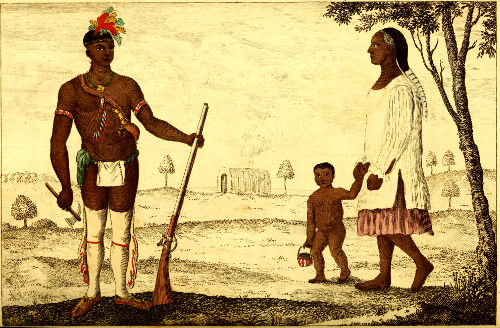
Pl. 2.
A Man and Woman of the Ottigaumies.
Their shoes are made of the skin of the deer, elk, or buffalo: these, after being sometimes dressed according to the European manner, at others with the hair remaining on them, are cut into shoes, and fashioned so as to be easy to the feet, and convenient for walking. The edges round the ancle are decorated with pieces of brass or tin fixed around leather strings, about an inch long, which being placed very thick make a cheerful tinkling noise either when they walk or dance.
The women wear a covering of some kind or other from the neck to the knees. Those who trade with the Europeans wear a linen garment the same as that used by the men; the flaps of which hang over the petticoat. Such as dress after their ancient manner, make a kind of shift with leather, which covers the body but not the arms. Their petticoats are made either of leather or cloth, and reach from the waist to the knee. On their legs they wear stockings and shoes, made and ornamented as those of the men.
They differ from each other in the mode of dressing their heads, each following the custom of the nation or band to which they belong, and adhering to the form made use of by their ancestors from time immemorial.
I remarked that most of the females, who dwell on the east side of the Mississippi, decorate their heads by inclosing their hair either in ribands, or in plates of silver: the latter is only made use of by the higher ranks, as it is a costly ornament. The silver they use on this occasion is formed into thin plates of about four inches broad, in several of which they confine their hair. That plate which is nearest the head is of a considerable width; the next narrower, and made so as to pass a little way under the other, and in this manner they fasten into each other, and, gradually tapering, descend to the waist, as represented in plate No II. The hair of the Indian women being in general very long, this proves an expensive method.
But the women that live to the west of the Mississippi, viz. the Naudowessies, the Assinipoils, &c. divide their hair in the middle of the head, and form it into two rolls, one against each ear. These rolls are about three inches long, and as large as their wrists. They hang in a perpendicular attitude at the front of each ear, and descend as far as the lower part of it. A more explicit idea may be formed of this mode by referring to plate III.
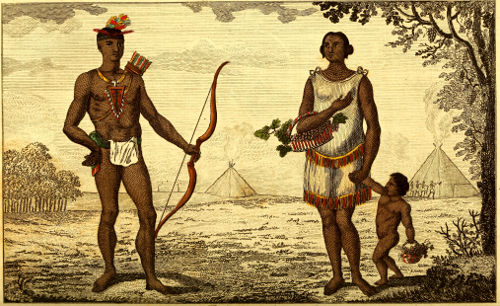
Pl. 3.
A Man & Woman of the Naudowessie.
The women of every nation generally place a spot of paint, about the size of a crown-piece, against each ear; some of them put paint on their hair, and sometimes a small spot in the middle of the forehead.
The Indians, in general, pay a greater attention to their dress and to the ornaments with which they decorate their persons, than to the accommodation of their huts or tents. They construct the latter in the following simple and expeditious manner.
Being provided with poles of a proper length, they fasten two of them across, near their ends, with bands made of bark. Having done this, they raise them up, and extend the bottom of each as wide as they purpose to make the area of the tent: they then erect others of an equal height, and fix them so as to support the two principal ones. On the whole they lay skins of the elk or deer, sewed together, in quantity sufficient to cover the poles, and by lapping over to form the door. A great number of skins are sometimes required for this purpose, as some of their tents are very capacious. That of the chief warrior of the Naudowessies was at least forty feet in circumference, and very commodious.
They observe no regularity in fixing their tents when they encamp, but place them just as it suits their conveniency.
The huts also, which those who use not tents, erect when they travel, for very few tribes have fixed abodes or regular towns or villages, are equally simple, and almost as soon constructed.
They fix small pliable poles in the ground, and bending them till they meet at the top and form a semi-circle, then lash them together. These they cover with mats made of rushes platted, or with birch bark, which they carry with them in their canoes for this purpose.
These cabins have neither chimnies nor windows; there is only a small aperture left in the middle of the roofs through which the smoke is discharged, but as this is obliged to be stopped up when it rains or snows violently, the smoke then proves exceedingly troublesome.
They lie on skins, generally those of the bear, which are placed in rows on the ground; and if the floor is not large enough to contain beds sufficient for the accommodation of the whole family, a frame is erected about four or five feet from the ground, in which the younger part of it sleep.
As the habitations of the Indians are thus rude, their domestic utensils are few in number, and plain in their formation. The tools wherewith they fashion them are so aukward and defective, that it is not only impossible to form them with any degree of neatness or elegance, but the time required in the execution is so considerable, as to deter them from engaging in the manufacture of such as are not absolutely necessary.
The Naudowessies make the pots in which they boil their victuals of the black clay or stone mentioned in my Journal; which resists the effects of the fire nearly as well as iron. When they roast, if it is a large joint or a whole animal, such as a beaver, they fix it as Europeans do, on a spit made of a hard wood, and placing the ends on two forked props, now and then turn it. If the piece is smaller they spit it as before, and fixing the spit in an erect but slanting position, with the meat inclining towards the fire, frequently change the sides, till every part is sufficiently roasted.
They make their dishes in which they serve up their meat, and their bowls and pans, out of the knotty excrescences of the maple tree, or any other wood. They fashion their spoons with a tolerable decree of neatness (as these require much less trouble than larger utensils) from a wood that is termed in America Spoon Wood, and which greatly resembles box wood.
Every tribe are now possessed of knives, and steels to strike fire with. These being so essentially needful for the common uses of life, those who have not an immediate communication with the European traders, purchase them of such of their neighbours as are situated nearer the settlements, and generally give in exchange for them slaves.
CHAPTER III. Of their Manners , Qualifications , &c.
WHEN the Indian women sit down, they place themselves in a decent attitude, with their knees close together; but from being accustomed to this posture, they walk badly, and appear to be lame.
They have no midwives amongst them, their climate, or some peculiar happiness in their constitutions, rendering any assistance at that time unnecessary. On these occasions they are confined but a few hours from their usual employments, which are commonly very laborious, as the men, who are remarkably indolent, leave to them every kind of drugery; even in their hunting parties the former will not deign to bring home the game, but send their wives for it, though it lies at a very considerable distance.
The women place their children soon after they are born on boards stuffed with soft moss, such as is found in morasses or meadows. The child is laid on its back in one of these kind of cradles, and, being wrapped in skins or cloth to keep it warm, is secured in it by small bent pieces of timber.
To these machines they fasten strings, by which they hang them to branches of trees; or if they find not trees at hand, fasten them to a stump or stone, whilst they transact any needful business. In this position are the children kept for some months. When they are taken out, the boys are suffered to go naked, and the girls are covered from the neck to the knees with a shift and a short petticoat.
The Indian women are remarkably decent during their menstrual illness. Those nations that are most remote from the European settlements, as the Naudowessies, &c. are more particularly attentive to this point; though they all without exception adhere in some degree to the same custom.
In every camp or town there is an apartment appropriated for their retirement at this time, to which both single and married retreat, and seclude themselves with the utmost strictness during this period from all society. Afterwards they purify themselves in running streams, and return to their different employments.
The men on these occasions most carefully avoid holding any communication with them; and the Naudowessies are so rigid in this observance, that they will not suffer any belonging to them to fetch such things as are necessary, even fire, from these female lunar retreats, though the want of them is attended with the greatest inconvenience. They are also so superstitious as to think, if a pipe stem cracks, which among them is made of wood, that the possessor has either lighted it at one of these polluted fires, or held some converse with a woman during her retirement, which is esteemed by them most disgraceful and wicked.
The Indians are extremely circumspect and deliberate in every word and action; there is nothing that hurries them into any intemperate warmth, but that inveteracy to their enemies which is rooted in every Indian heart, and never can be eradicated. In all other instances they are cool, and remarkably cautious, taking care not to betray on any account whatever their emotions. If an Indian has discovered that a friend is in danger of being intercepted and cut off by one to whom he has rendered himself obnoxious, he does not inform him in plain and explicit terms of the danger he runs by pursuing the track near which his enemy lies in wait for him, but he first coolly asks him which way he is going that day; and having received his answer, with the same indifference tells him that he has been informed that a dog lies near the spot, which might probably do him a mischief. This hint proves sufficient; and his friend avoids the danger with as much caution as if every design and motion of his enemy had been pointed out to him.
This apathy often shews itself on occasions that would call forth all the fervour of a susceptible heart. If an Indian has been absent from his family and friends many months, either on a war or hunting party, when his wife and children meet him at some distance from his habitation, instead of the affectionate sensations that would naturally arise in the breast of more refined beings, and be productive of mutual congratulations, he continues his course without paying the least attention to those who surround him, till he arrives at his home.
He there sits down, and with the same unconcern as if he had not been absent a day, smokes his pipe; those of his acquaintance who have followed him, do the same; and perhaps it is several hours before he relates to them the incidents which have befallen him during his absence, though perhaps he has left a father, brother, or son on the field whose loss he ought to have lamented, or has been unsuccessful in the undertaking that called him from his home.
Has an Indian been engaged for several days in the chace, or on any other laborious expedition, and by accident continued thus long without food, when he arrives at the hut or tent of a friend where he knows his wants may be immediately supplied, he takes care not to show the least symptoms of impatience, or to betray the extreme hunger by which he is tortured; but on being invited in, sits contentedly down, and smokes his pipe with as much composure as if every appetite was allayed, and he was perfectly at ease; he does the same if among strangers. This custom is strictly adhered to by every tribe, as they esteem it a proof of fortitude, and think the reverse would intitle them to the appellation of old women.
If you tell an Indian that his children have greatly signalized themselves against an enemy, have taken many scalps, and brought home many prisoners, he does not appear to feel any extraordinary pleasure on the occasion; his answer generally is, “It is well,” and he makes very little further enquiry about it. On the contrary, if you inform him that his children are slain or taken prisoners, he makes no complaints, he only replies, “It does not signify;” and probably, for some time at least, asks not how it happened.
This seeming indifference, however, does not proceed from an entire suppression of the natural affections; for notwithstanding they are esteemed savages, I never saw among any other people greater proofs of parental or filial tenderness; and although they meet their wives after a long absence with the Stoical indifference just mentioned, they are not in general void of conjugal affection.
Another peculiarity is observable in their manner of paying their visits. If an Indian goes to visit a particular person in a family, he mentions to whom his visit is intended, and the rest of the family immediately retiring to the other end of the hut or tent are careful not to come near enough to interrupt them during the whole of the conversation. The same method is pursued if a man goes to pay his respects to one of the other sex; but then he must be careful not to let love be the subject of his discourse whilst the daylight remains.
The Indians discover an amazing sagacity, and acquire with the greatest readiness any thing that depends upon the attention of the mind. By experience and an acute observation, they attain many perfections to which Europeans are strangers. For instance, they will cross a forest or a plain which is two hundred miles in breadth, and reach with great exactness the point at which they intend to arrive, keeping during the whole of that space in a direct line, without any material deviations; and this they will do with the same ease, whether the weather be fair or cloudy.
With equal acuteness will they point to that part of the heavens the sun is in, though it be intercepted by clouds or fogs. Besides this, they are able to pursue with incredible facility the traces of man or beast, either on leaves or grass; and on this account it is with great difficulty a flying enemy escapes discovery.
They are indebted for these talents not only to nature, but to an extraordinary command of the intellectual faculties, which can only be acquired by an unremitted attention, and by long experience.
They are in general very happy in a retentive memory; they can recapitulate every particular that has been treated of in council, and remember the exact time when these were held. Their belts of wampum preserve the substance of the treaties they have concluded with the neighbouring tribes for ages back, to which they will appeal, and refer with as much perspicuity and readiness as Europeans can to their written records.
Every nation pays great respect to old age. The advice of a father will seldom meet with any extraordinary attention from the young Indians, probably they receive it with only a bare assent; but they will tremble before a grandfather, and submit to his injunctions with the utmost alacrity. The words of the ancient part of their community are esteemed by the young as oracles. If they take during their hunting parties any game that is reckoned by them uncommonly delicious, it is immediately presented to the oldest of their relations.
They never suffer themselves to be overburdened with care, but live in a state of perfect tranquillity and contentment. Being naturally indolent, if provision just sufficient for their subsistence can be procured with little trouble, and near at hand, they will not go far, or take any extraordinary pains for it, though by so doing they might acquire greater plenty and of a more estimable kind.
Having much leisure time they indulge this indolence to which they are so prone, by eating, drinking, or sleeping, and rambling about in their towns or camps. But when necessity obliges them to take the field, either to oppose an enemy, or to procure themselves food, they are alert and indefatigable. Many instances of their activity on these occasions will be given when I treat of their wars.
The infatuating spirit of gaming is not confined to Europe; the Indians also feel the bewitching impulse, and often lose their arms, their apparel, and every thing they are possessed of. In this case, however, they do not follow the example of more refined gamesters, for they neither murmur nor repine; not a fretful word escapes them, but they bear the frowns of fortune with a philosophic composure.
The greatest blemish in their character is that savage disposition which impels them to treat their enemies with a severity every other nation shudders at. But if they are thus barbarous to those with whom they are at war, they are friendly, hospitable, and humane in peace. It may with truth be said of them, that they are the worst enemies, and the best friends, of any people in the whole world.
The Indians in general are strangers to the passion of jealousy; and brand a man with folly that is distrustful of his wife. Among some bands the very idea is not known; as the most abandoned of their young men very rarely attempt the virtue of married women, nor do these often put themselves in the way of solicitation. Yet the Indian women in general are of an amorous temperature, and before they are married are not the less esteemed for the indulgence of their passions.
Whilst I was among the Naudowessies I observed that they paid uncommon respect to one of their women, and found on enquiry that she was intitled to it on account of a transaction, that in Europe would have rendered her infamous.
They told me that when she was a young woman, for at the time I saw her she was far advanced in life, she had given what they termed a rice feast. According to an ancient but almost obsolete custom (which, as Hamlet says, would have been more honoured in the breach, than the observance) she invited forty of the principal warriors to her tent, where having feasted them with rice and venison, she by turns regaled each of them with a private desert, behind a screen fixed for this purpose in the inner part of the tent.
She had the happiness to obtain by this profusion of courtesy, the favour of her guests, and the approbation of the whole band. So sensible were the young Indians of her extraordinary merit, that they vied with each other for her hand, and in a very short time one of the principal chiefs took her to wife, over whom she acquired great sway, and from whom she received ever after incessant tokens of respect, and love.
It is however scarcely once in an age that any of the females are hardy enough to make this feast, notwithstanding a husband of the first rank awaits as a sure reward the successful giver of it; and the custom, I since find, is peculiar to the Naudowessies.
The Indians in their common state are strangers to all distinction of property, except in the articles of domestic use, which every one considers as his own, and increases as circumstances admit. They are extremely liberal to each other, and supply the deficiency of their friends with any superfluity of their own.
In dangers they readily give assistance to those of their band who stand in need of it, without any expectation of return, except of those just rewards that are always conferred by the Indians on merit. Governed by the plain and equitable laws of nature, every one is rewarded solely according to his deserts; and their equality of condition, manners, and privileges, with that constant and sociable familiarity which prevails throughout every Indian nation, animates them with a pure and truly patriotic spirit, that tends to the general good of the society to which they belong.
If any of their neighbours are bereaved by death or by an enemy of their children, those who are possessed of the greatest number of slaves, supply the deficiency; and these are adopted by them and treated in every respect as if they really were the children of the person to whom they are presented.
The Indians, except those who live adjoining to the European colonies, can form to themselves no idea of the value of money; they consider it, when they are made acquainted with the uses to which it is applied by other nations, as the source of innumerable evils. To it they attribute all the mischiefs that are prevalent among Europeans, such as treachery, plundering, devastations, and murder.
They esteem it irrational that one man should be possessed of a greater quantity than another, and are amazed that any honour should be annexed to the possession of it. But that the want of this useless metal should be the cause of depriving persons of their liberty, and that on account of this partial distribution of it, great numbers should be immured within the dreary walls of a prison, cut off from that society of which they constitute a part, exceeds their belief. Nor do they fail, on hearing this part of the European system of government related, to charge the institutors of it with a total want of humanity, and to brand them with the names of savages and brutes.
They shew almost an equal degree of indifference for the productions of art. When any of these are shewn them, they say, “It is pretty, I like to look at it,” but are not inquisitive about the construction of it, neither can they form proper conceptions of its use. But if you tell them of a person who is able to run with great agility, that is well skilled in hunting, can direct with unerring aim a gun, or bend with ease a bow, that can dexterously work a canoe, understands the art of war, is acquainted with the situation of a country, and can make his way without a guide, through an immense forest, subsisting during this on a small quantity of provisions, they are in raptures; they listen with great attention to the pleasing tale, and bestow the highest commendations on the hero of it.
CHAPTER IV. Their Method of reckoning Time , &c.
CONSIDERING their ignorance of astronomy, time is very rationally divided by the Indians. Those in the interior parts (and of those I would generally be understood to speak) count their years by winters; or, as they express themselves, by snows.
Some nations among them reckon their years by moons, and make them consist of twelve synodical or lunar months, observing, when thirty moons have waned, to add a supernumerary one, which they term the lost moon; and then begin to count as before. They pay a great regard to the first appearance of every moon, and on the occasion always repeat some joyful sounds, stretching at the same time their hands towards it.
Every month has with them a name expressive of its season; for instance, they call the month of March (in which their year generally begins at the first New Moon after the vernal Equinox) the Worm Month or Moon; because at this time the worms quit their retreats in the bark of the trees, wood, &c. where they have sheltered themselves during the winter.
The month of April is termed by them the month of Plants. May, the Month of Flowers. June, the Hot Moon. July, the Buck Moon. Their reason for thus denominating these is obvious.
August, the Sturgeon Moon; because in this month they catch great numbers of that fish.
September, the Corn Moon; because in that month they gather in their Indian Corn.
October, the Travelling Moon; as they leave at this time their villages, and travel towards the places where they intend to hunt during the winter.
November, the Beaver Moon; for in this month the beavers begin to take shelter in their houses, having laid up a sufficient store of provisions for the winter season.
December, the Hunting Moon, because they employ this month in pursuit of their game.
January, the Cold Moon, as it generally freezes harder, and the cold is more intense in this than in any other month.
February they call the Snow Moon, because more snow commonly falls during this month, than any other in the winter.
When the moon does not shine they say the moon is dead; and some call the three last days of it the naked days. The moon’s first appearance they term its coming to life again.
They make no division of weeks; but days they count by sleeps; half days by pointing to the sun at noon; and quarters by the rising and the setting of the sun: to express which in their traditions they make use of very significant hieroglyphicks.
The Indians are totally unskilled in geography as well as all the other sciences, and yet, as I have before hinted, they draw on their birch bark very exact charts or maps of the countries with which they are acquainted. The latitude and longitude is only wanting to make them tolerably complete.
Their sole knowledge in astronomy consists in being able to point out the pole-star; by which they regulate their course when they travel in the night.
They reckon the distance of places, not by miles or leagues, but by a day’s journey, which, according to the best calculations I could make, appears to be about twenty English miles. These they also divide into halves and quarters, and will demonstrate them in their maps with great exactness, by the hieroglyphicks just mentioned, when they regulate in council their war parties, or their most distant hunting excursions.
They have no idea of arithmetic; and though they are able to count to any number, figures as well as letters appear mysterious to them, and above their comprehension.
During my abode with the Naudowessies, some of the chiefs observing one day a draft of an eclipse of the moon, in a book of astronomy which I held in my hand, they desired I would permit them to look at it. Happening to give them the book shut, they began to count the leaves till they came to the place in which the plate was. After they had viewed it, and asked many questions relative to it, I told them they needed not to have taken so much pains to find the leaf on which it was drawn, for I could not only tell in an instant the place, without counting the leaves, but also how many preceded it.
They seemed greatly amazed at my assertion, and begged that I would demonstrate to them the possibility of doing it. To this purpose I desired the chief that held the book, to open it at any particular place, and just shewing me the page carefully to conceal the edges of the leaves, so that I might not be able to count them.
This he did with the greatest caution; notwithstanding which, by looking at the folio, I told him, to his great surprize, the number of leaves. He counted them regularly over, and discovered that I was exact. And when, after repeated trials, the Indians found I could do it with great readiness, and without ever erring in my calculation, they all seemed as much astonished as if I had raised the dead. The only way they could account for my knowledge, was by concluding that the book was a spirit, and whispered me answers to whatever I demanded of it.
This circumstance, trifling as it might appear to those who are less illiterate, contributed to increase my consequence, and to augment the favourable opinion they already entertained of me.
CHAPTER V. Of their Government , &c.
EVERY separate body of Indians is divided into bands or tribes; which band or tribe forms a little community with the nation to which it belongs. As the nation has some particular symbol by which it is distinguished from others, so each tribe has a badge from which it is denominated: as that of the Eagle, the Panther, the Tiger, the Buffalo, &c. &c. One band of the Naudowessie is represented by a Snake, another a Tortoise, a third a Squirrel, a fourth a Wolf, and a fifth a Buffalo. Throughout every nation they particularize themselves in the same manner, and the meanest person among them will remember his lineal descent, and distinguish himself by his respective family.
Did not many circumstances tend to confute the supposition, I should be almost induced to conclude from this distinction of tribes, and the particular attachment of the Indians to them, that they derive their origin, as some have asserted, from the Israelites.
Besides this, every nation distinguish themselves by the manner of constructing their tents or huts. And so well versed are all the Indians in this distinction, that though there appears to be no difference on the nicest observation made by an European, yet they will immediately discover, from the position of a pole left in the ground, what nation has encamped on the spot many months before.
Every band has a chief who is termed the Great Chief or the chief Warrior; and who is chosen in consideration of his experience in war, and of his approved valour, to direct their military operations, and to regulate all concerns belonging to that department. But this chief is not considered as the head of the state; besides the great warrior who is elected for his warlike qualifications, there is another who enjoys a pre-eminence as his hereditary right, and has the more immediate management of their civil affairs. This chief might with greater propriety be denominated the Sachem; whose assent is necessary in all conveyances and treaties, to which he affixes the mark of the tribe or nation.
Though these two are considered as the heads of the band, and the latter is usually denominated their king, yet the Indians are sensible of neither civil or military subordination. As every one of them entertains a high opinion of his consequence, and is extremely tenacious of his liberty, all injunctions that carry with them the appearance of a positive command, are instantly rejected with scorn.
On this account, it is seldom that their leaders are so indiscreet as to give out any of their orders in a peremptory stile; a bare hint from a chief that he thinks such a thing necessary to be done, instantly arouses an emulation among the inferior ranks, and it is immediately executed with great alacrity. By this method the disgustful part of the command is evaded, and an authority that falls little short of absolute sway instituted in its room.
Among the Indians no visible form of government is established; they allow of no such distinction as magistrate and subject, every one appearing to enjoy an independence that cannot be controlled. The object of government among them is rather foreign than domestic, for their attention seems more to be employed in preserving such an union among the members of their tribe as will enable them to watch the motions of their enemies, and to act against them with concert and vigour, than to maintain interior order by any public regulations. If a scheme that appears to be of service to the community is proposed by the chief, every one is at liberty to chuse whether he will assist in carrying it on; for they have no compulsory laws that lay them under any restrictions. If violence is committed, or blood is shed, the right of revenging these misdemeanours are left to the family of the injured; the chiefs assume neither the power of inflicting or moderating the punishment.
Some nations, where the dignity is hereditary, limit the succession to the female line. On the death of a chief, his sister’s son sometimes succeeds him in preference to his own son; and if he happens to have no sister, the nearest female relation assumes the dignity. This accounts for a woman being at the head of the Winnebagoe nation, which, before I was acquainted with their laws, appeared strange to me.
Each family has a right to appoint one of its chiefs to be an assistant to the principal chief, who watches over the interest of his family, and without whose consent nothing of a public nature can be carried into execution. These are generally chosen for their ability in speaking; and such only are permitted to make orations in their councils and general assemblies.
In this body, with the hereditary chief at its head, the supreme authority appears to be lodged; as by its determination every transaction relative to their hunting, to their making war or peace, and to all their public concerns are regulated. Next to these, the body of warriors, which comprehends all that are able to bear arms, hold their rank. This division has sometimes at its head the chief of the nation, if he has signalized himself by any renowned action, if not, some chief that has rendered himself famous.
In their councils which are held by the foregoing members, every affair of consequence is debated; and no enterprize of the least moment undertaken, unless it there meets with the general approbation of the chiefs. They commonly assemble in a hut or tent appropriated to this purpose, and being seated in a circle on the ground, the eldest chief rises and makes a speech; when he has concluded, another gets up; and thus they all speak, if necessary, by turns.
On this occasion their language is nervous, and their manner of expression, emphatical. Their style is adorned with images, comparisons, and strong metaphors, and is equal in allegories to that of any of the eastern nations. In all their set speeches they express themselves with much vehemence, but in common discourse according to our usual method of speech.
The young men are suffered to be present at the councils, though they are not allowed to make a speech till they are regularly admitted: they however listen with great attention, and to shew that they both understand, and approve of the resolutions taken by the assembled chiefs, they frequently exclaim, “That is right.” “That is good.”
The customary mode among all the ranks of expressing their assent, and which they repeat at the end of almost every period, is by uttering a kind of forcible aspiration, which sounds like an union of the letters OAH.
CHAPTER VI. Of their Feasts .
MANY of the Indian nations neither make use of bread, salt, or spices; and some of them have never seen or tasted of either. The Naudowessies in particular have no bread, nor any substitute for it. They eat the wild rice which grows in great quantities in different parts of their territories; but they boil it and eat it alone. They also eat the flesh of the beasts they kill, without having recourse to any farinaceous substance to absorb the grosser particles of it. And even when they consume the sugar which they have extracted from the maple tree, they use it not to render some other food palatable, but generally eat it by itself.
Neither have they any idea of the use of milk, although they might collect great quantities from the buffalo or the elk; they only consider it as proper for the nutriment of the young of these beasts during their tender state. I could not perceive that any inconveniency attended the total disuse of articles esteemed so necessary and nutritious by other nations, on the contrary, they are in general healthy and vigorous.
One dish however, which answers nearly the same purpose as bread, is in use among the Ottagaumies, the Saukies, and the more eastern nations, where Indian corn grows, which is not only much esteemed by them, but it is reckoned extremely palatable by all the Europeans who enter their dominions. This is composed of their unripe corn as before described, and beans in the same state, boiled together with bears flesh, the fat of which moistens the pulse, and renders it beyond comparison delicious. They call this food Succatosh.
The Indians are far from being canibals, as they are said to be. All their victuals are either roasted or boiled; and this in the extreme. Their drink is generally the broth in which it has been boiled.
Their food consists of the flesh of the bear, the buffalo, the elk, the deer, the beaver, and the racoon; which they prepare in the manner just mentioned. They usually eat the flesh of the deer which is naturally dry, with that of the bear which is fat and juicy; and though the latter is extremely rich and luscious, it is never known to cloy.
In the spring of the year the Naudowessies eat the inside bark of a shrub, that they gather in some part of their country; but I could neither learn the name of it, or discover from whence they got it. It was of a brittle nature and easily masticated. The taste of it was very agreeable, and they said it was extremely nourishing. In flavour it was not unlike the turnip, and when received into the mouth resembled that root both in its pulpous and frangible nature.
The lower ranks of the Indians are exceedingly nasty in dressing their victuals, but some of the chiefs are very neat and cleanly in their apparel, tents, and food.
They commonly eat in large parties, so that their meals may properly be termed feasts; and this they do without being restricted to any fixed or regular hours, but just as their appetites require, and convenience suits.
They usually dance either before or after every meal; and by this cheerfulness probably render the Great Spirit, to whom they consider themselves as indebted for every good, a more acceptable sacrifice than a formal and unanimated thanksgiving. The men and women feast apart: and each sex invite by turns their companions to partake with them of the food they happen to have; but in their domestic way of living the men and women eat together.
No people are more hospitable, kind, and free than the Indians. They will readily share with any of their own tribe the last part of their provisions, and even with those of a different nation, if they chance to come in when they are eating. Though they do not keep one common stock, yet that community of goods which is so prevalent among them, and their generous disposition, render it nearly of the same effect.
When the chiefs are convened on any public business, they always conclude with a feast, at which their festivity and cheerfulness knows no limits.