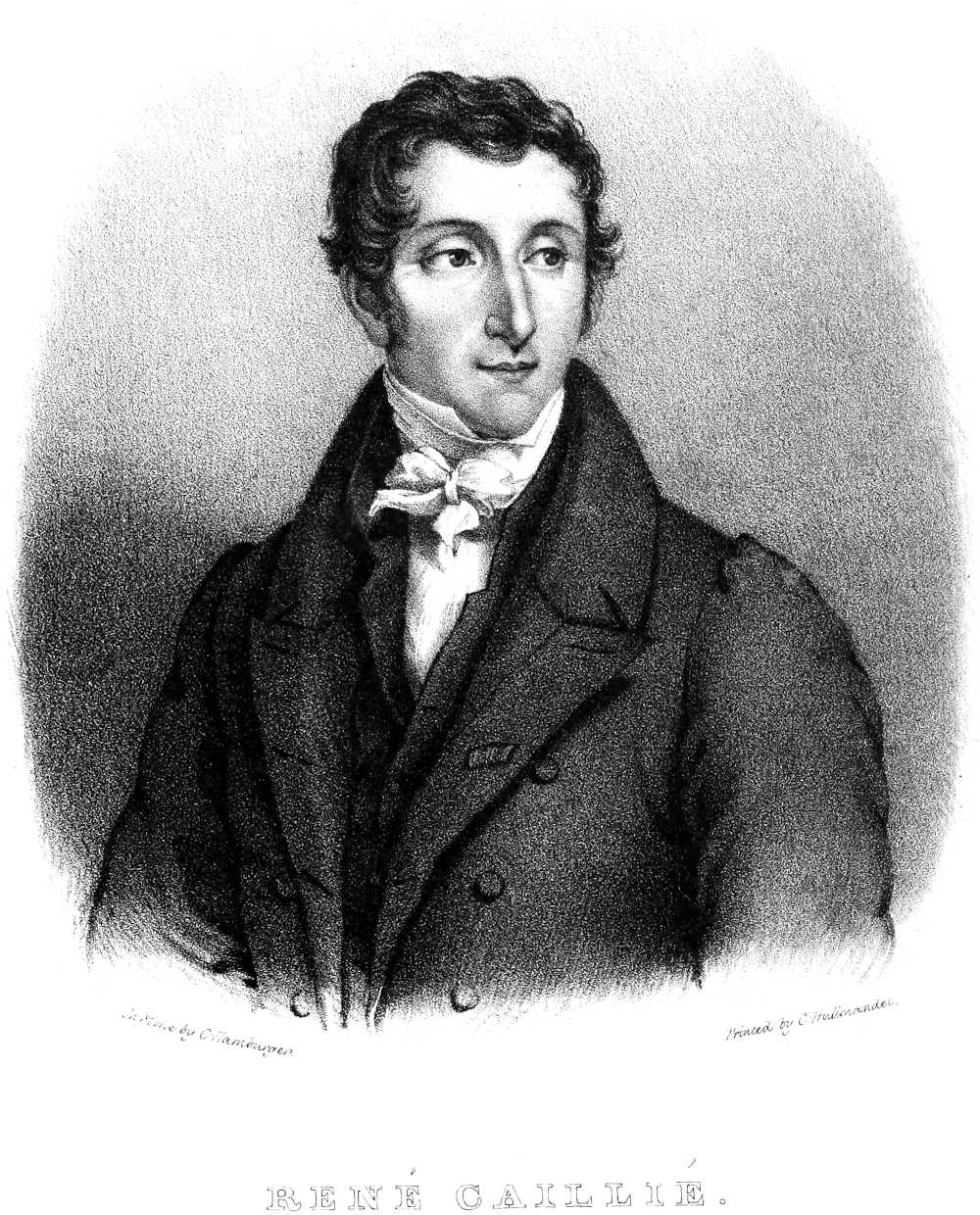
Description of Baléya. — Arrival on the banks of
the Dhioliba. — Courouassa. — Sambarala. — Bouré, a mountainous
country, rich in gold. — Crossing the Dhioliba. — The river Yendan.
— Kankan. — Description of the town. — The market. — Gold of Bouré.
— A religious festival. — Ordeal of fire. — Critical situation of
the traveller. — Diseases of the country.
The soil of Baléya is an
argillaceous sand, compact, but extremely fertile, producing all
the necessaries of life in abundance. It is bounded on the west by
the Fouta; on the south by Sangaran, through which runs the
Dhioliba; on the east by the little country of Amana; and on the
north by forests. All the villages in this part are surrounded with
a double wall of mud, surmounted by battlements. These walls are
from ten to twelve feet high. The villages contain each from a
hundred to a hundred and twenty-five huts, made of straw.
The inhabitants of Baléya were subjected to the laws of the
Prophet by the Foulahs, since which they annually present some
cattle to the almamy of the Fouta. They are warriors and
husbandmen, and have abundance of the necessaries of life, which
they obtain by the cultivation of the earth, while their cattle
supply them with butter and milk. They manufacture white cloth,
which they exchange with their neighbours for salt. Earthenware is
made in almost every village. The people of Baléya are Dhialonkés.
Though Mahometans, they are, by no means, so zealous as the
Foulahs, and drink in private a sort of beer made of millet and
honey. Lamfia told me that formerly they possessed Fouta-Dhialon.
The women are lively, pretty, and coquettish, and bestow much
attention on dressing their hair, which is arranged in two tufts, one on each
side of the head: many have four tufts. They ornament their heads
with coloured glass beads, tastefully disposed; they wear necklaces
of small black glass beads, interspersed with a few gilt glass
ornaments. The necklaces, which are about three inches broad,
encircle the neck like a cravat. The head-dress of these women
would be becoming, if their hair was not covered with a layer of
butter, with which they also grease their bodies: it renders their
skin glossy, but gives them an unpleasant smell. Most of the
females have no other dress than a piece of cloth, five feet long
and two wide, which they fasten round their waists. On holidays
they throw another piece of cloth over their shoulders, and cover
their bosoms: they also wear sandals. This is nearly the general
costume of the women of Negroland. Their dispositions are gentle
and cheerful; their colour is very black; their features handsome,
with curly hair, noses slightly aquiline, thin lips, and large
eyes. They do all the household work, and are obedient to their
husbands.
On the 11th of June, after taking leave of the chief, to whom I
presented three leaves of tobacco, which seemed to please him, we
proceeded in a S.E. direction. The saracolet merchants, who had
asses to carry their merchandise, went on first, having to pass
several streams which would retard their progress. The heat was
excessive, and a storm came on. The atmosphere was heavy and
obscured by clouds. I was attacked with a fever on the journey,
and, notwithstanding the heat, I had shivering fits, from which I
suffered greatly. After crossing the streams, where the water was
knee-deep, we overtook the saracolets. They had bargained with some
Mandingoes to carry a part of their baggage, for they were heavily
laden. I observed that the country sloped towards the east. We
continued in the same direction. The eldest saracolet, having
traced some Arabic characters on the ground, and muttered some
prayers, assured us
that we might pursue our journey without apprehension, as no
misfortune would happen to us. The country is a little wooded. The
nédé and the cé grow here in abundance. Our road was gravelly.
About two in the afternoon we arrived at Courouassa, a village of
Amana, situated on the left bank of the Dhioliba. Shortly before
our arrival a storm arose. My umbrella and some trees, beneath
which we sought shelter, protected me a little. We had travelled
fourteen miles in a S.E. direction, and were all much fatigued.
Lamfia took me to lodge with the chief, who gave us a kind
reception. He provided us with a good hut, and offered us a hide to
sleep upon. I bought a fowl for two charges of gunpowder, and we
had it cooked for supper. The fever had left me, and I now suffered
only from a severe head-ache. I hastened to take a view of the
Dhioliba, which had so long been the object of my curiosity. I
observed that it flowed from S.W. ¼ S. proceeding slowly to the
E.N.E. for the distance of some miles, and then turns due east. A
little to the north of the village I saw a sand-bank lying very
near the left shore of the river. The channel for canoes is near
the right bank. I seated myself for a moment to contemplate this
mysterious river, respecting which the learned of Europe are so
anxious to gain information.
On the left bank, and pretty near the northern part of the
village, there are hills between one hundred and fifty and two
hundred feet high, covered with young trees. The soil appeared to
be red, and of the same kind as that of Sierra-Leone. Some smiths
have established themselves near these hills: they smelt and work
up the iron which is found there in great quantities. These hills
extend in a N.E. direction. There are some also on the right bank,
but they are not so high. The air became cool, and I returned to my
hut. During the night it rained a great deal.
We remained at Courouassa during the 12th. A storm came on accompanied by an east
wind, which occasioned a suffocating heat. The rain poured in
torrents. When it ceased I again visited the banks of the river. I
watched its current, which flowed at the rate of about two miles
and a half or three miles an hour. At this period it was about nine
feet deep. This I calculated by the long pole which the boatmen
used to push along the canoes.[50] In this part it appeared
as broad as the Senegal at Podor. The right bank is lower than the
left, on which the village is situated at an elevation of nearly a
twentieth part of a mile above the water. I observed in the village
many large bamboos, under the shade of which the old men assemble
and spend part of the day in conversation. These people use much
snuff; but they do not take it as we do in Europe, with the
fingers; some use a small brush, and others a little iron spoon
like an ear-pick. The negroes told me that the river begins to
overflow in July, and that then they can go three miles over the
plain in canoes. A great quantity of rice is grown on this plain.
The sand-bank which I had seen plainly on the preceding evening was
now no longer visible.
Courouassa is a neat village, surrounded by a mud wall, from ten
to twelve feet high and from eight to ten inches thick. It contains
between four and five hundred inhabitants. I observed that
thousands of swallows, of the same kind as those seen in Europe,
had built their nests in this wall. They were collected in flocks
upon the trees, and I concluded that they were preparing to
depart.
Courouassa is entered by several low and narrow openings which
are closed by a thick plank made of a single tree. The town is
shaded by bombaces and baobabs, and it is the principal of five
small villages situated on the banks of the Dhioliba. This country
is called Amana; the inhabitants are called Dhialonkés, and are chiefly
idolaters. They do not travel, but occupy themselves peaceably in
the cultivation of their little fields, which are fertilised by the
inundations of the river. They catch many fish with hooks, which
they obtain from travellers coming from our settlements on the
coast. They likewise fish with the fouène, an instrument consisting
of three branches with darts having teeth like a saw. A large piece
of wood forms the handle of this instrument, which the natives use
with great address. I saw a species of fish with a number of small
bones like the carp. The people dry and smoke this fish, and sell
it to their neighbours and the traders who pass through their
country.
Bouré is situated at the distance of a five days’ passage down
the river, in a canoe. The voyage is thus divided: from Courouassa
to Cabarala one day; from Cabarala to Balatou one day; from Balatou
to the village of Dhioliba one day; from Dhioliba to Boun-Bouriman,
one day; from Boun-Bouriman to Bouré, proceeding a little way up
the Tankisso, one day.
Bouré is a mountainous country, containing a number of rich gold
mines, according to the account given to me by the natives. I shall
speak of it more at length in the proper place. I went, accompanied
by my guide, to pay a visit to the chief, who I was told, was a
great warrior and dreaded by his neighbours. We found him alone in
his hut employed in fastening a point to an arrow. A number of
bows, arrows, and quivers, were hung up in various parts of the
hut. He asked us to sit down on a bullock’s hide, and Lamfia
conversed with him. The conversation turned on me. He promised that
we should cross the river next day. Travellers are rowed across by
his slaves. He levies duties which are paid in European
merchandise, such as gunpowder, tobacco, knives, scissors, &c.
He also receives salt in payment of these duties, which render him
tolerably rich. He told me that, out of respect to my rank of
sherif, he would
allow me to pass duty free. The chief was a man about fifty years
of age, five feet and some inches high. His countenance was mild,
nay even pleasing.
On returning to our hut, we bought some fresh fish for supper.
It was of the kind resembling the carp, which I have already
mentioned. It measures about eight inches long and four or five
broad, and is very bony. The general food of the inhabitants is
boiled rice without salt, but seasoned with a sauce made of dry
fish minced. They also eat fresh fish. With the foigné they make a
sort of thick pudding, which they call tau. This is the
sangleh of the Senegal. They eat this tau with a sauce made of
herbs or pistachio-nuts; the latter they cultivate very abundantly.
As salt is beginning to be dear, they use it on festivals and
rejoicing days only. They gather the fruit of the cé and nédé, from
which they obtain butter. I saw some heaps of the seeds of these
trees freshly gathered and exposed to the rain. They were already
beginning to germinate.
On the 13th of June, we crossed the river in canoes, twenty-five
feet long, three wide, and one deep. A great number of people were
going across, and they were all disputing, some about the fare that
was demanded, others about who should go first. They all talked at
once and made a most terrible uproar. The saracolets had a great
deal of trouble in getting their asses on board the canoes, and the
parties who had crossed fired muskets in token of rejoicing, which
augmented the tumult created by the disputes of the negroes. I was
obliged to remain exposed to the sun the whole morning; for the
banks of the river are very open. Along the left bank but one tree
was visible. This was a large bombax, under which so many people
had crowded for shade that I could not find room. I saw a number of
women and girls bathing in the river. They were quite naked, but
they seemed to care very little about the presence of the men.
Having finished their ablutions, they returned to the village, with pagnes round
their waists and calabashes on their heads. There were only four
canoes for conveying between two hundred and fifty and three
hundred persons, besides luggage. We were not all landed on the
right bank until near eleven o’clock. The excessive heat had
brought on me a severe head-ache accompanied with fever. We
proceeded onwards to the S.E. over good land, leaving behind us a
few merchants who had not yet crossed the river. I was so ill that
I experienced great difficulty in walking. The heat was intense,
and I opened my umbrella to shelter me from the scorching rays of
the sun; but some of my travelling companions advised me to shut it
on approaching the villages, lest, as they said, it should excite
the cupidity of the Kafirs (infidels). We proceeded eastward. The
road was flooded, and in several places the water was ancle-deep.
We passed Sambarala, a village situated on the bank of the river
and surrounded by nédés and cés. We next pursued our course over a
sandy soil, clothed with beautiful vegetation, among which I
observed tamarind-trees. About three o’clock we arrived at
Counancodo, where I saw some fine orange-trees. We had travelled
nine miles in the course of the day.
I told Lamfia that I wished to procure a few tamarinds, as I was
very feverish. He immediately sent his brother to gather some in
the neighbouring wood; but the brother, not understanding what I
meant, brought the leaves instead of the fruit. We could procure no
milk, for the saracolets had gone before us and bought all that the
village afforded. My fever had continued without intermission the
whole of the way. For a little powder I bought a fowl, in order to
recruit my strength. Our caravan consisted of sixty or eighty men,
some carrying loads, others leading asses, and very few walking
free from all encumbrance. One of our companions had a slave,
whom he said he had
procured at Sierra-Leone. He feared that he intended to desert, and
begged me to write an amulet to prevent him. The man was very
earnest in his request, and offered immediately to furnish me with
ink and paper. However, as I did not wish to write European
characters, for fear of exciting suspicion, I observed that having
left my country very young I did not know how to make grigris, and
I begged him to apply to some one more learned than I. Next day I
saw the poor slave bearing on his head a burthen which he could
scarcely carry, fastened to a rope the other end of which was tied
round his leg, so that it was out of his power to run away; for his
prudent and suspicious master took care that he should not have a
knife to cut the rope.
Our host sent us a good supper of rice, which I added to my
fowl. All the evening, and indeed till night was pretty well
advanced, the young negroes and negresses amused themselves by
dancing to the sound of the tomtom. Their dancing was more decorous
than that of the Wolof negroes in the neighbourhood of the
Senegal.
On the 14th of June, at seven in the morning, our caravan
proceeded onward in the direction of E.S.E. After travelling three
miles, we passed near the river, and advanced six miles eastward.
We then turned half a mile to the north, to reach the village of
Fessadougou, where we halted about noon. This village, which
contains a population of about three or four hundred, is situated
on the bank of a river, about half the width of the Dhioliba at
Courouassa. I at first conjectured that it was a branch of that
river; but I observed that the direction of its current, which
flowed at the rate of about three miles and a half an hour, was
from south to north. The Mandingoes informed me that it falls into
the Dhioliba, not far from this place. The river is called the
Yendan; its banks are for the most part low and open, but, about six miles from the
village, there are, on both sides, some little hills. Fessadougou
is a part of the Sangaran.
Our road, during the day, was partly sandy, and partly covered
with red porous stones. The country is thickly overgrown with large
trees, which renders it exceedingly pleasant. In the neighbourhood
of Fessadougou, the cé and the nédé are very abundant; indeed, they
are the only trees reared by cultivation, and they are highly
useful to the inhabitants. In the vicinity of the village I saw
tilled land in very good order. Our host sent us a supper.
On the 15th of June, after paying our reckoning in a little
tobacco and salt, as we had done all along the road from Cambaya,
we crossed the river in canoes. It was near ten o’clock when we
reached the right bank. We then proceeded four miles to the S.E.,
over a gravelly soil. I had not yet got rid of the fever, but I had
enjoyed a little rest during the night.
The heat was excessive, and my guide insisted on my using my
umbrella to shade me from the scorching rays of the sun: he himself
took the precaution of letting it down, whenever we approached any
inhabited place. It was near half-past eleven when we halted at
Farancou-Manbata, a village containing between three and four
hundred inhabitants. Our road, next day, lay through a tract of
country, in which we should have to travel a considerable distance
without coming to any villages. A storm arose soon after we entered
Farancou-Manbata, and it rained heavily.
At seven, on the morning of the 15th of June, we resumed our
journey, travelling twenty-two miles in the same direction, and
crossing several little streams. The surface of the ground was
covered with red stones and gravel. The country was generally
level, but some hills were visible to the east and west.
About half-past four in the afternoon we stopped to
rest in some huts,
made of branches of trees, covered with straw. We had travelled at
a great rate during the day: indeed, we might be said to have run
rather than walked, for we were anxious to reach Kankan next day.
On the road we met many Mandingo merchants going to the
Fouta-Dhialon. They looked at me with great astonishment, but did
not inquire whether I was a Moor, or a christian. The saracolets
travelled even faster than we: they were going to the ourondé
(slave village) of Kankan. On my expressing a wish to go thither
also, my guide observed that it was too distant: it is true, we
were greatly fatigued by our forced march. I had now the good
fortune to be free from fever. In the evening it thundered and
lightened, but without rain. We ate our supper with a good
appetite, and, though our bed consisted only of a little straw
scattered over the stones, we enjoyed a good night’s rest.
At half-past five in the morning of the 17th of June, we
proceeded southward, and after travelling three miles and a half,
we halted near the ourondé, and joined the saracolets, who were
going to Kankan. I saw some well cultivated fields of yams,
pistachios, and maize. The foigné was already in a pretty advanced
state. We next entered a fine plain. I saw in the distance some
little hillocks, and I remarked that the ground sloped gently to
E.N.E. Many negroes ran after us to see the caravan. We had gone
four miles and a half S.S.E. In some places the soil was red, mixed
with gravel, and very fertile. The country is covered with cés and
nédés. We crossed a little stream, and about ten o’clock arrived at
the town, which is the capital of Kankan. My guide insisted upon my
opening my umbrella, to make my entrance into his native place. On
the road we had met some Mandingoes on horseback, very neatly
dressed, and wearing large straw hats, made in the country, and of
a round form, like those worn by the French peasantry. I was told
that these Mandingoes were going to the fields to superintend their slaves.
Lamfia lodged me in one of his huts, with a Foulah, who travelled
with us, and had come to Kankan to exchange cloth for salt. On
Lamfia’s arrival, all his family ran to greet him, for he had been
absent a considerable time. He called for milk, some of which he
gave to me. During the whole of the evening, people thronged to
Lamfia’s yard to see the Arab sherif. I was visited by several
Mandingoes of rank, and by a good old Moor, who had been settled in
the place for some time. I did not go out of my hut for three days,
as I wished to recover from my fatigue. I also took some doses of
sulphate of quinine.
On the 10th, I went, accompanied by Lamfia and some old men, to
wait upon the chief, whom the Mandingoes of this part of Africa
call Dougou-tigui. He had already been informed of my arrival. He
received me kindly, and made me sit down on a bullock’s hide. I
solicited his permission to pass through his country on my way to
Jenné, and he replied that he would order me to be conducted
thither on the first occasion. I allowed Lamfia to speak for me,
for I could only express myself very imperfectly in the language of
the country, and he related very circumstantially the stories I had
circulated respecting the way in which I had been taken by the
christians. The old chief, whose name was Mamadi-Sanici, was the
father of the Mandingo who had so kindly helped me out of my scrape
with the Bondouké at Sancougnan. After taking leave of the chief we
returned home. My guide had ordered a bull’s hide to be laid down
in my hut. This served for my bed, and, besides a jar containing
foigné, it was the only furniture in the place. When any suspicious
persons in the village asserted that I was a christian, and that I
was not at all like a Moor, Lamfia warmly took my part, and became
very angry with those who sought to injure me. He was particularly
kind to me. We ate our meals together, and twice a day we were
served with a good mess of rice, with a sauce composed
of pistachio-nuts,
and a good quantity of onions, which thrive well here. Every
evening Lamfia ordered a fire to be lighted in my hut, a custom
which is very general throughout all the country. The negroes,
indeed, burn fires at all seasons of the year, and keep them up the
whole night. On the day of my arrival I made my guide a present, as
a reward for his attention to me on my journey. This present
consisted of a yard of blue Guinea cloth, which he had expressed a
wish to have, three yards of printed calico, and six sheets of
paper. He seemed much pleased, thanked me gratefully, and promised
to conduct me to the Wassoulo, where I subsequently learned that he
had to go on business of his own. He passed part of the day with me
in my hut, because he said he did not wish to leave me alone with
the strangers who came to see me. He employed himself in sewing
together pieces of cloth of the country.
On the market day, the chief of Kankan sent for me. I obeyed the
summons, accompanied by my guide. On entering the hut of
Mamadi-Sanici, I found assembled a number of old men all well
dressed. I must confess that I felt no small degree of uneasiness
and anxiety to learn what decision they would pronounce on the fate
of an Arab, whom several among them declared to be a christian.
First of all a short prayer was said. My guide was questioned as to
the way in which he had become acquainted with me. Lamfia spoke a
great deal, and said that the chief of Cambaya had directed him to
conduct me to Mamadi-Sanici, at Kankan; that I wished to go to
Jenné, with the intention of proceeding to Mecca, my native
country. He particularly dwelt on the circumstance that Mr.
Macaulay, the king of the whites at Sierra Leone, for so the
negroes style him, had wished to establish me in trade at that
place; but that I had repelled the odious idea of remaining among
infidels. I was then asked the names of my parents; whether they
were still living; whether I had any other relations, and whether I should know them
again on my arrival in my native country. I replied that having
left Egypt very young, I was quite ignorant of the condition of my
parents, if, indeed, they were still living. After this
examination, the old men deliberated together for a short time and
then dismissed me, telling me that I must remain with Lamfia, to
whose care the chief, Mamadi-Sanici, had recommended me. On leaving
the assembly, I asked my guide what decision had been formed
relative to my journey. He told me it had been determined that it
would be better for me to go by the way of Wassoulo instead of
Bouré, as the latter place was then at war with Kankan, and that
one of their men had already been killed on that road. He added,
that I was to be conducted by the first opportunity to the
Wassoulo, whence I might proceed to Jenné, either by way of Ségo,
or Sambatikila, whichever I preferred. I was very well pleased with
this decision, and returned to my hut to get a few glass ornaments,
with which I went to the market to buy some milk.
On the 22nd of June, I went to the mosque accompanied by my
guide. The mosque is a square building of earth, with doors on
three of its sides looking west, north, and south. It contains
several avenues formed by large posts, or pillars, which support
the roof. It is not near so neatly built as the straw mosques of
the Fouta-Dhialon. The prayers were very short; but the almamy, or
spiritual chief, read some passages of the Koran. All the people
present were very clean in their dress. The women have a mosque to
themselves, for they are not permitted to enter the men’s place of
worship. The women’s mosque was not much frequented. Our religious
service being ended, I saw some well-dressed old men proceed to the
women’s mosque, which is built of straw, and very airy. Thither I
was summoned, together with my guide, and we were both desired to
sit down in the middle of the assembly. Lamfia was again questioned respecting
the circumstances which had induced me to travel through the
country. The answers of my guide were repeated aloud by a crier, in
order that they might be heard by those who were outside. When his
examination was ended, one of the old men asked me whether I had
any more to say, or whether all that Lamfia had said was true. I
replied that it was. The saracolet, who spoke Arabic, and had
travelled with us from Baléya, was then called in; I repeated in
Arabic all that my guide had first stated. The saracolet was
desired to put many questions to me; but he got rid of this task by
saying that the Arabic spoken in my country, was not at all like
that which he understood. Lamfia was then praised for the manner in
which he had treated me, and the whole assembly unanimously agreed
that I was a true Musulman. The meeting had only been held to make
all the inhabitants acquainted with my journey through the country,
and the circumstances which occasioned it. Thus, I had nothing to
fear from those who might take me for a European. The assembly
consisted of between a thousand and twelve hundred persons, all
very well dressed, and there were many more outside than in the
mosque, which is very large. We were informed that we might retire,
and we did not wait to be told so a second time. After this
examination, I regularly attended the mosque in order to lull
suspicion, and when any one entered my hut, I took care to be
holding in my hand a leaf of the Koran. I frequently saw the
saracolet, to whom I gave the pair of scissors, which I had
promised him on the road. He professed a regard for me, and wished
to take me with him to Ségo. I thought he wished to extort further
presents from me; but, perhaps, I was somewhat prejudiced against
him. He and his comrade rested for some days at Kankan. I did not
wish to go by the way of Ségo, being apprehensive of detection
there, and, besides, had I gone thither, I must, on account of the
continual war between the two countries, have renounced all
intention of visiting Jenné, whither I wished to go. I must confess
too, that I did not like the assiduous attention of the saracolet.
His officious kindness appeared to me suspicious, and I determined
not to put his honesty to the test, feeling pretty certain that if
I did, I should have reason to repent it. I, therefore, allowed him
to depart for Kankari, where he was to embark on a river which
flows into the Dhioliba, and on landing, to take the road to Ségo.
Following the advice I had received from the good old Moor
Mohammed, who was perfectly acquainted with the country, I resolved
to go by way of Sambatikila, whence I could proceed to Jenné in
greater security. I was assured that those who performed the
pilgrimage to Mecca always took that road, and that a Foulah of the
Fouta-Toro had even crossed the Bondou, a part of the
Fouta-Dhialon, Baléya, and Kankan, to reach Jenné, by the way of
Sambatikila, rather than go by Kaarta and Ségo. I had, therefore,
only to wait for a guide, and a favourable opportunity of availing
myself of his services.
On the 23rd of June, my friend, the saracolet, came to inquire
after my health. He asked me why I did not call to see him in his
hut. He seated himself beside me on a sheep-skin, and after the
usual compliments he gave me a small piece of paper, on which there
was some writing in Arabic characters. This was a grigri, and he
assured me that as long as I kept it about me, I might travel in
safety and without fear of illness. I gratefully accepted this
precious talisman in return for which I gave a few charges of
gunpowder.
On the 24th of June, the saracolet again paid me a visit. He
begged me to write him a charm which would make him as rich as the
whites. I told him that, having left my country very young, I did
not understand the art of writing charms; but if I did I should of
course employ my skill for my own advantage. However, I told him
that I could give
him a piece of advice, and if he followed it he would certainly
grow rich. I reminded him that he had often spoken to me of the
gold mines of Kankari. “Now,” said I, “when you get there, make
your slaves dig up the ore, and when you have got a certain
quantity of gold, take it to the christians, and with that talisman
you can obtain whatever you want.” He laughed and said he knew of
that talisman before, but that it was a piece of advice which it
would be very difficult to follow. I thus got rid of this
troublesome fellow, and also took my revenge for the falsehood he
had trumped up with the view of tempting me to go to Kankari with
him; for I was assured that there was no such thing as a gold mine
in that place.
On the 25th of June, I inspected my baggage, which I did not
keep fastened up. I found that I had been robbed of part of my
paper. Lamfia continued to show me so much kindness, that I could
not possibly suspect him. When I mentioned the circumstance to him,
he seemed greatly astonished and protested that he was not the
thief. He went and fetched the things which I had given him, and
desired a negro, who was in my hut, to return them to me. But I
refused to accept them, observing that I placed too much confidence
in him to suspect that he had robbed me. He then told me that he
had seen the Foulah, who was my fellow-lodger in the hut, rummaging
among my things; for which he (Lamfia) had been very angry with
him, and desired him never again to touch the Arab’s property. The
poor Foulah, whom he thus accused, had been gone three days on his
return to his own country. I passed over this little dishonesty in
silence. In the evening I went with Lamfia to see a negro just
arrived from Jenné: this man’s hair was indescribably filthy, but
in spite of this disadvantage he had an air of pretension about him
and appeared perfectly self-satisfied. He moved his head from one
side to another, and shook his dirty hair, which was long and
platted. I and my
guide sat down beside him, and he began to scrutinize me with great
curiosity, appearing to doubt whether I was an Arab. He was told
whence I came and that I wished to go to Jenné. I inquired of him
the distance from that town to Kankan, and begged him to inform me
what sort of people I should meet with on the road. He assured me
positively that it was a journey of three months and ten days, and
when I remarked that it would consequently be necessary to rest by
the way, he told me that, on the contrary, the caravans travelled
every day. He said that most of the tribes between Kankan and Jenné
were idolaters, and that there were very few Musulmans among them.
He assured me that I should have many difficulties to encounter;
that the negroes would take me for a white; and that they had no
great liking for people of my colour. As for the difficulties,
which he spoke of, I had made up my mind to meet and to surmount
them, but I was somewhat startled by the length of the journey
which I should be obliged to perform on foot; I soon bethought
myself, indeed, that the negroes never count the time which their
journeys take and that this man could not know for certain how long
he had been on his. I was desirous of setting off as soon as
possible, before the rains became heavier, but I wanted a guide,
and I could not find one willing to accompany me to Sambatikila,
though I promised a handsome present as a reward. I was therefore
persuaded to wait for an opportunity, which would, I was told, soon
occur; and I was glad to hear, that there were numerous
communications between Kankan and the country to which I was
bound.
On the 29th of June, the saracolets and some Mandingoes prepared
to set out on their journey through the woods which separate Kankan
from the Wassoulo. My saracolet friend came to see me, and asked me
if I was ready to go with him, observing that I should not, for
some time, meet with so favourable an opportunity for traversing
the woods of the
Wassoulo, which were infested with robbers. I informed him of my
resolution of going to Sambatikila, and thence to Jenné. After
inquiring of some Mandingoes, whether that road, with which he was
not acquainted, would answer my views, he bade me adieu. I confess
I was heartily glad to be rid of him. Perhaps, as I have said
before, I was prejudiced against the saracolets, in consequence of
what I had seen of their conduct at Sierra-Leone. This man
certainly appeared to be very obliging, and possibly might not have
been as great a rogue as the rest; yet I could not prevail upon
myself to trust him.
Being resolved to take advantage of the first opportunity for
departing, I disposed of part of my merchandise, in order to
lighten my baggage, and sold a flask of powder, and a piece of
Guinea cloth; the rest of my property, consisting of silks, glass
trinkets, amber, and coral, I kept to carry with me. I sold the
gunpowder and cloth at a profit of sixty per cent.; for I would
take nothing in payment but gold, which had became extremely scarce
in the country since the communications between Bouré and Kankan
had been interrupted by the war. I did not speak the Mandingo
language sufficiently well to dispose of the things myself, and I
commissioned Lamfia to transact the business for me. He told me
that, to make sure of a good sale for his commodities, he was in
the habit of writing a grigri on a board such as school-boys learn
to write on; then washing off the writing, he sprinkled with the
water the articles he wished to dispose of: by this method he said
he was sure of a good profit. I believe, however, that an
understanding existed between him and the persons who bought my
powder and Guinea cloth, and that he gained some little advantage
himself by the transaction. He expressed a desire to purchase my
tobacco for some trumpery glass trinkets, which he could not
otherwise dispose of. To persuade me to strike the bargain, he
assured me that, in the countries through which I was about to
pass, tobacco would
obtain no price, but that glass ornaments, on the contrary, had a
very ready sale. In order to get rid of his importunity, I made the
exchange, and I observed that he cheated me, setting a very low
value on the tobacco. I made a similar exchange with another
Mandingo, who treated me better. I was told that there was at
Wassoulo a saracolet merchant, going to Sambatikila, who must set
off in a few days. It was determined that Lamfia and I should go
and join him, and that I should travel the rest of the way with
him. We agreed to set out after the festival of the Salam, which
would take place in a few days; but it was ordained otherwise as
will be seen presently.
I went several times to the market, which is held twice a week
in the town of Kankan. I observed in it several people from the
Wassoulo, Sangaran, and Toron, who come to trade in this place.
They bring cloth, honey, wax, which is carried to our
establishments on the coast, cotton, cattle, and gold. The
inhabitants of Toron are distinguished by their dress. It consists
of a short yellow coussabe, wide trowsers of the same colour, and
exceedingly dirty, a large round straw hat, and occasionally
sandals. They are all armed with sabres, which they procure from
the Mandingo merchants. They have also bows and quivers filled with
arrows, and they carry lances in their hand. A linen band is passed
round their waists, to fasten the coussabe, which is very short and
narrow. They wear beards like the Musulmans, but pay so little
attention to cleanliness, that their faces appear covered with
filth. They use great quantities of snuff, and smoke still more;
habits which increase their natural dirtiness. They do not smoke
while travelling, but when they halt they make amends for their
self-denial. I was told that they meet and pass whole days under
the shade of large trees, in smoking and conversing with one
another. They are idolaters. All whom I saw were tall, well made
men, and of a warlike appearance. They are as black as the Mandingoes, whom, however,
they do not resemble in features. Their faces are rather round,
their noses short, though not flat, and their lips thin. I never
saw any women of that nation, but I presume that their dress is
neither more elegant nor cleaner than that of the men, consisting,
I suppose, of a piece of their own cotton cloth fastened round
their waists. These people have woolly hair, and wear it platted.
The custom of the country allows a man to take as many wives as he
can support, but the obligation of giving a large present to the
bride’s mother deters them from taking so many wives as they would
otherwise do. This custom prevails generally among all idolatrous
nations. Toron is subject to numerous petty chiefs, all independent
of each other, and possessing despotic authority. The dignity of
chief is hereditary. The people rear large herds of oxen and sheep,
and keep a great quantity of fowls. Their mountainous country
furnishes them with honey, of which they are extremely fond, and
which they bring for sale to the market of Kankan. Their fertile
soil produces all the necessaries of life; and I was told that they
bestow great care on its cultivation. They grow rice, yams,
cassava, pistachio-nuts, foigné, maize, and millet. They
manufacture a great deal of cotton stuff, not more than five inches
broad. I have seen them wear poniards of their own making, and they
also make their agricultural implements, but where they get the
iron I did not learn. The inhabitants of Toron are often at war
with the people of Kankan, who wish to make them embrace the
religion of the Prophet. They are naturally brave, and vigorously
repel the attacks of the Musulmans, who are not sufficiently strong
to keep up a continual warfare.
But to return to the market. It is always well stocked with
European goods, brought from the coast by Mandingo merchants,
consisting of muskets, powder, printed calico, blue and white
Guinea cloth, amber, coral, glass beads, and hardware. I also saw a good deal of
white cloth, manufactured in the Wassoulo; earthen pots made in the
country; all kinds of provisions, such as rice, foigné, yams,
cassava, &c. Fowls, sheep, oxen, and horses, are brought by the
inhabitants of other countries. Fire-wood is also sold in this
market by slaves, who by this traffic procure for themselves a
little salt, which is very dear, but is the principal article of
barter. I observed that several merchants had gold, but they
attached great value to it, and exchanged it for none but the
choicest articles. All the dealers are provided with small scales
made in the country, and which appeared to be tolerably accurate.
The seeds of a tree which grows in the Fouta-Dhialon, the name of
which I have forgotten, are used for weights. These seeds are black
and of the size and shape of corossol seeds, but rather heavier. A
piece of gold of the weight of two of these seeds is worth six
francs. The dealers are never deceived by their weights, which are
as accurate as ours. The gold, which I saw in the Kankan, and which
I was told came from the mines of Bouré, was made into ear-rings of
the value of six gourdes. There are also some worth twenty-five
gourdes. I saw likewise gold in small grains, of the size of shot,
and even less. These grains were usually kept in quills. Lamfia
told me in confidence that the merchants, who possess gold, conceal
it in grigris covered with tanned hide, which they fasten round
their necks or arms, by a leather thong. They adopt this precaution
for fear of being robbed on their journeys. Since the theft which
had been committed on me, I had become suspicious, and I never went
out without adopting some precaution for the security of what I
left behind me. Still I went twice a day to the mosque, that I
might appear extremely pious, for I saw the necessity of blinding
the negroes, some of whom were not well disposed towards me, and
declared that I was a white. The Mandingoes are certainly not fond
of the whites, and they hold the name of a christian in abhorrence; and
yet they do not despise Europeans. It is religious fanaticism alone
that makes them view us unfavourably, and even if they had
discovered who I was, it is possible that they would not have
ill-treated me, though they would very probably have robbed me, and
prevented me from continuing my journey. I found the inhabitants of
Kankan as troublesome, and as much addicted to begging, as those of
Cambaya, and not more generous. I received only a few colat-nuts
from them; but the chief certainly made me a present of a bit of
meat, at the solicitation of Mohammed, a Moor who was settled here.
I had not asked Mohammed to make this request, but he reckoned on
getting his share of the feast; and accordingly he and I made a
good supper of the chief’s present.
The 5th of July was the festival of the Salam, which is always
celebrated with great pomp by the Musulmans. Lamfia had on the
preceding day asked me whether I intended to buy any meat to
celebrate the festival. I told him, that as I had a long journey to
perform, with but little to defray my expences, it behoved me to be
economical, if I did not wish to be left on the road: he made no
reply, but did not appear well pleased. I was present at the
festival in company with my guide. It was held on an extensive
plain east of the village, not far from the Milo. In passing
through the streets, I observed several venerable old men, clothed
in short scarlet mantles, the edges of which were trimmed with a
yellow sprigged cotton, in imitation of gold lace. They walked
separately, and were followed by a numerous train. As they
proceeded along, they chanted Allah-akbar, Allah-akbar, la illa
il-Allah, Allah-akbar, &c.; these words were repeated by
their retinue, which increased in number every minute. In their
right hands they held lances, and they wore red caps on their
heads. On arriving at the plain, I saw a numerous concourse of
people attired in a motley variety of costumes. The greater part
wore the dress of the country, consisting of a coussabe,
trowsers, a pointed cap, and sandals. Several of them were bedecked
in old scarlet coats of the English soldiers, which they had
procured at Sierra-Leone, or the Gambia: others were wrapped in old
European cloaks, of various colours, and had European hats on their
heads. In short, they had bedizened themselves in all the rags and
tatters they could collect; and no doubt every one had put on his
complete full-dress suit, in honour of the important occasion. All
the men were armed with guns, lances, bows, and arrows, which,
during prayer, they laid on the ground. The old men in the red
cloaks arrived, followed by crowds of people. The chief soon
appeared on horseback, escorted by two or three hundred Mandingoes,
forming a file on each side of him; these Mandingoes were all armed
with muskets. A flag of rose-coloured taffeta was borne before the
chief. The almamy, or spiritual chief, followed Mamadi-Sanici, who
may be called the chief magistrate: both were escorted by a guard,
carrying white silk flags, which had in the centre a small piece of
red, in the form of a heart. Mamadi-Sanici was dressed simply, but
neatly. The almamy, however, was magnificently attired; he wore a
fine scarlet mantle, trimmed with gold-lace and fringe, which had
been presented to him by Major Peddie, during his stay at Kakondy,
on the Rio Nuñez; for, when the Major was setting out to explore
the interior of Africa, he sent presents to the different chiefs,
in order to conciliate their favour.
The old men who wore the red mantles had evidently taken a
pattern from the almamy’s. The music of the festival consisted of
two large drums, exactly resembling those used at Cambaya, which I
have already described. The almamy repeated the prayer with an air
of sincere devotion. It was a solemn spectacle to behold so
numerous an assembly all kneeling in adoration of their God. The
prayer being ended, the old men in the red cloaks formed a canopy
with some white pagnes; beneath the canopy a seat was
placed for the
almamy, who, having taken his allotted station, read a long prayer
in Arabic, of which, certainly, none of his auditory understood a
word. After this prayer, the chief, Mamadi-Sanici, harangued the
people, and a man standing by his side repeated in a loud voice
what he said, that every one might hear. I was told that he
exhorted his subjects to transfer their trade to the Wassoulo,
Baléya, and the Fouta-Dhialon, adding that the road to Bouré was so
extremely dangerous, that all dealings in that quarter must be
suspended until further orders. After this short harangue, the
crowd hastily retired. So rapid was their movement, that the gates
were not large enough to allow the people to pass; men and horses
mingled together in the rush. Women attended the festival, but they
kept at a respectful distance from the men. They likewise joined in
prayer. As soon as the ceremony was over, the paschal lamb was
slaughtered, and the people regaled themselves during the rest of
the day: feasting is indeed the greatest enjoyment of the negroes.
Lamfia attended the festival arrayed in my woollen wrapper, and,
being determined on making a grand display, he held my umbrella
over his head the whole time, under the pretence of shading himself
from the sun. Before we left his home, he had asked me to attire
myself in this manner, but I declined it, and told him that he
might have the use of the umbrella for the occasion. This was
market day, and I did not perceive that it was more thinly attended
on account of the festival. I went thither to get a little cassava
for my guide, who began to be less attentive than heretofore;
probably because I had no more fine presents to make him, he had
given me no breakfast. By way of excuse for this neglect, he told
me, that as it was a festival, and market-day, his women were busy;
but we had two who had nothing else to do but to prepare the food
of the family, and they were supplied with wood by the slaves, who
pick it up in the fields.
The rest of the day passed off without any further
rejoicing. At
supper, which was later than usual, the women assembled to take
their repast together, and they made themselves very merry; but
their games are far from being so lively as those of the idolatrous
negroes of Baléya and Amana. They leaped and danced about the hut
and the yard, holding a piece of meat in their hand, and biting at
it in a disgusting manner. Music and dancing are forbidden among
the Musulmans, and consequently their amusements are far from
equalling in frolic and gaiety those which prevail among the
pagans. After supper I was visited by an old marabout, who had come
from Ségo: he looked at me with an expression of great curiosity,
and could not help laughing at the length of my nose, assuring me
that he had never seen any thing like it; he lavished benedictions
upon me, as well as Lamfia, whose behaviour to me he praised
highly. Lamfia greatly commended my religious zeal. This marabout
confirmed the news which I had heard of a war between Ségo and
Jenné, and he advised me to go by the way of Sambatikila. My host
cut off two or three ells of the cloth of native manufacture, as a
present for the marabout, who took care to give him a good dose of
flattery. As soon as he had received the present, he went off,
loading Lamfia with fresh benedictions, and praising his
generosity.
On the 6th of July, being alone in my hut, I took the
opportunity to examine my merchandise, which, unfortunately, was
not under lock and key. I discovered, that some one had been
meddling with my things, for the packets of glass-beads were not
tied up in the manner in which I had left them; I immediately
looked over carefully all my baggage, and, to my mortification, I
found that I had been robbed, and that my most beautiful beads had
disappeared. Fortunately I had on the eve of the festival hid my
amber, my coral, and a little silver, in a small bag, containing
cream of tartar and purgative salts. The thief had begun to open
the bag of salts, but when he saw what it contained, he had thrown
it aside, and
fallen upon the glass beads: a razor, which I had lent on the
preceding day to Lamfia, to cut his mustaches, and which he had
often begged me to give to him, had also disappeared. This man
believed me to be richer than I was. He thought that I possessed
silver, gold, and a good stock of amber and coral; he frequently
asked me to sell him some, but I always took care to tell him I had
none. On the day of the festival, I went out to the market, and
also called upon a Mandingo, who wished to accompany me to Jenné
and thence to travel to Mecca. He was about thirty-five or forty
years old, and, notwithstanding his zeal for religion, he could not
prevail on himself to disobey his father, who was very averse to
his undertaking such a journey. Disobedience in such a case might
well have been excusable, since it arose from a desire to please
God.
I took care to let my host know that I was aware of his having
been alone in my hut: I told him this in the presence of several
persons, who came to see me. He appeared to be much vexed at the
loss I had sustained. He made a great noise, assuring the
Mandingoes who were present, that every person had gone out to
prayer on the day of the festival, and that no one remained in the
house but a little girl, ten or twelve years old. Not being able to
throw the blame, as he before did, on the poor Foulah of the
Fouta-Dhialon, he ordered the young slave to appear, and,
addressing her in a severe tone, laid hold of both her hands in one
of his, and threatened to beat her, if she did not name the person
who had been in the hut during our absence. The girl declared that
no one had entered, and that she had not quitted the hut. Lamfia
then suspended his threats, lest the girl might say something to
criminate himself. He loosed her hands, and said to the
by-standers, that it was impossible I could have been robbed. I was
pretty sure that this theft had not been committed by strangers;
for I took the
precaution, previously to going to prayer, to deposit my things in
the millet jar, and no one besides Lamfia saw me do so. I did not
at this moment mention to him the razor, which was also missing;
but he continued to make a great disturbance, and to threaten the
little slave, who, however, came off at last with the fright, as I
did with the loss of my glass beads. When I reflected on the kind
interest which this man had evinced for me, I could not fix my
suspicions on him; and I secretly accused his wives, who had often
appeared to wish for my glass ornaments. As for Lamfia, he
constantly repeated that I could not have known how much
merchandise I had, and that I certainly had not been robbed. This
excited my indignation, and I looked angrily at him. He cast down
his head, being unable to face me, and, from that moment, I deemed
him guilty. I no longer accused any one but him, and determined to
keep a vigilant look-out for the future. In the evening, he asked
me very coolly if I intended to go the mosque: I replied, that I
wished very much to go, but that I was apprehensive for the safety
of the rest of my things, as the thief might not perhaps be so
moderate as on the former occasion. At this he again hung down his
head like a criminal. However, I endeavoured not to let my just
suspicions be observed, or at least, not so as to make them be
talked of abroad, which might have been attended with fatal
consequences to myself: but, in spite of my caution, the affair
became known. Being unable to stay continually at home to watch my
property, I sent for a padlock to put on my bag. Lamfia, who still
wished to appear extremely complaisant, took upon himself the
trouble of making this purchase. I fixed the padlock on my bag,
and, when I turned the key in his presence, he said to me, “Now,
you will no longer run any risk of being robbed.”—“Yes,” I replied,
“but that will not bring back my glass beads. It is now too late; I
should have put a lock on my baggage sooner, if I had not thought
that every thing was safe with you.” He felt this reproach, and
was visibly affected by it, but endeavoured to extricate himself
from his embarrassment, by disputing the fact of the robbery, and
observing, that a thief would not have been content with part of my
goods, but have carried off the whole. This way of talking,
however, served to confirm my suspicion; because, if the thief had
been a stranger, he would probably have taken all, but he, fearing
the consequences of detection, had pilfered only a part, in the
hope that the loss would escape my notice.
The situation became painful; he feared that, if I continued
much longer in the place, my complaints might be attended with more
disagreeable effects to himself; he was therefore anxious to hasten
our departure. In the evening I went with him to take leave of the
mansa, and, though perfectly convinced that he had robbed me, I
resolved to travel through the forest with him, rather than take
the chance of being worse served by another guide. We did not find
the chief at home, as he had gone to the ourondé to inspect his
slaves. We therefore postponed our farewell interview until the
following morning. On the same day the women and children assembled
about me in the yard, and pretended to shew me glass beads similar
to those I had lost. Lamfia affected not to notice these insults,
fearing, perhaps, a new altercation with me. I stifled my
displeasure, and waited patiently to see the end of this scene,
without shewing any anger, which I was certain would only serve to
prolong it. I had eaten nothing all day, and a little after
sun-set, he gave me some rice very well prepared. Previously to
this affair, he always took care to order his supper to be got
ready early, that we might take that meal together a little before
the sun went down, because, as he said, the Arabs do not like late
suppers. Indeed, I could not but feel grateful for the attention he
had hitherto paid me. When I fell asleep during the day in my hut,
I was often
surprised on awaking, to find pistachio-nuts roasted and properly
prepared, laid down beside me. I was also indebted to him for
always taking my part against any one who wished to injure me. I
was nevertheless destined to be the dupe of his assiduities.
On the 7th of July we repaired again to the house of the mansa,
to take leave of him, but he was still absent. On our way home I
said to Lamfia, perhaps imprudently, that the thief had also taken
the razor with which he had shaved himself on the day before the
festival. He replied in a very confident manner, that he considered
this impossible, and that it was certainly in my sack.
On our return to the hut, he begged me, in the presence of the
Mandingo, to examine my baggage once more. After various useless
searches, long discussions, and many goings and comings, the razor
was at length found in the millet jar, where I am certain it had
been that moment put, in the hope of persuading me that it had not
been stolen but mislaid. Lamfia wished to restore it to me, but I
would not take it, telling him that I wished to have at the same
time, all the things I had lost. At this observation he appeared
very much disconcerted. Two old men advised me to complain to the
chief, if the thief did not immediately restore every thing he had
taken. I seized the idea, and threatened to adopt it. He was
alarmed, and requested me to wait a little. After a moment’s
reflexion he observed, that as I had been robbed under his roof,
and as my person and property had been entrusted to his care by the
chief of Cambaya, I was under his responsibility, and he therefore
considered himself bound to make good whatever I had lost. On this
condition I promised silence; but, finding that he was in no hurry
to keep his word, and fearing to be plundered a third time, I
followed the advice of several old men, who accompanied me to the
chief of the district, to beg of him to give me a lodging, until an
opportunity should occur for travelling across the forest of
Wassoulo. Lamfia, who accompanied us, carried my sack. He had
already several times proposed to go to the mansa, to submit to an
ordeal, which consisted in passing a red-hot iron across the
tongue. The person accused is acquitted if the iron do not burn
him, but in that case the accuser is obliged to submit to the same
ordeal. Judgment is pronounced against the party who refuses to
undergo the operation. If it be the prosecutor, he must make
reparation by giving the accused a present; if the latter, he must
restore the value of what he is thus found guilty of stealing. This
absurd custom, which ignorance has established, prevails throughout
the whole of western Africa.
We found the chief in the midst of business. He was presiding
over the council of elders, assembled at the women’s mosque. We
entered a hut, and soon afterwards the judges arrived. A native of
Kankan, who knew something of Arabic, acted as my interpreter; I
asked him to perform this office for me, as I did not understand
the Mandingo sufficiently to make myself understood. He declared to
the assembly, in terms which appeared to me very forcible, the
manner in which I had been robbed; mentioning every particular,
even the razor scene. Lamfia maintained, with great boldness, that
I had not been robbed; he reverted once more to the loss of my
paper, still accusing the absent Foulah. My interpreter answered,
and stated in my name, that I could never sufficiently express the
sense I entertained of the kind reception I had experienced from
the inhabitants of Fouta-Dhialon, on my passage through their
country; that so far from cheating me, they had behaved to me with
the most generous hospitality; that there was no doubt that the
person who had stolen my glass beads had also taken the paper.
Lamfia, to justify himself, and defend his character, proposed to
submit to the ordeal of red-hot iron, which often takes place among
the people without any appeal to the judge. The mansa, however, ordered
him to be silent. This chief, with whom I asked leave to lodge,
advised me to remain with my present host, as he was to depart in
two days, with a number of other merchants, to traverse the forests
of Wassoulo.[51] I suspected that the mansa was afraid of being
put to the expense of maintaining me, and I did not insist further
on taking up my residence with him. I replied that I would rather
return to Fouta-Dhialon than remain longer with this man, and I
requested to be permitted to live with the worthy old Moor, who had
continued to pay me amicable visits, and with whom I had always
been on good terms. To this the assembly gave a unanimous consent.
I left all my baggage under the care of the mansa, until a place
should be procured for me in which I could lock it up safely. He
urged me, with an air of kindness, to take my woollen wrapper to
lay over me at night, observing that I should probably be cold.
I returned to my old quarters to get some medicines which I had
left, because Mamadi-Sanici had desired me to prescribe for him. I
took a negro with me, as I feared I should be insulted if I went
alone; for, though most of the people took my part, and were
indignant at Lamfia’s conduct, I was apprehensive that his passion,
excited by the scene which had just passed, would lead him to some
excess. My precaution was not taken in vain, for he received me
very ill, and made a good deal of difficulty in giving me what I
demanded. He would have driven me from his hut, and even went so
far as to attempt to strike me; but several persons who were
present, interfered, and condemned his behaviour. In his fury he
said, what he himself had a thousand times contradicted, that I was
a christian, who was endeavouring to penetrate into the east, to take
advantage of the Musulmans and to overreach them.
This scene, which I had foreseen, but which I could not avoid,
vexed me exceedingly, for I was afraid it might lead to unpleasant
consequences. However, no attention was paid to Lamfia’s fury; he
was looked upon as a rogue irritated at finding himself discovered;
and I was told not to mind his accusations. I endeavoured to
interest the natives in my behalf, pointing out to them my critical
situation, alone and almost destitute in a strange country, and to
crown my misfortunes, speaking the language but imperfectly. Many
appeared to pity me, and these were the most zealous followers of
the Prophet. I then went to the humble hut of my new host, who
received me in the best manner he could. He even offered me the mat
on which he was himself accustomed to lie; but this I objected to
take, being reluctant to deprive the old man of it. He insisted
however that I should have it, observing that it became me as a
stranger to yield to him, and allow him, a native of the country,
to do the honours of his little hut in his own way. I partook of
his frugal supper, consisting of a small plate of tau, with some
good gombo sauce, seasoned with salt. How happens it that, in every
country, the poor man is always the most charitable? Because, being
himself unfortunate, he measures another’s wants by his own.
On the morning of the 8th of July, the chief sent for me, and I
and the Moor Mohammed went to him. He was visiting the
alkali,[52] a Foulah of the Wassoulo, settled at Kankan. He
was one of the richest men in the town, and was also a member of
the council. I found three or four Mandingoes of rank, who
accompanied Mamadi-Sanici. An account was given to all present of
the theft that had been committed upon me, and I took notice that
Lamfia’s good
conduct to me, up to the time of the discovery of the robbery, was
mentioned in terms of praise. It was decided that, as no proofs
could be brought against him, he could not be punished; a decision
which I thought very just. I was informed that the alkali was to be
my host, because the sherif Mohammed was poor, and had no rice to
give me; and, it was added, that the hut which I should occupy was
protected by a lock and key; so that I need not fear any further
depredation. The persons present then expressed a desire to examine
my effects, alleging, as a reason for so doing, that in case of my
being robbed again they might know what I possessed. I was not
thankful to them for this precaution; nevertheless, though much
against my inclination, I displayed my merchandise, taking good
care to hide my notes, lest they might give rise to suspicion.
Every thing was closely examined; the glass beads were counted and
the cloth was measured. They did not however find my amber, for I
had concealed it among some cream of tartar. I opened the packet
which contained it, and shewed them the white powder, which they
tasted, supposing it to be sugar. When undeceived, they were very
anxious that I should give them some medicine: all declaring
themselves to be unwell. After having examined every thing, they
allowed me to pack up my goods, and none of them asked me for any
thing except medicine. A hut was assigned to me, and I placed my
property under lock and key, in a store-house, which was attached
to my dwelling, a thing I had not before seen in the country. I was
very well attended to, and supplied with every thing I could
possibly want; but, as I did not wish to live at any one’s expence,
I proposed to buy rice, for myself at the market. This was opposed,
however, and I was told that I should want for nothing.
This new host being very devout, I took care to be exceedingly
attentive to prayers. But I impatiently looked for an opportunity
to depart; and I was induced to hope that one would shortly occur. The rains had begun
to be frequent; not a day passed over without a storm, and I was
continually tormented by the thought that the country through which
I should have to travel would be flooded. But even this was less
distressing than the idea of staying in a place, where the quarrel
which I had had with Lamfia promised me no security for the future.
I was afraid that his ill-will towards me might give rise to
something unpleasant. However, I was very comfortable with my new
host, who was very rich, and much more generous than the generality
of Mandingoes. He possessed numerous herds of oxen and cows, which
supplied him with abundance of excellent milk. He often sent me
some of it, together with a déguet, (a sort of couscous) an
attention which no Mandingo had before paid me, with the exception
of a sherif of the country, who gave me a little milk, because, as
he said, we were relations. I was a neighbour to the Moor Mohammed,
and every evening we took our supper together. He often came to
bear me company, and he helped to while away my tedious hours, by
introducing me to all his friends. This good old man, who was about
sixty, was short, and had the features of an Arab; he was
inconceivably active, and talked much, and with great rapidity. His
wife, who was a negress, had borne him a son, who was at that time
between twelve and fifteen years old. The lad was a poor looking
creature, and his delicate health caused much anxiety to his old
father. The mother was extremely industrious; she cooked all the
victuals, and attended to the household concerns. Mohammed had a
slave, whom he employed in cultivating a little garden, which
surrounded his habitation. Three huts, built upon a piece of ground
which the alkali had given him, served for the dwelling of himself
and family. He had no field to cultivate, and his only resource was
to go from place to place, asking the Mandingoes for rice, foigné,
salt, meat, &c. for the maintainance of his family. In the
middle of his
garden he had a beautiful orange-tree, which bore very fine fruit.
He told me he was sorry the oranges were not ripe enough for me to
taste them. His poverty, together with the disinterested
hospitality which he had extended to me, interested me exceedingly.
I regretted that I could not meliorate his condition; but I forced
him to accept a few small presents, for which he testified his
gratitude in the warmest terms. Mamadi-Sanici sent to ask me for a
remedy to give to one of his wives, who had sore eyes. I did not
know what to give him, but as it was to my interest not to refuse
him any thing, I put a little volatile alkali in water, and
directed the eyes to be bathed with it, thinking that at all events
it could do no harm. My presence, however, was required, and I went
and bathed the patient’s eyes myself. The mansa took the
opportunity of asking me for an application for a bad foot, with
which he had been afflicted for some years. I prescribed poultices
of purslain, which grows spontaneously all over the country. The
diseases which I observed to prevail among the people were ulcers
on the legs, fevers, leprosy, elephantiasis, and goitre. I also
noticed that several negroes had large white marks, of the colour
of our skin, on their arms and legs, which I was told arose from
ill health. I conjectured that they were marks of leprosy.