NARRATIVE. — CHAPTER XII. JOURNEY IN THE DESERT OF THE TOORKMUNS.
Journey to
the Oxus.
At midday, on the 16th of August, we commenced
our march on the Oxus, which was
about twenty-seven miles distant. After journeying
for ten miles, we halted in the evening
at a small village, and set out at midnight
for the river, under a bright moon.
Sand hills.
For a
great part of the night our route led us among
vast fields of soft sand, formed into ridges which
exactly resembled, in colour and appearance,
those on the verge of the ocean. The belt of
these sand-hills, which lie between Bokhara and
the Oxus, varies in breadth from twelve to
fifteen miles. They were utterly destitute of
vegetation. There was a remarkable uniformity
in their formation; the whole of them preserved
the shape and form of a horse-shoe,
the outer rim presenting itself to the north,
the direction from which the winds of this
country blow. On this side the mounds sloped,
while the interior of the figure was invariably
precipitous; but loose sand will ever take
its position from the prevailing winds. None
of the hills exceeded the height of fifteen or
twenty feet, and they all rested on a hard base.
The wind was high, and the particles of sand
moved from one mound to another, wheeling
in the eddy or interior of the semicircle, and
having now and then, particularly under the
rays of the sun, much the look of water; an
appearance, I imagine, which has given rise to
the opinion of moving sands in a desert. The
thermometer, which had risen to 100°, fell at
night to 70° among the sand-hills; and I have
always observed that the vicissitudes of cold
and heat are greatest among sand. About an
hour after the sun had risen, we exchanged this
dreary route for verdant fields, irrigated by the
Oxus; and, after winding among them for about
four miles, encamped on the verge of the river,
where we hid ourselves from the sun’s rays
under the panniers of our camels.
Freezing of
the Oxus.
We had come down upon the Oxus at Betik,
which is opposite to Charjooee, and one of the
greatest ferries between Persia and Toorkistan.
There was, therefore, every facility for crossing,
and the beasts and baggage were thrown into
boats, and soon transported to the opposite bank.
The farmer of the customs killed his sheep, and
invited most of the merchants to partake of his
fare. He enquired very particularly regarding
us, and requested a sight of our passport. He
then waited on us in person with a couple of
melons and some cakes, which we sat down and
enjoyed along with him and his party on the
banks of the river, and, I believe, mutually
amused each other. This individual mentioned,
in the course of conversation, that the Oxus had
been last year frozen over from shore to shore,
and that the caravans passed it on the ice. This
is rather an unfrequent occurrence, and gave
rise to a grave point of discussion and decision
for the Mahommedan doctors. The farmer had
agreed to pay 100 tillas a month, as the rent of
his ferry; but since the river was passable on
the ice, his boats were useless, and he lost by
the farm. He proceeded to Bokhara, and
urged his case to the king, requesting at the
same time his royal sanction to levy a tax on
the travellers. “That is impossible,” said his
majesty and his advisers, “unless the farmer
consents to become answerable for the blood-money
of any person who may fall through
the ice and perish.” The learned reply of
the king is applauded for its wisdom, and
met with the approbation of every person but
the farmer himself, who had to pay the full
amount of his contract. I will observe, first,
that, as the contractor is not answerable for the
lives of passengers in his boat, he could not
be answerable for them on the ice. Secondly,
that, since he contracted with the king for the
twelve months, he should either have been relieved
from payment during the time of the
freezing of the river, or, at all events, allowed
to levy a toll on the passengers. The law,
however, is fruitful of interpretation in every
country; and the King of Bokhara, while he
protected his treasury from loss, had likewise
the credit of appearing solicitous about the
lives of the faithful.
Meanness
of native
traders.
As we were preparing to embark, I had an
example of the meanness of native traders, of
which I have had before and since many concurring
proofs. Our boat had no horses to drag
it across, and it was proposed that we should
hire them; to which I gave a ready assent, saying,
that we should be happy to contribute our
share of the expense. The reply was unsatisfactory,
since they wished we should bear it
all; but this was peremptorily refused, and we
embarked without the horses, though the share
of each person would not have amounted to a
quarter of a rupee, and one of the merchants
possessed goods that were valued at 3000 tillas.
From terror, they were not so sparing of the
name of the Deity, while on the water, as, on
land, they had been of their money; but these
invocations cost them nothing, and the horses
would have reduced their profits. The merchants
of this country have none of the liberal
notions of the same class of people in Europe;
and I am disposed to attribute it to their superintending
in person the sale of their goods, and
witnessing every outlay which is incurred on
their account. We crossed the Oxus in safety,
without horses; and I did not regret the opportunity
that had presented itself; to show our
fellow-voyagers that we were as poor in our
purses as in our dress and condition. One individual,
a Persian, actually sickened at the
thought of crossing the Jihoon without horses,
and transferred himself to another boat with
oars, where he gave the sailors the bribe of a
rupee to row him speedily across. He arrived,
with a pale face, to receive our congratulations
on his bravery; but this individual turned out,
in the end, one of our best friends.
The Oxus.
We found the stream of the Oxus with a
breadth of 650 yards, and in some places 25 and
29 feet deep; so that it was both narrower and
deeper than at the point at which we had before
crossed it. Its banks were much depressed, and
completely overgrown with a rank weed, which
chokes the aqueducts. Some fish of an enormous
size, weighing from five to six hundred pounds,
are procured in this river, a kind of dog-fish,
which are used as food by the Uzbeks.
Across the Oxus, we found ourselves about six
miles distant from the town of Charjooee, which
was in sight. For the first time, this noble
river was turned to the purposes of navigation,
since there is a commercial communication kept
up, by means of it, between that place and
Orgunje.
Oxus of
Alexander’s
historians.
The Oxus is particularly mentioned under that
name by the historians of Alexander, though
it appears to have been ever unknown by such
a title to the Asiatics, who call it Jihoon and
Amoo. We learn from the ancient authors,
that Alexander approached this river from
Bactra, or Balkh, by a country “which exhaled
the power of a summer sun, and torrefied the
sands.” The distance between Bactra and the
river is even correctly stated at 400 stadia, and
we have no fables regarding the breadth of the
river. Arrian, who follows Aristobulus, tells
us that the Oxus was six furlongs broad, and
in that part of its course we have described it
with a magnitude of 828 yards. The very
topography of the river’s bank may, I almost
think, be traced in Curtius; for there are low
and peaked hillocks near that pass of the Oxus;
and we are told that Alexander caused fires to
be lit on the high ground, “that the distressed
in the rear might perceive they were not far
from camp.” There are no hillocks below Kilef.
Curtius tells us that the Oxus was a muddy
river, that bore much slime along with it; and
I found that one fortieth of the stream is clay
suspended in the water. What an approximation
to the name of Maricanda in the modern city of
Samarcand. It is described as being seventy
stadia in circumference; and we have seen that
modern Bokhara exceeds eight English miles, or
about sixty-four of the Grecian stadia. What an
outline have we not of the character of these
nations in remote ages. “They exercised robbery,
and lived by spoil.” These are the literal
words of the historian; and they explain to us
the genuine manners of the people, be they
Hun, Scythian, Goth, Tatar, Toork, or Toorkmun.
Lower down the river, we have the name
of the country ruled by Pharsamanes, which is
called Chorasmi, and in which the kingdom of
Kharasm, subverted by Jengis, is easily recognised.
Higher up, we have a description of
Parætacæ, which was a mountainous region, as
we learn from the mention of fir trees, and the
formidable “rock of Chorienes.” This is the
hill country of Karatageen, as we discover from
the similarity of its name and position. In
Zeriaspes, we have, I think, Shuhr Subz; and
I could continue to multiply the coincidences,
but I doubt if the subject would excite general
interest.
Charjooee:
In the morning we moved up to Charjooee,
which in all our maps is erroneously set down
on the northern bank of the Oxus. The place
is governed by a Kalmuk, and is pleasantly
situated on the verge of culture and desolation,
with a pretty fort that crowns a hillock, and
overlooks the town. It is said to have resisted
the arms of Timour; but its present condition
would not impress one with any great notions
of its strength, or that conqueror’s power. The
people of Charjooee do not exceed 4000 or
5000 souls; but a great portion of its population
wander up and down the Oxus during the hot
months. We halted here for four days, since it
was the last inhabited spot of civilisation between
Bokhara and Persia.
its bazar.
The market day, or
bazar, occurred during our stay; and I proceeded
along with Ernuzzar, the Toorkmun, to
see the assemblage, in which I passed quite unnoticed.
I sauntered through the bazar, much
more amused with the people than the wares
they were selling, which were in every respect
poor. There were knives, saddles and bridles,
cloth, and horsecloths, of native manufacture:
but the only articles of European fabric were a
few beads, and chintz scullcaps, which latter
were purchased very readily. There were also
lanterns, ewers, and copper pots, in considerable
number; and the venders of many of these
retailed their goods on horseback, and all the
purchasers were mounted. No person ever attends
the bazar in Toorkistan but on horseback;
and on the present occasion there was
not a female to be seen, veiled or unveiled.
Most of the people were Toorkmuns of the
Oxus, dressed in high sheepskin caps, like the
natives of Orgunje. There were about 2000
or 3000 people in the bazar; but there was
very little bustle and confusion, though there
was much both of buying and selling. The
custom of having market days is uncommon in
India and Cabool, but of universal use in Toorkistan:
it perhaps gives a stimulus to trade, and
is most convenient; since all the people of the
country, for miles round, assemble on the occasion.
Every person seems to think it incumbent
upon him to be present. The different
articles are arranged in separate parts of the
bazar, with as much regularity as in Bokhara
itself: here you may buy grain, there fruit:
here is meat, there is cloth, &c. The streets
are so narrow, that the bazar is generally held at
one end of the country towns; and such was the
case at Charjooee: so that fruit, grain, or any
thing which requires to be displayed, is spread
out on the ground. The bazar lasts from
eleven to four o’clock, which is the hottest time
of the day.
The desert.
The wants of all had been supplied during
our stay at Charjooee; every one was ready to
move, and every skin, pot, and pitcher was
filled to the brim, from the canals of the Oxus.
At noon on the 22d we commenced our march,
and, before we had travelled a distance of two
miles, entered upon the great desert which
separates the kingdoms of Iran and Tooran.
The mode of travelling in Toorkistan is to start
at midday, and march till sunset; and, after a
couple of hours’ rest and the indispensable cup
of tea, to resume the task, and advance to
the stage, which is usually reached at daylight.
We made the usual evening halt, and then
travelled till sunrise, when we reached Karoul,
a well of brackish water, thirty feet under
ground, and lined with branches of trees, at
which we halted, a distance of twenty-two miles
from Charjooee. The whole tract presented to
our view was a dreary waste of sand-hills, but
by no means so destitute of vegetation and underwood
as on the northern bank of the Oxus.
They, however, occurred in the same succession
and formation as have been there described:
they were quite soft, but the sand was not dusty,
and the camels slid down them with their
burthens. Here and there we came upon a
sheet of indurated clay, as if the sand-hills here
also rested on a base of that kind. In these
hollows, and on the brow of the hills, we found a
shrub like tamarisk, called “kasura,” also a kind
of grass, or bent, called “salun.” There were
likewise two thorny shrubs, called “kuzzak”
and “karaghan”[1], neither of them the common
camel thorn, but on which the camels
delighted to browse. There was no water
throughout the whole march, and no signs of
inhabitants but a ruined fort, that had once
served as a look-out from the Oxus. The
Indian deserts of Jaysulmeer and Parkur sank
into insignificance before this vast ocean of
sand. No sight is more imposing than a desert;
and the eye rests with a deep interest on the
long line of camels, as it winds its crooked
course through the frightful waste. The simile
of a ship in the ocean and a camel in the
desert may be hackneyed, but it is just. The
objects animate impart a strong interest to
inanimate nature.
Slaves.
In the middle of our march through the
desert, we met seven unfortunate Persians, who
had been captured by the Toorkmuns, and
were now on their road to Bokhara, where they
would be sold. Five of them were chained
together, and trod their way through the deep
sand. There was a general shout of compassion,
as the caravan passed these miserable beings;
and the sympathy did not fail to affect the poor
creatures themselves. They cried, and gave a
longing look, as the last camel of the caravan
passed to their dear native country. The camel
on which I rode happened to be in the rear,
and I stayed to hear their tale of woe. They
had been seized by the Toorkmuns at Ghaeen,
near Meshid, a few weeks before, when the
culture of their fields had led them beyond the
threshold of their homes. They were weary
and thirsty, and I gave them all I could,—a
single melon; a civility, little as it was, which
was received with gratitude. What a frightful
notion must not these unfortunate beings
have entertained of the country they were
entering, after their travels in such a desert.
The Toorkmuns evince but little compassion
for their Persian slaves; and what other treatment
is to be expected from men who pass
their lives in selling human beings. They give
them but a scanty supply of food and water,
that they may waste their strength, and prevent
their escape; but beyond this the Toorkmun
inflicts no other ills. The tales which have
been circulated of their cutting the sinew of the
heel, and of their passing a cord round the
collar bone, are at variance with truth, since
these blemishes would diminish the value of the
slave. These unfortunate captives suffer a much
heavier calamity,—they lose their liberty.
The caravan.
As we reached our halting-ground in the
morning, we had now an opportunity of observing
the number and composition of the caravan.
There were upwards of eighty camels, and
about 150 persons, several of them men of the
first respectability, who accompanied their merchandise
to the markets of Persia. Some travelled
in panniers placed on camels; others rode,
some on horses, many on donkeys; but every
person, even the meanest, had some kind of
conveyance. The horsemen preceded the
camels; and, stretching themselves out on the
sand with their bridles in their grasp, stole a few
moments’ sleep, till the caravan overtook them.
The scene was altogether curious and novel.
Among the party there were eight or ten
Persians, who had passed many years of slavery
in Toorkistan, and, after purchasing their liberty,
were now returning by stealth to their homes.
These people were delighted with our enquiries;
and, in the journey, many of them became attached
to us. They would bring melons for
us; kill a sheep; draw water; and were always
at hand. Some of them had been no less than
three times captured, and as often had they
redeemed themselves; for the Uzbeks are readily
imposed upon and cheated by their slaves, who
make money in service. I conversed with
several of them; and it was equally painful to
hear their past sufferings and present anxiety.
Their influential countrymen in the caravan had
put several of them in charge of a portion of
their merchandise, that they might be the less
noticed, and considered rather as traders than
emancipated slaves; for a Persian merchant in
a caravan is generally safe. In spite of all this
arrangement, some hard-hearted wretches had
told tales on the banks of the Oxus: one individual
had been forced to return to Bokhara;
and some of the others had crossed with difficulty.
One single hint to the people of Orgunje
would, in all probability, yet arrest their further
progress; but every one had been well tutored.
What must be the feelings of some of these
men as they approach Persia. One of them
told me that he had had a wife and a numerous
family when sold into captivity, twenty-two years
before; of whom he had not heard any account
since that period. If any of them are alive,
the parent will show himself among them as
an apparition from the tomb. Another of these
unfortunate individuals had a tale which was not
less touching. He had been seized along with
his family, and, indeed, all the inhabitants of
his village, near Toorshish; and delivered up,
by one of the Khorasan chiefs, to the Toorkmuns,
who drove, on this occasion, upwards of
a hundred people to Bokhara. At Maimunu,
which is on the road, they were disposed of to
other Toorkmuns, and at Bokhara finally sold.
There this unfortunate man saw his wife sold to
one, his daughter and son to others, and himself
to a different person. A humane man, hearing
of his misfortunes, released him, since he believed
it good in the sight of God; and the
poor fellow lurked in Bokhara, like a bird near
its nest that is robbed, in hopes of relieving the
other members of his family. He had failed,
and was now travelling into his own country,
to excite the compassion and pity of those who
had known him in his prosperity. It would
harrow up a man’s heart, to listen to all the tales
of the woe which is inflicted upon mankind by
these plundering Toorkmuns.
Well of
Balghooee.
In marching from Karoul, we quitted the high
road of the caravans, which leads to Merve, and
proceeded westward into the desert, by a way
that is altogether unfrequented. We had no
option in the selection of such a route, since the
officer who commands the Orgunje army sent
a messenger to direct our march upon his camp.
We were thus thrown into the jaws of the lion,
but were helpless; and the merchants appeared
to regret it more than ourselves. After the
usual halt, we reached the well of Balghooee
twenty-four miles distant, on the morning of the
23d. It was a small and single well, about four
feet in diameter, as deep as that at Karoul;
and the Toorkmuns only discovered it after a
zigzag search of some hours. We soon emptied
it (for the water was good), and had to wait a
night till it again filled.
The desert.
In this march the desert was overgrown with
brushwood, but the tract was entirely destitute
of water; and a few rats, lizards, and beetles,
with here and there a solitary bird, were its
only inhabitants. Some of the sand-hills now
attained the height of sixty feet: but at that
elevation they are invariably bare of all vegetation;
which, I suppose, cannot thrive in such
an exposed situation. The highest hills were
about a distance of eight miles from the halting-place,
and named “sheer i shootr,” or “the camel’s
milk,” from some allusion to that useful animal.
There was nothing peculiar in the colour of the
sand, which was quartzose. There was no turf,
grass, or creeping plants; every shrub grew
separately; and the grass, which I before mentioned,
was only to be found in clumps. The
heat of the sand rose to 150°: and that of the
atmosphere exceeded 100°, but the wind blew
steadily; nor do I believe it would be possible to
traverse this tract in summer, if it ceased to
blow: the steady manner in which it comes
from one direction is remarkable in this inland
country. It is true, that in every direction
except the north we have mountains, but they
are too distant to impede the winds. Our caravan
advanced at a firm and equal pace among
the sand; nor can I discover that the progress
of a camel is much impeded in the desert. They
moved at the rate of two miles and one eighth
in the hour (3740 yards); and I have since
found, that the judicious Volney assigns the
distance of 3600 yards as the hourly journey of
a camel in the sands of Egypt and Syria.
Dangers of
the desert.
We had before heard of the deserts south
of the Oxus; and had now the means of forming
a judgment from personal observation. We
saw the skeletons of camels and horses now
bleaching in the sun, which had perished from
thirst. The nature of the roads or pathways
admits of their easy obliteration; and, if the
beaten track be once forsaken, the traveller and
his jaded animal generally perish. A circumstance
of this very nature occurred but a few
days previous to our leaving Charjooee. A
party of three persons travelling from the
Orgunje camp lost the road, and their supply of
water failed them. Two of their horses sank
under the parching thirst; and the unfortunate
men opened the vein of their surviving camel,
sucked its blood, and reached Charjooee from the
nourishment which they thus derived. The camel
died. These are facts of frequent occurrence.
The Khan of Orgunje, in his late march into the
desert, lost upwards of two thousand camels,
that had been loaded with water and provisions
for his men. He dug his wells as he advanced;
but the supply of water was scanty. Camels are
very patient under thirst: it is a vulgar error,
however, to believe that they can live any length
of time without water. They generally pine,
and die on the fourth day, and, under great
heat, will even sink sooner.
Seerab.
After a day’s detention to rest the camels, we
marched at sunrise, and continued our progress,
with a short halt, till the same time next day.
We journied thirty-five miles, and alighted at a
fetid well called Seerab; and from well to well
we had no water. We appeared to have lost
the great sand hills in our advance westward.
The desert, though it had the same features as
before, now presented an undulating and uneven
country of sand, partially covered with
shrubs. The soil was salt in some places; but
the water of the well was good enough after it
was some time drawn. Our Toorkmun Sirdar
made his appearance shortly after our arrival, to
claim his cup of tea; and never was a schoolboy
more fond of sugar than this hoary-headed
Toorkmun. I used to give it to him to have
the pleasure of seeing him grind it, though some
of the merchants wondered at our wasting it on
such a person. I always felt the happier in the
company of this man, for I looked upon him as
the only bond between us and the barbarians
we were to encounter. He used also to tell
us the news of the caravan, and all the particulars
of the country, which he even knew
that we noted down. Ernuzzer did not deceive
us, and the tea and the sugar which he consumed,
were but a small tax for his service.
In return for these favours, he promised to give
me a bonne bouche,
Camel’s
milk.
when we reached the first
camp of the Toorkmuns; and when I expected
nothing else than “kimmiz” or “boozu,” mare’s
milk or fermented liquor, he brought me
camel’s milk, which is the only drink of the
Toorkmuns. The milk is mixed with water,
and the cream is then drawn off. It is called
“chal,” and has a salt, bitter taste. The thinner
part of the milk is considered a grateful draught
by the people, but to me it tasted sour and acrid.
I believed that the Uzbeks and Toorkmuns
drank mare’s milk and fermented liquors; but
these are unknown in Bokhara, and only peculiar
to the Kuzzaks and Kirgizzes, between
that city and Russia.
An Eastern
caravan.
A caravan is a complete republic; but I do
not believe that most republics are so orderly.
Of our eighty camels every three or four belonged
to different individuals; and there were
four Cafila-bashees. Still there was no disputing
about the arrangement or order of the march;
and it is a point of honour, that the one shall at
all times wait for the other. If a single camel
throws its load, the whole line halts till it is
replaced; and one feels pleased at such universal
sympathy. These feelings make it agreeable to
travel in a caravan, for the detentions are much
fewer than would really be imagined. The
more I mingled with Asiatics in their own
sphere, and judged them by their own standard,
I imbibed more favourable impressions regarding
them. One does not see in civilised Europe
that generous feeling, which induces the
natives of Asia, great and small, to share with
each other every mouthful that they possess.
Among Mahommedans we have no distinction
of gentleman and villain,—at least, so far as
hospitality is concerned. The khan fares as
simply as the peasant; and never offers to raise
a morsel to his lips till he has shared it with
those near him. I myself frequently have been
partaker of this bounty from rich and poor, for
nothing is enjoyed without society. How different
is the feeling that besets the sots of
lower society in Britain! Nor is this good
fellowship among the Asiatics confined to the
travelled merchant: it is to be found in the
towns as well as the country. It is a pity that
civilisation, with all its advantages, does not
retain for us these virtues. Barbarians are
hospitable, civilised men are polite; but hospitality
added to politeness makes it more acceptable.
A caravan is an interesting scene at
all times; and the shifts of the pious to prevent
its detention in the Toorkmun desert were
not unworthy of notice. The line was too extended
to sound a general halt for prayers; and
at the appointed time, each individual was to be
seen on the back of his camel or in his pannier,
performing his orisons before the Deity, in
the best manner which he could accomplish
them. The laws of the Prophet admit of a
true believer being cleansed by sand, where
there is no water; and the back of a horse or a
camel is as legitimate a position for prayer, as
the most splendid mosque of a city. The busy
scene on our reaching the halting-ground in the
evening, was both lively and entertaining.
The Uzbeks, like ourselves, do not water their
horses when they are warm: in this journey,
we had no sooner arrived than we again took
our departure, the horses were therefore permitted
to quench their thirst; and to prevent
any evil effects from the water, the animal
was immediately mounted and galloped at speed
over hill and dale, for miles. This brought the
water, as the Uzbeks would tell you, to the
heated temperature of the animal’s body. The
easy carriage of some of the cavaliers, and the
light saddles which they rode,—some of them
little larger than racing saddles,—imparted an
interest to these scampering freaks which was
most exciting.
Oochghooee
and the
wandering
Toorkmuns.
Our next march brought us at midnight to
Oochghooee, or the Three Wells, which we had
great difficulty in finding. We wandered to the
right and to the left, and the Toorkmuns dismounted
in the dark, and felt for the pathway
with their hands among the sand. We had almost
despaired of recovering it, and were preparing
for our bivouac, when the bark of a dog,
and a distant answer to our repeated calls dispelled
our anxiety, and we were soon encamped
at the well. We here found a few wandering
Toorkmuns, the first we had seen since leaving
the Oxus. The well was bitter; but these
shepherds seem indifferent to the quality of the
water. The country continued to change still
further as we advanced, becoming more flat and
free from sand, but still running in alternate
ridges and hollows. In these we discovered
some small red sharp-edged pebbles, not unlike
iron pyrites; nor did the wells which were dug
in them, yet exceed the depth of thirty feet: in
the Indian desert they are 300. The Toorkmuns
rallied round us next morning, and we had the
freest intercourse with them; for they were quite
ignorant of our character, and the presence of
one of their own tribe, our Toorkmun Ernuzzer,
proved a sufficient attraction to these “children
of the desert.” They spoke of the piercing cold
of the winters in this country; and assured us
that the snow sometimes lay a foot deep. We ourselves
had experienced a depression of ten degrees
in the temperature since leaving the Oxus.
Ruins of
castles.
Moorghab.
We were now informed that we were approaching
the camp of the Khan of Orgunje,
which, it appears, was on the banks of the
Moorghab, or Merve river, considerably below
the place of that name, and about thirty miles
distant from us. We set out at noon, and by
the time the sun had set, found ourselves among
the ruins of forts and villages, now deserted,
which rose in castellated groups over an extensive
plain. I have observed that we had been
gradually emerging from the sand-hills; and
these marks of human industry, which we had
now approached, were the ancient remnants of
civilisation of the famous kingdom of Merve, or,
as our historians have erroneously called it,
Meroo. Before we had approached them, we
had not wanted signs of our being delivered
from the ocean of sand, since several flocks of
birds had passed over us. As the mariner is
assured by such indications that he nears land,
we had the satisfaction of knowing that we were
approaching the water, after a journey of 150
miles through a sterile waste, where we had
suffered considerable inconvenience from the
want of it. We were not yet within the pale of
habitations; but after a cool and pleasant march,
over a perfectly flat and hard plain, every where
interspersed with forts and ruins, we found ourselves,
about nine in the following morning, at a
large Toorkmun camp, (or, as it is called, an
Oba,) near the banks of the Moorghab. The
name of the place was Khwaju Abdoolla, and the
whole colony sallied forth to meet the caravan.
We took up a position on a hillock about two
or three hundred yards distant; and the merchants
instructed us to huddle together among
themselves, and appear lowly and humble. We
did so, and the Toorkmuns of the encampment
soon crowded around us, begging for tobacco, for
which they brought loads of the most luscious
melons, that we cut up, and enjoyed in the company
of camel drivers and slaves, braving the sun,
though I cannot say to the detriment of our
already sun-burned complexions. It now was
discovered that the Orgunje camp lay on the
other side of the river, which was not fordable but
in certain places; and the merchants decided
that they themselves, with all the Cafila-bashees,
should forthwith proceed in person to the spot,
and use their utmost to conciliate the officer
in charge, for the Khan had returned within
these few days to Khiva. Their great object
seemed to be to effect a discharge of the duties
in the spot where they were now encamped,
since no one relished trusting their property
within reach of an Orgunje detachment. If the
party prayed for success, I can add that we were
equally fervent, and the deputation set out accordingly
with the good wishes of every one. We
were left among the “oi polloi” of the caravan;
and when night came, stretched our felts under
a clear and cloudless sky, and slept without fear
or anxiety from our man-selling neighbours.
This state of security among such people and
countries is very remarkable; but a Toorkmun,
though he can engage in a foray, and execute it
with unexampled address, cannot commit a theft
in a quiet way, which is not congenial to his
nature.
Remarks
on the desert.
I have now a little leisure to speak of the desert
which we had traversed on our route to
the Moorghab. In a military point of view, the
scarcity of water is a great obstacle. In some
places the wells were thirty-six miles apart;
and, generally, the water was both bitter and
scanty. The water which we had transported
with us from the Oxus was not less nauseous
than that of the desert; for it must be carried
in skins, and these must be oiled to preserve
them from bursting. The grease mixes with
the water, which latterly became so tainted
that the horses even refused to drink it. There
is nothing of which we feel the want so much
as good water. In the march, several people
of the caravan, particularly the camel-drivers,
were attacked with inflammation of the eyes;
I suppose, from the sand, glare, and dust.
With such an enumeration of petty vexations
and physical obstacles, it is dubious if an army
could cross it at this point. The heavy sandy
pathways, for there are no roads, might certainly
be rendered passable to guns, by placing brushwood
on the sand; but there is a great scarcity
of grass for cattle, and the few horses which accompanied
the caravan, were jaded and worn out
before they reached the river. A horse which
travels with a camel, has great injustice done to
him; but an army could not outstrip the motions
of a caravan, and fatigues would still fall heavily
upon them. History tells us, that many armies
have fought in and crossed this desert; but they
consisted of hordes of light cavalry, that could
move with rapidity. It is to be remembered,
that we had not a foot-passenger in our party.
Light horse might pass such a desert, by divisions,
and separate routes; for besides the high
road to Merve, there is a road both to the east
and the west. It would, at all times, be a difficult
task for a great body of men to pass from
the Moorghab to the Oxus, since our caravan, of
eighty camels, emptied the wells; and it would
be easy to hide, or even fill up these scanty reservoirs.
Where water lies within thirty feet of
the surface, an energetic commander may remedy
his wants, since we have an instance of it
in the advance of the Orgunje Khan to the
banks of the Moorghab. But after I have written,
and, perhaps, diffusely, on the passage of
such a desert, I may ask myself, who seeks to
cross it, and in the line of what invader it lies?
It is not in the route between India and Europe;
and if the descendants of the Scythians and Parthians
wish to invade and tyrannize over each
other, they may do so without, perhaps, exciting
even the notice of the “fierce Britons.”
A Toorkmun
camp.
The Toorkmun camp, or “oba,” at which
we halted, presented to us a scene of great novelty.
It consisted of about 150 conical moveable
huts, called “khirgahs,” which were perched
on a rising ground. There was no order in the
distribution, and they stood like so many gigantic
beehives, which, if they had not had black roofs,
might not be a bad comparison; and we might also
take the children as the bees, for they were very
numerous. I wondered at the collection of so
many rising plunderers. Seeing the Toorkmuns
in a body, it may be certainly distinguished, that
they have something Tatar in their appearance;
their eyes are small, and the eyelids appear
swollen. They are a handsome race of people.
All of them were dressed in the “tilpak,” a
square or conical black cap of sheep-skin, about
a foot high, which is far more becoming than a
turban, and gives to a party of Toorkmuns the
appearance of a soldierlike and disciplined body.
The Toorkmuns are remarkably fond of bright-coloured
clothes, and choose the lightest shades
of red, green, and yellow, as the patterns of their
flowing “chupkuns,” or pelisses. They sauntered
about their encampment in a great state of
listlessness; and what have they to do but to
live on the proceeds of their last foray? They
have but few fields, and one or two individuals
may tend their countless flocks at pasture.
Their dogs, indeed, perform this office for them.
These animals are very docile, but ferocious to
a stranger: they are shaggy, appearing to be of
the mastiff breed, and bear a high price even
among these people. The martial habits of the
Toorkmuns appeared in my eyes the more
striking, as they had cleared the circle of their
encampment of brushwood for about a mile
round. It had, I believe, been cut for firewood;
but the resemblance to an esplanade, or
a parade ground, was none the less on that account.
In my notice of the Toorkmuns, I must
not now forget the ladies, whose head-dress
would do honour to the galaxy of an English
ball-room. It consists of a lofty white turban,
shaped like a military chako, but higher, over
which a red or white scarf is thrown, that falls
down to the waist. Some of these Toorkmun
females were fair and handsome, adorning themselves
with a variety of ornaments, that were attached
to their hair, which hangs in tresses over
their shoulders. Their head-dress is, perhaps,
a little large, but they themselves are generally
on a large scale, and as they never veil it becomes
them. The other part of their costume is a long
gown that reaches to the ancle, and hides both it
and the waist, the very standard points of beauty
in our country; but so it is, that nations remote
from each other differ not more in language and
laws than in taste and manners.
Orgunje
officers.
The party which had proceeded to the Orgunje
camp, returned next morning with the deputy
of the Yooz-bashee, or the Commander of an
Hundred, and his very appearance made the
hearts of the merchants thrill with fear. No
taxes had been collected before this, and every
thing was uncertain. The deputy was an elderly
man, with a large “tilpak” stuck on his head,
like a regimental cap. He was accompanied by
a party of desert Toorkmuns, among whom was
a chief, or “aksukal,” (literally, a white beard,) of
the great tribe of Saruk. The merchants seated
the deputation in the place of honour, addressed
the deputy as he had been the Yooz-bashee himself,
refreshed him with tea and tobacco (for they
now smoked in public), and presented him with
silks, cloths, raisins, and sugar, and then proceeded
to display their merchandize. Every person made
an offering, and we sent two handfuls of raisins
and a bit of sugar as our homage. We sat at a
short distance in our panniers, and witnessed the
whole scene. The Yooz-bashee, as I also must
call him, now spoke out to all the members of
the caravan, and in the most candid language, said,
that he had been directed to levy the lawful tax
of one in forty, but that he would dispense with
opening the bales. Truth, said he, had better
be told; for, if I have reason to doubt any of
you, I will then examine them, and you will experience
the wrath of the Khan of Orgunje, my
lord and master. This speech was listened to
with terror; some, I believe, actually said that
they had more goods than they really possessed;
and, as far as I could judge, no one deviated
from the truth. Pen and ink were called for,
and the congress proceeded to make a list of the
merchandize, which was no easy matter.
Precarious
situation.
While the merchants were disputing about
tillas, and flattering the Yooz-bashee, we had
taken up a quiet position, and even pretended to
be wrapped in sleep. I never was more awake
in my life, and was near enough to hear and see
every thing. There were several questions put
regarding us, and the principal merchants spoke
with earnestness and kindness. We had never
instructed them, but they now chose to denominate
us Hindoos from Cabool, who were proceeding
on a pilgrimage to the flames of Bakoo, on
the Caspian. We had been successively Englishmen,
Afghans, Uzbeks, Armenians, and Jews,
and they now denominated us Hindoos. These
people are very simple; nor do they ever interrogate
closely. Shortly after the subject of our
character and objects had been discussed, the
Toorkmun Aksukal rose from the party, and most
unwelcomely seated himself by us. “Aksukal,”
as I have said, means white beard, though this
personage had a black enough plumage to his
chin: he wore a splendid scarlet pelisse, and
never did our national uniform appear to me
more formidable than on his person; for he
might have proved himself “a very Tartar”
under his British colours. He spoke a little Persian,
and said, “You are from Cabool?” to
which I gave a nod of assent. The Doctor
stretched himself back in his panier, and our
visitor addressed himself to an Afghan, one of
our people, of which I was glad, since it would
keep up the illusion. It is said that the natives
of Orgunje are, of all the tribes in Toorkistan,
most hostile to Europeans, as well from their vicinity
to Russia, as their knowledge that the
Persians, who threaten their country, are assisted
by them. They of course know nothing of the
different nations of Europe, and look upon all
Europeans as their enemies. I was not sorry
when the Toorkmun chief selected another
group, and that this patriarchal “white beard”
had made no discovery, even after seeing us,
and entering into conversation. The whole
scene appeared to me a perfect riddle, for we
ourselves had mixed with the Toorkmuns of
our party as Europeans; and our real character
was known to every individual of the caravan.
Fear may have prevented some of them from
making a full disclosure, but it was very creditable;
since I have reason to believe that the
people of the Orgunje Khan would not have
willingly extended their favour towards us. We,
however, had one instance of bad feeling, in a
quarter where we least of all looked for it, at the
hands of our Cafila-bashee. He required money
to pay the just taxes on goods, which he had at
the outset hoped to smuggle, and though all settlement
had been made between us, and he had
nearly received the full hire of his camels, he
sent in the middle of the confusion to say, that
the caravan would be detained on our account,
if we did not lend him some tillas. What a
moment, and what a trial for the temper. It was
useless to complain of ungenerous treatment, and
it would have been worse to show that we felt it.
I considered a couple of tillas enough to give the
wretch, though we had provided ourselves with
some three hundred of them, which I knew
might befriend us, where men are sold and
bought like sheep. Evening advanced, and our
transactions with the Orgunje Yooz-bashee drew
to a close. The commander of a hundred carried
off two hundred golden tillas, and all the
merchants accompanied him to his horse, and
saw him beyond the limits of our camp. Such
is the dread of authority, and the power of the
meanest man who wears it. In the dusk the
merchants came to visit us, and to relate the
affairs of the day over a cup of tea. We had to
thank an Uzbek, named Ullahdad, and Abdool, a
Persian; but we had to make some acknowledgment
to all, for we had now become intimate
with every body. Whenever the horsemen of
the caravan passed us on the road, they would
shout out to us, “Ah, Meerza! how are you?”
with all the consecutive compliments of their
language. Little did many of them know, that
the name of “Meerza Sikunder,” or the secretary
Alexander, which they had given me, was
so well merited; since I took every opportunity
that I secretly could to use the pen and ink,
and give a secretary’s account of all their proceedings.
On this day I felt pleased with mankind,
for we were now free to prosecute our
journey. The Bokharees assured me that they
were interested in our favour, from the commands
of their minister the Koosh Begee; and
the Persians, of whom there were many in the
caravan, dreaded the friendship between Abbas
Meerza and the English. Individually, I did not
presume to believe that either of these great personages
bestowed much care upon us, but it was
pleasant to know that such were the opinions of
our companions.
CHAP. XIII. CONTINUATION OF THE JOURNEY IN THE TOORKMUN DESERT.
River of
Merve.
On the morning of the 29th of August we moved
at dawn, with buoyant spirits, and followed the
course of the Moorghab, or river of Merve,
for twelve miles before we could cross it. We
found it about eighty yards wide and five feet
deep, running within steep clayey banks, at the
rate of five miles an hour. We crossed by an
indifferent ford, over a clay bottom with many
holes. There was no village; but the place is
called Uleesha. This river rises on the mountains
of Huzara, and was long believed to fall
into the Oxus or the Caspian. Both opinions are
erroneous, since it forms a lake, or loses itself in
one, about fifty miles N.W. of Merve. This river
was formerly dammed above Merve, which turned
the principal part of its waters to that neighbourhood,
and raised that city to the state of richness
and opulence which it once enjoyed. The dam
was thrown down about forty-five years ago,
by Shah Moorad, a king of Bokhara, and the river
only now irrigates the country in its immediate
vicinity, where it is covered with the tenements,
or “obas,” of the Toorkmuns; for there are no
fixed villages. These people cultivate by irrigation,
and every thing grows in rich luxuriance. The
Juwaree (holcus sorghum) has a stalk thicker
than a walking-stick, and in the uncultivated
parts there is the richest fodder for cattle and
the finest thorny shrubs for the camel, an animal
which is here found in vast herds. Above
Merve the country is called Maroochak, and
said to be unhealthy: there is a proverb, at
least, which runs thus,—“Before God gets
intelligence, the water of Maroochak has
killed the man.”[2] This river is the Epardus
of Arrian, a word which, I observe in one
author, is said to mean irrigator,—nor is it
here misapplied. The historian would even
appear to have been acquainted with its course;
for we are told that the Epardus “hides its
streams in the sand, as did many other great
rivers.”[3]
Amusements.
The transition which we had experienced,
from a sandy desert to the verge of a running
stream, was most gratifying; every one seemed
delighted, and even the animals appeared to
feel the change. Throughout the day the
banks presented a spectacle of merriment and
joy; the Toorkmuns plunging into the water
with their horses, and the greater part of the
caravan sporting about in the stream. We hit
upon a contrivance, which contributed not a
little to our sport, and produced a “tunga,”
or the third part of a rupee, which was to be
the reward of the person who could first cross
the river. The enormous sum was solemnly
vested in a committee; I believe even the
blessing was said; and sixteen competitors appeared
on the occasion. It was won by a Toorkmun
of Shurukhs, who had the art of running
quickest in the deep water.
Knights
and heroines
of
Merve.
We were now in the vicinity of Merve, and
several members of the caravan, on their approach
to the river, declared that they had a
view of the elevated mound of its ruined castle.
I sought in vain, but the other spectators were
looking for their native city, and wished, perhaps,
to persuade themselves that they beheld
it. I listened to the tales of valour which these
people related to me of one Bairam Khan and
a chosen body of seven hundred, that long
resisted the arms of the Uzbeks of Bokhara, till
Shah Moorad finally subdued them by a stratagem
in war, and forcibly transferred the whole population
to his capital. Nor was I less gratified to hear
the patriotic tale of the heroines of Merve, the
wives and daughters of the gallant band. It
is recorded, and it is believed, that on one
occasion, when the forces of Bokhara invaded
the land of Merve, during the absence of Bairam
Khan and his knights, these fair ones embodied
and appeared in the field. The Uzbeks were
intimidated at the sight of troops whom they
believed they had surprised, and fled with precipitation,
leaving the heroines of Merve their
virtuous victors: nor is this a solitary instance
of female triumph over man. The people of
Merve, in their loss of country and liberty,
retain the same reputation for valour which
characterised their ancestors; and, to this day,
when they quit the country, their valiant partners
are held in Bokhara as a pledge of their fidelity,
and may on no account cross the Oxus.
Alarm.
Some circumstances here came to our knowledge
that called for prudence and caution, and
which appeared to excite the justest alarm. As
our party had arrived at the Orgunje camp, they
found the chief in the act of despatching a body
of 350 Toorkmuns on a foray to the frontiers
of Persia. Our friends had arrived even in
time to give these barbarians the usual “fatha;”
for, whatever they felt, it was impossible to appear
otherwise than pleased at their intentions.
The Yooz-bashee in their presence charged the
robbers to be of good cheer, and remember the
good work on which they were to be engaged,
and the golden “tillas” to be reaped in the
country of the Kuzzilbash. “Go,” exclaimed he,
“and bring the Prince Royal of Persia, Abbas
Meerza himself to the feet of the Khan Huzrut.”
The Allamans mounted in a moment,
and one of the merchants, who seemed to have
had his senses about him, begged that the
formidable band would spare our caravan. The
Yooz-bashee gave instructions to that effect;
but they now shook their heads, and seemed
but little disposed to put the honesty of such
men to a trial. They turned over all the bearings
of the case in their minds, and looked very
woful. As a member of the party, I could not
help asking for information on the blessings
which they had been called on gratuitously to
bestow on such a horde. “Fatha,” said a Persian,
“I did take the name of the holy Prophet,
but it was that these man-selling scoundrels
might never return.” Our conductor Ernuzzer
himself said, that it was an abomination to have
made such a use of the first sentence of the
Koran; so easy is it to make the ritual of a
faith correspond with the wishes. The doctor
and myself, I believe, were the only members
of the caravan who would have liked to have a
peep at the ferocious Allamans; but I dare say
it was fortunate that our curiosity was not
gratified. Since such a horde of plunderers
was abroad, it was decided that we should
march upon Shurukhs, a large Toorkmun settlement,
and there await the result of their expedition,
which the merchants of the caravan
had more desire to hear of than witness. The
party had been instructed to proceed by easy
marches, as the Toorkmuns always do in their
forays, and was expected to return on the tenth
day.
Toorkmuns;
their
laws of
plunder.
On the 30th of August we retraced the
greater part of yesterday’s route, and travelled
down the opposite bank of the river for about
sixteen miles, when we again halted among the
Toorkmuns in their native state, at an encampment
called Kunjookoolan. We here mixed
among them without hesitation, and gathered
many particulars concerning them. The Toorkmuns
are Toorks; but they differ from the
Uzbeks, and are entirely devoted to a pastoral
life. There are several great tribes of the race,
all of whom claim a common origin; we had
seen the Ersarees on the Oxus, and were now
mingling with the tribe of Saruk, beyond which
are the Salore. Towards the Caspian lie the
Tuka, Goklan, and Yumood, all of them great
tribes, and of which I shall speak as we advance.
Among our Saruk acquaintances there was one
individual who had passed his days in making incursions
into Persia, and in his odious traffic had
acquired a perfect knowledge of the language of
that country, which enabled me to learn the
genuine sentiments of a Toorkmun robber.
His name was Noornyaz; and in his forays
he had accompanied the largest and smallest
parties: he had, indeed, only returned with
three captives, that had been secured by the
small number of six horsemen. He described
the manner of approaching Persia by slow and
short stages, and that, after reaching the frontiers,
they frequently hovered for days in sight
of a fort to watch for a favourable opportunity
of capture. If none presents itself, they make
a dash in upon the fields in the morning, as the
shepherds and husbandmen pursue their occupations,
and bear off with speed whoever they
may seize. If hotly pursued, they relinquish
a spare horse with which every two individuals
is provided, and carry off the more valuable
slave. In such a transient expedition every
thing depends on the fleetness of their horses,
and the Toorkmuns accordingly bestow the
utmost care upon them.
Training of
the horses.
My Toorkmun acquaintance
said, that he was now preparing his
horse for another foray, which consists in exercising
him most severely after a long abstinence
from food and water, which brings the animal
to a matchless state of hardihood. They do not
permit them to taste green forage, but confine
them to dry food, which they believe hardens
the flesh. They sweat them till their fat entirely
disappears, and of this they judge by the quantity
of water which the horse drinks, since it
is very small if his flesh has been properly reduced.
The Toorkmun horse, with such a
training, far surpasses in bottom those of
Europe and Arabia; but he is a coarse-looking
animal, and has neither the sleekness nor beauty
of coat which we see in India or our own
country. Since the life and fortune of the
Toorkmun are identified with the goodness of
his horse, we can account for the care and
attention that he bestows upon him. The
little food to which he is inured enables his
rider to provide with ease for his own wants:
he carries the grain for the horse and himself,
as well as bread and flour: in his advance
he sometimes buries these in a well-known
place, till he shall return from the foray; and
when the Toorkmun retreats into his native
desert, he is thus supplied with provisions,
though he may have been weeks from his camp,
which he shares with the victims of his capture,
whom he drags into miserable servitude.
Reflections.
In the catalogue of human miseries there are
few more severely felt, and the consequences of
which are more destructive to domestic happiness,
than the cruel system of man-stealing.
Great as are the miseries produced by this, the
hordes who engage in it appear to derive none
of the luxuries or enjoyment of human life from
such an occupation, and live in rags and penury,
seemingly without advantage from their devastations.
The terror which the Toorkmuns inspire
among the people of the neighbouring
countries is fearful, nor is this surprising, since
they evince such fortitude and persevering energy
in their dangerous occupation. We cannot fail
to admire their address, and acknowledge their
valour, at the time that we deplore the lot of
the unhappy country on which they display their
prowess. The manners and customs of the
Toorkmuns, in the odious practices which they
pursue against their fellow man, sap the best
principles of human nature, and we consequently
find this people wanting in much of the honour
which is often seen among half-civilised nations.
“A Toorkmun,” the people will tell you, “is a
dog, and will only be kept quiet with a bit of
bread, like a dog: give it then, is the doctrine
of the traveller, and pass on unmolested.”
They have likewise the character of being perfidious
and treacherous, nor is it altogether unmerited.
The Persians have endeavoured, but
without success, to put a stop to these reckless
inroads of the Toorkmun, but he himself lives
in a desert where he is safe, and is encouraged
by the ready sale which he finds for his captives
in the favoured countries that lie beyond his
own desolate region. In their expeditions into
Persia, some Toorkmuns are occasionally captured,
and an exorbitant ransom has been placed
upon their heads, but yet they have been redeemed
by their kinsmen. A Toorkmun passes
his life either in a foray, or in preparing for
one; and it is a disgraceful fact, that the chiefs
of Khorasan have long and unnaturally leagued
with these enemies of their religion and their
country, to barter a still greater portion of unfortunate
Persians into their hands, and eternal
slavery. Avarice is the most baneful of our
vices.
Meeting of
the caravan.
Claims
against us.
Now that we were beyond the power of the
Orgunje troops, the merchants of the caravan
assembled in conclave to bemoan the loss of
their money in a new tax, and to devise ways
and means to recover it. It appeared to the
majority, that the Firingees, that is, ourselves,
should bear a portion of the burthen, and the
assemblage waited on us in the evening to express
their wishes, and request that we would
bear one fourth of all the duties. Since the
payment of the regular customs had induced
the officer to forego the usual fee on each pair
of panniers, we had certainly escaped every kind
of tax, and this was evidently owing to the
wealth and size of the caravan with which we were
travelling. The Orgunje officer, too, it was now
stated, had been bribed to the amount of ten
tillas. It appeared both reasonable and just
that we should bear our share of this outlay,
and I therefore offered the usual tax of a tilla
on each of our camels, since it would tend to
diminish the general expenditure of the caravan.
It was a point that called for the exercise of
discretion and judgment, since a total denial
might have converted a friendly into a hostile
party; and, on the other hand, it at all times
behoved us to be most sparing in our expenses.
In the present instance, I had the good fortune
to conciliate by my concession the principal
merchants of the party. There were several
who still called on us to pay a fourth share of
the tax; but as I ascertained that no additional
expenses had been incurred on our account,
and the duties would have been levied whether
we had been present or absent, I declined compliance,
and stated to them that we were travellers,
and their guests, in a foreign land, and
hoped for their forbearance and justice. The
Toorkmun chief, our friend Ernuzzer, appeared
at this stage of our conversation, to enter his
protest against such an outrage to hospitality as
the demand which had been made upon us; but
I had already made up my mind, and passed my
word. The rights of the stranger are much respected
among these people, and the cry of the
many died away into the feeble vociferations of
the poorer traders, whose scanty means made
them feel more heavily the levy that had been
made upon them. In one respect the character
of an European in such countries is ill suited
for a traveller; he is believed to possess boundless
wealth, though he may be sunk in poverty;
an Asiatic, in his expenses, has nothing in common
with the opinions of an European.
Continuation
of the
Desert.
We now commenced our march in the desert
westward of the Moorghab river, and made a
progress of thirty-seven miles. The tract was
entirely different from the opposite side, and
about the middle of the journey the desert
changed into a level, hard, flat surface, which
it ever afterwards preserved. The camels moved
up in four strings abreast of each other, and
we continued to advance in that order. The
tract put me much in mind of the Run of
Cutch, though there were patches of bushes,
which are not to be seen in that most singular
region.[4] The country was destitute of water,
but there were many remains of caravansarais
and cisterns that had been built by the philanthropic
Abdulla Khan of Bokhara.
Whirlwinds.
In this
neighbourhood, and more particularly while on
the banks of the river, we witnessed a constant
succession of whirlwinds, that raised the dust to
a great height, and moved over the plain like
water-spouts at sea. In India these phenomena
are familiarly known by the name of devils,
where they sometimes unroof a house; but I
had not seen them in that country either of
such size or frequency as now prevailed in the
Toorkmun desert. They appeared to rise from
gusts of wind, for the air itself was not disturbed
but by the usual north wind that blows steadily
in this desert.
The highlands
of
Persia.
As we halted in the morning of the 1st of
September, at a ruin which bore the name of
Kalournee, we descried the hills of Persian Khorasan.
In the direction where they rose I had
observed the atmosphere to be clouded since
we reached the banks of the Moorghab, and we
might have perhaps seen them sooner, though
they still appeared in the haze of distance.
Mirage.
As
we discovered these mountains at sunrise, a
magnificent mirage shone in the same direction.
One could trace a river, and its steep and opposite
banks; but, as the sun ascended, the appearance
vanished, and left the same flat and
cheerless country in which we were now encamped.
The high banks of the river had
no existence, and the water was but vapour set
in the rays of light.
Plants of
the desert.
As we approached Shurukhs, we could distinguish
a gradual, though almost imperceptible rise
in the country. We exchanged the shrubs that
I have before described, for the tamarisk and
the camel’s thorn, which does not grow in the
desert. The most singular of the plants which
a new zone presented to us, was one called “gyk
chenak” in the Toorkee language, which literally
means, the deer’s cup. It grows like hemlock
or assafœtida (and has as bad a smell), only
that a leaf, shaped precisely like a cup, surrounds
each knot or division of the plant’s stalk. In
this natural bowl the rains of spring are collected,
and supply the deer with water. Such is the
popular belief, and such is the name. We afterwards
saw a plant not unlike the deer’s cup
among the hills eastward of Meshid. A gum,
like tallow, exuded from it, and it shot up as an
annual among the high lands.
Allamans.
We had been treading in our last marches on
the very ground which had been disturbed by
the hoofs of the Toorkmuns who were advancing
on Persia. It was with no small delight that we
at last lost our traces of the formidable band,
which we could discover had branched off the
high road towards Meshid. Had we encountered
them, a second negotiation would have been necessary,
and the demands of robbers might not
have been easily satisfied. “Allamans” seldom
attack a caravan, but still there are authenticated
instances of their having murdered a whole
party in the very road we were travelling. Men
with arms in their hands, and in power, are not
to be restrained. After losing all traces of this
band, we came suddenly upon a small party of
Allamans, seven in number, who were returning
from an unsuccessful expedition.
Meet an
unsuccessful
party.
They were
young men, well mounted and caparisoned, in
the Toorkmun manner; a lance and a sword
formed their arms; they had no bows, and but
one led horse. Their party had been discomfited,
and four of them had fallen into the hands of the
Persians. They told us of their disasters, and
asked for bread, which some of our party gave
them. I wish that all their expeditions would
terminate like this.
Arrival at
Shurukhs.
We reached Shurukhs at sun-rise on the 2d,
after having performed a journey of seventy miles
in forty-four hours, including every halt. During
this period we had only marched for thirty-two
hours, and the camels sometimes stepped out at
the rate of two and a half miles an hour, which
I had never before seen. All the camels were
males, since they are believed to undergo fatigue
better than females. Our caravan alighted round
an old tomb, with a lofty dome, and it was unanimously
decided, that so long as the Allamans
were abroad, it would not be prudent to prosecute
our journey. It was therefore resolved
to sleep in Shurukhs (to use a phrase of their
own), the greatest haunt of the Toorkmun robbers;
a paradox truly, since we were to settle
among thieves to avoid the thieves abroad. We,
however, possessed but humble influence in the
party, and had only to meet the general wish.
The merchandize was piled round the tomb, the
people took up a position outside of it, and at
night the camels and horses formed a triple barrier.
Such were the arrangements for our protection,
and, as will be seen, not more than were
necessary.
Detention.
The Toorkmuns crowded among us
during the day, and brought tunics of camel-cloth
for sale, which were readily purchased; but
there was not an individual of the caravan who
trusted himself at a distance from it: and how
could it be otherwise, when we hourly saw the
“Allamans” passing and repassing in front of us,
and knew that the chief subsistence of the people
was derived from these “chupaos?”
Shurukhs.
The Toorkmun settlement of Shurukhs consists
of a small and weak fort, almost in ruins,
situated on a hillock, under cover of which most
of the inhabitants have pitched their tenements.
There are a few mud houses, which have been
built by the Jews of Meshid, who trade with
these people; but the Toorkmuns themselves
live in the conical houses or khirgahs, peculiar
to their tribe. They are constructed of wood,
surrounded by a mat of reeds, and covered in
the roof with felts, that become black with soot.
Shurukhs is the residence of the Salore Toorkmuns,
the noblest of the race. Two thousand
families are here domiciled, and an equal number
of horses, of the finest blood, may be raised
in case of need. If unable to cope with their
enemies, these people flee to the deserts, which
lie before them, and there await the termination
of the storm. They pay a sparing and
doubtful allegiance to Orgunje and Persia, but
it is only an impending force that leads to their
submission. When we were at Shurukhs they
had a Persian ambassador in chains, and refused
to grant a share of the transit duties to the Khan
of Orgunje, which they had promised in the preceding
month, when that chief was near them.
These are commentaries on their allegiance.
The Salore Toorkmuns are ruled by twelve aksukals,
the heads of the different families; but
they acknowledge no particular allegiance to any
individual person. The country around Shurukhs
is well watered by aqueducts from the rivulet of
Tejend, which is a little brackish, but its waters
are usefully employed in fertilising its fields.
The soil is exceedingly rich, and possesses great
aptness for agriculture; the seed is scattered,
and vegetates almost without labour. The harvest
is rich, and they reap it, like true republicans,
without a tax. The inhabitants repeat a
tradition, that the first of men tilled in Shurukhs,
which was his garden, while Serendib or Ceylon
was his house! There is not a tree or a bush
to enliven the landscape, for the Toorkmuns
despise gardening. The crops of wheat and
juwaree are here most abundant, and the melons
are only inferior to those of Bokhara.
Alarms.
Two days after our arrival at Shurukhs, and
when I venture to say we had often congratulated
ourselves at the near prospect of successfully
terminating our journey, we experienced
an alarm that at least showed our congratulations
were premature. One of the Toorkmun chiefs
of the place appeared in our part of the encampment,
and summoned the Hajee, one of our
people, to attend him, near enough for me to
overhear their conversation. He commenced
a long list of interrogatories regarding us, and
stated that he had heard from persons in the
caravan that we possessed great wealth, and had
travelled into the remotest parts of Toorkistan.
Such being the case, continued he, it was impossible
for him to grant us permission to prosecute
our journey, until the commands of Ullah
Koli, Khan of Orgunje, were received concerning
us. This formidable announcement would
even have appeared more frightful, had not the
Toorkmun added on his departure, that his
fellow chiefs were ignorant of our presence in
the caravan, and that we might perhaps consider
his good wishes not unworthy of being purchased.
The matter was however serious, since
it discovered that there were persons in the
caravan who were ill-disposed towards us, and it
was certain that the Toorkmuns had the power
of enforcing all which the person in question had
threatened. Immediate measures were necessary,
and I lost no time in adopting them.
There were five or six merchants of respectability
in the caravan, and I went to the two principal
persons, whom I have before named, and
related the affair to them with perfect candour.
I should have gone to Ernuzzer the Toorkmun,
but he had in former days lived at Shurukhs,
and, in his change to the life of a citizen, had
forfeited much of the influence he might be
supposed to possess among his countrymen; nor
did I even unfold to him the circumstances till
we reached Meshid. I observed that the communication
equally excited the uneasiness of the
merchants, and once more discovered that these
people were really concerned for our safety.
They poured forth their wrath against the informer,
and expressed in unequivocal language
the fears which they entertained from the Vizier
of Bokhara on one side, and the Prince Royal
of Persia on the other. One of the merchants
advised that I should immediately produce the
firman of the King of Bokhara; but in this I
differed, and the opinion of the other was more
in consonance with my own judgment. Abdool
undertook to negotiate the feeding of the dog
of a Toorkmun; but it may be imagined that
there was little to cheer us under such circumstances.
A cheerful countenance was, however,
indispensable, that we might the better meet the
difficulties, and, if possible, frustrate the hopes
of the villain who had betrayed us.
Dissipation
of them.
The first piece of intelligence which assailed
us on the following morning was the loss of a
beautiful little black pony, which had been
stolen from his pickets during night. It is customary
in this country to chain the horse’s leg to
the iron pin, and then padlock it; but we had
not adopted this precaution. I regretted this
loss more than I might have done a more serious
misfortune. The sturdy little creature had followed
me from Poona in the centre of India,
had borne me in many a weary journey, and I
cannot tell how much it vexed me to leave him
in such a country, and in such hands. The
whole caravan assembled to express their regret
at the theft, and assured me that I should either
have the pony or his value; but they did not
understand that in my estimation he stood above
all price. I was obliged to turn to other matters,
and it was a more solid source of consolation
to find that we had satisfied the demands, and
silenced the threats of the Toorkmun chief at a
most moderate sacrifice. He became master of
our stock of tea, and we should have added the
sugar, had it been worth presenting; and this
peace offering, crowned with two gold tillas
(each valued at about six and a half rupees),
satisfied a chief who had us in his power.
Doonmus, for so he was named, was the “Aksukal”
of 300 families, and one of those who
share in the plunder and taxation of Shurukhs.
We were much indebted in this difficulty to
Abdool, who happened to be an acquaintance of
the Toorkmun, and whom we had brought over
to us by some acts of civility. We might not
have escaped so readily from the talons of any of
the others; and it was curious that the fellow
who had wished to profit by us was the friend of
the merchant with whom we were most intimate.
Toorkmun
customs.
This sunshine of our prosperity admitted of
our entering with greater spirit into our enquiries
regarding the Toorkmuns, and I gathered some
characteristic incidents of the people. They
are as romantic in their customs of marriage as
in their habits of plunder. They do not enter
into the conjugal state with the simple forms of
Mahommedans; for the communication between
the sexes is unrestrained, and attachments are
formed that ripen into love. But the daughter of
a Toorkmun has a high price, and the swain, in
despair of making a legitimate purchase, seizes
his sweetheart, seats her behind him on the same
horse, and gallops off to the nearest camp, where
the parties are united, and separation is impossible.
The parents and relatives pursue the
lovers, and the matter is adjusted by an intermarriage
with some female relation of the bridegroom,
while he himself becomes bound to pay
so many camels and horses as the price of his
bride. If the person be rich, these are generally
paid on the spot; but if, as more often
happens, he is without property, he binds himself
to discharge his debt, which is viewed as
one of honour; and he proceeds on forays to
Persia, till he has gained enough to fulfil his
engagement. His success in these generally
converts him into a robber for the rest of his
days; and the capture of the Kuzzilbash has
now become indispensable to settle in life the
family of a Toorkmun. The young lady, after
her Gretna Green union, returns to the house of
her parents, and passes a year in preparing the
carpets and clothes, which are necessary for a
Toorkmun tent; and, on the anniversary of her
elopement, she is finally transferred to the arms
and house of her gallant lover.
Fortitude
of a slave.
A circumstance lately happened at Shurukhs,
which was repeated to us by many of the people,
and exhibits additional examples of the love
of liberty, and the despair which is inspired by
the loss of it. A Persian youth, who had been
captured by the Toorkmuns, dragged out a
miserable life of servitude in Shurukhs. He was
resolved to be free, and chose the opportunity of
his master being at an entertainment, to effect
his object. He saddled the best horse of his
stable, and on the very eve of departure was
discovered by the daughter of his lord, who
attempted to give the alarm. He drew his
sword, and put the girl to death. Her cries
alarmed the mother, whom he also slew; and as
he was bidding his final farewell to Shurukhs,
the master himself arrived. The speed of the
horse, which had so often been employed in the
capture of his countrymen, now availed this
fugitive, who was pursued, but not overtaken;
and thus, by an exertion of desperate boldness,
did he regain his liberty, leaving his master to
deplore the loss of his wife and his daughter, his
horse and his slave.
Toorkmun
customs.
I have mentioned that our camp at Shurukhs
lay by the shrine of a Mahommedan saint. He
flourished 824 years since, under the name of
Aboolfuzzul Hoosn, as appears by an inscription
on the tomb, and he is yet revered by all the
Toorkmuns. If one of them fall sick, he invokes
the manes of the saint; if his horse or
his camel suffer from disease, he circumambulates
his tomb, in the hope and conviction of
relief. The Toorkmuns have no mosques; they
say their prayers in the tent or in the desert,
without ablution, and without a carpet. They
have few Moollahs or priests, for the church has
little honour among them, and they are but poor
followers of the prophet. They have no education
to assuage the fiercer passions, which renders
the men unsusceptible of pity, and the women
indifferent to chastity. The men perform all
the out-door employments, and the women work
at home. The Toorkmuns are a race of people
who court alternate activity and idleness. Abroad
they evince the greatest spirit, and at home
saunter about in idleness and indolence. They
are fond of their horses, and of singing songs in
honour of them. At night I have listened to
the panegyrics on the feats of the “Chupraslee”
and “Karooghlee” horses, the never-ending
theme of praise. “Karooghlee” means a
warrior as well as a horse, but it describes a
famous breed now said to be extinct. “Chupraslee,”
though it means but swift, is applied
to a particular horse of reputed speed. I longed
to record some of these Toorkmun songs, but at
Shurukhs we could gather only these few lines:—
A song.
“I keep an Arab horse for the day of battle,
I live on that day under his shade,
In the conflict I slay a hero,—
Keep an Arab horse, hold a shield of iron.
Kurooghlee!
“In the day of battle I bend my bow of iron,
Erect on my horse, no one can dismount me.
I am an only child, I have no brother or sister,—
Keep an Arab horse, hold a shield of iron.
Kurooghlee!
“If I breathe, the ice of the mountains melts,
The water of my eyes would turn a mill,
So said Jonas the Puree,—
Keep an Arab horse, hold a shield of iron.
Kurooghlee!”
A Toorkmun
house.
After the alarm which we had already experienced
in Shurukhs, it was not desirable that we
should mingle much with the people; but I had
great curiosity to see them, and our Toorkmun
Ernuzzer said I was invited to a friend’s house,
and I accompanied him without further consideration.
I was very agreeably surprised to find these
wandering people living here, at least, in luxury.
The tent or khirgah was spacious, and had a
diameter of about twenty-five feet. The sides
were of lattice-work, and the roof was formed
of laths, which branched from a circular hoop,
about three feet in diameter, through which the
light is admitted. The floor was spread with
felts and carpets, of the richest manufacture,
which looked like velvet. Fringed carpets were
also hung up round the tent, which gave it a
great finish, and their beauty was no doubt
enhanced by their being the work of wives and
daughters. On one side of the tent was a small
press, in which the females of the family kept
their clothes, and above it were piled the
quilts on which they slept. These are of
variegated coloured cloth, both silk and cotton.
From the circular aperture in the roof, three
large tassels of silk were suspended, differing in
colour, and neatly wrought by some fair young
hand. Altogether, the apartment and its furniture
bespoke any thing but an erratic people;
yet the host explained to me that the whole
house could be transported on one camel, and
its furniture on another. On my return I
expressed my surprise at such comfort, but my
companions in the caravan bade me not wonder
at such a display, since the Toorkmuns were
man-eaters (adum khor), and got their food for
nothing. Many a nation has been written down
as cannibals on as slight grounds; but the people
merely meant to tell me that they lived on the
proceeds of man-selling. Before I quitted the
tent, the host produced bread and melons,
according to their custom, of which we partook,
with about fifteen other Toorkmuns, who had
dropped in. They cut up a melon with great
dexterity and neatness, separate the pulp from
the skin, which is not thicker than that of an
orange, by a single sweep of the knife, then
dividing it into a dozen pieces. I listened
for about half an hour to their conversation, the
subject of which I could comprehend to be
slaves and horses. They took me for a native
of Cabool, from the loongee which I wore as a
turban, nor did I undeceive them. They all
got up as I left, and bade me good-bye with all
the respect of a good Mahommedan. They
might not have injured me had they known the
truth, but they would have detained me with
endless questions; and, as it was, I saw their
customs without inconvenience. I was never so
much struck with the Tatar features as in this
assemblage. The Toorkmun has a skull like a
Chinese, his face is flat, his cheek bones project,
and his countenance tapers to the chin, which
has a most scanty crop of hair. He is by no
means ugly, and his body and features are alike
manly. Their women are remarkably fair, and
often handsome.
Toorkmun
mode of
feasting.
I might have followed up my acquaintance,
and dined with the Toorkmuns in the evening;
but, since I did not do so, I shall describe their
feast from Toorkmun authority. When they invite
a stranger to dinner, they send to say they
have killed a sheep. They are not very choice
in their cookery. Their cakes are baked about
two feet in diameter, and an inch thick, of the
coarsest flour, and generally mixed up with slices
of pumpkin. These are always eaten fresh. When
the party assembles, the cloth is spread, and
each person crumbles down the piece of cake
which is laid before him. The meat is then
brought, which consists of one entire sheep,
boiled in a huge Russian pot. They separate
the flesh from the bones, and tear it into as small
pieces as the bread, with which it is mixed. They
shred about a dozen of onions, and throw the
whole mess into the pot where the meat has been
boiled, and mix it up with the soup. It is then
served out in wooden bowls, one of which is
placed before every two persons. Their mode
of eating is as singular as that of preparation;
they fill their open hand, and commencing from
the wrist, lick it up like dogs, holding the head
over the bowl, which catches all that falls. Each
of the two in his turn fills his hand, and holds
his head over the bowl. Melons follow, and the
repast concludes with a pipe of tobacco. The
women do not eat with the men.
Success of
the Allamans.
On the seventh day after our arrival at
Shurukhs, when every one was enquiring about
the “Allamans,” or robbers, who had preceded
us, they began to drop in upon us by twos and
threes, with their horses lame and jaded, and
by evening upwards of a hundred had arrived.
They stopped by the caravan, and gave us a
glowing account of their foray, congratulating
themselves in boastful strains at their success.
They had made their descent near Meshid four
days previously, about ten in the morning, and
rode up to the very walls of the city, driving men
and animals before them. Not a soul appeared
to arrest their progress; and when they numbered
their spoil a few miles from the city, they
found 115 human beings, 200 camels, and as
many cattle. Since then they had returned
without haste, and now skirted Shurukhs for refreshment.
On the way they had already divided
their booty. A fifth was given to the Khan of
Orgunje, and the party had to congratulate themselves
at the number of able-bodied men, and the
few white-beards, old ones, among their prisoners.
Returning through the hills, they encountered
the videttes of a small party of horse, who are
stationed to give information at Durbund, which
lies between Shurukhs and Meshid. In the
scuffle, one of the Toorkmuns was wounded, and
they captured one of the videttes and fifteen
horses. They put the unfortunate Persian to
death, as an offering to God for the success which
attended them; since they pretend to consider
the murder of a heretic Kuzzilbash as grateful
to the Almighty; and they generally kill most
of the old persons who fall into their hands, as a
propitiatory offering to the Creator. The Toorkmuns,
indeed, defend their capture of these unfortunate
human beings, on the ground of their
conversion to a true religion, and consequent
salvation. Unhappily for mankind, the history
of the world presents us with too many and
similar instances of this mistaken and religious
zeal. The Spaniards pursued their conquests
in the New World under the specious pretence
of disseminating Christianity; they sacked the
empires of Mexico and Peru, and butchered
their inoffending inhabitants; while their priests
impiously blessed their inhuman outrages.[5]
They, too, like the Toorkmuns, propitiated their
king by a present of a fifth of their spoil. Human
nature, under king or khan, is the same in
all countries, whether we contemplate the frenzy
and avarice of the Spaniards in America, or the
roaming Toorkmun in the Scythian deserts.
The opportunity which was afforded us of seeing
these robbers, inspired a good opinion of
their courage, for many of them were indifferently
armed. They all had swords, most had
light, long lances, quite different from those used
by the Uzbeks, and a few had small matchlocks.
Their horses looked quite done up, and walked
as if on beds of gravel; but they had been thirteen
days in motion, with scanty food and much
work. While we admire the courage of these
men, what shall we think of the Persians, who
are encamped within two days’ journey of Meshid,
under the heir-apparent of their throne, and
numbering an army of twenty thousand men?
Inconveniences.
The return of the Orgunje Allamans should
have now settled our movements, but some timid
being spread a rumour that half of the robbers
yet lay in wait for our caravan on the Persian
frontier. Our departure was therefore still put
off, and I cannot say that I felt comfortable in
such quarters. We had no tent or shelter for
ten days but the rotten walls of an old tomb,
which were infested with reptiles. Though our
bed had always been the ground, and we had
long ceased to feel the aches which one experiences
from an occasional bivouac in civilised life,
we could not now spread a carpet, lest we should
appear too rich among the Toorkmuns, who stated
in upon us at all times, and frequently asked us
questions. Our bread, too, had been ten times
coarser than “bannocks of barley meal,” not half
so palatable. We could with great difficulty read
or write for a single hour during the day, and the
time passed as heavily as possible, exhausting our
patience.
Mad camel.
During our detention, one of the camels
was said to have gone mad, whether from ennui
or some more cogent cause I knew not. The
poor creature foamed at the mouth, groaned,
and refused its food. The case was referred to
us, as he was pronounced to be possessed of a
devil; but of course without avail. At length
they fell on the expedient of frightening the
camel, by clashing a lighted torch before his eyes
and body, and kindling reeds and furze under
his nose. They also passed a red-hot iron over
his head; and the animal assuredly improved
under this rough treatment, of burning the devil
who had lodged in so ugly a creature.
Departure
from
Shurukhs.
At length, on the 11th of September, after a
detention of ten long days, we joyfully quitted
Shurukhs at sunrise. The Toorkmuns maintained
their character to the last. After giving
us leave, and agreeing to tax us at the first
stage, they waited till we had fairly started, and
then sent orders to stop the caravan. They
demanded a tilla and a half on every camel;
which is the customary transit duty for an
escort to the Persian frontier. The party came
only a few miles, and then returned, tired of
escorting; nor were we sorry to get so well
rid of them. Our caravan had now been increased
by the junction of two others, which
had come up during our stay, and formed a
numerous body: but I fear there were more
timid than fighting hearts among us.
Increased
caravan.
There
were men, women, and children; merchants,
travellers, pilgrims, and emancipated slaves.
There were Uzbeks, Arabs, Persians, Afghans,
Hindoos, Jews, natives of Budukhshan and Cashmeer;
Toorks and Toorkmuns; a Nogai Tatar,
a wandering Kirghiz from Pameer, and ourselves,
natives of Europe. Last, not least, was
a young Persian girl, about fifteen years old,
whom we had picked up at Shurukhs, and who
was said to be of exquisite beauty. She had
been captured by the Toorkmuns; and her
loveliness overcoming their avarice, she had at
first been detained by her captor. The arrival
of our caravan and so many merchants, however,
tempted his cupidity; and he offered his charge
for sale. A merchant of Tehran purchased her for
seventy-seven gold tillas; and the poor girl, who
was walking about a few hours before, and saw
and was seen by every one, was now literally
packed up in a pannier. She had changed her
character from slave to wife; for it signifies
nought that she may have another husband,
since she is surely born again who comes out
of the hands of the Toorkmuns. This was
a leap year; but a lady may be there allowed at
all times to fall in love. The fair one of whom
I speak made a set at the first merchant who
visited her; and stated, as an inducement to
her purchase, that she would join any creed
they liked. This Persian girl is not the first of
her sex who has changed her doctrines with her
name.
Entrance
into Persia.
We halted in the afternoon at a cistern,
eighteen miles distant from Shurukhs, the fort
of which was yet visible; for we had travelled
over level country, broken in some places by
gravelly hillocks. At the third mile we crossed
the dry and pebbly bed of the small river of
Tejend, which rises in the neighbouring hills,
and is lost in the sands. This is not the Herat
river, nor is it the Ochus, for no such great
river as appears in our maps has existence. Its
pools were saline, and much of the soil was also
salt. There were remnants of civilisation, but
neither fields nor inhabitants. We again set out
about eight at night with a full moon; and,
after an advance of seven or eight miles, entered
among defiles and hills, and found ourselves at
Moozderan or Durbund, the frontier post in
Persia, a little after sunrise, and forty-five
miles from Shurukhs. The whole of the latter
part of the route lay in a deep ravine, where
there is imminent danger in travelling from the
“Allamans” of the desert. We pushed on
with great celerity and greater fear: every instrument
of war was in requisition, every
match was lit, and the slightest sound brought
the horsemen to a halt; for we hourly expected
to encounter the Toorkmuns. After a night of
such anxiety, we beheld with pleasure the look-out
towers of Durbund, eleven of which crown
the crest of the range, and command its passage.
We here found a few irregular soldiers, the
first subjects of the “Great King” whom we
encountered. They were dispirited after the
attack of the Toorkmuns, since this was the
party which had lost their horses, and some of
their fellow-soldiers.
Moozderan
or Durbund.
After we had surmounted the pass of Durbund,
our caravan alighted in the fields beyond
the fort of Moozderan, which stands on an
isolated spur of table-land, as you descend the
pass. The place was once peopled; but the
Khan of Orgunje some years since seized its inhabitants
en masse, and razed their defences.
In repair, it might protect the road into Persia;
but a peasant cannot risk his life unless he
receives the protection of his king. There is
a beautiful fountain of tepid water, which
springs up under Moozderan; and makes for
itself, and some kindred streams, a channel down
the valley, where the fruit trees and gardens of
the exiled inhabitants may still be seen. It appeared
a charming spot to us after so long a
sojourn among desolation. The men on the pass
showed us a cave, of which they had many
fabulous tales, describing it to be without a
termination. It was lately the scene of great
slaughter and distress, for the population retired
into it when pressed by the Khan of Orgunje;
and as they issued like bees from the hive, they
were put to death or sent in perpetual exile
across the desert.
Approach
to Meshid.
Our arrival in Persia afforded the greatest
source of joy to many of the persons in the
caravan, who, though natives of Bokhara, were
yet Shiahs. I thought that when we quitted
that holy city, we should have done with such
sanctified spots; but the capital which we
were now approaching, Meshid i Mookuddus,
the sacred Meshid, appeared, by every account,
to be even more holy than Bokhara. When we
should behold its gilded dome, I now heard that
every one would fall down and pray. The
Persians here began to speak boldly of their
creed, which they had so long concealed; and
the spirit of the place might now be discovered
by the tale of a person in the caravan, who was
by no means illiterate. A merchant, who had
lately travelled to Meshid, overloaded one of
his camels, which fled, immediately on its reaching
the city, to the shrine of the holy Imam
Ruza, and lowed out its complaints. The
animal was received, I presume, into the list of
the faithful, since the priests of the shrine added
him to their flock, adorned him with housings
and bells, and gave him precedence of all other
camels. The merchant confessed his cruelty,
sued for forgiveness, and was pardoned at the
sacrifice of his camel. To these and such tales
an European must always listen and wonder;
for though we have asserted, on the authority of
the Koran itself, that the creed of the Mahommedan
is not supported by miracles, its
votaries admit no such doctrine; and enumerate
the hundred thousand deviations from
the laws of nature, which have happened for the
benefit of the Mahommedan church. I had
ventured among the Uzbeks to speak of the
Koran and its contents, which I admitted I had
read in translation. “Fool that you are,” was
the reply; “how is it possible to transfer that
holy book to another language, when every
letter of every word has a distinct and individual
meaning, that is only to be comprehended in
the original?” I never afterwards paraded my
biblical research; for while I found my knowledge
of their Koran arraigned, I also heard, for
the first time, that the Old and New Testament
were nowhere to be found but as an incorporation
with the Koran, since the copies of both
Jews and Christians were vitiated forgeries!
The arts of the priests of Islam bring to our
remembrance the similar impositions of the
Catholic church in by-gone ages. In Europe,
however, the churchmen did really understand
the learned language of the scriptures; but,
among the Mahommedans, there are Moollahs
who can only read, while they do not understand
their version. There are of course many
scholars, but there are distinct classes who do
and do not understand; nor do they hesitate to
speak of their learning or their ignorance, since
the reading of the Koran is a sublime occupation,
that covers the worst of sins.
Tarantulla.
We could not yet consider ourselves within the
protection even of the holy Meshid, which was
thirty-eight miles from Moozderan; we therefore
moved at nightfall. In the bustle of departure
I killed a huge reptile of a “tarantulla,”
or an enormous spider, crawling on my carpet.
Its claws looked like those of a scorpion, or small
lobster, but the body was that of a spider. I
was assured of its poisonous nature, and the
natives insisted that it squirted its venom instead
of stinging. We were soon on the wing,
and wound our way up the valley of the Tejend,
which was now a beautiful brook.
Adventure.
We commenced
our journey in terror, and ere long met
with an adventure that increased the rapidity of
our march. About midnight the braying of a
donkey intimated to some palpitating hearts that
we were in the neighbourhood of human beings,
where none should exist. The shout of “Allaman,
Allaman!” spread like lightning; and the
caravan, in a moment, assumed the appearance
of a regiment in open column, closing up in
double march to form a square. The foremost
camels squatted instantly, and the others formed
behind them. Matches were lit on every side,
swords were drawn, pistols loaded, and the unhappy
merchants capered in front of their goods,
half mad with fear and fury. The unarmed
portion of the caravan took post among the
camels, which really formed a tolerable square,
increased as they were to the number of one
hundred and twenty. The anxiety was intense,
it was general; the slaves were more terrified
than the rest, for they well knew the fate of
capture by the Toorkmuns. After about a
quarter of an hour’s detention, one of the party
discovered that the Allamans, of whom we were
standing in such awe, were a party of twenty
poor wandering Eimauks, who had been gathering
die (boozghoom) on the hills. They were
more terrified than us, for their number made
their fate inevitable had we been Toorkmuns.
Immediately the mistake was discovered, a shout
of delight raised the camels, and the caravan
moved on at double its usual speed, with seven
or eight camels abreast; nor did it stop at the
prescribed halting-ground, but pushed on some
eight or ten miles farther when the day dawned.
No sooner had we finished a scanty meal than it
was again in motion, and a little after mid-day
we reached Ghoozkan, the first inhabited village
in Persia, and about fourteen miles from
Meshid.
Ghoozkan
slaves.
We halted a few hours at Ghoozkan, and had
an opportunity of observing the supreme joy of
the poor slaves, who had now reached their
native land in safety. Many of the merchants
gave them clothes and money to assist in their
journey homewards, and it was with pleasure
that we joined in the charitable feelings of the
caravan. A few ducats purchased much happiness.
Ghoozkan is peopled by Teimurees,
a tribe of Eimaks, and has a population of
about a thousand souls. They were a miserable
looking set of beings, who used bandages as
stockings, and covered their heads with brown
sheep-skin caps. The whole of the inhabitants
turned out to see us pass, and many of the
poor creatures asked, in melancholy strains, of
the different passengers, if we did not bring
letters from their captive friends in Toorkistan.
Troubled
country.
The Toorkmuns seldom spare Ghoozkan
in their forays; and the last party had carried
off six of their children, and put four of their
peasants to death. One wonders that human
beings would consent to live in such a spot.
The circle of the villages around Meshid gets
more circumscribed yearly, and in the one which
we first entered every field had its tower, built
by the cultivator, as a defence to which he
might fly on seeing the approach of a Toorkmun.
What a state of society, that requires the
ploughshare and the sword in the same field!
We loaded the camels after a watch of night,
and set out for Meshid, the gates of which we
reached long before the sun had risen, not more
to our own joy than that of the poor Persian
slaves, who had performed every step of the
journey with a palpitating breast.
CHAP. XIV. KHORASAN.
Arrival in
Meshid.
At dawn, on the morning of the 14th of September,
we found our caravan waiting, in anxious
expectation, under the walls of Meshid. At
sunrise the keys of the gate were brought, which
was at once thrown open to us. A new scene
burst upon our view, with a rapidity which
one only sees in theatrical representation. We
had left a desert and the wandering Toorkmuns,
and now advanced, in stately order, through a
crowded city, arresting the notice of all the inhabitants.
We had exchanged the broad face
and broader turbans of the Toork and Tartar
for the slim and long-faced Kuzzilbash, with a
fur cap on his head, and his ringlets curling up
behind, who now stood idly looking at us, with
his hands in his pockets. The street which we
entered was spacious and handsome; an aqueduct
passed through it, and its banks were
shaded by trees, while the splendid cupola and
gilded minarets of the shrine of Imam Ruza
terminated the perspective. A hundred and
twenty camels passed up this avenue, and entered
the spacious caravansarai of the Uzbeks.
We followed in course, and seated ourselves
on the balcony of the building, that we might
the better observe the busy scene of the area
beneath us. The inundation had, however, filled
this extensive caravansarai, and we were necessitated
to seek for an abode in a humbler place,
which we found hard by.
The Prince Royal of Persia, Abbas Meerza,
was now in the neighbourhood of Meshid; and
though this country had been visited by few
Europeans, we knew that there were British
officers in his Royal Highness’s service. I lost no
time, therefore, in despatching an express to the
camp, which was about a hundred miles distant:
but we were agreeably surprised to receive
a polite message from Mrs. Shee, the lady of
Captain Shee, who was then in Meshid; and
it was equally pleasing to have it conveyed by
a messenger who spoke our own language, one
of the serjeants of the Prince’s army. During
our stay in Meshid, we found ourselves more
comfortable than since we had left India, and
experienced many acts of civility and attention.
We gladly changed the barbarous custom of
eating with our hands; and, though our fair
hostess was a Georgian, who only spoke Persian,
we fancied ourselves once more among the society
of our country.
Interview
with
Khoosrou
Meerza.
I was soon astir to see the city of Meshid;
and first visited the ark, or citadel, where I was
suddenly surprised by the presence of Khoosrou
Meerza, the son of the Prince, and the young
man who had been deputed to St. Petersburg
on the massacre of the Russian ambassador,
now the acting governor of Meshid, while his
father kept the field. He appeared to have
profited by his journey to Europe, and conversed
with me for an hour, asking much about
our travels, and then jested on my beard and
dress, which he assured me would be a great
curiosity in my native land. He enquired
whether I was a Catholic or a Protestant; and
recurred with wonder to our having reached
Persia in safety. He begged I would visit him
on the following day, which I did not fail to
do, being favourably impressed with this the
first specimen of the royal house. I found the
Prince next morning transacting business in the
ark; and the ceremonial of approaching this
scion of royalty was as formal as if he had been
sovereign of the land. He is a most talkative
person, and gave me an account of his journey
to Russia, speaking with the highest encomiums
of the education and polished manners of the
ladies in that country. One of his suite, who
appeared to be a privileged person, said, that
his Highness could never be excused for having
returned to Persia without one of these angels.
The Prince declared that it was impossible, and
referred it to me, who was in duty bound to
tell him, that a person of his rank might have
married the most illustrious. Khoosrou Meerza
appeared to be about twenty-three years of age.
He has had, of course, great advantages over
other Persians; but I liked his capacity and
his remarks. He asked me if the ancient art
of staining glass had been revived; if our
progress in sculpture was yet thought to rival
Greece; and if the unicorn had been found in
any quarter of the world. He then enquired
whether it was most difficult to introduce discipline
among irregular troops, or a new system
of laws and government in a country. “With
Europeans,” he said, “every thing is based on
history and experience; but in Persia there
are no such guides. Persia, which held a supremacy
before the age of Mahommed, has now
sunk into a state of torpor and bigotry, and has
no literature but the Koran. In Europe, there
are those who study the Bible, as well as those
who are devoted to science: but,” added he,
“there is very little religion in Russia among
the higher ranks with whom I associated.” I
must confess that I was pleased to hear the
youth talk so learnedly, since a knowledge of
one’s ignorance is the first step to improvement.
Description
of Meshid.
I lost no time in visiting the city of Meshid;
but I need not present a diffuse or long
account of it, since I find that there is both a
minute and correct one in Mr. Fraser’s admirable
work on Khorasan.[6] The holy city of Meshid
surrounds the tomb of the Imam Ruza, the
fifth in descent from Ali, and three streets
branch out in different directions from the
shrine. Two of them are wide and spacious,
shaded by trees, and enlivened by running
water. A chain, drawn across the streets,
within a hundred yards of the shrine, encloses
its bazar and the riches of Meshid, and keeps
out cattle and animals from the sanctified spot.
Here the hive has swarmed, for all other parts
of Meshid are in ruins, though its walls enclose
a circuit of about seven miles. I cannot rate
its population at forty thousand souls. The
greater portion of the enclosed space is devoted
to the use of a cemetery, since it is believed
that the dead may rest in peace near an Imam.
There are also shady gardens to please the
living. The inhabitants of Meshid seem to
delight in burrowing in the ground; all the
houses are entered by a descent; and it is said,
that the earth so scooped out has been applied
to the repairs and building of the house. The
town is well supplied with water from aqueducts
and spacious cisterns. The natives of Toorkistan
will tell you, that the Imam Ruza removed
to Meshid on account of the wickedness of the
people and the necessity for his presence. The
Uzbeks have a couplet, which states, “that if
Meshid had not its cerulean dome, it would be
the common sewer of the world.”[7] The Persians,
on the other hand, describe it, in poetical
language, as “the most enlightened spot on
the face of the earth, for there are the rays of
the Creator of the world.”[8] Who will judge
between the parties? At Bokhara, a Shiah is a
Soonee; at Meshid, a Soonee wishes to be thought
a Shiah.
Shrine
of Imam
Ruza.
I paid an early visit to his holy shrine; for
I experienced in my peregrinations through
Meshid none of the bigotry or jealousy which
seem so constantly to have beset Mr. Fraser.
About the centre of the city the sepulchre
rests under a gilded dome, which is rivalled by
twin minarets of burnished gold, that shed
resplendent light in the rays of the sun. A
spacious mosque of azure blue rears a loftier
dome and minarets close to the tomb, and was
built by Gohur Shah, a descendant of the
illustrious Timour. The pilgrim who visits this
shrine must first travel the bazar and cross
the chain, when he enters a sanctuary, which
no crime admits of being violated. He then
proceeds under a lofty archway, and finds himself
within a spacious quadrangle, the work of
the great Abbas, which is a resting-place for
the living and the dead. It is surrounded by
small apartments, like a caravansary, which is a
“madrissu,” or college, and the pavement is
formed of tombstones, that cover the remains
of those whose devotion and wishes have led to
their being here interred. The arches and sides
of the area are ornamented with a painted tile,
not unlike enamel, which has a chaste and rich
appearance. On the western side of the square
lies the entrance to the shrine, which leads
under a lofty Gothic arch, of the richest gilding.
It is further adorned by mirrors let into
the wall, and illuminated after sunset by tapers
suspended from the roof. Beyond this
threshold an infidel may not pass but in disguise,
and my judgment conquered my curiosity.
I might have escaped in the crowd; but I might
have been discovered, though I learn that the
beauties of the place deserve a risk. The richness
increases the fervency of the pilgrim’s
devotion, who enters it by a gate of silver; and
the tomb is said to be shielded from the touch
of the profane by railings of steel and brass,
on which plates of silver and wood, with blessings
and prayers carved upon them, are suspended.
Innumerable lamps of gold hang over
the grave, which are lit upon the “eed” and
the holidays of the saints, to honour the festival
and enable the priests to display with advantage
the riches and jewels that pious individuals have
consecrated at this shrine. On the side opposite
the entrance is the beautiful mosque of Gohur
Shah; and here I walked without timidity. It
is a fine specimen of architecture, and the
arch, in which the “mihrab,” or niche towards
Mecca, is placed, is superbly adorned and most
chastely executed. It is beautified by lofty
blue minarets on either side, which rise in rich
effect and grandeur.
Grave of
Nadir
Shah.
Meshid has no buildings but its shrine.
There are some colleges and a spacious and
unfinished caravansary, with twenty-one others
in different parts of the city; but still it is the
burial-place of the great Nadir Shah. His
grave, now dishonoured and marked by the
ruins of the edifice that once sheltered it from
the elements, is one of the most interesting
sights to a traveller. What a field for rumination
in such a spot! The fountains and flowers
which encircled it have disappeared; the peach-tree,
which put forth its blossom on the returning
spring, has fallen under the axe, and
the willows and cypresses have been torn down.
In their place a crop of turnips had been sown by
some industrious citizen. Shade of Nadir, what
a change is here! he who shook the kingdoms
of the East, has been denied in death the small
quadrangle of a garden, which the affection of
sons had hallowed to the merit of a parent.
This is the reward of him who delivered his
country from a foreign usurper, and who studied
his country’s good: but the well-being of a
state does not necessarily comprehend the well-being
of all its members. Nadir aimed the
blows of despotism at the family which has
succeeded to his empire, and he maimed the
successful individual, who seized upon his kingdom
and ejected his sons. Aga Mahommed
Khan Khoju was mutilated in his youth by Nadir;
but he retained the feelings of a man, and dug
up the bones of the conqueror, in revenge for
his disgrace. Report adds, that he sent them to
Tehran, and placed them under the step which
leads to the audience hall, that the courtiers and
every one might trample upon them. We can
readily comprehend the chagrin of a monarch
who was not a man; and if his wrath excites our
contempt, it enlists our sympathy. A eunuch
himself, he spared his country from those banes
of a palace. There are still some of Nadir’s
descendants living in Meshid; but they are blind
and in destitute circumstances. My informant
told me that they often applied to him for bread.
Illumination.
We soon received a reply to our communication
from the Prince Royal’s camp, and were
invited to pay our respects to Abbas Meerza,
who had just captured the fortress of Koochan,
which was said to be one of the strongest in
Persia. The intelligence of its fall was received
in Meshid with great enthusiasm, and followed
by an illumination of three successive nights:
for no monarch since the days of Nadir had ever
subdued the chiefs of Khorasan. We dined à la
Perse with Abdool, our old travelling friend,
who is a merchant in Meshid, and then proceeded
to view the illumination. Among the
devices, I most admired the shop of a butcher,
who had illuminated eight or ten sheep, by
placing lights behind their fat and tallow, which
he had cut into delicate stripes. I gave him
credit for his ingenuity, if he kept his meat from
roasting. In one street I saw an effigy dangling
in the air, which I, of course, set down as the
Koord chief who had been captured at Koochan;
but this was no other person than the accursed
Omar. It must have edified the Soonees to witness
the holy caliph between earth and heaven;
but I had none of my Bokhara acquaintances
to give me their comments. Besides the effigy
on the gibbet, we had a real exhibition of a
man suspended from a beam laid across the
street, and that, too, in a blaze of light. How
the contrivance was made I did not discover; for
he had a rope round his neck, and kicked and
acted to reality. As the crowd gazed on this
curious exhibition, a wag fixed eight or ten
tapers to the head of a butting ram, and let him
loose among the assembly, where he forced his
way as well by his horns as the lights that
crowned him. Altogether the scene approached
much nearer a genuine British illumination than
I had ever expected to see in Asia.
We now prepared for our journey to camp,
and took leave of all our Bokhara acquaintances
and friends; visiting most of them at the caravansary,
where we had a parting cup of tea.
Many of the slaves came to see us, and we now
hailed them as freemen. I was sorry to bid
adieu to Ernuzzer the Toorkmun; but I gave
him a letter to the Vizier of Bokhara; and,
as it contained all the news of Khorasan, he
seemed proud to be its bearer, and was anxious to set
out on his return. We had now less
fear of being thought rich; so we clothed our
friend in a dress, and amply rewarded him for
his services. I stuck a pistol in his girdle as
he was leaving; and, though of the coarsest manufacture,
it seemed a mighty gift to a Toorkmun.
I had also to prepare a variety of letters to our
friends in Toorkistan, to whom I was pledged to
write. I did not require such a pledge: for at
a distance from them, and many more of our
friends on this side the Indus, I remembered innumerable
acts of kindness which had contributed
to our comfort and happiness while living among
them, which I could not now forget. In Meshid,
perhaps, our feelings were more pleasing
than in any part of the journey; for we had the
prospect of soon seeing our countrymen, and
the rest of our undertaking was, comparatively
speaking, easy. We could now dress in respectable
and clean clothes, without being called on
to pay for our comforts.
Departure
from Meshid.
After a week’s stay at Meshid, we quitted it
on the 23d of September, and marched up the
valley of the Meshid river to Ameerabad, a distance
of forty miles. It was dark before we
reached the stage, and we were benighted; we
therefore spread our felts in a field, and bivouacked
through the night. We espied the lights of
some travellers near us, and they sold us wheat,
with which we fed our ponies. About twelve
miles from Meshid, we passed the ruins of Toose,
which is the ancient capital of Khorasan; but
the inhabitants have transferred themselves to
Meshid. The valley of this river is rich; and
it was pleasant to see extensive fields, in a dry
country, watered by irrigation. Ameerabad,
which we did not see, is a strong fortress, and
was captured by the Prince, about a month before
we arrived, after a siege of five weeks. It
is situated in the district of Chinaran.
Koochan.
We continued our progress up the valley for
sixty miles, and reached Koochan on the third
day of our leaving Meshid. This is said to be
the coldest part of Khorasan; and it may well
be believed, when the thermometer fell to 29°
at sunrise in September. As water boiled at
206°, we were about 4000 feet above the sea.
The valley varied in breadth from twelve to
twenty miles, and there were some verdant spots
under the hills, where the finest fruit is produced.
Otherwise the country was bare and bleak. The
hills have no wood, and are even destitute of
brushwood. They rise to the height of 2000 or
3000 feet above the valley. We passed many
villages by the way; but they were now deserted,
on account of the war against the Koords. The
roads were hard and excellent. We met many
of the soldiers returning to their homes, since
the campaign had terminated. They were a
favourable specimen of the troops of Khorasan;
for they were provided with arms that had serviceable
flint locks, which I had not seen since
leaving Cabool. The men were small, but they
were merely the “Eeljaree,” or militia of the
country.
Camp of
the Prince.
We reached the camp of Abbas Meerza a little
before noon, and found ourselves once more in
European society. So complete was our disguise,
that we had to make ourselves known, though
we were expected.
European
officers.
We sat down to breakfast
with Captain Shee, Mr. Barowski, and Mr. Beek,
who now compose the corps of officers in the
Prince’s service. How delighted did we feel to
hear our native language, and learn the news
and events which had been passing in our protracted
absence! We had arrived at an eventful
moment, as the fortress had but a few days fallen,
and we yet threaded our way among fascines
and gabions, sap, mines, outworks, batteries,
covert ways, and all the other works of a besieging
army. Nothing could be more gloomy than
the walls of the town. The parapet had been
nearly dismantled; some of the towers had been
blown up; all were battered; and the soldiery,
now relieved from the dangers of the campaign,
were filling up the ditch in listless idleness. This
fosse was a barrier of a most formidable nature;
for it was about thirty-five feet deep and twenty
broad, though it narrowed towards the bottom.
The Prince’s army had effected a lodgment across
it; and a few more hours would have settled
the fate of the fortress, when its chief surrendered
at discretion. Koochan is a strong fortress,
about a mile and a half in circumference, and
was defended by a garrison of 8000 men. The
assault would have been attended with bloodshed,
and its fall is entirely to be attributed to the
European officers, whose science and skill had
been grafted on the labour and exertion of the
Persians.
Introduction
to
Abbas
Meerza.
In the evening, we were introduced to the
Prince Royal, by Captain Shee. His Royal
Highness was proceeding to inspect his park of
artillery, and we met him by the way. He
received us in a most engaging and affable
manner; offered us his congratulations at the
great success of our journey through countries
which he had not believed accessible to Europeans.
He then assured us, that our troubles
were at an end, since we had reached a land
where our nation was respected. I thanked the
Prince for his kindness, and then briefly replied
to the various questions which he put regarding
the countries we had visited. By this time we
were standing in front of his artillery, while
the whole of his court were about fifty yards in
rear of us. The Prince gave a signal, and about
six or eight persons advanced. He introduced
two of them as his sons; another as Ruza Koli
Khan, the conquered chief of the proud fortress.
There was also another Koord chief; and Yar
Mahommed Khan, the minister of Herat. What
a sight did the great Koord chief present to us,
now standing in homage before his conqueror
and the artillery which had subdued him. It
appears that the parade had been ordered, to give
him a sight of the park, and we had arrived at
the opportune time to witness the spectacle.
The Prince, turning towards me, said, “You
must see my artillery;” and we then passed
down the line with his Royal Highness, examining
each gun as we approached it. Abbas
Meerza took great pains to explain every thing
concerning them; and the enquiries and looks
of the unfortunate Ruza Koli Khan drew forth
many a smiling remark. The chief appeared
bewildered, and I thought he feigned insanity.
He asked the Prince to give him a large
mortar, which we were all admiring; Abbas
Meerza told him not now to trouble himself
about these things. The guns, which had fallen
with the fortress, were drawn up in line, with the
other artillery; they were Russian ordnance,
cast in 1784, and had been captured from the
present King of Persia. The Koord chief pretended
not to recognise them; and, when he
heard of their history, made a just enough remark,
that they were good enough for Koochan.
In the place of this chief, I should have considered
it no dishonour to be subdued by
a park of thirty-five guns, from four to 32-pounders,
in the best state of efficiency. The
Prince then witnessed the exercise of the corps;
bearing the amplest testimony to the merits of
Captain Lindsay (now Sir Henry Bethune), the
British officer who had organised it, and of whom
he spoke with kindness. The ceremony then
terminated, and we retired from the scene with
much gratification at an interview with a Charles
the Second in Persia. I was disappointed in
Abbas Meerza’s appearance. He has been handsome,
but is now haggard, and looks an old man;
he has lost his erect carriage, his eye waters, and
his cheek is wrinkled. He was plainly dressed,
and walked with a stick in his hand. His eldest
son, Mahommed Meerza, was present; but he
has not the manners or dignity of his parent,
though he is also an agreeable person.
Interview
with Abbas
Meerza.
On the following morning we paid our respects
to the Prince Royal in his tents, and found him
transacting business with his minister, the Kaim
Mukam, and several other persons who were
standing round him. There was no state or
pomp to mark so great a personage. When the
Prince had settled some matters on which he
was engaged, he gave us a dose of politics, and
talked of the incomparable advantages to England
of upholding Persia, and begged I would
explain in my own country his present situation;
which, though at the head of a successful army,
was most embarrassing, since he had no money
to pay it. I told the Prince that I regretted to
hear such a detail of his difficulties, and I could
only hope that he would surmount them all. I
did not tell him, as I have ever felt, that I consider
the payment of money to such a cabinet as
derogatory to the name and honour of Britain;
since it has tended more to lower our reputation
in Asia than our most martial deeds in
India have done to raise it. There was not,
however, wanting a share of cant in the Prince’s
oration; for he gravely assured me that he had
now taken the field to suppress the sale and
capture of his subjects as slaves by the Uzbeks.
The motive was praiseworthy; but mark the
conclusion:—“I am entitled, therefore, to the
assistance of Britain: for if you expend annually
thousands of pounds in suppressing the
slave trade in Africa, I deserve your aid in this
quarter, where the same motives exist for the
exercise of your philanthropy.” I was pleased
with the ingenuity and earnestness of the reasoning,
which his Royal Highness had, no doubt,
derived from some English newspaper or English
friend. The Prince now turned to other matters,
and asked regarding my education, and the notes
which I had taken of the unknown country I
had visited. “I am aware of your custom to
do so,” said he; “and it is this general observance
of it which has exalted your nation in
the scale of civilisation.” He enquired if I had
met with any potatoes in my travels; and, on
my replying in the negative, he produced a basketful
of his own rearing, with evident satisfaction.
They were a fair specimen, and do most decidedly
entitle his Royal Highness to be elected
an honorary member of a horticultural society.
In the true spirit of a courtier, the Prince returned
to the Uzbeks and the different countries
of Toorkistan with which he thought me best
acquainted. He asked, if I had met with any
explanation of those passages in the History of
Timour, where the undermining of a tower is
described, and its then being destroyed by fire.
I was not prepared for such a question, and mentioned
the Greek fire used at the siege of Constantinople,
and the circumstance of Timour’s
vicinity to China, where it is believed that the art
of making gunpowder was then known. I had not
at this time heard that the undermined towers
were supported by wooden frameworks, which,
when set fire to, ceased to support the bastion,
and it consequently fell. I next replied to the
Prince’s queries regarding the customs of the
Uzbeks. He smiled at their abomination of
tobacco; since they sold it publicly, and mentioned
that the servants of an envoy, whom he
had lately received from Orgunje, caught the
smoke as it came out of their master’s mouth. I
had not seen such barbarism in Bokhara. When I
related to the Prince the spiritual notions of the
Uzbeks, and some instances of their hearing witness
against themselves, he related to us a similar
occurrence in the life of Ali:—A female, who
was enceinte, called for death, as an atonement
for her sins. The Caliph desired her to appear
when her offspring was born. She did so, and
again accused herself; and he gave the command
for her being stoned to death, but prohibited
every one from lifting a stone who was in the
least impure. The Caliph put the woman to
death himself. I told his Royal Highness that
I regretted I had not heard the tale, that I might
have replied to the Uzbeks. The Prince then
requested me to give him some notes on the
resources of the country about Shurukhs, which
he shortly intended to visit. I gave them
without hesitation. Abbas Meerza, during this
interview, spoke of geography and mathematics
by these names, and evinced a tolerable proficiency
in the first of these sciences. He spoke
of New Holland; but he did not enlighten me
on one of his favourite plans, by which he purposes
to consign all his brothers and nephews to
that country on his accession to the crown.[9]
Never was any thing more visionary. I now
intimated my wishes to prosecute my journey
among the Toorkmun tribes to the Caspian Sea;
and the Prince, with great urbanity, assured me
that I might visit any portion of the Persian
dominions. He spoke of the danger of journeying
among Toorkmuns; but desired his secretary
to prepare a “rukum,” or order, which would
ensure protection, and suggested our accompanying
a Khan, who was proceeding in that
quarter. He also offered a letter to his brother,
the Prince of Mazanderan, and had it intimated
to his son, who was then in his camp, that I
would proceed in that quarter. We then took
our leave of Abbas Meerza, much gratified by
the interview. I cannot say that I was strongly
impressed with his talents; but they evidently
rise above mediocrity, and he is said to be
swayed in his councils by others; he is, in every
sense of the word, a perfect gentleman.
Acquaintances.
In the Persian camp we had many visiters, and
found much to amuse us in the bustling scene.
We found two of the Persian gentlemen, who
had been in England, Meerza Baba, the Hukeem
Bashee, and Meerza Jaffier, both of whom now
sighed for the return of the days which they
had passed in England. There, they were
lions: here, they were among their countrymen.
Meerza Baba is an intelligent and agreeable man;
and, in an Asiatic, I have never seen a more
perfect approach to an English gentleman, both
in language and manners. I jested with him
about Hajee Baba; but that work has given
great offence in Persia, and the Hukeem Bashee
assured me that the English did not understand
the Persians. I can hardly agree with him, for I
afterwards saw a good deal of Hajee Babaism in
the land.
Future
plans.
Separation
from Dr.
Gerard.
Since we had entered Khorasan my fellow-traveller,
Dr. Gerard, had come to the
resolution of turning down upon Herat, and
Candahar, and thus retraceing his steps to
Cabool, in preference to advancing upon the
Caspian. The main object of our journey had
been now nearly accomplished, and the route of
Herat, which promised him some gratification,
had been travelled in safety by Lieutenant
Arthur Conolly[10], an enterprising officer of the
Bengal Cavalry, and all the French officers of
Runjeet Sing. We now, therefore, prepared
to separate, after a weary pilgrimage of nine
months which we had performed together. Our
feelings on such an occasion may be imagined;
but we parted with the knowledge, that we had
almost brought the original design of our undertaking
to a close, and that both to the east and
west all serious dangers were at an end. At
Koochan I also permitted the Hindoo lad to
return to India, along with Dr. Gerard; and, at
his own request, I discharged my faithful Afghan
servant, who had accompanied me from Lodiana.
His name was Sooliman, a native of Peshawur.
He was quite unlettered; but he had kept both
my secrets and my money where there were
many inducements to betray. He had proved
himself worthy of my confidence; and the feelings
with which I parted from him were those of
unmingled approbation and regard. By the
opportunity which presented itself I wrote to all
our native friends in Cabool, and even to Runjeet
Sing himself. It would be presumptuous to believe
that the many titled personages I addressed were
my friends, though their professions had been
great: but, if the rulers and governors of countries
and cities be set aside, there was yet a long list of
good and worthy men as correspondents, whose
good wishes, I do not hesitate to say, I desire.
It will not be out of place to name the individuals
I addressed on this occasion, since we
experienced civilities and kindness from all.
| Koosh Begee, of Bokhara. |
| Sirdar Dost Mahommed Khan, of Cabool. |
| Nuwab Jubbar Khan, of Cabool. |
| Sirwur Khan Lohanee, of Cabool, at Bokhara. |
| Sirdar Sooltan Mahommed Khan, of Peshawur. |
| Peer Mahommed Khan, | his brothers. |
| Saed Mahommed Khan, |
| Moorad Ali Khan Nazir, of Peshawar. |
| Ghoolam Kadir Khan, | Sons of Cazee Moolah Hoosun. |
| Meer Alum, |
| Toghy Hosn Caboolee, of Lodiana. |
| Shere Mahommed Khan (his son), Bokhara. |
| Moollah Ruheem Shah Cashmeeree, Cabool. |
| Naib Mahommed Shureef, Cabool. |
| Mean Fuzil huq Sahibzadu, Peshawur. |
| Meean Sado Deen, Peshawur. |
| Maharaja Runjeet Sing, Lahore. |
| Sirdar Lenu Sing, Majeetia. |
| Sirdar Huree Singat, Attok. |
| Meerza Saeed ibn Yar Mahommed Balkhee, Bokhara. |
CHAP. XV. JOURNEY AMONG THE TOORKMUNS OF THE CASPIAN. — THE TUKA TOORKMUNS TO THE KOORDS. — THE KOORDS TO THE TUKA TOORKMUNS.
Departure
from
Koochan.
On the 29th of September, I bade farewell to my
fellow-traveller and the officers of the Prince’s
service, and commenced a journey to the shores
of the Caspian. I joined Humza Khan, who had
been lately appointed Governor of the Toorkmuns
east of that sea, and now proceeded with
a party of about three hundred persons, composed
of Koords, Persians, and Toorkmuns; but
the alarms for personal safety, which had so often
troubled me in days that were gone, had now, I
may say, vanished, for I looked upon all those
around me as friends. My costume led to many
mistakes among the party; and, after I had satisfied
the Khan that I was the “Firingee” recommended
to his care by the Prince, I felt rather
disposed to mix with the others as one of themselves,
since a better opportunity would be
afforded for judging of the people. We bivouacked,
after a march of twenty-six miles, beyond
Shirwan, a strong fortress, with a deep wet ditch,
that was now being dismantled by orders of the
Prince. From the small number of labourers
engaged on this work of spoliation, I suppose
it will be soon abandoned, and that the place
will rise in due time as one of the strong-holds
of Khorasan.
Atruck
River.
Boojnoord.
We followed the course of the Atruck river,
which rises near Koochan, till within ten miles
of Boojnoord, when we left it running westward
as a small rivulet, and crossed several mountain
ridges. A march of thirty-eight miles brought
us to Boojnoord, a rather large place, standing
in a spacious valley, and the residence of one of
the Koord chiefs, who prudently tendered his
allegiance on the approach of the Prince, and
now owed the possession of his fortress to his
share of discretion. We here saw, for the first
time, the wandering inhabitants, or Ilyats, of
Khorasan, about a thousand of whose black tents
were scattered around. They did not appear to
differ from the Ghiljees of Cabool. On our
march to Boojnoord we met the peasantry crowding
in bodies to occupy their native villages.
They had fled on the commencement of the war,
and now returned on the success of the Prince:
the poor creatures stopped to ask the particulars
of the campaign; but the women and children
could hardly believe us any other than plundering
Koords. The year had passed away without
a crop; but, if the country returns to a state of
peace, it may yet become prosperous and happy.
War has desolating effects everywhere; but it
is fearful to be befriended by a Persian army.
The enemy who opposes it fares best, since he
has no billets sent to him for grain and supplies;
the pittance of the obedient subject is actually
devoured.
Toorkmun
discipline.
Four miles from Boojnoord, we left the valley
in which it is situated, and entered among hills.
It was difficult to trace any range either to our
right or left, but those on the south were covered
with pine trees. The climate was moist and
pleasant, and there were many rich and beautiful
spots of cultivation among the bare hills. The
vineyards of Sarewan, which were in a deep
glen, are quite enchanting. Though the country
was mountainous, the road was excellent;
and, after a march of thirty-six miles, we reached
Kila Khan, in the district of Simulghan, which
is richly watered from the hills. We were now
upon the line of inroad of the Tuka Toorkmuns,
who engage in constant forays between Meshid
and Tehran; and the mountains and roads over
which we trod must ever be crossed by them.
Our own party, however, consisted of two hundred
Toorkmuns of the Goklan and Yamood
tribe, who had served in the Prince’s army, and
were now discharged: such was their share of
the glories of the Khorasan campaign. We had
had a specimen of their native propensities in our
second march from the camp, where they met a
party of villagers proceeding to sell their grapes.
The poor peasants were mercilessly beaten, and
the Toorkmuns pillaged the greater portion of
the contents of their baskets. By the laws of an
enlightened country, they might not have been
blameable, if they were actually in want of food.
The spoil was shared equally among them, and
he who had knocked down fared no better than
he who was in the rear: they even brought me
a share of the captured property. It was in vain
that the Khan endeavoured to discountenance
these practices, for he possessed no authority
over them. At length they received a salutary
check at Sarewan, where the villagers turned
out in a body, and knocked down a trespasser,
which frightened his comrades. I secretly rejoiced
at their discomfiture.
Travelling
in Khorasan.
What a long Fursukh is that of Khorasan,
says a traveller, who has toiled from sun-rise
nearly to sun-set, and who can no longer cling
to his jaded horse, but by the prong in front
of his saddle. An European, who canters and
gallops onwards, can form no just conception of
the fatigue of a forty-mile stage in Khorasan,
where every step must be walked, and there is
no inn or refreshment at the end of it. “By
the head of the Prophet!” said one of the party,
as we neared our halting ground, “this road is
longer than the entrails of Omar, for my back and
my knees have lost their feeling.” I had a hearty
laugh at the quaint comparison, and also sympathized
in his fatigue. “Pidr sokhtu!” (Burn
his father!) continued the talkative Persian, “I
never was so worn out.” In our party we had
several lively fellow-travellers; and, on a few days’
acquaintance, the Persian appeared to me a better
sort of being in his country than abroad, where
his vanity is beyond endurance.
Tribe of
Gireilee.
A march of thirty-eight miles brought us to
the site of a village called Shahbaz; but we had
now lost all traces of inhabitants, though the
country was rich. The tribe of Gireilee had in
former years tilled the soil, and tended their
cattle: but human beings appear to be considered
in these countries as much property as
horse-flesh; and Aga Mahommed Khan had
transferred the whole race to Mezenderan. The
rich pastures of the country lay neglected: for
what peasant would seek his abode near the
Tuka Toorkmuns, whose tents lie but a few
miles distant beyond the hills. In the society
of two hundred of these people, we even did not
feel ourselves altogether safe. In all our bivouacs,
I had hitherto escaped the damp ground
as a bed, but I rose in the morning stiff and benumbed
by humidity and dews. The sun soon
dried my clothes, and good spirits (I do not
mean brandy) prevented any evil consequences.
We were now travelling among mountains, with
alternate hill and dale, and over a wild and romantic
country. There were a few stunted pine
trees on the hills, but they were oftener bare of
every thing but grass. All the people were kind
and conversable; and man requires little else even
in the arid regions of Khorasan.
A Toorkmun
acquaintance.
A Toorkmun who had proffered his acquaintance,
by the way asked me abruptly to tell him
the news of Bokhara, recognising, I suppose, in
my costume the dress of that country. He addressed
me in Persian, which was no doubt as
foreign a language to him as myself. “I am a
Firingee,” said I; when the Toorkmun pulled
up his horse, and said, “Come, do not think you
can play the fool with me, for Firingees have no
beards; and your shaved head and dress belie
your assertion.” It was in vain that I continued
to convince him of my real character. “Soonee,
or Shiah, which are you?” said he. “Be it so,”
replied I, “since you are determined to have me
a Mahommedan;” and I repeated the names of
the first four Caliphs, the watchword of the Soonees
and Toorkmuns, who are all of that persuasion.
“Bravo!” cried my new acquaintance;
“I knew I was right;” and we journeyed together
with great delight, I personating a character
which had been forced upon me: nor was
it sufficient that my creed was settled; the
Toorkmun also fixed my country, which was Cabool.
I did not allow the opportunity to pass
which thus presented itself of improving my
knowledge of the Toorkmuns, whose lands we
were once more to enter.
Running
down partridges.
My friend dashed off with great precipitation
among a crowd of his countrymen, to run down
a “kubk,” or partridge, which rose near us.
This is an easier matter than would be at first
imagined, as the number captured soon proved.
These birds fly once or twice, seldom thrice,
and are then picked up. The Toorkmuns
were delighted with the sport, and I participated
in their excitement, though I did not
join in it. The long spears with which they
were armed, their great activity, and the horsemanship
which they displayed, gave what I imagined
to be a just resemblance to their “chupao,”
when in search of human beings. At a gallop,
a Toorkmun cavalier leans forward on his saddle,
which gives him an air of eagerness that is
singularly interesting. The whole scene was
worthy of the ancient Parthia, the very country
that we now traversed.
A Toorkmun
bard.
Among the Toorkmuns I noticed an individual
loitering by the way, and humming some
notes as he went, to which his leg and his arm
seemed to be keeping time, while an instrument
like a “sitar,” or lute, served to convince me
that I had at last got hold of a character for
whom I had been searching—a bard of the
Toorkmuns. “Sulam alaikoom,” said I to the
bard; who returned it most graciously. But,
alas! our conversation here ended, for he knew
no language but Toorkee, and my acquaintance
was but sufficient to tell him that I knew it not.
Instinct set the bard to the task which I
wished; and he struck up one of the airs of his
tribe; but the paces of our horses did not admit
of his using his instrument. Music is an expensive
accomplishment in all countries; and
the bard began to interrogate me as to his
reward, hinting that he must not be wasting
his arts in vain. An interpreter between us
informed him that he should have a good pilao
in the evening; but the Toorkmun gave a
glance behind him, and asked who would cook
the pilao for a man who had not even a servant.
Here was a hint to travel in state. The bard
dropped in the rear to ask who I might be; and
I did have the pleasure in the evening of giving
him a pilao, and removing his doubts of my
solvency. For this I had a promise of introduction
to the minstrels of his clan.
Goklan
Toorkmuns.
Six miles from Shahbaz we took leave of the
hill and dale which we had so long traversed, and
descended into a valley, which contained the
source of the river of Goorgan. For about
twenty miles we wound gradually through it,
without the smallest marks of civilisation: but
our day’s journey terminated among the tenements
of the Toorkmuns, which I was delighted
once more to behold. These people are of the
tribe of Goklan, and amount to about nine
thousand families. No scene could be more
enchanting than that on which we had now
entered: the hills were wooded to the summit,
and the hue of the different trees was so
varied and bright, as hardly to appear natural.
A rivulet flowed through the dell; and almost
every fruit grew in a state of nature. The fig,
the vine, pomegranate, raspberry, black currant,
and the hazel, shot up everywhere; and, as we
approached the camp of the Toorkmuns, there
were extensive plantations of the mulberry.
The different groups of tents were pitched in
grotesque order in the open lawn near the
river; and our party halted at one of their
settlements on a beautiful shelf of green turf,
that lay at the base of a cloud-capped hill,
clothed with the richest foliage. The Toorkmuns
received their new Governor with every
respect, and appropriated a certain number of
their tents for his accommodation: one of
these was kindly bestowed on me; and I now
found myself for the first time since leaving
India (I except the camp of Abbas Meerza)
under the shelter of a tent, and that too among
the Toorkmuns. I also received buttered cakes
and melons, as their guest, and fared sumptuously.
Customs of
the Toorkmuns.
On winding through the valley, we had an
opportunity of witnessing an interesting sight in
the welcoming of a chief, or “Aksukal,” who
had accompanied us from Koochan. We had
only known him as a Wild Toorkmun; and, for
my own part, I had scarcely noticed him: but
here he was a noble, and, what is greater, a
patriarch. He had been summoned by the
Prince Royal, and now returned to his home.
For miles before reaching the camp, the Toorkmuns
crowded upon us to bid him welcome:
all of them were on horseback—men, women,
and children; and several of them cried, as
they kissed his hand. At length, in a shady
and picturesque part of the valley, a party,
which appeared more respectable than the
others, had dismounted and drawn up. This
was the family of the chief: he leaped upon the
ground with the enthusiasm of a youth, rushed
forward, and kissed in succession four boys, who
were his sons. The scene was pathetic; and
the witty Persians, who had before been imitating
some of the actions and exclamations of the
Toorkmuns, were silenced by this fervent flow
of affection. Three of the boys were under ten
years of age, yet they mounted their horses with
spirit, and joined the cavalcade. There were
no bells to ring the peals of joy which this day
pervaded the Goklan Toorkmuns: nor were
they required to give more certain indication of
their delight. A party of their countrymen had
returned in safety from battle; the clan had
gathered from every quarter; and, as they took
up their position in the rear, they gave to us,
who were indifferent spectators, the cordial
salutation of friends. The women said, “Koosh
geldee” (You are welcome), and crossed their
hands on their breasts, as we passed them, in
token of sincerity: I never witnessed a scene
of more universal joy. A horseman, more
delighted than the rest, appeared with his horse
sinking under a load of bread, which he distributed
in cakes to every one he met, with
this remark:—“Take this, it is good in the
sight of God: take it, you are a guest and a
stranger.” It was impossible to look on such
scenes with an eye of indifference; and could I
but give in more graphic language the scenes
of this day among the Toorkmuns, it would
excite the warmest emotion: and yet I speak
of the lawless Toorkmuns, who plunder and
desolate the land: so true is it, that the character
of mankind is made up of the most glaring inconsistencies
and contradictions.
Toorkmuns
of
the Caspian.
The Khan whom I had accompanied, was
now busily engaged in the duties of his new
occupation. He was the harbinger of good
news to the Toorkmuns: for they, who plunder
every one, had been themselves plundered by
the Mezenderan troops, who had proceeded to
join the army through their territories. The
Prince had ordered a register of their losses to
be communicated; and our Khan moved from
camp to camp as a welcome visiter. I continued
with him for four days, which I passed
in pleasing observation of Toorkmun habits and
customs. No opportunity could have been
more favourable to the purpose, since we were
every where well received by them; and I
appeared in the suite of a great man. The
tribe of Goklan Toorkmuns is subject to Persia,
which has asserted its supremacy for the last
thirty-six years. Their allegiance is unwilling,
but it is complete; for they have exchanged the
habits of rapine for the peaceful vocation of
agriculture. They want the affluence and comfort
which I have described among the Toorkmuns
of Shurukhs. The Yamood tribe, which
lies between them and the Caspian, have been
also subdued by Persia; but the greater number
of that clan, which is said to amount to twenty
thousand families, enables them frequently to
resist and rebel. The Goklans, however, have
no political power. The Tuka Toorkmuns, which
skirt, to the north, both these tribes that I have
named, maintain their independence of Persia.
The customs of the Toorkmuns do not differ
from those about Bokhara, only that they more
nearly resemble citizens. The women conceal
the face below the mouth; though I cannot say
that the personal charms of those whom I saw
during our stay here would induce even a
forward youth to sue for a kiss, or a sight of
their ruby lips. Their dress more assimilates to
that of Persia than those of the desert.
A Toorkmun
patriarch.
In our travels from one tenement to another,
I met a man of about sixty years of age, who
first attracted my notice, by observing every one
dismount as he advanced, and proceed to kiss
his hand; for which he gave his blessing. This
was a Syud of the Toorkmuns. A Persian, who
had observed my watchful attention to what
was passing, called out to the aged man that
I was an European; and we were soon engaged
in conversation. He held the unpromising
name of Mahommed Ghilich, or the
“Sword of Mahommed;” but the universal
respect bestowed upon him had softened his
manners; and age had mellowed his voice: his
sentiments, too, were pleasing. He asked if all
Franks were Christians; and when I told him
they were, he said, “It is well to follow our
own creed: a Jew, a Christian, a Mahommedan,
will be one in death.” Our conversation
then turned upon the Toorkmuns; and he
lamented their sale of human beings, since a
difference of religion afforded no just grounds
for such cruelty. “It was a propensity of their
race,” said he; “for their dispositions were
wicked, and they listened not to his advice.
But am I speaking to a ‘Firingee?’” said the
aged man, abruptly interrupting himself; “I have
never before seen one; and how should I in so
remote a country. Where is the country of the
Franks; and where is the desert of the Toorkmuns?
There must be something peculiar in
our destiny,” continued he to muse aloud
with himself, “which has brought you and me
together. Our spirits (roh) must have had
intercourse in another world, to meet in this;”
which was a singular remark. After travelling
together for about three miles, we
stopped at a mound of earth which had a pole
stuck in the centre, and several of which we
had already seen. “What is this?” enquired I.
“It is called a Yoozka; and marks the place
where some one has died or been laid out as
a corpse. The Toorkmuns say a blessing as
they pass the spot, and hope for the favour of
the deceased. It is an old custom among us,
and you will see many others as you advance.”
They are not graves, but mounds or barrows
raised in honour of the dead. I entertain an
impression that the usage is Tatar; but I had
no opportunity of further investigation. The
venerable Syud was crossing to the top of a
neighbouring hill, where was his home and six
sons. He clasped my hand, blessed me, wished
me a safe journey to my country; and consigning
me to God, according to the custom of the
people, we parted.
Noble
scenery.
At length we cleared the valley of the
Goorgan river, and debouched upon the plain
eastward of the Caspian. The landscape was
very imposing. To our left, the hills, now
running in a range, rose up to a great height,
clad to the summit with forest trees and foliage.
To our right, the extensive plains, which are
watered by the rivers Atruk and Goorgan, and
richly verdant, were studded with innumerable
encampments of Toorkmuns, and diversified by
flocks and herds. In our front, at a distance,
we descried the lofty mountains of Elboorz,
that seemed to shut up an otherwise boundless
plain. Such a scene would have delighted any
one; much more a wanderer from the deserts
of Scythia.
The Khan, before I took my departure,
gratified my curiosity on the subject of Toorkmun
minstrelsy, by sending two “Bukhshees,”
or Bards, to amuse me with their lyre and lays.
The instrument was a rude two-stringed sitar,
to which they sung the national airs in Toorkee.
They first gave me an “Attack of the Tuka
Toorkmuns on the Persians;” and the following
literal translation will give some notion of a
Toorkmun war song:—
Toorkmun
national
songs.
Lootf Ali Khan! Your greatness is gone, it is time to lead you away captive, Begler!
[11] It is time to marshal our forces at night, and prepare for a “chupao”
[12] in the morning.
The dust of your fields shall blow away under the hoofs of the Toorkmuns.
The Tukas will bear off your daughters arrayed in velvet.
Thanks be to God, my name shall abound unto the skies.
If you know the year of the goat
[13], know that I shall then plunder Meshid.
All your hopes in Khorasan shall be broken. You will now be obliged to flee to Tehran, Begler!
I have an hundred noble youths who watch you.
Nor do they lack attention; they will drag you to my presence, Begler!
Oh, Begler! I’ll bear off your guns to Khiva: your power is gone.
I’ll assemble my warriors on the plain.
If you have sense, remember my advice.
Send me a youth and a beautiful girl as a tribute.
Oh, Bhaee Mahomed!
[14] this is the time of my happiness.
The Koords, though a Persian tribe, are as
much addicted to plunder as the Toorkmuns;
and there is, perhaps, greater spirit in the following
song in reply to the Tuka Toorkmuns:—
Begler! Give my respects to the Tukas. There is a place called Urkuj.
[15]You have long enough enjoyed it.
You have sat in Urkuj for many a year. It is now time, Begler! that you should decamp.
We shall now pitch our tents on the meadows of Nisaœ.
[15]We shall sound the trumpet of retreat as you flee.
Our horsemen will capture those who attempt to escape.
We shall trample under foot those who lag behind.
We shall gaze on your lovely daughters.
Our brave warriors, clad in their armour, shall gallop over your plains.
Our soldiers will charge beyond your fort, Begler!
The walls of Akkul
[15] will tremble at the report of our artillery.
I shall bring a powerful army along with me.
I shall pass beyond the plains of Kipchak.
[16]My advanced guard will dismount in the field of Maimuna.
Your people will be annihilated in the sands of the desert.
When you are driven among the sand hills,
Your feet will blister, and your mouths will be parched.
Wherever you may be, my guides will ferret you out.
When they have marked you down, we shall seize you and your families.
Oh, Dooshkoon!
[17] I speak thus from myself:
That plain, now so beautiful, will shortly appear to you a bed of thorns.
Quit the
country of
the Toorkmuns.
With these national lays closed my acquaintance
with the Toorkmuns. I passed down
upon Astrabad by the plain; avoiding, as much
as possible, all intercourse with the Yamoods,
who were not described as so pacific as the
Goklans. I met several parties of them, and
they offered me no incivility, though I had
now left the suite of the Khan, and was travelling
alone. A journey of eighty miles brought
us to the town of Astrabad, from which the
view is very imposing. At the base of mountains,
one of which is the craggy fortress of
Humawuran, the scene of Persian romance,
lay the vast plain of the Toorkmuns. The Caspian
could be but faintly distinguished, for it is
upwards of twenty miles distant. On our route
from the country of the Goklans, we passed a
lofty cupola, the Goombuz Kaoos, supposed to
stand on the ruins of the ancient Goorgan. It
is said to have been once connected with the
Caspian by a boundary line of forts styled the
“Lanut Nooma,” or the “curse shower;” since
every person was accursed who presumed to
cross into the country of the Toorkmuns. The
natives spoke of the wars and battles of by-gone
years, when the rivers Goorgan and Atruk
were dyed with blood; but I hope, as I believe,
only in the metaphors of the poet.
Arrival at
Astrabad.
In Astrabad we alighted at a caravansary;
and passed two gloomy days in this “City of the
Plague.”
Plague.
That scourge had last year devastated
this town; and I sauntered without pleasure
through its deserted streets. Half the shops
and houses were shut, literally from want of
masters; and the whole population did not
exceed 4000 souls. The disease raged here
with fearful violence; and from some families
of ten or twelve, two or three only remained.
In every instance that the tumours of the patient
burst, life was spared; but not till it had left
the most horrid scars as marks of its virulence:
they looked like gunshot wounds. One would
have almost imagined that these people had
become familiarised to death, though the disease
had now disappeared. The bier used for interment
lay by the road-side; and I saw them
washing a dead body by one of the wells in the
public street, near some fruit-shops. I moved
quickly away from the spectacle; and the sound
of my horses’ hoofs echoed as I trod these
lonely streets.
Astrabad.
Astrabad is a place of no great note. A
dry ditch, and a decayed mud wall about two
miles in circumference, surround it; yet there
are parts in the interior, which bear no resemblance
to a city, and remind one of the country.
It is the birthplace of the Kujurs, the reigning
family of Persia. Hanway tells us, that in the
beginning of last century, it was a considerable
mart for trade; but its prosperity has declined,
since it has now only four caravansaries, and there
are but twelve shops for the sale of cloth. Its
position is favourable, being but twenty miles
from the Caspian. The magnificent causeway
of Shah Abbas, which still exists, also keeps open
its communication with the provinces south of
that sea. Its trade with Orgunje, or Khiva, is
comparatively trifling; there being but one or
two annual caravans of eighty or a hundred
camels. The intervening country is very disturbed;
goods may be conveyed there with
greater safety, by passing them up the eastern
bank of the Caspian, and landing in the latitude
of Khiva. There is hardly any trade between
Astrabad and Russia. The climate of Astrabad
is humid and disagreeable. It rains so much
that it is difficult to keep a mud wall standing,
and a very ingenious plan has been devised to
effect it. A mat of reeds is placed on the top
of the wall, covered with earth, and planted
with lilies, or fleur-de-lis, which grow up luxuriantly,
and thus protect it from the rain.
Though Astrabad be in the same parallel as
Koochan, the thermometer, which there fell
below the freezing point at sunrise, now stood
at 60° in October. The difference of elevation
solves the problem. Astrabad produces oranges,
figs, lemons, and the fruits of hot countries.
Arrival on
the Caspian.
From Astrabad I proceeded to the banks of
the Caspian at Nokunda, a straggling village
about thirty miles distant. We might have
come on it sooner, but I had an introduction
to the Khan of that place, and preferred seeing
the Causeway of the great Shah Abbas. It is
yet in tolerable repair, and appears to have been
about twelve feet broad, and formed of round
stones. It runs through a thick forest, where
figs, vines, and pomegranates grow spontaneously.
This road will, in all probability, remain,
like that of the Cæsars, as the most lasting memorial
of the munificent Abbas. Without it,
the province of Mazenderan would be quite
impervious for many months. The Khan of
Nokunda received me very kindly, and was a
communicative man. He was a relation of the
Khan with whom I had travelled among the
Toorkmuns. He gave me a Persian dinner,
and many Persian compliments; and I assured
him, in return, that the guest of a night was
the friend of a hundred years.
Adventures
on the Caspian.
The forests of Mazenderan had yet hid the
Caspian; nor did I see it till the following
morning, and within half a mile of its beach.
What a noble sight it at length presented,
after we had been so long looking for it, and
travelled from Delhi to its shores. It now
rolled before us like the ocean. Near us lay
five or six small vessels, here called “gummee;”
and the Khan and myself embarked in
one of them, and sailed merrily out to sea,
from which we viewed this beautiful coast. We
boarded a small Russian vessel, and the whole
voyage was repaid by the reception of the captain,
who, on hearing I was a European, pulled
off his fur cap, and had a bit of sturgeon
broiled for my refreshment. I cannot say I
relished it; but then, I had not had such a
bow, and such society, for many a day. These
vessels are all of Russian build; they carry two
masts, and hoist square sails; their tackle is
superior: but there were no vessels of any
great tonnage then in the harbour. There is
a prevalent belief, that the waters on the southern
side of the Caspian have been receding;
and during these twelve years they have retired
about three hundred yards, of which I
had ocular proof. Over the reef which forms
the Bay of Astrabad, the natives informed me
that the water of the Caspian is fresh, while in
other places it is brackish; but as this is the
embouchure of the rivers Atruk and Goorgan,
it may be readily accounted for. I did not
leave the Caspian without endeavouring to verify
the opinions regarding its level, which is clearly
below that of the ocean. A thermometer, which
boils at the sea at 212⅓°, here boiled at 213⅔°,
which, according to Humboldt, would give a depression
of 800 feet, which is much too great.
I did not, however, use proper water for the
experiment, and we shall rest satisfied simply
with its being a corroboration of received opinions
of the depression of this inland sea.
Gardens of
Ushruff.
I took leave of the Khan of Nokundu, and
proceeded to Ushruff, which is in Mazenderan,
and one of the favoured seats of Shah Abbas
and Nadir, and which Jonas Hanway has so
graphically described some ninety years ago.
All the fine buildings which he mentions have
been destroyed, though their architecture is such
that they might have stood for centuries. There
is yet enough to leave a very favourable impression
of the taste of the Persian monarch;
since it is evident that they have been light and
chaste, and in that keeping which ought to
characterise garden-houses. A superb basin, and
all the aqueducts, are yet perfect, and the cypress
trees have attained a great height in their
advanced age. The situation of these gardens
is beautiful; they command a noble view of the
Caspian.
Fortunate
escape.
At Ushruf we met a party of pilgrims from
Bokhara and Khiva, who joined us at the caravansary.
We learned from them, that the
Russian caravan, which had proceeded to Mangusluk,
had been plundered by the Kirgizzes,
about ten days after leaving Khiva. But for
the advice of the Vizier in Bokhara, we should
have accompanied that caravan; and had we
succeeded in passing through the town of Khiva,
we should have met with the catastrophe to
which I have alluded, between it and the Caspian.
The pilgrims recounted the great hardships
of their journey from Khiva to Astrabad,
where they had experienced much oppression
from the Toorkmun tribes. I had now to congratulate
myself on having attended to the
advice that had been given.
The plague.
After we had proceeded a mile beyond Ushruf,
we found the great causeway barricaded, and a
villager seated with a stick, to prevent a trespass.
This was the board of health at Ushruf;
for we now heard, for the first time, that the
plague was raging at Saree, the capital of Mazenderan,
and the town at which I had that day
intended to halt. We prosecuted our journey;
but rested at a village two miles from Saree,
where our information of the existence of the
disease was confirmed. I was now on my road
to Balfurosh, and its port on the Caspian,—a
place of some note, where I hoped to see
more Russian vessels, and enlarge my acquaintance
with this sea and that people; but I made
an immediate alteration in my plans, and prepared
for a precipitate retreat from the shores
of the Caspian and Mazenderan.
Quit the
Caspian.
Next morning
I took the high road to Tehran, and met with
rather a staggering incident as we passed outside
the walls of Saree. Our road brought us
into a burying-ground, where two boys were
digging a grave, as we passed, for two bodies
that lay near them. Such a scene filled me
with horror; for the people had died of the
plague: but what was our astonishment to be
addressed by the grave-diggers, and beseeched,
as good Mahommedans, to assist in the usual ablutions
of a corpse! “You shall have five ‘sahib
kurans’ (about three rupees) for your trouble,”
exclaimed they. There was a silence among us;
no one gave an answer; and we soon found ourselves
beyond Saree, having quickened the pace
of our horses. This town suffered so severely
from the plague in the preceding year, that there
were not now more than three hundred people
in it, and most of them were persons who had
recovered from the disease; since the Persians
bear an impression that the plague cannot be
taken more than once. There were now too
few people to admit of the disease spreading;
but it no doubt lurked in Saree. They informed
me that it had been introduced by Balfurosh
from Astracan in the preceding year,
and all my curiosity to see that place vanished
with the information.
Notice of
the plague.
In our march we were joined by a native of
Astrabad, who was proceeding to Tehran; and
he gave me some account of the plague, which
had raged last year. He had lost a son, and
both he and his wife had caught the disease.
She was nursing a child at the time; and though
she continued to suckle it, the infant escaped.
The disease did not reach its height till the
tenth day, and was invariably attended with
delirium. This person assured me, that he had
the horror to see his own child dragged to the
door by eight or ten cats, whom he with difficulty
scared away; and affirmed it as his belief,
that more people were killed by dogs and cats,
or died from hunger, under the disease itself.
None would approach an infected house, and
no patient would even assist another. The
plague and human nature are the same in all
countries, and the affections and passions are
never brought sooner to the test than in that
devastating disorder.
Mazenderan.
Our stay in Mazenderan was now soon to
close. It is a disagreeable country; and has
so moist a climate, that the inhabitants are subject
to fevers, agues, dropsies, palsies, and many
other diseases. The people are sallow, and the
children weak and rickety. It is a land of
snakes and frogs; but the snakes are not venomous,
being of the water species. They are to
be seen twisting and turning every where, and
about the thickness of a good-sized whip. Almost
at every pace your horse disturbs some
frogs, who scramble in vain for concealment
even in a country of bushes and shrubs. So
great is the moisture, that the rice crops are
not cut, as in other countries. They mow the
grain down near the ear, and place it to dry
on the stubble; for it would otherwise rot.
Mazenderan is a rich province. The sugar
cane thrives in it; but they do not appear to
prepare it beyond the first stage, and sell it as
molasses. Cotton also grows luxuriantly, and
silkworms are educated every where. The fruit
is good, and much of it grows wild. There
are whole woods of pomegranate trees; and the
people collect the fruit, and, after drying the
seeds in the sun, export them as a rarity to
other countries.
Peasantry.
The peasantry, with a sickly, have yet a comfortable
appearance. They tie folds of cloth
round their legs and fix them with a low shoe,
and lacing cords. They wade through their
muddy roads with these, and tell you they are
superior to boots, since they may be dried in the
evening! The men wear dark clothes, and the
women dress generally in red,—the two colours
which I suppose are easiest made. Many of the
people wear caps of felt, instead of lambskin. The
houses of the country are buried in vegetation;
creepers, melons, and pumpkins are every where
to be seen resting on the roofs. Every house
has a garden, and is surrounded by a hedge of
mulberries; most of them are elevated by wooden
poles to a considerable height from the ground,
to prevent the bad effects of moisture. The inhabitants
pass the summer and autumnal months
in the hills, where they cultivate rice. They
live in huts, and call such a residence “yailak,”
in distinction from “kishlak,” which they apply
to their permanent habitations.
CHAP. XVI. JOURNEY THROUGH PERSIA.—CONCLUSION OF THE NARRATIVE.
Quit Mazenderan.
At the village of Aliabad, which is twelve
miles from Balfurosh, we quitted the Causeway
of Shah Abbas, and proceeded south to the
mountains, and entered the beautiful glen which
is watered by the Tilar river. We had a sight
of the lofty snow-clad mountain of Dumavend
before leaving the low country. This valley
extends for about sixty miles, and is the greatest
of the passes into Mazenderan. Shah Abbas
cut a road in the rock for about ten miles, which
is yet passable, though it has not suited the
policy of his successors to repair it. The horses
frequently sunk girth deep into the mud; and if
his present Majesty knew but half the curses and
maledictions heaped upon his head and beard
by the mule drivers, he would assuredly repair
it for the peace of his own soul. The scenery
of this valley is most romantic; the hills are
covered with forest trees; and the rumbling noise
of the water, which was many hundred feet
below the road, had an effect that was most
pleasing. About half way up the valley, we
crossed the rivulet by a bridge, called the “pool i
sufued”, and left the rich foliage of Mazenderan.
Pass of
Gudook.
We finally cleared the valley by the pass of
Gudook, which leads up to the table land of
Persia. The word “Gudook,” in Toorkee,
means a pass. Our ascent from the dell was
continued and gradual; and at Feerozkoh we
were again six thousand feet above the sea. On
either side, as we approached the pass, the precipices
rose in grand abruptness, and the narrowness
of the road had led to its being fortified in
former years. This is a scene of romance, and the
strains of Furdoosee, the Persian Homer. The
cave of the “Dev i sufued,” or white demon,
was pointed out to us, as well as the spot where
he was slain by the valiant Roostum. Some
fellow travellers, whom we had picked up by
the way, spouted verses from the Shahnamu,
and I was more than once amused with their
ruminations. They did not dream of the lively
imagination of a national poet, but were regretting
the degeneracy of the present age,
which had no giants and Roostums, as in times
that had gone. The top of the pass was very
cold; and in winter this is said to prove sometimes
fatal to the traveller. Shah Abbas has here
erected a bath and a caravansary, but they are
both in ruins.
Gudook
the “Pylæ
Caspiæ.”
It appears to me that the pass of Gudook may
be identified with the “Pylæ Caspiæ,” or the
Caspian gates, through which Alexander the
Great pursued Darius. Their distance from
Rhages or Rei, which lies near the modern city
of Tehran, is said to have been a two days’ march,
and the journey is ninety miles. I have before
observed that this is the greatest of the passes
into Mazenderan; and we have seen that it is
hallowed by Persia’s greatest muse. By this
road Alexander reached Hecatompylos, from
which he advanced into Parthia. On the way
he attacked the Taburi; and it is a very extraordinary
fact, that, in the modern coinage of
Mazenderan, that province is yet denominated
Taburistan.
Feerozkoh.
From the pass of Gudook we journeyed in a
cheerless valley pent in by bare hills; at the end
of which stood the village of Feerozkoh, under
a naked rock and fort about 300 feet high. This
place put me in mind of Bameean, since many
of the houses were excavated in the hills, where
the inhabitants keep their flocks in winter. The
climate is severe, and the snow lies for five
months in the year. I observed a great change
in the appearance of the inhabitants, who had
now red and rosy cheeks. I know not whether
our elevation from the lowlands of Mazenderan,
might have an effect in the boiling of meat; but
it took twice the usual time to cook my pilao at
Feerozkoh; nay, the water was boiled up before
the meat was ready. The flesh might have been
tough, and an old sheep of the flock had, perhaps,
fallen under the knife of the butcher.
Cure for
the taste of
quinine.
It is said that the natives of Mazenderan are
the most simple of all the Persians, and we
had some amusement at the expense of one of
our fellow-travellers, who applied for medicine
to arrest an intermittent fever. I gave him
quinine, and afterwards took occasion to ask him
how he liked its bitter taste. “It has no taste,”
replied he; for he had swallowed it along with
the paper in which it was packed up.
A Koord.
We made three marches to Tehran, a distance
of ninety miles, halting by the way at the hovels
of caravansarais, which the traveller finds in
this part of Persia, where he alights in the same
room with his horse. The country was arid,
bleak, and miserable, and the number of villages
most limited. We had no signs of approaching
the metropolis of a country. An incident
occurred near Baumein, the last stage,
which should not be omitted: one of my “yaboos,”
or ponies, had sunk under his load, and I
went into a village to hire another; I succeeded
in my suit, and paid the price of the animal to a
Koord with whom I made the bargain, and was
about to resume my journey:—“Will you not
purchase my mule,” said he, “in exchange for
your worn-out ‘yaboo,’ and give me the difference?”
I entered into conversation, and found
that the Koord took me for a native of Khorasan,
and it was therefore useless to tell him I was an
European. I certainly wished for his mule, and
as I looked at it he said, with considerable solemnity,—“Now,
as we are both good Mahommedans,
let us conclude a bargain and not
cheat each other.” I added, “Be it so,” and
after a little conversation we settled all matters.
His mule had, as I afterwards found, a broken
back, and my yaboo had an incurable disease;
but then it was as apparent to the Koord as it was
to myself. Such was the settlement of a bargain
between two good Mahommedans, who resolved
to act fairly by each other; nor is Persia the
only country where such arts are practised.
Vexations
of a traveller.
On the 21st of October I was astir a little
after midnight, to proceed with as little delay as
possible to the capital of the King of kings, but
what did my speed avail me? We had not got
many yards from the caravansary before one of
the loads tumbled from the mule, and while
putting it right another was kicked off by a
horse. We had repaired these disasters in a
night as dark as Tartarus, and were about to
advance, when it was discovered that one of
the other ponies had strayed, and, what was
more alarming, the very one, on which all my
notes, maps, and papers had been packed. My
tongue clove to the roof of my mouth, at the
announcement of such a piece of information,
among thieving Koords, after all the difficulties
of the journey had apparently terminated. A
search of half an hour recovered the strayed
animal, and I trotted on with all speed to the
gate of Tehran, which I reached at noon.
Arrival at
Tehran.
I
proceeded to the mansion of the British mission
and presented myself at the outer door, as a
“Firingee.” I was soon met by Sir John
Campbell, the envoy at this court, and spent with
him and his agreeable family a few happy and
pleasant days, marked by the utmost hospitality
and kindness.
Presentation
to the
Shah.
After being introduced by the Envoy to the
“pillars of the state” the cabinet ministers of
Persia, I had the honour of being presented to
his Majesty, on the 26th of October. Having
seen the Great Mogul himself, and the monarchs
of Cabool and Bokhara, with many other exalted
personages, I was gratified to find myself in the
court of Persia. The “kibleh alum,” or attraction
of the world, (so the king is styled,)
sat in a hall of mirrors, and when yet beyond
the light of his countenance, we drew up and
saluted. We then advanced, and again saluted;
and his Majesty returned it by calling aloud,
“Khoosh amudeed,” you are welcome. We
now ascended a few steps, and found ourselves
in the presence of royalty. “Dumagh i shooma
chak ust, are your brains clear?” exclaimed his
Majesty with a sonorous voice; on this we drew
up in a corner opposite to where the Shah sat,
and returned the compliment by a salute. Sir
John Campbell, Captain MʻDonald and myself
composed the party, and the ministers stood on
each side of us. The Shah sat at a distance of
about forty feet, and a display of crystal, arranged
with as little taste as in a shop, separated us from
the King of kings. The chandeliers hung so
thickly from the roof, that they completed the
resemblance, and before any conversation had
passed we were instructed to hold our swords,
lest they might fracture the mirrors let into the
wall behind us. “Does he understand Persian?”
said his Majesty, to one of his ministers. “Bele,
bele, yes, yes,” was the reply “he speaks Toorkee,
Afghanee, Hindee, Persian, &c. &c.;”
though I should have been soon at fault, had the
Shah selected his dialect. “You have made a long
and difficult journey,” commenced his Majesty;
and such was the affability and engaging manner
of this illustrious personage, that I felt myself at
once free from embarrassment, and in the closest
conversation with the “Asylum of the World.”
He desired me to enumerate the cities which I
had visited, and I ended the long list by saying,
that the favour of God had at last brought me
to his august capital. He exclaimed in a tone of
surprise, “Why, a Persian could not have done so
much. But what led you to undergo the dangers
and fatigues of such a journey?” I replied, that
it had been curiosity. “Did you travel as an
European?” I told him I did so. “It must
have cost you much money;” but his Majesty
had a hearty laugh when I told him that we owed
our release among the Toorkmuns to two gold
ducats and a little tea. “Have you taken notes of
your journey?” said the Shah. “Yes,” replied
I, “I have measured the mountains, examined
the roads, and sounded the rivers.” “These
people are lions,” exclaimed the astonished
monarch. “Bele, bele,” echoed his ministers,
“they are tigers, they are Roostums.” “Give
me a sketch of the affairs of Cabool,” continued
the King, “tell me the power of the chief and
his brothers;”—with all of which I complied,
adding, as a courtier, that the ruler owed his
power to the Persians he retained in his interests.
He made enquiries as to their tribe
and number, on which points I satisfied his
Majesty. The Shah then put like questions
on the power of all the chiefs between India
and Persia, questioned me about the road over
the Hindoo Koosh, and particularly on the
capability of the Oxus, which he called the
Jihoon, and seemed to consider the greatest
river in the world: he mentioned the deserts
which it passed, asking if they could be traversed
by an army. His Majesty next spoke
of the people of Bokhara, and asked if they were
alarmed at the approach of Abbas Meerza to
their frontiers. Need I give the answer: I told
the King that they trembled. He smiled at my
account of the Priests or Moollahs, and gave a
look of contempt, as I mouthed the name of the
King, the “Ameer ool Momineen,” the Commander
of the faithful. “Did you try horse-flesh
while among the Uzbeks?” was the next
question. I replied that I did so, and it was not
unpalatable. “But how got you from among
the Toorkmuns?” said his Majesty once more.
“I threw the dog a bit of meat, and escaped his
jaws.”
After a little break in the conversation, the
Shah, with some interest in what he said, enquired
for the greatest wonder which I had seen in my
travels. The opportunity was too favourable in
so vain a court, and I replied in a loud voice,
“Centre of the universe, what sight has equalled
that which I now behold, the light of your
Majesty’s countenance, O attraction of the
world!” The Shah gave a nod of applause, which
was taken up in a buzz of approbation by the
pillars of the state, and evinced the royal and
ministerial gratification. “But,” continued the
King, “what city did you most admire?” I
required a precise answer after such adulation.
I told him that Cabool was the paradise of our
travels. He asked particularly for Balkh, and
the modern condition of that “Am ool bulad,”
or mother of cities.
“You were presented to the Prince-royal,”
said the King; “And I received much condescension
at his Royal Highness’s hands,”
replied I; “he sent me with a Khan through
the country of the Toorkmuns.” “Tell
me what you say of Koochan;”—which gave
me an opportunity of delighting the old monarch
with the detail of his son’s success,
heightened by the formidable account which
I gave of the strength of the fallen fortress.
“Will the ‘Naib Sultanut,’” so he called Abbas
Meerza, “be able to take Shurukhs, and reduce
the Toorkmuns in that neighbourhood?” “Certainly,”
replied I, “they will fall at his feet.”
“Will the place support his army?” I
then enumerated its resources. One of the
ministers, by way of adding to the information
desiderated by his Majesty, stated that Shurukhs
was the garden of Adam, who used to come from
Ceylon (Serendib) and till it daily! I had heard
the tradition, but it had not entered into my
statistical details for his Majesty’s information.
“What is your opinion of my son’s army,—is it
efficient?” I assured his Majesty that it was so.
“But tell me your most candid opinion of its
merits.” I added, that the clothes and accoutrements
of the troops were worn out, but that no
Asiatic power could in these days resist such
an armament, and that they were now flushed
with success. His Majesty again returned to my
own affairs, and asked whither I was now proceeding.
I told him, to India. He made no further
enquiries into my objects for travelling.
“How did you travel in Toorkistan?” asked
the Shah. I told him that my conveyance was
a camel, at which he smiled. After some desultory
conversation and complimentary speeches
between the Shah and the Envoy, we left the
presence of the King of kings with the same bows
and ceremonies that we had approached it.
Futtih Ali Shah has by no means the appearance
of an old man, though his age must be upwards
of seventy. His voice is full and sonorous,
and he sits erect, with much dignity. His dress
was remarkably plain, and of black cloth, which
was not becoming, nor did it show off to advantage
his beard, that wonder of the East. I
should not be surprized that this monarch outlived
his son Abbas.[18] It is said, that he has
recourse to the essence of pearls and precious
stones, which he uses as tonics, to support his
declining strength, and in which the Oriental
faculty have great faith. The moderns apply
these gems to other purposes; and the Shah of
Persia deserves some credit as being one of the
only persons I have heard of who turns them to
a useful purpose.
Return
to India.
I now found myself poised between Europe
and Asia; and though I had informed his Majesty
that I purposed returning to India, I had
every inclination to prosecute my way to Constantinople,
now distant but twenty days’ journey.
Would that I had followed the bent of my inclinations;
since I afterwards found that I had
been summoned to Europe from that city. I
felt, however, that the objects of the journey
had been accomplished, and it only remained for
me to return to India, and arrange the materials
which I had gathered. I therefore quitted
Tehran on the 1st of November, and freely admit
that I did so with regret, after a ten days’
enjoyment of the friendly society which I had
met.
Route to
the coast.
On my way to the coast, I took the route of
Isfahan and Shiraz to Bushire, and viewed by the
way the tomb of Cyrus, and those imperishable
remnants of antiquity, the ruins of Persepolis.
This route and country have been too often described
to require even a passing remark; nor
do I offer to present my views and picture of the
inhabitants, after the inimitable sketches that
have appeared in Hajee Baba, which, with a
due deduction for the thread of the tale, appeared
to me both just and correct. I have since perused
Mr. Fraser’s Travels in this country, and
venture to record, as far as I am able to judge,
that they contain the most faithful account of
Persia which has been published in modern
times. Were the facts and opinions which have
been recorded by that able and intelligent traveller
more generally received, we should have
ere this come to more correct notions of the
weak state and tottering condition of this empire,
and a juster appreciation of its weight and influence
in the scale of nations.
Quit Persia.
At Bushire, I found that Mr. Blane, the resident
in the Gulf of Persia, had kindly delayed
the departure of the Honourable Company’s
ship of war the Clive, till I arrived. I lost no
time in embarkation, and finally quitted Persia on
the 10th of December. Our voyage to India was
pleasant, and Capt. Macdonald, the commander
of the Clive, took every opportunity of making
it varied and agreeable. If we found that
“Oman’s dark blue sea,” and its barren shores,
have been the theme of exaggerated praise in the
imagination of the poet, we had yet gratification
in a glimpse at the far-famed emporium of Ormuz,
and the rugged rocky coast of Arabia, with the
romantic cove of Muscat and the dreary shores
of Mekran. We anchored in the harbour of
Bombay on the 18th of January, and passed the
rest of that month in quarantine; after which I
proceeded without delay to Calcutta, to lay the
result of my travels before the Governor General,
Lord William Bentinck.
Conclusion.
I shall not pause to reflect on the feelings
with which I again set foot in India after so
long and weary a journey. In the outset,
I saw every thing, both ancient and modern,
to excite the interest and inflame the imagination,—Bactria,
Transoxiana, Scythia, and
Parthia, Kharasm, Khorasan, and Iran. We
had now visited all these countries; we had
retraced the greater part of the route of the
Macedonians; trodden the kingdoms of Porus
and Taxiles; sailed on the Hydaspes; crossed
the Indian Caucasus, and resided in the celebrated
city of Balkh, from which Greek monarchs,
far removed from the academics of Corinth
and Athens, had once disseminated among
mankind a knowledge of the arts and sciences,
of their own history, and the world. We had
beheld the scenes, of Alexander’s wars, of the
rude and savage inroads of Jengis and Timour,
as well as of the campaigns and revelries of Baber,
as given in the delightful and glowing language
of his commentaries. In the journey to the
coast, we had marched on the very line of route
by which Alexander had pursued Darius; while
the voyage to India took us on the coast of Mekran
and the track of his admiral Nearchus.
NOTICE REGARDING THE MAP OF CENTRAL ASIA.
The results of my survey of the countries between
India and the Caspian Sea are exhibited on the face of
the map: the data on which these results rest require
to be stated, that others may be enabled to judge of the
authenticity of the document.
The instruments used were, a sextant, of nine inches
radius, by Gilbert, and the patent surveying compass of
Schmalcalder, divided into 360 degrees. With the sextant
the parallels of latitude were determined, when
practicable, either by a meridian altitude of the sun,
or the elevation of the pole star; with the compass the
bearings or angles of the country were observed. The
time of travelling was noted on the spot, from a valuable
chronometer watch by Arnold.
The rate of marching, after various trials by astronomical
observation, was found to be as follows:—
1st. On horseback, over a level country, such as the
Punjab, or regions eastward of the Caspian, without a
caravan, 30 furlongs, or 3¾ miles per hour.
2d. On horseback, over a broken or mountainous
country, such as lies between the Indus and Cabool,
and accompanied by mules lightly laden, 3 miles per
hour.
3d. On camels, over a flat country, such as Toorkistan,
about 3800 yards, or 2 miles 300 yards per
hour; protracting in every instance the great inflexions
of the road, and correcting them by peaks or notable
land-marks in front or rear.
The rate of a camel’s march requires some further
notice, since I took much pains to ascertain it, and am
not without a hope that it may prove useful to others.
Twenty-two camels in “kittar,” or string, that is, following
and tied to each other, cover a space of 115 paces
of 2½ feet, or 94 yards. They march over this space in
90 seconds of time; that is to say, they travel at the
rate of 76⅔ paces per minute, or 3833 yards per hour,
thus:—
| 76⅔ |
paces a minute. |
| 60 |
minutes. |
| —— |
| 4560 |
| 40 |
| —— |
| 4600 |
paces. |
| 2½ |
feet. |
| ——— |
| 3)11,500 |
feet. |
| ——— |
| 3833 |
yards. |
| ——— |
Camels move quickest at night, or in the cool of the
morning, and flag after a march of twenty-five miles. I
have, therefore, taken the even number of 3800 yards
as my standard of protraction. I cannot agree with
Mr. Macartney, that camels move at the rate of 2½
or 2¾ miles an hour. Volney informs us that the
Syrian camel travels at the rate of only 3600 yards, or
even lower than the standard which I have assigned;
and that great traveller cannot be far from the truth.
In a sandy country I used the following expedient to
ascertain the rate of the camel, and the result presents a
satisfactory approximation.
| A string of |
7 |
camels moves over its own ground in |
26 | seconds. |
| 10 |
|
42 |
| 7 |
|
28 |
| 8 |
|
35 |
| 8 |
|
37 |
| 12 |
|
50 |
| 52 |
|
218 |
Each camel in string occupies about 13 feet; so that 52
camels cover 676 feet, which gives a rate of about 3700
yards an hour in soft ground; thus:—
|
sec. |
|
feet. |
|
sec. |
| If |
218 |
: |
676 |
: |
3600. |
Ans. 3700. |
That the rates of marching now recorded approximate
closely to the truth, is undeniably established by
my protraction to the city of Bokhara, which fell within
30 miles west of the meridian of 64° 55′ east longitude,
the position assigned to it by the Russian mission. In
Macartney’s map it stands in 69° 10′, and was altered
by Mr. Elphinstone to 62° 45′; though that gentleman
observes he was not satisfied with its position. The
latitude of Bokhara I found to be 39° 43′ 41″ north;
but its position, according to others, is somewhat different.
| By Lt. Macartney |
37° |
45′ North. |
| By Mr. Elphinstone |
39 |
27 |
| By Major Rennell |
39 |
25 |
| By Anthony Jenkinson |
39 |
10 |
I also found a remarkable coincidence with the correct
longitude, in my protraction through the Toorkmun
country, from Meshid to the Caspian Sea. Setting out
also from Lodiana in India, which stands in 75° 54′
east longitude, and 30° 55′ 30″ north latitude, the protraction
to Peshawar was nearly coincident with the
position of that city as determined by the Cabool
mission. They assigned to it the longitude of 71° 45′:
I have placed it 71° 33′: it stands in 34° 9′ 30″ north
latitude. The relative position of Cabool from Peshawur
has been altered, as well as the ranges of the
mountains; but it is unnecessary to detail the various
changes which an inspection and comparison of the map
will readily point out. With the assistance of Mr. John
Arrowsmith, whose maps have already secured to him a
just approbation[19], the materials of my survey have been
incorporated with the latest geographical information:
this will greatly enhance the value of the maps, which
have been drawn by Mr. Arrowsmith himself, and carefully
engraved under his own superintendence for this
work; nor will it in any way conceal the later information,
since my own line of route has been particularly
marked and distinguished from that of other travellers.
The following original observations of latitude it
seems advisable to record. The asterisk marks those
which were observed at night.
| Lodiana, on the Sutledge |
Lat. 30° |
55′ |
30″ |
| Junction of the rivers Sutledge and Beas, at Huree |
31 |
9 |
50 |
| City of Lahore (south gate) |
31 |
34 |
52 |
| Ramnugguron, the Chenab |
32 |
19 |
33 |
| Pind Dadun Khan, on the Jelum |
32 |
34 |
53 |
| Rotas, in the Punjab |
32 |
58 |
2 |
| Jane ka Sung, in the Punjab |
33 |
41 |
8 |
| Attok, on the Indus |
33 |
54 |
46 |
| Peshawur (of Macartney) |
34 |
9 |
30 |
| Cabool (south quarter) |
*34 |
24 |
5 |
| Balkh (obs. 17 miles west) |
*36 |
48 |
0 |
| Oxus, at Khoju Salu |
*37 |
27 |
45 |
| Kurshee, in Toorkistan |
*38 |
51 |
50 |
| Bokhara (centre and mean of 3 obs.) |
*39 |
43 |
41 |
| Meerabad, near Karakool |
39 |
21 |
51 |
| Charjooee (south bank of the Oxus) |
39 |
0 |
30 |
| Bulghooee, in the desert |
*38 |
39 |
21 |
| Khoju Abdoola, on the Moorghab |
*37 |
36 |
15 |
| Shurukhs (by the sun) |
36 |
31 |
0 |
| Shurukhs (by the pole star) |
*36 |
32 |
10 |
| Meshid (west quarter) |
36 |
15 |
44 |
| Camp among Goklan Toorkmuns |
37 |
21 |
57 |
| Koord mulla, on the Caspian |
36 |
46 |
25 |
| Tehran (capital of Persia) |
35 |
40 |
0 |
BOOK I. — CHAPTER I. AN ACCOUNT of THE KINGDOM OF BOKHARA.
GENERAL AND GEOGRAPHICAL
MEMOIR.
Limits and
extent of
the kingdom.
Samarcand and Bokhara have afforded a theme
for glowing description to the historians, and
poets of all ages. The country in which they
lie forms a portion of Toorkistan, or the land of
the Toorks, and is so denominated by the people
themselves. Bokhara is an isolated kingdom, of
small extent, surrounded by a desert. It is an
open champaign country, of unequal fertility.
In the vicinity of its few rivers the soil is rich;
beyond, barren and unproductive. It owes its
importance to its central position, since it is
placed between Europe and the richest regions
of Asia. On the north, it is bounded by the Sea
of Aral, the Sir or Jaxartes of the ancients, and
the country of Kokan or Ferghana. On the
east, it extends to the mountains which branch
from the high lands of Pamere. On the south it
has the Oxus, which it however crosses on the
south-eastern limit, and holds a supremacy over
Balkh and the cantons of Andkho and Maimuna.
On the west it is separated from Orgunje or
Khiva by the desert of Kharasm, which commences
within a march of the city of Bokhara.
In this enumeration I have assigned the widest
limits to the kingdom; for there are provinces
within this boundary which owe but a doubtful
allegiance. The great feature of the country is
the Oxus, which bisects the desert, and renders
it inhabitable. The river of Samarcand, in its
lower course, flows at right angles to it, but expends
its water before paying its tribute to the
greater stream. Another rivulet below that of
Samarcand shares a like fate, after it has watered
the province of Kurshee. On the banks of
these different streams lies the whole cultivable
soil of the kingdom. The entire country is
comprised between the parallels of 36° and 45°
of north latitude, and the meridians of 61° and
67° east longitude. A very small portion of
this extensive tract is peopled. From Eljeek on
the Oxus, and on the western frontier, to Juzzak
on the east, which is the line of cultivation across
the country, the distance is 240 miles. From
Balkh to Bokhara it is but 260, almost altogether
waste; and the desert commences about
fifteen miles beyond the capital.
Natural
and political
divisions.
The natural and political divisions of the
kingdom, according to the natives, are as follows:—1.
Karakool; 2. Bokhara, and seven tomuns
or districts around; 3. Kermina; 4. Meeankal,
or Kutta Koorghan; 5. Samarcand, which has
five tomuns; 6. Juzzak; 7. Kurshee; 8. Lubiab,
or banks of the Oxus; and, 9. Balkh, and
the provinces south of that river. The first six
of these divisions occupy the valley of the river
of Samarcand, known by the name of Kohik
and Zurufshan, the gold-shedding river. This
is the ancient valley of the Sogd, which has
elicited the praises of all ages, from the time of
Alexander. It was considered a paradise on
earth by the Arabian conquerors; but much of
its fame must be attributed to the surrounding
desolation, its beauty captivating the eyes of
those who had long travelled in oceans of sand.
It is, however, a beautiful valley. Kurshee,
which lies sixty miles to the south of Samarcand,
is an oasis, formed by a river from the
neighbouring province of Shuhr Subz, which
exhausts itself in fertilising the district. The
territory on the banks of the Oxus is also highly
favoured by nature; but the strip of cultivation
is narrow, and much of it lies neglected. Balkh,
and the countries south of the Oxus, likewise
owe their fertility to the abundant supply of
water, which was once divided among a multiplicity
of villages; but rapine has desolated this
fruitful land. These cantons, though considered
tributary to Bokhara, render but nominal allegiance;
which consists in sending a few horses
yearly to the king. Their names are as follows:—Akchu,
Shibbergaum, Andkhoee, Maimuna,
and Sirepool; all, except the last, to the north
of the mountains.
Physical
geography.
The geological structure and general conformation
of an extended plain is not less interesting
than the features of a lofty range of
mountains; but we have here fewer opportunities
to observe and describe. The great plain
of Toorkistan has an elevation of 2000 feet,
and gradually declines westward from Balkh, as
the slope and direction of the rivers testify,
till it meets the Sea of Aral and the Caspian.
With the country north of the Oxus, and from
the base of the mountains to Bokhara, I am
best acquainted. We have a succession of low
rounded ridges of limestone, oolite, and gravel,
thinly overgrown with verdure, alternating with
vast and hardened plains of argillaceous clay,
which offer in this dry climate the finest roads
to the heaviest artillery. On these there occur
some fields of sand-hills, of no great extent,
but sufficient to absorb the waters of all the
rivulets flowing towards the Oxus. They seem
to extend in a narrow line parallel to that
river; and between it and Karakool have their
greatest breadth, which is about twelve miles.
Further to the eastward, they do not exceed
half that width; and there are only a few
scattered hillocks between Kurshee and the
Oxus. Westward of Bokhara, the sand-hills
increase in volume, and approach close on either
side of the river of Kohik, leaving but a small
space for cultivation; they then run north and
west into the deserts of Kipchak and Kharasm.
On their extent and continuance south of the
Oxus I have spoken in my narrative, as well as
in a subsequent chapter on Toorkmania. These
sand-hills are based on the firmest land; and it
can at once be discerned that they have been
blown by the wind from some other soil. In the
valleys there occasionally occur deposits of salt
and saline rivulets; and nearly all the wells of this
tract are either bitter or brackish. The depth
of these never exceeds thirty-six feet, and many
of them have water at half that distance from
the surface. Between Bokhara and the Oxus
the water exudes through sand, and in August
had a temperature of 60°, while the air exceeded
that of 100°. It was as grateful to the palate as
if cooled in ice. In the cold season, these wells
are described as warm; so it is evident that
they retain an equality of temperature during
the year. The tract north of the Oxus is thinly
peopled by pastoral tribes, and uncultivated;
but the remains of aqueducts and buildings, in
particular between Kurshee and Bokhara, denote
a more prosperous age in these now
neglected lands.
Climate
and phenomena.
The climate of Bokhara is salubrious and
pleasant; it is dry, and in the winter very cold,
as is usual in sandy countries. Nothing proves
this so satisfactorily as the freezing of the Oxus.
In summer, the thermometer seldom rises much
above 90°, and the nights are always cool. But
this only applies to the city of Bokhara; for,
in approaching it by the desert in June, the
heat exceeded 100° of Fahrenheit. The exuberance
of vegetation near the city must lower
the temperature; and will account for the difference
between the scorching heat around, and
its milder climate. Bokhara has an elevation of
about 1200 feet above the sea. There is a constant
serenity in its atmosphere, and a clearness
in the sky. The heavens are a bright azure
blue, generally without a cloud. At night, the
stars have uncommon lustre, and the milky way
shines gloriously in the firmament. Even in moonlight,
a star is visible on the verge of the horizon
at an elevation of but three or four degrees.
There is also a never-ceasing display of the most
brilliant meteors, which dart like rockets in the
sky: ten or twelve of these are sometimes seen
in an hour, assuming almost every colour; fiery
red, blue, pale and faint. It is a noble
country for astronomical science, and great
must have been the advantages enjoyed by the
famed observatory of Samarcand. In the middle
of July, after some days of greater than usual
heat, we experienced a violent tornado of dust,
accompanied by a hot wind. It approached
from the N.W., and could be seen advancing.
It passed off in a few hours, and left the air
clear and cool; nor did the heat again return.
I encountered a similar phenomenon at Mooltan,
on the Indus, about the same time in the preceding
year. These clouds of dust appear only
to occur near deserts; but then every strong
breeze should raise a similar cloud, which it
does not. In winter, the snow lies for three
months at Bokhara; and the spring rains are
often heavy, but the climate is arid. The evaporation
of water is so rapid, that after rain
the roads dry immediately. I should judge
the climate to be congenial to the human frame,
from the great age of many of the inhabitants.
I have been now speaking of Bokhara and the
countries north of the Oxus. In Balkh, the
heat is oppressive; and the climate is very unhealthy,
which is attributed to the bad quality
of the water. It is of a whitish colour, mixed
up with earth like pipe-clay: nor can it be the
abundance of it which causes marshes, for most
of the canals are choked; and the country, when
dry, continues equally unhealthy. In Balkh,
the harvest is about fifty days later than at
Peshawur; the wheat is cut in the middle of
June, and at Bokhara it is a fortnight later.
Rivers.
In Bokhara, the rivers possess the highest
importance, since they render a portion of these
inhospitable lands habitable to man. There are
five of them in Bokhara; the Amoo or Oxus,
the Sir or Jaxartes, the Kohik, and the rivers
of Kurshee and Balkh. I have devoted the
next chapter to a description of the Oxus. The
river Sir is hardly to be included in the dominions
of Bokhara: it rises in the same mountains
as the Oxus; and passing through the
country of Kokan and Khojend, and traversing
a desert, falls into the Aral, about the 46th degree
of north latitude. It is a much smaller
river than the Oxus, but is said to be more
rapid. In summer it is fordable; and in winter
it is covered with ice, sometimes two yards thick,
over which the caravans pass. Next in importance
to the Sir is the Kohik, or Zurufshan. It
rises in the high lands east of Samarcand, and
passing north of that city and Bokhara, forms a
lake in the province of Karakool, instead of
falling in the Oxus, as has been represented in
our maps. In the upper parts of its course it
fertilises the rich province of Samarcand; below
that city, in Meeankal, its waters are diverted
for the purposes of rice cultivation; for three
or four months in the year, its bed is perfectly
dry at Bokhara; and that city, and the
country below it, suffer great inconvenience,
since they depend on the river for a supply
of water. It is a curious propensity in the
people to raise in any portion of so dry a
country a grain like rice, which requires such an
exuberance of water. The lake into which the
Kohik flows is familiarly known by the name
of “Dengiz,” or sea, and is about twenty-five
miles long, and surrounded on all sides by sand-hills.
It is very deep; nor, from the accounts of
the people, does it appear ever to decrease in
size at any season of the year. When the snow
melts in summer, the water flows as steadily
into it, as it does in winter. Its water is salt,
though its only feeder be a fresh river; but this
is in accordance with the laws of nature, since it
has no outlet of any kind. The next river is
that of Kurshee, which rises in the same high
lands as the Kohik, and passes through Shuhr
Subz and Kurshee, below which it is lost in the
desert. The blessings of water are most apparent
in the neighbourhood of this river. The
fields of Shuhr Subz yield rich crops of rice;
and Kurshee is a sheet of gardens and orchards.
For six miles on one side, and sixteen on the
other, the waters of this rivulet are distributed
by canals: when these cease, we have again
a sterile desert to contrast with its green and
beautiful herbage. The river of Kurshee is
fed by the melted snow; and such is the command
over its waters, that the chief of Shuhr
Subz can at any time cut off the supply of
the lower districts. In both this river and the
Kohik it is usual to let the water run for a
limited time in certain canals, which gives to each
village the benefit of the stream once in ten
days; such is the value of water, and such is
the care of the husbandman in this country.
The last river of the country is that of Balkh,
which rises south of Hindoo Koosh, about twenty
miles from Bameean, near the “Bund i Burbur,”
a celebrated dam ascribed to a miracle of Ali,
and which appears to be an avalanche of earth
that has fallen in upon a ravine. The river then
flows north among the mountains, and enters the
plains of Toorkistan, about six miles south of
Balkh. Here it is divided into numerous canals
(which are said to be eighteen in number), and
conducted to the city, as also to Mazar and
Akhchu on either side. Akhchu is about fifty
miles from Balkh; but none of the other canals
extend so far, though some of their water trickles
half way to the Oxus, and affords that necessary
of life to the roving Toorkmuns. It is
impossible to give any delineation of the canals
of Balkh, since they intersect the whole country,
and traces of them meet the eye every where.
The gentle slope of the land towards the Oxus
affords great facilities for irrigating the lands
of Balkh; the soil is rich and productive;
which will account for the great population, and
vast fertility that was once to be found in this
country.
Mountains.
The mountains of Bokhara lie on its frontiers.
On the east and south they form its
boundaries; but the interior of the country
is free from them, with the exception of some
low-lying ridges near Shuhr Subz and Samarcand.
The northern line of Hindoo Koosh,
near Balkh, is incorrectly laid down; since
that city stands on the plain six miles distant,
and clear of the range which stretches to the
westward, and never reaches so high a parallel.
In our maps, Balkh stands upon it[20], and
the range is even continued north-eastward to
the Oxus. I have given a separate notice of
this great belt of mountains, of which those near
Balkh are but outlyers. Snow is procured from
the valleys about twenty miles from Balkh, in
the middle of summer. On approaching Kurshee
we descried a lofty range of snow-clad
mountains, running apparently north and south.
The natives called them the mountains of Baeetoon,
from a village of that name; and assured
me they were six days’ journey, or about a distance
of 150 miles, from Kurshee. In June
they were entirely enveloped in snow, which
would assign to them an elevation of at least
18,000 feet, judging by Hindoo Koosh. There
were no remarkable peaks in sight, and the
mountains ran in connected chain like a trap
formation. There were many lesser and outward
ridges between them and our view; but
they towered far above all others, and gave an
impression of great altitude. We saw them
again at sunrise, but lost the splendid prospect
as we travelled westward of Kurshee. I am at
a loss for the correct designation of this range:
the Emperor Baber speaks of the Kara Tagh, or
Black Mountains, in Karatageen; but that name
is unknown in these days. They appear to terminate
the highlands of Pameer. They run at
right angles to Hindoo Koosh, and very nearly
in the same meridian, giving cover to an opinion
that they are but a branch of that range. North
of the Oxus, the mountains first rise in the independent
province of Hissar, and these which
I have described appear as a prolongation. In
Hissar, however, they have no snow but in
winter; and they have an elevation beyond
what was to be looked for in this part of Asia.
The country at their base is inhabited by the
Kongrad Uzbeks.
Mineral
productions.
When we speak of the mineral productions
of Bokhara, our recollection is carried back to
the ill-fated expeditions of Russia into these
countries in quest of gold. The river of Bokhara,
I have observed, has the designation of
“Zurufshan,” or the gold-yielding stream. The
result of Prince Bekevitch’s expedition is well
known; he and his three thousand men perished.
There are no gold mines in the kingdom of Bokhara,
but that precious metal is found among the
sands of the Oxus in greater abundance, perhaps,
than in any of the other rivers which flow from
Hindoo Koosh. From its source to the lake of
Aral, the inhabitants wash the sand after the
floods with great profit, and find grains or particles
of gold larger than those in the Indus. A
piece of virgin gold, about the size of a pigeon’s
egg, was picked up last year on the banks of the
Oxus, and is now in possession of a merchant in
Khooloom. In the vicinity of Durwaz, the sands
are most productive. The lapis lazuli cliffs,
which overhang the river in Budukhshan, are also
said to be interveined with gold; but, from the
specimens which I have seen, it appears to be
mica. All the other metals, such as silver, iron,
and copper, are imported from Russia. Sal ammoniac
(nouchadur) is found in its native state
among the hills near Juzzak. I know of no
other mineral productions in the kingdom but
the salt deposits. In Hissar, salt is found in hills,
not unlike the formations in the salt range of the
Punjab. On the plains it is dug out in masses,
and, when washed, is ready for the market. There
is a bed of salt, about five miles in circumference,
called Khwaju Hunfee, two miles from the Oxus,
below Charjooee, on the right bank of the river.
The salt is imperfectly crystallised, black, and
very inferior; a camel load of 500lbs. sells for
a quarter of a tilla in Bokhara.[21]
Vegetable
kingdom.
The vegetable productions of this country
are more abundant. The different trees will
be best known by the names of the fruit after
noticed. The wood used for house-building is
the poplar, which grows every where. The
cotton plant is extensively cultivated, and exported
both in a raw and manufactured state.
Hemp is reared, but the people are ignorant
of its use in manufactures. They extract oil
from the seeds of the plant, as also the intoxicating
drug called “bang,” and give the stalks
to cattle. I have been informed that the tea
plant thrives between Samarcand and Kokan;
but I doubt the information, which was never
properly confirmed. There is a small yellow
flower, called “esbaruk,” growing in the low
hills near Kurshee and Balkh, which is used
as a dye, and produces a better colour than
the rind of the pomegranate. Madder, called
“bayak,” is also produced; its roots are permitted
to remain eighteen months in the ground;
but a dye equally good and serviceable is found
in the creeping roots of the vine, which yield
a colour that is dark red. Neither indigo nor
sugar cane grow in Bokhara. They are the
great imports from India, and might be acclimated.
There is a curious and common substitute
for sugar, called “turunjubeen.” It is
a saccharine gum, which exudes from the well-known
shrub called the camel’s thorn, or the
“khari-shootur.” Towards the end of August,
when this shrub is in flower, it may be seen in
the morning covered with drops like dew, which
are shaken into a cloth placed beneath the bush,
and form what is called “turunjubeen.” Some
hundred maunds are collected annually, and the
whole sweetmeats and confections used in the
country are prepared from it; it is also exported.
Though the “khari-shootur” be a plant common
to most of the countries in Asia, it does not
always, as in Bokhara, produce “turunjubeen.”
The gum is unknown in India and Cabool, and
not found westward of Bokhara, or near that
capital; though in great plenty to the eastward,
near Kurshee and Samarcand. It appears to be
peculiar to certain soils; abounding in dry deserts;
and is probably the rich sap of the shrub,
which exudes and hardens into small grains.
The inhabitants entertain an absurd opinion,
that it is really dew; but I never heard that it
was made by an insect, as has been asserted. It
cannot be doubted that sugar could be manufactured
from it,—a discovery that would be
invaluable, since they now use syrup of grapes
and mulberries on account of the expense of that
article. Sugar might also be extracted from juwaree,
beet root, and melons. There is another
valuable jungle shrub, called “usl-soos,” and
“achick booee,” by the Uzbeks, which appears to
be a bastard indigo, and grows most luxuriantly
on the banks of the Oxus and the other rivers of
the country. The roots of this plant extend deep
into the soil, and at certain seasons of the year
have a small globular worm attached to them:
this creature produces a purple dye, like that of
cochineal (kirmiz), and some of the merchants
applied for my advice regarding it: the insect,
when exposed to the sun, comes to life; when
destroyed in an oven, it shrivels up, but still
produces a dye, only inferior to cochineal. I
compared it with American cochineal, and they
appeared to me similar, only that the native
preparation was softer. Should this insect yield
cochineal, the discovery would be highly important
in a silk country; nor is it to be doubted
that its vivifying power might be destroyed by
steam. An ingenious native of Cashmere had
tried to bake it in bread, but without better success
than when placed loose in the oven. The
different grains of the country are rice, wheat,
barley, juwaree, here called “jougan,” “sesamum,”
“urjun,” Indian corn, gram, moong, and
beans. It is an astonishing fact, that, in the
provinces south of the Oxus, the wheat yields a
crop for three successive years. When the harvest
is finished, the cattle are turned in upon
the stubble fields, and in the ensuing year the
same stalks grow up and ear. The second crop
is good, the next more scanty; but it is reaped
a third time. In Bokhara Proper, the soil has
not such fecundity, for the crops of Karakool
do not yield more than sevenfold. Trefoil is
cultivated, and may be out seven or eight times
in the year. Lucerne requires too much water.
The tobacco of Kurshee is superior. The wild
rhubarb, or “rhuwash,” as found in Cabool,
likewise grows in the hillocks of this district.
Vegetables abound; there are turnips, carrots,
onions, radishes, brinjals, and a variety of greens,
with most extensive fields of beet-root. The
potatoe has not been introduced. Though
Bokhara is so celebrated for its fertility, the necessaries
of life bear a high price, which in the
city itself may be attributed to the density of
population. The following table will furnish
more correct data on this subject:—
-
51 lbs. of wheat sell for one sicca rupee, value about 2s.
- 75½ lbs. of barley for the same price.
- 18½ lbs. of best rice.
- 22½ lbs. of coarse rice.
- 36½ lbs. of wheat flour.
- 64 lbs. of juwaree.
- 48 lbs. of moong.
- 36½ lbs. of gram.
- 43 lbs. of beans.
- 16 lbs. of mutton.
- 24 lbs. of beef.
- 8 lbs. of oil.
- 140 lbs. of salt.
- 1 lb. of sugar.
- 4⅔ lbs. of ghee.
Fruits and
wines.
The fruits of Bokhara have attained a great
celebrity; but it is more from quantity than
quality. They consist of the peach, plum,
apricot, cherry, sour cherry, apple, pear, quince,
walnut, fig, pomegranate, mulberry, and grape;
also the melon, pumpkin, and cucumber. Most
of the stone fruit is inferior to that of Persia,
only excepting the apricots of Balkh, which are
highly flavoured, and nearly as large as apples.
They are called “Bakur khanee;” and 2000 of
them may be purchased for a rupee. There
are many kinds of grapes; the best are the
Sabibee and Hooseinee: the first is a purple
grape, the other yellow, and of a long shape;
and both have a flavour truly luscious. The
vines are not pruned as in Europe. The
raisins prepared from the Bokhara grapes stand
unrivalled in size and flavour: the best are
dipped in hot water, and then dried, from which
they have the name of “ab-josh,” which means
water boiled: they are soft and beautifully
transparent. The wines of Bokhara are unpalatable
to European taste, with little flavour;
some of them might even be mistaken
for beer. They cannot be preserved for more
than a year; which evinces some defect in
their manufacture. The mulberries are delicious:
they are dried like raisins; and a syrup
called “sheeru” is also extracted from them
and grapes. The apples are indifferent. The
plum of Bokhara, which is so well known in
India, is not exported from the country itself,
but grows at Ghuzni in Cabool: it is highly
esteemed. The melon is the choicest fruit of
Bokhara. The Emperor Baber tells us that he
shed tears over a melon of Toorkistan, which he
cut up in India after his conquest: its flavour
brought his native country and other dear associations
to memory. There are two distinct
species of melons, which the people class into
hot and cold; the first ripens in June, and is
the common musk or scented melon of India,
and not superior in flavour; the other ripens
in July, and is the true melon of Toorkistan;
In appearance it is not unlike a water melon, and
comes to maturity after being seven months in
the ground. It is much larger than the common
sort, and generally of an oval shape, exceeding
two and three feet in circumference.
Some are much larger; and those which ripen
in the autumn have exceeded four feet. One
has a notion that what is large cannot be
delicate or high flavoured; but no fruit can
be more luscious than the melon of Bokhara.
I always looked upon the melon as an inferior
fruit till I went to that country: nor do I
believe their flavour will be credited by any
one who has not tasted them. The melons of
India, Cabool, and even Persia, bear no comparison
with them: not even the celebrated
fruit of Isfahan itself. The pulp is rather hard,
about two inches thick, and is sweet to the
very skin; which, with the inhabitants, is the
great proof of superiority. A kind of molasses
is extracted from these melons, which might be
easily converted into sugar. There are various
kinds of melons: the best is named “Kokechu,”
and has a green and yellow coloured skin;
another is called “Ak nubat,” which means
white sugar candy: it is yellow, and exceedingly
rich. The winter melon is of a dark
green colour, called “Kara koobuk,” and said to
surpass all the others. Bokhara appears to be
the native country of the melon, having a dry
climate, sandy soil, and great facilities for irrigation.
Melons may be purchased in Bokhara
throughout the year, and are preserved by
merely hanging them up apart from one another;
for which those of the winter crop are
best suited. The water melons of Bokhara are
good, and attain also an enormous bulk: twenty
people may partake of one; and two of them, it
is said, form sometimes a load for donkey. The
cucumbers are likewise superior.[22]
Domestic
animals.
In the animal kingdom, the sheep and goats
of Bokhara claim the first notice, since the one
yields the celebrated skins, and the other a
description of shawl-wool, only inferior to that
used in Cashmere. These flocks graze on
furze and dry grass; and their flesh is sweet
and well-flavoured.
Sheep.
All the sheep are of the
doombu kind, with large tails; some of which
yield in season so much as fifteen pounds of
tallow. The animal looks deformed from its
size; and straddles along with evident uneasiness.
The description of sheep which produces
the jet-black curly fleece, that is made into caps
in Persia, and so much esteemed everywhere,
is peculiar to Karakool, a small canton between
Bokhara and the Oxus. The animal will thrive
in no other place, and has been transported
to Persia and other countries without success;
when removed, it loses the peculiarity in its
fleece, and becomes like any other sheep. The
people attribute this curly fleece to the nature
of the pasture; and assert that the grass called
“boyak,” and by the Persians “ronass,” which
is a long kind of bent, changes the nature of
the animal. If a Karakool sheep even strays to
the banks of the Oxus, where that plant grows,
it ceases, it is said, to have the curly wool. The
skins of the male lambs are most highly prized:
they are killed five or six days after birth;
never later than a fortnight; but the popular
belief of their being cut out of the womb is
erroneous: a very few are procured from premature
births in the ewes; and the skins of
such are as fine as velvet, but not curled. These
are called “kirpuk,” and exported to Constantinople,
where they bear a very high price,
as the supply is limited. The other kind is
called “danudar,” or curled, and exported to
Persia, Turkey, and China. They are of different fineness,
according to the age at which the
lambs are killed: some are exquisitely curled,
others more coarse. Those which have the
smallest curls are most prized; and in Persia,
ten or fifteen skins will sometimes be cut up
to make a single cap; which is the cause of
their being so expensive. In Bokhara, a single
skin never bears a higher price than three or
four sicca rupees. The annual export of skins
amounts to about two hundred thousand; the
coarser ones being sent to Orgunje.
Goats.
They are
cured by being rubbed with barley flour, and
salt. The goats of Bokhara, which are to be found
among the wandering Kirgizzes, yield the wool
to which I have alluded: but these people were
quite ignorant of its value till a late period;
and yet manufacture it into ropes to bind their
horses and cattle. For some years past it has
been exported to Cabool and India. The stuffs
prepared from it are good, but far surpassed by
those of Cashmere, manufactured from the wool
of Tibet. This wool is of a grey colour, and
produced next the skin of the animal, from
which it is combed out; if not removed, it
makes its appearance in clotted lumps among
the hair. The goat is about the common size,
of a dark colour, and differing from that of
Tibet, which is a small and beautiful animal.
I am not aware if the goats of every country
yield wool; but, in this respect, there is a
resemblance between those of Toorkistan and
Tibet. I am assured that the dogs of the
latter country even yield wool from which
a few shawls are annually manufactured in
Cashmere. The curs of Bokhara yield nothing
so valuable.
Camels.
In a country, surrounded by deserts,
the camel is an animal of the first importance:
they are very numerous; and the
whole traffic of Bokhara is carried on by means
of them. They bear a high price; a good
one cannot be purchased under sixty or seventy
rupees. The condition and appearance of the
camel here differ from what is seen in India
and Cabool, where they are often covered with
eruptions, and almost destitute of hair. At
Bokhara, on the other hand, they have a sleek
coat, as fine as that of a horse, and shed their
hair in summer; from which a fine water-proof
cloth of close and rather heavy texture is
manufactured. It is called “oormuk,” and
retains the natural colour of the camel. I
imagine that these camels owe their superiority
to the climate, and the congenial thorny food,
which is so abundant. This animal always
thrives best in a dry country, and is very impatient
under heat. They will travel with ease
for fourteen successive hours; but their keepers
never march during the day if it can be avoided.
It is erroneous to believe that the camel can
subsist for any great number of days without
water. In summer they suffer much after the
second day; and in winter they will only travel
without it for double the time. The food of
the camel is most cleanly; but nothing can be
more offensive than the effluvia which proceeds
from its stomach. The journeys performed, even
with our caravan, bespeak the great hardihood
of these animals. In one instance we travelled
seventy miles in forty-four consecutive hours,
including every halt. Our usual marches were
thirty miles: and the camel scarcely ever
travels more than two miles in the hour. The
Bactrian camel, which has two humps, abounds
in Toorkistan: they are bred by the Kuzzaks
of the desert north of Bokhara. They have
a fringe of long black hair under their neck,
with a clump of it on both thighs, and are
really pretty for a camel. In stature they are
lower than the common camel or dromedary,
yet they bear greater burdens by 140 pounds:
the one carrying 640, and the other but 500
pounds English. I am assured that a most
strong and useful breed of camels is reared by a
cross between the two. The issue of these
have but one hump. I reserve my remarks
on the horses of the country for a separate
chapter. Among the domestic animals of Bokhara
none are more useful than the ass: the
breed is large and sturdy, and they are much
used both for saddle and burden. There is
no objection to riding them, as in India. There
are no mules, from a religious prejudice against
them. The horned cattle of Bokhara are well
sized, though far inferior to those of England.
There are no buffaloes.
Wild animals.
Birds.
Insects.
Fishes.
The wild animals of the country are few.
Tigers of a diminutive species are found in the
valley of the Oxus; also wild hogs, herds of
deer, antelope, and the wild ass, roam on the
plains; there are also foxes, wolves, jackals, and
cats. There are bears in the Eastern mountains;
rats, tortoises, and lizards are found in the desert.
The scorpion is common; but its sting
has little of its usual virulence: I speak from
experience. It is said that there are no snakes
(and we certainly did not meet with any) north
of the Oxus. Locusts sometimes infest the
country, particularly about Balkh. The eagle
and hawk are found; all kinds of game are
scarce. The plover and wild pigeon are common.
Water fowl are numerous in certain
seasons. The crane, or “lug lugu,” as it is
called, builds its nest on the mosques of the
cities: it is a bird of passage, and reckoned
sacred. The fish of the Oxus do not differ
from what are found in most Asiatic rivers.
There is a species of the dog-fish called “lukha,”
which has no scales, and is frequently caught
of the weight of 600 lbs. English: the Uzbeks
eat it. In the lake of Karakool the fish have
as good a flavour as those of the sea. There
are no monsters in the Oxus. We neither
saw not heard of alligators. There are few
insects in a dry country. I observed a peculiarity
in the food of the bees and wasps which
was new to me: they attacked a shoulder of
mutton, and ate very large holes in it; in winter
they are sometimes fed with flesh instead of
sugar. The meat which I saw them devouring
was fresh, not putrid. They also attacked dried
fish.
Silk-worms.
Silk.
The most valuable insect is the silk-worm,
which is reared in all parts of the kingdom where
there is water. Every stream or rivulet is lined
with the mulberry; and the most extensive
operations are carried on along the banks of the
Oxus, where the whole of the wandering tribes
are engaged in rearing the insect. The silk of
the “Lub i ab,” or banks of the river, as it is
termed, is the most valuable, both from the
softness and fineness of its thread. The trees
put forth their leaves about the vernal equinox,
when the worm is brought out, the whole stage
of its existence has terminated with the month
of June. The worm is killed in the cocoon by
immersion in hot water; and the silk is then
reeled off on a wheel by an end or thread being
taken from a number of cocoons which lie
clotted together. This silk is exported to India
and Cabool, and, from its abundance, may be
purchased at a very cheap rate. Silk is likewise
produced in the neighbouring country of Kokan;
but it is more abundant than good. The raw
silk is dyed by cochineal and the productions
already named, madder and “esbaruk.” A
black colour is produced by mixing iron filings
with water in which rice has been boiled, and
allowing it to stand for a month.
Diseases.
Guinea-worm.
Among the diseases of Bokhara, the most distressing
is the guinea-worm, or Dracunculus,
here called “rishtu:” it is confined to the city.
The inhabitants believe that the disease arises
from drinking the water of the cisterns in summer,
when they become fetid and infested with
animalculæ. Travellers suffer as much as the
inhabitants; but the disease does not show itself
till the year following that on which they have
drank the water. Many of the Afghans are
attacked after returning to Cabool; and, whatever
be the cause, it assuredly originates from something
peculiar to Bokhara, since all other parts
of the country are free from it. It is supposed
that one fourth of the whole population of Bokhara
are annually attacked with guinea-worm.
This prevalence of the complaint has given the
natives a dexterity of extracting them quite unknown
in other countries. So soon as it is
discovered that one has formed, and before any
swelling has taken place, they pass a needle
under the middle of the worm, and, rubbing the
part, draw it out at once. They are generally
successful; but if the worm breaks, the wound
festers, the pain is excessive, and few recover
under three months. If the animal be coiled
in one place, the extraction is simple; if deep
in the flesh, more difficult. If the swelling has
commenced, they do not attempt the operation,
but allow it to take its course, and endeavour to
draw it out by degrees, as in India. These
worms vary in length from three to four spans.
It is said that guinea-worm is most common
among people of a cold temperament; but it does
not attack any particular class. The better
orders of people, attributing it to the water, send
to the river for their supply, and never drink
that of the cisterns till it is boiled. It is not to
be supposed that I can give any solution of the
cause of this disease: the doctors of Toorkistan
believe it to be a worm generated from the
causes above-mentioned. Nor can I credit its
arising from the animalculæ of the water. Another
disease of the country is the “mukkom,”
or “kolee,” a kind of leprosy.
Kolee, a
kind of
leprosy.
Those afflicted
with it are considered unclean: it does not cover
the body with spots, as in common leprosy,
but the skin becomes dry and shrivelled; the
hair of the body falls off, the nails and teeth
tumble out, and the whole body assumes a horrible
and unseemly appearance. The disease is
believed to be hereditary, and to originate from
food: it is fearfully prevalent in the districts of
Samarcand and Meeankal; also in the neighbouring
states of Shuhr Subz and Hissar; all of
which are rice countries. Some state it to be
caused by the use of the intoxicating spirit
called “boozu,” which is distilled from black
barley; but that liquor and mares’ milk are
not used in Bokhara. The disease affects the
general health, and is incurable. The most
humane people will tell you that it is a curse
from God, and drive the unfortunate sufferer
from them. A separate quarter of the city is
assigned for the residence of those who are
afflicted, as was the case among the Jews. That
scourge, the cholera morbus, has been felt in
all these countries.
Cholera.
It appears to have taken
the route of the caravans, and advanced from
India step by step into eastern Europe. It
raged for a year in Cabool; it then crossed Hindoo
Koosh on the following season, and desolated
Balkh and Koondooz. For a year it fluctuated
between the valley of the Oxus and
Herat; it then attacked Bokhara, Kokan, and
the other Uzbek states; and, after devastating the
country, passed on to Khiva, Orenburg, and
Astrakhan. The faculty have discovered no
remedy for the cholera morbus.
Other diseases.
The inhabitants of Toorkistan are subject to
a constant dryness of the skin: many of them lose
their eyelashes and eyebrows, and their skin
becomes wrinkled and tawny. Whether the
diet, or dryness of the climate, causes these appearances,
I know not. The Uzbeks seldom
eat horse-flesh; though it is believed that they
live upon it. It is considered heating food,
and is, besides, expensive. Mutton is preferred,
and none but the lower orders eat beef. A
sheep is killed, and the entire tail, however
large and fat, is melted up with the meat, and
cooked in a single boiler. They are fond of
every thing oily, and also use much cheese
and sour milk. Ophthalmia is a very common
complaint in Toorkistan. Fevers are rare; in
Balkh rheumatism is prevalent. In the city of
Bokhara rickets are common; and the children
have generally a puny and unhealthy appearance,
which is not observable in the grown-up
people of the country. Among their medicines,
I heard of an oil extracted from the dung of
sheep; which is considered a specific for the
sprains, bruises, and hurts of cattle: it is very
pungent, and the flies shun the parts rubbed
with it. I have been assured of the bone
spavins of a horse being reduced by an application
of this oil. They procure it by a distilling
process.
Cities and
towns.
Population
of the kingdom.
There are no large towns in the kingdom
of Bokhara, but the capital. It contains a population
of about 150,000 souls. The ancient
cities of Samarcand and Balkh have long since
dwindled into the obscurity of provincial towns:
they are both surpassed by Kurshee, which
has not a population of 10,000 souls. These
are the only towns in the country. There
are some large villages, such as Jizzak, Kermina,
and Kutkoorghan; but none of them
contain above 2500 people. The villages are
also few, and widely separated from one another;
they amount to about four hundred: nor can I
estimate the whole population of the kingdom
of Bokhara at a million of human beings: and
one half of this population is made up of the
nomade tribes that wander in its deserts. The
villages are fortified by mud walls, which are
necessary for their protection. In the cultivated
parts, single habitations, called “robats,” are scattered
over the face of the country; and these
are invariably surrounded by walls; I need not
enter upon any farther account of the cities of
Bokhara and Balkh, since they have been mentioned
in the narrative.
CHAP. II. THE RIVER OXUS, OR AMOO; WITH SOME NOTICE OF THE SEA OF ARAL.
Source and
course of
the Oxus.
The Oxus, or Amoo, is a river of considerable
magnitude and classical celebrity. It was
known to the Greeks under the designation of
Oxus: the Asiatics call it Jihoon and Amoo.
Jihoon means a flood, and is used in all the
Turkish and Persian works that treat upon these
countries: but the inhabitants on its banks now
speak of the river under the name of Amoo, calling
it “Durya-i-Amoo,” the River, or literally,
the Sea of Amoo. I am not aware of any meaning
that attaches to this title. The Oxus rises
in the table-lands of Pamere, and is formed by
a variety of rivulets which collect in that elevated
region of Asia. According to the information
which I have received, its source is
a degree more northward and eastward than
appears in Mr. Macartney’s map. It is stated
that four rivers, which flow in opposite directions,
issue from the vicinity of the lake Surikol:
these are the Oxus, Sir or Jaxartes, one of
the heads of the Indus, and a portion of the
waters of Tibet. The Oxus waters the rich
valley of Budukhshan, where it receives the
river of that name, the greatest of its tributaries,
and is afterwards joined by a variety of
smaller streams from Koondooz and Hissar,
which have been described by Mr. Macartney.
It winds among mountains, and, approaching
within twenty miles of the town of Khoolloom,
and much nearer than appears in our maps,
passes about half a degree to the north of
Balkh. There are no hills between it and that
ancient city, as have been represented. It here
enters upon the desert by a course nearly N.W.,
fertilizes a limited tract of about a mile on either
side, till it reaches the territories of Orgunje or
Khiva, the ancient Kharasm, where it is more
widely spread by art, and is then lost in the sea
of Aral. In the latter part of its course, so great
is the body of water drawn for the purposes of
irrigation, and so numerous are the divisions of
its branches, that it forms a swampy delta, overgrown
with reeds and aquatic plants, impervious
to the husbandman, and incapable of being rendered
useful to man, from its unvarying humidity.
I will not permit the much-disputed
subject of the Oxus having terminated, at a
former period, in the Caspian instead of the
Aral sea, to lead me into a digression on that
curious point. I have only to state, after an
investigation of the subject, and the traditions
related to me, as well as much enquiry among
the people themselves, that I doubt the Oxus
having ever had any other than its present
course. There are physical obstacles to its entering
the Caspian, south of Balkhan, and north
of that point; its more natural receptacle is the
lake of Aral. I conclude that the dry river
beds between Astrabad and Khiva are the remains
of some of the canals of the kingdom of
Kharasm, and I am supported in this belief by
the ruins near them, which have been deserted
as the prosperity of that empire declined. We
shall thus account for such appearances on obvious
grounds, without calling in the aid of
earthquakes and other commotions of nature.
The sea of
Aral.
The Tartars inform you that the word
“Aral” implies between, and that that sea
or lake is so called from its lying between the
Sir and the Amoo, the Jaxartes and the Oxus.
It is a popular belief, that the waters of the
Aral pass by a subterraneous course into the Caspian.
At a spot called Kara Goombuz, between
the seas, where the caravans halt, some assert
that the water is to be heard rushing beneath. It
is said to make a noise like the words “Kara
doom,” which mean “I am thirsty;” but the
clock strikes what the fool thinks. The necessity
of some such subterraneous passage is obvious
in the eyes of the people, since the Aral has no
outlet for two large rivers, but they do not think
of evaporation, which is great beyond belief in
this dry country[23], where there is also a perpetual
wind. It is a curious fact, however, that at
Kara Goombuz, before mentioned, which appears
to be a sandy ridge, water is found close to the
surface, while further south it is not to be had
nearer than 100 fathoms. The water of the
Aral is drinkable. It is seldom frozen in
winter. In one of its many islands they relate
some tales of a colony that passed over the ice
with their herds and flocks, and has since had
no opportunity of returning. The banks of the
Aral are peopled by wandering tribes, who cultivate
great quantities of wheat and other grain,
which, with fish, that are caught in abundance,
form their food. The neighbourhood of the
Aral is not frequented by caravans.
Capabilities
of the
Oxus.
The Oxus is a navigable river throughout the
greater portion of its course. Its channel is
remarkably straight, and free from rocks, rapids,
and whirlpools; nor is it much obstructed by
sand-banks: were it not for the marshes which
choke its embouchure, it might be ascended
from the sea of Aral to near Koondooz, a distance
of 600 miles. If we deduct the extent
of that delta, commencing some way below
Orgunje, which does not exceed fifty miles, we
have still an inland line of navigation of 550
miles. The volume of water which this river
discharges appears great for the short extent of
its course, but it is the only drain of a wide and
mountainous country. It is never fordable after
it has received the rivers of Koondooz and
Talighan, which join it under the name of
Aksurai, below Huzrut Imam; these rivers are
fed by the melted snow on the northern side
of the great Hindoo Koosh. It may then only
be so passed below that place (Huzrut Imam)
for six months during the year, when the ford
is passable for artillery; which has been frequently
verified by the ruler of Koondooz. On
leaving the hilly ground below Kilef, about
sixty miles north-west of Balkh, the channel of
the Oxus does not exceed 350 yards; on the
plain it is wider spread, and we crossed it at
Khoja Salu, thirty miles below that point, with
a channel of 823 yards, as determined by the
sextant. At Charjooee, 200 miles lower down,
within twenty leagues of Bokhara, it had a channel
of 650 yards. A detailed account of the
river at these points will furnish the best data
for a determination of its capabilities in a military
and commercial point of view.
Depth, current,
and
slope of
the Oxus.
At Khojusalu, on the 17th of June, a month
before the periodical swell had attained its greatest
height, the Oxus was divided into three
distinct branches, only separated from each other
by sand-banks. The width of these arms respectively
was 295, 113, and 415 yards; which
gives the total breadth of 823 yards. The
soundings were irregular, and at the deepest
place did not amount to twenty feet. An enumeration
of them follows:—6, 9, 12, 6 feet in the
first branch; 6 feet throughout the second; and
6, 9, 15, 19, 6, in the third and last. The
medium depth of this river will never, therefore,
be less than nine feet, since that is the product
of 828 yards, divided by 92, the sum total of all
the feet in the different soundings. Nor can
there be much incorrectness in the approximation,
since on the 17th of August, which is precisely
two months later, when the river had
passed its greatest rise, we had much the same
volume of water at Charjooee, near Bokhara.
The breadth was less, but the soundings were
greater, and five heaves of the lead gave 12, 18,
29, 20, and 18 feet. The Oxus flows with a velocity
of 6000 yards, or nearly three and a-half
miles an hour; and I discover from the boiling
point of water at the two places (Khoja Salu
and Charjooee), that there is a difference of one
and one third of a degree between them, which
will give a slope of 800 feet in a distance of 200
miles. This is a great fall in such a river on so
flat at country; and, since the boiling point of
water is subject to slight variations even at the
same place according to the state of the atmosphere,
it must only be received as an approximation
to the truth. The smallest change in so
rude an instrument, for so nice an operation,
produces a great error, but, after every allowance,
I cannot rate this fall under 600 feet, or about a
yard a mile: the course of the river is not tortuous,
which always bespeaks a greater rapidity of
descent.
Inundation
of the
Oxus.
The Oxus is subject to a periodical swell, as are
all the great rivers which flow from the south of
the same stupendous chain of mountains in which
it has its rise. In both cases the causes are
similar,—the melting of the snows in elevated
regions. The inundation commences in May,
and ceases in October; but it is also subject to a
second and lesser flood during the rains of
spring. It fluctuates in its rise and fall with the
state of the weather, rising under the sun of a
cloudless sky, and sinking with a denser atmosphere;
while on its banks, in June, it subsided a
foot and a half in thirty-six hours, and it had not
then attained its height. The influence of the
waters is rarely felt for half a mile beyond the
channel of the river, though its inner banks are
low and depressed, but there is a second bank
varying in distance from a mile and a half to
two miles on either side, and in some places
more distant. The valley thus formed is clothed
with verdure and moistened, though seldom inundated
by the swell. Here it is that the inhabitants
cultivate the land, and water it by
industry and art. In some instances the aqueducts
extend inland for a distance of four miles,
and the water must then be raised by the
Persian wheel for irrigating the fields. On
leaving this tract the scene changes to sterility
and desolation: the valley itself is in many
places overgrown with a bastard indigo, tamarisk,
and rank weeds, and neglected by the
inhabitants. In winter, when the river has retired
to its bed, it is contracted to a space of
400 yards, but is never fordable. During the
swell, the waters of the Oxus are tinged by
the soil of the mountains, and assume a reddish
hue. I ascertained that one fortieth of their
body consisted of silt suspended in the stream;
while under the influence of this snowy water,
the river had a temperature of 73° at the summer
solstice, when the thermometer rose to 103°
in the air.
Freezing of
the Oxus.
It would not have been suspected that so
vast a river, in so low a parallel as 38° north
latitude, should be frozen during winter, which
is no rare occurrence with the Oxus. The upper
part of its course above Koondooz freezes annually,
and passengers and beasts of burden cross
it on the ice, on their route to Yarkund; but
there it flows in an elevated region. In the desert,
however, its waters are also congealed in
a severe winter. Below Khiva it freezes annually;
and at Charjooee, which is about seventy
miles from Bokhara, it was frozen last year from
bank to bank. The season was remarkably cold,
and the caravans passed it on the ice. At Kirkee,
half-way to Balkh, it was also frozen; but at the
ferry of Kilef, opposite that city, there was a
narrow channel in the middle of the stream,
which prevented the passage of both boats and
caravans for a month. A stone could be thrown
from the ice of one bank to that of the other;
and it is not doubted that the only hindrance to
their junction in this narrow part of the Oxus
arose from the rapidity of the current, that was
hemmed in by a confined bank. It is an established
fact, that the temperature of deserts is both
colder and hotter than countries which are more
favoured by nature. In the torrid deserts of
Toorkistan, there is a cold bleakness during
winter, which will account for the congelation of
the Oxus; it is nevertheless a curious fact in
physical geography, since the Danube, which
flows parallel with the Oxus, and in a higher
latitude by seven degrees, is not subject to a
like phenomenon. In winter, if the Oxus be
not frozen, the passage of boats is sometimes
endangered by the masses of ice which are
floated down from the upper part of its course.
These have been known to sink a boat, and require
attention on the part of the ferrymen.
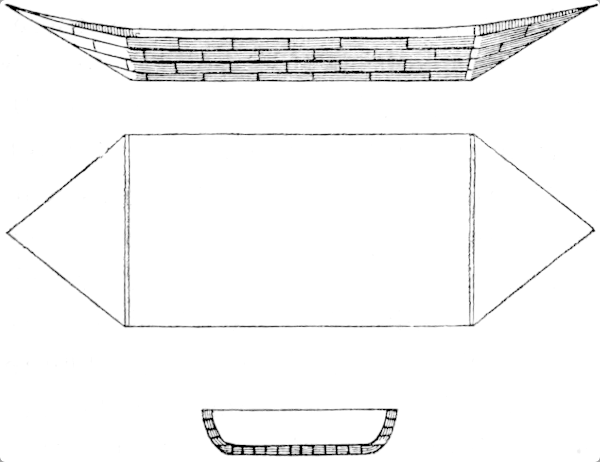
Craft on
the Oxus.
Their build
and number,
&c.
The boats which are used on the Oxus are of
a superior description, though they have neither
masts nor sails. They are built in the shape of
a ship, with a prow at both ends, and are generally
about fifty feet long and eighteen broad.
They would carry about twenty tons English;
they are flat-bottomed, and about four feet deep:
when afloat, the gunwale is about two and a half
or three feet above the stream; for they do not
draw much more than a foot of water when laden.
They are constructed of squared logs of wood,
each about six feet long, formed of a dwarf jungle-tree,
called “pukee,” or “sheeshum,” which
grows in great abundance throughout the banks
of the river, and cannot be procured of greater
dimensions. These trees are felled, their bark
is peeled off, and they are chipped into a square
shape, which makes them ready for the workmen.
The logs are clamped with iron, and, though
these boats have a rude appearance, there is a
strength and solidity in their build that admirably
fits them for the navigation of such a river. There
are few boats in the higher part of the Oxus
above Charjooee. From that place to where it
becomes fordable, near Koondooz, there are
about fifteen ferries, and as each is provided with
two, we have only a tonnage of thirty vessels in
a distance of three hundred miles. The reason
is obvious, for the inhabitants make no use
of the navigable facilities of the Oxus. Below
Bokhara the supply increases, and there
are about 150 boats between it and the
Delta, chiefly belonging to Orgunje. Here
they are not appropriated as ferry-boats, but used
in the transport of merchandise to and from
Bokhara. The embarkations take place at Eljeek,
on the north bank of the river, about sixty-five
miles from the city. Below the Delta there
are no boats; and I am informed that the sea
of Aral is without vessels of any other description
than small canoes. In ascending, the boats are
dragged against the stream; and in dropping
down make for the middle, where the current
is rapid, and float down with their broadsides
to it. Neither rafts nor skins are used on the
Oxus.
Mode of
navigating
the Oxus.
The manner of ferrying across is novel, and,
I believe, peculiar to this river; the boats are
dragged across by horses, as I have fully described
in the narrative: nor should such a contrivance
be lost sight of by those who may use
the Oxus as a navigable river.
Wood of
the Oxus.
Facilities in the navigation of a river rest much
on the supplies of the country through which it
flows; in particular, of the nature and quantity
of wood which is there procurable. The number
of boats on the Oxus is certainly small,
since they do not amount to two hundred; but
there is every facility for building a fleet, the
supply of wood being abundant, and fortunately
found in single trees along the valley of the river,
and not growing in forests on any particular spot.
There are no cedar or pine-trees brought down
by the inundation, which I hold as conclusive
proof that the mountains from which the Oxus
and its tributaries flow are destitute of that wood.
The only other trees which I saw on the river
were mulberry and the white poplar; which last
is floated down in quantities from Hissar to
Charjooee, and applied to purposes of house-building.
In any increase of the tonnage on this
river, the immediate resources of the neighbouring
country must therefore be called into action;
but these are highly important. The nature of
the build in the boats of the river requires no
skill in naval architecture; the wood is not
sawed, and it does not require seasoning, so
that the utmost despatch might be used at all
times in forming a flotilla, whether it were
desired to navigate, cross, or bridge it. I
believe that 150 men might be embarked on a
boat of the size which I have described. The
river could only be bridged by boats, for the
wood is too small for an application of it in any
other way, and the furze and tamarisk which
grow in its banks would supply the place of
planks, and make it at once complete and practicable.
A bridge of boats was thrown across
the Oxus by both Timour and Nadir, and the
remains of some temporary buildings erected
by the latter conqueror are still shown at the
ferry of Kilef, north of Balkh. The river there
presents facilities for such an operation, since
it has hillocks on both sides, is narrow, and
not always rapid. Passengers frequently swim
across the river at this ferry. Below the mountains
the Oxus has a firm and sandy bed, and
boats may be anchored by branches of trees in
all parts of its stream.
Political
and commercial
advantages
of
the Oxus.
The advantages of the Oxus, both in a political
and commercial point of view, must, then,
be regarded as very great: the many facilities
which have been enumerated point it out either
as the channel of merchandize, or the route of
a military expedition; nor is it from the features
of the river itself that we form such a conclusion.
It is to be remembered that its banks
are peopled and cultivated. It must therefore
be viewed as a river which is navigable, and
possessing great facilities for improving the extent
of that navigation. This is a fact of great
political and commercial importance, whether
an hostile nation may turn it to the gratification
of ambition, or a friendly power here seek for
the extension and improvement of its trade. In
either case, the Oxus presents many fair prospects,
since it holds the most direct course, and
connects, with the exception of a narrow desert,
the nations of Europe with the remote regions of
Central Asia.
CHAP. III. ON THE VALLEY OF THE UPPER OXUS; BEING A NOTICE OF KOONDOOZ, BUDUKHSHAN, AND THE KAFFIR COUNTRY, WITH THE ADJACENT TERRITORIES.
Sketch of
the countries
to be
described.
The countries north of Hindoo Koosh, which
lie in the valley of the Oxus, and its tributary
rivers, from Balkh upwards, have no general designation;
eastward of that city lies Koondooz, under
which all the smaller provinces may be classed,
since the Meer, or chief of that state, has subdued
them. Further to the eastward, we have
the province of Budukhshan, also a dependency
of Koondooz. To the north of this territory
are the hill states of Wakhan, Shughnan, Durwaz,
Koolab, and Hissar; which are remarkable,
as containing a race of people that claim a
descent from Alexander the Great. To the
eastward of Budukhshan lies the plain of Pamere,
inhabited by the Kirghizzes; and beyond
the Beloot Tagh mountains we have Chitral, Gilgit,
and Iskardo, that extend towards Cashmere,
and are also inhabited by tribes who assert their
Macedonian origin. South of Budukhshan is the
country of the Siahposh Kaffirs, a most singular
people, who dwell among the mountains of Hindoo
Koosh. These are the provinces which
it is now proposed to describe; but we shall
reserve any particular mention of the descendants
of Alexander for the following chapter,
and proceed, in the first place, to speak of the
country and its productions.
Koondooz.
Koondooz is situated in a valley among low
hills, which extend from east to west for about
thirty miles, and from north to south about forty,
when it is bounded by the Oxus. It is watered
by two rivers, which join north of Koondooz,
and are not fordable during the melting of the
snows in summer. The climate of this country
is most insalubrious: the heat is excessive, yet
the snow lies for three months during winter.
The greater part of the valley is so marshy,
that the roads across are constructed on piles of
wood, which are fixed among noxious reeds and
vegetation. Rice is reared in such places as
are not entirely inundated, and in the drier
ground there is wheat and barley. The fruit
consists of apricots, plums, cherries, and mulberries,
and it ripens at Balkh and Khooloom
about a fortnight sooner than at Koondooz.
The great mountain of Hindoo Koosh is in
sight at Koondooz; but those hills which form
the valley on either side do not rise to a height
of a thousand feet from the plain. They are
long ridgy high-lands, covered with grass and
flowers, but free from trees or brushwood, forming
valuable pasture lands. The town of Koondooz
cannot boast a population of 1500 souls;
for it is deserted by the chief and the people.
The neighbouring districts do not partake of
the unhealthiness of Koondooz. Khooloom,
Heibuk, Goree, Inderab, Talighan, and Huzrut
Imam, are its subjected districts, and except the
last, which lies in the Oxus, they possess a
pleasant climate, and have a rich and prolific
soil. These districts are watered by rivulets
flowing into the Oxus, and the soil is valued
by the facilities which it enjoys of being watered.
Heibuk and Khooloom stand on the same rivulet,
the water of which is dammed up on
certain days, and allowed to run on others. The
gardens on its banks are rich and beautiful; and
among the fruit-trees, one again meets the fig,
which does not grow in Cabool.
Budukhshan.
The countries that lie higher up the Oxus
have none of the defects of climate which are
peculiar to Koondooz, and both natives and
foreigners speak in rapture of the vales of Budukhshan,
its rivulets, romantic scenes and glens,
its fruits, flowers, and nightingales. This district
lies along the valley of the Oxus; but
its capital is further to the south, and eastward
of Koondooz. It is sometimes called Fyzabad,
but its more common and proper name
is Budukhshan. This once celebrated country is
now almost without inhabitants; it was overrun
by the chief of Koondooz about twelve years
ago: its ruler has been dethroned, and his substitute
exists as a mere pageant; its peasants
have been marched out of the country, and a
rabble of lawless soldiery is now quartered in
the different provinces. It also suffered from
an earthquake in January, 1832, which destroyed
many villages, and a great part of the population.
The roads through many parts of the
country were blocked up by the falling of stones,
and the river of Budukhshan was hemmed
in for five days, by a hill that tumbled in
upon it. This great convulsion of nature occurred
at midnight, and scarcely a family in the
country but deplored the loss of some of its
members. It was felt at Mooltan and Lahore,
but the centre of its violence appears to have
been the valley of the Oxus. The natives of
Budukhshan are Tajiks; they are very fond of
society, and such is their hospitality, that, it is
said, bread is never sold in the country. Their
language is Persian, which they speak with the
broad pronunciation of a native of Iran. It is
related that Budukhshan was peopled from the
Persian city of Balkh, and most of the inhabitants
are Shiahs. Neither the Uzbeks, nor any
of the Toorkee families, have settled in the
country, and the people have yet the manners
and customs that obtained north of Hindoo
Koosh before the invasion of the Tartars.
Ruby
mines.
Budukhshan has acquired great celebrity for
its ruby mines, which were well known in
early times, and also to the emperors of Delhi.
They are said to be situated on the verge of the
Oxus, near Shughnan, at a place called Gharan;
which may simply mean caves. They are dug
in low hills; and one man assured me that the
galleries passed under the Oxus; but I doubt
the information. It is a mistake to believe that
they are not worked, as the present chief of
Koondooz has employed people in digging
them since he conquered the country. These
persons had been hereditarily engaged in that
occupation; but, as the returns were small, the
tyrant of Koondooz demanded their labour
without pay; and on their refusing to work,
he marched them to the unhealthy fens of
Koondooz, where their race has almost become
extinct. In the search of rubies, it is a
popular belief that a pair of large ones will
be always found together; and the workmen
will often conceal a gem till its match can be
found, or break a large ruby into two pieces.
The rubies are said to be embedded in limestone;
and to be found like round pieces of
pebble or flint, which exist in such deposits.
Lapis lazuli.
In the vicinity of the ruby mines, great masses
of lapis lazuli are found on the verge of the
Oxus. The mode of detaching it from the cliffs
appeared to be ingenious, though I think I
have heard of similar means being used to quarry
stone in other quarters. A fire is lit over the
block of lapis lazuli, and when the stone becomes
sufficiently heated, cold water is dashed
upon it, and the rock is thus fractured. The
lapis lazuli of the Oxus was sent in former
years to China; but the demand has lately decreased.
I have seen many specimens of this
stone, with veins, which were said to be gold;
but I imagine they were mica. Lapis lazuli and
rubies are only collected in winter.
Mountain
districts
north of
Budukhshan.
North of Koondooz, and Budukhshan, and
beyond the Oxus, we have the small hill states
of Hissar, Koolab, Durwaz, Shoognan, and
Wukhan: the whole of them are mountainous.
Hissar is finely watered, and a rice country,
independent of Bokhara and Koondooz. It is
held by four Uzbek chiefs, who divided it
among themselves on their father’s death; its
capital stands on a hillock forty miles east of
Dihnou. A range of hills called Kohitun,
which are about 4000 feet high, traverses the
district from north to south. There is an extensive
deposit of red rock salt in it, which is exported
to other countries. The saddle used by
the natives of Hissar differs from others in
Toorkistan. The tree, or seat, is scooped out
like a bowl, and is then covered with leather:
it has a knob in front. The ferry of Tirmez on
the Oxus, bounds Hissar on the west; and to
the east it has Koolab, which is a small district,—sometimes
called Bulgeewan. It has lately
been seized by the chief of Koondooz, who
forded the Oxus and conquered it. Durwaz is
the next territory, and is ruled by a Tajik
chief, who is independent. In his territories,
the Oxus is most successfully washed for gold.
The two next districts of Shughnan and Wukhan
are tributary to Koondooz; but there are not
more than three or four villages in each of
them. Wukhan is the territory mentioned by
Marco Polo; and the few specimens which I
could collect of its language were as follows:—
| Father |
Fait |
| Mother |
Nan |
| Son |
Kash |
| Daughter |
Poorchad |
| Fire |
Rekhnu |
| Water |
Yoobk. |
The chief of Wukhan is named Meer Mahommed
Ruheem Khan, and will allow none
of his progeny to leave the hills. The people
of Shughnan differ also in their dialect. I give
a specimen of three words:—
| Bread |
Gurdu |
| Son |
Ghudyk |
| Daughter |
Ghuds. |
The whole of the population is Mahommedan;
and I did not hear of any trace of pristine
superstition. They designate the Deity by the
Persian word Khooda. I heard of a singular
practice among the people of these districts,
who shoe their horses with the antlers of the
mountain deer. They form the horn into a
suitable shape, and fix it on the hoof with horn
pins, never renewing it till fairly worn out. It
is said that the custom is borrowed from the
Kirgizzes.
Plain of
Pamere.
The high plain of Pamere lies between
Budukhshan and Yarkund; and is inhabited by
an erratic race, the Kirgizzes. The centre of
this table-land is the lake of Surikool, from
which the Jaxartes, the Oxus, and a branch of
the Indus are said to rise. This elevated plain
extends on every side of the lake for a journey
of six days; and all the mountains are described
as seen under the feet from this great elevation.
It is a flat tract, intersected by shallow ravines,
and covered with short but rich pasture: it is
very cold; and the snow in summer does not
disappear from the hollows. The inhabitants
robe their whole bodies, even their hands and
faces, in sheepskins, from the severity of the
cold. There is no grain in the country; for
the Kirgizzes subsist on flesh and milk: they do
not even know the use of flour; and, if it is
given them, they mix it up with their soup, but
never bake it into bread. They live on round
khirgahs, like the Toorkmun tribes, and wander
from one place to another.
Singular
animal that
inhabits
Pamere.
I heard of an animal called “Rass” by the
Kirgizzes, and “Kooshgar” by the natives of
the low countries; which is described as peculiar
to Pamere. It is larger than a cow, and
less than a horse; of a white colour, with
pendent hair under its chin, and crowned with
horns of huge dimensions. These are described
to be so large, that no one man can lift a pair of
them; and, when left on the ground, the small
foxes of the country bring forth their young
inside them. The flesh of the “Rass” is much
prized by the Kirgizzes, who hunt and shoot it
with arrows. This animal is said to delight in
the coldest climate; and would appear, from
its beard, to be of the goat species, or, perhaps,
the bison. A common-sized “Rass” will
require two horses to bear its flesh from the
field.
Countries
of Chitral, Gilgit, and
Iskardo.
The tract that lies beyond the Beloot mountains
and Budukhshan, and between it and
Cashmere, is filled up by the cantons of Chitral,
Gilgit, and Iskardo, all of which are held by
Shiah Mahommedans. There is another district
to the north-east of Chitral, which is called
“Gunjoot,” from the gold which is found in it.
The countries of which I now speak have been
designated by the general name of Kaushgar, by
Mr. Elphinstone; and are separated from Budukhshan
by the range of Beloot. Kaushgar itself
is a small district near Deer, north of Peshawur;
and I never heard a native of Budukhshan or
Yarkund speak of the country under that general
name. They had not even heard of any Kaushgar
but that in the vicinity of Yarkund. Chitral is
situated on a branch of the Cabool river, and is
subject to the chief of Koondooz, who has at
times entered the country; and new demands a
yearly tribute of slaves, who are sent to Bokhara
for sale. The chief has the title of Shah
Kuttore, and boasts of his Macedonian lineage.
The dialect of Chitral differs again from that of
the neighbouring states; and I fortunately met
a native who was acquainted with it: he gave
me these specimens:—
| Mother |
Nunan |
| Son |
Dirk |
| Daughter |
Jaor |
| Man |
Mach |
| Woman |
Kumoor |
| Water |
Oogh |
| Fire |
Ungar |
| Above |
Acha |
| Below |
Aye |
| Mountain |
Koh |
| Fort |
Noghar |
| I go |
Booghdo |
| Where do you go? |
Koora roobas. |
The next district is Gilgit, or Gilgitty, where
the dialect also differs from Chitral: it is a
strong country, and independent of Koondooz.
The remaining division lies further eastward,
bordering on Baltee or Little Tibet, and bears
the name of Iskardo. The principal place of
the same name is a large fort of irregular construction,
which is built on the banks of the
Indus, and is said to be but eight marches north-east
of the City of Cashmere. The country is
independent.
The Kaffirs.
On the south-eastern corner of Budukhshan,
and on the mountains between it and Peshawur,
we find that extraordinary people, the Siahposh
Kaffirs, or Black-vested Infidels, as called by
their Mahommedan neighbours, from their
wearing black goat-skin dresses. This race
is entirely confined to the mountains, and persecuted
by all the surrounding nations, who
seek to capture them as slaves. The chief of
Koondooz made an inroad into their country
some years since, and lost half of his army in
the campaign. I can offer no further addition
to the notice of their religion and country, than
is to be found in Mr. Elphinstone’s work, though
I met the worthy and faithful man Moollah
Nujeeb, who was sent into Kaffiristan for the
purposes of enquiry. I had much conversation
with people who had been brought into contact
with them, and in Cabool was fortunate enough
to see a Kaffir boy about ten years old, who
had left his country for a period of two years;
his complexion, hair, and features, differed from
those of Asiatics: his eyes were of a bluish
colour. The boy replied to many questions
that were put to him about his country, and
gave specimens of his language, which assimilated
with the Indian dialects. The Kaffirs
appear to be a most barbarous people, eaters of
bears and monkies, and fighting with arrows, and
scalping their enemies. The greatest intercourse
which takes place between them and the Mahommedans
is carried on from the country of
Lughman, between Cabool and Peshawur,
where a tribe of people reside who are called
“Neemchu Moossulman,” or half Mahommedans.
The Kaffir country is strong and mountainous.
The people are much addicted to
wine. Gold is found in its native state among
their mountains, and formed by them into vessels
and ornaments. These circumstances, with
their appearance and complexion, have given
rise to an opinion, that they are the descendants
of the Greeks.
Their descent
from
Alexander
doubted.
Both Baber and Abool
Fuzzil have made mention of this supposition;
but they have confounded the claims of the chiefs
on the Oxus to a Macedonian descent with the
Kaffirs, who have no such tradition of their
origin. The great elevation of the country
which they inhabit, would appear to account
satisfactorily for all their physical peculiarities;
and I believe it will be found that this people
are none other than the aborigines of the plains,
who fled to their present abode on the conversion
of the low countries to the religion of
Mahommed: the Afghans, at least, tell you so,
and the name of Kaffir, or Infidel, seems a strong
corroboration of the opinion. The Kaffirs are a
race of savages, and there is nothing either in
their customs or religion which seems to be
anywise remarkable among a people at their
state of civilisation. The hill tribes in India
have a religion which differs as much from Hindooism
as that of the Kaffirs; and the reason is
obvious: they inhabit remote regions, that were
not accessible to the manners and alterations
which found their way into the more favoured
plains. The Kaffir women do all the out-door
work, and follow the plough: it is even said
that they are sometimes yoked in it along with
an ox.
CHAP IV. ON THE REPUTED DESCENDANTS OF ALEXANDER THE GREAT IN THE VALLEY OF THE OXUS AND INDUS.
Traditions
of the descendants
of Alexander
the Great.
In speaking of the existence of Grecian colonies
in the remote regions of Asia, and said to be
descended from Alexander of Macedon, it is
necessary to premise that I am not indulging in
speculation, but asserting a lineage of various
tribes of people, that is claimed by themselves,
and meriting, therefore, our attention. Marco
Polo is the first author who mentions the existence
of such a tradition, and informs us that the
Meer of Budukhshan laid claim to a Grecian
origin. The emperor Baber corroborates the
testimony; and Abool Fuzzul, the historian of
his grandson, Acbar, points to the Kaffir country
north of Peshawur as the seat of these Macedonians.
Mr. Elphinstone has, I think, successfully
refuted the supposition of this historian; for
the Kaffirs are a savage and mountainous tribe,
without a tradition on the subject, as has been
noticed in the preceding chapter. Mr. Elphinstone,
however, confirms the statements of
Marco Polo, by the information that the chief
of Durwaz, in the valley of the Oxus, claimed
a descent from Alexander, which was admitted
by all his neighbours. Such was the extent of
information with which I entered these countries,
sufficient, it will be said, to excite the
utmost curiosity; and it will be seen that I
found ample encouragement in the investigation
of such traditions while in the valley of the
Oxus, and in the very seats of their existence.
Their actual
condition.
If it was believed that the chiefs of Budukhshan
and Durwaz alone laid claim to these hereditary
honours, what was my surprise to find
that there were six other personages established,
to the satisfaction of the people, in like honours.
The chiefs that extend eastward of Durwaz, and
occupy the provinces of Koolab, Shughnan, and
Wakhan, north of the Oxus, claim the same
descent. The chief of Budukhshan received in
modern times the same honours as have been ascribed
to him by the Venetian traveller. He has
the title of Shah and Malik, or King, and his children
that of Shahzadu; but this ancient house
has been subverted within these twelve years
by the Meer of Koondooz, and Budukhshan is
now held by a Toork family. To the eastward
of Budukhshan, and extending to Cashmere,
lie the hill states of Chitral, Gilgit, and
Iskardo, where the claims to a Grecian descent
are likewise conceded to each of the princes.
The first of these has the title of Shah Kuttore.
The present ruler is of small stature, and, in
these countries, has as great a celebrity for his
long beard as the Shah of Persia. The chief of
Iskardo occupies a singular fortress on the
Indus, which he has the hardihood to assert
was constructed in the days of Alexander himself.
The country borders on Little Tibet, or
Baltee. Nor is this the ultimate limit of the
tradition, for the soldiers of the Toonganee tribe,
who are sent from the western provinces of
Chinese Tartary, and garrison Yarkund and
the neighbouring cities, claim also a Grecian
origin. They, however, seek, with greater
modesty, a descent from the soldiers of Alexander’s
army, and not from the conqueror himself.
Examination
of
these
claims.
Such is a correct list of the reputed descendants
of Alexander, and it is in some degree
confirmatory of their claim, that the whole of
these princes are Tajiks, who were the inhabitants
of this country before it was overrun
by Toorkee or Tartar tribes. But how shall
we reconcile these accounts with the histories
that have travelled down to our times, whence
we learn that the son of Philip did not even
leave an heir to inherit his gigantic conquests,
much less a numerous list of colonies, which have
survived a lapse of more than 2000 years in a
distant quarter of Asia? Whether their descent
is viewed as true or fabulous, the people themselves
acknowledge the hereditary dignity of the
princes; and they, in their turn, claim every
royal honour, and refuse to give their children
in marriage to other tribes. These Tajiks being
now converted to Islam, view Alexander as a
prophet; and to the distinction which they derive
from his warlike achievements, they add the
honour of being related to one of the inspired
messengers of the Deity. I have had opportunities
of conversing with some members of the
Budukhshan family, but there was nothing in
form or feature which favoured their Grecian
lineage. They are fair-complexioned, and not
unlike the Persian of modern times; while there
is the most decided contrast between them and
the Toorks and Uzbeks.
Conjectures
regarding
them.
We learn from the historians of Alexander’s
expedition, that he warred in the kingdom of
Bactriana. The city of Balkh, which lies in the
vicinity of these territories, is readily fixed upon
as the Bactra of the Greek monarchs. Setting
aside every local identity, the modern inhabitants
state, that the country between Balkh
and Cabool had the name of “Bakhtur Zumeen,”
or the Bakhtur country, in which we
recognise Bactria. The fact renders it by no
means improbable, that a Grecian colony had
some time or other existed in the country. It
may, therefore, be supposed, that the Grecian
dynasty, which succeeded Alexander in his
empire, ascended the valley of the Oxus, the
fertility of which would attract them. They
would have been conducted at Iskardo into
Baltee, or Little Tibet, and the neighbourhood
of Cashmere; and we may perhaps account for
the early civilisation of that beautiful valley in
such a migration of Grecian colonists. The introduction
of the religion of Mahommed into
every country seems to have been fatal to its
historical annals; and I doubt not that any traces
which here existed of the Macedonian inroad,
or of the Seleucidæ, their successors, were
effaced in that great revolution. I have already
observed, that the countries on the upper course
of the Oxus seem to have lain out of the channel
of Tartar invasion, and I infer, from their
language and connection with Persia, that they
followed the destinies of that country, which
would be favourable to their having been conquered
by Alexander. If we cannot bring ourselves
to concede to these moderns the illustrious
lineage of Alexander of Macedon, we
must yet receive their tradition as the most concurring
proof of his having overrun these countries;
and, till some well-grounded arguments can
be brought forward to the contrary, I cannot,
for my own part, deny their title to the honours
which they claim. I received the information
from several natives of the country; and, as they
entertained no doubt of its being genuine and
authentic, I have contented myself with recording
that which will enable others to enlarge and
speculate upon it.
CHAP. V. ON THE SOURCES OF THE INDUS.
Interest
attached
to the
sources of
the Indus.
The sources of the different great rivers of the
world have at all times excited the particular
attention of mankind. Of none has our information
been more conflicting and obscure
than the upper course of the Indus. I record
the following particulars relating to this most
interesting geographical subject, the result of
my intercourse with the people of the neighbouring
countries. My enquiries have been
materially assisted by the labours of Lieutenant
Macartney, though a wide difference will be
found between the heads of the Indus, as now
described, and their delineation in that officer’s
map. Great, however, is the aid which one
derives from the records of a preceding enquirer.
The papers of Mr. Moorcroft ought
to furnish us with some information on this
point; but they are still unpublished, and his
journey, though it extended nearer to the scene
than that of any other modern traveller, was
yet distant from the source of the Indus.
Received
opinions.
The following are our present and received
opinions regarding the source of the Indus.
The river of Ladak, joined by the Shyook, falls
into the Indus at Draus, and these united
streams form the great river which runs north
of Cashmere, and is joined by the Aboo Seen
before passing Attok. The town of Leh, or
Ladak, is placed above the parallel of 37° N.
latitude, and Draus lies nearly half way between
it and the city of Cashmere.
Errors.
This account
differs materially from the information which
I have received. The river of Ladak, and
the Shyook, instead of existing as two minor
tributaries of the Indus, form of themselves
that great river; the one rising near the lake
of Mansurour, and the other in the mountains
of Karakorum. They unite N.W. of Ladak, and
pass through the country of Little Tibet, or
Baltee, and a snowy range separates them from
Cashmere. Ladak lies nearly eastward of Cashmere,
which places it three degrees of latitude
below the parallel given to it by Mr. Macartney;
and Draus is on the road to Ladak.[24] No such
junction as is given in the map takes place at
Draus, and the rivulet that passes that village,
instead of forming a portion of the waters of
the Indus, runs among the mountains of Cashmere,
and joins the Jelum, or Hydaspes, at
Moozufferabad, as it leaves the valley. This
fact is mentioned in a note in Mr. Elphinstone’s
book, on the authority of a journal of Meer
Izzut Oollah, which he received after his own
account was written. It may have been owing
to this last circumstance that he overlooked the
inconsistency of Izzut Oollah’s statement with
the existence of Mr. Macartney’s eastern branch
of the Indus. Mr. Elphinstone, indeed, observes,
that Izzut Oollah did not see the junction
of that branch with the river of Ladak;
but he accounts for it by supposing the confluence
to lie to the south of the place called
Draus in Izzut Oollah’s route. If that route be
protracted, however, it will show that the river
of Ladak could not well have passed to the
south of Draus without falling into the course
of the Kishun Gunga; and that, even if the
junction had taken place to the south of Draus,
both rivers must still have been crossed (either
united or separately) by Izzut Oollah before he
reached Draus.
It is evident, therefore, that the rivers do
not meet at or to the south of Draus; and, as
Izzut Oollah went from Draus to the river of
Ladak, and accompanied that river to the town
from which it takes its name, without seeing the
junction of any other river from the east, his account
may be regarded as a confirmation of the
fact which I have stated, that no such eastern
branch exists. It is worthy of observation, that
Mr. Macartney’s account of the eastern branch
of the Indus appears to have been only communicated
by one person.
Description
of the two
great
branches
which form
the Indus.
That the river of Ladak has its source near
the lake of Mansurour has been satisfactorily
established by Moorcroft. The course of this
branch of the Indus is, therefore, of great
length; but the volume of water has been
described to me as very small, though it receives
several tributaries. The Shyook, on the other
hand, is said to be a vast river, formed of many
small ones, and discharges the water and melted
snows of the Kara Korum mountains. Three
days’ journey from Ladak, on the route to
Yarkund, it is crossed at a breadth of 1000
yards in March; but widely spread and fordable.
This is considered by the natives as the great
trunk of the Indus, and its source, to the N.E.
of Ladak, is, consequently, that of the Indus.
The united streams of the river of Ladak and
Shyook pass south of the territories of Iskardo,
Gilgit, and Chitral. They are then joined by
the Aboo Seen, as described by Mr. Elphinstone,
and at Attok, by the river of Cabool,
here called the Lundee, which falls into the
Indus, close upon the fortress, and not some
miles higher up.
Western
branch of
the Indus.
The sources of this river, commonly called the
River of Cabool, are nearly as remote as those to
the eastward, which we have now described. The
River of Cabool actually rises near Ghuzni; but,
in its course eastward of Jullalabad, is joined by a
great river that has been called the Kameh, though
it is unknown to the natives by such a name.
This river is traced to the same source as the
Oxus; where it is said to spring from a glacier.[25]
That it rises in the same neighbourhood as the
Oxus, I have been also informed; but that river
(as I have stated when speaking of it) flows from
the plain of Pamere, near Lake Sirikol, and
not from the ranges of mountains which support
that elevated region. This great western branch
of the Indus, therefore, rises under a much
higher parallel of latitude than the Shyook.
Cashgar;
erroneous
opinions regarding
it.
The country, which is enclosed by these different
branches of the Indus, has been called
Kashkaur, or Cashghar, in our late maps; which
Mr. Elphinstone warns the reader not to confuse
with Cashgar, near Yarkund. At Peshawur, I
certainly heard of a small mountainous district,
near Deer and Gunjoom, called Cashgar, and
which is well known for its coarse blankets; but
the name has been applied to a far greater extent
of country than is even known to the natives of
Peshawur. North of Hindoo Koosh, in Koondooz,
and the borders of Budukhshan, I could
find no person who was acquainted with any
country under the name of Cashgaur, but that of
Yarkund. They spoke of Chitral and Gilgit,
which form part of it, according to the modern
nomenclature of our maps, but knew nothing of
the southern Cashgar as a separate territory;
doubtless from the smallness of the district and
its remote position[26]. Since the whole of the
information contained in this chapter rests on the
authority of others, the credence to which it is
entitled must be well weighed. I have the information
from people who had seen these rivers
and countries, and I have given the facts, after
due corroboration and enquiry.
CHAP. VI. NOTICE ON YARKUND, AND ITS INTERCOURSE WITH PEKIN, BOKHARA, AND TIBET.
Chinese
provinces
of Yarkund.
Yarkund is one of the frontier positions of
the Chinese empire towards the west, and a
five months’ journey of a caravan from the seat
of government, Pekin. The productions of
China are transmitted to this province, and sold
to the natives of Bokhara and Tibet, who are
permitted to frequent certain fixed markets; of
which the greatest is Yarkund. No Chinese
crosses the frontiers; and the trade into Bokhara
is carried on by Mahommedans, who visit Yarkund
for that purpose. The same vigilance to
prevent the ingress of foreigners is here exhibited
as upon the sea-coast. In my communications
with the Uzbeks of Bokhara, I heard much of
the Chinese peculiarities, and I had an opportunity
of travelling with a tea caravan from Yarkund;
which leads me to believe that a notice
of this country, imperfect as it must be, will not
be uninteresting.
Sketch of
its history.
Yarkund, with the adjacent province of Cashgar,
formed the principality of a Mahommedan
ruler, known by the name of the Khoju of
Cashgar, a family of religious influence, who
once exercised great authority. The people of
these parts superstitiously believed its members
to be invulnerable in battle, and able to use extraordinary
means for the discomfiture of their
enemies, and yet think it impossible for any one
to prosper who injures a Khoju. Dissensions,
however, arose in this family about eighty years
since, and they called on the Chinese government,
or the “Khitais,” (so they are here named,)
as a mediator, which, as not unfrequently happens,
acted the part of conqueror. Since that
time, the Chinese have retained the whole of
their lands; not, however, without many endeavours,
both by war and conspiracy, on the part
of the dethroned family, at restoration. The last
of these attempts occurred about five years since,
aided by the Uzbeks of Kokan; but the Chinese
assembled an army from their most distant
provinces, and, advancing into that country,
captured the rebellious Khoju, and sent him in a
cage, or covered cart, to Pekin. The Khan of
Kokan, though he was defeated, has since arrogated
to himself the title of “Ghazee,” from
having warred with infidels. On the first overthrow
of this family, some of the Khojus fled to
Budukhshan, and the chief of that province put
them to death: for which good office the Chinese
sent him a yearly present, till within these five or
six years, when his country was seized by the
Meer of Koondooz. The bigotted Mahommedans
attribute the misfortunes of the Budukhshan
family to the injuries offered to the Khoju
of Cashgar. While such opinions prevail, the
members of it must continue to be disagreeable
neighbours to the Chinese.
Mode of
government
under the
Chinese.
The period which has elapsed since the capture
of Yarkund has no way diminished the
precautions of the Chinese government. Yarkund
is still considered but an outpost, and the
communication between it and Pekin maintained
in a most characteristic manner. The
government of all the cities is left in the hands
of Mahommedans, and there are not above 5000
Chinese in Yarkund. The garrisons are recruited
from boys of fourteen and fifteen, who are sent
back after about as long a period of service. These
soldiers are drawn from the tribe of Toonganee,
who claim relationship to the army of Alexander:
they are Mahommedans, from the adjacent provinces,
but dress as Chinese. They are never
permitted to marry, or bring their families within
fifteen marches of the country, and are regarded
as troops on foreign employ. The natives of
the country rule, under the superintendence of
the Chinese officers. The governor of Yarkund,
who has the title of Hakim Beg, is subject to
Cashgar; and he, again, is under the Junjoom of
Eela, a large city, forty marches north of Yarkund.
The principal places in these frontiers
are, Eela, Yarkund, Cashgar, Aksoo, Karasoo,
Yengi hissar, &c. Eela is said to have a population
of 75,000 souls. Yarkund ranks next in
importance, and has 50,000; while Cashgar is
smaller than both. Yarkund stands on a river,
in a fertile plain, which is rich in fruit and grain.
It is surrounded on all sides but the east by hills,
where the river flows. The climate is dry and
agreeable; snow seldom falls, and even rain is
scarce.
Communication
with
Pekin.
The mode of communication with Pekin, or,
as it is called, Bajeen, and their eastern provinces,
is carried on with an arrangement and expedition
purely Chinese. The usual journey exceeds the
period of five months; but an express may be
sent in thirty-five days. Under great emergency,
it is conveyed in twenty, and even fifteen days.
“Oortungs,” or stages, where there are relays of
horses, are erected every eight or ten miles, and
one messenger is not even permitted to exchange
a word with another. At each of these stages
there are piles of wood, which are directed to be
set fire to on the intelligence of arising or invasion
of the Mahommedans; and by this means
intelligence has been sent from Yarkund to
Pekin in six days. I have heard that fire-balloons
are used instead of piles of wood; but I believe
that in the latter we have the more simple
and correct version of the tale. It was on this
intimation that the last Chinese army was
marched into Kokan; and it is said to have been
assembled from all the cities of the empire, and
amounted to 70,000 men. The military appearance
of this body is said to have been truly
singular. A great portion of the soldiers were
armed with large matchlocks, each of which was
borne by two persons.
People of
Yarkund.
The Chinese of Yarkund interfere but little
with the affairs of the country, and leaving it
and its trade to the Mahommedan portion of the
population, the authorities levy a duty of one
in thirty; and their commercial regulations are
just and equitable. The word of a Chinese
is not doubted, nor does the tea ever differ in
quality from the sample. The Mahommedans
of Yarkund amount to about 12,000 families.
They are Toorks, and speak a dialect of Toorkee
that is perfectly intelligible to the natives of
Bokhara. The country people are sometimes
called Moghuls by those who live in cities; and
from this may have originated our vague name of
Mongolia. There are Calmuk Tartars settled
around Eela and Yarkund, who have a singular
custom to distinguish their chiefs and grandees,
by fixing deer’s horns on their skull-caps. The
size and beauty of the antlers mark the dignity,
and are the red ribbons of a Calmuk Tartar.
The laxity of their females, I am assured, entitles
them to the honour of wearing such an
ornament. The Chinese employ Calmuks in the
protection of their frontier. The Mahommedans
of Yarkund appear to differ from their brethren
elsewhere, for the fair sex have a power and influence
not known in other places. They take
the seat of honour in a room, associate freely with
the men, and do not veil; they wear high-heeled
boots, richly ornamented; their head-dress is
described as very handsome, being a high tiara
of cloth; the features of the fair ones themselves
are said to be most beautiful. When a
Bokhara merchant visits Yarkund, he marries one
of these beauties during his sojourn in the city;
and the pair separate, as they joined, quite as
a matter of convenience, when he leaves the
country. Their wives are as cheap as beautiful,
and purchased at a premium of two or three tillas
(twelve or eighteen rupees); and the merchants,
long after leaving the country, sing the praises
of the fair ones of Yarkund. I could not discover
what had given rise to their appearing
without veils and being invested with such influence;
but I congratulate them on two such
infringements of Mahommedan usage. Besides
the native Chinese, who frequent Yarkund, I am
informed that Christian merchants, probably Armenians,
also visit it from the eastward: they
dress as Chinese.
Intercourse
with Tibet.
The intercourse from Tibet and Bokhara is
carried on by regulations that are truly energetic.
The natives of these countries are not
permitted to proceed beyond Yarkund and the
neighbouring towns, and, as they enter the
Chinese dominions, are placed under certain persons,
who have a knowledge of the countries
from which they come, and made responsible for
their behaviour. So thoroughly organised is
this system of police, that it is said to be impossible
to elude its vigilance. A native who was
suspected in these countries, and was afterwards
in my service, remained in confinement for three
months, and was at length dismissed by the route
he had come, but not till a likeness of him had
been first taken. Several copies of the picture
were despatched to the frontier towns, with these
instructions:—“If this man enters the country,
his head is the Emperor’s, his property is yours.”
I need not add, that he has never since sought
to extend his acquaintance in the Chinese provinces
of Yarkund.
Country
between
Yarkund
and Tibet.
I had a most interesting account of the country
lying between Yarkund and Ladak, in Tibet,
from a native who had travelled there, and which
will convey any but favourable notions of this
channel of commerce, frequented, as it appears
partially to be. The traveller set out from Ladak
in March, and reached Yarkund in sixty days,
after encountering a series of disasters and difficulties
from a storm that arose in passing the
mountains of Kara Korum. The number of
actual marches does not exceed twenty-eight,
but seven whole days were occupied in crossing
Kara Korum; which is described as a low ridge,
at the eighth march. Such was the violence of
the north wind, and the drifting of the snow,
that for some days the party only made a progress
of a hundred yards. Though Kara Korum
is not a high range of mountains, it must
be elevated, since a difficulty of breathing was
experienced; also vomiting, giddiness, and loss
of appetite. For all these tea was considered
a specific. The storm abated, and enabled the
travellers to proceed; but eight of their ponies
had died, and the whole party must soon have
perished, for the animals had ate up the straw of
their saddles and cushions before regaining the
inhabited country, which commenced at the
eighteenth march from Ladak. There they met
a few huts, inhabited by the Wakhanees, of whom
I have before spoken. They carried every supply
for themselves and their horses. At the
seventeenth march the travellers encountered a
defile among hills which extended for five or
six miles, and is called Yengi Dabban. The
road led entirely over ice, which was notched
into steps before they could proceed. On returning
to Ladak in June, the ice had entirely disappeared:
even Kara Korum was free from snow.
This is singular, as it must be higher than Hindoo
Koosh, which is covered by eternal snow. To
the south of Kara Korum all the rivers join the
Shyook; and it is evident, therefore, that that
ridge, low as it actually appears, is the highest
part of the range. North of it the water flows
into the river of Yarkund, and the road follows
these defiles, and, in one short distance, is said
to cross a rivulet three hundred and sixty times.
The last passage is called “Khilastan,” from being
relieved of its further inconvenience. The
greater part of this country is destitute of fixed
inhabitants, but the wandering Kirghizzes frequent
it with their flocks during summer; this
road is then passed in twenty days. The number
of horses which perish on this line of route
is great; and it is not an unusual thing for
an owner to pick up his goods next year on
the spot where they were left. There are no
robbers: the wild horse is the solitary inhabitant
of this wilderness.
Communications
of
Yarkund
with Bokhara.
The intercourse between Bokhara and Yarkund
is carried on by two routes, leading through
the valleys of the Sir, or Jaxartes, and the Oxus.
Notice of
Kokan.
The first of these routes passes by Kokan, the ancient
Ferghana, and is always passable but in the
three summer months, when it is flooded by
melted snow. There are two places on this
route where the traveller experiences a difficulty
of breathing. The disturbances with the exiled
Khoju and the Uzbeks of Kokan have of late
years closed this route to caravans; but it is the
best line of communication between Yarkund
and Toorkistan. The route by the plain of
Pamere and the valley of the Oxus, through
Budukhshan and Balkh, is more circuitous, and
likewise less accessible. I have described both
these lines of route, when speaking of the commerce
of Bokhara; I have only, therefore, to make
a brief mention of Kokan, which is the paternal
kingdom of Baber. It is ruled by an Uzbek
Khan, of the tribe of Yooz, who claims a lineage
from that Emperor. It is a much smaller territory
than Bokhara, and its power is now on
the decline: it is celebrated for its silk. The
capital of the country is Kokan, which is an
open town on the Sir, about half the size of
Bokhara, and the largest place in that neighbourhood.
The ancient capital is Marghilan:
Indejan is, however, a town of considerable
note; and the Chinese of Yarkund denominate
all natives who come from the west, Indejanees.
The inhabitants of Kokan wear skull-caps instead
of turbans. The Khan of Kokan keeps
up an intercourse with Russia and Constantinople;
but there is no friendly feeling towards
the rulers of Yarkund.
CHAP. VII. ON THE MOUNTAINS OF HINDOO KOOSH.
Hindoo
Koosh;
range so
called.
When the great range of the Himalaya, which
forms the northern boundary of Hindoostan,
crosses the Indus, it loses the designation by
which it has been familiarly known from the
frontiers of China. It also changes its course,
and, running west, expends its greatest height
in the lofty peak of Hindoo Koosh, from which
it dwindles into comparative insignificance. The
elevation of the peak appropriately affixes the
name of Hindoo Koosh to this portion of the
range; but this general term is unknown to the
people. A road which leads across the shoulder
of this mountain is also called the “pass of
Hindoo Koosh.” The part which I am now
about to describe lies between Cabool and
Balkh, and is that which we traversed in our
journey to Bokhara. In the plains of the Punjab
we had had a magnificent view of the stupendous
mountains which separate Cashmere from the
plains; and it is to them that the natives affix
the name of Himalaya, without confining it to
the mountains beyond that celebrated valley.
On crossing the Indus, we found ourselves much
nearer this great range, now termed Hindoo
Koosh, than is represented in our maps.
Errors regarding
it.
In the
valley of the Cabool River, it seemed to overhang
the road which we passed; an error which originates
from the city of Cabool being placed in
too low a parallel of latitude by fifteen minutes:
nor was I prepared to find from these same
maps that we had surmounted “the everlasting
snows” of Hindoo Koosh before reaching Bameean,
since, by every delineation, they were yet
half a degree beyond us. Such, however, was
the fact, since the rivulet of Bameean is a tributary
of the Oxus, and the country there slopes
towards the north. There are certainly mountains
beyond Bameean; but we have no longer
the towering tops of the Himalaya. One broad
depressed belt extends to Balkh; and it is this
belt that the Arabian geographers denominated
the “Stony Girdle” of the earth. The only
part of these mountains covered with perpetual
snow, is the Koh-i-Baba, that lies between Cabool
and Bameean; the range is afterwards lost
in a maze of lower hills, towards Herat.
Height of
the Hindoo
Koosh.
We crossed this stupendous chain of mountains
by six successive passes; and, after a
journey of about 260 miles, and thirteen days,
debouched, on the valley of the Oxus, at Khoolloom,
which is forty miles eastward of the ancient
city of Balkh. The three first passes lie between
Cabool and Bameean, and two of them
were so deeply covered with snow in the end
of May, that we could only travel in the morning,
when it was frozen, and would bear our
horses. The three remaining passes north of
Bameean were of lesser altitude, and free from
snow. We commenced our journey at an elevation
of 6600 feet[27], which is the height of the
city of Cabool from the sea. We then followed
the river of Cabool, which falls at the rate of
fifty feet a mile, and reached its source at an
elevation of 8600 feet; where the snow was
first encountered in the valley. We attained
our greatest height at the passes called Hajeeguk
and Kaloo, which were respectively 12,400
and 13,000 feet high, and covered with snow.
None of the other passes exceed an altitude
of 9000; and from the last of them, called Kara
Koottul, we descended the bed of a river,
at the rate of sixty feet a mile, till we reached
the plains of Toorkistan, where, in Balkh, we
had yet an elevation of 2000 feet above the
level of the sea. As we issued from the mountains,
we left them rising from the plain in a
bold and precipitous line, about 2500 feet high.
Their sides, which were bare, black, and polished,
had a most imposing appearance, though
they had lost much of their sublimity and
grandeur. They sank beneath the horizon long
before we reached the banks of the Oxus. I
am assured that the whole of these passes of
Hindoo Koosh are free from snow before the
end of June; and in our progress across them
we had not, therefore, attained the height
of perpetual congelation. I am aware of the
interest which is attached to this point, and it
is something towards a conclusion, that here,
at least, it lies beyond an elevation of 13,000
feet. The peaks of Koh-i-Baba are covered
with eternal snow for a considerable distance
beneath their summits: nor can I estimate any
of these (for it is only an estimate) at a greater
altitude than 18,000 feet, judging from the height
at which we viewed them. The climate of this
elevated zone is variable: the thermometer in
May stood below the freezing point at sunrise;
while, at mid-day, the heat and reflection from
the snow were insufferable. It is said that, at
a certain degree of elevation, and in a low latitude,
we may find the climate of more temperate
countries: nor can the fact be for a moment
doubted; still, in that elevation the rays of the
sun are most powerful. At the height of 10,000
feet we found the inhabitants ploughing the
ground as the snow left the face of the mountains;
so rapid is vegetation, from the scorching
heat, that they would reap in the beginning
of October that which they sowed in the close
of May.
General
features of
Hindoo
Koosh.
This portion of Hindoo Koosh is entirely destitute
of wood, and, in many places, of verdure;
the range of Koh-i-Baba rises in peaks, but in
all other places they present the appearance of
rounded and naked mountains. In the defiles
the road frequently passes at the base of a mural
precipice, rising in a perpendicular height of
2000 and 3000 feet, and exhibits monuments of
solemn grandeur, which it is difficult to describe.
About seven years since, near Sarbagh, the
shock of an earthquake precipitated a huge mass
of rock into the valley, which blocked up the
river for four days, and rendered the road for
a long time impassable. The watercourses appear
to have excavated for themselves a channel
in the lapse of ages; and, to judge from the
stratification of the rocks on either side, these
have, at one time, formed the banks, from the
top downwards, of rivulets now depressed some
thousand feet. These walls have a resemblance
to cut stone or brick, rising in horizontal layers
above one another. So tortuous is the defile
we traversed, that it forms, as it were, in every
half mile, distinct enclosures, which appear like so
many fortified positions, the view being bounded
on every side. One part of the valley, to which
this remark more particularly applies, has the
name of the “Dura-i-zundan,” or the Valley of
the Dungeon; and in many parts the height was
such as to exclude the sun at mid-day. I was
unable to take an altitude of the pole star from
Bameean to within thirty miles of the plains of
Toorkistan.
Productions
of
Hindoo
Koosh.
There are no cedars or pines to adorn Hindoo
Koosh, and the only fuel of the inhabitants is
a dry stunted furze, which tenaciously clings to
the soil. Its thorns are disposed like the quills
of a hedge-hog, and it is familiarly known to the
people by the name of the Koollah-i-Huzara, or
the Huzara Cap. At an elevation of 7000 feet
we found the asafœtida plant flourishing in great
luxuriance. It is an annual, and grows to the
height of eight or ten feet, when it withers and
decays. The milk which exudes is first white,
and then turns yellow, and hardens; in which
state it is put in hair bags, and exported. In
the fresh state it has the same abominable smell;
yet our fellow-travellers greedily devoured it.
If the odour of the asafœtida be offensive, the
inhabitants are amply compensated by the variety
of aromatic plants which grow in these hills, and
scent the air. The rocks are very bare, but the
few plants which protrude from between the
stones are mostly fragrant. The pasture is peculiarly
favourable to sheep from its aromatic qualities.
We saw these animals browsing on the
tender plants of asafœtida, which is believed to
be highly nutritious. They rear a barley in
this elevated country, which has no husk, and
grows like wheat, but it is barley. The valleys
in Hindoo Koosh are more favoured by
nature, and stored with the finest fruit-trees.
We sometimes passed for miles among orchards
of apricots, a fruit which grows on the most
elevated regions, and attains the highest perfection.
On descending to Khooloom, we had
the cherry, peach, fig, pomegranate, mulberry,
pear, quince, and apple,—all of them on the
brink of the rivulet; for the breadth of the defile
never exceeded 200 yards, and was generally
narrower. On the verge of this watercourse I
frequently observed the blackberry bush, the
sweet-briar, and the hawthorn. Grass is most
abundant, and I could discover the peppermint
and the hemlock among many other weeds.
Formation
of Hindoo
Koosh.
I shall endeavour to convey some notions
of the formation of these vast mountains. The
nature of the valleys is highly favourable to
the researches of the geologist; but I have to
claim much indulgence in treating on a subject
of such interest, but (to me, at least) of considerable
difficulty. I cannot introduce it to
the notice of the reader better than in a detailed
account of the defile under the pass of
Kaloo, by which we descended to Bameean.
It lies between the two great snowy passes that
I have noted, and it is to be observed, runs at
an elevation of 8000 feet. The section which
was here laid open extended for about twenty
miles, during which we descended 3000 feet.
The highest hills between Cabool and Hajeeguk
appeared to be gneiss, or granite; and, after we
had wound over that pass, they became deeply
impregnated with iron, even to their summits.
These were succeeded by blue slate and quartz.
The sides of the defile rose up in steep slanting
precipices of this micaceous schist; but the
summit presented a rugged outline of nodules.
From the higher parts of these, huge blocks of
green granite and other stones, said to be shivered
by the cold and frost, had been hurled
into the valley. Descending further, we came
to conglomerate limestone, in which were
mixed up a variety of other stones, not unlike
gravel or shingle. About eight or ten springs
of water, of the colour of deep rust, were exuding
from various parts of this rock, and tinged its
sides as they trickled down. The waters have
a purgative effect, and a metallic taste, and
run, I presume, over a deposit of iron. There
is a large spring of the same kind in the valley,
leading to the pass of Hajeeguk. Then followed
huge cliffs of clay of a reddish and purple
colour, which were succeeded by ridges of indurated
clay, mixed with harder stones, till we
reached Bameean. It is in this ridge that the
great idols and caves are excavated, for it is
easily worked. The vicinity of Bameean is
exceedingly rich in the mineral kingdom. At
Fouladut, gold is found; also lapis lazuli;
and in the hills of Istalif, north of Cabool.
There are ten or twelve mines of lead in a defile
close to Bameean, which are at present worked.
There are also ores of copper, tin, and antimony;
sulphate of copper (neeltota, moordarsung),
and sulphur. Asbestos (sung i poom
bu, or cotton stone,) is found at Judraun, north-east
of Cabool; and iron exists in Bajour, north
of Peshawur. Travelling north of Bameean, the
same appearances continued till we descended
from the first pass, where cliffs of granite,
blackened by the elements, rose up in dusky,
but majestic columns, not unlike basalt. The
specimens which had fallen down proved them
to be of the formation which I have named.
The two last passes of Hindoo Koosh presented
an entirely different appearance from what has
been yet described: they consisted of a light
brown limestone, I presume, of primary formation,
and of great hardness, exhibiting, when
fractured, the sharpest angles. This stone is so
slippery, from the polish which it takes on, that
one of the passes of which it is composed is
called the “Tooth-breaker[28],” from this circumstance.
It was in this formation that we met
with those steep and lofty precipices which
overhung the valley on our descent; but before
we had reached the plains, they were succeeded
by rocks of sandstone. In one of these, near
Heibuk, I observed round and separate stones
of pure flint, imbedded at regular intervals, and
running in as distinct a line as if they had been
fixed by art. The flint is extracted for military
purposes. There is also an extensive deposit of
sulphur between these last passes and Hindoo
Koosh.
Mountain
of Hindoo
Koosh.
I have hitherto been describing the nature of
the country which fell under my own observation;
but I have not spoken of the true mountain
of Hindoo Koosh, which lies about a
degree eastward of this route. This great peak
is visible from Cabool, and entirely enveloped
in milk-white snow. I saw it also from Koondooz,
on the north, at a distance of 150 miles.
Its altitude must be considerable, for the travellers
complain of the difficulty of breathing, and
carry sugar and mulberries with them, to ease
their respiration; and the strongest of men
suffer from giddiness and vomiting. Thousands
of birds are also found dead on the snow, for it
is believed that they are unable to fly from the
violence of the winds; but it is more probable
that they are prevented by the rarity of the
atmosphere: yet birds are used to higher
elevations than men and quadrupeds. They
often attempt to walk across; and numbers of
them are ensnared.[29] Beasts of burden suffer as
much as man, and many sink and perish. The
greatest silence is preserved in crossing Hindoo
Koosh; and no one speaks loud, or fires a gun,
lest the reverberation cause a fall of snow:
such, at least, is the reason assigned; nor does
it appear to be destitute of foundation. But
the most singular phenomenon of nature on
Hindoo Koosh appears to be the snow-worm,
which is described to resemble the silk-worm
in its mature state. This insect is only found
in the regions of perpetual congelation, and dies
on being removed from the snow. I do not
suppose that the existence of the creature will
be doubted, because I have not seen it, since I
speak on the united testimony of many who
have passed Hindoo Koosh.
CHAP. VIII. TOORKMANIA, OR THE COUNTRY OF THE TOORKMUNS.
Country so
called.
In speaking of the Toorkmuns and their
country, I shall adopt the term of Toorkmania,
since it describes that people under a generic
name which is not altogether unknown in Europe,
and not likely to lead into mistakes. Toorkmania,
then, is that country lying south of the
Oxus or Toorkistan, stretching from Balkh to
the shores of the Caspian, and filling up the
space between that sea and the Aral. On the
south it is bounded by hills, the continuation of
Hindoo Koosh, and the Paropamisus of the
ancients. A line drawn from Balkh to Astrabad
on the Caspian,—which two places are
nearly in the same parallel of latitude,—will
separate the country of the Toorkmuns from
that of the Afghans and Persians. On the
south-eastern shore of the Caspian, where
Toorkmania adjoins Persia, the country is
mountainous, and watered by the rivers of
Goorgan and Attruk, which fall into that sea.
In all other places it is a flat and sandy desert,
scantily supplied with water. The streams that
flow from the mountains are speedily absorbed
by the sand, and never force their passage to the
Oxus. The greatest of these is the Moorghab
or Merve River, and the Tejend, which passes
Shurukhs. This country is destitute of towns
and villages; for the Toorkmuns are an erratic
tribe, and wander from one well to another with
their herds and flocks, taking their conical “khirgahs”
or huts along with them, in search of
water and pasture.
Its nature.
The desert of the Toorkmuns is a vast ocean
of sand, flat in some places, and rising in others
to mounds, such as are seen on the sea-shore.
It increases in volume towards the Caspian;
and in that vicinity the sand-hills attain a height
of sixty and eighty feet. They appeared to rise
from a hard caked surface of clay, which was
observable in several places. There was little
difficulty in crossing these sand-hills; and the
wells, though few and far between, offer their
supply of water at no great distance from the
surface, seldom exceeding the depth of forty
feet.
People.
Such is the desert of the Toorkmuns;
and inhabited by a tribe of people who boast
that they neither rest under the shade of a tree,
nor a king. They do not exaggerate, since a
garden is unknown among them; and their
desert is not enlivened by a single tree: neither
do they live under a fixed or permanent ruler.
They only acknowledge the patriarchal government
of their “Aksukals” or elders; though
now and then, and in limited parts, subjected to
the power of the neighbouring nations. The
life of a Toorkmun is passed in the most reckless
plunder of property and human beings; and
his children are brought up from their earliest
years to the same demoralisation. A proverb
among them boasts that a Toorkmun on horseback
knows neither his father nor mother; and
such a saying conveys by no means an imperfect
view of their compassion, when engaged in a
foray or “chupao.” The Toorkmuns have
happily no ruler to guide or direct their united
efforts, which lessens their power and the effects
of their barbarity.
Origin of
the Toorkmuns.
The Toorkmuns belong to the great family of
the Toorkee or Tatar race: they differ from
the Uzbeks, in being exclusively a nomade
tribe. The name of Toorkmun is obscure.
Toorkumæ, I am informed, means a wanderer;
and I have been so assured by the Toorkmuns
themselves. Toorkmun, it is also said, is
“Toork-manind,” which in Persian means, like
a Toork, from the mixture of races produced
by the inhabitants of Toorkmania seizing on the
neighbouring nations. Toork-mun, I am a
Toork, may likewise be assigned as a derivation.
Turci and Comani, a mixed people, seem far-fetched,
though nothing which has been here
recorded may prove more satisfactory to some
critics, for the mind wanders in etymology. We
however deduce from these that the Toorkmuns
are Toorks, though differing from Uzbeks,
and many other tribes denominated Tartars by
Europeans. For the seat of Toorkmun migration,
we should certainly be disposed to look on
the countries north-east of Bokhara, the abodes
of Jengis, of Timour, and their Uzbek successors:
but the Toorkmuns themselves believe
that they came from Mangusluk, and the north-eastern
shores of the Caspian, till they gradually
overran the territories which our historians have
given, in the time of the Roman world, to the
valorous Parthians. I have, indeed, heard a
vague and uncertain tradition among the Toorkmuns,
which states them to be the descendants
of garrisons, transplanted from other countries
by Alexander the Great.
Tribes.
The whole Toorkmun race claim a common
lineage, though divided into different tribes,
and conceding to some a greater degree of
honour than to others. The total number of
families is rated at 140,000, which I shall class
into the obvious division of eastern and western
Toorkmuns, as follows:—
EASTERN.
| Salore (of Shurukhs) |
2,000 |
| Saruk (of Merve) |
20,000 |
| Ersaree (of the Upper Oxus) |
40,000 |
| Tuka (of the Tejend) |
40,000 |
| Sakar (of the Oxus) |
2,000 |
|
104,000 |
WESTERN.
| Yamood (of Astrabad and Khiva) |
20,000 |
| Goklan (of the Goorgan) |
9,000 |
| Ata (of Balkhan) |
1,000 |
| Choudur (of Mangusluk) |
6,000 |
|
36,000 |
| Total of the race |
140,000 |
The most illustrious of all the Toorkmuns is the
tribe of Salore; and then follows the Ata, who are
said to be the Syuds of the race, and descended
from the Caliph Osman. The three great tribes,
the Yumood, Goklan, and Tuka are said to have
been descended from brothers; but the last, as
sprung from a Persian slave, is considered inferior
to the other two. It would be profitless to dilate
on a nameless list of the subdivisions of these
tribes: I may merely instance that of Goklan,
which is classed into nine divisions, that encamp
apart from each other. These are their
names:—
-
1 Ghaee,
- 2 Karabul Khan,
- 3 Baeéndur,
- 4 Kevish,
- 5 Kyk-soorunlee, or Arkuklee,
- 6 Aye durwesh,
- 7 Chakur, or Bugdulee,
- 8 Yunguk, or Gurkus,
- 9 Sangreek.
It is said, that the tribe at one time consisted of
twenty-four divisions, to each of which there
was a “yooz kyelee,” or commander of 500;
but internal feuds, not yet, or ever likely to
be removed, together with wars on Khiva and
Persia, have thinned their number, and disturbed
the patriarchal habits of all the Toorkmun
race.
Language.
While the Toorkmuns themselves fail to trace
their origin from a country more remote than the
shores of the Caspian, they yet assert that they
are the founders of the Ottoman empire. Their
dialect appears to differ from the Osmanlee Turkish;
but the following specimens, taken from the
Toorkmuns themselves, may not only serve to
refute or confirm their fatherly claim on the
second Rome, but assist investigations upon
other points.
Specimen of the Dialect of the Toorkmuns.
| Man |
Urkuts. |
| Woman |
Ailehee. |
| Daughter |
Kiz. |
| Son |
Ooglee. |
| Vizier |
Kooshbegee. |
| Bird |
Lööke. |
| Sea |
Durya. |
| Mountain |
Dugh. |
| Earth |
Yerr. |
| Wheat |
Booghdye. |
| Barley |
Arfa. |
| Melon |
Koon. |
| Water |
Soo. |
| Fire |
Ote. |
| Cold (adj.) |
Souts. |
| Hot |
Issee. |
| Sun |
Goon. |
| Moon |
Arje. |
| Star |
Yooldooz. |
| Sword |
Ghilich. |
| Musket |
Doofung. |
| Carpet |
Palus. |
| Father |
Ata. |
| Mother |
Cija. |
| Brother |
Ceneeng. |
| Sister |
Ishig. |
| Eye |
Gooz. |
| Nose |
Boorun. |
| Teeth |
Deesh. |
| Mouth |
Ughz. |
| Beard |
Sukal. |
| Hair |
Such. |
| Foot |
Eyak. |
| Hand |
Ill. |
| Knee |
Deez. |
| White |
Ak. |
| Black |
Kara. |
| Red |
Saree. |
| Ice |
Booz. |
| Snow |
Kar. |
| Rain |
Yughish. |
| Thunder |
Gok gooburdee. |
| Heaven |
Gok. |
| Lightning |
Yeldrum. |
| Horse |
Al. |
| Camel |
Doya. |
| Cow |
Sughur. |
| Goat |
Guchee. |
| Sheep |
Koyaon. |
| Salt |
Tooz. |
| Sand |
Koom. |
| Mud |
Lace. |
| Milk |
Sood. |
| Stone |
Dash. |
| Death |
Sukulat. |
| Marriage |
Toee. |
| I |
Oozoom. |
| You |
Sun. |
| Sleep |
Okhee. |
| Boat |
Gumee. |
| Silk |
Yepuk. |
| Good |
Yukhshee. |
| To lose |
Yettee. |
| To kill |
Oldee. |
| To swim |
Soo dooshelee. |
| To fly |
Yooz up kedelee. |
| Wool |
Yoon. |
| Cotton |
Puktu. |
| Sickness |
Khastu. |
| Near |
Yukeen. |
| Afar |
Oozak. |
| Hunger |
Ach. |
| Blood |
Kan. |
| Smell |
Ees. |
| One |
Bir. |
| Two |
Ikee. |
| Three |
Ooch. |
| Four |
Toort. |
| Five |
Bush. |
| Six |
Altee. |
| Seven |
Yedee. |
| Eight |
Sikkus. |
| Nine |
Daghuz. |
| Ten |
Ool. |
| Twenty |
Eegurnee. |
| Fifty |
Illee. |
| Hundred |
Yooz. |
| Thousand |
Meeng. |
Merve.
Amid the sterile regions of Toorkmania, and
between Bokhara and Persia, lies the once
fertile land of Merve, the capital of which is
said to have been built by Alexander. It is
better known to European readers from a celebrated
epitaph on one of its kings, often
quoted by moral writers: “You have witnessed
the grandeur of Alp Arslan exalted even to
the skies; repair to Merve, and see it buried
in the dust.”
Sketch of
its history.
Historians are obscure regarding
it. It is yet styled, “Merve Shah i Juhan,”
or, Merve, the king of the world; and the natives
point to the ruins of “Merve i mukan,” as the city
built by the Greeks. They are better informed
on the deeds of Sultan Sunjur, whose tomb yet
remains, and who reigned upwards of 800 years
since. Merve long continued a dependency of
the Persian empire, and here Ismaeel Sefi, the
Shah of Persia, defeated the founder of the
Uzbeks, Sheibanee Khan, A.D. 1510. Under
the Persians, Merve rose to a great and opulent
country, and the waters of its river, which
before had wasted themselves in the desert,
were distributed by canals and a judicious use
of dams throughout the territory. The soil
was enriched; the people were prosperous.
From one maund reap a hundred, is a proverb
which attests the fecundity of the earth, the
prosperity of the people; a portion of a Persian
couplet bids the members of the “faithful”
rejoice to say their afternoon prayers in
the dry and delightful climate of Merve.[30]
Here, also, the wheat-fields furnished the astonishing
phenomenon of three succeeding crops
from the same seed, as has been described in
the districts of Andkho and Meimuna. Such
was the prosperous condition of Merve under
a well-known chief named Beiram Khan, who
was conquered in the year 1787, by Shah
Moorad of Bokhara. That king demolished its
castle and canals, and forcibly marched the
greater portion of its inhabitants to people his
capital, where they still exist as a separate
community. At a later period the remnant of
its population has been driven into Persia, and
this flourishing land, which presented so beautiful
a contrast to the rest of Toorkmania, now partakes
of its sterility, while the Toorkmun hordes
have usurped the place of its once fixed population.
From the ruins of the castle of Merve,
the traveller may yet behold a depopulated circle
of thirty miles, studded with deserted villages
and decayed walls. The fields on the verge of
the Moorghab alone are cultivated, and here
the Toorkmuns yet rear the finest of wheat,
juwaree, and excellent melons.
General
features of
the inhabitants.
We shall be excused for dwelling upon the
beauties of Merve, since we are still in Toorkmania,
and impart an interest to its dreary
solitudes, by describing this once beautiful oasis.
From the ancient city of Balkh to the shores
of the Caspian, we have the people, as well as
the country, almost in a state of nature. The
Toorkmuns have neither science nor literature;
they are even without mosques, though not
altogether without religion; they are a warlike
people, and their domestic habits fit them for
the hour of battle. Their food is simple, consisting
of the milk and flesh of their herds and
flocks. Mares’ milk and “boozu” are unknown
south of the Oxus, and the Toorkmuns
are even ignorant of the art of extracting or
distilling spirits. A few Jews from Meshid
sometimes wander among them with intoxicating
liquors, which are happily beyond the
reach of the poor. The Toorkmuns drink
the milk of the camel, which is a grateful
beverage. The inhabitants of Toorkmania are,
perhaps, equal to the irregular cavalry of any
nation, and their horses possess some matchless
qualities. Great care is bestowed upon these
noble animals. The subject is interesting, and
we shall close this book with a notice on the
horses of Toorkistan.
CHAP. IX. ON THE INROADS OF THE TARTARS; WITH A NOTICE OF THE TRIBES IN TOORKISTAN.
Sketch of
the Tartar
invasions.
Their seats.
We have been treating of countries which
have, in different ages of the world, sent forth
successive hordes to overrun and occupy the
fairest regions of Asia, and our curiosity now
leads us to note the present state and condition
of these various tribes of human beings. Attila
and Alaric spread devastation in the empire of
the Cæsars. Jengis and Timour have succeeded
them in more modern but equally destructive
inroads. Through these great revolutions we
trace the ever-wandering spirit of the Tartar
people; but ere the first of these destroyers inflicted
his calamities on Rome, we could gather
the evil propensities of the race from the histories
of Semiramis, Cyrus, and Alexander.
Subsequent to the age of Timour, we have another
irruption from the Uzbek Tartars, though
it wasted its strength at the base of Hindoo
Koosh. From the days of Herodotus to the
present time, we are presented with a state of
ceaseless change and fluctuation in the countries
of Central Asia. For this great storehouse
of emigration we have been referred to Khitai, the
regions of Northern China; but authentic history
fixes it in a site far less remote. Jengis and
his bands issued from the pastoral lands beyond
the Jaxartes, which is also the migration seat of
his successors; and may be, therefore, safely
fixed as the cradle of Scythian, Hun, and Tartar
inroad.
Exaggerated
numbers.
We shall not stop to speculate on the probabilities
of a country so thinly peopled sending forth
hordes which have been exaggerated by terror
to thousands and hundreds of thousands. With
greater reason shall we attribute the size of these
armies to their increasing number, as they advanced
to plunder and victory. A pastoral is
but another name for a migratory nation, and its
transfer to a near or distant country, generally
depends upon the ambition or spirit of a few of
its leaders. This state of society is not altered
in the paternal seats of Jengis and Timour, and
an invader might pursue, though with limited
success, the same paths of conquest. The volcano
may rest for a time in a quiescent state,
but the Tartar, in his erratic life, will ever sigh
for new scenes; but it depends on the Khan
if that passion be gratified.
Probabilities
of success
in
modern
times.
The disciplined
valour of Russia would now arrest him on the
west; and European prowess, engrafted on
the legions of India, might there oppose the
torrent; but in Turkey, Persia, Cabool, and
China, a horde of Tartars would make the same
impression as in former times. The Tartar inroads
have ever been of the most transitory
nature. Neither the empires of Jengis or Timour
were consolidated, and the subjugation
of India, afterwards effected by their successors,
arose from fortuitous circumstances, over
which their previous inroads had had little
influence.
Tartar
tribes.
The literary world has long dwelt with an
attentive and scrutinizing eye on the history of
the Tartars, exercising, as they ever have, so
great an influence over the destinies of the
world. Received opinions now present to us a
vast nation in Northern Asia, classed into three
grand divisions, under the generic name of
Tartar. I shall, elsewhere, record the few
facts, which I gathered in the country regarding
this race, but the subject partakes too much of
a dissertation to be here introduced. The
intermixture of the Tartars with the more western
nations has brought about many changes,
and the Tartar is no longer disfigured by
those unseemly features which inspired disgust.
But a physiognomist will not deduce from the
change, that the Toork of the Oxus differs from
his countrymen of Yarkund, the Moghul of modern
writers, and far to the eastward. The Toorks
intermarried with the Tajiks of Mawurool nuhr,
much in the same manner as the Seljooks, who
entered Persia, formed alliances in that country;
but we cannot on that account reckon them a separate
race, because of their beauty. The features
of the Tartar have not altogether disappeared
from the natives of Toorkistan; and may yet be
traced in small eyes, flattened foreheads, and a
scanty beard, though we see nought of the
hideous visages which are described in the records
of their inroads. The well-known couplet[31] of
Hafiz, that paints the beautiful Toorkee girl of
Shiraz, near Samarcand, has been celebrated; nor
have the fair sex ever been destitute of charms in
these regions, since we learn that Roxana, whom
Alexander married in Transoxiana, was the
most beautiful woman whom the Greeks had
seen in Asia, after the wife of Darius. The inhabitant
of the city, however, is more changed
than the peasant; and on the mountains of
Hindoo Koosh we had among the Huzaras a
much closer resemblance to the Tartars. Among
them there is a singular tribe, known by the
name of Tatar Huzaras, which amount to about
a thousand families, and occupies the space between
Hindoo Koosh and Bameean. Tradition
states these people to be descendants of Jengis
Khan’s army, but their name of Tatar deserves
remark, since the only other tribe so
denominated by the people themselves is the
Nogai on the frontiers of Russia.
Uzbek
tribes.
Such is the mutability of men and things in
this circle of Tartar abode, that if you now ask
for the race of Zagatye or Chaghtye, the illustrious
descendants of Jengis and the conquerors
of Hind, and find them at all, they exist in
the most abject poverty. The kings of Bokhara
did, however, claim a lineage and uninterrupted
descent from it, till a profligate minister
snapped the thread by assassination. The Uzbek
ruler of Kokan, the second state in Transoxiana,
still asserts his descent from Baber, whose paternal
kingdom of Ferghana he now inherits. The
Uzbeks distinguish themselves by thirty-two
tribes, into which they are said to have been
divided in their pastoral seats. The following
list exhibits a few of the principal divisions of
the Uzbek race.
| Bokhara. |
Mungut. |
| Kokan. |
Yooz. |
| Hissar. |
—— |
| —— |
Lakay. |
| Baeesoon. |
Kongrad. |
| Kuwadian. |
Doormun. |
| Koondooz. |
Kutghun. |
| Khooloom. |
Moeetun. |
| Heibuk. |
Kunglee. |
| Balkh. |
Kipchuh. |
| —— |
Yaboo. |
| Maimuna. |
Meeng. |
| Orjunje. |
Kongrad. |
Kalmuks.
Kirgizzes.
Kuzzaks.
The roaming propensities of the Tartar occur
in every page of his history, and the example
of the Kalmuks, who returned, in our
own age, from the Black Sea to their original
seats on the frontiers of China, exhibits the wonderful
facility with which erratic nations alter
their places of abode. The event took place in the
latter end of the last century, and is still remembered
by many of the inhabitants of Toorkistan,
who described it to me. The colony advanced
with their herds and flocks; and occupied, it is
said, in the breadth of its advancing column, a
journey of no less than three days. It forced its
way through all opposition to the “dusht i Kipchak,”
north of the Jaxartes, and reached the
primeval seat of their ancestors at Yarkund and
Eela. The Kalmuks are not Mahommedans, and
the “faithful” made war on them as they passed,
and about 1500 Kalmuk slaves were added to the
population of Bokhara; but small was the impression
that could be made on the hundred thousand
families, the reputed number of the migrators.
The Kalmuk and Uzbek are said to have sprung
from one tribe[32], and this change of habitation has
now mingled it with the Kuzzak[33], a great tribe
that once lay to the eastward of it; and Kalmuks,
Kuzzaks, and Kirgizzes are mingled together.
The Kirgiz and Kuzzak appear to be much
the same people, differing only in location. The
Kirgizzes whom I met, had a flat countenance,
and closely resembled the Toorkmun. They
inhabit Pameer. The Kuzzaks pass the summer
in the southern parts of Russia, and repair in
winter to the neighbourhood of Bokhara, where
they sell their sheep.
Citizens of
Toorkistan.
We find as great a variety among the citizens
of Toorkistan as in the subdivisions of the
Tartars. The aborigines of the country are the
Tajiks or Tats; sometimes, but erroneously,
denominated Sart, which is a nickname given to
them by the nomade tribes. The hostile Toorks
from the north subverted the power of this
people, in a remote age; as different dynasties
of the same hordes have overwhelmed each
other. The Tajiks are addicted to commerce.
Their language is Persian, which has long been
that of the country; for Toorkistan fell under
the dominion of Persia before the age of the
Caliphs. In a Persian manuscript which I procured
at Bokhara, I even find that this language
was used by order of the Arabs themselves,
in converting the people to Islam. The
number of Persians in Toorkistan is great; since
we hold the inhabitants of Merve in that light,
as well as the slaves and their descendants.
There are also Jews, Hindoos, and Armenians.
Of the Toorkmuns I have already spoken; but
there is yet another description of Tartars, the
Nogais, who have migrated from Russia, and
settled to the number of about a thousand families
in the city of Bokhara.
Traces of
Tartar
religion.
Speculations.
The people of Northern Asia worshipped the
sun, fire, and the elements previous to the age of
Mahommed; and we are informed, that in the
earlier times of Islam, some of the priests or
Magi of Persia fled from that country beyond
the Oxus. I searched much for a trace of the
original or imported worship; the Uzbeks assured
me that there were fire worshippers in
the ancient Tartar city of Cazan in Russia; but
the censer of the Greek Padre was probably
mistaken for the altar of the Magi. But the
similarity between the creed of the Tartar and
the Persian was curious; and since we find such
innumerable hordes issuing from beyond the
Oxus in the ages of authentic history, may we
not derive the creed of Zoroaster or Zeratusht
from Scythia or Tartary?
How full of interest is every thing connected
with races of man that have so often changed
the destinies of the world. Could we but
follow up that at which we have now glanced,
we might gather from the traditions of the
people much that would illustrate early history,
and the secret of these irruptions upon
nations both barbarous and civilised. How
much, too, might be traced from the shades of
resemblance between the original tree and the
branches which it has shot forth to stimulate an
enquiry that is eminently attractive. I dismiss it,
deploring my own incompetency.
CHAP. X. ON THE HORSES OF TOORKISTAN.
Toorkmun
horse.
Its origin.
The horse attains a noble perfection in Toorkistan
and the countries north of Hindoo Koosh.
The climate is favourable to its constitution, and
the inhabitants exhibit the most patient solicitude
in its breeding and food; so that its best qualities
are fully developed. The Toorkman horse
is a large and bony animal, more remarkable for
strength and bottom than symmetry and beauty.
Its crest is nobly erect, but the length of body
detracts from its appearance in the eye of an
European; nor is its head so small or its coat so
sleek as the brood of Arabia. This want of ornament
is amply compensated by its more substantial
virtues, and its utility is its beauty. We
are informed by the historians of Alexander, that
the countries on the Oxus were celebrated for
their horses; and their subsequent and close
connexion with Arabia suggests to us the extreme
probability of an intermixture with the
blood of that country. Tradition confirms the
belief. At Shibbergaum, near Balkh, the people
will yet tell you that their horses are descended
from the famous Ruksh of Roostum, the steed
of the Persian Hercules; from which we readily
gather that they are of Persian descent. Timourlane
introduced, from his conquests in China
and India, Persia and Turkey, the finest horses
of those distant countries to his capital of Samarcand
and his native and adjacent city of Shuhr
Subz. In this very neighbourhood, we now
find, in the hands of the Uzbek tribe of Karabeer,
the most matchless horses of the East. The
great Nadir appears to have imitated Timour;
and from India to the confines of Persia the introduction
of many celebrated breeds of horses
are referred to that conqueror. The most
famous of these is found in Merve, though the
animal be small. Another, met on the Oxus,
known by the name of Aghubolak, is invariably
marked by a dimple on some part of the body.
Toorkmun
mode of
rearing
horses.
The peculiar manner in which a Toorkmun
rears his horse arrests the attention, and will,
perhaps, account for its stamina and superiority;
since education, whether of the beast or
the man, leaves the most permanent impression.
The diet is of the simplest kind, and entirely free
from the spices and sugar, the thirty-two and
forty-two “mussalas” (condiments) of the
Indians. Grass is given at stated periods in the
forenoon, evening, and midnight; and, after
feeding on it for an hour, the horse is reined up,
and never permitted to nibble and eat, as in Europe.
Dry food is preferred at all times; and if
green barley and juwaree[34] (here called jougan)
are given in its stead, the animal then receives
no grain. At other times, a horse has from eight
to nine pounds of barley once a day. Clover
and artificial grasses are cultivated in Bokhara
and on the banks of the Oxus, and, when procurable,
always used in a dry state. The stalk
of the juwaree, which is as thick as a walking-stick
and contains much saccharine juice, is a
more favourite food. The long interval between
the times of baiting inure these horses to great
privation; the supply of water allowed them
is also most scanty. Before a Toorkmun undertakes
a foray, or chupao, he trains, or, to use
his own expression, “cools his horse” with as
much patience and care as the most experienced
jockey of the turf, and the animal is sweated
down with a nicety which is perhaps unknown to
these characters. After long abstinence from
food, the horse is smartly exercised, and then
led to water. If he drinks freely, it is taken
as a sign that his fat has not been sufficiently
brought down, and he is starved and galloped
about till he gives this required and indispensable
proof. A Toorkmun waters his horse when
heated, and then scampers about with speed, to
mix the water and raise it to the temperature of
the animal’s body! Under this treatment, the
flesh of their horses becomes firm, and their
bottom is incredible; I have had authentic accounts
of their performing a journey of six hundred
miles in seven, and even in six days. Speed
is at all times looked on as an inferior quality
to bottom. At the marriage festivals, where
horseraces form a part of the amusement, the
Toorkmuns decide their matches, which are
generally a few sheep, on a course of twenty
or twenty-five miles. Youths of eight and
ten years of age ride the horses; and the
spirit with which these sports are carried on by
the Toorkmuns is not surpassed in any country.
The favourite horse afterwards moves throughout
the neighbourhood as if the owner had the encouragement
of a farming association in the
deserts of Toorkmania.
Varieties of
the Toorkmun
horse.
Extent of
the trade.
I have pointed out the seat of the most celebrated
horses of Toorkistan; but the animals
which are sometimes sent to India under the
name of Toorkmun horses, are reared about
Balkh, and the eastern parts of Toorkmania, in
the districts of Andkhoo and Maimuna, as also
on the banks of the Oxus: they are considered
inferior to the horses of Bokhara, Merve, as also
Shurukhs. The price, too, is the best proof of this
assertion; since the eastern horses seldom bring a
higher sum than 100 tillas (650 rupees), and more
frequently average less than half. Among the
western Toorkmuns, a horse often sells for 200
tillas, and there are some in the stables of the
King of Bokhara for which 300 tillas have been
paid. These horses differ much from the animals
that are sent into India from Candahar and Cabool,
which are of an inferior and distinct breed.
They, too, are reared in Toorkistan, but only used
as baggage horses or hacks. Very few of the
genuine Toorkmun horses are ever sent across
Hindoo Koosh, since there are no purchasers but
the Afghan chiefs and the Court of Runjeet Sing.
It is only the best description of horse that will
yield a profit to the importer. They cannot be
brought to the territories of British India for less
than 1000 or 1200 rupees; and few of the European
gentlemen will give such a price in addition
to the small profit asked by the dealer.
Such, at least, is the language of the horse merchants
themselves; and it carries some conviction
along with it; since the points of a Toorkmun
horse have not much recommendation
in the eyes of an European, whose taste would
appear to be better suited by imports from the
Persian Gulf. In speaking of the horses imported
from Toorkistan, Mr. Elphinstone observed, in
the year 1809, that if the studs in India should
succeed, the trade would be annihilated; a prediction
which has been fulfilled; as I learn
that the whole remount of the Bengal cavalry
is now furnished from the stud, with some few
exceptions for the horse artillery. The undersized
horses which are bred there are also bought
up by officers and natives; and there are now no
princes of sufficient consequence to induce horse
merchants to speculate longer in a losing and
foreign trade. The annual tax of fifty or sixty
horses, which the ruler of Lahore imposes on the
chief of Peshawur, is furnished from Toorkmun
horses, since Runjeet Sing is fastidious in his
choice. That the value of the Toorkmun horse
has not been over-rated is most certain, since
some of them, which were entered into the
lists of the cavalry twenty years ago, are yet
good and serviceable animals, and highly appreciated
by cavalry officers. Were it ever contemplated
to seek a further supply of these horses,
they could be procured with every facility at
Meshid in Persia, from Shurukhs, and Merve,
or by means of an agent in Cabool. Afghans
sent from that city could also purchase them.
Characteristics
of the
Toorkmun
horse.
The breed of the Toorkmun horse is of the
purest kind. When the animal is over-heated,
or has performed any great work, nature bursts
a vein for it in the neck,—which I did not at first
credit till I had become an eye-witness of the
fact. The Toorkmuns cut their horses; as it is
a popular belief among them that they are then
more on the alert, and undergo greater fatigue,
than stallions. The Toorkmuns believe their
horses to be exceedingly nice in hearing; and
will often trust to their steeds for the alarm of an
approaching enemy. I was particularly struck
with the fine crests of the Toorkmun horses;
and I heard, though I could not authenticate its
truth by observation, that they are often confined
in a stable with no other aperture than a window
in the roof, which teaches the animal to
look up, and improves his carriage. The contrivance
seems fitted for such an end. The finer
horses of the Toorkmuns are seldom sold, for
their owners may be truly said to have as much
regard for them as their children. It must not,
however, be imagined that all the horses of
Toorkistan are equally renowned; for as almost
every person beyond the Oxus has a mount of
some kind, a great portion of them are very inferior
animals. In Bokhara there are many
Kuzzak horses, a sturdy and little animal, with a
shaggy coat and very long mane and tail, much
and deservedly admired. They are brought
from the deserts between Bokhara and Russia.
BOOK II. AN HISTORICAL SKETCH OF THE COUNTRIES LYING BETWEEN INDIA AND THE CASPIAN SEA. — CHAPTER I. ON THE PUNJAB, AS RULED BY RUNJEET SING.
Limits of
the Punjab.
Identity of
the country
as described
by the
Greeks.
There are few countries on the globe defined
by limits both natural and political like the
Punjab. Northward, it is terminated by the
Hemilaya Mountains; westward, by the Indus
or Sinde, which is also the boundary of Hindostan
to the ocean; and on the east and south
it has the river Sutlege, with four kindred
streams, that water the country, and affix to it
the name of Punjab.
The following are the accurate words of the
historians of Alexander, who traversed this
territory:—“The greater part of this country
is level and champaign; which is occasioned
chiefly, as some suppose, by the rivers washing
down quantities of mud during their overflowings,
insomuch that many countries have
borrowed their very names from the rivers
which pass through them.” In the name of
Punjab, or five rivers, by which this country is
familiarly known in our own times, how strong
is the verification! How much stronger is it,
when we add, that three of the intervening
tracts between these rivers have their designation
in a compound word, that includes a
syllable of the name in either river!
It is not necessary to dwell with minuteness
on the physical peculiarities of this country, nor
to mention in detail the various revolutions
which have placed it under the dominion of
one ruler. I shall endeavour to describe the
existing condition of this kingdom, and its
power as a state, together with the nature
and character of its people, and its resources
and strength; taking also a view of the moral
and religious causes that have contributed to its
rise, as well as the influence it exercises on
the adjacent countries.
Rise of the
Seik
power.
It is well known that, about the middle of the
fifteenth century, a Hindoo priest, named Baba
Nanuk, desiring to wash away the corruptions
of his faith, founded a sect named Seik, over
which his successors were prophesied to maintain
a religious supremacy for ten generations.
The pride of the tenth priest, named Govind
Sing, raised a desire for temporal as well as
spiritual power; and, since he could no longer
perpetuate his name by a successor, he blended
the cause of war with that of religion, and
stirred up in his flock the ambition for worldly
distinction. From that period we meet the
Seiks, now called “Khalsa,” or “Sings,” as a
fierce and formidable body, gradually rising in
importance, till they at last resist the more
hardy nations of the west. Yet, so late as the
beginning of this century, we find them without
a ruler, though in these days existing in the
form of a settled monarchy. There is nothing
very remarkable in this gradual developement of
their power; but we cannot withhold our applause
from the just predictions of an enterprising
traveller (Mr. Forster), who thus expresses
himself in the year 1783:—“Should
any future cause call forth the combined efforts
of the Sicques to maintain the existence
of empire and religion, we may see some
ambitious chief, led on by his genius and
success, absorbing the power of his associates,
display, from the ruins of their commonwealth,
the standard of monarchy.” (Vol. I. p. 295.)
This passage was penned about the time of Runjeet
Sing’s birth; and the exploits of that
prince have amply verified the sagacity of the
historian.
State of the
government
of the Punjab.
The dominions of Maharaja Runjeet Sing assumed
a consolidated state at an early period, from
a chain of circumstances over which he himself
had little control, but by which he has not
failed to profit. On the east and south, his encroachments
were opposed by the British; on
the west, he could subdue, but he could not
maintain, the countries beyond the Indus. To
the north, his passage was opposed by snowy
mountains; and he has prudently contented himself
by only seeking Cashmeer, and the other
rich valleys which the lower hills inclose. In
a territory thus compactly situated, he has applied
himself to those improvements which spring
only from great minds; and here we find despotism
without its rigours, a despot without
cruelty, and a system of government far beyond
the native institutions of the East, though far
from the civilisation of Europe. In a country
which has been subdued by an irregular force,
with a due mixture of artifice and courage in
the commander, we have the conquest maintained
by disciplined armies under European
leaders, and a general distribution of property
among the chiefs, sufficient to uphold the
national manners, without endangering the
safety of the government.
Its decline.
It is too evident, however, that these improvements
have taken no root in the minds of
the people, and that the tone of them has its
termination even in the precincts of the Court.
Nor is it less true, that the disposition of the
master mind to cherish these invaluable institutions
declines with his advancing years, and
that he bids fair to efface them with the transient
glory of his reign. A well-stored treasury, with
an army in arrears and clamouring for pay, increasing
duties on the merchant and trader,
exorbitant taxes on the husbandman, with embezzlement
of the public revenues, and a
general corruption in the higher officers of the
state, are not symptoms favourable to the durability
of a government. Yet the endurance of
the people in an Asiatic kingdom, depends more
on the power of the prince, than the inclinations
of the community; and while the ruler wastes
not his treasures in reckless extravagance, and
is possessed of a mind beyond his age, we may
safely reckon on the stability of the power during
his natural life. It appears to me that Runjeet
Sing, in his career, will have raised, formed,
and destroyed a government.
Influence
of the
chiefs.
The influence of the Sirdars, or chiefs of the
Punjab, has decreased in proportion to the supremacy
of the ruler. The power of most of
the members of the original Seik confederacy has
been subverted or neutralised; and the Maharaja
has surrounded his person and filled
their places by minions of his own, whose fortune,
more than their merits, has led to their
promotion. The Jemadar Khooshal Sing, and
the three Rajas and brothers of Jummoo,
Dihan, Ghoolab, and Soojait Sing, are strong
instances in point. The first of these individuals
once figured as a Hindoo, and in the
humble capacity of a cook to a private soldier.
He is now a Seik, and a great commander.
The others, though of less obscure origin,
are descended from a Rajpoot of some small
patrimony in the Lower Hemilaya. These
individuals now form a social band in the Court
of Runjeet Sing, whose favours they have
bountifully reaped. None of them possess talent;
and, with one exception, they are ignorant
of the first rudiments of education. It is not
to be supposed that such men have any great
influence with such a ruler; yet they have
managed to instil that belief into the minds of
the people; and make every use of their supposed
influence, to fill their coffers, and nourish
the arts of corruption. The elder brother,
Ghoolab Sing (who can read), manages the
salt monopoly, and a large portion of the territory
towards the Jelum. He is a cruel and
tyrannical man. Dihan Sing exercises his arts
in the Court; while his brother enacts his part
abroad, but he is devoted to the interests of his
master, and is said to be a good man. He is
now fortifying his native home, in the vicinity
of Bimbur, which he has strengthened by guns
taken from Lahore,—a fact which no one discloses
to the Maharaja. The favourite judiciously
prepares for a future time, when the tenure
of his possessions will be weakened with the loss
of his patron. The son of Dihan Sing, a boy of
nine years, is the only individual, besides a
sons and two priests, who is permitted to sit on
a chair in Runjeet Sing’s Durbar. It may be
imagined, that such a long line of innovation has
not been effected without exciting the jealousy,
perhaps envy, of the old Seik chieftains.
People.
From the Sirdars, our attention is naturally
directed to the Seik people; and, if we find a
hollowness and decay in the former, we have
here a healthy and vigorous body. The inhabitants
are a robust and athletic race, of sinewy
limbs and tall stature. The genuine Khalsa,
or Sing, knows no occupation but war and
agriculture, and he more affects the one than
the other. No race of people could have been
better constituted to firmly uphold their government;
and, with ambition and patriotism
(if I can use the word) equal to their power,
they are a sufficiently numerous body to defend
it. Their ascendency as a nation continues
to increase, the numerical strength of the
tribe; and, actuated in the common cause by
common principles, they are certainly a powerful
people. It is not to be doubted that the head
of the Seik church, the Bedee, or Sahib Sing,
might yet frustrate the designs of any ruler, and,
by a crusade in behalf of this religion, overthrow
the best laid designs of an ambitious
prince. Runjeet Sing is aware of this influence,
and, with but little religion, takes care to enlist
the church in his cause, by constantly receiving
two of its priests with distinction and confidence.
Yet the Seiks are a most tolerant nation, and
evince a merciful consideration in the differences
of religion, that forms a bright contrast to their
Mahommedan neighbours. It is with distrust
that I attempt an enumeration of the people
subject to the Punjab; but I am informed that
the Khalsa or Seik population does not exceed
500,000 souls, and the remainder is composed
of Seiks, Mahommedans, and Hindoo Juts, who
may amount to 3,000,000.
Military
strength of
the Punjab.
With such materials, it may be imagined that
there is little difficulty in forming an efficient
army; and that of Runjeet Sing amounts to
about 75,000 men. Of these, 25,000 consist of
regular infantry, drilled as Europeans, fully
equal to the troops of the Indian army. Their
discipline might be improved by increasing the
power of the native officers, and removing a just
ground of discontent, which arises from giving
different pay to individuals of the same rank,
according to the caprice of the ruler. Without
commissions, these men do not possess a
respect for themselves, nor are they respected
by their soldiers. The regular cavalry and
artillery may be reckoned at 5000, with 150
guns; and the irregular troops, which are all
cavalry, fall little short of 50,000. These are
denominated “Ghorchuras,”—which simply
means horsemen,—and are paid by assignments
of land, in return for their military service. A
regular muster of these forces is exacted, with
a few favoured exceptions; and, as a native
soldiery, they are an efficient, well-mounted,
and serviceable body. Their superiority is said
to consist in being easily rallied; while their
neighbours, the Afghans, terminate a battle with
the first discomfiture. The pay of the regular
troops is superior to that of the Company’s
army; they are clothed by the state; and the
Seik portion live in messes, which are supplied
by government, at a deduction of two rupees a
month for each man. For some years past the
army has been irregularly paid, and their affections
have been alienated from their prince; but
the Seiks make good soldiers, and are inured to
long marches and every fatigue. This inattention
on the part of Runjeet Sing to his army
is traced by the soldiers themselves, and perhaps
with truth, to his growing friendship with
the British Government; but may be yet explained
by the increasing avarice of age. If
some change for the better does not take place
in this branch of his economy, we shall either
find the regular force of the Punjab in a state of
mutiny, or greatly diminished; nor do I hazard
the opinion unadvisedly.
Revenues
and resources.
The productions of the Punjab, together with
the nature of its population, are favourable to its
separate existence as a government. The nett
revenue of the country amounts to about two
and a half crores of rupees per annum. Of
this sum, thirty-one lacs are derived from Cashmeer,
exclusive of ten expended in its defence;
but that province forms a kingdom of
itself, and could yield double the amount. An
individual, who lately held Cashmeer for three
years, and paid his thirty-one lacs regularly,
was found to have carried upwards of thirty
lacs of rupees out of the country in goods and
money, the whole of which have been confiscated;
but his successors in office, some Cashmeer
Pundits, are said to have rivalled in the
following year this extensive peculator. The
plains of the Punjab, which are diagonally intersected
by so many rivers, might be successfully
irrigated from canals; as is proved
by the existence of some, and the remains of
others, which are the work of the Emperors,
in the eastern portion of the country. The
land is not less fruitful in the munitions of war,
than in corn and money. It abounds in horses,
mules, and camels. The Dunnee horse, found
between the Jelum (Hydaspes) and Indus, is
well known, but no attention is paid to rearing
it; and from the horses of Runjeet Sing’s regular
cavalry, one could not imagine that his country
produced that noble animal. The mules from
the banks of the Jelum are strong, and capable
of bearing great burdens; while the camels
on the southern parts of the Punjab are equally
serviceable. The cattle are small and ill-conditioned,
but numerous. The rude structure
of boats on the rivers of the Punjab does
not indicate that it ever carried on an inland
trade by water to any extent; but these rivers,
though all of them be fordable (even the
Indus) in the dry season, form so many lines
of routes to commerce and an army. The craft
on them are not numerous, and little wood
is produced in the plain; but the rains yearly
wash down trees from the mountains to increase
their number, or construct bridges across them.
We can readily discover the capabilities of the
Punjab, not only to support its own army, but
that of another country; and an enemy, whether
native or European, if defeated in the plains,
might defy, in the valley of Cashmere, every
attempt at subjection, since it could subsist
without foreign aid, in a natural fortress, abounding
in resource, that might be rendered impregnable.
Foreign
policy of
Runjeet
Sing.
The influence of Runjeet Sing’s power is felt
on all sides of his kingdom; and his policy
seems to consist in exciting as much as possible
the angry feelings of one neighbour towards
another. As regards the British Government,
he may be considered a most friendly ally, for
his distrust has disappeared in the strict and
continued preservation of our treaties. It is
not to be doubted that he was long unable to
appreciate the disposition of his formidable
neighbours, and that his court formed a nucleus
to the disaffected so late as the fall of Bhurtpore;
but his better judgment always guided
him, and, in later years, his experience has
been aided by a few intelligent and enlightened
French officers, who have schooled him in a
knowledge of the European character and the
British policy. The Maharaja is entitled to
every praise for the extreme prudence which
has guided his actions. Nothing is more improbable
than a violation of friendship on his
part; and we may rest assured, that his acumen
and intimate knowledge of mankind will retain
him as our faithful friend and ally. The advantages
which he has derived from the good
understanding with the British Government are
not inconsiderable: he has been able to remove
his troops from that frontier, and reduce
their number; and he now employs them, and
the name of his all-powerful neighbours, in perfecting
his other designs.
With the
Khan of
Bhawulpoor.
With his neighbour on the south, the Khan
of Bhawulpoor, his demonstrations of hostility
have been more evident; and the whole of the
territories of that petty state lying north of the
Sutledge have been this year (1832) seized by
the Seiks. The territories south of that river
would long ere this have shared a similar fate,
did not such a step infringe the treaty with
the British Government. It is but just to remark,
that the Khan held these lands as a
tributary to Lahore, and that his arrears had
not been paid; yet he was secretly encouraged
by the highest officers of Runjeet Sing’s government
to withhold the amount from a French
officer being sent to collect it. This chief has
now forfeited his paternal estates, as well as the
farm of Dera Ghazee Khan, across the Indus,
for both of which he paid about six lacs of
rupees per annum. There is little cordiality
between the Punjab and Sindian Governments;
and if the Maharaja is prevented from attacking
the Ameers of Sinde, it is more from this remote
position than his want of inclination. It
is certain that Runjeet Sing entertains designs
against Shikarpoor, in which he has been encouraged
by some chiefs on the right bank of
the Indus; but it is very questionable if he
will ever mature his plans. He has, however,
succeeded in exciting suspicion, and raising
dissension among the chiefs of Sinde; and it
is a matter of little doubt that, if he assembled
his army at Mooltan, the country about Shikarpoor
would fall a prey to the disciplined valour
of the Seiks in one campaign.
With the
countries
west of
the Indus.
To the westward, Runjeet Sing has prudently
bounded his territories by the Indus: his troops
have frequently passed that grand barrier of
Hindoostan; the city of Peshawur has been in
their hands, and the Seiks might have marched
to Cabool, but their ruler has contented himself
with the forts on either side of the great ferry
at Attok. Though the Afghan nation is without
a head, that people are not without power;
and such is their bigotry and hatred to the
Seiks, that it would be impossible for them to
retain the country, which they have so often
overrun, without a large armed force. Runjeet
Sing derives a yearly tribute of some horses and
rice from Peshawur and the surrounding districts,
and he holds a son of the chief as a
hostage at Lahore; yet that country is far from
settled, and the allegiance is most unwillingly
paid. He, however, works on the fears of the
Dooranees, by keeping up negotiations with
two of their ex-kings, one of whom is his
pensioner at Lahore. The Seiks are deterred
from pushing their conquests beyond the Indus
by a prediction in their Holy Book, or “Grinth,”
that foretells a bloody conflict in the neighbourhood
of Ghuzni and Cabool. The territory of
Dera Ghazee Khan, which lies lower down the
Indus, forms an exception to this line of policy;
but it has been farmed to a Mahommedan chief
since its conquest; and now that it is held immediately
subject to Lahore, five regiments of
regular infantry are cantoned in the country.
The cupidity of the Maharaja has been excited
by the prospect of an increased revenue; and
he may also rejoice in the means of employing
so large a division of his army. He lately
made a pretended offer of this farm to one of
the Sinde Ameers, much to the displeasure of
the other chiefs.
With the
hill states.
There is no frontier of the Punjab that bears
the yoke of the Seiks so unwillingly as the hill
states that form its northern boundary. They
were formerly ruled by a tribe of Rajpoots, converted
to Mahommedanism, who retained the
Hindoo title of Raja. I have not visited that
portion of the country, but am informed that
the people entertain a respect for their former
Rajas bordering on veneration. Most of these
have been displaced: those of Rajour and Bimbur
(two of the principal states) are now confined
in chains at Lahore. The country of both,
even to the verge of Cashmere, has been transferred
to the trio of Rajpoot brothers, for whom
it will become a safe resting-place on a revolution
of the government. The whole line of
hills from the Sutledge to the Indus has been
subdued by the Seiks, and either pays tribute,
or is held directly subject to their government.
The strength of the fastnesses in such mountains
is very great, and the people have a tradition,
that the fortress of Kumla, in Mundee, has
never been captured by an army: that of Kot
Kangra, to the eastward, which is surrounded by
the Beas on three sides, is also described as
impregnable.
General
character of
Runjeet
Sing’s government.
With many defects, Runjeet Sing’s government
is most vigorous, and well consolidated
for a native state. The failings in it partake of
the country and its customs; but its virtues (and
it certainly has some) belong to a higher scale
of civilisation. The greatest blemish in the
character of the ruler himself may be found in
his universal distrust of those around him; but
he only shares this quality in common with his
countrymen. To such an extent is this feeling
carried, that none of the French officers are
ever intrusted with a gun, and the different
gates of Attok, and other important fortresses,
are confided to separate individuals, who command
independent of one another. Cunning is
the chief weapon in the politics of Runjeet
Sing, and he uses it at all times. Little addicted
to speaking truth, and less given to the
performance than the making of promises, he
yet rules with an unprecedented moderation for
an Indian prince. Few men, with such despotic
power, have ever used it so mildly; and when
we remember that he is without education, our
estimate of his character must rise with the
reflection, that he never sheds the blood of his
subjects, and even spares the lives, (though not
the persons,) of those who have perpetrated the
blackest deeds. Runjeet Sing has now lost much
of his personal activity; yet he manages all the
concerns of his state, from matters of the highest
importance to the merest trifle, without a
minister, and without advice. With a frame
enfeebled by age and premature decay, the pleasures
of the world have long since palled upon
this man; and though he still retains the full
exercise of his faculties, his ambitious views
seem to have departed with the inability to
command and conquer in person.
Its probable
termination.
Since the demise of such a man is fraught
with much political importance, and his infirmities
and habits hold out but faint hopes of
longevity, we turn, with increased interest, to
speculate on the probable termination of this
kingdom. Nature has implanted in the breast
of man, and, perhaps, more strongly in that of a
king, a desire of transmitting his patrimony and
his power to his children; but the character of
Kurruck Sing, Runjeet’s only son, who has attained
his thirtieth year, can hold out no hope
to the father of his being able to follow his footsteps,
even at the remotest distance. With a
cast of features resembling his parent in a most
striking degree, ends all comparison between
them. He is imbecile, illiterate, and inanimate.
With few favourites or enemies, he takes no
share in the politics of the state, and conciliates
no party which may avail him in the hour of
difficulty. The blighted hopes of the father in
so degenerate an offspring, may have rendered
him indifferent and regardless to the increasing
prosperity of his kingdom: but there is also a
grandson, Noor Nihal Sing, who has attained
the age of ten years. Besides Kurruck Sing,
there are two adopted sons, and one of them,
Shere Sing, now about twenty-six, is unquestionably
the most rising person in the Punjab. To
a commanding mien, and a disposition the most
generous, he has already added the reputation
of a brave and frank soldier. He has dissipated
his treasures in riot and luxury; but he has
been gaining the good opinion of the people, in
particular the soldiery, to whom he has endeared
himself by many sacrifices. His talents and
acquirements (for a Seik) are said to be respectable;
and, while he has obtained the esteem of
the chiefs, he has equally secured the friendly
offices of the French gentlemen in his father’s
service. He now holds the government of
Cashmere; and if he retains that important post
on the demise of the Maharaja, he may be inducted,
without much difficulty, into the extensive
realm of his father. But it is to be
remembered that he is a spurious child, and,
with many friends, he has some enemies, and
will have to contend with the legitimate son,
and, perhaps, the treasures of his adopted father.
It is believed by the people that Runjeet Sing
might bequeath his government to any favourite,
with a hope of its continuing permanent; but I
cannot, for my own part, subscribe to the opinion.
If Shere Sing does not secure a supremacy,
this kingdom will probably relapse into
its former state of anarchy and small republics;
or be reduced to subjection by some neighbouring
power.
CHAP. II. SKETCH OF EVENTS IN AFGHANISTAN SINCE THE YEAR 1809.
Introductory
sketch.
Before entering upon the affairs of Cabool, it
becomes necessary that I should first touch on
the events which have happened in that kingdom
since the year 1809, when Mr. Elphinstone
closed his history.
During that period the monarchy has been
totally dismembered; the provinces have either
declared themselves independent under different
chiefs, or been seized by the Seiks. Two of
the kings of Cabool live as exiles in a foreign
land; and of the extensive empire of Ahmed
Shah Dooranee, the city of Herat alone remains
in the possession of his descendants. This
speedy dissolution of a power which was so
formidable merits attention, since these political
changes, in a country which borders on British
India, may ultimately influence her destinies.
Shah
Shooja
deposed.
Shah Shooja ool Moolk lost his throne on the
field at Neemla in the year 1809, immediately
after the British mission recrossed the Indus.
His power had been gradually declining since
the fall of his Vizier, and the murder of his
comrade, the Meer Waeez. He had failed to
conciliate the chief of the great house of Barukzye
Futteh Khan, who espoused the cause of
his brother Mahmood, and eventually placed
him on the throne of Cabool. Never was the
fortune of war more capricious than on this
occasion. Shooja took the field with a well-appointed
army of about 15,000 men: his
Vizier, Akram Khan, was slain, and he was
defeated by a force of 2000 men, headed by
Futteh Khan. The troops of the King had not
formed; and the rebels, led on by an experienced
general, gained a complete victory
on most disadvantageous ground. Shooja fled,
with precipitation, to the Kyber country, leaving
the greater portion of his jewels and treasure
on the field, where they became the spoil of
the victors. He made an attempt to regain his
crown at Candahar, four months after his defeat;
but, like all his succeeding endeavours, it
proved unsuccessful.
Elevation
of Mahmood
to
the throne
of Cabool.
Immediately the day had been decided, Mahmood
mounted the elephant which had been
caparisoned for Shooja, and the trumpets once
more proclaimed him king. So great was the
confusion in the camp, that many were ignorant
of the result of the battle till this proclamation.
The nobles and commanders of Mahmood then
tendered their allegiance to him, and many of
the court of Shooja did homage on the same
occasion. Futteh Khan was promoted to the
high rank of Vizier to the empire, which his
services had so amply merited; and the whole
of the Afghan country, with the exception of
Cashmere, submitted to the dominion of Shah
Mahmood. Mahmood submitted himself, without
reserve, to the influence of his minister,
whose conduct, added to his own dissolute character,
held out no hopes of tranquillity or good
government. Factions sprang up at the court,
headed by the Prince Kamran, who was jealous
of the power which the Vizier had acquired
over his father.
Capture of
Cashmere.
The first object of the Government was the
reduction of Cashmere. That province was
held by Atta Mahommed Khan, a son of
Shooja’s Vizier, who had hitherto succeeded
in repelling the attacks even of the late king.
Futteh Khan, in this difficulty, applied for
the aid of the Seiks, and a passage for his
troops into the valley, by way of the Punjab.
League
with the
Seiks.
In
return for these favours, he promised to set aside
nine lacs of rupees of the revenue of Cashmere
to the ruler of the Seiks, Runjeet Sing. That
potentate and the Vizier had an interview at
Jelum, on the banks of the Hydaspes. Futteh
Khan was accompanied by the whole of his
brothers, eighteen in number, who stood during
the ceremony. Some of them strongly advised
the assassination of the King of the Seiks; and
one of them is said to have tendered his services
by a sign during the meeting. It did not, however,
enter into the policy of Futteh Khan.
The interview terminated by the army marching
on Cashmere, reinforced by 10,000 Seiks, commanded
by Mokum-chund. The Dooranees
took the route of Beembur, and, crossing the
Peer-Punjal hills, subdued the valley without
opposition, and before the Seiks arrived. This
happened in the year 1811. The Governor of
Cashmere, after being blockaded in the citadel
for a few days, surrendered himself, and was
treated with distinction. The eldest brother of
the Vizier, Mahommed Azeem Khan, was now
appointed Governor of Cashmere.
Rupture
with the
Seiks, and
loss of
Attok.
When the valley had been subdued, the
minister discovered no anxiety to fulfil his engagement
towards his Seik allies, who left the
country in disgust. At this time, the ruler of
the Punjab received secret overtures from the
Commandant at Attok, for the cession of that
fortress. It was held by a brother of the ex-Governor
of Cashmere, and the offer was at
once accepted. Runjeet Sing acquired this
valuable possession at the small sacrifice of a
lac of rupees, and prepared to defend his new
acquisition. These events aroused the attention
of Futteh Khan, who quitted Cashmere with all
expedition, and marched on Attok. He found
the Seik army encamped on the plains of
Chuch, about two miles from the fort: the heat
of the season was oppressive, and the Seiks had
both the advantage of position and water. The
Vizier had a contempt for his opponents. The
conflict commenced by the advance of his
brother Dost Mahommed Khan, who headed a
body of 2000 Afghans, and captured the whole
of the Seik artillery. He had dismounted two
of their guns, and was proceeding to improve
his victory, when he found that he was without
support, and that the whole of his brother’s
army had fled. On the attack of Dost Mahommed
Khan, some evil disposed persons brought
a report to the Vizier, that he had been made
prisoner, with the whole of his division; and an
equally treacherous intimation was conveyed to
Dost Mahommed Khan, that his brother had
fallen. It only remained for him to retreat,
which he effected with honour; and crossed the
Indus, previously burning some of his camp
equipage, but leaving the greater portion to be
plundered by the Seiks. Since this disaster on
the plains of Chuch, the power of the Afghans
has ceased on the eastern side of the Indus, and
that country has been ever since annexed to the
dominions of Runjeet Sing.
Battle with
the Persians.
The energies of the Vizier were soon called
for in an opposite direction, as the King of
Persia had demanded a tribute from Herat, the
western province of the kingdom. The Government
of that city was held by a brother of the
King, named Hajee Feroz, who was requested
to treat the demand with scorn; and the Vizier
marched a force in that direction to oppose the
Persians. On reaching Herat, Futteh Khan
made himself at once master of the person of
the Governor, though a brother of his sovereign,
and not only extracted the whole of his wealth
from him, but violated his harem on searching
for it. He then seized Herat, and made every
preparation for meeting the Persians, who advanced
under Hoosein Ali Meerza, a son of the
King. A battle ensued, which was undecisive.
The Persians certainly fled, but the Afghans
also left the field, and their victory, with the
greatest precipitation. The Vizier was struck
by a spent ball in the face, and fell on his
horse’s neck. On seeing this, his troops became
disheartened, and fled. The Vizier, however,
reaped the full harvest of the campaign, since
he refused the tribute which Persia had demanded,
and beat off the army that had come
to enforce it. He also strengthened the western
frontier of the kingdom, by seizing the Governor
of Herat, who, though he professed every allegiance
to his brother Mahmood, was at best a
dubious friend. By this war, however, the
garrison in Cashmere was much weakened, since
he drew levies from it, which in the end proved
most injurious to the interests of Mahmood in
that part of his kingdom.
Seizure of
the Vizier.
The reign of Mahmood had thus far proceeded,
with a success which the most sanguine
of his partisans could scarcely have expected:
he was restored to a throne which, to all appearance,
had passed into other hands; he held
Cashmere, and could turn the revenues of that
rich valley to the protection of his other provinces;
he exacted the usual tribute from the
Talpoors of Sinde, and had now warded off an
attack from Persia, the only quarter from which
he had to apprehend danger. The King himself
was but a silent spectator, and owed these
successes to his Vizier, who managed the whole
affairs of the kingdom, while the monarch himself
was plunged into debauchery. Futteh Khan
profited by his power, and distributed the different
governments of the kingdom among his
numerous list of brothers. He evinced, however,
no want of respect and allegiance to the
sovereign; and Mahmoud seemed satisfied, as he
owed his life and his power to his minister.
But, if the parent was content to govern on
these terms, his son, the Prince Kamran, discovered
the strongest discontent at the Vizier’s
proceedings, and resolved to rid himself of a
person so formidable, opposed as he was to some
ambitious designs which he himself entertained.
The prince at last worked upon his father,
and succeeded in persuading him that he might
govern his country, now that it was consolidated,
without the assistance of his Vizier. He,
therefore, determined on ridding himself of
that powerful chief, his friend and benefactor.
Kamran availed himself of an early opportunity,
and seized Futteh Khan at Herat; and
gave an immediate order for his eyes being
put out. After a lapse of five or six months,
Kamran put the Vizier to death, between
Cabool and Candahar, with the full consent of
the king. This rash act was perpetrated in the
year 1818, and drove the whole of Futteh
Khan’s brothers into rebellion.
Death of
the Vizier.
The tragedy which terminated the life of
Futteh Khan Barukzye is, perhaps, without
parallel in modern times. Blind and bound he
was led into the court of Mahmood, where he
had so lately ruled with absolute power. The
king taunted him for his crimes, and desired
him to use his influence with his brothers, then
in rebellion. Futteh Khan replied without
fear, and with great fortitude, that he was
now but a poor blind man, and had no concern
with affairs of state. Mahmood, irritated at his
obstinacy, gave the last orders for his death;
and this unfortunate man was deliberately cut
to pieces by the nobles of the court; joint was
separated from joint, limb from limb, his nose
and his ears were lopped off, nor had the vital
spark fled, till the head was separated from the
mangled trunk. Futteh Khan endured these
cruel tortures without a sigh; he stretched
out his different limbs to those who thirsted
for his blood, and exhibited the same careless
indifference, the same reckless contempt for
his own life, which he had so often shown for
that of others. The bloody remnants of this
unfortunate man were gathered in a cloth, and
sent to Ghuzni, where they were interred.
Fall of
Mahmood.
The reign of the king may be said to have
terminated with the life of his minister. He
had put him to death under pretext of misconduct
at Herat, but really in the hope of appeasing
some of the nobles of his court; in this the
king and his son had most deeply erred. He was
now even afraid to encounter a small party of
the rebels; and, though in the field with his
army, Mahmood precipitately fled to Herat,
without even making the attempt. This flight
involved a virtual resignation of his power, for
though he retained Herat and the title of king,
he sunk into a vassal of Persia. He died at that
city in 1829, and his son Kamran succeeded to
his limited power. The eldest survivor of the
family of the Vizier was Mahommed Azeem
Khan, who had been left to govern Cashmere.
On the rebellion of his brothers he immediately
joined them, and prepared to dethrone the murderer
of his brother. The precipitate retreat of
Mahmood had rendered any further measures
unnecessary; and Azeem Khan now took the
extraordinary step of recalling Shooja ool Moolk
from his exile, in the territories of British India.
He offered him the crown of Cabool, and sent a
Koran to the ex-monarch, under his seal, according
to the custom of the country, as proof
of his sincerity. Shooja repaired with every
despatch to Peshawur.
Recall of
Shooja ool
Moolk.
Since Shooja ool Moolk had been defeated at
Neemla, he had wandered as a fugitive in
various corners of his dominions; and his adventures,
which have been detailed by himself
in a small volume[35], are replete with interest.
After his discomfiture at Candahar, he was
seized by Ata Mahommed Khan, the son of his
former Vizier; and subjected to much indignity.
He was for some time confined in the
fortress of Attok. The lancet was frequently
held over his eyes; and his keeper once took
him into the middle of the Indus, with his arms
bound, threatening him with instant death.
The object of such severity was to extract from
him the celebrated diamond, called Koh-i-noor,
or mountain of light, which he was known to
possess. In the meanwhile Ata Mahommed
Khan proceeded to Cashmere, and carried the
captive monarch in his train. On the fall of
that valley he was released by Futteh Khan, and
joined his family at Lahore.
High-mindedness
of his
queen.
His queen, as I may well call the Wuffadar
Begum, the most influential lady of his harem,
had used every persuasion to prevent Shooja’s
placing himself in the power of Runjeet Sing,
but he disregarded her advice, and had in the
end ample reason to regret his having neglected
it. This lady was a woman of most bold and
determined character; and her counsel had
often proved valuable to her husband, both in
his days of power and disaster.
At Lahore, while at the mercy of the Seiks,
and absent from her husband, she preserved her
own and his honour in a heroic manner.
Runjeet Sing pressed her urgently to surrender
the Koh-i-noor, or valuable diamond, which was
in her possession; and evinced intentions of
forcing it from her. He also sought to transfer
the daughters of the unfortunate king to his
own harem. The queen seized on the person
who conveyed the message, and had him
soundly chastised. She also intimated to the
Maharaja, that if he continued his dishonourable
demands, she would pound the diamond
in a mortar, and first administer it to her
daughters, and those under her protection, and
then swallow it herself; adding, “May the blood
of all of us be on your head!” This lady succeeded
in the end in escaping from Lahore,
disguised as a Hindoo; and planned the deliverance
of her husband, which shortly followed.
This was only effected at the expense
of the great diamond. A narration of the circumstances
relative to its surrender would prove
interesting, but it would be out of place in this
sketch. It is sufficient to mention, that an
imprisonment of the closest nature, insult, and
even hunger, fell to the lot of this unfortunate
monarch.
Shooja’s
escape from
Lahore.
The ungenerous part which the king of the
Seiks was enacting towards her husband aroused
the energies of the queen, who had settled herself
at the British station of Lodiana. She
arranged the placing of horses on the road;
and Shooja, and his people, made every exertion
in Lahore. They hired all the houses which
adjoined those in which they were lodged; and
opened a passage into the street by cutting
through seven walls. A few hours after the
household had retired to rest, the king descended
by the aperture, and issued into the
street in the dress of a native of the Punjab.
The city wall had yet to be passed, and the
gates were shut. Shooja creeped through the
common sewer of the city, and fled, with two
or three servants, towards the hill country of
Kishtwar. Here he once more raised the
standard of a monarch, and planned an attack
on Cashmere, in which he was assisted by the
Rajah of Kishtwar. The expedition would
have been successful, for the governor of Cashmere
had evacuated his frontier position, but
an untimely season blocked the roads with
snow, interrupted the supplies, and once more
frustrated the hopes of Shah Shooja. Wandering
by a cheerless and ungenial country, the
Shah at length reached the British station of
Sabathoo in the outer Himilaya, from which he
repaired to Lodiana, where his family had
found an asylum. He here joined them; and
has since shared the bounty of the British
Government. Few monarchs and few men
have been subjected to greater reverses of fortune
than Shooja ool Moolk; and we find our
sympathies enlisted in his cause by a knowledge
of his misfortunes.
Elevation
of Shah
Eyoob.
Shooja, after all his misfortunes, might have
now re-ascended and retained the throne of his
ancestors; but before Azeem Khan had reached
Peshawur, he prematurely displayed his notions
of royal authority by insulting some friend of
his benefactor, whom he considered to be encroaching
on his dignity, by using a palankeen.
The whole Barukzye family took offence at this
inconsiderate attack; and determined to place a
more compliant master on the throne.
A favourable opportunity presented itself in
the person of Eyoob (or Job), a brother of
Shooja. He entered the camp of Azeem Khan,
and sued for the throne as the most abject of
slaves. “Make me but king,” said he, “and
permit money to be coined in my name, and
the whole power and resources of the kingdom
may rest with yourself; my ambition
will be satisfied with bread, and the title of
king.” His conditions were accepted; nor
did this puppet monarch ever violate or attempt
to infringe the terms by which he had gained
the name and trappings of royalty. Eyoob continued
as a tool in the hands of Azeem Khan,
who was nominally his Vizier. So degraded
was now the state of the royal house of Cabool,
that the very robe of honour which installed the
minister into the viziership of the empire was
a portion of his own property, and had been sent
privately to the Shah, who conferred it on the
Vizier with all the pomp and display of royalty.
Several of the young princes who aspired to
the throne were delivered over to Eyoob, and
put to death. Shooja was immediately driven
from Peshawur, and retired to Shikarpoor in
Sinde, which the Ameers of that country
agreed to cede to him. A series of intrigues,
set on foot by his enemies, expelled him even
from this retreat; and he fled by the circuitous
route of the desert and Jaysulmere to
Lodiana. The conduct of Shooja while at
Shikarpoor was ill calculated to support his
falling fortunes. He forgot the dignity of a
monarch in low intrigues with his subjects, in
which he tarnished their honour as well as his
own. The fitness of Shooja ool Moolk for the
station of sovereign seems ever to have been
doubtful. His manners and address are highly
polished; but his judgment does not rise
above mediocrity. Had the case been otherwise,
we should not now see him an exile from
his country and his throne, without a hope of
regaining them, after an absence of twenty
years; and before he has attained the fiftieth
year of his age.
Capture of
Cashmere
by the
Seiks, and
their progress
on
conquest.
The death of Futteh Khan, which had drawn
his brother, with the greater part of his troops,
from Cashmere, left that rich province without
protection. The Seiks availed themselves of
the critical moment; routed the Afghans, and
captured the valley, which they have ever since
retained. The civil wars which followed in
Afghanistan exhausted the power of the state;
nor was it to be supposed that an active soldier,
like Runjeet Sing, would fail to improve
his opportunities of aggrandisement. The provinces of
Cabool fell one by one into his hands;
Mooltan, Cashmere, Leia, and Dera Ghazee
Khan, with the whole country on the banks of
the Indus and its eastern tributaries, owned
him as conqueror. In 1823, he crossed the
Indus, and fought the battle of Noushero,
on the northern side of the river of Cabool,
where he was opposed by a numerous population.
They appeared in the field as “Ghazee”
or champions of the Mahommedan religion.
The conflict was most obstinate, and at last
decided by the personal valour of Runjeet himself,
who brought up his guards to a height
from which his troops had been three times
driven. Azeem Khan and all his brothers witnessed
the action from the southern side of the
river, and were unable to cross and assist their
countrymen, since it is not fordable, and they
had no boats.
This defeat was so much at variance with the
hopes of the Dooranees, that their chief fled in
the night, and left his guns and tents in the
hands of the Seiks, who advanced on Peshawar,
and burned its palace. As the battle with Futteh
Khan on the plains of Chuch decided the
supremacy of the Seiks eastward of the Indus,
this campaign established their power between
that river and Peshawur. That city has since
paid an annual tribute to Runjeet Sing. It is
said that Azeem Khan was urged to his precipitate
retreat by apprehensions which he entertained
for his treasure that had been left at
Muchnee, higher up the river than the field
of battle. It is also said that he was not
satisfied of the fidelity of his brothers; and,
besides, feared the increasing army of the
Seiks. The disgrace of having submitted to
infidels without firing a shot preyed upon his
mind, and he did not survive it: he sickened
on the road to Cabool, and died immediately
on his arrival at that city. On his death-bed
he summoned his wives to his presence,
dispossessed them of their jewels, which he
delivered with the whole of his property to
Hubeeb Oollah Khan, his eldest son. He then
charged him to wipe off the disgrace from a
father’s name; and carry fire and sword into
the Seik territories. A treasury which fell little
short of three millions sterling might have
furnished ample means to gratify the request of
a dying parent; but since the capture of Cashmere,
the Seiks were equally well supplied
with the sinews of war. They had also been
victorious in the field; and now, aware of their
own strength, had become most formidable
rivals. Even yet a confederacy of the Dooranee
chiefs might have broken their rising power;
but a season of discord and anarchy followed
the death of Mahommed Azeem Khan. Since
that period, Peshawur has been reduced to a
state of vassalage; and Runjeet Sing is now
confirmed in all the conquests which he had
previously made.
Total dismemberment
of the
Dooranee
government.
Azeem Khan’s death became the signal for a
scene of family strife. After a variety of cruelty
and crime, his son, Hubeeb Oollah Khan,
was deprived of his power and fortune. His
uncles formed a cabal; and possessing themselves
of his person, terrified his mother with
the threat of blowing him from a gun, if the
whole treasures were not surrendered. The
youth had already squandered much of his
wealth, and the remainder was now delivered
up. Shere Dil Khan carried away with him
about half a million sterling, and erected an
independent chiefship at Candahar; another
was formed at Peshawur; and Cabool itself,
after having had several masters, ultimately fell
into the hands of Dost Mahommed Khan, another
of the Vizier’s brothers. Such dissension
has sowed the seeds of everlasting discord among
this family. The puppet king, Shah Eyoob,
lost his son in these scenes of trouble, and fled
into the Punjab, where he found an asylum at
the court of Lahore, in which he still continues.
The royal house of Cabool, which
may be said to have disappeared before he acted
the part of king, now no longer existed as an
ostensible part of the government; and the
different chiefs ruled independent of one another:—the
Sindians threw off the yoke in the
absence of any power to enforce their tribute;
Herat was held by the exiled family of Mahmood;
Balkh was annexed to the dominions of
the King of Bokhara; but the richest share of
the provinces had fallen into the hands of the
Seiks. It has been said with some truth, that
Cabool could never have existed as a kingdom
without the possession of Cashmere. The revenues
and resources of most of the provinces
were expended in them, while the annual subsidy
of that valley and Sinde enabled the
Dooranee monarchs to extend their power,
maintain their honour, and terrify the neighbouring
nations. Thus fell the Dooranee
monarchy, which existed for a period of seventy-six
years, from the time Ahmed Shah was
crowned at Candahar, A. D. 1747. We shall
now proceed with an account of the different
chiefships into which the kingdom has been
divided.
CHAP. III. THE CHIEFSHIP OF PESHAWUR.
Sketch of
events in
the history
of Peshawur.
The government of Peshawur has been held by
a member of the Barukzye family since Futteh
Khan placed Shah Mahmood on the throne of
Cabool. Peshawur owed allegiance, and contributed
to the support of the kingdom, till the
year 1818, when the Vizier was put to death.
Azeem Khan, his successor, exacted tribute from
it during his lifetime, in the name of Eyoob Shah.
Since that time it has formed a separate chiefship,
like Cabool and Candahar, now subject,
however, to the payment of a yearly tribute to
the Seiks. It is governed by Sirdar Sooltan
Mahommed Khan, who shares its revenues with
two other brothers, Peer, and Saeed Mahommed
Khan. A large portion of the country is alienated
to different individuals, and the net revenue
falls short of nine lacs of rupees per annum.
The younger brothers enjoy three lacs, and the
chief defrays from the remainder the entire expenses
of the country, the tribute to the Seiks,
and likewise supports the numerous families of
two elder brothers, who fell in battle, and to
whom he succeeded.
Extent of
the chiefship.
The power of the chief is confined to the
plain of Peshawur, and the hills of Cohat, which
form its southern boundary. That plain is well
known as one of the richest portions of the
Cabool dominions. It is of a circular shape,
about thirty-five miles broad, highly peopled and
cultivated, watered by nature and art. Within
this limited space there are numerous villages,
which pay no taxes. The Khuttuks, a tribe of
Afghans, in the east, hold the country for twenty
miles west of the Indus, for the small sum of
12,000 rupees annually, which they render to the
chief of Peshawur. The villages on the west,
under the Khyber hills, do not pay any thing;
and those north of the Cabool river, with some
few exceptions, enjoy a like immunity. The
only places of note in the chiefship are, Peshawur
and Hushtnuggur, which are described by Mr.
Elphinstone. Peshawur has fallen into a state
of decay with its change of rulers, and it is
doubtful if it boasts of a population of one half
the hundred thousand souls which occupied it in
1809. Hushtnuggur is the seat of one of the
younger brothers; Cohat is held by the other.
Its military
and
political
strength.
The military strength of Peshawur is unimportant.
Its contingent of troops cannot be rated
above 3,000, two thirds of whom may be cavalry.
The chief might rally round him a numerous
body of irregulars, or, as they are called,
“ooloosee;” but they are badly armed, and not
to be relied on. Six pieces of artillery and 200
regular infantry complete the power of the chief
of Peshawur. With money, the services of the
Khyberees, and other hill tribes, may be purchased
on an emergency; but the chief has no
treasury. In a religious war with the Seiks, an
infuriated population may be always raised, and
has proved itself formidable on a late occasion,
when the Syud Ahmed preached his crusade in
this country; yet the whole of these, combined,
form a diminutive force, as compared with his
neighbours on the east and west,—the Seiks, and
his brother of Cabool. The political influence
of Peshawur is as limited as its military power.
The Seiks have exacted a tribute from it since
the death of the Vizier’s brother, Azeem Khan,
and retain a son of the chief as a hostage for its
fulfilment. It now amounts to sixty horses, with
some rice, which is peculiar to Peshawur; and it
is annually enforced by an army which crosses
the Indus, and lays waste their territories, if not
speedily paid. The amount of the tribute depends
on the caprice of Runjeet Sing, but the
Seiks will not make a conquest of this country.
Without Mahommedan auxiliaries they could not
retain it.
Political
relations of
Peshawur.
The chiefs of Peshawur and Cabool, who are
brothers, are at enmity. The power of Cabool is
far more consolidated than that of Peshawur, but
the latter has an ally in his brother of Candahar,
who would resent any attack, either on Peshawur
or his own country. The Chiefs of Peshawur
and Candahar have been some time past concerting
an attack on Cabool; but it is not improbable
that the territories of both may, ere long, be
threatened, and perhaps taken, by the Khan of
Cabool. In such an event, the chief of Peshawur
would call in the aid of the Seiks. This would
probably be given, since Dost Mahommed of
Cabool would never consent to the annual tribute
now paid to Lahore by his brother of Peshawur.
Sirdar Sooltan Mahommed Khan entertains hopes
of being able to interest the British Government
in his cause, should it decline. He seems to
believe that he might hold one portion of the
country, by surrendering a part for the protection
of the remainder. No chief in the kingdom of
Cabool entertains a higher respect for the British
Government than Sooltan Mahommed Khan.
This has always been shown by his attention to
Europeans who have entered his country. If
misfortunes fell upon him, he might be a useful
or dangerous partisan. He might espouse the
cause of the King Shah Shooja ool Moolk, though
that monarch is no favourite with his family;
yet the inconsistency and inconstancy of the
Afghan chiefs are proverbial. In any difficulty,
the chief of Peshawur would be ably assisted by
Peer Mahommed, but his other brother is destitute
of energy and enterprise. The whole of the
Barukzye family entertain a dread of Shah Shooja
ool Moolk, and the Prince Kamran of Herat.
The one, if aided by the British, would drive
them from their usurped authority; and the
other, if assisted by the Persians, might perhaps
fix himself on the throne of his ancestors.
Chief and
government
of Peshawur.
Sooltan Mahommed Khan bears a fair reputation,
but his government is most oppressive
and vexatious. His agents and underlings practise
all manner of exactions; goods are taxed far
above their value; and the currency is constantly
altered and depreciated. An enormous tax is
levied on the water mills, which grind the flour,
and it falls heaviest on the lower orders of the
people. This chief is a man about thirty-five;
he is ambitious, and at one time held the government
of Cabool. He is well educated, and,
with good talents, possesses an engaging manner:
he reads and writes, and transacts his
business in person. He has not the art of
settling disputes, and his court presents a scene
of confusion, which is hardly to be described or
believed. The complainants intrude at all times
and places, and state their grievances in the most
free and republican manner; yet nothing is
ever settled, and the population are heartily disaffected.
Like Afghans, the chief of Peshawur,
and his relatives, live from hand to mouth; they
are liberal of what they possess, and have no
wealth. I have been informed that they could
not retain their government without this open-handed
liberality. The chief of Peshawur has
rallied round him some of the most celebrated of
the Dooranee nation, who share his bounty. The
sons of Akram Khan, and the Mookhtar o
Doula, Shah Shooja’s two ministers, as also of
the celebrated Meer Waeez, are among the number;
the latter is an officer of the chief of Peshawur.
The only son of the Vizier Futteh
Khan likewise resides with Sooltan Mahommed
Khan.
Provisions
and productions.
Provisions are cheap and plentiful in Peshawur,
though their price has risen with the decrease of
population. Grain of every description abounds,
but is not exported; 65lbs. of wheat may be
purchased for a rupee, which is 10lbs. less than
might be had for the same sum in 1809. Ninety-six
lbs. of barley sell for a rupee. A sheep may
be had for two rupees; a bullock costs twelve
or fourteen; and the rupee is a quarter less in
value than the common sonat of India. Fruit
of almost every kind is to be had in Peshawur,
but it does not stand a journey, like that of Cabool,
on account of the great heat. One of the
large gardens, which used to let for 7000 rupees
a year, now brings but 2000. The diminution
is ascribed to the decrease of population; but
fruit sells for half the price, now that there is no
court to purchase it. The sugar cane thrives
here, but the people are ignorant of the mode of
crystallising its juice. That which is candied is
brought from Hindostan, though the native
sugar is excellent. The Afghans are very fond
of the fresh cane, which they cut in small pieces,
and use as a sweetmeat. The most remarkable
production of the plain of Peshawur is a kind of
rice called “bara,” produced on the banks of a
rivulet of that name, which comes from Teera,
in the Khyber country. The grains of this rice
are so long, that fourteen of them are said to
make a span. This rice is very superior, which
is attributed to the excellence of the water. So
strong is this prejudice, that most of the wells of
Peshawur are filled from it during winter, and
roofed in till the hot weather. They believe this
keeps the water cold. The “bara” rice sells so
high as 8lbs. for a rupee, and is exported as a
rarity to Persia, Tartary, and all the neighbouring
countries, and composes a part of Runjeet Sing’s
tribute. The rice produced in other parts of the
plain of Peshawur does not differ from common
rice.
Feasible
improvements.
It has been lately discovered in the low countries
of Europe, that a much greater population
can be subsisted on a small space of ground,
by following the Flemish mode of agriculture.
Agriculture.
The soil is dug up by the spade, and a succession
of crops, chiefly of garden stuffs, is
the produce. If there be a country in the
Eastern World where this practice might be followed
with advantage, it is the plain of Peshawur.
The soil is a rich mould, and its spacious plain
is intersected with water on all sides. The
country, it is said, continues green during the
twelve months of the year. It yields a succession
of three crops annually; and if we reckon
the barley (which is cut twice before it ears, and
given to horses,) we have no less than five returns
a year. The wheat and barley are off the ground
by April. Vegetables abound, and are produced
in fields rather than gardens. Public spirit and
intelligence might render Peshawur a most productive
region.
Sugar.
Silk.
We have seen that it is favourable to the cane,
and recent experiments have
proved, that the silk-worm may be reared with
advantage. Mulberry trees abound, and the insect
is liable to no particular disease. Those
which I saw were brought from Cabool and
Balkh. The eggs are hatched at the vernal
equinox, a few days before the mulberry is in
leaf. Till then the insects are fed on a kind of
weed, with a yellow flower, called “khoobikulan”
by the Persians, and common to England.
Their education does not differ from that of Europe.
The silk is boiled before it is wound. The
worms are brought forth by artificial heat, and
generally by being tied under the armpits. Exposure
to the sun kills the insects, and it likewise
deprives the chrysalis of life when in the cocoon.
By the end of May the worms have finished their
career, and lie dormant in the egg till next
spring. They are placed in cellars under ground,
to protect them from heat, and they are as carefully
guarded against damp. I do not doubt
but successions of these worms might be brought
forth during the warm months.
District of
Cohat.
The district of Cohat, under Peshawur, deserves
a minute description, from the richness
and variety of its productions, though it yields
but two lacs of rupees to the chief. The salt
range lies within this tract, and the mineral
abounds. It is sold for one eighth of the price
east of the Indus.
Minerals
and coal.
Gold, copper, iron, and
antimony have been extracted from ores found
in these hills; and there are two kinds of
sulphur. There are also wells of naphtha, or
petroleum, for the matter which they eject is
used in the neighbouring villages for oil. But
the most valuable production of Cohat is its
coal, which we discovered during our visit, and
explained its utility, much to the astonishment
of the people. It occurs on the surface of
one of the hills, and in great abundance. The
specimens which were procured for my satisfaction
were of a greyish hue, intermixed with
much sulphur. It burns well, but leaves much
refuse. It has more the appearance of slate than
coal; but, as the specimens were from the surface,
they are not to be taken as a fair criterion
of the mine. The coal is bituminous, and
ignites at the candle. The villagers now use
it as fuel. The discovery of a coal-mine at
the head of the Indus may prove of the utmost
importance in these times, since the navigation
of that river is open to Attok; and the mineral
is found about forty miles distant from that
place, with a level road intervening, and near
a large city, where labour is cheap. It is a
singular circumstance, that deposits of coal
should have been discovered, both at the mouth
and head of the Indus (in Cutch and Cohat),
within these few years, and since steam has been
used in India. It is seldom that discoveries are
so opportune, and I trust that they augur favourably
for the opening of a new route to commerce
by the Indus.
CHAP. IV. THE CHIEFSHIP OF CABOOL.
Chiefship.
Power and
extent.
The capital of Cabool now forms the residence
of an independent chief, who holds the surrounding
districts and Ghuzni, without any
control over the kingdom of the Dooranees.
The same circumstances which separated Peshawur,
have dismembered Cabool; and since the
death of Azeem Khan, the possession of it has
been disputed by different members of the
Barukzye family. In the year 1826, it fell into
the hands of Dost Mahommed Khan, the
present chief, and a brother of the Vizier,
Futteh Khan. Since then he has greatly extended
and consolidated his power. He intrusts
the town and dependencies of Ghuzni to a
brother, and admits no one else to share his
fortunes. The limits of the chiefship extend
north to Hindoo Koosh and Bameean. On the
west it is bounded by the hill country of the
Huzaras. To the south is Ghuzni, and to the
east it stretches half way to Peshawur, terminating
at the garden of Neemla. Much of the
country is mountainous; but it contains a large
portion of arable land, which is most productive.
It lies along the base of hills, and derives a
richness from the soil washed from them. The
revenues of Cabool amount to eighteen lacs of
rupees. Its military force is greater than any
among the Afghans, since the chief retains a
body of 9000 horse, who are well mounted and
accoutred. He has also 2000 infantry, with
other auxiliaries, village troops, and a park
of fourteen guns, which are well served for a
native state. This country is by nature strong
and mountainous, though it has good roads
through it.
Character
of the chief.
The reputation of Dost Mahommed Khan is
made known to a traveller long before he enters
his country, and no one better merits the high
character which he has obtained. He is unremitting
in his attention to business, and attends
daily at the Court-house, with the Cazee
and Moollahs, to decide every cause according
to the law. The Koran and its commentaries
may not be the standard of legislative excellence,
but this sort of decision is exceedingly popular
with the people, since it fixes a line, and relieves
them from the “jus vagum aut incognitum”
of a despot. Trade has received the
greatest encouragement from him, and he has
derived his own reward, since the receipts of
the Custom-house of the city have increased
fifty thousand rupees, and now furnish him with
a net revenue of two lacs of rupees per annum.
One in forty, i.e. 2½ per cent., is the only duty
levied in his territory; and the merchant may
travel without guard or protection from one
frontier to another, an unheard of circumstance
in the time of the kings. The chief of Cabool,
in his zeal for orthodox government, has deprived
his subjects of the luxury of wine and spirits,
as being prohibited by his creed. The enactment
has driven the Jews and Armenians from
his country, since they had no other means to
procure a subsistence. A good Mahommedan
ought not to regret the loss of such luxuries;
but with this single exception, I heard of no
complaint against the rule of Dost Mahommed
Khan. That chief, in common with many of
the Afghan nation, was addicted in early life to
wine and its concomitant vices. His prohibition
of them may be, therefore, capricious;
but he, as well as his court, hold out a bright
example of sobriety to the community. The
justice of this chief affords a constant theme
of praise to all classes: the peasant rejoices
at the absence of tyranny; the citizen at the
safety of his home and the strict municipal regulations
regarding weights and measures; the
merchant at the equity of the decisions and the
protection of his property, and the soldiers at
the regular manner in which their arrears are
discharged. A man in power can have no
higher praise. Dost Mahommed Khan has not
attained his fortieth year; his mother was a
Persian, and he has been trained up with people
of that nation, which has sharpened his understanding,
and given him advantages over all his
brothers. One is struck with the intelligence,
knowledge, and curiosity which he displays, as
well as his accomplished manners and address.
He is doubtless the most powerful chief in
Afghanistan, and may yet raise himself by his
abilities to a much greater rank in his native
country.
Political
relations of
the chiefship.
The differences which subsist between Dost
Mahommed Khan and his brothers lessen the
influence of all parties, and would lay open the
state to intrigue and faction, if invaded. The
family of Barukzye have nothing to fear from
any other Afghan tribe, since they surpass all
in numbers as much as in power. The chiefs
of Peshawur and Candahar do not want the
wish to injure their brother of Cabool, but they
cannot accomplish their purpose. Both of them
have had a footing in Cabool, and look with
envy on the prosperity of Dost Mahommed
Khan. Both have emissaries at his court, who
excite disturbance; and both cherish hopes of
rooting out one whom they consider a usurper.
The task will be found difficult; for the chief
of Cabool, besides the moderation and justice
which secure him so many friends, enjoys an
advantage in his Persian descent, which will
prove of material service to him in adversity.
He holds the warlike clan of Juwansheer in his
interests, and takes every occasion to conciliate
this tribe, which has so often turned the scale in
favour of different pretenders to the throne.
He has acquired their language (the Turkish),
and promoted their interests and well-being. The
Persians of Cabool amount to about 12,000
families; they reside in a separate quarter of
the city, which keeps up an esprit de corps
among them. It also gives them a knowledge
of their power, which may prove salutary or
prejudicial to the factions that divide the
country, according to circumstances. The
state of fear which an enemy on both sides
must inspire has a bad effect on Dost Mahommed
Khan’s administration. With his own
house as an object of care, he is not likely to
pursue conquests abroad, or retrieve the fallen
state of Cabool. This alone deters him from attacking
Herat, and making some endeavours to
wrest Mooltan and Dera Ghazee Khan from the
Seiks. He last year made a demonstration
against Julalabad, a district between Cabool and
Peshawur, worth about seven lacs of rupees a
year. He will probably annex it to his power;
but, until able to coerce or subdue either Peshawur
or Candahar, Dost Mahommed Khan
cannot rise above the rank of a chief, or be
aught than one among many in Afghanistan.
In the present state of politics in the country,
he is, nevertheless, the most rising man in the
Cabool dominions.
Supplies of
Cabool.
Cabool is a country of great strength, but
small resource. It abounds in fruit, but grain
grows scantily. The Emperor Baber, on his
conquering it, imposed a tax of 30,000 khurwars[36]
of grain on Cabool and Ghuzni, but found
in after-years, when better acquainted with the
country, that the levy was exorbitant. The
territory has no doubt improved in a lapse of
three hundred years; but provisions are dear in
Cabool. In summer, the necessaries of life are
rather moderate; fruit and vegetables abound,
and the city receives supplies from the surrounding
country. In winter, the roads are
shut, wood is scarce, grain is dear, and the
severity of the climate demands warm clothing.
The mills which grind the flour are also frozen
up, and the poorest people must purchase animal
food. The presence of a force in Cabool has
the effect of doubling the price of provisions,
which is a sure indication of their scarcity. A
large army might still find a comfortable quarter
in the city of Cabool, and draw the supplies
which it required, additional to the resources
of the country, from Peshawur and the valley
of the Cabool river, near Julalabad. Forage for
cattle is most plentiful; artificial grasses are
cultivated to a great extent, and prove a most
nutritious food to horses. There are likewise
most extensive meadows both at Cabool and
Ghuzni. One, called Nawur, in particular,
near the latter place, would supply a force of
20,000 cavalry. The city of Cabool has been
described elsewhere. It has a population of
about 60,000 souls, and a bazar of nearly 2000
shops. Each trade has a separate division of
the town. Cabool furnishes a supply of articles
far beyond what its size would indicate, for it
is a mart, and the entrepôt of a great trade.
Strength.
It increases daily under the fostering care of
its present ruler. As a place of defence, it is
contemptible; the city-wall, which has never
been good, has fallen down; the summits of the
hills that environ the town are crowned with
walls, but they are a useless ornament. The
Bala Hissar, or citadel, which stands on the
eastern side, is a place of no strength, and the
other Bala Hissar below it is even more defenceless.
The former building, which stands on an
eminence, commands a noble view of the surrounding
country, and might be made to command
the city, which lies at its base.
CHAP. V. ON THE AFFAIRS OF WESTERN AFGHANISTAN.
Western
Afghanistan.
The western portion of Afghanistan is held by
the chiefs of Candahar and Herat; who rule as
at Cabool and Peshawur. They complete the
number of governments into which the monarchy
has been dismembered; and, after our
more minute accounts of the two other chiefships,
do not require much notice. Candahar is
in the possession of a branch of the Barukzye
family, and Herat is ruled by Kamran, the son
of King Mahmood of Cabool.
Chiefships
of Candahar.
It has been already mentioned that Shere Dil
Khan fled from Cabool to Candahar; and formed
the present chiefship, with the spoil of his
nephew. He was a man of singular habits, in
some respects resembling his brother, Futteh
Khan; but morose as well as cruel. They give
an anecdote of his lopping off the finger of one
of his boys, telling him at the same time, if he
cried, that he could not be his child, or a Barukzye.
The young fellow bore it with great
patience. Shere Dil Khan, in his flight to
Candahar, was accompanied by four brothers.
He himself is since dead, as also one of his
brothers. Candahar is now governed by Cohun
Dil Khan, supported by his two surviving brothers,
Ruhum Dil and Meer Dil. The revenues
amount to about eight lacs of rupees; his force
consists of 9000 horse, and six pieces of artillery;
but, as the city is situated in the heart of the
Dooranee country, and near the native seat of
the Barukzye family, he could, perhaps, increase
his cavalry on an emergency. The government
is not popular, nor would it appear,
from the acts of oppression, that it deserved to
be so. The chief is on bad terms with most
of his neighbours. In common with all his
family, he is inimical to Kamran of Herat, and
has at different times attempted to seize that
city. He is also at issue with the chief of Cabool.
The connexion between the Peshawur
and Candahar branches of the Barukzyes, is very
close and sincere; but their united efforts will
not, in all probability, injure their brother of
Cabool. The Candahar chief also seeks to form
a settlement on the Indus; and has for several
years past sent his troops to threaten Shikarpoor
in Sinde. The Ameers of that country have
been hitherto able to resist his attacks; but, as
there is an open and easy communication between
Candahar and the Indus, by the pass of
Bolan, the chief is not likely to discontinue his
endeavours in that quarter. In a disorganised
state of Sinde, he might easily possess himself of
Shikarpoor; and such a state of events seems by
no means improbable in the country of the
Ameers. The chief of Candahar would gladly
interest the ruler of the Punjab in his cause;
but it is not probable that he will procure his
assistance, as he himself looks upon Shikarpoor
with an eye of cupidity.
Government
of
Herat.
Herat is the only province of the kingdom of
Cabool, now held by a descendant of the royal
family; and the Prince Kamran rules more
from tolerance in his enemies than his own
power. He receives no aid from his countrymen,
since the whole of the chiefs in Afghanistan
are his enemies, and desire his destruction, in
revenge for the assassination of their brother
Futteh Khan. Herat has, therefore, become
a dependency of Persia. The town itself has
of late years been several times entered by
the troops of that nation; and only spared by
the ready tender of money on the part of its
governor. It was threatened in September
1832, by the Prince Royal in person, who
made a pecuniary demand; and also required
that the coinage of the city should be struck
in the name of the King of Persia. It is probable
that both these requests will be granted,
since Kamran would gladly hold his power
on any terms. The Persians do not appear to
contemplate any permanent settlement in Herat,
since it would incur the expense of retaining
a force, that would diminish the tribute
now gained from it. Kamran is said to be in
possession of some of the crown jewels of Cabool,
and derives a large revenue from Herat,
which is situated in one of the most fertile countries
of the world. By this wealth he is yet able
to retain about his person some of the Afghan
chiefs, and can raise a body of 4000 or 5000
horse. He has no political connexions in any
quarter; but still clings to the hope of being
able to re-establish the monarchy of his father.
He has the character of a cruel and tyrannical
man, is destitute of friends, and odious to his
countrymen.
CHAP. VI. SUMMARY OF THE AFFAIRS OF CABOOL.
Remarks
on the overthrow
of
the royal
dynasty.
We have now given a sketch of the events
which have occurred in Cabool, to the fall of
the monarchy; and described the several governments
into which it has been divided. Its
prosperity as a kingdom seems almost to have
terminated with its founder, Ahmed Shah Dooranee.
His son Timour evinced none of the
energy and activity of his parent. Shah Zuman,
his child and successor, defective in education,
and cruel in disposition, succeeded to a government
relaxed by a long reign of indolence.
Shah Zuman, and his brothers, Mahmood and
Shooja, seem alike to have forgotten, on their
elevation to a throne, that they ruled a people
whose genius was republican. The total overthrow
of the dynasty is universally attributed to
the misplaced pride and arrogance of the last
kings, who now receive no sympathy from the
Afghans in their overthrow. Shooja, indeed,
might have regained his power, but for his rash
attempts to exercise the authority of king, before
he was firmly fixed in it. The Afghans cannot
control their feelings of jealousy towards men in
power; and this universal envy has dethroned
their kings and butchered their nobles. There
is not a person of note, that figures in their history
for the last thirty years, who has died a
natural death. To be happy under any government,
they must either be ruled by a vigorous
despot, or formed into many small republics.
Improbabilities
of
restoring
it.
All the institutions of the Afghans are favourable
to a republic; and the supremacy of the
Barukzye family in Cabool is acceptable to the
people; and I even think favourable to the
prosperity of the country. It is by far the
greatest clan of the Dooranees, amounting to
about 60,000 families, which will enable it to
maintain its authority. The late royal family
of the Sudozyes, on the other hand, were few in
number, and looked for support to other tribes.
Of these, the principal were the Barukzyes.
Hajee Jumal, the most influential of its chiefs,
willingly bowed to the authority of Ahmed
Shah; and contributed to fix him on his throne.
The successors of that monarch rewarded his
services by the murder of his son Poynda
Khan; and we have related the atrocious assassination
of his grandson the Vizier. Had
the royal house treated these benefactors with
justice, and their subjects with moderation, they
might still have reigned in peace. The hatred
of this family to the house of Cabool, and the
cause which excites it (the assassination of
two of their chiefs), forbid the belief that the
Barukzyes will ever consent to their restoration.
It is certain that the aid of no other
tribe can avail them, for the whole wealth of the
country is in the hands of their enemies; and
the bulk of the people view their misfortunes
with indifference, since it is believed they have
drawn them upon themselves. It is evident,
therefore, that the restoration of either Shooja
ool Moolk, or Kamran, is an event of the most
improbable nature. The dynasty of the Sudozyes
has passed away, unless it be propped up
by foreign aid; and it would be impossible to
reclaim the lost provinces of the empire, without
a continuation of the same assistance. It is
more difficult to revive than to raise a dynasty;
and in the common chain of events, if the
country is to be ruled by another king, we must
look for another family to establish its power in
Cabool; and this, in all probability, will be the
Barukzyes.
Relative
power of
Cabool and
Persia.
At present, there is no connexion of a political
nature between the states in Cabool and any
foreign power. The Persians have long talked
vaingloriously of invading the country, but if
there were no treachery on the part of the Kuzzilbash
guards, at Cabool, they could not certainly
make an impression on the kingdom.
In a general war, the enmity between the different
houses would probably be forgotten, and the
united force of the Barukzyes alone amounts to
about 30,000 horse. While we were in Cabool,
the chief received a notice from his brother at
Candahar, who had been threatened by an
ambassador from the Persian camp. The reply
of Dost Mahommed Khan was characteristic:—“When
the Persians come, let me know, and
as I am now your enemy, will I then be your
friend.” The natural strength of Cabool is its
best barrier against a successful invasion by an
Asiatic power, and if we look to the expedition
of Nadir Shah, we are to remember that he was
accompanied by many Afghan chiefs, whom he
had advanced to favour, and who largely participated
in his acquisitions, and the spoils he
gained from others.
The political state of Cabool, as a kingdom,
becomes at all times an object of the deepest
importance to India, from the many changes
which constantly take place in that country. Of
its four chiefships, one is subject to the Punjab,
and another to Persia. The chief of Cabool
himself is a man of enlightened views, and may
secure a thorough supremacy over the country,
on the death of Runjeet Sing. It would not be
difficult for him to subdue Peshawur, and he
might then seize the provinces on the Indus,
and very probably Cashmere. He is a man
favourably disposed towards the British Government,
as indeed are the whole chiefs of the
kingdom. They were not in power when the
British mission entered the country in 1809,
but our reputation was then established, and the
good opinion of all parties has been acquired by
our immediate withdrawal afterwards. That circumstance,
it is true, was unavoidable; but it
has left impressions most favourable to our disinterestedness.
In Cabool, therefore, it would
not be difficult to form a connexion; and the
chief is certainly worthy of notice, since his
country lies on the great road by which the
manufactures of Britain are imported, and which
of late have been considerably increased by his
equity and justice. It would require no great
expenditure of the public funds to conciliate this
chief; and, it is to be remembered, that he is in
possession of the most important position in
Asia, as regards the protection of British India.
Had circumstances brought us into an alliance
with Cabool instead of Persia, we might have
now possessed more trusty and useful allies,
nearer home, than we can boast of in that
country. We also should have never incurred
a tenth of the expenditure, which has been so
freely lavished in Persia.
CHAP. VII. ON THE POWER OF KOONDOOZ.
Chiefship
of Koondooz.
The territories of Koondooz lie between Cabool
and Bokhara. I shall comprehend under
that designation all which I have to say on
the countries, north of Hindoo Koosh, and
south of the Oxus, as far westward as the city
of Balkh.
Its extent.
These limits bound a chiefship,
which is ruled by an Uzbek family that has
lately extended its power, and is now possessed
of great influence in these countries. This is
the tribe of Kutghun; the name of the chief is
Mahommed Moorad Beg, and Meer is the title
by which he is known to his subjects. At no
late period the tribe was confined to the canton
of Koondooz, but this chief has established a
power over all the neighbouring states; he holds
Khooloom, Heibuk, Ghoree, Inderab, Talighan,
and Huzrut-Imam, and is master of the valley
of the Upper Oxus, and its tributary rivers.
The city of Balkh has likewise been in his
hands; he contented himself with sacking it,
and marching off a great part of the population
to his other conquests. He has also reduced
the whole kingdom of Budukhshan, and is at
present engaged in operations against the hill
states north of the Oxus. The district of
Koolab, which is one of these, and lies between
Durwaz and Shughnan, is already in his possession.
His power extends south to Syghan,
within thirty miles of Bameean, and across two
of the passes of Hindoo Koosh.
Rise of
Moorad
Beg.
The population of the territory consists chiefly
of Tajiks, the aborigines of the country, who
form the entire body of the people in Budukhshan.
The Uzbeks bear a very small proportion
to them.
The chief of Koondooz attained his present
ascendancy on the death of Khilich Ali Beg, a
well-known Uzbek chief, who long ruled in
Balkh, as a nominal tributary to the crown of
Cabool. Moorad Beg, of Koondooz, held a
secondary command under this chief.
At his death, which occurred more than eight
years since, Moorad Beg entered into intrigues
with the different members of his family; and
finally succeeded in establishing his own authority.
The sons of Khilich Ali Beg now govern
Khooloom and Heibuk as his vassals. The
Kutghuns have always possessed influence
among the Uzbeks, but Moorad Beg is the first
of his family, or of his countrymen, who has
formed so extensive a principality. The tribe
is of Moghul extraction, as it is termed, since
they and the Kalmuks descend from one stock.
They entered on their present seats in the 16th
century, with the great Uzbek nation, that expelled
the descendants of Timour from their
paternal kingdom. Koondooz appears to have
been the utmost limit of invasion, since the
Uzbeks have not settled in Budukhshan, or
south of Hindoo Koosh. The government of
the present chief may be viewed as tolerably
well consolidated: his measures are vigorous.
Policy and
power of
the chief.
The Meer of Koondooz owes much of his
power to the policy which he has pursued towards
those whom he has subjected. He retains
the former chiefs in authority, but stipulates for
a contingent of troops, and the maintenance of
a portion of his own in the country, at their
expense. He thus increases his strength, and
provides for the protection of his newly acquired
conquests, without danger of revolt. His
united forces amounted to about 20,000 horse,
and six pieces of artillery, one of which is a
thirty-six pounder. He has no infantry, for the
Uzbeks despise that branch of an army, and know
as little of the use of cannon, though the possession
of guns seems to secure a victory. I must,
however, mention, to the credit of the chief,
that he has dragged the great gun to Sarbagh,
fifty miles into Hindoo Koosh. This piece of
ordnance was brought from Persia by Nadir
Shah, who took the route of Meshid, Shurukhs,
and Meimuna, to Balkh,—a practical proof of
the goodness of the road, and the calibre by which
it may be traversed. The cavalry carry spears
of an unwieldy size; some have matchlocks,
but a great part are ill armed and accoutred,
though much superior to those who oppose
them. He supports these troops by an allowance
of grain, and retains all the commanders,
and a portion of the men, in constant attendance
upon his person. Moorad Beg leads a life
of great activity, and takes the field in person;
he constantly sends his horse on excursions of
plunder and capture, (as they are called, “Chupawul,”)
north of the Oxus, in the neighbourhood
of Balkh, and the country of the Huzaras.
As the people there are Shiah Mahommedans,
they are seized without mercy, and distributed
or sold into slavery. A supply of these unfortunate
wretches is also derived from Chitral, a
hill state, east of Budukhshan, the chief of
which pays his tribute in human beings. He
excepts the caravans which pass through his
territory from these attacks, and also guards
against exactions from the chiefs whom he has
rendered tributary. He holds little or no
communication with neighbouring powers.
With the Chinese authorities in Yarkund, to
which there is a considerable trade, there has
been an exchange of presents, and the Koondooz
chief once sent an ambassador regarding
the protection of the roads, which were infested
by robbers from beyond the Oxus.
With the king at Bokhara there is no cordiality,
for they are mutually afraid of each
other. Moorad Beg makes constant irruptions
into the provinces of Balkh, and the Governor
of that city seeks his safety in flight. The
Afghans are separated from Koondooz by a
great chain of mountains, and the country to
the eastward of Budukhshan is equally rugged,
and cut off by the lofty mountains of Beloot.
The chief of Koondooz has nevertheless crossed
this range, and attacked Chitral. He has also
at times made inroads into the country of
the Siahpoosh Kaffirs, who dwell on Hindoo
Koosh; but his last campaign, in this quarter,
about four years since, was not of an
encouraging nature. The Kaffirs allowed the
troops to advance into the mountains, and then
attacked them. A snow storm ensued, and
out of 4000 horse, one half were unable to extricate
themselves, and fell a sacrifice to their
temerity.
Revenues
of Koondooz.
The revenue of this principality is paid in
grain. There is abundance of it and the necessaries
of life; but money is exceedingly scarce.
Nothing proves this so satisfactorily as the coinage
now in circulation, which is of an Emperor
of Delhi, prior to the age of Nadir. Many
foreign luxuries are derived from Bokhara, by
sending slaves and cattle to its market. Under
such circumstances, it is difficult to form any
correct estimate of the revenues of Koondooz.
Moorad Beg is considered wealthy for an
Uzbek. He demands one third of the productions
of the soil from his subjects. Koondooz
itself is rich in rice; and much silk is produced
on the banks of the Oxus. Budukhshan,
at one time so fruitful and fertile a country, is
almost depopulated; and has severely felt the
power of Koondooz. The ruler of it, one of
those who claim descent from Alexander the
Great, has been deposed; and a great part of
the population driven from their own beautiful
valley to the fens of Koondooz. Budukhshan,
therefore, furnishes no revenue, and is occupied
by Uzbek horse, who contribute to its further
desolation. Of its ruby mines I have spoken in
another place. The whole of the affairs of
Mahommed Moorad Beg are managed by a
Hindoo named Atmaram, a native of Peshawur,
who has the title of Dewan Begee. He is a
person of some talent, and has unlimited influence.
He has risen from the meanest origin.
Among the Uzbeks, Hindoos are despised, and
never permitted to wear turbans; but this
minister has not only secured the privilege for
himself, but for all his servants and tribe who
live with him. He has about 400 slaves in his
household, the gift of an indulgent master, and
has also enriched himself to a great extent;
but his merits entitle him to the reward. The
Uzbeks are incapable of conducting matters of
state; for, except the priests, they are without
education. Moorad Beg has therefore evinced
the most unerring proof of his own superiority
in the selection of such a man to conduct his
government. It is to him that the merchant
owes the protection of his property; and that
the chief himself reigns without a rival in the
countries which he has subdued.
Character
of Moorad
Beg.
Since much depends on the personal qualities
of a chief who rules a country composed
of such materials, we must regard his character
with the greater interest. That of
Moorad Beg has many prominent features, nor
is it free from contradiction. He is at once
cruel and indulgent: he encourages every
plundering expedition which leaves his country,
and shares the spoil with the barbarians who
secure it. Possessed of power to retain the
entire possessions over which he holds a supremacy,
he concedes both property and power,
certainly of a limited nature, to the individuals
who, in most Asiatic governments, meet with
death. Except his forced removal of the inhabitants
of one province to people another,
and that too a most unhealthy one; and his
seizure of the unfortunate Huzaras and Kaffirs,
and their sale as slaves, I have not heard him
accused of any of the flagrant acts of wanton
tyranny and oppression, so common in despotic
governments. The trader passes through the
dominions of Koondooz without molestation.
The duties are low; and some articles, such as
shawls, are encouraged by an entire remission.
The people were also relieved from the payment
of the tax on silk at the time we were in Koondooz.
The greatest apprehension under which
this chief labours, is a terror of the British
name, as was shown in the harsh treatment of
Mr. Moorcroft and our party. He suspects the
conquerors of India, and it will require much to
remove his suspicion. Moorad Beg is about
fifty years of age; his stature is tall, and his
features are those of a genuine Uzbek: his
eyes are small to deformity; his forehead broad
and frowning; and the whole cast of his
countenance most repulsive. He is not addicted
to any excess, and is moderate in his pleasures.
A holy person at Talighan, about thirty-five
miles from his capital, exercises great power
over him. In early life he was indebted to this
man for good offices and advice; and there is no
favour that he might sue for which would now
be refused. He has lately given one of his
daughters in marriage to his son. Moorad
Beg has two sons, one of them a promising lad
of eighteen.
CHAP. VIII. SKETCH OF THE HISTORY OF BOKHARA.
Early history
of
Bokhara.
I procured five manuscripts on the history of
Bokhara during my residence in that country.
It would be foreign to my design to give the
voluminous contents of these works; nor do I
feel impressed with a belief that the interest of
their contents would reward the notice of a
general reader: I have handed them over to
that flourishing society the Oriental Translation
Fund, from whom I have an assurance that it
will use every means to make them known to
Oriental scholars. Bokhara, in early ages, is
described under the name of Bykune, a city
still to be traced in its vicinity, and connected
by fable or truth with the well-known name of
Afrasiab. The country is there stated to have been
a marsh overgrown with reeds, and fed by the ice
and snow which melted in the hills of Samarcand.
It is said to have been a hunting thicket,
and so marshy in many places, that a camel could
not pass it. Such is the language of the native
historians. An intercourse was then kept up
with the Emperor of China, who gave his
daughter to the ruler of Bokhara: but with this
fair partner followed the inroads of the Toorks,
which appear to have always desolated this
country. We are next brought to the age of
Islam and the inroads of the Arabs, who contended
with a Queen, or Khatoon, famed as an
idolater, but equally for her love of justice; which
is yet commemorated by popular songs. Her son
embraced the religion of the Faithful, but relented,
and was put to death when the Arabs
finally established themselves in Toorkistan.
This person built a grand mosque in the ninety-fourth
year of the Hejira (A.D. 716), causing
the prayers to be read in Persian, “because it
was the language of the country.”[37] From that
time the fame and size of the city increased;
and we hear of the commerce and vast population,
the deeds of the renowned Haroon ool
Rusheed, and of Arslan Khan, both of whom
beautified and enriched it. We are also gravely
told, on the authority of the Archangel Gabriel,
of the joyful procession with which its
inhabitants would be blessed on the day of
judgment.
From the
age of Jengis
to the
invasion of
the Uzbeks.
Such is the early history of Bokhara, till the
destroying Jengis desolated it with his horde of
Tartars in the 622d year of the Hejira (A.D.
1232). It then appears, by the accounts of its
bazars, buildings, and aqueducts, to have been
really a wealthy and fine capital; but, in common
with many great cities, it was overwhelmed
by the destructive hostilities of the Tartar, who
swept, with unrelenting fury from the Caspian
to the Indus. In its turn, the kingdom of
Bokhara, ruled by its Ameer, the great Timur,
a descendant of the ferocious Jengis, wreaked
its vengeance on neighbouring and distant nations,
and shook the bonds of sovereignty
throughout Asia. The deeds of this hero belong
to the history of which I now treat; but
the conquests of Timour, and his enlightened
institutes, his martial and political career, require
only a passing notice in this literary age.
His successors, after some generations, were
driven from this their paternal kingdom, and
founded the dominion of the Great Moguls in
India, under the valiant Baber, whose present
pageant successors yet live, I cannot call it
reign, in Delhi. This last revolution sprang
from the invasion of the Uzbek Tartars; another
tribe from the seats of Jengis, and also
related to that conqueror, who crossed the
Jaxartes in the beginning of the sixteenth century,
and retain in these times all the countries
of Mawur ool nuhr, or Transoxiana, extending
to the base of Hindoo Koosh. The Uzbeks
achieved this great conquest under Sheibanee
Khan and his son. Baber was assisted by the
King of Persia; and Sheibanee Khan was defeated
and slain at the battle of Merve.
Nadir
Shah’s inroad
to the
end of Shah
Moorud’s
reign.
The supremacy which the Uzbek race had
thus acquired was maintained in the different
kingdoms of Transoxiana, till the invasion of
Nadir Shah, in the early part of the last century.
Aboolfuez Khan then ruled in Bokhara, as Ameer,
or Governor, and was acknowledged to be the
hereditary representative of the Uzbeks, who
had expelled the house of Timour, as well as a
male descendant of the great Jengis. His Attalik,
or Vizier, Ruheem Khan, an Uzbek of the
Mungut tribe, intrigued with the Persian conqueror,
and brought him to the gates of the
city. Nadir spared Bokhara; but the minister
put the Ameer to death, and raised up a son
in his stead, to whom he had given his own
daughter in marriage. Him he also murdered.
On the death of Ruheem Khan, this cruel and
treacherous minister was succeeded by Danial
Beg, an Uzbek of the same tribe (Mungut), who
was distantly related, by marriage, to Aboolfuez
Khan. He pretended to no higher powers than
the last minister, and governed the country in
the name of Aboolghazee Khan, a descendant
of the late Ameer and of Jengis. On the death
of Danial Beg, his son Moorad succeeded him
as Vizier; and, setting aside the pageant king,
in whose name his father had ruled, proclaimed
himself the Ameer of Bokhara. Shah Moorad
reigned seventeen years, and died about the
year 1800. He was greater as a theologian than
a ruler; but the name of Begee Jan, by which
he was familiarly known, is much revered by the
Uzbeks, and many singular stories are related
regarding him. He carried on wars with the
King of Cabool, and all the neighbouring and
less powerful states. He destroyed the city of
Merve, in the desert, and marched the greater
part of its population to Bokhara; but his deeds
contributed little to his fame or the aggrandisement
of a kingdom, which he had usurped.
From the time of Shah Moorad, the male descendants
of Jengis Khan have ceased to reign
in Bokhara. There are yet some members of
that family in the country who live in poverty and
contempt; and the last King of Bokhara was, I
understand, related to them by the mother’s
side.
Reign of
Hyder and
the present
King Nussier
oollah.
Shah Moorad was succeeded by his son Hyder,
commonly called Saeed, or Pure. He converted
his office more into that of a priest than a king,
and his rigid adherence to the Koran, while
it has rendered him illustrious throughout the
Mahommedan world, has greatly increased bigotry
and fanaticism in the country which he
governed. He viewed his title as Commander
of the Faithful in its literal sense, and passed the
greater portion of his time in endeavouring to
correct and improve the morals of his age. Had
his vigils been extended to external politics, he
might have, perhaps, benefited his country; but,
after a long and useless reign of twenty-seven
years, he bequeathed (A. D. 1825) to his children
a disputed succession, and a kingdom that had
been insulted and encroached upon from every
side. His death was the signal of revolt and
civil war among his offspring. Ameer Hoosein,
his son, was proclaimed King, and perished,
after a reign of fifty days, not without suspicion
of poison, which was administered by the Koosh
Begee, or minister, who favoured the pretensions
of another brother. He was succeeded by Omar
Khan, who seized the reins of government and
the capital. His elder brother, Nussier oollah,
or, as he is generally styled, Buhadoor Khan,
had, however, secured the secret influence of the
Koosh Begee, (though avowedly a partisan of
Omar,) and prepared to resist his power with all
determination. He seized, as a preliminary step,
on the city of Samarcand, and, marching down
upon Bokhara, possessed himself of the canals
and aqueducts which supply it with water: these
he closed, and the city fell into his hands, after
a siege of fifty days; delivered to him, however,
by the Koosh Begee, whom he appointed minister.
Omar was placed in confinement; but
he fled from his keepers, and, after wandering
to Meshid and Balkh, died of cholera in Kokan;
from which his remains were brought for interment
to Bokhara. Nussier oollah entered on
the sovereignty without further resistance. He
put thirty of his brother’s partisans to death,
and ordered one of the principal Bees, or chiefs,
to be thrown from the palace-gate, the usual
mode of execution in these countries. His treatment
of three younger brothers was far less
justifiable: he sent them to an estate on the
banks of the Oxus, and cruelly ordered them to
be murdered, lest they should cabal against
him; and Nussier oollah himself, the only survivor
of six children, now reigns in Bokhara.
How little the practical good worked by the
bigoted parent on his unhappy children! But
Nussier oollah has, in some degree (if such be
possible), redeemed himself from the foul and
vicious acts by which he secured his throne:
he now rules his subjects with a just and impartial
hand, and has ceased to resort to cruelty
or crime in upholding his government, since he
has had no rival in the scene. He has a young
and increasing family.
CHAP. IX. ON THE POLITICAL AND MILITARY POWER OF BOKHARA.
Importance
of the kingdom
of
Bokhara.
The importance of Bokhara does not arise
from the extent of its territories, but the position
in which they stand. The fame which it
enjoys as a kingdom is to be traced to the days of
the Chaghtyes. It then included all Mawur ool
Nuhr, or the country between the rivers Oxus
and Jaxartes, extended to Kharasm and the Caspian,
and far into Khorasan. That age of splendour
has long since passed; but the favourable
site of the capital still invests it with a great influence
among the natives of Transoxiana.
Situated between the richest regions of Europe
and Asia, and in a tract surrounded by steppes
and deserts, Bokhara becomes the resting place
of the merchant and the traveller, and the centre
of an extensive commerce. Viewed either in a
military or political light, its situation is commanding,
and in the highest degree valuable.
Blessed with an exuberance of the productions
of the soil, in a land of barrenness it arrests the
attention of remote and neighbouring nations.
In former times, it attracted the cupidity of the
Greeks and the Arabian Caliphs. It was overrun
by the hordes of the North; and from it, as
a base, the renowned Timour led his legions victorious
to the remote countries of Asia. In
modern days, it has received ambassadors from
the emperors of China and Russia, the Sultan of
Constantinople, and the monarchs of Persia and
Cabool. It likewise holds a supremacy among
the surrounding Uzbek nations, who look up to
it as the capital of their tribe, and render a
voluntary, though nominal, homage to the ruler.
Power and
character
of the
King.
The King of Bokhara rules, as in other Asiatic
nations, a sovereign despot; nevertheless, he is
controlled in every action by the authority of
the Moollahs, or priests. This arises from no
inability on his own part to assert his power, but
from the constitution of the monarchy, which is
exclusively based on the laws of the Koran, here
more strictly enforced perhaps than in any other
Mahommedan country. The reigning King of
Bokhara, Nussier oollah, or, as he is styled, Buhadoor
Khan, is a young man of twenty-seven years
of age. He takes the title of Ameer ool Moomuneen,
or Commander of the Faithful, and is
always addressed by the name of Huzrut; which
is only used by the Mahommedans of Toorkistan
in speaking of their prophets. The name of
King is seldom mentioned in official documents;
that of Ameer is preferred, which without the
affix of “ool Momuneen,” was the title by which
Timour and his successors were designated,
down to the days of Baber. It has a religious
signification, which particularly unites it to the
King of Bokhara. He looks upon himself as one
of the heads of the Mahommedan religion. A
respect is, nevertheless, paid to the Sultan of
Constantinople, as he is here styled the Caliph of
Rome; and the King of Bokhara is proud to
hold the title of his bow-bearer.
The reigning King succeeded to the throne
seven years since. He is naturally just and
liberal, and very strict in the observances of
religion. He appears, indeed, to be gradually
sinking into the bigoted habits of his father;
which the nature of his government renders it
difficult to avoid. On his accession he divested
himself of all his own and his father’s wealth;
which has gained him a high reputation among
his countrymen. In all his acts he is guided
by the law; and the people pretend that his private
expenses are defrayed from the capitation
tax; which he exacts from Jews and Hindoos,
since it would be sinful to so appropriate the
money of true believers. He is of an ambitious
and warlike disposition, and employs his revenues
in the conciliation of his army; to whom he has
endeared himself by profuse largesses.
The Koosh
Begee, or
Vizier.
His minister, the Koosh Begee, possesses
great influence over him; and, though chiefly
indebted to him for his throne, the King
entertains no dread of his power. He never
leaves the citadel till his Vizier is present to take
charge of it. His Majesty will not receive his
food at any other hands but those of his minister.
This person is of an advanced age; upwards of
sixty. He is an Uzbek, of the tribe of Mungut,
possessed of talent and acquirements; and
unremitting in his attentions to business. He
also trades to a great extent, and is fond of
money, but strictly just in levying the taxes
on commerce. The high office of Vizier may
be considered hereditary in his family: his
father enjoyed it; his brothers hold two of the
governments; and his sons, of whom he has
thirteen, are employed in different districts or
provinces. He has fixed on one of these as his
successor. There is a great mixture of cunning
in the minister’s character; but he is a liberal-minded
man, and favourably disposed to Europeans,
and, in particular, the English. The whole
wealth and power of the kingdom is at his command;
since he receives the revenues, and is
able to sway the priesthood, to whom he is ever
respectful and conciliatory.
Political
condition
of the Uzbeks.
Nothing is more remarkable to a traveller in
Toorkistan than the entire want of chiefs, or Sirdars,
among the people, as in India and Cabool.
Here there are no great men, no Khans, or
nobles, and no one of consequence, but the court
and the priesthood. The whole of the governments
are either held by slaves or dependents of
the minister; and every town and village is
ruled by the Moollahs or Khwajus, the descendants
of the first Caliphs. As the base of the
government of Bokhara is the Koran, and the
whole community are, or desire to be, considered
spiritual, it will fully account for the exception
in favour of the church. That engine and the
state go heart in hand in Toorkistan, and give mutual
support to each other. There is no shadow
of popular government; but still, there is no
evidence of discontent under such a system of
rule, though people could not be more thoroughly
enslaved than the Uzbeks. We must attribute
this universal contentment of the community to
the protection which is derived from a strict enforcement
of the laws of the Koran. That
book, at best, appears but a poor Magna Charta;
yet it fixes on a settled basis the principles of
jurisprudence; which, no doubt, leads the people
to consider the clergy as their best protection
against the ambitious power of the government.
Their rigid adherence to the written law
entitles these doctors to the share of gratitude
which they enjoy. No measures of state are ever
entered upon without their sanction; and a great
portion of the revenues are alienated for the
support of the national religion and the colleges
which teach it. The surplus revenues of the
capital are even divided after this manner; and
the whole plan of administration bears a nearer
resemblance to a hierarchy than any other government.
If a murder be committed; if a robbery
occur; if a dispute arise on any subject,
it is immediately referred to the priesthood,
since the King does not take upon himself to
judge of the merits of a case without them. I am
assured that this system has existed at Bokhara
from the earliest ages of Mahommedanism, and
is not coeval with the invasion of the Uzbeks,
though it was more firmly established in the reign
of the last King, Hyder Shah, who held his creed
in bigoted veneration. Whatever may be the
opinions entertained of the religion of Mahommed,
it is productive of great advantages in the
administration of a kingdom, when its laws are
rigidly enforced. The police of the city and kingdom
of Bokhara is strict and efficient: the largest
bales of goods, as I have already stated, are left in
open stalls at night without danger, and the roads
of the country are free from either robbers or
thieves. The uncompromising manner in which
offenders are treated, and the summary justice
inflicted upon them, instil a salutary terror into
the minds of the ill-disposed. The most trivial
offences are punished with death: fines, and
imprisonment in horrid dungeons, are also employed,
but more rarely. The laws of Mahommed
are as much enforced as they ever were
under his own eye; and the legislation that
united the wandering Arabs of the desert has
been transferred, without a single improvement
or alteration, to a people differing in manners,
habits, and languages, and considerably advanced
in some points of civilisation.
Revenues
of Bokhara.
The revenues of the kingdom are levied according
to the same standard—the dicta of the
Koran. A merchant pays one fortieth as a tax
on his goods; a farmer renders one fourth of
the harvest of his fields to the King: but the
greater part of land in the country has been
alienated for the support of the religious men
and establishments; and many of these take
the higher assessment of three tenths of the
crop: nor do the husbandmen complain of
this exorbitant impost. In Toorkistan land is
valued by the water which it can command;
and the individual who distributes that necessary
of life into the different aqueducts about the
capital holds a high rank in the state. A
money-tax is levied on gardens, and orchards,
and melon-beds. All the inhabitants of the
country, not Mahommedans, pay a capitation tax
annually. In time of war, each householder
is also taxed. There is a sum of money derived
from the customs of Bokhara; but, with this
single exception, the whole revenue is raised
from the land. The following is an abstract of
its amount:—
|
Tillas. |
| The seven tomuns of Bokhara |
Rametun |
4,000 |
| Zundunee |
6,000 |
| Wafkund |
3,000 |
| Wurdunzye |
3,000 |
| Kyrabad |
4,000 |
| Wangazye |
6,000 |
| Kizhdowun |
6,000 |
| —— |
31,000 |
| The five tomuns of Samarcand |
Sheeraz |
6,000 |
| Sohood |
4,000 |
| Afeenkund |
6,000 |
| Anhar |
5,000 |
| Shoudar |
12,000 |
| —— |
33,000 |
| Districts under Samarcand |
Punjkund |
4,000 |
| Oometan |
2,000 |
| Pan |
2,000 |
| Ooroogut |
6,000 |
| Karratippu |
2,000 |
| —— |
16,000 |
| Meeankal, or Kuta-Koorghan, between Bokhara and Samarcand |
Katakoorghan |
12,000 |
| Kutarchee |
6,000 |
| Punjshumbu |
5,000 |
| Meetan |
4,000 |
| Noorator |
5,000 |
| Engi Koorghan |
6,000 |
| Chulak |
5,000 |
| —— |
43,000 |
| Kermina |
Kermina |
12,000 |
| Zoodeen |
15,000 |
| —— |
27,000 |
| Jizzak |
Jizzak |
8,000 |
| —— |
8,000 |
| Kurshee |
Kurshee |
12,000 |
| Khozar |
6,000 |
| Sheerabuel |
5,000 |
| Sadabad |
4,000 |
| Chiraghchee |
5,000 |
| —— |
32,000 |
| Banks of the Oxus, called “Lubab” |
Narazsee |
5,000 |
| Kukee |
4,000 |
| Charjooee |
8,000 |
| Ootar |
5,000 |
| —— |
22,000 |
| Karakool |
Karakool |
15,000 |
| —— |
15,000 |
| City of Bokhara |
Bokhara |
50,000 |
| —— |
50,000 |
| Grand total of tillas (or rupees 18 lacs) |
277,000 |
From Balkh the crown receives nothing;
the revenue is said to have declined with its
population, and the scanty returns from it,
amounting to 20,000 tillas, are granted to the
chief, Eshan Khoju, who protects it. Both
Balkh and Jizzak are late acquisitions to the
kingdom. As far as an opinion can be
formed on such subjects, I am led to believe
that the net land revenue of this kingdom
amounts to about thirty-six lacs of rupees, or
double that which is received into the royal
treasury, since about half the land is enjoyed
by the church. All the names mentioned in
the enumeration of the revenue are market-towns
or places, except the five “tomuns” of
Samarcand. These are old names. The idea
which we have of towns and villages must be
received with considerable qualification in Toorkistan.
A bazar, or market-place, is sometimes
a small village, and the inhabitants, instead of
living in it, reside in “robats,” at a distance,
visiting it on market-days from a circuit of ten
or fifteen miles. The bazars of the country are
held on fixed days, with great regularity, as in
Europe.
Military
force, &c.
The military force of Bokhara is levied from
the different districts of the kingdom, and has
no discipline. It consists of about 20,000 horse
and 4000 infantry, with forty-one pieces of
artillery. There are likewise a description of
troops, called “eeljaree,” or militia, which are
formed of the dependents and servants of the
government, and amount to about 50,000 horse,
10,000 of which are from Balkh and the countries
south of the Oxus. It might be further
increased by levies among the Toorkmuns; but
the services of that tribe can only be commanded
by the individual who can enforce them. This
is no great number, where almost every individual,
rich and poor, has a horse of some
description. These troops are seldom or ever
called upon to serve, and, when embodied, receive
no pay. The registered, or “duftur,”
troops are paid in grain, and the chiefs have
assignments of land. Each soldier receives
yearly eight Bokhara maunds of grain, each of
which is equal to 256 lbs. English. It consists
of wheat, barley, juwaree, and urzun. The
infantry receive the same allowances as the
cavalry, and, what is singular, they come into
field on horseback, and then dismount. They
arm with matchlocks, and are called “khusa
burdar.” The horsemen have swords; sometimes
long knives, and heavy spears, about
twenty feet long, with a short blade. These
lances are constructed of different pieces of
wood (generally of willow), and have an unwieldy
appearance; they never break at the
joinings. The Uzbeks have few fire-arms, and
use them indifferently. An Indian or an Afghan
never sets out on a journey but he bristles with
arms. The Uzbek, on the other hand, contents
himself with a lance, or the knife which he
usually wears in his girdle. From what I hear,
the Uzbeks are not much to be dreaded as
enemies.
Spirit of
the Uzbeks.
Their manner of fighting wants spirit
and courage; they vociferate loudly, and the fate
of the advanced guard decides the conquest.
They are a superior description of irregular
cavalry, but poor soldiers. The park of cannon
lies neglected in the citadel, for the Uzbeks
do not properly appreciate the value of artillery,
and the King has only to contend with
horse. There are no native artillerymen, and
the guns lie separated from their carriages,
which, as may be imagined, are by no means
efficient. The train could, however, be easily
put in order by some of the Russian slaves.
All the cannon are brass; three-fourths of them
appeared to be small field-pieces, four and six
pounders. There are four mortars; the rest
are large guns. The powder of the country is
serviceable.
Detail of
the military
force.
The following detail of the military force of
the kingdom will afford an insight into the
power of the several districts, and serve also to
mark the great Uzbek tribes at present existing
in the country. The first list is composed of
cavalry; I also add the names of their chiefs,
here called “Bee,” which is a Turkish word,
better known in Europe as Bey.
| Tribes. |
No. |
Chiefs. |
District. |
| Kongrad |
1,000 |
|
Moorad Bee |
Kurshee. |
| Suraee |
1,000 |
Ashoor Bee. |
|
| Yaboo |
2,000 |
Md. Ameer Bee. |
|
| Khitai |
500 |
Hoosun Bee |
Yargi Koorghan. |
| Kipchack |
500 |
Mahmood Bee |
Chuluk. |
| Surkh Khitai |
800 |
Aderagood Bee Kut |
Koorghan. |
| Kara Kilpauk |
400 |
Thikeem Bee |
Sheeraz. |
| Kur Khyooz |
500 |
Shade Bee |
Jizzak. |
| Dyakhlee |
600 |
Alum Bee |
Punjenud. |
| Meeng |
2,000 |
Kut Bee |
Ooloogut. |
| Nymun |
500 |
Kalaitoksa Bee |
Zeodeen. |
| Julaee |
400 |
Roostum Bee |
Punjshumbu. |
| Meetna |
400 |
Abdoo Jubbar Bee |
Meetum. |
| Bahreen |
500 |
Kobad Bee |
Katurchee. |
| Boorkoot |
500 |
Abdoo Jubber Bee |
Nooratun. |
| Kulloogh |
600 |
Abdoo Russool Bee |
Kermina. |
| Huzara |
300 |
Abdoo Jubber Bee |
Ditto. |
| Kutghun |
300 |
Doulut Bee |
Ditto from Koondooz. |
| Arabuchee |
400 |
Good Md. Bee |
Karakool. |
| Chunder |
400 |
Dolmus Bee |
Ditto. |
| Toorkmuns N. of the Oxus |
800 |
Eser Bee |
Banks of the Oxus. |
| Kalmucks |
1,000 |
Rhodaee Nug |
Bokhara. |
| Mixed tribes of Bokhara, called “Shagird Peshu” |
2,000 |
The King. |
Bokhara. |
| Mervees |
1,000 | Persians. |
Mad. Suduk Bee |
Ditto. |
|
500 |
Moorad Bee Meer Akhor |
Samarcand. |
| Zorabadee |
500 |
Lootf Ali Beg |
Zorabud, near Kurshee. |
| Grand total |
19,500 |
|
|
The infantry is levied on a much smaller
scale, and entirely composed of Tajiks, or the
mercantile class. They are drawn from the
districts as follows:—
| Bokhara |
1,000 |
| Samarcand |
1,000 |
| Kurshee |
200 |
| Jizzak |
500 |
| Kermina |
200 |
| Kut Koorghan |
100 |
| Punjshumbu |
100 |
| Khojar |
100 |
| Sherabul |
100 |
| Karabul |
100 |
| Narazun |
100 |
| Oostee |
100 |
| Charjooee |
300 |
| Grand total |
3,900 |
That portion of the troops south of the Oxus
is only nominally dependent on Bokhara; there
the Uzbeks are not numerous; a great proportion
of the population, however, are Arabs,
who have the same reputation for soldiers as
in other countries. They are not at the disposal
of the government. Except the territories of
Balkh, from which a force of 2000 or 3000
men might be assembled, these people cannot
be viewed as available troops, for they are at
enmity with one another, and the King takes no
pains to reconcile them.
Foreign
policy of
Bokhara.
Bokhara possesses a much higher influence,
both physical and moral, than any of the states
around it; but its affairs were left in a most embarrassed
state by the late King, who bestowed
more attention on religion than politics. The Khan
of Orgunje or Khiva waged a continual war with
him. The Khan of Kokan was also his declared
enemy. The chiefs of Shuhr Subz and Hissar
acknowledged no allegiance, and the Meer of
Koondooz plundered and even seized Balkh.
The affairs of the kingdom are at present more
prosperous, and the designs and power of the
reigning King bid fair to keep pace with one
another. He has this year chastised the chief
of Shuhr Subz, and seized upon six of his
villages. That town, which is famed as the
birth-place of Timour, is considered the strongest
in Toorkistan, from the marshy nature of
the country which surrounds it. The power
of Kokan has been also broken, and one of
its frontier districts, that of Jizzak, which
formed one half of Uratippa, has been annexed
to Bokhara within these four years.
Hissar might be also overcome, though it is
mountainous, since the chief is dead, and his
country has been divided among four brothers.
The most powerful enemy of the kingdom
is the chief of Koondooz; and if the
city of Balkh has been wrested from him,
he has conceded it to policy, and not to
fear. He retains the name of that ancient
city on his coin, and there is little amity between
the states. The King of Bokhara entertains
designs on Koondooz; but the country is
distant, and it is very doubtful if he could
make an impression upon it, though his formidable
title of Commander of the Faithful
would secure to Bokhara the aid of the Moollahs
and a large army. The enmity of the
Khan of Khiva terminated with the death of
Mahommed Ruheem Khan, the late chief, who
sent an ambassador on his death-bed to ask
forgiveness. The sons of the two parents, who
were ever at war with one another, are now
united. The injuries which Khiva inflicted on
the kingdom, determines its influence over the
destinies of Bokhara. With an inferior power, the
chief of that state plundered its caravans, robbed
its subjects, obstructed its commerce, and laid
waste its territories. The intervening deserts
protected him from reprisal, though a vigorous
monarch might successfully invade his territories
from the Oxus. If the Khan of Khiva continues
friendly, the King will be able to extend
his power to the eastward, where he has long
meditated an expedition.
With
China, Cabool,
and
Turkey.
The connexion of Bokhara with China,
Cabool, and Turkey, is friendly; and all of
them have sent ambassadors. Last year an
envoy from China was deputed to solicit the
assistance of the King, in maintaining the peace
of the western frontier of China, from the inroads
of the Khan of Kokan. His majesty wisely
declined all interference, but the chastisement
which the Chinese inflicted on the inhabitants
of that state some years ago, may relieve the
emperor at Pekin from any alarm regarding his
frontiers. The commercial relations between
Bokhara and China are on a footing favourable
to both states; but the Uzbeks are not permitted,
more than other nations, to pass beyond
Yarkund, Cashgar, and their tributary towns.
While the monarchy existed in Cabool, the intercourse
between that kingdom and Toorkistan
was friendly and frequent, for the Afghans
possessed the province of Balkh. The number
of Afghans in Bokhara is considerable, and the
whole Indian trade is carried on by their intervention.
There is, however, no intercourse
between the King of Bokhara and the chiefs
who have risen on the ruins of the Cabool
monarchy: the Uzbeks despise the friendship
of Persia, from the hatred which they have
for the heretical doctrines entertained by that
people. Their only intercourse is commercial,
and but few of them engage in trade, which
is left to the Persians or Mervees, who are of
the Shiah creed. The liberality of the present
minister of Bokhara has contributed to
soften the asperity of feeling between the Persians
and Uzbeks, but it is difficult to say on
which side the greatest animosity subsists. The
Persians have far the greatest cause, since they
are constantly seized and sold into slavery. The
fame of the Ottoman empire has extended to
Bokhara, but the people have very imperfect
notions of the weakness of the Porte. They
believe the sultan to be the most potent monarch
of the globe, and I have been frequently interrogated
as to the extent of tribute which the
different European nations rendered to him.
We can comprehend the reasons for this assiduous
attention of Bokhara, even on religious
grounds; but the countries are far apart, and
their intercourse is limited to empty expressions
of devotion and attachment to one another.
Connexion
with Russia.
From the time of Peter the Great, there has
subsisted a continued communication between
Bokhara and Russia, and it has been based on
the reciprocal advantages of commerce. The
land route between the countries was first
opened in the reign of that monarch, and,
during the last seventy years, the transit has
been uninterrupted. In the reign of Alexander,
and about the year 1820, the Russians endeavoured
to cultivate a closer connexion, and
despatched an embassy to Bokhara. They had
failed in the preceding year to open the road
between the Caspian and Khiva. It is but
fair to believe, that some of the views of this
mission were commercial, but they were likewise
connected with political ends. The embassy
was well received at the capital. A
mission was sent in return to St. Petersburgh,
and several others have since followed it. From
that period, the subjects of Russia have ceased
to be sold into slavery in Bokhara; it is supposed
that these missions have had reference to
the affairs of Khiva, but Russia will require no
foreign aid to coerce that chiefship. The Russians
have also established a friendly feeling
with the chief of Kokan: they have impressed
the whole of the Uzbeks with high notions of
their power, to the detriment of all other European
nations; but they have yet to eradicate,
by their future conduct, other opinions, which
have been as universally adopted, that they want
truth and honour in their diplomacy. Setting
aside the physical obstacles which present
themselves to the Russians making a conquest
of Bokhara, the people are generally inimical to
them. It is even probable that Bokhara, with
all her pretended amity, would succour Khiva,
if attacked by the Czar. Should these countries
ever be subdued from that quarter, it would be
found most difficult to retain them, or control the
wandering tribes around. Regular troops would
be useless, and irregulars could not subdue a
race who had no fixed places of abode. It is
not, however, to be concealed, that the court of
St. Petersburgh have long cherished designs in
this quarter of Asia.
CHAP. X. ON THE STATE OF KHIVA, OR ORGUNJE.
Limits of
the principality.
The delta of the Oxus, or Amoo, before falling
into the Aral, forms the state of Khiva,
which is more generally called Orgunje by the
inhabitants. It is the ancient Kharasm, and
occurs in Arrian, under the name of the country
of the Chorasmi. It lies about 200 miles
W.N.W. of Bokhara. It is a small, but fertile
principality. The inhabited part is about 200
miles from north to south, and half that distance
from east to west. It is surrounded on all
sides by deserts; and, claims a superiority over
these that extends its power to the Caspian,
and brings it into contact with Persia. It
has, of late years, established a supremacy over
the Toorkmun hordes, south of the Oxus, and
holds Merve, which lies on the high road between
Khorasan and Bokhara. There are but
two places of note in the country, Orgunje and
Khiva; the former is the commercial capital, and
the latter the residence of the Khan. Orgunje
is situated about six miles from the Oxus, and
is the larger place, having a population of about
12,000 souls; Khiva is a modern town, about
half that size. Circumstances, which have been
detailed in my narrative, prevented our visiting
the capital of Khiva, though we travelled for
some time in the countries subject to it, and met
a portion of its army in the deserts westward of
Merve. I shall only, therefore, give a brief
outline of the power and politics of Khiva, as
far as they came under my own observation, or
have been detailed to me by the people. The
work of General Mouravief, who was despatched
to Khiva in 1820, contains full information regarding
the statistics of that country.
Khan of
Khiva.
Sketch of
his rise.
The Khan of Khiva is an Uzbek, and rules
with all the sway that the lords of that tribe
arrogate to themselves. There are no chiefs or
nobles to interfere with him. Though the principality
is small, it is entirely independent; and,
during the rule of the late chief, waged a continued
war against the kingdom of Bokhara.
The name of that personage was Mahommed
Ruheem Khan, a man of daring spirit and great
enterprise, who acquired the chiefship by the
murder of two brothers, and retained it for a
period of twenty-two years by acts of severe
justice, and perhaps cruelty. He is often upbraided
by his neighbours for his tyranny; but
the principality of Khiva acquired an ascendancy
under him which it had never before held,
and it is not surprising that he was more feared
than loved. He fell a victim to a malignant
disease about eight years since, and charged his
family, on his death-bed, to heal the difference
with Bokhara. Before his demise, he
despatched an ambassador to the King, and
solicited forgiveness for the quarrels which he
had so perseveringly promoted, and the injuries
he had inflicted on the commerce of that kingdom;
since then the states have lived in amity
with one another. Ruheem Khan left a family
of six sons, the eldest of whom, Ullah Kholi,
succeeded him, and is the present Khan of
Khiva. He is about forty years of age, and a
much milder man than his father. He lives in
great concord with the other members of his
family, and still preserves all the power which
his parent had acquired.
Power and
military
strength of
Khiva.
The injuries which the Khivans have inflicted
on the neighbouring countries have given
them a greater importance than they deserve,
for at best they are but an organised banditti,
protected by the natural strength of their
country. The situation of Khiva, between Russia
and Bokhara, makes it the entrepôt of commerce
between these kingdoms, which extends
its influence. Orgunje itself has no internal
trade, and is thinly peopled. It is doubtful if
the population amounts to 200,000 souls. Till
the time of Ruheem Khan, it was considered
a dependency of Bokhara; but there is no
proof of its allegiance being other than nominal.
The Khan can raise a force of 10,000
men, and has a park of nine pieces of ordnance.
His troops are either Uzbeks or Toorkmuns,
who are armed in the same manner as the levies
in Bokhara: some of the latter carry bows and
arrows. The great object of the Khan of
Khiva is to subdue the Toorkmun tribes between
his territories and Persia, as well to increase
his revenue as his power. The position of
Khiva has enabled him to exert a greater
influence over these wanderers than either
Persia or Bokhara; who are thus set at defiance
by a body of robbers, holding an oäsis
in the desert. In the summer of 1832, the
Khan of Orgunje marched his whole military
force from Khiva to Merve, and levied contributions
on the Tuka, the greatest of the
Toorkmun tribes. He fixed a custom-house
both there and at Shurukhs, a town held by the
Toorkmun tribe of Salore, which is within three
marches of Meshid, in Persia; and he now levies
duties on the caravans which pass both these
places. This advance of the Orgunje army is
creditable to the military genius of the Khan.
The journey from Khiva to Merve amounts to
fifteen marches, and is almost destitute of water,
which he procured by digging wells at every stage
as he advanced. He commanded in person, and
gave out that he had taken the field to resist the
Persians, under Abbas Mirza, who threatened
him from Meshid. He was accompanied by a
vast herd of camels, bearing water and provisions
for his troops. About 2000 of these perished
from thirst in the steppe. His father surpassed
him in this achievement, since he entirely crossed
this desert to Persia; he, however, lost the
greater portion of his horses in the undertaking,
and was compelled to leave his guns in the sand,
where one of them still remains.
Predatory
habits of
the Khivans.
Revenues.
The chiefs of Khiva have not generally aimed
at such combined attacks as here represented,
but confined themselves to a marauding life;
they continually send detachments to plunder
in Persia, and seize the inhabitants. The Khan
receives a fifth of all the booty so captured. The
power of Khiva over the Toorkmuns gives them
great facility in these forays, which are conducted
with great success. They also seize upon the subjects
of Russia on the Caspian Sea; and both Persians
and Russians are sold in this country as
slaves. They supply the kingdom of Bokhara, and
the whole of Toorkistan, with these Persian captives;
and I have it on undoubted information,
that there are about 2000 Russian slaves in
Khiva. It is impossible to give any estimate of
the number of Persians, but both nations are on
the increase. The Russians are now not sold
out of Khiva, as the King of Bokhara entered
into an agreement with the emperor to discourage
their purchase in his territories. While
the Khivans are thus robbing in every direction,
they yet grant a protection to the caravans that
pass their territories, on the payment of fixed
duties.
Hindoos and Armenians pass through Khiva,
but neither they nor foreign merchants, though
Mahommedans, feel at ease while in the country.
The bales are opened, the caravans are delayed,
and much property has been at times extorted;
where the chief sets the example of plunder,
the people will not be very honest. The Khan
demands duties at the port of Mangusluck, on
the Caspian, which lies opposite Astracan, and
he sometimes enforces them from the caravans
which pass the Sir, or Sihon, eastward of the
Aral.
The connexion between the Khan and the
Russians, regarding the improvement of trade,
is mentioned in the chapter that treats on commerce.
It is impossible to form any but a vague
estimate of the revenue of Khiva: little of it is
derived from lawful sources, and the Khan
supports his army and himself chiefly at the
expense of his neighbours.
Affairs of
Khiva and
Russia.
The affairs of Khiva have excited considerable
attention in the Russian cabinet, which has
attempted, without success, to form a connexion
with it, as well for the advancement of commercial
ends, as the suppression of the odious
practice of enslaving her subjects. There is
great hostility to Russia in the minds of the
Khivans, and it would be most dangerous to
appear in the character of a Russian in their
country; but the Khan is only able to exhibit
this hostile feeling from the strength of his
position.
CHAP. XI. ON THE NORTH-EASTERN FRONTIERS OF PERSIA, AND THE COUNTRY OF THE KOORDS AND TOORKMUNS.
Extent of
Persian
power over
the Toorkmuns.
It will now be necessary to give a short sketch
of those Toorkmun tribes east of the Caspian
Sea which lie on and beyond the north-eastern
frontier of Persia.
Their country has been partly described in the
chapter on Toorkmania; and various incidents
illustrative of their national character occur in
the narrative of our journey. They stretch
from Balkh to the Caspian, and are composed of
predatory hordes, with no king, and a most imperfect
government to control them. The only
portion which owe allegiance to the crown of
Persia are the tribes of Goklan and Yamood, the
least powerful of all the Toorkmuns.
They occupy the south-eastern banks of the
Caspian, having their country westward bounded
by the rivers Goorgan and Atruk, and extending
about 140 miles eastward of that sea. The
Yamoods are farthest to the westward, and consist
of 20,000 families. They are succeeded by
the Goklans, who amount to 9000 families; the
only tribe of Toorkmuns who inhabit a hilly
country. These two tribes have been reduced
to their present state of dependence within the
last thirty years. A guard of about 1000 of them
attends on the King of Persia, but the rest of
the tribe occupy their native seats, and pay a
small tribute in horses or kind to a Persian Governor,
who is stationed on the river Goorgan.
Koord and
other chiefs
of the Persian
frontier.
The country which lies between these Toorkmuns
and the city of Meshid is occupied by the
tribe of Koords and other chiefs, who are nominally
subjects of Persia. They acknowledge
the supremacy of that crown, but commit every
act of devastation and plunder, if not restrained
by superior force. The Koords were fixed in
this part of Persia by Shah Abbas, to strengthen
the frontier; but they have proved a complete
curse on its peace. The greatest of these chiefs
held the fortress of Koochan (also called Kabooshan),
and had a force of 8000 men. This place
was captured by Abbas Meerza in the autumn
of 1832. Near Koochan is the smaller chiefship
of Boojnoord, ruled by a Koord, who can raise
about 3000 horse. In this neighbourhood lies
Kelat, the chief of which is an Afshar Toork,
who can muster about 2000 horse. Next in importance
to the chief of Koochan is he of Toorbut,
Mahommed Khan Kuraee[38], who occupies
a portion of the country between Meshid and
Herat. He can raise about 6000 men, and is
the most notorious freebooter in Khorasan.
About eighty miles eastward of Meshid lies
the town of Shurukhs, a Toorkmun settlement,
already mentioned as at present owing allegiance
to Khiva. It submits to Persia, when
the Prince at Meshid is able to enforce his commands.
There are 2000 families at Shurukhs of
the Salore tribe. This completes the enumeration
of the chiefs on the boundaries of Persia.
Weakness
of the Persian
frontier.
This frontier of Persia must be considered exceedingly
weak, since the whole of these tribes are
imperfectly subjugated, and acknowledge its authority
with extreme reluctance. The Toorkmuns
view the Persians in the most odious light, from
their religious opinions; and the only real advantage
which the Shah may be said to have gained
over the two tribes near Persia consists in their
having discontinued their incursions into the kingdom.
This only applies to a very small division
of them, for the Salores of Shurukhs, and all the
other Toorkmuns, carry on their inroads with a
fierce and daring spirit. Their brethren, even on
the S.E. shores of the Caspian, frequently exhibit
proofs of discontent, and have, as I formerly
observed, formed connexions with Russia, that
time may improve to the advantage of themselves
and that empire. They are not bound by the
possession of houses and cities to the lands
which they inhabit, and their strength lies in the
great facility with which they can move from
one country to another. The Koords, on the
contrary, are established on these frontiers as
citizens. They have exhibited much bravery,
and considerable military knowledge in making
their strongholds on the plains instead of the
hills. The fortress of Koochan is a place of
great strength; it is built of mud, and the tenacious
nature of the soil is favourable to that kind
of fortification, which is common all over Khorasan.
These Koords, though Shiahs, form secret
connexions with their Toorkmun neighbours,
and connive at the capture of the Persians and
plunder of the provinces. Their country,
although it yields a sufficiency for the consumption
of the people, is poor. It does not,
therefore, hold out any allurement to the government
to retain it; and, since it possesses
many strongholds, the chiefs, who are generally
in rebellion, can defy every force but an extraordinary
one, such as has lately been sent
to attack them. Hitherto they have parried
off such attacks, by giving tribute, and promising
future allegiance; but no sooner have the
troops retired, than they have relapsed into the
old state of rebellion and defiance. Nor is it
likely that the present expedition of the Prince
Royal into Khorasan, though much more
formidable than any that has preceded it, will
effect any permanent settlement of that part of
Persia. Khorasan is a province which requires
the presence of a foreign force to maintain its
tranquillity; but it does not yield revenues to
defray the expenses that would be incurred by
such an arrangement. This is a line of policy
that will not, therefore, be pursued by a court
like Persia, which does not lay out the revenues
of one province on another.
BOOK III. ON THE COMMERCE OF CENTRAL ASIA. — CHAPTER I. ON THE COMMERCIAL RELATIONS OF THE PUNJAB, AND THE ADVANTAGES OF OPENING THE NAVIGATION OF THE INDUS.
“It has been observed in every age, that, when any branch
of commerce has got into a certain channel, although it
may be neither the most proper or the most commodious
one, it requires long time and considerable efforts to
give it a different direction.”—Robertson’s Disq. on
Ancient India.
“When Egypt was torn from the Roman empire by the
Arabians, the industry of the Greeks discovered a new
channel by which the productions of India might be
conveyed to Constantinople. They were carried up the
Indus, as far as that great river is navigable: thence
they were transported by land to the banks of the river
Oxus, and proceeded down its stream to the Caspian
Sea. There they entered the Volga, and, sailing up it,
were carried by land to the Tanais, which conducted
them into the Euxine Sea, where vessels from Constantinople
waited their arrival.”—Robertson’s America.
Book I., following Ramusio.
On navigating
the
Indus to
the Punjab.
The navigation of the Indus and its tributary
rivers, when laid open to the merchant, must
advance the interests of commerce. In the revival
of an ancient channel to exchange the
goods of distant nations, we behold with equal
pleasure the advantages of British supremacy in
India, and an increased outlet for the commodities
of our commercial country. An enquiry
into the condition and manufactures of every
region which adjoins this great river, as well as
those situated between it and the Caspian Sea,
seems, therefore, opportunely to suggest itself.
I have also the greatest inducement to enter on
the subject, since I have seen the bazars and
associated with the mercantile community of
these countries.
Favourable
position of
the Punjab
for trade.
There is, perhaps, no inland country of the
globe which possesses greater facilities for commerce
than the Punjab, and there are few more
rich in the productions of the mineral, vegetable,
and animal kingdoms. Intersected by five navigable
streams, it is bounded on the west by one
of the largest rivers of the Old World. To the
north it has the fertile and fruitful vale of Cashmere
to limit its sceptre; so placed, that it can
export without trouble its costly fabrics to the
neighbouring kingdoms of Persia and Tartary,
China and India. Situated between Hindostan
and the celebrated entrepôts of Central Asia, it
shares the advantages of their traffic, while it
is itself blessed with an exuberance of every production
of the soil that is useful and nutritious
to man.
Extent and
variety of
its productions.
The productions of the Punjab relieve it from
any great dependence on external resource. Its
courtiers and chiefs may robe themselves in the
shawls of Cashmere, and the strong and beautiful
silken fabrics of Mooltan. Its citizens and husbandmen
may wear the cheap textures of the
native cotton. Every animal may be bounteously
fed on the grains indigenous to the country,
and a range of mountains, entirely composed of
salt, furnishes that necessary ingredient of food;
while the upland parts yield condiments and
fruits to season the daily bread. To such a mart
we can export but with dubious success the productions
of our own or other countries; yet there
are some articles in which the industry of Britain
may still cause a rivalry. Towards forming a
conclusion on this subject, we shall treat of the
different productions of the country, and afterwards
point out the probable effects of opening
a new door to commerce on its imports and exports.
Shawls of
Cashmere.
The staple commodity of the Punjab is found
in the shawl manufactures of Cashmere, which
have been so often described by others, that they
merely require a passing notice. They are a
fabric which no exertion on the part of foreigners
can imitate; and, though the European manufacturer
may impart much of the beauty, and copy
with success the pattern, his web possesses none
of the delicacy of the original, and is equally
destitute of that warmth and comfort which the
inhabitants of Europe, in their more frigid zone,
are so well able to appreciate. Nor are the
weavers of the adjoining countries more successful
in this branch of art than our own countrymen:
the shawls of Lahore and Delhi, though
woven by natives of the valley, and with the
same materials, are wanting in the fineness of
those prepared in Cashmere, and have the degenerated
appearance of a coarse woollen, but
little superior to our own manufactures. If implicit
reliance is to be placed on the people, the
shawl derives its beauty from the water in which
the wool is dyed, and which is peculiar to Cashmere.
Extent of
the shawl
manufactures.
The yearly revenue from the shawl manufactures,
exclusive of every expense, is rated at
eighteen lacs of rupees; but, as it is entirely
realised in kind, every fraud which the ingenuity
of a deceiving people can devise is practised in
remitting it to Lahore. Shawls which cannot be
valued at a higher price than a couple of hundred
rupees, are rated at a thousand; and it is not a
subject of surprise that the amount which I have
now stated far exceeds the actual realisation by
the treasury of Runjeet Sing. With a more judicious
system, this Prince might double this source
of his revenue. An idea may be formed of the value
to which these fabrics may be manufactured,
by some shawls having been lately prepared to
order, for the Russian and Persian courts, at the
enormous price of 30,000 roubles per pair; which
is, I believe, about 12,000 rupees. It is a source
of complaint among merchants, that the shawls
have lately declined in quality, and good articles
are now only to be procured by commissioning
them from the valley. The article, indeed, has
become a drug, and the Punjab government have
at present in Umritsir a store of shawls that cannot
be valued at less than half a million sterling
(fifty lacs of rupees).
Silks.
The commercial genius of the people has introduced
another manufacture from silk, named
“kais,” with a strength of texture and brilliancy
of hue, that has secured to the silks of Mooltan
a merited reputation in the Indian market. The
worm is unknown in the Punjab; but the small
bulk and great value of its produce admit of silk
being imported from distant countries, and converted
with profit by the trader into a rich manufacture.
These silken stuffs are only woven
in the shape of shawls and scarfs, which have an
extensive sale, for the Indian weavers have been,
hitherto, unable to rival either their colour or
durability. There is also a considerable manufacture
of satin in Mooltan, called “atlass;” but
it only shares this branch of trade with Umritsir
and Lahore. The “kincob,” or brocade, of the
Punjab, is inferior to that of Bengal and Guzerat,
and cannot, therefore, compete with the cloths of
those countries. I should here mention the
carpets of Mooltan, which do not equal those of
Persia: but even they are far surpassed by the
splendid shawl carpets of Cashmere. This manufacture
is not to be purchased, and is made, I
believe, only for the ruler of the country.
Cottons.
The climate of the Punjab is unfavourable to
the cotton shrub, which affects another soil; yet
it grows in considerable quantities. The plant
is chiefly produced in the “doab,” between
the Sutledge and Beas Rivers; but, on account of
the demand, it is also imported from the dry
country, south of the former river, which is
known by the name of Malwa. The natives of
the eastern portion of the Punjab, about Rohun
and Hoshyarpoor, are skilful in the manufacture
of cotton; and their looms furnish white cloth
of various textures, from the value of a yard, to
four times that quantity, for a rupee. The cloth
is inferior in appearance to that of British manufacture;
but it is stronger and lasts better, while
it has the advantage of being much cheaper.
The finer cottons of the Punjab are exported to
the people south of the Sutledge, who are unable
to vie with their manufactures. The chintses
of Mooltan were, at one time, much sought for
in the Punjab, and territories west of the Indus;
but the trade is now ruined by the British imports,
as we shall have occasion to mention hereafter.
Minerals.
The mineral resources of the Punjab have been
but imperfectly explored; yet, from the little that
has been laid open, their value must be considerable.
A range of hills, extending from the Indus
to the Hydaspes, formed entirely of rock-salt, furnishes
an inexhaustible supply, and, being closely
monopolised, contributes to the enrichment of
the ruler. It is in general use throughout the
country, and most extensively exported, till it
meets the salt of the Sambre lake, and the Company’s
territories. There is another deposit of
salt on the verge of the mountains towards
Mundee; but it is of an inferior description. In
the same vicinity, if I can place reliance on my
information, some veins of coal have been discovered;
and there are also extensive mines of
iron. The ore, after being pounded, is pulverised
by grindstones, and then smelted: matchlocks
and swords are formed from this metal;
and the warlike weapons of Lahore are famous
among the Indian nations. The precious metals
are more scarce; yet gold is found among the
sands of the Acesines, as it issues from the
mountains. The salt range, as well as the other
high lands, yield alum and sulphur. Nitre is gathered
in quantities from the extensive plains;
and “tooree,” or milk-bush, which gives the best
charcoal, completes the enumeration of what is
necessary for the manufacture of gunpowder.
Vegetable.
The productions of the vegetable world exceed
the consumption of the population, and increase
in abundance towards the hills. Some of them
are exported with advantage to the neighbouring
countries; but the surrounding plenty discourages
the husbandman. The wheat and barley
of the plains are expended within the limits of
the Punjab; but such is the number of horses
in this country, that gram, moong, mut, bajree,
and other grain, reared in a dry soil, are imported
with advantage. Rice is exuberantly produced
under the mountains; but it is not a diet
which suits the palate of the people. The cane
thrives luxuriantly, and sugar is manufactured
for exportation. The smallness of its stalk is
remarkable; but it is said to produce the most
saccharine fluid, and is preferred to the thicker
canes of India. Indigo is reared about Mooltan
and eastward of Lahore, and it is exported to
the Mahommedan countries westward, where
dark-coloured cloths are more prevalent than in
the Punjab. A valuable oil is expressed from
the “Sirsya,” or Sesamum plant, and is both
used for the lamp and culinary purposes. The
esculent vegetables, such as turnips, carrots, &c.,
are produced every where; and most of the
vines and fruit-trees common to Europe may
be seen in Kishtwar and Cashmere. The tobacco
of Mooltan is only surpassed by that of
Persia.
Advantages
of opening
the Indus
to the Punjab
trade.
Without a longer detail of the resources of
the Punjab, it will have already appeared that
the nature and extent of its productions forbid
any sanguine hope of improving to a considerable
degree our commercial communication,
even by water, with the countries eastward of
the Indus.
A region that yielded corn, wine, oil, and
salt was considered, in ancient times, a favoured
land; and we have here, likewise, extensive manufactures
to keep pace with the modern tastes
of mankind: yet the trade in loongees, at Tatta,
and in the silks of Bhawalpoor and Mooltan,
which still exists, affords undoubted proof of a
former line of commerce by the Indus. Trade
requires a fostering care, to which even uncivilised
nations are no strangers. With such an
extensive export trade as this country possesses
in the single article of Cashmere shawls, it is
evident that there must be equally extensive
returns; and it is the province of commerce to
effect an interchange of the goods of one country
for those of another. An outlet for shawls was
formerly found in Delhi; but in later years, since
the tranquillity of Rajpootana was restored, they
have been exported direct to Bombay, through
that country, by Pallee. It may be unhesitatingly
averred, that the least inconvenient and
expensive route, which leads by the Indus, will
turn the commerce into that channel. As we
introduce our goods into Central India from
other quarters, we must not look to the countries
east of the Indus for any great increase to our
commercial relations in this quarter. At present
the import of European articles into the Punjab
is far from trifling; and, as the resistance to the
stream is removed, the consumption ought to
increase with the diminution of price. It depends
on the Lord of Cashmere, whether we
receive the productions of his country alike reduced;
but, if he properly understood his own
interests, he might augment his revenue by
diminishing the price, which, it is but reasonable
to suppose, would increase the demand.
Effects of a
new route
on the manufactures
of
the towns
on the Indus.
If we ourselves copy the manufactures of
Tatta, Mooltan, and Bhawulpoor, as we did the
chintses of India, we may supersede the lingering
remnants of trade in these cities, since we shall
be able, with our machinery, to undersell their
merchandise; for there is nothing in them that
an European would find it difficult to imitate;
but, as I have before observed, we should confine
our views to Western Asia. I do not touch
upon the policy of supplanting still further the
trade of India; but I am certain that, in the
present instance, disappointment would follow
the speculation, for the consumption of loongees,
and silks, which form the apparel of the higher
orders, is far less than that of chintses. A trade
of ten lacs of rupees in that article has, I am
credibly informed, been driven for some years
past from Bombay alone to the northern parts of
India. With silks it would, I am persuaded,
never rise to thousands. I do not, of course,
include brocade, which is at present imported.
European
articles for
which an
increased
demand
might be
looked for.
Metals,
woollens,
&c.
There are means of improving our exports to
the Punjab, if shipped by the Indus. It has
been seen that the country is without copper,
brass, tin, lead; all of which are bulky articles,
difficult of transport by land, and which could
be imported with profit. Wrought iron might
also be introduced: locks, keys, padlocks, bolts,
screws, hinges, and such dead weight have now
a steady sale, and are imported by land. But
the great desideratum of this country is woollens;
and, in a climate where the cold is greater than
in other parts of India, they become an object to
the people. Their consumption is considerable,
and it is vastly increased by the large standing
army, which Runjeet Sing entertains and clothes
in them. In the time of Timour Shah, the
Company’s factory in Sinde yielded a profit of
five lacs of rupees, chiefly from the sale of
woollens, which were sent up the Indus, or by
its banks to Cabool, for the use of that King’s
army. It is very immaterial to trade, whether
the armed body occupies the east or west bank
of the Indus; and, though Timour Shah and
his successors have ceased to rule, Runjeet Sing
governs in the zenith of his power. I must
observe, however, that M. Allard, the general of
Runjeet Sing’s regular cavalry, informed me that
he could clothe his troops in English woollens at
Umritsir, in the Punjab, cheaper than at Hansee
and the British provinces on the frontier, where
he had tried the experiment. This is to be accounted
for by the reluctance of the merchants
to open the bales before reaching the commercial
mart. There is a taste among the people of the
Punjab for woollens; and, though less than exists
in the colder countries across the Indus, it could
no doubt be improved by cheapening the articles,
which would follow on a water communication.
Cottons.
With regard to the cottons of the Punjab, I
entertain doubts of any decrease in the price of
British goods (which a more facile line of commerce
might effect) supplanting the existing
manufactures: they are generally of a coarser
texture than the European article; and in a cold
country this accords with the inclinations of the
people, and will induce them to adhere to their
own fabrics.
Chintses.
The case was otherwise with
chintses, which pleased from their variety of
patterns, and were, in other respects, a close
imitation of their own: their introduction involved
at once a complete revolution in the manufactures
of the country. The chints of Mooltan
was formerly exported to Persia; but, in its
competition with the British article, the manufacture
has almost ceased. The European article,
when first introduced, about twelve years ago,
was sold for four rupees per yard, and may be
now had for as many annas, or one sixteenth of
its original value. The Mooltan manufacturers,
being unable to reduce their prices to so low a
standard, find little sale for their goods with so
formidable a rival. Chintses have, however, decreased
in the demand; and the reason is obvious:
they have ceased to be a rarity, and the
fashion has changed; for it is a mistake to
believe that the customs of the Indians are
unalterable, like the laws of the Medes and Persians.
Jewellery,
cutlery, and
finer European
articles.
For the finer articles of European manufacture,
such as watches, cutlery, jewellery, China ware,
glass, &c., the natives of the Punjab have no taste
beyond the precincts of the court, and there the
demand is exceedingly limited. Pearls and precious
stones are already imported from India by
a safe route, and much prized; for the more opulent
natives give no encouragement to the minor
manufactures of Birmingham and Sheffield, which
too often compose an investment to this country.
With a settled government, Runjeet Sing has
introduced among his chiefs and subjects a taste
for fine clothes: but the artizans of his own
country supply these in abundance. In this respect
his court is, perhaps, unequalled in the East;
yet this prince and his courtiers are strangers to
most of the elegancies and comforts of civilised
life: nor could such a taste be hoped for from
an illiterate people, whose habits of life, at a late
period, were those of a predatory horde. Many
of the chiefs have, within these few years, built
costly mansions; but they are yet unacquainted
with the necessity or advantage of furniture, or
with the convenience of glass windows. A few
of the Seik Sirdars exhibit the penchant of an
epicure for savoury and preserved food, such as
hams, &c.; but, though wonderfully relieved from
prejudice, no outlet can be looked for in this
quarter, as in India, to the hermetically sealed
dainties of Europe. Ardent spirits would be
brought to a better market; but the Punjabees
still prefer the pungent fiery drink of their own
soil.
Depôt for a
water commerce.
In opening a water communication to the
countries at the head of the Indus, it would not
appear that any advantages arose from navigating
the great river higher than Dera Ghazee Khan,
or the streams of the Punjab above Mooltan, and,
perhaps, Lodiana. The exports for Central Asia
might be landed at Bukkur, which may be considered
the port of Shikarpoor; a town which
has extensive connections with all parts of Asia,
and is situated on the plains below the Bolan
pass, the great defile through the Sooliman
mountains. If we found it advisable to transport
them higher up to Leia, they would meet
at the Kaheree ferry, the stream of commerce as
it at present flows from Pallee, Becaneer, and
Mooltan, which would involve a virtual annihilation
of that trade. Though the passage from
Attok downwards is perfectly open, and fruit is
annually sent by the Indus to Shikarpoor, the
difficulties of navigation increase above Karabagh,
from the rapidity of the current that flows
through mountains, and there are no solid benefits
to be reaped from the risk. The Punjab
trader, on the other hand, would effect his objects
when he had reached Mooltan; for the Chenab
and Jelum, both of which are navigable rivers,
and the former a very noble one, lead to no mart
beyond that city. The tortuous course of the
Ravee, on which Lahore stands, with its inferiority
to all the other streams in depth and size,
will ever prevent its becoming a line of traffic,
and the more so, since the trade of the capital is
limited, and the great commercial city of Umritsir
can be approached within a distance of thirty
miles by the course of the Sutledge. I cannot
doubt that this latter river will be found navigable
from Ooch to Hurreeke, where it is 275 yards
wide, and joined by the Beas; after which it is
said to have a medial depth of twelve feet, and is
never fordable. With but little difficulty it
might be ascended as high as Lodiana by the
boats of the country, and thus connect our communication
between the sea and the most remote
position of our Indian empire. It is to be regretted
that we have no proper report of the
capabilities of the Sutledge from Lodiana to its
confluence with the Chenab at Ooch; but the
facts which I have recorded, and I cannot doubt
them, excite the greatest hopes that it will be
found navigable throughout, and present no physical
obstacles to commerce.[39] A mercantile capital
of considerable consequence, the city of Bhawulpoor,
fortunately stands on the banks of this
river, towards the embouchure. The Sutledge,
in this part of its course, traverses a barren and
ill-protected country; and, though risks would be
incurred at the outset, this and other disadvantages
would probably disappear in the course of
time.
Political
condition of
the countries.
An extensive commerce can only exist where
a liberal protection is extended to the merchant
and his property. In Sinde ample securities
will be required before the trader embarks
his capital; but beyond its limits the Punjab
offers a safer route. The lawless tribes in the
Derajat, between Attok and Mittun, owe allegiance
to no sovereign; but they are, comparatively
speaking, beyond the channels of commerce.
Though Runjeet Sing has tranquillised
the countries eastward of the Indus, he has not
failed to exact the most excessive duties, which
injures the trade. Since the Indus and its tributary
rivers lie beyond the territories of British
India, it might be supposed that the want of
a tribunal for the adjustment of differences and
disputes would prove hurtful to an infant commerce;
but, with all the rectitude that characterises
the public servants of the Company, and
the enlightened intentions of the Government,
it is very questionable, if our system of jurisprudence
has not increased dishonesty and deceit
among the mercantile community; while, unaided
by facilities to complain, the traders of India,
particularly under native governments, preserve
an honesty in their transactions, and repose a
confidence in each other, which is fast disappearing
from our own territories. With an extension
of our trade in this quarter, we shall require no
advancement of our position; and if war follows
in the train of commerce, we shall then have the
double satisfaction of protecting our trade and
our frontier.
CHAP. II. ON THE COMMERCE OF CABOOL.
Commerce
of Cabool.
The commerce of Cabool has undergone a great
alteration, from political causes, since the year
1809, when this country was visited by a British
mission. In the time of the monarchy, the trade
with India was considerable, and our commercial
factory in Sinde, for a long time, was principally
supported by the demand from Afghanistan.
The abolition of that establishment led the merchants
of Cabool to seek their supply in the
bazars of India; and though the monarchy has
ceased to exist, yet the body of the people has
acquired a taste for European manufactures quite
unprecedented. I have stated that the wealth
of Cabool is now to be found eastward of the
Indus; but the dismemberment of this once
extensive kingdom into a variety of small chiefships
has not proved prejudicial to the interests
of commerce. The wealth of the state is now
subdivided, and we have four or five different
courts, instead of one, of overgrown magnitude,
which, in so poor a country as Cabool, has a
very material influence on the market. But this
is no speculative view of the subject; for the
collections and town duties of the city of Cabool
have greatly increased since the exile of the
kings, and risen one fourth within the last six
years, without any additional imposts being
levied. Not only has the consumption of British
and Indian manufactures been augmented in
the country itself, but the transit trade to Toorkistan
has at the same time increased it.
Routes of
commerce
to Afghanistan.
The merchandise of Britain, which is sent
into these countries, is landed in India, either
at Calcutta or Bombay. I am given to understand
that the greater supply is derived from
Bombay. The caravans from both these places
concentrate in Cabool, which they reach by three
principal routes. 1. The merchants from Bengal
take the route of the Ganges, Delhi, Hansee,
Bhawulpoor, Mooltan, and cross the Indus at
the ferry of Kaheree, above the latitude of 31°
north. From this they proceed to the Golairee
pass and Goomul River to Ghuzni and Cabool.
2. Those from Bombay proceed by Guzerat to
Pallee, in Marwar; from whence they cross the
desert to Beecaneer, and join the above route
at Bhawulpoor. 3. A portion of the merchandise
from Bombay is shipped for Sonmeeanee or
Curachee, in Sinde; from which they reach Candahar
in eighteen marches, and proceed thence to
Ghuzni and Cabool. Such part of these goods
as is not sold in the country, or intended for
the Bokhara market, is sent to Herat. The
route through Sinde to Shikarpoor is little frequented,
from fear of the Kakers. It will be
observed in this enumeration, that the great
road between India and Persia, from Delhi, by
Lahore, Attok, and Peshawur, to Cabool, is deserted:
this arises from heavier duties being
levied by the ruler of the Punjab than by his
neighbours. Such goods as are exported from
Umritsir, which is the mart of the Punjab trade,
cross the Hydaspes (Jelum) at Jung, and join
the other routes at Kaheree. It is, therefore, a
singular fact, that the city of Peshawur, which
lies on the very eastern frontier of Afghanistan,
is supplied with European and Indian articles,
from Cabool, to the westward. The merchants
can bring them cheaper to market by this circuitous
route, and therefore prefer it; which, in
part, accounts for the increased amount of the
receipts in Cabool.
Carriers of
the trade.
The principal carriers of this trade between
India and Cabool, are the Lohanees, a pastoral
tribe of Afghans, who occupy the country eastward
from Ghuzni to the Indus. Many of these
are men of great opulence, and proceed in person
to make their purchases in the Indian markets.
Their families and flocks repair, in due season,
to meet them on the banks of the river, and
their merchandise is conveyed on their own
camels, by easy marches, to Ghuzni. The intervening
country is mountainous, and the roads
are stony and difficult; but the territory is
their native soil, and they are free from the imposts
and duties that obstruct commerce. The
caravan reaches Cabool about the beginning
of June; here the Lohanees dispose of their
goods, and prosecute their journey to Bokhara.
In return for the merchandise which is sold in
Cabool, these traders export horses, the madder
of Ghuzni and Candahar, as well as a great quantity
of fruit, both fresh and dried. With these
they repair to the banks of the Indus, where
their camels are retained till the arrival of the
caravan of the ensuing season.
Imports to
Cabool.
It is a trite remark of the natives in these
countries, that the exports of India are but
grass, and her returns are gold. These are
indigo, cotton, and sugar, the chief imports of
Cabool. The goods consist of white cloths
of all kinds, calicoes, and muslins; also chintses
of European manufacture; shawls, brocades,
Dacca muslins, Punjab turbans, spices, &c.:
about a thousand camel-loads of these are now
consumed yearly in Cabool. Previous to the
year 1816, this country was supplied with many
articles from Russia; but the chints trade,
which is to be dated from that time, has effected
a material change. The manufactures of Europe
have since flowed from India with increased
volume on this part of Asia. It has
been believed, and not erroneously, that the
cloths of Russia not only found their way to
Bokhara, but to the countries southward of
Hindoo Koosh, and were distributed through
the provinces of Cabool; but a commercial
revolution, almost unobserved, has gradually
changed the channels of commerce. It would
be difficult, in the most civilised kingdom of
Asia, to furnish the authentic data, which are so
necessary to our European notions for the
establishment of such an important point; but
the inward Custom-house receipts prove it.
To the justice and equity of Dost Mahommed
Khan, the chief of Cabool, we must mainly attribute
a change so beneficial to Britain. Once
effected, the fabrics of Russia have failed to vie
with our own, and an outlet for our exports,
which we owe to the wisdom of a chief, has
been improved by the superiority of the exports
themselves. The only cloths now received from
Russia are nankeen and broad chints, of a
description which are not manufactured in Britain.
Dispositions
of the
Cabool
chiefs in
regard to
commerce.
The chiefs of Peshawur and Candahar do not
extend to commerce that encouragement which
so distinguishes their brother at Cabool; but
their conduct in this respect is of less consequence,
as they have less power and influence:
and the great road to Toorkistan passes through
the country under Cabool. The shawl trade
from Cashmere to Persia has been driven into
other routes by the exactions of the Candahar
chief. These goods are now either sent by way
of Bombay and Bushire, or the circuitous route
of Cabool, Bokhara, and the Caspian. I am
persuaded that these exactions at Candahar
arise from ignorance, for the chief is well
disposed to the British Government; and he
must be aware of the fact, that all the Bokhara
merchants choose the route of Cabool, to his
detriment. It is otherwise with the Peshawur
chief, who is overawed by the Seiks, and can
only secure his existence by oppression. His
capital, which stands on the high road from
India to Tartary, has ceased to be an entrepôt
of trade, owing to his own exactions, as
well as his disturbances with the Seiks. The
only merchandise imported into Peshawur is
consumed in the city; and, as I have before
said, much of it is brought by way of Cabool.
No merchant can afford to transport his goods
through the territories of the Punjab to Peshawur;
and the Khyber pass between that city
and Cabool is unsafe. A tax of sixty rupees
is levied on each horse between Peshawur
and Lahore, which has almost suppressed that
trade. Peshawur has no manufactures peculiar
to itself, but a course kind of cotton loongee,
which is exported through Tartary and the
whole of Afghanistan. European goods are
sold in its bazars, but the demand is limited.
The better orders of people wear them; and
chints dresses and muslin turbans are common.
They also wear Russian nankeens and velvets,
and Indian silks. The lower classes dress in
the cloths of the country. The whole revenues
of the city of Peshawur do not amount to
30,000 rupees a year.
Remarks
on improving
the
trade of
Cabool.
The trade to Bokhara or Toorkistan is so intimately
connected with that of Cabool, that it
is necessary to state the information which I
have gathered on that subject before I offer any
conclusion on this commerce. That it can be
improved and extended, I feel most fully satisfied,
since those who shared it with us have
been driven from the field within these few
years, and the import of Indian chints has
nearly ceased. The duties of Cabool are also
moderate, not exceeding 2½ per cent. It
occurs to me that the establishment of fairs or
bazars, in imitation of the Russians, is the best
means which we can follow towards the accomplishment
of so desirable an end as the extension
of British commerce westward of the Indus.
The Cabool merchants began to frequent these
annual assemblages in Russia within the last
fifteen years; and at present make extensive
sales and purchases. They have been so much
encouraged by the emperor, that the greater
part of the Russian trade to Bokhara has fallen
into their hands; of which the Uzbeks complain
bitterly. I mention the fact, to show that
these institutions might be introduced with the
greatest advantage on the frontier of our Indian
empire, which immediately adjoins that of
Cabool. It may be seen that they have attracted
merchants to a distant country, who
would more readily embark their capital in speculations
nearer home, if they had an opportunity.
This would diminish their risks, and, in all
probability, increase the demand, and, consequently,
the exports of British manufactures to
Afghanistan. It would at the same time counteract
the intrigues and designs of the great
power I have named. No men are more deserving
of encouragement than the Lohanee merchants
of Cabool: they are an enterprising race, who
may be often met in the upper parts of India.
In returning to their own country, they speak
of little civilities, which are sometimes shown
them, with a gratitude that proves how sensibly
they would appreciate the more substantial favours
of a liberal government. An introduction
to the authorities in India, and a few presents
of the most trifling description, would be to
them a strong manifestation of the good feelings
of our government. It would also show them
that it took an interest in their welfare, and
that it was not our desire to transfer the trade
of British goods into the hands of British merchants,
which is universally believed by these
people. In my interviews with them, I have
often had to combat such an opinion, which I
did, by assuring them that it was an increase of
the national exports which we desired, and not
an enrichment of any individual set of men.
Perhaps the most material service which can be
rendered to these people is, the removal of
grievances in the Custom-house (to which I
shall hereafter allude), that have been generally
felt in these countries. That they only require
to be known to be redressed, is, I am sure, most
certain.
CHAP. III. ON THE COMMERCE AND FOREIGN COMMUNICATIONS OF BOKHARA AND CENTRAL ASIA.
Progress
of the commerce
between
Asia
and Europe.
The commercial intercourse which has subsisted
between Europe and the nations of Central Asia
and India is of high antiquity: it flourished
under the Greek monarchs of Bactria, the successors
of Alexander, and is mentioned by
Pliny, and earlier writers. The inroads of the
Caliphs appear to have obliterated for a time
the traces of this extensive commerce; but
the inhabitants of modern Russia imported,
during the tenth century, the riches and aromatics
of the East into the “great Novogorod.”
The opening of a passage to India by the Cape
of Good Hope, in the fifteenth century, effected
an eventful change in the channels of ancient
commerce; but the fruits of that discovery
continued for a long time in the hands of the
Portuguese. In the middle of the following
century, while that nation were reaping the
advantages of this new line of trade, the English
sent merchants and ambassadors to seek for other
outlets of commerce, among the nations on the
Caspian and eastward of that sea. These expeditions
were productive of no salutary consequences,
as we learn from the quaint and
amusing accounts of Anthony Jenkinson, and
those who followed him. “Cloth they will buy
none,” says that traveller, in his Journey to
Bokhara; “and there is little utterance, and
little profit.”
Particular
revival of
commerce
by the Russians.
The attempt to establish a commerce between
Europe and these countries, in particular with
Bokhara, at this time abortive, was not such
as to discourage all future endeavours. The
kingdom of Bokhara, though of secondary
importance, politically considered, holds a far
higher position in the commercial world. Fruitful
in the productions of the earth, where all
around is desolation, it lies between Europe
and Asia, and is a central mart, where the
merchant may exchange with advantage the
productions of China, Persia, India, and Cabool.
The proximity of the eastern parts of Europe
pointed to it as an outlet for its commodities,
since it appeared to lie beyond the influence of
the line of maritime trade with India. But
these advantages were only to be enjoyed by
the nation that adjoined its territories; and, if
the expeditions of the English were unsuccessful,
the Russians, who enjoyed more favourable
opportunities, succeeded, though at a much
later period—about the middle of the eighteenth
century. It was the design of Peter the Great
of Russia to form a commercial communication
between the Caspian Sea and the banks of the
Oxus; but he was frustrated by the foulest
perfidy. He succeeded, nevertheless, in opening
the roads from the southern frontier of
Asiatic Russia, eastward of the Caspian and
Aral; and, for a period of about eighty years,
they have been annually travelled by the caravans
of Bokhara. I will not assert that, in
this line of commerce, we have a revival of the
exact channels of ancient trade; but a comparatively
safe and easy communication has assuredly
been opened between Asia and Europe.
British Indian
trade
established.
While the bazars of Bokhara have been supplied
by the over-land route from Russia, the
merchant of India, who formerly resorted to
them with the productions of his native soil, has
likewise introduced the fabrics of Britain. The
commerce of the English has been thus widely
extended, and the Russian merchant discovers
a formidable rival in the diminution of his trade.
It is a curious reflection, that the manufactures
of Europe should reach the central parts of
Asia by a retrograde route, after they have half
circumnavigated the globe, and that the opening
of commerce between Britain and these countries,
which had failed by the direct road of
Europe, should be now firmly established from
an opposite direction. The subject is curious
and important; and it is the design of this
paper to follow up that trade through its course,
and to give such particulars concerning the
general commerce of these countries as appear
interesting, as well as to delineate the lines of
communication by which it is conveyed. The
flourishing condition of this trade will then enable
me to speak of the means of improving our
exports, and to state my hopes and reasons for
believing that these may be further increased,
to the great benefit of our commercial country.
Modern alterations,
and routes
of commerce.
Till within these twelve or fourteen years,
the trade in European fabrics to Toorkistan,
which includes Bokhara and the regions north
of the Oxus, was principally confined to the
Russians, who exported their goods into these
countries from Orenburg and Troitskai; but it
is now carried on more extensively through
India and Cabool. There are four great lines
of route between Russia and Bokhara, by which
the commercial intercourse is carried on: the
first of these leads from Astracan, across the
Caspian, to Mungusluck, and thence to Orgunje
and Bokhara, and may be voyaged and travelled
in thirty days. The next begins at Orenburg,
and passes between the Aral and Caspian Seas,
to Orgunje and Bokhara, and is a journey of
sixty days. The third commences at Troitskai,
in Asiatic Russia, and, crossing the “Dusht-i-Kipchak,”
or desert of Kipchak, passes eastward
of the Aral, and across the Sirr or Jaxartes,
near its mouth, to Bokhara. A caravan may
march it in forty-eight days. The fourth and
last commences at Kuzzul-jur, or, as it is also
called, Petropolosk, on the Issim, considerably
to the eastward of Troitskai, and leads
down upon Bokhara by a south-west direction,
passing through Tashkend. This is a journey
of ninety days. A commercial intercourse is
carried on between Toorkistan and the empire
of Russia by all these routes; but that by
Orenburg and Orgunje (Khiva) is the safest
and most frequented. The great yearly caravan,
which sets out from Bokhara in June,
takes that route; and the portion of it intended
for Astracan diverges to Mungusluck, on the
Caspian. The stragglers of the year, and about
two hundred camels of the less valuable merchandise,
proceed to Troitskai, and march in
August. The “Dusht-i-Kipchak,” which the
whole of these routes traverse, is a flat and
dreary country, without fixed inhabitants; and
the traveller provides himself with the necessaries
of subsistence, before he sets out on his
journey. But this tract is not destitute of
forage, fuel, or water; and its inhabitants,
the Kirgizzes and Kuzzaks, wander over it with
their flocks and herds in search of pasture.
They are possessed of numerous herds of camels,
of the strongest and most robust breed: these
are the two-humped, or Bactrian camel. One
of them will carry 640 lbs. English, which
surpasses by 150 lbs. the burdens of those of
India and Cabool. The caravan is entrusted
to these shepherds; the merchandise is committed
to their charge, and they are followed by
their families in the journey. There is no road,
and no guide but the stars of heaven; and the
camels, in a line of fifteen and twenty abreast,
in a slow but steady pace, only advance during
night.
Negotiations
of
Russia regarding
its
commerce.
In the year 1819, the government of Russia
despatched M. Mouravief on a mission to
Orgunje, with the view of effecting a change in
the established line of commerce: they desired
to bring it at once to the Bay of Krasnovodsk,
on the Caspian, which is a much nearer route,
and where the merchandise could be shipped for
Astracan with the same facilities as at Mungusluck.
The Khan of Orgunje objected to the
arrangement, and the negotiation failed. In the
following year another mission was despatched
to Bokhara, by the way of Troitskai and the east
bank of the Aral, under M. Negri, which had
also in view an improvement of the commercial
communications between the two countries. The
road was found practicable; and, on the return of
the mission, a caravan of merchants, protected by
a party of five hundred soldiers and two field-pieces,
was despatched in due course to Bokhara.
This attempt on the part of Russia also failed,
for the chief of Orgunje took umbrage at a measure
which turned the traffic from his own territories.
He sent his army to the embouchure of
the Sirr to obstruct the advance of the caravan,
and, if possible, to plunder it. The detachment,
taking up a position on a hillock, defended itself
with great bravery, and succeeded in scaring off
some thousand horse; but they only extricated
themselves from the dilemma by burning the
merchandise, and precipitately returning to Russia;
for their provisions were exhausted. No
attempt has been since made to avoid the territories
of Orgunje; nor are the duties levied by
the Khan of that state immoderate or unreasonable.
It may be supposed that the government
of Russia has taken offence at the conduct of this
chief, and is not wanting in a desire to chastise
his obstinacy. There is now no intercourse of a
friendly nature between the countries, though
the pertinacious chief of Orgunje is dead, and
has been succeeded by his son. Russia has not
entirely trusted to negotiations for the further
extension of her commercial influence. Numerous
fairs are annually held on the southern frontiers
of the empire: that called by the Asiatics
Mucrea (St. Macaire), on the banks of the Volga,
is the most considerable: it commences in August,
and lasts forty days. The merchants who
carry on the trade of Central Asia make the most
part of their sales and purchases at this market;
and even Hindoos are found at St. Macaire.
Exports
from India
and Russia
to Bokhara.
The imports of Bokhara from India are the
same as those of Cabool. About two thousand
camel-loads of these goods reach Cabool yearly,
and one half of the quantity is passed on to
Toorkistan. The exports of Russia are sent
from Orenburg and Troitskai, across the desert,
to Bokhara. They consist of white cloths, muslins,
chintses, and broad cloth, both of English
and Russian manufacture; of imitation brocade
(kimcob) velvet, with nankeen and gold thread;
all of home manufacture; also furs, cochineal
(kirmiz), locks, iron pots, iron, brass, and copper;
wires, leather, paper, needles, inferior cutlery
and jewellery, hardware, refined white sugar,
honey, and a variety of other small articles.
Much of the returns from Russia are made in
specie, such as ducats and venetians. The annual
caravan, which arrives at Bokhara, consists
of about thirteen hundred camels, and leaves
Russia in January. It will be seen that there
is a large portion of the Russian exports that
encounter no opposition at Bokhara from the
Indian trade; and I am credibly informed, by
respectable merchants, that three fourths of those
articles, which are alike imported from both
countries, are of British manufacture. Where
two streams of commerce meet from opposite
quarters, the prices of the one must be lowered,
and approximate to the standard of the other,
whatever may have been their original cost, or
the expense of transport. The sale of British
goods is discouraged in Russia, and their transit
is impeded by heavy duties; still they find
their way to Bokhara, and are there sold with
profit. There are some articles, such as broad
cloth and velvets, which only reach that country
from Russia, though of British fabric.
Prices of
merchandise.
The prices of merchandise, both British and
Russian, when exposed in the bazars of Bokhara,
will illustrate the relative value of the
commodities, and exhibit, at the same time, the
profit which is to be derived by their export.
I give the prices in gold tillas of Bokhara, each
of which is equal to six and a half Sicca rupees,
or about thirteen shillings.
| Goods from Russia. |
Tillas. |
English Goods from Cabool. |
Tillas. |
| Broad piece of Russian chints, 23 yards |
8 |
None such imported. |
| Second best ditto, ditto |
5 |
None such imported. |
| A piece of Russian chints |
3¼ |
Ditto, ditto, English |
3½ |
| Second sort, less flowered |
2½ |
Ditto, ditto |
2¾ |
| Coarsest chints |
1¾ |
Ditto, ditto |
1¾ |
| Flowered muslins, 20 pieces for |
18 |
Flowered English muslin jamdanes, 20 pieces |
22 |
| Finest Russian muslin, gold border, per piece |
3 to 4 |
English muslin |
2½ |
| Long cloth, piece of 10 yards, 20 pieces |
15 |
Ditto, ditto, English, per 20 pieces |
18 |
| None such imported |
|
Long cloth, piece of 40 yards, per piece |
3 to 3½ |
| Finest English broad cloth, 2¼ yards |
5 |
None such imported. |
A profit of fifty per cent. is not unfrequently
derived by the merchants on English chints:
one merchant realised it while I was in Bokhara.
European
goods.
Chintses.
It will be seen that the British chintses sell
more profitably than those of Russia; but that
there are goods of a description from that country
which do not appear to be manufactured in Britain.
These chintses are of Polish or German
manufacture: they are broader, and more highly
coloured; they look like flowered velvet, and
are much prized, both in Bokhara and Cabool.
A knowledge of the pattern would also throw
this into the hands of our merchants. It is
broader than common chints, striped and exquisitely
coloured: very coarse chintses should
not be exported to Bokhara, as there is a native
manufacture of that kind. It is about a foot
broad, and striped: five pieces of sixteen yards
each may be purchased for a tilla. About two
hundred camel-loads of this commodity are
annually exported to Russia, where the nobles
employ it in clothing their slaves. Though the
sale price of chintses be much diminished in
Bokhara, a profit of thirty and forty per cent.
is yet realised.
White
goods.
Of the white goods which are imported into
Bokhara, the Russian muslins are better, and
bear a higher price than those of Britain; but
they are in less demand. All other Russian
goods are inferior in texture, and none of them
now find their way south of the Oxus. There
are about one thousand pieces of long cloth,
three fourths of which are short webs, expended
yearly in Bokhara, and as many pieces of flowered
muslin (jamdanes.)
Broad
cloth.
The broad cloths of England are never brought
from India to Bokhara: they are imported from
Russia; and such is the present state of this
trade, that a most intelligent merchant of Cabool,
whom I met at Bokhara, was thinking
of taking an investment of it to Lodiana in
India, where he could afford to sell it cheaper
than it is to be had there, notwithstanding the
length of the journey! The finest English
broad cloth, which sells in India for twenty-two
rupees a yard, may be purchased for fifteen in
Bokhara; but the merchants who bring it from
Russia say they are losers by it. It is much
more prized than the broad cloth manufactured
in Russia, from its retaining its colour,
and lasting better; and, if the price could be
reduced so as to meet the means of the natives,
it would soon supplant the other article.
Velvets.
Velvet is brought into Bokhara from Russia:
it is flowered cotton velvet, and about two
feet broad. There is a demand for it, and it
is not imported from India. The Russians
have imitated, with much success, the brocades
of India, and export great quantities
of what is called “false brocade” to Bokhara:
it looks nearly as well as that of Benares, and
sells for half the price: it is wove in narrow
webs. There is nothing to prevent the successful
fabric of this article in Britain.
Nankeens.
The
staple commodity of Russian manufacture exported
to this country is nankeen: it is seldom
of a white colour, for they have imitated the
patterns of this country, which are striped and
dark. The article sells for 1½ tillas per piece
of forty yards: it is in general use among
the people for their pelisses, or “chupkuns.”
I had at first imagined that it was a Chinese
import; but it is brought by the Russian caravans,
and sent as far as Cabool, and even India.
I have seen it at Lahore. One of the most
important articles of import from Russia is kirmiz
die, or cochineal: it is used to die raw silk.
Kirmiz die.
Cochineal.
Till lately, it was sent in great quantities from
Bokhara to India and Cabool: but the article
has been brought from the seaports of India to
the Punjab; and the trade in kirmiz, like that
in cloths, declines yearly, and will shortly be
confined to Bokhara. It now sells there for
eight or nine tillas a maund of Tabreez, which
is equal to seven lbs. English, and it may be
had cheaper than this at Cabool. It is an article
which may be exported from India to Cabool
with advantage. I bear an impression that the
kirmiz, or cochineal, may be procured in Bokhara;
but no one knows how to prepare it.
Indian
goods.
The demand for Indian goods in Bokhara is
steady.
Muslins.
Dacca muslins of the larger sort sell for
twenty tillas per score, the smaller being half
the price. There are about five hundred pieces
of Benares brocade (kincob), imported yearly:
that from Guzerat is too expensive. The whole
of the natives of Bokhara and Toorkistan wear
turbans of white cloth which are imported from
the Punjab: they are about thirty yards long
and a foot broad, and sell for a tilla each. They
are in universal use among both sexes, and
might be manufactured in Europe, and sent
with advantage into Toorkistan.
Shawls.
The shawl
trade is only one of transit: it is not considerable.
Two lacs of rupees worth of shawl
goods have passed to Russia within the last year
(1832). There is never more than double this
sum risked in the trade. The number of pairs
of shawls varies from one hundred and twenty,
to three hundred; but they must be of the finest
texture, since none others will bring a price in
Russia. Several natives of the valley of Cashmere,
have from time to time repaired to Russia;
and the shawl fine-drawers, or “rufoogurs,” sometimes
alter the patterns of the shawl to suit the
taste of the purchasers, who, by all accounts, are
not a little fastidious. The passion for shawls
among the Russian nobles is great, and will
account for the exorbitant prices given for them,
to which I have before alluded.
Indigo.
The greatest
import from India is indigo, which averages five
hundred camel-loads a year. A portion of it is
again exported to Yarkund, in the Chinese
territories; where, though the plant is found,
they are ignorant of the means of preparing it.
The sugar of India is also brought into Toorkistan,
for the cane does not grow in Bokhara.
Sugar.
The
China sugar, brought by way of Bombay, will not
bear the expense of a journey beyond Cabool;
nor can the Chinese themselves send it further
than Yarkund, for the same reason. This coarse
sugar has not a very great sale, for the richer
people use the refined loaf-sugar of Russia; and
the poorer classes employ the “turunjbeen,” a
saccharine substance, gathered like manna, which
is found in this country, and which I have mentioned
in the account of Bokhara.
Trade with
China.
Besides the Russian and British Indian trade,
Bokhara carries on an extensive and direct
commercial intercourse with the Chinese garrisons
of Cashgar and Yarkund. A coarse kind of
China ware, musk, and bullion, are received from
that quarter, but the chief import consists of tea;
and the extent of the trade, as well as the remoteness
of the tracts by which it is brought, equally
arrest our attention. The inhabitants of Toorkistan
are inordinately fond of that beverage, which
they drink at all hours; nine hundred and fifty
horse-loads of tea, or about 200,000lbs., have
been this year brought from Yarkund to Bokhara.
The greatest part of this quantity is consumed
in Toorkistan; but little of it finds its
way south of the Hindoo Koosh. The trade is
carried on by the natives of Budukhshan. These
merchants praise the equity of the Chinese, and
the facilities of transacting matters of commerce
with them. They levy a duty of one in thirty
on all traders, which is very moderate. The tea
is brought from the central provinces of China in
boxes, by a tedious journey of many months. It
is transferred to bags, and then sewed up in raw
hides, as the boxes would not stand the journey.
A horse-load of 250lbs. costs sixty tillas in Yarkund,
and sometimes sells for a hundred in Bokhara:
it is entirely green tea. The best tea
found in Toorkistan is imported overland from a
place called Tukht, in China, situated on the
banks of a river, and sent by way of Astracan, in
small tin or lead boxes. It goes by the name of
“banca” tea, I believe from the tin in which it
is packed: it sells for four rupees the pound,
and is very high-flavoured. This tea is superior
to any which I ever saw in England; and I have
been informed that it retains its flavour from
never having been subjected to the close atmosphere
in a ship’s hold or the sea air. The Yarkund
caravans cross the high lands of Pamere, and follow
the valley of the Oxus to Budukhshan,
Balkh, and Bokhara. The road is unsafe, and
in many places dangerous, from overhanging
cliffs. An earthquake, which occurred in January,
1832, threw down several of these, and
also destroyed many villages and people in Budukhshan.
The traveller likewise experiences a
difficulty of breathing in crossing the Pamere
ridge; and the caravans are sometimes attacked
by the wandering Kirgizzes. Obstacles both natural
and political endanger the path of the traveller
and merchant. There is another and
better route from Yarkund to Bokhara by the
valley of the Sirr, or ancient Jaxartes, and Kokan,
but less frequented than that by Budukhshan,
from differences which exist between the Khan
of Kokan and the Chinese. The Kokan route
may be travelled by a caravan in forty-five days;
and, as far as that town, the merchandise is conveyed
from Bokhara in carts. The route by
Budukhshan is more circuitous, and occupies a
period of sixty-five days. At Khooloom, which is
a mart between Yarkund, Bokhara, and Cabool,
the ponies are exchanged for camels, and the
load of two horses is borne by one camel to Bokhara.
Trade with
Persia.
The Persian trade is inconsiderable, from
the unsettled state of the roads, and the hatred
which subsists between the people, who differ in
their religious tenets. The shawls of Kerman
form the principal article of import. Opium has
also found its way from Persia to Bokhara, and
is again exported to Yarkund and Cashgar, in
China, where the same demand exists for it as
on the sea-coast. In Bokhara it is sold for five
tillas per maund of Tabreez.[40] These articles,
as well as others of inferior note, are despatched
by the route of Meshid, in Khorasan.
Exports of
Bokhara to
other countries.
Silk.
I shall next notice the exports of Bokhara;
and these are far from inconsiderable, since it
has silk, cotton, and wool. The silk of Bokhara
is chiefly produced on the banks of the Oxus,
where the mulberry thrives luxuriantly; and
nearly all the Toorkmuns are engaged in rearing
silk-worms during the months of summer. It
is exported in considerable quantities to Cabool,
and even finds its way to India. At Bokhara it
varies in price from nine to ten tillas for eight
English lbs. The silk is wound and manufactured
at Bokhara into a stuff called “udrus,” of a mottled
colour,—red, white, green, and yellow,—which
is the fashionable and most expensive kind
of dress in Toorkistan. It sells from one half to
one and a half tillas per piece of eight yards long
and a foot broad. It is woven by the Mervees,
now settled in Bokhara; but is not exported.
Cotton.
There are likewise extensive cotton manufactures
in Bokhara. I have mentioned the coarse chints
which it exports to Russia; but most of the
people dress in the native manufactures. There
are dark and striped coarse cloths of different
hues, of which a pelisse, or “chogha,” may be
purchased for half a tilla. I do not suppose they
would be worth imitating in Europe. The cotton
thread of Bokhara seems to be in as much
demand as that of Britain: it is exported in
quantities to Russia, and much of the raw material
is sent to Balkh, Khooloom, and Koondooz.
Wool.
The wool (pushm) of Toorkistan is sent across
the mountains to Cabool and the Punjab, where
it is manufactured into a coarse kind of shawl.
It sells from six and a half to eight tillas per
maund of Bokhara, which is equal to 256 lbs.
English. A few years since it sold for double
the price; but the articles manufactured from it
have been found inferior, and the sale of the wool
has declined. It is procured from among the
Kuzzaks and wandering tribes about Bokhara,
who were long ignorant of its value, and yet use
it in the common ropes by which they bind their
horses and cattle.
Skins.
The lamb skins of Bokhara
are celebrated in the East: they are only procured
at Karakool, a small district that lies between
Bokhara and the Oxus. They are exported
to Persia, Turkey, and China, but chiefly to the
former country; the merchants of which purchase
them for ready money, being afraid to risk
a commercial investment across the desert. It
is not possible to negociate a bill between Meshid
and Bokhara.
Duties on
trade.
The duties demanded on European goods at
Bokhara are most moderate. They are levied
according to the Koran, and are fixed at one
fortieth of the capital, or 2½ per cent.
A merchant
who was not a Mahommedan would have
to pay higher duties; a Christian so much as
20 per cent.; a Hindoo 10 per cent., since
the law so enacts it; but the greater part of
this trade must ever be carried on by Mahommedans.
The same principles guide the authorities
in Cabool, though the chiefs eastward of
the Lower Indus are more extravagant in their
demands. Trade, however, is not obstructed
by their exactions; while the upper routes,
through the Punjab, are nearly closed on that
account. Besides the regular customs, there is
a transit duty levied in several places between
the Indus and Bokhara; and some increased
disbursements arise from the hire of escorts
through troubled parts of the route. The merchants
do not consider them exorbitant, and
complain much more loudly of the rapacity and
malpractices of the subordinate native officers of
revenue in the British provinces.
Abuses in
the British
Custom-house.
It is stated
that these persons, when on duty at the custom-houses,
purposely delay the merchants in their
journey, though provided with the requisite
passes; and that it is impossible to get their
goods cleared without bribery. One merchant
of Cabool assured me that he had been mulcted,
in copper money, for one cart in which he
was travelling, without goods, to the amount
of eighteen rupees, between Hurdwar and Benares.
The mercantile community of Cabool
and Bokhara complain of this evil, and feel it the
more, as the public duties are considered moderate,
and their property is well protected.
The Russian government, on the other hand, is
free from such corruption, though it levies
heavier duties: these have been made the subject
of remonstrance on the part of the king of
Bokhara, and are now partially reduced.
Russian
and British
trade compared.
Openings
for increasing
British
exports.
When we review the productions of Bokhara,
and the apt uses to which they are applied by her
native population, we may wonder at the great outlet
which exists to our commerce in that quarter;
but the demand is steady, and its constancy
leads to a belief that it may be improved.
There is no country in the Mahommedan world
where a merchant is safer, and more free from
oppression and exaction, than in Bokhara. If
the people are bigoted on account of their religion,
they are also bigoted to the injunctions
which that religion imposes upon them. The
Koran enjoins the most strict protection of the
merchant in a variety of passages: nor are these
violated or evaded by the ruler of the country.
The goods which are imported into Bokhara
are again sent to Samarcand, Kokan, and Yarkund,
in China; also to Orgunje, and all the
little cantons around the capital. Coarse articles
are in more request than the finer fabrics,
for the Uzbeks are very indifferent judges. We
have seen that this market is supplied by two
great European nations; but the females of both
Cabool and Bokhara prize more highly the manufactures
of Britain: and the influence of the
ladies is of no mean weight in any country.
The chints, while it has almost superseded the
demand for shawl goods, has instilled a desire
for novelty, and given a general taste for other
articles of British import. Russia possesses such
an extent of inland navigation, that she can
bring the whole of her goods to the confines
of Asia by water-carriage; and it is the superiority
and cheapness of our manufactures that
alone enable us to appear in the contest by the
Indian route. We must surrender to her, I
imagine, all trade in metals, and other weighty
articles made from them; but we may successfully
compete with her in our manufactures.
To a mercantile country like England, a
demand for goods is of the highest moment;
and it is to be presumed that increase of demand
will generally be attended with a diminution of
price, while the increased sale would still bring
an adequate profit to the manufacturer. A more
extended exportation of British goods into these
countries, in particular of white cloths, muslins,
and woollens, I am assured by the first merchants,
and even by the Vizier of Bokhara,
would have the immediate effect of driving the
Russians from that branch of commerce. The
present exports of these articles from that country
have been gradually declining; and the
increase of the custom-house duties of Cabool
affords the best evidence of the cause—the late
increase of our own exports. I have taken pains
to investigate this fact in other quarters, and the
result of my enquiries leads me to believe, that
we may not only throw the Russian part of this
trade into the hands of our own merchants, but
very materially augment the trade to Toorkistan
in the whole of these articles. There are merchants
in Cabool who would willingly push
speculation still further, though some of them
have a capital of eight or ten lacs of rupees
floating in the Toorkistan trade. The transport
of merchandise by the route of Cabool costs
little; and, if Russia navigates the Volga, the
greatest of the European rivers, Britain can
command like facilities, by two more grand and
equally navigable streams, the Ganges and
Indus.
CHAP. IV. NOTICE ON THE TRADE OF PERSIA.
State of
commerce
in Persia.
It is an old and just remark, that the Persians
are not a trading nation, and have ever evinced
equal timidity in adventures of navigation and
commerce. The extent of trade which may be
carried on through an inland country must
always be limited, as compared with one possessing
a sea-coast and harbours. In these Persia
is not altogether wanting; but her population
neither navigates the sea which washes her
southern shores, nor the Caspian, that approaches
her capital. The shipping of both is
in the hands of foreigners, who have it in their
power to lead the taste of the country by the
nature of their exports, and to increase their
quantity as occasion and opportunity present
themselves. Persia is well supplied with goods
of European fabric, both Russian and English,
which stand much in the same relative estimation
in this country as they do in Bokhara.
English manufactures are preferred to those of
any other nation; and, as the Persians dress
well, their country is, perhaps, the best mart for
their exportation in Asia. It is nevertheless
very remarkable, that the British merchant here
encounters a greater share of competition than
in most other countries; and I cannot but think
that it is greatly owing to the remissness and inattention
of the English themselves.
Routes of
the commerce,
and
their advantages.
It is not intended that we should here enter
on an account of the general commerce of
Persia, nor is the deficiency of our information
such as to require any such essay. My own attention
has been particularly directed to its
northern trade; but we shall be throwing a
clearer light upon that subject by sketching the
whole of the routes of commerce into the kingdom.
The intercourse between Russia and
Persia is principally carried on by the ports of
the Caspian; but there are also routes both east
and west of that sea, by which its commodities
reach the country. Meshid, in Khorasan, is
supplied with many Russian articles by way of
Bokhara. Tabreez and Tehran likewise receive
them by way of Teflis and the Caucasus. Till
lately, the imports of Britain into this country
were conveyed by way of Bushire, which is the
only port in the gulf of Persia, since Gombroon
or Bunder Abbas, opposite the famous Ormuz,
has long ceased to hold its former supremacy.
We are informed that English East-Indiamen at
one time sailed direct from Europe, and landed
their cargoes in this harbour; but the annual
amount of customs does not now exceed four
thousand ducats. In our own times the exports of
Britain have first been sent to India, and then reshipped
for Persia by a most circuitous channel.
It is with great propriety, therefore, that an endeavour
has lately been made to open a road from
Trebizond, on the Black Sea, to the northern
provinces of Persia. With due care and attention,
it cannot fail to become a most valuable opening
to Britain, for it brings her goods into those parts
of Persia, which are most stored with those that are
brought from Russia, and gives a fair opportunity
for a just competition with them, since it is
equally inconvenient for the Russians to send
their goods south of Isfahan, as it was for the
English to carry them beyond that city. The
trade by Trebizond places the rival powers on a
more equal footing: and it will be remarkable if
the experience of a very few years does not bear
testimony to the greater consumption of British
goods in Persia. This route too has great advantages
over those from the Levant by Aleppo or
Damascus, for both the Euphrates and Tigris
traverse inhospitable countries; and there is no
safe road into Persia from these cities but by
way of Bagdad. At present, the goods which
are sent beyond that city are of trifling value, for
there is a loss in pushing on the greater and
more common articles. The eastern provinces
of Persia, about Herat and Meshid, are partly
supplied from Candahar, in the kingdom of
Cabool, which is a better line of commerce than
would generally be believed. A boat may
reach the coast of Mekran in ten days from
Bombay; and Candahar is but eighteen easy
marches from the sea. It is therefore a most
valuable position, as the Indian exports which
reach it branch eastward into Cabool, and westward
into Persia. In this direction, too, there
is no competition from any other nation.
Foreign
nations
which trade
with Persia.
Goods introduced.
With the command of position acquired by
the English from their possessions in India, it is
a matter of surprise that any other nation should
be at all able to appear in the gulf of Persia as
a trader; yet the case is very different, and
many of the imports into Bushire are of foreign
manufacture. The Dutch are in the habit of
trading with this port, and have lately established
a company for the purpose, though their operations
have been at no time very active, and
are now suspended from fear of the plague.
They send indigo, spices, sugar, and coffee of
their own produce from Batavia: they export
little cloth, and their indigo is inferior to
the article produced in India. When the
Hollanders do not find a sale for their goods
at Bushire, they take them on to Bussora. The
French import the same articles as the Dutch
from their settlements in Bourbon and the
neighbouring islands. But the most formidable
rivals are the Americans, who have only entered
lately on this trade. At present, they land
most of their cargoes in the east coast of Africa,
from which they find their way to Muscat and
Persia. Hitherto, they have only sent white
goods, and with them they have spread an
opinion, which was repeated to me by the Armenian
merchants of Isfahan, that their cloths
are superior to British, because the cotton is
produced in their own country, and not injured
from pressing. It is said to wear and wash well;
and, if this cloth were introduced more extensively,
the merchants assure me it would have a
good sale: very little of it has been hitherto
imported. The chintses of India, which are
manufactured at Masulipatam, have a considerable
consumption in Persia, and of late
years have been preferred to English. There
is not sufficient attention given to the brightness
and variety of the pattern in England;
and the native manufactures of India, though
much coarser, retain their hue and brilliancy
much longer. The demand for them is,
therefore, on the increase, which is the more
worthy of notice, as the English chintses for a
long time superseded those of India, and are
now sold cheaper than those of Masulipatam.
We have stated that the Russians introduce
their manufactures into Northern Persia; and
they also import the fine Polish chints which I
met with at Bokhara. There is no similar
manufacture of the English to compete with this;
which is also in great demand throughout Persia.
The English do not, therefore, keep the ground
which they might maintain in the chints trade,
both from their position and manufacturing skill.
Hints for
improving
the trade
to Persia.
Towards the improvement of the commerce
with Persia, there are other points to be considered
than the routes which ought to be pursued;
but these are of great importance, since
a number of outlets must be favourable to an
increased sale. While we improve the communication
from the west by Trebizond, we should
not neglect it by the east from Candahar: that
road is safe; but the chief exacts exorbitant and
irregular duties, which he might be disposed to
reduce on representation, as he professes a
friendship for the British nation. It is at the
same time practicable to open a better route into
Persia, by the river Karoon, a navigable stream
west of Bushire, which unites with the Euphrates,
or Shat ool Arab, before it falls into the gulf.
Goods sent up the Karoon would be thrown at
once into the heart of Persia; but it may be
doubted if the Persian authorities have either
power or inclination to effect any such change:
it would require their cordial co-operation, because
the country that lies between the Karoon
and Isfahan is wild and unsettled. Next to the
lines of route, the kind of articles to be imported
must be considered. English cloth bears a far
higher character in Persia than Russian; but
the colour which is in demand depends upon the
fashion; and if due attention is not paid to it, a
merchant will sustain loss. When I was in Persia,
in the end of 1832, the colours most in request
were, Oxford blue, blue, and brown, and
next year they may change to red and grey; but
it may be remarked, that, if dark coloured, they
generally sell best. The outer garment of most
respectable persons is made of broad cloth; and
a cheap kind, that will keep its colour, is the best
for export. No high-priced goods of any description
should ever be sent into these countries; for
property is insecure, and all persons will purchase
that which is cheapest, if it be but respectable.
The Persians, however, are fond of fine clothes,
and will pay a liberal price for them. I remarked,
on approaching the sea-coast, that the
common people dress better; I presume because
the goods are cheaper, or that there is greater
temptation to buy them. This is observable in
particular at Shiraz. In the case of broad cloths,
a sombre colour will be most prized; but it is
quite the reverse with chintses, which should be
highly coloured. The patterns, also, should be
frequently changed, as many of them being on a
white as on a coloured ground: this will not
only ensure a better sale, but a more constant
one, as the Persians are fond of novelty. A
profit of 30 and 40 per cent. is often derived in
the Persian trade; but the mercantile community
of that country are neither strict nor honourable,
and an European trader must deal among them
with caution. They are very liable to overtrade,
and few of them have any capital. Bankruptcies
are common; fifteen considerable merchants
failed last year in Isfahan, simply from the non-arrival
of silk from Gilan on the Caspian. It is
also necessary to be cautious regarding the coinage,
for it is liable to alteration, according to the
pleasure of the monarch. A Persian ducat now
bears a value of nine kurans, or rupees, while it
was only held at eight last year. The increase
has arisen from the Prince Royal taking the field,
and his Majesty’s desire to fill his coffers: he
does not seem to have considered that, since nothing
ever goes out of his treasury, and he only
receives to hoard, he himself must be the loser.
From what I saw of the market in Persia, if
money may be lost from this cause, I am also
sure that great sums might be realised; for there
is a scarcity of gold, and it may be transferred
with profit from one province to another. Cutlery
is a good article for export to Persia, and
there is, perhaps, nothing that would sell so profitably
as good flint locks: they must be good, for
it is to be remembered they are already supplied
from Constantinople, and also from Russia; and
though their workmanship is inferior, it is by no
means bad. All the hardware in the country is
brought from Russia.
Singular
instance of
commercial
enterprise.
Advantages
held out
from that
instance.
On the banks of the Caspian I had a singular
instance of the wide extent to which the articles
of import into Persia are scattered in the case of
China sugar-candy: I there met a merchant, at
Astrabad, with an investment of that article, with
which he was proceeding to Khiva: he had
purchased it at Tehran, and was embarking at a
small port called Kara-tuppa, and would coast
along the east side of the Caspian by Hoosn
Kouli, Chelken Isle, and the bay of Balkan, to
a place called Okh, which is but ten days’ journey,
and due west from Khiva. Here he intended
to disembark his property, and forward it
by hired camels belonging to the Toorkmuns,
which he assured me he could do without fear,
since the barbarous part of that community lie
south of the road to Khiva, and between it and
Persia. What a proof of enterprise have we in
this single fact! The sugar had been first brought
from China to Bombay, shipped from thence to
Bushire, and then sent inland to Tehran and the
banks of the Caspian, where it was a third time
embarked, and transported across a desert to
Khiva. It would there meet the sugar of our
West India possessions, that is exported by the
Russians, which would place the products of
America and China in competition with each
other in the centre of Asia. I have before observed,
that the sugar-candy of China sent from
India will not bear the expense of transport beyond
Cabool, and does not, therefore, find its way
to Bokhara. In the instance before us, we have
the same commodity pushed far beyond that city
by the route of Persia, which will better suggest
the other advantages to be reaped from this route
than any further remarks on my part. I have
only to observe, that if a bulky, and by no
means valuable commodity, brought from so vast
a distance as China, can be sent to such a remote
quarter of Asia, and bring a profit to the trader,
the same route may be used with still greater
advantage as another channel for the export of
British manufacture.
PROFESSOR WILSON’S NOTES. — MR. JAMES PRINSEP’S NOTES.
The coins, of which delineations are now offered to the
public, form an extensive and important contribution to
a branch of numismatic enquiry which has been, within
a few years, successfully prosecuted in India. To
Colonel Tod belongs the merit of having introduced it
to notice by his paper on Greek, Parthian and Hindu
medals, in the first volume of the Transactions of the
Royal Asiatic Society: further information was published
in the 17th volume of the Researches of the Asiatic
Society of Bengal; and the Journal of the same Society
contains several interesting communications on the same
subject, many of these relate to the present collection,
which, for the variety, number, and description of the
coins that it comprises, and the authentication of the
sites in which they were found, is of the highest interest
and value.
The coins in question may be classed under four
divisions, exclusive of the Macedonian and Syrian medals,
which sometimes occur. These are—1. Bactrian,
2. Indo-Grecian, 3. Indo-Scythian, and 4. Hindu. In
the former there have been discovered by Colonel Tod
and Dr. Swiney: coins of Apollodotus and Menander,
one such coin has been found by Lieutenant Burnes,
and one of Euthydemus, besides several which cannot be
ascribed to any individual prince, although unquestionably
Bactrian coins. The Indo-Grecian coins are
comparatively rare, and the series is not very extensive:
one specimen is in the present collection. The Indo-Scythian
coins are more numerous, and offer a number
of interesting specimens: some of them are the same as
those described by Colonel Tod, Mr. Prinsep, and
myself; but there are some which are new, and there is
one (pl. iv. fig. 18.) which is in better preservation than
any that has hitherto been found.
The coins of the last class, or Hindu are less
numerous in this than in other collections, but such as
it comprises are new.
Besides these coins, which are the subjects of more
special attention, as little known and calculated to throw
light on Indian history, the collection includes a gold
and several copper coins of the Sassanian kings of Persia,
and a number of Mahommedan coins, for the verification
of which there has not yet been an opportunity: from
their late date, however, and the fulness of the information
derivable from Mahommedan writers with regard to the
history of this part of Turan, less interest attaches to
them than to the Greek and Indian coins, and it was less
necessary to have them delineated. The following are
brief notices of the coins which are engraved.
Plate III. No. 1. A coin of Euthydemus, who has
been hitherto regarded as the third Bactrian king.
Obverse: a head with the Bactrian diadem. Reverse:
Hercules sitting on a seat over which the lion’s hide is
spread: he holds his club in his right hand, resting it on
his right knee. Legend, ΑΣΙΛΕΩΣ ΕΥΘΥΔΗΜ.
Until recently, the only coin known of this prince was
a gold coin, originally published by Pellerin, and
described by Mionnet and Visconti. In 1831 the abbé
Sestini published a catalogue of the collection of Baron
Chaudoir, and has there given a description and plate of
a silver coin of Euthydemus, exactly similar to the one
in our plate. These are the only two perfect specimens
yet described: No. 2. agrees in general character and
appearance with No. 1.; but it presents on the obverse
a very dissimilar portrait; and the attitude of the sitting
Hercules is something different. The letters also vary,
and offer only ΛΕΩΣ and ΗΜ. It is possibly, therefore,
rather the coin of Demetrius, the son of Euthydemus,
than of the latter; but, if so, it differs still more widely
from the coin of Demetrius described by Sestini in the
collection of the Baron Chaudoir, in which the obverse
presents a king, very unlike the individual in our coin,
and having on his head an elephant’s hide by way of a
crest: on the reverse is a standing figure of Hercules.
The succeeding figures, Nos. 3. to 5., express evidently
Bactrian coins, as the device of the sitting Hercules, and
the general character of the portraits, sufficiently establish.
Some are much worn, and they are more or less of
inferior execution, and present no legible inscriptions:
such traces of letters as are visible appear to be intended
for Greek, although very rude. In the catalogue of
Sestini, above referred to, are three coins of a similar
description, all Bactrian, evidently having the same sort
of profile on one side, and the sitting Hercules on the
other. The difference that prevails in the features of
the kings whose portraits we have on these coins,
sufficiently proves them to belong to different individuals.
If these were all Greek kings of Bactria, as is probable,
they also show that our series of those kings is much
more imperfect than has been hitherto suspected, and
that it undoubtedly omits several names, whilst it probably
includes others who never ruled over Bactria.
Fig. 6. This coin is identified with the preceding by
the reverse, the sitting Hercules; but the execution is
much more rude, and the disposition of the hair peculiar.
There are characters on the reverse, but undecipherable:
they seem designed for Greek. This coin may, perhaps,
be referred to one of the first barbaric princes who
subdued Sogdiana, if not Bactria Proper, and adopted
the device of the Bactrian coins.
7. A copper coin, much worn: on the obverse a
standing figure, something like the Apollo on Colonel
Tod’s coin of Apollodotus. (Transactions of the Royal
Asiatic Society, pl. 12. fig. 1.) On the reverse, also, is the
same figure, a tripod, with similar characters. The
letters on the other face are Greek: ΒΑΣΙΛΕΥΣ is
legible, the others are less distinct; but they appear to be
ΝΙΚ. ΜΕΝΑΝΔΡΟΥ, making this a coin of Menander,
not of Apollodotus.
8. Is the coin of an Antiochus; apparently, from the
countenance, Antiochus the Great. On the reverse is a
standing figure casting a javelin with the right hand,
and bearing the lion’s hide by way of shield on the left
arm: ΒΑΣΙΛΕΩΣ ΑΝΤΙΟΧΟΥ. The device on the
reverse is unusual, if it occurs at all amongst the coins
of the Antiochi.
9. One of a number of small copper coins, the impression
on which is in most effaced. Those that are
perfect present a head on one side with a figure on the
reverse, intended for a rude fire altar: there are Pehlevi
characters; and these coins, there can be little doubt, are
of Sassanian origin.
10. A gold coin, evidently of one of the Sassanian
kings.
11. These are very doubtful. The other engravings
are antiques found at Khojuoban, near Bokhara.
Plate IV. fig. 18. This coin is of singular interest and
value: it belongs to the class which is considered Indo-Scythian,
and of which representations have been published
in the third volume of the Transactions of the Royal
Asiatic Society, by Colonel Tod, and, in the seventeenth
volume of the Asiatic Researches, by myself. In all these
coins Greek letters are traceable, but the inscriptions are
imperfect or indistinct: that of Colonel Tod’s coin has
been read by Professor Schlegel ΒΑΣΙΛΕVϹ ΒΑϹΙΛΕΩΝ
... ΙΕΡΝΙϹΛΕΙϹ ... ΕΔΟΒΙΓΡΙϹ; but the legend is
interrupted, and the final letters of the latter word
indistinct. In this coin the inscription on both sides is
entire and distinct. On the obverse is plainly ΒΑϹΙΛΕΥϹ
ΒΛΕΙ Λ-ΩΝ ΚΑΝΗΡΚΟΥ, and on the reverse ΝΑΝΑΙΔ.
It has been conjectured by Mr. Prinsep that the name
on the obverse Kanírkos, or, perhaps, Kaníthkos,—for
the letter is rather undetermined,—is intended for
Kanishka, a Turk or Tartar sovereign of Kashmir, who
reigned about 120 B.C. according to the “Raja Tarangini”
a history of Cashmir. Mr. Csoma Körösy also informs
us that Kanishka is well known in the Tibetan annals as
a king of Kapila; near Hurdwar, about the date already
mentioned, who was a patron of the Bauddha doctrines;
name, date, and locality are therefore in favour of the
verification, and it must be admitted, until, at least, something
more satisfactory can be proposed. It is not
possible to offer an equally plausible conjecture with
regard to the inscription on the reverse. If it could be
read Tanaid, it might be imagined to refer to the original
seat of the Scythian tribes, who conquered Bactria, according
to Des Guignes, about 134 years before Christ, and
extended their power to the delta of the Indus. In this
coin the figure on the obverse is the same that prevails
on these Indo-Scythian coins: a man in a high cap and
a long tunic, holding a spear in his left hand, and extending
his right either to grasp a trophy, a buckler or
coat of mail, or, as supposed by Colonel Tod, to drop
incense on an altar: on the reverse is a figure in a long
robe, holding, apparently, a flower. There is also the
monogram which is found on all the coins of this class,
and on a series of coin apparently Hindu. This
monogram is figured by Mionnet No. 1222, and referred
by him to an unknown coin (vol. 6. p. 715); the
description of which shows it to be a coin not yet
observed amongst those recently found in India, but
belonging, probably, to the class.
19. A coin belonging, possibly, to the Indo-Grecian
series: on one face is a helmeted head, on the other a single
horseman with his right arm extended. The specimens
found in this instance are much worn; but on several,
with this device, Greek inscriptions have been read:
this is particularly the case with two delineated in the
Journals of the Asiatic Society for August 1833, on one
of which is plainly ΣΩΤΗΡ ΜΕΓΑ; and on the other,
ΜΕΓΑ ΒΑΣΙΛΕΥΣ. On one of Colonel Tod’s is
ΤΡΩ ΒΑΣΙΛΕΥΣ, and there can be no doubt, therefore,
that these are coins of Greek princes either of India or
Bactria.
20. Is an Indo-Scythian coin, figured by Colonel Tod:
the man on the obverse is the same as in No. 18.; but
on the reverse is an Indian bull and a figure in front.
21. Has the same reverse as the preceding; but the
costume is more distinct, and is that of a Brahman; the
figure on the obverse appears to be clad in mail. These
two coins were found at Balkh.
22-30. These coins all belong to the same series
as the foregoing, some bearing the same devices; whilst
on some the reverse is varied. Detached Greek letters
are observable on one or two.
31. This is one of several coins which are unquestionably
Hindu: they mostly bear an elephant on one
face, and a horse, or a nondescript animal, on the other;
above the elephant are Devana gari letters, the most
legible specimen of which appears to read Srí Mahá
deva, the common title of the god Siva.
Oxford, 17th May, 1834.
Considering the short space of time allowed to a traveller,
in his rapid passage through a foreign country,
for the pursuit of objects not immediately connected with
his errand, and the disadvantages which his own disguise
and the suspicions of the natives oppose to his
search after the very rare relics of antiquity, which may
have escaped destruction for twenty centuries in their
country; considering, too, that the inhabitants are unable
to appreciate the value of such objects, and mostly
ignorant of the demand for them among inquisitive natives
of the West, Lieut. Burnes may be deemed very
successful in the store of coins he has brought back from
the Punjab, and from the valley of the Oxus.
Of pure Bactrian coins he will be able to add at least
three to the cabinets of Europe, upon one of which the
name of Euthydemus is quite distinct; while of the
Indo-Scythic, or subsequent dynasties, his store is so
ample as to afford ten to the Asiatic Society of Bengal,
besides those he takes to Europe; and among the latter
is one coin of the dynasty which supplanted the Macedonian
princes of Bactria, calculated to excite much
curiosity among antiquarians.
I shall note the observations that occur to me regarding
the whole of this collection of coins.
Plate III. Figs. 1. to 6.—These silver coins, tetradrachms,
are known at once to be of Bactrian origin
from the sitting figure of Hercules holding his club, on
the reverse, much in the same posture as that of Jupiter
on the Syro-Macedonian coins. The epigraphe on
fig. 1., a valuable coin and in fine preservation, is
ΒΑΣΙΛΕΩΣ ΕΥΘΥΔΗΜ, or, “of king Euthydemus,”
the third king of Bactria. The only coin of this monarch
hitherto known in Europe, is described in Mionnet’s
Description de Medailles Antiques. Pinkerton says
it is a gold coin, having “two horsemen with Bactrian
tiaras, palms, and long spears,” on the reverse; it is
therefore quite different from the unique specimen before
us.
Fig. 2. has the features of a different prince; the reverse
is, however, similar to the last, and the three final
letters of ΒΑΣΙΛΕΩΣ are visible; as are ΗΜ, which
can only form part either of ΕυθυδΗΜος, or of
δΗΜητριος, his son.
Fig. 3., of which there is a duplicate, is of a similar
nature; the features corresponding with No. 1. or Euthydemus.
There are two others of still ruder fabrication,
distinguished by a more projecting forehead,
(Nos. 4. and 5.); they are illegible on the reverse.
Fig. 6. One of two silver tetradrachms. These are
more like Arsacidan coins, the stool on which the figure
on the reverse sits having the form of those depicted in
Vaillant: although the connection with the foregoing
coins is very strong, the headdress and formal curls appertain
to the Persian monarchs. The inscription is in
the Pehlevi character, some of the letters resembling
badly executed Greek.
Fig. 8. This is a coin of Antiochus, probably struck
in Parthia, from the figure of the javelin-thrower.
Fig. 9. One of twenty small Sassanian copper coins.
They have a good head on the obverse, and a very
rudely executed fire altar on the reverse.
Fig. 10. A gold coin of one of the Sassanian kings of
Persia, supposed to be Sapor (Shapûr). The name and
titles are very distinct, in the Pehlevi character. It is
remarkable that the usual supporters of the fire altar,
two priests or kings, are omitted; unless, indeed, the
rude ornaments on each side are intended to represent
human figures holding swords. A silver Sassanian coin,
delineated in Hyde’s Religio Veterum Persarum, has similar
supporters.
All these coins are from Khoju oban, the ruins of an
ancient city, thirty miles N.W. of Bokhara, where numerous
gems and antiques, some of which are engraved,
were also procured.[41]
Fig. 7. This is a square copper coin, from Shorkoth,
a fortress twenty miles from the junction of the Jelum
and the Chenab (the Hydaspes and Acesines), where
Alexander lost his fleet in a storm. It is by some
thought to be the fortress of the Malli, in the assault of
which he was wounded. All that can be read of the
inscription is ΒΑΣΙΛΕΩΣ. On the other side the inscription
is Pehlevi. This coin may be ascribed with
tolerable certainty to Menander, both because it resembles
in shape the coin of that prince, in Col. Tod’s plate,
and because the first three letters of the word which follows
ΒΑΣΙΛΕΩΣ, have much the appearance of ΝΙΚ,
or ΝΙΚΑΤΟΡΟΣ, the epithet applied to Menander,
according to Schlegel, Journal Asiatique, Nov. 1828.
The standing figure, however, on the obverse, and the
curious emblem on the reverse, supposed by Col. Tod
to be a portable altar, agree rather with his coin of
Apollodotus.
Plate IV. fig. 18. This is a copper coin, procured in
the neighbourhood of the Tope of Manikyala.
Obverse—A king or warrior holding a spear in the
left hand; and with the right sacrificing on a small altar.
(?) Epigraphe, ΒΑϹΙΛΕΥϹ ΒΑϹ ... ΚΑΝΗΡΚΟΥ.
Reverse—A priest or sage standing, and holding a
flower in his right hand; a glory encircles his head; on
the left the letters ΝΑΝΛΙΔ; on the right the usual
Bactrian monogram, with four prongs.
This coin is of great value, from the circumstance of
its being the only one out of many discovered in the
same neighbourhood, upon which the characters are
sufficiently legible to afford a clue to the prince’s name.
In the onset, however, we are disappointed to find, that
none of the recorded names of the Bactrian kings at all
resemble that before us[42]: yet there can be no doubt
about any letter but that preceding ΚΟΥ, which may be
either Θ, Ρ, or Ϲ. By assuming this latitude in the
reading, I discovered a name which would agree, as
nearly as it could be expressed in Greek, with
ΚΑΝΗΘΚΟΥ or ΚΑΝΗϹΚΟΥ; and should my conjecture
prove correct, the discovery of this coin will be
hailed as of the greatest value by all who are engaged in
the newly developed study of Bactrian antiquity. The
coin was at first placed with the Society by Lieut.
Burnes; but, seeing its value, I thought it but just, after
taking impressions and drawings of it, to place it in the
discoverer’s hands, for the personal satisfaction of numismatologists
in Europe. I suppose it to be a coin of
KANISHKA, a Tartar or Scythic conqueror of Bactria.
According to Mr. Csoma De Körös, the name of
KANISKA occurs in the Tibetan works as a celebrated
king in the north of India, who reigned at Kapila,
which is supposed to have been in Rohilkhand, or near
Hardwar. His reign dates above 400 years after
Sakya, when the followers of the Buddha religion had
become divided into eighteen sects (the Sakya tribes, or
Sacæ), under four principal divisions, of which the
names, both Sanscrit and Tibetan, are on record.[43]
In Mr. Wilson’s Chronological Table of the history
of Kashmir (As. Res. xv. p. 81.), we find Hushca,
Jushca, and Canishca, three Tartar princes, who succeeded
Domodara in the kingdom of Kashmir, either
reigning successively or synchronously. They introduced
the Buddha religion, under a hierarch named
Nagarjuna, and were, according to the Raja Taringini,
of Turushca or Tatar origin. The Sanscrit MS.
places their reign 150 years before Sacaysinha (or
Sakya Singh); but the learned translator, in a note,
proves that the text was at least misunderstood, and
that the passage intended to express “150 years after
the emancipation of the Lord Sakya Sinha.”
The epoch of Sakya (the fifth Buddha or Goutama)
is determined by concurrent testimony of the Ceylonese,
Siamese, Pegue, Burmese, and Chinese æras, which are
all founded on the birth or death of the Buddha legislator;
and, though all differing more or less, concur in
placing him between the limits of 544 and 638 years
B.C.: the Raj Gúrú of Asam, a pundit well versed in
Buddha literature, fixes the Nirwan or emancipation
of Sakya-Muni in 520 B.C.[44] Taking, then, from this
epoch an interval of 400 years to the reign of Kaniska,
the latter would fall near the end of the second century
B.C. We know from other sources that the overthrow
of the Bactrian dynasty by the Scythian or Sakyan
tribes happened in 134 B.C. (125 by Schlegel). The
present coin, therefore, confirms the fidelity of the
Raja Taringini as an historical work, and leaves no
doubt of the epoch of Sakya.
Mr. Wilson finds grounds for throwing back the
termination of the reign of Abhimanya Canischa’s successor,
from B.C. 118, as given in the Raja Taringini,
to B.C. 388; because Kashmir became a Buddha country
under Tartar princes, shortly after the death of Sakya;
but from Mr. Csoma’s subsequent examination of the
Tibetan sacred books, in which the three periods of
their compilation are expressly stated; “first, under
Sakya himself (520-638 B.C.), then under Ashoka,
king of Pataliputra, 110 years after the decease of
Sakya; and lastly by Kaniska, upwards of 400 years
after Sakya,”—little doubt can remain that the epoch,
as it stands in the Raja Taringini, is correct.
There are other circumstances connected with the
Bactrian coins, which tend to confirm the supposition
of a Buddhist succession to the Greek princes. In the
first place, the reverse ceases to bear the formerly
national emblem of the Bactrian horseman, with the
Macedonian spear; and in its place a sage appears, holding
a flower, and invariably having a glory round his
head, proving him to be a sacred personage.[45] Secondly,
although upon the first coins of the dynasty, we find
the inscription in Greek characters (a custom which
prevailed under the Arsacidæ also, and continued under
the first Sassanian princes); still, upon coins of the same
device, but probably of later fabric, we find the same
kind of character which appears upon the Delhi and
Allahabad pillars; the same which is found at Ellora
and in many ancient caves and temples of Central India,
and is held in abhorrence by the Brahmans, as belonging
to the Buddhist religion.[46]
I need not repeat Mr. Wilson’s opinion, drawn from
other grounds, that the Tope of Manikyála, in the neighbourhood
of which these coins are found, is a Buddhist
monument, but it receives much confirmation from the
discovery of this coin of the Sakyan hero, Kanishka.
Having thus far endeavoured to reconcile the coin
before us, and others of the same class to the Sakyan
dynasty, to which the term Indo-Scythic very aptly applies,
we may reasonably follow up the same train by
ascribing the next series, which exhibit, on the reverse,
a Brahmani bull, accompanied by a priest in the common
Indian dhoti, as the coins of the Brahmanical dynasty,
which in its turn overcame the Buddhist line. Colonel
Tod includes these coins in the same class as the last,
and adduces his reasons for referring them to Mithridates,
or his successors, of Arsacidan dynasty, whose
dominions extended from the Indus to the Ganges, and
to whom Bactria was latterly tributary. Greek legends
“of the King of kings,” &c. are visible on some; and
what he supposes to be Pehlevi characters on the reverse;
but I incline to think these characters of the
Delhi type, and the Bactrian monogram should decide
their locality. Mr. Wilson and Schlegel, both call
them Indo-Scythic; and the latter, with Colonel Tod,
names the figure “Siva, with his bull, Nandi.”[47]
Mr. Schlegel thinks it curious, that such marks of
the Hindú faith should appear on these Tartar coins; but,
considering the Indian origin of the Sacæ, does not this
rather prove the same of their successors, instead of
their Tartar descent. It is more curious that the fire
altar should continue on all of the devices; but the
fact of its being a fire altar at all, is still matter of great
uncertainty.
Figs. 19, 22, 23, 26, 27, 28, 29, 30. The series of
small copper coins found near Manikyála, and generally
throughout Upper India, which have a head on the
obverse, and a Bactrian horseman on the reverse, may
be referred to the reign of Eucratides I., since the gold
coin from the neighbourhood of the Caspian Sea, described
by Bayer as having the same device on the
reverse, bears, in legible characters, the epigraphe “of
the great king Eucratides.” Our coins of this type
have never shown us more than the words, “King of
kings;” and in most of them (as fig. 19. ΒΑϹΙΛΕΥ,
ΒΑϹΙΛΕΥ) the Greek is so corrupted as to give the
idea of a later epoch. The type of the horse seems to
have prevailed long afterwards.
Fig. 24. Copper coins of this device are met with
throughout Upper Hindostan: they constitute the third
series of Colonel Tod’s plate; and some in his possession
have decided Greek characters upon them. On
the obverse is the same warrior, with spear and altar.
On the reverse is what he supposes to be a priest about
to sacrifice the bull; but in the coin before us the
dhoti is so precisely the costume of the Brahmans, that
it inclines rather to look upon the animal (especially as
he has the hump) as the sacred bull of this country,
denoting the prevalence or predominance of the Brahmanical
faith in the Indian dependencies of Menander’s
or Eucratides’ dominion.
Fig. 25. This type of coin is, if any thing, more
common than the last; and the inscriptions are no
longer Greek; but either of the unknown character of
the Delhi column, or genuine Hindi. The figure astride
upon the elephant is always much out of proportion,
and the Raja with the altar more rudely executed.
The elephant is, like the horse, preserved in subsequent
coins of the Hindus; thus:—
Fig. 31. This same device is still common in Southern
India. The form of the Nagni characters on this
and fig. 14. agrees with those on copper grants of land,
700 or 800 years old.
Figs. 20, 21. These coins were found at Balkh, and
resemble those of Manikyála.
Calcutta, June, 1833.
END OF THE SECOND VOLUME.