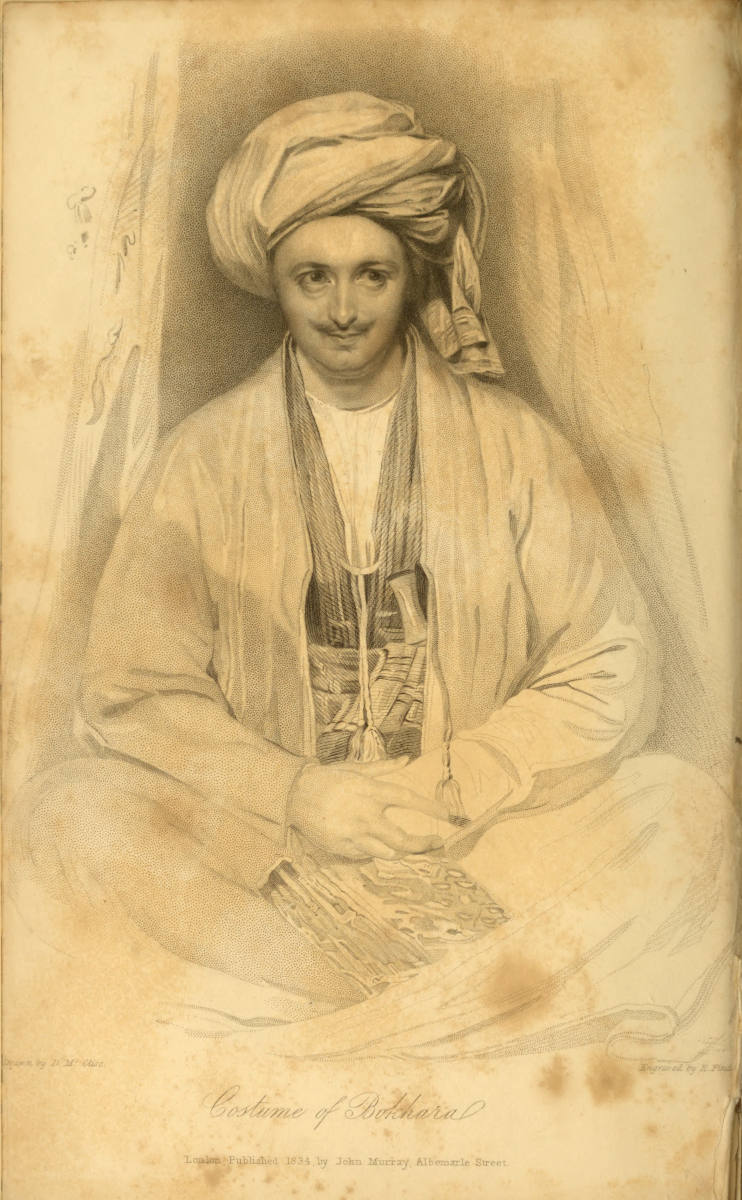
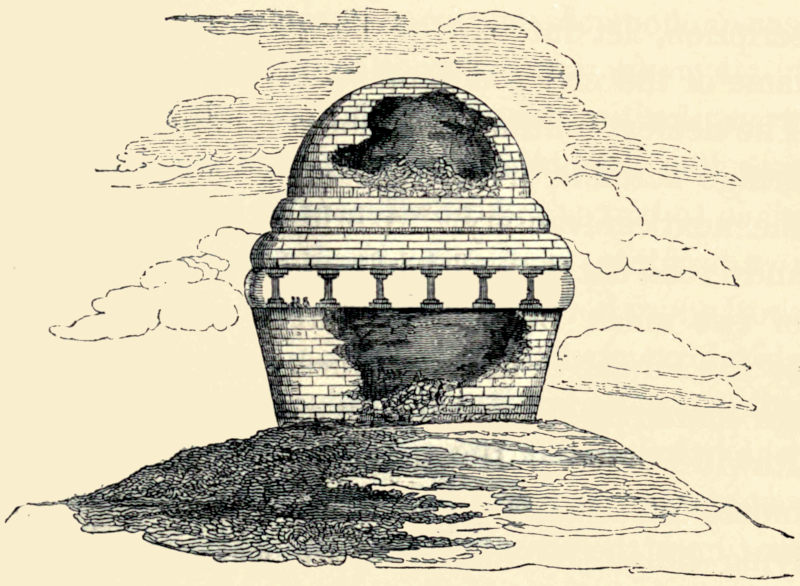
In the html edition of this eBook, the image on p. 183 is linked to a higher-resolution version of the illustration.
&c. &c.
VOL. I.
London:
Printed by A. Spottiswoode,
New-Street-Square.
Drawn by D. Mc. Clise.Engraved by E. Find.
Costume of Bokhara
London, Published 1834, by John Murray, Albemarle Street.
TRAVELS INTO BOKHARA;
BEING THE ACCOUNT OF
A JOURNEY FROM INDIA TO CABOOL, TARTARY,
AND PERSIA;
ALSO, NARRATIVE OF A VOYAGE ON THE INDUS,
FROM THE SEA TO LAHORE, WITH PRESENTS FROM THE KING OF GREAT BRITAIN; PERFORMED UNDER THE ORDERS OF THE SUPREME GOVERNMENT
OF INDIA, IN THE YEARS 1831, 1832, AND 1833.
BY LIEUT. ALEXR BURNES, F.R.S.
OF THE EAST INDIA COMPANY’S SERVICE;
AST POLITICAL RESIDENT IN CUTCH, AND LATE ON A MISSION TO
THE COURT of LAHORE.
----“Per syrtes iter æstuosas,
.... per inhospitalem
Caucasum, vel quæ loca fabulosus
Lambit Hydaspes.”
Hor.
IN THREE VOLUMES.
VOL. I.
LONDON:
JOHN MURRAY, ALBEMARLE STREET. MDCCCXXXIV.
THESE TRAVELS INTO BOKHARA ARE INSCRIBED
TO THE RIGHT HONOURABLE LORD WILLIAM CAVENDISH BENTINCK, G.C.B.
GOVERNOR-GENERAL OF INDIA, &c. &c. &c.
UNDER WHOSE AUSPICES
THEY WERE UNDERTAKEN AND PERFORMED, BY
HIS LORDSHIP’S MOST OBEDIENT,
FAITHFUL SERVANT, ALEXR BURNES.
TO THE READER.
The following volumes contain the Narrative
of my Voyage on the Indus, and
subsequent Journey into Bokhara. I have
thrown the Journey into the first two volumes,
from its interest being, perhaps,
greater than that of the Voyage; and since
the two subjects, though parts of a whole,
are distinct from each other.
View of Hydrabad on the Indus, to face title-page.
VI.
Natives of Cutch, to face page 9.
VII.
Natives of Sinde, to face page 87.
VIII.
View of Sindree, to face page 309.
N.B. Mr. John Arrowsmith’s Map, constructed expressly
for this work, is sold separately by all booksellers, price, in
sheets 7s., in cover 7s. 6d., and in case 10s.
ADVERTISEMENT REGARDING THE MAP OF CENTRAL ASIA AND THE INDUS.
On my return to Europe, I gave my original manuscript
surveys, protractions, and the whole of the observations
which I had made during a period of nine
years, while employed in different surveys throughout
Asia, together with such other authentic documents as
I had collected, to Mr. John Arrowsmith.[1] He has
embodied these in a large and comprehensive map, to
illustrate this work; combining, at the same time, the
latest and best information on the various countries
within the limits of the map. The task has been most
laborious; but the accuracy with which it has been performed
will, I am sure, entitle him to the high approbation
of the public: since this map throws a new light
on the geography of this portion of the globe. It is
due to Mr. Arrowsmith to state, that this map has been
engraved at his own expense, and is now published, in
the most public-spirited manner, at his own risk.
London, June, 1834.
PREFACE.
In the year 1831, I was deputed in a political
capacity to the Court of Lahore, charged with
a letter from the King of England, and a
present of some horses, to the ruler of that
country. The principal object of my journey
was to trace the course of the Indus; which had
only been crossed at particular points by former
travellers, and had never been surveyed but
between Tatta and Hydrabad. My success in
this undertaking, which was attended with
many difficulties, and the sight of so many
tribes hitherto little known, gave fresh strength
to a desire that I had always felt to see new
countries, and visit the conquests of Alexander.
As the first European of modern times who
had navigated the Indus, I now found myself
stimulated to extend my journey beyond that
river—the scene of romantic achievements which
I had read of in early youth with the most intense
interest.
The design received the most liberal encouragement
from the Governor-general of
India, Lord William Bentinck, whom I joined
at Simla, in the Himalaya Mountains, after the
termination of my mission to Lahore. His
Lordship was of opinion that a knowledge of the
general condition of the countries through
which I was to travel, would be useful to the
British Government, independent of other advantages
which might be expected from such a
journey.
The hazardous nature of the expedition, and
the mode in which it could be best accomplished,
required consideration. It would have
been objectionable, and highly imprudent, to
have entered the countries lying between India
and Europe, as I had voyaged on the Indus, an
accredited agent; and I was directed to appear
(which I myself had suggested) as a private
individual.
I was furnished with passports as a Captain in
the British army returning to Europe, drawn
out in French, English, and Persian; and in
such terms as would satisfy the people of my
real character; and show, at the same time,
that Government was interested in my good
treatment.
Every other arrangement regarding the journey
was left to myself; and I received the sanction
of the Governor-general to associate with me
Ensign John Leckie—a young officer of the most
buoyant disposition, who had been the companion
of my voyage up the Indus. On the
eve of departure, my fellow-traveller was recalled
by the Government of Bombay. Believing
that his place might be well supplied by a
medical gentleman, which I thought would
facilitate our progress through such countries,
I prevailed on Mr. James Gerard, a Surgeon of
the Bengal army, to accompany me. That
gentleman had passed most of his life in India,
in traversing the Himalaya regions; and possessed
an ardent desire for travel. I was also
attended by a native Surveyor, Mahommed Ali,
a public servant, who had been educated in
the Engineer Institution of Bombay, under
Captain G. Jervis, of the Engineers; and
who had entitled himself to my utmost confidence
by faithful and devoted conduct on
many trying occasions during the voyage to
Lahore.[2] I also took a Hindoo lad, of Cashmere
family, named Mohun Lal, who had been
educated at the English Institution at Delhi, as
he would assist me in my Persian correspondence;
the forms of which amount to a science
in the East. His youth and his creed would, I
believed, free me from all danger of his entering
into intrigues with the people; and both he
and the Surveyor proved themselves to be
zealous and trustworthy men, devoted to our
interests. Being natives, they could detach
themselves from us; and, by reducing our
retinue, maintain our character for poverty,
which I ever considered our best safeguard.
We discharged the whole of our Indian servants
but one individual, Ghoolam Hoosn, who
demands my lasting gratitude for the hardships
which he underwent on my account, and who
is yet my faithful servant.
From the time I resolved to traverse the
countries that lie between India and the Caspian,
I determined to retain the character of a European,
accommodating myself in dress, habits,
and customs, to those with whom I should
mingle. The sequel has proved that the design
had much to recommend it, though the character
involved us in some difficulties. I adopted the
resolution, however, in an utter hopelessness of
supporting the disguise of a native; and from
having observed that no European traveller has
ever journeyed in such countries without suspicion,
and seldom without discovery. From long
intercourse with Asiatics, I had acquired some
insight into their character, and possessed at the
same time a fair colloquial knowledge of the Persian
language, the lingua franca of the people I
should meet. I did not, then, hesitate to appear
among them in their own garb, and avow myself
a foreigner. By all the accounts which I collected,
it did not appear to me that there was
any just cause for apprehending personal injury
or danger; but I received little consolation
from my friends in India, who referred to the
fate of our predecessors, poor Moorcroft and
his party, as our inevitable lot. I trust, however,
that the happy termination of this journey will
give a more favourable impression of the Asiatic
character, and stimulate others (which I shall
consider a high reward) to view and visit these
lands.
Such is a brief detail of the circumstances which
led me into these countries; the manner in which
I have performed my task must be decided by
the public. I have to solicit much indulgence,
in the perusal of my book; I have had no assistance
in its composition, and my career in the
East has been one of constant employment. I
am, however, deeply indebted to the Hon. Mountstuart
Elphinstone, the late Governor of Bombay,
for his advice in preparing for the press;
and by which I have not failed to profit. If
I had to congratulate myself on having reached
my native shores in safety, I consider my good
fortune great indeed, to have met a gentleman
so eminently qualified to give me counsel. The
aversion to display, for which Mr. Elphinstone
is so distinguished, alone prevents my enlarging
on this subject.
From Mr. James Bailie Fraser, the well-known
author of the Kuzzilbash, and my esteemed
friend and brother officer, Lieut. G. L. Jacob, of
the Bombay army, I have received some judicious
hints. To Mr. Horace Hayman Wilson, Sanscrit
Professor in the University of Oxford, and Mr.
James Prinsep, Secretary of the Asiatic Society
of Bengal, my acknowledgments are due for illustrating
my collection of coins: the notes of these
gentlemen will speak for themselves.
To Captain R. M. Grindlay, author of a series
of Views of Western India, I am indebted for
most of the illustrations, which do ample credit
to his talents and pencil. To my brother, Dr.
David Burnes, who has assisted me in the laborious
task of correcting the press, I offer my
best thanks; which, I think, completes the whole
of my obligations.
I have now only to express an anxious hope,
that my fellow traveller, Dr. Gerard, who has
not yet reached India, may soon be restored to
his friends, to share in the approbation which
has been bestowed, I fear too liberally, upon
myself.
ALEXR BURNES.
London, June, 1834.
CONTENTS OF THE FIRST VOLUME.
CHAPTER I.
LAHORE.
Page
Departure from Delhi.—Communication from Runjeet Sing.—Himalaya.—Villages on the Sutlege: People.—Banks of the Sutlege.—Physical Phenomena of Rivers.—Altars of Alexander.—Enter the Punjab.—Our Welcome chanted.—Civilities at Hurree.—Seik Fanatics.—Manja; country so called.—Antient Canals.—Town of Puttee.—Stud of Horses at Puttee.—An Acali, or Fanatic.—A Seik Chief and his Castle.—Famous Road of Juhangeer.—Enter Lahore.—Visit the Maharaja.—Earthquake at Lahore.—Join Runjeet Sing in the Field.—Description of his Camp.—Runjeet Sing marching.—Conversations of Runjeet Sing.—Superb Cashmere Tents.—A Visit from the Physician-general.—Runjeet Sing sporting.—Conversations of Runjeet Sing.—Return to Lahore.—Festival of the Busunt, or Spring.—Entertainment by the Maharaja.—Preparations for our Journey.—Kindness of Messrs. Allard and Court.—Audience of Leave.—Mons. Court’s Instructions
Quit Lahore.—Reduction of Baggage.—Arrangements.—Garden described.—Himalaya.—Reach the Chenab or Acesines.—Soil and Wells.—Sugar.—A Seik Chief.—Seiks: Peculiarities of the Tribe.—Cross the Chenab.—Diseases: Opinions regarding them.—Cross the Jelum, or Hydaspes.—Arrival at Pind Dadun Khan.—Antiquities.—Salt Mines of Pind Dadun Khan.—Position of the Salt Range.—Formation, &c.—Mines, Strata, Temperature.—Manner of working the Salt.—Its Quality.—Supply of the Mineral.—Banks of the Hydaspes.—Villages.—Scene of Porus’s Battle.—Extensive Ruins.—Speculations.—Nicæ and Bucephalia.—Porus’s Army compared with Runjeet Sing’s.—Floating Islands.—Costume of the Ladies.—Arrival at Rotas.—Fortress.—Nature and Formation of Rocks.—Tope of Manikyala.—Coins and Antiques.—Manikyala identified with Taxilla.—Rawil Pindee.—Marks of quitting India.—Hurdwar Pilgrims: Reflections on seeing them.—Seik Priest.—Pass of Margulla.—Tope of Belur.—Garden of Hoosn Abdall.—See the Indus.—Encamp on the Indus.—Ford it.—Story of a Soldier.—Attok.—Phenomenon at Attok.—Washing Gold
Entrance into the Country of the Afghans.—Precautionary Arrangements.—Farewell Letter to Runjeet Sing.—Salt Monopoly.—Fields of Battle.—Entrance into Peshawur.—Afghan Entertainment.—Visitors.—Ride out with the Chief.—His Character.—Afghan manner of spending Friday.—Horrible Spectacle.—Brother of the Chief.—Arrangements for our Advance.—The Chief and his Court.—Visitors.—Juvenile Intelligence.—Rambles in Peshawur.—Quail fighting.—Hawking.—Moollah Nujeeb.—A Saint.—Disadvantages of giving Medicine.—Antiquities.—Conclusions regarding the “Topes.”—Preparations for Departure.—Maître d’Hôtel of the Chief
Departure from Peshawur.—Khyberees.—Passage of the Cabool River.—Caravan.—Scene in the Cabool River.—Mountains.—Formation of the Hills.—Interview with a Momund Chief.—Civility of a Khyberee.—Incident.—Pestilential Wind.—Antiquities.—Julalabad.—Snowy Mountains.—Bala-bagh.—Treatment by the People.—Gundamuk.—Cold Countries.—Neemla.—Manner of keeping Horses.—Jugduluk.—Post-houses of the Emperors.—Wandering Ghiljees.—Pastoral Scenes.—Ispahan.—Story of Futtih Khan.—Pass of Luta-bund.—Arrival in Cabool.—Our Conductor, Mahommed Shureeff
Arrival of Mr. Wolff.—Nawab Jubbar Khan.—Introduction to the Chief of Cabool.—Conversations.—Tomb of the Emperor Baber.—Prospect.—Intercourse with the People.—Cabool; its Bazars.—Traditions.—Coins.—Armenians.—Entertainment.—Gardens of Cabool.—Fruits and Wines.—Bala Hissar, or Prison.—Difference in Asiatic and European Manners.—Eed, or Festival.—Tomb of Timour Shah.—Alchymy and Minerals.—Freemasonry.—Jewish Origin of the Afghans; Opinions regarding it.—Party.—The Kaffirs, a singular People.—Preparations.—Shikarpooree Merchants.—Money Arrangements.—Civilisation by Commerce
JOURNEY OVER THE HINDOO KOOSH, OR SNOWY MOUNTAINS.
Quit Cabool.—Cafila-bashee.—Contraband Korans.—Julraiz.—Valley of the Cabool River.—Fish Preserve.—Ghuzni.—Pass of Oonna.—Effects of Snow.—Family of Huzaras.—Goître.—Ali Illahi.—Yezdan Buksh Huzara.—Pass of Hajeeguk and Kaloo.—Mountain Scenery.—Bameean excavated City.—Idols of Bameean.—Geographical Errors.—Leave Afghanistan.—Uzbek Chief of Syghan.—Feelings on entering Tartary.—Pass of Dundan Shikun.—Ruhmut oollah Khan.—Uzbek Pity.—Mahommedan Law.—Companions.—Asiatic Opinions of Europe.—Pass of Kara Koottul.—Adventures.—Life of a Traveller.—Modes of Salutation.—Tremendous Defiles.—Poisonous Plant.—Heibuk reptiles.—Houses.—People.—Khooloom and Plains of Tartary
Difficulties at Khooloom.—Sketch of Moorcroft’s disasters.—Departure for Koondooz.—Favourable Opportunity for escape.—Night Adventure.—My Account of myself.—Imbecility of our Conductor.—Visiters, manner of Tea-drinking.—Traditions of Alexander the Great.—Interview with the Chief of Koondooz.—Incidents illustrative of Uzbek Character.—Koondooz; its Chief.—Departure from Koondooz.—Quit Khooloom.—Avaricious Conduct of our Conductor.—Dangers of the Road to Balkh.—Mirage.—Muzar.—Tomb of Mr. Trebeck.—Arrival at Balkh.—Intelligence of the Cafila-bashee
Description of Balkh.—Climate.—Coins found at Balkh.—Cafila-bashee.—Grave of Mr. Moorcroft.—Quit Balkh.—Ancient Bactriana.—Correctness of Quintus Curtius.—Desert of the Toorkmuns.—Reach the Oxus.—Singular manner of crossing it.—The Caravan.—Kiz Kooduk.—A Khwaju.—Literature.—Amazons of Lakay.—Kirkinjuk.—A Slave.—Knotty Points.—Snowy Mountains.—Kurshee.—Sickness of our Party.—Alarms of a Traveller.—Letter to the Minister of Bokhara.—Kurshee.—Market at Karsan.—Uzbeks.—Abdoolla Khan; his Munificence.—Acquaintances.—Fatigues.—Reflections.—Arrival in Bokhara
Change of Dress.—Visit the Minister.—Suspicions regarding us.—Description of the Registan, or great Bazar of Bokhara.—Employments in the Bazar.—Society at Bokhara.—Slave Bazar at Bokhara.—Offenders against Mahommedanism.—Hindoos.—A Wanderer.—An Indian Sepoy.—A pretty Fair One.—Costume.—Baths of Bokhara.—Interview with the Minister.—The King.—Life of a King.—Russian Slaves.—Acquaintances at Bokhara
The City of Bokhara.—Historical Sketch of it.—Colleges of Bokhara.—Rigour of Mahommedanism.—Literature of Central Asia.—Interview with the Vizier.—Samarcand.—Tomb of Bhawa Deen.—An Ancient City, Coins, &c.—An Uzbek Family.—Bokhara on Friday.—Arrangements.—Farewell Visit to the Vizier.—Departure
Detention of the Caravan.—Assemblage of Merchants.—Country between Bokhara and the Oxus.—Intercourse with the Toorkmuns.—A Toorkmun Acquaintance.—Ersaree Toorkmuns.—Slavery in Toorkistan.—Fellow-travellers.—Music.—Our own Party.—Ruins of Bykund.—Alexander’s Marches.—Reply from the Khan of Orgunje.—Uzbek Customs.—Preparations for Departure.—Receive Letters from India.—Reflections
CHAPTER I. LAHORE. — MONSIEUR COURT’S INSTRUCTIONS.
NARRATIVE.
Departure
from Delhi.
In the end of December, 1831, I had the honour
to obtain the final sanction of the Governor-general
of India to proceed to Central Asia.
I received my passports from his lordship at
Delhi on the 23d of that month, and proceeded
by express to Lodiana on the frontiers, where I
had the pleasure of meeting my fellow-traveller
Mr. James Gerard, of the Bengal army. We
here experienced many acts of kindness and assistance
from Capt. C. M. Wade, the political agent,
whose good offices I have to acknowledge with
gratitude. The society of this, the most remote
station of British India, also evinced an interest
in our welfare which was truly gratifying. We
took leave of it at a convivial party given for the
occasion on the 2d of January, and on the following
day bade a long farewell to such scenes,
and plunged into the solitude of an Indian desert.
We took the route that leads along the left bank
of the Sutlege, till that river is joined by the
Beas or Hyphasis.
Communication
from
Runjeet
Sing.
Before crossing the boundaries of India it was
both prudent and necessary to receive the permission
of Maharaja Runjeet Sing, the ruler of
the Punjab. It was suggested to me that a private
application was in every respect preferable
to an official letter from government, since the
most favourable reception which I had already
experienced from his highness left no doubt of
his ready compliance. I consequently addressed
his highness, and solicited the indulgence of
again entering his territories. I gave him a
brief outline of the objects which I had in view,
and congratulated myself on having to traverse
at the outset the territories of so friendly an ally.
In the true style of oriental hyperbole, I assured
his highness that “when I had again the pleasure
of seeing him it would add to my happiness, because
it would afford me an opportunity of
renewing my terms of friendship with a prince
whose exalted virtues filled me with recollections
of perpetual delight!” In the course of three
days we were joined by a small escort of cavalry
sent to welcome us, and their commandant
brought a most friendly reply from the Maharaja,
expressive of his pleasure at our approach. It
was also intimated to us that we should receive
presents of money and gifts as we advanced;
but, as it would better suit our character to pass
without these attentions, I civilly declined them.
Reports would precede us, and doubtless in an
exaggerated enough shape, which made it desirable
to shun all pomp and show, and the more
so since we had really no right to them.
Hemilaya.
As we descended the banks of the Sutlege, we
gradually lost sight of the Hemilaya mountains.
For the first twenty miles they could be seen in
great grandeur, clothed in snow from base to
summit, without an inferior ridge to hide their
majesty. They were about 150 miles distant,
and not so peaked in their outline as the same
range of mountains to the eastward. The hoary
aspect of this stupendous chain formed a striking
contrast with the pleasing verdure of the plains
of the Punjab. In the morning these, indeed,
were covered with hoar frost, but it disappeared
under the first rays of the sun, and left, in this
alternation of heat and cold, a hard green sward,
which is not often seen in tropical countries.
Villages on
the Sutlege.
On the banks of the river we passed innumerable
villages, the houses of which were terrace-roofed,
and formed of sun-dried brick on a wooden
frame-work. They had a clean and comfortable
look, and the peasantry appeared well clad and
happy. They consist of Juts, both Hindoo and
Mahommedan, and a few Seiks.
People.
All the Mahommedans
have been converted from Hindooism;
and it is a curious fact, that the Moslems
predominate on the southern bank, where, from the
vicinity to the Hindoo world, one would have
expected to find those of that persuasion. In
the upper parts of the Sutlege, near Lodiana, the
inhabitants are exclusively agricultural; but,
after that river has been joined by the Beas or
Hyphasis, the habits of the people are predatory.
There they are known under the various denominations
of Dogur, Julmairee, Salairee, &c. and by
the general designation of Raat, and live in a
perpetual state of opposition to one another. In
the cultivated parts this country has the appearance
of an extensive meadow. It is entirely free
from underwood, and some of the wheat fields
extend for miles without a hedge. The grain is
raised without irrigation, though the water is but
twenty-six feet from the surface. There are no
trees except in the vicinity of the villages; and
such is the scarcity of fuel, that cow dung is
universally used in its stead. This is dried and
stacked. The fire formed of it throws out a most
powerful heat, which leaves the people no cause
to regret the want of other fuel. The country
below that stripe which fringes the river is
known by the name of Malwa. It has a dry
climate and soil, and produces gram and barley,
with bajree[3] and mut, which are exported to the
Punjab.
Banks of
the Sutlege.
After a journey of fifty miles from Lodiana,
we encamped at Huree, on the banks of the Hyphasis,
below the confluence of that river and
the Sutlege. In all our maps this junction takes
place some fifty miles lower down, which appears
to have been only correct at a remote period.
These united rivers form a beautiful stream,
which is never fordable; and, at this season, was
275 yards wide. The actual channel exceeded
a mile and a half; and the high bank lay on the
northern shore; the water was running at the
rate of two miles and a quarter an hour, and was
at this season perfectly clear, and free from the
foul, muddy appearance of a river that is
swollen by the water of the mountains. The
depth did not exceed twelve feet since the river
had retired to its summer bed, and the melting
snow had ceased to feed it. Both rivers stood
at a temperature of 57°, which was 6° below that
of the atmosphere.
Physical
phenomena
of rivers.
The people informed us,
that about fifty years ago the Sutlege had been
hemmed in among the mountains, by a hill falling
in upon its bed. After an obstruction for
some weeks, it vomited forth its imprisoned
stream with great destruction. A similar case
occurred about eight years ago, in the Ravee or
river of Lahore. It did little injury, and the
terror of the inhabitants was excited only by the
black earthy colour of the water which forced
itself over the obstructing mound. The Sutlege
has altered its course at no distant period, and
swept away some of the villages on its banks.
These are of a clayey, crumbling nature, easily
undermined by the current. Near the existing
point of union between the rivers, we passed the
dry bed of the old Sutlege, which is said to have
once joined the Hyphasis at Feerozpoor. The
space between this and the present channel,
from twelve to fifteen miles across, is entirely
destitute of trees, and covered by a rich mould,
the deposit of the river.
Altars of
Alexander.
In a country subject to such changes, how are
we to look for an identity between the topography
of modern and ancient days? Yet we
were now in the vicinity of the altars of Alexander;
and if we sought for these ancient relics
of the “Macedonian madman” without success,
we sought not without industry and enthusiasm.
When the army of Alexander mutinied on the
banks of the Hyphasis, he crossed that river, and
raised twelve colossal altars, to indicate the limit
and glory of his expedition. Major Rennell has
placed the site of these monuments between the
Beas and Sutlege; but that eminent geographer
is not here supported by the text of Alexander’s
historians. They do not even mention the Sutlege;
and their allusions to a desert that lay
beyond the Hyphasis can only be identified
with the country beyond that river, and below
its junction with the Sutlege, where that desert
is still to be found. Nor is it probable that
Alexander would erect the trophies of his conquest,
where a small and fordable river yet separated
him from India. We wandered about for
a few days, and extended our researches on every
side. We crossed the Sutlege, and found, at the
point of its junction with the Beas, a brick ruin,
of small dimensions, called Andreesa, which
sounded like Greek, but the building was of a
Mahommedan age. We then embarked on the
Hyphasis, and passed the confluence of the two
streams, where the waters meet each other gently,
and glide smoothly along. Both rivers have an
equal breadth of 200 yards, but the Sutlege discharges
a greater volume of water. It was with
faint hopes of success that we prosecuted our
enquiries after these remnants of antiquity, since
the inhabitants did not remember to have even
seen an European. It is an approximation, nevertheless,
to discovery, to ascertain where these
altars are not; and if any traces of them be hereafter
found, they probably lie lower down, and
on the left bank of the united stream of the Beas
and Sutlege, there called the Garra. I should
here mention that, on our way from Lodiana,
and about twenty miles from that cantonment,
we heard of the ruins of Tiharu, on the southern
bank of the Sutlege, which had been washed
into the river within the last thirty years. Kiln-burnt
bricks of large dimensions and peculiar
shape are yet found on this site, which may have
been an ancient ruin. If the altars stood here,
my surmises are erroneous.
Enter the
Punjab.
On the 11th we crossed by the ferry boats at
Huree Ka Puttun, and landed in the Punjab at
the village of that name. There are twenty-three
boats at this ferry; and it is protected by a
party of 400 horse, whom the ruler of the Punjab
has stationed here to prevent the fanatics of
the Seik creed from passing into the British territories.
Our welcome
chanted.
As we entered the village, we were
met by a crowd of females and children, who
approached to chant our welcome. They are
the poorer peasantry, and, of course, actuated by
the hope of reward; but the custom has something
pleasing in it. The boys of the village
had also assembled to gratify their curiosity;
while we approached, they were silent, and
looked with attention: when we had passed, all
was bustle and uproar, running and falling,
jumping and laughing, till the head man and his
troopers called the urchins to order.
Civilities at
Hurree.
We had no sooner set foot on the Punjab than
a sirdar, or chief, of the name of Sham Sing,
appeared by order of his master. He presented
me with a bow, according to the custom of the
Seiks, and two bags of money; which latter I
declined, being amply satisfied at the readiness
with which we had received permission to enter
the country. I wished also to dispense with this
personage and his cavalcade; but it was impossible,
since he had been deputed from Lahore to
escort us, and the road was described as not altogether
safe for a small party. It was well we
did not separate ourselves from the chief, as we
afterwards passed a village on fire, and in possession
of the Seik fanatics, to whom I have
before alluded.
Seik fanatics.
We met a body of 500 horse,
with two field-pieces, proceeding to chastise these
“wrong-headed and short-sighted” men, as they
are styled in the language of the Punjab cabinet.
Manja,
country so
called.
On the following morning we commenced our
march across the “Doab[4],” between the Beas and
Ravee (Hydraotes), which has the name of
Manja. It is the highest portion of the Punjab
east of the Hydaspes; a fact which is established
by the eastern bank of the one river as well as
the western one of the other being both elevated.
The left bank of the Ravee is about forty feet
high, and so is the right bank of the Beas. The
wells are also much deeper than south of the
Sutlege; here they exceed sixty feet, there they
are not twenty-six. The soil is a hard, indurated
clay, sometimes gravelly, producing thorny
shrubs and brambles, called by the natives jund,
khureel[5], and babool.[6] Cultivation depends
upon the rain, and irrigation is by no means
general. Herds of neelgaee roam over it.
Ancient
canals.
In
former years the Mogul emperors, seeing the
comparative sterility of this tract, fertilised it by
canals from the Ravee, which connected that
river with the Beas. The remains of one of them
may be yet traced at the town of Puttee, running
down at right angles upon the Beas, though
it has been choked up for the last 150 years.
The district of Manja is celebrated for the
bravery of its soldiers, and the breed of its
horses, which would always entitle it to the patronage
of a sovereign.
Town of
Puttee.
The first town we entered was Puttee, which
contains about 5000 people, and, with the adjoining
town of Sooltanpoor, was built in the reign
of Akbar. The houses are constructed of
bricks, and the streets are even laid with them.
Some workmen, digging a well in this neighbourhood,
lately hit upon a former well, on which
was a Hindoo inscription. It set forth that it
had been built by one Agurtuta, of whom tradition
gives no account. The district of Puttee
held, at one time, a supremacy over 1360 villages,
and yielded a revenue of nine lacks of
rupees, when fertilised by its canal.
Stud of
horses at
Puttee.
At Puttee we visited one of the royal studs of
Runjeet Sing. We found about sixty brood
mares, chiefly of the Dunnee breed, from beyond
the Hydaspes, where the country is of the same
description as Manja, dry and elevated. May
not this aridity, as resembling the soil of Arabia,
where the horse attains such perfection, have
something to do with its excellence? These
animals are exclusively fed on barley, and a kind
of creeping grass called “doob,” which is considered
most nutritive. The horses at this stud
were lately attacked with an epidemic disease, of
which a Mahommedan, who resides in a neighbouring
sanctuary, is believed to have cured
them. Though a Mahommedan, the Seiks have
in gratitude repaired and beautified his temple,
which is now a conspicuous white building, that
glitters in the sun. The Seik people are most
tolerant in their religion; and I have remarked
in India generally much more of this virtue than
the people receive credit for. It may be superstition
which excites this general respect of all
religions, but, be the feeling grounded on what
it may, it is a sound and wholesome one. The
Mahommedans have, no doubt, been overbearing
in their conquests (and what conquerors have
not been overbearing); but, as they settled among
the people, their prejudices disappeared, to the
mutual benefit of themselves and their subjects.
An Acali or
fanatic.
On the 13th we received a message from
the Acali who had set fire to the village a few
days previous, and whose acts of fanaticism
had called for the interference of the court.
This outlaw, by name Nehna Sing, wished
to visit us, and I felt equal anxiety to hear
from so notorious a character some history
of himself and his adventures. These fanatics
of the Seik creed acknowledge no superior, and
the ruler of the country can only moderate
their frenzy by intrigues and bribery. They go
about every where with naked swords, and lavish
their abuse without ceremony on the nobles, as
well as the peaceable subjects; nor are they always
so harmless, since they have, on several occasions,
even attempted the life of Runjeet Sing.
An interview with such a person excited considerable
anxiety on the part of our conductors,
who strongly dissuaded me from it, and, at length,
completely frustrated our wishes by informing
the Acali that he must come unattended. This
he declined, and we were obliged to forego the
pleasure of seeing a man who had dared Runjeet
Sing himself, within a few miles of his capital. We
were obliged to rest satisfied with a hearsay account
of this Seik bigot, nor could I discover
any difference in the shades of fanaticism here
and in other countries. These Acalis or Nihungs
are not numerous, but commit the grossest
outrages, and shield themselves under their religious
character. They evince no greater hostility
to those of another creed than to a Seik,
and would appear to be at war with mankind.
Their fanaticism borders on insanity. The creed
of the Seiks is well known: it has been ably described
by Sir John Malcolm. Like their neighbours,
the Mahommedans, they have forgotten
much of its primitive form, and found their distinction
from other sects on a few ritual observances.
A Seik will tell you that tobacco is the
most debasing of stimulants, since the founder
of their sect, Gooroo Govind Sing, proved it by
exhibiting the contamination in the interior of a
tobacco pipe, as a type of its corruption in the
human body! A Seik once told me that tobacco
and flies were the greatest of ills in this
degenerate age.
A Seik
chief and
his castle.
About half way across the “Doab” we
reached Pidana, the seat of one of the principal
chiefs of the Punjab, Sirdar Juwala Sing, who
had been sent from Lahore to entertain us at his
family mansion. He met us about a mile out,
and delivered a letter with a bow and a bag of
money. The chief had robed himself in a rich
dress of brocade, and his retainers were arrayed
in tunics of yellow, which is the favourite colour
of the Seiks. Juwala Sing has the reputation of
a brave soldier, and possesses a suavity of manner
and address which appear to great advantage
in a fine soldier-looking person about six feet
high. It was twilight as he led us through his
fort and under his baronial castle to our camp,
which gave a favourable idea of the residence of
a Seik chief. The castle stood in the centre,
surrounded by a village, peopled by his retainers,
the whole being enclosed by a mud wall and
outer ditch. Within this space is to be found a
bazar, extensive stables, and, in the present instance,
these were built on a plan of great regularity.
In the tranquillity which has followed the
conquest of this country, most of the chiefs have
turned their minds to improving their places of
residence; and their habitations have at a distance
a most imposing and respectable appearance,
though inferior to the fortified dwellings
of the Rajpoot chiefs in Marwar. They are
always built in a military style, of a quadrangular
shape, with lofty walls and turrets. Our
worthy host made us such welcome guests, that
we remained with him for two days. From the
top of his castle we had a commanding view of
the surrounding country, which is very rich, from
its vicinity to the two capitals of the country,
Lahore and Umritsir; yet the soil is unproductive.
Famous
road of
Juhangeer.
In our progress to Lahore, we entered the
great road of Juhangeer, which was once shaded
with trees, and studded with minarets and caravanserais.
It conducted the traveller
“From Agra to Lahore of Great Mogul,”
and has been celebrated in Lalla Rookh, in the
royal procession to Cashmeer. In the lapse of
time the trees have disappeared; but many
minarets and superb caravanserais yet mark the
munificence of the Mogul emperors. The road
itself is yet a broad and beaten way; nor was it
possible to tread upon it without participating in
the excitement which the author of Lalla Rookh
has raised, and I may almost say gratified.
Enter
Lahore.
On the morning of the 17th we entered the
imperial city of Lahore, which has once rivalled
Delhi. We wound among its ruins; and, when
yet three miles distant, were met by Monsieur
Allard, and two natives of rank sent to welcome
us. The Chevalier came in his carriage drawn
by four mules, into which the Dr. and myself
stepped, and drove to his hospitable mansion,
where we alighted and took up our quarters.
After the ceremony of receiving various friendly
and formal messages from Runjeet, the native
part of the deputation withdrew, leaving a profusion
of the fruits of Cashmeer and Cabool as
an earnest of the condescension of their master.
In the evening, a purse of 1100 rupees was sent
to us by the Maharaja; nor was it possible to
refuse the money without giving offence.
Visit the
Maharaja.
We next morning paid our respects to the
Maharaja, who received us with marked affability
in a garden about two miles from the city. We
found him in great spirits, and continued with
him for about two hours. His conversation
ranged from points of the utmost importance to
mere trifles: he expressed much satisfaction at
an interview which he had lately had, for the
first time, with the Governor-general; and said,
that he might now reduce the pay of his troops,
after having seen so efficient an army as the
Indian with so little pay. His highness was
much interested in shell practice; and conducted
us to the front of his garden, to show the success
which had attended his exertions. They are
unacquainted with the mode of fusing iron in
this country, and the shells are constructed of
brass. Monsieur Court, one of his French officers,
exhibited these to him on the day of our arrival,
and was presented with a purse of 5000 rupees,
jewels, and other gifts. Runjeet made the most
particular enquiries regarding our journey; and,
since it was no part of my object to develope the
entire plans we had in view, we informed his highness
that we were proceeding towards our native
country. He requested me to take a complimentary
letter to the King of England;
which I declined, on the excuse of its endangering
my safety in the intermediate territories.
I then presented a handsome brace
of pistols, that drew forth his Highness’s commendation,
and which he said he would keep
for my sake. The Dr. produced a spy-glass as
the token of his homage. Runjeet received us,
surrounded by troops: four regiments of infantry
could be seen at parade from his audience
tent. We passed through a street formed by his
infantry and cavalry, and were honoured by a
salute. On taking leave, he requested that we
would continue as long as possible at his court,
since he wished to show us some tiger hunting,
and give an entertainment in his palace,—honours
which we duly appreciated. We meanwhile returned
to enjoy the friendly society of M. Allard
and his brother officers. I shall make no further
mention of Lahore, since it is described in my
first visit to the court, and was now no longer a
scene of curious novelty.
Earthquake
at Lahore.
Near midnight on the 22d, we were much
alarmed by an earthquake, which continued for
about ten seconds with great violence. The
house in which we were lodged, though a substantial
dwelling of brick and mortar, shook with
great violence. The atmosphere had indicated
nothing unusual; the barometer underwent no
variation either before or after it; and the thermometer
stood so low as 37°, and fell four degrees
under the freezing point before sun-rise.
In July last, it had risen to 102°. I was informed
that earthquakes are of frequent occurrence at
Lahore, particularly during winter. In Cashmeer
they are still more common; and appear to be
more usual on approaching the mountains. The
lofty minarets of Lahore afford the most convincing
proof that there can have been no very violent
commotion of nature since they were built,—nearly
two hundred years ago. The shock on
the present occasion appeared to run from south-east
to north-west; and it was singular to discover,
after crossing Hindoo Koosh, that this
was also the exact direction of its course. In
the valley of Badukhshan, and the whole upper
course of the Oxus, the greater portion of the
villages had been overthrown, which had buried
some thousands of people in their ruins. The
shock had occurred there at the same time, and,
as far as I could judge, at the same hour, since
they mentioned the midnight horrors of the sad
event.
Join Runjeet
Sing in
the field.
A week after our arrival we received the promised
invitation to join his Highness in the sports
of the field. He himself had quitted the capital,
and sent a friendly letter, along with four elephants
to convey us and our baggage. We
immediately mounted, and took the route by the
banks of the Ravee, in which direction the court
had proceeded. On our way, we passed an hour
in the celebrated garden of “Shalimar,” which
was now more beautiful than ever. Though it
was winter, the trees were loaded with oranges.
We halted for the night, near the village of
Lakodur, famous in history as the spot at which
Nadir Shah crossed the river and captured Lahore.
The stream has forsaken its former channel,
which is now dry and cultivated. The hordes
of the destroying Nadir have been in like manner
long withdrawn, and given place to the industrious
and reformed inhabitants of this country.
On the following morning we entered the royal
camp, which was about twenty miles from the
city. On the road we passed crowds of soldiers,
porters and messengers bearing fruits and rarities.
Description
of his
camp.
Since leaving Lahore, it was evident that
we were approaching a hive of men. About a
mile distant we were welcomed by a Rajah and
his train, who met us on elephants, and conducted
us to the camp, pitched close on the banks of the
river. The scene, as we approached, was magnificent.
A large pavilion of red cloth, surrounded
by extensive walls of the same materials, marked
the encampment of Runjeet, while his troops and
chiefs were cantoned in picturesque groups
around. The suite of tents which had been
pitched for our accommodation was most elegant.
They were made of scarlet and yellow cloth, and
the ground was covered with the carpets of
Cashmeer, and pieces of French satin. It was
with some reluctance that I set foot upon
such valuable materials. In each tent was a
camp bed, with curtains of yellow silk, and
coverlets of the same description. Such costly
splendour was ill suited to men who had so little
prospect even of comfort; but I must say that
it was exhilarating at the moment. One of the
officers of the court welcomed us in the name of
his Highness; and in the evening we were joined
by Captain Wade and Dr. Murray, who had been
sent on a political mission to the court of Lahore.
Runjeet
Sing
marching.
On the morning of the 27th, we marched with
the Maharaja; and fording the Ravee, proceeded
inland. The order of the march was very picturesque,
and the retinue in every respect that
of a soldier king. His horses were led in front
of him, but the journey was performed on elephants.
Two of these stupendous animals bore
houdas of gold, in one of which his Highness sat.
Six or seven others followed with his courtiers
and favourites. A small body of cavalry, and a
field piece, formed his escort; and the carriage,
which he had received from the Governor-general,
drawn by four horses, completed the procession.
Conversations
of
Runjeet
Sing.
Runjeet was very talkative during the march,
and detained us in conversation for about an
hour after it had terminated. He spoke of the
good fortune of Ameer Khan, in receiving so
large a grant of land from the Indian Government
without military service; and commented on his
rise from so low an origin, to such an elevation.
He need not have gone farther than himself for
a remarkable instance of the caprice of fortune.
Runjeet said that a disciplined army did not
suit the manners of an Eastern prince, for it
could not be regularly paid, and complained,
consequently, of its duties: he wished to know
if our troops ever clamoured for pay, and expressed
some surprise to learn that such behaviour
was viewed as mutinous. A conversation could
not, of course, conclude without his favourite
topic of wine; and, as he first sat down, he remarked
that the site of his tent was an agreeable
one for a drinking party, since it commanded a
fine view of the surrounding country. He enquired
of the doctors, whether wine was best
before or after food; and laughed heartily at
an answer from myself, when I recommended
both. During this conversation, a peasant rushed
in upon our party, calling loudly for justice:
he was stopped by the guards, and gagged; but
Runjeet called out in a stern voice,—“Strike
him not!” An officer of high rank was sent to
hear his complaint; but I fear that, if received
opinions be true, justice is here an equally expensive
article as in other Asiatic governments.
Superb
Cashmeer
tents.
On taking leave of his Highness, we proceeded
to our tents, which were a distinct suite from
that we had yesterday occupied. They were
made of Cashmeer shawls, and about fourteen
feet square. Two of these were connected by
tent walls of the same superb materials; while
the intervening space was shaded by a lofty
screen, supported on four massy poles, adorned
with silver. The shawls of one tent were red;
of the other, white. In each of them stood a
camp bed, with curtains of Cashmeer shawls,
which gave one an impression of a fairy abode
more than an encampment in the jungles of the
Punjab.
A visit from
the physician-general.
Among our visiters in the camp, I must not
omit to mention the sage Uzeezodeen, the physician
and secretary of Runjeet Sing, who, according
to Eastern notions, is a very learned
person, deeply versed in theology, metaphysics,
and physics, which he professes to have acquired
from the Greek authors. He displayed his acquirements
in many long discourses, from which
I have extracted the following, as a specimen of
what sometimes passes for wisdom in the East.
The world possesses three different atoms, all
excellent, and all of which enter into the ‘noblest
work of God,’ man.—Neither the gem nor the
precious metals can multiply or increase their
size or number; in their beauty we find their
excellence. In the vegetable kingdom, we see
the trees and plants, sucking moisture from the
earth and moulding it to their nature, increase
in size and glory. In the animal kingdom, we
see the beasts of the field cropping those plants
which afford them nourishment, and avoiding
these which are noxious. We see them propagating
the species without the institutions of
society. In man alone have we every excellence:
he possesses the beauty and ornament of
the gem; understands and wields the properties
of the vegetable kingdom; and, to the instinct
of the animal creation, he adds reason and looks
to futurity. As the learned physician said, “he
chooses his wife considerately, nor herds in flocks
like the other animals of the creation.”
Runjeet
Sing
sporting.
But we had come to hunt, not to philosophise;
and next day accompanied the Maharaja on a
sporting expedition at noon. He rode a favourite
bay horse, covered with an elegant saddle-cloth
of the richest embroidery, ornamented, in its
border, by almost every beast and bird which
the sportsman calls his own. Runjeet was dressed
in a tunic of green shawls, lined with fur; his
dagger was studded with the richest brilliants;
and a light metal shield, the gift of the ex-King
of Cabool, completed his equipment. A train
of elephants followed him; and a pack of dogs,
of motley breed, natives of Sinde, Bokhara, Iran,
and his own dominions, led the van. His falconers
supported their noble birds on their fists.
They fluttered at his side, and shook the bells
suspended from their feet. A company of infantry
in extended order, with two or three
hundred horsemen, swept the ground; and we
followed the foresters with their rude halberds,
who soon disturbed the game. We were to encounter
hogs instead of tigers. The swords of
the Seiks glittered in the sun; and in the course
of half an hour eight monsters had bitten the
dust, and many more were entrapped by snares.
Most of the animals had been slain by the horsemen
with their swords; a few had been first
wounded by the matchlock. The sport might
not be duly appreciated by a European sportsman,
since the hogs had but a small chance of
escape; yet I am sure the excitement of the
field was great. The scene took place in a
plain covered with high grass, in the open patches
of which we could see from our elephants the
brilliant display with great advantage. The
bright coloured dresses of the courtiers had a
striking effect. Runjeet himself viewed each
hog as it fell, and keenly turned to the scenes
of passing slaughter; in the course of an hour
and a half we returned to our tents, and saw
each of the successful sportsmen rewarded.
The live hogs were then brought, tied by one
leg to a stake, and baited with dogs. The sport
is a cruel one, and does not afford any great
amusement; the courage and fire of the animals
are renewed by dashing water over them. After
witnessing it for a short time, an order was given
to set all the live hogs at liberty, as Runjeet said
that they might praise his humanity; and the
infuriated animals scampered through the crowded
encampment, to the great delight of the assembled
multitude.
Conversations
of
Runjeet
Sing.
After the bustle had passed, we continued for
some time with the Maharaja, who gave us an
animated account of his exploits beyond the
Indus. He described the bravery of a Nihung,
or Seik fanatic, who had perished on that occasion.
He had fought on foot and received a
wound, which he dressed, and returned to the
field on horseback. He received a second wound;
but, not discomfited, seated himself on an elephant;
and was at last shot through the lungs.
“He was a brave man,” continued he, “but a
great villain; and had he not fallen on that day,
I must have imprisoned him for life: he wished
to cross the frontier and set fire to some of the
British cantonments.” The particular battle to
which his Highness now alluded was fought at
Noushero, near Peshawur, and was the most glorious
victory which he gained after passing the
Indus in a heroic manner, without a ford. It
was quite delightful to hear Runjeet speak of his
charges, his squares, his battles, and his success;
and his only eye brightened with the description.
“You will pass the field of battle,” added he,
“and you must reconnoitre it well. I shall give
you letters to the neighbouring chiefs and the
marauding Khyberees, who will describe the
ground, and ensure your protection and honourable
treatment.” The favour was well meant;
and I felt it the more, as it was unsolicited,
though the letters proved useless.
Return to
Lahore.
We continued in the enjoyment of his society
till the end of the month, when we returned to
Lahore, with the same pomp and pageantry that
we had witnessed in the field. On the way we
had some sport with the hawks, which is an
amusement that can be enjoyed even by those
who are no sportsmen. A hundred cannon
announced the arrival of Runjeet Sing in his
capital; and we again took up our abode with
our worthy friend Monsieur Allard.
Festival of
the Busunt,
or Spring.
On the 6th of February, the festival of the
“Busunt,” which simply means the Spring,
was celebrated with great splendour. Runjeet
invited us on the occasion; and we accompanied
him on elephants to witness the demonstration
of joy with which returning spring is here hailed,
as in other countries. The troops of the Punjab
were drawn out, forming a street of about two
miles long, which it took upwards of thirty-five
minutes to traverse. The army consisted
entirely of regular troops—cavalry, infantry,
and artillery; and the whole corps was uniformly
dressed in yellow, which is the gala
costume of this Carnival. The Maharaja passed
down the line, and received the salute of his
forces. Our road lay entirely through the ruins
of old Lahore, over irregular ground, which
gave the line a waving appearance that greatly
heightened the beauty of the scene. At the
end of this magnificent array stood the royal
tents, lined with yellow silk. Among them was
a canopy, valued at a lac of rupees, covered
with pearls, and having a border of precious
stones. Nothing can be imagined more grand.
At one end Runjeet took his seat, and heard
the Grinth, or sacred volume of the Seiks, for
about ten minutes. He made a present to the
priest; and the holy book was borne away
wrapped in ten different covers, the outside one
of which, in honour of the day, was of yellow
velvet. Flowers and fruits were then placed
before his Highness; and every kind of shrub
or tree that produced a yellow flower must have
been shorn of its beauties on this day. I could
discover no reason for the selection of so plain a
colour, but the arbitrary will of a ruler. After
this came the nobles and commandants of his
troops, dressed in yellow, to make their offerings
in money. Two sons of the fallen Kings of
Cabool, Shah Zuman and Shah Eyoob, then entered,
and conversed for some time. The Nawab
of Mooltan, clad also in yellow, and accompanied
by five of his sons, followed to pay his
homage, and was most kindly received. This is
the same individual who was so much frightened
at the Cabool mission, now a subservient vassal
of Runjeet Sing. His name is Surufraz Khan.
The agents from Bhawulpoor and Sinde approached
in their turn, and were closely questioned about
a subject of great political importance
at the present time,—the opening of the Indus.
One could ill discover, from the sycophancy of
these persons, that they were the representatives
of those who so cordially hated the Maharaja.
With these ceremonies the dancing girls were
introduced; and as they share the favour of his
Highness, they partook most bounteously of the
pile of money now lying before him. He appeared
almost to divide it among them. They
were desired to chant the amorous songs of the
festival; also an ode on wine. Runjeet then
introduced the bottle, and insisted on our drinking
a stirrup-cup, with which we parted.
Entertainment
by the
Maharaja.
Our departure from Lahore was stayed by the
entertainment which his Highness had resolved
on giving us in his palace of the Sumun Boorj.
We met in a garden, and proceeded with him
to the appointed place, which was superbly
illuminated with waxen tapers on the occasion.
Bottles filled with different coloured water were
placed near the lights, and increased the splendour.
We were first conducted to the great
hall, the ancient seat of the Mogul Emperors,
which is about seventy feet long, and opened to
the front by an arched colonnade of marble.
The ceiling and walls are entirely inlaid with
mirrors, or gilded; and on this occasion presented
a scene of great magnificence. There are
many parts of this place, which, like that of Delhi,
evidently owe much of their architectural beauty
to the genius of an European artist. We withdrew
from the great hall to a small apartment,
the bed-room of the Maharaja, where it was
intended that the festivities of the evening
should take place. Captain Wade and Dr. Murray
were likewise present; and we sat round
his Highness on silver chairs. In one end of
the room stood a camp bedstead, which merits a
description. Its frame-work, posts, and legs were
entirely covered with gold, and the canopy was
one massy sheet of the same precious metal. It
stood on footstools raised about ten inches from
the ground, and which were also of gold. The
curtains were of Cashmeer shawls. Near it
stood a round chair of gold; and in one of the
upper rooms of the palace we saw the counterpart
of these costly ornaments. The candles
that lighted up the apartment were held in
branch sticks of gold. The little room in which
we sat was superbly gilded; and the side which
was next the court was closed by a screen of
yellow silk. Here we enjoyed the society of
our royal entertainer, who freely circulated
the wine, filled our glasses himself, and gave
every encouragement by his own example.
Runjeet drinks by the weight, and his usual dose
does not exceed that of eight pice[7]; but on this
occasion he had quaffed the measure of eighteen.
His favourite beverage is a spirit distilled from
the grapes of Cabool, which is very fiery, and
stronger than brandy. In his cups he became
very amusing, and mentioned many incidents of
his private life. He had quelled two mutinies
among his troops; three of his chiefs had, at
different times, fallen by his side; and he had
once challenged his adversary to settle the dispute
by single combat. The battles of his
Highness infected the dancing ladies whom he
had introduced, in a later period of the evening,
according to his custom. He gave them spirits;
and they tore and fought with each other, much
to his amusement, and to the pain of the poor
creatures, who lost some ponderous ornaments
from their ears and noses in the scuffle. Supper
was introduced, and consisted of different
kinds of meats, richly cooked, and which in
contrast to the surrounding magnificence, were
handed up in leaves sewed into the shape of
cups. They contained hare, partridge, pork, and
all sorts of game, &c., of which Runjeet partook
freely, and handed to us. There were also
a variety of confections and ices: but it is easier
to describe these matters of fact than the scene
in which they took place. We broke up long
past midnight.
Preparations
for
our
journey.
During these gay and festive scenes, we were
not forgetful of the difficulties which awaited us;
and availed ourselves of the experience of Messrs.
Allard and Court, who had travelled overland
from Persia through a part of the countries we
were now about to traverse. These gentlemen
seemed to vie with each other in every act of
kindness.
Kindness of
Messrs. Allard
and
Court.
They furnished us with various letters
to their acquaintances in Afghanistan, and
gave us many hints to guide our conduct. Monsieur
Court, indeed, drew up a précis of them,
the result of his own experience, which I annex[8],
since it conveys, at the same time, most valuable
information to a traveller, and gives me an opportunity
of expressing my gratitude both to him
and M. Allard, and the reasons on which I found
it. These gentlemen did not disguise from me
the many apprehensions which they entertained
for our safety; but our visit to Lahore had not
been made to discuss the chances of our success,
but only in prosecution of the journey.
Audience
of leave.
On the evening of the 10th of February, we
took our leave of Maharajah Runjeet Sing on
the parade-ground, where he again exhibited to
us, with apparent pride, the progress which his
troops had made in throwing shells. On this
occasion he asked for my opinions on opening
the Indus; and remarked, that, as that river and
its five great tributaries passed through his territories,
he ought to derive greater advantages
than the British government. He spoke of the
scheme as might have been expected from a man
of his enlightened views; but said that he did
not relish the idea of vessels navigating all parts
of his territories. He fears collision with the
British government. His Highness then proceeded
to dictate letters in our behalf to the
chiefs of Peshawur and Cabool, as well as several
other personages beyond the Indus. He also
issued orders to all the chiefs and agents between
his capital and the frontier; and stretching his
hand from the elephant, gave each of us a hearty
shake, and said farewell. He particularly requested
me to write to him frequently, and give
an account of the countries I traversed, with
their politics and customs, and never forget him
in whatever region I might be placed. Nor did
we forget his request when far from his territories.
We received letters from Runjeet Sing
himself in the deserts of Tartary and in Bokhara.
I never quitted the presence of a native of Asia
with such impressions as I left this man: without
education, and without a guide, he conducts
all the affairs of his kingdom with surpassing
energy and vigour, and yet he wields his power
with a moderation quite unprecedented in an
Eastern prince.
“A Monsieur Burnes, par son Ami, M. Court.
“Le proverbe Français dit, ‘Si tu veux vivre
en paix en voyageant, fais en sorte de hurler
comme les loups avec qui tu te trouves:’ c’est-à-dire,
Conforme toi en tout aux mœurs et coutumes
des habitans des contrées que tu parcours.
C’est là la base de vos instructions.
“Commencez d’abord par vous dépouiller de
tout ce qui pourrait faire connaître que vous êtes
Européen; car si l’on vient à savoir que vous êtes
tel, on va se figurer que vous emportez avec vous
toutes les mines de Pérou. Par là vous vous
attirez sur les bras une nuée d’ennemis, vu que
les peuplades barbares que vous allez traverser
n’en veulent qu’à l’argent, et non à la personne.
Evitez donc de produire le moindre objet qui
puisse tenter leur cupidité. Songez que souvent
je les ai entendus se glorifier, comme d’un acte
héroïque, d’avoir fait assassiner telle et telle personne,
pour lui enlever un objet qu’ils avaient
convoité.
“Evitez autant que possible les occasions qui
pourraient donner atteinte à votre honneur. Si
des cas imprévus surviennent, n’y répondez
jamais avec emportement; car répondre à l’insolence
Asiatique c’est ajouter de la matière
combustible à un feu qui brûle déjà. Si vous
vous voyez forcé d’y répondre, il faut alors leur
présenter des raisons solides accompagnées d’expressions
obligeantes et courageuses.
“Ayez pour maxime qu’il ne faut pas faire
d’amitié particulière avec les Orientaux, vu qu’ils
sont incapables d’attachement sincère. Vivez
bien avec tous, mais ne vous attachez à aucun.
Par ce moyen il vous en coûtera moins. Sachez
qu’ils n’ont ni la bonne foi, ni la franchise, ni la
loyauté qui nous caractérisent. Ils sont doux,
flatteurs, caressans, il est vrai; mais sous ces
formes séduisantes ils cachent presque toujours
de sinistres desseins. La perfidie, la trahison, le
parjure n’ont rien qui leur paraisse répréhensible.
A leurs yeux le droit n’est rien, la force fait tout.
N’allez pas vous imaginer que ce que vous appelez
bonté, douceur, complaisance, puisse vous
être utile. Ils ne savent nullement apprécier
de telles qualités. Comme Européen, ne craignez
pas de faire usage de la flatterie. Etant
d’usage parmi eux, vous ne sauriez trop l’employer;
elle peut même vous être avantageuse.
“En quittant Lahore, dites adieu à Bacchus,
pour ne le revoir que dans la belle Europe.
C’est là un sacrifice essentiel à faire. Il vous
évitera bien des querelles que pourraient vous
susciter les Mahométans. Soyez modeste dans
vos dépenses: moins vous en ferez, moins vous
tenterez la cupidité des Orientaux. Evitez surtout
de donner le moindre cadeau; car si vous
faites tant que de régaler quelqu’un, vous vous
trouverez bientôt assiégé par une infinité d’autres,
qui ne désempareront que quand vous les aurez
satisfaits. Paraissez en public le moins qu’il
vous sera possible. Evitez toute sorte de conversation,
surtout celles qui traitent de théologie,
point sur lequel les Mahométans aiment à tomber
avec un Européen. Donnez leur toujours raison
lorsque vous vous verrez forcé de donner votre
avis. Que vos mémoires soient écrits en secret,
autrement vous donneriez lieu à des soupçons
qui pourraient vous être préjudiciables.
“En prenant des renseignemens, faites le avec
adresse et prudence; n’ayez jamais l’air d’insister
à les avoir. Si le pays offre des curiosités,
visitez les comme pour passer le tems: si elles
sont écartées, n’y allez jamais qu’en bonne compagnie.
“Ne vous mettez en route qu’avec des caravanes
sûres, et ayez surtout l’attention de ne
jamais vous en écarter. Ayez de petites attentions
pour le caravanseraskier, car c’est toujours
de lui que dépend l’heureux succès des voyageurs.
En vous attirant son amitié, il pourra
vous donner des renseignemens que vous pourrez
désirer, et par là vous éviterez de vous adresser
à des personnes étrangères. Que votre campement
soit toujours à ses côtés; mais, nonobstant
cela, que l’un de vous ait sans cesse l’œil au
guet.
“Soyez toujours armé jusqu’aux dents pour en
imposer. Evitez les gens qui font les empressés
pour vous servir, car ce sont là ordinairement
des marauds qui en veulent à votre bourse.
Avant votre départ, tâchez de faire connaître
que vous partez sans argent, et que ce qu’il
vous en faut vous l’avez pris en lettres de change.
Faites en sorte d’avoir toujours la moitié de
votre argent sur vous, et bien caché. Dans les
endroits où vous craindrez d’être visité, cachez
le d’avance pour qu’il ne soit pas vu. Songez
que j’ai été plus d’une fois visité, et que cela
pourrait fort bien vous arriver; trouvez donc
de bonnes cachettes pour l’argent.
“Lorsqu’il s’agira de payer la traite foraine, soldez
la sans difficulté, à moins que les exigeances
du douanier ne soient trop fortes. Sachez que
ce sont là des coquins qui peuvent vous susciter
plus d’une querelle.
“Quoique voyageant dans des contrées livrées
au plus affreux despotisme, vous ne pourrez vous
empêcher d’admirer la grande familiarité qui existe
du petit au grand, ainsi ne soyez nullement
étonné si vous vous voyez par fois accosté par
des vauriens qui vous arracheront des mains le
kalion pour en tirer de la fumée. N’ayez donc
aucun air hautain avec qui que ce soit; l’air de
fakhir est celui qui vous convient le plus.
“Le Nevab Dgiabar Khan peut vous aplanir
toutes les difficultés que vous pourrez rencontrer
de Caboul à Bokhara; tâchez donc de lui plaire:
c’est d’ailleurs le plus parfait honnête homme
que j’ai rencontré en Asie. Quant à votre projet
de traverser la Khiva pour vous rendre sur les
bords de la mer Caspienne, je le trouve impraticable:
je désire, cependant, que vous puissiez
le surmonter. Dans le cas contraire, repliez
vous sur Hérat ou Méched, mais alors ne vous
mettez en route qu’avec une nombreuse caravane
bien armée, car le pays que vous devez traverser
est infesté de Turcomans, qui ravagent impunément
toutes ces contrées. D’ailleurs, l’expérience
que vous acquerrez en traversant ces contrées
vous fournira des lumières propres à vous
guider mieux que ne le feroient mes instructions.
“Que Dieu vous fasse arriver à bon port!”
CHAP. II. ACROSS THE PUNJAB TO THE INDUS.
Quit
Lahore.
After taking an affectionate farewell of Messrs.
Allard and Court, we quitted Lahore in the
forenoon of the 11th of February, and alighted
at the tomb of Juhangeer, a splendid mausoleum
across the Ravee. Without any depression of
spirits, or diminution of zeal, I felt no small
degree of solitude at being separated from our
hospitable friends; and I now look back on
the few weeks which I passed at Lahore as some
of the happiest days of my life. Nor was there
much in our first night’s lodging to cheer us—the
wreck of a royal cemetery, which the manes
of a king had once rendered sacred, but lately
converted into a barrack for a brigade of infantry,
who had further contributed to its desolate
appearance. We put up for the night in
one of the garden houses which surround it,
and listened to the puerile stories of the people,
who assured us that the body of the emperor,
like the fabled tale of that of Mohammed, was
suspended by loadstones. One has only to
enter a chamber underneath to see it resting on
the ground.
Reduction
of baggage.
Arrangements.
It now became necessary to divest ourselves
almost of every thing which belonged to us, and
discontinue many habits and practices which
had become a second nature: but the success
of our enterprise depended upon these sacrifices.
We threw away all our European clothes, and
adopted, without reserve, the costume of the
Asiatic. We exchanged our tight dress for the
flowing robe of the Afghans, girt on swords, and
“kummur-bunds” (sashes); and with our heads
shaved, and groaning under ponderous turbans, we
strutted about slipshod; and had now to uncover
the feet instead of the head. We gave away
our tents, beds, and boxes, and broke our tables
and chairs. A hut, or the ground, we knew,
must be our shelter, and a coarse carpet or mat
our bed. A blanket, or “kummul,” served to
cover the native saddle, and to sleep under
during night; and the greater portion of my now
limited wardrobe found a place in the “koorjeen,”
or saddle-bags, which were thrown across
the horse’s quarter. A single mule for each of
us carried the whole of our baggage, with my
books and instruments; and a servant likewise
found a seat upon the animal. A pony carried
the surveyor, Mohammed Ali; and the Hindoo
lad had the same allowance. These arrangements
took some time and consideration; and
we burned, gave away, and destroyed whole
mule-loads of baggage—a propitiatory offering,
as I called it, to those immortal demons the
Khyberees, who have plundered the traveller,
from time immemorial, across the Indus. Every
one seemed sensible of the imperious necessity
of the sacrifice, since we valued our lives more
than our property. Of what use would it have
been to have adopted the costume and customs
of the country, and to be yet burdened with the
useless paraphernalia of civilisation? It is,
nevertheless, a curious feeling to be sitting cross-legged,
and to pen a journal on one’s knees.
Custom soon habituated us to these changes;
and we did not do the less justice to our meals
because we discarded wine and spirits in every
shape, and ate with our fingers from copper
dishes without knives and forks.
A garden
described.
Half-way across to the Chenab, we halted in
a garden at Kote, the residence of one of Runjeet
Sing’s colonels. It was an agreeable halting-place.
It was not 100 yards square, but
well stored with fruit-trees and flowers: most
of the former were now in blossom, and an enumeration
of them would give a favourable idea of
this climate. They consisted of the peach, apricot,
greengage, fig, pomegranate, quince, orange
sweet and bitter, lime, lemon, guava, grape,
mango, jamboo, bair, date, cardamom, almond,
and the apple; with seven or eight other kinds,
of which I can only give the native names,—the
gooler, sohaujna, goolcheen, umltass, bell,
bussoora. The walks of the garden were lined
with beautiful cypresses and weeping willows;
and in the flower-beds were the narcissus, and
rose-bushes of the “sidburg,” or an hundred
leaves. Most of the trees and flowers are indigenous,
but many had been introduced from
Cashmeer; and a native of that valley was the
gardener. The proprietor of this pleasant spot
was absent: his villa was in disorder, and much
neglected, since he is suffering from the avarice
of his ruler. His son, a sharp boy of nine years
old, paid us a visit, and repeated some lines of
a Persian poet which he was reading at school.
Little fellow, he is growing up to witness scenes
of blood, at all events of alteration, in this
land!
Hemilaya.
At a distance of about twenty miles from the
river, we again sighted the towering Hemilaya,
which burst forth in all their glory. They
were the mountains over Bimbur, on the road
to Cashmeer, where Bernier had deplored his
sufferings from the heat, now over-topped with
snow. It is impossible to look on these mountains
without feelings of delight; for they afford
a relief to the eye after the monotony of the
vast plains of the Punjab. Judging from the
heights which have been determined more to
the eastward, they cannot be lower than 16,000
feet. It is difficult to estimate their distance,
since the map gives no correct notion of the
range. Making every allowance, the loftiest of
them could not be nearer than 160 miles, and
subtended an angle of 51 minutes. There was
scarcely a single peak, or feature, in any way
remarkable throughout the range. May not
this regular lineation indicate a trap or limestone
formation?
Reach the
Chenab, or
Acesines.
We reached the banks of the Chenab, or
Acesines, at Ramnuggur, a small town, the
favourite resort of Runjeet Sing, and where he
has often mustered his troops when proceeding
on his campaigns beyond the Indus. It stands
on a spacious plain for the exercise of his troops.
The name of the place has been altered from
Russool to Ramnuggur since the Mahommedan
supremacy has been overthrown. The one
name signifies the city of the prophet, the other
the city of a god; nor is it remarkable that the
name of the Deity should prevail.
Soil and
wells.
The “Doab,” between the Ravee and Chenab,
is a little better cultivated, and more fertile,
than that which we had passed. Its soil is
sandy, and in its centre the wells are but twenty-five
feet deep. Their temperature averaged
about 70° of Fahrenheit. In the morning, vapour
or clouds of smoke ascended from them, till the
atmosphere was sufficiently heated to hide it.
At this season the climate is cold and bleak,
frequently rainy, and always cloudy. The wind
generally blows from the north.
Sugar.
The sugar-cane
thrives here; and they were now expressing its
juice, which is extracted by placing two wooden
rollers horizontally on the top of each other,
and setting them in motion by a pair of oxen.
They turn a wheel which acts on two lesser ones,
placed vertically at right angles to it, and these
communicate with the wooden rollers. While
I examined one of these machines, the head
man of the village explained it; and then made
me a present of some “goor,” or coarse sugar,
the first-fruits of the season. He was an ignorant
Jut: his son accompanied him. When I enquired
into the knowledge of the boy, and advised
his being sent to school, he replied, that
education was useless to a cultivator of the soil.
The same opinion, I am sorry to say, prevails in
higher quarters; for Runjeet and his son are
equally unlettered, and they object to the education
of the grandson, who is otherwise a promising
boy.
A Seik
chief.
At Ramnuggur we had a visit from a venerable
Seik chief, of eighty-two, who had
fought in the wars under the grandfather of
Runjeet Sing. His beard was silvered by age;
but he was a hale old man, and appeared in an
entire suit of white clothes, which in this country
mark the old school as distinctly as the
queue and Spencer of England. The garrulity
of years had overtaken him; yet he gave us a
lively account of his early career, and the increasing
power of the Seik nation. “It had
been predicted,” he said, “in their Grinth, or
Bible, that wherever there was a horse or a
spear, there would be chiefs and soldiers in the
land. Every day serves to verify the prediction,”
continued he; “since the number of converts
to the Seik creed increases, and now
averages about 5000 yearly.” When political
aggrandisement follows the religious supremacy
of a sect, it requires little prediction or foresight
to know that that sect will increase. With the
Patan invasion the Hindoo became a Mahommedan;
and with the Seik power both he and
the Hindoo have become Seiks, or Sings. The
genuine Sing, or Khalsa, knows no occupation
but war and agriculture; and he more affects
the one than the other. The follower of Baba
Nanuk is a merchant. The Seiks are doubtless
the most rising people in modern India. Our
venerable acquaintance spoke of the degeneracy
of the land; but the vigorous government and
tone of the people do not countenance his opinions.
Seiks. Peculiarities
of the tribe.
There is a curious subject for speculation in
the appearance of the Seik people, and their
general resemblance to each other. As a tribe
they were unknown 400 years ago; and the
features of the whole nation are now as distinct
from those of their neighbours as the Indian and
the Chinese. With an extreme regularity of
physiognomy, and an elongation of the countenance,
they may be readily distinguished from
the other tribes. That any nation possessing peculiar
customs should have a common manner
and character, is easily understood; but that, in
such a short period of time, some hundred thousand
people should exhibit as strong a national
likeness as is to be seen among the children of
Israel, is, to say the least of it, remarkable.
Cross the
Chenab.
We crossed the Chenab, or Acesines, by the
usual ferry, which is about three miles from the
village. It was three hundred yards wide, and
had a depth of nine feet for two thirds of the
channel. Its banks are low on either side, and
speedily inundated in the hot and rainy seasons.
We are informed that Alexander the Great had
to move his camp precipitately from the Acesines,
which Arrian describes to be a rapid river.
During the rains it is so, but the current did not
now exceed one mile and a half an hour; and it
is passable by a ford. The temperature of this
river was 53°, and lower than the three other
rivers of the Punjab which we had already
crossed—the Sutlege, Beas, and Ravee.
Diseases.
Opinions
regarding
them.
We halted at a mosque on the right bank of
the river, but our quarters must not be mistaken
for a St. Sophia. These buildings consist of mud
walls, over which a terrace roof is formed by
wooden rafters, also covered with mud. The
“faithful” are luxurious enough to have a fireplace
inside, to heat the water used in their
ablutions. Our violations of a place so holy
was, in some degree, compensated by the liberal
distribution of our medicines. Some noxious
wind, as the people had it, had lately blown over
this country, which, with the arrival of such a
personage as a Firingee (European) physician,
made every person sick. As in other countries,
the ladies had the most numerous catalogue of
complaints; and if the doctor did not actually
cure, I believe he worked on their imaginations,
which is of some consequence. The people are
much afflicted with a disease called “Noozlu,”
(literally defluxion,) which I thought meant
cold. They describe it as a running at the
nostrils, which wastes the brain and stamina of
the body, and ends fatally. It is attributed to
the salt used in the country, which is procured
from the salt range. There is much eye disease
in the Punjab, which may be caused by the
nitrous particles on the banks of its different
rivers. Ask a native for an explanation of it,
or any other complaint, and he will tell you that
it, and all other inflictions, are the punishment
of offences committed by ourselves, or in the
former state of our being. In the doctrine of
metempsychosis, they have, at all events, found a
future state of punishments, and, as optimists,
I hope, rewards.
Cross the
Jelum or
Hydaspes.
A journey of forty-five miles brought us to
the banks of the Jelum, or the famous Hydaspes
of the Greeks. It winds its way through
an alluvial plain, at the base of a low rocky
range of hills. We embarked upon this fine
river, and sailed down with the stream for a
distance of five miles. On the voyage we disturbed
several crocodiles from the different
islands, which are more numerous than in the
other Punjab rivers. The same fact is mentioned
by Arrian, who speaks of the Hydaspes
as a “muddy and rapid” river, with a current of
three or four miles an hour, which is correct. It
had rained on the day preceding our arrival;
the stream was discoloured, and the water bubbled
in eddies at various places. The Jelum is
a smaller river than the Chenab, but at this
season their breadth is similar. On disembarking,
we crossed a rich and beautiful sheet of
verdure that stretches to the town of Pind
Dadun Khan, where we halted. Historical association
and natural beauties united to please
as we trod the routes of Hyphestion and Craterus,
and sailed on the stream which had wafted
the fleet of Alexander. In our progress from
the Chenab, we had been travelling in the domain
which that conqueror had added to the
kingdom of Porus after the battle of the Hydaspes.
In Arrian’s description I see the existing
population:—“The inhabitants are strong
built and large limbed, and taller in stature than
all the rest of the Asiatics.” Nothing, however,
can be more miserable than the country between
the Acesines and Hydaspes,—a sterile
waste of underwood, the abode of shepherds,
scantily supplied with water, which is sixty-five
feet below the surface. At one of the few villages
in this tract, we halted at the well of a
vestal virgin, who had dug it, and founded a
mosque from feelings of charity. Such people
are called “pak damun,” which literally means
pure garment. They marry themselves to the
Koran. The Mohammedans of our party visited
the lady, and we repaired her well by fixing new
pots for drawing the water.
Arrival at
Pind Dadun
Khan.
At Pind Dadun Khan we were met and welcomed
by the authorities on the banks of the
river. They presented us with a purse of 500
rupees, and some jars of sweetmeats. Pind
Dadun Khan is the capital of a small district,
and has a population of about 6000 souls. It
consists of three small towns situated close to
each other, and about four miles from the river.
Its houses are like others in the Punjab; but
their frameworks are made of cedar (deodar),
which is floated down with the inundations of the
river from the Hemilaya. The durability and fragrance
of this wood recommend it for building of
every description. We saw a cedar-tree lying on
the banks of the Hydaspes, with a circumference
of thirteen feet. On this river the Macedonians
constructed the fleet by which they navigated
the Indus; and it is a remarkable fact, that in
none of the other Punjab rivers are such trees
floated down, nor do there exist any where else
such facilities for the construction of vessels.
Salt mines
of Pind
Dadun
Khan.
Pind Dadun Khan lies within five miles of
the salt range, which stretches from the Indus
to the Hydaspes, and in which numerous mines
are dug for the extraction of that mineral. We
halted a day to examine these curious excavations,
and which I shall now describe. We
found about 100 persons at work in one of
the mines, who were as much surprised to
see us, as we were to behold the bright and
beautiful crystals of red salt which formed the
walls of the cave. We converted our visit into a
day of rejoicing, by a liberal distribution of
some of the money which was every where
heaped upon us, nor could it be better bestowed,
for the poor creatures presented to us
a spectacle of misery. Mothers with their infants,
children, and old men, were alike employed
in bringing the salt to the surface, and
their cadaverous looks and stifled breathing excited
the utmost compassion. We gave them a
rupee each, the value of which could be justly
appreciated, since they could only earn it after
extracting 2000 pounds of salt.
Position of
the salt
range.
In the high lands of Cabool, between the city
of that name and Peshawur, a range of hills
springing from the roots of the White Mountain
(Sufeed Koh) crosses the Indus at Karabagh,
and terminates on the right bank of the Jelum,
or Hydaspes of the ancients. This range formerly
figured in our maps under the name of
Jood, after it had passed the river; but it has
been more appropriately denominated the “Salt
Range,” from the extensive deposits of rock-salt
which it contains. An account of that part
of it near Karabagh, where the Indus, in its
course southward, cuts this range, and lays open
its mineral treasures, will be found in Mr. Elphinstone’s
work.[9] In the neighbourhood of
Pind Dadun Khan, a town about 100 miles
N. W. of Lahore, the salt mines which supply
the northern provinces of India with that necessary
of life are excavated in the same range.
The following particulars pretend not to rank as
a scientific account of these mines, my only object
being to convey that information which a journey
to so unfrequented a part of the Punjab has
enabled me to collect.
Formation,
&c.
The salt range forms the southern boundary
of a table land, between the Indus and Hydaspes,
which rises about 800 feet from the plains of the
Punjab. The hills attain an actual height of
1200 feet from the valley of the Jelum, which
gives them an elevation of about 2000 feet from
the sea. They exceed five miles in breadth.
The formation is sandstone, occurring in vertical
strata, with pebbles or round stones imbedded
in various parts of it. Vegetation is
scanty; and the bold and bare precipices, some
of which rise at once from the plain, present a
frightful aspect of desolation. Hot springs are
found in various places. Alum, antimony, and
sulphur also occur; but a red clay, which is
chiefly seen in the valleys, is a sure indication of
a salt deposit, and is to be found at intervals
throughout this range. The supply of the
mineral is now drawn from Pind Dadun Khan,
whence it can be conveyed with facility both up
and down a navigable river.
Mines,
strata, temperature.
At the village of Keora, five miles from Pind
Dadun Khan, we examined one of the principal
mines. It was situated near the outside of the
range, in a valley, which was cut by a rivulet of
salt water. It opened into the hill through the
red clayey formation above mentioned, at a distance
of about 200 feet from the base. We were
conducted by a narrow gallery, sufficient to admit
of one person passing another, for about 350
yards, of which fifty may be taken as actual
descent. Here we entered a cavern of irregular
dimensions, and about 100 feet high, excavated
entirely in salt. The mineral is deposited in
strata of the utmost regularity, occurring, like
the external rock, in vertical layers. Some of
them, however, subtend an angle of from twenty
to thirty degrees, and have the same appearance
as bricks that have been placed upon one another.
None of the layers exceed a foot and a half in
thickness, and each is distinctly separated from
its neighbour by a deposit of argillaceous earth
about an eighth of an inch thick, which lies like
mortar between the strata. Some of the salt occurs
in hexagonal crystals, but oftener in masses:
the whole of it is tinged with red, varying from
the slightest shade to the deepest hue; when
pounded, the salt is white. The temperature of
the cavern exceeded that of the open air by
twenty degrees, where the thermometer stood at
sixty-four (in February). The natives state that
these mines are much colder in the hot season;
but this only shows that they undergo little or
no alteration, while the heat outside alters with
the season. There was no moist feeling, which
one might have expected in a salt mine.
Manner of
working the
salt. Its
quality.
There were upwards of 100 persons, men,
women, and children, at work in the mine; and
their little dim burning lamps on the sides of
the cavern and its recesses shone with reflected
lustre from the ruby crystals of the rock. The
cavity has been excavated from the roof downwards.
The salt is hard and brittle, so that it
splinters when struck with the sledge-hammer
and pickaxe. The rock is never blasted with
gunpowder, from fear of the roof falling in;
and accidents of this kind sometimes happen in
the present simple mode of excavation. The
mines are not worked for two months during the
rains, for the same reason. The miners live in
villages among the hills. They have a most unhealthy
complexion, but do not appear to be
subject to any particular disease. They receive
a rupee for every twenty maunds of salt brought
to the surface, a task which may be performed
by a man, his wife and child, in two days. In
those mines where the mineral is near the surface,
it is hewn into blocks of four maunds, two
of which load a camel, but it is usually broken in
small pieces. This salt holds a high reputation
throughout India, with native practitioners, from
its medical virtues. It is not pure, having a considerable
mixture of some substance (probably
magnesia), which renders it unfit for curing meat.
The natives of the Punjab ascribe the prevalence
of “noozlu” to its effects.
Supply of
the mineral.
As the salt range contains a supply which is
inexhaustible, the mines yield any quantity that
may be desired. Two thousand five hundred
maunds of Lahore (one of which is equal to
100 lbs. English) are extracted daily, which
gives about 800,000 maunds annually. A few
years since the salt was sold at the mine for a
half, and even a quarter, of a rupee per maund;
but its price has been now raised to two rupees
per maund, exclusive of duties. It is closely
monopolised by the Punjab government; and
Runjeet Sing hopes to derive an annual revenue
of sixteen lacs of rupees, with two and a half
more for the duties. A lac and a half of rupees,
however, is expended in working the
mineral. The profits amount to about 1100 per
cent., though the salt is sold for one third the
price of that of Bengal, which averages five rupees
per maund of 80 lbs.[10] The Punjab salt is
exported by the Jelum to Mooltan and Bhawulpoor,
where it meets that of the Sambre lake. It
finds its way to the banks of the Jumna and
Cashmeer, but it is not exported westward of the
Indus. Runjeet Sing has prohibited the manufacture
of salt in all parts of his dominions; yet
it is very questionable if he will permanently
derive so large a revenue from it as he now
receives. The farmer of the monopoly, a cruel
and tyrannical man, is now mercilessly oppressing
the people to extract it. The natives do not
know the period at which these mines were first
worked; but it must have been at an early date,
since the mineral is laid open by the Indus.
They were used by the emperors of Hindostan;
but the enquiring Baber does not mention them
in his commentaries.
Banks of
the Hydaspes.
We marched up the right bank of the Jelum
to Julalpoor for about thirty miles by a tract of
rich land and great fertility. The husbandmen
were mowing down the green wheat for the use
of their cattle. The salt range runs parallel
with the river, and presents a perfect contrast of
desolation to its fertile valley; for it has no
vegetation.
Villages.
Many villages, however, are perched
upon the outer hills, which rise over one another
in a picturesque manner. Nor are they more
remarkable for their romantic situation than
their comfort. We halted at one of them, which
was neat and well kept, and lodged in a room
which was about sixteen feet long, and half
that breadth. It had cupboards and shelves,
while the magazines for grain, which are formed
of earth, answered the purposes of tables. The
whole buildings, both inside and out, are plastered
with a grey-coloured earth, which gives
them a cleanly appearance; and since these
villages stand on the declivity of the hills, the
rain washes down all that is disagreeable with
it. In return for the hospitality which gave us
this house, Dr. Gerard had the good fortune to
save the life of a poor woman who was dying of
inflammation, and whom he bled copiously.
Scene of
Porus’s
battle.
It has been conjectured that Julalpoor is the
scene of Alexander’s battle with Porus, when he
crossed the stream by a stratagem, and defeated
that prince. There is much to favour the opinion;
for, in the words of Quintus Curtius, we have
“islands in the stream, projecting banks, and
waters dilated.” Yet the mention “of sunken
rocks” seems to point higher up the river, near
the village of Jelum. The high roads from the
Indus pass this river at two places, at Julalpoor
and Jelum; but the latter is the great road from
Tartary, and appears to have been the one
followed by Alexander. The rocky nature of
its banks and bed here assists us in identifying
the localities of the route, since the course of the
river is not liable to fluctuation. At Jelum the
river is also divided into five or six channels, and
fordable at all times, except in the monsoon.
Extensive
ruins.
About fifteen miles below Jelum, and about a
thousand yards from the Hydaspes, near the
modern village of Darapoor, we hit upon some
extensive ruins called Oodeenuggur, which
seems to have been a city that extended for
three or four miles.
Speculations.
The traditions of the people
are vague and unsatisfactory, for they referred
us to the deluge, and the time of the prophet
Noah. Many copper coins are found, but those
which were brought to me bore Arabic inscriptions.
A slab, with an inscription in that
language, which had been lately dug up, was
also shown to us; and I learn from M. Court
that he found a fluted pillar near this site with
a capital very like the Corinthian order. It,
however, had a Hindoo figure on it. At present
there are no buildings standing; but the
ground is strewed with broken pieces of kiln-burnt
bricks and pottery, the latter of a superior
description. On the opposite side of the
Hydaspes to Darapoor stands a mound said to be
coeval with Oodeenuggur, where the village of
Moong is built, at which I procured two
Sanscrit coins. There are likewise some extensive
ruins beyond Moong, near Huria Badshahpoor.
Nicæ and
Bucephalia.
I do not conceive it improbable that
Oodeenuggur may represent the site of Nicæ,
and that the mounds and ruins on the western
bank mark the position of Bucephalia. We are
told that these cities were built so close to the
river, that Alexander had to repair them on his
return from the Punjab campaign, since they
stood within the influence of the inundation. It
is to be observed that towns which have an
advantageous locality are seldom deserted; and
if so, that others rise near them, which will account
for the Arabic coins found in the neighbourhood.
Alexander is said to have pitched
his camp at a distance of 150 stadia from the
river, on a plain; and there is an extensive champaign
tract behind this very site.
Porus’s
army compared
with
Runjeet
Sing’s.
In our search for the remnants of Alexander’s
cities, we are led into reflections on the state of
the country in those days; and it is curious to
compare them with our own times. We are
informed that Porus, with whom Alexander
fought on the banks of this river, maintained a
force of 30,000 infantry and 4000 cavalry, with
200 elephants and 300 war chariots; and
that he had subdued all his neighbours. Now,
if we change the war chariots into guns, we
have precisely the regular force of Runjeet Sing,
the modern Porus, who has likewise overwhelmed
all his neighbours. The same country will
generally produce the same number of troops,
if its population be not reduced by adventitious
circumstances.
Floating
islands.
We quitted the banks of the Jelum, and
entered the country of Potewar, inhabited by a
tribe of people called Gukers, famed for their
beauty, and claiming a Rajpoot origin. The
credulity of these people is as great as in other
parts of India. A grave and respectable man
assured me that he had seen a lake, called Ruwaesir,
in the hill district of Mundee, on the
Sutlege, which had three small islets floating
upon it. These are a place of Hindoo pilgrimage;
and my informant assured me that they approach
to receive the votaries who embark upon them,
and are floated out with their offerings! It is
obvious that there must be some delusion or
deception, which is practised with no small
dexterity, as the place retains its character. A
native told me that he had heard it was an
artificial heap of soil placed over reeds; but he
had not visited the spot, and seemed to proffer
his information from hearing my doubts as
strongly expressed as I felt them. In the valley
of Cashmeer there are moveable beds of melons,
which in some degree, may be considered in the
light of islands. The ingenious people of that
valley spread a thick mat on the surface of their
lake, and sprinkle it over with soil: it soon acquires
a consistency, from the grass growing upon it.
On the following year they sow melons and
cucumbers, and reap the harvest from a boat;
and thus turn to account the very surface of the
lake in their rich country. The melon islands
of Cashmeer may have supplied a hint to the
Hindoo priests of Mundee.
Costume of
the ladies.
Our approach to the Mohammedan countries
became evident daily, and showed itself in nothing
more than the costume of the women, many of
whom we now met veiled. One girl whom we
saw on the road had a canopy of red cloth
erected over her on horseback, which had a
ludicrous appearance. It seemed to be a framework
of wood, but as the cloth concealed every
thing as well as the countenance of the fair lady,
I did not discover the contrivance. The costume
of the unveiled portion of the sex had likewise
undergone a change; and they wore wide blue
trowsers, tightly tied at the ankle, which taper
down, and have a graceful appearance. A web
of cloth sixty yards long is sometimes used in a
single pair, for one fold falls upon the other.
Arrival at
Rotas.
On the 1st of March we reached the celebrated
fort of Rotas, considered to be one of the
great bulwarks between Tartary and India. As
we wound through the dismal defiles, and might
be ruminating on the various expeditions which
had traversed this very road, the fort burst upon
our view like the scene of a magic lantern. It
had been hidden from us by towering precipices.
We approached its ponderous walls by a straggling
path which time had chiselled in the rock,
and soon reached its lofty gateway. The black
hoary aspect of the fort, and the arid sterility of
the surrounding rocks, inspired us with no favourable
idea of the neighbourhood, which has been
the resort of many a desperate band. We had
omitted to provide ourselves with Runjeet
Sing’s order for admission into this fortress; but
we proceeded to the gateway, as a matter of
course, and after a parley the doors were thrown
open. The official permission arrived from Lahore
on the following day.
Fortress.
We soon found ourselves among friends, and
listened to the tales of the veterans without any
fear of witnessing the scenes of their ancestors.
The Afghan officers of the Mogul empire under
the Emperor Humaioon dethroned that monarch,
and fortified themselves in Rotas, in the year
1531. Shere Shah was its founder. Twelve
years, and some millions of rupees, are said to
have been wasted in its construction; yet it
was betrayed, and fell. Humaioon returned
from his wanderings with the auxiliaries of Iran,
and recovered the kingdom of his forefathers.
He commanded that the fort of Rotas should be
levelled; but so massy are its walls, and so
strong is the whole edifice, that his Ameers and
Oomrahs ventured to ask his majesty, whether
he came to recover his throne or destroy a single
fort, since the one undertaking would require as
much energy as the other. Humaioon contented
himself with levelling a palace and a gateway as
the monument of his conquest, and prudently
marched to Delhi. We examined its walls and
outworks, its gateways and bastions: and the
people pointed out to us the orifices for pouring
oil on the besiegers. We viewed with admiration
the elaborate loopholes for the matchlock, the
deep wells cut in the live rock, and the bomb-proof
magazines of the fortification. From one
of the towers we had a commanding view of the
plain, in which we could distinguish a spacious
caravansary, the work of the generous and tolerant
Akbar. He here eclipsed his father Humaioon
as much as he did in all the acts of his protracted
reign. The son raised an edifice to shelter the
weary traveller in his pilgrimage; the parent, full
of wrath, wasted a greater sum in the demolition
of a palace. These caravansaries have been
erected at every stage as far west as the Indus;
and the traveller cannot pass them without a
pleasurable feeling at the enlightened design of
their founder. The Emperor Akbar was a
philanthropist.
Nature and
formation
of rocks.
From Rotas we entered into a mountainous
and rugged country of great strength, and our
road lay in ravines. The chaos of rocks, their
vertical strata, terminating in needles from decomposition,
the round pebbles that lay imbedded
in the sandstone, and the wild scenery,
made this an interesting neighbourhood. Humboldt
mentions somewhere, that deposits of
rock-salt and mineral springs manifest some
connection with volcanoes; and among these
hills we had both. One may almost convince
himself of the upheavings of nature, from a
glance at the rock. Though generally vertical,
it may be observed in some places to descend
upon the ravines, as if the one half of the hill
had been suddenly raised, or the other as suddenly
depressed. Water is abundant in the
ravines, and is also found in wells at a depth of
thirty-five feet. To our right we could see the
spot at which the Jelum or Hydaspes issues
from the mountains. It is called Damgully.
There is no route into the valley of Cashmeer
by this river; and the most frequented one lies
by Meerpoor and Poonch, about twelve miles to
the eastward. Near the point where the Jelum
enters the plain, there is an isolated rock about
sixty feet high, called Raoka, which may be ascended
by steps. A Mohammedan saint resides
on it. In searching for an obelisk called
Rawjee, mentioned by Mr. Elphinstone, we
heard of Raoka; but since it only appeared to
be a detached portion of rock, we did not
visit it.
Tope of
Manikyala.
On the 6th of March we reached the village
of Manikyala, at which there is a singular “tope”
or mound of masonry. It has been described
by Mr. Elphinstone, who gives a correct drawing
of it; and tells us, that “it was, indeed,
as like Grecian architecture as any building
which Europeans, in remote parts of the country,
could now construct by the hands of unpractised
native builders.”[11] It has been lately
opened by M. Ventura, a general in Runjeet
Sing’s service. We are much indebted to that
gentleman, since his labours were conducted at
considerable expense and trouble.
Coins and
antiques.
Through the
kindness of my friend M. Allard, I had an opportunity
of looking at the reliques which that
officer found. A brief description of them has
been published in the Researches of the Asiatic
Society of Bengal; but I may here observe that
they consist of three cylindrical boxes of gold,
pewter (or some mixed metal), and iron, which
were found cased within one another, and placed
in a chamber cut in a large block of stone at
the foundation of the pile. The gold box is
about three inches long and an inch and a half
in diameter, filled with a black dirty substance
like mud, half liquid, and mixed up with small
pieces of glass or amber; which would suggest
an opinion of its once being cased in a glass
that had been fractured and shivered. Among
this substance, two coins or medals were found:
the smaller one is of gold, and about the size of
a sixpence, having a human figure, and the
four-pronged instrument which marks all the
Manikyala coins; the other has two lines of
rude character, probably Hindee, on one side,
and no writing or symbol on the reverse. Many
other coins and reliques were found during the
opening of the tope; and the people informed me
that some human bones had been disinterred.
On my arrival at Manikyala, I had an opportunity
of appreciating the valuable services of M.
Ventura, by a personal inspection of the “tope,”
which his persevering labour has now laid open.
That gentleman had first endeavoured to enter
the building from below, but failed on account
of the great solidity of the structure. Further
observation had discovered to him that there
was a shaft or well (if I can use the expression)
descending into the building from the top; and
here M. Ventura dug with success. He first
cleared the well, which reaches half way down,
and is flagged at the bottom with large blocks
of stone. He then completed his work by tearing
up these enormous blocks till he reached
the foundation, where he was rewarded by finding
the cylinders which I have described, as
well as a variety of coins, which have been forwarded
to Paris, but are yet undeciphered.
In a place of such celebrity I did not expect
to find my search for coins and antiques rewarded
beyond the most sanguine expectations,
since none are mentioned to have been seen by
the gentlemen of the Cabool mission. I procured
two antiques and seventy copper coins.
The value of the latter is much heightened by
their corresponding with those found in the interior
of the tope by M. Ventura. One of the
antiques is a ruby or red crystal, cut in the
shape of a head, with a frightful countenance
and very long ears; while the other is an oval
cornelian, with the figure of a female holding
out a flower, and gracefully dressed in a mantle.
The execution is superior.[12] I shall notice these
coins hereafter, having presented some of them
to the Asiatic Society of Bengal, and received
the most ample return from Mr. James Prinsep,
its able secretary, in various notes regarding
them.
Manikyala
supposed
to be
Taxilla.
I was much struck with the position of Manikyala,
for it stands on a spacious plain, and the
“tope” is to be distinguished at a distance of
sixteen miles. Various surmises have been
thrown out regarding this site, but I do not
hesitate to fix upon it as Taxilla, since Arrian
expressly tells us that “that was the most
populous city between the Indus and Hydaspes;”
which is the exact position of Manikyala.
M. Ventura decides on it as Bucephalia, from
a derivation that interprets Manikyala to mean
the city of the horse; but this is not founded on
history, as Bucephalia stood on the banks of the
Hydaspes, and, I believe, I have already described
its true position.
I shall describe the “tope” of Belur, which
we afterwards visited, before I give any conclusion
regarding these buildings.
Rawil Pindee.
We reached Rawil Pindee on the 7th, and
alighted at the house which the ex-King of
Cabool built in his exile. It was a miserable
hovel. The town of Rawil Pindee is agreeable;
and we were pleased to find the mountains
covered with snow, and but twelve miles distant.
Some specimens of crystalised sulphur, in
its native state, were brought to me from these
hills; and there is a town among them called
Porewala, which led me to think that it might
have some relation to the renowned Porus of
the Hydaspes.
Marks of
quitting
India.
Hurdwar
pilgrims.
Reflections
on seeing
them.
We were now fast leaving Hindoostan and
its customs behind us. The dandelion had become
a common weed. At Manikyala, we
halted next door to a bakery, where the whole
bread of the village is cooked. How much
more sensible is this custom, than that every
family should prepare it separately, as in India,
and live in perpetual terror of defilement from
one another. We were glad to be considered
customers of the village oven. On our road we
met a numerous body of Afghans, and also
Hindoo pilgrims, crowding from beyond the
Indus to the great religious fair of Hurdwar:
they looked more like Mohammedans than
the followers of Brahma. The festival occurs
every twelve years, and distance serves to increase
the devotion of the pilgrim. The sight
of these people from beyond the Indus gave
rise to many curious sensations. We wore their
dress, and they knew us not; we received their
salutations as countrymen, and could not participate
in their feelings. Some of them would
ask, as we passed, whether we were going to
Cabool or Candahar; and from their looks and
questions, I found many a secret and doubtful
thrill pass across me. This I found to arise
from the novelty of our situation, for it soon
wore off after we mingled familiarly with the
people; and, in course of time, I gave and returned
the usual salutations with all the indifference
of a practised traveller.
Seik priest.
At Rawil Pindee we had a visit from the government
officers, among whom was a Seik priest,
or Bedee, who had taken the singular vow, never
to repeat three or four words without the name
of “Vishnu,” one of the Gods of the Hindoo
Trinity. His conversation was, therefore, most
remarkable; for, on all subjects, and in all answers,
he so interlarded the words “Vishnu,
Vishnu,” that I could not suppress a smile. This
personage presented us with a purse of 200 rupees;
but it appeared to come from Vishnu, and
not from the Maharaja Runjeet Sing.
Pass of
Margulla.
About fifteen miles from Rawil Pindee, we
passed the defile of Margulla, and descried with
joy the mountains beyond the Indus. This is a
narrow pass over the low hills, and paved with
blocks of stone for 150 yards. A Persian inscription,
let into the rock, commemorates the
fame of the civilised Emperor who cut the road.
The defiles continue for about a mile; when a
bridge across a rivulet conducts the traveller to
the next caravansary. A bridge, a caravansary,
and a road cut through a hill, and within a distance
of two miles, bespeak a different rule from that
of the Punjab in modern times. We continued
our march to Osman, about twenty miles from
Rawil Pindee. It stands on a plain, at the
mouth of a valley, close to the base of the outlying
hills. Its meadows are watered by the
most beautiful and crystal rivulets, that flow from
the mountains. Some of them are conducted by
artificial means through the village, and turn
little water mills that grind flour. Up the valley
stands the fort of Khanpoor, with some beautiful
gardens; and over it snow-clad mountains rear
their peaks. The fields of this fruitful valley lie
neglected, from the exorbitant assessment of the
person who farms it. The peasants have no hope
of redress but by such an expedient; and this
entire suspension of the labours of the husbandmen
may open the understanding of the misguided
governor.
TOPE OF BELUR.
Tope of
Belur.
We visited Osman, which is about four miles
from the King’s road, at the base of the lower
Hemilaya, to examine a mound or “tope,” like
that of Manikyala, which stands on the nook of
a range of hills near the ruined village of Belur,
about a mile beyond Osman. The construction
of the building, as depicted in the annexed
sketch, gives it to the same era as that of Manikyala.
Neither of the buildings are perfect; and
the one now delineated differs from the other in
the greater length of the shaft. It is fifty feet
high, or about two thirds of the height of Manikyala.
It has also been opened, and the square
aperture formed of cut stone has descended into
the building. The small pilasters are likewise
to be recognised, but the mouldings are more numerous,
and the general outline of the building
somewhat different. The “tope” of Belur is a
conspicuous object, from its elevated situation,
but I could not gather a tradition regarding it
from the numerous population. Like one in
search of the philosopher’s stone, I was led from
place to place, and now learned that there were
two buildings similar to these “topes,” beyond
the Indus, between Peshawur and Cabool. We
also discovered the ruins of another tope, three
miles eastward of Rawil Pindee. The few coins
which I found at the tope of Belur were of the
same type as those already described. Seeing
that both the structures of Manikyala and Belur
are pierced by a shaft that descends into the
building, I incline to a belief, that in these
“topes” we have the tombs of a race of princes
who once reigned in Upper India, and that they
are either the sepulchres of the Bactrian kings,
or their Indo-Scythic successors, mentioned in
the Periplus of the second Arrian. The rudeness
of the coins would point to the latter age,
or second century of the Christian era.
Garden of
Hoosn
Abdall.
From the beautiful rivulets of Osman we passed
down the valley, and, after a march of seven
miles, found ourselves in the garden of Hoosn
Abdall,—a spot which attracted the munificent
Emperors of Hindoostan. It is situated between
two bare and lofty hills, whose brown and naked
tops do not contribute much to its beauty; still
it must be an enchanting place in the hot months.
The garden houses are now mouldering to decay,
and weeds hide the flowers and roses; yet the
peach and apricot trees glowed with blossom,
the vines clung to their branches, and the limpid
water gushed in torrents from the rock. Some
hundred springs rise in the limit of this small
garden, and, after washing its beds, pay their
tribute to a brook which passes on to the Indus.
They form pools, which are stored with fish, that
may be seen darting about in the clear water.
The spring had commenced when we visited this
delightful place. As we passed it, our view
opened upon the valley of Drumtour, that leads
to Cashmeer; and the range of hills at Puklee,
covered with snow, were to be traced in chain
with more lofty mountains beyond them. The
fertile plain of Chuch and Huzara also lay before
us.
See the
Indus.
We came in sight of the Indus, at a distance
of fifteen miles. It could be traced from its exit
through the lower hills to the fort of Attok, by
the vapour which hung over it like smoke. As
the water of the Indus is much colder than the
atmosphere, it may account for this phenomenon.
We encamped at Huzroo, which is a mart between
Peshawur and Lahore. The people were
now quite changed; they were Afghans, and
spoke Pooshtoo. I was struck with their manly
mien, and sat down with delight on a felt, with
an Afghan, who civilly invited me to converse
with him. I did not regret to exchange the
cringing servility of the Indians for the more free
and independent manners of Cabool. An itinerant
goldsmith, who had heard of our intended
journey to Bokhara, came and chatted with us.
He had travelled there, and even in Russia; and
showed us a copper copec which he had brought
with him on his return. He spoke of the equity
and justice of the people among whom we were
to travel, which made this rambling jeweller a
welcome visiter. He was a Hindoo.
Encamp on
the Indus.
On the morning of the 14th of March, we had
the pleasure of encamping on the banks of the
Indus, with the troops of Runjeet Sing, now on
the frontier, under Sirdar Huree Sing. That
chief came to meet us with all the forms of
eastern pomp, and conducted us to a comfortable
suite of tents which he had prepared for us. On
our march to the river, we passed the field of
battle where the Afghans made their last stand,
now some twenty years ago, on the eastern side
of the Indus. They were commanded by the
Vizier Futteh Khan, who fled, panic struck,
though not defeated. A horde, as numerous as
that of Xerxes or Timour, might encamp on this
spacious plain, which is an entire sheet of cultivation.
It was covered with rounded stones,
(many of which were granite,)—an unerring
proof of the agency of water. We visited our
host, the commandant, who welcomed us with
his troops and officers in array, and gave us the
cordial reception of friends. Our conversation
turned on the warlike deeds of Runjeet, and his
passing the Indus both with and without a ford.
We grew interested in the subject, and soon
made up our minds to, at least, make the attempt
of fording this great river.
Ford the
Indus.
We mounted one of the chief’s elephants, and,
accompanied by himself and 200 horsemen,
passed a few miles down the river to the village
of Khyrakhuel, about five miles above
Attok. The stream was here divided into three
branches, and in the two first gushed with amazing
violence. I did not like the appearance
of the torrent; and, though I said nothing,
would have willingly turned back; but how
could that be, when I had been the foremost
to propose it? The chief rallied his escort
round him, threw a piece of silver money into
the river, according to custom, and dashed
into it. We followed, and the whole of our
party reached in safety. While on the island,
and preparing to enter the principal branch, a
melancholy accident occurred to some stragglers
who attempted to follow us. They were seven
in number; and, instead of crossing at the exact
point where we had effected the passage, they
passed a few yards lower down, with the water
but knee deep, yet very rapid. The whole seven
were unhorsed in a moment, and swept into the
stream. The ferrymen ran to their assistance,
and extricated them all but one poor fellow and
two horses, whom we could see struggle, and at
last sink. The others were rescued with great
difficulty, and two of them were all but dead.
We were shocked at the catastrophe, and proposed
to return, but the chief would not listen
to it. He gave a laugh, and said, “What
know ye, that these fellows (we thought they
had all gone) may be kings in another world;
and what is the use of a Seik if he cannot pass
the Attok?” (Indus). The principal branch,
however, was still in our front; and I only
agreed to cross if the horsemen were left behind.
“Leave my guard,” cried the chief, “impossible!”
but we did leave it, and safely passed the ford.
The footing was slippery, and the current shot
with great rapidity: the colour of the water was
blue, and it was exceedingly cold, which makes
it trying to both man and beast. The elephants
pressed up against the stream, and roared as we
advanced. The excitement of such an undertaking
is great, and would have been exhilarating,
had not our joy been dimmed by such a calamity.
This ford has often been used by the
Seiks, but the passage has involved many serious
accidents.
Story of a
soldier.
A tale of a desperate soldier was here related
to me, as having occurred at Lahore. He was
a native of Hindoostan, and had murdered the
adjutant of the regiment in which he was serving,
in Runjeet’s army. An example was called
for in the support of discipline; but Runjeet
Sing has never shed blood since he attained his
throne, and refused to put him to death, though
urged to it by the French officers. The hands
of the culprit were ordered to be amputated on
the parade ground, before the troops, and were
chopped off by an axe; the hemorrhage was
arrested by immersing the stump in burning oil.
The hands were nailed on a board, as a warning
to the army, and the unfortunate man was dismissed
with ignominy. A comrade conducted
him to a ruined mosque, where he passed the
night, but his spirit forbade him to survive his
disgrace, and he resolved on committing suicide.
Next day he threw himself into the river (Ravee):
his resolution was shaken, and instead of drowning
himself, he crossed the river, swimming with
his handless stumps!
Attok.
We now proceeded to the fortress of Attok,
which stands on a black slaty ridge, at the verge
of the Indus, the “forbidden river” of the
Hindoos. It was, indeed, a forbidden one to
us, for the garrison had mutinied, ejected their
officers, and seized upon the ferry-boats. Their
arrears of pay were not forthcoming, and they had
taken this means of informing Runjeet of their
grievances. It was in vain that we produced the
most peremptory orders, to receive us inside the
walls, and show us the curiosities of the place;
they replied, that our complaints would now be
heard, since the Maharaja will know of their
ill treatment towards us. Since they evinced no
further contumacy, we halted outside, in a dilapidated
mosque, and were not molested. It
was useless to parley with irritated men, and I
thought we were fortunate in prevailing on them,
after a detention of two days, to give us a boat,
in which we were ferried across the grand
boundary of India, on the afternoon of the 17th
of March. The water was azure blue, and the
current exceeded six miles an hour. We passed
in four minutes. About 200 yards above Attok,
and before the Indus is joined by the Cabool
river, it gushes over a rapid with amazing fury.
Its breadth does not here exceed 120 yards;
the water is much ruffled, and dashes like the
waves and spray of the ocean. It hisses and
rolls with a loud noise, and exceeds the rate of
ten miles in the hour. A boat cannot live in
this tempestuous torrent; but after the Cabool
river has joined it, the Indus passes in a tranquil
stream, about 260 yards wide and 35 fathoms
deep, under the walls of Attok. This fortress is
a place of no strength: it has a population of
about 2000 souls.
Phenomenon
at Attok.
Before crossing the Indus, we observed a
singular phenomenon at the fork of the Indus
and Cabool river, where an ignis fatuus shows
itself every evening. Two, three, and even four
bright lights, are visible at a time, and continue
to shine throughout the night, ranging within
a few yards of each other. The natives could
not account for them, and their continuance
during the rainy season is the most inexplicable
part of the phenomenon, in their estimation.
They tell you, that the valiant Man Sing, a
Rajpoot, who carried his war of revenge against
the Mahommedans across the Indus, fought a
battle in this spot; and that the lights now seen
are the spirits of the departed. I should not
have credited the constancy of this will-o’-the-wisp,
had I not seen it. It may arise from the
reflection of the water on the rock, smoothed by
the current: but then it only shows itself on a
particular spot, and the whole bank is smoothed.
It may also be an exhalation of some gas from
a fissure in the rock, but its position prevented
our examining it.
Washing
gold.
We found the fishermen on the Indus and
Cabool river washing the sand for gold. The
operation is performed with most profit after the
swell has subsided. The sand is passed through
a sieve, and the larger particles that remain are
mixed with quicksilver, to which the metal adheres.
Some of the minor rivers, such as the
Swan and Hurroo, yield more gold than the
Indus; and as their sources are not remote, it
would show that the ores lie on the southern
side of the Hemilaya.
CHAPTER III. PESHAWUR.
Entrance
into the
country of
the Afghans.
It required some arrangement to commence our
advance into the country of the Afghans; for
they and the Seiks entertain the most deep-rooted
animosity towards each other. At Attok,
a friendly letter was sent to us by the chief of
Peshawur, expressive of his good wishes. I,
therefore, addressed that personage, Sooltan Mahommed
Khan, informing him of our intentions,
and soliciting his protection. I likewise sent
a letter of introduction from Runjeet to the chief
of Acora; but so inconstant is power in these
countries, that that person had been ejected
during the few weeks we had been travelling
from Lahore: but the usurper opened the communication,
and kindly despatched a party to
meet us. The subjects of Runjeet Sing escorted
us to their frontier, which is three miles beyond the
Indus; here we met the Afghans. Neither party
would approach, and we drew up at a distance
of about 300 yards from each other. The Seiks
gave us their “wagroojee futtih,” synonymous
with our three cheers, and we advanced, and
delivered ourselves to the Mahommedans; who
said, Wus-sulam alaikoom! “Peace be unto
you!” We trod our way to Acora, with our
new people, the Khuttuks, a lawless race, and
alighted at that village, which is nearly deserted,
from the constant inroads of the Seiks. The
chief immediately waited upon us, and expressed
his dissatisfaction at our having purchased some
articles from the bazar, since it was a reflection
on his hospitality. I begged his pardon,
and placed the mistake on my ignorance of the
Afghan customs, adding, that I would not forget,
as I advanced, the hospitality of the Khuttuks
of Acora. The chief took his leave, charging us,
before his departure, to consider ourselves as
secure as eggs under a hen; a homely enough
simile, the truth of which we had no reason to
doubt. Yet it was at this place that poor
Moorcroft and his party encountered some
serious difficulties, and were obliged to fight
their way. We here received a second letter
from the chief of Peshawur, which was most
satisfactory, since it contained a friendly reply
without his having received any of the letters
of introduction which we possessed. It intimated
that a person was approaching to conduct
us.
Precautionary
arrangements.
We had now quitted the territories of Hindoostan,
and entered on a land where covetousness
of a neighbour’s goods is the ruling passion;
we therefore marched with our baggage. Our
few servants were also divided into regular
watches for the night. We had two Afghans,
two Indians, and two natives of Cashmeer. A
Cashmeerian paired with an Indian, and the
trustworthy with the most lazy; while we ourselves
were to superintend the posting of the
sentries. Our people laughed heartily at this
military disposition; but it was ever after enforced
in all our travels. We ourselves were
now living as natives, and had ceased to repine
at the hardness of the ground and the miserable
hovels in which we sometimes halted. I had
also disposed of my own valuables in what then
appeared to me a masterly manner: a letter of
credit for five thousand rupees was fastened
to my left arm, in the way that the Asiatics
wear amulets. My polyglot passport was fixed
to my right arm, and a bag of ducats was tied
round my waist. I also distributed a part of
my ready money to each of the servants, and so
perfect was the check that had been established
over them, that we never lost a single ducat in
all our journey, and found most faithful servants
in men who might have ruined and betrayed
us. We trusted them, and they rewarded our
confidence. One man, Ghoolam Hoosun, a
native of Surat, followed me throughout the
whole journey, cooked our food, and never
uttered a complaint at the performance of such
duties, foreign as they were to his engagements.
He is now with me in England.
Farewell
letter to
Runjeet
Sing.
Our conductor, on the part of Runjeet Sing
left us at Acora. Choonee Lal, for that was
his name, was a quiet inoffensive Brahmin,
who did not seem at ease across the Indus.
Salt monopoly.
I
gave him a farewell letter to his master; and,
since his Highness had written for my sentiments
regarding the salt-mines of the Punjab,
and the best means of profiting by them, I
gave him a long account of salt monopolies,
telling him, that it was better to levy high
duties upon salt than grain. I told him, also,
in as many words, that the salt-range was as
valuable a portion of his territory as the valley
of Cashmeer; but I do not believe that his
Highness stood in need of much explanation,
as the measures which we had seen at the
mines practically proved.
Fields of
battle.
On our road to Acora, we passed a field of
battle, at the small village of Sydoo, where
8000 Seiks had defended themselves against an
enraged population of 150,000 Mahommedans.
Bood Sing, their commander, threw up a small
breast-work of loose stones, and extricated himself
from his dilemma, so as to secure the praise
even of his enemies. We now saw the place,
and the bleaching bones of the horses, which
had fallen on the occasion. On the next march
we passed the more celebrated field of Noushero,
to which our attention had been directed by
Runjeet Sing himself. He here encountered
the Afghans for the last time; but their chief,
Azeem Khan, was separated from the greater
part of his army by the river of Cabool. The
Seiks defeated the divisions on the opposite side,
mainly through the personal courage of Runjeet
Sing, who carried a hillock with his guards,
from which his other troops had three times
retreated. Azeem Khan, of Cabool, fled without
encountering the successful army, which
had partly crossed the river to oppose him. It
is believed, that he feared the capture of his
treasure, which would have fallen into Runjeet’s
power if he had advanced; but it is also said,
that he was terrified by the shouts of the Seiks
on the night of their victory. He attributed
their exclamations to the fresh arrival of troops:
for they have a custom of shouting on such
occasions. We have already compared this
potentate with Porus; and the similar stratagem
by which Alexander defeated that prince will
also be remembered. As the Greeks had
terrified his predecessor on the Hydaspes, the
Seiks now frightened the Afghans by their
shouts and pæons.
Entrance
into Peshawur.
As we traversed the plain to Peshawar, I felt
elevated and happy. Thyme and violets perfumed
the air, and the green sod and clover
put us in mind of a distant country. The
violet has the name of “gool i pueghumbur,”
or the rose of the Prophet, par excellence, I
suppose, from its fragrance. At Peerpaee,
which is a march from Peshawur, we were
joined by six horsemen, whom the chief sent to
escort us. We saddled at sunrise, though it
rained heavily, and accompanied the party to
the city, sorely trying the patience of the
horsemen, by declining to halt half way, that
they might give timely information of our approach.
We pushed on till near the city; when
their persuasion could be no longer resisted.
“The chief sent us only to welcome you, and
has ordered his son to meet you outside the
city,” said their commander, “and we are now
within a few hundred yards of his house.”
We halted, and in a few minutes the son of the
chief made his appearance, attended by an
elephant and a body of horse. He was his
eldest son, a handsome boy, about twelve years
old, and dressed in a blue tunic, with a Cashmeer
shawl as a turban. We dismounted on
the high road and embraced; when the youth
immediately conducted us to the presence of
his father. Never were people received with
more kindness: he met us in person at the
door-way, and led us inside of an apartment,
studded with mirror glass and daubed over with
paint in exceedingly bad taste. His house, his
country, his property, his all, were ours; he
was the ally of the British government, and he
had shown it by his kindness to Mr. Moorcroft,
which he considered as a treaty of friendship.
We were not the persons who wished to infringe
its articles. Sooltan Mahommed Khan
is about thirty-five years old, of rather tall
stature, and dark complexion. He was dressed
in a pelisse, lined with fur, and ornamented
over the shoulders with the down of the peacock,
which had a richer look than the furniture
that surrounded him. We were glad to withdraw
and change our wet clothes, and were
conducted to the seraglio of Sooltan Mahommed
Khan, which he had prepared, I need not add,
emptied, for our reception. This was, indeed,
a kind of welcome we had not anticipated.
Afghan entertainment.
An hour had not passed before we were
visited by Peer Mahommed Khan, the younger
brother of the chief, a jolly and agreeable
person. The chief himself followed in the
course of the evening; and a sumptuous dinner
succeeded, of which we all partook. The meat
was delicious, and so was the cookery. I need
not add, that we ate with our hands; but we
soon ceased to wonder at a nobleman tearing a
lamb in pieces and selecting the choice bits,
which he held out for our acceptance. A long
roll of leavened bread was spread in front of each
of us as a plate; and, since its size diminished as
the meat disappeared, it did its part well. Pilaos
and stews, sweets and sours, filled the trays;
but the bonne bouche of the day was a lamb,
that had never tasted aught but milk. A bitter
orange had been squeezed over it, and made it
very savoury. Four trays of sweetmeats followed,
with fruit; and the repast concluded with
sherbet, mixed with snow, the sight of which
delighted us as much as our new friends. A
watch of night was spent before we broke up;
and after the chief had repeated in a whisper
his devotion to our nation and anxiety for our
welfare, he bade us good night. I had almost
lost the use of my legs from the irksome position
of constraint in which I had so long sat.
If we had been prepared to like the manners
of this people, there was much to confirm it on
this evening.
Visitors.
Ride out
with the
chief.
On the following day we were introduced to
the remainder of the family. There are two
brothers besides the chief, and a host of sons and
relations. The most remarkable person of the
family was a son of Futtih Khan, the Vizier of
Shah Mahmood, who had been so basely and
cruelly murdered. The lad is about fourteen
years of age, and the solitary descendant of his
ill-fated father. The sons of the Meer Waeez
and Mookhtar o-doula, whose parents had dethroned
Shah Shooja, were among the party,
and the day passed most agreeably. The
people were sociable and well-informed, free
from prejudice on points of religion, and many of
them were well versed in Asiatic history. They
were always cheerful, and frequently noisy in
their good-humour. During the conversation
many of them rose up, and prayed in the room
when the stated hours arrived. As we got
better acquainted in Peshawur, our circle of
acquaintance was widely extended, and visitors
would drop in at all hours, and more particularly
if they found us alone. The Afghans
never sit by themselves, and always made some
apology if they found any of us solitary, though
it would have been sometimes agreeable to
continue so. In the afternoon the chief invited
us to accompany him and his brothers to see the
environs of Peshawur. The doctor stayed away,
but I rode with them. Of the town of Peshawur
I shall say nothing, since the graphic and
accurate descriptions of Mr. Elphinstone require
no addition. Such, indeed, is the nature of
the information contained in his valuable work,
that I shall always avoid the ground on which
he trod, and, in Afghanistan, confine myself to
incidents and adventures of a personal nature.
I say this in my own defence. I had accompanied
the chief on a day most favourable to a
stranger, the “nouroz,” or new year (the
21st of March), which is celebrated by the
people. The greater part of the community
were gathered in gardens, and paraded about
with nosegays and bunches of peach-blossom.
We entered the garden of Ali Murdan Khan,
and seated ourselves on the top of the garden-house,
and looked down upon the assembled
multitude. The trees were covered with blossom,
and nothing could be more beautiful than
the surrounding scene. The chief and his
brothers took great pains to point out the neighbouring
hills to me, explaining by whom they
were inhabited, with every other particular
which they thought might interest. They also informed me,
that the nobleman who had prepared
this garden possessed the philosopher’s stone
(the “sung-i-fars”), since there was no other
way of accounting for his great riches. They
added, that he threw it into the Indus; which
at least eases them of the dilemma as to his heir.
Chief.
His character.
We soon got accustomed to our new mode of
life, and, as we made it a rule never on any
occasion to write during the day or in public,
had leisure to receive every person who came to
see us. In a short time we became acquainted
with the whole society of Peshawur, and, during
the thirty days we remained there, had an uninterrupted
series of visiting and feasting. Nothing,
however, more contributed to our comfort
and happiness than the kindness of our worthy
host. Sooltan Mahommed Khan was not the
illiterate Afghan whom I expected to find, but
an educated well-bred gentleman, whose open
and affable manner made a lasting impression
upon me. As we were sitting down to dinner,
he would frequently slip in, quite unattended,
and pass the evening with us. He would sometimes
be followed by various trays of dishes,
which he had had cooked in his harem, and
believed might be palatable to us. He is a
person more remarkable for his urbanity than
his wisdom; but he transacts all his own business:
he is a brave soldier; his seraglio has
about thirty inmates, and he has already had a
family of sixty children. He could not tell
the exact number of survivors when I asked
him!
An Afghan
manner of
spending a
Friday.
On the Friday after our arrival we accompanied
the chief and his family to some flower-gardens,
where we spent the greater part of the
day in conversation. The chief himself sat
under one tree, and we ranged ourselves beneath
another. Iced sherbet and confections
were brought to us, and we heard much of the
munificence of Mr. Elphinstone from Moollah
Nujeeb, an elderly man, who had accompanied
him to Calcutta. In the afternoon we returned
to the King’s garden, which is a most spacious
one, and sat down on the ground with Sooltan
Mahommed Khan and his family, to partake of
sugar-cane cut into small pieces. Four of the
chief’s sons accompanied us; and it was delightful
to see the affectionate notice which he took
of his children, none of whom were five years
old. Each of them sat on horseback in front of
one of his suite, and held the reins in a masterly
manner: for the Dooranees are taught to ride
from infancy. We then followed the chief to
his family burying-ground, where his two elder
brothers, Atta and Yar Mahommed Khan, who
fell in battle, lie interred. The whole branches
of the family were present, and offered up their
afternoon prayers in a mosque, close to the
grave. The sight was an impressive one, and
the more so, since the sons of the deceased
brothers were among the party. The day
finished with a visit to a holy man named Shekh
Iwuz: and such is the usual manner of spending
a Friday among the Dooranee nobles of
Peshawur. The chief’s retinue consisted of his
relations and servants: he had no guards, and,
at first starting, was only accompanied by ourselves
and two horsemen. There is a simplicity
and freedom about these people greatly to be
admired; and, whatever the rule may be, I can
vouch for petitioners having an ear, at least,
given to their complaints. Every one seems on
an equality with the chief, and the meanest
servant addresses him without ceremony. He
himself seems quite free from every sort of
pride or affectation, and is only to be distinguished
in the crowd by his dress, in which he
is fond of richness and ornament.
Horrible
spectacle.
In one of our rides about Peshawur with the
chief, we had a specimen of justice and Mahommedan
retribution. As we passed the suburbs
of the city we discovered a crowd of
people, and, on a nearer approach, saw the
mangled bodies of a man and woman, the former
not quite dead, lying on a dung-hill. The
crowd instantly surrounded the chief and our
party, and one person stepped forward and represented,
in a trembling attitude, to Sooltan
Mahommed Khan, that he had discovered his
wife in an act of infidelity, and had put both
parties to death; he held the bloody sword in
his hands, and described how he had committed
the deed. His wife was pregnant, and already
the mother of three children. The chief asked
a few questions, which did not occupy him three
minutes; he then said, in a loud voice, “You have
acted the part of a good Mahommedan, and
performed a justifiable act.” He then moved on,
and the crowd cried out “Bravo!” (“Afreen!”)
The man was immediately set at liberty. We
stood by the chief during the investigation; and,
when it finished, he turned to me, and carefully
explained the law. “Guilt,” added he, “committed
on a Friday, is sure to be discovered;”
for that happened to be the day on which it
occurred. There is nothing new in these facts;
but, as an European, I felt my blood run chill as
I looked on the mangled bodies, and heard the
husband justifying the murder of her who had
borne him three children: nor was the summary
justice of the chief, who happened to be passing,
the least remarkable part of the dismal
scene. It seems that the exposure of the bodies
on a dung-hill is believed to expiate in some
degree the sins of the culprit, by the example
it holds out to the community; they are afterwards
interred in the same spot.
Brother of
the chief.
We were invited, shortly after our arrival at
Peshawur, to pass a day with the chief’s brother,
Peer Mahommed Khan. He received us in a
garden, under a bower of fruit-trees, loaded
with blossom. Carpets were spread, and the
boughs shaken before we sat down, which
covered them with the variegated leaves of the
apricot and peach. The fragrance and beauty
were equally delightful. The party consisted
of about fifty persons, all of whom partook of
the entertainment, which was on a substantial
and large scale. There were performers in attendance,
who chanted odes in Pooshtoo and
Persian. The conversation was general, and
related chiefly to their own expeditions. The
children of the chief and his brothers were again
present: they rioted among the confectionery,
and four of them had a pitched battle with the
blossom of the trees, which they threw at each
other like snow. I do not remember to have
seen any place more delightful than Peshawur
at this season: the climate, garden, and landscape,
delight the senses, and to all we had been
so fortunate as to add the hospitality of the people.
I had brought no presents to conciliate these
men, and I therefore would receive none at
their hands; but, on the present occasion, our
host produced a small horse, of a hill breed, and
insisted on my accepting it. “Mr. Moorcroft,”
said he, “accepted one of these same horses,
which availed him in his difficulties; and I cannot,
therefore, receive a refusal, since you are
entering such dangerous countries.” The horse
was forcibly sent to my house. The sequel will
show the strange providence which is sometimes
to be traced in the acts of man.
Arrangements
for
our advance.
But our residence at the house of the chief
was not without inconvenience, and it required
some consideration to devise a plan for our
extrication with credit. The chief was at enmity
with his brother of Cabool, and wished to
persuade us to pass through that city by stealth,
and without seeing him. He offered, indeed, to
send a Persian gentleman as our conductor beyond
Afghanistan; and, had I believed the
arrangement practicable, I would have rejoiced:
but it was obviously difficult to pass
through the city of Cabool and the country of
its chief without his knowledge; and a discovery
of such an attempt might bring down upon us
the wrath of a man from whom we had nothing
to fear by openly avowing ourselves as British
officers. I was resolved, therefore, to trust the
chief of Cabool as I had trusted his brother of
Peshawur, so soon as I could persuade Sooltan
Mahommed Khan that our intercourse there
should never diminish the regard which we felt
for him personally! A few days afterwards, he
consented to our writing to Cabool, and notifying
our approach to Nuwab, Jabbar Khan, the
brother of the governor, whom I addressed
under a new seal, cut after the manner of the
country, and bearing the name of “Sikunder
Burnes.” Sooltan Mahommed Khan now confined
himself to advice, and such good offices
as would conduct us in safety beyond his dominions.
He requested that we might still
further change our dress, which we did, and
left it as the best sign of our poverty. The
outer garment which I wore cost me a rupee
and a half, ready made, in the bazaar. We
also resolved to conceal our character as Europeans
from the common people, though we
should frankly avow to every chief, and indeed
every individual with whom we might come into
contact, our true character. But our compliance
with this counsel subjected us to the strongest
importunities to avoid Toorkistan, and pass by
the route of Candahar, into Persia. Nothing
could save us from the ferocious and man-selling
Uzbeks; the country, the people, everything
was bad. They judged of the calamities
of Moorcroft and his associates, and I listened
in silence. The chief thought that he had so
far worked upon us to abandon the design, that
he prepared various letters for Candahar, and
a particular introduction to his brother, who is
chief of that place.
The chief
and his
court.
Shortly after our arrival in Peshawur, Sooltan
Mahommed Khan illuminated his palace, and
invited us to an entertainment, given, as he
assured us, on our account. His mansion was
only separated from ours by a single wall, and
he came in person to conduct us in the afternoon.
The ladies had been spending the day
in these apartments, but the “krook”[13] was
given before we entered, and a solitary eunuch,
who looked more like an old woman, only now
remained. In the evening the party assembled,
which did not exceed fifteen persons, the most
distinguished in Peshawur: we sat in the hall,
which was brilliantly lighted: behind it there
was a large fountain in the interior of the house,
shaded by a cupola about fifty feet high, and on
the sides of it were different rooms, that overlooked
the water. The reflection from the
dome, which was painted, had a pleasing effect.
About eight o’clock we sat down to dinner,
which commenced with sweetmeats and confections,
that had been prepared in the harem.
They were far superior to anything seen in
India; the dinner succeeded, and the time
passed very agreeably. The chief and his
courtiers talked of their wars and revolutions,
and I answered their numerous queries regarding
our own country. The assembly were
ever ready to draw comparisons between anything
stated, and the records of Asiatic history,
referring familiarly to Timour, Baber and
Aurungzebe, and exhibiting at the same time
much general knowledge. I gave them accounts
of steam-engines, galvanic batteries,
balloons, and electrifying machines, which appeared
to give universal satisfaction. If they
disbelieved, they did not express their scepticism.
Many of the courtiers of course flattered
the chief as they commented on his remarks,
but their style of address was by no means
cringing, and the mild affability of Sooltan
Mohammed Khan himself quite delighted me.
He spoke without reserve of Runjeet Sing, and
sighed for some change that might release him
from the disgrace of having his son a hostage
at Lahore. The subject of the Russians was
introduced, and a Persian in the party declared
that his country was quite independent of Russia.
The chief, with much good humour, remarked,
that their independence was something
like his own with the Seiks, unable to resist,
and glad to compromise.
Visitors.
Juvenile
intelligence.
Among our visitors, none came more frequently
than the sons of the chief and his
brothers; and none were more welcome, for they
displayed an intelligence and address which surprised
me. Nearly the whole of them were
suffering from intermittent fever, that was soon
cured by a few doses of quinine, of which we
had a large supply. The knowledge exhibited
by these little fellows induced me on one occasion
to note their conversation. There were four
of them present, and none had attained his
twelfth year. I interrogated them, as they sat
round me, on the good qualities of Cabool, giving
to each two answers; they were as follows: 1.
the salubrity of the climate; 2. the flavour of
the fruit; 3. the beauty of the people; 4. the
handsome bazaar; 5. the citadel of the Bala
Hissar; 6. the justice of the ruler; 7. the pomegranates
without seed; and, 8. its incomparable
“ruwash,” or rhubarb. Four answers to its bad
qualities gave the following information: 1. Food
is expensive; 2. the houses cannot be kept in
repair without constantly removing the snow from
the roof; and the floods of the river dirty the
streets; and, 4. the immorality of the fair sex,
which last is a proverb, given in a couplet. It
does not appear to me that boys in Europe show
such precocity, and it is no doubt here attributable
to their earlier introduction into the society
of grown up people. When a boy has arrived at
his twelfth year, a separate establishment is maintained
on his account, and, long before that time
of life, he is prohibited from frequenting his mother’s
apartments but on certain occasions. Khoju
Mahommed, the eldest son of the chief of Peshawur,
whom I have already mentioned, came one
day to invite me to dinner, and I expressed some
surprise to hear that he had a house of his own.
What! replied the youth, would you have me
imbibe the disposition of a woman, when I am
the son of a Doorannee? I occasionally accompanied
these scions to the gardens of Peshawur,
and found them good associates, as no person
ever thought of disturbing us. I remember
of hearing from one of them, a tale of his
father’s wars and untimely end in battle two
years before, and how he took the bloody head
of his parent in his arms, when brought from the
field without its trunk.
Rambles in
Peshawur.
These rambles in Peshawur were not always
undertaken in such company, for I used latterly
to go unattended even by a capchee or doorkeeper
of the chief, who used to accompany us
on our first arrival. I visited the Bala Hissar,
in which Shah Shooja had received so gorgeously
the Cabool mission of 1809. It is now a heap
of ruins, having been burned by the Seiks in one
of their expeditions to this country. I also
went to the large caravansary, where that amusing
and talented traveller Mr. Forster describes
with such humour the covetous Moollah, who
wished to steal his clothes. Circumstances
were strangely changed since his days, now some
fifty years ago; he considered his journey and
dangers at an end on reaching Cabool, where
we looked for their commencement. Passing a
gate of the city, I observed it studded with horse
shoes, which are as superstitious emblems in this
country as in remote Scotland. A farrier had
no customers: a saint to whom he applied recommended
his nailing a pair of horse shoes to
a gate of the city: he afterwards prospered, and
the farriers of Peshawur have since propitiated
the same saint by the same expedient, in which
they place implicit reliance.
One of our most welcome visitors in Peshawur
was a seal engraver, a native of the city, who had
travelled over the greater part of Asia and Eastern
Europe, though he had not yet attained his
thirtieth year. In early life he had conceived
the strongest passion to visit foreign countries,
and with the avowed, but by no means the only,
motive of making a pilgrimage to Mecca, quitted
his house without the knowledge of his family,
and proceeded by the Indus to Arabia. He had
performed the haj, and then visited Egypt,
Syria, Constantinople, Greece, and the islands
of the Archipelago, supporting himself during
the journey by engraving the names of the faithful,
which appears to be a profitable sort of
occupation. With his wealth he enjoyed the
new scenes of the Levant, and united himself
to other wanderers, from one of whom he had
happily escaped a base attempt to poison. After
an absence of five or six years, he returned to his
family, who had long looked upon him as lost.
His father took the earliest opportunity of settling
him in life, to check his roaming propensities,
so that he now lived quietly in Peshawur.
He appeared quite delighted to visit us, and talk
of the Nile and the pyramids, Istambool and its
golden horn, the accounts of which he could get
few of his countrymen to believe. He looked back
upon his peregrinations with great delight, and
sighed that his being the father of a family prevented
his joining us. This disposition to wander
is a curious trait on the part of the Afghans, for
they are great lovers of their country. A Mahommedan,
however, is at home everywhere his
creed is professed, for there is a sort of fellowship
in that religion, like free-masonry, which
binds its members together; among them there
are no distinctions of grade or rank, which so
strongly mark the society of other sects and
countries.
Quail-fighting.
We arrived at the season of the quails, when
every one who could escape from his other vocations
was engaged in hawking, netting, or
fighting these courageous little birds. Every
Tuesday morning the chief had a meeting in his
court yard, to encourage the sport. He used to
send for us to witness it; it is by no means
destitute of amusement, whether we regard the
men or the birds; for chief, servant, and subject
were here on an equality, the quails being the
heroes, not the men. They are carried about in
bags, and enticed to fight with each other for
grain, which is sprinkled between them. When
the quail once runs he is worthless, and immediately
slain, but they seldom make a precipitate
retreat. Nothing can exceed the passion of the
Afghans for this kind of sport; almost every
boy in the street may be seen with a quail in his
hand, and crowds assemble in all parts of the
city to witness their game battles.
Hawking.
Seeing the interest which we took in these
scenes, the chief invited us to accompany him on
a hawking party, about five miles from Peshawur;
but we were unsuccessful, and killed nothing.
We went in search of water-fowl, and a party
that preceded us had disturbed the ducks. We
had, however, an Afghan pic-nic, and an insight
into national manners. We sat down under a
slight awning, and the servants produced eight
or ten young lambs, which had been slain on the
occasion. The chief called for a knife, cut up
one of them, spitted the pieces on a ramrod
drawn from one of his attendant’s match-locks,
and handed it to be roasted. He remarked to
me that meat so dressed had a better flavour
than if cooked by regular servants, and that
if we were really in the field he would hold one
end of the ramrod and give the other to some
one else till the meat was ready, which would
make the entertainment thoroughly Doorannee.
I liked this unaffected simplicity. There were
about thirty in the party to partake of the déjeuné
and not a morsel of it was left, so keen were our
appetites, and so good our fare; but the Afghans
are enormous eaters.
Moollah
Nujeeb.
As the time of our departure drew near, we
had nothing but a continued succession of feasting.
We dined with all the chiefs and many of
their sons, with priests and Meerzas. Among
the most pleasant of our parties was one given
by Moollah Nujeeb, a worthy man who had made
an enterprising journey into the Kaffir country
at the instigation of Mr. Elphinstone, and for
which he enjoys and merits a pension. He gave
us good counsel, and showed much interest in
our behalf; but strongly dissuaded us from
entertaining a holy person as our guide, on
which I had resolved.[14] The Uzbeks are described
to be much under the influence of their
priests and Syuds, and I thought that the company
of one of them might avail us on an occasion
of difficulty, since Moorcroft had entirely
trusted to one of them, who is now in Peshawur.
Moollah Nujeeb assured me, on the other hand,
that such a person could never extricate us from
any difficulties, and would publish our approach
every where; and he further insinuated, that
many of the disasters which had befallen the
unfortunate Moorcroft were to be attributed to
one of these worthies. Such advice from one
who was a priest himself deserved notice, and
I afterwards ascertained the justness of the
Moollah’s views.
A saint.
It was however necessary to conciliate the
holy man to whom I have alluded, and I visited
him. His name was Fuzil Huq, and he boasts a
horde of disciples towards Bokhara, nearly as
numerous as the inhabitants. My introduction
to him was curious, for Monsieur Court had
desired his secretary to write to another holy
man of Peshawur, whose name he had forgotten.
In his difficulties he applied to me,
and knowing the influence of Fuzil Huq, I
mentioned him at random: the letter was written;
I delivered it, and the saint was gratified at its
receipt from a quarter where he had no acquaintance.
He received me with kindness, and
tendered his services most freely, offering letters
of introduction to all the influential persons in
Tartary. He had heard that I was of Armenian
descent, though in the English employ, nor did I
deem it necessary to open his eyes on the subject.
I thanked him for his kindness with all the
meekness and humility of a poor traveller, and he
proceeded to give his advice with a considerable
degree of kindness. Your safety, he said, will
depend on your laying aside the name of
European, at all events of Englishman; for the
natives of those countries believe the English to
be political intriguers, and to possess boundless
wealth. Common sense and reflection suggested
a similar conduct, but the performance was more
difficult. The saint prepared his epistles, which
he sent to us; they were addressed to the king of
Bokhara and the chiefs on the Oxus, five in
number, who owned him as their spiritual guide.
We were described as “poor blind travellers,”
who are entitled to protection from all members
of the faithful. They abounded in extracts from
the Koran, with other moral aphorisms enlisted
for the occasion on our behalf. The saint,
however, made a request that we should not
produce these letters unless an absolute necessity
compelled us; but I looked upon them as very
valuable documents. I did not quit this man’s
house without envying him of the influence over
such tribes, which he owes to his descent from a
respected parent, of whom he inherited a large
patrimony. I had many misgivings about him,
for he is not without suspicion of having increased
Moorcroft’s troubles; and it is certain that the
family of one of his disciples was enriched by the
wealth of that ill-fated traveller. He however
possesses documents which lead me to acquit him
of every thing, yet I would rather avoid than court
the man, and rather please than displease him.
Disadvantages
of
giving medicines.
Among other items of advice we were strongly
recommended to desist from giving medicines to
the people, for it had already rallied round the
doctor some hundreds of patients, and would
sound the tocsin of our approach as we advanced.
I had thought that the medical character would
have been our passport, and to adventurers I do
not doubt its advantage, but our only object
being to pass through in safety, it became a
subject of great doubt if it should be maintained
at all; besides the continued applications of the
people, which left us no time to ourselves, many
surmises were made as to the riches and treasures
we possessed, that enabled us gratuitously to
distribute medicines. It was therefore resolved
to withdraw from the field by the earliest opportunity,
and a plan which I had thought from
the beginning as likely to aid us considerably in
our enterprise, was at once abandoned. The
bleeding of the people would alone have furnished
employment to a medical man, for the Afghans
let blood annually at the vernal equinox till
they reach their fortieth year. The people were
also labouring under a tertian fever, which
increased the number of patients.
Antiquities.
Conclusions
regarding
the
“topes.”
The only antiquity which we discovered near
Peshawur was a “tope,” or mound, about five
miles distant, on the road to Cabool, and evidently
of the same era as those of Manikyala and Belur.
It is in a very decayed state, and the remains
would not suggest any idea of the design, had we
not seen those in the Punjab. It was nearly a
hundred feet high, but the stone with which it
had been faced had fallen down or been removed.
We procured no coins at it, and the natives could
not give any tradition farther than it was a
“tope.” We also heard of another building similar
to this in the Khyber pass about eighteen miles
distant, which we could not visit, from the unsettled
state of the country where it is situated. It is
in a perfect state of preservation, and both loftier
and larger than that of Manikyala. I also heard
of eight or ten towers of a like description towards
the country of the Kaffirs in Swat and Boonere.
It seems very probable that these buildings are
the cemeteries of kings, since they are all built
with a chamber in the midst of the pile. They
may, however, be Boodhist buildings.
Preparations
for
departure.
A month had now elapsed since we arrived at
Peshawur, and the rapid approach of the hot
weather admonished us that we need not much
longer fear the snows of Cabool and Hindoo
Koosh. The thermometer, which had stood in
mid-day at 60° on our arrival, now rose to 87°;
the mulberries had ripened, and the snow had
entirely disappeared from the hither range; yet
the winter had been very severe; and during our
stay at Peshawur hail-stones fell which were fully
as large as a musket ball. All was therefore
bustle for our departure; and our movements were
accelerated by the arrival of a letter from Cabool,
which begged us to advance without delay. Yet
it was no easy matter to bring the chief to
pronounce our leave, which was fixed for the 19th
of April, after much procrastination.
Maître
d’hôtel of
the chief.
Among the inmates of Sooltan Mahommed
Khan’s house, it would be unpardonable to omit
the mention of his “Maître d’hôtel,” Sutar Khan,
a native of Cashmeer, a stout good-humoured
man, who so long regaled us with his pillaos and
other savoury dishes. During the whole of our
stay we were entertained by the chief; and this
person, who was a merry-hearted good soul, with
all the polish of his countrymen, sought to
gratify us in every way. Though he did not
figure in any high capacity, yet his sister was
married to the chief, and his influence was considerable.
He was a tall portly man, with large
black eyes, which I shall ever remember, for they
followed with delight every morsel of his master’s
which he saw us eat. His appearance showed
that he liked the good things of this life, and his
disposition made him anxious to share them with
others. Such was Sutar Khan, the Cashmeeree
butler; he pressed us for some recipes to improve
the gastronomic art, but we had no cook to tutor
him.
CHAP. IV. JOURNEY TO CABOOL.
Departure
from Peshawur.
On the 19th of April we took our leave
of Sooltan Mahommed Khan, and Peshawur.
Nothing could have surpassed the kindness of
this nobleman, and now that we were leaving
him he consigned us to a Persian, one of his
own officers, who was sent to Cabool on our
account: he then produced a letter to his
brother at Candahar, as also to several persons
in Cabool; likewise six blank sheets bearing his
seal, which he begged we would fill up to any
person of his acquaintance whom we believed
could avail us. Such treatment, as may be
imagined, called for our gratitude; but it was
with difficulty that I could prevail on the chief
to take a pair of pistols of small value. I gave
his son a musical box, and he regretted my
doing so. As we left his house he saw us
mount, and wished us every success and prosperity;
and would have accompanied us for
some distance, had we not objected. Several of
the good people about him, with whom we had
become acquainted, came with us for the first
march, and among these were Gholam Kadir,
and Meer Alum, two sons of a Cazee, at Lodiana,
to whose good offices we were indebted
on many occasions while at Peshawur.
Khyberees.
There are five different roads to Cabool; but
we chose that which leads by the river, since
the pass of Khyber is unsafe from the lawless
habits of the people; and we therefore crossed
the beautiful plain of Peshawur to Muchnee.
At the city we had become intimate with one
of the hill chiefs, who urged us to take the
Khyber route; but no one trusts a Khyberee,
and it was not deemed prudent. Nadir Shah
paid a sum of money to secure his passage
through the defile in that country, which is
about eighteen miles in length, and very strong.
I should have liked much to see these people in
their native state; but our acquaintance, though
a chief, was not to be depended on. He was a
tall, bony, gaunt-looking man, like the rest of
his tribe, much addicted to spirits; and, when
speaking of his country, he called it “Yaghistan,”
or the land of the rebels. I accompanied
this person to an orchard near Peshawur,
where he wished us to join in a drinking party;
but we considered him and his associates savage
enough without intoxication.
Passage of
the Cabool
river.
We crossed the river of Cabool above
Muchnee on a raft, which was supported on
inflated skins, and but a frail and unsafe mode
of transport. The river is only 250 yards wide,
but runs with such rapidity, that we were carried
more than a mile down before gaining the opposite
bank. The horses and baggage ponies
swam across. Muchnee is a straggling village,
at the gorge of the valley where the Cabool
river enters the plain. Below that place it
divides into three branches in its course towards
the Indus. It is usual to navigate this river on
rafts; but there are likewise a few boats, and the
pilgrims proceeding to Mecca often embark at
Acora, and pass down the Indus in them to the
sea. Merchandise is never sent by this route;
but it is important to know there is a water
channel of communication from near Cabool to
the ocean.
Caravan.
On the 23d we had adjusted all matters for
our advance, by conciliating the Momunds, a
plundering tribe, somewhat less ferocious than
their neighbours of Khyber, through whose
country we were to pass. They demanded half
a rupee of every Mahommedan, and double
the sum of a Hindoo; but much less satisfied
them, though they quarrelled about its distribution.
We commenced our march, by scrambling
over hills and rocks, and were soon satisfied
of the influence of our friends, as we met some
individual passengers, attended by mere children,
whose tribe was a sufficient protection
for them.
Scene in
the Cabool
river.
After a fatiguing march over mountain
passes we found ourselves on the Cabool
river, which was to be crossed a second time.
We had now a full insight into our mode of
travelling, and the treatment which we were to
expect. We never moved but in a body; and
when we got to the banks of the river under
a scorching sun, had no means of crossing it
till our friends the Momunds could be again
appeased. We laid ourselves down in the shade
of some rocks, which had fallen from precipices
that rose in grandeur over us to the height of
about 2000 feet, and before us the Cabool river
rushed with great rapidity in its course onwards.
Its breadth did not exceed 120 yards. Towards
afternoon, our highlanders produced eight or ten
skins, and we commenced crossing; but it was
night before we had all passed, and we then set
fire to the grass of the mountains to illuminate
our neighbourhood and ensure safety to the
frail raft. The passage of the river was tedious
and difficult: in some places the rapidity of the
stream, formed into eddies, wheeled us round,
and we had the agreeable satisfaction of being
told that, if we went some way down, there was
a whirlpool, and, if once enclosed in its circle,
we might revolve in hunger and giddiness for a
day. This inconvenience we all escaped, though
some of the passengers were carried far down
the river, and we ourselves had various revolutions
in the smaller eddies. There was no village
or people on either side of the river, and
we spread our carpets on the ground, and
heartily enjoyed a cool night after the day’s
fatigue. The noise of the stream soon lulled
most of us to sleep, and towards midnight
nothing was to be heard but the voices of the
mountaineers, who had perched themselves on a
rock that projected over our camp, and watched
till daylight. A truly cut-throat band they appeared,
and it was amusing to observe the
studied respect which all of us paid them. Their
chief, a ragged ruffian without a turban, was
mounted on a horse: his praises were sung, and
presents were given him; but we had no sooner
left the country, than every one abused those
whom we had been caressing. The spirit of the
party might be discovered by one old man, who
drove his horse into a wheat-field, on the verge
of the Momund country, calling out, “Eat away,
my good animal; the Momund scoundrels
have ate much of my wealth in their time.”
Mountains.
After an exposure of about eight hours to a
powerful sun, on the following morning we
reached Duka by a rocky and difficult road, and
pushed on, in the afternoon, to Huzarnow, a
journey of upwards of twenty miles. On reaching
Duka, we had surmounted the chief part of
our difficulties on the road to Cabool. The
view from the top of a mountain pass, before we
descended into the valley of the Cabool river,
was very magnificent. We could see the town
of Julalabad, forty miles distant, and the river
winding its way in a snaky course through the
plain, and dividing it into innumerably fertile
islands as it passed. The Sufued Koh, or white
mountain, reared its crest on one side, and the
towering hill of Noorgil or Kooner on the other;
here the Afghans believe the ark of Noah to
have rested after the deluge, and this Mount
Ararat of Afghanistan, from its great height,
is certainly worthy of the distinction: it is
covered with perpetual snow. There is an isolated
rock not far from this place, called Näogee,
in Bajour, which answers, in my mind, to
Arrian’s description of the celebrated rock of
Aornus, which indubitably lay in that neighbourhood.
Rock of
Aornus.
It is said to be inaccessible, but by
one road, to be strong and lofty, and large
enough to produce grain for the garrison, having
likewise an abundant supply of water, which is
literally an account of Aornus. It is also within
twenty miles of Bajour; and we are informed
that the citizens of Bazaria (supposed to be
Bajour) fled to Aornus for safety in the night.
I have not seen the hill of Näogee.
Formation
of the hills.
At Muchnee, the hills are sandstone: on
the tops of the passes there are veins of quartz.
In the bed of the Cabool river the rocks are
granite; and over the village of Duka the formation
is mica, which occurs in vertical strata.
A sweet aromatic smell was exhaled from the
grass and plants. One shrub looked very like
broom; another resembled the flower-de-luce,
and supplies the people with mats to build their
huts as well as sandals for their feet, to which
they are fixed by a string of the same material.
Our thirst and fatigue were much relieved by a
plant of the sorrel kind, which we found most
grateful, and gathered and ate as we climbed over
the hills. The pasture is here favourable to
cattle, and the mutton used in Peshawur owes
its flavour to it.
Interview
with a Momund
chief.
Before leaving Duka we had a visit from the
chief of the Momunds, Sadut Khan, of Lalpoor,
a handsome man of about thirty, with a good-humoured
countenance. We sat under a mulberry
tree, on a cot or bed, for half an hour;
he pressed us much to cross the river, and
become his guests for a few days, when he
would entertain and amuse us with his hawks,
some of which were carried by his attendants.
We declined his civilities on the excuse of our
journey. I afterwards learned that this smiling
Momund had raised himself to the chiefship of
his clan, by murdering two young nephews with
their mother.
Civility of a
Khyberee.
At Huzarnow we met a Khyberee, with
whom we had some acquaintance in the Punjab,
where he had served as an hirkaru, or messenger,
to Runjeet Sing. Immediately he heard of our
arrival he made his appearance, and, catching
me by the feet, and then by the beard, intimated,
in the little Persian he could speak, that we
were his guests, and must occupy his house in
the village; which we gladly accepted. He was
a most uncouth looking being, with a low brow
and sunken eyes: he had two sons, neither of
whom he had seen for fourteen years, till within
a few days of our arrival. He had, nevertheless,
twice carried expresses to Cabool; and though
he had passed his native village and home, he
had never stopped to make an enquiry. He
had now returned for good to his country.
Incident.
After a fatiguing march of twelve hours on
the saddle, three of which were spent in waiting
for stragglers, we reached Julalabad on the
morning of the 26th. As we passed Soorkhdewar,
where the caravans are sometimes plundered, our
conductor, the Persian, whether to show his
courage or the disordered state of his imaginations,
fancied himself attacked by robbers. He
fired his carbine, and, by the time those in the
rear came up, had completed a long story of his
own daring bravery; how he had punished one
of the robbers with the but end of his piece, and
the danger which he had undergone from his
antagonist’s ball, that had whistled past his ear!
His followers applauded his bravery, and I
added my share of praise. It appeared singular
that the Persian alone should have seen the highwaymen:
but the whole matter was explained by
a quiet remark from a member of the caravan;
that the gentleman wished to give proof of his
courage now that we were beyond danger.
Pestilential
wind.
Our route from Huzarnow to Julalabad lay
through a wide stony waste, a part of which is
known by the name of the “dusht,” or plain of
Buttecote, and famed for the pestilential wind
or “simoom” that prevails here in the hot season,
though the mountains on both sides are covered
with perpetual snow. The natives of this
country describe the simoom as generally fatal.
Travellers, who have recovered, say, that it
attacks them like a cold wind, which makes them
senseless. Water poured with great violence into
the mouth sometimes recovers the patient; and a
fire kindled near him has a good effect. Sugar and
the dried plums of Bokhara are also given with
advantage. Horses and animals are subject to
the simoom as well as man; and the flesh of those
who fall victims to it is said to become so soft and
putrid, that the limbs separate from each other,
and the hair may be pulled out with the least
force. This pestilential wind is unknown in the
highlands of Cabool, and principally confined to
the plain of Butteecote now described. It is as
malignant in its effects during night as in the
day; and in summer no one ever thinks of
travelling while the sun is above the horizon.
In a party of thirty or forty individuals, one only
may be attacked: nor are those who escape
sensible of any change in the atmosphere. It
may be simply the effects of heat on a certain
state of the body.
We were not travelling in the season of hot
and pestilential winds; but on this march we
encountered one of these storms of wind and
dust which are common in countries near the
tropic. In the present instance, it was attended
with a singular phenomenon: clouds of dust
approached each other from opposite sides of the
compass, and, when they met, took quite a
different direction. It is, perhaps, to be accounted
for by the eddy of the wind in a low plain, about
twelve or fifteen miles broad, with lofty mountains
on either side. Julalabad, we found, had been
deluged with rain, which we had entirely
escaped.
Antiquities.
In a hill north of the Cabool river and the
village of Bussoul, we observed some extensive
excavations in the rock, which are ascribed to the
days of the Kaffirs, or infidels. These caves
were hewn out in groups, the entrance to each
being separated, and about the size of a common
doorway. They may have formed so many
villages, since it appears to have been common
throughout Asia to dwell in such excavated
places; as we learn in the account of the
Troglodites given by different historians. I do
not suppose that we can draw an inference as to
the people from the existence of this practice in
different countries, since it would occur to most
uncivilised nations, that a cave in a rock was a
more safe residence, in a troubled society, than
a hut on the plain. Near Julalabad there are
seven round towers; but they differ in construction
from the “topes” which I have described.
They are said to be ancient, and very large
copper coins are found near them. In the
country of Lughman, between Julalabad and the
mountains, the people point out the tomb of
Metur Lam, or Lamech, the father of Noah.
Some refer the place to the age of the Kaffirs;
but the good Mahommedans are satisfied to
believe it the grave of a prophet, and that there
are only three others on the earth.
Julalabad.
We halted for a couple of days at Julalabad,
which is one of the filthiest places I have seen in
the East. It is a small town, with a bazar of fifty
shops, and a population of about 2000 people;
but its number increases tenfold in the cold
season, as the people flock to it from the surrounding
hills. Julalabad is the residence of a
chief of the Barukzye family; who has a revenue
of about seven lacs of rupees a year. The Cabool
river passes a quarter of a mile north of the
town, and is about 150 yards wide: it is not
fordable.
Snowy
mountains.
There are mountains of snow to the
north and south of Julalabad, that run parallel
with one another. The southern range is called
Sufued Koh, but more frequently Rajgul. It
decreases in size as it runs eastward, and loses
its snow before reaching Duka. In the higher
parts the snow never melts; which would give an
elevation of about 15,000 feet in this latitude.
To the north of Julalabad lies the famous
Noorgil, before mentioned, about thirty miles
distant; and to the north-west the lofty peaks of
Hindoo Koosh begin to show themselves.
Bala-bagh.
We left the river of Cabool, and passed up a
valley to Bala-bagh, and could now distinguish
the rich gardens that lie under the snowy hills,
and produce the famous pomegranates without
seed, that are exported to India. We halted
in a vineyard. The vines of this country are
not cut or pruned, but allowed to ascend the
highest trees, and were growing, at Bala-bagh, on
lilyoaks, about eighty feet from the ground.
The grapes so produced are inferior to those
reared on a frame-work. It rained at Bala-bagh
and our quarters were more romantic than
comfortable; which led us, at dusk, to seek for
shelter in the mosque.
Treatment
by the
people.
The people seemed too
busy in the exercise of religious and worldly
matters to mind us, and as yet we had not experienced
the slightest incivility from any person
in the country: though we strolled about everywhere.
They do not appear to have the smallest
prejudice against a Christian; and I had never
heard from their lips the name of dog or infidel,
which figures so prominently in the works of
many travellers. “Every country has its customs,”
is a proverb among them; and the Afghan
Mahommedans seem to pay a respect to Christians
which they deny to their Hindoo fellow-citizens.
Us they call “people of the book;”
while they consider them benighted and without
a prophet.
Gundamuk.
Cold countries.
At Gundamuk we reached the boundary of
the hot and cold countries. It is said to snow
on one side of the rivulet, and to rain on the
other. Vegetable life assumes a new form; the
wheat, which was being cut at Julalabad, was
only three inches above ground at Gundamuk.
The distance does not exceed twenty-five miles.
In the fields we discovered the white daisies
among the clover; and the mountains, which
were but ten miles distant, were covered with
forests of pine, that commenced about a thousand
feet below the limit of the snow; we required
additional clothing in the keen air. Travellers
are subject to a variety of little troubles, which
amuse or try the temper, according to the disposition
of the moment. A cat possessed itself
of my dinner this evening, as I was about to
swallow it; yet I satisfied the cravings of a
hungry appetite with bread and water; which, I
may add, was ate in a filthy stable: but we were
fortunate in getting such accommodation. I beg
to add my encomia on the bread of this country,
which they leaven and bake much to the palate.
Neemla
garden:
field of
battle.
About three miles from Gundamuk we passed
the garden of Neemla, celebrated for the field of
battle in which Shah Shooja-ool Moolk lost his
crown, in the year 1809. The garden is situated
in a highly cultivated valley surrounded by
barren hills. It is a beautiful spot; the trees have
all been pruned to, or attained, the same height,
and shade beneath their bows a variety of flowers;
among which the narcissus grows most luxuriantly.
The spot, though ornamented by art, is
ill chosen for a battle; and the fortune of war was
here strangely capricious. Shooja lost his throne
and his vizier, sustaining a defeat from an army
ten times inferior to his own. Never dreading
such a result, he had brought his jewels and his
wealth along with him; which he was happy to
relinquish for his life. Futteh Khan, the vizier
of Mahmood, who succeeded in gaining the day
for his master, seated him on one of the state
elephants, which had been prepared for the king,
and took this mode to proclaim his victory.
Shooja fled to the Khyber country, and has since
failed in all his attempts to regain his kingdom.
Manner of
keeping
horses in
Cabool.
Nothing strikes a stranger in this country more
than the manner of keeping their horses, which
differs so much from India. They never remove
the saddle during the day; which they believe
gives the horse a better rest at night. They
never walk a horse up and down, but either mount
him, or make him go round in a circle till he is
cool. They give no grain, at this season, feeding
them on green barley, which has not eared. They
picket eight or ten horses to two ropes, which they
fix in line parallel to one another. They always
tie a knot on the tail. They keep the hind
quarters of the horse covered at all times by a
very neat felt, fringed with silk, which is held on
by the crupper. They use the Uzbek saddle,
which resembles that of our own huzars, and
which I found agreeable enough, and always
used. The riders tie their whip to the wrist.
The Afghans take great care of their horses, but
do not pamper them with spices, as in India,
and always have them in excellent condition.
Jugduluk.
We continued our march to Jugduluk, and
passed the Soorkh road, or red river, by a bridge
with a variety of other small streams, which pour
the melted snow of the Sufued Koh into that
rivulet. The waters of all of them were reddish:
hence the name. The country is barren and
miserable. Jugduluk is a wretched place, with a
few caves for a village. There is a proverb
which describes its misery: “When the wood of
Jugduluk begins to burn, you melt gold:” for
there is no wood at hand in the bleak hills. We
halted under a grove of trees, which is memorable
as the spot where Shah Zuman, one of the kings
of Cabool was blinded.
Post-houses
of
the emperors.
On our way we could distinguish that the road
had once been made, and also the remains of the
post-houses, which had been constructed every
five or six miles by the Mogul emperors, to keep
up a communication between Delhi and Cabool.
They may even be traced across the mountains to
Balkh; for both Humaioon and Aurungzebe, in
their youth, were governors of that country.
What an opinion does this inspire of the grandeur
of the Mogul empire! We have a system of
communication between the most distant provinces
as perfect as the posts of the Cæsars.
Wandering
Ghiljees.
On our way to Cabool we met thousands of
sheep tended by the wandering Ghiljees, a
tribe of Afghans; who now that the snow was off
the ground, were driving their flocks towards
Hindoo Koosh, where they pass the summer.
Nothing could be more pastoral.
Pastoral
scenes.
The grown-up
people followed the sheep as they browsed on
the margin of the hills, and the boys and girls
came up about a mile or two in rear, in charge
of the young lambs. An old goat or sheep
encouraged them to advance, and the young
people assisted with switches of grass, and such
ejaculations as they could raise. Some of the
children were so young, that they could hardly
walk; but the delight of the sport enticed them
on. On the margin of the road we passed many
encampments, where they were either moving or
packing up. The Afghans have a low black, or
rather, brown tent. The women did every thing
for their lazy husbands, loaded the camels and
drove them on: they are indeed swarthy dames,
not very remarkable for beauty, with all their
Arcadian life. They are well clad, and shod
with broad iron nails fixed to their soles. The
children were uncommonly healthy and chubby;
and it is said that these wandering people do not
marry till they reach their twentieth year.
Ispahan.
After passing the Soorkh road, we reached
Ispahan, a village that marks another of Shooja’s
defeats, but before he gained the throne.
Story of
Futteh
Khan.
A
story is told of the vizier Futteh Khan, who was
afraid of being supplanted on this field of battle
by the Dooranee nobleman who aspired to the
office of vizier. This individual, whose name
was Meer Alum, had, on a former occasion,
insulted Futteh Khan, and even knocked out one
of his front teeth. The injury had to all
appearance been forgiven, for he had since
married a sister of the Vizier; but the alliance
had only been formed that Futteh Khan might
easier accomplish his base intentions. The night
before the battle he seized upon his brother-in-law
and put him to death. A heap of stones,
here called a “toda,” marks the scene of the
murder. The Vizier’s sister threw herself at her
brother’s feet, and asked why he had murdered
her husband? “What!” said he, “have you more
regard for your husband, than your brother’s
honour. Look at my broken teeth; and know
that the insult is now avenged. If you are in
grief at the loss of a husband, I’ll marry you to a
mule driver.” This incident is not a bad illustration
of the boisterous manners and feelings
of the Afghans. A saying among them bids
one fear the more, when an apparent reconcilement
has taken place by an intermarriage.
Pass of
Luta-bund.
By midnight on the 30th we reached the pass
of Luta-bund, from the top of which the city of
Cabool first becomes visible, at a distance of
twenty-five miles. The pass is about six miles
long, and the road runs over loose round stones.
We lay down at a spring called Koke Chushma,
or the Partridge Fountain, and slept without
shelter through a bitterly cold night. Our conductor’s
hawks died from its effects, to his great
grief. Luta means a shred or patch; and this
pass is so called, from travellers leaving some
shred of their clothes on the bushes in the pass.
In the winter the snow blocks up this road.
Arrival
in
Cabool.
We rose with the morning star, and prosecuted
our journey to Cabool, which we did
not reach till the afternoon. The approach to
this celebrated city is any thing but imposing,
nor was it till I found myself under the shade of
its fine bazar, that I believed myself in the
capital of an empire. On our road we passed
the village of Bootkhak, where Mahmood of
Ghuzni, on his return from India, is said to
have interred the rich Hindoo idol which he
brought from the famous Somnat. At Cabool,
we proceeded straight to the house of the
Nawab Jubbar Khan, the brother of the
governor, who gave us a cordial welcome, and
sent to the bazar for a dinner, which I enjoyed.
Not so my unfortunate companion,
whose health forsook him immediately after
crossing the Indus; his strength was now completely
undermined. A doubt arose as to the
examination of our baggage at the Custom-house;
but I judged it more prudent to exhibit
our poverty than allow the good people
to form designs against our supposed wealth.
We were not, however, prepared for the search;
and my sextant and books, with the doctor’s
few bottles and paraphernalia, were laid out in
state for the inspection of the citizens. They
did them no harm, but set us down without
doubt as conjurors, after a display of such unintelligible
apparatus.
Our conductor
Mahommed
Shureef.
Our worthy conductor, after he had safely
delivered us into the hands of the Nawab, took
his leave to enjoy his native city, which he had
not seen for eight years. Mahommed Shureef
was what might be termed a good fellow.
Though but a young man, he had been a merchant,
and realised a fortune, which he now
enjoyed in hunting and hawking, with “a cup
of good sack.” He was corpulent and dropsical,
but might be seen every morning with his
hawks and pointer at his heels. He kept his
revels more secretly. I never saw a boy more
delighted than was this person as we entered
Cabool; had it been Elysium, he could not
have said more in its praise. He had been a
most companionable traveller, and added the
address of a Persian to the warmth and good
feeling of an Afghan. An incident occurred
on our entering Cabool, which would have delighted
other men than him. A beggar had
found out who he was, and within half a mile of
the city gate began to call down every blessing
on his head, and welcomed him by name to his
home, in a strain of great adulation. “Give
the poor man some money,” said Mahommed
Shureef to his servant, with a significant nod of
his head; and it would have been a difficult matter
to determine whether the merchant or the
beggar seemed most delighted. Our conductor
then bid us adieu, with a recommendation that
we should trust anybody but those who volunteered
their services; as he did not give his
countrymen the credit for a high standard of
morality. He exacted a promise that we should
dine with him, and I thanked him for his advice
and attentions.
CHAP. V. CABOOL.
Arrival of
Mr. Wolff.
We had not been many hours in Cabool before
we heard of the misfortunes of Mr. Wolff, the
missionary of the Jews, who was now detained
at a neighbouring village, and lost no time in
despatching assistance to him. He joined us
the following day, and gave a long and singular
account of his escape from death and slavery.
This gentleman, it appears, had issued forth, like
another Benjamin of Tudela, to enquire after
the Israelites, and entered Tartary as a Jew,
which is the best travelling character in a Mahommedan
country. Mr. Wolff, however, is a
convert to Christianity, and he published his
creed to the wreck of the Hebrew people. He
also gave himself out as being in search of the
lost tribes; yet he made but few enquiries
among the Afghans of Cabool, though they
declare themselves to be their descendants. The
narration of Mr. Wolff’s adventures excited our
sympathy and compassion; and, if we could not
coincide in many of his speculations regarding
the termination of the world, we made the
reverend gentleman most welcome, and found
him an addition to our society in Cabool. He
had been in Bokhara, but had not ventured to
preach in that centre of Islam. His after misfortunes
had originated from his denominating
himself a Hajee, which implies a Mahommedan
pilgrim, and for which he had been plundered
and beaten.
Nawab
Jubbar
Khan.
We had previously heard of the amiable character
of our host, Nawab Jubbar Khan; and
even found him, on personal acquaintance, to be
quite a patriarch. He heals every difference
among his many and turbulent brothers: himself
the eldest of his family, he has no ambitious
views, though he once held the government of
Cashmeer, and other provinces of the Dooranee
empire. His brother, the present chief of
Cabool, has requited many services by confiscating
his estate; but he speaks not of his ingratitude.
He tells you that God has given him
abundance for his wants, and to reward those
who serve him; that there are few pleasures
equal to being able to give to those around, and
to enjoy this world without being obliged to
govern. I discovered, during my stay at Cabool,
that the Nawab assumes no false character, but
expresses himself, as he feels, with sincerity.
Never was a man more modest, and more
beloved: he will permit but a single attendant
to follow him; and the people on the high and
by ways stop to bless him; the politicians
assail him at home to enter into intrigues, and
yet he possesses the respect of the whole community,
and has, at the present moment, a
greater moral influence than any of the Barukzye
family in Afghanistan. His manners are remarkably
mild and pleasing; and from his dress
one would not imagine him to be an influential
member of a warlike family. It is delightful to
be in his society, to witness his acts, and hear his
conversation. He is particularly partial to
Europeans, and makes every one of them his
guest who enters Cabool. All the French officers
in the Punjab lived with him, and keep up
a friendly intercourse. Such is the patriarch of
Cabool; he is now about fifty years of age; and
such the master of the house in which we were
so fortunate as to dwell.
Introduction
to the
chief of
Cabool.
Our first object, after arrival, was to be introduced
to the chief of Cabool, Sidar Dost Mahommed
Khan. The Nawab intimated our
wishes, and we were very politely invited to
dine with the governor on the evening of the
4th of May. Dr. Gerard was unable to attend
from sickness; but Mr. Wolff and myself were
conducted, in the evening, to the Bala Hissar,
or Palace of the Kings, where the governor received
us most courteously. He rose on our
entrance, saluted in the Persian fashion, and
then desired us to be seated on a velvet carpet
near himself. He assured us that we were welcome
to his country; and, though he had seen
few of us, he respected our nation and character.
To this I replied as civilly as I could,
praising the equity of his government, and the
protection which he extended to the traveller
and the merchant. When we sat down, we
found our party consist of six or eight native
gentlemen, and three sons of the chief. We
occupied a small but neat apartment, which
had no other furniture than the carpet. The
conversation of the evening was varied, and
embraced such a number of topics, that I find
it difficult to detail them; such was the knowledge,
intelligence, and curiosity that the chief
displayed. He was anxious to know the state
of Europe, the number of kings, the terms on
which they lived with one another; and, since
it appeared that their territories were adjacent,
how they existed without destroying each other.
I named the different nations, sketched out
their relative power, and informed him, that our
advancement in civilisation did no more exempt
us from war and quarrels than his own country;
that we viewed each other’s acts with jealousy,
and endeavoured to maintain a balance
of power, to prevent one king from overturning
another. Of this, however, there were, I added,
various instances in European history; and the
chief himself had heard of Napoleon. He next
requested me to inform him of the revenues of
England; how they were collected; how the laws
were enacted; and what were the productions of
the soil. He perfectly comprehended our constitution
from a brief explanation; and said there
was nothing wonderful in our universal success,
since the only revenue which we drew from the
people was to defray the debts and expenses of
the state. “Your wealth, then,” added he, “must
come from India.” I assured him that the revenues
of that country were spent in it; that the
sole benefits derived from its possession consisted
in its being an outlet to our commerce; and that
the only wealth sent to the mother country consisted
of a few hundred thousand pounds, and
the fortunes taken away by the servants of the
government. I never met an Asiatic who credited
this fact before. Dost Mahommed Khan
observed, that “this satisfactorily accounts for
the subjection of India. You have left much
of its wealth to the native princes; you have
not had to encounter their despair, and you are
just in your courts.” He enquired into the state
of the Mahommedan principalities in India, and
as to the exact power of Runjeet Sing, for
sparing whose country he gave us no credit.
He wished to know if we had any designs upon
Cabool. He had heard from some Russian merchants
of the manner of recruiting the armies
by conscription in that country, and wished to
know if it were general in Europe. He had
also heard of their foundling hospitals, and required
an explanation of their utility and advantage.
He begged I would inform him about
China; if its people were warlike, and if their
country could be invaded from India; if its
soil were productive, and its climate salubrious;
and why the inhabitants differed so much from
those of other countries. The mention of Chinese
manufactures led to a notice of those in
England; he enquired about our machinery and
steam engines, and then expressed his wonder at
the cheapness of our goods. He asked about the
curiosities which I had seen, and which of the
cities in Hindostan I had most admired. I replied,
Delhi. He then questioned me if I had seen the
rhinoceros, and if the Indian animals differed from
those of Cabool. He had heard of our music,
and was desirous of knowing if it surpassed that
of Cabool. From these matters he turned to
those which concerned myself; asked why I had
left India, and the reasons for changing my
dress. I informed him that I had a great desire
to see foreign countries, and I now purposed
travelling towards Europe by Bokhara; and that
I had changed my dress to prevent my being
pointed at in this land; but that I had no desire
to conceal from him and the chiefs of every
country I entered, that I was an Englishman,
and that my entire adoption of the habits of
the people had added to my comfort. The chief
replied in very kind terms, applauded the design,
and the propriety of changing our dress.
Conversations
of the
chief with
Mr. Wolff.
Dost Mahommed Khan then turned to Mr.
Wolff for an explanation of his history; and, as
he was aware of the gentleman’s vocations, he
had assembled among the party several Mahommedan
doctors, who were prepared to dispute
on points of religion. Since I stood as Mr.
Wolff’s interpreter, I might proceed to make
mention of the various arguments which were
adduced on either side; but I do not anticipate
what the reverend gentleman will, no doubt,
give to the world. As is usual on such subjects,
the one party failed to convince the other; and,
but for the admirable tact of the chief himself,
the consequence might have been disagreeable.
The Mahommedans seemed to think that they
had gained the day, and even referred it for my
decision; but I excused myself from the difficult
task, on the grounds of being no moollah (priest).
As these reverend doctors, however, appeared
to found their creed upon reason, I thought the
opportunity too favourable to let them escape, if
the argument I intended to use did not boast
of being original. I asked them to state their
time of prayers; and, among others, they named
before sunrise, and after sunset. “Such are the
hours,” said I, “rigidly enjoined by the Koran?”—“Yes,”
replied the priest; “and every one is an
infidel who neglects them.” These premises being
given, I begged the doctor to inform me how
these prayers could be performed in the Arctic
circle, where the sun neither rose nor set for five
or six months in the year. The divine had not
before heard the argument: he stammered out
various confused sentences; and at last asserted
that prayers were not required in those countries,
where it was sufficient to repeat the “Culuma,”
or creed of the Mahommedans. I immediately
required the divine to name the chapter of the
Koran on which he founded his doctrine, since
I did not remember to have seen it in the book.
He could not, for the Koran does not contain it.
A sharp dispute now arose among the Afghans;
nor was the subject renewed, but changed to
more intelligible matters. Before we withdrew,
the chief made a very friendly tender to assist
us in our journey, and offered us letters to the
chiefs on the Oxus, and the King of Bokhara.
He also requested that we should frequently
visit him while in Cabool, as he liked to hear of
other countries, and would make us welcome.
We left him at midnight, quite charmed with our
reception, and the accomplished address and
manners of Dost Mahommed Khan.
Tomb of
the Emperor
Baber.
I lost no time in making excursions near
Cabool, and chose the earliest opportunity to
visit the tomb of the Emperor Baber, which is
about a mile from the city, and situated in the
sweetest spot of the neighbourhood. The good
Nawab was my conductor in the pilgrimage. I
have a profound respect for the memory of Baber,
which had been increased by a late perusal of his
most interesting Commentaries. He had directed
his body to be interred in this place, to him the
choicest in his wide dominions. These are his
own words regarding Cabool:—“The climate
is extremely delightful, and there is no such
place in the known world.”—“Drink wine in
the citadel of Cabool, and send round the cup
without stopping: for it is at once a mountain,
a sea, a town, and a desert.”[15]
The grave is marked by two erect slabs of
white marble, and, as is usual, the last words of
the inscription give the date of the Emperor’s
death. The device in the present instance seems
to me happy: “When in heaven, Roozvan asked
the date of his death. I told him that heaven is
the eternal abode of Baber Badshah.” He died
in the year 1530. Near the Emperor, many of
his wives and children have been interred; and
the garden, which is small, has been once surrounded
by a wall of marble. A running and
clear stream yet waters the fragrant flowers of
this cemetery, which is the great holiday resort of
the people of Cabool. In front of the grave,
there is a small but chaste mosque of marble; and
an inscription upon it sets forth that it was built
in the year 1640, by order of the Emperor Shah
Jehan, after defeating Mahommed Nuzur Khan in
Balkh, and Budukhshan, “that poor Mahommedans
might here offer up their prayers.” It
is pleasing to see the tomb of so great a man as
Baber honoured by his posterity.
Prospect
from Baber’s
tomb.
There is a noble prospect from the hill which
overlooks Baber’s tomb, and a summer-house
has been erected upon it by Shah Zuman, from
which it may be admired. The Nawab and
myself climbed up to it, and seated ourselves.
If my reader can imagine a plain, about twenty
miles in circumference, laid out with gardens
and fields in pleasing irregularity, intersected
by three rivulets, which wind through it by
a serpentine course, and wash innumerable little
forts and villages, he will have before him one
of the meadows of Cabool. To the north lie
the hills of Pughman, covered half way down
with snow, and separated from the eye by a
sheet of the richest verdure. On the other side,
the mountains, which are bleak and rocky,
mark the hunting preserves of the kings; and
the gardens of this city, so celebrated for fruit,
lie beneath, the water being conducted to them
with great ingenuity. I do not wonder at the
hearts of the people being captivated with the
landscape, and of Baber’s admiration; for, in his
own words, “its verdure and flowers render
Cabool, in spring, a heaven.”
Intercourse
with the
people;
Our intercourse with the people was on a
much better footing at Cabool than in Peshawur,
for we were no longer in the house of a chief,
and not troubled by too many visiters. The
Nawab occupied one side of a large mansion, and
left the other part to us. He, however, rallied
round him many good sort of people, with
whom we became acquainted; he brought them
over in person, and we passed to and fro between
each other’s apartments during the whole day.
The habits which we had adopted, now gave us
many advantages in our communications with
the people. We sat along with them on the
same carpet, ate with them, and freely mingled
in their society.
their character.
The Afghans are a sober,
simple, steady people. They always interrogated
me closely regarding Europe, the nations
of which they divide into twelve “koollahs,”
or crowns, literally hats. It was delightful to
see the curiosity of even the oldest men. The
greatest evil of Mahommedanism consists in its
keeping those who profess it within a certain
circle of civilisation. Their manners do not
appear ever to alter. They have learning, but
it is of another age, and any thing like philosophy
in their history is unknown. The language
of the Afghans is Persian, but it is not the
smooth and elegant tongue of Iran. Pooshtoo
is the dialect of the common people, but some
of the higher classes cannot even speak it.
The Afghans are a nation of children; in their
quarrels they fight, and become friends without
any ceremony. They cannot conceal their feelings
from one another, and a person with any
discrimination may at all times pierce their
designs. If they themselves are to be believed,
their ruling vice is envy, which besets even
the nearest and dearest relations. No people
are more incapable of managing an intrigue. I
was particularly struck with their idleness;
they seem to sit, listlessly for the whole day,
staring at each other; how they live it would
be difficult to discover, yet they dress well, and
are healthy and happy. I imbibed a very
favourable impression of their national character.
Cabool; its
bazars.
Cabool is a most bustling and populous city.
Such is the noise in the afternoon, that in the
streets one cannot make an attendant hear.
The great bazar, or “Chouchut,” is an elegant
arcade, nearly 600 feet long, and about 30
broad: it is divided into four equal parts. Its
roof is painted; and over the shops are the
houses of some of the citizens. The plan is
judicious; but it has been left unfinished; and
the fountains and cisterns, that formed a part
of it, lie neglected. Still there are few such
bazars in the East; and one wonders at the
silks, cloths, and goods, which are arrayed
under its piazzas. In the evening it presents
a very interesting sight: each shop is lighted
up by a lamp suspended in front, which gives
the city an appearance of being illuminated.
The number of shops for the sale of dried
fruits is remarkable, and their arrangement tasteful.
In May, one may purchase the grapes,
pears, apples, quinces, and even the melons
of the by-gone season, then ten months old.
There are poulterers’ shops, at which snipes,
ducks, partridges, and plovers, with other game,
may be purchased. The shops of the shoemakers
and hardware retailers are also arranged
with singular neatness. Every trade has its
separate bazar, and all of them seem busy.
There are booksellers and venders of paper,
much of which is Russian, and of a blue colour.
The month of May is the season of the “falodeh,”
which is a white jelly strained from
wheat, and drunk with sherbet and snow. The
people are very fond of it, and the shop-keepers
in all parts of the town seem constantly at work
with their customers. A pillar of snow stands
on one side of them, and a fountain plays near
it, which gives these places a cool and clean
appearance. Around the bakers’ shops crowds
of people may be seen, waiting for their bread.
I observed that they baked it by plastering it to
the sides of the oven. Cabool is famed for its
kabobs, or cooked meats, which are in great
request: few cook at home. “Rhuwash” was
the dainty of the May season in Cabool. It is
merely blanched rhubarb, which is reared under
a careful protection from the sun, and grows up
rankly under the hills in the neighbourhood.
Its flavour is delicious. “Shabash rhuwash!
Bravo rhuwash!” is the cry in the streets; and
every one buys it. In the most crowded parts
of the city there are story-tellers amusing the
idlers, or dervises proclaiming the glories and
deeds of the Prophets. If a baker makes his
appearance before these worthies, they demand
a cake in the name of some prophet; and, to
judge by the number who follow their occupation,
it must be a profitable one. There are
no wheeled carriages in Cabool: the streets are
not very narrow; they are kept in a good state
during dry weather, and are intersected by
small covered aqueducts of clean water, which
is a great convenience to the people. We
passed along them without observation, and even
without an attendant. To me, the appearance
of the people was more novel than the bazars.
They sauntered about, dressed in sheep-skin
cloaks, and seemed huge from the quantity of
clothes they wore. All the children have
chubby red cheeks, which I at first took for an
artificial colour, till I found it to be the gay
bloom of youth. The older people seem to
lose it. Cabool is a compactly built city, but
its houses have no pretension to elegance.
They are constructed of sun-dried bricks and
wood, and few of them are more than two
stories high. It is thickly peopled, and has a
population of about sixty thousand souls. The
river of Cabool passes through the city; and
tradition says that it has three times carried it
away, or inundated it. In rain, there is not a
dirtier place than Cabool.
Traditions
of Cabool.
It is in the mouth of every one, that Cabool
is a very ancient city; they call it 6000 years
old. It formed once, with Ghuzni, the tributary
cities of Bameean. Strange has been the reverse
of circumstances;—Ghuzni, under Mahmood,
in the eleventh century, became a great
capital; and Cabool is now the metropolis both
over it and Bameean. It is said that Cabool
was formerly named Zabool, from a kaffir, or
infidel king, who founded it; hence the name
of Zaboolistan. Some authors have stated, that
the remains of the tomb of Cabool, or Cain, the
son of Adam, are pointed out in the city; but
the people have no such traditions. It is, however,
a popular belief, that when the devil was
cast out of heaven, he fell in Cabool. In Cabool
itself there are not exactly traditions of Alexander,
but both Herat and Lahore are said to
have been founded by slaves of that conqueror,
whom they call a prophet. Their names were
Heri (the old name of Herat) and Lahore.
Candahar is said to be an older city than either
of these.
Coins.
While at Cabool, I made every attempt
to procure coins, but without success,
excepting a Cufic coin of Bokhara, which was
843 years old. Among the rarities brought
to the Cabool mint, I heard of a coin of the
shape and size of a sparrow’s egg,—a whimsical
model. Triangular and square coins are common:
the latter belong to the age of Acbar.
Armenians.
In the number of our visiters was an Armenian,
of the name of Simon Mugurditch, commonly
called Sooliman, who gave us a sad
account of the dispersion of his tribe. There
are but twenty-one persons now remaining, from
a colony of some hundreds introduced by Nadir
and Ahmed Shah from Joolfa and Meshid
in Persia. By inscriptions in their burying-ground,
it would appear that some Armenian
merchants had settled in Cabool even before
that period. During the Dooranee monarchy,
they held offices under the government, and
were respected, till the time of Timour Shah’s
death. In the disputes about the succession,
they have gradually withdrawn their families
to other countries; and the present chief of
Cabool, with the best intentions, has put a
finishing blow to the Armenian colony, by
a strict prohibition of wine and spirits. He
has also forbidden dice, with every description
of incontinence, and likewise threatened to
grill some of the bakers in their ovens for
light weights. After a life by no means temperate,
this chief has renounced wine, and,
under the severest penalties, commands that his
subjects should be equally abstemious. The
Armenians and Jews of Cabool have, therefore,
fled to other lands, as they had no means
of support but in distilling spirits and wine.
There are but three Jewish families in Cabool,
the wreck of a hundred which it could last
year boast. If Dost Mohammed Khan can
succeed in suppressing drunkenness by the sacrifice
of a few foreign inhabitants, he is not
to be blamed; since forty bottles of wine or ten
of brandy might be purchased from them for a
single rupee. As the chief in person shows so
good an example to his people, we shall not
criticise his motives, nor comment with severity
on the inconsistency of a reformed drunkard.
Cabool seems to have been always famed for its
revels.
Entertained
by them.
The Armenians clung to us as if we had been
an addition to their colony, and we breakfasted
with Simon Mugurditch and his family, where we
met all the members of it. The little children
came running out to meet us, kissed our hands,
and then placed their foreheads upon them.
They are a very handsome people. We saw
their church—a small building, which could
never have contained a hundred people. Our
host Simon gave us a very comfortable entertainment,
and laid it out on a cloth covered with
sentences of the Koran. “It was an Afghan
cloth,” said he, “and Christians are not injured
by these sentences, nor eat a less hearty meal.”
The Armenians have adopted all the customs and
manners of Mahommedans, and take off both
shoes and turbans on entering their church.
They are a harmless inoffensive people, but fond
of money.
Gardens of
Cabool.
Since our departure, we had been travelling
in a perpetual spring. The trees were
blossoming as we left Lahore, in February; and
we found them full blown in March, at Peshawur.
We had now the same joyous state of the
season in Cabool, and arrived at an opportune
time to see it. This state of the spring will give
a good idea of the relative height of the different
places, and of the progress of their seasons.
Cabool is more than 6000 feet above the level
of the sea. I passed some delightful days in its
beautiful gardens. One evening I visited a very
fine one, in company with the Nawab, about six
miles from the city. They are well kept and
laid out; the fruit trees are planted at regular
distances; and most of the gardens rise with the
acclivity of the ground in plateaus, or shelves,
over one another. The ground was covered
with the fallen blossom, which had drifted into
the corners, like so much snow. The Nawab
and myself seated ourselves under a pear-tree
of Samarcand, the most celebrated kind in
the country, and admired the prospect. Great
was the variety and number of fruit trees.
There were peaches, plums, apricots, pears,
apples, quinces, cherries, walnuts, mulberries,
pomegranates, and vines, all growing in one
garden. There were also nightingales, blackbirds,
thrushes, and doves, to raise their notes,
and chattering magpies, on almost every tree,
which were not without their attraction, as reminding
me of England. I was highly pleased
with the nightingale; and, on our return home,
the Nawab sent me one in a cage, which sang
throughout the night. It is called the “Boolbool
i huzar dastan,” or, the nightingale of a
thousand tales; and it really seemed to imitate
the song of every bird. The cage was surrounded
by cloth; and it became so noisy a
companion, that I was obliged to send it away
before I could sleep. This bird is a native of
Budukhshan. The finest garden about Cabool
is that called the King’s garden, laid out by
Timour Shah, which lies north of the town, and
is about half a mile square. The road which
leads to it is about three miles long, and formed
the royal race-ground. There is a spacious
octagon summer-house in the centre, with walks
that run up from each of its sides, shaded with
fruit trees, having a very pretty effect. A
marble seat in front shows where the kings of
Cabool sat in their prosperity, among
——“the pears
And sunniest apples that Cabool,
In all its thousand gardens, bears.”
The people are passionately fond of sauntering
about these gardens, and may be seen flocking
to them every evening. The climate of Cabool
is most genial. At mid-day the sun is
hotter than in England; but the nights and
evenings are cool, and only in August do the
people find it necessary to sleep on their balconies.
There is no rainy season, but constant
showers fall as in England. The snow lasts for
five months in winter. During May, the thermometer
stood at 64° in the hottest time of
the day; and there was generally a wind from
the north, cooled by the snow that covers the
mountains. It must usually blow from that
quarter, since all the trees of Cabool bend to the
south.
Fruits and
wines of
Cabool.
Cabool is particularly celebrated for its fruit,
which is exported in great abundance to India.
Its vines are so plentiful, that the grapes are
given, for three months of the year, to cattle.
There are ten different kinds of these: the best
grow on frame-works; for those which are
allowed to creep on the ground are inferior.
They are pruned in the beginning of May.
The wine of Cabool has a flavour not unlike
Madeira; and it cannot be doubted, that a very
superior description might be produced in this
country with a little care. The people of Cabool
convert the grape into more uses than in most
other countries. They use its juice in roasting
meat; and, during meals, have grape powder as
a pickle. This is procured by pounding the
grapes before they get ripe, after drying them.
It looks like Cayenne pepper, and has a pleasant
acid taste. They also dry many of them as
raisins, and use much grape syrup. A pound
of grapes sells for a halfpenny. I have already
mentioned the “rhuwash,” or rhubarb of Cabool:
it grows spontaneously under the snowy
hills of Pughman; and Cabool has a great
celebrity from producing it. The natives believe
it exceedingly wholesome, and use it both
raw, and cooked as vegetables. They tell an
anecdote of some Indian doctors, who practised
for a short time at Cabool, and waited for
the fruit season, when the people would probably
be unhealthy. Seeing this rhubarb in
May and June, these members of the faculty
abruptly left the country, pronouncing it a specific
for the catalogue of Cabool diseases. This,
at all events, proves it to be considered a healthy
article of food. When the rhubarb is brought
to market, the stalks are about a foot long, and
the leaves are just budding. They are red;
the stalk is white: when it first appears above
ground, it has a sweet taste like milk, and will
not bear carriage. As it grows older, it gets
strong, stones being piled round to protect it
from the sun. The root of the plant is not
used as medicine. There are no date trees in
Cabool, though they are to be found both east
and west of it—at Candahar and Peshawur.
There the people are ignorant of the art of extracting
an intoxicating juice from them, as in
India. Peshawur is celebrated for its pears;
Ghuzni for its plums, which are sold in India
under the name of the plum of Bokhara; Candahar
for its figs, and Cabool for its mulberries;
but almost every description, particularly stone
fruits, thrive in Cabool. Fruit is more plentiful
than bread, and is considered one of the necessaries
of human life. There are no less than
fourteen different ways of preserving the apricot
of Cabool: it is dried with and without the stone;
the kernel is sometimes left, or an almond is
substituted in its stead; it is also formed into
cakes, and folded up like paper. It is the most
delicious of the dried fruits.
Bala Hissar,
or palace
prison
of the
princes.
Among the public buildings in Cabool, the
Bala Hissar, or citadel, claims the first importance;
but not from its strength. Cabool is enclosed
to the south and west by high rocky hills;
and at the eastern extremity of these the Bala
Hissar is situated, which commands the city. It
stands on a neck of land, and may have an elevation
of about 150 feet from the meadows of the surrounding
country. There is another fort under
it, also called the Bala Hissar, which is occupied
by the governor and his guards. The citadel is
uninhabited by the present chief; but his brother
built a palace in it called the “Koollah i Firingee,”
or the Europeans’ Hat, which is the highest building.
Dost Mahommed Khan captured the Bala
Hissar, by blowing up one of its towers: it is a
poor, irregular, and dilapidated fortification, and
could never withstand an escalade. The upper
fort is small, but that below contains about five
thousand people. The King’s palace stands in it.
The Bala Hissar was built by different princes of
the house of Timour, from Baber downwards.
Aurungzebe prepared extensive vaults under it,
to deposit his treasure; and which may yet be
seen. While it formed the palace of the kings
of Cabool, it was also the prison of the younger
branches of the royal family, in which they
were confined for life. They tell a story, that,
when set free from their prison, after murdering
their keeper, they looked with astonishment at
seeing water flow—so close had been the confinement
in their walled abode. It is difficult
to say, whether these unfortunate men were not
happier than in their present state, which is that
of abject poverty. Many of the sons of Timour
Shah came in absolute hunger to solicit alms
from us. I advised them to make a petition to
the chief for some permanent relief, but they
said that they had no mercy to expect from the
Barukzye family, now in power, who thirsted
after their blood.
Persians of
Cabool.
Near the Bala Hissar, and separated from it
and every part of the city, the Persians, or Kuzzilbashes,
as they are called, reside. They are
Toorks, and principally of the tribe of Juwansheer,
who were fixed in this country by Nadir
Shah. Under the kings of Cabool they served
as body-guards, and were a powerful engine of
the state. They yet retain their language, and
are attached to the present chief, whose mother
is of their tribe. I had an opportunity of seeing
these people to advantage; being invited to a
party given by our conductor from Peshawur,
the jolly Naib Mahommed Shureef. I met the
whole of the principal men, and their chief,
Sheereen Khan. The entertainment was more
Persian than Afghan. Among them, I could
discover a new people, and new mode of thinking;
for they have retained some of the wit that
marks their countrymen. As the evening was
drawing to a close, the chief called on a person
to display his powers, not in a tale, but in depicting
the peculiarities of the neighbouring
nations. He began with the Afghans; and,
after an amusing enough exordium, which excepted
the Dooranees or chiefs, (who, he said,
were not like other Afghans,) he described the
entry of some twenty or thirty nations into
paradise. When the turn of the Afghans came,
he went on blasphemously to relate, that their
horrid language was unintelligible, and that, as
the prophet had pronounced it to be the dialect
of hell, there was no place in heaven for those
who spoke it. The fellow had humour, and
brought in some Afghan phrases, much to the
amusement of the company. He then attacked
the Uzbeks for their peculiar way of making tea,
and their uncouth manners. He now levelled
his batteries against the whining, cheating and
deceitful Cashmeerian; and these people must
be belied indeed, if they be not masters in
vice.[16] All parties, however, admit their talents
and ingenuity, which is a considerable counterbalance.
The natives of Herat, and their peculiar
dialect, exercised the powers of this loquacious
Meerza: he imitated the roguery of their
custom-house; and allowed himself, as the officer
on duty, to be bribed out of his due, by accepting
some wine, which he pretended was not for
himself.
Difference
between
Asiatic and
European
manners.
The difference between Eastern manners, and
those of Europe, is nowhere more discernible
than in their manner of saying good things. An
European enjoys an anecdote; but he would
be very much surprised to be called on in a
company to tell one for its amusement. In the
East, there are professional anecdote makers; in
the West, we are content with a bon-mot as it
flows in the course of conversation. Both may
be traced to the government: for, in the East,
though there is much familiarity, there is little
social intercourse; and, in Europe, good manners
teach us to consider every one at the same
board on an equality.
Eed, or
festival.
During our stay, the “Eed” occurred,
which is the festival kept in commemoration
of Abraham’s intention to sacrifice his son Isaac.
It was observed with every demonstration of
respect: the shops were shut; and the chief
proceeded to prayer at an appointed place,
with a great concourse of persons. In the afternoon,
every one was to be seen flocking to
the gardens; nor could I resist the impulse,
and followed the crowd. In Cabool, you no
sooner leave the bazar, than you find yourself
on the banks of the river, which are beautifully
shaded by trees of mulberry, willow, and poplar.
Almost all the roads round the city lead by the
verge of aqueducts or running water. They
are crossed by bridges; and the large river has
three or four of these edifices; but they cannot
boast of architectural beauty. The finest gardens
of Cabool lie north of the city; and they, again,
are far surpassed by those beyond, in the district
of Istalif, under the first snow-clad mountains,
towards Hindoo Koosh. Their site is to be
seen from Cabool.
Tomb of
Timour
Shah.
I was conducted to the
tomb of Timour Shah, which stands outside
the city, and is a brick building of an octagon
shape, rising to the height of 50 feet. The
interior of it is about 40 feet square, and the
architecture resembles that of Delhi. The building
is unfinished. A lamp was formerly lighted
on this sepulchre; but the sense of this king’s
favours, like that of many others, has faded.
Timour Shah made Cabool his capital, and here
is his tomb. His father is interred at Candahar,
which is the native country of the Dooranees.
Alchymy
and minerals.
I moved about every where during the day,
and had the pleasure of many sociable evenings
with our host the Nawab, whom I found, like
many of his countrymen, in search of the philosopher’s
stone. Such an opportunity as our
arrival seemed to promise him a rich harvest.
I soon undeceived him, and laughed at the
crucibles and recipes, which he produced. I
explained to him, that chemistry had succeeded
alchymy, as astronomy had followed astrology;
but as I had to detail the exact nature of these
sciences, my asseverations of being no alchymist
had little effect. He therefore applied himself
to the doctor, from whom he requested recipes
for the manufacture of calomel and quinine
plasters and liniments; which it was no easy
matter to furnish. He could not credit that
the arts of giving and manufacturing medicines
were distinct; and set us down as very ignorant
or very obstinate. He would not receive the
prepared medicines, as they would be of no use
to him after we had left. We found this feeling
generally prevalent; and woe be to the doctor
in these parts who gives medicines which he
cannot make. We kept the Nawab in good
humour, though we would not believe that he
could convert iron into silver. We heard from
him the position of many metallic veins in the
country. He produced among other curiosities
some asbestos, here called cotton-stone (sung i
poomba), found near Julalabad. The good man
declared that he must have some of our knowledge
in return for what he told so freely.
Freemasonry.
I
informed him that I belonged to a sect called
Freemasons, and gave some account of the
craft, into which he requested to be admitted
without delay. But, as the number of brethren
must be equal to that of the Pleiades, we
put it off to a convenient opportunity. He
confidently believed that he had at last got
scent of magic in its purest dye; and had
it been in my power, I would have willingly
initiated him. He made me promise to send
some flower-seeds of our country, which he
wished to see in Cabool; and I faithfully forwarded
them. I cut the plates out of Mr. Elphinstone’s
History of Cabool, and presented
them to the Nawab at a large party; and not
only is the costume exact, but in some of the
figures, to their great delight, they discovered
likenesses. Pictures are forbidden among the
Soonee Mahommedans; but in the present instance
they proved very acceptable. Among
the Nawab’s friends we met a man 114 years
old, who had served with Nadir Shah. He had
been upwards of eighty years in Cabool, and
seen the Dooranee dynasty founded and pass
away. This venerable person walked up stairs
to our rooms.
Afghans.
Jewish origin.
From the crowd of people we constantly met
at the house of our host, I was resolved on gathering
some information on the much disputed
point of the Afghans being Jews. They brought
me all their histories, but I had no time to examine
them, and wished for oral information.
The Afghans call themselves, “Bin i Israeel,”
or children of Israel; but consider the term of
“Yahoodee,” or Jew, to be one of reproach.
Their traditions.
They say that Nebuchadnezzar, after the overthrow
of the temple of Jerusalem, transplanted
them to the town of Ghore, near Bameean; and
that they are called Afghans, from their chief
Afghana, who was a son of the uncle of Asof
(the vizier of Solomon), who was the son of
Berkia. The genealogy of this person is traced
from a collateral branch, on account of the
obscurity of his own parent, which is by no
means uncommon in the East. They say that
they lived as Jews, till Khaleed (called by the
title of Caliph) summoned them, in the first
century of Mahommedanism, to assist in the
wars with the Infidels. For their services on
that occasion, Kyse, their leader, got the
title of Abdoolrusheed, which means the Son
of the mighty. He was also told to consider
himself the “butan” (an Arabic word), or
mast of his tribe, on which its prosperity would
hinge, and by which the vessel of their state
was to be governed. Since that time, the
Afghans are sometimes called Putan, by which
name they are familiarly known in India. I
never before heard this explanation of the
term. After the campaign with Khaleed, the
Afghans returned to their native country, and
were governed by a king of the line of Kyanee,
or Cyrus, till the eleventh century, when they
were subdued by Mahmood of Ghuzni. A
race of kings sprung from Ghore, subverted
the house of Ghuzni, and conquered India.
As is well known, this dynasty was divided, at
the death of its founder, into the divisions east
and west of the Indus; a state of things which
lasted till the posterity of Timourlane reduced
both to a new yoke.
Opinions
regarding
these traditions.
Having precisely stated the traditions and
history of the Afghans, I can see no good
reason for discrediting them, though there be
some anachronisms, and the dates do not exactly
correspond with those of the Old Testament.
In the histories of Greece and Rome
we find similar corruptions, as well as in the
later works of the Arab and Mahommedan
writers. The Afghans look like Jews; they
say they are descended from Jews; and the
younger brother marries the widow of the elder,
according to the law of Moses. The Afghans
entertain strong prejudices against the Jewish
nation; which would at least show that they
had no desire to claim, without a just cause, a
descent from them. Since some of the tribes
of Israel came to the East, why should we not
admit that the Afghans are their descendants,
converted to Mahommedanism? I am aware
that I am differing from a high authority[17];
but I trust that I have made it appear on
reasonable grounds.
Party at
the chief’s.
As the chief desired, I passed another evening
with him; and the doctor, being convalescent,
accompanied me; Mr. Wolff had
proceeded on his journey to India. Dost Mahommed
Khan pleased us as much as ever;
he kept us till long past midnight, and gave
us a full insight into the political affairs of
his country, and the unfortunate differences
that exist between him and his brothers.
Politics.
He
expressed hopes of being able to restore the
monarchy, evinced a cordial hatred towards
Runjeet Sing, and seemed anxious to know
if the British Government would accept his
services as an auxiliary to root him out; but
I replied, that he was our friend. He then promised
me the command of his army, if I would
remain with him; an offer which he afterwards
repeated. “Twelve thousand horse and twenty
guns shall be at your disposal.” When he
found that I could not accept the honour, he requested
me to send some friend to be his generalissimo.
The Kaffirs
a singular
people.
On this occasion, we had some highly
interesting conversation regarding the Kaffirs,
who live in the hills north of Peshawur and
Cabool, and are supposed to descend from
Alexander. The chief, on the former occasion,
had produced a young Kaffir boy, one of his
slaves, about ten years old, who had been
captured for two years. His complexion, hair,
and features were quite European; his eyes
were of a bluish colour. We made him repeat
various words of his language, some of which
were Indian. The Kaffirs live in a most
barbarous state, eating bears and monkeys.
There is a tribe of them called “Neemchu
Moossulman,” or half Mahommedans, who occupy
the frontier villages between them and
the Afghans, and transact the little trade that
exists among them. It is curious to find a
people so entirely distinct from the other inhabitants,
and unfortunately every thing that
regards them rests in obscurity. I have hereafter
stated the particulars which I collected regarding
the Kaffirs, whom I take to be the aborigines
of Afghanistan, and in no wise connected
with the reputed descendants of Alexander the
Great, as has been stated by some authors.
Preparations
for
our journey.
We had passed nearly three weeks in Cabool;
which appeared as a few days. It was now
necessary to prepare for our journey, which
seemed no easy matter. No caravan was yet
ready; and it was even doubtful if the roads
were passable, as snow had fallen during the
month. It occurred to me that our best plan
would be to hire a Cafila-bashee, or one of the
conductors of the great caravans, as one of our
own servants; and we might thus proceed at
once, without the delay attendant upon a caravan,
and, I hoped, with equal safety. The
Nawab did not altogether relish the plan, nor
our precipitate departure. He would have
willingly kept us for months. We, however,
entertained one Hyat, a sturdy but hale old man,
who had grown grey in crossing the Hindoo
Koosh. When the Nawab found our determination
to depart, he urged his relative, the
Ameen ool Moolk, a nobleman of the late
Shah Mahmood, who carries on commercial
transactions with Bokhara and Russia, to despatch
one of his trusty persons with us. It
was therefore determined that a brother of his
Nazir, or steward, named Doulut, a respectable
Afghan, also styled the Nazir, should proceed
with us. He had business in Bokhara, and was
even going on to Russia: our movements expedited
his departure. Every thing looked
well, and we were furnished by the Nawab’s
kindness with letters to the Afghans in Bokhara.
The most influential of these was Budr-oo-deen.
His agent in Cabool, who brought me
the letters, was resolved on being rewarded for
doing so by an enjoyment of our society. His
name was Khodadad, and he was a Moollah.
He stopped and dined with us; but declared,
that whatever might be our wisdom as a nation,
we had no correct ideas of good living. He did
not like our English fare, which was cooked
with water, he said, and only fit for an invalid.
Khodadad was a very intelligent man, who had
travelled in India and Tartary, and was well
read in Asiatic lore. He had also studied
Euclid, whom his countryman, he said, nicknamed
“Uql doozd,” or wisdom-stealer, from
the confusion which he had produced in men’s
heads. He was not fond of mathematics, and
wished to know our motive for studying them:
he had not heard that it improved the reasoning
faculties; and only considered the persons versed
in Euclid, as deeper read than others. The
chief also prepared his letters; but there is
little communication between the Afghans and
Uzbeks, and we found them of no service;
that for the King of Bokhara was lost or stolen.
One of Dost Mahommed Khan’s court, however,
the governor of Bameean, Hajee Kauker,
furnished us with letters, which were of real
use, as will afterwards appear. This man,
though serving under the chief of Cabool, is
more friendly to his brother of Peshawur, by
whom we were introduced to him. I held my
intercourse with him secret, and he tendered
the services of fifty horsemen, which it was prudent
to decline.
Shikarpooree
merchants.
Before our departure from Cabool, I made
the acquaintance of many of the Hindoo or Shikarpooree
merchants. The whole trade of Central
Asia is in the hands of these people, who have
houses of agency from Astracan and Meshid to
Calcutta. They are a plodding race, who take
no share in any other matters than their own,
and secure protection from the Government by
lending it money. They have a peculiar cast of
countenance, with a very high nose: they dress
very dirtily. Few of them are permitted to wear
turbans. They never bring their families from
their country, which is Upper Sinde, and are
constantly passing to and from it; which keeps
up a national spirit among them. In Cabool,
there are eight great houses of agency belonging
to these people, who are quite separate from the
other Hindoo inhabitants. Of them, there are
about three hundred families. I met one of
these Shikarpooree merchants on the Island of
Kisham, in the Gulf of Persia; and were Hindoos
tolerated in that country, I feel satisfied that they
would spread all over Persia, and even Turkey.
Money arrangements.
With such an extensive agency distributed
in the parts of Asia which we were now about
to traverse, it was not, as may be supposed,
a very difficult task to adjust our money matters,
and arrange for our receiving a supply
of that necessary article, even at the distance
we should shortly find ourselves from India.
Our expenses were small, and golden ducats
were carefully sewed up in our belts and turbans,
and sometimes even transferred to our
slippers; though, as we had to leave them at the
door of every house, I did not always approve
of such stowage. I had a letter of credit in my
possession for the sum of five thousand rupees,
payable from the public treasuries of Lodiana
or Delhi; and the Cabool merchants did not
hesitate to accept it. They expressed their readiness
either to discharge it on the spot with gold,
or give bills on Russia at St. Macaire (Nijnei
Novgorod), Astracan, or at Bokhara, which I
had no reason to question: I took orders on
the latter city. The merchants enjoined the
strictest secrecy; and their anxiety was not surpassed
by that of our own to appear poor; for
the possession of so much gold would have ill
tallied with the coarse and tattered garments
which we now wore.
Great
proofs of
the civilisation
by
commerce.
But what a gratifying
proof have we here of the high character of our
nation, to find the bills of those who almost appeared
as beggars cashed, without hesitation, in
a foreign and far distant capital. Above all,
how much is our wonder excited to find the
ramifications of commerce extending uninterruptedly
over such vast and remote regions, differing
as they do from each other in language,
religion, manners, and laws.
CHAP. VI. JOURNEY OVER THE HINDOO KOOSH, OR SNOWY MOUNTAINS.
Quit Cabool.
If we had quitted Peshawur with the good
wishes of the chief, we were now accompanied
by those of his brother, the Nawab. On the
18th of May, which happened on a Friday, we
quitted Cabool after noontide prayers, according
to the usual custom of travellers, that we might
not offend the prejudices of the people, who also
consider that hour auspicious. We thought we
had parted from the good Nawab at the door of
his house, where he gave us his blessing; but
before leaving the city, he once more joined
us, and rode out for two or three miles. I do
not think I ever took leave of an Asiatic with
more regret than I left this worthy man. He
seemed to live for every one but himself. He
entertained us with great hospitality during our
stay; and had, day by day, urged us to take any
other road than that of Toorkistan, prognosticating
every evil to us. He now took leave
of us with much feeling; nor was it possible to
suppress a tear as we said adieu. Though his
brother, the chief, had not caressed us as he of
Peshawur, he had yet shown great politeness
and attention, of which we expressed ourselves
most sensible before taking our departure.
Cafila-bashee.
His arrangements
and influence.
We halted for the night at a small village
called Killa-i-Kazee, and, at our first outset,
experienced the influence and utility of our
Cafila-bashee. He cleared out a house for us,
by bribing a Moollah to leave it; and we found
the quarters very snug, for it was piercingly cold.
Our friend Hyat was a good-humoured man, and
we made the reasonable bargain with him, that
he was to be rewarded according to his merits, of
which we were to be the judges. We committed
ourselves to him as a bale of goods, and desired
him to march as he thought best. I gave him
my few books and instruments, which he passed
off as part of the property of the Jewish families
who had left Cabool in the preceding year.
Prudence dictated our proceeding very quietly
in this part of our journey; and we were now
designated “Meerza,” or secretary, a common
appellation in these countries, and which we
ever after retained. The Dr. allowed his title
to slumber: but it was soon apparent that we
should have been helpless without our conductor;
for, on the following morning, a fellow
possessing some little authority seized my horse’s
bridle, and demanded a sight of the contents
of my saddle-bags. I was proceeding with
all promptness to display my poverty, when a
word from the Cafila-bashee terminated the investigation.
We were not here recognised as
Europeans by any one, which certainly gave a
pleasing liberty to our actions.
Contraband
Korans.
Among the
contraband goods, for which the officers of the
Custom-house were desired to search, was the
singular article of Korans; for it appeared that
the traders had exported so many of these good
books beyond Hindoo Koosh, that the “Faithful”
in Afghanistan were likely to be robbed of
the whole of them. The suppression of the
trade was a highly popular act on the part of the
chief of Cabool; since they are very expensive
works, written with great pains and labour, and
most valuable.
Julraiz.
We left the road which leads to Candahar on
our left, and proceeded up the valley of the
Cabool river to its source at Sirchushma. Our
first halting place was Julraiz, which is so called
from two Persian words that signify running
water; and near the village there were two
beautifully clear brooks, the banks of which
were shaded by trees. It is these running
rivulets that make this country so enchanting,
in spite of its bleak rocks.
Valley of
the Cabool
river.
The valley was not
above a mile in breadth, and most industriously
cultivated; the water being in some
places conducted for a hundred feet up hill.
In the lower lands, the rice fields rose most
picturesquely in gradation above each other, and
hills on either side were topped with snow.
The thermometer stood at 60°.
Fish preserve.
At Sirchushma, which literally means the
fountain-head, we visited two natural ponds,
the sources of the river of Cabool, replenished
by springs, and formed into preserves for fish,
which are kept with great care. It is a place
of pilgrimage sacred to Ali, who is said to have
visited it,—a “pious lie,” which is not supported
by any authority, since the son-in-law of Mahommed
never saw Cabool, though his reputed
deeds in this neighbourhood be both numerous
and wonderful. We fed the fish with bread,
which disappeared in a moment, torn from our
hands by some thousands of them: they are
molested by no one, since it is believed that a
curse rests on the head of an intruder.
Ghuzni.
Before entering the valley of the river, we
left the famous Ghuzni to the south: it is only
sixty miles from Cabool. This ancient capital
is now a dependency on that city, and a place
of small note: it contains the tomb of the
great Mahmood, its founder. There is a more
honourable monument to his memory in a magnificent
dam, constructed at a great expense,
and the only one of seven now remaining.
It is worthy of remark, that the ruler of the
Punjab, in a negociation which he lately carried
on with the ex-King of Cabool, Shooja ool Moolk,
stipulated, as one of the conditions of his restoration
to the throne of his ancestors, that he
should deliver up the sandal-wood gates at the
shrine of the Emperor Mahmood,—being the same
which were brought from Somnat, in India, when
that destroyer smote the idol, and the precious
stones fell from his body. Upwards of eight
hundred years have elapsed since the spoliation,
but the Hindoo still remembers it, though these
doors have so long adorned the tomb of the
Sultan Mahmood. Baber expresses his wonder
that so great a monarch should have ever made
Ghuzni his capital; but the natives will tell
you that the cold renders it inaccessible for
some months in the year, which gave him greater
confidence while desolating Hindostan and the
land of the infidels.
Pass of
Oonna.
We wound up the valley, which became gradually
narrower till we reached a level tract on
the mountains,—the pass of Oonna,—the ascent
to which is guarded by three small forts. Before
reaching the summit, we first encountered the
snow, with which I was too happy to claim acquaintance
after a separation of a dozen winters;
though there were no companions with whom I
could renew the frolics of youth. It snowed
as we crossed the pass, which is about 11,000
feet high; and at length we found ourselves,
with pleasure, at a small village, free from the
chilling wind which blew all day. We had already
made considerable progress in our mountain
journey: the rivers now ran in opposite
directions; and our advance had brought us into
the cold country of the Huzaras, where the peasants
were only ploughing and sowing, while we
had seen the harvest home at Peshawur, and the
grain in ear at Cabool.
Effects of
snow.
We continued our mountain journey by the
base of the lofty and ever-snow-clad mountain of
Koh i Baba, which is a remarkable ridge, having
three peaks that rise to the height of about
18,000 feet. On the evening of the 21st of
May, we reached the bottom of the pass of Hajeeguk,
half dead with fatigue, and nearly blind
from the reflection of the snow. For about ten
miles we had travelled in the bed of a rivulet,
that was knee deep, formed by melting snow,
which we crossed more than twenty times. We
then entered the region of the snow, which still
lay deep on the ground: by noon it became so soft
that our horses sunk into it, threw their burdens
and riders, and in several places were, with the
utmost difficulty, extricated. That part of the
ground which was free from snow had become
saturated with the melted water, and a quagmire;
so that we alternately waded through mud and
snow. The heat was oppressive,—I imagine from
reflection; I had quite lost the use of my eyes,
and the skin peeled from my nose, before we
reached a little fort under the pass, at which we
alighted in the evening with a Huzara family.
A family of
Huzaras.
We had here an opportunity of seeing the
Huzaras in their native state among the mountains;
and were received by an old lady, in a
miserable flat-roofed house, partly below ground,
with two or three openings in the roof, as windows.
She was taking care of her grandchild,
and bade us welcome, by the lordly name of
“Agha.” I called her “Mother;” and the
old dame chatted about her house and family
matters. We were taken for Persians; and,
since the Huzaras are of the same creed as that
nation, were honoured guests. Our mendicant
garb could lead to no discovery that we were
Europeans. The old woman assured us that the
snow prevented them from stirring out of their
houses for six months in the year (for it never
rains), and that they sowed the barley in June,
and reaped it in September. These people have
no money, and are almost ignorant of its value.
We got every thing from them by barter, and
had no occasion to show them gold, by which
Englishmen are so soon found out in every country.
A traveller among them can only purchase
the necessaries of life by giving a few yards
of coarse cloth, a little tobacco, pepper, or
sugar, which are here appreciated far above their
value. The Huzaras are a simple-hearted people,
and differ much from the Afghan tribes. In
physiognomy, they more resemble Chinese, with
their square faces and small eyes. They are
Tartars by descent, and one of their tribes is now
called Tatar Huzaras. There is a current belief
that they bestow their wives on their guests,
which is certainly erroneous. The women have
great influence, and go unveiled: they are handsome,
and not very chaste; which has perhaps
given rise to the scandal among their Soonee
neighbours, who detest them as heretics. Were
their country not strong, they would soon be
extirpated; for they have enemies in every direction.
The good matron, who gave us an
asylum from the snow and frost, tendered also
her advice for my eyes, which she said had
been burned by the snow. She recommended
the use of antimony, which I applied with the
pencil, much to the improvement of my appearance,
as she informed me; but I can more
surely add, to my relief and comfort when I
again encountered the snow.
Goître.
I observed that these mountaineers, though
some of them were living at elevations of 10,000
feet, were altogether free from that unseemly
disease, the goître, which I had observed in
the same range—the Himalaya, eastward of the
Indus, even below 4000 feet. Perhaps bronchocele
is a disease confined to the lesser altitudes;
an opinion held by members of the faculty
of the first eminence on the Continent, as
I find from a paper in the Transactions of the
Medical Society of Calcutta, by Dr. M. J.
Bramley, of the Bengal army. That gentleman,
however, in his treatise on the disease, which is
founded on personal experience during a residence
in the mountainous regions of Nipal,
adduces facts that would lead to a contrary conclusion
regarding its locality, which he states to
be more general on the crest of a high mountain
than in the valley of Nipal.
Ali Illahi.
One would have imagined, that, in these elevated
and dreary regions, the inhabitants would
be engaged with other subjects than abstruse
points of theology. A moollah, or priest, however,
had lately appeared among them to proclaim
some novel doctrines; and, among others,
that Ali was the Deity, and greater than Mahommed
himself. He had found some hundred
followers, whom this fanatic had impressed with
such an opinion of his power, that they believed he
could raise the dead, and pass through fire without
injury. One of the Huzara chiefs, who was
shocked at the blasphemy of this false prophet,
had preached a crusade against him for misleading
the faithful; and many of the people
accompanied him to assist in reclaiming the deluded
to Islam. They informed us that this
sect was styled “Ali Illahi,” and had adopted
many odious customs; among others, that of
the community of women: they also held bacchanalian
orgies in the dark, from which they
were named “Chiragh Koosh,” or lamp-killers,
in allusion to the darkness which concealed their
iniquities. Such a sect, I am assured, is not at
all novel, since the Mogots of Cabool have long
since professed some of its tenets, and still secretly
practise them. It is also known in several
parts of Persia and Turkey; but the march of
intellect had not hitherto extended it to the
gelid regions of Hindoo Koosh.
Yezdan
Bukhsh
Huzara.
The crusade of the Huzaras proved a fortunate
circumstance for us, as the chieftain of
12,000 families, and of these passes, by name
Yezdan Bukhsh, was absent upon it; and he is
a person who acknowledges but a doubtful allegiance
to Cabool. By the kindness of Hajee
Khan Kauker, we were introduced to him; but
the report of his character did not lead us to
hope for more than common civility, if we even
received that. We escaped, however, in the religious
turmoil, after waiting for an hour at the
door of the fort, and each of us paying a rupee
as tax to his deputy, since we were not Mahommedans.
Our letter might, perhaps, have prevailed
on the Huzaras to let us pass at this
cheap rate; but it was long before they adjusted
the demand with the Cafila-bashee, who gave
me many a significant glance during the treaty.
The doctor and myself sought no closer connection
than a look at these mountaineers;
but, as it appeared, we were altogether unworthy
of their notice.
Pass of
Hajeeguk
and Kaloo.
After a night’s rest, and the friendly advice of
the Huzara matron, we commenced the ascent
of the pass of Hajeeguk, which was about 1000
feet above us, and 12,400 feet from the sea.
We took our departure early in the morning of
the 22d of May; the frozen snow bore our horses,
and we reached the summit before the sun’s influence
had softened it. The thermometer fell
4 degrees below the freezing point; the cold
was very oppressive, though we were clad in
skins with the fur inside. I often blessed the
good Nawab of Cabool, who had forced a pelisse
of otter skin upon me, that proved most useful.
The passage was not achieved without adventure,
for there was no road to guide us through
the snow; and the surveyor, Mahommed Ali,
along with his horse, went rolling down a declivity,
one after the other, for about thirty
yards. This exhibition in front, served to guide
the rear to a better path; but it was impossible
to resist laughing at the Jack and Jill expedition
of the poor surveyor and his horse; he, a round
figure wrapped up in fur, and far outstripping
his long-shanked animal, which made deeper indentations
in the snow. We were now about to
commence the ascent of the pass of Kaloo,
which is still 1000 feet higher than that of
Hajeeguk; but our progress was again arrested
by snow. We doubled it, by passing round its
shoulder, and took a side path through a valley,
watered by a tributary of the Oxus, which led
us to Bameean.
Mountain
scenery.
Nothing could be more grand than the scenery
which we met in this valley. Frightful precipices
hung over us; and many a fragment beneath
informed us of their instability. For
about a mile it was impossible to proceed on
horseback, and we advanced on foot, with a gulf
beneath us. The dell presented a beautiful section
of the mountains to the eye of the geologist[18];
and, though a by-path, appeared to have been
fortified in former years, as innumerable ruins
testified. Some of these were pointed out as the
remnants of the post-houses of the Mogul emperors;
but by far the greater number were assigned
to the age of Zohak, an ancient king of
Persia. One castle in particular, at the northern
termination of the valley, and commanding the
gorge, had been constructed with great labour
on the summit of a precipice, and was ingeniously
supplied with water. It would be useless
to record all the fables of the people regarding
these buildings.
Page 183. Pl. II. Vol. 1.
THE COLOSSAL IDOLS AT BAMEEAN.
On Stone by L. Haghe for Burnes’ Travels into Bokhara
Day & Haghe Lithrs to the King, Gate St.
J. Murray Albemarle St. 1834.
Bameean
excavated
city.
Bameean is celebrated for its colossal idols and
innumerable excavations, which are to be seen in
all parts of the valley, for about eight miles, and
still form the residence of the greater part of the
population. They are called “Soomuch” by
the people. A detached hill in the middle of
the valley is quite honeycombed by them, and
brings to our recollection the Troglodites of
Alexander’s historians. It is called the city of
Ghoolghoola, and consists of a continued succession
of caves in every direction, which are
said to have been the work of a king named
Julal. The hills at Bameean are formed of indurated
clay and pebbles, which renders their
excavation a matter of little difficulty; but the
great extent to which it has been carried, excites
attention. Caves are dug on both sides of the
valley, but the greater number lie on the northern
face, where we found the idols: altogether they
form an immense city. Labourers are frequently
hired to dig in them; and their trouble is rewarded
by rings, relics, coins, &c. They generally
bear Cufic inscriptions, and are of a later
date than the age of Mahommed. These excavated
caves, or houses, have no pretensions to
architectural ornament, being no more than
squared holes in the hill. Some of them are
finished in the shape of a dome, and have a
carved frieze below the point, from which the cupola
springs. The inhabitants tell many remarkable
tales of the caves of Bameean; one in particular—that
a mother had lost her child among them,
and recovered it after a lapse of twelve years!
The tale need not be believed; but it will convey
an idea of the extent of the works. There
are excavations on all sides of the idols; and
below the larger one, half a regiment might find
quarters. Bameean is subject to Cabool: it
would appear to be a place of high antiquity;
and is, perhaps, the city which Alexander
founded at the base of Paropamisus, before entering
Bactria. The country, indeed, from Cabool
to Balkh, is yet styled “Bakhtur Zumeen,”
or Bakhtur country. The name of Bameean is
said to be derived from its elevation,—“bam”
signifying balcony, and the affix “eean” country.
It may be so called from the caves rising
one over another in the rock.
Idols of
Bameean.
There are no relics of Asiatic antiquity
which have roused the curiosity of the learned
more than the gigantic idols of Bameean. It is
fortunately in my power to present a drawing
of these images. They consist of two figures,
a male and a female; the one named Silsal, the
other Shahmama. The figures are cut in alto
relievo on the face of the hill, and represent two
colossal images. The male is the larger of the
two, and about 120 feet high. It occupies a
front of 70 feet; and the niche in which it is
excavated, extends about that depth into the hill.
This idol is mutilated; both legs having been
fractured by cannon; and the countenance above
the mouth is destroyed. The lips are very large;
the ears long and pendent; and there appears to
have been a tiara on the head. The figure is
covered by a mantle, which hangs over it in all
parts, and has been formed of a kind of plaster;
the image having been studded with wooden
pins in various places, to assist in fixing it. The
figure itself is without symmetry, nor is there
much elegance in the drapery. The hands, which
held out the mantle, have been both broken. The
female figure is more perfect than the male, and
has been dressed in the same manner. It is cut
in the same hill, at a distance of 200 yards, and
is about half the size. It was not to be discovered
whether the smaller idol was a brother or
son of the Colossus, but from the information of
the natives. The sketch which is attached will
convey better notions of these idols than a more
elaborate description. The square and arched
apertures which appear in the plate represent
the entrance of the different caves or excavations;
and through these there is a road which leads
to the summit of both the images. In the lower
caves, the caravans to and from Cabool generally
halt; and the upper ones are used as granaries by
the community.
I have now to note the most remarkable curiosity
in the idols of Bameean. The niches of
both have been at one time plastered, and ornamented
with paintings of human figures, which
have now disappeared from all parts but that immediately
over the heads of the idols. Here the
colours are as vivid, and the paintings as distinct,
as in the Egyptian tombs. There is little variety
in the design of these figures; which represent
the bust of a woman, with a knob of hair on the
head, and a plaid thrown half over the chest; the
whole surrounded by a halo, and the head again by
another halo. In one part, I could trace a groupe
of three female figures following each other.
The execution of the work was indifferent, and
not superior to the pictures which the Chinese
make in imitation of an European artist.
The traditions of the people regarding the
idols of Bameean are vague and unsatisfactory.
It is stated, that they were excavated about the
Christian era, by a tribe of Kaffirs (infidels), to
represent a king, named Silsal, and his wife, who
ruled in a distant country, and was worshipped
for his greatness. The Hindoos assert that they
were excavated by the Pandoos, and that they
are mentioned in the great epic poem of the
Mahaburat. Certain it is, that the Hindoos, on
passing these idols, at this day, hold up their
hands in adoration: they do not make offerings;
and the custom may have fallen into disuse
since the rise of Islam. I am aware that a conjecture
attributes these images to the Boodhists;
and the long ears of the great figure render the
surmise probable. I did not trace any resemblance
to the colossal figures in the caves of
Salsette, near Bombay; but the shape of the head
is not unlike that of the great trifaced idol of
Elephanta. At Manikyala, in the Punjab, near
the celebrated “tope,” I found a glass or cornelian
antique, which exactly resembles this head.
In the paintings over the idols I observed a close
resemblance to the images of the Jain temples
in Western India, on Mount Aboo, Girnar, and
Politana in Kattywar. I judge the figures to
be female; but they are very rude; though the
colours in which they are sketched are bright
and beautiful. There is nothing in the images
of Bameean to evince any great advancement in
the arts, or what the most common people
might not have easily executed. They cannot,
certainly, be referred to the Greek invasion; nor
are they mentioned by any of the historians of
Alexander’s expedition. I find, in the history of
Timourlane, that both the idols and excavations
of Bameean are described by Sherif o deen, his
historian. The idols are there stated to be so
high that none of the archers could strike the
head. They are called Lat and Munat; two
celebrated idols which are mentioned in the
Koran: the writer also alludes to the road which
led up to their summit from the interior of the
hill. There are no inscriptions at Bameean to
guide us in their history; and the whole of the
later traditions are so mixed up with Ali, the
son-in-law of Mahommed, who, we well know,
never came into this part of Asia, that they are
most unsatisfactory. It is by no means improbable
that we owe the idols of Bameean to the
caprice of some person of rank, who resided in
this cave-digging neighbourhood, and sought for
an immortality in the colossal images which we
have now described.
Geographical
errors.
After a day’s delay at Bameean, where we
could not boast of much hospitality—since we
procured a house with difficulty, and were obliged
to quit several that we entered—we set out for
Syghan, a distance of thirty miles. At the pass
of Akrobat, which we crossed half way, we left
the dominions of modern Cabool, and entered
Toorkistan, which is denominated Tartary (more
properly Tatary) by Europeans. Following the
geography of our maps, I had expected to find
the great snowy mountains beyond us; but we
now looked upon them in range behind. The
“Koh i Baba” is the great continuation of
Hindoo Koosh. In our front we had yet to
cross a wide belt of mountains, but they were
almost free from snow, and much lower than
those which we had traversed.
Leave Afghanistan.
We were
conducted to the pass of Akrobat by twenty
horsemen, which a letter of introduction to the
governor of Bameean from Hajee Khan of Cabool
had procured as a protection from the Dih
Zungee Huzaras, who plunder these roads. The
escort was mounted on fine Toorkmun horses, and
accompanied by some native greyhounds—a fleet
sort of dog, with long shaggy hair on the legs and
body. The party took their leave on the pass,
where we bade farewell to them and the kingdom
of Cabool.
Uzbek
chief of
Syghan.
At Syghan we found ourselves in the territory
of Mahommed Ali Beg, an Uzbek, who is alternately
subject to Cabool and Koondooz, as the
chiefs of these states respectively rise in power.
He satisfies the chief of Cabool with a few horses,
and his Koondooz lord with a few men, captured
in forays by his sons and officers, who are occasionally
sent out for the purpose. Such is the difference
between the taste of his northern and southern
neighbours. The captives are Huzaras, on whom
the Uzbeks nominally wage war for their Shiah
creed, that they may be converted to Soonees
and good Mahommedans. A friend lately
remonstrated with this chief for his gross infringement
of the laws of the Prophet, in the
practice of man-stealing. He admitted the crime;
but as God did not forbid him in his sleep, and
his conscience was easy, he said that he did not
see why he should desist from so profitable a traffic!
I should have liked an opportunity to administer
a sleeping draught to this conscience-satisfied
Uzbek. He is nowise famed for justice, or
protection of the traveller; a caravan of Jews
passed his town last year, on route to Bokhara,
he detained some of their women, and defended
the outrage, by replying to every remonstrance,
that their progeny would become Mahommedan,
and justify the act. So this wretch steals men,
and violates the honour of a traveller’s wife,
because he believes it acceptable conduct before
his God, and in consonance with the principles of
his creed!
Intercourse
with him.
Our Cafila-bashee waited on this
person, to report our arrival; and told him, it
seems, that we were poor Armenians. He jested
with him, and said we might be Europeans; but
our conductor appealed to a letter of introduction
from Cabool, in which we had not been so denominated.
A nankeen pelisse, with eight or nine
rupees (the usual tax on a caravan), satisfied this
man-selling Uzbek, and we passed a comfortable
night in a very nicely carpeted “mihman khana,”
or public-house of guests, which is situated at the
verge of the village; the chief himself sending us
a leg of venison, as we were known to his friends in
Cabool. We were already in a different country;
the mosques were spread with felts, which indicated
greater attention to matters of religion, and
they were also much better buildings. We were
instructed not to sleep with our feet towards
Mecca; which would be evincing our contempt
for that holy place; and I ever after observed
the bearings of the compass in-doors, as attentively
as I had hitherto done outside. I also
cut the central portion of the hair of my mustachoes;
since the neglect of such a custom would
point me out as a Shiah, and consequently an
infidel. We made all these arrangements in
Syghan; which is a pretty place, with fine
gardens, though situated in a dreary valley, destitute
of all vegetation beyond its precincts.
When we left it next morning, a man came about
500 yards from the village to give us the “fatha”
or blessing, as is usual in this country; and we
departed, and stroked down our beards with
gravity at the honour.
Feelings on
entering
Tartary.
Seeing this rigid adherence to the laws of Mahommed,
and the constant recurrence to the
practice of the Koran in every act of life, I was
not disposed to augur favourably for our comfort,
or the reliance which we could place upon the
people with whom we were now to mingle. I
thought of the expeditions of Prince Beckevitch,
and our own unfortunate predecessors, poor
Moorcroft and his party. The fate of the Russian
Count and his little army is well known;
they were betrayed, and barbarously massacred.
The lot of Moorcroft was equally melancholy;
since he and his associates perished of fever, and
not without suspicions of some more violent
death. I shall have occasion to speak of them
hereafter. We could not, however, but persuade
ourselves, that a more encouraging field lay before
us. We had not appeared, as the Russian,
to search for gold, nor to found a settlement;
and we had none of the wealth of the English
traveller, which, I do not hesitate to say, proved
his ruin. We appeared even without presents
to the chiefs; for it was better to be thought
mean, than to risk our heads by exciting the cupidity
of avaricious men. It may be imagined
that our feelings at this moment were not of an
agreeable nature; but fuller experience dissipated
many of our fears. The notions of our conductor
even were singular. Shortly after leaving
Cabool, I took up a stone by the road side, to
examine its formation; and the Cafila-bashee, who
observed me, asked me with anxiety, “Have you
found it?”—“What?”—“gold.” I threw away
the stone, and became more cautious in my future
observations.
Pass of
Dundan
Shikun.
From Syghan we crossed the pass of “Dundan
Shikun,” or the Tooth-breaker, which is aptly
named from its steepness and difficulty. We
here found the assafœtida plant in exuberance,
which our fellow travellers ate with great relish.
This plant, I believe, is the silphium of Alexander’s
historians; for the sheep cropped it most
greedily, and the people consider it a nutritious
food. We now descended into a narrow valley,
with a beautiful orchard of apricots, that extended
for some miles beyond the village of Kamurd.
The rocks rose on either side to a height
of 3000 feet, frequently precipitous; nor was
the dell any where more than 300 yards wide.
We could not see the stars, to take an observation
at night: the whole scene was most imposing.
Ruhmut
oollah
Khan.
At Kamurd we passed the seat of another
petty chief, Ruhmut oollah Khan, a Tajik deeply
addicted to wine. He had been without a supply
for ten days, and gave vent to such ejaculations
and regrets as amused our party for
the remainder of the march. Heaven and earth
were the same to him, he said, without his dose;
and he produced a flagon, with an earnest request
that the Cafila-bashee would replenish it at
Khoolloom, and send it to him by the first opportunity.
A coarse loongee, coupled with a
promise of the wine, satisfied this chief; for he
also claims a tax on the traveller, though he is
but a tributary of Koondooz. His power is
limited, and it is curious to observe how he keeps
on terms with his master, Mahommed Moorad
Beg. Unable to make “chupaos,” or forays, and
capture human beings, like his neighbour of
Syghan, he, last year, deliberately seized the
whole of the inhabitants of one of his villages,
and despatched them, men, women, and children,
as slaves, to Koondooz.
Uzbek
pity.
He was rewarded by
three additional villages for his allegiance and
services; yet we here hired a son of this man
to escort us on our travels; and it was well we
did so.
Mahommedan
law.
The chief of Kamurd, in a quarrel which he
had some years since with one of his neighbours,
unfortunately lost his wife, who was captured.
She was immediately transferred to his rival’s
seraglio, and in time bore him a numerous family.
After a lapse of years, circumstances restored her
to her husband; but the propriety of receiving
her into his family was referred to the Mahommedan
doctors. As the woman had been carried
off without her consent, it was decided that
she should be taken back, with all her family.
It is common among the Toorks to marry the
wives of their enemies captured in battle; but
the custom is barbarous, and appears to contradict
the nice principles of delicacy regarding
women, which are professed by all Mahommedans.
Companions.
I have hitherto forgotten to mention, that our
companion the Nazir was accompanied by a person
named Mahommed Hoosein, an amusing
character, who had travelled into Russia, and
often entertained us with an account of that
country, and the metropolis of the Czars. It
appeared to him, and several other Asiatics
whom I afterwards met, a very close approximation,
in wine and women, to the paradise of
their blessed Prophet.
Asiatic
opinions of
Europe.
A Mahommedan, who is
transported from a country where females are so
much secluded, would at all times be struck with
the great change in an European country; but
in Russia, where the moral tone of society appears,
from every account, to be rather loose,
their amazement is great indeed. The foundling
hospitals and their inmates are a subject of perpetual
remark; and however much the Arabian
prophet may have condemned the use of intoxicating
fluids, I could discover, from those who
I have visited Russia, that the temptations of the
gin and punch shops had not been resisted. Many
of the Asiatics, too, become gamblers; and commerce
has imported cards into the holy city of
Bokhara. The pack consists of thirty-six cards,
and the games are strictly Russian. In describing
the feelings of an Asiatic on the subject
of Europe, there must be much sameness;
but it is at all times most interesting to listen
to their tales. Particulars which quite escape
us, and a multiplicity of trifles, are noticed
with great gravity. Nothing is so wonderful
to an Asiatic as the European notions of military
discipline and drill, which he considers to
be a description of torture and despotism. I had
to answer reiterated and endless questions on
the utility of making a man look always one way,
march off always with one foot, and hold his
hands in certain positions on a parade ground.
As they had not heard of the great Frederick, I
could not refer them to his high name for an
example; but I pointed to India and Persia as
sure proofs of the advantage of disciplined over undisciplined
valour. The Asiatics, however, have
a far higher opinion of European wisdom than
valour; and truly, since the age of physical
strength has ceased, wisdom is bravery.
Pass of
Kara Koottul.
On the 26th of May, we crossed the last pass
of the Indian Caucasus,—the Kara Koottul, or
Black Pass,—but had yet a journey of ninety-five
miles before we cleared the mountains. We descended
at the village of Dooab into the bed of
the river of Khooloom, and followed it to that
place among terrific precipices, which at night
obscured all the stars but those of the zenith.
Adventures.
On this pass we had an adventure, which illustrates
the manners of the people among whom
we were travelling, and might have proved serious.
Our Cafila-bashee had intimated to us that
we had reached a dangerous neighbourhood, and
consequently hired an escort, headed, as I have
stated, by the son of Rhumut oollah Khan. In
ascending the pass, we met a large caravan of
horses, en route to Cabool; and, on reaching the
top, descried a party of robbers advancing over a
ridge of hills, and from the direction of Hindoo
Koosh. The cry of “Allaman, Allaman!” which
here means a robber, soon spread; and we drew
up with our escort to meet, and, if possible, fight
the party. The robbers observed our motions, and
were now joined by some other men, who had
lain in ambush, which increased their party to
about thirty. Each of us sent on a couple of
horsemen, who drew up at a distance of a hundred
yards, and parleyed. The robbers were Tatar
Huzaras, commanded by a notorious free-booter
named Dilawur, who had come in search
of the horse caravan. On discovering that it had
passed, and that we were in such good company
as the son of the chief of Kamurd, they gave
up all intentions of attack, and we pushed on
without delay; immediately we had cleared the
pass, they occupied it; but the whole of their
booty consisted of two laden camels of the caravan,
which had loitered behind. These they
seized in our view, as well as their drivers, who
would now become slaves for life; and had we not
hired our escort, we should have perhaps shared
a similar fate, and found ourselves next day tending
herds and flocks among the mountains. The
party was well mounted, and composed of desperate
men: disappointed of their prey, they
attacked the village of Dooab at night, where
we first intended to halt. We had luckily pushed
on three miles further, and bivouacked in the
bed of a torrent in safety. The incidents of
our escape furnished some room for reflection;
and we had to thank the Cafila-bashee for his
prudence, which had cleared us of the danger.
The old gentleman stroked down his beard,
blessed the lucky day, and thanked God for preserving
his good name and person from such
scoundrels.
Life of a
traveller.
The life we now passed was far more agreeable
than a detail of its circumstances would
lead one to believe, with our dangers and fatigues.
We mounted at daylight, and generally travelled
without intermission till two or three in the afternoon.
Our day’s progress averaged about twenty
miles; but the people have no standard of measure;
and miles, coses, and fursukhs, were equally
unknown, for they always reckon by the day’s
journey. We often breakfasted on the saddle, on
dry bread and cheese; slept always on the ground,
and in the open air; and after the day’s march,
sat down cross-legged, till night and sleep overtook
us. Our own party was every thing that
could be wished, for the Nazir and his amusing
fellow-traveller were very obliging: we ourselves
only amounted to eight persons; three of them
were natives of the country, and two others were
instructed to pretend that they were quite distinct
from us; though one of them noted the few
bearings of the compass, which I myself could
not conveniently take without leading to discovery.
We were quite happy in such scenes,
and at the novelty of every thing; and it was
also delightful to recognise some old friends
among the weeds and shrubs. The hawthorn
and sweet brier grew on the verge of the river;
and the rank hemlock, that sprung up under
their shade, now appeared beautiful from the associations
which it awakened. Our society, too,
was amusing; and I took every favourable occasion
of mingling with the travellers whom we
met by the way, and at the halting places.
Modes of
salutation.
I found nothing more puzzling than the different
modes of salutation among the Afghans,
with which time only can familiarise a foreigner.
When you join a party, you must put your right
hand on your heart, and say “Peace be unto
you!” (Salam Alaikoom.) You are then told
you are welcome; and when you depart, you
repeat the ceremony, and are again told you
are welcome. On the road a traveller salutes
you with “May you not be fatigued!” (Mandu
nu bashee;) to which you reply, “May you live
long!” (Zindu bashee.) If acquainted, the salutations
become more numerous. Are you
strong? are you well? are you free from misfortunes?
&c. &c.: to all of which, you must
answer, “Thanks be to God!” (Shookur.) On
parting, your friend will tell you that your journey
is not a tedious one, and consign you to God’s
keeping (bu uman i Khooda). If invited to
dinner, you must reply to the civility, “May
your house be peopled!” (Khana i to abad;) and
if you be complimented on any occasion, you
must answer that “I am not worthy of you; it is
your greatness.” Every person, high and low,
you must address by the title of Khan or Agha,
to gain his good graces. If he is a moollah or
priest, you must call him Akhoond or teacher,
if a moollah’s son, Akhoondzada. A secretary
is called Meerza; which is, however, a cognomen
for all nondescript characters, in which class we
were numbered. Intimate acquaintances call each
other “lalu” or brother. The Afghans must have
learned all this ceremony from the Persians, for
there is not a more unsophisticated race of people
in Asia. It was quite entertaining to hear the various
salutations which were addressed to our Cafila-bashee:
every person on the road seemed to know
him; and, as we passed along, he used to teach
us lessons of good breeding, which I took every
occasion, as his apt scholar, to display.
Tremendous
defiles.
We continued our descent by Khoorrum and
Sarbagh to Heibuk, which is but a march within
the mountains; and gradually exchanged our
elevated barren rocks for more hospitable lands.
Our road led us through most tremendous defiles,
which rose over us to a height of from 2000
to 3000 feet, and overhung the pathway, while
eagles and hawks whirled in giddy circles over
us: among them we distinguished the black
eagle, which is a noble bird. Near Heibuk, the
defile becomes so narrow, that it is called the
“Dura i Zindan,” or Valley of the Dungeon;
and so high are the rocks, that the sun is excluded
from some parts of it at mid-day.
Poisonous
plant.
There is a
poisonous plant found here, which is fatal even
to a mule or a horse: it grows something like a
lily; and the flower, which is about four inches
long, hangs over and presents a long seed nodule.
Both it and the flower resemble the richest
crimson velvet. It is called “zuhr boota” by
the natives, which merely explains its poisonous
qualities. I brought a specimen of this
plant to Calcutta, and am informed by Dr.
Wallich, the intelligent and scientific superintendent
of the Honourable Company’s botanic
garden, that it is of the Arum species. We now
found vast flocks browsing on the aromatic pastures
of the mountains, and we passed extensive
orchards of fruit trees. Herds of deer might be
seen bounding on the summit of the rocks; and
in the valleys, the soil was every where turned
up by wild hogs, which are here found in great
numbers. The people also became more numerous
as we approached the plains of Tartary,
and at Heibuk we had to encounter another
Uzbek chief named Baba Beg, a petty
tyrant of some notoriety.
Heibuk.
As we approached his town, a traveller informed
us that the chief was anticipating the
arrival of the Firingees (Europeans), whose approach
had been announced for some time past.
This person is a son of Khilich Ali Beg, who
once ruled in Khooloom with great moderation;
but the child has not imitated the example of his
parent. He poisoned a brother at a feast, and
seized upon his father’s wealth before his life
was extinct. He had greatly augmented the
difficulties of Mr. Moorcroft’s party; and was
known to be by no means favourable to Europeans.
His subjects had driven him from his
native town of Khooloom for his tyranny, and
he now only possessed the district of Heibuk.
We saw his castle about four in the afternoon,
and approached with reluctance; but our arrangements
were conducted with address, and
here also we escaped in safety. On our arrival,
our small caravan alighted outside Heibuk, and
we lay down on the ground as fatigued travellers,
covering ourselves with a coarse horse
blanket till it was night. In the evening, the
chief came in person to visit our Cabool friend
the Nazir, to whom he offered every service;
nor did he appear to be at all aware of our
presence. Baba Beg, on this occasion, made an
offer to send the party, under an escort of his
own, direct to Balkh, avoiding Khooloom,—an
arrangement, which I heard with pleasure,
and, as it will soon appear, that might have
saved us a world of anxiety. Our fellow-travellers,
however, declined the proffered kindness,
and vaunted so much of their influence at
Khooloom, that we had no dread in approaching
a place where we were ultimately ensnared.
While this Uzbek chief was visiting the Nazir,
we were eating a mutton chop by the fireside
within a few yards, and near enough to see him
and hear his conversation. He was an ill-looking
man, of debauched habits. He was under
some obligation to our fellow-travellers; and we
and our animals fared well on the flesh and
barley which he sent for their entertainment.
Our character was never suspected; and so
beautiful a starlight night was it, that I did not
let this, the first opportunity, pass without observing
our latitude north of Hindoo Koosh.
We set out in the morning before the sun had
risen, and congratulated ourselves at having passed
with such success a man who would have certainly
injured us.
Heibuk
reptiles.
Heibuk is a thriving village, with a castle of
sun-dried brick, built on a commanding hillock.
For the first time among the mountains, the
valley opens, and presents a sheet of gardens
and most luxuriant verdure. The climate also
undergoes a great change; and we find the fig
tree, which does not grow in Cabool, or higher
up the mountains. The elevation of Heibuk is
about 4000 feet. The soil is rich, and the vegetation
rank. We had expected to be rid of
those troublesome companions of a tropical
climate, snakes and scorpions; but here they
were more numerous than in India, and we disturbed
numbers of them on the road. One of
our servants was stung by a scorpion; and as
there is a popular belief that the pain ceases if
the reptile be killed, it was put to death accordingly.
Houses.
The construction of the houses at
Heibuk arrested our attention: they have domes
instead of terraces, with a hole in the roof as a
chimney; so that a village has the appearance of
a cluster of large brown beehives. The inhabitants
adopt this style of building, as wood is
scarce.
People.
The people, who were now as different
as their houses, wore conical skull-caps, instead
of turbans, and almost every one we met, whether
traveller or villager, appeared in long brown
boots. The ladies seemed to select the gayest
colours for their dresses; and I could now
distinguish some very handsome faces, for the
Mahommedan ladies do not pay scrupulous attention
to being veiled in the villages. They
were much fairer than their husbands, with
nothing ungainly in their appearance, though
they were Tartars. I could now, indeed, understand
the praises of the Orientals in the beauty
of these Toorkee girls.
Khooloom
and the
plains of
Tartary.
On the 30th of May we made our last march
among the mountains, and debouched into
the plains of Tartary at Khooloom, or Tash
Koorghan, where we had a noble view of the
country north of us, sloping down to the Oxus.
We left the last hills about two miles from the
town, rising at once in an abrupt and imposing
manner; the road passing through them by a
narrow defile, which might easily be defended.
Khooloom contains about ten thousand inhabitants,
and is the frontier town of Moorad Beg
of Koondooz, a powerful chief, who has reduced
all the countries north of Hindoo Koosh
to his yoke. We alighted at one of the caravansarais,
where we were scarcely noticed. A
caravansary is too well known to require much
description:—it is a square, enclosed by walls,
under which are so many rooms or cells for
accommodation. The merchandise and cattle
stand in the area. Each party has his chamber,
and is strictly private; since it is contrary to
custom for one person to disturb another. All
are travellers, and many are fatigued. If society
were every where on as good a footing as in a
caravansary, the world would be spared the evils
of calumny. We here rested after our arduous
and fatiguing journey over rocks and mountains;
and were, indeed, refreshed by the change.
Since leaving Cabool, we had slept in our
clothes, and could seldom or ever change them.
We had halted among mud, waded through
rivers, tumbled among snow, and for the last
few days been sunned by heat. These are but
the petty inconveniences of a traveller; which
sink into insignificance, when compared with
the pleasure of seeing new men and countries,
strange manners and customs, and being able to
temper the prejudices of one’s country, by observing
those of other nations.
CHAP. VII. SERIOUS DIFFICULTIES.—A JOURNEY TO KOONDOOZ.
Difficulties
at
Khooloom.
We had entered Khooloom, with an intention
of setting out next day on our journey to Balkh;
placing implicit reliance on the assertion of our
friends, that we had nothing to apprehend in
doing so. Judge, then, of our surprise, when we
learned that the officers of the custom-house had
despatched a messenger to the chief of Koondooz,
to report our arrival, and request his
instructions as to our disposal. We were, meanwhile,
desired to await the answer. Our companion,
the Nazir, was much chagrined at the
detention; but it was now useless to upbraid
him for having ever brought us to Khooloom.
He assured us that it was a mere temporary inconvenience;
and likewise despatched a letter to
the minister at Koondooz, requesting that we
might not be detained, since his business in
Russia could not be transacted without us. The
minister was a friend of the Nazir’s family; and
since we had plunged ourselves into difficulties,
matters seemed at least to look favourable for
our safe conduct through them. I could not
but regret, that I had ever allowed myself to be
seduced by the advice of any one; and would,
even at this late period, have endeavoured to
escape to Balkh, had not the Cafila-bashee, and
every one, pronounced it headstrong and impracticable.
At one time, indeed, about midnight,
the Cafila-bashee acceded to our proposals
for escaping to Balkh in the course of
the next night, and even said the first verse
of the Koran as his oath and blessing. I did
not, however, understand the plan was to be
kept secret from the Nazir, to whom I revealed
it next day, to the great dissatisfaction and dismay
of the Cafila-bashee, who was visited with a due
share of his wrath. “Wait,” said the Nazir
to us, “for a reply from Koondooz, and we
cannot doubt its favourable nature.” We did
wait; and at midnight, on the 1st of June, received
a summons to repair to Koondooz with
all despatch; while the minister, in reply to our
conductor’s letter, begged he would not allow
himself to be detained on our account, but proceed
on his journey to Bokhara! Our surprise
may be better imagined than described. It was
now too late to make our escape, for we were
watched in the caravansary, and the officers
would not even allow my horse to be taken into
the town and shod. It might have been accomplished
on our first arrival, but then it was deemed
injudicious, and it only remained, therefore, for
us to face the difficulties of our situation in a
prompt and becoming manner. I urged an immediate
departure for Koondooz, leaving Dr.
Gerard, and all the party, except two Afghans,
at Khooloom. I was now resolved on personating
the character of an Armenian, and believed
that despatch would avail me and allay suspicion.
I had letters from the saint at Peshawur,
which would bear me out, as I thought, in the
new character, since we were there denominated
Armenians; but my fellow-travellers assured me
that the very possession of such documents
would prove our real condition, and I destroyed
them all, as well as the letters of the Cabool
chief, which were alike objectionable. I divested
myself, indeed, of all my Persian correspondence,
and tore up among the rest many of
Runjeet Sing’s epistles, which were now in
my eyes less acceptable than I thought they
would ever prove. During these arrangements,
I discovered that the Nazir had no relish for a
journey to Koondooz, and seemed disposed to
stay behind, almost frantic with despair; but
shame is a great promoter of exertion, and I
begged he would accompany me, to which he
agreed.
Sketch of
Moorcroft’s
disaster.
The better to understand the critical situation
in which we were now placed, I shall give a
brief sketch of the disasters which befell Mr.
Moorcroft in this part of the country, in the
year 1824, from the very personage who now
summoned us to Koondooz. On that traveller
crossing the mountains, he proceeded to
wait on the chief, and having made him some
presents suitable to his rank, returned to Khooloom.
He had no sooner arrived there, than he
received a message from the chief, saying, that
some of his soldiers had been wounded, and requesting
that he would hasten his return, and
bring along with him his medical instruments,
and Mr. Guthrie, an Indo-Briton, who had
accompanied Mr. Moorcroft, as a surgeon. Mr.
Moorcroft’s own abilities in that capacity were
also known, for he had already given proofs of
his great skill to these people. He set out for
Koondooz without suspicion, but found, on his
arrival there, that his surgical services were not
wanted, and it was merely a plan to ensnare
him. The chief ordered him to send for all his
party and baggage, which he did; and, after a
month’s delay, he only succeeded in liberating
himself, by complying with the most extravagant
demands of Moorad Beg. By one means
or another, he possessed himself of cash to
the value of 23,000 rupees, before Mr. Moorcroft
was permitted to depart; and it would
have been well had the matter here terminated,
but the cupidity of the chief had been excited.
It is also said, that he entertained some dread
of Moorcroft’s designs, from the arms and
two small field-pieces, which he carried with
him for purposes of protection. The party
prepared to quit Khooloom for Bokhara, but, on
the very eve of departure, were surrounded by
400 horsemen, and again summoned to Koondooz.
It was not now concealed, that the chief
was resolved on seizing the whole of the property,
and putting the party to death. Mr.
Moorcroft took the only course which could
have ever extricated his party and himself. In
the disguise of a native he fled at night, and
after a surprising journey, at length reached
Talighan, a town beyond Koondooz, where a
holy man lived, who was reputed to possess
much influence over the conscience of Moorad
Beg. He threw himself at the feet of this
saint, seized the hem of his garment, and sued
for his protection. “Rise up,” said he, “it
is granted; fear nothing.” This good man
immediately sent a messenger to Koondooz,
to summon the chief, who appeared in person
with the answer. At his peril, he could not
now touch a hair of the traveller’s head; Moorad
Beg obeyed, and the holy man declined to
receive the smallest reward for his services.
After Mr. Moorcroft’s flight, the Uzbeks
marched his fellow-traveller, Mr. George Trebeck,
with all the party and property, to Koondooz.
Their anxiety was not allayed till their
arrival at that place, when they heard of the
success of Moorcroft, his safety, and their own.
After these disasters, Moorcroft pursued his
journey into Bokhara, but unfortunately died on
his return, in the following year, at Andkhooee,
about eighty miles from Balkh. His fellow-traveller,
Mr. Trebeck, was unable to force his
way beyond Mazar, in the neighbourhood of
that city, since the chief of Koondooz was resolved
on way-laying the party on its return,
and the only safe road to Cabool led by Khooloom,
where they had already encountered such
difficulties. He lingered about Balkh for four or
five months, and died of fever, from which he
had been suffering during the whole of that
time. The Indo-Briton, Mr. Guthrie, was previously
cut off by the same disease to which
most of their followers also fell victims. Thus
terminated their unfortunate expedition into
Tartary.
Journey to
Koondooz.
On the evening of the 2d of June, I set out
on my journey to Koondooz, which lies higher
up the valley of the Oxus, having previously
prevailed on the custom-house officer, who was
a Hindoo, to accompany me. I did not leave
Khooloom under very encouraging circumstances,
having just discovered that a Hindoo
of Peshawur had kindly apprised the authorities
of many of our acts, circumstances, and condition,
since leaving Hindoostan; adding, indeed, numerous
exaggerations to the narration, in which
we were set forth as wealthy individuals, whose
bills had even affected the money market.
When beyond the town, we found our caravan
to consist of eight or ten tea merchants, of
Budukhshan and Yarkund, who had disposed of
their property, and were returning to their
country. In our own party there was the
Nazir, Cafila bashee, and myself, with the
Hindoo, whose name was Chumundass, who
came unattended. I discovered that this latter
person had a pretty correct knowledge of our
affairs, but I did not assist to fill up the thread
of his discourse, and boldly denominated myself
an Hindoostan Armenian. The name of Englishman,
which had carried us in safety in all
other places, was here replete with danger; since
it not only conveyed notions of great wealth,
but a belief that that can be renewed from the
inferior metals. I had, however, discovered
that the Hindoo was a good man, for his easy
manner in searching our baggage at the caravansary,
after our first arrival, left a favourable
impression on my mind; and he himself declared
to the Nazir, that it was no fault of his
that we were dragged to Koondooz, since he
was but a custom-house officer, and obliged to
report our arrival. It was evident to me, that
an impression might be made on such a person
by persuasion and gold, and from his very
presence with us, I construed that money might
be his god. He and I soon fell into conversation,
and I found him to be a native of
Mooltan, who had long resided in these
countries. I spoke much of India, and its
people and customs; told him that I had seen
his native town, using as much eloquence as I
was possessed of to praise its people, and every
thing connected with it. It would have been
difficult to discover, from the varied topics of
our conversation, that the time was one of most
anxious suspense. I ran over the gods of the
Hindoo catalogue as far as I remembered, and
produced almost a fever of delight in my associate,
who had long ceased to hear them named
in aught but terms of deep reproach. It was
now time to turn my persuasion to account, and
as we talked in the language of India, our conversation
was conducted in a dialect foreign to
most of our party, and unheeded by them. I
pointed out, in plain terms, to the Hindoo, our
forlorn and hopeless condition, when in the power
of a person like the chief of Koondooz; and I
put it to himself, if our baggage did not testify
our poverty. I then showed him, that as I
belonged to India, I might one day serve him in
that country, and finally offered to give him a
reward in money, and conjured him by all his
Pantheon to aid us in our difficulties.
Favourable
opportunity
for
escape.
When
about twelve miles from Khooloom, we alighted
at a village called Ungaruk, to feed our horses,
and it now occurred to me that a truly favourable
opportunity to make an escape presented
itself. There was no guard or escort to attend
us, and the honest Hindoo was far from Khooloom,
and without the means of giving an alarm,
whilst the most moderate speed would carry us
beyond Moorad Beg’s frontier, and even to the
city of Balkh before morning. This feasible
plan, however, could not evidently be put into
execution, since Dr. Gerard would be left at
Khooloom, and his safety more than ever endangered;
and it could only now be regretted,
that the scheme had not sooner presented itself.
The tone of the Hindoo had, however, reconciled
me in a great degree to my situation, and
we again prosecuted our midnight journey and
renewed our conversation. Before the sun had
risen, I was satisfied that if more honourable
motives had not opened this man’s heart, the
baser metals had, and I almost then believed,
that we should triumph over our misfortunes.
A new dilemma, however, now overtook us.
A night
adventure.
We journeyed till within an hour of dawn by
a dreary road, over two low passes, among hills,
not enlivened by a single tree, nor blessed with
a drop of fresh water for forty-five miles. In
this dismal waste, our attention was roused by
some lighted matches in front, that appeared to
cross our path, and which we could not but conclude
were robbers, since this country is infested
by banditti. One of the tea merchants busied
himself in tearing up rags, rubbing them with
gunpowder, and lighting them, literally as demonstrations
of our force; and, judging by the
number of lights that appeared from the opposite
party, they must have done the same, which
might have been amusing enough had we not
construed them into real matchlocks. We had
but one piece, and five or six swords, and
could have made but a sorry resistance; but
generalship may be shown with a small as well
as a large band, and the tea merchant, who
seemed accustomed to such scenes, called on us
to dismount, and prepare for the attack. I will
not conceal my feelings at this moment, which
were those of vexation and irritability, at so
many succeeding disasters. At length we approached
within speaking distance, and one
forward youth in our party challenged in
Persian, but he was instantly silenced by an
elderly man, who spoke out in Turkish. The
Persian, being the language of commerce, would
at once betray our character, and it was proper
that we should at least appear as soldiers. The
other party gave no reply, but veered off towards
Khooloom, and we ourselves took the road of
Koondooz, mutually glad, I suppose, to be rid
of each other. At the town we discovered that
we had drawn up against peaceable travellers,
who must have been as glad as us to escape.
About eleven in the forenoon we reached the
first fields, and alighted in an orchard of apricots,
about twelve miles distant from Koondooz,
and stole a few hours’ rest after the night’s
journey. I found myself near a hedge of honeysuckles,
a bush that delighted me, and which I
had never before seen in the east. We reached
Koondooz at night-fall, after performing a journey
of more than seventy miles.
My account
of
myself.
We were received on our arrival at the house
of Atmaram, the minister, or as he is styled the
Dewan Begee, of Moorad Beg, and sat in his
doorway till he came out. I shall long remember
the silent look which passed between
him and the Nazir. The reception augured
well, for the minister conducted us to his house
of guests, and fine beds were brought for our
use, but he said nothing on the subject which
most interested us, and we were left to think
about our own affairs. I was now to personate
the character of a very poor traveller, and as it
behoved me to act as such, I looked demure,
took up my seat in a corner, fared with the
servants, and treated the Nazir, my master,
with great respect; and evinced, on every occasion,
as much humility as possible. It was
prudent, however, that when questioned, we
should all tell the same story, and in a quiet
hour, before going to sleep, I gave out my character
as follows. That I was an Armenian
from Lucknow, Sikunder Alaverdi, by profession
a watchmaker, and that, on reaching Cabool,
I had procured intelligence from Bokhara regarding
my relatives in that country, which led
me to take a journey to it, and that I was the
more induced to do so from the protection I
should receive from the Nazir, to whose brother
in Cabool I was, in some manner, a servant.
We discarded the subject of my accompanying
the Nazir to Russia, as it might lead to unpleasant
enquiries. I then went on to state, that
Dr. Gerard was a relative of my own, and that
he was left sick at Khooloom, and thus brought
within a short space as much evasion as my
ingenuity could invent. All our party agreed,
that it would be most advisable to take the
name of an Armenian, and entirely discard
that of European; but the Cafila bashee wished
to know how far it was proper to deal in such
wholesale lies, which had excited his merriment.
I replied in the words of Sady,
“Durogh i musluhut amez
Bih uz rastee bu fitna ungez.”
“An untruth that preserves peace is better than
truth that stirs up troubles.” He shook his
head in approbation of the moralist’s wisdom,
and I afterwards found him the most forward in
the party to enlarge on my pretended narrative
and circumstances. It was agreed that we
should first tell the consistent tale to the Hindoo
of the custom-house, and then adopt it generally;
and the Nazir promised in the course of
to-morrow to unfold it to the minister.
Imbecility
of our conductor.
The 4th of June slipped away without any
adjustment of our concerns, and the Nazir now
evinced an imbecility and weakness of intellect,
which there was no tolerating. At one moment
he was whining out to the visiters a sorrowful
detail of our disasters, half in tears; at another
time he was sitting erect, with all the pride and
self-sufficiency of a man of consequence. In the
afternoon he retired to a garden, and returned
with a train of followers, as if he had been a
grandee instead of a prisoner; nor had he even
visited the minister during the day, and our
affairs were no further advanced at night than in
the morning. As soon as it was dark, I took an
opportunity of pointing out to my friend the
great impropriety of his conduct, for which I
encountered a good share of his indignation. I
told him that his grief and his pride were equally
ill-timed and impolitic; that every hour added
to the danger of our situation; and, if he acted
rightly, he would immediately seek an interview
with the minister, and endeavour either to convince
or deceive him. You are in the house of
a Hindoo, I added, and you may effect any
thing by throwing yourself upon him, and
sitting in “dhurna,” that is, without food, till
your request is granted. Your course, continued
I, is now the reverse, as you appear to
prefer parading in his gardens, and devouring
the savoury viands he sends us. The earnestness
with which I enforced these views produced
a good effect, and the Nazir sent a messenger
to the minister to say, that if he were the
friend of his family, he would not detain him in
this manner, for he had not come as a dog, to
eat his bread, but as an acquaintance, to solicit
a favour. I rejoiced at the decision which he
was now displaying, and called out in accents of
delight from my corner of the apartment, but
the Nazir here requested me to conduct myself
with greater discretion, and remain more peaceable.
I deserved the rebuke, and was thus glad
to compromise matters between us. When the
minister received the message, he called the
Nazir to him, and a long explanation ensued
regarding our affairs, which, as far as I could
gather, had left him bewildered as to their
reality. It now appeared, however, that we
were to have his good offices, for it was settled
that we should set out early next morning to
the country seat of the chief, where we should
see that personage. The Nazir, as being a man
of consequence, was instructed not to appear
empty handed, and the minister with great
kindness returned a shawl, which he had presented
to him on his arrival, and desired him to
give it and another to the chief of Koondooz.
Visiters.
During the day I had seen a good deal of the
people, for there were many visiters, and though
most of them courted the great man, a few
found their way to me in the corner. Nothing
is done in this country without tea, which is
handed round at all times and hours, and gives
a social character to conversation, which is very
agreeable.
Manner of
tea-drinking.
The Uzbeks drink their tea with
salt instead of sugar, and sometimes mix it with
fat; it is then called “keimuk chah.” After
each person has had one or two large cups, a
smaller one is handed round, made in the usual
manner, without milk. The leaves of the pot
are then divided among the party, and chewed
like tobacco. Many of the strangers evinced
an interest in the affairs of Cabool; some spoke
of Runjeet Sing, and a few of the English in
India. Most of them were merchants, who
trade between this and China. They spoke
much of their intercourse with that singular
nation, and praised the equity and justice that
characterised their commercial transactions.
These merchants were Tajiks, and natives of
Budukhshan, a country on which we now
bordered.
Traditions
of Alexander
the
Great.
I heard from these people a variety
of particulars regarding the reputed descendants
of Alexander the Great, which are yet said to
exist in this neighbourhood, and the valley of
the Oxus, as well as the countries near the
head of the Indus. The subject had occupied
much of my attention, and a tea merchant of
our small caravan had amused me on the road
from Khooloom, with the received lineage of
these Macedonians. He was a priest, and believed
Alexander the Great to be a prophet,
which, in his eyes, satisfactorily accounted for
the uninterrupted progeny of Greeks, since no
human being could injure so holy a race. In
Koondooz, I heard the traditions, which I have
stated at length in the next volume.
Interview
with the
chief of
Koondooz.
Early on the morning of the 5th, we set out
on our journey to Moorad Beg. We found him
at the village of Khanu-abad, which is about
fifteen miles distant, and situated on the brow of
the hills above the fens of Koondooz, enlivened
by a rivulet, which runs briskly past a fort,
shaded by trees of the richest verdure. We
crossed this stream by a bridge, and found ourselves
at the gate of a small, but neatly fortified
dwelling, in which the chief was now holding
his court. There were about five hundred saddled
horses standing at it, and the cavaliers came and
returned in great numbers. All of them were
booted, and wore long knives, stuck into the
girdle for swords, some of which were richly
mounted with gold. We sat down under the
wall, and had ample time to survey the passing
scene, and admire the martial air and pomp of
these warlike Uzbeks. None of the chiefs had
more than a single attendant, and there was
great simplicity in the whole arrangements. A
Hindoo belonging to the minister went inside
to announce our arrival, and, in the mean time,
I rehearsed my tale, and drew on a pair of boots
as well for the uniformity as to hide my provokingly
white ankles. My face had long been
burned into an Asiatic hue, and from it I feared
no detection. The custom-house officer stood
by, and I had taken care to have him previously
schooled in all the particulars above related. We
were summoned, after about an hour’s delay,
and passed into the first gateway. We here
found an area, in which stood the attendants
and horses of the chief. Six or eight “yessawuls”
or doorkeepers then announced our approach,
as we entered the inner building. The Nazir
headed the party, and marching up to the chief
kissed his hand, and presented his shawls. The
Hindoo of the custom-house followed, with two
loaves of Russian white sugar, which he gave as
his offering; and, in my humble capacity, I
brought up the rear, and advanced to make my
obeisance, sending forth a loud “sulam alaikoom,”
and placing my hands between those of
the chief, kissed them according to custom, and
exclaimed “tukseer,” the usual mode of expressing
inferiority. The Uzbek gave a growl
of approbation, and rolling on one side, said,
“Ay, ay, he understands the sulam.” The
“yessawul” then gave a signal for my retreat, and
I stood at the portal with my hands crossed
among the lower domestics. Moorad Beg was
seated on a tiger skin, and stretched out his legs
covered with huge boots, in contempt of all
eastern rules of decorum. He sat at the door,
for, contrary to the custom of all Asiatic courts,
an Uzbek there takes up his position, and his
visiters pass into the interior of the apartment.
The chief was a man of tall stature, with harsh
Tartar features; his eyes were small to deformity,
his forehead broad and frowning, and he
wanted the beard which adorns the countenance
in most oriental nations. He proceeded to converse
with the Nazir; and put several questions
regarding Cabool, and then on his own affairs,
during which he spoke of our poverty and
situation. Then came the Hindoo of the
Custom-house with my tale. “Your slave,”
said he, “has examined the baggage of the two
Armenians, and found them to be poor travellers.
It is in every person’s mouth that they
are Europeans (Firingees), and it would have
placed me under your displeasure had I let
them depart; I have, therefore, brought one of
them to know your orders.” The moment was
critical; and the chief gave me a look, and said
in Turkish,—“Are you certain he is an Armenian?”
A second assurance carried conviction,
and he issued an order for our safe conduct
beyond the frontier. I stood by, and saw his
secretary prepare and seal the paper; and I
could have embraced him when he pronounced
it finished.
Incidents
illustrative
of Uzbek
character.
It was now necessary to retreat with caution,
and evince as little of the joy which we felt as
possible. The chief had not considered me
even worthy of a question; and my garb, torn
and threadbare, could give him no clue to my
condition. His attendants and chiefs, however,
asked me many questions; and his son, a youth
with the unpromising name of Atalik, sent for
me to know the tenets of the Armenians—if
they said prayers, believed in Mahommed,
and would eat with the “Faithful.” I
replied, that we were “people of the book,”
and had our prophets; but to the home question
of our credence in Mahommed, I said,
that the New Testament had been written
before that personage (on whom be peace)
had appeared on earth. The lad turned to the
Hindoos who were present, and said, Why this
poor man is better than you. I then narrated
my story to the prince with more confidence,
and kissed the young chief’s hand for the
honour he had done in listening to it.
We were soon outside the fortification, and
across the bridge; but the heat of the sun was
oppressive, and we alighted at a garden to pass
a few hours. The Hindoos got us refreshment;
and, yet enacting the part of a poor man, I
had a portion of the Nazir’s pillao sent to me,
and ate heartily by myself. In the afternoon
we returned to Koondooz; and the good Hindoo
of the Custom-house told me by the way, that
the Uzbeks were bad people, and did not deserve
truth. “Whoever you be, therefore, you
are now safe.” I did most sincerely rejoice at
the success of the journey; for if the chief had
suspected our true character for a moment, we
should have been deprived of all our money,
subjected to great vexation, and, perhaps, been
confined for months in the unhealthy climate of
Koondooz. We must, at all events, have abandoned
every hope of prosecuting our journey;
and our assumed poverty would have soon availed
us little; since there were not wanting persons
who had a shrewd guess at our concerns. The
whole affair exhibits a simplicity on the part
of the Uzbeks which is hardly to be credited;
but no people are more simple. The veteran
Cafila-bashee, who accompanied me, was taken
for my fellow-traveller, Dr. Gerard, though a
grave, grey bearded, demure Moslem; and
the whole court of Moorad Beg were left in
ignorance of what many of the Hindoo community
knew as well as ourselves,—that we were
Europeans.
Koondooz.
At Koondooz we alighted in our old quarters,
at the house of the minister. The town is
situated in a valley, surrounded on all sides by
hills, except the north, where the Oxus flows at
a distance of about forty miles. It is watered
by two rivers, which join north of the town.
The climate is so insalubrious, that there is a
proverb among the people, which runs as follows:—“If
you wish to die, go to Koondooz.”
The greater part of the valley is so marshy, that
the roads are constructed on piles of wood, and
run through the rankest weeds; yet wheat and
barley are produced, as also rice, in the places
which are not entirely inundated. The heat is
described as intolerable, yet snow lies for three
months in the year. Koondooz has at one time
been a large town, but its population does not
now exceed 1500 souls; and no person makes
it a residence, who can live in any other place,
though it be yet the market-town of the neighbourhood.
The chief never visits it but in
winter. It has a fort, surrounded by a ditch,
which is a place of strength: the walls are constructed
of sun-dried brick; and such is the
heat, that they crumble under the sun’s rays,
and require constant repair. The great mountains
of Hindoo Koosh lie in sight, south of
Koondooz, covered with snow: the neighbouring
hills are low, creeping ridges, covered
with grass and flowers, but destitute of trees or
brushwood. A little further up the valley the
climate becomes much more genial; and the
people speak in raptures of the groves and
rivulets, the fruits and flowers, of Budukhshan.
Its chief.
The ruler of Koondooz, Mahommed Moorad
Beg, is an Uzbek of the tribe of Kudghun,
who has but lately risen into power. He is now
encroaching in every direction, and possesses
all the valley of the Oxus; and very lately had
sovereignty over Balkh. He yet stamps his
coin with the general appellation of that capital,
the “Mother of Cities.” He is quite independent,
and now rules all the countries immediately
north of Hindoo Koosh.
Departure
from
Koondooz.
We could not quit Koondooz without the
formal sanction of the minister; and waited for
his pleasure till three in the afternoon. He
then sent a khillut, or dress of honour, to the
Nazir; and a tunic, with some other articles of
dress, to me and the Cafila-bashee; for we
could not, it seems, leave the house of guests
of so great a person without some mark of his
favour. I, however, discovered that the Nazir,
now that he had recovered from his fright,
was resolved on profiting to the utmost by the
minister’s bounty; and had set on foot a negotiation,
by means of one of his servants, to get
as large a present as possible. I was horrified
at such conduct, as it might again involve us in
difficulty; but the mean fellow succeeded, and
we were all covered in dresses of honour, as I
have stated. He, indeed, got a horse in addition.
It is necessary to mention, that the
minister was contemplating a journey to Cabool,
where he hoped for some good offices from the
Nazir’s family. I, who was but a spectator of
events, enjoyed the display of character which
they brought forth. We dressed ourselves in
our new robes, and saddled at three P.M.; nor
did we halt till we reached Khooloom on the
following morning,—a distance of more than
seventy miles,—worn out with fatigue, after
being seated on one horse for twenty hours.
It is singular, that I rode the very same animal
that had been given to me by the brother of
the Peshawur chief; and which, it will be remembered,
he had forced upon me, as it might
serve me in my difficulties among the Uzbeks;
a horse of the same breed having formerly
availed Mr. Moorcroft when he escaped to
Talighan. How singular the coincidence! how
much more singular the gift! It was with
heartfelt satisfaction that I again found myself
with Dr. Gerard and our own party, and witnessed
the universal joy. I could detail to
them my adventures at Koondooz, but could
not relieve myself by sleep from the fatigue
which I had undergone. I have found that,
after a certain period, the frame is beyond
sleep, which only returns to refresh and recruit
the system after the body has been rubbed and
rested, and the stomach refreshed by tea, the
most cheering beverage to the way-worn traveller.
Among the Uzbeks, we frequently lived
upon it.
Quit Khooloom.
Khooloom is a much more pleasant place than
Koondooz, and has many beautiful gardens, and
fine fruit. Its apricots, cherries, and mulberries
were now ripe; but it was not prudent to incur
further risks, with such an example as that of
poor Moorcroft before us, and we prepared for a
start on the following morning. We showed the
order of Moorad Beg to the Wallee, or governor,
and he appointed the prescribed escort to attend
us.
Avaricious
conduct of
our conductor.
During night, I transferred a portion of my
gold to the Hindoo of the custom house, for
his eminent services; and, to elude discovery,
paid it through the hands of the Nazir: but
my astonishment may be conceived, when I
discovered in the morning, that, out of twenty
gold pieces, he had pocketed fifteen, and put
off the Hindoo with five! It was no time for
explanation, and, after ascertaining the correctness
of the fact, I paid it a second time, and
left Khooloom in the company of our avaricious
friend the Nazir. This honest person made us
stop by the way, to give him an opportunity
of reading a chapter of the Koran, with which
he always travelled; suspending it in a bag from
the pommel of his saddle, and pulling it forth
at stated hours. Dr. Gerard and myself preceded
our people, who followed with a caravan,
and reached Muzar in the afternoon of the
8th, a distance of thirty miles beyond Khooloom.
Dangers
of the road
to Balkh.
The country between these places is barren
and dreary; and the road leads over a low pass,
called Abdoo, which is the resort of robbers
from every quarter; since the whole of the
neighbouring chiefs plunder on it. Our escort
of Uzbeks reconnoitred the pass, from which
Muzar is visible about fifteen miles off, and
then left us to journey by ourselves. These
men were speaking of the spoil which they
themselves had captured a few days before, and
I cannot say that I regretted their departure.
The ruins of aqueducts and houses prove that
this country has been at one time peopled;
but it is now destitute of water, and, consequently,
of inhabitants.
Mirage.
On our route we saw a
very magnificent mirage on our right hand,—a
snaky line of vapour, as large as the Oxus
itself, and which had all the appearance of that
river. It mocked our parched tongues; for we
had expended the contents of the leathern
bottles we always carried, long before we reached
the village.
Muzar.
Muzar contains about 500 houses, and is
within the limits of the canal of Balkh. It can
muster about 1000 horse, and is independent of
that city and Khooloom. It belongs to a priest,
or Mootuwullee, who superintends the worship
at a shrine of great sanctity, which is here dedicated
to Ali. Muzar means a tomb; and that
of this place consists of two lofty cupolas, built
by Sultan Ali Meerza of Herat, about 350
years ago. I visited the shrine, went round it
as a pilgrim, and gave my mite in that character.
If I could not believe the legends of this
pretended sanctuary, and join in the devotions
of the people, I could offer up thanks in my own
way for our late escape. The congregation at
evening prayers was numerous; and the priests
sat at the door of the shrine, and divided the
proceeds of the day, copper by copper, among
certain families, who are entitled to it by hereditary
right. A priest came up, and asked me
why I did not pray with the rest. I told him I
was not a Mahommedan; yet they did not object
to my entering the shrine; though I ought not
to have risked a trial. There was no object of
curiosity to be seen that differs from similar
Mahommedan buildings. In the evening, it is
illuminated by lights from brass chandeliers.
Tomb of
Mr. Trebeck.
Muzar is the place where Mr. Trebeck, the
last of Moorcroft’s unfortunate party, expired.
One of our companions, a Hajee, attended him
on his death-bed, and conducted us to the spot
in which he is laid; which is in a small burying-ground,
westward of the town, under a mulberry
tree, that was now shedding its fruit upon it.
This young man has left a most favourable impression
of his good qualities throughout the
country which we passed; and I could not
but feel for his melancholy fate. After burying
his two European fellow-travellers, he sunk, at
an early age, after four months’ suffering, in a
far distant country, without a friend, without
assistance, and without consolation. The whole
of his property was either embezzled by a priest
who accompanied the party, or confiscated by the
holy men of this sanctuary, who yet retain it:
it consisted of some valuable horses, camp equipage,
money, and a few printed books. All the
manuscripts of Moorcroft have been fortunately
recovered; and, in justice to an amiable man,
who devoted his life to a passion for travel and
research, they ought, long ere this, to have
been published. The money did not fall into
the hands of the people of Muzar: it may be
traced, but I cannot say found.
Arrival at
Balkh.
On the morning of the 9th of June, we entered
the ancient city of Balkh, which is in the
dominions of the King of Bokhara; and wound
among its extensive ruins for nearly three miles
before reaching a caravansary in the inhabited
corner of this once proud “Mother of Cities”
(Amo ool Bulad). On the way we were met by
two police officers, Toorkmans, who searched us
for our money, that they might tax it. I told them
at once that we had twenty gold tillas[19] each;
and they demanded one in twenty, according to
their law, since we were not Mahommedans.
We complied, and took a sealed receipt; but
they returned in the evening, and demanded as
much more, since we avowed ourselves as Europeans,
and were not subject to a Mahommedan
ruler. I discovered that their position was legal,
and paid the sum; but I had a greater store of
gold than that about my own person. The
people gave us no molestation; and our baggage
and books were freely submitted to the
eye and astonishment of the police. We should,
of course, have concealed them, had it been in
our power. One of the most satisfactory feelings
we experienced on our arrival at Balkh, was the
sure relief from the hands of our enemy at Koondooz,
and, I may now add, from the tricks of
our conductor, the Nazir; for he had lately
adopted so unworthy a line of conduct, that we
resolved no longer to place reliance upon him.
As we were now in the territories of a king, we
could tell him our opinions; though it had,
perhaps, been more prudent to keep them to
ourselves.
Intelligence
of
the Cafila-bashee.
If experience had proved the Nazir
unworthy of our confidence, Hyat, the Cafila-bashee,
had fully established himself in our good
graces by his sensible and faithful conduct. He
deprecated the meanness of the Nazir, and
evinced more detestation of it than ourselves.
Hyat was a man of no small penetration; and I
was a little staggered at a conversation which
passed between us as we approached Balkh, when
discussing the motives which had led to our
undertaking such a journey. I stated that Bokhara
lay on the road to Europe: but Hyat rejoined,
that the Firingees sought for information
on all countries, and that the untimely death of
Mr. Moorcroft had withheld any correct knowledge
of Toorkistan; and we had, probably, been
despatched in a quiet way to procure it, as
much of that gentleman’s misfortunes were to be
referred to the mode in which he had travelled.
I smiled at the shrewd guess of the man, and
gave an ironical shout of “Barikilla!” (Bravo!),
and praised his sagacity: but Hyat and I had
become good friends; and we had not only
nothing to fear, but much to hope from his kind
offices.
CHAP. VIII. BALKH.—AND CONTINUATION OF THE JOURNEY TO BOKHARA.
Description
of
Balkh.
We continued at Balkh for three days, to examine
the remains of this once proud city. Its
ruins extend for a circuit of about twenty miles,
but present no symptoms of magnificence; they
consist of fallen mosques and decayed tombs,
which have been built of sun-dried brick; nor
are any of these ruins of an age prior to Mahommedanism,
though Balkh boasts an antiquity
beyond most other cities in the globe. By the
Asiatics it is named the “Mother of Cities,”
and said to have been built by Kyamoors, the
founder of the Persian monarchy. After the
conquest of Alexander the Great, it flourished
under the name of Bactria, with a dynasty of
Grecian kings. In the third century of the
Christian era, “Artaxerxes had his authority
solemnly acknowledged in a great assembly
held at Balkh, in Khorasan.”[20] It continued
subject to the Persian empire, and the residence
of the Archimagus, or head of the Magi, till the
followers of Zoroaster were overthrown by the
inroads of the caliphs. Its inhabitants were
butchered in cold blood by Jenghis Khan; and
under the house of Timour it became a province
of the Mogul empire. It formed the government
of Aurungzebe in his youth; and was at
last invaded by the great Nadir. On the establishment
of the Dooranee monarchy, after his
death, it fell into the hands of the Afghans, and
within the last eight years has been seized
by the King of Bokhara, whose deputy now
governs it. Its present population does not
amount to 2000 souls; who are chiefly natives
of Cabool, and the remnant of the Kara noukur,
a description of militia established here by the
Afghans. There are also a few Arabs. The
Koondooz chief has marched off a great portion of
its population, and constantly threatens the city;
which has driven the inhabitants to the neighbouring
villages. In its wide area, the city appears
to have enclosed innumerable gardens; which
increased its size without adding to its population:
and from the frail materials of which its
buildings are constructed, the foundations being
only brick, I doubt if Balkh ever were a substantial
city. There are three large colleges of
a handsome structure, now in a state of decay,
with their cells empty. A mud wall surrounds
a portion of the town; but it must be of a
late age, since it excludes the ruins on every
side for about two miles. The citadel, or ark, on
the northern side has been more solidly constructed;
yet it is a place of no strength.
There is a stone of white marble in it, which is
yet pointed out as the throne of Kai Kaoos, or
Cyrus. Balkh stands on a plain, about six miles
from the hills, and not upon them, as is erroneously
represented. There are many inequalities
in the surrounding fields, which may arise
from ruins and rubbish. The city itself, like
Babylon, has become a perfect mine of bricks
for the surrounding country. These are of an
oblong shape, rather square. Most of the old
gardens are now neglected and overgrown with
weeds; the aqueducts are dried up; but there
are clumps of trees in many directions. The
people have a great veneration for the city; believing
it was one of the earliest peopled portions
of the earth, and that the re-occupation of it will
be one of the signs of the approaching end of
the world. The fruit of Balkh is most luscious;
particularly the apricots, which are nearly as
large as apples. They are almost below value;
for 2000 of them were to be purchased for a
rupee; and, with iced water, they are indeed
luxuries, though dangerous ones. Snow is
brought in quantities from the mountains south
of Balkh, about twenty miles distant, and sold
for a trifle throughout the year.
Climate of
Balkh.
The clime of Balkh is very insalubrious, but
it is not disagreeable. In June, the thermometer
did not rise above 80°, and the next month is
the hottest in the year. The wheat ripens in
that month, which makes the harvest fifty days
later than Peshawur. Its unhealthiness is ascribed
to the water, which is so mixed up with earth and
clay as to look like a puddle after rain. The
soil is of a greyish colour, like pipe-clay, and
very rich; when wet, it is slimy. The crops are
good; the wheat stalks grow as high as in England,
and do not present the stunted stubble of
India. In Balkh, the water has been distributed,
with great labour, by aqueducts from a river. Of
these there are said to be no less than eighteen;
but many are not now discoverable. They frequently
overflow, and leave marshes, which are
rapidly dried up under the sun’s rays. This
seems to account for the diseases of the place.
All old cities and ruins are, perhaps, more or
less unhealthy. It is not probable, however,
that so many kings and princes would have
patronised a site which was always unfavourable
to the health of man; and Balkh itself is not
situated in a country naturally marshy, but on a
gentle slope which sinks towards the Oxus,
about 1800 feet above the level of the sea. All
the water of its river is lost long before reaching
that stream.
Coins
found at
Balkh.
At Balkh, I used every endeavour to collect
ancient coins, which could not fail to be valuable
in such classic ground. They brought me
several copper ones, similar to those I found at
Manikyala in the Punjab, representing a full-length
figure, holding a censer or pot in his
right hand, and dressed in a high cap; which, I
believe, determines the whole series of them to
be Persian. It is well known that India formed
one of the satrapies of Darius; and we read of
a connexion between it and Persia in ancient
times, which will perhaps clear up the history
of these coins. The execution is rude; and as
they differ from one another, it would appear
they are rather medals than coins. I have, in
the succeeding volume, given accurate engravings
of these relics. Those who feel interested in
the subject will find that some of a like description
have been found in India and mentioned
in the Transactions of the Asiatic Society of
Bengal. Among the coins which I examined at
Balkh, there were many Cufic and Arabic, and
a whole series of those of the emperors of Hindostan.
One gold piece of Shah Jehan spoke
well for the execution of his age. It is remarkable,
that, in the countries north of Hindoo
Koosh, the current coinage of the present time
is that of the emperors of Delhi who ruled prior
to the age of Nadir.
Cafila-bashee.
On the 12th of June, the caravan arrived from
Khooloom with our people, and we prepared to
accompany it in its onward journey to Bokhara.
For three days we had been living with our
friend the Cafila-bashee, who managed to get
rice and meat for us from the bazar; but we
made a bungling matter of our cookery. This
was but a minor inconvenience, and not without
a hope of remedy. It was now necessary,
however, to give our Cafila-bashee leave to return
to Cabool; since an Afghan would be of
little use among the Uzbeks. I was, indeed,
sorry to part with Hyat, as he had a temper and
disposition admirably fitted for managing the
people, and had friends every where who esteemed
and respected him. I feared we
should miss the man who used to get us food
and lodging, when procurable, and tell lies by
wholesale regarding our character when necessary.
We made him presents in return for his good
offices;—their value far surpassed his expectations;
so that he was more than happy. I gave
him a note of hand expressive of our sense of his
services; and he ran about in every direction to
assist in our setting out, took the Cafila-bashee
of the new caravan aside, and pointed out to
him how much it would be his interest to serve
us: he waited till the caravan departed; and
seeing us in our panniers, (the new mode of
travelling on camels,) he bade us farewell, consigned
us to God, and left us to plod our way.
As an instance of this man’s honesty, I may
mention, that on his return to Cabool he found a
knife, which we had left in a caravansary; this
he despatched by a trusty man who was coming
to Bokhara, along with a letter expressive of his
remembrance of us, and thanks for our kindness.
Grave of
Mr. Moorcroft.
The caravan assembled outside the city, and
near to another melancholy spot, the grave
of poor Moorcroft, which we were conducted to
see. Mr. Guthrie lies by his side. It was a
bright moonlight night, but we had some difficulty
in finding the spot. At last, under a mud wall
which had been purposely thrown over, our
eyes were directed to it. The bigoted people
of Balkh refused permission to the travellers
being interred in their burial ground; and only
sanctioned it near the city, upon condition of
its being concealed, lest any Mahommedan
might mistake it for a tomb of one of the true
believers, and offer up a blessing as he passed it.
It was impossible to view such a scene at the
dead of night, without many melancholy reflections.
A whole party buried within twelve
miles of each other, held out small encouragement
to us, who were pursuing the same track,
and led on by nearly similar motives. It was
fortunate that the living experienced no such
contempt as the dead, for we received no slight
from any one, though our creed and our nation
were not concealed. The corpse of Moorcroft
was brought from Andkhooee, where he perished,
at a distance from his party. He was attended by
a few followers, all of whom were plundered by
the people. If he died a natural death, I do not
think he sunk without exciting suspicions; he
was unaccompanied by any of his European associates
or confidential servants, and brought back
lifeless on a camel, after a short absence of eight
days; the health of Mr. Trebeck did not admit
of his examining the body.
Quit
Balkh.
We left Balkh at midnight, with a small
caravan of twenty camels; and now exchanged
our horses for these useful animals. Two panniers,
called “kujawas,” are thrown across each
camel: the Dr. weighed against an Afghan; and
I was balanced by my Hindoostanee servant. At
first, this sort of conveyance was most inconvenient;
for the panniers were but four feet long
and two and a half wide, and it required some
suppleness and ingenuity to stow away a body of
five feet nine inches in such a space, tumbled in
like a bale of goods. Custom soon reconciled us
to the jolting of the camels and the smallness of
the conveyance; and it was a great counterbalance
to discover that we could read and even
note without observation.
Ancient
Bactriana.
Correctness
of Quintus
Curtius.
A march of thirty miles brought us to the
limits of the water of Balkh, through a rich
country every where intersected by canals. Such
is their effect on the temperature, that the
thermometer fell below 52° in the morning;
though more than two thirds of the land lay
waste. Our camels revelled on a thorny shrub
called “chooch” or “zooz” by the natives.
The language of the most graphic writer could
not delineate this country with greater exactness
than Quintus Curtius has done, and I marked the
following passage on the spot:—“The face of
Bactriana is contrastingly diversified: in many
places, luxuriant trees and vines yield fruit of fine
growth and flavour; numerous springs (canals?)
irrigate a rich soil. The more generous land is
sowed with corn; other fields afford pasturage.
Further, great part of the country is deformed
by tracts of barren sand, in which a mournful
absence of vegetation refuses nourishment to
man. When the winds blow from the Indian
Ocean, the floating dust is swept into masses.
The cultivated portion of the country is crowded
with inhabitants, and well stocked with horses.
Bactra, the capital, is situated under Mount
Paropamisus. The river Bactrus, which washes
its walls, gives name to the city and province.”[21]
The trees, fruit, and corn of Balkh have a great
celebrity; its horses are equally well known.
Though it has no springs, and a river does not
now pass its walls, yet the country is intersected
by the canals of one that flows from the
neighbouring mountains, the water of which is
artificially divided before reaching the town.
The desert
of the
Toorkmuns.
On the 14th of June we entered the desert,
and travelled all night on our way to the Oxus.
We left the great high road from Balkh to
Kilef, the usual ferry, from a fear of robbers,
and journeyed westward. At daylight we halted,
and had an insight of what we were to expect
in the deserts of Tartary. The mountains of
Hindoo Koosh had entirely disappeared below
the horizon, and a wide plain like an ocean of
sand surrounded us on all sides. Here and there
were a few round huts, or, as they are called,
“khirgahs,” the abode of the erratic Toorkmuns.
The inhabitants were few in number;
at first sight, they present a fierce and terrible
aspect to a stranger. We alighted near one of
their settlements; and they strutted about
dressed in huge black sheepskin caps, but did
not molest us; and I have here only to
introduce our new acquaintances, since we shall
have ample opportunities to speak of them
hereafter. We pitched our camp in their
desert, and found a scanty supply of water that
had trickled down thus far from the canals of
Balkh. We had now no tent, nor shelter of any
kind, but a coarse single blanket, which we used
to stretch across two sets of panniers. Even
this flimsy covering sheltered us from the sun’s
rays; and at night we had it removed, and slept
in the open air. Our food now consisted of
bread and tea; for the Toorkmuns often object
to dispose of their sheep, since it injures their
estate; and we could only look on their countless
flocks with a desire to possess a single lamb,
which often could not be gratified. Europeans,
who are so much accustomed to animal food,
are sensible of the change to a diet of bread;
but we found it tolerably nutritive, and had
much refreshment from the tea, which we drank
with it at all hours. I found that abstinence
from wine and spirits proved rather salutary than
otherwise; and I doubt if we could have undergone
the vicissitudes of climate, had we used
such stimulants.
Reach the
Oxus.
It appeared that we had not altogether escaped
the tracks of plunderers by our diversion from
the main road, and we therefore hired a guard
of Toorkmuns to escort us to the Oxus, now
only a march distant. We saddled at sunset;
and after a journey of fifteen hours, and a distance
of thirty miles, found ourselves on the
banks of that great river, which I gazed on with
feelings of pure delight. It now ran before us
in all the grandeur of solitude, as a reward for
the toil and anxiety which we had experienced
in approaching it. It might not have been
prudent to commit ourselves to a guard of
Toorkmuns in such a desert; but they conducted
us in safety, and made few or no enquiries about
us. They spoke nothing but Turkish. They
rode good horses, and were armed with a
sword and long spear. They were not encumbered
with shields and powder-horns, like other
Asiatics; and a few only had matchlocks.
They beguiled the time by singing together in
a language that is harsh but sonorous. They
appeared to be the very beau idéal of light
dragoons; and their caps gave to the whole of
them a becoming uniformity. They never use
more than a single rein, which sets off their
horses to advantage. Some of the Toorkmun
chiefs, I afterwards observed, had rosettes and
loose pieces of leather ornamented with gold and
silver, which fell behind the ear of the animal,
giving his head a showy and becoming appearance.
Till within a mile and a half of the river,
we had traversed a peculiarly inhospitable and
unpromising country, quite destitute of water;
and its stunted herbage either protruded from
mounds of loose drifting sand, or made its appearance
through sheets of hard clay. I shall long
remember our dreary advance on the Oxus, and
the wild society in which it was made.
We halted on the banks of the river, near the
small village of Khoju Salu. The vicinity of the
Oxus is intersected by aqueducts for nearly two
miles, but by no means industriously cultivated; it
was a better sign of a more tranquil country, to
see each peasant’s house standing at a distance
from that of his neighbour, and in the midst of his
own fields. We were detained for two days on the
banks of the river, till it came to our turn of the
ferry-boat; which transferred our caravan, on the
17th, to the northern bank, or the country of
Toorkistan, more commonly known to Europeans
by the name of Tartary. The river was upwards
of 800 yards wide, and about 20 feet
deep. Its waters were loaded with clay, and
the current passed on at the rate of about three
miles and a half an hour. This river is called
Jihoon and Amoo by the Asiatics.
Singular
manner of
crossing it.
The mode in which we passed the Oxus
was singular, and, I believe, quite peculiar to
this part of the country. We were drawn by a
pair of horses, who were yoked to the boat,
on each bow, by a rope fixed to the hair of the
mane. The bridle is then put on as if the horse
were to be mounted; the boat is pushed into the
stream, and, without any other assistance than the
horses, is ferried directly across the most rapid
channel. A man on board holds the reins of
each horse, and allows them to play loosely in
the mouth, urging him to swim; and, thus
guided, he advances without difficulty. There
is not an oar to aid in impelling the boat; and
the only assistance from those on board consists
in manœuvring a rude rounded pole at the
stern, to prevent the vessel from wheeling in the
current, and to give both horses clear water
to swim. They sometimes use four horses; and
in that case, two are fixed at the stern. These
horses require no preparatory training, since
they indiscriminately yoke all that cross the
river. One of the boats was dragged over by
the aid of two of our jaded ponies; and the
vessel which attempted to follow us without
them, was carried so far down the stream as to
detain us a whole day on the banks, till it could
be brought up to the camp of our caravan. By
this ingenious mode, we crossed a river nearly
half a mile wide, and running at the rate of
three miles and a half an hour, in fifteen minutes of
actual sailing; but there was some detention from
having to thread our way among the sand banks
that separated the branches. I see nothing to
prevent the general adoption of this expeditious
mode of passing a river, and it would be an invaluable
improvement below the Ghats of India.
I had never before seen the horse converted
to such a use; and in my travels through
India, I had always considered that noble
animal as a great incumbrance in crossing a
river.
The caravan.
After our passage of the Oxus, we commenced
our journey towards Bokhara, and halted at Shorkudduk,
where there were no inhabitants, and
about fifteen or twenty brackish wells. The water
was clear, but bitter and ill tasted. Our manner
of journeying now became more agreeable. We
started about five or six P.M., and travelled till
eight or nine next morning. The stages exceeded
twenty-five miles; but camels cannot march for a
continuance beyond that distance, on account of
heat. At night, they move steadily forward at
the rate of two miles an hour, and are urged on
by a pair of tingling bells hung from the breast
or ears of the favourite, that precedes each
“quittar” or string. The sound is enlivening
and cheerful; and when their jingle ceases by a
halt of the caravan, the silence which succeeds,
in the midst of an uninhabited waste, is truly
striking. At the setting and rising of the sun,
the caravan halts to admit of the performance of
prayers; and the sonorous sound of “Ullaho
Akbar” summons all “true believers” to the
presence of God. They stroke down their beards,
and, with their eyes turned towards Mecca, perform
the genuflexions prescribed by their creed.
We sat and looked at the solemnity, without
suffering either taunts or abuse; and experienced
a toleration that would have done credit to the
most civilised country of Europe. In the
society of a caravan, there is much good fellowship,
and many valuable lessons for a selfish
man. It levels all distinctions between master
and servant; and where both share every thing,
it is impossible to be singular. Our servants
now ate from the same dishes as ourselves. An
Asiatic will never take a piece of bread, without
offering a portion of it to those near him. The
Indian Mahommedans were surprised at their
brethren in the faith, who gave us a share of
their food, and freely partook of our own.
Kiz Kooduk.
We next reached Kiz Kooduk, or the Maiden’s
Well, as the words signify in Turkish. I blessed
the young lady who had dug it; for we had suffered
much from the want of water, and now found a
beautiful well in the midst of some hundred others,
all of which, as well as the springs we met on
the road, were salt. It is said to have been dug
by a virgin. Yesterday we had no water; to-day
we had no wood; and it was only by collecting
the dung of the camels that we could boil
the water for our tea. Who could have imagined
that we were approaching those paradises
of the East, Samarcand and Bokhara. We
had been travelling among low waving hills,
or rather ridges, destitute of trees or wood;
covered with a dry kind of grass, growing on
a soil that was hard and gravelly. The wells
were about eighteen feet deep. At different
intervals on the road, we saw robats or caravansaries,
which have been constructed with large
covered cisterns, called “surdabas,” or water
coolers, to collect the rain water in behalf of the
travellers. The whole of these were now empty.
The climate was dry and variable; and the thermometer,
which stood at 103° in the day, fell
to 60° at night, which was cool and delightful.
In this country, a steady wind generally blows
from the north. Our day broke at twenty minutes
after three, and we had a long and refreshing
twilight, which compensated in some degree
for the scorching heat of the sun.
A Khwaju.
Literature.
One of the tea merchants of the caravan paid
us frequent visits at our halting ground, and we
soon became intimate with him. He was a
Khwaju, as the followers of the first caliphs are
called, and was both a priest and a merchant.
He appeared pleased with our society; and we
drank tea together on the banks of the Oxus.
We told him our true story. From our intercourse
with this Khwaju, I gained some insight
into the state of literature among the
Uzbeks. I gave him the perusal of a small
Persian work, the “Memoirs of King Shooja of
Cabool,” which I had received from that unfortunate
monarch. The book was written by the
King himself; and gives a detail of his life and
adventures, in a simple style, free from extracts
of the Koran, metaphors, and other extravagancies
of Oriental authors. It also dispenses
with any mention of those miracles which never
fail to be wrought in favour of our Eastern despot,
according to the accounts of historians. The
work, in fact, was what would be called by us
an interesting detail of events. The Khwaju returned
it to me a few days after, saying,
that it was a dry production, not enlivened by
the fear of God, or a remembrance of the Prophet,
but entirely occupied with matters of a
personal nature. Since that was the object of
the book, he could not have given it higher
praise. The Khwaju is not the only person who
has found such faults in similar works, for a Right
Reverend Divine[22], who furnished us with so
admirable and interesting a journal of his travels
in India, has been blamed by some for its worldliness.
Since literature among the Mahommedans
is exclusively confined to the moollahs,
we should be the less surprised at their finding
fault with a work that had not a due sprinkling
of the literature of their order.
Amazons of
Lakay.
Near the country we now entered, there is a
tribe of Uzbeks, called Lakay, who are celebrated
for their plundering propensities. A saying
among them curses every one who dies in his bed,
since a true Lakay should lay down his life in a
foray or “chupao.” I was told that the females
sometimes accompany their husbands on these
marauding expeditions; but it is stated, with
greater probability, that the young ladies plunder
the caravans which pass near their home.
This tribe lives near Hissar, which is a romantic
neighbourhood; since, besides the Amazons of
Lakay, three or four neighbouring tribes claim
a descent from Alexander the Great.
Kirkinjuk.
Our next march, to a place called Kirkinjuk,
brought us to a settlement of the Toorkmuns,
and the country changed from hillocks to
mounds of bare sand. The well water was now
double the depth, or about thirty-six feet from
the surface. The flocks of the Toorkmuns
cropped the scanty grass around us; and horses,
camels, and sheep roamed about loose, as in a
state of nature.
A slave.
A shepherd who tended these
flocks lingered long near our encampment. He
was an unfortunate Persian, who had been
captured about eight years before near Meshid,
along with 300 other persons, and now sighed
for his liberty, that he might visit the famous
shrine of Imam Ruza in his own holy city.
His name had been Mahommed; it was changed
to Doulut, or the Rich—a singular cognomen
for a poor wretch who tended sheep in a desert
under a scorching sun. He gave us a favourable
account of his treatment by his master, who intended
to purchase a wife for him; but he had
no hope of his liberty. The poor man prowled
all day about our caravan, and expressed many
a wish to accompany it; he had, however, been
purchased for thirty pieces of gold, and if he
had no riches of his own, he yet formed a part
of those of his owner.
Knotty
points.
I overheard a controversy among some of the
merchants regarding Christians, whether they
were or were not infidels (Kaffirs), and, as may
be imagined, was not a little anxious to hear
the decision. One person, who was a priest,
maintained that they could not be infidels,
since they were people of the book. When
it was asserted that they did not believe in
Mahommed, the subject became more complicated.
I learned, from their conversation, that a
universal belief prevails among the Mahommedans
of the overthrow of their creed by
Christians. Christ, they say, lives, but Mahommed
is dead; yet their deductions are
curious, since Jesus is to descend from the fourth
heaven, and the whole world will be Mahommedanised!
A singular instance of blasphemy
was related by this party. “A native of
Budukhshan blackened his face, and sallied
forth into the highway, telling all the passengers
that as he had prayed to God without any good
effect for eight years, he now appeared to disgrace
the Creator in the eyes of his creatures.”
Fanatical madman!
Snowy
Mountains.
Kurshee.
In the afternoon of the 20th, as we approached
the town of Kurshee, we descried at
sunset, far to the eastward of us, a stupendous
range of mountains covered with snow. As this
was in the middle of summer, their elevation
must be greater than is assigned to any range
north of Hindoo Koosh. They were at a
distance of perhaps 150 miles, and we could
distinguish them but faintly on the following
morning, and never saw them again. At daylight
we came to the öasis of Kurshee, a cheering
scene, after having marched from the Oxus,
a distance of eighty-five miles, without seeing
a tree. On nearing this town, we entered a
flat and champaign country, which was entirely
desolate, till within the limits of the river: tortoises,
lizards, and ants, appeared to be its only
inhabitants. As a welcome to this first Tartar
town, one of our friends in the caravan sent us,
as a delicacy, two bowls of “keimuk chah,” or
tea, on which the fat floated so profusely that I
took it for soup; but it was really tea mixed
with salt and fat, and is the morning beverage of
the Uzbeks. Custom never reconciled me to
this tea, but our Afghan fellow-travellers spoke
of it in loud strains of praise; nor did the
manner in which our gift speedily disappeared,
when handed over to them, at all belie their
taste.
Sickness of
our party.
We had looked forward to our arrival at an
inhabited place with much delight, after our
marches in the desert; but we here experienced
that misfortune to which travellers are more
liable than other people, sickness. Some of us
had been complaining for a few days previously,
and immediately on our arrival, I was prostrated
by a severe attack of intermittent fever;
the surveyor was seized at the same time;
and, on the following day, the doctor and two
others of our party were ill. The merchants
and people of the caravan likewise suffered, and
we came to the conclusion that we must have
caught the disease at Balkh, or on the banks of
the Oxus. The terror of the Balkh fever had
vanished, and we had not feared the seeds of
disease. We adopted the usual treatment of
India, taking emetics and medicine; and, in
my own case, I followed them up with quinine,
which had the most happy effect. In three days
my teeth ceased to chatter, and my body to
burn; but the doctor, who persisted in treating
himself with calomel secundum artem, was not
so fortunate, and he did not shake off the disease
till long after we had left the country. One of
our fellow-travellers, a merchant of Budukhshan,
who had endeared himself to us, died on
his reaching Bokhara. Our chances of life were
far less than his: he offered up sacrifices, and
refused quinine. Our stay at Kurshee was
prolonged for three or four days, during which
we lived in a garden under some trees, and without
other shelter. It was a miserable hospital;
but we quenched our parching thirst, under a
thermometer at 108°, with sherbet of cherries,
cooled by ice, which we here found in great
plenty.
Alarms of
a traveller.
In the midst of our indisposition, we were
disturbed by some vexatious rumours regarding
ourselves. We were informed that the king had
heard of our approach, and not only had prohibited
our entering the city of Bokhara, but objected
to our prosecuting the journey. This tale was
further exaggerated by the mention of certain
yessawuls or officers of the court having been
sent to seize us, which we credited the more
readily, since these persons paid us no less than
three visits for the examination of our baggage,
which in nowise contributed to our
repose. We had become pretty well accustomed
to rumours of every kind, for an European
who travels in eastern countries must
expect many alarms.
Letter to
the minister
of Bokhara.
I resolved to take immediate
steps to counteract any bad impression
towards us, and forthwith addressed the minister
of Bokhara, and despatched Sooliman, an Afghan,
one of our own people, with the letter. I approached
the minister with all the forms of
eastern etiquette and eloquence; and, as we
were in a bigoted country, denominated him
“the Tower of Islam; the Gem of the Faith,
the Star of Religion, the Dispenser of Justice,
Pillar of the State,” &c. &c. I went on to inform
him particularly of our circumstances, and of our
having passed in safety through the dominions
of other princes, and stated the delight which
we now felt at being in the neighbourhood
of Bokhara, “the citadel of Islam.” I concluded
by telling him that in all countries we
had considered ourselves as the subjects of the
ruler, and that we now approached the capital
of the Commander of the Faithful (so the King
of Bokhara is called), whose protection of the
merchant and the traveller is known in the
utmost corners of the East. I had, on former
occasions, found the advantage of being the first
to convey information of our own approach, nor
did I doubt a good result from this communication.
We were not deceived, and before reaching
the city, discovered that a lying Persian in
our caravan had given currency to these rumours,
which were altogether destitute of
foundation. The minister sent back our servant
to meet us, and say, that we should be welcome
in Bokhara.
Kurshee.
Our halt at Kurshee gave us some opportunity
of seeing the place. It is a straggling
town, a mile long, with a considerable bazar,
and about 10,000 inhabitants. The houses are
flat roofed, but mean. A mud fort, surrounded
by a wet ditch, forms a respectable defence on
the south-west side of the town. A river, which
rises from Shuhur Subz, about fifty miles distant,
and famous as the birthplace of Timour, passes
north of Kurshee, and enables its inhabitants to
form innumerable gardens, which are shaded
by trees groaning under fruit, and some lofty
poplars. These trees have a tall and noble
aspect; and their leaves, when rustling in the
wind, assume a white silvery appearance, though
actually green, which has a curious and pleasing
effect on the landscape. Never were the blessings
of water more apparent than in this spot,
which must otherwise have been a barren waste.
On the banks of the rivulet and its branches,
every thing is verdant and beautiful; away from
them, all is sandy and sterile. Kurshee is the
largest place in the kingdom of Bokhara, next
to the capital. Its öasis is about twenty-two
miles broad, but the river expends itself in the
surrounding fields.
Market at
Karsan.
We marched from Kurshee to Karsan, sixteen
miles distant, which is a thriving village, situated
on the extremity of this öasis. We
arrived on the market-day, for in the towns of
Toorkistan they hold their bazars on stated days,
as in Europe. We met many people proceeding
to the throng, but not a single individual on
foot—all were equestrians. A stranger is amused
at seeing a horse literally converted into a family
conveyance, and a man jogging along with his
wife behind him. The ladies are of course
veiled, like most females in this country: they
prefer blue cloths to white, as in Cabool, and
Uzbeks are sombre-looking figures.
Uzbeks.
We now found
ourselves among the Uzbeks, a grave, broad-faced,
peaceable people, with a Tartar expression
of countenance. They are fair, and some of
them are handsome; but the great bulk of the
people, the men at least, are without personal
beauty. I was struck with the great number of
old looking men among them. We had now
left the Toorkmun tribes, who do not here extend
much beyond the Oxus.
Abdoolla
Khan.
His munificence.
In our second march from Kurshee, we halted
at Kuroul-tuppa, where there is a caravansary
built by Abdoolla, a king of Bokhara, who
reigned in the sixteenth century. It put me in
mind of Hindostan and its monarchs. We also
passed three large reservoirs (surdabas), which
were made by order of this philanthropic prince.
They had been erected at great expense in a
flat and desert country, and the rain water that
falls is conducted to them by ditches often from
a great distance. The king Abdoolla had made
a pilgrimage to Mecca, but imbibed an impression
that it had not proved acceptable in the
sight of God. In the hope of propitiating divine
favour, he set about the construction of caravansarais
and cisterns in all parts of his dominions,
acts more beneficial to mankind, and therefore
more acceptable, I venture to believe, than pilgrimages
to shrines or tombs.
Acquaintances.
At Kurshee, we were joined by some other
travellers, among whom was a Moollah from
Bokhara, who introduced himself to me: the
people of this country possess great affability of
manner, and make agreeable companions. The
priest and I rode together on our last march to
the city, being the only persons on horseback.
He gave me an account of the college to which
he belonged in Bokhara, and requested me to
visit it, which I did not fail to do. My other
friend, the Khwaju, at length changed conveyances
with the priest, and entertained me for
half the night, by repeating and explaining odes
and lines of poetry, more to my amusement than
edification, for they were all about nightingales
and love. It is curious to find so much said on
this passion, in a country where there is really
so little of it. It does not appear to strike the
people themselves; though some of their verses
breathe a spirit which one might think would
discover it to them, thus:
“Ashiq shood ba gubree ki deen nu darud,
Een kar kar i ishq ust dukhlee ba deen nu darud.”
“I fell in love with an infidel girl, destitute of
religion. This is love, what has it to do with
religion?” Yet, after this, they marry without
seeing each other, or knowing further than
that they are of different sexes; nor is this
all: a merchant, in a foreign land, marries for
the time he is to continue in it, and dismisses
the lady when he returns to his native country;
when both of them seek for other alliances.
Fatigues.
Reflections.
Our journey from the Oxus to Bokhara had
been of a most fatiguing and trying nature. In
Cabool, we had been chilled by cold, and were
now almost burned up with heat. Our mode of
travelling, too, had been extremely irksome, for
camels only advance at half the pace of a horse,
and we spent double the time on the march,
which increased the fatigue. The only horse
which accompanied us was so completely
knocked up that he fell down in several places
before entering Bokhara. We also travelled at
night, and the rest which one gets on a camel is
broken and disturbed. Our water had often
been bad, and our food chiefly consisted of hard
biscuit. All these inconveniences were, however,
drawing to a close; and, before we had
reached the gates of Bokhara, they had given
rise to reflections of a more pleasing nature.
At the outset of our journey we used to look
forward with some anxiety to the treatment we
might experience in that city; and, indeed, in
many of the then remote places which we had
already passed. As we advanced, these apprehensions
had subsided, and we now looked back
with surprise at the vast expanse of country
which we had traversed in safety. Bokhara,
which had once sounded as so distant from us,
was now at hand, and the success which had
hitherto attended our endeavours gave us every
hope of bringing the journey to a happy termination.
Arrival in
Bokhara.
With these feelings, we found ourselves
at the gates of this eastern capital, an
hour after sunrise, on the 27th of June; but
there was nothing striking in the approach to
Bokhara. Though the country is rich, it is
flat, and the trees hide the walls and mosques
till close upon it. We entered with the caravan,
and alighted in a retired quarter of the
city, where our messenger had hired a house.
CHAP. IX. BOKHARA.
Change of
dress.
Our first care on entering Bokhara was to
change our garb, and conform to the usages
prescribed by the laws of the country. A petition
to the minister might, perhaps, have relieved
us from the necessity, but the measure was in consonance
with our own principle, and we did not
delay a moment in adopting it. Our turbans
were exchanged for shabby sheep-skin caps,
with the fur inside; and our “kummurbunds”
(girdles) were thrown aside for a rude piece of
rope or tape. The outer garment of the country
was discontinued, as well as our stockings; since
these are the emblems of distinction in the holy
city of Bokhara between an infidel and a true
believer. We knew also that none but a Mahommedan
might ride within the walls of the
city, and had an inward feeling which told us to
be satisfied if we were permitted, at such trifling
sacrifices, to continue our abode in the capital.
A couplet[23], which describes Samarcand as the
paradise of the world, also names Bokhara as the
strength of religion and of Islam; and, impious
and powerless as we were, we could have no
desire to try experiments among those who
seemed, outwardly at least, such bigots. The
dress which I have described is nowhere enjoined
by the Koran; nor did it obtain in these
countries for two centuries after the prophet,
when the prejudice of some of the caliphs discovered
that the “Faithful” should be distinguished
from those who were not Mahommedans.
Visit the
minister.
On entering the city, the authorities did not
even search us; but in the afternoon, an officer
summoned us to the presence of the minister.
My fellow-traveller was still labouring under
fever, and could not accompany me; I therefore
proceeded alone to the ark or palace, where the
minister lived along with the king. I was lost
in amazement at the novel scene before me,
since we had to walk for about two miles
through the streets of Bokhara, before reaching
the citadel. I was immediately introduced to
the minister, or as he is styled the Koosh
Begee, or Lord of all the Begs, an elderly man,
of great influence, who was sitting in a small
room that had a private courtyard in front of it.
He desired me to be seated outside on the pavement,
yet evinced both a kind and considerate
manner, which set my mind at ease. The hardness
of my seat, and the distance from the
minister, did not overpower me with grief, since
his son, who came in during the interview,
was even seated farther off than myself. I presented
a silver watch and a Cashmeer dress,
which I had brought for the purpose; but he
declined to receive any thing, saying, that he was
but the slave of the king. He then interrogated
me for about two hours as to my own affairs, and
the objects which had brought me to a country
so remote as Bokhara. I told our usual tale of
being in progress towards our native country,
and produced my passport, from the Governor-General
of India, which the minister read with
peculiar attention. I then added, that Bokhara
was a country of such celebrity among Eastern
nations, that I had been chiefly induced to visit
Toorkistan for the purpose of seeing it. “But
what is your profession?” said the minister. I
replied, that I was an officer of the Indian
army. “But tell me,” said he, “something about
your knowledge,” and he here made various observations
on the customs and politics of Europe,
but particularly of Russia, on which he was
well informed. In reply to some enquiries regarding
our baggage, I considered it prudent
to acquaint him, that I had a sextant, since I
concluded that we should be searched, and it was
better to make a merit of necessity. I informed
him, therefore, that I liked to observe
the stars and the other heavenly bodies, since it
was a most attractive study. On hearing this,
the Vizier’s attention was roused, and he begged,
with some earnestness, and in a subdued tone
of voice, that I would inform him of a favourable
conjunction of the planets and the price of
grain which it indicated in the ensuing year. I
told him, that our astronomical knowledge did
not lead to such information; at which he expressed
himself disappointed. On the whole,
however, he appeared to be satisfied of our character,
and assured me of his protection. While
in Bokhara, he said that he must prohibit our
using pen and ink, since it might lead to our conduct
being misrepresented to the king, and prove
injurious. He also stated, that the route to the
Caspian Sea, by way of Khiva, had been closed
for the last year; and that if we intended to
enter Russia, we must either pursue the northern
route from Bokhara, or cross the Toorkmun
desert, below Orgunje, to Astrabad on the
Caspian.
Suspicions
regarding
us.
Two days after this interview, I was again
summoned by the Vizier, and found him surrounded
by a great number of respectable persons,
to whom he appeared desirous of exhibiting
me. I was questioned in such a way as to make
me believe that our character was not altogether
free from suspicion; but the Vizier said jocularly,
“I suppose you have been writing about
Bokhara.” Since I had in the first instance given
so true a tale, I had here no apprehensions of
contradiction, and freely told the party that I
had come to see the world and the wonders of
Bokhara, and that, by the Vizier’s favour, I
had been already perambulating the city, and
seen the gardens outside its walls. The minister
was the only person who appeared pleased
with my candour, and said, that he would be
always happy to see me in the evening. He
enquired if I had any curiosity to exhibit to
him either of India or my own country; but
I regretted my inability to meet his wishes.
On my return home, it struck me that the
all-curious Vizier might be gratified by the
sight of a patent compass, with its glasses,
screws, and reflectors; but it also occurred that
he might regard my possession of this complicated
piece of mechanism in a light which
would not be favourable. I, however, sallied
forth with the instrument in my pocket, and
soon found myself again in his presence. I
told him, that I believed I had a curiosity
which would gratify him, and produced the
compass, which was quite new and of very
beautiful workmanship. I described its utility,
and pointed out its beauty, till the Vizier
seemed quite to have forgotten “that he was
but a slave of the king, and could receive nothing;”
indeed, he was proceeding to bargain
for its price, when I interrupted him by an
assurance, that I had brought it from Hindostan
to present to him, since I had heard of
his zeal in the cause of religion, and it would
enable him to point to the holy Mecca and
rectify the “kiblu” of the grand mosque,
which he was now building in Bokhara. I
could therefore receive no return, since we
were already rewarded above all price by his
protection. The Koosh Begee packed up the
compass with all the haste and anxiety of a child,
and said that he would take it direct to his majesty,
and describe the wonderful ingenuity of our
nation. Thus fell one of my compasses. It was
a fine instrument by Schmalcalder, but I had a
duplicate, and I think it will be admitted that
it was not sacrificed without an ample return.
Had we been in Bokhara in disguise, and personating
some assumed character, our feelings
would have been very different from what they
now were. Like owls, we should only have
appeared at night; but, after this incident, we
stalked abroad in the noontide sun, and visited
all parts of the city.
Description
of the
Registan,
or great
bazar of
Bokhara.
My usual resort in the evening was the
Registan of Bokhara, which is the name given
to a spacious area in the city, near the palace,
which opens upon it. On two other sides there
are massive buildings, colleges of the learned,
and on the fourth side is a fountain, filled with
water, and shaded by lofty trees, where idlers
and newsmongers assemble round the wares
of Asia and Europe, which are here exposed
for sale. A stranger has only to seat himself on
a bench of the Registan, to know the Uzbeks
and the people of Bokhara. He may here converse
with the natives of Persia, Turkey, Russia,
Tartary, China, India, and Cabool. He
will meet with Toorkmuns, Calmuks, and Kuzzaks[24],
from the surrounding deserts, as well as
the natives of more favoured lands. He may
contrast the polished manners of the subjects
of the “Great King” with the ruder habits of
a roaming Tartar. He may see the Uzbeks
from all the states of Mawur-ool nuhr, and speculate
from their physiognomy on the changes
which time and place effect among any race of
men. The Uzbek of Bokhara is hardly to be
recognised as a Toork or Tartar from his intermixture
of Persian blood. Those from the
neighbouring country of Kokan are less changed;
and the natives of Orgunje, the ancient Kharasm,
have yet a harshness of feature peculiar
to themselves. They may be distinguished from
all others by dark sheep-skin caps, called “tilpak,”
about a foot high. A red beard, grey
eyes, and fair skin will now and then arrest the
notice of a stranger, and his attention will have
been fixed on a poor Russian, who has lost his
country and his liberty, and here drags out a
miserable life of slavery. A native of China
may be seen here and there in the same forlorn
predicament, shorn of his long cue of hair,
with his crown under a turban, since both he
and the Russian act the part of Mahommedans.
Then follows a Hindoo, in a garb foreign to
himself and his country. A small square cap
and a string, instead of a girdle, distinguishes
him from the Mahommedans, and, as the Moslems
themselves tell you, prevents their profaning
the prescribed salutations of their language
by using them to an idolater. Without these
distinctions, the native of India is to be recognized
by his demure look, and the studious
manner in which he avoids all communication
with the crowd. He herds only with a few
individuals, similarly circumstanced with himself.
The Jew is as marked a being as the
Hindoo: he wears a somewhat different dress,
and a conical cap. No mark, however, is so
distinguishing as the well known features of the
Hebrew people. In Bokhara they are a race
remarkably handsome, and I saw more than one
Rebecca in my peregrinations. Their features
are set off by ringlets of beautiful hair hanging
over their cheeks and neck. There are
about 4000 Jews in Bokhara, emigrants from
Meshid, in Persia, who are chiefly employed in
dying cloth. They receive the same treatment
as the Hindoos. A stray Armenian, in a still
different dress, represents this wandering nation;
but there are few of them in Bokhara.
With these exceptions, the stranger beholds in
the bazars a portly, fair, and well dressed mass
of people, the Mahommedans of Toorkistan. A
large white turban and a “chogha,” or pelisse,
of some dark colour, over three or four others
of the same description, is the general costume;
but the Registan leads to the palace, and the
Uzbeks delight to appear before their king in a
mottled garment of silk, called “udrus,” made
of the brightest colours, and which would be
intolerable to any but an Uzbek. Some of the
higher persons are clothed in brocade, and one
may distinguish the gradations of the chiefs,
since those in favour ride into the citadel, and
the others dismount at the gate. Almost every
individual who visits the king is attended by his
slave; and though this class of people are for
the most part Persians or their descendants,
they have a peculiar appearance. It is said,
indeed, that three fourths of the people of
Bokhara are of slave extraction; for of the
captives brought from Persia into Toorkistan
few are permitted to return, and, by all accounts,
there are many who have no inclination
to do so. A great portion of the people of
Bokhara appear on horseback; but, whether
mounted or on foot, they are dressed in boots,
and the pedestrians strut on high and small
heels, in which it was difficult for me to walk or
even stand. They are about an inch and a half
high, and the pinnacle is not one third the
diameter. This is the national dress of the
Uzbeks. Some men of rank have a shoe over
the boot, which is taken off on entering a room.
I must not forget the ladies in my enumeration
of the inhabitants. They generally appear on
horseback, riding as the men; a few walk, and
all are veiled with a black hair-cloth. The
difficulty of seeing through it makes the fair
ones stare at every one as in a masquerade.
Here, however, no one must speak to them;
and if any of the king’s harem pass, you are
admonished to look in another direction, and
get a blow on the head if you neglect the
advice. So holy are the fair ones of the “holy
Bokhara.”
Employments
in
the bazar.
My reader may now, perhaps, form some
idea of the appearance of the inhabitants of
Bokhara. From morn to night the crowd which
assembles raises a humming noise, and one is
stunned at the moving mass of human beings.
In the middle of the area the fruits of the
season are sold under the shade of a square
piece of mat, supported by a single pole. One
wonders at the never-ending employment of the
fruiterers in dealing out their grapes, melons,
apricots, apples, peaches, pears, and plums to a
continued succession of purchasers. It is with
difficulty that a passage can be forced through
the streets, and it is only done at the momentary
risk of being rode over by some one on a
horse or donkey. These latter animals are exceedingly
fine, and amble along at a quick pace
with their riders and burdens. Carts of a light
construction are also driving up and down, since
the streets are not too narrow to admit of
wheeled carriages. In every part of the bazar
there are people making tea, which is done in
large European urns, instead of teapots, and
kept hot by a metal tube. The love of the
Bokharees for tea is, I believe, without parallel,
for they drink it at all times and places, and in
half a dozen ways: with and without sugar,
with and without milk, with grease, with salt,
&c. Next to the venders of this hot beverage
one may purchase “rahut i jan,” or the delight
of life,—grape jelly or syrup, mixed up with
chopped ice. This abundance of ice is one of
the greatest luxuries in Bokhara, and it may be
had till the cold weather makes it unnecessary.
It is pitted in winter, and sold at a price within
the reach of the poorest people. No one ever
thinks of drinking water in Bokhara without
icing it, and a beggar may be seen purchasing
it as he proclaims his poverty and entreats the
bounty of the passenger. It is a refreshing
sight to see the huge masses of it, with the
thermometer at 90°, coloured, scraped, and
piled into heaps like snow. It would be endless
to describe the whole body of traders; suffice it
to say, that almost every thing may be purchased
in the Registan: the jewellery and cutlery of
Europe, (coarse enough, however,) the tea of
China, the sugar of India, the spices of Manilla,
&c. &c. One may also add to his lore both
Toorkee and Persian at the book-stalls, where
the learned, or would-be-so, pore over the tattered
pages. As one withdraws in the evening
from this bustling crowd to the more retired
parts of the city, he winds his way through
arched bazars, now empty, and passes mosques,
surmounted by handsome cupolas, and adorned
by all the simple ornaments which are admitted
by Mahommedans. After the bazar hours,
these are crowded for evening prayers. At the
doors of the colleges, which generally face the
mosques, one may see the students lounging
after the labours of the day; not, however, so
gay or so young as the tyros of an European
university, but many of them grave and demure
old men, with more hypocrisy, but by
no means less vice, than the youths in other
quarters of the world. With the twilight this
busy scene closes, the king’s drum beats, it is
re-echoed by others in every part of the city,
and, at a certain hour, no one is permitted to
move out without a lantern. From these arrangements
the police of the city is excellent,
and in every street large bales of cloth are
left on the stalls at night with perfect safety.
All is silence until morning, when the bustle
again commences in the Registan. The day is
ushered in with the same guzzling and tea-drinking,
and hundreds of boys and donkeys laden
with milk hasten to the busy throng. The
milk is sold in small bowls, over which the
cream floats: a lad will bring twenty or thirty of
these to market in shelves, supported and suspended
by a stick over his shoulder. Whatever
number may be brought speedily disappear
among the tea-drinking population of this great
city.
Society at
Bokhara.
Soon after our arrival, I paid a visit to our
late travelling companions, the tea-merchants,
who had taken up their abode in a caravansary,
and were busy in unpacking, praising, and selling
their tea. They sent to the bazar for ice
and apricots, which we sat down and enjoyed
together. One of the purchasers took me for a
tea-merchant, from the society I was in, and
asked for my investment. His request afforded
both the merchants and myself some amusement;
but they did not undeceive the person
as to my mercantile character, and we continued
to converse together. He spoke of the
news of the day, the late conquests of the king
at Shuhr Sabz, and of the threats of the Persians
to attack Bokhara, all without ever suspecting
me to be aught but an Asiatic. In
return, we had visits from these merchants,
and many other persons, who came to gratify
curiosity at our expense. We were not permitted
to write, and it was an agreeable manner
of passing time, since they were very communicative.
The Uzbeks are a simple people, with
whom one gets most readily acquainted, though
they speak in a curious tone of voice, as if they
despised or were angry with you. They never
saluted us by any of the forms among Mahommedans;
but appeared to have another set of
expressions, the most common of which are,
“May your wealth increase” (doulut zyada),
or (oomr duraz) “May your life be long.”
They, nevertheless, always said the “fatha,”
or prayer, from the Koran, stretching out their
hands and stroking down their beards, in which
we joined, before they sat down with us. Many
of our visiters betrayed suspicions of our character;
but still evinced no unwillingness to converse
on all points, from the politics of their
king to the state of their markets. Simple
people! they believe a spy must measure their
forts and walls; they have no idea of the value
of conversation. With such ready returns on
the part of our guests, it was not irksome
for me to explain the usages of Europe; but
let me advise a traveller to lay in a good stock
of that kind of knowledge before he ventures
to journey in Eastern countries. One must have
a smattering of trade, arts, science, religion,
medicine, and, in fact, of every thing; and
any answer is better than a negative, since
ignorance, real or pretended, is construed into
wilful concealment.
Slave-bazar
at Bokhara.
I took an early opportunity of seeing the
slave-bazar of Bokhara, which is held every
Saturday morning. The Uzbeks manage all
their affairs by means of slaves, who are chiefly
brought from Persia by the Toorkmuns. Here
these poor wretches are exposed for sale, and
occupy thirty or forty stalls, where they are examined
like cattle, only with this difference,
that they are able to give an account of themselves
vivâ voce. On the morning I visited the
bazar, there were only six unfortunate beings,
and I witnessed the manner in which they are
disposed of. They are first interrogated regarding
their parentage and capture, and if they
are Mahommedans, that is, Soonees. The question
is put in that form, for the Uzbeks do not
consider a Shiah to be a true believer; with
them, as with the primitive Christians, a sectary
is more odious than an unbeliever. After the
intended purchaser is satisfied of the slave being
an infidel (kaffir), he examines his body, particularly
noting if he be free from leprosy, so
common in Toorkistan, and then proceeds to
bargain for his price. Three of the Persian
boys were for sale at thirty tillas of gold
apiece[25]; and it was surprising to see how
contented the poor fellows sat under their lot.
I heard one of them telling how he had been
seized south of Meshid, while tending his flocks.
Another, who overheard a conversation among
the by-standers, regarding the scarcity of slaves
that season, stated, that a great number had
been taken. His companion said with some
feeling, “You and I only think so, because of
our own misfortune; but these people must know
better.” There was one unfortunate girl, who
had been long in service, and was now exposed
for sale by her master, because of his poverty.
I felt certain that many a tear had been shed
in the court where I surveyed the scene;
but I was assured from every quarter that
slaves are kindly treated; and the circumstance
of so many of them continuing in the country
after they have been manumitted, seems to establish
this fact. The bazars of Bokhara are
chiefly supplied from Orgunje. Russian and
Chinese are also sold, but rarely. The feelings
of an European revolt at this most odious traffic;
but the Uzbeks entertain no such notions, and
believe that they are conferring a benefit on a
Persian when they purchase him, and see that
he renounces his heretical opinions.
Offenders
against Mahommedanism.
From the slave-market I passed on that
morning to the great bazar, and the very first
sight which fell under my notice was the
offenders against Mahommedanism of the preceding
Friday. They consisted of four individuals,
who had been caught asleep at prayer
time, and a youth, who had been smoking in
public. They were all tied to each other, and
the person who had been found using tobacco
led the way, holding the hookah, or pipe, in
his hand. The officer of police followed with a
thick thong, and chastised them as he went,
calling aloud, “Ye followers of Islam, behold
the punishment of those who violate the law!”
Never, however, was there such a series of
contradiction and absurdity as in the practice
and theory of religion in Bokhara. You may
openly purchase tobacco and all the most approved
apparatus for inhaling it; yet if seen
smoking in public you are straightway dragged
before the Cazee, punished by stripes, or paraded
on a donkey, with a blackened face, as a warning
to others. If a person is caught flying
pigeons on a Friday, he is sent forth with the
dead bird round his neck, seated on a camel.
If seen in the streets at the time of prayers,
and convicted of such habitual neglect, fines
and imprisonment follow; yet there are bands
of the most abominable wretches, who frequent
the streets at evening for purposes as contrary
to the Koran as to nature. Every thing, indeed,
presents a tissue of contrarieties; and
none were more apparent to me than the
punishment of the culprits who were marching,
with all the pomp of publicity, past the very
gateway of the court where human beings were
levelled with the brutes of the earth, no doubt
against the laws of humanity, but as certainly
against the laws of Mahommed.
Hindoos.
The Hindoos of Bokhara courted our society,
for that people seem to look upon the English
as their natural superiors. They visited us in
every country we passed, and would never
speak any other language than Hindoostanee,
which was a bond of union between us and
them. In this country they appeared to enjoy
a sufficient degree of toleration to enable them
to live happily. An enumeration of their restrictions
might make them appear a persecuted
race. They are not permitted to build temples,
nor set up idols, nor walk in procession: they
do not ride within the walls of the city, and
must wear a peculiar dress. They pay the
“jizyu,” or poll-tax, which varies from four to
eight rupees a year; but this they only render
in common with others, not Mahommedans.
They must never abuse or ill-use a Mahommedan.
When the king passes their quarter of
the city, they must draw up, and wish him
health and prosperity; when on horseback outside
the city, they must dismount if they meet
his majesty or the Cazee. They are not permitted
to purchase female slaves, as an infidel
would defile a believer; nor do any of them
bring their families beyond the Oxus. For
these sacrifices the Hindoos in Bokhara live
unmolested, and, in all trials and suits, have
equal justice with the Mahommedans. I could
hear of no forcible instance of conversion to
Islam, though three or four individuals had
changed their creed in as many years. The
deportment of these people is most sober and
orderly;—one would imagine that the tribe
had renounced laughter, if he judged by the
gravity of their countenances. They themselves,
however, speak highly of their privileges,
and are satisfied at the celerity with
which they can realise money, though it be at
the sacrifice of their prejudices. There are
about 300 Hindoos in Bokhara, living in a
caravansary of their own. They are chiefly
natives of Shikarpoor in Sinde, and their number
has of late years rather increased. The
Uzbeks, and, indeed, all the Mahommedans,
find themselves vanquished by the industry of
these people, who will stake the largest sums of
money for the smallest gain.
A wanderer.
An Indian
sepoy.
Among the Hindoos we had a singular visiter
in a deserter from the Indian army at Bombay.
He had set out on a pilgrimage to all the shrines
of the Hindoo world, and was then proceeding
to the fire temples on the shores of the Caspian!
I knew many of the officers of the regiment
(the 24th N. I.) to which he had belonged, and
felt pleased at hearing names which were familiar
to me in this remote city. I listened with interest
to the man’s detail of his adventures and
travels, nor was he deterred by any fear that I
would lodge information against him, and secure
his apprehension. I looked upon him as a
brother in arms, and he amused me with many
a tale of my friend Moorad Beg of Koondooz,
whom he had followed in his campaigns, and
served as a bombardier. This man, when he
first showed himself, was disguised in the dress
of a pilgrim; but the carriage of a soldier is
not to be mistaken, even if met at Bokhara.
A pretty
fair one.
The house in which we lived was exceedingly
small, and overlooked on every side, but
we could not regret it, since it presented an
opportunity of seeing a Toorkee beauty, a handsome
young lady, who promenaded one of the
surrounding balconies, and wished to think she
was not seen. A pretended flight was not even
neglected by this fair one, whose curiosity often
prompted her to steal a glance at the Firingees.
Since we had a fair exchange, she was any thing
but an intruder, though unfortunately too distant
for us to indulge “in the sweet music of
speech.”
Costume.
The ladies of Bokhara stain their
teeth quite black; they braid their hair, and
allow it to hang in tresses down their shoulders.
Their dress differs little from the men: they
wear the same pelisses, only that the two sleeves,
instead of being used as such, are tucked together
and tied behind. In the house even
they dress in huge hessian boots made of velvet,
and highly ornamented. What a strange taste
for those who are for ever concealed, to choose
to be thus booted as if prepared for a journey.
On the head they wear large white turbans, but
a veil covers the face, and many a lovely countenance
is born to blush unseen. The exhibition
of beauty, in which so much of a woman’s
time is spent in more favoured countries, is here
unknown. A man may shoot his neighbour if
he sees him on a balcony, at any but a stated
hour. Assassination follows suspicion; for the
laws of the Koran, regarding the sex, are most
strictly enforced. If jealousy is a passion which
is rarely known among them, it is replaced by a
more debasing vice.[26]
Baths of
Bokhara.
In my travels through Cabool, I had often
enjoyed the luxuries of the bath, according to
the custom of the Orientals. I now had the
same pleasure in Bokhara; but it was only admissible
in certain buildings, since the priests
had asserted, that the water of certain baths
would change into blood if polluted by a woman
or an infidel. A bath is too well known to
require description, but the operation is most
singular. You are laid out at full length, rubbed
with a hair brush, scrubbed, buffeted, and
kicked; but it is all very refreshing. The baths
of Bokhara are most spacious. Many small
vaulted chambers surround a great circular hall
with a cupola, and are heated to different temperatures.
In the daytime the light is admitted
from coloured glasses over the large dome; in
the night, a single lamp beneath suffices for all
the cells. That portion of the circle towards
Mecca is appropriated as a mosque, where the
luxurious Mahommedan may offer up his orisons
while he is enjoying one of the promised blessings
of his prophet’s paradise. There are
eighteen baths in Bokhara; a few are of very
large dimensions, but the generality of them bring
in an annual income of 150 tillas (1000 rupees).
This is a fact which may serve to number
the inhabitants. Each individual pays to the
keeper of the bath ten pieces of brass money, of
which there are 135 in a rupee. About 100
people may, therefore, bathe for a tilla; and
150 tillas will give 15,000 people to each bath.
Eighteen baths will give a total of 270,000 who
enjoy the luxury yearly. But the baths are only
used for half the year, during the cold months;
and the poorer people are never able to afford
them.
Interview
with the
minister.
I did not omit to pay my respects to the
minister while I rambled about the city, and
Dr. Gerard, in the course of ten days, was sufficiently
recovered to accompany me. The Vizier
was equally inquisitive with the Nuwab at Cabool
regarding the preparation of medicines
and plasters, of which he wished the doctor to
inform him. We had, however, got into a more
civilised region on our approach to Europe,
since the Vizier had received quinine and other
medicines from Constantinople. We sat with
the minister while he was transacting business,
and saw him levying duties on the merchants,
who are most liberally treated in this country.
The webs of cloth are produced, and every fortieth
piece is taken in place of duties; which
gives the merchant his profit, without distressing
him for ready money. A Mahommedan,
indeed, has only to take the name of the prophet,
stroke down his beard, and declare himself
poor, to be relieved from all duties. One man
said that he had got witnesses to prove his
being in debt, and would produce them. The
minister replied, “Give us your oath, we want
no witnesses.” He gave it; every one called out
“God is great!” and said the “fatha;” on which
the goods were returned without an iota of charge.
With every disposition to judge favourably of
the Asiatics,—and my opinions regarding them
improved as I knew them better,—I have
not found them free from falsehood. I fear,
therefore, that many a false oath is taken among
them. No people could be more liberal encouragers
of commerce than the rulers of Bokhara.
During the reign of the last monarch,
the duties on goods were never paid till they
were sold, as in the bonding system of a British
custom-house. The Vizier, on this occasion,
conversed at great length on subjects of commerce
relating to Bokhara and Britain, and
expressed much anxiety to increase the communication
between the countries, requesting
that I myself would return, as a trading ambassador,
to Bokhara, and not forget to bring a
good pair of spectacles for his use. Our intercourse
was now established on a footing which
promised well: I took occasion, therefore, to
express a wish to the Vizier of paying our
duty to the king. I had touched on a delicate
point; for it appeared that the minister
had feared our being charged with some proposals
to his majesty, which we concealed from
himself. “I am as good as the Ameer,” said
he (so the king is called); “and if you have no
matters of business to transact with the king,
what have travellers to do with courts?” I told
him of our curiosity on these points, but he did
not choose that we should have the honour, and
that was sufficient for abandoning the suit.
The King.
I was nevertheless resolved to have a sight of
royalty; and, at midday on the following Friday,
repaired to the great Mosque, a building of
Timourlane, and saw his majesty and his court
passing from prayers. The king appeared to be
under thirty years of age, and has not a prepossessing
countenance: his eyes are small, his
visage gaunt and pale. He was plainly dressed
in a silken robe of “udrus,” with a white
turban. He sometimes wears an aigrette of
feathers ornamented with diamonds. The Koran
was carried in front of him; and he was
preceded and followed by two golden mace
bearers, who exclaimed in Turkish, “Pray to
God that the Commander of the Faithful may
act justly!” His suite did not exceed a hundred
people; most of them were dressed in
robes of Russian brocade, and wore gold ornamented
swords—I should call them knives—the
mark of distinction in this country. His present
majesty has more state than any of his predecessors;
but he may consider it necessary to affect
humility in a temple, and in returning from a religious
ceremony. The people drew up by the
wayside as he passed, and with a stroke of their
beards wished his majesty peace; I did the
same. The character of this king, Buhadoor
Khan, stands high among his countrymen: at
his elevation to the throne he gave away all his
own wealth. He is strict in his religious observances,
but less bigoted than his father,
Meer Hyder. He acts according to the Koran
in all cases; and it is pretended that he even
lives on the capitation tax which is levied from
the Jews and Hindoos. The revenues of the
country are said to be spent in maintaining
Moollahs and Mosques; but this young king is
ambitious and warlike, and I believe it to be
more probable that he uses his treasures to maintain
his troops and increase his power.
Life of a
king.
The life of this king is less enviable than
that of most private men. The water which
he drinks is brought in skins from the river,
under the charge and seal of two officers. It
is opened by the Vizier, first tasted by his
people and then by himself, when it is once
more sealed and despatched to the king. The
daily meals of his majesty undergo a like
scrutiny; the minister eats, he gives to those
around him, they wait the lapse of an hour to
judge of their effect, when they are locked up
in a box and despatched. His majesty has one
key and his minister another. Fruit, sweetmeats,
and every eatable undergo the same examination,
and we shall hardly suppose the good
king of the Uzbeks ever enjoys a hot meal or a
fresh cooked dinner. Poison is common, and
the rise of his majesty himself to the throne on
which he now sits, is not without strong suspicions
of a free distribution of such draughts.
A native on one occasion presented me with
some figs, one of which I took and ate, to show
him that I appreciated the gift. The individual
cautioned me against such indiscretion in future:
“since,” said he, “you should always present
some of the gift in the first instance to the
giver; and, if he eats, you may with safety follow
his example.”
Russian
slaves.
I expressed a wish soon after reaching Bokhara
to see some of the unfortunate Russians
who have been sold into this country. One
evening a stout and manly-looking person fell at
my feet, and kissed them. He was a Russian of
the name of Gregory Pulakoff, who had been
kidnapped when asleep at a Russian outpost,
about twenty-five years ago. He was the son
of a soldier, and now followed the trade of a
carpenter. I made him sit down with us, and
give an account of his woes and condition: it
was our dinner-time, and the poor carpenter
helped us to eat our pilao. Though but ten
years of age when captured, he yet retained his
native language, and the most ardent wish to
return to his country. He paid seven tillas a
year to his master, who allowed him to practise
his trade and keep all he might earn beyond
that sum. He had a wife and child, also slaves.
“I am well treated by master,” said he; “I go
where I choose; I associate with the people,
and play the part of a Mahommedan; I appear
happy, but my heart burns for my native land,
where I would serve in the most despotic army
with gladness. Could I but see it again, I
would willingly die. I tell you my feelings, but
I smother them from the Uzbeks. I am yet a
Christian (here the poor fellow crossed himself
after the manner of the Greek church), and I
live among a people who detest, with the utmost
cordiality, every individual of that creed. It is
only for my own peace that I call myself a Mahommedan.”
The poor fellow had acquired all
the habits and manners of an Uzbek, nor should
I have been able to distinguish him, but for his
blue eyes, red beard, and fair skin. He enquired
with much earnestness if there were any
hopes of him and his comrades being released;
but I could give him no further solace than the
floating rumours which I had heard of the Emperor’s
intention to suppress the traffic by an
army. He told me that the last embassy to
Bokhara under M. Negri had failed to effect
that desired end, but that the sale of Russians
had ceased in Bokhara for the last ten years.
There were not 130 natives of Russia in the
kingdom; but in Khiva their number increased
as before. The whole of those in Bokhara
would have been released by the ambassador,
had not some religious discussion arisen on the
propriety of allowing Christians, who had become
Mahommedans, to relapse into their idolatry!
The Moollahs had seen the figures in
the Greek Church, and no argument will reverse,
what they state to be the evidence of
their senses, that the Russians worship idols.
There is generally some difference of opinion on
all points, and that of the Russians and Bokharees
on the subject of slavery was much at variance.
The Mahommedans are not sensible of any
offence in enslaving the Russians, since they
state that Russia herself exhibits the example
of a whole country of slaves, particularly in the
despotic government of her soldiery. “If we
purchase Russians,” say they, “the Russians
buy the Kuzzaks on our frontier, who are Mahommedans,
and they tamper with these people
by threats, bribery, and hopes, to make them
forsake their creed, and become idolaters. Look,
on the other hand, at the Russians in Bokhara,
at their life, liberty, and comfort, and
compare it with the black bread and unrelenting
tyranny which they experience in their
native country.” Last, not least, they referred to
their cruel banishment to Siberia (as they called
it Sibere), which they spoke of with shuddering
horror, and stated that it had on some occasions
driven Russians voluntarily to betake themselves
to Bokhara. We shall not attempt to
decide between the parties; but it is a melancholy
reflection on the liberties of Russia, that
they admit of a comparison with the institutions
of a Tartar kingdom, whose pity, it is proverbially
said, is only upon a par with the tyranny
of the Afghan.
Acquaintances
at
Bokhara.
With Russians, Hindoos, and Uzbeks, our
circle of acquaintance at Bokhara soon increased,
and most of the Afghan and Cabool merchants
sought our society, and we could not but feel
gratified at the favourable opinion entertained by
them of the British in India. One of them,
Sirwur Khan, a Lohanee merchant of great
opulence, to whom we were never introduced,
offered us any money we might require, and
did it in a manner that left no doubt of his sincerity.
Another individual, Shere Mahommed,
a native of Cabool afforded me useful assistance
in my enquiries regarding the commerce of
Central Asia. We were constantly assailed by
Afghans, and even Uzbeks, to give notes of
hand, certifying our acquaintance with them;
for they believe the hand-writing to be a bond
of union with Englishmen; and that the possession
of it would secure them an honourable
reception in India. We complied with the
wishes of those who deserved our confidence.
Among our other friends was a Cashmeer
merchant, Ahmedjooee, a clever and talkative
fellow, who wished me much to assist him in
the preparation of a kind of cochineal, which is
found, but, I believe, cannot be prepared, in
Bokhara. There was also an old man, named
Hajee Meeruk, who had seen the world from
Canton to Constantinople; and secretly brought
some old and valuable Bactrian coins and rarities,
which are acceptable to Europeans. The
most intimate, perhaps, of all our acquaintance
was our landlord, an Uzbek merchant, named
Mukhsoom, who traded to Yarkund. He paid
us a daily visit, and generally brought some of
his friends along with him. I shall mention an
incident regarding this person which is creditable
to him. He was most communicative,
and gave us much useful information: as our
intimacy increased, I interrogated him closely
on the revenues and resources of Bokhara, on its
extent and power, and once opened a small
map of the country in his presence. He replied
to all my enquiries; and then, begging I
would shut up the map, beseeched me never
again to produce such a paper in Bokhara, since
there were innumerable spies about the king,
and it might be productive of very serious consequences.
He still continued his visits and his
information with the same freedom as before.
On our first arrival in the city, the keeper of
the caravansary refused us quarters, because we
had no character, that is, we were neither
merchants nor ambassadors; but this man kindly
hired out his house to us. He had been attacked
by his neighbours, terrified by his friends,
and he himself at first trembled at the risk
which he had incurred. The keeper of the
caravansary now hid his head in shame; and
the landlord shared our intimacy, his neighbours
sought his favour to be brought to us,
and our society was more courted than was
agreeable.
CHAP. X. BOKHARA.
The city of
Bokhara.
Tradition assigns the foundation of the city
of Bokhara to the age of Sikunder Zoolkurnuen,
or Alexander the Great, and the geography of
the country favours the belief of its having been
a city in the earliest ages. A fertile soil, watered
by a rivulet, and surrounded by a desert, was
like a haven to the mariner. Bokhara lies embosomed
among gardens and trees, and cannot
be seen from a distance; it is a delightful place,
and has a salubrious climate; but I cannot concur
with the Arabian geographers, who describe
it as the paradise of the world. Ferdoosy, the
great Persian poet, says “that when the king
saw Mawuroolnuhr, he saw a world of cities.”
Compared with Arabia and the arid plains of
Persia, this may be true, but some of the banks
of the Indian rivers have a like richness, beauty,
and fertility. The circumference of Bokhara
exceeds eight English miles; its shape is triangular,
and it is surrounded by a wall of earth,
about twenty feet high, which is pierced by
twelve gates. According to the custom of the
east, these are named from the cities and places
to which they lead. Few great buildings are
to be seen from the exterior, but when the
traveller passes its gates he winds his way
among lofty and arched bazars of brick, and
sees each trade in its separate quarter of the
city; here the chintz sellers, there the shoemakers;
one arcade filled with silks, another
with cloth. Every where he meets with ponderous
and massy buildings, colleges, mosques,
and lofty minarets. About twenty caravansarais
contain the merchants of different nations,
and about one hundred ponds and fountains,
constructed of squared stone, furnish its numerous
population with water. The city is intersected
by canals, shaded by mulberry trees,
which bring water from the river of Samarcand,
and there is a belief among the people, which
deserves to be mentioned, that the loftiest
minaret, which is about 150 feet high, rises to
the level of that famous capital of Timour.
Bokhara is very indifferently supplied with
water, the river is about six miles distant, and
the canal is only once opened in fifteen days. In
summer the inhabitants are sometimes deprived
of good water for months, and when we were in
Bokhara the canals had been dry for sixty days;
the snow had not melted in the high lands of
Samarcand, and the scanty supply of the river
had been wasted before reaching Bokhara. The
distribution of this necessary of life becomes
therefore an object of no mean importance, and
an officer of government is specially charged with
that duty. After all, the water is bad, and said to
be the cause of guinea worm, a disease frightfully
prevalent in Bokhara, which the natives will
tell you originates from the water; and they add,
that these worms are the same that infested the
body of the prophet Job! Bokhara has a population
of 150,000 souls; for there is scarcely a
garden or burying-ground within the city walls.
With the exception of its public buildings,
most of its houses are small, and of a single
story; yet there are many superior dwellings in
this city. We saw some of them neatly painted
with stuccoed walls; others had Gothic arches,
set off with gilding and lapis lazuli, and the
apartments were both elegant and comfortable.
The common houses are built of sun-dried
bricks on a framework of wood, and are all flat
roofed. A house in an eastern city commands
no prospect, for it is surrounded with high walls
on every side. The greatest of the public
buildings is a mosque, which occupies a square
of 300 feet, and has a dome that rises to about
a third of that height. It is covered with
enamelled tiles of an azure blue colour, and has
a costly appearance. It is a place of some antiquity,
since its cupola, which once was shaken
by an earthquake, was repaired by the renowned
Timour. Attached to this mosque is a lofty
minaret, raised in the 542d year of the Hejira.
It is built of bricks, which have been distributed
in most ingenious patterns. Criminals are thrown
from this tower; and no one but the chief
priest may ever ascend it, (and that only on
Friday, to summon the people to prayers,) lest
he might overlook the women’s apartments of
the houses in the city. The handsomest building
of Bokhara is a college of the King
Abdoolla. The sentences of the Koran, which
are written over a lofty arch, under which is
the entrance, exceed the size of two feet, and
are delineated on the same beautiful enamel.
Most of the domes of the city are thus adorned,
and their tops are covered by nests of the
“luglug,” a kind of crane, and a bird of passage
that frequents this country, and is considered
lucky by the people.
Historical
sketch of it.
Bokhara would not appear to have been a
large city in ancient times. Its remoteness from
all other parts of the Mahommedan world has
given it a celebrity, and besides it was one of
the earliest conquests of the caliphs. It may
be readily imagined, that the numerous offspring
of the first Commanders of the Faithful would
seek for distinction in its distant and luxuriant
groves. Its name was widely spread by the
number of learned and religious men it produced;
and the affix of “Shureef,” or holy, was
soon added to it by its Mahommedan conquerors.
It is considered the sure mark of an infidel to
say, that the walls of Bokhara are crooked; but
strange to add, the architecture is so defective,
that I doubt if there be a perpendicular wall in
the city. The priests of the present day assert
that, in all other parts of the globe, light descends
upon earth; but, on the other hand, that
it ascends from the holy Bokhara! Mahommed,
on his journey to the lower heaven, is said to
have observed this fact, which was explained to
him by the angel Gabriel, as the reason for its
designation. Besides the palpable absurdity of
the tale, I shall only mention that the affix of
holy is much more modern than the days of the
prophet, since I have seen coins which did not
bear it, and were less than 850 years old. Bokhara
existed as a city in the days of Kizzil
(Alp?) Arslan. It was destroyed by Jengis
Khan, and threatened by Hulakoo, his grandson;
and we have an anecdote of the negotiations
with that destroyer, which, I think, I
remember as being told of some other place.
The people sent forth a sapient boy, accompanied
by a camel and goat. When he appeared
before the conqueror, he demanded a reason for
selecting such a stripling as their envoy. “If
you want a larger being,” said the youth, “here
is a camel; if you seek for a beard, here is a goat;
but if you desire reason, hear me.” Hulakoo
listened to the wisdom of the boy—the city was
spared and protected; and he granted permission
for their enlarging its fortifications. The present
walls were built by Ruheem Khan, in the age of
Nadir; and, since the equity of its rulers keeps
pace with its increasing extent, Bokhara bids
fair to be a greater city in modern than in
ancient times.
Colleges of
Bokhara.
I now availed myself of the acquaintance
which I had made with the Moollah on my road
from Kurshee, to visit his college, which was one
of the principal buildings of that description in
Bokhara, the “Madrussa i Cazee Kulan.” I
received the fullest information regarding these
institutions from my host and his acquaintance,
who produced his tea-pot, and gossiped for a
length of time. There are about 366 colleges at
Bokhara, great and small, a third of which are
large buildings that contain upwards of seventy
or eighty students. Many have but twenty,
some only ten. The colleges are built in the
style of caravansarais; a square building is surrounded
by a number of small cells, called
“hoojrus,” which are sold, and bear a value
of sixteen tillas, though in some it is so high
as thirty. A fixed allowance is given to the
professor, and each of the resident students;
the colleges are well endowed; the whole
of the bazars and baths of the city, as well
as most of the surrounding fields, have been
purchased by different pious individuals for
that purpose. It is understood by the law,
that the revenues of the country are appropriated
to the support of the church; a fourth
of the sum is distributed on that account
in Bokhara; and the custom-house duties are
even shared by the priests. In the colleges
people may be found from all the neighbouring
countries except Persia; and the students are
both young and aged. After seven or eight
years’ study, they return to their country with
an addition to their knowledge and reputation;
but some continue for life in Bokhara. The
possession of a cell gives the student a claim to a
certain yearly maintenance from the foundation,
as well as the revenues of the country. The
colleges are shut for half the year by order of
the King, to enable their inmates to work in the
fields, and gain something additional to their
livelihood. What would the fellows of Oxford
and Cambridge think of mowing down wheat
with the sickle? The season of vacation
is called “tateel,” that of study “tuhseel.”
The students may marry, but cannot bring their
wives to the college. In the season of study,
the classes are open from sunrise to sunset; the
professor attends constantly; and the scholars
dispute in his presence on points of theology,
while he guides their debates. One person says,
“Prove there is a God!” and about five hundred
set arguments are adduced: so is it with other
matters. The students are entirely occupied
with theology, which has superseded all other
points: they are quite ignorant even of the historical
annals of their country. A more perfect
set of drones were never assembled together;
and they are a body of men regardless of their
religion in most respects beyond the performance
of its prayers; but they have great pretensions,
and greater show.
Rigour of
Mahommedanism.
I have already mentioned the rigour of the
Mahommedan law, which is enforced in Bokhara.
A few additional instances will further
illustrate it. About twelve years since, a person
who had violated the law proceeded to the
palace, and, in the presence of the King, stated
his crime, and demanded justice according to
the Koran. The singularity of an individual
appearing as his own accuser induced the King
to direct him to be driven away. The man appeared
the following day with the same tale,
and was again turned out. He repaired a third
time to the palace, repeated his sins, and upbraided
the King for his remissness in declining
to dispense justice, which, as a believer of Mahommed,
he intreated, that it might lead to his
punishment in this world instead of the next.
The Ulema, or congress of divines, was assembled:
death was the punishment; and the man
himself, who was a Moollah, was prepared for
this decision. He was condemned to be stoned
till dead. He turned his face to Mecca, and,
drawing his garment over his head, repeated the
kuluma, (“There is but one God, and Mahommed
is his prophet!”) and met his fate. The King
was present, and threw the first stone: but he
had instructed his officers to permit the deluded
man to escape if he made the attempt. When
dead the King wept over his corpse, ordered it
to be washed and buried, and proceeded in
person to the grave, over which he read the
funeral service. It is said that he was much
affected; and to this day verses commemorate
the death of this unfortunate man, whom we
must either pronounce a bigot or a madman.
An incident similar to the above happened
within this very year. A son who had cursed
his mother appeared as a suppliant for justice,
and his own accuser. The mother solicited
his pardon and forgiveness; the son demanded
punishment: the Ulema directed his death,
and he was executed as a criminal in the streets
of Bokhara. A merchant lately imported some
pictures from China; which were immediately
broken, and their value paid by the government;
since it is contrary to the Mahommedan laws
to make the likeness of any thing on the earth
beneath. On some subjects their notions of
justice are singular. An Afghan plundered
a caravansarai, and was sentenced to die; but
permitted to purchase his blood according to
the law if he exiled himself from Bokhara,
because he was a foreigner. Before the arrangement
had been completed, a second robbery
occurred by a party of the same nation:
the clergy decreed their death; and since they
thought that the punishment of the first offender,
together with the others, would present
a more salutary and impressive example, they
returned the blood-money, cancelled the pardon,
and executed all the offenders.
Our European notions will revolt at such
arbitrary changes, but it cannot be said that the
punishment was unjust; and, if it had an influence
on evil doers, it was assuredly not very
injudicious. Whatever we may think of these
customs and laws, they have raised the condition
and promoted the welfare of this country; and
there is no place in the whole of Asia where
such universal protection is extended to all
classes. Those who are not Mahommedans
have only to conform to a few established customs
to be placed on a level with “believers.”
The code of laws is sanguinary, but it is not
unjust. When we place the vices of Bokhara in
juxtaposition with its laws and justice, we have
still much to condemn; but the people are
happy, the country is flourishing, trade prospers,
and property is protected. This is no
small praise under the government of a despot.
Literature
of central
Asia.
There is a prevalent opinion in Europe, that
this portion of Asia was at one time the seat
of civilisation and literature. We cannot doubt
but the Greek monarchs of Bactria preserved,
in their newly acquired kingdom, the arts and
sciences of their native land. An eminent historian[27]
has thrown out a hint, that “he harbours
a suspicion of most of the learning of Scythia
and India being derived from these Greek
monarchs.” With India we have, at present,
no concern; but, in central and western Asia, I
fail to confirm the opinion of the great historian.
In the sixth century, when Alaric and Attila invaded
the Roman empire, we find them possessed
of no arts or literature. In the eighth
century, when overwhelmed by the caliphs, we
hear of none. In the tenth century, when the
same countries sent forth the Seljukian line of
kings, we still find them shepherds, and embracing
the religion of Islam, which the caliphs
had now firmly planted. The irruptions of Jengis,
in the thirteenth century, present to us a horde
of barbarians; nor have we any steps towards
improvement in the following age, under the all-destroying
Timour. The whole of these inroads
were undertaken by barbarians; and it is not till
Timour’s death that we find a literature in central
Asia. The astronomy of Ulug Beg has immortalised
Samarcand; and he might have drawn
his science from Bactria: but the Arabs were,
in early ages, no mean astronomers; and we may
then, with more probability, trace this department
of science to that people, who overran the
country a thousand years after the Macedonians.
In an age later than the house of Timour, we
have had an inundation of another tribe, the
Uzbeks, from the same region which produced
Attila and Jengis; and they, too, have been as
barbarous as their predecessors of a thousand
summers. It is certain that literature received
great encouragement in this country during Timour’s
age. In Baber’s days we have a constellation
of poets of no mean excellence; for he
himself gives us an insight into the spirit of the
age by his quotations and his rhymes. It would
appear that these native graces continued till a
very late period; for the people are poetically
inclined. They have now, I fear, taken an
eternal farewell of Transoxiana: the reign of
the late king, Meer Hyder or Saeed (the pure),
introduced an era of bigotry and religious enthusiasm.
He took the name of “Ameer-ool
Momeneen,” or Commander of the Faithful; and
performed the duties of a priest, not of a king:
he read prayers over the dead, disputed in the
mosques, conducted the service, and taught in
the colleges. In the street, he once dismounted
from his horse to return the salutation of a Syud
or Khwaju; and he passed the whole of his spare
time in religious contemplation. His neighbour
of Kokun pursued a like conduct: he assumed
the title of “Ameer-ool Mooslimeen,” or Commander
of the Mussulmans; and, between them,
they introduced a new order of things into
Toorkistan. The Moollahs of the colleges have
since despised all learning but theology, and all
studies but the Koran and its commentaries.
Bokhara and Kokun may be said to include all
Toorkistan, since they are the two most influential
of its states. One cannot but regret that the
366 colleges of Bokhara should be now involved
in the unprofitable maze of polemical discussion.
Interview
with the
vizier.
After we had been about fifteen days in Bokhara,
the Vizier sent for us about mid-day,
and kept us till evening: he happened to have
some leisure time, and took this means to employ
it. We found him in the company of a great
many Uzbeks; and it came out that the subjects
on which he was to interrogate us were not
terrestrial. He wished to know if we believed
in God, and our general notions upon religion.
I told him that we believed the Deity to be
without equal; that he was every where; that he
had sent prophets on earth; and that there was a
day of judgment, a hell and a heaven. He then
entered upon the more tender point of the Son
of God, and the prophetic character of Mahommed;
but, though he could approve of Christian
opinions on neither of these subjects, he took no
offence, as I named their prophet with every
respect. “Do you worship idols?” continued the
Vizier; to which I gave a strong and negative
reply, that seemed to excite his wonder. He
looked to some of the party, and one of them
said that we were practising deceit; for it would
be found that we had both idols and crosses
hung round our necks. I immediately laid
open my breast, and convinced the party of their
error; and the Vizier observed, with a smile,
“They are not bad people.” The servants were
preparing the afternoon tea, when the Vizier
took a cup, and said, “You must drink with us;
for you are people of the book, better than
the Russians, and seem to have pretty correct
notions of truth!” We bowed at the distinction;
and were ever after honoured with tea on our
visits to the minister. Since he had begun with
our professions of faith, he was resolved to go
through them. He wished to know if we regarded
the Armenians as the “peers” or saints
of the Christians; but I assured him that we conceded
no such supremacy to that primitive sect.
He expressed his wonder at our associating with
Jews, since they were so wicked a people. The
determined opposition of the Israelites in Arabia
to Mahommed, seems to have disgraced them
in the eyes of his followers. The minister
now wished to hear of our treatment of the
Hindoo and Mahommedan population of India.
I told him that we respected the prejudices of
both,—that we alike repaired their mosques and
pagodas, and spared peacocks, cows, and monkeys,
because it was pleasing to them. “Is it
a truth,” said the Koosh Begee, “that these
people worship these beasts?” I said that they
either did so, or respected them. Ustugh-firrolah,—“God
have mercy upon us!”—was his
reply. The cunning catechist now asked me
if we ate pork; but here it was absolutely necessary
to give a qualified answer; so I said we
did, but that the poor people mostly used it.
“What is its taste?” said he. I saw the cross
question. “I have heard it is like beef.” He
enquired if I had tried horse-flesh since my arrival
in Bokhara: I said that I had, and had found
it good and palatable. He then asked if we had
visited the famous shrine of Bhawa Deen near
Bokhara; and, on expressing a wish to see it, he
desired a man to accompany us, and begged we
would go quietly. The Koosh Begee now asked
what we were taking back to our relatives in
Europe after so long an absence; a question
worthy of the good man’s heart: but I referred
to our distant journey, and the inconvenience
of carrying baggage; adding also, that soldiers
were never rich. The old gentleman on this
rose abruptly from his carpet, and called for a
musket, which he put in my hands, and requested
me to perform the platoon exercise, which I did.
He observed that it differed from the drill of the
Russians, of which he knew a little; and began,
at the same time, to march with much grimace,
across the room. As we stood and enjoyed
the scene, the Koosh Begee, who was a tall,
broad-shouldered Uzbek, looked at us and exclaimed,
“All you Firingees are under-sized
people: you could not fight an Uzbek, and you
move like sticks.” Here followed a conversation
on the advantages of discipline, which these
people may be excused for disbelieving, since
they have had no good opportunity of judging.
The Vizier then communicated to us that a
caravan was preparing for the Caspian Sea, as
also for Russia, and that he would take steps to
secure our protection if we proceeded; all of
which, as well as the kindness and great toleration
of the man (for an Uzbek) were most gratifying.
He expressed some desire to know the
state of our finances, and the amount of our
daily expenditure; but, little as that was, it was
unnecessary to tell the whole sum. Our funds
were plentiful, but our agents, who were Hindoos,
shuddered at being found out in supplying us.
We did not leave the minister till it was dark; and
he requested the doctor to visit one of his children,
whose disease had baffled physic. He
found it rickety, and in a very precarious state;
and the Vizier afterwards heard of its probable
end without emotion, saying that he had thirteen
sons, and many more daughters.
Samarcand.
We took an early opportunity of visiting the
shrine near Bokhara, which lies some few miles
on the road to Samarcand. I thought little of any
tomb while journeying in such a direction; but
I did not deem it prudent to sue for permission
to visit it with our doubtful character. It is
only 120 miles from Bokhara; and at Kurshee
we had been within two marches of it. We
were now obliged to rest satisfied with an account
of that ancient city, the existence of
which may be traced to the time of Alexander.
It was the capital of Timour, and the
princes of his house passed their winters at it.
“In the whole habitable world,” says Baber,
“there are few cities so pleasantly situated as
Samarcand.” The city has now declined from
its grandeur to a provincial town of 8000, or at
most 10,000, inhabitants, and gardens and fields
occupy the place of its streets and mosques;
but it is still regarded with high veneration by
the people. Till a king of Bokhara has annexed
it to his rule, he is not viewed as a
legitimate sovereign. Its possession becomes
the first object on the demise of one ruler and
the accession of another. Some of its buildings
remain, to proclaim its former glory. Three
of its colleges are perfect, and one of these,
which formed the observatory of the celebrated
Ulug Beg, is most handsome. It is ornamented
with bronze, and its bricks are enamelled or
painted. I could hear nothing of the famous
obelisk which he built, excepting some crude
tradition regarding its erection, brick by brick,
as the clock struck. There is another college,
called Sheredar, of beautiful architecture.
The tomb of Timour and his family still
remains; and the ashes of the emperor rest
beneath a lofty dome, the walls of which are
beautifully ornamented with agate (yushm).
The situation of Samarcand has been deservedly
praised by Asiatics; since it stands near low
hills, in a country which is every where else
plain and level. We are told, that paper was
first manufactured in Samarcand: but how great
is the change since that article is now supplied
from Russia.
Tomb of
Bhawa
Deen.
The prohibition to ride did not extend beyond
the limits of Bokhara; and our servants
had the satisfaction of riding our ponies to the
gate, as we walked by their side. When outside
the city, we soon reached the tomb of
Bhawa Deen Nukhsbund, one of the greatest of
saints of Asia, who flourished in the time of
Timour. A second pilgrimage to his tomb is
said to be equal to visiting Mecca itself. A
fair is held near it once a week, and the Bokharees
gallop out on donkeys to pay their devotions.
The reigning king, before he succeeded
to his crown, made a solemn vow to this saint,
that if he would vouchsafe his assistance, he would
visit the shrine every week, and walk to it from
the city on foot so many times annually. His
majesty, I believe, keeps his word; since we met
his baggage going out where he would pray and
rest for the night. There are no buildings
at the shrine that require any description, which
is a square elevated platform, with a fine mosque
and a large college near it. It is circumambulated
by every pilgrim, who kisses the inscriptions
that set forth its age and date. It is very
richly endowed, and the descendants of Bhawa
Deen are its protectors. We entered the sacred
spot with no other ceremonies than leaving our
slippers outside. We were also taken to visit
the holy man who had charge of it, and who
gave us cinnamon tea, and wished to kill a
sheep for our entertainment. He, however,
had so many diseases, real or imaginary, that,
after a detention of two hours, we were glad
to get out of his domain. He was most particular
in his enquiries regarding the name of
the saint, and if it had travelled into India and
Europe. It was but Asiatic politeness to bear
testimony to his reputation; for Bhawa Deen is
really celebrated throughout the Mahommedan
world, and the pilgrims of Bokhara are known
at Mecca by his name of Nukhsbundee. I observed
that this great shrine, and, indeed, most
buildings of a similar nature which I saw in my
travels, was marked with the horns of the rams
that had been sacrificed at the spot. It is said,
that they denote power; and it is, perhaps, to
this custom that we owe the title given to
Alexander the Great of Zulkurnuen, or two-horned;
though we know that he used horns as
a son of Jupiter Ammon.
An ancient
city: coins,
&c.
About twenty-five miles north-west of Bokhara,
and on the verge of the desert, there lie
the ruins of an ancient city, called Khojuoban,
and which is assigned by tradition to the age of
the caliph Omar. Mahommedans seldom go
beyond the era of their Prophet, and this proves
nothing. There are many coins to be procured
in this neighbourhood; and I am fortunate in
possessing several beautiful specimens, which
have turned out to be genuine relics of the
monarchs of Bactria. They are of silver,
and nearly as large as a half-crown piece. A
head is stamped on one side, and a figure is
seated on the reverse. The execution of the
former is very superior; and the expression of
features and spirit of the whole do credit even
to the age of Greece, to which it may be said
they belong. They brought numerous antiques
from the same place, representing the figures
of men and animals cut out on cornelians and
other stones. Some of these bore a writing
that differs from any which I have before seen,
and resembled Hindee. In my search after
such curiosities, I heard of some petrified
stones shaped like birds, and about the size of a
swallow, found in the hills of Budukhshan. I
did not see a specimen, as the owner was absent
from Bokhara. I am the more disposed to give
credence to the existence of such things, since
I have seen innumerable stones of the shape of
small turtles or tortoises, which were brought
from the higher ranges of the Hemilaya. I could
not, however, place the same reliance on their
tales of an enchanted and petrified city which
was described by the Bokharees as lying on the
south-western corner of the Sea of Aral, and
between Orgunje and Orenburg. They call it
“Barsa-gil-mis;” which, in Toorkee, means, to go
and never return; since such is said to be the fate
of the curious. In a country which has furnished
oriental writers with so many metaphors for
paradise, and so much praise, as Transoxiana,
we may expect to hear stories which are suited
to the Arabian Nights. The natives of Bokhara
are also firm believers in magic; but they refer
to India as the seat of that science. No one,
however, doubts its existence; and I found,
according to them, that the art was daily practised
in Surat, where the magicians were women,
while those of Bengal are men. I passed two
years in the city of Surat, and two happy years
they were. I had a large native acquaintance,
and made many enquiries regarding their customs
and popular opinions; but I heard, for the
first time, in Bokhara, that its ladies were magicians.
I can at least assert that, if they do
possess witchery, it consists in their own native
graces. Distance, I believe, gives countenance
to most of the fables which gain ground in the
world. Aboolfuzzul asserted, some 300 years ago,
that there were men who could eat out one’s
liver in India; and the opinion has since passed
current, and is still believed in all the countries
of Asia.
An Uzbek
family.
Bokhara
on Friday.
Circumstances of a peculiar nature made me
acquainted with an Uzbek family of high respectability
in Bokhara, and I visited it on a
Friday. This family had originally come from
the “Dusht-i-Kipchak,” and been settled in the
country for 150 years: a member of their
body had been twice deputed as an ambassador
to Constantinople, for which they enjoyed
the high title of Bee. They now traded to
Russia, and had been considerable losers by
the conflagration of Moscow, which had not,
with all its horrors, I believe, been supposed to
have carried distress into the centre of Tartary.
I was received by these people à la Uzbek, and
forced to swallow various cups of tea in the
middle of a hot day. The Uzbeks have a most
unsocial custom at a party, for the landlord
becomes a servant, and hands up every dish in
person; nor will he himself touch any thing till
every member of the party has finished. They
are a kind people, and if bigotry is their predominant
failing, it is the fault of education; I
never observed them show it by an attack on
the feelings of others. One may, however,
discover it in every act of life, and the whole
tenour of their conversation. We happened to
speak of the discoveries of the Russians, who
have recently hit upon some veins of gold
between their country and Bokhara. One of
the party remarked, that the ways of God
were unsearchable, which had concealed these
treasures from the true believers, and now
revealed them, near the very surface of the earth,
to the kaffirs, or infidels. I smiled; but it was not
said in a way that could possibly give offence,
and is the manner of speaking about Europeans
among themselves. When I left the party to
return home, I was much struck with the
solemnity with which Friday is observed in the
streets: it is as rigidly kept as a Sunday in
Europe, and, perhaps, more so, for the virtuous
Diocesan of London found of late much to
reprehend in his flock of the metropolis. Not
a single shop is permitted to be open till
after prayers at one o’clock, and all the inhabitants
are to be seen crowding to the mosque,
arrayed in their best attire. There is a gravity
about the Mahommedans, and something in
their dress which gives an imposing cast to a
body of them proceeding to the temple of God.
Arrangements.
A month had nearly elapsed since our arrival
in Bokhara, and it was necessary to think
of moving on our journey; but the route that
we should follow became a subject of serious
consideration, from the troubled state of the
country. The object which we had in view
was, to reach the Caspian, and the higher up we
should land on its shores, the better; but there
were difficulties on every side. No caravan had
passed from Khiva to the Caspian for a year,
owing to a blood feud with the Kirgizzes of the
steppe. A Bokhara caravan lay at Khiva, and
one from Astracan at Mungusluck on the Caspian:
neither party could advance till some adjustment
was made; which was more hoped for than
expected. How much our good fortune predominated,
in not accompanying this caravan, will
hereafter appear. The direct road, by the territories
of Khiva to Astrabad in Persia, was also
closed to us; for the Khan of Khiva had taken
the field to oppose the Persians, and lay encamped
in the desert south of his capital,
whither he ordered all the caravans to be conducted.
The route by Merve and Meshid was
open and more safe; but it appeared advisable
for us to pursue the second of these routes,
since we should see a portion of the territories
of Khiva, and might then effect our passage to
the frontiers of Persia, and ultimately reach the
Caspian Sea by the desert of the Toorkmuns.
All our friends, Hindoo, Armenian, and Afghan,
dissuaded us from encountering the Khan of
Khiva, who was described as inimical to Europeans;
but, since we resolved to run every risk,
and follow the route which would lead us upon
him, I waited on our patron, the Vizier, and made
him acquainted with our intentions. He urged
our proceeding by a caravan of two hundred
camels that was just starting for Russia, and
which would lead us to Troitskai in that country;
but this did not suit our plans, as the route had
been travelled by the Russian mission, and we had
no wish to enter Asiatic Russia, but to reach the
Caspian. The Vizier said he would make enquiries
regarding the departure of the caravan; and as
we desired to follow the route that would lead us
to the frontiers of Persia, he would afford us his
assistance as far as lay in his power. The caravan
only awaited his commands to set out on
its journey.
Farewell
visit to the
Vizier.
On the 21st of July, we made our farewell
visit to the Vizier of Bokhara; and our audience
of leave places the character of this good man
even in a more favourable light than all his previous
kindness. The Koosh Begee is a man of
sixty, his eyes sparkle, though his beard is silvered
by age; his countenance beams with intelligence,
but it is marked with cunning, which
is said to be the most striking feature in his
character. He showed much curiosity regarding
our language; and made me write the
English numbers from one to a thousand in the
Persian character, as well as the common words
which expressed the necessaries of life. He
spent about an hour in this lesson, and regretted
that he had no better opportunity of acquiring
our language: he then made me write his name
in English, and, handing it over to Doctor
Gerard, requested him to read it. He recurred
to the subject of medicine, and was greatly
pleased with the lever of an instrument for
drawing teeth, which was explained to him.
He fixed it on the wood of the door, and
wrenched out some pieces of it. He then
begged that we would return to Bokhara as
“trading ambassadors,” to establish a better
understanding and a more extended commerce
with the country. He now summoned the
Cafila-bashee of the caravan, and a chief of the
Toorkmuns, who was to accompany it as a
safeguard against his tribe. He wrote down
their names, families, habitations, and, looking
to them, said, “I consign these Europeans to
you. If any accident befall them, your wives
and families are in my power, and I will root
them from the face of the earth. Never return
to Bokhara, but with a letter containing an
assurance, under their seal, that you have
served them well.” Turning to us, he continued,
“You must not produce the ‘firman’
of the king, which I now give you, till you
find it necessary. Travel without show, and
make no acquaintances; for you are to pass
through a dangerous country. When you
finish your journey, pray for me, as I am an
old man, and your well-wisher.” He then
gave each of us a dress, which, though far from
valuable, was enhanced by the remark, “Do
not go away empty-handed: take this, but
conceal it.” I thanked the minister, with every
sincerity, in the name of my companion and
myself. He rose, and, holding up his hands,
gave us the “fatha;” and we left the house of
the Koosh Begee. I had not reached home
till I was again sent for, and found the Vizier
sitting with five or six well-dressed people, who
had been evidently talking about us. “Sikunder
(as I was always addressed), said the Koosh
Begee, I have sent for you to ask if any one
has molested you in this city, or taken money
from you in my name, and if you leave us
contented.” I replied, that we had been
treated as honoured guests; that our baggage
had not even been opened, nor our property
taxed, and that I should ever remember, with
the deepest sense of gratitude, the many kindnesses
that had been shown to us in the holy
Bokhara. The reply closed all our communications
with the Vizier; and the detail will speak for
itself. I quitted this worthy man with a full heart
and with sincere wishes, which I still feel, for
the prosperity of this country. I now examined
the firman which the Vizier gave us; it was laconic,
but still most valuable, and it set forth our
introduction to his Majesty, which we had not
the good fortune to enjoy. It was in Persian,
and may be thus translated:—
“At this time, by the will of God, two
persons, Firingees, take their departure for
their own country. It is proper that the
people at the ferries, as well as the governors
of towns and districts throughout the kingdom,
should offer no hinderance to them, as
they set out for their country after having
seen the king, and with his permission.”
Then follows the seal of Nussier Oollah, Ameer
of Bokhara.
Departure.
In the afternoon our camels were laden, and
ready to take their departure. The last person
we saw in our house was the landlord, who
came running in the bustle of preparation to bid
us farewell. He brought me a handsome and
highly wrought scull-cap as a present: nor did
I consider it necessary to tell him that a few
months more would change my costume, and
render his present useless. I gave him a pair
of scissors in return; and we parted with the
greatest demonstrations of friendship. The
camels preceded us; and we ourselves, accompanied
by an Uzbek acquaintance, took our
last walk through the streets of Bokhara. We
were not to be distinguished from the natives
of the country, for we had adopted their
dress and habits, and trimmed our visages according
to their prejudices. I pushed smartly
along, and at all times evinced as little curiosity
as the command I had over my countenance
would admit of. We excited but little notice;
though a Jew, to whom our costume most
assimilated, would now and then ask when we
arrived. I cannot say that I felt much regret
at clearing the gates of the city, since we should
now be more free from suspicion, and able both
to ride and write. We had, indeed, managed to
use the pen at night with leaden eyes; but, even
then, we did it with fear. We joined the
caravan about half a mile beyond the city gate,
where we bivouacked for the night in a field.
CHAP. XI. DETENTION IN THE KINGDOM OF BOKHARA. — FOOTNOTES — Transcriber's Note
Detention
of the caravan.
Three short marches brought us to the home of
the Cafila-bashee of our caravan; a small village
of twenty houses, called Meerabad, and forty
miles from Bokhara, in the district of Karakool.
What was our disappointment to discover, on
the eve of prosecuting our journey, that the
whole of the merchants declined to advance,
and had taken alarm at the proceedings of
the Khan of Khiva. That personage, in examining
the bales of a caravan from Persia, discovered
some earth from the holy Kerbela, which
had been packed up with the goods, according
to custom, as a spell on their safe transit. But
the precaution, so much at variance with orthodox
Mahommedanism, had a very contrary effect.
The greater portion of the goods were plundered;
and, as many of our merchants were Persians,
at least Shiahs, they resolved to run no
risks, and wait either for the withdrawal of the
army, or an assurance of protection to their property,
under the seal of the Khan. The last
alternative seemed the most probable means of
terminating our anxiety, and it was discussed in
full assemblage.
Assemblage
of
merchants.
The whole of the merchants formed a congress
at the hut in which we were living; for
the Vizier had kindly made mention of us to
them. It was a highly amusing sight to see
these gentlemen, with whip in hand and booted,
discussing the important topic. After some
pressing and refusing, one individual was singled
out as the scribe of a letter to the officer of
the Khan of Khiva, and took his seat in the
middle of the assembly. He mended his pen,
promised to write in a large hand, and begged
that but one of the many would dictate. It
took about half an hour to decide the style of
address, which was even referred to me; but I
told the party that I had no such knowledge,
since, in our language, we addressed the highest
authorities by a brief title and their name. It
was at last decided that the document should be
headed as a petition; and, with many disputes,
the following was produced:—
“The petition of the merchants to the Yooz
Bashee of Merve. We salute you with peace!
It has been made known to us that the caravan,
which lately passed on its route to Bokhara,
has not only been taken, as heretofore, but a
duty of 4¼ tillas has been levied on each
camel, and the loads of the merchants have
been opened in the highway, and some of them
destroyed. On hearing this, two caravans, en
route to Meshid, have halted from fear, and
we now despatch this paper by a Toorkmun to
inform you. You will render us a service by
giving him a note telling what duties you will
levy on us; and if his Highness the Khan of
Orgunje (Khan Huzrut) has ordered such
things, and will offer hinderance to our passing,
after paying such duties as he had been
pleased heretofore to accept. When your
answer reaches us, we will advance and act
accordingly. We, a body of merchants, salute
you!”
It will be seen that, in matters of importance,
the Asiatics can come to the point, and divest
themselves of their usual rhodomontade. When
the production was read aloud, there was a
general shout of “Barikilla!” (bravo!) and
five or six Toorkmuns, who had taken their seats
near the door, were then consulted regarding its
conveyance. One of them agreed to bring an
answer on the eighth day; the distance of the
place being 60 fursukhs (240 miles). He was to
have three tillas for his trouble. When this
second matter was settled, the whole party,
holding up their hands, pronounced the blessing,
and stroked down their beards. The
affairs of nations could not have engaged an
assembly more earnestly than this occupied the
present party. Such grave faces, such surmises,
such whiffing of tobacco, such disputes about
the words, such varied opinions about the matter:
one advocating a measured tone; another a supplicatory
one; and a third for a detail of the outs
and ins of the whole matter. An intelligent man,
a Moollah, rather far advanced in life, had more
sense than the whole body, and the party at last
had the good sense to adopt most of his views. Will
it be believed, after all this serio-comic scene,
these Rothschilds and Barings would not consent
to reward the Toorkmun for conveying the letter:
they would rather wait for a month than diminish
their profits; and it ended in my paying the
money. It appeared to me a matter of surprise
that any answer should draw them to encounter
people whom they unanimously considered tyrannical
and barbarous. After the messenger had
been despatched, the whole of the principal
merchants of the caravan returned to Bokhara,
and we were left in an obscure village of Tartary,
to consider whether we should continue in
our present abode, or return to the capital. We
resolved to pursue the first course, and made up
our minds to our unlucky detention.
Country
between
Bokhara
and the
Oxus.
In our journey from Bokhara, we had had
some opportunities of adding to our knowledge
of the country. Four or five miles from the
city, we entered on a tract which was at once
the extreme of richness and desolation. To the
right, the land was irrigated by the aqueducts of
the Kohik; and to our left, the dust and sand blew
over a region of dreary solitude. After travelling
for a distance of twenty miles, in a W.S.W. direction,
we found ourselves on the banks of the
river of Samarcand, which the poets have styled
“zarafshan,” or gold-scattering; but we must
attribute its name to the incomparable blessings
bestowed upon its banks, rather than the precious
ores which it deposits. This river did not exceed
the breadth of fifty yards, and was not fordable.
It had much the appearance of a canal;
for, a little lower down, its waters are hemmed in
by a dam, and distributed with care among the
neighbouring fields. The stripe of cultivated
land on either bank did not exceed a mile in
breadth, and was often less; for the desert
pressed closely in upon the river. The number
of inhabited places was yet great, and each different
settlement was surrounded by a wall of sun-dried
brick, as in Cabool; but the houses were
neither so neat nor so strong as in that country.
At this season (July), every cultivated spot
groaned under the gigantic melons of Bokhara;
many of which were also being transported in
caravans of camels to the city. The soil of the
country was varied, but, in the neighbourhood of
the river, hard and gravelly. I observed that all
the pebbles were sharp and angular, and differed
much from those which have been subjected
to the influence of water. The direct course
which we were pursuing to the Oxus led us
away from the Kohik; but, after crossing a belt
of sand-hills, about three miles wide, we again
descended upon it. Its bed was entirely dry;
since the dam of Karakool, which we had
passed, prevents the egress of its scanty waters
at this season. We found that this river,
instead of flowing into the Oxus, forms a rather
extensive lake, called “Dengiz[28]” by the Uzbeks,
and close to which we were now encamped.
The lower parts of the river are badly supplied
with water, and it is only in certain seasons that
it flows in the district of Karakool. We were
now living among the Toorkmuns, who occupy
the country between the Oxus and Bokhara.
They only differ from the great family to which
they belong in residing in permanent houses,
and being peaceable subjects of the King of
Bokhara. About forty different “robats,” or
clusters of their habitations, lay in sight of ours;
and we passed nearly a month in their neighbourhood
and society without receiving insult or
injury, or aught, I believe, but their good wishes.
In our unprotected state, this was highly creditable
to the natives of Toorkistan.
Intercourse
with the
Toorkmuns.
In Bokhara, ample scope had been afforded to
observe the manners and customs of the citizen;
in the country, we had now like opportunities of
remarking the habits of the peasantry. To these
we were made known through the means of the
Toorkmun chief, to whom we had been introduced
at Bokhara. He and the Cafila-bashee used
to appear twice or thrice during the day, bringing
with them any new acquaintance they might
have fallen in with at the neighbouring markets;
and we sat down and enjoyed our tea together at
all hours. We thus became acquainted with many
of the peculiarities of the Toorkmun tribes; and,
latterly, I really began to feel an interest in the
affairs and prospects of many of the individuals
with whom I had been thus associated. The
names of tribes and places, which had at one
time appeared as far beyond my means of enquiry,
were now within its compass. The Toorkmun
chief, who was our master of ceremonies on
these occasions, was himself a character: he
was accompanying the caravan, to instruct his
brethren by the way, and prevent our being
plundered; but we soon found that he himself
had no definite ideas of meum and tuum; since
he had already appropriated to himself three gold
tillas, which he had asked of me as part of the
hire due to the Cafila-bashee, who was also a
Toorkmun. Ernuzzar (for that was the name
of our friend) was, however, both an useful and
amusing companion. He was a tall bony man,
about fifty, with a manly countenance, improved
by a handsome beard, that was whitening
by years. In early life, he had followed the
customs of his tribe, and proceeded on “allaman”
(plundering) excursions to the countries
of the Huzara and Kuzzil-bash; and some fearful
wounds on his head showed the dangerous nature
of that service. Ernuzzer had now relinquished
the occupations of his youth and the propensities
of his race. But though he had transferred his
family to Merve, as civilized and reformed Toorkmuns,
his aspect and his speech were still those
of a warrior. He himself had for years escorted
caravans to Persia and the Caspian; and, under
such a conductor, we had many opportunities of
observing the interesting people of which he was
a member. The Cafila-bashee was a less sociable
person, and had, besides, much business; but
we could not help contrasting his indifference
towards us with the kind interest of our old
friend Hyat. Notwithstanding the injunctions
of the Vizier of Bokhara, the Cafila-bashee left
us in our secluded residence, and proceeded
with his camels for a supply of salt to the banks
of the Oxus: nor had we a single individual
except the idle Toorkmun chief who cared about
us.
A Toorkmun
acquaintance.
One of the most remarkable of our Toorkmun
visitors was a man of mature age and blunt
address. His name was Soobhan Verdi Ghilich;
which, being interpreted, means “the sword
given by God;” and his complexion was as ruddy
as that of a Bacchanal, though he declared that
he had never indulged in the forbidden juice of
the grape. He only spoke Toorkee; and my
limited knowledge of that language required an
interpreter: but, after a few visits, we almost
understood each other, and no visitor was more
welcome than Verdi, who described, in animated
strains, his attacks on the Kuzzil-bash. “We
have a proverb,” said he, “that a Toorkmun on
horseback knows neither father nor mother;”
and, from a Toorkee couplet, which he quoted
with energy, we gather the feelings of his race:—
“The Kuzzil-bashes have ten towers; in each tower there is only a Georgian slave:
What power have the Kuzzil-bashes? Let us attack them!”
Verdi was of the tribe of Salore, the noblest of
the Toorkmuns; and he used to declare that his
race had founded the empire of the Osmanlis in
Constantinople. There is nothing improbable in
the assertion; and the traditions and belief of a
people are always worthy of record. The Toorkmun
shook with delight as I made him detail the
mode of capturing the Kuzzil-bash, and sighed
that his age now prevented him from making war
on such infidels. His advancing years had, in a
small degree, tempered his prejudices; for he
added that, if such things were contrary to the
laws of God and the Koran, he did not doubt
that the prescribed modicum of fasting and
prayer would expiate his sins. Verdi now possessed
some flocks of sheep and camels; and,
since his years did not permit of his continuing his
forays, he had despatched his sons on that service.
He would tell me that his camels and his sheep
were worth so many slaves, and that he had purchased
this horse for three men and a boy, and
that one for two girls: for such is the mode
of valuing their property. I laughed as the
robber detailed the price of his animals, and requested
he would tell me my own worth, if I
should become a Toorkmun captive: but we
were too good people to become slaves, he said;
and I did not learn his appreciation of us. “But,”
said I to him, “you do not surely sell a Syud,
one of the sacred descendants of your holy Prophet
(on whom be peace!), if he falls among
the list of captives?”—“What,” replied he,
“is the holy Koran itself not sold? and why
should not I dispose of an infidel Syud, who
brings its truth into contempt by his heresy?”
These are desperate men; and it is a fortunate
circumstance that they are divided among one
another, or greater might be the evils which they
inflict on their fellow-men. This great family of
the human race roams from the shores of the
Caspian to Balkh; changing their place of abode
as their inclination prompts them.
Ersaree
Toorkmuns.
The tribe we were now living with is known
by the name of Ersaree; and for the first
time, in a Mahommedan country, we saw the
ladies unveiled: but this is a prevalent custom
throughout the Toorkmun tribes. In no part
of the world have I seen a more rude and
healthy race of damsels in form or feature, though
they are the countrywomen of the delicate
Roxana, the bewitching queen of Alexander.
Our Toorkmun chief, Ernuzzur, to dissipate his
ennui, fell in love with one of these beauties,
and applied to me for a magical spell, which he
did not doubt I could give him, to secure the girl’s
affections. I laughed at the old man’s love and
simplicity. These ladies wore turbans; a becoming
dress, the magnitude of which is so increased
by their neighbours south of the Oxus,
that I must reserve my remarks till I enter on
their country. The Ersarees have most of the
customs of the Toorkmuns, though their vicinity
to Bokhara contributes to their partial civilisation.
In our caravan we had five or six Toorkmuns from
the south of the Oxus; and if these children
of the desert practise the virtues of hospitality
at home, they do not forget that it is their
due abroad; and the Ersarees had, indeed,
reason to complain of the detention of our caravan.
Every morning, some one of the party
took his sword to the house of a Toorkmun;
which passes among these people for the well-known
signal that the master must kill a sheep,
and that the strangers will assist him to eat
it. It is impossible to refuse or evade the
notice, and the feast takes place at night. We
were not invited to these parties, which were
purely Toorkmun; but they would frequently
send to us some of the cakes of the entertainment.
We had many opportunities to
mark the fair treatment which was given to us
by these people. They knew that we were
Europeans and Christians, and, in speaking of us,
they would yet use the term “eshan;” which is
the respectful address given to khwajus and holy
characters. A Persian, who visits Toorkistan,
must join his hands when he prays, and give in
to a few other customs, some of which are not
very cleanly; and for these practices he has
toleration and the protection of the state. A
Christian has only to speak of Mahommedanism
with respect, and avoid discussions, to secure
similar treatment. The Persian, by his creed,
is enjoined to follow up such conduct. “If
there be seventy Shiahs and one Soonee,” says
their law, “the whole party are to veil themselves
on account of that individual.” We
found ourselves constrained by no such ordinances,
but gladly conformed to the customs of
the people; since the prejudices of a nation are
always entitled to respect.
Slavery in
Toorkistan.
Though the village in which we were now
residing could not boast of more than twenty
houses, there were yet eight Persian slaves; and
these unfortunate men appear to be distributed
in like proportion throughout the country. They
are employed as cultivators, and were at this
time engaged all day in gathering the crop,
though the thermometer was 96° within doors.
Three or four of them were in the habit of
visiting us, and I took letters from them for
their friends in Persia, which were afterwards
delivered. Many slaves save a sufficiency to
redeem themselves: for the Persian is a sharper
being than an Uzbek, and does not fail to profit
by his opportunities. At Meerabad, two or three
slaves had gathered sums that would liberate
them; but though they fully intended to avail
themselves of an opportunity to return to Persia,
I never heard these people, in my different communications
with them, complain of the treatment
which they experienced in Toorkistan. It
is true, that some of their masters object to their
saying their prayers and observing the holidays
prescribed by the Koran, since such sanctity
would deprive them of a portion of their labour;
but they are never beaten, and are clothed and
fed as if they belonged to the family, and
often treated with great kindness. The practice
of enslaving the Persians is said to have been
unknown before the invasion of the Uzbeks; and
some even say that it has not continued for an
hundred years. A few Bokhara priests visited Persia,
and heard the three first caliphs publicly reviled
in that country; on their return, the synod
gave their “futwa,” or command for licensing
the sale of all such infidels. Sir John Chardin
even tells us that, when a Persian shoots an
arrow, he frequently exclaims, “May this go
to Omar’s heart.” I myself have heard many
similar expressions; and, since the report of the
Bokhara priests is true, the Persians have
brought their present calamities upon themselves.
It is said that one of the Persian
princes, in a late communication with the Khan
of Orgunje, sent him the four books which
Mahommedans hold sacred, the Old and New
Testament, the Psalms of David, and the
Koran, begging him to point out in which
of these holy books the laws of slavery, as
practised against the Persians, were to be found.
The Khan solved the difficulty by replying,
that it was a custom from which he had no intention
of departing; and, as the Persians do
not possess power to suppress it, it is likely to
continue to the detriment and disgrace of their
country. It has been observed, that Mahommedan
slavery differs widely from that of the
negroes, nor is the remark untrue; but the
capture of the inhabitants of Persia, and their
forcible exile among strangers, where neither
their creed or prejudices are respected, is as
odious a violation of human rights and liberties
as the African slave-trade.
Fellow-travellers.
Music.
If the customs and manners of the people
among whom we were residing afforded an interesting
subject of observation, there were
also a few individuals belonging to the caravan
who deserve mention, and who, like ourselves,
had remained in preference to returning to
Bokhara. These people were natives of Merve
in the desert, or, rather, descended from the
colony of that people, who were forcibly marched
to Bokhara by Shah Moorad, about forty
years ago, and now form the most industrious
portion of the population. They were not
men of condition, and amused themselves in
a manner purely Oriental, passing most of their
leisure hours in telling stories and imitating
the state and circumstance of the King of
Bokhara. One enacted the part of royalty;
another petitioned; a third punished; and they
passed one whole day in this manner with an
uninterrupted flow of mirth. Boys would have
quarrelled before evening; but when that
time arrived, these people assembled outside
to hear a guitar and some Toorkee songs.
The style of performance differed from what I
have seen in any country; the singer places
himself close in front of the musician, so that
their knees touch, and the sound, as it were, is
conveyed to him by a living conductor, when
he sends forth his notes. The Toorkee is a
warlike language, and harmoniously sonorous.
The bard, I was told, was singing of love, the
theme of every clime.
Our own
party.
The condition of our own little party, perhaps,
afforded as much ground for curiosity
and reflection as the strange people among
whom we were living. At dusk in the
evening we would draw forth our mats and
spread them out, and huddle together, master,
and servant, to cook, and eat within the limited
circle. In a remote country, and in
an obscure village of Tartary, we slept in the
open air, lived without an escort, and passed
weeks without molestation. Before one has
encountered such scenes, the vague and indefinite
ideas formed of them give rise to many
strange thoughts; but when among them they
appeared as nothing. In every place we visited
we had been in the power of the people, and
one cross-brained fool, of which every country
has many, might have destroyed at once all our
best laid plans and schemes. We mixed with
the people, and our continued collision placed
us in constant danger: but yet we had happily
escaped it all. A chain of circumstances, fortuitous,
indeed, and for which we could not
but feel sensibly grateful, with the tranquil
state of the countries through which we passed,
had been the great cause of our good fortune;
for confidence and prudence, though
they be the foremost requisites of a traveller,
avail not in a country that is torn by factions
and rebellion. Experience, also, proved, that
some of the plans which had been adopted for
the journey were to be regretted, since it was
much less difficult to personate the character of
an Asiatic than I had ever believed. The
people we had seen were not of an inquiring
turn; but, if satisfied that such a plan were
feasible, I was also convinced that it would
have afforded a far less share of enjoyment. We
had run few risks from the limited nature of our
baggage, though our cooking pots, few as they
were, made me sometimes deplore the propensities
of our country. We were, indeed, living
as Asiatics, and had many a hearty dinner from
the “kabobs” of the bazar; but my faithful
Hindoostanee, once my head servant, but now
my cook and factotum, used, I suppose, to remember
the more palatable dinners which he
had seen me eat, and get things from the bazar
which might betray us. We repeatedly prohibited
these luxuries: but even in Bokhara we
have had a breakfast of fish, eggs, coffee, preserves,
and fruit, though it must not be believed
that we always fared so sumptuously. Our
party had considerably diminished since I last
described it on the Indus; one of the Indians
had retraced his steps from Cabool, and the
chilling blasts of Hindoo Koosh had frightened
the doctor’s servant, who was a native of Cashmere.
Otherwise we had to bear the most
ample testimony to the patience and perseverance
of those we had chosen. Of these
the most remarkable was Mohun Lall, the
Hindoo lad from Delhi, who exhibited a buoyancy
of spirit and interest in the undertaking
most rare in an Indian. At my request he kept
a minute journal of events; and I venture to
believe, if hereafter published, that it will arrest
and deserve attention. On his route to Bokhara
his tale had run, that he was proceeding to his
friends in that country, and, as we had passed
that city, he was now joining his relatives at
Herat! The native surveyor, poor Mahommed
Ali, whose loss I have since had to deplore, generally
travelled as a pilgrim proceeding to Mecca,
holding little or no open communications with us.
In our retired stay at Meerabad, and under the
azure and serene sky of night, it was impossible
to suppress many a reflection, heightened, I believe,
by the pleasing nature of the climate and
the success which was attending our endeavours.
Ruins of
Bykund.
In the neighbourhood we did not fail to extend
our inquiries for antiquities, and were fortunate
enough to fall upon the ruins of Bykund;
which I find to be one of the most ancient cities
of Toorkistan. It lies about twenty miles from
Bokhara, and appears to have been once watered
by an extensive aqueduct, of which the remains
may now be traced. In a manuscript history of
the country, called Nursukhee[29], which I purchased
at Bokhara, it is described as a city which is
older than that capital, and to have been formed
of a thousand “robats,” or clusters of villages.
It is also said to have had many merchants, who
traded to China and on the ocean; though the
word which is used, “durya,” may also mean
the Oxus. In after-times, or about the 240th
year of the Hejira, it is said that, when a native
of Bokhara went to Bagdad, he explained himself
by saying that he was an inhabitant of Bykund.
The history goes on to describe it as a
most substantial city, which suffered much from
the infidels of the northern countries, who invaded
it in the cold season. At length, Arslan
Khan built a palace here, and improved its
aqueducts; and, during this, a circumstance
occurred that bears a resemblance to Hannibal’s
passage of the Alps. Bykund, it appears, was
built on a hillock, which was so hard as to resist
the implements of the artificers. They, therefore,
moistened it with vinegar and butter, and
in the end it yielded to their perseverance, since
they dug a whole fursukh through it; which is a
distance of about three and a half English miles.
The modern town of Bykund is deserted, and
the walls of some of its buildings are the only
remnants of its former greatness. Since every
thing before the Hejira is fable with the Mahommedans,
we must look to other works and
languages for a history of Bykund, the seat of
Afrasiab and the ancient kings of Toorkistan.
I failed in procuring any of its relics; nor could
I search with safety.
Alexander’s
marches.
We, perhaps, have not come to any satisfactory
conclusion regarding the ruins of Bykund, and
we may not be more successful in elucidating
some of the passages of the historians of Alexander;
but there are a few facts regarding the
river of Bokhara, or the Kohik, which deserve
notice. It is always mentioned by the Greeks
under the name of Polytimetus, and is thus described
by Arrian:—“Though it carries a full
stream, it sinks from the sight, and hides its
stream in the sand.” Curtius tells us, on the
other hand, that “it was received into a cavern,
the subterraneous torrent rushing on with a
noise indicating its course.” The termination
of this river, as given in our maps, is not in
accordance with fact, since it is represented as
falling into the Oxus; while it really deposits its
waters in a lake, as has been before observed.[30]
In a great portion of the year the supply is too
scanty to force the passage, and it loses itself in
sands. I venture, therefore, to observe, that we
here verify the text of Arrian, who states it to
be lost in the sands; while, on the other hand,
we have no contradiction to Curtius, who leads
its waters into a cavern or lake,—the modern
“Dengiz,” which is about twenty-five miles long.
The village in which we were residing stood therefore
on classical ground, since we are informed
that Alexander, after his detachment had been
cut up by Spitamanes, followed him to where
the Polytimetus loses itself in the sands of the
desert, the scene of that disaster. It required
every classical association to dispel the weariness
of our protracted stay in this small hamlet.
Another passage in Curtius, and of a striking
nature, deserves a more particular mention, since
I have met with one of similar import in a Persian
manuscript, descriptive of Bokhara, which I
procured in the country. When Alexander had
marched into the district of Bazaria, which is
supposed to be the modern Bokhara, or to lie in
that direction, the following sentence occurs:—“Of
the barbarous splendour prevailing in these
parts, there is no stronger mark than the extensive
forests, in which are shut up untamed
beasts of the grandest kind. A spacious wood,
in which numerous unfailing springs give
cheerfulness to the scenery, is selected, encompassed
with a wall, and interspersed with
towers for the reception of the hunters. In
one park, it was said, that the game had remained
undisturbed during four generations.
Alexander, entering it with his whole army,
commanded that the beasts throughout it
should be roused from their lairs.”—B. 8. C. i.
This is the excursion in which Alexander encountered
the lion: but the king of the forest does
not now inhabit Transoxiana. The Persian paragraph,
to which I have alluded, runs thus:—
“This is the account of Shumsabad, which was
here built by King Shumsoodeen. He purchased
a tract of country half a fursung in
extent, and laid it out in gardens, orchards,
and houses of surpassing splendour; and he
dug canals and aqueducts, and expended a great
sum of money; and he called the place Shumsabad.
In addition to this he constructed a
preserve for animals, and bounded it by walls
which were a mile in extent: he brought pigeons
and birds of every description, as well as all
the domestic animals, and placed them in this
preserve; and he likewise introduced the wild
beasts of the field,—the wolf, the fox, the hog,
the deer, the neelghaee, &c. &c.: and those
which were tame he separated from those that
were wild; and the latter he enclosed by higher
walls, that they might not escape. When King
Shumsoodeen died, his brother, whose name
was Khizr Khan, succeeded him; and he added
to the buildings of Shumsabad, and increased
the number of the animals in the preserve
which his brother had constructed.” The
work from which this extract is taken presents
us with some curious information regarding the
early condition of the country about Bokhara:
it expressly denominates it the Valley of the
Sogd, and as having been at one time a hunting
thicket. In the amusements of Shumsoodeen, long
after the age of the Greeks, we still discover a
relish for the “barbarous splendour” which called
for the notice of the historians of Alexander.
Reply from
the khan of
Orgunje.
About midnight, on the 10th of August, when
we had almost despaired of the return of our
messenger to the Orgunje camp, we were roused
from sleep by the shout of “Ullaho Acbar”
from five or six Toorkmuns. They accompanied
their countryman with the joyful information,
that the chief of Orgunje would not offer any
obstacles to the advance of our caravan. A
dirty scrap of paper from the Yooz-bashee contained
the information, the authenticity of which
I had no desire to question.
Uzbek customs.
The solemn
shout which awoke us in the dead of night
might have at one time excited our alarm; but
we now knew that it was nothing more than
the blessing, which all Uzbeks and Toorkmuns
invariably give to any one they approach.
In other Mahommedan countries this
is confined to the ceremonies on the death
of a relative; but in Toorkistan religion is
mingled with every affair of life. If a person
visits you, he begins with the “fatha,” or the
opening verse of the Koran, happily abridged
to an “ullaho!” and a stroke of the beard; if
you are to travel, all your friends come and
give you the “fatha;” if you take an oath,
all the party present say the “fatha;” if you
meet an acquaintance, you say the “fatha;”
and such good people never, of course, finish a
meal without it. One would really believe the
Uzbeks to be the most religious people on the
face of the earth, uttering as they do the sacred
texts of their faith on the most trivial occasions.
We seated the Toorkmun and his friends, and
heard the news of the Orgunje army, and the
prospect of our safe passage among them. We
refreshed the messenger with tea and a hookah,
which I called for with persevering attention,
since no person in Toorkistan must ever exceed
a single whiff of the same pipe, which is immediately
handed to his neighbour and circulated
through the assembly. We settled in our
small congress that the Toorkmun had better
proceed to Bokhara, and convey the tidings to
the merchants of the caravan. He gave us a
frightful account of the desert south of the
Oxus, and the great difficulties of finding the
road, which was now hidden by clouds of sand
that were disturbed by the wind. I need not
mention his adventures, since we ourselves were
about to enter on that inhospitable region.
We, however, took his advice, and hired two
extra camels, which were to be the bearers of
six skins of water, the supply which was deemed
necessary to store before we took leave of the
Oxus.
Preparations
for
departure.
Reflections.
Our stay near Karakool had now been prolonged
to the middle of August, and were I
not more anxious to enter on other matters, I
might here give some account of this region of
lamb skins, supplying, as it does, the whole of
Tartary, China, Persia, and Turkey. The caravan
soon collected once more at our quarters;
and on the morning of the 16th of August, there
appeared about eighty camels to prosecute their
journey to the Oxus, all of them laden with the
precious skins of the little district of Karakool,
where we had passed nearly a month, among
Toorkmuns and shepherds, who talked of nothing
but fleeces and markets.
Receive
letters from
India.
Among the
arrivals from Bokhara, we were agreeably surprised
and delighted to find a small packet to
my address, the contents of which consisted
of three newspapers and a most kind letter
from my friend M. Allard, at Lahore. The
packet had been three months in coming, and
afforded us indescribable pleasure, after our long
ignorance of what was passing in the world.
We had not seen a newspaper since crossing
the Indus in the middle of March, and were
now indebted to a foreigner for those which
we had received. In one of the papers it was
curious enough to observe a long paragraph
regarding the unfortunate Mr. Moorcroft, who
preceded us in these countries. We learned
from it, that the world were deeply interested
in the lands where we now sojourned, and that
the Geographical Society of London had resolved
on rescuing the papers of the traveller
from oblivion that portion of which they had
already published under the superintendence
of a high name.[31] With these circumstances
before us, and even in the absence of any communications
from our own countrymen, we had
a pleasing reflection that we should not be
forgotten in our wanderings. It was impossible,
however, to rid ourselves of all remembrance of
the fate of the unfortunate traveller on whose
footsteps we had so long trod, placed as it was
again in more vivid colours before us, and from
a quarter that we least of all expected.
END OF THE FIRST VOLUME.
London:
Printed by A. Spottiswoode,
New-Street-Square.
[2] I have now to deplore, with the sincerest sorrow, the
death of this worthy man. His fate was indeed cruel: he
passed safely through the deserts and dangers of Tartary,
and now moulders at Vellore, where he died of cholera,
while accompanying me to Calcutta. A generous Government
have not forgotten his merits: his widow has been
liberally pensioned, his family has been provided for, and his
sons, on their attaining a certain age, will be admitted into
the public service. This well-timed bounty has not passed
unnoticed by the Indian community. I observe it mentioned
in a Bengal newspaper, edited by a native, who calls upon
his countrymen on that side of India to emulate such a career,
and see that they are not left behind those at Bombay
in mental advancement.
[10] Vide Mr. Ramsay’s evidence before the Committee of
the Lords.
[11] Introduction to Elphinstone’s Caubul, page 131.
[12] It is with regret that I record the loss of these antiques,
though impressions of them have been preserved.
[13] A Tartar custom and word in clearing the outer apartments
of the seraglio.
[14] Among other pieces of advice, he suggested that we
should eat onions in all the countries we visited; as it is a
popular belief that a foreigner becomes sooner acclimated
from the use of that vegetable.