CHAPTER I
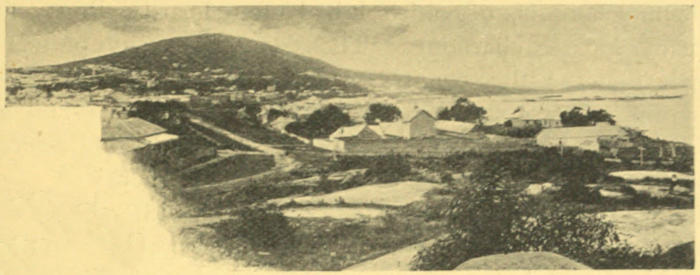
Bird’s-Eye View of Albany
Albany—Sweet Boronia—Middleton Beach—Little Grove—Regatta—Buildings—Whaling—Old
Colonists—Travelling Dairy—Splendid
Vegetables—Wattle Farm—Porongurup—Land Regulations—King
George’s Sound.
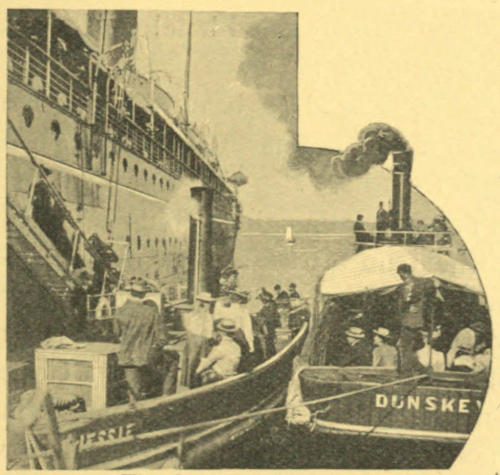
The Omrah at Albany
Having travelled all over Tasmania, Queensland, New South
Wales, Victoria, and South Australia (now United Australia),
I one day made up my mind to
set out for the land of gold, Western
Australia, that has created such a
furore in these last few years.
Accordingly I took my
passage from Sydney in the
mail-steamer Omrah and,
after a very charming
voyage on board that
splendid vessel, landed at
Albany. It was a lovely
day, and the first things
that pleasantly greeted the
passengers on stepping from the tug-boat to the wharf were
various small boys with huge bunches of the exquisite-smelling
boronia, of which I had often heard. Pretty little
Albany looked charming. The day was really perfect in
its loveliness; the country round looked like an exquisite
emerald robe fringed with pearl and sapphire, the grand blue
mountains in the distance, the opal sea, with its white-winged
yachts and various sailing vessels lying at anchor in beautiful
Princess Royal Harbour; the blue sky above, with here and there
a tiny white cloud like a dove carrying a message to heaven; the
matchless wild flowers springing around in profusion, and the
scent of the sweet boronia wafting on the breeze from the
gullies, where it grows in such luxuriance that one wonders no
scent farm has been started to distil the exquisite perfume, made
the drive taken by most of us before lunch most delightful. The
peacefulness of this charming place was broken only by the
arrival of the great steamers, with their crowds of passengers,
who always went ashore for an hour or so, some of them to take
the train en route to Perth, Fremantle, or the goldfields; the
others, after driving, lunching, or dining, as time will allow, at
the Freemasons’ Hotel (where I put up for a week), returning
to the steamer to continue their passage “home,” as all we
Australians call dear mother England.
After an excellent lunch at the above-named hotel we set out
to view the surroundings of Albany.
On that day everything really looked so beautiful that one
might believe Nature to have put on her most attractive garb
for us, as if to say, “Why go from here?” Driving round the
Marine Drive to Middleton Beach, we thought nothing could be
lovelier than the view to which no attraction seemed wanting.
The calm and stillness were broken only by a few other
tourists, also feasting their eyes on this scene of beauty. It is
a five-mile drive to Middleton Beach. The beach forms a circle
of some three miles. Mount Clarence is in the background; in
front is the land-locked Princess Royal Harbour, with its narrow
gateway for the passage of ships; tiny bays surround it, and
the picturesque islands look like so many lions guarding the
portal. This is a favourite place for picnics; family parties are
often here in numbers; the water is so limpid and shallow
that children can dabble about to their hearts’ content; the
sand is beautifully white and firm, and many little spades and
buckets are employed in making sandhouses. Afternoon tea-parties
are also quite an institution; it is considered quite “the
thing” to bring a party of friends to tea, and, if you do not wish
to have it al fresco, there is the pretty Esplanade Hotel, where
everything, from afternoon teas to wedding breakfasts, is served
up in most excellent fashion.
Another beauteous spot near Albany is Little Grove. The
day I went the steamer was full, it being a holiday. Launches
were plying from jetty to jetty, taking parties of picnickers to
the pretty shady groves. A regatta was also being held, and
many people were watching it. It was a pretty sight to see
the contest of the boats as they sailed merrily round the lovely
bay. The weather was exquisite, but a strong breeze was
blowing; good seamanship was called into play in the sailing of
the yachts and robust muscular exertion in the rowing events.
Albany may well be called the sanatorium of the colony. The
air is so invigorating that, after being there only a few days,
one feels almost a new being. Any one suffering from brain
fag or exhaustion cannot do better than go to Albany for a
holiday. One need only look at the faces of the children, see
their healthy looks, bright eyes and general activity, to know
that they have been born and brought up amongst healthy
surroundings. One feature of the children is their beautiful
hair; many possess such luxuriant tresses that one feels
inclined to envy the lovely colour and beauty of them, and to
wish one also had been born in Albany.
The town possesses some very good buildings, and, although
not of very large extent, is well laid out. It lies between the
Mounts Clarence and Melville, and the many dwellings on the
hillsides give it a most quaint and charming appearance. The
principal places are the Town Hall, Post Office, Customs House
Office, and large sheds, also some fine stores. There are still some
very old structures standing, for Albany is an old town, Princess
Royal Harbour having been called after the daughter of King
George of England. The old-fashioned church of St. John has
been beautified by the hand of time and adorned with a mantle of
ivy green. Many stone cottages show the primitive way of
building that prevailed in 1836. The gaol, built about that year,
and in much the same style, still exists, but the stocks then in
use have almost disappeared. A very old woman to whom I
was speaking told me she remembered three women at a time
being put into them. Other evidences of days gone by are
immense heaps of bleached whalebones lying about in some
parts. Albany was once a fishing village frequented by traders
of all countries, who did a large trade in whale-oil, seals, &c.,
and exchanged for these things not only coin but also potatoes
and fruit. There were evidently stirring times in Albany in
those early days, and it was not an uncommon thing to see nine
whales at a time disporting themselves in the harbour. The
huge mail-steamers must have frightened them all away, for a
whale is now a rare visitor. I spent a pleasant hour at the
house of Mr. J. McKenzie, which in the ’fifties was the only
hotel in Albany, and was known as The Thistle. It was
also the general concert-hall and theatre. There were no
theatrical companies in Western Australia in those days, and the
small community used to get up its own entertainments without
aid from outside. Among the relics cherished by Mr. McKenzie
is the speaking-trumpet used by his father, a master mariner,
an imposing-looking instrument of brass, something like a
cornet. A magnificent double-pearl shell, with five or six
lovely pearls embedded in its sides, must be of great value.
One of the most prominent early colonists was Captain John
Hassell, who, after calling two or three times in his brig
the Belinda, being wrecked, and undergoing many hardships,
was still so much attracted by the splendid locality that he
resolved to settle here, took another trip to Sydney, N.S.W.,
and returned with his family in 1838, bringing with him 700
sheep, 12 horses, 20 head of cattle, poultry, 15 men, also
rations for twelve months. Captain Hassell went first to
Strawberry Hill and afterwards to Kendinup Station, where a
fine mansion stands, which now belongs to his son, John
Hassell. It comprises 41,144 acres of freehold and 122,000
acres of leasehold property; the area is 225 square miles, and
there are 320 miles of fencing on it. 6000 sheep are on the
run, and one magnificent flock of imported sheep cost Mr. Hassell
£4000. The samples of wool I saw from this station are really
splendid. There is a plentiful supply of water, one well being
80 feet deep, and nearly always full. There are 30 civilised
natives on the station, photographs of five of whom are here
given.
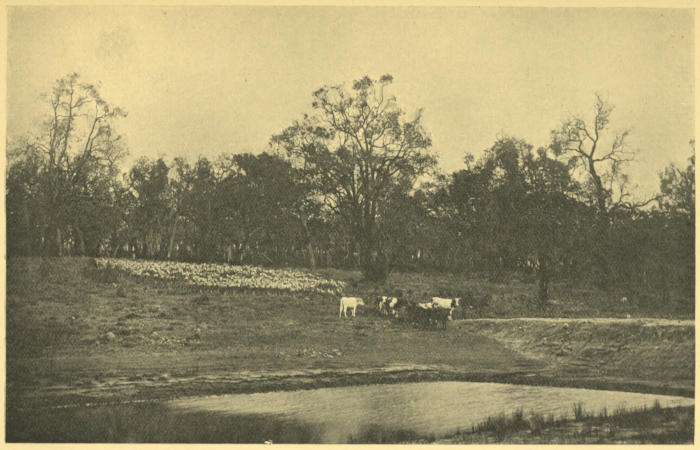
A PART OF KENDINUP STATION
Albany has been connected with the capital by rail since
1886; previous to that time the overland journey of more than
300 miles was made by mail-coach or private conveyance over
a very lonely road. The first railway here was negotiated
by the late Mr. Anthony Hordern, of Sydney, N.S.W., and constructed
under the land-grant system by a company of which he
was director-chairman. Mr. Hordern took up large grants
of land near Albany, having a high opinion of its agricultural
possibilities. He had also large schemes for the future of the
south-west part of the colony, and intended to build agricultural
colleges to teach people how to use the splendid soil to advantage.
Unfortunately Mr. Hordern did not live to complete the
schemes; he died at sea, and a splendid monument to his
memory tops the incline of the principal street in Albany. The
late Premier, Sir John Forrest, said he remembered taking a
journey from Albany to Perth in 1880, when the coach broke
down at a distance of some 40 or 50 miles from the town, and
it was necessary to get a team and travel by it another 40 or 50
miles; also many other difficulties were encountered before
arriving at Perth, and the journey took a week. My own
experiences when I visited this colony in 1882 were worse
than the Premier’s. I landed in Albany with a party of four
others; we hired two conveyances and four horses, paying £50
for them, provisioned for ten days, and set off through the
sand and bush. As it took us sixteen days to perform the
journey, as very little food could be obtained anywhere, and as
we arrived at our journey’s end with only two horses, the other
two having died on the way, the pleasures of that expedition
can better be imagined than described.
The garden lands which lie in the valleys close to the town
are being largely cultivated, and selectors from England
and elsewhere are frequently arriving with the intention of
taking up selections, and undertaking dairy farming and market
gardening. The new travelling dairy instituted by the Government
will be a great boon; it will have all the latest appliances,
and the plant will be erected in places where the people have not
facilities for making butter, &c., and persons who do not understand
the process can be instructed. The yield from this district
is one ton of hay, or fifteen bushels of wheat, per acre. This
quantity has been exceeded at Toobrunup Lake, where the yield
was twenty bushels per acre. Further proof of the fertility of
the soil is given by the fact that cabbages grown at Mr. Horton’s
selection weighed from 20 to 30 lb., and grew to maturity in
thirteen weeks. Forty-two tons of cabbage came off three
acres of land last year, and brought £10 per ton. Potatoes
from the farm at Strawberry Hill, cultivated 60 years ago by
Sir R. Spencer, weigh over a pound each, so that at dinner you
are not asked to take potatoes but a part of one. These
potatoes are really stupendous; one that I had in my hand
I measured, and found it to be nearly a foot long, and wide
in proportion! Seventy tons of these gigantic tubers, grown
without the aid of any fertilisers, were taken from nine
acres. Turnips flourish in the same way and grow to the
weight of 3 and 5 lb. It is not “some pumpkins,” as they
say in America, but “some turnips,” as they say in Australia.
Onions also grow to an immense size, often weighing over
6 lb. each.
Albany and its surroundings are really as near perfection as
it is possible for any place to be. It has a heavenly summer
climate, the coolest in Australia. A day is considered hot if
the mercury rises above 80°. During the week of the terrible
heat-wave, when in other parts of the colony the temperature
was from 110° to 115°, the record heat here was 95°. There
are never by any chance hot winds. The grass is always
green and flowers are always blooming. With its miles of
harbour frontage, its lovely valleys nestling at the foot of its
grand hills, its beautiful river, and the natural drainage which
keeps the little town always clean and healthy, no wonder
it should be regarded as the very choicest of health resorts.
The rainfall is abundant, and the district seldom suffers from
frost. The winters are very mild, snow has only been known
to fall two or three times, and then was so novel a sight as to
excite wonder in all the native-born Albanians. Last winter,
however, Mr. Knight, of Wattle Farm, carted into town a huge
snowball that had been rolled on his farm in the Porongurup
ranges, which then were covered with snow, and afforded the
grandest spectacle ever seen here. At Mr. Knight’s farm and
orchard some magnificent fruit is grown, the apples being
sometimes over a pound in weight. I shall never forget the
lovely sight of that orchard. It is on an elevation of 1200 feet
above the sea-level, and commands a view of the rich and
fertile valleys around. The soil is of a rich deep chocolate
colour, and the country is stated by experts to be volcanic.
Besides being endowed with beauty and richness of soil,
Albany is likely to become famous as a coal- and gold-producing
district, for coal has recently been found, and a company which
will make further researches formed. Timber also is abundant,
and copper has recently been found at the Phillips River,
about 180 miles away. Thousands of people who have
gone direct to the goldfields have no idea of the beauty of this
place. They only think of Western Australia as a place in which,
to look for gold, and when that has been obtained in sufficiency,
to be left behind as quickly as possible. Tinned fruits, meat
and vegetables have until recently been the staple food of
dwellers in the goldfields; but, as population increases and
fertile lands are taken up and cultivated, a sufficiency of fresh
fruits for all requirements will probably be produced before long.
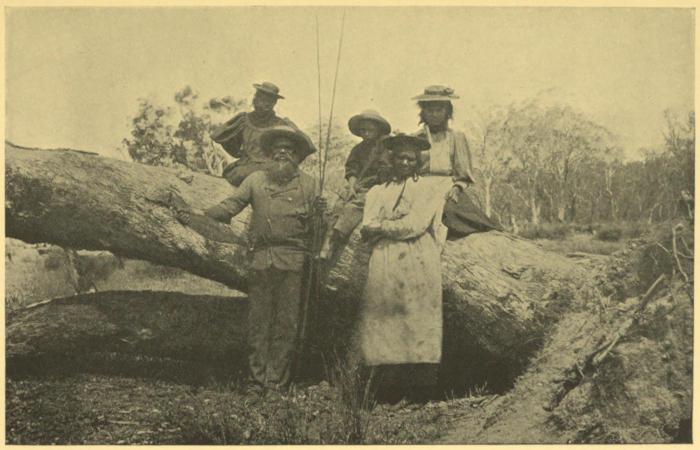
CIVILISED ABORIGINALS AT KENDINUP STATION
The land regulations of Western Australia are so favourable
to the colonist that, if well known in England and upon the
continent of Europe, they would probably attract many families
of the vine-growing, artisan, and small capitalist classes. Any
person over the age of eighteen, who is the head of a family,
can take up an area of 160 acres of land for a free or homestead
farm. A deposit of £1 is required as a guarantee of
bona fides. The applicant must live on the land for six months
of each year, and within two years must spend £30 in clearing
or cropping, or put down two acres of garden, orchard or
vineyard; within five years, one quarter of the selection must
be fenced and one-eighth cropped; within seven years the
whole area must be fenced, and one quarter cultivated. The
selector then becomes entitled to his certificate of title, after
having paid for it and the cost of survey. Direct purchase
can be made, if desired, of from 100 to 5000 acres. The land
is valued at 10s. per acre, of which 10 per cent. is payable on
application and the balance by four quarterly instalments.
Applicants must fence in the course of three years and spend
5s. per acre within seven years, and then can acquire their
certificates of title. Grazing farms can be taken up at a rental
of 2½d. per acre. Pastoral leases, or grass rights for grazing
purposes, can be got for the nominal rental of 2s. 6d. per 1000
acres per annum and upwards. Garden lots, from 5 up to
50 acres, can be obtained. In this case the land is valued at
20s. per acre, and the plot must be fenced within three years,
one-tenth to be put under cultivation as a bona fide garden.
The terms are 10 per cent. deposit on application and the
balance in six half-yearly instalments. In addition to all this,
the Government have done yet more to induce land settlements
by offering assistance from the Agricultural Bank, created by
the late Premier, Sir John Forrest, for the benefit of all who
desire to make a home in Western Australia. This bank will
lend money on freeholds at conditional purchase (already
fenced) to the amount of £800. An application fee of 1 per
cent. on the loan is demanded, and this amount covers cost of
inspection and mortgage. The amount lent is repayable by
the borrower in thirty years; for the first five years the interest
is payable half-yearly. At the sixth year a sinking fund of
4 per cent. commences, and continues until the end of the thirty
years, when the debt is wiped out. There are Government
land agents in nearly every agricultural town of the colony, and
a would-be selector arriving and communicating with the Government
agent receives all the assistance he wishes in making his
selection. The present population of Albany is about 3500.
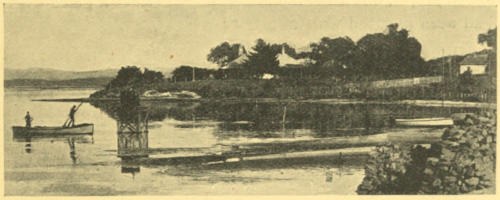
The Residency, Albany
A fine Quarantine Station has lately been built at a cost of
£10,000. The forts are very interesting. No doubt, in the
future Albany will become an important Naval station. An
Imperial Officer of the Royal Artillery is in command, there is
a small garrison, and some murderous-looking guns are in
readiness to give a warm reception to any enemy who may
appear. Before leaving Albany I accepted an invitation to take
a trip out into the Sound. This was named by Vancouver, in
1791, King George’s Sound, after the then reigning sovereign
of England. It is sheltered by magnificent granite rocks or
headlands, and the anchorage is perfect, for the islands of
Breaksea, Michaelmas, and Haul Off Rock—an immense block
of stone, almost like a mediæval fortress—break the ocean
swell. The beauties of King George’s Sound have been well
known since the first navigators sought refuge in its quiet
waters, and its maritime value can never cease.
I said “Good-bye” with much regret to the many friends
made during my short stay in this little town, where even
the Railway Reserve is a perfect garden of Arum lilies.
These peerless flowers seem to grow wild, and their stately
heads are to be seen everywhere. The scent of the boronia is
wafted on the breeze from afar; you hear the merry laughter
of boating-parties and of children who come along with their
hands full of gorgeous wild flowers. One of the townsfolk
brought me a lovely collection of orchids, of which there are
many varieties to be found hereabout; another friend brought
me a collection of Western Australia curiosities, shells, corals,
&c.; indeed I was overwhelmed with kindness by the warm-hearted
people, and could not but be sorry to leave a place where
I had been received with so much kindness.
CHAPTER II
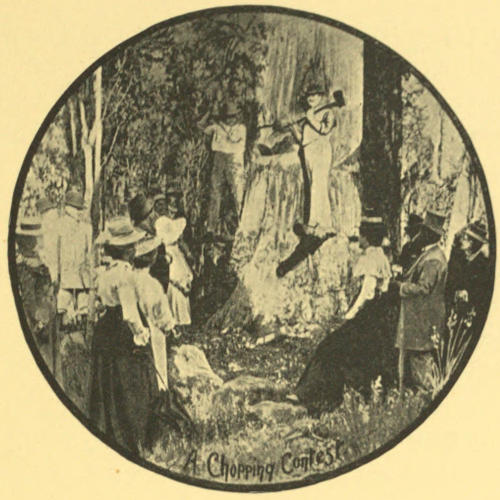
A Chopping Contest.
Torbay—Denmark Timber Mills—Mount Barker—Katanning—Wagin—Narrogin—Beverly—York—Lovely
Wildflowers.
Leaving Albany under more auspicious circumstances this
time than when I had left it by road, I took my seat in the
train, my destination being Denmark Mills, where I went to
see a great timber station and Jarrah Forest. On arrival at
Torbay Junction, 9 miles from Albany, I left the mail train and
took the timber train, as the company, who own the Denmark
Timber Mills, have a private line running to that place; once
seated I was soon carried into the timber country. We
passed through country covered with boronia and other sweet
flowers, and with Sheoak, Karri, and Jarrah trees. We
crossed the Hay river and came to Denmark Mill and township.
We were now in the thick of the Karri country, covered with
immense trees. The site of the township, covering 150 acres,
has, of course, been cleared, and there are many comfortable
wooden and slab cottages with nice gardens attached, giving a
plentiful supply of fruit and vegetables; as well as a good store,
where everything appertaining to housekeeping can be obtained.
No liquor is allowed to be sold at the mill on account of the
dangerous nature of the occupation, consequently this is a model
township. There are several coffee-houses, and, in spite of
their enforced sobriety, the men seem to be very jolly and
happy. An enormous stack of timber was ready to be
shipped to Colombo, and the men were at work cutting more,
as the enormous demand for Western Australian wood
keeps the workmen busy night and day, working in relays.
The line train wound round the hills in picturesque fashion, until
we came to a valley which looked more picturesque still,
but rather dangerous to cross in a timber-train. Here the
flying fox or aerial tram is used to bridge the steep part and to
carry small timber. I was glad I did not venture down
into the valley, for I was afterwards told that it was not an infrequent
occurrence for the timber-trucks, and occasionally the
engine also, to leave the line, and as the trucks are of the
roughest description, consisting merely of four wheels and a
platform, and are loaded with immense logs, the passenger can
only travel on the engine, or on the “dummy,” which is a
special truck placed immediately behind the engine to keep it
from being damaged in case some huge log, weighing perhaps
20 tons, should slide forward in the course of a descent. It is
difficult to give an idea of the size of the gigantic Karri-trees
here. One which I saw was quite hollow, and a bullock team
drove right through it with perfect ease. In returning to the
town I saw another large quantity of battens or pickets waiting
to be shipped for London to fence two large cemeteries.
Enormous fires are always burning in the town to consume the
great heaps of waste from the mills. A pile, about 120 feet
high, was waiting to be burned, and it did seem a pity
that good wood should be reduced to ashes merely to get
it out of the way. A scheme for shipping the refuse of the
mills to America for conversion into paper has lately been
mooted.
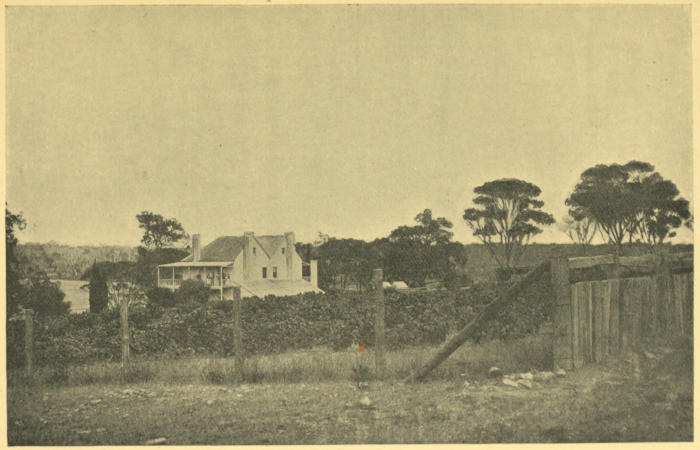
THE HOMESTEAD, KENDINUP STATION
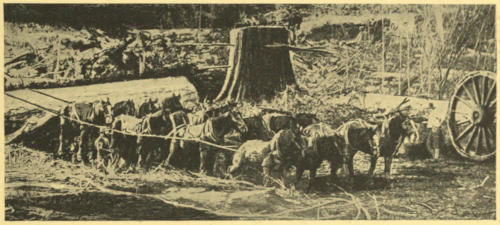
Hauling Logs at the Mills
The Karri-trees, grow to a height of 300 feet, with a circumference
of from 20 to 30 feet. From one Karri-tree alone
100 tons of timber have been cut. Karri is also called
Eucalyptus collossea or diversicolor, the latter name denoting
the difference between its leaves and those of other eucalypti.
The timber is impervious to damp. I was shown a block cut
from a log that had been buried forty-six years in moist earth,
and it was perfectly sound. For mining, harbour works, railways
and street-paving the wood is unequalled, and is now
greatly used in different parts of London, notably in paving
Charing Cross, where traffic goes on at the rate of 402 omnibuses
every hour; and in Paris the Rue Lafayette and Rue
Château d’Eau are also paved with our famous Australian
woods. This particular wood is preferred for street-paving
because it is safer for horse traffic than other kinds; observations
taken by Colonel Hayward, late City Engineer of London,
have shown that horses might be expected to travel over 446
miles of Karri road without accident. On Westminster Bridge,
London (south side), the Jarrah paving has lasted for seven
years. This wood is also being used all over the world for
jetty piles; some enormous ones, 90 feet in length, were waiting
at the train-shed to go to Albany, where thirty vessels are
under charter to take the timber away to South Africa, South
America, India, &c. There is another very large karri district
which I mean to visit; I must not therefore exhaust all
I have to say about karri timber here, but pass on, leaving
behind Denmark Mill with its 20,000 acres of forest, where the
manager told me over two million loads of timber were waiting
to be cut down. Mr. Millar also owns very large jarrah
forests, the Wagerup of 35,000 acres, and the Mornington,
55,000 acres, and employs upon them a very large staff of
workmen.
Returning next day to Torbay Junction, I caught the
mail-train and continued my travels, passing thousands of
acres of land waiting for selectors. Stopping at Mount
Barker, 28 miles from Torbay, I visited the homestead of
Mr. Somnes, the land around which was first cultivated
over 40 years ago by Mr. Somnes, senior, now 90 years of
age, and many of the fruit-trees, though planted so long
ago, are still bearing good crops of fruit. Over 55 acres of
fruit-trees of different kinds, bearing lovely fruit, testify to the
excellence of the soil. Two thousand apple-trees seem to be
specially prolific. In another part of the Mount Barker district,
Mr. Miller’s estate, comprising more than 5000 acres, has a
fine orchard of over 6000 fruit-trees of all descriptions. Two
other orchards, not quite so large but with much exquisite fruit,
are not far off, and the old homestead of St. Werbergs, where
the late Colonel Warburton resided, is a place of much interest.
In addition to fruit, the necessary potato and onion are being
cultivated, and in some cases yield very largely per acre. It
was my intention to stay at Katanning, as I wished to see
the much-talked-of orchard and vineyard of the Hon. F. H.
Piesse.
It being night when I arrived, I could not see what the place
was like, but in the morning light I found it a most charming
little village. A great deal of land has recently been taken up
by selectors; during last year over 1500 applications were made
for homesteads and farms on conditional purchase, and many
more for pastoral leases and town and suburban lots. The
harvest returns here are very satisfactory, 15 bushels of wheat
to the acre being the average. Many farmers are coming over
from the other colonies to select land for farms, as well as
people from England and other countries. The Katanning
area contains 100,000 acres, so there is plenty of room for
many farms and orchards. Assisted passages are granted
from England to intending farmers and agriculturists and their
families, also to single women and widows. They can come to
this colony by only paying £8 5s. towards their passages.
These people must, however, be approved by the Agent-General,
Hon. Henry Bruce Lefroy, in London (15 Victoria Street, Westminster,
S.W.), from whose clerks intending passengers can
get any necessary information by writing to ask for it. On
arrival in Western Australia the new-comer will be afforded
every assistance by the Government land-agents who are
stationed in the principal towns.
The orchards and vineyards of Mr. Piesse are really wonderful.
There are 65 acres of fruit-trees, bearing all kinds of
fruit of exquisite flavour, some of the pears weighing over 2 lb.
each, and the peaches, apricots, and apples of equal size and
beauty. The apples grown here are famed for their size,
sweetness, and flavour.
There were acres and acres of vines loaded with large and
luscious grapes, the purple ones, with their lovely bloom,
offering a picture to the eye as well as refreshment to the
palate. The cost of clearing land in this district is only from
35s. to £3 per acre, so that any one with small capital could
soon have an orchard or farm of their own. The day is evidently
not far distant when Western Australia will not only
produce sufficient for all her own requirements, but, being
nearer the European markets by several days’ journey than the
other colonies, will be able to supply the markets of the
outside world with her fruits, especially grapes, the soil in
some parts being particularly suitable for vine culture. Her
goldfields may in time be exhausted, her forests may be converted
into timber, but the soil will always remain and vines
will always grow as long as the sun shines to mature the
grapes for wine to make glad the heart of man. Almond-trees
also grow wonderfully well, and tons of almonds are sent every
year from Katanning to different parts of the colonies.
One very great feature connected with fruit farming in
Western Australia is that there are no fruit pests in the colony,
no phylloxera, no codlin moth, and no nasty little fruit-fly to
spoil the growth of things. Every care is taken that nothing of
the kind shall be brought here from other places, all fruit being
rigorously examined by experts before being passed by the
Customs.
Seated behind a fast pair of Australian brumbys—(these
horses, called by the natives Warrigals, are very hardy
animals, and are well known to go longer distances without
nourishment of any sort than any others of their kind; when
proper food is unobtainable, they can subsist on the driest of
spinifex grass, or scrub, and what would kill other horses does
not seem materially to injure them)—I had a lovely drive over
Mr. Piesse’s properties. One splendid field of wheat, 300 acres
in extent, was a great sight. As far as the eye could reach this
field, with its magnificent crop, waved before the breeze. We
had passed the orchard with its acres of fruit-trees bending
beneath the weight of fruit. Then we came to the vines
with their rich and luscious grapes, then—a complete and
charming change of scene—to the cornfield. On the far side
of the field two waggons, each drawn by nine horses and
laden with a tremendous load of produce of the glorious earth,
were wending their way to the mill, which was seen in the
distance on the other side. A forest of trees, white gum, York
gum, and raspberry wood, sent a subtle perfume through the
air. Opening a large white double gate (one of many), we
drove right through the pretty cornfield, and one could imagine
the feelings of Bobby Burns when he wrote his exquisite poem,
“When the corn is waving, Annie dear.” Returning on the
other side of the field, a pretty view is seen of the village of
Katanning bathed in the golden sunlight.
We passed the model farm of Mr. Stanbury and came to Mr.
Piesse’s splendid and most interesting mill: all the very newest
machinery for turning the ripe corn into flour is here. I
thought of our ancestors crushing wheat between stones, and
watched the beautiful white stuff coming down the huge
cylinders, automatically filling the corn sacks and coming to a
dead stop when full, with no assistance from the human hand,
while the man who had placed the sack on the cylinder stood by
sewing up with twine the last one filled. The click came to
notify that a bag was full; it was taken off, and another put on
to go through the same process. Tons of refuse from the
wheat were being thrown out, and on my asking what was done
with it, Mr. Piesse said that it was given to the pigs. This
splendid mill was built in 1891, but, in consequence of the rush
to goldfields which broke out in 1893, lay idle for nearly two
years, all the produce being
wanted for chaff, which
could not be cut quick
enough for the demand.
A great deal of land-clearing
is going on in the different
selections, and it is
interesting to see the forest
devil or tree-puller at work.
This operates by means of
a chain placed round the tree and a lever worked by a man; in
about 15 minutes a great tree will come up root and branch, and
fall never to rise again.
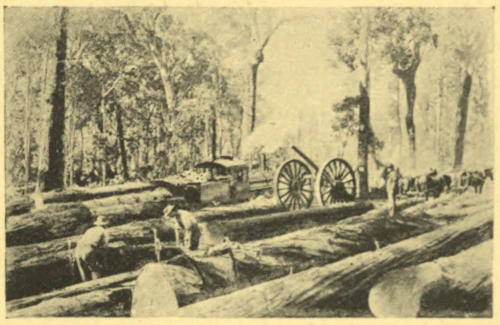
Ready for Cross-cutting, Denmark Mills
Resuming my journey next morning, I once more sped on
by train through the flower-scented country, passing Wagin,
Narrogin, famous for oranges; Pingelly, and Beverley (all rich
agricultural country). Here we partook of a very good repast,
this being the place where many Perth passengers break the
journey when going to Albany, or vice versâ; then, after a
further run of 20 miles, we stopped at the pretty little town of
York, on the banks of the Avon river. It nestles in a valley
almost surrounded by green hills, and as I walked across the
bridge, built of jarrah-wood, that spans the pretty river, I thought
I had never seen a more pastoral or a prettier place. The
town is in two parts, one each side of the Avon, which is
crossed by three bridges. The pale yellow fields of corn, the
pretty houses on the hillsides, the beautiful cattle grazing, and
the fruit growing in profusion in the various gardens and
orchards, make a charming picture. Quantities of sandal-wood
grow close to the town, and constitute a valuable industry;
the jam-wood also thrives well, and the scent of it makes one
imagine oneself in the vicinity of a raspberry-jam factory. The
headquarters of Parker’s Eucalyptus Distillery are here. The
distillery is at Dangin, about 40 miles off, where the beautiful
fruits that grow at York are preserved by the same firm, and
are quite tempting to look at and exquisite to taste. Farming
is very advanced in York. I was shown some wheat from a
farm, a portion of a crop that yielded 32 bushels per acre. The
farmers employ the very latest improvements in machinery, and
say that, though expensive at first, they find these cheaper in
the end, the expense of working the land being greatly reduced
by using the newest strippers, &c. It speaks well for the productive
capacity of the district that 24,000 bushels of splendid
wheat were waiting, at the Empire Milling Company’s storehouse,
to be turned into flour.
Driving from York to Greenhills, through the Avon valley,
I passed Mr. Jesse Scott’s magnificent farm. Imagine a cornfield,
or, I should say, a succession of cornfields, of 450
acres, on some parts of which the oats had attained the height
of 7 feet. These portions of the fields would yield 60 bushels
to the acre, and the whole 450 acres would average 35 bushels
per acre. It was, indeed, a magnificent sight. On other parts
of Mr. Scott’s property rye, buffalo, and prairie grass were
making great progress, while 12 acres were planted with vines.
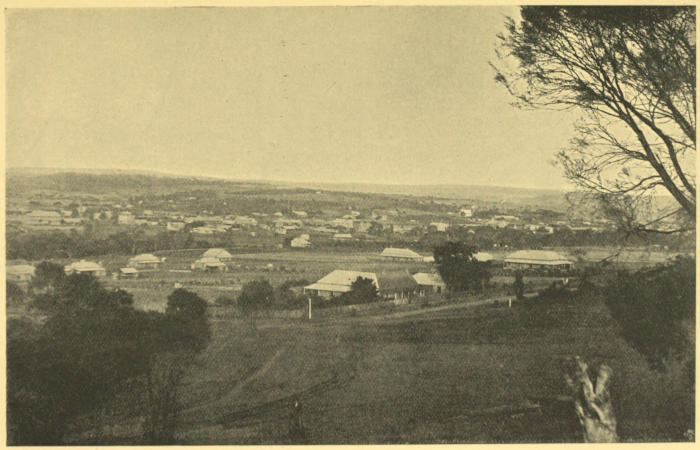
YORK
The tanning industry is well represented. I saw splendid
samples of plain and fancy leather when visiting Mr. Hay’s
factory; one enormous side weighed 39 pounds, kangaroo
skins are also tanned and make a beautiful shiny leather.
Kangaroo meat is eaten here, although beef and mutton are
plentiful. Many people seem to prefer “Roo” steak. I
confess I was rather surprised at breakfast to hear the waiter,
in reading the menu, mention the latter dish. I did not test
it, but at dinner tried kangaroo-tail soup, and found it really
excellent. The much-esteemed Roman Catholic priest, Father
Gibney, brother of Bishop Gibney, lives in York, and also has a
pretty little place (which is his hobby) called Springfield, about
three miles out. The Rev. Father has hundreds of fruit-trees of
different kinds, and quite an orangery. I brought away several
branches with eight or nine oranges on each as mementoes of
my very pleasant visit. There are some good buildings, a fine
Post Office, Mechanics’ Institute, Court-house, and some handsome
churches, as well as many good shops. York is one of
the oldest Western Australian towns, and enjoys the distinction
of being the place where the first official execution took place
in 1840. The wife of a settler, Mrs. Cook, and her infant, were
murdered by aborigines during the absence of her husband.
The murderers escaped into the Bush, and were only brought
to justice through a tribal quarrel which resulted in some natives
betraying them. They were conveyed to the scene of their
crime and hanged in chains, in the presence of a large gathering
of natives. Up to this time there was an impression amongst
the natives that an absence in the bush, long or short, absolved
them from punishment. This execution dispelled any idea of
that kind which they may have entertained, and taught them a
wholesome lesson.
A very well-known person in early times was called the Duke
of York. He used to go between Perth and York in a little cart
carrying goods, not least of which was a keg of rum, the virtues
of which would have been even more warmly appreciated if the
old fellow had left it in its natural state, and not mixed so
much aqua pura with it. His descendants have risen in the
world, and in place of the keg of rum of their ancestor have
now bonded stores of large extent.
On leaving York en route for Perth the train journey was
rendered delightful by the beautiful carpet of wild and many-coloured
flowers on each side of the line. As the train sped
past the idea struck me that these flowers—lovely immortelles,
white, pink, and yellow, growing in countless millions—could
be turned to good account. Conversing with a Westralian
(white) native in the train, I find such a thing had never been
thought of, and what could be made a source of wealth by
some energetic people seems here hardly to be noticed.
Thousands of crosses, wreaths, anchors, screens, fans, and
other decorations could be made of these flowers, and would, I
am sure, command a ready sale on the Continent, especially in
France, where there is such a love of flowers for ceremonial
purposes. At present, like the boronia, which usually seems
to waste its sweetness on the desert air, they appear to be
not much admired, except by people travelling through the
country, who cannot fail to be impressed, like myself, by their
beauty. For perfumery purposes, the little coffee-coloured
boronia must have a great future before it, as well as the lovely
immortelles. My friend in the train said, “I don’t think they
are much good.” He put me in mind of the soldier, a good
many years ago, who, on the defeat of Parses the Persian,
found a bag of shining leather filled with pearls. Not knowing
their value, he threw them away, but kept the leather bag,
saying, “What was of no use could be of no value.”
CHAPTER III
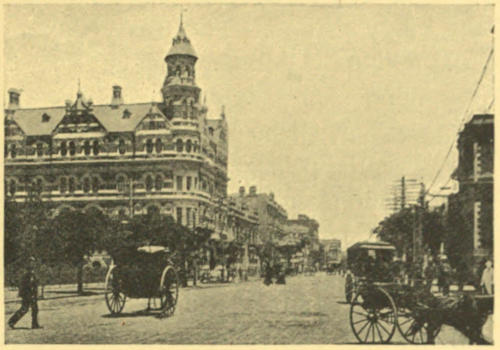
Moirs’ Buildings
Perth—Public Buildings—Yacht Clubs—Government House—Recreation
Ground—Lovely Perth Park—“Bond or Free.”
And now for Perth, the capital city of the Golden West. As I
remember it on my last arrival, after my memorable journey
across the sand plains, it was a
very sleepy little town. Now
it is a handsome and prosperous
city, with noble buildings on all
sides, electric light, tramcars,
beautiful parks around it, and
yachts dancing on the broad
waters of the Swan river. Perth
is beautifully situated, and one
cannot fail to be charmed with
its picturesque and lovely surroundings.
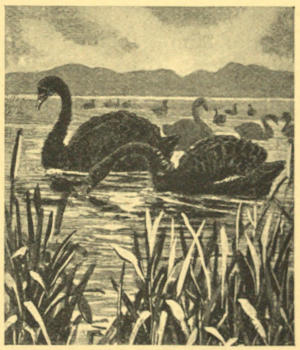
Swan River, Perth
Perth on a Spring day presents
a charming and animated picture. Boats and steamers ply across
Perth Water to and from South Perth on the other shore, while
black swans, which are to be seen in hundreds, are much
admired by the many visitors. The pretty villas, shrubberies
and trees, the old mill at the Point, and Mount Eliza lifting above
everything its smiling face perfectly ablaze with gorgeous wild
flowers of every colour, all help to give charm to the scene.
St. George’s Terrace, the principal fashionable street, is nearly
two miles in length and planted with shady trees. The Council
have also lately had lemon-trees put in, with the idea, I
suppose, of presently raising a crop of lemons. The golden
fruit growing along the street will be something novel, but
not, perhaps, financially profitable, since in the hot summer
time it will offer rather a temptation to small boys who may
have a leaning towards lemon squash. Russell Square will, in
course of time, be as fine a public ground as any in Western
Australia. A great day of tree-planting recently occurred
there. Mr. Randall, Minister of Education, and the Mayor
of Perth, assisted by some of the city fathers, planted the first
trees: the rest were set by the school children, who had been
invited to attend. Many beautiful Westralian, tropical, and
sub-tropical trees will in future throw their grateful shade over
this fine square.
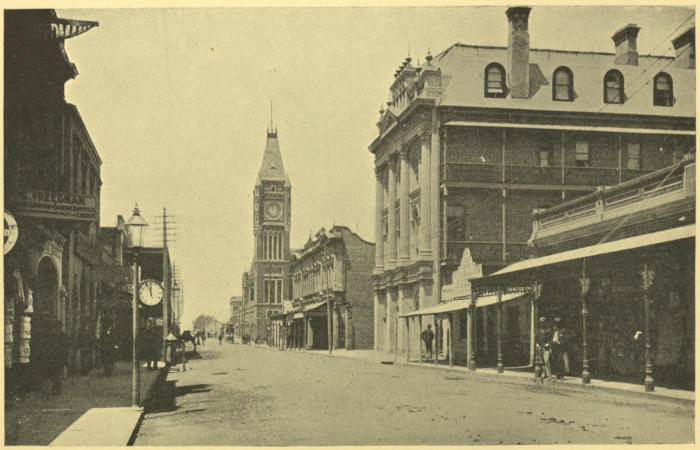
HAY STREET, PERTH
Many handsome public buildings have lately been erected in
Perth: Moirs’ Buildings, Prince’s Buildings, the Bank of New
South Wales, De Baun’s Hotel, the Esplanade Hotel, and the
new Public Works Offices would do credit to any city in the
world. The Town Hall, which, although an imposing-looking
building, is old, will shortly be removed, the Government
having been offered a very large sum for the site, which is
one of the most important in Perth, and very valuable. A
new Town Hall will, accordingly, rise in some quieter part of
the city. The Post Office is a fine building in the French
Renaissance style. Then there are the Mines Department
Offices, the Mechanics’ Institute, with its large hall for entertainments,
and St. George’s Hall; Cremorne Gardens, where
in the hot weather people take their amusements in the open air
while smoking and otherwise refreshing themselves; there is a
fine theatre in Hay Street, and another will shortly be erected
in Barrack Street; across the bridge we come to the Victoria
Public Library, a splendid stone building recently built, with
an excellent library of
28,000 books and
pamphlets. The
Museum adjoins it,
and contains valuable
specimens of all the
minerals of the
colony, as well as biological
and botanical
samples. The Railway
Station and Offices
form a fine block of buildings, and an overhead railway is shortly
to be started. There are some very large churches, Trinity Church,
St. George’s Cathedral, and Wesley Church, in connection with
which the new Queen’s Hall and the fine block of buildings
adjoining it have been erected. The Roman Catholic Cathedral,
an imposing structure on the hill overlooking the city, has on
Sundays a very large congregation. The Bishop’s Palace and
Convent are near it. Not far off is the Hospital, which is a
credit to Perth, not only on account of the arrangements,
which are excellent, but on account of the kindness, skilfulness,
and attention received by the patients. It is most highly
spoken of by all who have ever been its inmates. The
Royal Mint is a new and handsome building, recently opened
and Western Australia can now coin its own gold into
sovereigns, instead of sending it to Melbourne, as was formerly
done.
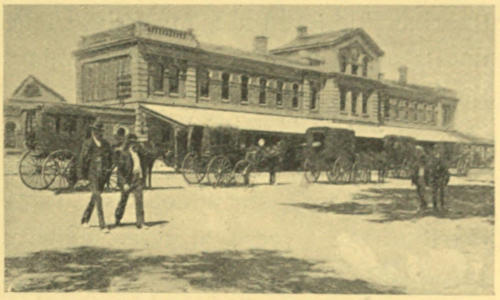
Perth Railway Station
Perth, having such a broad river, has also several very fine
yachts and rowing clubs. The Swan River Rowing Club is one
of the oldest institutions, and has not only a splendid new
boathouse, whose accommodation and appointments excel those
of any other on this side of the continent, but also the newest
racing-skiffs procurable and handsome sailing-boats. The
Club also has splendid gymnastic appliances, of which the
members avail themselves largely. The Club’s rowing prowess
has earned the distinction of being “at the head of the river.”
The Royal Perth Yacht Club also has a spacious club-house by
the riverside, and the many white-winged yachts that form the
flotilla are a pretty sight when sailing on the broad bosom of
the Swan.
Government House is a very handsome residence, its towers
and colonnade giving it a most picturesque appearance, and the
grounds, though small, are very beautiful; they slope gently
down to the river by a series of terraces, and contain many
rare plants and shrubs.
The Recreation Ground is quite close to the city. It is well
laid out, and on holiday afternoons the cricket and football
clubs indulge in their favourite sport, under the sunny skies
and genial air that render open-air existence so delightful in
Perth. A mimic fleet moored in the river faces the ground.
This fleet belongs to the Royal Perth Yacht Club, whose club-boathouse
is here. At the upper part is the bowling-green,
where the gentlemen of Perth who have passed their first
youth take their favourite exercise. Many ladies are to be
found there on a fine afternoon, for the club members are very
gallant and always have nice afternoon tea and its accessories
for their lady visitors. The Cricket Association possess a very
fine ground, covering fourteen acres, at the other end of the
town, near the Causeway.
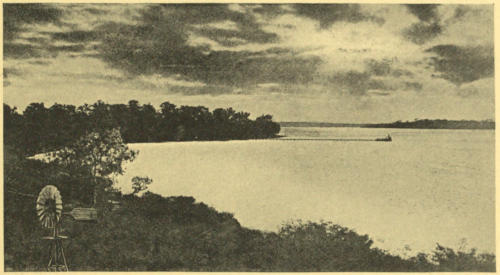
Melville Water
It is only recently, since Western Australia has made such
remarkable strides, that the now lovely Perth Park has been
appreciated. A few years ago it was nothing but wild bush,
and though, of course, the view was just as good as it is now,
few people ever cared to toil up the sandhills to the top of the
Mount in order to see it. You can now go by tram, and a
transformation has taken place. The park is surrounded by a
fence, and has been laid out in paths and gardens, while pretty
summer-houses have been built; it is five miles in circumference,
and on the west side are numerous villas, gardens, and good roads.
The observatory, near the entrance gate, forms an imposing
landmark. Standing at this point a magnificent panorama is
spread before you. The city of Perth lies at your feet, while
far away in the distance the noble Swan river winds its way to
Fremantle and Guildford. You feel as if you are almost up in
the clouds looking down at the lovely scene of the earth
beneath. Going along the broad drive you come to the
highest pavilion on the summit of the Mount. Perth Water,
with the boat-sheds and their many boats and yachts, and
little steamers plying across to South Perth, lies like a jewel
below. At the foot of the Mount are situated the Infirm
Old Men’s Depôt and the splendid Swan Brewery. The road
continues on, and we soon begin to go down the incline,
where another still finer view looms in the distance. Crawley
Park and the residence of Sir George Shenton are at the
foot, the point standing sharply out of the blue water. Across
the river is Melville Park. The scene is so exquisite that
one cannot bear to go on, but must pull up the horse and
stop for a few minutes, that the mind may drink in the
sight. I have seen many beautiful places in the other colonies,
and in New Zealand; but the view from Mount Eliza on
a spring morning in the season of blossom, when every wild
bush is ablaze with flowers, is a sight never to be forgotten.
I felt I must stay for a while and gather some of the
beautiful and quaint wildflowers, which are far more varied
than any I had ever before seen. I found afterwards that
by doing so I had transgressed the law, but, being a stranger,
hope for forgiveness. Besides the flowers that grow in native
profusion, many species have been transplanted from other
parts of the colony. Young eucalyptus and tica folia, trees
which are indigenous to the Albany district, and bear a handsome
scarlet flower, have been planted on both sides of the
road, and will in time form an avenue.
Many kinds of trees and flowers abound, the callistemon,
with its brilliant scarlet plumes; the petrophila, with its
exquisite velvety softness; banksias, honeysuckles, verticordias,
with their lemon-centred foliage; the beautiful snowflake
flower; the sweet-smelling, rich yellow hibbertia; the
pretty blue gardenia, the lovely lilac hibiscus, or native tulip,
fringed lilies, satin flowers, and others too numerous to
particularise, form a picture so strikingly beautiful that I shall
never forget the magnificent scene of green hills and flowery
dales, country and town, blue sky and opal water, stretching
far and wide. Terraces have been formed, and paths wind
their way down the hill to the lower road. Here and there are
rustic seats, where visitors can rest and enjoy the splendid
view, and there are, of course, tea-houses, where you can enjoy
the cup that cheers, or regale yourself with other refreshments.
Rockwork, grass plots, and all kind of flowering plants add
to the natural beauty of the spot. From the highest pavilion a
really superb view of the city and surrounding country is seen
on all sides. Steamboats are going merrily through the
Narrows to the famous and beautiful Melville Park. In the
background, the Darling Ranges loom grandly; in fact, the
view is a magnificent panorama that could never be justly
described by pen. Sir John Forrest and the members of the
Park Board deserve the hearty thanks of the people for the
improvements made to this lovely spot in so short a space of
time. Perth has now settled down and become quite a quiet
city again, whereas a few years ago, when the gold fever was
at its height, the state of the town was very different. Then
the excitement was tremendous. The talk everywhere was of
nothing but gold; wherever one went gold was the universal
topic, and one scarcely met a person who did not exhibit a
nugget or some gold dust, or who had not specimens in hand—received
from persons interested, who expected to make fortunes,
and, indeed, in many cases did so—of gold in quartz, or of some
other stone from one of the different “shows,” as they were
called.
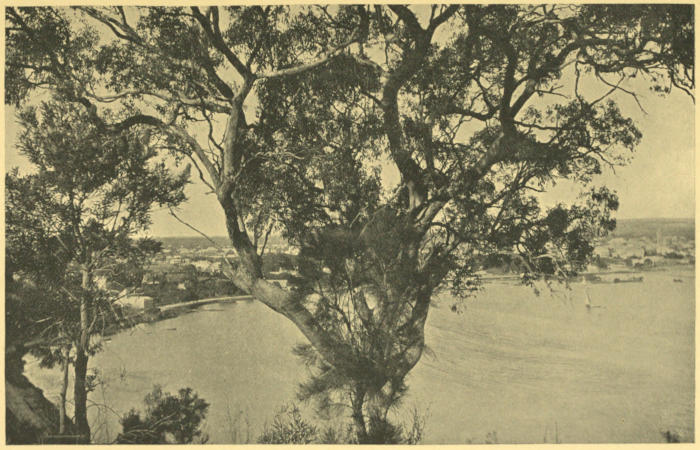
PERTH WATER
Western Australia was once a convict settlement, and every
stranger who came to the country had to conform to the country’s
laws. The term “sandgroper” means white native; another
term used here is “straight hair,” given in the early days
by the free inhabitants to the convicts, on account of always
having their hair cropped short. Thirty years ago any
one walking in the streets of Perth after 10 P.M. took his
chance of being arrested for the night. The constables on
their beats invariably threw out the challenge, “Bond
or free?” and unless the person so challenged could
answer to the complete satisfaction of Constable X.Y.Z., he
was marched off to the Waterside lock-up. A well-known
citizen was challenged by a newly appointed officer. “Halt!
Bond or free?” “Free,” answered the pedestrian. “Your
name?” “Churchyard.” “Ah, that’s not good enough,” said
the officer incredulously; “who ever heard of a person of that
name before? You’ll have to come along.” After a deal
of explanation the minion of the law rather reluctantly let
the citizen proceed on his way. A few yards further along
he challenged another man, who gave the name of “Snowball.”
This name was too much for the new policeman,
who remarked that he was foolish to let the other fellow
go, for who ever heard of such names before? Explanations,
though freely offered, would not be accepted by the officer, who
triumphantly marched a well-known and reputable citizen to
the police-station under the belief that he was some desperate
criminal on a midnight excursion. It was not until the
prisoner was identified at the station that he was permitted to
go home. All this is now changed in Western Australia, the
only convicts who are now alive being a few old people whose
terms have expired and who are now inmates of charitable
homes.
CHAPTER IV
Darling Quarries—Kalayamba Vineyard—Mr. Brookman—Lady
Forrest—Cambria—Mayor of Perth—Mr. Hackett—Canning Park
Races.
It was a very pretty drive from Perth to the Darling Range
Quarries, where great quantities of stone for road-making and
other purposes were being turned out. The quarry is situated
on the western slopes of the range, and commands a magnificent
view of the whole country to the sea-board. The
proprietor of the now prosperous quarries, Mr. Statham, gave
us a brief history of his enterprise, which began nearly five
years ago. For the first three years, March 26 was for him an
unlucky day. First he was burned out and lost between £300
and £400. In the following year the same thing occurred,
and he was a loser by £1200. The third time, when March 26
came round, he felt disposed to stop the machinery, but the
day did not pass without accident, for the engineer was blown
up, and had to be taken to the hospital, but recovered in about
a month. Since the third accident Mr. Statham has felt proof
against disaster on March 26.
Stretching away from here in the direction of Bunbury are
over 80,000 acres of well-matured land waiting for clearance
and then cultivation; at present there is no stock to feed on it,
no creatures being seen but a few wild horses.
The homestead and vine plantations of Kalayamba, belonging
to Mr. Wiedenbach, are prettily situated on the wooded banks
of the Canning river, and the grapes some of the finest that I have
ever seen. Five years ago Mr. Wiedenbach obtained cuttings
at a cost of 2s. 6d. each, and from these he grafted six vines,
out of that number four grew, and at the present time the
vines from the four cuttings number 500 or 600. The vinery
contains 4000 vines. There are 3100 citron-trees, and over
5000 other fruit-trees, many of them having fruit of phenomenal
size and most exquisite flavour. The oranges, especially
the mandarins, are really splendid. Last year 300 orange-trees
yielded over 3000 dozen oranges. The lemon-trees are
almost as good. The climate of Western Australia is specially
suited to the growth of the orange. The most delicious
oranges I have ever tasted grow on the slopes of the Darling
Range, and must be eaten to be appreciated. The
apple- and quince-trees were positively bent to the ground
with their lovely burdens; while the almond-trees were a
beautiful sight.
There is also a magnificent estate situated on the Canning
river at Cannington, called Riverside, and belonging to
Mr. W. Brookman, the well-known mining millionaire of
Perth and Kalgoorlie.
This gentleman’s town house is full of fine furniture and
curiosities brought in part from Europe, among these being a
dinner service of 120 pieces, each of which bears a different
pattern of Venetian lace, the whole set representing every
pattern made in Venice since the earliest manufacture of lace.
In the drawing-room are exquisite chairs, the embroidery of
which is the work of a continental sisterhood; vases of Venetian
glass which cost 100 guineas each, Bohemian glass bowls in
amethyst, thickly encrusted with gold; priceless statuettes of
Carrara marble, and elegant Louis Seize cabinets containing
rare curios from all countries, are a few of the contents of
this rich room; while on the polished floor are handsome
Brussels squares, on which lie rare skins, one specimen of a
magnificent Polar bear, with glistening teeth, bright eyes, and
perfect head, lying almost life-like. A fine aviary adjoining
the house is full of the twittering of birds and chattering of
parrots.
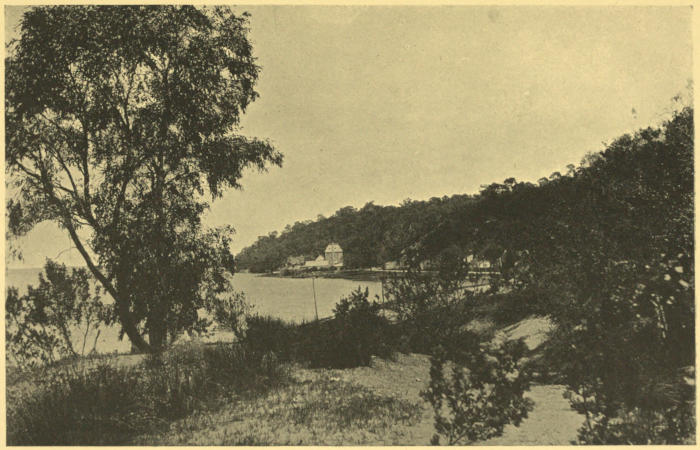
MOUNT ELIZA AND SWAN RIVER
After the wealth and magnificence of the Gold King’s house,
it is not to be wondered at if other homes look plainly
furnished, and yet Lady Forrest’s, although an old-fashioned
house, is most pleasant to visit. The furniture and surroundings
are in exquisite taste. The afternoon I called, the artistic
drawing-room looking out into the garden of sweet flowers was
most restful to the eye. Lady Forrest is most kind and
genial, and very much liked by every one. She takes great
interest in her husband’s work, and takes many a worry from
him by seeing people herself who come to interview him.
“Sir John is nearly always busy,” said Lady Forrest pathetically,
“I can’t get him to talk to me sometimes.” There
are a great many works of art in the house, especially pictures,
some by Lady Forrest herself and some by well-known
artists; many portraits of Lady Forrest’s ancestors, and
also bits of lovely English scenery from her father, the late Mr.
Hammersly’s, old home in England, called Pyrton, of which
she is justly proud. Mr. Hammersly was an English sportsman,
and came to Australia many years ago. Lady Forrest is a
Western Australian born.
There are many other nice old houses in Perth, notably Mrs.
O’Grady Lefroy’s, at the upper end of St. George’s Terrace, called
Cambay. The house stands back in spacious grounds, and belongs
to the family, which is of old standing in Perth. Mr. H. Maxwell
Lefroy in 1843 made an excursion into the Lake District to
the east of York, and his discoveries have been of great value
to the country. Twenty years after, in 1863, Mr. Lefroy made
a more extended exploration. Mr. H. Bruce. Lefroy, the
late genial Minister of Mines, is a Western Australian,
but was educated at Rugby, England. He was Minister of
Education in 1897, and has administered the Department of
Mines with great skill, and to the satisfaction of Parliament
and people.
Next to Mrs. Lefroy’s house is that of the late Mr. Alexander
Forrest, in 1900 Mayor of Perth for the third time. Mr. Forrest
has also done good service in the early exploration of the
colony, and is now known as the Cattle King, because he took
up immense tracts of land in the various districts, utilised
them for cattle stations, and amassed a large fortune.
There are two daily newspapers in Perth. The West
Australian is edited and owned by the Hon. J. Hackett, M.L.C.
Mr. Hackett is an Irishman who landed in Melbourne thirty-five
years ago. He was a barrister, but shook off the shackles of
the law, came to Western Australia, took up land, and eventually
became proprietor of the Western Australian newspaper.
The other daily, the Morning Herald, belongs to a syndicate.
As there are several weekly papers, and a Sunday Times, Perth
is well supplied with newspaper lore.
The weather being beautifully fine, I one day accepted an
invitation to the races, and behind a spanking pair of horses,
and in congenial company, whirled away to Canning Park.
Arriving at the course, after a pleasant drive, we found fully
3000 people on the picturesque racecourse. Nature had
donned her most inviting garb, the day was beautifully cool,
and the effect of the mantle of green with which the lovely
country was decked was heightened by the shades of the
surrounding hills. The vista from the grand stand was delightful,
and everybody was in good spirits and well pleased. The
terrible stiffness which, as a rule, characterises Perth society,
seemed to be thrown off for a time, and the leaders did not, as
they often do, glare at all newcomers as if to say, “How dare
you come here? This is our country; stay away.” Many
pleasant afternoon tea-parties were in evidence, the racing
was good, and the band played excellently. Some very handsome
dresses were worn. When we left to return to Perth I
felt quite charmed with the pretty course, and also with my
good luck, for I had won two dozen pairs of gloves and ten
golden sovereigns—quite a run of luck for me.
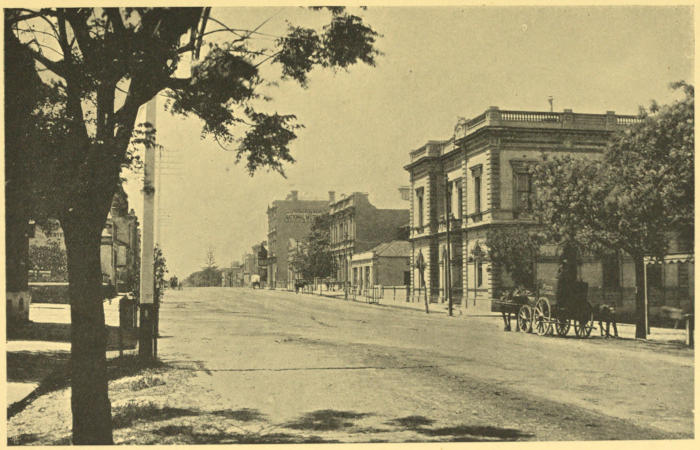
ST. GEORGE’S TERRACE
CHAPTER V
The Museum—Flower Show—Musical—Native Risings—Zoo—South
Perth—The Old Mill—Moonlight.
The new public library and museum in Beaufort Street is a
very handsome building, and well worth visiting. It contains
many interesting collections of birds, beasts, fishes, and other
specimens indigenous to Western Australia. The fossils found
in the coastal limestone and in the carboniferous formations
extending from the Irwin to the Gascoyne and thence to
Kimberly are truly wonderful.
The upper part of a mastodon gives one an idea of the
tremendous size and strength the animal must have had. The
casts of the fish-eating reptiles and saurians are marvellous.
Any one going through the museum and noting the productions
of Western Australia, past and present—other than gold,
which many people seem to think is the only thing the colony
can produce—will be considerably surprised.
The marsupials are, I think, of especial interest, and of these
there is a large and varied collection. These marsupials or
pouched animals, from the tiny crescent wallaby, no larger than
a very small rabbit, the pretty little kangaroo-rat, and the
funny spectacled wallaby, to the rufus or red kangaroo, and
the great old-man grey kangaroo, taller than a big man, and
possessed of enormous strength and vitality, are, according to
Mr. Woodward, the curator of the museum, characteristic only
of the Australian region, the only kind of animal at all like
them in the world being the American opossum. Some
opossums, however, have no pouch, but carry their young on
their backs. The kangaroos, as I think all Australians know,
always carry the little Joeys snug in their pouch. And during
my travels I have often seen them peeping out of their snug
home. Many different kinds of pretty opossums come next, ranging
from the pigmy flying opossum, little ring-tail opossum, and
the odd little rabbit bandicoot to the pussy-looking black, grey,
or white opossum, whose skin and fur make such warm and
comfortable rugs for cold places, but are not often wanted in
the mild climate of Western Australia. One tiny little mouse-coloured
kangaroo-rat, found only in the south of the colony, is
very pretty, and makes a dear little pet; these animals feed on
the nectar of flowers, and when tamed, on bread and honey;
they sleep all day curled up into a ball, but are very lively at
night. Sleepless persons desiring a companion may be glad
to note this. The Myrmecobius fasciatus, or banded ant-eater,
from Coolgardie, is a most remarkable-looking creature, as,
indeed, its Latin name indicates.
The splendid collection of Western Australian birds is really
surprising; after seeing it one wonders how some people could
say that there are no birds in Australia. The typical black
swan, white swan, and pelican from the Swan River; the
handsome bittern from Herdsman’s Lake, near Perth; the
giant petrel from Fremantle; enormous emus from the Murchison,
are all to be seen here, the last named with some dear
little striped fluffy young ones, the size of goslings. I have
often seen these birds when travelling on the Murchison myself.
The ossifrag, a gigantic black-necked stork from Derby, in the
far north; the Australian egret, so often plundered for ladies’
hats; magnificent sea-eagles; a most interesting nest of the
sparrow-hawk made of twigs and gum-leaves, and containing
four young ones, over whom the mother mounts guard;
cockatoos, parrots innumerable, with most lovely plumage;
and last, but not least, the graceful native companion from
Broome. These are only a few of the birds belonging to the
colony of Western Australia, but I have not space to mention
more of them.
The nests of the trap-door spider are very peculiar; they
look like a piece of ordinary clay, but when the door is opened
a perfectly hollowed-out room is seen within, where the spider
and his prey almost exemplify the old rhyme of childhood’s
days. Some of the moths are very handsome, notably the
diuran and the podacanthus, the first named being very large
and of a lovely heliotrope colour. From these insects to a
whale is a big jump, and the skeleton of the whale stranded
at the Vasse in 1897 and secured by Mr. E. C. B. Locke, M.L.A.,
for the Museum, is one of the largest of its species, if not the
largest; it is nearly 80 feet in length, and when in the flesh it
must have measured 86 feet. The head alone weighs a ton or
more, and the whole skeleton is prodigious. Coming back
from viewing the whale, my attention was drawn to the first
two sovereigns struck off in the Perth Mint, which repose on a
velvet bed, and are, it appears, of much interest to the rising
generation, for three boys were looking at them with great
attention. The models of all the great and wonderful diamonds
ever found in the world, some very ancient Greek coins, and
famous French medals, work of noted French medallists
also a cast of the celebrated Moabite stone, the original of
which is in the British Museum, are near here; the last named
is of great interest, being inscribed in three languages—Egyptian
hieroglyphics, Semitic, and Greek; it was discovered
in 1799 in the little town of Rosetta, on the Nile. It was the
deciphering of this stone in the Greek language that gave the
clue to Egyptian hieroglyphics. There are also copies of many
of the great works of art in London and Paris, so that, although
separated by so many thousands of miles, Perth still keeps
touch with the old world.
The relics from the wrecks of the Batavia in 1629, and of
the Zeewyk, wrecked in 1727 at the Abrolhos Islands (the story
of which I will tell later on), are the most interesting things to
be seen in the museum. They consist of silver and copper
coins, rosary beads, clay tobacco pipes, copper kettles and
stewpans, knives, spoons, scissors, fish-hooks and sinkers,
tumblers and wine-glasses, some of most delicate glass,
enormous greenish-looking liquor bottles, and some round
ones, capable, I should think, of holding gallons, cannon-balls
and bullets, said to have been manufactured by the mutineers
on the islands, and two complete but rather gruesome skeletons
tell a silent and sorrowful tale of the past.
The wonderful shells and corals from these islands made me
no longer wonder that the Dutchmen in 1629 named them
“Abros vos olhos,” or “Keep your eyes open”; they must
have named them not only for the dangers of the coast but
for the marvellous things to be seen there.
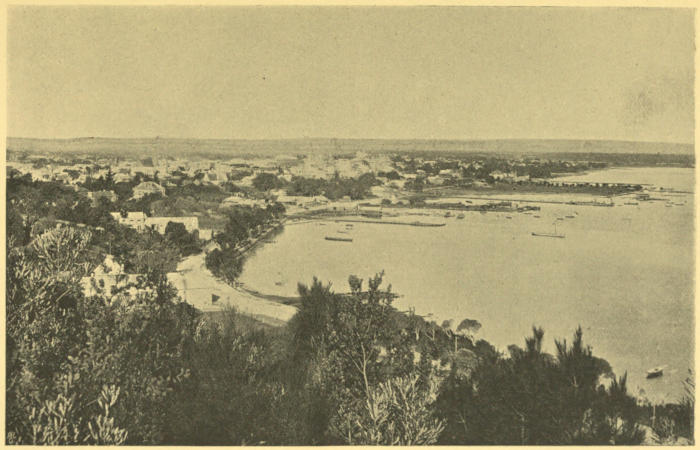
CITY OF PERTH
The different kinds of shells, sponges, corals, fish, and birds
are simply amazing. I can only specify a few, amongst which
are the tremendous cup-sponge shell, fully three feet long, the
peculiar montipara or screw coral, and the enormous sponges,
the many wonderful kinds of fish, birds, &c., from these
strange islands so near our shore, as well as from Mandurah,
Rottnest, Garden Island, and Fremantle must be seen to be
appreciated, and I recommend every one visiting Western
Australia to go and see them for themselves. The collection
of aboriginal curiosities and relics is ample. The skull of a
notorious aboriginal murderer called Pigeon, who gave the
police much trouble in catching him, was shown to me.
This native was named Pigeon on account of his favourite way
of despatching his victims by wringing their necks. There are
some fine native shields, spears, knife dabbas, meeras or
throwing-sticks, kileys or boomerangs, &c., and some most
peculiar boat-shaped shells that are hollowed from young trees
and used for carrying water or food; a wooden helmet, exactly
like a sou’-wester, makes one think that one of the Dutch sailors
who came ashore in the early days must have dropped his hat
and some savage have copied the pattern in wood. The fish-spears
have about eighteen barbs both ways; the spearheads
are made of many kinds of different glass, and nowadays the
natives knock down the telegraph insulators and make them
into spearheads. In former times silex, of which knives and
chisels were made, was used, but the other material is easier
to get, and the black fellow is well known to be as much averse
to trouble as some of the white fellows. I possess three spear
heads from the
Kimberly district,
one of which
gave the death-blow
to a man
from whose chest
it was extracted.
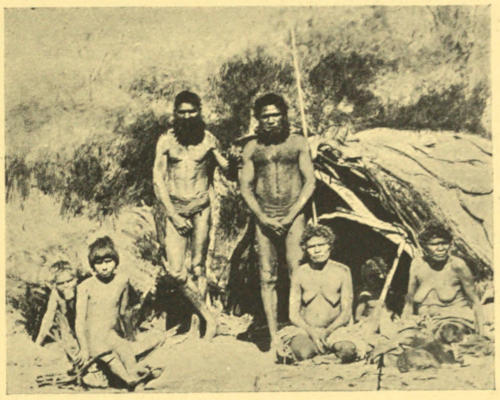
Aboriginal Camp
The medicine-stick
or bunganarrie
used by the
natives as a cure
is very strangely
marked, the
markings no
doubt constituting
some imaginary spell. The dandie is used for tattooing,
and the gunda-stick, with a knob at the end, looks like our life-preserver.
The pindie pindie is a native ornament stick, frilled
to represent a feather, and sometimes made of pretty green and
cream colour. The effect is produced by scraping down the
green part of a young branch about two inches till it frills,
then scraping the inner pale part to frill over that. A space
comes next, and then another frill, until the ornament reaches
the length required. These objects the natives stick all over
their heads. They also make very handsome ornaments of
large mother-of-pearl shells by drilling a hole through the top,
and hang them by a string of hair about their bodies. The
women have an ornament made from pearl-shell called the
binjah binjah, which hangs down their back attached to a
currican or woman’s necklace. The long marrie is an ornament
of kangaroo teeth attached to a hair-string, to hang down
between the eyes. The booran is a belt made from human
hair, worn by the Kimberly natives. The native women have
most stringent ideas of mourning for their dead. A picture of
one mourning for her brother shows her hair all screwed up in
little knobs with wilgie clay and fat. Wilgie is a red-coloured
clay or earth used for various rites and ceremonies. The
tomahawk or pulboo has a handle of wood, the head being made
of a kind of flint or stone, fixed in with a resinous substance
called pulga or gum, made from the roots of the spinifex grass.
Native spearheads too are fastened on with this gum, which is
found in solid lumps, and dissolves with heat. String is made
by the natives from the skin of the opossum by means of an
instrument called the boolga, which consists of a long thin
round stick, crossed near the top by two shorter sticks, and has
somewhat the appearance of a boy’s kite. In making their
implements they generally employ a tool called a bedoo, which
resembles a spearhead. The ongath or fire-stick is used for
lighting fires, and keeps alight a long while, burning very
slowly. These sticks are carried about almost as we carry
matches. The letter-sticks of the natives, or paper-talk as they
now call them, are beautifully marked and of different
sizes, the designs on those from the Gascoyne district being
quite remarkable. Around the stick will be marked, in a kind
of blue ink, all sorts of odd signs and figures, such as a crab, a
gun, a leg, an arm, a lover’s knot, a hand and arm outstretched
almost like a masonic emblem, and many other peculiar signs
best known to themselves. The dewark, or throwing-stick,
is also an interesting object, and so are the many aboriginal
carvings and the sharp stones used in their sacred or tribal
rites. The stones used for grinding their food consist of a large
flat stone and a round smooth heavy one. Nalgo is the name
of the principal seed thus ground, but they have many different
kinds of food, which I will describe later. A tree called the
boobah-tree grows at Derby, and produces a nut as large as a
goose egg.
The natives about Perth and Fremantle were in early days
very numerous and troublesome. Native risings were frequent,
and many hundreds of aborigines were shot. The present site
of the Great Western Hotel was the scene of a large fight,
arising out of the murder of two boys, the sons of settlers, who
were minding cows, and were set upon by the blacks. The
boys ran away to the Swan river, and one jumped in and
swam across, only to be speared on the other side. The other
boy did not reach the bank, but received five spears in his
back and died at once. At this the settlers were soon up in
arms, and one bloodthirsty native called Yagin was outlawed.
He was eventually shot near Hutt Street, where the rising took
place, by Dr. Dodd, who afterwards took a large strip of his
skin from shoulder to foot, tanned it, and made it into a belt,
which he wore for years!
That silk can be grown in Perth is testified by some lovely
blue and cream-coloured handkerchiefs made from silk grown
here, and presented to the museum by Sir John Forrest.
Next to this case is an old plan of Leschenhault Port, now called
Bunbury, in 1803. Also a little picture of the ship Success
and a man-of-war in Careering Bay, Swan River, in 1829.
Perth does not yet boast of a large Botanic Garden, but as,
in the spring, the whole country around is one vast garden the
absence is not severely felt. There is a charming public
garden, small, but very prettily laid out, near Government
House, and opposite the Post Office.
Sir John Forrest prophesied, ten years ago, that in the future
Western Australia would come to the fore, and the prophecy is
being amply fulfilled; no travellers now ever think of making
a tour in Australia without coming to the West. Mr. Frederick
Villiers, the famous war correspondent, says that when he came
to the colonies, seven years ago, he was nearly coming here,
and, now having been, he professes to be so much charmed
with Perth, and the view of the Swan River, as to feel
inclined to settle down and end his days there. These little
corners of the world have made him dissatisfied with his business,
and as I gazed upon the many spots of beauty on the river
before me, while the faint red blush of the sky deepened into
a crimson sunset and cast a glorious reflection on the water, I
felt myself agreeing with Mr. Villiers and disposed to stay in
my pretty Claremont home for ever, where the sun seldom shines
too fiercely and the winter is like a gentle friend.
One spring day I drove in to Perth to see the flower
show, then being held in the Town Hall. The drive over the
bloom-covered slopes of the park, the sweet odours of the
pretty flowers of the Bush mingling with that of the golden
wattle, was most enjoyable. I can never ride or drive through
that park, and gaze on the beautiful scene below, without
feeling that God has indeed given us a lovely world to live
in. It was a holiday, and consequently many little parties
(frequently of two) were exploring the flower-scented knolls and
enjoying the breeze from the water. Perth was quite gay,
all the carriages of the élite seemed engaged in carrying
their fair owners to the flower-show. On entering the Town
Hall a perfect blaze of beauty in the shape of wild flowers met
the eye. The silver and golden wattle, laden with fragrant
perfume, drew me immediately to the spot where they were.
In the “Salyang Mia-Mia” (wattle-house) a most refreshing
cup of tea was to be procured. Sitting in this fragrant bower
and sipping tea brought to mind the lines:
All the world is turning golden, turning golden,
Gold buttercups, gold moths upon the wing,
Gold is shining thro’ the eyelids that were holden,
Till the spring.
“Djanni Mia-Mia” (bark-tree house) was a triumph of
rusticity, and the collection of hibiscus, boronia, flannel-plants
and mauve everlastings were so lovely that I was obliged
to buy several bunches of the different kinds. The bamboo
stall was also very artistic, and the bamboos furnished
receptacles for water, by means of which the flowers were
kept fresh. “Yanget Mia-Mia” was the name of the bush-house,
which had a background of bulrushes and blossom, and
various bouquets of all sorts, sizes and scents were so
tempting that I bought more, and found myself becoming a
walking flower-garden. Wild flowers were here in every variety
and hue. Specimens of native flora had been gathered from
the hills and dales for miles around. The anygoxanthus
(kangaroo paw), a most wonderful flower, was to be seen in
many different hues: the blue and red leschenaultia, the
trailing white clematis, or virgin’s bower, hanging in charming
clusters, white and red hibiscus, and the more delicate
heliotrope variety of the same flower, the delicate grey smoke-plant,
with its dark green leaves, the snowflake flower,
which, when blooming on its native earth, looks like a snow
white carpet, one after another caught the eye. These flowers
have long stems, and make exquisite table decorations. The
thysanctus, or fringed lily, is a remarkable satiny-looking
flower, and has a habit of climbing. The delightful boronia has
many different varieties, the pale yellow being the prettiest,
and the pink and white coming next; the dark red or brown,
however, gives off a most delightful and refreshing perfume.
The native roses are very pretty, the small blue ones being the
first and last flowers to bloom during the season. The blossoms
of the eucalyptus are of a magnificent crimson, and the delicate
pink and white flowers of the crowea hang in loose clusters.
Having travelled through so much of the Western Australian
country, I recognised many of the beautiful gems that are to
be seen adorning the Bush in various parts I visited. The
kangaroo paw, before spoken of, has many varieties, ranging
from faint cream colour, through scarlet, crimson, yellow,
chrome, and green to sable, and in form is exactly like the
foot of our typical Australian animal. The little trigger
(candolea) plant, with its white flower suffused with shades
of pink and yellow, and the marianthus, a climbing flower,
are extremely beautiful.
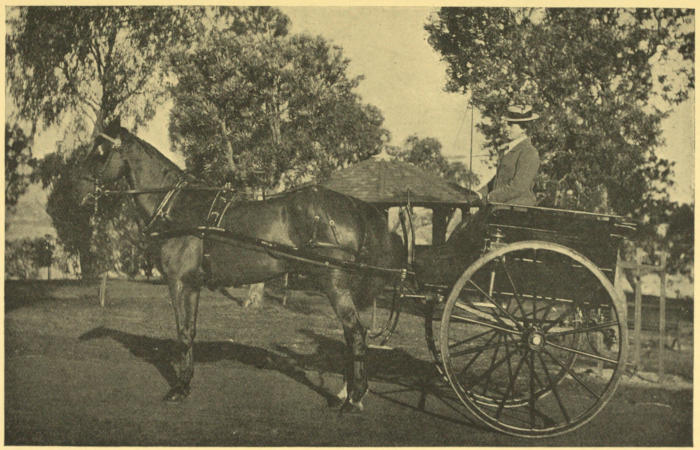
DRIVING IN PERTH PARK AT THE SUMMIT
The peculiar-looking ice-plant grows in the hot dry sand of
the coast. I admired greatly some soft-tinted native tulips
(pink), which were prettily veined and almost transparent.
The actinotis (or flannel flower) is very abundant and long
lasting, and therefore well fitted for decorations. Pilotus (or
cat’s paw) has a pink and white flower, and retains its colour
for a long time. A flower called the lactinostachys is most
phenomenal; the stem and leaves seem to be without sap, and
have a thick woolly covering; the flower looks so artificial
that one can hardly believe it to be real. It is found in the
northern part of the colony in hot dry localities. The clematis
is a sweet pure white flower, which literally covers the trees
and shrubs where it climbs. The banksia (or honeysuckle) is
a handsome flower, with a kind of crimson cone. The parrot-plant
looks like a many-coloured bird. The grevillia (or
native fuchsia) is here in many hues. Sturt’s desert-pea is
a very handsome, brilliant scarlet flower, with black centre.
The fringed verticordia, with its lemon-centred foliage, is
pretty, and so is the callistemon, which has bright scarlet
plumes. The petrophila flower has striking blossoms that
look like rich pink velvet, while the yellow flowers and
peculiarly formed leaves (resembling a stag’s horn) of the
synaphea were the most remarkable growths that I saw.
Everlastings in every colour imaginable were there. The
delicate but striking beauty of various orchids was shown to
great advantage; the calendia (or spider orchid), with its
peculiar spots, was particularly attractive: the douris (or dog-ear
orchid), and the prasophyllum, with its spikes, 18 inches
long, of dense white flowers, were interesting; so was the
lyperanthus orchid, whose flowers turn black when dried;
while the drakea (or hammer-head orchid) looked almost
like a little duckling. The glossodia, spotted white, seemed as
if it were varnished. Then there was a sensitive plant called
the pterostylis, which almost resembled a tiny box, with a
movable labellum, which is sensitive, and, when irritated by an
insect, closes the box and imprisons the insect. Droseracea
belongs to the fly-trap family, and has leaves and tentacles
covered with a sticky juicy kind of acid, which arrests the
inquisitive little insects, who come doubtless attracted by the
dew on the leaf. As soon as these tentacles are touched the
leaf closes in upon the unwary insect, which is soon absorbed
by the juice exuded by the plant. The flower of the byblis, by
far the largest and most attractive of the species, is of a rich
salmon-pink colour. Probably the brightness of the flower
attracts the insect to the stem and leaves, which are covered
with the same juice as the droseracea, but in this instance the
insect is absorbed on the surface of the plant. There are
thirty-six species of insectivorous droseracea.
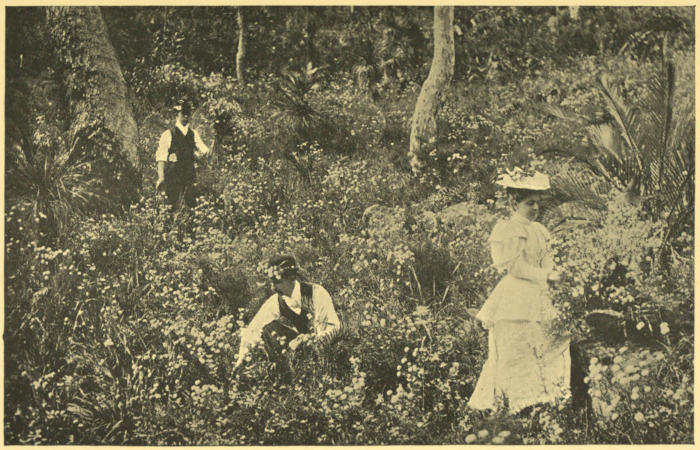
GATHERING WILDFLOWERS
There are hundreds of other species of orchids and thousands
more of wild flowers. The late Baron von Mueller said,
“Australia is a great continent, and much of its vegetation is
yet unexplored.” The Baron added “that more than half of
the total vegetable species known in Australia were represented
in the West,” and mentioned over 9000 of them.
Dr. Morrison, our Government botanist, informed me that
there were more than 3000 species of wild flowers.
As I was leaving the flower-show I noticed some very fine
Anthorreas. “The King Blackboy” is a Western Australian
grass-tree much admired. A handsome painting of the Nutsyia
fire-tree, or Christmas-bush, also demanded notice. This tree
bears very bright yellow or amber flowers about November and
December, and the blossoms being of such a brilliant colour,
and growing on trees that attain the height of from 20 to 30
feet, are very conspicuous and visible at a great distance.
Taking the little steamer one morning I crossed to South
Perth. The new Zoological Gardens are worth seeing, if
only for the superb view from them. A recent visitor said
that he had seen many gardens in various parts of the world,
but none in a more beautiful position than at Perth. The
gardens occupy about forty acres of ground, and are a favourite
resort on Sundays and holidays. Family parties are made up
to go to the “Zoo,” for many Western Australian children have
never seen wild animals elsewhere, except in picture-books.
The grounds are beautifully laid out; the aromatic flower-beds,
ornamental ponds and rockeries, gushing fountains, miniature
castles, turrets, &c., make it a charming place to spend an
afternoon and evening. At night the grounds are illuminated
with hundreds of different-coloured lamps, which send a
rainbow radiance over the scene. Concerts are held every
Saturday evening during summer, and there is a really fine
quartet, called the Orpheus, whose harmonious blending of
sweet music in the lovely summer nights is well worth listening
to; the Headquarters band also plays. Many of the animals
awakened by the sounds of music (which is said to soothe the
savage breast) evince much curiosity, others slumber on, no
doubt soothed by the sweet strains. There are two splendid
lions in separate cages. The lioness is very bad-tempered, and
on being placed in the cage with the king of beasts, instead of
showing a taste for his society, clawed him unmercifully, he
standing the bad treatment in a most kingly manner. Her
highness was, therefore, placed in a cage by herself to recover
her good temper.
The baby tiger seemed to be a great favourite, and it was
quite amusing to see the antics of the monkeys in their play-room
with the little ourang-outang, with whom they seemed
to fraternise amicably and to play with quite happily. A
ride on the donkey was much enjoyed by my little niece. I
wanted her to mount the dromedary, but she declined that
pleasure. Boys are pleased with the ponies, and the handsome
goat-carriages come in for a share of admiration. The sacred
Indian cow from Singapore, the newly arrived leopards, the
white kangaroo (a great favourite), and all the others, too
numerous to mention, were thoroughly inspected, and the
children from the goldfields seemed delighted to see animals
hitherto only known to them through the medium of books.
Hot water is provided free of charge, and picnics are frequent;
happy parties of little ones were sitting down in the cool
shade and making the place ring with their voices. A view
of the Canning river lies on one side and of the Swan river
on the other, the garden being situated on an arm of land
almost surrounded by water.
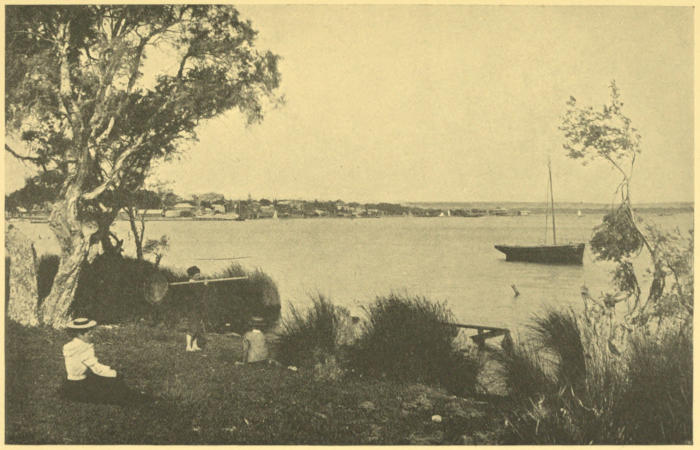
SOUTH PERTH FROM THE BANKS OF THE SWAN
South Perth was in early days intended for the site of the
city, but the business parts having occupied the other side of
the river, South Perth has been left to become a most charming
and aristocratic suburb, many handsome residences, pretty
villas and gardens adding to the natural beauty of the place.
An old mill is still standing on the extreme end of the Point,
and eventually a bridge will span the Swan river and connect
Mill Point with Perth at the foot of Mount Eliza, near the
park. Land is becoming very valuable here, and I have
bought a plot with a view to building a villa in this beautiful
place.
I did not return by steamer, which only takes ten minutes to
cross the water, but preferred to drive round by land—a drive
of about four miles. We drove about three miles before coming
to the glorious Causeway, a stretch of water which is spanned
by an enormous and handsome bridge. From this point a
moonlight view of South Perth, Perth, and the Swan river
winding its way to Guildford, is seen, and forms a very fitting
end to a day’s pleasant excursion.
CHAPTER VI
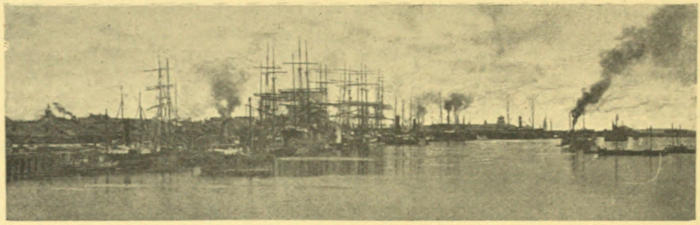
Fremantle Pier
Drive to Claremont—Osborne—Keane’s Point—The Chine—Cottesloe—The
Ocean—North Fremantle—Arthur’s Head—Smelting
Works—Our Contingent—Fremantle.
One bright morning I started to drive from Perth to Fremantle,
a distance of twelve miles. Taking the lower road
around Mount Eliza, a beautiful prospect lay before me.
The Mount rises 200 feet above the road, which is only a
little way from the broad river; the sun shone on Melville
Water in the distance, while on the other side lay the
Canning river, with trees and hills beyond. The pretty
suburb of South Perth on its arm of land, with the old mill at
the extreme end; the many little boats and steamers going to
and fro, made a charming summer-day’s picture. Along the
road past Perth Park we saw the blue and silvery water all the
time, and then, when we came to Crawley, we entered a road
fenced on each side. Valuable land is placarded for sale, and
no doubt in course of time will become even more valuable.
Already streets have been laid out for a suburb, which, being
so beautifully situated, will be charming to live in. After a
pretty drive of six miles we reached the fashionable suburb of
Claremont, where there are some very elegant villas and
mansions. A mile farther on is Osborne, the most magnificent
hotel and grounds in Western Australia. This fine building
stands in large gardens and grounds, and is surrounded by
splendid conservatories and terraces. There are wide balconies,
arbours, and seats, and, in the matter of beauty, the place almost
realises Claude Melnotte’s description of “a palace lifting to
eternal summer.” It seems almost incredible that three years
ago this exquisite spot was the abode only of the blackboy,
banksia, and other native trees, and a shelter for the dusky
son of the soil. Towering high above the hotel is a turret of
spacious dimensions, from which the growing port of Fremantle,
with many merchant vessels and steamships riding peacefully at
anchor, may be clearly seen in the distance. The adjacent
islands of Carnac, Garden, and Rottnest, with their rugged
coast-lines, lashed by the surging waves of the ocean, are but a
few miles distant. The clearness of the air gives a wonderful
range of vision from the tower. As you turn, you behold in
the distance the dark woodland of the Darling Ranges, whose
summits seem to touch the sky. In the zenith of summer
heat in Western Australia, Osborne is always delightfully
shaded and cool.
An artesian well in the grounds, which struck water at a
depth of 150 feet, gives an abundant supply, capable of supplying
the whole of Perth. No less than 50,000 gallons of
water are used every day on the grounds of Osborne alone.
Steamers come to Osborne jetty during the week, and every
Sunday in the summer, bringing hundreds of people to enjoy
the scene. The steamer moors at a landing at the bottom
of the cliff, and hundred of steps have to be climbed before the
top is reached. The climb is made easy by a platform with
seats at the end of every flight of steps, of which there are
five, and one can rest on these to enjoy the pleasing prospect.
Pretty villas are built all around the hillsides; dear
little Freshwater Bay, with its numerous bathing-houses and
jetties, the pretty yachts and boats on its bosom looking like
white-winged birds, lies at your feet; and the wild note of
the magpies, not yet frightened away by civilisation as the
aborigines have been, is heard from the trees in the distance.
Continuing our drive, we took the inner road up the hill.
Another pretty little bay and suburb called Peppermint Grove,
from the fact that at one time it was a grove of delicate
peppermint-trees, discloses itself. There are many beautiful
villas with gardens, a nice white, hard sandy beach, a fine jetty
for the many boats that come from Perth and Fremantle, and
the Yacht Club House. Keane’s Point, with a handsome
old bungalow on a fine site, hides a bend of the river.
The Chine, so called from its peculiar conformation, the
ridge appearing like the backbone of an enormous whale or
other gigantic sea monster, is another pretty spot. Any one
who has the fortitude to climb to the top of the Chine will be
rewarded by one of the most exquisite panoramic views of
ocean, river, flower, shrub, sea and sky ever seen. The
tints of the water from the reflection of the azure sky melting
into pale yellow, then into rich gold and crimson from the setting
sun, once seen will never be forgotten. Turning back, we
resumed our drive up Forrest Street and into the main Fremantle
Road. We were now in the seaside suburb of Cottesloe,
and away over the hill lay the beautiful Cottesloe Beach,
stretching along for miles. Cottesloe is one of the most flourishing
suburbs of Perth. A few years ago it was all one dense
bush; now it is full of human life, and houses are going up in
all directions as fast as the builders can erect them. Past the
quarries we went until a turn of the road brought us to a view
so magnificent that its effect can never fade from my memory.
In the distance the dark blue Indian Ocean rolled in all its
majestic splendour; North Fremantle was in sight, and so was
the mouth of the Swan river. We approached the bridge to
cross it, and saw an effect even more beautiful. From the
bridge on which we stopped a few minutes in order to gaze on
this gorgeous scene we saw many fine ships lying at anchor on
the broad ocean; up the river many small boats and steamers
were moored; in the distance were white cliffs and pretty
houses; the magnificent German steamer, the Friedrich der
Grosse, was just going out to sea—and altogether the scene was
truly a grand one. I hope I shall not be thought to rhapsodise
too much, but I can assure my readers that I am writing exactly
as I felt when first viewing the approach to Fremantle.
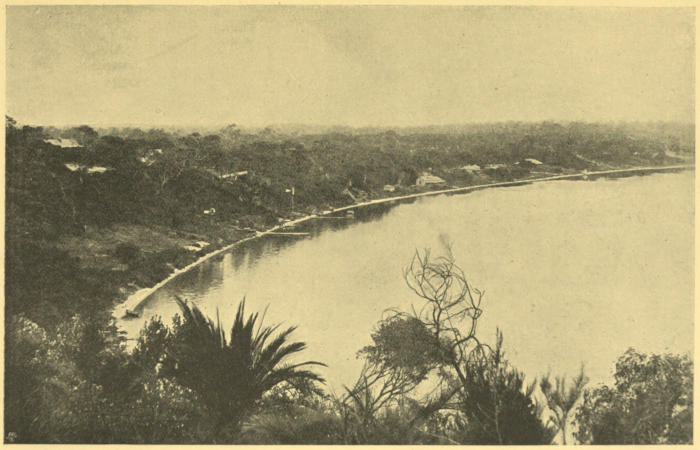
FRESHWATER BAY, CLAREMONT
When the new harbour is finished, Fremantle will be, as Sir
John Forrest puts it, the Brindisi of Australia. And now we
crossed the bridge and entered East Fremantle, leaving behind
us the broad river winding its way to the ocean between two
splendid breakwaters.
On we drove down Cantonment Road into High Street, the
principal thoroughfare, at the top of which is the fine Town
Hall with its splendid clock. From that point the street runs
to Arthur’s Head, and is connected by a tunnel with the sea;
on the top of the limestone cliff is an old building called the Old
Cantonment, formerly used as a lock-up. Fremantle is built on
a low-lying neck of land between Arthur’s Head on the one side
and the limestone heights on the other, hemmed in on one
hand by the river and on the other by the sea. The city was
named after Captain Fremantle, who first hoisted the British
flag there, in 1829.
There is a fine lighthouse on Arthur’s Head. It is a white
stone tower 71 feet high, with a fixed white light, visible for
16 miles. Fremantle still possesses some old and singular-looking
buildings. The old gaol and court-house, with
the harbourmaster’s quarters and the barracks, will, no
doubt, in course of time be replaced by more up-to-date
structures; there are already many very fine new buildings.
Fremantle has an excellent Grammar School, where
most of the boys from Perth and the country districts
receive their education. Mr. G. Bland Humble, the present
worthy and respected Town Clerk of Fremantle, was the first
master, having been brought from England in 1886 to teach the
young idea of Western Australia how to shoot.
There are many good hotels, the Hotel Fremantle being the
best at the city end of the town, and the Hotel Australia at the
upper end. This latter is really a splendid hotel, standing
in an excellent position, with a grand view of the river, harbour,
and islands beyond. The jetty is half a mile long, and some
large vessels are always lying there.
Fremantle is rapidly increasing in size and population, and
social life is not so divided as in Perth; there seem to be more
geniality and not so much stiffness about the people. A
volunteer artillery corps, turf, bicycle, rowing, cricket, and football
clubs provide various forms of social activity. There is a
nice park, also a good recreation-ground, and several places of
entertainment, and the large hall in the Town Hall is very
handsome and superbly decorated. An inexhaustible supply of
water is obtained from three large wells connected by drives.
The water is pumped up by steam into reservoirs at the rate
of 45,000 gallons an hour.
The smelting works about two miles from Fremantle, at
Owen’s Anchorage, have lately commenced working, and
are a great boon to the goldfields, which until recently were
very much handicapped by having to send their ore to the other
colonies to be smelted.
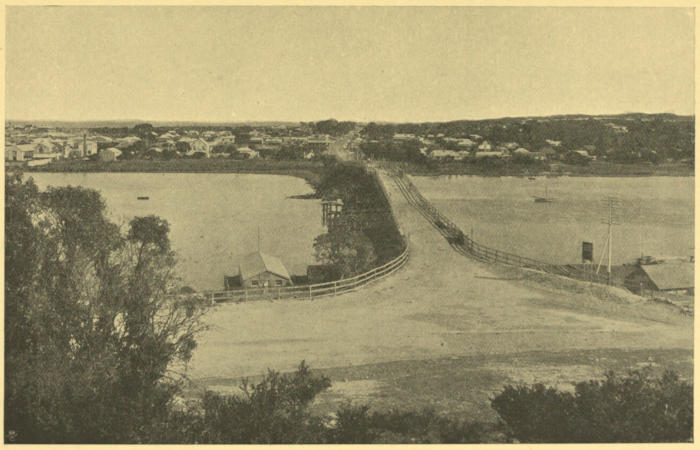
NORTH FREMANTLE
The South African War is the general topic of the day, and
with what sorrow do we read of the sacrifice of so many noble
lives! Several contingents of our brave Australians have left
the different parts of the colonies to assist their British brothers
with a little of the courage we have in the Sunny South.
The second contingent has just left these shores, and Fremantle
has had the honour of giving them the send-off. Over
30,000 people assembled to bid them farewell, and a scene
of such unbounded enthusiasm ensued as has never before
been witnessed in the colony. The magnificent steamer Surrey
brought the New South Wales and South Australian contingents,
and these soldiers came in for their share of admiration
no less than the Western Australians. The enthusiasm shown
for the Western Australian contingent from the time they
left the camp at Karrakatta until they waved their last good-bye
from the steamer’s side will never be forgotten. The street
decorations, although hurriedly got up, were handsome and
patriotic. At the Oval, where the reception to the troops was
held, a huge marquee occupied considerable space, and rows
of tables laden with every delicacy were provided for the
troops and for the many distinguished visitors. Over 200 of the
leading society ladies of Fremantle acted as waitresses, proud
to attend on brave men soon to embark for the perils of war.
Although the men were going away to face battle, all seemed
jubilant, proud, and confident. The three contingents were all
like brothers. The cries of the multitude were: “Cheers for
the Cornstalks of New South Wales,” another for the “Gum-suckers
of Victoria,” one for the “Crow-eaters of South
Australia,” and “A great big one for Westralians; do your
best, boys!”[1] At the wharf, prior to the Surrey leaving next
day, somebody handed up a bottle of whisky, intending it for a
Westralian trooper. A Cornstalk, however, became possessed
of it. “That’s not for you, it’s for one of the Western Australians,”
shouted the donor. “It doesn’t matter, we’re all
alike, we’ll soon be Federated Australia,” laughed the Cornstalk,
and opening the bottle took a drop, then handed it
round to the rest, who all participated in it with real federal
spirit. When the time came for the troopship to leave, some
affecting scenes took place between mothers, sisters, wives and
soldiers, but all bore up as bravely as possible. Were they
not going for the glory of Old England and the honour of their
beloved Queen?
A Bushmen’s contingent has since left all the colonies, comprising
men who are accustomed to rough-riding and thoroughly
used to rough life in most trying conditions. From what I
know of many of the Bushmen I have met in my travels, I
should say that they will afford the British troops valuable aid
in reconnoitring the wily Boer.
As we all know, the Australians have since bravely distinguished
themselves, and our late dearly beloved Queen
testified her approval of their actions in many ways. Her late
Majesty’s gracious act of proposing that the Duke and Duchess
of York should go so far in order to open the Federal Parliament
of Australia endeared her still more, were that possible, to
the hearts of her colonial subjects. As one of them who saw
the late lamented Prince Edward and Prince George when
they went out to Australia years ago in the Bacchante, “I can
testify to the unswerving loyalty and affection of Australians
for our beloved Queen and all her family.”
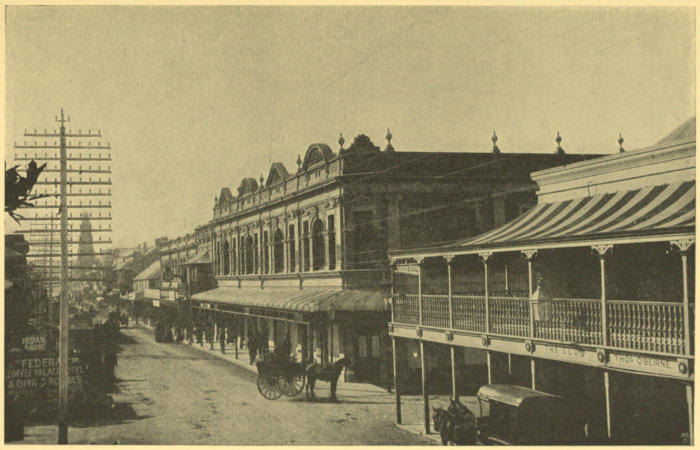
HIGH STREET, FREMANTLE
And what a brilliant record our Western Australians, especially
those of the first contingent, who have returned to
Perth, have taken back with them! Truly they deserve the
laurel-wreath of honour, while those who fell on the field of
battle, giving up their lives for their beloved Queen and
country, will live for all time in our hearts. I cannot do better,
I am sure, than give Major McWilliams’ description (at the
banquet given in Perth in honour of their return) of the way in
which some Australians bravely distinguished themselves.
“Before closing, he desired to tell them a story about their
entry into Pretoria. He thought it was an incident that all who
participated in would remember to the last days of their lives.
The hills around Pretoria were most strongly held by the
enemy. Their mounted infantry, which included the 1st
Western Australians, were ordered to take a hill. They climbed
up the kopje, the horses being led behind them, and fought
until relieved by the Gordon Highlanders. Their little band
had to do the work of infantry, and the handful of men held the
top of that hill, and kept the enemy at bay, until the Imperial
troops appeared on the scene. The latter said: ‘This is our
job now; you are mounted, and you will be required somewhere
else.’ The colonials informally handed over the work to
the Highlanders, and an order came from Colonel De Lisle to
move back to the hills to outflank the enemy, if possible. They
did so under a heavy fire, but the enemy, on seeing them, must
have exaggerated their numbers, for they made off into Pretoria
as fast as they could. The Western Australians followed, and
on that night got within a thousand yards of Pretoria. At
that time Lord Roberts’ main column was six miles in their
rear. Their infantry decided to hold the position close to
Pretoria until morning. During that night one of their number,
a son of an esteemed resident of Perth—he referred to Captain
Parker—was sent with a few men into Pretoria to blow up the
line, and he certainly had the honour of being the first armed
man to enter Pretoria. That, he thought, was a great thing to
claim for a Western Australian. He might also state a fact not
generally known, that the flag of truce on the night before was
taken in by a New South Wales officer, an Australian born.
This little company numbered less than one hundred men.”
TWO MORE COLONIAL VICTORIA CROSSES.
The Gazette of October 4 states that the King has been graciously pleased
to signify his intention to confer the decoration of the Victoria Cross on
Lieut. F. W. Bell, West Australian Mounted Infantry, and Farrier-Major
W. J. Hardham, 4th New Zealand Contingent.
At Brakpan, on May 16, 1901, when retiring through a heavy fire after
holding the right flank, Lieut. Bell noticed a man dismounted, and returned
and took him up behind him; the horse not being equal to the weight fell
with them; Lieut. Bell then remained behind, and covered the man’s retirement
till he was out of danger.
Lieut. F. W. Bell is a Western Australian of the third generation. He was
one of the handful of men who so distinguished themselves at Slingersfontein,
when twenty-five members of the corps held a body of twelve times their
number of Boers in check while the main body of troops—to which the corps
was attached—and the guns retired.
Near Faauwpoort, on January 28, 1901, Farrier-Major W. J. Hardham was
with a section which was extended and hotly engaged with a party of about
twenty Boers. Just before the force commenced to retire Trooper M’Crae was
wounded and his horse killed. Farrier-Major Hardman at once went under
a heavy fire to his assistance, dismounted, and placed him on his own horse,
and ran alongside until he had guided him to a place of safety.
Farrier-Major Hardham is a blacksmith, of Wellington, New Zealand.
CHAPTER VII ROTTNEST
Steam to Rottnest—The Lovely River—Crawley Point—The Island—Boys’
Orphanage—Fremantle Harbour.
A very pleasant excursion is to Rottnest Island, twelve miles
from Fremantle. We left Perth in the morning in the steamer
to go down the Swan river, and then across the harbour from
Fremantle to the island. The day was perfect, the scenery
exquisite. I do not think the Eastern Colonists are aware how
beautiful their Western sister is, or they would flock over here
still faster than they are now doing. Leaving South Perth at our
back, we had the magnificent stretch of Melville Water in front
of us. Melville Park Estate is a very valuable property, and is
rapidly being transformed from the primeval bush into a place
of busy life; residential areas are being laid out, houses have
been built, suburbs will soon arise, and land is rapidly going
up in value. The little steamer for Coffee Point was just ahead of
us, and at the Point we could see a fine bungalow, which must
be a pleasant house to live in. Wattle-trees and beautiful
flowers were seen in abundance through the field glass I had
brought, and we decided that Melville Water was another
beautiful feature of Western Australia.
We steamed past Mount Eliza, with its beautiful terraces
of flowers and shrubs looking down upon us. The water was
shining like a jewel at its foot. After rounding Crawley Point,
where the handsome residence of Sir George Shenton stands, we
soon passed into the loveliest little bay conceivable (Freshwater),
its high cliffs studded with pretty villas, and the grand Hotel
Osborne in the distance. Then on past Cottesloe, and into the
Swan river again, down past Fremantle, and across to Rottnest.
It was a most delightful trip, and I am sure the lovely Swan
river is without a peer in Australia for rowing and yachting;
it is perfect.
Rottnest is an island about 7 miles long and 2½ miles broad,
and the scenery is very lovely. I do not know when I shall
come to the end of all the beautiful scenery of Westralia, as the
more I travel the prettier each place appears. The summer
residence of the Governor is here, and although not a palatial
mansion, yet the situation is so exquisite and the fishing on
the island so good, that the Governor always enjoys his time of
residence there. An avenue of Morton Bay fig-trees, a mile in
length, has lately been planted on the shore of the Serpentine
Lake, near the viceregal residence. Salt lakes abound on the
island. There are chains of them, and the salt contains medicinal
properties, but at present the lakes are only utilised for
the manufacture of salt. There are some nice gardens, and
agriculture is carried on by means of the labour of the prisoners
on the island, for at Rottnest is the prison for aboriginal offenders
and juvenile delinquents. There is a splendid lighthouse on the
hill, with a revolving light visible for 40 miles. A most peculiar
phenomenon appeared at Fremantle during the extreme heat of
the summer, namely, a perfect mirage, so that two Rottnests
appeared, one immediately above the other, and the lighthouse
seemed to be of immense height. Strangest of all, about half
way up the double-edged island there appeared a long line of
foam, while beyond the island there seemed to be a line of
rocks—recorded by no chart—on the far-distant horizon. It
was a most uncommon sight. Rottnest has rich little valleys,
and all kinds of fruit could be grown there, for the soil
is extremely fertile. There are some very peculiar rock
formations and caves, one particularly fine one being called,
after our eminent tragedian, “The Henry Irving.” No better
spot could be found for an invalid in search of health. Many
people have cause to thank the Western Australian climate for
a return to health after having been threatened with consumption.
A friend of mine came from Victoria very ill, and
was thoroughly restored after a few months’ residence here.
The long summer, the bright sunshine, the dry warm air and
pure atmosphere are just suited for delicate lungs. The winter
is quite invigorating, with just enough rain and cloud to give
variety—the spice of life. This colony seems to combine all
the good qualities of the famous health resorts about which
we colonials hear and read so much—Madeira, Egypt, the
Riviera, &c.
After a most enjoyable day we returned to Perth in the moonlight,
and with the scent of many sweet flowers wafting from
the shore, to the steamer, arrived all too soon at the end of our
charming excursion.
A very pretty drive is to Woodman’s Point, not far from
Fremantle. This is a great place for camping out and fishing
at holiday times. Numbers of tents dotted about testified to its
being a favourite spot. The boys of the Swan Orphanage are
taken out every year to the seaside for a holiday, and this year
Woodman’s Point was chosen. Their happy faces and healthy
appearance told you how well they were looked after. The poor
little fellows were delighted at the sweets and cakes taken to
them by several lady visitors. Their tents were models of
tidiness and comfort; the dining-room was a floor of bushes
under a big gum-tree. With the lovely blue sky overhead, the
sparkling water of the sea close by, the beautiful view all
around of ships, steamers and boats, it is an ideal place for
boys to enjoy themselves, and they appeared thoroughly to do
so, playing cricket, climbing trees, and pursuing other amusements
dear to the hearts of boyhood. Some of them sang and
recited very nicely, one patriotic boy giving “The Absent-Minded
Beggar” with much enthusiasm. As we drove back to Fremantle
the harbour looked splendid. A great deal of money
has been spent by the Government to make it suitable for large
vessels; at one time no very large ship could get a safe
anchorage. At an expenditure of over a million of money,
however, Fremantle Harbour has now been made able to
anchor and berth the largest vessels coming to the colony.
The trade of Western Australia is now most important, and sums
up to the big figure of £12,000,000 a year; 50,000 people
travel between here and the eastern colonies every year, and
millions of pounds worth of gold produced in the colony have
been taken away by sea. The mail-steamers now put in
at Fremantle in place of Albany as heretofore, thus giving great
dissatisfaction to the Albanians. However, the change of port
is not only necessary for trade, as Fremantle is the principal
port of the colony, but will also give people travelling from the
other side of the world a better opportunity of seeing the
metropolis and goldfields of Western Australia, which they were
often deterred from doing by the journey from Albany to Perth,
a distance of 338 miles, so it is an ill wind that blows nobody
good.
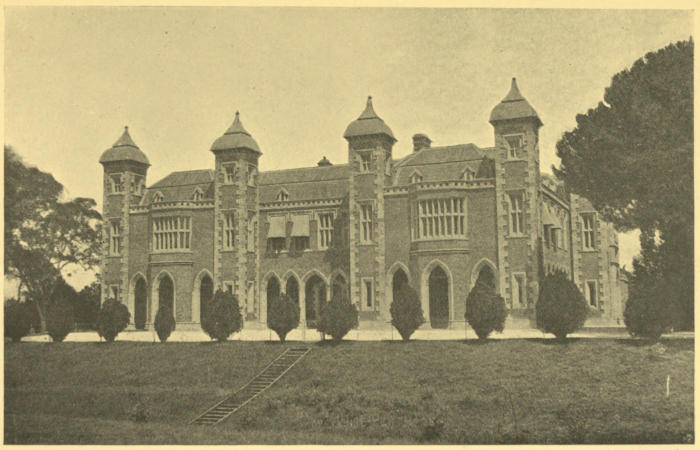
GOVERNMENT HOUSE, PERTH
CHAPTER VIII GUILDFORD
Henley Park—Hunting—Mundaring Weir—Sir John Forrest—Darling
Nurseries—Kelmscott—Armadale—Jarrahdale—Whitby
Falls—Mandurah—Yarloop Mills—Harvey—Collie Coalfields.
One morning I drove to Guildford, 9 miles from Perth.
Such a pretty drive! The Swan river winds its way so far,
and is there joined by the Helena. The many farmhouses
and crops of this fine agricultural district impress one very
favourably. About half-way there is a fine hotel and good
pleasure-grounds, called the Hotel Ascot, overlooking the river,
where much boating and fishing are enjoyed by the visitors
patronising the hotel.
Guildford is a pretty place, and, being so near Perth, is
likely to become quite an important town. There are some
good residences near. On Mr. Hammersly’s estate, called
Pyrton, after the family estate in England, is a fine house,
standing amongst unrivalled scenery. The scented foliage
of the big gum-trees casts a grateful shade for the sleek
cattle, and in the sweet springtime almost every bit of ground
is covered with wild flowers of exquisite beauty. The Hon.
H. J. Saunders’ estate at Henley Park is a few miles
farther on, with a very quaint-looking house 70 years old,
and built of sun-dried bricks. The walls are nearly covered
with ivy, and woodbine runs over the fences. All kinds of
flowers spread their rich perfume around. The orchard is
close by, the scented blossoms of the various trees mingling
their fragrance with that of the flowers. Mr. Saunders
has a large racing-stable, and takes great interest in racing
matters. The private training-track, made at great expense,
is a mile round, and looked like a smooth lawn; the stud flock
of Romney Marsh bred sheep had been feeding there for the
previous few weeks. Mr. Saunders’ racing-stables are recognised
as the best in Western Australia, and he has a small and
select breeding-stud, including
Leda by Trenton and Lady
Sylvia by Newminster. His
racehorses are likely-looking
animals, especially Henley and
Black Rock, which have some
very good records. As we
drove back to Guildford the sun
was just setting, and the country
road with its red soil contrasted
well with the different greens of
the trees and fields, and with
occasional waving crops, vineyards,
and blossoming orchards.
Everything was perfectly peaceful,
until, all at once, the stillness was broken by a party of
huntsmen returning from a good day’s sport. One of them
turned out to be an old friend, who told me that the
country around Guildford is excellent for hunting, and that
there is a very good hunt club. Our Australian poet, A. L.
Gordon, writes:
“Here’s a health to every sportsman,
Be he stableman or lord;
If his heart be true I care not
What his pockets may afford.
And may he ever pleasantly
Each gallant sport pursue,
If he takes his liquor fairly,
And his fences fairly too.”
Hon. H. J. Saunders
I put up at the Guildford Hotel for the night, and in the
morning thoroughly enjoyed the fresh fish caught for my
breakfast in the river close by. Some excitement was one day
caused in quiet Guildford when, some new works being in
progress, some of the quartz boulders forming the old foundation
were dug up and carted elsewhere; a boulder fell from
the dray, and was crushed by one of the wheels; a glittering
object was noticed in the débris, and turned out to be gold;
the quartz had originally been taken from the Darling Ranges.
I went on to Midland Junction, 2 miles away, en route to
the Mundaring Weir, from which source the much-needed river
of water is to be taken to the Coolgardie Goldfields. This
gigantic scheme will cost two and a half millions of money, but
what a boon it will be to the waterless goldfields, of which far-famed
Coolgardie is perhaps the most waterless! In spite of
the croakings of those who are adverse to the scheme, Sir
John Forrest will, I am sure, be found right, and when plenty
of fresh water is obtainable at Coolgardie, so that the millions
of tons of ore waiting for treatment can be properly crushed,
people will see that the first Queen of the Goldfields is not yet
dethroned.
The reservoir, where the waters of the Helena river will be
stored by hundreds of millions of gallons and then carried
across the country to the goldfields, is now in course of construction,
and in two years a river (so to say) of fresh water,
yielding 5,000,000 gallons daily by means of enormous steel
pipes, 330 miles long and 30 inches in diameter, will be flowing,
and the Coolgardie housewives will be able to turn on their
taps for fresh water. A new era will then dawn for that
beautiful city, and its true prosperity begin. The sum paid
yearly by the Railway Department for water on its goldfields’
service would more than pay interest on the cost of the scheme.
The morning that I arrived at Mundaring Weir the workmen
were in a great state of excitement; their residence blocks were
being allotted. There were 130 applications, 6 of which were
refused, the applicants not being considered desirable residents.
The Department will not allow an hotel to be established.
Work at the weir was progressing well. At the huge quarries
masons were working up granite into blocks. There is an
almost inexhaustible deposit of granite, and the chief engineer,
Mr. C. Y. O’Connor, intends to form the outer face of
the wall with granite instead of using concrete, as is generally
done. One enormous dam, nearly finished, is to hold 10,000,000
gallons of water. The watercourse has been divested of timber,
and the appearance of the landscape thereby greatly changed.
The weir, when finished, will be 560 feet long, and will hold
4,600,000,000 gallons of water.
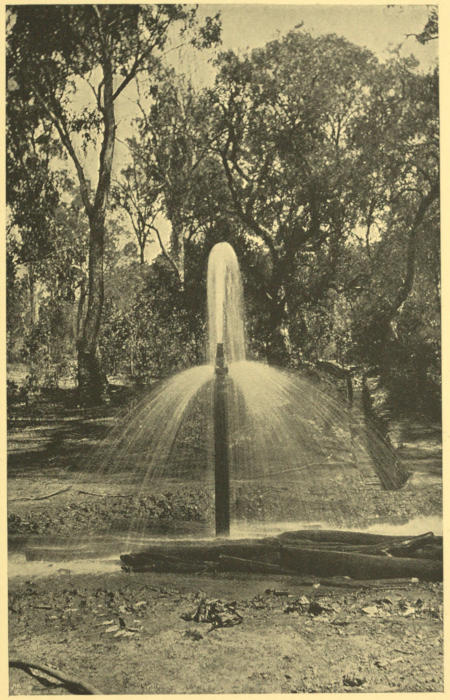
GOVERNMENT BORE, NEAR MUNDARING
The train that carried us back passed through miles and
miles of everlasting flowers. The ground on each side was
covered with a carpet of them. Acres first of white, then of
pink, blue, yellow and purple, charm the eye, and the kangaroo
paw, standing up in its vivid hues of crimson and green,
added a still further charm to the scene. On we went
through the country robed in its spring garb of beauty,
until we came to Smith’s Mill, named after Frederick Smith,
a young gentleman explorer in 1836, who died of exhaustion
at this place after having shown courage and endurance of
hardship worthy of his cousin, Florence Nightingale. Here
I left the train in order to visit the Darling Nurseries, which,
although it is only seven years since they were first planted, are
remarkable for luxuriance. The trees, with their loads of fruit,
were weighed down with their own excellence. Thousands of
citron-trees, 50,000 apple-trees, peaches and nectarines in
enormous quantities, plums, pears and prunes in profusion,
persimmons and other Japanese fruits were to be seen;
and as for the flowers, the scent of them was almost overpowering.
The roses were especially fine; all possible sorts
seemed to be growing here. The foliage of the English and
Canadian elm-trees and poplars formed a pleasing contrast to
the forest vegetation around. It is only a few minutes’ walk
from the station to this charming place, which is but 16 miles
from Perth; and any one wanting a change from the city should
take an afternoon and visit it.
Five miles from Mr. Hawter’s nursery garden is the Haughton
Vineyard, now owned by the Mundaring Wine Company. The
vines grow at an altitude of 1000 feet above the sea-level.
The wine is delicious. There is a notable grape growing there
called “Tarbinet Sauvignon,” from which is produced the celebrated
Lafitte claret. Mundaring seems to be a congenial home
to the vine, and its productive powers are of a high order.
Another charming place to see, 28 miles from Perth,
is Kelmscott, nestling in its bed of flowers. Everything
looked delightful on the morning that I went there. Nature
never appeared more beautiful; it seemed cruel to pluck the
flowers from their beds and crush the sweet grass with the
horse’s hoofs. I felt almost like Mr. Ruskin, who was such
a passionate defender of nature that he would never pluck a
flower. Two miles from Kelmscott is another sweet little
village called Armadale. I put up at the picturesque inn and
enjoyed a few days’ quiet rest among the beautiful surroundings.
The orchards, gardens, and vineyards here are so many that it
would take a whole book to describe them. Sir Arthur Stepney
and Mr. Jull own the largest properties, and have recently
equipped a vinery. Only a few years ago immense jarrah and
cool white and red gum trees stood in undisputed possession.
Now fruits of all kinds are growing in luxuriance. Oranges,
lemons, and sub-tropical fruits seem to flourish especially
well. So do flowers; blue lechenaultias, coral creeper,
heaths of all colours, heliotrope, primroses, pink, and
yellow blossoms nestle in the grass. Lovely bouquets can
be made from the delicate grey smoke-flower and the pink
immortelles, and will last a long time without water. Six
miles farther on we came to Jarrahdale. As its name imports,
this is the home of the jarrah-tree, and there are large timber
mills called the Jarrahdale Jarrah Mills, owned by a London
company with a capital of £300,000. This company have
the advantage of the fine harbour of Rockingham, where large
ships call to convey the timber to all parts of the world. There
are five mills on this property. I stayed at the town one
night, and attended a concert got up by the employées, which
was quite enjoyable, many of them being really good singers
and dancers. There is a nice hall, built, of course, with the
handsome jarrah-wood, which polishes so beautifully that it
looks like mahogany. It never shrinks or warps, so that for a
dancing-floor it cannot be excelled. There has been a great
demand from South Africa for this wood, which is almost
impervious to the ravages of time. Piles that have been driven
into the River Swan at the Causeway, and others into the sea
at Fremantle, have been taken up after 57 years and
found to be uninjured, having resisted the attacks of the sea
worm. This wood is one of the best for building purposes,
for it resists the white ant and is the least inflammable kind
known; yet when burning it throws out immense heat and
makes splendid charcoal. There are many charcoal-burners
about who are making a good living. Iron bolts and nails
driven into the jarrah do not loosen from rust, and there is no
doubt the jarrah is the principal tree of the colony. It has
come triumphantly through several severe tests, and is now
in great demand all over the world. The Golden West does
not depend on her mines alone, but, as Mr. Zeb Lane said
last year, “Make no mistake about it, the jarrah of Western
Australia will yet pave the streets of many of the leading cities
of the world.” The late Mr. Ednie Brown, Conservator of
Forests, told me that there were 20,000,000 acres of timbered
land in Western Australia valued by an expert at £124,000,000.
At present there are 50 sawmills in the colony, employing
over 4000 men, and still the demand is much greater than the
supply, so that there is a great opening for more capitalists.
Whitby Falls Lunatic Asylum is near Jarrahdale, and the
poor souls who inhabit it must, I am sure, find there a real
haven of rest. The asylum nestles in a sweet valley at the
foot of the Darling Range, and the hills make a grand background.
Gardens, large fields and paddocks, with cattle feeding,
stretch all round, and close by is a magnificent orchard. Five
miles farther on are the famous Serpentine Falls, whose
glittering cascades falling among the big rocks and boulders,
nearly covered with scented foliage, then bubbling and rippling
down the valley in joyous frolic among the sweet flowers and
ferns, form an idyllic picture. By many this spot is called the
“garden of the colony,” and certainly the luxuriant ferns and
flowers seemed to grow more beautiful at every step. The
blackboy and red gum trees grew more thickly than in any place
I have seen, and where those trees flourish everything seems
to grow with extra luxuriance. The blackboy is a most
peculiar-looking grass tree, with a rough thick stem and a
crown of thick heavy dark green grass, looking at a distance,
especially in the twilight, like a real blackboy. The gum from
the tree is eagerly eaten by the natives and cattle. It also
exudes a resin from the stem, which is used for pitch in
thatching the native houses, or Mia-Mias, as well as for other
purposes; these trees burn brilliantly. The falls come rapidly
down from the Darling Range in picturesque cascades, falling
over the crystalline rocks into pools below, thence into the
river. Twenty-six miles farther on is Pinjarrah. To see this
quiet little place now, one would not imagine that years ago it
was the scene of an immense native rising; that the soldiers
and mounted police had followed the aborigines for miles, and
that here the climax came, and hundreds of natives fell.
Things are changed since those days of bloodshed, and the few
aborigines left do not seem to bear any ill-will to the white
fellow. An old native said to me: “I like white fellow; he
take all my land, but he make my house, and my big railway,
grow big corn, big potatoes; black fellow do nothing, white
fellow know everything, so white fellow do what he like—you
give me sixpence?” The black fellow always finishes up any
conversation with that request. Pinjarrah is on the Murray
river, and the centre of a large agricultural district, where
plenty of splendid land is available for the selector. Some
economists say that population is pressing on the earth’s productive
powers, and that by-and-by there will be a dearth of
animal food; yet before mankind is starved out he can become
vegetarian, as meat diet is expensive compared with a vegetable
one. It is said that twenty acres of land are necessary to feed
one man on meat, while the same land under vegetable crops
would support a great number. One acre of wheat will support
42 people; one of oats, 84; of potatoes and rice, 176; so let
us not despair while the rich land is still wailing for cultivation.
Cabbages flourish exceedingly at Pinjarrah, and the
climate and soil are well adapted for English fruits. There is
quite a thriving village, with good buildings and private houses.
From this place I took a drive of 14 miles through rich
fruit-growing country to the charming seaside town of Mandurah.
Pears, peaches and nectarines loaded the trees,
and there is a fine fruit-preserving factory, as well as
several factories for preserving fish. The Brighton Hotel
is very comfortable, and you can get a vast amount of pleasure
at this charming resort. Boating, fishing and shooting
can be indulged in to your heart’s content. I had a right
merry time; several people I knew were staying there, and I
became quite an expert at fishing. Across the ferry from the
hotel is the Murray estuary, which is really teeming with fish.
The goldfields people patronise Mandurah largely, and many
huge catches of fish have been chronicled by them on their
return to the fields from their holiday. Very large kingfish
are frequently caught with hand-lines. Almost any kind of
line will do; it is amusing to see the greedy things snapping at
anything you put on the hook. I saw one caught that measured
5 feet in length and weighed 38 lb. Black bream weighing
4 lb. are a common catch. Hosts of crabs are about, making the
fishing more exciting than ever. At one time I thought fishing
the slowest amusement in the world, but after this experience at
Mandurah I am convinced that there is some fascination in it
after all. In two days a visitor caught 17 dozen whiting,
bream and mullet. The mullet is a delicious fish, more like
salmon than anything. Some English people staying at
the hotel said it was quite equal to the English salmon. As
you may imagine, plenty of well-cooked fish is always supplied
at table, and any one requiring a quiet and enjoyable rest from
city troubles cannot do better than visit Mandurah, where, in
addition to the splendid fishing, other sports can be indulged
in, since plenty of good duck, teal and snipe shooting is to be
got at the lakes 5 miles out.
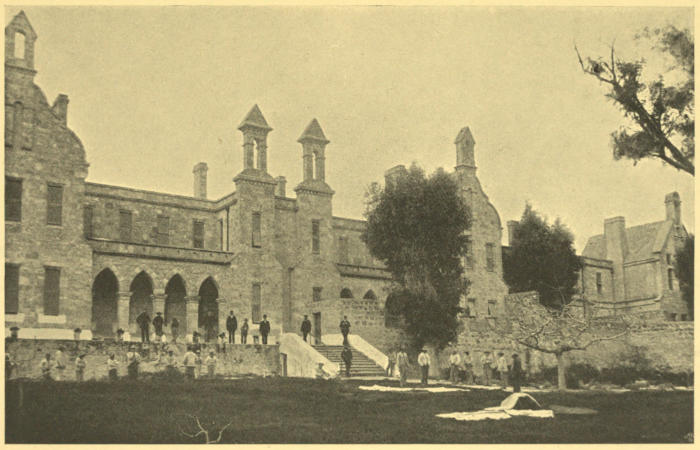
LUNATIC ASYLUM, W.A.
Returning to Pinjarrah, I drove out to a fine orange grove.
Some idea of its character can be gained from the fact that
some well-known fruiterers of Perth bought four trees from
the owner at £100 per tree, and, after ripening and picking,
made £50 profit per tree. The Drakesbrook Experimental
Government Farm is about 12 miles off, and I there saw
enormous cucumbers, pumpkins, and other vegetables.
Seven miles farther on are Millar’s Yarloop Mills. The
export from these mills is very large; 21 sailing ships and
15 steamers were employed to take away the timber to
various places last year. The settlement presents a busy
appearance. When the train stopped over 100 men came
from the mills to get their newspapers and see if there was any
one they knew in the train. I left the train and looked for
an hotel to put up at, but there is none; however, I obtained
comfortable quarters at a private house. There are several
mills connected with Yarloop, among them Iron Pot, so called
from a conical hill near to it. Hoffman & Waterhouse’s
Mills are 13 miles away, and are connected by telephone with
the head mill. The office is very handsomely built of jarrah
lined with polished wood, tongued and grooved. Much of the
wood of Western Australia is suitable for small manufacturing
purposes, such as making picture-frames, walking-sticks
and knife-handles, while the jam-wood, with its aromatic
perfume, is the very thing for pipe-making. I am sure a large
trade could be worked up in that business.
Some beautiful artistic work in jarrah carving has lately
been done by Mr. Howitt, of Perth, and was shown at the
Paris Exhibition. One piece especially, a font, is most
exquisitely carved. Besides these jarrah carvings, Mr.
Howitt has made some panels from the following Australian
woods—karri, tuart, redgum, sandal-wood, raspberry jam,
banksia, she oak, prickly pear, York gum, blackbutt, wandoo
and morrell; each of the panels is decorated with a carving of
the tree’s foliage. I also saw at Robertson & Moffat’s furnishing
warehouse, before leaving Perth, a handsome dinner-waggon
made from seventeen kinds of Western Australian woods, with
which, besides the before-mentioned woods, salmon gum,
gimblet, castor-oil, swamp gum, and curly jarrah were most
artistically introduced in the mosaic part, and with the handsomely
carved typical swan on the top made a very effective
piece of furniture.
The Chamber of Commerce, Prague, Bohemia, have recently
written to Mr. Ulrich, of Fremantle, asking for specimens
and samples of Western Australian woods to be sent to
that place with a view to future business; and when the
beauty and excellence of the woods become more generally
known I think they will be put to more artistic uses than wood-paving.
Outdoor enjoyments are yearly coming into more
favour, and the demand for outdoor chairs, seats, and tables
must increase. The jarrah-wood never shrinks, and being of
a beautiful dark red colour does not require paint. The timber
resources of the colony are marvellous, and it is estimated that
it would take fully a century to exhaust the now matured trees,
while fresh ones would be growing all the time.
The Harvey agricultural area, 9 miles from Yarloop, comprises
43,000 acres; of this 19,803 acres have been surveyed into 155
plots. The land is splendid for fruit and vegetables, and there
are a good many selections, 10,000 acres having already been
taken up. The soil is rather heavy, and expensive to clear
and drain. The Korijekup Estate is managed by Mr. Asche,
and is well under cultivation, the oranges grown there being
especially fine. There are good paddocks for horses to run
in, and the next time our family steed is sent out to grass
it will be to Korijekup. There are about 12 homesteads on
the estate, occupied by different families. The pasture lands
are very good, and the soil well adapted for strawberry and
gooseberry growing. There are about 10 acres of these
delicious fruits under cultivation. The manager’s house and
men’s quarters are near the river, the latter a substantially
built structure of slabs, made 60 years ago by convict labour
for Sir James Stirling, to whom the land was originally granted
(in lieu of payment of salary). In the winter time there are a
great many trappers about, who gain a good living by trapping
the native bear and opossum, for the skins of which they
get 9s. per dozen in Perth. The grey skins, when edged
with black, make beautiful rugs for a cold climate, but the
winters in Western Australia are so mild that things of that
kind are not required. In the early days the old coach-road to
Perth from Bunbury passed near Korijekup, and where there
were formerly only halting-places many flourishing farms now
stand. The land about there is very suitable for dairying, the
grass being green all the year round; the soil is brown loam,
interspersed with rich black swamps, and suitable for intense
culture.
Another 15 miles brought me to Collie Station, where I took
the branch train to the Collie coalfields. Until recently these
fields have been somewhat neglected, but are now coming into
great favour, the coal got there having been proved to be of
excellent quality, and now being extensively used. The
Government have decided to use it on the railways, and many
of the shipping merchants trading to different places have also
signified their intention of using it. The Smelting Works at
Fremantle are following suit; householders are consuming
it largely, and I can state from my own experience that it is
excellent coal, which never goes out, but burns to the last bit,
just leaving clean brown dust behind. It will in time be a mine
of wealth to Western Australia and constitute a great industry,
making work for thousands of coal-miners, for the deposits of
coal are almost limitless. Bores have been used in different
parts of the field, and have proved the existence of enormous
bodies of coal. The Collie coal-mine has recently been bought
from the Collie Company by Mr. Zeb Lane, for the British
Westralia Syndicate, and is now called the Collie Proprietary
Coalfields of Western Australia.
Collie is a very pleasant little town, with some hotels,
several stores, and many snug and pretty dwellings. One
usually thinks of a coal-mining town as an uninteresting, grimy
place, but Collie is nothing of the kind. In the midst of a
magnificent jarrah forest, at an elevation of 600 feet above sea-level,
this place has, I imagine, a brilliant future before it.
The air is delightfully bracing; the sea breeze blows in from
the coast, and in the near future, when the gardens now being
planted by the men on their residential plots have come to
maturity, the miners will be able, after their work underground,
to sit under their own vine or fig-tree and enjoy the pipe of
peace. This is not a mere form of words, but will be solid fact,
for the ground is so good that, beside containing coal underneath,
it will grow all kinds of products on its fertile flats and
valleys.
Many of the men are making very comfortable homes for
themselves; they can see that the field is permanent, and that
they may hope to remain here. Collie will, I predict, be in the
future one of the principal towns of the colony.
CHAPTER IX
Bunbury—Exploring Days—The Estuary—Early Times—Whaling—Native
murder—Mr. Layman—Retribution—Pasture Land—Robert
Scott—Old Residents.
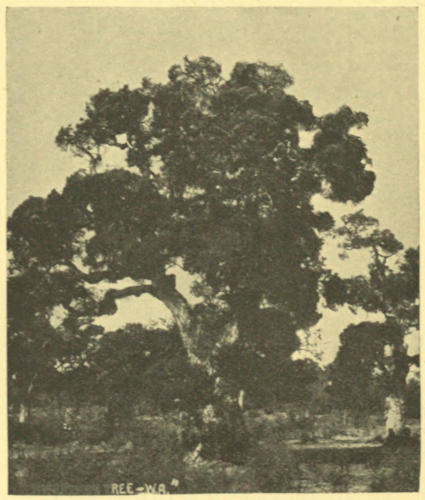
Paper Bark Tree
Bunbury is 13 miles from Collie, and is the terminus of this
line of railway. In passing through Picton, 4 miles before
you come to Bunbury, you can see the homestead of the
Forrest family. It is a
picturesque-looking old
house on a little hill with
a pretty brook running
below, and the surroundings
are very beautiful.
Mr. William Forrest, the
ex-Premier’s father, who
recently passed away at
the ripe age of 80 years,
arrived in this colony by
the ship Trusty in 1842,
and first settled at Australind.
Some three years
later he erected a mill
on what has since been
called Mill Point, on the
banks of the estuary near Bunbury, and in 1849 removed to
Picton, where he resided until the day of his death. Mr. Forrest
bore with indomitable courage many misfortunes, such as the
burning of his flour-mill, the engine and stones of which were
afterwards removed to Bunbury, and formed the nucleus of the
well-known Koombanah Mill, now owned by Mr. Robert
Forrest, his sixth son. The above-mentioned mill was the
first water flour-mill in the South-West, and was erected in
1849. Mr. Forrest dammed up the Preston river and utilised
it for the purpose of his business. You may be sure that he
was particularly proud of his explorer sons, John and Alick,
and also proud of the fact that one was Premier of the colony,
and the other Mayor of Perth. Sir John made three exploring
expeditions, and it is amusing to hear what “Tommy Pierre,”
one of the natives who accompanied him, said at the banquet
held in honour of the explorers’ return to Perth: “Well,
gentlemen, I am very thankful to get back to Swan river,
Bunbury, Fremantle; I thought that we never get back again.
Many a time I go into camp, going through desert places, and
say, ‘Master Forrest, where the devil are you going to? Master
Forrest, I give you one pound to take me back.’ Master say:
‘Hush! What are you talking about? I’ll take you right
through to Adelaide,’ and I hush. I always obey him; I only
black fellow, you know, but I am all thankful; I always very
glad to see white fellow around me.” The South Australian
Register, of August 27, 1870, says: “On Saturday morning,
the band of explorers from Western Australia, under the
leadership of Mr. John Forrest, reached Adelaide. They were
escorted to Government House by a number of horsemen, and
the crowd heartily cheered them as they came up. These men
are heroes in the highest sense of the term. The expedition,
as many in Western Australia still remember, was organised
through the instrumentality of Governor Weld.” The late Premier,
who a year before had piloted an expedition to search for
the remains of the explorer Leichhart, readily acquiesced in the
suggestions that were put forward by the then Governor of the
colony, and on March 30, 1870, accompanied by Mr. Alex. Forrest
as second in command; H. M’Larty, a police constable; W. H.
Osborne, farrier, &c., and two natives, he set out for Perth.
The party followed the course taken out by Eyre in 1841, but
in an opposite direction, and although they did not experience
the difficulties that Eyre encountered, the troubles were
numerous enough. On March 18, 1874, Sir John Forrest
led another expedition to Adelaide. From Perth his party
proceeded to Champion Bay, and the wild, untrodden desert
was safely crossed. On November 3, the explorers reached
Adelaide, and at a banquet which was given in their honour a
few days afterwards, the Premier of South Australia (the Hon.
Arthur Blyth), speaking of the leader, said: “Here we have
the likeness of a man who knew not what fear was, because he
never saw fear—who carried out the thorough principle of the
Briton, in that he always persevered to the end.”
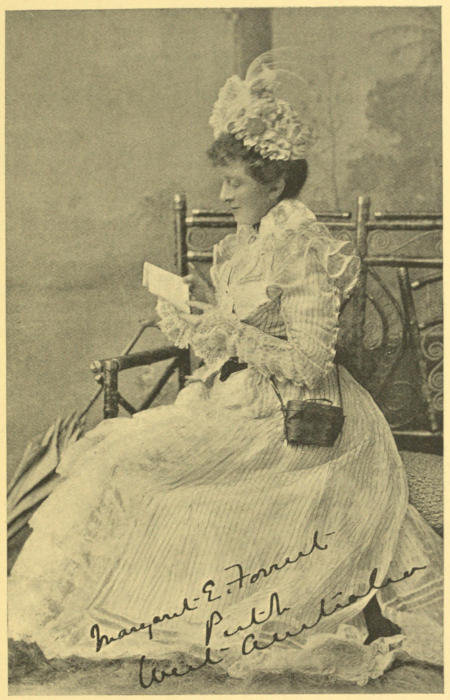
LADY FORREST
I have before me as I write a picture of Sir John as he
was in 1866, 34 years ago; also a picture of the third
expedition crossing the spinifex desert; terrible country to go
through. An extract from Sir John’s diary says: “Tommy
(a native) went on with the only horse not knocked up to find
water. I followed his tracks, leading the two done-up horses.
Spinifex everywhere. We can only crawl along, having to
walk and drag the horses with us.” At some places the
aborigines were very troublesome, the camp being attacked
one night by 60 of them, who could not be driven off until
some of them had been shot. Sir John Forrest is a man who
has the colony’s interests at heart. By his wisdom and foresight
great tracts of land are being opened up. In his own
words: “We have a great work to do in the great continent of
Australia, all of it encircled by the sea, and flying the flag of
Old England, no other nation having any right or part in it.
And what a continent it is! The Western Australian territory is
as big as France, Spain, Italy, Austria, and Germany, and contains
973,000 miles (square). If you were to walk round it,
you would have nearly a 4000-mile walk. The Empire of
Australia represents nearly one-seventeenth part of the world’s
surface. We have great works and great responsibilities before
us, and we are proud of Western Australia. We want to be in
the future one of the brightest gems in the English Crown.” In
1890 Sir John spoke the following words into Edison’s phonograph:
“I firmly believe that Western Australia has started
on a progressive and prosperous career.” Such words bring
to mind the prophetic words of Cowper’s “Boadicea”:
The progeny that springs from the forests of our land
Armed with thunder, clad with wings, shall a wider world command;
Regions Cæsar never knew thy posterity shall sway
Where his Eagles never flew, none invincible as they.
It was in 1890 that representative government was granted
to Western Australia, and Mr. Forrest chosen as Premier. In
1891 her Majesty Queen Victoria conferred on him the honour
of knighthood, and for ten years Sir John Forrest remained
Premier of Western Australia (establishing a record in Australia’s
history), a post which he resigned in order to assume
that of Postmaster-General for Australia; but has since been
appointed Minister of Federal Defence in the Ministry of the
Commonwealth of Federated Australia. Not long before her
lamented death, our late beloved Queen was pleased to bestow
on Sir John Forrest the Grand Cross of St. Michael and
St. George, he being, I believe, the first Australian born who
has received that honour.
I was quite surprised to find such a fine hotel as Gordon’s
Pier in a country town. The dinner was excellently served,
the meat especially tender, the fish sweeter, the vegetables
nicer, and the fruit more juicy, than usual. Perhaps it was
because I had been roughing it a little just before that I valued
the extra comfort I obtained here. A splendid balcony reached
right round the hotel, from which was visible the sparkling
water of Koombanah Bay, with its long pier and beach of silver
sand. The lighthouse on the hill, with its square tower and
grey walls, stood like a sentinel against the sky. The light
that shines out to sea at night is 117 feet above high water,
and is visible 12 miles. As it was a hot night, most of
the guests were out on the balcony. I lay back in my comfortable
lounge-chair, inhaled the health-giving sea breeze, and
thoroughly enjoyed a cup of delicious coffee brought me by the
attentive waiter. From the drawing-room, where some of the
guests were passing a pleasant half-hour, and while singing for
their own pleasure, also affording gratification to the visitors
outside, came strains of music. I retired early, and was
agreeably surprised to find my bedroom lit up with electric
light. The noise from the machinery rather kept me awake at
first, but I soon passed into the land of dreams. The housemaid
told me in the morning that a great many people from the
goldfields stay here in the summer to recoup after the dryness
and heat of the fields, and that the managers of the mines
usually wish to have their bedrooms on the side near the
machine-room, as the noise is home-like, or mine-like, and lulls
them off to sleep.
In the morning I took a waggonette and drove out to explore
Bunbury, going first to the Leschenault Estuary, a sheet of
water divided from the sea by a strip of land 10 or 12
miles long. The surface was dotted with wild fowl and its
depths are full of fish. The Collie and Preston rivers fall into
the estuary. On the shore there are plenty of black swans
and wild duck which seem to be quite tame. On the east
side of the estuary is the site of Australind, to which, 57
years ago, many people came from England to settle, but
finding the place was not what it had been represented to them
by unscrupulous agents, they disbanded and settled in different
parts of the colony, so that Australind now is merely a
name. It is very prettily situated at the junction of the
Brunswick and Collie rivers. There are large dykes about
there not yet explored, which may contain wonderful mineral
wealth. Manna gum-trees are to be found, and yield sometimes
as much as fifty tons of gum from one tree.
Bunbury’s history dates from the first settlement of the
colony, when New South Wales sent soldiers to King George’s
Sound in order to circumvent the French, who nearly had
possession of Western Australia. Governor Stirling took up
large tracts of country near Bunbury in lieu of salary, and
settlers were granted 200 and 300 acres of land as an inducement
to go there. When, 60 years ago, the intending
settlers arrived and pitched their camps, a few soldiers
were stationed for their protection, but as the natives were
mostly friendly and intelligent, the soldiers had little to do, so
whiled away the time by helping the settlers, and as many
hands make light work the little community soon became
prosperous.
In those days the post was sent twice a month by an aboriginal
foot postman. Sometimes he got tired of his work, and
would leave the post-bag under a tree and decamp. Then scouts
had to be sent out to find the mail. An old colonist, Mr. R.
Scott, related to me many of his experiences at that time. Mr.
Scott’s father arrived in the colony in 1830, and not liking the
look of Fremantle, which was merely a sandy beach and wild
bush, with a few tents scattered about, intended returning to
Scotland, but Governor Stirling persuaded him to go to Bunbury
with some other intending settlers. The younger members of
the party traversed the 115 miles on foot, the older people
going in the Governor’s ship to the port. The tramp was a
long one, and young Scott’s clothes were so tattered when he
arrived that he would not go out to speak to the Governor, but
hid behind a tree. He was, however, persuaded to show himself,
and the Governor, seeing the poor boy in such a plight,
sent to the vessel for a suit of his own clothes and a cap, no
others being available. By cutting off portions and tucking in
other parts the boy was made presentable. Mr. Scott’s mother,
who died some years ago, aged 88, kept those clothes with
great pride until the day of her death.
Whaling was a local industry in those days. Mr. Scott and
his brother had several whaling-boats, and sometimes took as
much as 90 tons of whale-oil to Fremantle. An American
vessel went ashore at that time, and the enterprising captain,
being stranded, took up a piece of land and started a garden,
which he fenced in with the staves of olive barrels.
The only native murder at Bunbury was perpetrated in 1840,
Mr. Layman, a settler at Wanerup, being the victim. He was
speared by the king of the black tribe then at Wanerup, about
6 miles from Busselton. This booka (king) came to Mr. Layman’s
camp when a native boy, servant to Mr. Layman, was
packing up his damper (a kind of large colonial scone cooked in
ashes) to take with him as rations when he was going out with
sheep. The booka took the damper from the boy, and throwing
him a small piece, was going off with the rest. Mr. Layman
came up and saw this, and taking the booka by the beard
forced him to give up the damper. This was evidently too much
indignity for him, and when Mr. Layman turned his back he
speared and killed him, then immediately made off into the
bush. The settlers, about twenty in number, determined to
follow and execute him, but found many difficulties in the
way, as none of the natives would lead them to his tracks.
They, however, tracked him as well as they could, and to
frighten the tribe they shot down every native they came across.
This put such fear into them that an old man called Crocodile
was induced to show them the way, and they then tracked the
murderer to the Capel river, to a hollow tree, whence it was
some time before he could be dislodged. When this was
effected he was found to be well armed with spears ready to
fight. He was, however, summarily shot by Corporal Gill, and
his head carried back on a pole to the Vasse (now called Busselton).
Since then the only known murder by natives was that
of Mrs. McGowan, who was speared by a half-witted native.
The shooting of the blacks, although it seems cruel, was the
means of showing them that the white man was their master,
and after this no more trouble arose with the various tribes.
Had it not been done the tables would have been turned, and
all the white settlers might have been murdered.
The natives are divided into four families or tribes—the
Ballarook, Deduruk, Donderup, and Gnakerunk. Consequently,
if you want to find out what tribe a certain native belongs to
you must say to him: “You Ballarook?” If he does not
belong to that tribe he will say: “No, me Donderup.” They
are all brothers and sisters in each tribe, and bound to protect
one another. When civilised they make fairly good servants,
but never quite lose their wild instincts; and when they have a
holiday, which they frequently take of their own free will, away
they go to their tribe, and revel in free life until they tire and
once more long for the flesh-pots of civilisation, when they
again return to their work.
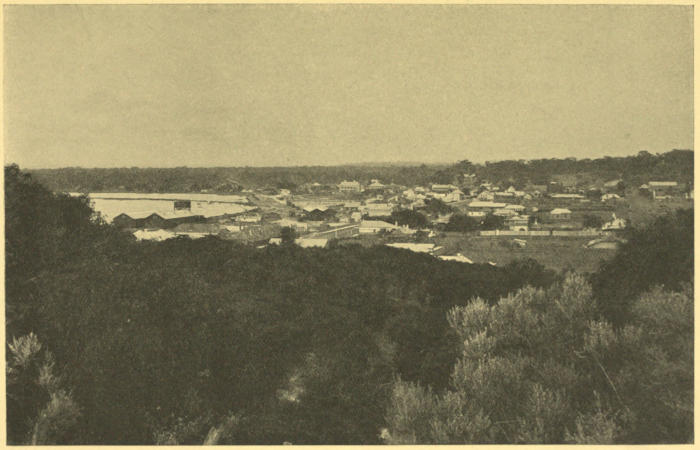
BUNBURY
Thousands of acres of land are available here for purchase.
The Mangles Estate has lately been opened up for settlement on
very easy terms. Potatoes, onions and other vegetables grow
most luxuriantly. The pastoral and agricultural land is very rich,
and as many as three crops a year are sometimes taken off the
same land by Mr. Clarke, who has a farm near Bunbury. The
forest lands around abound with splendid jarrah and other
timber. The harbour is very safe and partially protected by a
coral reef. There are many handsome residences. The Hon.
Charles Spencer has a large house on a hill in the most
beautiful position in Bunbury, and there are some splendid
vineyards, the soil being specially good for vine culture.
The town has 1200 inhabitants and the district about 3000.
It is very prosperous, and has many fine public buildings; some
of the early settlers who went through so many rough times are
now in the enjoyment of comfortable homes, and passing peacefully
down the vale of life. There is an exceptionally fine post-office,
standing near the spot where the barracks were erected
for the soldiers in the long-ago days. The hospital is an imposing
building, on an elevation commanding a fine view of the bay,
and has very pretty grounds. It would be by no means
intolerable to be ill in this lovely seaside resort, but, as a rule,
people who come to Bunbury get well, not ill. The walking,
driving, boating, fishing, bathing and shooting excursions that
are the order of the day give one no time to think of being ill.
Cycling is a favourite pastime, and there is a very good club.
The streets are wide and planted with shady trees. The
Preston river runs into the estuary, its banks are loaded with
bright flowers, and the golden sunshine shining through the
trees, the blue water and the massive breakwater in the distance
make beautiful Bunbury look like a bit of Paradise.
CHAPTER X
Blackwood River
Dardanup Park—Donnybrook—Bridgetown—The Grange—Dallgarrup—A
Prodigious Prize—Greenbushes—Tinfield—The Great
Forest.
The Hon. H. W. Venn has a splendid estate called Dardanup
Park, 10 miles from Bunbury. The dwelling-house is built
in old English style and surrounded by a garden, where
all kinds of beautiful flowers grow in profusion. There is
an enormous shed, capable of holding large quantities of hay.
The dairy cows, standing knee-deep in pasture, are specially
sleek and fat; the milk and cream that I tasted at Dardanup
seemed exceptionally sweet. I went for a six-mile drive to the
Ferguson river, passing many pretty farms, nearly all on
Mr. Venn’s land. One goes for miles down a narrow road like
an English lane, except that the hedges are formed of the
beautiful Australian wattle in place of English hawthorn. The
grand Australian trees, red gum and jarrah (some of immense
size), the pretty banksia, the delicate paper-tree, the coral creeper,
which, as its name implies, is of the colour of pink coral, and
in some instances, had embraced the banksia-trees and mingled
lovingly with their broad green leaves, all combined to make a
pretty picture. A little Roman Catholic church and, farther on, a
Protestant one, gave token that the spiritual welfare of the
people at Dardanup is well looked after. It is singular how
many native names end with “up.” On to the road to Bunbury
there is a station called Wagerup. An old settler in the
district was not satisfied with that name, and wrote to Mr. Venn,
the member for the district, to say that he was an old settler of
30 or 40 years, and thought he ought to have a say in the
naming of the railway station. Being a loyal Englishman, he
wished it to be called Queen Victoria Station. I am sorry
to say his request has not yet been acceded to. Another loyal
subject at another railway station, where there are about two
other dwellings, has recently built a bush public-house, and
outside is printed, in large letters, “The Palace Hotel.”
Mr. Venn is very much liked by all the farming community.
I overheard a controversy on politics at the dinner-table between
several farmers, and they were unanimous in their
opinion that Mr. Venn was the man for them, and for the
country.
Beyond lies Donnybrook, not the great Irish fair of
that name, but a fertile spot of Western Australia. A mile
before arriving there we stopped at Baxter & Prince’s siding,
2½ miles from which are their well-known sawmills, in which
are employed a large number of workmen. There are some
fine farms at Donnybrook, and the estate of the Hon. J. W.
Hackett, with its orchards and gardens, is half a mile from the
station. In these gardens all kinds of fruits, especially raspberries
and strawberries, grow in luxuriance.
On account of the marvellous fertility of the ground there
are a great many applications from people wishing to establish
themselves on the land here, and take up small plots for fruit
growing. Two miles out of Donnybrook is a goldfield, which
may some day turn out to be immensely rich. Gold was first
discovered in the surface soil by some men searching for the
alluvial deposit. Further investigations with the miner’s
faithful prospecting-dish eventually led to the discovery of
quartz veins. There are several shafts sunk now to a great
depth, all of which have yielded a profit. Perhaps a new
Coolgardie will one day spring into existence here.
Mr. Maryanski, the well-known mining expert, is largely
interested, has purchased property here, and has now gone to
Europe for the purpose of floating companies.
To drive up the Preston Valley from Donnybrook in the
lovely weather was pleasant. The roads were certainly not all
that could be desired, but the forest scenery compensated for a
little jolting, and the more one travels in the West the more is
one convinced of the resources of the colony. The soil is a
rich chocolate loam, and grass and water plentiful all the year
round. Hay is principally cultivated here, as a great quantity
of chaff is required for the horses at the mills in the district.
On my return to Donnybrook, rather tired with my day’s
excursion, I retired early, and after a refreshing night’s rest
started for Bridgetown in the morning. The line has only
recently been completed, and was formally opened on December 2,
1898. It must have been pretty hard work to make this
railway, for the various cuttings are in some parts so deep that
40 or 50 kegs of powder per day were often used in blasting
the hard rock. There are 178 cuttings and 204 embankments
on the line of only 42 miles, so no wonder it cost the Government
a considerable sum of money. Donnybrook is 208 feet
above the sea-level, but Needes Hill, 7 miles farther on, is 770
feet above. After that the road drops down again to 400 feet,
then it rises again to an altitude of 1000 feet, and at this point
comes within 10 miles of the now well-known Greenbushes
Tinfield (of which more anon). A further depression of this
elevation brings it to Hester’s Brook, and then a further rise
ascends to Dalgarup Station, landing at an elevation of more
than 1000 feet, whence the line drops again to Bridgetown,
only 510 feet high in the clouds. I quickly made my way to
Warner’s Hotel, and after an excellent dinner proceeded to
investigate Bridgetown and the Blackwood river. The orchards
around this district appeared to be very fine. Sir James Lee
Steere, the member for the district, gives a handsome silver
cup every year as a trophy at the annual show for the best-kept
orchard. This has been now won three years in succession
by the Messrs. Allnutt, the Grange. Their orchard
covers an area of 30 acres. Mr. Allnutt, the father of the
present owner, planted this fine orchard 30 years ago. One
can imagine what a wilderness the place must have been then,
and what perseverance has been practised to achieve such
a successful issue. The latest development is a steam sawmill
on the property for the purpose of cutting up timber and making
boxes for packing the fruit in. Every kind of fruit one can
think of is here. As well as fruit, magnificent potatoes are
grown, and often yield 15 tons to the acre. Now that the railway
touches the place, the inhabitants say that this will be the
chief agricultural centre of the south-west district. The people
seemed so genial that it was really a pleasure to converse with
them.
A very beautiful drive through richly wooded hills, the tender
green grass of which was dotted here and there by clusters
of trees and covered by the perfumed golden wattle and by many
spring wild flowers—appearing between an occasional field
of newly growing wheat—brought me to Dallgarrup, the homestead
of Mr. Godfrey Hester, who has over 7000 acres of land
altogether. I found this gentleman engaged in skinning and
dressing a sheep; he had taken on a Chinese cook, and all
the other hands, objecting to the introduction of Chinese labour,
had left in a body. Consequently Mr. Hester had to turn to
and do the work himself.
About a mile farther on is Blackwood Park, Mr. Gerald
Hester’s homestead, with an orchard of 23 acres, 6 of which
bear most lovely apples. There are 2000 acres, and many
cattle and sheep. The house is an old-fashioned one, having
been built 50 years ago for Mr. Hester’s father, who was the
oldest settler on the Blackwood river, and came out 52 years ago
He was the first Stipendiary Magistrate in the district. The
house is in a charming spot, and many handsome willows grow
about the running brook close by. The largest grape-vine I have
ever seen is here. Mr. Hester told me it was planted 40 years
ago by his mother. The height of this marvellous vine is 7 feet
to the first branch. There are 6 enormous branches measuring
8 inches round and averaging 100 feet long. The body of the
vine is 50 inches round. A very large trellis, which from time to
time has been added to, now takes up 39 feet of ground in
length by 54 feet in width. The kind of arbour thus formed
maybe imagined. 2064 bunches of magnificent black Hamburg
grapes, weighing over a ton, came off this vine last year, which
I am sure breaks the record of production of one vine in any of
the colonies.
The drive from Bridgetown to Greenbushes Tinfield through
forest country is most enjoyable. This tinfield has of late been
richly developed. Until recently it was not thought much of,
gold-mining having deadened all other kinds of mining in the
colony. Now, however, things have taken a turn, and quite a
large settlement has sprung up, and over 2000 men are on the
field. A good town has been formed where three months
before was a dense forest, and solitude reigned supreme.
Jarrah growing on the spot, and two timber-mills being close
by, nearly all the houses are built of the handsome dark wood,
are thus much more pleasing than the usual tents and camps of
mining places, and stand out well against the tall green forest
trees. People have built very nice houses, evidently having an
eye to solid comfort, and thinking the field a permanent one.
The town of Greenbushes is one long street or avenue. On
either side tower the enormous forest trees. The ring of the
axe and the crash of some of these falling giants, together with
the immense fires burning day and night for the purpose of
getting out the tremendous stumps of the trees; the energy of
the people, and the numbers of visitors constantly arriving to
see the field, make Greenbushes a lively place. The town
seems to have sprung up by magic; there are 30 stores of
all descriptions, 3 hotels, the Court House Hotel being a very
comfortable one, post and telegraph offices, warden’s court,
and other public buildings.
Miles and miles of the country contain rich tin. The tinfields
are on the highest point of the Darling Range, 1100 feet above
sea-level. The gullies and watercourses are very picturesque
being in the heart of the green forest. I drove down to Spring
Gully, where the men were all at work in their claims, and the
various workings were most interesting. Dumpling Gully is
the name of another part of the field.
There have been some rich finds. The Cornwall Mine, on
the highest point, has been proved to carry 13½ per cent. of
lode tin. Another lode tin mine is the Yarana, which has given
good results. The lode in this mine is similar to that found in
Cornwall, England, being associated with quartz, schist and
kaolin. Tin ore is most peculiar-looking stuff. Some lumps
of it that are called “nuggets of wood tin,” weigh 30 lb. each;
another kind is like fine sand, and another like gunpowder, and
the colours range from white to red, yellow, ruby, black, grey
and brown. Some of the men have sold their claims to the
syndicates for £4000 and £5000, and gone on their way
rejoicing. I was surprised to find plenty of horses and cabs at
Greenbushes; these are, no doubt, accounted for by the distance
of the town—three miles—from the railway station, which I
passed going to Bridgetown. The cabbies were doing a roaring
trade, and the whole community seemed very well satisfied with
things in general. Gold has also been found at a depth
of 33 feet, the reef being nearly 8 inches wide, and comprised
of quartz; the formation enclosing it contains free tin worth
about 3 ounces to the dish.
CHAPTER XI
Busselton—Napoleon’s Grave—Cattle Chosen—“All aboard”—Karridale—Touring
the Forest—King Karri—The Sand Patch.
Starting from Greenbushes railway station, I made my return
journey as far as Boyanup Junction, where I changed trains for
Busselton, or, to call it by its first name, “The Vasse.” This
was one of the earliest settlements of the colony, and
is one of the most picturesque. It has a beautiful bay,
which, like Bunbury, was at one time a great whaling place.
There are about 30 fishermen there, and most of the fish caught
is sent every day by the Perth Ice Company to the metropolis.
The bay is nearly always calm, and English people say that
it resembles Bournemouth in old England. The lovely beach,
with its hard white sand, is a favourite place for cycling.
In the afternoon I sallied forth to inspect the beauties of this
place and was quite delighted with this ideal town. Everything
is sweet and clean; the grass and the trees seemed to me to
have a more tender green than in other places. The beautiful
sky, with white fleecy clouds, was reflected in the sparkling
sea; dear little boats were dancing on the water, and at the
jetty, which is a mile long, two ships were moored, while
another had just spread its white wings to fly to fresh seas.
It was a perfect afternoon for fishing, which accounted for the
number of fishing-boats out.
The morning sun shining in all its glory awoke me early. I
strolled down to the pier, and met some boys coming along
laden with fish that they had just caught. I wanted to buy
some, but the boys would not hear of that, and presented me
with two for my breakfast, which I took to the hotel to be
cooked, and no fish, I think, ever tasted sweeter.
Looking one way from the top of the lighthouse at the end of
the jetty one saw an exquisite carpet of green stretching for miles,
white houses nestling in shrubberies near the winding river,
and sleek cows in the pasture, nearly up to their knees in the
waving grass; out at sea the fishing-boats were dancing on the
waves; a big steamer in the distance was on its way to the
East; a white-winged ship was just disappearing from sight on
the horizon; and all these, with flocks of birds soaring across
the sky, formed a picture pleasant enough to charm any
eye.
There are some remarkably fine old houses about Busselton;
Fairlawn, the old Residency, for one. The immense China tree
in front of the house was a favourite spot with the late Colonel
Molloy, when resident magistrate. Under its shade he sat many
a time transacting the business of the Residency, and soldiers
of the Queen have often passed beneath its shady branches.
Colonel Molloy was with Sir John Moore’s army, and also fought
under Wellington at Waterloo. A magnificent willow-tree,
planted by the Colonel in 1862, a few years before his death,
from a slip growing over Napoleon’s grave at St. Helena, is
now 12 feet in circumference. I asked for a slip as a memento,
and it was graciously given to me. Fairlawn now belongs to
Mr. R. Gale, who has a nice dairy, with all the latest improvements,
stables and stockyards. As much as 380 lb. of butter,
from 60 cows, is made weekly by the Laval cream separator,
worked by horse-power. This part of the beautiful country
is so noted for its fine milch-cows that there would be great
scope for a large butter factory, since real nice country butter is
seldom to be obtained in Perth at any price; and I am sure
housekeepers would hail the advent of fresh pats of butter from
the country with delight.
Mulberry-trees were loaded with their luscious fruit, and the
bees were hovering around and sipping the sweets from them.
Honey is very plentiful. In some orchards at Busselton there
are as many as 130 hives, yielding four tons of the sweet commodity.
Mr. J. Bussell’s estate has a singular name, “Cattle Chosen,”
and it was a strange chance that named it so. Mr. Bussell,
the oldest settler in these parts, had taken up land at Augusta,
nearer the coast, but was not entirely pleased with the place,
and while driving some cattle to the Swan Settlement lost one
of his cows. On his return journey he saw cattle-tracks, and
following them up found not only the lost cow, but a beautiful
calf also, on the richest pasture he had seen. Considering the
circumstance as an omen of good luck, and delighted with the
locality, he applied to have his grant, 6000 acres, transferred
to the Vasse, and named the place “Cattle Chosen.” The
town was afterwards called Busselton out of respect to his
name.
The homestead of Cattle Chosen is a pleasant place. Willows
grow over the pretty brooks and white bridges. An avenue
of palm-trees leading to the house, and an old cannon in the
garden in front of it, add romance to the scene. I was shown
some marvellous ears of wheat grown by Mr. Tanner near here,
12 inches long by 8 inches round; also cabbages 12 lb. in weight.
Tomatoes grow by the ton, and as to potatoes, 11 tons have
been taken off one patch of two acres. There is some swamp
land near Busselton which it is said would produce as many
potatoes as the whole of Ireland.
In Mr. Pries’ orchard apples and pears load the trees so
heavily—some of the trees yielding 16 cases of fruit each—that
the boughs actually break beneath the weight. Wax models of
some of the pears grown here are to be seen at the office of the
Agricultural Bureau, St. George’s Terrace, Perth.
The children on the beach and in the flowery meadows seemed
to revel in their play, and their healthy faces and merry laughter
proclaimed that doctors were not required. No wonder they
looked so well, with such a beautiful place to live in! The
summer temperature is never over 100°, and the winters are
mild. With the ample supply of milk, butter, eggs, fruit, and
other good things, the lives of these children are cast in a
pleasant place.
Mr. Locke, the member for the district, has a great racing-stable
at Lockville, and several horses are training for the
coming races. I admired the beautiful creatures very much.
Several of them have already won important races. Mr.
Locke has also many dogs, which have taken prizes at various
shows; he is further well known as one of the best judges of
horseflesh in the colony, and the breeding of bloodstock is
carried on extensively on his estate.
The recreation-ground is a very level ground of 20 acres, and
sport of all kind is carried on there. Near the fine new bridge
is the pretty English church, covered with ivy, with the peaceful
God’s Acre adjoining it. St. Mary’s Catholic Church, served by
that genial and benevolent parish priest, Father Tracey, is
near. Busselton, in addition to its agricultural capabilities,
offers a good opening for the timber business, and one gentleman,
Mr. Porritt, late of Queensland, who has settled there, with
the intention of developing this trade, has obtained a lease of
the Ballarat tramline, and purchased two sawmills, as well as
taking up 60,000 acres of forest land. Employment will thus
be given to a great many men, so emigrants will be welcome.
Tin has been found close to Busselton, at Quindalup, and as
water is plentiful close by, profit to the district is likely to arise
from the discovery.
The morning sun was shining in all its splendour over the
fair River Vasse when the driver of the four-in-hand mail-coach
cried, “All aboard!” I climbed to the box-seat, and
with a crack of the driver’s whip off we went. The day
was beautiful; the air was exhilarating, and after the 50-mile
journey to Karridale I felt inclined for a good dinner.
Luckily I had supplied myself with sandwiches and sherry, or
should not have fared too well. As the journey is nearly all
through the bush, one must not expect to find luxuries in the
way of provisions. The scenery and country we passed
through satisfied my eye and soul, but after four hours in the
coach I began to feel that the cravings of the material inner
woman required satisfying also, and was very glad of the
little basket that had been prepared for me. The peppermint-trees
growing by the road are very pretty. These graceful
trees grow in thickets, are very shady, and give a pungent
scent. We passed many homesteads on our way, and
right in the middle of the forest a large brick building
loomed up. I thought at first it was a church, but found it was
the Newtown Agricultural Hall. There are no people living
about it now, but I suppose there will be a settlement some
day, and Newtown is evidently taking time by the forelock.
When I saw the first karri-tree I was surprised. Without
doubt it is the handsomest kind of tree in the colony. It over-tops
all the other trees, towering to the sky, with delicate
feathery leaves, and the huge trunk, as straight as a mast, is
covered by white smooth bark. Some of these trees are
known to reach great heights—as much, indeed, as 400 feet.
Captain Pemberton Walcott is stated to have measured one
whose circumference was 60 feet. I did not see any quite as
large as that, but they certainly looked gigantic.
On approaching Karridale we passed the racecourse and
cricket-ground, where several lads were at play. This spot is
singularly picturesque, and the district is one of the oldest in
the colony. (Augusta, where the trees grow to 400 feet
high, is 11 miles from Karridale, and is the site of one of
the earliest settlements in 1826, but it has never been a favourite
place, and has been abandoned several times.) The magnificent
forest trees await the woodman’s axe; life and industry are
everywhere; the people are like busy bees. I was agreeably
surprised to find such a large township. It is a regular little
colony of itself, right away in one corner of the continent of
which we are so justly proud.
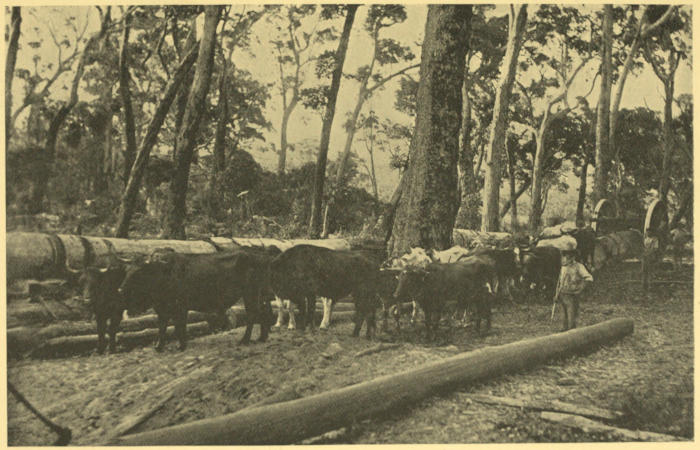
DAVIES’ KARRIDALE TIMBER STATION
Karridale is the headquarters of Mr. Davies’ Karri and
Jarrah Mill Company, and 18 years ago was an impenetrable
forest. Mr. Davies has 42,000 acres leased from the Government
for 42 years from 1882, and the mill was started in
that year amid many difficulties that have been overcome
only by much perseverance. To-day the settlement is a
credit to Mr. Davies and to the colony, and there is a population
of 800 persons dependent on the estate for their living.
There is a good post-office, through which last year the
sum of £2340 was remitted; 3700 telegrams were sent, and
15,000 letters were posted; all the result of the energy and
enterprise of the gentleman above mentioned, who is assisted
by his handsome sons. The Government now derives a revenue
of £5000 per year from this district. Many of the employées
have pretty gardens by their cottages, which are dotted
about the bush in most picturesque fashion. The single men
have rows of cottages to themselves, and there is a large
dining-room built for their use, presided over by a good housekeeper,
and as house-rent is free, and there are no rates or
taxes to pay, this seems to me to be a paradise for the working
community. Any article that a civilised being requires is obtainable
here; you might almost say, from a needle to an
anchor. A large store adjoins the office, and although it is a
private agency, settlers in the district also can get their supplies
there. There is a nice hall for entertainments, which are
often got up by the people, and a ball is one of the frequent
recreations in the winter-time. A handsome little church has
just been built, which we observed when coming into the settlement.
Moreover, there is the unusual institution of a hospital for
horses, of which there are 200 in the place. A hospital for the
people is being built, but everybody looks so very healthy
that I think it will be almost a superfluity. Two market-gardens
and orchards give one an idea of the splendid
productivity of the soil. Ten tons of potatoes per acre,
and apple-trees that yield seven cases each, are quite usual.
There is plenty of good grass, and the bullocks of the estate,
300 in number, live entirely on it, without artificial food,
which means a large saving, and they look splendidly fat and
strong. Mr. Davies was the first man to introduce karri
timber into the markets of the world, and now the company
send supplies of it through England, China, Egypt, India,
South Africa, Mauritius, and all the eastern colonies. Melbourne
has patronised karri timber largely. For wood-blocks
it has great strength, and has been proved by British Admiralty
tests to be equal to English oak. The floors of the art gallery
and museum in Melbourne are laid with karri-wood, and in
London, Pall Mall, Piccadilly, and Regent Street have lately
been paved with karri blocks. A log cut over 40 years ago
was presented by Mr. Davies to the Kew Museum. It had
been in the ocean 30 years, and is now as good as when first
cut. Karri-wood has the further
advantage of not being
slippery, a very essential point
in wood-blocks. The karri is
an exceptionally quick-growing
tree, and when the matured
trees are cut down the young
trees shoot up at once. All the
latest improvements are to be
found at Karridale, electric
lighting and a telephone service
running to the port and to the
lighthouse at Cape Leeuwin.
Mr. Davies has a very handsome
house, built in bungalow style.
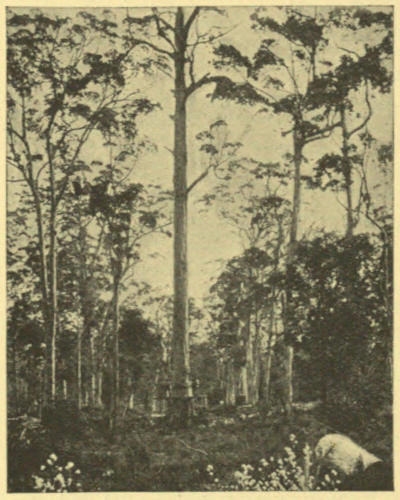
Felling the Giant Karri
Taking a seat one morning, by invitation, in the inspection-car,
with its comfortable seats, I started for a tour through the
forest to the adjoining mills at Baranup, where a great many
men are employed, and where there is another little place, more
evidences of happiness and prosperity, and more little cottages
nestling among the trees. In the butcher’s shop I saw an
enormous block, the complete section of a tremendous tree.
Seeing a strange lady on the car, the men looked somewhat surprised,
but quite pleased. I wished to see the felling of one of
the kings of the forest, upon which four men were then engaged,
two at each end of the cross-saw. It takes six to fell one of these
giants, and when it is coming down one needs to stand “off the
grass,” as the saying is. When felled, the tree is marked off into
certain lengths and severed into so many logs, then numbers of
horses and bullocks appear on the scene and drag the logs to the
nearest landing, then they are put into the truck and borne off to
the mill. At Baranup I was to see the King Karri that I had
heard about before coming, and now, when I saw it, I was
satisfied that, although not yet 400 feet high, it is a king of the
forest; indeed, this giant tree is the largest on indisputable
record in Western Australia. It stands in its great majesty in
one of the most picturesque spots of the colony. Its gnarled
and weather-beaten roots of immense size show that it must be
of great age. Its dimensions were given to me by Mr. Davies,
and are as follows:
| Girth |
4 |
ft. |
above ground |
30 |
ft. |
8 |
in. |
| ” |
6 |
ft. |
2 |
in. |
” |
28 |
ft. |
1 |
in. |
| ” |
132 |
ft. |
6 |
in. |
” |
20 |
ft. |
7 |
in. |
| Height to |
top of branches |
342 |
ft. |
0 |
in. |
| ” |
first fork |
146 |
ft. |
0 |
in. |
This tree would make 146 loads of timber and cut up into
3000 sleepers, enough to lay a mile and a half of railway. Around
here are many more tremendous giant trees awaiting the woodman’s
axe. The demand for Western Australia hardwood is
now far greater than the mills can at present supply.
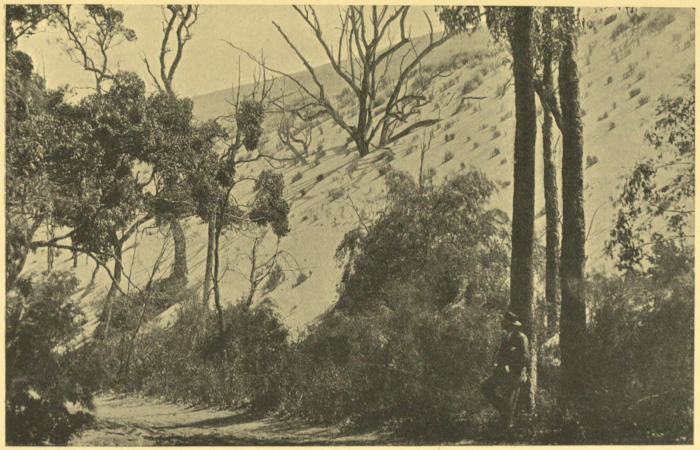
THE SAND PATCH
Hamelin Harbour was another surprise. Next morning I
proceeded on an excursion to that place, the train taking a
quantity of wood-blocks for Melbourne streets. A mile and a
half on our journey we arrived at the top of Hamelin Hill. A
perfect panorama lay around us; the forest was at our back,
while in front lay the Southern Ocean in all its grandeur, with
little bays and headlands falling into its depths. The pier at
Hamelin Bay, which is seen in the distance, a mile and a half off,
is 1800 feet long. As we approached the bay, the homes of the
people employed there and a charming little lake at the bottom of
the valley, with Mr. Davies yacht and several pretty boats lying
at rest on its placid bosom, added fresh charm to the scene.
Arrived at Hamelin Bay, I took a walk down the long jetty, and
the salt seabreeze from both Indian and Southern Oceans fanned
my cheeks with a breath so fresh and bracing that I almost felt
as if I had wings to my feet. Two large vessels were being
loaded; the men seemed to be vying with each other in the
effort to do the most work. Two very large and rather dangerous-looking
rocks are not far off the jetty. I think one is
called Mushroom Rock, and certainly it looks more like a huge
mushroom than anything else but a rock. The other is Peak
Rock. At one of the cottages the wife of one of the men was
most hospitable, and made me a nice cup of tea and some toast,
which I enjoyed after my early morning’s start.
On my return to Karridale, having some time to spare, I
drove out about a mile to see the Sand Patch, which is a most
peculiar place. It is a tremendous sandhill 100 feet high, a
few miles from the sea, and has slowly moved inland a few
inches every year. Tops of trees may be seen over the summit,
looking like bushes. It is 2 miles wide, and can be seen a long
way off at sea. Many sea-captains take their bearings from it.
An attempt has been made to arrest its march by planting
70,000 grass roots in the direction it takes, so as to stop its
advance, but whether the attempt will succeed will only be
proved by time.
CHAPTER XII
Deepdene Caves—Margaret Caves—A Welcome Lunch—Cape
Leeuwin.
The Deepdene Caves were my next place of call, Mr. Bruce
kindly driving a party of us to them, and explaining everything
to us in a most agreeable fashion. I enjoyed the drive so much
that I was almost sorry to arrive. The approach to the caves
is through a deep dell, where there is a brook, called Turner’s
Brook. A very quaint old house stood on a slope, and the high
cliffs in the distance looked picturesque. But I could see no sign
of a cave, and when we came to a stop I was still looking for one.
However, Mr. Bruce soon stopped the trap, and we got out and
were guided by him through some dense bush up the hill until
we came to a yawning gulf, like a gigantic chasm. I own to
feeling a desire to turn back, without seeing the caves at all, so
forbidding did the approach look, but pride came to the rescue.
It would never do to say I was afraid, so assuming a valour,
though I had it not, I followed my guides, who had now lit candles
and also armed themselves with bundles of blackboy rushes.
We entered the cavern, and I found the chasm not so terrible as
I had anticipated. The first large gallery once had a number of
fine stalactites, but some vandals have torn them away. The
path now became very steep, and I had to cling to jutting
stalactites. It was very dark, the candles had gone out, and
the vapours we breathed were not exactly refreshing; but I
had to go on—on—on. I was not sorry when my friends set
light to the friendly blackboys and lightened the darkness.
We were now in a splendid hall, roofed with icicles. There
was an almost perfect opera-box, with lace curtains, carved
arm-rest, pillars, and everything complete. The ground
sounded rather hollow; I did not feel comfortable, so we
moved on to another vast cavern, called the King’s Council
Chamber. It was a grand sight. The light, of course, was
imperfect, as the cave is of enormous size, fully 100 feet high.
The stalactites hang from the domed roof like huge crystal
lights, and shadows play about the walls, which look as if
festooned with lovely lace. Great seats seem to fill the cavern
in the middle. One could almost imagine a king and queen
holding court there, with all their attendants, and being
suddenly turned to marble. It was all very grand, but I felt
glad when I was out in God’s sunshine again, with the blue
sky over my head and the blue sea at my feet. Darkness
and gloom, however grand, do not forcibly appeal to me.
Various other beautiful caves have been discovered comparatively
recently, and named the Margaret Caves, in compliment
to Lady Forrest.
No beaver ever made a more artful concealment of the
entrance to his nest than the lip of the Wallcliffe Cave. Part
some peppermints, push aside the flowing fronds of ferns and
bend low, almost on all-fours, creep slowly for 30 feet, eyes bent
to ground, and then, what a transformation scene! The fairy
grotto of a pantomime, the lustrous lair of the King of Jewels
in the Arabian Nights—these are the only similes that give
even a prosaic idea of it. A circular chamber, richly bedecked
by gleaming white stalactites, with mammoth bunches of grapes,
fleecy wefts apparently as soft as lambs-wool, but solid as
marble, and—upspringing from the floor of the chamber, as if
greedy to clutch the fruit, yet frozen in making the grasp—a
monstrous hand several feet long—these are just hints of what
we see.
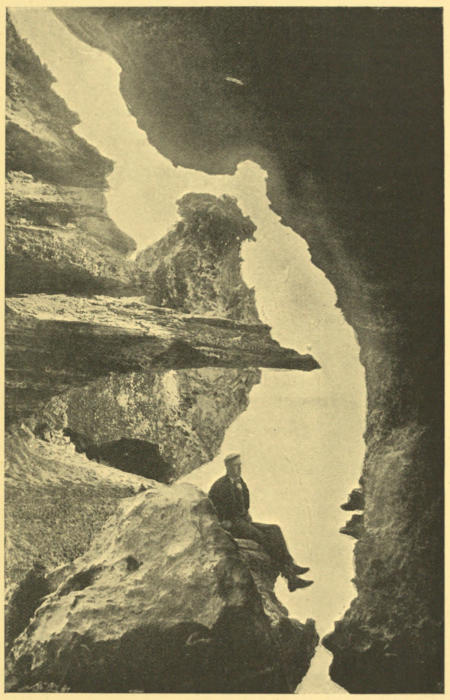
A WESTERN AUSTRALIAN CAVE
The Warrawerrie or Blackboy Hollow Cave is about 2 miles
south of Wallcliffe, and is a mantrap for the unwary, for if
you fall in instead of using the ladder that the discoverer (Mr.
John Bussell) made in order to sound his find, and was
thoughtful enough to leave behind him, you drop 15 feet. This
vertical hole will not take in any one of very round proportions.
So rough and high are the boulders that we scrambled over
on the floor of this cave by the dim, flickering light of a
candle, that we called it “Spion Kop.” It was more than
worth the scramble, however. There is another chamber of
this cave that has never been entered. A broken column,
apparently cut from Italian marble, as pure as alabaster, would
make a noble monument for a patriot. There are also semi-transparent
shields which look like snow-white tapestry from
an Indian loom, but which touch shows to be hard as flint.
While all the caves we saw are worth many times the
journey, the most beautiful is, in my opinion, that known
as Doodjijup, a mile south of Blackboy Hollow, and 100 feet
above the slanderously entitled “Devil’s Pool.” A lady could
go through this cave without soiling her dress. You enter
this lovely “bower” from the side of a high limestone ridge and
the commanding situation allows a pretty prospect of water
and lea, with the shimmering streak of the Doodjijup brook in
the foreground. The access to the cave is rather steep and
somewhat rugged, but when once the inlet is gained the labour
is rewarded, and the visitor can move at ease and admire the
terraces, the columns like the pipes of a cathedral organ, and
the pendants that glow like the stars of night in the three
chambers of this wondrous arcade.
Nearly 3 miles south there is a descent of about 100 feet,
first through an enormous pit like the excavation of a quarry,
and then by the side of a limestone cliff, when the “door” of
Calgadup Cave is disclosed. The floor of this cave is moist
enough to show that it is the bed of a subterranean creek; it is
about 70 feet across. The chamber sides are hung with many
stalactites of myriad shapes and colours under the rays of our
artificial light. What would be taken in a lady’s boudoir for a
very beautiful opera-cloak of swansdown thrown over the top of
a low pillar stands out in the foreground. This is a stalagmite
“growing” upwards, while the stalactite is formed downwards
like the tendrils or fruit of a vine. Here, too, in my opinion, is
the gem of all the caves, the suspended dome, the delicate
tracery of whose splendid and fantastic fretwork hangs in mid-air,
held by almost gossamer crystalline threads.
A running stream which flows over the bed of Crystal Cave,
half a mile south of Nannup Caves, gives it its name. This cave,
of sandstone formation, is almost a ruin owing to the ravages of
marauders and the falling of karri timber overhead, which have
wrought havoc among its former grandeur. Ascending some 50
or 60 feet another vast chamber is entered; the dome-shaped
roof that is set off by colonnades is cracked, and to all
appearance unsafe. Already this season, although there are
few facilities for visiting the caves or for enjoying the fishing
and shooting of Hardy’s Inlet in the cool climate by the seaside,
about 70 goldfield visitors have equipped themselves at
special expense for the tour, which, I understand, they found
highly beneficial, interesting and enjoyable.
From the caves we returned to Karridale, and during the
pleasant drive I somewhat recovered from the fatigue of so much
cave clambering. The next morning early I was fortunate in
getting a seat in a buggy to Cape Leeuwin, the first Australian
land sighted by mail-boats coming from England, and the last
seen by those that leave for the dear homeland. I was
anxious to see this place and to go up the famous lighthouse.
So off we went, bidding a regretful farewell to the
hospitable people of Karridale. We had a drive of 16 miles
before us, but I am never so happy as when seated behind
a good pair of horses and spinning merrily along. I feel
sure that, though thousands of people have seen the cape
and lighthouse from the sea, very few have been so fortunate
as I was in being able to visit it by land. So I felt particularly
well pleased with myself and my trip through the west that
day. As we drove along for 7 miles nothing particular was
to be seen, except perhaps that the forest vegetation seemed to
grow more luxuriantly than ever, and in greater variety; I
noticed several kind of trees that I had not seen in other parts.
Then we got occasional gleams of water shining through the
foliage, and the hills around loomed in grandeur to the sky. The
trees seemed to become smaller as we went along; that was
because we were near the coast. A few miles farther on a pretty
house on the banks of a lovely broad sheet of water, the Blackwood
estuary, came into view. A lady, seeing us driving along,
came out to meet us, and cordially invited us into the house
to partake of refreshments in the shape of fruit and fresh milk
with hot scones, which had just been baked for the family
lunch, and of which we had arrived in time to partake. The
horses were glad of a little breathing-time, during which I
looked round at the scene before me. Over the broad
sheet of placid water wild ducks and swans were dotted.
A fisherman had just come up with a haul of fish, the finest
whiting I have seen for some time, and a tremendous
schnapper. In the distance could be seen the white sandy
bar, with its long white breakers stretching out into the
depths of the ocean beyond. What an ideal spot for a sportsman,
a convalescent, or a pair of honeymooners, so quiet, so
peaceful, so beautiful! Mr. Ellis has lived in this place
for years, and will tell you how, 50 years ago, food was almost
unobtainable, and American whalers were looked to for nearly
all supplies. It is most interesting to talk to this gentleman.
Governor Broome, Governor Weld, and Sir Gerard Smith
(the late Governor), have visited this place, and enjoyed Mr.
Ellis’s hospitality. We soon passed through the old and once
ill-fated settlement of Augusta, and I wondered why fate was
so unkind to such a charming spot, especially as there is such
a natural harbour as Flinders Bay close by. On we went and
reached Point Matthew. Now we were near the corner where
two great oceans meet. On we drove to the edge of the
peninsula and soon arrived at Cape Leeuwin, and its fine
lighthouse. In 1867 the coast east of Cape Leeuwin was
called Nuyts Land from a passenger on board the Guilde
Zeepart, or Good Shepherd, on her voyage to Japan. Cape
Leeuwin, or Lioness, was so named in 1822, after the vessel
from which it was first seen, or, as others say, because the cape
standing at the corner of the two oceans, with the breakers
dashing round, seemed like a lioness defending her home. Be
this as it may, I came here, and was delighted. Years ago,
during a heavy storm, I was a passenger in a sailing barque
loaded with pearl shell that was blown out to sea 600 miles
beyond Cape Leeuwin, but we safely weathered the storm and
I live to tell the tale. Since that time I have always had strong
recollections of this particular cape.
As we drove up the lighthouse stood before us like a
sentinel guarding the seas. We were now on that corner of
our continent where the Indian and Southern Oceans meet.
Right on the southern point at the foot of the high bare
hills, and 700 feet above the sea, stands the white lighthouse
and its shining dome, the building of which was
an event of national importance. It was a solemn and
magnificent sight. To-day the sea was beautifully calm, but
sometimes the breakers roar and lash the strong lighthouse
in their fury; then mariners have to beware of the
Lioness and to keep at a safe and civil distance. The base is 70
feet above high water-mark, the foundations are deep down to
bed rock, 23 feet. The building was erected by Messrs. Davies
and Wishart, and cost £6000, exclusive of the dome and light.
The handsome white stone of which it is built was all quarried
half a mile away. The walls are 7 feet in thickness on the
ground-floor. To get to the top we had to mount a spiral iron
staircase, broken at intervals by 7 floors. These breaks give one
time to breathe and comment on the peculiar sensation of
mounting to the top of a lighthouse; strange it is certainly, but
I would not on any account have missed it. A heavy iron column
goes down the centre to hold the chain and the three-quarters
of a ton weight propelling the clockwork that causes the light
to revolve. It takes 7 gallons of oil each night to keep this
burning. Mr. Tattersall, the head keeper, was most attentive
and kind in explaining all this to me. On the fifth floor is the
telephone connected with the men’s quarters and with the
Karridale Post Office, from which all messages are forwarded
by telegraph. Here also observations are taken every two
hours and recorded. Down the wall there is a lightning conductor.
The lighting apparatus is on the sixth floor, and is a
wonderful piece of mechanical work. The operative power is
clockwork, and the light reflected is equal to 250,000 candles.
The flash is sighted fully 30 miles out from land on a clear
night. Are not the improvements in lighthouses since the
days when little Grace Darling stood on her bible to reach the
lamp that lighted the shipwrecked mariners to safety truly
wonderful?
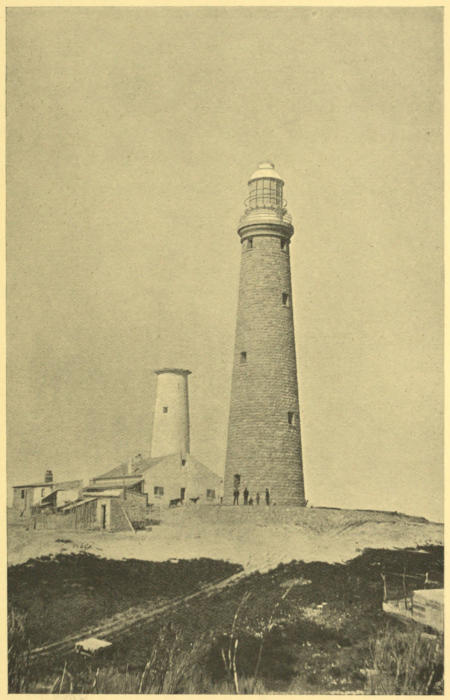
LIGHTHOUSE (OLD AND NEW)
I must confess to feeling very giddy in the head when
I stepped on the balcony outside the dome, but it was the
grandest sight of my tour. On the north side was Hamelin
Bay, on the east the mouth of the beautiful Blackwood, and
the many little islands, reefs and rocks, lying at our feet;
also Cumberland Island; while away on the land side stretches
the vast forest with its millions of giant trees, combining to
form a picture not easily forgotten.
The lighthouse-keepers, of whom there are six, work four
hours each and are then relieved. They report every ship that
passes, and wind up the clockwork weights every hour.
Coming down to terra firma again, and before leaving this grand
piece of man’s work, I read the following inscription on a huge
block of stone: “Foundation-stone laid by Sir John Forrest,
Premier of the Colony, 13th December 1895.” And on the
other side: “Dedicated to the World’s Mariners, 10th December
1896.”
Outside are some comfortable-looking stone cottages, where
the lighthouse-keepers live. My only feeling of regret as I left
was that Leeuwin Lighthouse is not more accessible, so that
many people could take the same enjoyable tour that I had
taken; but time may change even this cape’s inaccessibility.
CHAPTER XIII
Pretty Newcastle—Oranges!—New Norcia—Native Love—The
Mission—Northam—The Grand Old Man—Ploughing Match—Oat
Crop—The Show.
There is without doubt a great field in Western Australia for
workers who will settle on the land and cultivate it. Newcastle
is a little town, nestling at the foot of hills and beautifully
situated near the Avon river. It is a splendid farming district;
the soil will grow almost everything. I saw some magnificent
oranges and vegetables. The cattle are as fat and
sleek as can be. Rain had been falling when I was there, and
now the sun was shining and a beautiful rainbow rose over
the hills. The pink everlasting flowers—acres of them—surrounded
by the green grass, the pretty winding river, the white
bridges and long good roads made up a very pleasant picture.
There is plenty of good land around here waiting to be taken
up and utilised. Newcastle is one of the oldest Westralian
towns, and the roads and bridges were nearly all made by
convict labour in days gone by. There is a great quantity of
stone lying about, and granite is obtainable in large quantities
a little way off. There are vineyards and orchards, and an
elderly woman at the Clackline Junction Station seemed to
be doing a good trade with an enormous basket of splendid
oranges and bunches of pink everlasting flowers. She came
across the meadows and joined the train at Delmore on the way
to Newcastle a boy helping her with the big basket of oranges
just gathered from the trees. She told me she came to meet
all the trains and invariably did good business.
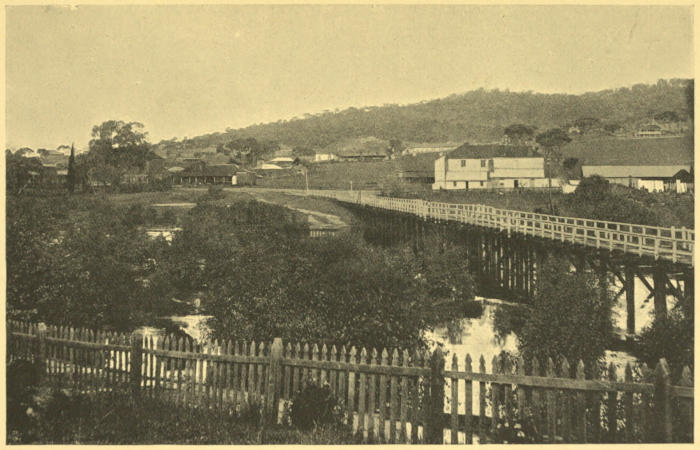
NEWCASTLE
Gold was found about here in 1887 by Mr. Glass, of
Mugakine, who found a piece weighing 11 grains while digging
a well. The ground about the hills is very rocky, but the flats
are fertile and favourable for fruit-trees and vines, and there
is plenty of water in ponds; Mr. Clarkson, in the early days,
found sandstone ranges rising 1000 feet; small rivers fall
between these ranges into the sea.
New Norcia, the Benedictine’s Mission settlement, is situated
on the Victoria plains, about 50 miles from Newcastle by road,
and 80 miles to the north of Perth. You can also go to New
Norcia by taking the train to Mogumbur on the Cue line,
and thence driving 15 miles to New Norcia. Here the late
good Bishop Salvado, laboured amongst the aboriginals for
over half a century, and died at over 85. The religious
community numbers about 60 monks, most of whom are
Spanish. The Abbey is called Abbey Nullias, and there are
a cruciform church of stone, a monastery, and 51 other buildings.
Over 1000 acres of land are cleared and fenced, 800
are under cultivation, and 150 aboriginals are clothed and
educated by the monks. The object of these good men of the
Mission is to civilise and christianise the natives. Bishop
Salvado describes his first interview with the aboriginals
thus: “I tried to begin a conversation by signs with these
poor Australians, so hideous to view, though mild and almost
timid; but all that they would say was ‘Maragna’ (food).” In
1846, Father Salvado and Father Serra, with a few catechists,
were guided by some natives to the site which is now called
New Norcia. Fifty acres of land had been granted them by
the Colonial Government, and thus was laid the foundation of
this now well-known and flourishing settlement. In 1848 the
first R.C. Bishop of Perth, Dr. Brady, sent Father Serra to
Europe to obtain subscriptions and more missionaries for New
Norcia, and 1250 acres of land were purchased by him with
the collections obtained in this way from Europe. In 1849
Father Salvado went to Europe, taking with him two native
Christian boys. There he collected large sums of money, and
on his return a number of missionaries, competent in agriculture
and trade, returned with him, thus giving new life to the
Mission, where they built a chapel, cottages, corn and
granary mills, wooden houses, workshops, and quarters for
natives. The land was soon cleared by these good and energetic
men, assisted by the aborigines whom they had befriended,
and to-day one can look around the Mission and see
happiness, prosperity, and contentment on all sides. All the
aborigines now there are civilised, but, for years before they
became so, they looked on the Bishop as a god who possessed
superhuman knowledge, especially in doctoring the sick.
One native whom he had relieved leaped and danced, and
shouted war-cries, and said: “Father, when you die I shall be
so sorry that I shall kill, not only one man of the enemy’s
tribe, but six kangaroo-hunters, to show everybody the love
I have for you.” Many years have passed away, and if you
now visit New Norcia you will see 1000 acres of fields,
stocked with sheep and cattle; a most prosperous agricultural
settlement; corn in abundance; barley, hay, vegetables,
tobacco, and acres of vineyard, from which a wine, said by those
who have sampled it to be excellent, is made. Fine olives are
grown; olive oil, pure and clear, is made; candied almonds,
figs, raisins, grapes, and apples are in profusion. The
Bishop’s only luxury was snuff, grown at the Mission, which
is very aromatic and provocative of much sneezing. Almost
everything required and used is made and produced on the
spot. The aborigines learn quickly and are most devout
Christians. The Mission has a brass band of natives, who
have been well trained, and their efforts are most pleasing.
Bishop Salvado was in Perth a few months ago, and received
a warm welcome from all creeds and classes; he was then on
his way to Rome, in which city he recently passed away.
Progressive Northam, the gateway of the goldfields, in the
lovely Avon Valley, was the scene of my next visit. The
green undulating fields through which I passed in the train on
my approach to Northam showed a perfect blaze of wild
flowers in every spot where there was room for them to spring
between the well-cultivated farm lands. The rich soil of this
beautiful valley is quite different from the deep sandy soil near
the coast, or from the loam and ironstone of the ranges of the
Darling. Quantities of water are always obtainable by shallow
sinking, should other supplies fail. The fat cattle always seem
to be waiting to accumulate wealth for their owners, and the comfortable-looking
farmhouses impress one with the idea of solid
comfort within. Northam has a population of 2000 people, is
increasing fast, and prospering more than any other agricultural
district in Western Australia; and being the starting-point of
the Yilgarn, Coolgardie, Kalgoorlie, Mount Malcolm and Mount
Margaret goldfields, is really the threshold of the fields, as well
as the great centre of the agricultural industry in this part of
the colony.
A large staff of railway men is employed in the locomotive
department, over 400 men being paid every fortnight at
Northam. The railway platform is half a mile long, and I
believe a magnificent railway station will shortly further improve
the town.
Northam has gone ahead with gigantic strides. On my first
visit, a little over two years ago, it was a very small place indeed,
in fact two places, as I found to my sorrow when I got
out of the train at the wrong station (there are both East and
West Northam) and had to walk a mile and a half up a desolate
country road to get to my destination. Now houses, shops,
banks, &c., are built nearly all along that road, and omnibuses
ply from one end of the town to the other. Northam bids fair to
become one of the most important towns in Western Australia.
There are some charming estates about here, notably that of
the Hon. George Throssell, late Commissioner of Crown Lands,
and now Premier since Sir John Forrest relinquished office.
Mr. Throssell might almost be described as the father of
Northam. He has resided in what he so poetically describes
as his lovely valley home for 36 years, and it is chiefly due to
his strenuous exertions, the devotion of his energies to its
development, and his manly spirit of help to all, that Northam
is what it is to-day. Mr. Throssell goes home to Northam
after his week’s official work every Friday and remains until
Tuesday in the company of his wife and numerous and
happy family of sons, daughters, and grandchildren. This
grand old man has a large and important business in
Northam in conjunction with Mr. Stewart, and branches in
different parts of the colony as well. The machinery stores
are well worth inspection. Every possible kind of English
and American machinery for tilling the soil is here to be
seen. The drill and fertiliser now coming into use make farming
a pastime and pleasure, instead of the weariness and hard
work of past ages. With these new implements of agriculture,
600 acres of land can be drilled with only 20 lb. of wheat to
the acre, in place of 75 lb., as in olden days.
Many new implements were going out to the Jenapullen
ploughing-match, a few miles away, for trial that day; so, availing
myself of the offer of a drive there, I started off to see this
match. The pastoral country appeared very thriving as we
drove along by the beautiful River Avon, and the richness of the
soil gave ample promise of the harvest to come. Bush flowers
were growing all round, native grasses were flourishing in wild
luxuriance, healthy green crops were waving in the gentle
breeze, giving promise of a most abundant yield and adding
beauty to the surrounding scene.
On arrival at the ploughing-field, I found many kinds of
entertainments going on as well as the ploughing, which I was
sure was very splendid, although I did not understand the
art. There was a fine collection of vegetables, bread, butter,
fruit, and many other things; also some very splendid horses,
bred in the district. After the ploughing-match was over, the
folks amused themselves with jumping, running, and pony
races. Every one looked prosperous, happy and contented, and
no doubt was so, for there are many well established farmers
in this fertile district, who long ago secured for themselves
a position of independence.
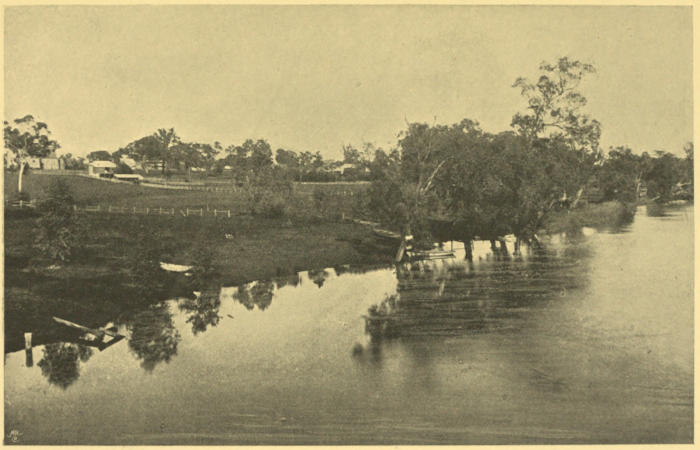
AVON RIVER
What a future lies before this wheat-growing district!
One of the most prominent townsmen of Northam says that
more wheat has been produced there than in any other part of
the colony. Many farmers are also thinking of raising pigs,
to be turned into the toothsome bacon. Mr. Throssell told me
that there are big openings for bacon-curing, as the quantity
of bacon and ham imported to Western Australia last year was
very large.
The Department of Agriculture is doing good work, and
experts are sent out into the different farming districts to teach
the benefits of mixed farming to persons not already acquainted
with them, and any one who wants advice on the management
of vineyards, orchards and farms can, by writing to the Department,
have an expert sent at once.
There is also scope for the establishment of a butter and
cheese factory here. This valley of the Avon is an ideal spot
for a large dairy, and might have thousands of sleek cows
grazing on the rich pastures, and hundreds of rosy-cheeked
dairymaids turning sweet cream into butter and cheese for the
dusty goldseekers.
Northam has a fine town hall, some handsome churches, a
convent, magnificent post-office, and many beautiful mansions
and villas standing in fine grounds with nice gardens. Many
of the favourite English flowers flourish here. Roses, honeysuckle,
geraniums, and mignonette grow very fine in this soil,
and the flowers indigenous to the colony bloom in sweet and
infinite variety. The splendour of Western Australian flowers
cannot be imagined by those who have not seen it. Their
dainty delicate odours are unsurpassable, and if people in other
lands only knew of our glorious wealth of flowers, I am sure
they would be anxious to obtain seeds and cultivate the lovely
blossoms.
Coming from one of the splendid homesteads around Northam,
I passed a wheatfield in the valley that extended farther than
my eye could reach. Oats grow to perfection. One farmer
in the valley, who has a field of 90 acres, last year harvested
as much as 36 bushels to the acre; barley is also grown with
great success.
Our young country has a chance of great and lasting prosperity
for population increases and new people settle on the rich
lands to cultivate them. Mr. Throssell says: “We look forward
to seeing our harbour filled with ships laden with not only
gold, timber, pearl shell and wool products of the colony, but
also with golden grain, wine and fruit.” Our Agent-General
in London, Sir E. Wittenoom, recently said at a dinner in
Paris: “There is something fascinating in the phenomena
of the rise of this new colony of Western Australia, which 10
years ago, with an area equal to nearly half that of Europe, had
only the population of the Isle of Man. Gold reefs were discovered,
and the population advanced with great strides in less
than 4 years from 50,000 to 186,000.”
CHAPTER XIV
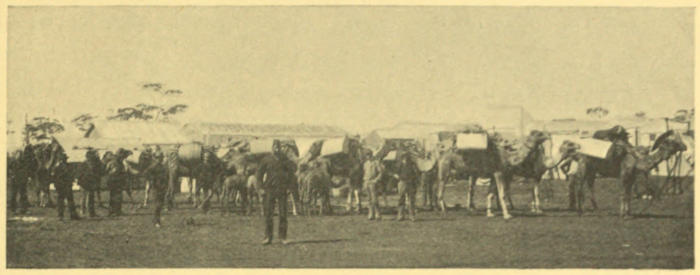
Camel Water Train going to Coolgardie
Southern Cross—Early Discoveries of Gold—Heavy Tramps—Walking
on Gold—Bayley’s Reward—Fabulous Finds—The Potato
Ground—Bayley’s Death—The 90-Mile—The Treasure House—Great
Boulder Find—The Londonderry.
Lake Polaris, or Southern Cross, was so called by the Phœnix
party of prospectors, who, owing to an accidental discovery of
gold by Mr. Ansty at Mugakine in 1887, determined thoroughly
to prospect the country from Newcastle and the Yilgarn hills.
Their first discovery of payable reefs was named Golden
Valley, and, as would be supposed from the name, the reefs
were rich. Travelling by night, guided by the Southern Cross,
the party went on, and 30 miles farther on found reefs still
richer on the site of what is now called Southern Cross.
Two of the prospectors were eventually lost in the Bush, and
their mates, taking a black fellow for tracking, followed their
tracks, mostly in circles, for 30 miles, and at last found the
two poor fellows dead, doubtless from thirst, as they were
without clothing, which is always a sign of that terrible
death.
Southern Cross was destined to become in a short time a
most important place in Australian history, although it did not
become the talk of the world, as Coolgardie afterwards did.
It was from Southern Cross that the news of the magnificent
discovery of Bayley’s Reward and the other rich finds at Coolgardie
came. From the time when Mr. Colreavy, of the Phœnix
party, first found Golden Valley until now, the finds of gold on
the Coolgardie goldfields have been without parallel in Australian
history. Fraser’s Mine, Southern Cross, paid the first
dividend received from any mine in Western Australia.
Captain Oats, one of the most genial men in the West, is the
legal manager for Fraser’s Mine.
When the train came to a stop on our arrival at the Cross,
as it is now usually called, I must confess that I was not
much attracted by the appearance of the place, for anything
more dreary-looking one could not well see. Imagine a sandy
desert, with here and there a stunted-looking tree, a string of
camels, with Afghan guides, some bare-looking houses, and
a few mines with poppet-heads standing out like crosses against
the sky. That is Southern Cross. The train stops at 7 A.M. for
40 minutes for breakfast, and, after travelling from five o’clock
the previous night, one feels inclined for hot coffee at least. I
hurried across to the hotel, and after partaking of a really excellent
breakfast, felt a little more friendly to the place, and had my
luggage taken off the train with the intention of stopping here
a day to make inquiries. After a two-hours rest I started off to
see Fraser’s Mine, and then found that I had to walk half a
mile in order to reach the town, the part where the hotel is
being only the railway portion of it. Across flat uninteresting
ground affording very scanty herbage to a few grazing goats, I
came at last to the town proper, which is one fairly long
street and two cross ones, of little houses and shops. I
here presented my letter of introduction to the mayor, who,
with his wife, was most hospitable; and, in fact, I found that,
in spite of the dreary-looking surroundings, Southern Cross was
not a bad place after all, and that there were a great many nice
genial people living there. Fraser’s Mine is another two miles
on. Nothing much is to be seen, but close to the mine is a
small empty house. It is the house formerly inhabited by the
notorious Deeming (who murdered and cemented three wives
and four children), in which he had stored the cement
in readiness for a new grave for his next wife when he was
stopped by his arrest. I looked inside with a kind of morbid
interest, remembering well the stir there was in Melbourne
at the time when this terrible man committed his last awful
crime.
When one thinks of the hardships people had to endure when
gold was first discovered in this desert, and when water was
scarce and food still more so, one feels that they deserved all the
money and gold they got.[2] It then took four days to get to the
Cross from York and Northam, and the Bush roads were terrible.
One party of fifty Victorian miners started from Albany on
foot, on what was known as Holland’s Track, and after undergoing
terrible privations, 35 of them reached the Cross in safety.
Holland’s Track is so called from the following circumstances:
John Holland and party set out from Brown Hill, 103 miles
from Albany, to reach Coolgardie viâ Southern Cross, the distance
being nearly 350 miles. They paid £50 for three horses
and a conveyance. Their road was through an almost impenetrable
bush. Holland’s way of finding the road was to ride ahead,
the team having instructions to follow his tracks. He then
made observations from the highest points, and was enabled to
judge many miles ahead the nature of the country before him
and the probable whereabouts of water. In this respect he
was singularly successful. He would then take his bearings,
retrace his tracks, and lead the team in as direct a line as possible
to the place. The length of the track cut was 230 miles.
The greatest portion of this was through country unexplored,
and 130 miles were traversed without encountering tracks of
any description, save that of an occasional emu. There
were many high granite rocks in the country, one of such
height and extent—200 feet—that they named it King Rock.
On investigation a splendid supply of water was found on the
top of this, and at the base there is a salt-water lake 2 miles in
circumference.
Another party started overland from Adelaide to the Western
Australian goldfields, and went through hardships that can be
better imagined than described. The course taken was from Port
Augusta along the west coast to Israelite Bay, thence to Fraser
Range and Southern Cross. The track ran through dense
forests and sand plains, where little exists save stunted herbage,
which not even a camel could eat, every bush on these plains
being armed with thorns. The party camped about 6 miles
from Southern Cross on the only decent patch of pasture for
100 miles.
A Bendigo miner, with his party, started from Narrogin,
beyond Broome Hill, for Southern Cross. After going 15 miles
they got bogged twice on the road, the horses being in the
bog to their knees and the dray to the axle. The second
time the men had to carry all their things on their backs.
Next day they had to cut away with an axe big trees that had
fallen across the track. Another day they camped 100 miles
from the Cross, and on getting up early found the horses
gone. After a long search of 15 miles, during which time
they had nothing to eat, they finally found them. Next
day the party set out again, and after 25 miles the axle
broke and the dray became a total wreck; they then waited
coming events, and luckily a teamster came along and
took some of their things. The rest they had to leave
behind. They arrived at Southern Cross after three weeks
travelling.
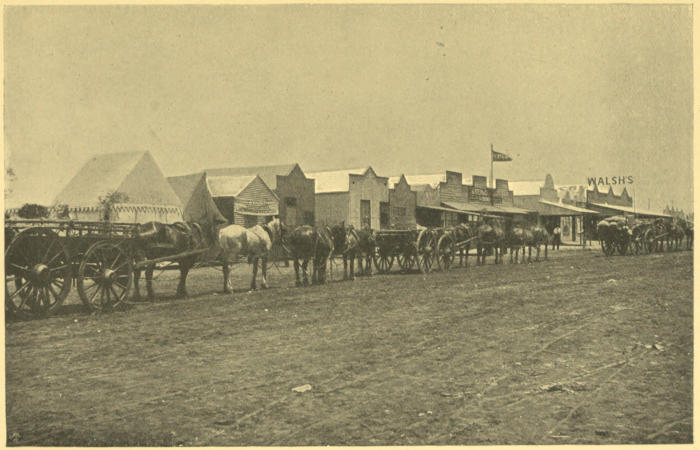
TEAMS RETURNED TO SOUTHERN CROSS FROM COOLGARDIE
These are a few of the experiences of the early days of the
Golden West. After such experiences Southern Cross, no
doubt, seemed an oasis in the desert. Who will say these
poor men did not deserve success? I truly hope they got it.
It was five years after the discovery of Southern Cross that
Coolgardie was discovered by Arthur Bayley, who had formerly
been working at the Cross, but afterwards went to
Nannine and took 1000 ounces of gold from a claim there; then
returned to the Southern Cross in 1892, started from that place
prospecting, eventually finding Coolgardie.
People who were here in 1892 tell me that when the news came
of Bayley’s find the excitement was indescribable. Southern
Cross was almost deserted. Coolgardie lies about 120 miles
from the Cross, and along the track were to be seen men in
scores, using every means of locomotion conceivable. Some
were lucky enough to get teamsters to carry their swags;
others had to carry them on their backs; others, again, had
pack-horses; some had what is called a “one-wheeler” cart.
The wheel is fixed underneath, in the centre is a frame or
miniature platform, on which the goods and swags are placed;
four men take hold, one at each corner, and a start is made.
One enterprising man pushed in front of him an ordinary beer
cask, which he had rigged up to resemble a miniature road-roller.
His goods were on top and he was in the shafts. Other adventurous
spirits had their goods in wheelbarrows, which they
drove through the heavy sand. Camels sometimes crossed as
much as 22 miles of sand plain at a stretch, getting one meal at
the end. As pack-camels only travel at the rate of 2½ miles an
hour, such a journey would occupy the whole of the daylight,
then the Afghan drivers would let the camels lie down until the
moon rose; then on again in search of food, until at 7 in the
morning perhaps they were lucky enough to find some salt-bush
on the shores of a salt lake.
At the stores at Southern Cross in those days you would see
all sorts and conditions of men coming for their provisions.
New chums with white soft hands would sometimes appear on
their way to the goldfields. Those poor hands would look
very different after their owners had put in a month on the
burning sands of the mines.
The railway to Coolgardie from Southern Cross was begun
in 1894 and opened soon afterwards.
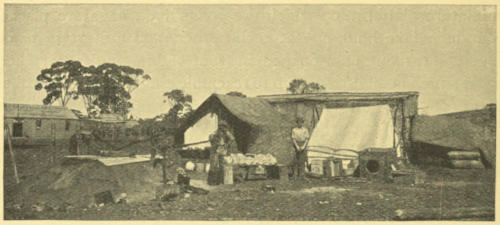
Bakery and Miners’ Camp, Southern Cross
It was with feelings of curiosity that I viewed the desert-looking
country as the train approached the world-famed place.
It is nearly always in waste, arid, and uninteresting places that
gold is found. As the train drew up at the spacious station
and I stepped out on to the wide platforms, where some
hundreds of people were waiting, I looked round me and
said to myself: “Am I really at the famous Coolgardie at
last, the Queen Gold City of the West?” I took a cab—dozens
of them were waiting—and drove to Summers’
Hotel, where apartments had been reserved for me, and
with a sigh of contentment gave myself up to the thought
of thoroughly inspecting this famed place. After a very good
dinner, with white-waistcoated waiters in attendance, and with
every elegance and comfort that could be suggested, I took my
coffee on the broad balcony overlooking Bayley Street. I
found several people who were here in the early days, and who
gave me all the information I desired about the past and the
present. The first thing that struck me in Coolgardie was,
“What a splendid lot of men there are here!” They were,
indeed, unusually tall, stalwart, and good-looking. And why not?
The pick of the Australian colonies, the flower of our manhood,
were here seeking for gold. Next I was struck by the fine wide
streets, lit with electric light, the handsome buildings, and, lastly,
the beautiful horses to be seen in cabs or carts, or ridden by
horsemen. It is wonderful to view this city of the Golden West
which was so recently a desert of sand, mulga-trees, and scrub,
where an occasional emu or kangaroo was monarch of all he
surveyed; where Sir John Forrest and his party of explorers
twice camped, little dreaming of the wealth of gold lying beneath
their feet.
The facts about the finding of Coolgardie are thus given in
Mr. Bayley’s own narrative: “One morning before breakfast,
while going after horses, I picked up a nugget weighing
half an ounce, and before dinner found 20 more ounces in
the same way. We had left Southern Cross three months
previously, prospecting, in consequence of the report of Mr.
Hardman, the Government geologist, who had issued a map
showing the places where gold was most likely to be found, and
had not found any gold of consequence until now. The spot
where we made the first find was about 200 miles from the
present Reward Claim. In about a month, by specking and a
little dry blowing, our gold consisted of about 200 ounces. Our
rations ran out and we made tracks to Southern Cross, but
went back to the old workings, and on Sunday afternoon, while
fossiking around, we struck the reef. That evening we picked
up about 50 ounces of gold, and on Monday we pegged out a
prospecting area on the reef. That morning a party of three men
came on the scene. They had followed us from Southern Cross.
That day we obtained 300 ounces from the cap of the reef.
The party who had followed us stole about 200 ounces from
our claim, so we had to report it. For that purpose I went into
the Cross, carrying 554 ounces, which I showed to the Warden.
The field was then declared open. After another two days we
collected another lot of gold, amounting to 528 ounces. I conveyed
them to Southern Cross, and a fortnight after returning
to the field had to make another trip there, escorting 642 ounces.
All we found was right on the surface, and all we did was to
knock the stuff out and dolly it with a pestle and mortar.
There were six cartloads of tailings left. After the gold referred
to had been extracted from the quantity of stuff, we obtained a
further amount of 298 ounces. We got a little over 2000 ounces
altogether out of the claim. We only had a five-acre lease of
the Reward Claim.”
The news of the unprecedented richness of Bayley’s Find had
long ere this found its way over the entire world. Shortly after
the goldfield was proclaimed, and when the enormous richness
of Bayley’s Reward Claim was flashed all over the Australian
continent, Mr. Sylvester Browne, of Melbourne, a brother to
Mr. T. Browne (better known as Rolf Boldrewood, author of
the famous Australian book, “Robbery under Arms”), travelled
to Coolgardie and, after making an examination of the property,
bought the Reward Claim from Bayley and Ford for £6000
and a sixth share in the mine. The bargain completed,
Mr. Sylvester Browne and some three or four other gentlemen
(mostly connections of his) set to work with their own hands,
and with no other tools but picks, shovels, hammers, and an
iron dolly, extracted the enormous quantity of 9000 ounces,
or £36,000 worth of gold, in a few weeks. On April 8,
1893, a parcel of 2500 ounces, worth £10,000, arrived in
Perth, and was lodged in the Union Bank. Then, on
June 7, 3185 ounces more were received by this bank and
exhibited, and on September 6 a third lot of 3605 ounces
were deposited by Mr. Everard Browne on behalf of Bayley’s
Reward Company, and, finally, during the Christmas holidays,
a trophy, valued at £30,000, was gazed upon by
admiring crowds at the office of the bank. The trophy is a
stirring sight. It consists of 7000 ounces of smelted gold and
600 or 700 ounces of rich quartz specimens, and everybody, from
the Governor downwards, has been to see it. This gold was
taken from a depth of only 40 feet, while some of the biggest
nuggets at Ballarat, Victoria, were found more than 1000 feet
below the surface. It is now placed beyond all doubt that our
golden reefs are what is termed “permanent,” a fact which
pessimists, both in and out of the colony, have until now been
loath to admit.
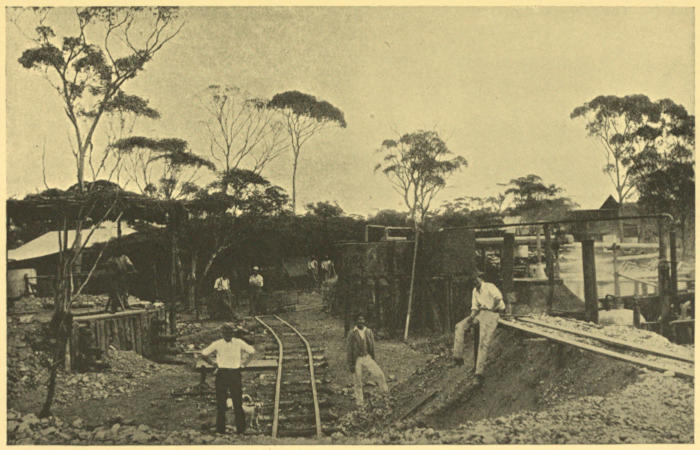
BAYLEY’S REWARD MINE—UNDERLAY SHAFT
Facts are stubborn things, and an ounce of experience is
worth a ton of theory. Here was a mine which in a few months
yielded over,£80,000. The following is an extract from a
Perth newspaper:—
“The cry from Coolgardie is still of astounding discoveries
of such rich gold-bearing rock as mankind has never known
before. There is actually being exhibited at Counsel’s Stores
a lump of gold and stone weighing a little over two hundredweight,
in which, it was estimated by experts, there was nearly
a hundredweight and a half of the precious metal. It looks
as if the time were within reasonable distance when Punch’s
old prophecy would be realised, and the Cheapside hawkers be
seen going about with gold snuff-boxes and a ha’porth of snuff
for a penny.”
One of the prospectors wrote thus: “I left the field at
the end of January last, when things were at their earliest
stage, and even then phenomenal finds were of daily occurrence.
I remember one evening particularly when the
whole camp was thrown into a furore of excitement owing to
three men coming in with a gunny sack full of quartz some
60 lb. in weight (I saw and handled the stone myself), and
before the evening they had dollied 150 ounces from it. At
Adams’ Reef, 25 miles north of Bayley’s, I saw tons of stone
on which the gold was sticking in small nuggets. There was one
place we christened the Potato Ground, owing to the large size
of the nuggets picked up there.
“On Sundays, by way of rest, picks and shovels were
abandoned, and almost every one in the camp went out for an
afternoon’s specking (looking on the ground for nuggets).
Before leaving Coolgardie I had the pleasure of seeing over
Bayley’s Reef. I shall never forget the sight; it settled my
career, and I do not think I shall ever follow any avocation but
that of a miner; for there on this reef, instead of, as one usually
sees in an ordinarily rich reef, specks and perhaps here and
there nuggets of gold—on Bayley’s there were veins, in fact,
literally outstanding bars of gold. So much so that if Mr.
Bayley had given me leave to do an hour’s work on it and take
the results, my trip to the old country and back to Western
Australia would have cost me nothing, and I warrant I could
have had a pretty good time too.”
Arthur Bayley did not live long to enjoy the wealth he
acquired through his discovery, as he died at Melbourne in
1897, at the early age of 34 years. Gold-mining will trouble
him no more. The handsome city of Coolgardie remains a
monument to his memory.
Many other reefs had by this time been discovered by various
parties at different distances from Coolgardie, one notably big
and rich one at the 90-Mile, called the “Roaring Gimlet.” No
stores or provisions lay that way, consequently great privations
had to be endured. However, those who managed to remain
got surprisingly rich stone on the surface. Here the quartz
was quite white and barren looking, but, on sinking, rich alluvial
gold was found at the rate of 250 ounces to the ton. Half-way
to the 90-Mile, at what they call the 45-Mile, surprisingly rich
results were also obtained.
The camp at Bayley’s was at this time a scene of intense
excitement; 3000 men were on the field. Such a collection of
habitations was never before seen—blanket-shelters, bush-humpies,
and tents covered the ground; men were digging,
specking, dry blowing, and knapping every bit of available
quartz. Then provisions and water got scarce; famine was
feared, and many of the miners had to move on. “Water,
water, everywhere, but not a drop to drink.” Many a poor
parched prospector on the weary tramp has said this, and many
explorers in this vast country have given the same cry. No
water—this is the terror of the Australian desert, more deadly
than wild beasts or savages in other countries. As the dragon
in olden days guarded the gate of the Hesperides wherein grew
the golden apples, so thirst, famine and fever seemed at first
to guard Nature’s treasure-house. Civilisation and engineering
have now greatly diminished these terrors, and in the new
Eldorado large cities have arisen where once was an inhospitable
desert.
The marvellous City of Kalgoorlie stands on the site of
Hannan’s Find.
Twelve months after the finding of Coolgardie an important
discovery was made 24 miles away in a north-easterly
direction. About 150 miners had set out to search for some
lost prospectors near Yerilla. They were compelled by lack
of water to halt, and actually camped on the spot where the
find was afterwards made! Rain fell and the main body went
forward and continued their search, but two of the party, named
Hannan and Harrigan, remained, and stumbled on what has since
proved to be the richest field the world has ever known. They
had begun specking, and obtained nearly 100 ounces in a few
days. As gold is worth nearly £4 per ounce, that was good work.
They returned to Coolgardie, reported the find, and secured an
area equal to 10 alluvial claims. Nearly 2000 men followed
them on their return to the find, most of whom remained there.
It would be impossible to tell in words the value and marvellous
richness of this new Eldorado. Nine thousand ounces of gold
were taken from 4 tons of stone at Hannan’s mine, and other
claims of 50 feet square yielded 400 and 500 ounces of gold
each. Some of the prospectors were new chums, and had
never been on a goldfield before. One who knew nothing of
mining sunk his shaft by sheer luck fair on the gold. Hundreds
of practical diggers had walked over the ground before, little
thinking that the ironstone gravel was so rich in the precious
metal and that they were passing over thousands of ounces.
Another man dollied (that is, crushed by hand labour with a
heavy weight) 650 ounces in three weeks, the only implements
being half a bottle of quicksilver and the head of a pick. Many
a time these prospectors of the gold country have felt that a
spring of fresh water and a few loaves of bread would be more
welcome to them than all the gleaming gold they were getting.
Under what trials did they work! No water to wash the dirt,
and yet the ground so moist that they had to dry the dirt
before they could blow it to find the gold; yet they persevered,
and many found fortunes by hard work and persistence. No
wonder many miners say that gold-mining is not so easy as
falling off a log.
An Adelaide syndicate at this time sent Messrs. W. G.
Brookman and Pearce, with a capital of only £150, out of which
passages, camels, and rations had to be found, to prospect
around this marvellous new find, which they did with such
success that they discovered a still more wonderful place 3
miles from Hannan’s Find, and now called the Boulder. Their
find has since proved the greatest of all. The first claim was
called the Great Boulder, and the property included two ironstone
hills, one 100 yards long by 50 feet wide; the other twice
that size. These hills were covered with rich stones, the
prospectors picking them up from all parts, and Mr. Pearce
picked up several large slugs (nuggets) at the foot of the hill.
They afterwards took up several more claims, and soon found
these to contain enormous gold-bearing reefs. Messrs. Brookman
and Pearce, by keeping to the old adage, that “a still tongue
makes a wise head,” remained undisturbed, and were able to take
up all the ground they wanted. Lake View Consols, Ivanhoe
Associated, and other rich mines were taken up by this little
syndicate, and are now valued at £21,000,000. Mr. Brookman,
as you may suppose, is now one of the millionaires of Western
Australia.
The next great find was the Londonderry, in May 1894,
when thousands of ounces were dollied out from the surface.
Lord Fingall bought out the claim for an interest and £180,000
cash. Then followed the Wealth of Nations, from whose first
find was taken an enormous quantity of gold and specimens
worth £20,000. This claim was soon bought up for £150,000.
The inevitable rush to both these places followed. The men
all seemed to run mad in their thirst for gold. It was at
this time that almost everything showing gold was snapped
up and put on the London market. Stories savouring of the
Arabian Nights were in free circulation, and thousands of
people from all parts of the world began to flock to Western
Australia, which from comparative obscurity has now become
the greatest gold-mining country the world has ever seen,
and, no doubt, the interior of this vast country holds an
almost inexhaustible quantity of gold-bearing quartz, which
in years to come, when railways and other appliances have
made it easier to reach the far-off fields, will be discovered
and used. We may see such marvellous discoveries of gold
that “Golden Western Australia” will be the fitting name for
the once neglected Cinderella of the colonies.
CHAPTER XV
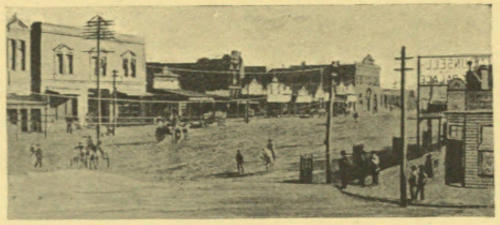
Bayley Street, Coolgardie, 1897
Coolgardie—The Camels are Coming—The Landlord’s Record—Meeting
a Friend—A Goldfields Camp—“Nap”—The Reward
Mine—Bonnie Vale—Londonderry—Nearly Lost—King Solomon’s
Mine—Hampton Plains.
At 9 o’clock in the morning after my arrival in the Golden
City, I stood gazing in amazement at a string of 135 camels,
with numerous baby camels, such funny-looking creatures,
walking by their mothers! The Afghan leaders came crying
“Hoostah,” and their Indian dresses and huge turbans made a
most picturesque sight for eyes that had before only seen the
like in pictures, or, yes, one, I think, at the Melbourne “Zoo.”
Then another camel came trotting or galloping with a
European on its back, who seemed as much at home as on a
horse. I am told camel-riding gives one a sea-sick feeling. I
have never tried the experiment of a ride, though several ladies
on the fields have done so. To look at the camel you would
think a step-ladder required to mount one, but it is not so, as
the camel kneels down and allows you to get on his back;
you then cling on tight, while he proceeds to get up, which he
does with an awful jerk, at the same time making a peculiar
bellowing noise, which sent me away to a good distance.
When I tell you that a camel’s hind legs will reach any part of
him, over his head, round his chest, and on to his hump, and
that he has the unpleasant habit of shooting out his legs without
warning, and also that his neck is of the same pliancy, you
will not wonder that the “ship of the desert” has no charm for
me. The camel is the great beast of burden of Western
Australia; the first were brought as an experiment to the West
by two Hindoo traders; these animals quickly came into favour
in the waterless districts, and now there are thousands of them
carrying supplies to the different parts of the colony. They
are very obedient to their Afghan masters, but it is difficult for
a white man ever to obtain great influence over them; they
never seem to take kindly to white people. A string of these
useful but ungainly animals is led by one of their own species,
a string passing through a peg in the nose of every camel in
the train, and keeping them in a line. The headgear of a leading
camel is a gay affair; a network of fancy coloured wool with
many a bright-hued tassel and white shells, finished off with blue
and red beads. The Afghans are very careful and proud of
their “leading gentleman.”
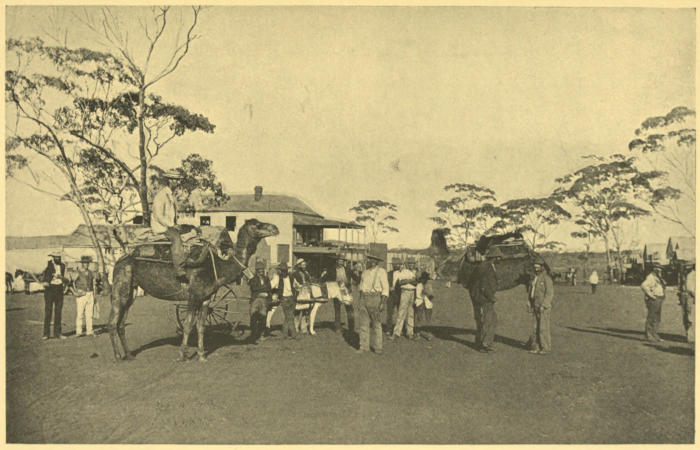
EARLY DAYS, COOLGARDIE
Taking a drive round Coolgardie I was much surprised at the
size of the place. It is four miles square. Driving out to the
racecourse we passed the recreation-ground. As it was Saturday,
many of the boys of the town were playing cricket. We
passed through the suburb of Toorak. Certainly there are no
fine mansions; for the most part the places are Hessian camps
with occasional tents, but there are also some very comfortable-looking
wooden cottages, many with praiseworthy attempts at
ornamentation, painted light green, and not at all unpleasing to
the eye in this sandy and desert-looking country. There are
no large trees here at all, a few medium-sized ones, and plenty
of mulga scrub and salt-bush, which looks most dry and uninviting,
but contains much nourishment, so that sheep and cattle
thrive well on it, and mulga is almost the only food of the camel.
Returning to Coolgardie, we passed through the town again
and crossed the railway bridge to the other chief suburb,
Montana. Here we saw the fine residence of Warden Finnerty,
and the hospital, called John of God. On we went past the
suburb along the road to the famed Londonderry. The
country just here was very pretty; there is a deep gully on
one side with a good deal of vegetation, which, after all the
sand and mulga, was most pleasing to the eye. The sun was
just setting, and the brilliant red of the sky seemed to cast a
reflection on the earth. The mines in the background, with the
tents scattered round, a camel-train along the bush, and the
town in the distance, formed a unique picture. Returning we
took another direction, past the oldest part of the town, and
past the Afghans’ camp. The day’s work was done and
hundreds of camels were lying down or munching the mulga.
The Afghans were preparing their evening meal and chattering
to one another in shrill voices. I soon saw quite enough of this
part, and was not sorry to return to my comfortable quarters
at the hotel.
The population of Coolgardie and the immediate neighbourhood
is at the present time about 13,000; a few years ago there
were more than twice that number, most of whom have gone to
the Kalgoorlie and other fields, as the enormous richness of
Coolgardie is now a thing of the past, although many mines
are still yielding well.
There is a really splendid post-office, also a court-house and
warden’s offices, recently finished. These are three of the finest
public buildings in Western Australia. There are many other fine
buildings, notably the Grand Hotel, Union Bank, and Beaconsfield
Chambers. The Chamber of Mines is another handsome
building on a splendid site, and a most valuable place for the
mining community. The Chamber of Mines keeps the people
of the world well informed concerning the great gold-mining
industry, and communicates statistical information of a trustworthy
character to every member interested in the mines
of the colony, as well as information concerning the fairness
and justice of legislation dealing with mines. One half of the
building is occupied by the Coolgardie Club. Looking at these
magnificent buildings in the wide and spacious streets, all
lighted up by electricity, and supplied with every luxury, one
can scarcely realise that a few years ago Coolgardie was a
sandy desert; where many men went through hardships almost
beyond imagination; where fever reigned supreme; where the
bare necessities of life were daily longed for in vain; where
comforts were the things to be only dreamed of and the
isolation was terrible; where tinned meat, the only kind
obtainable, became almost hateful, and received the name of
“tinned dog”; where one could almost cry, “Water, water everywhere,
but not a drop to drink,” since the pioneers often found
themselves in a wilderness with nothing but salt water, quite
unfit to drink, and refused even by the camel, who is supposed
to drink almost anything obtainable. Camels would stray
away seeking for water, and then the owners would return to
their camps disheartened, saying that they had no time to look
for gold, it took all their time to look for water and camels.
The terrible longing for home news, and the uncertainty of
getting any; the wall that seemed to divide the miners from
the rest of the world, together with the feeling that there was
untold wealth of gold lying beneath their feet if they could
only hold out and keep up strength to get at it, made their lives
almost intolerable, and many of those first prospectors have
gone under, poor fellows! leaving others to reap the reward
and to make Coolgardie the wonderful place it is to-day.
Then came better times, when sufficient food could be
obtained, and water condensers were brought, which, by a
certain heat process, made the salt water more fit for use,
although it was still sometimes so bad that the rich prospectors
often performed their ablutions in champagne by preference
to it.
Going down Bayley Street that morning there was quite a
stir outside one of the smaller hotels. Of course, woman’s
curiosity prompted me to stop and look, and I found a wedding-party
just returned from church. The landlord of this hotel,
Mr. Faahan, has really had a unique experience in servants, for
this is the twenty-second of his women assistants, presumably
in the bar, who has entered the bonds of wedlock while in his
employ. The hotel is one of the oldest in Coolgardie. I have
since entered it and met the genial Mrs. Faahan, who took me
outside and showed me an old tree beneath which the first drink
under licence was served in Coolgardie. The place that is now
the kitchen was then the bar, gold-dust was plentiful, and
champagne ran like streams of water. Opposite to Mr.
Faahan’s is the Cremorne Theatre, a very large place now, but
in the first days it was a shed with a stage made of rough
planks laid across beer-casks, and no accommodation for
visitors to sit down, and it is said that the miners used to pass
the time between the “turns,” as they call them, by calling out
the favourite players and throwing nuggets or screws of gold-dust
at them. Good old days!
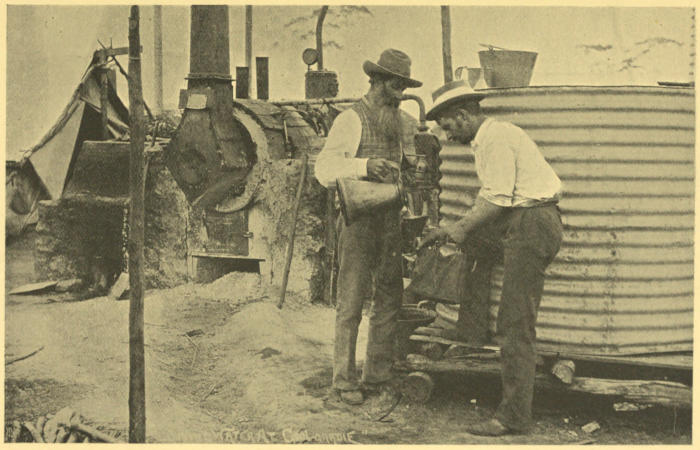
WATER CONDENSER—FILLING THE WATER-BAG
Taking my bicycle I went for a tour of inspection around the
various streets adjacent to the town, where I found many very
nice houses, and to my surprise saw a lady in a very nice
carriage drawn by a pair of greys. Truly, I ought to be
surprised at nothing in wonderful Coolgardie. The roads here
are the most level and the best for cycling I have ever ridden on;
not only are the streets remarkably wide, but the footpaths
also. The town is on quite a plain. Riding merrily along I
was overtaken by a man cyclist, who did not favour me with
more than a passing glance, lady cyclists being no rarity here.
I, however, recognised him as an old friend and called out,
“Jack, don’t you know me?” He stopped in astonishment at
seeing me riding about Coolgardie on a bicycle, as we had last
said good-bye in New South Wales, three years since, before
his leaving for the Golden West, whither I then had no intention
of migrating. After a little chat, in which I discovered
that Jack had not struck a gold patch or “made his pile yet,” he
invited me to the camp to dinner with himself and the boys
(his mates), and feeling quite anxious really to see for myself
what the inside of the camp was like, I did not require a second
invitation. We accordingly rode off side by side, past endless
rows of tents and hessian camps, all alive with the miners now
home for their dinner. Some of them had wives in the camp
to cook their dinner, but the majority of the campers had to
cook for themselves. “We must hurry up, for I am cook this
week,” said my friend, and pointing to a parcel on the bicycle,
remarked, “Here is our dinner that is to be.” No tinned
dog now, as it used to be, but real, genuine steak. On
arrival at the camp we found two of the boys anxiously
awaiting the arrival of the steak, and somewhat surprised at
seeing Jack accompanied by a lady cyclist, whom, however, they
greeted with much heartiness. Poor fellows! here were four of
them all away from home and mother; all had given up good
appointments on the other side to come over and search for gold.
They were all very jolly, however, and said that they had no
cause to complain of Coolgardie. My first anxiety was to inspect
the camp, which was a neat one. It consisted of five little Hessian
houses: four of these were the sleeping apartments of the four
mates, and two of them especially were models of comfort, as
far as the boys could manage it. One was lined with bright
cretonne, a shaded lamp by the side of the bed, a rough
bookcase with the owner’s favourite books and photographs of
various friends opposite; a nice cosy chair and a wooden
table, made by my friend Jack, completed the furniture. Then
another had his camp lined with green baize, very nice in winter,
but too hot, I imagine, in summer-time. Here was a nice little
table, two shelves painted with white enamel paint, and some
sketches done by the owner; many little presents that had
been sent from home were being proudly shown to me when
we heard the welcome sound, “Dinner is ready.” We then
adjourned to the fifth tent, which proved to be dining-room,
parlour, and card-room in one. A table down the middle
covered with oil-cloth, a bench at each side, with a side shelf
and rustic dresser, formed the furniture. The steak was cooked
splendidly. My thoughts went back to the time when I had
seen Jack last, quite a swell young man at Newcastle, N.S.W.,
and now here he was in a wide hat and shirt-sleeves, cook
to the camp, and looking, I must say, all the better for his
roughing experiences. They had brought out the man in him.
Before he was somewhat inclined to be effeminate, now he had
become a fine fellow. But I am wandering away from the
dinner-party. The butter was good, although it was tinned
butter, and the bread as light as a feather. “The baker calls
every day,” they told me, “and if we are all out we pin up a
memo. on the door and tell him how many loaves to leave.”
“Now,” said Jack, “I must go out and get the pudding.” I
felt I ought at least to assist, and was also a little curious to
see how it was being cooked, so getting up in spite of protests
that I was the guest and must do nothing, I went out to quiz.
I found the fireplace consisted of two iron spikes in the ground
with a bar across, from which hooks were hanging, and on the
hooks were two billies (tin cans with wire at top to hang by), one
with tea and the other with pudding. I was presently to have
what we call in the colonies “billy tea.” I could see no pudding-cloth,
but presently Jack fished out a shining tin which proved
to contain one of Swallow and Ariel’s Melbourne plum puddings,
and a delicious one it was. Mothers in the colonies and
in England need never fear that their boys away on the goldfields
do not get nice puddings or cakes while Swallow and Ariel
are to the fore. Returning to the dining-tent pudding laden, I
found the boys had just extracted from a tin a sweet cake and
also a preserved pineapple. This, with tinned Viking cream and
the billy tea, finished up a dinner fit for a Princess of Coolgardie,
as indeed I felt myself to be that evening, with those four boys
doing me homage. I found out afterwards that they had
all these nice things in the camp in reserve for Christmas, but
they were only too glad to open them all in my honour.
Apropos of tinned articles, the piles of discarded tins on the
fields make one open one’s eyes; there must be millions of them.
One of my friends told me that in earlier days, when everything
in the palpitating heat-waves and fearful grilliness of the camps
got destroyed with heat and dust, they used to come home to
their meals feeling almost inclined to fall down and worship the
tinned vegetables and meat that they had buried in holes to try
and keep cool, and that these were the only eatable things to
be got. Canned apples were a special luxury for Sundays, and
took them back to orchards and gardens where they had
wandered in the past. “Those apples, with a lump of plum
pudding, full of good things, sustained our waning energies and
brought us up smiling out of our then dreary camp life, and,”
said another, “it brought back happy recollections of civilisation
and home.”
After dinner we played a game of Nap on the camp-table,
and I was the winner of nine shillings, after which they all
escorted me back to my hotel, calling in on our way to see some
other friends at another camp, which proved to be a more
pretentious place than the first, and consisted of one of the
pretty cottages before
spoken of, the tenants
again bachelors. The
inmates, a mining
manager, his secretary,
and clerk, are attended
by a Japanese
servant; a very nice
piano was in the pretty
drawing-room. One
of the boys sang “Queen of my Heart,” in compliment he
said to me, and after a friendly glass of wine we resumed our
bicycles and rode gaily into the town, where I bade them
good-bye, after spending a most enjoyable afternoon in a goldfields’
camp.
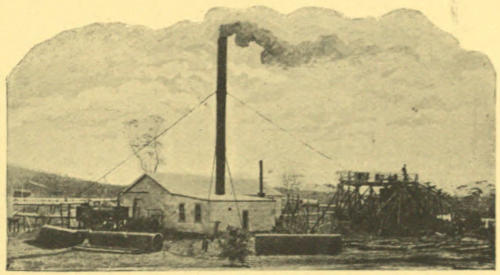
Burbanks Grand Junction Mine
I went next day to see Bayley’s Mine, where those wonderful
first finds were made. As I drove down broad Bayley Street and
looked at the stately buildings, I could not but think of those
early days and of the excitement of that time.
Of course I did not expect to pick up lumps of gold as people
did then, but I certainly intended to keep my eyes very wide open,
for I knew it was not an infrequent occurrence for men to find
good slugs of gold about Coolgardie still. There are always a
lot of men fossicking (looking for gold at the surface)
about Bayley’s, and recently a man found a specimen of
quartz weighing 144 ounces, and containing 97 ounces of pure
gold; later on he found several smaller pieces near the same
place. The country around Bayley’s is not very striking.
Beyond the mines working and the smoke from their batteries
there is nothing to be seen except miles of holes where the
prospectors have been at work seeking for gold. It must have
been a busy scene when they were here. Thousands of miners
digging away, and then washing the stuff in tin dishes to see if
there was a show of gold; and if one hole showed nothing,
away they turned to another. The manager of Bayley’s took
me round and told me that the mine is still very rich.
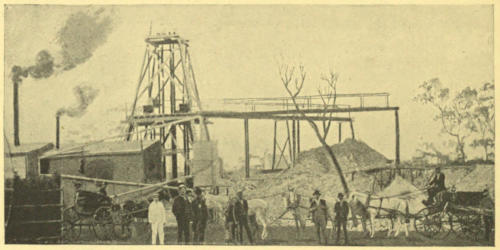
Vale of Coolgardie Mine
I think the people of Coolgardie ought to erect a memorial
pillar to mark the wonderful spot which may well be called the
Mother of Coolgardie. Little did the pioneers think, when they
camped on this spot a few years ago, that the arid desert would
turn into a fine city, with more golden country farther out, and
other cities, with tens of thousands of people earning good
wages, and many amassing large fortunes. Such a transformation
in so short a time the world has never known.
After leaving Bayley’s I crossed through a network of poles
until I struck the main road, and drove off to Bonnie Vale,
which deserves its name, the country being very hilly and
quite surprisingly fresh and green. Here many fine mines,
viz., the Vale of Coolgardie, New Victoria Consols, and others,
under the control of Mr. A. E. Morgans, the member for the
district, are in full swing, and only wanting plenty of water to
give big results. A very nice little town lies close to the mines.
In another direction are the Big Blow and the Flagstaff; then
come Burbanks and Burbanks Birthday Gift. Burbanks
Birthday Gift is really a splendid mine. The main shaft,
with its steel poppet-heads, is well worth a visit, and so are the
interesting models of different parts of the mine, which were
sent to the Paris Exhibition. Lady Charlotte Mine is well
worth inspection; a fine new battery has lately been erected,
and operations are now in full swing. The gold I saw
from this mine—what they call “coarse free gold”—was very
splendid, and the quartz with the gold showing through was
exceedingly rich.
I next visited the famous Londonderry Mine, some five miles
farther on through the bush. I had some difficulty in finding
my way, as, after leaving the last mine a few miles behind,
there were several tracks, and I did not know which to take.
However, I took the one to the right, and, after going on
another mile, came across a party of five prospectors, who
looked somewhat surprised when I drove up and asked to
be directed to the Londonderry. They were, however, most
civil, and gave me the requisite directions, one even offering
to accompany me. That, however, I thought unnecessary,
so I drove off, and soon came in sight of the big poppet-heads
of Londonderry, and none too soon, for I had just
discovered that a portion of the buggy I was driving had
given way and I could not have gone on much farther. The
mine and its surroundings gave one a very favourable
impression. Everything looked bright and nice. I drove
up to the manager’s office, who immediately sent a man to
take the buggy to the blacksmith’s shop for repair, the
horse to the stables for a feed, after which he kindly invited
me to his house, and giving instructions to his housekeeper to
attend to all my wants, had to leave me, as it was time to go
down the mine for inspection. I was not at all sorry for a
rest in a cool room, with a cup of tea and some excellent
cakes made by the housekeeper, for after the drive of ten
miles in the hot sun through the Coolgardie bush I felt that
there are drawbacks to travelling. When the manager came
up from below he escorted me over the mine and showed me
everything of interest. Londonderry was, after Bayley’s, the
richest find near Coolgardie, and held a wonderful record.
The mine is the brightest-looking I have seen. Everything
about it seemed spick and span; the manager’s house was
a model of comfort. There was a store, a blacksmith’s shop,
offices, and, indeed, every appurtenance that could be desired
for a mine. The manager unlocked the great iron safe and
showed me such gold that I had never seen before. I felt
like Shakespeare’s Benedick, “I did not think that I should
live to see such gold.” It was really the most brilliant and
beautiful sight I had ever seen. One large block of white
quartz was thickly studded with gold in nuggets all over it.
I wanted to pick one off, but on trying to do so found it firmly
imbedded in the quartz. Over a dozen magnificent specimens
came from one rich pocket. Down below in this wonderful
mine, at the 200-foot level, a huge case is fitted up with iron
doors for the reception of the rich surplus ore that the safes
cannot hold. I admired some peculiar-looking specimens that
I was told were felspar, which is valuable for glass-making,
and is found here in large quantities.
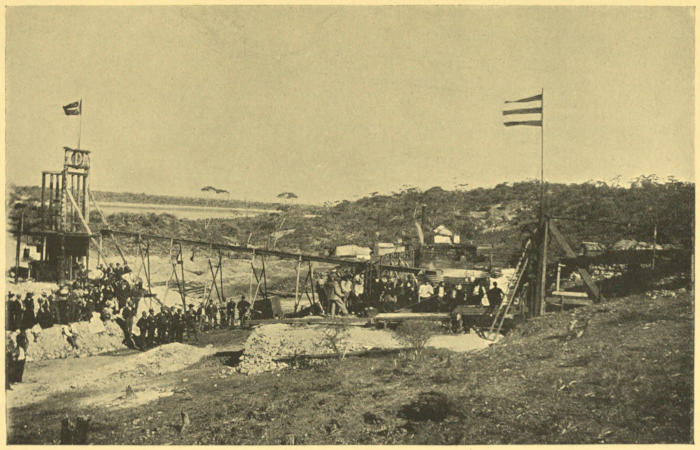
JUBILEE AT RED HILL MINE
After all the kindness I had received from the manager I
bade him a reluctant farewell, as it was getting late and
a ten-mile drive through strange country to Coolgardie lay
before me, but I knew there was a moon that night, and did
not fear the Australian bush at all, so I refused the offer of an
escort, and drove off by a different road from the one I came
for I wanted to see the township of Londonderry before I left.
This is about half a mile from the mine, past the tidy camps
of the men, who all came out and bade me a cheery good-bye.
I stopped long enough in the town to see that it is remarkably
well laid out, with a very wide principal street, a few very
nice buildings, viz., post-office, store, hotel and church; also a
nice recreation-ground, where a number of the miners and other
townfolk were playing cricket. But I had to hurry away, so,
turning round a corner and following the telegraph-line, I
started for Coolgardie. The sun was just going down, the
heat of the day was over, and with the evening a refreshing
breeze had arisen. I drove on quite happily. Nothing happened,
except that I met two swagmen in the Bush, who looked at me
so hard that I must confess I whipped up the horse and got
on as quickly as I could. I was now on quite a different
road from the one I came by. Everything looked strange,
and I began to wonder whether I was lost, but consoled
myself by looking at the telegraph-line, which I knew must
lead to Coolgardie. The Wealth of Nations Mine lies in this
direction, one of the Western Australian golcondas of early
days, where discoveries of gold, frequently in pockets—small
holes containing comparatively large quantities of gold—such as
had not previously been known, were made near the surface, and
caused the wildest excitement. It was, however, too late to
go there now, so I continued on the same road. Another
mile brought a big mine in view, and to my relief I found
myself at Burbanks again, and on the main road, so I was
all right, and drove merrily along, meeting only a carter or
so walking by the side of their teams, who, seeing a lady
driving alone, said, “Good-night, missus,” and went steadily
on. As we got to the rise of the hill at Montana the presence
of hundreds of lights gave me welcome to the Queen City of
Gold, so there was a safe ending to that day’s journey, and
both myself and horse were quite ready for a good supper
when we arrived at the hotel.
Next morning I started for Hampton Plains, which is a
large area of ground taken up many years ago by an English
syndicate at 2s. 6d. per acre for pastoral purposes. However,
when the rush of ’92 broke out at Coolgardie, the news
travelled to England that the great rush was only a few miles
from their territory. No wonder that they then immediately
sent out an expert, Mr. Lapage, M.I.E.C.E., to reconnoitre.
On Mr. Lapage’s arrival he found that a considerable number
of alluvial surface holes had already been struck, and
1000 ounces of gold had been taken out within their
boundary. Going over the land he found shows of gold in
various places; owing to the scarcity of water, nothing much,
however, had ever been developed there until recently, when
the estate was thrown open to prospectors. Large brickworks
are now started on one part of the plains, and the demand from
Kalgoorlie for bricks is so great that the company have lately
duplicated their plant in order to make bricks enough to meet
the orders they receive.
On my way to Hampton Plains I called at Bayley’s South,
which are yielding up very good gold. I saw a lot of ore
come up out of the mine that showed gold distinctly. I felt
myself becoming quite an expert now. The ore brought up
here is in part hornblende schist, carrying very visible gold.
The manager told me the gold had evidently been shed from
the reef into the surrounding country rock, where there are
cross reefs. I also saw some ironstone, which I was told was
very rich, but the gold in it was so fine that one required to
use a magnifying-glass, with the aid of which I could distinctly
see it.
I next visited King Solomon’s Mine—not Rider Haggard’s
famous one but an exceedingly interesting namesake. Here there
are quantities of the diorite mixture of felspar and hornblende,
with gold distinctly showing through. This is an unusual and
peculiar geological formation, and the best specimens found
on the field are at this mine. The gold has been found impregnated
in the diorite at a considerable distance from the reefs,
probably deposited there by water. I presently passed the
Golden Queen, and thought this such a nice name for a mine
that I had to get down and inspect it. I was lucky in just
being in time to see two bars of gold come up from the smelting
works, and felt very covetous. The manager told me that if I
liked I could take them. I tried to do so and found they were
too heavy for me to carry, so perforce had to leave them, much
to my regret. I now approached Hampton Plains, a very flat
part of the country, as its name indicates. I looked around in
vain for a hostelry where I might put up and refresh myself and
horse, but no sign of anything of the kind appeared; about a
dozen nice-looking houses in a line were all I could see, the
rest was plain, plain, plain. I summoned courage to open the
double gates of one of the houses and drove up to ask for a
drink for my poor horse, who seemed almost overcome with the
heat of the day. A man seeing me came to inquire what I
wanted, and while I was speaking to him a lady appeared on
the broad verandah and kindly invited me to enter. I was
really glad to do so. Mrs. Ridsdale—for such was the lady’s name—kindly
told the man to put the horse up and go and try and
find enough water for a drink for him. They were really without
water on this dreadful hot day, waiting for the water-carts
to come with supplies. However, I was hospitably entertained
with soda-water and claret and biscuits, and after a rest, finding
that my horse had been refreshed with water, and also with
some food, the carts having arrived, I started off to investigate
Hampton Plains. I did not find a great deal to see.
Several claims have been taken up, with no very great results
so far, except at the Italians Reward Claim, where some very
rich stuff has been got from the mine. There I was shown
some handsome specimens, which were kept in pickle-bottles,
and very much admired one large nugget, weighing 15 ounces.
The land around here seemed suitable for pastoral pursuits,
if it were not for the scarcity of water, a difficulty which will
be overcome when the river of fresh water arrives at Coolgardie,
and there will no doubt in time be plenty of gardens and
orchards, for the soil is most productive. I saw a finger-post
marked, “To Red Hill.” That is another goldfield likely to be
rich in the future.
CHAPTER XVI
The Golden Butterfly—Norseman—Gold Exhibits—Coolgardie—Alluvial
Treasures.
Before leaving for England Mr. St. John Winne, the manager
of the Butterfly Leases at Red Hill, showed me some marvellously
rich gold specimens that he was taking with him to show
the English investors. One particular piece from which the
mine derives its name is in the shape of a butterfly—wings,
body, even the little
horns are perfectly
like one. I have
read the “Golden
Butterfly,” and have
seen many golden
butterflies careering
in the air, but never
thought to have one
of natural solid
gold in my hand.
Mr. Winne has now returned from England, and I believe
the English shareholders’ eyes were fairly dazzled with the
samples of the prospective wealth before them.
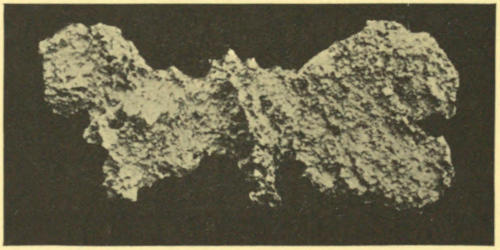
Golden Butterfly Nugget
It is 40 miles from Coolgardie to Red Hill and Lake Lefroy,
and the journey is anything but pleasant; the “Brumbies,”
however, knew their way, and the manner in which they got
through the bush was astounding. There was no road, only a
track, but they took us safely over fallen trees, &c., for which we
were duly thankful. There were several camps of prospectors
about and the men seemed to be quite contented, and were getting
gold; they were, however, like all alluvial miners, rather reticent
about the quantity. Water is very scarce; it was a good thing we
had provided ourselves with water-bags and a good hamper of
provisions, otherwise we should have fared badly, for the only
bush hotel we came to was made of the proverbial tin, and
everything inside was nearly at boiling-point, so we preferred
camping out under a tree. Water-bags are a great institution
in Western Australia. They are made of canvas, and have a
metal spout; as you drive along they swing in the air, which
makes the water delightfully cool. Lake Lefroy is a beautiful-looking
lake, and I longed for a bathe after the intense heat
and dust of the day; but, alas! the water was but a mirage,
and you could only look and long. It was, however, a beautiful
sight; the white salt on its surface, stretching for miles,
seemed to reflect the blue sky with the sun shimmering on it.
There are a great number of lakes in Western Australia, but
they are nearly all dry and salt; no water can be obtained
except by boring, and then it has to be condensed before it
is usable. After being condensed it is quite palatable, and many
fortunes have been made on the goldfields by people owning
condensers.
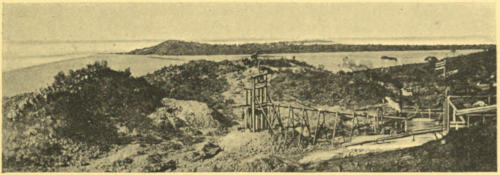
The Main Shaft, Butterfly Leases.
Red Hill is not a bad little place. The accommodation of the
Bush “hotel” was very primitive, but we were in the “back-blocks”
of the West, and felt that we must not be too critical.
There were several mines and numbers of alluvial miners at
work getting good results, and very sanguine of making a big
find one of these days. I saw the stope (excavation) where the
Treasure Chamber was, in which all the before-mentioned gold
at the Butterfly Mine was found, and I wished a similar rich
pocket might be struck while I was on the spot. Thirty
miles from Red Hill is Wigiemooltha, and 65 miles farther on is
Norseman, a rich mining town in the Dundas Goldfield. In the
future there is to be a railway line through these places,
and, the people hope, to Esperance, a seaport 200 miles from
Coolgardie and 237 miles from Albany. Norseman is a very
flourishing goldfields town of over 1000 people. There are
some good mines there, the foremost one, The Norseman,
turning out considerably over 1000 ounces of gold per month.
The Princess Royal and Break o’ Day Mines have also given
splendid results, sensationally rich gold having been recently
found at the latter mine.
The clergyman at Norseman performs the tying of the marriage-knot
for many hundred miles around, and it is recorded that
two couples were so anxious for connubial felicity, and wrote so
many pressing letters for the minister to come and unite them,
that he started on his bicycle for a 150-mile ride through the
desert country, and that when within 20 miles of the place the
bicycle broke down and he had to push it the rest of the way!
Had this not happened he had intended going on another trifle
of 100 miles or so to make another couple happy! The breakdown,
however, put a stop to his travels, and the couple are
perhaps still watching and waiting for the parson, who returned
to Norseman per camel.
An exhibition was being held at Coolgardie during one of my
visits there, and was very interesting on account of the many
magnificent gold exhibits. As well as the gold, there were many
splendid exhibits from the agricultural districts, which opened
the eyes of the goldfields people, most of whom had never
been in any other part of the colony but the goldfields, and
who had an idea that gold was Western Australia’s only
product. Many of these people have been so much impressed
that they have taken up agricultural land with a view to
having a country residence, to which they can retire after
the heat and dryness of the goldfields and recruit while
planting their gardens. In the Agricultural and Fruit Court
bunches of grapes, weighing 8 lb. each, apples, pears, and
quinces, 2 lb. each, pomegranates, oranges, and other fruits,
were shown in rich and tempting profusion. A trophy
of pumpkins, marrows, and cucumbers of all hues, shapes,
and sizes was displayed. The crown of the trophy was a huge
brown pumpkin weighing 165 lb.! A vast array of watermelons,
some weighing 50 lb. each, mangels and other sorts of
homely vegetables, of immense size, were to be seen. All kinds
of cereals were represented. It is a fact that no less than
32 distinct varieties of wheat can be grown in the colony.
The wool I thought very good, considering what a small
quantity is grown here yet. The collection certainly demonstrates
the fitness of certain parts of the colony for raising flocks.
One fleece of 330 days growth weighed 13½ lb. I was also
surprised to see some cotton that was grown on the East
Murchison at Mount Warragi.
The row of gilt pyramids representing the output of gold
from each field struck my eye as soon as I entered the
exhibition. It is interesting to remember that, when the
Colonial and Indian Exhibition was held at South Kensington,
London, Western Australia was not known as a gold-producing
country, and was represented principally by wild
flowers. In this exhibition the collection of auriferous
ores was simply marvellous. There were many bags of rich
gold ores from all parts of the country, as well as curious
beautiful and interesting specimens of tin, iron, copper,
asbestos, mica, and coal; in fact, samples of almost everything
found beneath the earth’s surface in this wide colony.
Then the gold: gold in granite, gold in quartz, gold in diorite,
gold in telluride, gold in the wash, gold in the pug, gold in
all kinds of alluvial deposits—in fact, gold, gold everywhere.
A section of the calcite vein from the Block 45 Mine, where the
telluride was first discovered, is interesting. The auriferous
breccia from Nullagine, in the North-west, was shown to me
by my guide, who explained that the stuff was of similar
formation to the gold deposits of the Rand in South Africa,
in which diamonds are sometimes found; and, speaking of
Nullagine, there is now a syndicate there looking for diamonds.
The mine is called after Lady Forrest, some small diamonds
have been found, and from the latest reports fresh wonders
are expected there soon.
There was a splendid specimen of fine flake gold, and a
magnificent large piece of quartz with gold all through it.
This was from the Brown Hill Mine. The Golden Horseshoe
showed such wonderful specimens of richness that my
eyes were fairly dazzled, and it is impossible to enumerate
them. Free gold, mustard gold, and the sparkling sponge
gold that really shone like diamonds were shown me, and a
part of the rich finds that were discovered when the shares
went up to £45; it nearly took my breath away to look at
them. The Associated Mines had a wonderful exhibit, the
finest of its kind in the world. It consisted of a block of
ore showing massive telluride gold of different kinds. A dark
mineral in the centre of the block when analysed proved to be
sulphide of copper. By way of contrast, a small piece of
ore containing telluride has been placed in front, and acid
employed to dissolve the tellurium, and this helps one to
comprehend the value of telluride.
The Boulder Perseverance had a very fine collection of
different kinds of ore and gold and also some diamond drill
cores which I had not seen before. The magnificent collection
of the Lake View Consols, consisting of 68 specimens,
showing telluride of gold, 34 valuable samples of sulphide ore,
and 32 pieces of oxidised ore, showing immense quantities
of gold, besides many others showing the various stages of
oxidisation, really ought to be seen, words cannot describe
their beauty. The Great Boulder Mine showed 14 splendid
specimens of rich oxidised ore from the 100-foot level, containing
sponge and free gold, and 15 specimens from the
200-foot level. In the centre of these was a block of ore with
a hole right through it full of sponge gold; there were 12
specimens of rich sulphide ore from the 300-foot level, 10 very
interesting samples of tellurides of gold, mercury, and silver,
and saucers with chips of telluride of gold. Kalgurlite, which
is a new mineral, a telluride of gold, silver, and mercury, containing
35 per cent. of gold, 10 per cent. of silver, and 46 per
cent. of tellurium, was also exhibited, and a very unique collection
of sponge gold occupied
a case in the centre of the
court. This was found in
a very large vugh, and 60lb.
weight was obtained from
one spot in the oxidised ore.
It was composed of a mass
of minute crystals, and is
the most brilliant form of
gold found upon the field.
From the 400-foot level came
some marvellous samples of
ore showing telluride of gold
and free gold, and from the hanging wall of the lode, and the
foot wall of the same level, more rich specimens were shown.
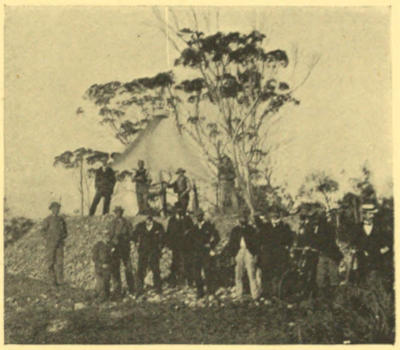
The Miners’ Holiday
There were some splendid exhibits from the Ivanhoe Mine,
and from hundreds of other mines on the field. Those I
have first mentioned were from Kalgoorlie alone. There
were splendid exhibits from Coolgardie, Kanowna, Menzies,
and Murchison Mines, and from many other parts of the
colony, whose unparalleled richness called forth the following
remark from an American mining-man, who was visiting the
court at the same time as I was, and who had come from
Cripple Creek in Colorado: “Wal, I’ve seen a big lot of specimens
in my time, but I must take off my hat to these; they
lick creation!” I returned next day to have a look at the
alluvial gold from the famed Kanowna. The court of alluvial
diggings was attracting a great deal of attention, not because of
its richness but also on account of the stir made in 1897 by
the rush there, when the rich alluvial gold was first struck by
George Sim. Not only has Kanowna proved itself a mine of
wealth for thousands of hard-working alluvial miners, who
chiefly worked the claims themselves, and consequently had all
the gold “on their own,” as their saying goes, but it also produces
a very fine building stone. There was in the exhibition
a most remarkable-looking perfect crystal 17½ inches long and
9 inches thick, which was discovered in the alluvial wash at
Shand and party’s Claim. The display of alluvial matter in
all its varied forms shown in this court was almost enough
to spur on any one to become a prospector. A golden
harvest has been reaped by thousands of men in a few short
months, for the rush to Kanowna began in November 1897,
and at that time the town of Kanowna was virtually dead;
three months later it was estimated that there were 2000 miners
in the field and 20,000 people in Kanowna all told. In twelve
months the field was virtually worked out, and although a
few parties are still getting a reward for their labours, there
are not now more than 1000 men on the field. The stuff
called “pug,” from which they get very fine gold, is a most
peculiar greenish, soft, putty-looking substance, and there
was a fine show of it from Hampton’s Claim in the Golden
Valley. This was found 61 feet down, and the deposit is 7 feet
thick. Some splendid specimens of lode material showed
crystalline gold extremely rich, worth 40 ounces to the ton.
The Red, White and Blue Claim, owned by Pratt and party,
displayed rich ironstone alluvial wash. This claim yielded
4500 ounces of gold, worth £18,000, and only a few partners
divided it. Some green alluvial wash which has given rich
results was from the Moonlight Lead, which also showed flake
gold; and from the Magpie Claim there was rich alluvial ore
shown worth 9 ounces per ton.
Rich treasures similar to these were sent from the mines to
the Paris Exhibition, and the Western Australian Court was
universally said to have the finest collection of minerals the
world had ever shown. The Bobby Dazzler nugget, weighing
413 ounces of solid gold, valued at £1500, was a surprise to many
beholders; among the hundreds of other solid lumps of the
precious metal sent to Paris was the large nugget that was cut in
two by one of the two men who found it, and who then drew lots
for the sections and found that there was only a difference of 30s.
in the value of them. Another slug of gold, worth £639, had the
distinct mark of a pick on it. I suppose the man who found it
could hardly believe in his good luck until he struck it a second
time. Another strange lump of gold is shaped like the map of
England, another like a camel’s head. The last “clean up” of
the Westralian Mount Morgans Mine was sent in bars of gold
worth £11,600. The Westralian Government purchased from
the owners of various mines I mention in these travels over
£100,000 worth of gold for the exhibition, and this, supplemented
by quantities more since won, will be shown at the Glasgow
Exhibition this year. The pearl-shell exhibit, was composed
of 600 enormous gleaming shells, which, when lit up by
electric light, looked like a fairy grotto. During last year
there were 179 vessels engaged in the pearl-shell fisheries in
Western Australia, and their aggregate tonnage was 2707.
The number of men employed was 1165, of which total 991
were Asiatics. The pearl-shell raised amounted to 720
tons, valued at £80,479, and the value of pearls found was
£15,529. Also our colony took four first prizes for timber,
wool, wheat, and minerals, at the Paris Exhibition, besides
eight gold medals, five silver ones, and five bronze for other
productions.
CHAPTER XVII
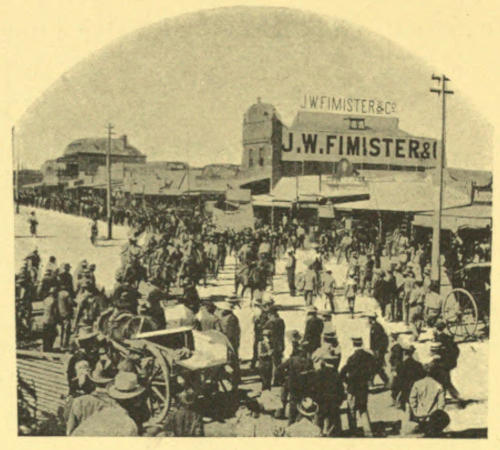
Hannan Street, Kalgoorlie, 1898
Kalgoorlie City—The Six Great Mines in the Golden Mile—Mr.
Kaufman—Early Predictions Verified—Associated—Lake View
Consols and Great Boulder.
Hannan’s, or Kalgoorlie as it is now called, is 24 miles from
Coolgardie, and as I took my comfortable seat in the railway
carriage, sped along the once forsaken desert and arrived at
the now famous City of Gold, with its broad streets and
splendid buildings, it seemed incredible that such a transformation
should take place in a few short years. It would be
difficult to point to any place in the world that has developed
so rapidly. During their short existence Kalgoorlie and the
Boulder City have turned out over 31 tons of gold, and Coolgardie
has been quite outstripped by her younger sister. I
think, when gold is measured by the ton, the colony from which
it comes may be fairly considered marvellous. It is only
seven years since Hannan and Harrigan threw themselves down
to rest on the ground at the eastern corner of what is now
Kalgoorlie, and, fortunately for thousands of lucky people,
discovered gold, and now, as far as that precious metal is
concerned, Kalgoorlie is the hub of Australia. Kalgoorlie is
a well-laid-out city. Bicycle tracks are laid down on the
30-foot wide paths, electric lights are everywhere, trees have
been planted in the broad streets, and by-and-by will afford
shade in the hot days for which Kalgoorlie is noted. The new
post-office is a splendid building, and has cost £40,000. The
warden’s and other public offices are also on a grand scale.
There are several magnificent hotels, especially the Railway,
opposite the station, and the Palace, covering half an acre of
ground, which I have made my headquarters. This hotel is
far the best on the goldfields of Western Australia; every
luxury is obtainable; it has a spacious dining-room with
electric fans always going, exquisite drawing-rooms, and
good attendance.
There are several newspapers, the chief of which is the
Kalgoorlie Miner, edited by Mr. Kirwan, who identifies himself
in every way with the interests of the people as well as
with his editorial duties; the miners have a staunch friend in
him. There are many fine shops, especially jewellers, where
gold nuggets of all shapes and sizes made into handsome
ornaments may be bought. Land at Kalgoorlie is daily increasing
in value. An offer of £100 a foot was refused by
an acquaintance of mine for a plot she is lucky enough to
own. Some mining-men, including the well-known Mr. Zeb.
Lane, were dining at the next table to myself on one occasion,
and one of them remarked that he was sure that in a few
years there would be 300,000 people in Kalgoorlie. You
may be sure, holding that opinion, that the gentleman was
looking out for investments. A handsome new theatre is
being erected in Hannan’s Street. At present the Miners’
Institute supplies the entertainments. The suburbs of Piccadilly
and Mullingar stretch far beyond the town site, and the
three miles to Boulder City are fast being built on, and will
shortly form one continuous busy road. Three fine breweries
supply the needful refreshment to thirsty souls, and altogether
Kalgoorlie is a splendid goldfields city, but the summer weather
is almost indescribable. One of the days had been unbearably
hot and oppressive; but dark clouds were overhead, and I
said, “Soon we shall have a rain storm, which will cool the
air.” My friends whom I was visiting laughed, and one of
them, with a merry twinkle in the eye, said, “There will
probably be a storm, but you will soon get accustomed to this
kind of weather; wait awhile.” In the evening Fitzgerald’s
“Great World Circus” being in town, we decided to risk the
“storm,” make up a party, and go to the performance. All
went well until about nine o’clock, when suddenly came “the
dreadful thunder”—the clouds had broken; then came, not the
rain, but dust, dust, dust—red, stifling, blinding, and terrible; for
the roof of the “Great World Circus” had been completely lifted
off by the red-dust fiend, while with his breath he had extinguished
almost every light in the tent. Crash! whiff! whirl!
and the “willy willy” had madly danced far away. One
minute’s terrified silence and then through the remaining red
haze could be seen the circus performers bravely continuing
their entertainment as if nothing had happened; and blended
with the echo of the distant din could be heard the strains,
“Gaily the music go-o-es, so gaily.” But the vast audience of
upwards of 3000 people, who, though the roar had been so
strangely “hush,” had witnessed enough excitement for one
night, gradually filed out through the rent of the swaying
canvas wall, my friends and I amongst them, arriving home
very white-faced, underneath the brown-red war paint so cunningly
and weirdly distributed on us by the fiend. After
wiping the dust out of my own eye, I remembered the twinkle that
I had seen in some one else’s, and I laughingly exclaimed, “Was
that the ‘thunderstorm’ you recommended me to ‘wait’ for?”
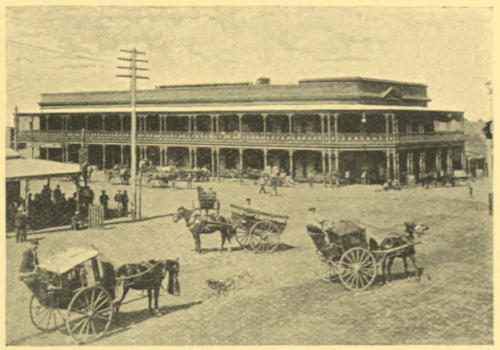
Palace Hotel, Kalgoorlie
“We had a narrow escape,” tersely and grimly (I had almost
written grimily), remarked my friend; but he must have rubbed
the twinkle out of his eye and the dust into his temper for he
declined to see the joke; however, as mirth is catching, we
were soon a merry party once more, and I was regaled
with “willy willy” stories of roofs being carried for miles, and
of houses being torn down by these huge “dust spouts,” and,
as at intervals I heard the “thunder” in the distance, I
could well believe the dancing, whirling devils capable of anything.
Many good theatrical companies now visit the goldfields,
but the expenses of a travelling company are very large,
the railway fare
from Perth being
about six pounds
each return
ticket first class,
and four pounds
second (there is
no third class in
the colonies).
The hotel tariff
is from twelve
shillings per day
(Palace sixteen),
the smallest
drinks (a big item
in such a hot and thirsty country) are a shilling each, and half a
crown is the usual price for a bath, as before said. There are
no large theatres on the fields, but the managers make the
prices for admission high, the community not caring how much
they spend if they really wish to see anything; in fact, that is
one of their little worries, they are always looking out for something
to spend their money on. Horses, yes, the best procurable,
and they are a very high price. Champagne is from
twenty-five shillings a bottle, and that is the first drink the
lucky miner calls for; his great mania is “shouting,” as they
call it, that is treating wine to everybody they know. “Wives
and families to spend it on?” “Oh, yes; but they are on the
other side,” meaning the Eastern colonies; “I always send
them plenty to live on, and when I’ve made my pile (fortune)
I’ll go home with it; in the meantime I must do something to
make life endurable here,” and the Hebe at the bar smiles
sweetly, and for it receives perhaps a diamond bracelet. I am
not speaking of the miner who earns his weekly wages, but of
the man who is lucky in his speculations of shares, or who
owns part of a mine, and when they strike rich, as they call it,
spends his money lavishly. I sat on the Palace Hotel balcony in
Hannan Street one afternoon and watched the crowd passing up
and down; I was surprised to see the women so richly dressed,
elegant Redfern tailor-made gowns and Worth carriage costumes
(although no carriages were to be seen, but plenty of buggies
with dust-covered hoods) were much in evidence; many of the
rich women send to London and Paris I am told for their
gowns. Occasionally a plainly-dressed woman in a tweed or
Assam silk costume with neat sailor hat would pass, probably
a mine manager’s wife or English visitor, but the majority of
the women of the goldfields spare no expense in the style and
richness of their dresses. At the present time the population
of Kalgoorlie, its suburbs, and Boulder City is nearly 60,000.
In a very short time electric tramways will be running, and
extensive swimming baths are now being built. There are
many good churches, which shows that in the rush for gold the
welfare of the soul is not neglected. Goldfields places are
usually looked on as somewhat lawless. I can assure my
readers, however, that those in Western Australia are an
exception.
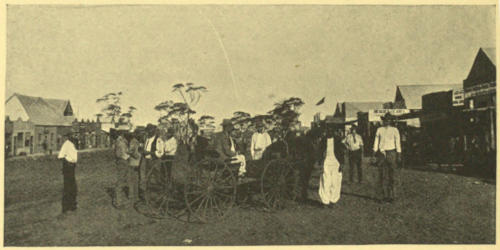
Hannan Street, Kalgoorlie, Early Days
Over the hill, not to the poorhouse, but to the rich Mount
Charlotte Mine, I one morning took my way. From the hill a
splendid view is obtained, and for three miles beyond nearly all to
be seen is mines, their poppet-heads and batteries showing distinct
against the sky. The manager of the Mount Charlotte
Mine was away, so I could not get much information, and so,
like Jo in “Bleak House,” I had to move on. The next mine
is Hannan’s Reward, where gold was first struck (found) at
Kalgoorlie; and although such wonderful results came from
this place at first, the mine has now been outpaced by many
others. I passed dozens more of mines, but did not stop until
I got to the Brown Hill Mine, under the control of Messrs.
Bewick, Moreing & Co., one of the finest on the field. This
mine, as its name indicates, is on the top of a hill, and is a
most imposing-looking one; wealth seems to speak from the
buildings around it. The manager’s house is a splendid bungalow
style of place, replete, I believe, with every modern comfort.
Outside is a tennis court and other evidences of the manager’s
tastes. The offices are large and convenient. The manager,
Mr. Feldman, being away in England, I did not go down the
mine, therefore cannot tell you anything about it; but Dr.
Diehl, who represents the London and Hamburg Gold Recovery
Company in connection with the Brown Hill Mine, has lately
made a most interesting discovery re the treatment of sulphide
ore, likely to be of much value in the mining world. From
this place I went to the Crœsus, thence to Block 45, another
mine that has given big results. Of course there are many
mines that have not proved as rich as those mentioned. Mining
seems to be like fishing: there may be any number of fine fish,
but it does not fall to the luck of all anglers to catch them.
Away again past more mines, down through Golden Valley,
now past the Oroya, North Boulder, Bank of England, and
Coolgardie Mint—all splendid mines; then up the highest hill
at the Boulder, as this part of the goldfield is called, where
I came to the great Australia mine (Associated). From this
place one has a glorious view of the other great mines on
the Golden Mile, so-called on account of the marvellous
quantity of gold that has been and is still being extracted
from its depths—Lake Mew, Great Boulder, Ivanhoe, Boulder
Perseverance, and Golden Horseshoe. They present a magnificent
spectacle. It is almost impossible to describe in words
the wonders of the golden hills on which these wonderful
mines are placed.
Close to the Golden Mile is a small square of business places—hotels,
stores, different kinds of little shops, and a brewery;
this was the beginning of Boulder City, but in consequence of
the influx of people and the increasing prosperity of the mines,
it was found necessary to establish the Miners’ City, a mile
farther away, the intervening ground being required for mining.
According to mining laws any ground taken up for that purpose
cannot legally be built on, but miners are allowed to camp there
on sufferance, and the area is therefore dotted over with mushroom-like
tents and canvas houses.
The Australia is the largest of the Associated Mines.
Everything seen is of the latest date; every appliance that
man’s ingenuity can devise is here. To convey the stone
along the open cut to the mill there is a wonderful aerial
tramway composed of wire cables, on which the trucks run
high up in the air; it is a marvellous way of conveyance,
but more peculiar still is what is here called the “Flying
Fox,” which has an iron bucket on a single rope of twisted
wire. Machinery on the top of the shaft and above the
crushing mill conveys it to its destination; then the bucket
empties as if by magic, and flies back to the bottom of the open
cut, a quarter of a mile journey, to be again replenished. It
seems almost incredible that a girl ever had the courage to take
that journey, and yet one actually performed the perilous
feat. The manager in jest had dared her to do it on her
visit to the mine, and she, being a strong-willed Scotch girl,
took him at his word, got into the new aerial car, flew through
the air, and arrived quite safe at the bottom of the cut, while
every one present held their breath with amazement; and I
believe that all the workmen, on seeing a pretty girl deposited
at their feet in place of the usual prosaic empty bucket, stood
in consternation and amazement, wondering what the clouds
were going to rain next. The underground workings of the
Australia are brilliantly lit with electric light, which shows
up the gleam of the rich gold through the ores so beautifully
as you peer through the light into the magnificent chambers of
oxidised or sulphide ore, you can almost imagine yourself in
Aladdin’s Cave. On the 300-foot level there is a magnificent
chamber or stope, 16 ft. high and 40 ft. wide, from which
thousands of tons of ore have been taken, returning 8 oz.
to the ton. A specimen weighing 1½ cwt. had just been
broken off. It was studded and seamed with rich telluride.
Owing to the telluride lodes, mining presents wonderful possibilities.
There is no knowing what marvels may any day
come to light. The rock-drill, whose motive power is
compressed air, had pierced down 550 ft. There was a large
gang of men down the mine timbering, enormous great poles,
almost tree trunks, were being put in position, propping up the
earth to make it safe. It made me shudder to think of the
dangers of a miner’s life, and yet, comparatively speaking,
there are very few accidents in the mines here. The genial
underground-manager told me that every precaution was taken
in all the mines nowadays. We emerged from the shaft
once more into the light of day. The first thing to strike the
eye on the top were the enormous looking cyanide tanks,
then the amalgamator’s rooms, where we saw all the modern
appliances for extracting the gold, wonderful vats of chemicals
where the rich tailings were lying waiting for the chemical
action to take place, ripple beds, then ball mills, pug mills, rock
breakers, and enormous stamping batteries in their various
houses; then last, but not least, the new roasting furnaces
with their huge boilers, and other parts looking like some
immense military fortifications; these are used for smelting,
and cost £100,000. There were 20,000 or 30,000 bags of
ore waiting for treatment, full of gold. It is wonderful to see
the gold being smelted. To stay in the furnace-room for a
minute or two, even before the furnace-door was opened, was
like taking a Turkish-bath. I was quite content to stay on the
outside when it was opened, and to see the man, dressed in an
asbestos suit from head to foot, pull out with a great iron
hook the red-hot pot full of molten gold and pour it like
golden sunshine into a mould. After seeing this man at his
work I thought him a kind of hero, and wondered what he
weighed in the asbestos suit. About 200 yards from the mine
are the large and commodious offices, and the quarters of some
of the managers of different departments. The gold produced
from this mine up to the end of November 1901 was 214,485
ounces, and the dividends paid amounted to over £258,750.
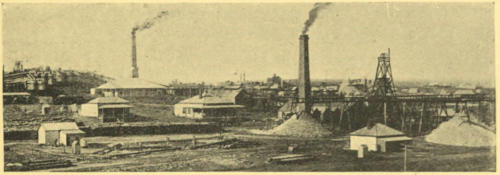
A Boulder Mine and Offices from Lake View Consols
Driving over to the Lake View Mine was not altogether
pleasant, as, when nearly half-way down the steep and stony
hill, my horse stumbled and nearly fell; however, a kindly
pedestrian seeing my difficulty came to my assistance, and, much
to my relief, led him down to the foot of the hill. I then crossed
over to Lake View, which is said to be the greatest gold-producer
of this marvellous field, outrivalling even the famed
Mount Morgan in Queensland, which was almost a mountain
of gold. Mr. Charles Kaufman purchased this wonderful
mine for a company when he was on a visit to Australia;
seeing the wealth and magnitude of the Kalgoorlie mines, he
did not hesitate to pay the sum of three-quarters of a million
sterling, and to take a quantity of shares for himself,
and since that time he has also purchased other large mines.
There is a very large and efficient staff of experts in their
different departments on high salaries. Lake View Consols,
to give the mine its full title, was, until the advent of Mr.
Kaufman, a mine that seemed fated to bad luck. It was at that
time owned by an Adelaide company. The first manager
pronounced it a failure, the second died of typhoid, and the
third, Mr. O’Neill, managed to pay out a dividend of 3d. per
share! This was the first dividend ever paid on the field.
Since then many dividends of £1 per share have been made.
When Mr. Kaufman purchased Lake View he soon had it equipped
properly and started on a new basis. Now, in place of the
meagre poppet-heads and small shafts, a gallows-frame towers
120 ft. into the air, and immense shafts, sending up their continuous
supply of splendid ore, give token of the change that has
taken place. When you go down the mine in the “cage,” as they
call it, you need only close your eyes and fancy you are in an
elevator. When you get down 100 ft. you step out to a drive
running 1700 ft., then on the north side you go 450 ft., and
must not go any farther, because you are near the Boulder
Perseverance ground, which is another rich mine close by.
Here is an immense body of rich high-grade sulphide ore,
51 ft. wide. Teluro sulphide (in which telluride is found)
and sulphide ores differ from oxidised ore, which is usually
of a light colour and shows the gold freely; the other ores
have a silvery-grey appearance, seldom showing gold, but when
treated at the mills and smelting works they frequently yield
a large percentage of it. Down again the visitor goes in the
cage to 500 ft., the mine growing richer and richer to the
bottom. Coming up again, the stope[3] at the 300-foot level,[4]
from which such phenomenally rich telluride, assaying 150 ounces
to the ton, has been taken, shines like a star-bespangled sky on
a dark night. The shares in this great mine have been sold at
£28 10s. At that time the production was one hundred and
twenty thousand pounds worth of gold per month. The immense
quantity of huge timber down below is astounding. I am sure
there must be enough used in timbering this great mine to build
a town. The level at the 100-foot is quite large enough to give
a ball in; the electric light and electric bells are all ready,
and the air is so beautifully cool that this would be an ideal
place for a ball on a hot summer’s night. The production
from this wonderful mine has been enormous, and when one
has been down and seen all I saw below, one does not
wonder at it; it is a perfect marvel of richness. I went
over all the drives, stopes, cross-cuts, &c., and saw everything.
In place of men pushing the trucks of ore below, as is the case
in other mines, horses were drawing 8 or 9 trucks at a time.
One of the horses is a real pet with the miners, and at crib-time
(mid-day, dinner-time) he is unfastened and allowed to walk
about the drive. He always finds out where the men are, and
comes up for bread or cake, which he eats with a relish. He
is lowered down the mine every morning in a net, and is as
quiet as a lamb now; at first, when he was very young, he did
not like the lowering process at all, but he has since got quite
used to it. Such bodies of rich ore have been opened up
that years will be occupied in treating it, the plant belonging to
the mine not being yet large enough to cope with the quantity.
After the magnitude of the under workings, nothing surprised me
on the top, although the rumble and stamping of the batteries, the
hum of the mighty machines, the beautiful bright engines that
seem to work with perpetual motion, the enormous furnaces,
the magnificent cyanide plant, with its wonderful machinery for
extracting the gold, the electricity that seems to fill the
air and almost takes one’s breath away, are all so vast and
wonderful that a sense of something like awe came over one,
and I was not sorry to get into the open air again and see the
blue sky above me.
Only five years ago a miner returned to Adelaide, South
Australia, from the West, and called on a sharebroker, giving
him 500 Lake View shares to sell at as high a price as possible.
They were sold for a few shillings, and when the miner got his
cheque he remarked “he was sorry for the ‘bloke’ who bought
them, as he had been working on the mine and knew she was
no good.” Those 500 shares would now be worth several
fortunes to that miner had he kept them. The biter was bitten;
I wonder how he feels at the present day about it?
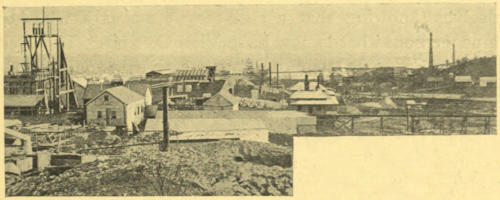
Overlooking the Great Boulder
That Mr. G. Brookman, of Adelaide, was certain five years
ago of the great future of Lake View Consols is shown by a
piece of paper with his calculations on it, now in the possession
of Mr. Fotheringham, also of Adelaide, which reads as
follows:—
“Reef on Lake View, 3000 feet long, 100 feet deep, equal to
300,000 feet, 6 feet wide, equal to 1,800,000 cub. feet, equal to
140,000 tons; 3 ounces to the ton, equal to 420,000 ounces;
£4 per ounce, equal to £1,680,000; allow £420,000 for cost
of raising and crushing, &c., leaves £1,260,000 available for
dividends.”
This great mine stands first in the field as a gold-producer, the
total yield in 1900 being 528,368 ounces, and dividends at the
time of writing having been paid to the amount of £1,187,500
(one million one hundred and eighty-seven thousand five hundred
pounds). When Brookman and Pearce arrived at Coolgardie
where Bayley found his Eldorado, and not finding much there,
went on to what was then called Hannan’s, now Kalgoorlie,
to look at Cassidy’s Claim, they saw plenty of the golden
metal to gladden their eyes. They began to work upon
a reef, but Mr. Pearce, in his wanderings around the then
Bush in spare time, was attracted to some ironstone hills. He
prospected about, and was so well satisfied that he and his
mate shifted camp and began to work on what is now the
Ivanhoe property. Not keeping exactly within the pegged
ground, they discovered a rich leader (a small lode running
into a large one) not far from the camp. This was the first
gold found on the Great Boulder. They then pegged out 20
acres around each find, and keeping their good fortune to
themselves (knowing that a still tongue makes a wise head),
soon pegged out what is now Lake View Consols. The present
value of these syndicate holdings, if realised, would be about
£30,000,000! So little was thought of the leases at first that
they were called “Brookman’s Sheep Farms.”
I have a few pieces of really fabulously rich telluride that
were given to me from the same place, the 300-foot level,
which yielded the magnificent specimens sent to the Glasgow
Exhibition. The veins of the precious stuff were nearly four
inches thick. They are so handsome that it seems almost a pity
to break them up and turn them into what is called “filthy lucre.”
After coming from the mine I, with the rest of a party that
I had been so fortunate as to meet on my visit here, was hospitably
entertained by the manager. I then resumed my journey.
This time I thought myself growing so clever, and beginning to
know so much travelling alone, that, seeing an opening between
two large heaps of what I afterwards discovered to be rich tailings
(from the crushings of the ore from which all the gold has not
been extracted, and when treated by cyanide, which is a
solution for extracting every particle of it, often gives good
returns), I started to take a short cut through. I had, however,
not thought of the air-tram going along with its freight of ore
overhead, and just as we were going through the opening
whirl it went along, frightening the poor horse, who nearly
upset the trap. But a second time that day I was saved to
continue my journey, this time by two miners, who were just
emerging from a shed close by, and who said, “Private road,
missus.” However, on seeing my look of distress, and on my
mentioning my business as a lady explorer, they let me pass
on my way again rejoicing. From the side of Lake View on
which I now was, a totally different view presented itself. The
large buildings of the mine completely block the township
of the Boulder, and for a mile ahead nothing can be seen but
mines, mines, mines, and on the flats tents, Hessian camps,
offices, and mine-managers’ houses. Many good-sized places
about here are boarding-houses. The majority of the men
camp and cook for themselves, but some of them merely sleep
in their tents and take their meals at the above-mentioned
houses, usually looked after by two or three women, who do the
mending and washing required. They speak in highest terms
of the conduct of all the men; indeed, from what I saw and
heard, the camps are very well conducted, and I am sure I have
met with the greatest kindness and politeness from the mining
community in general. I drove all round these mines and
camps, but only stopped once to get a cup of tea at one of
the houses, where I found the housekeeper most kind and
communicative.
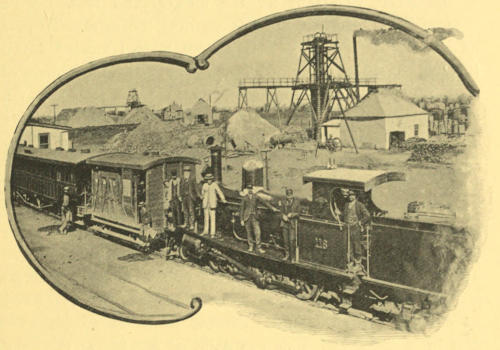
Hannan’s Star Mine
Hannan’s Star, Boulder Main Reef, and Chaffer’s are the
mines adjacent to the one I next stopped at—the Golden
Horseshoe. Here I interviewed Mr. Sutherland, the manager,
at the office, who sent for the underground boss (as he
is termed), Mr. Morgan, to show me over the mine. To give
an idea of the wealth of this famous mine I must tell you
that, when shares were £8 each, such magnificent finds of
gold were made that they went up in value to £51! On
going below, Mr. Morgan courteously showed me all over
the golden mine which has proved so profitable. He also
showed me some of the most magnificent gold, and specimens
I have ever seen. These were some of those that were found
when the shares went up to the tremendous price before
mentioned. Sometimes the gold is found in solid pieces; when
mixed with quartz, the pieces are called “specimens.” We
went down to the 200-foot level, and saw the wonderful
place where the finds ran for weeks at a rate of 80 ounces and
90 ounces to the ton; 2000 ounces, valued at £8000, were
won in a few days. This was oxidised ore, and at the same
level is still abundant, but not quite so rich as the above
quotations. We then proceeded to the 400-foot level, where
more rich ore and wonderful workings were seen. Then along
a drive down another shaft to the 700-foot level, through stopes
and cross-cuts, picking out more specimens until I was fairly
bewildered. Coming up we stopped at the 400-foot level,
where the rich sulpho-telluride ore showed free gold quite
plainly. Mr. C. D. Rose, the chairman of this mine, estimates
that the monthly production from oxidised ores alone will reach
14,000 ounces, and will be maintained at that. This estimation
has been more than reached, one month’s production of the
mine since that time having been 15,280 ounces of gold.
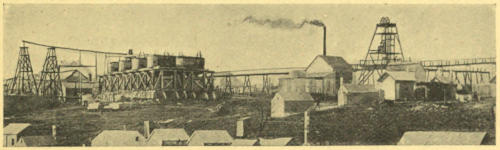
The Ivanhoe Mine
When the mine’s great richness was first becoming apparent,
a very jovial meeting of the shareholders was held. The shares
had then made a big jump to £17. Previous to the time when
the shares in the Golden Horseshoe were £7 10s. a strong “bear”
attack was made on them. (A “bear,” in mining parlance, is
a speculator who sells stock he does not possess, with the idea
of being able to purchase at a cheaper price later on.) The
mine was at that time “jumped” on account of some legal technicality;
but, instead of this producing the desired effect of a
fall in prices, the shares shortly afterwards rose, and the
“jumpers” made a hasty retreat, sadder but wiser men. A
director of this mine told me of the time, not very long past, when
he advised his friends to buy shares up to as he had himself
done. Some of them acted on his advice, but shortly
afterwards the shares went down to £2 10s. He was then
overwhelmed with inquiries as to what was the matter. After
making a strict examination of the Golden Horseshoe properties,
and seeing the large bodies of valuable ore below, this gentleman’s
advice was to stick to the shares. Shortly afterwards
they rose to £5 and £6, and now, as I before said, they have
been as high as £51 per share, and up to 19 ounces of gold to
the ton of ore has been got. This speaks for itself, and no
doubt it is one of the best mines in the world. I was told a
story about this mine, which at first I thought too incredible
to be taken seriously, but which I am assured is a fact. It is
stated that an old lady recently entered a London broker’s office
and produced the certificates for various shares which she said
she wanted to dispose of, saying she would take £5 for the lot.
The broker found most of them to be shares of a valueless
kind, but one represented 500 Golden Horseshoes, which he
sent into the market and sold at £40 each, so that the old lady,
instead of getting £5 for her entire collection, was credited
with £20,000 for one slip of paper alone!
I made my next move onwards along a narrow road between
two hills. On one side is the Ivanhoe, and on the other that marvellous
mine the Great Boulder. This is the second on the list as
champion gold-producer, having produced over 449,726 ounces.
If each ounce of gold were to be coined into four sovereigns,
these ounces would represent over a million and a half of money,
of which £910,000 has been distributed in dividends. Mr.
George Inglis, well-known in England and on the Continent,
was one of the foundation members of the board of the Great
Boulder Mine, and was instrumental in finding some of the working
capital of the company, and has been deeply interested in it
ever since its inception. The offices of this great mine are
close to it. I had to wait some little time before seeing any one
who would conduct me round, everybody seeming to be up to
their eyes in business. I accordingly mounted a hill to the
open door of a large building, which I found to be the amalgamators’
room. Here was a feast of gold in bars, in ingots, in
oval shape. It had just been brought from the smelting-room,
and the police escort was waiting to take it into the bank at
Kalgoorlie. I was fortunate in arriving at the time I did. I
had seen gold before, but never to this extent in its newly
smelted state; it was a revelation.
The manager, Mr. Hamilton, was very courteous to me, and
on my telling him I wished to go underground at once acceded
to my request. It was hardly necessary to show him the letter I
carried with me from the Minister of Mines, Perth, asking all
managers to extend their courtesy and help to me in my travels
on the goldfields. On arrival at the shaft, a crowd of men had
just come up, and another crowd were waiting to go below;
they were changing “shift,” which is the term used to denote
their working time of eight hours. During the week the mines
never stop working, consequently relays of men are required.
In these shifts their hours of labour are changed at certain
times, and so the men are sometimes on what is termed day
shift or night shift.
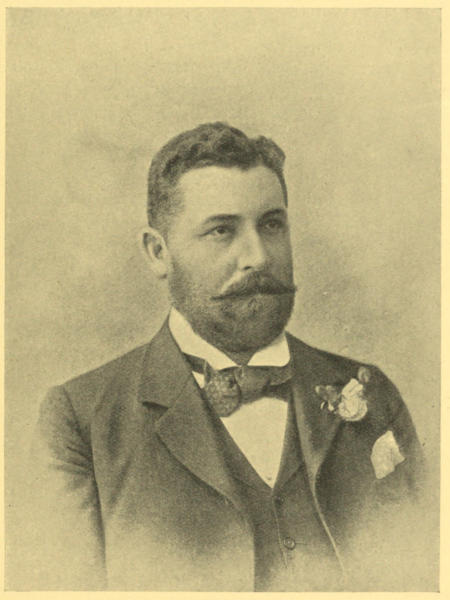
Mr. Zebina Lane
When I descended the 800-foot level the men who were
there were taking their mid-day meal, most of them sitting
down on the great stones. Their bright dinner cans, which
contain three compartments, one for tea, one for bread and
meat, and one for sweets, looked very clean and nice, while the
many candles that lit up the otherwise gloomy cavern, the
picks, shovels, and other mining implements lying about, helped
to make up a characteristic scene of underground life.
The diamond drill was at work. It was wonderful to see how
the diamond penetrated the hard rock, for the quartz must be
nearly as hard as the diamonds are themselves. Mr. Hamilton
gave me a piece of the core of the drill, which I shall place
among my treasures from the mines. I peered down the
300 feet below where I was, as the mine went down to 1100
feet, but it was so dark and wet that I had no wish to descend
any farther, so mounting the cage I again ascended, stopping
at two of the other levels and climbing all around them,
and seeing all the wonders beneath the earth, and collecting
more specimens.
CHAPTER XVIII
The Ivanhoe—The Famous Stope—Climbing the Ladders—Boulder
Perseverance—The Rock Drill—Down 500 Feet in a Bucket—Blasting
the Rock—British Westralia Syndicate—Mr. Frank Gardner and our
own Zeb. Lane—Kalgoorlie again—Wages on the Mines—Yield of the
Goldfields.
The Ivanhoe Mine is quite close to the Great Boulder, and
next morning I set out to take a look at that, although I must
confess I was getting weary, having walked many miles underground
in the last few days. However, I was determined to
go over the 6 biggest mines of the field, so away I went.
The manager received me in the kindest manner, and offered
me his room to prepare in, and told everybody to do everything
I wished, as he had important business at Lake View, and
could not take me down himself. The important business
afterwards turned out to be that he was taking over the
charge of the Lake View Consols as well as the Ivanhoe.
Accompanied by three gentlemen visitors and the underground
manager, I descended the great Ivanhoe Mine. I had a particular
wish to see an enormous stope, 1500 feet long, about
which I had heard; so at the 600-foot level we got out
and went along a long drive until we came to what looked like
a hanging ladder. If I wanted to see the famous stope I had to
mount this ladder. It was very narrow, and I felt rather dubious
of my climbing powers; however, it was only about 60 feet high,
so I ventured. I climbed up very carefully and got into the
stope quite safely. After walking along for a few feet I found
we had to bend down to get along; next we came to a small
aperture through which we had to creep; then we could not
walk any more, but had to go on our hands and knees, like
our Darwinian ancestors. I had not bargained for this, but
having come down below to go over the 1500-foot stope, I
went on. So, gradually creeping and sometimes walking
doubled up, we got to the end where the men were working.
They all threw down their picks and spades and looked in
amazement at me coming along that stope; they never did
it. There was a ladder over 100-ft. long by which they
went up and down to their work. I had been told about this
ladder, but I felt afraid of the 100 feet ascent, and preferred
walking, as I thought, through the stope. I must here explain
that the stope was originally quite deep enough for any one to
walk comfortably in, but after the lodes—mineral veins containing
ore—have been taken out, the stopes are filled in with
refuse tailings, which have been treated by cyanide, and later
thrown out for refuse and used as filling-in stuff. Of this I
had traversed 1500 feet, bumping my head innumerable times
against the hanging wall. Oh! I was tired, and the worst
of it was that I had to go back, or else go down in mid-air
on a 100-foot ladder. After sitting on a boulder for a few
minutes’ rest, and accepting many compliments from the miners
about my courage, I decided to descend the ladder, which I
did in fear and trembling, but got safely to the bottom, for
which I felt duly thankful; and we went down to another
level, and saw much more rich stone waiting to be taken up;
then up to the 400-foot, where the sulpho-telluride ore, worth
10 ounces to the ton, was being taken out; then to the 200-foot
level, where the rich oxidised ore is. There is a million’s worth
of ore at sight here, and yet in the first year of the mine’s
existence many shares were forfeited for non-payment of 6d.
calls. The market value is now over £2,000,000; production
of gold, 304,848 ounces.
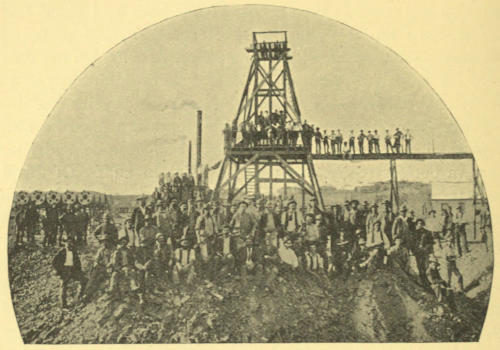
Roll-up at the Boulder Perseverance Mine
After coming up from the Ivanhoe Mine, a telephone message
was given me that the underground manager, Mr. Flynn was
waiting at the Boulder Perseverance Mine to show me over
that. So, hastily untying my horse, who had been taking
his food under the shade of the offices of the Ivanhoe, I
hurriedly drove over to the Boulder Perseverance, and after
making a change in my toilet, such as was necessary, jumped
into the cage and went swiftly down to the 300-foot level.
Here we stopped and walked through the long drive to the
stopes, where much richness was to be seen; it was a
veritable jewellers’ warehouse. Mr. Flynn gave me a pick
and told me I could knock out some sulphide ore for myself,
which I did, and many beautiful specimens from this mine
are in my collection. While here I heard a tremendous
rumbling noise, and thought the mine was falling in. On
inquiry I found that the miners were blasting rock 200 feet
below us at the 500-foot level. I expressed a wish to go
there, and Mr. Flynn said it would not be safe for half an
hour, and then I should have to go down in a bucket, as the
cage only went to the 300-foot level. After walking all over
the stopes on this level we went up to the 200-foot level,
and I saw all the wonderful oxidised ore. I learned much
during my travels underground. Oxidised ore is always found
on the top levels. At a depth of 300 feet the sulphide ore,
which contains telluride, is reached.
Going through the various drives we often met miners walking
along to different parts of the mine. We were all carrying
candles, so could peer into each other’s faces, and the look
of surprise on some of them at seeing a strange lady rambling
about underground was quite amusing. Then we would come
on a group of workmen at a stope; then sounds of the rock-drill
would make me curious to go in its direction. The heat
is fearful in places where the rock-drill
is at work making holes
for the dynamite charge
which is to blast out tons
of rock. The men were
just going to begin a new
hole, so I asked to be
allowed to start it. The
sensation was like an electric
battery; I held the drill
too tight, I suppose. However,
I persevered for fully
five minutes, and when we
looked at the machine I
was told I had drilled quite a quarter of an inch of rock, so I
felt very proud, especially as they told me no lady had ever
touched the rock-drills down here before.
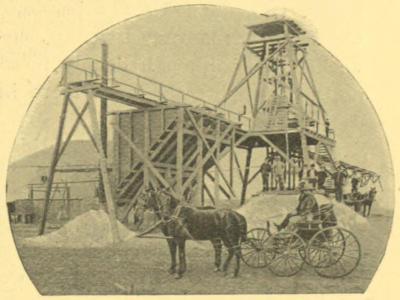
Lane’s Shaft, Boulder Perseverance Mine
By this time I was ready to go down in the bucket, so we
took another walk of about a quarter of a mile along the drive
to another shaft called Lane’s Shaft, named after Mr. Zebina
Lane. In this shaft was the bucket. Never having been in
a bucket before for the purpose of a downward journey of 200
feet I felt a tiny bit nervous. However, the journey was perfectly
safe, and when I arrived at the bottom I saw a grand
sight which I shall never forget. There was still much smoke
hanging about from the blasting. Some 20 men with candles
alight were waiting about in the gloom, some of them partly
black from handling powder. Over 70 tons of sulphide ore
had just been blasted out, and lay about in great pieces and
boulders. The cave—for such it looked—fairly sparkled with
richness, the different minerals in the sulphide rock shining
like diamonds. I climbed over the great boulders and went all
over the stope, picking out any sparkling bits that took my
fancy, and a miner was sent on ahead to try the sides for fear
of any loose rock falling on me. The lode here is 41 feet wide,
and very rich indeed. It was pretty rough climbing, I can
assure you, but I would not have missed it on any account.
On the return journey I went up the entire 500-foot shaft in the
bucket, and although deeply interested by all I saw, I was
not sorry to breathe once more in the sunshine away from
dynamite and rocks.
Some idea of the wealth of this mine may be given by the
fact that the last shipment from the western lode averaged
17 ounces per ton. The high-grade oxidised ore in the upper
levels, of which I spoke before, is an immensely rich body of
mineral, continuing in richness for an eighth of a mile. Another
lode, on a lower level, near the Lake View Consols, is nearly
three-quarters of a mile long, and so phenomenally wide and rich
that even Americans, who are generally apt to throw cold water
on our mines, admit that its equal is unknown in the world; in
fact, the Boulder Perseverance shows every sign of becoming
the richest mine on the field, for the more it is opened up the
better it looks and the richer it becomes.
Mr. Zebina Lane and Mr. Frank Gardner, besides controlling
the Boulder Perseverance, the Boulder Bonanza, Great Boulder
South, and other rich mines in Western Australia, have more
recently taken over Hannan’s Public Crushing Company,
Central Australian Exploration Syndicate, and Collie Coalfields,
lately floated with a capital of £150,000. At the banquet given
to Mr. Lane last year previous to his departure for London, he
said that on this coalfield there was enough coal at sight to last
the colony for 20 years. It was Mr. Lane who in 1893 placed
the now wonderful Great Boulder Mine before London investors.
The Boulder Perseverance Mine shares could at that
time be bought for a few shillings, now they are of high
value, and Mr. Lane has made a large fortune out of
his various mining transactions. Among the properties in
Western Australia turning out among them the enormous
quantities of gold of which we know, the properties partly
controlled by Mr. Lane have turned out nearly half. Western
Australia has no truer friend than he; he battled on behalf of
the colony for years before prosperity came; went all over the
goldfields, endured all kinds of hardships on the arid plains,
and earned his success fairly. The other two gold mines on the
Kalgoorlie field belonging to the British Westralia Syndicate,
and under the part control of Mr. Lane, namely, the Great
Boulder South and Boulder Bonanza, are lower down the field,
over the Golden Hill, and near the Great Boulder and Lake
View Consols. The aforesaid mines join each other, and no
doubt the continuation of the famous lodes of these great mines
will be eventually picked up by the Great Boulder South and
Bonanza. The diamond drill is being used to advantage, and
great things may be looked for in the future from its developments.
The British Westralia Syndicate was formed by Messrs.
F. L. Gardner and Zebina Lane in October 1894, and registered
on the 6th of that month with a capital of £80,000 fully paid-up
shares, the Syndicate really consisting of only four members,
the other two being the late Mr. Barney Barnato and Mr. Woolf
Joel, who was assassinated in Johannesburg.
Since the incorporation of the company, regular dividends of
50 per cent. per annum have been paid, and last year a 50 per
cent. bonus was divided in addition. As I said before,
the shares now stand high in the market, and show every
likelihood of rising to £20. The Syndicate’s palatial offices in
Moorgate Street are, if not the finest, one of the finest suites
in the city of London. Mr. F. L. Gardner is the chairman
of the company, and Mr. Z. Lane the managing director and
superintending engineer.
In addition to the above-mentioned mines, Mr. Lane has
recently taken in hand three properties in the Nannine country,
Upper Murchison, all of which have developed into paying
properties and are making good returns.
Mr. F. L. Gardner, chairman of the British Westralia
Syndicate and its offshoots, has long been associated with
Australian mining, but was drawn into West Australian ventures
by his old friend Zeb. Lane. His speculations in Great
Boulder, Perseverance, Lake Views, Crushing Company, Boulder
South, and the ever-increasing dividend-paying British
Westralia Syndicate, have amply repaid him for his courage.
An American by birth, with all the strength of mind and will
of a big investor, he is a tower of strength in the market,
known as a man of strict integrity and sound financial position,
being in fact a millionaire, he has now the strongest following in
London, and with Mr. Zebina Lane to engineer the mines which
he controls, will soon be, if he is not already, the biggest man in
the Western Australian Market, which more particularly concerns
this book and this colony than any other market in which he
may operate. Pity it is, for the sake of Western Australia, that
we have not more combinations of such straight-going men as
these two have proved themselves to be; then the investing
public would have more confidence in mining speculations, and
would certainly have, in horse-racing phraseology, a run for
their money.
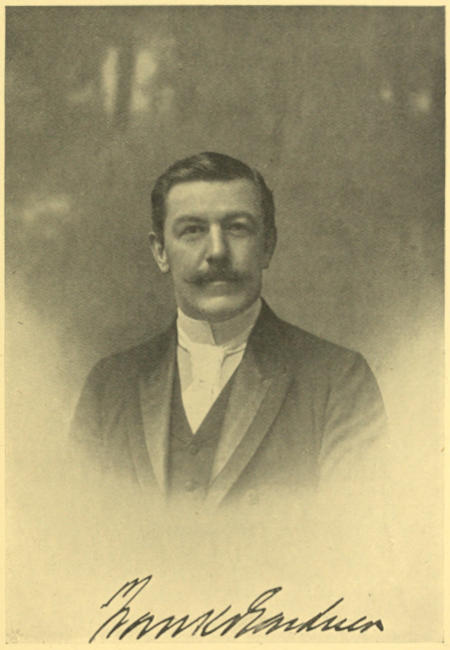
Frank Gardner
Mr. Z. Lane, generally known as “Zeb.,” may be described
as the pioneer of successful gold-mining in Western Australia.
Born, brought up, and educated to the mining industry, he for
many years successfully managed the great silver mines of
Broken Hill, New South Wales, and was unanimously elected
the first mayor of that city when it grew into a municipality.
He left Broken Hill in 1893, and paid an extended trip to
Western Australia, where, after careful examination, he fixed
on what is now known as the Golden Mile; but as Western
Australia was then so little known, he had difficulty in getting
working capital for the various holdings and had to drop some
of them, but pinned his faith to the Great Boulder and the
Perseverance (certainly two of the best), and floated them both
in London amongst his own friends. He started the first
10 stamps on the Boulder on April 10, 1895, afterwards increasing
them by degrees to 30, and has since that date been
instrumental in shipping over 15 tons of gold from the mines
under his individual control—surely a wonderful record in a
new waterless country, with so many difficulties to be contended
with! He is a man of few words, but of iron will and determination,
and is one of the most popular men in Western Australia—has
been repeatedly asked to allow himself to be elected to
Parliament and to the Mayorial Chair of Perth, but prefers to
look after his mining interests. Perhaps he is quite right in
doing so. He is a Justice of the Peace for every colony in
Australia, is a good public speaker and debater, and will be
greatly missed in Western Australia should he decide to settle
down in London, as many of his co-directors in the various
companies are anxious that he should do.
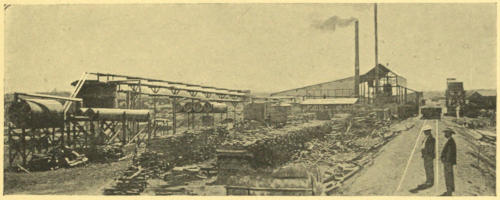
Hannan’s Public Crushing Company
Crossing another road I came to the Brookman Boulder, a
very fine mine. Mr. Brookman has amassed a large fortune and
settled in Perth, and is spending his money where he made it,
instead of going away to other countries to live, as most of the
lucky people do. Mr. Brookman and Captain Oats recently
paid a visit to Ballarat, the Queen Gold City of Victoria, and
at a banquet given in his honour, Mr. Brookman said that
in a few years Kalgoorlie would, no doubt, be as fine a city
as Ballarat, an opinion with which I most emphatically agree.
I must mention that this is one of the places that caused such
a stir in the world fifty years ago, on account of the wonderful
goldfinds there.
Two of the largest nuggets found in the district were the
Welcome in 1858, weight 154 lbs., value £8872; and the
Welcome Stranger in 1869, weight 190 lbs., value £9000. I
trust this digression will be pardoned.
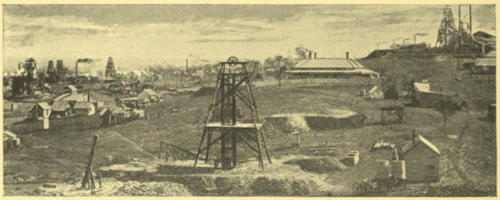
Central Boulder Mines and Manager’s House
There are two large and splendidly furnished clubs here,
namely, Hannan’s and Kalgoorlie for the well-to-do, and several
institutes, affording opportunities for reading and recreation to
the miners. I must not forget to mention the fine park, cricket
ground, and racecourse.
Having finished my journey round the wonderful mines, I
feel how poor has been my description of them. It has been
almost impossible even to mention half the important discoveries
that have been made in these marvellous chambers of
the earth. I have tried to explain some of the developments
that stand out most strikingly. The rapid progress that is
being made in all ways makes it quite safe to say that what
has already been done is as nothing to what will be done in
the future, and that by the time the new century is a few
years old, and all the latest processes of extracting gold
from the ores are in full swing, we may hear of such great
returns as will amaze the most incredulous. As I go along
the three miles between Boulder City and Kalgoorlie, and think
of the wonders I have seen, it seems quite safe to say that very
soon the whole three miles will be covered with buildings and
the predicted population of 300,000 an actual fact.
The scale of wages on the field is as follows:—
MINE MANAGERS’ ASSOCIATION SCALE.
| Occupation. |
Rate per Day. |
|
s. |
d. |
| Timbermen |
13 |
4 |
| Rock-drill men |
13 |
4 |
| Miners (wet) |
13 |
4 |
| Bracemen |
11 |
0 |
| Truckers |
10 |
6 |
| Blacksmiths |
15 |
0 |
| Labourers |
10 |
0 |
| Carpenters |
15 |
0 |
| Millmen |
13 |
0 |
| Batterymen |
11 |
8 |
| Battery boys |
8 |
4 |
| Engine drivers, 1st |
13 |
4 |
| Pitmen |
16 |
8 |
| Assistants |
12 |
6 |
| Miners (dry) |
11 |
8 |
| Plattmen |
11 |
0 |
| Tool sharpeners |
13 |
4 |
| Strikers |
11 |
0 |
| Draymen |
11 |
8 |
| Fitters |
15 |
0 |
| Masons |
15 |
0 |
| Feeders |
10 |
0 |
| Cranide labourers |
11 |
8 |
| Engine drivers, 2nd |
11 |
8 |
There are more than 6500 men working in the Kalgoorlie
mines, and over £28,000 weekly is paid in wages. The cable
from the Government to the Agent-General for Western
Australia, London, October 1901, gave the crushing returns
of the colony for that year as 1,580,950 ounces, valued at
£6,007,610, making a total gold production of £27,726,233
sterling. Several millions of money have been paid to the
shareholders of the various mines in dividends since the
Adelaide and Coolgardie Syndicate took up the ground at the
Boulder, and that ground, which was chaffingly alluded to by
the prospector’s friends as a “sheep farm,” has certainly produced
many “golden fleeces.”
The Kalgoorlie field has yielded in its short life over thirty-one
tons of gold, Western Australia’s total output since it first
entered the world’s list as a gold-producer in 1886 is sixty-two
tons of solid gold; now, with the new machinery that is being
erected, with the latest methods for extracting gold from ore, it
will not be surprising if the output from each of our golden
giant mines should shortly be doubled. In all the mines I
have been down there is enough amazingly rich ore at sight to
keep the crushing stamps going for years. Miners should be
proud of having brought Western Australia into the position of
the greatest gold-producing country in the world.
The Witwatersrand, South Africa, has but a narrow belt of
gold-producing country, thirty miles long. In Western Australia
the auriferous belt is over one thousand miles in length,
and three hundred miles in width, and out of a territory of
975,920 square miles, the area of the goldfields is 324,111
square miles. Bear raids and slumps may come and go,
unscrupulous speculators may cause depression in the share
market through bad reports for their own gain, “but the gold
is here,” and energy, pluck, and perseverance, will overcome all
the difficulties there may be to obtain it, in this truly golden
West.
CHAPTER XIX
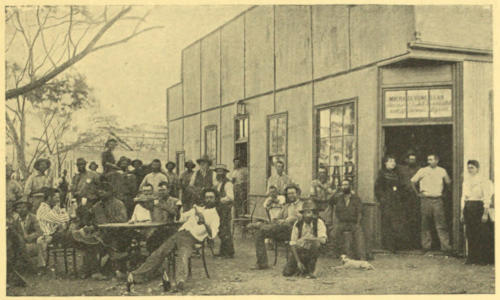
Saturday Afternoon at Kanowna
Kanowna—The Great Alluvial Rush—Big Nuggets—“The Joker”—Father
Long’s Golden Sickle—Nobility Represented—Bulong.
Looking at the town of Kanowna, White Feather, at the
present time, one can hardly believe that two years ago there
were 20,000 people there. It is now a quiet settled little
town, the outskirts riddled with holes, like an immense rabbit
warren. Even what was once the large cemetery is now dug
up in all directions, with just a little plot fenced in where burials
had really taken place. The other portion, which, owing to the
richness of the surrounding ground, was thrown open for
digging, had, of course, not been used for burial purposes. I
first went to Kanowna in November 1897, at the commencement
of the great rush. I wanted to see a rush on the spot,
and accordingly started one morning by coach from Kalgoorlie.
On arrival at Kanowna, quite a stranger, I had to carry my
own portmanteau around and look for a hotel to stay at.
There was no sign of a man about the little town. I afterwards
found that all the men were up at the Lead, as it was called.
At this time there were only three hotels in the town, now
there are more than twelve. I was fortunate enough to secure
the only vacant room in Donnelon’s Hotel; so, after getting
off some of the red dust of the 12-mile coach ride I started for
the said Lead, about half a mile from the hotel. When I first
saw it I was amazed, not only at the number of tents and bough-houses,
the thousands of windlasses at work, the thousands of
men with tin dishes washing the ore for gold, the thousands
of cradles (not babies’) being rocked for the same purpose, but
at the thousands of men rushing about in all directions in a
state of wild excitement. People at that time came from all
directions to see the wonderful alluvial field—miners to take up
claims, speculators to buy out claims, men to buy gold, men to
buy ore, and plenty of people only as spectators, who wanted
to see the gold as it was washed off. In this, however, they did
not always succeed, for those men who had time to do it had
made bough-sheds and pitched tents, and had their cradles
inside, where they could wash their ore in privacy, and
not let everybody know how many ounces would go to the
dish. It was my good fortune to make friends with many of
the mining-parties and to see the gold washed off, often 8
and 10 ounces to the tin dish. Many nice little slugs were
given me by those kindly miners as a souvenir of my
visit. Many days in succession I visited the Lead, as it was
called; much kindness did I receive, and many a billy of tea
was boiled for my refreshment.
At the beginning of the Lead the first claim was held by
Sim and Gresson; the latter joined the second Australian
Contingent, and has since been fighting for our Queen in Africa.
George Sim, the original finder of the rich cement ore, told me
that he had worked there for 18 months, with very poor results,
and yet felt sure of ultimate success, so that he was not surprised
when one day he “struck it rich,” as the miners’ saying
goes, and since then he and his partners have been taking
out cement, full of rich gold, as fast as pick and shovel can dig,
and have taken over £10,000 worth of gold out of their ground.
The next claim, held by Morris, Long, and party, also turned
out very rich. From 60 tons of cement they obtained 555
ounces of gold, 200 ounces of this being taken from the dish,
that is, obtained merely by washing the stuff in the dish and
picking out the gold; the rest was treated at the battery. The
cement is a greenish-looking stuff, more like pipeclay than
anything I have ever seen. Most of it crumbles up in the
hand when touched, and the gold is plainly visible, but there
are occasionally some hard lumps as well. There were hundreds
of other claims around here, notably that of P. McManus,
Huntington, and party. Poor Paddy McManus has since joined
the great majority. He was one of the best and kindliest of
men on the field and was regretted by all. This claim yielded
an enormous quantity of gold. Then Tassy O’Connor, Doyle,
and party’s claims, called the Arctic Circle and Klondyke,
yielded the partners a fortune each. Ninety tons crushed for
Jackson and party yielded the handsome return of 497 ounces
of gold. At Casey’s Claim, the day I was there, they had just
washed off some wonderfully rich coarse gold. They had
about 40 ounces of the precious metal in a frying-pan, no other
article being available to hold it since all the tin dishes were
required for gold washing purposes. Some nice pieces of
gold, running to about 27 dwts., are often found in these
dishes.
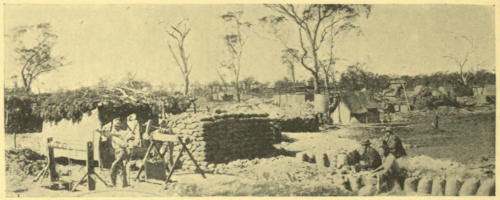
Deep Lead, Kanowna
These claims, with numbers of others just as rich, were on
the Main, or Fitzroy Lead; on the right, and to the north, was
the North Lead, where more riches have been found. Eaton
and party refused a large sum for a ninth interest in their
claim; they were making hundreds a week, and none of them
felt disposed to sell out. Close to this claim was the famous
Donegal. While I was there four buckets of ore were brought to
the surface thick with gold, and when washed were found to
contain nearly 300 ounces. There was great excitement
on the Lead that day, although the miners keep things of
that sort as much as possible to themselves. It is reckoned
that £12,000 worth of gold has been obtained from this claim
alone. The Red, White and Blue Company have also taken
phenomenal quantities of gold from their claim near the
Donegal, about £600 or £700 worth of gold having been taken
from the earth every week. Many of these men who had now
struck such wonderful good luck had previously worked for years
for what in mining parlance is called “tucker” (food). No doubt
pluck and perseverance are the two essentials required, and if
everybody could see the 12,000 miners on Kanowna field as
I saw them, and could hear of all the hardships that the
majority of them had endured prior to striking this rich field,
no one would deny that their good fortune was deserved.
Another very rich lead was called the Golden Valley. Here
the ore chiefly obtained was that called “pug”; it proved very
rich, but there was great difficulty in extracting the gold from
it until a special process was discovered. The Death Valley
and Cemetery Claims also proved to be very rich. Enormous
quantities of gold were taken from Kanowna in 12 months;
but it is difficult to obtain really accurate returns of an alluvial
field, as many miners keep quantities of their gold, while others
carry it away and sell it at different places; but I saw with
my own eyes the enormous richness of the field, and, if I
never see another alluvial rush, shall consider I was in luck
when I saw Kanowna, not only because of the information I
received, the money I made by being advised in what to
speculate, but for the mere sake of seeing the place as it was
in the full tide of its golden glory. There were no very large
nuggets at this rush, but about two years before, at a place
called Black Flag, one weighing 303 ounces was found; it
was called “The Joker.” In company with it were four other
nuggets and a piece of quartz containing 60 ounces of gold.
The Joker was an exceptionally bright piece of gold, three-cornered
in shape, with a bit out of one base. The other
nuggets weighed 73 ounces, 51 ounces, 37 ounces, and a little
over 10 ounces respectively. All of this gold was found at a
depth of 6 feet, and in the course of one week’s work, the total
weight being 537 ounces. One day all Kanowna and the
surrounding country were roused to a state of tremendous
excitement by the report spread by Father Long, the parish
priest, that an enormous nugget, weighing 1636 ounces, valued
at £6500, had been found close by, and had been named the
Sacred Nugget, or the “Golden Sickle.” When the news reached
Koolgarlie and Coolgardie, parties were organised, horses and
buggies, cabs, carts, bicycles, and every other available vehicle
taken possession of, and thousands of persons started for
Kanowna field. In the meantime no authentic information
could be obtained in Kanowna as to the place from which this
tremendous lump of gold had come, the lucky finders keeping
that a profound secret. However, search-parties were organised,
and set off to look for the spot whence the nugget came, some
one having given the slight clue: “It was near the Dry Lake.”
Off the parties went to the neighbourhood indicated, and a very
lively drive they had. It took an hour to reach the Lake, and
there a consultation took place. It was decided to skirt along
the Lake, but nothing came in sight except a boundless track
of low bush. Another halt took place, when a journalist among
the search-party, more venturesome than the rest, climbed a
steep hill, and at once gave a loud “Hullo!” Every one
thought the object of the journey had been attained. The spy
had discovered tents some distance away. Off went the horses
and vehicles at a hard gallop. The tents were all a dream,
however. There were no tents, and there was nothing in
sight. It was resolved to turn round and try in another
direction. At another likely spot a halt was again made, and
here occurred the most amusing incident. One of the vehicles
had been left by all its occupants except a lady. Everybody
was engaged in individual searching when a loud cry from the
lady recalled every one to the drag. Perhaps she had been
more fortunate. “Look there!” said she; “look at all these
men running and shouting;” and lo and behold, about 200 men
were seen rushing down an adjacent hill toward the party, each
with a branch of a tree. It appeared, however, that the newcomers
had only been following the conveyances. Off went
the vehicles again, down the Lake, up the Lake, and round the
Lake. Everywhere did these parties go, but no gold or signs
of habitation were seen. Father Long was besieged by people,
over 300 visiting his camp to find out where the lucky spot
was, but the priest said it was told to him under the seal, and
he could not divulge the spot. After searching all over the
country near to Kanowna no discoveries were made, and
the searchers returned sadder but wiser men. You may be sure
Father Long came in for no small share of abuse from thousands
of disappointed people. The truth of this remarkable story has
never come to light, but it is quite certain that no such nugget
was ever found, no official notice of it having been recorded,
and no bank ever having had charge of it. Father Long has
since passed away from earth and nuggets, dying of typhoid
fever in Perth Hospital in May 1899, and what was his share
in reporting the find will never now be known. Many people
are inclined to think that Father Long really thought he did
see the nugget, and therefore spoke of it in good faith. A
version of the affair given me by a good authority at Kanowna,
after it had all blown over, was that a certain party of men,
who owned one of the richest claims in the neighbourhood, had
all the gold they had collected for some time at one of the hotels
and that one of the partners, an Irishman, placed all the lumps
and pieces of gold together in the form of a sickle, and called
it the “Golden Sickle,” the collection of pieces looking exactly
like a huge lump of gold. Father Long, being near at hand,
was invited to see the splendid specimen, which he immediately
blessed and called the “Sacred Nugget.” The partners did not
undeceive him, but bound him to secrecy concerning the names
of the party who found it and the alleged locality from whence
it came. This promise poor Father Long faithfully kept,
thereby gaining for himself the condemnation of the multitude.
None of the partners were brave enough to own what they had
done, and Father Long had to bear the burden to the last.
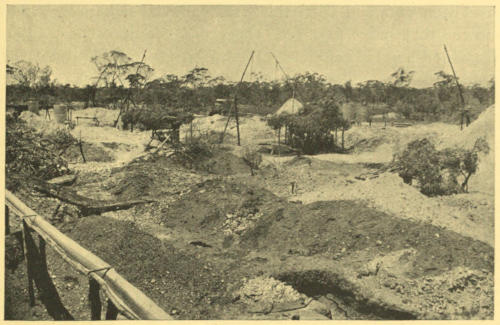
Alluvial Diggings, Kanowna
In those times Kanowna was a place never to be forgotten.
At night, after work was over, thousands of men used to flock
into the little town, and the three hotels being quite inadequate to
their wants, grog-shops existed in dozens and plied a big trade.
I must say, however, that, considering all things, Kanowna was
in general strikingly orderly and peaceful. Of course there
were occasional fights. We witnessed several from the balcony
of the hotel, the only place where we could sit in the hot
summer evenings. The hotel was crowded, hundreds were
unable to get served, and men were waiting five deep in the
bars; all drinks cost 1s. The hotel-keepers made rapid fortunes
from the bars, and were, besides, partners in claims on the
Lead. Two hundred and thirty thousand ounces of gold
have been obtained from this great alluvial field. It is well
known that miners, more especially the prospectors, are
very kind-hearted and resourceful men. If they “strike
it rich” they spend money freely, and are generous to a fault
to any old mates they may meet who have not been so fortunate
as themselves. It cannot be denied that, for strong and able-bodied
young men, life in the West, with its freedom and many
chances of good luck, is one not to be despised. Men from
surprisingly different classes are to be met on the goldfields,
and yet, so to speak, all classes are alike. I met during my
travels on the Lead several university men who were trying
their luck with the pick and shovel, and were not ashamed
of their clay-stained moleskins. There are a good many new
chums (arrivals), easily recognisable. The nobility is also
represented; one trooper who was there belonged to a noble
family in England. Another, a sprig of Scotch nobility, was on
one of the large mines adjacent to Kanowna, and was said to
be a fine fellow and universally liked. One meets quite a large
proportion of men and women recently arrived from the old
country, who seem always to make for the goldfields by preference,
while most Australians seem to love the towns and want to
stay there. There are several deep-level mines within a short distance
of Kanowna, none of them, however, calling for special
mention, with the exception of the White Feather Main Reefs,
which occasionally gives a good yield, and the managers of
which look on it as having better things still in store; recent
crushings have been highly satisfactory, and future ones are
expected largely to increase the profits of the shareholders.
Bulong is a mining township 12 miles from Kanowna, and
as several good finds have been made there, one of 500 ounces
of gold, I should not be at all surprised to hear of a more
sensational find some day, followed by the inevitable rush.
The Queen Margaret Mine has given good returns, and there
are a number of men on the alluvial ground who make
a good living, and a little to spare, all the year round. The
ground has not been thoroughly prospected yet, and its worth
remains to be decided. Sixteen miles from Bulong, at Black
Hills, two men, who had been prospecting, lately came across
a nice little find of 2000 ounces of gold from a few tons of
quartz. The usual subsequent rush to rich finds of course
took place. In October 1900 a large nugget weighing 13 lb.
was found by a man named Eddy, at Kurnalpi, about 40 miles
from here, not 200 yards from the place where the nugget
weighing 168 ounces was found the year before by John
Symonds. Kurnalpi has been one of the richest districts of
the goldfields, and who knows how soon some still more sensational
finds may startle us all!
CHAPTER XX
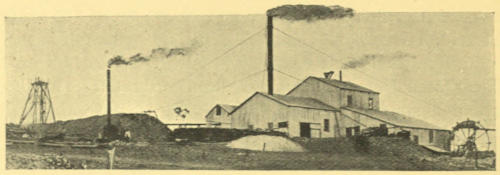
Hill End Mine—Broad Arrow
Broad Arrow—Menzies—Rich Mines—Lady Shenton—Luncheon in
the Caverns of the Earth—Hon. H. J. Saunders—Welcome Tea and
Cake—Native Murder—A Lost Prospector—Cake of Gold—Box-seat
of the Coach—Mount Malcolm—Gold Escort—Windmills and Fresh
Water.
I went back to Kalgoorlie this time by train, the railway having
now been open over twelve months; stayed at Wilkie’s Hotel,
opposite the station, and found it most comfortable as well as
convenient. Wilkie Brothers, who were the successful tenderers
for the Coolgardie Railway (which brought them a profit of
£300,000) own this hotel. The next morning I set out for
more goldfields, and arrived at the Menzies after an interesting
journey through various small townships, Paddington and
Broad Arrow being the best. There are some large mines at
Paddington giving excellent returns. Broad Arrow, a very
nice little place, has lately been the scene of an alluvial rush,
and the usual population of 300 was quickly increased to 3000.
There are a post-office, four hotels, several stores, and a good
many shops, as well as some nice dwelling-houses. It is now a
very thriving place of some importance and a scene of bustling
activity. Shops which a short time ago would not let at any
price now command such rents as their owners scarcely dreamed
would ever be possible. There are several very rich claims
which have bottomed on rich gold; in fact, gold is everywhere.
The extent and value of the golden ground can only be conjectured.
One claim, called the Blue Duck, was exceptionally
good; so is the Maltese Cross; while the Bird’s Nest is a
veritable golden hole. The names of these claims struck me as
being very peculiar; another rich one, owned by men who,
until they struck this, had had a continued stream of ill-luck, is
called the Battlers’ Reward, and indeed they richly deserved
their splendid find, the gold from which stands out to the wash
in halfpenny-weight pieces.
Farther along the line is Bardoc, from which place much rich
gold has been won. It was at Bardoc that an accident recently
happened in one of the mines, a poor man being killed by five
tons of rock falling on him.
Twenty-six miles before we reached Menzies was Goongarrie,
which a few years ago made a great sensation in the
mining world.
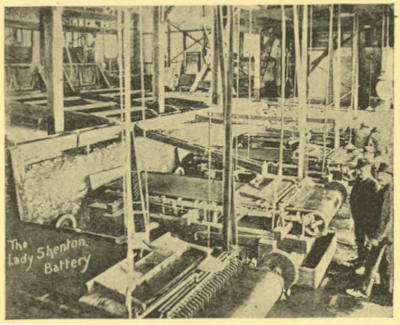
Part of Lady Shenton Battery
Menzies was the nicest small mining town I had seen.
There was a wonderful air of prosperity about it. As I walked
up the principal street it seemed almost to say, “This is a good
place,” and the people were extremely kind to the stranger in
their midst. Until quite recently Menzies was one of the “back-block”
towns, only accessible by coach from Kalgoorlie, a distance
of 90 miles. The people in what we Australians call coach-towns
always seem more genial and warm-hearted than those
who can pop into a train and be whirled along to the metropolis,
and Menzies only having had the train service recently has
not had time to get spoiled. I think it is because of their
isolation that people in these places, as a rule, hail strange
faces with more pleasure than others do. There are some very
nice houses in Menzies, and the hotels are especially good.
The Grand Hotel (I can speak from experience) is a model of
comfort. A very well-built post-office and court-house adorn
the town, and there are many other substantial buildings in
the place, which is, no doubt, a most important centre of
business and industry, and which has made great strides
during the last twelve months, especially since it received a
new impetus from the advent of the railway. The town is
literally surrounded by mines, not only of gold; copper has
been found near in lodes of 50 feet wide, that bear 5 dwts.
of gold as well as 60 per cent. of copper. Menzies is quite a
young town, and is named after Mr. Menzies, the explorer,
who, in 1894, went prospecting from Kalgoorlie to see if he
could discover any more
Kalgoorlies. After
travelling some weeks
he discovered some rich
“shows,” and telegraphed
to the syndicate, of which
Sir George Shenton and
the Hon. H. J. Saunders
are head, to that effect.
Application for ground
was made and accepted,
and works afterwards
commenced, with what
success may be imagined
from the results of that noble mine the Lady Shenton, which, since
1897, has paid 12 dividends of over £88,000, besides expending
large sums of money on machinery, &c. The Lady Shenton Mine
occupies 36 acres of land. There is a splendid electric-light installation,
both on the surface and underground, at the main
shaft as well as in the crushing-sheds, and in many other places
where it is useful. The total output of the mine is 97,278
ounces of smelted gold, exclusive of gold from tailings and
concentrates, the latter sometimes giving a very high percentage
of gold, since as much as 327 ounces had been taken from 73 tons
when I was there; 14,000 tons of tailings were awaiting treatment.
Some time ago, when Sir Gerard Smith visited the mine,
luncheon was served to the visitors in the 300-foot level. I
happened to be at the Lady Shenton Mine at “crib” time, and
after “crib” the miners went out with their football to have a
game before beginning work again. They were fine looking
specimens of colonial manhood, and seemed thoroughly to
enjoy their friendly game.
The sleeping tents of the miners are some little distance
from the mine, but there were several dinner tents close by.
The men form themselves into little parties of five or six,
taking it in turns to act as house boy, or, as I should say,
tent boy. In the day time the menu is cold, and looking at
the stock of tins of preserved meats (elegantly termed
tinned dog), fish, jam, milk, cake, and vegetables, it is easy to
see that they do not neglect their meals. Why should they,
since they are in the receipt of high and regular wages?
The next large mine is the Queensland Menzies, from which
there have been large returns. There are some other first-class
mines from which great things are expected. Four miles from
Menzies is Kensington, where there are more good mines, also
two splendid breweries. I next travelled across the country
for about four miles, all alone, with only the pony I was driving
for company; but happening, with my usual luck, to strike the
right track and not get lost, I came to the Four Mile, where
there is a little township (small settlement), and a magnificent
mine called the Menzies Consolidated. There are 120 men
engaged on this mine, who form quite a little colony by themselves.
There is a fine tennis court, where several of the officials
of the mine were enjoying a game. Mrs. Strickland, the sub-manager’s
wife, insisted on getting tea and cake for me, and
seeing that my horse also was refreshed after the heat of the
day. On my way back to Menzies by another road, a metalled
one this time, I passed many prospectors and dry-blowers, who
all seemed quite satisfied with what they were getting. When
I got in sight of Menzies I took a short cut through the Bush,
and found I had to pass through abandoned alluvial diggings
and several shut-down mines. I was glad to get back again on
to the hard road and to Menzies, for the shades of night were
falling fast. Next morning I learned from the paper that a
murder had been committed by natives and the body found
near Kensington the day before. I must have passed quite
close to it, and am very glad I did not see it. Many crimes
are committed in these remote parts, the perpetrators of which
are never discovered. A long-standing mystery has just been
solved: a man named McInnes disappeared about two years ago;
he was known to be a thorough Bushman, and fora few days no
notice was taken of his disappearance. However, as he did not
return search-parties went out to look for him, but he was
never found. Shortly after his supposed death his brother
came from Victoria, took charge of his affairs, and vowed that he
would never leave the colony until he had solved the mystery
of his brother’s disappearance. This has apparently been done
by a blackboy named Tiger, who found the skeleton of a
man at the Bullarchi Rocks, 12 miles off, and Mr. McInnes,
the brother of the missing man, being sent for, identified the
remains as those of his long-lost brother. The poor fellow
had evidently, in Western vernacular, “done a perish,” like
so many others, in the course of searching for gold.
An extraordinary meteor was witnessed here a short time ago.
A magnificent ball of fire shot across the heavens from the
north-west to the north-east, leaving an almost straight trail
of light behind it. At the head of this trail of light appeared
a ball of fire, which became gradually diffused around the
luminous trail or meteor in convolutions resembling the
movements of a serpent. For some moments the display bore
a likeness of a pillar of light with a serpent twined around it.
Gradually this semblance was transformed into the figure of a
man standing upright, with his arms partly spread and his
hands clasped. This form grew gradually into an attitude as
if the figure were about to spring, the head and shoulders being
inclined forwards and the legs slightly drawn up, and in this
attitude it remained till the luminosity, gradually becoming paler,
was absorbed in the silver light of the breaking day. Altogether
the phenomenon lasted from 10 to 15 minutes.
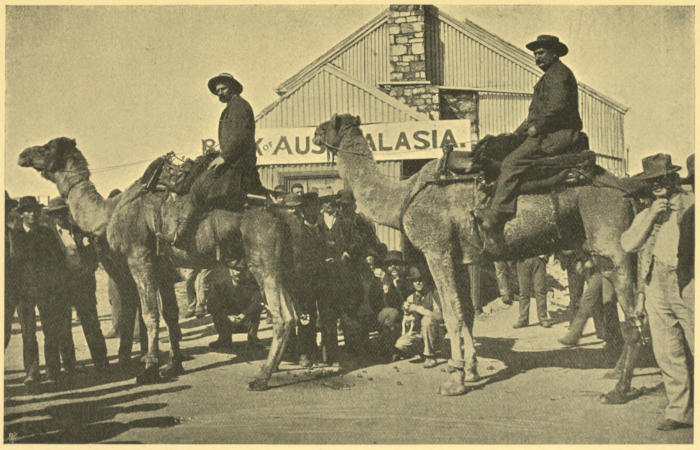
MESSRS. A. FORREST AND J. DUNN ON A PROSPECTING TOUR
To the west of Menzies is Mulline, where there are some
very rich mines. Mr. De Baun, of Perth, has a mine there
from which he recently brought to Perth a very nice little cake
of gold weighing 447 ounces, valued at £1700. Then on the
east side there are Yerilla, Pendinnie, and Eujidine; here the
Nita Mine, lately called the North Fingall, has recently had a
fine crushing. At Pendinnie, 120 miles from Menzies, a find
lately took place, and the scene along the road was a repetition
on a smaller scale of the rush to the Boulder a few years ago.
Camel and horse teams crowded the way, and everybody was
smitten with the feverish race to get to the promising spot;
nothing stupendous has yet been found, but the place is
good and fair results have been obtained. The Waihi Mine,
about 32 miles from Menzies, is one of the latest sensations,
and promises to be of great value. Much of the stone is being
broken out, showing rich gold, and, on being tested, gave
results from 6 to 20 ounces per ton. Although only discovered
in October 1900, the lucky prospectors in November were
offered £20,000 for the mine by a syndicate, and since then
a company has been floated and over a hundred thousand
shares taken up.
I went on by coach to Mount Malcolm from Menzies.
Certainly there was not much but sand and scrub to be seen in
the way of scenery. We arrived at Niagara, the end of the first
30-mile stage, quite ready for dinner at 1 o’clock. This little
place did not present a very attractive appearance; in fact, it
was most remarkably dull looking. The mining district of
Niagara is scattered, but there are some good mines about.
After the 60-mile coach drive I was very pleased to see the
lights of the little town of Mount Malcolm appear, which
is the most typical mining place I have ever seen. As I
strolled down the one street in the morning I said to myself,
“I am indeed getting away from town life, and shall now see
real mining business to my heart’s content.” The coach journey
is indeed terrible, the road being almost one sand patch, and
the horses having to walk a great part of the way, so the sooner
the railway comes the better for all parties concerned. There
seemed to be some grass growing about Malcolm, which was
quite a fresh sight for me, and I am sure a boon for the horses
and their owners in these parts, where fodder is so expensive.
Then the beautiful supply of fresh water is a blessing to
every one, and a great aid to the development of the country, the
work of digging for gold being rendered so much easier than in
the sterile wastes of country where water is scarce. Mount
Malcolm might almost be called Windmill Town, on account of
the windmills over the wells; nearly all the public-houses and
many private places have their own water supply. The gold
escort had just gone down, taking the month’s gold to Perth.
I saw it start from the post-office, which is quite a nice
large one for a mining township. The warden’s offices, or
court-house, are nearly opposite—such a funny place!—just two
Hessian tents with bough-sheds built over to protect them from
the sun. (A new warden’s office has since been built.) There
is no lock-up here, so any one who misbehaves is chained to a
small tree not far from the court-house and left there all night.
This seemed to me a custom more fit for the barbarous dark
ages than this enlightened century. A little while ago a man
was chained up for being intoxicated. It appears he woke from
his tipsy sleep in the night and felt very thirsty. He tried to
get the chain off his leg, but could not. The tree they had
chained him to that night did not happen to be firm enough
in the ground, for he pulled and pulled until he got it
uprooted, and then made his way down the street to an
hotel, dragging chain and tree after him, and with his blanket
fluttering in the wind made night hideous with his cries
and woke the whole town with his noise. As the authorities
could not give him a month under the tree for this,
they packed him off in the coach next morning to the nearest
gaol.
There are not many mines in the immediate vicinity of
Malcolm. The Richmond Gem was under exemption, also at
that time under a cloud, but it had been a good mine, and
will, no doubt, recover itself. Another large mine about half a
mile out is the North Star, where very good results have been
obtained. There are many men employed here, and on Saturday
nights they come into Malcolm and make the little township
lively. A novel procession passed up the street while I was
there; it was a new engine for the Malcolm Mohr battery, drawn
by 14 horses, and caused quite a flutter of excitement. Malcolm
was comparatively quiet, as there was a rush to Mertonville,
18 miles off.
The ex-Premier, at a recent visit, said that when he was
last in the district, 30 years ago, he stood on and named
Mount Malcolm, and in those days never thought that it would
be the centre of a great mining district. On the earlier
occasion he was at the head of a small exploring expedition
sent to see whether the reports of the natives that white men
had been murdered there were true; it was thought that these
white men might be members of Leichhardt’s expedition.
During my stay at Mount Malcolm I was shown many really
beautiful specimens by the managers of some of the principal
mines. Many of these were from deep levels, and would, I am
sure, much surprise many people who are sceptical about the
richness of the mines in these parts. I received some very
pretty little specimens, souvenirs of my visit, which I shall
always value very much. There is no lack of money; every
one appeared to be well off. The following story may serve
to show what a lucky miner will sometimes do after he has had
a good crushing or found some good specimens. A man who
had unearthed a nice slug—30 ounces—in the Lake Way district
came into Malcolm for a spree, and on one occasion, while
drinking “not wisely, but too well,” he upbraided the Hebe
behind the counter for wiping the glasses with an old towel.
The delinquent pleaded poverty as an excuse, and straightway
the accuser threw down ten sovereigns and suggested the
purchase of a new towel. Another man at another township,
who had a splendid claim, and had taken over £2000 worth of
gold from it, has now not a penny, because every time he
realised on his gold he immediately spent the whole sum in the
hotels. As there are but two of these in the township, they
have made good profits from this man’s mine. When he has
spent all his money, the hotel-keepers put him into a cart and
drive him out to the mine to recover himself. After he has
done so, he usually sets to work for a month or two, and
unearths some more nuggets for another spree (drunk).
Shortly after breakfast a few friends and myself drove to
some nice gardens a little way from town. Although the
weather was very warm, everything was delightfully fresh and
green, the flowers were smelling sweetly, and the vegetables
a perfect picture. What a blessing is plenty of fresh water!
Any quantity can be got here by digging a well, and the experts
from the Goldfields Water Supply Department, who were here
recently, say that the country between the hills is really a
subterreanean reservoir extending for miles. We drove on
to the Mount, which is five miles farther away. A splendid
view of the surrounding country for fully 30 miles is obtained
from the Mount. The Trigonometrical Station here is very
interesting. We had lunch on the very top of the hill, and
returned to Malcolm in good spirits, having passed a most
enjoyable day.
Daseyhurst, 35 miles from Menzies, is a coming goldfield,
and North’s Consolidated Blocks, owned by Mr. J. H. North
and Mr. W. E. Millar, may yet rival the fame of Great Westralian
Mount Morgans, of which mine these gentlemen were
the pioneers. Mr. North has recently successfully floated a
company in London to further develop the North Consolidated,
and we expect to hear great things in the future from this
promising mine.
CHAPTER XXI
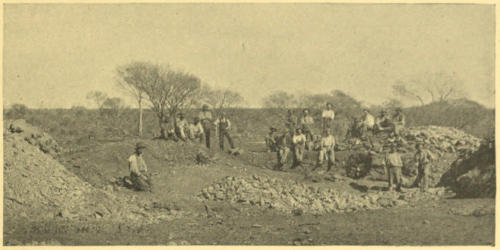
Merton’s Find, Mertondale
A New Field—Mertondale—Stupendous Richness—Gold, Gold everywhere—A
Lucky Prospector—Garden in the Bush—Murrin! Murrin!—A
Welcome Surprise—Western Australian Mount Morgans—Golden
Hills—Blackfellows on the Trail—The Lagoon.
My investigations at Mount Malcolm took me some days, so,
after a good rest and pleasant time at that very lively little
township, I started one Friday, at 7 o’clock, for the new goldfield
of Mertondale, to which there was a rush. One morning
Malcolm folk woke up to the startling news that a new and
phenomenal rush had begun 18 miles off. Soon everybody
was on the qui vive to see it. All the vehicles in the township
were loaded, and the male population started en masse for the
new find. It turned out to be a great one, and many stories
have been told me concerning the richness of it. There was
nothing of great interest on the road to Mertondale. A bough-shed
off the road in the distance, pointed out to me as the
place where a prospector had lately chosen to shuffle off this
mortal coil by cutting his throat, and that just as his claim
had struck gold, was about all that varied the monotony of the
journey. The Australian Peer Mine was the first seen on the
road. It was the one at which Merton and Gallagher were
working when Merton went out one day on his bicycle to look
for a lost horse and found the lucky hill which has since yielded
so much gold. Mr. Merton said that when he discovered it
he did not think it was so good, until he commenced breaking
the stone he picked up on it, and found in every instance that
it contained gold. After discovering the reef he applied for a
lease, and put on two men to work at carrying out the quartz.
The stone had to be taken two miles to the Waitekari Battery,
but in the short space of two months £3206 worth of gold was
crushed. A short time afterwards, Mr. Merton, who was a
poor man at the time of the find, purchased a 20-head battery,
and now crushes the stone on the spot where it is found. The
reef of solid quartz is 100 feet wide, and traverses the whole of
Merton’s area of 36 acres. He said that he would want a
higher price, cash down, for his holding than has ever been
paid for any mining property in Western Australia; so, from
a poor man, a few months have made this lucky prospector a
millionaire. On arriving at Mertondale the sound of the battery
waked the stillness of the morning. The township is very
small as yet, merely a few Hessian houses and tents, but
I saw before me the hill, with the battery in full work, in which
I was interested. So I asked the driver of the coach to take
me there, which he did as a very great favour, for he was
carrying the mail and had not yet been to the Bush-house
post-office. However, as it was a very hot day, gallantry to
the fair sex prevailed and the mail had to wait. I got down
from the coach at the foot of the hill, and at the battery-house
found Mr. Robinson, the manager, who kindly took me round
and showed me everything of interest. First he went to the
spot where Merton picked up the first rich stone. Plenty of it
was still lying about. We went down into the open cut (or
quarries) where the men were digging out the stone. I took a
pick and dug out a piece myself, striking rich gold at the first
stroke. Several other pieces followed, and I keep them as
specimens. We then went down the underlay shaft, on the
western side of the big quarry. It was 12 feet deep. I got
down by means of a rope, two of the men at the bottom holding
their spades against the sides of the shaft for me to put my
feet on. I managed to make a successful descent and began to
use the pick again with much success. I could see the gold
running through the rock quite plainly, so, having permission to
do so, dug out several nice pieces, after which I essayed to climb
the rope to the surface again, and, assisting myself by sticking my
feet upon the jutting pieces of rock on the sides of the shaft, I
soon got out of the rich hole. I then walked all over the hill
and found many pieces of quartz lying about, all containing gold.
Mr. Robinson afterwards took me to the battery and showed
me the plates into which the gold and amalgam run after being
crushed by the mill. I scraped some of the rich stuff off the
plates; to my disappointment it looked like silver, but Mr.
Robinson explained to me that this colour is caused by the
action of the mercury used in the process, and that when
smelted pure gold appears. Some idea of the power of the
mercury may be given by this fact: I put in paper the piece
which I had scraped off and placed it in my purse, in which
was a gold ring that I had just put there to take to be repaired.
Next morning, when I went to take it out, the gold ring was
gone, but a silver one remained. The jeweller had to retort it
(put it in fire) to regain its colour. Merton’s Hill is, no doubt,
a perfect mine of wealth, and, so far, all on the surface, as the
deepest digging then was the 12-foot shaft I have mentioned.
Over £40,000 worth of gold had been taken out in the few
months since the beginning of the rush, besides fully 20,000
tons of rich stone that will give 7 or 8 ounces to the ton, and
as every ounce is worth nearly £4, a nice little sum is looking
at lucky Merton out of the stone.[5] There are many other claims
on the field, but the one on the hill is the most valuable. It
gives gold, gold everywhere. I was so much taken with this
wonderful place that I pegged out an 18-acre lease for myself,
and am hoping to strike a rich patch on it at some not far
distant day. In the Golden West one never knows when luck
may come to one.
It was great fun and hard work pegging out that lease. To
enable one to do so, in the first place one must be provided
with a miner’s right, which costs ten shillings per year; this
document enables the holder to take up any ground he or she
desires (not previously taken) in mining country; after the
lease has been approved by the Warden of the Goldfields,
one may start and dig or put men on to dig, and the gold found
would be private property; if, however, any one dug and found
gold without these preliminaries, the precious metal would
have to be handed over to the Warden as the property of the
Government.
Behold me then (knowing all this, and having secured a
miner’s right before I left Perth) accompanied by some kindly
miners and the lady under whose roof (canvas) I was domiciled,
with my sleeves tucked up and a spade in my hands digging
holes for the pegs to be put in, which must be done personally;
as it was an 18-acre lease the distance between the four
pegs was considerable, and required some walking to be done
in the hot and dusty morning. However, I successfully
planted my pegs, marked my number on them, and after paying
the fees in the Warden’s Court at Mount Malcolm on my return,
I became a leaseholder.
Another rich find had lately been made at Wilson’s Creek,
30 miles from this place, by two prospectors named
Paddy Crowley and Dick Donovan. Over twelve months ago
they found some alluvial gold there, but until a few months since
nothing phenomenal; then they found a lode at a depth of
10 feet, with rich leaders running in all directions. One of the
partners went into Malcolm the other day with a bagful of
specimens weighing 372 ounces, and the other partner is digging
out more as fast as he can. Mr. Hamilton, of the Great
Boulder Mine, Kalgoorlie, recently visited Mertondale, and
gave it as his opinion that the place would turn out a
second Great Boulder and the Flying Pig Mine a second Golden
Horseshoe. As yet all the gold obtained has been found near
the surface, and if the deposit continues down lower the possibility
of incredible wealth lies in this wonderful spot. As yet
Western Australia’s surface seems only to have been scratched
in a few places. If the bodies of ore prove to go down,
Mertondale bids fair to outrival the Boulder, Kalgoorlie.
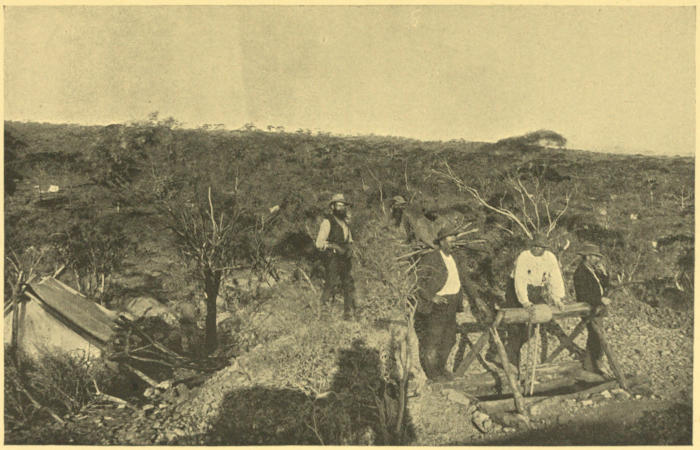
MR. ALICK FORREST INSPECTING DUNN’S SHAFT NEAR MOUNT MORGANS
The weather being intensely hot—109°—I decided to return
to Malcolm in the moonlight, and a friend succeeded, after a
great deal of trouble (for horses and vehicles are not yet very
common here), in borrowing the only horse on the field, and
managed to get an old buckboard buggy to drive me down.
Camels are the usual mode of transit in this district, but I
refuse to ride these animals.
Starting the next morning by coach from Malcolm at half-past
five for Westralian Mount Morgans, I was fortunate in
having the box-seat of the coach. A cool breeze had sprung
up in the night, no doubt accompanied by a willy willy,
which, as I told you before, is a terrific whirlwind of dust
that sweeps along everything before it, and frequently carries
verandahs away bodily and deposits them on the roofs of
adjoining houses, besides removing tents as it passes. On
arrival at a little hotel at 8 o’clock I felt quite ready for breakfast,
and wondered what kind of fare we should get in these
remote parts. Nearing the place, which rejoices in the name
of Bummer’s Creek, a fine vegetable garden surprised me. It
looked very refreshing to see the nice green garden after nothing
but sand and mulga-trees for 10 miles. On going into the hotel
(a tin one) evidences of comfort out of the usual order of “back-blocks”
travelling appeared. Many little dainties were on the
table, and we were served with an excellent breakfast, fresh
eggs, fresh milk, and hot scones coming on us as a complete
surprise. There were two lady passengers besides myself:
Victorian girls who were on their way to an engagement at the
next hotel, where one of them was to be a “companion” at a
weekly salary of £2 10s.
Twelve miles farther on we reached Murrin Murrin, where I
stayed for a day. Here I visited the Malcolm Proprietary, and
was much interested in the works and management of the mine,
a fine one, giving good returns. An interesting feature is the
tailings hoist, worked by a compressed-air plant. Returning
to the Murrin Hotel for dinner, I was surprised at the delicate
way in which it was served, at a table with beautiful napery,
elegant silver, and glass ware. On becoming acquainted with
the little landlady, I was no longer surprised, for I found her a
cultured lady, who invited me to stay a few days as her guest,
and I thoroughly enjoyed the quiet change from the roughness
to which I can never accustom myself.
There is a great deal of copper about Murrin, and many
copper mines are being worked with good results, the Anaconda
taking the first place.
On arrival at Mount Morgans I found it quite a flourishing
township. Twelve months ago there were no houses, but now the
place is increasing wonderfully. The Westralian Mount Morgans
Mine is less than a quarter of a mile from the township, and is
on a hill overlooking the surrounding country. The large
machinery on it made it look very imposing. From the hill
Mount Margaret is visible, a township now quite deserted, all
the houses having been bodily moved to Mount Morgans, and the
hospital to Laverton, another rising mining place, the former
name of which, British Flag, was changed to Laverton in compliment
to Dr. Laver, who has been mainly instrumental in
bringing the place into prominence and attracting an inflow of
British capital.
There are some very valuable mines here, as well as the
Westralian Mount Morgans, Guest’s Mine being the next in
importance, and rapidly coming to the fore as a gold-producer.
A company in England has recently been floated with a quarter
of a million of money to deal with this mine. The reefs
are very large, and known to extend over 20 miles. The
Westralian Mount Morgans, which bids fair to be one of the
biggest gold-producers of Western Australia, is named after
Mr. A. E. Morgans, the Member for Coolgardie, the largest
shareholder. There was an enormous quantity of ore waiting to be
crushed, and, although the gold is too fine to be seen by the naked
eye, it realises from ½ ounce to 3 ounces per ton. Thousands
of tons of this ore, sufficient to keep the battery going for five
years, are visible, waiting to be taken out. Occasionally some
rich pockets of
gold are found,
the rock simply
glistening with
the precious
metal. The
output of this
mine is very
large, and nearly
200 workmen
are employed.
Water for
crushing purposes
not being
abundant, a pipe-line was laid to an extensive lagoon 6 miles
away, and now brings an ample supply. The cyanide plant
can treat 2500 tons of tailings monthly. Two thousand cords
of wood are neatly stacked by the mine ready for use, and
more is obtainable at a short distance.
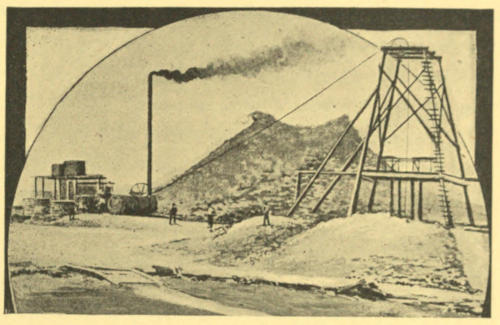
Westralian Mount Morgans Mine
The working-men’s club and library, a very nice building,
built of mud-bricks in their spare time by the men, who are
very proud of it, faces the mine. The term “mud-bricks” may
need explanation: the bricks are made from a kind of reddish
soil found here, and when moulded into shape look very well.
The first hotel in Mount Morgans had just been opened when I
was there. I had great difficulty in getting accommodation, and
was obliged to share the room of the landlady’s daughter. The
proprietor was doing a roaring trade. There was a large dining-room,
which was turned into a dormitory at night. Visitors
were constantly coming and going, so much being heard on the
lower fields of the recently wonderful finds. The post-office is
as yet a very primitive place, merely a canvas tent with a bough-shed
over it; but new buildings are going up in all directions
as fast as they can be built. Land brings a good price, plots
now fetching as much as £300 (which six months ago could have
been got for the pegging out). When a goldfield is proclaimed,
the warden of the place gives permission for people to take
up ground for residential areas. Then comes a wild rush to
get in the first pegs. These pegs are to mark the ground which
an applicant desires to take up. When the warden’s permission
was given, at a court held at Mount Margaret, numbers of men
hurried to Mount Morgans to peg the best plots of land. Some
went on bicycles, some on horses, and those who arrived first
of course got the best choice. One well-known man had an
old racehorse which he had “kept dark,” as they say, and he
outpaced them all and got the choicest plot on the township.
He has since erected the second hotel there, and sold it, I am
told, for a very large sum before it was completed.
Very few women are yet on the field, and as I sat writing in
the only little parlour, all the male population seemed to walk
past the open door (the room being too small and hot to shut
it) and to gaze at me as if I were something rare and remarkable.
With the exception of the few golden hills, the country was
very flat, and cyclists were constantly arriving. The country
around Morgans is very pretty in some parts, and there is
plenty of nice grass growing. Every coach coming up from
Menzies was crowded with miners and prospectors, who, having
heard so much of this wonderful district, where a plentiful
supply of water is to be obtained, were getting out as fast as
possible. Not far from Mount Morgans, a mine, which is
reported very rich, has lately been discovered by Mr. Dunne,
who found the Wealth of Nations Mine at Coolgardie. Mr.
Alick Forrest is largely interested, and lately paid a visit of
inspection to it.
It is a very pleasant drive of six miles to the now deserted
township of Mount Margaret, and three miles farther on is the
Mount itself, from which a grand view of the country is obtained.
The enormous Lake Carey (salt) stretched far away in the distance.
This is one of the innumerable salt lakes of Western
Australia, and with the glorious sun shining on it it looks like
a lake of gold. Sir John Forrest was the first white man to set
foot in this district, and stood on the Mount 30 years ago, when
he named it Margaret after his mother and his intended wife.
As I returned to Mount Morgans in the cool of the evening,
a very large tribe of blacks (natives) appeared on the scene,
but they were very peaceful, and asked me for “bacca” and sixpence,
which the king having obtained, they all appeared satisfied.
They were dressed in civilised clothes, and looked quite fat.
“White-man’s tucker,” as they call it, and which they beg for
as they go along, seemed to suit them. They had just lit
their camp fires. The aborigines’ means of fire lighting is
by wood friction, and as it takes a long time to get a spark
they usually carry fire-sticks, which keep alight a long time
and save them much trouble. They often bring into the townships
or camps pieces of gold which they have found in the
bush, for they know they will receive something, although
they do not know the real value. They know, however, the
superior value of silver to copper, being aware that they can
get much more “bacca,” or food, for a silver piece than for a
copper one, and when they take their finds to any one, asking
“how much this fella?” meaning “what is it worth.” If it is
a small find, and they are told the value in pennyweights, they
will say “Bael (no) pennyweight, that fella shillingweight.”
(The native, in his attempt to talk English, terms nearly every
person place, or thing “fella.”) They told me in their broken
way that this tribe had travelled from Kalgoorlie, and was
going to the Murchison, looking for a renegade blackfellow
called “Kangaroo,” who had transgressed their laws, and whom
they meant to kill. Let us hope, for “Kangaroo’s” sake, that
they never found him.
Mount Wilga is a very rich property which lies on the other
side of Lake Carey, is in a country that might almost be called
undiscovered. But Mr. G. W. Hall has discovered its richness,
and sent up a manager and gang of men, who are working
away with great vigour. The lode is as big and rich as any one
could desire. Some of the ore from a good depth that has been
assayed has yielded 20 ounces to the ton; how much equally
rich will be got remains to be proved.
Although the supply of water for mining purposes at Mount
Morgans is not adequate, there is plenty for domestic purposes,
the wells sunk in many parts of the township giving
a good supply. In the rainy season, which, however, seldom
comes, the lagoon that supplies Westralian Mount Morgans
Mine with water is a huge lake, and teems with waterfowl.
Kangaroos and wallabies sport around its banks, and give
great opportunities to the sportsmen, who during other parts
of the year have to let their guns lie idle.
CHAPTER XXII
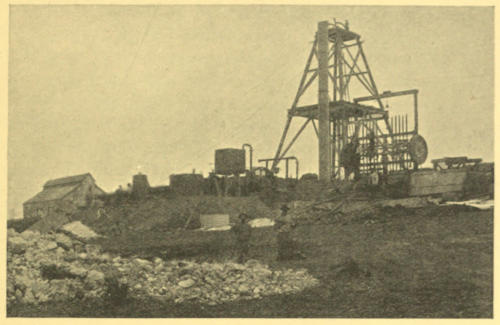
Mine at Laverton
Laverton—Excitement among the Miners—Bachelors and Grass
Widowers—More Souvenirs—Lucky Discoveries—Erlistoun—Lost—Eagle
Nugget—Euro Mine—Hospitality in the Bush.
The coach to British Flag, or Laverton, turned out to be a
large kind of conveyance with three open seats and no cover;
consequently, as the day had been hot, I was glad when we
drove into the township at 8 o’clock in the evening, for
I was fairly tired out. Every one in the place was looking
out for the mail, which only goes up three times a week.
Several gentlemen whom I had known in other parts of the
colony were here, and having heard that I was to arrive by
this coach, were waiting to receive me, and three pairs of
stalwart arms were held out to help me down. I was
escorted into the hotel, and from the time I arrived until I
left was the recipient of so much attention from the numerous
and kindly fellows as to be almost bewildered.
The very comfortable hotel was kept by three bachelors,
one looking after the hotel business and the other two after the
store which they also own. Wages up here are very high:
cooks get £3 10s. per week, and two young women, one of
whom acts as housekeeper, while the other attends in the
bar, were receiving £5 per week! Another young woman
was making a small fortune by washing and mending the
clothes of the gay bachelors, who, having plenty of money,
do not mind what they pay for work done for them. The
whole of the country seemed to be a vast auriferous area,
and thousands of miles of rich country higher up yet are
absolutely unprospected.
Horses being very scarce, I was indebted to Mr. Campbell
Shaw for the use of his horse and buggy during my stay.
Mr. Shaw drove me out to the Augusta Mine, of which he is
manager. This little mine is very rich, and had just been
bought from the three original prospectors for £2500 in cash
and 1300 shares. There was no battery there as yet, and so
the stone raised was taken to the Hawkes Nest Battery, 9
miles away, every morning by a 60-camel train, the camels
returning at night for their next morning’s load. The country
around is really pretty, and from the hill on which the Augusta
Mine stands you can see the houses at Mount Morgans, 20
miles off, through the clear air. Some very fine specimens
have been sent from this admirable little mine to the Glasgow
Exhibition, and I was fortunate to get some myself. The
camps here were all very neat and tidy, and yet there was not
a woman on the mine, all the men being bachelors or grass
widowers. I intended to go down the shaft, but there had been
an accident the day before, and two young men had been
injured—happily, however, not very seriously—so I thought
discretion the better part of valour and did not go down. As
no women were at the mine I volunteered to do a little nursing
by putting cold bandages on the injured men’s arms, and
making them nice cool lemon drinks, for which the poor fellows
were very grateful.
Going back to Laverton, just as the sun was setting, I
thought the little township looked very flourishing. It is
wonderful how quickly these places spring up! A few months
ago only a few tents marked the spot which then was called
British Flag. We stopped at Dr. Laver’s old camp and
surveyed the little township with wondering eyes, and two
lucky prospectors coming up gave me a pretty little nugget
they had found that day. These men had previously struck a
patch in an abandoned shaft near where they were camped a few
miles out. They thought they would go down and look all
over it, and did so with such perseverance that they found a
leader. Following it up, they discovered it to be 18 inches
wide, and eventually came across a rich pocket from which they
afterwards took £4000 worth of gold.
Driving into the township we went down to the post-office,
not a Bush one, but really a nice building. As it was the mail
night all the folk were there waiting for their letters. Most
of the shops and houses are built of galvanised iron, and are
very hot during the day; but this drawback has to be endured,
for the place is in the Mulga country, where the trees are very
small and only fit for firewood, and the distances are too great
to bring timber from elsewhere. The Western Australian
Bank had a very nice place; it was one of the best buildings
there.
I was now over 600 miles from Perth, the capital, and had
reached the very last township in the Mount Margaret district.
Erlistoun is another rising mining place, where there have
recently been some rich finds. It is 60 miles from Laverton.
Several old prospectors have been there for years, and have
quite lost the customs of civilisation, so much so, that one old
man called Jack, on hearing that one of the miners had brought
his wife to the Erlistoun, and that she, having a goat, had brought
it up with her (at a terrible inconvenience, as you may imagine),
in order to have fresh milk in her tea, remarked: “I shall pack
my swag and go farther back, now that women and goats are
arriving here; this is no place for me.”
I saw some marvellous specimens, more gold than quartz,
from the Erlistoun, and should not be surprised to hear any day
of a tremendous rush there. Consignments of plump wildfowl
from beyond Mount Black and the Erlistoun are frequently
sent to Perth, and the country about is said to be very
fine.
The Craig-i-more was the scene of my next mining visit. This
mine belongs to Sir Donald Currie, and, like most in this district,
is worked at the expense of the owners without the aid of the
outside public as shareholders. The machinery is very fine.
I found the people most hospitable; they made tea for me, and
one of the managers presented me with several valuable native
weapons and curiosities, which I was proud to add to the
already fine collection in my pretty home at Claremont.
Next day I set out to drive myself to the Euro Mine, about 12
miles from Laverton, and refused all offers of escort, wishing to
explore the country myself. All went well for about seven miles,
then I came to two roads, did not know which to take, and of
course took the wrong one. After going on for about a mile
the track grew very indistinct; I found I was on the wrong
one, and presently lost it altogether. However, knowing by
the sun that I was now going quite in the opposite direction, I
turned round, found the track, and determined to trust to luck
and keep to the left. When I had gone on for about a mile
the track began to get very indistinct, again being woven into
others in a most confusing way. The wind having risen made
it also very dusty and disagreeable. I now felt completely
lost, but drove on hoping to strike a road once more. Presently,
a few yards to my right, there appeared a huge “willy
willy.” It interested and amused me at first, but presently it
whirled nearer, too near for my fancy and also to suit my
horse, who needed no urging on. Surely I heard a shriek.
No! it was only the horrid “willy willy”; then began a race,
and “willy willy” was edging nearer. I turned my horse’s
head and let him gallop in the opposite direction; “willy
willy” had turned too and was following us. Half mad with
fright I gave my horse his head, who, by-the-by, took a small
rut as if he were out with hounds, the buggy and poor I taking
it also. But where was “willy willy?” Right away back,
slowly dying (perhaps of laughter at giving us such a fright).
I slackened speed, and, looking around, was surprised to find
that we were nearly back at the Junction. We had struck the
road again somehow, the horse, perhaps, knowing his way
better than I did. After all, “willy willy” had done us a good
turn. “It’s an ill wind that blows nobody good,” I said to myself
as I straightened my hat and drove sedately down the road.
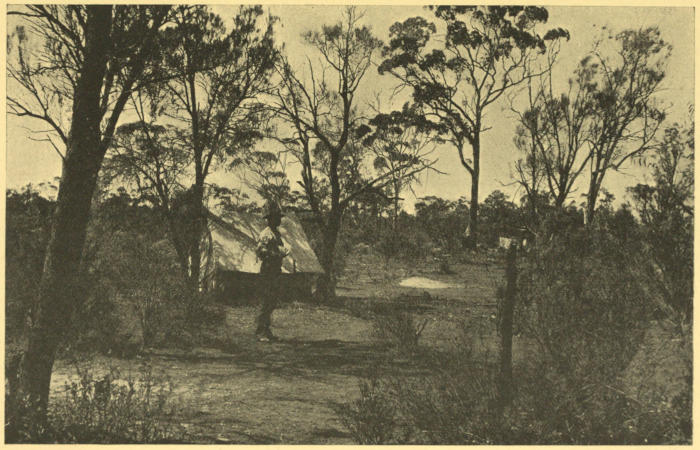
MINERS’ CAMP, LAVERTON
Seeing smoke rising amongst the trees, I drove over to the
place, hoping to find a camp where I might get water for my
horse. I found the camp and one solitary man working by it,
who had been in the neighbourhood prospecting for months.
He asked me to give my horse a rest, offering to attend to him
and also to make some tea for me, which hospitable offer I
gratefully accepted. While the “billy” boiled he told me much
about the hardships he had endured for many months. “But
now,” said he, “luck has turned; look here, ma’am.” At the
same time he unearthed from the ground an old jam tin, which
proved to be full of little lumps of gold. For months, he told
me, he had been fossicking (that is, searching the top ground),
and looking for shows of gold, and one day had struck a patch.
Picking out one little piece he said, “That’s the first bit I
found, and you are the first white woman I have seen for
months, so I’ll give it to you for luck.” The piece was almost
exactly in the form of an eagle, and is now one of my gold
treasures. He said that he had often been without food, or
the money to obtain it, but had subsisted on the kindness
of other prospectors, who had helped him from their often
scanty store, and of the storekeepers who had given him tick
(credit). (I have since heard that the man afterwards struck
an immense find, and is now thoroughly successful.) Bidding
my hospitable entertainer “good-bye,” I again started on my
journey and soon found myself at the Euro, not having met
even a solitary kangaroo on the road.
In the early days this mine was known as Quartz Hill, and
the company owning it was unlucky. Thousands of pounds
were spent, but nothing much was got, and the mine was finally
abandoned; but some prospectors, who often have a liking
for fossicking on an abandoned spot, thought that it had not
had a fair trial, and two men, named Champion and Mason,
determined to give it another. Knowledge or chance led them
to continue a costéen, and they were not long coming on
stringers (thin courses) of rich quartz. Mr. G. W. Hall eventually
came upon the scene in company with Mr. A. W. Castle,
and these well-known gentlemen were not long in making a
proposition to the prospectors, from whom they shortly afterwards
bought the mine for a considerable sum and renamed it
the Euro.
There is every appearance of a brilliant future for the Euro.
There is a large body of ore in sight. The reef is 10 feet wide,
and some of it gives assay equal to the rich Kalgoorlie claims.
Many nice houses are being built for offices, manager’s house,
and stores. Farther on is the Sons of England, another rich
property acquired by Mr. Hall.
At the Euro I was most hospitably entertained by the
manager’s wife. There were two other visitors at the mine that
day, and we made quite a merry party in the cool Bush-house,
where we were invited to a very nice lunch.
Mount Weld was the object of my next day’s journeying. I
did not lose myself this time, but on the way came across
some prospector’s camping, and stopped to have a talk with
them. They showed me a bottle full of gold that they had
recently got. One of them, the old man of the camp, went
very mysteriously into the camp and brought out something
tied up in a piece of an old bag. It turned out to be a nugget
which must have weighed 60 ounces. A small piece of gold
was given me as a souvenir, and I was bound to secrecy for a
month about the big nugget; but, as the month will be long
past when this is published, I may now safely speak.
At Mount Weld the miners seemed amazed to see a lady
drive up alone, and all work was suspended for the time by the
hands on top. At the same time an “Hallo” was given to those
working below, with the message, “Come up; a lady visitor.”
The reply came, “You’re codding” (joking); but when I went
to the top of the shaft and called down, “It’s quite true,”
they came up the rope (dispensing with the bucket) with
great alacrity. Several claims here were yielding splendid
returns, notably the new find, 7 miles from the Mount, where
Bates and Whelan have recently struck a rich patch.
Another new place is called Bett’s Find, and 150 men were
working there; but, the heat having been terrible and water
rather scarce, a good many of them had left the place. The
North Country, as this part is called, has the advantage of rock
not nearly so hard as on the fields lower down, consequently
the ores can be more easily treated.
The time came when I had to bid farewell to Laverton and
to its many interesting mines. As time goes on the now modest
little township will, no doubt, develop into a fine city, for it is
the centre of a very rich district, although almost up in the
Never Never country (where there is no white population).
Many mines of which I cannot speak are full of golden promise,
and many more will yet be discovered. The country
around is mountainous, and it is near mountains and hills that
all the rich reefs are found.
It was on a lovely morning that I started for my return
journey to Mount Malcolm. As I had 70 miles to go, and as I was
on the front seat of the coach, I was thankful that the weather
was cool. At first some difficulty was experienced in getting
the off-side leader to go. He was a young horse, just broken
in, and had never been in harness before; the way he stood
on his hind legs and curvetted around put terror into my
heart, for I am not strikingly brave where horses are concerned;
with a great effort I controlled myself and sat still,
for I could see that the coach-driver had full command, and,
after about ten minutes of fear to me and fun to the crowd
who gathered round, we got away, the unmanageable animal
behaving admirably for the rest of the journey.
There was only one other passenger (a gentleman) besides
myself, and he kindly got down and gathered Australian
quondongs,[6] and some very rare flowers new to me. Farther
on the spinifex was very plentiful. I begged some of that,
not knowing its terrible prickly nature. It is a deceitful plant
that grows in pretty green grasslike clumps, with a flower—out
at this time—that looks almost like golden wheat, but is,
oh, how wiry and prickly!
About 12 miles from Laverton was Hawke’s Nest, where the
coach stopped for a while at the store. This is a flourishing
alluvial place, where many nuggets are often found by
dry-blowers and prospectors. A man came into the store
while we were waiting there with a nice piece, which the storekeeper
weighed; it was 14 ounces, and he had another of
7 ounces. A little while ago a man found a piece weighing
27 ounces, and these good finds are not of unfrequent occurrence.
On arrival at Mount Morgans we changed coaches and found
the new one crowded.
By the time I got to Murrin Murrin I was pretty thoroughly
tired, and decided to stay at the nice hotel and once more see
silver and pretty glass-ware on a table, for Mount Morgans
and Laverton, although rich with gold, are not exactly rich in
comfort.
I wanted to get to Malcolm the next day; there was no coach
going, but I was determined, and, my little landlady providing
me with a horse and spring-cart (the only conveyance
obtainable), I made a start the next morning like a veritable
Bushwoman. I had no adventure beyond seeing a long
camel-train with three Afghan drivers, before getting near
whom I made a détour into the Bush, for horses are invariably
afraid of camels. I then resumed the road and got safely into
Malcolm.
A railway is soon to be begun to the Mount Margaret goldfields,
and, considering that this field is producing at the rate
of 13,000 ounces of gold per month, almost double the output
of any other colonial field except Kalgoorlie, it is to be hoped
that the line will be finished with as little delay as possible.
CHAPTER XXIII
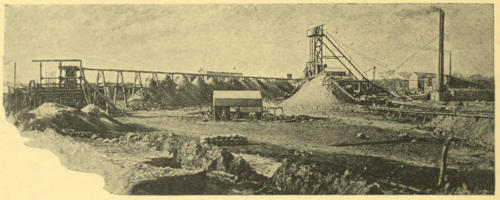
Sons of Gwalia Mine, Mount Leonora
Leonora—The Gwalia Mines—In a Gingerbeer Cart—More
Nuggets—Gold Blocks—Pastoral Land—Swampers—Scarcity of the
Fair Sex—Saturday Life—Alas, poor Prospectors!
From Mount Malcolm to Leonora I drove 12 miles through
very pleasant country spread with wild flowers of all colours.
About 2½ miles before reaching Leonora lie, a little off the main
road, the great mines called the Gwalia Group, which seem
likely to develop shortly into a second Kalgoorlie. Leonora is
a new place, and its great importance has not yet been fully
realised, but some managers told me that there are belts of
richness there similar to those in Kalgoorlie and Boulder City,
so that, when the railway is finished, no doubt thousands will
flock to Leonora, which by coach is now at a distance of 80
miles from Menzies. The Gwalia Group occupies about a mile
of ground, and is a leasehold of some 477 acres. Over that
expanse all the miners’ huts, camps, and tents are scattered.
I stopped at several and found a great many women and
families there, and some of their places were very comfortable
inside, although the outside was not much to look at. The men
who work in this mine are chiefly from Victoria, and they are
bringing over their wives and families every week. As the mine
is evidently likely to be permanent, and the men see a prospect
of years of work before them, the people there are very happy
and have quite a little township of their own. The principal mine
of the group, the Sons of Gwalia, is on a hill, from which place
you look down over a mile of Bush dotted about with various
camps. The smoke rising from the chimneys, the poppet-heads
of the other mines lying beyond, with a blue haze of hills
behind them, combine to make up a good picture of life on the
goldfields.
There are 500 men working on this mine who turn out some
thousands of ounces of gold per month, independent of the
tailings, which are almost sure to give 1½ ounces to the ton.
No doubt in a short time there will be a tremendous boom
here.
The small town of Leonora very much resembles Mount Malcolm,
except that the main street is longer, and that there are
a few more buildings. It boasts of three hotels, one made of
wood and two of mud bricks, but withal not ungainly looking,
and tolerably comfortable. Expenses are heavy but wages are
good, and there are so many lucky prospectors that there is
always plenty of money there. On Saturday nights a great
deal of business is done, especially on the pay Saturday,
which at the Gwalia mines arrives once a month; then most of
the men come in and have some amusement in the way of
visiting the hotels and playing billiards; there is nothing else
for them to do. There is no good hall for amusements yet,
and if there were the men would have to provide their own
play, for no company of any calibre has yet ventured so far into
the “back-blocks.” A handsome semi-grand piano had just
arrived at Thompson’s Hotel from Perth, and the son of the
landlady, who was an excellent musician, played a selection
from several new operas for my pleasure, as well as that of the
crowd who thronged the place. There is not much music to
be had in Leonora, but the inhabitants are quite able to
appreciate it when it comes. There is one luxury here,
however, which is generally denied to the people on the
fields lower down towards Kalgoorlie—the luxury of bathing
at the public shower-baths. The men can have three
baths daily by paying the weekly fee of 2s. 6d. There are
three splendid wells in the town, with windmills, giving
good supplies of fresh water. Horses are very scarce; I had
great difficulty in getting a horse and trap in order to drive out
and see the different mines; in fact, I had one day to enlist the
assistance of the local baker to take me out to one mine that I
wished very much to see, while another day the driver of the
gingerbeer carriage gallantly gave me a lift.
Another day I had quite an adventure. I started in a cart,
but the animal called a horse, after jog-trotting for a mile or so,
refused to go any farther. The driver explained: “You see,
ma’am, he’s an old ’un, and knows at this time he ought to be
going towards home, so he won’t go any farther away from it.”
All coaxings and persuasions were vain, so I had to get out
and walk. The day was intensely hot, and after walking
some distance I had to sit down on a log, feeling that
I could go no farther. At last in the distance a conveyance
appeared coming from the place to which I wanted to
go, and proved to be that of the butcher. I stopped the cart,
and, with the sweetest smile I could call up, asked the young
man to take me to the mine. “But I am just going away from
there.” “Oh, never mind, turn back; I will pay you any
money to take me there.” After much hesitation he consented
to do so, but would not accept payment. I am glad to say
that from the mine the manager sent me back in one of their
own buggies. The only people who kept horses for hire had
let theirs out to graze during the night and could not find
them in the morning. At last, in desperation I telegraphed to
Mount Malcolm for a buggy and horse, which were brought
down to me, and I finished my inspection in comfort. However,
on my second visit to Leonora I found that the place
had advanced with great strides, and that now I had no difficulty
in obtaining a nice horse and buggy in the township
to take me to the different places I wished to visit.
Going into one of the banks (there are two there), I collided
at the door with a rough-looking man carrying a canvas bag.
This he emptied out upon the counter. It proved to contain
some splendid nuggets of gold and a quantity of gold-dust.
Seeing my eyes full of admiration, the man, rough as he was,
picked out a pretty little piece, and holding it towards me, said,
“Will you accept this, ma’am, from a rough miner who hasn’t
spoken to a lady for two years, and may I shake hands with
you?” You may be sure I did not refuse either of these offers,
made in a most kindly spirit.
We were now nearly 600 miles from Perth in a different
direction to Laverton.
The Great Boston Reward Claim is only two miles from
Leonora. Here O’Brien and party made a vast profit out of the
gold and nuggets they obtained from their rich claim. The
same party have another claim at a place called Savannah,
where they are also getting great results.
Farther along the same road, which is the main road to Diorite
and Lawlers, is the Trump Mine, which has a small battery of
its own, for which the proprietors paid out of their first crushing
of 10 ounces to the ton. There are dozens of working-parties
of men about this particular part, which is exceptionally rich.
Close to the Trump are the Leonora Gold Blocks, which for
richness have not been surpassed in the district. This mine
also has its own battery, bought and paid for out of its first
profits, so now the lucky owners have nothing to do but raise
the stone and extract the gold on the premises, independent of
everybody. The ample water supply makes work here comparatively
easy, and I came to the conclusion that this was an
excellent place to look for gold. When one looks back and
thinks of the difficulties miners have had to contend with at
Hannan’s, I should say that a man would rather work in the
Leonora district, even for lower pay, than down below, where
there is no fresh water and few vegetables; and the fact is that
wages are higher here. There can be no doubt that a very great
future lies before the Leonora, or, I should say, Mount Malcolm
goldfields, and probably in two years from this time, instead
of 1000 there will be 10,000 people on the field. There are
now scores of mines there, about which nobody hears anything.
Steady work is in progress everywhere in the district; there
are no unemployed men, the country, all the way from Menzies,
is being rapidly opened up, and so many improvements have
been decided on by the various mining companies, that thousands
more men will shortly be required to do the work. There is,
therefore, nothing to prevent this rich field, which has the
advantage of being extensive, consistent, and well watered, from
developing shortly into a great community. Mr. Morgans, who
should be a good authority on mines, says that he sees no reason
why the Gwalia Mine should not shortly turn out 10,000 ounces
of gold per month, and that there are fully a dozen mines in
the neighbourhood of Leonora with striking lode formations
which in the future will be as rich as any in the district.
On the road to the Diorite King, which is about 40 miles
from Leonora, there was nothing much to see except a good
many swampers. A “swamper” is a man tramping without his
swag, which he entrusts to a teamster to bring on his waggon.
Arrived at the camping-place, which is recognisable by the old
fires, the swamper awaits the teamster’s coming, recovers his
swag and spends the night at the camp. While on foot the
swamper will generally leave the track, and prospect, and shows
wonderful skill in recovering the track again, after these deviations.
The country, however, was certainly prettier than that
of the Coolgardie district. I was somewhat surprised when the
coach pulled up at a small-looking hotel, called the Kurrajong,
with a few houses about it, to find that I was at Diorite King
township. It is certainly the smallest place I ever stayed at.
However, I was not sorry to get to my journey’s end, for the
heat and red dust had made me long for a refreshing cup of
tea, which I got at the hotel. I was fortunate in getting a nice
comfortable room, which, however, I was told was reserved for
the manager of a mine who was expected soon, but I was
allowed to have it until he came, and I am thankful to say he
did not arrive while I was there, so that I remained for a few
days in undisputed possession.
At Diorite the township consists of one hotel, one store,
one baker and butcher’s shop combined, one blacksmith’s forge,
a few mud houses, and two galvanised-iron ones, the house of
Mr. Williams, the manager of the Diorite Mine, and a post-office.
My readers may perhaps wonder why I stayed so long.
Certainly of all the uninviting desert-looking places I ever
saw, Diorite is the worst, but mines of wealth lie close to it.
There are only four women in Diorite, the landlady, the
barmaid of the hotel, a shopkeeper, and the wife of one of
the men on the mine. Women, being so few, are looked upon
in these parts as goddesses, and are treated with reverence,
and I was made quite an object of adoration. Of course there
was no chance of getting a horse and vehicle here (how I
regretted leaving my bicycle at Menzies because I would not
pay full coach fare for it!) so one mine was explored by the
medium of the grocer’s cart. However, the day after,
Mr. Williams kindly lent me his horse and buggy, and safe
transit to the other mines was then assured.
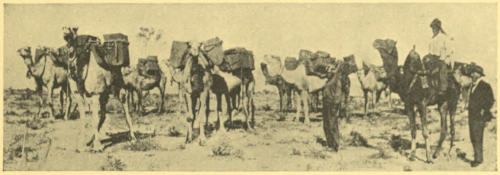
Camels at Diorite King
The Diorite King Mine is about two miles from the township,
and lies between two hills. A great deal of gold has been got
there. I found myself most hospitably entertained, as the men
were all at their “crib” when I arrived, and being invited
into their dining-room, a bough-shed with two benches and long
table, I took the mug of “billy” tea offered me, but did not feel
disposed to partake of the corned beef, cabbage, and potatoes,
although everything looked very nice and well cooked, and also
well served up by the cook of the day. This mine, and another
called the Middlesex, have both turned out good results, and
while I was there I saw some of what is called “surface stone,”
freely splashed with gold all over. On the way back to Diorite
a long string of camels, over eighty passed on their way to
Lawlers with stores. What would the people in these remote
places do if it were not for these “ships of the desert”?
On one of them, in a kind of wicker basket, was a poor little
lamb, looking wonderingly around with its head out of the
cage. I thought, perhaps, it might have been a pet of one of
the Afghans. “No fear, ma’am, it’s to be killed at sundown;
they won’t eat any meat killed by Europeans, drat them,” said
the grocer, for like all Westralians he had a hatred of the wily
Afghan.
The Calcutta Mine is not far from Diorite, and has a
splendid reef. It adjoins the Little Wonder, owned by Doyle
and party, who a few years ago had a find of gold so rich and
phenomenal that thousands of pounds worth of gold were taken
in no time, and the men are working in daily expectation of
cutting a rich leader again.
Mount Stirling is another mine held by a Perth syndicate.
Very rich ore was lately struck there, and the syndicate
have now erected their own crushing battery. Plenty of fuel
and water is available in the vicinity. Hundreds of tons
of the valuable ore lie on top waiting to be crushed, and
thousands more are plainly to be seen below waiting to be dug
out. This is the richest stone that has ever been found near
here, and is causing much excitement on the lease adjoining
Mount Stirling. A lode was being worked by some miners
at a depth of 90 feet, a pocket of some of the stuff assaying
the immense value of 100 ounces to the ton. A great many
more men have claims about the vicinity of Mount Stirling
Mines, but it is almost impossible to know what is being
got, as they keep silence over their findings. The manager
of the store says that a large quantity of alluvial gold is sent
away from the district of which the warden knows nothing.
His firm, being buyers of gold, often purchase from the men as
much as 100 ounces a month, £390 worth, sometimes more.
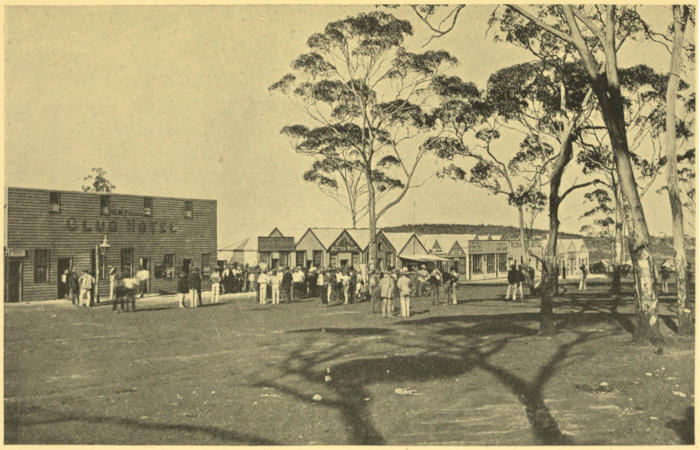
AUCTION SALE GOLDFIELDS (TIN HOTEL)
Last, but far from least, I went to the King of the Hills Mine.
The farther I got away from Diorite the nicer the country
looked. When I came to the King of the Hills the surroundings
were really pretty. The wonderful gold got there has been
obtained by sinking to no great depth. The main shaft was
only 25 feet deep at the time when I saw it. Many rich quartz
veins have been found in the workings, the finds being occasionally
most sensational. A small parcel of 18 tons of stone was
treated for a yield of 280 ounces of gold; 14 tons yielded
276 ounces, and since then a further sensation has been caused
by 1 ton of quartz which yielded 116 ounces of gold. On one
of the shafts large sacks of ore were stacked which fairly
glistened with gold, and were expected to give as high a result
as that just quoted. The mine was owned at this time by
Read and party, but has since been sold to Mr. Raymond, of
the Harquehala Company, for £6000 cash. After pegging out
their claim, Reid and party obtained over 1600 ounces of gold,
worth about the nice little sum of £6200. That, with the sale
of the mine, makes a fortune of £12,000 for four partners.
Saturday afternoon brought all, or nearly all, the miners
from the surrounding country into Diorite, where, as you
can imagine, the hotelkeeper was kept busy. The hotel
proprietor, no doubt, has made a fortune out of these
Saturdays, the men having no other means of spending
their money; there is no bank where they can change their
gold into coin, but the storekeeper does that necessary kindness
for them, or the landlady notes a score on her little
slate. All the time that I was there one lucky claim-holder
was falling about the place intoxicated. Some of the scenes
witnessed are by no means pleasant, but I suppose the four
women of the place had got quite used to them, for they did
not seem to take any notice of anything that went on. Many
of the men on the Saturday night become incapable of going
back to their camps, and there being no sleeping accommodation
at Diorite beyond the one hotel, they take shelter in any empty
hut or under any cover they can find. The men are all very
kind to one another, only a few fights occur, and the fighters
soon shake hands and make friends again. There is no police
protection, and not even a tree lock-up, so every one does
pretty well as he likes at Diorite King; but when one thinks
of the life these men lead, shut off in a desert country from
almost every trace of civilisation, one feels that their faults
should be looked on with a lenient eye. One man seemed
terribly drink-sodden, and I was told he had taken thousands
of pounds worth of gold as a partner in a certain claim,
and his friends had tried to get him away to reclaim him,
but he would not leave the place, and preferred to spend the
money as he got it in the desert. Occasionally some poor
miner gets lost in the Bush and is never heard of again. The
blacks were very troublesome at one time about here, but there
are now very few. Mr. J. Leyland, one of the original owners
of the Little Wonder Mine, was killed by them about two years
ago. He had gone out to look for two horses that were lost, and
having found them had camped for the night at Doyle’s Well,
about 20 miles off, and was boiling his billy when he noticed
a bush in motion close by, and before he could arm himself two
blacks sprang upon him and hit him on the head with a waddy,
and then speared the horses, leaving Mr. Leyland, as they
thought, dead. They then, having satisfied their thirst for blood,
decamped. On the poor man’s return to consciousness he
dragged himself to the horses and found one poor beast dead but
the other not severely injured. He managed to mount it, and
horse and rider, covered with blood, managed to make their way
back to the mine. The horse dropped dead on their arrival
there, and poor Leyland only lived long enough to relate his
terrible night’s experience. Two men were lost in the Bush a
little after this, and parties went out searching for them. One
poor fellow was found dead under a tree, with his billy beside
him, on the smoked part of which was scratched: “Dying from
thirst; Jim tried to go on, follow him.” A horse lying dead
close by mutely told a dreadful tale. The search-party, going
on for many miles, at last came across a hut near a well. The
hut-keeper told them he was awakened by a noise at daybreak,
and on looking out saw a dark object leaning over a rough
hollowed-out tree trunk (used for giving his horse a drink)
and ravenously gulping down the water like a thirsty wild
animal. It was hardly daylight, so he could not distinguish
what it was, but knowing there were no wild animals about he
ventured out to see, and found it was the other poor lost man
in the throes of death. He took him into the hut and cared for
him as well as he could, but it was too late, so all the search-party
could do was to dig a grave and bury the second poor
mate as they had done the first.
About 62 miles from Leonora is the splendid goldfields’
pastoral station, called Sturt’s Meadows, which belongs to
Mr. Manuel, and consists of 570,000 acres of land. There is
an abundance of water, and wells have been sunk in many
parts to supply the enormous herds of stock which Mr. Manuel
sends to the southern markets. The boundary of the station
lies 20 miles away, and we drove 18 miles, during which we
were always on the property, before coming to the homestead.
Here we were hospitably received, and tasted “Brownie,” a
currant loaf peculiar to this station, of which I can personally
speak in the highest terms. Mr. Manuel drives four and sometimes
six brumbies, and the way he gets over the ground is
simply amazing.
CHAPTER XXIV
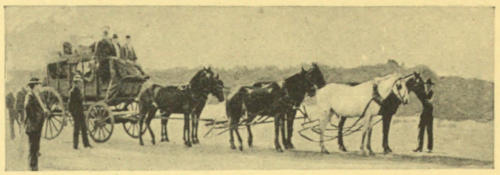
Off by the Coach to Lawlers
Lawlers—Splendid Vegetables—Waiting for a Samaritan—Mount
Sir Samuel—While the Billy boils—The Kangaroo—Lake Way—Across
the Country—The “Back-blocks”—Camping out—Arrival at
Nannine—Bed once More—Splendid Mines of the Murchison—Peak
Hill—The Gold Patch—An Old Friend—A Hearty Welcome.
Another coach journey of 50 miles brought me to Lawlers. I
was now out of the Mount Malcolm and Mount Margaret districts,
and in the East Murchison. Mount Magnet, which is on the
Cue railway line, is almost in a direct line with Lawlers, and
it is 130 miles from Lawlers to Menzies. Lawlers is a nice little
town; all the people so friendly and pleased to see a strange
lady on the field that many of them came into the hotel to see me.
The buildings are creditable, and a great amount of business
seemed to be doing. The gold output is steadily increasing,
but although much good ore is realised, there is great difficulty
experienced in getting it crushed, the batteries being too
small. The people seem unusually healthy. They say
no one is ever sick at Lawlers, and the soil is magnificent
for growing fruit and vegetables, despite the small rainfall.
Mr. Homann has a very fine garden, watered by the
surplus water from the Great Western Mine, and from a well
with a windmill. Melons, tomatoes, and cabbages are fully
equal to any I have seen. There are also some vines that have
borne beautiful grapes. If there were only a plentiful fall of
rain, which unfortunately seldom happens, Lawlers could compete
with any place in the matters of agriculture and viticulture.
Everything has to be carted to the place by team or
camel-train, consequently things of all kinds are very dear, the
actual cost of carriage from Mount Magnet being £12 per ton
by team and £8 by camel-train. The coach fare to that place
from Lawlers, 192 miles, is £5, and to Menzies, 130 miles, £4.
Until the railway went to Menzies from Kalgoorlie, most of the
supplies came from Mount Magnet, but now that the traffic of
Lawlers is going to Menzies, since the train service commenced,
instead of Magnet, it increases daily. This, of course, will naturally
benefit both places, since Menzies will now also obtain
some of the splendid vegetables grown in Lawlers. Previously
there were only tinned vegetables to be had there. The people of
Menzies have no desire to see a railway line extended past that
place, but as the Government has now decided to build a railway
speedily to Leonora, the Lawlers people are hoping that
at no distant time the line may be extended to their town also;
Lawlers will then be the pivot between the Murchison (Cue line)
and East Murchison goldfields, and with its excellent soil, its rich
mines, the Great Eastern for instance, will probably become one of
the principal towns in the goldfields. When the railway
reaches Lawlers there will be only 192 miles of this part without
train service, through which a railway could soon be made to
Mount Magnet, completing a belt of rails from Perth right round
the Yilgarn, Coolgardie, Mount Malcolm, Margaret, East
Murchison, Murchison, and Yalgoo goldfields.
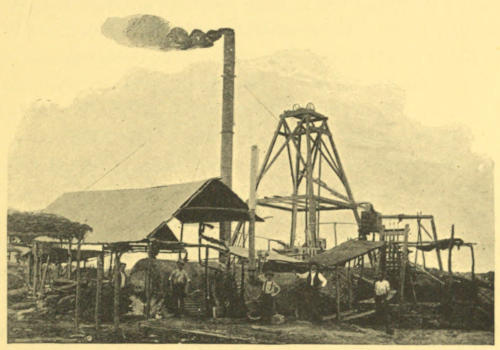
Lake Way Gold Mine
I next prepared for a long journey through the Western
Australian Bush. My destination was Lake Way and Wiluna.
How I was to get there I did not know, as there were no coaches
even for the mails, which were only taken once a week,
and then by bicycle, over a distance of 120 miles, a journey too
long and too lonely for me to take alone. However, I was
cheered by the news that some miners were expected at Lawlers
in a day or two for whom horses were waiting. So, never
doubting that they would be gallant enough to offer me a seat,
I rested quietly and waited for their arrival. When they came
they proved to have two friends with them, who proposed to
travel on what is called the “buckboard,” that is the kind of
ledge, about three feet long, for carrying luggage at the back
of the buggy, and as there was only room for two persons in
front there seemed to be a difficulty about conveying the
whole party. However, the pleasure of having a lady to drive
with them for 120 miles was great enough to make the party
alter all their arrangements. One of them borrowed a bicycle,
and two of us in front of the buggy, a lad and other friend on
the buckboard, and four brumbies in hand, we gaily started off
one fine morning. We reached the first stopping-place, Mount
Sir Samuel, 31 miles off, at 4 o’clock, and put up there, as I
wished to see this little place, where there are some very good
mines—one, the Bellevue, being a first-rate property. Another,
called the Sulphide King, is very promising. Mining here is
not so hard as in some places, owing to the softness of the
ground and the plentiful supply of water.
Lake Darlot is about 20 miles from here, and there is now a
very promising goldfields township in the district. A wild rush
occurred a few years ago. This was one of the places where
great hardships were endured by the diggers on account of the
terrible scarcity of provisions; the price of flour, when procurable,
was at that time £5 for a small bag!
Every one at Mount Sir Samuel was very kind and hospitable,
and I felt quite sorry to leave next morning, as we did at
daybreak, for we wished to make a long journey that day. We
should have, we knew, to camp out. I looked forward to this
unusual experience with great eagerness.
As I was watching the camp making I heard “Coo-e-e!
Coo-e-e!” the Australian bush cry, and presently a party of
four miners rode up. They had just sold their mines for
£17,000, and were on their way to Melbourne, en route for
New Zealand to see their parents. They told me that, five
years ago, they landed in the West with £200 between
the four of them, and are now leaving with the above-mentioned
sum; but they hope to come back to the Golden
West after a six-months holiday. As you may imagine,
they were very jolly; they took off their kits (bags), which
contained provisions, we combined forces, and made a very
pleasant meal under the shade of some pretty kurrajong-trees.
At night, attracted by our fires, some natives appeared, but I
felt quite safe with so many protectors. They made up a bed
of bushes for me under the buggy, and put branches all around
it. I felt as if I was in a Mia Mia (native hut), and was as comfortable
as possible. I heard the natives saying, “Mimi lubra,”
which means, “Woman in a tent.” They thought the men would
not trouble to make a place like it for themselves, and their
conjectures were right; they are not such a stupid race after all!
Early in the morning we parted company and started off
again. An adventure shortly after stirred us up. A kangaroo,
pursued by an emu, came on the scene, but, being so fleet,
both were soon out of sight. After the excitement was over
the boy on the buckboard repeated to us an essay he said he
wrote at school, on the kangaroo, which struck me as being so
funny that I give it you verbatim:
“The kangaroo is a quadruped, but two of his feet is only hands.
He is closely related to the flea family, an’ jumps like him, an’ has
the same kind of resemblance. He is Australian by birth an’ has
a watch-pocket to carry his children in. There is two or more
kinds of kang’roos, but they are mostly male an’ female, and live on
grass, cabbage, and curren buns. The kang’roo’s tale is his chief
support; it is thick at one end, and runs to the other end; it is
good to jump with, and the kang’roo when it’s cut off don’t know
his way home, and has to walk on his hands. The kang’roo is good
for makin’ soup and bootlaces and putting in zoos, and sometimes
he is presented to the roil Family to represent Australia.”
We reached Wiluna, the township of Lake Way, next day,
and found it a very nice little place. There are three hotels
and stores, and I was surprised to find everything so nice away
up in the wilds of the West. There is plenty of fresh water in
this district and several nice gardens. Watermelons grow
splendidly, and, with the thermometer at 114°, are very welcome.
Tomatoes also grow in profusion, and several people
are growing fruit and vegetables as a business, so that Lake
Way is not a bad place in which to find oneself. There are
many good mines, turning out handsome yields, and companies
have recently been floated in London to take over several
properties here. The chief characteristics of the reefs are
evenness of quality, great wealth, and permanency. A very
nice cake of gold, weighing 145 ounces, from one of the claims
was shown me; it came from a claim called The Brothers.
The people about Wiluna are, in spite of the heat of the
climate, very fond of dancing. It really is almost their only
amusement. The evening of our arrival a ball was held; it
might truly be termed a Bachelors’ Ball, for so few of the
opposite sex are in the district; however, the boys, as they are
termed, arrived in great force, their dancing costumes being
riding breeches and coloured shirts, with turned down collars
and broad hats, real “back blocks” costume. As it was a very
hot and bright moonlight night, they danced on the open plain,
and seemed to enjoy themselves thoroughly. At about 9 o’clock
a terrific shouting and native yabber, yabber (talk) from a part
of the Bush, where a tribe of aborigines were encamped, gave
token of rival amusement. The natives were holding a
Corroboree. They had camped at Wiluna, but were travelling
to some particular part of the country, where a favourite large
grub, which they used for food, was to be found in quantities.
Natives always travel from place to place in search of food, and
they know the parts in which the different kinds will be
plentiful or in season.
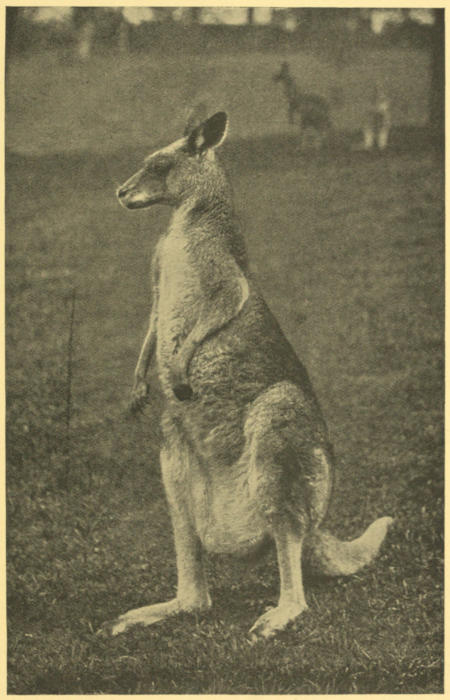
KANGAROO
Copyright—Gambier Bolton
Wishing to see a Corroboree dance, I, with some of the
onlookers of the Bachelors’ Ball, migrated to the camp. The
black fellows, who had ornamented their heads and kangaroo-skin
garment with what feathers and tufts of grass they could
obtain and coloured their faces and bodies with wilgey, were
leaping up in the air, with a spear in one hand and a shield in
the other, and contorting their bodies in most grotesque fashion
to the accompaniment of native music supplied by some of the
men of the tribe, who squatted on the ground chanting strange
sounds and beating sticks, while the lubras (wives), gins (girls),
and pickaninnies (children) sat or lay around, making a fearful
noise and clapping their hands vigorously. In the light of the
camp fire it was a novel and weird sight, but a little of it sufficed
me. Before leaving, the head man of the tribe threw the
boomerang, which is a native weapon shaped like a quarter-moon,
and so constructed that it assumes a return motion at
the will of the native who throws it. It really was wonderful
to hear it whirr as it started through the air to a great distance
and height, and then come back to exactly the same place it
started from. The boomerang is not so unique as many people
think; a weapon almost the same was used by the Abyssinians
hundreds of years ago, and still earlier by the people of ancient
Egypt.
The journey from Lake Way to Nannine, over 120 miles of
rather barren country, was one to be remembered. No coach
having yet been started on this route, I was fortunate in being
able to join a party of people, including two ladies, who were
going there in their own conveyances; they had been in the
“back-blocks” for four years, and thought it time to take a holiday,
especially as their husbands had made over £6000 each from
their mines, and had given them £500 each to go to Victoria,
see their friends, and have a good time, as I have no doubt they
did. We camped out for four nights, but the weather was fine,
and it was very pleasant to be under a canopy of stars, although
towards morning it got pretty cold. The two ladies took it in
turn to do the cooking, and would not hear of my doing anything,
saying it would be a pity to roughen my hands, which,
by the way, were becoming
almost as brown
as theirs. I quite enjoyed
the bush-cooking.
Johnny cake or
“damper,” as it is
called here, cooked in
the wood-ashes, is very
nice, especially with
good butter, which we
had in tins. Then there
were plenty of wild turkeys about, some of which were shot for
us. My companions had brought some tinned asparagus also,
so, taking it altogether, our manna in the desert was not to be
despised. We met a few aborigines during our journey, but
they were generally very quiet and only asked for bacca and
food. The lubras were carrying their pickaninnies in a coota
(bag) on their backs (this is their usual custom except in the
colder parts of the colony, where they are supplied with
blankets and also with rations); they were also carrying sticks
and some freshly killed birds. The women always have to
carry all the burdens, their lords and masters stalking on ahead
with their spears, no doubt on the look-out for game.
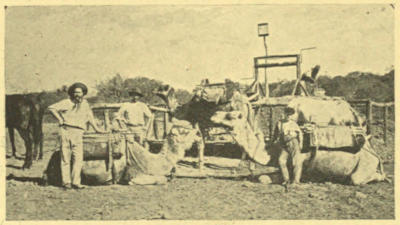
A Well near Lake Way
One night, as we were sitting round the camp-fire, several
of them again appeared and demanded more bacca and food,
which was given them, and they were told to go away, but
they would not do so until the men of our party fired off several
shots, which soon caused them to disappear, as they are very
much afraid of fire-arms.
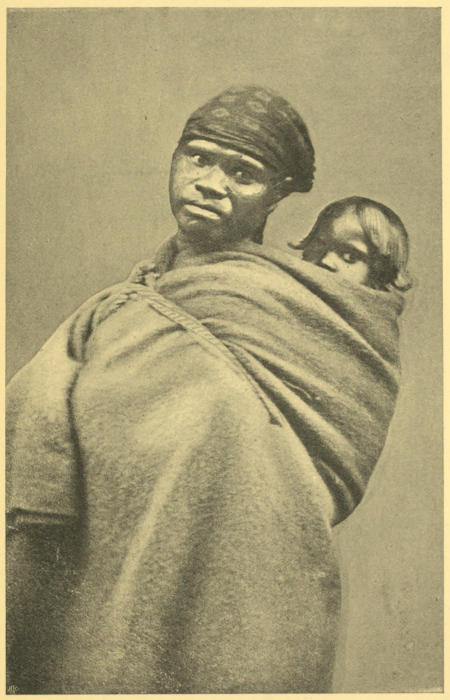
LUBRA AND PICKANINNY
Another night we camped in company with two teams.
Each team had ten horses and splendid large waggons, one of
which the teamster gave up to us three ladies, and we had quite
a luxurious bed on sacks of chaff that night. The teamsters
were educated men; one had received a college education, but
had been eight years in the “back-blocks.” He said he had
not been in a lady’s company for years, and the poor fellow
seemed delighted to talk to me about his mother and sisters,
who, he said, were in dear old England, but he never wrote
home, as he was the black sheep of the family. I made him
promise that when he got to Nannine he would write to his
mother, who, no doubt, in her heart was thinking, “Where is
my wandering boy to-night?” I do hope he kept his promise.
On our arrival at Nannine I bade a reluctant farewell to the
party, who took the coach to Cue, en route for Fremantle, there
to take the steamer to Victoria to spend their well-earned holiday.
We were now in the Murchison district. Nannine is a nice little
place, and everything seemed to be flourishing. The people
form a very happy, lively community. Several good buildings
adorn the town, and I considered myself fortunate in getting
very comfortable quarters, for I was really tired after my journey
and late camping-out experiences. It was delightful to rest on a
nice soft bed and to have my breakfast brought me in the morning.
There are two good hotels at Nannine, which do a splendid
business. There are over 80 mines in the district—the first in
which gold was discovered in Western Australia. This first
discovery dates from 1854, when Robert Austin was sent by
Governor Fitzgerald to explore the country in the Gascoyne
district above Peak Hill for agricultural and pastoral land for
settlement. Mr. Austin was accompanied by the sons of some
of the early settlers, and the little band of explorers underwent
many hardships. Most of their horses were poisoned by the
Bri-gastrolobium plant, and the party had to travel on foot for
many weary months. It was owing to this circumstance that
the gold discovery was made, for while reconnoitring for grass
and water Mr. Austin came across some likely looking stone,
which he broke, and found it contained gold. The only prospecting
tools available (except a tomahawk, a small hatchet
always carried by explorers and prospectors), being a knife and
a pannikin, much progress could not be made. On Mr. Austin’s
return to Perth from the expedition he informed the Government,
who did not think it worth while to make further inquiries.
Had they done so, the colony’s prosperity might have dated 35
years earlier than it has done, as Mr. Austin correctly described
the auriferous nature of the belt of country around Mount
Magnet, Lake Austin, and Mount Kenneth, and also predicted
that the Murchison would become one of the greatest goldfields
in the world. The little party were the first white men
who ever set foot in that part of the colony, and I do not think
that their efforts were ever recognised. Mr. Austin is now a
very old gentleman, and last year was mining surveyor at the
Mines Department, Hodgkinson Goldfields, Queensland, from
which place he wrote to the papers in Perth asking that his
claims as the first discoverer of gold should be recognised by the
present Parliament, and giving interesting particulars of his
travels. In 1856 gold was discovered at Kojânup, but little
attention was paid to gold in Western Australia in those days.
It was not until 1884 that Mr. Hardman, the Government
geologist, discovered rich gold at Kimberley in the far north of
Western Australia, and this was followed in 1887 by the find
of gold at Mugakine while a man was digging a well. Golden
Valley and Southern Cross followed, and an era of prosperity
for the colony opened which I hope will never be closed.
At the Aberfoyle Mine, to which I went from Nannine, I saw
some beautiful quartz thickly encrusted with gold. Twenty-two
pounds of this stone contained over 62 ounces of gold, valued at
£230. This rich piece of quartz has been secured for the Glasgow
Exhibition. There are seven shafts on this really amazing
mine, from each of which the ore taken is so marvellously rich
that they are watched at night. Splendid machinery is being
put up, but sufficient masons cannot be got to do the work, consequently
the progress is slow. The Nannine Mine has shown
wonderful results during the year. In six weeks 1371 ounces
were crushed from 285 tons of stone. The chute (opening) from
which this was taken improves still richer as the mine opens
up. The Champion is another group of mines, from which
excellent returns have been taken. At the Royalist, another
mine owned by the oldest mining resident of Nannine, as much
as 300 ounces in two weeks have recently been obtained.
There are many other mines, but I cannot specify them all.
Mount Yagahong is also a rich part of the field, and Meekatharra,
25 miles away, is rapidly forging ahead as a gold
producer. Then 14 miles from Nannine is Burnakura, from
which place 71 lb. of specimens, containing 700 ounces of
gold, some of the pieces being nearly pure gold, were recently
brought into Nannine and lodged in the Western Australian
Bank. Previous to this, £2000 worth of gold was taken from
the same claim, called Jewett’s United Lease, and still more
recently a Perth paper records that “A small parcel of stone,
weighing 4¾ cwt., from Jewett’s Union Mine at Burnakura,
and crushed at the Nannine battery, yielded 494½ ounces of
gold. Nine hundred tons of stone lie at grass—that is, on
the top waiting to be crushed—on the property.” This
magnificent mine is owned by a local syndicate of seven
people. Gabanuntha is a rich mine near Nannine, and Star of
the East another. A leasehold with a peculiar name is “After
Many Years,” which gives every indication of turning out rich.
This district, and Peak Hill, owing to their remoteness, have not
attracted speculators much, but must eventually become prominent,
for they are as rich as any part of Western Australia,
and after many years will, no doubt, fully verify Robert Austin’s
prediction.
To drive another 120 miles through the Bush to Peak Hill did
not seem to me a very agreeable undertaking, but the advent
one day of a spanking four-in-hand at Nannine, bringing three
gentlemen, one of whom I was fortunate enough to know, and
who gallantly offered to take me to Peak Hill, altered the
case completely. One of the party was an Englishman
inspecting Western Australian mines with a view to large
investments. Relays of horses had been sent on to the
different stages along the road and sleeping accommodation
arranged for. I am afraid I put out these arrangements
considerably, but the gentlemen did not seem to mind giving
up the best to me, gallantly saying that my company compensated
for any discomfort. I felt at first that, as they were on
mining business, they did not want womenfolk around, but
they soon found out that I took as much interest in mining
matters as themselves, and we became bon camarades.
Knowing that the menu at these places would not be of the
best, the party had sent ahead supplies of everything necessary
for table comfort, also a man cook and waiter, so you may well
understand that the journey to Peak Hill was a most enjoyable
one to me.
As we approached the famous Peak Hill, which is a nice little
mining town, endowed with wonders of which you will presently
hear, we passed several dry-blowers working. These men
fossick (look) over the old workings, and by aid of a tin dish,
in which they place any earth they think contains gold, and a
coarse riddle with which to sift it, afterwards blowing away the
fine dirt, they frequently find gold at the bottom of the
dish. The ground is remarkably rich in gold, and I find it
impossible to describe the magnitude of this golden country,
which, like other fields, seems only to have been tested
in a few places, those places being so rich that one wonders
what the country will be when the hundreds of miles of good
ground that I have passed have been opened out by miners.
We were now far, far away from Perth, and the country looked
different from any I had seen before in Western Australia.
Peak Hill lies very high, 2000 feet above the sea-level. The
ascent is steep and very rocky, four miles of it going through the
Robinson Ranges. An interesting sight is found at the top,
which has the appearance of a wide plain, with shafts and
dumps of the thrown-up earth all over it. The manager
of the principal mine here has a very comfortable residence,
and the miners’ camps give the place the usual prosperous
appearance. There are over 600 men on this field. The whole
of the leases of Peak Hill have been taken over by a syndicate,
which has formed a company in London. The finds have been
marvellously rich. I went down one shaft, and saw some
very interesting specimens being dug out. The gold is in a
kaolin formation, and in some parts the kaolin is of all kinds
of colours, and with the gold shining through looks really
lovely. In other parts of the mine the kaolin is quite white,
and the deposit easy to dig out. The results from the Peak
Hill reef have been as high as 2621 ounces 15 dwts. of gold
from 331 tons of this ore. Some of the mines have given as
much as 21 ounces of gold to the ton, which is a wonderful
record. The Christmas Gift is a rich mine, and many others
have had such phenomenal crushings that the Peak Hill district
is unsurpassed in wealth of gold. When Sir Gerard Smith,
late Governor of Western Australia, visited Peak Hill, the
mine-owners had a solid gold plate and a cup, to use at dinner,
cast for him.
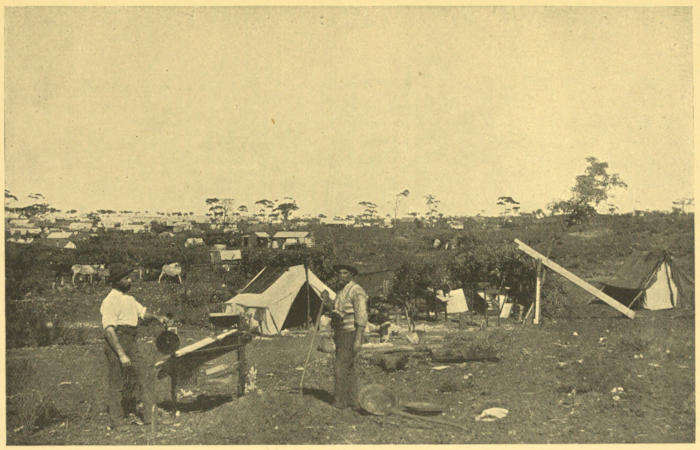
DRY-BLOWING IN THE GOLDEN STEW
There are some really fine public buildings, and the hotels,
especially the Peak, are very comfortable. A nice Miners’
Institute, for meetings, entertainments, &c., has recently been
finished. Land for building sites realises splendid prices,
nearly £1000 having been paid for different allotments. The
private houses seem very comfortable habitations. Many of
the people have made fortunes, and everything seems prosperous
about the place.
A very original character, called “Tom the Rager,” sold his
interest in one of the leases some time ago for £15,000.
This man, an old Irishman, made a memorable journey from
Kimberley, in the North-West, across the greater part of
Western Australia, accompanied only by his faithful dog
“Paddy,” and subsequently got an interest in some of the
richest claims at Peak Hill, as the sale mentioned may testify.
The Golden Patch, as it is called, in which all the rich mines
are, covers about a square mile of ground of quite a different
nature from that in other parts. This mile of ground is formed
by a mass of rich veins of quartz, and the wealth contained
there is unsurpassed in any part of Western Australia. Were
Peak Hill not such a tremendous distance away from the capital,
its growth would, no doubt, be as quick as that of Kalgoorlie,
which it so much resembles. Some of the wonderful crushings
from a few of the golden mines may interest you. The Peak
Hill Reef, from 331 tons of stone crushed 2621 ounces of gold;
Daisy Bell, 82 tons, gave 1245 ounces; Golden Chimes, 195
tons, gave 1402 ounces. The Horseshoe and the Golden Patch
are supposed to be the two richest spots in the colony. Some
of the specimens taken from the Patch are not only rich but
vastly interesting in other ways, some of the pieces being not
gold held together by quartz, but vice versâ; the small pieces of
quartz, if tapped by a hard substance, vibrate like a tuning-fork.
The gold is very brilliant, and positively sparkles in the light.
I drove out to the Horseshoe Mines, a distance of about
20 miles. There were over 50 men working there, and getting a
great deal of gold; some of them gave me some pretty pieces.
I have now got enough nuggets to make any other collectors
envious. While there I met a young man who knew me in
Melbourne when he was quite a boy. I did not recognise
him, as he had grown up and had a moustache; but he came
to me almost with tears in his eyes, so pleased was he to
see me so far away from home. For the moment I could
hardly realise that I was nearly 800 miles in the interior of
Western Australia, and felt inclined to cry with sympathy. He
gave me a very pretty little nugget, which cheered me considerably.
Alluvial gold often takes most singular forms; it is
usually found on the surface, or not far below, while reef-gold
is got in a quartz lode, or vein, at some depth underground.
Some magnificent nuggets have been found in this part; one
weighing 132 ounces, worth over £500, was found in one of the
gullies which we passed when driving to this spot. The name of
Horseshoe is taken from the long range of hills shaped almost
like a horseshoe, and the gullies between them have made many
of the miners wealthy. There are two very rich reefs here,
which have been proved for six or seven miles. The specimens
are very massive, gold predominating to a large extent in
the quartz, and the ironstone fairly glistening with richness. I
was now getting so much accustomed to looking at and handling
gold that I began to fear I should look coldly on the common
articles of everyday life. The miners, with the usual hospitality
of their class, would boil the billy and give me tea, and all the
best that their “back-block” larder afforded. Times are much
changed now, since the early days of the fields, and the miners
can live very comfortably. I said good-bye to them all with
regret, wishing I could stay longer in this grand part of the
country, the scenic beauty of which is also great. I enjoyed the
drive back very much, and could not help thinking what store
of wealth must lie beneath the ground we were driving over.
The great bulk of this part of the country must contain
untold gold.
Revelstone is another rich mining camp a few miles from
Peak Hill, where a public crushing plant has been erected,
at which the miners of the neighbourhood can have their ore
crushed as soon as they raise it.
Farther on still is that wonderful Nor’-West country, to
which I hope some day to go. The biggest nuggets the colony
has produced have been found there. “The Bobby Dazzler,”
which I was fortunate enough to see, and tried to lift, before I
left Perth, and which is to be shown at the Glasgow Exhibition,
came from Marble Bar, Nor’-West. It weighs over 400 ounces
of gold, and is worth over £1600. Another large nugget was
found in that district a few years ago, which weighed 334
ounces; so that people wishing to pick up the precious metal
in large lumps had better try their luck in the far North.
After spending some days at Peak Hill, I started, with my
kind friends, on my return to Nannine, and passed through
acres and acres of the finest everlasting flowers I have ever
seen. The beautiful cream-coloured starry flowers were as
large as a florin; the country looked like a foamy sea. Then,
in other parts, bright-coloured flowers surrounded us, like
patterns in a huge kaleidoscope.
We came to Abbot’s Find, some miles before reaching
Nannine; the locality is very rich; it was near here that last
year a lucky prospector, named Campbell, found some splendid
specimens. The stone was creamy-white, thickly permeated
with gold, and was obtained from near the surface. The place
is full of outcrops (likely places for gold), leaders, and reefs, it
is wonderful that no rush has yet begun; but the rich spots
are so many, and the men comparatively so few, that they
cannot prospect them all. There are several important mines
at Abbot’s, notably the New Murchison King, White Horse,
Abbot’s, and others, which have all given good returns.
CHAPTER XXV
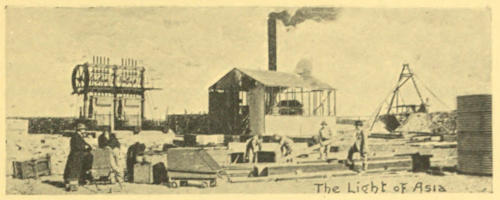
Mine at Cue
Tuckanarra—The Lights of Cue—Surprising Vegetation—Sweet
Flowers Again—High Wages—Splendid Meat—The Island—The
Mirage—Jolly Faces—Mount Magnet—Donkeys—A Tasteful Camp—The
Morning Star—Windsor Castle.
After a good rest at Nannine, which is 50 miles from Cue, we
started off for Tuckanarra, where I stayed for a day to see the
much-talked-of spot where so rich a find was lately made, my
friends going on meanwhile to Cue. The country around here
is much broken and there are many large caves. It was at the
head of a huge gorge that the big find was made, right on the
surface, and many hundredweights of rich specimens were
quickly dug out. The lucky prospector communicated with
Mr. Zeb. Lane, in Perth, who went up, inspected the find, and
took an option of the mine for the British Westralia Syndicate,
taking 4 cwt. of the rich stuff home to England with him.
However, the find proved to be a pocket, and all the gold
had centred there; consequently Mr. Lane surrendered the
option, as not being valuable enough for flotation. (He has
since floated in England the Anchor Consolidated Group, which
includes several good mines at Tuckanarra.) The original
owners, Messrs. Taylor and Co., have now retaken the work of
opening up the mine with much success, and have recently
struck a rich reef, a parcel of 34 tons of stone from which
have yielded 138 ounces of gold. Boyd’s Claim is the best one
here, over 3000 ounces of gold having been taken out of it by
crushing and dollying, while the tailings, concentrates, and
blanketings brought the yield up to a considerably larger
amount. At present Tuckanarra is a quiet little place, but
there is no knowing at what moment the colony may be electrified
by more finds. It was Warden Dowley’s blackboy who
first discovered gold in the Tuckanarra district. Whilst travelling
with the warden to Nannine he showed a piece of gold to
his master and pointed out the place where he found it, on
which the warden marked the spot and afterwards circulated
the news. The usual rush ensued, and many claims were
pegged out.
Only 25 miles of Bush travelling now lay between me and
the town of Cue. The coach driver favoured me with the
box-seat, much to the disgust of a male passenger, who
wanted the seat and did not feel inclined to give way to a
lady. But the driver of the coach is always the boss (master)
of the box-seat, and this one, being fond of ladies’ society, gave
me the preference, not resembling in this point the driver in
one of the other districts, who said he “didn’t want no women
sitting alongside of him.”
At last I saw the lights of Cue. Electric lights in the streets,
horses and carts, the shrill whistle of the railway engine, boys
calling out the evening papers, and the stopping of the coach to
deliver the mails at the brilliantly lighted and splendid post-office,
told me that I had emerged from the “back-blocks” and
was once more nearing the metropolis.
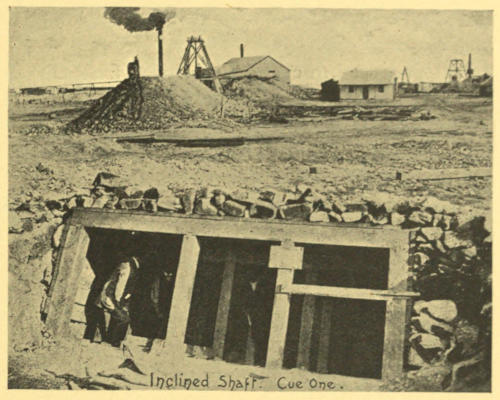
Inclined Shaft, Cue One Mine
I had heard a good deal about this centre of the Murchison,
Cue, and, now that I was here, found it an agreeable place to
spend a few days in. The living is in many ways immensely
good, fresh milk is abundant, eggs are, it is true, 5s. a dozen,
but are obtainable. The meat is the finest I have seen in
the colony, and the vegetables are equally good. Passing the
door of the kitchen one morning I saw a pile of cauliflowers,
the outside leaves of which were 4 feet high, and the white
flower on the same scale. The cabbages were as hard as
a rock and over a foot and a half in diameter. Turnips and
other kinds of vegetables were equally surprising. The cook
told me
that they
were grown
at Mr.
Rickett’s
garden, two
miles out of
town. To
look at the
barren
country
one would
think that
nothing
would
grow, but it
justifies the
words of
Sir Frederick Weld, one of the first Governors, who, when people
described Western Australia as a sand heap, said, “If it be
only sand, it is sand that will grow anything if you give it
water.” I was agreeably surprised one morning to receive a
lovely bunch of mignonette and a few violets, the first of the
season. I did enjoy the gift; no garden flowers ever smelled
sweeter or looked prettier to me, for it was a long time since I had
seen any. It was a perfect Sunday morning, and picnics and
drives were the order of the day; several parties were just
setting out. The people seem to be very happy, and, though
so far away from their old homes, have got quite used to goldfields
life and get plenty of enjoyment out of it. I drove
out to some of the gardens and was surprised at the green
spots in the desert. Plenty of water is got by sinking wells
and the gardens are well irrigated.
There are two newspapers published at Cue. At a dinner
given to the Press while I was there, one of the toasts was as
follows: “Woman, second only to the Press in disseminating
news.” Are we ladies to take this as a compliment, or otherwise?
It is proposed to carry the railway from Cue on to Nannine.
The Cue people do not want this, as it would make Nannine
the centre and spoil Cue. A splendid court-house and warden’s
offices are here, as well as many other fine public buildings,
shops, dwelling-houses, and hotels.
There are some good mines, but a great many of them are
under exemption at present; that means, allowed to stop working
for a specified time named in their application; consequently
many men are out of work and the town is comparatively quiet,
because these men have to go out back-prospecting, to keep
their wives and children.
There are many families in Victoria and elsewhere who
bless the day when the goldfields of Western Australia were
discovered, and a great many miners in these districts have
brought over their wives and families and have made humble
but comfortable homes for them. They all seem happy, and
I have talked with many of the women, who tell me that, though
the life is rather rough, yet they have money always regularly
coming in, while, on the other side, they had nothing to keep
themselves with the failure of the banks and general crash in
Melbourne having ruined so many people.
Coming back from a drive I passed the racecourse, with such
a funny little grand-stand, perched on top of a rocky hill. There
was to be a wild-flower show soon. The ladies were working
hard to make it a success. There seemed to be a great many
of them here, and yet it is only a few years since the arrival of a
fair lady in Cue was an event of importance, in which almost the
entire population showed their interest by crowding round the
coach. Wages are still very good. A housekeeper will get £3 a
week; barmaids, £3 10s.; housemaids and waitresses, £2 10s.;
and a lady to whom I was speaking told me she was extremely
tired, from having had to do all the washing for the family
herself, as the laundrywoman wanted £1 per day for doing it,
or 15s. for half a day! Chinese are sometimes engaged as
servants, and, as a rule, give satisfaction. No Chinaman or
coloured man is allowed to mine; in Western Australia they
are tolerated as gardeners or servants only.
Mr. A. W. Walder has a large station called Coodardy, 20
miles from Cue. It extends nearly 100 miles up towards Lake
Way. There are always 1500 head of cattle and 4000 or 5000
sheep on it to supply the necessities of the Cue and Mount
Magnet districts. This number is supplemented by drafts from
the far north, even as far as Gascoyne and Kimberley. The
feed is good, as may be supposed from the beautiful quality
of the meat. It is chiefly salt-bush, of which the stock are
very fond, and which does not grow very high, but is most
nourishing. The water supply for them is drawn from wells
by blacks kept for that purpose.
Day Dawn, where the largest mines are situated, is four
miles from Cue. One of these is called the Consolidated
Murchison Gold Mines, Limited. The machinery on these
mines is magnificent, and has cost an enormous sum of money.
The cyanide process, all of which the assayer showed me, was
most interesting. The various articles used in assaying
are very delicate—scales that will weigh a breath and little
wee china basins the size of a doll’s cup. The splendid
laboratory was full of different chemicals; there were three
immense rooms for the cyanide and assaying processes.
Coming back to Cue, I called at the Lady Forrest Mine,
which is in quite a picturesque spot, and I was not surprised
at the beautifully arranged collection of wild flowers and ferns
that the manager had picked around the mine and dried. The
mine not working, he had plenty of time to pursue his favourite
pastime of botany. He also showed me a fine collection of
choice orchids; these are found at the Granites, a few miles
out. Parrots, with brilliant colouring, and cockatoos, are to be
seen about here, especially when you are near a soak (well).
Occasionally an iguana glides along, looking like a tiny land-alligator.
Iguanas, though not agreeable to the eye, are
considered almost sacred in the Bush, because they destroy
snakes.
The Island is a wonderful little place, a real treasure-house,
16 miles from Cue. It is in the centre of the salt lake
Austin (called after Robert Austin, the explorer), from which
it is separated by channels 1000 yards wide. The lake, like
all Western Australian lakes, is dry; but when the sun is
shining on it it looks like a sheet of glistening gold.
The Mainland, dignified sometimes by the name of Salt Lake
City, is a few miles farther off. I do not know whether there
are any Mormons settled there or not. There are several good
mines at the Mainland and the Island. The reefs are highly
auriferous. The Golconda is the largest mine, giving very rich
yields, and is now owned by an English syndicate. The representatives
of this mine are very careful not to let outside people
know too much about it; they keep the doors of the battery
locked, and no one is allowed to go in to inspect. The Island
Eureka is a small but rich mine owned by a syndicate on the
Island. Mrs. Hurfit, who is part-owner of the mine, lives close
to it. This lady who is the first white woman that came to
these parts, showed me a fine collection of specimens of all
kinds of minerals found here. The gold quartz is very
beautiful. The jewellery Mrs. Hurfit has had made from it by
Streeter, of London, is unique, some of the polished quartz with
veins of gold showing through it being the handsomest I have
ever seen.
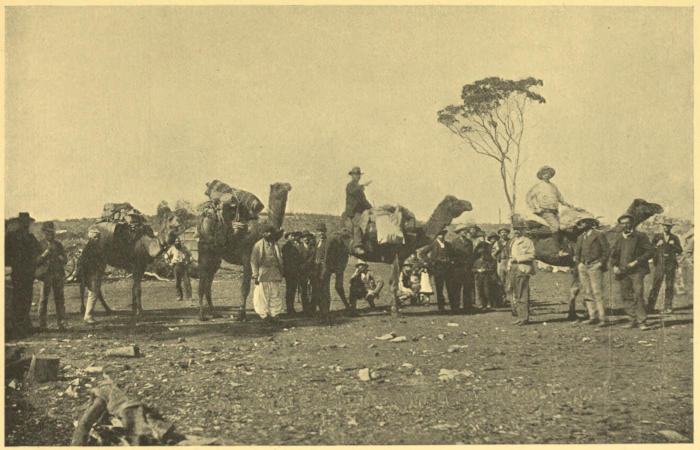
COLONEL NORTH’S EXPEDITION TO MOUNT MAGNET
Seeing a peculiar-looking place on a hill, I climbed up to see
what it was, and found a large hut composed of big flat stones.
These stones were lying around in great quantities. Some men
were working near, but they were Italians, and as they could
not speak English and I could not speak Italian, our conversation
was nil. The view from the hill was charming; the salt
lakes shimmering in the sun, the flat country with the grass
and wild flowers, the low-lying purple hills in the background,
a lovely and most peculiar colouring in the sky, the rising
stacks of the mines, and the high metaphoric rocks in the distance,
formed an uncommon and pretty picture. Just as I was
leaving, the sun came out with unusual brilliancy, casting exquisite
reflections on the glistening golden sand, which seemed to
crystallise into various forms. I almost felt as if I had dropped
into fairyland, but in a moment the sun hid behind a cloud and
the beautiful scene was gone.
There are about 150 people at the Island and Mainland, and
they all appear to be in comfortable positions. On the day I left
it was raining heavily, and I had to wait an hour at the station
for the train, which was late in arriving. This brought to my
mind the story of a gentleman who had promised to attend at a
certain place and make a speech, but found himself unable to
do so on account of the heavy rains having destroyed a
section of the railway line. Accordingly he wired, “Cannot
come; wash out on the line.” The reply came: “Come any
way; borrow a shirt.”
At last the train made its appearance, and I took my seat and
went to Mount Magnet (not to be confused with Mount
Margaret, which is in quite a different part of the country),
about 32 miles farther on. On arrival there the railway station
was so crowded that I could scarcely get out. There were
about 300 young men of all sorts and sizes, and with such
jolly smiling faces that I began to feel quite hilarious myself.
They turned out to be the successful footballers just returned
from a match at Cue. Several buggies and horses were waiting
at the station, and I had no difficulty in being conveyed to an
hotel, which bore the significant name of “The Oasis.”
My first impression of Mount Magnet next morning was
that there were a great many donkeys—I mean, of course, of
the four-footed variety. They seemed to perambulate the town
in dozens, and a team of about 20 going out of town with a
wagon was a novel sight. I can assure you that, while I was
writing these words, two inquisitive donkeys put in their heads
at the door and almost said “Good-morning,” recognising a
friend, perhaps. The outlook from this place was very dreary,
as nearly always seems to be the case where gold is found.
Several nice specimens had just been brought into the hotel by
a lucky prospector, some of the pieces weighing several ounces.
The Mount is about four miles from Magnet township, and
was named Mount Magnet in 1854 by Mr. Austin, because the
stone was so mineralised that it attract the compass to an
extent which rendered it useless. Despite the barren-looking
country, there are many varieties of wild flowers growing in the
neighbourhood, and the desert octopus or tiger-plant is most
remarkable. It bears a fairylike pink flower, and seems
almost to be a living thing. The leaves of the plant are remarkably
sensitive, and there are numerous little caplike
flowers fringed with tentacles and filled with a sweet substance;
any insect that approaches is seized, and the plant, which
grows only a few inches in height, and is also known as
“Rainbow” or “Fly-trap,” absorbs the life of it.
Five miles away is Boogardie, or Jones’ Well. A singular
discovery was recently made there. Portions of underground
rock, on being broken, were found to contain a living frog at a
depth of 40 feet! Many of these have been found. Query, how
did they get there?
There are many tidy houses in the little township; one
Hessian camp, containing three separate rooms, was most tastefully
arranged with pretty art-muslin and cretonne, a nice carpet
on the ground, and cane furniture beautifully draped. The
bedroom was quite elegant, and the kitchen had cocoanut
matting on the ground; there were, as usual, no floors. A
bright Peerless Cooker stove and spotlessly white dresser and
crockery finished as natty a little home as a man and woman
could wish for. The men out here all work their own claims,
and are very comfortably off.
A few miles from Magnet is the Morning Star, a low-grade
mine, but still a paying one. Mr. Bryant, the manager, made
me most welcome, and explained to me very conclusively that,
to make a mine pay, it is not necessary to find gold in
occasional very large pieces, and that a steady quantity,
though small, will, if the supply hold out, prove profitable.
The mine is worked almost entirely by men from Clunes,
Victoria, where Mr. Bryant formerly was; they have quite a
camp of their own, and with their reading-room and recreation-ground,
where they play cricket and football, they pass a very
jolly life and seem quite contented. Total abstinence is the
rule of this mine. Before the train service was started they
had to cart all the machinery and stores 200 miles to the
mine. Farther
on is Lennonville,
another
important
mining centre,
where rich
finds have
lately been
struck; and
farther still,
what is called the 10-Mile. There are many good mines
in these localities. The Long Reef is a fine mine, and with its
magnificent new machinery looks imposing. The plant is one
of the finest in Western Australia, and there is enough good
ore to show profitable results for years to come.
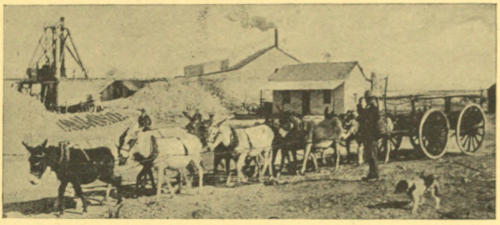
Donkey Team, Mount Magnet
Coming back from these mines I stopped at the Lennonville
Hotel (to have dinner), the landlady of which was the biggest
woman I had ever seen, she weighed over twenty-one stone.
The scenery of this district is far more pleasing than the
barrenness of Magnet township. There are plenty of enormous
emus scudding through the scrub, and occasionally a few kangaroos
enliven the scene. Some of the big hills are completely
riddled with enormous holes made by the earthworm. It must
have taken centuries to make these tunnels. I thought they
must be mining excavations, but one of the mining managers,
who is a mining expert and engineer, and who ought to know,
told me they were the work of earthworms.
In another direction from Magnet is the New Chum Mine;
farther on the Two Chums, and others; all giving good results.
There is a fine hospital, with a skilful surgeon, such skill
being very necessary where mining accidents ate liable to
occur. The country is by no means unhealthy, and there
were only four patients in the hospital on the day I visited it.
The nurses seemed to be very kind women, and the patients
said it was like being nursed at home to be in the Magnet
Hospital.
East Mount Magnet is about 50 miles away, and the coach
journey to it is tedious. There is a tidy little township, and
some of the mines are very rich. Mr. Zeb. Lane, before
going to London last year, paid a visit to this place, and took
over the Windsor Castle Mine, a fine property, upon which
Mr. Lane estimates that there are 25,000 tons of good ore
at sight ready to pay handsome dividends. The Havelock
Mine has given splendid results, and a wonderful collection of
specimens was recently lodged in the Bank. Christmas Gift is
another good mine, and not far off is another rich find called
Payneville. Several rich patches have been found and
hundreds of ounces of gold taken out of them. The district
seems to have a bright future before it. I was glad to return
to Magnet, and to have made my last coach journey for the
present. One of the miners to whom I was speaking looked so
fearfully cadaverous that I asked him what was the matter. He
told me he had once been poisoned by lead in a mine, and had
never got the poison out of his system. I told him about the new
cure by electricity lately discovered. He seemed very thankful
and said he would see the mine doctor about it at once. Over 30
experiments with this cure have lately been carried out
successfully in England, and I hope it will soon be generally
known, and many cures made in the colonies.
CHAPTER XXVI
Yalgoo—A Cold Welcome—Native Shepherds—Geraldton—Pearls—The
Abrolhos—Dutch Navigators—Aborigines—Finis.
I reached the uninteresting township of Yalgoo at 2 o’clock,
very cold, tired and hungry. I stepped from the train with my
portmanteau and sallied out of the station to look for a vehicle
to take me to the hotel to which I had been recommended; but,
alas! there was no sign of a conveyance. A drearier-looking
place I never saw. So disheartened did I feel that I returned
and got back into the railway carriage again, intending to
resume the journey and go on to Geraldton; but on looking out
of the now open window I saw so many nice and jolly-faced
people on the platform that I thought it might not be so bad a
place after all, so I took a second thought and got out of the
carriage once more. Approaching the gate I discovered a small
boy in charge of a cart, on which I placed my belongings, and
told him to take them to the Emerald Hotel, I walking behind.
When we arrived there he put out my luggage and left me.
Not a soul was about the hotel or the street. I felt like a sailor
in a desert. I essayed to reconnoitre the place, and went
in and out of several rooms, with no result. I then tried the
kitchen, and found every one out there also, except the fire,
which luckily was in, so I took possession and sat down on a
box to warm myself. Looking out of the window, I saw two
enormous emus stalking about and peering into everything.
I was afterwards told that they are the most curious birds
in existence, and their prying ways often cause them to be
taken captive. Presently the cook turned up; strange to say,
a woman cook, as most cooks in these parts are Japanese men.
I asked her for some dinner; she said she had none in the
hotel, it was all at the railway station. I may as well here
explain that the proprietor of the hotel also caters for the
railway station, and his staff goes down there to attend to the
train passengers at the dinner-hour, everybody who requires
dinner being supposed to get it there. The whole male
population of Yalgoo goes to see the train come in; it is the
event of the day. However, the cook made me a nice cup
of tea and some hot toast, and boiled some fresh eggs, after
partaking of which I felt myself again. Taking a look out of
the front door I saw the street just as deserted as ever, so,
going into a bedroom, I took a siesta until 4 o’clock, when
sounds about the neighbourhood told me that the townsfolk
had returned from the railway station. I accordingly went
forth to make their acquaintance, and having done so I am
able to speak of them in the warmest terms.
The township being such a barren-looking place I was
surprised, on driving around, to find very beautiful environs.
The rains had brought up millions of wild flowers of all
colours, and the grass and trees were exceptionally green.
There are a great many sheep stations in this district, and
the mines are a considerable distance away, so I did not go
to them. The exception was the Emerald Mine, which is
almost in the township, and which has returned its owners
a large fortune. Fifteen thousand pounds worth of gold was
dollied out of it before it was sold to an English company,
who then erected machinery and crushed large quantities
of rich ore with big results. It was on this spot that Yalgoo’s
first find was made by a native shepherd and his lubra,
who told some prospectors that they knew of a quartz-heap
with bright stuff on it. You may be sure the prospectors
lost no time in finding the heap; other finds followed, and
the Yalgoo rush commenced. Aboriginal shepherds are almost
the only ones to be had in the West, and they are not very
reliable; yet if any animal is lost they can always find it; they
are wonderful trackers, and can follow up the track of anything
alive; this power has been cultivated in them by hunting for
food from infancy.
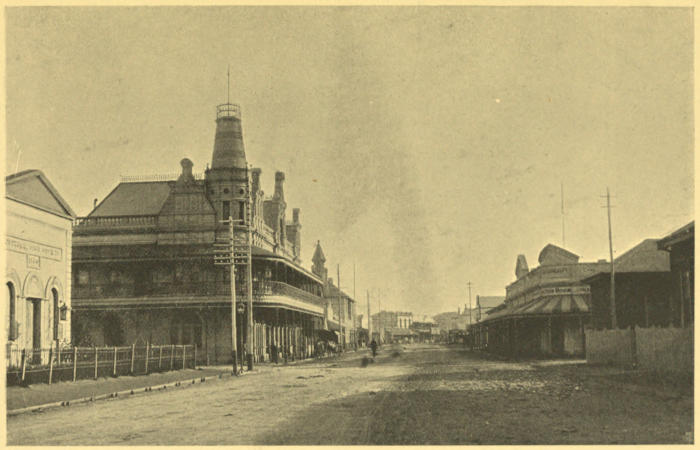
MARINE TERRACE, GERALDTON
The next day I left Yalgoo, longing ardently for a breath of
sea air once more. After a journey of eight hours in the
train I arrived at Geraldton, on the shores of Champion Bay;
the town nearest the point at which the history of the colony
really commences. It is a shipping port for a large agricultural
and pastoral country, although as yet only 2000 acres are under
cultivation. I went for many beautiful drives, and one night
to a “social” given by the footballers, to which I was invited;
but as I did not dance, and contented myself with being a
“wallflower,” my participation in the enjoyment was not very
keen; I consequently returned early to my comfortable parlour
at the Club Hotel. The new public buildings here are quite
an ornament to the town, and the people may well be proud of
them. There are also some other fine buildings and many
nice shops. Altogether Geraldton is a very jolly place in which
to spend a holiday. It can be reached from Perth by boat
instead of the long train journey of 297 miles, for the steamers
going to the far north of Western Australia and Singapore
every fortnight always call; there are also several coasting-boats.
The extensive and rich goldfields of the Murchison
make Geraldton a very important place, and in course of time,
when the North is more known and visited, it will, no doubt,
become one of the most important towns in Western Australia.
Some beautiful pearls were shown me by a trader from
Sharks Bay in the North-west district of Western Australia,
and I wished I were a queen who could order a necklace of
them. As it was I had to content myself with one for a ring.
They were really exquisite gems, especially three pink ones.
The trader also had two black ones, which are rare and very
valuable, but I prefer those of delicate hue.
Pearls to the value of £285,000 and pearl shell valued at
£1,000,000 have been raised from the North West Fisheries
during the last ten years. Nearly two hundred luggers, with
over a thousand Malay, Japanese, Chinese, and Manilla men,
with whites for officers, are engaged in the pearl industry.
For diving, natives are chiefly employed, they being such
wonderful swimmers and divers. Occasionally dissensions
take place between these mixed people and their masters. Not
long ago a terrible tragedy occurred on a pearling vessel, the
Ethel, and the captain, his son, and the first mate were
cruelly murdered by some of the Manilla and Malay crew. The
offenders escaped at the time, but were afterwards captured
(chiefly by the instrumentality of a poor Chinese cook, who was
loyal), and have since paid the penalty of their terrible crime.
There is a pretty river near this place, called the Chapman,
which falls into Champion Bay. Garnets are found in the sand
near the mouth of it, and you may be sure that any one who
visits the place spends some time looking for the jewels. I was
no exception to the rule, and found a few small ones, but until
they are polished they are not very beautiful.
The orange groves are exquisite, and produce quantities of
splendid oranges. Mr. Jupp, one of the growers, had just sent
into Geraldton some immense loads, the whole of his golden
crop. The rainfall having been exceptional in the previous
season, the country was bright with grass and flowers. It
seemed quite a pity the fine grass should not be feeding more
cattle.
The view from the top of the lighthouse, where we stopped
on the way back from a river picnic, is very grand. The rocky
Abrolhos, 35 miles away, with the surrounding agricultural
country, Champion Bay, and, farther out still, the grand rolling
Indian Ocean, make up a most impressive scene. The lighthouse
has a revolving white light, brilliantly flashing every
40 seconds, and visible for 16 miles; two other lights, lower
down, showing red rays, visible from the north and south.
Another day I drove to Greenough Flats, a level and fertile
plain, with many fine crops, principally wheat, under cultivation.
These flats were, no doubt, in former days vast lagoons,
which accounts for the unlimited supply of good underground
water. The grass is very nutritious, and the sheep and cattle
looked fat. At Minchooka, Mr. Redhead’s station, the stock was
looking exceptionally well, and a fine crop of wheat returned
26 bushels per acre from 11 acres. Mr. T. McGuiness, of
Greenough Back Flats, lately had a peculiar experience while
cleaning out his well, which is 96 feet deep, and was dry. In
the hope of obtaining a fresh supply, Mr. McGuiness sank the
well 13 feet deeper, and, when driving down his bar, struck
water, which spouted up so quickly and with such a rush that
he had hardly time to escape drowning; the water rose 30 feet
in a very short space of time.
The Greenough river runs between the flats, and there is a
nice little township, with public offices, hotels, churches, and
many comfortable dwelling-houses; there are also several large
farms in the district, which is a magnificent grain-producing
one.
Newmarracarra Station, 20 miles from Geraldton, was formerly
the property of Mr. Maitland Browne, the resident magistrate,
who at one time used his land exclusively for horse-breeding.
Thirty thousand acres of the station are now utilised
for sheep-farming at great profit, there are 24,000 sheep on
the run in splendid condition, as well as many beautiful high-bred
cattle. Mr. McKenzie Grant, the owner, manages this
station himself, and has spent £55,000 on improvements.
A grand water supply comes from the Greenough river and also
from twelve springs in different parts of the land, which is
very picturesque, with its hills and rich flats, covered with
waving grass, and, in some spots, is brilliant with wild flowers.
All kinds of native trees add beauty to the scene.
Mr. Broadhurst, to whom I am indebted for all the information
relating to the Abrolhos, 35 miles from the mainland, gave
me, as a great favour, a copper coin from the Batavia, wrecked
there in 1629, also a part of a pair of scissors that have nearly
lost their form, and other relics of the past. A very
interesting curiosity is a pair of large silver buttons with
links, in splendid preservation and very slightly tarnished.
The figures on these buttons represent Joseph and Potiphar’s
wife. The Abrolhos are the abode of countless millions of
birds, principally the noddy and sooty tern, which in the
breeding season congregate there in such numbers that the sky
is quite obscured by their flight, and everything is in almost
total darkness. The group of islands have been leased from
the Government since 1883 by Messrs. Broadhurst and
McNeill, who command a very large trade in guano. The
main stations in the group are Rat, Pelsart, and Gun Islands,
on each of which there are commodious managers’ quarters and
laboratory, besides kitchen and quarters for 48 hands. No
Australian should neglect to see the relics of the wrecks on the
Abrolhos that are in the Perth Museum. Mr. Broadhurst
showed me a book, printed in the Dutch language, that he
accidentally came across on a London bookstall in 1895, being
then on a tour and engaged in collecting information concerning
early Australia. The book bore the date of 1647, and has
since been translated into English by Mr. Siebenhaur, a Dutch
gentleman in Perth, and proved to be, strange to say, a complete
narrative of the wreck of the Batavia and the massacre of
the people, in 1629, at the Abrolhos Islands. The Batavia was
the commodore’s ship of a fleet of eleven vessels sent from
Amsterdam in 1628 to the East Indies in search of treasure
and to form a colony on one of the islands. Storms arose, the
commodore’s vessel was separated from the others, and finally
got down among the perilous banks of the Abrolhos, where the
vessel became a wreck. After much danger, the people, numbering
several hundreds—soldiers, sailors, women and children—were
landed on two of the islands, several trips having to be
made between the ship and the shore before this could be effected.
Some water and bread was also got ashore, as well as some
cases of treasure, jewels, and gold-laced clothing belonging to
the Dutch Government that the commodore was anxious to save.
The ship shortly afterwards foundered and the hardships of the
seafarers commenced. It was found that there was very little
fresh water on the island, so the commodore, Pelsart, and
several of the men set off in the sloop, which had been saved,
to the mainland to look for water for their fellows. After much
difficulty six of them succeeded in landing by swimming, the
shore being stony and rocky, and great breakers beating
violently against the rocks so that it was not safe to take the
sloop in too near. They saw smoke rising, and going towards
it, saw four dark figures creeping on their hands and knees,
who, on the approach of the sailors, leaped to their feet and fled
away at full speed. Each carried a stick, no doubt a boomerang.
Around the fires were the bones of birds. The savages were
naked, and were the first ever seen on Australian soil by white
men. The sailors dug holes, trying to find fresh water, but
could find very little, and returned to the ship disconsolate. The
commodore then, knowing that by returning to the islands he
could do no good for his fellow sufferers, determined to return
to Batavia for assistance. On arrival there he obtained speedy
help from the Government, and provided with all necessaries
and a good crew, at once set out again for the Abrolhos
to succour the shipwrecked people. On arrival there they
saw, close to where they had been wrecked, smoke from
several fires, and were much rejoiced, hoping to find all or most
of the poor people alive. Having cast anchor, the commodore,
taking with him a cask of water, bread and wine, went in his
boat to the highest island, but on arrival there found no one, at
which he was much astonished. Jumping ashore, they saw a
little boat coming round the northern point with four men
rowing; one of them jumped ashore and welcomed the commodore,
but begged him to return to the ship, as there was a
party of miscreants who intended to seize the vessel. He then
told the terrible story of the massacre. These miscreants had
murdered 120 people on the island, now called Pelsart Island,
or “Batavia’s Churchyard.” The commodore then sorrowfully
returned to the ship. The man who told the commodore all this
was named Webbey Hayes, and he with forty others had tried
their best to save their comrades, and were then on what they
called Long Island. The commodore took some boats and men and
brought them away, arming them with muskets. With these he
proceeded to Batavia’s Churchyard and captured the mutineers.
They found them all dressed in the beautiful clothes trimmed
with gold lace belonging to the Government, and jewels were
scattered about in all directions. The mutineers were divested
of their gay clothes, put in irons and conveyed to Seal Island,
to remain there till they should be tried, which was afterwards
done, and they were then executed for their crimes. This is a
very short and crude synopsis of the interesting translation of
the Dutch book of
which I have spoken,
but may serve to give
some idea of the
Abrolhos. The
many curios of this
time that are spoken
of on page 51
are well worth
seeing. Previous to
this, in 1540, Portuguese
vessels had
been driven on to
the coasts of the
Great South Land,
as it was called.
Houtmann, a Dutchman
who had served
with the Portuguese, had sighted the cluster of rocky islets
and called them Abrolhos, a contraction of the Portuguese
“Abro vos olhos” (“Keep your eyes open”). In far-back
ages Chinese junks used to sail down to the Gulf of
Carpentaria, and the natives of that part of Australia are
now said to have a distinctly Mongolian cast of countenance.
Marco Polo, at the close of the thirteenth century, alluded to
the Great South Land. Allusions to this unknown land are
also met with in writings dating as far back as Alexander
the Great in the fourth century; Strabo, Pliny and Ptolemy also
make mention of a mysterious territory, which was probably
the continent of Australia. Dampier is said to have been the
first Englishman to land on the coast of Western Australia,
which was then, in the reign of William III., called New
Holland. His report was so unfavourable, that Australia was
left to itself again until 1770, when Captain Cook landed at
Botany Bay, New South Wales, and not until 60 years afterwards
was Western Australia found to be suitable for colonising.
In 1829 the first governor, Captain (afterwards Sir James)
Stirling, with his family and over 60 settlers, arrived at the
Swan River and founded the settlement which is now the city
of Perth; two years previous to this, Captain Fremantle had
hoisted the British flag at the entrance of the river, and the
port of Fremantle is named after him.
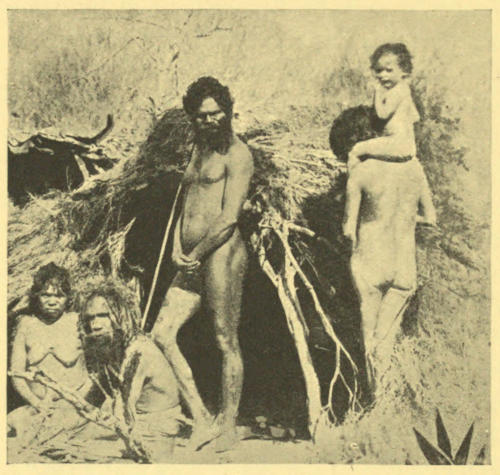
Four generations of the Western Australian Native
For some time past I have been collecting all the facts of
interest that I could concerning the natives of Australia, and
have gathered a really fine collection of the native weapons,
boomerangs, nulla-nullas, spears, waddies, womerahs, shields,
&c. There are a good many aborigines about Geraldton at
present, but civilisation has made them lazy, and it is not easy
to get many of their weapons. Mine have chiefly been given to
me by friends who have gone to the trouble of collecting them
for years. The blacks are not a very pleasant race, still we
ought to have a kindly feeling for the poor creatures, whose
chief capacities seem to be hunting, fishing, and tracking. Their
own laws, and the way they keep them, are somewhat remarkable,
especially those relating to the affinities and the division
of the people into families.
There are four tribes or clans amongst the aborigines of
Western Australia, namely—Booranggnoo, Banagher, Kimera,
Palgarie. A Booranggnoo man may marry a Banagher woman,
their children will be Kimera; a Banagher man may marry a
Booranggnoo woman, their children will be Palgarie; a Kimera
man may marry a Palgarie woman, their children will be Booranggnoo;
a Palgarie man may marry a Kimera woman, their
children will be Banagher.
Children take the name of the mother, and intermarriage
between the same tribe is not allowed. Polygamy is
permitted. A native may have several wives and various
families, but each family incurs the responsibilities of the
mother, and all such relations become involved in the guilt
of any crime; if the offender cannot be reached, any other
relative may have to suffer instead. In case of death by
violence, the nearest relative of the slayer is found and punished.
Homicide in obedience to law is therefore common among them.
Their law is blood for blood, an eye for an eye, a tooth for a
tooth. Girls are betrothed when they are young, and may be
claimed at any time. A blackfellow must take his lubra (wife)
from the clan or tribe which alone is eligible to give a wife to
him, otherwise he becomes an outcast. The women are
severely punished by the men even for trifling offences. On
the death of the husband the wives and children pass to his
brother; all property in land is held for hunting and obtaining
food. They are very fond of music and dancing, their songs
being chiefly extempore. The dances, or corroborees, are
adapted to the various circumstances of their lives—marriage,
birth, death, war or hunting. It is not usual for the women to
take part in these dances, but on rare occasions they do, and
they carry a peeled stick tufted at one end, as was the custom of
the ancient Bacchantes. Songs are composed by musical natives
of the clan, and are soon learnt: every blackfellow knows
the songs of his clan, and if one is composed for any special
occasion it is soon learned. The food of these natives is very
varied and peculiar, one kind being the knomat, the gum of the
swamp mimosa. There are also six kinds of kangaroo eaten, two
kinds of opossum, twenty-nine sorts of fish, three kinds of turtle,
emu, wild turkey, and many kinds of waterfowl; frogs, seven
kinds of lizards, four kinds of grubs, twenty-nine roots, seven
fungi, four gums, two kinds of manna, four fruits, four nuts—two
of the zamia, which are poisonous without proper preparation—the
seeds of many plants and the flowers of the banksia.
Cannibalism is not common, but has been known in the North
and East. The weapons employed are suited for the chase as
well as war. These are the codja or hatchet, the dabba or knife,
the meera or throwing-stick, the guicka or spear, the dowark or
club, the womerah or digging-stick, and the killy or boomerang,
which they throw with great skill. Their skill in hunting is
remarkable, weirs are made for fish, stakes driven to intercept
the kangaroos at their watering-places, and the fish are
commonly speared by day and by torchlight. Their mias, or
huts, vary in construction from a light shell made of brushwood
to a dome, large enough to contain several persons, of logs covered
with clay, and in size according to season and locality.
From the Murchison northward, and also in the interior, the
natives go naked; but southward, near the coast, the dress is the
“booka,” a sort of cloak made of kangaroo-skins, that of the
men being longer than that of the women, who use bags of
skin, coota or boka, and mats of vegetable fibre, for carrying
their children and domestic necessaries. They have many
ornaments, and work opossum fur with yarn to make girdles
for carrying things and bands to twine round the head to stick
feathers in. They tattoo their bodies, and during the operation
of tattooing, other natives swing round small curved pieces of
wood, producing a whirring noise. They cover themselves with
wilgey, a sort of red ochre, charcoal, or white clay. They send
messages by marked sticks or bomar, the markings being
quite intelligible to them, but to us just looking like a number
of jagged chips in the sticks. They are not deficient in gratitude,
but rather treacherous, although they will offer themselves
up for punishment, a thing which very few white men ever do.
They are very superstitious; the power of evil is a constant
source of terror to them. They have their karakats, boolga-men,
or medicine-men, able to inflict as well as cure diseases.
They greatly fear an evil spirit, Jingie, and an imaginary
monster, Wangul, inhabiting the fresh waters, and chiefly
making victims of women. Each family has its kobong, or
cognisance, some animal or vegetable for which they have a
reverence, and which, therefore, is not used as food by the family
who adopt it. Some of the domestic and personal habits of the
natives resemble those inculcated by the laws of Moses. Their
social intercourse is regulated by very strict and ceremonious
customs. There are forms of meeting, also forms of parting.
Mrs. Canfield, who had charge of the school at Amesfield,
Albany, especially reports their fondness for music. One girl,
sent to Sydney, played the harmonium in St. Philip’s Church
for some time. Several other native scholars have become
good housewives; some are now employed as school-teachers.
Mrs. Canfield also notes the fondness of the boys for mechanical
arts. The native Mission home is near Guildford, and another
is in the Vasse district, but there are only about 40 children
in each place. The natives around Geraldton are half-civilised;
in fact, some speak quite good English. I suppose the heavy
fine of £50 for supplying drink to natives keeps them sober,
as they find it difficult to obtain strong drink, of which they
are very fond. They have been known to go to a large heap
of bottles, and taking one, empty into it the dregs of all the
others, until they get sufficient to take a drink, which they
seem to relish exceedingly.
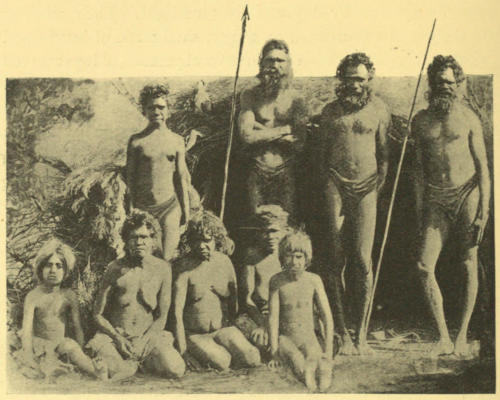
Aborigines with Spears
Native wells or “namma-holes” have saved may a prospector
from death by thirst, and men well used to the Bush soon
know how to find them. Some of the wells are not more than
two feet deep; others go down to ten or twelve feet, and are
usually found by rock-holes, or certain trees that are near them.
Some wells have a small drive at the bottom, so arranged by
the blacks that, when the water gets shallow, it cannot be seen
from the top of the hole. The old prospectors have learned
from the blacks how to find these oases in the desert, but “new
chums” might pass dozens while parched with thirst and never
find one.
After saying good-bye to the numerous friends I had made
in Geraldton, I set out for the south in the Perth mail-train,
my destination, however, being Dongarra, a little station 24
miles from Geraldton. On alighting there I found that the
hotel was some distance off, and I regretted that I had got out of
the train at all. However, a good-natured boy with a cart solved
my dilemma by saying: “Get up, missus, I’ll give you a lift.” I
accepted his invitation with much pleasure, and drove on through
wonderful grass lands. I thought, as it waved in the wind, that
this must be a cultivated crop, but found it to be common wild
grass. A great deal of the land about here is rented to the
farmers at 10s. per acre, and they have an average yield of 16 to
25 bushels of wheat and 30 bushels of barley. Wheat can be
grown at a large profit, as the cost of growing it is not more
than 4d. a bushel, and the timber being light in the district, the
expense of clearing the land is small.
There are a number of farms about Dongarra, which is one of
the prettiest little country places I have seen in the colony. The
township is situated near the mouth of the Irwin river, and so
there is no lack of water. There is a small and safe harbour at
Dongarra, formed by a reef at the river’s mouth, which is the
outlet to the valley of the river. There are many early settlers
living here. The following notice that was fastened on a tree
I thought very comical: “If any man or woman’s cows or
horses get into this paddock, his or her tail will be forthwith
cut off, with no respect to persons.” This is on a par with a
letter written by a justice of the peace in one of the places that
shall be nameless:—
“To J. murphy: thars 5 kows of yourse runnin in mi paddock
and if they aint tuk out be Frida nite ime goin to sit the lor agen
yer; ime on the binch and ile make it warm for yer.”
The little hotel at Dongarra proved very comfortable, and
next morning I resumed my journey in the train, which took
all day. In the afternoon we stopped for awhile at a place
called Watheroo. I gathered a pretty bunch of wild flowers
while waiting; some red ones especially took my fancy. They
smelt very sweet, something like honeysuckle. I found that
they were of the “verticordia” species, and that they grow in
great profusion near the Irwin river. In the evening, at seven
o’clock, I left the train at Gingin, for I wanted to see some of
the famous orange and lemon groves there. After quite a
pastoral supper at the little inn where I put up I retired early,
feeling somewhat fatigued after my long journey in the slow
train. In the morning I set out to see some of the groves.
The forest scenery through which I passed looked particularly
grand after the monotony of the goldfields, and the beautiful
orange groves further enhanced the scene. I have seen oranges
growing in various parts, but the fruit hanging here in golden
clusters was the finest I had seen in Western Australia. In
returning I stopped at a large garden, where strawberries and
other fruits were growing; some children were picking the ripe
fruit, which looked so tempting that I went to the door of the
little homestead and asked whether I could buy some. “Oh,
certainly, and cream, too,” replied the mother of the children,
who had now come in with their spoils from the garden. After
I had finished my unexpected treat, the mother put on her big
white sun-bonnet (the usual head-covering in country parts),
and, with the children following, showed me all over her selection
and farm (which was a very fine one), and, with true
Australian hospitality, pressed on me many gifts of fruit and
flowers. There are about 350 people in the district of Gingin,
mostly gardeners and graziers; all kinds of cereals are grown,
as well as the fruits I have mentioned, and grapes of the finest
quality are produced. Fat cattle and horses are also raised for
export; a splendid clear stream of water runs near the township;
sportsmen can have good shooting, for kangaroo; wallaby
and wild duck are abundant in the vicinity of this pretty little
place, which is 50 miles from Perth.
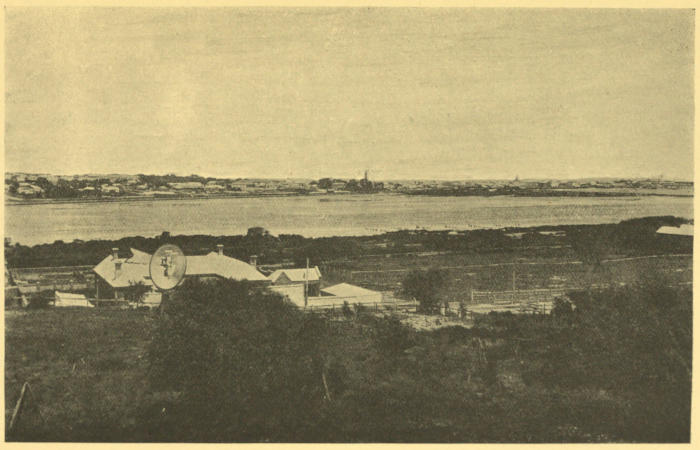
FREMANTLE
In the morning I took the train for Perth and Fremantle,
and on arrival at the Perth railway station there, waiting for me,
were my own horse and Ralli car. Didn’t we spin along
through the park? I thought of the Mulga scrub and red
dust “out back”; here the roads were red, but “with a
difference,” and the grass and the trees delightfully fresh and
green; surely the water never looked so sparkling. In and
out through the trees along the winding road we drove, past
the little villas, with their sweet gardens, up the hill, around
the bend to the dearest spot on earth, “Home, sweet home.”
The house and verandah were almost hidden by the glossy
green leaves of the “Canadia” and passion vines; through the
lattice of the fern-houses peeped the delicate pink blossoms of
the tall ivy-geranium twined with the ever-flowering purple
runner. The gate-porch and garden fence were embroidered
from end to end with blue and green. Blue sea beyond, blue
sky above. The gate was open, and thus my journey of two
thousand miles came to an end. I hope that my record of it
may help the reader to gain an idea of Western Australia.
Our hands are outstretched to our brothers and sisters across
the sea. We want them to come and work with us. Energy
and courage are the best cards to bring out to this big land.
Should they wish to see the country for themselves, as I have
done, I trust that my efforts will help to make their tour as
easy as possible.
Like all new countries, it has its rough uncultivated tracts,
but I have also tried to show that it has its “meadow sweet” as
well. Hundreds of thousands of acres of the soil are waiting
to be tilled by strong willing hands and to yield richly of its
fruits, while underneath the earth is “golden,” “golden,”
overhead the glorious sun is shining, and the Austral sky
is blue.
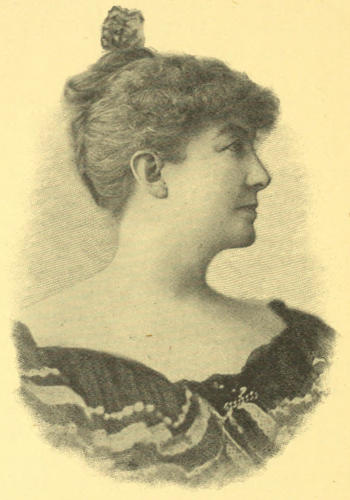
MAY VIVIENNE