RIVER GAMBIA, THROUGH WOOLLI,
BONDOO, GALAM,
KASSON, KAARTA, AND
FOOLIDOO, TO THE RIVER NIGER.
BY MAJOR WILLIAM GRAY, AND THE LATE STAFF SURGEON DOCHARD.
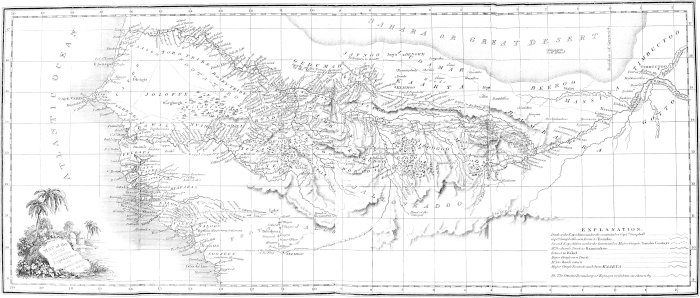
WITH A MAP,
DRAWINGS, AND COSTUMES, ILLUSTRATIVE
OF THOSE COUNTRIES.
Quòd si deficiant vires, audacia
certè
Laus erit in magnis, et voluisse sat
est.
PROP.
LONDON: JOHN MURRAY, ALBEMARLE STREET MDCCCXXV.
WITH
SENTIMENTS OF THE HIGHEST RESPECT
AND THE MOST SINCERE GRATITUDE,
THE AUTHOR OF THE FOLLOWING PAGES HAS, BY PERMISSION, DEDICATED THEM
TO THE
RIGHT HON. THE EARL BATHURST,
HIS MAJESTY’S PRINCIPAL SECRETARY
OF STATE
FOR THE COLONIES.
PREFACE.
In offering to the public
the following pages, it may be necessary to state the motives which
operated to my acceptance of that important command, which it will
be their business to disclose. Though not born in the camp, nor
altogether educated in the field, I have been early taught in that
frankness which generally characterises the soldier, and, I trust,
it will be found that, in all I describe, I have never deviated
from strictly acting on that honourable and faithful basis.
I had reached the shores of Africa, in my tour of service, well
remembering on my passage the labours and researches of the
informed and the brave who perished in the exalted struggle of
benefiting their country and the benighted Africans; while, at the
same time, I could not help reflecting on the disappointing results
which often attend the best directed human exertions. The brave and
the scientific were gone; their country consecrated their labours,
though partially abortive; and the enterprising mind felt no alarm
in tracing their progress, while a chance remained of redeeming their fate by more
successful exertions. Greece and Rome alternately fought and
conquered, and were subdued by arms, the short summary of most
nations’ history, while it remained for the British Government
alone to extend their empire through the enlightened agency of
moral sway, of civil institutes, and Christian regulations, and
convey to the hapless, the neglected, and the enslaved, the highest
blessings which can dignify, improve, or adorn man.
Warmed with those feelings, I felt an honourable pride in being
entrusted with a command to explore the uncultivated regions of
Western Africa. It was a task of peril, but the measure of danger
was the measure of honour; and with a strong distrust of my own
capacity I accepted the office of conducting the expedition. As
soon as I became acquainted with its objects, it may be naturally
supposed that I felt some uneasiness; but such were the measures
taken by a superior commander, now no more, that any
insufficiency on my part was compensated by the wisdom of a gallant
and enlightened officer. The objects of the mission were not the
mere acquisition of territory, or the unfair advantage of commerce;
they were the improvement of science, the enlargement of trade, and
the consequent diffusion of increased happiness to the African population. The sceptic
in religion, and the would-be renovator of politics, may think
differently on this subject; but every rational individual must
feel that British life, British talent, and British treasure, would
not be employed in such a quarter if there were not every wish to
benefit and improve the condition of our degraded fellow
creatures.
In undertaking this mission I was not employed to create a
fabulous history, or describe romantic scenery; I was employed to
glean and collect facts; to effect discovery when it was possible;
to note down nothing which might not lead to some useful result;
and, in the end, to draw such honest inferences as will, I humbly
venture to trust, be found throughout these pages.
With the wisdom of all the previous plans adopted in exploring
Western Africa I have nothing to do, and for that in which I was
engaged, I only feel myself responsible as far as the resources
placed within my reach. A difficult duty was assigned me; I
attempted its execution; and, be the results satisfactory or not, I
can safely say that my best exertions were in no case wanting to
meet the views of those high authorities at home and abroad who
confided its performance to me. If I have partially failed, the
failure is attributable to circumstances, which will be fully developed in the sequel. I
shall say nothing of my sufferings and privations; but after all I
have witnessed, I feel deeply impressed with the generous
sentiments and wishes of his Majesty’s Government towards all who
need their aid, and I entertain a fervent hope that to future
travellers in Africa my humble endeavours may prove a source of
more ample success than it has fallen to my lot to achieve.
I cannot conclude, without regretting the premature death of my
friend and companion Staff Surgeon Dochard, who but a few months
after my return from Africa, fell a victim to the consequences of
the sufferings and privations he endured on the missions under the
command of Major Peddie, Captain Campbell, and myself. I
particularly felt the want of that assistance in preparing our
several notes for the press, which he was so fully able to afford
me. The importance of his notes have not, however, been altogether
lost, though they are still deprived of much of that value which
his reconsideration would no doubt have imparted to them. Such as
he left them, they are faithfully preserved, and have been used in
the narrative with the same attention as my own.
W. GRAY, Major.
CONTENTS.
CHAPTER
I.
PAGE
Arrival of the Expedition at Senegal —
Delay there — A Messenger despatched to Sego — Departure from
Senegal, and Arrival at the Rio Nunez — Town of Tallabunchia —
Major Peddie’s Death — Sickness of the Men and Officers — Departure
from Robugga — Difficulties on the March — Arrival at the
Panjetta.
Halt at the Panjetta — Return of
Messengers sent to the Capital — His Majesty’s Answer — Great
Scarcity of Provisions — Another Messenger sent, with Presents to
the King — Captain Campbell’s interview with Omerhoo Kano — Reports
about the Intentions of the Expedition — Captain Campbell goes to
see the King — Arrival of the Messenger from Sego — Captain
Campbell’s Return — No satisfactory Answer — Illness of the
Officers — Lieutenant Stokoe and Mr. Kummer sent to the Coast —
Captain Campbell decides on retracing his steps — Departure from
the Panjetta — Arrival at Kakundy — Death of Captain Campbell —
Departure for, and Arrival at Sierra Leone — Description of Foota
Jallon.
Major Gray takes the Command — Departure
from Sierra Leone — Arrival at Bathurst St. Mary’s —
Occurrences there —
Departure for, and Arrival at Kayaye — Description of a tribe of
wandering Foolahs — Description of Kayaye, the surrounding Country,
and Inhabitants — Their Amusements, &c. — Visit to Katoba — The
King’s Visit to us — Arrival of Camels from Senegal — Our Guide’s
proposal respecting the path — My Decision, and Reasons — Fatality
among our Animals — Arrival of Mr. Partarrieau from St. Mary’s —
Arrangements for Departure.
The Expedition leaves Kayaye — Difficulty
in procuring Water at Jaroomy — Arrival and Halt at Coonting —
Description of that Town and surrounding Country — Civility of the
Chief — Departure from Coonting — Deaths among the Animals, and
difficulty of procuring Carriers — Arrival at the Wallea Creek —
Attempt of some People to stop us — Pass the Creek — Cane Bridge —
Attempt at Murder by one of our native Civilians, and his Desertion
— Enter the Kingdom of Woolli — Arrival at Madina, the Capital —
Transactions and difficulties there — Description of the Town, and
the Mumbo Jumbo Ceremony — Departure from Madina, and theft by the
Natives — Arrival at Kussaye.
Departure from Kussaye — Pass through the
Simbani Woods — Loss of Camels — Ruins of Muntobe — Leave Muntobe —
Arrive at Sansanding — Halt there — Our Woolli guides leave us —
Discharge of Corporal Harrop — Arrival at Sabee, the first Town of
Bondoo — Loss of Animals — Opposition on the part of our Guides to
our moving thence — Arrival at Loonchea — Death of the Camels —
Supply of provisions from Almamy — Mr. Dochard sent in advance with a present to
Almamy — Departure from Loonchea — Arrival at Dachadoonga —
Difficulty and delay in carrying forward the Baggage — Description
of the Red Water, and its use — Arrival at Goodeerri — Mr. Dochard
returns from the Capital — Arrival of Almamy’s eldest Son —
Transactions with Almamy and difficulty in arranging matters with
him — Departure from Goodeerri, and arrival at Boolibany, the
Capital of Bondoo.
Description of Boolibany — Delays and
Disappointments there — Scarcity of Provisions — Death of Private
Pickard — My decision of passing the rains in the Country, and
Departure for Samba Contaye to select a position for winter
quarters — Arrival of the Expedition from Boolibany — Mr.
Pilkington and men left there sick — Death of Lieutenant Burton,
and Sickness of the men — Preparations for Mr. Dochard’s Departure
for Sego — Almamy’s Arrival near our Camp — Difficulties about the
Guide — Mr. Dochard’s Departure — The Object of his Embassy — Mr.
Partarrieau’s Departure for the Coast — Mr. Nelson’s weak state — A
regular Market established — Mr. Pilkington’s Arrival from the
Capital — Mr. Nelson’s Death — My own Indisposition — Deaths among
the Men — Extraordinary Ceremony at the Killing of a Lioness —
Lion’s Attack on the Horse — Account from Mr. Dochard — Return of
the Messengers — Almamy’s unjust Conduct, and its Results.
Unfortunate Affair at Samba Contaye —
Almamy’s Decision — Purchase of a Slave — Arrival of the
French Expedition
at Galam — Mr. Pilkington’s determination of leaving the Mission —
His Departure for the Coast — Visit to the Senegal — Conversation
with Almamy — Messenger sent to Mr. Dochard — Fires at the Camp —
Death of Almamy Amady.
Description of Bondoo — Extent —
Boundaries — Face of the Country — Productions — Commerce —
Manufactures — Government — Revenues — Religion, its influence on
the Inhabitants — Their Description, Dress, and Manner of Living —
Military Equipments — Force — Mode of Warfare — Cause of War with
Kaarta — Almamy’s sanguinary Conduct — Attack of the Kaartans on
Boolibany.
Message from Almamy — My Visit to
Boolibany — Subject of Interview with him — His hostile Conduct and
peremptory demand for my leaving Samba Contaye — The Necessity of
my Compliance — Return to the Camp accompanied by an Escort —
Preparations for the March — Departure for Boolibany — Arrival
there — Almamy endeavours to make us enter the Town — My Refusal,
and Selection of a Position for the Camp — Return of my first
Messenger to Mr. Dochard — His Misfortune and Failure — False Alarm
at the Capital, and its Consequences — Indecision of Almamy and the
Chiefs.
Arrival of Mr. Partarrieau from the Coast
— Interview with Almamy — Arrangements with, and Presents made to
him — His false and deceitful Conduct — My determination and Retreat from Boolibany —
Difficulties on the March — Want of Water, and breach of oath on
the part of our Guides — Enter Foota Toro — Difficulties there — My
March to, and Return from Baquelle — Affair with the Foolahs — My
Captivity — Departure of the Party for Baquelle — My disappointment
on finding the Camp deserted — My own Return to Baquelle.
Description of the Plain of Hourey —
Occurrences there — Departure and Arrival at Baquelle —
Unfavourable Accounts from Mr. Dochard — Kingdom of Galam.
Report of Mr. Dochard’s Arrival in Kaarta
— My Departure for St. Joseph, and Meeting with Mr. D. — Return to
Baquelle — Messenger sent to Sego — Arrival of Fleet from St. Louis
— Mr. D.’s Return to the Coast, and my final Determination — Visit
to St. Joseph — Conduct of Almamy Bondoo — Return from St. Joseph —
State of Affairs at Baquelle — Departure from thence — Delay at St.
Joseph — Assembly of Chiefs, &c. &c.
Retreat from Kaarta — Difficulties and
Annoyances there — Arrival at Fort St. Joseph — Delay and
Occurrences at Baquelle — Return to the Coast — Arrival at Sierra
Leone — Visit to the captured Negro Establishments
Arrival of the Expedition at Senegal — Delay there
— A Messenger despatched to Sego — Departure from Senegal, and
Arrival at the Rio Nunez — Town of Tallabunchia — Major Peddie’s
Death — Sickness of the Men and Officers — Departure from Robugga —
Difficulties on the March — Arrival at the Panjetta.
It is no doubt in the
recollection of many of my readers, that an expedition destined to
explore the interior of Africa, from its western coast to the river
Niger, the course and termination of which was its ultimate, and
indeed grand object, left England in the latter end of 1815, under
the command of Brevet-Major Peddie, of the 12th Foot, having with
him Captain Campbell, of the Royal Staff Corps, and Staff-Surgeon
Cowdrey; the latter, an officer who had some years before explored
part of the country in the vicinity of the Cape of Good Hope, and
all three fully qualified to the importance of the service
entrusted to their care.
On their arrival at Senegal in the month of November, 1815, so many obstacles presented
themselves to the immediate departure of the expedition for the
interior, that Major Peddie, having proceeded to Sierra Leone for
the purpose of consulting with his Excellency the Governor, decided
on remaining at Senegal until the ensuing year.
They had not been long there, when Staff-Surgeon Cowdrey took
ill, and in a few days fell a victim to the climate, much regretted
by his brother officers, who were thus left without a medical
assistant, and deprived not only of his society, but of his
invaluable services as a naturalist and astronomer.
To fill the situation thus left vacant, at least in the capacity
of a medical officer, I was applied to by Major Peddie; and
although I felt that I possessed few of the qualifications
requisite to the discharge of the duties of so important a
situation, I nevertheless accepted the offer, with a determination
that no exertion should be wanting on my part to forward the
services of the expedition, which I joined at Senegal, in February,
1816.
Major Peddie’s first step was to despatch a messenger with a
letter to the king of Sego, informing him of our intention to visit
him, and begging he would send some of his chiefs to Senegal, to
conduct us into his territories. The person employed, whose name was Lamina, was a
native of Sego, and promised to return with the king’s answer in
three months.
Captain Campbell went to Sierra Leone in March, 1816, for the
purpose of acquiring information respecting the path through Foota
Jallon, and on his return so strongly urged Major Peddie to enter
the country for the interior from the Rio Nunez, that he decided on
doing so, and fixed the middle of November for their departure from
Senegal. The interim was employed in collecting information
respecting the countries through which we were to travel, and
selecting from the regiment serving on the coast, a detachment of
non-commissioned officers and men fitted to the peculiarity of such
a service, and purchasing animals for the transport of the
baggage.
All these preparations being completed, we embarked on board
four vessels, hired for the purpose, and sailed from Senegal on the
17th of November, 1816.
The expedition was then composed of Major Peddie, Captain
Campbell, Mr. Adolphus Kummer, a German, as naturalist, Mr.
Partarrieau, a native of Senegal (possessing considerable knowledge
of the Arabic and Moorish languages, with some of the native
African tongues), and myself, having with us a party of soldiers and civilians, amounting
to 100 individuals, and a train of 200 animals. We called at Goree,
where we remained until the 26th, when being joined by a vessel
from the Cape de Verde Islands, having on board some horses and
mules for our use, we proceeded and arrived, after a tedious
passage of sixteen days, at Kakundy, a factory belonging to a Mr.
Pearce, on the left bank of the Rio Nunez.
While waiting for the tide at the mouth of that river, we
visited a small island formed by the alluvial matter brought down
with the stream, and collected by a ridge of rocks which run nearly
across its embouchure. It is called Sandy Island, from its soil
being almost wholly composed of that substance. It is about a mile
in length, and from a quarter to half a mile in breadth, having a
gentle rise towards the centre, where it is covered by a grove of
palm trees. We met on it a party of about twenty of the Bagoo
tribe, who had come thither to collect palm wine, for the
celebration of a mournful ceremony over one of their chiefs, who
had died a short time before. At a little distance from the spot
where we met them, there is an arbour, on approaching which we were
stopped, and told the place was sacred, as it contained their
idols; of those we could not obtain even an indistinct view.
Tallabunchia, which
we also visited, is situated on the north bank of the river, about
four miles above Sandy Island, in a plain, beautifully shaded with
lofty palm trees, and a great profusion of orange, lime, plantain,
and bananas. The town is straggling and irregular, and contains
about 200 inhabitants. The houses are about sixteen feet high, and
divided, by a partition of split cane, into two apartments, one of
which serves as a store for their rice, &c. and the other for a
dwelling. The men are strong and well formed, but of an extremely
savage appearance; their whole apparel consists of a fathom of
cotton cloth wrapped round their waists; they practise cutting the
incisor teeth and tattooing the breasts and arms; holes are pierced
through the whole circle of the ear, in which are inserted bits of
a coarse kind of grass. The dress of the women is still less decent
or becoming; a strip of cotton bound round the loins, in the shape
of what surgeons call a T bandage, is their only covering; a band
of twisted grass round the upper parts of the thigh, one
immediately above, and another below the knee, with one over the
ankle, constituted the female ornaments. The children were quite
naked, and had large copper rings hanging from the cartilage of the
nose.
On the morning of the 14th, Captain Campbell, who had again proceeded to Sierra
Leone, on matters connected with the service, joined us at Kakundy,
where the whole of the men, animals, and baggage were landed. We
encamped on an elevated piece of ground, cleared for the purpose,
and overlooking the factory. There sickness soon began to prevail
amongst the Europeans, few of whom escaped without one or two
attacks of fever, and, such was their weak state, that, on the 24th
of December, it was thought expedient to remove them about four
miles east of Kakundy, to Robugga, a factory belonging to a Mr.
Bateman, who politely gave up his house for their accommodation. On
that day Major Peddie was attacked with violent fever, from which
he experienced little relief until the morning of the 1st of
January, 1817, when, thinking himself better, he left his bed, but
was soon obliged to resume it, and in a few hours breathed his
last.
This was a sad commencement of the new year, and the melancholy
event cast a heavy gloom on the minds of every individual connected
with the expedition. It made so deep an impression on some, that it
was with much difficulty they could be prevailed on not to abandon
the enterprise. Never was a man more sincerely beloved, nor more
truly regretted by all who knew him. His remains were deposited,
amidst the heartfelt
regrets of his friends and companions, on the following day, in the
court-yard of Mr. Bateman, under the shade of two orange trees; and
an appropriate epitaph, written by Captain Campbell, and carved on
a slab of native mahogany, was placed on his grave.
The day previous to his death, the expedition was joined by
Lieutenant Stokoe, of the Royal Navy, and Hospital-assistant
Nelson. They were accompanied by Lieutenant M‘Rae, of the Royal
African Corps, and Thomas Buckle, Esq.[1];
the latter was sent by his Excellency, Sir Charles M‘Carthy, to
afford every facility to our departure from Kakundy, and was the
bearer of presents to Mr. Pearce (the nominal king of Kakundy
having no power whatever in the country), without consulting whom
nothing is done in that river even by the European traders.
Lieutenant M‘Rae, hearing on his arrival of Major Peddie’s
illness, and the little hope we entertained of his recovery, came
forward with the most disinterested zeal, and told Captain Campbell
that if his services were likely to be of any use to the
expedition, he would readily accompany it; indeed he left Sierra
Leone partly with that intention: and notwithstanding the great
want of officers in that garrison at the time, and that he filled some very important
situations, his Excellency, with that alacrity he had all along
shewn to comply with whatever was calculated to forward the views
of the expedition, most willingly agreed to his proceeding, should
his services be required. After Major Peddie’s death, they were
considered very acceptable, and he was immediately added to our
number. He did not, however, long survive our lamented commander;
he was attacked with fever, for the first time since his arrival on
the coast, on the 13th of January, and died on the 21st, deeply
regretted by us all.
The convalescents, and in which condition were nearly all the
Europeans, being in a very debilitated state, were moved forward,
under the care of Mr. Nelson, to the borders of the Foota country,
on the Tingalinta river, whence they might be easily sent back were
they not sufficiently recovered by the time the whole might have
moved forward.
We left Robugga in the afternoon of the 1st of February, and
after a most fatiguing march of four hours reached Harrimakona, a
small slave village belonging to a Mandingo chief, named Kirra
Mahomadoo, who lives near Kakundy.
On the morning of the 2d, Lieutenant Stokoe was added to the
sick list, and being unable to render any assistance, rode forward to the
Tingalinta. We left Harrimakona at two, P.M. and got on tolerably well until we arrived at a
difficult pass in a wood, where those in front disturbed a swarm of
bees, which made so violent an attack on both men and animals, that
all were thrown into confusion. On my being made acquainted with
the cause, I considered it a very frivolous excuse for allowing the
horses and asses to run about in all directions, throwing off their
loads; and was reprimanding the men for their carelessness, when I
was attacked by so dense a swarm of those insects, that I was
obliged to retreat, and suffer the mortification of exhibiting
myself in the same predicament with those I had just been
reproving. It was sunset before the bees dispersed, or we could
collect the animals, many of whom suffered severely, from the bees
getting into their eyes, ears, and nostrils; one of our best horses
died on the spot, and some of the asses were unable to rise from
the ground. We reached the Changêballê stream at nine o’clock, but
the darkness of the night, and the difficulty of the passage
prevented our crossing.
From the number of animals stung by the bees on the 2d, we were
in a bad state for travelling on the morning of the 3rd; the third
and fourth divisions, however, moved forward to the
Tingalinta, leaving
the second and first, which arrived about noon from Robugga, at the
Changêballê, where we found it necessary to halt, until the arrival
of some animals from the divisions in advance enabled us to move,
in the cool of the evening, to the Pompo stream, where we passed
the night.
The following morning, we started at eight, and at ten reached a
fine stream, the Falgori, which we were more than an hour in
crossing. The difficulty did not arise from the depth of water, but
from the acclivity of the hill on the east bank, up which some of
the animals could not carry their loads without the assistance of
two men. After passing this hill we entered a barren rocky waste,
over which we travelled, for nearly twelve miles, without meeting
water.
We were here met by Mahomedoo Mariama, a messenger sent by Major
Peddie from Senegal in the preceding August, with a letter to the
Almamy or king of Teembo. He was accompanied by Abdul Hamed, one of
Almamy’s brothers, and three other chiefs, with their wives and
attendants. We reached the Tingalinta village at four, P.M. and encamped for the night on the east side of a
hill overlooking the river. The men were all extremely fatigued,
and, although we had only travelled thirty miles, we had all had
four days’ hard work, in consequence of the difficulties of the path, and the
accidents among our animals. The general appearance of the country
we travelled over was extremely barren, and our course south-east.
We found that the convalescents sent forward to the Tingalinta with
Mr. Nelson, were still in a very weak state, and the scarcity of
rice under which we laboured, tended to keep them so. We were in
hourly expectation, however, of a supply from Kakundy. A little
milk was all we could procure at the village which takes its name
from the river, and contains about 100 inhabitants, principally
slaves, belonging to Mr. Pearce, who has allowed them to settle
there for the purpose of cultivation, and to keep up an intercourse
with Foota Jallon. The rice, to the amount of ten men’s loads [ten
cwts.], arrived on the 8th, and eight of those men, natives of the
neighbourhood of Kakundy, were engaged to carry loads to Laby.
On the morning of the 9th, Abdul Hamed informed Captain Campbell
it was Almamy’s orders, that a white man should be sent on in
advance to Teembo, to explain to him the object we had in view in
entering his dominions, and at the same time forbidding our nearer
approach until he should be perfectly satisfied on that subject. I
took the opportunity of offering my services to go with an
interpreter, to make
any arrangements with that chief which might be thought necessary,
but Captain Campbell did not conceive it requisite to send an
officer; and, therefore, despatched one of our native
serjeants[2], who had been before employed by the governor of
Sierra Leone on similar occasions. He left us on the 10th of
February, and was accompanied by Abou Baccary, one of the princes
in Abdul Hamed’s train.
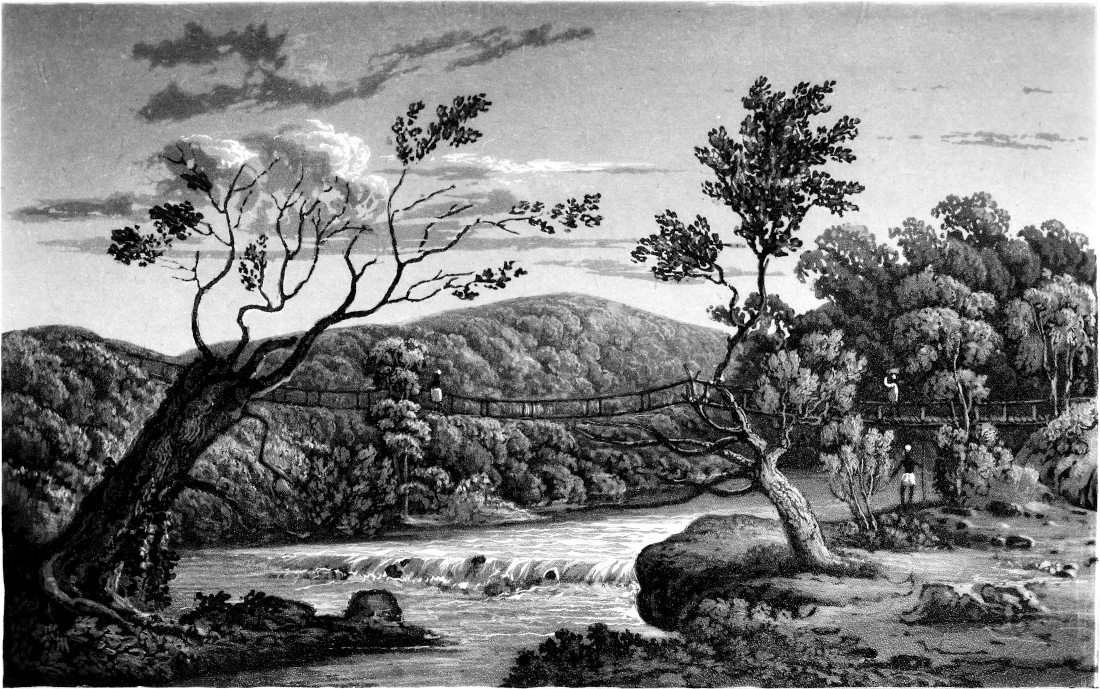
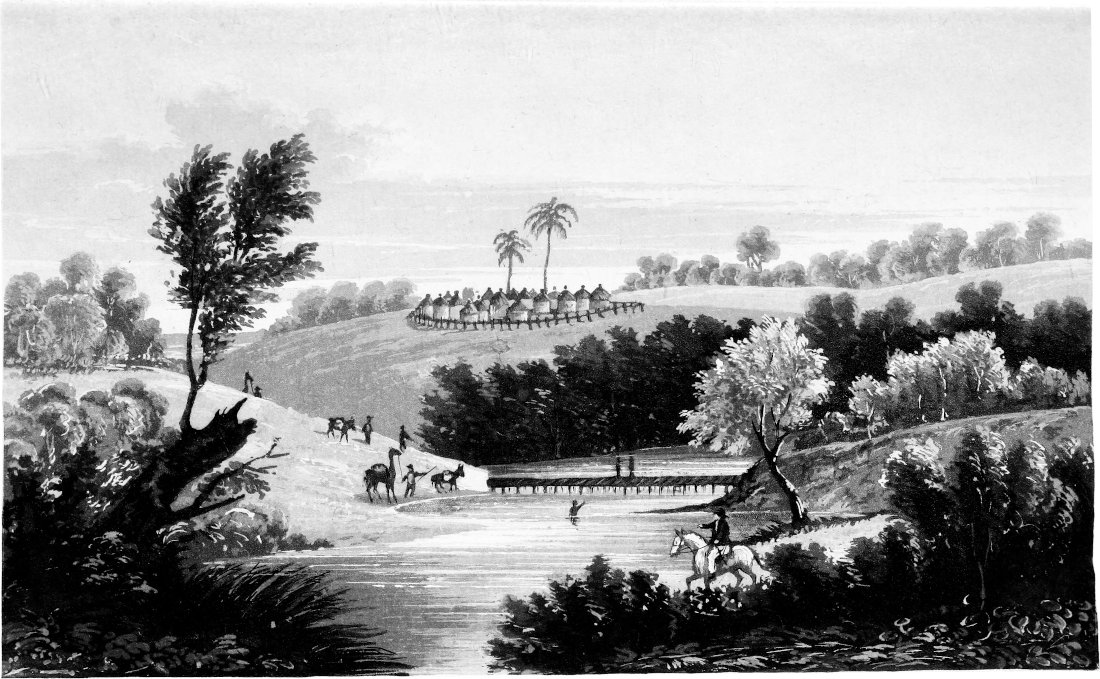
In the evening, the animals and baggage were removed across the
Tingalinta, which, at that place is about 110 feet wide and from
two to three deep, with a bottom of small round pebbles. At a
little distance below the ford was a swinging bridge, composed of
cane and bark ropes, by which it was attached, at about twenty-four
feet above the water, to the branches of the trees which grew on
the banks, and afforded during the rainy season and periodical
floods, a safe, though apparently slight and tottering, passage for
people on foot.
W. Gray del.
SWINGING BRIDGE OVER THE TINGALINTA.
Published Feb. 1825. by John Murray,
London.
We were in motion at three o’clock on the morning of the 12th,
but the Kakundy people, who had been hired as carriers, refused to
cross the Tingalinta, assigning as a reason that they were afraid
of being seized, and retained as slaves by the Footas, who had some
years before obliged
them to quit that country, which formerly belonged to themselves.
This delayed us a considerable time, and it was not until eleven
o’clock that we left the ground on which we passed the night. The
path by which we travelled was so extremely rugged and broken, that
we had much labour and difficulty in keeping the animals from lying
down under their loads. This arose from their not being shod, and
from never having travelled on so hard a soil before; that in the
vicinity of Senegal and Goree being a light moveable sand. On
reaching a place where the path separates, one branch leading
direct to Teembo, and the other to Laby, a halt was made until
Captain Campbell came up, when, after some conversation between him
and Abdul Hamed, he ordered us to follow that leading to Laby, in
opposition to the advice of the prince. The reason assigned by
Captain Campbell for his choice, was the expectation of the
assistance of the chief of Laby, who had considerable power and
influence in that quarter. At one, P.M. we
passed a small stream[3] running north, and which, from the steep,
rocky, and narrow nature of the path leading to and from its banks,
occupied much time. At six, the rear reached the halting-place,
which was situate on
the ridge of a rising ground, about two miles east of the stream,
but so extremely barren that we could not find, for a considerable
distance round us, a single blade of grass for the animals. Here
again some bees, that were flying about in search of water,
fastened on the animals’ backs as soon as the pack-saddles were
removed; but on this occasion, we applied some dry sand, which
absorbed the profuse perspiration that evidently attracted the
thirsty bees, and by this means we got rid of our troublesome
visitors. Abdul Hamed made himself very useful during this day’s
march, and on finding that we expressed ourselves sensible of his
attention, he presented Captain Campbell with his bow and arrows,
modestly insinuating that a musket in return would be most
acceptable; and this was given him.
It was eight o’clock on the morning of the 13th, before the rear
moved forward. We marched over a gently descending plain for a mile
and a half, when we came to a small brook named Calling Ko. The
asses were as usual stubborn, and evinced a most determined dislike
to wet their feet, which caused us much trouble and loss of time.
The country here began to wear a more fertile, or, rather, a less
barren appearance. It was thinly sprinkled with large trees and
shrubs, and produced an abundance of better grass than we had met before. We
halted for the night at another small brook, a short distance from
the Calling Ko, having abandoned during the day’s march six asses
and one bullock.
On the following morning, we started at eight o’clock, and, in
about twenty minutes, passed a fine brook called Sappacourie,
running SSE. the path more rocky and
difficult than before. At eleven we perceived, distant about a
quarter of a mile to the right, a broad lake, thickly skirted with
wood; it is called Silla Dharra[4]. At noon, we passed another
smaller lake, and at one, P.M. arrived at
the Cogan, a beautiful stream, which we crossed, and halted for the
night on its eastern bank. It is about fifty yards wide, two feet
deep, and runs rapidly to the north, over a rough stony bottom.
Though we were at work at three o’clock on the morning of the
15th, it was eleven before the last division left the top of the
hill. The path led us over the most barren country I ever saw,
until three, P.M. when we entered a rich
valley, in which, at some distance to our right, stood a small
town, the first we passed since we left the Tingalinta. At half
after four, we arrived at the Serriwoomba, where we
were obliged to halt,
in order to cut a passage through the thicket of cane, which
covered its banks. We were all so much fatigued that we could
scarcely keep our eyes open; indeed many of the men fell asleep on
the path. A few shots were fired, to apprise the inhabitants of the
neighbouring villages of our arrival; and in about two hours, they
made their appearance from different directions, bringing corn,
rice, and pistacios for sale.
Both men and animals were so much exhausted, that it was found
necessary to halt until the 18th, when we moved forward at eight,
A.M. and, travelling east for about two
miles up hill, we passed a deserted town, from which we continued
marching on a level barren plain for six miles, and then descending
gently for about four miles more, we arrived at the Kuling, a fine
stream running NNE. We crossed it, and
halted on its eastern bank for the night. We had scarcely unloaded
the animals when the long dry grass to windward of our position was
set fire to, and nothing but the greatest exertion on the part of
the men could have prevented it from destroying the whole of our
baggage.
It behoves travellers in that country to be extremely guarded in
their choice of a halting-place, for the path generally lies
through grass six or seven feet long, and so dry at that
season, that the
smallest spark of fire is sufficient to set it in a blaze for
miles. One of our animals that had not come up with the rear, lay
down with his load, within range of the burning grass, which soon
communicated with some gunpowder, and blew the whole to pieces. On
the morning of the 19th, we moved forward at eight o’clock. The
first hour’s march lay along the side of a steep hill, rendered
doubly difficult for the animals by being covered with small rough
stones. At ten we descended to a plain, and crossed three small
brooks, the first running NNE. and the two
latter S. and by W. Several of the European non-commissioned officers
and soldiers were so ill during this march, that they lay down
under some trees on the path-side. I prevailed on two of them to
move slowly forward, but the others requested to be allowed to rest
until the cool of the evening. My own horse, and every animal in
the division, were so heavily laden, that we could not afford them
any assistance. At one, P.M., we began to
ascend some rocky hills, where we were obliged to abandon three
animals. At the bottom of those hills, we passed the dry bed of a
rocky watercourse, and, shortly after, had considerable difficulty
in crossing another of the kind, near which we halted, in a small
valley by the side of a brook called Bontong Ko.
On the 20th, a
messenger was despatched with small presents to Almamy and the men
in authority about him, and to advise him of our approach. He was
accompanied by a young chief, one of the prince’s suit, likewise
the bearer of a message to the king from his brother. Finding it
impossible, with the assistance of all the carriers we could
procure, to move the whole of our baggage with any degree of
regularity or safety, we decided on abandoning our two small field
guns, with their shot and grape, and, having buried them about
three feet beneath the surface, we made a fire, to conceal where
the ground had been broken. By this means we got rid of three very
heavy loads. Captain Campbell thought it better to dispose of them
in that way than to make a present of them to Almamy, for although
it was not likely he could make any use of them, yet the very
circumstance alone of possessing such destructive engines, and of
having received them from us, might induce those nations with whom
he occasionally wages war (and through which we were likely to
travel), to entertain unfavourable opinions of us.
When about to move on the forenoon of the 20th, the prince
commenced a long palaver with Captain Campbell on the subject of
our proceeding without giving him previous notice. It
had never been done;
and why he should have expected it on this occasion, was no less
matter of surprise than his haughty language and deportment. After
much conversation, little of which was relevant to the question, he
consented to our moving, which we did at four, P.M., and ascending a steep hill, so closely covered
with cane that we had more difficulty in passing it than any former
part of our path, the dry leaves of the cane with which it was
covered, rendered the ground so slippery, that the men with
difficulty kept their feet; and that nothing might be wanting to
complete our confusion, the Foolahs set fire to the dry grass and
roots, in which the place abounded. We fortunately escaped without
any injury, save the loss of two asses that lay down unable to move
further. It was dark when we began to descend the eastern side of
the hill, which, from the animals frequently falling, occupied two
hours. We reached the Poosa, a small stream, at eleven,
P.M., and encamped on its banks. Our want
of the means of conveyance was every day, nay every hour, becoming
more distressing; carriers could not be procured for all the loads
of the animals that died or were abandoned; we therefore destroyed
two of our tents and a large quantity of flints and musket
balls.
The prince, observing Captain Campbell seated on a mat outside his tent,
approached the spot, accompanied by one of his attendants, named
Salihou, and, without further ceremony, seating themselves near
him, began to destroy a portion of the vermin with which even
royalty in that country is covered. They opened a conversation on
the dangerous part of the country we were then in, and the
difficulty of preventing the natives from robbing and otherwise
annoying us, adding that we should not have left the Bontong Ko
without consulting them.
Although we were aware that the object of all this was to induce
Captain Campbell to make the prince a present, he nevertheless took
no notice of them. Salihou then, taking hold of the prince’s
trowsers (which, by the way, were in very bad repair), and holding
them up, asked if it was a fit dress for the brother of Almamy to
appear in before the white people? But even this failing to produce
the desired effect, they closed the conversation, and, at the same
time, their more disgusting occupation.
On the following morning, we left the Poosa at nine o’clock, and
at eleven, entered a valley of great beauty and fertility. The
light coloured sandy and rocky soil, which, with little variation,
we passed over since entering the Foolah country, here changed to a
rich dark mould; hills on all sides, rising gently one above another, and covered with
large clumps of trees, bounded this luxuriant spot. Having passed
it, we entered a deep gully, in the bottom of which the brook
Lagoody runs to the NE. The path on both
sides is extremely broken and rocky, forming a nearly perpendicular
precipice of about one hundred and sixty feet; down which two of
the animals, a horse and ass, rolled into the brook, and, strange
to say, received little or no injury. We soon reached the plain of
Parowell, where we encamped for the night. During this march, one
of the Foolah carriers absconded with a portmanteau, containing
several articles of value, and, although the prince sent one of his
men in search of him, he effected his escape unmolested.
On the morning of the 23rd, we moved forward at eight o’clock.
In half an hour we passed another deep ravine, and crossed a plain
about a mile long, from whence the path continued along the side of
a hill, rising to a ridge, of steep ascent; the east side being
very steep, narrow, and rocky. It was so broken before the last
division reached, that we were obliged to make much use of the
pickaxe, in order to clear a passage for the horses, one of which
fell over the precipice, and was much hurt. We continued
descending, until we arrived at the Koba stream, running north,
over a rocky bottom;
here we encamped for the night. We were all much fatigued, and one
of our sick, being unable to walk, was most cruelly treated by some
Foolahs who were hired to carry him. They obliged him to walk to
the Parowell, where, had he not met Mr. Stokoe, who lent him his
horse, he must have sunk from weakness and fatigue. When he reached
the camp, he was so much exhausted, that his pulse was scarcely
perceptible, and he was covered with a cold clammy
perspiration.
We left the Koba at eight o’clock on the morning of the 24th,
and, passing some large unconnected lumps of rock of from five to
twenty feet perpendicular height, crossed the Yangally, a small
stream running to the east over stones and small gravel. Soon
after, we entered a valley, which, although an apparent good soil,
bore no marks of cultivation. It is bounded on the right by bold
rocky cliffs, behind which, at no great distance, rise a chain of
lofty mountains running SE. and
NW. At two P.M.
we crossed a small brook that joins the Dunso, and shortly after
heard the noise of the waterfall, which we were informed was caused
by the junction of that river with the Thoominea. At three, we
reached the former, running with great rapidity to the NNW., and having crossed it at a ford about thirty
yards wide, halted for the night. At about four miles NE. from our camp, was a lofty perpendicular rock of
sand-stone, bearing a strong resemblance to the ruins of a
cathedral.
We left the Dunso at half after seven on the morning of the
26th, and travelled through a valley bounded by lofty mountains and
perpendicular cliffs of sand-stone. At eleven, we passed a small
stream running E. by S., and in an hour after arrived at the Kankeenhang
stream, running N. by W., where we encamped.
In consequence of some hesitation on the part of the prince to
accompany us farther, until, as he said, a white man had visited
Almamy, we halted at the Kankeenhang until the 2d, when, not being
able to procure a sufficient supply of rice or other provisions, we
moved forward, much against the advice of the prince, who plainly
told us we were doing so altogether on our own responsibility.
A march of four hours, rendered extremely painful and tedious
from the swampy nature of part of the path, and a no less number
than fourteen streams crossed, brought us to the Panjetta river,
which we also crossed, and halted on its east bank. Abdul Hamed, on
seeing us cross the last, thought we were going to continue our
march; and, although he had been told that such was not our
intention, he would
not allow the Foolah carriers to move their loads from the west
bank. Our own men soon remedied the evil, much to the temporary
annoyance of the prince, who, on seeing us encamp, expressed his
regret at having doubted us. Our situation was now become truly
alarming; a scarcity of provisions had existed for some days, and
on the 3d the men had none at all: and as the prince could not be
prevailed upon to allow our moving from the Panjetta, until the
king’s sanction could be obtained, Captain Campbell determined on
sending Lieutenant Stokoe, with presents to him and two of his
principal chiefs, requesting permission to pass through the country
without any further delay.
[4]A Mandingo word, signifying “a prosperous
journey.”
CHAPTER II.
Halt at the Panjetta — Return of Messengers sent to
the Capital — His Majesty’s Answer — Great Scarcity of Provisions —
Another Messenger sent, with Presents to the King — Captain
Campbell’s interview with Omerhoo Kano — Reports about the
Intentions of the Expedition — Captain Campbell goes to see the
King — Arrival of the Messenger from Sego — Captain Campbell’s
Return — No satisfactory Answer — Illness of the Officers —
Lieutenant Stokoe and Mr. Kummer sent to the Coast — Captain
Campbell decides on retracing his steps — Departure from the
Panjetta — Arrival at Kakundy — Death of Captain Campbell —
Departure for, and Arrival at Sierra Leone — Description of Foota
Jallon.
When Lieutenant Stokoe was
about to move, on the morning of the 4th of March, Sergeant Tuft
and Abou Baccary, the messengers sent to the king from the
Tingalinta, made their appearance, and informed Captain Campbell
that having delivered the presents, and made known to his majesty
the purport of their message, he told them that he could not permit
us to pass through Foota Jallon until he had consulted his chiefs,
to whom he could not address himself on the subject before Captain
Campbell thought fit to make them suitable presents: the messengers
also said, it appeared that many unfavourable reports, respecting the objects of the
expedition, had been made to the king, who nevertheless expressed
himself well disposed towards us, and said he should be extremely
sorry if any thing unfortunate happened to us in his
territories.
The arrival of those messengers, and the result of Tuft’s
interview with the king, rendered it necessary, in Captain
Campbell’s opinion, that Tuft should return to Teembo in the place
of Lieutenant Stokoe. A dispute now arose between Salihou, who was
to have accompanied the latter, and Abou Bacary, as to which of
them should be Tuft’s companion. The latter insisted that Almamy
directed him to attend all messengers from Captain Campbell, and
the former, knowing that whoever went must receive some present,
urged his claim with much obstinacy. It was at length determined
that both should go, in consequence of the prince not wishing to
entrust Abou Bacary with his commands. Although from Salihou’s
conduct we could not expect him to report very favourably of us,
yet he had been so troublesome, and his wife, a sister of Almamy’s,
so beggarly and importunate, that we were glad to get rid of them.
We were now in the district of Laby, the chief of which (who, as
before stated, has much influence in the country) sent one of his
head men, named
Mode-Duran, to remain with us, and prevent our being imposed on by
the natives of the surrounding villages.
Sergeant Tuft, being furnished with large presents for the king,
and a host of chiefs, ministers, and favourites, left us on the
5th, to meet his majesty at Pappadarra, a village near Laby, where
he was assembling his army, for the purpose, as was reported, of
invading the Gaba country, on the southern bank of the Gambia. We
were reduced since our arrival at the Panjetta, to a very small
daily allowance of provisions, and from which there appeared no
prospect of relief, at least as far as we could foresee; a pint of
rice between four men was our usual ration, and even that scanty
pittance failed us on the evening of the 6th.
In this state we could not have remained long; and although we
were daily enabled to purchase enough from the natives to keep body
and soul together, yet our sufferings were great indeed. The health
of the Europeans was rendered worse than it had been, in
consequence of their eating unripe fruit, and even that they could
not procure in sufficient quantities to satisfy their
appetites.
On the 7th, a chief named Omerhou Kano arrived at our camp, and
having seated himself with all pomp imaginable under a tree at a
short distance from
it, where he was surrounded by his followers to the number of three
hundred armed men, sent to summon Captain Campbell to appear before
him. This was complied with, when, after the usual compliments, he
stated that he had been sent by Almamy to ascertain and make a
faithful report on the state and numbers of the expedition, and the
objects it had in view in entering the country, which he said the
king suspected had all been misrepresented by the former
messengers. This he repeated several times, and concluded by
advising us to wait with patience until he returned to Almamy, when
arrangements agreeable to our wishes would be effected. He left us
on the 8th, after having examined with the most scrutinizing
curiosity every thing in or about our camp.
Every day brought us some messenger from the king, but none of
them were the bearers of any satisfactory answer. One stated that
we were ordered to return to Kakundy, and another, that the king
had received a letter from Mahomedoo Mariama, informing him that
our object in entering the country was the subversion of their
religion, for which purpose we had provided ourselves with machines
that could kill at any distance, and that we were accompanied by
one hundred large dogs, each able to fight one hundred men. These,
with other similar reports, were in circulation; but it is scarcely
possible that a being of the most ignorant and unsophisticated
nation on earth could believe them.
On the 13th, Sergeant Tuft, who was still at the king’s camp,
sent Brahima to inform Captain Campbell that as there did not yet
appear any probability of obtaining permission to proceed, he
recommended that he should himself see Almamy, with as little delay
as possible; and it appearing to Captain Campbell, as well as all
the other officers, that some decisive answer should be obtained
from the king, he left the camp on the morning of the 16th,
accompanied by Mr. Partarrieau, and four men (natives) with a train
of carriers, amounting in all to about eighteen persons; they were
soon followed by the prince and his suite. They had not gone long
when we received a letter from Lamima, the messenger sent to Sego
from Senegal in 1816, apprising us that he, together with some men
from the king, were on their way to meet us. It was time that some
decisive step should be taken: our animals were dying fast;
provisions were extremely scarce; and the wet season had that
evening set in, by visiting us with a heavy shower of rain, which
lasted for an hour, and proved that our huts were not calculated to
secure us from a wetting.
Captain Campbell did not return before the 27th, and then without having obtained any
very satisfactory answer from Almamy, whom he met at a village
called Dhoontoo, on the eve of commencing a campaign against some
of the neighbouring chiefs. He said, that being obliged to lead the
army himself, and considering his reputation at stake for our
safety, he could not allow us to proceed during his absence, which
would not be long, and as he understood we had lost the greater
number of our animals, he had given directions that we should be
provided with men to carry our baggage to Woondê, a town near Laby,
where we were to await his return. On the following morning, the
prince returned, accompanied by Sergeant Tuft and thirteen
carriers, which not being near half the number required, having
lost eighty-five animals since we left Robugga, the prince said the
remainder would soon follow; and immediately ordered all strangers,
except Foolahs, to quit the vicinity of our camp. The object of
this we could not ascertain, but it deprived us of many persons
whom we had found extremely useful in collecting provisions for the
party.
In this state we remained until the 7th of April, when we were
for a moment inclined to think that a sufficient number of carriers
would be furnished us, by the arrival of another party of men for
that purpose, but we were much surprised and disappointed to find, that on the
following day, not only those, but the thirteen who came with the
prince, had decamped without any previous notice of such being
their intention. Abdul Hamed despatched one of his followers, on
the 9th, to recal them, but as they did not obey the summons,—he
sent, on the 10th, to request Almamy to issue fresh orders
concerning them.
Brahima, who had been absent from the camp for some days,
watching Almamy’s manœuvres (by Captain Campbell’s orders),
returned and informed us that many debates had arisen, and various
proposals been made with respect to what conduct they should pursue
towards the expedition. Some of the chiefs proposed plundering us,
to which Almamy would not consent, but said we should pay well
before he would allow us to pass. A third party insisted that the
country was already polluted by the presence of so large a body of
Cafirs[5], and that their offence against the will of
their prophet, in allowing us to pass, with such valuables as we
possessed, to their enemy, the king of Sego, who was himself a
Cafir, would be much aggravated. By this it was evident that the
general feeling on the subject of our going to Sego, was not
favourable, and that
if we should succeed at all, it would probably be at a period when
the advanced state of the season must render our doing so extremely
difficult, if not wholly impracticable.
Our situation was daily becoming more alarming; provisions were
not only scarce, but almost impossible to be procured even in small
quantities, and at exorbitant prices; and sickness increased
rapidly since the rains set in. Captain Campbell, Lieutenant
Stokoe, and Mr. Kummer were added to the list since the 12th; the
two latter continued to decline until the 26th, when, seeing no
chance of their immediate recovery, they were prevailed on to
return to the coast. Mr. Kummer left us on that day, and Lieutenant
Stokoe on the 28th. The mode adopted for their conveyance (for they
were unable to ride) was cradles, or long baskets of cane, at each
end of which was a loop, or long handle, for the purpose of
receiving a pole, that served the same use as the pole of
palanquins, and supported a curtain to defend them from the rays of
the sun. Two men could easily carry one of these with a person of
ordinary size in it, but, in order that no delay should arise from
want of carriers for themselves or their baggage, five accompanied
each.
On the 2d of May, Lamina, accompanied by one of the chiefs,
named Abou Hararata, and a long train of attendants, came to the camp,
and informed Captain Campbell that Almamy sent them to say he had
given permission to Lamina, in consequence of his being the
messenger of the king of Sego, to conduct us through the country by
whatever path he chose, and had also given directions to Abou
Hararata to collect carriers for the conveyance of our baggage.
This, however plausible in words, was not acted upon, and as
nothing could be obtained from them but promises which they never
intended performing, with the view of detaining us until the state
of the country, occasioned by the rains, would prevent us moving in
any direction. Captain Campbell, who was himself very ill, came to
the decision of retracing his steps to the coast, and made known
the same to Almamy, who sent us word that, although we were
returning, it was not his desire that we should do so, as his
country was open to us in any way we wished. This was his last
effort to detain us, but, finding it would not answer, he ordered
that we should be provided with carriers.
It was not, however, until the 18th of May, that a sufficient
number were collected, and even then, we found so much difficulty
in putting them to their work, that we were obliged to hold out to them promises of
large rewards on their arrival at Kakundy.
Our retreat was by far more painful and difficult than our
advance; the carriers required more attendance than even the
fatigued and sulky asses; and what with the sick men and officers,
my time and exertions were so completely taken up, that I found
myself, on the 20th of May, in a state that rendered me unable,
however willing, to afford myself the assistance, so many others
wanted from me.
From that date to the 1st of June, I remained in a state of
insensibility to the objects around me, and was conveyed, in a
basket similar to those already described, to the house of Mr.
Bateman, where, on coming to my senses (an event which those about
me did not expect), I was informed of Mr. Kummer’s death, and the
departure of Lieutenant Stokoe for Sierra Leone.
Captain Campbell, who, although a little better than I was,
still continued very weak, wished on the 10th to proceed down the
river, for the purpose of hiring a vessel to convey the expedition
to Sierra Leone, but he was in that state which I conceived must,
in case of his moving, prove of serious consequence, and I
therefore persuaded him to remain quiet, and send Mr. Nelson in his
place.
On the 12th, I
again visited him, and was sorry to find him worse, so much so,
that he could not speak to me, and so debilitated that I much
doubted the possibility of his recovery. My fears were
unfortunately but too well grounded; he breathed his last on the
following morning, sincerely regretted by every individual of the
expedition. We deposited his remains on the 14th, by the side of
those of his highly-valued friend and companion, Major Peddie,
amidst the tears and lamentations of all present, and which were
greatly aggravated by the painful recollection of the untimely
death of our former and much-beloved commander.
Thus ended the mortal career of two distinguished officers, who,
in the prime of life, and scorning a state of inactivity at home,
entered on an enterprise of the most difficult and truly forlorn
nature; and who, by their anxiety and exertions for the advancement
of the arduous service committed to their care, fell early victims
to that inhospitable climate, leaving their bones in the sands of
Africa, a sad memento of their own melancholy fate, and of the
unfortunate issue of the expedition under their command. To express
my own feelings on that occasion, would, indeed, be impossible; the
service lost a gallant officer, and I lost a sincere friend.
The sick, who were
left at the Panjetta, joined us in safety, and, in order to avoid
starvation at Kakundy, and to obtain that relief and rest of which
we were all so much in want, we sailed immediately for Sierra
Leone, where we did not arrive until our provisions were nearly
exhausted, and then, with the loss of two men and nearly all our
remaining animals.
On landing at Free Town, his Excellency Sir Charles M‘Carthy
omitted nothing that could tend in any way to relieve our wants and
sufferings, and it is with particular satisfaction that I take this
opportunity of offering my grateful acknowledgments for his marked
kindness and attention to myself.
Lieutenant Stokoe, on whom the command then devolved, as soon as
he had recovered from the effects of his late illness and fatigues,
although in the depth of the rainy season, set out by the Port Logo
path, with the intention of going to Teembo, in order to enter into
arrangements, if possible, with Almamy, and obtain from him
hostages for the free and unmolested passage of the expedition
through his country to the Niger. In this, however, he failed, and
returned to the colony, to wait until the ensuing dry season would
admit of his endeavouring to penetrate by some other route; but he,
like his
predecessors, was not doomed to see his projects realized, and died
at Sierra Leone, after a few days’ illness.
Foota Jallon, of which Teembo is the capital, is a country of
considerable extent, lying between the Sierra Leone and Gambia
rivers. When it was in the possession of the aboriginal
inhabitants, the Jallonkeas, it bore the name of Jallonk, which has
been gradually softened into Jallo, to which was prefixed the name
of Foota, signifying together the Foolahs of Jallo, or Foota Jallo.
The Jallonkeas are now subject to the Foolahs, who conquered the
country, under the direction of a family from Massina, consisting
of the father, two sons, and a few followers. One of the sons was a
Mahomedan priest, and gradually gained such influence among the
Jallonkeas, that he converted many of them to his own faith, and by
means of his wealth (of which he is said to have possessed much),
strongly attached them to his interest. A few years enabled them to
make so many converts to their religion, and their riches procured
them so much favor, that they planned and carried into execution
the subjugation of the Jallonkeas, at least of such as would not
embrace the Mahomedan faith; and the usurpation of the supreme
government of their country, the first exercise of which was, to
oblige those who still adhered to paganism, to pay them a yearly tribute or
quit the country which had for ages been their own.
From that family is descended the present Almamy. Karamoka Alpha
was the first Almamy of Teembo, and was surnamed Moudoo, or the
great, being at the same time acknowledged as the chief Iman and
defender of their religion. He was succeeded by his son, Yoro
Padde, surnamed Soorie, at whose death the regal power was assumed
by Almamy Saadoo, who was deposed by Ali Bilmah and Alpha Salihou,
and to whose sanguinary intrigues he afterwards fell a victim.
Salihou was next proclaimed king, and distinguished his reign by a
succession of predatory excursions against several Cafir or pagan
tribes of the neighbouring states, many of whom he destroyed,
plundered, or rendered tributary. He was succeeded by Abdulahi Ba
Demba, who, having a dispute with Ali Bilmah, sent him in irons to
Bondoo, where he vainly thought he could not injure him; but Ali
Bilmah contrived to keep up a secret communication with his
friends, and was eventually instrumental in removing his tyrannical
sovereign from the throne, which was next occupied by Abdoolghader.
Ba Demba then retired to Toogumba, a village at some distance
north-west of Teembo, and, with the assistance of a few friends,
assembled an army for the purpose of attempting to regain
his crown, which
Abdoolghader on his side prepared to defend; for which purpose the
latter marched with a large army to give Ba Demba battle and decide
the affair. The latter, aware of his own inferiority in point of
number, retreated; but, being pursued and overtaken by his enemies,
was killed, together with one of his sons. In an affair which then
took place on the banks of the Tingussoo river, his second son
would have shared the same fate, had he not been protected by
Abdoolghader, who considered himself secured in his possession of
the crown, by the death of the father, and he has reigned
unmolested to the present time.
The Foolahs, according to their own account, have had possession
of Foota Jallo for about sixty years. The government is of a mixed
kind, partaking more of the nature of a republic than a monarchy,
and is composed of the states of Teembo, Laby, and Teembee, with
their dependencies. Almamy, although he has the chief power, cannot
decide upon any thing of importance to the country without the
consent of those chiefs, each of whom has a voice in the
cabinet.
The religion is Mahomedan, and so strict is their observance of
its ceremonies that they pray regularly five times every day, and
should any one be prevented by unavoidable engagements from attending to his devotions
at the stated periods, he must compensate for it by repeating the
whole ceremony the exact number of times he omitted it.
Their manufactures are the same as those of Bondoo, as will be
described hereafter. The vegetable productions are indigo, cotton,
rice, maize, yams, cassada, shalots, and pompions; and their fruits
are oranges, lemons, plantains, bananas, tamarinds, and nittas, or
the locust fruit; the latter is a kind of mimosa, very much
resembling the tamarind tree. The flowers or blossoms are produced
at the extremities of the branches, and are succeeded by pods
similar to those of a garden bean, with the exception of their
being from nine to twelve inches long, and one broad; each pod
contains from nine to twelve black stones, resembling those of the
tamarind in size and shape, but are enveloped in a fine farinaceous
powder of the appearance of sublimed sulphur. Its taste is not
unlike liquorice-root powder, and, when mixed with milk, affords a
very palatable and nutritious diet; and although some of the men,
who swallowed the stones of this fruit, were affected with sickness
at stomach, bad as our situation was from the scarcity of
provisions, it would have been exceedingly aggravated, had the
nittas not been ripe before we left the Panjetta.
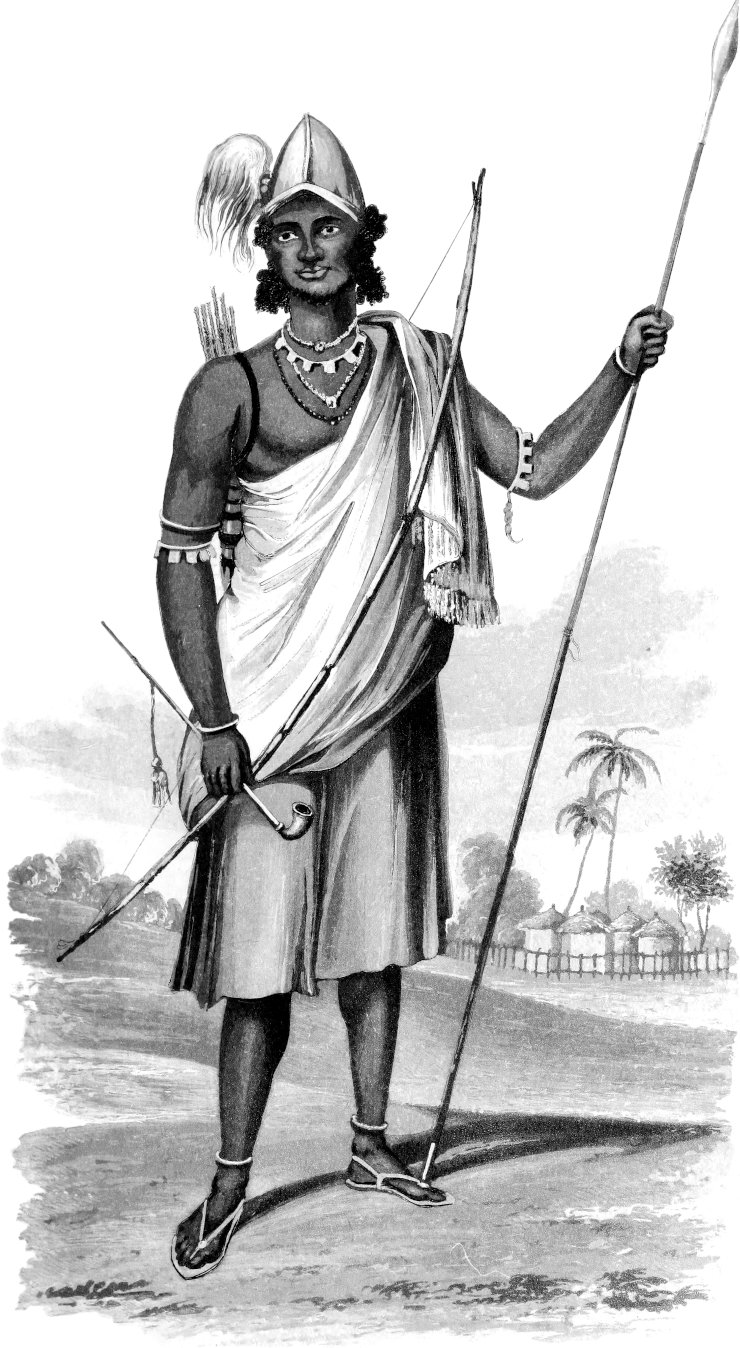
The men are of the
middle stature, well-formed, very active and intelligent, and are
dressed nearly in the same manner as those of Bondoo; the cap is of
a different form, and most frequently made of scarlet cloth; they
wear sandals, and usually carry a long cane or spear. Thus equipped
they strut about, with all the air and affected dignity of men of
the first consequence. They are characterised by a high degree of
cunning, duplicity, self-interestedness, and avarice; to gratify
which they are neither deterred by shame nor fear. This renders it
extremely difficult for strangers to guard against the crafty
devices they have recourse to in all their dealings of whatever
kind, or to elude the rapacious advantages they are always on the
alert to take of them, either by imposition or theft.
The women are good figures, have a lively and graceful air, and
prominent features, much resembling the European. They are at great
pains to preserve their teeth of a pearly white, by constantly
rubbing them with a small twig of the tamarind tree, which is an
admirable substitute for the tooth-brush. They are, like all other
African females, extremely fond of amber, coral, and glass beads,
which they bestow in profusion on their heads, necks, arms, waists,
and ancles.
The commerce of Foota Jallon may be divided into two heads; namely, first, that in
slaves, now nearly extinct, at least as far as exportation is
concerned, in consequence of the constant surveillance of the
British cruisers on the coast, and the unremitted exertions of the
government of Sierra Leone to lead the people of that country to a
more intimate connexion with the colony, and a more valuable
employment of their time, in cultivating and bringing into our
market there the other productions of their own and surrounding
countries, which may be considered as the second head under which
their commercial pursuits can be classed. The Rio Nunez and Pongas,
which were formerly infested by slave dealers and their emissaries,
are now freed from the odious burden of such a party, and those who
still retain factories there, although they would smile at the
revival of that unnatural trade, see so little prospect of its ever
again being open to them, that they begin to think of other and
less nefarious means of amassing wealth.
Major Gray takes the Command — Departure from
Sierra Leone — Arrival at Bathurst, St. Mary’s — Occurrences there
— Departure for, and Arrival at Kayaye — Description of a tribe of
wandering Foolahs — Description of Kayaye, the surrounding Country,
and Inhabitants — Their Amusements, &c. — Visit to Katoba — The
King’s Visit to us — Arrival of Camels from Senegal — Our Guide’s
proposal respecting the path — My Decision, and Reasons — Fatality
among our Animals — Arrival of Mr. Partarrieau from St. Mary’s —
Arrangements for Departure.
Such was the state of the
expedition, when, in the month of November, 1817, I volunteered my
services to conduct it. Mr. Dochard, who was second in command, had
been despatched some time before, on board a transport to the Cape
Verde Islands, to procure animals, and from thence proceed to
Bathurst, St. Mary’s, river Gambia; but although Mr. Stokoe had
packed, previous to his death, and sent forward with that officer,
a part of the baggage, much yet remained at Sierra Leone in a
confused state, the arranging and packing of which, together with
selecting from amongst the men who composed the former expedition,
such as were both willing and able to proceed on a second attempt, and
equipping them, occupied so much time that it was not before the
14th of December, 1817, that we sailed, on board the colonial brig
Discovery, from Sierra Leone for the Gambia.
We had been but a week at sea, when we fortunately found that
the casks, which contained the water for our use, and that of
eleven horses, were in so leaky a state that a few days more would
have left us without a drop. This obliged us to put into the Isles
des Loss, where, with the assistance of a Mr. Lee, then resident
there, we soon remedied the evil, and again put to sea.
A strong north-west wind, and a heavy sea, opposed our progress
for several days, and, as if all things combined to retard us in
the very first stage of our proceedings, the brig sprung a leak,
and nearly carried away her mainmast in a squall. In this state,
with constant work at the pumps, we were kept out until the 13th of
January, when we reached Cape St. Mary’s, with only one day’s half
allowance of water on board. Our horses (one of which died) were
reduced to the very last stage of want, having subsisted, for
several days, on a little rice and biscuit dust, with a very small
quantity of water.
On landing at Bathurst, St. Mary’s, I found Mr. Dochard had
arrived there from the islands, where he could not procure more than ten
horses and six mules, and he was in such very bad health, and
apparently so ill calculated to undergo a second series of the
exposures, privations, watchings, and disappointments incident to
such a service, that I almost despaired of his being able to
accompany me.
He had, a few days before my arrival, despatched Ensign Pattoun
a second time to the islands, in order to procure if possible a few
more horses.
I proceeded myself to Goree, to endeavour to obtain a few of any
description at the towns on the opposite main. I so far succeeded
as to purchase seven horses, and was fortunate enough to meet there
fifteen camels that had been purchased at Senegal, by Governor
M‘Carthy’s orders, for the use of the expedition, and had arrived
there the day only before I intended leaving it.
On my return to the Gambia, I found Ensign Pattoun had arrived,
having purchased eighteen horses; but as we had not yet a
sufficient number, I sent Ensign Burton, of the Royal African Corps
(who had volunteered to accompany the mission), up the river, to
try if any could be procured there. I was, in the mean time,
enabled to collect a few on the island, and having despatched Mr.
Nelson on the 16th of February, and made all the necessary preparations, we
left Bathurst on the 3rd of March.
On our voyage up the river, we called at Tendebar, where we were
enabled to purchase three small horses. I also landed at Kawour in
the Salum country. The ground for some distance in the vicinity of
this town, bore the marks of cultivation, but at that season was
completely destitute of verdure; the soil, which was a mixture of
brown mould and light-colored sand, appeared good; a few small
onions were the only vegetable I observed growing, and those were
regularly watered morning and evening.
The town is a considerable one, and may contain from 500 to 800
inhabitants. Their huts are composed of cane reeds and long dry
grass, and are very neat and comfortable. The natives, who are a
mixture of Jaloffs and Soosoos, are a peaceable inoffensive race,
and are chiefly engaged in trade, except when the approach of the
rains summons them to the corn and rice grounds.
We lost one of our native soldiers in consequence of a slight
cut in the hand, which caused mortification; the existence of
which, and of cold spasms and rigours, deterred Mr. Dochard from
performing amputation.
The country in the immediate vicinity of the river, is very low, and bears
the evident marks of inundation during the rains. It is much
wooded, some of which is large, and no doubt fitted for general
use.
The hippopotamus and alligator are to be found in great numbers
in the river, and are hunted by the natives, who make use of their
flesh as food, and consider it a delicacy. The river swarms with a
great variety of fish, but the natives are either unacquainted with
the proper mode of taking them, or too indolent to take advantage
of so valuable a supply, at least to the extent they might.
Soon after leaving Kawour, I went on shore on the right bank of
the river, with the intention of walking to Yani Maroo, accompanied
by Lamina, and two of my men armed. At about half a quarter of a
mile from the water-edge, we came to a range of hills, running
parallel with the river. On ascending them, I found they were flat
on the top to a considerable distance, and covered with wood and
long dry grass; they were composed of a red compact clay, light
sand of the same colour, and large masses of red sand-stone. At the
foot of one of the hills forming this range, I observed some small
huts, in the vicinity of which was feeding a herd of black cattle,
but I could not discern any people. I therefore descended to the
huts, where I found
an old man, the only person there. He, with much apparent
apprehension for his own safety, desired me to keep off, which
requisition he seemed determined to enforce, for he laid hold of
his bow, and snatched up one of a few arrows that were lying at his
side on the ground. By means of my interpreter, I endeavoured to
explain to him his fears were without cause, and that chance only,
not intention, led us to his retreat. This, however, did not
convince him; he still desired us to keep off. A little tobacco,
and a few beads, in exchange for which we requested some milk,
induced him to think more favourably of us. It was, nevertheless,
with much difficulty I convinced him of his error, and prevailed on
him to go in search of his companions, who, on our approach, had
ran into the woods, driving their cattle before them. In about
fifteen minutes, he returned, and in a few more, the whole tribe
made its appearance. The women and children, however, could not be
induced to approach nearer than three hundred yards of us. Their
numbers did not exceed four men, as many women, and ten or twelve
children; the latter totally naked. They are of a dark copper
colour, and belong to the Dhyangele tribe, the chief of which
resides in a wilderness of three days’ journey, lying in latitude
14° and 15°, between the kingdoms of Joloff and Bondoo. There they always remain
during the rains, at which time they find a sufficiency of
pasturage and water for their cattle, but are obliged to wander in
search of both after January; the banks of the rivers are their
last resource. Their appearance is extremely filthy and poor. They
subsist chiefly on milk, a little corn, which they obtain in
exchange for butter when in the vicinity of towns, and such game as
they can kill.
Their only furniture consists of a few mats to lie on, some
wooden bowls and calabashes, and a few leather bags; the latter
serve them as churns, and to carry water in when encamped at a
distance from where it is to be found.
Their dress is very plain, being nothing more than a piece of
cotton cloth, about two and a half yards long and three quarters
wide, wrapped round the waist, and descending a little below the
knees, with another of the same kind thrown over the shoulders. The
men wear a cotton cap besmeared with grease, to which is sometimes
added, by way of ornament, the end of a cow’s tail, died blue or
red. Like all other pagans, they are very superstitious, and wear a
great number of grigres, or charms, round their necks, arms and
legs. They are inordinately fond of red cloth, which they make use
of in covering those charms. Their weapons are long spears, bows and arrows, and
occasionally a long gun. They are good marksmen with all these, and
seldom throw away a shot; but this arises more from the difficulty
they find in obtaining powder, ball, and small shot, than from any
dislike to miss their mark.
W. Gray del.
WANDERING FOOLAH.
Published Feb. 1825. by John Murray,
London.
We also visited the town of Yanimaroo. It is beautifully
situated at a short distance from the river-side, on an elevated
spot, thinly sprinkled with large shady trees of the mahogany kind,
and interspersed with evergreens and other shrubs, and a great
number of that kind of palm from which is extracted the palm
wine.
The greater proportion of the inhabitants are pagans; a few,
however, profess the Mahomedan religion, retaining many of their
pagan superstitions. The latter are much respected, and enjoy a
considerable degree of influence over their unenlightened brethren.
The soil about Yanimaroo is a light yellow sand, mixed with stiff
clay of the same colour, except where there are groves of palm
trees, and then it is invariably a dark, rich, vegetable mould,
mixed with a light red or white sand.
There are, on the banks of the river, a little above Yanimaroo,
a great number of the self-consuming tree. We never saw any of them
on fire, nor yet smoking, but their appearance would lead a person
to suppose they had been burnt.
On our arrival at
Kayaye, we landed our men, animals, and baggage, and encamped on an
elevated spot between the river and the town, which are distant
from each other about half a quarter of a mile.
Mr. Bellaby, a British merchant resident there, accommodated us
with a large mud house, which served at the same time as quarters
for the officers, and a store for some of our baggage.
Kayaye is but a very small and insignificant village, and is
remarkable for nothing but its situation, and the residence of a
Mulatto lady, who possesses considerable influence in the country.
The town does not contain above fifty huts; its inhabitants are all
either relatives to, or dependants on Madame Eliza Tigh, whose name
the place takes, being called by the natives Tigh Cunda, or the
town of Tigh. The people of Kayaye, and the neighbouring towns, are
a mixture of Mandingoes and Sousous; the former from a country in
the interior so called, and the latter from the south bank of the
river. They are chiefly engaged in trade and agriculture, and are a
very shrewd active race, subject to the king of Katoba, and
professing the Mahomedan religion; but I believe the greater
proportion of them do so, not from any religious motive, but in
order to ensure to themselves that protection which the followers of Mahomet
invariably meet with, wherever they go in their trading excursions.
Caravans from the interior frequently stop there, on their way to
the settlements on the coast, and dispose of their goods to the
masters of some of the small trading vessels from St. Mary’s, or to
the native merchants, who carry on at that place, and the towns
lower down the river, a very considerable trade in gold, ivory, and
bees’ wax; in exchange for which they receive fire-arms, powder,
India-goods, coral, amber, glass beads, iron, tobacco, rum, and
cutlery.
The dress of these people is far from being inelegant or
inconvenient: the men wear on the head a white cotton cap, very
neatly worked with different coloured silks or worsteds; a close
shirt of white cotton, with short sleeves, next the skin, covers
the body from the neck to the hips, and is surmounted by a very
large one of the same materials, with long loose sleeves, not
unlike a surplice; this descends below the knees, and is
embroidered, in the same way as the cap, about the shoulders and
breast. The small-clothes, which are very roomy above, descend
about two inches below the knee, where it is only sufficiently
large not to be tight. This part of their dress is generally blue.
They wear their hair cut close, and make use of none of
the grease or rancid
butter of which the Joloff men are so lavish. Sandals or slippers
protect their feet from the heat of the sand, and from thorns; and
complete the catalogue of their wardrobe.
The dress of the women is neither so decent nor so clean. The
body, from the waist upward, is almost always naked, except when
enceinte, in which case a sort of short chemise, without
sleeves, covers the neck and stomach. They plat their hair neatly
into a profusion of small braids, but are so lavish of butter or
palm oil on them and their skins (which are generally of a very
fine black) that they cannot be approached without experiencing the
very unpleasant effects of such anointings, rendered doubly
offensive by the addition of profuse and constant perspiration.
The huts and yards of these people are extremely clean, and,
although small, are comparatively comfortable. The walls of both
are, for the most part, composed of split cane formed into a sort
of wicker work resembling hurdles. The roofs of the former are
conical, and covered with long dry grass, fastened on with a small
line made from the inner bark of the monkey-bread tree. On the
whole, their houses have a very neat appearance.
The amusements of these people are confined to dancing and
music, which take place almost every fine evening at a late hour, in the
centre of the village, where, when the moon does not afford them
light, a large fire is made for that purpose.
The young of both sexes, dressed in their gayest attire, attend
on these occasions; a ring is formed by them and the spectators,
and the former dance in regular succession by pairs. The instrument
which accompanies this dance is called a ballafo[6],
and affords better music than might be expected from such rude
materials; it is composed of cane and wood, in the following
manner. A frame, three feet long, eighteen inches wide at one end,
and nine at the other, is made of cane, split very thin, and
supported at the corners, about nine inches from the ground, by
four upright sticks of nearly an inch diameter; across this frame
are laid twenty pieces of hard wood, diminishing in size in the
same proportion progressively, from one end to the other, as the
frame to which they are slightly attached with thin twine. Under
each of these cross pieces, is suspended an empty gourd, of a size
adapted to the tone of note required, having a hole in the part
where it comes in contact with the stick, and another at the
bottom; the latter is covered with a thin piece of dried sheep’s
gut. It is played on
with two small sticks, by a man who sits cross legged on the
ground, and is accompanied by one or more small drums.
I also observed here a sort of amusement, or rather
inquisitorial exhibition, called by the natives Kongcorong. It was
thus: a man, covered from head to foot with small boughs of trees,
made his appearance in the afternoon near the town, and gave notice
to the young women and girls that he would pay them a visit after
sunset. At the appointed time he entered the village, preceded by
drums, and repaired to the assembly place, where all were collected
to meet him with the music and singing. He commenced by saying that
he came to caution the ladies to be very circumspect in their
conduct towards the whites, meaning the men of the Expedition, and
related some circumstances, with which he said he was acquainted,
little to their credit:—but, as it was his first time, he would
neither mention names, nor inflict the usual punishment, namely,
flogging. He, however, would take advantage of the first
opportunity which they would be imprudent enough to afford him.
All he said was repeated by the girls in a sort of song,
accompanied by the music and clapping of hands. Every one who had
any thing to fear from his inquisitorial authority, made him a
present; and I observed that not one of the girls withheld this proof of their
fear of his tongue, or of their own consciousness of guilt. He
remained with them until near midnight.
W. Gray del.
FIG. I.
KONGKORONG.
Published Feb. 1825. by John Murray,
London.
An instance of the manner in which the young men of that country
obtain wives, also came under our observation. One of the
inhabitants of the neighbouring villages, having placed his
affections, or rather desires, on a young girl at Kayaye, made the
usual present of a few colas to her mother, who, without giving her
daughter any intimation of the affair, consented to his obtaining
her in any way he could. Accordingly when the poor girl was
employed preparing some rice for supper, she was seized by her
intended husband, assisted by three or four of his companions, and
carried off by force. She made much resistance, by biting,
scratching, kicking, and roaring most bitterly. Many, both men and
women, some of them her own relations, who witnessed the affair,
only laughed at the farce, and consoled her by saying that she
would soon be reconciled to her situation.
Soon after our arrival at Kayaye, we paid a visit to the chief,
or, as he is there called, the king of Katoba. He resides at a town
of that name distant from Kayaye about twenty miles north. The road
or path to it lies over a flat uncultivated country thinly covered
with brush wood and
stunted trees. The soil, for the most part, is an ocre-coloured
clay intermixed here and there with small fragments of ferruginous
stone, which, in several places, makes its appearance above the
surface in the form of large rocks. Some small eminences are
entirely composed of this rock, which the natives say contains a
large proportion of iron, but, from the facility the river affords
them of procuring an abundant supply of that metal from the English
merchants, they do not now think it worth the trouble of
extracting. The blacksmiths of the country say, that it is more
malleable than English iron, and better suited to all their wants,
were the process of obtaining it not so difficult.
The king received us hospitably, and, on being made acquainted
with the purport of our visit, promised every protection and
assistance he could afford us, adding that whenever we wished to
proceed on our journey, he would furnish us with a guide to
Woolli.
On our way to this town, which is a walled one, of no very great
extent or respectable appearance, we passed only two small
villages, one of which is about a mile from Kayaye, and is solely
inhabited by Mahomedan priests (bushreens).
From the very great want we were in of a sufficient number of
animals, to transport our baggage, in consequence of the death of all
our camels and some of our horses, since our arrival at Kayaye, and
the difficulty, nay impossibility, of procuring a supply there, we
had determined on leaving behind us a large proportion of it, and
moving without delay; for which purpose it became necessary to open
the greater number of the packages, to select the most valuable
articles. This had scarcely been begun, when Mr. Partarrieau, whom
I had sent from Bathurst to Senegal to purchase camels, arrived,
bringing intelligence that he had despatched a moor, named Bon-ama,
from that place before he had left it, with ten camels and five
horses, whom I might expect to see in a few days, as he was coming
by the shortest land route from Senegal, namely, through Kayor and
Salum.
All preparations being made, we only waited the arrival of
Bon-ama, who not making his appearance on the 15th, I began to
apprehend that some accident had happened, either to himself, or
the animals. The 17th, however, brought him to Kayaye, having had
two of his horses killed by lions, and been obliged to leave two of
the camels sick at a village about fifteen miles from us. His
arrival at that moment was particularly fortunate, as it enabled us
to take forward the whole of our baggage, and a good supply of
rice, which we had just received from St. Mary’s.
On the 18th, the
king, whose presence we had requested, in order to make him a
present, arrived, accompanied by about fifty people, armed with
guns and spears. He was himself mounted on a most wretched animal
in the shape of a horse, and was attended by a troop of drums and
singing people (Jallikeas), making a most hideous attempt
at instrumental and vocal music, intended to inspire their royal
master with a high idea of his own dignity.
In a few minutes we went to see him; he was seated in a small
hut, surrounded by his followers, but the place was so crowded and
intolerably hot (not to say any thing of the impurity of the air)
from tobacco smoke, and other vapours, that we were obliged to
request he would move to one of our huts. This being done, we
mentioned to him our intention of leaving Kayaye in a few days, and
requested that he would appoint a guide to conduct us to Medina,
the capital of Woolli. He made some objections, of an irrelevant
nature, but at length consented, in consideration of a present,
amounting to about one hundred bars in baft, muslin, coral, amber,
tobacco, scarlet cloth, and a pair of pistols. He was drunk and
extremely vociferous. The interview, however, terminated amicably,
and his majesty was present at a dance which the inhabitants of the
village brought forward in honour of his arrival, and in order to
amuse him.
We had seen several of the chiefs of Western Africa, both moors
and negroes, but never saw any so wretchedly poor and unlike what
he intended to represent as this man; he is intolerably fond of
rum, and would be for ever drunk if he could obtain the means of
being so; his last demand was for two bottles of it, which I gave
him. He left us on the 19th, in a state of excessive inebriety, as
were most of his followers.
Aware of the great respectability Bon-ama, in his character of
Mahomedan priest, would enjoy in all the countries in the interior,
and of his having before offered his services to Governor M‘Carthy,
we endeavoured to prevail on him to accompany us to Sego,
Tombuctoo, or further, but it was not without much difficulty and
objection on his part, together with the promise of a very large
reward, that he could be induced to do so. He, however, at length
agreed, in consideration of a recompense of five hundred pounds
British, to accompany us to Tombuctoo or Jinnê, but no sum, however
large, or other advantage, he said, would induce him to go further.
He made it a previous article in his agreement, to be allowed to
return to Cayor, to arrange some private affairs, and promised
to join us in Bondoo.
We did every thing in our power to induce him to give up this
point, but to no effect: it was his sine qua non. We
bought a camel from him, and hired two moors, who came along with
him, to conduct and have the care of those animals as far as we
went.
Lamina, our Sego guide, told us, on the 20th, that it was now
time he should inform us, that as he was sent by the king of
Bambarra, to conduct the expedition to that country, he felt it his
duty to say, that the road leading through Woolli, Bondoo, Kasson,
and Fooledoo, was the only one in which he thought it safe to take
us, as there were, in all those countries, people belonging to his
master waiting to escort us; that he had himself received from
those in Bondoo, a horse to ride, and six asses to carry his
baggage. As there appeared nothing in this request but what was
fair, and, as we conceived (in case of any unforeseen delay, we
should be obliged to make a halt during the rains), that Bondoo,
from its high situation and its vicinity to the river Senegal,
would be most advantageous for that purpose, we acceded to his
proposal, and were moreover induced to take this step in
consequence of the very high and upright character we were taught,
by Mr. Partarrieau, who had been before in that country, to
entertain of Almamy Isata, the king: the result will prove how much our
informant was himself deceived in his opinion of that man, and how
little confidence can be placed in any information but that
obtained by the most strict self observation, in all matters
connected with this unfortunate country.
Our means of transport decreased daily; we had lost since the
2d, one camel, one mule, and four horses, and there was no
possibility of procuring any at Kayaye; the camels left on the road
by Bon-ama, had not yet come up, although we had despatched a man
to bring them. Every thing, however, being ready, we fixed the 25th
for our departure.
The Expedition leaves Kayaye — Difficulty in
procuring Water at Jaroomy — Arrival and Halt at Coonting —
Description of that Town and surrounding Country — Civility of the
Chief — Departure from Coonting — Deaths among the Animals, and
difficulty of procuring Carriers — Arrival at the Wallea Creek —
Attempt of some People to stop us — Pass the Creek — Cane Bridge —
Attempt at Murder by one of our native Civilians, and his Desertion
— Enter the Kingdom of Woolli — Arrival at Madina, the Capital —
Transactions and Difficulties there — Description of the Town, and
the Mumbo Jumbo Ceremony — Departure from Madina, and theft by the
Natives — Arrival at Kussaye.
The first division[7]
left Kayaye on the morning of the 27th, at seven o’clock, and the
second and third[8] followed immediately after. I did not myself
leave Kayaye until evening, in expectation of the arrival of the
camels. This not taking place, I moved forward, with the part of
that division which was ready, and left Mr. Partarrieau, with two
loads, to await the arrival of those left behind by Bon-ama, and to
follow me as soon as possible. We travelled along nearly east at
the rate of two miles an hour over a flat country thinly covered with baobabs,
tamarinds, rhamnus lotus, and other fruit trees, within a short
distance of the river; between us and which lay a low tract of
land, annually inundated, where rice is cultivated by the natives
when the water retires after the periodical rains.
About nine, P.M., we reached a small
village, called Jaroomy, where I found that Mr. Dochard had halted
the front divisions in order to await our coming up. During this
short march, one of the horses died, and another was left behind,
unable to move.
Here difficulties began to present themselves; the chief of the
village refused to allow water to be drawn from the wells, without
receiving payment for it, to which Mr. Dochard, very prudently,
would not submit, sending the animals to the river, which was
distant about two miles. This convinced the fellow that he was
wrong; and he came in the evening to apologize, by saying, that he
was afraid the wells would be run dry by us. He was told his excuse
was a bad one, and his conduct was such as would prevent us from
giving him any thing.
The country, for some distance round this village, has the marks
of cultivation; there were some extensive cotton and indigo
plantations; and, although no rain falls at that season, they
looked green and well. The soil, though sandy, appeared good, and well fitted to produce
all tropical grains, vegetables, &c. in perfection.
We left Jaroomy at six o’clock on the 26th, and travelled east
over a gently ascending country, beautifully wooded, until
half-past seven, when we came to a small town called Jonkaconda,
inhabited by Bushreens, and very prettily situated on a little hill
under the shade of some few large trees, somewhat resembling the
horse chestnut, except that the trunk is covered with large sharp
protuberances in the shape of thorns. It produces a quantity of
silky cotton, in pods of an oval shape, about five inches long and
four in circumference; these burst when ripe, and contain each
about half an ounce of this cotton. The natives do not make any use
of it; they prefer the common cotton, from which they manufacture
all their clothes. There the path turned a little to the south of
east, and led us over a country similar to that already mentioned,
with this difference, that the wood was rather closer.
At half after eight, we reached another small village (Lemaine),
the chief of which, a good-looking young man, was very civil, and
made us a present of some palm wine, in return for which we gave
him three bars in amber beads, &c. He paid us a visit at our
bivouac under some shady trees. He was attended by about
fifteen people,
preceded by a Jallikea, singing man, vociferating the
praises of his master, who, although very communicative and
good-humoured, did not seem to have a mean idea of himself. The
river is distant from this village a mile and a half, SSW.
After a few hours’ rest to the men and animals, and of which all
were much in need, particularly the horses, we moved forward at
two, P.M., and reached Coonting at half
after five, all much fatigued. We passed two small villages,
likewise, at the foot of some hills, and distant from each other
about two miles and a half. Their general appearance was extremely
neat and comfortable, and the ground about them appeared well
cultivated. Some large enclosures of cotton and indigo, were
extremely well-looking, and shewed much regularity. The path, for
the most part of the way, was extremely narrow and inconvenient, in
consequence of the closeness of the wood, which is low and stunted,
the soil being a mixture of dark red sand, and small iron stone
gravel, large masses of which rose above the surface in all
directions. The face of the country was, in general, covered with
low wood, except in the vicinity of the towns, where it has been
cleared, either for the purpose of cultivation or for fuel.
Coonting is a considerable town, partly surrounded with a mud wall, about six feet
high. It is in three divisions, each separated from the other by a
clear space of about two hundred yards, in which stand some fine
large evergreen trees, in whose shade the natives spend the most
part of the day, engaged in conversation, playing a game somewhat
resembling draughts, at which they are very clever, and sleeping, a
very general recreation in that country. Here also is held the
assembly of the head men and chiefs, when any matter of importance
requires their attention. Each of those divisions is governed by a
head man, who is under the control of a chief, subject to the king
of Katoba. The town is pleasantly situate in an extensive plain,
and bears the marks of cultivation to a considerable distance,
surrounded on all sides, except the SW.,
by gently rising hills, covered with wood. The town is plentifully
supplied with water of a good quality, from wells nine fathoms
deep, at the bottoms of which is a stratum of solid rock.
Here we decided on waiting the arrival of Mr. Partarrieau with
the camels, as the place afforded an abundance of forage and water
for the animals, and an opportunity of procuring a small quantity
of rice, pistacios, cassada, and small beans, for ourselves. The
chief priest of the town paid us a visit, making a present of
a fowl and two
bottles of milk, or, as they call it, giving us service, that is a
complimentary visit, which we returned in the evening. We found him
seated in a large circular mud hut, surrounded by about twenty five
boys, from the age of seven to fourteen, learning to read and write
Arabic. The Koran was the only book from which they were taught,
and their education was generally considered completed when they
could read and expound any passage in it. The most of the people
there are Mahomedans.
The old gentleman received us kindly, and conducted us to the
Alcaid, or chief, a venerable looking old man, who, on our
informing him of the object of our travelling in his country, said
that he perfectly recollected seeing Mr. Park when he last went to
the east, but was extremely sorry to hear he never returned to his
own country, a fate which he prayed to God might not be ours. We
made him a small present, and one to the priest, for which they
appeared very grateful. Two of the European and one of the native
soldiers had attacks of intermittent fever this day, but were
nevertheless able to come on.
Mr. Partarrieau joined us in the afternoon, bringing with him
only one camel; the other having died before it reached Kayaye, he
was obliged to hire
men to carry that proportion of the baggage left behind, which was
intended as a load for it.
We left Coonting at four o’clock on the morning of the 28th, and
travelled east. Two of the horses were unable to rise from the
ground this morning, and were left to their fate. At about a mile
from Coonting, we entered a thicket composed of underwood and cane,
which was so close that we were obliged to cut down the branches
and some trees, for a considerable distance, in order to admit of
the camels passing with the loads. The face of the country begins
to rise here considerably, and to be diversified by hill and
dale—the former high and covered with wood, and the latter
apparently very fertile. The soil, too, changed from light sand to
a hard yellow clay, intermixed with small quartz pebbles. For about
two miles the road led us over hilly and broken ground within a few
yards of the river side.
At mid-day we reached a small walled town, Kolicorri, but which
had such a wretched appearance that we were deterred from halting
at it; we therefore continued our march ESE. about two miles further, when we arrived at
Tandicunda, a very respectable town, defended by a strong stake
fence interwoven with thorny bushes, and wholly inhabited by
Bushreens. Two more of the horses gave up during this
march, and were left
on the path in a dying state. To transport the loads of those
animals we were obliged to hire carriers, a sufficient number of
which we had much difficulty in procuring. Our own men were obliged
to assist. The town of Pisania, which formerly stood within a short
distance of Tandicunda, was then a heap of ruins, having been some
years since abandoned by Mr. Amsley, in consequence of the
annoyance he frequently experienced from the people of Bondoo and
Woolli. Its situation was extremely beautiful, being close to the
river-side, on an elevated spot shaded with large trees, and most
conveniently placed for commercial purposes.
We left Tandicunda at five o’clock on the morning of the 29th,
and travelled to the east, over a country beautifully diversified,
to Samee, a small walled town containing about a hundred and twenty
huts. The inhabitants are Sonikeas or Pagans. Dyeing with indigo is
here carried on to some extent. About a quarter of a mile to the
south-east, by a small creek or branch of the Gambia, its water
good and plentiful, we halted, under a large tree, which afforded
the most grateful shelter to all from the excessive heat of the
sun. One of our moors had so severe an attack of remittent fever as
to be unable to keep up; one of the native civilians was left with
him.
When the intense
heat of the sun had diminished in a small degree, we again moved
forward to the ENE. over an open and
well-cultivated country. We saw, at a short distance, on the right
of our path, a Foolah encampment. Some of the women and children,
the latter entirely naked, came close to the path, and stared with
astonishment at our white skins, and not less so at the camels,
which appeared to excite much wonder. The animals were much
fatigued, and many of them in a very weak state. We arrived at
Jindey, a small village situate on an eminence, within less than a
quarter of a mile west from the Wallia Creek. Here we halted under
some large trees south of the village, for the night, having
travelled to-day about fifteen miles. We had scarcely placed the
tentmills, and retired to rest, when one of our guides came from
the village to say, that a number of Foolahs had just arrived
there, and from some part of their conversation he had overheard,
he was inclined to think they had an intention of endeavouring to
steal some of our horses during the night. Had such really been
their wish or not, I cannot say, but the morning arrived without
any attempt of the kind being made. It was more than probable our
guide only circulated such a report, in order to make his attention
to our interest appear to greater advantage, and which he, naturally enough,
supposed would entitle him to, or at least, induce us to give him,
an adequate reward.
The chief of Wallia (a province of Katoba, but over which the
king has little control) lives about five miles south of this
place. As he was a person of some consequence in the country, and
might be of use, we sent him our compliments, with a present of
eight bars in tobacco, amber, and beads, and, having made the chief
of Jindey another, we moved towards the Creek at six o’clock on the
morning of the 30th, but had not proceeded one hundred yards, when
the horses in front were stopped by some people, stating that they
were sent by the Wallia chief, to say, that unless we would pay him
his regular customs, in the same way as the vessels which ascend
the river on trading voyages, we should not be allowed to proceed.
We laughed at the idea of three or four men saying they would not
allow us to pass, and told them we had already despatched a
messenger to their master, with a present, and to which we would
make an addition of four bars for themselves. This was not
satisfactory enough, and they again insinuated that we should not
move until the chief himself should arrive. We ordered the whole to
halt, and the men to load their muskets; we asked where were those
people who wished to dispute our passage? None appearing, we moved on without further
molestation to the Creek, which we reached in about twenty minutes.
The tide was nearly full, but still running up at the rate of about
a mile per hour.
There is over this creek, which is about two hundred and sixty
feet wide, four feet deep, with clay and mud bottom, a cane bridge,
supported by two rows of forked stakes, on which are laid cross
pieces; these are covered with small pieces of Bamboo, which,
further strengthened by being interwoven with the smaller branches
of the cane, affords a safe, though shaking passage for two or
three people on foot. The banks of the creek are covered with a
kind of mangrove, some acacias, and a great number of the mimosas.
Having unloaded the animals, and led them through the water to the
opposite side, the men waded across, carrying the baggage on their
heads, which was completed without any accident in about an hour.
From the eastern bank, where we halted to cook dinner and give the
men an opportunity to wash their clothes, I had a very good view of
the bridge, the village, and the surrounding country; the latter,
though much parched from the total want of rain for many months,
and the almost continued influence of the dry east wind,
accompanied by a scorching sun, has not altogether lost its
verdure. Great
numbers of evergreen trees and shrubs, afford a pleasing and
refreshing relief to the eye, wearied from beholding a light
coloured sand reflecting the rays of a vertical sun unobstructed by
clouds. The thermometer stood at 97° in the shade, open air, and at
80° in the water, which is very muddy, though sweet and good. There
were fish in the creek, for I saw them rise. We do not know what
species, but from the skeleton of one which had been devoured by a
hawk, we concluded some of them to be catfish.
CANE BRIDGE OVER THE WALLIA CREEK.
Published by John Murray, London. April
1825.
This creek joins the Gambia about five miles from where we
crossed it, and is navigable for boats to twice that distance above
the bridge, where, on both sides of it, are situate towns with
which an advantageous trade in all the productions of the country
might be carried on.
At half after four, the object of our halt being effected, we
marched for Pakeba, distant three miles and a half, where we
arrived at six, and halted for the night. The whole distance from
the creek to this town is well cultivated; some enclosures of
cotton and indigo had a flourishing appearance. The town is a small
one, containing about one hundred and fifty huts, and defended by a
strong mud wall, seven feet high, and a stake fence outside. The
inhabitants are Sonikeas or Pagans, and are subject to
Katoba, at least
nominally so; for in Africa, the further a town is removed from the
capital, the less control the king has over it, and, in almost all
cases, those towns are exclusively governed by their own
chiefs.
Our animals were daily diminishing in number, and there had not
as yet appeared any opportunity of replacing them; four horses
died, or were abandoned as useless, since our departure from
Tandicunda, and many more would, I feared, soon follow. We had,
however, but not without much difficulty, procured a few carriers
from among the natives; and some of our own native soldiers and
civilians took forward that part of the baggage for which we had no
other means of conveyance.
One of the men from the Wallia chief came to our bivouac in the
evening, and told us that his master was extremely sorry for what
had taken place in the morning, and particularly so, as his people
had no orders to that effect; he had only sent them to request that
we might remain at Jindey until ten o’clock in the forenoon, at
which hour he intended coming to pay us his respects.
We were enabled here to purchase two bullocks, together with a
small quantity of rice and corn. The former cost fourteen bars
each; value about one pound sterling.
We left Pakeba on
the 1st of May, at six in the morning, and travelled NE. by E. until nine, when we
reached Sandoo Madina. The path good, over a sandy soil, mixed with
small iron-stone gravel, thinly covered with thorny underwood and
dry grass. Two more horses were abandoned at Pakeba, as useless,
and one left behind on the path. Our moor continued very unwell. In
addition to fever, he had a very severe pulmonic attack, and on the
whole so weak, that I almost despaired of his recovery.
At three in the morning, previous to leaving Pakeba, we were
alarmed by screams, apparently of some person in agony. We
immediately repaired to the spot, accompanied by some of the watch.
There we found the wife of Yarra Comba, one of the native civilians
from Sierra Leone, weltering in her blood, having received three
very severe wounds on the head from her husband, who, exasperated
at her refusing to desert with him (a step, he told her, he was
about to take), and fearing, we supposed, that she would give the
alarm, after thus brutally attempting to seal her lips, by taking
her life, made his escape; in accomplishing which he succeeded,
being favoured by a dark night, and an intricately wooded
country.
The wounds appeared to be all but fatal; the exterior membrane
of the brain, was visible in one of them, and the other two were very
deep. When every attention in the dressing, &c., had been paid,
and I found that there was no hope of getting hold of the savage
who inflicted them, I sent her to the chief of the town, to whom we
gave ten bars for her support, until she might be able to return to
Kayaye. As an inducement to make this man act kindly to her, we
gave him a further sum of ten bars for himself, and offered a
handsome reward for the apprehension of her husband.
About three miles before we reached this town, we observed some
stones of curious form and composed of red sand-stone, in which
were encrusted small silicious pebbles. They had much the
appearance of broken pillars; some were standing upright, and
others lying flat on the surface. From the space inside them, and
its form, which was an oblong square, we are inclined to think they
must, at some former period, have supported a roof. The largest of
them is as four feet in circumference, and seven feet high.
Sandoo Madina is a very small walled village, inhabited by
Sonikeys, and is subject to Katoba, but more immediately under the
control of the Wallia chief, who is himself nominally subject to
the former. This subjection is however not easily defined: a slave
running away from one
finds an asylum with the other, who (on both sides) does not
hesitate to acknowledge his having kept him in despite of the
other’s remonstrances.
At a short distance to the NW. is a
small unwalled Bushreen town called Coota Cunda; the water good and
plentiful, and every appearance of extensive cultivation.
We received a visit from the chief of Jambaroo, a small
independent province of Jaloff Woolli, situate about fifteen miles
north of this village. We bought from him a small strong horse for
eighty-five bars in amber and coral, the value of which did not
exceed five pounds sterling. We made him a small present.
Corporal Richmond, a native, was added to the sick list, with a
severe pulmonic attack. Some of the men who have had slight attacks
of intermittent fever appear to recover rapidly; on the whole, the
health of the party might be then considered good. Mr. Nelson was
the only one of the officers who was at all delicate; Mr.
Pilkington was recovering rapidly.
Having left Sandoo Madina at four o’clock in the morning of the
2d, we had a pleasant march to the next town, Fodia Cunda, the
first of Woolli, which we reached at half after nine, having passed
the ruins of two towns, both destroyed by the people of Bondoo in
their wars with this
country. The animals travelled very badly, being too heavily
loaded, and which could not be avoided, in consequence of the very
rapid decrease of their numbers, and the impossibility of
replenishing them; five died or were abandoned this day’s
march.
We here procured a plentiful supply of milk and butter, such as
it was, and more than a sufficiency of corn to give the horses,
camels, &c. as much as they could eat, and which they were much
in want of, not having had more than one good feed since we left
Kayaye. The country about this village, although much parched, was
beautifully picturesque, being thickly covered with wood, and
agreeably diversified by hill and dale. There were numbers of
wandering Foolahs with large herds of cattle, in the vicinity of
this village: those people supply the inhabitants of the towns who
keep no cattle themselves with milk and butter, in exchange for
which they receive cotton cloths, glass beads, and tobacco.
From Fodia Cunda I despatched Lamina, our Sego guide, to the
town of Slatee Modiba, to request him to meet us at Madina
to-morrow; this man being a relative of the king’s, with whom he
has considerable influence, advising him in all affairs of
importance, and well known to Lamina, we considered it right to
secure his interest,
by sending him a small present, and holding out the promise of a
suitable reward, should he act in compliance with our wishes.
We left Fodia Cunda at six, on the morning of the 3d, and
travelled east, at a smart pace, over a flat country, little wooded
and for the most part cultivated; the soil was of a darker colour,
and contained more mould and clay than any we had seen since
leaving Kayaye. We arrived at Madina at nine, and bivouacked under
a large tree, about five hundred yards north of the town.
W. Gray del.
MEDINA, CAPITAL OF WOOLLI.
Published Feb. 1825. by John Murray,
London.
Madina is a respectable walled town, containing about two
hundred and fifty huts, and from eight hundred to a thousand
inhabitants, all Sonikeas; it is the capital of the kingdom of
Woolli, and the residence of the king. Outside the walls is a
strong stake or palisade fence, about five feet high, which gave to
the place the appearance of a large fortified redoubt. The interior
of the town was beautifully shaded with large trees of the fig and
palm kind, and altogether had a very good outward appearance. There
are three gates to it; two in the north, and one in the east, which
are shut every night. The interior of the town does not at all
accord with its external appearance, being filled with small round
grass, and mud huts jumbled together without any regard to order or
regularity, and
between which are heaps on heaps of filth of every description. The
house of the king is separated from those of his subjects by a mud
wall about nine feet high, and stands nearly in the centre of the
town; that of his son, and some of the chief men are similarly
inclosed, but the walls of the latter are not so high. Two wells
situate within the wall at the east end of the town, of tolerably
good water, supply the inhabitants with that necessary article in
sufficient abundance. The ground, to the extent of half a mile all
round the town, was cleared, and bore the marks of cultivation. A
few large shady evergreen trees, scattered over this plain,
relieves the otherwise fatiguing prospect of such an extent of arid
surface. At a short distance to the south, lay a large Bushreen
town, called Barra Cunda, which might contain from one thousand to
one thousand five hundred inhabitants, and was surrounded by a
slight stake fence, interwoven with thorny bushes, which is the
only defence the followers of Mahomet in this country adopt. This
arises from their not engaging in war, and never meeting with any
other attack from an invading army than on their provisions, with
which they are in general abundantly supplied, being more
industrious and more abstemious than the Pagans; a large proportion
of whose corn, rice, &c., goes in the purchase of inebriating liquors. The dress of
the latter also is neither so good nor so cleanly as that of the
former, which is, almost invariably, white or blue. The Sonikeys
are careless about their dress or persons, and what with smoking,
drinking, and dirt, they are the most filthy set we ever saw.
We observed hanging on a stake, outside the walls of the town, a
dress composed of the bark of a tree torn into small shreds, and
formed so as to cover the whole body of the person wearing it, who
is a sort of bugbear, called Mumbo Jumbo, that occasionally visits
all the Mandingo towns, for the purpose of keeping the married
women in order. I have been told that the husband who has occasion
to find fault with one of his wives, for here every man has as many
as his circumstances will admit, either puts on this dress himself,
or gets one of his friends to do it, and having made known his
intended visit to the town, by shrieking and howling in the woods
near it, arrives after sunset at the assembly place, where all the
inhabitants are obliged to meet him, with music, singing, and
dancing, which continues for some hours, and terminates by his
seizing the unfortunate woman, and flogging her most unmercifully
in presence of the whole assembly, who only laugh at this horrid
performance. We have never had an opportunity of seeing this ourselves, but
have heard it from so many, and with such corroborative exactness
of description, that we have no doubt of its existence to a much
greater extent of blind savage superstition than has been described
to us.
Immediately on our arrival, we sent to apprize the king, and
requested to be informed at what hour he could receive our visit.
We were, however, told that he was then drunk, and could not be
seen on business.
Slatee Modiba arrived, bringing us a present of a fine bullock.
He also told us the same story, but said he hoped the evening would
find the king in a state to receive us.
At length, about five in the afternoon, we went, accompanied by
Mr. Burton, Lamina, and Sergeant Tuft; the latter served as
interpreter. We found his majesty (if we may so prostitute the
title), seated on a low wooden stool, outside the walls of his
house, surrounded by all the great men of the town, who, with
himself, did not appear to have entirely recovered from the effects
of their morning’s debauchery. Having made him a small present,
which it is the custom of this country to do, previous to
addressing the king on our business, we told him in as few words as
possible, the object we had in view in travelling through the
country, and the advantages its inhabitants would derive from the
existence of a friendly and direct intercourse with the English,
who, should no serious difficulties present themselves, would soon
make trading voyages into the interior, and furnish them with all
European merchandize at a much cheaper rate than they could at
present procure them. The only answer we received, was made by his
friend Modiba (for he did not say a word himself), and, although
expressed in many words, and in very ambiguous terms, might be
construed into this, that he always thought the English were the
friends of Africa, and would do every thing in his power to
facilitate the attainment of their wishes.
As nothing but the common routine of a formal visit of ceremony
could, consistent with their customs, take place at the first
interview, even had the king been compos mentis, we were
obliged to take our leave without anything more having been said as
to the terms on which we might expect his protection. Modiba,
however, told us he would take care that no rum should be drank by
Mansa[9] in the morning, previous to our seeing him, and
requested we would shew him the present we intended to give; which
we promised to do, when it could be prepared.
During the night,
one of the natives made an attempt to steal something from one of
the tents, and would have succeeded, had not Sergeant Major Lee,
observing the bale stirring, fired in the direction, but I believe
without effect. This served, at least, to deter others from a
similar attempt.
Having selected the present, consisting of amber, coral, bafts
blue and white, silver, guns, &c., in all amounting to upwards
of five hundred bars, thirty pounds sterling, and submitted them to
the inspection of Modiba, who appeared to be pleased with them, we
waited on the king on the morning of the 4th, and were shewn into
the inner inclosure of the palace, which was, if any thing, more
filthy than the rest of the town. Here we found him seated on a
lion’s skin, to which were attached a number of grigris, under the
shade of a miserable hovel in the shape of a balcony, outside the
door of his bed-room, surrounded by four or five of his head men or
ministers; and, notwithstanding Modiba’s promise to the contrary,
the rum bottle had been in use, to what extent we cannot say, but
he, on this occasion, favoured us with his conversation, asking
several questions about our country, the Expedition, its object,
&c.; all which we answered as briefly and explicitly as
possible. When the present was laid before him, he
condescended to smile
at the amber, but on looking at the dollars and coral for some
time, with an air of the greatest indifference, he said something
to his own people, and told us that he would not accept of so
trifling an offer from such great men, particularly as he had been
told we had given more to the king of Katoba, whom he looked on as
a very petty chief indeed. Modiba said much to induce him to take
it, but to no effect. We therefore returned to the camp leaving
him, great as was his avarice, paying more attention to the rum
bottle than what had been going forward.
While we were talking to Modiba on the best means of satisfying
Mansa, and at the same time those about him, the former made his
appearance, coming from the town, attended by about fifty people
singing and beating drums. He seated himself under a tree, at a
short distance from our camp, and sent Modiba, who had gone to meet
him, to let us know he came to pay his respects. When we went to
him, he beckoned me to sit beside him, which I did in apparent good
humour; after the usual salutations, he begged a piece of muslin to
make a dress. This was complied with, when he said, he had brought
a bullock for supper, but added that we did not shew ourselves
inclined to think well of him, in giving him so poor a
present. This, with a
great deal more noisy irrelevant matter from himself and
attendants, took up nearly half an hour, much to our annoyance. He
ended, however, by telling us that he had left the settling of the
affair to Modiba, and returned to the town.
In order that more time should not be lost here, we made an
addition to the former present of forty-five bars, coral and
dollars, and gave it to Modiba to present, as all we would or could
give him. He was then drunk, and not to be seen.
In a short hour after this, Mansafarra, the king’s eldest son,
came galloping from the town into our camp, attended by five or six
people, armed with guns and spears, and, apparently in a great
rage, said that he was offended at our not paying him our respects
in person, and, although we might think little of him, he was,
nevertheless, of as much consequence in the country as his father.
We endeavoured to pacify him by appearing in good humour, and was
going to give him our hands, when he rode off, in as great a hurry
as he came, having first made one of his men throw down a pile of
our arms, which was standing near them. He was not contented with
this indifference on our part, and shortly returned on foot,
attended as before. The first person he met was Private Robinson,
lying on the ground.
To him he gave two or three kicks, and would have fired his musket
at him, had he not been prevented by some of his own people. On
this occasion, we, with much difficulty, kept our temper, but as
the fellow was beastly drunk, and we were aware of the serious
consequences that might arise from any violence offered to one of
the royal family, we overlooked the insult, and merely directed the
men to stand to their arms, and take no notice of him. He did not
like the appearance things bore at that moment, and went off as
before.
The people of the town, seeing us pay such little attention to
the insult offered by their prince, no doubt thought they might
follow his example with impunity, and therefore endeavoured to run
away with every thing they could lay their hands on. This was too
much. We could bear it no longer, and ordered the men to load and
fall in, and, as it was nearly sunset, we had the whole of the
baggage removed to some distance from the tree we had been sitting
under, and placed triple sentinels. While the men were employed at
this, the natives stole two horses, one ass, a bullock, and a goat.
The horses, ass, and goat were recovered, but the bullock we never
heard of.
A strict watch during the night prevented the possibility of any
attempt at theft, and on the morning of the 5th, Modiba came at an
early hour, to say that the king was not satisfied at the addition
made to the present, and, unless we gave him more, he would send
his people to help themselves. Entreaties were to be borne with,
but threats, and of this nature too, required decisive steps. We
consequently directed Modeba to let the king know he might come as
soon as he pleased, when we should be ready to give him the
reception his appearance might merit. The bugles then sounded to
arms; the animals were collected; and the men formed a hollow
square round them and the baggage.
Modiba, who was more than astonished at our answer and
preparations, went off without saying a word; but returned in a few
minutes, to request we would give him ten dollars for himself, in
part payment of two horses we had purchased from him the day
before, and for which he had agreed to take an order on the
Commissariat Officer at St. Mary’s, River Gambia. This we complied
with, and are satisfied he gave them to Mansa. We however did not
let him know, that we thought so. At length we were informed that
guides would be provided for us, and we might proceed in the
morning. In the evening, Mansa sent us a bullock, in place of the
one which was stolen.
The guides joined us in the morning of the 6th, and all things being ready, we
commenced moving from Madina, that nest of thieves; but the front
division had scarcely left the ground, when an immense mob
collected, in order to plunder if possible. Messrs. Dochard and
Partarrieau remained with the camel division, which was to bring up
the rear, and had much difficulty in keeping the natives from
actually forcing some things out of our men’s hands. A small
medicine-chest was purloined by one of them, who had run some
distance with it before it was missed. Private Ferrier overtook and
knocked the fellow down, and would have shot some others who came
to his assistance, had not Mr. Dochard prevented him by laying hold
of his firelock. Such a barefaced and determined set of thieves we
never met.
We travelled SE. and by E. thirteen miles, to the village of Bambako. The path
this day was over a hard yellow clay soil, mixed with small quartz
pebbles, and much broken into deep ruts by the rains; the whole
distance, to within a quarter of a mile, covered with loose
brushwood and a few large trees of the acacia species.
Corporal Pickard, a European, was so ill as to be unable to
walk, and private Richmond, a native soldier, was nearly as bad;
they were carried forward on two of the officers’ horses. Bambako
is a very miserable village indeed, not containing more than twenty huts of the
poorest description: the situation of it, however, in some measure
made up for its wretched appearance; it was on the summit of an
elevated plain, beautifully covered with some of those large trees
which bear the cotton, already mentioned, and a great number of
baobabs, tamarinds, and palm trees; and it is plentifully supplied
with good water, from wells twelve fathoms deep. We were able to
purchase there one horse, two asses, three goats, and some corn for
the animals. The horses and asses were a very welcome and necessary
supply at that moment, as we had lost by death, during the day’s
march, three horses.
We passed the night there, and moved forward to the SSE. at seven on the morning of the 7th. The soil and
appearance of the country the same as that of the preceding day’s
march. The path was not so much broken, and the animals travelled
better. We reached Canopê at eleven, A.M.,
where we halted in order to refresh the men and animals, and to
purchase, if possible, a few asses, which we were told by our
guides were here in great numbers. Large prices, in amber, coral,
and blue baft, induced the natives to sell us seven very good ones.
We had much difficulty in procuring water here, not in consequence
of any want of it at the place, but because the people would not allow us to
approach the wells, alleging that it was their property, and we
must pay for it as well as for the other commodities of life.
Remonstrance, and an inclination to force on our part, together
with the interference of our guides, at length obtained it; not,
however, before it was much wanted.
We left that inhospitable village at three, P.M., the same day, and travelled in the same
direction over a very finely diversified country, for two hours,
when we arrived at a small village called Kussaye, or Metofodia
Cunda, having passed, about two miles before it, the ruins of a
very large walled town, called Maja Cunda. This was formerly the
residence of Modiba, the man who assisted us at Woolli, but was
destroyed and abandoned by him, in consequence of the surrounding
soil not producing good crops; it is very light and sandy, and
mixed with lumps of a stiff white clay, having much the appearance
of pipe-clay.
The occurrences at Madina, the hurry at leaving it, and the very
great want of means of conveyance which we experienced, together
with the confused state of the baggage in consequence of such want,
and the indisposition of some of the men, induced us to determine
on halting here for a day, in order to set all things right: we therefore took up our
bivouac under the shade of some large trees outside the town, the
chief of which was extremely kind and attentive to all our wants,
inasmuch as his circumstances would admit.
Departure from Kussaye — Pass through the Simbani
Woods — Loss of Camels — Ruins of Muntobe — Leave Muntobe — Arrive
at Sansanding — Halt there — Our Woolli guides leave us — Discharge
of Corporal Harrop — Arrival at Sabee, the first Town of Bondoo —
Loss of Animals — Opposition on the part of our Guides to our
moving thence — Arrival at Loonchea — Death of the Camels — Supply
of provisions from Almamy — Mr. Dochard sent in advance with a
present to Almamy — Departure from Loonchea — Arrival at
Dachadoonga — Difficulty and delay in carrying forward the Baggage
— Description of the Red Water, and its use — Arrival at Goodeerri
— Mr. Dochard returns from the Capital — Arrival of Almamy’s eldest
Son — Transactions with Almamy and difficulty in arranging matters
with him — Departure from Goodeerri, and arrival at Boolibany, the
Capital of Bondoo.
Having put the baggage in
order, and fed the animals well on pistacio tops and corn, since
our arrival here, we moved forward at six o’clock on the morning of
the 9th, at a slow rate to the ENE., over
a much wooded country, until noon, when we halted at the ruins of a
town called Bantanto, in the Simbani woods, where the well, though
very deep, thirteen fathoms, was still in repair, and supplied
us with great plenty
of water, but of a bad taste and smell, occasioned by its not being
much used. Mr. Nelson, Corporal Pickard, and Privates Nicholson and
Richmond had attacks of fever since the evening of the 7th; with
these exceptions, the party continued to enjoy good health. We
could not say as much for our animals: three horses died since our
arrival at Metafodia Cunda, and more than one half of the remaining
ones were unable to carry their loads, for the transport of which
it was found impossible to procure a sufficient number of carriers
from among the natives: some of our own African soldiers, however,
very cheerfully supplied their places, and we managed, in one way
or other, to take all forward, but not without considerable trouble
and fatigue. The many men we were obliged to employ as carriers,
left the animals without a sufficient number to guide them and keep
their loads from falling off, an occurrence which took place at
every twenty yards with some one or other of them. The asses we had
procured on the path were very good, but whether we did not
understand the proper way of loading them, or that our bales, from
being nearly round, were ill calculated to sit steady on their
round backs, we could not determine; it appeared,
however, something
was wrong, the consequence of which was much trouble and delay.
We moved from Bantanto at six o’clock on the morning of the
10th, but one of our camels having been either stolen, or strayed
from the place where they had been feeding, I remained behind with
that division until four, P.M., up to
which time a fruitless search had been made for it in all
directions. I then went forward alone, leaving Mr. Partarrieau to
wait until the following morning, in hopes of recovering it, as it
was a loss we could but badly afford at that moment.
I joined the front at the ruins of Montobe, at nine o’clock. The
situation of this town, which must have been a very large one, is
beautiful: it was in two parts, that where we halted being the
smallest, and built on a hill shaded with fine large trees, the
other is in the centre of an extensive plain, bearing the marks of
cultivation, surrounded on all sides, at the distance of nearly a
quarter of a mile, by woods; both are plentifully supplied with
water, from wells only three or four feet deep, but which, in
consequence of being neglected, had fallen in so much that we were
obliged to clear them out before a sufficient quantity of water
could be obtained. The soil appeared to be better than any I had before seen; it was
composed of dark-brown mould, intermixed with white sand and
sand-stone. The walls and many of the houses were both strongly and
well built with yellow clay, raised from about four feet below the
surface, and intermixed with cut straw or withered grass and
cow-dung.
It was destroyed about twelve months before by the people of
Bondoo, in one of their plundering excursions, and many of its
inhabitants were either killed or made prisoners (slaves), a fate
but too common in this country, where the strongest party always
finds an excuse for making war on the weaker, not unfrequently
carrying off whole towns of miserable inoffensive beings, without
either any previous intimation of their hostile intentions, or
indeed any cause given by those wretched objects of their
avaricious encroachments. On all such occasions, the only object in
view is the attainment of money, as they call it, and in this they
succeed by selling their unfortunate fellow-creatures, and, what is
still more unnatural, their compatriots, to slave-dealers.
A multitude of ideas, bringing with them the conviction of how
much Englishmen, and indeed all civilized nations, are favoured by
Divine Providence, in enjoying freedom and security against such
unwarranted and barbarous practices, rushed on my mind, as we surveyed
the silent and awful remains of some human bodies which lay outside
the walls of this once respectable and no doubt happy town, the
inhabitants of which were torn by unrelenting savages from that
native spot, so dear to all mankind. Even the strongest ties of
nature riven asunder, and all this to gratify the brutal desires of
some neighbouring tyrant, or to enrich a set of savages, who are
daily exposed to a similar fate themselves, at least as long as
they can find people ready to purchase their unnatural booty.
Mr. Partarrieau not having come up, we left Muntobe at six
o’clock on the morning of the 11th, and travelled slowly to the
east until noon, when we reached Sansanding, a small town, the last
of the kingdom of Woolli, beautifully situated on an eminence
surrounded by high grounds, through the valleys of which winds a
branch of the Gambia, now nearly dry; its banks are covered with
cane, acacias, and mimosas, which afforded us an agreeable shelter
from the intense heat of the sun. Here we decided on halting one
day, in order to rest the animals, particularly the camels, which
were become very weak for the last two days, owing to an
insufficiency, indeed a scarcity, of that species of food on which
they are used to feed. One gave up on the path, and died in a few hours,
which the moors said resulted from having eaten some poisonous weed
in which that country abounds. The men also wanted the opportunity
of washing their linen, which this place afforded. We eagerly took
advantage of it as a great distance of uninhabited country (which
from a want of water it was necessary to get over as quick as
possible) lay between us and the frontier town of Bondoo. Private
Pickard, too, was so ill as to be unable to ride, and was left on
the path, under the shade of a tree, until the afternoon, when we
sent eight men with a hammock to bring him up. He had, however,
before they reached him, recovered sufficiently to come forward on
Mr. Partarrieau’s horse. The camel lost at Bantanto was stolen by
one of the king of Woolli’s people, and was traced as far back as
Kussaye by our men who went in search of it: the thief, however,
effected his escape with his prize, leaving Mr. Partarrieau with
only one camel to bring up the two loads. The asses, although
heavily loaded, travelled well, and were, if properly managed,
better adapted to this service than either horses or camels.
Our guide refused to accompany us beyond this town, giving, as a
reason, his fear of being detained in Bondoo, should he enter that
country. I was sorry for it, as the fellow really was very accommodating and
attentive; but no entreaties could induce him to go on. I believe
he was afraid that if we got him into one of the towns in Bondoo,
he would be detained until our camel should be returned. In this he
was deceived; for although such a step had been talked of by the
officers as likely to have a good effect, we never had the least
intention of doing so. I therefore dismissed him with a present of
twenty-two bars.
We here discharged Corporal Harrop, a native of Woolli, who had
been sold as a slave, when very young, and liberated by some of the
British cruizers on the coast. He met his mother at Medina, and
expressed a wish to remain there, a refusal to comply with which we
were aware would be useless, as he had it in his power to desert,
and thereby deprive us of the opportunity, which was thus offered,
of acting in a manner likely to convince the people of that part of
the interior, that our intentions towards them were liberal and
humane. The man himself seemed very thankful, and said he would
never forget the English, to whose settlements on the Gambia he
would return, in order to lay out the money we had then given him
as pay and allowance up to that date. He took a cordial farewel of
all his companions, and returned to Medina with the guide, to glad
the heart of an
aged mother, who no doubt looked on her son as one risen from the
dead.
We tasted some drink made from honey and millet, somewhat like
mead; but from its acidity, acquired by fermentation, and the non
use of bitters in its composition, it had a very unpleasant effect
on the stomach.
Having purchased here six asses, we started at six o’clock in
the forenoon of the 13th, and entered the wilderness, through which
we travelled at a smart pace to the east until near mid-day, when
we came to a watering place in an open space in the woods, which
bore evident marks of inundation during the rains, and was said to
be the resort of large herds of elephants, which come thither in
search of water. This was evidently the case, as their foot-tracks
were visible in all directions; indeed, one of our men, who had
gone some distance from the path, said he had seen two of them.
A town belonging to Woolli formerly stood here; but little or no
proof of its having ever existed now remained. We however took
advantage of the only one, namely, the shade of the large trees
which are in or near all the towns we have seen in Africa. It is
called Sabee Looroo.
As the distance from this last place to the frontier of Bondoo
was destitute of water, and too great to attempt marching it in the
heat of the day, without a plentiful supply of that necessary
article, we moved forward at six in the evening, having filled all
our soofroos[10], and marched very expeditiously in an east and
by north direction, through wood, until half after ten, when we
were obliged to halt, in consequence of its being very dark, and
many of the animals being much fatigued and considerably in the
rear. Four horses were left in a dying state, and Mr. Pilkington
and four men remained with their loads, until asses could be sent
to bring them up: they did not arrive at our bivouac until
day-light the following morning. We lost six horses during that
march, and were likely to lose more every day: our provisions, too,
were becoming scarce; but the prospect of being able to replenish
all our wants in Bondoo, did not allow things to appear as bad as
they really were.
We reached Sabee at seven on the morning of the 14th, and took
up our position on an elevated spot to the NE. and distant about half a quarter of a mile from
the town, which is a very large one, walled, and situated in an
extensive plain, gently rising to the ESE., in which direction it is bounded by mountains:
through it runs a
small watercourse, now nearly dry, and which the natives call the
Neerico.
The inhabitants of this town are all Mahomedans, who are
Surrawoollies, and came originally from Kajaga or Galam: they
appeared a mild inoffensive race, and were not only better clothed,
but cleaner in their persons than the people of Woolli. Their
provisions, also, were in greater plenty. We purchased from them
three asses, three small bullocks, and a goat, together with some
fowls, milk, butter, and eggs. Latitude of Sabee, by meridian
altitude, sun’s lower limb, 14° 10′ 58″. Thermometer in shade
100°.
They cultivate, on the banks of the Neerico, in moist places, a
sort of tobacco, which is of a small growth and a pale green
colour, bearing a yellow blossom: it is manufactured into snuff, in
which state alone that sort is used. They also cultivate a larger
kind, more resembling the American tobacco in size and colour: this
bears a white blossom, and when dried is used in smoking. These,
with millet, maize, two other varieties of corn, rice, cotton,
indigo, and a few small onions and pompions, are the productions I
noticed here, and for which the ground appeared well adapted.
When we were about moving on the morning of the 15th, Masiri
Cabba, a man who had come from Bondoo to Lamina, and joined us at
Kayaye, came to say
that a messenger had just arrived from Almamy, to direct that we
should not advance further into his country, until we had sent a
person to him. As we conceived this to be all a plan between Masiri
Cabba and Lamina, for we saw them talking together a few minutes
before, we paid no attention to it, and moved on, at half after
six, to the south of east, over a fine open country, much
cultivated, and more diversified by hill and dale than we had
before met with: we reached a large straggling village, Jumjoury,
situate on a rising ground, without any defence whatever. There
appeared to be large quantities of cotton grown here, and the
plantations looked in fine order. The chief here made us a present
of a goat and some cous cous, in return for which he received
double their value: indeed, taking those presents is a bad plan,
but it would be wrong to insult those people, and they would
certainly regard a refusal of any thing offered by them, only in
such a point of view. We purchased here two fine sheep, five goats,
and some corn.
Having left Jumjoury at six, on the morning of the 16th, and
travelled east over a fine, open, and, for the most part, well
cultivated country, to Deedey, a small village, which we passed,
and arrived at Loonchea, lying ESE. from
the former. The camels travelled badly this day; one died shortly after our
arrival, and the remainder looked very sickly. We halted under some
large trees on the side of a considerable gully or ravine, having a
mud bottom, at that time dried up, but which, during the rains, was
the bed and course of a torrent running to the SSW.
The supply of rice we brought from Kayaye was here exhausted,
with the exception of a few pints, and we had not as yet been able
to procure a sufficiency of either cous cous or meal to make a full
allowance, for two days. The only provisions we could find here was
a little milk and some fowls.
One of the camels, having every appearance of approaching death,
was killed, and the meat made use of by our men. We tasted it, and
found it as good as any beef we could procure. This gave a
sufficiency for the day.
The chief of the town called on us in the afternoon, and told us
that he had received directions from Almamy to provide us with some
corn, which he was ready to deliver; but, as it was not in a state
to be made use of, we requested him to have it converted into cous
cous and meal, which he undertook to have done. The necessity we
were under of waiting for this supply, and the loss of three of our
camels by death, since our arrival here, obliged us to make a
halt. I had also
determined on sending Mr. Dochard from this place to the capital,
in order to see Almamy, and arrange with him for our passage
through his country, and his protection and assistance while in
it.
I accordingly despatched him on the morning of the 18th,
accompanied by Masiri Cabba Dharra (one of the king of Sego’s men),
and four of our own people. He took with him some large amber as a
present for the king.
Having received from the master of the town a quantity of cous
cous and meal, sufficient for six days, and divided the loads of
the three camels that died here among the remaining ones and the
other animals, we moved forward at five in the afternoon to the
ENE. over a flat country much intersected
by the dry beds of torrents, the banks of which are covered with
acacias and mimosas: one of them was very deep, and so difficult to
pass, that most of the asses fell and threw their loads, which
delayed us some time. One of the camels died on the path; this also
delayed us considerably, and we did not reach Gongally until near
midnight, all very much fatigued. In the course of the forenoon of
the 19th, I purchased two asses, being all that I could induce the
inhabitants of this town to part with, although they had many more,
and the prices I offered were large. I was therefore obliged to hire some more
carriers; a most troublesome mode of transport, for it required a
good look-out to prevent those fellows from running away with their
loads. We left Gongally at four in the afternoon, and arrived at
Dachadoonga, after a very fatiguing march of three hours and a
half, over a much broken country covered with wood. The chief of
this town, which is a small one, is married to one of Almamy’s
daughters.
The few remaining horses, and the camels, were become so weak as
to be unable to carry, and we had not yet been able to purchase a
sufficient number of asses for the whole of the baggage; I
therefore sent Mr. Burton forward to Goodeerie, on the 20th, with
as much of it as all the asses would carry, and directed him to
send them back next morning to bring forward the remainder, but
from some mistake of their guides, or from having straggled too
much, they took different paths, which led them all (with the
exception of two or three) much out of their way, and it was not
until eight o’clock in the afternoon of the 21st, after despatching
Lamina to conduct them into the right path, that the asses
returned. Having purchased three very good asses here, we left it
at seven o’clock on the morning of the 22d, and arrived at Ganado,
another small village, at eleven. Messrs. Nelson and Pilkington had gone on to
Goodeerie, when, not finding any of the party, they returned to
Ganado, where we passed the night, and lost four horses and (six)
all our sheep, in consequence of their having eaten the leaves of a
tree (called Talee, by the natives) which is common throughout this
country. It is a strong poison, and has a very sweet taste. The
pagan natives of some parts of Africa, make use of an infusion of
the bark of this tree to ascertain whether a person among them,
suspected of witchcraft, be guilty or not. The accused is obliged
to drink a quantity of this liquor, and which, according to its
strength, sooner or later produces nausea, vomiting, and pain in
the stomach and abdomen, and not unfrequently terminates in the
death of the person; in which case he is considered to have been
guilty: but should the person recover, either in consequence of the
weakness of the dose (sometimes arising from a large bribe
administered to the person who made it), or a great strength of
constitution and timely antidotes, he is declared innocent. This
horrid method is seldom practised by the Mahomedan natives of
Africa.
On the morning of the 23d, I again sent forward Mr. Burton
(being the only officer now with me, able to do duty) to Goodeerie,
with all the asses, loaded, and directions to send them back to me in the evening. He
left us at four o’clock, and the asses returned at nine the same
afternoon. The country about this town is really beautifully
diversified with hill and dale, both covered with wood, some of
which is very large. At a short distance to the SE. is the dry bed of a stream which, during the
rains, runs to the SW. and joins the
Gambia. The inhabitants here had commenced preparing their corn and
rice grounds, in consequence of the very great appearance of
approaching rain for the last two or three days, during which we
had some thunder and lightning, accompanied with a perfect calm and
intense heat of the sun and atmosphere.
Little trouble is indeed necessary in this country for the
purpose of cultivation; the ground is merely cleared of the old
corn stalks, and such weeds and young wood as have sprung up during
the dry weather; all which are burnt, and the ashes strewed on the
surface. Small holes are then made in the ground, distant from each
other about a foot or eighteen inches, and two or three grains of
corn dropped into each, which is filled by pushing a portion of the
earth and the ashes before mentioned into it. In this state it
remains, until it arrives at about two feet above the surface, when
the ground between is hoed up and cleared of weeds, a
process which takes
place as often as the growth of the weeds renders it necessary, and
which, in this country, where vegetation is so rapidly going on
during the rains, grow apace.
We left Ganado at seven o’clock on the morning of the 24th,
passed two small villages, situated in an open and well cultivated
country, and reached Goodeerie at noon, having met an immense host
of black monkeys, who, on our approach, set up a hideous barking
noise, and scampered into the woods. Some of them were as large as
a mastiff dog.
Goodeerie is a small straggling village, inhabited by
Surrawoollies and Foulahs. Masiri Cabba, who is chief of it,
accommodated us with a sufficient number of huts to shelter both
the men and baggage from rain, which was fast approaching. As I
feared it was likely we should have to remain a few days here, in
order to the arrangement of matters with Almamy, I cheerfully
accepted his offer, and now, for the first time since our leaving
Kayaye, we entered and took up quarters inside a town.
I was here informed that Almamy was not at the capital when Mr.
Dochard went there, and that it was probable he might have to wait
there some time before he could see him, as he was absent on some
business connected with the war between him and the people of
Galam.
Mr. Dochard,
however, arrived on the 21st, without having seen Almamy. He was
accompanied by Almady Gay (one of Almamy’s nephews), who was sent
to procure for us a supply of bullocks and corn. Almamy sent Mr.
Dochard word that he was extremely glad to hear of our arrival in
his country, and would give us every assistance and protection in
his power as far as Foolidoo, to which country we should be
accompanied by one of his chiefs, who would be a sufficient
safeguard to us. He further requested that we would remain where we
were until he could come to see us, which should be in a very few
days. The prospect of being thus delayed even for a few days, as I
then thought, was irksome in the extreme, as the rains were fast
approaching, and, in the space of another month, travelling would
become, if not wholly impossible, at least very difficult and
dangerous. But so it was, that attempting to move through this
country without having first arranged matters with Almamy, would
have been madness. We were therefore obliged to submit with
patience.
Since our arrival here, we were beset by a multitude of beggars
of all descriptions. Princes and their wives without number, came
to make to us trifling presents, with the hope of receiving in
return double their value, and their attendants were not less troublesome.
Goulahs, or singing people, who in Africa always flock around those
who have any thing to give, no doubt thought this a good
opportunity to turn to good account their abilities in music, and
we were continually annoyed by their horrid noise. Dozens of them
would, at the same moment, set up a sort of roaring extempore song
in our praise, accompanied by drums and a sort of guitar, and we
found it impossible to get rid of them by any other means than
giving something. They were not, however, to be put off with a
trifle. People who lived by that sort of gain, and not unfrequently
received from their own chiefs presents to the amount of several
slaves, were not to be put off with trifles, particularly by
persons with (apparently to them) so much riches as we had. The
consequence was, we were in a continual state of uproar with those
wretches. Never did I find my patience so much tired as on those
occasions.
On the 31st a man arrived from Boolibany, to say that Almamy
would be at Goodeerie on the following day, but it was not until
the 5th of June that we heard any thing more of him. During this
time we were plagued out of our lives by a host of his nephews,
nieces, cousins, &c. all begging.
On the 5th, Saada, Almamy’s eldest son, accompanied by two of his majesty’s
ministers and three other grandees of the country, came to announce
his father’s arrival at a small town of the same name as this,
distant about five miles east. They made some objections to call on
me first, and I would have waved all ceremony in favour of the
expediting in the least our business; but Lamina said it was their
place to call on me: they were the bearers of a message from
Almamy, and to deliver it they must come to me, and not I to them.
This they did, and entered on the business with all the
indifference and hauteur imaginable. Saada himself would not
uncover his mouth or nose, which he had closely wrapped up in a
part of his turban which hung down, for fear he might inhale the
air breathed by an infidel. Many words, expressed in a strangely
slow and authoritative manner, went to say that Almamy had arrived,
and would see me whenever I wished to call upon him, or would come
himself to see me if I preferred it. The former I adopted, as I was
aware that his presence here would draw around us a set of beggars,
whose importunities would be insupportable, and therefore decided
on going, without delay, to see him. Messrs. Dochard and
Partarrieau accompanied me. Lamina, Masiri Cabba, and one of my own
men to act as interpreter, composed the whole of our
attendants.
On our arrival
at the village, we had to wait nearly half an hour before we could
obtain an interview. After the usual compliments of salutation,
&c., I explained to him, by means of my interpreter, in as few
words as possible, the object we had in view in travelling through
his country, and requested that we might be detained as short a
time as possible. He said that we might depend on his doing all in
his power to forward our views, and that the time of our stay
chiefly depended on ourselves. By this he meant to say, that if we
paid him handsomely, he would allow us to pass. He said much about
the trifling nature of the present I sent him by Mr. Dochard,
insinuating that it was scarcely fit for one of his Goulas.
We took the hint and requested that people might be sent to
receive the present I intended for him. These were soon nominated,
and with them and Saada, who was sent to remain with us (as Almamy
said, to see we were well treated, but, we believe, as a spy on our
actions), we returned to our quarters.
Having laid out a considerable present, amounting to more than
ten times that given to the king of Woolli, we showed it to the
persons sent for that purpose, on the morning of the 6th, and made
Saada a very handsome present indeed, for which he appeared very
thankful, but said
that we should first settle with his father. We were asked if what
we had laid before them was intended merely as service (as
they call it), meaning thereby a present or douceur, or as all we
intended to give him; and we answered that we intended it as the
full amount of present. To which they replied, they were only
directed to receive service, that was then shewn, and objected to,
as too small. After much conversation on both sides, without being
able to arrange with those fellows, we determined on again going to
Almamy, to endeavour to settle with him personally. In this,
however, we were deceived; he was, if possible, more difficult to
please than his ministers, and told us, that as we did not choose
to act in compliance with their wishes, he should not wait where he
was any longer, but return to his house, where we might come to see
him when we thought proper to act consistently with, what he
considered, our duty, namely, the increasing of the present; that
as all the surrounding kings were averse to our going to the east,
and even his own chiefs did not like it, he was taking a great
responsibility on himself in allowing us to do so. This, and much
more of the same nature, too tedious to mention, closed the
interview. We therefore, to avoid more delay, determined on giving those insatiable
rascals as much as we could afford, and thereby, if possible, get
rid of them. The rains had already commenced, and no time was to be
lost, which could, in any way, consistently with the future safety
of the expedition, be avoided.
Having selected an enormous present, we despatched Mr.
Partarrieau to lay it before his majesty, and it was not until the
9th that he returned, having, in some measure, satisfied the
avaricious appetite of the great man, who, however, still said much
about receiving six bottles of gunpowder and a musket for each ass
load; and insinuated that he had been informed we had loads
composed entirely of gold and silver. Fresh demands were
continually made, and we were not able, before the 13th, finally to
settle with him. This was done by our giving him an order on the
Gambia for one hundred and twenty bottles of gunpowder, twenty
common guns and a blunderbuss.
He came to see us in a friendly way, as he said, on the 14th,
accompanied by a host of ministers, chiefs, &c., who all
expected no doubt to receive something. On this occasion he
appeared to be perfectly satisfied with what had been given him and
his followers, and promised we should have a guide wherever we
wished to move, and
in whatever direction we pleased. This, however, we could not
obtain until the 17th, and then he would not listen to our pursuing
any route but that through Kasson, the chief of which country was
his friend, which we knew to be the case, but we feared he was only
too much so, and ready to put in execution any plan Almamy might
devise to annoy and delay us, and ultimately frustrate the object
we had in view.
Notwithstanding Almamy’s having sent his nephew to procure
supplies for us, since our arrival at Goodeerie we had been very
scantily supplied with provisions, although large prices were
offered, and men sent in all directions to collect corn, rice, or
any kind of food that could be procured.
A fine moor boy, about eight years of age, a slave, was sent us
by the king, to purchase bullocks with, but hungry as we were we
preferred remaining so, to eating that procured at the expense of
liberty to a fellow-creature, who, from his horrified appearance,
no doubt thought we were going to eat him. He spoke the language
well, by which means we explained to him the happy change that had
taken place in his situation, but he did not appear to believe it
for some days.
In some instances the princes and chiefs who flocked round us in hopes of
receiving presents (and they invariably got something, but which
was not as great as they either expected or could have wished),
prevented the natives from bringing to market even the scanty
supply which their reduced means at that time of the year would
have enabled them to do.
For several days we submitted to a very scanty allowance indeed,
and we had no appearance of obtaining a more plentiful supply by
any other means than that of arranging matters to the satisfaction
of Almamy, which we were at length (by means of considerable
presents to him and his followers) enabled to do. Indeed the
latter, a set of cringing liars, and all either Goulas (singing
people) or Bilos (blacksmiths), were as difficult to be pleased as
their master, with whom they had such influence that no matter was
decided on, or step taken, without their advice, and whose interest
it was absolutely necessary to purchase, though, I believe, to
little purpose; as they will make the fairest promises to attain
their end, and then betray their benefactor; or, at least, in their
private conferences with Almamy, give him advice directly contrary
to that expressed as their opinion in public, and by no means
conducive to the attainment of our wishes. No sooner was one
promise made by him and them, on the proviso of receiving a present, and those terms
complied with on our part, than some contrary construction was put
on the same, and we were left to devise such other means of
attaining our object as the moment might suggest. It is really
impossible for a person not conversant with such affairs, or
acquainted with such people, to have any idea of the irksome and
perplexing nature of their duplicity and falsehood, or of the
situation a man finds himself placed in, when dependent in a great
measure on their will and pleasure for the common necessaries of
life.
Such was our situation on the 16th, when we went to Almamy’s
residence, in order to endeavour, by any possible means, to gain
permission to choose our own route. But in this, however, we were
unfortunately not able to succeed, and consequently submitted with
an apparent good grace, for any other line of conduct would have
tended to no good purpose; telling him that we would be ready to
move on the 18th, and as he seemed to think he could protect us
more effectually in that road than any other, we requested that
guides might be immediately appointed to conduct us. This was
directly complied with; when we returned to our huts, and made the
arrangements necessary in consequence of so long and unpleasant
delays.
We left Goodeerie at half after five in the evening of the 18th June, and halted for
the night at the village where Almamy had been. We were under the
disagreeable necessity (now, for the first time,) of leaving one of
the party behind (Private Pickard), who was reduced to such a state
of debility and emaciation from dysentery, that he was not only
unable to ride, but reported, by Mr. Dochard, as unlikely to
recover. Two men were left with him, and directed, in case of his
getting better in a few days, to bring him forward to Boolibany,
where we intended halting, to procure provisions; and in case of
his death to bury him, and follow us with as much expedition as
possible. A supply of the means of procuring subsistence was given
them, and I really felt much at abandoning to his fate one of the
most active and useful men we had.
Messrs. Nelson and Pilkington were also in a very bad state of
health, and many of the European soldiers, although not decidedly
unwell, were occasionally complaining of headaches and pains in
their limbs, indicating the approach of fever and dysentery.
Much rain had already fallen, and vegetation was going on most
rapidly in consequence of the intense heat of the sun and humidity
of the soil. To the north of Goodeerie, was a range of high hills,
covered with wood, and running from NE. to
SW. About half way between where we
left and it, we
crossed the partly dry bed of a torrent, which, at this time, comes
from some hills lying south of east from our path, and running,
with many windings, to the west of north, to empty itself into the
Senegal.
We left Goodeerie (there are many towns of the same name in that
district, named after a people who came from a town in Galam
formerly so called,) at seven o’clock on the morning of the 19th;
and after a march of five hours and a half to the north of east,
over a well cultivated and thickly inhabited country, we arrived at
a large town, or rather a large collection of small villages,
called Baigh Baigh, beautifully situated on eminences rising gently
on either side of a narrow valley, in which ran a considerable
torrent of water, collected by the neighbouring hills, and
contributing to the periodical overflowing of the Senegal. The corn
grounds were beginning to look green, and the entire face of the
country, which had for some months presented a most arid and
fatiguing prospect, was now progressively assuming all the varied
gaiety of spring. The natives, too, were busily employed in
cultivation, which, in Africa, is indiscriminately carried on by
men and women.
Many of our men did not come up before night. The march was a
long one, and the day excessively hot and calm, with every
appearance of rain,
of which we had a smart fall during the night.
On the following morning, we moved forward to the north of east,
over a gently rising country, beautifully diversified by hill and
dale, and thickly covered in every direction with small villages,
in the vicinity of which, cultivation appeared to be carrying on to
a considerable extent. We crossed, about five miles west of
Boolibany, a range of small hills, running nearly north and south,
covered with stunted underwood, and composed of a dark brown stone
resembling volcanic eruption, and having a strong magnetic
attraction. One piece, bearing a high metallic polish, drew to it
small needles from the distance of three quarters of an inch. From
those hills the natives procure a large supply of iron, which they
esteem much for its goodness, and which is extracted from the ore,
or stone containing it, in the manner mentioned by Mr. Park.
We reached Boolibany at noon, and were accommodated with huts in
the town, a division of which was given up entirely for our use,
and from which Almamy, who paid us a visit in the afternoon,
desired us to keep off the mob, in the same way we should do were
we in an English fort. This, however, we found much difficulty in
accomplishing against a host of visitors of all ages and descriptions, coming to
see, for the first time in their lives, a white man. Shortly after
our arrival some of the king’s wives sent us two or three large
calabashes, full of fine milk and cous cous, which was not at all a
despicable present.
Many of the great men of the town paid us visits of ceremony and
curiosity; all which we would have most willingly dispensed with,
but they were not to be sent off in a hurry, and we were often
reduced to the necessity of walking out of our huts, in hopes of
their doing so too. But even this did not always succeed, and we
were necessitated to submit with an apparent good grace to their
importunities for presents. I do believe they thought that asking
alone was necessary to the filling of their pockets with amber,
&c., and covering their backs with silks, bafts, &c.; for
the procuring of all of which they seldom brought any more valuable
articles than a little milk, or some rice, or corn. Indeed we
wanted nothing else, but the miserable handfuls which they
presented, were scarcely worth the trouble of receiving, much less
giving more than the value in return.
Description of Boolibany — Delays and
Disappointments there — Scarcity of Provisions — Death of Private
Pickard — My decision of passing the rains in the Country, and
Departure for Samba Contaye to select a position for winter
quarters — Arrival of the Expedition from Boolibany — Mr.
Pilkington and men left there sick — Death of Lieutenant Burton,
and Sickness of the Men — Preparations for Mr. Dochard’s Departure
for Sego — Almamy’s Arrival near our Camp — Difficulties about the
Guide — Mr. Dochard’s Departure — The Object of his Embassy — Mr.
Partarrieau’s Departure for the Coast — Mr. Nelson’s weak state — A
regular Market established — Mr. Pilkington’s Arrival from the
Capital — Mr. Nelson’s Death — My own Indisposition — Deaths
amongst the Men — Extraordinary Ceremony at the killing of a
lioness — Lions’ Attack on the Horse — Accounts from Mr. Dochard —
Return of the Messengers — Almamy’s unjust Conduct, and its
Results.
Boolibany, the Capital of
Bondoo, stands in an extensive plain at the foot of a range of
rocky hills, which are distant from it about a quarter of a mile
east: to the west, the dry bed of a considerable torrent winds
along the plain, and, in the season of the rains, conducts the
water, which descends in a thousand streams from the hills, to the
Falune and Senegal.
Here is the
residence of the king, or Almamy, but it is by no means so large a
town as we expected to see in the capital of so thickly inhabited a
country. The number of souls do not exceed fifteen or eighteen
hundred; the greater number are either the relatives, slaves,
tradesmen, or followers of Almamy, or those of the royal
family.
W. Gray del.
BOOLEBANY, CAPITAL OF BONDOO.
Published Feb. 1825. by John Murray,
London.
The town is surrounded by a strong clay wall, ten feet high and
eighteen inches thick[11]; this is pierced with loop-holes, and is
so constructed that, at short intervals, projecting angles are
thrown out, which enable the besieged to defend the front of the
wall by a flanking fire, and answers all the purposes of defence
where nothing but small arms is made use of.
The gates, of which there are five, and some of the intermediate
parts of the wall, are surmounted by small embattled turrets, nine
or ten feet square; those are likewise pierced with loop-holes, and
give to the place a better fortified appearance than any town we
had before seen.
Within these outer walls, at the west end of the town, and
surrounded by stronger and higher ones of the same materials and
form, are the
palaces of Almamy, his son Saada, and his nephew Moosa Yoro Malick,
all joining each other, but having no internal communication.
The mosque, by no means a good one, stands in an open space in
the south-west end of the town. It was in very bad repair, being
nearly destitute of thatch. It is a large oblong clay building,
lying east and west, the walls about nine feet high, and the roof,
which is composed of rough timber, is supported in the centre by
three strong forked stakes, about eighteen feet high. The ends of
this roof extend five or six feet over the walls, on which it
rests, and is there supported by forked stakes five feet high,
forming a sort of piazza. Public prayers are performed in it five
times a day, with the greatest apparent devotion.
The town is divided by streets, or more properly lanes, which
are very narrow, dirty, and irregular. The outside of the walls
too, in consequence of the want of public places of convenience, is
nothing but a continued heap of filth, which emits, particularly
during the rains, an overpowering and unpleasant effluvia.
The huts or houses are of different forms: some entirely
composed of clay and rough timber, are square and flat roofed;
others are round, having the walls of the same material as the
former, but are covered with a conical roof, formed of poles and thatched with long
dry grass; the third and last are entirely composed of wood and dry
grass, in the form of a half splaire. The doors of all are
inconveniently low, particularly the latter, which is rendered the
more unpleasant by its serving, at the same time, as door, window,
and chimney.
Those of Almamy, his son, nephew, and some of the princes,
display the same variety of form, and, with the exception of being
larger, are equally inconvenient. The interior of each of these
palaces may contain about an English acre, divided, by low clay
walls, into several small courts, in some of which are the chambers
of their wives and concubines, and in others the magazines of arms,
ammunition, merchandize, and corn. The exterior walls are about
thirteen feet high, and are lined, nearly all round inside, with a
range of square clay hovels, serving as cooking places, stables,
slave rooms, and other stores, all which have flat roofs, where, in
case of attack, a number of armed men, the best marksmen, are
placed, and being there defended by that part of the outside walls
which rises above the roofs, in form of parapets, they can do much
against an attacking enemy.
At a short distance to the SW. are
situated the ruins of a town nearly as large as Boolibany, and of
which it at one time formed a part: but was destroyed by the Kartan army in one of
their attacks on Almamy—which must have been sanguinary, as the
ground for a considerable distance round it is thickly strewed with
the now whitened bones of the slain, whose bodies were allowed to
putrify on the spot where they fell, or be devoured by the birds
and beasts of prey.
The mother of the boy given to us by Almamy, came to our huts to
see her son, whom we had by this time so convinced of his real
situation, that he implored us on his knees and with tears in his
eyes to work the same change in his unfortunate mother’s situation,
who together with his brother, an infant, were in the most
deplorable state of slavery, in the possession of Moosa Yeona
Malick. The poor woman herself was too much pleased with the
respectable appearance of her son, and with the account he gave her
of the comparative happiness of his present situation, to prevent a
gleam of satisfaction from making itself evident, through the
otherwise truly miserable and desponding evidence of her feelings
but too strongly depicted in her face and actions; the former being
bathed in tears, and the latter more becoming of a person imploring
assistance or protection from the divine, than a human being.
It is needless to say we promised her every exertion in her
favour, and fulfilled the promise, but alas! without effect:—the answer we got
from her inhuman master to an offer of three times the value of a
prime slave, or indeed any price he might demand, was “that it was
much fitter for us to make him a present of the son, who would
thereby be enabled to enjoy the society of his mother and
brother.”
The poor woman was a constant visitor at our huts, where she
every day got one good meal, but it would have been useless to give
her any thing else, as her master would not have left it (let it be
of never so little value) with her.
Since our arrival at Boolibany we had been as badly supplied
with provisions as at Goodeerie. Almamy made us a present of a
bullock, but we found it impossible to purchase any, and as to rice
or corn it was extremely scarce and dear. So small was the quantity
of milk purchased that the officers were stinted to a few
spoonfulls each, which, with as limited a quantity of rice, meal,
or meat, constituted our daily bill of fare.
To add to the unpleasantness of our situation nearly all the
European soldiers were affected with fever or dysentery, two of the
officers, Messrs. Nelson and Pilkington, were likewise ill, and we
found it impossible to obtain from Almamy the fulfilment of his
promises. At one time he would say he was preparing for us some
provisions; at another, that he was only waiting the return of a messenger he
had sent to ascertain the state of the path by which we were to
travel, and with many such frivolous excuses he put us off from day
to day until the 23rd of June, when he appointed a guide, and told
us we might depart when we pleased. Preparations were made for
moving on the following morning, and we had determined that not a
moment should be lost in getting out of Almamy’s power. We were
however again to suffer disappointment and delay, for the same
night at a late hour Almamy sent his son Saada, to let us know that
in consequence of his having received information of the
destruction of several of the towns of Kasson by the Kartans, he
could not allow us to proceed until he had sent a messenger to
ascertain its truth. I endeavoured to shew Saada that I thought
better of the report, and said that I would, if Almamy allowed me,
go on even without a guide; but it would not do: he said his father
(who now considered us his friends and strangers) dare not permit
us to run into danger when he could prevent it. This was a very
plausible excuse no doubt, but we were aware that the whole was a
plan to keep us in his country as long as he could. We nevertheless
told Saada that we would wait a day or two longer in order to give
his father’s messenger time to return.
The men who had been left at Goodeerie to take care of Pickard returned on the
23rd, having committed his body to the earth at that place on the
21st, the day of his death.
On the 25th, not hearing any thing of the messenger’s return or
any more reports about the circumstance, I and all the officers
waited on Almamy, to endeavour, if possible, to obtain leave to
proceed. We found him seated in a large straw hut, in one of the
inner courts of his palace, surrounded by some of his ministers and
chiefs. He evaded giving a direct answer to our request, by
relating some of his youthful achievements in a very jocular
strain, until the call to prayers obliged us to leave his royal
presence, and return as we went, to submit to delay and
disappointment for another day, which, however, only made things
appear as less likely to be arranged to our satisfaction than they
had hitherto been. He asked those about him many questions
respecting the path through Kasson to Foolidoo, which he seemed to
be well acquainted with, and made much objection when we had told
him the disappointment we experienced in his conduct to us, and the
seeming disinclination on his part to forward our views,
notwithstanding his promise to do so in consequence of the very
large and handsome presents we had given him and his people. His
son Saada told us “there was no use in much words, but that, if we would satisfy
Almamy, he should satisfy us,” which was merely hinting, if we
would give Almamy presents until he should say he had enough, we
should be then allowed to proceed. We did not pretend to understand
his meaning, and finding that nothing was to be obtained from them,
we left the place, in order to consult with the officers, and
decide on the step to be taken.
After taking into consideration the then advanced state of the
season, the illness of almost the whole of the Europeans, and the
reduced state of our means of subsistence, in consequence of the
very great expenditure incurred to replace our animals (all those
we had on leaving Kayaye having died), and the exorbitant presents
to Almamy and his chiefs, ministers, &c., we came to the
determination of remaining in Bondoo until after the rains, and
sending forward an officer to Sego, to apprize the King of our
being stopped by Almamy, and to ascertain beyond a doubt his
intentions towards our intended entrance into his country. A train
of incidents, as tedious to relate as uninteresting to peruse,
occurred between our making known to Almamy this our intention, and
our establishing ourselves at Samba Contaye[12],
which we were
enabled to do, after much toil and trouble, by the 17th of
July.
Our position was on an elevated plain, lying about half a
quarter of a mile west of the village, between us and which ran a
copious stream of water, occasionally swollen to a considerable
size by the rains. Around a clear spot, of about two acres, we
erected several huts. We soon found, however, they were neither
sufficiently solid to withstand the violence of the tornados, nor
well enough thatched to keep out the rain, in consequence of which
the men were continually getting wet, and falling sick. Mr. Burton
and Mr. Nelson, and nearly all the Europeans, were labouring under
fever and dysentery. On the 18th, the former was reduced to the
very last stage, and Mr. Pilkington, and three men, were so ill
when we left Boolibany, that they could not be moved. Had we been
able to continue our journey to the east, those officers and men
must have been left behind; and to this, unpleasant as it might
have been to our feelings, we must in that case have submitted. Mr.
Burton’s sufferings, however, were of short duration; he died on
the 19th, having been only a few days ill. This sudden and
melancholy event appeared to cast a gloom over all, and, when his
remains were committed to their last abode, every European present
shewed evident symptoms of apprehension that such might be his own fate in a few
days.
As it was necessary that the officer we intended sending to Sego
should be accompanied by a guide and messenger from Almamy, I had,
previous to leaving Boolibany on the 20th, obtained a promise from
him that he would come to Samba Contaye in a few days, and bring
with him a person fitted for that service. He did not, however,
make his appearance until the 21st, when I was informed that he had
arrived at Wooro Samba, a small village, or rather farm, belonging
to one of his own relations, about a mile south of our camp. There
I went to see him, when he immediately named a person to accompany
Mr. Dochard[13] to Sego, and said that it would be my business
to clothe and subsist him during the journey, which of course I
made no difficulty in consenting to.
On the following day, the guide came to our camp, and having
said much about the unpleasantness of such a long journey, the
dangers and privations to be encountered, &c., told me that he
wished some stated reward to be held out to him on his return, in
default of which he would not go. Although I was much
astonished at this
declaration, I thought it better to let him suppose it was my
intention to give him something, and therefore said, that the
nature and amount of his reward must altogether depend on his own
conduct, and his exertions to forward our business, which, if he
did to my satisfaction, he should be well rewarded. He, however,
did not like this mode of payment “after his trouble was over”;
insinuating that I might then give him little or much as I wished,
and that, moreover, it was quite “optional with him whether he went
or not, as he was no slave of Almamy’s”.
I went immediately to mention this affair to the King, and to
request that another man might be appointed, as I neither liked the
manner nor appearance of the first. He very good humouredly said
that the fellow was a fool, and therefore not fit to accompany Mr.
Dochard, and he would immediately send to Boolibany for one of his
own people to replace him. But as it was likely that two or three
days would elapse before he could be ready, I told the King that
Mr. Dochard should move on towards the frontier, which, before he
reached, the man might no doubt overtake him. This being arranged,
I next informed Almamy, it was my wish to send a person to the
coast, in order to procure, with as little delay as possible,
the articles I had
promised to him, and some few things I was myself in want of; and
as my messenger purposed going to Senegal through the Foota Toro
country, I wished him to give letters of recommendation to the
chiefs there, in order to ensure his safety while in it, and also
requested him to appoint some person to accompany Mr. Partarrieau,
and remain with him until his return. All this he very readily
consented to, concluding upon this, as on all other occasions, by
asking for something or other; a little tobacco was then the object
of his wishes, and with them I complied.
On my return to the camp I found that Mr. Dochard had completed
all his preparations, and was only waiting my presence to move
forward. His party consisted of one sergeant, seven rank and file,
one civilian, and his own servant, together with Lamina and two of
his people. He took with him a very handsome present for Dhaa, the
king of Sego, and some inferior, yet respectable ones, for his
chiefs; these, together with a small tent, two trunks of his own,
and some provisions, loaded five asses, at least sufficiently so to
admit of their travelling with expedition. The most active,
willing, and well conducted men were selected for this service;
and, although the prospect of a journey of several hundred miles
through a country offering many difficulties, both from the disposition of
the natives and the advanced state of the season, was sufficiently
gloomy to make the bravest despond, and the most sanguine entertain
doubts of success,—they nevertheless all appeared cheerful and
happy in being selected to the service.
To Mr. Dochard’s own discretion and judgment I left altogether
the means, as well as mode, of entering into arrangements with Dhaa
for our passage through, and protection in his country; and from my
knowledge of Mr. Dochard’s extreme anxiety and determination to
bring (inasmuch as lay in his power) our enterprize to a happy
conclusion, I felt satisfied that I could not have entrusted this
service into more able or patient hands; the latter being an
accomplishment most necessary, indeed indispensably so, in that
country.
The party left the camp on the 23d, at four o’clock in the
afternoon. I accompanied them some distance, and, when taking leave
of them, I felt that I had myself more occasion to apprehend their
never returning than they appeared to entertain; indeed I felt,
when giving Mr. Dochard the parting shake of the hand, that I was
bidding adieu for ever, as it were, to the nearest and dearest
friend I had in the world. In order to induce Lamina to forward our
views at Sego, and to conduct himself with kindness and attention to Mr. Dochard,
and the men with him, I made him a handsome present, and gave him
an account of the reward which had been promised to him, in case of
his fulfilling the terms of his engagement, an advance of
merchandize to the amount of fifteen pounds sterling.
Although I had my doubts as to this man’s being a servant or
officer of the king’s, I was nevertheless aware that much depended
on his reports in the country respecting us, and therefore
endeavoured, by all means within my power, and consistent with
prudence, to keep the fellow in our interest. His wife, too, who
travelled in his train, received many small presents from us, and
on this occasion was dashingly equipped for the journey, in order,
as Lamina said, not to reflect discredit on those white men
belonging to a Great White King, with whom they had been so long
associated.
My next object was to despatch Mr. Partarrieau (the only person
holding the rank of an officer then in good health) to the coast,
to procure the articles for Almamy, and a supply of merchandize for
the use of the expedition, which so long a halt had rendered
absolutely necessary. Almamy still remained at Wooro Samba, where I
paid him another visit, and made him a small present. On the 25th,
he informed me that
he was going to a village about five miles NW. from our camp, to arrange some matters relative to
the succession of a chief, where, as the place lay in Mr.
Partarrieau’s road, he could meet him. The same day he visited the
camp, and received from him a letter to the Almamy of Foota Toro,
which would ensure Mr. Partarrieau a safe passage through that
country.
Mr. Partarrieau having received my instructions how to act
during his absence, and such letters and other papers as I was
sending to England and the coast, left the camp the 27th July. His
party consisted of two soldiers, four civilians, and two moors. I
furnished him with some small presents for Almamy and the chiefs of
Foola.
On the same day I sent a party of eight native soldiers, with a
sergeant, to the capital, with directions that, if Mr. Pilkington
should not be well enough to ride his horse, they were to construct
a litter, and bring him forward.
Mr. Nelson was daily getting worse, and the soldiers, seven in
number, left on the sick list by Mr. Dochard, had no appearance
whatever of recovery. One died on the 22d, and some of the others
appeared likely soon to follow him. All that could be done,
situated as we were, was done for them. The disease, however, was
stronger than the remedies, and they continued getting worse every day. In
prescribing for them, I was assisted by Private Kenyon, who, from
having served seven years as orderly man in the hospital at
Senegal, had become acquainted with the medicines usually
administered; in some cases, I had recourse to the remedies made
use of by the natives of Africa, and whenever those were resorted
to in time, the disease soon gave way. The rains were then so
frequent and heavy, that scarcely a dry day occurred once in the
week, which had a very strikingly bad effect on the health and
spirits of all. The plentiful supply of provisions, however, which
we were enabled to procure since our arrival at Samba Contaye, in
some measure alleviated our sufferings; and a little labour, with
more solidity in the materials employed, provided us with huts, if
not as comfortable as we might have wished, at least sufficiently
so to afford us shelter from the inclemencies of the season.
A regular market for the purchase of corn, rice, milk, butter,
eggs, fowls, and game, was established, and well attended by the
inhabitants of all the surrounding villages, to the distance of
seven or eight miles; and were it not that the prospect of
remaining in a state of inactivity for so long a time as some
months at least, added to the uncertainty of the result of Mr.
Dochard’s mission to Sego, and the sickly state of the Europeans, we might have been
comparatively happy.
Mr. Pilkington arrived from Boolibany on the 29th, and although
he was much better than when we left him, he was still in so weak a
state as to be unable to take any exercise, and consequently was
incapable of affording me society in my excursions through the
country. Mr. Nelson, too, continued to decline, and on the 6th of
August, he was reduced to a complete inanimate skeleton; in this
state he remained until the 9th, when he breathed his last, without
a struggle. His remains were buried close by the side of Mr.
Burton’s, under the shade of two large tamarind trees, about four
hundred yards west of the camp.
My feelings on this occasion (whether from a weak state of body
in consequence of some attacks of fever which I had lately
experienced, or from other motives, I cannot pretend to say) were
so much affected, that I could with difficulty witness the last sad
offices to the remains of one of my companions, who, without
disparagement to the others, was by no means the least worthy or
useful member of the expedition. The consequence of this was, I had
a severe relapse, which confined me to my bed for three weeks; at
the end of which time I could scarcely stand upright.
On my recovery,
I employed myself in learning the Foolah language, and making
frequent excursions to the adjacent towns, as the weather, which
was then not quite so wet, permitted.
Our supply of provisions, such as they were, continued abundant;
and having completed a strong fence round the camp, we were, in
some degree, defended both from the encroachments of the wild
beasts, which nightly serenaded us, and the not less troublesome
daily visits of the inhabitants of the town; whom, previous to the
fence being made, we found impossible to keep out of our huts, and
from which, on their departure, some one thing or other was always
missing.
The fever and dysentery still continued to do their work of
destruction. Private Watzer died on the 19th; Fallen on the 22d;
and Corporal Howell on the 25th of August, and many more were fast
declining. To divert, as much as possible, the minds of the men
from reflecting on the scenes of death around them, I had recourse
to amusements and employments of all kinds. Hunting the game in
which the country abounded, afforded an ample range for those, who
were able to partake of it, to employ their time to advantage. Wild
hogs, antelopes, guinea fowls, and partridges, were constantly
brought in. During one of our excursions we met, and
succeeded in
killing, a large lioness, which had, for some time, been disturbing
the neighbourhood of the village. On this occasion, we were
accompanied by some of the inhabitants of Samba Contaye, one of
whom gave the first wound to the animal; in consequence of which he
was disarmed by the rest of his companions, and led prisoner (his
hands tied behind his back) to the town, at whose outer approach
they were met by all the women, singing and clapping hands. The
dead animal, covered with a white cloth, was carried by four men on
a bier constructed for the purpose, accompanied by the others of
their party, shouting, firing shots, and dancing, or rather playing
all sorts of monkey tricks. As I was not a little surprised at
seeing the man, whom I conceived ought to be rewarded for having
first so disabled the animal as to prevent it from attacking us,
thus treated, I requested an explanation; and was informed that
being a subject only, he was guilty of a great crime in killing or
shooting a sovereign, and must suffer this punishment until
released by the chiefs of the village, who knowing the deceased to
have been their enemy, would not only do so immediately, but
commend the man for his good conduct. I endeavoured to no purpose
to find out the origin of this extraordinary mock ceremony, but
could only gain the answer, frequently given by an African, “that his forefathers
had always done so.”
This, with a hyena, shot by a sentinel when attempting to take
away one of our asses, were the only animals of the kind killed by
us. In a few nights after this, we were surprised by three lions,
which, in despite of the strength of our fence, and of the
centinels, who fired several shots at them, forced their way into
the camp, and succeeded in mangling one of our horses, which was
tied to a stake within fifteen yards of our huts, in such a
dreadful manner, that I thought it best, by means of a pistol ball,
to put an end to the poor animal’s sufferings.
Those animals are very troublesome, particularly at the time of
year when the corn and grass, being nearly the height of a man,
afford them means of concealing themselves near the towns, and of
making nightly attacks on the herds of black cattle and goats
belonging to the natives, who keep up large fires in the folds, and
occasionally fire off their muskets, to deter them from
approaching;—but in this they do not unhappily always succeed.
Not having heard any intelligence of Mr. Dochard since his
departure, I began to be uneasy for his safety, and thought of
despatching a person in the direction he went, in order to
ascertain, if possible, how far he had got, when I was agreeably surprised by
the arrival of one of his men whom he had sent back from Kasson
with letters, giving an account of his transactions since his
departure, and requiring some supplies. He stated that on the 25th
he reached Nayer, a town of Bondoo, on the banks of the Fa-lemme,
distant from Samba Contaye thirty-four miles; there he had to await
the arrival of Almamy’s guide, who joined him on the 27th, but
having then refused to proceed unless provided with a horse and a
fine dress, which articles Mr. Dochard neither could nor would give
him, he returned. Mr. Dochard gave him a note to me, but the fellow
did not deliver it, nor did I see him until I met him by accident
at Boolibany some days after; when he told me that he had received
a letter from Mr. Dochard, in which was contained an order on me
for a new dress, but that he had lost it in crossing the Fa-lemme;
this I knew to be false, and told him that I could not take his
word. Almamy had then sent another man to join Mr. Dochard, who
crossed the Fa-lemme on the 27th, and arrived at Mamier, the
residence of Hawah Demba, a prince of Kasson, on the 1st of August,
having found much difficulty in crossing some streams running to
the Senegal, and being much disturbed by wild beasts. He stated
this place to be upwards of eighty miles from the Fa-lemme,
and to be a very
small village, the occasional residence of that prince, who had
then been there some weeks, and who detained Mr. Dochard under the
pretence of not having received a sufficiently large present, until
the 17th, on which day he again moved forward accompanied by one of
Hawah Demba’s men, sent to escort him into Foolidoo, about four
miles from Mamier. He ascended some steep and rugged hills, from
the top of which he had a fine view of the Senegal, distant about a
mile to the north. On descending into the valley, he travelled over
a solid bed of rock for more than a mile, when he reached an
extensive plain lying along the banks of the river, by the side of
which he travelled through villages and large corn-grounds, until
he arrived at Savusuru, another town of Kasson. Here he met a
division of Hawah Demba’s army, going on a plundering excursion
into some of the neighbouring states. It was his intention to leave
Savusirie on the following day, but it rained so incessantly, and
the innumerable brooks and rivers he had to cross were so swollen,
that he could not move before the 21st, and even then he did so
contrary to the advice of the natives, which proved to be well
founded, as he had not travelled above four miles when he came to a
stream called the Tangina, running into the Senegal, and so deep
and rapid that to attempt crossing it without canoes, of which there
were none at the place, would have been madness; he was therefore,
however reluctantly, obliged to return to a small town called
Jamoonia, about a mile from the river.
Here he remained, in consequence of the continuance of rain and
the still swollen state of the river, until the 25th, during which
time he, together with some of his men, had a severe attack of
fever, but on that day were sufficiently recovered to attempt
crossing the stream, then reduced to nine feet water, and in which
they succeeded, by felling a large tree which stood on the bank,
and when down reached across, forming a passage sufficiently solid
to admit of the baggage being carried over on the men’s heads: the
animals swam across with much difficulty, owing to the rapidity of
the stream. The remainder of that day’s journey was rendered
extremely difficult and tedious, by the marshy nature of the ground
over which their path lay. They halted for the night at a walled
town called Dhiamu, having passed several small villages during the
day. On leaving this place they had another considerable stream to
cross; it was much wider than the former but not so deep, having
only from three to five feet water, with a rough stony bottom. The
path on the other side was good and solid: in the vicinity
of it were several
extraordinary high rocks, bearing in their form more the appearance
of art than nature. They halted for that night at Tenakie, a large
walled town belonging to a prince named Sego Amadi, who calls
himself king, and in which light he is treated by the people of his
own town, and by them only. The town is situate in a fertile
valley, surrounded by high rocky mountains. Here again a very great
fall of rain, and the importunities of the chief for customs and
presents, with the usual threat of not being allowed to pass
without paying, obliged him to halt until the 29th, when he reached
and crossed the Bangayko, a considerable stream running north;
having been obliged for nearly a mile previous to reaching it to
travel through a marsh, in which the animals and men sunk up to
their knees, and over which the latter carried the loads with
difficulty. Mr. Dochard’s own horse was obliged to be carried
through on poles. The march of the 30th was not less fatiguing than
that of the 29th; low swampy valleys, and high rocky hills, were in
their turn to be waded through or scrambled over. They passed the
night at a small village, situate in a valley between too high
hills, on the highest of which, accessible by only one narrow and
rugged path, the chief of the town had his residence, from whence
he had an uninterrupted view of the surrounding country to a considerable
distance, and where he dwelt in perfect security from his enemies:
this place is called Moosa Caré.
The huts in which Mr. Dochard and his men were accommodated,
being badly thatched, let in the rain, which fell in torrents
during the night, and put out their fires, the smoke of which,
although exceedingly unpleasant in itself, had the good effect of
keeping off the sand-flies and musquitoes, which at that time of
the year are in swarms in all low situations, and render it
impossible for any person not defended by smoke or close curtains
to sleep. Indeed the former, although the most unpleasant, is by no
means the least effectual remedy, particularly against the
sand-flies, which are so small that it is next to an impossibility
to keep them out with the closest curtains.
On the morning of the 31st of August, he moved forward at seven
o’clock, and travelled without halting over ground similar to that
of the two last days, until three in the afternoon, when they
reached a river called the Goolookucko, which it was impossible to
pass without the assistance of canoes, and that could not be
procured nearer than a village six miles from the opposite bank;
but all were so much fatigued that none would venture to swim the
river that night in search of one: they were therefore obliged to halt, and secure
themselves as well as one small tent enabled them. They found it
necessary to keep up large fires during the night to deter the wild
beasts, which infest that country in vast numbers, from approaching
too near. They were not a little disappointed, on the morning of
the 1st of September, to find that the person who had gone to the
village returned, accompanied by a number of men carrying large
calabashes, intended to serve the purpose of canoes—even one of
which useful articles those people were not provided with. With
much difficulty, and not without considerable danger, particularly
to those who could not swim, of whom Mr. Dochard was one, they
effected the passage of this river, which was 150 yards wide, and
very deep and rapid.
The manner in which this navigation is carried on is not at all
calculated to inspire confidence. One of these large calabashes is
placed in the water, and filled with whatever articles are to be
transported, two men then go into the water and taking hold of it,
one on each side, swim on, pushing it or rather dragging it between
them. When a person who cannot swim is to be taken over, he lays
hold of the calabash with both hands, one on each side; this
supports him from sinking, while a man swims with him, and pushes
the calabash forward. In this manner Mr. Dochard and two of his men, who could not
swim, were ferried over the rivers, much to the amusement of the
inhabitants of the country, who, in common with all the natives of
the interior parts of Africa, think that we live in the water, and
are therefore much astonished when they see any white man who
cannot swim.
They reached a small scattered village, Diaperey, on the bank of
the Bafing, at a late hour, and having passed that night and the
following day there, in order to rest the animals, crossed the
river, which being at that place 500 yards wide, and extremely
rapid, they found much difficulty in doing, and at so late an hour,
in consequence of heavy rain all the forenoon, that they could only
reach a small town of the same name as the latter, distant about
half a mile from the river, where they passed the night.
On the 4th they reached Sambula, a town of Kasson, having passed
several small villages during the day, and travelled over a country
more open and elevated than that of the three former days.
In crossing the last river, nearly all the baggage was wet, the
canoe having been upset. This rendered it necessary to have the
trunks opened, and the things in them dried; from which, on
repacking, it was found that a parcel containing dollars was
missing, and as they belonged to Lamina, the guide, who had given them to
Mr. Dochard to keep for him, and who would no doubt demand them at
Sego, it became absolutely necessary that they should be replaced.
To effect this, Mr. Dochard despatched one of his men, accompanied
by one of Lamina’s, back to me, giving, as I before said, this
account of all that had taken place since his leaving Samba Contaye
up to the 7th of September.
In that short march he experienced all the difficulties which
the state of the country at that time of the year, and the
disposition of the natives, could possibly throw in his way to
impede his progress. He appeared, however, thus far to have
surmounted them all, and to have been going on as well as might be
expected.
The men who came from him had taken more time to perform this
journey than would have been necessary had they both been swimmers.
This was not the case, his own man did not swim at all, and the
other could do so but badly. To obviate, therefore, a similar delay
in his receiving the articles he required, I selected a man to
replace the former, and having made a small parcel of the dollars,
together with some amber and beads, secured well with tarpaulin,
and provided the men with means of subsistence till they could
overtake Mr. Dochard, I despatched them on the 21st of
September.
Affairs were
going on very amicably between Almamy and myself, since the moment
of Mr. Dochard’s departure, until the early part of October,
previous to which I had purchased some horses and asses; a step, I
told Almamy some time before, I should be obliged to take, in order
to replace those I had lost by death, &c., to which he then
made no objection.
The last purchased was a fine Arabian mare, brought to me by a
man from Foota Toro, whom I had, early in the preceding month,
commissioned to that effect. In a few days after the arrival of
this animal at our camp, Almamy sent one of his vassals to let me
know, that in consequence of my having purchased several horses
without previously asking his permission, he expected I would pay
him a custom or duty thereon, and until I might think fit to do so,
he had given directions that none of the inhabitants of the country
should dare, under any pretence whatever, to bring provisions to
us. On this, as on all other occasions of messengers to me from
Almamy, the chief of the town, Osman Comba, was present, but could
not, in answer to a question of mine respecting the nature and
amount of such custom, say more than it was the first time he had
ever heard of any such custom being demanded by Almamy. Several of
the oldest inhabitants of the town were appealed to as to the justice of the
demand. Their answer was, that they were not aware of any such
custom having been before paid in Bondoo, but that Almamy, as chief
of the country, might, on all occasions, demand such tribute or
duty as he thought proper.
Osman called me aside, and told me, that had I only bought the
small horses and asses of the country, Almamy would never have
asked a duty from me, and which, he said, was evident by his never
having done so before I bought this mare; but she being so fine a
creature, he was jealous of seeing her in my possession, and
although he could not, in any justice, demand a duty, he took
advantage of the circumstance to occasion a disagreement between
us, to arrange which, he supposed I should either give him the mare
in question, or find it necessary to make him a present likely to
answer his purpose as well. The former I of course would not listen
to; not that I fixed any particular value on that animal more than
another, but I was aware that, had I yielded to his wishes on this
occasion, I could not be safe on any future one of this kind. I
therefore told his messenger, who was extremely haughty and
impertinent (all which I bore with extreme sang froid), to return
and let his master know I should send a person to speak with him on
the subject in a few days. The fellow, with much reluctance, left our
camp, and appeared evidently disappointed at not going home loaded
with presents.
Although I was satisfied that Almamy had sent this fellow with
some message to me about the horses purchased, I doubted his having
given orders to the people of the country not to bring provisions
to us, and therefore delayed sending any one to see Almamy until I
might be enabled to ascertain, by a few days’ experience, if the
market would be attended as usual. No alteration appearing for
three days, I sent Charles Jow to Boolibany, to inform Almamy of
what his messenger had said, and, in case he had been instructed by
him to bring that message, to say I felt very much annoyed at such
treatment, particularly as it appeared to me he did it merely to
get something from me which was not his due, and to prevent me from
replacing those animals which had died and were stolen in his
country.
On his return the following day, he brought for answer, that
Almamy insisted on getting a duty, the amount or nature of which he
would not specify, but if I did not give what pleased him, I might
eat my merchandize, and he would eat his corn, meat, &c. I
again waited a few days, to see whether his threats, with respect
to the market, would be put in execution, when, finding a little milk was the
only article offered for sale, and that after sunset, and at
exorbitant prices, I was reduced to the necessity of endeavouring,
by means of a considerable present, to make peace with him. This,
however, took some time, and put me to much inconvenience in
sending messengers to him.
Although I had a month’s corn in store, I conceived it much
better to arrange matters thus, than remain at variance with a man
who had so many opportunities of annoying me, and who, the longer I
resisted him, would become the more difficult to be satisfied.
The present amounted to three hundred and fifty bars, being
nearly double what I had paid for the mare. Thus is a man, when in
the power of these chiefs, subject to every species of imposition
and insult, both of which it would not only be improper, but
unsafe, to resent on some occasions.
FOOTNOTES:
[11]It was, when we saw it, in bad repair, not
having been rebuilt since it was partly destroyed by the Kartan
army in 1817.
[12]A small village, about twenty-seven miles
north from Boolibany, and fifteen miles from the Senegal, at
Bagulle, a village of Lower Kajaga or Galam.
[13]In addition to its being his own wish to
proceed on this service, he was the only officer then capable of so
hazardous an undertaking.
CHAPTER VII.
Unfortunate Affair at Samba Contaye — Almamy’s
Decision — Purchase of a Slave — Arrival of the French Expedition
at Galam — Mr. Pilkington’s determination of leaving the Mission —
His Departure for the Coast — Visit to the Senegal — Conversation
with Almamy — Messenger sent to Mr. Dochard — Fires at the Camp —
Death of Almamy Amady.
Another circumstance
occurred during this month, which, although wholly accidental, was
by no means calculated to inspire the natives with a friendly
feeling towards us, and would, I feared, previous to its being
arranged, have only furnished Almamy with a second opportunity of
falling out with us. In this, however, I was fortunately mistaken,
as he not only judged the affair impartially, but expressed his
sorrow that I should have punished the man even by confinement for
a few days.
It was on the morning of the 25th, when sitting outside the door
of my hut, half asleep from extreme debility, I was aroused by the
report of a musket within the fence of the camp,
followed by the
shrieks of women and the bustle of my men running from all
quarters, where they had been either on duty or amusing themselves,
and seizing their arms. Such preparations on their part led me to
suppose we had been attacked. I therefore ran into my hut for my
arms, and without delay proceeded to the spot where all seemed to
be directing their steps.
On my arrival at the place where the market was usually held,
under the shade of a large acacia, about two hundred yards outside
our fence, I found a woman lying dead, a musket ball having passed
through her head. She had just disposed of a little corn, and was
sitting on the ground in the crowd, tying up a few beads she had
received in exchange, when she received the fatal wound.
On my inquiring by whom it was done, one of my own men (Shaw, a
black soldier), answered from within his hut, that it was his rifle
which went off while he was cleaning the brasses of it. Some men of
the town who were present, and armed, as they always are, shewed
symptoms of wishing to take steps of retaliation, under the
impression, no doubt, that it had been done designedly. One or two
Marabouts, who were also present, and on whom I called to assist me
in preventing unnecessary effusion of blood, persuaded them to desist, assuring
them that every satisfaction would be given. My first step was to
order Shaw into confinement, and send for Osman, to consult what
was necessary to be done. On his arrival at my hut, where the
Marabouts were awaiting him at my request, I stated the unfortunate
occurrence precisely as it had taken place, pointing out to him the
position of the deceased in the market, and that of the prisoner in
his hut, through the side of which, being composed of straw, the
ball had passed.
The Marabouts fully corroborated my statement, by relating every
circumstance with the most minute exactness, and gave it as their
opinion, that the thing occurred wholly by accident: but as the
deceased was a slave belonging to some of the inhabitants of a
neighbouring village, it would be necessary for me to send a person
to acquaint them with the affair, and despatch without delay a
messenger to Almamy, requesting him to have the business tried and
decided on immediately. Both these injunctions I complied with at
the moment, and gave the prisoner into the hands of Osman, who
expressed a wish that I might keep him myself, which I could have
done, but I preferred acting otherwise, as I was aware that the
inhabitants of the
country at large, and particularly those people to whom the woman
belonged, would be more satisfied by his being in their own hands,
at least in those of one of their chiefs. The poor fellow himself,
was at first much frightened, and would, I am convinced, have
willingly given up his own life to restore that of the woman, were
it then possible. Osman told him, although the accident was of an
extremely unpleasant nature to all concerned, and particularly to
him (Shaw), it was, nevertheless, one which so purely evinced the
hand of the Almighty God, that he had nothing to fear, as he was
sure Almamy would see the thing in its proper light, and judge
accordingly.
The following morning, the men, both free and slaves, of the
village to which the unfortunate woman belonged, came to our camp,
to the number of sixty or seventy, all armed, and in a very haughty
manner demanded justice, which one of them, an old man, who
appeared to be their speaker, said was nothing more than handing
over the prisoner to them, to be treated as they might think fit;
as in this case, the law said, “when one slave,” in which light
they looked upon all my men, both black and white, “killed another,
the survivor became the property of the person to whom the deceased
belonged, who might
either kill, sell, or keep him.”
I had much difficulty in persuading them that all my men were as
free as myself, and that I could not now take any step, until I had
received an answer from Almamy, to whom I had sent a messenger.
Osman, who had heard of their arrival, came up at that moment, and
finding them much inclined to add violence to insolent language,
ordered them, in a very peremptory tone, to return to their
village, and leave the settlement of the affair exclusively to him,
who alone, from its having happened in his district and with his
strangers (meaning us), had the right of interfering. Although they
went away immediately, I was sorry to see them do so with so much
reluctance, and with such evident dissatisfaction at the
unfortunate affair, as well as at the indifferent reception they
met with. I therefore requested Osman to accompany them for a short
distance, and endeavour to convince them that it was my wish to
render every satisfaction the laws of the country demanded, and
make the owner of the deceased as ample recompense as it was in my
power to do.
In a few minutes, the old man, who acted as their speaker,
returned with Osman, and coming into my hut, offered me his hand,
which I accepted, and sat down, telling me that he was perfectly satisfied with my
conduct in this affair, and would wait patiently and peaceably for
Almamy’s decision; and to convince me of the truth of what he
asserted, he would send the women of his village to the market as
usual to-morrow.
The messenger to Almamy did not return before the evening of the
28th, when he was accompanied by one of his ministers, a chief
priest, or, as they call it, Alpha or thierno, bringing
his sovereign’s decision, which, although conveyed in many more
words than necessary, merely went to say, as it appeared to Almamy
and his good men[14], as they call his chiefs and ministers (a
very ill-placed appellation), that the woman came by her death
accidentally, I had nothing more to do than procure a slave woman
of as nearly the same age of the deceased as possible, and hand her
over to Osman. Almamy also desired Alpha Mamadoo to say, that he
was extremely sorry I should have thought it necessary to put my
child, meaning Shaw (for so he always called all my men) in prison,
from whence he now desired him to be released.
I represented to Alpha the dislike I had to any thing like
purchasing a fellow creature, and requested that I might be allowed
to give the value
of a prime slave. In this, he said, he could not interfere; that
what he had told me was by order of Almamy, and he could not alter
it; but should the man to whom the slave belonged wish to take the
value in merchandize, he was certain Almamy could have no
objection. Much entreaty on my part, added to the promise of a
present, would no doubt have had the desired effect, were it not
that the owner of the deceased was afraid, in case he should accept
of merchandize, that Almamy would persuade, nay force him, to give
it to him in purchase of a slave, which, most probably, he might
never receive.
I was, therefore, reduced to the disagreeable necessity of
employing a person for the sole purpose of going round the country
in search of a woman slave, and which he, with much difficulty,
procured, not in consequence of the scarcity of those poor wretches
in the country, but of the enormous price demanded, arising no
doubt from their knowledge of the obligation I was under of
providing one without delay.
This transaction I could not bring myself to negotiate, as the
idea alone of dealing in human flesh was more than sufficiently
disagreeable to allow me to see the poor wretch, who, although only
changing master, and, from what I could learn, getting a good for a
bad one, was nevertheless a slave bought and sold. Osman, who had no
scruples of that kind, very willingly undertook to do it for me,
and I have no doubt made something by it.
Thus terminated an unfortunate affair which, although wholly
providential, was certainly of such an unpleasant nature as to
cause deep regret to all our party; but which did not appear to
make any more impression on the minds of the natives, than if the
deceased had been a bullock; so little is the life of a slave
noticed in that country.
The weather had then begun to be more settled and dry, and the
sick, with the exception of three Europeans (a sergeant and two
privates), were improving rapidly. The approach, too, of the dry
season, which was daily making itself more evident, and the hope of
being thereby enabled to resume our march to the east, in a great
measure alleviated the disagreeable nature of our halt, which had
then become extremely irksome to all. The arrival of the French
trading fleet from St. Louis, at Galam, commanded by an officer
whom I had the pleasure of knowing at Senegal, and who, on his way
to Boolibany, had called to see me, also tended, in a great degree,
to give new vigour to our proceedings. The idea alone of having
near, if not with us, people of our own colour, with whom we may occasionally
associate, affords a pleasure which none but those who have
experienced the absence, can duly appreciate. I was the more
pleased at this arrival of the French to settle near us, for such
was their intention, as Captain Dechastelieu told me he had it in
command from the officer administering the government at St. Louis,
to afford me every service it might be in his power to do; and, in
justice to those officers, I must say that, on all occasions, I
received the most cordial assistance from them.
By this fleet I received information that Mr. Partarrieau had
arrived at St. Louis, but, in consequence of illness and some
difficulties he met with in passing through Foota Toro, he did not
reach there in time to forward to me, by those vessels, some
articles of merchandize I wanted for myself, or the things promised
to Almamy. This, however, was not of much consequence, as I was in
hopes that his knowledge of the want I must soon be in of the
articles sent for, and of my anxiety to continue my march towards
Sego, would urge him to make his utmost endeavours to expedite the
service he had been entrusted with, and join me without unnecessary
delay.
Mr. Pilkington, who was rapidly recovering from the effects of
the fever he had at Boolibany, expressed so strong an aversion to
accompany the mission any further, and appeared so determined on
returning to the coast, that I found it necessary to consent to his
doing so, being aware that with such a feeling on his part, his
future services (were I to oppose him) would not be satisfactory.
Private Nicholson too, who had laboured for several months under
chronic dysentery, and was reduced to a perfect skeleton, requested
the like indulgence, and was in like manner permitted to return;
and as I was informed by Captain Dechastelieu, that one of his
vessels would return to St. Louis in a few days, I took advantage
of an invitation from him, in the name of the other officers of his
fleet, to repair to Conghell, a town of Galam, on the banks of the
Senegal, (about fourteen miles from our camp), where they then
were, in order to obtain a passage for them, and which was offered
by the officer commanding the vessels, in the most handsome manner,
before I had time to ask it.
On my return to the camp, I apprised Mr. Pilkington of the
readiness expressed by the officer commanding the French vessels to
accommodate him in every way possible, and, having placed in his
charge some effects belonging to the deceased officers, directed to
his Excellency the Governor of Sierra Leone, he left the camp on
the 4th of November, accompanied by the sergeant-major, whom I sent to receive some
refreshments, which Captain Dechastelieu very kindly offered to
supply me with for myself and men, and of which we were much in
want, to remove the ill effects and remains of fever and dysentery,
from which none had escaped.
Almamy, who was about paying a visit to the vessels, sent a
messenger to me on the 7th of November, to request I would
accompany him, and name a day for the purpose. Although I was by no
means satisfied with his conduct towards me, and would willingly
have dispensed with his company, I nevertheless suppressed my
feeling of dislike to his royal presence, and consented to meet him
at my own camp, on any day he might choose. The messenger was
evidently afraid of my refusal, and had requested Osman to use his
influence with me to yield; but this, from my ready compliance, was
now unnecessary. This, no doubt, arose from a consciousness, on the
part of Almamy, of his having treated me badly, and of the
necessity there now was of his inducing me, by such a mark of what
he thought royal favour, to forget the past, and sound his praises
with his new visitors, with whom he fancied I had great influence,
and who, he thought, would proportion their presents to the report
I should make of him. I am satisfied that such was
Almamy’s idea; but
he was much deceived, as I was determined that his conduct towards
me should be clearly stated to those officers, in order to put them
on their guard in their transactions with him. He arrived at a
small village near our camp on the 11th, and on the following
morning, I accompanied him to Guinion, a village of Bondoo, within
about four miles of Conghell. During the ride, we had much
conversation on the subject of the arrival of the French at Galam,
and, on a report which he said he had received by letter
from Senegal, as to the intentions, not only of their expedition,
but of mine, both of which had been stated to him to be fitted out
for the purpose of affording assistance to his enemies the Kartans.
I endeavoured to assure him that, although Europeans in general
regretted to see so much warfare going on in Africa, it was,
nevertheless, very immaterial to them whether the one or the other
were victorious; and, that the only object the king of England (for
whom I could vouch) had in view, was the civilization of Africa,
and the introduction of commerce on a more extensive and liberal
scale than at present existed. He, however, insinuated that he
believed all Europeans to be more the friends of the pagan, than
the Moslem inhabitants of Africa; in consequence of the more ready
conversion of the former to Christianity; and, without taking into consideration the
difference between the two nations, he adverted to an engagement
which he said he knew had been entered into between the commandant
of Senegal, when that place was in possession of the French several
years before, and Daisey, the king of Karta, who had sworn an
inviolable oath that neither himself nor his successors would ever
give peace to the countries lying between them and St. Louis, until
a woman with a basket on her head could travel unmolested from one
place to the other. It was to no purpose I endeavoured to convince
him that such an improbable arrangement had never been entered into
between any European governor of Senegal and his enemies; and I
likewise as ineffectually brought forward to support my assertion
the friendly intercourse which had so long subsisted between the
several English governors of Senegal and himself, and the very
handsome and rich presents he, as well as his predecessors, had
received from them and the vessels trading in the river. To all
this he only answered in a general way, and finishing with the
usual African expression of “All is in the hands of God.”
He was extremely ill, and so weak that he could not sit on his
horse without the assistance of two men, who walked on each side, and on
whose shoulders he placed his hands.
The country over which we travelled was thickly inhabited and
well cultivated, the corn was then ripe, and the natives were
busily employed in getting it in.
Almamy having halted at Guinion, I left him there, and went on
to Conghell, where I was cordially welcomed by the French officers,
one of whom, Captain Dechastelieu, was very ill, in consequence of
which and my wish to return to the camp as soon as possible, I only
remained two days with them, during which time they had moved to
Baquelle, another town of Galam, about six miles lower down the
river, where they intended building a fort, and forming a
commercial establishment. This spot, being centrically situated
between Foota, Bondoo, Gidemagh, Karta, Kasson, and Bambouk, was
admirably calculated for such a purpose. The Moors too of the
Dwoüsh tribe, who were great gum-holders, would there find a more
convenient market for that as well as all the other productions of
their country than at the marts lower down the river.
On my return to the camp, I called to see Almamy, and make him a
small present. I found him extremely ill, lying on a mat, in the
centre of a small hut, surrounded by three or four of his
favourites, who were all conscious of his approaching end, and were endeavouring to
get from him all they could before that event should take place.
Soon after my entering the hut, he ordered them all to leave him as
he had something particular to say to me. When they had gone out,
he called me to his bed-side, by no means an agreeable situation,
and placing his mouth to my ear, said, “They are all rogues; I did
not know it before. I see I must soon die, but when I am gone,
many, who now fear me, will then wish me back to no purpose.” He
next asked me what I thought of the French, my new friends, as he
called them; and, on receiving a favourable report, expressed his
astonishment that people, who were so lately at war with each
other, could so soon be such good friends.
Having explained to him the reason of my not being able to
present him with the articles which I had promised at Goodeerie,
with which he appeared well satisfied, I made him the small
present, and, taking leave for the last time, returned to the camp,
where I found all had gone on well during my absence.
The length of time that had again elapsed since I had heard from
Mr. Dochard made me very uneasy on his account, and induced me to
despatch a person to gain, if possible, some intelligence
respecting him, or, in case of his having got to Sego with his
party in safety, to follow him thither, and bring back such letters as
Mr. Dochard might have to send me. The person I selected for this
purpose was a man named Bakoro, a native of Nyamima, who had been
left by Lamina to officiate in his place as the messenger of Dha,
and who, from his respectability and knowledge of the country,
could travel through it with less difficulty than any of my own
men. I also sent with him as a companion, in case of accident, a
man named Ismeina, who had been attached to the mission as a
carrier; and in order that the journey might be performed as
quickly as possible, I furnished them with a horse each, and,
having provided them with a few articles of merchandize to enable
them to procure provisions, and make small presents to those chiefs
or others who might assist them on the road, they left the camp on
the 25th November, and promised to make all possible haste.
The weather had for some time assumed that settled mild state
which, in that country, always takes place after the rains, and is
so admirably adapted for travelling. I regretted exceedingly that
the absence of Mr. Partarrieau, and of those supplies I had sent
for by him, prevented my taking advantage of it by moving slowly on
with the whole expedition in the direction of Sego. I was then
however so sanguine in my hope that the middle of December would bring him back
to me, that I looked forward to that period with patient suspense,
which was rendered the more supportable by occasional visits to the
French officers, who, in common with myself, had to lament the loss
of some of their companions from the effects of the late season,
and were themselves so constantly subject to fever and ague, that
they had not been able to commence their operations for the
building of their fort, in the selection and purchase of a spot for
which they had hitherto found as much difficulty as I had in the
prosecution of my journey.
The latter end of December was fast approaching, and no
information had been received by me respecting Mr. Partarrieau,
whose delay so long beyond the time I expected caused me many
sleepless nights and uneasy moments; this, added to the uncertainty
I was in with respect to Mr. Dochard’s proceedings, had such an
effect on my spirits that, had I not enjoyed the advantage of the
occasional and agreeable society of the French officers at
Baquelle, I must have sunk under the load.
The Christmas which I spent at Baquelle rolled over without any
intelligence from him, and the first day of January 1819, being
that on which I had fondly hoped to prosecute my journey eastward,
found me at Samba Contaye with as bad prospects of being able to do so
during that month as in the preceding.
A circumstance, too, took place in the early part of December,
which tended materially to render my situation more unpleasant, not
to say alarming, than even the former state of suspense and anxiety
could possibly have done; this was a fire which broke out in one of
the huts occupied by the men, and must have inevitably consumed the
whole camp and baggage, were it not for the timely exertions of the
men and the providential existence of a calm, which had only
succeeded a strong breeze a few minutes before. From the
precautions which had been always taken to prevent such an
accident, I was the more astonished at any thing of this kind
occurring, and from the impossibility of ascertaining by what means
the hut took fire, the men who occupied it being all out, I began
to suspect that some evil-disposed person had done it; this however
was only surmise, unsupported by any evidence whatever: but what
made it the more suspicious was the position of the hut, which was
a long distance from the cooking-place, and the nearest to our
store. Two days, however, had only elapsed when it again took fire
in the same way, and was entirely consumed, but as the wind was
then blowing strongly from the east, the store, which was in that
direction, again providentially escaped being totally destroyed, for had
the fire once communicated with it, all exertions to save any thing
must have been rendered ineffectual, by the parched state of the
straw or long grass of which it was entirely composed, and the
quantity of gunpowder which was in almost every package; a
circumstance that alone would have deterred every person from
approaching it had it taken fire, and in the event of which we
should have been deprived of the very means of subsistence.
Almamy Amady had continued to decline daily since his return
from the Senegal, and died on the 8th January, leaving the
succession which, consistent with the law and custom of the country
ought to descend to the eldest male branch of the family, to be
disputed by three persons; one, his own cousin, Malick Samba
Tomany, being the lawful heir, and two of his nephews, Tomany Moody
and Moosa Yeoro, all men advanced in years, and each possessed of
considerable influence in the country. Moosa Yeoro, however, was at
first unwilling to oppose the right heir, and would have certainly
declined doing so, both from motives of respect for the person, who
was much older than himself, and want of confidence in his own
popularity, had not Tomany Moody induced him to it by
proffers of his
support, and threats of commencing a civil war in case of his
refusal.
The reason which led to this line of conduct on the part of
Tomany Moody, was founded on a circumstance which had occurred some
years before, and which was nothing less than that Tomany, who had
always been a haughty, violent, and powerful prince, had, in a
dispute with the brother of Malick Samba Tomany, caused him to be
murdered, and feared, if Malick came to the throne, he would
revenge himself on him for the death of his brother, if not by
taking his life at least by seizing on his property, and obliging
him to leave the country which he was in hopes of one day reigning
over himself, and which he would really now do through Moosa Yeoro,
who would only be a mere instrument in his hands: thus in Africa,
as in all other parts of the world, does self predominate, and lead
men to act parts little creditable to themselves, or profitable to
the cause which they pretend to support.
The election did not take place until the 20th of the month; and
although the opposing parties were near coming to blows on the
occasion, the whole affair was terminated in a more peaceable
manner than is generally the case in Africa, where the interregnum
is almost always taken advantage of by the evil-disposed, to
commit all manner of crimes, and for which they cannot be punished,
as, during that period the laws are not in force in consequence of
the non-existence of a king, with whom they also are considered
defunct.
A few days after his election, I paid him a congratulatory
visit, accompanied as usual by a present. He received me with
marked attention and hospitality, and told me that I might now
depend on his doing every thing to forward my views, to which he
was bound by a request to that effect of the late Almamy a short
time before his death.
He was not attended by the ministers of the late king, for they
attached themselves to Saada in hopes, no doubt, of drawing from
him all the treasure left him by his father, about the division of
whose slaves a dispute arose between him and the new Almamy, in
consequence of Saada’s not wishing to give him that proportion of
them which he was desired by his father to do. The chief slaves
too, like the ministers, preferred remaining, and for the same
reason, with Saada, and consequently advised him not to submit to
Almamy’s demand. The time however was not far distant, when both
ministers and slaves, being disappointed in their expectations from
Saada, left him, and attached themselves to Almamy, who, glad of the opportunity
of enrolling in his cause such powerful personages, received them
in a manner calculated to bind them, at least for a time, to his
interest; for there, like elsewhere, “money makes the mare go”, and
which, as long as he could command, would ensure him their
services.
Description of Bondoo — Extent — Boundaries — Face
of the Country — Productions — Commerce — Manufactures — Government
— Revenues — Religion, its influence on the Inhabitants — Their
Description, Dress, and Manner of Living — Military Equipments —
Force — Mode of Warfare — Cause of War with Karta — Almamy’s
sanguinary conduct — Attack of the Kartans on Boolibany.
Bondoo, which is situate
between 14° and 15° latitude north, and 10° and 12° longitude west,
is bounded on the north by the kingdom of Kajaga, on the south by
Tenda and Dentilla, on the east by the Fa-lemme, Bambouk and Logo,
and on the west by Foota Toro, the Simbani Woods, and Woolli; its
greatest extent from east to west does not exceed ninety British
miles, and from north to south sixty.
The whole face of the country is in general mountainous, but
particularly so in the northern and eastern parts. Those mountains
which are chiefly composed of rock are small, and for the most part
thinly covered with low stunted wood, little of it being fit for
any other use than that of fuel.
The valleys, wherein are situated the towns and villages, are for the most part
cleared for the purpose of cultivation, to which the soil, being a
light sand mixed with brown vegetable mould, seems well adapted.
Innumerable beds of torrents intersect these valleys in all
directions, and serve during the rains, being dry at all other
times, to conduct the water collected by the high grounds to the
Fa-lemme and Senegal. Great numbers of tamarinds, baobabs, rhamnus
lotus, and other fruit-trees, are beautifully scattered over these
valleys, which are rendered still more picturesque by the frequent
appearance of a village or walled town, in whose vicinity are
always a number of cotton and indigo plantations.
The proportion of land cultivated is small, but sufficient to
supply the inhabitants abundantly with all the productions of the
country; these are corn in four varieties, together with rice,
pumpions, water-melons, gourds, sorrell, onions, tobacco, red
pepper, pistacios, cotton, and indigo.
The commerce, and in which the greater proportion of the
inhabitants are engaged, consists in the exchange of the cotton
cloths manufactured in the country, and the superabundance of their
provisions, for gold, ivory, and slaves brought thither by the
people of Bamboak, Kasson, and Foota Jallon; and for European
merchandize, such as fire-arms, gunpowder, India goods, hardware, amber, coral, and
glass beads, with all which they are supplied by the merchants in
the Gambia and Senegal.
The manufactures, although few, are well calculated to supply
the natives with clothing, the different articles of household
furniture which they require, together with implements of
husbandry, carpenters’, blacksmiths’, and leather workers’ tools,
and knives, spear and arrow heads, bridle bits, stirrups, and a
variety of small articles, such as pickers, tweezers, turnscrews,
&c.; all which, taking into consideration the very rough
materials and tools employed, are finished in a manner which
evinces much taste and ingenuity on the part of the workmen, who,
in all cases, work sitting on the ground cross-legged.
The people of those several trades are by far the most
respectable of the class which I have met with in Africa; so much
so, that the ministers, favourites, and officers are chiefly chosen
from amongst them; but this, I believe, arises in part from their
being more finished courtiers and flatterers than are to be met
with amongst the other classes of the people.
The government of Bondoo is monarchical, the whole authority
being vested in the hands of the almamy or king. He is, however, in
most cases, guided by the laws of Mahomet, which are interpreted by
the Imans, or chief priests, who, being much in his power, and from
example and habit of a crouching mean disposition, in all cases
where his Majesty’s interest is concerned, decide in his
favour.
The revenues, which are solely the property of the King, at
least wholly at his disposal, are considerable, and consist in a
tenth of all agricultural produce, and a custom or duty paid by the
travelling merchants who pass through the country. This latter
amounts to seven bottles of gunpowder, and one trade musket, or
their value in other articles, for each ass load of European goods;
and must be accompanied by a present to the king and his head men.
A refusal on the part of any of those merchants to comply with the
exorbitant demands of these people, would inevitably lead to their
being plundered, and probably to personal ill treatment. This,
however, seldom takes place, as those merchants always endeavour,
by some means or other, to conceal the most valuable part of their
goods, either about their persons or in the house of their host,
(whom it is also necessary to bribe) before they entrust the
remainder to the inspection of the people appointed by the king for
that purpose.
He derives also considerable emolument from a tenth of the salt
imported from the coast by the natives of the country, and from an
annual custom, or
tribute, paid him by the Senegal Company’s vessels trading in the
river, and the French Government establishment at Baquelle, where,
as will appear in a subsequent article on Galam, he has of late
years acquired considerable influence and authority.
The peace offerings and presents from all those who have any
business to transact with the king, or favour to ask from him,
although not limited to any particular amount, do not compose the
least valuable part of his income: slaves, horses, cattle, poultry,
rice, corn, cotton cloths, gold, and indeed all the productions of
the country, are incessantly presented as douceurs.
The religion is Mahomedan, but its precepts are not so strictly
attended to in Bondoo as in some of the other states of Western
Africa. There are mosques of one kind or other in every town; some
of them, however, are nothing more than small square spaces
enclosed with stakes, and kept cleanly swept. Here, as in all the
others, prayers are publicly said five times every day; the usual
Mahomedan ceremonies of ablution, &c., are attended to. When
praying, they strip off all implements of war, or receptacles of
money, tobacco, or snuff, and make use of a string of beads or
rosary, which they count frequently after each act of devotion.
This consists in
facing the east, and bowing the body several times, so as to allow
the forehead to touch the ground, at the same time repeating some
short prayers from the Koran, and frequently ejaculating the name
of the Prophet in the most apparently devout manner.
Had Almamy Amady, in embracing this religion, bad and unsound as
it is, been actuated by any other principle than that of
self-interest, and the desire of attaching to his cause the people
of Foota Toro and Jallon, he might have (at least by personal
example) inspired his subjects with a reverence for the divine
character, and an inclination to please him, by a just and upright
line of conduct, to both which they are entire strangers; evincing,
in all their concerns, both among themselves and with their
neighbours, a low deceitful cunning, which they endeavour to cloak
by religious cant. In fact, I have never seen a people who have
more of the outward show of religion with less of its inward
influence.
There are schools in almost every town, for the instruction of
those youths who intend making the Mahomedan religion their
profession, and in the principles and practice of which, and
reading and writing Arabic from their sacred book, the Koran, they
are solely instructed. Numbers and their uses are unknown;
they can scarcely
add two simple numbers together without having recourse to the
usual African methods, namely, counting the fingers, or making
strokes in the sand. The student or scholar is, in all cases, the
servant of his teacher, who may employ him in any menial capacity
whatever. They go about, when not at their lessons, begging, and
sewing the country cloths together, for any who may want to employ
them: the produce of those callings are brought to the master, who
is always a priest, and appropriated to his use.
The people of Bondoo are a mixture of Foolahs, Mandingoes,
Serrawollies, and Joloffs, retaining, however, more of the manners
and customs of the first, and speaking their language exclusively.
They are of the middle size, well made, and very active, their skin
of a light copper colour, and their faces of a form approaching
nearer to those of Europe than any of the other tribes of Western
Africa, the Moors excepted. Their hair, too, is not so short or
woolly as that of the black, and their eyes are, with the advantage
of being larger and rounder, of a better colour, and more
expressive. The women in particular, who, without the assistance of
art, might vie, in point of figure, with those of the most
exquisitely fine form in Europe, are of a more lively disposition,
and more delicate
form of face than either the Serrawollies, Mandingoes, or Joloffs.
They are extremely neat in their persons and dress, and are very
fond of amber, coral, and glass beads, of different colours, with
which they adorn or bedeck their heads, necks, wrists, and ancles
profusely; gold and silver, too, are often formed into small
buttons, which are intermixed with the former on the head, and into
rings and chains worn on the wrists and ancles. They always wear a
veil thrown loosely over the head: this is manufactured by
themselves from cotton, and is intended to imitate thin muslin, at
which they have not by any means made a bad attempt. The other
parts of their dress are precisely the same as that already
described to be worn by the inhabitants of Kayaye, and, with few
exceptions of silk and printed cotton which they obtain from the
coast, are entirely of their own manufacture. They are exceedingly
fond of perfumes of every kind, particularly musk, attar of roses,
or lavender, but they can seldom procure these, and therefore
substitute cloves, which they pound into powder, and mix up with a
kernel, having something the flavour of a Tonquin bean, which they
likewise reduce to powder, and, with a little gum-water, form it
into beads about the size of a common garden pea. These they string
and hang round the neck; they sometimes string the cloves themselves, and wear them in
the same manner; but the way in which they prefer wearing them is
sewed up in small bags made of rich coloured silk, a number of
which are hung round the neck. The hair, which is neatly braided
into a profusion of small plaits, hangs down nearly to the
shoulders, and is confined (together with the strings of amber,
coral, and beads, which decorate it) round the forehead with a few
strings of small beads by the young girls, and, by the married,
with a narrow strip of silk, or fine cotton cloth, twisted into a
string about as thick as a finger. To complete their dress, a pair
of large gold ear-rings dangle almost to touch the shoulders, and,
in consequence of their great weight, would tear their ears were
they not supported by a little strap of thin red leather, which is
fastened to one ear-ring by a button, and passes over the top of
the head to the other. The walk of these ladies is peculiarly
majestic and graceful, and their whole appearance, although strange
to a European observer, is far from being inelegant.
The dress of the men, with the exception of being smaller and
more convenient, is precisely the same as that of the people at
Kayaye. Blue and white are the favourite colours. With the rich,
the manufacture of the country is replaced by India bafts and
muslins, both which are embroidered neatly with different coloured silks or
worsteds round the neck, and down the back and chest. The cap,
which is always white, is of a very graceful form, and is also
embroidered, but with white only. The Maroboos, and men advanced in
years, wear white turbans, with red or blue crowns, occasionally a
hat made of a sort of rush or grass, having a low conical crown,
with a broad rim. When on horseback, or going to war, the large
sleeves of their gowns are tied together behind the neck, being
brought over the shoulders; and the bodies, which would be
otherwise extremely inconvenient from being very loose, are secured
round the middle with a girdle, which, at the same time, confines
their powder horn and ball bag on the right side, and their grigri,
or amulet case, on the left. These are all suspended by strong
cords of red, yellow, or green silk or worsted, and are crossed in
the same manner as the belts of our soldiers. A dirk, about nine
inches or a foot long, hangs at the right side from the running
string or strap, which, at the same time, serves to tighten the
trowsers above the hips. A single, or double-barrelled gun,
completes their equipment in general; some of the princes and
chiefs, however, add a sword, confined at the right side by their
girdle, and one or two pistols which hang dangling in thin leather
holsters, variously coloured, at the pummel or front horn of their
saddle. One leather bag, to contain water, and another, a small
store of dried cous cous, for their own provision, together with a
nose bag, and a fetter of the same material, for their horse, make
up the catalogue of their marching baggage, and are all fastened,
by leather straps, to the back part of the saddle, which is at best
but a bad one, being chiefly composed of pieces of wood, tied
together by thongs of raw cow hide, and which, when wet, stretches
so as to allow the wood to come in contact with the horse’s back,
and wound it in a shocking manner.
The disposable force of Bondoo from all the information I could
collect, does not exceed from 500 to 600 horse, and from 2000 to
3000 foot. When Almamy finds it necessary to call this army to the
field for the protection of the country, or with the intention of
invading the territories of some of his neighbours, he repairs with
his own immediate followers to some village at a short distance
from the capital, and there beats the war drum[15],
which is repeated by each village, and in this manner the call to arms is
circulated over the country.
The chief of each town or village with as little delay as
possible assembles his followers (or division, if it may be so
called), and proceeds to head-quarters, where those chiefs consult
with the king on the plan of attack or defence. No regular division
of the army takes place, nor is there any provision made for its
support or equipment; each man provides for himself such means of
support, arms, and ammunition, as he can afford, and so badly are
they furnished with the two latter, that when I saw the army
assembled, a great many indeed had no other weapons than a knife
and a bludgeon of hard wood. On some occasions, a favoured few
receive two or three charges of powder and ball with a couple of
flints: and in some very solitary instances indeed, his majesty
confers marks of his royal favour on one, by a present of a horse,
and on another a gun. Provisions they find as they can, and woe to
the stores and cattle of that town where they are assembled for any
time.
Whenever the object of the campaign is not decided on within a
few days, the least effective persons disappear, and may be said to
reduce the whole force one-third, and even then many might be
found, who remain with no other object in view, than that of begging from Almamy;
amongst those are generally the priests and griots, or goulas.
When the king decides on sending a part only of the army to
plunder the frontier towns of some neighbouring state, a chief to
command the party is selected from amongst his own relatives, or
favourites, and few (if any) but the immediate followers of the
king and the chief chosen to command, or rather conduct this party,
accompany it. Their destination is known only to the king, his
ministers, and the commander, who seldom imparts to any of his
attendants until they are close to the scene of action. The general
object of these detachments is, the attack of some small town or
village, the inhabitants of which, together with their cattle, they
carry off. Sometimes, however, information of their coming reaches
the village in sufficient time before them, to enable the women and
children to retreat towards the interior of the country, taking
with them the cattle, and leaving the men to oppose the enemy, who
not unfrequently come off with the loss of one or more of their
party, and the failure of their attempt.
Several of these parties were sent out during our stay in
Bondoo, and with one or two exceptions, came off victorious, if the
word can be made
use of with propriety, in describing the exploits of a horde of
plunderers, whose chief object is invariably the obtaining of
slaves, for whom they always find a market, either with the
travelling merchants of the country, or the Senegal vessels at
Galam.
Woolli, Tenda, Dentilla, and Bambouk, are the frequent scenes of
these unnatural depredations, and in their turn often furnish
Almamy with ample means of procuring supplies of arms, ammunition,
horses, and the different articles of European merchandize in
demand in his dominions. To the frequency of these predatory
excursions, and the insecure nature of the lives and properties of
the inhabitants in consequence, may be attributed, in a great
degree, the desertion of many of the frontier towns in those
states, and their subsequent occupation by the Bondoo people, who
of late years have extended their dominions considerably in these
directions.
Bondoo in its turn has often been attacked by its more powerful
neighbours, and suffered dreadfully, but an instance of retaliation
on the part of those weak states rarely occurs.
Many of the natives of Kayaye, Joloff, and Woolli, have settled
in Bondoo, and embraced the Mahomedan faith. Their towns are
chiefly on the western frontier, and are preeminent for their
extent, riches, and productive cultivation. The most effective division of
Almamy’s army is entirely composed of the Joloff and Woolli people,
who are proverbial for bravery. The greater number of those of
Kayaye being priests are exempt from the field by the payment of a
large yearly present to Almamy, who, in addition to the present,
often trespasses, in the form of a request (but which they dare not
refuse), on their stores of provisions and their herds of cattle,
with both which they are better supplied than any other class of
people in that country. But this is not the only advantage they
possess, for they enjoy a degree of respect and independence even
in their connexions with the princes, who look upon all belonging
to them as sacred, Almamy alone, being the head of the church,
daring to infringe on their rights and privileges.
Bondoo has been, for some years, involved in a war with the king
of Karta, which arose, as most of the wars in Africa do, in an act
of aggression in this case on the part of Bondoo, to explain which,
it will be necessary to detail, at some length, the circumstances
which led to the act itself. This will, at the same time, serve to
give a just idea of the politics of those people, and to prove how
well they are versed in the principles of self interest and
aggrandizement, the
natural consequence of the comparative state of civilization to
which they have attained.
About forty years previous to the time we visited Bondoo,
Abdoolghader, a Mahomedan priest, and chief of a tribe of Foolahs
that had come from Massina, and settled in Toro (then ruled by the
Dileankey family), made so many converts to this faith among the
people of that country, and acquired such influence with them, that
he succeeded in leading them to dethrone that family, and proclaim
him king or almamy.
At the time Karta was invaded by the Sego Bambarras, and its
chiefs, and many of the inhabitants obliged to leave it for a short
time, a large detachment of them, under the command of a prince,
arrived at Galam, where they were well received, and whence they
despatched messengers to Abdoolghader to apprize him of their
intention to put his hospitality to the test, but which they were
prevented from doing by his assembling his army, and marching to
attack them. They, having received early information of his
intentions, left Galam, and, on their return to Karta, destroyed
some towns belonging to Gedumah, in revenge upon the inhabitants of
that country for having refused to assist them against their Sego
enemies.
The chief of one of those towns, an Iman, of considerable respectability in
the country, called on Abdoolghader, at his camp in Bondoo (where
he made some stay, with a part of his army, after the retreat of
the Kartans), and preferred a complaint against Sega, the reigning
chief of Bondoo, for having assisted the Kartans in the destruction
of his town, and carried off his wife and daughter, both of whom he
added to the list of his concubines, and for having destroyed his
religious books, written by himself, and said to be so voluminous
as to be a sufficient load for an ass. He expatiated on the
enormity of these crimes, and called on Abdoolghader, in the name
of God and their prophet, to obtain for him the satisfaction to
which he conceived himself so justly entitled.
Abdoolghader being himself a Mahomedan prelate of the first
rank, and anxious to give every proof of his attachment to his
religion, immediately summoned Sega to appear before the laws of
Mahomet. This prince, whether from being too well aware of
Abdoolghader’s power to force his compliance, or from being badly
advised by some who wanted to compass his fall, made his immediate
appearance before the angry monarch, who, without hearing half what
Sega had to say in his defence, judged the affair against him, and
sentenced him to be banished to Toro, where he was to be taught
how to live; but,
on their departure from Marsa[16], they had not gone one
hundred yards from the walls, when Sega was barbarously murdered by
some of Abdoolghader’s followers, and his body thrown, without
further ceremony, into a ravine.
A prince, named Amadi Paté, was chosen (by the influence of
Abdoolghader) to succeed the deceased, to whom he also was an
inveterate enemy. This step was taken contrary to the wishes of a
powerful party in Bondoo, under the command of Amadi Isata, a
brother of the deceased, and caused a civil war, which terminated
in the death of Paté, and the succession of Isata, who was
assisted, during the struggle, by Samba Congole, a prince of Upper
Kajaga or Galam. Amadi Isata’s first step was to secure himself
from the attacks of Abdoolghader, by attaching to his cause the
Kartan king, to whom he agreed to pay a yearly tribute of a
moulo[17] of gold, and who was himself anxious for an
opportunity to revenge himself on Abdoolghader, who, on hearing of
this act of Isata’s, assembled part of his army, and marched
towards the frontier of Bondoo, where he remained several days in
anxious expectation of the arrival of the remainder of his forces, under the
command of their several chiefs. He was, however, sadly
disappointed; for they were so averse to his government, and
anxious for an opportunity to throw off their allegiance to him,
that, instead of joining him, they prepared to oppose his
return.
Abdoolghader being thus foiled in his intended attack on Isata,
and incapable, from the very limited number of his attendants, to
resume his authority at home, crossed the Senegal, and sought
refuge amongst the Gedumahas, where he remained for some time, but
was at length recalled by some of the chiefs of Toro, who, having
chosen another king during his absence, and disapproved of his
conduct, also were now glad to have a man of such acknowledged
abilities as he was, to head them in forcing the other, named
Moctar Coodega, from the throne. On his return to Toro, he was
accompanied by a small army, under Hawah Demba, a prince of Kasson,
and a few Gedumahas. They reached Woro Sogee, a small village of
Toro, where they were attacked and beaten by the friends of Moctar
Coodega. The check they received, in their first step, threw such a
damp on the ardour of those who solicited his return, that they
were not only afraid to join him, but actually declared against
him, which obliged him to return to his friends the Gedumahas,
amongst whom were
several of the Dileankeys, whose country had been usurped by this
very man, and to whom he was so obnoxious that, finding his life in
danger, he was obliged to leave that country. He then repaired to
Moodeerie, a town of Galam, inhabited by priests.
About that time, Almami Isata had entered into an alliance with
the chiefs of Foota Toro, and of a part of Kajaga, to annihilate
Abdoolghader, who, from his great reputation as a Maraboo, was much
respected and feared in the country. Modiba, the king of Karta,
who, as I before said, wished for such an opportunity, brought a
considerable force to their assistance.
Hawah Demba, who was with Abdoolghader at Moodeerie, seeing so
many powerful chiefs assembled for the purpose of attacking his
friend, feared his own safety, and advised him to seek shelter in
the desert amongst the Moors, where, from the scarcity of water, so
large an army could not follow him. This advice he rejected, and
was deserted by Hawah Demba, who returned to Kasso. Abdoolghader
repaired to Goorick, a town of Toro, there to await patiently the
arrival of his enemies, and defend himself to the last with the few
followers, whom even all the reverses he had met with could not
deter from sharing with him his last adversities.
Almamy Amadi, accompanied by the Kartan army, and part of his own, soon met him,
when a bloody, though unequal conflict, ensued, ending in the death
or capture of every one of Abdoolghader’s men. He himself descended
from his horse, and sat down on the ground to count his beads and
say his prayers, in which situation he was found by Almamy Amadi,
who, having saluted him three times in the usual manner without
receiving an answer, said, “Well! Abdoolghader, here you are; you
little thought, when you murdered my brother, Amadi Sega, that this
sun would ever dawn on you; but, here, take this, and tell Sega,
when you see him, that it was Amadi Isata sent you”; and, drawing
out a pistol, put an end to his existence. He is said to have
received the ball with all the indifference imaginable. He was
upwards of eighty years of age.
When Modiba, king of Karta, was informed of this, he was so
exasperated that he told Amadi Isata that, were it not that he was
his friend indeed, he should treat him in the same way, and
recalled to his recollection the noble conduct of Damel[18],
king of Cayor, when the deceased had fallen into his hands. To wash
out the stain, Modiba desired that Bondoo should pay him as much
gold as would fit in Abdoolghader’s scull, when divested of its
flesh and brains by
boiling; but this very circumstance, and the haughty language used
by Modiba on the occasion, was one of the prominent reasons for the
breach between these two chiefs.
A general peace, or cessation of hostilities, which followed
this barbarous act, did not last long.
The people of Foota, fearing that Amadi Isata’s connexion with
so powerful a pagan chief as Modiba would militate against the
advance of the Mahomedan faith in Bondoo, and might ultimately lead
the Kartans into their country, called a general assembly, and
required the attendance of Amadi Isata and Samba Congole. The
former obeyed the summons, but the latter, either not wishing to
go, knowing the object of the assembly, or not thinking himself
safe in doing so, sent one of his brothers.
The Foota chiefs proposed that all parties should break off
intercourse or alliance with the Kartans (whose assistance they
were not now in want of, in consequence of the death of
Abdoolghader), and collectively oppose their again entering those
countries on any pretence.
Almamy Amadi smarting under the disgrace he felt at Modiba’s
treatment of him, for his brutal conduct to Abdoolghader, and
finding himself strengthened by this alliance with Toro, readily
consented, and pressed much the necessity of the Galam prince’s following his
example. To this, however, Samba’s brother would not consent,
assuring the assembly that Samba, and the part of Kajaga under his
control, would never break their alliance with the Kartans as long
as they conducted themselves to his satisfaction. The assembly
broke up; but Almamy Amadi displeased with Samba for his
non-compliance with the terms of Toro, and wishing, in consequence,
for an opportunity to fall out with him, granted to some of the
Bondoo people a piece of corn-ground in Samba’s territories, and,
when remonstrated with, gave an answer not at all satisfactory.
This, added to some difference which arose shortly after about a
horse, gave Samba such an opinion of Almamy’s injustice and wish to
quarrel, that he sent him word not to meddle with his affairs in
future.
In this state things remained until the year 1815, when Modiba
sent his messengers to Bondoo to receive the customary tribute,
which was refused by Almamy, and who, to crown his other barbarous
atrocities, put to death the two chief messengers, and sold all
their attendants as slaves, with the exception of one, whom he sent
back to let Modiba know that the only tribute he might ever expect
to receive from him, would be bullets from the muskets of
Bondoo.
Almamy, however, did not give the messenger time to reach
Modiba’s town in Karta, but assembled his army and marched to
Kasson, for the purpose of being joined by the forces of Hawah
Demba, and entering Modiba’s territories with as little delay as
possible.
Modiba, being advised of this movement, also assembled his army,
and, instead of waiting to receive Almamy, left a detachment to
defend the frontier, and made forced marches to Dramanet, where he
crossed the Senegal, and rested a few hours in order to give Samba
time to collect his forces and accompany him.
On entering Bondoo they found nearly all the villages had been
deserted by the few men Almamy had left behind, and the women and
children; they, therefore, met no opposition until they arrived at
Boolibany, and even then so little resistance was made, that they
soon laid the whole town in waste, with the exception of Almamy’s
palace, which was so resolutely defended by a handful of men that
all attempts to reduce it proved fruitless.
They had, however, made a great number of slaves, particularly
women and children, and had collected immense herds of black
cattle, sheep, and
goats, together with an abundant supply of corn for their horses,
all which they secured within the half-ruined walls of a part of
the town; and, having repaired that part of them, and supposing
that Almamy would never dare to face them, sat down to amuse
themselves with their captive ladies, occasionally sending small
parties in different directions through the country to collect
cattle, corn, &c., and pick up all stragglers. In this state
they thought of nothing but plunder, in their pursuit of which, and
their wanton and barbarous cruelties to the poor defenceless
inhabitants who came within their merciless grasp, they expended
their small store of ammunition.
Modiba, whose avarice was as great as his cruelty, made many
attempts to reduce Almamy’s palace, but always failed, in
consequence of an ill-judged threat to all those he brought against
it, that if any of them should lay hands on the smallest particle
of the treasure he fancied it contained, he would take off their
heads.
This, instead of urging his men to great exertions, had the very
opposite effect, and deterred them from exposing their lives for an
object, the attainment of which could be of no advantage to a
people who enter the field of war from no other motive than that of
acquiring riches. The consequence was, the chiefs gave it as
their opinion the
thing was impossible, and dispersed themselves through the country
in search of every thing they could remove.
It was in this situation that Almamy, who got intelligence of
Modiba’s leaving Karta for Bondoo, found them on his return (a
circumstance so unexpected by the Kartans that they did not even
secure the prisoners they had taken by sending them to
Toobab-en-Canê[19] whence Almamy could never have recovered them),
and succeeded in gaining possession of his own palace, being but
feebly opposed by those who remained as a sort of body-guard over
Modiba.
In this situation both armies remained some days, exchanging
shots from the turrets of their respective stations, but the Kartan
army having totally expended their ammunition, and a supply sent
for to Toobab-en-Canê not having arrived, Almamy made so spirited
and determined an attack on their position, that they were unable
to withstand it, and retreated in the utmost confusion, leaving
such an immense number of stragglers all over the country, so
ignorant of what had taken place, that the very women of Bondoo
made some of them prisoners, all of whom, on this occasion, and in
retaliation for similar conduct on the part of Modiba towards
every male his army
had taken, were inhumanly butchered. This affair took place in the
spring of 1817.
Early in the following year Almamy, taking advantage of the
absence of the Kartan army, laid siege to Toobab-en-Canê, having
first fruitlessly attempted to storm two of Samba’s towns. So
active were the besiegers, that the besieged found it impossible to
obtain water from the river, although distant only thirty yards
from the walls of the town, and so great was their want of that
necessary article, that they dug wells within the walls upwards of
forty feet deep.
Samba, feeling that a much longer continuance in that state must
become insupportable from the want of provisions, contrived means
to despatch two horsemen by night to demand relief from Modiba,
and, in eight days after, four hundred horse made their appearance
on the opposite bank of the river.
Almamy supposing the whole Kartan army had again made its
appearance, did not think prudent to wait their nearer approach,
raised the siege, and retreated to Lanel, a strong town of Samba’s,
commanded by his brother-in-law, who basely gave it up, allowing
the enemy of the country to defend himself in it.
When the Kartans had crossed the river, they advised Samba to
attack Almamy without delay, and accordingly marched, amounting with his
force to about nine hundred or one thousand men. On their arrival
before the town they found Almamy so well defended, not only by the
strong mud walls of the place, but his superior numbers increased
by the men of it, that they thought it impossible to dislodge him,
and returned to Toobab-en-Canê to wait the arrival of a large body
of foot which was hourly expected from Karta. Almamy, on his side,
sent to require reinforcements from Toro and Hawah Demba, but
nearly a month elapsed before the reinforcements on either side
arrived.
Samba’s army was then composed of all his own men, the Gedumahas
of three towns on the right bank of the river, the Kartan army, and
a detachment under Saferi, a prince of Kasson, in all amounting to
about two thousand five hundred or three thousand men.
Almamy’s, which was said to be nearly double that number,
consisted of his own army, strong detachments from Foota Toro, and
Lower Kajaga, and a considerable body under Hawah Demba, who was
nephew to Saferi, and the same who has been mentioned before.
They met in April 1818, when a bloody conflict ensued, ending in
the defeat of Almamy, who made a hasty retreat to Foota Toro,
leaving upwards of a hundred muskets on the field. The Kartan horse immediately
entered Bondoo, where they again laid every thing waste that came
in their way, and, making some prisoners, returned to their
home.
Almamy, on his side, did every thing in his power to induce the
chiefs of Foota Toro, to employ all their force, and oblige Samba
to quit his own country, and retire to Karta. They were, however,
too well aware of the difficulty of such an undertaking, and,
instead of giving him any hopes of assistance from them, advised
him strongly to think rather of making peace with that chief than
to prolong a war, the issue of which must be very doubtful. A
general assembly was consequently called to meet at Marsa, and one
of the Foota chiefs was sent to commence a negociation with Samba
for peace, which was concluded during the time we were in the
country.
FOOTNOTES:
[15]This is composed of a large wooden bowl,
nearly three feet diameter, covered with three skins, one of which
is said to be that of a human being, another a hyena’s, and the
third, or outside one, a monkey’s; this latter is covered with
Arabic characters and passages from the Koran. See fig. 2, pl. 9.
[16]The town of Bondoo, where Abdoolghader had
been sojourning.
[17]A measure used in Africa for corn, and
containing about two quarts.
Message from Almamy — My Visit to Boolibany —
Subject of Interview with him — His hostile Conduct and peremptory
Demand for my leaving Samba Contaye — The Necessity of my
Compliance — Return to the Camp accompanied by an Escort —
Preparations for the March — Departure for Boolibany — Arrival
there — Almamy endeavours to make us enter the Town — My Refusal,
and Selection of a Position for the Camp — Return of my first
Messenger to Mr. Dochard — His Misfortune and Failure — False Alarm
at the Capital, and its Consequences — Indecision of Almamy and the
Chiefs.
The month of January, 1819,
also rolled over without any intelligence from either Mr. Dochard
or Mr. Partarrieau, and what could detain the latter from joining
me, or prevent the former from sending some person to make me
acquainted with his proceedings and their result at Sego, I was at
a loss to conjecture. Had the latter, however, either joined or
forwarded the supplies which I was so much in want of, I would have
endeavoured to reach Sego with the whole expedition, and try if it
were not possible, by some means or other, to obtain Dha’s
permission to erect boats, and embark on the Niger, but
to have gone there
without the means necessary to induce him and his chiefs to forward
my views would have been fruitless work.
Another reason, too, prevented me taking this step without
waiting Mr. Partarrieau’s return, namely, the impossibility of
leaving Bondoo without paying to Almamy the articles promised his
predecessor, and which, even with the assistance of the French
officers at Galam, I could not have accomplished.
To add to these difficulties, one of a still more unpleasant
nature, and attended with circumstances which clearly evinced a
change in Almamy’s intentions towards us, occurred early in
February.
One evening, on my return from Baquelle, where I had gone to
procure some beads from the French merchants for the purchase of
provisions, I found at the camp a messenger from Almamy to request
my immediate attendance at Boolibany, where he had some business of
such importance to communicate that he could not entrust it with
any of his people.
What this might have been I could not readily imagine, but from
some words that escaped from the messenger, I was inclined to think
it was some information he had received concerning Mr. Dochard, and
which appeared the more likely, as at that very time a large coffle
of travelling
merchants with slaves arrived at the capital from Sego.
My anxiety for Mr. Dochard’s safety, added to an intention I had
of proposing to Almamy to be allowed to remove my camp to Baquelle,
induced me to obey the summons without delay, but my surprise and
disappointment may be more easily conceived than I can possibly
express, when, on being admitted into the royal presence, where
were assembled all the ministers, chiefs, &c., Almamy told me
that I must, without delay, remove my camp from Samba Contaye to
the capital, where, as he was in daily expectation of the arrival
of the Kartan army, I would be more secure under his own protection
than I possibly could be elsewhere.
Although I must acknowledge that this speech conveyed to my mind
a very different idea from that which he intended it to do, I
nevertheless endeavoured to hide any effect it might have had on
the expression of my countenance, and, at the same time that I
thanked him for his consideration for my safety, expressed a wish,
in apparent good humour, to be allowed to remain where I was; as it
would put me to much inconvenience indeed, both to remove my
baggage which was then all open, and to form a new camp which would
probably not be finished before Mr. Partarrieau would return from
the coast.
In answer to
these remonstrances on my part, he said that he would afford me
every assistance I might require, both in removing my baggage and
forming a new camp, if I did not wish to take up my quarters within
the walls of the town, where I should be accommodated with as much
room as I might want.
This I decidedly objected to, from a conviction that I would
find much difficulty in again getting out of it, and was about
making some further objections to the move he proposed, or rather
dictated, when he ordered me to leave him, and, in a very angry
tone indeed, said he would take no excuse whatever, as if I did not
immediately comply, he would force me to it.
A refusal at that moment would have been highly imprudent as I
was in his power, and which he said he should exercise by keeping
me where I was until I should write to my head man at
Samba Contaye, and direct him to join me without delay with all the
men and baggage. This I positively refused to do, but, as the only
means left in my power of getting out of his hands, I promised to
comply with his wishes of moving my camp, on condition that he
should allow me to return there immediately to make the necessary
preparations. To this he made some objections, but finding I was
determined not to comply on any other terms, he at length
consented, adding,
however, that I should be accompanied by a strong detachment to
enforce the fulfilment of the promise I had made. This surprised me
much indeed, as in all our former transactions he had implicitly
relied on my word; but I must acknowledge in this instance I did
not purpose keeping it, as I had formed a determination to make a
forced march to Baquelle the night of my return to the camp, and
thereby put it out of Almamy’s power to serve me such a trick
again. But he was too well aware of the advantage he now possessed
over me to trust any longer to my word, and therefore had recourse
to the most efficacious means of forcing me to compliance.
I really cannot give an idea of the state of my mind during the
remainder of that night; suffice it to say that, for the first time
since leaving the coast, I began to suspect treachery, and a
predetermination on the part of Almamy and his chiefs to oppose our
further progress. I still however had hopes, faint ones indeed,
that time, patience, large presents, and explanatory conversation
with Almamy in private, would obtain the desired permission to
proceed eastward.
The following morning, after waiting nearly an hour for his
highness Saada, who undertook to carry Almamy’s orders into effect,
we left Boolibany, accompanied by a party of about one hundred horse and foot, which
augmented at every village we passed through. When about half way,
Saada, who complained much of being fatigued from the heat of the
sun!!! halted, and wished me to follow his example, to which, as I
would not consent, he sent forward some of his party with me.
Two days were spent in the preparations necessary for the march,
which we commenced at five o’clock in the morning of the 13th of
February. We halted that night at Gamby, and reached the capital
the following morning at half after eight. Almamy, who, with some
of his train, came out to meet us, wished us to enter the town and
remain there, as he said, till huts could be prepared for us; but,
as I would not listen to his proposal under any pretence whatever,
he proceeded with me to select a site for our camp convenient to
water. A little eminence, the summit of which was shaded by a large
tamarind tree, and within a few yards of some wells, west of the
town, from which it was distant about two musket shots, offered
more advantages than any other spot around Boolibany. We therefore,
having unloaded the animals, and arranged the baggage under the
tree, commenced, on the following morning, to surround our post
with a strong fence of stakes and thorny bushes, which, with our
huts and the addition of a new well about fifteen feet deep, we
completed in a few days; during which his majesty paid me some
visits, and made us a present of a bullock, asking, however, in
return, a piece of baft to make a dress which was double its
value.
We had not been long here when Alley Lowe, the man I had sent
from Samba Contaye with the dollars and other articles to Mr.
Dochard, returned, not having been able to pass Kasson, where he
was robbed, and from where he with difficulty escaped with his
life. Dheangina, the man who accompanied him, was taken ill with
the Guinea worm at a very early part of their march, in which state
he remained so long unable to move, that Alley Lowe endeavoured to
prosecute the journey alone, but in which he unfortunately failed.
He had neither seen nor heard any thing of Bakoro or the man I sent
with him; I was therefore in hopes they had been able to pass; but
alas! those hopes soon vanished, and I had the mortification of
seeing them return in a short time equally unsuccessful. Their case
however was not that of Alley Lowe, who would have got on if the
possibility of his doing so had existed.
They had idled so much of their time at the towns and villages
they passed on the road, that their stock of articles for the
purchase of provisions was soon exhausted, and they were
reduced to the
necessity of selling one of their horses to procure subsistence.
Ismena, too, had been ill some time; but Bakoro, who was well and
might have gone on without him, had he felt the least inclination
to do so, squandered both his time and money until the means of
proceeding were completely exhausted.
This second failure in the attainment of an object I had so much
at heart, and the impossibility which presented itself of inducing
any of the natives of the country to undertake such a voyage, had I
even promised them the whole baggage of the expedition, added to my
anxiety for the arrival of Mr. Partarrieau, had such an effect on
my spirits that I could with difficulty at times force myself to
take the exercise necessary for my health, which, in spite of all
those annoyances and the effects of the late season, continued
unimpaired.
The month of March was spent in anxious suspense on these
subjects, and in visiting the country about Boolibany, which is
beautifully diversified by hill and dale thinly covered with
wood.
Almamy during this month received a hasty report from the
north-east frontier that the Kartan army was within a day’s march
of the capital, where the utmost confusion prevailed in consequence
of the inhabitants from all the neighbouring villages having fled to it for
protection. So great was the crowd that many could not find room to
lie down in the streets.
On one occasion when all the women were busily employed drawing
water from the wells, where were also many of the men endeavouring
to procure for their horses a share of the scanty and muddy supply
they afforded, the alarm was given by some people who had been
attending herds of cattle to the eastward of the town, from which
direction they were seen running in the utmost confusion, the
altercations at the wells, and the busy scene going on there, soon
closed by one of a still more extraordinary and confused nature.
The supposed approach of the enemy was no sooner made known amongst
them, than they all, as if by magic, dropped their jars,
calabashes, and leather bags, and ran with all their might to the
nearest gate of the town, which, being rather narrow, was so much
crowded, that an old man and a girl about eight years of age were
trampled to death.
A council of war, composed of some of the princes and their
followers, with Almamy at their head, assembled between our camp
and the town. I attended to witness their proceedings, which were
carried on with the utmost contempt to the rules of order or
regularity; every one present proposing some plan of his own, and
rejecting that of
his companions. I had been all this time sitting on horseback
unobserved by Almamy, who had scarcely said a word on the subject.
When he perceived that I was present he beckoned me to approach
him, and, with much earnestness and anxiety depicted on his
countenance, asked my opinion, which I hesitated in giving; but
being requested by the whole council to do so, I said that I
thought it would be advisable, previous to deciding on any plan
either of attack or defence, to reconnoitre for the purpose of
ascertaining beyond a doubt the enemy’s strength and position, in
case they were really in the country, but which I much doubted.
My opinion was favourably received by the whole assembly, but
nobody could be found to undertake the task which to them was a new
one. Saada, although a young man, and better mounted than any other
person in the town, was the first to refuse. At length a Joloff
man, one of Almamy’s suite, offered to undertake it, if his majesty
would provide him with a horse, and appoint some person to
accompany him. The horse was brought, but not even one of the
king’s slaves could be found willing to go—the Joloff man therefore
set off alone. He had not been gone an hour when it was found that
the alarm had been given by Saada’s herdsman, who, seeing such crowds about the
wells, knew if he did not adopt that means of driving them away, he
should not be able to procure water for the cattle during the day,
and, although the death of the man and girl killed at the gate was,
in addition to the false alarm, the consequence of his cleverness,
he was nevertheless permitted to escape with impunity—nay, he was
not so much as called to an account for his conduct. Saada was so
pleased with his slave’s adroit stratagem, that he not only laughed
at the affair, but, when spoken to by the friends of the deceased,
told them they were rightly served. The scene of confusion and
uproar which for several days existed at Boolibany, from the
immense numbers of people who flocked to it for security from the
unwalled towns, was beyond any thing I had ever witnessed. It,
however, ended in a scarcity of provisions which necessitated them
to return to their homes.
CHAPTER X.
Arrival of Mr. Partarrieau from the Coast —
Interview with Almamy — Arrangements with, and Presents made to him
— His false and deceitful conduct — My Determination and Retreat
from Boolibany — Difficulties on the March — Want of Water, and
breach of oath on the part of our Guides — Enter Foota Toro —
Difficulties there — My March to, and Return from, Baquelle —
Affair with the Foolahs — My Captivity — Departure of the Party for
Baquelle — My disappointment on finding the Camp deserted — My own
Return to Baquelle.
On the 30th of April I
received a letter from Mr. Partarrieau, announcing his arrival at
Balla, whence he could not move in consequence of the loss of a
great many of the camels, until I should send some men and asses to
his assistance. I therefore despatched without delay eleven men
with thirty of the latter, and, having obtained from Almamy one of
his nephews as a guide for them, they left the camp at an early
hour the following morning.
About nine o’clock that night, Almamy paid me a private visit,
and, after many congratulatory words on the safe arrival of my
friend (as he called him), said he wished to be informed whether
the articles I had promised to the late Almamy were to become his property or that
of Saada, who contested that he alone had a right to them. When I
had told him that it was to the Almamy of Bondoo I had promised
them, and to whom only I could give them, he took me by the hand,
and said that he then felt convinced I was really his friend, and
he should therefore forward my views in every way he could, adding
that if I remained two days in Bondoo after Mr. Partarrieau’s
arrival, it should be my own fault. This last speech however said
nothing more than if I satisfied his avarice he would be my friend;
but to me this was nothing new, for ever since I had entered the
country I found that those people were actuated by no other
principle than that of self-interest and ingratitude.
As I had found some difficulty in procuring a sufficient supply
of provisions at the capital, on the 3rd of May I sent a sergeant
and one man to Samba Contaye to purchase corn, rice, and cattle,
and went myself with four men to assist in bringing up the caravan
with Mr. Partarrieau. On the following morning I met them at
Patako, a small village about thirty miles WSW. from the capital, which place we reached on the
6th at 9 P.M. During Mr. Partarrieau’s
march from the coast he experienced the kindest treatment from the
kings of Kayor and Joloff, and was accompanied by a chief from the
latter.
On the morning
of the 7th we waited on Almamy, whom we found seated in a small
store-room attended by only two of his slaves. After the usual
exchange of compliments, I informed him of Mr. Partarrieau’s
arrival, and that of the present I had promised to his predecessor,
which, together with one I purposed giving himself, I wished to
deliver without delay, and in a few days continue my journey,
adding, that I trusted he would now prove himself to be the friend
he so often professed; to which he answered that he was ready to
forward my views in any way I might require.
The Joloff chief then addressed Almamy, saying he was directed
by the Bourba Joloff to tell him, that in handing us over to his
care and protection he requested we might be treated in the same
manner by him (Almamy), as Mr. Partarrieau was by his master and
Damel, the king of Kayor, and at the same time to inform him that
we were the messengers of a very great white king, who had it in
his power to reward those handsomely who merited it from him, or to
punish any who should ill-treat his messengers, whose only object
in visiting Africa was the establishing of a friendly intercourse
between the two countries. In answer to this, Almamy made a long
speech, which he ended by promising that his conduct should be such
towards us as would
merit not only the approbation of the white king, but of all the
surrounding chiefs of Africa.
Having told Almamy that I wished him to send persons to receive
the presents I intended giving him (which he promised to do without
delay), we returned to the camp. Those persons did not however
arrive till near midnight, when it was too late to begin such an
affair, particularly as I had determined that not an article should
be removed before I should be satisfied, by an agreement drawn up
in Arabic and signed by Almamy, that the assistance and protection
I might require, while in Bondoo and in the prosecution of my
journey, would be afforded.
It was not till the 9th that I could arrange with them the
amount of the presents and the form of agreement, when, the latter
being signed by Almamy and some of his chiefs, the former were
delivered[20], together with a handsome double barrelled gun,
which was sent by his Excellency Sir Charles Mac Carthy as a pledge
of his esteem for Almamy.
With this paper in my possession, and the hitherto apparent
inclination of Almamy to comply with its contents, I conceived that
nothing remained to prevent our departure, and
therefore having
made every preparation necessary, I went (on the evening of the
10th of May) to inform him that it was my wish to proceed the
following morning to Baquelle, where, with some assistance from the
French, in the way of paint, rope, &c., of which I was in want,
to put my baggage in a proper state to withstand the rains, I
intended making my final arrangements. But I was sadly disappointed
when he told me that he could not allow me to go there, as the
people of that country, although at peace with him, were not his
friends. I endeavoured to no purpose to convince him that in going
there my only object was what I had just stated, and not to
interfere in the concerns of Bondoo, where I had already been but
too long detained.
From that day until the 21st, every means which I conceived at
all likely to obtain permission to proceed, were tried without
effect; presents were given to all the chiefs[21]
unknown to each other, in order to induce them to urge Almamy to
compliance, and I even offered to leave hostages in his hands for
my return (after I had arranged my baggage) to Boolibany, whence I
would take my final departure for the Niger. All would not do. The
only thing he would listen to was that of our immediately following
a path in which we
should not only have to contend with a number of petty princes, all
his friends and in league with him to oppose our progress, but
where it would have been impossible to procure provisions, and
extremely difficult to travel, in consequence of the number of
rivers to be crossed.
All this, added to his having assembled his army in front of our
camp, and prevented us for a whole day from drawing water from the
wells, and his having in every instance broken his promise, nay
oath, bore such convincing proofs of his hostile intentions that I
at length determined on endeavouring to gain my point by indirect
means, and therefore told him it was my intention to return to the
coast through the Foota Toro country.
My object in adopting this plan was the possibility that
presented itself of being able (when I had once left Bondoo) to
change the direction of march from west to north-east and thereby
gain the Senegal, and, by crossing it, both get out of the power of
Almamy, and reach Baquelle unmolested.
From Baquelle I could have travelled in safety to Karta, where I
was in hopes of meeting some people from Mr. Dochard, and of
receiving permission from Modiba, king of that country, to proceed
to Sego.
In addition to
Almamy’s other acts of injustice and falsehood, he had given orders
that the people, whom I had sent to Samba Contaye to purchase
provisions, should be arrested and put in irons, and I had much
difficulty indeed in obtaining their release.
We left Boolibany on the 22d May at half after six in the
morning. We were accompanied by Almamy and part of his suite as far
as Lewa, a village, near which we halted for the night.
Here again we were to experience the duplicity and falsehood of
this chief, who, not contented with the delays and inconveniences
to which he had already subjected us, would not now give us the
guides he at first named, and who were the only two of the princes
we had found worthy of confidence, but appointed two men whom we
had never before seen, and who (were we to judge from their
appearance) were ready to comply with their sovereign’s order in
any way. When I remonstrated on this further palpable breach of
honour, he said that he could not then dispense with the presence
of two of his war-men (generals) but would allow one of them to
accompany the guides he had named, and directed the other (who was
the very man we wanted) to quit our camp. This person, named Omar
Moosa, a nephew of Almamy’s, was so indignant at this peremptory
order, that he told
his royal uncle he should not be ordered by him or any other man in
Bondoo, and would not leave our camp until he pleased, and then,
coming to our tent, told us to be cautious as to the path we took,
for it was Almamy’s instructions to the guides to conduct us into
Upper Ferlo, a province of Bondoo on the south-west frontier, so
badly supplied with water that the inhabitants were frequently
obliged to leave it during that time of the year: he also advised
us not to move from Lewa until Almamy should return to Boolibany,
when all those who accompanied him, and were attracted by the hopes
of being able to plunder us of something, would leave us. This
timely information, and the loss of nearly all our camels, induced
me to remain at Lewa until the morning of the 24th, having, the
preceding night, destroyed all the men’s old clothing, and
furnished them with new. Some musket-balls and other articles of
little value, amongst which were nearly all my own and Mr.
Partarrieau’s clothes, were also destroyed in order to lighten the
baggage as much as possible.
Incredible as it may appear to a person unacquainted with those
people, it is equally true that Almamy, when about leaving us on
the evening of the 23d, came with all possible composure to wish us
a safe journey, and requested me to give him a small present, which
he could keep in
remembrance of me. Such was the impudent and teasing importunity of
this man that he obtained one from me merely to rid myself of such
an unwelcome visitor. When gone, we found he had made free with a
snuff-box of Mr. Partarrieau’s which was laid on the mat on which
we were sitting: this, although of little value, evinced a
disposition on his part to turn his abilities in that way to every
possible advantage.
We left Lewa at six o’clock in the morning, and, having
travelled west over a dreadfully parched and uncultivated country
for twelve miles, we reached Giowele, a miserable village, at ten,
where a scanty supply of water was, by means of a large price,
purchased for ourselves and the animals.
At a late hour in the evening I called one of our new guides,
named Doka, to my tent, and, having drawn from him an
acknowledgement that he had received Almamy’s directions to conduct
us by the path leading into Upper Ferlo, I pointed out to him
another lying more northerly, through a village called Dindoody,
whither, in case he would consent to conduct us in safety, I would
make him a handsome present. He objected, on the ground that he
feared the other guide would not listen to it, but we told him to
leave that to us, which he did. Macca, who was one of those guides
chosen by myself, readily consented to our proposal, and, on the morning of the
25th, he led us into a path in the very opposite direction from the
one pointed out for us. A march of eleven miles NW. brought us to the village of Gwina, where we
halted close to the wells, which supplied us with excellent water
without any difficulty.
Private Dohonoe, who had been affected with dysentery since his
arrival from the coast with Mr. Partarrieau, was so ill during the
last two days’ march as to be barely able to sit on horseback.
As we were about to move on the morning of the 26th, an armed
party of about forty men came running into our camp. They were met
by our guides, who conducted them to me, when their leader said
they had been sent by Almamy to ascertain the truth or falsehood of
a report which was in circulation of our having quarrelled with our
guides, and refused to follow the path appointed by him. We
referred them to Doka and Macca, who assured them the report was
false. I did not believe they were sent by Almamy, but I had strong
reason to suppose they were assembled by the guides with a view of
deterring us from following the path we were pursuing. I was the
more certain of this being the case from my having received
information that they had set on foot a false report of one of
the princes having
an army at a short distance watching our movements. An account was
brought us in the afternoon by one of our own men (who had been at
the village and overheard some conversation), that it was the
intention of the men in this posse, headed by our guides, to attack
us during the night. Improbable as it appeared, I placed triple
centinels, and kept on foot myself the whole night, which we passed
very quietly, and, at half after six the following morning, moved
forward to the north. We had not proceeded, however, above three
miles, when a tornado came on so rapidly and violently from the
ESE. that we had scarcely time to secure
the baggage by covering it with green leafy boughs of trees. It
continued raining nearly an hour and a half, when, having cleared a
little, we resumed our march to the west of north for two hours;
this brought us to a small miserable village called Gari-Eli, where
we halted for the night. Dohonoe was so ill when we moved in the
morning that he was unable to sit upright. I was therefore obliged
to leave him in care of the chief of Gwina, with means of
subsistence, and directions, in case of recovery, to send him to
Baquelle.
We had not been long at our bivouac, when another nephew of
Almamy’s, named Amady Samba, made his appearance, and said he was
sent by his uncle to enforce compliance with his orders respecting the path,
but to which I only answered that I would not pursue any path but
that I was then following. On this he went off apparently much
displeased, for which I cared the less—as I was determined not to
listen to the tales of those soi-disant messengers, who haunted our
march, merely in hopes of exacting something from us, or plundering
(if occasion presented itself) from our baggage.
We left Gari-Eli at half after six on the morning of the 28th,
and travelled ten miles north by east, over an extremely close
country to Bokey Guiley, a small village. There we halted for the
night, and had considerable difficulty in obtaining a supply of
muddy water, the only quality which the place afforded.
When loading the animals the following morning, Macca sent one
of his satellites to say that as he was ill and could not accompany
us if we moved; he requested us to remain at Bokey Guiley until the
following morning. As I was aware that this was an excuse dictated
by Amady Samba to detain us, so I refused to comply, and, having
sent Mr. Partarrieau to urge Macca’s coming on, we moved forward at
seven o’clock, but had not proceeded above a mile when one of the
men who accompanied Mr. Partarrieau came running in a great hurry
to let me know that the people of the village, at the instigation of our guides,
seemed inclined to oppose his following the caravan. I immediately
selected one sergeant and fifteen men, and had proceeded about a
quarter of a mile towards the village, when I met the guides and
Amady Samba, (and, in a few minutes after, Mr. Partarrieau,) who
informed me that many objections were made to his joining me, in
accomplishing which he had nearly come to blows with the guides and
villagers.
Shortly after this, a large bullock which had been bought at
Gari-Eli, and conducted since it left that place by a Foolah hired
for the purpose, having nearly killed one of our men, was ordered
to be shot, which was not effected until many shots had been fired
at him. This circumstance so trivial in itself was nearly the cause
of very serious consequences, as the men of the villages in the
vicinity of our road heard the shots, and, knowing that we had
nearly fought with our guides in the morning, thought that such was
then actually the case, and came running up from all quarters ready
for action,—which they were with difficulty prevented from
commencing by the intercession of Macca. Many of them, however,
accompanied us to Dindoody, where we arrived at noon, having
travelled ten miles NNE.
Although the day was excessively hot, and both men and animals
were much in want of water, we were obliged to endure the
privation, having a
well within a few yards of our bivouac; but this we were not
allowed to touch before seven o’clock in the evening, and, having
paid dearly for the indulgence, we found also, on returning from
the well to tie up the asses for the night, that two of them had
been stolen. Macca promised to have them restored, but we never saw
them afterwards.
It appeared to me that our guides were at the bottom of all this
hindrance from water and objections to the path, in which the
inhabitants of all the towns we passed through joined them, (but
particularly those of Dindoody, where we spent the whole of the
30th in palaver with them), I conceived it better to make them a
large present[22] to induce their acting in compliance with our
wishes, to which they consented, binding themselves by an oath on
the Koran, to which, although little regard had been paid by
Almamy, I trusted, however, that they would remain faithful.
We therefore again set forward to the NE., and, in about two hours, reached a small village
called Loogoonoody, where we found that the oaths of our guides
were of as little avail as that of their sovereign and his
ministers, for we were again obliged to pay for water before the
inhabitants would allow us to approach their wells.
We were met here
by two men who stated themselves to be messengers sent by the
chiefs of Foota Toro to conduct us into that country; but, as the
path they pointed out led too much to the west to answer our
purpose, we signified to them that it was our wish to proceed more
eastward, to a town called Gawde Bofê, where we proposed remaining
until a person whom we should send to consult with the chiefs of
Toro could return. To this they would not consent, and intimated
that if we did not comply with their wishes they had orders to
oppose us.
As I was well aware of the difficulties we should experience in
travelling through that part of Foota, at a moment when the lawless
disposition of the inhabitants was completely divested of any
restraint by the existence of an interregnum of some duration,
which arose from dissensions among its chiefs, I thought it more
adviseable to move back from Bokey Guiley, where I should be
certainly out of the power at least of the people of Foota, who
were even more to be dreaded by us than those of Bondoo: and I was
also in hopes that my returning there, would by our appearing to
have more confidence in our Bondoo guides, induce them to act more
honourably towards us. I was however deceived, for, during the
return to Bokey Guiley, which was partly performed by night, we
were robbed by them
of two asses with their loads and many small articles.
From the first to the fourth of June was spent in fruitless
endeavours to arrange matters with these two parties, who at length
became jealous of each other, and, by that means, afforded us an
opportunity of turning their differences to our advantage. As it
was from the Foota people we had most to apprehend, we proposed
their conducting us to Gowde Bofê, where we promised to remain
until the return of our messenger whom we intended sending from
that place with them to their chiefs; but told them that in case
they did not consent, I would destroy the whole of my baggage, and
fight my way to Baquelle. This had the desired effect; they acceded
to our proposal, and the Bondoo guides, finding that we would no
longer listen to them, decamped.
Thereupon we left Bokey Guiley at half after five on the
afternoon of the 4th, and, having halted for the night at Dindoody,
at eight the following morning reached Loogoonoody, whence we
despatched one of our own men, accompanied by two of the Foota
people, with a small present[23] to the chiefs of that
country, requesting them to appoint two or more of their
respectable
personages to meet us at Gowde Bofê, in order to make arrangements
for our passing through their country; (which in truth was not at
all my intention), but I took that step in order to make the Foota
people suppose we really did purpose entering their country, and
thereby lull their suspicions about our going to Baquelle. These
people left us on the 5th, and on the following morning at five
o’clock, we moved in an easterly direction over a parched and
barren country until near ten, when we reached Siendoo, a
considerable town, where we had as usual much difficulty in
obtaining a supply of water, and where we were met by a strong
detachment of armed men, whose chief informed us that he was sent
by Thierno Bayla (the chief of Hourey, a district of Foota) to
oblige us to take the path to his own town. This I positively
refused to comply with, and told them if they felt inclined to
carry their orders into effect I was ready to receive them. They
removed to a short distance from our bivouac, and remained under
arms all night, the greater part of which was spent by us in
endeavours to arrange matters amicably with them, but which we
found a most difficult affair; for what they at one moment
consented to, they refused the next. At length it was settled that
we should send one of our guides with one of them to Goude Bofê, to
know if the chief of that village would allow us to remain
there, as we had proposed, until the return of the messenger from
Foota. They returned at a late hour the same evening, 7th, bringing
for answer that Thierno Amadoo had consented to receive us as
friends at his village, where we might remain as long as we wished.
This did not appear to please the other chief and his party, who
went off grumbling.
I made small presents to all who interested themselves in our
behalf at Seindoo, and, having passed a comparatively quiet night,
left it at half after six on the morning of the 8th June, and
reached Looboogol at nine; but here we found such difficulty in
obtaining a very limited supply indeed of water the first day, that
the men had scarcely enough, and the animals none at all.
Thierno Bayla, the chief who had sent the party to Seindoo, came
to Looboogol on the 9th, attended by a large body of horse and
foot. He paid us a visit in the course of the day, and demanded to
be made acquainted with our intentions in entering the country. I
told him that having been deceived and plundered by Almamy and the
princes of Bondoo, I had decided on returning to the coast through
Foota; but, as there was no reigning Almamy in that country, I did
not think it safe to enter it without permission from the chiefs, to whom I had
despatched messengers, whose return I intended awaiting at Gowde
Bofê.
He objected to our going there, and expressed a wish that we
should accompany him to his own town, which lay about twenty-five
miles in the opposite direction to that we wished to pursue. On our
refusal he went off to the village, and, having directed that none
of the inhabitants should dare to supply us with a drop of water,
stationed several small parties at short distances round our camp,
to enforce the strictest compliance with this order, and to watch
our movements.
A tornado with heavy rain, which would at any other time or
under any other circumstances have been an unpleasant visitor, was
now the thing most to be wished for, as it would have served the
double office of supplying us with water, and of driving from their
posts those parties, who, not supposing we would (or rather knowing
we never did) travel during the rain, would still have abandoned
their posts, and have gone to the village, in which case (having
prepared every thing to enable us to move in a moment), we would
have loaded the animals, and taken the direct road to Baquelle,
which we computed to be distant about forty miles. Judge then our
disappointment when a tornado, which bore every appearance of an approaching deluge
of rain, blew off without a drop. It was about six P.M. when our situation became extremely unpleasant,
not to say alarming. The animals had no water since the 7th, and
the men who had but a scanty supply on the 8th, had none at all on
that day, the 9th, and how to procure it without proceeding to
extremities alone remained to be decided upon. I had too many
invalids and weak animals to authorize my forcing my way to
Baquelle with such incumbrances and in absolute want of water; and
to destroy either the whole or even a proportion of my baggage and
animals, was an act which I conceived should be my last
resource.
In this dilemma I determined on going myself to Baquelle, in
order to obtain twenty or thirty men from the French vessels then
there, and return with them immediately, either to force our way to
that place, or, by the appearance of such a reinforcement, to
intimidate the natives into compliance with my wishes. I left Mr.
Partarrieau in command of the party, with directions to endeavour
by any means to keep those people at arm’s length, and procure a
supply of water until my return, which I settled should be at a
late hour on the evening of the 12th. I was accompanied by two of
the native soldiers. We left the camp at half after seven, and,
having passed two villages during the night and another at day-break, arrived at
Tuabo, the capital of Lower Galam, at eight on the morning of the
10th, whence we proceeded without delay to Baquelle, which we found
to be more than fifty miles from Looboogol.
I met a most cordial reception from the French officers and
merchants, who, being informed of the object of my visit, said in
the most handsome manner that I should have every assistance in
their power.
At Baquelle I met Isaaco[24], the same individual who
accompanied Mr. Park in his last attempt. He proposed accompanying
me on my return to Looboogol and bringing with him three of his own
men, whom I furnished with arms for the purpose. I received fifteen
volunteers from his Most Christian Majesty’s brig Argus, and five
from the Senegal Company’s vessel trading there, and, having hired
eight moors with eleven carrying bullocks for the transport of
water, left Baquelle in a boat at half after two in the evening of
the 11th, and landed at Jowar, a town of Galam, on the south bank
of the Senegal, at half after seven, having found much difficulty
in passing the shallows, which had then only eighteen inches water.
The moors and their bullocks crossed the river at Tuabo, and arrived
about half an hour before us.
We remained at Jowar until two o’clock on the morning of the
12th, when, being favored by a fine moonlight night, and having
loaded the bullocks with soofras of water, we commenced our march
to the west of south until daylight, when we passed two small
villages, and soon after arrived in sight of Gowde Bofê, where
Isaaco (to whom being lame I lent my horse) proposed going to gain
some information with respect to Mr. Partarrieau’s movements, and
give water to the horse. I pointed out to him the improbability of
his again finding us, as we did not pursue the beaten path, but he
assured me he could, as he knew all that country well.
At half after nine we passed the village of Gangele, and soon
entered a wood which I knew to be the same I had traversed the
evening I left the camp, and which was not more by my reckoning
than three or four miles from us. It was then noon, and exceedingly
hot, but as, by continuing our march, we should reach the camp at
too early an hour, we halted in the woods, and sent two men back to
Gangele to procure some water, and, if possible, a guide to conduct
us by the shortest path to the camp. We waited their return with
impatience until half after three, when the atmosphere to the east became
overspread, and bearing every appearance of an approaching tornado.
I moved back slowly towards the village, with the hope of meeting
them, but the tornado came on with such rapidity and violence, that
all was soon complete darkness, and the path, which was previously
not very distinctly marked, now became imperceptible. We continued
marching east for some time without meeting the men, to whom I
began to fear something unpleasant had happened; but nevertheless
we marched on in hopes of meeting them as long as we could perceive
our way by the compass. During the violence of the rain, four of
the men with the moors, and three bullocks, separated themselves
from the remainder of the party, and, although I fired several
shots as soon as I discovered they were not with us, I did not
again see them.
It being quite dark at eight o’clock, we halted in the woods and
lighted a fire, at which we spent the night, and half dried our
clothes which were completely drenched with the rain; and at
daylight the following morning again moved forward to the east, and
in about an hour heard the lowing of cattle in that direction;
fifteen minutes more brought us clear of the wood, when we
perceived a village at a short distance. On our arrival at it we
were informed that Mr. Partarrieau had removed from Looboogol to a
village about four miles from where we then were.
Having procured a guide we moved on at a smart pace, and soon
arrived in front of the village, where were assembled a number of
armed men apparently waiting our arrival; for on our approaching
them, they desired us to keep off, and would have proceeded to
force had not our guide told them our intentions were good. One of
the villagers, apparently a chief, then came forward, and, offering
me his hand, invited me to the shade of a tree, where we were no
sooner arrived than surrounded by a crowd of armed men, who without
further ceremony attempted to tear the clothes off my men’s backs,
and their arms out of their hands. This sort of treatment was too
rough to be borne with sang froid. My men, eleven in number,
therefore made some resistance, and removed in a body to a short
distance from where I was standing, but had scarcely moved when the
war-cry was set up by the Foolahs, and a fire of musquetry opened
by them on my men, whose arms were almost useless from the rain of
the preceding night, and consequently they were unable to make the
resistance they might otherwise have done. Three of them were
already wounded, as were three of the Foolahs, when Thierno Bayla
arrived from the village and offering me his hand said, that if I would go
quietly with him, no one should molest me. I complied, as
resistance would have been vain; but notwithstanding all he could
say or do, the rabble endeavoured to tear my clothes from my back,
and my sword from my side. Bayla to no purpose endeavoured to keep
them off. They were become so outrageous, that three of them
snapped their guns at me, but, from the careless manner in which
they did it, I doubted their being loaded.
On entering the town, we were conducted into a hut, and a man
placed at the door to keep off the crowd. By that time Mr.
Partarrieau had been informed of what had taken place, and came to
the hut where we were. He informed me that Isaaco had arrived only
the day before, and, having informed Bayla that I was coming with
an army, and left my horse in his hands, returned to Baquelle. He
next told me that he had agreed with Bayla to be allowed to go to
the village of Fadgar, about ten miles from Gowde Bofê, and there
await the return of our messengers from Foota. The first thing
however to be thought of was my own release and that of the men
with me, and for that purpose Bayla accompanied Mr. Partarrieau to
the camp, where it was settled that we should be permitted to go
that evening or the next morning, and that all the things taken from me or the
men would be restored on our arrival at Fadgar.
We left our prison at seven in the morning of the 14th, as I
supposed to go to our camp, but were not a little surprised at
finding that it was not the intention of Bayla to permit our doing
so. I demanded of him the fulfilment of his promise, but the only
answer I received was an order to mount a miserable looking horse,
held by one of his followers. To refuse would have been useless.
Bayla was mounted on mine, and attended by about one hundred armed
men. We moved towards the camp, where all were ready to move, and
apparently waiting our arrival; but we were not allowed to join
them. Having marched at a very smart pace until two P.M., we reached a large straggling village, which on
enquiry I found to be called Samba Jamangele, and distant twelve
miles west of Fadgar, the place agreed on, and whither Mr.
Partarrieau was gone. This annoyed me a little, but there was now
no remedy, except patiently awaiting the issue.
On our approach to the village, we were met by the women and
children, who came forth in hundreds to welcome the return of their
husbands, fathers, brothers, &c. Many of the young men and
boys, who had never apparently seen a white man before, approached me, and after
examining my face with evident surprise and fear, favoured me with
the epithets of ‘unbeliever’, ‘son of a hog’, ‘hater of God’, and
‘offspring of an unlawful connexion’. One old woman, apparently
very short-sighted, and no doubt mistaking me for one of the people
of the village, approached my horse’s side, and was in the act of
giving me her hand, when she perceived mine to be white, and,
shrieking, she almost fell to the ground with fright.
Bayla, who had gone to Fadgar with Mr. Partarrieau, called in
the afternoon, and told me that he would call again the following
morning, and allow me to return with my men to our camp. But his
promises were made to be broken; I did not see him until the 16th,
when he appointed a person to conduct us to Fadgar.
I left Samba Jamangele at two o’clock on the morning of the 17th
of June, and arrived at the camp at half after five, which, to my
astonishment, I found deserted. The tents were standing, and some
weak asses, and other articles which would necessarily impede their
march, were left behind.
The idea that they had gone for Baquelle, and what place they
must at that hour have been near, could alone compensate for the
disappointment I felt at their unexpected absence.
Bayla’s men, who
appeared more taken up with searching the tents, and every thing
else they could lay their hands on, in hopes of finding money, as
they call it, than with the departure of the mission, wished me to
follow Mr. Partarrieau’s steps, which I would willingly have done
could I have prevailed on even one of them to accompany me. But the
hope they entertained of finding some valuables in the camp, was
too sanguine to admit of their leaving it; in consequence of which
I declined doing so, as I was not only ignorant of the path, but
aware that the inhabitants of the first village I might come to,
finding me unattended by any of Bayla’s people, would stop me, and
most probably treat me worse than he had done. I therefore proposed
our immediate return to Samba Jamangele, where I should endeavour
so to arrange matters with Bayla, as to obtain from him permission
to proceed, and guides to conduct me to Baquelle.
It was some time before I could prevail on these people to
return with me, they were so absorbed in their work of plunder, but
that, not turning out as well as they expected, they gave up with
much apparent disappointment.
On our return to Samba Jamangele, a man was sent to acquaint
Bayla with what had taken place, and to request, at my desire, that
he would come without delay to arrange matters for my departure and that of my men.
He called on me in the evening on his return from Fadgar, whither
he had gone to secure such things as were left behind by Mr.
Partarrieau, and promised that he would appoint people to conduct
us on the following morning to Baquelle, where he had been told,
that Mr. Partarrieau with the whole party had arrived in
safety.
In this, as in all other instances of promises made by this man,
I was disappointed, but to which, from its almost daily occurrence,
I was become nearly insensible.
I saw nothing of him until a very late hour on the night of the
20th June, when, by means of a small present of two gold rings
which I had with me, and the promise of a few other things by the
return of the man he should send with me to Baquelle, I induced him
to name a person for that purpose, and to fix the following morning
for our departure.
FOOTNOTES:
[20]For the form of agreement and amount of
presents, see Appendix, Articles 6 and 7.
Description of the Plain of Hourey — Occurrences
there — Departure and Arrival at Baquelle — Unfavourable Accounts
from Mr. Dochard — Kingdom of Galam.
The village of Samba
Jamangele, which is of considerable extent, is one of many which
compose the district of Hourey, and is, with all the others,
situate in an extensive plain of that name, the view of which is
finely terminated in the south and west by a range of hills covered
with wood. To the north are a few isolated hills, and to the east
the eye loses itself over a gently undulating surface of some miles
thinly sprinkled with large trees.
The inhabitants, whose numbers do not exceed 3000, are descended
from the Foolahs (who some years since possessed themselves of that
country) and such of the former proprietors and their vassals as
embraced the Mahomedan faith. They are governed by Bayla, who is a
priest and a minister of the council of Foota, which is a sort of
republic, headed by an almamy, but who reigns only during the
pleasure of the council, and it is not at all uncommon to see this
chief changed two or three times within one year. These people have
every appearance of being comparatively happy. A very small share of
field labour supplies them over-abundantly with rice, corn, and all
the other vegetable productions of the country; vast herds of
cattle afford them milk, butter, and occasionally meat, and what
with their poultry and game, they are seldom without some addition
to their cous-cous.
They do not cultivate as large a quantity of cotton as their
Bondoo neighbours, but are well supplied with clothing both by them
and the French merchants at Senegal, in their communications with
whom they have invariably acted with the most base
self-interestedness and duplicity, not unfrequently terminating
their differences in the assassination of a master of a small
vessel, or the plunder of his cargo.
Here again does the pernicious effect of the Mahomedan faith
make itself evident; for those people are taught by their priests
to regard the murder of an infidel, or the destruction of his
property, as a meritorious act in the eyes of their prophet:—but of
this in another place.
We left Samba Jamangele at two o’clock on the morning of the
21st of June, and after a most fatiguing march of eight hours we
reached a small village called Bunjuncole, where we halted until
half after two.
We were hospitably received by the chief of the village, whose
wife, having been a concubine of the late almamy of Bondoo, amongst other
royal visitors, received a small present from me on our first
entering that country, and in return for which she now gave us a
reception that evinced a sense of gratitude, which was rendered
doubly acceptable by the situation we were then placed in, and the
rare occurrence of such a return for the many many presents I had
made while in that country.
We reached Jouar at six in the evening, and would have proceeded
that night to Baquelle, had I not been so fatigued from having
walked the whole way, near fifty miles, that when I was once
seated, I found it impossible to move farther. On the following
morning the master of Jouar, at whose house we passed the first
comfortable night since we left Boolibany, and whose mild and
hospitable behaviour formed a pleasant contrast with the insolent
and unfriendly treatment we had so lately and so generally
experienced at the hands of Bayla and Almamy, having accommodated
me with a horse for myself, and procured another for Charles Jowe,
who had voluntarily remained with me ever since the unfortunate
affair of the 13th, we proceeded along the banks of the river to
Baquelle, where I arrived at half after nine, and was cordially
welcomed by the French officers, and Mr. Partarrieau, who (not
expecting that Bayla would let me go so easily) were concerting measures
for my release and that of the men with me, but these were now
rendered unnecessary.
On the following morning I gave to the men who accompanied me as
guides, half a piece of baft each, and in fulfilment of my promise,
delivered to them for Bayla, a present, amounting to fifty bars or
thereabouts. They were thankful for the former, and seemed
surprised on receiving the latter, for they decidedly thought I
should decline giving any thing, at least, so considerable as what
I had done, when once removed from the power of their master.
The men since their arrival at Baquelle had been encamped on the
north bank of the river, and had commenced forming huts on that
side; but I found the situation so low, and liable to inundation
during the rains which had then so completely set in that the river
had risen some feet, that I took up another and better position on
the south bank, on a rock, elevated about sixty feet above the
river, and surrounded partly by the then unfinished walls of the
French fort, and partly by the half demolished ones of a part of
the town of Baquelle, which formerly stood there. In taking up this
position I was also influenced by a report which was in circulation
that Almamy Bondoo had privately assembled a large force at
Conghel, for the
purpose of attacking our post on the opposite side of the river. In
settling ourselves in our new quarters we received the most ready
and cordial assistance from Messrs. Dupont and Dusault, and the
gentlemen of the Senegal Company’s vessels then trading there, and
which was most acceptable at that moment, as a great many of our
native soldiers were affected with Guinea Worm, and the Europeans
were so fatigued from the effects of the late retreat, that they
were unable to do much.
Almamy, who was not yet satisfied with throwing difficulties in
the way of my progress, thinking that I should without delay take
the road through Kaarta, made preparations to oppose me; but here I
would have put his abilities to the test, as I should have ascended
the river in boats, had not the state of the season, and the losses
we had experienced in our retreat from Bondoo, and particularly
that from Fadgar, rendered it imprudent, nay impossible, to
proceed.
The uncertainty I was in with respect to Mr. Dochard’s
proceedings at Sego, although of a very perplexing nature, would
not then have prevented my moving on towards that place, and which
I would have attempted, had not the foregoing insurmountable
difficulties presented themselves.
The 28th of June
brought letters from him bearing date 10th of May, which, however,
gave no prospect of a favourable answer from the king.
He informed me that he reached Dhaba, a town of Bambarra, on the
9th of November, where Lamina left him, and went forward,
accompanied by Private Wilson, to acquaint the king with his
arrival, and promised to be back in ten days at farthest. It was
not however until the 21st that Wilson returned. He stated that
Lamina, who left him at Sego Korro, and went to see the king at
Sego See Korro, despatched him to acquaint Mr. Dochard that his
brother, who was the king’s treasurer and receiver of customs,
having died three days after his arrival there, he could not return
until his affairs should be settled. This although unpleasant news
was to be borne with, for it was useless to attempt putting those
people out of their usual routine of business.
In this state of anxious suspense he remained until the 12th of
December, when he moved forward to Ko, a small village within a few
miles of Nyamina, where he arrived on the 9th of January, 1819; and
on the 11th received a message from the king to halt at Ko until he
should see people from him. Those people did not, however, make
their appearance until the 14th February, when Lamina, accompanied
by three of the
king’s men, arrived, and stated that they were sent by his majesty
to apologize for having detained Mr. D. so long, and to see the
present he brought for him. Mr. Dochard immediately complied with
their request; when each article was strictly examined, and seemed
to give much satisfaction, but they said that Dha had directed them
to be also submitted to the inspection of a Bushreen, who would see
them on the following day.
This man made his appearance on the 15th, and having examined
the present in the same way as the others had done, and expressed
his approbation of the different articles, left Mr. Dochard to
deliver it to the persons sent by Dha, whose orders they said it
was that Mr. Dochard should go to Bamakoo, and there remain until
he should decide on what answer to give in reference to the
business which brought the “white people” to Bambarra.
Mr. Dochard in vain made many objections to moving so far from
Sego, to which the only answer given was, that “It was the king’s
orders, and must be obeyed.” They stated, however, that his reason
for acting in that manner was his fear that his enemies (the
Massina Foolahs) would hear of the arrival of the whites.
This said nothing: and all that could be done was to comply. Mr.
Dochard, therefore, on the 17th, moved towards the river, where a
canoe was to be in readiness to conduct them to Bamakoo. He reached
Cumeney on the south bank of the Niger (having crossed it in
canoes) on the 18th February, and on the same day ascended the
river, then nearly half a mile wide.
In their progress they were much impeded by the falls, which had
then very little water on them; and having passed several towns on
each bank, reached Kooli-Korro on the 20th, and arrived at
Manaboogoo, at noon on the 21st.
The population of Kooli-Korro, which is a considerable town, is
entirely composed of murderers, thieves, and runaway slaves, who
live there exempt from the punishment their crimes merit in
consequence of their wearing about their persons, a stone (taken
from a hill in the vicinity of the town), and which, from a
superstitious belief amongst the Bambarras, would immediately kill
any one who should touch them; and such is the dread entertained of
this place, that the very name must not be mentioned in presence of
the king.
As the river was not at that season navigable any higher up,
they disembarked, and marched to Bamakoo, where they were
accommodated with huts.
Lamina, who with one of Dha’s men accompanied Mr. Dochard to
Bamakoo, being directed to acquaint his majesty with our views in
entering and our wish to pass through his country, and to request
that he would, as soon as possible, give his answer, returned to
Sego on the 26th, promising to use his influence with the king in
our favour.
It was not until the 25th of April, 1819, that the man
(Dhangina) I sent with Alley Low, from Samba Contaye, in Sept.
1818, reached Bamakoo, with my letters to Mr. Dochard, who up to
that period had not received any decisive answer from Sego,
although he had repeatedly sent messengers requesting to be made
acquainted with the cause of the delay, which he was led to
understand arose from the unsettled state of the war with the
Massina Foolahs.
That was saying nothing to our purpose: but as patience and
perseverance offered us the only chance of success, both Mr.
Dochard and myself were determined to make every sacrifice to the
attainment of the object the British government had in view.
In this state of anxious suspense did things remain with me at
Baquelle, whence I despatched Dhangina a second time with letters
and supplies to Mr. Dochard. The effects of our late retreat began
to make themselves evident in the health of the party; many of the
Europeans (one of whom was killed by lightning on the 20th of June)
were dangerously ill with fever and dysentery, and more than half the
native soldiers, as I have already observed, were partially
crippled by the Guinea-worm, which had visited Mr. Partarrieau so
severely, that he was confined to his bed for some weeks.
The chiefs of Foota having been made acquainted with the manner
in which we had been treated by Bayla (who had neither consulted
with them on that occasion, nor divided with them what he had
received and plundered from us), and supposing that such was the
cause of our not pursuing the road through their country to the
coast, and consequently of their not receiving large presents,
&c., were actuated by a feeling of jealousy, which led them to
request we would give to their messengers (who arrived at Baquelle
on the 8th of July) a detailed account of his conduct towards us,
and the losses we had sustained in consequence, all which, they
promised, should be laid before the tribunals of the country, and
judged impartially.
Although I felt convinced that these chiefs were only acting
from an impulse of self-interest, which they knew would, in some
degree, be gratified by the presents, which their apparent efforts
to render me satisfaction for the injuries received at the hands of
one of them, would draw from me, I nevertheless thought it a fit
opportunity of putting their justice to the test, and (if decided in our favour) of
proving to the people of that part of the country, that although we
had been treated ill by Almamy Bondoo and this chief, their conduct
had been contrary to their own laws, and as such disgraceful only
to themselves. I was in hopes also that a favourable decision in
this case would lead to an investigation of Almamy Bondoo’s
treatment of us, and induce him, if he had any honor left, to
evince it in making restitution for the losses we sustained in his
country.
I therefore delivered to the messengers a letter to those
chiefs, in which I gave the information they required, and
requested their immediate decision, and having made them a small
present each, and appointed Charles Joe to accompany them, they
left us on the 19th of July.
The month of August passed over without any remarkable
occurrence, save the death of one of the European civilians
(Hudson), who died of fever on the 14th.
On the 12th of September, I paid a visit to the Tonca of Tuabo
(the capital of Lower Galam), and made him a small present. The
river was then so swollen that its banks were no longer capable of
containing its waters, which had completely overflowed all the low
grounds in its vicinity, and destroyed a large proportion of the
corn that was just then coming into ear. Many of the towns had suffered much in
their walls and houses, which being wholly composed of clay, when
once wet tumbled to the ground. The view of Tuabo at that moment
was peculiarly striking: it had all the appearance of a floating
town, rendered the more picturesque by being beautifully shaded
with dates, tamarind, and other large trees. The inhabitants were
in the utmost consternation lest it should rise higher, in which
case they would have been obliged to leave the town.
It is impossible to convey an accurate idea of the grandeur of
the scene. The Senegal, which is there nearly half a mile wide, and
then higher than remembered by the oldest inhabitant of the
country, was hurrying along at the rate of four miles an hour,
covered with small floating islands and trees, on both which were
seen standing large aigretts, whose glaring white feathers,
rendered doubly so by a brilliant sun, formed a pleasing contrast
with the green reeds around them, or the brown trunks of trees
whereon they stood.
The mountains on either side of the river, to whose bases the
inundation reached, (forming an extensive sheet of water, on the
surface of which appeared the tops of trees nearly covered,) were
clothed with the most luxuriant verdure, and, although not very high, added much to
the richness of the scene.
On the evening of the 7th of October, Charles Joe returned from
Foota, bringing with him the animals, and some of the articles
belonging to the mission, which had been left at Fadgar, and gave
the following account of his embassy.
On his arrival at Chuloigne, the capital of Foota, he was
obliged to wait until the election of an Almamy took place. This
delayed him six weeks; when Thieno Biram, a known friend to
Europeans, was chosen, and a general assembly of the chiefs then
present called, before whom the affair was brought, and, after much
discussion, given against Bayla, who was declared to have committed
a crime worthy death, but which, in this instance, should be
mitigated into banishment from the country. Bayla endeavoured to
excuse himself, by saying, that he was instigated to treat us as he
had done by Almamy Bondoo; whose letters to that effect he was
going to produce, when he was told by Almamy Foota, that, as he was
not a subject of Bondoo, nor amenable, in any way, to the laws of
that country, he was unwarranted in carrying into effect the orders
of its chief, who should have been ashamed of his conduct towards
us.
It was also decreed by the assembly, that every thing which had either been
given to Bayla as presents, or lost in the country from his
misconduct, should be restored or paid for, and that all those who
assisted him should receive one hundred lashes, or pay the
ransom.
Such things as Bayla had then with him—namely, my horse, sword,
and a gun he had received as a present—were delivered to Charles
Joe, who, without delay, proceeded on his return, accompanied by
Almamy’s brother and son, who received orders to restore every
thing they could find belonging to the expedition, and to escort
Charles Joe to Baquelle. All this they did, and brought with them
the articles mentioned[25]; but, as many others were
still missing, I lost no time in furnishing Almamy’s brother with a
list of them, and having made him and those with him presents,
despatched them. They promised to use their utmost endeavours to
find those things, but I never saw them again, which arose, I
believe, in a great measure, from Almamy Biram having been soon
deposed.
The latter end of November approached without any intelligence
from Mr. Dochard, or the arrival of the fleet (from Senegal), from
which I was in hopes of being able to procure a supply of the
merchandise I stood in need of, to enable me to move forward. To remedy the former,
at least as much as lay in my power, I despatched another messenger
to Sego on the 9th of December; but to procure the necessary
supplies without the arrival of vessels from the coast was
impossible: I was therefore obliged to wait until all things should
combine to render my moving likely to be productive of any
benefit.
In addition to the deaths already mentioned since our arrival at
Baquelle, we had to deplore the loss of two of the most useful, and
hitherto most healthy Europeans of the mission; the one a sergeant
(Duffy), and the other a private (Dodds), of the royal African
corps. Nearly all had suffered more or less from the effects of the
rains which ceased about the latter end of October, leaving behind
them, however, swamps and stagnant pools, not less deleterious in
their effects on the constitution than the former, and certainly
more immediately unpleasant, by the effluvia arising from such
putrid reservoirs of the vegetable matter, which in that country so
profusely abounds in all low situations.
Our animals too, particularly those not bred in the country,
died rapidly. We had lost since our arrival three camels, six
horses, and eight asses.
We found much difficulty in procuring an adequate supply of
provisions during the rains, in consequence of the war between Senegal
and Foota and of some misunderstanding between Almamy Bondoo and
the officer commanding at Baquelle; and, to add to this difficulty,
the Tonca of Tuabo, at the instigation of Almamy Bondoo, put a stop
to the supplies from some of his towns, and seized a boat which had
been employed purchasing corn from the people of the towns on the
river side. As a pretext for such conduct he said that “the
whites, his tributaries,” had not made him sufficiently
frequent and handsome presents, or, in other words, had not fully
satisfied his avarice.
This man who was very old and much debilitated in mental as well
as bodily faculties, was controlled in all his actions by a
relation of his own, who was one of those that first caused
dissentions in the country, and sanctioned Almamy’s views on it;
which, in this instance, he was most effectually forwarding, by
partly cutting off our supplies. In fact every means were resorted
to by Almamy and his associates to oppose not only our further
progress, but the French works at Baquelle, where he was aware the
existence of such an establishment would materially weaken his
authority, and eventually place that country in its former
respectability. He had another reason for not favouring a permanent
factory (at least on the principles of that carrying on there) in
Galam, namely, the facility it would afford his enemies, the
Kaartans, and the inhabitants of the upper state, of procuring
supplies of arms and ammunition: in fact, had he been able to do as
he wished, not an article of European merchandize would have passed
Bondoo, nor an article of the production of any of his neighbours
have found its way to a European market.
The kingdom of Galam[26] extends from within a few
miles of the cataract of Feloo in the east (where it is bounded by
Kasson), about forty miles west of the Fa-lemme to the N. Geercer
creek, which divides it from Foota; on the south it is bounded by
Bondoo; and is at present composed of a string of towns on the
south or left bank of the Senegal. It formerly extended several
miles in the direction of Bondoo, Foota, and Bambouk, but has of
late years diminished to its present insignificant state, in
consequence of dissentions amongst the different branches of the
royal family, and the encroachments of their enemies. It is divided
into upper and lower; the river Fa-lemmê[27]
is the line of separation. The upper is governed by the Tonca of
Maghana; and the lower by the Tonca of Tuabo; those towns being the
capitals to their respective divisions, and neither acknowledging the supremacy of
the other, although formerly, and of right, it belonged to the
former, near which are the ruins of Fort St. Joseph. The succession
to the crown is not hereditary; it descends in a regular line to
the eldest branch of a numerous family called Batcheries, who are
the undisputed chiefs of the country.
The face of the country is very mountainous, and much covered
with wood, a large proportion of which is well adapted to common
uses. Its vegetable productions are the same as those of Bondoo,
from which country it differs in nothing save its proximity to the
river, and its partial inundation during the season of the
rains.
The commerce, like that of Bondoo, consists in the exchange of
the productions of the country for European goods. Those are again
exchanged with their neighbours of Kaarta, Kasson, and Bambouk, for
gold, ivory, and slaves, who are in their turn sold to the French
vessels from Senegal.
Their manufactures, although nearly the same as those of their
neighbours, have the advantage of them in some respects,
particularly that of weaving and dyeing the cotton; and whether it
be that the humidity of the soil on the banks of the river is more
congenial to the growth of the cotton and indigo, or that the
manufacturers are more expert, I cannot say; but certain it is,
that they can dye a much finer blue than I have before seen in
Africa. The process is precisely the same as that mentioned by Mr.
Park to be followed by the inhabitants of Iindey near the
Gambia.
Their dress and manner of living is also nearly the same as
those of the people of Bondoo. The former is made rather larger in
the same shape, and the latter is more frequently seasoned with
fish, in which the river abounds. They are proverbially fond of
animal food, which, although arrived at a higher degree of keeping
than would please the palates of our most decided epicures, would
not be rejected by them. I have seen a dead hippopotamus floating
down the river, and poisoning the air with its putrid vapours,
drawn to shore by them, and such was their love of meat, that they
nearly came to blows about its division.
From a state of Paganism these people are progressively
embracing the Mahometan faith; but many still despise its tenets,
disregard its ceremonies, and indulge freely in the use of strong
liquors. Some towns are wholly inhabited by priests, who are by far
the most wealthy and respectable members of the
community. There is
a mosque in every town, and the times of worship are strictly
attended to by the priests and their converts.
From the long existence of a state of commercial intercourse
(which has been but partially interrupted by Foota) between these
people and the inhabitants of Senegal, arises a degree of respect
which is invariably paid by them to all Europeans who visit their
country; and although the exorbitant demands of the chiefs for
presents (now called customs) sometimes cause altercations and
temporary quarrels between them, they must nevertheless be
considered as more friendly to Europeans than any other of the
surrounding tribes. Whether this proceeds (as some pretend to
think) from their being more in the power of the vessels which come
up to trade at their towns (all which are situate on the river
side, and exposed to much damage from the smallest piece of cannon,
in case of misconduct), or from a mild and peaceable disposition, I
will not venture to decide positively; but I think I should not
labour under a very great error, in saying that the many advantages
they derive yearly from such an intercourse (and of which they
acknowledge themselves sensible), leads them, like the mass of
mankind, to consult their own interest; and to forward which they
must in some cases submit to the desires (at all times not very honourable) of those
who trade with them. They profess an attachment to and claim
relationship with the inhabitants of Senegal, and if hospitality
can in any degree prove the sincerity of the former, it must be
allowed they have such attachment, as the house of a Serrawolli,
and every thing it contains, is at all times at the service of the
poorest inhabitant of that place.
Their local situation and the advantages they derive from it,
render them enemies to the people of Bondoo, who have nothing to do
with the river except through the medium of their country; hence,
the great exertions of the late Almamy Amady to subjugate the
nation, and which he may be said to have in some degree
accomplished; for he, by one means or other, gained such authority
amongst them, that of late years the vessels trading in the river
were obliged to pay him a large present before they could pass
Yafrey[28]. He also succeeded in sowing the seeds of
discord between the chiefs of the upper and lower States, the
latter of whom he contrived to attach to his own cause, or at least
so much so that when Almamy attacked the former, the latter,
although closely related, afforded them no assistance. Since the
death of Almamy and the arrival of the French to settle at Galam,
they appear to be
progressively approaching to their former respectability.
The population of Galam has increased considerably within the
last two years, in consequence of many of the inhabitants of the
Gedumagh towns on the north bank of the river having settled there,
being obliged to quit their own country by the Kaartans, to whom
they were tributary, but whose exorbitant demands they had for some
years declined complying with, thereby bringing on themselves
either slavery or the absolute necessity of quitting their
homes.
Great numbers of dates are grown in all the towns, which are
beautifully shaded with large trees of the fig and other kinds, and
being well walled, have a more respectable appearance than might be
expected from people whose means are so limited.
Their amusements, animals, household furniture, and musical
instruments are the same as those of Bondoo; but the people
themselves are neither so lively in their manners, nor so
apparently active in their occupations as those of that country. A
Serrawolli is seldom seen to run; a grave and sober deportment, and
an apparent indifference to all matters characterize those people.
In stature they are large, and in make more robust, yet less elegant, than the
Foolahs. Their colour is a jetty black, which they are at much
pains to preserve (particularly in the dry season) by using a
profusion of rancid butter. The women are, if possible, more fond
of gaudy articles of dress than their neighbours, and will make any
sacrifice at the shrine of finery.
Report of Mr. Dochard’s Arrival in Kaarta — My
Departure for St. Joseph, and Meeting with Mr. D. — Return to
Baquelle — Messenger sent to Sego — Arrival of Fleet from St. Louis
— Mr. D.’s Return to the Coast, and my final Determination — Visit
to St. Joseph — Conduct of Almamy Bondoo — Return from St. Joseph —
State of Affairs at Baquelle — Departure from thence — Delay at St.
Joseph — Assembly of Chiefs, &c. &c.
On the 30th of June I was
informed by a Serrawolli merchant, who came direct from Dhyage, the
capital of Kaarta, that Mr. Dochard had arrived at that place from
Sego: but as I had found those people so little worthy of credit on
most occasions, I doubted the correctness of his statement,
particularly as he said he had seen Mr. Dochard, but brought no
letter from him, although he was aware he should see me sooner than
Mr. Dochard could himself. An opportunity offering, however, for my
going to Fort St. Joseph, by a boat, on board which one of the
French officers was proceeding to that place, I took advantage of
it, in order to ascertain beyond a doubt whether Mr. Dochard had
arrived, and if so to request Samba Congole to despatch a messenger
without delay, to render him any assistance he might require.
I left Baquelle
on the evening of the 6th of June, and arrived at Fort St. Joseph
at seven the following evening, when I was agreeably surprised on
finding that Mr. Dochard had reached there on the 4th, but in so
bad a state of health from a violent and protracted attack of
dysentery, that he could scarcely rise from the mat on which he was
lying to give me his hand, and which I apprehended he could not
long live to do. Although there was no occurrence, next to that of
being able to prosecute my journey, which I sighed for more
ardently or impatiently than the return of my friend and companion,
I was but half gratified by finding him so ill. He was dreadfully
emaciated, but in good spirits, and expressed a conviction that a
little rest, and the satisfaction he felt at meeting us all in
comparatively good health, would soon restore him.
My impatience to become acquainted with the result of his
embassy was so great that he observed it, and immediately imparted
to me the unpleasant intelligence that the only answer he could
obtain was, “that until the war terminated Dha could not allow us
to pass.” So that after waiting nearly two years for what this
king’s messenger informed us would be granted the moment we arrived
in the country, we were now told if we wished to await the issue of
a war (and in which the Bambarras were by no means successful), we
should obtain it. It now then remained for us to decide what steps
we should take, under all the circumstances of our case, as most
likely to afford prospects of success: but before coming to any
determination, it was necessary to wait the arrival of the vessels
from Senegal to obtain the supplies we so much wanted.
The first object, however, was to remove Mr. Dochard to
Baquelle, for which purpose Lieutenant Dusault (although not ready
to return himself) politely lent his boat.
On our arrival on board His Most Christian Majesty’s brig, the
officer commanding (Lieutenant Dupont, to whom, as well as to his
companion, I shall ever feel indebted for their attention to myself
on all occasions) added another link to the chain of obligations by
which I was already bound to them, in offering Mr. Dochard
accommodation on board his brig, where Lieutenant Dupont politely
said, no exertions of his to alleviate Mr. Dochard’s present
sufferings, and, if possible, erase the remembrance of the past,
should be wanting. This offer, like all others from those gallant
officers, was made with such really cordial warmth of heart, and
such an evident wish on the part of Lieutenant Dupont to minister
personally to my friend’s wants, that, although it was taking from
myself the pleasure I had anticipated, I complied; and having
supplied him as well as my poor wardrobe would allow with clean
linen, left him to
take that repose of which he was so much in need.
As Mr. Dochard had left Bambarra without Dha’s permission, and
had left behind him three of his men who had been at Sego for some
time previous to his leaving Bamakoo, I feared that Dha might
suppose I had abandoned the hope of prosecuting my journey, and
although he had not as yet sanctioned our passing, I was in hopes
that the cause assigned for not doing so (namely, the war with the
Massina Foolahs) might soon be removed by its termination, and
afford us the long wished-for opportunity of following up the
object we had in view. In order therefore to assure Dha that,
although Mr. Dochard had left his country without his knowledge, we
had not relinquished our proceedings there, I despatched one of my
own men, a native of N’Yamina, with a letter to him and his
ministers, accompanied with small presents, requesting them to take
especial care of the men left at Sego by Mr. Dochard, and to send
me, with as little delay as possible, a decisive answer: my man
accompanied a native merchant, named Usufe (a cousin of Isaaco),
who was going on a trading voyage to Sego, and to whom I promised
five pieces of baft, in case he should render my messenger such
assistance as he might require. They left Baquelle on the 3rd of
August.
Mr. Dochard
continued extremely low, and what with the effects of the complaint
he had been so long labouring under, and frequent attacks of fever
since his return, he was reduced to that state from which I much
doubted the possibility of a recovery. He did not, however,
entertain the same apprehensions, and this alone enabled him to
support his complicated sufferings, much aggravated by the state of
the season, which was very wet and sultry.
On the 28th of August, a steam-boat arrived from St. Louis,
having a few days before parted from the fleet, which experienced
much difficulty and opposition in passing the Foota-Toro country,
where the inhabitants (who were armed with muskets, and had formed
intrenchments on the river side for the purpose,) attacked the
vessels, on board which several men were killed and wounded, and
one of the Galam Company’s sloops sunk in consequence of the
confusion. It was not, however, until the 21st of September that
the fleet made its appearance, when having fruitlessly endeavoured
to procure the supplies wanted, I saw the utter impossibility of
proceeding with the whole expedition, and therefore came to the
determination of sending to the coast Mr. Dochard, Mr. Partarrieau,
and all the men, except fifteen, with whom I decided on making
another attempt to proceed. Mr. Dochard wished much (notwithstanding
his enfeebled state of health) to accompany me, but I could not in
justice to him, to my own feelings, or indeed to the service in
which I was so warmly engaged, comply with his request. I was thus
reduced to the very last effort; and however reluctantly I parted
with those officers and men who had been my companions in
privations, difficulties, and anxiety since 1818, I felt a
satisfaction in saying to them that the circumstances I was then
placed in could alone induce me to dispense with the services which
on all occasions, and in the most trying cases, they had rendered
with so much cheerfulness and patience. When selecting from the
party such men as I conceived best adapted to the peculiarity of
the service we were about to enter on, nearly every man volunteered
to accompany me to the very last moment; but my means were then
reduced to so limited a compass, and the necessity of proceeding
with a small party in such circumstances so decidedly imperious,
that I could not accept of their further services, and therefore
chose fifteen, among whom was my sergeant-major (Lee), a man, who
to the strictest sentiments of honor added those of cool determined
bravery and a strong impulse to render every possible assistance in
bringing our service to a favourable termination. All the others
were men of colour, either soldiers of the African corps or
inhabitants of
Senegal; of the latter was Charles Joe, a mulatto of respectable
connexions, and a man who had in many instances evinced much
devotion to the interests of the expedition, and firm attachment to
my person. Many of his friends then at Baquelle used all their
influence and persuasion to induce him to leave me. He told them,
however, that he had given his word never to desert the cause, and
he would not break it.
Having made all the preparations necessary for the departure of
those officers and men, they embarked on the 29th of September on
board the fleet returning to St. Louis, the commandant of which,
Mr. Le Blanc, received at his table Mr. Dochard. The vessels did
not sail until the 30th: I accompanied them to Tuabo. On taking
leave of my companions my feelings were such as I am unable to
describe. I leave those who have themselves parted from friends
whom they had every probability of never seeing more, to judge what
mine must have been; suffice it to say, that my spirits for the
remainder of that day were at their lowest ebb.
From that unpleasant state of mind I was awakened by the
reflection that the step I had taken was the only one which offered
any prospect of success. I took advantage of a boat going to Fort
St. Joseph on the 5th of October, for the purpose of soliciting the
interest of Samba Congole with Modiba King of Kaarta, for my passage through that
country. Contrary winds and strong currents prevented my arriving
there before the 8th, when having made known to Samba the object of
my visit, and made him a small present, he assured me that I might
depend on his forwarding my views in every way he could; he also
agreed to send a party of horse to escort me from Baquelle, which
place I purposed leaving in November. On my return to Baquelle, I
found the French commandant, Mr. Hesse, in dispute with the Tonca
of Tuabo, who having made some demands for customs, with which the
former did not think right to comply, declared hostilities. Angry
words and threats on both sides, however, were alone resorted to,
and continued to the 18th, during which time I was busily employed
in making preparations for our march. These being completed, on the
31st of October I despatched a messenger to demand the promised
escort from Samba, whose brother arrived at Baquelle on the 6th of
November, accompanied by four horsemen and ten foot. He informed me
that having some business of his brother’s to transact at Tuabo, he
could not be ready to return before three or four days.
Almamy Bondoo, who by some means got information of my intended
movement, and supposing that we should proceed by water to Fort St.
Joseph, posted a strong party at Yafrey to oppose our passage; thus proving that he
had all along been determined to prevent our proceeding eastward.
He was, however, misinformed, for although I intended (and did take
advantage of a boat going to that place) to send all my baggage
thither, I had determined on proceeding with the men and animals by
a path on the north side of the river, where we should not meet any
of the people of Bondoo, and few, if any, of any other tribes, as
all the towns on that side had been either destroyed by the
Kaartans, or deserted by their inhabitants. Almamy’s arrival with
his army at Baquelle, prevented Dhyabê[29]
from returning as soon as he otherwise would have done: I was
therefore compelled to wait for him until the 16th, having sent off
my baggage on the 9th.
We left Baquelle on the morning of the 17th, and travelled
ESE. until six P.M. when we halted for the night, all much fatigued,
at a pool of muddy water in the woods. The country over which we
travelled was low and flat, much covered with wood, and bore the
marks of the late inundation. We met several herds of wild hogs and
antelopes, and saw the recent footmarks of the elephant and
hippopotamus in the vicinity of the small creeks we crossed. The
following morning we moved forward in the same direction until we came to the river,
along the north bank of which we continued our march through
deserted and ruined towns until three P.M., when we reached Goosela, a small walled town of
Gidumagh, at which we halted for the night.
Goosela is one of a few Gidumagh towns which remain on the north
bank of the Senegal, tributary to the Kaartans and Moors, and which
makes itself very evident in the miserably wretched and poverty
struck appearance of the inhabitants, whose numbers do not exceed
one hundred and fifty. It is situate on an elevated spot about 500
yards from the river.
A march of two hours along the banks of the river brought us
opposite Fort St. Joseph, on the morning of the 19th, at eight
o’clock, when canoes having been provided by Samba Congole, we
crossed without delay, and found our baggage safely deposited in a
square mud building in his yard, where I was myself accommodated
with quarters.
My first object was to despatch a messenger to Modiba,
requesting that one of his confidential servants might be sent
without delay to conduct us into that country. One of Samba’s
brothers was selected for that service, and proceeded on the 1st of
December with directions from Samba to make as little delay as
possible.
Fotigue, the man
whom I sent, in company with Isaacco’s brother, to Sego in August,
arrived at Fort St. Joseph on the 3rd of December without having
been able to proceed farther than Dhyage, in consequence of the
inundated state of the country between Galam and Kasson. They lost
every thing they had, in crossing one of the innumerable torrents
which intersect that country during the rains, and where he, as
well as his companions, must have perished had it not been for the
timely and providential assistance rendered them by a canoe
belonging to Safêrê, a prince of Kasson, which accidentally passed
by the tree where they had been perched for two days without food
or the prospect of release. He stated having seen a Moor at Dhyage
who came from Sego, and informed him that at the time of his
departure the men left there by Mr. Dochard were on the point of
being despatched, in company with one of Dha’s people named Sitafa,
to meet me.
The 1st of January 1821, now arrived, but without the appearance
of the messenger: I was informed, however, by some native merchants
who arrived from Kaarta, that he was on the point of leaving
it.
On the 11th I witnessed at Dramanet an assembly of the chiefs of
Upper Galam, on the occasion of nominating a new Tonca, and to
regulate some
matters relative to the then state of that country. I accompanied
Samba Congole, who was attended by his brothers and the chiefs of
Maghana and Magha-doo-goo.
On our arrival at the Bentang or assembly-tree, near which is
situate the mosque, by far the most respectable edifice I have seen
in the interior, we were presented with mats, on which we took our
seats among a large crowd of spectators and chiefs, who were, like
ourselves, all seated.
W. Gray del.
MOSQUE & PLACE OF ASSEMBLY,
at Dramanet Galam.
Published Feb. 1825. by John Murray,
London.
The Tonca, whose arrival all appeared anxiously awaiting, soon
approached the place, preceded by a number of drums and singers,
making a horrible noise. His majesty was on horseback, dressed in
yellow, with a large gold ring in each ear, and followed by about
one hundred men armed with muskets. When he dismounted a mat was
spread for his accommodation near the trunk of the tree, and the
place sprinkled with water from an earthern jar by an old woman;
this was intended to sanctify (or in other words to drive away any
evil spirits from) the place. This ceremony, which was performed
with much apparent awe and profound silence, being finished, and
the Tonca being seated, the proceedings commenced by a griot or
bard proclaiming in a loud voice the object of their meeting, and
desiring that all those who had any thing to say on the subject, should do so.
Each chief then paid his respects to the Tonca, by calling aloud
his surname (Batchirie) and wishing him a long and prosperous
reign. The chief of Dramanet, who is a priest and styled Almamy,
spoke much. He said that, during the late wars with Bondoo, many of
the chiefs present had either abandoned their towns to the enemy
and taken refuge in those on the west side of the Faleme, there
remaining inactive spectators of their country’s fall, or openly
assisted in its destruction, which their base conduct had so nearly
completed that it became absolutely necessary they should adopt
some decisive measure for its defence. He called on them to take
example by the hitherto unsubdued resistance made by Samba Congole
and the chiefs of Maghana and Magha-doo-goo, who preferred risking
their own lives and the liberty of their families to a galling and
disgraceful subjection to their enemies: that the time was now
arrived when an understanding must be established between them; and
he advised them strongly to return to their duty, rebuild their
towns, and support with him and his colleagues a war which
threatened their very existence. Tonca and Samba spoke in their
turn to nearly the same purpose. The end of each sentence spoken by
the former was followed by two or three strokes on a drum, and every word the
latter said was received with applause. All was carried on in a
manner that would not reflect disgrace on the most enlightened
senate. One person only presumed to speak at a time, and that in a
low voice, and the person speaking never received any interruption
before he announced his having finished, which, as well as all that
each had said, was repeated in a loud and distinct voice by the
respective bards, or griots of the chiefs.
I witnessed a similar assembly at Bondoo, but it was by no means
conducted with similar regularity, or respect to good order. The
assembly sat three hours, and was dismissed by the Tonca informing
the chiefs that having heard all that was advanced on either side,
it remained for those to whom the proposal of acting in unison with
the others for their country’s good was made, to decide whether
they would do so or abide the consequences, which he hinted might
not be very pleasant, as the king of Kaarta had made known his
determination, “God willing”, to visit their country in the course
of that year.
I was much astonished at the shrewd remarks, specious motives,
and expressive language used by some of the chiefs present. Almaney
Dramanêt, a man advanced in years, possessing considerable
influence in the country, and, as he said, “only answerable to God
and his country for
his actions”, used every argument, and brought forward every
instance of the noble conduct of their ancestors, to induce such as
had deserted the cause, to re-embrace it with hand and heart. He
expatiated at much length on the disgrace in the eyes of the world,
and the sin in the eyes of God, upon the line of conduct they had
adopted towards their country and their relatives would inevitably
draw down on them; and as an excitement to a return to their duty,
he painted in very pleasing colours, the happy and respectable
state of that country whose chiefs and inhabitants, having
successfully used their joint endeavours to defend it from the
encroachments of an inveterate enemy, enjoyed the fruits of their
labours, with the satisfaction of a good conscience, and the
comforts of a social and quiet life.
I could quote numerous other similar arguments made use of by
many of them, but as I suppose the object that I had in view in
doing so at all is gained by what I have just stated, I shall not
weary my reader with unnecessary matter, and shall therefore merely
say that these people are far from being that savage
unsophisticated race of mortals, which they are by many supposed to
be; and, in my humble opinion, want but long and uninterrupted
intercourse with enlightened nations, and the introduction of the
Christian religion,
to place them on a level with their more wealthy northern
fellow-creatures.
Samba’s messenger did not return from Kaarta until the 26th of
January, at so late an hour that, although my anxiety to be made
acquainted with the result of his embassy was great indeed, I was
obliged to exert my patience until the following morning, when
Samba came with him to my hut, and informed me that, after waiting
several days for an answer from Modiba, he at length received one
to the following effect, that a guide should be appointed
immediately to conduct me to Kaarta, and that every assistance and
protection I might require should be afforded me as far as Modiba’s
arm (influence) extended. This was (as far as words went) good; but
the guide had not arrived, and although the messenger was told he
should join him before he passed the frontier (where he waited two
days for him), he did not make his appearance. The messenger,
however, said that I might expect to see him in a few days.
Patience again: for without it nothing was to be done. On this
occasion however (at least with regard to his coming) it was not
much tried, for he arrived on the 28th instant, after telling me
that Modiba had sent him to conduct me to Kaarta, where I should be
received and treated as the friend of Samba. He said that in
consequence of the wilderness through which our path lay being infested at that
time by several bands of robbers from Kasson under Hawah Demba, he
could not undertake to lead me into it, before he could (by
returning to Kaarta) bring a force to escort me. This was a
disappointment indeed. I urged him to banish his fears on my
account; and told him that although I well knew such robbers were
on the road, and actually murdered and robbed several people, I was
nevertheless ready and anxious to proceed, as I felt satisfied that
no party of those people, were they even three times our number,
would dare to attack us. Remonstrance was vain. I was obliged to
submit to farther delay, which both Samba and the Guide (Bokari)
promised should not be longer than twelve days.
This unexpected procrastination was almost insupportable. I saw
my means fast diminishing, the fine weather as rapidly passing
away, and no more prospect of sincerity on the part of Modiba than
I had experienced from Almamy. The hope, however, that I might be
deceived in my opinion, and that the promised day would bring back
Bokari with an escort, rendered it passingly tolerable to one who,
from constant disappointment, had, in some measure, become
insensible to the anxiety incident to such a state; but to add to
my annoyance on that head, I could not get Bokari to move before the 4th
of February, in consequence of one of two Moors who had gone in
search of game for Samba, having been murdered by the party under
Hawah Demba on the 25th of January.
However, in order that no business of mine should delay me a
moment after the return of Bokari, I made the presents to Samba and
the chiefs of that part of Galam, which their attention to me and
their intercession with Modiba in my behalf deservedly merited.
From the 10th of February, the day on which Bokari promised I
should see him, to the 13th of March was spent by me in endeavours
to induce a travelling merchant then at Fort St. Joseph, and about
to proceed to Kaarta with a large caravan, to allow me to accompany
him, to no effect. He said, he dare not bring a white man into that
country without Modiba’s permission. This, however, was not his
motive for refusing; he thought, and justly enough, that, after my
arrival in that country, European goods, of which his venture
chiefly consisted, would fall in value, from the quantity I must
unavoidably give in presents and the purchase of provisions.
On that day Samba, who had been absent from his town since the
preceding night, came to tell me, that the Kaartans had gone into
Bondoo on a plundering excursion that morning, and would no doubt
be at Fort St. Joseph some hour during the night, when, after a
little rest, they were (in compliance with directions from Modiba)
to escort me to Kaarta. This was what I wanted; but it was matter
of much regret to me, that they should have taken advantage of the
opportunity which coming for me afforded them, of disturbing the
people of Bondoo, and of committing acts of rapine and cruelty, to
which civilised nations are, thank God, strangers. About eight,
P.M. they began to make their appearance
in parties of from ten to twelve horsemen, and continued doing so
until midnight.
On the morning of the 14th of March, I hastened to an interview
with Samba, and the Kaartan chief whose name was Garran, a nephew
of Modiba and son of Sirabo, a former king of that country. After
the usual complimentary salutations, he told me by means of my
interpreter that at my own desire his father (for so he called
Modiba) had sent him with a detachment to escort me to his country,
where I should meet with kind and friendly treatment during my
stay, and receive the assistance I required in prosecuting my
journey as far, at least, as Modiba’s power reached. On my asking
him to name an early day for our departure, he said that he had some business to
transact with the chiefs of Upper Galam, but that if once settled,
he would not give me farther delay. He made much inquiry respecting
my transactions with Almamy Bondoo, and said that his conduct to me
was of a piece with all his former acts. He expressed his regret
that I had not demanded assistance from Modiba when I found it was
Almamy’s intention to deceive me, and was much surprised when I
told him that, although I was very badly treated by the princes and
chiefs of Bondoo, I did not consider myself authorized, much less
feel inclined, to bring war into their country. As only a part of
the Kaartan force was bivouacked near our huts, I went to the
adjoining towns for the purpose of ascertaining their numbers,
which I found to amount to about one thousand, all horse. They had
made one hundred and seven prisoners, chiefly women and children,
and had taken about two hundred and forty head of cattle. Many of
these unfortunate beings were known to me. The men were tied in
pairs by the necks, their hands secured behind their backs; the
women by the necks only, but their hands were not left free from
any sense of feeling for them, but in order to enable them to
balance the immense loads of pangs, corn or rice, which they were
forced to carry on their heads, and the children (who were unable to walk or
sit on horseback behind their captors) on their backs.
The chiefs of the adjacent towns were summoned to attend an
assembly on the 16th of March, when it was matter of discussion
whether another attack should not be made on Bondoo before the
departure of the Kaartans. It was, however, decided (much to my
satisfaction) that nothing more should be done in that way, and the
18th of March was fixed for our departure. Having taken leave of
Samba, and returned him thanks for his kindness in obtaining from
Modiba the assistance I required, I lay down at a late hour on the
night of the 17th of March, to take a little rest; but my
impatience to see that day break, which was about to give me the
opportunity of another attempt towards accomplishing the object of
the expedition, prevented my doing so: I therefore employed the
time in packing up some dry provisions for our use until we could
reach Kaarta. At day-light we commenced passing the animals and
baggage to the north bank of the river, where, with the assistance
of a canoe, all was safely landed soon after eight o’clock.
The animals were immediately loaded, and we moved forward to the
ESE., along the bank of the river through
corn-grounds, until a quarter after eleven, when we reached
Maghem-Yaghere, a small and miserably poor walled town, inhabited
by a few Gidumaghs, who prefer leading a most precarious and
slave-like life under the Moorish and Kaartan despots, to
abandoning their native soil. We halted at a short distance east of
the town, in order to await the arrival of the army, and to adjust
some loads which from the asses’ lying down under them had been
disarranged.
I had an opportunity of witnessing during this short march the
new-made slaves, and the sufferings to which they are subjected in
their first state of bondage. They were hurried along (tied as I
before stated) at a pace little short of running, to enable them to
keep up with the horsemen, who drove them on as Smithfield drovers
do fatigued bullocks. Many of the women were old, and by no means
able to endure such treatment. One in particular would not have
failed to excite the tenderest feelings of compassion in the breast
of any, save a savage African; she was at least sixty years old, in
the most miserable state of emaciation and debility, nearly doubled
together, and with difficulty dragging her tottering limbs along;
to crown the heart-rending picture, she was naked, save from her
waist to about half way to the knees. All this did not prevent her
inhuman captors
from making her carry a heavy load of water, while, with a rope
about her neck, he drove her before his horse, and, whenever she
shewed the least inclination to stop, he beat her in the most
unmerciful manner with a stick. Had any of those gentlemen (if any
there be) who are either advocates for a revival of that horrid and
unnatural traffic in human flesh, or so careless about the
emancipation of this long degraded and suffering people as to
support their cause (if they do it at all) with little ardour, been
witness to the cruelties practised on this and similar occasions
(to say nothing of their sufferings in the middle passage), they
would soon change their minds, and be roused to make use of all
their best exertions, both at home and abroad, to abolish in toto
the slave trade, which, although it has received a mortal blow from
the praiseworthy and truly indefatigable exertions of Africa’s
numerous and philanthropic friends in England, must exist as long
as any of the states of Europe give it their support.
I endeavoured to purchase from Garran the freedom of the poor
old woman, but although I told him to fix his own price, I could
not induce him to comply. He told me that nothing could be disposed
of before the king had seen all that was taken. I, to no purpose,
represented to him
the more than probability of this poor creature’s falling a victim
to the hardships she must necessarily undergo before she could
reach Kaarta. Those savages only ridiculed my compassion, and asked
me if I was gratified in seeing the people of Bondoo thus punished.
My reply in the negative only excited their laughter, and drew a
remark from Garran, “That people so sensible to the sufferings of
their enemies could not be good warriors.” Alas! what an error, and
what consequent scenes of distress and misery!!
We left Maghem-Yaghere at six on the morning of the 10th, passed
a small village called Gakoro, close to the river, at half after
six, and arrived at the ruins of N-gany-n-gorē at noon. This had
been a considerable town, and was destroyed about two years before
by the very people who were now escorting us. Having halted during
the heat of the day under some large shady trees, that had formerly
afforded a cool and pleasing retreat from the scorching rays of the
sun to the inhabitants of the town, and now to us, and the
destroyers of their peace, we moved forward at half after four in
the afternoon, and continued to do so until eight, when we halted
for the night at the ruins of another Gidumagh town, called Soman
Keeté. The first part of this day’s march lay through
corn grounds, and
open wood, close to the river side, for about thirteen miles,
ESE. In the latter part of it we were much
impeded by the steep and rocky state of the dry beds of several
torrents, which in the rainy season convey the waters collected by
the mountains in the NE. to the Senegal,
which at Soman Keeté runs for some hundred yards over a shelving
bed of solid rock, and on which there was at that season, only
eighteen inches water. On the south bank immediately opposite,
stands Dhyagh-an-dappé, a large town of Galam.
There being no water at the next halting-place, we filled all
our soofras, and at one, P.M. on the 20th,
entered the wilderness, through which we travelled without any path
until nine, having passed the dry beds of several streams, and
three extraordinary piles of rocks. They were each nearly one
hundred feet high, and composed of enormous round masses of stone
(granite, I believe) heaped together in the form of an irregular
cone. They are situated in an immense plain thinly covered with
wood, and are at a very considerable distance from any mountains or
other eminences.
The sufferings of the poor slaves during a march of nearly eight
hours, partly under an excessively hot sun and east wind, heavily
laden with water, of which they were allowed to drink but very sparingly, and
travelling barefoot on a hard and broken soil, covered with long
dried reeds and thorny underwood, may be more easily conceived than
described. One young woman who had (for the first time) become a
mother two days only before she was taken, and whose child, being
thought by her captor too young to be worth saving, was thrown by
the monster into its burning hut, from which the flames had just
obliged the mother to retreat, suffered so much from the swollen
state of her bosom, that her moans might frequently be heard at the
distance of some hundred yards, when refusing to go on she implored
her fiend-like captor to put an end to her existence; but that
would have been too great a sacrifice to humanity, and a few blows
with a leathern horse fetter, soon made the wretched creature move
again. A man also lay down, and neither blows, entreaties, nor
threats of death could induce him to move. He was thrown across a
horse, his face down, and with his hands and feet tied together
under the animal’s chest, was carried along for some distance. This
position, however, soon caused difficulty of breathing, and almost
suffocation, which would certainly soon have ended his miserable
existence had they not placed him in a more easy posture, by
allowing him to ride sitting upright; but he was so exhausted
that to keep him on the horse, it was necessary to have him
supported by a man on each side. Never did I witness (nor indeed
did I think it possible that a human being could endure) such
tortures as were inflicted on this man. When he first refused to go
on, they had recourse to a mode of compulsion which I have been
told is common on those occasions, but of too disgusting a nature
to be described. I did not see the old woman, nor could I
ascertain, what had become of her.
We moved forward at three o’clock on the morning of the 21st,
and travelled east, through woods until half after seven, when we
reached the foot of a high range of rocky mountains, running north
and south, said by the Kaartans to be a continuance of those which
break the course of the Senegal at Feloo, forming the falls of that
name. Their western sides are steep, much broken, and very
difficult of access; and their tops where we crossed them, a flat
table land thinly covered with stunted wood, and in many places
forming a surface of solid flat rock, bearing a brown metallic
polish, so smooth that the animals were constantly slipping. The
descent on the eastern side was scarcely perceptible, and as we
advanced, the soil began to bear a more fertile, and less rocky
appearance. At half
after ten we reached Conian-gee, or the water of Conian, where a
town formerly stood, but of which no vestige remained. It belonged
to Kasson, and was destroyed by the Kaartans. The place appeared to
be the resort of numerous herds of elephants and other wild
animals, drawn there in search of water, in which, though muddy and
of a bad taste, the place abounded. Some of our asses that had
fallen and thrown their loads, in scrambling up those mountains
fell to the rear, and were, with the men attending them, attacked
by so dense a swarm of bees, that the former ran into the woods
throwing their loads, and the latter were obliged to seek safety in
flight. It was not without much labour and loss of time that the
loads were brought up, or the asses found.
Having made a scanty meal with some of our dried provisions, and
filled our soofras with putrid water, we moved forward to the
ENE., at five P.M., and, travelling through close woods until eight,
arrived at a place called Mama Niarra, where, to our no small
mortification, the supply of muddy water we expected to meet was
dried into mud itself. To increase the unpleasantness of our
situation, some of the Kaartans who had gone on before set fire to
the grass, which, being to windward of us, made rapid progress
towards the spot where we had halted. It providentially did not reach us, and we
had only to complain of a restless night, and much anxiety, to say
nothing of our labour in clearing the ground around our
bivouac.
Four o’clock on the morning of the 22d again found us moving to
ENE. At seven we passed the Kolle-m-bimee,
or black creek, nearly dry and running south; it joins the Senegal
a little above Feloo. Our path then changed to due east, and over a
swampy soil through an immense forest of lofty ron-trees[30],
which continued all the way to Kirrijou, the first town of Kasson,
where we arrived at half after ten.
Garran here left us, and gave us into the care of Bojar
(Modiba’s eldest son), at whose town his father wished us to remain
during our halt in that country, and whither I should have
proceeded the following morning, but the men and animals were so
much fatigued, that I found it necessary to give them a day’s
rest.
Kirrijou is beautifully situated on an eminence overlooking an
extensive plain bounded by forests of ron-trees, and covered with
the most luxuriant verdure nearly all the year round, except when
inundated, which is the case yearly for four months, from July to
October. Large quantities of corn, rice, ground-nuts and onions are grown there,
and the people are well and abundantly supplied with milk and
butter from large herds of horned cattle and sheep. The only
disadvantage the place labours under is the bad quality of the
water, which they obtain from wells about four feet deep, on the
borders of a narrow stagnant lake.
The chief (Saféré) who with his followers and slaves composed a
part of the Kaartan forces, received us kindly, provided us with
huts, and furnished us with an excellent supper of rice and mutton,
the first good one we had made since leaving Galam.
I paid him a complimentary visit at his palace, where I found
him seated in an open court surrounding his own hut, but separated
from the others, composing the palace, by a clay wall eight feet
high. He was attended by a few of his domestic slaves and
favourites. He accommodated me with a seat on his own mat, and
asked many questions about the country of the white people, as they
call us, our mode of warfare, government, laws, and revenue, and
appeared much astonished at some of my answers, particularly when I
said that we fought on firm ground and on horseback, and which he
acknowledged he could scarcely credit, as it was his belief in
common with all the natives of the interior, that we live
exclusively on the sea in ships, where we subsist entirely upon fish, to
which they attribute the whiteness of our skins. He pressed me much
to spend a few days with him, and, as an inducement, said he would
make his wives and daughters exert their musical and dancing
abilities to amuse me, but my time was too precious to be spent in
amusements.
Having made Saféré a small present in acknowledgement of his
attention to our wants, we left Kirrijou at four o’clock on the
morning of the 24th of March, and travelled north, through
corn-grounds, until half after five, on the road leading to
Jaffnoo, when we turned off to the right, and continued marching
due east through a wood without any path until two P.M., at which hour we reached Moonia, the residence
of Bojar, and the place named by Modiba for our halt. The animals
were all very much fatigued, particularly the camels, owing to the
excessive heat of the day and the roughness of the latter part of
our path, which lay over hilly and broken ground covered with sharp
loose stones; in fact, ten hours’ march is too much for either man
or animals in that country, particularly during the heat of the
day.
Bojar who accompanied us from Kirrijou, furnished us, on our arrival, with an
excellent dinner of cous cous, milk, and honey, and abundance of
fine water, such as we had not tasted since we left the Senegal.
Huts were provided for our use until (as Bojar said) some could be
erected for us at a short distance from the town. As this indicated
our being likely to make a long halt at Moonia, I made known to
Bojar my displeasure at the very idea of our being detained there
long enough to admit of their completion, and was told by him that
two or three days were sufficient for that purpose.
Anxious that a moment should not be lost in making known to
Modiba my desire of proceeding to Sego without delay, I wished to
despatch Giboodoo to Dhyage the day after our arrival, with
presents to him and his head men, but his Majesty’s drinking
day being Monday, when no business is ever transacted, I was
obliged to wait for Tuesday. Bojar who, like his father, always
made a sacrifice of one or more days in each week to the
ruby-lipped god, came to see me, bringing with him a large calabash
of a sort of beer, made by themselves from fermented corn, but
which is by no means palatable, being more insipid than the worst
table-beer made in England, but from no bitter being used it immediately sours and
becomes intoxicating, which effect it soon had on Bojar and all his
followers. They were, however, very good humoured, and so great was
the prince’s wish to make me comfortable and feel at home (as he
said) that he sent for one of his sisters and presented her to me
as a companion to cheer my idle hours, and teach me to speak
Bambarran. My want of gallantry upon this occasion was remarked by
all present, and I was asked if I had a wife in my own country, or
if I did not think the one presented to me handsome enough for my
acceptance. An effort to extricate myself from a repetition of such
favours, and at the same time to avoid insulting her sable
Highness, obliged me to say that I was married, and dare not
infringe the laws of my country, which punished with death any man
who took unto himself more than one wife. This answer excited more
than common remarks on the part of the prince, who said he had been
told that white women were so completely mistresses of the men,
that the whole care and labour of supporting our families depended
on the latter, who dare not even speak to any woman save their
wives. Another question of his, namely, should he come to England,
would the king give him one of his daughters to wife? drew from me
an answer, of which
I much doubted the truth, but which, in this instance, I must be
excused for not adhering to, as it would not have been proper to
hurt the pride of a man who appeared to possess not a small share
of it, at least, in his own way, and who thought he was conferring
a high favour on the lady, let her be who she may, who might be
solicited to partake of his royal protection. After many such
questions and answers (by which time Bojar was so satiated with his
African beverage that he could not rise from the ground without
assistance), he took his leave, and, wishing me a good night,
staggered home in company with attendants who were equally
overcharged.
Giboodoo, accompanied by Bokari, departed for Dhyage on the
morning of the 27th, and took with him a handsome plated tureen, as
an introductory present to his Majesty, to whom I sent my
compliments, and requested that he would name an early day for my
departure, and send people forthwith to receive a present I had
brought him. They returned at a very late hour on the night of the
28th, and were accompanied by Modiba’s head maraboo, and one of his
chief slaves. I did not see them, before the morning of the 29th,
when they informed me that Modiba was much pleased with the present I had sent him,
and had despatched them to see the other things I intended giving
him, and to assure me that I should meet with no delay whatever
from him.
I laid out for their inspection the things stated in the
Appendix, and having made them a small present each, desired them,
in laying those things before the king, to say, that my only wish
was to be provided with a guide to Bangassi, in Foolidoo, and to be
allowed to depart immediately. As I was aware of the influence some
of the head slaves and two or three of Modiba’s wives had over him,
I sent a present by Giboodoo to four of the former and three of the
latter, requesting them to impress on their royal master’s mind the
necessity of letting me proceed on my journey without delay, and
promising them a farther reward, in case they obtained for me what
I wanted. They returned on the 1st of April, to say that Modiba was
much pleased with the present, to which he requested I would add
some silver, amber, and beads; but, in consequence of the road to
Foolidoo being said to be then infested by Moorish banditti, he had
despatched some horsemen to ascertain the fact, and as soon as they
returned, which would be in two or three days, he would allow me to
proceed, if not by that road, by one whereon, although there existed a
scarcity of water, we should not have any thing to fear from
robbers. This answer was perplexing in the extreme, and, from what
had already happened in Bondoo, I began to doubt the sincerity of
this chief; but still in order that obstacles should not arise on
my part, I sent him the articles he requested, and desired Giboodoo
to say that if he would only send a party of twenty horsemen with
me to Bangassi, I would run all risks of robbers or other
impediments, and make a farther addition to his present by the
return of those people. As nothing, however, was to be done without
securing the interest of the head slaves, I sent them an additional
present each, in hopes of stirring them up to exertions in my
favour. Giboodoo took those presents to Dhyage on the 3d of April,
and returned on the 4th with answer, that his Majesty was satisfied
with my conduct towards him, and would immediately settle my
business to my satisfaction. With people whose time is not very
precious, immediately often means weeks or more; and as I could ill
brook such delay, at least in perspective, I despatched Giboodoo to
remain at the king’s elbow until he would give a decisive answer
one way or other.
In the mean time, I made presents, large and small, to a host of
royal personages, amongst whom were two of Modiba’s nephews, men
possessing considerable influence with him, and to whose care I was
particularly recommended by Samba Congole. One of them named Ely,
or Ali, assured me (if such assurance valued any thing) that he
would make Modiba do all I wanted; but these fine promises were
made only to induce me to make more presents. Isaaco also paid me a
visit, and wished much to be employed, but he was in too little
repute, not to say worse, with both Modiba and Dha, to admit of my
having any thing to do with him; the former having taken, but a few
days before, nearly all his goods and slaves from him, and the
latter was so much displeased at his leaving Sego without his
permission, that Isaaco dare not return there. His object in
wishing to have a hand in (or, as he thought, the management of) my
affairs, was to replenish his own empty purse, and, by having a
voice in my business before Modiba, once more ingratiate himself
into his good graces. That I was not more faithfully served by
those already employed than I should be by him, I was satisfied:
but one, and one only, advantage did Giboodoo possess over him,
namely, that of his being (through his brother Samba) on the best
terms with Modiba, with whom I found it impossible to communicate
in any other way than through this man, who, for all I either knew or could
ascertain, appropriated a part of the presents sent by him to his
own use: but, remedy I had none. Modiba would neither see me, nor
any of my men, in consequence of his being led to believe, by the
Mahomedan priests about him, that should he ever look on a white
man he must die. I in vain offered to send two of my black
men: it would not do; the superstition of those people made them
all white, although not in outward appearance, at least in inward
disposition.
Precluded as I thus was from a possibility of ascertaining what
might be the conduct of Giboodoo at the Kaartan court, I took
advantage of the only resource left me, namely, that of appearing
to place the utmost confidence in him, and to hold out to him the
prospect of a large reward, should he obtain from Modiba the
desired escort and permission to proceed. He returned from Dhyage
on the 7th, saying, that the king promised to settle my business
without delay, for which purpose his head maraboo would come to me
the following day: he did not, however, make his appearance until
the 10th, when, judge my surprise at being told that Modiba was not
yet satisfied with what I had given him.
In this state of continued procrastination from day to day, under some
pretence or other, was I delayed till the 14th, when Giboodoo, whom
I had sent to the capital with a farther addition to the present,
returned to say that the king had at length consented to my
proceeding, and would send, in a few days, some people belonging to
Bangassi to accompany me to that place, but complained of my not
having sent him the parting present. This I immediately complied
with, adding a few small articles for the head slaves.
For some days previous to that date, great preparations were
making for the departure of an expedition into some of the
neighbouring states. Bojar and his brothers had proceeded to the
capital at the head of their several divisions, and nothing was to
be seen but armed parties hastening from all quarters to the
general rendezvous. Ali (the prince before mentioned as a friend of
Samba’s), on passing through Monia, at the head of his division,
which consisted of about six hundred horse and one thousand foot,
all armed with muskets, called at my hut to return thanks for the
present I had given him; and to say, that on his arrival at Dhyage,
he would strongly urge Modiba to terminate my business favourably,
which, he assured me, was all along his intention, although he had
been advised to the
contrary. I replied, that such might have been the case, but I
doubted it; and therefore desired Ali to tell his uncle, that I
relied with confidence on his fulfilling the promise made me by
Garran, in his name, when he first saw me at Galam, and which alone
could have induced me to come into his country.
Giboodoo returned from the capital on the 18th, and said that
the Bangassi people were to leave it the following day, and that
Modiba had appointed Bokari to accompany me as far as Badoogoo.
This was all I wanted; and although I had been much longer detained
than I could have wished, I nevertheless forgot all my
disappointments in the prospect of once more moving eastward.
The Bangassi people did not arrive until the 20th. They were
introduced to me by the maraboo, who said that Modiba, in handing
me over to those people, desired him to state, that his reason for
having detained me so long originated in nothing but a wish to send
me forward in safety, and which the preparations he had been making
for the war, prevented his doing sooner, and begged me to believe
that his most sincere good wishes followed me.
It was my intention to have proceeded on the 21st, but that
being on a Saturday, which as well as Sunday is looked on by the Kaartans as
an unlucky day to commence a journey eastward, I could not prevail
on either the Bangassi people or the guide to move until Monday,
when we left Moonia and travelled ESE.
over a well cultivated and thickly inhabited country for three
hours, which brought us to the foot of a rocky precipice, extending
as far as the eye could reach in a north-east and south-west
direction. The path by which we ascended it, was narrow and steep,
and so much intercepted with huge fragments of broken rocks that we
found it necessary to unload the asses before they could pass. The
summit presented an extensive plain sloping gently to the east and
south-east, bounded in all directions by high distant hills, and
thinly covered with stunted under-wood. The path which led to the
SSE. lay over a barren soil composed, for
the most part, of a slate-like stone, in diagonal strata,
resembling in point of colour the slates of North Wales. The sun
having set we were soon enveloped in darkness. We however continued
marching, or rather groping our way, in the same direction until
nine o’clock, when we reached a small walled town under some lofty
hills, round the base of which the path turned to the SSW., and soon brought us to Sanjarra, where we halted
for the night with the intention of moving forward the next evening, but were
prevented from doing so, in consequence of the guides having
reported the distance to the next town as being too great, and the
path which led over the mountains too difficult to admit of our
reaching it that night; and as, from the want of water on the
mountains, it would be dangerous to halt there during the heat of
the day, we decided on leaving Sanjarra at two o’clock the next
afternoon, by which means we should be enabled to pass all the
difficult places before dark; and having filled our soofras, halt
until the moon should rise the following morning. More
difficulties, however, were at hand: for on the 25th, we had but
just commenced loading the animals, when Garran came to tell me
that a messenger had arrived from Dhyage with orders from Modiba,
that I should halt at Sanjarra until I again heard from him. My
surprise and disappointment at this unexpected arrest, were greater
than I had before experienced; for I really thought all was
arranged to the king’s satisfaction, and I was so convinced that a
short time would enable me to feast my eyes with a view of the
Niger, that I had entirely given away to the pleasing delusion, the
removal of which completely electrified me; but, as I must have
submitted, I did so with an apparent good grace.
The messenger
could (or most probably would) not give me any information on the
cause of such treatment; and as it was uncertain when Modiba might
again condescend to favour me with farther communication on the
subject, I despatched Giboodoo (who accompanied me to Sanjarra) to
ascertain, if possible, what could give rise to such repeated
hindrances, and to inform his Majesty that after what his maraboo
had told me at Moonia I was the more surprised and displeased at
the present detention.
He returned the following evening (the 26th), and reported
having found much difficulty in obtaining an interview with Modiba,
who accused him, in common with me, of having deceived him by not
giving him his share of an ass-load of silver, which, he said, he
had been assured by good authority I had with me; and until I would
do so, I must remain where I was; desiring me to consider his
having given me permission to proceed as a very great obligation,
for in doing so he was giving assistance to his enemies, the people
of Bambarra (Sego), who (although he had acted otherwise) would
most probably treat me as they had Mr. Dochard.
This was an obstacle to be surmounted which was utterly out of
my power, at least to the extent Modiba demanded: a few dollars[31]
were all the silver I had; but to convince him that was difficult
in the extreme, if not impossible.—I however delivered to Giboodoo
some other articles, which (if not what he demanded) would at least
convince him that as far as my means went I was willing to please
him, and directed Giboodoo to say, that the ass-load supposed by
the informant to be silver, from its great weight and small size,
was our ammunition, and which I would readily submit to the
inspection of any person he pleased. He did not return before the
29th at night, when, instead of bringing any satisfactory answer,
he said that it was useless for me to think of proceeding farther,
as Modiba, although he did not positively say I should not go on,
expressed his opinion that my doing so could not be attended with
any good, and therefore strongly advised my return, but directed
Giboodoo to ascertain my decision and return immediately to
acquaint him therewith. I began to suspect that this man was
deceiving me, and therefore sent with him on this occasion two of
my own coloured men, who spoke and understood the Bambarra
language, to be present at any interview he might have with either
Modiba or the chief
slaves, for whom I again sent small presents. The 2d of April
brought them back with as little prospect of success as before:
they did not even see Modiba, but were told by one of the head
slaves that he was very much displeased with Giboodoo for bringing
white men to his town. In vain did they shew their colour,
and state that they were natives of the interior of Africa, the one
a Joloff and the other a Jallonkey: they were told Modiba would not
see either them or Giboodoo, and would send his maraboo, who would
make known to me his will and pleasure.
This man arrived on the 3d, and informed me that the king
consented to my going forward, but could not protect me any further
than his own frontier, from whence I was to consider myself under
the care and guidance of the Bangassi prince. I complained of this
breach of the promise made me at Moonia, to which the maraboo only
answered by telling me his only business was to repeat to me
Modiba’s orders. The Bangassi prince was present and requested
that, as he had not any of his own men with him, orders might be
given to Bokari to collect fifteen or twenty at the frontier and
with them escort us to Bangassi: to this the maraboo consented, and
having received a small present for himself and one for his master, departed,
assuring me that I should not meet with any more opposition in
Kaarta—but of this I had my doubts.
We moved forward at half after three on the evening of the 4th
to the ENE., along the foot of the
mountains which enclose the valley of Sanjarra on the south and
east, and at half after five entered a gully or ravine formed by
those mountains: this led us to the SSE.
along the then dry bed of a considerable torrent for an hour, when
we arrived at the junction of two mountains, where an extremely
steep and rugged path was to be ascended, and which we with much
difficulty and fatigue effected within an hour: it was without
exception the most difficult path I had ever travelled. The
mountains, notwithstanding their apparent sterility, are covered
with shrubs, and in some places present the most wildly grotesque
appearance: strata of a kind of slate, shew themselves in the
ravine, the bottom of which is covered with large stones, which
from their circular form appear to have been rolled along by the
force of the torrents. We had scarcely reached the summit when it
became dark, and bore every appearance of approaching rain, which
obliged us to halt for the night in the woods.
We were on foot at four o’clock on the morning of the 5th, and marched to the
ESE. over a rocky and broken path in a
valley, along which we continued moving until nine o’clock, when
the path changed to the SE. and in half an
hour brought us to a small walled town, Gunning-gedy, inhabited by
Serrawoollis. We had some rain in the morning, and the weather bore
much the appearance of an early wet season.
The chief of the town accommodated us with huts, in return for
which I made him a small present, and at six o’clock on the morning
of the 6th of May resumed our route to the ESE., and passing the dry beds of several streams
travelled over a well cultivated country until ten, when we
reached, and halted during the heat of the day, at Asamangatary, a
large walled town, beautifully situated in an extensive plain,
thinly covered with baobabs, tamarinds, and fig-trees. The walls of
the town were much higher, stronger, and better constructed than I
had before seen in Africa. About half a mile from it to the south
stands a large Foolah village, in the rear of which are seen the
tops of some lofty hills from whence the plain takes its name. This
plain is famous for its earthenware, which is manufactured by the
women, and for the large quantities of rice and onions raised there
yearly, for both of which, the soil, a dark brown mould, is well
calculated. Here
begins Kaarta, properly so called. All that part already mentioned
as such formerly belonged to Kasso, and was conquered and taken
possession of only a few years since by Modiba, who has subjugated
not only that country but a great part of Gidumagh and Jaffnoo. We
left Asamangatary at four P.M. and
following the same course as in the morning, until half after six,
reached Somantāré, another walled town, formerly the residence of
Garran, and now belonging to his cousin. It was my intention to
move on early the following morning, but Bokari requested me to
wait until the afternoon, in order to give him an opportunity of
sacrificing to the remains of his father who was burnt there. I
would have positively refused to comply with the request had the
fellow not made it with tears in his eyes. I found out, however,
that he had only adopted this line of conduct to delay me until the
arrival of Bojar and a part of the army, which took place about two
o’clock on the afternoon of the 1st, on their return from Fooledoo,
where they had been sent at the request of Kanjia, chief of
Bangassi, to destroy the towns of his brother, with whom he was at
enmity, and which they did so effectually, that eight out of nine
were burnt, and their inhabitants either murdered or made slaves;
four hundred of the unfortunate beings passed through with Bojar’s division, and I
was informed that three times that number had been taken to the
capital by the other divisions of the army. I now found, to my deep
regret, that my fears were but too justly founded, for Bojar had no
sooner arrived than he sent for me and told me I could not proceed
any further, as they had destroyed all the towns between the
frontier and Bangassi, and had rendered it impossible not only for
me, but for any force, to reach that place.
I must here acknowledge my patience almost forsook me. I told
Bojar that his father had deceived me, and had brought me into his
country with fair promises, which it was now evident he never had
any intention of performing, or he would have allowed me to
proceed, on my first coming to Moonia. Bojar then said that words
were of no avail; his father had directed him, on meeting me, to
bring me back with him, in complying with which I should save
myself much trouble. The guide and the Bangassi princes were both
present, and had been with Bojar some time previous to my being
sent for. The former, when I called upon him to fulfil the orders
of the Maraboo, with respect to the escort from the frontier towns,
said, that his master, pointing to Bojar, had just told me what
remained for me to
do, and which took out of his power the possibility of remaining
with me any longer. The Bangassi prince, who was as anxious as
myself to proceed, in vain applied to Bojar for an escort, and at
length told me, he was sorry he was so situated, and that he could
neither afford me any assistance, nor even command the possibility
of his own return to that home which he had but a short time before
left as the ambassador of its chief, who was his own brother.
Here, then, vanished all hopes of being able to pass Kaarta, and
with them that of being able to accomplish my mission, which had
for three years occupied every thought, and drawn forth every
exertion, of which either myself, or those with me were
capable.
Although this act of treachery on the part of Modiba was in
itself more than sufficient to make us relinquish every attempt to
proceed further, and the difficulties, dangers, and privations
incident to such a service in the interior of that country of such
a nature that I must allow them, as they appear on the face of
those sheets, to speak for themselves, we would nevertheless have
cheerfully gone on had not an obstacle so decidedly insurmountable
presented itself in the orders of Modiba to his son, to bring us
back by force. But before I decided on returning, I again waited on Bojar, and
hinting my disbelief of his father having again broken his promise,
said I would remain at Somantarê, and send one of my men to Dhyajê,
to receive the king’s final orders, and requested Bojar to
accommodate us with huts in the town until the return of my
messenger, when, should Modiba only say he could not protect me
farther than Kaarta, and not forcibly prevent my proceeding, I
would go alone, at my own risk.
Bojar here got into a furious rage, asked me if I did not
consider him as Modiba’s son, or if I supposed he had less
authority in Kaarta than his father; and said, that although I
appeared to doubt his having received orders to stop me, he would
prove to me that neither fear of me, nor expectation from me, could
induce him to lie; and therefore informed me, that he
could not admit of my remaining at Somantarê after himself; nor
allow me to send one of my men to Dhyaje, where, he added, some of
them had been too often already. What he meant by the last phrase I
could not imagine, nor would he condescend to explain. I was
therefore, however reluctantly, obliged to submit, and turn my back
on the East, and the objects of my mission in that quarter, in the
anxious, though unsuccessful pursuit of which I had spent so much
time, and to its
interests so exclusively devoted my attention.
Were I to hazard an opinion, as to the causes of such deceitful
conduct on the part of Modiba, I fear I should be liable to error,
in as much as that I could not support any of my ideas on the
subject by proof positive. Therefore I leave my readers to draw
such conclusions as the circumstances related will enable them.
Retreat from Kaarta. — Difficulties and Annoyances
there. — Arrival at Fort St. Joseph. — Delay and Occurrences at
Baquelle. — Return to the Coast. — Arrival at Sierra Leone. — Visit
to the captured Negro Establishments.
We commenced our retreat at
half after five, on the morning of the 8th of May, and at eleven
reached Guninghedy, where we halted during the heat of the day. We
were accompanied by Bojar and his division, with their prisoners,
whose sufferings presented scenes of distress which I am incapable
of painting in their true colours. The women and children (all
nearly naked and carrying heavy loads) were tied together by the
necks, and hurried along over a rough stony path that cut their
feet in a dreadful manner. There were a great number of children,
who, from their tender years, were unable to walk, and were
carried, some on the prisoners’ backs, and others on horseback
behind their captors, who, to prevent them falling off, tied them
to the back part of the saddle with a rope made from the bark of
the baobab, which was so hard and rough that it cut the back and
sides of the poor little innocent babes so as to draw the blood. This
however, was only a secondary state of the sufferings endured by
those children, when compared to the dreadfully blistered and
chafed state of their seats, from constant jolting on the bare back
of the horse, seldom going slower than a trot or smart amble, and
not unfrequently driven at full speed for a few yards, and pulled
up short. On these occasions it was to me a matter of astonishment
how the child could support the strokes it must have received from
the back of the saddle, which, from its form, came in contact with
the child’s stomach.
We reached Sanjarra the following morning at half after nine,
and in the afternoon was joined by Giboodoo, who had been at
Dhyaje; he told me that Modiba desired him to say he was sorry the
present state of the country would not admit of my passing Kaarta, but was glad I had
returned with Bojar, thereby preventing the necessity he should
otherwise have been under of sending a detachment after me, for the
purpose of bringing me back. I was also met at Sanjarra by a
messenger from Ali, to say, that having heard something at Dhyaje,
with respect to Modiba’s intentions towards me, he advised my
moving without delay to his town, where I might remain in safety
until the king should send people to re-conduct me to Galam. I did
not believe this; supposing that his object was, in thus apparently
protecting me, to lay me under obligations, from which I should be
obliged to release myself by means of presents. I nevertheless
followed his advice, because my most direct path led there, and I
was not altogether so satisfied with Bojar’s treatment while at his
town, to induce me to return.
Giboodoo returned to Dhyaje on the 11th, for the purpose of
paying a parting visit to his majesty. He promised to be back on
the 14th, till which day I consented to wait at Sanjarra for
him[32]; but as he did not keep his time, I removed to
Missira on the 15th, where I was received by Ali. Giboodoo did not
join me until the 17th, when, having informed me that Modiba could
not send people to escort us to Galam before the ensuing week, I again despatched him
to tell the king that unless they joined me before the 23d, I
should move on before them to the frontier.
On the 20th, the maraboo, accompanied by Bokari, one of the head
slaves, and some of their followers, came to Missira, by Modiba’s
orders, to take us to Moonia, and whither, in case I refused to
proceed with them, they had orders to force me. Here then was what
I had long expected, namely, to be plundered of every thing, and
which I told them they could do at Missira, and not harass me as
well as my men by travelling all over the country.
The maraboo, as on a former occasion, said he was nothing more
than the bearer of Modiba’s orders, which he should carry into
execution. Remonstrance was vain, and refusal would have been
equally so (if not worse), as I plainly saw those people were
prepared to act forcibly. Giboodoo arrived in the afternoon, and
was accompanied by two more of the head slaves, sent by their
master on the same errand as the former. I had however rendered
their interference unnecessary, having consented to proceed to
Moonia, with the almost certainty of being plundered, and, under
such a conviction, I laid out a part of the few articles the
rapacity of the Kaartans had spared me, in redeeming from slavery
two women of Bondoo, who had been taken in the affair which took place before I left
Galam. In taking this step I had two motives; first, that of
placing out of Modiba’s reach a portion at least of my merchandize,
which alone excited his avarice; secondly, I had in view, by
sending those women (who were related to Almamy Bondoo) to their
friends in that country, to convince that chief that our intentions
towards them were good indeed; and however I might feel on the
subject of the treatment I met with at his hands, I was,
nevertheless, deeply impressed with sentiments of compassion for
those of his people who had fallen victims to Kaartan power. One of
Ali’s sons was their possessor, and from him I had much trouble in
obtaining their freedom, which was the more difficult and
expensive, from its having been his intention to add them to the
list of his concubines, whose number already amounted to
twelve.
Polygamy is carried to a frightful extent in Kaarta. Many
private individuals have ten wives, and as many concubines; the
princes, for the most part, not less than thirty of each, and
Modiba himself is said to have one hundred wives and two hundred
concubines; and I verily believe that one-third of the free
inhabitants of Kaarta are of the blood royal.
We left Missira at six on the morning of the 22d, and reached
Moonia at ten, but had scarcely unloaded the asses, when Bojar sent to
inform me that his father insisted on my paying the customary duty
on the merchandize I had brought into the country, in the same
proportion as paid by the native merchants, and desired to have my
immediate answer, which I gave, by saying, that I now plainly
perceived what their object was in bringing me back to Moonia; and
that as I would not willingly give any thing more to them, in the
way of either customs or presents, and was not able to prevent them
from taking what they wished, they might do so when they pleased.
In about half an hour they came to our huts, and having examined
all our baggage minutely, appeared much disappointed and surprised
in not finding a large quantity of silver, amber, and coral, and a
great number of fine guns, all which they said Modiba had been told
I had in abundance. Their disappointment was so great that they
walked off to the town without taking a single article. The maraboo
was much confused, and said, he could not help acknowledging that I
had been badly treated, but that I should not blame Modiba, as he
had been misinformed, both with respect to the object of my visit
to Sego, and the extent and nature of my baggage: the latter,
although reduced to that state which surprised Modiba’s messengers
so much, was still of value enough in their eyes to induce their return at eight
o’clock P.M.; when they again demanded the
customs, and on my refusing to give them with free will, they
helped themselves to the articles stated in the Appendix, Article 19.
On the following morning I despatched Giboodoo to inform Modiba
of the proceedings of his messengers, and to request that, if it
was really his intention to send people to escort us to Galam, he
would do so immediately.
From the 23d of May until the 8th of June was spent by us in a
state of suspense, which nothing but the hope we hourly entertained
of seeing Giboodoo return from Dhyage, and with him the promised
escort, could have rendered at all supportable. Every day was
marked by some act of plunder by the slaves of Bojar, and haughty
insult by himself, but we were incapable of resistance, and,
however galling to our feelings, patient submission was our only
line of conduct, to which we more strictly adhered in consequence
of an intimation from Giboodoo, that any other would have drawn
down upon us the most hostile treatment.
He arrived from Dhyage on the 8th, at night, without any escort,
but obtained permission for us to proceed to Galam, where we
arrived on the 18th. We were accompanied by some Serrawoollie
merchants, conducting to Baquelle a large coffle of slaves, each of whom had to
deplore being torn from some near and dear object of their
affections, and from their nakedness, want of proper nourishment,
and being exposed to almost constant rain for two days and nights,
they presented a group of beings reduced to the very lowest ebb of
human suffering.
I lost no time in repairing to Baquelle for the purpose of
effecting my speedy return from that place over land to the Gambia,
but found that such a step was rendered totally impossible by the
state of war and confusion in which all the surrounding countries
were then involved, both among themselves, and with the French at
all their settlements on the Senegal. They had a few days previous
to my leaving Kaarta totally destroyed the town of Baquelle in
revenge for the assassination of one of their officers, and were
concerting measures in conjunction with Bondoo for an attack on
Tuabo[33]. I was therefore necessitated to wait for the arrival of the
fleet from Saint Louis, the return of which would afford me the
most expeditious and safe means of reaching the coast. This however
did not take place before the 24th of September, when, having been
accommodated with a passage for my men and self on board one of the
French steam ships, we left Baquelle and descended the river which
was then very much swollen. We arrived at St. Louis on the 8th of
October, and were hospitably received by the French Governor,
Captain Le Coupe, who politely offered me every assistance I might
require.
Here I waited a fortnight, in hopes of meeting a vessel going to
the Gambia or Sierra Leone, but none offering, I proceeded by land
to Goree, where I arrived on the 3d of November, and met with a
vessel ready to sail for the Bathurst Gambia. The rapid improvement
that had taken place since I left it in 1818, struck me with
pleasing astonishment, and as a description of the island may not
be uninteresting to some, I will endeavour to give it as correctly
as the time I spent there enables me to do; but I am aware that it
possesses many advantages beyond those which came under my
observation. See Article First, Appendix.
I returned to Sierra Leone on board his Majesty’s ship Pheasant, Captain Kelly,
whose politeness and attention to myself and men I shall never
forget.
His Excellency Sir Charles M‘Carthy, who had just arrived from
England, was then about visiting some of the liberated negro
establishments in the country towns, accompanied by all the civil
and military staff of the colony. I felt too much concern in the
welfare of those truly interesting objects not to make one of the
party, and therefore had an opportunity of witnessing the wonderful
improvements that had taken place in every town since I had before
seen them, indeed some having all the appearance and regularity of
the neatest village in England, with church, school, and commodious
residences for the missionaries and teachers, had not in 1817 been
more than thought of. Descending some of the hills, I was surprised
on perceiving neat and well laid out villages in places where, but
four years before, nothing was to be seen except almost
impenetrable thickets, but arriving in those villages the beauty
and interesting nature of such objects was much enhanced by the
clean, orderly, and respectable appearance of the cottages and
their inhabitants, particularly the young people and children, who,
at all the towns, assembled to welcome with repeated cheers the
return of their Governor and daddy (father), as they invariably stiled His
Excellency, who expressed himself highly pleased at their
improvement during his absence, in which short period large pieces
of ground had been cleared and cultivated in the vicinity of all
the towns, and every production of the climate raised in sufficient
abundance to supply the inhabitants, and furnish the market at
Free-town.
His Excellency visited the schools at the different towns, and
witnessed the improvement which all the students had made, but
particularly those of the high-school at Regent-town, whose
progress in arithmetic, geography, and history, evinced a capacity
far superior to that which is in general attributed to the Negro,
and proves that they may be rendered useful members of society,
particularly so in exploring the interior of the country, having
previously received the education calculated to that peculiar
service.
From the change which has taken place in those villages since I
saw them in 1817, I am satisfied, that a little time is alone
necessary to enable the colony of Sierra Leone to vie with many of
the West India islands, in all the productions of tropical
climates, but particularly in the article of coffee, which has been
already raised there, and proved by its being in demand in
the English market
to be of as good (if not superior) quality to that imported from
our other colonies. That the soil on the mountains is well adapted
to the growth of that valuable berry has been too well proved by
the flourishing state of some of the plantations in the immediate
vicinity of Free-town to need any comment of mine. Arrow-root has
also been cultivated with advantage on some of the farms belonging
to private individuals, and there can be no doubt of the capability
of the soil to produce the sugar-cane, as some is already grown
there, but whether it is of as good a description as that of the
West Indies I cannot pretend to say, as the experiment had never
been tried at Sierra Leone, at least to my knowledge. The
cultivation of all these with the cotton, indigo, and ginger, could
here be carried on under advantages which our West India islands do
not enjoy, namely, the labour of free people, who would relieve the
Mother Country from the apprehensions which are at present
entertained for the safety of property in some of those islands, by
revolt and insurrection amongst the slaves, and from the deplorable
consequences of such a state of civil confusion; those people
would, by receiving the benefits arising from their industry, be
excited to exertions that must prove beneficial to all
concerned in the
trade, and conducive to the prosperity of the colony itself.
The capital of the peninsula (Free-town) is of considerable
extent, and is beautifully situate, on an inclined plane, at the
foot of some hills on which stand the fort and other public
buildings that overlook it, and the roads, from whence there is a
delightful prospect of the town rising in the form of an
amphitheatre from the water’s edge, above which it is elevated
about seventy feet. It is regularly laid out into fine wide
streets, intersected by others parallel with the river, and at
right angles. The houses, which a few years since were for the most
part built of timber, many of them of the worst description, and
thatched with leaves or grass, are now replaced by commodious and
substantial stone buildings, that both contribute to the health and
comfort of the inhabitants, and add to the beauty of the place,
which is rendered peculiarly picturesque by the numbers of
cocoa-nut, orange, lime, and banana trees, which are scattered over
the whole town, and afford, in addition to the pine-apple and
gouava that grow wild in the woods, an abundant supply of fruit.
The Madeira and Teneriffe vines flourish uncommonly well in the
gardens of some private individuals, and give in the season a large
crop of grapes.
Nearly all our garden vegetables are raised there, and what with
yams, cassada, and pompions, there is seldom any want of one or
other of those agreeable and almost necessary requisites for the
table. There are good meat, poultry, and fish markets, and almost
every article in the house-keeping line can be procured at the
shops of the British merchants.
[33]This event took place on the 4th August, by
a smart cannonade from the French brig, and an assault by the
Bondoo army (amounting to nearly three thousand men), a spirited
sortie made by about one hundred of the besieged, put the whole
army of Bondoo to flight and took several prisoners, whom they
immediately butchered in front of the brig, which, although moored
within musket shot of the shore, was not fired on by the people of
the town, with whom the French commandant found it necessary to
make peace in a few days afterwards.
CONCLUSION.
Having now finished my
narrative, it remains for me to fulfil my obligations to the reader
and the public, by briefly stating the result of my experience, not
only upon the habits and manners of the people of Western Africa,
but also as to the progress they have made towards civilization, as
to their political institutions and religious improvement. In doing
this I shall cautiously abstain from entering into abstruse
calculations, and religiously confine myself to what my best
judgement enables me to declare from practical observation. I must
here however state, that it has been too long the custom to set
little value on the African Negro, to consider him as a being
mid-way placed between the mere brute and man; as impervious to
every ray of intellectual light; and, in a word, as incapable of
enjoying the blessings of civil or religious liberty. This custom
is, to say the least of it, erroneous, and the notion on which it
is founded unjust. The Spaniards, after the discovery of South
America, affected
to believe the South Americans of a species inferior to themselves.
They ruinously acted on that belief for centuries, and the
descendants of those Spaniards have lived to see the day, when long
observation has taught them, at a large expense, a very different
lesson. It is not however denied, that slaves must and will be
slaves, with all the cunning and treachery which their condition
engenders, and perhaps it may still be a question, if persons
enfranchised from a state of slavery can, by the fact of such an
enfranchisement, become at once, or even very speedily, fit and
useful members of a free and enlightened community. At the first
blush of the question the answer would be in the negative, but that
negative should not be left unqualified. The people amongst whom I
have travelled, and of whom only I would now be understood to
write, are illiterate and consequently superstitious; but the
former arises not from want of capacity or genius so much as from
the want of means to cultivate them; their mechanical like their
agricultural knowledge is extremely limited, but why from that
argue their incapacity to meet improvement, if improvement were
happily thrown in their way? They have beside, a civil polity and a
diplomatic chicane in their intercourse with each
other, which is not
usually to be found in merely savage life. Like most half taught
people their cunning generally supersedes their wisdom, but then I
am still prepared to argue, that if you allow them the full
exercise of their industry; if you improve and protect it; if, by
wise and judicious policy, you lift the Negro in his own esteem,
and teach his Chief, that what is good was intended for all, though
not in the same proportion, for the servant as the master; if you
abate their superstition by the careful introduction of evangelical
truths; if, in a word, you realize those things, the condition of
Africa will soon assume the appearance of health, longevity, and
happiness.
Their wants are, generally speaking, few and easily satisfied;
and their soil, though barren, yields a sufficiency of those common
necessaries of life which are required in tropical climates. They
have not, unfortunately, any common language to knit them together
in society, hence must their intercourse with each other be
extremely limited; their curiosity is not awakened by the
contemplation of new and remote objects, they know few artificial
necessities to induce the visits of strangers to supply them, and
hence, except in war, they seldom pass the boundaries of the hut
that shelters, and the field of rice or corn that feeds them. Nor
are these the only
disadvantages, or, more properly speaking, difficulties to their
general improvement. It is a melancholy truth, that some of the
white men who were in the first instances sent ostensibly to
instruct them, were often actuated by different motives to suffer
the lust of interest and power to tempt them from the useful
discharge of the functions entrusted to them;—they, too, often meet
cunning by cunning, treachery by treachery, and rapine by rapine:
and while they thus conducted themselves,—why expect the Negro to
view them in the light of friends and Christian regenerators? The
Negro absurdly thinks the white man his enemy, and in how many
thousand instances has not the white man realised this absurdity
into positive and melancholy fact? The white inculcates principles
whose practice he violates, and then he turns round and smiles at
the incredulity, or affectedly weeps over the folly of those who
will not yield to the happy influence which, forsooth! he was
destined to spread amongst them. That this has been too much the
case cannot be denied. That a different conduct now prevails, I can
with pleasure assert, and I hope for the sake of mankind, that it
may improve in proportion as the field of our enquiries shall
enlarge. This misconduct was the beginning of all the evil which
followed, and those erroneous views destroyed the best
intentioned
labours. We as Englishmen should consider that the prejudices of
ages cannot be eradicated in an hour, nor the light of truth
communicated by instruction at the mere will of man. To benefit our
fellow creatures, we must expend time, patience, money, resources
and sedulous instruction, because we know that cupidity, bigotry,
and revenge, and all the bad passions which spring from ignorance,
are not to be destroyed by any other effectual means. Many
incidents have been stated in the course of my narrative, which
justify these remarks, exclusive of those more prominent instances
which are to appear in the sequel.
The principal difficulties which impeded my progress may be
reduced to a few heads. The cupidity and duplicity of the chiefs,
the existence of slavery as connected with our endeavours to
abolish it, the idle fears and apprehensions growing out of recent
hostile transactions in the Senegal, and, mainly, the rapid spread
and dreadful influence of the Mahomedan faith.
The duplicity of the chiefs is principally exemplified in the
conduct of the kings of Woolli, Bondoo and Kaarta, and either in
the want of inclination, or the fear of our approaching or passing
Sego, by the king of that country. At Woolli perhaps they were of
too trivial a nature, and the king so inadequate to prevent our
passing by force,
that they scarcely merit attention. They serve however to shew,
that if he had not the power, he had at least the inclination to
throw every obstacle in the way of our proceeding eastward, but in
which direction, it is equally true, that none but his enemies
resided. It may be naturally supposed he did not wish such persons
to be enriched by sharing in the booty expected from our baggage,
exaggerated reports of whose value had been circulated through the
interior long before even the first expedition had left Senegal. At
Bondoo the fairest promises were in the first instance held out to
us by Almamy; nay, an apparent impatience was evinced by him to
send us forward, but this we soon discovered to have originated in
a desire on his part to grasp at those presents which he supposed
we should make him in consideration for so laudable an attention to
our interests, but which (although more than we could well afford)
not being sufficiently valuable in his eyes, were no sooner handed
over to him, than the appearance of things changed, and he made a
demand for nearly as much more, under the name of customs. The
English name, and the liberality of the British governors of St.
Louis, and Senegal, to Almamy Bondoo were well and long known to
him previously to our entering his country, but it appears that not
only the
recollection of their kindness to him had vanished with our cession
of that colony to the French, but that he had been determined to
crown his ingratitude with treachery, deceit, and even want of
common hospitality to the expedition, which was unfortunately
induced to prefer the road through his country for the reasons
already mentioned in p.
61, and in consequence of the very apparently warm manner in
which he expressed himself grateful for the handsome presents he
had received from Sir Charles M‘Carthy when commanding at St.
Louis. That every deference and respect for him as the king of
Bondoo, and indeed in some cases rather more than enough, had been
shewn him, is but too evident from the enormous sacrifices we made
at the shrine of his insatiable avarice, with a view of
conciliating his favour and protection, and of convincing him that
our object in going to the east was not only the mere solution of a
geographical question, but an endeavour at the eventual improvement
of the commercial and social interests of the countries we visited,
by opening a safe and direct communication between them and our
settlements, where I assured Almamy we should be most happy to see
himself and subjects as constant visitors. What could have induced
him to act as he
did towards us I was really for a long time at a loss to define,
although he more than once hinted at having received private
information, and as he said from good authority, that we had in
view the destruction of his country, but which I could not then
believe, and supposed he only made that excuse a cloak to hide some
other motive with which I ineffectually strained every nerve to
become satisfactorily acquainted. The information which I
afterwards acquired with respect to the immense profits arising to
the native merchants from the trade, and barter of slaves, in the
transaction already mentioned of redeeming the Bondoo woman and her
daughter out of the hands of the Kaartans, led me, in considering
that subject minutely, to reflect on other circumstances connected
with the question, and that left no doubt on my mind as to his
having been thereby influenced: these shall be fully explained
hereafter.
The king of Kaarta likewise, after tempting me under the most
flattering promises to enter his country, having even sent an
escort of one thousand horse to conduct me in safety, when he had
received from me to the full measure which inclination or duty
prompted me to give him, not only broke every promise he made
me of assistance in
the prosecution of my journey, but literally plundered me of the
few articles which his avarice had hitherto spared. As on other
occasions, I was here at a loss to conjecture the cause of such
treatment, and upon the most mature and unprejudiced consideration,
can only attribute it to the same causes as operated on his brother
chiefs of Woolli and Bondoo.
The King of Sego was at war with the Massina Foulahs when Mr.
Dochard entered his country, and as his enemies were a powerful
people, he was unwilling to admit of our nearer approach, until, as
he said, they should either be defeated, or yield to terms of peace
which he should dictate to them. That Mr. Dochard’s delay might
have been caused by such a disposition, is not at all impossible,
but it is nevertheless evident, that the very great distance he
ordered the removal of Mr. Dochard, pending these negociations,
affords room for supposing that he was actuated by other motives
than those which he had previously assigned, namely, a
superstitious fear of the too near approach of a person who was
supposed to possess supernatural powers, and likely to become a
troublesome neighbour. That the general persuasion throughout the
country of Bambarra, and particularly at Sego, was of this nature, has been
already proved by Mr. Park, to whose appearance there the death of
Mausong himself, and of other great personages immediately after
his passage through, was industriously attributed by the
Mahomedans. A second opportunity was afforded to their malice
against us, and their hatred of our faith, upon the occasion of the
subsequent death of some of Dha’s chief men, particularly the
governor of Bamakoo, who died suddenly a few days after Mr.
Dochard’s arrival at that town.
The existence of slavery as connected with the endeavours of
England to abolish it, tends in a material degree to awaken the
jealousy of the native chiefs, who, in common with the Moorish and
Negro traders, derived, and are still deriving, a very lucrative
income from that abominable traffic, which they designate by the
softened appellation of a lawful branch of commerce. In order to
give an adequate idea to my readers of the profits attending this
trade in human flesh, it will be necessary for me to state a few
particulars.
I have already stated in page 326, that in order to save from the fate
which I had good reason to know awaited my baggage at Moonia, I had
released from slavery a Bondoo woman and her child, with the intention of restoring
them to their family, and had paid for each of them a larger sum in
merchandize than is generally considered the ransom of a slave
taken in war, but in reality amounting to a mere trifle when put in
competition with the liberty of a fellow-creature, as will appear
by the following statement:—
ARTICLES PAID FOR
THE WOMAN AND HER CHILD.
Value in England.
3 pieces of blue India baft
75s.
equal in Kaarta each to 40 bars, of the
nominal value of 1s. 6d. ea.
120
30 lbs. trade gunpowder
30s.
of the same bars
300
1000 common flints
12s.
10 one bar
100
1. yd coarse scarlet cloth
16s.
50
A fine silk pang
15s.
50
£7 8s.
500
Or the value of five prime slaves in that country.
Had one of the native merchants purchased those poor creatures, he
would not have paid more than two hundred of those bars for them,
and probably not so much, as he would first have changed those
articles for cowries[34], the current money of that country, with
which he would have made the bargain. He could next sell them to
the traders in the Senegal, or as profitably to their friends in
Bondoo, for the following articles:—
Kaarta bars.
6 pieces baft
each called 10 trade bars
at Galam, where 60 of those bars are given for a slave
For which he could again purchase five slaves in
Kaarta, where there is no want of those wretched beings. Is it then
to be wondered at that those people view with a jealous eye our
endeavours to suppress that trade, or throw obstacles in the way of
our penetrating into the interior of their country, where they
suppose we are attracted with no other view than the ultimate
subversion of their religion and favourite traffic in their own
flesh and blood; for it is impossible to convince them (at least by
words) that we have no such intention: and as to think of
persuading them that the extension of our geographical knowledge in
visiting unknown countries at such risks and expense, or that the
lawful increase of our commerce alone attract our steps, we might as well tell them
that a white man never bought a slave. Whenever I spoke of the
Niger, or my anxiety to see it, they asked me if there were no
rivers in the country (we say) we inhabit; for the general belief
is, as before stated, that we live exclusively in ships on the sea.
The Moors too, who are general traders, and visit all the states of
the interior in their commercial pursuits, are aware that any
encouragement given by the native chiefs to our direct and friendly
intercourse with them must tend to undermine their own trade, and
in the course of time to remove from the eyes and understandings of
those chiefs and their subjects the veil of superstition by which
they are now shrouded. They therefore take advantage of the credit
and respectability which in their characters as Maraboos they so
invariably enjoy, to circulate reports prejudicial not only to our
views in Africa (which they, if they do not really believe like the
negroes, represent in the same way) but to our character as a
people, whom they designate by the degrading appellation of Kafér,
or unbeliever.
From the simple calculation and exposé just now made, it must be
obvious that the native princes and traders have a strong and
direct interest to oppose the abolition of slavery; although as
regards the negro population it is equally clear that they have, if possible, a
stronger and more direct interest to promote it by every means in
their power. It is not my intention to enter into the very wide and
comprehensive question growing out of this position, namely,
whether the free negro, if independent of his master, could obtain
sufficient employment, or, obtaining, would be ready to accept it.
The first authorities of the present day, the ablest political
economists of this and every other country, have decided that
labour should be free; not only as conducive to the increased
comforts of the labourer, but as decidedly favourable to the
pecuniary interests of the employer and consumer. The African
chiefs, like the owners of slaves in other countries, think they
have no security for their authority but the maintenance of their
people in slavery; and the prejudices of the negroes are such, the
custom has been so long continued and by time become so
inveterately strong, that no one having pretensions to superiority
will perform any of those useful occupations which the best
informed in civilised countries so usually attend to. There is in
the habit of slavery a something much more difficult of cure than
even in the oldest and most stormy passions of educated man: there
is within it a debasement not to be found in any other state, and
it seems as absolutely to chain men to the mere measure of their length and breadth
upon the soil, as if their existence had no other object. The sun
seems to roll his orbit without their observance, and the earth to
yield its fruits without their gratitude; and yet they exhibit a
deep sense of injury, and feel an insatiable thirst for revenge:
such opposite feelings all being generated from the unwholesome
effluvia of their religion—of which, however, more hereafter.
Another and very plausible reason was afforded the chiefs and
people of the interior for not wishing our presence in their
countries, and for exciting them to jealous and fearful conjectures
as to the object of our visits. This was the forcible possession
taken by the French of a position on the Foota frontier of the
Waallo country, which although no doubt dictated by a laudable
desire of improving the condition of those people and giving a
stimulus to their commerce, was done in opposition to the wishes of
the Foota chiefs and of those of the Moorish tribes of Bracknar and
Trarsar, all of whom claimed a right to the place, and to defend
which they made war on the King of Waallo, whose permission alone
to establish and occupy a post on disputed ground was purchased by
the Governor of Senegal.
The other chiefs remonstrated against this infringement of their
rights, but receiving no satisfactory answer, joined their forces, and almost
wholly destroyed the country, where all the horrors and misery so
appallingly attendant on African wars were inflicted on and borne
by the wretched inhabitants. A dreadful instance of the detestation
in which the actual state of slavery is regarded by the free-born
negro, so far as they are themselves concerned, occurred at the
destruction of one of those towns. The wives of some chiefs who had
either been killed or taken by the enemy determined not to survive
their husbands’ or their country’s fall, and preferring death, even
in its most terrifying shape, to slavery and the embraces of their
captors,—suffered themselves and their young children to be burnt
to death in a hut, where they had assembled with that
determination, and which was set on fire by themselves. This affair
and some others of a similar nature which took place about that
time in the Senegal, although rendered necessary by acts of
plunder, breach of contract, or treachery on the part of the
chiefs, who are unfortunately much addicted to such conduct, were
unavoidably attended with circumstances which, so far from being
calculated to make those people regard the visits of Europeans to
their country in a favourable light, had the effect of
corroborating in a great measure the false and interested reports
already but too sedulously circulated by the Moors and other native traders, and
too credibly received by the several chiefs.
Another circumstance, which took place in Bambarra, must serve
to convince every impartial reader that fears were really
entertained by the chiefs as to the ultimate results of our
communications with them.
At an interview which Mr. Dochard had with one of Dha’s head
slaves at Bamakoo, where all the occurrences in the Senegal were
not only known but much exaggerated, he was asked with a
significant smile, “in case the Niger terminated in the sea and was
found navigable to Sego, would our large vessels come up to that
place, and our merchants settle there as the French had done in the
Senegal?” The object of this question is too palpably evident to
need any comment of mine, and Mr. Dochard’s answer, “that he
doubted the possibility of large vessels ascending that river, or
the wish of our merchants to try it without even settling there,”
although in my opinion the best he could have given, did not remove
from the minds of Dha and his ministers their apprehension of the
consequences.
The main difficulty to our success in Africa decidedly results
from the extent and influence of the Mohamedan religion. From the
period of its introduction as affecting the mode of African
legislation, which is scarcely a century since, the negroes, but particularly
the chiefs, have lost the little of honesty or natural feeling
which they before possessed. The doctrines of Mohamedanism are at
right angles with those of Christianity, or if the doctrines be not
so widely different, it is unquestionable that their influence
produces the most melancholy and opposite results. Mohamedanism may
direct the performance of moral duties, its theology may be wise
and its ethics sound; but no abstract rules, however good or
salutary, can operate upon the believers, while the interests of
its ministers are at open war with them. In truth, we need not
recur to Africa nor Mohamedanism to illustrate the truth of this
position, for experience much nearer home has, while even these
sheets are at the press, too forcibly proved it. Whatever then the
written code of Mohamedanism may teach, I have invariably
discovered that in practice, it countenances, if it does not
actually generate, cunning, treachery, and an unquenchable thirst
of litigation and revenge. It produces no good but from the meanest
sense of fear, and its very profession is of itself considered as
sufficient absolution from every atrocity committed to increase its
disciples. But in Africa its pernicious tendency is still more
exemplified than in those quarters where it has so long flourished
with the rankest luxuriance.
The Africans in
their pagan state were not liable to the same superstitions as they
are and have been since their proselytism,—if it maybe so termed,
because, their religion was not overloaded with ceremonies, and
their priests had but a narrow and contracted influence.
Mohamedanism has made them hypocrites as it keeps them slaves, and,
while it prevails to its present extent, they must continue so.
Essences are forgotten in the strict observance of a miserable
ritual, and truth has lost its value and its splendour when only
seen through the jaundiced instruction of peculating Maraboos.
These jugglers in morality make whatever use they please of the
victims of their sorcery, and if once they catch them in their
toils, escape is almost literally impossible. The enmity which
those ministers of false doctrine bear against our religion and
ourselves naturally induce them to represent us in colours most
terrifying to the converted negroes’ minds, by assuring them, that,
although we say our intentions towards them are good, we are only
under that cloak aiming at their total and eventual
subjugation;—and, they bring forward the continuance of the slave
trade by the French in the Senegal as a proof of our want
of sincerity.
The negroes, however, receive a sort of bonus by their
conversion to Mohamedanism. In the event of war waged on them by a
Mohamedan power,
they are spared, or at all events not compelled to feel the horrors
which usually attend it.
But the crying sin of Mohamedanism and the main spring of its
pernicious tendency, is the toleration of polygamy. I confine my
observations to its effects in Western Africa, although if this
were the proper time and occasion, I should not dread being able to
demonstrate that wherever tolerated, its tendency must be evil in
the worst degree. Polygamy is the fruitful source of jealousy and
distrust, it contracts the parental and filial affections, it
weakens and disjoints the ties of kindred, and but for the
unlimited influence of the Maraboos and the fear of hell, if they
do not profit of the license of their great Apostle, must totally
unhinge the frame of all society. The father has many wives, the
wives have many children, favoritism in its most odious form sets
in, jealousy is soon aroused, and revenge unsheathes the sword
which deals forth destruction. But it is not to the domestic
circle, it is not to the family arrangements, it is not to the
fearful mischiefs it leads to upon social intercourse that I look
alone; but to its division of the soil and to its mutilation of the
different states, than which nothing can prove more destructive to
any country. The jealousies of the mothers, while exciting to
domestic hatred, lead to external civil war, and states rise and
set with a sort of harlequin operation, and when they are sought for
vanish in the air, and “leave not a wreck behind.” The consequence
of these wars is, that during the precarious conquests of these
chiefs, their whole employment is plunder, and where that cannot be
procured the forfeiture—is life. All order and morality is upset,
all right is unknown, and the effect must be the degradation of
society and the dismemberment of empire in that ill-fated portion
of the world.
To this cause also may be attributed in a great measure the
existence (at least to the present extent) of slavery, for that
religion not only gives an apparently divine authority to the
practice, but instils into the minds of its proselytes a conviction
or belief, that all who are not or will not become Mohamedans were
intended by Providence and their Prophet to be the slaves and
property of those who do. It is much to be regretted that those
valuable and indefatigable friends of Africa who have been for
years labouring towards civilization on the coast, where much has
been done by the pious labours and example of the missionaries from
the Church and other Societies, are so circumstanced, from the many
difficulties which the climate itself presents and the rapid spread
of the Mohamedan faith, that they are unable to penetrate beyond
the influence of our settlements on the coast, and consequently excluded from all
possibility (for the present at least) of giving those misguided
people an opportunity of judging for themselves between the secure
and happy state of those whom the exertions of an enlightened
country and the influence of the Christian religion have redeemed
from slavery and ignorance, and the miserably precarious and blind
condition to which they are themselves subjected.
Having thus far stated the difficulties which have hitherto
impeded, and are still likely to impede our researches in, and our
civilization of Western Africa, it may not be considered as
adventuring too much if I place before my readers a few
suggestions, which, if acted upon, may have a tendency to diminish,
if not to overcome them altogether.
I have adverted amongst others to the difficulty originating in
the fears which were entertained in consequence of the transactions
on the Senegal, but on that the remedy is obviously one to be
administered by the healing hand of time. The native chiefs had
long received presents which were originally granted for the
accommodation and security they afforded to the European and
Senegal merchants who traded with them. In the progress of time,
however, those voluntary presents were not only demanded as a
right, but when refused (which was only the case where a breach of faith on
their part was committed), were enforced by the prohibition of
further commercial intercourse, and this generally terminated in a
compliance with their demand. This peaceable, and even almost
necessary mode of conciliation, at the period I speak of, was
afterwards continued as a matter of course. The arrogance of the
native chief was pampered by the yielding, and his cupidity was fed
by the necessity of doing so. And the evil did not rest here, for
as we conceded they advanced fresh claims, which, even when
admitted, afforded no certainty that their promises with us would
be fulfilled.
Immediately after our cession of that colony, the French
authorities there decided on convincing those people, that,
although they were willing, in a great degree, to submit to the
custom which had so long existed, yet, that they would not quietly
bear the obstructions thrown in the way of their commercial
pursuits upon the Upper Senegal; and prepared to meet force by
force, which was eventually rendered necessary by the hostile
threats and actions of the natives. Time, and time alone, can
afford to those natives a proof that the resistance forced upon the
French was not an act of disrespect to them, or of a disposition to
invade their just pretensions or their rights; but intended to
shew them that the
benefits of commerce should be mutual, and that a present,
unrefused as such, should not be converted into a right, to be
enforced for the future by prohibitions or by arms.
Another remedy at once presents itself to the mind, but,
unfortunately, that is a remedy which cannot, I fear, be speedily
administered, much less easily obtained; I allude to the general
concurrence of Europe in the abolition of slavery. England,
however, does not come in for any share of blame on this eventful
subject: every thing has been done by her which eloquence,
treasure, influence, humanity, or religion could unite in favour of
so desirable a consummation. It is to be hoped that her example
will, sooner or later, induce the other powers of Europe to imitate
it, in which event the most incalculable advantages would result to
the suffering negroes of Africa. It would be, perhaps, unbecoming
in me to press this important topic to an extremity; the wisest men
as statesmen, and the minutest calculators as political economists,
all concur in stating the general abolition of slavery (placing all
humanity and religion out of the question) to be a general good.
After the expression of such a very extensive and honourable
feeling, it is matter of regret that some of the powers of Europe
cannot be induced to aid in the great work which England had the
honour of
commencing, and completing as far as she was concerned. It is a
heart-rending reflection that mistaken views of interest, or the
calls of avaricious clamour, should not only take precedence of,
but actually absorb all the obligations of good feeling, and all
the commands of the Most High. But we are to hope a new light may
break in upon the councils of those who are, perhaps, only
mistaken, or who, from some over-ruling necessity, are obliged to
tolerate a traffic at which not only our nature revolts, but which
no one has of late years had the hardihood to attempt a shadow of
justification.
I am persuaded that a mode of disposal of some of the liberated
negroes similar to that which I adopted in the case of Corporal
Harrup, would be attended with the most beneficial results to
Africa and the Mother Country; to the former, by affording them a
strong proof of our good intentions towards them, and to the
latter, by extending our commercial intercourse by means of these
people; who would unquestionably, not only revisit our settlements
themselves, but would induce many of their fellow countrymen to
accompany them. I am, however, aware that many difficulties present
themselves to the accomplishment of such a step: first, from the
almost impossibility of ascertaining whether the person so disposed of belonged
to a free family, for few of them will acknowledge the fact of
their having been born in slavery; and secondly, from the very
limited intercourse between our colonies and the remote states of
the interior, whence those unfortunate beings were dragged into
slavery; and during their return whether they would, on most
occasions, be exposed to a second, and, if possible, a worse state
of bondage. The latter difficulty, however, is daily decreasing
before the persevering endeavours of Africa’s friends in this
country, under the immediate and personal direction of an active
governor, who, in holding out every inducement to the chiefs and
people in the vicinity of our colonies to keep up a direct and
friendly intercourse with our commercial agents, is adopting a plan
likely to be attended with the most salutary results[37].
The cupidity and duplicity of the chiefs has already obtained
that notice which it required, and to obviate them, it has occurred
to me there are no means more available, and, I may add, more
speedily practicable, than the enlargement of our intercourse with the people, and the
encouragement and protection of the internal commerce of Africa. By
this we can improve them in the way of example, by the other we can
benefit them and ourselves in the way of interchange of commodity;
our habits and our manners will gain upon them in time, and our
skill tend to stimulate and encourage theirs.
By increasing their commerce we also obtain another happy
consummation, we give them employment, and we consequently to a
certain extent, secure them from the incessant meddling of their
maraboos. We could congregate them in greater numbers together, and
therefore the more readily instruct them; and I may venture to add,
that, if a fair degree of zeal were used in such a delightful
employment, within a very few years they would prove themselves not
unfitted for the enjoyment of liberal institutions. When once a
people feel their moral power improving it is not difficult to give
it a degree of perfection, and when once the chief found his former
slave so far lifted in the scale of being, as to have some notion
of the place and duties assigned him here, it would not be easy for
him to continue his sway without limit or controul. While, however,
the negro dreams of nothing beyond a mere animal support, he is
admirably calculated for a slave; but give him an
insight into
something higher—teach him an art or a trade, in the exercise of
which he finds comfort necessary to himself, and comfort flowing
from such an exercise to others; place him in this situation, and
without revolting against the authority of his chief, he will still
feel that he is not singled out to remain the unpitied and the
worthless slave. That there are powers of mind in the African, it
were quite idle to dispute; that the productions of the country are
capable of being beneficially employed, must, I think, be equally
incontestible to any one who has carefully perused the preceding
pages; and to act with honesty we should not allow both or either
to lie for ever dormant. Common charity, much less common interest,
forbids so unworthy a course, and, in truth, I cannot have the
slightest suspicion that it ever was contemplated.
Upon this important branch of my subject I might descant to a
very considerable extent, but that, fortunately, its magnitude is
so thoroughly felt as to spare me the labour on this occasion: let
me however look at the advantages of this increased commerce in any
point of view, with all the difficulties which rather appear, than
really do exist to impede it, I am fully convinced that to it
Africa will be at last mainly indebted for any social and political
enjoyments to which she may attain.
[37]The late unfortunate occurrences on the Gold
Coast, and the melancholy death of Sir Charles M‘Carthy, have been
too recently before the public to need any remark of mine. I must,
however, be permitted to say, that in that gallant, intelligent and
zealous commander, Africa has lost one of her best friends, and
society one of its greatest ornaments.
APPENDIX. — ARTICLE I. — ARTICLE II.—See Page 59. — ARTICLE III.—See Page 87. — ARTICLE IV.—See Page 116. — ARTICLE VI.—See Page 222. — ARTICLE VII.— See Page 222. — ARTICLE VIII.— See Page 223. — ARTICLE IX.— See Page 232. — ARTICLE X.— See Page 284. — ARTICLE XI.— See Page 261. — ARTICLE XII.— See Page 288. — ARTICLE XIII.— See Page 305. — ARTICLE XIV.— See Page 305. — ARTICLE XV.— See Page 307. — ARTICLE XVI.— See Page 309. — ARTICLE XVII.— See Page 314. — ARTICLE XVIII.— See Page 316. — ARTICLE XIX. — ARTICLE XX.— See Page 325. — DESCRIPTION AND SKETCHES ON BOTANICAL SUBJECTS. — Tab. A. — Tab. B. — Tab. C. — Tab. D. — METEOROLOGICAL TABLE.— Foota Jallo . — METEOROLOGICAL TABLE.— Kayaye . — On the road to Bondoo . — Bondoo . — METEOROLOGICAL JOURNAL, Bondoo , 1818. — METEOROLOGICAL TABLE.— Galam .
The town of Bathurst is
situate on the south-eastern extremity of the island of Saint
Mary’s, at the mouth of the river Gambia, and lies in 16°. 6′. 3″.
western longitude, and 13°. 28′. 20″. northern latitude. The
greatest extent of the island is about four miles from WNW. to ESE., but its general
breadth does not exceed a mile and a half, in some places much
less. The surface of the island is a low plain, with a slight
descent from the north and east sides towards the centre, where,
during the season of the rains, it is much inundated. Its
north-east shore, on which stands a part of the town, is not more
than twelve or fourteen feet above the level of high-water mark.
The tides, however, are very irregular, and are much influenced in
their rise and fall by the NW. and
SE. winds.
The settlement, although in its infant state, has made a most
rapid progress in improvement. Many fine substantial government
buildings have been lately erected, and the British
merchants resident
there, have vied with each other in the elegant and convenient
arrangement of their dwelling-houses and stores, all which are
built with stone or brick, and roofed with slates or shingles.
The soil of the island is a red or light coloured sand, with
little appearance of clay or mould, but from its having furnished
the natives of the adjacent country, and the inhabitants of a small
town which formerly stood on the island, with rice previously to
our taking possession of it, I am satisfied it would, by proper
management, bring all the productions of the country to perfection;
and, no doubt, be rendered as congenial to the culture of some of
our garden vegetables as Senegal or Sierra-Leone.
The edges of the creeks which intersect the island, and the low
grounds about them, are thickly covered with mangroves, which are
rapidly decreasing in being turned to advantage for fuel both in
the houses and for the burning of lime. The palm tree, the
monkey-bread, or baobab, and several other kinds of large trees,
are thickly scattered all over the high grounds, and with an
abundance of shrubs and ever-greens give the place a cool,
refreshing, though wild appearance.
Sarah Creek, so called by the natives, is from twenty-five to
forty yards wide, and at ebb tide contains no less than seven feet water in
the shallowest place, many places having twelve and upwards, with a
bottom of hard sand and clay.
Crooked Creek, which is about the same breadth, has only two
feet water at its mouth during the ebb, but its general depth in
other places is from three to six feet.
Turnbull Creek is likewise very shallow, having in no place more
than five feet water. It is possible that much benefit might result
from so shutting up the mouths of Newt and Crooked Creeks, and the
one adjoining the latter, as to prevent the high flood-tides in the
rainy season from entering them, as it would, if effectually done,
reclaim from inundation and its consequent bad effects, a large
space in the almost immediate vicinity of the town. But it remains
to decide whether the ground about them is lower than high-water
mark, in which case it would be impossible to remedy the present
evil in any other way than raising the level of the surface, a work
that would be attended with considerable expense and
difficulty.
That this infant colony has answered, nay, exceeded the most
sanguine expectations of all concerned, is strongly proved by the
very great and rapid increase of its population, not only by the
considerable augmentation of the number of British merchants, but
by an immense influx of the inhabitants of Goree, who, not finding
employment under the French Government there, and being excluded
from the trade of the Gambia, except through the medium of Saint
Mary’s, or a small factory belonging to the French at Albreda (than
which they are not allowed to go higher up the river) are daily
emigrating to Bathurst.
The troops, inhabitants, and merchants are abundantly supplied
with beef, mutton, poultry, fish, fruit, milk, butter, palm-wine,
and all the African vegetables by the natives of the surrounding
towns, who, feeling the advantage of such intimacy with the
settlement, flock to it in great numbers, and consume a large
proportion of the European articles imported into the colony.
Gold, ivory, bees-wax, and hides are brought thither in
considerable quantities by the natives, traders, and the
inhabitants of Goree who have settled there, and are annually
shipped for England by the British merchants; fine timber of the
mahogany kind has been found on the banks of, and islands in the
river, and has likewise been sent to the home market, where, I
believe, it has met with some encouragement.
PRESENTS TO THE
KING OF KATOBA, APRIL 18th, 1818.
One fine gilt dirk.
A stone of large amber.
Ten bars of glass beads.
Two bottles of rum.
One piece of blue baft.
One do. of white muslin.
Twenty bars of amber.
Twenty do. of coral.
Eighteen bars of tobacco.
Sixteen do. of red cloth.
PRESENTS MADE TO
THE KING OF WOOLLI AND HIS CHIEFS.
TO THE KING.
One single gun.
One pound, No. 1, amber.
Forty dollars.
A piece of white baft.
A ditto of blue ditto.
Twelve stones, No. 1, coral.
TO HIS SON.
A common gun.
Five stones, No. 2, amber.
Five do. No. 2, coral.
TO THE
CHIEFS.
One hundred and twenty-six bars in amber, coral, and
bafts.
PRESENTS MADE TO
ALMAMY BONDOO, HIS CHIEFS, MINISTERS, &C. JUNE 13th, 1818.
A fine blue velvet saddle and bridle.
A large umbrella, gold laced and fringed.
A sabre.
A silver gilt cup.
Eight pieces of blue baft.
Two do. of white.
Two do. of blue cambric muslin.
Two do. of taffety.
Two do. of muslin.
Four pieces of white cambric muslin.
Four yards of scarlet cloth.
Five do. of yellow do.
Five do. of green do.
Two pounds of cloves.
Three double barrelled guns.
Four single do.
One pound amber, No. 1.
One string of large pipe coral.
Two do. small do.
One silver cup.
Two metal do.
One pair fine pistols.
Fifty pounds of tobacco.
Four morocco bound blank books.
Four cannisters of fine powder.
A small bale of flints.
One hundred and fifty pounds of powder.
Twenty-four dollars.
One yard red serge.
Seven do. of yellow.
Knives, scissors and snuff boxes, six each.
Two razors, two
pair of spectacles.
Some worsted thread.
TO SAADA, HIS
ELDEST SON.
One fine single gun.
Two pieces blue baft.
One do. white do.
One do. muslin.
One do. cambric muslin.
One yard scarlet cloth.
Ten stones of coral.
Twenty do. of amber, No. 1.
Fifty fine flints.
One morocco bound book.
Four canisters of fine powder.
Five yards of taffety.
Scissors, razors, snuff boxes, and knives, three each.
TO THE
MINISTERS.
Four pieces blue baft.
Three do white do.
One do. muslin.
One do. taffety.
Four yards scarlet cloth.
One pound, No. 2, amber.
One string of coral.
Twenty-five pounds of powder.
Two pieces of blue cambric muslin.
Knives, scissors and snuff-boxes, twelve each.
Six razors.
AGREEMENT
ENTERED INTO
WITH ALMAMY BONDOO, AND PRESENTS
MADE TO HIM AND THE PRINCES, MINISTERS, ETC., ON THE 9TH MAY,
1819.
TO ALMAMY MOOSA
KING OF BONDOO, ETC.
FROM MAJOR WILLIAM GRAY,
COMMANDING HIS BRITANNIC MAJESTY’S MISSION IN THE INTERIOR OF
AFRICA,
GREETING,
Whereas it being my intention to make
you a present suitable to your exalted situation as King of Bondoo,
in order to obtain your friendship and assistance in prosecuting my
journey; and to convince you of the amicable intentions of our
great King George towards you and all your people, I have to demand
from you in return the following terms, viz.—
1st. That you give directions to the chiefs of all the towns or
villages in your kingdom, through which we may pass, to receive us
as the messengers of so great a king as ours should be
received.
2d. That you
supply us with guides as far as your power extends in the direction
we wish to proceed.
3d. That the presents given consist of the following articles,
viz.
To complete the presents to Almamy Amady for the last year:
2
Double guns
Two.
6
Single do.
Six.
1
Fine double do.
One.
160
Bottles of powder
One hundred and sixty.
Present to Almamy Moosa this year:
2
Fine double guns
Two.
1
Do. single do.
One.
4
Pieces blue baft
Four.
4
Do. white do.
Four.
3
Yards of scarlet cloth
Three.
5
Do. sprigged muslin
Five.
5
Do. tamboured do.
Five.
5
Do. taffety
Five.
1
lb. Amber
One.
50
lb. Powder
Fifty.
1
Piece of cambric
One.
20
Grains of coral
Twenty.
500
Flints
Five hundred.
500
Balls
Five hundred.
1
lb. Cloves
One.
TO THE QUEEN.
1
Pair of sprigged muslin pangs.
1
Do. fine worked do.
10
Stones large amber.
10
Do. coral.
9
Bunches of beads.
½
lb. Cloves.
3
Yards of serge.
William Gray,
Major.
I, Almamy Moosa, in consequence of the
above presents, and my wish to be of service to you, the messenger
of your King George of England, do hereby bind myself to render you
the protection and assistance required by the foregoing terms; In
confirmation of which I do hereby affix my signature, in the name
of God the Most High, this 9th day of May,
1819, at Boolebany.
(Signed)
Almamy Moosa Yeora.
Thierno—Mamadoo.
Prince Mamadoo
Safietta.
PRESENT TO SAADA,
9TH MAY, 1819.
One double gun.
One piece of blue baft.
One piece of white baft.
One do. of cambric muslin.
Fifteen pounds of powder.
Half a pound of No. 2, amber.
Ten stones of do. coral.
Two hundred flints.
TO PRINCE
TOMANY.
One double gun.
One single do.
Two pieces of blue baft.
Two do. of white baft.
Four yards of scarlet.
One piece of cambric muslin.
Half a pound of No. 2, amber.
Ten stones of do. coral.
Twenty-five pounds powder.
Two hundred flints.
Four ounces of cloves.
TO PRINCE AMADY
CAMA, 18TH MAY.
One double gun.
Half a piece of blue baft.
Half a do. of white baft.
Ten stones of No. 2, amber.
Five pounds of powder.
Fifty flints.
TO PRINCE ALI HOO, 18TH MAY,
1819.
Half a piece of blue baft.
Half a piece of white baft.
Half a yard of scarlet.
Ten stones of No. 2, amber.
Four do. of coral.
Three pounds of powder.
Fifty flints.
TO OSMAN CUMBA,
CHIEF OF SAMBA CONTAYE.
One double gun.
Half a piece of blue baft.
Half a do. of white do.
Ten stones of No. 2, amber.
Four do. of coral.
One yard of scarlet.
Fifty flints.
Four ounces of cloves.
Five pounds of powder.
PRESENT MADE TO
THE GUIDES.
One double gun.
Four pieces of blue baft.
Two do. of white do.
Two do. of Manchester prints.
Three yards of scarlet cloth.
Four muslin pangs.
Three taffety do.
One pound of No. 2, amber.
Six yards of baize.
Ten bunches of beads.
Five hundred flints.
Six knives and scissors.
PRESENT SENT TO
THE CHIEFS OF FOOTA.
Two pieces of blue baft.
Two pieces of white do.
One pound of No. 2, amber.
One blank book.
Two yards of scarlet cloth.
Twenty-five pounds of powder.
Two hundred flints.
One piece of Manchester print.
TO THE TWO FOOTA
PEOPLE WHO ACCOMPANIED OUR MESSENGER.
One piece of white baft.
Half a do. of blue do.
Eight pounds of powder.
Fifty flints.
One yard of scarlet cloth.
Thirty grains of No. 2, amber.
LIST OF THINGS
RECEIVED FROM FOOTA OF THOSE LOST THERE.
Three horses.
Seventeen asses.
Three goats.
Four double guns.
Thirteen muskets.
One pair of pistols.
One sword.
Four spring guns.
Two tents.
One bale of 50 pounds of powder.
One do. of flints.
One bag of balls.
Three large saws.
Two small do.
Three old saddles.
One and a half do. of blue baft.
The books and boxes.
Cooking utensils.
Forty country cloths, in payment for two asses that died while
in their possession, and the two gold rings I had given Bayla.
PRESENTS TO SAMBA
CONGOLE AND THE CHIEFS OF FORT ST. JOSEPH.
TO SAMBA.
One double gun.
One single do.
One pair of pistols.
Twenty-five pounds of powder.
One yard of scarlet cloth.
Sixteen grains of No. 1, amber.
Sixteen do. of No. 2, corals.
Five pair of pangs.
Four bunches of beads.
One hundred flints.
Half a pound of cloves.
TO THE
CHIEFS.
Two double guns.
Two pieces of baft.
Fifteen pounds of powder.
Two hundred and fifty flints.
Forty-six grains of No. 2, amber.
Forty-six do. of No. 3, coral.
Five ounces of cloves.
FIRST PRESENT TO
MODIBA.
Two double guns.
Two single do.
One pair of pistols.
One sword.
Fifty pounds of powder.
Five thousand flints.
Two pieces of blue baft.
Two do. of white do.
One yard of scarlet cloth.
One do. of yellow do.
One do. of green do.
Five do. of muslin.
Five do. of taffety.
Two fine pangs.
Half a piece of print.
Half a do. of blue silk.
Two coloured silk handkerchiefs.
Ten large stones of No. 1, amber.
Eight do. of No. 1, coral.
Half a piece of India print.
One fine saddle cloth.
A handsome plated tureen and cover. To which was added on the
1st of April,
One pound of small amber.
One pound of cloves.
One dirk and belt.
Twelve dollars.
One pound of worsted thread.
Two bunches of beads.
One silver cup.
PRESENT TO
ALI.
One double gun.
Two yards of muslin.
Two do. of silk.
Six stones of No. 1, amber.
Six do. of No. 3, coral.
One piece of blue baft.
One piece of pang.
Seven pounds of powder.
Fifty flints.
Two ounces of cloves.
Quarter of a yard of scarlet cloth.
THIRD PRESENT TO
MODIBA, ON THE 14TH OF APRIL.
One piece of blue baft.
One do. of white do.
One muslin pang.
One worsted do.
One silk do.
One pound of small amber.
Twenty-four stones, No. 3, coral.
Four ounces of cloves.
Fifteen pounds of powder.
Two hundred flints.
One silver medal.
FOURTH PRESENT TO
MODIBA.
One double gun.
One pound of No. 3, amber.
Ten yards of callico.
Six yards of silk.
Some fine beads.
Ten pounds of powder.
Half a yard of scarlet.
One hundred flints.
FIFTH PRESENT TO
MODIBA.
One single gun.
Two pairs of fine pangs.
LIST OF THINGS
TAKEN BY MODIBA’S SLAVES AT MONIA.
One double gun.
Twenty pounds of powder.
Four yards of red silk.
Twelve do. of callico.
One do. of scarlet cloth.
One do. of yellow do.
Two pounds of amber.
One thousand flints.
A large quantity of beads.
Four ounces of small pipe coral.
Four yards of baize; a number of knives, scissors, snuff boxes,
looking glasses, and a ream of paper.
I here witnessed an extraordinary ceremony performed by one of
the young princes, who was about undergoing the Mahometan rite of
circumcision. He was dressed in the manner shewn in figure 1, plate 4; and accompanied by a host of
musicians and young men, visited several towns for the purpose of
levying contributions on the provisions and purses of the
inhabitants, either by stealth (and for which he could not be
punished, not being amenable to the laws for that period) or during
his exhibitions in public, by seizing on some of the spectators,
whom he held fast and pretended to goad with the horn attached to
the wooden figure on his head, until he received some offering
which was never withheld, and which, together with the intercession
of his attendants, who fanned him with boughs of trees, appeased
his wrath, and induced him to sit down. In this position he
remained for some minutes, and in an apparent paroxysm of rage
recommenced his antics, which generally continued for two or three
hours during the heat of the day, leaving the person so exhausted
from his exertions and the weight of his dress, that he did not
again make his appearance until the following day. In this manner I
was told he continued acting for a moon.
Among the party who accompanied Major
Peddie in the mission into the interior of Africa, was Mr. Kummer,
who was charged to make collections in every department of natural
history, with drawings and descriptions of whatever was most
interesting in that line, as well as to keep a regular journal of
general observations and events.
Many sketches of animals and plants, and several notes were
made; but these are of such a nature as to require an examination
of the specimens from which they were taken, before they can be
valuable to a naturalist who is not previously acquainted with the
subjects themselves. Unfortunately the individual articles were
lost.
From the drawings, however, and descriptions, such as they are,
we have selected four of the most perfect, which relate to as many
plants, and which do not appear to us to have been noticed by
former naturalists. In doing this however, we cannot help
regretting the extremely imperfect state of the materials. Had all
the collections of Mr. Kummer been saved, they might have formed a
most important addition to our present unsatisfactory acquaintance with the
natural history of Western Africa.
The plants alluded to were found between Cape Verga, at the
mouth of Rio Nunez, and the establishment called Tingalinta.
It is with much pleasure I take this opportunity of
acknowledging my obligations to Dr. Hooker, Professor of Botany, at
the Glasgow University, for the following plates and their
descriptions.
ARUM APHYLLUM. CLASS AND ORDER—MONŒCIA POLYANDRIA. Natural Order—Aroideæ.
Gen. Char.Spatha monophylla, cucullata. Spadix supra nudus,
inferne fœmineus, medio stamineus. Willd.
Fig. 1. Plant, natural size:—all below the
line indicated by the letters a—b is subterraneous.
Fig. 2. Front view of the spatha. Fig. 3. Spadix
removed from the spatha. c., the circle of anthers, d. the circle
of pistils. Fig. 4. Section of the spadix. Fig.
5. Anther. Fig. 6. Pistil, of which the germen is cut
through vertically. The 5th and 6th figures are magnified.
Of this singular and beautiful plant I can find no description,
yet it appears to be not uncommon in Senegal. The Jolofs,
particularly in the country of Cayor, eat the root, when other and
better kinds of nourishment fail them. They dry the root and boil
it, thus employing heat to extract that poisonous juice with which
all the individuals
of this natural family are known to abound. It is not, however,
eaten at Tingalinta, nor in the district of the Sousous where it is
found in equal plenty.
Pericarpium: Folliculi? vel potius baccæ duæ,
ovato-rotundatæ, patentes, acuminatæ, basi calyce cinctæ,
uniloculares, polyspermæ.
Semina plana, stricta, receptaculo centrali affixa.
Fig. 1. Branch, natural size. Fig. 2.
Lower part of the tube laid open to shew the stamens. Fig.
3. Pistil. Fig. 4. Stigma. Fig. 5. Section of the
upper part of the Style. Fig. 6. Fruit (natural size).
Fig. 7. Section of the same. All but figures 1 and 7
more or less magnified.
This appears to be a very different species of
Tabernæmontana, if indeed it really belongs to that genus,
from any hitherto described. In the persistent calyx, this plant seems to
depart from the character of Tabernæmontana, as it is
defined by Jussieu; and also in the tube of the corolla, which is
not inflated at the base, but near the middle, and is moreover
singularly spirally twisted with deep furrows, if we may judge from
the drawing.
Fig. 1. Portion of a plant, natural size.
Fig. 2. View of the mouth of the corolla and the nectary.
Fig. 3. Stamen. Fig. 4. Two of the stamens,
shewing the point of adhesion of the anthers with the stigma.
Fig. 5. Back view of a stamen. Fig. 6. Front view
of the same. Fig. 7. Section of the germen. All more
or less magnified.
Of this plant Mr. Kummer has given but an unsatisfactory
account, as he only saw the specimen from which the drawing was
made, and which, in his journal, he says that the Cherif Sidi
Mahommed (of Foota Jallo), procured for him.
This species of Strophanthus seems to offer a peculiar character in its
drooping flowers. I am also unable to find that the remarkable
circumstance of the anthers adhering by their base within, and
being firmly attached to the stigma, is mentioned by any author as
existing in other individuals of this curious genus.
Most of the species of Strophanthus inhabit equinoctial
Africa. The S. dichotomus which is a native of China, is the
only one of the genus, as far as I know, which has yet been
introduced to our gardens. There is an excellent representation of
it in the Botanical Register, tab. 469.
Legumen majusculum, compressum, in orbiculum curvatum,
pubescens, monospermum.
Fig. 1. Flowering branch, after the leaves have fallen
away. a. the red gum flowing from the wounded part.
Fig. 2. Leaflet of the compound pinnated leaf.
Fig. 3. Calyx. Fig. 4. Standard of the corolla.
Fig. 5. One of the wings. Fig. 6. The Keel.
Fig. 7. Bundle of Stamens. Fig. 8. Pistil.
Fig. 9. Legumen. All but figures 1, 2, and 9,
more or less magnified.
This plant loses its leaves in the month of November, and in
December the flowers appear. The tree is known amongst the
inhabitants by the name of Kari, affording one of the best kinds of
Gum Kino. Where an incision is made, the juice flows out, at first
of an extremely pale red colour, and in a very liquid state; but it
soon coagulates, becoming of a deep blood red hue, and so
remarkably brittle, that its collection is attended with some
difficulty.
Heavy clouds in the SE. with all appearance of rain.
Date.
Place.
Thermometer
Fahrenheit.
Remarks.
Month.
Day.
Fore-noon.
Noon.
After-noon.
h.
°
°
h.
°
h.
°
March
24
Kayaye
10
82
Wind
SW. atmosphere
heavy.
—
25
Do.
1
103
NW. clear.
—
26
Do.
6
72
101
6
96
SSE. ditto.
—
27
Do.
6
80
102
6
82
Variable from SE. to
NW.
—
29
Do.
92
WNW. clear and
cool.
—
30
Do.
6
71
81
6
72
NNW. cloudy and
cool.
April
1
Do.
6
70
87
6
79
NW. hazy.
—
3
Do.
6
77
100
6
81
NE. by E. very hot.
—
5
Do.
6
79
110
5
95
10
81
NE. disagreeably hot
and dry.
—
6
Do.
6
80
95
3
99
6
91
Forenoon NW. after.
NE. very hot.
—
9
Do.
6
80
109
6
91
SSE. a very hot
wind.
—
11
Do.
6
83
108
6
81
9
80
SSE. ditto.
—
13
Do.
6
80
97
6
79
SW. pleasantly
cool.
—
15
Do.
6
79
99
6
81
8
80½
WNW. hazy.
—
16
Do.
6
80
101
6
88
NE. by E. clear and hot.
—
17
Do.
6
85
102
6
89
10
86
Forenoon NNW. after.
NE.
—
19
Do.
6
81
102
4
99
6
80
SSE. close and
sultry.
Date.
Place.
Thermometer
Fahrenheit.
Remarks.
Month.
Day.
Fore-noon.
Noon.
After-noon.
h.
°
°
h.
°
h.
°
April
26
Jaroomy
7
88
93*
2
99*
6
88†
* At Lunain.—† At Coonting.
—
29
Tandi Cunda
5
83
95*
2
99*
* At Samu.
—
30
Wallia Creek
8
90
97
98
Heat of water 80°.
May
4
Madina
6
84
100
5
98
Wind ENE.
—
10
Bentangto
5
80
101
4
97
—
14
Sabee
9
94
100
5
90
—
17
Loonchea
6
78
100
2
99
6
96
—
23
Ganado
6
85
99
4
96
8
80
The first rain fell at 11 P.M. on the 22d.
—
24
Goodeerie
6
86
104*
3
110
4
113
Oppressively hot and close—* Sun.
—
27
Do.
8
90
106
3
106
10
99
June
1
Do.
6
86
91
6
81†
† Slight rain and much lightning.
—
3
Do.
6
87
98
3
97
A tornado and heavy rain at 9 P.M.
—
5
Do.
5
82
92
7
89
Much thunder and lightning with rain.
—
7
Do.
91
Heavy tornado with rain at midnight.
—
9
Do.
8
89
94
7
89
Dittoditto
—
12
Do.
3
78
90
2
91
Thunder and rain in the evening.
Date.
Place.
Thermometer
Fahrenheit.
Remarks.
Month.
Day.
Fore-noon.
Noon.
After-noon.
h.
°
°
h.
°
h.
°
June
14
Goodeerie
6
88
100
7
80
Extremely close and sultry.
—
19
On the march
6
95
101
9
90
Tornado and heavy rain at night.
—
21
Boolibany
9
88
100
6
96
A tornado and rain at 9 P.M.
—
23
Do.
7
82
90
2
98
Dittoditto at 7 A.M.
—
26
Do.
10
87
96
2
96
11
82
Wind NW. cool and
clear.
—
27
Do.
7
88
98
4
96
7
89
Cloudy, thunder, and rain.
—
29
Do.
3
84
84
2
88
A heavy tornado and rain at 3 A.M. from NE.
July
2
Samba Contaye
92
5
88
8
86
Light clouds, appearance of rain.
—
5
Do.
5
85
99
2
98
6
90
Cloudy and rain.
—
7
Do.
86
4
88
8
76
Wind NW.
—
10
Do.
6
88
94
8
84
Rain and tornado.
—
15
Do.
6
89
90
2
90
8
84
Rain all day.
—
20
Do.
7
89
90
7
87
Rain afternoon.
—
24
Do.
6
87
100
8
84
Light rain all day.
—
26
Do.
8
90
97
8
80
A violent tornado at night.
—
29
Do.
6
85
98
8
80
Much heavy rain.
August
1
Do.
97
8
70
Slight rain.
—
3
Do.
6
74
82
8
72
Ditto all day.
—
4
Do.
6
73
83
6
80
Ditto.
—
5
Do.
6
70
80
8
73
A heavy tornado.
—
6
Do.
6
71
86
8
80
Light rain.
—
7
Do.
6
71
82
3
85
8
80
Ditto.
—
10
Do.
6
72
79
4
85
8
78
Nearly calm.
—
11
Do.
6
73
84
8
77
Rain at 8 P.M.
—
14
Do.
6
75
87
8
79
Much rain.
Date.
Therm. Fahrenheit, in the
shade.
State of the
atmosphere.
Remarks.
Month.
Day.
6 A.M.
Noon.
3 P.M.
8 P.M.
Forenoon.
Afternoon.
°
°
°
°
August
16
76
85
87½
85
Cloudy.
Clear.
—
17
77
85
88
84
Do.*
Rain.
* Accompanied by a tornado.
—
18
75
79
81
85
Do.
Do.
—
19
78
85
84
78
Rain*.
Do.
* Very heavy.
—
20
73
77
86
80
Do.
Cloudy.
—
21
74
84
83
82
Clear.
Clear.
—
22
77
83
88
79
Rain*.
Cloudy.
* Accompanied by tornado.
—
23
76
85
87
84
Cloudy.
Do.
—
24
70
80
87
80
Rain*.
Cloudy.
* Slight.
—
25
73
82
86
85
Cloudy.
Rain†.
† Do.
—
26
71
82
85
87
Do.
Do.
Do.
—
27
74
85
85
88
Do.
Cloudy.
—
28
72
85
85
84
Do.
Do.
—
29
79
81
86
83
Do.
Do.
—
30
79
84
86
80
Rain*.
Do.
* Slight.
—
31
76
82
88
80
Haze.
Rain†.
Do.
September
1
70
81
88½
83
Rain*.
Do.
* Accompanied by a tornado.
—
2
75
80
79
76
Rain.
Rain.
Slight.
—
3
74
77
86
76
Do.
Do.
Do.
—
4
78
80
83
77
Cloudy.
Cloudy.
—
5
78½
84
85
82
Do.
Do.
—
6
73
79
81
70
Do.
Do.
—
7
77
84
87
82
Clear.
Clear.
—
8
76
82
88
80
Cloudy.
Rain†.
† Slight.
—
9
75
82
84
81
Clear.
Do.
Do.
—
10
77
82
87½
85
Rain.
Do.
Heavy, with tornado.
—
11
71
77
79
74
Do.
Cloudy.
Slight.
—
12
75
80
83
78
Cloudy.
Do.
—
13
72
80
86
83
Rain.
Do.
Slight.
—
14
78
71
75
72
Do.
Rain.
Do.
—
15
75
80
85
81
Cloudy.
Cloudy.
—
16
74
81
86
82
Do.
Do.
—
17
75
69
71
73½
Rain.
Rain.
Heavy.
—
18
71
73
75
82
Do.
Cloudy.
—
19
72
84
85
80
Cloudy.
Rain.
Slight.
—
20
73
85
91
94
Haze.
Do.
Do.
—
21
73
79
83
74
Rain.
Rain.
Slight.
—
22
70
81
82
80
Cloudy.
Cloudy.
—
23
73
83
91
88
Clear.
Do.
—
24
76
86
88
89
Haze.
Do.
—
25
70
79
83
80
Rain.
Rain.
Heavy.
—
26
74
86
90
86
Do.
Clear.
—
27
74
80
85
84
Clear.
Do.
—
28
75
82
84
80
Do.
Do.
—
29
72
80
83
82
Cloudy.
Rain.
Slight.
—
30
73
83
84
83
Rain.
Clear.
Do.
October
1
74
80
85
83
Cloudy.
Rain.
Do.
—
2
71
80
82
83
Rain.
Clear.
Do.
—
3
73
86
88
86
Clear.
Do.
—
4
75
82
87
89
Do.
Do.
—
5
70
78
84
85
Cloudy.
Do.
—
6
72
86
90
87
Do.
Rain.
Heavy.
—
7
74
81
84
80
Clear.
Clear.
—
8
77
85
89
87
Do.
Do.
—
9
80
88
92
89
Cloudy.
Cloudy.
—
10
78
84
91
89
Clear.
Clear.
—
11
79
87
90
88
Do.
Do.
—
12
77
87
90
86
Do.
Do.
—
13
78
89
90
87
Do.
Do.
—
14
78
87
91
87
Do.
Cloudy.
—
15
80
88
90
86
Cloudy.
Do.
—
16
78
87
89
88
Do.
Do.
—
17
79
91
94
89
Rain.
Rain.
Heavy.
—
18
77
90
92
87
Clear.
Clear.
—
19
72
87
90
89
Do.
Do.
—
20
74
89
93
90
Do.
Hazy.
—
21
75
88
92
91
Hazy.
Do.
—
22
74
89
96
97
Clear.
Clear.
—
23
79
90
95
54
—
24
79
91
93
90
Dark and hazy.
Dark and hazy.
—
25
74
89
94
90
Do. cloudy.
Do. cloudy.
—
26
77
90
94
87
Cloudy, rain.
Cloudy and rain.
Slight.
—
27
78
91
95
95
Clear.
Clear.
—
28
75
90
94
91
Do.
Do.
—
29
72
86
92
90
Clear.
Clear.
⎫
⎪
⎪
⎪
⎪
⎪
⎪
⎪
⎪
⎬
⎪
⎪
⎪
⎪
⎪
⎪
⎪
⎪
⎭
Winds from SW. to W. and NW.
—
30
73
87
93
86
Do.
Cloudy.
—
31
71
86
89
88
Cloudy.
Do.
November
1
68
79
84
86
Clear.
Clear.
—
2
67
84
90
86
Do.
Do.
—
3
71
90
94
89
Do.
Do.
—
4
70
90
95
90
Cloudy.
Cloudy.
—
5
72
90
96
90
Clear.
Clear.
—
6
70
97
90
87
Do.
Do.
—
7
70
90
90
85
Do.
Do.
—
8
71
92
92
83
Do.
Do.
—
9
71
93
94
84
Do.
Do.
—
10
70
90
92
87
Cloudy.
Cloudy.
—
11
71
92
94
86
Clear.
Clear.
—
12
71
92
93
85
Do.
Do.
—
13
70
90
94
87
Cloudy.
Cloudy.
—
14
71
89
92
89
Clear.
Clear.
—
15
70
89
94
89
Do.
Do.
—
16
70
88
92
89
Do.
Do.
—
17
70
88
90
86
Cloudy.
Cloudy.
⎫
⎪
⎪
⎪
⎪
⎪
⎪
⎪
⎪
⎬
⎪
⎪
⎪
⎪
⎪
⎪
⎪
⎪
⎭
Winds NE.
and E. occasionally NNW.
—
18
70
89
90
84
Clear.
Clear.
—
19
72
89
90
83
Do.
Do.
—
20
71
88
89
82
Do.
Do.
—
21
71
88
88
83
Cloudy.
Cloudy.
—
22
72
89
87
82
Clear.
Clear.
—
23
70
87
87
81
Do.
Do.
—
24
71
86
87
82
Cloudy.
Cloudy.
—
25
70
87
88
80
Do.
Do.
—
26
70
85
86
80
Clear.
Clear.
—
27
70
86
85
80
Do.
Do.
—
28
71
88
87
79
Do.
Do.
—
29
70
86
84
78
Cloudy.
Cloudy.
—
30
71
87
86
78
Do.
Do.
December
1
70
86
84
77
Do.
Do.
—
2
71
85
84
78
Do.
Do.
—
3
70
87
85
79
Do.
Do.
—
4
69
84
84
74
Do.
Do.
—
5
69
86
84
73
Do.
Do.
—
6
70
86
86
75
Clear.
Clear.
⎫
⎪
⎪
⎪
⎪
⎪
⎪
⎪
⎪
⎬
⎪
⎪
⎪
⎪
⎪
⎪
⎪
⎪
⎭
Winds N.
to NE. and E.,
occasionally NNW.
—
7
70
87
86
74
Do.
Do.
—
8
69
86
85
72
Do.
Do.
—
9
69
87
85
70
Do.
Do.
—
10
68
88
87
71
Do.
Do.
—
11
70
88
86
70
Do.
Do.
—
12
69
86
84
69
Do.
Do.
—
13
70
86
85
69
Do.
Do.
—
14
71
86
84
68
Do.
Do.
—
15
69
86
84
65
Do.
Do.
—
16
70
88
87
66
Do.
Do.
—
17
68
85
85
64
Cloudy.
Cloudy.
—
18
68
85
84
65
Do.
Do.
—
19
68
86
84
65
Clear.
Clear.
—
20
69
87
87
68
Cloudy.
Cloudy.
—
21
69
87
87
68
Clear.
Clear.
—
22
70
87
87
66
Do.
Do.
—
23
69
86
86
64
Do.
Do.
—
24
70
84
84
66
Do.
Do.
—
25
70
86
85
63
Cloudy.
Cloudy.
⎫
⎪
⎪
⎪
⎪
⎪
⎪
⎪
⎪
⎬
⎪
⎪
⎪
⎪
⎪
⎪
⎪
⎪
⎭
Winds from N. to E. occasionally
NW.
The only thermometer I had, was broken in moving to Boolibany, and
I was unable to procure another, the French officers at Galam
having but one.
—
26
69
85
84
64
Clear.
Clear.
—
27
69
85
85
64
Do.
Do.
—
28
70
85
84
65
Do.
Do.
—
29
69
85
84
65
Cloudy.
Cloudy.
—
30
69
85
85
64
Do.
Clear.
—
31
68
84
84
62
Clear.
Do.
1819.
January
1
68
84
83
62
Clear.
Clear.
—
2
69
85
84
64
Do.
Do.
—
3
69
86
85
64
Do.
Do.
—
4
70
87
87
66
Do.
Do.
—
5
70
88
87
65
Do.
Do.
—
6
69
86
86
62
Do.
Do.
—
7
69
86
85
61
Do.
Do.
—
8
69
86
84
61
Do.
Do.
—
9
70
86
86
63
Cloudy.
Cloudy.
—
10
70
87
87
64
Do.
Do.
—
11
70
87
87
64
Clear.
Clear.
Month.
Place.
Greatest
average height.—Reaumur.
Greatest average
fall.
Remarks.
Hour.
Deg.
Hour.
Deg.
1819.
July
Baquelle
3 P.M.
29
4 A.M.
18
There were eight days’ rain, accompanied by
tornados; the winds (with only two days’ variation) were
SE. and S.
August
Do.
3 P.M.
26½
3 A.M.
17
Nine days’ rain, only one tornado, on the 2d;
winds variable from S. to NW., and one day NNW.
September
Do.
3 P.M.
26
When raining.
17
Sixteen days’ rain, six tornados, wind
variable from E. to S. and W.
October
Do.
⎰
⎱
10 A.M.
⎱
⎰
29
4 A.M.
18
Three days’ rain, two tornados
without rain, wind variable, mostly easterly.
3 P.M.
November
Do.
*
⎰
⎱
10 A.M.
⎱
⎰
28
4 A.M.
17
No rain or tornado, wind chiefly
easterly, with a few variations to the N.
and W.
3 P.M.
December
Do.
†
⎰
⎱
10 A.M.
⎱
⎰
27
4 A.M.
13
Wind from N. to E. On the 25th at 5
A.M. 12°.
3 P.M.
1820.
January
Do.
†
⎰
⎱
10 A.M.
⎱
⎰
26½
4 A.M.
14
Same wind as December, with
occasional changes to NW.
3 P.M.
February
Do.
†
⎰
⎱
10 A.M.
⎱
⎰
28
5 A.M.
14
Fine clear weather, very hot,
with occasional W. winds.
3 P.M.
March
Do.
†
⎰
⎱
10 A.M.
⎱
⎰
31
5 A.M.
15
Strong E. wind, variable to N. One
day therm. stood an hour at 34°.
3 P.M.
April
Do.
†
⎰
⎱
10 A.M.
⎱
⎰
32
5 A.M.
16
Strong N. and E. winds. Therm.
varied from 23° to 35°.
3 P.M.
May
Do.
†
⎰
⎱
10 A.M.
⎱
⎰
33
4 A.M.
17
A tornado without rain on the
10th; wind from S. to E. and W.; three days’ slight
showers.
3 P.M.
June
Do.
†3 P.M.
32
4 A.M.
16
Winds variable in every direction; five
tornados, and six days’ rain.
* The east wind during the day, gave
a rise of from 3° to 4°.
Do.do.the night,a fall of from 6° to 7°.
During those months, the east wind,
which is very hot in the day and cool at night, and until sunrise,
is often succeeded by pleasant breezes from the west.
The river, which commences rising in the
first week of June, reaches 40 feet above its lowest level, and, in
1820, began to fall again about the middle of September.
† Ut suprà, p. 412, in
notis.
G.
WOODFALL,ANGEL COURT, SKINNER STREET,
LONDON.
Transcriber's note:
The changes indicated in the Errata have
been done.