By Dr. Albert Günther.
1. Hylobates pileatus.
MAMMALS.
Male.—Black: back of the head, back of the body, and front
hind legs greyish; forehead and circumference of the black
spot on the crown paler grey: hands and tuft of long hair round
the organ of generation white.
The three specimens in this state are all nearly of the same
size, and appear to be adult. They only vary slightly in the
size of the coronal spot, and in the extent of the white colour on
the hands.
Female.—White: back brownish white, slightly waved; a
large ovate spot on the crown, and a very large ovate blotch on
the chest, black.
These specimens are all of one size, and appear to be adult;
three have the teats well developed. They vary in the size of
the black chest-spot, and in the colour of the whiskers,
thus:—
a, b. White: spot on the chest moderate, reaching only half-way
down the abdomen: whiskers on side of face white.
c. Brownish: spot on chest larger, reaching further down the
abdomen: sides of the face black: a few black hairs on the
throat.
d. Brownish: side of the face, under the chin, and the whole
of the throat, chest, and belly black: teats well developed.
Young.—Uniform dirty white, without any black spot on chest
or head.
All those varieties were found by M. Mouhot on a small
island near Cambodia. (Described by Dr. J. E. Gray, Proc.
Zool. Soc., 1861, p. 135.)
2. Herpestes rutilus.
Grizzled chestnut-brown, variegated with black and white
rings on the hairs: the head and limbs darker chestnut, with
scarcely any hair, and very narrow white rings: lips and throat,
and under part of the body, uniform duller brown; the nape
with longer hairs, forming a broad short crest.
Cambodia. (Gray, Proc. Zool. Soc., 1861, p. 136.)
3. Sciurus Mouhotii.
Grizzled grey brown, with pale rings: lips, chin, throat, and
under side of body and inside of limbs white: the upper part
of the sides with a longitudinal black streak, edged above and
below with a narrow white line: tail blackish, whitish washed,
hairs elongate, brown, with two broad black rings and a white
tip: ears simple, rounded.
The species differs from most of the squirrels of the size, in
the three streaks being on the upper part of the back, and in
the dark colour between the two colours of the upper and under
surface.
Cambodia. (Named by Dr. J. E. Gray, after M. Mouhot,
and described in Proc. Zool. Soc., 1861, p. 137.)
4. Sciurus splendens.
All the specimens are bright red bay.
Var. 1.—All over dark, and very intense red bay, with a
white spot on each side of the base of the tail.
Var. 2.—Top of the head and tail, like var. 1, dark and very
intense red bay: side of the back, under sides of the body, and
tip of the tail paler red bay, without any white spot at the
base of the tail.
Var. 3.—Uniform pale bay, like the side of var. 2: tail and
middle of the back rather darker and brighter: tail without
pale tip or white basal spot.
Var. 4.—Crown, middle of the back, and tail dark intense red
bay: throat, chest, and under side paler red bay, like var. 2, 3:
cheeks, shoulders, and thighs, and outsides of the fore and hind
legs brown, grizzled, with yellow rings on the hairs: side of
the body rather greyish red.
Cambodia. (Gray, Proc. Zool. Soc., 1861, p. 137.)
5. Sciurus siamensis.
Bright red-brown, grizzled, with elongate black tips to the
longer hairs, each of which is marked with a broad subterminal
yellow band. These black hairs are more abundant and have
broad pale rings on the rump, outside of the thighs, and especially
on the lower part of the tail, where they nearly hide the
general red colour. The terminal half of the tail bright chestnut-brown,
without any black hairs or pale rings. The throat,
breast, belly, lower part of sides, inner side and edge of the legs,
uniform bright red-brown: ears rounded: whiskers black: feet
covered with short close-pressed hairs.
(Gray, Proc. Zool. Soc., 1859, p. 478.)
6. Tragulus affinis.
Similar to T. javanicus in colour, but rather smaller and
much paler, and the side of the neck similar in colour to the
side of the body: the belly is white, with a brown streak on
each side of the central line: the head is smaller. It is larger
than T. kanchil; very much paler; and the neck is not blacker
and grizzled. A specimen of the species has been in the British
Museum, as above named, for many years: it is said to have
come from Singapore; but that probably was only the port of
transit. It may be only a small pale local variety of T.
kanchil.
Six specimens, adult, all exactly similar, and one young, have
been collected by M. Mouhot. (Gray, Proc. Zool. Soc., 1861,
p. 138.)
7. Cervulus cambojensis.
There are the forehead covered with hair and the horns of
a Muntjack in the collection sent by M. Mouhot from Cambodia:
it is very much larger than any specimen of that genus
in the British Museum collection, and is probably a distinct
species.
The horns are thick, nearly straight, with a short, thick
recurved branch on the outer part of the front side, near the
base, and one of them has a somewhat similar callosity on the
hinder side on the same level. Hair of forehead very rigid,
close pressed, dark brown, with narrow yellow rings. (Gray,
Proc. Zool. Soc., 1861, p. 138.)
By Dr. Albert Günther.
1. Geoclemys macrocephala.
REPTILES.
The shell oblong, rather depressed, entirely three-keeled, olive-brown:
the keels subcontinued, nearly parallel; the middle
one higher and more distinct behind; the lateral ones, near
the upper edge of the shields, continued, ending abruptly on the
hinder edge of the third lateral discal shield: the hinder lateral
and central shield only marked with a slight convexity: the
margin entire, yellow edged: the under side yellow, with black
triangular spots: the sternum flat, very indistinctly keeled on
the side.
Animal black olive, head large; crown flat, covered with a
single smooth plate, purplish-brown, with two streaks from
middle of the nose; the upper edging the crown, the other the
upper part of the beak, and with two streaks from the hinder
edge of the orbit; the lower short and interrupted, extended
on the temple; the upper broader and continued over the ear,
along the side of the neck; two close streaks under the nostrils
to the middle of the upper jaw, and two broad streaks dilated
behind, down the front of the lower jaw, and continued on the
edge of the lower jaw behind: the nape and hinder part of the
side of the lower jaw covered with large flat scales: the rest
of the neck and legs covered with minute granular scales: the
front of the forelegs covered with broad band-like scales: the
toes of the fore and hind feet rather short and thick, covered
above with broad band-like scales. (Gray, Proc. Zool. Soc.,
1859, p. 479, pl. 21.)
2. Cyclemys Mouhotii.
Shell oblong, pale yellow; back flattened above, with a dark-edged
keel on each side: the vertebral plates continuously
keeled, and rather tubercular in front: the margin strongly
dentated: nuchal shield distinct. (Gray, Ann. and Mag. Nat.
Hist., 1862, x. p. 157; Günth., Rept. Brit. Ind., pl. 4, fig. D.)
3. Trionyx ornatus.
Back of the young animal, in spirits, brown, with large,
unequal-sized, irregularly disposed black circular spots: head
olive, with symmetrical small black spots on the chin, forehead,
and nose: throat and sides of neck with large, unequal-sized,
irregular-shaped, and nearly symmetrically disposed yellow
spots: legs olive, yellow spotted in front: sternum and under
side of margin yellow: sternal callosities not developed.
A single specimen has been found by M. Mouhot in Cambodia,
which is now in the British Museum. (Described by Dr.
J. E. Gray, Proc. Zool. Soc., 1861, p. 41, pl. 5.)
1. Draco tæniopterus.
Tympanum not scaly: nostrils above the face-ridge directed
upwards: a low longitudinal fold on the neck: scales on the
back of equal size, obscurely keeled: gular sac covered with
large smooth scales, uniformly coloured: wings dark-greenish
olive, with five arched black bands, not extending to the margin
of the wing, some being forked at the base. (Günth., Proc.
Zool. Soc., 1861, April 23, and Ind. Rept., p. 126, pl. 13,
fig. E.)
2. Acanthosaura coronata.
The upper orbital edge serrated, without elongate spine posteriorly;
a short spine on each side of the neck; a yellowish-olive
band edged with black across the crown, from one orbital
edge to the other; an oblique, short, yellowish band, broadly
edged with brown, from below the orbit to the angle of the
mouth.
This and the following species belong to the genus Acanthosaura,
as defined by Gray (Catal. Liz. p. 240). The tympanum
is distinct; a short spine between it and the dorsal crest, which
is rather low; no femoral or præanal pores: a short spine
behind the orbital edge, and separated from it by a deep notch:
back and sides covered with small smooth scales, slightly turned
towards the dorsal line, and intermixed with scattered larger
ones which are keeled: belly and legs with larger keeled scales:
tail slightly compressed at the base, the rest being round, and
without crest; all its scales are keeled; those on the lower side
being oblong, and provided with more prominent keels: throat
without cross-fold, and without distinct longitudinal pouch: a
slight oblique fold before the shoulder. (Günth., Proc. Zool.
Soc., 1861, April 23, and Ind. Rept., p. 149, pl. 14, fig. E.)
3. Acanthosaura capra.
The upper orbital edge not serrated, terminating posteriorly
in a long moveable horn: no spine above the tympanum or on
the side of the neck: nuchal crest high, not continuous with the
dorsal crest, which is rather elevated anteriorly: crown and
cheek without markings.
The tympanum is distinct: no femoral or præanal pores: back
and sides covered with small smooth scales, which become gradually
larger and more distinctly keeled towards the belly: no
large scales intermixed with the small ones; only a few appear
to be a little larger than the rest: tail slightly compressed at
the base, surrounded by rings of oblong, keeled scales: throat
expansible; a very slight fold before the shoulder. (Günth.,
Ind. Rept., p. 148, pl. 14, fig. F.)
4. Physignathus mentager.
Dorsal crest not interrupted above the shoulder; interrupted
above the hip: caudal crest as high as that on the back: no
large scales on the side of the neck: sides of the throat with
large convex or tubercular scales.
A high crest, composed of sabre-shaped shields, extends from
the nape of the neck to the second fifth of the length of the tail,
being interrupted above the hip: scales on the back and the
sides of equal size, very small, with an obscure keel obliquely
directed upwards; those on the belly smooth, on the lower side
of the tail rather elongate; strongly keeled: tympanum distinct:
throat with a cross-fold: orbital edges and sides of the neck
without spines: tail transversely banded with black.
One stuffed specimen is 30 inches long, the tail taking 21.
(Günth., Proc. Zool. Soc., 1861, April 23, and Ind. Rept., p. 153,
pl. 15.)
5. Tropidophorus microlepis.
Snout rather narrow and produced: scales on the back
strongly keeled, the keels not terminating in elevated spines:
back of the tail with two series of moderately elevated spines,
the series not being continuous with those on the back of the
trunk: scales of the throat smooth, or very indistinctly keeled:
tail with a series of plates below, which are much larger and
broader than the scales of the belly: three large præanal
scales: a single anterior frontal shield (internasal). (Günth.,
Proc. Zool. Soc., 1861, April 23, and Ind. Rept., p. 76, pl. 10,
fig. A.)
Simotes tæniatus.
Scales in nineteen rows. Brownish-olive, with a brown longitudinal
dorsal band enclosing an olive-coloured line running
along the vertebral series of scales; another brownish band
along the side of the body; belly whitish, chequered with
black.
One loreal shield, one anterior and two posterior oculars;
eight upper labials, the third, fourth, and fifth of which enter
the orbit; 155 ventral plates; anal entire; 44 pairs of subcaudals.
Head with the markings characteristic of the genus:
each half of the dorsal band occupies one series of scales and
two halves; the lateral band runs along the fourth outer series,
touching the third and fifth. (Günth., Proc. Zool. Soc., 1861,
April 23, and Ind. Rept., p. 216, pl. 20, fig. A.)
Plethodon persimilis.
Black, white-speckled, the specks closer and more abundant
on the sides; the hind-toes elongate, unequal. Tail compressed.
This is the first species of Newts which has been discovered
in Continental India; it is exceedingly like the Pl. glutinosus
from North America, but the hind toes are rather longer and
more slender. (Gray, Proc. Zool. Soc., 1859, p. 230, c. tab.)
By Dr. Albert Günther.
D. 5/13. A. 3/17. L. lat. 42. L. transv. 6/14.
FRESH-WATER FISHES.
In the general habit and in all the generic characters the present
species completely agrees with T. jaculator; the snout,
however, is much shorter, its length being scarcely more than
the diameter of the eye, and considerably less than the width
between the orbits. The diameter of the eye is one-fourth of
the length of the head. The length of the base of the anal
equals exactly that of the dorsal. One of the largest scales
covers two-thirds of the eye.
The colour may prove to be subject to as much variation as
in the other species. The specimens described are yellowish,
with greenish back and yellowish caudal. There is a series of
four black blotches on each side: the anterior is the smallest,
and situated on the upper extremity of the præoperculum; the
third is the largest, and placed opposite the dorsal spines; a
narrow blackish band round the base of the caudal; a round
black spot on the posterior angle of the dorsal; the anal and the
ventrals are black.
(Günth., Fishes, ii. p. 68.)
D. 6 | 10. A. 9. L. lat. 90.
Twenty-two longitudinal series of scales between the origin
of the posterior dorsal and the anal, forty transverse ones between
the anterior dorsal and the snout. The height of the
body is contained six times and two-thirds in the total length,
the length of the head four times. Head broad, depressed,
with the snout obtuse; the lower jaw is prominent, and the
maxillary extends to behind the vertical from the centre of the
eye. Teeth in villiform bands. The diameter of the eye is
one-seventh of the length of the head, one-half of that of the
snout, and of the width of the interorbital space. A small
barbel on each side of the upper jaw; the head is covered with
small scales; there are about ten between the posterior angle of
the orbits; the snout is naked. Dorsal and anal fins much lower
than the body: one-half of the caudal is covered with thin
scales; its length is contained five times and a half in the
total. Brown: the lower parts whitish, minutely punctulated
with brown: two oblique dark stripes on the cheek, radiating
from the eye. Dorsal fins variegated with blackish, the other
fins uniform blackish; a black ocellus, edged with whitish, on
the upper part of the root of the caudal fin.
| Lines. |
| Total length | 60 |
| Height of the body | 9 |
| Length of the head | 15 |
| Diameter of the eye | 2 |
| Length of the caudal fin | 11 |
(Günth., Fish., iii. p. 129.)
D. 7/8. A. 11/33-12/35. L. lat. 42. L. transv. 12/16.
When we take the origin of the dorsal fin as the highest point
of the upper profile, and the base of the last anal spine as the
lowest of the abdomen, the depth between these two points is
one-half of the total length (the caudal not included). The
length of the head is three times and two-thirds in the same
length. The snout is broader than long, equal to the diameter
of the eye, which is one-fourth of the length of the head. The
interorbital space is convex, wider than the orbit. Mouth very
small, rather protractile; præorbital, with its extremity truncated
and serrated: angle of the præoperculum serrated; there
are two or three series of scales between the eye and the angle
of the præoperculum. The dorsal fin commences nearer to the
root of the caudal than to the end of the snout; it has six
strong spines, which increase in length posteriorly, the last
being longer than one-half the length of the head. Caudal
emarginate; the anal is nearly entirely scaly, and terminates
immediately before the caudal. The longest ventral ray extends
beyond the extremity of the caudal, and has three or
four rudimentary rays in its axil.
The colour is greenish on the back, silvery on the sides and
on the belly. A black spot on the middle of the body in the
vertical from the origin of the dorsal, below the lateral line; a
second on the middle of the root of the caudal. The soft dorsal
and caudal with brown dots; anal yellowish, with lighter spots,
and sometimes with brownish dots.
This description is taken from specimens which are from three
to four inches long.
(Günth., Fishes, iii. p. 385.)
D. 3/10. A. 10/39. L. lat. 60. L. transv. 12/22.
The height of the body is one-half of the total length (without
caudal), the length of the head two-sevenths; the profile
of the nape is convex, that of the head rather concave. The
snout is somewhat depressed, broader than long, with the lower
jaw prominent; the interorbital space is convex, nearly twice
as wide as the orbit, the diameter of which is one-fifth of the
length of the head, and less than that of the snout. Præorbital
triangular, with the lower margin serrated; there are five
series of scales between the orbit and the angle of the præoperculum.
The entire lower margin of the præoperculum and a
part of the sub- and inter-operculum are serrated. The dorsal
fin commences on the middle of the distance between the snout
and the root of the caudal; its spines are moderately strong,
the length of the third being more than one-half of that of the
head. Caudal emarginate; more than one-half of the anal fin
is scaly; it terminates immediately before the caudal. The
longest ventral ray extends beyond the extremity of the caudal,
and has three rudimentary rays in its axil. Immaculate: back
greenish, sides and belly silvery; the soft dorsal and caudal
with brownish dots.
Total length six inches.
(Günth., Fishes, iii., p. 385.)
D. 13/15. A. 3/9. L. lat. 27. L. transv. 5½/13.
The height of the body is contained twice and a third in the
total length, the length of the head thrice and a third; head as
high as long. Snout rather shorter than the eye, the diameter
of which is one-fourth of the length of the head, and equal to
the width of the interorbital space. The lower jaw is scarcely
longer than the upper, and the maxillary extends slightly beyond
the anterior margin of the orbit. Two nostrils remote
from each other, both very small. Præorbital and angle of the
præoperculum slightly serrated; opercles, throat, and isthmus,
entirely scaly. The dorsal fin commences above the end of the
operculum, and terminates close by the caudal; its spines are
very strong, and can be received in a groove; the fifth, sixth,
and seventh are the longest, not quite half as long as the head;
the last spine is shorter than the penultimate; the soft dorsal
is elevated and scaly at the base. The second anal spine is
exceedingly strong, rather stronger and longer than the third,
and not quite half as long as the head; the soft anal is similar
to the soft dorsal. Caudal fin rounded, slightly produced, one-fourth
of the total length; its basal half is scaly. Pectoral
rather narrow, as long as the head without snout. The ventral
is inserted immediately behind the base of the pectoral; it has
a strong spine, and extends to the vent.
Scales minutely ciliated: the upper part of the lateral line
terminates below the last dorsal rays, the lower commences
above the third anal spine.
Gill-membranes united below the throat, not attached to the
isthmus, scaly. Four gills, a slit behind the fourth; pseudobranchiæ
none.
The jaws, vomer, palatines, and upper and lower pharyngeals
are armed with bands of small villiform teeth. Very remarkable
are two large, ovate, dentigerous plates, one at the roof, the
other at the bottom of the mouth, in front of the pharyngeals;
these plates are slightly concave in the middle, pavimentated
with molar-like teeth, and have evidently the same function
as the pharyngeal dentigerous plates of the true Pharyngognathi.
Total length 52 lines.
(Günth., Proc. Zool. Soc., 1862, June 24.)
D. 42. A. 27. L. lat. 65. L. transv. 5/11.
Large teeth in the lower jaw, on the vomer and the palatine
bones. The height of the body is contained six times and four-fifths
in the total length; the length of the head three times and
two-fifths; the length of the caudal six times. The width of
the interorbital space is more than the extent of the snout, and
two-ninths of the length of the head. Cleft of the mouth wide
the maxillary not extending to the vertical from the posterior
margin of the eye (in old specimens it probably reaches to below
that margin). There are eleven series of scales between the
eye and the angle of the præoperculum; scales on the upper
surface of the head of moderate size. The pectoral extends to
the origin of the anal fin, and its length is less than one-half of
that of the head: the ventral is not much shorter than the
pectoral; greenish-olive, with darker streaks along the series of
scales; a light longitudinal band from the eye to the middle of
the caudal fin; two series of alternate darker blotches, one
above the light band, the other below; side of the head with
three oblique brown bands; dorsal and anal fins with oblique
blackish stripes; caudal with blackish spots: the lower side of
the head blackish, with white spots. (Günth., Fishes, iii.,
p. 476.)
D. 32/60. A. 3/56.
Præoperculum with two or three spines. The maxillary does
not extend to the vertical from the anterior margin of the eye.
Vertical fins continuous: brownish-black, with white bands and
round white spots: a band from the occiput, along the middle
of the back, passing into the white margin of the vertical fins:
a second band above the eye, interrupted and lost on the side of
the back: a third from the angle of the mouth, passing into a
series of spots, which is continued to the caudal: another series
of spots along the side of the belly; the soft dorsal with a
series of six spots: pectoral black at the base and near the margin.
(Günth., Fishes, iii. p. 542.)
D. 120. A. 98. V. 4. L. lat. 135.
Three lateral lines on the left side, the upper and lower separated
from the middle by twenty or twenty-one longitudinal
series of scales: a single line on the right side. Two nostrils:
one between the posterior parts of the eyes, the other in front
of the lower eye. Eyes separated by a concave space, the width
of which is more than that of the orbit; the upper eye considerably
in advance of the lower: lips not fringed. The length
of the snout is contained twice and a third in that of the head,
the angle of the mouth being behind the vertical from the posterior
margin of the eye, and nearer to the gill-opening than to
the end of the snout. The rostral hook terminates below the
front margin of the eye. The height of the body is contained
four times and two-thirds in the total length, the length of the
head five times and a half. The height of the dorsal and anal
fins is two-sevenths of that of the body. Uniform brownish-grey.
(Günth., Fish., iv. p. 495.)
By Dr. Albert Günther.
UNDESCRIBED SPIDER.
Cephalothorax subovate, covered with fine, short, dense hairs,
with a transverse groove between cephalic and thoracic portion,
and with a deep impression in the middle of the upper surface
of the latter.
Eyes eight, unequal in size, disposed thus ·.::.·; the four
middle occupy a slight protuberance in front of the cephalothorax,
whilst the lateral are the smallest, and situated on the side
of its anterior part.
Falces articulated vertically, rather compressed, with a non-denticulated
claw of moderate size at their extremity; the claw
is received in a sheath at the lower end of the falces, the edges
of the sheath being provided with some horny spines of unequal
size. Maxillæ flat; the outer margins of both together form a
card-like figure; their lower extremity is hairy; sternal lip between
the maxillæ, elongate elliptical. Sternum ovate, covered
with rather coarse hairs. Palpi of moderate length: the terminal
joint is rather longer than the two preceding together, and
armed with a minute non-pectinated claw.
Legs rather robust, tapering, very unequal in length, the two
anterior being nearly equally long, but much longer than the
two posterior: the fourth is longer than the third: each is
armed with a pair of minute claws.
Abdomen club-shaped, anteriorly produced into a very long,
thin, cylindrical process, which is twice bent, so that its basal
half is leaning backwards on the back of the abdomen, whilst its
terminal half is directed upwards and forwards, terminating in
a slight cuneiform swelling: this singular appendage is covered
with a leathery, fine hairy skin, like the lower parts of the abdomen.
The cephalothorax being united with the abdomen at no
great distance from the spinners, the anterior portion of the
abdomen, with its appendage, is situated vertically above the
thorax. The abdomen is nearly smooth above, and covered
with very fine hairs below; it terminates in an obtuse point
directed upwards.
Six spinners in a quadrangular group immediately before
the vent: the anterior and posterior pair are of moderate size:
the third pair is very short, and situated between the posterior
spinners.
Two branchial opercula: tracheal opercula absent.
Dimensions.
| Lines. |
| Length of | cephalothorax | 4 |
| „ | abdomen to the first bend of the appendage | 12 |
| „ | appendage from its first bend | 10 |
| „ | falces | 1⅓ |
| „ | palpus | 4⅓ |
| „ | terminal joint of palpus | 1⅔ |
| „ | first leg | 16 |
| „ | second leg | 16 /3 |
| „ | third leg | 9 |
| „ | fourth leg | 10½ |
Colour brownish yellow: extremities of the legs and of abdominal
appendage and sternum blackish brown: upper parts
of the abdomen yellow: two black bands round the femur of the
first leg.
A single female specimen of this spider was obtained by the
late M. Mouhot in the Lao Mountains of Cochin China. Its
form is so extraordinary that we have not hesitated to refer it
to a new genus, Cyphagogus.
(Communicated by the Count to the ‘Revue et Magasin de Zoologie.’
1862. No. 8. Paris.)
GIGANTIC CARABUS.
Among the magnificent insects that M. Mouhot collected
during the few months of his stay in Laos, the first place is
claimed by the beautiful Carabus which forms the subject of
this paper, and which I have named Mouhotia gloriosa after my
unfortunate countryman.
This splendid insect is black, with a large border of flame-colour
at the sides of the thorax and of the elytra; this is
covered with longitudinal striæ, formed by a double row of
punctures. The thorax is hollowed behind, smooth on the top,
with the lateral border a brilliant coppery-red; it presents a
small longitudinal stria in the middle of its disk, and the anterior
angles are very prominent.
It much resembles Pasimachus and Emydopterus, but is distinguished
from them; firstly, by the maxillary palpi, of which
the last joint is broad, flat, angular on the inner side, and
rounded at the end, this joint being a little longer than the
one before it; secondly, by the labrum, which is wide, short,
and indented on the exterior side; and thirdly, by the labial
palpi, which have their last joint in the same form as the
maxillary, but longer and hatchet-shaped. The mandibles are
very strong, moderately arched, striated transversely, and with
a strong tooth on the inner side; the jaws are also striated and
obtuse at the ends. The head is similar to that of Pasimachus,
the thorax is heart-shaped, the elytra oval, with angles towards
the joints not strongly marked, convex, and a little serrated
behind; the claws are powerful, with a strong tooth on the outer
side of the middle of the tibiæ of the centre pair.
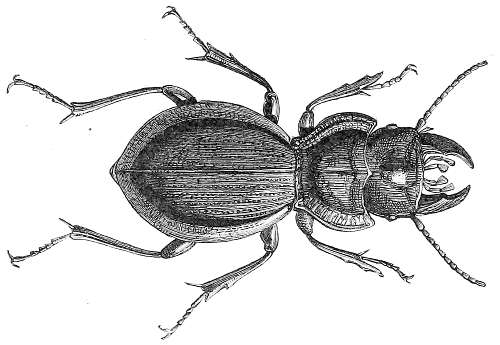
This insect is one of the most magnificent Carabidæ known,
and is nearly two inches in length. The collection in the
British Museum contains a fine specimen of it.
LAND-SHELLS.
Shell sinistral, deeply umbilicated, conoidly globose, rather
inflated; upper portion of the whorls of a rich-toned transparent
chestnut colour, edged at the satural margin with purple
black; lower portion of the whorls white, turning to a delicate
straw-colour by the overlying of a shining, transparent, horny
epidermis, encircled below the periphery and around the umbilicus
with two very decided, broad, rich purple black bands;
whorls six, corrugately puckered throughout at the satural margin,
the first four whorls very densely granosely wrinkle-striated
in the direction of the lines of growth, the striæ gradually disappearing
on the fifth whorl; aperture lunar-orbicular; lips
simple, reflected partly round the umbilicus.
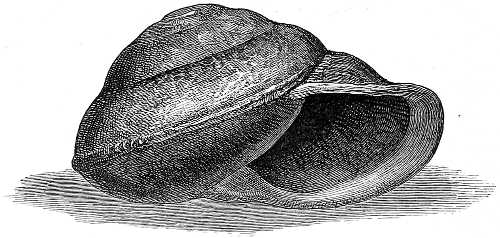
Out of two thousand species of Helix at present known, the
only one of the same type as H. Mouhoti is the large H. Brookei,
collected by Mr. Arthur Adams, in company with Sir Edward
Belcher, on the mountains of Borneo, during the voyage of the
‘Samarang,’ and described by Mr. Arthur Adams in the ‘Zoology’
of that expedition. H. Mouhoti, of which Mr. Stevens has received
a few specimens in various stages of growth, is even
larger and more inflated than H. Brookei. In adult specimens
the last whorl measures 6½ inches in circumference, 3 inches in
diameter, and the shell is about 2 inches high. It differs from
H. Brookei in being conspicuously, but not broadly, umbilicated,
and in the mature lip not being in the least degree reflected at
the margin. The lip itself (not the margin) is reflected at its
junction with the body-whorl, partly round the umbilicus, as in
the Nanina form of the genus. But the most striking feature
of the species is the colouring. In H. Brookei the lower half
of the whorls is of a uniform dark chestnut-colour; in H.
Mouhoti it is pure white, turned to a bright straw colour by the
overlying of a shining horny epidermis, encircled immediately
below the periphery by a broad, rich, purple-black band, somewhat
like the bands of the large Philippine Bulimus Reevei,
but even broader and more defined on the white ground. The
region of the umbilicus is also deeply and as definitely stained
with the same purple-black colour. As in H. Brookei, all the
specimens of H. Mouhoti are sinistral, or what is more commonly
called reversed.
This shell is either sinistral or dextral, cylindrically ovate,
thick, stout and pupoid in the spire, bluish-white, tinged with a
watery fawn-colour, and clouded throughout with oblique zigzag
flames of the same colour, darker, but very undefined and washy;
whorls seven, smooth, rather bulbous, faintly impressed concavely
below the suture; aperture ovate, of rather moderate
dimensions, overlaid in a very conspicuous manner across the
body-whorl, and over a very thickly reflected lip, with a callous,
opaque, milk-white deposit, which in the interior is stained with
a beautifully iridescent violet-rose. This fine species, of which
Mr. Stevens has received several specimens, measuring nearly 3
inches in length by 1½ inch in width, is a most characteristic
example of a type of the Malayan province of the genus,
represented by the old Bulimus citrinus of Brugnière; and it
has been named after its well-authenticated place of habitation,
because the species is, in all probability, confined to that
locality. The islands adjacent to Cambodia have been pretty
well ransacked; and we have nothing like it in species either
from them or from the contiguous mainland of Siam on the
west, or Cochin China on the east. This particular type of the
genus appears, however, abundantly at the Moluccas, in B. citrinus;
and at Mindanao, the southernmost of the Philippine
Islands, in B. maculiferus. Like these two species, B. cambojiensis
occurs with the shell convoluted either to the right or to
the left. The shell is both larger and stouter than that of
B. citrinus, differently painted, and especially characterized by
its mouth of iridescent violet-rose, or what is now fashionably
termed “Solferino” colour.
These descriptions are from the pen of Lovell Reeve, Esq.,
F.L.S., &c., and were communicated by him to ‘The Annals and
Magazine of Natural History.’ See vol. vi. p. 203.
The annexed plate contains representations of several other
new and interesting species of land shells discovered by M.
Mouhot, and named by Dr. Pfeiffer, but which have yet to be
described.
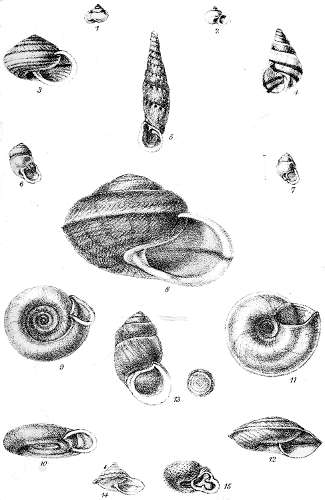
New Land Shells discovered by M. Mouhot.
G. B. Sowerby lith. W. West imp.
1. 2. Alycæus Mouhoti, Pfr.
3. Helix deliciosa, Pfr.
4. Bulisnus Römeri, Pfr.
5. Clausilia Mouhoti, Pfr.
6. Streplaxis pellucens, Pfr.
7. Pupina Mouhoti, Pfr.
8. Helix illustris, Pfr.
9. 10. Helix Laomontana, Pfr.
11. 12. Helix beligna, Pfr.
13. Hybocistis Mouhoti, Pfr.
14. Trochatella Mouhoti, Pfr.
15. Helix horrida, Pfr.
ATMOSPHERICAL OBSERVATIONS.
January.—The month of January at Bangkok is generally
the coolest in the whole year. The thermometer generally
ranges from 58° to 60° Fahr. in the morning. The wind is
sometimes N. or N.E., and at others S.S.W. or S. The rainy
season ends in the latter part of October; the water has fallen
in the rivers, which have not overflowed since the middle of
December; therefore at this time of the year one can walk along
the banks, which are pleasant. The paths are visible and in
a good state for travellers, and there is less danger, even in
the interior of the country, of being attacked by jungle fever.
There is often fog in the morning, but yet it is not unhealthy.
The weather has been fine all the month, excepting one or two
rainy days towards the middle.
February.—During this month the wind frequently blows from
the N.E. or E., though sometimes from S.S.W. The weather
is fresh, agreeable, and healthy. It is the month which the
Buddhist pilgrims choose to visit Phrabat, where they imagine
they can trace the prints of Buddha’s feet. It is the best time
for crossing the jungles and the plains, for the banks are all
raised high above the water and the earth is perfectly dry. If
the wind blows from the S. for a few days, as it sometimes
does, the heat becomes overwhelming for the time. There are
also occasionally, as in January, two or three rainy days towards
the middle of the month.
March.—This month is hotter and drier than the two preceding
ones; there is less freshness. The wind blows generally
from the E.N.E., S., or S.S.W., and often with great violence
during the day: the Siamese call it Som Won (wind of the
shuttlecock), of which game they are very fond, and one hears
everywhere their noise mingled with cries of admiration from
the people. Violent storms, accompanied by rain and thunder,
generally mark the equinox; after that the weather becomes
hot and dry. The thermometer sometimes rises as high as 93
in the middle of the day, but the nights are still pleasant.
April.—April is the hottest month of the year. The first
part is generally dry, with E. or S. winds, but changes about
the middle to N.E. and S.W. In the latter part of the
month the excessive heat is tempered by some refreshing rains.
Although the sun is very powerful during the day, the nights
at Bangkok are cool. This month is not so healthy for
Europeans as the three which precede it, and dysentery makes
great ravages.
May.—This month is considered one of the most rainy of
the year, though sometimes July and September are more so.
The rain rarely lasts all day, and there are sometimes intervals
of two or three fine days. In this month the people prepare
their ground and sow their rice.
June.—During the whole of this month the wind blows constantly
either from the S., W., or S.W. The jungles at this
season are fatal to travellers, especially to Europeans, who
would do wisely to avoid them and to pass this the rainy season
at Bangkok, which is one of the healthiest of the tropical
towns.
July.—In July sweet and refreshing breezes blow from the
W. and S., but more rain falls than in June. There are
sometimes very hot days, when the thermometer rises very high,
but still in Siam this month is considered tolerably healthy.
August.—The same as July.
September.—This is a month of almost incessant rain, and it
is very rare to have two or three consecutive fine days.
October.—Everything is inundated, some of the streets of
Bangkok are transformed into canals, and the rivers everywhere
overflow their banks. The first part of this month is
as rainy as the preceding one.
November.—The Siamese now complain of the cold, but the
Europeans rejoice in it, for the N.E. wind begins to blow.
There are still some rainy days at the beginning of the month,
and some hot ones. These transitions of temperature give rise
to colds and catarrhs. At the end of the month the wind
changes to the S.W.
December.—This is the best month to commence travelling
on the rivers. Occasionally there is thunder and rain, but
altogether it is considered a healthy month.
METEOROLOGICAL REGISTER.
Meteorological Register kept during the month of October
1861, and up to the sixth day after M. Mouhot was attacked
by fever.
Louang Prabang (Laos).
| Dates. | Fahr. 8 A.M. | Reaumur. | Fahr. 3 P.M. | Reaumur. | Fahr. 8 P.M. | Reaumur. |
|---|
| 1 | 73 | 18 | 84 | .. | 80 | .. |
| 2 | 72 | .. | 85 | .. | 78 | .. |
| 3 | 73 | 18 | 81 | 22⅓ | 76 | 20 |
| 4 | 75 | .. | 80 | 22 | 75¼ | 20 |
| 5 | 73 | 18 | 81 | 24¾ | 75¼ | 20¼ |
| 6 | 75½ | 20 | 79 | 20 | 75 | 20 |
| 7 | 73 | 19 | 77 | 20½ | 74 | .. |
| 8 | 72 | 18½ | 83 | 23¼ | 72¼ | 18½ |
| 9 | 73 | 19 | 79 | 20 | 74 | 19 |
| 10 | 74 | 19½ | 83 | 23 | 74 | 19 |
| 11 | 72 | 18 | 83½ | 23¼ | 74 | 19 |
| 12 | 72 | 18¼ | 79½ | 21½ | 72 | 18 |
| 13 | 70 | 15½ | 78 | 21 | 70 | 17½ |
| 14 | 63 | 14½ | 79 | 21½ | 65 | 15 |
| 15 | 60 | 13 | 72 | 18 | 60 | 15 |
| 16 | 60 | 13 | 83½ | 23½ | 70 | 17 |
| 17 | 64 | 14½ | 83½ | 22 | 70 | 15 |
| 18 | 64 | 14½ | 86 | 23½ | 70 | 18 |
| 19 | 69 | 17 | 85 | 24 | 71½ | 17½ |
| 20 | 70 | 15½ | 89 | 25 | 74 | 19½ |
| 21 | 73 | 19 | 90 | 26 | 74 | 19 |
| 22 | 71 | 18 | 86 | 23½ | 71 | 18 |
| 23 | 73 | 19 | 87 | 25 | 70 | 18 |
| 24 | 68 | 16½ | 88 | 25 | .. | .. |
Translated from the Chinese by M. Henri Mouhot.
CHINESE TALES.
In a Chinese village lived two cousins, both orphans: the eldest,
who was called Moû, was cunning and egotistical; the other, on
the contrary, was goodness and simplicity itself; he was called
A-lo-Sine. The time for ploughing the fields arrived: A-lo-Sine
possessed a buffalo, while Moû had only a dog. An idea
struck him, and he went to his cousin and said, “I bring you
my dog; give me your buffalo: my dog will plough your field,
which is not very large, and you will see that you will have very
fine rice.”
A-lo-Sine consented, and worked so well with the dog that
his rice was first-rate, while the field ploughed by the buffalo
produced hardly anything.
Moû, then, full of spite, went by night into his cousin’s field,
and set fire to it: A-lo-Sine saw the flames, and, unable
to repress his despair, uttered piercing cries, and rolled in the
field.
Some apes, who were marauding in a neighbouring field,
witnessed this spectacle, and said to each other, “That must be
a god, since the fire does not hurt him.” They accordingly
drew near him, took him by the feet and arms, and carried him
to the top of a mountain, where they laid him down, plunged in
a deep sleep. The monkeys then piled up rice and delicious
fruits, and bowls of gold and silver of extraordinary beauty and
value, and then left him to return to the fields.
At last he awoke, and thought no more of his misfortune,
seeing around him so many treasures: he gathered them all up,
and returned to his hut, full of joy.
Moû, seeing him so happy, followed him, and, at the sight of
the gold, “Heavens!” cried he; “my cousin as rich as a prince:
give me something.”
“No,” replied A-lo-Sine, “I will not; for you are wicked,
and you set fire to my field.”
Moû then went to his own field, and set fire to that also,
and imitated all that his cousin had done: he wept, cried, and,
like him, threw himself into the flames. Five monkeys, one of
them a young one, who were feasting close by, drew near him,
curious to see what he was about. “He is a god,” said they,
also; “the flames have spared him. Let us carry him away.”
No sooner said than done. Each monkey seized one an arm,
the other a leg, and they set off.
They reached a neighbouring wood; but there the little
monkey began to cry out, “I want to help to carry him also.”
“But there is nothing of him to hold by,” said the mother. The
little monkey, however, continued to cry, and at last seized
Moû’s long tress of hair, and put himself at the head of the
procession.
But this hurt Moû, and he tried to disengage his hair.
The young monkey began to cry again. “Ah, you are angry;
stay there, then,” said all the others, and they threw him into a
prickly bush.
Moû had great trouble in extricating himself from his disagreeable
position; and it was nearly evening when he reached
home, all covered with blood.
“Well, cousin, have you also some gold and silver?” said
A-lo-Sine, on seeing him. “Ah! I am thoroughly punished for
the harm I did you,” replied Moû. “I bring back nothing but
needles: call the women to take them out of me.”
Translated from the Chinese by M. Henri Mouhot.
There lived formerly in a Chinese village an old couple who
had no children; and one day the husband put himself in a
violent passion with his wife for never having had any, and even
beat her. The poor old woman rushed out of the house, crying,
and ran a long way. A priest of Buddha met her accidentally,
and asked her what had happened to her. “My husband was
angry to-day, and beat me, because we had no children,” replied
she. “Listen,” said the priest; “I will make you happy! Dig
in this earth and knead it” (it was clay). The woman obeyed,
and the priest then sat down, and with his fingers moulded nine
little figures. “The first,” said he, “will have long ears and
very quick hearing; the second, a piercing sight; the third,
a skin so hard that he will not feel any blow; the fourth will
stand fire without hurt; the fifth will have an enormous head, as
hard as iron; the sixth, legs long enough to cross the deepest
stream; the seventh, feet as large as those of an elephant, for
walking in mire; the eighth, an immense stomach; and the
ninth, a nose as long as a pipe, from which jets of water
will issue at command. Now,” continued the priest, “go home,
and every year eat one of these children.” The old woman
bowed several times, professing her gratitude and happiness;
then she returned home; but in her joy, instead of contenting
herself with one child, she eat up all nine at once. Her stomach,
which had begun to swell at once, grew every month bigger
and bigger, and became frightful. The husband was beside
himself with joy, and was very kind to his wife.
At last the day of delivery arrived: the father received the
first child, and ran to wash him in the stream; but there came a
second. “Another!” cried the father, and ran again to the
river. Returning, he found a third, then a fourth. He opened
his eyes and cried, “Really this is quite enough: what can we
give them to eat?” But the whole nine made their appearance
on the same day.
All were prodigies: they grew rapidly; never cried; eat
enormously, and began to run about in two months. But the
old man did not know what to call them all; and one day he
complained to his wife that he could not distinguish them one
from another, got in another passion, and struck her again.
The old woman ran away, crying, again, and went to find the
priest who had helped her before. “Why do you cry now?”
said he. “My husband has so many children now that he
does not know what names to give them.” “You are very foolish,”
replied he, “not to be able to distinguish them by the gifts
they possess. Call one ‘Quick-ear,’ another ‘Hard-head,’ and
so on for the others.”
The old man had calmed down when his wife returned; but
debts accumulated as the children grew up. At last they became
strong and fearless.
One day a creditor came and asked for money. “I have
none,” replied the old man. He persisted in this reply, and at
last turned the creditor out of the house. A few days after, this
man collected several of his friends, and went again to the old
man, declaring he would seize one of the children, and whip
him. “Quick-ear” had heard all, and “Piercing-eye” had
mounted to the top of a tree and seen all that was going on.
They decided that “Hard-skin” would be the best to go, and
the creditor succeeded in binding him and taking him away.
But every cane broke on his back, without hurting him: at last
they took an immense cudgel, but this broke in the same way;
and seeing that it was lost time to beat him, they let him go
home.
But a few days after, the creditor came back, determined to
kill one of the children with boiling water. “Quick-ear”
heard the project, and “Invulnerable” was left at home, and
consequently carried off. They threw him into a boiler full of
water; and in about an hour, when they opened it, the child
raised his head. “What, not yet dead!” cried the creditor, in
a fury, and he made up a larger fire, but “Invulnerable” was
still alive. They made it still hotter, but the next day their
wood was exhausted, and they let him go free, saying that
Buddha protected him. “This is very sad,” said the creditor;
“I cannot get my money; I cannot get my money: I will
write a letter to Heaven, to beg that fire may be sent down to
burn the house of my debtor.” He did so accordingly; but
“Quick-ear,” who heard the plot, warned “Fountain-nose,” who
thereupon took care to water the roof. The thunderbolt fell,
but glided from the roof to the ground. All the children
joined their strength, and lifted it, chained it up, and placed
it in the house.
“Is it possible,” cried the creditor, “that they are not all
dead? I must throw one of them into the sea.” This time it
was “Stilt-bird’s” turn. The boat in which they placed him
had not gone far from the shore when a storm arose and upset
it, and all the men were drowned, with the exception of “Stilt-bird,”
who escaped, thanks to his long legs. However, his
brothers feared for him, and sent “Big-head” to the shore,
where he found him fishing, and having already caught so many
fish that he did not know where to put them. Luckily “Big-head”
had his hat, which they filled, and returned home with
an immense load. “Large-feet” went to cut wood to fry it
with; but “Great-stomach” eat it all up before his brothers
had hardly had time to begin. “Weeping-eyes” began to cry,
and an inundation ensued, in which many of the neighbours
perished.
Meanwhile, all the children were out searching for food, and
the mother was left at home alone. She, seeing the thunderbolt
chained in a corner, unfastened it. Immediately it rose
in the air, then, falling again, struck the poor woman, and
killed her.
Translated from the Chinese by M. Henri Mouhot.
CHINESE FABLES.
Firmness and presence of mind often make heroes of cowards,
and rescue them from great dangers, while rashness is generally
fatal.
In the midst of a thick and virgin forest, where everything
seemed to slumber, an elephant began to utter doleful howlings,
and a tiger replied by others still more dreadful, which froze all
the other animals with terror. Monkeys, stags, and all the
inhabitants of the neighbourhood, ran groaning to seek refuge at
the tops of the trees, or in the depth of the woods, or in their
dens. The elephant himself ran with all his speed, when on his
way he met a hare, who stopped him, and said, “Why do you
run thus, without aim and without reason?” “What! did you
not hear the frightful roaring of the tiger? Would you advise
me to stay here and be devoured?” “Stay here, and have no
fear; I will answer for it that no harm happens to you,” said
the hare; “only sit down, that I may jump on your back.”
The elephant goodnaturedly approached and extended his four
legs; then the hare jumped up, having first put into his mouth
a piece of betel.
“Now, get up again,” said he, “and you will see that all will
go well.” He then proceeded to give the elephant further counsel,
and afterwards let out along his back a long stream of
saliva, reddened by betel. Soon the tiger came up. “What
are you coming to seek here?” said the hare, as the tiger
stopped to look at them. “Do you not see that this elephant
is not too much for me alone; and do you think I will share
with you?” The tiger drew aside, behind a tree, to watch
what passed. The hare then seized hold of the elephant’s ear,
made him roar, and seemed perfectly master of his prey, and
busy at his work. “Heavens! how strong he is!” said the
tiger; but still he drew near. “Wait a minute, and I will come
to you,” cried the hare, looking as though preparing to spring,
and the tiger, struck with terror, turned and ran away. A
chimpanzee, seeing him running away in such terror, burst
out laughing. “What! you laugh at my misfortune?” cried
the tiger. “I have just escaped from death, and you do not
pity me.” “How so? I should like to see the beast who frightened
you; take me to him.”
“What! to be devoured? no.”
“Do not be afraid; I will get on your back, and will not
leave you: we will fasten our tails together, if you like; and
thus united we shall run no risk!” The tiger was persuaded
by these words, and they both returned to the elephant. The
hare seemed still busy at his work: he had chewed a new
piece of betel, and had made another stream, red as blood, on
the elephant’s back. “You dare to come back!” cried he, in
an angry tone, to the tiger. “You knew I had only just enough
here for myself, and yet you want to carry away my prey from
me; you deserve to be punished.”
At these words the elephant uttered a piercing cry; the
hare made an enormous bound on his back; and the tiger,
struck with terror, rushed precipitately away at full speed,
saying to the chimpanzee, “Now, you see; you laughed at my
fears, and we both narrowly escaped death.” But the chimpanzee
did not hear; for in the tiger’s precipitate retreat he had
fallen off his back, struck himself against a bamboo, and died,
cursing his rashness with his last sigh.
Translated from the Chinese by M. Henri Mouhot.
Formerly, according to the Siamese, hares had thick ears; but
a certain day one of these animals, having more legs than
memory, met a snail dragging himself painfully along the
ground, and in a moment of pride sought to humiliate him.
“Why, little one, where are you going at this pace?” said he.
“To the beautiful rice-fields of the next village.” “But, my
poor fellow, you will be a long time reaching them. Why did
not Nature furnish you with legs like mine? Confess you envy
me. How long, now, do you think it would take me to get
there?”
“Perhaps longer than it would take me, though you pity me
so much,” replied the snail, coldly.
“You jest, do you not?”
“No.”
“Well, will you bet about it?”
“Willingly.”
“What will you bet?”
“Whatever you like.”
“Well, then, if you win you shall nibble my ears; for you
cannot eat me; and if you lose I will eat you: will that suit
you?”
“Perfectly.”
“Then set off; for I will give you a start.”
While the hare began to browse the snail set off at his slow
pace, and went to his brother, who was a little way off, and to
him he communicated a pass-word, which he in turn told to
another, and so on along the whole line which the betters had to
travel, so that it quickly reached the end.
Soon the hare, having satisfied his hunger, and feeling strong,
set off, and flew over the ground, calling to the snail, whom he
believed to be close by. “Ohé!” answered he, from a long
way off. “Oh, he is already far on the way,” cried the hare, who
set off again like an arrow. In a few minutes he stopped and
called again: “Ohé,” answered a voice still farther on. “Really,
he goes very quickly,” thought the hare, and he set off again.
A quarter of an hour after, he stopped, quite out of breath.
“Now,” said he, “I may rest; I must be far in advance; but
I will call and see.” “Ohé! snail.” “Ohé!” replied a voice
a long way on. “Oh! I must be quick; I shall lose my bet,”
murmured the hare. He ran, and ran, and at last stopped,
quite exhausted, only a few yards from the fields. “Snail,”
cried he, faintly: “what! you are returning from the place?
Unfortunate that I am, I have lost my bet;” and he made vain
efforts to get up and escape, but, alas! his strength failed him,
and the snail pitilessly gnawed his ears.
Since that day the hare always avoids damp places, for fear
of meeting one of the creatures who punished him for his
pride.
Translated from the Chinese by M. Henri Mouhot.
CHINESE TALE.
There lived formerly in a small town in China a singular
couple, of a description still met with, for the Chinese progress
very slowly. The husband was noted for his folly, and the wife
for her cunning. “Always remember,” she used constantly to
say to her husband when he went out, “that all people with
long noses, in the form of an eagle’s beak, and bending downwards,
are good-for-nothings, beggars, cheats, and, worse still,
bad paymasters, coiners of false money, false-swearers, and will
go to hell; while people with small turned-up noses are good,
and will go straight to heaven. Therefore, that you may not
lose, sell only to these last; for, I repeat to you, the others
are bad.”
Every day the husband went out, and passed from street to
street, examining the passers-by, but never addressing any but
those who had their heads raised to look at something, so that
he very seldom sold anything.
One day, when he was observing noses as usual, he saw a
man reading a placard which was placed very high. “That
man will go straight to heaven,” thought he; “his nose is so
much turned up. Will you buy some clothes, good man?”
said he. “Clothes! you see I have some.” “But you appear
to me the most honest man I ever saw” (“I never saw such a
nose,” he added to himself); “and I should like to sell you a
whole suit; my wife makes them herself.” “Well, what is the
price?” “Of my wife?” “No; of the clothes.” “Two
kóóu” (about ten francs). “But why do you come into this
retired place to sell your clothes, when there are so many
people elsewhere?” “Oh! I went to those places; but all
the people had long, bent, and eagle-shaped noses, you see! and
I only sell to snub-nosed people.” “I do not understand you;
why will you not sell to people with long noses?” “My wife,
who is a very clever woman, told me that all people with long,
eagle-shaped noses are knaves.” “Really, your wife is very
sharp, and I understand you now. Well, my friend, I will buy
your clothes; but as I have no money with me, I will pay you
to-morrow. You have only to come to my house; I live near
here. You will see a hurdle covered with eggs, a flag at the
end of a mast, and a little plantation of betel.” “Very well;
that will do.”
The merchant went home to his wife, and told her he had
sold to a man with a snub nose. “Where is the money?” said
she. “I have not got it yet, but I shall be sure to have it to-morrow.
I am to go where I see a hurdle covered with eggs, a
flag on a mast, and a little betel plantation.” The next day the
wife said, “Go for your money.” He went, but could not find
the house; and after long searching he came home again.
“Have you the money?” said the wife. “No, I could not find
the house.” “Well, I will go myself to look for it. If I am not
back in an hour, you will know that I am drowned.” After an
hour, as his wife did not return, the man took the sieve with
which he usually sifted his rice, and set off to the river, which
he began to try to empty with it. A passer-by asked him what
he was doing. “I am emptying the river,” replied he; “for my
wife is drowned, and she had on her best yellow bonnet.”
“Nonsense!” said the other; “I just met her walking with a
man who had a snub nose.”
Procellaria Capensis.
THE CAPE PIGEON.
During a long voyage, when for months you have seen nothing
but water and sky, the smallest novelty which appears and promises
variety for the eye and the mind, though only for a few
minutes, is joyfully welcome. Sometimes it may be a stormy
petrel, flying like a swallow, skimming through the air in a
hundred different directions, and seeming to play in that element;
sometimes a ring-tail, which, with its piercing cry like
that of a hawk, appears a messenger from the sun to bid the
bold navigator welcome to the tropics, hovers for a few minutes
over the ship, and then flies off with a jerk and disappears.
Sometimes are to be seen numerous blowers, who pass and
repass the ship with bounds; or perhaps a whale, which almost
stupefies you with the noise he makes as he displaces the water
in rising to the surface to breathe: at another time it is some
hungry shark, who, following in the wake of the ship, lets himself
be caught by the bait thrown out to him, and which, when
hoisted with great difficulty on deck, lashes it with his tail and
looks formidable even after death; and this is a good take for
the sailors, who divide the spoil and feast on it.
But of all the creatures dear and familiar to sailors, none
rejoices him more than the faithful companion who, more than
3000 miles before he doubles the Cape of Good Hope or Cape
Horn, appears to his sight, swims in the water, grazes a thousand
times the hull or the rigging, pleases his eye by its parti-coloured
plumage, and announces to him calm and tempest.
This bird, called by the French “Damier,” by the English
the Cape Pigeon, and “Peintada” by the Portuguese, is the Cape
Petrel, or Procellaria capensis of naturalists.
Gifted with great powers of flight, though less than other
petrels, from morn till night, and often even a part of the latter
when the moon is full, it is seen in the wake or alongside of
the ship, describing in its flight, in which scarcely any movement
is apparent, a thousand evolutions, sometimes touching
the great waves which seem ready to overwhelm it, the moment
after reappearing far above them, always wheeling about
and careless of the storm.
The sight of this flight and of all these evolutions is most
pleasing, and one involuntarily thinks of a graceful skater
flying over the ice at his utmost speed, and seeking to attract
admiration.
The whole life of this bird is perpetual movement, a constant
chase after a scarce and insignificant prey. Unlike the
swallow, who has his hours of pleasure and of amorous warbling,
and nights of sleep in his warm nest, the Cape pigeon, pressed
by hunger and by his ravenous appetite, only rests for a few
minutes at a time at rare intervals during the day, in order to
recruit his strength, and at night, rocked by the stormy wave,
must find but little sleep.
Neither does the Cape pigeon know the delight of a peaceful
retreat in a favourite spot sheltered by thick foliage or long
reeds; and while most birds confine themselves to a limited district,
where they are almost certain to be found at the same
season, and to which they invariably return at the disappearance
of the frosts which have chased them away for a time,
this one, a sailor by nature, has for its domain an immense
empire, namely the greatest part of the Atlantic, Pacific, and
Indian oceans, and has to brave night and day, at one time an
icy wind, and at another the rays of a burning sun.
But in a state of liberty nothing living is often unhappy, and
the foreseeing Providence, who knows how to satisfy the wants
of his creatures, also knows how to create joys for them, where
we see nothing but trouble and misery. In like manner the
industrious workman and the hardy traveller experience, perhaps,
of all men the most lively joys; to them repose would be
the greatest suffering.
Although inseparable companions of the sailor, it is not certainly
for the pleasure of his society, nor for that afforded by
the sight of the ship, that the petrels follow it, but for the
certainty of finding in the scraps thrown overboard, as well as
in the number of shells in the wake of the ship, food more
abundant than he would discover elsewhere in the water. Nothing
can equal their voracity but the quickness and vivacity
with which they catch sight of the smallest prey and seize it
even amidst a stormy sea. From a great distance, and long
before the albatross, and the other descriptions of petrels which
are often to be seen with the Cape pigeons, have remarked it,
they see and pounce on it, and have generally swallowed it
before the jealous rivals who follow them have been able to
overtake them. The sense of smell does not here come in aid
of that of sight, for they often pounce on a piece of wood or
something of that description which falls from a vessel, and
only abandon it when convinced by the touch that it is not fit
for food. Their greediness is such that they will often let
themselves be taken in dozens with hooks; no sooner are they
on deck than they disgorge a thick liquid the colour of linseed
oil.
When these birds rest on the sea and let themselves be tossed
about by the waves, their appearance, dimensions, form, and
colour of plumage strongly resemble our domestic pigeons, and
hence the English seamen, struck with the similarity, have
given them the name of Cape pigeons. Their size varies; the
largest measuring more than 18 inches English from the beak
to the tip of the tail, and rather more than a foot in circumference.
They are generally seen in great numbers only in stormy
weather and in rather high latitudes. In the winter season—that
is, during our June, July, and August—they follow
the ships constantly between 23° S. lat. and 31° and 103°
E. long.
Is it not a wonderful thing and worthy of admiration that
the instinct with which this bold little navigator is endowed
guides him safely through this vast space, where there is
nothing to serve him as a landmark, enables him to rejoin his
comrades if accidentally separated from them, and teaches him
every year when the warm season returns to recognise and find
the island or the solitary rock where he was born, and where
in his turn he will bring up his young ones; while man, with
his maps, his books, his nautical instruments, and in spite of all
his long experience, has such difficulty in finding his way across
the ocean? And yet we think that our intelligence raises us
above the animals. This is what confounds and overwhelms
the scholar when he seeks to fathom the great mysteries of
creation.
THE ALBATROSS
A wise and bountiful Providence has taken care to people
the most distant and desert parts of the globe, whether covered
with eternal snow or impenetrable forests. In the waters of
the ocean are, as well as in our fields and woods, creatures
which rejoice the eyes of man and provide for his wants. Of all
these creatures none are more charming and pleasing than the
birds; endowed either with melodious voices or brilliant plumage,
or with some other charm or quality, such as vivacity,
quickness and grace of movement, and power of flight; all have
attractions for us; and even in our museums, in spite of their
faded plumage and often altered forms, they are still objects
of admiration, not only to the learned naturalist, but to men
who care little for other beautiful sights.
But if leaving the cabinet we visit Nature herself, penetrate
into the heart of the forests, climb the rocks, or visit the shores
and the ocean, then our admiration grows stronger and more
deep.
Of all birds there is none which exercises a greater influence
over the mind of man, or causes greater astonishment, than the
albatross, so celebrated by voyagers from the earliest times.
The albatross! The word recalls to the navigator a thousand
souvenirs; as the name of some bloody battle in which he has
taken part, or of some general who has led him to victory,
awakens those of the soldier. It recalls to the memory of the
sailor the principal incidents of an existence passed between
calm and tempest; he feels himself transported in thought to
the time when the first albatross was signalled, and passengers
and sailors turned their gaze eagerly towards the spot where,
like a proud man of war, cradled by the rolling waves, advanced
the powerful sailer against whom the storm rages in vain, and
who, far from avoiding, seems to court it.
To this first souvenir succeed many others; there is the
dead calm, which in the tropics has often detained his vessel
inactive for weeks, as though chained under the burning sky,
where the eye seeks in vain for a cloud, and the only sound
that meets the ear is the heavy flapping of the sails against the
masts as the ship rocks; a calm often more to be feared and
more dangerous than the most terrible tempest, for it renders
the crew inactive, impatient, and bad-tempered. But the first
sight of the albatross indicates a coming change and wind to
be expected. There is also the memory of painful and too
sudden transitions from equatorial heat to the cold of high latitudes;
that also of hours of dreadful anxiety when the storm
broke out in all its violence, of the contest between winds and
waves, and of the albatross hovering over the latter, as though
chosen an umpire between these two formidable antagonists.
The albatross inhabits the southern hemisphere of the Atlantic
Ocean from the 25° or 26° of latitude, also both Pacifics, but is
rarely seen farther north, and has never been known beyond the
tropics; it is in the seas which bathe the three southern capes
that they are seen in the greatest numbers.
It often happens, however, when the winter is mild and
the weather fine, that very few are seen until you reach the 40°.
They lay their eggs on some deserted southern shore; the
female lays only one, and feeds her little one for nine months
without leaving it, so much need has it of its mother’s help.
There is much difficulty in the classification of the palmipeds,
which exhibit a great number of varieties.
The beak of the albatross is long and very strong; the upper
jaw furrowed at the side and much curved; the lower one
sharp, smooth, and truncated at the end; the nostrils, formed by
two tubes opening outwards, are lateral and placed in a groove.
The tarsi are short, but very thick, and ending in three front
toes much palmated; the wings are long and narrow.
There are probably four distinct species of albatrosses.
1st. The wandering albatross, Diomedea exulans, which
measures ten feet with the wings spread; it has a white head,
the wings and belly being spotted with white, grey, and chestnut
brown; the beak is the colour of horn. This species varies
much in size, and still more in colour and plumage, which is
more or less mixed with grey or brown, and sometimes even
entirely white; this depends doubtless on the season, the sex,
and the age.
2nd. The epauletted albatross, Diomedea epomophera, which
is smaller than the common albatross. His head, neck, body,
back, and rump are snowy white, while the feathers of his wings
are perfectly black, with the exception of a large white lozenge-shaped
spot on each; the beak is yellowish. Some naturalists
believe these to be only the young of the ordinary kind.
3rd. The yellow-beaked albatross, Diomedea chlororhyncos.
This species I have myself taken with a hook; his head, belly,
and neck are brilliantly white, his back and the plumage of the
wings a deep brown grey, the beak yellow, and the feet bluish
grey; the rump is white, and as well as the underpart of the tail
is bordered by a wide black line.
4th. The sooty albatross, Diomedea spadicea of Forster, which
is the size of the common albatross, and of a uniform deep
chestnut-colour.
A.
| Abandon (to) | Lẽng, chol. |
| Abhor (to) | Sââp. |
| Approach (to) | Dâl. |
| Abstinence | Tam. |
| Abstain (to) |
| Accept (to) | Iotuol. |
| Accompany (to) | Iam. |
| Accomplish (to) | Ihúruéch hoì. |
| Accustom oneself (to) | Ihlap. |
| Accuse (to) | Shõdéng. |
| Acid | Ehu. |
| Admire (to) | Ehhugã̆l. |
| Adore (to) | Ihoui bãngeom. |
| Adultery | Bap phit propon Ki. |
| Afflict (to) | Lruey chot chaw chot. |
| Age | Acõ̆schhnam. |
| Announce (to) | Srăp, pram. |
| Appease (to) | On. |
| Appetite | Comléan Klileán. |
| After | Ẽcroí. |
| Arid | Sngnot, comynot. |
| Arm | Crùóng predăp. |
| Army | Iăp. |
| Arrive (to) | Dâl. |
| Assembly | Chumnam. |
| Assemble (to) | Chumnam Kenéa. |
| Audacity | Ihean. |
| Audacious |
| August | Mahu. |
| Also | Dẽl. |
| Altar | Balang, as-prĕn. |
| Agile | Chuery. |
| Air | Acos. |
| Add (to) | Thêm. |
| Aloes | Jadam. |
| Alum | Saĕpchu. |
| Amuse oneself (to) | Ling. |
| Ancient | Chus. |
| Ass | Satliá. |
| Angel | Firĕuda. |
| Angle | Chrung. |
| Animal | Săt. |
| Avarice | Comnaut. |
| Advocate | Sma Kedey. |
| Abortive (to be) | Relutcõn. |
| Arm | Phlu. |
| Aim | Vong. |
| Ashes | Phe. |
| Ask (to) | Som. |
| Above | Lù ê lù. |
| And | Non. |
| Awake (to) | Dăs. |
| Arrow | Prúeup. |
| Agreeable | Totuol. |
| Appearance | Cŏmnăp. |
| According to | Tam. |
| Always | Ruéy (iún ruey reáp darăpton muc). |
| Anger | Conhong. |
| Amongst | Erang. |
| Across | Totùng. |
| Already | Hoi. |
B.
| Bitter | Loving. |
| Before | Mum. |
| Bathe (to) | Ngut tin. |
| Breath | Dâng hina. |
| Bold | Tahéan. |
| Broom | Bombãs. |
| Bamboo | Resey. |
| Banana | Chá. |
| Banquet | Car si. |
| Beard | Puk mŏt. |
| Boat | Iui. |
| Build (to) | Sâhy, thú phtĕn. |
| Beat (to) | Véag. |
| Beautiful | Sââ. |
| Benediction | Prăe pór. |
| Beast | Sat. |
| Blue | Khín. |
| Beef | Cũ. |
| Bushel | Ihang-Iao. |
| Box | Hêp. |
| Bottle | Săr phdŏe. |
| Button | Leu. |
| Branch | Mie. |
| Brick | Ot. |
| Break (to) | Rei. |
| Burn (to) | Dot. |
| Buffalo | Crebey. |
| Black | Khnaun. |
| Bone | Cheóng. |
| Bread | Nam. |
| Basket | Conchir. |
| Blade | Lompeng. |
| Book | Sombot. |
| Bed | Domnéc. |
| But | Pê. |
| Bad | Bap, chomngú. |
| Breast | Dâ̆. |
| Beg (to) | Som teau. |
| Better | Cheang, lus. |
| Bite (to) | Kham. |
| Be born (to) | Cót. |
| Bee | Khmum. |
| Bark (to) | Sru. |
| Buy (to) | Iink. |
| Business | Domnor. |
| Bow | Ehme. |
| Batatas | Eomlong. |
| Bridge | Spreau. |
| Behind | Croi, ê croi. |
| Back | Hhnang. |
| Be (to) | Non-mêan, Chèn. |
| Big | Phom. |
| Broil (to) | Hang. |
| Bird | Sat liar. |
| Blood | Chheàm. |
| Blow (to) | Phlõm. |
| Betray (to) | Kebâ̆t. |
| Bark | Sombok. |
| Brother (elder) | Bâng. |
| Brother (younger) | Phŏôn. |
C.
| Come (to) | Moc Dâ̆l. |
| Cottage | Catôm. |
| Corpse | Khmoch. |
| Cage | Irung. |
| Case | Hêp. |
| Calk (to) | Bàt. |
| Calm oneself (to) | On. |
| Cambodia | Sroch Khmêr. |
| Cambodian | Khmêr. |
| Country | Neal. |
| Canal | Preê. |
| Comb | Suét. |
| Cask | Thâng. |
| Cardamom | Crevanh. |
| Cause | Het dòm. |
| Cold (a) | Câã̆c. |
| Cup | Chan. |
| Conduce (to) | Tôm. |
| Cloth | Souipăt. |
| Cough | Câã̆c. |
| Commotion | Revàl. |
| Cut (to) | Cat. |
| Conquer (to) | Chhnĕa. |
| Conquered | Chănh. |
| Clothing | Ao. |
| Carriage | Retê̆. |
| Centipede | Kaêp. |
| Circle | Vong. |
| Coffin | Mochhus. |
| Chain | Chervăi. |
| Choir | Sach. |
| Change (to) | Prê. |
| Coal | Khîung. |
| Chastity | Sel. |
| Cat | Chhma. |
| Chief | Mechàs, héay. |
| Chinese | Swẽ chèn. |
| Cholera | Rŏmbâl. |
| Clear | Thla. |
| Clock | Condong. |
| Cocoa-nut | Dong. |
| Combat (to) | Chebang. |
| Commencement | Dòm. |
| Count (to) | Răp. |
| Consent (to) | Prom. |
| Console (to) | Tŭo Săo. |
| Clay | Deyót. |
| Crowd | Fông, cânbân. |
| Crow | Khoêi. |
| Cord | Khse. |
| Coast | Khaeng. |
| Cotton | Crebas. |
| Colour | Sombar. |
| Cut | Cap, cat. |
| Crown | Mocõ̆t. |
| Call (to) | Han. |
| Clean | Saat. |
| Cry (to) | Tô̆ui. |
| Carry (to) | Chun, Rĕc sêng. |
| Clean (to) | Nos leáng. |
| Cloud | Sapô̆c. |
| Chew (to) | Bièm. |
| Cold | Rengia. |
| Cricket | Chungret. |
| Clock | Novea. |
| Custom | Chebăp, Tomlăp. |
| Create (to) | Bângeat. |
| Cry | Sâmléng. |
| Cry (to) | Srêc. |
| Cook (to) | Dam. |
| Copper | Spó̆n. |
| Cymbal | Lông, Khmõ̆. |
| Crab | Pomgeong. |
| Church (temple) | Preă-Vihear. |
| Carry away (to) | Roc ton. |
| Coat (to) | Leap. |
| Child | Coming. |
D.
| Descend (to) | Chô. |
| Desire (to) | Sângvat, Châng. |
| Destroy (to) | Pombat. |
| Debt | Bomnàl. |
| Diviner | Achar. |
| Daybreak | Prealum, Preahean. |
| Delicate | Ton. |
| Different | Titey. |
| Difficult | Cra. |
| Disciple | Cŏn Só̆s. |
| Dearth | Âmnât. |
| Dispute (to) | Chhlô̆ prokêe. |
| Doubt | Moutûl. |
| Dysentery | Chomngú mual. |
| Do (to) | Thu. |
| Dung | Ach. |
| Dress (to) | Prăeae. |
| Damp | Som. |
| Drunk | Sreving. |
| Day | Thugay. |
| Deliver (to) | Preeol. |
| Doctor | Cruthnam, pet. |
| Despise (to) | Măcngeáy. |
| Deride (to) | Sôch, châm-ôn. |
| Die (to) | Slăp. |
| Dwarf | Tua. |
| During | Compung. |
| Dust | Ehuli. |
| Dare (to) | Héan. |
| Dote (to) | Trũl. |
| Dove | Rùs. |
| Dig (to) | Hal. |
| Drum | Seôr. |
| Delay (to) | Ângvéng. |
| Dye (to) | Cherlâ̆c. |
| Darkness | Tângcap. |
| Draw (to) | Téanh. |
| Deceive (to) | Bŏn chhăt. |
| Dear | Thlay. |
| Dew | Ânsóm. |
| Deaf | Câ. |
| Dream | Sâp. |
| Dog | Chkê. |
| Door | Shóĕ. |
| Drink (to) | Elinear. |
| Duck | Iea. |
| Dream (to) | Zâ̆l Sãp. |
E.
| Exchange (to) | Dôr. |
| Efface (to) | Lap. |
| Equal | Smó. |
| Elephant | Tamrey. |
| Endure (to) | Â̆t, ôn. |
| Engage (to) | Pobuol. |
| Enemy | Satron-Khmang. |
| Enter (to) | Chôl. |
| Envy (to) | Chernêu. |
| Envy |
| Example | Kébuon. |
| Exhort (to) | Boutun méan. |
| End | Chông. |
| Evening | Lŏngéach. |
| Easy | Ngeáy. |
| End | Long-âs. |
| Eye | Phnée. |
| Egg | Pong-sut. |
| Ear | Erechiéc. |
| Equal | Mytrey. |
| Eat (to) | Si, pisa, chhăn, soi. |
| Even | Smó, dock. |
| Everywhere | Sâ̆p ăulú. |
| Eagle | Antri. |
| Earth | Dey, Preă thorni. |
F.
| Face | Mŭc. |
| Feeble | Comsoi. |
| Family | Crua. |
| Famine | Âmnâ̆t. |
| Fatigue | Nuèy. |
| Fault | Tus. |
| Female | Nhi. |
| Ferocious | Sahan. |
| Fire | Phlâng. |
| Fever | Cran. |
| Figure | Muc. |
| Flower | Phŏm. |
| Faith | Chommia. |
| Forest | Prey. |
| Fresh | Rehoi. |
| Front | Thngos. |
| Fruit | Phle. |
| Float (to) | Ândẽt. |
| Freeze (to) | Câc. |
| Fat | Thop. |
| Frog | Ong Kêp. |
| Food | Ahur Sâbiẽng. |
| Friend | Keló. |
| Formerly | Pidom. |
| Firewood | Os. |
| Finger | Day. |
| Fast | Buos. |
| Fast (to) | Si buos. |
| Free | Neaĕ Cheá. |
| Far | Chhngai. |
| Falsehood | Câhâc. |
| Frightful | Noiai. |
| Forget (to) | Chŭs bât côrna. |
| Fly | Rug. |
| Fishing | Bap. |
| Fish (to) | Stuch trey, Dóc non. |
| Father | A puc. |
| Few | Eech. |
| Fear | Khlach. |
| Full | Peuh. |
| Feather | Slap, mems. |
| Foot | Chung. |
| Fish | Eyey. |
| Fowl | Món. |
| Fill (to) | Bampenh. |
| Fool | Lengong. |
| Follow (to) | Tam, dòr tam. |
| Firebrand | Rengûc. |
| Fall (to) | Duol-thleăc. |
| Find (to) | Roi ban. |
| Face | Mac. |
| Flesh | Sach. |
| Field | Prê. |
| Figuratively | Chó̆t. |
| Fear (to) | Khlàch. |
| Fly (to) | Luèch. |
| Fly (to) (like a bird) | Hòr. |
G.
| Gold | Meas. |
| Gunpowder | Démsón. |
| Go (to) | Tou. |
| Greedy | Luphu. |
| Good | Lââ, chiá, písa. |
| Grind (to) | Boh. |
| Girdle | Crevat. |
| Garlic | Ketym Sá. |
| Grasshopper | Chungret. |
| Go out (to) | Chenh. |
| Green | Khién, baí tong. |
| Glass (a) | Péng Kên, Kên. |
| Go to bed (to) | Dec. |
| Grow (to) | Sbec. |
| God | Prĕa. |
| Give (to) | Oi, chun. |
| Grief | Chhu. |
| Girl | Consrey. |
| Gun | Comphlûng. |
| Gain (to) | Ban chonménch. |
| Guard (to) | Reăesa. |
| Glove | Teăc. |
| Generous | Chôt tuléay. |
| Ginger | Khnhey. |
| Glutton | Luphu. |
| Gum | Chor. |
| Govern (to) | Tac tîng. |
| Governor | Chanfai sroc̆. |
| Grave | Ânisãng. |
| Grain | Crò̆p. |
| Great | Thôm Kepô̆s. |
| Graft | Crechâc. |
| Guide (to) | Nóm. |
| Grass | Smau. |
| Garden | Chomca, chebar. |
| Gladness | Ngeay. |
H.
| Hunger | Comléan. |
| Hungry (to be) | Khléan. |
| Helm | Changcôt. |
| Hail | Prŭl. |
| Habit | Tomlá̆p. |
| Hatchet | Puthae. |
| Hate (to) | Sâ̆âp. |
| Haricot | Sondêe. |
| Harmonious | Pirô̆. |
| High | Kepô̆s. |
| Hour | Mong, Teune. |
| Hideous | Acrâ̆c, asron. |
| Honour (to) | Ró̆p an. |
| Horror (to have an) of | Kepum. |
| Half | Chomhieng conmat, pheac condat. |
| Hard | Rùng. |
| Hell | Morok. |
| Hear (to) | Lú. |
| House | Phtêa. |
| Husband | Phodey. |
| Honey | Tác khmum. |
| Host | Phnhién. |
| Humble | Suphéap réap téap. |
| Here | Nê̆ ênê̆. |
| Heavy | Thngô̆n. |
| Hundredweight | Hap. |
| Holy | Arahán. |
| His | Rônthuc. |
| Hold (to) | Can. |
| Hole | Prŏhong. |
| Heat | Cadau. |
| Horse | Sê. |
| Hair | Sôc. |
| Heart | Bêdông. |
| How much | Ponman. |
| How | Doehmedéch? |
| Horn | Sneng. |
| Hang (to) | Phiuor. |
| Hair (of animals) | Merues. |
| Heap (to) | Bomol. |
| Have (to) | Mean. |
| Happiness | Boran-Lays. |
| Hide (to) | Puvu. |
| He | Veá Cá̂̆t. |
| Heaven | Mie. |
| Him | Châng. |
I.
| Ignorant | Khlan. |
| Island | Câ̆. |
| Image | Comnur. |
| Imbecile | Chicuat. |
| India | Pon, suey. |
| Impost Srŏc | Keling créas. |
| Indicate (to) | Bânghanh. |
| Inundate (to) | Lich. |
| Inscribe (to) | Cat. |
| Insipid | Sap. |
| Instant | Mŏ pŏnlú. |
| Instruct (to) | Predan, Pourieu. |
| Insult (to) | Promat pikhèat. |
| Intelligence | Praehuha. |
| Intention | Chò̂t. |
| Interdict (to) | Khò̆t. |
| Interest (of money) | Lar prăe. |
| Interpret (to) | Prêpasa. |
| Interrogate (to) | Suor, donding. |
| Introduce (to) | Boŭchôlnòm. |
| Invite (to) | Anchùnh. |
| Ill | Chhu. |
| Illness | Chumgŭ. |
| If | Bó. |
| In order that | Oi. |
| Idle | Khchìl. |
| Idleness | Comchil. |
| In | Kenong. |
| Incense | Comnhau. |
| Is | Còt. |
| Inhabit (to) | Non, công. |
J.
| Join (to) | Phehăp. |
| Joy | Âmnâr. |
| Joyous | Ar, sabai, sremŏc sŏc sabai. |
| Judge | Chmrom. |
| Judge (to) | Cat săch Kedey. |
| Just | Tiéng Trâng. |
| Jump (to) | Sut. |
K.
| Kiss (to) | Thŏp, ap. |
| King | Luong, sdăch. |
| Know (to) | Déng, chê. |
| Kill (to) | Sâmlûp. |
| Knife | Combit. |
| Kneel (to) | Lut cháng cong. |
| Knee | Cháng cong. |
L.
| Labour | Phehuor. |
| Lake | Touli Sap. |
| Leave (to) | Lêng, chol. |
| Layman | Crehŏs. |
| Lamp | Chiêng Kién. |
| Language | Pasa. |
| Language | Ândut. |
| Language (of a country) | Pasa. |
| Large | Tuléay. |
| Lick (to) | Lit. |
| Light | Sral. |
| Leper | Chomugu, Khlong. |
| Leprous | Comlong, Khlong. |
| Letter | Âcâr, sombăt. |
| Leaven | Tambê. |
| Lip | Pepir. |
| Liberty | Lâmpey. |
| Line | Poutŏt. |
| Line (fishing) | Sontŭch. |
| Limpid | Thla. |
| Lion | Sóng. |
| Law | Crót, viney. |
| Long | Véng. |
| Let (to) | Chuol. |
| Lean | Siom. |
| Lead (to) | Dóc, nóm. |
| Lie (to) | Câ̆hâ̆c cŏmphŭs. |
| Leaf | Sló̆r. |
| Left | Chhnéng. |
| Lose (to) | Bâng, bât. |
| Little | Eoch. |
| Ladder | Chóndór. |
| Light (to) | Och. |
| Lead | Somnar. |
| Low | Iéap. |
| Like | Suró. |
| Lend (to) | Khchey. |
| Lawsuit | Kedey. |
| Lower (to) | Lontéep. |
| Learn (to) | Lù, rién. |
| Look at (to) | Múl. |
| Laugh (to) | Soch. |
| Learned | Méac, prach. |
| Lord | Âmmechûs, mechăs. |
| Like | Smó, doch. |
| Love (to) | Srelant. |
| Life | Aios. |
| Live (to) | Rô̆s. |
M.
| Malay | Churéa. |
| Male | Chnmul. |
| Malediction. | Bŏndasa. |
| Misfortune | Ândarai, piér, lombac. |
| Mandarin | Maman. |
| Mango | Soai. |
| Manner | Iĕang. |
| Marsh | Bóng, trepang. |
| Marry (to) | Souipĕa apea pipéa. |
| Mark | Sâmcól. |
| Morning | Prû̆c. |
| Medicine | Thnamsangcon. |
| Meditate (to) | Niŭ, rompúng chon chieng. |
| Mingle (to) | Leay. |
| Member | Thnac thang. |
| Mercury | Bârât. |
| Mother | Medai, mê. |
| Merit | Bŏn. |
| Marvellous | Chôm lû. |
| Measure (to) | Vàl. |
| Midnight | Atréat. |
| Mirror | Conchâe. |
| Model | Kebuon. |
| Month | Khe. |
| Monastery | Vât. |
| Mountain | Phnom. |
| Mount (to) | Lòng. |
| Musquito | Mus. |
| Mutton | Chiêm. |
| Murmur | Khsâp, Khsién. |
| Music | Phlêng. |
| Mat | Còntil. |
| Mad | Chimat. |
| Man | Menus. |
| Milk | Tiù dâ̆. |
| Moon | Khê (prĕa-Chăn). |
| Miser | Comnaut. |
| Much | Chrón. |
| Mouth | Môt. |
| Mud | Phoc. |
| Mills | Bôs, tomboa. |
| Money | Srae. |
| More | Lus, Cheang. |
| Meat | Săch. |
N.
| Net | Uon. |
| Narrow | Chang-ièt. |
| Nail | Dêc ail. |
| Neck | Kho. |
| Now | Êlounê̆. |
| Noon | Hmgay trâng. |
| Not | Com. |
| Nine | Thmey. |
| Nose | Chermo. |
| Nest | Somboi. |
| Name | Ehhnaô, neàm. |
| No | Ei. |
| Nourish | Anchein. |
| New | Crá̆p. |
| Naked | Srat. |
| Night | Yap. |
| Nail | Creehâi. |
| Near | Chut. |
| Needle | Mòchul. |
| Native Priest | Meăc, nìng prĕa sâng. |
O.
| Obey (to) | Sdăp, doi Toudap. |
| Observe (to) | Mal. |
| Obtain (to) | Ban. |
| Offend (to) | Ehú tuc̆. |
| Offer (to) | Chun. |
| Onion | Ketym. |
| Ounce | Eomlong. |
| Opposite | Eo-tung. |
| Orange | Croch. |
| Order (to) | Bângcáp. |
| Open (to) | Bòc. |
| One | Muey. |
| Old man | Chăs. |
| Old |
| Other | Sitey-tiĕt, e tiét. |
| Oil | Preńg. |
| Oar | Cheo. |
| Often | Chrondâng, chron créa. |
| Owl | Eitui. |
| Of | Si âmpi. |
| Overflow | Compô̆i. |
| Oath | Sâmbât. |
P.
| Pride | Comnoi. |
| Pagoda | G. vihéar. |
| Pair | Cû. |
| Palace | Vang, Preă-montir. |
| Palm-tree | Dóm tenot. |
| Peacock | Canghoc. |
| Paper | Credas. |
| Paradise | Sthan suor, phimean. |
| Pardon (to) | Ât tus. |
| Priest | Sâng Kreach. |
| Porringer | Chan. |
| Perceive (to) | Khūuh. |
| Pray (to) | Phéavĕanea, sot thor. |
| Prayer | Ehór pheavinia. |
| Prison | Erung. |
| Price | Tomlay. |
| Profit | Chomniuh. |
| Profound | Chron. |
| Promise (to) | Sãmŏt. |
| Prompt | Ranăs. |
| Prostrate oneself (to) | Crap. |
| Punish (to) | Toctus. |
| Partake (to) | Chec. |
| Pass (to) | Huvs. |
| Poor | Pibac. |
| Pay (to) | Sâng. |
| Paint (to) | Cuor. |
| Pelican | Eung. |
| Pierce (to) | Ehlu, thleay. |
| People | Reas. |
| Perhaps | Proman. |
| Pound (to) | Bô̆c. |
| Pipe | Khsier. |
| Prickly | Hór, măt. |
| Place | Dăc, tuò. |
| Pity (to) | Anót, anot. |
| Please (to) | Săp. |
| Pleasure | Âmnâr sôc sabai. |
| Plank | Cadar. |
| Plant (to) | Dam. |
| Poison | Ehnam pal. |
| Pepper | Mŏreih. |
| Polished | Reling. |
| Pork | Chrue. |
| Pursue (to) | Ehuli. |
| Pomegranate | Tetum. |
| Pupil | Crôm Sôs. |
| Pincers | Eăngeap. |
| Power | Amnach. |
| Preach (to) | Eisna. |
| Prepare (to) | Riép. |
| Plane (to) | Chhus. |
| Perspiration | Rhú̂s. |
| Perspire (to) | Bêe nhús. |
| Perforated | Thlu, dăch. |
| Preserve (to) | Eue reaisa. |
| Pine-apple | Monós. |
| Perceive (to) | Klrúuh. |
| Print (to) | Bâ̆ pum. |
| Play (to) | Líng. |
| Place | Tach. |
| Pound (weight) | Neal. |
| Put (to) | Dăc, tuo. |
| Piece | Comnap. |
Q.
| Queen | Khsatrey. |
| Question (to) | Dondeng. |
| Quit (to) | Léng, léa. |
| Quick | Chhăp. |
R.
| Reason | Sack Kedey. |
| Row (to) | Cheo. |
| Rank | Chuor. |
| Raze (to) | Côr. |
| Rat | Condor. |
| Ray | Reăcsemey. |
| Recently | Âmbauh. |
| Receive (to) | Totuol. |
| Recompense | Rongvoú. |
| Rent | Viéch. |
| Rule (to) | Soi réach. |
| Regret (to) | Sdai. |
| Religion | Sassena. |
| Repent (to) | Chhu chá̆t. |
| Reply (to) | Chhlói. |
| Respect (to) | Cat Khlach. |
| Remain (to) | Non. |
| Restore (to) | San̂g viuh. |
| Rouse (to) | Dàs. |
| Revolt (to) | Kebâ̆t. |
| Rich | Cââ̆c. |
| Riches | Sombat tròp. |
| River | Prêe, stùng. |
| Rice | Iron. Ângeâ. Bai. |
| Roast | Thang. |
| Red | Crehâm. |
| Route | Thlon. |
| Roof | Tambâl. |
| Rain | Phliéng. |
| Run | Rã̆t. |
| Rain (to) | Phliéng. |
| Rotten | Laoy. |
| River | Touli. |
| Ripe | Eam. |
| Read | Sot. |
| Rainbow | Anthua. |
| Ring | Anchién. |
| Relation | Bang phoon, sach uheat. |
S.
| Spit (to) | Sdâ Pruvs. |
| Strengthen (to) | Chuol. |
| Spider | Ling peáng. |
| Sit down (to) | Ângmi. |
| Sharp | Sruéch. |
| Sharpen (to) | Sâmbiéng. |
| Smell | Eum Keloń. |
| Shadow | Molâp. |
| Storm | Phiu. |
| Straw | Chambońg. |
| Speak (to) | Sredey—Nieáy. |
| Sweep (to) | Bas. |
| Stick | Iâmbâng. |
| Shine (to) | Phlú. |
| Seal | Ira. |
| Slander (to) | Chombon. |
| Soul | Prea lúng. |
| Smelling | Amnach, p. bâzmey. |
| Set out (to) | Eau. |
| Stone | Ehmâ. |
| Sweet | Saân. |
| Straight | Eran̂g. |
| Squirrel | Comprŏc. |
| Still | Etiér. |
| Swell (to) | Hŏm. |
| Send (to) | Pró, phnô. |
| Shoulder | Sma. |
| Sword | Sâmsér. |
| Stuff | Sompat. |
| Star | Pheai. |
| Study (to) | Rień. |
| Split (to) | Su. |
| Son Cou | Pros. |
| Strong | Khlang. |
| Strike (to) | Meay. |
| Son-in-law | Côu prusa. |
| Swallow | Trechiéc cam. |
| Shame | Khmas. |
| Swear (to) | Sebât. |
| Shine (to) | Phlu. |
| Slander (to) | Sredey dám. |
| Sea | Sremăt. |
| Sparrow | Chap. |
| Show (to) | Bânghanh. |
| Soft | Som. |
| Swim (to) | Hêl. |
| Snow | Ap. |
| Sing (to) | Chrieng. |
| Seek (to) | Roc. |
| Scissors | Contray. |
| Sew (to) | Dér. |
| Short | Keley. |
| See (to) | Sâmléng. |
| Shore | Mót compong. |
| Stream | Stûng. |
| Sand | Khsach. |
| Sabre | Dan. |
| Sacrifice | Buchéa. |
| Seize (to) | Toc, chap. |
| Season | Câughê. |
| Salary | Chhnuol. |
| Sob (to) | Tuéuh. |
| Satiety | Châet. |
| Sauce | Sômlâ. |
| Savoury | Pisa. |
| Seal | Era. |
| Seal (to) | Prelâc âmbêl. |
| Saw | Anar. |
| Saw (to) | Ar. |
| Scribe | Smién. |
| Sculptor | Chhleăc. |
| Shake (to) | Ângruom. |
| Succour (to) | Chuey. |
| Secretary | Smień. |
| Sow (to) | Prô, sap. |
| Serpent | Pôs. |
| Sieve | Chuey. |
| Sex | Ângiochéat. |
| Silent | Sngiém. |
| Silk | Pré. |
| Soldier | Pôl, tahéan. |
| Sun | Ehngay. |
| Sound (to) | Phsâm. |
| Sulphur | Eeá. |
| Suffer (to) | Spoń thor. |
| Soil (to) | Chhú, ât. |
| Suspicion | Montúl. |
| Statue | Rup. |
| Stimulate | Âutóng. |
| Succession | Mârdâ̆c. |
| Sugar | Seâr. |
| Suffice (to) | Lemon. |
| Supplicate (to) | Ângvâr. |
| Support (to) | Â̆t. |
| Suspend (to) | Phiuor. |
| Stoop (to) | Pontēep Khluon Êng. |
| Soon | Chhăp. |
| Silent (to be) | Non sugiém. |
| Steep (to) | Trom. |
| Sell (to) | Lô̆c. |
| Stomach | Khial. |
| Smooth (to) | Smó, reling. |
| Say | Sredey. |
| Small pox | Ot. |
| Shed (to) | Chăk. |
| Saucepan | Chhang, keteă. |
T.
| Take (to) | Yoi. |
| Tail | Cŏntui. |
| Think (to) | Niŭ, rompûng chŏuchúng. |
| Thus | Hêt nê. |
| Then | Eŭp. |
| To-day | Ehngay nê̆. |
| Thin | Siom. |
| Trade | Ehneúh prô. |
| Thunder | Routèa. |
| Taste (to) | Shlõ̆c. |
| Tear (to) | Reliĕr. |
| To-morrow | Sõă. |
| Tooth | Ehmeúh. |
| Teach (to) | Predan. |
| Together | Kenéa. |
| Thick | Crăs. |
| Thorn | Soŭla. |
| Tin | Somnăr Pahang. |
| Trust (to) | Dêc. |
| Take care (to) | Réacsa. |
| Tipsy | Chăêt, srevońg. |
| Tobacco | Ehnăm chõ̆c. |
| Table | Tang. |
| Try | Prońg. |
| Tax | Põ̆n, suey. |
| Testimony | Bŏntál. |
| Tempest | Phin. |
| Temple | Preă viheár. |
| Time | Cal, pileá, vileá. |
| Thibet | Preă, sumér. |
| Tiger | Khla. |
| Thee | Êng, preă, sedêng. |
| Thunder | Phiôr, roŭteă. |
| Torch | Chôulô. |
| Torrent | Stung. |
| Tortoise | Ândoc. |
| Touch (to) | Pó̆l. |
| Tower | Preă-sat. |
| Turn (to) | Vil. |
| Translate (to) | Prê. |
| Traffic | Chomnuénh. |
| Transcribe (to) | Châmlâng. |
| Tremble (to) | Nhór. |
| Trumpet | Erê. |
| Throne | Cõ̆l. |
| Too much | Pic. |
| Troop | Fông, cân-bân. |
| Tile | Kebúońg. |
| Turbulent | Repus. |
| Town | Pŏnteéy. |
| True | Prã̆cã̆t; Arã̆ng. |
| Thing | Rebâs. |
| Travel (to) | Dór. |
| Toad | King cok. |
| Twin | Cŏn Phlô. |
| There | Ênŏ, nŏ. |
| Tear | Eŭć Phneé. |
U.
| Undergo (to) | Mãrdã̆c. |
| Uproar | Vôr. |
| Ulcer | Bõ̆s. |
| Universe | Lu key. |
| Unite (to) | Phsã̆m. |
| Urine | Tuc uõ̆um. |
| Usage | Tomlóp. |
| Use (to) | Pro. |
| Useful | Preioch. |
| Utility |
| Understand (to) | Yŏl. |
| Useless | Ât preíoch. |
| Upright | Chhor. |
| Untie (to) | Srai. |
| Under | Crom, ê crom. |
| Ungrateful | Smŏr. |
| Ugly | Airâc. |
V.
| Very | Năs. |
| Vague | Relõ̆c. |
| Vessel | Sâmpon, capol. |
| Vaunt (to) | Uot. |
| Vase | Chan. |
| Vein | Sesay. |
| Venom | Pŭs. |
| Virtue | Cousâl, bŏn. |
| Victory | Chhneă. |
| Virgin | Prommâ̆châ̆rey. |
| Village | Phum. |
| Violent | Khlang. |
| Violet | Sâmbôr soag. |
| Violin | Chăpey. |
| Visit (to) | Suor. |
| Vow | Bâmmâ̆n. |
| Vow (to) | Bân bâmmâ̆n. |
| Veil | Sounoiéa. |
| Veil (to) | Bang. |
| Voice | Sâmleńg. |
| Vomit (to) | Cunot. |
| Voracious | Lupha. |
| Vice | Bap, tus. |
| Vegetable | Poule pongea. |
W.
| When | Calna. |
| Who | Nana. |
| What | Oy? Sat ay? |
| Wake (to) | Phuheăc. |
| Wisdom | Samphi. |
| Winding | Chhăp. |
| Work | Car. |
| Work (to) | Thú car. |
| Watch (to) | Retrit tetrut. |
| Wind | Khiâl. |
| Worm | Chŏulin dûngeon. |
| Well (a) | Andońg. |
| Word | Peac. |
| Why | Debâtay. |
| We | Túng. |
| Work | Chĕang. |
| Water (to) | Sroch. |
| Wait (to) | Ohâm. |
| Wash (to) | Pongeon. |
| Water-closet | Leáng. |
| When | Căl, calêna, compung. |
| Wicked | Bap, Chomugú. |
| Walk (to) | Dór. |
| World | Long. |
| Word | Peác. |
| Wall | Comphin̂g. |
| Water | Tŭć. |
| Write (to) | Sâ̆cer. |
| Wife | Propôn. |
| Wake (to) | Dăs. |
| Wave | Touli. |
| Wager | Phnŏl. |
| War | Só̆c. |
| Wine | Sra. |
| Wish (to) | Châng. |
| Warm | Cadan. |
| Warm (to) | Prap. |
| White | Sâ. |
| Wound | Rebuos. |
| Wood | Srey. |
| Where | Êna. |
| Woman | Srey. |
| Widower | Pomaí. |
Y.
| Yes | Chŭs, bât, côrna. |
| Year | Chhnam. |
| Yellow | Lúóng. |
| Young | Coming. |
| Yesterday | Mŏsãl. |
Z.
| Zeal | Chhú chaăl. |
| Zinc | Sămnăr pang Krey. |
NAMES OF THE NUMBERS.
| 1 | Muey. |
| 2 | Pir. |
| 3 | Bey. |
| 4 | Buon. |
| 5 | Prăm. |
| 6 | Prămmuey. |
| 7 | Prämpil. |
| 8 | Prămbey. |
| 9 | Prambuon. |
| 10 | Dâ̆p. |
| 11 | Mõtó̆n Dâ̆p. |
| 12 | Pirtó̆n dâ̆p. |
| 13 | Beytó̆n dâ̆p. |
| 14 | Buontó̆n dá̆p. |
| 15 | Prămtó̆n dá̆p. |
| 16 | Prămmueytó̆n dá̆p. |
| 17 | Prămpiltó̆n dá̆p. |
| 18 | Prămbeytó̆n dâ̆p. |
| 19 | Prămbuontó̆n dâ̆p. |
| 20 | Mŏphey, or Bien Phey. |
| 21 | Mŏphey muey, or Phey muey. |
| 22 | Mŏphey pir, or Phey pir. |
| 23 | Mŏphey bey, or Phey bey. &c. |
| 30 | Sumsá̆p. |
| 40 | Sêsó̆p. |
| 50 | Hosá̆p. |
| 60 | Hocsá̆p. |
| 70 | Chêtsá̆p. |
| 80 | Pêtsó̆p. |
| 90 | Cansá̆p. |
| 100 | Mŏ roi. |
| 200 | Pir roi. |
| 300 | Bey roi. |
| 400 | Buon roi. |
| 500 | Prăm roi. |
| 600 | Prămmuey roi. &c. |
| 1,000 | Mŏ pŏn. |
| 2,000 | Pir pó̆n. &c. |
| 10,000 | Mŏ mŭn. |
| 100,000 | Mŏ sên. |
| 1,000,000 | Mŏ cõt. |
| 10,000,000 | Mŏ béan. |
| 100,000,000 | Mŏ a Kho. |
| 1,000,000,000 | Mŏ puni. |
CARDINAL POINTS.
| North | Ê chûng, Tùs udãr. |
| South | Ê thbong, Tus ê bor. |
| East | Ê cát, Tus ê cát. |
| West | Ê lich, Tus ê chém. |
SEASONS.
| Rainy Season | Cânghê or redon phliéng. |
| Hot or Dry Season | Cânghê or redon cadan. |
| Winter | Cânghê or redon rengèa. |
THE DAYS OF THE WEEK.
| Sunday | Atú̆t. |
| Monday | Chan. |
| Tuesday | Âng Kéar. |
| Wednesday | Pût. |
| Thursday | Prĕa-hó̆s. |
| Friday | Sŏc. |
| Saturday | San. |
THE NAMES OF THE MONTHS.
| 1. March | Chêt. |
| 2. April | Pisac. |
| 3. May | Chis. |
| 4. June | Asat. |
| 5. July | Srap. |
| 6. August | Phetrebot. |
| 7. September | Asôch. |
| 8. October | Cârdó̆c. |
| 9. November | Méac Khsér. |
| 10. December | Bõ̆s. |
| 11. January | Méac thõ̆m. |
| 12. February | Phâ̆l cun. |
CYCLE OF TWELVE YEARS.
| 1. Pig | Côr. |
| 2. Rat | Chût. |
| 3. Ox | Chhlom. |
| 4. Tiger | Khal. |
| 5. Hare | Thâ. |
| 6. Dragon | Rung. |
| 7. Serpent | Méa Sanh. |
| 8. Horse | Méa mê. |
| 9. Goat | Méa mê. |
| 10. Monkey | Voê. |
| 11. Cock | Roca. |
| 12. Dog | Chô. |
PRONUNCIATION OF THE CAMBODIAN VOWELS.
a, ă, ã; é, ê; i; o, ó; u, ú.
CAMBODIAN VOWELS.
a. This is pronounced like the English word, “Palm.”
ă. This is pronounced short; as, “Mat.”
ã. This is something between the a and the o; it is pronounced
like a very open o.
é. This is pronounced like our close e; as, “Men.”
ê. This is pronounced like our open e; as, “He.”
i. This is pronounced also like our e.
o. This is pronounced like our o; as, “Go.”
ó. This is pronounced like eu in “Liqueur.”
u. Like ou, in “You.”
ú. This is pronounced like u.
DIPHTHONGS.
Ai, ei, oi, ôi, ói. This is pronounced with a single emission of
sound.
Ay, ey, oy, óy, ui, úi. This is pronounced with two emissions
of sound, as, a-ï, e-ï, o-ï, u-ï, ú-ï.
Cha, ché, chi, cho, chu. This is pronounced as Tia, tié, tii,
tio, tiu; with a single emission of sound.
Chha, chhé, chhi, chho, chhu. This is pronounced as Thcha,
thché (etc.), with a strong aspiration.
Kha, khe, khi, kho, khu. This is pronounced as Ka, ke, ki
(etc.), with a strong aspiration.
Nha, nhe, nhi, nho, nhu. This is pronounced as Nia, Nie
(etc.), with a single emission of sound.
Pha, phe, phi, pho, phu. This is pronounced as pa, pe, pi
(etc.), with an aspiration.
Nga, nge, ngi, ngo, ngu. This is pronounced hard.
Tha, thé, thi, tho, thu. Hard, and with an aspiration.
THE LORD’S PRAYER IN CAMBODIAN.
O’ Preă dâ công lu mic, apuc Túng Khnhŏm oi: Túng
Khnhŏm ângvâr Preă-âng, som oi ûs neăc phâng têng núng
cot sesór preă néam Preă-âng: som oi preă-nocor Preă-âng ban
Túng Khnhŏm. Som ai rebal méan non dey thú tam preă
hartey Preă-âng dock lú mic. Ahar Túng Khnhŏm sâ̆p thngay
som ai Túng Khnhŏm ban thngai nê: hoï som pros bap Túng
Khnhŏm dock iung Khnhŏm â̆t tus neăc êna mian tus núng
Túng Khnhŏm: hoï som pum ai Túng Khnhŏm doi comnach: tê
aî Túng Khnhŏm ban ruéch âmpi ândâ̆rai teăng puâng. Amén!
[To be communicated to the Royal Geographical Society.]
Brelum, among the Savage Stiêns, lat. N. 11° 46′ 30″,
long. W. 103° 3′, merid. of Paris, 15th October, 1859.
Dear Mr. Stevens,
I profit by a favourable opportunity which has just
presented itself to write you a few hasty lines to let you know
that I am alive. For the last two months I have been living
with the savage Stiêns amidst their immense forests, the latitude
being precisely as I have stated above, and here I have
passed the season most favourable for collecting insects and
land shells. In spite of the letter given to me by the King of
Cambodia, ordering all the chiefs of the Srok Khmer, or Cambodian
villages, to furnish me with the means of transport on
my journey, I experienced much difficulty, as frequently neither
buffaloes nor carts were to be found in the hamlets through
which I passed. My journey took me a month to accomplish,
which is about three times as long as it would have taken me
on foot.
On the 21st July, after having descended the great arm of
the Mekon from Pinhalú, a village about nine miles from the
capital, and in lat. 11° 46′ 30″ N. and long. 103° 3 W. merid.
of Paris, as far as Penom Peuh, a commercial town filled with
Chinese, and situated at the conflux of two streams, I ascended
the great Cambodian River, the water of which is still low, as
all through the country the rainy season is two months later
than usual. The Mekon is studded with islands, of which many
are eight or nine miles long and more than a mile broad;
such is the large and beautiful island of Ko-Sutin, where I
arrived after five days’ journey. I estimate the width of the river
to be about three miles. Pelicans are found on its waters, often
in flocks of more than fifty, and storks, sea swallows, and other
aquatic birds, abound in the shallow parts of the river. The
general aspect of this mighty river is, however, rather sombre
than gay, although doubtless there is something imposing in
the rapidity of its waters, which run like a torrent. Few boats
are to be seen on it, and its banks are almost barren (the forests
being more than a mile distant), and, being constantly undermined
by the water, fall down at the least shock, and this is generally
all that you can see or hear. The Menam is much more
gay and animated.
The rapids and cataracts commence about thirty or forty
leagues north of Ko-Sutin, on the confines of Laos, and it is
there necessary to leave the large boats and take to canoes,
which as well as the luggage are often obliged to be carried on
men’s backs.
The current of the Mekon is so strong that at certain times
of the year you can go little more than a league a day, and the
rowers often seek for fire in the evening at the very place
where they cooked their rice in the morning. I ascended it
in a small boat with three rowers, but at every bend of the river
we had the greatest trouble to make any progress, and were
frequently obliged to hold on by the rushes to prevent our
being carried away by the current. Eight days after leaving
Pinhalú I reached Pemptiélan, a large Cambodian village, where
I found it necessary to take to land travelling.
There still remained 150 miles to travel in carts, all in
an easterly direction. I was well received by the mandarin
at the head of affairs in this part of the country, and was able
to set out again in two days.
The first day our conveyances upset, and I feared that we
should be unable to proceed; there were continually dreadful
bogs, quagmires, and marshes, in which the carts sank up to the
axletrees and the buffaloes to their bellies. Fortunately on the
following day the road improved, but for three weeks all that
was visible was a few scattered rice-fields round the villages, and
we had to make our way through a marshy plain, covered with
thick and dark woods, which reminded one of the enchanted
forest of Tasso, and it is easy to understand that the imagination
of a pagan race peoples these gloomy solitudes with evil
spirits. Twenty times in an hour the men who accompanied
us were obliged to raise the large branches and cut down the
trunks which obstructed our passage, and sometimes we had to
make a new path for ourselves.
The Cambodians were all much surprised at seeing us journeying
towards the Stiêns at the worst time of the year, for in
that country the rainy season had commenced, and even those
who live nearest dare not venture there; and had I not brought
with me from Siam my two young servants, I could not for
any money have found a single individual to accompany me.
Even they felt great repugnance to proceed—for in Siam, Cambodia
bears a terrible reputation for unhealthiness, and unhappily
both for them and for myself they were attacked with fever
in the forests, since which, instead of receiving any help from
them, I have had two patients to nurse.
Passing through a village peopled by a barbarous race of
Annamites, I ran great risk of being taken prisoner by them,
and being sent to finish my researches in a dungeon. Last year
the carriages belonging to a French missionary were completely
rifled, and the men sent with ropes round their necks to Cochin
China. I loaded all my guns, and gave one to each of my men:
our firm appearance, no doubt, frightened them, for we were not
attacked.
In spite of the heat, the fatigue, and privations inseparable
from such a journey, I arrived among the Stiêns in perfectly
good health as far as I was concerned, and here I found a settlement
of Catholic missionaries from Cochin China. It would
have been impossible to go further, for I could neither find
means of transport nor provisions, for at this time of the year
the poor savages have consumed all their rice, and have nothing
to live upon but herbs, a little maize, and what they can catch
in the chase. I therefore accepted the hospitality offered to
me with much kindness by a good priest. In a few weeks the
rainy season will be over, the nights will become cold, and for
several months insects will be found, and after that will come
the turn of the birds, with which I shall exclusively occupy
myself.
My departure from here will depend upon circumstances;
perhaps I shall myself be the bearer of this letter to Pinhalú,
perhaps I may be detained here some months by the bad state of
the roads and the impossibility of procuring vehicles during the
rice-harvest.
If you ask who are this strange people, living retired on the
table-lands and mountains of Cambodia, which they appear never
to have quitted, and differing entirely in manners, language,
and features from the Annamites, Cambodians, and Laotians,
my answer is that I believe them to be the aborigines of the
country, and that they have been driven into these districts by
the repeated inroads of the Thibetians, from whom they evidently
descend, as is proved by the resemblance of features,
religion, and character.
The whole country from the eastern side of the mountains
of Cochin China as far as 103° long., and from 11° lat. to Laos,
is inhabited by savage tribes, all known under one name, which
signifies “inhabitants of the heights.” They have no attachment
to the soil, and frequently change their abode; most of the
villages are in a state of continual hostility with each other, but
they do not attack in troops, but seek to surprise each other,
and the prisoners are sold as slaves to the Laotians.
Their only weapon is the cross-bow, which they use with extraordinary
skill, but rarely at a distance of more than twenty
paces. Poisoned arrows are used only for hunting the larger
animals, such as elephants, rhinoceros, buffaloes, and wild oxen,
and with these the smallest scratch causes death, if the poison
is fresh: the strongest animal does not go more than fifty paces
before it falls; they then cut out the wounded part, half roast it
without skinning or cutting it up, after which they summon
the whole village by sound of trumpet to partake of it. The
most perfect equality and fraternity reign in these little communities,
and the Communists would here find their theories
reduced to practice and producing nothing but misery.
The strongest European would find it difficult to bend the
bow which the Stiên, weak and frail as he appears, bends without
effort, doubtless by long practice.
They are not unacquainted with agriculture, but grow rice
and plant gourds, melons, bananas, and other fruit-trees;
their rice-fields are kept with the greatest care, but nearly all
the hard work is done by the women. They seldom go out in
the rainy season on account of the leeches, which abound in the
woods to such a degree as to render them almost unapproachable;
they remain in their fields, where they construct small huts
of bamboo, but as soon as the harvest is over and the dry
season returns they are continually out fishing or hunting.
They never go out without their baskets on their backs, and
carrying their bows and a large knife-blade in a bamboo
handle. They forge nearly all their instruments from ore
which they procure from Annam and Cambodia. Although
they know how to make earthen vessels, they generally cook
their rice and herbs in bamboo. Their only clothing is a strip
of cloth passed between the thighs and rolled round the waist.
The women weave these scarfs, which are long and rather
pretty, and which when well made often sell for as much as an
ox. They are fond of ornaments, and always have their feet,
arms, and fingers covered with rings made of thick brass wire;
they wear necklaces of glass beads, and their ears are pierced
with an enormous hole, through which they hang the bone of
an animal, or a piece of ivory sometimes more than three inches
in circumference. They wear their hair long in the Annamite
fashion, and knot it up with a comb made of bamboo; some pass
through it a kind of arrow made of brass wire, and ornamented
by a pheasant’s crest.
Their features are handsome and sometimes regular, and
many wear thick mustachios and imperials.
Quite alone and independent amidst their forests, they
scarcely recognise any authority but that of the chief of the
village, whose dignity is generally hereditary. For the last year
or two the King of Cambodia has occasionally sent the mandarin
who lives nearest the Stiêns to their first villages, in
order to distribute marks of honour to their chiefs, hoping little
by little to subdue them, and to get from them slaves and ivory,
and already he receives a small tribute every year. His emissaries,
however, scarcely dare pass the limits of the kingdom,
so fearful are they of the arrows of the savages and of the
fevers which reign in their forests.
The Stiên is gentle and hospitable, and possesses neither
the stupid pride of the Cambodian, nor the refined cruelty and
corruption of the Annamite. He is the “good fellow” of the
forest, simple and even generous; his faults are those common
to all Asiatics, namely, cunning, an extraordinary power of
dissimulation, and idleness; his great passion is hunting, and
he leaves work to the women, but, unlike the Cambodians, robbery
is very rare among them.
They believe in a supreme being, but only invoke the evil
spirit to induce him to leave them in peace. They bury the
dead near their dwellings. They do not believe in metempsychosis,
but think that animals have also souls which live after
their death, and continue to haunt the places they frequented in
their lives. Their superstitions are numerous; the cry of an owl,
or the sight of a crow, just as they are about to set off on a
journey, they consider a bad augury, which is sufficient to turn
them from their plans.
When any one is ill they say it is the demon tormenting
him, and keep up night and day a frightful uproar round him,
which only ceases when one of the bystanders falls as in a fit,
crying out, “He has passed into me, he is stifling me.”
They then question the new patient as to the remedies which
must be employed to cure the sick man, and as to what the
demon demands to abandon his prey. Sometimes it is an ox,
a pig, too often a human victim; in the latter case they
pitilessly seize on some poor slave, and immolate him without
remorse.
They imagine that all white people inhabit secluded corners
of the earth in the midst of the sea, and often ask if there
are any women in our country. When and how I can return
to Cambodia and Siam I am ignorant, and I dare not think of
the difficulty I shall experience among the rude and stupid
Cambodians in transporting my treasures. What heartbreaking
jolts my boxes of insects will receive! What palpitations I
shall feel each time some rough fellow takes them to place on
the oxen, elephants, or his own back! Poor soldiers of science!
these are our trophies, and in the eyes of some people find as
much merit as a piece of silk fastened to a pole; and what
pains, patience, and solicitude is necessary to procure them!
therefore I believe my anxiety as to my collections will be
understood by the lovers of nature.
Pinhalú, 20th December, 1859.
P.S.—I arrived last evening at Pinhalú, in perfect health, and
am now about to go northward to visit the famous ruins of
Ongcor and then return to Bangkok, so I have little time to give
you any details as to what I despatch from Komput and Singapore.
I am not quite satisfied; for birds are scarce here, and I
have but a small number; besides, my boxes as I feared have
been much knocked about; I sent them off to Komput on men’s
backs. On my return to Bangkok I will send you some good
maps of this almost unknown country.
[To be communicated to the Geographical Society of London.]
Khao Samoune, Province of Pechaburi (Siam).
Lat. N. 13° 4′, long. 100°. 15th June, 1860.
In my last letter, of March, 1859, I told you about two
active volcanoes that I discovered in the Gulf of Siam, one in
the little isle of Koman, lat. 12° 30′ 29″ N., and long. 101° 50′ 2″
W., mer. of Greenwich, and of the probable existence of others
whose workings were latent and slow. Since then I have travelled
through Cambodia, from north to south and from east
to west, gone up the Mekon as far as the frontier of Laos, visited
one of the savage tribes which live between these two countries
and Cochin China, then crossed the great lake Touli Sap, explored
the provinces of Ongcor and Battambong, which are full
of splendid ruins, one of which in particular, the temple of
Ongcor, is almost perfect, and, perhaps, unequalled in the world.
I then passed from the Mekon to the Menam, and returned to
Bangkok.
A low table-land, of which the gradual slope takes a week
to ascend, separates the two rivers.
A chain of mountains, of which the highest peak is 6274
English feet above the level of the sea, extends to the S.W., joins
the ranges of Chantaboun, Pursak, and Thung Yai, which are
from 4000 to 5000 feet high, and reaches nearly to Komput and
Hatienne; while to the north another small chain, joining the
greater one of Korat, runs eastward, throws some ramifications
into the provinces of Battambong and Ongcor Borege, which is
40 miles farther north, and bears the name of the mountains of
Somrai.
Not being in direct communication with the Archæological
Society, I wish to call your attention to the marvellous remains
at Ongcor of the civilization of a great people.
The country is rich in woods and mines, and although thinly
populated, produces enough cotton for the use of Cochin China,
while the great lake, which abounds in fish, furnishes an immense
quantity of this article also to China. Iron of a superior
quality is also abundant, and the Kouis, an ancient tribe of a
primitive race, living east of the Mekon, who speak the same
language as the Stiêns, work it very industriously. There are
also many other mines, rich in gold, lead, and copper, in the
chains to the east and west; that of Pursak produces the beautiful
cardamom, which, when transplanted, gives fine stems but
no fruit.
Unluckily most of these mountains are frightfully unhealthy,
and no one but those who have lived there from infancy can
remain long among them with impunity.
In the island of Phu-Quor or Koh Trou, which belongs to
Cochin China, and which is very near to Komput, there are rich
mines of cannel coal. I was not able to get there, the war
having rendered the people hostile and cruel to all white men;
but my attention having been drawn to it by some ornaments
worked in this mineral by the islanders, I procured two specimens,
which I send you.
There are several extinct volcanoes in Pechaburi, four of
which I have ascertained to form part of the numerous detached
and conical hills which are probably all ancient craters
belonging to the great chain Khao Deng, which occupies all the
northern part of the centre of the Malayan peninsula, and is inhabited
by the Kariens, a primitive and independent people, who,
like the Stiêns and other tribes, have doubtless been driven
back to the mountains by the encroachments of the Siamese,
and where the inclemency of the climate protects them against
all attacks from their neighbours. The mountains are known in
the country as the Na-Khou, Khao, Panom Knot, Khao Tamonne,
and Khao Samroum. The last two are 1700 and 1900
feet above the level of the sea, and only a few leagues distant
from each other. All these craters appear to have been originally
upheaved (“craters of elevation” M. de Buch styles
them) from the bottom of the water, at a period when all this
part of the country, as far as the great chain, which I have not
yet been able to visit, was under the sea.
Besides an immense volcanic cone, in part fallen in, and
where the ground resounds under one’s feet, each of the mounts
has several lateral mouths and a number of fissures and chimneys,
or passages, which bear evident traces of subterranean
fires. They are entirely composed of trachytic rocks, scoria,
lava, felspar, &c.
The Siamese have made temples of the largest of these
caverns, which are of great depth and breadth, and extremely
picturesque. One of the caverns of Samroum is quite inaccessible.
Having descended to the depth of 20 feet by a
chimney 2 feet wide at its mouth, and shut in between rocks, I
found myself at the entrance of a deep cavern, but there all
my efforts to proceed farther were defeated; a few steps from
the entrance my torch suddenly went out, my breathing was
checked, and I in vain fired my gun several times in order to
disperse the foul air.
Bangkok, 13th October, 1860.
To you, my dear brother, I address my last letter before
quitting Bangkok for my long journey to Laos. I have waited
till the last moment for the steamer which ought to bring me
letters from Europe, but unfortunately I am obliged to set out
without receiving any answers to those which I sent in May, on
my return from Cambodia. I fear that, once in the interior of
the country, I shall have no means of sending letters; arm yourself,
therefore, with patience, dear brother, and do not think me
neglectful if you do not receive any; but be sure that I, alone
in those profound solitudes, shall suffer more than you, from
my ignorance of everything concerning those dear to me; and
during the eighteen or twenty months which the journey will
probably occupy I shall not see a European face nor hear a
word which can recall to me my beloved country.
I have done everything in my power to obtain letters and
passports from the French and Siamese authorities here, but
all have been nearly useless. I have obtained nothing but a
letter from the King’s brother, who has the superintendence of
the provinces north of Laos, and with that I trust to be able to
get on. The good Dr. Campbell has supplied me with medicines
of all kinds, and as I am nearly acclimatized, and have with me
devoted followers—one particularly, Phrai, who would die for
me—you may be easy on my account. Besides, and I really
know not why, I have hitherto been much liked by the missionaries
and natives, and I am sure it will be the same there.
Fever does not kill all travellers. I have traversed many dangerous
districts in my journey to Cambodia, and I am safe.
Let us trust in God, my brother, that I shall be as fortunate
in this expedition, and that we shall meet again. Nothing is
requisite but courage, hope, and patience. I am sober, and
drink nothing but tea. My food is the same as that of the
natives, dried fish and rice, and sometimes a little game which
I shoot, and roast on a spit after the fashion of the natives,
that is, by two bamboos stuck into the ground and another laid
horizontally on them, which is turned from time to time. My
amusements are hunting, arranging my collections, my drawings,
to which I devote a great deal of time, and of which some are
not bad, as you may judge by those sent to the Geographical
Society of London, and my journal; with those I pass many
pleasant hours. Besides, you know how I love nature, and am
only really happy in the woods with my gun, and that when
there, if I know you all to be happy, I have nothing to wish for.
I often think of our good old father, but as long as you are with
him I feel easy about him; you will make him bear my absence
patiently, repeat often to him how I love him, and how happy I
shall be when I can tell him about my long journeys. And
you, my brother, love and cherish your two dear children, my
little nephews; inculcate in them the love of nature, and teach
them to think that virtue is recompensed even here, and a good
conscience ennobles more than patents of nobility, or orders in
the button-hole; bring up your little ones in the love of God,
and of all that is good and great. Think and talk sometimes
with Jenny of the poor traveller. Adieu, my brother!
Khao Khoc, 21st December, 1861.
An unexpected opportunity presents itself, my dear
Jenny, to send you a few words before proceeding farther. A
new year is about to commence: may you, my dear little sister,
experience in its course only joy and satisfaction; may your
interesting little family cause you unmixed happiness; in a
word, I desire every possible good for you. As for myself, I ask
nothing but the happiness of seeing you all again. Think occasionally
of the poor traveller whom every day removes farther
and farther from civilization, and who for eighteen months or
perhaps two years is about to live alone in a strange place, where
I shall not have even the consolation of meeting those good
missionaries as at Brelum and in Cambodia.
You know my manner of life, so I shall not repeat it. The
heat and the musquitoes make a real hell of this place. Those
who praise it must have hard heads and skins, or else must
be comfortably lodged, and surrounded by an army of slaves.
They know nothing but its enjoyments. If there is one pleasant
hour in the morning and another in the evening, one must think
oneself lucky, for often there is no peace night or day. My pleasures
are, first, liberty, that precious thing without which man
cannot be happy, and for which so many have fought and will
fight still; then, seeing so much that is beautiful, grand, and
new, and which no one has seen before me. From these I draw
my contentment. Thank God! my health is as good as when
I left you, although three years have passed over me.
Soon I shall be in Laos, and then, what strange things I shall
see daily! what curious beings I shall meet, to whom I shall be
equally an object of curiosity! I shall have delightful days,
then, perhaps, sad ones, if my servants have the fever, which
happens at intervals. If only to enliven these solitudes, I could
have you here, my dear Jenny, or if I could sing like you,
or even like a nightingale! Sometimes I do make use of my
falsetto voice, and hum the beautiful airs of Béranger, and
feel strengthened by the sublime odes of that great man of
genius.
Two or three thin volumes—I say thin, for the white ants
have eaten the greater part of them—and a few old newspapers
(new to me) compose my library; but I have blank paper,
which I fill as I best can; it is an amusement, at least; and if it
turn out of no other use than to serve to amuse you all, I shall
be satisfied, for I am not ambitious. I dream as I smoke my
pipe, for I must confess that I smoke more than ever.
Well! the musquitoes and thorns will still be my companions
for a long time. It is my own choice, and I shall never complain
as long as God grants to all of you the joy and happiness
I wish for you.
How I shall accomplish the long journey before me I know
not; probably with oxen and elephants; but if even I have to
go on foot I care not, so that I reach there, for I have determined
to drive away even the devil, should I meet him
here.
Khao Khoc, near Pakprian (Siam), 23rd Dec. 1860.
My dear Brother,
This is the sixth letter I have written, and written on
my knees; and in this heat, and tormented by musquitoes, it is
an affair of as many days. Do not complain, therefore, if this
is short. Khao-Khoc is a mountain nine or ten leagues north
of Pakpriau, which I visited two years ago, and where I have
been waiting two months for the roads to become passable, in
order to reach Korat, and then Laos. I have made a fine collection
of coleoptera, particularly some remarkable longicorns.
I have but few shells or birds; nevertheless, the collection is
precious, and, although less numerous than the one at Pechaburi,
it is quite equal to it. I have been lucky enough to replace
a great part of the insects that were lost in the Sir J.
Brooke.
I remain perfectly well, but my two poor lads suffer from
time to time with intermittent fever; quinine, however, generally
stops it, and I hope the change of air will do them good.
The brave fellows do their work none the less cheerfully, and
they love me, and are quite devoted to me.
I am only waiting for the arrival of my letters, through
the medium of my good friend Dr. Campbell, to set out, because
when I have once started I fear none of your letters will reach
me.
I think I shall explore the Mekon, and go up as far as China,
if circumstances are favourable, and trust to bring back from
this journey many rare and precious things. I bought at Bangkok
many articles to give to those who shall aid me, such
as red and white cloth, brass wire, glass beads, needles,
spectacles, &c.
28th Dec.—The night before my departure for Korat. All
the good news I have received from Europe and from Bangkok
has made me joyful. I have just received with your letters a
mass of papers. Every one is kind to me, and that is very
pleasant. My friend Malherbe has sent me some caporal, which
I had not enjoyed for a long time; he had just received some
from France, along with some pipes, and a precious extract of
sarsaparilla, invaluable for cooling the blood heated by the
climate, the food, and the troublesome musquitoes of which I
have spoken so often. I shall require another elephant to carry
all the red cloth sent to me by Mr. Adamson, and which will be
invaluable in Laos, as the people delight in it. I was moved
even to tears at so many marks of kindness from people who
hardly know me.
Korat, 26th January, 1861.
I have been three days at Korat, which is about 140
miles east-north-east of Pakpriau,—that is, nearly in the same
longitude as Battambong.
The journey, which I performed on foot, in company with a
caravan of 400 oxen carrying merchandise, lasted ten days,
from four in the morning to sunset, deducting only a few
hours in the middle of the day. My feet are in a bad state
from crossing the mountains, but, nevertheless, I enjoyed my
journey.
On these uplands, which are more than 4000 feet high, the air
is pure and pleasant, the nights are fresh, and the early morning
almost cold.
During these ten days I have collected but little, and my
expenses have been greater than I calculated on. Within the
last two years everything has doubled in price; but the governor
appears honest; he paid me a visit, which cost me a pair of spectacles,
some engravings, and other little things, but he has
promised me conveyances, and a letter to the chief of another
province, who will provide me with elephants.
My health is excellent, and I hope it will remain so; my servants
are better. I am surrounded by a crowd of curious
gazers, who fill up my hut.
Saraburi (Siam), 24th February, 1861.
You will be astonished, my dear friend, to see my letter
dated from Saraburi, instead of from Laos. When I reached
Chaiapume, I went to the governor with my letters, and asked
him to lend me elephants to enable me to continue my journey,
that being the only method of travelling among these mountains;
but he refused me decidedly, and consequently I have
been forced to retrace my steps. Here one can do nothing
without the help of the people in power.
I therefore returned to Korat, and established Phrai in a
hut which I hired of a Chinese; and went myself to Bangkok, to
procure from the authorities orders to the different governors
of provinces to aid me instead of throwing obstacles in my
way.
From Korat I had the pleasure of travelling with an amiable
mandarin of Bangkok, who had been to fetch a white elephant
from Laos, and who had conceived a great friendship for me.
He travelled in great style; the caravan was magnificent; we
had more than sixty elephants, two of which were placed at my
disposal, one for my own use, and one for my servants.
Finding myself in the good graces of this mandarin, I told
him why I was going to Bangkok, and he promised to obtain for
me all I wanted.
When I reached Saraburi I found all the governors of Laos
and the first mandarins of Bangkok assembled there to take care
of the white elephant. The Siamese, being very superstitious, and
believing in metempsychosis, think that the soul of some prince
or king has passed into the white elephant; they have the
same belief as to white apes and albinoes, consequently they
hold them all in great respect. They do not worship them,
for the Siamese recognise no God, not even Buddha, but they
believe that a white elephant brings luck to the country.
During the whole journey the men were busy cutting down
branches to make his passage easy; two mandarins fed him with
different kinds of cakes in golden dishes, and the King came
out to meet him.
I owe, therefore, to the white elephant the most satisfactory
letters which I have obtained, and which have cost me my best
gun and nearly 300 francs in presents; but I might have had
to give much more, and, as I am going to Bangkok, I can replenish
my stock. As for the poor elephant, he was so much
cared for and so well fed, that he died of indigestion.
It is a terrible affliction, and all the mandarins and other dignitaries
collected here are in great grief about it.
Saraburi, 24th February, 1861.
My dear Annette,
You will be much surprised on receiving this letter to
see it dated from Saraburi, for if you have received the one I
wrote in January, you must believe me to be already in Laos.
But man proposes, and God disposes. However, to reassure
you, I must begin by saying that I am in perfect health, and
full of strength and hope. All goes well with me.
I had in fact reached Laos. I arrived at Korat after a tedious
and troublesome journey, for I had only a few oxen for my
baggage, and was forced to walk myself. From there I went
to Chaiapume, and here an animal of the mandarin species
made himself great, and under the pretext of having no elephants
refused me the means of going further, and was so rude
and impolite to me that I determined at once to return and
protest against the very insufficient protection which had been
granted to me. Indeed, I could do nothing else, not being able
to go on. The elephant which had brought me to Chaiapume
took me back to Korat, and there I found a mandarin from
Bangkok, who had been sent to fetch a white elephant which
had been taken in Laos. I begged him to let me join his party,
and he lent me two elephants, one for my servant and luggage,
and one for myself. I left Phrai at Korat, with the greater
part of my possessions, having hired a room for him in the
house of a Chinese, and a week afterwards found myself back
at Saraburi, in company with this strange divinity (who, by
the way, had more black than white about him), and of the
grand personage who had been sent to escort him, and who
had showered on him every kind of attention during the journey.
He had an escort of fifty foot soldiers and several on
horseback. As for me, I wanted for nothing; at every halt the
mandarin sent me ducks, fish, fruit, sweetmeats, &c., and he was
also kind enough to allow me eight men as night-guards to
watch round my fire. In return, I discovered for him in the
mountains large quantities of copper, and even gold, which
delighted him.
The whole province of Saraburi was in motion to do honour
to the white elephant; the King and all his court are coming
here; the ministers are here already to watch over him. I
decided, therefore, to apply to the Siamese, hoping to obtain
more from them than from the Europeans; and yesterday,
hearing of the arrival of Khrom Luang, the King’s brother, I
hastened to address myself to him. He, however, had only
passed through, and was gone to Prabat, to join the King.
However, I found here the man I wanted, the mandarin who has
most interest in Laos, and without a letter from whom it would
have been difficult to proceed. I did not know him, but I went
to him to ask about the Prince, and told him what I wanted.
“I am your man,” said he; “the Prince can only give an order
for me to write a letter, such as I will give you, if you like.”
I accepted gladly, and promised him in return my double-barrelled
gun, which I could easily replace, “if he would only
furnish me with the means of travelling through Laos without
expense, and would bring the Chaiapume mandarin to reason.”
The poor governor of Saraburi was with us, and had to remain
more than an hour amidst a number of others kneeling on the
bare ground, while I was seated on the mat of the mandarin, by
his side, eating sweetmeats and drinking tea, while he dictated a
letter in which he called the governor of Chaiapume a fool, and
threatened to deprive him of his office, and of this letter I was
to be the bearer; and he promised me another general one on
the morrow, in which he stated that if I did not receive efficient
aid it might bring on a war; and this he also repeated to all
the chiefs present. My cause was gained, and I could plainly
see that our affairs must be going on well in Cochin China; the
echo of the cannon had its effect in Siam. However, I had promised
him my gun, and evidently he wished to have it before he
gave me the letters. This morning, therefore, I took it to him
all cleaned and furbished up. He was delighted with it, and gave
me at once the letter for Korat and Chaiapume, and to-morrow I
am to have one which will carry me all through Laos without any
expense but a few ticals to the cornacs. Without this, judging by
what I had to pay for an elephant from Korat to Chaiapume, my
purse would have been exhausted by the time I reached the
north of Laos, and I should not have had the means of returning
without sending to Bangkok to ask for help, which would have
been a work of difficulty, and, what is worse, I should have been
exposed all along the route to the insolence of these arrogant
mandarins. Now, they will all humble themselves before me,
taking me for some important personage sent by the Emperor
Napoleon or Queen Victoria to collect butterflies, insects, and
birds for them. I shall no longer travel on foot, but on
elephants, and shall want for nothing. Agree, then, with me,
that out of evil comes good, or rather, that God does all for the
best. When at Chaiapume I found myself obliged to retrace my
steps, after so many fatigues, and so great a waste of money, I
was only downcast for a few minutes; God almost immediately
inspired me with the idea that all would turn to my advantage,
and this persuasion never left me again. Unaccountably to myself,
I was gayer on my return than I had been in coming,
although then I was everywhere well received and kindly
treated by the people. Even after my discourteous reception
at Chaiapume, all the inhabitants came to see me, to bring me
little presents, and to express their regret that they could not
aid me from fear of their chief. The head of the monastery
took me to see some ruins similar to those in Cambodia, and
gave me a tiger-skin; and all along the road I experienced the
same kindness, and numbers came to me to ask for advice and
various remedies.
The Chinese are all my friends. When I returned to this
town, you should have seen them all run out to see me, and
those at whose houses I had stopped were full of inquiries as to
my affairs, and crying out “Ah! here is the gentleman back
again.” The next day would be their New Year’s Day, which
they keep as a feast as we do Christmas. “I have come back to
feast with you to-morrow,” replied I; and the next day I was so
loaded with cakes and other good things that I have not finished
them yet.
You must arm yourself with patience, dear Annette, for I
have not yet finished. I learned this morning that a French
ship of war is at Paknam, I presume for the purpose of taking
back the Siamese Ambassador who has been so long expected in
France. The king must be delighted, for he has a great dread
of any quarrel with France or England now that he has seen
their power. They may very probably come here, and at the
risk of losing three days I shall wait and see, for, doubtless, the
officer would receive me well, and do more for me than the
Consul did. After that, I shall go to Bangkok, where I shall
remain only a day, in order to buy a few necessaries in which I
was beginning to run short, such as camphor, shoes, cloth, and a
gun, and to get a little money, 50 or 100 ticals, from M. Adamson,
who will willingly advance it to me, as he promised; and
above all, to receive all the dear letters from home, of which a
number must be lying at Dr. Campbell’s.
My useless voyage to Chaiapume diminished my resources,
and it would be great pity that the want of a few hundred francs
should force me to return before I have completed my journey,
and before I have finished collecting what will amply repay all
my expenses.
In a few days I will add a line to this letter to tell you the
result of my interview with the officer, and of my journey to
Bangkok. I shall hear news also from your letters; let them
only be good, and I shall be happy. I must now close my letter
for to-day, my dear Annette; some day you will see my journal,
and read all my adventures in detail. I can write no more to-day,
but only repeat my assurance that I am perfectly well, in
spite of all trials, thanks to my prudence and sobriety. Show
this letter or anything that is interesting in it to all friends. I
speak only of my own affairs, but you know I am not changed.
And yet a few words of love would doubtless be more prized
by you, but were I to write a thousand I could not express
half the love with which my heart is filled for you all; indeed
I fear to begin, for that would have no end. I write all this on
my knees; my back aches, and now I must go and seek some
repose. Au revoir! I trust soon to send you still better news
than this. I embrace you a thousand times from the bottom of
my heart, as well as all those dear to us, and am ever
Your devoted husband,
H. Mouhot.
Saraburi, 25th February, 1861.
My very dear Annette,
I reached Korat two days ago, and in four more I hope
to be able to proceed northward. I have been obliged to travel
on foot, not having been able to procure elephants at Saraburi;
my baggage was carried by oxen. I feel perfectly well,
and experience so little fatigue that on the day of my arrival
here I walked about till evening.
I write you these few lines only to set your mind at ease,
for—surrounded from morning till night by curious gazers
who have never before seen a European—it would be difficult
to enter into details, but, in truth, my journey furnished but
few. I travelled with Laotians, and found them very kind; in
a few days I shall be in the heart of their country, and think I
shall find them superior to the Siamese. I regret that this
letter will be short, but I have little to tell since I wrote last;
when I am quietly settled in some little hut in the midst of a
village, I can write at my ease if an opportunity presents itself.
Be easy on my account, dear Annie, and feel sure that God
will not abandon me; all my confidence is in Him, and this will
never deceive me. He will sustain and protect you also, and this
assurance gives me strength.
Adieu, my good Annette; take great care of yourself. I embrace
you tenderly, and am ever your devoted and affectionate
husband,
H. Mouhot.
P.S.—I shall set off to-morrow. Yesterday I visited an old
pagoda; there is another, but to which I shall not be able to go,
as it would cost me 9 ticals, and take several days, and I shall
be obliged to be excessively economical. Yesterday I had a
visit from a mandarin, the viceroy of the province. He was very
amiable, and promised me a letter, but the people are so kind
that I have really no need of it, and even the disagreeable ones
I manage to gain over.
Adieu, my love. Do not forget me, but do not be uneasy.
May God grant to you the same tranquillity and confidence
that I feel and make you as happy as I am. Do not complain
of the shortness of this letter; you cannot imagine how I am
pestered by gazers and idlers.
Embrace your dear mamma for me, to whom I wish good
health; say everything kind to Kate, &c. Once more, adieu,
and au revoir! Your devoted Henri. I shall write whenever
I find an opportunity.
Louang Prabang (Laos), 23rd July, 1861.
Now, my dear Jenny, let us converse together. Do
you know of what I often think when every one around me is
asleep, and I, lying wrapped in my mosquito-curtains, let my
thoughts wander back to all the members of my family? Then
I seem to hear again the charming voice of my little Jenny,
and to be listening once more to ‘La Traviata,’ ‘The Death of
Nelson,’ or some other of the airs that I loved so much to
hear you sing. I then feel regret, mingled with joy, at the
souvenirs of the happy—oh, how happy!—past. Then I open
the gauze curtains, light my pipe, and gaze out upon the stars,
humming softly the ‘Pâtre’ of Béranger, or the ‘Old Sergeant,’
and thinking that one day I may return Corporal or Sergeant
of the battalion of Naturalists.
Perhaps all this does not interest you, but you may feel
sure that I do not forget you nor your children; so let me,
my dear child, talk to you as we used to talk in the old times
as we sat by the fire. When shall we do so again?
In another year, or perhaps two, dear Jenny, I shall think
of returning to you all for some time. Shall you be very angry,
my dear little sister, when I say that it will be with regret?—for
I should wish to visit the whole of the mountains that I
can see from my window. I say “window,” but here such a
luxury is unknown: I live in a shed without either doors or
windows—a room open to every wind.
I would wish, I repeat, to cross the whole network of mountains
which extend northward, see what lies beyond them, visit
China or Thibet, and see the Calmucks or the Irkoutsk. But,
alas! I cannot trust my dear insects. I say “my dear insects”
as you would say “my dear children” to the king of Louang
Prabang.
How does all go on at Jersey?—for I hope that you are still
there. Your children form your happiness, and you can dispense
easily with travelling, or with those people commonly
called “friends”—nothing is so general as the name, or so
rare as the reality—and you are right; yet I consider a true
friend as a real treasure. I may be wrong, for man is so constituted
as always to long for what he has not, but I wish I
had friends around me here; these places, now often gloomy,
would please me more.
I hoped that at the king’s return I should have the happiness
of hearing from you; but I am told that his journey will occupy
a year, and before that time I shall be away from here.
I hope, my little friend, that all is well with you. Embrace
your dear children for me, and talk to them sometimes about
their uncle “Barberousse,” who often thinks of them in this
distant land, and is collecting stories for their amusement on
his return. Ask C—— what I shall bring him—a monkey, a
sabre to cut off M——’s dolls’ heads—no, that would give him
warlike ideas, and I do not like our modern soldiers—or a
tiger-skin for a carpet. I have several. And your pretty little
M——, will she have an ape, a fan, some Chinese slippers
(for she must have feet which would be small even in China),
some marabout feathers, or a cane to keep her brothers in
order?
Adieu, adieu! Au revoir! Do not forget me.
Laos, Louang Prabang, 27th July, 1861.
During my journey through the forests I enjoyed in
anticipation the pleasure I should enjoy on reaching Louang
Prabang, the capital of the province of Laos, in writing you
good long letters containing all details of my journey; but
I reckoned without my host, and it will be several weeks
before I can enjoy any repose, or carry my wishes into
execution.
In the villages through which I passed no great degree
of curiosity was manifested; but here, where the population is
greater, I am surrounded by a compact and curious crowd,
which extends even to the walls of a pagoda adjoining the
caravanserai where I am lodged by the favour of his Majesty
the King. Besides, I, in my turn, see people of various nations
and tribes who excite my curiosity. Judge, therefore, if it be
easy to collect my ideas. However, I profit by the occasion
of the king’s departure for Bangkok in a few days to pay his
tribute, and who has offered to take charge of any letters for
me, to give some signs of life to you.
You will be happy to hear that I have accomplished this
troublesome journey satisfactorily, without the loss of a single
man, and without any personal illness. Indeed, my health has
been very good, which is more than I can say for my servants,
who are so kind and devoted to me. I am even astonished at
myself, having gone through the mountainous district which
separates the basin of the Menam from that of the Mekon, a
place much dreaded by the Siamese, and covered with virgin-forests
like those of Dong Phya Phia, without having had a
single touch of fever, or, indeed, any indisposition, with the
exception of migraine, caused by the heat of the sun, and having
my feet in a very bad state.
I bless God for the favour granted to me of having accomplished
these perilous journeys, and trust wholly to His goodness
for the future.
I am now more than 250 leagues north of the place where
two years ago I first drank the waters of the Mekon. This
immense stream, which is larger here than the Menam at
Bangkok or the Thames below London Bridge, flows between
high mountains with the rapidity of a torrent, tearing up in the
rainy season the trees along the banks, and breaking with a
noise like that of a stormy sea against the rocks, which form
a number of frightful rapids.
I arrived here only the day before yesterday, after a journey
of four months and ten days; but I stopped in several places,
for I often found fields ready to cut in the rice-grounds that
the mountaineers cultivate on the slopes of the mountains, and
when the crops are cut down insects abound.
My collections made during the journey are very valuable
and beautiful, and I have a great number of new species, both
entomological and conchological, with which, if they only reach
London in safety, our friends will be delighted. All the beautiful
kinds that I was asked for, but which elsewhere are so
rare that with great trouble I was only able to procure one or
two specimens, I have now in great abundance, and also many
new sorts. Here I hope to do still better.
They are all savages in this province, and I have just
received a visit from two young princes remarkable for their
stupidity.
I have suffered little from the heat, in spite of the season,
which is easy to understand, as I have been always amidst thick
forests or on mountains. In the valleys the air is heavy, and
the heat overwhelming; but everywhere the nights were so
fresh that my wraps were useful and almost indispensable. In
a few months we shall probably want fire. I prefer this
climate to that of the South; there are few mosquitoes (that
plague of the tropics and especially of Siam) in comparison
with other places—indeed, in some of these parts I have not
found any.
Thanks to the Governor of Korat, who gave me an excellent
letter to the mandarins, I have travelled at little expense;
without it, I should have paid much more, and have suffered
every kind of inconvenience. Everywhere I have been furnished
with elephants (as many as seven in some provinces), an escort,
guard, and plenty of provisions.
I had this morning an audience of the great body of State
Mandarins, like the House of Peers with us. Twenty of them
were assembled in a vast caravanserai, and presided over by
the eldest prince. You may form some idea of the dignity
of these gentlemen by the drawing which I will send to
you.
My plan is to pass six or eight months of the good season in
the neighbouring villages, in order to complete my collection,
and next January or March I will try to go north or east, where
I shall pass a few more months amidst the Laotian tribes.
Probably I shall go no farther, for China would be a barrier to
me on the north, and Cochin China on the east. I shall then
return here, and go down the Mekon in July or August, 1862,
the time when the waters are high, and shall thus reach Korat
in a few weeks. I am yet uncertain whether I shall stop there,
whether I shall explore the eastern part of the river, or whether
I shall go to Cambodia. All my movements depend upon
circumstances that may arise. I shall try to profit by all that
are favourable, and that will contribute to give interest to my
journey.
Do not be anxious when you think of your poor friend the
traveller, for you know that up to the present time everything
has prospered with him: and truly I experience a degree of
contentment, strength of soul, and internal peace, which I have
never known before.
[Same Letter.]
Louang Prabang, 8th August, 1861.
No event could have caused more sensation here than the
arrival of “the long-bearded stranger.” From the humblest to
the greatest—for even here are distinctions of rank—every one
looks on a “white” as a natural curiosity, and they are not yet
satisfied with looking—nothing is talked of but the stranger.
When I pass through the town in my white dress, to go to the
market or to visit the pagodas or other interesting places,
the people crowd round me, and look after me as long as they
can catch a glimpse of me. Everywhere I go complete silence
reigns, and I am treated as though I were a sovereign or prince,
and the council, by order of the king, have given to me as to
them power of life or death over his subjects. Poor people!
why can I not raise you from the abasement into which you
have fallen—I am overwhelmed with presents of all kinds in
return for the slightest favour shown to these unfortunate
people. They seem to me some of the most to be pitied that I
have seen; even the women and children are opium-eaters:
they might really be called a nation of cretins.
The heat is greater here than any I have felt; when the sun
shines, and there has been no rain for several days, I find it
worse than at Bangkok; still the nights are generally pleasant,
and from the month of December to the end of March I am
told that it is really cold.
Louang Prabang, West Laos, 27th July, 1861.
As you will have the opportunity, my dear brother, of
reading my other letters, I shall not write to you at length;
but, nevertheless, I must give you some details as to my journey
to Laos, although I cannot tell whether the crowd of curious
gazers around me will permit me to write as I would wish; if
not, you must blame them and not me.
On the 10th April I wrote you from Korat, and I think you
must also have received a message which I sent to you by a
good and honest Chinese, who has been very useful to me, and
from whom I have received more help and kindness than from
any other of the mandarins.
I was not then in good spirits, for I doubted whether I
should be able to accomplish the journey for which I had
already suffered so many annoyances, one of which was having
to return to Korat to procure more useful letters than those
which I had taken with me on starting. At last I obtained
one from the Viceroy of Korat, which was the only one of
service to me, and which sufficed to secure me aid and protection
during my whole journey to Laos.
From Korat to Bangkok you know that I travelled in company
with an animal who has a title equal to that of the greatest
Siamese mandarin, and who was served by two inferior mandarins,
who gave him his meals composed of cakes, biscuits,
and sweetmeats out of golden dishes; and who had slaves sent
before him to clear the way and cut down the brushwood and
branches, for this elephant, according to the Siamese superstition
and ignorance, possesses the soul of some deceased prince or
king. They called him a white elephant, but in reality he had
only a few spots of that colour on his body. Alas! The king
and all his mandarins are now in mourning, for the object
of their worship died of indigestion. Poor beast and poor
king!
I have travelled a long way since I last wrote, and God has
protected me. I crossed the mountains and went through the
most dreaded jungles in the rainy season without losing a
man, and without having suffered myself. My travelling expenses
were comparatively small to what they might have
been; everywhere I was furnished gratis with elephants, escorts,
guards, and provisions (rice and fowls), as though I were an
envoy from the king, and all this owing solely to a letter from
the Viceroy of Korat.
I have made a good collection of coleoptera, and have
procured a number of excessively rare and beautiful species.
I have also obtained some very rare and interesting conchological
specimens. As for animals, I have but few; some
monkeys and a good many serpents.
In a week I shall be settled in a new place, where I intend
to spend four or five months, and by the end of the year I
trust to have 4000 insects.
The Mekon is a large and beautiful stream, full of rocks,
which form frightful rapids in the rainy season. I shall descend
it at the season when the waters are high, and when the
navigation though dangerous is easy and rapid. I can then
reach Cambodia in a month if I like, but I am undecided
whether or not I shall go eastward towards the 15th degree of
latitude.
It seems to me, my dear brother, that my happiness would
be complete if I could have good news of you all; but, alas!
more than a year must elapse before I shall hear. The last
letters I received were in January; yet I am resigned, since
I willingly embraced this career, which has been the dream of
my whole life, for you remember how in our young days, when
we still had the happiness of a tender mother to guide us, and
impress on us, by her example, virtuous principles, religion, and
the love of mankind, we delighted to roam the woods of our
dear native place, to draw from nature, and how I stuffed the
birds that we took in snares or nets.
That time is long passed, my friend, but I trust in God, who
will I hope watch over you. I think of you every day in my
solitude, and in the long nights when we bivouac beside the fires
lighted to keep off the wild beasts, a scene of which I will send
you a drawing before long.
What are your dear children doing—I picture to myself all
the happiness they give you and your dear Jenny; she is well I
hope. Ah! my friend, protect them all with a tender affection,
and endeavour by your love, your care, and your example, to
render them all happy and good.
There is one subject on which I can hardly write, that of our
dear old father; it would make me too sad to think he was not
happy; console him for my absence, write to him often, repeat
to him how much I love him, that he is always associated in my
thoughts with the memory of our good and worthy mother. But
I have no need to recommend all this to you: have you not ever
been good to him, a worthy son? therefore I am without anxiety
on this point.
I do not speak to you of any of my physical sufferings, for I
hold mental ones to be the only ones worth thinking of; but
you may imagine that one cannot make a four months’ journey
on elephants, who toss and shake one like a stormy sea, without
fatigue, and that the heat, the long bad nights generally passed
at the foot of some tree, and the wretched food, are all painful.
But what matters all this? I am used to it, and my patience is
inexhaustible. In truth, this life is happiness to me; how joyful
I am when I find a new insect, or see a monkey fall from a
tree! I do not therefore complain. The nights here are pleasant,
and the mosquitoes not numerous.
The men of this nation are dull and apathetic and full of
small vices. The women are generally better, and some of them
are even pretty in spite of their yellow skins, but they have
little idea of modesty. The men and women all bathe together
without any clothing. But for the people, Louang Prabang
would be one of the most charming places in the world: the
lake of Geneva does not present scenes more beautiful than
many here by the river.
After waiting for ten days I have at length been presented to
the king with great pomp. The reception room was a shed
such as they build in our villages on fête-days, but larger and
hung with every possible colour. His Majesty was enthroned
at one end of the hall, lazily reclining on a divan, having on
his right hand four guards squatting down, and each holding a
sabre: behind were the princes all prostrated, and farther off the
senators, with their backs to the public and their faces in the
dust; then in front of his Majesty was your poor brother,
dressed all in white, and seated on a carpet, with teacups,
basins, and spittoons in silver placed by his side, contemplating
this grotesque scene, and having some trouble to preserve his
gravity as he smoked his pipe. This visit cost me a gun for
the king and various small presents for the princes, for one
cannot travel here without being well furnished with presents
for the kings, princes, and mandarins. Luckily it is not here
as in Siam; the natives are willing to help me, and for a few
inches of brass wire I get a beautiful longicorn or some other
insect, and these are brought to me on all sides: thus I have
succeeded in largely increasing my collection, but five pieces of
red cloth have disappeared already.
The day after my first audience I had another from the
second king, who wished also for a present. I sought among my
stock, which anywhere else would cause me to be taken for a
dealer in old stores, and found a magnifying glass and a pair of
old-fashioned spectacles with round glasses, which make him
look like a gorilla without hair, a little cake of soap (he had
great need of it), a bottle of eau-de-cologne, and a bottle of
brandy. This last was opened on the spot and duly appreciated.
You see all this is expensive, but I am obliged to
pay these good people, and the king has been kind to me, and
is going to carry my letters for me. It is lucky that he does
not understand French; for if at Bangkok the same system of
postal curiosity was carried on as was established in Europe by
the great king who betrayed La Vallière, I should be hung from
the highest tree they could find, without even a warning. I
afterwards distributed among the princes some engravings
which I had bought at Bangkok—fine Cossack cavalry, lance in
rest; some Napoleons (the First), for which I gave a penny; and
some battles of Magenta, portraits of Victor Emmanuel and of
Garibaldi, very white, blue, and red, and some Zouaves; also
some brass-headed nails and some brandy; and it was quite
pleasing to see how delighted they were, regretting only that I
should go away before I had given them my whole stock.
[To be communicated to the Royal Geographical Society.]
Louang Prabang, 1st August, 1861. Lat. 20° 50′, long. 102° 35′ 3″, merid. Greenwich.
Dear Mr. Stevens,
Being entirely cut off from all communication with
Bangkok, from which I am nearly 700 miles distant, is the
only reason why you have not heard from me for so long a
time.
In January last I quitted the Siamese province of Saraburi,
where during four months I had been making active
exertions in order to enable me to penetrate into Western Laos,
and to explore the basin of the Mekon. Unluckily in March
I was forced, after having at great expense proceeded 350
miles, to return to Bangkok, in order to claim more assistance
and protection than had hitherto been accorded to me, and a
passport to counteract the difficulties continually thrown in my
way by the mandarins, a class not less jealous and greedy here
than in China. A letter of recommendation which had been
voluntarily given to me (on my departure in October, 1860)
by the Khrôme Louang Wougsâ, who is considered to be the
prince best disposed towards Europeans in all Siam, and who
has the superintendence of all the country which I intended
to visit, turned out after all to be only a kind of letter of
Bellerophon’s. In spite of all my entreaties and valuable
presents I obtained nothing better; still I set off again.
I have passed three times through the forest of the Dong Phya
Phia, which separates Korat from the ancient Siamese provinces
of the south and east. This thick jungle covers a space of
thirty miles in breadth,—that is to say, the chain of mountains
which separates the basin of the Mekon from that of the
Menam.
After passing the mountains you reach a sandy and generally
arid plain, where nothing is to be seen but resinous trees of
stunted growth, bamboos, underwood, and sometimes only grass;
but in some places a richer soil permits cultivation, and there
fields of rice and bananas have been established. I found in this
district both oligist and magnetic iron.
In the bed of a torrent I also discovered gold and copper in
two different places. This district is rich and abundant in
precious minerals, neglected or unknown until now, except by
a small tribe of 400 or 500 Kariens, without doubt a remnant of
the aborigines, who a short time ago, in order to preserve their
independence, retired into almost inaccessible places, thirty or
forty miles eastward of the tracts traversed by the caravans.
Monkeys, panthers, elephants, and other wild beasts are the
only inhabitants of this mountain, which the natives regard as
the abode of death on account of its insalubrity.
Korat Ongcor Aithe of the Cambodians was formerly the
bulwark of Cambodia on the north and west: a solid rampart
supported by a large épaulement, the work of Khmer Dôme (the
ancient Cambodians), still surrounds the town. It is at present
governed by a Siamese mandarin of the first class, a kind of
viceroy, but the ancient inhabitants have nearly disappeared, and
it contains only about 300 Chinese or their descendants, small
resident merchants, 300 other individuals who go about the
country trading, and 1500 or 2000 Laotians, Cambodians, and
Siamese, who, like wolves or jackals which follow an army or
caravan, have come there from all parts of the kingdom, or
have remained there after the wars of Laos and Cambodia, in
order to lead a life in harmony with their inclinations, attacking
travellers and Chinese merchants, in fact a hand of miscreants,
with few exceptions destitute of all good qualities.
In the environs are two temples, which would do honour to
the founders of the Cambodian edifices: one of them is in good
preservation, and of this I have made a drawing. The style,
architecture, and workmanship are all alike; one would say that
the same artists and workmen had drawn the plans and executed
them. Again you see those immense blocks, beautifully cut,
joined without cement, and covered with carving and bas-reliefs.
One of these temples is situated about thirty miles from the
town, and is said to have been founded by a Queen; the other,
nine miles to the east, is supposed to have been built by the
King her husband. Much farther east it is said that there are
others containing beautiful sculptures, but I have not been able
to visit them, as they are out of my route.
Want of means for the easy and advantageous removal of
merchandise, causes Korat to be the central market for all the
eastern part of the country. There they bring all the silk of
Laos, langoutis, skins, horns, ivory, peacocks’ tails, &c., which
the active Chinese merchants sell again at a good profit at
Bangkok, notwithstanding all the taxes they have to pay, having
brought from thence cotton and other useful articles of Chinese
and European manufacture for the use of the natives. Thus
there passes daily through the forest of Dong Phya Phia, on the
average, a caravan of from 100 to 150 oxen. With protective
instead of restrictive laws, and an enlightened and civilized
government, this commerce would increase threefold in a very
short time.
Notwithstanding the small population of Korat, it is the chief
town of a province, or rather an extensive state, containing
eleven towns or boroughs, chief towns of districts, and a great
number of villages, more or less populated. Fifteen days’
journey brings you from Korat to Bassac on the banks of the
Mekon, and in the same latitude.
My intention was to proceed northwards, only stopping in the
province of Louang Prabang, and then to descend the river as
far as Cambodia. I hired elephants, and five days after, having
passed through several villages inhabited by the descendants of
ancient Siamese colonists who had taken refuge there in time of
war, passing continually through forests of resin trees thinly
scattered, I arrived at Ban Prang, a village where I discovered
a ruined tower, and also the remains of an ancient temple. The
next place I arrived at was Chaiapoune, the principal Laotian
town in the north, and the chief town of the district. Here also
I found ruins; but they were inconsiderable, and seemed more
like a Laotian imitation than the work of Khmer Dôme. The
inscriptions on the other temples in the province of Korat
resemble those of Ongcor: here I found upon a block of broken
slate-stone an inscription in Laotian characters, but which is
unintelligible even to the inhabitants of the country. These,
with some remains of idols and towers at the foot of a mountain
in the district, were the only vestiges of that ancient civilization
which I discovered in the north. Everything leads me to
suppose that here also were the limits which separated the
kingdom of Cambodia from that of Vieng Thiane, destroyed
during the last war which the Siamese raised against the Western
Laotians or white-bellies. It was in this district that I was
stopped in my travels by the authorities of the country, who
treated me with great rudeness, and who forbade the people to
let me have any means of transport, even after seeing my passport.
I was therefore obliged to retrace my steps, deploring the
expense and loss of time in the best part of the year, and which
will cause me serious inconvenience.
Brelum, among the Stiêns, 12th August, 1859.
Dear M. Mouhot,
It must be allowed that you have plenty of courage;
and before knowing you, I feel a strong interest in you; indeed,
I feel as though I loved you already. You will be very
welcome, and must share pot-luck with me, like a brother, will
you not? I trust you will not be scandalized at any of our
ways; for among the savages we live in rather an uncivilized
fashion. But with good hearts all will go well.
Your servant Nhu arrived yesterday among the Stiêns at
Brelum, quite tired with the journey, and with his feet in a
sad state. A few days’ rest, however, will restore him. He
looks to me like a good fellow. You may be sure we shall take
care of him, as well as of your little Chinese when he arrives.
You must never trust to the word of a Cambodian, dear
M. Mouhot; they are terrible boasters.
You are two long days’ journey from us, and will have to
pass one night in the forest. We will try to send you one or
two vehicles. These, with a good covering and a fire, will
preserve you from injury from the night air. You say, too, that
you are accustomed to sleep on the ground; it is well to be able
to do everything.
Unluckily, my feet are very bad just now, or I should have
been delighted to come and meet you. I will send the three
carriages—carriages! wretched carts rather! There will be
an Annamite seminarist to lead the caravan; he is a good fellow,
and clever at that kind of work. You can talk to him in
Latin. Two of the carts are drawn by oxen, and one by buffaloes;
but if they are not enough to bring your luggage, ask the
Cambodians boldly for more, and show them your letter from
the king.
Our carts will arrive one day after the return of the Cambodians;
when you arrive I will explain why. I trust that will be
soon. I wish you a good journey. Keep your gun loaded, for
animals of all kinds abound. But you will find here warm hearts,
patriotism, and, above all, no ceremony.
Pinhalú, Cambodia.
Dear M. Mouhot,
I think of you in your peregrinations, and I feel sure
that you must meet with many obstacles and difficulties; but
with patience, perseverance, and help from on high, a great deal
may be done.
As for myself, I have not got rid of my atony—for such is
my illness. At first I obtained some relief by means of opium
as an astringent and quinine as a tonic, and by great attention
to diet, living almost wholly on broth; a piece of meat, or
even an egg, throws me back for a week.
M. Guilloux set off in good health on the 9th January. He
tells me that you have promised to go and see his relations when
you return to France.
I shall never forget, dear M. Mouhot, the pleasure that I
experienced in the few days that I passed in your society; such
days are so rare in our missionary life.
All is quiet just now in Cambodia; the forts or redoubts
are guarded only by a few men. Mgr. Miche is expected
to return from Komput about the end of March. Shall I be so
happy as to receive news of you? It would give me great
pleasure, and recall that which I have already experienced in our
meeting in this life. Let us hope to be re-united, no more to
part, in a happier one.
Pray receive my kindest remembrances, and believe me,
dear M. Mouhot,
Your true friend in the Lord,
Marie Chs. Fontaine.
Singapore, 29th May, 1860.
My very dear Friend, M. Mouhot,
Your two kind and welcome letters, one from Battambong
on the 7th March, and the other from Bangkok on the 3rd
May, reached me when I was about three days’ distance from
Singapore, where I had gone for my health, and which I reached
in April, after having passed the whole month of March in
Bangkok.
I must tell you that MM. Arnoux and Guilloux have been
able to buy five or six little savage children, and that they now
meet with a little more kindness from the natives than they did.
When France shall reign in Cochin China, and the natives can
shake off the yoke of the Cambodians, it is to be hoped that they
will be better disposed towards religion. The king has already
discovered the mistake he made in attacking the Annamites,
who may fall upon him without dread of the French. Mgr.
Miche thinks that the daily flight of the Cambodian soldiers
will avoid new provocation, and that the war may not take
place; but every one is on the qui vive. The king has sent a
letter to ask for silence on the part of M. Miche. They are
fawning curs now; but on the slightest return of good fortune,
their arrogance will be redoubled.
You gave me much pleasure, dear M. Mouhot, by your promise
to visit my family at Laval. If you go near there, I shall
expect no less from your kindness.
I hope to see you again, either at Singapore or at Saigon,
before your return to Europe. May the good God guide your
steps and preserve your life in this country, where death finds
so many victims! I beg it through the intercession of our common
mother.
Believe in my cordial friendship.
Yours most truly, in Jesus and Mary,
M. Ch. Fontaine.
Among the Stiêns at Brelum, 1st October, 1860.
Dear M. Mouhot,
I received your welcome letter of the 4th May, and it
is impossible to tell you the pleasure it gave me. I was much
pleased to hear that you were still in good health. May the
good God aid and bless your efforts, and send you home safe
and well to your family and country!
I sympathize sincerely with you in your disappointment at
not meeting at Bangkok with more kindness among those from
whom you had a right to expect aid and protection, and who are
paid well for that purpose. Alas! how weak we all are when
we rely for aid only on men like ourselves. But you, dear M.
Mouhot, do not do so; you know how to seek support from a
higher source; and while you remain the submissive child of
God, be sure He will not abandon you.
I went to Pinhalú last month, and brought back a young
Annamite with me, but the poor fellow died.
You see I can travel; but I am not strong. I have been
often ill since your departure; and M. Arnoux is going this time
to undertake the journey to Cambodia. May God bring him
back safe and well!
The affairs of Cochin China are very bad; debauchery and
infamy are rife at Saigon. So many crimes cannot bring a
blessing on the colony.
No news from China.
Adieu, dear M. Mouhot. Believe me ever one of your most
faithful friends,
Guilloux.
Bangkok, 15th Dec. 1860.
My dear M. Mouhot,
Your letters of the 30th October and 20th November
were duly delivered to me on the 12th instant. I was naturally
rejoiced to find you continue in good health and spirits; and I
sincerely trust you will be able, on each occasion you write, to
give me a like favourable account.
Since you left there has been little or no change in Bangkok,
the only domestic item I have to communicate being the recent
marriage of Dr. Brady’s eldest daughter to one of the missionaries
named M’Gilvary, who used to stay with Dr. House.
Only one European letter has arrived for you, but I enclose
others from Mr. Wilson and Mr. Adamson, and, by the way,
some newspapers from him and M. Malherbe. The latter will
probably write to you; if so, I shall enclose his letter. The
box from Europe also accompanies this letter. Luckily it has
arrived in time; but I only received it yesterday. I forward
you the evening mails just arrived by last vessel. I could send
you all that have come to hand since you left; but as it is a
voluminous paper, it would take up much space, and you might
not care to wade through all of them, in spite of the stirring
events in Europe. Garibaldi, you will perceive, has liberated
Sicily, and all but done likewise for the Neapolitan kingdom.
The King of Naples left his capital without firing a shot; but
made a stand at Capua, where his Neapolitans and mercenaries
made a determined though ineffectual resistance. The King
of Sardinia in the mean time has invaded the Marches, and
now it is believed the states of the Pope are wrested from
him, Rome and the suburban villages alone being retained for
him by the French army stationed at Rome. It is not believed
that an attempt will be made to take Rome or Venice, as that
would be encountering the two great military Continental
Powers, Austria and France. And it is supposed that the aim
of the King of Sardinia, in invading the states of the Church
and Naples, is to prevent the too ardent Garibaldi from fulfilling
his threat of no peace till the Quirinal and the palace of
the Doges be emancipated. However, all this you will see by
the papers herewith.
The China war is over. The combined forces advanced and
took Pekin. The emperor fled; but a treaty has been signed,
and a large sum as indemnity—though, I believe, not equal to
the outlay—is to be given to the European belligerents.
A Dutch ship is now here with an ambassador to make
a treaty.
At Bangkok we have had higher tides this season than there
have been for several years. The place continues healthy.
I forward you some calomel as requested. Calomel is a good
purgative, and it might be well occasionally to take one such
in preference to others; but castor oil is the safest where there
is any irritation of the bowels. In such cases it should alone be
used; though, if you fancy there be derangement of the liver, it
would be well to use the mineral.
M. Malherbe has made up his mind to stay in Bangkok. As
soon as his successor comes out, he (M. M.) will live near Santa
Cruz, at the house owned by Mr. Hunter.
There is a chance of the second king going to Saraburi shortly
in a steamer; so, if I think newspapers would reach you before
the Chinaman, I may send you some, if a mail arrives by that
time. However, I shall not, you may depend upon it, forget to
attend to your wishes; but I really fear, after leaving Korat, it
will be difficult to send you letters. Even to Korat it will not
be easy; but though you did not tell me to send thither, I will
do so, if possible, within two or three months; after that date it
would be precarious, and I shall not do so. However, you can
often, by the governors, have an opportunity of writing to me;
and if you have altered any of your plans, or think of doing so,
let me know, so that I may forward news if an opportunity offers
for doing so.
The articles sent are: one large box from Mr. Adamson, one
small ditto from Malherbe, one ditto from England, one parcel
of papers from Mr. Swainson, one ditto from myself; three letters
(besides this one) are enclosed in the box from M. Malherbe,
which I will seal after enclosing this. The calomel is also in
the same box.
And now, wishing you a prosperous, pleasant journey, believe
me,
Yours very sincerely,
Jas. Campbell.
P.S.—Remember, whenever you return, I shall expect you to
come direct to my house, and make it your own.
Battambong, 26th Nov. 1860.
Dear M. Mouhot,
I had the honour of writing to you in September last;
did you receive my letter? As I did not know the courier, and
am ignorant whether his fidelity was to be depended upon, I do
not wish to lose a sure occasion which presents itself of recalling
myself to your remembrance.
It is now the end of the rainy season, and I think that you
must have returned from your expedition. I trust it has been
successful, and that you have not left your courage and good
health behind you on the banks of the Mekon or in the forests
of Laos.
I had promised to collect for you some “sinsei;” but the ants,
true Garibaldians, have annexed them during my journey to
Pinhalú, and all that I have been able to collect since are as
nothing compared to what the first rains brought with them.
Such as they are, I send them to you; they are few in number,
but for that you must blame the ants.
I have just had a visit from M. Miche and M. Arnoux. They
only remained a few days; and in spite of his wish to see Ongcor,
M. Arnoux was unable to go there.
They are raising troops here, preparing arms, and getting
ready to assist the Cambodians against the Annamites. The death
of the King of Cambodia will perhaps put an end to these fine
projects.
The mandarin who was sent by the King of Siam to carry
away the stones from Ongcor, and bring them to Bangkok, has
been assassinated in the “Pra Sat Ea proum,” and the mandarins
of Ongcor are accused of the murder; but they say that those of
Battambong had a hand in it. They have, therefore, all been
sent for to Bangkok for judgment, and among them the son of
our late governor. You see we are not over tranquil here. The
war particularly terrifies my poor Battambongians.
Mgr. Miche is going to Bangkok in January or February;
perhaps you may be there.
Receive the assurance, &c.,
E. Silvestre.
Pakprio, 25th January, 1861.
My dear Friend, M. Mouhot,
I have just received the two letters which you were kind
enough to write to me from Kong Khoc, containing enclosures
for MM. Arnoux and Silvestre. I much regretted not finding
you here, that I might have had the pleasure of seeing you once
more, and of conversing with you again before your departure
for Laos. I am glad to hear that you have been able to do
something at Khao-Khoc in spite of the advanced season.
I wish you much success in your new sphere of action. Do
you know that I sometimes envy you? Do not forget to procure
some skins of the argus pheasant; I think it differs from those
of the Malayan peninsula. Take great care of your health; and
if you are in want of anything which can be sent to you by way
of Korat, write to me for it.
The young man who will give you this is a Christian and an
associate of Cheek-Ke; he is a worthy lad, and you may trust
him with your collections, if you have been able to make any
in going through Don Phya Phia. All the Laotians declare
that in that forest there is a kind of orang-outang which they
call Bua, and which they say is only to be distinguished from
an old man by its having no joints in its knees. Among all
their fables there is probably some truth; try to find out.
Excuse this scrawl; I write on my knees.
Your sincere friend,
Larnaudie.
Battambong, 4th January, 1862.[12]
Dear M. Mouhot,
Imagine my surprise and joy when, a week ago, a worthy
Chinese from Korat entered my house, bringing me your letter
of the 8th April. Blessed be God for granting you good health
and courage. With these you can go far, even to the source of
the Mekon; and if you return through Cambodia, with what
pleasure I shall see you again! But your letter is dated more
than eight months ago, and where are you now—I trust that
the rainy season induced you to descend the Menam instead of
the Mekon. Should you ever return to Battambong, you will
find something new there. A pretty little church now replaces
the old one; it is not yet quite finished, but I trust will be so
very shortly.
Since I last wrote to you, grave events have taken place in
Cambodia; the mandarins and people have risen against the
young king in favour of his brother. It has been less a revolt
than a universal pillage; nothing has been spared. Mgr.
Miche had great trouble to guard his house, with the help of a
young missionary and M. Aussoleil, for all the Christians fled.
For a fortnight he was subject to constant attacks, and more
than once saw sabres uplifted over his head; but his firmness
and bravery awed the mob, and he was lucky enough to preserve
his house.
Some damage was done to the Annamite church at the end of
the village. M. Miche wrote letter after letter to the French
commander in Cochin China, but his messengers were all murdered,
or else robbed, and their boats taken away from them.
At last, out of six letters, one reached its destination, and two
days after the French flag appeared in the rivers of Cambodia;
and at Pinhalú, six or seven cannon-shots spread terror among
the rebels for twenty-five leagues round.
The mandarins who had pillaged the village were fined, and
since then the Christians in Cambodia have been respected; and
a letter sealed by M. Miche is the best possible passport. All
this is well, you will say, and our countrymen did their duty.
You must excuse my lengthiness; at least, it will show that
you are not forgotten at Battambong, but that we preserve here
a happy remembrance of your too short stay. May you return in
a few months, and recruit after your fatigues.
I must conclude with offering you my good wishes on the new
year, and praying God to have you always and everywhere in his
holy keeping.
I am yours very sincerely,
E. Silvestre.
Bangkok, 25th May, 1861.
My dear Friend,
On my return from Singapore I was much astonished to
hear that you had been forced to go back again, and was much
pained to think of all the troubles and discomforts you must have
had to endure. How much I regret not having been with you!
perhaps I might have succeeded in persuading you against
making a new attempt, and have induced you rather to pass some
years here with me. Your task is a glorious one; but when life
is at stake, one must take care and not risk it rashly. In any
case do not attempt the impossible; and if your troubles recommence,
return here; you will always find a friend ready to receive
you.
Your letter from Korat reached me a few days ago. I thank
you for it; it gave me great pleasure. In a few days I shall set
out for Europe; but I have given my orders, and you will find
my house ready for you at any time of the day or night. If you
do not make use of it, I shall be really angry.
Every one here is interested for you, and asks for news of you.
Where are you now? Doubtless much fatigued and ennuyé
wherever you are; yet you must be travelling through a fine
country. If you want anything which it is possible to send you,
have no scruples; I have given my clerks all necessary instructions,
if by chance or any unforeseen circumstance—such as may
easily occur on a journey—you find yourself in want of what
they call here “ticals.” We are friends,—dispose freely of my
purse; we will divide like brothers. Do not be offended at this
offer, it comes from a heart devoted to you; therefore, have no
false pride. Ask, and I will help you.
The heat is dreadful just now, and every one is ill of
dysentery.
Au revoir, dear M. Mouhot. Take care of yourself, and do not
be discouraged by the dreadful climate. That we may have,
please God, many pleasant days together yet, is the earnest wish
of your real friend,
L. Malherbe.
Bangkok, April 7th, 1862.
My dear Madame Mouhot,
About three weeks ago I had the pleasure of forwarding a
letter from your husband, and I mentioned the probability of
a second one, written before the one sent, reaching me in time
for this mail. This has been realized, and I enclose the letter
referred to. News from Luang Prabang, up to the middle of
November, have also reached Bangkok, and oh! my dear madam,
what a sad duty devolves upon me in narrating certainties that
have transpired since my last communication. Would that I
had some relation in London to whom I could write and request
him to call upon you, to divulge the painful truth that your husband—my
valued friend—is, alas! now no more. It may perhaps
in a measure tend to soothe your sorrow under this severe
trial, to say that I never knew a person who was so universally
esteemed as he was by the foreign community of this city;
and that all who had the pleasure of his acquaintance deeply
regret his sudden and premature loss. The last letter he wrote
me was dated from Louang Prabang, on the 30th August; in it
he was satisfied with his success, and altogether buoyant in
spirits. He continued in the neighbourhood of the above-named
city, which is the capital of north-east Laos, till the middle of
October, when he returned to the city. On the 19th he has
written in his journal, “Attacked with fever;” but his servant
and the Laos official account of his illness make it the 18th.
On the 29th he made an entry, but nothing subsequently, and
departed this life on Sunday the 10th November, at 7 P.M., being
twenty-eight days subsequent to the attack. His servants, after
seeing him interred, commenced their journey hither, taking with
them his baggage and everything he had collected. M. D’Istria,
the present French Consul, has to officiate as administrator to
the late M. Mouhot’s estate, but has assigned to me the care
of all your late husband’s manuscripts and collections. These
I thought of forwarding forthwith for Singapore, and thence, by
the kindness of Mr. Pady, to Europe; but as I expect to leave
for England on a short leave of absence by the middle of next
month, I think it better to retain them till then, and convey
them home myself.
On your late husband arriving here, he brought me a small
parcel from Dr. Norton Shaw, Secretary to the Royal Geographical
Society, Whitehall-place; and as it is only proper that
the Society should be made aware of this martyr to science, I
enclose two letters—the last he wrote me—for your perusal,
and that they may be handed to the above-named gentleman
for his information, forwarding, at the same time, the announcement
of M. Mouhot’s untimely death. On looking over the
charts he has left behind him, I find Louang Prabang placed 3°
to the north and about 1° to the east of that denoted in the map
given by Bishop Pallegoix; but as it would be improper to
write about his discoveries till you have received the documents,
and given them to some person for publication, I shall not
dilate further on that topic.
And now, my dear madam, I beg to tender you my sincere
condolence under the heavy bereavement which it has pleased
the Almighty to inflict upon you,
And remain yours very sincerely,
James Campbell.
Foreign Missions, Paris, 128, Rue du Bac,
15th August, 1862.
Dear Friend,
Permit me to give you this title; all the sentiments expressed
in your letter authorise it. What a worthy brother you
weep for! and I, what an honoured friend!
I had the pleasure of knowing M. H. Mouhot. I saw him
first at Bangkok, and six or eight months after at Pinhalú, in
Cambodia, where he remained with us ten days, sharing with us
our house and our table, which is always open to any worthy
fellow-countryman whom chance may lead to those parts. In
both places all our brotherhood were charmed to make the
acquaintance of so devoted a scion of learning, so polished a
Frenchman, and so exemplary a Christian. All these qualities
rendered him dear to the whole of the missionaries who had
the pleasure of his acquaintance; and it was a real happiness
to us to render him any little service possible in the performance
of the troublesome task which he had imposed upon himself,
of exploring countries so wild and destitute of comfort.
On his return from among the Stiêns, where he met MM.
Guilloux and Arnoux, this dear friend lavished on me the
greatest care, and expended for me all his medical science; for
I had then been several months suffering from the malady
which afterwards obliged me to return to France to recruit.
He left us to go to Battambong to M. Silvestre, and at the
parting we experienced the deepest regret at losing the society
of a friend who had so much cheered our solitude. From Battambong
he was to return to Siam, and thence to Birmah, Bengal,
and Europe. I wrote to him several times, both from Bangkok,
from Pinhalú, and from Singapore, where my illness had induced
me to go to consult an English physician; but M. Mouhot had
changed his plans; he wished to explore Laos, a country whose
climate is always so fatal to foreigners. There God saw fit to
summon him to a better world. This I read with great sorrow
in a Parisian newspaper; it was an extract from a London
journal.
When I was abroad I heard of the death of my father, then
of that of my mother, and I declare that these two announcements
did not make more impression upon me than did the
news of the death of a man whose equal I had not met with for
twenty years; and the thought of his death, without any help
but that of his servants during his illness and in his last moments,
was more than enough to bring tears to my eyes as I
remembered this good and benevolent friend. Be assured, dear
Sir, that my feelings are shared by all the brothers who knew
him. The natives themselves must have felt regret at his
death; for all who knew him had only praises to repeat of his
conduct towards them; and all acknowledged his gentleness and
generosity—both qualities invaluable in the eyes of those people.
Permit me, then, dear Sir, to unite my regrets to your grief,
and to present my respects to Madame Mouhot, together with
my warmest sympathy with her in her affliction; also with your
father and your wife. Receive my thanks for your having
honoured me with your friendship; and be assured of my desire
to be useful to you if ever it should lie in my power.
Marie Ch. Fontaine,
Missionary at Saigon, Cochin China.
P.S.—Twelve of us are about to set out for Indo-China, and
I will not fail to express to Mgr. Miche and his companions the
kind feelings which you express with regard to them. On the
20th we shall sail from Marseilles in the Hydaspe. Write to
the Seminary of Foreign Missions, whence our correspondence
will be forwarded to us. My family live at Laval, and you will
be always welcome there.
Mr. Stevens has the honour to inform M. C. Mouhot that
the collection made by his late brother in the mountains of Laos is
very fine, particularly the insects and shells. Among the former
are a great number of beautiful and new species, one of which,
a splendid Carabus, has been described in the ‘Zoological
Review’ at Paris, under the name of Mouhotia gloriosa, in compliment
to the late lamented M. Mouhot. This name is very
appropriate, as it is one of the most beautiful and remarkable
beetles which has been seen for years. There is also a beautiful
set of Longicorns, and other insects of the order of Coleoptera,
of which a great number are new to science.
The land and fresh-water shells are also very beautiful.
Among the former there are twenty-five different genera; eight
or ten are quite new, and some of them very remarkable. They
will shortly be described by Dr. Pfeiffer and others.
I can truly say that the insects and shells equal, if they do
not surpass, the most beautiful collections I have ever received;
and clearly demonstrate how rich a country for the naturalist
lies between Siam and Cochin China.
There is also a small collection of birds and some monkeys,
small animals, reptiles, and serpents in spirits, of which some
are quite new.
The collection of insects and shells made in Cambodia was
also very beautiful, and contained the large and fine Helix Cambojiensis,
one of the best and most beautiful specimens known;
also, the Bulimus Cambojiensis, and a splendid Buprestida, new
and unique, besides a great number of others, new to science.[13]
Bangkok, Nov. 1862.
Dear Sir,
On my return from Java a few days ago, I found waiting
for me your kind letter, for which I thank you, although I
should have wished to make your acquaintance under happier
circumstances. All consolation from me, I know, would be
ineffectual. The friendship I felt for your brother was not
that of a stranger, but rather as though he were a member of
my family; and I felt most painfully the news which met me
on my return, of his death so far away: for I had been pleasing
myself with the idea of his return, and long before my arrival
here had given orders for his reception, and that he should be
welcomed as though I were present.
One great consolation to the survivors is the feeling of how
much he is regretted; here he had not a single enemy, but
every one spoke of him as the best of men. I vainly tried to
dissuade him from undertaking this dangerous expedition, for
I had already lost a dear friend in that country. He was
treacherously assassinated there by his boatmen.
I am much pleased with the frank manner in which you offer
me your friendship. I thank you, and accept it with all my
heart.
10th March, 1862.
LORD ASHBURTON, President.
M. Mouhot traversed Cambodia from east to west, and
also ascended the Mekon river to the frontier of Laos. He
returned to the coast by crossing the water-parting between
it and the basin of the Menam river, and descending to
Bangkok.
The Mekon is a vast melancholy-looking river, three miles
broad, covered with islands, and flowing with the rapidity of a
torrent. Its shores are covered with aquatic birds, but its
waters are almost deserted by canoes.[14] A plain covered with
coarse herbage separates it from the forest by which Cambodia
is overspread, and which can rarely be traversed except by
cutting a way. That forest is exceedingly unhealthy.
M. Mouhot reached Brelum, a village in lat. 11° 58′, long.
107° 12′, inhabited by a secluded race of wild people, whose
customs are minutely described, differing in features from the
Cambodian and Laos tribes, and forming one of a series of
similar groups widely distributed in the less accessible parts
of Cochin China, Cambodia, and Burmah. They are believed
by M. Mouhot to be the aborigines of the land. Two Catholic
missionaries were resident at Brelum.
Subsequently the author visited the large Buddhist ruins of
Ongcor, of which he has brought back numerous sketches. He
speaks of the mineral wealth of Cambodia—its iron, gold, lead,
and copper. In the islands of Phu-Quoc or Koh Tron, belonging
to Cochin China and near to Komput, there are rich
mines of coal, similar to our Cannel coal, from which ornaments
are made. Several extinct volcanoes exist in Pechaburi, of
heights not exceeding 2000 feet above the sea-level, and there
are two active ones in an island called Ko-man, lat. 12° 30′,
long. 101° 50′, in the Gulf of Siam.
Dr. Hodgkin stated that, besides the two letters, portions of
which had been read, and the drawings and charts, M. Mouhot
had likewise sent an elaborate description of the ruins which he
found at Ongcor and in its vicinity. The plans on the table
would give some idea of the magnitude of these ruins. A great
part of the manuscript which accompanied them described their
structure and workmanship. They were constructed chiefly of
granite, and many of the stones were not only of very large size,
but were elaborately carved. The workmanship of some of
them was described as exquisite, and the designs not so deficient
in artistic taste as one might suppose. Many of them represented
imaginary animals, such as serpents with many heads;
others, beasts of burden—horses, elephants, and bullocks. These
temples were situated in a district which was now completely
imbedded in a forest very difficult of access, and were so much
in ruins that trees were growing on the roofs, and many of the
galleries were in a state of great decay. The base and a large
portion of the elevation were constructed of a ferruginous rock,
but for the upper part blocks of granite were used—so exquisitely
cut as to require no mortar to fill the interstices, and
carved with relievos relating to mythological subjects indicative
of Buddhism. M. Mouhot had copied some of the inscriptions,
which from their antiquity the natives who accompanied him
were unable to read. The characters so nearly resembled the
Siamese that Dr. H. had no doubt that a skilful archæologist
would have very little difficulty in deciphering them. He believed
that the remains in question would be found equal in
value to those which had recently been explored in Central
America; and he felt convinced that when the descriptions
were published, M. Mouhot would be thought deserving of great
respect.
Mr. Crawfurd said it was about forty years since he visited
the country, but his recollection of it continued vivid to this
day. Most people knew very little about Cambodia; its very
name was only familiar to us in that of its product, gamboge,
which word was nothing else than a corruption of Cambodia.
It was one of five or six states lying between India and China,
whose inhabitants had lived under a second or third-rate civilisation
at all times—never equal, whether physically, morally,
or intellectually, to the Chinese, or even the Hindoos. At the
present time Cambodia was a poor little state, having been
encroached upon by the Siamese to the north, and by Cochin
China to the south. M. Mouhot had given us an account of a
country that no European had ever visited before. With respect
to that gentleman’s belief that certain wild tribes whom he
described had descended from Thibet, he (Mr. Crawfurd) believed
that his ethnology was at fault. For his part, he believed
these wild people to be no other than natives of the country—mere
mountaineers, who had escaped from the bondage, and
hence from the civilisation, of the plain. Such people existed in
Hindoostan, in Siam, in the Burmese empire, in Cochin China,
and in China itself—in fact, they were of no distinct origin, but
simply the natives in a rude, savage, uncivilised state.
With respect to the French, he did not know on what grounds
they had gone to Cambodia. They had obtained possession of
one spot which was eminently fitted for a settlement. The
finest river in all India, as far as European shipping was concerned,
was the river at Saigon, which he had himself ascended
about 14 miles, and found it navigable even for an old “seventy-four.”
He believed it was the intention of the French to
attempt the conquest of the whole of Cochin China. If they
effected it, and occupied it, they would find it a monstrous difficulty.
It would prove another Algeria, with the additional disadvantage
of being 15,000 miles off instead of 500, and within
the torrid instead of the temperate zone. The climate was very
hot, the country was covered with forests, the malaria and the
heat rendered it unsuitable for the European constitution. If
they made an advance upon the Cochin Chinese capital, they
would find the enterprise one of great difficulty. From Saigon
to the northern confines of Cochin China the distance is 1500
miles, and the capital itself could not be less than 700 or 800
miles from Saigon, situated on a small river navigable only for
large boats, with a narrow mouth, and two considerable fortresses,
one on each side, at its mouth. When they arrived,
they would find one of the largest and most regular fortifications
in the East. He believed it was the most regular, after Fort
William in Bengal, and a great deal larger than Fort William.
It was constructed by the French, and now they will have considerable
difficulty in conquering their own work. The French
had a perfect right to be in Cochin China, and their being
there would do no harm, but rather good, however questionable
the benefit to themselves; for their presence amounted to the
substitution of a friendly and civilised power for a rude and
inhospitable one.
The drawings on the table were exceedingly curious and
interesting; they were admirably done, and exhibited representations
of some remarkable monuments, evidently of Buddhist
origin. They reminded him very much, though inferior in
quality and beauty, of the monuments of the island of Java.
He never heard of volcanoes when he was in Cambodia, but he
had no doubt M. Mouhot’s information was correct, though
it appeared he did not describe them from his own personal
experience. He would add a word upon the alphabets which
were on the table. The Cambodians had invented a written
phonetic character, which they used at the present time; therefore
there could be no difficulty in understanding a Cambodian
manuscript. But there were several of those now exhibited
which were of more or less antiquity. One of them seemed to
be the alphabet which was used by the Cambodians in their
religious rites. The figure of Buddha showed that the Cambodians
were worshippers of Buddha.
Montbéliard,[15] 13th June, 1862.
LETTER TO M. CHARLES MOUHOT.
The members of the “Société d’Émulation” at Montbéliard
desire to express the deep regret which they have experienced
at the premature death of their fellow-townsman
M. Henri Mouhot. After a three years’ journey in Cambodia
and Siam, during which he devoted himself to researches which
have been highly appreciated by the Geographical and Zoological
Societies of London, he fell a victim at the early age of thirty-five
to his love of science. His work remained unfinished, but
it was gloriously commenced, and his name will not perish.
The regret experienced by his friends is the greater from their
conviction that had he lived he would have been still more an
honour to his native town, and that the name of Mouhot would
have ranked side by side with those illustrious ones which have
already rendered Montbéliard famous in the department of
Natural Science.
THE END.
LONDON: PRINTED BY WILLIAM CLOWES AND SONS, STAMFORD STREET,
AND CHARING CROSS.
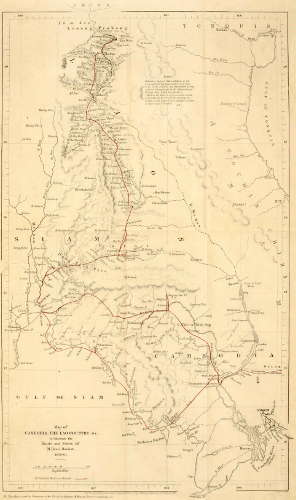
Map of
CAMBODIA, THE LAO COUNTRY &c.
to illustrate the
Route and Notes of
M. Henri Mouhot.
1859-61.
Pubd for the Journal of the Royal Geographical Socy. by J. Murray, Albemarle Strt. London, 1862.
NB. This Map is used by Permission of the R. G. Socy. to illustrate M. Mouhot’s Travels in Cambodia, &c.


