Geography and History of the Kingdom of Siam.
HISTORY OF SIAM.
The name of Siam was first heard in Europe in the year
1502. Nine years after Alphonso d’Albuquerque had conquered
the peninsula of Malacca, some intercourse took
place between Portugal and Siam, which, however, was
interrupted by the long wars between this country and
the Burmese.
In 1632 an English vessel touched at the ancient capital
Ayuthia. Shortly afterwards the Portuguese at Goa sent
a party of Dominican and Franciscan missionaries to Siam,
and the communication between the two nations became
more frequent. The King engaged in his service three
hundred Portuguese soldiers, who were distributed over
the country, having lands allotted to them for cultivation,
and who contracted marriage with native women.
The missionaries built two churches, and established a
school.
After a while the Dutch power began to supplant that of
Portugal in the East, and, in the course of the seventeenth
century, the empire of Siam was brought into contact
with the new conquerors of the Indies. The Portuguese
colonies gradually became extinct; and the influence of
the Batavian settlers increased so much, that they established
at Ayuthia a Dutch factory, which, under its
director Schonten, attained its greatest prosperity about
the year 1690. Various articles of merchandise were introduced
into Siam, from whence, in return, were exported
skins, sapan-wood, &c.; and the country, from its position
and the richness of its natural productions, became at
that time an important station for the commerce of the
Dutch between China and Japan, and the valuable islands
of Ceylon and Java.
France herself, at the height of her maritime power
under Louis XIV., could not equal the power of the
Dutch Company, though, at one period, chances eminently
favourable presented themselves to her. A Greek adventurer
named Constantine Phaulcon, of whom we shall have
subsequently to speak, opened for himself a remarkable
career in Siam, where he was converted to Romanism
by the missionaries. He suggested to the King to send
envoys to Louis XIV., and their arrival in France produced
a sensation, the echo of which we have heard in
our own day in the embassy from the same country to
Napoleon III. His Most Christian Majesty replied by
accrediting ambassadors to the Siamese Court—De Chaumont
in 1685, and La Loubéze in 1687. Each was
accompanied by several Jesuit priests; and a force of 500
men, under the command of General de Fargues, was
stationed at Bangkok. The General, however, was not
able to maintain his position; Constantine met with a
tragic end, and the Jesuit fathers were kept as hostages.
These failures destroyed the French influence for more
than a century and a half, and for a time strengthened the
power of Holland.
This brief glance at the intercourse between Europe
and Siam in the sixteenth and seventeenth centuries will
suffice.
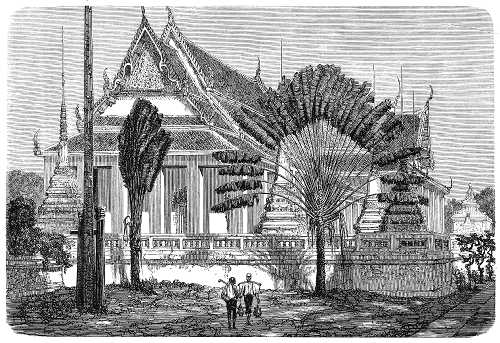
Drawn by M. Thérond, from a Photograph.
PAGODA AT AYUTHIA.
The celebrated German traveller Mandelslohe visited
the capital Ayuthia in 1537, and called it the Venice of
the East—a title which, as we have seen, is equally
applicable to the modern capital Bangkok. The Portuguese
explorer Mendez Pinto, who also paid a visit to
Siam in the sixteenth century, gives a favourable picture
of the country, and all that has since come to our knowledge
respecting it shows that he merited a greater faith
in his statements than was accorded to him by his contemporaries.
EXTENT OF SIAM.
The empire of Siam is of great extent. Its limits
have varied much at different epochs of its history; and
even now, with the exception of the western frontier, the
lines of demarcation cannot be exactly traced, most of
the border-lands being occupied by tribes more or less
independent, and there are perpetual wars between the
Malay and Burmese races on the one side, and the Cambodian
or Chinese on the other. As nearly as can be
calculated, the country extends, at present, from the 4th
to the 20th or 22nd degree of north latitude, and from the
96th to the 102nd degree of east longitude; and according
to this computation, its length would be about 1200 miles
and its breadth 400 miles.
PROVINCES OF SIAM.
The Siamese dominions are divided into forty-one provinces,
each presided over by a phaja or governor, and
these, again, are subdivided into numerous districts under
the authority of functionaries of inferior rank, of whose
administration little can be said in praise.
The northern provinces are five in number—Sangkalôk,
Phitsalôk or Phitsanulôk, Kumphang-Phet, Phixai, and
Tahëng. In the centre are nine provinces—Nantaburi
or Jalat-Khuan, Pak-Pret, Patummatoni or Samkuk,
Ayuthia or Krung-Kao, Ang-Thong, Monang-Phrom,
Monang-In, Xainat, and Nakhon-Savan.
There are seven in the west—Monang-Pin, Suphan or
Suphanaburi, Kan-Chanaburi or Pak-Phrëk, Rapri or
Raxaburi, Nakhon-Xaisi, Sakhonburi or Tha-Chin, Samut-Songkhram
or Mei-Khlong.
The eastern provinces number ten—Phetsjaboun, Bua-Xum,
Sara-Buri, Nopha-Buri, Nakhon-Najok, Patsjin,
Kabin, Sasong-Sao or Petriu, Battabâng, and Phanatsani-Khom.
In the south are—Pakhlat or Nakhon-Khuen-Khan,
Paknam or Sananthaprakan, Bangplasor or Xalaburi,
Rajong, Chantaboun or Chantabouri, Thung-Jai, Phiphri
or Phetxaburi, Xumphon, Xaya, and Xalang or Salang.
Siam has been distinguished by the historians of the
country under two great divisions—Monang-Nona, the
region of the north, at first the more populous portion, and
Monang-Tai, the southern region. The Chronicles of
the south are sometimes called ‘The Chronicles of the
Royal City’ (Ayuthia), and commence at the period when
this place became the capital. De Barrios relates that,
in his time (the fifteenth century), nine states were in subjection
to the monarchs of Siam, two only of which were
peopled by the Siamese race—viz., the southern kingdom,
and that of the north, whose chief city was Chaumua.
The Siamese language, likewise, was spoken only in these
two countries.
Siam is called by the natives Thaï, or Monang-Thaï,
which means “free” or “the kingdom of the free.”
Archbishop Pallegoix, who is a great authority in these
matters, maintains that the modern name Siam is derived
from Sajam, or “the brown race.”[2]
CONNECTION WITH NEIGHBOURING STATES.
While several districts in the north and east are tributary
to this country, it appears to have been itself
originally a great fief of China. Thus the King of Siam
receives from this neighbouring empire a special confirmation
of his authority, much resembling the patronage
accorded by the Sultan to the Barbary states. However,
if the external forms of this vassalage are observed, it is
rather from a profound respect for tradition and ancient
custom than from any virtual recognition of the power
of the Emperor of China to acknowledge or interfere with
the rights of sovereignty. One of the dependencies of this
country, Cambodia, is also claimed by Cochin-China, and
its ruler, unable to resist either of his more powerful
neighbours, is forced to pay tribute to both.
POPULATION.
The population of Siam cannot yet be determined
with any great exactness, but it is certain that it bears
no proportion to the extent of territory. Archbishop
Pallegoix estimates it at only 6,000,000—a computation,
however, very different from that of Sir John Bowring.
The difficulty of arriving at any correct result is augmented
by the Siamese custom of numbering only the men. Thus,
the native registers showed, a few years ago, for the male
sex, 2,000,000 Siamese, 1,000,000 Laotians, 1,000,000
Malays, 1,500,000 Chinese, 350,000 Cambodians, 50,000
Peguans, and a like number composed of various tribes
inhabiting the mountain ranges.
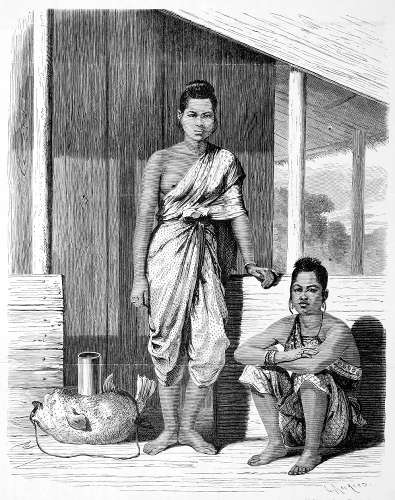
Drawn by M. Bocourt from a Photograph.
SIAMESE WOMEN.
PHYSICAL FEATURES.
In the north, a chain of mountains, covered with snow,
extends from the province of Yunan to China, and its
ramifications form two great divisions, between which is
situated the fertile valley of Siam. Another chain stretches
towards the west, as far as the Malay peninsula. The
great river Menam, already mentioned, traverses the level
country from north to south, taking its rise in the southern
slopes of the mountains of Yunan, and empties itself
into the Gulf of Siam. It is the Nile of this region, the
great fertility of which is owing to the annual overflowing
of its waters, an event eagerly looked for by the inhabitants,
and welcomed as a blessing from Heaven. The
Menam begins to rise in the month of June, and in
August the inundation reaches its height, and then the
waves of the ocean, opposing themselves to the current,
force the waters of the river back upon its banks. The
lands situated towards the middle of the great plain
receive most benefit from this operation of nature, the
higher districts being too much surrounded by mountains,
while the lower are impregnated with so much salt water
as to render the cultivation of rice difficult. If the
regular inundations are, as a general rule, productive of
immense benefit, they now and then, as in Egypt, lay
waste the country: thus, for example, that of 1851
destroyed all the sugar-plantations; and the water, to a
depth of three or four feet, resting on the earth for some
time, a large number of cattle perished, the rice-crops
suffered seriously, and many valuable fruit-trees were
carried away. Some years afterwards, however, in
accordance with nature’s beneficent law of compensation,
the produce was only the more abundant.
The ancient annals of Siam relate that, about the
seventh century, Chinese junks used to ascend the stream
as far as Sang-Khalak, a distance of 120 leagues from
the sea; at present it is only navigable for 30 leagues
at most. This alteration has arisen from a gradually-increasing
collection of sand and alluvial deposit—a process
which goes on in some of our western rivers, as, for
instance, the Rhine and the Meuse.
The low grounds, as is usually the case in hot climates,
are less healthy than the mountainous districts, and the
forests especially are the seat of malignant fevers. Several
other rivers, and numberless canals, fringed with bamboos
and fruit-trees, round which fly a multitude of birds,
give a pleasing aspect to the country, which is bounded
on the horizon by richly-wooded hills.
The rivers are rich in fish, which, in addition to rice,
forms the principal food of the people.
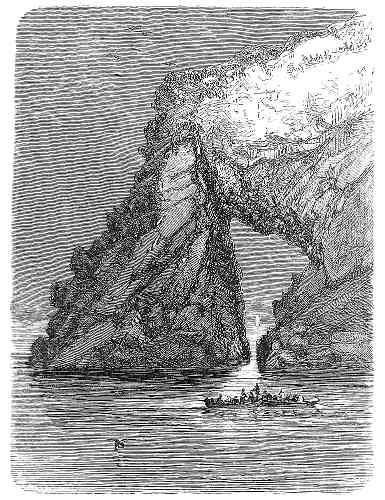
Drawn by M. Sabatier, from a Sketch by M. Mouhot.
PERFORATED ROCK IN THE ISLE OF EBOULON, GULF OF SIAM.
The shores of the sea are very picturesque, and the coast
is studded with islands covered with the most luxuriant
vegetation. “The Gulf of Siam,” says Mgr. Pallegoix,
“is not subject to storms, nor to the destructive typhoons
experienced on the Chinese seaboard; thus shipwrecks are
of rare occurrence.”
Sir John Bowring recommends to his countrymen a
project which he believes feasible, and which would
scarcely be secondary in importance to the intersection of
the Isthmus of Darien or that of Suez. It is the union
of the Bay of Bengal with the Gulf of Siam. He hopes
that the establishment of amicable relations between Great
Britain and the Siamese Empire will lead to the ventilation
and eventual solution of a question so interesting both
in a geographical and commercial point of view. It would
be, in reality, as he says, a noble enterprise, which would
considerably shorten the voyage between India and Eastern
Asia, by making no longer necessary the tedious détour
through the Straits of Malacca, a passage which occupies
not days, but weeks.
MINERALS.
The soil of this country, composed in great part of
alluvial earth, in Siam watered by its great river, and
in Cambodia by the Nekong and many other streams,
refreshed by the periodical rains, and glowing beneath a
tropical sky, possesses almost unlimited capabilities. The
mountains in the north contain precious metals, but the
working of them is as yet very imperfectly attempted.
The tin of Siam has been long in repute; copper, lead, and
iron have also been discovered. Diamonds and other
precious stones exist, although the exact localities where
they are met with are not known, for the natives are
very mysterious on the subject; but it is supposed that
diamonds are found on the eastern boundary of the Gulf.
ARCHIVES.
The history of the empire, arranged in the form of
chronicles, is preserved in the archives, and not permitted
to be inspected by strangers. The late king made investigations
into these documents, which, previously to
the foundation of Ayuthia, towards the middle of the
fourteenth century, only presented a mass of confused
materials, in which truth and fable are curiously intermingled,
as in the annals of all nations, and pre-eminently
those of the Orientals, who love to substitute
highly-coloured narratives, in the style of the Arabian
Nights, for plain history.
The Siamese trace their genealogy up to the first
disciples of Buddha (Gandama), and commence their
records five centuries before the Christian era. A succession
of dynasties, varying their seat of government,
figure in the earlier volumes; and the miracles of Buddha,
and the intervention of supernatural beings, are frequently
introduced. Later on there are accounts of matrimonial
alliances between Siamese princes and the Imperial families
of China, and of embassies to, and wars with, neighbouring
countries, the whole interwoven with relations of
prodigies and marvellous legends respecting Sudra and
other divinities. After the establishment of Ayuthia as
the capital, history assumes its rightful place, and the
succession of the sovereigns and the course of events are
registered with tolerable correctness. The city of Ayuthia
was founded by Phaja-Utong, who took the title of Phra-Rama-Thibaldi.[3]
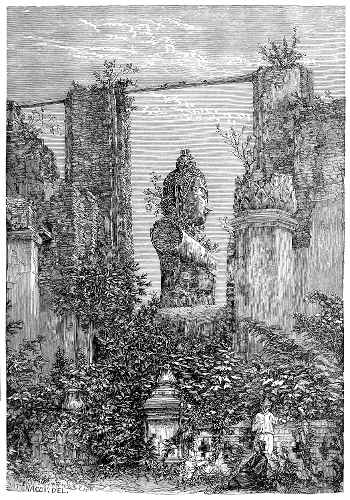
Drawn by M. Catenacci, from a Photograph.
RUINS OF A TEMPLE AND STATUE OF BUDDHA AT AYUTHIA.
EPOCHS.
The following dates, drawn from the annals, and
marking important epochs in the sacred history of Siam,
are believed to be nearly correct:—
| Christian Era. | Buddhist Era. |
|---|
| The reigning Buddha died on the 3rd day of the 6th month of the year of the serpent, corresponding with the year | B.C. 543 | |
| The first great Buddhist Council was convoked under Ajatra-Sutra (in India) the year of the death of Buddha | | |
| The second grand Council was convoked under Hala-Sokkaraja | B.C. 443 | 100 |
| The third, under the rule of Sri Dhamma Soka | B.C. 325 | 218 |
| The fourth grand Council | B.C. 143 | 400 |
| The Buddhist doctor, Phra Buddha Ghosa, introduced Buddhism into Cambodia | A.D. 422 | 965 |
It was in the year 1000 of the Buddhist era, A.D. 457,
that King Tuang, whose accession and glorious reign
had been announced by a communication from Gandama
himself, and who possessed, in addition to his other
claims to distinction, “a white elephant with black
tusks,” introduced the alphabet Tai, which was communicated
to a numerous conclave of Buddhist priests. The
ancient chronicles terminate with the establishment of
Chao-Utonng in the new city of Si-Ayo-Thaya (Ayuthia),
but leave the date of this event rather doubtful.
SIAMESE MONARCHS.
The following is the list of Siamese monarchs since
the foundation of this capital:—
| Siamese Era. | Christian Era. | |
|---|
| 712 | 1350 | Phra Rama Phiobodi. |
| 731 | 1369 | —— Rama Suen (his son). |
| 732 | 1370 | —— Borom Raxa (his brother). |
| 744 | 1382 | —— Rama Suen II. |
| 747 | 1385 | —— Phaja Ram (his son). |
| 763 | 1401 | Inthaxara. |
| 792 | 1430 | Borom Raxa Phirat. |
| 805 | 1442 | Boronua Irai Lokharat. |
| 834 | 1472 | Phra Rama Phibodi. |
| 875 | 1513 | Raxa Kuman. |
| 876 | 1514 | Xaja Raxa Phirat. |
| 889 | 1527 | Phra Jot Fa. |
| 891 | 1529 | Maha Cha Kraphat Raxa Ihirat. |
| 909 | 1547 | Phra Chao Xang Phuok. |
| 914 | 1552 | Mahinthara Thirat. |
| 926 | 1564 | Phra Naret. |
| 957 | 1595 | Eka Thotsarot. |
| 963 | 1601 | Chao Fa. |
| 964 | 1602 | Phra Chao Song Iham. |
| 989 | 1627 | Phra Chao Prasal Ihong. |
| 1017 | 1655 | Chao Fa Xai. |
| 1018 | 1656 | Phra Chao Xam Phuok. |
| 1050 | 1688 | Phra Phet Raxa. |
| 1059 | 1697 | Chao Dua. |
| 1068 | 1706 | Name unknown. |
| 1120 | 1758 | Chao Dok Ma Dua. |
| 1128 | 1766 | Interregnum. |
| 1129 | 1767 | Phyja Tak. |
| 1173 | 1811 | Phra Phuti Chao Luang (the founder of the present dynasty). |
| 1187 | 1825 | Phen Din Prasat Ihong. |
| 1213 | 1851 | Phra Chao Prasat Ihong. |
HISTORICAL SKETCH.
Instead of dwelling on the ancient history of Siam,
we prefer to give an extract from the appendix to the
celebrated work of Sir John Bowring, ‘The Kingdom
and People of Siam:’ the passage originally appeared
in ‘The Chinese Repository,’ and is from the pen of the
late king:—
“Our ancient capital Ayuthia, before the year A.D. 1350,
was but the ruin of an ancient place belonging to Kambuja
(now known as Cambodia), formerly called Lawék,
whose inhabitants then possessed Southern Siam, or
Western Kambuja. Ayuthia is situated in lat. 14° 19′ N.,
and long. 100° 37′ E. from Greenwich. There were other
cities, not far remote, also possessed by the Kambujans;
but their precise locality or much of their history cannot
now be satisfactorily ascertained. Some time near the
year A.D. 1300, the former inhabitants were much diminished
by frequent wars with the northern Siamese and
the Peguans, or Mous, so that these cities were vacated,
or left in a ruinous state, and nothing remained but their
names.
“Former inhabitants declared that the people of
Chiang-rái, a province of what is now called Chiang-mái
(North Laos), and Kampengpet, being frequently subjected
to great annoyance from their enemies, deserted their
native country, and formed a new establishment at Ch’á-liang,
in the western part of Siam proper, and built a
city, which they called Thepha-mahá-na-khon, whence has
been preserved in the national records the name of our
capital down to the present day, Krung-Thepha-mahá-na-khon.
Their city was about lat. 16° N., and long. 99° E.,
and there five kings of the first dynasty reigned, until
the sixth, named U-T’ong Rámá-thi-bodi, ascended the
throne in 1344. This king, it is said, was son-in-law of
his predecessor, who was named Sirichai Chiang Seu, who
was without male issue, and therefore the throne descended
to the son-in-law by right of the royal daughter.
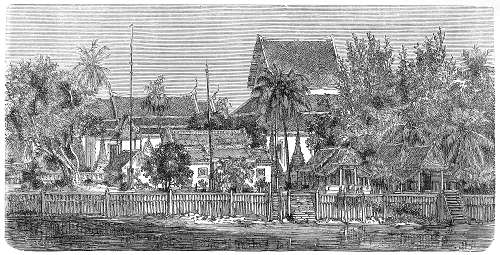
Drawn by M. Thérond, from a Photograph.
THE PAGODA OF AYUTHIA, FROM THE RIVER.
“U-T’ong Rámá-thi-bodi was a mightier prince than
any of his predecessors, and subsequently conquered and
subjected to his sway all Southern Siam, and some provinces
in the Malayan peninsula. He made Ch’á-liang
the seat of his government for six years, and then, in
consequence of the prevalence of disease of a pestilential
character, he caused various researches to be made
for some more healthy location, and finally fixed upon the
site of Ayuthia, and there founded his new capital in
April, 1350. This date is an ascertained fact. From
this period our Siamese annals are more exact and the
accounts generally reliable, being accompanied by dates
of days, months, and years, from 1350 to 1767.
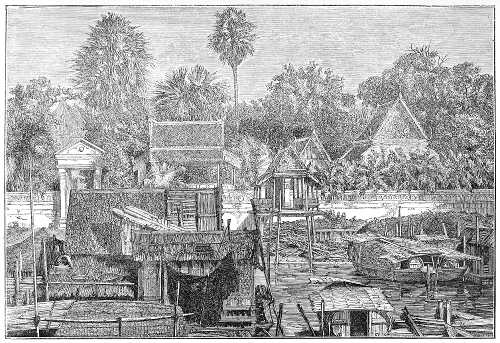
Drawn by M. Thérond, from a Photograph.
VIEW TAKEN FROM THE CANAL OF AYUTHIA.
“Ayuthia, when founded, was gradually improved
and became more and more populous by natural increase,
and the settlement there of families of Laos, Kambujans,
Peguans, people from Yunnán in China, who had been
brought there as captives, and by Chinese and Mussulmans
from India, who came for the purposes of trade.
Here reigned fifteen kings of one dynasty, successors of
and belonging to the family of U-T’ong Rámá-thi-bodi,
who, after his death, was honourably designated as Phra
Chetha Bida—i. e. ‘Royal Elder Brother Father.’ This
line was interrupted by one interloping usurper between
the thirteenth and fourteenth. The last king was Ma-híntrá-thi-rát.
During his reign the renowned King of
Pegu, named Chamna-dischop, gathered an immense
army, consisting of Peguans, Burmese, and inhabitants of
Northern Siam, and made an attack upon Ayuthia. The
ruler of Northern Siam was Mahá-thamma rájá, related
to the fourteenth king as son-in-law, and to the last as
brother-in-law.
“After a siege of three months the Peguans took
Ayuthia, but did not destroy it or its inhabitants, the
Peguan monarch contenting himself with capturing the
king and royal family, to take with him as trophies to
Pegu, and delivered the country over to be governed
by Mahá-thamma rájá, as a dependency. The King of
Pegu also took back with him the oldest son of Mahá-thamma
rájá as a hostage: his name was Phra Náret.
This conquest of Ayuthia by the King of Pegu took place
A.D. 1556.
“This state of dependence and tribute continued but
a few years. The King of Pegu died, and in the confusion
incident to the elevation of his son as his successor,
Prince Náret escaped with his family, and, attended by
many Peguans of influence, commenced his return to his
native land. The new king, on hearing of his escape,
despatched an army to seize and bring him back. They
followed him till he had crossed the Si-thong (Burman,
Sit-thaung) River, where he turned against the Peguan
army, shot the commander, who fell from his elephant
dead, and then proceeded in safety to Ayuthia.
“War with Pegu followed, and Siam again became
independent. On the demise of Mahá-thamma rájá, Prince
Náret succeeded to the throne, and became one of the
mightiest and most renowned rulers Siam ever had. In
his wars with Pegu he was accompanied by his younger
brother, Eká-tassa-rot, who succeeded Náret on the throne,
but, on account of mental derangement, was soon removed,
and Phra Siri Sin Wi-mon-tham was called by the nobles
from the priesthood to the throne. He had been very
popular as a learned and religious teacher, and commanded
the respect of all the public counsellors; but he
was not of the royal family. His coronation took place
A.D. 1602. There had preceded him a race of nineteen
kings, excepting one usurper. The new king submitted
all authority in government to a descendant of the former
line of kings, and to him also he intrusted his sons for
education, reposing confidence in him as capable of
maintaining the royal authority over all the tributary
provinces. This officer thus became possessed of the
highest dignity and power. His master had been raised
to the throne at an advanced age. During the twenty-six
years he was on the throne he had three sons, born under
the royal canopy—i. e. the great white umbrella, one of
the insignia of royalty.
“After the demise of the king, at an extreme old age,
the personage whom he had appointed as regent, in full
council of the nobles, raised his eldest son, then sixteen
years old, to the throne. A short time after the regent
caused the second son to be slain, under the pretext of
a rebellion against his elder brother. Those who were
envious of the regent, excited the king to revenge his
brother’s death as causeless, and plan the regent’s assassination;
but he, being seasonably apprised of it, called a
council of the nobles and dethroned him after one year’s
reign, and then raised his youngest brother, the third
son, to the throne.
“He was only eleven years old. His extreme youth
and fondness for play, rather than politics or government,
soon created discontent. Men of office saw that it
was exposing their country to contempt, and sought for
some one who might fill the place with dignity. The
regent was long accustomed to all the duties of the
government, and had enjoyed the confidence of their late
venerable king; so, with one voice, the child was dethroned
and the regent exalted under the title of Phra Chau Pra
Sath-thong. This event occurred A.D. 1630.
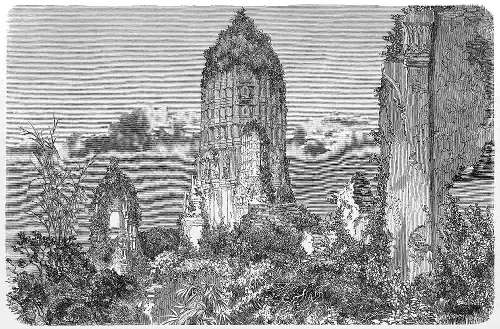
Drawn by M. Thérond, from a Photograph.
RUINS OF A PAGODA AT AYUTHIA.
“The king was said to have been connected with the
former dynasty, both paternally and maternally; but the
connection must have been quite remote and obscure.
Under the reign of the priest-king he bore the title
Raja Suriwong, as indicating a remote connection with
the royal family. From him descended a line of ten
kings, who reigned at Ayuthia and Lopha-buri—Louvo
of French writers. This line was once interrupted by an
usurper between the fourth and fifth reigns. This usurper
was the foster-father of an unacknowledged though real
son of the fourth king Chau Nárái. During his reign
many European merchants established themselves and
their trade in the country, among whom was Constantine
Phaulkon (Faulkon). He became a great favourite
through his skill in business, his suggestions and superintendence
of public works after European models, and
by his presents of many articles regarded by the people
of those days as great curiosities, such as telescopes, &c.
“King Nárái, the most distinguished of all Siamese
rulers, before or since, being highly pleased with the
services of Constantine, conferred on him the title of
Chau Phyá Wicha-yentrá-thé-bodi, under which title there
devolved on him the management of the government in
all the northern provinces of the country. He suggested
to the king the plan of erecting a fort on European principles
as a protection to the capital. This was so acceptable
a proposal, that at the king’s direction he was
authorised to select the location and construct the fort.
“He selected a territory which was then employed
as garden-ground, but is now the territory of Bangkok.
On the west bank, near the mouth of a canal, now called
Báng-luang, he constructed a fort, which bears the name
of Wichayeiw Fort to this day. It is close to the residence
of his Royal Highness Chaufá-noi Kromma Khun
Isaret rangsan. This fort and circumjacent territory was
called Thana-buri. A wall was erected, enclosing a space
of about 100 yards square. Another fort was built on the
east side of the river, where the walled city of Bangkok
now stands. The ancient name Bangkok was in use when
the whole region was a garden.[4] The above-mentioned
fort was erected about the year A.D. 1675.
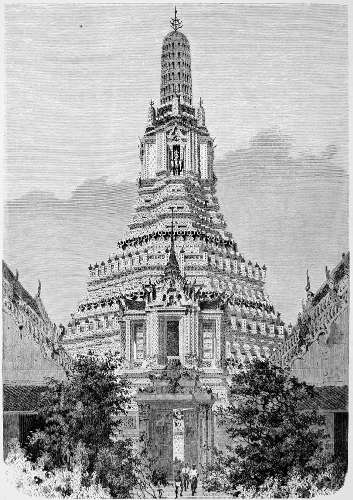
Drawn by M. Thérond, from a Photograph.
THE GREAT TOWER OF THE PAGODA WAT-CHING AT BANGKOK.
“This extraordinary European also induced his grateful
sovereign King Nárái to repair the old city of Lopha-buri
(Louvo), and construct there an extensive royal
palace on the principles of European architecture. On
the north of this palace Constantine erected an extensive
and beautiful collection of buildings for his own residence.
Here also he built a Romish church, on which
are still to be seen some inscriptions in European letters,
supposed to be Dutch or German; they assuredly are
neither French nor English (perhaps they are Greek, as
he was of Greek extraction, and born at Cephalonia).
The ruins of all these edifices and their walls are still
to be seen, and are said to be a great curiosity. It is
moreover stated that he planned the construction of
canals, with reservoirs at intervals for bringing water
from the mountains on the north-east to the city Lopha-buri,
and conveying it through earthen and copper pipes
and syphons, so as to supply the city in the dry season on
the same principle as that adopted in Europe. He commenced
also a canal, with embankments, to the holy
place called Phra-Bat, about twenty-five miles south-west
from the city. He made an artificial pond on the summit
of Phra-Bat mountain, and thence, by means of copper
tubes and stop-cocks, conveyed abundance of water to
the kitchen and bath-rooms of the royal residence at the
foot of the mountain. His works were not completed
when misfortune overtook him.
“Many Siamese officers and royal ministers were jealous
of his influence, and murmured their suspicions of his
being a secret rebel. At length he was accused of designing
to put the king to death by inviting him to visit the
church he had built, between the walls of which, it is said,
he had inserted a quantity of gunpowder, which was to be
ignited by a match at a given signal, and thus involve
the death of the king. On this serious charge he was
assassinated by private order of the king. (This is the
traditional story: the written annals state that he was
slain in his sedan while faithful to his king, by order of
a rebel prince, who perceived he could not succeed in his
nefarious plans against the throne while Constantine
lived.) The works which he left half done are now generally
in ruins, viz. the canal to Phra-Bat and the aqueduct
at the mountains.
“After the demise of Nárái, his unacknowledged son,
born of a princess of Yunnan or Chiang-Mai, and intrusted
for training to the care of Phya Petcha raja, slew Nárái’s
son and heir, and constituted his foster-father king, himself
acting as prime minister till the death of his foster-father,
fifteen years after; he then assumed the royal state himself.
He is ordinarily spoken of as Nai Dua. Two of his sons
and two of his grandsons subsequently reigned at Ayuthia.
The youngest of these grandsons reigned only a
short time, and then surrendered the royal authority to
his brother and entered the priesthood. While this
brother reigned, in the year 1759, the Burman king,
Meng-luang Alaung Barah-gyi, came with an immense
army, marching in three divisions on as many distinct
routes, and combined at last in the siege of Ayuthia.
“The Siamese king, Chaufa Ekadwat Anurak Moutri,
made no resolute effort of resistance. His great officers
disagreed in their measures. The inhabitants of all the
smaller towns were indeed called behind the walls of
the city, and ordered to defend it to their utmost ability;
but jealousy and dissension rendered all their bravery
useless. Sallies and skirmishes were frequent, in which
the Burmese were generally the victorious party. The
siege was continued for two years. The Burmese commander-in-chief,
Mahá Nōratha, died, but his principal
officers elected another in his place. At the end of the
two years the Burmese, favoured by the dry season, when
the waters were shallow, crossed in safety, battered the
walls, broke down the gates, and entered without resistance.
The provisions of the Siamese were exhausted,
confusion reigned, and the Burmese fired the city and
public buildings. The king, badly wounded, escaped with
his flying subjects, but soon died alone of his wounds and
his sorrows. He was subsequently discovered and buried.
“His brother, who was in the priesthood and now the
most important personage in the country, was captured
by the Burmans, to be conveyed in triumph to Burmah.
They perceived that the country was too remote from
their own to be governed by them; they therefore freely
plundered the inhabitants, beating, wounding, and even
killing many families, to induce them to disclose treasures
which they supposed were hidden by them. By these
measures the Burmese officers enriched themselves with
most of the wealth of the country. After two or three
months spent in plunder they appointed a person of Mon
or Peguan origin as ruler over Siam, and withdrew with
numerous captives, leaving this Peguan officer to gather
fugitives and property to convey to Burmah at some
subsequent opportunity. This officer was named Phrá
Nái Kông, and made his head-quarters about three miles
north of the city, at a place called Phō Sam-ton, i. e. ‘the
three Sacred Fig-trees.’ One account relates that the
last king mentioned above, when he fled from the city
wounded, was apprehended by a party of travellers and
brought into the presence of Phyá Nái Kông in a state
of great exhaustion and illness; that he was kindly
received and respectfully treated, as though he was still
the sovereign; and that Phyá Nái Kông promised to
confirm him again as ruler of Siam, but his strength
failed and he died a few days after his apprehension.
“The conquest by Burmah, the destruction of Ayuthia,
and appointment of Phyá Nái Kông, took place in March,
A.D. 1767. This date is unquestionable. The period
between the foundation of Ayuthia and its overthrow by
the Burmans embraces 417 years, during which there were
thirty-three kings of three distinct dynasties, of which the
first dynasty had nineteen kings with one usurper, the
second had three kings, and the third had nine kings and
one usurper.
“When Ayuthia was conquered by the Burmese, in
March, 1767, there remained in the country many bands
of robbers associated under brave men as their leaders.
These parties had continued their depredations since the
first appearance of the Burman army, and during about
two years had lived by plundering the quiet inhabitants,
having no government to fear. On the return of the
Burman troops to their own country, these parties of
robbers had various skirmishes with each other during the
year 1767.
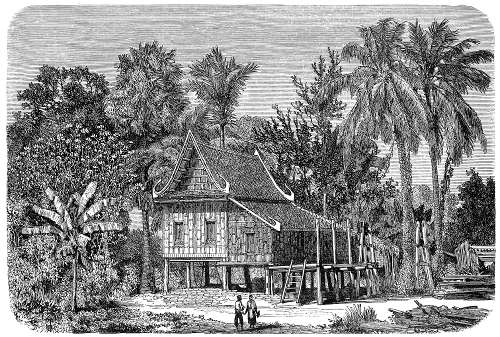
Drawn by M. Thérond from a Photograph.
PRIEST’S HOUSE NEAR AYUTHIA.
“The first king established at Bangkok was an extraordinary
man, of Chinese origin, named Pin Tat. He
was called by the Chinese Tia Sin Tat, or Tuat. He was
born at a village called Bánták, in Northern Siam, in
lat. 16° N. The date of his birth was in March, 1734. At
the capture of Ayuthia he was thirty-three years old.
Previous to that time he had obtained the office of
second governor of his own township, Ták, and he next
obtained the office of governor of his own town, under
the dignified title of Phyá Ták, which name he bears to
the present day. During the reign of the last King of
Ayuthia, he was promoted to the office and dignity
of governor of the city of Kam-Cheng-philet, which
from times of antiquity was called the capital of the
western province of Northern Siam. He obtained this
office by bribing the high minister of the king, Chaufá
Ekadwat Anurak Moutri; and being a brave warrior, he
was called to Ayuthia on the arrival of the Burman
troops, as a member of the council. But when sent to
resist the Burman troops, who were harassing the eastern
side of the city, perceiving that the Ayuthian government
was unable to resist the enemy, he, with his
followers, fled to Chautaburi (Chautabun), a town on the
eastern shore of the Gulf of Siam, in lat. 12½° N. and
long. 101° 21′ E. There he united with many brave
men, who were robbers and pirates, and subsisted by
robbing the villages and merchant-vessels. In this way
he became the great military leader of the district, and
had a force of more than ten thousand men. He soon
formed a treaty of peace with the headman of Báng-plásoi,
a district on the north, and with Kambuja and
Annam (or Cochin China) on the south-east.”
Such is the short historical sketch, given by the late
King of Siam, up to this date, and which we must complete
from other sources.
As much by stratagem as by force of arms, he gained
possession of the northern districts; but, not deeming
himself secure enough from hostile attacks in that part of
the country, he decided on falling back towards the south,
and established himself at Bangkok, having previously
surprised and put to death Phrá-Nai-Kông, the Burman
governor of that place, and seized on a quantity of money,
provisions, and ammunition. Its proximity to the sea
afforded many advantages, one being that escape would
be tolerably easy should fortune prove adverse to him.
He there built a palace on the western bank of the river,
near the fort, which is now standing.
After various encounters with the Burmans, he reduced
them into subjection, mainly through the assistance of
his flotilla; and on one occasion he overpowered their
whole camp, recovering great part of the booty they had
amassed, and finally freeing the country from those bitter
foes, who had brought into it so much desolation and
terror. The people, in gratitude to their deliverer, gladly
aided him in his assumption of royal authority. He issued
his mandates from Bangkok, appointed viceroys, and distributed
colonists far and wide for the repeopling of the
country. Thus, by the end of 1768, he found himself
sovereign of all the southern part of Siam and the
eastern provinces on the shores of the Gulf.
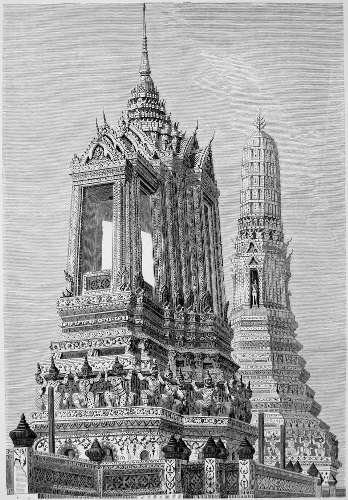
Drawn by M. Bocourt from a Photograph.
DETAILS OF THE PAGODA WAT-CHANG AT BANGKOK.
Profiting by a sanguinary war between China and
Burmah, he reconquered the northern district of Horahh.
He had still to contend with a revolt organised by a prince
of the old dynasty, who, pending the struggle with the
Burmans, had taken refuge in Ceylon. This, however, was
soon quelled; and two more provinces were recovered,
which had taken advantage of the foreign invasion to
assert their independence. At the end of three years
Phya-Jak was master of the whole of the north, and had
everywhere re-established peace and order. His dominion
being now set on a firm foundation, it was a comparatively
easy matter successfully to resist a new attack of
the Burmans in 1771; and the year following he sent
an expedition into the Malay peninsula to take possession
of Lagor, whose governor, formerly a vassal of the
king, had assumed the sovereignty, and proclaimed Phya-Jak
a usurper. The governor, being worsted in several
engagements, took refuge with the chief of Patawi, a
town in the peninsula, by whom he was surrendered to
the followers of Phya-Jak. The king himself, meanwhile,
had entered Lagor, made captives of all the governor’s
family, and carried off his treasures. Among his relatives
was a daughter possessed of great beauty: the King
gave her a place in his harem; and, through her intercession,
her father and all the family were spared.
Three or four years afterwards she procured his reinstatement
as prince of that district, which at the present
day is governed by his descendants.
Phya-Jak’s reign did not end happily: in the latter
part of his life he fell into a state of morbid melancholy,
treated his subjects with cruelty, and lost his popularity.
One of his generals, Chakri, commanding in Cambodia,
took advantage of these circumstances to concert a plot
against the King, who was taken prisoner at Bangkok,
and assassinated in the year 1782. Chakri ascended the
throne, and, dying soon afterwards, was succeeded by his
son. The old quarrels with the Burmans were renewed
about some disputed districts on the northern frontier;
and the Siamese monarch came victoriously out of two
encounters, but, in a third, was overcome, and lost the
western part of the country lying towards Burmah.
This king died in 1809, and his son and successor,
fearing, or feigning to dread, conspiracies against him, put
to death one hundred and seventeen Siamese nobles,
among whom were several generals who had fought by
his father’s side against the Burmans. This atrocious
massacre, and the murder of a cousin much beloved by
the people, alienated their affections from him. In other
respects he ruled with wisdom and moderation: keeping
in check the turbulent Malays, he also successfully
repulsed the incursions of the Burmans, bringing his
prisoners to Bangkok, where he gave them lands to cultivate,
and thus extended his capital.
The English Government, wishing to form a commercial
treaty with this prince, sent Mr. Crawfurd on a
mission to Siam; but although that gentleman obtained
much interesting information respecting the country, he
failed in attaining his purpose. Allowed to remain with
his suite for some time at Bangkok, they were treated
rather as prisoners than guests. Their propositions were
rejected; and the only concession obtained from his
Majesty was a promise not to increase the export and
import duties, the entire abolition of which had been the
object of the negotiation. The King died in 1824, and
was succeeded by his illegitimate son, Crom-Chiat.
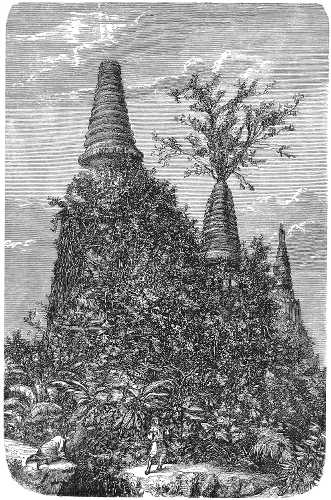
Drawn by M. Catenacci, from a Photograph.
RUINS AT AYUTHIA.
TREATY WITH GREAT BRITAIN.
This prince, although he feared the English, saw the
advantages of an extended commerce, and, in 1826, concluded
a treaty with Great Britain, then represented by
Captain Burney; but it did not effect all that had been
desired. Direct mercantile intercourse between the two
countries was certainly guaranteed, and assistance in all
cases of shipwreck on the coast; but English subjects,
during their stay, were to be subject to the laws of the
empire; and in each province the commerce could be
extended or limited at the will of the governor. As
these functionaries constantly infringed the terms of the
treaty, and imposed heavy charges on the native articles
exported, as well as on British goods introduced, disappointment
naturally resulted; and the Siamese, fearing
a resort to arms on the part of England, made preparations
for defence, and fortified the mouth of the Menam.
MISSIONS IN SIAM.
Meanwhile France was attempting to resume her old
intercourse with Siam; but at first great distrust was
manifested of the Catholic missionaries. In 1780 they
had been ordered, on pain of death, to quit the kingdom;
they retired for a time, but again gradually insinuated
themselves, and met with considerable success. We owe
to Mgr. Pallegoix, in addition to an interesting relation
of the progress of the mission, very important information
concerning this empire in the far East—its literature,
and the character and the manners of the inhabitants.
He established there seven churches and four chapels;
a seminary in which are thirty native pupils, several
other schools, and four monasteries; and has baptized
eight thousand Siamese. The King, annoyed at the
advance of the new religion, issued, in 1848, an edict
against the missionaries, commanding the destruction of
all their places of worship; but it was very partially
carried into execution.
The Protestant mission has had a more restricted
sphere of action. The celebrated Dr. Gutzlaff made a
long stay at Bangkok in 1828, and finished there his
translation of the New Testament into Siamese. This
work was published at Singapore, and has since been
widely circulated. In 1830 he revisited Siam, and translated
the greater part of the Scriptures into the languages
of Cambodia and Laos. At his request the
American Baptists founded the first Protestant mission at
Siam; the Presbyterians established a second in 1840;
and a third was founded, in 1850, by the Society of the
American Board of Commissioners for Foreign Missions.
Their labours, however, have not yet been crowned with
any great success; nevertheless, by uniting to their
ministerial office the practice of medicine, they have
done much good, and been favourably received by the
people.
The French priests have recently made efforts to gain
an influence over the government of Siam. At the death
of the King Orom-Chiat, his son Chao-Fa, then twenty
years of age, should have been his rightful successor, but
an elder illegitimate son seized on the throne, promising
his brother to resign it in a few years. This promise not
having been fulfilled, the prince, as we have before mentioned,
went into complete retirement, and gave himself
up to scientific pursuits. He then came into contact with
the Catholic missionaries, and, at their persuasion, made
himself acquainted with their religion.
ARCHBISHOP PALLEGOIX.
In 1851 the King fell ill, and, in spite of the promise
to his brother, wished to appoint one of his own sons as
his successor; but he was answered that the country
had already a sovereign; and, on his decease, Prince
Chao-Fa mounted the throne, under the name of Somdet
Phra. Mgr. Pallegoix addressed to him a letter of congratulation,
and presented him with a portrait of Louis
Napoleon, then President of the French Republic. The
King, in return, made him a gift of money, and revoked
the decree of banishment against the five Catholic priests;
and at an audience granted to the bishop before his
departure for Europe, in 1852, he charged him with
messages to Prince Louis Napoleon and the Pope,—intrusting
to him an autograph letter for the latter,
written in English, and expressing a great regard for
his Holiness, as well as his resolution to grant full toleration
in his kingdom to the Catholic religion.
He also declared to the archbishop[5] his intention of
assuring to his subjects entire religious liberty, with
which view he made inquiries from time to time respecting
the work of the Catholic missionaries, so as to protect
the converted natives against the heathen governors.
From that time the friendship with France has never
been interrupted, but has become more and more intimate.
TREATY WITH FRANCE.
Negotiations were commenced at Bangkok in 1856, in
the name of the French Government, which terminated
in a highly satisfactory manner, a treaty of friendship
and commerce being signed on the 15th August between
the two countries, which was ratified in the following
year. The reception accorded to M. de Montigny, the
French envoy, on this occasion by the two kings, was as
brilliant as it was cordial; nor was he entertained less
kindly by any of the authorities with whom he came
in contact, which proved that Siam has preserved a
pleasing remembrance of the embassies exchanged with
Louis XIV.
All this augured favourably for the future friendly
relations between the two Crowns; and these were confirmed
in the year 1861, when his Siamese Majesty sent
an embassy to Paris, where it arrived in June, and was
received with great magnificence.
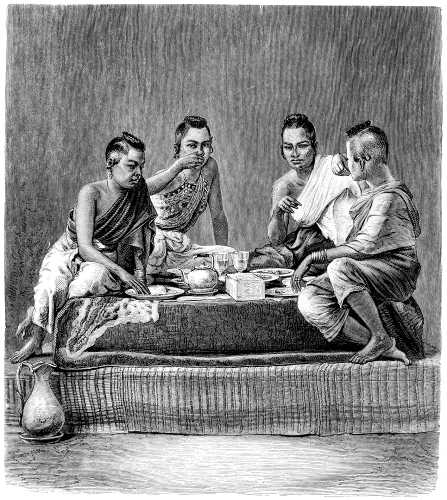
Drawn by M. Bocourt from a photograph
SIAMESE LADIES AT DINNER.
COMMERCE.
A French publication[6] gave the following account of
the commerce with Siam:—“According to the information
obtained from M. de Montigny, the commercial and
maritime relations between the kingdom of Siam and
Europe are capable of great development. Already more
than sixty European ships, have since 1854 entered yearly
the port of Bangkok, to which must be added a considerable
number of junks and prahus, which navigate
the China Sea and the Malayan Archipelago. The
markets of Siam and Laos abound in natural products,
such as tobacco, cotton, sugar, spice, and dyes. The
forests abound with magnificent trees, particularly teak.
By the terms of the treaty with France, the duties,
whether import or export, are but three per cent. on the
value of the merchandise. There is therefore room for
hope that commerce, favoured by the moderation of this
tariff, will rapidly increase, and that the French navy
will profit by it.”
In ‘Les Annales du Commerce Extérieur’ we find the
following account:—“The greater part of the commerce
of Siam, Laos, and Cambodia is in the hands of the
Chinese, who are much more active and intelligent than
the natives. Their mercantile transactions are generally
characterised by dishonesty, and we cannot too strongly
warn our traders against the frauds of every kind common
in this country, such as mixing diverse qualities, adulteration,
and saturating various articles with moisture to
increase the weight. Raw silk, cotton, and hemp, tobacco,
and other merchandise sold by weight, should be carefully
examined when delivered, and always compared with the
samples, which it is prudent to demand beforehand. The
treaty concluded between the Siamese Government and
France abolishes all monopolies, and obliges the authorities
to watch over the strict and faithful execution of
all bargains; therefore, in case of fraud, traders should
show a bold face and demand indemnity. They should
be careful themselves to set an example of strict probity,
this being the surest way to improve the morality of the
Siamese merchants, who, in dealing with people of proved
honesty, will have less temptation to employ fraud.
“The best commerce will be, doubtless, that of barter;
but it will be difficult to carry this to any great extent,
as these people have few wants. Their ordinary dress,
for example, consists simply of drawers in the hot
season, to which in winter they add one or more scarves,
to cover the upper part of the body. The dignitaries
and wealthy individuals on state occasions wear a rich
suit, consisting of drawers, vest, belt, and a large tunic.
They go barefoot, rarely having even sandals. They are
not of a migratory nature, but have their fixed habitations,
and are fond of elegance and luxury. Very imitative
in their ways, they feel a pride in putting on a
European dress; and some of those made after the
fashion of Louis XIV.’s reign are still preserved, especially
among the descendants of the Portuguese, who
are numerous. The uniforms of the soldiers are copied
from those of Europe; and the whole nation has a great
taste for our Parisian furniture, cotton, silk, and woollen
fabrics, porcelain, china, glass, bronzes, cutlery, ironmongery,
and toys. Other articles in much esteem with
them, and exported by us, are fire-arms, side-arms,
saddlery, quilts, carpets, clocks, and windows. Our
champagne, brandy, gin, and kirsch, would find in Siam
a certain and ready sale in exchange for the produce of
the country.”
TREATY WITH AMERICA.
The efforts of the Americans to obtain from the
Siamese Government favourable terms of commerce were
for a time fruitless, but in 1833 a treaty was concluded
with the United States, which proved of but little material
benefit. A second embassy from the Western Republic
failed completely. Balestier, the envoy, could not even
obtain an audience from the king, and consequently was
unable to deliver his letters of credit. The Americans
had been unfortunate in their choice of Balestier as their
representative, he having formerly been in a mercantile
house at Singapore, and in no favour either with the
king or his ministers. A treaty was, however, eventually
concluded between the two nations.
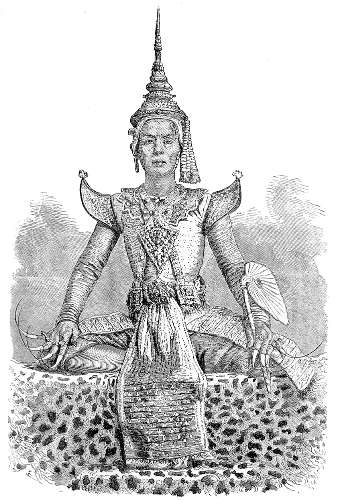
Drawn by M. Bocourt, from a Photograph.
SIAMESE ROPE-DANCER.
TREATY WITH ENGLAND.
Sir James Brooke, the English ambassador at Bangkok,
found his advances coldly received. Possibly the Court
felt aggrieved by the attitude assumed by that gentleman;
but, whatever may have been the reason, matters
nearly approached to an open rupture. In September,
1850, he abandoned the negotiation, and Great Britain
and Siam remained estranged, until the English Government,
desirous to establish friendly relations with the
Eastern monarch, despatched Sir John Bowring to Bangkok,
with instructions to arrange a commercial treaty,
which he effected in 1855. His travels have been published
in two volumes, and contain, perhaps, the most
accurate and full information we possess of Siam. It was
particularly from his acquaintance with the language and
manners of the nation that Sir John Bowring acquitted
himself so well of his task. He was received at Court
with great favour, and had several interviews with the
king, whose thirst for knowledge pleased him, and whose
good will he managed to secure. In all his negotiations
with the Siamese ministers he displayed skill and adroitness.
Knowing by experience what would be the most
profitable conditions, he succeeded in effecting the ratification
of an advantageous agreement on the 18th April,
1855, by which the Crown of Siam consented to the appointment
of a British consul at the capital, and granted
entire liberty of commerce to English merchants in all
the maritime districts of the empire. All duties were
lowered; those upon opium almost entirely abolished,
provision being made that this article should only be
sold to parties specially licensed by the Government.
On the other hand, the English traders might purchase
all the productions of the country directly from the producer.
It is only in times of scarcity that the king
reserves to himself the right of forbidding the exportation
of rice, salt, and fish. English subjects are permitted
to settle at Bangkok, to hold landed property there,
build or purchase houses, and to lease land to others;
but this last privilege is only accorded after a ten years’
possession.
Full toleration in religious matters was guaranteed; and
if the presence of a British ship of war was at any time
thought requisite for protection of their interests, it was
permitted to lie in the Gulf, but not to pass beyond
Paknam without express leave from the Government.
INCREASED FAVOUR TO EUROPEANS.
Holland has also renewed her ancient dealings with
the country, and ratified a treaty during the present year
(1862). Even before the arrival of the Siamese ambassadors
in Europe, a French publication[7] said very justly,
“The Government of Siam is showing itself more and
more favourable towards Europeans, who find at Bangkok
not only protection, but sympathy and toleration for
their religion. Bangkok has become one of the most considerable
markets of Asia; and the kingdom of Siam is
reaping the reward of the liberal politics which it has
introduced into the extreme East, and which is warmly
seconded by France, England, and the United States.”


