Arrival in Aden.—Preparations for my journey into Africa.—Departure
for Tajourah.—Stay in that town.—Unsuccessful
endeavours to proceed farther.—Return to Aden.—Time, from
24th of December to the 1st of March.
I arrived in Aden on the 24th of December,
1841, very ill indeed; having been suffering for
nearly two months from a severe intermittent fever,
contracted in Bombay. I was advised to proceed
at once to England for the benefit of my health,
but having letters of introduction from the Indian
Government to Capt. Haines, the political agent in
Aden, and also to Capt. Harris, our ambassador at
that time to the court of Shoa, in Abyssinia, which
were calculated to assist me materially in my intention
of penetrating into Africa, I persisted in my
determination, under all circumstances, to carry out
a resolution formed two years before of exploring
2some portion of that interesting, but as yet little
known continent.
Circumstances detained me in Aden nearly six
weeks before I received the welcome intimation
from Capt. Haines, that he was about to forward to
Shoa despatches and stores for the use of the Mission,
and as he kindly offered to put them under
my charge, I gladly availed myself of the opportunity
thus afforded me of commencing my journey
most favourably as regarded both comfort and convenience;
every requisite for such an undertaking
being provided for me that the friendly care and
the long experience of Capt. Haines and the
assistant political agent, C. J. Cruttenden, Esq.,
could suggest. Mr. Hatchetoor, an active and
intelligent agent, who had been appointed to transact
all business with the chiefs connected with the
transit of stores and despatches through the Adal
country, was also instructed to accompany me to
Tajourah, a small seaport, on the opposite African
coast, from whence the two proceeding kafilahs
connected with the Embassy had started into the
interior.
A Portuguese servant, named Antonio, who had
been engaged to accompany me, hearing of the sad
fate of three European soldiers belonging to Capt.
Harris’s party, and who were killed during the
night, a few days’ journey inland, and of the still
more recent murder of three of Mr. Hatchetoor’s
native servants, when last he visited Tajourah,
3became so alarmed that he deserted; perhaps fortunately
for me, as I was thus spared the trouble
and risk of engaging in any quarrels that might
have arisen with the natives on his account. As
presents and peace-offerings to the numerous petty
chieftains of the various tribes of Dankalli, among
whom my road lay, I was provided with ten bags of
rice, a large box containing several pieces of white
and red calico, some figured chintz, and a few cotton
handkerchiefs of every gaudy colour, besides an
abundant supply of needles and paper, which constituted
the material for minor gifts to be made to
a more numerous class of supplicants, the women
and inferior people.
Our arrangements being completed, Mr. Hatchetoor
and myself proceeded on board the brig-of-war
Euphrates, commanded by Lieut. John Young, of
the Indian navy, who had received orders to convey
us to Tajourah.
We were no sooner on board than the anchor
was weighed, and we started on our short voyage
across the Sea of Babel Mandeb. In consequence
of the weak state of my health, I remained on deck
no longer than to witness our passage out of the
beautiful and commodious harbour called Back
Bay, which extends to the westward of the low
narrow isthmus, and nearly circular base of the
extinct volcano razè of Aden. We arrived in sight
of Tajourah by sunrise the next morning; but it
was not until nearly three o’clock in the afternoon
4that we anchored in front of that town. The sails
being furled, a salute of seven guns was fired by
the brig, but some time elapsed before any notice
was taken of the honour by the people on shore, a
delay which was soon accounted for by Sultaun Ebin
Mahomed, the Sheik of the town, sending on board
for some gunpowder to enable him to return the
compliment.
Capt. Young and Mr. Hatchetoor landed almost
immediately. I remained for the present on board,
as it was considered impolitic for me to appear
desirous of passing through the Adal country until
some positive information could be obtained respecting
the second division of stores which had been
sent up to Abyssinia some months before under the
charge of Mr. Bernatz, the artist, and the assistant
surveyor, Mr. Scott, respecting which none but the
most disastrous accounts had been received in Aden.
On the return of Capt. Young to the brig, I found,
much to my disappointment, that he did not feel
himself justified, under present circumstances, in
trusting into the hands of the people of Tajourah,
several boxes and packages which were to constitute
my charge. He also considered it would be highly
injudicious in me to make any attempt to pass
through the country in the disturbed state it was
then represented to be. Part of the mail, however,
he determined to forward, if possible, and had fixed
the next day for another interview with the Sultaun
to conclude some arrangements with him and his
5people that should at least secure the transmission
of the public despatches to Capt. Harris in Shoa.
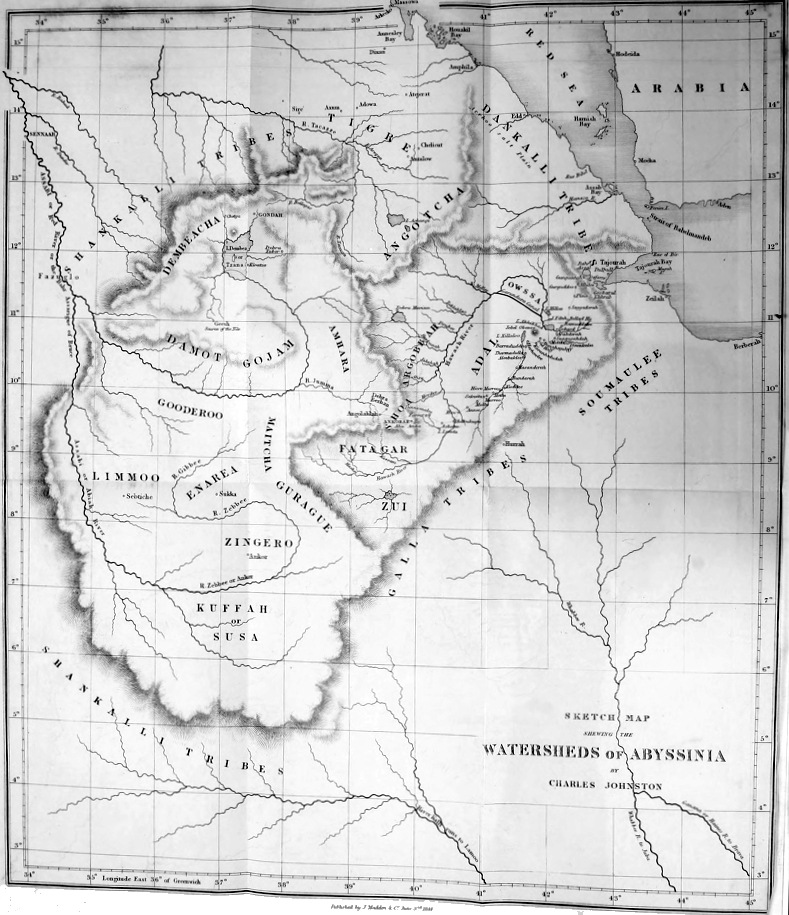
Tajourah is a small straggling town consisting
of a number of low mat houses standing on
the northern shore of a narrow bay which extends
about twenty miles inward, nearly due east and
west. The opposite coast is at least ten miles
distant. From Tajourah, the bay contracts inland
to a channel scarcely four hundred yards wide,
when, suddenly expanding again, it terminates in a
large irregularly formed lagoon, called Goobat ul
Khhrab (the bad haven). In modern maps no
appearance of this deep inlet, a very particular
feature of the sea-coast in this neighbourhood, can
be found, though in the older Portuguese maps
it is accurately enough laid down. The ancients
seem to have been well aware of the existence of
the Bay of Tajourah, for it can be easily identified
with the Sinus Avalitæ of the Periplus.
The sea immediately in front of Tajourah has
received, from the generally unruffled state of its
stormless waters, the name of Bahr ul Barateen,
“The sea of Maidens;” which struck me as a singular
correspondence with the name of the sea surrounding
the ancient city of Carthage, which from
the map appended to an old school edition of
Virgil, we learn was called by the Romans, Mare
Nympharum, the poetical Latin translation of the
Arabic, Bahr ul Barateen. Tajourah, it must be
observed, also being the present name of a village
6situated very near to the ruins of that once powerful
seat of Phœnician commerce.
On the occasion of this visit, much opportunity
was not afforded me of observing the character
either of the country or of the people, as I
landed but twice, and then under the closest
surveillance of a brother of the Sultaun, named
Isaak, who professed to be greatly alarmed for
my safety during these visits; and although at
the time I deemed his attendance to proceed from
any but generous motives, I have since had reason
to believe that his representations of the danger I
incurred by rambling about the neighbourhood
without the protection of some powerful native
were founded upon truth, and from a desire that
no cause of ill-feeling between their little town and
the English should occur, if by any possibility it
could be avoided. As I before observed, three of
Mr. Hatchetoor’s servants were murdered during
the night, on the last occasion of our intercourse
with the inhabitants; and Isaak, though I felt his
presence to be a restraint upon my actions, was
quite right for thus persisting to accompany me on
even the most trifling occasions, to prevent the recurrence
of what he, half savage as he was, felt to be
an untoward event.
An opportunity offering itself, Capt. Young
introduced me to the Sultaun of Tajourah.
He was a man at least sixty years of age; round
his closely shaven head was wrapped a dirty
7white muslin turban, beneath which was a very
light Arab skull cap of open wicker-work, made
of the mid rib of the palm leaf. Naked to his
waist, over the right shoulder and across his chest,
was slung a broad belt of amulets, consisting of
numerous packages the size of a small cartouche-box,
alternately of red cloth and of leather, each of
which contained some written charm against every
evil that he feared, or for every desirable good. A
common checked cotton fotah, or cloth, reaching to
the knees, was fastened around his middle by a
leathern belt, in which was secured a very handsome
sword of silver, and completed his dress. In his
hand he held a light spear, that served to support
his long spare figure as he walked, or sometimes to
chastise a rebellious urchin, or vituperative female
of his household, by dropping the heavily iron
tipped end not very gently on their heads and
shoulders. But little attention was paid to him by
his tribe beyond the simple acknowledgment of him
as their chief, and the title was only valuable
as a legal excuse for demanding from merchants
and strangers some paltry present, which alone constitutes,
as far as I could observe, the revenue of
the state of Tajourah.
Beyond the limits of the town, the authority of
the Sultaun was disclaimed; and, in fact, it was very
evident that to hold quiet possession of the town, a
species of black mail was extorted from him and
the inhabitants by the Bedouins of the surrounding
country.
8The palace of the Sultaun Ebin Mahomed, who
was familiarly styled by his subjects, “Shabah”
(old man), consisted of two rooms, placed at right
angles to each other, the walls of which consisted
of mats made of the plaited palm leaf, stretched
upon a slight frame of sticks. The roofs also were
of similar material. The whole was enclosed by a
fence about six feet high, consisting of dry sticks,
also covered with mats.
Screens of these suspended mats divided the
larger of the two rooms into four compartments,
which were severally used as the harem, store-room,
the family sleeping-room, and the audience-chamber,
if such imposing designations may with propriety
be bestowed upon the squalid menage of the
chief of Tajourah. In the other room was the oven,
or rather kiln, for baking; a coarse earthen construction,
which resembled in form a large jar,
inside of which was placed the fuel; when it was
properly heated, large layers of unleavened dough,
made from the meal of jowahree mixed with water,
was plastered upon the outside, where it remained
until it had dried into a heavy substance, well
finger-marked, and looked sufficiently like a cake
to satisfy the eaters, that they were, really, as they
frequently boasted, so far in advance of their Bedouin
neighbours, as to use baked bread.
There were also in this room a few wooden
couches upon which the slave women were accustomed
to repose during the heat of the day, when
not engaged in grinding the jowahree meal, or
9carrying water from the well. At a short distance
from these apartments, but within the enclosed
court, was a singularly constructed wooden building
that towered some six feet above the usual height
of houses in Tajourah, being the cabin of a large
bogalow, or native ship, wrecked in the bay, and
which had been elevated upon untrimmed trunks of
the date palm-tree.[2] A wall of matting carried
round these posts formed a convenient lower room,
which, with the cabin above, was usually apportioned
to strangers visiting the town. To this extraordinary
effort of native architectural genius, was
attached a small yard, separated by a mat screen
from the larger court; and here, at a broken jar,
that stood in one corner, under the shade of a miserable
looking henna-tree, the faithful of the household
were always to be found at the stated times of
10prayer, performing their ablutions. At small apertures
along the lower edge of the screen, close to
the ground, were frequently to be seen rows of
white teeth of startling extent, as the amused slave
girl and female branches of the royal family sought
to gratify their curiosity by taking sly peeps at the
Engreez whenever they visited the Sultaun. The
law court, if it may be so termed, was nothing more
than an expansion of the lane in the front of the
Sultan’s residence, carefully strewed with the small
pebbly shingle of the neighbouring beach. In form it
was oblong, and around it were placed several large
stones, an old ship beam, and a trunk of the date
tree, to serve for the seats of the principal men of
the town on occasions of their public kalahims or
councils, which were always held in this place. The
Sultaun generally presided over these assemblies, his
chief business being to distribute the coffee, which
was rather stingily supplied to the parties present.
Capt. Young having succeeded in his endeavour
to forward the despatches, this being undertaken by
the son of my friend Isaak, on payment of seventy
dollars, made immediate preparations for returning
to Aden, in order to report the unsafe character of
the road, and the disinclination of the Tajourah
people to forward the stores to Shoa. I, of course,
felt much disappointed; but could not object to the
reasonableness of the only course that could be
taken, and made up my mind to remain in Aden
until a better opportunity should be afforded me of
11prosecuting my determination of travelling in
Africa.
Feb. 26.—After a detention of four days at Tajourah,
we weighed anchor, and proceeded on our
voyage back to Aden; the wind, however, being
contrary and very light, we did not reach Back Bay
until the 1st of March, during which time I amused
myself on board comparing the present condition
of the coast of that part of Africa we had just
visited, with some notes I had collected respecting
the ancient geography, as contained in the Periplus
of Arrian, and other works of the same character I
had read.
The present name among the Arabs of the opposite
coast of the country in which Tajourah is
situated is Burr Adgem, “the land of fire;” and it
must be observed, that this is also the Arab designation
of the present kingdom of Persia; a significant
name, acknowledged to be, and is evidently
derived from the volcanic character of both these
districts. The Burr Adgem, on the south of the Red
Sea, is of indefinite extent, but may be considered
as applied to the country reaching from Suakin in
the north, to Mogadishe in the south, and as far
west as the high lands of Abyssinia.
Among the ancients, this country was known as
that of the Avalites; in which word may perhaps be
recognised, Affah, the present native name of the
Dankalli tribes, living on the western coast of the
Red Sea, but which formerly had a far more
12extensive application, and included the numerous
Soumaulee tribes, who inhabited the country to the
south of the Sea of Babel Mandeb as far as Cape
Guardefoi, and from thence southward along the
eastern coast of Africa as far as Malinda.
Another name for these Affah tribes is Adal;
given to them by the Abyssinians inland, and which,
according to some recent authorities, has arisen from
the circumstance of the principal tribe with whom
the Abyssinians have any intercourse being the
Adu Alee, living in the immediate vicinity of Massoah,
which name has gradually become to be used
as the designation of the whole people. I confess
that I do not see the propriety of this derivation, as
it appears more natural to derive the Abyssinian
name from that of the chief part of this country at
an early period, when a powerful Egyptian monarch
made the Affah port, Adulis, the capital of an extensive
country. The terminal letter of this proper
name, I have been informed, may be the usual
Grecian affix to adapt it to the genius of their
language; and I think the probability is, that the
ς has been thus added, and that the word Aduli
was the origin of the Greek Adulis, and of the
modern name Adal.
Another very common name for these people is
Dankalli, a word which appears to be of Persian
origin; but one that is also acknowledged by the
Affah themselves, as the proper name of their
country, or of their people collectively. In the
13time of Ludolph, Dankalli was known as the name
of a large kingdom or province, situated on the
sea-coast, extending from the port of Adulis to the
confines of the country of the Assobah Galla, who
then dwelt in the country immediately to the north
of Tajourah. The Assobah are now, however, considered
to be a Dankalli tribe, a change which I
conceive has taken place in consequence of this tribe
having since become Gibbertee, or “strong in the
Islam faith;” for a religious distinction, I find, has
for some centuries separated the original Affah
nation into Dankalli and Soumaulee. The latter,
whose name is derived from the Abyssinian word
soumahe, or heathens, being supposed by the strict
Mahomedan Dankalli, still in a great proportion
to adhere to their ancient Sabian faith, and only
partially to profess the Islam belief. Soumaulee corresponds
with the Arabic word, kafir, or unbeliever,
the name by which alone Edresi, the Arabian
geographer, knew and described the inhabitants of
the Affah coast, to the east of the straits of Babel
Mandeb.
It also appears to me that the word Dankalli
connects the history of these people with the empire
of the true Ethiopia, or Meroe, which was situated
between the branches of the Tacazze and the
Assareek, or the Red Nile, for it may be that in
the Odyssey, where Homer conducts Neptune into
Ethiopia, and places him between two nations of
blacks, perfectly distinct from each other, the poet
14alludes to the two very different people, the Shankalli
and the Dankalli, inhabiting the low countries of
Africa within the tropics; the former living to the
west of Abyssinia, the latter towards the east.
This will be more evident when, in a future
chapter, I connect the elevated table-land of Abyssinia
with the scene of the annual festivities of the
gods in Ethiopia.
It may be as well in this place, perhaps, to advance
my own opinion as to the probable derivation
of the name Galla, which has been so generally
given to the numerous, divided, and barbarous
tribes which I believe have arisen from the ruins of
the once civilized and extensive empire of Meroe.
The word Galla appears to be merely another form
of “Calla,” which in the ancient Persian, Sanscrit,
Celtic, and their modern derivative languages,
under modified, but not radically changed terms, is
expressive of blackness, and which was originally
conferred upon a dark-coloured people, as descriptive
of their appearance, by the affrighted nations
of a lighter complexion, whom their boldness and
ferocity have nearly extinguished. Thus the original
inhabitants of the high table-land of Abyssinia,
a much lighter-coloured race than the Greeks,
called the people of the surrounding low countries
Galla, for the same reason that the Greeks gave
them the name of Ethiopians. In the Geez, or
Ethiopic language, these people are styled Tokruree,
blacks, and their country Tokruah; and we
15find that the Arabs and Indians, also influenced by
external appearance, call them Seedee, and their
country Soudan, from the word asward, which signifies
black. The Romans, in like manner, gave
them the name of Nigritæ; and we ourselves call them
Blacks. Two nations of Calla or blacks, very different
in physical character and social condition from each
other, are now found in the country of ancient
Ethiopia; the Shankalli, or the true negro, and the
Dankalli, who belong decidedly to the Circassian
variety of mankind, possessing round skulls, high full
foreheads; the position of the eyes rectilinear; the
nose, mouth, and form of countenance being in every
respect concordant with the characters assigned to
that type of the human race, excepting their colour,
which was a dark brown, or sometimes quite black.
Their hair, which is much frizzled and worn very
full, is a savage caricature of a barrister’s wig. I
could perceive no other difference in features or in
the form of the head between ourselves and several
individuals of this people; indeed, there was often
such a striking resemblance between them and
some of my European acquaintances, that it was
not unusual for me to distinguish them by bestowing
the names of some of my far distant friends upon
their Dankalli counterparts.
Respecting the numerous savage tribes, known
in Europe under the general term Galla, I will not
anticipate the results of my subsequent journey,
which afforded me better opportunity of forming an
16opinion as to the real character of these people, and
of comparing them with others, who seemed to me
to have one common origin, but who differ very
materially in the historical circumstances which
have marked the period of their long separation.
I shall, therefore, return for the present to Aden,
which we reached early in the morning of the
first of March, three days after having left Tajourah.
From Back Bay, a joint report was immediately
forwarded to Capt. Haines by Lieut. Young and
Mr. Hatchetoor, announcing the return of the brig,
and the ill success that had attended their endeavours
to forward the stores and myself to Shoa.
Fortunately, I was not long permitted to remain
at Steamer Point, off which the Euphrates was
anchored, for before noon of the same day we
arrived, I received fresh instructions from Capt.
Haines to embark again in the evening, and proceed
in company with the assistant political agent,
C. J. Cruttenden, Esq., to Berberah, where the great
annual fair was then being held; from which place
it was arranged a native boat should be engaged to
take that gentleman, his two servants, and myself
back to Tajourah. Capt. Haines rightly supposing
that some little jealousy had been excited on the
previous occasion by the appearance of the brig
before the town which might have implied that
compulsion would be resorted to, should the inhabitants
refuse their required assistance to communicate
17with the Embassy in the interior. One great benefit
had resulted from the voyage—my health having
considerably improved. The sea air, fresh scenes,
and above all, the considerate kindness with
which I was treated on board the Euphrates confirmed
the restorative reaction which had commenced
in Aden. The depressing influence that
for several months had held me in sick durance,
yielded before the excitement of hope, and a new
principle of life seemed to reanimate my nearly
worn-out frame.
CHAPTER II.
18
Arrival at Berberah.—Description of the Town and Fair.—Departure
for Zeila.—The Town of Zeila.—Second Visit to
Tajourah.—Time, from the 1st to the 6th of March.
Berberah is situated on the same coast of the sea of
Babel Mandeb, but about 130 miles to the eastward
of Tajourah. It is remarkable for having been a
mart for the exchange of African and Asiatic
products between the merchants of either continent,
from the earliest antiquity.
For the greater part of every year, during the
S. W. Monsoon, from September to March, this place
is the busy scene of an extensive commerce, and a
deserted wilderness for the remaining months; after
which interval, again the ships of foreign and
the caravans of native products begin to arrive.
Another temporary town rises as if by the wand of
some magician, and thousands of huts and mat
houses are erected upon the beach, where but a few
weeks before nothing was to be seen but bare
sands; nothing to be heard save the howling of
numerous wild beasts, as they prowled in search of
food, amongst the heaps of filth and animal remains
collected during the preceding fair.
19We came in sight of Berberah on the afternoon of
the 4th of March. As the brig rounded a low
sandy point, and entered the narrow harbour,
several of the natives, who had been long watching
our slow advance, the wind being very light, leaped
into the sea, and swam on board. I could not
avoid noticing immediately the apparent difference
in disposition between them and the people of
Tajourah; for a most sullen and distrustful bearing
seemed to characterize the latter, while the Soumaulee
on the contrary, at least those of Berberah,
seemed confident that no violence or injury would
be offered to them, they seized the ropes thrown
over the sides of the vessel to assist them as they
climbed up, and in high glee they passed along the
deck and on to the poop, laughing, arranging their
wet waist-cloths, and shaking hands, as if they
were among old friends.
We anchored within a short distance of the
town, and several of the leading people came immediately
on board. The business connected with
my journey to Berberah was transacted at once in
the cabin, the principal native authority, Allee
Shurmalkee, being requested by Mr. Cruttenden to
provide a boat and other necessaries, which he
readily consented to do. As it was late, we none of
us went on shore; although I do not believe any
danger would have been incurred by so doing, a
very friendly feeling evidently existing on the part
of the natives towards the English, without that
20abundant protestation of friendship pressed upon
you, as it is by the people of Tajourah, which you
cannot help feeling is altogether feigned.
During the earlier part of the next day, I
amused myself upon deck, making observations on
the temporary town, and speculating on the different
national characters of the mixed multitude which
inhabit it.
The mere appearance of Berberah is most
uninteresting, except, certainly, the harbour, which,
if not a very prominent feature, is still a most
singular one for its peculiar construction and
admirable convenience. A long low spit or raised
bank of sand and coral extends nearly a mile into
the sea towards the west, parallel with, and at
the distance of about half a mile from, the real line
of coast. Within the enclosed space of water good
anchorage in four or six fathoms is found nearly up
to the town, which is situated around the bite of this
little narrow inlet. The rise and fall of the tide is
sufficient to admit of very large bogalows, as the
native boats are called, to be beached for repair, or
other purposes; and, in fact, during the fair,
a great number of these vessels do lie upon the
shore, or in the shallow water close up to the town,
giving to the whole a regular, dock-like, appearance.
So apparently accordant with the rules of art is
the direction of the outer sea-wall, and its position
so admirably convenient, that even a reflecting
observer cannot altogether divest himself of the
21idea, that it is not a pre-concerted work of art
rather than the casual production of nature. This
was certainly my first impression; and for some
time I considered it to have been constructed in a
remote period of antiquity, when the whole of this
coast was the busy scene of an extensive and lucrative
commerce, but that in the revolution of time
and the everchanging pursuits of man, the origin
of this sea-protecting mole had been forgotten,
and the only remembrance of the people who
raised it was to be found in its name, which certainly
recalls to the mind that of a long-lost
nation, the Berbers of Africa. This was theory, of
course, and my opinion soon changed, when I
found that no other evidence of man’s residence
existed in this neighbourhood; no traces whatever
of that industry and wealth which must have
characterized the people who could have projected
and completed such an extensive marine defence
for their navy and commerce. Subsequently also,
geological examinations, and comparison with other
older reefs of sand and coral, now forming part
of, and which extend some distance inland,
enabled me to establish its identity with them in
structure and mineral composition. Finally, therefore,
I became convinced that this was another of
those beautiful and benevolent works that Nature—“our
kindest mother still”—has provided for the
security of her favourite, man; for with an anticipating
care she has here constructed for him, by a
22curious yet simple economy, a safe retreat whenever
in his frail bark he might be exposed to the
violence of the winds and waves, on this otherwise
inhospitable and dangerous coast.
In the afternoon a party, consisting of A. Nesbitt,
Esq., First Lieut. of the Euphrates, the Purser,
Mr. Powell, and myself, was formed for the purpose
of more closely examining Berberah and its
curiosities. One of the brig’s boats was ordered
alongside, and we soon found ourselves carefully
threading a winding course, amidst the numerous
fleet of bogalows moored along-shore, greeted as we
passed beneath their huge misshapen sterns, by the
joking salutations and laughing faces of numerous
almè, or slave-girls, who crowded the cabin windows,
and the most striking features of whose dark
countenances were rows of pearly teeth. The boat
grounded about thirty yards from dry land, and we
were obliged to be carried upon the shoulders of the
crew over a black muddy beach, being set down
amidst heaps of dirt; the rotting debris of the sea
and of the land, drift wood, loose spars, the bones of
animals, and excrements of man, formed a barrier
of filth, over which it was impossible to choose a
path, so we at once struck boldly across to the
narrow entrance of what we imagined must be a
street, and entered the town of Berberah.
I should suppose there were at least from four to
five thousand huts placed closely together, uniform
in size and elevation, being generally of an oblong
23form, about six feet broad, by nine feet in length,
and five feet in height. They consisted of a roof
of mats, made of the doom palm leaf, or of a long
dried grass, or else merely half-dried skins badly
preserved, stretched over the usual stick skeleton of
a wigwam. There was not much architectural
display, for being all roof, they did not well admit
of it. Nor does convenience appear to be consulted
in laying out streets, or even regular passages,
only in so much, that a small spot on one side of
the entrance of each hut is left vacant for purposes
that may be imagined, and a succession of these
sweet and pleasant places make a narrow lane, into
which all doors open, and thus a convenient but
dirty street is formed by which alone the visitor is
enabled to perambulate this justly celebrated
aromatic yielding fair.
The residences of the few foreign merchants,
principally Banians and Arabs, are exceptions to
this general style in the construction of the houses,
and have some pretensions both to appearance
and convenience, usually having mat walls
to the height of four or five feet, with a long
slanting roof of grass securely fastened down by
sticks of bamboo laid transversely. The entrance
is a kind of hall, opening into the centre of a
room at right angles, and which extends to the
right and left, perhaps ten or twelve feet on each
side; its breadth is about ten feet. Behind this
room is another apartment of equal dimensions,
24which serves as a store or warehouse, and one end
partitioned off by mats, contains the secluded
inmates of the harem.
One of the objects we had in view in visiting
the fair was, to procure some few additional
articles I required for my journey into the interior,
namely, a bed carpet, two Arab frocks of yellow
nankeen, and a black camaline or cloak. We
accordingly bent our steps towards the quarter
where lived our native friend, Shurmalkee, who
was to assist us in making our purchases, but whose
residence we should never have found but for the
crowd of armed idlers who soon surrounded us, and
led us with a kind of barbarous state into the
presence of their respected chief.
The well-known Shurmalkee, or Allee Allee, his
real name, is now upwards of fifty years old, tall,
thin, with slightly stooping shoulders; his face
long, with small quickly moving eyes, and thin
white beard. The only deviation from the usual
dress of his countrymen is a white cotton cloth
turban, a distinction, with the title of sheik, generally
assumed by those who can read the Koran, or
have performed the pilgrimage to Mecca. Some
fifteen or twenty years since, Shurmalkee was
chiefly instrumental in saving part of the crew of
the English brig, Mary Anne, then lying at anchor
in the harbour of Berberah, which was attacked
and burned during the night by the natives. He
was himself wounded on the occasion, and the mate
25and three or four of the brig’s people murdered.
The Indian Government rewarded him munificently
at the time for his generous interference; and since
then, finding him honest, intelligent, and grateful,
they have always patronised him, allowing him in
our eastern parts the privilege of a British subject,
with liberty to hoist our flag in his bogalows. He
is now our native agent in all transactions with the
Soumaulee inhabitants of Berberah and Zeila. By
his industry and enterprise he has become the
richest man along this coast; nor is there scarcely
a prince or petty chief in the adjoining countries
who is not indebted to this African Rothschild.
We rested ourselves upon the only piece of furniture
in the mat-walled room, a rude couch of wood
with a bottom of interlaced palm-leaf rope, covered
with a coarse Arab carpet of as many colours as
Joseph’s jacket. We refused to take any refreshment,
and sent immediately for the articles we wanted. As
usual, the Islam spirit of despoiling the Christian
exhibited itself in the exorbitant demands of the
Arab merchants, but which in this case was
defeated by the prompt interference of Shurmalkee,
who dismissed them very summarily as much to
ours as to their surprise. As soon as they were gone,
however, he explained the cause, and promised to
obtain the things himself, before we went on board,
at half the price that had been demanded, desiring
us not to take any farther trouble about them, but
to proceed at once to view the town, at the same
26time supplying us, as is the custom of these people,
with two natives for guides, and also as sureties for
our safety and freedom from molestation during our
walk.
The appointment of these sureties, or Abbahn,
as each calls himself, to every stranger who enters
the town, is a singular but very necessary characteristic
of the social condition of the inhabitants of
Berberah, and is deserving of particular notice.
Convenience on the one hand and enterprise on the
other, have here brought together the Hindoo
Banyan, the Mahomedan Arab, and the Pagan
Soumaulee; for even now scarcely one half of this
latter people profess the Islam faith. With no generally
acknowledged superior, no established law, each
inhabitant depends upon his own keen knife, or that
of his Abbahn, for personal safety and the security
of his property. All are equally ready to resort to
a bloody appeal upon the least cause of dispute, so
that every day is marked by some fatal quarrel, and
every night by some robbery and violent death.
Even the murdering Danakil shakes his head when
he speaks of the Fair of Berberah, denouncing it as
being “shatan, shatan;” whilst the wisest and
the best men of every nation or tribe, who are here
assembled, speak openly their desire, that some
powerful Islam, or even Feringee Government,
should take actual possession, both of this port and
of Zeila also. Under such circumstances, the
foreign merchant, accustomed in his own country
27to the protection of law, or of some regularly
established authority, consents but reluctantly, and
then only from the prospect of immense gains, to
risk his person among a people so violently barbarous
as are the Adal tribes occupying this portion
of Africa, who have lost none of their ancient character
significantly recorded in the Periplus, as being
“uncivilized, and under no restraint.” To protect
himself in some measure the trader has recourse to
the system of procuring the constant attendance of
one or more of the natives, whose duty it is to guard
their employer from molestation. Two-thirds of
the Soumaulee population of the town are engaged
in this manner. No sooner does a stranger arrive
than he is surrounded by natives, each soliciting to
be employed as his Abbahn, and are almost as
importunate and as troublesome as the hotel-barkers
who infest the piers of our watering-places. The
important privilege of supplying strangers with
Abbahns is monopolized by one tribe living in the
neighbourhood of Berberah, called Raree-good-Hadé,
but not without considerable opposition from
another tribe called Raree-Abdullah, with whom
serious conflicts sometimes take place within the
town, when all business is suspended for three or
four days in consequence.
Every ship, or bogalow, arriving at the port is
boarded, at least a mile from the shore, by a crowd
of Soumaulee Abbahns, and on the occasion of the
Euphrates approaching Berberah, a number of these
28naked visitors, as I have before mentioned, swam from
shore a very long distance and were taken on
board.
Following Shurmalkee’s advice, we started, but
certainly not to see the town, though we passed
through it; for with eyes bent upon the ground, we
carefully picked our way along the narrow street,
not four feet wide, the tops of the stinking skin
wigwams and mat-huts presenting one uniform
dark level, just the height of our noses. The
outskirts of the town were equally offensive, but
more particularly marked by the vast quantity of
bones of all eatable animals strewed about, and the
vestiges of numerous cooking fires, everywhere
telling of the sites of former houses, and that a few
weeks before the fair must have been even more
extensive. About half a mile to the left of the
town, on a slightly elevated mound of sand and
coral, was a ruined mosque, the only appearance of
a stone building in the neighbourhood. To this we
proceeded, our conversation turning upon the dirtiness
of the town, its low flat appearance from every
point of view, the singular character of its
inhabitants, and the great importance Berberah
might assume in the possession of some highly
civilized country, (we meant Britain, of course,) as
one point from whence to spread through Africa the
benefits arising from science, and the happiness
attendant upon a knowledge of the Christian faith.
Around the mosque were numerous graves, each
29consisting of a low heap of stones in a line six feet
long, enclosed in a large circle of single stones, the
diameter of which sometimes exceeded twenty feet.
The direction of the graves were due east and west,
and a small space or opening in the circle invariably
to the south, formed a kind of entrance into its
area. They differed from the strictly Islam tomb
in not having the two little flat stones at the head
and foot, in their less conical form, and in the
circular enclosure. Their vicinity to the ruined
mosque told, however, of the profession of the Islam
faith during the life of the deceased, whilst in the
manner of the burial it appeared that surviving
friends had still adhered to the customs of their
forefathers. I might, too, have been mistaken in
the real character of the building, and that which I
hastily concluded to be a mosque, may have been
some remains of a temple of the ancient faith professed
by the Affah nation, and which I believe was
Sabianism.
From the burial-place looking towards the south-east,
we had a view of the town and shipping of
Berberah, situated at one extremity of a spacious
triangular plain, which we were told extended one
hundred miles one way in the direction of Zeila, and
inland towards Hurrah nearly the same distance.
On our return to Shurmalkee’s house, we walked
along the beach in front of the town, where were
numerous women drying sheep-skins, by stretching
them in the sun, pinning them down upon the hot
30sands by broken pieces of bones in the absence
of sticks. Tobes, or the large cotton cloths worn by
the natives over the shoulders and around the body,
were also bleaching upon the beach after a careless
wash in the sea. As we came nearer to the town
we disturbed, as we passed, several large bodies of
men squatting upon the ground in deep conversation,
each armed with a large heavy knife and
a spear. We were also continually being jostled
by busy native porters, who were conveying loads of
gum and coffee on board the bogalows, or else
laden with their return burdens of cotton and cotton
goods for the stores of their employers.
We had taken our guns with us, having started
with the intention of proceeding some short distance
inland, but the sun was so very powerful, and the
prospect so apparently hopeless, of either instruction
or amusement being derived from the walk,
that it was resolved, as I started on the morrow for
Tajourah, that we should proceed immediately on
board the brig, from the deck of which we had a
more extensive view of the town and surrounding
country, than any point afforded on shore, and from
our numerous visitors, Arab and native, had
excellent opportunities of deriving information
respecting the manners and customs of the Soumaulee
population.
The appearance of the surrounding country
seems to indicate that at a period not very
remote, the whole of it has either been upheaved
31from beneath the sea, or that the retreat
of the latter has left the plain, extending to the
westward and southward of Berberah, the dry
land we now find it. At one time the coast about
here must have been of a somewhat similar character
to that which is now presented by the
harbour of Zeila, deep narrow channels existing
between extensive coral reefs, which, at the distance
of three miles from the town, have not one fathom
in depth of water over them. At the time of such
submersion of the plain of Berberah, the sea must
then have come up to the nearly regular line of low
volcanic hills, which, commencing a few miles
distant from the town, stretch in a south-western
direction for many miles inland. This portion of
the then sea of Aden included a considerable part
of the country between Zeila and Hurrah, for the
present coast-line, from the former town to Berberah,
assumed as a base, whilst Hurrah may represent
the apex, will give some idea of the triangular form
of this now habitable tract, which, I conclude, has
been raised above the level of the sea by the operation
of some vast upheaving force. Whatever
testimony is required for this opinion is presented
by the geological character of the numerous small
hills to the south of Berberah: old coral reefs
studding the place with eminences about twenty-five
feet high as far as the eye can reach. If these
formations are considered as insufficient authority
for my founding an opinion upon the submarine
origin of this country and its recent elevation, I
32can only excuse myself upon the plea of endeavouring
to give a better idea of its appearance by
this allusion to its geological character, and which
will at least, I hope, assist the reader in forming a
more complete picture of Berberah and its environs.
The next day was occupied in placing the boxes
and packages of the Mission into the native
boat, hired from Shurmalkee. This was effected by
noon, and after a parting dinner with our kind
friends on board the brig, Mr. Cruttenden and
myself proceeded to take possession of our fresh
berths in the bogalow.
The little cabin of our new craft was about
three feet high, and six or seven feet long, with a
roof and floor of bamboo canes, over which were
placed a few mats. Two servants of Mr. Cruttenden’s
being on board, they were told to prepare the
evening meal; and anticipating by the direction
and force of the wind that we should be off the town
of Zeila by the next morning, we spread our carpets
on the cabin-floor, and composed ourselves to reflection
or repose, no sufficient inducement offering, to
tempt us to expose ourselves in the sun upon the frail
unsheltered deck above us. After supper a conversation,
in which I could not join, was entered into
with the ras, or captain of the boat, by Mr. Cruttenden,
whose knowledge of Arabic admitted of
this amusement; but as he generally interpreted to
me the most useful and interesting portions, and
added some most valuable information which he
had collected in his long intercourse with these
33people, I had reason to feel happy that circumstances
had thus thrown me, upon the eve of the
commencement of my own travels, into the society
of an experienced and clever voyageur.
March 6th.—We found ourselves this morning,
on awakening, anchored at some distance from
Zeila, at least six miles. The shallowness of the
sea over the outstanding coral reef prevented even
our small vessel from approaching nearer to the
town, and I could see from the deck several natives
wading from our own and other vessels towards the
shore. In about one hour, the keeper of the principal
gate seaward came on board in a small boat,
bringing three sheep as a present from the governor.
He was accompanied by two or three of the Arab
soldiers, of whom sixty or seventy are employed to
defend the town, in case of its being attacked by
the Soumaulee of the surrounding countries.
From what I could learn, Zeila was held by
Arab and native merchants; the Dowlar, or
governor, being appointed by the Sheriff of Mocha,
who formerly received some small tribute from the
town. Allee Shurmalkee has since my visit
either seized or purchased this town, and hoisted
independent colours upon its walls; but as I know
little or nothing save the mere fact of its possession
by that Soumaulee chief, and as this change occurred
whilst I was in Abyssinia, I shall not say
anything more upon the subject.
The officer who visited us in our boat, carried
34rather ostentatiously at his belt, two large and very
rudely made wooden keys, with projecting bits of
iron wire, which formed a kind of apology for
wards. From their appearance, I should suppose
that the locks they fitted were not either of a
very intricate or very substantial character, and not
such as were calculated, without other aids, to effect
the exclusion of unwelcome visitors. I had not an
opportunity of examining the defences of Zeila,
beyond a sight of its wall, twenty or thirty feet
high, over which could be seen certain whitewashed
and grey stone houses, with flat roofs. Besides two
old guns, which we could see from the boat, lying
dismounted upon the sands, I was told there were
a very few others placed on that part of the wall
looking inland.
Mr. Cruttenden forwarded to the governor some
few pounds of gunpowder in return for the sheep,
but declined on this occasion his polite invitation to
visit him, promising to see him on his return to
Berberah, which he hoped would be in a few days,
after settling affairs for me in Tajourah. During
the night, we took advantage of the land breeze,
and made Tajourah by the middle of the next day.
The difficulty of fixing upon our anchorage was not
so nice an affair as with the brig. The narrow and
confined opening on the sunken coral reef forms a
kind of submarine haven, directly in front of Tajourah,
in which is the only secure anchorage. It
was easily found by our vessel, whose light draught of
35water admitted of its going over the reef in search
of it; and when found, allowed of our bringing up
within a very few yards from the shore. This was
no little convenience, for our bogalow only carried
for communication with the land a small canoe
made out of a single tree, and barely able to carry
two persons. Mr. Cruttenden’s sword was trusted
to the hands of one of the crew, an excellent
swimmer, who took rather a novel mode of conveying
his bright burden to the shore, swimming the
whole way completely immersed, save the hand
and arm bearing the sword, which was thus carried
perpendicularly to the body, with an intuitive
knowledge of the mechanical relief to the muscles
of the arm afforded by a weight being carried in
that manner.
Mr. Cruttenden trusted himself into the frail and
ticklish canoe, which bobbled upon the surface of the
water as if its ill-adjusted centre of gravity would
upset itself. He, however, was placed, not without
a certain degree of wetting, safely upon the land;
and the dexterous paddler of this tiny craft returned
for me. I really do not know how I managed to
convey myself into it, nor can I account reasonably
for its doing so much for me to the shore; but I
recollect very well that I considered it a regular
escape, for had I been upset in my then weak state
from my previous illness, I should certainly have
finished my African travels in the Bay of Tajourah.
CHAPTER III.
36
Reception in Tajourah.—Arrangements for our stay.—Occupation.—Amusements.—Geological
character of the country.—Engaging
camels for the journey.—Customs of the townspeople.—Public
buildings.—Religious ceremonies, law, and justice.
I joined Mr. Cruttenden at the house of the Sultaun,
being directed on my way by a party of little
slave children, who formed a rather troublesome
train, as they kept importuning me for buttons and
beads. The younger girls and infants, however,
could not by any inducement be prevailed upon to
come near me; and what with the shouting
plaguing boys, who followed behind, and the
screaming flying children before me, I began to
think myself more of a curiosity than I had before
believed myself to be.
The Sultaun of Tajourah with considerable politeness
placed us, immediately on our arrival, in possession
of the elevated cabin before mentioned, and
the room below, and then left us to hasten forward
the preparation of a meal, consisting of boiled rice,
which was soon after brought in. It was placed
before us in a large saucer-like dish, with a quantity
of milk in a curious kind of basket, made of the
37larger nerves of the doom palm leaf, sewed very
closely together with a finer description of the
same material; the inside was overlaid by some
black vegetable matter, but of what character I
could never properly understand.
Having arranged our legs as decently as we could
around the table, which was merely a large mat of
the palm leaf, we had nearly satisfied ourselves
before the arrival of some promised lumps of meat,
which, strong and tough, challenged the integrity
of our teeth, in the vain endeavours we made to do
justice to this part of our host’s hospitality, for we
might almost as well have attempted to devour the
piece of round leather upon which it was brought.
The latter piece of furniture, at all events, afforded
some degree of pleasure, for I saw immediately an
explanation of the obscure passage in Æneid, where
the Harpy Celæno is made to say—
... “Ambesas subigat malis absumere mensas,”
which has been by commentators considered improbable
and absurd, from the difficulty of supposing
how tables, according to our ideas of them, could
be eaten. By the sailors in the Red Sea, and among
the Arabs, these leathern interpositions between the
ground and the food are very general indeed; and
I do not see why, in the extremity of a castaway
crew, or in a time of famine, these tables, which
they certainly are, should not be devoured for want
of other food; and parallel cases have frequently
occurred in modern times, in the numerous recorded
38incidents where shoes and even the leathern peaks
of soldiers’ caps have formed the only sustenance
that could be obtained under similar distressing
circumstances.
In accordance with the usual custom in Arabia,
and which custom has probably been imported from
that country with the Mahomedan religion, the first
day of our arrival was spent in friendly conversation
with the people of the town, who were acquainted
with Mr. Cruttenden from previous intercourse. All
allusion to the business we had come upon was
carefully avoided, the established etiquette of hospitable
politeness leaving to the stranger the first
day of arrival for rest after his journey, and for
making him welcome on the part of his entertainers.
I now assumed the dress which had been recommended
as the most appropriate for my journey.
Over a pair of loose drill trousers, I donned a long
yellow frock of nankeen, with sleeves narrowing to
the wrist, of a kind which has been used by the
Arabs from the time in which the Periplus was
written, for among the articles of the commerce of
the Red Sea there enumerated, are these very
frocks, and the material of which they are made
was then principally imported by Indian vessels, as
at the present day. A large straw hat, of the
double Manilla kind, with a thick layer of cotton
wool between the two walls, formed a very light
covering for the head, and being quite impenetrable
39to the direct rays of an almost vertical sun, was a
sufficient protection against the evil most to be
feared, “a coup de soleil.”
The morning after our arrival, a survey was taken
of the stores which, during the past night, had been
brought from the bogalow, and placed, part in
the lower room of our house, and part in the little
court adjoining, so that they might be under the eye
of Nassah, one of the Arab servants of Mr. Cruttenden,
who was appointed to watch over, and who in
fact slept among and upon, the boxes and packages.
The apartment occupied by Mr. Cruttenden
and myself was the elevated cabin, immediately
adjoining the residence of the Sultaun. It was
rather a long room, with a sloping roof, the centre
of which was a few inches above our heads, but at
the sides was only two feet high from the floor.
The walls consisted of frames, in which were
sliding shutters of most irregular construction,
and of every dirty colour that can be conceived.
The floor of the upper end was raised about a
foot into a kind of dais, or, as Mr. Cruttenden
styled it, a spare bed, not being more than five
feet in its longest direction, and upon which
had been spread his sleeping carpets for the
night. The entrance into our novel residence was
a square hole in the farther corner of the floor,
through which we ascended and descended, like
stage ghosts, carefully inserting our toes in any
little crevices we could see among sundry dry and
40rotten sticks, which assisted the mats in forming
the wall of our lower apartment.
Besides Nassah and a young man named Abdullah,
a native of Mocha, who officiated as cook,
we had another attendant, a slave who had been
lent to us by Shurmalkee, on account of his acquaintance
with the Arabic and Dankalli languages,
and who was of considerable use to us as
our private interpreter.
Whilst we staid in Tajourah, our daily occupations
were not of a very varied character, yet still
they were such that did not fatigue us with their
sameness. Every morning at sunrise, attended by
Nassah, we strolled down to the beach, and
indulged ourselves in the health-giving bath.
Towards evening, accompanied by some of the
chief men of the town, we amused ourselves and
astonished them by our dexterity with the rifle.
The Tajourah people themselves only boasted the
possession of a solitary matchlock, and the daring
proprietor of this not unfrequently joined us, trying
his piece with a new silver mounted one which we
had brought with us as a present from Capt. Haines
to Izaak, but as no inducement could prevail
either upon him or his son to discharge it, Nassah
was always called upon to relieve these gentlemen
from the danger and honour of firing.
The features of our orderly Nassah were a good
specimen of those which characterize a numerous
class of Arabs, living on the sea-coast of Arabia,
41who are decidedly of negro origin. The word which
designates them, in fact, expresses this; Seedee
being derived from the word Assuard, which signifies
in the Arabic language, black. His face was
nearly triangular, the apex at the chin, the base a
long flat forehead, whilst his nose was the exact
reverse of this, the apex being between the eyes,
and its base below spreading out into two large and
flat-like nostrils, which seemed to repose upon,
rather than arise from, his dusky cheeks. His
mouth was an awful gap; but all the deformity of
his countenance was more than compensated by
the pleasing expression of his humorous looking
little eyes, that told of single purposeness, fidelity,
and contentment; and that quiet resignment to circumstances,
which was a great characteristic of his
manner and mode of expressing himself, “If it
please Allah,” “Allah has me in his keeping,”
being favourite replies of his. Tall and erect;
his posture graceful without effort, in his well
arranged Arab costume his appearance was very
picturesque. Always on his guard from any
surprise, and proud of his occupation, I could see
that he was sincerely attached to his master, Mr.
Cruttenden. He acquitted himself very well
as a marksman, with the clumsy but handsome
matchlock, and was certainly the “magnus Apollo”
of the black beauties of Tajourah.
Our rendezvous on occasions of these shooting
matches, was generally on the summit of a low
42cliff of coral limestone, which stood a few hundred
yards in rear of the town, and which extended two
miles inland to the base of a gravel bank, perhaps
100 feet high, capped by a thin stratum of coarse
black lava. The undermining of this bank is
very rapid and considerable during the rainy
season, so that large masses of the superincumbent
lava are continually breaking off and rolling into
the beds of numberless temporary torrents below.
The period of the first appearance of this lava
cannot have been more than a few hundred years
ago, and volcanoes have certainly existed on this
coast within the recorded history of the earth. A
few miles in the interior, between Raheita and Tajourah,
is still a range of hills evidently of igneous
origin, called by the natives Jibel Jann, or Demon
Mountains. The same name is also given to a
more recently active, but very small volcano
situated on the road to Shoa; and which was
represented by the natives to be the residence of
some turbulent genius confined there by Soloman,
in accordance with some of the commonly received
Arabic traditions.
This coral reef, however, afforded the most
interesting proof of the raising of the coast having
occurred during the present existing state of things,
as regards the direction of winds and currents in
the surrounding sea, as also of its being constructed
by the same species of Zoophites, who are now
producing its counterpart in the present bay. I
43have stood on this old inland reef during the afternoon,
when the reflection of the sun’s rays from the
surface of the present immersed bed of coral, in
front of Tajourah, has plainly showed the parallelism
of its outer edge with that of the reef upon
which I was standing, and a separation or indenture
in the latter also corresponded exactly with the
narrow channel in which anchorage is now found
near to the present shore, and which must have been
produced, in both cases, by the operation of similar
natural causes, acting under exactly similar circumstances.
More alteration in this part of the world
has been produced by volcanic action than can be
conceived by endeavouring to form an idea of it by
comparison with the changes effected by the occasional
outbreaks of Vesuvius or Etna. Convulsions
of the earth, and ejection of molten lava
upon a most extensive scale, can only account for
the great alteration which has evidently, in modern
times, taken place in the physical geography of the
whole country of Arabia, the eastern shore of
Africa, and probably over a considerable portion of
the bed of the Indian Ocean in this neighbourhood.
Sir G. M‘Kenzie’s description of the phenomena
which have attended volcanic action in Iceland,
approaches somewhat to that which may be supposed
was here once exhibited, or that a succession of convulsions,
similar to the great earthquake of Kutch,
in Scinde, of which Sir S. Raffles gives such an interesting
account, have here, at some former period,
44exerted the same appalling agents, and produced
the extensive alterations in the previous character
of this once blessed land, abounding with life and
with natural beauty, but which is now, even by the
Arab, wandering over his almost equally miserable
desert, designated, and most appropriately, as the
“deserted quarter of the world.”
The day after our arrival was occupied in preparing
and presenting such presents as were
intended for the chief people of Tajourah, generally
consisting of long robes or body-cloths of white
calico, and fotahs, or finely manufactured parti-coloured
waistcloth, much prized by both the Arabs
and the Dankalli. After this important business
was concluded to the satisfaction of all, some
conferences were held respecting the number of
camels we should require, to apportion fairly
among the numerous owners of them, the stores to
be conveyed up; for the remuneration that was
determined upon being very high, plenty of applicants
were found putting in their claim to be
employed. The competition would have been very
beneficial, could it have been brought to bear upon
the price required for each camel; but the unsophisticated
Adal savage was as acute upon such
matters as the craftiest Chinese, and the system of
the Hong merchants of monopolizing the trade
was fully acted upon by the chief men of Tajourah.
Mr. Cruttenden, as Wakeel of the English Government,
was obliged to transact all business through
45the hands of the Sultaun’s agents, who were Izaak,
the brother of the Sultaun, and his friend and
seconder on all matters of State policy, Mahomed
Cassim. These worthies really deserved whatever
present they received subsequently to my departure
from Mr. Cruttenden, for the trouble, anxiety, and
real danger they must have incurred in satisfying,
pacifying, and denying the crowd of bullying murderers,
who all required a share of the hard, bright
dollars, which were always sure to be poured into
the town in payment of those services the English
Government might require from them. Calahms,
or councils, were being continually held, now to
settle quarrels arising out of the discussion, and
then to discuss again some other subject, until
another quarrel had arisen.
Nearly a month was spent in this unsatisfactory
manner, when Mr. Cruttenden resolved upon immediately
returning to Aden, taking with him the
packages, thus putting an end to the deception and
procrastination we had submitted to so long. He
accordingly sent a letter to Captain Young, who
was still at Berberah, requesting him to send again
Shurmalkee’s boat to receive us. Immediately this
transpired, which it did only so soon as the messenger
had departed, we observed a remarkable
increase of energy on the part of Izaak and
Cassim, for during that day we were disturbed by
the continual succession of parties coming to
examine, and endeavouring to form some judgment
46as to the weight of, the different boxes, favouritism
showing itself in allowing friends to make these
surreptitious visits by night also, to determine the
choice of loads for their camels. Excuses the next
day were also made for our long detention, and
assurances that we should certainly start the first
propitious day, which was considered to be the
next Friday, at the time of the afternoon prayer.
During the four weeks we had been compelled
to reside in Tajourah, few incidents occurred
worthy of being recorded. Most of our time we
were sitting below in the court, on a rude, cord-bottomed
couch, covered with a mat. Close to the
ends were placed two large pillows, belonging to
Mr. Cruttenden, for us to recline upon; whilst,
before us, squatting upon the ground, and
ranged along the opposite wall, were generally
some of our Dankalli acquaintances, who seemed to
be anxious to learn something of our institutions
and manners. Discussions upon the Christian
religion were very frequent; and they soon were
made to understand the difference between us and
the Roman Catholic nations, whom they include
under one name—Feringee.
I also became acquainted with a singular mode
of descent, or manner in which the power and title
of Sultaun is transmitted to the next possessor. It
appears that Tajourah is principally inhabited by
two subdivisions of the great Adu Allee tribe, the
same from whom it has been asserted the Abyssinian
47name of this people (Adal) is derived. These two
families (the Burhanto and the Dinsarrah) have each
their own Chief, who alternately assumes the supremacy
of the town on the death of the other, whilst
the next expectant fills the office of Vizier, or
chief adviser. This mode of succession does not
appear to be peculiar to Tajourah, but to be a
general principle of state economy through all the
important tribes; for, in the same manner, I had
an opportunity of observing, was determined the
possession of the chief dignity among the Debenee;
and I was given to understand it was also the
custom of the Wahamah, and the Muditee of
Owssa. The present Sultaun of Tajourah is
named Mahomed, and belongs to the Burhanto
family; the Vizier, who was absent on a pilgrimage
to Mecca when we first arrived, was the principal
man of the Dinsarrah. He returned in time
to receive a present, to prevent him interfering
in the arrangements, which were then just completed,
and a promise of future patronage on the
next occasion of a kafila being required by our
Government. His arrival accelerated, in some
measure, our departure; for had we remained any
time afterwards, he would certainly, with his friends,
have compelled a change in the distribution of the
stores, and thus have led to another detention, or
perhaps would have entirely prevented their going
up to Shoa. Izaak and Cassim, who had had it so
far in their own hands, were therefore interested in
48hastening the departure of the kafila; and from
the day of the Vizier’s first appearance in Tajourah,
I found the boxes were gradually removed from
under our own care to the houses of the carriers.
On occasions of counsel, it was usual for the principal
men of the town (Hukells, as I heard them
called) to assemble in front of the Sultaun’s residence,
where they sat upon their heels, or upon the
large stones and trunks of the date trees placed
for that purpose. With his back leaning against
the enclosure of his own house, the Sultaun
Mahomed occupied a stone, with Izaak generally
sitting on another by his side, together helping the
parties present to small cups of strong black coffee.
This was poured out of a long-necked, globular,
earthenware vessel, of common red clay, into the
mouth of which was stuffed a quantity of dried
grass, to act as a strainer. The cups were of the
same coarse manufacture, being exactly in form
and appearance like the very smallest flower-pots in
a green-house, except that the latter, without the
aperture at the bottom, would, I think, be much
more elegant and convenient.
The usual dress of the males of Tajourah was
the fotah, or waist-cloth, and the sarree, which is
an Indian term for part of a woman’s dress,
exactly corresponding to it in use and shape. It
is a long robe, worn round the body, generally
of white calico, with a red or blue border at the
two extremities; it is usually among the townspeople
49seven cubits long—that is, seven times
the length of the hand and arm from the elbow.
Among the Bedouins—the people inhabiting the
country—it is but three and a-half, or about the
same size as a Scotch plaid, which I noticed one
day, as I saw the two distinct and yet similar
formed garments drying together upon the ground
after a shower of rain.
The ladies wear a long blue chemise with short
sleeves, and a very heavy necklace, made of beads,
shells, or of large carved pieces of mother of pearl,
reposes upon their delicate bosoms. Ear-rings are
a very extraordinary vanity amongst them. They
consist of large loops of twisted brass wire, five or
six in number, placed each through its own perforation
in the outer lobe of the ear; whilst depending
from each of these is one, sometimes two oblong
plates of tin, or pewter, at least an inch broad, and
one and a-half inch in length. Bracelets and
anklets of brass and pewter, large and heavy, were
very common among them; and as they chanted
their monotonous songs of prayer or grief, they
clattered them against each other as a kind of accompaniment
to their voices. They dressed their
hair in a number of small plaits, which were connected
round the back of the head by parallel bands
of red or white cotton, interwoven with and crossing
the hair transversely, and in this manner forming
a kind of tippet upon the neck and shoulders.
I was once a witness to the difficulty of unravelling
50or combing out this intangled mass, which
reminded me of the hair of Samson, interwoven
with the web of the loom. The lady whose hair
was to be operated upon sat upon a stone in the
court, beneath one of our windows, and behind her,
on her knees, was a stout hale slave girl, who held
in both hands a long-handled wooden fork-like
comb, having four very strong prongs, which she
dragged through the woolly, greasy, and black hair
of her mistress with the force of a groom currying
a horse’s tail.
When not attired in their full dress, or are occupied
in household duties, the women wear nothing
else but the fotah, or waistcloth, which appears to
be a garment common both to male and female
Dankalli. The better kind of fotah passes twice
round the body, and the ends are secured by the
women by merely tucking them under a fold of the
upper edge; but the men fasten it up with the belt
of their never absent short knife. Sandals made
of several layers of cow-skin, prepared with the
hair on and sewed together by a thong of leather,
sometimes in a very neat and ornamental manner,
are worn by both sexes, and are secured to the foot
by a loop for the second toe, and slight strips of
leather crossing the ancle are attached to the heel,
and to two small lappels on the sides.
The slave children, who live in the houses of their
owners merely for the purpose of recruiting after
their long and painful journey from Abyssinia, live
51happily enough whilst in Tajourah; for too young
to comprehend the evils of their destiny, and their
bodily wants being carefully attended to, they soon
regain their lost condition and health, and are then
forwarded to the markets of Mocha and other parts
of the Red Sea. They are nearly all dressed in a
long dirty frock of very coarse calico, which constitutes
the whole of their apparel. The male inhabitants
of Tajourah have no other occupation than the
traffic in slaves, which they exchange for the merchandise
of India and Arabia, but principally the
former, whose traders they meet at the fair of Berberah.
The women occupy themselves with household
duties, and carrying water from a well about half a
mile from the town. The water is carried in large
entire skins of the goat, which they tan with the
pounded bark of a mimosa, very common in the
jungle near the town, and which, moistened with a
little water, they rub well into the skin. If it be
designed to be divested of the hair, the skin, before
being tanned, is left for two or three days until
slight putrefaction has commenced, and the hair
is then easily detached. The most laborious occupation
of the women is grinding the jowaree, or
millet, which is imported into Tajourah from Aden
and the Persian Gulf. They use for this purpose a
large flat stone, concave from above downwards,
and placed upon the ground, behind this upon her
knees, the woman, half-naked, with long depending
52skinny breasts, hangs over the mill, passing and
repassing the grain beneath a large heavy rolling-pin
of stone. During the progress of the operation,
she frequently sprinkles the bruised mass with
water, until a fine powdered paste is produced,
which, without more preparation, is carried away
to be baked upon the kiln-like oven I have before
described. It requires some time to make a few
pounds of bread in this manner; and when baked
into flat cakes of about one pound each in weight,
they are, as might be expected, very heavy, and of
a disagreeable acid taste. Whilst grinding, two or
three slaves, or women, (for the same term is
applied to all,) relieve each other, so that labour,
except in the house of a poor man, is not great.
I saw in Tajourah two old men weaving, who
had learned the art in Abyssinia; also an Arab
blacksmith. It is usual for all the young men to
be able to make their own sandals. One of their
principal occupations in-doors is to make wooden
spoons, sometimes carved in a most elegant manner,
and fedeenahs, or rests for the head during the
night, and which are the constant companion
of the Dankalli when journeying. They differ
considerably in form from the wooden pillows of
the New Zealanders; but still it is singular that a
somewhat similar manner of resting the head
during the night is in use among these two distant
and distinct nations. The ancient Egyptians employed
the fedeenah exactly of the shape of those
53of the Dankalli; but these, it seems, were sometimes
made of alabaster, and covered with hieroglyphics.
The principal mosque of the place stood at the
further end of a large open space, reaching to the
sea-shore, in the centre of which was the solitary
cannon used as a saluting battery on particular
occasions, and the touchhole of which vied in
extent with the bore of the piece. Occupying one
side of the open space was the square enclosure of
mats, with little huts of the same material, which
had been erected for the use of the English agent
in Tajourah, Mr. Hatchetoor, on the occasion of
the last kafila, or second division of the stores,
being sent up to Shoa with Messieurs Bernatz and
Scott. Here, during one night, three of the native
servants were treacherously murdered as they lay
asleep, by some of the inhabitants of the town.
On the other side were a few native houses, standing
in the usual compounds, or courts, and out of
the doors of which peeped, with a mixture of
curiosity and alarm, several little slave children
whenever we passed by.
This mosque stood between the commencement
of two narrow lanes, the one leading through the
town, the other to the Sultaun’s house, and completed
the third side of the irregular square, which was
open towards the sea. The mosque was built in a
square form, with the untrimmed branches of trees,
as they were cut off in the jungle, and thatched
54with leaves of the palm-tree, fastened down by the
common string of the country, made of the leaf of
the doom palm split and twisted by the hand into a
strong rope; a small fence of stones, two or three
feet high, enclosed in front a little semicircular
court, in which were planted four palm-trees, two on
each side of the entrance. In this court, squatting
under the shade of the trees, or idly lounging upon
the top of the wall, were collected all the idlers of
the town; and as these, besides gossiping and dozing,
were particularly attentive to the daily prayers and
ablutions as prescribed in the Koran, I had not a
doubt that they were the worst characters in Tajourah,
for I never met among the Mahomedans a
strict observer of the stated hours and forms of
prayer, but I always found him to be crafty, designing,
and treacherous. The only man I ever met
with during my subsequent journey, who deliberately,
and for days, watched for an opportunity
to assassinate me, was one of these pharisaical
rascals, who always chose the largest boulder or
detached piece of rock he could find, on which to
exalt himself above every one else during the performance
of his prostrations or prayers.
Two other mosques, the only stone buildings in Tajourah,
were much inferior in size to the one I have
just described, being but a foot or two higher than
the devotees; the roofs were flat, and a white lime-wash,
prepared from the roasted shell coral reef
behind the town, slacked with water, had been
55freely applied to the walls outside, but having no
windows, the interiors looked like open sepulchres.
One of these stood at a short distance behind the
house of the Sultaun, the other flanked the sea
front of the town, at the opposite extremity of which
was a ruined stone building, of a square form,
standing close to the water’s edge, and which, I
suppose, was meant originally for a protecting tower,
but nothing except the remains of the walls were
left to enable us to form any idea of its original
character. The mosque on the sea-shore was much
frequented at the time of the morning prayers,
immediately before and after sunrise, great numbers
of the inhabitants taking advantage of the sea
to indulge in a more extensive ablution than they
could conveniently perform during the rest of the
day.
Although I always professed to be of the same religion
as Mahomed, that we both could have worshipped
God together, and as regarded the stated number
of times, I might also have been an advocate for
the first proposal made to him by the angel Gabriel,
of at least five hundred prayers per day being necessary,
still I objected to the laws and regulations he
had established, and preferred, with all deference
to the opinions of my Dankalli friends the institutes
of Jesus; and as they admitted he was a prophet
sent from God, I contended that I could not be
much in error in following his instructions, even if
judged by the Koran. I did not find it necessary,
56therefore, to become, a convert to Islamism, or I
might, as the enterprising Burckhardt has done,
dilate upon their belief and form of worship.
I noticed, that they prayed very regularly five
times a-day, with their faces turned towards Mecca;
once immediately before and again after sunrise;
then came the Assair, or afternoon prayer, between
three and four o’clock; and again before and after
sunset. Each service is preceded by carefully washing
all parts of the body that are not covered by
the clothes. The ceremony commences by several
devotees standing up in one long row in front of
the mosque, which is always so built as to have a
proper regard to the situation of Mecca. Their open
hands are first brought closely up to the ears, whilst
they repeat some short ejaculations respecting the
greatness of God, the compassionate, the only one;
then stooping in the attitude of a low bow, the hands
resting on the knees, something of the same sort is
again repeated, and down they all sit together, in
the Arab fashion, on the bent legs, not crossed in
front, like the Turks, but turned under them the
contrary way. After sundry satisfactory looks
about them, and stroking their beards, if they
have any, all bend their heads to the earth, pressing
the forehead hard upon the ground two or
three times successively; then, after a little more
sitting, turning to their right and left hands, they
repeat, in each position, protestations of peace with
all the world, and rising up, depart to their several
57avocations, meeting again at the next stated hour
of prayer, to repeat exactly the same devout ceremonial.
On one occasion, I had a good laugh at the
little play of some boys of the Sultaun’s household,
who pretended to go through the ceremony
of circumcision, and in which they performed their
parts with great gravity, and all attention, no doubt,
to the details of that, to them, very interesting
operation. It must be observed, that circumcision
among the Dankalli, as among other Mahomedans,
is frequently deferred to a very late period, the
boys, or young men rather, being sometimes sixteen
or eighteen years old before they are thus made eligible
for reception into the paradise of the faithful.
To proceed, however, with a description of the ceremony,
as it was acted in the little court before our
house. The door being thrown open by the attendants,
a boy, representing the grave old Kadee, with
the operator, entered side by side, followed by the
father and the candidate for circumcision, and these
by a crowd of friends who, when the operation began,
formed a circle before the Kadee and the father, who
sat very sedately upon a couch. The operator, with
a piece of stick, then commenced acting his part,
whilst the boy laid upon his back on the ground,
kicking and shrieking, pretended to suffer great
pain, which, as in our pantomimes, was, of course,
the fun of the whole thing. He, unfortunately,
overdid his part, at least did it so naturally and
58with so much noise, that some of the neighbours
came rushing in to see what accident had happened.
Their appearance put to flight the whole company
of juvenile actors, who got off, however, with some
tumbles over each other through the narrow doorway,
except the circumcised one, who being caught
by Shurmalkee’s slave, Abdullah, got a few cuffs
upon the head, and a kick or two behind, with a
polite request that he should convey them to the
mock Kadee, as part payment of his expenses on
the occasion. I took a note of this as it afforded
me an opportunity of completing the account of the
ceremonials of the Mahomedan religion by Burckhardt,
all of which, excepting the circumcision, and
which, by the by, he must have submitted to, he
has so admirably described. Without compromising
myself, I had an opportunity in this farce of
witnessing the principal features of the first necessary
step of Mahomedan proselytism, as performed
according to law.
I frequently observed a religious ceremony that
seemed to be a spontaneous outbreak of religious
fervour on the part of individuals, rather than a
generally recognised portion of their devotions.
Towards evening, a large circle of some twenty
or thirty men would commence a loud and long-continued
repetition of the word Allah, for nearly a
quarter of an hour; and then being served, each
drank a small cup of coffee, whilst one of their
number, with an open Koran on the ground before
59him, read a portion of one of the chapters, at the
termination of which would commence again the
calling upon the name of Allah, rocking themselves
backwards and forwards in the most violent manner
until nearly exhausted, when another supply of
coffee being ready, and a portion of the Koran
read as before, they prepared themselves for
another bout of the vociferation. This they called
a zekar, and would sometimes keep it up the whole
night, much to the disturbance of their less devout
neighbours.
The Dankalli women are greater apparent devotees
of Islamism than those of any other eastern
country I visited. Continually, whilst at work, they
chant some sacred passages of the Koran, or assemble
in each other’s houses to join in domestic
zekars; and here I must observe, that though somewhat
attempted on the part of the Sultaun’s family,
from an affectation of Arab customs, the women are
not precluded, except by their own feelings of propriety,
from the freest intercourse with the men.
In their judicial proceedings, they affect to be
directed entirely by the law of the Koran, and have
a very quiet fat old Kadee, who superintends marriages,
circumcisions, and other civil and religious
ceremonies; but from what I could learn from a
conversation held by Mr. Cruttenden with Cassim,
very summary proceedings sometimes characterize
their administration of justice.
Ohmed, the eldest son of the Sultaun, had with
60real Eastern cunning, obtained a present from us on
the plea of his going to Abasha with me. On the
near approach of our departure he intimated, in reply
to our asking him if he were ready, that when he
said he was going to Abasha he meant to Gondah,
and not with me to Shoa; and seemed highly pleased
at having thus outwitted Mr. Cruttenden. who supposed
that by Abasha, Ohmed meant to say that he
was to accompany me to Shoa. Of course, under
our circumstances, Mr. Cruttenden could only take
this deception in good part; but in the evening,
Ohmed and a good number of the principal men
being in our place, Mr. Cruttenden commenced the
conversation by asking Cassim, if there were justice
to be procured in Tajourah? “Of course; certainly.
Do we not profess Islamism?” was the
prompt and almost offended reply. “Then how do
you punish theft?” asked Mr. Cruttenden. “Oh,”
replied Cassim, “we drag the thief down to the
beach, and haul him about in the sea-water till his
stomach is quite full, we then drag him along the
sand till he throws it up again; after that, we kill an
ox, eat him, and make the thief pay for it; and he
then is received into society again.” This was too
amusing a relation not to be interpreted to me by
the kindness of Mr. Cruttenden, who postponed
the application of the reason of his inquiry, to the
deceit practised upon him by Ohmed, for the purpose
of enjoying with me this account of the wild
justice of the Dankalli.
CHAPTER IV.
61
Reception of visitors by the Sultaun of Tajourah.—Arrival in that
town, from Shoa, of Demetrius and Joannes.—Ruins and remains
of antiquity.—Preparations for our departure.—The day fixed
for our start.—Leave Tajourah on the 27th of March.
During my stay in Tajourah, the fair at Berberah
broke up, and three or four boats belonging to the
town returned, some of them firing guns to announce
their approach, the reports of which, as was
justly observed by Nassah, being very thin compared
to good fat English ones.
As each boat anchored, the rais and passengers,
if there were any, dressed in their cleanest and best
apparel, proceeded to the Sultaun’s house, escorted
by a mob of the townspeople, to an audience with
his Majesty, who received them with great formality.
Every one touched his hand, and then kissed their
own, placing the ends of their fingers immediately
afterwards on their foreheads, the usual mode of Arab
salutation. After this, the whole assembly repeated
the opening chapter of the Koran called the
Fahtah, to intimate the peaceable nature of the
meeting. The latest news of the fair were now
discussed, the ever-circulating coffee sent round,
62the Fahtah again was joined in; and so terminated
the business of welcoming the return of the parties
home.
Some three or four days previous to our starting,
a kafila from Abyssinia came in, and with it arrived
two Greeks, who had long been residing at the
court of Salie Selassie, the Negus, or King of Shoa.
Their names were Demetrius and Joannes; whilst
in Abyssinia they had professed Christianity, but
now found it convenient to be very devout Mahomedans,
and called themselves, the former, Hadjji
Mahomed, the latter, Hadjji Yoseph. They were
in no very good condition, having been robbed on
this side the Hawash, by one of the tribes of the
Dankalli people living near that river. They reported
also, that three discharged Indian servants
of Capt. Harris’s were killed at the same time, and
accounted for their own escape by their being
Mahomedans. They farther informed us that only
one half of the stores last sent up had reached Shoa,
the rest having been plundered by the Bedouins.
All the English party had, however, arrived in
safety. They begged to be given a passage to
Aden, and also for any article of clothing we might
have to spare.
Our interview with these men took place in the
usual court of audience, before the Sultaun, Isaak, and
Cassim; and Mr. Cruttenden having in the meantime
sent his servant for two shirts, Cassim, to prevent any
dispute between the two men, very gravely undertook
63to decide by lot which shirt each should have.
Placing his face in his cloth he received from
Demetrius a piece of stick, and from Joannes a
small stone, without of course knowing the choice
of either, then uncovering his face, he placed upon
each shirt the representative of the individual that
should have it; and who, accordingly, received from
the hands of the Sultaun the, to them, very welcome
present. After our interview with these
men, and we had returned to our own courtyard,
Cassim came in and remarked, it was very foolish of
Demetrius and his friend affecting Mahomedanism
in Tajourah, when their religion and situation in
Shoa were so well known to him, he having frequently
seen them in that country. He seemed
rather vexed at the mistrust evinced by this circumstance;
and, appealing to us, asked if we
thought they would have been any the worse
treated had they come in the character of Christians.
We found afterwards, that with all their
protestations of poverty, these men had brought
down several slave-girls, whom they were desirous
of carrying over to Mocha, and by their sale obtain
funds to carry them to Constantinople. This coming
to the ears of Mr. Cruttenden, he peremptorily
refused them a passage in his boat, and told them
that if they brought their slaves to Aden, their
relative positions would certainly be reversed, that
they would be imprisoned, and their bondswomen
be made free.
64Having heard in Aden from conversations
with a missionary who had visited Tajourah
that some ruins existed near that town, which
could only be referred to the labours of some
highly civilized people in a condition far superior to
the present state of the inhabitants, I was particular
in my inquiries concerning the traditional
history of the place. The Sultaun, who appeared
to be one of the oldest men, informed me that in
his younger days stone walls of some extent, but
completely in ruins, were to be seen on the road to
the well, and offered to accompany Mr. Cruttenden
and myself to point out their situation. Their site
was about half way between the town and the well.
All traces of them above ground had long since
disappeared; but by raking over the spot with the
butt-end of a spear very evident marks of the
foundations of some extensive buildings were to be
seen, but still were too indistinct to enable us to
form any idea as to their character. A few yards
distant from them we found, nearly perfect, a regular
formed millstone of extraordinary dimensions, made
of a black coarse volcanic rock, and weighing at
least 600 pounds; the Sultaun could give us no
other account of its origin than that it had been
brought down from the hills by the rain. Respecting
the stone houses, foundations of which we had
been examining, he told us that he had been
informed by his father, that the Turks had erected
them when they had possession of the country.
65It is necessary, however, to observe, that there
are no remains of ancient buildings, either in this
country or that of the Soumaulee, concerning
which the natives will not tell the same tale,
that they were towns once occupied by the Turks.
I was often told during my journey through the
Adal country of ruined houses built of stone and
lime, being in the neighbourhood, and my informants
invariably added that they had formerly
belonged to the Turks; sometimes, as if correcting
themselves, explaining that they meant the Feringees,
for that the old possessors had not been
Mahomedans but Christians.
Proceeding to the well, we found the mouth of it
surrounded with a low fence of stones, about two feet
high. The shaft was about fifteen or sixteen feet
deep to the surface of the water, which is always
plentiful and sweet. At some little distance, their
extremities placed in the earth, were six upright
halves of the same kind of mill-stone we had just
before seen; all of which, according to the statements
of the numerous slave-girls who were filling
their water-skins, had been brought from some
place among the hills by the torrents in the wet
season, so far according with the Sultaun’s story,
and perhaps originating from the same sources of
information.
The questions that naturally arise are, to what
people must we attribute these works of art, so superior
to the capabilities of the present inhabitants
66of Tajourah, are even these rude mill-stones, and
for what purpose of manufacture could they have
been originally designed. The climate of the country
in which we find them precludes the idea of their
being used for the grinding of wheat; nor would
the jowaree, I think, be used as food by people so
advanced in civilization as these stones indicate.
I am quite at a loss to account for their presence,
for no production of this country, as it now exists,
could require their employment, and the difficulty
can only be surmounted by supposing them to have
been the product of a period anterior to the
volcanic era which has made the whole of this
country a desert. Some examination of the country
to the north and east of Tajourah may, perhaps,
at a future day prove the existence of extensive
ruins in the neighbourhood; and this I feel more
inclined to believe from the name of Tajourah itself,
which appears to me to signify the dependent village
of the black population, of some once great and
flourishing city.
The time was now approaching for my departure.
The Arab blacksmith had been two or three days
at work making me a crooked dagger to be carried
with three small pistols in my belt, and which
enabled me to present a very warlike front. The
rumours of assassinations and Bedouin attacks,
made me wish to be ready in cases of extremity.
I am fully convinced that the greatest danger
in travelling among savage and lawless tribes
67is fancied security, and to be really safe, the
traveller must be always prepared to meet their
attacks. He will find his best protection to be a
constant suspicion of every man’s intentions until
fully convinced of his peaceable character, or that
he is quite aware of the ability to reward him for
his protection and friendship, or to punish him for
any attempts upon life or property.
Two saddle-bags of cowskin dressed with the
hair on, were made also by the blacksmith; they
had no pretensions to elegance, certainly, but as
they were capacious enough for me to stow in
them all the wardrobe I had selected for the
journey, and also several pounds of biscuit, and a
small cheese, I did not mind their not being of
a make that would have commanded the entire
approbation of a bagsman accustomed to
travel only on English roads. A mule was also
purchased for my use, a good old Shabah, as my
Dankalli servant Allee used to delight in calling
her. She was a remarkably staid steady-going
animal of a sober grey colour, and had been so
accustomed to travel up and down the road we were
going, that I really believe she could have taken me
to Shoa without a guide, and had become so used
to the regular slow two miles an hour pace of the
camels, that she never could be induced to go on
any faster, and always seemed most happy when
she was at the very end of the line walking close
under the tail of the last camel.
68Mr. Cruttenden and myself were hard at work
with our needles for two days previous to the start,
he kindly undertaking to manufacture a skin-case
for my watch, pocket-compass, and ammunition;
whilst I attempted to vie with him in his workmanship
by stitching together two strips of ox-hide into a
belt, which, for want of the necessary buckles, was
made to button in front. To this the sheath of my
Adal knife, or dagger, was secured, as also a little
bag for caps and bullets. When finished, the Sultaun
very graciously pronounced the belt to be a very
creditable effort of genius, with which encomium I
felt highly flattered.
March 27th, the last day in Tajourah.—The
night before, all the boxes were taken to the open
place beyond the little stone mosque in the rear of
the Sultaun’s house, preparatory for the grand start
to our first halt this day, which I was positively
informed would be at the distance of at least
seven miles. It was not until late in the afternoon,
that I was called to witness the camels loaded for
the first time, and to count them, as they one by
one proceeded on their march. Mr. Cruttenden
was present to take farewell; and a whole circle
of the principal hukells of the town, who here
held their last calahm, to place me particularly
under the care of Ohmed Mahomed, the brother of
Cassim and Mahomed, or as he was commonly
called Ebin Izaak, the son of Izaak, upon whom
jointly now devolved the charge of the Kafilah and
69myself. Cassim, one of the chief men of the town,
and Ibrahim Shaitan, “the devil,” (a very appropriate
name,) had agreed to accompany us for three
days, and see us fairly started on our journey.
The camels having already got out of sight, the
Fahtah was recited by all present, and a general
leave-taking followed. I shook hands with Mr.
Cruttenden, and after sincerely thanking him for
his kindness and the trouble he had taken in providing
everything necessary for my journey,
mounted my mule, and went on my way rejoicing
at having at last turned my back upon Tajourah, a
town I was most heartily tired of.
CHAPTER V.
70
Journey to Ambabboo, distance three miles, general direction
south-west, along the sea-shore.—Halt for the night.—Journey to
Dulhull, distance seven miles, general direction nearly south-west.—Staying
at Dulhull.
We first passed a small stream which a shower
among the hills during the preceding night had
produced, and which was now running directly
into the sea: then the well, with the usual crowd of
laughing water-bearers, who in groups were commenting
upon the Feringee Kafilah, and as I passed
saluted me with an abundance of salaams (peace).
Cassim was the only one of the group of five natives
that accompanied me who was mounted, and he
was unarmed, except with the common dagger of
his countrymen. The remainder, excepting Ibrahim
Shaitan, who had made himself particularly
disagreeable in Tajourah, were strangers to me.
I was given to understand they formed a part of
the escort of ten men who were engaged to
accompany me on the journey. They were certainly
the most cut-throat looking individuals I had
ever seen; their suspicious glances, low whispers,
and rumoured characters, for they were some Bedouins
71of the interior, made me feel rather uncomfortable
at first, and I almost felt inclined to get
off my mule, and go to prayers with Cassim, when I
saw him dismount as we rode along the beach and
commence his ablutions for that purpose. As, however,
he made no signal for me to halt, I proceeded
quietly along with the rest of the party till we
passed a broad current, some feet wide, of small
hermit crabs, that were marching along, at a great
pace, from the sea, towards the north, in which
direction, it must be observed, Mecca lay. I pulled
up my mule to observe what could possibly be the
reason of such an array passing along, and my wild-looking
friends coming up, Ibrahim, whose knowledge
of Arabic rivalled mine, looked in my face
inquiringly, and pointing to the crabs, remarked,
“fennah rah?” (where go) to which I replied in
equally good Arabic, “hadge” (pilgrimage), at
which he raised a loud laugh, and telling his friends
in their language, they seemed to enjoy the joke
exceedingly. After this incident I got a little more
confidence, and was just going to ask Ibrahim some
question relative to the time we should be on the
journey, when a sudden turn brought us to a
little savannah, surrounded with date and mimosa
trees, whilst beyond, rising high above the bright
green foliage, was a pretty regular amphitheatre
of high conical hills. As we had been scarcely
an hour reaching this place, and I saw by the
boxes being piled up that a halt was intended,
72I was rather astonished at finding our first day’s
march so very short, and Cassim riding up, I
put the question to him if it were intended to
start again in the night, as is frequently the case
with Kafilahs to avoid the heat of the day. Cassim,
however, told me that we should not start again
until the next morning very early, a number of
camels and men not having joined who intended to
accompany us to Abasha. My new servant Zaido,
a slave of Ohmed Mahomed, was here introduced
to me. He had been engaged to attend me on the
road for twenty dollars, to be paid on our arrival in
Shoa. He was a tall good-natured sort of a
fellow, but the greatest coward I ever met among
these brave people, and the very reverse in this
respect to his much shorter fellow-slave, Allee
Ohmed, who also had been ordered by his master
to look after my mule, and who was ever ready to
perform other services for me in the expectation of
a few gilt buttons, and a boxeish, or present, at parting.
Neither of them was much more than twenty
years old, but Allee had proved himself a man of
some courage in a battle with the Issah Soumaulee,
in which he had killed his opponent.
Immediately on arriving at the halting-place,
Allee took my mule, and Zaido brought me my
carpet, with my Scotch plaid and Arab cloak, which
were rolled up in it, and arranged my bed for the
night in an open part of the savannah, placing my
saddle under my head to serve for a pillow.
73Cassim took up his position on one side of me, and
Ibrahim on the other side of Cassim, whilst during
the night Alee and Zaido lay, one at my feet, and
the other at my head, to guard against any attempt
to assassinate me during the night, it being
known that many of the Debenee tribe had
declared that no white man should pass again
through their country, owing to a dispute about the
division of five or six thousand dollars they asserted
the Sultaun had received from the English, in payment
for the purchase of some small islands in the
Bay of Tajourah. The murder of three of Capt.
Harris’s European escort, eight or nine days’ journey
inland, was a painful evidence of the vindictive
spirit thus excited. From the Debenee I was
afterwards told I had more to fear than from any
other tribe I should have to pass through.
During the night, I received a note from Mr.
Cruttenden, which I read and answered by the light
of the moon. A slight shower of rain gave promise
of an abundant supply of water during our journey,
and was hailed by all as a very propitious omen.
March 28th.—Up and off two hours before sunrise.
I would not wait for my mule, but walked on with
Cassim and Ibrahim whilst the camels were being
loaded. Our march lay along the sands, where, for
a short time, I sat under the shade of some date-palms,
whilst my companions bathed and performed
their first prayers for the day. I saw an abundance
of game, chiefly guinea-fowl, and the small antelope
74mentioned by Salt, a graceful little thing, scarcely
twelve inches high, of a greyish fawn-colour, with
beautifully formed head and large prominent black
eyes. My double-barrelled carabine being loaded
with ball, I would not shoot at them, fearing that I
might miss, and I could not well afford to lose my
character as a marksman among the people I was
now living with, who consider every white man to
be naturally a good shot.
Prayers being over, we again started, and soon
passed a small native village of about eight houses,
called Ambabboo, where we met some Bedouins
with two or three camels who had come with the
intention of joining our Kafilah. A little girl here
brought me some milk in one of their curiously
constructed baskets, and her brother, dragging
along a young kid, wanted me to accept it. Cassim,
who suspected the real meaning of all this generosity,
objected to the kid on the plea of inconvenience.
I, however, made them both happy by
giving them a few beads and a couple of needles.
Leaving the coast, we entered a wood of low
mimosa-trees, the thorny boughs of which I was
obliged to be continually throwing from before my
face. We soon came to a fordable part of a small
creek communicating with the sea, and which I
then found had caused the detour. The water
where we passed was about two feet deep, and
after crossing we reached the sea-shore again in a
short time, and travelled along the sands until
75we came to an open bare spot, over which I could
see, by the drift wood and large rolled stones, that
during the wet season a torrent must rush into the
sea. Here we were to halt for the rest of the day.
A large Kafilah of natives going to Tajourah had
spent the night in the same place, and were just
leaving as our small party of pedestrians arrived,
the time being the dawn of day, and we having
been two hours on the march.
The name of this halting-place was Dulhull. I
sat down on a large stone, at a short turn in the
otherwise nearly direct line of the sea-shore from east
to west, which admitted of a fine view of the Bay of
Tajourah and the distant sea. The sun, “from
ocean rising,” quickly dissolved the last shades of
night, and one of the most lovely scenes my eyes
ever beheld extended before me. All the azure
and golden tinting of that imaginative painter,
Turner, was realized, and I silently acknowledged
the injustice of my premature judgment, in considering
his pictures very pleasing, but most
unnatural. The gorgeous apparel of the cloud-robed
sun, the silvery play of the nearly calm
reflecting surface of the sea; the blue rocks of
the opposite Soumaulee shore; the palm-tree fringe
of the waving line of coast, along which I had just
been travelling; the distant view of Tajourah, and
the quiet of its little merchant fleet, aided in producing
an effect of enjoyment in my mind, that
perhaps owed some portion of its charm to the
76feeling of having at last entered upon the long
wished-for life of novel and wild adventure which,
from a boy, I had so ardently desired. Behind me
rose a succession of bare rugged hills, gradually
increasing in height till at the peak of Jibel
Goodee, about six miles off, they attained an
elevation of 6,000 feet, all evidently of volcanic
origin, save the little low heaps of recent sandstone
close to the shores of the bay which had been
upheaved, probably at the same period with the
more imposing rocks beyond them.
One of these hills of stratified sandstone had been
impregnated with the vapour of a cupras sublimation,
until it had assumed a light green colour; and
upon the strength of about five per cent. of copper,
some travellers had represented that it was a Jibel
Narse, or hill of copper. Many of the natives were
firmly impressed with an idea that it was for
the promise thus held out of an abundant supply
of this metal, that had induced the English to
attempt the purchase of Tajourah and the neighbouring
country from the Sultaun Mahomed. I
may here observe, that a purchase had been effected
between this chief and the Indian Government of
the two islands; one at the entrance of the bay,
and another much smaller, lying in the little
channel leading into Goobatul Khhrab, and for
which, I believe, the Sultan received some five or
six thousand dollars.
I was now joined by some of our Kafilah, which
77had in the meantime come up and commenced
unlading. Zaido placed two mats under the shade
of some closely-growing mimosa-trees, and one or
two of the escort, who seemed willing to patronize
me for the sake of the few buttons or needles I
could bestow upon them, brought their mats and
laid them down all around me. A rude sense of
politeness seemed to prevent their pressing inconveniently
near me; but I suspected that it was
merely the hollow affectation of courtesy by the most
cold-blooded assassins I ever met or ever read of.
By their own showing, not one of them that wore a
small tuft of hair upon the boss of his shield but
had killed and murdered ten or twelve individuals,
which, if only understood as two or three, the men
surrounding me must have caused the death of at
least a score of their fellow-beings; and the delight
and evident zest with which they spoke of or
listened to the several struggles in which they had
been engaged, told the fierce and cruel character of
these demons in human shape. “Neither the hospitality
nor the high sense of honour that characterizes
the savage of America or of the Oceanic
Islands, is to be found among the Dankalli tribes.
Murder is equally productive of renown as is the
most honourable fight; and the same triumphant
badges are worn by the valiant soldier and the
cowardly assassin. The companion of the day and
the sharer of your food will, under cover of night,
strike without remorse his knife into your throat;
78and of all the savage people that inhabit this
benighted land of Africa, the Dankalli are allowed
by all to be the most treacherous and cruel.” This
was the character I had received of my present companions;
and it was necessary therefore that I should
be careful to give them no excuse for attempting my
life, acting as courteously as possible, distributing
needles and bits of paper, loading and firing my
pistols repeatedly for their amusement during
the day. Having smashed, on one occasion, an
earthen coffee-pot that the owner had challenged
me to fire at, they were quite satisfied that I could
as easily demolish an elephant with one of the little
insignificant looking things that they saw I always
wore at my waist, and this feeling I did not endeavour
to dissipate, as I saw it had a very good
effect upon the bearing of these men towards me.
An accident that happened also, by which one of
them was nearly shot, made them not over anxious
to trust themselves too near to me, or my pistols, and
turned out to be a fortunate circumstance, by preventing
them from closing and crowding around me.
As evening drew on, Zaido, who had prepared
me a breakfast in the morning of boiled rice
and dates, now cooked me some kid’s flesh, a
portion of another present I had received in the
course of the day from some Bedouin shepherds
who were tending their flocks of sheep and
goats in the neighbourhood, and who had sent
it in by some of their children. The men
79did not appear themselves, for among our Kafilah
were some individuals of a tribe with whom this
Bedouin family had a blood feud. During the whole
day I observed several of them assembled on a
spur of Jibel Goodee, awaiting the result of our
arrival with spear and shield in hand, as if they
expected an attack. After supper I directed Allee
and Zaido to make a little fort of boxes, as I saw I
had nothing to trust to but the greatest precaution
on my part. I was only afraid of night attacks, for
during the day I felt pretty well assured that I
should be quite free from any molestation, but even
this partial idea of security led me subsequently
into considerable danger; and, as I hope my experience
may be of service to future travellers, my
errors shall be duly paraded with the same fairness
as those incidents I shall no doubt speak of, from
which I expect any credit may arise.
The roof of my box-fort or hut was made by
placing the long camel saddle-sticks across from
side to side, over which I threw my carpet, and
on this piled camel saddles, mats, and everything
calculated to awaken me by making a noise
in case of any one attempting to uncover my
retreat. A good palanquin with locks on the
doors would not be a bad carriage for such a
country as Adal. The dilemma would be to
procure bearers, for I do not think the native
Dankalli could by any means be induced to the
80exercise of such a long-continued labour as the
patient dauk carriers upon the roads of India.
Neither Ohmed Mahomed nor Ebin Izaak was
to be seen to-day, and I found that they had
returned during the past night to Tajourah, to
spend another last day with their families, leaving
Cassim in charge of the Kafilah. He sometimes
walked up to the trees under which I lay during
the day, to see that everything was right
with me. A Bedouin, who had kept close to
me the entire day, had placed himself at the
entrance of my hut when I retired; and Zaido
told me he was one of the escort who had sworn
to Izaak not to let me go out of his sight, upon the
promise of receiving a cloth from his son in
Abasha. As he was a very superior-looking man,
at least forty years of age, very quiet, and less
importunate for trifles than the rest of his countrymen,
I thanked him, as well as I could, for his
attention, and gave him a cotton handkerchief.
After looking suspiciously to the right and
left, creeping a little way into my hut he secured
the gift in a dirty rag to the handle of his shield,
which he hung up in my hut to be taken care of, by
signs intimating that it would rain, and also that
he was my very good friend, insisting at the same
time, that I should write his name, Garahmee,
down in my note-book. He then turned away to
get some boiled rice with Zaido and Allee, whilst I
81turned in upon my mat, covered myself with my
plaid and Arab cloak, and composed myself to
sleep.
March 29.—I found we should not leave Dulhull
to-day; neither Ohmed Mahomed, nor Ebin Izaak,
having yet arrived, Garahmee and a new Bedouin
friend, Moosa Gra, proposed to accompany me if I
chose to bathe in the sea, but as it was in front of
and in sight of the Kafilah, I told them I did not
require their attendance. After bathing I took my
yesterday morning’s position upon the stone on the
sea-shore, and again looked with pleasure upon the
lovely picture before me. While still enjoying the
scene, a sudden flash from the beach in front of
Tajourah followed in a few minutes by a booming
report, told the departure of Mr. Cruttenden for
Berberah, and scarcely had his little vessel returned
the salute of the town, and raised her long lateen
sail, than she flew as if impatient from the land,
and at our distance seemed not unlike a large white
bird scudding over the surface of the sea.
Mr. Cruttenden having left Tajourah, Cassim
and Ibrahim, who had been, I could see, anxiously
awaiting the report, thought they could go back to
their homes without further trouble. Their protestations
of anxiety for my safety, and desire to
see me well started on my journey, having been
sheer humbug, but by which of course they had
secured proportionate rewards. I had scarcely
recovered from the fit of musing, the circumstance
82of my having witnessed the departure of Mr.
Cruttenden had occasioned, when these worthies
came up to announce their own intention of immediately
returning to Tajourah. Ibrahim, who had a
raw kidney in his hand, offered part of it to me with
the most innocent politeness, but which I having
with a graceful bow declined, he handed to Cassim,
who made but two mouthfuls of it. They amused
themselves with my evident surprise at their
indulging in such a delicacy as they undoubtedly
considered it; and having put me, as they thought,
into a good humour with them, proposed their return.
I made no observation in reply, for I was only too
glad to get Ibrahim away, as he very evidently
disliked me, and all that were of my colour. I had
nearly quarrelled with him the evening before,
through resisting his attempts to cut the leaves out
of a copy of Mr. M‘Queen’s survey of Africa, in
an Appendix of which was contained an extract of
the route through this country, from the journals
of Messrs. Isenberg and Krapf, and which I had
been comparing with the accounts I was receiving
of the road from the natives who surrounded me.
Upon learning that the account was that of the
missionaries, Ibrahim, for some reason or other,
drew his knife, and stated his intention of cutting
the book up, but upon my putting it immediately
into my saddle-bag, with a very significant expression,
the by-standers took Ibrahim away. To all
appearance, the circumstance was soon forgotten,
83for he appeared in a short time afterwards, and
asked me to give him some lucifer matches, with
which request I immediately complied, and in this
manner established peace again between us.
On the present occasion Cassim began the conversation
by saying, how anxious he was for the
Kafilah to proceed, which was false; as Zaido had
told me but a short time before that we were
waiting for some friends of Cassim himself, who
were going to join our Kafilah with a few camels,
which they intended to load with salt for the
Shoan market at the Bahr Assal, and that they
would not be ready till the next day. Cassim,
however, went on to state, that he was exceedingly
angry with his brother, Ohmed Mahomed, for
detaining us, and that it was his intention to go
back to Tajourah to hasten him on to rejoin the
Kafilah; and added, that Ibrahim would also
accompany him for mutual protection on the road.
He concluded, by representing that the smallest
offering would be gladly accepted, but hinted his
expectation of a considerable boxeish for his attendance
so far, and proportionate to the very important
position he held among the Tajourah people,
which, he said, would be considerably diminished,
if what I should give him were not what
his admirers might expect. As I was not in a
humour to understand all this, my little knowledge
of Arabic wonderfully diminished, and it was absurd
to see the grave personage Cassim, in consequence,
84throwing his hands and arms about, strutting and
looking pompous, and then most benign, to convey
to my obtuse understanding the impression most
favourable for his wishes. Ibrahim stood very
quietly by, cleaning his extremely white teeth with
the ever accompanying stick of a singular kind of
tree called Woomen, growing in the neighbourhood
of Dulhull. He, however, made no observation
until Cassim had finished, and had seen him receive
four dollars, then his turn came.
Ibrahim was a little spare man, but commenced
with saying, that he was quite as good as Cassim,
that he was my friend, and, besides, was going to
introduce me to another friend of his who would
accompany me all the way, and sooner die than see
me injured. This friend’s name he made me write
down in my book with a particular note, that I
should not forget to give him also a boxeish on our
arrival in Abasha. As for himself, he added, he
was convinced I should do him justice. To my
sense of what was due to his numerous excellences,
therefore, and to the goodness of Allah, he left
all consideration of what bounty I intended to
bestow upon him.
I had made up my mind to divide ten dollars
between them at Segallo, the halting-place where
it was originally intended they should leave me, but
as that was at some distance, I thought they should
get nothing by the little deceit they had practised
in keeping me at Dulhull until Mr. Cruttenden had
85sailed, and then saving themselves any farther
trouble, by returning immediately to Tajourah.
As has been observed, I gave Cassim only four, and
to Ibrahim I presented three dollars, observing to the
latter, that I had given him more than the extra
dollar Cassim had received, in beads, needles,
buttons, and matches; for of all the natives,
Bedouin, or townspeople, Ibrahim was the most
bothering, and greedy in begging everything he
could set his eyes upon. When he could obtain
nothing else, he asked for medicine, and if I had
taken him at his word, and done him full justice, I
think I could not have done less than have seized
this opportunity of poisoning him, and so have
sent him to that place from whence he derived his
very unamiable “nom de guerre,” among his own
countrymen, of “Shaitan.”
Our grief at parting, not being of that excessive
kind that would interfere with any opportunities I
had of making observations on the people I was
amongst, as soon as they were gone I had my mat
spread again under the trees, and was soon surrounded
by others, who were retreating from the
hot sun to the same friendly shelter.
Some women also came down from among the
hills with small skins of clotted milk, which they
gladly exchanged for needles. The younger ones
are very beautiful girls, but of exceedingly slender
form, reminding me strongly of the appearance of
the Indian girls in Calcutta, and strikingly
86different in figure from the female slaves brought
down from Abyssinia. These latter are particularly
plump, with roundly formed and fleshy limbs, and
of rather short stature, whilst the Adal women are
thin, muscular, and tall. The latter, too, were considerably
more vivacious and active, and the
characters of their features were as decidedly
different as the chief points of their figure. I have
before observed, that the genuine Dankalli belongs
to the Circassian variety; but I shall not stay here to
form farther comparisons with the Abyssinians, but
will wait till I arrive in that country, and can bring
my subjects properly before the reader.
The older women were repulsive looking witches
with dependent breasts, like old black butter skins,
lying empty and flat upon the chest. This disgusting
appearance is produced by the constant
pressure of the band placed over the shoulders,
and across the breast, and which secures whatever
burden the woman is carrying behind her. They
invariably have something stowed away in this
manner, either a child, a bundle of split doom
leaves for plaiting, an odd bundle of salt, or a large
skin full of milk. It is generally suspended from
the chest upon the loins, and the constant pressure,
in the course of time has the effect of completely
obliterating the glandular portion of the breasts,
leaving only two long double flaps of black skin,
to tell where once the fountains of life had been.
They had a constant habit of tapping the mouth
87with the tips of their fingers to express astonishment,
and pressing both hands to the lower part of the
face was the very modest manner in which they
walked off their nearly naked bodies, when we came
suddenly up to a party of them, for it was seldom
they volunteered to stay in my neighbourhood unless
called upon to do so. A white skin evidently
had no charms for them, and I could only smile at
their prejudice and bad taste. The same kind of
feeling makes many a negro happy in London, who,
if the truth were known, looks with an eye of pity
or contempt upon the pale faces that turn in disgust
from him.
Mothers, towards evening, came bringing their
diseased children into camp, and when I could be
of service, it was some pleasure to assist them with
what little medicine I possessed; but to some who
were irrecoverable, I only suggested such dietary
treatment I considered might be palliative, for I
would not risk the danger of having their death
laid to my charge, as it would have been had I
administered any drug, or held out any hopes of
recovery. One or two blind people went away very
much disappointed at my not being able to restore
them their sight.
My usual evening meal of rice and kid-flesh
being duly prepared, I returned into my hut, drew
out in secret my pewter spoon, the only remaining
one of three, and made a hearty supper. All
illness having apparently left me, appetite and a
88buoyancy of spirit I had long been a stranger to, had
returned, enabling me fully to enjoy all the pleasures,
if there can be any imagined, of the life I was now
leading.
CHAPTER VI.
89
Staying at Dulhull.—March 31st, Journey to Segallo, distance
one and a-half miles, general direction S.S.W.—Halt for the
night.—Journey to Daddahue, distance ten miles, general
direction W.S.W.—Attack of the Bursane subdivision of the
Ad’alee tribe.—Halt for the night.
March 30th.—During the night, Ohmed Mahomed
made his appearance, and at day-break his loud
voice, calling to load the camels, awakened me with
a start. Zaido, with a small kid-skin filled with
very dirty water, poured a little into my hands,
which I then threw over my face, wiped it dry with
my silk handkerchief (my napkin having been
stolen the night before), and thus finished my hasty
toilet. After having troubled myself to saddle
my own mule, I found that the camels were being
unloaded again, and on inquiry, learned that there
was a division in the camp. One party wishing to
remain for some more camels to join us, and the
other desirous of starting without any delay.
It was at length agreed that the camels going to
take up salt at Bahr Assal should go on to that place
one day in advance of the Kafilah I belonged to, so
90as to give them time to load. We were to follow
the next morning, to enable the camels to come
up, belonging to some parties who had sent a messenger
from Tajourah to say they would join us
in the course of the day. To this course no reasonable
objection could be raised, as it was the interest
of the Ras, or head of the Kafilah, and of every
camel-owner that composed it, to get as great a
number of people together as possible to resist any
extortion, or repel any attack that might be made
by the different tribes we should meet with on the
road. Ohmed Mahomed, therefore, consented to
this arrangement, and we were detained at Dulhull
another day in consequence. I noticed after Ohmed
Mahomed’s arrival in camp, that great, and I
thought very unnecessary, care was taken to guard
me from any attack at night. My place being
more securely shut in, and Ohmed Mahomed and
his servants taking care to lie at the entrance, and
around it. Ohmed had his reason for this, and I
should not have slept very comfortably had I been
then fully aware of the threats held out by the
Debenee against any unfortunate Engreez travelling
through their country, and of which I was only subsequently
informed.
Our Kafilah during this day was increased by
twenty-four camels, which made the total number,
with the few that had gone on to the Bahr Assal,
eighty-four, and we could muster altogether about
forty fighting men; we had besides a few women
91and boys in company. Five Bedouins from the
Hy Soumaulee tribe, who had been transacting some
business in Tajourah, also accompanied us, and
offered for five dollars each to be my personal
guard on the road, and the rumours of intended
attacks, and the evident anticipation of such by
Ohmed Mahomed, made me agree to the proposal.
Garahmee, Moosa Gra, Adam Burrah, Moomen,
and Omah Suis were accordingly enlisted into my
service.
It must be observed, that in the first instance in Tajourah,
these men had been passed off to Mr. Cruttenden
as being part of the escort of ten men which had
been agreed upon should be provided, and for which
Mr. Cruttenden had paid twenty-five dollars per
man to Izaak and Cassim. I now learnt that
besides the owners of the camels themselves, none
had been so engaged to defend the property of the
Mission, and that these Bedouins belonged to us no
farther than I chose to engage them, and feeling
the necessity of the case, I did not hesitate in
coming to a conclusion upon the subject, protesting
at the same time against the deception practised
upon Mr. Cruttenden.
Subsequent events proved how greatly I was
obliged to these men and their tribe for the protection
they afforded me, and without their assistance
I feel assured I could never have delivered the
stores safe in Shoa, or have brought also along with
me a quantity of other property belonging to the
92Mission that I found on the road, and which had been
abandoned by the officers of the preceding division.
Their fidelity to our engagement was also remarkable,
considering the reported bad character of this
people, which I must say was confirmed by my own
observation; but as by the terms of our engagement
they were to receive no money until our arrival in
Abyssinia, it was their interest, of course, to be
faithful to their charge, for in case of any accident
preventing me or the stores reaching our destination,
it was understood they were not to receive
their pay.
I was a witness to-day of the barbarous manner
in which the Dankalli brand the camel. It seems
two different marks are required, both of which are
made with a red-hot iron. One intimates the tribe
of the owner, the other his private mark. Two
camels had been purchased by another Ibrahim, a
cousin of Ebin Izaak, a young quiet-looking fellow,
and less violent in his manner than is usual among
his countrymen; he, however, did not practise the
less forbearance towards his new purchase, but proceeded
at once to stamp them as his property. The
fore legs of one of the camels being first secured by a
strong leathern thong; another was afterwards fastened
around the hind ones in a similar manner. A
rope attached to the former was then made to run
through the loop of the latter, and this being pulled
by three or four men the feet were all drawn together,
and the consequence was that the poor animal
93fell with tremendous force to the ground, uttering
the most horrible cries. A piece of iron about half an inch
thick, and some two feet long, being heated
red-hot was then applied to the shoulder, nearly the
whole length, and three successive marks were
thus inflicted. The iron being heated afresh each
time, remained until it was quite cold upon the
skin, which curled up in a most sickening manner
as the rude instrument was taken off. Three similar
marks were also made upon the rump, after which
the animal was liberated, and allowed to get up. I
was glad there were only these two to be operated
upon, for I never heard such bellowing shrieks that
disturbed the camp during the operation, such
only as camels can produce when suffering bodily
pain.
A goat being killed to-day for my use, and all
the meat not being required, it was cut into long
strips, about an inch in thickness, and hung up in
the sun to dry, being festooned about the sides of
my hut, from the projecting ends of the saddle-staves,
which assisted in forming the roof. Zaido set
me to watch, that no hungry kite out of the number
which were circling above us should pounce upon,
and carry the meat away. I, however, amused
myself more with their impudent stoops, and Zaido,
on his return from watering his camels, found the
goat’s flesh rapidly disappearing, more to the satisfaction
of the birds than his own. What remained,
however, being sufficiently dry, he hastily put into
94a large skin bag, which he tied up ready for loading
on the morrow, our start being announced by public
criers to take place next morning.
March 31st.—Zaido and Allee being busy loading
the camels, I started with Ohmed Mahomed, and
my body-guard on foot, leaving my mule to follow.
Our road lay still along the sea-shore, the sand
having become more shingly than before, and
mixed with great quantities of broken shells, and
rolled pieces of red and madrapore coral. I took the
opportunity of bathing while the party I was with
performed their ablutions, and repeated the morning
prayers.
This was a very short march, the halting-place,
Segallo, not being more than half an hour, or one
and a-half miles from Dulhull. Ohmed Mahomed
endeavoured to allay my disappointment by saying
we should start again at night; but of course I did
not believe him. I remained in my hut, which was
made as usual, all day, not feeling very well; in
the evening, however, I strolled from the low
jungle that here skirts the sea, and in which our
camp was made, to the beach, where I amused
myself observing some sea-gulls that exhibited no
little sagacity in the manner in which they obtained
their food. All along the Bay of Tajourah the
small hermit crab abounds, and formed, I should
suppose, from what I saw, the principal prey of
these birds. It would be a difficult thing to get at
this kind of Crustacea, with all the means that seagulls
95can command; but instinct has taught them
to have recourse to a method of unshelling the
crabs that certainly I should not have thought of.
Seizing the one they intend to operate upon, they
fly up to the height of ten or twelve feet, and
letting it drop it naturally falls on the heaviest, or
topside of the shell. Before the little animal can
recover itself, the gull has caught it again, and
flying up with it the same height as before, he lets
it drop a second time, and so he continues till the
repeated falls have fractured the shell, and he gets
at the animal without further trouble. It takes ten
or twelve of these short flights to accomplish the object,
but it never fails; and as the birds are certainly
patterns of perseverance in their pursuit, they get,
no doubt, a good living in this very singular manner.
Besides this instance of their sagacity, I have seen
gulls over and over again defeat the attempts of the
hawk to pounce upon them, by making a very
successful but very unusual flight for them, which
was to vie with the hawk himself in the elevation
he was obliged to take for the success of his swoop.
In such cases they seek not to shun the butcher of
their kind, but following him in each gyration he
makes, afford him no opportunity of attack, and
soon tire him out. I was called away from my
musing occupation by Moosa, who came with a
great deal of mystery to inform me of something
that he was not quite able to tell me, but on
returning with him to the camp, I found two boxes
96had been broken, during the short march from
Dulhull, by falling from the back of the camel. I
was requested to put them to rights, as driving nails
was what the Dankalli did not understand. My
carpentering amused them very much; and the job
being settled to their satisfaction, I adjourned to
my hut and turned in for the night.
April 1st.—We were up very early this morning,
at least one hour before sunrise, and all started
together for Daddahue, or Wadalissan, two different
names that were given me for the next halt.
I was desired to keep with the Kafilah, for fear of
our being attacked, and also informed that it would
be near mid-day before we should arrive at the
encamping ground.
Our first hour’s march lay along the sea-shore,
which was of the same character as yesterday, but
I observed great quantities of sponge washed high
upon the beach, and picked up some very good
specimens. Pebbles of a beautiful opaline chalcedony
were very common, and with the coral and
rich pearly shells of some large bivalve, would have
been sufficient foundation for an imaginative fancy
to have here described a very bright pavement of
fairy land.
Leaving the sea-coast, we entered a narrow gully,
or dry bed of a stream, overhung by a thick jungle of
different kinds of shrubs and bushes. The road thus
naturally formed, was most wretched to travel upon,
being strewed with blocks of black lava, of all shapes
97and sizes. We continued along its serpentine channel
for nearly two hours; and it would have been
useless to have endeavoured to find another road,
for the surface of the adjoining country on either
side was in a much worse condition; besides, the
thick thorny bushes presented insurmountable
obstacles in every direction save the watercourses
we followed. We at length arrived at a gorge, or
narrow pass, where it appeared as if the collected
waters of some large reservoir had at a former period
broken through a wall of lava, and thus escaped to
the neighbouring sea, spreading over the intervening
ground the debris of its forced passage.
This remarkable looking spot was called Galla
Lafue, from a tree of a very singular character,
which abounds in this neighbourhood. It is about
six feet high, its leaves thick, smooth, and fleshy,
covered with a silvery down on the underside, and
of a pale green above. It bore a large purple and
white flower, the bark was of a light grey colour,
and abounded with a white acid juice. That
it was employed in any manner amongst the
Dankalli for medicine, I could not learn. It only
grows in the beds of temporary streams. I met
with it first at Dulhull, on the sea-shore, and have
seen it also in more elevated situations in Abyssinia.
The pass of Galla Lafue is not more than three
hundred yards long, and winds between high perpendicular
and flat-topped rocks of black lava. Its
greatest width did not extend thirty yards. Gnawed
98bones were strewn about, on several parts, and on
looking up I saw the low cave of a wild beast,
whose traces were too recent to leave any doubt of
it having only retired upon our approach. We
soon emerged from this narrow ravine, and then
passed along some broken ground of irregular
heaps of boulders and stones, that reminded me of
the bottom of some former lake, situated in a
country where the fierce rush of water had only
allowed the heavier debris of the surrounding
rocks to accumulate; and of this character, I should
imagine, was the bursting torrent that at last had
made its escape through the pass of Galla Lafue
into the sea.
The Kafilah did not proceed in the direction of
the dry stony bed, but turning to the left hand,
ascended the sloping banks, which at this point
assumed a less precipitous character than immediately
in the pass.
Some of the camel-drivers and Bedouins went,
however, to pools of water in the neighbourhood,
and filled their affaleetahs, small neatly-made kid-skin
bags, one of which it is necessary every traveller
should be provided with, and which, when not
in use, is rolled closely up and carried, hanging from
the handle of the shield. Mine hung from my
saddle-bow, and I generally took care to have it filled
before we started in the morning. To-day, however,
as I walked with a crowd of the natives, I
did not wait for my lagging mule, but refreshed
99myself, when thirsty, at the little cup-like depressions
in the cellular blocks of lava that had
been filled by a shower of rain the preceding night,
but which had not extended to our camp at Seggallo.
We crossed an extensive plain of loose
volcanic stones, where we marched as if we were
passing upon stepping-stones over some brook in
England, and as this uneasy kind of walking was
compulsory for some hours, it became very tiresome,
and I felt a great relief when we came to a district
which did afford a little more opportunity for some
stunted and straggling mimosa-trees to bloom, but
with a very melancholy dirty green verdure. Our
path was here greatly improved, but just as I was
congratulating myself upon the change, and
thinking I should be able to continue walking
another hour or two, we came upon the Kafilah,
which had started the day before us from Dulhull,
and to whose farther advance some obstacle had
arisen. This induced Ohmed Mahomed, our Ras,
to halt here also, and in the course of the day I
was enabled to learn the cause of our detention, which
had surprised me; for, but a short time before we
halted, Ohmed had told me, with evident sincerity,
that he intended us to proceed for two more hours.
The camels being unloaded, my hut was built as
usual, into which I retired with some pleasure, the
day having been exceedingly hot, and the long
fatiguing march of at least five hours, had completely
wearied me. I slept for two or three hours,
100when Ohmed Mahomed came and awakened me,
to ask me to load my guns and pistols, as the
Bedouins were collecting on the opposite height to
oppose our farther progress. I always kept my
carbine, and three waist-pistols in readiness for
such anticipated occasions, but on this intimation I
soon charged, in addition, a fowling-piece I had
with me, and also produced two other holster pistols
from my saddle-bags.
It was now nearly three o’clock, and a slight
sea-breeze blowing over the land, cooled the air,
whilst groups of our merchants and camel-drivers
were performing their afternoon prayers. A valley
at least three miles broad stretched from north to
south as far as the eye could reach. From our low
position, we could not see anything above the level
line of the flat top parallel banks which, not sixty
feet high, sloped gently into the plain below. The
banks were of rough loose stones of a very
large size, but the plain consisted of rich alluvial
soil, which supported by its produce the flocks
of one of the largest tribes in the neighbourhood of
Tajourah, the Bursane Bedouins, and the fighting men
of whom had now gathered for the purpose, as
they avowed, of plundering the Kafilah, and destroying
the white man who accompanied it.
As the prayers went on amongst our people, the
loud whooping of the collecting tribe was answered
by my Hy Soumaulee escort, who stood upon the
slope on our right, and facing that upon which
101were our opponents. Garahmee, Moosa Gra, and
Adam Burrah, spear and shield in hand, leaped
round and round, yelling with every bound, and
then with lesser jumps, seemed to trample upon the
body of some fallen foe. Whilst jumping in this
manner, Adam Burrah fell down, and rolling over
and over, was very much bruised.
Ohmed Mahomed took measures in the first place
to conciliate, if possible, the opposite party, and
some half-bloods of the tribe among our Kafilah
went for the purpose of effecting a treaty, but were
unsuccessful, and on their return, they were followed
by a cloud of the enemy, who now seemed to cover
the whole further side of the valley. All this
time I had kept out of sight at the express desire
of Ohmed Mahomed; Zaido, Allee, and myself
being left with the stores, every other member
of the Kafilah, after the prayers had ended,
having joined the Hy Soumaulee, were now sitting
together in a large semicircle on a level spot
that occurred upon the slope of the hill. I was
anxiously watching the progress of events; for being
some hundreds of yards from the men of the Kafilah
I expected for a certainty being cut off by some rush
of the whooping Bedouins, who, fast advancing, I
could now see with my glass, from the inglorious
position assigned to me; their bright spear-heads
glistening in the sun, over the tops of the low jungle
through which they were passing. At length they
approached far too near to be pleasant to the
102feelings of Ohmed Mahomed, who had depended
upon the mere rumour of my firearms deterring them
from making an attack upon the Kafilah. At first it
was not his policy for me to be seen, for fear the
parade might be deemed by the suspicious and jealous
natives as a kind of threat, and thus interfere
with the pacific arrangements he contemplated, and
was most willing to see effected, but finding
that they had advanced within three or four hundred
yards without any symptom of the usual halt,
preliminary to overtures of peace, Ohmed Mahomed
sprang to his feet, and brandished his spear in
defiance, leaping and yelling to deter their nearer
approach. His efforts were answered only by
similar cries, and seeing this, he turned suddenly
round, and called out for me, Zaido, and Allee to
come immediately, and join them. I understood him
and his position in a moment, so pointing to my
pistols, I bade Allee bring them along with him, and
taking a gun in each hand, with head uncovered,
ran quickly up, and, as if inoculated with the
same savage ferocity as my companions, yelled in
a manner that delighted, and astonished even them.
Adam Burrah, with a loud shout of welcome, came
running to meet me, and seizing hold of my
wrist, dragged me into the front rank with
him, where, squatting down on his heels like the
rest, he pulled me down by his side. Ohmed Mahomed
now came and placed himself on my other
side, told me that I must only fire when he placed
103his hand on my arm, and adding the word “kill”
in Arabic, pointed with his spear to a tall young
man who, with unparalleled boldness, had advanced
to less than one hundred yards of us, and stood
making some inquiries from one of the women of
our Kafilah, unheeding the loud cries of “cutta,
cutta” (go away, go away,) that my friends were
shouting with all their might to drive him off.
Excited by his insolent bearing, Adam Burrah at
last started up from my side, and having called
“cutta” several times without the young man
deigning to take the least notice, he rushed towards
him. On perceiving this, the man instantly
dropped on to his heels, so that only his head and
his poised spear could be seen above his shield, and
coolly awaited the attack, but Adam, seeing
his foe thus prepared, dropt to the ground himself
in the same manner behind his shield, at the
distance of about twenty yards, and both began
sparring with their spears. Garahmee, Moosa, and
others, called to Adam Burrah to come back,
and Ohmed Mahomed, willing to avoid bloodshed,
sprang after him, suddenly snatched away his
spear, and thus disarmed, he was obliged, but very
reluctantly, to return to my side.
Considering that this was to be the commencement
of the fray, I had taken up my gun, and
the man observing this, and the determined
front our little band sustained, thought it best to
imitate Adam Burrah, and slowly walked back to
104his now retiring countrymen, who had immediately,
on seeing me and the bright glaring barrel of my
long fowling-piece, with one consent turned, and
began a slow retreat, in a long straggling line to
their original position on the opposite height, where,
squatting down, they assumed, like ourselves, an
attitude of defence, as if influenced by a desire to
oppose our passage through their country rather
than to make a gratuitous attack, which was certainly
their first intention, before being acted upon
by the wholesome fear of “the villanous saltpetre.”
Garahmee now appeared to have assumed
the character of commander-in-chief of our forces,
walking backwards and forwards between the two
extremities of the little semicircle we formed.
In one hand, he held a small twig, which he
waved about most energetically, as he recited some
long speech of a very fiercely-sounding character.
Occasionally, he tapped upon the head any of the
party who, tired of the sitting position, attempted
to rest himself by standing up. This part of their
tactics, I observed, was particularly insisted upon,
and was done, I was told, with a view of preventing
the enemy from obtaining a correct knowledge
of the numbers of their opponents. Garahmee was
a recognised authority, for in his directions a
marshal with his baton would not have been more
implicitly obeyed by his army, than was this
half-naked savage with his little stick by his wild
companions.
105We did not stir from our position whilst the sun
was up, but kept sitting in a very uncomfortable
posture for me, some time even after it had set,
when Ohmed Mahomed, touching my elbow, intimated
I could go to my hut, for pointing to the
men opposed to us, with a significant laugh, he
said, “they are very good friends.” Zaido and
Allee accompanied me to my hut, but the rest of
the Kafilah remained in the same squatting position
until after nine o’clock, by which time a peace had
been made, and sworn to upon the Koran, between
us and the Bedouins, a safe conduct being given to
the Kafilah through their country, which extended to
the Bahr assal, by a regular official-like document,
drawn up in Arabic.
The present required by the chief was exceedingly
moderate; three pieces of blue Surat cotton
cloth to distribute among the tribe, being all that
was asked for. At my request, one bag of rice was
subsequently divided among some of the principal
people, as an extraordinary present on the occasion
of an Engreez coming into their country. All
being settled most satisfactorily to myself, and to
every one else, I got my rice supper, and slept the
remainder of the night as soundly on the hard irregular
surface of the rocky ground as if reposing on
the softest couch. It is the excitement occasioned
by scenes similar to the one I have endeavoured to
describe, which gives a zest to desert life, besides
the consciousness of having escaped a great peril
106attaches a value to existence itself of which we
have had no previous idea, for, like health, it is
sometimes held of little moment until we are on
the eve of losing it for ever.
CHAPTER VII.
107
Leave Daddahue.—Journey through the Rah Issah to Bulhatoo,
distance seven miles, general direction, W. S. W. and S.—Halt
for the night.—Journey from Bulhatoo to Dafarrè, distance
four miles, general direction, west by north.—Halt for the
night.—Journey from Dafarrè to Aleek’shatan, distance five
miles, general direction, south.—Journey from Aleek’shatan
to Alephanta, distance, seven miles, general direction, west and
south west.
April 2d.—Ohmed Mahomed had no wish to keep
the Kafilah in a neighbourhood so populous. His
store of tobacco would have been considerably
diminished by such a stay, so he determined to
push on this morning for the halting-place on the
shores of the Goobat ul Khhrab, which we were to
approach to-day, and take our last leave of the sea.
Six camels of the Bursane Bedouins also joined our
Kafilah, and during the march, the two or three
good-tempered natives to whom they belonged,
were laughed at, and laughed themselves at the
effect a few weapons of the Jinn produced upon
their tribe the night before.
The camels being loaded, we ascended the opposite
side of the valley of Daddahue, and continued
along the ridge in a parallel direction with the
108valley for nearly two hours, the road being over the
same loose volcanic kind of stones as those of the
preceding day’s march. I still persisted in walking
with Ohmed Mahomed and the Hy Soumaulee, for
my mule was so wretchedly slow, that I was
much more fatigued sitting on the saddle than if I
had walked all the way.
The road began now to descend into a deep
ravine, four or five hundred feet below the level of
the plain over which we had been marching. I sat on
the edge of the more than perpendicular precipice
which actually overhung the road beneath, whilst
the opposite height, but a few feet higher, was not
seventy yards distant. This pass was called the
Rah Issah by the Dankalli, from its having been the
spot, and one very well adapted for the purpose,
where a rescue was effected by the Debenee tribe
of a large herd of cattle, and many flocks that had
been driven off their lands in a foray made by the
Issah Soumaulee, a people who occupy the whole
country that forms the southern border of the Bay
of Tajourah, and extends inland without any well-defined
division, as far as the plains of Error, the
residence of the Wahama Dankalli. From the
situation I had chosen, I had a good view of the
camels as they wound along the several traverses of
the rugged path to the narrow watercourse beneath,
and many serious falls and considerable detentions
occurred during the perilous descent; full two hours
having elapsed before Ohmed Mahomed, myself,
109and the escort followed, for until the time that the
Kafilah was safe below, I could see that an attack
was apprehended from the Bursane people, even
after all the ceremonial of the last night’s treaty.
Rah Issah is the dry bed of a torrent which
only runs along it during the very uncertain season
of the rains. It extends in a nearly direct line to
Goobat ul Khhrab, where it expands into a broad
open space, surrounded, except towards the gulf, by
nearly perpendicular precipices of a crumbling
greyish porphritic rock. In the Rah Issah, the
overhanging cliffs threaten continually to roll down
a torrent of loose stones upon the traveller below,
and that they are thus constantly slipping, is proved
by the immense quantity of loose debris scattered
along the road. Our halt took place in the expanded
termination of this ravine called Bulhatoo.
Although we had been nearly four hours on the
march, I do not think we travelled more than six
miles. Here my shielding of boxes stood upon
some exceedingly fine volcanic sand, so hot from
the direct rays of the sun, that I can readily believe
that the eggs of many birds which make their nests
upon the ground in this country, are aided materially
in incubation, if not altogether hatched by the
heat of the sand alone, upon which the eggs are laid.
The water we obtained here was exactly similar
to the celebrated chalybeate of Harrowgate, being
strongly impregnated with sulphurated hydrogen.
Ohmed Mahomed took me to a spot, wishing to
110know if I thought sweet water could be found
where a patch of bright red earth broke through
the darker covering of the sand. I found it was a
beautiful and very tenacious clay, and was convinced
if an attempt were made, an excellent
spring of water would be met with. The labour,
however, not suiting the inclination of my companions,
and as I preferred drinking the chalybeate,
we left the place undisturbed. Numerous dry
thirsty looking senna shrubs dotted the plain; their
yellow laburnum-like flowers, mocking by their
glittering brightness, the dreary waste of sand and
rock around. Grass there certainly was, in large
and dispersed tufts of a coarse wire-like hay, rather
than of the bright green, yielding blades, we so
generally associate with the idea of turf. We
remained here only one day and night, and I slept
without any disturbance beyond the pealing
laughter of the whole Kafilah, from a conversation
kept up at the extreme ends of the camp by two of
the merriest fellows in it, Adam Burrah and
Omer Suis. After every one had retired to rest,
each upon his plaited palm-leaf mat, and wrapped
up in his body-cloth, these two commenced shouting
out their repartees at the top of their voices,
each remark being followed by bursts of laughter
from the rest. I could hear Ohmed Mahomed,
who lay at the entrance of my “bait,” as it was
called, whispering suggestions to Adam Burrah,
whilst I dare say, some other friend, aided Omer
111Suis in the same way, or else it is impossible to conceive
how such a constant flow of wit could have
kept the whole Kafilah, for hours together, awake
with the laughter and noise.
April 3.—We were up at sunrise and away,
ascending a low but steep eminence, along the
ridge of which we travelled till half-past nine.
On our road, we had a good view of the Goobat ul
Khhrab, “The bad haven,” reposing in a dead calm,
among the almost encircling hills of dark coloured
volcanic rock which surround it. The road lay
upon one long-extended sheet of lava reaching on
one side to the gulf, where it suddenly terminated,
and on the other, to where a narrow, but deeply
water-cut ravine, had occasioned a sudden solution
of its continuity in that direction. Here was our
halting-place for the day, called Dafarrè, and on our
arrival I descended into the ravine, which was
in front of our encampment, in company with
Garahmee and Moosa. These men, with great
apparent attention, were anxious to find for me a
cool retreat from the hot burning sun, and in a cave
that smelt strongly of wild beasts I soon had my
mat spread, my boots taken off, and all things
prepared for a sleep, which Garahmee was very
anxious I should indulge in after my long walk, for
proud in the feeling of strength returned, which
enabled me to keep up, untired, with the best
walkers of the party, I still looked with contempt
upon my mule. The only evil of my retreat
112I thought was, that it was too convenient, and
before Garahmee and Moosa could well choose their
positions on each side of me, some half dozen
people of the Kafilah also came and took up their
quarters in the cave. Garahmee would have had me
retire to another and a better place, which he said
he knew, and which was but a little beyond a turn
in the course of the ravine, but as my boots were
off, and I had commenced a conversation with such
of the people of the Kafilah, who, like myself,
understood a little Arabic, I determined to stay
where I was, at which he went away, seemingly
much displeased. Like Ibrahim Shaitan,
however, under similar circumstances, he returned
very soon, and, apparently, we were as good friends
as before.
It is rather difficult to find a comfortable position
when reposing upon loose uneven rock, but on reading
over my notes under the date of to-day, I find
that to save time and to secure comfort under
similar circumstances again, I had noted down how
to arrange things so as to obtain a tolerably easy bed.
I remark, sagely enough, that I must not expect the
pleasures of easy repose upon a couch which had
the hard rock for a cushion, and only large stones
for pillows, but that to make my resting-place as
comfortable as it could be, I had placed my head
resting between two large stones, employing another
as a pillow, which I put under the arm of the side I
lay upon, and one also behind the bend of my
113knees, whilst a heavy one for my feet to press
against without fear of removing it, sustained me
on the gentle slope of the floor of the cave. Thus
I arranged myself for sleep, and slept well; and
after some hours’ indulging in a confidence not
often extended to the companions of my march
who lay around, Zaido appeared to summon me to
my hut for the night. Giving him my boots to
carry, I collected my pistols, and followed him barefooted
up the long unequal steps of huge stones
that led from the cave to the summit of the steep
precipitous side of the ravine. Having reached my
“bait,” a large bowl of boiled rice, quite enough
for the supper of a camel, was served up, mixed
with nearly half-a-pint of ghee, or the liquid butter
of the country.
March 4th.—We again started at the usual hour,
sunrise, and marched five hours and a-half across
the most tremendously rough country that can possibly
be conceived, to be at all passable. Immediately
after starting, we descended a narrow road,
more like a steep staircase than anything else. It
was not quite so convenient, but reminded me of
the one by which we ascend the Monument, which
is about as high as was this precipice. One by one,
the camels slowly descended into a wide fissure-like
valley, that extended to a similar wall of rock on
the opposite side, and up which we had to ascend
again. This fissured plain opened upon the crystalline
shores of the Bahr Assal, or Salt Lake, of which
114we obtained a good view from the top of Muyah,
the name of the precipice we had just descended.
We were nearly an hour crossing the next plain
of blown sand, which from its appearance I thought
had probably been conveyed by the wind from the
shores of the Bahr Assal; it was covered with the
dry wiry grass before mentioned, and numerous
plants of a species of colycinth. Before we reached
the only passable place in the next ridge, we had
to ascend a road which was so serpentine that
frequently we had to turn, and proceed some
distance with our faces looking in a direction
towards Tajourah. In my notes I have remarked
that this plain must have been the bottom of the
old portion of the sea, which once connected the
Bahr Assal with Goobat ul Khhrab, for I found
in some places a sandstone, very light-coloured,
and a cretaceous rock, in which I found traces of
a spiral univalve and other shells.
After a long dreary march, during which we
passed between and among certain broad and square
chimney-like vents of volcanic vapours, (for I could
account for their existence in no other way,) situated
in the midst of an extensive field of black scoreaceous
lava, at the eastern extremity of which, near
Goobat ul Khhrab, was a small, but perfect and
well-formed crater. We at length reached a small
winding wada, or valley, in which were a few
stunted doom palm-trees. Round the lower part of
their trunks had collected the decaying remains of
115their own fan-like foliage, and the withered branches
of some mimosa-trees, torn up by a temporary torrent,
and thus arrested in their progress towards the
Bahr Assal. Our road in this situation was along
its dry bed, over coarse black volcanic sand, which
seemed to be produced by the crumbling action of
atmospherical causes upon the surrounding lava
rocks. After following the direction of the watercourse
for nearly an hour, we arrived at “Aleex’
Shaitan” (The Devil’s Water), where, to my great
satisfaction, we halted for the day.
I was too fatigued to take a survey of the country,
and sat down under a stunted mimosa-tree, over
which I cast my black Arab cloak, to increase the
shade. Garahmee and Moosa, whom I had noticed
walking all the day together in earnest conversation,
now came up, and desired me with apparent
kindness to accompany them to a cave, situated
about a quarter of a mile from the camp, and
upon my not immediately complying Garahmee,
affecting to suppose I did not understand him, went
and brought Ohmed Mahomed, who, coming up,
repeated the invitation to go to a “tihebe bait” (a
good house), with him. I had no objection to
proceed, so gathering myself up with no little difficulty,
for I was very tired, we all went to another
den of some wild beast, where scattered bones and
other traces indicated its recent occupation. Ohmed
Mahomed creeping in, for it was much less than the
one at Dafarrè, remarked that there was but just
116room for me. As I expected he was going to remain,
I pulled off my boots and belt, and laid them with
my pistols down at some little distance from me,
and should have gone immediately to sleep, had not
Ohmed Mahomed, made preparations to depart, and
told me, as he got out, that I must not sleep till
Zaido came with my rice. This was quite an accidental
observation, and so natural, that I only asked
him to send Zaido quickly, and took up a position
by placing myself at full length across the entrance
of the cave, which was not above eight feet wide,
so that Moosa and Garahmee, who had been squatting
in their usual manner in front, could not conveniently
come in.
Some moments after Ohmed Mahomed left,
Garahmee, under pretence of stretching himself,
laid down his spear, and turning round walked
some little way until he could get a good view of
the camp, towards which he looked with an inquisitive
gaze, that told me at once I had been
betrayed into this place for the purpose of assassination,
and felt assured that a struggle for my life
was now at hand. My heart beat thick, but I
determined not to show the least feeling of mistrust
until their game had begun; and placing myself a
little more under cover of the roof of the cave,
awaited the first signal of attack to seize my pistols,
and defend myself as I best might. It may be
astonishing to suppose how two men could so far
overcome the fear of being instantly killed by my
117firearms; but Garahmee, who was a most cunning
man, never dreamt that his son, as he used to call
me, suspected in the least his design, so carelessly
had I been accustomed to trust myself with him,
and had been so deceived by his particularly mild
and quiet deportment. His first step, after watching
the occupation of the camp, was to endeavour
to take Ohmed Mahomed’s place in the cave, but
this I instantly objected to in a tone so suddenly
harsh that he involuntarily started, and sat down
again just at my feet, but outside the entrance.
All this time Moosa had been sitting about five
paces in front. His shield, held before him, concealed
his whole body, a black face and bushy
head of hair alone appearing above its upper edge;
his spear was held perpendicularly, with its butt-end
placed upon the earth, in the usual manner,
when an attack is meditated.
Garahmee was evidently disconcerted by my
refusal to admit him into the cave, and perhaps if I
had assumed a greater apparent suspicion, he would
have deferred his attempt until a more favourable
opportunity; but seeing me seemingly undisturbed,
he took his seat at my head, and asked peremptorily
for some dollars; “and Moosa wants some too,”
added he, turning and looking with an expression
readily understood by the latter worthy, who instantly
rose and taking the place just vacated by
Garahmee, seconded the motion by holding out
his hand for “nummo” (dollars). In my belt
118was the pouch made by Cruttenden for my watch,
which I had carried in the vain expectation of
making it serviceable in deciding the longitude of
my halting-places, but perceiving the character of
the people, had never brought it out for fear of
exciting the cupidity of those around me. Its
round form, however, as it lay in the pouch
attached to my waist-belt, made an impression as
if dollars were there concealed, as I afterwards
learnt from Ohmed Mahomed, who assigned this as
one reason for the attempt which had been made.
Drawing the belt and pouch towards me, in the
loops of which were still my pistols, I took one
of them into my hand, and throwing myself as far
back into the cave as I could, told them I had no
dollars for them till I got to Abasha (Abyssinia),
at the same time telling Moosa to go for Ohmed
Mahomed and Ebin Izaak, as I could not talk to
them in their language. They were taken rather
aback at the strong position I had assumed, and
the decided manner in which I had met the first
step to an outrage; for amongst these people a
demand for something always precedes the attack,
to enable them to throw their victim, even if he
suspect their object, off his guard, in the vain hope
that he might be able to purchase peace by giving
them what they ask for. Neither party, under
present circumstances, now knew what farther to do.
I, of course, had done sufficient for defence, and
they found that they had too suddenly, for their
119purpose, laid themselves open to my suspicion; but
Garahmee, with ready thought, on my telling
Moosa a second time to go, volunteered to be the
bearer of the message himself, and retiring, relieved
me of his presence, and himself of the unpleasant
feeling which must have arisen in his mind on
having been so completely foiled, and seeing,
besides, that I was perfectly aware of his intentions.
Aleex’ Shaitan was certainly the most unpleasant
halting-place I staid at during my whole march, for
the natural suspicion excited of plots being regularly
formed for my assassination, made me not feel
very comfortable, especially when, on retiring for
the night, I found that Ohmed Mahomed, Zaido, and
Allee, who generally slept around me, had left the
camp to return to the precipice of Muyah, to bring
up some camels that had been left there during the
morning’s march, unable to come on with the rest
of the Kafilah. The larger boxes with which these
camels were loaded had been obliged to be taken
off and carried, with a great deal of labour, by men
down the narrow and winding descents which
occurred on the road. I determined not to sleep
until their return, and sat in my hut eating some
very hard sea-biscuit, indulging occasionally in long
pulls at my water-skin, the contents of which
reminded me exactly of the muddy streams that in
very rainy weather flows through the gutters of our
streets at home. Having finished my light supper,
I sat at the upper end of my box fortalice, resolutely
120resisting for some time the approach of
sleep, until at length I found it impossible to keep
my eyes open any longer, so without knowing
exactly the time of my departure to the realms of
Morpheus, I only awakened at the rude shake
which Zaido gave my leg, when he called me up
for the next day’s march.
April 5th.—We were on the march this morning
by sunrise, our road continuing over broad fields of
a thin stratum of black lava, overlaying a light-coloured
and very finely-grained sandstone, beneath
which was the same cretaceous formation with
shells I had observed in several places yesterday.
Dykes of a hard rock stood like high fences
in a direction from east to west, and on one occasion
we passed some distance actually along the
interior of one, the centre of softer material having
been denuded, leaving two thin walls of the outer
and much harder stone.
After a short time, we came to the watering-place
of Aleex’ Shaitan, which was a little to the
left of our road, consisting of natural reservoirs, or
pools of small dimensions, which contained some
sweet, but very dirty water. A wada, or small
valley, extended a short distance to the right, in
which were larger and greener mimosa-trees than
any I had met with before. I learnt that this was
to have been our halting-place of yesterday, but
that it was preoccupied by a Kafilah coming from
Owssa to Tajourah, which was now passing us, and
121with whom an interchange of civilities and salutations
took place.
In saluting each other, the Dankalli place the
palms of their right hands together, and slowly slide
them off again. A particular and very long form of
greeting then takes place, a number of questions are
asked in succession by one of the parties, and are
replied to by a corresponding string of answers. The
other party then asks his questions, is answered in
the same manner, the right hands are again slided
over each other, and the parties separate to
encounter other friends. The greatest mistrust
characterizes all their dealings with each other, and
the hand grasped during the salutation, I was told
was a certain signal of treachery, for numbers had
been murdered by others standing by, whilst thus
held by supposed friends.
The women, when they meet their male friends,
put on an affectation of shyness, which, I suppose,
passes amongst them for modesty. They take and
hold the proffered hand in theirs for some time,
carry it to their lips, and then taking each of the
fingers, they press them in succession one by one.
All this ceremonial I observed performed, even by a
mother to her own son, who stood very majestically receiving
this homage, as if it were nothing but his due.
The road now began to take the course of the
valley, between high and barren hills of a sombre
red colour, and of the same igneous origin with
the whole of the surrounding country; white bands
122of chalk with shells lying upon and below layers of
this rock, told of two different eras of volcanic
energy, between the times of which the limestone
stratum had been deposited in the estuary of a
river that must here have entered the sea, and
which was probably before the separation from the
sea, of the salt lake of Assal. The shores of the
latter, which, in a direct line, were not two miles
distant, we were now approaching by a long circuitous
ravine of some miles in length.
It must be kept in mind, that from the sea in the
Goobat ul Khhrab to the Bahr Assal, the crow line
would not be more than six miles, although from
the rough and precipitous character of the fissured
lava which intervenes, the journey of our Kafilah
across occupied three days, from our halting-place
on the gulf at Bulhatoo to Gunguntur, on the
opposite side of the lake.
As the valley of Alephanta, which we were now
entering, contracted suddenly, the bases of the conical
hills on each side approached very near to each
other, and around them in a most serpentine course
our road now lay. Scarcely a trace of vegetation
appeared to enliven this land of desolation; it was
most truly “the valley of the shadow of death;” for
at very short distances lay the bleaching half-eaten
bones of the skeletons of camels and mules that had
here found the last difficulty of the journey from
Tajourah too much for their powers of endurance,
and falling, had been deserted by their owners.
123The monarch of the place, a magnificent lion, stood
on a small rocky ledge, about half way up one of
the surrounding hills. He kept his face steadily
turned towards the Kafilah, moving round as its
long line marched silently past. My carabine was
cocked in a moment, for I concluded that he was
meditating an attack; but my companions intimated,
that if we left him alone he would keep his
distance, and not molest us. Once I gave the
long-drawn death-halloo of the chase, but all the
natives gathered hurriedly around me to prevent
my repeating it; and I found that I had only
succeeded in frightening them, without having had
any other effect upon the lion but the slow lashing
with his tail of his yellow sides, a movement that
indicated anger rather than fear. He, however,
respected our numbers, and we left him still gazing
in his original position, until the last of the camels
had placed the shoulder of a projecting hill between
him and them. It was proposed, in order to
shorten the distance, that I and a party of the
Kafilah men, with Garahmee and Moosa, should
take a short cut over the hills, rather than the much
longer, though more pleasant road around their
base; and as I wished to impress Garahmee, whose
abilities as a plotter I began to think were of the
first order, that I could still trust myself with him
and his associates, and at the same time be determined
to take care of myself, I made no objection to
the proposal, but insisted upon walking the last in
124the line, affecting to wish that I might see the lion
again, and get the opportunity of a shot at him. We
followed a narrow path, ascending and descending
the steep sides of numerous low conical-formed hills
of large loose stones that occasionally detached themselves
from under the feet, and went dashing with
increasing velocity to a little secondary ridge of the
debris, accumulating at the bottom. All around
me were these hills of stones, treeless, shrubless,
herbless; a greater impression of desolation never
occurred to my mind, greater even than that produced
by the widely-spreading open deserts of
Arabia, or the long and dark valleys between the
wave mountains of the seas to the south of the Cape,
which, under a gloomy sky, struck me, I recollect,
when I was amidst them, as more nearly allied to
the character of human despair than anything
I could have imagined in the physical world. This
is the idea that dreary scenes are apt to suggest,
and to which, perhaps, they owe that impress of
horror with which we always contemplate them.
Two hours were occupied in passing through this
valley “where the devil lies stoned.” It was likened,
and very justly I should suppose, to one so called
near Mecca, by a “hadji,” or pilgrim, who was
returning to his tribe with us. We now saw in the
distance the spot on the southern border of the lake,
where the salt is broken and packed up for conveyance
to Abyssinia; and on the broad extensive
field of this purely white and glistening crystallized
125surface, a group of natives, busily engaged in collecting
it with their camels and asses, reminding
me of a scene not unlike one in the panorama of the
Arctic voyages, representing the Esquimaux with
their sledges and dogs upon the surface of the
snow.
We soon descended the very gradual descent
from the Alephanta Pass, through which we had
just come, and commenced walking across one portion
of the salt crust of the lake, which now
extended in its full proportions before us. Its
appearance was very novel, and I examined it with
considerable interest, as it is a very remarkable
feature of the country of Adal, and a most important
one to the inhabitants, being the chief
source of wealth and a great inducement to useful
occupation to the different tribes who surround it
for the distance of several days’ journey.
CHAPTER VIII.
126
The Salt Lake.—Journey to Gunguntur, distance from Aleex’
Shaitan, ten miles, general direction, W. S. W.—Scene of the
murder of three Soldiers of the British Mission, in 1840.—Halt
for the Night.—Journey to Alulee, distance seven miles,
general direction, S. S. W.—Stay at Alulee.—Attack of the
Muditu tribe.
Bahr Assal, by observations made by Dr. Beke in
the first instance, and afterwards confirmed by the
observations of Lieut. Barker and Mr. Assistant-Surgeon
Kirk, officers connected with the Shoan
mission, is from four to five hundred feet below the
level of the sea. It is surrounded by very lofty
mountains, excepting in the direction corresponding
with the termination of the Bay of Tajourah,
where the ground is one fissured slope of sheets of
lava which have been poured out from the neighbourhood
of Goobat ul Khhrab.
Considerable evaporation of the salt water of the
original sea, which I conceive must have once
extended to the lake, has taken place since its
separation; and as this operation is favoured
considerably by the great depression of its surface,
the fresh water supplied by the numerous
127small streams that flow into it on all sides during
the wet season, is not allowed to collect in sufficient
quantity to re-dissolve the crystals formed
during the hot dry summer before. The northern
extremity of the lake is, however, free from salt in
mass; but the water is such a concentrated solution
of it, that when tasted, it almost blisters the tongue
by its intensity. In extent it cannot be more than
twenty miles around, being longer in one direction
than another, in the proportion, I thought, of
about five to three miles. We were about twenty
minutes in passing across the salt crust of that
extremity over which our march lay, and then
crossing an extensive deposit of a large hard crystalline
rock (sulphate of soda), we entered a narrow
dark ravine along the bed of a small stream of
brackish water, which was but a few inches deep,
and ran very gently into the lake. As we proceeded
the water became sweeter, till at length,
when we reached Gunguntur, our halting-place for
the day, we found it quite fresh and in little connected
pools, that admitted the luxury of a bath,
which I very soon took advantage of. The brackish
taste of the stream at the gorge of the ravine was
owing to its impregnation by the atmosphere,
which bears considerable quantities of salt particles
for some miles inland, and which had also very unpleasant
effects upon the skin of my face and lips
whilst I stayed in the neighbourhood.
The camels now coming up, I had my house built
128with greater speed than it used to be, as I assisted
at its erection myself, not wishing any more
invitations to leave the Kafilah on pretext of
superior accommodations. On the occasion of the
British Mission going up to Shoa, this was the
place where the murder of the two sergeants of
the——Regiment of Queen’s infantry and a Portuguese
cook was effected by the natives, insufficient
watch being kept by the party during the night.
I heard twenty different relations of this atrocious
act; the perpetrators of it being well-known to the
people of Tajourah, and belonged to the Debenee
tribe. In the course of the day, I took an opportunity
of mentioning to Ohmed Mahomed my
rencontre with Garahmee; and he told me, that if
I left the Kafilah and accompanied the Bedouins,
I should always be exposed to the same attempts;
“for I have my enemies,” he added, “and they will
(drawing his hand across his throat) kill you,
merely because you are my friend.” The Ras felt
that his boxeish at the end of the journey was in
jeopardy, so instead of going away to his own
house of salt-bags, which had been constructed
for him, he placed his mat alongside of mine,
remained in my hut nearly all day, and slept
there during the night. We had a long conversation
upon the division of the country we were
passing through among the Dankalli tribes, and I
found that the Muditu and the Assobah tribes laid
claim to equal portions of the salt lake, with
129liberty to take up salt on their respective shores.
He added, they were constantly fighting either
between themselves, or with the Issah Soumaulee
tribes, who in strong parties sometimes came down
and loaded great numbers of camels with the salt.
Gunguntur, our present halting-place, belonged to
the Muditu; on one side of the valley they had
some huts, but the other was not frequented by
them, as no food could be found for their flocks. I
rather suppose it was the contiguity of the Issah
Soumaulee, who on the opposite side held them
in check, and would not allow them to cross over
the ravine.
In the evening I accompanied Ohmed Mahomed
to the scene of the murder of the soldiers. It was
a little open space surrounded by high red precipitous
hills, where two or three small streams joined
the one running into Bahr Assal. A triangular
plain of loose angular debris of several feet thick
had been channelled by water, and seemed as if
traversed by a wide road having flat-topped banks
of three or four feet high. The sombre hue of its
high embosoming rocks, the bare surface of the
stone-covered plain, with the absence of all vegetation,
formed a scene well suited for a deed of blood,
especially if it can be pictured upon a night when
the moon, sometimes obscured by clouds, cast occasional
shadows of a pitchy darkness upon the earth.
It appears that the members of the Mission lay
in a long line beneath one of the low banks.
130In the middle of the night, Allee Chous, the Arab sentinel,
being probably asleep, two natives cautiously
approached along the level plain, descended the bank,
and striking together, each having selected his victim,
the soft parts of the necks were divided almost to the
vertebre, and the two soldiers died without a struggle.
The Portuguese cook, who lay next to them, was disturbed,
and seeing the assassins, he gave a cry of
alarm, and the heavy knife of one of them, whilst
retreating, was plunged into his abdomen. He died
on the following day. Some attempt was made to
pursue the murderers, but the darkness and the
number of huge boulders around the base of the
hills amongst which they retreated, favoured their
escape. As I felt quite sure of the intentions of
Garahmee and Moosa to serve me in the same
way, if they could get the opportunity, I felt no
little anxiety on turning in to-night, when on the
level tops of the sides of my box house, I saw
these two rascals busily arranging their mats, as
if solicitous to convince me they did not wish
any recurrence of the tragedy, which had formed
the only topic of conversation to-day; Ohmed
Mahomed, however, soon dislodged them, on the
plea, that they ran the risk of upsetting the boxes
upon me, and as these wooden walls were really
rather shaky, they could not object to his request,
that they would make their place of rest
somewhere else. To prevent, still farther, any
attempt during the night, that should not awaken
131me, he placed a chevaux de frize of camel saddles
over the whole, so that the removal of them must
have made considerable noise.
April 6th.—The camels were loaded, and we
were on the road a little before sunrise. Ohmed
Mahomed took me to see a cave, made of some
large boulders, three of which sustained a fourth
on their summit, as a roof. They were of exceedingly
large dimensions, the cave being at least
twenty feet high, which may give some idea of the
size of these rocks which had fallen from the sides
of the adjoining cliffs.
We followed the course of the little river towards
its source between high steep cliffs of a porphyritic
rock, generally of a bright red colour. Here our
path was rugged in the extreme, winding around
huge detached rocks that lay in the bed of the
stream, and the tortuous course and irregular surface
of the road now rendered walking very
difficult. Sometimes, in more favoured spots,
we snatched a passing glimpse of small verdure-covered
spots, where a solitary clump of the doom
palm-tree, or a sweetly-smelling mimosa, connected
the traveller with the earth of beauty he otherwise
would have seemed to have been leaving, as he
traversed the deep, dark gully or cleft in the volcanic
plain of the country above and around him.
Underneath the shade of one of the doom palms,
a rude cairn of stones marked the grave of the
Portuguese belonging to the escort of the Mission,
132who died near this spot, from the wound he received
at Gunguntur.
We were four hours marching before we reached
Allulee, where it was designed we should halt; and
here I certainly was surprised to find several broad
sheets of water, clear and sweet, in which grew a
great quantity of bright green excellent grass.
Considerable numbers of the doom palm-tree fanned
the air with their large leaves, and widely-spreading
umbrella-like mimosa-trees afforded a grateful
shade. The ravine here widened into a hilly
but open country, a mile or so in diameter, and we
seemed to have come to a place where there was
room enough to breathe, and to feel happy in our
escape from the narrow confines of the ravine we
had just passed. Several of the rocks were encrusted
with a saline deposit from the atmosphere,
and a promise of an abundance of game was held out
by the quantity of antelopes that resorted here for
the sake of water. The salt, also, I expect, was
no little inducement, as in common with most
herbivorous animals, they are exceedingly fond of
it. A little slope of gravelly soil, rising from the
edge of one of the ponds, and resting upon a steep
lava-bank in the rear, was the spot chosen for our
encampment; and my quarters being arranged as
usual, I gladly retreated into it, to prepare, by a good
night’s rest, for the following day’s hunting which
I had promised myself, as Ohmed Mahomed had
told me, we should take advantage of this favourable
133spot to rest and recruit the camels, who were nearly
worn out by their tiresome journey so far.
During the day a good deal of washing took
place, all the Bedouins and camel-men taking this
opportunity of washing their fotahs and body-clothes.
For cleansing-troughs they dug small holes
in the soil, which they half filled with water, and
added thereto straw, or a few handsful of fresh
camels’ dung, as a substitute for soap. I found
Zaido had carefully collected, during the last few
days, a mat-bag full of the same kind of commodity,
the produce of my mule, which he had
very carefully stowed away for this purpose, as he
said it was far superior in its cleansing properties
to the camels’ dung. A regular washing day now
made the whole place alive; every body seemed
anxious to be in white apparel, and in succeeding
lots, they took possession of the holes. They commenced
by well saturating their clothes in the
dirty composition, kneading them with their hands,
and when tired of that, stamping them with
their feet. The clothes being then taken out, were
well rinsed in the neighbouring pond, and being
opened out, a critical view was taken of their
condition, which, if not satisfactory, a repetition of
all these operations followed. After all this, they
were dried and bleached in the sun, and were
certainly much improved in appearance by the
process of ablution they had undergone. The
lively character of the scene altogether had a
134beneficial effect upon me, and I felt again enjoying
the life I was leading. I also anticipated some
shooting the next day, and cleaned my guns in
preparation, in which operation I was assisted by
Zaido and Allee, who managed by some nonsense
or other to derange the action of the locks of my
carbine, for in their anxiety to prove themselves
fitting attendants in the chase, they persisted in
exhibiting their knowledge of firearms, by attempting
to let the hammer of the lock gently
down upon the nipple in the process of uncocking.
This difficult operation bothered them a
great deal, and the result was that, much to their
discomfiture, and my displeasure, they materially
injured one lock, to repair which cost me a deal of
time and trouble. The evening I spent talking
with Allee respecting a great fight, which some
three or four years before, had taken place between
the Assa-hemerah Muditu and the other Dankalli
tribes coalesced against them, in which contest
several hundreds were slain, and near to the scene
of which we should pass during our journey.
As night came on, a large feast of boiled rice
and dates was prepared for a considerable
number of the Muditu, who had come into camp,
and were, as usual, demanding some present on the
occasion of our passing through their country.
They came in so late, however, that they were not
aware of my presence; and consequently, did not
come near me that evening. Ohmed Mahomed
135being engaged with them till nearly midnight, I
closed the entrance of my hut with mats to prevent
the intrusion of any home or foreign Bedouins, and
was soon fast asleep.
Thursday, 7th.—This morning I was awakened
rather unpleasantly by a heavy shower of rain,
which, penetrating my carpet-roof, soon wet
me completely through. I got out, and retreated
to the thick cover of a low mimosa-tree,
over which some of the Bedouins threw my carpet,
and as many as could be covered by its shelter
came and sat close around me. A stream of thick
muddy water suddenly came into existence, hundreds
of small rills issuing from every hill top,
filling the hollow below our camp almost immediately,
and where a few hours before we walked and
the camels fed, a river too deep to ford, and above
forty feet wide, rushed with great impetuosity into
the ravine we travelled along yesterday. A camel
having died in the night, a party of the drivers on
the occasion of this flood appearing, dragged the
body into the influence of its current which soon
carried it away. One of its tributaries, a brook of
considerable size, very shortly afterwards made its
way through the centre of our camp, and actually
turned one of the boxes over before some dams of
stones, and a small canal, could be made to direct
its course in another direction, so that the water
should not damage the stores, or the numerous bags
136of salt that had been unfairly added to the burdens
of our camels at the salt lake.
In this miserable manner I spent nearly the
whole day, crouching on my heels beneath the tree,
and anxiously endeavouring to prevent my firearms
being rendered useless by the wet; and
it was with no small degree of pleasure that a little
before three o’clock, I saw the rain ceasing as
suddenly as it commenced, the sun come out, and
the volume and force of the river rapidly
diminish. The wet clothes were now stretched
upon the ground, or on the tops of the dwarf
shrubs, of which, in this favoured spot, great
numbers were growing. My bed of mats, my
cloak, plaid, and carpet, in a very short time were
perfectly dry, and I was once more made comfortable
in my retreat, but with the most dismal
forebodings of fever, and all the other evils which
exposure to damp and moisture in hot countries are
apt to engender, and from the bad effects of which
I had only so recently recovered. After the very
evident depression occasioned amongst the Kafilah
men by the rain during the day, the warm
and welcome sunshine of the few hours before
sunset, brought about a re-action amongst them,
and when they had retired to their mats for the
night, another of their farcical conversations was
carried on by several distant individuals of the
camp, who shouted aloud their observations, whilst
137the laughing accompaniment of their companions
proved the zest with which they enjoyed this
evident encounter of some rival wits.
April 8th.—This morning, the loud voice of Garahmee
called us to saddle and march two hours
before sunrise, and, surprised at his assumption of
this part of the duties of the Ras, I began to be
afraid that Garahmee’s bold bearing, combined with
his talents for finesse, had placed him at the head
of the Kafilah, although not possessing himself a
camel, or a single bag of salt. On inquiring from
the timid whispering Zaido, I found this to be the
case, and that Garahmee had taken the command
partly from the want of decision and partly from
the wish to avoid a contest with him, not only of
Ohmed Mahomed, but of all the rest of the Kafilah
men. Besides, Garahmee was supported by his
four Hy Soumaulee brothers, who were quite sufficient
to impose submission upon the peaceably disposed
people of Tajourah, who had everything to
lose by a collision with them. It was Garahmee’s
object now to hurry on our Kafilah to prevent it
being joined by another, which had arrived
after us, and was then loading with salt at
Assal, and messengers from which had arrived
in our camp during the night, to request Ohmed
Mahomed to remain where we were at Allulee for
it to join us, and proceed together.
Many of our camels were already loaded, and all
had been collected for the same purpose, but very
138reluctantly by their owners, as the designs of Garahmee
were fully understood, when all at once a
general rush was made for spears and shields, Ohmed
Mahomed calling hastily upon me to bring my
guns, and take my place with the rest in a line of
defence which was formed a few yards from my
hut. The women, all collected together, were
crying out “koo, koo, koo,” in a long-continued
strain, whilst the men brandished their spears with
loud cries of defiance. Garahmee, Moosa, and Adam
Burrah performed the usual stamping pas de trois
in front, and a man with the most ludicrous gravity,
armed with spear and shield, dancing round and
round, with a very small and slow step, from one
extremity of the semicircle to the other, completed
the scene on our side of the preparations made on
the occasion of this sudden commotion. Before I
made these observations, however, Zaido, the black
colour of whose cheeks was now changed to a
motley grey, pointed out to me about an equal
number of Muditu, assembled upon the irregular
slope of the opposite side of the valley, who were
approaching in a close compact body, and not in
the straggling manner as did the Bursane Bedouins
on the previous occasion. Every one of our party
anticipated a certain attack, and each had provided
himself with a large fragment of rock, which was
to precede the hurling of the spear. As the enemy
approached very rapidly, and was now but a few
hundred yards off, every one of my party called
139upon me to step out and fire. I stood up immediately
for that purpose, and directly they saw me, the
whole body of the Muditu came to a sudden halt
as if astonished at the unexpected appearance of
a white man, with the deadly character of whose
weapons they were well acquainted, as in one engagement,
when a party of the very same tribe had
come down upon a Feringee Kafilah at the same
place, two of them were shot dead by the party
who accompanied it, and who, from several reasons,
I believe to have been Kielmeyer, the well-known
German adventurer, who was returning to Abyssinia,
where he had long resided, and who was killed,
according to some accounts, but by others, reported
to have died a natural death of fever, at Killaloo, a
few days’ journey farther inland.
On the present occasion, the Muditu did not
hesitate long what to do, but immediately squatted
down in a manner similar to ourselves, on the spot
where they had halted, and there we were sitting
two hours, without either party taking farther steps,
for Ohmed Mahomed, upon seeing them thus
checked, pulled me down again by his side, and I
was well content not to be obliged to shed blood,
unless absolutely forced by the most extreme
necessity. Some few of our Kafilah men now went
and loosened the ropes that fastened the legs of the
tethered camels, it being far too late in the day,
even had not arrangements now to be made with the
assembled Muditu, for us to think of starting,
140and no interruption was offered to the men engaged
in driving out the camels to forage for the remainder
of the day. Opportunities of peaceful advances
being made having thus offered, I soon found
Ohmed Mahomed and Ebin Izaak, attended by
Garahmee, retire beneath some, mimosa-trees,
where they were joined first, by several Muditu
women, who had followed their male friends to the
rencontre, and who, it seems, came down here to
invite our leaders to a conference, but as Ohmed
Mahomed himself had a blood feud with some of
the tribe unsettled, he was obliged to retire, leaving
the management of the business to the politic
Garahmee and the young and not very talented
Ebin Izaak. The former, however, was quite sufficient
for the purposes required; but whilst I was
glad of our being obliged to remain now for the
other Kafilah from the Salt Lake, I could not help
regretting the importance which circumstances
seemed to be conferring upon Garahmee, who,
I was convinced, was greatly mistrusted by Ohmed
Mahomed, and who, if he had obtained the power
of controlling our movements, would, in the end,
have certainly occasioned the loss of the stores,
and put an end to all my expectations of discoveries
in Africa in a very summary and disagreeable
manner.
Two bags of rice, all my private stock of dates, and
three pieces of blue Surat calico, were our compromise
for a safe passage through the country of this
141tribe, with the understanding, that none of the
Muditu of that party should come nearer than what
they were to our camp, but that the rice and dates
should be cooked and eaten on their own halting-spot.
Having agreed to all this, peace was proclaimed
by Garahmee shouting in the midst of the
Kafilah for every one to return to his charge, either
of salt or stores, for the day. I crept into my hut
covered with glory, for Zaido and Allee, and a
number of other idlers of the camp came laughing,
though very quietly, as if they were half afraid of
the Muditu hearing them, even at the distance they
were. Pointing with a slight gesture, the thumb
turned back over the shoulder, in the direction
of the feasting enemy, they nodded at the gun
on the ground, and then laughed again, evidently
as well pleased as myself at the bloodless victory we
had obtained by moral force alone.
Although, among other stipulations, none of the
Muditu were to come within a certain distance of
our camp, a great many of their women came
begging tobacco and needles from me, tapping their
lips, in mute astonishment at my novel appearance,
as they stooped down, looking into my den, as if I
had been some wild beast, caught and encaged for
their amusement.
A chief also was allowed to bring down to my
hut, as a token of peace and good will, a very fine
sheep, for which I gave him some brass wire and
a little powder, which he asked for to dress a severe
142wound upon the neck he had recently received in
fight, it being a popular idea among the Dankalli
tribes, that nothing will cure a flesh wound so
quickly, as gunpowder sprinkled upon the divided
parts.
I was very much amused, when the sheep was
slaughtered, by the contest which took place for the
intestines and fat. It was of the usual Adal kind,
covered with short hair, entirely white, except the
small black head. The tail was large and heavy,
consisting principally of a huge deposit of suet
overhanging from the rump. Two or three applicants
were almost fighting about the possession of
this, which I at length settled by dividing between
Garahmee and Moosa, who retired with it, borrowing
my copper cooking-pot and a large wooden
bowl from Zaido, for some purpose or other I
could not make out, but which determined me to
watch their proceedings to satisfy my curiosity.
Having melted the fat over a low fire they soon
prepared with camels’ dung and dry sticks, they
poured the oily liquid into the bowl; Moosa then
took his seat upon the ground, sitting between
Garahmee’s legs, who commenced, with a long
skewer-like comb of one prong, to comb out and
arrange the rather tangled mass of long stiff curly
hair, which was the pride and chiefest care of
Moosa. Having tastefully adjusted the ends of the
hair, behind and over the ears, in one regular line,
and brought it to a level surface all over the head,
143Garahmee then took a large mouthful of the
melted fat from the bowl, and suddenly applying
his lips to the surface of the hair, continued to send
it in spirts, so as fairly to spread it over every part,
and to do it effectually and properly, taking several
fresh pulls at the bowl, until he thought a just half
was expended, when he got up and exchanged
places with Moosa, who did for him the same
friendly office. Garahmee, however, was quite
bald in front, so all his share of the grease was not
only blown over the hair on the back part of his
head, but also well rubbed in with the hands.
After this operation had been duly performed, the
character of their hair was completely changed,
and at a distance seemed, Moosa’s more especially,
as if each had on a skull-cap of frosted silver.
It is not necessary, whilst staying in this place,
to record daily occurrences, which were now beginning
to lose all novelty, and circumstances of different
kinds detained us here for four days, now
being deterred by the condition of the country,
which was reported to have been flooded by the
late rains, and now staying for the arrival of the
tardy Kafilah, which, for many very good reasons
that Ohmed Mahomed took care to enumerate
to me, was especially wanted to assist in the
protection of the whole. The road also from Allulee
to the Hawash was in the most disturbed
state, from the jealousy with which the Wahama,
the tribe of Mahomed Allee, the favourite Ras ul
144Kafilah of the British Mission, viewed the present
patronage of the people of Tajourah; and what
with the same spirit engendered also in the Debenee
tribe, and the avowed hostility of the Muditu, I
saw little chance of any but the most disastrous
results occurring to the Kafilah and myself.
During my stay at Allulee, an affaletah (kid-skin
bag), full of palm wine, was brought me by Zaido every
morning, he having suspended it below an orifice
made near the top of the tree each preceding evening.
Before sunrise he again ascended the tree, and
taking the bag down, conveyed it beneath his robe,
with a deal of caution, to my hut. His religion
(Islamism) rendered this proceeding illegal, and he
wished to enhance the favour by the great appearance
of difficulty in procuring it; but a circumstance
that happened one day proved to me that
there were other wine-drinkers besides myself in
the camp. I was busy writing, when, all at once,
I heard loud sounds of merriment raised at no
great distance from my hut, and removed one of
the side boxes, so that, without exposing myself to
the sun, I could see all that was going on. A poor
fellow, evidently too tipsy to walk, was standing
stark naked, with his hands tied behind his back
by a long cord, the other end of which was fastened
to a large stone; whilst two or three men kept discharging
skins of water over him, that all the boys
of the camp, in great glee, were busy supplying
from the neighbouring pools, raising a loud shout
145of laughter as each skinful seemed to rouse the
drunken man for a moment, who staggered along,
pulling after him the large stone, until he had
completed the circuit of the camp, when he was
allowed to lie down in quiet, and, covered with
mats piled high above him, was left to recover from
his debauch.
Palm wine is a very thin, light liquor, tasting like
excellent ginger-beer, and, like it, effervescing every
time the bag which contains it is opened. I always
could drink three or four pints a-day, and Ohmed
Mahomed would frequently steal into my hut, and
help me in finishing my large leathern bottle, which
a skin bag may certainly be called.
One afternoon I more attentively observed a very
active game, in which the Dankalli appear to take
great delight. It is played with a hard, elastic ball,
and seemed to require more bodily exertion than our
game at cricket. The players divest themselves
of their tobes and knives, securing their fotah
around the body by simply tucking the ends under
a fold of the upper edge. One of them then takes
the ball, which he strikes against the ground, and
after two or three preliminary bounds with it high
into the air, he tries to catch it as it falls on the
back of his hand, then rolling it into his palm, he
strikes it with force a second time on to the ground,
and again tries to catch it while falling from the
rebound. At this moment the other players rush
towards the ball, and attempt to keep it bounding
146up and down at a short distance from the ground,
by hitting it with their open hands thick and fast.
It certainly appears astonishing when some one
more dexterous than the others does manage, after
many trials, to bring the ball into such a position
that admits of his being able to catch it on the
back of his hand, to run clear of the players, followed
fast by them, strike the ball fairly on the
ground, catch it as it rises, and, with a triumphant
shout, throw it towards the party most distant from
him. The new possessor of the ball now endeavours,
before the rest can reach him, to go
through the same required moves, and send the
ball back in the direction from which he received
it. A good deal of laughing, shouting, and
wrestling accompanies this boisterous game, and
sometimes heavy falls are given, in endeavouring
to trip up the controller of the ball’s movements
before he can effect his desired object of bearing it
away and performing the requisite ceremonial.
There is something in this game that deserves
attention, it being of a character so unusual among
the people of very hot countries. I believe it to be
peculiar to the Dankalli tribes, neither the Arabs,
nor the Galla, nor the Abyssinians, their very near
neighbours, knowing anything about it, and never,
as far as I could observe, indulging in such energetic
exercise. The only parallel case of a similar
systematic exertion employed for recreation among
the inhabitants of a warm country, is the amusement
147of cricketing among the English residents in
India, where that game is kept up with great
spirit, and will most likely be a favourite game with
their half-caste descendants. Ultimately it may
become naturalized, like, I think, this Dankalli
game has been in the country of Adal.
CHAPTER IX.
148
Staying at Allulee.—Amusements.—More camels join our Kafilah.—Introduced
to a new-comer, Ohmed Medina.—Journey to Gurguddee,
time marching one hour and a-half, direction S. W.—Halt
for the night.—Murder of a slave.—March to Khrabtu,
time occupied, seven hours.—General direction, south.—Proceed
to Saggadarah, time marching three hours.—General direction,
south-west.
As I had not seen my mule for some days, on the
fourth morning of my stay at Allulee, I sent Allee
to bring her up to my quarters; I found that she
was bleeding profusely at the mouth, and on examination,
discovered five or six large leeches
adhering to the under surface of the tongue. It
was a job to detach them, so difficult was it to
retain the slimy, blood-distended monsters in the
grasp, and so tenaciously they clung to their prey.
Allee pulled, Zaido tried, and then Ebin Izaak
affirmed he knew how to effect their removal, but
still the leeches were of a different opinion, and
held on proof against all efforts to dislodge
them, until I brought to bear the results of my
professional education, and by the secret application
of a little salt, overcame all objection, and the
149leeches dropt out one after the other, as if mesmerized
by my touch. My Dankalli friends stared,
as well they might, at this striking illustration of
knowledge being power, especially as the modus
operandi was a mystery they could not fathom, and
they took themselves and the mule off, with an
idea that I must be a mighty magician, like Moses
of old, and that my knowledge must indeed be, as
they expressed it, “as extensive as the sea.”
I experienced a little surprise myself in the
evening of the same day, when the camels were
brought into camp for the night. These animals
are driven out every day, in charge of one or two
individuals, to browse, principally on the green
leaves and large clusters of curling pods of the
mimosa-trees, which abound in this neighbourhood.
A little before sunset, their owners and the slaves
proceed in all directions to bring them in, and
although sometimes a circuit of at least eighteen
miles has been cleared of what little vegetation it
boasts of, yet it is very seldom a camel is ever lost,
unless actually driven away by some robber lurking
on the outskirts of their feeding-ground. On this
evening, two or three men drove the numerous
herds of camels before them, and came into camp
on one side of a low hill, whilst on the other the
remainder of the men who had assisted in collecting
them came in a body, exactly like the Muditu
the preceding day. At a short distance before
them, pirouetting in a succession of bounding
leaps, his body bent towards the ground, whilst the
150knees were being continually brought up nearly to
his chin, the man whom I had seen punished the day
before for being drunk led them on. All chanted a
low, moaning song, and came pressing hard against
each other’s shoulders, with their shields advanced,
presenting a very compact front. Having reached
the camp, and paraded past my hut in this manner,
their song ceased, the capering buffoon suspended
his dance, and the party dispersed to assist in
securing the camels for the night, and whose
number had been greatly increased by arrivals
during the day.
In the course of the last night, we remained
at Allulee, twenty-eight more camels joined us
with salt, and nearly as many men; for besides
the drivers, two extensive slave merchants, had
hurried from Tajourah after us with five or six
attendants and a mule. The principal of this
party, Ohmed Medina, was a fine tall athletic man,
about forty years of age, with a mild and very
pleasing expression of countenance. He was considered
to be the richest slave merchant of the
southern Dankalli tribes; and, in the opinion of
his countrymen, with whom he was a great favourite,
was, besides, a very courageous and successful
warrior. Instead of assuming the poor garb, and
pretending great poverty, as did Ohmed Mahomed,
and the other chief people of the Kafilah, he
affected a very superior style of dress, wore an Indian
finely wove check fotah, a very large tobe, and a
splendid dagger, the sheath of which was more
151than one half of it overlaid with thin plates of
silver. He evidently cared very little for the reported
character of the Bedouins, as regarded their
rapacity, and felt quite equal to a contest with
them on any disputed question that might arise.
He attended very strictly to his religious duties, but
was far from being a bigot, excepting in always
expecting the coffee to be first handed to him on
occasions of drinking it with me, and as I was
indebted to his presence for that real enjoyment of
travelling, which can only arise from a consciousness
of security, I was very willing to make even
greater concessions, than in this simple act, to
secure his friendship and good will. As with him
no treachery could be suspected, I have frequently,
without any other companion, traversed for hours
the sandy plains, or stone-covered flat-topped
ridges that constitute almost the whole country
between Tajourah and the Hawash. He was particularly
quick in comprehending my ideas, clothed
as they were in very bad Arabic, and as we soon
got accustomed to a short vocabulary of the most
useful words, and resorted to familiar comparisons,
when we wished to convey abstruse ideas, we talked
away for hours together; he amusing me by the
simplicity of several of his remarks respecting
European politics and customs; and I giving him
long accounts of our wars, our commerce, and our
religion. His extensive knowledge of the whole
152country of Adal and of Abyssinia, I found very
useful, and he was ever ready to give me accounts
of the places he knew, of the roads, of the halting-grounds,
and of the trade. He would sometimes
dwell with considerable interest upon the great
wealth that formerly characterized the commerce of
Abyssinia, and indulged in hopes that he should
live to see it restored again, now that the English
had come into the country. He admitted that the
Dankalli tribes themselves, by their violence had
depopulated and destroyed the once extensive and
powerful kingdom of Adal.
Ohmed Medina had visited Bombay and Aden,
and had the most exalted ideas of our wealth, and
the political power of England; he often declared
his admiration of our laws and customs, and said
that he should come and live in one of our
“belladee” or towns, and become an Islam Feringee.
Garahmee saw that his supremacy in the
Kafilah was now impossible, and with his usual
tact, sunk into an obsequious follower, where he
could not dictate as an arrogant chief. For my
own part, I now felt easy, and secure from the fate
which I felt convinced I should have met with had
not Ohmed Medina joined our Kafilah; as it was,
had I been travelling in a well-ordered country, my
personal safety could not have been better assured,
and many a pleasant hour’s sleep have I enjoyed
153after a long day’s journey, confident in his watchful
care, for he always ordered his servants to build his
shade of mats, and salt-bags, but a few yards from
the entrance of my own hut.
I was first introduced to Ohmed Medina, during
the march on the morning of the tenth of April,
when we again resumed our journey. We travelled
not more than three miles from our last halting-place,
amongst little denuded hills of a reddish
porphyritic stone before we came to an open plain
of no very great dimensions. Passing out of the
gorge of a small stream running through banks
which were covered with tamarisks, and mimosa
shrubs; we came suddenly upon a large shallow
lake of fresh water, which prevented us from continuing
the march for that day. We accordingly
returned to the little wood-enbosomed plain called
Gurguddee, and which appeared to be a favourite
burial-place for the tribes in the neighbourhood.
Among a vast number of others, two large kairns,
or heaps of stones, were pointed out to me, as
being the tombs of two great chiefs, one of which,
however, appeared to command no respect; or, in
fact, only excited a contrary feeling, several stones
being cast upon it in contempt. A legend connected
with it, reminded me forcibly of the tale of
Myrrha and her father. The other was the tomb
of a Sheik, celebrated for his piety, and was strewed
over by palm branches, and the decayed foliage of
other trees. Many of the Kafilah men, amongst
154whom I noticed Ohmed Medina, added each a
tribute of green leaves, and repeated a short
prayer near to it.
A Kafilah of donkeys laden with salt, going to
Owssa, came up with us this day, and although the
marshy lake before us seemed to lie direct in their
way, they would not halt, but taking a long circuit
around its border, went on their way, thus avoided
any chance of collision with any individuals of our
party, which appears is always to be expected on
occasions of two Kafilahs coming together, and the
greatest caution marks the conduct of people who
thus happen to meet. This cautious suspicion of
intention is also the sole cause of the great politeness,
which, it cannot help being observed, marks all
their intercourse with each other. One of the last
traits I should have expected to find amongst a
people so lawless, and otherwise so savage in their
manners and customs.
We rested here the whole day. Zaido having
been sent back to the last halting-place, on some
errand, by Ohmed Mahomed, returned in a very
short time running at the top of his speed, without
spear or shield, and panting with excitement
and fear, as he came in. All our people turned out
from under the trees with their usual impetuous
rush to seize spears and shields. Ohmed Medina,
Garahmee, and some few others, as they got
armed, went with me in the direction of the pursuing
party who came in sight on a distant height,
155but on seeing our approach they retreated very
quickly behind the hill again. After a short
search, we returned into camp, without the
arms thrown away by Zaido in his flight, and
which we could not find. When quiet had been
again established, and I was sitting in my hut, I
could not help laughing at Zaido’s grimaces, as he
endeavoured to tell me the jeopardy he had been
in, concluding his relation with a pathetic appeal
to my feelings, wishing to know what indeed the
“Ahkeem” (myself) would have done had he
been killed, and trusting that I would supply him
with a new shield and spear, in return for his great
attention and care of me.
This accident was the topic of conversation all
day, and in consequence of it a great zekar was
held in the evening, similar to those I had seen performed
in Tajourah, and which was kept up until
the middle of the night. All their praying, however,
had no effect in withholding the arm of the
assassin, for that very night, shortly after all parties
had retired to their mats, the devotees sleeping
perhaps more soundly from their exertions, the
whole camp were suddenly awakened by a loud
shriek, followed by a sudden burst of clamouring
voices, and a confused rush to arms, during which
several stumbled over my hut in their hurry.
Ohmed Medina was shouting, “Ahkeem, ahkeem.”
Zaido was pushing to get into my hut as
156I was trying to get out, and if his voice had not told
me who it was that was thus intruding, it would
have been rather a dangerous retreat for him. I got
out at last, and made the best of my way, for it was
a very dark night, in the direction that the voices
seemed to be, and I soon met Ohmed Mahomed,
who took me to the place of slaughter; but I was
of no service, the man was quite dead, and no art
of mine could close again the deep gash in his throat,
that had terminated so suddenly his existence. He
was the slave of one of the camel-owners, and it
was supposed had been murdered by one of the
Muditu, who had crept unobserved among the
camels, and had thus revenged the recent murder
of one of their tribe that had occurred in Tajourah.
April 11th.—The catastrophe of last night, and
the evident hostility of the tribe we were among,
induced Ohmed Mahomed, despite the bad state of
the road, to hasten on another day’s journey to
reach a country inhabited by the Debenee tribe, the
chief of whom, Lohitu, a brave and generous warrior,
was a great friend of Ohmed Medina.
It was a very long march of nearly seven hours,
for we had to go round the shallow, muddy, but
extensive Lake of Gurguddee, which occupied a
portion of a vast plain, lying nearly north and south,
as far as the eye could reach either way. It was
bounded east and west, by long low ridges of loose
lava cinders, at the distance of about five miles
157from each other. In a direction nearly due north-west,
I was shown the high hills across which I was
told one road to Owssa passed.
Having doubled the southern extremity of the
lake, or marsh, more properly speaking, we passed
across a level plain of the finest marl, in which
scarcely a stone the size of a pea could be seen, and
traversed in every direction by little narrow cracks,
which told of the very recent evaporation of a still
greater extent of water than that which had presented
an obstacle to our direct progress. Upon
this plain I saw for the first time those vast herds of
antelopes, which I had all along looked forward to,
as likely to afford me the exciting sport that has
recently tempted so many adventurous Nimrods to
follow up “war’s dim image” in the wilds of Southern
Africa. In one herd I saw on the plain of
Gurguddee, there were at least from four to five
hundred antelopes; but they were so alarmed at
the appearance and noise of the camels and people,
that it was impossible to get within shot of them,
so after two or three unsuccessful attempts, I
resolved to husband my powers for the fatigues of
the long walk that Ohmed Medina was anxious
I should understand lay before me.
We were seven hours reaching our halting-place,
the latter two hours of the march, having been
along the shady bottom of the dry bed of a stream
that sometimes flowed into the plain we had just
crossed. Here were some large mimosa-trees, under
158the shade of which I was glad to sit and rest myself,
towards the latter end of the journey, and await the
coming up of the camels, which the pedestrian
party I was with had left far behind. Whilst
sitting here, one of the Hy Soumaulee brought me
as a refreshment, a handful of the young green
pods of one species of the mimosa-tree, which tasted
not unlike the shell of the common pea, and after
a long abstinence from fresh vegetable food, I
enjoyed this singular kind of salad very well.
Six fine antelopes, part of a large herd that was
browsing among the bushes now approached within
fifty yards of us, and as soon as I observed them,
without saying a word, or scarcely stirring from my
position, I took up my carbine, and fired at one as
she had just put her feet against the trunk of a low
tree to reach, like a goat, the leaves and tender
extremities of the branches. She fell, of course,
for the ball had broken her backbone; and Adam
Burrah springing up, rushed like a hound upon
her, and cut her throat in the most orthodox manner,
with his dagger, as he repeated the usual grace
after the scrupulously pious Garahmee, who had
also run to his assistance.
My mule coming up with the camels, the dead
game was lashed across the saddle, after due examination
by my Dankalli friends of the effect of gunshot,
as exhibited in the wound, and who shook their
heads with sundry emphatic grunts, as if the idea
kept recurring to their minds of the possibility of a
159like thing occurring to them, at the same time
balancing the open hand horizontally, giving the
outer edges of it an undulatory movement, a mode
of expressing surprise, very common among this
people.
Khrabtu, the name of the place where we halted,
was an open space, where three dry watercourses
met, surrounded by high crumbling cliffs of a dark-coloured
lava rock. A little pool of dirty water,
at some distance from the camp, was the only
representative of the streams which, during the
rains, flow through this ravine into the plain we
had just crossed. Around us were large mimosa
trees, the lower branches of which were hung with
the decaying and rotten remains of the uprooted
palm and other trees and shrubs which had been
brought down, and thus entangled, by the floods of
the previous year. In what I should presume, during
the time of the inundations, were small islands,
young doom palms made a thick jungle with their
large, strong foliage, and after the camels were unloaded,
it appeared a great object with the drivers
to collect large bundles of the green leaves, and
during the rest of the day all were occupied in
removing the strong midrib of each long lobe, the
strips being preserved, as the material with which
they sewed up the holes and worn-out corners
of the salt-bags, that were beginning to be somewhat
the worse for the journey. The Hy Soumaulee,
who had no mats, or palm-leaf bags to
160repair, devoted themselves to the much more
agreeable employment of skinning the antelope and
preparing it for the cooking-pot, but not without
indulging in some portion of the meat raw. Adam
Burrah, for his share, took the bones of the back,
and was now busy endeavouring to separate them
by bending the whole with both hands against the
upright sole of his foot, as, sitting upon the ground,
he almost laid himself upon his back, by the force
of his exertions, turning and twisting the many-jointed
bones about, in a peculiarly determined
manner, to have it broken into as many portions as
he could. Allee and Moosa divided the raw kidneys
between them, which they eat up on the
spot, whilst Garahmee, in possession of a very great
delicacy, sucked the almost liquid marrow from the
shank bones; for this purpose having smashed them,
one after the other, between two large stones.
In a short time Zaido brought his large wooden
bowl, in which were heavy lumps of flesh, very hot,
and but half boiled. On his approach, all hands
forgot their employments to pounce upon the
cooked meat, and I saw that if I did not make a
push there was little chance of my getting any;
so forcing myself between the scrambling parties,
I seized hold of the first portion I could put my
hand on and bore away the greater part of the haunch,
and upon this, occasionally daubing my tongue
with a piece of dirty rough salt I always carried in
my ammunition-bag, I managed to make as hearty
161and as savage a meal as any of the rest. I could
not help noticing the attention paid to new comers
who were too late for the scramble at the contents
of the bowl. Some of their more successful companions,
would strip off a piece from the bone with
their teeth, and throw it at them, not at all in
the gentle manner that we might have expected, a
kindness like that to have been performed.
Zaido managed to put by one whole leg, and to
conceal it, had pushed it under the mats of the roof
of my hut, close to my head; for a joke I took it
down inside, and divided it, without his knowledge,
among some hungry Bedouins, much to his indignant
surprise, when he afterwards discovered his
loss, for he unhesitatingly attributed the abstraction
of the meat, to the thievish propensity of his
countrymen, an unhappy failing he on more than
one occasion had reason to lament.
Our Kafilah had now assumed the character of
one united family, no divisions, no continual
calahms, that had characterized our progress before
the arrival of Ohmed Medina, who took his place
as Comptroller-General, and all of us submitted
without a murmur to his command. As for
myself, I felt perfectly easy, for the same deference
the rest of the Kafilah paid to Ohmed Medina, was
reflected upon me by the respect and attention
which he always showed, and which had a corresponding
effect upon all the rest. This night particularly,
I noticed the great change in the bearing
162of my Hy Soumaulee escort towards me, who,
instead of coming with a stealthy sneaking pace, as
they had frequently done before, to observe what
arrangements of defence I had made for the night,
now came boldly, but very civilly, one after the
other, to the entrance of my retreat, and “negasseed”
me almost to sleep. The usual salutation of
the evening being a long repetition of the word
“negassee,” signifying, I concluded, as much as
our “good night.”
April 12th.—Left Khrabtu at sunrise, and three
hours after, we reached the halting-place of Saggadarah,
situated in the wide bed of a small stream
called Korree. Its banks were composed of low
hills of different coloured, irregularly stratified rock,
that if not volcanic, had been greatly altered from
their original character of deposited formations, by
the agency of fire. The whole valley abounded
with vegetation; wide-spreading sweetly-scented
mimosas, and clumps of luxuriantly growing doom palm,
made travelling beneath their shade delightfully
agreeable. An immense number of a small
kind of dove, with the slightest tinge of red,
scarcely a blush, blended with their usual silvery
grey plumage, kept darting from bush to bush, as
we disturbed them anew, every few yards we
advanced, whilst the little antelope of Salt, and a
large kind of partridge, were not unfrequently seen
running beneath the thin underwood. Hanging
nests of fresh green grass, were suspended like
163immense bell-shaped blossoms, from the upper
boughs of the mimosa-trees, and the evident care of
the passing Bedouins to prevent their shouldered
spears from injuring them, told of some innocent
superstition, still keeping alive gentle feelings,
amidst all the rudeness of their savage untutored
nurture.
Ohmed Medina, on one occasion, when I was
desirous of looking at the contents of one of these
nests, cautiously pulled down by its farthest
extremity a branch to which one was attached,
without disturbing the position of a single blade of
its building materials. I then looked through its
little aperture on one side, but found, however,
neither eggs nor young, which was to be accounted
for by its recent construction.
As was generally the case, the watering-place
was some little distance from the spot where we
had encamped. Water, certainly, abounded in our
immediate neighbourhood, but it was so impregnated
with copper, that it was known to the Dankalli
to be “poison water,” and two or three
instances of its deleterious effects were related to
me, and drinking it was one of the causes to which
I heard attributed the death of the Feringee (Kielmeyer)
at Killaloo.
In the black coarse sand of the dry bed of the
stream, I found several specimens of the spiral shell,
which I had observed, as characterizing the stratum
of chalk, in the neighbourhood of the Bahr Assal.
164I accompanied a party going to the sweet water-place
with the camels, where I bathed, and also
picked up several living specimens of another
singular, but very small shell, the mouth of which
opened to the left of its cell. The pool in which I
found them was situated at some little distance from
the camp, and among hard close-grained rocks of a
reddish brown colour, very different in external
appearance, from those in the neighbourhood of our
encampment, which were of a bright green colour,
containing evidently a considerable per centage of
the mineral, with which the water in their neighbourhood
was impregnated.
Either the half-cooked venison of yesterday, or
the water in this place disagreeing with me, all the
afternoon of this day I was very ill, and as I felt
no better after bathing, I sent for Ohmed Medina,
to consult with him how we should manage, if I
were too ill to proceed on the morrow. Adam
Burrah, who accompanied him, however, undertook
to doctor me, and, creeping into my hut, with a
handful of fresh cow-dung, would make me hold it
under my nose, all the time he was pinching up the
whole of the scalp from the back of the head,
beginning very scientifically at the nape of the
neck, and managed, by pressing it forwards, and
pinching it up from all sides, to bring, gradually,
a good large fold of it over my forehead. This he
then included in a portion of his tobe, and applying
his teeth to assist him in its compression, I thought
165he would not have desisted, until he had bitten
the piece out altogether. I submitted to this
operation, because, in the first place, Ohmed
Medina affirmed it to be the best remedy I could
possibly have to relieve the headache, and in the
next, I was determined to see some little of the
native practice of physic, and this was too good
an opportunity to let escape. The cow-dung,
which was very affectionately broken into small
pieces, agreeably to their ideas of my delicate
education, I very soon dispensed with, assuring
them, after a sniff or two, it had had a wonderfully
beneficial effect, and that I had no doubt, after my
scalp was well kneaded again by Adam Burrah, I
should be quite recovered. This was not actually the
case; but as I took some of my own medicine, and
omitted my usual supper, by the next morning I
was fully restored to health, and as I gave all
credit, and a fee of four buttons, to Adam Burrah,
I established his medical character for ever after,
among his admiring countrymen.
CHAPTER X.
166
Journey from Saggadarah.—Reach Bellad Hy, time marching,
four hours, general direction S.S.W.—Halt for the night.—Journey
to Ramudalee, time marching, seven hours, general
direction S.S.W.—Halt at Ramudalee to receive the visit of
Lohitu, chief of the Debenee tribe.
April 13th.—One hour before sunrise, I and Ohmed
Medina, attended by the Hy Soumaulee, preceded
the Kafilah. Adam Burrah being too ill to accompany
us, having, as it was asserted, contracted my
illness of the preceding night by his endeavours to
relieve me, I left him my mule to ride. We continued
our journey between low flat-topped ridges
of the same cuprous rock as during yesterday, till
we opened upon a little plain, with green sloping
banks on all sides, and evidently the head of the
small stream which, during the rains, ran along the
road we had come, and was called Bahr Saggadarah,
or the Saggadarah water. It was overgrown with
large and tall mimosa-trees, and a singular rush-like
tree, with a thick trunk, the drooping leafless
branches of which reminded me very strongly of
the emu-tree of New Holland.
From this wooded bottom, or flat, we began to
167ascend a gentle acclivity by a narrow road, which
soon altered in character, from that along which
we had been travelling for the two hours previously.
Numerous stones of very unequal size had to be
stumbled over, and when we had gained the summit
a dreary prospect lay before us; a widely-extended
country, or table-land, covered with large loose
blocks, of a black scoreaceous lava. I took a last
fond look of the narrow, but beautiful valley we
had just emerged from, and which I now found was
a little green oasis in the midst of a wilderness of
stones. There was no help for it, so with a long
hop, as I recovered myself from a severe blow I gave
my foot against a large stone, when with averted
face I was still looking towards the valley, I commenced
following my companions. I soon came up
to them, and found our new position was called
Bellad Hy, the country of Hy, from whence I
imagine the Hy Soumaulee derive their name,
although it forms at present no portion of their
domains, being part of the country of the
Debenee, who claim all the land from Gurguddee
to the valley of Gobard, a few days’ journey in
advance.
I noticed on the plain of Hy, many tombs of
the circular kind, like those I saw of the Soumaulee
at Berberah, with the usual entrance to the south,
and the line of the grave in the centre, placed
exactly due east and west. These tombs were so
numerous that for the last few days of our journeying,
I had no occasion to refer to my compass to
168take the bearings of our progress, as I determined
it always by the position of the graves, which I
could do with much greater deliberation and correctness
than by the hasty, stealthy look at a vibrating
needle, agitated by my movements as I walked
along. These graves the Dankalli refer to a period
antecedent to their occupation of the country, when
the Kafirs, as they call the previous possessors, had
no knowledge of the Koran, and placed the head
of the corpse, when they buried it, in the direction
of the rising sun, and not towards the Kaaba at
Mecca. The fact was, that these graves were those
of Sabian Affahs, the common ancestors both of the
Soumaulee and the Dankalli, and who, as the
Avalites of the ancients, occupied the whole of the
eastern horn of Africa. The introduction of the
Mahomedan faith has effected the separation of the
two people in modern times, and now many of the
professors of Islamism are ashamed to own their
Pagan ancestors.
In about two hours, we passed the deserted village
seen by the very worthy Missionaries, Messieurs
Isenberg and Krapf; and I could not resist laughing
in my heart, at the idea suggested by a comparison
of the ruined stone kraals, so designated, that
pointed out an occasional station of the Bedouins,
during the rains in this now herbless wilderness,
with the idea suggested by the beautifully told tale,
bearing the same title, and beginning—
“Sweet Auburn! loveliest village of the plain!”
We proceeded with a skating-like step, very fatiguing
169to the knees, from stone to stone, for several miles,
a few tufts of dry wire-like grass offering but a
poor excuse for vegetation. Snakes, however,
found here sustenance, and a coarse-looking tuberculated
lizard, sunned itself upon the hot black
stones, and being nearly of the same colour, its
sudden dart to a hole beneath, only made the
traveller aware of its presence. Deep fissures, not
seen until we were close to them, traversed the
plain in directions nearly north-east and south-west,
and sometimes long low ridges of erupted rock,
appeared just above the otherwise level surface.
Where we halted were a few stunted mimosa
trees, low and dry, scarcely to be distinguished from
the characteristic grass of this district, and promising
but a very scanty repast, to the one hundred
and thirty or one hundred and forty camels belonging
to our Kafilah; and worse than this, not a drop of
water was to be found in the neighbourhood.
It was, in fact, another “deserted village,” consisting
only of the remains of little stone enclosures,
about three feet in diameter, covered on the top
with bushes, where it is usual, for the Bedouin
shepherds, to secure for the night, the young of their
flocks from the depredations of wild beasts. Here
was also a large circular wall, of loose stones, about
four feet high, in which the older herds were kept.
One of these enclosures, we found large enough
to form my house for the day, and my carpet was
laid over the open top as a roof, whilst mats were
170spread upon the ground. The stores of the Kafilah
were piled around; and at a little distance, in long
pyramidal ridges, raised upon a broad row of stones,
the bags of salt were heaped up, something in the
same way that cannon-balls are built into heaps in
a battery.
April 14th.—We left the halting-ground of
Hy one hour before sunrise, and, much to my
gratification, suddenly exchanged the rough stony
plain for the dry sandy bed of an occasional wide
stream. Here, again, were abundance of the rush
willow as I termed it, though not belonging at all
to the genus salix, and also some mimosa-trees; but
I did not observe, that the doom palm was present,
nor did I see this tree again during my journey.
We did not long continue on this level and agreeable
road, but ascended a low acclivity covered
with large round volcanic stones, apparently detached
from the heights above. After a short
walk of about half an hour over this jutting headland,
as it proved to be, we again descended into
the bed of the same stream, for by having taken
this direction, we had cut off an extensive curve in
its course. The dry channel of the stream now
widened considerably, in some places extending in
a long avenue, between two banks fringed with the
rush willow and mimosa-trees; whilst in others it
would suddenly contract, encroached upon by the
huge masses of detached rocks, which seemed continually
to be falling from the edge of the lava-plain
171of Hy; it would then, when the soft and
yielding alluvial soil of the plain of Ramudalee on
the other side admitted, again expand into wide
reaches of a fine white sand. Where its straight
course was most apparent, I took care to illustrate
to Ohmed Medina the condition of our roads in
England, to which, in some places it bore an exact
resemblance; and growing out of this conversation,
a long discussion took place between us upon
wheel carriages. The description of the Queen’s
state coach was a dream of gold to him, and
upon this, and its probable worth in dollars, he
employed himself thinking for the rest of the
day.
Our pedestrian party preceded the camels a
long distance, generally consisting of Ohmed
Medina, Garahmee, and the other Hy Soumaulee,
myself, and a variable lot of the camel owners, who
would now sit down and stay, or at other times run
forward to join us, as the rugged or level character
of the road decided the necessity of more or less
attention to their camels, and to the security of
their loads. The march was a long one in a south-west
direction, and it was very evident that the
plain of Hy was the separation between the waters
flowing to the east into the muddy lake of Gurguddee,
and those which directed their course,
through the valley of Gobard, to the large terminal
lake of the Hawash, called Abhibhad. We halted
several times, to rest ourselves, under the shade of
172some convenient trees, and at one place we sat
until the camels came up. Here we found a welcome
spring of pure water, that was absorbed again
by the sand, almost immediately after its escape
from the little circles of stones, through which it
bubbled. It was embosomed in a grove of sweetly-smelling
mimosa-trees, that grew very luxuriantly,
favoured by the constant moisture of the soil. We
all drank heartily of the clear sweet water, and
reclined upon patches of a fine velvet-like grass,
that beneath the tallest and more solitary trees
spread a beautiful green carpet for our repose.
Whilst thus enjoying our rest, two women
and a girl appeared at the opposite extremity of
the valley, driving a few goats before them; their
empty water-skins were fixed upon the loins, and
each carried a small cup, made of a dried gourd-shell,
with which they lift the water from the spring
into the skins. Their dog was with them, a kind
of long-legged harrier of a red and white colour,
which saluted us after the usual canine fashion, and
received a shower of stones in return. The women
did not seem to be disturbed by our appearance,
but came and saluted all present (myself excepted)
in their peculiar manner. I now learnt, much to
my surprise, that one of them was the mother of
Omah Suis, who instead of being one of the Hy
Soumaulee tribe, with whom I had previously
classed him, was a Debenee, and son of Abucarl,
the last chief of that tribe, and would, should he
173outlive Lohitu, the present possessor of the honours,
succeed to the dignity, as the same rule of descent
was observed among them as at Tajourah, the title
of Sheik, or superior, being alternately possessed by
the heads of two subdivisions of the tribe.
This dowager lady of Abucarl, was a fat and
rather handsomely made woman, about forty years
of age, at which period the Dankalli women generally
look very haggard. She wore the usual dress,
a skin petticoat, with a short fringe made of
thongs attached to the lower edge, and fastened
round her waist by a piece of common palm-leaf
rope. Upon her neck she bore a very large necklace
of small spiral shells, of a dark blue colour,
with a continuous white line winding around, and
interspersed with these, were large red beads of
some coloured resinous composition, manufactured
on the shores of the Red Sea, and brought from
thence by merchants travelling into the interior.
Hanging before her ears, were large triangularly
formed appendages four or five inches long, the
base depending below being, at least, three inches.
These were made of thick brass wire, and from
them were suspended, several large pieces of
pewter. At first, I considered them to be the very
extreme of barbarous ear-rings, but on looking more
closely, I found they were not attached to the ear
at all, but suspended from the top of the head, and
secured from falling forwards, by narrow fillets of
greasy rag tied behind. A square piece of blue
174cotton cloth folded into a triangular shape, and
soaking with ghee (the liquid butter of the
country) was worn as a head dress, and protection
from the sun. I should observe, that her hair was
plaited into innumerable small strings, similar to
the style of hair-dressing adopted by the women of
Gurahgee, and the slave-girls at Tajourah. I am
not quite sure, but I think the hair is also dressed
in this manner by the Soumaulee and Galla
females.
Her older friend wore a corresponding dress
and ornaments, but the girl had only the skin
petticoat, and held in her hand a pair of old
sandles, made very simply of a single strip of
ox-skin fitted to the shape of the sole of the foot
with lappels on each side, to which were attached
the thongs which fastened them upon her feet.
During our conversation with the new comers,
the camels, with Omah Suis, came up; and his
mother without any difference of manner, as I
could perceive, performed the usual salutation, by
pressing the separate fingers of his hand successively,
as she had done to the least known individual
of the group, and he seemed to be no more
affected by her presence, than if she had been a
stranger.
In, about an hour afterwards, we came to our
halting-place upon the gravelly plain of Ramudalee,
two or three miles beyond the bed of the
stream, and where it was determined that we
175should stay some few days to await the arrival of
Lohitu, in whose territories and near whose kraal
we then were. The chief was absent endeavouring
to assemble the braves of the several Dankalli
tribes, against the Issah Soumaulee, who had been
making some inroads into the country; and
besides stealing some of his own camels had
murdered one of his relations.
When I had taken possession of my hut,
Omah Suis brought up his mother, and told me
who she was; and with more affection than I
had given him credit for, remarked that if I
thought he was my friend, I was to make my
acknowledgments to her. Now Omah Suis was
a very great favourite of mine, for his willingness
to assist, on all occasions, Zaido and Allee in looking
after my mule and building my hut; besides
which, as he scarcely ever begged for anything, but
bore himself right royally, I suppose by virtue of
his birth, I had determined in my own mind, to
give him a good present at parting. Having in
one of my boxes a much handsomer necklace than
that which his mother had on, I instructed Allee,
who was our interpreter, to tell her to come for it,
when, under cover of night, I could take it unseen
by the other natives from the box. In the mean
time, I gave her a fresh cover of blue cotton cloth
for her head, and a few needles, with which she
departed very well pleased.
Towards evening she came again for the promised
176necklace, bringing with her a large skin full
of delicious clotted cream, which she intimated by
significant signs, I must put out of sight, or some
one would be sure to come and steal it; and also,
that in the morning, when the sun rose, she would
come again for the bag. I took her advice about
hiding it, and what I did not put out of sight, in
the readiest manner, by drinking there and then,
was laid under the head of the mat behind me;
and, during the night, I managed to finish it
entirely.
CHAPTER XI.
177
Staying at Ramudalee.—Himyah and his matchlock.—Chase of
a hyæna.—Visitors from the Debenee tribe.—Guinea-fowl
shooting.—Ahkeem shooting.—Arrival of Lohitu, Chief of the
Debenee.—April 17th, leave Ramudalee for the valley of
Gobard, general direction S.W., time occupied on the journey
six hours.
April 15th.—There was some rain a few hours
before sunrise, and however grateful it might be to
thirsty nature in this scorched-up country, I felt
very uncomfortable myself, for it came soaking
through my carpet-roof, and I awoke in a state of
wretchedness that no physical misfortune, except
actual bodily injury, could have occasioned; but
lying in a heavy rain upon the bare earth, or, what
is worse, upon wet palm-leaves, (for my mats consisted
of nothing else,) was but miserable accommodation
for an invalid traveller.
The sun rising, however, put a stop to the
descent of the rain, and by nine o’clock the camp
was all comfortably dry again, so rapidly, in this
country, is the water either absorbed by the arid
soil or evaporated by the sun.
Ohmed Medina, and a sporting character who
178had been a close attendant upon me during our
journey, but of whom I have not had occasion to
speak before, now came to invite me to take a walk
around the neighbourhood of our camp, for in the
valley below, and, in fact, on all sides, we could see
considerable numbers of deer, which promised no
little sport. The individual I now introduce to the
reader was named Himyah, and was a tall, ugly,
middle-aged man, the very person whom I particularized
in Tajourah as being the possessor of
the only matchlock, previous to Mr. Cruttenden
presenting one to the Sultaun’s brother, Izaak.
This morning I found that he had brought his
clumsy piece with him; it had escaped my observation
before, from its looking so very little like a gun, as it
was carefully wrapt up in a lot of rags, and lashed
behind a heap of salt on one of Himyah’s camels.
Its stock consisted of one long piece of wood, of
equal dimensions through its whole extent, from
the muzzle to the back of the pan of the lock,
where a slight bend terminated in a semi-lunar
butt-end, something in the form of half a Dutch
cheese, its round surface being adapted to the
hollow of the shoulder. The barrel was nearly six
feet long, and the metal loops for receiving the ramrod
being broken off, this necessary appendage was
obliged to be carried in the barrel, secured within
the muzzle by a tightly-fitting piece of wood.
I was very glad to have the opportunity of
seeing the country, which had become remarkably
179changed in its character, since crossing the bed of
the stream we travelled down yesterday, and which
was a natural division, very well marked, between
the wild volcanic desert to the east and south, and
the extensive undulating plain of gravelly soil to
the west, which was thickly covered with high
tufts of a strong, coarse grass, and afforded
plenty of food for the camels. It was, in fact,
the great inducement for our halt at this place,
although attributed by the politic Ohmed Mahomed,
to a desire on his part not to offend Lohitu, by
passing any further through his dominions without
a conference.
Mimosa-trees also abounded here, and their
bright green delicate foliage, when growing closely
together, made some better watered parts of the
country look as if covered with extensive meadows.
Herds of some hundreds of a species of antelope,
called “wydiddoo” could be observed in one
direction, feeding on the edges of these woods,
whilst on the other side, the less but more elegant
“symbilla” was raising itself almost into the trees, to
reach the tufts of curled seed-pods, that form its
favourite food. These pods were also being
gathered in considerable quantities by the camel-men,
who placed them carefully in their body-cloths,
or tobes, and intended them as a bonne
bouche, for any camel deemed not altogether
in such condition, as its owner could wish.
They were always a dose at bed-time, being
180given the last thing, after the camels had been
driven home, and had lain down for the night.
Ohmed Medina, Zaido, and Allee, with their spears
and shields, accompanied Himyah and myself with
our guns, and we proceeded down the face of the
declivity, from our camp to the edge of the winding
watercourse in front. Here, on the stiff clay of
the not yet quite dried up pools which resulted
from this morning’s rain, we found the large footprints
of a hyæna, that had been prowling round
the camp, and we immediately set about following
the traces, in the hopes of meeting a nobler object
of attack, than the fearful and provokingly shy
antelope. These foot-marks took us in the direction
of the lava-plain of Hy, and we soon found, that
the extreme difficulty of recovering several times
the broken trail, and the little chance we, could
have, in the country he seemed to have retired to,
of coming upon his retreat before he discovered
our approach, offered no sufficient inducement for
us to continue the chase.
Ohmed Medina had just come to a stand, and
was making the proposal for us to return, when
Zaido and Allee, simultaneously pointed in the
direction of one of the numerous kairns, that mark
the graves of the Dankalli. There we saw the
object of our pursuit on the look-out, and
apparently watching our movements, his grizzly
head and high shoulders, protruding beyond the
cover afforded by a large kairn, at the distance of
181at least four times the range of my short carbine.
To circumvent him by some means or other, however,
was our determination, so Ohmed Medina
directed us all to squat down on our heels, as in the
usual manner for a calahm, I having intimated to
him, the impossibility of my killing the beast so far
off, by shaking my head, and pointing to the length
of my gun, and then to the great distance intervening.
By good fortune, the hyæna seemed as
determined as ourselves, to see the affair properly
over, and kept his eyes fixed upon us all the time,
as if we had been sitting in the direction he wished
to go, and was waiting for us to retire.
After a few words amongst ourselves, Himyah
got out of the little circle, and first moving off
towards the camp, until well out of sight of the
hyæna, he made a sudden turn to the right,
and stealing among the detached portions of
rock, which abounded along the edges of the plain,
he, in a short time, made his appearance again
far in the rear of the animal, who was still sitting,
like ourselves, on its haunches, and not in the least
aware of the dangerous proximity of the ugly
Dankalli, with his still more ugly matchlock. All at
once we saw Himyah drop behind a large stone,
that quite screened him from our observation,
during the long time he was taking his aim, but
which, it seems, afforded him a most advantageous
rest for the long barrel of his piece. After some
minutes of suspense, a little puff of smoke from the
182pan of his large lock, told that at length the death
of our victim was determined. We were, however,
disappointed, for no report followed, and
again we had to wait for the long operation, of
pricking and priming the touch-hole afresh, and we
certainly began to think that before Himyah could
get ready, the hyæna would be off. But he was a
doomed beast, and his senses had left him; so at
last bang went the matchlock, knocking Himyah
into sight one way by the recoil, and on the other,
the hyæna over and over into the open ground,
where Zaido and Allee, racing to be first, soon
terminated his struggles with their spears. Himyah
was delighted with the success of his shot. Ohmed
Medina thought the old matchlock was a “tihebe
bandook” (a capital gun), whilst Zaido and Allee
were beckoning a crowd of Bedouins and Kafilah
men, who had heard the report, and were now
hastening in a long line, to witness the grand feat
in the sporting annals of their country, the honour
of which belonged entirely to them, through
Himyah’s creditable firing, and who was saluted
accordingly by several as an “Engreez got-tam,”
(English soldier.)[3]
183After Himyah had been duly congratulated and
praised on all sides, I began to examine a severe
wound on his face, which had been cut by the butt
end of his matchlock in the recoil; and it was well
that the cheek-bone, was in his case unusually high
and prominent, or he would certainly have seriously
damaged his eye, or perhaps knocked it out
altogether. A piece of my frock, which I tore off
for the occasion, and a little shaking of my powder-flask
over the wound, set all to rights again, and
having presented him with nearly twelve charges of
powder, as a reward for his dexterity, I made him
both comfortable and happy, under the circumstances,
and we proceeded afresh in search of game.
We descended into the bed of the stream which
we kept along but a very short time before we came
upon a numerous covey of fine guinea-fowl, walking
before us at a rapid rate. I should suppose there
were nearly fifty or sixty of them, and whether it
was that numbers gave confidence, or that they
were unsuspicious, from never having been molested
before, after having got out of our direct course,
they seemed to think, that was quite as much as was
expected or wanted, and began pecking away on
the banks on either side again, with as much careless
ease, as if they had been so many barn-door
fowls. I soon drew the charge of one of my
barrels, and substituted some shot for the bullet
with which it was loaded; for having anticipated
meeting with only large animals, I had prepared
184accordingly. Leaving the group of my attendant
friends, I crept to the trees which fringed the
borders of the watercourse, and surprised myself
exceedingly by finding, as I cautiously looked up,
that I was not more than ten or fifteen yards from
several dozen of the guinea-fowl, who only walked
on a little farther when they saw me.
It was a sad case of misplaced confidence; for upon
the strength of their great tameness, I took the opportunity
of adding a few of the fine small pebbles,
which abounded where I stood, to the charge of
shot, and on firing this mixture among them, eight
or nine of these fine birds fell fluttering together.
As one or two, which were but slightly wounded,
succeeded in getting away, I sprang forward to
pick up the rest, a task in which I was assisted by
Zaido, Allee, and Himyah, who, with their long knives
unsheathed, seemed as if rushing to an attack upon
the Muditu, or Issah Soumaulee. I soon found that
all this hurry, was to secure the performance of the
rites of religion over the dying birds; each being
taken up, the head turned towards Mecca, and the
throat cut, whilst the usual short prayer of Ul’
Allah, or Allah Achbah, was hurriedly pronounced.
One, and only one, was voted too late to receive
the last consolations of religion, although I am
sure, that more than one half of the others were
quite dead, before this attention could be paid to
them. To this one, over which no rite was performed,
I volunteered to give a Christian burial
185with rice, &c., in my cooking-pot. As I thus got
as much as I wanted in return for my shot, whilst
the other birds went to my Islam attendants, the
division was hailed with universal approbation,
and was followed by a general consent to return to
camp, bearing our game in triumph slung upon a
spear, and carried on the shoulders of two men.
This was the best course that could be adopted, for
what with the report of the guns, and the noisy
talking crowd of Bedouins who had now collected,
there was not much likelihood that we should have
another chance of adding to our bag, as everything
in the shape of an antelope had taken alarm and
trotted away to a distance, farther than Ohmed
Medina deemed it prudent for us to follow.
In the afternoon several men of the Debenee
tribe came into camp. They were very friendly,
and accordingly very troublesome, pestering me for
the remainder of the day, for small presents of
needles, paper, and buttons. Tobacco was a continual
demand of theirs, and the only method I
could take to get rid of them was by referring them
to Ohmed Mahomed, who undertook, at my request,
to divide two large skin bags of this luxury amongst
them. Women also brought milk in large quantities,
which they offered for the most trifling things.
A square bit of paper, scarcely four inches in extent,
would purchase at least a gallon of the richest and
sweetest milk, and Allee, Zaido, and myself so
satisfied ourselves with it, as to be enabled to present
186the guinea-fowls, intended for our dinner in
the evening, to others less fortunate than ourselves.
As my particular one had been boiled in the same
cooking pot with the rest, and the bit of stick that
had been placed upon it as a mark, being lost, I
thought, of course, that all must go to the dogs;
but silence upon the subject was the order of the day,
nothing being said about it by us, and no questions
asked by the others, so the birds, both the Christian
and Islam, were gladly received and speedily
devoured, by our hungry and unscrupulous friends.
The next morning I proposed hunting again, and
the same party as yesterday started, but as we could
get no opportunity of approaching the antelopes
near enough for a shot, Himyah, of whose dexterity
as a marksman I had had honourable evidence the
day before, tried this morning his skill upon me,
but fortunately, having no rest for his matchlock,
the ball went some few inches over my head. The
circumstances that occasioned this were most singular
and accidental. Before us was a herd of
about twenty Wydiddoo antelopes; their white
faces, yellow sides, and black straight horns, just
visible over the tall grass, among which they were
feeding. It was to outflank these, and take them
on whichever side they should dart when they
discovered us, that directed the plan of our
approach. We both stooped low upon the ground,
and crept cautiously along so as to be lost entirely
to sight among the grass. In this tiresome manner
187we proceeded for about a quarter of an hour, both
diverging nearly in a right line from each other,
the rest of our party all this time sitting close to
the ground, in the place where we started from.
We moved in opposite directions, until we had
placed a distance of at least half a mile between us,
before we began to bend again towards the sides of
the herd, and as I had to get within eighty yards
of them, before I could fire with any hope of success,
whilst Himyah’s long matchlock would carry
pointblank at least two hundred yards, he arrived
at a point favourable for a shot, long before I did.
My yellow Arab dress was exactly the colour of the
deer, and the short barrel of my carbine projecting
over my head, as I carried it conveniently upon my
shoulder, made no bad representation of a horn,
especially when seen in profile, and in fact I intended
taking advantage, of all these favourable
circumstances, to aid me in my approach on our
timid game. Just as my heart was beating thick,
with the hopes and expectancy of a successful shot,
and I had begun actually to laugh in my sleeve, at
the simplicity of the deceived animals, all at once I
was astonished by the sharp phit of a ball, as it
passed close to my head, followed by a report, that
for a moment seemed to paralyze the startled deer,
but which, before I could recover from my own surprise,
placed a long distance between me and them.
The astonishment of Himyah may be supposed
when he saw me bound to my feet. His first idea
188was to seek for shelter among the high grass, either
to cover himself from the expected shot in return, or
to hide himself altogether from my sight. Seeing
me, however, turning from him and look towards
the deer, to see if any chance of obtaining a shot
still existed, he made off directly to Ohmed Medina,
to whom he was relating all the particulars when I
came up. With apparent fear, that for the future I
should mistrust his intentions towards me, he immediately
took my hand between his, and protested
in an emphatic manner, that it had been the deception
of my appearance, which had so extraordinarily
misled him, in this attempt to procure some venison.
I readily excused him; but after this adventure it
was determined that we should return to camp, as
in our limited sporting ground, there was no hope
of obtaining that day, such another chance as the
one we had just lost; and besides, the sun was
getting so exceedingly powerful, that we were all
glad to escape from its burning rays.
Omah Suis, in return for the presents I had
made his mother, brought me several pounds of fine
Owssa dates, which added not a little to the savouriness
of my rice puddings, for I had begun to boil
my usual mess with milk instead of water, adding
not a little to Zaido’s knowledge of cooking, which
had wonderfully increased since his association with
me, he having learnt to curry a guinea-fowl, and to
make sougee-gruel almost as well as myself.
On the occasions of previous journeys, he often
189remarked, he had eaten nothing the whole way, but
wheat boiled in water, and broken dried bread of
the jowaree flour. I am afraid he was rendered
unhappy for the rest of his life; for after his
acquaintance with me, and the diet I had accustomed
him to, he never could, I should think, relish
again the simple fare of his countrymen. The
jowaree bread, for example, was a crumbly dust,
of a bright red colour, very sour to the taste. I
have eaten many handfuls of it on emergencies, certainly,
but it was only because I could get nothing
else. The boiled wheat was another of their
messes; this, with rich clotted cream, was not so
unpalatable, although my puddings of dates, rice,
and milk, were allowed to be greatly superior, and
a volunteer dinner party, were always ready to
finish the contents of a large cooking-pot, which,
for the sake of popularity, I used to direct Zaido to
prepare every day.
On the second evening of our stay at Ramudalee,
after I had turned in, Zaido disturbed me to report
the arrival of Lohitu, who had come into camp
with three or four attendants, and who very shortly
afterwards made his appearance with Ohmed
Medina and Ohmed Mahomed, and sat talking till
near midnight at the entrance of my hut. A bowl of
rice was prepared for them by Zaido, who called me
up again to lend them my only spoon, which was used
alternately, one after the other taking it, and having
conveyed a large quantity of rice into his mouth,
190gave it to his neighbour in the politest manner
possible. After this social repast, rolling themselves
in their tobes, they lay down upon mats,
which Zaido had placed for that purpose, and continued
their conversation until long after I was
asleep. I noticed that there was more real respect
paid to this chief than to all the others we met
with on the road; and as Lohitu had a very great
character for generosity of disposition, and was
also acknowledged to be the bravest man of his
tribe, I think that the attention paid to him by the
heads of our Kafilah, and which was very marked,
was from sincere feelings of regard, and not from
any fear of his power to injure us.
April 17th.—Whilst the camels were being
loaded this morning, Lohitu was busily engaged
canvassing all my Hy Soumaulee friends, to engage
them on an expedition against the Issah Soumaulee,
and Garahmee, Moosa, and Adam Burrah, consented,
after their return from Shoa, to accompany him.
Omah Suis came in high glee, to announce the
fact of their adhesion to the cause of the Debenee
having been obtained, and which he was at great
pains to make me understand, was entirely owing to
the overpowering eloquence of his chief. He came,
also, to bid me farewell, as he said he should not
see me again, until I returned to his country, where
he assured Allee, who was, as usual, our interpreter,
I might always come with perfect security. When
he went away, I put into his hand two dollars, as
191his proportion of the sum, I had agreed to give my
escort to accompany me to Shoa. As he received
them with many thanks, nor even attempted to
make a claim beyond them, as I expected he
would, I could not let him go, without bestowing
upon him the remaining three dollars, exacting a
promise that he would not say a word about the
extraordinary gift to any one, for I could not expect
to meet another moderate man among the generally
greedy and rapacious Bedouins, and who, had they
known it, would never have rested until they had
received the same amount. His present of the
dates, was worth the three additional dollars I gave
him, for although their real value was not, perhaps,
the third of the sum, the feeling that prompted
him, to make a long day’s journey, to procure them
for me, was so gratifying, and so unexpectedly met
with in an Adal savage, that I should not have felt
satisfied with myself, if I had not returned his
kindness in some way or other.
We marched for five hours, sometimes west-south-west,
but more frequently south-west, over
the extensive undulating plain of Abiheosoph, continuous
with the plain of Ramudalee, and of the
same geological character, a shingly kind of
gravel, formed of small angular fragments of every
kind of volcanic rock. As we approached the
bank of a stream, covered with mimosa and other
trees, I noticed, that this gravelly formation had
been denuded, into numerous small hills of uniform
192height, by the occasionally running waters which fed
the stream. Another remarkable feature, was the
protruded ridges of a few feet high of black cellular
lava, and which extended in directions generally due
north and south. A coarse kind of grass, in high
and large tufts, covered this plain, and numerous
ant-hills raised their tops some feet higher than any
of the Kafilah men. It was not unusual for one of
these to be made a kind of look-out. Perched
upon the summit, some curious Bedouin, squatting
upon his heels, would peer above his shield, looking,
as I thought, something like a bronze Blemmyes
upon a conical pedestal. On the road, we passed the
carcase of a recently deceased ox, which had fallen
up to his shoulders, through the frail roof of earth,
that covered the den of a wild boar, and in that
miserable situation, unable to extricate himself,
must the animal have hung suspended until dead.
From Abiheosoph we descended, by a gentle
declivity, through a grove of the most powerfully-scented
mimosa-trees, from whose high branches,
depended the large drop-like nests, so characteristic
of the African oasis. During our progress, we
flushed, from among the roots of long dry grass,
several large coveys of the earth-coloured small
desert partridge; and vast herds of antelopes, disturbed
by our approach, cantered gently away
among the thin trunks of the trees, and then
halting, turned round to take a long inquisitive
gaze at the intruders.
193We soon reached the stream of Gobard, which was
flowing nearly due west into the Lake Abhibhad.
Where we crossed over, it was not more than two
feet deep and thirty feet wide, and to ford it I
merely took off my boots, and turned my trowsers
up above my knees. We then marched another
hour, upon the beautiful green-sward of this Adal
Eden, walking nearly all the way, under large
natural parasols of high mimosa-trees, some distance
intervening between the trunks of each,
yet their widely-spreading tops, encroaching upon
each other on every side, formed one continued
grove.
Our halting-place was under the farther bank
of the valley of the Gobard, a steep, stony,
water-worn ridge, called San-karl, at the distant
extremity of which, towards the east, a singular
pyramidal monument had been in view nearly
the whole day. I was very well content to lie
down, by the side of Lohitu and Ohmed Medina,
immediately we arrived, I was so tired by my
long march of six hours, having walked at least
twelve miles, the latter part under a burning
sun. In this situation I soon fell asleep, and did
not wake until some time after my hut was
erected. Ohmed Medina, then retiring himself,
shook me by the shoulder, and recommended me
not to continue longer under the trees, beneath
the shade of which we had been resting ourselves.
He also promised to come to my hut, and have a
194long talk with me about the Hawash, and told me
to get out some paper, as he would write a map of
the country for my information. As he spoke, he
directed my attention to the termination of the
valley to the west, and concluded by saying,
“Beyond those trees the river ends.”
CHAPTER XII.
195
Conversation with Ohmed Medina respecting the course of the
river Hawash.—Description of that river.—Its termination in
Lake Abhibhad.—The various watersheds of the basin of the
Hawash.—Comparison of present route with that of previous
travellers.
When Ohmed Medina did come, he prepared to
stop the whole day, directed Zaido to boil some
coffee, placed his spear upright against the boxes of
my hut, and wheeled his shield very gently up
towards the farther end of my retreat, asking me
at the same time to suspend it from the roof by the
little wooden hook that was attached to a leathern
thong for this purpose. He then unbuckled his
sword-belt, and after handing it to me also to take
care of, he stooped on to his hands and knees, and
crept well under the shade. I produced my pencil
and paper, and we soon entered into a long conversation
upon the Hawash, in which we were joined
by a young man belonging to Owssa, named Ohmedu,
who had come into my hut out of curiosity,
but learning what we were about, volunteered some
information respecting his native place. The map
projected between these two was an excellent one,
196an imbodied transcript of the clear idea, which both
had of the geography of the country we were in.
No confusion or contradiction, but a straightforward
delineation, that carried conviction of its truth by
its plain and consistent simplicity.
A curved line, like a long ʃ, was first drawn in a
general direction of north and south, the curves at
each extremity inclining respectively to the east
and west, the former where it partially encircled
Owssa, the latter where, as Ohmed Medina said, in
our comparative manner of talking, “it surrounded
Shoa, like a swordbelt round the waist.” The
descending and ascending portions of the Owssa
curve were joined by a straight line, marking the
situation of an artificial canal which connected these
two portions of the river, and including within their
limits an isolated tract of country of some extent,
which represented Owssa, and which, for the first
time, I now understood to be a large district rather
than a town, as I had always previously considered
it to be, in common with other travellers. Ohmed
Medina now drew seven successive parallel lines,
all flowing from the west, which I was given to
understand represented the principal tributary
streams, as far as the northern limits of the
kingdom of Shoa, for beyond, or towards the south,
he professed to know nothing, except the general
fact of the river encircling Shoa in that direction.
To these seven streams, which Ohmed Medina
drew upon his sketch map, Ohmedu added a small
197one, flowing directly from the north, in a line with
the descending portion of the river after it has
formed the northern boundary of Owssa. This
was called Gussisson, and on the east, near its
entrance into the Hawash, a small cross was placed
by my informant, to represent the house of his
uncle, the Sultaun, as he styled him, of Owssa.
The next stream to this flowed from the west,
and was called the Mellee. It was succeeded by
another still more to the south, called Tahlahlac;
to this followed the Douhee, then the Burkanah,
the fifth in order was the Jahrah, the sixth the
Ahsu, and the seventh the Howdee. All these
streams flow from the west, a particularity pointed
out to me by Ohmed Medina, and which was a fact
exactly opposite, to that which I had expected to
find, led by the representations of Mr. M‘Queen,
in his “Survey of Africa,” published in 1840.
Ohmed Medina and Ohmedu had crossed every
stream they named, either in their journeys from
Owssa to Gondah, or from the former place to
Shoa. One road leads to both these places as far
as the Hawash, but from the ford situated between
where the Douhee and the Burkanah streams
enter that river, Kafilahs diverge, some going
towards the north, to Gondah, and others
towards the south, to Shoa. This has occasioned
the general name, Abisha, usually applied in the
same way in which we say, Abyssinia, to be modified
by the Dankalli, into Abisha Gondah, and
198Abisha Shoa, for the purpose of more definitely
particularizing whichever portion of the table-land
around the sources of the river Abi or Bruce’s-Nile,
they may allude to in conversation.
During the whole conversation so far, our actual
situation at the time, with respect to the termination
of the Hawash, had never been alluded to. Ohmed
Medina, supposing that I had understood him fully
when he said, “Over those trees the river ends,”
had not thought it necessary to repeat the remark,
but finished his map by making three lakes, one
larger and two smaller ones, into which the line
representing the river Hawash, was led as to its
termination. As I wrote the names down from
their dictation, I was waiting to receive that of the
largest lake, Abhibhad, when a careless movement
of the hand over the shoulder, made by Ohmedu
as his companion pronounced the word, intimated
that the lake was in our immediate neighbourhood,
and on making the inquiry, I found that it was not
one hour’s journey from where we then were, and
that during our morning’s march, before we descended
into the valley of the Gobard, we had
been even much nearer to it. This was a discovery;
especially as I had not heard of any account having
been sent either to England or to India by previous
travellers, whilst I knew that at Aden considerable
desire was felt to receive some information respecting
the large city, as it was then supposed to be, of
Owssa, and the termination of the river Hawash.
199My desire to visit the very shores of the lake, the
waters of which were concealed by the foliage of
a dense forest of mimosa-trees, was, therefore,
increased by this opportunity of being able to add
a new fact to our geographical knowledge.
I had but eighty dollars remaining, of the one
hundred allowed me by the Government, for the
expenses of the Kafilah on the road, and as I had
not performed one-third of the journey, I could
with prudence, offer only the sum of twenty-five
dollars, to Lohitu and Ohmed Medina for an escort,
to traverse the short distance intervening between
the camp and the lake. The latter certainly
exerted himself to procure volunteers among the
Debenee who visited us, but after their chief had
refused, not one would undertake even the office of
guide; for I insisted that I would go alone, if a
guard could not be procured. Many of the Tajourah
people now came around me, intreating me
not to attempt such a thing, as my death would be
the certain consequence, and that ever after
“their faces would be blackened with the commander
in Aden,” meaning Captain Haines, so
that in the end I was obliged to submit, for
I saw that I could not help myself. It appears
the tract of rich alluvial soil in this
situation, being well watered by its contiguity
to the lakes, is covered with vegetation
during the whole year, and is always held by the
strongest tribe; for sometimes, from the necessity
200occasioned by long-continued droughts, the tribes
occupying less favoured spots are compelled, to
resort here, where they fight most desperately,
for the required relief of food and water for
their cattle. I could, therefore, well understand,
that the ever-verdant shores of these
lakes, must be one continued scene of contention.
On the occasion of our visit to their neighbourhood,
I found that the Galayla Muditu tribe were in
possession, and at war, of course, with every other.
This rendered the appearance of a few individuals
amongst them particularly unsafe, as they killed
all such intruders when discovered; and of a
number quite impossible, as their approach
would occasion an immediate alarm throughout the
whole country. Under these circumstances it was
deemed our wisest course to let the sleeping wild
beast alone, and not rouse an excitement that
might end in the destruction of the Kafilah.
Every object of science, however, was effected,
except the testing and analysis of the waters of
the lakes, for the depression which the largest
occupies in the level table-land surrounding, was
plainly visible through the wide gorge cut by the
entrance of the river of Gobard into it. Our
halting-place was actually upon a portion of the
bottom, of what I considered at some periods of
the year, to form part of the then flooded lake, the
soil consisting of a light-brown friable marl, in
which were embedded vast numbers of a spiral
201univalve, exactly identical with some I had taken,
from a thin stratum of a cretaceous earth, lying
beneath the lava in the narrow strip of land,
between the sea at Goobat ul Khhrab and the
Salt Lake. I have the authority of Dr. Roth, the
naturalist attached to the British Political Mission,
that living specimens of this fresh water shell have
been found in this neighbourhood; an interesting
fact, as it proves that the fossils I collected between
Goobat ul Khhrab and the Salt Lake, and those at
Gobard, are very recent, and that the river Hawash,
at some former period of the earth’s history, entered
the sea in the Bay of Tajourah.
Besides the Gobard and Hawash, no other river
enters the Abhibhad Lake, although the extensive
plain to the south, as far as the hills of Hurrah
that form the water-shed of the river Whabbee,
is drained by a stream, the waters of which flow
close to the western side of this lake, through
Killaloo to the Hawash. This is only during the
rains, when this part of Adal is, I should think,
one extensive morass, in which a chain of shallow
lakes, communicating at times with each other, in
a direction bearing to the north and east, forms a
river called Waha-ambillee, which Ohmed Medina
said terminated at Killaloo, but Ohmedu contended
that it proceeded into the Hawash, just before
that river entered its final lake, Abhibhad.
The course of the river of Gobard from the east,
202marks the descent of the water-shed in that direction,
to the lower level of the country around these
lakes. This small river, in length, not more I
should think than thirty miles, flows directly from
the east, and its wide bed constitutes a convenient
road to the port of Zeila. In the time of Abyssinian
supremacy over all this part of Africa, the
communication with Gondah and the sea-coast, was
through the populous and fertile oasis of Owssa,
along the valley of the Gobard to Zeilah; and
tradition still preserves, the memory of the once
lucrative commerce, that was carried on with the
then rich provinces through which the road lay.
I was frequently told by Ohmed Medina, that gold
and silks were the burdens of camels in years gone
by, instead of the salt and blue calico, which is the
only merchandise, excepting slaves, of Kafilahs at
the present day.
The Hawash, in its course into Lake Abhibhad,
bounds the country of Owssa on the west, the north,
and the east, and the circuit is completed, by the
ascending and descending portions of the river,
being connected on the south, by an artificial canal
called Garandurah; thus completely surrounding
Owssa, and contributing considerably to the proverbial
fertility of this Ethiopic oasis. The existence
of this canal, and several subordinate ones for
the purposes of irrigation, also accounts for the
representation made in early Portuguese maps, that
203the Hawash does not reach the sea, but is diverted
from its course, by numerous canals made by the
natives.
Having obtained some idea of the geographical
bearings of the watersheds of the Hawash, by
learning the directions of the various streams which
flow towards the centre of its peculiar system, the
lakes in sight of the encampment, I endeavoured
to decide our relative position with regard to the
halting-places of previous travellers, as it was only
by subsequent comparison with their observations,
more particularly with those of Lieut. Barker and
Dr. Kirk, who surveyed the road taken by the
British Political Mission on its way to Shoa the
preceding year, that I could determine the exact
situation of the lake, for from circumstances, I
was unable to make any meridional observations
myself. From what I could then learn, the
enterprising and zealous agents of the Church
Missionary Society, the Rev. Messrs. Isenberg
and Krapf; the French traveller M. Rochet de
Hericourt, Dr. Beke, and the British Mission, had
all taken a route, one short day’s journey farther to
the east than mine. On the return from Shoa, of
Mr. Isenberg, in 1840, that gentleman may have
been brought to my halting-place in the Gobard;
for in his notes I believe is contained the observation,
that on that occasion he took a road much
nearer to the lakes than on his previous journey.
The reverse of this occurred to me when I returned
204from Shoa last year, and again visited this neighbourhood;
for the British Mission, whom I then
accompanied, retraced its former route, and we
halted on the very same spot they had done two
years before. This afforded me the opportunity of
fixing my comparisons of situation upon positive
data, but I shall not anticipate the result, as I
return to the subject again in relating the particulars
of my second visit to this interesting
locality.
A long morning having been occupied in writing,
discussing, and viewing, everything possible relative
to the situation of Lake Abhibhad, towards
evening I strolled about in the immediate precincts
of the camp, attended by Lohitu and Ohmed
Medina, the former having good sense enough
to think a crumbling bank of the embedded shells
would interest me, led me to a spot where I found
in great numbers, the spiral univalve I have before
alluded to. On our return to the camp, I shot one
of those small antelopes to which I believe the
Abyssinian traveller, Salt, has given his name. It
was not so large as a hare, but very elegantly
formed; the head light and delicate, with prominent
black eyes, and little annulated straight horns.
Its colour was a dunnish or iron grey, the hair
rather coarse, I thought, for so small an animal.
I had not quite killed it, and Lohitu ran up, but
afraid of injuring his spear by missing his aim, and
striking only the ground, he kept shaking it in
205mid-air, as if going to dart it at the poor thing,
every time, that with a broken leap, it attempted to
escape. Moosa and Adam Burrah, followed by a
crowd of others, came running up on hearing
Ohmed Medina shout for the latter, who being a
very zealous sportsman, I had constituted my head
forrester on occasions of the chase. The trivial
cause for so much stir excited a loud laugh, and
two or three of the boys rushing in soon secured
the dying animal, over which a timely “Ul Allah”
was said, and so sanctified it for food.
CHAPTER XIII.
206
Leave Gobard for Arabderah.—View of Lake Abhibhad from the
ridge of San-karl.—General direction of march south, time
occupied two and a-half hours.—March to Saggagahdah, general
direction S.W., time marching an hour and a-half.—Meet
Kafilah of Mahomed Allee.—Halt for the night.
April 18th.—We were on our march again by sunrise,
Lohitu accompanying the party of the non-interested
in the care of the camels, and who generally
preceded them half an hour. Of this party, Ohmed
Medina had assumed the leadership from the first
day of his having joined, and I took care always to
accompany him. We made a short bend towards
the south, along a narrow water-cut channel, dark
from the trees on every side closing their tops over
our heads, and then ascended diagonally the steep,
loose, stony face of the ridge of San-karl, forming
the southern bank of the valley of Gobard.
Having reached the top, Lohitu stopped suddenly
to inform me that this height was the general place
of assembly for all the tribes of the Dankalli, when
combined in some military operation, against the
Issah Soumaulee to the east, or the Assa-hemerah
Muditu to the west. We were continuing our journey
207along the plain on the summit of this ridge, when
the loud voice of Ohmed Mahomed calling after us,
caused us to stop until he came up. On his near
approach, he turned round, and with his hand
directed my attention to a division very visible in
the flat country to the north-west, which marked
the course of the stream of the Hawash, and the
valley of which, seemed to be not more extensive
than that formed by the stream of the Gobard. I
was, however, informed, that it was really much
more extensive, and that an immense number of
Bedouins inhabited the fertile district on each side
of the river, for nearly two days’ journey before it
bends round to the north of Owssa.
The precipitous termination of the flat country
to the west of the Lake Abhibhad, was also very
plainly seen over the tree-covered expanse, that
marked the entrance of the Gobard, into that
general recipient of the waters of Adal. A prominent
feature of the scene also, on the opposite bank,
of this stream, and to the immediate north-east of
the lake, was the ridge of yellow gravelly soil,
divided into numerous small denuded hills, that I
passed along the morning before. On the south
and west, the surrounding country was one wide
stony plain, through which protruded numerous
low dykes of lava, and at the distance of about
twenty miles could be observed the summit of a
single cone, called Jibel Obinoe, whilst in the
opposite direction, towards Zeila and Tajourah,
208were a range of peaked hills, that formed the
barrier between the Hawash and the sea, and the
western face of which formed the water-shed of
the Gobard river, flowing into Lake Abhibhad.
From the appearance and general character of the
surrounding country, I concluded that the Abhibhad
Lake occupied one of those numerous and extensive
depressions, which, like large fissures, here
intersect the otherwise level country of Adal,
many of which are now filled up with the detritus
of the ridges around, and the marly deposition
from water, which, during the rains, collects in
them. These fissures are in variable magnetic
directions, but they never cross each other, and I
saw evidence sufficient to satisfy myself, that at
least in this neighbourhood, they form rays diverging
from one common centre, which is very well
marked by the severed summit of Obinoe.
After satisfying my curiosity with the excellent
view of the country afforded by my situation, we
proceeded on our journey. We soon descended
into the bed of a small stream running into the
Gobard, along the bottom of which the heavily-laden
camels were now slowly winding their way,
among numerous sweetly-smelling, white-blossomed
mimosas, which scented the whole valley, and
afforded a delicious banquet to the busy inhabitants
of a natural bee-hive, so situated that to
all honey-eating animals, save man, it was inaccessible.
It occupied a small cave on the steep
209face of one of the precipitous cliffs which bounded
the stream. In this narrow valley we passed
several watering-places, where I would gladly have
drank, but that every pool was occupied by two or
three dirty Dankalli, who were busily washing and
bathing themselves in the cool and refreshing
water. No observation was made by our party at
this pollution, for as there was here an extensive
supply, my companions thought there was as much
room for them, as for the numerous camels which
now came up, and made their way into it, not so
much to satisfy thirst, as to enjoy the walk through
the water, and which they soon rendered a very thick
solution of mud. This, however, was not undrinkable,
as I found when, after a tiresome march over
the stone-covered plain of Arabderah for at least
three hours, we came to our halting-ground, and
found all the pools dried up, so that the few skins
which had been filled at Gobard and at this place
were our only supply for the day, and for the
first time during the journey, was I put upon
an allowance of one saucepanful, which I had to
divide with a number of thirsty companions.
During this march I became great friends with
the Debenee Chief. Upon my giving a small paper
packet, containing needles, to one of the Bedouins,
in exchange for a dried goat-skin, Zaido asked me
to purchase, to place under the saddle of my mule,
Lohitu took the packet from the man, and opening
it, looked at me with surprise for having paid such
210a great price for my bargain. After saying a few
words to the man, he only gave him three of the
needles, and distributed what remained, by giving
one each to the rest of the party, about a dozen being
around us at the time. He kept three himself, placing
them in the sheath of his very old and worthless
dagger, among the ornaments of which, I noticed
an old rusty pair of scissors, which he had thrust
in between the thongs that secured it to his belt.
Lohitu was a very handsome man, with a high,
noble forehead, well-formed nose and mouth, and but
for a heavy look, occasioned by his thick, bushy eyebrows,
would have realized my idea of a savage chief
with whom I could have associated, honour and
generosity; and even with the prejudice against the
Bedouins I entertained, occasioned by the evidences
of their sanguinary and deceitful character, which
had come under my own notice, I still could only
think well of this generally acknowledged brave
and respected man, who was, without any qualification
or jealousy of his excellence whatever, admitted
to be the first man of all the combined tribes.
Heaven only knows, how much blood it had been
necessary to shed to produce this unanimity, but
the tale of his having saved the life of the only
Muditu who was spared in a recent engagement,
was the solitary instance of the sort I ever heard
of; for on occasions of their warfare, every conquered
man, who is not able to save himself by
flight, is most ruthlessly massacred by the victors,
211on purpose to add to the boasted numbers of slain,
the grand total of which, constitute the only claim
to individual eminence among the Dankalli tribes.
On the march to-day I gave Lohitu a ring,
which I had put on my finger the first morning
after our arrival at Ramudalee, for the purpose of
presenting to this noted chieftain. It consisted of
one large red cornelian, which had been cut by an
Indian mechanic in Calcutta, where I purchased it,
into a thick, showy ring, one well suited to the
taste of such people of eminence among the savage
tribes with whom I was now sojourning. Lohitu
was exceedingly pleased with it, and wore it for
that day, but whether he was really superior to the
common feeling in such matters of adornment, or
preferred the convenience of a little cash which
Ohmed Mahomed offered to him for it, I do not
know; but I heard after he had left us, that Ohmed
Mahomed had the ring in his possession, and that
he had given to Lohitu in exchange for it four
dollars, or eight cubits of the blue Surat cloth.
This latter is the only money current in Adal, one
cubit in length of this Surat cloth, the full width
of the piece, being in value half a dollar. It is
neatly folded into a three-cornered packet, and the
outer extremity is tucked into the middle, in such
a manner as to secure the whole in that form.
Our halting-place was bare of everything but
large flat stones of lava, that had evidently formed
originally one thin but entire stratum, which, on
212exposure to the atmosphere, had separated into
loose stones. These had become partially rounded
at the edges, by continual denudation of wind and
water, assisted by the alternation of heat and cold,
arising from the different temperature of the
several winds, which traverse this height, from the
hot sandy plains of Zeila to the east, or the cooler
surface of Lake Abhibhad to the west.
The curiously divided summit of Jibel Obinoe,
a slight elevation above the generally very level
table-land, was now visible in the south-west, and
the hills which at Gobard bore towards the north,
were now considerably more towards the north-east.
The scene otherwise was similar to the one
from San-karl, consisting of dark yellow plains,
with black ridges of lava breaking through the
surface, and no vegetation, except the dry unyielding
grass, and a small prickly plant with blue
flowers, which was the only food for the camels,
this arid and stony country had to offer.
No Bedouins disturbed us here, nor was my
evening’s meal of tasteless rice improved by presents
of milk, and in desperation at such poor fare, I
determined to have recourse to my cheese and sea-biscuit,
upon which, after some time and difficulty,
I managed to make my supper. Zaido and Allee
joined me in this as in more tempting viands,
and found some amusement in the excessive hardness
of the biscuit, actually fracturing a long and
dry leg-bone of a camel, plenty of which always
213marked the usual caravan halting-places, by employing
it as a geological hammer to break what
they called my “stone bread.”
A council was held during the whole day, a
busy subject of discussion having apparently
arisen, and I soon found, by Allee’s information,
that a Kafilah of no friendly character was approaching,
and that probably we should meet
it to-morrow. As it was exceedingly strong,
and its Ras had been very ill-treated and imprisoned
when last in Tajourah, the leaders of
our Kafilah were anxiously deliberating upon the
probable consequences of a meeting, and were very
earnest, I could see, in their endeavours to secure
Lohitu to their cause. Ohmed Mahomed also in
the evening came to see me, and asked if I would
give Lohitu five dollars, to get some boxes belonging
to the Embassy, that he asserted were detained in
a neighbouring kraal. What with the information
I had received from Allee, that the Ras of the
Kafilah coming down was the Mahomed Allee who
had taken the stores with Messrs. Bernatz and
Scott to join the Political Mission in Shoa, and
being aware also of the treatment, that division of
the Embassy received in Tajourah, three of the
servants being murdered in one night, I knew very
well that the object of Ohmed Mahomed’s request
for money, was not to get the boxes, but to bribe
Lohitu to declare himself our friend, and reject
accordingly any offer of the same kind that might be
214made by Mahomed Allee, who, it was expected, would
take this opportunity of retaliating. I, of course,
consented, and this being accomplished, Ohmed Mahomed,
to ingratiate himself also with the attendants
of Lohitu, had a camel, that had been ailing
many days, slaughtered, and a feast of raw meat,
for want of water to cook it in, terminated the
day. One party of the revellers who sat near my
hut, I observed rolling up strips of the flesh, and
stowing them away in their affaleetahs for a
feast at the next halting-place, as the Dankalli certainly
prefer the flesh of animals cooked, excepting
the liver and other viscera, which are almost always
eaten raw. This same party had also come in for
the backbone in their share, and after the fleshy
parts had been stript off and preserved for a better
opportunity of cooking, the assembled circle very
fairly, and with much brotherly love, sent the raw
juicy bone round, each one taking a fair chop at it
with his heavy dagger, and then making a good
strong pull at the almost detached piece with his
teeth. In this manner they soon cleared and divided
the bone, and each one then possessed himself of a
single vertebra to look over, and finish his repast,
which did not conclude until every bit of the cartilage
had been torn off and eaten.
Tuesday, April 19.—Started at sunrise, and left
Arabderah with Lohitu, Moosa, Adam Burrah,
and a number of others. Ohmed Medina and
Garahmee were absent, having returned to Gobard
215in search of the mule belonging to the former,
which had strayed during the night. The western
portion of the plain of Arabderah is much less
stony than the eastern, and the ground was covered
with little shallow depressions of dried clay, the
residium of evaporated water. The country of
Owssa is visible from that point, where we leave the
elevated plateau, and descend into the valley-plain
to the south. The prolongation of the height of
Arabderah towards the north-west is called Dulhull,
and forms the southern border of the Abhibhad
Lake.
This morning I rode upon my mule, as my boots
were getting much the worse, for walking over the
rough and stony road we had travelled along. Lohitu
was very reserved, walking nearly all the way by
my side without speaking a word, except in answer
to me, when I sought to know the names of different
places we passed. However, on the other side of
me there was plenty of noise, for the Bedouins who
accompanied us were walking in two lines of five
or six in a row, and amusing themselves with singing
alternately extempore stanzas, in which my
name, “Ahkeem,” and that of Lohitu very frequently
occurred. One or two of them occasionally,
broke out of the line to touch my knee with the
butt-end of their spears, when they wished me to
listen, more particularly to something or other that
related to myself, and that I might be aware that
what they were saying was a compliment. Simple-minded
216people! to what excellence might not education
raise them! Their great natural abilities,
now only developed in the commission of crime, if
only properly cultivated, would, I am convinced,
lead to a national character as extreme for good as
it now is, unfortunately, for evil.
We thus marched for about two hours, having
descended, almost immediately after the start, a
rough, stony, but gentle declivity from the lava-strewn
plateau of Arabderah, to the wide and
extensive fissure-plain of Sagagahdah. We were
now suddenly halted by a gesture of Lohitu, who
pointed with his spear into the mirage, that seemed
to fill with water the whole upper or western end
of the plain, on the edge of which, but on the distant
opposite side, we could see two horsemen
coming at full speed towards us. We had stood
but a very few minutes, when Ebin Izaak, on his
mule, came gallopping up, and calling to me, as I
thought, to follow him, passed us as fast as he could
go in the direction to meet the new comers. Just
as I was pushing my slow mule into an attempt to
gallop, Ohmed Mahomed, who came running up,
called out to me to remain, and, as I did not exactly
understand him, Lohitu caught hold of my bridle
and made signs for me to dismount. I soon learnt
that our halting-place for the day had been determined
upon, immediately the approaching Kafilah
had come into sight, and already, a little in the
rear, our camels were being unloaded.
CHAPTER XIV.
217
Description of the plain of Sagagahdah.—Dowaleeka Lake.—Effects
of mirage.—Slave Kafilah.—Write letters to Aden.—Retire
from camp with Lohitu.—Interview with Mahomed
Allee.
The plain of Sagagahdah is of considerable extent.
It stretches in one straight line from the country of
the Issah Soumaulee, in the south-east, to Jibel
Obinoe, in the north-west, a distance of more than
thirty miles, with a uniform width of between five
and six miles. The sides are flat-topped parallel
ridges, from four to five hundred feet high, being
the abrupt termination of elevated volcanic plateaus.
That to the north is called Dulhull, and separates
the plain of Sagagahdah from the one of a somewhat
similar character, occupied by the Lake Abhibhad.
The ridge to the south is called Mahree.
During the season of the greatest rains, the plain
of Sagagahdah is a complete morass, or shallow
lake, collecting the waters that flow over the Dulhull
and Mahree ridges. These numerous little
streams seem constantly to be forming new channels,
for but a few yards from a deeply-cut and
apparently very convenient watercourse, the traveller
218sometimes observes, the torrent rushing down
a precipitous and evidently a very recent one.
This interesting geological phenomenon is to be
attributed to the occurrence of frequent earthquakes
in this situation, which have the effect of altering
the previous level of the country. Another striking
evidence of this was pointed out to me by Ohmed
Medina, whose naturally inquiring mind, led him to
ask of me a solution of that which to him and to
others also who mentioned it, was a very remarkable
circumstance. A large lake, it appeared, had come
into existence within the last six years, in an adjoining
plain, called Dowaleeka, similar to the one of
Sagagahdah, and a constant sheet of water which
abounded in leeches now occupied its upper end,
where previously a regular Kafilah route had
existed to Shoa.
The sides of these fissured plains, I think, at a
certain depth, must meet in a synclinal axis; but
time has nearly filled the valley between, to their
present level, with the detritus of the rocks around,
and the marly deposition from the evaporated
water, collected in them during the season of
the rains. In the plain of Lukhee, a day’s journey
more to the west, this operation of filling up has
proceeded, even to the forming of one general level
of the country, and the alluvial soil of the former
valley is now continuous, with the stony summits of
the bounding ridges.
Coming from the opposite side, diagonally across
219to our station, could be now seen the stranger
Kafilah, camel after camel, emerging from the
mirage in a long-extended line. The effect of this
natural phenomenon, the mirage, was greater than
I expected. The very perfect and natural resemblance
it bears to water, the reflection even of the
adjoining ridges as perfectly distinct as from the
surface of a lake, contributing very much to the
illusion. To ascribe to any traveller the originality of
the beautiful expression, “ships of the desert,” as
applied to that useful animal the camel, is an injustice
to the simple elegance of natural ideas. Not
one, but half a dozen of the Bedouins, came to me
in succession, and directed my attention to the broad
and enlarged figure of the camel with its burden,
as it appeared through the medium of the mirage,
and all expressed themselves exactly in the same
terms, that it was the ship of their country, and any
one who has seen the camel in such a situation
would have immediately suggested to his mind, a
distant vessel sailing end on before a breeze, with
all its studding sails set, so exact a resemblance is
observed between it and the distorted image of the
laden camel.
The merry sound of the laughing, chatting,
singing, infant children, who formed the bulk of
a Kafilah of at least two hundred slaves, now gradually
reached us, increasing, as they approached,
into the buzzing hubbub of a crowd of people, who
at length passed us, and halted for the day, at the
220distance of about half a mile from our camp,
eastward.
The people of both Kafilahs soon mixed with
each other with the best feeling imaginable, interchanging
salutes and repeating to each other the
most important news from their respective starting-places.
The new-comers had been thirty-eight days
from Shoa, and at a day’s journey on this side of
the Hawash, had been attacked by the Hittoo Galla,
who had killed two of the Kafilah men, and seven
of the smallest children of the slaves, for these
unfortunates are always murdered, if their captors
in such forays find it impossible, as in this instance,
to carry them away. Several of the Galla were
also slain. News of the British Embassy I could
not obtain, except that the last detachment of stores
had got safely up, and that the Ras ul Kafilah on
that occasion, Mahomed Allee, was now at the head
of the present return one. I was also told that
forty of the slaves belonged to him, and that they
had been given to him by our Ambassador in Shoa.
Such was the report, but of course I understood
this properly, that the money Mahomed Allee had
received for his services he had laid out in the purchase
of slaves, in the like manner that Ohmed
Mahomed and Ebin Izaak, were taking up with me
to Shoa, the dollars paid to them in Tajourah by
Mr. Cruttenden, to invest in the same revolting
merchandise.
The principal men of either Kafilah were now
221sitting in two adjoining circles, whilst Lohitu sat
apart with a stranger who had joined us from a
direction exactly opposite to that in which the new
arrivals had come. As they sat within a few yards of
me, I perceived that he bore on his breast the
“Arriah,” or incised figure of the Debenee tribe;
and I concluded, therefore, he was some member of
the family of the Chief; Zaido, however, who had
a very acute eye to perceive any threatened or
rather suspected danger, whispered to me, as he
pushed my breakfast of rice into my hut, that an
Issah Soumaulee was talking to Lohitu. As I
could not understand how it happened that one of
this hated tribe dare venture alone among the
Debenee, I set the man down to be a half-blood,
which would also account for his being marked
with the peculiar symbol of that tribe.
These two were soon joined by a third, another
stranger to me, who came from the calahm circle
of the Shoa Kafilah, and brought with him a small
coil of brass wire, weighing, perhaps, one ounce or
so, which Lohitu received in his usual silent
manner, and deposited beneath his tobe. I had
promised Mr. Cruttenden to write to Aden by every
opportunity, and as I considered this an admirable
one, from the previous connexion of Mahomed
Allee with the English, I sent to Ohmed Mahomed
to request that he would bring him to me, that
besides the letter I intended to send, I might also
give him some verbal message to Capt. Haines or
222Mr. Cruttenden. Ohmed Mahomed immediately
appeared, but refused to let Mahomed Allee come
to receive the letter, adding, that the latter would
not be allowed to take it to Aden, even if I gave it
to him, as the Sultaun of Tajourah would not
permit him to enter that town. As, however, I
persisted in my desire to employ Mahomed Allee,
whom I knew to be well thought of by the authorities
in Aden, Ohmed Mahomed at length consented
to bring him, and went away for that purpose. In
about half an hour he returned, and having introduced
Mahomed Allee to me, I gave him my
letters for Capt. Haines, and one for home, informing
him that on their delivery in Aden he would
receive a boxeish or present, as usual, for his
trouble.
After concluding this business to my satisfaction,
I went with Lohitu, at the request of Ohmed
Mahomed, some distance from the camp, and we
sat down amidst the ruins of some loose stone walls,
where formerly a large kraal had been. This move
was suggested, I thought, by a desire to save me
from the pestering applications of the Bedouins of
Mahomed Allee’s Kafilah, who had previously surrounded
my hut in crowds, begging for everything
that could enter into the mind of a Dankalli as
constituting riches, such as needles, buttons, paper,
gunpowder, and brass wire.
For two hours did the mighty Chief of the
Debenee and I sit in gloomy silence, both building
223little walls and pyramids of the loose stones
that lay within our reach, until we had cleared the
whole neighbourhood of all but the larger ones.
As I now got rather tired of my occupation, I made
one or two attempts to get up, as hints to my companion
that we should be going. Each time,
however, he laid hold of my Arab frock, and
pointing again to my place, he intimated that I
was in his charge, and that until the sun was
down I must stay with him. Being particularly
quiet when I cannot help myself, I made a virtue
of necessity, and took up my old position, and for
occupation proposed to fix around the head of
Lohitu’s spear, the brass wire which I had seen
given to him in the morning. By the time that
business was completed to the satisfaction of the
Chief, who in return gave me a whip made of
the hide of the hippopotamus, the sun had set,
and we returned to the camp; I retiring to my
hut, and Lohitu to a group of Tajourah people,
with whom he soon squatted in an earnest calahm.
No sooner had I taken my seat and called to
Zaido about getting me some supper, than a fierce-looking
stranger forced aside the mat, which depending
from the roof of the hut, overhung the
entrance. My usual exclamation of “Cutta,”
“Cutta,” Go away, Go away, on such occasions
of intrusion, was unheeded, and without any
ceremony, and quite undeterred by the pistol I had
already seized, the man took his seat on my mat,
224and putting his hands to his breast, with a kind of
salutation and a smile of introduction, said,
“Mahomed Allee,” and then in Arabic asked me
if I had no letters to send down to the Commander
at Aden, for by that name is Capt. Haines
generally known among the Dankalli merchants.
Zaido at this moment making his appearance, I
appealed to him, if this were Mahomed Allee,
and Zaido, who looked anything but comfortable,
reluctantly admitted that it was, stammering out
at the same time, that “Mahomed Allee had better
go away.” The latter, however, did not understand
this, but laughed most sneeringly, as he said,
“Cutta,” with a contemptuous wave of the hand,
that made Zaido back expeditiously out of the hut,
carrying on his shoulders the hanging door mat.
Being determined not to allow myself to be so
imposed upon as I had evidently been by Ohmed
Mahomed, I tore a leaf out of my note-book, having
exhausted all the paper I had taken out in the
morning, except that on which I wrote my letters,
in presents to the begging Bedouins. Upon the
abstracted leaf I wrote a hasty note, telling Capt.
Haines of the deception practised upon me, and
recommending that no present should be given to
the counterfeit Mahomed Allee, as a punishment
for his impudence. This being made up into a
note, was carefully deposited by Mahomed Allee,
between the double fold of ox-skin which formed
the scabbard of his knife, and which is made a convenient
225receptacle by the Dankalli, for many
trifling articles, such as needles, snuff, or thread.
Mahomed Allee now informed me, that he had got
letters to Aden from the Political Mission in Shoa,
and also desired me to write down in my note-book
the name of a kraal, where were deposited seventeen
packages and boxes, he had been obliged to
leave on the road, when in charge of the last
English Kafilah that had gone up to Shoa. He
attributed this abandonment to the numbers of his
camels that had died upon the march from the
scarcity of water. He also said that no difficulty
would be incurred, for the Bedouin who had them
in charge, was a relation of his own, and would
himself take them along with the present Kafilah
to Shoa. After this Mahomed Allee retired, asking
me only for a handful of tobacco, which I bade
Zaido to give him, but was afterwards obliged to
increase the niggardly bestowal of my servant, by
taking the skin bag from him, and shaking its
contents into the open tobe of my new acquaintance.
I should not have slept well that night, if I had
not told Ohmed Mahomed of the deception he had
practised upon me, and as he came to my hut a
few moments after Mahomed Allee had left, I took
care to mention it. He excused himself very
coolly by saying, that Lohitu had promised to cut
the throat of Mahomed Allee, before he reached
226Gobard, suiting the action to the word, by sawing
away at his own throat with the edge of his open
hand, and adding, “that then all the letters given
to him by the Embassy in Shoa, would be taken
from him and carried to Aden by Mahomed
Murkee,” the man whom he had passed upon
me, for Mahomed Allee. It was certainly not
very agreeable, to be thus made the confidant
of an intended murder, especially when the
victim was a man I was inclined to think well
of, not judging from the little I had seen of
him myself, but from the recommendations he
had received from the missionaries, Messrs.
Isenberg and Krapf, whom he took up on their
first visit to Shoa, and also from the commendations
I had heard bestowed upon him
by Mr. Cruttenden in Tajourah. I determined
therefore that, at all risks, I would exonerate
myself from becoming an accomplice before the
fact, should the assassination take place, by revealing
the whole design to Mahomed Allee, and
also exert my influence with Lohitu to procure for
him a safe passage through the country of the
Debenee. It was too late to do anything this
night, although Mahomed Allee and his friends
were still squatting, a very few yards in front of my
hut. Fearing, however, that some attempt was
about to be made upon the party by the friends of
Ohmed Mahomed, who were also gathering into a
227calahm, I was obliged to call out to him to go
away, which I did, in a tone that he understood
very well to be intended as a warning; and he and
his three or four friends accordingly got up, and
retired to their own Kafilah.
During the afternoon of to-day, whilst I sat
with Lohitu at the ruined kraal, I could not
help observing the innocent curiosity, not unmixed
with fear, with which the little slave-girls
came to have a peep at me. Lohitu
himself could not resist smiling, at the occasional
hasty retreat of those who happened to
come near me, before they were aware of their
situation. They were employed in collecting for
fuel, dried camel’s dung, and the little rotten sticks
that had floated with the last rains into the plain.
Their ages varied from eight to fourteen years.
I saw no slaves in this Kafilah who exceeded those
years, and I was given to understand that most
of them were Gurague Christians. A few boys
were also to be seen amongst them who ran
stark naked; or else with only a bit of old ragged
cloth, tied by the two ends under the chin, and
hanging behind upon their neck and shoulders.
The girls wore a chemise of the same dirty
description, gathered around the waist by a piece
of plaited or twisted palm-leaf rope. They were,
without exception, most interesting and sharp-looking
little things, and did not appear to be
228fatigued by their long journey, or ill-used by
their masters. The necessities of a licentious
religion is pandered to by the slave-trade carried
on between the sea-coast and the interior of
Africa; and no greater blow could be struck at
Mahomedanism than by putting an end to this
anti-human traffic.
CHAPTER XV.
229
Journey from Sagagahdah to Mokoito, general direction W.S.W.,
time marching four hours.—Meet old friends.—Conversation
upon origin of the Dankalli people.—Journey from Mokoito to
Ahmahguloff, general direction W.N.W., time marching three
hours.—Description of halting-place.
April 20th.—On getting ready to start this morning,
I found all had been arranged for the immediate
return of Lohitu, evidently, as had been intimated
by Ohmed Mahomed, for the purpose of interfering
with the peaceable progress of the Kafilah of Mahomed
Allee through the country of the Debenee.
The latter, fortunately, came up to bid me farewell,
as I was superintending the saddling of my mule.
He had taken the precaution to bring with him a
number of his friends. I took the opportunity of
a single moment when I saw that I was not watched,
to say to him one word, “Lohitu!” at the same
time drawing my hand across my throat, with a look
that sufficiently told him the whole conspiracy. His
reply was merely the same word, “Lohitu?” as if to
ask me if I were quite sure; and taking my nod in
the proper sense, he shook hands with me, English
fashion, saying, “Tihebe,” (good) and away he
230hurried with his friends, who, if they were as
brave as himself, would, with the others of his
Kafilah to aid them, I had no doubt, prove more
than a match for even the daring Lohitu and his
numerous tribe.
Having mounted my mule, I rode up to Lohitu,
and taking out my only remaining spoon, which I
knew he coveted, I gave it to him, with two dollars
I had ready for the purpose. As I presented them
I pointed to Mahomed Allee, mentioning his name,
and putting my hand to my breast, said, in the
Dankalli language, “Occo,” (friend). Lohitu,
with the quick perception characteristic of the
whole nation, comprehended me at once, and
receiving my present, put his hand to his breast
in the same manner he had seen me do, and
repeated the same word, “Occo,” in a tone of
sincerity that at once removed my fears for
Mahomed Allee. The pleasure I felt in consequence,
at having thus frustrated the infamous
design of my Tajourah friends, who stood scowling
by, enabled me to return with interest their looks
of disdain, as I rode alone for above an hour afterwards,
before any of them chose to come up and
speak to me. At last Ebin Izaak trotted his mule
up to my side, and after riding a little time in
silence, produced from beneath his shield, which
hung as usual over the left knee from the bow of his
saddle, the three bones of a leg of a sheep, united
by the ligaments of the joint, and with scarcely
231any meat upon them. Pushing one extremity of
the continuous bones towards me, he said very
abruptly, “Yarcul” (eat). I could not help smiling
at the scanty appearance of the repast, but
immediately assented to the proposal, and catching
hold of my end, we began twisting and pulling to
separate the bones, till at last when they did go, and
I got possession of the thigh bone for my share, both
of us nearly lurched over on opposite sides of our
mules, and we had each to grip fast hold of the
mane, with the hand that was at liberty, to retain
our seats in the saddle. What little meat was on
the bones was soon stript off with our teeth, during
which time Ebin Izaak accounted for his possession
of the treat, no sheep having been killed in our
Kafilah, by saying that it was the generous gift
of some valued friend, belonging to the Kafilah
of Mahomed Allee.
Our road lay along a smooth level plain of
yellow marl, cracked in every direction by the
baking heat of the sun, whilst the mirage before
us mocked the dryness of the soil, by the affectation
of the appearance of nature’s most refreshing
gift, either to animals or to the equally thirsty
earth.
The distortion of all objects that could be perceived
in the mirage was very remarkable; small
stones became huge rocks, and thin tufts of grass
assumed the figure of ostriches; and I was taken
in most certainly, much to the amusement of Ebin
232Izaak, who told me as I went after them that they
were nothing but grass; yet so distinct was the
appearance, and so natural the motion given to
their well-defined image by the flickering of the
vapour, that I did not hesitate to go in pursuit,
feeling convinced that he must be mistaken.
Izaak, after stripping everything eatable off
the bones, very carefully deposited them again in
the hollow of his shield, observing, at the same
time, they would do for a boxeish for some of the
camel-drivers. We now proceeded in very friendly
conversation, respecting the likelihood of a marriage
taking place between my Queen and Salie
Selasse, the King of Shoa, which some of the
wiser people of Tajourah could alone surmise,
as the probable cause of the numerous valuable
presents, which had been sent up to that monarch.
Whilst I was endeavouring to explain the impossibility
of such a thing, and turning in my mind
to what reasonable object I could attribute our
present intercourse with Shoa, we were suddenly
hailed by a voice I knew, and looking in the
direction from whence it proceeded, saw before us,
in a low jungle, the slave-boy of Ohmed Mahomed,
who was evidently on the watch for our approach.
At his request we dismounted, and leaving the
mules in his charge, we pushed aside the strong
thorny boughs of myrrh and young mimosa-trees,
and made our way to the edge of a small stream
that crept along, shaded from the sun by the
233grateful bushes it nourished. Here, in a natural
arbour, we found fast asleep our two friends,
Ohmed Medina and Garahmee, each with his tobe
wrapped closely around the body, and also covering
the head, which was supported upon a small wooden
pillow. Their spears lay upon the ground close
to their right hands, and their shields were suspended
amidst the bending boughs of the rude
bower, which concealed them from the observation
of any passing native. The boy, as I supposed,
had been posted to watch for our arrival.
The noise we made awakened Garahmee, who, after
the usual lengthened salutations, gave Ebin Izaak
an account of their journey to Owssa, from whence it
appeared they had travelled during the last night,
having arrived where we found them some hours
before us. Others of the Kafilah now joining us,
Ohmed Medina was roused from his slumbers.
Finding Lohitu not accompanying us, I could hear
him making some inquiries respecting that chief;
and not being satisfied with the information he
obtained, as soon as he had arranged his dress,
he entered into conversation with me, wanting to
know what present I had given to Lohitu, and if
I were pleased with him. He then directed my
attention to a new shield he had, and which he
told me had been given to him by the generous
Chief, whose many excellent qualities were now
his theme for some time. Among other things,
he said, improving upon the idea of Ebin Izaak
234respecting the Queen and Salie Selasse, that the
best thing she could do was to marry Lohitu; and
the English, and the Dankalli would then be one
people. I smiled at the honour so seriously intended,
but I laughed outright, when Ohmed
Medina, pointing to the slave-boy, to whom Ebin
Izaak as a mark of favour had given the two bones,
asked me if my lady Queen smoked like that.
Only imagine a thin bushy-headed black, whose
entire dress consisted of a narrow strip of dirty
cloth thrown across the shoulders, sitting apart,
that he might not be importuned to share with
others, the luxury he was indulging in. His pipe,
the long shank bone of a leg of mutton, having
the smaller end broken off with a stone, whilst
the broader extremity was bruised into a concavity,
that admitted a small portion of tobacco to be
lodged in its cellular structure. Through this
novel meerschaum was the fragrant weed being
inhaled, and to the appearance of this party I was
referred in order to understand fully the question,
“Does your Queen smoke like that?” said in a
manner, too, that intimated such an accomplishment
on her part would be a great recommendation
to the Dankalli, in case of the wedding. I
was obliged to say she did not, and looked as if
I thought the country, hardly worth the trouble of
learning to smoke out of a sheepshank, on purpose
to obtain possession of it. Observing, or suspecting
this, Ohmed Medina rather sharply closed the
235conversation, by remarking, “Ah, I see, she does
not want a country of stones like this.”
The Kafilah halted for the day close under the
southern bank of the plain, a precipitous cliff of
an easily disintegrated volcanic stone, the debris of
which, from detached rocks of several tons weight
to small angular fragments, were strewed along its
base some distance into the plain. A little stream
was the chief agent of denudation; in a very
serpentine course, it flowed towards the other side,
each bank fringed with dwarf shrubs, and its
crystal waters set in a bright enamel of a most
delicate kind of grass, which, like a bed of green
soft moss, extended along its borders. It burst
through a narrow and very recently formed channel
from the lava-strewn plateau of Mahree above, and
in the rear of our camp passed with a rushing impetuosity,
which gradually decreased into the
gentlest ripple, as it flowed over its pebbly bed near
to the spot where, on our first arrival, we found
our friends Ohmed Medina and Garahmee.
Here, among the thick bushes, I took up my
residence for the day, surrounded by the Hy Soumaulee,
whose heavy war-knives I had undertaken
to improve in outward appearance, by fixing a
bright dress naval button into a hollow piece of
brass, usually placed as an ornament upon the end
of the scabbard, but which, without the button to
cover the otherwise bare extremity, presented an
appearance that was not satisfactory to my educated
236Birmingham ideas of what constituted elegance.
When I pointed out the defect, and suggested the
improvement, it was surprising to observe the
numbers who applied for the decoration. The
order of the button, in fact, became quite the rage,
and it was not until it had become very general
indeed, that I lost the popularity which its first
establishment had occasioned. Like knighthood, to
have been respected, it ought to have been kept
select, and the braves alone should have been thus
rewarded; but when, moved by selfish considerations,
I bestowed it upon Zaido, whose cowardice was
the laugh of the whole Kafilah, I found the moral of
my influence gone, and the previously much-prized
button became valued only as an article of commerce.
But the mean in spirit have no idea of
personal distinction, as I confessed to myself when
I heard, that Zaido had sold honour’s bright badge,
for a small bag of tobacco.
The halting-place was called Dulhull, although
I found afterwards that this, properly speaking, was
the name of the ridge to the north, which alone
separated us from the Lake Abhibhad. From one
informant I received the name Mokoito as that of
the plain, and the ridge under which our encampment
lay was still called Mahree.
Ohmed Medina had so much to tell the chief
people of the Kafilah, about the business which
had taken him to Owssa, that I did not have much
of his conversation during the day, or any opportunity
237of taking him to task, for giving me the slip
at Arabderah, for I now perceived, that what I
heard in that place of him and Garahmee returning
to Gobard, was a fiction of convenience, to avoid
any importunity on my part to accompany them.
Ohmed Mahomed, in a better humour than
I expected, after my morning’s speech to Lohitu in
favour of Mahomed Allee, came and sat with me
an hour or two, endeavouring to convince me
that he had done everything for the best, and
that Mahomed Allee was a great scoundrel. He
also attempted to give me some information respecting
Owssa and Hurrah, the latter being a celebrated
city, once the capital of the large kingdom of Adea,
situated about four days’ journey directly to the
south. Owssa, also, it should have been observed
before, was formerly the seat of the Government
of the kingdom of Adal, but for the last three
centuries, these former Amahra or Abyssinian
monarchical divisions of the country of Adgem,
Adea, and Adal, have given way to the more
numerous subdivisions required by the system of
patriarchal authority, which alone is recognised
among the present barbarous Dankalli occupants.
Ohmed Mahomed failed to enlighten me, on the
subject of the relative geographical position, of
these still important emporiums of the produce of
this country, for unfortunately he did not possess,
like Ohmed Medina, that generalizing talent of
taking, as it were, a bird’s-eye view of the intervening
238country in his mind, and then depicting a
transcript readily upon the sand, to convey at once
a correct idea of the whole to a stranger.
Towards evening, all who had been, during the
heat of the day, basking and sleeping under the
cool shade of the bushes, now took up their wooden
pillows, and with mats hanging down from their
shoulders, proceeded to the camp, within the limits
of which it is usual for all to sleep.
April 21st.—On our starting this morning, I
again offered thirty dollars to induce the Hy Soumaulee
to accompany me to Owssa, as Ohmed
Medina said, if they consented, he would also go
with us. I received the usual pantomimic reply of
pointing first to their knives, and then to their
throats, with an expressive twist of their features
that said how sorry they should be for such a misfortune
to befall us, and Garahmee, to make the
scene still more impressive, holding his spear by its
lower end, and extending it at arm’s length, pointed
to the tops of all the ridges around, as he slowly
moved on his heel, and repeated the alarm cry of
“Ko! ko! ko!” telling me as plainly as possible,
that our advance would be the signal for the whole
country to be up in arms. I told Ohmed Medina
over and over again, that I might have accompanied
him and Garahmee from Arabderah, but he swore
by the Prophet and the name of Allah that it was
quite impossible; for if I had it would have occasioned
the death of the whole party. As it was,
239they had been obliged to take the most precipitous
roads, and travelled only in the darkest hours of
the night, which, he said, I could not have done,
or he would himself have proposed my going, as
he wished me to see and know everything about
the country. I at length dropped the subject, for
how could I disbelieve him in this, who on all
other occasions had shown himself ready to give
me every information I required, and frequently
volunteered a great deal more; always valuable
when coming from a man of his good sense and
observation.
During the march, passing by some kairns, we
began a conversation upon the Kafirs who formerly
occupied this country. Of the ancient religion
Ohmed Medina knew nothing, but he thought it
probable, when I pointed out the constant compass
bearing of the graves, and its reference to the
rising sun, that the former inhabitants might have
worshipped that luminary. On asking him what
was the belief of the present Soumaulee, he called
them “Monahfuk,” that is, people who knew Allah
by name, and who acknowledged the Prophet, but
could not pray, their knowledge of Islamism extending
only to the two expressions of “Ahum
d’Allah!” (“Thanks be to God!”), and “Mahomed
Abdurasuel!” (“Mahomed, slave of the Most
High!”)
Ohmed Medina did not deny that the Dankalli
and Soumaulee were formerly one people, although
240he seemed to admit this with reluctance; but after
I had told him, as he said, a great deal more than
he knew previously, and now learnt for the first
time, that differences in the knowledge of the Mahomedan
religion, had been the occasion of their
modern separation; he then confessed, that even at
the present day, the division between the Dankalli
and Soumaulee Bedouin tribes was scarcely recognisable.
To illustrate this remark, he informed
me, that a great portion of the Issah Soumaulee
acknowledged Lohitu as their Chief, and bore the
Debenee mark upon their breasts. This was the
reason that the man belonging to the Issah, I had
seen yesterday speaking to Lohitu, bore that
symbol, or arms of the tribe as it may be called,
and for which I could not before account. Ohmed
Medina went on to say, that my friends the Hy
Soumaulee were “Affah,” as much so, as the other
Dankalli, and that the half of the Wahama tribe,
to which Mahomed Allee belonged, were actually
Issah Soumaulee. This last observation also
assisted me to explain a plea urged by the Sultaun
of Tajourah to exclude this obnoxious person from
that town, it being asserted whilst I was there
that he was an Issah Soumaulee, and consequently
ought to take his Kafilah to Zeila.
After a short journey of three hours we arrived
at Ahmahguloff, a halting-place in the plain,
exactly similar to the one of yesterday. The same
narrow tract covered with stones which had fallen
241from the edge of the wall-like cliff adjoining, and
another little stream brawling down its narrow
ravine, and hiding itself in a tortuous green line of
bushes as it traversed the plain. The banks of this
stream, however, were too soft and marshy, to
tempt us to seek our retreat from the sun, among
the bowers formed by its overhanging shrubs.
My fortalice of boxes was therefore erected amidst
the stores and piles of salt, which, connected by
far-spreading camel saddles, and covered with
mats, gave to the camp the character of a large
caravansary. At this place I became acquainted,
very disagreeably, with one of the most noisome of
vermin, and which afterwards I found abounded in
the neighbourhood of Kafilah stations. It was a
round flat tic, the size of a split pea, and of a dark
red colour. It attacked indiscriminately men and
beasts. No sooner was the mat laid down, and I
had composed myself for rest, than from all
quarters I saw these dirty-looking squat-made
insects crawling towards me, converging, as it
were from the circumference of everywhere, to an
unfortunate centre. They most assuredly smelt
blood, and that at immense distances. For this
purpose, I suppose, as also for their feeding
apparatus, they were furnished with long pipe-like
snouts, some lines in length, with which, after
making a lodgment upon the body, they made
their attack. Six short legs carried the body along
at an extraordinary pace, when aware of the
242presence of blood in their neighbourhood. The
worst was, there was no way of getting rid of
them; and it would have been a long and tiresome
job to have killed all that were seen. My naked
companions protected me in a great measure, for to
these the insects directed their chief attention,
whilst upon the first intimation of the presence
of the few, that did venture upon my legs, I
pulled up the bottoms of my trowsers, and with
the sharp point of my knife dislodged the little
vampires very quickly. The favourite locality of
these pests appears to be beneath trees where
cattle have recently been. The numbers that may
be seen in such situations are incredible, and they
very soon drive the tired traveller from the shelter,
where he had hoped to find a friendly shade from
the burning sun. The natives call them “killem,”
and a somewhat similar insect, though much larger,
preys exclusively upon the camel, where their
presence is believed by the owner, to indicate
health in the animal.
In this situation I also observed numerous large
ant-hills, some of which were conical-formed eminences,
at least six feet high, with a circumference
of several yards. Himyah having fired his matchlock,
at a vulture perched on the top of one of
these insect edifices, missed the bird, but buried
the ball deep into the interior. I walked up to examine
the injury done to the walls of clay, and was
surprised to find the work of restoration already
243commenced, and busily going forward. Had the
little animals the power of speech, I question
much if such unanimity of purpose would have
determined the energies of the whole community,
so immediately to the repair of the injury. Had
a corresponding one been committed on a Dankalli
kraal, as I observed to Himyah, they would have
had a month’s calahm about it; to which my companion,
turning up the end of his nose, gave an
affirmative jerk of the head, at the same time
ejaculating, “Whalla,” “by God,” as if he had
never heard a truer thing than that, in the whole
course of his life.
We both stooped over the hole to watch the
progress of the work. Short-legged thick-bodied
labouring ants, already bore masses of moistened
earth several times their own weight to close up
the orifice made by the ball; whilst on all sides
the easily distinguished soldiers, were, running
about in great numbers, apparently on the look-out
for the fierce invader, who had made such an
onslaught on their castle.
We did not remain at Ahmahguloff for the
night, but after “asseir,” or afternoon prayer, the
camels were again loaded, and we moved to
another halting-place about six miles farther to the
west, but still in the plain. A Bedouin who had
come into the camp during the day, reported that
abundant forage would be found there. Where
we were, the circumstance of the Kafilah of
244Mahomed Allee having halted here two evenings
before, had caused a great scarcity of vegetation;
their camels, in fact, had eaten up everything in
the shape of leaves and grass.
The road lay along the base of the bounding ridge
to the south of the plain. As during the morning’s
march we took care to choose our path outside of
the fallen fragments of rock, and upon ground where
scarcely a stone the size of a bean could be found,
except such as had been thrown by the hand of
some idler passing by. It seemed, indeed, to be the
dried bottom of a muddy lake, the waters of which
had been recently evaporated, for not a green leaf
could I see upon it during the two hours we marched
across the parched surface, until we arrived at our
halting-ground, where there certainly were a
few patches of coarse grass; and the sloping sides
of the ridge on our left, were more overgrown with
myrrh and other bushes, the small twigs and
young foliage of which, the camels are very fond of.
The name of Ahmahguloff was still retained, and
I was given to understand, that all the country
until we turned out of the plain was now so called.
The hill of Obinoe was in our front, not more than
five or six miles distant, and I could now plainly
perceive the extremities of several other plains terminating
at that height, as at a centre.
CHAPTER XVI.
245
Journey from Ahmahguloff to Koranhedudah, general direction
S.W., time occupied three hours.—Pass Jibel Obinoe.—Plain
of Amardu.—Account of myrrh-tree.—Description of halting-place.—Singular
solar phenomenon.—April 23d. Journey from
Koranhedudah to Herhowlee, general direction W.N.W., time
two hours and a-half.—Bedouin village.—Bedouin ladies.
April 22d.—Ebin Izaak, Ohmed Mahomed, Ohmed
Medina, and myself, all rode our mules during this
morning’s march so that we outstript the pedestrians
very soon. Passing out of the plain we ascended a
steep acclivity of loose stones, which led us over one
extremity of the ridge of Mahree, covered with large
blocks of lava. After half an hour’s ride along
this, we descended the opposite side, the road being
down the tortuous and often precipitous bed of
an occasional torrent. My mule having placed her
feet upon an easily detached stone, came down
upon her side with great violence. I threw myself
off, falling in an opposite direction, and escaped
with a few bruises. Remounting again very
speedily, for all had come to my assistance, we
entered a narrow valley plain called Amardu, similar
in character to the one we had been marching
246along for the last three days, and like it terminating
at Jibel Obinoe, now about four miles distant.
The singularly cleft summit of the low peak
of Obinoe, and its apparent relative position with
respect to the various fissured plains that appear
to terminate there as at a centre, induced me to
sketch its outline, as I would a head-land at sea,
placing also sundry small arrows to indicate the
directions of the several valleys. Its appearance was,
as if at this point, the previously level plateau had
been upraised from beneath, with a force but just
sufficient to lift the then fractured portions into
opposite inclined planes, and the severed summit
distinctly marked, the separated edges of the original
table-land. The greatest height that has been
attained by the upraised portion, is not 700 feet
above the level of the valley plains, and not 400
above the level of the flat-topt heights of Dulhull
and Mahree.
The plain of Amardu was intersected with deep
narrow gullies, or dry watercourses, four or five
feet deep, and as many wide. Plenty of coarse
grass seemed to promise excellent forage for the
camels, and I expected, when we dismounted again
under a large tree, that we were going to halt for the
day; however, I was told that this was a favourite
rendezvous for deer and wild asses, and I soon
saw several herds of these animals, besides great
numbers of guinea-fowl on every side of us. My
companions had evidently preceded the Kafilah
247with me, on purpose to obtain, if possible, one of
the larger antelopes, and Ohmed Mahomed now
asked me to go and endeavour to shoot one. I
accordingly started, and taking advantage of one
of the water channels, I soon found myself abreast
four very fine ones, as large as roebucks, and not
more than eighty yards distant. I fired at once, but
being in a hurry, and my short carbine not carrying
point-blank more than sixty yards, the ball struck
the one I aimed at low on the hind leg, breaking
it below the hough. It staggered on to its hind
quarters, but recovering itself immediately, tried
on three legs to follow its affrighted companions.
Ebin Izaak seeing this, jumped upon his mule, and
throwing his shield from the bow of his saddle,
and his tobe from his shoulders, galloped in a
direction that would either cut off its retreat, and
prevent it joining the others, or else force it up
the steep face of the cliff, down which we had just
come. After a chase of about half an hour, in
sight the whole time, we saw our eager huntsman
come alongside the antelope and at full speed
launch his spear into its side. As the animal fell
tumbling on its face, Izaak leaped from his mule,
and soon put an end to its vain effort to rise and
to resist, by cutting its throat with his dagger.
The Hy Soumaulee and some of the Kafilah
men having followed us over the ridge of Mahree,
now came bounding down the bed of the stream,
one after the other, gathered around the dead
248antelope, and lashing its feet together, they brought
it to the tree under which we at first halted.
We here waited for the approach of the camels,
which were at length seen rounding the extremity
of the ridge, and entering the plain of
Amardu, without going over the ridge as we had
done. Before they came to us I shot three fine
guinea-fowl at one discharge, so that the object
of our preceding the Kafilah had not been disappointed.
In addition to the feast thus promised,
Ohmed Medina directed one of the Hy Soumaulee
to gather a large quantity of a very delicate
vegetable that abounded here, which he assured
me the Banyans at Bombay were very fond of,
and that he knew I should like it too, appearing
at the same time rather surprised, at my ignorance
of the plant, which at first I refused to have
anything to do with.
The camels coming up, I was glad to find we
were not to stop here for the day, as I began
to feel impatient at the length of the journey
to Shoa, and anxious that it should be concluded
as soon as possible, having been now nearly four
weeks almost daily marching, and still I was
informed we had not reached half way.
The game was placed upon the camels, and the
vegetable, crammed into one of Zaido’s skin bags,
was thrown between the saddle-staves, where their
extremities cross each other over the back of the
camel, and we again started for a halting-place called
249Koranhedudah, about three hours’ march in a direction,
south-west. We ascended a long, but gentle
acclivity, for at least two hours of this time, along
a road strewn with the everlasting lava cinders,
and at length reached a small circular spot about a
mile in diameter, surrounded with low black ridges
of the usual character, and at the foot of which
were several pools of clear water, where an abundance
of frogs kept up a continual croaking. Myrrh
and mimosa-trees abounded in this place; among the
latter I noticed the variety producing gum arabic,
and also another which yielded a strong astringent
gum, that resembled very much the gum kino.
Accompanied by Ebin Izaak I went in search
of some gum myrrh, as I was very anxious to
procure specimens of the leaves, flowers, and seeds
of the tree that yields this useful drug, and a
description of which I had been taught, had long
been a desideratum in “Materia Medica.”
There are in the country of Adal two varieties;
one, a low thorny ragged-looking tree, with
bright green leaves, trifoliolate, and an undulating
edge, is that which has been described
by Ehrenberg, and a wood-cut of which will
be found in page 1629 of the second volume of
Pereira’s “Elements of Materia Medica.” This
produces the finest sort of myrrh in our shops.
The other is a more leafy tree, if I may use the
expression, and its appearance reminded me exceedingly
of the common hawthorn of home, having
250the same largely serrated, dark green leaves, growing
in bunches of four or five, springing by several
little leaf-stalks from a common centre. These
bunches are arranged alternately around the branch,
at the distance of half an inch from each other,
but varying with the age and size of the branch.
The young shoots appear to be these sessile
bunches, which, more luxuriant in their growth,
project their axis into one long common foot-stalk,
around which the leaves are then arranged singly,
exactly, if I remember right, as do the young shoots
of the hawthorn, the terminations of which, like
in the myrrh-tree, decaying, leave strong thorns.
The flowers are small, of a light green colour,
hanging in pairs beneath the leaves, and in size
and shape resemble very much the flowers of our
gooseberry-tree. According to the system of
Linnæus, with which alone I am acquainted, it
belongs to the class octandria, order monogynia,
the eight stamens being alternately long and short,
the former corresponding to the four partial clefts
in the edge of the one-leafed calyx. The fruit is a
kind of berry, that, when ripe, easily throws off
the dry shell in two pieces, and the two seeds it
contains, escape. The outer bark is thin, transparent,
and easily detached, the inner thick, woody,
and, if cut with a knife, appears to abound with
vessels, from the divided extremities, of which a
yellow turbid fluid (the gum myrrh) immediately
makes its appearance. This, if wiped off upon
251paper, leaves a greasy stain, like oil would do.
Naturally the gum exudes from cracks in the bark
of the trunk near the roots, and flows freely upon
the stones immediately underneath. Artificially, it
is obtained by bruises made with stones. Iron
instruments are never employed to produce the
wound, not from any prejudice, I believe, but from
the scarcity of that metal, and the great care taken
of their weapons by the Dankalli, and from finding,
perhaps, that a blow given with a stone occasions a
broader injury to the bark, and that the gum
exudes more plentifully in consequence. The
natives collect it principally in the hot months of
July and August, but it is to be found, though in
very small quantities, at other times of the year. It
is collected in small kid-skins, and taken to Errur,
where the Hurrah merchants, when they pass through
that country on their way home from Shoa, purchase
it. An equal quantity of tobacco is given in
exchange for it. The Hurrah merchant conveys it
to the great annual market at Berberah, from whence
great quantities are shipped for India and Arabia.
During our search for the myrrh, I often came
upon the gum Arabic mimosa, with its little
black thorn, very different from the long white-thorned
variety from which I obtained some of
the red gum. Gum Arabic, when taken from the
tree, is soft, and of an agreeable taste, something
resembling very young wheat in the ear, and must
be a nutritious and pleasant food. The Dankalli
252seemed to be perfectly aware of its demulcent effect
in allaying thirst, and insisted that in the absence
of water, it was a sufficient substitute. When I
thought upon the numerous instances of benevolent
adaptations for our happiness and convenience in
other more favoured spots, I could not help reflecting,
experienced as I was in the scanty resources of
a desert, how much more striking, in such situations,
were these extraordinary provisions against
human suffering in cases of extremity.
On returning to the camp my attention was directed
to a singular phenomenon. Exactly over head
was a large circular cloud, like a huge shield, in
the centre of which the sun shone with a subdued
light, a brilliant boss. The outer circle or edge of
the cloud was of a bright silver colour, then a
narrow band of dull yellow, and the remainder,
until it reached the bright centre, was as black as a
heavy thunder-cloud. Its diameter was about one-fourth
of the sky. In about an hour it gradually
disappeared, leaving for a short time afterwards a
perfectly circular rainbow around the sun, at the
distance of its original circumference. I observed,
that although the sun seemed to shine very brightly,
as if through an aperture in the centre of this
singular appearance, it cast no shadow, and also
that the air was much cooler during its continuance.
It frequently occurs in Adal, and appears to depend,
like the halo around the moon, upon the moisture
in the atmosphere.
253A geographical discussion on the situation of
Hurrah and Abasha concluded the day, and after
superintending the cooking of one of the guinea-fowls,
I turned into my hut, for supper and then to
bed. Thunder, lightning, and rain seemed to promise
an uncomfortable night, but after a short heavy
shower, I was agreeably disappointed by its clearing
up and continuing fine for the rest of the night.
April 23d.—Left Koranhedudah, or “the Plain
of Ravens,” by sunrise, our march continuing along
the banks of a small river flowing towards the south-east
into the new lake of Doweleeka. A day or two
before I had been told, as something peculiar, that
we should cross such a watercourse. It appeared
to be a permanently-running water, for the trees on
either bank were of an unusual size, and some of
them of a novel character, but I had no opportunity
of examining them closely. Having forded the
stream where it flowed over a broad surface of rather
large stones, some of which were not covered by
the water, we entered an extensive plain, abounding
with a rank coarse grass, amidst the tufts of which
we travelled for nearly three hours, passing a
deserted kraal, with numerous broken stone enclosures
for folding the young of the flock.
Numerous kairns were also visible. It was very
evident that at some seasons this plain was a
favourite resort of the Bedouins, and, in fact,
after another hour’s march, during which we crossed
two or three narrow brooks, we came suddenly
254upon a number of native huts, situated on a ridge
of lava, which here, as in several other places in
the plain, protruded through the clayey soil.
This encampment belonged to the tribe of my
Hy Soumaulee friends, and were the first huts of
the natives I had seen during my journey. There
were about twenty or thirty of them, but Ohmed
Mahomed, with great gravity, informed me that the
name of the city was Herhowlee, the plain around
being called Lukhee. On my expressing a wish to
see the interior of one of the mansions, a very
handsome nice-looking girl, to whom Ohmed
Mahomed applied, immediately assented, and took
me to her father’s, I suppose, for on our arrival
there was no one to be seen but an old gentleman,
nearly blind. He was busily employed stirring
with a stick some kind of grain, which was boiling
in a red earthenware pot over the fire. The house
itself was exactly the same, as some I had seen at
Berberah, about twelve feet long by six in breadth
and height, consisting of a frame of bent twigs, over
which were thickly laid mats of the palm leaf, sufficient
to throw off the rain, whilst entire leaves of
the same tree, placed perpendicularly, closed the
farther extremity. The fire-place was a small circle
of stones, occupying the one half of the entrance
end, and which portion was also protected by a
shielding of palm-leaves, whilst the other half was
left open to serve as a door. There was nothing
like furniture in the place, except a flat stone reared
255against the side of the room, which, from its mealy
appearance, was evidently used as a mill. From
the roof was hung one of the large water-tight
baskets of the common construction, containing, I
presume, the family riches of tobacco, beads, bits
of paper, coloured rags, and lumps of sheep’s-tail
fat. Very few natives interrupted me in my examination,
as they evidently thought I was fascinated
with the beauties of their handsome sister;
and this little experience was of service to me, for
afterwards, when, as was always the case, I did not
want to be troubled with the numerous beggars
who, in populous districts, besiege the traveller
with requests for everything they see, I used
to station at the entrance of my hut one of their
women, and it was seldom, or never, that the
men would then intrude, and if they did, some
trifle, or a word from my keeper, always sent them
away. The husband or the father of the woman,
however, always came up on leaving our halting-place
to receive the gift which was expected for the
services performed, and which, of course, when I
came to understand their customs better, I took care
to reserve for them. The traveller will generally
find that the older his duenna is, the more relief
and rest he will obtain after his journey, for she
will take care to keep away all intruders, and it is
laughable to observe the abuse or threats they
indulge in, whenever the younger girls come peeping
and running about. A few needles, a piece of
256blue Surat cloth for the head, and another for their
principal male friend, is all and more than they
expect; whilst the freedom from annoyance and
constant watching, which is secured by this proceeding,
is of great service to the traveller after
the fatigue of a long day’s journey.
The plain of Lukhee, at that part of it where we
were, appears to have been once a similar valley to
that we had travelled along during the three last
days, but it has been completely filled up, with the
deposited sediment of the numerous small streams
in this neighbourhood, to the height of the lava
plateau through which these wide and deep fissures,
have originally radiated.
The country around extending in one wide plain,
advantage had been taken of the little eminence,
near which the huts were erected, to form a kind
of small solid look-out, about fifteen feet high,
built of loose stones, and used on occasions of
anticipated invasion, by the inhabitants of Herhowlee,
who could here keep watch and announce
the approach of danger. Ohmed Mahomed and
two of my Hy Soumaulee escort took me to its
summit, to point out the different distant eminences
visible from it. Before us, to the south, lay the
extensive plain of Lukhee, over which was just
discernible, at the distance of at least fifty miles,
the high hills of Goror, near the town of Hurrah,
where the coffee brought to Berberah is largely
cultivated. Turning towards the north we could
257perceive the abrupt termination of the flat-topped
lava ridges, about the river of Killaloo; whilst to
the south-west was the valley of Gaiel, through
which flowed the waters of Errur on to Killaloo.
To the west the plain extended to the Hawash,
near to which were two hills, whose tops were
just visible, called Hyhilloo and Abhidah.
In the evening I went with Himyah and Ohmed
Medina after some antelopes, but could not get
near enough to them; however, we roused a large
yellow-coloured snake, of at least five feet in length,
that, unscathed by my hurried shot at him, went
hissing hot, into his hole under a clump of grass,
nor did he cease making the noise, until the last of
his tail had disappeared, just in time to escape
being pinched off, by the butt-end of a spear, which
was struck at it by Ohmed Medina.
At Herhowlee, we were unfortunate enough to
meet with a runaway slave, belonging to Ohmed
Mahomed. He was a great rascal, and his master
would rather, that he had not made his appearance.
His name was Allee, and having lived for the last
six months with the Bedouins, had acquired somewhat
of their wildness. I suspected him, from the
great intimacy that seemed to exist between him
and Garahmee, and he was just that kind of
character, that might be made the instrument of an
unscrupulous man.
CHAPTER XVII.
258
Staying at Herhowlee.—Dankalli sell their female children for
slaves.—Pillar of sand and cloud of fire indications of rain.—Engage
escort of thirty Hy Soumaulee. Comparison between
modern Dankalli and ancient Blemmyes.—April 26th, Journey
from Herhowlee to Barradudda, general direction S.S.W.;
time marching two hours.—Description of halting-place.—Religious
discussion with Ohmed Medina.
April 24th.—A beautiful morning, air fresh and
cool, and I was disappointed at there being no
start. We were staying, I believe, to give the
camels a rest. All this day I kept in my hut
amusing myself by projecting a map from the
information I had received of the surrounding
country, including Owssa and the lakes of the
Hawash. On showing it to Ohmed Medina for his
confirmation of the particulars, he was much
pleased with the attempt, and begged me to make
a copy for him. This map quite restored me to his
good opinion, as to the extent of my knowledge,
which had been somewhat shaken by my ignorance
of the vegetable, he had gathered for me the day
before, and which turned out to be most excellent.
I should observe, that I have since learnt that it
259is the common Barjee of Indian bazaars, and
Ohmed Medina was quite right therefore in the
statement he made of its being a favourite food of
the Banyans, and it indicated no little observation
on his part, to have noticed that circumstance.
Garahmee to-day left us to pay a short visit to
his family, who lived in a kraal some miles to the
north, in the direction of Owssa. As he expected
a present upon the occasion, I gave him a couple
of coloured handkerchiefs for his two wives. It is
very seldom that a Dankalli Bedouin has more
than one help-mate; but Garahmee, making great
pretensions to a godly life, like a pious Mahomedan,
had added another wife to his establishment. The
precepts of his religion being so far practised, his
virtue was rewarded, by the profit arising from
the sale of his more numerous offspring; having
just been to Tajourah, to conclude a bargain for his
youngest and only remaining daughter. He had
on previous occasions disposed of two elder ones,
and before he left Herhowlee, he came to me again
and offered for three dollars, to bring me the
daughter of some friend who, he said, had one to
dispose of, but I have no doubt, he intended to
steal the girl, had I consented to the business.
To-day I witnessed a very interesting proof of
the great similarity between the climate and
physical character of this country, and that through
which Moses led the Israelites in their flight from
Egypt. About noon, a sudden stir among the
260Kafilah people, induced me to leave my hut to see
what could be the matter; every one was running
about for mats and skins, with which they covered
in a great hurry the heaps of salt-bags, that
surrounded the encampment. Those who had
charge of the stores of the Embassy, were equally
busy in protecting the boxes and packages, from a
storm which was fast approaching, for on looking
towards the east I saw, with astonishment, the sky
in that direction quite dark, with one vast cloud of
wind, and the red sand borne up before it. Its
rotary motion was very evident, although the
whirlwind, as it really was, was too large and too
near to be seen distinctly as a separate body, which
it might have been at some little distance. It
advanced towards the camp at the rate of about
ten or twelve miles an hour, but as numbers were
now shouting to me to get under cover, and I did
not know exactly what effects to anticipate, I
made a dive into my hut, and wrapping my head
and face up in my handkerchief to prevent inhaling
more of the fine sand than could be avoided, I
awaited the result. In a few moments afterwards,
the strength of the wind passed over us, whirling
the roof of my hut, along with the mats covering
the salt, high up in the air, and scattering them far
and wide over the plain. The heavy stones that
had been placed upon them to prevent such an
occurrence being rolled off, sometimes upon the
prostrate Kafilah men, who lay under the sides of the
261salt heaps, which they had hoped would have
served as a kind of shielding from the blinding
and choking sand. A few drops of rain, and some
distant claps of thunder, accompanied this phenomenon.
In a few minutes, the sky clearing, the
short silence of the camp gave way to a burst of
shouting and laughing, as the people chased the
retiring column, in pursuit of their flying mats and
ropes. I got out of my retreat, and saw moving
towards the west, an immense pillar of sand,
reaching from earth to heaven, in form and size
exactly like the huge water-spouts I have seen out
at sea, off the island of Ceylon.
On asking Ohmed Medina respecting these sand
spouts, and whether they were common in Adal,
he told me, that sometimes twenty or thirty of
them, might be seen at once upon extensive plains
which admitted of their formation, and added, that
they were always accompanied by rain, and with the
sheet lightning in the horizon by night, and that these
signs, directed the Bedouins to situations, where
they would not fail to find water for their flocks.
This was a most interesting fact for me to learn,
evidently proving, as it does, that the goodness of
heaven was not especially devoted to the comfort and
happiness of the Israelites alone, as with some little
national vanity, and more ignorance of natural
phenomena, these people have ascribed the presence
of the pillar of a cloud by day, and the
pillar of fire by night, to be, imagining them to
262have been solely created for the purpose of
directing them in their wanderings through the
wilderness. We find, however, that in Adal the same
benevolence has there provided for the Dankalli
Bedouin, similar indications for his convenience, in
a country where water is only occasionally found.
Moses, very properly led the Israelites to believe
these signs to be, as they really are, miracles of
mercy exerted in the behalf of man, and which
still prove, as in the time of that great leader,
that the hand of God is always stretched over his
creatures, to preserve them in situations, where
otherwise, they would be exposed to great privations.
All the evening, Ohmed Medina and Ohmed
Mahomed were engaged in a great council; the
men of Herhowlee and of the Kafilah, forming
one great circle, between the village and our
encampment. Immediately on our arrival the
best understanding had been established between
us, and after the first surprise occasioned by my
appearance had worn away, I was received by the
inhabitants of the village, on the same familiar
terms as other people of the Kafilah, and sometimes
visited them in their houses. Here medicine
was in great demand, and frequently asked for in
exchange, for the milk and butter which were offered.
The cause of the calahm this evening I found,
was the circumstance becoming known to our
Ras ul Kafilah, that a serious quarrel existed
263between the Hy Soumaulee and the Wahama, the
next tribe on our route to Shoa. As the treatment
of Mahomed Allee, who was a Wahama, when last
in Tajourah, had been exceedingly unfriendly, his
tribe had determined to resent it, and threatened a
very hostile reception, to future Tajourah Kafilahs
passing through their country. All this we had
been made aware of, when we met the Kafilah of
Mahomed Allee at Sagagahdah, and Ohmed
Mahomed felt a corresponding anxiety, until he was
somewhat relieved, by finding that his friends, the
Hy Soumaulee, had also a quarrel with the same
tribe. A large council was accordingly called
together this evening, to determine upon a combined
mode of proceeding, to ensure a safe passage
through the country of our common enemy.
The result was, that an additional escort of thirty
Hy Soumaulee were engaged, who were to receive
for their services four dollars each man, to be paid
on our arrival in Shoa. After it was all settled, I was
requested to give, the security of my promise for its
payment; and as I was convinced that any expense
really necessary to secure the safety of the stores,
would be readily paid on the termination of our
journey by the Mission in Shoa, I did not hesitate
to assure them, that they would certainly receive,
on our arrival, what I considered to be, their very
moderate demand. The Hy Soumaulee expressed
themselves satisfied, and two-thirds of the required
number were immediately enlisted, who, after giving
264their names to be enrolled in my note-book,
hastened to their homes, to make some preparations
for the journey.
April 25th.—We were obliged to remain at
Herhowlee all this day, to allow of some jowahree
biscuit being prepared, for the use of the new escort
upon the road. Numerous deliberative calahms
were held during the day, for the Dankalli people
cannot do the least public business, without having
a succession of these council-meetings to determine
upon the best course to be adopted.
In these calahms, it is usual for every one to sit
down in a large circle, holding before him his
shield, over the top of which the face alone is
visible. In the right hand they hold the spear
upright, its butt-end resting upon the ground.
Each has a voice in the assembly, but it is very
seldom that more than two or three of them speak,
and the advice of the elders appears to have the
greatest influence. When any difference of opinion
arises, the party in the minority never endeavours
to argue, but either remains silent or retires from
the circle, so that the greatest unanimity always
prevails. In case of very different opinions being
supported by influential men, I have seen the two
parties divide into separate rings. Each discuss
their own particular views, and subsequent conferences
of the chiefs of either side then determine
the course of action to be adopted. During the
whole proceedings the greatest care is taken to
265avoid a quarrel. If, however, party feeling should
run unusually high, the precaution of a general
peace assembly is resorted to both before and after
the discussion, when every man takes an oath upon
the Koran not to injure the others, so that whilst
a number of tribes are combined together in any
general business, it very rarely happens that a
quarrel takes place among them.
With respect to the usual attitude of these people,
when sitting in conversation, or in council, their
faces just appearing above the upper edge of their
shields, it struck me that very probably, this might
have given occasion, for the representations made of
an Ethiopian people who had no heads, but whose
eyes and mouths were placed upon their breasts.
No other reason can be found to account for the
described appearance of the Blemmyes, and those
who have seen the Dankalli sitting behind their
shields, either in council or in battle array, must
admit, I think, the probability that this national
and characteristic custom was the foundation of
the ancient report.
April 26th.—All the Hy Soumaulee being ready
to start, our Kafilah moved off the ground about
sunrise. I marched in company with Ohmed
Medina and our numerous escort, over a rich well-watered
country for two hours, till we arrived at
the commencement of a large plain, flanked by flat-topped
lava ridges, where it was again resolved to
halt for the day. The plain was called Barradudda,
266and afforded excellent and abundant forage for the
camels.
It was a beautiful spot which was selected for the
encampment, the whole surface of the earth being
one extensive green sward of fresh young grass.
Mimosa-trees there grew to an extraordinary height,
festooned from the topmost branches with a many-flowered
climbing plant, which extending from tree
to tree, formed a continued suite of the coolest
bowers. The aditu, also offered its thick shade of
round velvet-like leaves, from amidst which its
short white trunk, seemed to represent the painted
tent-pole of some bright green pavilion, of the
richest material. Doves in all directions fled
startled at our approach, only to return immediately,
with louder cooing, to the quickly-remembered
care of their young, who, in flat slightly-built
nests of dry sticks and grass, lay crowding
to the centre, as if aware of the insecurity of
their frail-built homes. Hares in great numbers
bounded from beneath our feet, and after running
a few yards, would turn to gaze again upon the
intruders on the quiet of their retreats, whilst the tall
stalking bustard scarcely deigned to notice our
arrival, but seemingly intent upon his beetle hunt,
slowly removed himself from the increasing noise.
The scene was particularly inviting to me after
the stones and sand of the previous few days’
journey, and although our march this morning had
not been long, I was not sorry to learn the determination
267of the Ras ul Kafilah to remain here for
the day. I soon got my carpet and mats arranged,
borrowed a wooden pillow for my head, and with
two or three of the new escort on one side, and
Ohmed Medina on the other, had a long conversation,
as we lay under the trees, upon the subject of
religion. I endeavoured to make Ohmed Medina
understand what a good Christian his Prophet
Mahomed was, which was duly interpreted to the
amused Bedouins, who all sat very patiently in an
attitude of attention, until sufficient novel matter
had been understood by Ohmed Medina, to interest
them in the recital.
There are few interesting subjects, respecting
which so little is generally known, as the Mahomedan
religion. It professes a belief in one true
and only God; and Islamism, apart from the rule
of life instituted by Mahomed, was professed by
Abraham, by Isaac, and, according to my opinion,
which is of no value, but as satisfactory to my
own conscience, was also taught by Jesus and his
disciples. That our Saviour will appear again, is the
cherished hope of every enlightened Mahomedan,
and he glories in affirming that all the inhabitants of
the world will then become his followers. This is so
general an idea, that even the ignorant Mahomedans
of the East, firmly believe that the Amhara, or
Christian population, of Abyssinia, will at a
future time seize Mecca, and destroy the temple.
Something similar to this is the expressed fear
268of the Turks at the present day, that the Feringees
will ultimately take Constantinople, and
put down their religion. Both these popular ideas
originate from the same source, as that which
directs the learned Islam Mollum to expect the
coming of Jesus; a tradition respecting Mahomed,
who is stated to have confessed, that inasmuch as
that Christ was not dead but living, and would
come again, he was superior to himself, who was
mortal and should die, like other men.
The numerous and fast extending sect, the Whaabbees,
act up to this admission, and not only are they
careful, to avoid all allusions to Mahomed in their
prayers, but affect to make intercession in his
behalf, by praying that God will forgive him his
great sins; for not only they, but all other
Mahomedans admit that their Prophet was so far
from being immaculate, that he frequently violated
the laws which he himself had promulgated as
coming direct from Allah. The Whaabbees, who
are Mahomedan Unitarians, a few years back,
overran all Arabia, destroyed the tomb of
Mahomed in Medina, and were about to act in
a similar manner towards the temple in Mecca.
The first man, however, who had mounted the
roof for this purpose, by some accident, was
precipitated to the ground and killed. This looked
so like a judgment, that the zeal of these reformers
abated considerably, and being soon after driven
out of the Hedjas, and in some measure suppressed,
269by Mahomed Allee Pacha, this famous shrine
escaped, for some short time, that destruction which
I hope yet to see accomplished.
I need not enter into details of our interesting
conversation, which only terminated with the setting
sun. All afternoon we lay discussing matters of
religion until it was fully understood by all that
I was a Christian Whaahbee; and Ohmed Medina
taking hold of my beard, drew it gently through
his hand, as he said, that “an Ahkeem with such
a promise of wisdom as that, ought to be altogether
a Mussulman.” “Thou almost persuadest me to be a
Christian,” would have been a more gratifying speech
from my Islam companion, but I am no St. Paul.
In my notes upon this conversation, I have
remarked that it is my firm conviction that the
believers in one God, who live according to the
moral precepts of the religion of Jesus, is the sect
to whom is reserved, the glory of reuniting in one
faith, the present divided family of man. Unitarianism,
is the fore-coming shadow of this to be
universally acknowledged belief, and all who
profess its tenets should reflect, upon the important
object committed to their agency, and encouraged
by the high hope, that must result from their
thoughts upon the subject, they will perhaps
increase their endeavours to spread more widely,
the principles of faith which they profess.
This observation is inserted solely as a matter of
what I conceive to be duty; I hope, therefore, that
270thus recording my conviction, a bearing testimony
to what the natural education of circumstances has
taught me to believe to be the truth, will not be
charged as presumption; especially when I feel
assured that my omitting it, would be an act of
the grossest ingratitude to my constant Guide and
Guard, who has led and preserved me, through no
ordinary difficulties and dangers.
CHAPTER XVIII.
271
Staying at Barradudda.—Milk diet.—Wound myself by accidental
discharge of gun.—Bedouin skirmish.—Mode of warfare among
Dankalli.—Compensation for wounds and injured property.—Peace
re-established.
During the evening of our first day’s halt at
Barradudda, a party of the women of Herhowlee
came into camp, bearing upon their loins, in the
usual fashion, large skins of milk. They had
followed the Kafilah, upon hearing that we had
halted at so short a distance. I came in for a
share of their delicious burden, and certainly
among the many discomforts of a wandering desert
life, the constant supply of rich sweet curdled
milk, which forms the principal food of the natives,
compensates somewhat for the compulsatory abstinence
of an educated stomach, from the cooked
viands, and other creature comforts attendant upon
civilization. One woman, for a handful of tobacco,
brought me a kid-skin, containing about a quart
of camel’s milk. This is of a very different
character, to that of cattle, sheep, or goats, and
as it never affords any cream, is never mixed with
272the produce of these for the purpose of making
butter. It is a favourite drink of the Dankalli,
from its medicinal virtues, being a gentle aperient.
It is a light and agreeable beverage, having very
little body, as connoisseurs are accustomed to say
when speaking of their wines. Camels yield milk
at all hours, and not merely at the stated morning
and evening’s milkings of the flocks, which is
a great recommendation of these animals to a
Dankalli family.
On turning in for the night, Allee the Second
sat at the entrance of my hut, telling me a long
tale of the luxuries of Owssa, dates, milk, and
wheaten bread, and nothing to do but sleep and
eat, and eat and sleep. He seemed to think that if
there were Paradise upon earth, it was situated in
this particular part of Africa; but I expect, that
the poets of Greece and Rome, held a more correct
opinion, when they made it the kingdom of hell,
for I am convinced myself, that when they send
their heroes to the infernal regions, they are only
describing some journey, made into this dangerous
and desert-spread continent. The punishments of
Tantalus, or the mirage; of Sisyphus, or the
whirlwind of sand; and of Ixion for his amour
with a cloud, or the necessity of continually
revolving water-wheels, to irrigate even the most
favoured spots; all tend to connect Africa, in my
opinion with the hell of mythological history;
and the natural phenomena there witnessed are the
273foundations, of the highly-coloured figurative punishments
awarded to the guilty, who were supposed
to be banished to these dreary and unhappy deserts,
in contradistinction to the abode of the blest in the
beautiful and luxuriant garden of the Hesperides,
the elysium of the West.
April 27th.—Barradudda was too abundant of
forage and water to admit of our leaving to-day,
so we remained, much to my discomfort, for I
found the little bug-like tics, as great admirers of
beautiful scenery as ourselves, and seemed on this
spot to be collected in myriads. They constitute,
I should think, a very efficient remedy for the
bad effects of too much blood being made by
animals, who otherwise might suffer from the
unlimited indulgence in good food, this place
admits of.
After writing out a few notes on the conversation of
yesterday with Ohmed Medina, I set about cleaning
my carbine. Having drawn the charge of both
barrels, as I supposed, I put caps upon the nipple,
and to show how little was to be feared from the
detonation of these alone, which the surrounding
Bedouins thought quite as dangerous as ball and
powder, I put my hand very bravely to the muzzle
of the gun. On pulling the trigger, however,
much to my surprise, I blew my hand into the
mouth of a gaping Bedouin, who, with some
others, sat upon their heels watching all my
movements, until it came to the explosion, with
274very evident interest. Fortunately, the only injury
I received was a severely contused burn of the
whole of the palm of my hand, but the Bedouins
thinking I must be killed outright rushed from the
hut in a great hurry; Moosa dropped the bullet
he held in his hand, another, the powder of the
only barrel it appeared, that I had drawn the
complete charge of, whilst each of the others
seemed anxious to get as far away as he possibly
could. The fellow whom I had upset, rolled over
and over in an agony of mind, in too great a
hurry, to get on his legs and run.
Ohmed Mahomed, and Ohmed Medina, expecting
the worst from the stir that was so suddenly occasioned,
came with two or three of the Tajourah
people to my aid, as soon as they could snatch
up their spears and shields, for the commotion and
rush to arms had now become general. Quiet,
however, was soon restored upon my endeavouring
to laugh at the accident, as my friends came
up, and who certainly were very sorry to see the
state of my hand, the extent of injury to which
I could not ascertain, so contracted were my
fingers over the palm. Himyah, the matchlock
man, was the only one who enjoyed the accident,
and he laughed with most unrestrained mirth, as
he pointed to the cut on his cheek, not yet cured,
and called my attention to the fact, of my having
laughed as immoderately, on the occasion of his
accident, as he did now, at mine. Having washed
275the wound with the hot water Zaido had prepared
for the purpose of cleaning my gun, a poultice
was made with some biscuits that remained, and
binding it on the injured part I retired with
gloomy anticipations of the morrow’s examination,
expecting to find a most extensive injury done to
the tendons of my hand. I could not help though
being much amused, with the very-varying accounts
of this accident, related by the Bedouins to their
women, or strangers, who visited the camp.
Among other visitors, were six Wahamas, who
came to make some proposition of peace to the
Hy Soumaulee people, and on whose account a
long calahm was held, for three or four hours
during the day. One of them had relations with
us, an old man and his son, the wife of the former
being the aunt of one of the Wahama, and after the
calahm, the family party retired together to the
shade of a large mimosa-tree, a few hundred yards
from the camp, where they sat for some time in
friendly conversation.
About four o’clock, a sudden commotion among
the Kafilah men, all rushing to spears and
shields, and loud shouts of “Ahkeem! Ahkeem!”
awoke me from my siesta. Jumping up from my
mat, I seized my firearms, and ran towards the
place where Ohmed Medina and Ebin Izaak were
beckoning me to come. In front, was a crowd of
some twelve or fourteen men fighting in the
greatest desperation, and so near to us, that the
276spears that were thrown almost struck the shields
of those with whom I was sitting. About thirty
yards beyond the combatants, who, in close fight,
were yelling, struggling, and falling, another line,
consisting chiefly of my Hy Soumaulee escort, sat
with their shields before them, in the same quiet
spectator-like fashion as ourselves. I must observe,
however, that Adam Burrah and Moosa, as soon as
they saw me in the line with the Tajourah people,
came from the opposite side, and sat close in front
of me. Ohmed Medina told me not to fire, or take
any part in the business except to take care of
myself, as the quarrel was a private one, and that
no one would attack us, if we did not commence
hostilities. To make more secure against an
accident, Ebin Izaak kept his hand on my right
arm all the time, to prevent me taking up either of
my guns that lay upon the ground on each side of
me.
During the fight I noticed, that occasionally one
of the Kafilah men would spring up from his
sitting posture, and with a loud shout run towards
the combatants. He was invariably answered by
one of the Hy Soumaulee opposite, who rushed to
meet him; so that in a short time, more than
double the number of the original fighters were
engaged.
The contest which was now taking place in my
sight was an actual representation, on a small
scale, of the mode of fighting practised by the
277Dankalli tribes. When two hostile bodies of
these people meet, it is not usual for the whole to
engage, but sitting down in two opposite lines at
the distance of sixty or eighty yards from each
other, they await the result, produced by the
yelling, jumping, and speechifying of their leaders,
who for this purpose stand up immediately in
front of their men.
At the intended attack upon our Kafilah at
Wadalissan, by the Bursane Bedouins, Garahmee,
in addition to his duty of keeping the people
squatting upon their heels, evidently recited some
martial song, or speech, which at intervals, was
responded to with loud yells, and shaking of the
spears in the direction of the enemy.
A few becoming sufficiently excited by these
means, they rush from either side into the intervening
space. The combat then commences, by
each of these singling out his opponent and squatting
opposite to him, in their usual attitude, at the
distance of a few yards. Balancing their spears in
a threatening manner, they spar at each other
for several minutes, until one conceives he has a
favourable opportunity of launching his spear,
when, springing to his feet, he darts it with great
force and precision. Seldom, however, any injury
is thus produced, for his wary antagonist, with
his shield, dashes it aside, and then endeavours
to break by jumping and stamping upon it, as it
lies upon the ground. He, in his turn, threatens
278with his weapon, his spearless opponent, who,
bounding from side to side, in a stooping posture,
endeavours to cover with his shield his whole
body, save the head, and thus gives no steady object
for the aim of the coming missile. At length,
the spear being thrown, probably with the same
harmless effect, both snatch their knives from
their girdle, and rush with great impetuosity upon
each other, throwing their shields to the ground
to admit of their grappling with their left hands,
whilst with the right they strike swift and heavy
blows at the neck and into the left side. A few
moments decide the murderous conflict, and the
loud shout of the victor, as he pushes from his
front the heavy corpse of the slain, proclaims his
success in the gladiatorial combat.
During the fight, continual shouts of encouragement,
or of derision, are raised by the non-combatants,
who are waiting only the stimulus of
revenge, on seeing a friend or leader killed, or to
be prompted by the desire to assist some wounded
companion, when they then rush into the conflict,
from their previous couchant position, in the rear.
No sooner, however, does any one spring forward for
this purpose, than he is met by some brave of the
opposite side, who runs to encounter him. Sometimes
two or three, or even more, hasten for the
same purpose; but corresponding opponents leap
forward to engage hand to hand in a succession
of duels, with those who shew this
279anxiety to mingle in the fray. In this manner
the excitement spreads, pair after pair enter
the ensanguined lists, and new comers continue
to lengthen out the contest, until one side exhausts
its warriors, and the weak and cowardly of that
party alone are sitting in the rear. The victors
now joined by their reserve friends rush forward
to attack these, and kill whoever resists, while
the rest, throwing aside their spears and shields, fly
for their lives. Thus terminates a sanguinary
affair, for of the number of warriors actually
engaged, one half, on the side of the defeated
party, must be slain; sometimes, with very little
loss on the part of the victors.
To return to the little battle in our front, I
soon observed, that part of the latter comers up,
instead of joining in the fight, were throwing their
twisted tobes across the arms of the combatants,
and dragging them, one by one, out of the mélée,
some being thrown violently to the ground, in the
efforts made by their friends to separate them. In
a few minutes afterwards, four men burst from the
crowd, threw away their shields, their spears had
been broken previously, and ran at the top of their
speed, in a direction towards the south. No one
followed after to molest them, or to prevent their
retreat, and the remaining combatants, who were
able to walk, returned to their respective sides,
where they fell into line as before. No attention,
at the time, being paid to the deep gashes, and
280bleeding wounds, every one of them exhibited on
some part of their bodies.
The cause of the quarrel had been the attempt
of one of the Wahamas, who had retired with two
of our Kafilah men to some little distance from
the camp, to appropriate to himself the shield of
the old man, when the son of the latter had
returned on some errand to the camp. The old
man, however, still retained somewhat of the
spirit of youth, and after a vain struggle to retain
possession of the shield, suddenly let it go, but
seizing a spear, hurled it at the thief, just as he
was making off with his prize. It was fortunate
for him that the weapon was thrown with the
trembling hand of age; for as it was, it inflicted a
severe wound a little below the hip, and hung
trailing a moment or two before it fell out.
The man thinking himself more grievously hurt
than he was, dropt the shield, and began calling
out “Wahama, Wahama,” rushing at the same time
with his drawn knife upon the old man. The son
of the latter, who had returned on the first alarm,
ran to the rescue of his father, whilst the Wahama
people hastened to the assistance of their friend.
A number of the Kafilah people, Hy Soumaulee
and half-bloods, now mingled in the fray, whilst
those who knew nothing of either party, or were
not relations, took no part beyond looking after
their own safety. My escort, not knowing how the
affair would terminate, sat prepared for any emergency
281on one side, whilst the Kafilah people formed
another semicircular line opposite. It was evident,
however, that both the Hy Soumaulee and the
Tajourah people were afraid of the consequences
that might arise from any of the Wahama negotiators
being killed; and at length, after a message
from Ohmed Mahomed, in which he promised a
tobe to the Chief of the Hy Soumaulee, and some
blue sood to his men, several of them laid aside
their arms, and with their twisted tobes managed,
by main force, to drag asunder the contending
parties, and in this manner restored peace.
Settling this affair was a very serious business.
Two of the Wahamas were severely wounded,
Himyah had got the muscles of the upper arm
transfixed by a spear, and numbers of others had
received sundry cuts, stabs, and scratches. Then
there were broken spears, lost knives, torn tobes,
and injured shields, for all of which compensation
was claimed.
I was desired to go to the assistance of the
Wahama by some of their friends, but both Ohmed
Medina and Ohmed Mahomed insisted on my not
moving until the peace assembly had been convened.
Some design was evidently intended against
my person by the determined “Cutta” with which
Moosa and Adam Burrah sent away the friends of
the wounded men, and who would not have done
so had they not suspected something unfair.
Heaven only knows what those intentions were;
282but as the Wahamas desired nothing so much as to
see the Tajourah people foiled in any attempt to
take up an English Kafilah to Shoa, and which they
asserted could be only done by their own country-man
Mahomed Allee, I dare say they would have
attempted to assassinate me, to contribute so much
to the discomfiture of their hated rivals. Even
the half-bloods, who formed part of our own
Kafilah, always disliked to converse, on the subject
of the transmission of stores, through the country
of Adal. Some preference and especial marks of
favour bestowed upon Mahomed Allee by the
Embassy and Salie Selasse, King of Shoa, seemed,
in their minds, to have constituted a right of
monopoly, as regarded this business, in his favour
and that of his tribe.
Nature’s last daily care, the star-spangled curtain of
night, was drawn around her tumultuous children,
and we all retired from the scene of strife; my injured
hand paining me much less than I could have anticipated.
Ohmed Medina, Ebin Izaak, and fifteen or
sixteen others, were now engaged in chanting a noisy
zekar, whilst Ohmed Mahomed, supported by Moosa,
sat in a large calahm of the Kafilah men and Hy
Soumaulee until long after midnight, arranging the
offerings or presents intended to be given as compensation
to the injured in the late conflict. The
two dying Wahamas were lively enough upon this
subject, and although they could not join in the
discussion, insisted on being placed on two mats in
283the centre of the circle, instead of being carried,
as was proposed, to Herhowlee. Their case was
first discussed, and after a deal of arguing, five
dollars’ worth of blue sood and a tobe each, was
received by them as satisfaction for their wounds,
they undertaking also to accompany us through
their own country, on purpose to obviate the effects
of the evil reports it was expected their friends,
who ran away from the conflict, would spread. A
drawback from one of these wounded men was one
dollar’s worth of sood, paid to Himyah for the
wound in his arm. The old man on whose account
the quarrel commenced had to pay for two spears
and to receive one, in lieu of which he consented
to take one of the shields that had been thrown
away by the fugitives. In this manner all injured
articles, every deep cut or smallest bruise, was
fairly balanced according to their ideas of the
market value of such commodities, against every
kind of merchandise, from a cow or sheep down to
a handful of tobacco.
Long before this business was concluded, Zaido,
who, in addition to his other duties, was cashier to
Ohmed Mahomed, had come to a conclusion that
our halt at Barradudah would be a very expensive
one. Already he had manufactured into the currency
of the country one entire piece of blue
calico, and still fresh comers, demanding their compensation,
kept him measuring cubits with his fore
arm, and then tearing each half dollar’s worth
284away, with a wrench that seemed every time to
dislocate his heart. It was too dark to observe the
expression of his countenance, but, no doubt, it
was dolorous in the extreme; if I could judge
from his sighs and often-repeated oaths, that
“twenty times the value of all the good the camels
had received by their halt had been paid by him to
men, who”—here he muttered some scandal, I
suppose, for he did not think it expedient to
whisper even to me, (he was sitting close under the
side of my hut,) his real opinion of the Bedouins,
who had occasioned all the tumult. Another
trouble that disturbed his mind not a little, was the
great probability of our being obliged to pay all
over again in the Wahama country, the inhabitants
of which, he was convinced, would be all up in
arms, to resent the insult and injury committed
by us upon their heralds.
I fell asleep at last, tired out with the excitement
and noise, nor did I awake the next morning, until
roused by Zaido and the two Allees walking away
with the boxes of my hut, which were the only
loads that had yet to be placed upon the backs of
the camels.
CHAPTER XIX.
285
Journey from Barradudda to Thermadullah, general direction south
by west, time marching three hours and a-half.—Quarrel with
Ras ul Kafilah.—Cooking scene.—Dankalli improvisatore.—April
29th. Staying at Thermadullah.—Camel saddles.—Stung
by scorpion.—Cure.—Account of some neighbouring hot springs.
April 28th.—We started from Barradudda by
sunrise, travelling nearly due south for the first
two hours, and south-west for the remainder
of to-day’s journey. The road was all the way
excellent, being over a dry hard clay covered with
high coarse grass, which was alive with hares,
floricans, and guinea-fowl. To the north and east
were long continuous lava plateaus, one portion
of which formed the western boundary of Lake
Abhibhad, and beyond which Owssa was said to be
at the distance of twenty miles. In a wide fissure
plain of this table-land, about fifteen miles to
the westward of Abhibhad, another long and
narrow lake, called Killaloo, terminated the river
Wahahumbilla coming from the south, part of
which, in the direction of the lake, was visible
from some situations during our march this
morning.
286I took the opportunity when I saw Ohmedu
and Ohmed Medina together, to ask the latter if
he had crossed over any stream when he went to
Owssa from Arabderah. As he replied that he had
not, I recalled to Ohmedu’s recollection that, when
at Gobard, he said the river Wahahumbilla went
into the Hawash, just before this latter entered
lake Abhibhad, but which could not be the
case, for if so, Ohmed Medina must have observed
it on the occasion of his late journey to Owssa.
Ohmedu readily admitted that he might be wrong,
and I have therefore represented in my map the
river Wahahumbilla as terminating at Killaloo,
although it is probable that during very great
floods that lake may overflow, and then communicate
with the river Hawash.
After travelling nearly four hours we arrived at
a tree-covered valley called Thermadullah, where
we halted for the day. On our march I had an
opportunity of observing a family of Bedouins
moving with all their property, houses included,
towards Killaloo in search of water. Seven camels
were laden with mats and the bamboo frames of
the native wigwams. The roof canes belonging
to these rose, on each side of the animals, with a
long tapering curve behind, and high above them
into the air. The imagination easily furnished
these with some light gossamer structure, and in
this manner suggested to itself a new poetical
flying-machine, vieing with the Pegasus of mythological
287fable. Besides the hut, each camel bore
a considerable amount of household furniture.
Black earthenware pots, contained in a kind of
cage protectors made of some flexible shrub; the
family store of palm-leaves for the industrious
housewife to weave into mats, or to make the
native rope; a few handsome-looking baskets hung
round with shells suspended from thongs; and
a child or two placed amidst the whole, or perched
upon the top; sometimes holding in its arms a
noisy bleating kid or lamb that was too young to
walk with its dam. Some older children, boys
and girls, quite naked, assisted their mothers in
driving before them the flocks of sheep and goats.
No men accompanied this party, but their absence
was accounted for, by their being engaged in
tending a herd of some thousands of oxen, whose
dusty track I observed like a low red cloud some
miles in extent, about a league to the west of us.
We had ourselves three cows and several sheep
and goats, the returns of some little trading with
the people of Herhowlee, who having bought
from different persons in the Kafilah a small
quantity of tobacco, and a few cubits of blue sood,
had paid in kind for their purchases.
When Ohmed Mahomed engaged the Hy Soumaulee
escort, he did not tell me that part of the
agreement was that they should have a bullock,
or its equivalent in sheep or goats, every second
day. This I learnt from the men themselves,
288who to-day came annoying me a great deal for the
performance of this part of the stipulation. On
applying to Ohmed Mahomed for an explanation, he
said that they were justified in claiming it, not from
any promise he had made, but because the men of
the additional escort, the British Embassy had been
necessitated to engage on the road, always received
a bullock to regale themselves with every other
day. He was exceedingly impertinent in reply
to my observation that I had no authority to incur
such an additional expense, and which might
probably be considered to have been incurred
unnecessarily on our arrival in Shoa. He turned
upon his heel, saying, loud enough to be heard
by the Hy Soumaulee, that I must pay for the
bullocks, and was a fool to raise a question
about such a trifle, and that where I spent one
dollar the Embassy had expended one hundred;
concluding, as he retired beneath his shielding of
mats, “Go away, go away, give the dollars, if the
English want the road the English must pay for
it.” It was no use quarrelling with him, to do
which I felt exceedingly inclined, and it would
have been some satisfaction, to have discharged
the shot of one barrel of my carbine, into the
bare posteriors of this black rascal, exposed as
he was whilst creeping into his retreat. My
situation however did not admit of such a display
of feeling, and I retired to my hut to consider
upon some plan to prevent the extortion, which,
289under colour of payment for these cattle, I considered
at the time was being levied, to make
up for the heavy expenditure incurred, by the
consequences of the quarrel of yesterday. I never
doubted but that his comparison, between my
expenses and those of the Embassy, was like his
usual statements, founded upon untruth. I was
determined, therefore, not to be imposed upon by
Ohmed Mahomed, without letting him know that
in the end, he would be a much greater loser by
his present system of extorting a few dollars from
me, by my withholding all commendation for care
and attention upon our arrival in Shoa.
Accordingly, towards evening, when the men came
again demanding the bullock, I accompanied them to
the hut of Ohmed Mahomed, and asked him, as if I
had consented to their demand, what was the price of
the animal. As I expected, he asked a most unreasonable
sum, no less than nine dollars, two being the
fair market price. I told him in reply, very quietly,
that he was no friend to the English, and that I
should consider him, therefore, no longer my Ras
ul Kafilah, but that for the future Ebin Izaak
alone should transact all business with me; I also
gave him to understand that I should represent to
the proper quarter the treatment I had received,
which would occasion a considerable diminution in
the amount of boxeish, or present, he would receive
in Shoa. On hearing this, he got immediately into a
dreadful rage, stormed away, and pushed by me out
290of the hut, as if bent “on purpose dire;” but hearing,
as I also jumped to my feet, the repeated warning
click of both locks of my carbine, he replaced his
seized spear against the heap of salt-bags, loudly
complaining in his own language to Ohmed Medina
and a crowd of the Kafilah people, who, hearing
words running very high, had come, all armed, to
hear what could be the matter. They kept at a
very respectful distance from me, some of them
calling out they were my friends, for two or three
of the boldest had at first threatened me both by
shouting and shaking their spears; but, having taken
on the first alarm a good position among the camels,
I managed to enact a sufficiently bold bearing to
deter them from a nearer approach, although my
hopes just at that moment were most recreant indeed.
After a little consultation, seeing I would not
leave my camel-battery to come to them, Ohmed
Medina and Ebin Izaak left the crowd, and walking
some distance on one side, squatted down as they
do in a calahm, beckoning me to go to them. As
these two were men, of whose friendly intentions I
could have no doubt, I joined them immediately,
and we sat talking and explaining matters for
nearly an hour, when it was arranged, that peace
between Ohmed Mahomed and myself should be
made in the usual manner, and that we must both be
good friends. For this purpose Ebin Izaak brought
Ohmed Mahomed into the little circle, the Fahtah,
or opening chapter of the Koran, was recited, and
291shaking hands, we each repeated “Y’Allah abbi!”
(God bless you!) and thus ended very satisfactorily, an
affair, which at one time had rather a serious aspect.
We now entered upon the subject of providing
food for the Hy Soumaulee. I complained of the
exorbitant price asked for the bullocks, and proposed
that I should give three dollars each, for
those that would be required. Ohmed Medina
said, it was enough; so that business was also
settled. A laughing proposal was then made, to
tie Ohmed Mahomed, during the night, but I
replied, that I had nothing to fear from him after
the Fahtah had been read, and with this compliment
to the sacred character of their oath, I got
up, and retired to my hut.
In a very short time, my escort had slaughtered
and flayed the bullock; and, in expectation of a
hearty meal, were quite happy. One half of them
lay in a line upon the ground, at the back of my
hut, whilst the remainder were busily employed,
boiling the meat, at numerous little wood fires,
which occupied shallow holes, scraped with their
fingers, in the soil. Three stones, around each of
these, supported large earthenware pots; and the
bubbling contents, and the sharp crackling fuel
told, that things were going on as satisfactorily as
possible. Some of the cooks, sitting on their
heels, were amusing themselves, during the process
of the boiling, by picking the bones, from which
the meat in the pots had been cut. Their long
292knives, held close on one side the face, as, with
both hands, the bone was held most lovingly to the
mouth, glistened frequently in the blaze of the
fires, when, with sudden snatches, they detached
with their teeth, the raw remnants of flesh that
still remained.
Somewhat amused with the scene, I took a
stroll among the cooking fires, and the recumbent
escort; as I came near one of them, he, without
raising his head from the wooden pillow on which
it rested, reached his arm out, and rolling a stone
nearer to him, patted it with his hand, and calling
out, “Ahkeem,” very politely invited me to take
a seat by his side. Here our conversation stopt;
for, besides “How do you,” I did not understand
a word scarcely of their language. However, my
presence was the signal for a song; Carmel
Ibrahim, my present entertainer, and chief man of
the Hy Soumaulee escort, commencing. An
improvisatored chant, of which, of course, I was
the subject, was sung in alternate stanzas by a
noisy chorus, who followed Carmel’s dictation,
something like a country congregation, when,
from the scarcity of books, the clerk, to accommodate
them, gives out two lines of the hymn
at a time. I awaited, very patiently, the termination
of the song, which only ended when supper
was reported ready; music that moment lost its
charm, and the savage, good-humoured choristers
bounded to their feet, and thronged around the
293respective fires. The meat was taken out of the
seething pots, and placed in the dirty tobe of one of
the party upon the ground, and every one then helped
himself. The supply of provisions being plentiful,
they had no fear that their appetites would not be
satisfied, so the best feeling prevailed amongst the
party, each taking what he thought sufficient for
himself, and the greatest unanimity, as to eating as
much as ever they possibly could, characterized the
entertainment.
Zaido, in an agony of mind at not finding me
in the hut, now came shouting in the dark for
me, and on relieving his anxious fears about my
safety by reporting myself present, he quickly
placed before me a bowl heaped up with pieces
of meat, placed upon a quantity of boiled wheat,
soaking in ghee. I made haste to do justice to his
care; and in a short time afterwards, he and the
two Allees were finishing what remained.
Before I close the account of this day, I must
observe, that the burn in the palm of my hand
troubled me very little indeed; the thick compact
skin having only been superficially scorched, and
the slight inflammation it excited, having quickly
subsided, I felt but little inconvenience from the
wound.
April 29th.—No start this morning, two camels
being very ill, according to Ohmed Mahomed’s
account, who asserted, they would not be able to
proceed until the next day. Another name for
294our halting-place was Alee-bakalee. In a retired
spot, surrounded by trees, I found a large sheet
of water, which, according to all accounts I
received, is to be found here during the whole
year. Returning after a very refreshing bathe,
I gathered a quantity of the Indian vegetable,
and as all my rice and biscuit were expended,
this addition to my present meat diet was very
agreeable. Here I also shot a large adjutant bird,
exactly similar to those I have seen in Calcutta. In
the afternoon, I employed myself repairing the
shattered boxes, which had not proved equal to the
continual knocking about they were exposed to, and
to which the numerous loadings and unloadings of
the camels during the long march, contributed not a
little. Small barrels, with shut-up tops, would be
best adapted for the packing of stores so conveyed,
and would suit much better the ingenious, but
simple camel-saddle used by the Dankalli.
This saddle consists of four strong staves, about
four feet in length, and as thick as a man’s wrist.
Two of these are intended for each side of the
camel. At the distance of one-third from the
upper end are fixed small round pads of matting,
stuffed with strips of the palm leaf. These rest
on the sides of the hump, and relieve this rather
tender part from the pressure of the load. The
lower ends of the two staves on each side, are
bound together, but the upper extremities, above
the pads, diverge to the distance of a foot or
295eighteen inches; the staves of either side are connected
together by ropes carried over the pads.
A quantity of palm-leaf mats, six feet long, and
three feet broad, are first placed upon the back of the
camel, and across these is thrown the saddle. The
two conjoined ends on either side are now fastened
underneath the belly, by a rope passing directly
from the one to the other, in a straight line. No
girding, similar to the manner in which we saddle
horses is resorted to. The saddle being thus fixed,
from the projecting extremities of the staves, on
one side is suspended the burden that hangs
upon the other, and thus, when properly adjusted,
the weight of the two burdens tends to tighten the
rope beneath the belly of the animal, and prevents
the whole from shifting during the journey. Another
advantage derived from this kind of saddle is, that
when the camel lies down, the whole weight of the
burden is lifted up from the back, for the lower extremities
of the staves come upon the ground before
the belly of the animal, and thus support the loads,
whilst it remains in that position. If proper attention
be paid to the equal distribution of weight on
each side, when first loaded, the camel marches the
whole day without any danger of casting its burden,
unless the rope should happen to break, which connects
the lower ends of the staves of either side.
Too frequently, the slaves of the owner neglect this
important duty, and I have observed with what
difficulty, the narrow body of the camel has been
296able to contend, against the unequal pressure upon
its sides. In such cases, if attention be not paid to
its loud moanings, and the restless movements of its
head, when vainly endeavouring to lift off the load
from its back, the animal soon falls to the ground,
unwilling or unable to proceed farther, without a
readjustment of the loads.
The numerous ropes required in loading camels
with the long narrow salt-bags, are generally made
of two plies of the thin portion of the doom palm
leaf, twisted in contrary directions with the hands,
and then allowed to twine naturally upon each
other. Hempen ropes are preferred, when they can
be obtained; and several specimens were shown
to me; that had been manufactured by some Galla
people to the south of the Hawash, in the neighbourhood
of Shoa.
I continued nailing the boxes, teaching Zaido the
use of a hammer and a nail-passer, when attempting
to lift over one of the packages, I placed my hand
under its lower edge, and was suddenly made aware,
by a severe sting in the ball of my thumb, that
some reptile had located itself beneath. In an
agony of anxious curiosity, I pushed over the box,
and then exposed to view a large scorpion, at
least an inch and a-half in diameter. The pain for
the moment was intense, shooting rapidly along my
arm into the shoulder and neck, and as I had
been taught to believe, that the most serious consequences
would arise from a wound of such a description,
297I looked at it very seriously for a few moments,
with all the contentment of despair; the loss of all
hope had made me more tranquil than in my moral
philosophy I had ever conceived would have been
the case. The pain, however, like sharp rheumatic
touches, soon called me back to reasonable expression,
and excessive suffering made me stamp again,
causing Zaido and the others to laugh immoderately.
They made chase, however, after the reptile, which
was hastily running off, with his tail curved high
over his back, and sting displayed, in a high state
of irritation, no doubt. It was very soon stopped
by one of the Allees dropping, after several attempts,
the butt-end of his spear upon it, and holding it
down till Zaido, with the nail-passer, had amputated
the last joint of the tail, which supported the sting.
He then took the animal up, tore it ruthlessly into
two pieces, and began to rub the wound in my
hand, with the ichorous-looking juice which, instead
of blood, appears to circulate through the animal.
I was also comforted in my mind by assurances that
all would be well in an hour, for the knife, as my
friends called the sting, was a very small one.
I learnt from this occurrence, that the Dankalli
do not consider the sting of the scorpion of their
country dangerous, and it is well that it is not so,
for they are found in any quantity underneath every
large stone. Sometimes on rolling one over, in the
shallow depression of the ground, I have noticed
the entrance to a nest of these nauseous-looking
298reptiles; and on removing a little of the soil, perhaps
I should unearth an old one as large as a crown-piece,
semi-transparent, of a dirty, mottled yellow
colour, with about ten or a dozen young ones, like
so many huge spiders, running about in all directions,
as if fully aware of their situation, and that
no endeavours would be spared to destroy the whole
family party.
As it is useful to observe coincidental ideas upon
subjects somewhat related, which are entertained by
very different and distinct nations, I may be allowed
to remark the resemblance between the remedy on
this occasion, and which was quite sufficient for
the cure, and that which is adopted by the lower
orders in Scotland at the present time, to counteract
the effects of the bite of a viper. It is usual among
them to kill and flay the reptile, and the moist
inner surface of the skin is then well rubbed over
the wound, as were the separated portions of the
scorpion in my case by the Dankalli.
The pain in my hand not subsiding immediately,
I thought it prudent to retreat into my hut,
bidding Zaido to bring my gun, hammer, nails, &c.
Ohmed Medina came to amuse me, and told some
long tales of the numerous Jinn that haunted the
country, which, however, must be understood to
mean the volcanic phenomena, which are continually
altering the surface level of the country of
Adal. A very famous residence of a large community
of these Jinn, Ohmed Medina stated to be
299about two days’ journey towards the north-east,
before we came to the river Hawash in that
direction. The name of the place was Ta’hou, and
the caravan route, from Owssa to Gondah, passed
close to the neighbourhood of this evil spot, the
principal features of which, I was given to understand,
were, several boiling springs, a few yards
distance from each other, that threw up columns
of hot water and vapour, several feet high. Around
the borders of these steam fountains a large
quantity of a very white stone is found. From
this circumstance, I inferred, that they were of the
same character as the geysers of Iceland, depositing,
like them, a thick bed of silex around their
apertures.
Ohmed Medina left me, to perform the usual
vesper adorations before and after sunset. By the
time he had finished, and returned to ask how the
wound in my hand felt, I had almost forgotten the
circumstance, for the pain had subsided, and the
sting had left no trace of a wound.
When I retired to rest, the remainder of the
bullock left uncooked the evening before, was being
prepared by my hungry escort. The Dankalli, as
far as I could observe, make but one regular meal
a day, and that after sunset. They eat, certainly,
at any other time, when anything is put before
them, but this is very irregular, and considered
only as an extraordinary indulgence.
CHAPTER XX.
300
Journey from Thermaduddah to Alee-bakalee, general direction,
south by west, time marching, one hour.—May 1st. Journey
from Alee-bakalee to Hasanderah, general direction, south-west,
time marching, eight hours.—Dankalli naturalists.—Large herd
of cattle— Architectural labours.—Mahomedan popular superstitions.—Sale
of children.—A Bedouin father.
April 30th.—We left Thermaduddah this morning
by sunrise, making a short march to the southward,
across a narrow plain covered with grass,
and bordered by low banks of a stony character,
but, upon which, the myrrh, the mimosa, and
aditu trees, grew to a respectable size. The name
of our halting-place for the day was Alee-bakalee,
which appeared to be the name of a stream that
occasionally, at the time of the rains, flows to the
northward into the Killaloo Lake; and the representative
of which, at this time, was the water I
bathed in yesterday, and which, I now recollected,
was called by the same name.
For a little paper distributed to those I employed,
I soon had a small party of market-gardeners
collecting the “Hashish,” the Arab name for the
green food of cattle (and which, the Bedouins of the
301Kafilah had applied to my Indian vegetable
Bargee),[4] here found in great plenty. Several
shields-full were quickly laid in my plaid before
me, and taking as much as I required for myself,
I bestowed the remainder upon my mule. She
seemed as highly pleased with the treat as myself,
and eat away, as if her family physician had recommended
it as a preventive for the scurvy, which
her present idle life seemed to predispose her to.
The day was rather poor in incident. I lay in
my hut reflecting upon the probabilities of my
reaching Shoa alive; and projecting, in case I did,
very extensive journeys into the interior from that
kingdom, as a starting-place. In the evening, I
and the two Allees, went after some guinea-fowl,
but only shot one, and a hare. The latter, I found,
was useless, for a somewhat similar objection is
entertained by Mahomedans to this animal, as
among the Jews, by whom it is considered to be
unclean.
After I had lain down to sleep, a large calahm
was held, in which, the escort and the Kafilah men
all joined. Two sheep had then to be killed for
the escort; so that it was nearly midnight, before
their day’s meal was prepared for them. The
calahm had some reference to the two Wahamas,
who were wounded at Barradudda, and who, after
the agreement to accompany us, were found unable
to do so, and had been taken back to Herhowlee. The
302question discussed was, whether we should remain
until they were well enough to join us, or go on at
once, and take our chance, with respect to the
resentment of their tribe. I was not sorry that it
was determined to proceed; and from that day I
became of considerable consequence, for my
presence with firearms had principally induced the
chief men of the Kafilah to consent to the impatient
onward move of the Hy Soumaulee, who,
having no property to lose, had no objection to
accelerate the crisis; suspense, to them, being a
most intolerable bore. They soon found out that
I shared the same feeling with them, for I was
getting heartily tired, of my sojourn in the
wilderness; and the poetical sentiment,
“Oh! that the desert was my dwelling-place,”
now found no echo in the wishes, or desires, of my
heart. Frequently did they solicit Ohmed Medina
to start off with me, and accompanied by them,
leave the Kafilah to come on afterwards, however
it could; and, for fear I might be influenced by
such requests, Ohmed Mahomed became as polite
as possible; and found (quite by accident, of
course, but very much to my delight) a large
goat-skin bag full of rice, which he very gravely
asserted had not formed any part of my own store,
but was some of his friend Himyah’s, who was
taking it up as a present to the frontier governor
of Efat, the Wallasma Mahomed, but, at his
303request, Himyah had given it to him, for me. This
was brought to me at night, to avoid observation;
and, although, I thought it to be in this case, quite
unnecessary, the same caution was exhibited, as on
all other occasions of sale, or of making presents.
So as not to excite the cupidity of the Bedouins,
nothing like the delivery of any property occurs
during the day. Among these wily and suspicious
people, every thing of that kind changes hands,
under the convenient cover of the darkness of night.
May 1st.—At sunrise, we were up and off; and
if I complained, yesterday, of the short march,
to-day, had I not felt more pleased, than otherwise,
with the progress we made, I might with
equal reason, have objected to the length of our
journey, being eight hours travelling, and all the
way on foot. The road was very good, with but
few inequalities of surface, as we continued
following the dry watercourse of Alee-bakalee,
which appeared to contract as we advanced.
The appearance of the country that we passed
through was, as might be expected, very uniform,
the whole way; a beautiful long valley, extending in
a general direction, from the south-west towards
the north-east. A rich alluvial soil was thinly
strewn with a few dark coloured fragments of the
lava ridges which formed the boundaries towards
the east and west. Grass was very plentiful; and
the trees so thick, as in some parts, to assume the
appearance of a wood. Enormous ant-hills
304showed their red tops between the summits of the
low trees, and numerous herds of several different
kinds of antelope were feeding all around. At
length, the lava ridges on either side seemed to
approach each other, and we reached a confined
valley, through which flowed a narrow stream,
winding among thick clumps of very high trees.
Birds of the most brilliant plumage, and gorgeously
tinted butterflies, made the road one continued
cabinet gallery of all that is rare and beautiful, in
the colours which are most admired, in these painted
favourites of nature.
Some Dankalli naturalists, who wanted a few red
tail feathers to ornament their greasy locks, made a
requisition for me to supply them, pointing to my
gun, and then to the birds; but I would not understand
them in any other way than my own, and so
nodding very good humouredly, I told them to
remain where they were; and going a few yards
from the road, fired into a busy-pecking crowd of
guinea-fowl, bringing back with me a brace of very
fine ones; birds, however, which, to the great
disappointment of my Dankalli fashionable friends,
were found to have scarcely any more tail feathers
than they had themselves.
We should have halted two hours before we did,
at the very commencement of the valley of
Hasanderah Kabeer, as the little stream was
called, but that we there found it filled with an
immense herd of cattle, through which we marched,
305as if in a long-extended Smithfield market, for
at least five miles. I had not imagined such
vast herds to have been in the possession of the
Dankalli Bedouins. The number of men required
to attend them was very great, and afforded me
an explanation, why I had met with so few upon
the journey; their chief employment being to
protect their cattle, with whom they constantly
remain. The elders only indulge in the domestic
comforts found in the kraal, and are supported
chiefly by the produce of the flocks of sheep and
goats, which during the day are placed under the
care of the children.
The young men and women follow the herds;
the former lie idly under the trees during the heat
of the day, whilst the latter perform the duties of
milking and of making the ghee or fluid butter.
Churning is performed by the milk being placed
in large skin bags, suspended upon the hips by a
leathern thong passed over the shoulders and
across the breasts. A quick semi-rotary movement
of the trunk continually agitates the contents, until
the butter is formed in soft white lumps; it is
then taken out with the hand as it collects upon
the surface of the milk, and is placed into lesser
skins, where in a few hours it assumes the appearance
of a light yellow oily fluid, the ghee of the
Berberah market, from whence it is exported in
great quantities to India and the Persian Gulf.
The cattle of Adal are nearly all of one colour,
306a kind of brindled iron grey, with moderately sized
horns, curving first outwards, then forwards, and
upwards.
Our Kafilah having reached the farther extremity
of Hasanderah Kabeer, we found a clear open spot
where grass and water were equally abundant as
along the whole line of our march to-day. Trees
of greater altitude, and with a thicker shade than
any I had seen before, invited us to that rest
which we all needed, after our long march of
nearly twenty miles. Our pedestrian party had
outstripped the camels above two hours, and were
nearly all asleep, when the leading files of these gaunt,
sober stepping animals, paced their serpentine
course among the thick bushes of wild cotton, and
of a tree, that reminded me exceedingly of our
hazel, by its foliage and general character. The
camels were not so fatigued as I expected they
would be, but the late halts and short marches,
in a country so abounding with vegetation, had
enabled them to recruit their strength, almost
worn out by the hardships and their scanty food,
during the journey through the wilderness of
stones between Tajourah and Herhowlee. They
were glad enough, however, I dare say, on their
arrival at Hasanderah; for, too impatient to wait for
farther attendance, after the loads and saddles were
removed, these sagacious animals soon swept off,
with their nose and cheek, the numerous chafing
mats which are placed below the saddle to prevent
307abrasions and ulcers on the hump, to which they
are very liable.
One good effect was produced by a long march;
that was the freedom from importunity I enjoyed,
for all the Bedouins and Kafilah men seemed
determined to take, immediate advantage of the
shady accommodations of this “hotel verte,” or in
plain English, this extensive “bush inn.” I obliged
myself, tired as I was, to build my own hut rather
than seek a bower, where others would throng,
greatly to my discomfort; and something of a conscience
told me that Zaido and the Allees, after
unloading the two-and-twenty camels belonging to
their master, Ohmed Mahomed, would require rest
as well as myself. My architectural occupation
attracted the attention of the chief of the escort,
Carmel Ibrahim, and he, very good-naturedly, came
to assist me, so that by our joint labours, and his
excellent suggestions, a box-house was constructed,
the most convenient I had yet occupied, for the
boxes, on previous occasions placed close together,
were now arranged with spaces between, that
admitted both light and air.
At sunset, when the camels were to be brought
in for the night, Ohmed Medina and a party,
principally of Tajourah people, came to get some
coffee with me, which was quickly prepared by
Zaido; who, on a little fire made of camel-dung and
dried sticks, had soon the long-necked vase of
coarse red earthenware, in which the social inspiring
308berry was boiled. The only cup we had was
fairly circulated, whilst another discussion upon
religion was entered upon, nearly of the same
character as our previous one.
The party had come with the intention of converting
me, but they were all disappointed, for I proved
that my religion was founded upon truth, and that
they themselves believed every principle of faith I
did. My reason for not going so far as they did, as to
receive the Koran as the Word of God, was because
my book, the New Testament, did not testify to the
truth of Mahomed’s mission, as their’s did to that
of Jesus. This plea, however, was met by a
curious tirade against Poulos (St. Paul), the only
one of the apostles that the Mahomedans appear to
have any knowledge of, and him they charge with
having falsified the Gospels, by striking out the
name of Mahomed wherever it appeared. I have
since learned, that all the foundation they have for
this accusation is the circumstance of one of the
forms of the name Mahomed, “Ohmed” having the
same signification in Arabic as the Greek word
παρακλητος. Comforter, one of the designations of
the Holy Ghost, and the coming of which was certainly
promised by Christ.
A long afternoon was occupied discussing this
subject, and during the conversation, my Islam
friends exhibited the greatest politeness, never
interrupting me as I stammered away in bad
Arabic, until some one of them, comprehending my
309meaning, immediately interpreted it more fully to
the rest; and as I understood a good deal more than
I could speak, I was always able to know whether
they had caught my idea or not. Neither proud
intolerance, or obstinate bigotry, occasioned one
hasty or disparaging expression. All sat in their
usual silent manner whilst another spoke, squatting
upon their heels, which, in order to be more comfortable,
as it was a lengthy debate, were raised a
little by two small stones, placed for that purpose
beneath them. The same courtesy marked all the
friendly conversations I had with them. During
this morning’s march, Ohmed Medina, in a joking
manner, said, that the English were not a nation of
men like themselves, but a nation of women, because
they allowed themselves to be governed by a Queen.
I retorted by saying, that the fact was, “that the
English women were as strong as the Dankalli
men.” A remark which Ohmed Medina immediately
translated into their language, much to the
amusement of the Hy Soumaulee around, who did
not seem in the least annoyed by the freedom of
the comparison.
May 2d.—A slight shower fell, not sufficient to
come through the roof of my hut, but it rendered
the ground so muddy that we were obliged to remain
where we were for this day. Another large herd
of cattle had passed us during the night, going to
Killaloo, and their footmarks contributed in a great
measure to the bad condition of the ground. Several
310of the women belonging to the herd had staid behind,
and brought into our camp some skins of milk for
sale, receiving tobacco in exchange. An old man
also arrived early in the morning, having travelled
all night, hearing that we were in the neighbourhood,
to obtain some information respecting his two
daughters, who, six months before, had gone with
a Kafilah down to Tajourah. Not hearing
anything to his satisfaction from my companions,
he came to me, dragging with him a kid, which he
presented to me, begging that I would look into
my book, and give him some account of his missing
daughters. He had heard, he said, that they had
been very ill, and he only desired to know if they
were dead or had got better. The old man, savage
as he was, did credit to our nature, from the
anxiety and love he evinced for his offspring; and
the sorrow he showed was an anomaly to me I
could not understand, for I had made up my mind,
that the Dankalli could not be charged with any
constitutional weakness, as regards the influence of
domestic attachments or family ties; here was an
evidence to the contrary, and I record it for the
benefit of any one, who may be better able than
myself, to reconcile such differences of character
among these interesting people.
Many of the Dankalli Bedouins do certainly sell
their female children. Garahmee, as I have before
observed, had thus disposed of three, and Moosa of
two daughters, and on more than one occasion I
311had offered to me for sale, girls from ten to fourteen
years old, at the price of about four or five dollars
each. In merchandise, the value of a really handsome
slave girl, appears much more trifling than
when paid for in hard dollars, as six or seven cubits
of blue sood, worth about two shillings in England,
is a more than sufficient temptation to induce even
a mother to part with her child. These bargains, I
observed, were always transacted with the female
relatives, but the returns, I was told, were generally
handed over to the fathers or brothers. The girls
were frightened to death at the idea of being sold
to me, but seemed happy enough to leave their
desert homes in search of fortunes elsewhere, with
masters of their own colour; and both parents and
children, in these business transactions, supported
themselves most stoically, although on the eve of
being separated for ever.
With respect to the old man’s daughters, Ohmed
Mahomed, who acted as interpreter between us,
practised a somewhat similar trick upon me as he
did at Sagagahdah, when he passed Mahomed
Murkee upon me for Mahomed Allee. Whilst I
was in Tajourah, I was frequently called in to
people who were sick, and, among others, to a
number of young slave girls belonging to Abu
Bukeree, one of the chief men of the town. These
children were suffering from an epidemic that took
off a great number, and Ohmed Mahomed asserted
that two of them were the children of the old man;
312and at the moment, forgetting his duplicity on the
former occasion, I added my testimony to the fact
of their illness and death, and the old man turned
away in tears. After he was gone, and I was
again alone, Zaido, in this triumph of the deceitful
policy of his master, now came, and expecting me
to express my approbation of the cleverness displayed,
told me that the girls were quite well, and
perhaps sold at Mocha by that time. I now saw
the little trick that Ohmed Mahomed had again
practised upon me, and feeling exceedingly annoyed
at having been so impudently made the tool of an
unprincipled slave-dealer, I was almost inclined to
go after Ohmed Mahomed, and, in despite of all
consequences, tell him to his face he was a dishonest
man; but, on second thoughts, considered it
would be a more prudent course, as I could not
remedy the injury done, to let things remain as
they were; especially, as the old man would probably
be more contented with the idea of their death,
than if he were made aware of the real truth of
the matter.
CHAPTER XXI.
313
Purchase of some tobacco, with remarks on its use among the Dankalli.—Make
cover for hat.—Conversation with Ohmed Mahomed.—May
3, Journey from Hasanderah to Bundurah.—General
direction, S.W. by W.—Time marching seven hours.—Singular
effect of refraction.—Joined by party of Issah Soumaulee;
description of their appearance and arms.—Affectionate
inquiries of Kafilah friends.—Description of halting-place and
country around Bundurah.
Several applications for tobacco to-day determined
me to purchase from Ohmed Medina three pounds,
for which I gave only three dollars, the most reasonable
price that was ever asked me, for any
commodity I required during the journey. Over
the presents intended for the road I had no
command whatever, they having been placed in
the charge of Ohmed Mahomed before we left
Tajourah; and he took such especial care of them
that the three skin bags full of handkerchiefs,
coloured cottons, and white calico cloth, were
untouched when we arrived in Shoa. All the
presents required, were supplied from a stock of blue
cloth and tobes, he had purchased at Berberah,
and which he took care to charge to the Commander
314in Shoa (the British Ambassador) at the
price of three dollars each tobe, and of ten dollars
the piece of blue sood, much to his great gain and
emolument. At the same time, the cunning fellow
expected at the end of our journey, to have given
to him all the original and much more valuable
presents, as a kind of perquisite belonging to his
office as Ras ul Kafilah.
Tobacco, in all its forms, is eagerly sought for
by the Dankalli; their constant asking for it is
one of the principal annoyances a traveller experiences
in passing through Adal. A very little,
however, sends the sturdy beggars away quite
satisfied, and if it were not for the numbers of them,
their moderate expectations would be a source of
amusement, for a thimbleful is received with a
great deal more thankfulness than a handful, which,
if bestowed, they look at with a kind of feeling,
that if you can afford to give so much, there is no
harm done in asking you for a little more.
The sort of tobacco I saw most general among these
people was the dried leaf, unprepared in any other
manner than by mere exposure to the sun after
being gathered. The Bedouins used it rudely
crushed between the fingers, and well mixed up
with an equal quantity of fine wood ashes. This
rough powder is placed between the cheek and the
lower jaw, where it forms a large lump, which is
allowed to remain until all the bitter or active principle
of the mass is extracted. It makes a most
315unsightly protuberance, just above and on one side
of the chin, and occasions a continual ejection of
saliva, which, as it is cast only upon the earth, is
less objectionable than a similar indulgence when
committed in the more civilized resorts of men, as,
for example, in the drawing-rooms of the less
fastidious of our Transatlantic brethren.
The people of Tajourah manufacture this tobacco
into snuff by first scorching the leaf, and then
triturating it between two stones, something in the
same manner as paint is ground in England.
Some of the Dankalli tribes, among which are the
Assobah, and Omah Battah’s family of the Sidee
Ahbreu, are remarkable for their abstinence from
the use of this intoxicating herb, an indulgence in
which, by any individual belonging to either of
these tribes would be followed by his assassination.
These people may have derived this prejudice from
some early connexion with the Christian Church of
Abyssinia, one canon of which interdicts the use of
tobacco among its communicants. I suspected also
that it might have arisen from the exhortation of
some of their more respected Sheiks, who had
learnt the existence of a similar abstinence
from tobacco, practised by the modern Islam sect
termed Whaahbee. On inquiry, however, I found
that the Dankalli had rejected its use long before
the appearance of these Unitarians of South
Arabia. I may observe that the Whaahbee found
their objection to the use of tobacco, upon some
316commandment contained in the Koran, that says
“no property shall be consumed in fire,” which
they contend is the case when smoking is indulged
in, and that consequently, it is a crime of scarcely
less atrocity than downright arson.
Tobacco in the form of snuff is used, however,
by all the tribes, and I have myself seen the Chief
of the Sidee Ahbreu snuffing greedily a large quantity
up his nose whilst he was telling me, with a great
deal of self-satisfaction, that the use of tobacco was
a capital crime among his people. This luxury is
kept in a little bag, or pouch, made of two pieces
of fine gut, stretched and dried in the sun, and
then sewed together. What little snuff they can
get possession of is carefully deposited in this; it is
then folded up several times one way, and placed
between the scabbard of their knife and the thongs
that secure it to their girdle. “Surat,” the name
of snuff in the Dankalli language, indicates the
place on the coast of India from whence was
imported the first that came into Adal.
I was much amused by a comparison memory
suggested, between the Dankalli of the present
day, and the beggars for tobacco in the south of
Galloway, in Scotland, not one hundred years
ago, where a traveller of that day relates of the
inhabitants, “that they are for the most part great
chewers of tobacco, and are so addicted to it that
they will ask for a piece thereof from a stranger as
he is riding on his way, and therefore let not a
317traveller want an ounce or two of roll tobacco in
his pocket, and for an inch or two thereof he need
not fear the want of a guide by day or night.”
This relation so accords with the practices of the
Dankalli Bedouins, that supposing freedom from
any attack is assured by the protection of some
powerful chief, all other services and attention
required during a sojourn amongst them, may be
commanded by following the recommendation of
the worthy traveller in Galloway.
During the day I managed to make a new
covering for my hat, for in passing beneath and
among the thorny mimosas, the old one had been
torn to rags. Having to get out a shirt to cut up
for the necessary material, such a collection of my
escort and Kafilah men that gathered around
my hut, I never saw, and snatching for the
buttons, or begging for the remnants, they left me
little more than barely sufficient for my purposes,
and, in fact, I was obliged to purchase back, for a
couple of needles, part of one of the sleeves, to
finish my task in a creditable manner. Everything
I required to perform this, my needles, my thread,
the white tape binding, and the last shreds of the
shirt, were distributed fairly among the admiring
mob, before I could get them away.
Ohmed Medina, whilst at prayers this evening,
without moving from the mat upon which he performed
his prostrations, called me to bring my gun
to have a pot shot at some guinea-fowl, that were
318roosted for the night, in the branches of an aditu
tree very near to the camp. Having only one
barrel loaded with shot, the other containing a ball
I sent the latter, first among the crowd of birds,
not above twenty yards from me, and killed three,
following it up by pouring in the shot, which
brought down four more of the scared fugitives.
All had their throats cut before they were quite
dead, each bird having three or four assistant
executioners to settle its business, although numbers
rather delayed than accelerated the operation,
which Ohmed Medina consecrated, by bawling out
from his prayer-mat the necessary “Allah achbar!”
“Allah achbar!”
Ohmed Mahomed, who had become very civil the
last day or two, visited my hut in the evening, and
I had some conversation with him relative to our
starting the next day, and sounded his intentions
by remarking, that here was plenty of forage and
excellent water. “Good, Good,” replied Ohmed,
pointing to the camels; and then, with hands spread
some distance from his stomach, intimated how well
distended the animals seemed to be with food. I
shook my head, telling him I was very sorry to see
it, for where forage was abundant, there our stay
was sure to be long. Ohmed Mahomed, to close
the dialogue, and get away, responded, “Ehwah,
ehwah” (yes, yes); “Jimel, big-belly,” making signs;
“Jimel, carry big box. Jimel, little-belly,” screwing
himself up. “Jimel, carry marfish” (nothing). The
319English of all this, it must be understood, was pantomimic;
and a pretty good idea may be drawn
from this little scene, of the manner in which conversations
were carried on, between me and some of
my companions.
May 3d.—Long before sunrise this morning, I
was awoke by the hoarse voice of Ohmed Mahomed,
as he stood upon one of the boxes, giving the usual
loud cry, as a signal for starting. For some reason
or other, it had been arranged that the Hy Soumaulee
and myself, instead of preceding the Kafilah,
as had been customary, should now remain until
the very last camel had moved off the ground.
Ohmed Mahomed was, perhaps, not quite sure, but
that we might give him the slip, and push on for
Shoa, without waiting for him.
After I had booted and belted, I retired to a large
stone with my carbine in my hand, where I sat
until the camels were all loaded, and, one after the
other, in detached strings of six or eight, led by a
slave, the long rope halter thrown over one shoulder,
and his spear on the other, were stalking solemnly
along the winding path among the clumps of
trees, which now hid them for a moment or two
from the view, and between which they then again
appeared, until lost altogether to sight among the
distant foliage.
Whilst I was sitting, I had an opportunity of
observing a singular effect of mirage upon the summit
of a long low ridge, that formed one of the sides of the
320valley of Hasanderah. It evidently depended
upon the refraction of the rays of light passing
through a stratum of air, in which was suspended
or contained a considerable quantity of the vapour
of water, and which, of less specific gravity than
the air itself, was rising from the damp earth in this
neighbourhood. On the top of the ridge, standing
in high relief, from the grey sky behind him, was
a Bedouin, who, of gigantic proportions, seemed to
be quite as tall as a very high tree, which was
growing near to where he stood. I looked at him
with astonishment; and thought of the enemy
described by Ossian’s frightened scout,—“I saw
their chief, tall as a rock of ice; his shield
the rising moon, his spear a blasted pine;” of so
enormous a size, was the figure and arms of
this supernatural-looking being. Feeling assured
that it must be some unusual phenomenon, rather
than anything real, I left my seat to examine more
closely the unmoving bronze colossus upon the
height. A short walk soon proved to me that I
was not wrong in my idea of the real character of
this appearance, for I found that the tall tree, on
my approach, sunk into a low mimosa bush,
scarcely five feet high, and the tall giant reduced
himself, to the form of my Hy Soumaulee friend,
Carmel Ibrahim, who was waiting very leisurely
a little apart, like myself, the departure of the
Kafilah.
When the word was given for us to start after
321the camels, I mounted my mule, and travelled at a
pace that suited her exactly, being about seven hours
marching fourteen miles. We soon ascended
from the valley of Hasanderah, and passing over the
ridge, emerged into a very extensive treeless plain,
where were numerous denuded bases of small
volcanic cones, the remains of which consisted of
stratified concentric circles of black lava, just
appearing above the surface of the ground. The
diameters of the numerous instances of this peculiar
geological structure, I passed during the day, varied
from fifteen to thirty yards. Grass was everywhere
abundant. Numerous sand-pillars moved along
before and behind us; sometimes, as many as
twenty, or even thirty, appearing in sight at once.
They varied considerably in form, from that of an
upright exact column to that of an inverted
trumpet, sustained at an angle of 50° from the
horizon.
On our march we were overtaken by four men,
whom, Ohmed Medina, on seeing, instantly pointed
out to me as being Issah Soumaulee. That they
differed in some respects from the Dankalli, was
obvious, at first sight; but this was most strikingly
apparent in the character of their arms. In the
first place, they carried neither spears nor shields,
instead of these, having light bows and rather
bulky quivers, which hung under the left arm,
from the shoulder of the same side, by broad
322leathern bands. In the belt of untanned hide, which
secured the fotah, or cloth, around the waist, they
had each an old rusty knife in a worn-out scabbard,
and scarcely eight inches long. The rude hilts of
these weapons were merely round bits of wood,
hollowed between the ends for the grasp of the
hand.
In the long frizzly character of their hair, and
in the colour of their skin, they resembled the
Dankalli, with whom their stature, and the general
character of their features, also accorded. At the
present day, the Dankalli and Soumaulee are
distinct, as nations; but, the great similarity of their
language, of their customs, and their indistinct
separation, in the various tribes that border on this
road to Abyssinia, and which made it therefore a
most interesting one, prove them to have descended
from one common origin, the Avalites of ancient
geographers.
Some modification in the character of these
ancient people, has been occasioned by intermixture
with other nations, which has produced a
difference in personal appearance. In the north,
acted upon by the Grecian and Egyptian colonists,
who made that part of the country of the Avalites,
a rich and populous kingdom. Their representatives
at the present day, the Dankalli, have assumed, or
retained, the Circassian type; whilst in the south
and west, their long intercourse with Shankalli
323tribes, have given somewhat of the character of the
Negro to the more southern Soumaulee and the
inland Galla.
The bows of the Soumaulee are of the most
classical shape, having a central depression, between
two curved arms, at the extremities of which, the
strong catgut string is fastened. Instead, as in the
bows best known to us, the middle portion of the
string being at the greatest distance from the centre,
in those used by the Soumaulee, this part of the
string actually rests upon the wood in that
situation, and each time the arrow is discharged,
strikes the back of the left thumb of the archer,
with great force. Thinking I should not be aware
of this, Ohmed Medina, as a practical joke, put
one of the bows into my hand, and requested me to
bend it; with a very great effort I effected this,
but took care to let the string down gently, with
a knowing kind of wink, which made them all
laugh at seeing me up to the little trick intended.
The quivers were made of a long cucumber-kind
of gourd-shell, but quite straight, with a parchment
cover, which fitted like the top of a large
pill-box. Inside were contained ten or twelve arrows,
about a foot long, made of a thin hollow reed. These
were each armed with a broad head of blue steel,
the shape and size of the ace of spades, attached
to a nail-like spike, one inch and a-half long, which,
when the arrow was to be used, was thrust into a
deep hole, down one extremity. The lower end
324of the shaft was feathered, as usual, for the
purpose of steadying it in its flight. When such a
weapon is discharged, and strikes the game, the
endeavours which are made, by the animal to
escape, occasion the head to become detached from
the reed, which falls to the ground, whilst the
former remains in the wound; and as it is loaded
with a black mass of vegetable poison, the absorption
of this into the system, soon terminates the
life of the animal. I had no opportunity, nor has
any other traveller, I believe, of identifying the
plant, which supplies this poison, with the
“Euphorbia Antiquorum,” of botanists. I do not
think it inhabits the low country of the basin of
the Hawash; for the Soumaulee told me, they
obtained it from the South of Hurrah; and as this
city stands upon the highland, where commences
the water-shed of the river Whabbee, to the south,
I should suppose, that the poison plants of the
Soumaulee will not be determined, until some
traveller has visited that locality.
The party who joined us on the road, had just
before succeeded in killing an ostrich, and each
possessed a small parcel of the feathers. These
were preserved in portions of the gut of the bird,
cleaned and dried in the sun, through which, the
feathers were carefully drawn, in the direction of
the plumage, so as not to disarrange it. Besides
these, contained in the parcels, they had others tied
in a bunch, which they freely distributed among
325my escort, all of whom in a very short time were
decorated, with one stuck at the back of their
coarse, black, frizzly hair, over which curled the
light, white, dancing feather, with very good effect,
and in excellent keeping with the rest of the
picture of savage life, our road presented.
One was given to me, but as I could not
conveniently carry it in my hat, I secured it for the
present, in the head-stall of my mule’s bridle; and
the toilet of the whole party being finished, and
our introduction to the Soumaulee concluded, we
parted, and proceeded on our different ways; we,
in the direction that the Kafilah had taken, whilst
the strangers continued on their way in the direction
of Owssa.
We were moving on, Ohmed Medina, by the
side of my mule, talking all the way about the
wars of the several tribes of the Dankalli, between
themselves, and the Galla living on the banks of
the Hawash. The Hy Soumaulee, in lines of six or
seven, kept pacing away after us; each extended
party listening to one of their number who was
giving a very energetic relation of some late
personal rencontres, in which he had been engaged.
So occupied, were all, with the conversations of
each other, that none but myself heard a distant
shout from the rear, and turning, on my mule, I
made out the running figure of a man, whose
spear-head, even at the distance he was, glanced
brightly in the sun’s light, and enabled me to
326decide that the approaching object was really a
native, and on my directing attention, we all stopt
for him to come up. He turned out to be an old
acquaintance, Garahmee, whom I had begun to
think had deserted us altogether. He had been
two days on the journey, to overtake the Kafilah,
travelling principally in the night; and had
intended to have halted this day at Hasanderah.
Finding, on his arrival there, traces of our
departure very recent, he determined to push on at
once, and our staying to converse with the Issah
Soumaulee, had enabled him to come up with us,
before half the day’s march had been performed.
Although I had no great love for the cunning old
rascal, I thought it would be prudent to be polite
to him, so I dismounted, and proposed, that as he
must be very tired, he should ride; at the same
time pointing to the head of the mule, directed
his attention to the feather placed there, as if it
had been saved only for him.
After a little delay, we were again on our
march, and soon overtook the rearmost camels,
but as we walked much faster, gradually left
them all behind. As I came up, the conductor
of every fresh string, or the owner, walking
by the side of his own beast, vociferated, “Ahkeem,”
“Ahkeem,” as if our long separation,
two hours before, must have obliterated all remembrance
of them out of my memory, and they
wished to receive some comfort and an assurance to
327the contrary, by my bawling out, in reply, their
respective names, with an affectionate inquiry after
their health. One good thing was, that among
them Mahomed seemed to be a part of every
master’s name, for if it were not Ohmed Mahomed
it was almost sure to be Mahomed Ohmed, whilst
the slaves all answered either to Allee or Zaido,
so there was not much chance of being wrong.
They were also a good-humoured set, for they were
sure to laugh if I hit upon the right name, and
a great deal more so, if I were wrong; but as
remembering a man is as little attention as we
possibly can pay to any one who acts courteously
to us, I took care to flatter them when I could,
by saluting my companions by their proper names.
We halted at a place called Bundurah, the
elevated apex of a large triangular plain, the base
of which to the south was formed by the Oburah
range of hills, inhabited by the Alla Galla. Bundurah
appeared to have been the central point of
some extensive elevatory movement of the surface
of the earth in this situation, as several long low
ridges of lava radiated from it, especially to the
north. To the west were also a great number of
small volcanic cones, some of which looked like
craters, but too distant for me to examine them.
The plain was bare of trees, but abounded in grass
and a plant of the mint species, like bergamot,
which diffused a very fragrant odour.
We found here several Bedouins of the Wahama
328tribe, and the object of keeping me in the rear
with the Hy Soumaulee escort was now obvious,
for we entered, it seemed, to-day, the territories of
these people whom we had every reason to expect
would receive us in an hostile manner. It was,
therefore, to protect the weak and straggling
camels, who would be most likely to be attacked, if
they were left behind without guard, that we had
remained at Hasanderah so long after the Kafilah
had started this morning.
Bundurah was not, strictly speaking, Wahama
territory, but a kind of debateable land, which
extended to our next halting-place, Kuditee. The
Hy Soumaulee contend that this district belongs
to them, and on this plea the people of Tajourah
raised their objection to the Wahama Kafilahs
coming to their port, for, possessing no country upon
the line of road to Shoa, it was argued the proper
point for the Wahama to communicate with foreign
markets ought to be Zeilah. The Wahama, however,
being the largest of all the Dankalli tribes, and
the Hy Soumaulee the least, the latter are not able
to contend the matter with them, and are obliged
to submit to the usurpation they have no means of
preventing; whilst the Tajourah people dare not
refuse to the Wahama the convenience of their
town for mercantile purposes, or most assuredly
their road to Shoa would be closed by this powerful
tribe.
Those whom we met at Bundurah had only
329arrived the day before, having been to the south
of Errur with an expedition against the Alla Galla,
who occupy the country between the Wahama and
Hurrah. They had heard nothing about the
quarrel at Herhowlee, and were very well disposed
to be on good terms with us. One of our new
friends displayed above his hair a white ostrich
feather, and around his neck, wrist, and ankles, were
small twisted strips of goat-skin, he having killed
a Galla during the expedition. The boss of his
shield, the handle of his knife, and the head of
his spear, were also bound round with knots of
the same twisted skin.
Ohmed Mahomed, anxious to secure friends
among the Wahama, paid every attention to those
we met in this place, and on one of the two women
who accompanied them bestowed a piece of blue
sood, or half a dollar, whilst I was called upon to
make some present to the Galla slayer, which I
did by giving him a handful of tobacco and some
paper. The woman, by the bye, was an old lady-love
of Ohmed Mahomed, and the sister of Lohitu.
She had now become the helpmate of an influential
man among the Wahama. Altogether our meeting
with this party was most fortunate, as they
proved grateful for the little presents they all
received from us, and advocated our cause with
good effect in the subsequent calahms of their
tribe. This was the object which made Ohmed
Mahomed so assiduously to cultivate their friendship;
330and to induce them to accompany us for the
next two or three days, until we were out of that
part of the country through which the Wahama
people commanded the road, he promised each of
the four men half a dollar. The youngest of the
women it was proposed should live with me, but
I was ungallant enough to object to this, for,
although I did not mind her sitting in the hut
during the day, I would insist on her not remaining
there for the night. She did not seem to understand
this at all, and I could not explain to her
a morality of which she had no idea, so I gave
Zaido a piece of sood to free me from the lady’s
presence. He, however, mistook my meaning
altogether, and, being a stingy kind of a character,
intimated with some dumby kind of antics, that
it was all right without such a sacrifice as
that. I could not stand this, so hurried off to
Ohmed Medina, and explained to him that as I
was a Christian it was not exactly right for me to
take a Mahomedan wife, especially as I was not
going to become a settler in these parts. He very
good-naturedly came and relieved me from my
dilemma, by saying I was an invalid, and the
woman taking the hint, instead of sleeping in my
hut, laid down her mat, like Ruth at the feet of
Boaz, and slept across the entrance.
CHAPTER XXII.
331
Journey from Bundurah to Kuditee, general direction south-west,
time marching, four hours.—Territory of the Wahama.—Description
of halting-ground.—Meet with party of friends returning
from Shoa.—Strange request.—Custom of incising skin with
sharp stone.—Influx of Wahama people into camp.—May 5th.
Staying at Kuditee.—La Belle Sauvage.—Long discussion with
the Wahama.—Differences settled, and allowed to proceed.
May 4th.—We moved off our halting-ground long
before daylight, the Wahama men and women
accompanying us. Our march was over a very level
country of a sandy-kind of loam, on which the
tallest grass, I ever saw in my life, grew, not in tufts,
but in one continued field. It was quite as high as
our shoulders, and our pathway through it looked
like a deeply-cut canal. No trees were seen until
the latter part of the march, where low mimosa-trees,
with their spreading umbrella tops, running into
each other, made a miniature grove, beneath which
children might have walked in a delightful shade,
but which restricted us to one narrow path, where
the thorny boughs, just the height of our faces,
annoyed us not a little. Numerous herds of the
large Wydiddoo antelope grazed around, gazing
on our approach, as if undecided how to act. As
332we came nearer, they trotted away for a short distance,
turned about, formed front, in an irregular
line, and then made up their minds either to continue
their flight, or recommence their meal.
I noticed that the buck was solitary, living apart
from the herd; but wherever we did see one of these
gentlemen, we were pretty sure of finding his
harem on the other side of the ridge, or at some
short distance beyond, on the plain. All were far
too shy for me to think of following them with my
short carabine, so that my sporting on the road
now was confined to shooting the tall-stalking bustards,
or the tantalizing florican that, dropping a few
yards after I had started them, would run in quite
a different direction to what was expected; then, if
flushed again, would fly up a short distance to drop
again and take another dodging run, and when I was
quite sure they were before me in the grass, would
be started a long distance on one side, or even sometimes
behind me, by others of my companions.
Something more than ubiquity is required, following
up these birds, with Dankalli beaters to assist the
sportsman, for when half a dozen are calling several
ways to come to their particular spots, it is a difficult
thing for him to please all, or to prove that the
bird would not have been there, had he gone to
every other place but the one he did.
After a march of four hours, we arrived at a fair
open spot, where water, in many little pools, lodged
amidst groves of sweetly-scented henna trees, and the
333yellow-blossomed mimosa. Here it was determined
the Kafilah should halt for the day. The moment
we came up, five men sprung from a recumbent
position to their feet, seizing spears and shields,
whilst a little boy ran hastily to drive in three lean,
ragged-looking horses that were standing beneath
the shade of one of the larger trees, as if the
fatigue of a night march, or the growing heat of
the day had driven the animals for repose and
shelter to the same retreat with their owners.
A word or two satisfied the surprised party that
we were friends, and they soon found plenty of
acquaintances among our Kafilah people. They
belonged to the little village of Ambabboo, which
it will be recollected, was our first halt after leaving
Tajourah. They gave us some news from Shoa,
from whence they were returning home. They
reported that the members of the Political Mission
were all well, and that Dr. Krapf had left Ankobar
for Gondah. They confirmed what I had heard at
Tajourah from the two Greeks, Demetrius and
Joannes, of the death of three servants, who had
formerly belonged to the British Embassy, and who,
with five others had been discharged very summarily,
and, I think, very unwisely, on their arrival in
Shoa. These three unfortunate men had endeavoured
to return with the same Kafilah which
brought down the Greeks. They were attacked on
this side of the Hawash by the Takale tribe, who,
it was supposed, had killed the servants, and several
334slave children besides. Subsequently, however, I
found that only one of the former was murdered,
the other two being protected, and ultimately conveyed
safe to Shoa by tribes to which they had fled
immediately the attack was made by the Takale.
In return for their information, we gave them all
the news from Berberah and Tajourah, besides a
detailed account of every march we had made from
the latter place. Ohmed Medina was spokesman
on this occasion, and went through the long statement
as quietly and regularly as if reading it out of
a logbook. All this introductory conversation
being got over, coffee and general talking came
in together. I being very tired, and not understanding
a word of what they were saying, soon fell
asleep upon the ground, between Ebin Izaak and
Ohmed Medina, nor was I disturbed in my long nap
until an intimation from the latter, asking me if
I were going to join in the assair, or afternoon’s
prayer, was a hint for me to retire to my hut.
After prayers, I had a curious application from
one of the strangers, who required an amulet or
charm of such a nature that would insure him
offspring, that he might see sons and daughters
rising around him, and that he should not go down
childless to the grave. It was no use protesting
my inability to give him anything of the sort, or
that I possessed no power to effect for him the
desires of his heart. He was convinced I could,
and as he refused to be satisfied with my advice to
335pray to Allah to grant him his request, Ohmed
Medina, who was interpreter, slyly nudged me to
give the man something or other and send him
away. I consented very reluctantly to be a party
to any such imposition, but scrawling some figures
on a bit of paper, and writing down that I thought
the bearer a regular simpleton, I told Ohmed
Medina to assure him that whilst he wore that
round his neck he would never die in child-bed.
My bad Arabic, perfectly understood by Ohmed
Medina, was sufficiently obscure to lead the man to
think I was promising him, if not a quantity of
children, at least one son before he died, and perfectly
satisfied with this, he thankfully received the
potent charm, and went his way rejoicing; I and
Ohmed Medina having a good laugh at his folly,
and the harmless deception that, in consequence of
his importunity, I had been obliged to practise
upon him.
A large sand-spout passed over the camp again
to-day, accompanied with thunder and some few
drops of rain. The usual laughable pursuit on its
retreat, made by the Kafilah men after their tobes
and mats, which had been carried away and spread
over the plain, occasioned considerable merriment,
especially as my broad-brimmed hat also took an
extraordinary flight, pursued by the whole escort,
who, I really believe, were very sorry when they
caught it, such a game they had in following it up.
Great numbers of Wahama Bedouins visited us
336but as all of them were friends and relations of the
party who accompanied us from Bundurah, they
evinced no feeling of dissatisfaction at our presence.
All were plentifully feasted by Ohmed Mahomed,
and in the evening received presents of blue sood
and tobacco. By a clever stroke of policy, an
expectation was raised among these, that an
additional escort would be required to travel with
safety across the disturbed district for two or three
days’ march on this side of the Hawash, which had
not been traversed by any Kafilah since the large
one of Mahomed Allee had come down from Shoa.
Hopes were thus held out that the first comers of
the Wahama would be selected to perform this
service, and it then became their interest, of course,
that we should first pass unmolested through their
own country.
They were continually applying to me for something
or other, but I had now got pretty well
accustomed to their natural expectation, and by a
corresponding bestowal of next to nothing, held out
a warning intimation, that should they apply again
they must not be surprised at having arrived at the
very negative point in the diminishing scale of my
worthless gifts. One great advantage also, arising
from small presents is, that they are not so ostentatiously
displayed by the receiver as are large
ones, and others have therefore less inducement
to apply for similar proofs of the traveller’s
generosity.
337The woman of last night, occupied part of my
hut again to-day. In the afternoon I amused
myself copying into my note-book the muslin sprig
pattern incised upon the skin of her body; in front
from the neck over her breasts to the waist, and on
her back from the shoulders to the hips. She
seemed proud of the attention this savage kind of
ornament attracted, and was very particular in
showing me how it was performed. Going out of
the hut, she soon came back with a piece of
obsidian or volcanic glass, she had found among
the sand. From this, the rough blow of another
stone splintered off a scale-like fragment, sharp as
a razor, and which she proved to me could shave
off the hair if required. With this the strange
operation of ornamenting the girls’ skins is performed
when they are quite young, and it is also
used to cut the “Arriah,” or tribe-symbol, upon the
breasts or shoulders of the boys. As I looked at
the rude instrument, my mind reverted to the
fourth chapter of Exodus, where we are told, “Then
Zipporah took a sharp stone, and cut off the foreskin
of her son, and cast it at his feet, and said,
Surely a bloody husband art thou to me.” Before
this, I had no idea in what manner, the circumcision
of the son of Moses could have been effected,
for although stone instruments, to separate large
substances, were general in the early history of man,
it appears difficult to conceive how the delicate
operation alluded to in the above verse could be
338accomplished by such as those. From the admitted
volcanic character of the country which is presumed
to have been the scene of Moses’s early life, I have
been led to suppose, that Zipporah resorted to a
splinter of obsidian, as the means of excision in the
case of her son, as is done at the present day by the
Adal mother, to incise on her children the marks
of the tribe to which they belong.
Besides the new blue covering for the head,
given to my female acquaintance by Ohmed
Mahomed, her only other article of dress was the
usual fringed petticoat of soft leather. In a roll of
this garment, along its upper edge, she had hid a
necklace of red beads and shells, and holding out
her hand when she showed them to me, plainly
enough asked me to give her some more; but as I
had long ago distributed all I possessed of these
desired ornaments, I could only add to her stock of
valuables, a few needles and some black thread.
These she deposited in her curious scrap album,
which with a twist of the petticoat, she then
replaced behind her, where it rested upon the loins,
free from any casual observation.
At sunset, I was desired to fire off my guns, the
noise of the reports being intended as a kind of
warning voice, to deter any of the Wahama from
attacking us. This was rendered the more
necessary, for after sunset, great numbers flocked
from all quarters, and our camp was full of them.
May 5th.—We could not start this morning,
339much to the great grief of every man of the
Kafilah; the father of Mahomed Allee, and three
or four other powerful Wahama chiefs, having come
in during the night. Calahm circles, on all sides,
covered the ground, with anything but fairy rings,
though the spot itself, seemed a little Eden, where
things of light and beauty might have been
tempted to hold their nocturnal assemblies. The
tall henna trees shed a delicious perfume, far and
wide, exactly resembling that of our dear little
weed, the mignonnette; and out of due reverence
for, and remembrance of, the sweets of home, I
carried in the bosom of my tobe a small branch of
its clustered pale-yellow flowers. Whilst plucking
this, I was joined by Carmel Ibrahim, who seemed
not unmindful of its delightful odour, and stuck
a small sprig in the hair at the back of his
head; but I was still more pleased to find, that
Ina, my Dankalli patroness, had some idea of the
beautiful, having placed in her hair a wreath of
the small blue convolvulus. Thus decorated, she
looked most interesting, and greatly improved by
the absence of her finery, which, as I before stated,
for some sufficient reason, she kept packed up in
her bustle behind.
Two or three Hy Soumaulee came to pull me
back towards my hut, for I had strolled quite at
my ease, some distance from the camp. Turning
with my companion, Carmel Ibrahim, to look for
some explanation, we saw that the various lesser
340councils had broken up, and two large circles, at
some distance from each other, now discussed the
momentous subjects that had occasioned such a
numerous attendance of the Wahama. I thought
of going to the Tajourah people at once, as twenty
or thirty strangers surrounded my hut, but seeing
me coming, Adam Burrah, and Moosa, jumped up,
and met me, pointing to the hut, then to my
carabine, and afterwards to the Wahama. I understood
them to say, that I was to get my other gun
loaded for the benefit of our visitors, so we all proceeded
to the hut, Carmel Ibrahim, pushing a lane
through the crowd of fierce-looking savages, who,
without a word, fell backwards, as directed, gazing
at me as an object of curiosity, but did not ask for
a single thing.
It was an ominous silence, and I felt it to be so,
but taking my long fowling-piece from beneath the
roof of mats, I loaded it, a hint taken by more than
one half of the crowd, who left immediately, and
slowly paced towards their friends sitting in
council, where they dropt upon their heels,
adding their long bright spear-heads, glittering
in the sun, to the ring of troubled light that was
suspended above them. In this body, a few
minutes afterwards, a great commotion was observed,
and some of them recovering the
upright posture, shouted out “Wahama, Wahama,”
which was echoed back by the party
about my hut, and by all stragglers in the precincts
341of the camp, as they hurried towards this point of
gathering.
The Hy Soumaulee upon hearing this, immediately
took me with them to the small denuded base
of a former volcanic cone, which was a few feet
higher than the surrounding plain; and which, besides
the advantages of its elevated and isolated character,
afforded a plentiful supply of large stones, or
as Carmel Ibrahim called them, “bandook Bedouins,”
Bedouin guns. The Tajourah people still continued
their calahm, and were joined immediately
by every man in the Kafilah, when the war cry of
the Wahama was raised. It was very evident that
a storm was coming; but still, it appeared, our
opponents were a long time in making up their
minds to attack us. Neither party had much
advantage in point of numbers, although every
hour was adding to the force of the Wahama, and
this, I supposed, was occasioning the delay,
thinking it probable that their leaders were waiting
to collect as many of their people as possible,
before they attempted to carry into effect the
violent measures, that were proposed by some of
the party.
In this state of suspense, the little band I was
with, sat in silence, for above two hours; the
Tajourah people, and the Wahama, all this time
being engaged in close calahm. Whatever was said
on either side was done in a very low tone of voice,
and I was glad, when the sun set, to see the still
342scene broken into, by several of the slaves of my
friends, go out to bring the camels in for the night.
Occasionally might be now seen messengers
passing and repassing between the debating circles;
and after the camels had been secured, Zaido, with
a large skinful of milk and a corresponding wooden
bowl, was a welcome visitor to our position. I
saw directly that matters were going on favourably,
by the saucy bearing and swagger of our black
Ganymede, who, had he been serving at some
feast of the gods, could not have talked more freely
of the impotent assaults of the Titans, than he
did of the “dust-eating Wahama,” as he now called
them. We all took long deep draughts of the
sweet new milk, and twice round the bowl was
passed, no question of creed here interfering with
the fair distribution of its contents, and we all
laughed when Adam Burrah placed the dripping
bowl upon the frizzled wig of Zaido, whilst a
shower of small stones, tossed up by the rest of the
amused Hy Soumaulee, deterred him from removing
his wooden helmet, as he hastily retreated to the
camp.
Matters, however, were yet far from being
amicably arranged, and on one occasion Zaido,
in a very different mood than when he visited us
before, began to lament the little chance of our
ever getting out of the clutches of the Wahama
thieves, a pretty good proof that the war party,
in the councils of the latter, was influencing more
343than he desired, the ultimate determination of the
tribe. At nine o’clock, seeing there was little
chance of returning during the night to my hut,
Adam Burrah went to the camp, and having
brought me a mat, and a fedeenah or wooden
pillow, I laid myself down, and soon fell fast
asleep. About midnight I was awakened by Ohmed
Mahomed seizing my knee, and then crawling to
my side, to tell me that all was settled amicably with
the Wahama. He never had a narrower escape
from death in his life, than when he took the
method he did to apprize me of his presence, and
to this day he relates, with exaggerated particulars,
the push in the chest with my fortunately
uncocked pistol, with which I met his silent and
sudden approach.
Peaceable relations between us and the Wahama
had been established by Ohmed Mahomed consenting
to give, for distribution among the individuals
of the tribe assembled at Kuditee, five pieces of
blue cloth, and a tobe each to three of the principal
chiefs. The fact of the father of Mahomed Allee
and his two brothers being present contributed
greatly to the reluctant assent given by the tribe,
that our Kafilah should be allowed to proceed
unmolested, and that no attempt upon my life
should be made. This favourably disposed family
party was aware of the situation of Mahomed Allee,
who probably was in Tajourah at that time, and
upon whom and whose property they well knew,
344retaliation and indemnity would be taken, should
any violence be done to us.
I was now allowed by my careful guards, to
sleep out the remainder of the night in my hut,
and glad enough I was, to exchange my hard
uneven bed of stone, for the softer couch of sand
the encampment afforded. Taking up my guns, I
very soon walked down to my retreat, one of the Hy
Soumaulee bringing after me, the mat and wooden
pillow. The father of Mahomed Allee was waiting
to receive me, and the politic old man, as we shook
hands, asked if I were “Engreez?” or “Feringee?”
my reply, of course, instructing him as to the
character of the conversation he must assume,
during the next morning’s interview, which he in
bad Arabic proposed, and I readily assented to;
glad enough to escape from a lengthened discussion
at so late an hour.
CHAPTER XXIII.
345
Journey from Kuditee to Hiero Murroo, general direction west
by south, time marching one hour and a-half.—False alarm
at starting.—Necessity for being prepared for strife in
Adal.—Abu Bukeree, Sheik of the second Debenee tribe.—Old
friend of Lieutenant Barker.—Offered marriage.—Stay
at Hiero Murroo.—Find here abandoned property of mission.—Negotiations
for its restoration.—Joined by Wahama
Kafilah.
May 6th.—When I awoke this morning I
found that the camels were being loaded in great
haste. I got up, and on looking around, saw the
Hy Soumaulee with Ohmed Medina, sitting upon
their heels, their chins, as usual, resting upon the
upper edge of their shields. They were stationed
upon the same height where we had been drawn
up in battle array the night before. Not being
wanted among the boxes, Zaido and Allee were
waiting to remove, I took up my firearms and
postponed any inquiry as to what new cause of
alarm existed, until I had joined my escort.
Ohmed Medina then told me that, after all the
stipulations of last night’s treaty, an attack was
expected from the Wahama, and he directed my
attention, as he spoke, to the squatting circle of
346this tribe, a foul ringworm on the fair face of
nature, that were still debating some momentous
subject or other, exactly in the same place, and in the
same manner as if they had been sitting up, talking
all night. They, however, offered no interruption
to the saddling and loading the camels, which was
done more expeditiously than I had ever witnessed
before. Every now and then Ohmed Mahomed,
who was working away amongst them like one of
his own slaves, would straiten his bent back and
with an anxious look towards us, call out that we
must not stir from where we were, until the whole
of the Kafilah had moved off the ground. At last
the Wahama calahm terminated, and the circle
broke up; first singly, then in twos and threes,
they separated and went their several ways, each
person bearing in a little cleft stick his share of
the spoil, being generally one half dollar’s worth
of blue sood, folded up into the usual three-cornered
currency of the country.
It appeared that all their talk this morning had
been to arrange some differences that had arisen
between themselves, about the division of the cloth
we had given to them, and bore no reference to us
at all. In fact I was much struck with the conscientious
manner in which these savages seemed to fulfil
their engagement of the last night, all but a very
few, who now announced their intention of accompanying
us to Shoa, moving off the ground without
a single look at the Kafilah, or seeming to be
347aware that a camel or package was in their neighbourhood.
Among those who remained, and now approached
the party I was with, was the grey-headed father of
Mahomed Allee. He came to tell me that he was
going with us as far as Hiero Murroo, to deliver
to me the boxes left by his son when unable, on
the last occasion, to convey them to Shoa. He was
a mild, sagacious, hale old man, and appeared
much respected, not only by his own tribe, but also
by every individual in our Kafilah.
During the march, we passed along the most
southern edge of an extensive district of extinct
volcanoes, each of which, varying in height from
twenty to fifty feet, presented a perfectly-formed
crater, almost invariably broken down on the side
towards the south-east. Abundance of tales were
told by my companions of the Jinns who inhabited
these hills, one of which was called “the House
of the Devil’s Wife,” another “Jibel Mudfah,”
(Cannon mountain) both names evidently alluding
to the usual noisy phenomena of volcanic action,
which is here frequently exerted. I cannot assert
positively, but I have reason to believe that the
great fire observed in this neighbourhood by Messrs.
Isenberg and Krapf, said by their guides to have
been spontaneously produced, was connected in
some manner with subterranean igneous operation.
Although our march was scarcely for two hours,
and at the slow pace of the camels, it was sufficient
348to take us out of the narrow valley tract of
Kuditee, and to bring us again into the country
of the Debenee, the chief of which division of this
extensive tribe was named Abu Bukeree.
Ohmed Mahomed took an opportunity of telling
me that when he accompanied the British Mission
on their journey to Shoa, their Kafilah then went
one day’s journey to the north, for the purpose of
avoiding the Wahama at Kuditee. The Tajourah
people had hoped by this means to have defeated
the machinations of Mahomed Allee, the favoured of
the Embassy, to assume here the Ras ul Kafilahship.
Although so short a journey, numerous were the
mischances of the camels to-day, who were continually
falling from the bad management of their
loads, consequent upon our hurried start. I was
not very sorry either when we halted, for I felt
quite tired, and fell fast asleep upon the ground
whilst my hut was being erected. Moosa rather
suddenly awakened me to introduce an elderly lady,
his wife. She brought me a present of a skin of
milk and a fowl, the sight of which rather
surprised me, for I had not seen one since leaving
Aden, either at Tajourah or on the road. Much
curiosity was evinced by my Bedouin friends to
know if I had ever seen one before, and for some
time they imagined, as I did not know the name of
it in Arabic, that it must be a great rarity to me;
but I satisfied them, at last, of its being an old
acquaintance of mine by giving a regular crow.
349Upon inquiry, I was told that the people of Owssa
keep and eat fowls, but that the Bedouins did not.
At Herhowlee I had given this same woman a
handful of tobacco, and a coloured handkerchief
for her child, and either out of gratitude, or with
the hope of receiving a corresponding reward for
the trouble taken in procuring this delicacy, as it
was thought to be, she had actually gone all the
way to Owssa, and back to where we now were, to
get it for me. The name of Moosa’s wife was
Claudia, and I noticed this the more, because I had
before considered the name of Lohitu’s sister Mira,
and of my Wahama friend Ina, as being very
classical, and reminding me of female names
common at the present day in Spain and Portugal.
Expecting, from the number of Bedouins who
visited us, that some more demonstrations of
violence would be made, I prepared some cartridges.
Rolling up a ball with a quantity of powder in
some paper, I tied it in the centre and at the two
extremities, turning out a very serviceable looking
article. Eight of these I fastened together, and
stowed away in my cartouche-bag, so that when
need was, I could load my guns with greater
despatch and certainty. In cases of anticipated
peril, the most courageous men will be found to be
those, who have prepared themselves properly, for
the exigences that are likely to occur. I always
felt agitated myself if I were not duly prepared
for accidents, and thus learnt by degrees that real
350valour consists in being always ready. A man has
to be frightened a good many times before he
graduates into a hero, but only let him have so
ordered his resources of defence, and the anxiety
natural to all men in situations of danger is kept
suppressed, by the confidence which results from
proper preparations having been made, to meet the
worst that can happen.
The Sheik, or Chief, of this subdivision of the
Debenee came to my hut in the course of the day.
Allee the First pulled him along by the beard,
calling out “Shabah, Shabah!” (old man) to make
a way for him, through the crowd of his own people
who encircled my place. I thought at first he was
some blind individual who wanted me to restore
him to sight, as he knelt down on his hands and
knees to creep into the shade. Zaido, however,
hanging his black head into the entrance of the
hut, cried out that this was the celebrated Abu
Bukeree, the friend of the “Kapitan,” for whom,
of late, I had been making some inquiries.
“Kapitan” was the name by which Lieut. Barker,
of the Indian Navy, was known to the Dankalli.
A few weeks before, this gentleman had travelled
through Adal on his return from Shoa; his original
intention had been to take the Hurrah road, and so
to Zeilah, and for that purpose he had lived some
months in Aliu-amba, a town in Shoa, inhabited
chiefly by Hurrahgee people. A Kafilah going
down, the Ras undertook to convey him and
351his servants; but Lieutenant Barker, on this side
of the Hawash, having reason to suspect the
designs of his guide, considered it prudent to leave
in the night, and put himself under the protection
of some of the Dankalli tribes, with whom he had
become acquainted on his first journey through
their country. This confidence in their good faith
was not misplaced; and after a short journey of
scarcely three weeks, he arrived safely at Tajourah,
with his four Indian followers. On my return to
Aden, after my first visit to Tajourah, I had the
good fortune to see Lieutenant Barker at the house
of Captain Haines for a few minutes; and he gave
me the names of two chiefs, he wished me to reward
for their kindness to him during his late journey,
one of whom was this Abu Bukeree, and the other
one Durtee Ohmed, Chief of the Sidee Ahbreu,
living at the lake Murroo, two days’ journey
farther on.
Abu Bukeree was an old man, and, rather a
curious circumstance for a Bedouin, had a clean
tobe upon his shoulders, which, to give me a hint,
he told me had been presented to him by Mahomed
Allee, when he was coming down from Shoa. He
asked after the Kapitan, but without the least idea,
I think, of a present being due to him from that
gentleman. He also invited me to his house, or
wigwam, an incident that, like the fowl brought me
by Moosa’s wife, was the only instance of the sort I
met with whilst in this country. From the novelty
352of the invitation, and the good character of the
man I had received from Lieut. Barker, I felt inclined
to accept it; and we got out of my retreat
to look how far distant he lived, as he pointed to a
patch of low green trees, among which the stone
kraals and mat-huts were plainly visible. I told
Zaido and Allee to come with me, but just as we
were starting, Ohmed Mahomed sent for the chief
to transact business, and he, therefore, left us to
join a calahm of the Tajourah people.
In about an hour, the council having broken up,
I sent to Ohmed Mahomed, desiring him to bring
Abu Bukeree again to receive his reward for the
kindness he had shown to Lieut. Barker. He
came, however, alone, and wanted me to allow him
to reward the old man. This I would not consent
to, but told him I intended to give Abu Bukeree
ten dollars in cash, for Lieut. Barker had desired
me, not to give it to him in the blue sood currency.
Ohmed Mahomed looked quite alarmed when I
said, “Ten dollars.” “No, no, no,” he burst out,
“bad, very bad; two dollars are enough, or every
Tajourah Kafilah that comes up will always afterwards
be made to pay the same sum.” I saw that
my proposition was too extravagant, but as I thought
two dollars disproportionate for the services
performed, I concluded that five dollars would,
perhaps, be a just recompence. Accordingly, a
little before sunset, when Abu Bukeree came to
bid me good-night, I slipped into his hand that
353sum, and feeling the weight of the dollars, he went
away without even thanking me, such was the
hurry of delight with which he sought some retired
spot to examine to what extent he had been
rewarded so unexpectedly.
He soon returned profuse in his acknowledgments,
and bade Allee, who was a great
favourite of his, to tell me how much he was
my friend, and that if I ever came in that country
again, no one of his tribe would molest or injure
me, but that they and all English for the future
should be brothers. I do not know what he would
have done, had I carried out the generous
intentions of Lieutenant Barker, who requested me
to give him twenty dollars. Such a sudden
acquisition of wealth, would have turned his
brain.
Abu Bukeree was not undeserving of the money,
for the grateful old fellow went to his kraal, and
in about an hour he and his son drove to
my hut one of the finest bullocks I had yet
seen, which he presented to me as a proof of
the regard and respect he had, not only for me,
but for all the English. Not to be outdone in
generosity, and having this evening to purchase
some animal of the kind, I insisted upon paying for
this; but instead of three, the usual price paid to
Ohmed Mahomed for a bullock, I gave the value
of one in Adal, two dollars, which required very
little pressing to induce the old man to take.
354It now seemed as if there were a trial between us,
of who should be the kindest to the other; but he
certainly beat me, for in a very short time after he
left me on this occasion, he returned with one of
his daughters, a girl about fourteen years old, and
wished me to receive her either as a temporary or a
permanent wife; but as I had no idea of marriage
even with royalty, I waived the honour intended,
making a very good excuse, that having refused the
daughter of the Sultaun of Tajourah under similar
circumstances, I could not, without offending him,
contract any engagements of the kind with other
princesses on the road. Although this was not
actually the fact as regarded myself, still, as it
occurred to my companion, Mr. Cruttenden, to
whom the Sultaun of Tajourah had offered his
daughter for one hundred dollars, I did not hesitate
to make use of the circumstance, to assist me in
the dilemma I was in, of having to refuse the hand
of a native, so highly connected with the rank and
fashion of the country. Abu Bukeree was satisfied
with my explanation, and the young lady herself
was delighted, at her narrow escape from an introduction
into civilized life.
There can be no doubt that the Dankalli
Bedouins, especially the younger of both sexes, live
in common. With this division of the Debenee,
from some unexplained reason, we lived upon the
most friendly terms; communication with each
other was as free and as unreserved as if in
355Tajourah, and I had opportunities of observing, that
not only the other women of the kraal, but even
the wife of Abu Bukeree and his daughters, were
the handmaids of the whole Kafilah, during the
time we remained in his district.
May 7th.—On awaking this morning, I was not
surprised at seeing no symptoms of a start.
Calling Zaido, I learnt from him we were to
remain here several days, for the road now before
us was so beset with Gallas, that we could not
proceed until several Kafilahs, which had been
obliged to stay here for some weeks past, should
join us, and we should then be able to force our
way together across the disturbed country. Whilst
he was speaking, Abu Mahomed Allee, on his mule,
rode up and asked me to accompany him to view
the property of the mission which had been left by
his son, in a kraal about four miles to the south.
Zaido, on hearing this request, went immediately
for Ohmed Mahomed, who soon came up and
objected to my leaving the Kafilah.
Ohmed Medina and Ebin Izaak, hearing of the
matter, also joined us, and protested against my
going out of their sight, as in case of my death they
would be made answerable to Captain Haines at
Aden. Seeing the opposition, and thinking it was
exerted for my benefit, I did not persevere in my
wish to accompany the old man, especially as Ohmed
Mahomed assured me that the seventeen packages,
or boxes, should be brought into camp to-morrow.
356They then took away Abu Mahomed Allee, and
after a long discussion among themselves, they all
again returned to my hut, and sitting down round
the entrance, said they had come to have a calahm,
to consider what sum of money they should receive
in Shoa for taking up the abandoned property with
us. I could promise them nothing more than the
hire of the camels, which should be paid at half
the rate given for those, which were engaged in
Tajourah, as I understood that there was still
to be performed, about the same distance as
we had already come. This did not satisfy them
at all; two hundred dollars they demanded as a
present for themselves, independent of the camels’
hire, and unless I promised that, they said they
would not interfere in the matter at all, or exert
themselves to procure the restoration of the property.
This I refused at once, and as I felt it to
be another attempt at extortion, I threatened in
return, that I would not stir from the halting-place
we were at, until the boxes were given up, and if
they chose to proceed without me, I would go and
live at Errur with Abu Mahomed Allee, in whose
kraal I should be as secure as I was with the
Kafilah.
This determination had its weight in their
deliberations, and they never alluded to the present
again, but insisted upon receiving in Shoa, and not
in Tajourah, the ten dollars per camel required to
carry this addition to my charge. I agreed to this
357without further discussion, as it would have been
absurd to hesitate under the circumstances,
especially as I did not know, but that many valuable
and necessary articles, might be amongst the
recovered property.
All the day long Ohmed Mahomed was absent
on this business, and I heard or saw nothing of him
until the evening, when he came to congratulate
me on the success of his labours, saying the boxes
were on the road to the camp, and would arrive
during the night.
The next morning by sunrise, Ibrahim, a
younger brother of Mahomed Allee, according to
promise, brought in the first instalment of the
valuables, consisting of two small square boxes,
packed in cloth, and containing shot. With him
were upwards of forty men and women and a large
Kafilah of salt which had been detained here
nearly two months in consequence of the disturbed
state of the country, for some days’ journey on both
sides of the Hawash. A Galla tribe, called
Hittoo, on the south of our route, and an Affah
people, the Assa-hemerah Muditu, to the north of it,
seemed to divide between them the attention of the
rich and the fearful among my friends. The Hy
Soumaulee, on the contrary, were in great glee, and
often would amuse themselves when they saw me,
by calling out the names of the hostile tribes, and
then with an action as if striking with their daggers,
or imitating the report of my firearms, intimate
358how they intended to serve them, should any
attempt be made upon the Kafilah.
The two boxes just brought in, I looked upon as
earnest of the arrival of the rest, and congratulated
Ohmed Mahomed, in my own mind, for having once
in the course of our journey, not deceived me in the
information he had given. I was a little too hasty,
however, in this conclusion, for another day passed
over us, without any more being brought into
camp.
The new comers of the Wahama Kafilah, men
and women, annoyed me terribly to-day, blocking
up, with a dense mass of squatting human nature,
all the avenues to my hut, and begging for whatever
they could see. The worst was, I could not
encourage any of the female relatives of Abu
Bukeree to come and live with me as a keeper,
they were such a bad set. Had I done so, it
would have raised a great scandal, and my
character as a medical practitioner would have
suffered, as it was now usual to ascribe all my
extraordinary cures to excessive morality, as also,
by the bye, all good and fortunate shots that I
happened to make.
I distributed needles, and paper, and tobacco
until I wished myself anywhere, even in a stall at
the Pantheon, to have got out of my present
huxtering business, with such a lot of gratis customers
as I had; and had it not been for Ibrahim,
the brother of Mahomed Allee, who went and
359brought his father to my assistance, I should not
have got rid of them, even to take my usual siesta
in the afternoon. A few words from him soon dispersed
the crowd, who, like a lot of children, without
a word or look to the contrary, obeyed the old
man in a way I could wish to see, the younger
members of civilized society pay attention, to the
expressed wishes of their seniors.
The government of the Dankalli tribes is strictly
patriarchal. Power concentrates naturally to elders
distinguished for valour and wisdom, in a state of
society where the fools and cowards are sure to
be cut off in the earlier part of life. The daily
occurrence of quarrels between themselves and
other tribes, tends to cultivate caution and policy
in naturally clever minds, to avoid the violent and
fatal results of giving way to sudden passion. A
long life of trial must produce, therefore, that
memory of experience, and that penetration of judgment,
which is so characteristic of the chiefs we
meet with, on our road through Adal. After all,
the axiom that knowledge is power, is the secret of
the great influence possessed by the elders, among
this people as among all others. Every old man
here is a sage, and must be well versed in the
philosophy of human nature, taught by an education
of many years’ exposure, to the fatal consequences
attendant upon unrestrained anger, or
unprepared valour.
CHAPTER XXIV.
360
Delay in giving up the recovered stores.—Interview with father of
Mahomed Allee.—Accompany him to a kraal.—Entertainment
there.—Condition of the stores.—Murder in our camp.—Occupation
of Kafilah people during long halts.—Game of
gubertah.—Muditu visitors.—Expected attack.—Bedouins feasting.—Portion
of entrail around the neck of a Bedouin, not for
ornament, but use.—Amusements.
The name of our present halting-place was Hiero
Murroo; and the third day of our stay there arrived,
but no signs of any more boxes coming, nor could
Ohmed Mahomed, when applied to, account for
their non-appearance. Generally, the answer to my
inquiries was—in the morning, he would promise
that they would arrive before evening; and in the
evening, he would be quite certain they would come
in during the night. I thought, at last, there was
no intention of giving up the boxes at all; and as I
saw Ohmed Mahomed very friendly indeed with the
principal man of the Bedouin kraal, where the property
lay, accompanying him backwards and forwards
several times, I at length suspected that he
was endeavouring to get the boxes and their contents
for his own use. The blame of such a dishonest
action when discovered, he was well aware could be
361easily transferred to the shoulders of others, from
whom it was impossible to look for restitution or
redress. So convinced was I by his conduct of his
intending this robbery, that I left our Kafilah, and
walked to that of the Wahama, who were encamped
about one hundred yards to the west of us. Having
walked about a little, looking into every bush for
Abu Mahomed Allee, or for his son Ibrahim, I
at length found the former, hard at work, studying
the Koran, which lay open upon the ground before
him. He was reading away with very evident
interest, some of the well-told relations of
past, present, and future life contained in that
volume.
I pushed aside the mat that hung from the top
of the thick-leaved moomen-bush, under which he
had retreated from the sun, and, without any ceremony,
sat down by his side. He closed his book,
took off the large, round German spectacles that,
compressed across the bridge of his nose, secured
themselves, without farther aid, in the required
position. My business was soon told. Ohmed
Mahomed was a great thief, and something worse;
and I wanted the boxes to be with me, or I with
them, and required his assistance, for I was determined
not to leave Hiero Murroo without obtaining
possession of the property thus left, and which I
had no doubt, I told him, that Ohmed Mahomed
wanted to steal, and then to lay the blame on the
Wahama. The old man replied, that the party
362who had possession of the boxes, was only a half-blood
Wahama, and he had but little influence over
him, which was one reason that his son, Mahomed
Allee, could not induce him to go on to Shoa with
himself. Since he had seen the boxes last, he added,
they had every one been opened, either by the
Tajourah people, or the Bedouins of the kraal, but
as they had, to his knowledge, remained four months
among the latter, without exciting the least curiosity
to know their contents, he had no doubt the outrage
had been committed by the people of our Kafilah.
This was a confirmation of my fears, and a good
ground of complaint, which I did not hesitate to
make after my return to camp. Before I left Abu
Mahomed, the old gentleman promised that he
would take me to see the boxes, if he could do so
without offending my Ras ul Kafilah.
After a deal of trouble with Ebin Izaak,
and Ohmed Mahomed, each asserting on my
charging them with the deed, that he did not
know of the breaking open of the boxes, I
asked them, if they would go with me the following
morning to the kraal, where they were
kept, to examine the state they were in, but
neither seeming inclined to indulge me, I walked
back to my hut. I was soon after followed,
however, by the father of Mahomed Allee, who
asking me to accompany him, I buckled on my
belt again, replaced my pistols, took up my carabine,
and went off with him, without once looking back
363to see if any volunteers from the Kafilah would follow
me. I could hear several of the principal people
of Tajourah addressing me in rather an equivocal
manner, as I passed them, muttering “Tihebe,”
“Tihebe,” “Good,” “Good,” in a tone, anything
but expressive of being pleased at my proceedings.
It was a longer walk than I expected, continuing
for two hours at a very sharp pace over
the plain, until we came in sight of several
kraals, at distances of about half a mile from
each other. Towards one of these we directed our
steps, and as soon as we were observed, some half-dozen
men, and a crowd of women, and naked
children, issued out of the low wigwams, that were
clustered upon a little eminence. On one side of
this portable village was a large circle of loose
stones, in which sheep, goats, and cattle were kept;
and near to it another, formed of boughs of the
long white-thorned mimosa, which was considered
a sufficient defence for the security of the camels.
The evening’s milking was about to commence;
the flocks arriving just at the moment we did; and
their bleating made a terrible din. On our
approach, the men came up to Abu Mahomed, and
after each had saluted him with the open hand, sliding
it over his, as he extended it for that purpose, they
very civilly came and proffered the same kind of
welcome to me. I was rather taken by surprise,
but removing my carabine to the other hand, I
presented my right, with all the gravity and
364decorum proper on the occasion. This reception
was so flattering, that I began to conclude my
appearance, as a civilized being, must be a good
deal worn off, and that my life in the desert had
given me somewhat of the savage air of one of
these roving family of man. They invited us into
one of the huts, and a large bundle of split palm-leaves,
ready for the women to plait into mats, was
placed for me to sit down upon. Scarcely had I
taken the offered seat, than a woman brought in a
large basket of milk, which was fairly divided
between Abu Mahomed and myself; and after it
was finished, we proceeded to view the stores.
I found them carefully enough heaped up between
two of the huts, above which they stood some feet
in height, and were covered with three or four
covers of tarpaulin, the remains of a large tent,
which being worn out and useless, had been also
left with the boxes. They consisted principally, of
the trunks of Dr. Roth and Mr. Scott, some boxes
of ammunition, as also others containing a very
small seed bead, a favourite with the Christians of
Shoa, but of no value to the Dankalli people, two
corn-mills, and two boxes of silks, and valuables.
All these, with the exception of the latter,
had been opened. But as Abu Mahomed had
told me not to notice this circumstance, I did
not ask for any explanation, being satisfied
with what he had informed me upon the
road, that seven days ago, he had seen them
365untouched, and that it must have been the instigation
of some of my Kafilah, that had induced the
man to allow them to be forced open. The injury
done to some of the boxes, where a deal of violence
had been used to open them, the man did attempt
to account for, by stating, that they had been
broken during the journey, by the knocking about
consequent upon the numerous loadings, and
unloadings of the camels, whilst the holes in the
ammunition and other boxes, he attributed to the
curiosity of the children of the kraal. One box
containing beads was so much damaged, that I
was obliged to have the parcels placed in skin bags.
How all the things that had been left here so long,
failed to excite the cupidity of the people, is
beyond my comprehension. Paper, printed ginghams,
and actually, some thirteen or fourteen
dollars, in a box belonging to Mr. Scott, were left
untouched. The beads, whatever may be said of
their not being the kind, most in demand among
the Dankalli, must still have been thought of some
value. In this short review of the facts, it must
be understood, that the inhabitants of Tajourah
surpass in unprincipled cunning, the Bedouins of
the interior, as they are on the other hand inferior
to them in courage; so that the disgraceful
conduct of Ohmed Mahomed, and Ebin Izaak, in
the clandestine search they made, for dollars supposed
to be contained in some of the packages,
must not influence any opinion, that may be formed
366respecting the character of the inhabitants of the
interior.
When Mahomed Allee took the last Kafilah of
stores for the mission to Shoa, four thousand
dollars and some musket cartridges were forwarded
in similar packages; by some means the Tajourah
people became acquainted with the fact, and when
they heard of shot boxes being among those left
at Errur, unable to be carried up, they jumped to
the conclusion at once, that these boxes must also
contain dollars. This led to their endeavour to
prevent me seeing the boxes until they had perfectly
satisfied themselves of their contents; and
finding nothing but the presence of what, in their
possession, would convict them of the dishonest
action, they had left the articles untouched, and
then, making a virtue of their disappointment,
commented loudly upon the integrity and good
faith of the Dankalli people.
Care having been evidently taken of the property
to protect it from the weather, and the man and his
friends behaving so civilly to me on the occasion
of my visit, I promised him, on my return to
camp, a half dollar’s worth of blue sood for his
wife, and a coloured cotton handkerchief for a
son who was to be circumcised in a day or two.
On such occasions, as in Arabia, all the personal
riches and household furniture of the family are
paraded, and a great entertainment provided.
So much for the boxes I found in this place,
367and which occasioned me considerable anxiety
and trouble during the four days we stayed at
Hiero Murroo. What I regretted most was the
offence I had given Ohmed Medina, who, in
common with the rest of the Tajourah people,
resented my holding any intercourse with the
father of Mahomed Allee. None of them spoke to
me for two days, but I remained in my hut in
perfect contentment; pulling down a mat over the
entrance, and making Zaido place a camel saddle
as a kind of chevaux de frise in front, I slept very
comfortably during the heat of the day. At
night I took the precaution of building up the
entrance of my hut with stones, whilst, over
the region of my stomach I placed a shield, and
curled one of my arms around my neck, so that
any attempt upon my life would have been almost
sure to have awakened me.
Though I was spared, an unfortunate slave of
my friend Himyah was murdered by one of my Hy
Soumaulee escort, for some offence committed
by the unfortunate man during the preceding
day. Although in the scuffle that immediately
ensued he had been severely wounded in the face,
this did not satisfy his opponent, who, unobserved,
stole upon him during the night, and struck
his dagger into the chest above the breast bone,
killing him at one blow. The murderer next
morning paraded with a large black feather in his
hair, and was the coolest of the whole party as
368they sat alone, during the deliberations which
ensued upon this deed of blood. Five bullocks
was the fine imposed, which was paid by his
friends collectively, who applied to me, to authorize
Ohmed Mahomed to advance the money for that
purpose. At first I insisted upon the Ras ul
Kafilah discharging this man, but Ohmed Medina
corroborating the statement that this was impossible
in our situation, I had no other course
but to resolve not to have any communication
with the murderer. Even this I was only able
to do for a few days, as the fellow would
still come and sit down at the entrance of my
hut, and converse with as much ease, as if
conscious only of having done a most meritorious
act. My last resort, therefore, to express my own
abhorrence of his dastardly conduct, was to address
him always as Cain, and by that name he very
soon became known to the whole Kafilah, but of
course, no one had any idea of the allusion contained
in the appellation.
Our stay in Hiero Murroo being so long, and
the place abounding with shrubby clumps of the
moomen or tooth-brush-tree, nearly all the Kafilah
people formed for themselves, with their knives,
rude bowers, by cutting out some of the underwood,
and scattering it over the top to increase the shade.
In this manner sometimes three or four tenants
would occupy one bush. The moomen, or woomen,
as I have heard it also called, grew at the convenient
369distance of not more than five yards from each
other, and towards evening I often took a walk,
along the naturally formed lanes, to pick up
some trait of character, by observing the inmates
and their occupation in these human nests. If
they were not sleeping, which was most frequently
the case, they would perhaps be mending a tobe,
or making their ox-skin sandals. Sometimes two
idle rascals, lying upon their stomachs, would be
passing away the time by a game called gubahtah,
played with thirty-two pieces of dried camel’s
dung, which were to be duly apportioned, according
to certain laws, into sixteen holes, and depends,
somewhat like backgammon, upon the choice of
position and chance of number.
Many of the bushes were festooned inside and
out, with strings of meat drying in the sun, upon
which the circling falcon, which in great numbers
always accompany a Kafilah, would make frequent
stoops, scarcely scared, by the yell and often-hurled
stones of the watching slave-boy.
In this place, as was usual where there was
plenty of grass and water, we had constant supplies
of milk. We also readily purchased young kids for
needles or tobacco, and I generally preferred one of
these to the dry venison of the chase, in the pursuit
of which I always incurred much trouble and disappointment.
Had I been possessed of a good rifle,
it would have been very different, but for hunting
purposes my short double-barrelled carabine was
370good for nothing. Presents were also frequently
made, in return for medicine consisting, in addition
to bags of milk, sometimes of a fine sheep or goat, so
that the Hy Soumaulee, whilst we were living here,
fared sumptuously at no expense to me, for Ohmed
Mahomed was more conscientious, or had began to
know me better than to make his every second
day demand for a bullock.
Diseases of the eyes I found most prevalent
among the Dankalli. Sometimes I was asked to
afford assistance in cases of severe sword and spear
wounds. One of the men belonging to the kraal
where I found the boxes had three large wounds
in the side, each one of which looked sufficient to
have produced death; and besides these, he had a
spear wound completely through the muscles of
the thigh.
In treating several of their complaints I had
recourse to an infallible water-cure, for having but
a small stock of medicine, I was obliged to contrive
how to make them go as far as I could. Epsom salts,
among other sweet things, was considered quite a
bon-bon, and of this article I had but about one pound
weight, so I dispensed it generally in tea-spoonsful
to each applicant, instructing them, at the same
time, that to increase its effect they must drink a
great deal of water immediately after taking it.
In one case, an anxious mother returned some two or
three hours after I had given her son a dose of the
salts. As she stooped down to look into my
371apothecary’s shop, chattering away, she pointed
to a large empty water-skin which she held in
her hand; I could not understand her, but Zaido
came to my assistance, and explained, that the
woman wished to know, if her son might relieve
himself by making water, “for,” said he, “he has
taken three of those water-skinsful already, and
he must do so, before he can drink any more, or he
will burst most assuredly.” I gave the desired
permission, and the woman departed. “Zaido,” said
I, when she was gone, “when I say, drink a
great deal of water, I do not mean as much as a
thirsty camel can take, but only a good sized
basket-full.” Zaido, as my assistant dispenser and
interpreter, promised attention, and no deaths in
consequence of excessive drinking occurred.
During the two last evenings of our stay in this
place, several individuals of the Muditu people
appeared on the outskirts of our camp, in parties
of three or four. They were not received amongst
us; generally standing at a distance of thirty or
forty yards from the salt loads and stores. They
examined us with some degree of interest, and
were evidently endeavouring to form some idea of
our purposes and movements. Their appearance,
however, broke through the reserve that had for
the better part of two days been observed between
me and the people of the Kafilah, on account of
my apparent predilection, for the father of their
detested rival, Mahomed Allee. They now came
372to my hut, telling me in a low voice I must come
out to frighten away the Assa-hemerah Muditu,
by firing off my guns. This was done with very
good effect, for they invariably took the hint, and
after a few minutes’ stay, to save their honour, I
suppose, they moved off the ground. On one of these
warning intimations, a loud laugh was raised at
the expense of one of our Muditu visitors, who, in
the sudden astonishment occasioned by the report,
brought up his spear to the attitude for launching
it, but with the butt-end towards me.
One evening, Carmel Ibrahim, the Hy Soumaulee
chief, was sitting upon the ground by my side,
amusing himself and me by his vain endeavours to
count thirty, which proved to be beyond his
arithmetical powers, even with the aid of small
stones. Counting these by fives, he produced a
total of thirty-five, and when I said they were
wrong, he added another five to correct the error.
At last, with the aid of Allee, who had been
taught the Arabic numerals at school in Tajourah,
the thirty stones were ranged in a line, and I
began my lesson, to learn their names in the Affah
or Dankalli tongue.
Whilst thus engaged, Allee caught sight of
three men coming in a direction from the north,
the country of the Assa-hemerah. They approached
the Kafilah very cautiously, and evidently trying
to conceal their advance, by covering themselves
with the low bushes between us and them.
373Carmel and Allee sprung to their spears, crying
out the usual alarm, “Koo, koo, koo,” whilst I made
a dive into my hut for my carabine and pistols. All
the Kafilah men rushed to arms, and we were soon
sitting, as usual, in a semicircular line, in a direction
looking towards the expected foe.
After sitting nearly half an hour, and no enemy
appearing, Carmel Ibrahim got up, and beckoning to
me to accompany him, we went together for some
distance in the front, until it was too dark to discern
distant objects, when we returned, and dissipated
the apprehensions of the rest as to any body of men
being in the neighbourhood. The few first seen
were some prowling thieves, quite as likely to have
been Wahama as Muditu, and could have no
hostile intention upon the Kafilah beyond individual
murder, or stealing any trifling thing they
might have met with.
The assembly having dispersed upon our report
to their several bowers, Zaido and Allee set about
slaughtering a sheep, Allee cutting the throat whilst
Zaido threw himself upon the struggling animal.
Seeing there was every probability of its escaping,
I went to their assistance, calling out “Allah achbah!
Allah achbah!” to summon some Bedouins I
saw over the top of the next bush to give us
their aid, conceiving that the common Islam ejaculation
over animals being killed, would be the best
intimation that could be given them, of what was
going forward. One of them understood me properly,
374and soon came pushing round the bush to this
labour of love. Dropping down by the side of
Zaido, he caught hold of the head of the sheep by
the chin, fixed its shoulders against his knee, and
bending the former back, with a furious wrench
tore the wound in the throat open by the force,
and effected at once the dislocation of the neck,
and immediate death. Soon flaying the animal, they
dragged asunder the joints, separating the bones
from their articulations by many twists, and with
as little use of their well-preserved knives as
possible. The flesh thus almost torn from the body
was put into cooking vessels, whilst the head, with
the skin still attached, was placed amidst the wood
ashes of the fire, until the brain was well stewed in
the bony cavity of the skull. The shank bones,
broken between large stones, afforded to their
fortunate possessors delicious tit-bits of raw marrow,
drawn with a long spluttering sough into the mouth.
The entrails, after being taken out, were hastily
drawn through the closed hand, to squeeze the
contents upon the ground, and without more
dressing, transferred to the pots along with the
other meat, and which were soon bubbling fast and
furious, over the crackling, sparkling brushwood or
dried mimosa that formed the fuel. By and by
the savage banquet is prepared, and the meat taken
from the pots is put upon mats, or into the hollow
of an old shield; every one now tries to get first to
help himself, all struggling and pushing, but in the
375best of humour. The circle nearest the meat
hesitating to choose, thinking they possess the
advantage of position, find hands intruding from
behind, that carry off the very pieces, they had just
fixed their minds upon.
It was not frequently that I joined these dinners,
but whenever I did, I was received with every attention.
One after another would push towards me his
portion of the meat, or cut off with his knife that
which he conceived to be the choicest bit, and
which he would hand or toss to me, according as
my distance was, from the party who paid me this
compliment. Nor were they niggardly in the
offerings thus made, and large lumps of fat in
quick succession were tempting me to eat from
every side. One lucky fellow, happy in the possession
of some part of the entrails, would, perhaps,
before he presented it for my acceptance, repass it
through his pressing fingers, to extract more of its
contents, with a kind of instinct, or an acute
perception, that the less it contained of the dirty
matter the more agreeable it would be to me.
I have had occasion previously to mention, that it
is usual among the Dankalli to make but one meal
a-day. It is, however, very seldom that this consists
of animal food, for the Bedouins never think of
slaughtering cattle for their own use. Milk, and
occasionally, as a luxury, draughts of the rich fluid
butter called ghee, constituting their food all the
year round. On the settlement of blood feuds,
376when it is agreed that the compensation, consisting
always of a number of cattle, shall be killed and
eaten by the previously contending tribes, or when
an animal has received some serious injury, or is
about to die from disease, are the only occasions of
indulgence in animal food.
Grain of any kind, dates, or vegetables, are
unknown as the products of the country
of Adal south of Owssa, although many parts
are well calculated for the cultivation of all
kinds of useful tropical plants. Cotton, indigo,
and sugar, I am sure would thrive most luxuriantly
along the broad valley of the river of
Killalu, called Waha-ambillee, and which extends
from the west of Lake Abhibhad to the extensive
and widely-spreading plains of Errur to the south,
to the base of the Oburah and Goror range.
In my notes written on this spot, I find the following
observation recorded. That portion of the
entrails, with which the Dankalli, in common with
the other savage inhabitants of this part of Africa,
are said to adorn themselves, is the omentum, or
peritoneal covering of the bowels, and which corresponds
with what, in our butchers’ shops, is called
the leaf, and from which lard is rendered. This
omentum abounds with fat, easily melted by the
sun. It is taken and twisted by the hands into a
kind of rope, which is tied around the neck, the
ends hanging low behind the back. It is not, therefore,
for ornament that entrails are worn by these
377people, but for the relief and comfort the skin
receives from unctuous substances, when liable to
exposure under a burning sun, and which has
dictated the employment, of this natural and
constant supply of grease, in the manner I have
described.
One afternoon I was again treated with an
extempore song, a method of expressing their
feelings which appears to afford great pleasure to
the Dankalli. I was sitting on the ground at the
entrance of my hut, thinking upon past scenes and
pleasures, at the same time humming a favourite
old tune. This attracted the attention of
Moosa, who, with the large wooden packing-needle
they use for sewing the palm-leaf salt-bags, was
mending my mule’s head-gear, two straps of which
had got broken. Ejecting, with averted head, a
great quantity of tobacco juice from his mouth far
upon the sand, he began a low muttering song,
which was soon joined in by Carmel Ibrahim, who
lay in a neighbouring bush, Carmel, as usual,
introducing my name, and exciting considerable
mirth among the listeners who gathered around,
but their merriment was as far as possible from
being of a disrespectful character.
Every evening ball-playing amused the greater
part of the Kafilah people, and the loud shouts on
the Wahama side told of their being also engaged
in the same noisy busy game. It was rather too
boisterous for me to join, though I was often
378invited by our party, but I showed off by balancing
some heavy sheets of pewter, Ohmed Medina was
taking up to the Shoan market. All these I could
lift with the greatest ease, and project them from
one shoulder a considerable distance. None of my
Dankalli companions could do this, and although I
was very weak from my recent illness, they all
acknowledged my superior strength. This was
admitted on more than one occasion; but I recollect
once particularly, at Arabderah, being requested to
heave away, a large stone half buried in the soil.
Garahmee, on going to prayers, there being no
water, was necessitated to go through the performance
in sand, and the cavity in which the stone was
embedded was to represent the bathing vessel.
Moosa, Carmel Ibrahim, Ohmed Medina, all tried
to remove the stone without the least effect, but I
rolled it out with comparative ease. From this
circumstance, which was corroborated by other
opportunities of observation, I do not consider
bodily strength to be a characteristic of the
Dankalli, although for agility and endurance under
fatigue, I think they are unequalled by any people,
not excepting even the North American Indians.
That they would incur voluntarily this exercise of
their physical and moral endurance is another thing,
and from what little I know of them I do not think
they would.
After remaining at Hiero Murroo five days,
I was not sorry to find that we were to start on the
379morning of the sixth. Although I had determined
not to appear anxious to get the journey
over, still I could not help bribing Ebin Izaak with
five dollars, to induce Ohmed Mahomed not to
delay our march, after the boxes of Mahomed
Allee’s Kafilah came into camp, which was on the
morning of the fifth day of our stay, and accordingly,
before evening, I received the intimation of
our move the next morning. During the last day
we were joined by several smaller Kafilahs, of
from eight to twenty camels, so that we could now
muster with the Wahama Kafilah, between three
and four hundred camels, and nearly two hundred
fighting men.
CHAPTER XXV.
380
Journey from Hiero Murroo to Mettah.—General direction,
W.S.W., time marching four hours and a-half.—Conversation
upon different roads through Adal to Shoa.—Commercial
jealousy between the Muditu and the Dankalli.—Battle of Hihillo.—Surprise
sleeping friend.—Frighten my servant Allee.—Halt
near Assa-hemerah kraal.
May 12th.—We were up and away long before
sunrise. Ohmed Medina and I were accompanied
by a crowd of the escort and Kafilah men, all discoursing
upon some great engagement that had
taken place some few years before, when Lohitu
led the combined Dankalli tribes against the Assa-hemerah
Muditu, who occupied the whole country
on the east of the Hawash, from Owssa to the ford
of Mulkukuyu, where our road crossed the Hawash.
The scene of this sanguinary conflict was about two
hours’ march to the north-west of where we were,
at the base of a high conical mountain which now
came into sight, having previously been shut from
the view by the small range of Abhidah. Almost all
my Hy Soumaulee escort had been present in the
battle, and I received long accounts, during the
march, through the interpreting medium of Ohmed
381Medina, who himself was not there, but who took
as much interest in the relations as I did.
It appears that for some years previous to 1839,
the road to Shoa had been closed to the merchants
of Tajourah and of Ambabboo, who previously had
carried on an extensive trade with that country,
taking up salt from Lake Assal, and receiving in
return Abyssinian slaves, who were sold to great
advantage in the Mahomedan ports on the shores
of the Red Sea. The Assa-hemerah live on the
north side of the more western portion of the road
through Adal, and although speaking the same
language, deny their nationality with the Dankalli
tribes. This was their plea for extorting exorbitant
duties for many years previous to 1839, but having
at length fully established an intercourse with
Shoa through their own country, by another
passage of the river Hawash, north of Mulkukuyu,
they endeavoured to monopolize the trade in salt
and slaves. To effect this, they seized the whole
country to the north of the road to Bahr Assal, and
allowed no Tajourah Kafilah either to load with
salt at the lake, or to proceed for slaves to Shoa.
For several years the Assa-hemerah had thus
excluded all but their own Kafilahs from entering
Shoa by the direct road, attacking and plundering
all other Kafilahs that attempted it. I make
the observation “direct road,” for we learn from
the journal of Isenberg and Krapf, published by
the Church Missionary Society, that the Tajourah
382people had some communication still with the
kingdom of Shoa. They were, however, obliged
to move with their camels along the sea-shore
to the head of Goobat ul Khhrab, then, during
the night, pass rapidly over the five or six miles
which intervene between the sea in this situation
and the salt lake. Loading their camels with the
salt, they then returned to Tajourah. From this
town they proceeded to Zeilah in bogalows, or native
boats, and by a circuitous route through the country
of the Issah Soumaulee, at length reached Shoa.
It was not likely such a palmy state of things,
for the Assa-hemerah people, would be allowed to
flourish long, without exciting some envy and
jealousy, especially among the inhabitants of
Tajourah and Owssa, who had not forgotten the
great advantages that accrued to them when an
uninterrupted road allowed them to carry on a
direct trade with the populous countries to the
west of the Hawash. Accordingly, through the
machinations of some of the wise men of Tajourah,
the braves of all the Dankalli tribes in the interior,
consented to combine their forces under one leader,
and Lohitu, the Debenee chief, was unanimously
chosen to fill that post. Owssa is inhabited by a
Muditu tribe, but on this occasion they assisted
the Tajourah people, because of their dependence
upon that port, to enable them to communicate with
foreign markets, as the Owssa Muditu carry on
a considerable trade with Gondah and Central
383Abyssinia. The other leagued tribes were the
Issah Soumaulee, the Wahama, the Hy Soumaulee,
the Debenee, and a mixed multitude of minor subdivisions
that could scarcely be considered separate
tribes. Tajourah and Ambabboo also sent their
warriors; but Ohmed Medina laughed when he said
they only sent ten men between them. Altogether
the combined forces amounted to one thousand men,
who were gathered together on San-karl to the west
of the valley of Gobard, and which I recollected to
have been pointed out to me by Lohitu himself as
the rendezvous of his tribe on such occasions.
From San-karl they proceeded to Kuditee, and
slept there the night preceding the engagement.
The next morning they entered the country of the
Assa-hemerah, two thousand of whom had collected
upon the flank of the mountain Hyhilloo, to give
battle to the invaders. Lohitu led his men directly
to their front, and after a few personal combats, in
which the leader and my little Tajourah acquaintance,
Ibrahim Shatan, particularly distinguished
themselves, the battle became general, and in less
than one hour after they had first seen the Muditu,
the latter fled, leaving more than one half their
number slain.
Of the allies, I was informed, the Issah Soumaulee
lost the greatest number, one hundred
of them having been killed. The Debenee lost
sixty, the Wahama eighty, the Hy Soumaulee,
a very small tribe, thirty, and the Owssa Muditu
384fifty. The Tajourah people lost but one man;
whilst of all the others who fought under Lohitu,
not as particular tribes, but as amateurs, about
twenty were killed, making a total of three
hundred and forty-one, and considering the manner
in which battles are fought among these people, I
can easily conceive how so few, comparatively, of
the victorious party were slain.
One interesting ethnological fact may be gleaned
from this relation; that is, the presence of the
Issah Soumaulee on this occasion, which is another
evidence to prove, the intimate relationship of the
Dankalli with that people.
Conversing upon the subject of this fight, we
kept marching on for nearly five hours, but as we
were in the rear of the Kafilah, and obliged to
restrict ourselves to the slow pace of the camels,
I do not think we accomplished more than ten
miles during that time. We halted at a place
called Mettah, or Maida, and the appearance of the
country suggested, the appropriateness of the
name, which I was given to understand, signified
the same as the English word meadow.
Our march had been all the morning along a
narrow plain, confined by low level ridges of black
lava, about a mile distant from each other.
Through the centre, but in a very serpentine course,
a shallow channel had been cut through the fine
alluvial soil, by an occasional stream, which flows
towards the north and east. When we passed
385along its banks we only found a few shallow stagnant
pools in its bed.
On leaving the line of march with Ohmed Medina
to examine the stream more closely, we found, in
its dry bed, very soundly sleeping, a man wrapt up
in his tobe, his shield being secured by it over his
stomach and bowels. Instinct, or something like
it, had taught me the very same method of partially
securing myself from assassination, whenever I
expected foul play, or have had reason to suspect
those, whom I well knew, would have been glad of
an opportunity to take away my life, without danger
to themselves from my firearms. Putting my hand
to the heavy Adal knife I wore in my girdle, I
turned to Ohmed Medina, to ask him if I should
bury it in the heart of the unconscious sleeper. He
taking my proposal to be serious, instantly interposed
with the common Arabic negative, “La! la!” but
which, in the usual amusing manner of an Adal
interpretation, he prolonged to five or six repetitions.
This awoke the man, who certainly looked as if
he thought he were about to be put to death, and
scowled most desperately, as in a moment he put
himself behind his shield, and raised his spear
for the attack. Ohmed Medina calmed his apprehensions
by a word or two, but he also took care
to drop behind his shield, as he spoke from the
overhanging bank. The man, however, recovered
confidence, let fall his weapon to the ground,
and stood upright, and in a very short time
386we were all three walking back to the Hy
Soumaulee, some of whom came to meet us, to
inquire from whence our new friend had sprung.
It seemed he belonged to the Wahama tribe, but
from some cause or other was obliged to be very
select in his lodgings, probably from having had a
recent quarrel, which would have insured his
death, had he been discovered by his enemy asleep.
At Mettah, the narrow plain we had travelled
along spread out into an open level country,
which appeared bounded by an extensive sea,
so perfectly delusive was the appearance of the
distant mirage, in which small eminences, here and
there appearing, looked like islets standing amidst
the waters. Large sand-pillars, their bases hidden
in the mirage, rising like spirits from the vasty
deep, until their tall summits were lost in the blue
sky, moved steadily across, acted upon by some
stronger current of air, and added one more
circumstance to strengthen the delusion, by
reminding the travelled spectator, of the water-spouts
he has witnessed at sea. After all my
experience I persisted in believing that there must
be water before me, especially as it lay in the
situation of a lake, Murroo, I had heard Lieut.
Barker speak of, but Ohmed Medina very quietly
referred me, to the stream and its course in an
opposite direction, to corroborate his statement of
its being “a great lie.”
My mule breaking loose, in consequence of
387not having been properly secured by Allee, strayed
to a considerable distance towards the opposite side
of the plain, and a large party went out to protect
Zaido, and both Allees, who were sent to bring her in,
for it appeared our movements were being watched
by a party of men, squatting on the extremity
of the ridge where it projected into the plain. So
nearly approaching to the colour of these rocks, were
the dark skins of the natives, that it was sometime
before I could make them out, or the cause of all
the bustle that seemed to have taken possession of
the previously quiet camp. I thought at first it
was some leopard or hyena, preparations were
being made to hunt, that had occasioned the stir,
and came out of my hut to see the anticipated
sport. When I did discover the men I was surprised
that such a number could have approached
so close, and not have been discovered before.
They must have marched parallel to us, covered
by the ridge on our left, and the circumstance
of its terminating opposite to where we had
halted, prevented them continuing their ambush
for any purposes of surprise, and our increased
numbers made an open attack by them, out of the
question. After the mule was driven in, they
retired, but upon a report spreading that a large
kraal of the Assa-hemerah lay over the other side of
the ridge, my Hy Soumaulee friends, and most
of the young men of the Kafilah, determined to
proceed thither for the purpose, as they said on
388my protesting against it, to purchase milk. As,
however, I knew that robbery was intended, and
that murder would probably ensue, I offered them
a bullock to remain, which they very reluctantly
accepted. On my expostulating with Ohmed
Medina, he admitted it was not right, and said
very candidly, “What are my countrymen but
wild beasts?”
Allee the First, now came into my hut to claim
damages, showing a bruise upon his face, which he
asserted had been inflicted by the mule, whilst
catching her to bring her back to the camp. I said
it was no such thing; for ever since her back had
been almost broken by the butt-end of the spear of
a fat Dankalli, whom she kicked in the belly, I
observed she had improved very much in her
disposition, and was very cautious how she
attempted anything of the sort. However, I told
him I would look in my book and see if his tale
were correct. Opening, with a very grave countenance,
Mr. M‘Queen’s Survey of Africa, which I
had just been consulting, I looked up, after having
examined it, and said, “Allee, Allee, you are a
story-teller, for Ohmed Mahomed hit you that blow
in your face.” I never shall forget the consternation
that appeared in his face, as ejaculating
“Whallah!” (By God), he backed out of my hut,
thinking, I really believe, that I should metamorphose
him into something or other before he could
get away, for his attempted imposition. Having
389got safe out of my hut, however, he recovered from
his fright, and, as if recollecting himself, said,
“Ahkeem, will you tell me who stole my fedeenah?”
alluding to the wooden prop or pillow for the head,
I have before observed, as being so generally used
by these people. By a singular accident this very
fedeenah had been placed under my head by one
of the Hy Soumaulee, as I slept out upon the
hillside amongst them at Kuditee, whilst expecting
the Wahama would attack us. When I was
awakened by Ohmed Mahomed in the middle of
the night, and told to return to my hut, the man
who carried my mat for me brought away the
pillow; whose it was I did not know, but as no
inquiries were made about it, I always afterwards
rolled it up in my Arab cloak for myself, as I
found it very comfortable after a little use. I
instantly suspected that this was the one respecting
which Allee wanted information, and so, affecting
to know all about it, I told him I would not tell
him who the thief was, for the sake of peace, but
that if he came in the evening I would return it
myself to him. This, of course, I did, and quite
convinced Allee of my immense power over the
Jinn. The evil that resulted from this was, that a
rumour was spread among the Kafilah that I had
dealings with these spirits of fire, Allee swearing
positively I carried one with me confined in a
bottle, and that he had frequently seen me consulting
it. The simple fellow meant my thermometer.
390After sunset a large drove of camels, sheep, and
goats, were seen moving towards the Assa-hemerah
village behind the ridge, but we saw nothing more
of the inhabitants. They were evidently influenced
by some hostile feeling towards us, for on every
other occasion of being in an inhabited neighbourhood,
the women, or at least the children, would
bring in milk or young kids as presents, or for
sale.
CHAPTER XXVI.
391
Journey from Mettah to Murroo, general direction, W.S.W., time
marching, three hours and a-half.—Remarks upon the climate
of Adal.—Pass some small extinct volcanoes.—A little farriery.—Cautions
for practitioners of medicine resident among the
Dankalli.—Halt for a short time at Kuma.—Second visit of
Abu Bukeree.—Proceed to Murroo.—Halt near kraal of Durtee
Ohmed, Sheik of the Sidee Ahbreu tribe.
May 13th.—Up at sunrise, and soon after the party
of pedestrians followed the camels, proceeding along
the plain in a west-south-west direction. The hills
of Affrabah to the south-west, the terminal peak of
the same range to the south-east, with the Hyhilloo
mountain to the north, formed a well-defined triangular
space of flat open country, which admitted
the eye to range over an unbroken view of about
ten miles on every side. Nor was this a sterile
tract, but covered with a jungle of young mimosa
trees, and plenty of excellent grass. Numerous
dry watercourses presented themselves as we
marched along, and in some, the yet soft clayey
soil intimated the recent evaporation of the water.
I should have observed, that slight showers of rain,
of not longer than two or three minutes’ duration,
occurred during every night of our stay in Hiero
392Murroo. These were the last sprinklings of the
wet season, if the country of Adal may be said to
have such distinctions in the unfixed character of its
climate. The squally thunder-storms of February,
and the great heats of August, constitute the
extremes of annual difference, but the persistence
in the character of even these months cannot be
assured, and from what I observed myself, the
reverse of these conditions are just as likely to happen.
The same vicissitudes, I was told, characterize
every month, and in different parts of Adal these
states of the atmosphere exist at the same time. In
such an irregular and uncertain climate, the presence
of the cloud of fire by night, and the pillar of sand
by day are invaluable, as guides to the Bedouin in
search of water for his flocks, and natural history
does not contain a more striking illustration of the
benevolent purposes of God towards man, even in his
most evil condition, than these phenomena present.
The singular position of the country of Adal is
probably the cause of this irregularity in the seasons.
Islands that are surrounded by seas are acknowledged
to have their climates modified by the circumstances
of their situation; and differing in kind, but exactly
analogous, is the effect which is produced by the
low position of Adal, surrounded on all sides,
except towards the east, by elevated table lands.
A reference to the map appended to this volume
illustrates my idea better, perhaps, than I can
describe it. It will be there seen, that to the north
393a water-shed directs the course of the river Takazza
to the Nile, whilst to the south, an oppositely
correspondent water-shed is drained by the river
Whabbee, emptying itself into the Indian Ocean
at Juba. Instead of a mountain range, which
usually marks the separations of different watersheds,
we here have a huge fissure of habitable
land, drained by its own particular water system.
To the west, the high plateau of Abyssinia closes
the excavated plain of Adal, but it will be perceived
that in that direction the progress of extension is
rapidly going on, by the denuding agency of the river
Hawash, which is annually removing its courses
farther to the west, by the vast amount of the
Abyssinian highland, it carries away during the
rainy season in that country.
To this peculiar situation of Adal, therefore, I
attribute the great irregularity in the season of the
rains, generally so periodical in other intratropical
districts. Opportunities of observation have been
only afforded me, of becoming acquainted with the
fact, but the character of the surrounding countries
being known, and the relative position of Adal with
these, being borne in mind, I have no doubt meteorologists
will be able to account, for the irregularity
and vicissitudes of the climate.
To the left of our road, a lake called Iruloff
was reported to exist, which contained water all
the year round. It communicates with the river
of Killaloo. My attention was directed to the
394subject, by seeing in that direction a cloud of some
thousands of the white ibis moving along the
horizon. They were much smaller than the
Egyptian ibis, and more like the paddy bird of
India.
Towards the latter end of our march to-day the
field of extinct craters again appeared, the cones
much larger, and increasing in height as they
approached the base of Hyhilloo and Abhidah. The
trees and shrubs clothing their sides seemed thicker
and more luxuriant; and the ground over which
we marched was covered with light green grass, a
small lemon-flavoured fragrant mint, and the little
blue-flowered thorny-leaved plant of which the
camels appear to be so fond. This latter grows
about four or five inches high, the numerous
flowerets growing along a spike like an ear of
wheat, and when the seed is ripe it is not unlike,
in form or size, shrivelled corn.
Ohmed Mahomed was very ill this morning, and
obliged to ride his mule. Another awkward circumstance
upon the march was a camel, subject
to epileptic fits, falling, was obliged to be
unloaded. The Kafilah people all attributed it to
Jinn, and as the animal stumbled as if he were
drunk, it was not a bad cause to assign for his
complaint, especially as he was laden with a few
dozens of choice Geneva going up for the use of
the Mission in Shoa. This, by the bye, had got the
name of “hubble-bubble,” from the rattling of the
395stone bottles against each other, as the husks of
some kind of seed, in which they were first packed,
got shaken out of the boxes. One of the great
complaints brought against Mahomed Allee by the
Tajourah people was, his having “shrab hubble-bubble,”
drunk all the gin that had been entrusted
to his care as Ras ul Kafilah. Whatever spirit,
however, possessed the camel, I was applied to, to
exorcise it. To do this I took a large lump of
myrrh I had just gathered from the tree, and a piece
of opium I happened to have with me. These I
rolled up in paper like a horse ball, and having
seen something of the sort in farriery, when giving
medicine to cattle, I caught hold of the camel’s
tongue with one hand, and passed the other, arm,
elbow, and all, far down his throat, so that the
animal could not get his physic back again any
how; a mode of medical treatment that delighted
the Dankalli exceedingly; and, had they been
governors of an hospital, they would have been
unanimous in appointing me physician, on the
ground of my merits alone. My success, too, was
surprising, for the camel recovered for the time,
and this addition to my fame, increased the confidence
of Ohmed Mahomed, in the efficacy of the
remedies I had also given to him. Had this latter
been treated properly he ought to have been bled,
as he was evidently labouring under a determination
of blood to the head.
I was prevented performing this little operation
396by recollecting the case of an unfortunate Armenian
doctor, who, in Suikin, two years before, had been
sacrificed by the populace on account of the death of
a patient whom he had thus treated. The Turkish
Governor of the town, before whom the complaint
was made of this treatment, in vain interceded in
behalf of the doctor; his expostulations had no
effect, and he was obliged to permit that which he
was unable to prevent, and the accused was taken
from his presence to the outside of the walls of the
town, where he was barbarously executed in the
usual manner, by the weapons of the friends and
relations of his deceased patient. I heard of this
in Aden, the fact having been reported by the
European Consuls in the neighbouring ports to
their respective Governments, and, in consequence,
a representation was made to the Porte upon the
subject. In such countries if a traveller be
requested to afford assistance to sick persons, for
whom no hope of recovery exists, his best practice
will be to recommend the friends of the patient to
pray a certain number of times to Allah, or if he
finds he must do something himself, let him give
them some written charm or other, but never by
any means administer medicine or perform the least
operation. In cases when active measures are
adopted, and the patient, to the surprise of himself
and others, does get well, the cure is always
ascribed to Allah alone; but should he die, the
doctor is considered responsible for his death,
397which is certain to be attributed to him or his
medicines. To show how careful a person ought
to be, I shall relate a little incident that occurred
to me whilst we were staying at our last halting-place.
A woman came for some medicine for her
husband, who was said to be very ill indeed. I
could not go to see him as he lived ten or twelve
miles from the Kafilah. As the woman was very
importunate for medicine, which, having no knowledge
of the case, I at first refused, to get rid of
her, I opened a package of tea, and giving her a
small spoonful, wrapt it up in a bit of old newspaper,
and sent her away, with directions how to
use it. The next morning, however, I found her,
making a terrible noise at the entrance of my hut,
saying that her husband was a great deal worse,
and all owing to the medicine he had taken. No
one could understand the simple character of the
remedy I had sent him, so all my explanations
went for nothing, until I happened to see, sticking
between her skin petticoat and her own black hide,
the identical paper I had put the medicine in; and
snatching it from her waist, I found the tea still
in it, actually untouched. This evidence of the
woman’s imposture was conclusive, and she was
taken away by those of her friends, who just before
were making loud demands of compensation, for the
injury they asserted I had done.
In simple cases of temporary disordered functions,
or when medicine could be demonstrated to possess
398specific effects upon the seat of some organic
disease, I always gladly availed myself of the opportunity
of displaying the advantages and power,
derivable from the knowledge of the medical properties
of natural substances. In fact, I always
pleaded to the more intelligent of my companions,
that the desire to obtain an increase of knowledge,
as an Ahkeem, was the principal reason why I had
left my country to expose my health and life in a
country like Adal, among a people so barbarous as
even the Dankalli acknowledged themselves to be.
The Kafilah halted at Kuma, and a few camels
were already unloaded, when it was determined by
Ohmed Medina and Ohmed Mahomed, that we
should proceed at once to Murroo, the residence of
a tribe called Sidee Ahbreu, to the chief of which,
one Durtee Ohmed, I had a kind of introduction
from Lieutenant Barker, similar to the one I had
to Abu Bukeree. Of this latter chieftain I had lost
sight for several days, although his wives and
children often visited me, bright with smiles, sometimes
bringing me little skins of milk, or a large
German-sausage-looking affair, consisting of a portion
of the dried intestine of a cow filled with ghee.
The absence of Abu Bukeree was occasioned
by the presence of Abu Mahomed, the father of
Mahomed Allee, who was still with the Wahama
Kafilah which preceded us about two miles,
and who would often visit me in our camp. Two
suns at a time are allowed to be too many by the
399Dankalli; and so, with a becoming politeness, these
old gentlemen had agreed to divide my attentions
and presents, the father of Mahomed Allee to have
the benefit of my acquaintance to Kuma, where the
undisputed territory of Abu Bukeree commenced,
and this latter was then to take his turn to Murroo.
I do not think that when this arrangement was
made between them, Abu Bukeree said anything
about the present I had already given him. At all
events, our Ras ul Kafilah had been no party to
this negotiation, and his determination to proceed
without halting at Kuma quite deranged their
plan; Ohmed Mahomed conceived that it would
be more profitable for him to continue the day’s
journey on to Murroo, to avoid any more demands
from Abu Bukeree for presents, on the plea
of halting in his territory. Instructions were
accordingly given to the Kafilah not to unload
here. A short explanatory calahm with the
Debenee chief, who was already on the ground to
receive us, occasioned a little detention, but, as
already observed, as he had received other presents
at Hiero Murroo besides those I had given to him,
he was obliged to be satisfied.
I did not like to see the old man treated in this
manner, especially as I thought advantage had
been taken of the peaceable character of himself
and his tribe; so when he came to pay his respects
to me as I sat under a tree, waiting with Zaido until
the numerous camels had again gone some distance
400a-head, I promised him if he would accompany us
to Murroo, to give him the old Arab frock I then
wore. He accordingly accompanied us to our
encamping ground, and received the almost worn-out
garment with many thanks, as he held it up
before him, like a Jew calculating the probable
value of an old coat. After examining its novel
cut and character, the venerable chief at last made
up his mind what to do with it, for, nodding to his
wife, who was in, what is called, a delicate situation,
he intimated his idea that it would very well
become her, and bestowed it accordingly.
Two little boys were now ordered to drive back
a fine bullock, which had evidently been intended
as a return present, for those which Abu Bukeree
had expected from us. The old gentleman then
bowed his salams, and mounted his mule;
stooping, as he rode away, over the neck of the
animal; the long bent back of age, strikingly
contrasted with the straight shaft of the spear he
carried on his shoulder.
Our halting-place, Murroo, was a natural park,
in which small green savannahs were surrounded
with tall, flat-topped mimosa-trees, the trunks of
which were hidden, by an interlaced thicket of the
ascending and descending runners of some luxuriantly
growing climber. An immense number of
sparrow-like birds, with their noisy chirrupings,
seemed to raise great objections to our occupation
of their favourite resort. The little woodland scene
401was altogether very pretty; but I was too tired
after our long journey of five hours, to have any eye
for the beautiful, and was glad to lie down in my
hut immediately it was announced ready, bid
Zaido place a mat over the entrance, and go to
sleep at once.
At sunset, I awoke; Zaido bringing a large
bowl of boiled wheat and clouted cream for my
supper, and under the influence of an excellent
appetite, I soon lessened its contents. A strange
kind of humming now attracted my attention,
and, getting out of my hut, I observed, at no
great distance, a small circle of Tajourah people,
who, neither in calahm nor zekar, seemed still to be
occupied in the performance of some ceremony,
each of the six persons engaged, taking his turn to
repeat a short sentence or so, in a low murmuring
tone, and then giving way to the next. Going
nearer, to see what they were about, I was joined
by Allee, who informed me they were doctoring
Ohmed Mahomed, in their own fashion, by offering
up prayers to Allah, and asked if I thought he would
recover. As I had already given to him three
strong cathartic pills, and his case was not a desperate
one, I held out hopes to the distressed Allee,
that probably the next morning his master would be
quite well. Having approached the circle, and dropt
upon my heels, close behind them, I watched the proceedings
of these devotee practitioners in medicine,
and noticed that each one, in succession, recited
402in a low voice, the first chapter of the Koran, and
then spit upon the patient, who, wrapt up in a
black Arab cloak, was lying at full length upon a
mat, in the midst of them. Every one having duly
performed this ceremony, the circle broke up, and
coffee being brought, the good effect of the combined
praying and spitting was acknowledged by all, when
Ohmed Mahomed sat up, and called for the first cup.
This kind of medical treatment is not confined
to the diseases of mankind, for on more than
one occasion I have seen them adopt the same
means of relief for a sick camel. When one
of these animals lies down for the night, without
performing a little necessary act, it is always considered
a certain symptom of ill-health. The owner
in this case, procures a piece of string long enough
to go round the body of the camel, in which he ties
seven knots, at nearly equal distances from each
other. As he does this, at each knot, he stops and
recites the Fahtah, or first chapter of the Koran,
and should he not be able to do this himself, he
procures the assistance of some learned friend, who
performs that part of the duty for him. At the end
of each Fahtah, the knot is spit upon. The string
being thus duly consecrated, is then passed under
the animal’s belly, and tied upon the back, and
during the night, generally produces the diuretic
effects desired.
May 14th.—Staying at Murroo. The first thing
I did to-day was to get out some paper I intended
403to distribute among the members of the Sidee
Ahbreu tribe, whom I expected to come begging.
The first thing Allee the First did, was to steal
the said paper, whilst I was busy packing up
the box again. This he accomplished by putting
his hand and arm between two boxes that formed
part of my hut, and reaching from behind me the
paper, which he then conveyed away beneath his
tobe. I did not know who to charge with the robbery,
but upon complaining to Ohmed Medina, he
made some inquiries about it, which led to the
detection of Master Allee, who, on being brought
before me, retorted by charging me with having
stolen his fedeenah, or wooden pillow. However
innocently on my part, such being the actual case,
I consented to a compromise. I was to receive
back my paper, and Allee again into favour, without
prejudice to his boxeish in Shoa, for his falling off
in this instance, from the strict path of duty and
honesty. It must be told how he came to know,
that I had had possession of his fedeenah during
the time he had lost it, and had not, as he
at first supposed, procured its return to him by
magical incantations. Whilst sitting the evening
before with the praying party, after their curious
ceremony was over, I was questioned as to my
power over the inhabitants of the nether world.
I denied any such power, stating that the spell I
employed to dispossess the devil, or Jinn, from the
sick camel, was a piece of myrrh, and not the paper
404it was wrapt up in. Then came the question how
had I been able to procure the return of the
wooden pillow; for Allee, as soon as I had
given it to him, changed his previous tale of its
having been stolen, and asserted he had left it
behind at a halting-place, some days’ journey distance,
from whence my familiar spirit had brought
it at my command. This I satisfactorily explained
by relating the whole circumstances; and Allee
being laughed at for his credulity, now fell back
upon the circumstance of my keeping the fedeenah,
without any inquiry as to whom it belonged, to
excuse his theft of the paper.
Abu Bukeree’s daughter brought some milk he
had promised me, and begged hard for a dollar in
silver. I referred her to Ohmed Mahomed, who,
at my request, gave her, but very unwillingly, a
head-covering of blue sood, and sent her away.
Our camp was about half a mile from the village
of Durtee Ohmed, who was, as I was told, then on an
expedition against the Alla Gallas, assisting a party
of Wahama, who had gone to retaliate for some
recent outrages committed by that people. In accordance
with the request of Lieut. Barker, I
intended to have given him a present, on being
introduced to him, similar to the one I gave Abu
Bukeree, and had provided five dollars for that
purpose; as he was from home, however, I fancied
they were so many dollars saved, put them up
again, and thought no more of the matter.
405In the evening Ohmed Medina left us, going with
Garahmee and Moosa, nearly all the way back
again to Herhowlee, as they heard that an elephant
had been recently killed at Dowaleeka; and with
the hope of being able to purchase the ivory from
the hunters, this party started intending to travel
the whole night.
Plenty of women thronged the camp, and the
men of the tribe, were particularly friendly and
quiet. I soon found that family connexions between
several of the principal Tajourah people and the
elders of the Sidee Ahbreu occasioned the good
feeling that existed between us. During our stay
at Murroo, a regular fair was held, and at night,
singing, dancing, and clapping hands, kept us up
until a very late hour. Every day we were
receiving fresh accounts of the inroads of the Alla
and Hittoo Gallas from the south, who were driving
off cattle, and carrying away the younger women
of the Dankalli tribes in their immediate neighbourhood.
This, however, did not interfere with
the festivity of the camp, for other Kafilahs came
in to join us from every side, and by the third day
of our stay, we had in company more than one
thousand camels, and could muster above five
hundred fighting men. The different Kafilahs
kept to themselves, each taking up such a position
as was most convenient, but never at a greater
distance from each other than two hundred yards.
The next day after we arrived, much to my
406surprise, for I thought him far enough away, Durtee
Ohmed reported himself, and looked somewhat the
better for the late stirring business he had been
upon; for, instead of having but one eye, according
to the description I recollected to have been given
by Lieut. Barker, he had two quite as good as
my own. I mentioned this to Ebin Izaak who
had accompanied him, as he then explained, for
fear any mistake might arise from this circumstance,
and that I should refuse to give him the
present, on account of the discrepancy in the
appearance of the claimant, from what had been
represented to be the case. He was also ready to
swear on the Koran as to the identity of the man,
and although not perfectly satisfied, still, as I had
not been cheated extraordinarily by Ebin Izaak, I
thought I would receive his testimony on this
occasion, so gave the man three dollars, with
which he went away perfectly satisfied.
Several messengers arrived from other Kafilahs
on the road, all desiring us not to move
until they had joined us. I was not sorry for
the detention, having derived much benefit in
my health since we reached Murroo. I was also
nearly naturalized among the Dankalli, who had
become accustomed to my complexion, and as for
my clothes, they were not very different, either in
hue or condition, from theirs. My yellow Arab
frock was no novel thing to the Tajourah people,
and a few days’ journey through the thorny
407jungle, and a few nights’ repose upon the ground,
soon took the respectability out of it, and I was as
ragged as any lover of freedom, or of nature, would
ever desire to be. My broad-brimmed hat was
considered a great curiosity, and greasy heads of
males and females, would frequently try it on to
see how it would fit. One of the old women too,
pulled on my boots, the tops of which scarcely
came up to the bottom of her skin petticoat. A
chase was made after her, for she started off with
them, and so long was she in returning, that I
began seriously to think, she had run away with
them under pretence of sport.
The Sidee Ahbreu were certainly the most
lively and least quarrelsome of any of the tribes I
had yet seen. Neither was this friendship purchased,
for having disposed of everything I could
well part with, I took care that they should know
it by oft-repeated assertions that I had given all
away upon the previous march. The good resulting
from this was, that I had fewer beggars to satisfy
in this place than anywhere else.
My stay with these people, led me to form a much
better opinion of the character of the Dankalli,
than I previously had done. Whether I had
become accustomed to my situation, or really liked
the life I was leading, I do not know; but, for one
or the other reason, I enjoyed myself more here
than anywhere else, during the long period I had
been absent from England.
CHAPTER XXVII.
408
Amusements during stay at Murroo.—Bull fight.—Eating raw
meat.—Another offer of marriage.—Strange mode of dressing
the hair.—Caution to travellers; perhaps unnecessary.
Every morning I accompanied Himyah with his
matchlock, after the numerous herds of antelope
that came in sight. On one occasion, I slightly
wounded a fine doe, which, getting away, we took
care afterwards to make my mule one of the party,
and, with her assistance, were enabled to follow,
faster and farther our stricken game.
We used to have some excellent sport, and the
best fun in the world, for Ebin Izaak joined us also
with his mule, and Adam Burrah bought an old
ragged-looking horse for a dollar and a-half from
some of the Sidee Ahbreu, which we used to
swear had been stolen from Shoa. Adam
having no horse furniture whatever, was obliged
to make a rude halter of palm-leaf rope, and
for a saddle used to put his dirty tobe beneath
him. It frequently happened in full chase, that his
charger stopped suddenly on the edge of a narrow
watercourse, and then, for a certainty, the half-naked
rider would be precipitated over his head.
409The usual game of the mounted huntsmen were
the young fawns; these they were sometimes able
to separate from their dams, and after a sharp ride
of about a quarter of an hour, directly upon their
trail, the exhausted animal would lie down, and
quietly allow its pursuer to dismount, and seize it.
On one occasion, the chase was a doe, I had slightly
wounded, but as the effect of the ball brought her
to the ground, she did not recover herself until
Carmel Ibrahim, to whom I had lent my mule,
was close upon her haunches. There was no time
to run, so she turned boldly on her pursuer, and the
sudden surprise of the mule at the unusual act,
occasioned the fall of her rider, who came down
over her right shoulder, making sundry scrambling
snatches at the mane and neck, to preserve
him from too hard a contact with the sun-dried
earth. After all, considering the vast number of
antelopes, of several different kinds, the wydiddoo,
the symbilla, and the sahla, which we saw, we
made but a poor display of slaughtered game; and
if I had not had Himyah, who was perpetually
firing at distances too great to do any execution, as
a decent excuse for not being able with my short
gun to get near enough, I should have lost the
valuable opinion of many of my Dankalli friends;
whose good behaviour was attributable, in a great
measure, to the firm belief they entertained, that as
a shot, I was the most sudden-death kind of character,
410they ever had the good fortune to be friends
with.
In addition to the amusement of hunting, we had
a bull-fight one evening, on the occasion of killing
a large red animal of the kind that had been purchased
for the Hy Soumaulee. He was, as his rearers
themselves acknowledged, a regular “shaitan,” one of
the wildest and most unmanageable beasts that ever
objected to be made into beefsteaks for the use of
“the lords of the creation.” The society, however,
he was amongst was well calculated to vindicate
our supremacy in the animal kingdom; and it now
became a subject of great public interest to reduce
to obedience and cold meat, our angry, untamed
defier; who, undecided on which point to make an
attack, stood gazing, with restless eyes, and dilated
nostrils, upon the noisy circle that was gradually
contracting around him. I offered to shoot the
animal, as there appeared some little shyness on
the part of the boldest braves of our party to commence
the fight, but the religious prejudices of the
Tajourah people prevented the quick decision of a
bullet; for the meat would of course have been
unholy, if the bull dropped dead without having
its throat duly cut, and the deed sanctified with the
usual ul’allah.
The boys and younger men now began to amuse
themselves by little ventures, as if going to rush
upon the beast, but immediately running back to
411the crowd, when he gave a threatening sweep of his
huge head and horns in that direction in which
they appeared to be coming. He was evidently
aware of his desperate situation, for beyond this
threatening display, he scorned further notice of
such ignoble enemies, but stood firmly, as if
resolved to reserve his energies and strength for the
life-struggle, that instinct bade him expect, with
the yelling crowd that every moment increased.
The circle around the victim, gradually contracted
by the pressure from without, and the growing
emulation of the boldest men, to draw the first
blood. A boy on the front, right of the bull,
for a moment drew the animal’s attention by the
usual little teasing pretence, and immediately
Carmel Ibrahim, the opportunity having occurred
which favoured his position, rushed forwards, and
seizing the tail, gave heavy and quick blows with his
knife above the hock of the right hind leg. The
bull upon this made a fierce charge in front, but
the circle opened in haste, every one falling back
upon the flanks; whilst Carmel, dragged along, was
still chopping away, sometimes hitting and sometimes
missing, until exhausted, he was obliged to
let go his hold, and the bull continued his run,
bellowing with rage and pain. The pursuit was
general; and as the pace was but a sharp trot,
many got close enough to launch their spears,
several of which fell upon the haunches of the animal,
but failed to produce any effect, except to drive him
412faster on. The value of the spears, however, prevented
much repetition of this useless mode of proceeding.
Before he had got half a mile from camp, he again
halted, and another large circle formed around
him, and after some one had rushed in upon
him as Carmel had previously done, the crowd
suddenly opened again upon either side, and the bull,
with a loud roar, came dashing back, ploughing
the earth furiously with his horns, and not halting
in his career until brought up by the line of
spectators in the camp, who had not joined in the
pursuit. Again he stood and gazed around him
for some retreat, but his restless, bloodshot eyes, and
quick moving face were only turned upon foes. I
again offered to be the butcher; and the ill success
of those who had so far attempted to kill him,
induced Ohmed Mahomed to consent, at the same
time waving with his hand to the distant people in
rear of the bull to get out of the way. I examined
both locks of my carabine, and being assured that
all was right, walked straight up to the animal
until he made his charge, and fired, as he
came down, sweeping the earth with his
face. Whatever fury, or whatever madness
excited him, he was not blinded by either, for the
flash of my carabine evidently turned him in his
career; for the ball, instead of passing through the
head, as I had intended, much to my surprise,
went completely through both shoulder-blades, and
he tumbled over and over upon the ground.
413Plenty of time, however, was afforded for the
performance of the requisite ceremonial, to satisfy
every Mahomedan in camp; for, although, ostensibly,
I only provided entertainment for the Hy
Soumaulee, every Tajourah man in the Kafilah,
considered himself entitled to some portion, of
whatever animal was slaughtered.
I was, as usual, strongly recommended whilst staying
at Murroo to take a wife, like Ohmed Mahomed,
Ebin Izaak, and in fact, all the rest of my companions;
who, as is usual, had taken to themselves,
temporary helpmates. One of the girls, who presented
herself to me as a candidate, was stated by her
friends to be a very strong woman, and had had
as many as four or five husbands. I thought this
a rather strange recommendation, but it was
evidently mentioned that she might find favour in
my eyes. I dismissed her very unceremoniously as
if I did not altogether understand the proposal, but
at the same time, gave her as proofs of my regard
for her people, and of my strong platonic attachment
to herself, a few red beads, and a little paper,
that she had asked for in the first instance as her
dower.
It requires some little address to keep clear of
these unscrupulous ladies, and I frequently had
cause to fear that my constant rejection of their
addresses would be construed into an affront to the
tribes to which they belonged. An Arab friend of
mine I met at Mozambique, named Said Hamza,
414told me of an adventure of his in the country of
the Muzeguahs, some five or six weeks’ journey up
the large river that empties itself into the Indian
Ocean at Lamoo. He had been fined by the chief
for forming some matrimonial connexion without
his authority, so he determined to have nothing
more to do with their women. A girl coming into
his hut, he accordingly walked out, and this caused
a much greater quarrel than before, for the whole
tribe asserted, he had treated them with contempt
by his haughty conduct towards the girl, and
demanded to know if she were not good enough
for him. Said Hamza in the end was again
mulcted of a lot of brass wire and blue sood,
before he could allay the national indignation,
which his extreme caution had thus excited.
Such delicate dilemmas are best avoided, as I have
before remarked, by engaging the first old woman
that makes her appearance. To her must be referred
all new comers of her sex, and she will generally
manage to send them away without compromising
the traveller at all.
As a light nutriment during my journey, I had
been recommended in Aden to take with me some
soojee, the fine oatmeal-like flour of ground rice.
This I had reserved for food, on occasions of
sickness during the journey, but considering that
I had quite recovered, and being tired of boiled
wheat, I now resolved to make use of it, as long as it
would last. There being abundance of milk in this
415place, I made several messes with it, which were
pronounced by all hands to be excellent. All the
Hy Soumaulee had tasted it, and knew that the
white milky-looking contents of the wooden bowl
which was sometimes placed to cool on one side of
my hut, was a nice enough pudding. A member
of the Sidee Ahbreu tribe, however, not being
sufficiently aware of the character of my food, came
one afternoon, and seeing, as he supposed, such a
capital opportunity of greasing his hair, with what
he took to be prepared sheeps’-tails fat, squatted
down by the side of the bowl; and before I could
prevent him had filled his hair with the greater
part of its contents, having taken two large
handfuls from the bowl, and well rubbed it into
his long dirty matted locks. No one could help
laughing at the mistake, and even Zaido, who had
to make a second bowl-full, grinned a revengeful
smile, as he saw the disappointed Bedouin, anxiously
trying to wipe away with his tobe all traces of a
composition, which he was led to believe by his
joking companions, would have the effect of
reddening the colour of the hair, like the quick-lime
dressing, which changes to that hue the hair
of the Soumaulee exquisite.
The third evening of our stay, Ohmed Medina and
his two companions returned. He had succeeded
in purchasing the ivory, but had left it at Dowaleeka
until his return. Himyah, who was standing by,
asked me if I knew what ivory was, or had ever seen
416an elephant. It so happened that I did not know
the meaning of the word “feel,” which is the
Arabic term for elephant, and as I hesitated in
replying, Ebin Izaak, supposing I had never seen
or heard of one, pointing to a large mimosa-tree,
informed me, it was a cow as high as that;
whilst another, with the butt-end of his spear, drew
a circle on the ground, having a diameter of about
six feet, and swore positively that was the size of the
animal’s foot. Such is the information we generally
get from natives; and whether in natural history
or geography, a traveller must exercise great
caution, in noting down accounts or descriptions
which he receives. A native said this, and a native
said that, is the cause of all the confusion that
exists, upon many important questions connected
with central Africa. A little penetration will
always determine the value of the communication,
by the character of the individual who gives it, for
mental ability and veracity, and if these can be
depended upon, it is worse than useless, to entertain
other and conflicting reports, of known fools and
liars.
The evening that Ohmed Medina returned, a
large calahm was held. After a long discussion, it
was determined we should proceed the next day,
whether the expected Hy Soumaulee Kafilah came
or not; and although an opposition calahm was
held at the same time by the escort, who naturally
favoured their friends, I could see that it was finally
417resolved not to wait for them any longer, but to
start in the morning.
The last night was spent in the usual happy
manner; a bright moon lent its assistance to
illumine the little forest glades, where merry
dancers, in numerous small and quick revolving
circles, kept up a continued chorus, with the usual
accompaniment of sharp clapping hands.
CHAPTER XXVIII.
418
Journey from Murroo to Sakeitaban, general direction, W.S.W.,
time marching, one hour.—Visit to Durtee Ohmed.—Halt for
short time at Sakeitaban.—Proceed to Mullu, general direction,
W.S.W., time marching, four hours.—Bad road.—Threats of
assassination.—Shields of the Dankalli, and care of their arms.—Arrive
at Mullu.—Write letter to Ankobar.
May 17th.—We left Murroo a little before sunrise.
I was about to start, when Ohmed Mahomed came
up, and introduced a one-eyed stranger, with the
rather surprising information that he was the Durtee
Ohmed, for whom I had a few days before been
making inquiry. On looking about, I could not
see Ebin Izaak to ask for an explanation, but as I
conceived that Ohmed Mahomed knew of my having
before given three dollars to a man who was said to
be Durtee Ohmed, I said I should not repeat the
present. My respectable Ras ul Kafilah denied
any knowledge of the circumstance, and appeared
quite indignant at the deceit practised upon me
by Ebin Izaak. The one eye of the present
applicant was repeatedly pointed to as evidence of
identity, and at length I was induced to give the
man two dollars as a present from Lieut. Barker.
419I had been detained a little in the rear by
this business, so mounted my mule to gallop up
to Ohmed Medina, who was now some way
ahead. I dismounted when I reached the party
he was with, but no Ebin Izaak being there
to expostulate with for his deceit, I relieved my
feelings by complaining of his conduct to Ohmed
Medina. He laughed, but whether at my simplicity,
or the pettifogging pilfering of my
companions, I cannot say, but pointing to the
kraal, the huts of which now became visible, he
said he would shew me the real Durtee Ohmed,
who was, and had been, sick for many days. He
stipulated that I should not upbraid Ohmed
Mahomed, or speak at all about the two dollars I
had given to the man on his representations, and
undertook that these should be carried to account
for the purchase of food for the Hy Soumaulee.
I readily agreed to this, as I now felt curious to
see the finale of all this humbug. I learned that
Ohmed Medina’s chief reason for taking me to
visit Durtee Ohmed was to exculpate his young
friend, Ebin Izaak, from having any interested
motive in the trick he had played me.
The road went close to the kraal, but we had to
turn off a few yards, to the farther hut of the whole,
before I was introduced into the presence of the sick
chief; who, on seeing me, extended his hand, and
soon convinced me of his being the real Simon
Pure, not only by his one eye, but also by his
420inquiries, and the interest he manifested in Lieut.
Barker. The man to whom I had given the first
three dollars followed us into the hut, and I then
found that he was the son of the old chief.
It had not been deemed politic to introduce me
to the latter by reason of the trip to the kraal,
which would have been necessary, and was considered
unsafe. It had, therefore, been arranged
that any present I had to give should be received
by the son, who was to personify his father, and
as the motive seemed to have been purely out of
consideration for me, I easily excused the hoax.
Ebin Izaak thinking, as I had been cheated so
often, that unless I saw the individual himself I
should withhold the present, had concealed the
truth, and with a few bold assertions, had removed,
in a great measure, my doubts naturally excited
by seeing Durtee Ohmed possessing two eyes instead
of one, as I had expected.
It was just milking time when we arrived at the
kraal. Girls standing up to their knees in sheep
and goats, caught each the one she intended to
operate upon, and placing a hind leg between her
knees, so held the animal fast. In their left hands
they held baskets of the usual closely-woven mid
rib of the palm-leaf, which they soon filled with
rich and frothy milk.
Ohmed Medina and I were pressed to drink;
and the old man turning over on the mat upon
which he lay, reached from behind him a very
421nicely made fedeenah, which he pressed upon my
acceptance. His civility, and the remembrance
of what was due to him for his attention to Lieut.
Barker, induced me to add to my previous present
two more dollars, making altogether five, the
number I had originally intended to give him, but
which I had kept back in the first instance from
his son, because of certain misgivings as to his
identity, that even Ebin Izaak’s protestations had
failed to remove entirely.
Before Ohmed Medina and I came up again with
the Kafilah, we found it already halted at a place
called Sakeitaban, not much unlike the scene of our
previous halt, and but little more than three miles
distant from it. The camels were not unloaded,
but appeared to be awaiting the decision of a calahm
that was going on under a large tree, both the Tajourah
people and the Hy Soumaulee taking part in
the debate. Ohmed Medina joined them immediately,
whilst I sat down until a signal from him
intimated that our stay was determined upon. The
assembly broke up, several of the parties going to
their camels, and commencing to unload them. I
now heard that the escort had insisted upon the
Kafilah waiting for the one, belonging to their
people, we had been expecting for the last four
days, and from which fresh messengers had arrived
who affirmed that it would be up in a few hours,
which, much to my surprise, was really the case.
Ebin Izaak came to my hut very soon after the
422bustle of unloading had subsided, and as he seemed
inclined to remain, I made Zaido enlarge it for our
better accommodation. He was anxious to explain
how he came to practise upon me the little imposition
he had employed as regarded Durtee Ohmed.
To occupy himself whilst he remained, he brought
with him part of the branch of a myrrh-tree and a
small kind of axe, that reminded me of one somewhat
of the same kind I have seen represented upon old
Egyptian monuments. It consisted of an iron
head, the cutting edge of which was about one inch
and a-half in extent, whilst the body of it was a
socket three or four inches long, which received into
it the pointed extremity of the short arm of a trimmed
branch, which joined at a very acute angle the
longer, or handle proper, about a foot and a-half
long, the shorter portion inserted into the axe head
not being more than six inches.[5]
With this primitive tool he soon chopped out of
the wood a pretty correct form of a spoon which
gradually assumed, under the repeated light
blows of the axe, a very elegant shape. I was
so much pleased with this production of savage
genius, that I gave him a small hollow-gouging
chisel he had long coveted, to scoop out
and finish the bowl. My pocket-knife was also
in requisition, to enable him to ornament the
423handle with an intricate wavy pattern, and by mid-day
he produced an article that for elegance might
have vied with the most finished of the carved
wagers, sung for in the pastorals of some of our
classical poets.
Our conversation and occupation were suddenly
interrupted by the arrival of the Hy Soumaulee
Kafilah, a numerous body, consisting of several
hundred camels, the original party having been
joined by a large number from Owssa. Fortunately
the new arrivals were anxious to proceed, and as
this feeling was participated in by us, a short
calahm was followed by our camels being driven
into camp and loaded, whilst the Hy Soumaulee
proceeded on their march. My mule innocently
enough came within arms’ length of me, and I
secured a ride to-day; for, with an amusing
sagacity, when wanted in a morning at the general
hour of starting, she frequently contrived to have
made herself scarce, and thus obliged me to walk
when I would much rather have ridden.
As the numerous Kafilahs now formed a little
army, we moved across the country, not in a single
file, but with an extended front. No attack in our
present condition therefore, was anticipated, so my
escort, with Ohmed Medina and myself, preceded in
a body. The road continued for nearly two hours
through a park-like country, high mimosa and other
trees standing in clumps of three or four together,
at considerable distances from each other.
424The moomen, or toothbrush-tree,[6] abounded at Sakeitaban.
Several of the Hy Soumaulee brought me a
handful of the berries to eat, but I was soon obliged
to call out “Hold, enough!” so warmly aromatic was
their flavour. This singular fruit grows in drooping
clusters of flesh-coloured mucilaginous berries, the
size of our common red currants, each containing a
single round seed, about as large as a peppercorn.
The taste at first is sweet, and not unpleasant, and
by some, I think, would be considered very agreeable
indeed. After some little time, if many are
eaten, the warmth in the palate increases considerably,
and reminded me of the effect of pepper, or of
very hot cress. As we approached the river Hawash,
I found these trees growing more abundantly.
The moomen forms a dense bush, some yards in
circuit, and as their thick, velvety, round leaves, of a
bright green colour, afford an excellent shade, they
form the favourite lairs, both of savage men, and of
wild beasts. Reposing upon the ground, near the
roots, free from underwood and thorns, whoever, or
whatever lies there, is entirely concealed from sight;
and not unfrequently a leopard or hyæna skulks out
of, or a startled antelope bounds from, the very bush
that the tired Bedouin has selected for his own
retreat from the sun.
Birds, of every hue, made this Adal forest their
home, and displayed all that enjoyment of life,
425which appears to be the one general feeling that
animates these happy denizens of air. Their shrill
piping songs, their joyous freedom, and quick
sportive movements, as chasing each other, or challenging
to the flight, they dart from tree to tree,
excite corresponding feelings of buoyancy and happiness
in the delighted traveller, glad to have
escaped from the stony deserts, or the burning plains
of the arid country he has previously passed through.
In two hours we arrived at a more open
country, its surface gently undulating, with
a gradual slope towards the west. Here, it
was not so densely wooded; the trees appeared
younger, and the idea occurred to me, that a flood
might have rushed over and devastated this
district, some few years before, and this natural
plantation had sprung up subsequent to that event.
I could not obtain any information corroborative of
this as a fact, but the uniform height of the trees,
their young appearance, and the contiguity to
an overflowing river, the Hawash, afforded me
some reasons for supposing this part of the country
to have been so acted upon.
A curious kind of medicine, I observed carefully
picked up by my Dankalli companions. This
was the hard clay-like fæces of the manus, or
pangolin, said to have cathartic effects. This
mailed ant-eater excavates, with its strong fore
claws, a passage through the thick mud walls of
the ant-hills, and the numerous army of soldier and
of labouring ants, that are hereupon summoned to
426the rescue, fall an easy prey to the slimy-tongued
invader. The pangolin materially assists the porcupine
in obtaining his food, for after the destruction of
the little animals by the former, he takes advantage
of the excavated passage, and possesses himself of the
hoards of grain and other seeds, collected by these
industrious insects. This, at least, appears to me
the most reasonable mode of accounting for the
presence of the porcupine, so frequently found in
the neighbourhood of a burrowed, and, consequently,
a ruined ant-hill.
During our march, Adam Burrah gave information
to Ohmed Medina, that one of my escort,
Esau Ibrahim, had threatened to take my life,
in revenge for Ohmed Mahomed having denied
some tobacco he wanted. I never liked this
Esau; he always showed such unnecessary obsequiousness,
that I had long suspected, he intended
something more than he wished me to have any
idea of. I was, therefore, not surprised when
Ohmed Medina told me to take care of him; but I
had nearly managed it very badly by suggesting, in
reply, that he should be got rid of somehow or
another. It was fortunate, both for himself and
me, that I added almost immediately, I had thought
of a plan, which was to send him with a letter to
Shoa to announce my arrival, to do which I had
been requested the two previous days by Ohmed
Mahomed, and I now thought that two dollars
could not be better expended, than by sending Esau
out of the way on that errand. The same money
427would have induced Adam Burrah to have cut the
throat of this rascal, and if I had only nodded my
head, when this mode of relieving my care was
proposed, it would have been done the same night.
I preferred disappointing Adam Burrah, to whom,
however, I was obliged to promise an additional
present on our arrival in Shoa, to prevent such a
sanguinary proof of his regard being done gratis.
Several times our road was crossed by swamps of
small extent, that lay on each side of narrow and
shallow ditches. It was most unpleasant walking for
me, as my boots were quite worn out, and had
large, gaping splits in the upper leather, which
admitted the mud very freely. I would not ride,
because my mule could scarcely drag herself
through the soft, sticky clay. The broad foot of
the camel was better suited for such situations,
although these animals could not get on very well,
and were continually slipping. On such occasions,
one of their long legs, or sometimes both, slide
outside with such a painfully prolonged sweep, that
it is a most astonishing thing that dislocation does
not sometimes take place.
I trudged along, in a very cross humour, my
bare-legged companions laughing all the while, and
sometimes lending me a hand, when I got stuck
altogether in the mud. I, at length, began to be
amused myself, as I thought of the will-o’-the-wisp
that was leading me through such scenes; and
from a personal review of myself, I took on getting
428over the last of these difficult portions of the road,
I felt quite sure my own mother would have
found it difficult to recognise her son in the bog-trotting,
moss-trooping Bedouin that was now trying
by a series of bending and extending movements
of the feet, to squeeze out of the splits in the
leather, as much as possible of the mud contained
in his boots.
Having got quite clear of the marshy district, we
entered upon a fine grassy plain, where we perceived
two buffaloes, but at too great a distance for
us to think of pursuing them. I learnt, on this
occasion, that of the hide of these animals, the
Dankalli manufacture their shields. These are
well made, and formed of a circular slab of the still
moist skin, about twenty inches in diameter,
moulded into the required concave form, by being
dried upon a corresponding convexity of heaped-up,
hard clay. The rim is, at the same time, curled
outwards and upwards by being well pecked as
with a mattock, all around by a wooden instrument,
exactly identical with the so-called wooden hoe,
contained in the Egyptian room in the British
Museum, and corresponding in form with the
handle of the Dankalli axe I have before described.
The shield is held in one hand by a strong and hard
ring of twisted hide that, like a bar of metal, crosses
over the centre, its size being such as to admit of
the shield being slung sometimes upon the arm,
like a basket. The centre of the front is ornamented
429by a small boss, from which depends a long
tuft of horsehair, sometimes white, tinged with henna,
sometimes black. This tuft is the characteristic
symbol of a brave, as it is only assumed after the
bearer has slain a man. On the inside of the shield,
corresponding to the raised boss, is a depression,
about one inch deep, and an inch and a-half in
diameter, where generally is placed any little portable
valuable, that can be stowed away in it. Gum myrrh,
not unfrequently, occupies this place, and
sometimes “eltit,” or assafœtida, or some other valued
medicine. Assafœtida is not indigenous to Adal;
the Dankalli obtain it in small quantities from Arabia.
One trait in the character of these people, is the
great attention they pay to the condition of their
arms. Brightening or sharpening them is their
favourite amusement, and no fiercer scowls are
excited than by the accidental disturbance of the
carefully-deposited shield or spear. No traveller in
Adal can help observing this; and in the description
of a war-dance of these people, in a recent work
upon Ethiopia, its imaginary character is betrayed
by the alleged beating of the shields; which, however
characteristic it may be of the peaceable Abyssinian,
when he endeavours to represent the turmoil
of strife, is quite out of place when speaking of
Dankalli customs and manners.
We halted in a very open spot, amidst high
grass, no trees being in sight, except toward the
north and west, where a low mimosa forest extended
430as far as the bases of the hills of Hyhilloo and
Abhidah. In the south-west the table mountain of
Afrabah, cut off as it seemed from the ridge of
Goror and of Oburah, on which is situated the celebrated
city of Hurrah, at the distance of about
sixty miles. Our halting-place was called Mullu,
and the whole plain, north and south, bore the
same general designation.
After getting into my hut, my first business was
to send for Ohmed Mahomed, to consult respecting
the letter that was to be forwarded to Shoa. Esau
Ibrahim was sent for, and willingly undertook, for
two dollars, to be the bearer. The letter was
written and ready for him long before evening, but
as the tribes now between us and the Hawash were
hostile to Kafilahs or their messengers proceeding
through their country, he was obliged to defer his
departure until night. As he asserted that he
should be able to deliver the letter in three days,
I began to entertain some hopes of getting through
the country; and before he started, by the interpreting
assistance of my servant Allee, I charged
him with an abundance of verbal messages to the
officers of the British Mission in Ankobar, to induce
them to come and meet me, which, in my ignorance
of Shoan policy, I thought they might do, even so
far as the banks of the Hawash. A most affectionate
and sincere leave-taking passed between Esau
Ibrahim and myself, and very soon after he had
taken his departure, I went to sleep in peace.
CHAPTER XXIX.
431
Journey from Mullu to Annee, general direction, W.S.W., time
marching, six hours.—Proceed over Plain of Mullu.—Halt in
sight of Berdudda.—Muditu kraal and funeral.—Hare hunt.—Arrive
at Annee.—Muditu visitors.—Moonlight scene.—May
19th, Staying at Berdudda.—Visit to camp of Hittoo
Galla women.—Attack of formidable caterpillar.—Situation of
halting-place at Annee.
May 17th.—We started before sunrise, still keeping
in the van of the immense Kafilah, that, by a
passive kind of physical force movement, was
forcing a passage through an enemy’s country.
We soon left the grassy plain of Mullu, and
entered upon an undulating country, dotted with
dwarf mimosas. Numerous antelopes, their fore
feet resting upon the lower branches, were feeding
upon the green leaves and clustered curling seed-pods;
whilst the surface of the ground was black
with numerous flocks of guinea-fowl, that tempted
me frequently to turn some yards from the road,
and add a few of these finely-flavoured birds to our
other provisions.
We halted for a short time in sight of a large
kraal, until the several Kafilahs whom we had
432preceded had come up, and after allowing them to
pass us, we recommenced our march in the rear.
This was owing to the bad character of the inhabitants
of the village, who belonged to the Assa-hemerah
Muditu, and as a good many of my companions
kept calling my attention to them by
repeating their name, and adding, with the usual
oath, “Whalla (by God), they are bad men!” we
may safely conclude they were no better than the
other Dankalli tribes.
We very soon came upon a party of the tribe,
who were employed in burying a dead man. The
grave was about one hundred yards from our road,
but the two men who appeared to have been
making it by their soiled skins, approached us
in a very respectful manner, and told us how they
were engaged. The Kafilah people, as they came
up, generally went a short distance in the direction
pointed out, and, with faces turned towards Mecca,
appeared to offer up a prayer. Ohmed Medina, to
whom, a few mornings previously, I had been
talking upon the subject of burying the dead
among the Dankalli, took hold of my mule’s
bridle, and led me to the grave, which was being
filled up by four or five other men. Ohmed
Medina muttered a prayer, and I also added a
short one for the repose of the soul of the
deceased.
It was the usual mode of burial practised among
the Mahomedans, except that the grave was
433nearly circular. The diameter was so short, that I
asked if the body were buried sitting, and was told
that it was not, but that a low excavation on one
side, at the bottom, received it in a kind of tomb.
Near this were other graves, all marked by a little
conical heap of loose stones five or six feet high, the
top being finished off by two small upright stones
placed about a foot apart. Some of these little
pyramids, in other situations, I have seen exceeding
ten or fifteen feet in height; and one, a prominent
landmark for several days’ journey, situated upon
the eastern extremity of the ridge of San-karl, to
the south of the valley of Gobard, must be at least
one hundred feet high.
As we passed in front of the village, which consisted
of not less than fifty huts, a numerous
assembly of the Muditu came out, the chiefs of
whom saluted us in gloomy silence with a passing
slide of the hand. As I rode on my mule, I kept
giving my hand, letting it slip gently off theirs, and
keeping a sharp look-out that they did not take
the opportunity of pulling me off the mule, which
many of them seemed inclined to do. Never did I
see such a suppressed feeling of animosity so
apparent in the scowling look and silent salute of
both parties; whilst sundry nods and winks of the
eye exchanged by many of my escort, and by nearly
all the Tajourah people, told their quiet enjoyment
of the great disappointment of these fellows, in not
having a chance of obtaining even a present for
434their chief from us; a fact made very evident
by the saucy look of confidence assumed by our
Ras, Ohmed Mahomed, secure in the number of
supporters whom he mustered around him.
The country we marched through to-day was
called Berdudda. Towards the end of the journey,
we passed an elevated plateau of no great height
or extent, apparently of an upheaved alluvial
stratum similar to that beneath our feet, but
altered in its geological character by the action of
heat. Birds of every hue abounded, brightly
reflecting the sun’s rays from their bronzed or
golden plumage; whilst the most beautifully
painted butterflies added their kaleidoscopic colouring
to the more immediate vicinity of our path.
Hares also were so numerous that they seemed to
spring out of every bush and tuft of grass we came
near. The Dankalli profess not to eat them, but this
is a prejudice, I think, that has been introduced with
the Mahomedan religion, the laws of which, respecting
clean and unclean meats, are the same with
those of Moses. That they kill hares, and take some
little trouble to do so by running them down, I
had frequent proofs. One to-day was put up, unfortunately,
in such a situation, that in whatever way
she ran, she was headed by some party or other of
the Kafilah men. Though so insignificant an
animal, the excitement of the chase she occasioned
spread along the whole line of march, and men and
boys, I, as well as the rest, were soon in hot
435pursuit of puss. She gave some excellent sport of
the kind, doubling under the feet of one man,
starting up suddenly behind another who had
overrun her, and now leaping right into the face of
a third, upsetting him by the suddenness of the
shock, among his laughing companions. Her
moments were, however, numbered, an unlucky
stone thrown by a boy, struck her upon the head,
and extended her upon the ground, where she lay
for some minutes, throwing out her legs convulsively
in vain struggles to escape from us and
death. Having two fine guinea-fowls suspended
from my saddle, I had so much consciousness
of what was due to humanity as to feel some sorrow
for this unnecessary destruction of life; for, after
all our exertions to kill it, unless I made my supper
of the hare, we should have been obliged to have
left it to become the prey of some prowling beast
or bird. Accordingly, I determined to bury my
conscience in my stomach, bestowed the guinea-fowls
upon my companions, and picking up the
hare, inserted my knife between the back tendons
of one hind leg, pushed the other through the orifice,
and by the loop thus formed, suspended it from the
bow of my saddle in regular sportsman-like manner.
We proceeded about six miles farther towards the
south-west, and arrived at a place called Annee, an
open gravelly spot, with high mimosa-trees standing
at some distance from each other. Just beyond us
436was a pool of dirty water, not made any cleaner by
a number of camels getting into and rolling themselves
over in it.
Soon after we were settled for the day, and I was
putting off as long as possible, the unpleasant
necessity of drinking a large draught of the yellow
solution contained in my little kid-skin bag, some
Assa-hemerah women came in with loads of
“nature’s” particularly delicious “beverage,” milk.
“Oh! what lovely damsels! only a handful of
tobacco for all that!” and how they patted their
fingers against their thin lips in mute astonishment,
as I transferred their burdens into a skin of my
own, which, by the accidents and incidents of my
journey, had become not much fairer than their own.
Two strap-buttons (nearly all those from the top of
my trousers had gone long previously) purchased
me also half a leopard’s skin that had been brought
into camp for sale, and a head-cover of blue sood
was given for a fine goat, which I intended to take
on with me to Shoa.
None of the male inhabitants of the neighbouring
extensive kraal ventured to come into camp,
but a large circle of forty or fifty were sitting in
council not far from us; and between them and the
stores, the Tajourah people and the Hy Soumaulee
also held a calahm in one large body. From
the country being more open here than at Murroo,
I could see more of our consort Kafilahs, that, in
437groups at some distance from each other, were
dotted all over the plain.
The day passed very quietly, and some ostriches
coming in sight, it was even proposed that I should
go out with a party to shoot one. Ohmed Medina
and the greater part of my escort, were as anxious
as possible for me to do so, but the more cautious
of the Tajourah people, with Ohmed Mahomed at
the head, objected, from the chances of our coming
into collision with the Assa-hemerah: a very
general feeling among the Hy Soumaulee and the
Owssa Muditu Kafilahs with us being, to take this
opportunity of retaliating some recent outrage upon
a Kafilah of their friends that attempted to proceed
to Shoa, but had been obliged to return by this
very tribe. Much to the gratification of Carmel
Ibrahim, I gave him the half leopard’s skin I had
purchased here, as a return for his attention to me
on several little hunting excursions, for next to
Ohmed Medina, he possessed more of my confidence
than any of the rest of the Kafilah.
In the cool of the evening, when the Assa-hemerah
council had broken up, and our men were
preparing for rest, I sat some time upon the boxes
forming my hut, and beneath a beautifully bright
moon, indulged in reveries that grew out of my
strange situation. These musings, which I always
recollect as the most unalloyed of all the enjoyments
of my desert life, were a sufficient equivalent
of themselves, for all the hardships and exposure
438consequent upon such wanderings. New ideas,
fresh feelings, and novel truths pressed themselves
forward with scarcely an exertion of thought, surrounded
as I was by fields of unexplored nature,
new to me in her vegetation, in her animal kingdom,
and in the character of her principal phenomena.
Of these I had certainly read, but I now
looked upon reality, and saw that abundance of
facts in previous descriptions had been overlooked,
and still remain to requite a patient pursuer of
truth, more competent to observe and reflect, than
a mere beginner, like myself, in the study of
natural history.
I certainly am affected by the still quiet of a
moonlight night, and very readily believe, that if
it can produce the moody calms and melancholy
enjoyment it does on my particular disposition, that
on some others it may have more exaggerated effects,
and “moon-stricken lunacy” may not, perhaps, be
improperly attributed to such an influence. However,
I am not now sitting on the top of some piled
up boxes, pistols around my waist, and a dagger ready
to my hand, nor am I surrounded by the mummy-like
forms of sleeping savages wrapt closely up in their
tobes, whilst champing ruminating camels, with
large goggle eyes, and goose looks, appear almost as
contemplative as myself. I am not now the half-Bedouin,
half-moss-trooper of the time I spent in
Adal, and incidents will be more interesting to my
reader, than any account of the dreamy castles that
439reared their airy turrets to amuse me in my
solitude.
To aid reminiscences of other days, not from any
want of thought, I began to whistle a favourite air,
but being overheard by Moosa, he sat upon his
mat, and tried, by calling out, “Ahkeem,” two or
three times, to intimate that it was not exactly
proper; but as I still continued, Zaido also
awakened, and supposing I did not understand
Moosa, put his hand up from where he lay by the
side of the hut, and shook me by the foot, saying,
“Ahkeem, that is very bad; all the Jinn in this
country will seize the camels, if you whistle in
that manner.” As he was evidently in earnest, and
as I was getting tired, I slipped down from off the
boxes, crept into my hut, and was very soon as
quiet as they could wish me.
May 19th.—I was awakened some time before
sunrise, by the usual loud summons of Ohmed
Mahomed, for the Kafilah “to up and saddle,” but
which, from the pitch and prolonged tone, I knew
was intended to mean just the contrary. The very
last thing, in fact, that Allee told me the night before
was, that we should not start to-day, and wanted me
to bet to the contrary half a dozen small gilt buttons,
against a milk basket hung round with shells I
had taken a fancy to. The truth was, that the
country so abounded with vegetation, not having
been exposed for some months to any grazing
exhaustion by passing Kafilahs, that one and all
440composing our army decided upon remaining here
to-day, whether the tribe we were among would
like it or not; especially as the next three marches
would be long and forced ones across the country
of the Hittoo Gallas, a people much more numerous
and fierce than the Assa-hemerah. Ohmed
Mahomed’s signal cry was raised to deceive the
people of Annee, up to the very last moment, with
the idea that we were going to leave this morning,
to prevent them collecting their friends, which they
would have gone about very early, had they had
any idea we should have remained a day longer
with them.
During the day some unlocked for visitors came
into camp, being three old women belonging to
the Hittoo Galla. They accompanied a Kafilah of
seven or eight donkeys, laden with tobacco and
well made hempen ropes, which they offered for
sale among our people. They received in exchange
some white cotton cloth, and a little brass
wire. They were very old and excessively ugly.
These women did not wear the blue covering for
the head common to the grown up Dankalli and
Soumaulee females. The hair, however, was
dressed in the same manner, hanging around the
sides and back of the head like a small curtain, from
the numerous little plaited locks being connected
by bands of interwoven cotton thread. I need not
mention that grease had been used with no sparing
hand at their toilet. They wore the same kind
441of soft leather petticoat, as the Adal ladies; and their
feet were protected by the simple sandal formed of
one piece of dried ox-skin, secured to the sole of the
foot by a loop into which one toe is inserted, and by
a tie or thong of leather passed in front and around
the ancles to the side lappels. Whilst bartering
their goods they occupied themselves also in twisting
a bundle of hemp, fastened to the front of their
girdle, into an excellent rope, which, as it was
made, was secured behind them upon their loins.
From the hemp and tobacco brought in this
manner to our camp, I concluded that agriculture
was carried on to a considerable extent by the Gallas
occupying the fertile plains on each side of the
southern portion of the river Hawash. This struck
me at first as being a characteristic distinction
between them and the Dankalli, whom I had been
accustomed to associate only with the care of
flocks and herds; but when I remembered the
highly cultivated condition of Owssa, proved by
the great quantities of dates and jowharee grain
brought into Tajourah, either for home use or
for exportation, I felt satisfied, that the physical
character of the surface of different parts of the
country of Adal had produced those differences in
the mode of life observed in the herdsman Dankalli,
in the agricultural Muditu and Galla, or in the
seafaring Soumaulee, all of whom belong to one
family of man.
After remaining about an hour with us the
442women turned back in the direction towards their
own homes, which I did not at the time notice,
except that I thought they missed a good market
by not visiting the Kafilahs which were in our
rear.
That which astonished me as much as anything
during my journey, and which I have omitted to
mention before, was the great numbers of Bedouins
who had never, resided in towns, and who yet were
able to read and write Arabic. Several have
inscribed their names in my note books. This I
considered a curious fact in mankind lore, to find
savages so situated as the Dankalli, such adepts in
an art so foreign to their pursuits or wants.
Connected with this knowledge of writing, I
observed a circumstance that may afford some
solution of the cause, for the different directions in
which various nations are accustomed to write. The
Dankalli, for instance, inscribe the letters from above
downwards, which I attribute, in a great measure,
to their resorting generally for practice to the skin of
the left fore arm, which, projecting before them, the
elbow resting upon the stomach, serves as a tablet,
upon which a stunted mimosa thorn acts as a style.
The letters are rendered visible by the pale
coloured scarf, the erased transparent epidermis,
which marks the course of the thorn upon the
black skin. When the hand and arm are brought
down in a direction across the chest, for the
purpose of examining the writing, it is evident
443that, to commence with the first letter, the inscription
must be read from the right side, and in this
manner, or some analogous one, making use of,
for example, a long narrow leaf, I endeavour to
account for the different directions of writing,
either from the right hand to the left, or vice versa,
which is customary among various nations.
Whilst sitting under a tree to-day, a caterpillar
fell upon my bare neck, and feeling a disagreeable
kind of tickling, I put my hand upon it and threw
it away. It was a common enough looking butterfly
caterpillar, but it had most annoyingly disagreeable
effects, which lasted for an hour afterwards, being
exactly like the irritation that would be produced
by a little of the fine hair of the pods of the Dolichos
pruriens being rubbed over the part. I could
not conceive it possible to be the result of an insect
simply crawling upon my neck, so I looked about to
see if there were not some vegetable production in
my neighbourhood that would account for it. Seeing
my attentive examination of the spot, and suspecting
the object of my search, by the restless
movements of my neck in the loose collar of my
frock, Ohmed Medina, laughing, pointed out to
me several other little animals suspended at the
extremities of long silken filaments from the
extreme branches over my head, and I then recollected
the circumstance of having previously
removed one of these caterpillars from my neck.
We were not troubled much by visits from the
444neighbouring Assa-hemerah, who seemed to think
that the less intercourse they had with us the better.
Three or four women brought their children to me
for medicine, which I gave them, and some old
people, blind with age, kneeling, shewed their
sightless orbs, and went away disappointed at my
inability to restore to them the light of day.
A little after sunset, at the request of the Ras ul
Kafilah, Ohmed Mahomed, I fired my guns, as a
warning voice for the especial instruction of any
foes to Kafilahs that might be lurking around us.
Immediately to the south of our encamping
ground, was a broad shallow valley, covered with
low trees, and called Aleekduggee Kabeer, and
which turned to the east and north in a direction
towards Hiero Murroo. The stream that sometimes
runs along it, flows into the temporary lake of
Iruloff, which itself, on occasions of great rains,
communicates with the river of Killaloo. In front
of us, to the west, was a slightly elevated crest, over
which was the valley of Aleekduggee Sageer, flowing
towards the north into the Hawash.
CHAPTER XXX.
445
Journey from Annee to How, general direction W.S.W., time
marching six hours.—Aleekduggee Sageer.—Immense Kafilah.—Water-cure
for determination of blood to the head.—Attack
of the Galla.—Display of forces.—Ras ul Kafilah balances profit
and loss so far.
May 19th.—Being the first Kafilah but one in
the line of march, we were saddled and away two
hours before sunrise. We ascended the gently
rising slope before us, arriving at the summit as
the sun came upon the horizon. A sudden but
gradual descent of a few feet led us into the
extensive but shallow valley plain of Aleekduggee
Sageer; which, in the account given of this
country by the officers of the British mission in
1840, contained in the twelfth volume of the Royal
Geographical Society’s Journal, is supposed to have
been the former bed of a large river; but which
most certainly, is nothing more than a broadly
denuded valley, some four or five miles in extent,
running for a few miles nearly parallel with the
river Hawash, into which the little stream that has
formed the valley enters, between the hills of
Baardu and Hyhilloo; the latter being situated
446to the east of its junction with that river. Sometimes
this valley is one extensive marsh, impassable
to Kafilahs, and the delay it occasions on either
bank frequently favours the attacks of the Hittoo
Galla, and on this account is a locality very much
dreaded by the traders and slave-merchants.
The sloping ascent and ridge we passed over
during the earlier part of the march, was called
Gudmuddee. We crossed the valley in two more
hours, and as I had walked the whole way, I lay
down to rest myself in the thin cool shade of a
dwarf mimosa-tree, and immediately went to sleep.
The sun had ascended high in its course to the
meridian before I awoke, and I found Ebin Izaak
and four or five of the Hy Soumaulee lying upon
their stomachs upon the ground, watching the
still coming line of camels, which in one long
single file extended to the very top of Gudmuddee.
Others were still coming into sight at that distant
point, as those at our extremity of the line, kept
yielding up their loads of salt, bags, and boxes,
which were fast accumulating in detached heaps
along the narrow ridge of How, that formed the
western bank of Aleekduggee Sageer, and where we
were to halt for the night.
There were now gathered together, at least, three
thousand camels, and upwards of seven hundred men.
The women also, especially those that accompanied
the Wahama Kafilahs, were very numerous. The
Tajourah people said they had never seen so large
447a collection of camels before; and many a wish was
expressed by my Hy Soumaulee escort, that the
Gallas might come down with the intention of
attacking us, and then they said, the Ahkeem
should see they were “Cottam,” like the English.
My sleepiness I found was not altogether the
effect of fatigue, for I had not long retreated to my
hut before a giddiness and a sense of sliding out
of all consciousness, roused me with a kind of
alarm, to the thought that some sun stroke or
apoplectic fit might be approaching. I called out
right lustily for Zaido, Allee, and water, as if there
were a fire in my hut, and on their arrival, bearing
the distended black hair skin bags upon their
shoulders, they looked all in a hurry, as if to ask
where it was; I, however, turned back the collar of
my frock, and holding on by a spear, held my head
down for them to give me the full benefit of a
shower bath. To do which effectually they
mounted on the top of the boxes, and with two
Bedouin assistant surgeons to help them, let fall
a gradually descending stream upon my head,
which quite relieved me from all the unpleasant
sensations that had occasioned my resorting to the
remedy.
During the day a heavy thunder storm broke
along the height, and a considerable fall of rain
soon filled the cooking pots, which were hastily
put out on all sides to catch the fresh cool water.
The squall did not last long, but it completely
448deluged the camp, and it was well we had crossed
Aleekduggee Sageer before it came on, or the
march would have been much more laborious and
painful to the heavily loaded camels, if even it
could have been performed at all.
Another name for How, I understood, was Billin,
although I think this latter name is given to the
whole ridge, whilst the former properly belongs
only to our particular halting-place. Just before
sunset, whilst nearly all the men of our Kafilah,
stript to their waist-cloths, were engaged in the
bustle and the dust of their boisterous game of ball;
and I was amusing myself with Zaido and the two
Allees, trying our respective strength in balancing
and heaving away heavy slabs of pewter; a sudden
cry among the women, followed by a general rush
of the players to shields and spears, and a plunge by
Zaido into my hut to be out of the way, put an end
to our sports. Some cause of alarm had arisen,
but what it was I could neither see nor learn, but I
never shall forget the tumultuous crowd, whooping,
leaping, and yelling, that almost in a moment I
was in the centre of; whilst the shrill screaming of
the women, gathering upon and around some large
ant-hills in our rear, pierced through all the roar.
I was unarmed, my pistols and knife being in my
hut, so almost as quickly as Zaido I turned to get
at them, and seeing him on his hands and knees
creeping up to the farther end, I caught hold of
his waist-cloth to give him a lug out, and divested
449him in a moment of all the clothes he had on.
His quick, almost convulsive, twitch round, as he
cast an imploring look, until he saw who it was,
made me smile, and throwing his cloth over him
again, I told him to come out directly. He faltered
out, “Tabanja, tabanja,” wishing me to suppose he
had gone into the hut only to get my pistols for me.
Allee the First was waiting to go with us
to where the Kafilah men had already formed
a line, which was now extending fast to the
right and to the left by the additional men who
kept running up from the other Kafilahs on
our rear and flanks, to take part in the expected
fight. Thinking I was a long time, Allee stooped
to look into the hut, and laughed outright at the
trembling confusion of Zaido, who, however, was
quickened in his actions considerably by this, and
reaching to me my pistols, I soon buttoned on my
belt, and was ready. We then started, running as
fast as we could towards the squatting warriors,
Himyah with his matchlock joining in the race.
Immediately after taking a position between
Ohmed Medina and Moosa, where I had been
beckoned to come by the former, I missed one of
my pistols from my waist, it having fallen out
during the exertion of running. Pointing out my
loss, I jumped again to my feet, and looking in the
direction I had just come, saw Zaido standing
as if on guard over something, and calling
for me. Allee suspecting it was the missing
450pistol, immediately ran to the spot. When he
returned with the weapon, and had given it to me,
he tapped his breast with a deal of pride, and
appealed to me if he were not a brave soldier, and
Zaido an old woman.
I now looked out for the enemy, but only saw
four rapidly diminishing figures upon horseback,
crossing diagonally the valley of Aleekduggee
Sageer. I watched them until they had ascended
the height of Gudmuddee, among the trees of which
they soon disappeared. From what I could learn,
these men, whose numbers, although I saw only
four, were variously stated to be from twenty to
thirty, calculating upon the speed of their horses,
had crossed over the valley a few miles to the south,
and had then cautiously travelled along the ridge
of Billin, until close upon a Kafilah of Wahamas
who formed, in military language, our extreme
right, and distant about half a mile from us.
They were then discovered, the alarm spread, all
other occupations were suspended, and the men of
the numerous Kafilahs came trooping up in great
haste to the scene of the supposed attack. Finding
themselves perceived, and hearing a far-spreading
war-cry, the horsemen immediately descended from
the narrow ridge; most of them retreating down
the western slope into the valley of the Hawash,
the others to the east, crossed, as I have before
said, the dry bed of the Aleekduggee Sageer in our
front, and made a rapid return towards the point
451on the opposite bank, from whence it was conjectured
they had at first proceeded. At all events,
this party gave us a good view of their figures and appearance.
All my companions agreed they belonged
to the Hittoo Galla, and were not of the Muditu in
whose country we had halted the night before, as
I at first conjectured from their retreat being made
in that direction. This was not likely either, when
I came to reflect, for knowing our strength, the
Muditu would not have sent such a useless party to
attack, and they needed no scouts to inform them of
our numbers, after we had just passed through their
country. It was evident, as was generally supposed
by our Kafilah, that these horsemen were out
reconnoitring, and formed the van of a much
greater number of footmen concealed from our view
by the rising slope of Gudmuddee, upon which they
had collected. Very probably the Galla women
who visited us at Annee, and whose sudden departure
surprised us, had returned to their people and
given information of a large Kafilah being on the
road, but not having been aware of the still larger
ones farther in our rear, had carried home a most
imperfect account of our strength. To this was
attributed the defeat of their views to-day, for the
Galla were no doubt quite unprepared to attack an
army such as we were able to bring into the field
against them.
We sat out all expectations of any more enemies
approaching, being disturbed only once in the
452course of the hour so occupied, by forming a
junction of two separate bodies. The men of the
more distant Kafilahs having squatted down on a
commanding eminence, nearly one hundred yards
upon our left, Ohmed Medina, who acted as commander,
directed us to join them. In this movement
I was taken quite by surprise, a low murmur
along the line being suddenly followed by everybody
springing to his feet, I, of course, not being long in
following their example. For the next few moments
I was nearly carried off my legs by the sideway
movement of the whole body. Shoulders were
kept closely pressed together, and in this manner I
was wedged in between two or three of them, and
was carried along until, like a flock of crows, we
all settled down again upon the right of the party
towards which we had moved. Whilst this was
being performed, a loud whirring noise was made
by each individual, as if the tongue were rolled
rapidly in the mouth during a long expiration.
What its object was, or what it meant, I could
never learn. It was, perhaps, merely a common
custom for purposes of excitement, serving, like
the long roll of a drum, to keep up a noise when
silence is not calculated to raise and elevate the
spirits.
A long conversation followed the breaking up of
this martial display. Groups of individuals collected
to discuss the probability of future attacks;
and it was long after the usual hour of rest ere
453quiet and deep sleep came wholly over this so lately
life-stirring scene. I had laid myself down in my
hut, and was just concluding in my mind that it
would be the wisest thing I could do to follow the
example of my wild companions, and go to sleep,
when a low buzzing noise attracted my attention,
and I got up very quietly to see from whence it
proceeded. Although endeavouring to conceal
themselves in the dark shadow of a large pile of salt,
I could make out by the light of the moon, Ohmed
Mahomed, Ebin Izaak, and Zaido, taking stock as it
were, measuring very carefully by cubits, the remnants
and remaining pieces of blue calico. Occasionally,
a cautiously made long tear told of a division between
them, of what had not been given away as presents on
the road; in fact, they were sharing the perquisites of
the office of Rasul Kafilah, as agreed upon in Tajourah.
They seemed to be also enjoying a quiet
cup of coffee; for the long-necked globular
pipkin, in which it was usual to boil that
berry, stood in the broad moonlight, and was frequently
applied to. I sat down in the shade of my
own hut, and amused myself watching them until
every piece of cloth had been duly measured and
divided, the last drop of coffee strained through the
bit of dried grass stuffed in the mouth of the bottle-shaped
coffee-pot, and their conversation upon
profit and loss had been adjourned until another
night. Then cautiously retiring to their rest, they
stretched themselves upon their mats laid upon the
454sandy mattress of the earth, and wrapping themselves
up in their white tobes, were soon numbered
among the corse-like sleepers that in every direction
were reposing around. Over these, as if on
watchful guard, the glistening iron heads of their
spears shone in the moon’s bright light, and seemed
to be ready, self-acting, to protect their dreaming
owners. Round polished shields were also ranged
carefully against long heaps of salt-bags, or suspended
from the coarse fringe of saddle-staves that
surmounted the stores. The yellow bodied couchant
camels filled the centre of the camp, generally
employed in triturating the sweetened cud of the
day’s repast, in the process producing the slightest
noise and gentlest action, necessary to give a greater
contrasted stillness to the otherwise quiet scene
before me.
CHAPTER XXXI.
455
Journey from How to Mulkukuyu, general direction south-west,
time marching, four hours and a-half.—Forest on right bank of
Hawash.—The ford of Mulkukuyu.—Passage of the river.—Congratulations.—Scorpion
hunting.—Visit the Hippopotamus
lake.—Journey from Mulkukuyu to Azbotee, general direction
west, time marching, five hours and a-half.—Lee Adu.—Change
in character of the country.—View of the table-land of Abyssinia.—The
so-called Abyssinian Alps.—Reflections.
May 20th.—Being nearly the first on the line of
march, as we were the morning before, we again
started from our halting-place some hours before sunrise,
and after descending the precipitous side of the
ridge of Billin or How, we entered upon an extensive
and densely-wooded country to the west. For
the first few miles, the march was across a very stony
district, the mimosa-trees were low and ragged-looking,
and not growing so closely together as we found
them to do as we advanced. After proceeding some
little distance, four ostriches, of a light-brown or stone
colour, trotted away on our approach. The long
thick legs seemed large in proportion to the body
of the bird, and gave me the idea of a light frame,
suspended upon two powerful spring propellers.
The progress of the two hind legs of a trotting horse,
456separated from the rest of the body, if it can be
imagined, will represent the gait of these birds
when running. Another novelty to me, was a
large mass of elephants’ dung, that, like a large
Stilton cheese, was carried on the shoulder of one
of the Hy Soumaulee, who brought it on purpose for
me to see, and who claimed a present accordingly for
his trouble. I had also given to me on this
march, a lump of soft fresh gum-arabic, nearly a
pound in weight, and of most agreeable flavour. It
reminded me in taste of a green ear of corn.
I had ridden so far on my mule, but was now
glad to dismount, as the trees began to be very
numerous and troublesome, for as they were without
exception, the long-thorned mimosa, my hat was
continually being snatched off my head, or my
Arab frock torn from my shoulders. There was
some danger, too, to my eyes, for I stood a very
great chance of having them severely injured by
the sudden return of the armed boughs, dragged
forward in the first instance by the shouldered spear
of the individual who preceded me, as he carelessly
pushed his way among the trees. Our path was a
very monotonous one, something like travelling
through a close wood in England. The shade
was agreeable enough, and we certainly did come
sometimes to open spots, where a little greensward
refreshed the foot by its softness.
After walking nearly three hours, the number of
my informants, crying out, “There is the Hawash!
457there is the Hawash!” increasing as we advanced,
we came, greatly to my surprise after all that had
been told me, very suddenly upon the edge of the
low bank, which overhung the much-talked-of, long-wished-for
river. A few moments before we came in
sight of the stream, I noticed that Ohmed Medina
was repeating a short prayer of thanks, for
having reached it in safety, in which I heartily
joined, and then lifting up my head, the yellow
water of the Hawash was the first object I saw.
My escort, and others of the Kafilah, had, at some
distance, begun to race with one another to get
down first, so that when we came, thirty or forty of
them were already swimming about in the stream.
Some confusion, and a good laugh was occasioned
at the hurry of this bathing party to get out, when,
by a few shouts, and waving our hands, Ohmed
Medina intimated that it was my intention to
celebrate our arrival in true Arab style, by firing
off my pistols and carabine. This ceremony being
duly performed, each report followed by a loud
shout, I and three or four others sat, sheltered from
the sun, under the bank close to the water’s edge,
until the camels should come up. When I had
ceased firing, the swimmers resumed their bath;
though frequently invited, I did not choose to
exhibit my white skin in all its unrobed singularity,
to the critical remarks of a lot of black Dankalli.
We sat waiting for the camels above an hour,
which I occupied in taking a good survey of the
458little reach before us, and in getting some information
relative to the general character and course of
the river. Its channel is a mere cut, or canal
about fifteen feet deep and thirty yards broad, in
the alluvial plane which extends some miles on
either side. The water itself, at this period of the
year, was only from two to three feet in depth;
and in many places, large stones showed their summits
above the surface. A fringe of various kinds
of trees hung over from the banks on either side,
and each extremity of that portion of the river I
saw, seemed to be lost among their drooping, dark
green foliage.
The first camel that came up, made a terrible
mess of it, for he tumbled down the short, but steep
bank, and occasioned such a dust I thought some
explosion must have taken place. After this accident
we thought it best to get out of the way, and
accordingly forded the stream. My mule, who
knew where she was as well as any of us, came
cantering up with the first string of camels, and
being a thirsty kind of a body was not long in
letting herself carefully down the slope. I caught
her easily as she stooped her head to drink, and
made her carry me across, for as the ford took a
long diagonal direction and the bottom abounded
with stones, I did not choose to hazard my bare
feet among them. The opposite bank was of exactly
the same character as the one we had just before
left, and my mule having surmounted it by a few
459snatching, tear-away steps, I dismounted and got
under the shade of a large tree, from whence I
could have a good view of the passage of the
Kafilah.
The camels crossed without any other accident,
and immediately I had seen the last of the stores
over I followed Ohmed Mahomed, who had previously
come up to congratulate me on being in the
dominions of Sahale Selassee, king of Shoa.
We went about half a mile farther towards the
west before we came to the halting-place for the
day, which was called Mulkukuyu, from the
passage at this place over the Hawash; melka, or
mulku, in the language of the Galla, signifying a ford.
Here I found a sudden change from the well-wooded
character of the other side, for although
high trees and a considerable jungle existed, we
all at once halted in a lava-abounding country;
low ridges, and steep, conical, crater-like hills being
visible in whatever direction we turned. Still, these
were all well moulded up to their bases, and numerous
broad impressions of the feet of the heavy
elephant, deeply indented the rich and fertile soil.
I was congratulating myself so entirely all the
day at having reached the other side of the Hawash,
that I made but very few other observations upon
the surrounding country. Towards evening Ohmed
Medina, with his usual anxiety for me to see as
much as I could, brought four or five Hy Soumaulee
to go with him and me to the shores of a large
460lake in the immediate neighbourhood. I found it
to be an irregular and very circumscribed depression
among some low flat-topped hills, and communicating
by a deeply-cut but narrow channel, with
the river. This was now however, quite dry, and
the waters of the lake appeared to be much lower
than the level of the Hawash. Lofty trees, many
of them quite new to me, grew close down to the
water’s edge. Beneath them were some white
pelicans, with their heads and long beaks resting
upon their craws, that seemed to be idly ruminating
upon their last meal of fish.
The smooth surface of the lake at intervals, was
frequently disturbed by the cautiously protruded
face and nostrils of a bulky hippopotamus, which,
snorting with a deeply-drawn breath, would
prepare for his gambolling plunge again to the
bottom. I fired several times, but without success,
although my companions were satisfied themselves
that some were killed, because the noise of
the report, and perhaps the soft harmless tap of a
leaden bullet, induced the animals to remove themselves
farther off, or to keep altogether out of sight
below the surface, as on occasions of emergency
they can remain for a long period at the bottom
without a fresh supply of air. I looked out for
crocodiles, many of which, other travellers reported
were to be seen in this lake. I do not question the
correctness of these observations because I did not
happen to see one myself. Many of my companions
461appeared to be familiar with the sight of them, for
among other astonishing beasts I was to see at the
Hawash was one, they told me, something like a lizard,
which they used to represent by joining the two elbows
together, and then opening wide the hands and fore
arms, intimated what an extent of mouth this
animal had. Traces of hyænas, and of some large
feline animal, were repeatedly seen, and although I
saw no elephants in this place, their sharp trumpet
cry was heard throughout the next night.
On idly turning over some stones, to see the
greatest number of scorpions I could find in one
family, I came upon a large black centipede, curled
up in the usual manner of these reptiles when they
are exposed. Stooping to examine it more closely,
Ohmed Medina and others, who had seen me
without remark amusing myself with the scorpions
now cried out that this would kill me, and some got
up from the ground to pull me away, for they
supposed I was going to take hold of it. Turning
up my face with a peculiar look, as if to ask them
if they thought me such a goose, I said in English
inquiringly, “Bite like devil?” to which Ohmed
Medina, in a tone of the most decided affirmation,
made me laugh by repeating my words like an
echo, “Bite like devil!” accompanied with repeated
nods of the head so appropriately, that he appeared
fully to understand the import of the words he
used.
We loitered along the stony banks of the lake until
462long after the moon had risen, in the vain hope that
the hippopotami would come out to graze, as is usual
with them during the night. This, however, they
were prevented doing, being alarmed by loud
laughter and the clapping of hands which proceeded
from our camp, for the younger people of
the Kafilah were amusing themselves with dancing
to celebrate their safe passage over the Hawash.
The unusual noise confined the unwieldy beasts to
their watery home, although the frequent rough
snort, and the ripple which followed their return to
the bottom of the lake, were evidences of the
interest with which they watched for the termination
of the boisterous sounds that, so unaccountably
to them, broke upon the stillness of night, and
usurped with whooping yells the usual retreats of
solitude and silence.
A sympathetic feeling we shared with the
hungry animals occasioned us to return to
camp, where Zaido excused himself for having
nothing ready to eat, save some sun-dried strips
of raw meat, by telling me that he had been
occupied the whole evening with washing his tobe
and that of Ohmed Mahomed. To interest me
more in the excuse, he entered into the details of
some great curiosity in the water way, which he
described as lying more to the west than the
lake I had just been visiting. This he asserted
to be a natural reservoir of soap and water, and as
evidence of its cleansing qualities, pointed to the
463dancers and to others more tranquil, who had lain
down for the night, and I could perceive by the
light of the moon a great improvement in the
appearance of their tobes, the whiteness of which
was really remarkable, considering the state of dirt
and grease I had seen them in during the morning.
As this water was also said to be undrinkable, and
had a very bad smell, I concluded it to be some
mineral water, and determined to visit it the next
morning.
A lucifer match and a few dry sticks soon produced
a crackling blaze, upon which was thrown a
yard or two of the meat rope, that was quickly
cooked and as speedily disappeared, and as soon as
the dinner things were carried away, and the cloth
removed, I joined in the festive revelries, taking
part in turns both in the opera and ballet. A
spirit of merriment seemed to be abroad, and I saw
no reason why I should not join the rest, so
picked up an old gourd-shell bottle, sat myself
down on the top of my hut, and contributed to the
music by thumping a hollow-sounding tune out of
the bottom of this primitive tambourine. The
dancing circle in front redoubled their efforts,
shrieking, laughing, yelling, clapping hands, and
hopping on alternate legs around a central figure,
who, with body and head now bent forwards, now
thrown backwards, slowly pirouetted in a direction
contrary to that of the others, whilst with equal
vigour, he plied his open hands. Thus they
464danced, thus I and others played; and when tired,
I threw down my musical instrument, Allee and
another struggled for the direction of the band,
and I left the former far outshining me both in
vivacity and dexterity of touch, although he
managed luckily for my repose, very soon to
knock out the bottom of the gourd, and thus gave
the signal for the party to break up.
May 21st.—We started by sunrise this morning,
the principal Wahama Kafilah alone accompanying
us; the remainder, belonging to the different tribes,
determined to remain at Mulkukuyu another day.
About half a mile from our halting-place, we
marched along the border of the washing lake,
and I turned aside, with some of the Kafilah people,
to examine it.
A few minutes’ walk satisfied me that it occupied
the basin-like depression of one of a number of low
extinct craters, among which we had just been
moving. A descent of a few yards, took me to the
edge of the water, which, as I expected, was of a
mineral character, having an alkaline taste, and
slightly impregnated with sulphuretted hydrogen
gas, detected by its smell. The lake was nearly
circular; but its diameter was not one hundred
yards in length. Its surface presented a green
appearance, not occasioned, as I could perceive, by
any subaqueous vegetation; and the water, when
taken out, was colourless, and very clear.
Our road was sometimes over a black soil of
465decomposing vegetable matter, beneath high shady
trees, among which myriads of a small chattering
bird about the size of a sparrow, sent up one continual
din, that, in some situations, put talking to
each other as we passed, quite out of the question.
Many of the trees had been deprived of all their
lower branches by the elephant, which, on making a
meal, tears down with his trunk one of these large
limbs, and eats at his leisure the younger shoots
and leaves. Some of those I saw thus pulled down,
were from a height of at least twelve or fifteen feet
from the ground, and were frequently more than six
inches in diameter. A striking contrast between
two very different agents in thus bringing large
trees to the earth, was afforded by the juxtaposition
of the overturned trunks of others, among and
underneath whose roots, the many-turretted residence
of the white ant had been constructed; the
effect of which was, that very soon after these
insects had so located themselves, the slightest
breeze would occasion the downfall of the tree, and
trunks thus fallen, and those dragged down by the
elephant, lie side by side. Sometimes in this
manner, little savannahs or open spots of green
growing grass are formed, where the rays of the
sun are thus enabled to penetrate the otherwise
dense gloom of the few miles of forest that exists
along the western bank of the Hawash.
Our road was one formed entirely by elephants
in their wanderings backwards and forwards from
466the river to the extensive lake of Lee Adu, or
Whitewater, situated about eight miles to the west
of the Hawash, at the ford of Mulkukuyu. We
arrived at Lee Adu in three hours, and halted a
short time for the camels and mules to drink; we
then proceeded again for two hours more, when we
reached the commencement of a large undulating
plain, called Azbotee, from where we had the first
full and splendid view of the high table-land of
Shoa, and the numerous small hills and valleys
which occupy the long sloping talus from the edge
of the elevated plateau in the distance, to the
low level district in the neighbourhood where we
were.
At Lee Adu, Ohmed Medina, Adam Burrah,
Moosa, and myself, bathed in a retired corner of
this broad sheet of water. Large fields of high
reeds and rushes bordered it for some distance
around us, and the broad-leaved lotus, with its
white, cup-like flowers, covered the surface. Many
a splashing duck, and diving waterfowl, scared by us
now left their previously quiet retreat. The white
ibis flew to the opposite side of the lake, whilst
screaming jays of many-coloured plumage passed
over our heads, seeking some home more retired
than the disturbed wood, through which our camels
were then passing.
On our road to Azbotee, I observed that the
country to the west of Lee Adu, assumes a very
different aspect to that in the opposite direction,
467towards the Hawash. The neighbourhood of the
lake marks the commencement of a more open
district, very much resembling the plains of
Southern Africa, being devoid of trees, and a not
very thick jungle of low bushes and shrubs,
admitting a clear view over them. Among other
plants in this situation, I noticed immense quantities
of the Socotrine aloe plant, with its long
variegated fleshy leaves, whip-like flower stalk, and
bright orange-coloured corollas depending like
small bells from its summit.
At Azbotee, the country to the north and east
is marked by several volcanic craters, of some elevation;
and a ridge occupies the tract we had just
passed over, of slight elevation certainly, but sufficient
to shut out from sight the opposite slope to
the Hawash, except in the immediate neighbourhood
of Lee Adu, which extends to the left, or south,
where its waters still were seen gleaming through
the tall trees, growing upon its banks. Before
us were clumps of mimosa-trees, at first “few
and far between,” that prepared us gradually for
a thickly-wooded belt, that could be perceived
at the bottom of the gentle slope from Azbotee to
Kokki, and which marked the channel of a stream
flowing to the south and east, probably into Lee
Adu. Beyond, was the valley of Kokki, so called
from the number of guinea-fowl found there. A
succession of low hills, gradually increasing in
elevation, now leads the eye towards the north-west
468until it rests upon the town of Farree, which, plainly
visible, occupies the summits of some hills, that
overtopped the intervening heights, and is distant
about fifteen miles from Azbotee, in a straight line.
In the neighbourhood of Farree, coronets of
smoke surmounting many a hilltop, told of villages
and human life, and dotted with small white clouds
the amphitheatre behind.
Ohmed Medina, with an obliging interest in my
being amused, pointed out the situation of succeeding
towns, to the distant centre of the highest
ridge, where he placed Ankobar, the capital of
Shoa; whilst Ohmed Mahomed and Ebin Izaak,
with the same instinctive participation in the pleasure
I felt, as a stranger, upon first witnessing the
splendid prospect that lay before me, assisted in
explaining the natural panorama; the former sitting
upon the half-detached branch of an elephant-torn
mimosa, under which we were standing, and Ebin
Izaak, with outstretched hand, the other resting
on my shoulder, followed the direction of Ohmed
Medina’s spear, to aid me in letting fall my
observation upon the exact spot, by directing me
to look at white patches of smoke, to the dark
shadow of a cloud, to red-coloured earth, or to
anything of a prominent character, by which I
could distinguish each locality as it was named by
Ohmed Medina. Thus was my eye conducted, and
thus my view travelled, until the diminishing effects
of distance gradually confounded particulars, and
469the strained sight was glad to find a bound to
farther vision in the nearly level line, encroaching
upon the sky, that characterizes the bluff termination
to the east of the table-land of Abyssinia. All
the time I was thus occupied, it never occurred to
me, that this long slope of about thirty miles, and
rising gradually from the elevation of two thousand
feet to that of nine thousand feet above the level of
the sea, that this gently-inclined plane covered
with thousands of little hills, and as many little
valleys, was the district of the so-called Abyssinian
Alps. Of course, I had quite a different idea of
such a character of country, which required, I
thought, the high, towering, romantic rocks of
mountain limestone, or of granite, that form the chief
features of the Alps of Switzerland, or the equally
wild scenery of the mountains of Sweden and
Norway. I expected that I had yet to travel a long,
long distance to obtain a view of those, which I
supposed to be stupendous hills, and never dreamt
that such a sacrifice of truth for effect could be
made, or such an erroneous judgment formed, as to
call these little eminences the Abyssinian Alps. It
is ridiculous so to name a succession of low, denuded
hills; the top of almost every one of them being
the perching-place of a little hamlet or town, whilst
their sides are most beautifully cultivated to their
very summits, and exhibit, on the lower portions of
the inclined plane, fields of cotton, of teff, or of
maize; whilst the ascent, on the journey to Shoa,
470admits of wheat, barley, and linseed being produced.
Little rivulets, whose constant course have deepened
their channels into valleys, and formed these hills
out of the once level slope, trickle down until, by
combining, they form streams which sometimes do,
and sometimes do not, reach the Hawash. This
river is, in fact, entirely formed of the waters of
this slope, which is the prominent feature of the
intermediate country between its stream and the
terminating edge of the table-land above. A concluding
remark upon this subject is, that it would
be difficult to find one of these Abyssinian Alps
that, from its own base, independent of its position
upon the slope, would measure seven hundred feet
high.
I sat with my companions some time, asking and
receiving information, now the more interesting,
from the vicinity I was in to the first stage, as I
considered it, of my contemplated African journey;
and where I had purposed to myself a stay of some
months, to prepare me for future endeavours to
penetrate farther into the continent. The change
of feeling too, on again becoming the denizen of a
country where at least social order was maintained,
was exciting in its way, for I had learnt to value
civil rule as it ought to be, and I should have but
little hesitation in giving my vote, if the question
were the extreme absolutism of Shoa, or the equally
extreme of liberty possessed by the Dankalli
tribes. For my part, I never thought myself so
471much of a slave before, for I certainly felt grateful
at having come scathless through the country
of the freest and most lawless set of men on
the face of the earth; and happy in getting to
Shoa, where the first thing that happened to me
was being confined seven or eight days in a house,
with a sentinel over me, upon no other excuse but
that my disposition and character should be submitted
to such testing ordeal. But I am anticipating.
Of this kind is the education a traveller
gets, and I fully agree with de Montbron, (the
quotation appended to the first canto of Childe
Harold,) who, in his “Cosmopolite,” remarks:—
“L’univers est une espèce de livre dont on n’a lu que la
première page, quand on n’a vu que son pays. J’en ai
feuilleté un assez grand nombre que j’ai trouvé également
mauvaises cet examen ne m’a point été infructueux. Je haïssais
ma patrie. Toutes les impertinences des peuples divers, parmi
lesquels j’ai vécu m’ont reconcilié avec elle. Quand je n’aurais
tiré d’autre bénéfice de mes voyages que celui-là je n’eu
regretterais ni les frais ne les fatigues.”
I looked upon the lovely scene so long, and felt
so strongly my return to civilized life, that, like a
worthy friend of mine relating to me his feelings
on reaching the self-same spot, I could have found
relief in a good flow of tears, so sincere was my
joy. Numerous residences of man were in sight,
snug straw-thatched hives they looked, but houses
of any sort were as old friends to me, and my heart
rejoiced when I beheld them. I always connect
472happiness with homes; and “smiling villages,” is
I am sure, one of those beautiful expressions of
instinct we naturally make when the full heart
adds by reflection its own gladness to the landscape.
On our return to the camp, I thought it necessary
to make such change in my garments as
should add a little more of a civilized character to
my own appearance, to harmonize somewhat with
the state of society, for which I was going to
exchange my present gipsey life. I accordingly
got out, during the night, the only shirt I had left
of the number I had reserved for the journey
whilst in Tajourah; all of which, with this exception,
in the course of two or three weeks, had
been worn, taken off, and given to Zaido, in the
vain hope of getting them washed; but which, in
every case, were obliged to be divided amongst the
importunate beggars who happened to be near at
the moment. One would want one of the skirts
for his child, a second would want the other for his
wife, then the sleeves were found to be excellent
dusters, with which the Dankalli are perpetually
cleaning and brightening up their shields, so that
among them all, every succeeding shirt was soon
made old rags of, until I found it equally convenient
to go without as with one, and for the
last month of my journey my clothing was almost
as scanty as my companions, and had I parted with
anything more, I should certainly have required
some of their clothes in return.
473I now also exchanged my old Arab frock for a
French blouse, donned a clean pair of white
trowsers, and the black silk handkerchief I had
previously worn round my waist was transferred
to my neck. Having finished my toilette, I again
visited the rent mimosa-tree, taking with me a
small telescope, to assist me in examining places
the names of which were familiar, from having
with me a part of the journal of the Rev. Messrs.
Isenberg and Krapf, on the occasion of their first
visit to Shoa by the Adal road.
I was now surrounded by crowds of the Kafilah
people, several of whom seizing the glass, as they
could get it, took a moment’s peep, not unfrequently
with the closed eye, at the country before
them; but all vociferated “Whallah,” that what
they had seen was most extraordinary.
A short interval of darkness before the moon
rose occasioned us to retire to the camp, but not
long after her yellow light shed a rich softness
upon everything that could be seen, I found myself
sitting against the boxes that formed my hut, with
my face turned towards the promised land, which I
anticipated was so fraught with opportunities of
enterprise, and of every circumstance favourable
for exploring the unknown countries of intra-tropical
Africa.
CHAPTER XXXII.
474
Journey from Azbotee to Dinnomalee, general direction, W.N.W.,
time marching, seven hours.—Start with escort in the night.—Pass
Sheik’s tomb.—Reach Kokki.—Short halt.—Wahama
town.—Proceed to Dinnomalee.—Arrive.—Detained by Custom-house
officers.—Get to Farree, W.N.W., two miles from Dinnomalee.—Accommodations.—Hospitable
receptions.
May 22d.—Famous in my history for being the last
day’s journey before reaching the first frontier
station of the kingdom of Shoa. In a calahm the
evening before it had been arranged that Ohmed
Medina, Ohmed Mahomed, Ebin Izaak, and all the
Hy Soumaulee, except their Chief, Carmel Ibrahim,
and two others who had stayed with their countrymen
at Mulkukuyu, should accompany me during
the night, leaving the Kafilah to come on by
sunrise. The object to be gained by this was to
enable us to reach Dinnomalee, where Kafilahs
are received and duties paid to the Governor of
Efat, so early that there might be time to send a
messenger to Guancho, where that functionary
resided, informing him of our arrival, and that he
might come down the same day, without obliging
us to remain unnecessarily another night at Dinnomalee.
475Himyah and a Tajourah merchant were
put in charge of the Kafilah, the latter, who had a
mule, lending it to Ohmed Medina, so that four of
us were mounted. We all looked very gay in our
new or clean clothing, and the mules pranced
along, shaking their heads like a band of animal
performers delighting in sweet sounds, for, fastened
around their necks were some pounds of music in
the shape of large iron bells, suspended from
tinkling brass chains, which occasioned together a
very harmonious jingle, not so soft, perhaps, as an
Æolian harp, but which, considering our situation,
was quite as striking in effect.
We proceeded at a quick rate, for the escort,
with some followers from the Kafilahs, like a lot of
boys just broke loose from school, were racing and
shouting nearly the whole way, tearing through the
low bushes and shrubs like water rushing over a
noisy fall. In this manner we travelled along for
some distance, by sunrise reaching the gently
sloping banks of the small stream running along
the bottom of the valley of Kokki, its channel cut
through a stratum of very coarse pebbly gravel, and
strewn with large rolled stones.
About half way between Azbotee and Kokki we
passed a small kairn of stones, nearly five feet high,
covered with decayed branches of several kinds of
trees. This was the grave of a greatly revered
sheik, and all of my companions supplied themselves
with a little of the foliage of any tree that
476was near to them. I and the others who were
mounted had each a small branch given to us,
which, like those of the others, we threw upon the
kairn as we passed. Some few of the “mollums,”
or best learned of the party, recited a short prayer
from the Koran, whilst I and the shamefully
ignorant satisfied ourselves by calling out two
or three times, “Myhisee tymbeeda!” (“Good
morning, I hope you sleep well!”) The successive
repetitions of this expression, as each careless
Bedouin deposited his natural wreath and then ran
on, was most amusing, and I thought of a lot of
children performing some ceremony they had been
taught was right, but cared very little how or why
it was done.
The trees in the valley of Kokki more nearly
approached the size of English oaks or pines than
any I had yet seen, but I disappointed my friends
by not alluding to their height or thick trunks.
Ebin Izaak at last remarked that I had never seen
any like them in my country. I replied, that
except whilst young, the trees of England were
never less than these, nor did they strike me as
being astonishingly large, although I supposed they
would appear so to him, accustomed only to the
dwarf mimosa-trees of Adal.
We halted here for two hours, during which
time a large herd of cattle, conducted by a few
men, were brought to the stream to drink. Both
men and cattle had every appearance of being
477Dankalli, and inquiring, I found that they belonged
to some members of the Wahama tribe, who
by permission of the Negoos, or King of Shoa,
Sahale Selassee, occupied the country between
the Hawash and Dinnomalee. They paid as a
tribute annually one ox for every hundred head of
cattle in their herds, and were also accustomed
to give to the King what little ivory they chanced
to pick up from the heads of elephants, naturally
deceased. The King, as on every other occasion,
we spoke about him, either among ourselves, or
with others, was the subject of the warmest commendation.
His liberality and justice were the
theme of every one so far, and here some arms and
clothes, recently bestowed by him upon this tribe,
were brought to us for our inspection and admiration.
Although some portion of these people still
lived in the wigwams of their own country, surrounded
by a low hedge of dry mimosa branches,
and enclosed their cattle for safety during the
night in stone kraals; others, who had married
Abyssinian women, had assumed more civilized
habits. These observed more strictly the laws and
ceremonies of the Mahomedan religion, being
particularly observant of the stated times and forms
of prayer. They inhabited a village that stood on
the edge of the opposite bank of Kokki, embosomed
amidst high trees, among which the conical
thatched roofs of their houses were visible, and
the loud crowing of a cock told also, that they had
478surmounted the prejudices of their Bedouin
ancestors against keeping fowls.
The leading camels of the caravan coming into
sight, we learnt from some of the faster walkers
who preceded it, that one of the Hy Soumaulee
Kafilahs, having travelled during the night from
Mulkukuyu, had arrived at Azbotee, just as our
camels were moving off, and rather than remain
alone at that place, had determined to continue
their march with us, at least, as far as the present
spot, which I could see was sometimes made a
halting-place for Kafilahs.
Again starting on our march, we followed the
bed of a small stream, flowing into the valley of
Kokki; and which, after leading us a short distance
through some beautiful forest scenery, entered a
ravine, having high precipitous cliffs on either side
of a very light coloured trachytic rock. In huge
fissures, that traversed the faces of these perpendicular
walls of stone, large trees, among which I
noticed the tamarind, flourished in great luxuriance,
projecting from their singular habitats, over the
passing traveller. Every twenty yards, the stream,
in its serpentine course, presented a new picture,
and it will be very long before I forget the series of
little romantic landscapes I cast my eye over,
during our too hasty passage. The bottom of this
water-cut chasm was not wider than a common road
in England, and nearly as level. It was covered
with a beautiful green turf of the softest and
479finest young grass. The meandering thread of the
gently rippling brook that passed along, now
crossing our path, and now expanding into little
pools of the clearest water, was all that represented
the powerful agent that had effected the denudation
of this deep and extensive, though narrow
defile; and the triumph of easy, gentle persuasion,
found no bad type in the effects of this
little stream upon the rocky walls that bounded its
deeply-cut channel.
We opened, at length, upon some narrow
valleys, that seemed each to contribute in the
rainy season its quota, to the swollen river that
then joins the Kokki. Across these we passed,
plucking, as we went, an unctuous, gelatinous, berry;
not unlike in taste and character to our yew berry;
and which grew upon a shrub that appeared to belong
to the honey-suckle tribe, without depending,
however, upon any other but its own short strong
stem for support. Its fruit appears to be a great
favourite with the Dankalli, who dry the berries
in the sun, and carry down considerable quantities
with them on their return to Tajourah, for
their friends at home.
We now entered a jungly district, the height
of the shrubs and bushes preventing any extensive
view; besides, I was too much occupied in taking
care of my eyes and face, from the lashing recoil
of the impatient branches, at being disturbed by
the spears of the wild Bedouins dashing by.
480After a march of about six miles from Kokki, we
came to a more sparingly-wooded spot, and on an
adjoining height, we discerned some men sitting in
very white tobes, who appeared to be waiting for,
or watching, our approach. As soon as we saw
them, there was a general cry out for me to fire,
and I scarcely knew what to think of it; but the
oft-repeated word, “Abshee,” “Abshee,” soon told
me that the men were Abyssinians, and I understood
that I was to give them a salute. Ohmed
Medina being among the most importunate for this
display, I laughingly proposed, he should fire my
carabine off himself, to which, much to my
surprise, he readily acquiesced; and, after I had
cocked both barrels, banged away without any
hesitation, securing the applause of all around for
his unflinching courage. He was not satisfied with
this, but turned to ask me also, if he were not a
brave soldier? to which I, of course, assented.
A few moments more brought us on to a small
open place of green-sward, surrounded by high
mimosa-trees, beneath one of which we dismounted,
and walked towards the men in the clean tobes, who
had also risen, and were now coming to receive
us. This was the station of Dinnomalee, where the
assair, or tythe, of all articles of merchandise
introduced into the Mangust, or kingdom of Shoa,
is paid to the King as duty.
After some moments of very ceremonious
greeting, we were conducted beneath the convenient
481canopy of a flat-topped mimosa which threw, some
distance from the trunk, a circular shade, where we
squatted down; and an animated conversation was
carried on between my Tajourah friends and the
representatives, as our new acquaintances turned
out to be, of the Wallasmah, or Governor of the
province of Efat, named Mahomed, who is also
chief of the customs upon this frontier. A large
bag of dollars, was also produced from somewhere
on our side, and with a splendid affectation of
disregard, was slapped down with a loud ring upon
the ground, between Ohmed Mahomed and Ohmed
Medina. The jingling music had its effect upon
our Abyssinian friends, lighting up their countenances,
as their dark faces assumed a smiling
expression, that said out plainly, “Oh! how glad
we are to see you.”
Two or three hours passed away, and I began to
tire of such a long calahm, in which I could take
no part, so I asked Ohmed Medina if the town of
Farree was in this neighbourhood, that I might go
and take up my residence there at once. He asked
me not to go until the Kafilah came up, which
would not now be long; so I reseated myself and
commenced again my examination of the surrounding
country. Numerous towns and villages were in
sight, all occupying the tops of small hills, which
formed the limits of observation, at the distance of
not more than three miles. The little savannah
where we were seated appeared surrounded by a
482narrow, well-wooded belt, beyond which, on the
rising slopes of the hills, could be seen fields of
cotton-bushes, and of the high jowaree maize,
cultivated nearly to the summits; where a few green
trees overhung conical straw-thatched roofs, resting
upon low wattled walls, which is the general character,
differing only in size, of all Abyssinian
houses.
The Kafilah did not make its appearance till
almost sunset, and I got still more tired and
vexed at such a compulsatory stay, for nothing
would induce the principal of the party who
received us to allow our proceeding farther until
the messenger had returned from Guancho, the
seat of the Wallasmah Mahomed, some six or
seven miles off to the west. After the sun had
set, the man returned bearing commands for all
parties; but that which interested me most, was
the order given to take me to Farree, and provide
me with a house, and my escort with a dinner of
bread and ale at Dinnomalee. He also announced
the coming of the Wallasmah the next day to
examine the salt and other merchandise of the
several Kafilahs. Ohmed Medina and Ohmed
Mahomed were to remain with the escort, and not
to be allowed to accompany me to Farree, but as I
looked with some suspicion upon such peremptory
orders, I did not like being separated from
those I could trust; especially as, from several hints
given me by Ohmed Medina, I was led to suspect
483that the members of the embassy were all in prison.
I insisted therefore remaining where I was, or that
the Hy Soumaulee should go to Farree with me;
and as these untamed gentlemen had already taken
offence, and sat in the usual threatening manner,
determined to force their way if any attempt were
made to prevent them, it was at length, after a long
debate, agreed that they should occupy the garden,
or enclosure, around the house to which I was to
be taken; I becoming responsible to the negoos, or
king, whose name they appeared to look upon as
sacred, for this breach of the particular command
that had been issued respecting any more English
that might come up to Shoa. During the discussion,
I could not help laughing at one of the
Abyssinians, who had taken my carabine as it lay
upon the ground, and seemed unwilling to give it
up to me on my request, calling out as he held it
away, “Y’ negoos, Y’ negoos, Sahale Selassee,” as if
he had been a constable, and that these words were
an inviolable authority. Moosa, who saw the
whole affair, and heard me telling the man to put
the gun down, now interfered, and saying something
in a threatening tone, the fat burly citizen,
who I could see was no fighting character, quickly
did as he was commanded, but still repeating,
“Sahale Selassee, Sahale Selassee.”
My mule being brought, I mounted for a long
ride, as I expected, and proceeded with the Hy
Soumaulee, who, having gained their point of
484accompanying me, were in great glee, shouting to
each other as they darted among the trees, or raced
through the more cultivated parts, running and
leaping as they went over the low cotton-bushes
that stood in their way. Much to my astonishment,
on rounding the shoulder of a projecting ridge, we
came in sight of the town of Farree, situated not
a quarter of an hour’s walk to the west of Dinnomalee.
We threaded our way across the few fields
that intervened by a narrow path that reminded
me of the narrow church-ways across cultivated
lands in England. Then ascending a steep elevation,
of about two hundred feet high, by a rough
stony road, entered an open depressed space,
between four or five pap-like elevations into which
the summit of the hill was divided, each of which
was surmounted by a little group of houses, whilst
the concavity in the midst formed a kind of green,
or market-place, in the centre of which was a low
enclosure of loose stones surrounding a few young
mimosa-trees. Suspended from several of the
branches I saw the tail, and a long slip of the skin,
of a hyæna, with some similar remains of wild cats,
hung up as trophies, and as an instructive lesson to
the wild animals in the neighbourhood of the evil
results of pilfering hen-roosts or folds.
I rested myself awhile against the “madubbah,”
or stone fence, upon which sat several Hy Soumaulee
perched as if upon a roost, until our guide
returned, he having gone to select a house and
485garden for the accommodation of myself and suite.
At last we were taken to the same house in which
I was informed all previous travellers had stayed,
and where also poor Mr. Airston died.[7] The goodman
was absent at Aliu Amba market, but his two
wives (he was a Mahomedan) shewed me every
attention, spreading a large ox-skin upon the
raised earth or platform, two feet high, which
occupied half the apartment. The women made
signs to me to take off my boots, lay aside my arms,
and lie down whilst they prepared some bread for
my evening meal. The Hy Soumaulee sat on
their heels very patiently, in the little compound,
surrounded by a high stick fence, in which the
house stood. The entrance-gate, by the by, was
of a very singular kind, its upper edge being
attached by hide hinges to the lintel. When
486opened it required to be lifted up, and a stick prop
was placed under the lower edge to support it. It
shut down something like a trap door.
Some of the best known of my escort I called
into the house to converse with, whilst, in the
meantime, proclamation was being made through the
village for the food to be prepared, with which to
supply the strangers; each householder being called
upon to bring in two large round crumpets, a foot
and a-half in diameter, as the contribution for that
purpose. I was much pleased with this evidence
of the hospitable character of my new friends, it
being an invariable custom, on the arrival of any
traveller in Abyssinian towns, to supply him with
food at the public expense for the first few days, or
until the pleasure of the King can be known, who
then generally takes upon himself the maintenance
of his visitor, during the remainder of his stay in
the country. It added to my gratification, also,
to observe that this duty was attended to promptly,
and with apparent good will, by the inhabitants.
Had it been otherwise, I should certainly have
refused such a kind of supply; but not the least
evidence of disinclination afforded me the opportunity
of offering to pay for our entertainment.
In less than an hour I saw realized the picture
of Abyssinian peace and plenty, which had been
frequently described in the Adal country, by the
admiring Bedouins and Kafilah men, who used to
enact the carrying of bread on their head, and large
487jars of ale upon their shoulders, to give me an idea
of what I might expect in that happy land.
Laughing girls in dark red gowns, and staid
married women similarly attired, but, to mark the
difference, with a guftah, or three-cornered double
kerchief cap of the same colour, firmly fastened close
under the point of the chin, came trooping down,
each with a shallow saucer-like basket of variegated
red and yellow straw balanced upon her head. The
high conical covers being taken off as the baskets
were placed at the feet of the misselannee, or steward
of the governor of the town, they were found to
contain the two required cakes of a very light
bread, yet warm and steaming, and which were,
only much larger, exactly like the crumpet or
pikelit of England. These were made of the
flour of teff, the small seeds of a grass, which
makes much lighter bread than wheat.
Sufficient of these for the supply of nearly
forty men were soon heaped high in two large
receiving baskets; but as meat did not seem to be
forthcoming, I gave a dollar privately to Adam
Burrah, who came and whispered the name and
that of bullock in my ear, a sufficient hint, which
I readily took. He and Moosa were absent but a
short time before they returned with a young cow,
which was killed, and a requisition for wood being
made to the misselannee, that functionary gave
orders for a quantity immediately to be brought
to cook the meat. Everything seemed to be
conducted with the greatest quiet and order, even
488the wild Dankalli themselves appeared to be
affected by example, and in Farree endeavoured to
assume civilized airs and conduct.
Just as supper was ready, the Wallasmah
Mahomed sent down to me, from his residence at
Gauncho, six miles distant, three large jars, each
containing about five gallons of fine strong ale, so
that a regular banquet closed the first day of my
arrival in Shoa. Before it was concluded a numerous
and very jovial party had collected, for, contrary to
the strict orders that had been issued, after sunset
nearly all the men of the Kafilah at Dinnomalee
came stealing in, in parties of two and three, until
not half a dozen, I should think, remained to take
care of the camels and stores. Several came to me
begging for sheep, and as I found that I could
purchase five of the animals fully grown, for
a dollar, I was glad to be able, at such a reasonable
rate, to add to the pleasures of my companions,
who seemed determined to make themselves happy
and comfortable.
The moon shone upon a splendid scene of
enjoyment that night. Every village-capped height
in the neighbourhood had its bonfire. All around
resounded with the quick sharp clapping of
hands, the measured accompaniment of song and
dance. No learned commentator was needed
here. Circumstances themselves aptly enough
illustrated the Psalmist’s situation and feelings, for
“Clap your hands, O ye little hills,” personifies
and expresses the gladness and praise of a people
489situated like the Amhara, whose language and
whose customs identify their origin with that of
the Jews.
Long before the revels ended I had laid myself
down on the ox-skin which had served me as a
couch during the day, and soon fell fast asleep.
In the same apartment lay the wives of the owner
of the house, two or three slave-girls, and some
young children. Fowls also were roosting upon a
kind of shelf made of jowaree stalks, bound
together and placed against the wall, and had I
not occupied the whole of the raised platform of
clay and stones, I expect the family would have
slept upon it, and two oxen, unceremoniously shut
out to sleep with the Hy Soumaulee in the garden,
would have occupied that part of the house where
now, huddled together, the women and children
were sleeping.
Having arrived in Abyssinia, I shall conclude
my account of the journey through Adal with a
few remarks upon the character of the Dankalli,
which, upon a review of what I have written, seem
necessary to explain the opinion I hold of the great
capabilities possessed by this family of man.
In the first place, I am bound to add my
testimony to that of every other traveller, to the
proneness of the Dankalli to shed human blood,
and the little value they seem to attach to human
life. By a distortion of moral and natural ideas
of right and wrong, unparalleled in the history of
490any other people, murder is considered by them to
be highly honourable. Every fresh assassination is
rewarded by an additional personal ornament, and
the destruction of a sleeping guest, or of a fighting
foe, contribute alike to the credit and reputation
of the brave. The well dissembled bearing by
which they lure the most suspicious into a fatal
confidence, and the firm bravery with which they
attack a more powerful enemy, can only be referred
to the operation of mental powers of the very first
order, and, according to my own ideas of the nature
of man, they present the extreme of moral degradation
that the caste to which they belong can fall into.
I am not a willing evidence against a people
among whom I spent some not unpleasant days,
and received much instruction from the opportunities
afforded me of studying their character, and
the circumstances under which they are placed,
and which convinced me that, if properly educated
and directed, they would take a very high rank
among civilized nations. I feel assured that in
a more favourable situation, and under another
social economy, those intellectual capabilities now
only developed in evil, would fast progress to the
most enlightened civilization.
I must be allowed, in justice, to notice the
honesty and good faith that marked the care
of the boxes and packages I found at Errur.
The interference of the Tajourah people in that
matter does not affect the principle I contend for,
491they being, as are all inhabitants of the towns on
the sea-coast of Adal, descended from Abyssinian
mothers, and not of the pure Affah blood. This
act of trustworthiness, where great temptation
existed, may be only singular, from the few opportunities
the Dankalli have of exercising their
natural good qualities.
I have, also, made no mention that several
times during my journey attempts were made by
the Dankalli to teach me the game of gubertah,
something similar to our backgammon, played with
dry camels’ dung, and a number of holes in the
ground. These attempts failed entirely, through my
want of capacity, whilst any little trick of legerdemain,
with which I sometimes amused them, was
soon learnt, and in many instances they themselves
detected the manner in which the trick was
performed. One instance of this quickness of
perception struck me particularly. It was a game
I showed to them, in which seven small stones
represented two thieves and five horses, the deception
in which consists of picking up one of the
representatives alternately with each hand, yet at
the conclusion to shew the horses and thieves still
in the unequal numbers of two and five in either
hand. This, after a little observation, was performed
by several of my companions, and I
recorded it among many other evidences of what
their Circassian physiognomy betokened, a much
higher mental capability than the conceited Arab,
492and as superior as ourselves to their negro neighbours
the Shankalli. These three very different
people, represent three grades of intellectual power,
which may be expressed as genius, cunning, and
simplicity, of which the Dankalli constitute the
type of the superior rank.
When I reflect upon the striking contrast
exhibited in the very different characters of the
Dankalli and Shankalli people, the pressure from
without of observed facts incline me to a system
of mankind-lore different entirely from any yet
advanced, but which it would be presumption in me
to put forward, until increasing years and further
observation give weight to the opinions of one
who at present is merely an humble, but zealous,
inquirer after truth. Adapting myself therefore,
as much as possible to the generally received ideas
upon the national divisions of man at an early
period, I am led to suppose that the Dankalli are
the remains of a once great and powerful people,
the vices of whom have outlived the period of their
decline as a nation, and now characterize their
descendants in a situation where they are reduced
to a state of nature corresponding, except in these
resulting consequences of previous civilization, to
that of the real child of uncultivated nature, the
happy, contented, good-natured Shankalli.
MacIntosh, Printer, Great New Street, London.
- Transcriber’s Notes:
- Missing or obscured punctuation was silently corrected.
- Typographical errors were silently corrected.
- Inconsistent spelling and hyphenation were made consistent only when a predominant
form was found in this book.