MICHAEL ANGELO was once commissioned to lead in the destruction of the
beautiful villas around Florence. He of all men! The expelled Medici,
now of papal dignity, were menacing the city. The first thought of the
great artist was to save the Campanile, and he covered that noble work
of Giotto with protecting wool-sacks. But the suburban villas must
not stand to give aid to the enemy, and at word of command he started
out, and for once the track of the great artist was indicated in the
destruction instead of in the creation of beautiful things. But he came
upon one house whose wall was covered with a beautiful fresco, and
he had not the heart to destroy it; the soul of the artist held back
the hand of the patriot, and in the field of desolation one mansion
remained standing alone—saved by the protecting genius of Beauty.
It is but one incident in the long history of the career of Use and
Beauty through the world, hand in hand, undivorceable. All our science
is engaged in spelling out their story. Every spot of color on bird
or insect it finds to be the trace of a utility. What weary struggles
carried on through ages to mimic blossom and leaf, and so hide from
pursuing foes! The same force works on when the art of man enters the
arena for new creation. The thin and feeble blossom of the brier passes
through all the phases of culture until it becomes the full rose of
the horticulturist, like unto some little maiden’s face for size and
lustre, all by merest mercenary influence. Our fairest flowers have
migrated from East to West, cherished and preserved for highest use as
oracles and symbols of successive goddesses and saints, transplanted
from temple courts to flourish under the holier chrism of convent
gardens. Despite his proverb, man has painted the lily and adorned the
rose, until we may almost say with the Persian Nizámi, “Every flower
growing in the many-colored garden of the earth is a drop of blood
from the heart of a man.” Out of a dry and hard necessity comes still
the beauty of the world. Behind our tinted Salviati glass, our painted
Sèvres china and Minton majolica and shining silver plate, are the long
rows of pallid faces inhaling poison in stifling rooms, breathing death
that they may live. Sad experience is the prelude to each charming
symphony. The noblest statues and paintings which the world cherishes
were wrought in a “sad sincerity;” in the divine depths of sorrow were
found the quarries from which emerged the Apollo Belvidere and the
Laokoon; the blood of great hearts supplied the chief pigment of the
Dresden Madonna and the Transfiguration; and the magnificent frescoes
of Italian churches were born of the hopes and fears of millions, for
whom they meant not picturesque beauty, but a world’s redemption. Man
in his best epochs of art has thus carried on the ancient creative
power of Nature, giving her potential germs and forms a new blossoming
under the heat of his never-ending battle of life. And where it is not
thus impelled by nor surrendered to this utilitarian, this most real,
force, what does Art amount to? Mere copying of works which denote that
force in the past; mere Art Ritualism, crying to other ages, Give us of
your oil, for our lamps are gone out!
If Michael Angelo could to-day be set on a work of general demolition
in London, one may fear it would hardly require patriotism to encourage
his zeal. Would he, in what the London Times once called “this our
ugly but not altogether uncomfortable metropolis,” have reached a
single building which would have made him pause? Here and there he
might meet one of those ancient mansions whose bricks have hardened
into one solid stone that will stand, as Carlyle once said, “till
Gabriel’s trump blows it down;” but of the miles of modern houses in
which—to remember the Chelsea sage again—“every brick is a lie,” one
may fancy that but few would be saved by any genius of Beauty.
And yet this is, after all, not so certain. That an artist filled with
iconoclastic rage might quickly despatch most of the mansions and many
of the churches of English suburbs, erected specially for beauty and
effect, is quite probable; but there are a number of buildings built
without reference to beauty which might perhaps have made Michael
Angelo pause with a feeling not unrelated to admiration. If any one
will stand beside the Thames River near Charing Cross and gaze for
a while on the tremendous sections of the railway bridge there, at
its huge iron supports and girders—if he will then go up on it and
realize its vast breadth, see four trains passing each other, with room
enough between, and room enough for the men and women moving to and
fro on their own side-path—he will surely bear away an impression of
grandeur. Nay, there will blend with it an impression of beauty also:
there is no arch, no slightest foliation or other prettiness, not even
a relief to the iron hue save the gilded heads of certain enormous
rivets and the gilded monograms of the railway company fixed on the
supports of the triple gas-lamps; the bridge is not even straight;
and yet beauty there is, and it arises from two sources. The first is
the beauty of adequacy for a purpose, involving at once strength and
proportion, suggesting what the Greeks may have meant when, in their
myth, they wedded Aphrodite to Hephaistos. The second is a beauty
almost indescribable in physical terms, but resembling the simplicity
which expresses character—the subtle charm playing unconsciously
through eye and voice of even a homely man, who in word and act is
content with the simple truth. In fact, the beauty of this Charing
Cross bridge, which has least aimed at architectural effect among
those spanning the Thames, is closely related to its ugliness. If any
one find this assertion paradoxical, he shall at least find it not
doubtful if he can and will do three things—read Oersted’s chapter
on “Ugliness in Nature,” observe carefully Turner’s “Rain, Wind, and
Speed” (a railway train thundering over a viaduct through English rain
and fog), and finally give twenty minutes to the bridge in question,
especially taking care to pass beneath it on one of the small iron
steamers (water omnibuses) that ply the river. When afterward he shall
see the many ornaments of the present copied from the utilities of the
past—the towers, steeples, cupolas, crenelles—and remember that they
were constructed originally for landmarks, cross-bows, and the watches
of war, he will acquire an imaginative respect for this unpretending
product of the Iron Age. The same simple grandeur invests old Newgate
Prison—perfect reality, entire adequacy for its purpose, a relation
of every part to the end for which it was built, like the harmonies
that make the lion. Did man forbear, it were by no means inconceivable
that when Macaulay’s artistic New Zealander came he might sit upon a
broken column of St. Paul’s to sketch the still strong, gray fortress
of Newgate!
He who explores the cities of England to discover that kind of beauty
in architecture which is familiar in other lands will not find it.
In a late satire on the royal family published in London, The
Silliad, the Queen is represented as reproaching her eldest son with
not taking more after his father, and interesting himself in the
industrial affairs of the country. The poor Prince of Wales can only
reply, “I’ve not a model-farming soul.” And a somewhat similar answer
is all that England can return to the immeasurable scoldings poured
out upon her because she cannot do the work of the old Italian and
Dutch masters. But the time was when England had a reputation such as
no other country possessed for just one thing—genuineness of work.
It was almost proverbial in Europe to say that you could get pretty
things in every capital on the Continent, but if you wanted a thing
which would do what it professed to do—the knife that would cut, the
carriage that would bear and wear—you must go to England for it. Nay,
I remember in my boyhood in Virginia that the belief in the solid
character of everything English was such, that even articles which
could by no possible means have come from England were yet called
“English” to enhance their value; not merely watches made in New
England, but I have known American fanciers commend a bird unknown
to England by calling it the “English mocking-bird!” All this was a
droll re-appearance of the reputation which Eastern gold once had in
England, the word “sterling” being a relic of “Easterling,” as applied
to the British pound of silver when represented in gold. But the most
enthusiastic Briton must admit that the virtue of the “English” label
has followed that of the “Easterling,” and is now a mere survival. The
absence of prettiness remains, but the old compensation of genuineness
can no longer be claimed, or certainly not in the same general way.
The genuine and thorough thing is now exceptional enough to strike one
as almost ornamental. But still the word “solidity” has a meaning in
Great Britain, and whenever Englishmen undertake to have anything done,
their first effort is to have it substantial and useful. They may not
get it, but that is what they pay for, and a real demand is likely in
the long-run to overtake its real supply. It has already to some extent
overtaken it, and that not alone in the great viaducts and railway
bridges which the age of steam has called about it.
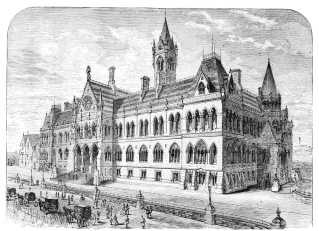
ASSIZE COURT, MANCHESTER.

An age of municipal and civic development has found for the buildings
it requires a representative architect in Mr. Waterhouse, who has
erected most of the magnificent town-halls and court-houses of the
great provincial cities. These vast, and in a certain sense beautiful,
buildings are the only ones that can compare with the old cathedrals
and castles of England, built with as serious a purpose as theirs,
and with as physiognomical a relation to the age that produced them.
Mr. Waterhouse takes the Gothic style for his basis, just as a
pomoculturist might take a russet as the basis of the apple he means to
produce, and, like him, modifies only in obedience to the fundamental
law of the style he has selected. His Gothic building has in it nothing
capricious or eccentric. So genuinely as, under change of conditions
and needs, the bent and bound boughs were copied in the first pointed
stone arch, even so, by lawful adaptation, may the window point become
more obtuse or the lancets more luminous; but the lesson of this
style, which, above all others, has no part or trait not traceable to
a use, is never lost, and the Gothic of Mr. Waterhouse is the natural
evolution of that found in Westminster Abbey. In one of his buildings,
and one of the best structures in the world, the Manchester Assize
Court, I could discover but two things which appeared to me without
special use or meaning. These were two small figures, a snail and a
frog, carved in granite, sitting in the angles of a wall on each side
of the main door-way. Of course these may not be mere jeux; they
may have some connection with a previous bit of eccentricity in an
older building (such as it is often desirable to copy and preserve
for archaeological reasons); but these two forms, each about as large
as one’s two fists, were the only things in the vast building which
appeared “not to the point.” In going over this building I speedily
found that it would not do to pass anything, as the most casual-seeming
bit of ornament was apt to possess a root in history. Thus the
superstructure of the great portico at the entrance is supported by
detached shafts of solid granite two feet in diameter, which stretch
out into foliage as they meet the low roof; but on examination it is
discovered that, framed in this foliage, are finely carved and most
appropriate representations of ancient modes of punishment—persons
undergoing the pillory or some ordeal, broken on the wheel, wearing
the mask, or bridle, for scolds, and the rest. On the outside wall
the decoration of the upper edge of a large corbel is twined about
the words, “He shall judge thy people with righteousness, and thy
poor with judgment.” Over a gate leading to the judges’ residence the
tympanum of the gable is adorned with a fine mezzo-relievo of the
Judgment of Solomon. On each side of the grand entrance are carved
two chained dogs, imposing enough to be mythologically descended from
Cerberus and Orthros themselves. There are but two figures on the
outer walls, one of “Justice,” another of “Mercy.” The building is a
parallelogram in form, with a frontage of 335 feet. Within is a grand
hall 100 feet long, 50 feet wide, 75 feet high, with an open timber
roof of eight carved bays, the principals having moulded brackets and
ribs forming pointed arches, and the spandrels filled in with elegant
tracery. Carved figures hold the chandeliers. Around this hall, which
is for state receptions and banquets, run in ancient letters the words
of the Great Charter: “Nullus liber homo capiatur vel imprisonetur
aut disseisiatur de aliquo libero tenemento suo vel libertatibus vel
liberis consuetudinibus suis, aut utlagetur aut exulet aut aliquo modo
destruatur, nec super eum ibimus nec super eum mittemus, nisi per
legale judicium parium suorum vel per legem terræ. Nulli vendemus nulli
negabimus aut differemus rectum vel judiciam.” This makes about as
beautiful a cornice edging as can well be imagined. The last sentence
is repeated on a stained window at the end of the hall:
To none will we sell
To none will we deny
To none will we delay
Right or Justice.
The subject of the window illustrates the history of the Great
Charter—King John in the centre, and Archbishop Langton and Chief
Baron Robert Fitzwalter on either side. There are three miles of
corridors, all with a dado of tiles more than a yard deep, of a rich
brown tint, and capped with a scroll made of lighter colors. On the
whole, I can hardly express adequately my admiration of this superb
building, the total cost of which was £130,000.

In the centre of Manchester the same architect has erected a larger
building, a Town-hall, which cost £1,000,000. Rich and admirable
as it is, it is not, on account of the crowding of houses around
it, and the irregularity of the ground upon which it is built, so
effective in appearance as the Assize Court. The interior decoration
is remarkable for the beautiful variety of colors secured by a careful
mingling of English, Scotch, and Irish granites grouped as double
stems in the balustrade of a spiral stairway. The Irish granite is a
bluish-gray, the Scotch has a faint red tint, and the English Shapfels
has salmon-colored spars, which are as large as raisins. They all take
a beautiful polish, and I think that for a large public building the
effect is better than if they were marble.
Manchester has shown good sense and good taste in having employed Mr.
Ford Madox Brown to paint six, at least, of the panels in the great
hall of this Town-hall. These mural paintings are not surpassed by
any recent work of the kind which I have seen. Mr. Madox Brown is
pre-eminent for his archæological knowledge and poetic conceptions,
and his genius has been at its best in these noble works. At the
time of this writing three panels have been finished. The first
represents the Romans building a fort at Mancenion (Manchester),
anno 60. Agricola, Governor of Britain, is represented with a
centurion beside him, examining a parchment plan of the Camp; a
standard-bearer holds the silken Dragon-standard—emblem borrowed from
the “barbarians”—which floats in the wind. The Legionaries are doing
mason-work; Britons bear the stones and cement. Agricola’s wife and
little boy are in the scene. The second panel represents the Baptism
of Edwin, at York, in the year 627. The artist follows the account of
Bede, who says that a small wooden church was hastily erected for this
purpose on the site where York Minster now stands, but has introduced a
Roman mosaic floor. In his noble picture of Edwin he has been inspired
by Wordsworth’s sonnet, “Paulinus:”
“Mark him, of shoulders curved, and stature tall,
Black hair, and vivid eye, and meagre cheek,
His prominent feature like an eagle’s beak;
A man whose aspect doth at once appall
And strike with reverence.”
The third panel is the Expulsion of the Danes from Manchester. One less
acquainted than this artist with ancient fact might be surprised at
the beardless, boyish appearance of the escaping Danes; but it is true
that the Vikings began their adventures early—at the age of fifteen,
it is said—and became respectable married men a few years later.
The town-folk are hurling missiles at the retreating party, one of
which—thrown by a young woman from a house—strikes down the “Raven”
standard. Mr. Madox Brown’s further designs include “The establishment
of Flemish Weavers in Manchester, 1330;” “William Crabtree (draper,
of Broughton, near Manchester) observing the transit of Venus, 1639;”
and “The Decree Court Leet that all weights and measures are to be
tested, 1566.” No man is better able to invest with beauty these events
connected with the history of Manchester. Mr. Madox Brown is using for
these mural paintings the “Gambier-Parry” process. The medium consists
of a mixture of wax, resin, and essential oil, with which the stucco of
the wall is coated and the colors ground. Every color ever used with
oil, water, or fresco is admissible with this medium; and the surface
when dry is without shine, while yet the utmost luminosity pertaining
to any other method is attainable with it. It seems likely to become
the general mode in this climate, and has given equal satisfaction to
Sir F. Leighton and Mr. Madox Brown.
One other of the immense buildings which have become so characteristic
of the populous centres of England I must mention, namely, the new
Midland Railway-station, at St. Pancras, in London. This is probably
the finest railway-station in the world, and it is the chief work of
Sir Gilbert Scott. It is a vast pile, of which every outward detail is
graceful and substantial, its turrets and great clock-tower superb.
This immense building conveys, however, an unpleasant impression of
being out of place. It implies a park, or at least a larger and more
picturesque space than the irregular and ugly one at King’s Cross,
to secure the perspective needed for any sight of it as a whole.
Entering, we find ourselves beneath a vast span of iron and glass,
almost like a sky. The front part of the building is a hotel. It has
been decorated by Robert Sang, and furnished by Gillow, in the most
expensive style, and certainly presents some rich interiors. The
reading-room has green cloth-paper, and a ceiling gay with huge leaf
frescoes; it is divided by a double arch with gilded architraves. The
mantel-pieces are of dark marble, with two small pillars of yellow
marble set on either side. The coffee-room has a general tone of
drab, with touches of gold in the paper, and a sort of sarcophagus
chimney-piece, surmounted by an antique mirror of bevelled glass. The
sitting-room has red floral paper, and an imitation mosaic ceiling.
One of the bedrooms which I visited had deep-green paper, with gold
lines and spots, and bed-curtains somewhat similar. The furniture was
of heavy oak, tastefully carved. The halls and corridors have a dado
of fine dark brown tiles, and bright fleur-de-lis paper above. All of
which was rich, costly, and, with slight exceptions, by no means gaudy.
Yet I could not altogether like it, or think the decorations entirely
appropriate for a hotel. It looked as if there had been more exercise
of ingenuity to find things costly than to find things beautiful. The
salon, the reading-room, may naturally be made gorgeous, but the
bedroom ought to be more quiet. One does not desire to sleep amid
purple and gold. The traveller who needs rest may well spare these
things—which, however, he knows will not spare him; for if there is
gold paper on the wall, there will be gold paper in the bill.
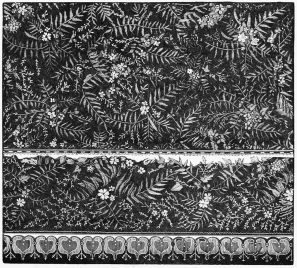
KIDDERMINSTER CARPET—FERN DESIGN.
For its purpose it would be difficult to fancy, impossible to find, a
more complete structure than “The Criterion,” which the great London
caterers, Messrs. Spiers & Pond, have erected at Piccadilly Circus.
This building includes social and private dining-rooms, room for
table d’hôte, hall for public banquets and balls, restaurant, and
buffet; and beneath all these a theatre large enough to entertain a
thousand people. The architect, Mr. Thomas Verity, plainly had it in
his mind to raise a great gastronomic temple, and when one enters the
door, what he sees on every side is the apotheosis of eating. Through
an archway we enter, and find ourselves amid the French Renaissance.
The façade outside, and the door-way, with its glazed framing and
superb bronze columns, make one feel that he is about to dine superbly.
Really he does dine remarkably well, though the French Renaissance
hardly extends to the culinary art of the establishment, for that would
imply a revolution in the Briton’s constitution. Mr. Wyon has placed
some fair sculptures, the Seasons, etc., in the niches and on spandrels
of the wall outside, but the inside decorations of Mr. Simpson are
truly, in the words of Messrs. Spiers & Pond, “upon a scale which has
hitherto never been attempted.” The grand hall rises squarely through
three stories to a light Mansard-roof, from which sunburners blaze down
at night, and outside of which is a promenade commanding a fine view
of London. All of the sides of this grand and lofty hall are of tiles
made for this establishment, and combining to form large pictures, the
subjects of which were designed and painted by A. W. Coke. Over the
right-hand door, leading to the restaurant, is a semi-classical scene
of youth and maid by the sea-side gathering in fish; on the opposite
side, over the door opening into the buffet, is a picture of two girls
in a wheat field, where there is an apple-tree, the one attending to
the sheaves, the other to the apples; around the lower hall are—still
in tile mosaic—large figures of Euterpe and Terpsichore (for there
will be music and dancing above), Pomona, Flora, Bacchus, and, of
course, Diana, goddess of venison. The floor of the hall is as fine as
any mosaic in London, and is adorned at the edges with the monograms of
the firm. In the restaurant there are all manner of allegorical figures
on the walls, the Seasons, and the genii which dig and delve and hunt,
all with the object that humanity shall be fed. In the buffet there are
charming tile pictures representing chubby boys and girls; one party
up the tree gathering fruits, the other beneath catching the same and
putting them into baskets; in each picture a different tree and fruit.
On one side of the main stairway is the figure of a boy stealing up
to a bird’s nest, over which a bird hovers; opposite, the boy has the
nest, the bird flies away. This device is not immoral; it means that
plovers’ eggs are on the bill of fare. One of the finest things in this
staircase is an ebony hand-railing, three inches in diameter, with
plated silver mountings. Also a very fine effect has been produced by
framing the door-ways in white majolica, although greater simplicity in
the designs than human faces festooned with flowers would, I suspect,
have been better. I must not omit to mention that the cornice inside
the grand hall, at the top of the first and here floorless story, has
the unique ornament of sentences from Shakspeare running all around the
walls, with picturesque lettering:
“None here, he hopes,
In all this noble bevy, has brought with her
One care abroad: he would have all as merry
As first-good company, good wine, good welcome,
Can make good people.”
“A good digestion to you all: and, once more,
I shower a welcome on you;—Welcome all.”
So it is that money enough enables common folk now to dine in palaces
and enjoy banquets quite as royally served and surrounded as Bluff
Harry offered to Cardinal Wolsey and the lords and ladies at the
Presence Chamber in York Place. But even that monarch could not have
entertained his guests so luxuriously in one particular as Messrs.
Spiers & Pond theirs; for these, having dined, may pass through a door
and descend by a stairway adorned with Muses and mirrors, and rich with
floral clusters, to a theatre all glorious in blue and gold, cushioned
chairs, boxes with curtains of yellow satin and lace, and a good
drab background to set them off, and pass the rest of the evening in
enjoyment of well-acted comedies or operettas.
So far as most of the hotels and restaurants of London are concerned,
one may with satisfaction follow the advice of the Duke of Gloster to
Anne, in the first act of Richard III.:
“Leave these sad designs
To him that hath more cause to be a mourner,
And presently repair to Crosby Place.”
For the old Gothic palace in the City, which Sir John Crosby built on
a piece of land with one hundred and ten feet frontage, for which he
paid a little over eleven pounds, which his widow sold to the duke
who afterward became Richard III., and which in Shakspeare’s time
had fallen to the richest of Lord Mayors (Sir John Spencer), has
now followed the course of so many royal buildings, and become the
banqueting-hall of the public.
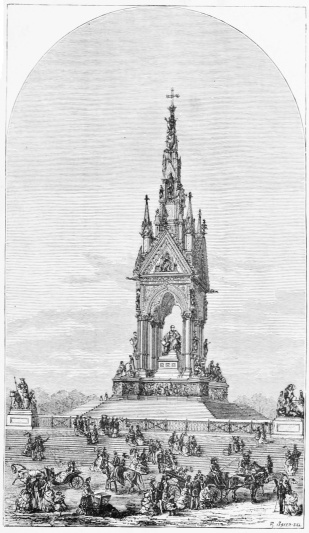
ALBERT MEMORIAL, HYDE PARK.
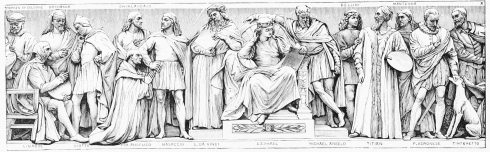
ALBERT MEMORIAL—EAST FRONT. PAINTERS.
Crosby Hall is haunted by memories of the great. It gives flavor
to everything one eats in it to know that it has been celebrated
by Shakspeare, that from the year in which it was built (1466) it
was associated with whatever has been most romantic in the history
of London. Here Sir John Rest was installed as Lord Mayor in the
days (1516) when the Lord Mayor’s Show meant something. The civic
procession which accompanied him contained four giants, one unicorn,
one dromedary, one camel, one ass, one dragon, six hobby-horses, and
sixteen naked boys. Here resided Sir Thomas More, Under-treasurer and
Lord High Chancellor of England. Here he wrote his best works, and
received the visits of Henry VIII. Here Erasmus visited the author
of Utopia, whose domestic life he described: “With him you might
imagine yourself in the academy of Plato; but I should do injustice
to his house by comparing it to the academy of Plato, where numbers
and geometrical figures, and sometimes moral virtues, were the
subjects of discussion; it would be more just to call it a school
and an exercise of the Christian religion. All its inhabitants, male
and female, applied their leisure to liberal studies and profitable
reading, although piety was their first care. No wrangling, no idle
word, was heard in it; every one did his duty with alacrity, and not
without a temperate cheerfulness.” In 1672 the hall was arranged for
Non-conformist meetings. For ninety-seven years it was devoted to
this purpose, and among those who preached here was Thomas Watson,
who wrote the famous tract (Heaven Taken By Storm) which converted
Colonel Gardiner. It is not wonderful that its old splendors then
began to depart. The Mercury of May 23, 1678, advertised a sale at
Crosby Hall, where would be disposed of, among other things, “tapestry
hangings, a good chariot, and a black girl about fifteen years of
age.” Then it became the office of the old East India Company; next a
literary and scientific institute; next a wholesale wine warehouse;
and at length came into the hands of its present proprietors, who have
restored it to its original purpose by making it a banqueting-hall.
They have preserved it, and stained its windows with portraits and
pictures representing all its history. The decorations are in perfect
keeping with the beautiful Gothic style of the building, and the colors
seem to have expanded on it as a flower on its stem. One seems to be
dining here in an older Guildhall and at a daily Lord Mayor’s banquet,
with ancient Shakspearian characters for company. It is particularly
entertaining to observe what a rich frieze can be secured for a hall
in England by a skilful arrangement of the historic shields and coats
of arms which belong to the country; while if some beautiful central
figure on wall or glass is desired, it may be obtained in any one of
the suggestive and mystical devices which are associated with the olden
time—the boar, the lamb with its flag, and so on.
But neither the Criterion nor Crosby Hall furnishes, as I think, the
same degree of beauty appropriate to dining-halls as may be found at
the South Kensington Museum. Here one of the rooms was intrusted for
decoration to Mr. Poynter, for a time President of the Art School
there. He has made exquisite designs for the tiles of which the walls
are altogether composed. The simple blue and white colors, and the
purely decorative character of the figures thus made, make one almost
regret that these figures are not Chinese instead of classic or
allegorical, in which case one might eat with a feeling of comfortable
seclusion in a china dish. The regular dining-room in the Museum
was intrusted to Morris & Co., who have placed on the upper part
of the walls a rich floral decoration of embossed plaster, colored
(gray-green) by hand. The lower part of the wall, extending over two
yards from the floor, consists of panels, on each of which is painted,
on a gold ground, some allegorical figure. These figures represent
the sun, the moon, and signs of the zodiac; they were designed by
Burne Jones, and bear too much of that mystical light and expression
which invest all forms and faces evoked by his magic touch to be
gastronomically suggestive. In this respect neither Burne Jones nor
the young artist (Murray) who painted his designs could rival the
decorator of the Criterion; but one may dine at South Kensington amid
one of the pleasantest little picture-galleries in existence. When
Ralph Waldo Emerson was last in London, a poet who wished to give him a
dinner conceived the happy thought of bringing him here, and the sage
of Concord no doubt approximated his friend Alcott’s ideal of “dining
magnificently;” even the “bowls of sunshine” with which A. would
replace wine were supplied by the rich stained windows of Morris, and
by the brilliant white-and-gold of the restaurant which separates the
two rooms so exquisitely decorated.
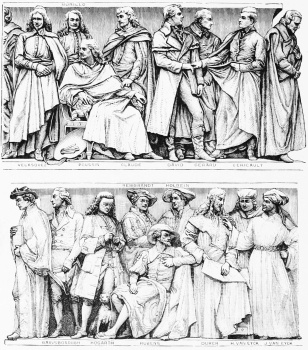
ALBERT MEMORIAL—CONTINUATION OF EAST FRONT. PAINTERS.
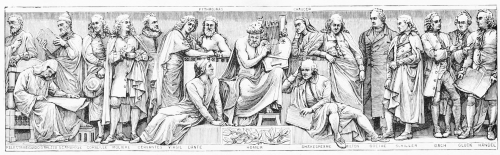
ALBERT MEMORIAL—SOUTH FRONT. POETS AND MUSICIANS.
There is no doubt that the barbaric element in English taste received
a fresh accession of vigor with the advent of the Georges to England.
What it was capable of, and what it found pleasing to the aristocratic
butterflies who flitted around him whom they adored as “the first
gentleman in Europe,” may be discovered in the Pavilion, at Brighton.
That building may be regarded as the physiognomical monument of George
IV. It is his cerebral interior projected into stone and decoration.
The secret stairways and passages leading up to fictitious wardrobes,
really door-ways to rooms which his majesty desired to visit, represent
the prince that sent horsemen to trample down laborers at Peterloo,
whose only guilt was to discuss their wrongs; the bizarre carvings,
which make fine stone look like terra-cotta, illustrate the fop who
had come to prefer figment to fact. The interior decorations do not
represent so well the monarch whom Thackeray analyzed, and found in his
h nds only a heap of pad, paint, gold-lace, but no man at all. Those
frescoes were made during the first furor which occurred in England
about Chinese and Japanese art; and, though ludicrously gorgeous, they
are not without a certain interest, arising from the boundless freedom
of their design and colors. How this can be it will be difficult for
my reader to imagine, when he is told that the walls are covered with
large dragons (life size, one might say, if dragons existed), serpents,
wild cormorant-like birds, all having a grand field-day amid ladies
and pleasure-grounds. The pillars are like barbers’ poles, with the
archæological serpent twined around each instead of the red stripe. The
Pavilion is said to have found in Mr. P. T. Barnum its only admirer.
English critics have been rather hard upon it. Sydney Smith said that
the structure looked “as if the dome of St. Paul’s had come down to
Brighton and pupped.” William Cobbett thought that “a good idea of the
building might be formed by placing the pointed half of a large turnip
upon the middle of a board, with four smaller ones at the corners.”
The main intent of the building is to imitate a Chinese pagoda, and
it was with that aim that the Prince of Wales (for he seems to have
been mainly his own architect) committed this enormity. Two years
ago the British Association for the Advancement of Science gathered
for its charming summer séances at Brighton, and the rooms of the
Royal Pavilion were placed at their service. Never were the sessions
of the Association so well housed, but it was amusing to witness the
difficulty which even eminent savants had in the rivalry between the
attractions of the wall-papers and the scientific papers. On the
whole, it is to be feared that the grotesque ornaments left by the
Regent carried the day. On one occasion, when a discussion occurred
in the anthropological section on serpent-worshippers, the dragons
and serpents on the wall were so appropriate that the room had the
appearance of being frescoed for the archæological purposes of the
day. But the ordinary contrast between the severe disquisitions of the
scientific men and the luxuriant and barbaric colors and forms of the
Pavilion was not so great as I witnessed recently in the same place.
In the room which above all the rest might be regarded as the temple
of vanity, a hundred ritualistic gentlemen and ladies had gathered to
hold a prayer-meeting! In the evening there was a ball in the same
room, and then it appeared plainly what had been the final cause of
the Brighton Pavilion. I may add that the large building which George
IV. erected for his stable, and whose roof is a vast dome, is now the
chief concert-room of Brighton, and that another outlying building of
the place is occupied by a fair picture-gallery, a good museum, and a
capital library. Huish, in his Memoirs of George IV., says: “Nothing
could exceed the indignation of the people when the civil list came
before Parliament, in May, 1816, and £50,000 were found to have been
expended in furniture at Brighton, immediately after £534,000 had been
voted for covering the excess of the civil list, occasioned entirely by
the reckless extravagance of the Prince Regent, whose morning levees
were not attended by men of science and of genius, who could have
instilled into his mind wholesome notions of practical economy; but
the tailor, the upholsterer, the jeweller, and the shoemaker were the
regular attendants of his morning recreations.” These mechanics were no
doubt the worthiest folk who frequented the building they had made so
fine, and probably most of them had to take their pay in royal smiles;
but it would have relieved the indignant minds of the middle classes,
who chiefly had to supply the exorbitant civil list, if they could
have foreseen that their money was destined in the end to supply their
favorite watering-place with an agreeable, instructive, and useful
institution.
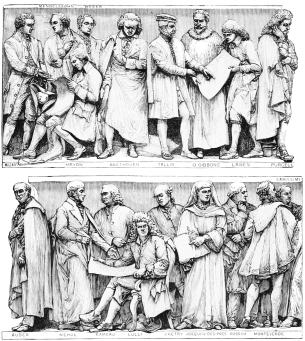
ALBERT MEMORIAL—CONTINUATION OF SOUTH FRONT. MUSICIANS.
When the English people now look upon the Royal Albert Hall they are
quite warranted in drawing pleasant conclusions as to the change which
has come over the spirit of royalty since the Pavilion was erected.
Here we have the real monument of the late Prince Consort, who, however
he may be estimated, certainly did have the ambition to be associated
with the progress of science and art in England. Since the erection
of the Coliseum in Rome no building so stupendous and noble has been
built as this. It is a pile worthy of Rome in its palmiest days; and,
with its superb oval form, and external frieze and cornice moulded
after the Elgin Marbles, devoted to international industrial and art
exhibitions and to music, it stands as grandly amid the European
civilization of to-day as the Parthenon stood in Greece. This palace of
art, and the Albert monument in the park opposite, make the beauty-spot
of London. The latter is beyond question the finest monumental
structure in Europe. This afternoon, while the golden sunset of a
balmy spring day was glorifying the sky, I walked to it, passing by
the old Kensington Palace, where the little girl was informed that she
was Queen of England who has since had her name associated with her
country’s longest period of peace and prosperity, passing beneath the
ancient patriarchal trees and through the gardens beautified by flowers
and plants from every region of the world, until at length I saw the
spire of the monument shining like flame through the boughs. There
against the clear, orange-tinted sky the monument stood forth, with
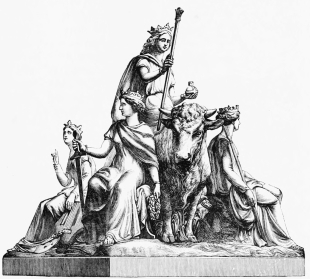
its grand marbles at the four corners—Asia, with its genius mounted
on a camel; America on her buffalo, Europe on her bull, Africa on her
elephant, and each the centre of a representative group—and its noble
reliefs and frescoes rising up to the winged angels at the top; and
it appeared to me that every one of the one hundred and sixty-nine
life-size portrait figures—the painters from Cimabue to Turner, the
architects from Cheops to Gilbert Scott, who designed this monument;
the sculptors from Chares to Thorwaldsen; nay, the very composers and
poets from St. Ambrose to Rossini, from Homer to Goethe—had done
something to raise this triumphal pile, about which their forms seem
to move in stately procession. The architects and sculptors are the
work of Philip; the poets, composers, and painters by Armstead; and
while both have done admirably, it must be said that the reliefs by
the latter are not surpassed by any modern sculpture. The group of
Michael Angelo, Raphael, and Leonardo da Vinci, the kneeling form of
Fra Angelico, are works such as can only be ascribed to that fine
degree where intellect passes beyond ordinary analysis, and is called
genius. Its central figure—Prince Albert—under the grand canopy,
seems at first a conspicuous example of contemporary Hero-worship,
showing that its highest and costliest homage is paid, not to any
great Englishman—not to Shakspeare, not to Turner—but to a German,
of whom it is certain that, had he not been a prince, he could never
have excited so much attention as a hundred others of his fellow-men.
At present the figure, not yet tested by time, is brassy enough, and is
throned in brass; never was man more gilded over! But there is another
side to this. The inscription runs: “Queen Victoria and her people to
the memory of Albert, Prince Consort, as a tribute of their gratitude
for a life devoted to the public good.” The Prince received no such
credit during his life; he got smirching enough then; but, if time
tells as well on his statue as it has on his reputation, this figure
will become increasingly worthy of its environment. Though no great
man, he will sit there surrounded by the allegorical representations
of art, commerce, and the various types of peaceful civilization, to
which he did unquestionably devote himself. And it is something that
the noblest monument in Europe, though better deserved by some who
have no monument but their work, has at any rate been raised, not to
any brilliant devastator of human homes, not to any royal oppressor or
scheming diplomatist, but to an ordinary man, who used the position and
means intrusted to him for the refinement and moral well-being of the
country that adopted him. While the legend of one section of Europe
is Napoleonic, there is some significance in the fact that Albert
should have transmitted that of another section; and the essential—the
moral—beauty of every admirable monument is thus not wanting to that
which graces the largest and wealthiest city of the civilized world.
If the spirit of Prince Albert revisits the glimpses of Rotten Row,
his once favorite haunt, he must long for the day when wind and
weather shall have subdued some of the obtrusive glitter of his
statue. It is too bad to be seen with too little light during life,
and too much after death. It is sufficiently curious, while gazing on
this overpowering mass of gilded metal, to remember what his private
feelings were when some snobbish officials of London City proposed to
erect a monument to him twenty-three years ago. The following letter,
all the more creditable because necessarily private—the matter never
having assumed such shape that he could speak of it publicly—was
written at a time when its writer was believed by many to be the real
instigator of the proposed monument to himself. It was addressed to
Lord Granville, and is as follows:
“Windsor Castle, 3d November, 1853.
“My dear Lord Granville,—Many thanks for your letter,
evincing such kind interest in what concerns me.
“I did not see the letter in the Times, but I read yesterday’s
leading article, which led me at once to considerations similar
to those which struck you. Moreover, it is evident to me that
the Lord Mayor started the plan chiefly as the means of bringing
himself into notice, after other Mayors had gone to Paris, taken
the lead in education, etc., and that the Times is attacking
the plan chiefly to hit the Lord Mayor, as it had hit his
predecessors. My unfortunate person will thus probably become
their battle-ground; and, although the first article of the
Times is civil, its music generally goes on crescendo, and the
next may be purposely offensive, and meet with shouts of applause
from a portion of the audience.
“Still, I do not see how I can, with any dignity or respect for
myself, take notice of the squabble, and cry out for mercy, or to
whom I could write such a letter as you suggest. I have never been
consulted in any way in the matter, and the people have a perfect
right to subscribe for and erect a monument in remembrance of the
Great Exhibition; nor could I volunteer to say, ‘You must not
connect it in any way with me.’
“I can say, with perfect absence of humbug, that I would much
rather not be made the prominent feature of such a monument, as
it would both disturb my quiet rides in Rotten Row to see my
own face staring at me, and if (as is very likely) it became an
artistic monstrosity, like most of our monuments, it would upset
my equanimity to be permanently ridiculed and laughed at in effigy.
“The Times argument, however, that it would be premature to
place a statue to me, is of no great force in this instance, as
I suppose it is not intended to recognize general merits in me,
which ought yet to be proved, and might possibly be found wanting
on longer acquaintance, but rather to commemorate the fact of the
Exhibition of 1851, over which I presided; which fact will remain
unaltered were I to turn out a Nero or a Caligula.
“As in all cases of doubt what to do it is generally safest to do
nothing, I think it better to remain perfectly quiet at present.
If I were officially consulted, I should say, ‘Mark the corners
of the building by permanent stones, with inscriptions containing
ample records of the event, and give the surplus money to the
erection of the museums of art and science.’
Believe me, etc.,
“Albert.”
Foley’s statue would be nobler if the last paragraph of this letter
could be read on it, and if he could have contrived some plan to let
every observer know that the book held by the Prince is the Catalogue
of the Great Exhibition of 1851.
There is some reason why the English artists should have done their
best work upon the monument of Prince Albert. He may be regarded as
the first man to teach this country that money might well be largely
expended for the encouragement of fine art, and that it had artists
capable of the best work, if the means were adequately supplied
to them. He was the means of employing scores of fine brains that
had otherwise been unable to make their mark on the country, and he
extorted from a grumbling, shop-keeping public the splendors which now
render the South Kensington Museum and its surroundings institutions an
art university for the world. Very different have been the resources
and rewards of the artists who have built and adorned the structures
I have been mentioning from those which were alone available when the
frescoes were placed in the corridors of the Houses of Parliament.
Nevertheless, the Prince Consort himself had to be taught by a German
artist to look around him for the ability which was needed for English
work. When he was appointed the commissioner for the decoration of the
Houses of Parliament (1841) he made overtures to Cornelius to come
over and do the work. The German artist replied, “Why should you come
to me when you have the man by your side—Dyce?” Dyce, who had studied
at Rome with Cornelius and Overbeck, was then professor in the School
of Design at Somerset House; but he was little known as an artist, and
had not competed when designs for the decoration of Westminster Hall
had been invited. The Prince Consort at once suggested to him that he
should send in a design; and having too little notice to make a new
one, he sent in a study he had made for a fresco for the Archbishop’s
palace at Lambeth. It was severely criticised, as too German, too
papistical, etc.; but it was selected; and the result is the beautiful
frescoes of the Baptism of Ethelbert, in the House of Lords, and of
the Morte d’Arthur, in the Queen’s robing-room. How slowly the ability
of Dyce was recognized in England may be estimated by the fact that
one of his most admired works—“Paul Preaching to the Gentiles”—now
in the South Kensington Museum, was employed at an art exhibition in
Manchester as background to an umbrella-stand!
But Prince Albert does not appear to have required a hint from Germany
to appreciate the Scotch artist—son of a shoemaker—whose superior
genius overshadowed that of his wealthy Irish brother. Already, while
Dyce was as yet undiscovered, Maclise had been appointed to set about
those grand works which adorn the passage to the House of Commons.
But the poor sums which were paid to both of these artists, and the
grudging way in which they were dealt with, are now remembered only
as a scandal. Dyce was sharply censured because he would not promise
exact dates for the completion of his seven frescoes whose payment had
been fixed by the Treasury at stated periods. Being rich, he offered
to refund; but the Treasury, knowing that this would arouse some
indignation, found it convenient to reply that “no precedent” could
be found justifying its acceptance of his offer! Any one who looks
upon Maclise’s two pictures—“Trafalgar” and “Waterloo,” the latter
with three hundred figures, each perfect in line and expression—can
but feel scandalized that Parliament proposed to pay him only £2000.
Goaded by the outcry among the artists, it at length raised the sum to
£10,000, but then grew sulky and cut off many of the commissions. In
reality Maclise paid £30,000 for the honor of making those pictures.
He gave the whole of four years to them at a time when his regular
work never brought him less than £10,000 a year. When Cornelius passed
through a South German town the ovation was such as no prince could
command. When Maclise had completed his frescoes the artists of London
presented him with a gold chalk-holder. The Prince Consort did all he
could to raise an enthusiasm for decorative art in this country, and
to raise the wages and the position of the artist and of the artisan,
and he succeeded measurably; but time has sadly shown that he must
have imported the climate of Italy rather than its schools to make
this a country of beautiful frescoes. Although Cornelius magnanimously
declined the overtures made to him, as above stated, in favor of
Dyce, he consented to come to London and give advice concerning the
proposed works. It was owing to him that frescoes were determined upon.
He had seen the glory of the great frescoes of Munich; he could not
see that in a few years they would be peeling off (as they are now)
even there. Fortunately, Maclise resolved to put on his frescoes in
silica, and they are yet fairly preserved; but all the pictures in the
Houses of Parliament have had to be retouched from time to time, and
the silica has such an attraction for the atmospheric moisture that
the effect of the colors is frequently diminished. While it is thus
manifest that the corroding damp of the English climate is hostile
to mural ornamentation, and fatal to external frescoes, there is a
steady increase of the desire for such things. This has been especially
manifested among the English nobility, who have everything in the wide
world that their hearts can desire, excepting only the climate that
might comport with luxury and beauty.
That barbaric element in the English aristocracy, of which I have
before spoken, which Mr. Matthew Arnold half likes while he impales
its eccentricities, is constantly revealed in the contrasts between
the baronial halls of England and the majority of the homes of the
wealthy middle class. One may take as a specimen of the taste of the
latter any one of the fine club buildings on or near Pall Mall. Here
one feels that he is stepping on floors which the Pompeians would have
thought somewhat sombre, but would have enjoyed, and amid walls and
arches which they would have recognized as familiar, though strangely
gloomy. The halls are large and spacious, rather costly than rich,
built of purest granites and marbles of various hue; the reading,
dining, and smoking rooms are comparatively quiet, and built with a
view to comfort alone. The clubs represent the desire of gentlemen of
means to pass their hours of leisure in palaces, and these are secured
at an expenditure of less than a hundred pounds each per annum, even
in the best of such institutions. But when one visits the castles of
the nobility, such as are still inhabited, the fondness for color
and romance is at once manifest. They love their rooms now blue, now
green, and again rose-colored. They love classical frescoes—nude
Muses, Graces, and Cupids chiefly—on the ceilings, and gay tints on
the walls even of sleeping-rooms. In a word, my lords were sensational,
and in some cases descended to the most vulgar tricks, as in the case
which Wordsworth rebuked so sternly. On the occasion of a visit to
Dunkeld the poet was taken into a room lined with mirrors, and where
an artificial water-fall was set going by a spring being touched. The
water-fall was reflected one way in the mirrors, but another way in the
poet’s face, and soon after in his rebuke of such mimicry of Nature:
“Ever averse to pantomime,
Thee neither do they know, nor us
Thy servants, who can trifle so.”
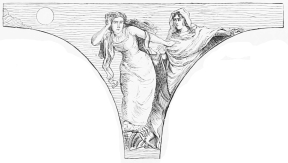
But what could come of a generation trained by the royal standard which
thought it beautiful to tie oranges bought in Covent Garden Market on
the twigs of trees at Hampton Court for a garden party? The mansions
of the nobility are still really the most tawdry and inartistic in
their decorations of any class that have attempted decorations—mere
blazings of white-and-gold; but there is an increasing number of
exceptions, represented especially by some ancient families which have
manifested a laudable desire to have their halls painted with pictures
of legends or historical events connected with their neighborhood
or their ancestors. Mr. William B. Scott, artist and poet, who has
done excellent mural work of this character, has, I believe, fairly
persuaded both the aristocracy and the artists of England that they
cannot have Italian frescoes in this country, and must depend upon
mural painting. In exhibiting specimens of his own excellent mural
painting, before the Institute of British Architects, Mr. Scott made
some interesting remarks on fresco. “In Italy,” he said, “the reign
of fresco was a little more than a century in length. All the earlier
works remaining are in tempera. Not many years ago it was not unusual
to hear people talk of all early Italian wall paintings as fresco,
but it is quite certain no such thing exists; the earlier frescoes,
such as Mantegna’s works, in the Eremitani Chapel, in Milan, are
miserable ruins; while the tempera pictures of Giotto, a century and a
half older, in the Arena Chapel, in Padua, for example, are perfect.
How, then, did it come about that fresco, which died out in Italy
very shortly after Michael Angelo finished the Capella Sistini, had a
revival in this nineteenth century in Munich and London? A very short
narrative of the circumstances attending this revival will, I think, be
enough. The associated body of young German students assembled in Rome
in the beginning of this century aspired to better things than they
found existing in the lifeless art about them. They reverted to the
study of earlier art—to the actual reproduction of former art. They
were also pietists—at least the two leaders, Overbeck and Cornelius;
they found that their patron saint, Fra Angelico, painted in fresco;
they found also that all the mythological, anti-religious pictures of
the Bolognese school and later period were in oil: they determined on
the revival of fresco. King Ludwig seconded them, and furnished an
ample field for their success. The misfortune was, they did not go
back far enough; they were self-denying men, and even the hardships
and difficulties of fresco had attractions for them. It was like a
revival of Tudor in mistake for a revival of the best period of Pointed
architecture. Several English artists living in Rome, after the great
success of the first very able works of these revivalists—my brother,
David Scott, of Edinburgh, and William Dyce, for example—were smitten
with the same feeling.”
Some eight years ago I had the pleasure of seeing the mural paintings
with which Mr. W. B. Scott has decorated Sir Walter Trevelyan’s
house, at Wallington, in Northumberland. No person could have been
more appropriately selected for the work than Mr. Scott, who passed
much of his early life in that region, and has written such beautiful
poems upon its ancient legends. The first (ground-floor) series of
paintings is on panels, enclosed between pilasters supporting arches;
and a second is on the spandrels above the arches, in a corridor
leading to the bedrooms, on the upper floor. The mansion is near the
ancient Scottish Border, so haunted by romance, and near it may still
be seen the remains of the ancient Roman Wall. In four of the panels
the subjects are (1) the building of the Roman Wall; (2) King Egfrid
offering the bishopric of Hexham to Cuthbert, hermit on Farne Island;
(3) a descent of the Danes on the coast; (4) death of the Venerable
Bede. On the opposite side are later subjects, but equally related to
the same region of country: (1) “The Spur in the Dish”—the sign to the
moss-trooper that the larder is empty; (2) Bernard Gilpin taking down
the gage of battle in Rothbury Church; (3) Grace Darling and her father
saving the shipwrecked crew; (4) “Iron and Coal”—the industry of the
Tyne. The pilasters and the arcaded ends are also slightly decorated
with foliage. The pictures on the spandrels are a series of eighteen on
the old Border ballad of Chevy Chase. They are full of spirit, and
their rich colors are like bursts of sunset along the ancient corridor.
So much, indeed, depends on this color that it is impossible to convey
the artist’s idea of mural painting by a woodcut. Nevertheless, I must
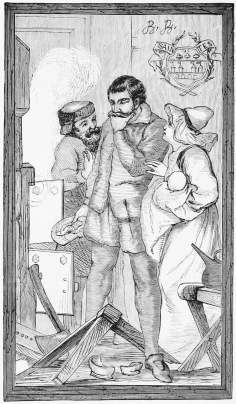
confide to the imagination of my reader one characteristic design (page
147), “Women looking out for their Husbands and Brothers after the
Battle of Chevy Chase.”
For his decoration of Penkill Castle, Ayrshire, Mr. Scott appropriately
selected the old Scottish poem of The King’s Quair, or book
(cahier, or quire, of paper), said to have been written by James of
Scotland when a prisoner at Windsor, in 1420, on his love for Jane,
granddaughter of John of Gaunt. The first picture shows the king in
prison, turning from his reading for his pen. According to the canto
in which the king describes his rising with the matin bell, there is
pictured the bell, the warder, the night-watch going home, etc. In
the second picture he looks from his window, and sees the fairest
of womankind listening to the birds in the terraced garden. She has
with her two maids and a little dog. Cupid—the Cupid of early art,
a sort of pretty page—shoots at the king from behind a hedge. The
third picture represents the royal poet’s dream, in which Master
Cupid descends from the starry sphere to carry him away to the court
of Venus, to obtain her assistance. These three pictures run along a
flight of stairs, and the series is taken up with the next flight. In
the fourth picture the poet finds all the lovers of history at the
shrine of Venus. James prays on his knees to her, but she sends him to
Dame Minerva’s court of wisdom for advice. Then we have the poet at the
court of Minerva; next Lady Jane sending off the carrier-pigeon; and
finally the royal poet receiving it. It requires but little reflection
for any one to realize that to an ancient baronial castle such a series
of paintings as this would be as the breathing of a soul beneath its
gray ribs of rock. It must be mainly for the want of such pictures in
them that servant-maids and children so often imagine ghosts rustling
along old corridors and haunting antique stairways.
The castle of the Earl of Durham is graced by a fine stained window,
illustrating the legend belonging to it of the slaying of the great
worm, or dragon, by the Knight of Lambton; and the similar legend of
Moore Hall is finely told in that mansion by the art of Professor
Poynter. The last, however, is simply on canvas, and appeared as a
large framed painting at the Royal Academy. It is, of course, necessary
that a house should be very large and stately to bear mural paintings.
The painting of panels is, indeed, becoming common in old houses which
are well wainscoted, but as a general thing it is confined to the doors
of more modern dwellings. However, a very fine effect has been produced
in the dining-room of Mr. Birket Foster, at Witley, in Surrey, by
inserting in the wall around the room a continuous painting by Burne
Jones representing the legend of St. George and the Dragon. The stained
glass which Morris & Co. have placed in the landing of the staircase,
in the same beautiful residence, shows also that even a cottage-mansion
of moderate size admits of a great deal more decorative color than is
ordinarily supposed.
In passing from the consideration of works of a public and semi-public
character I cannot refrain from paying some tribute to the most
influential decorative artist whom England has produced, and whose
death in April, 1874, all lovers of beauty are still mourning. Mr.
Owen Jones carried into decorative art that spirit of archæological
accuracy—one might almost say that profound scholarship—which was
brought into pictorial art by Delaroche in France, Baron Wappers in
Belgium, and Maclise in England. It is said that there was but one
thing in England which the Shah of Persia wished to carry back with
him to his palace—the Alhambra rooms, at the Crystal Palace; but of
all their possessions, in the way of art, there is hardly one that
the London people would so unwillingly part with. Yet it is probable
that as little as the Shah the thousands who every week find in those
rooms their châteaux en Espagne realize what it really cost to put
them there. Mr. Owen Jones had passed his youth and his early manhood
journeying, both personally and mentally, on the track of the race to
which his fine culture belonged: he had studied the mystical figures
and lines of Egyptian temples; he had pondered the principles by which
reason and truth find expression in stone amid the ruins of Greece; he
had learned the secrets of simplicity and grandeur in Rome, where were
poured the converging streams of beauty from many tribes, each bearing
its freight of faith and aspiration, to be deposited in marbles and
monuments which are the gospels and bibles of a primitive world. By
this path, which meant for him a growing culture, he came to dwell on
the heights of Granada, as the recluse and devotee of Beauty, and when
he thence returned to his native land he brought with him a new era.
He expended a fortune on the grand folio of colored drawings of the
Alhambra, which brought him no return, but a single copy of which is
now a collector’s treasure. When proposals were being received for the
decoration of the glass palace of the International Exhibition of 1851,
Mr. Owen Jones offered to Prince Albert and the Royal Commissioners
his plans. The Prince held out against them for some time; but the
fascination was on him, and again and again he returned to the
exquisite designs, until he surrendered to their charm. He selected
Owen Jones with some tremor, but every year since the Palace has been
transferred to Sydenham has shown that it was a felicitous incident of
his life to have encountered the right man for a task which was to be
of far more permanent importance than he supposed. Since then Mr. Owen
Jones has not only given the large interiors of various great business
establishments that beauty which makes many of them worthy of study
and admiration, but he has won for himself and his country the highest
honors of the three great Continental Exhibitions. It was with some
amazement that the world found itself pointed to England as the leader
in decorative art by the French Exposition of 1867. “It requires,”
said the official catalogue of that exposition, “but a slight insight
into modern domestic life in England to perceive how great a change
has taken place within the last ten or fifteen years in the internal
embellishment of the dwelling-houses of the upper and middle classes
of society; and there can be little doubt that the extension of art
education will lead still farther to the production and appreciation
of articles which combine the three requisites of fitness of purpose,
beauty of design and ornament, and excellence of workmanship.” It
might be supposed by those who have not seen this master’s work that
it consisted merely in clever imitations of the Moorish and other
designs with which his name is associated; but, on the contrary, his
chief excellence was, that he showed how the ideas and principles which
underlie the great works of the past were capable of being led out into
new forms and adaptations. In taking the chair at the Society of Arts,
in 1851, on the occasion of a lecture on the arts and manufactures of
India, by Professor Royle, Mr. Owen Jones, having accorded superiority
to the Indian and Tunisian articles in the Exhibition of that year over
all contributed by Europe, added: “Many of these specimens have been
purchased by government for the use of the School of Design, and will,
no doubt, be extensively circulated throughout the country. But it is
to be hoped that they will do more than merely teach us to copy the
Indian style. If they only led to the origination of an Indian style,
I should think their influence only hurtful. The time has arrived when
it is generally felt that a change must take place, and we must get rid
of the causes of obstruction to the art of design which exist in this
country.”
The Daily News, in an editorial article on the death of Owen
Jones, said: “It was to bring the beautiful in form and color home
to the household, and to mingle its subtle influences with the whole
frame-work of social and family life, that the great designer we are
lamenting labored all his life with the patient, unselfish enthusiasm
of one to whom, though full of the keenest sympathy with all the great
historic movements and events of his time, his art was his life.”
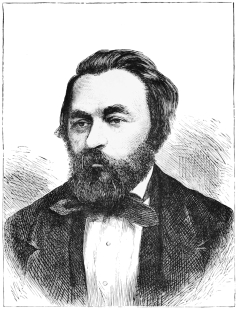
The devotion of such a scholar and refined gentleman as Owen Jones
to decorative art has helped to make an era in that kind of work.
Before that it suffered in England from being regarded as a sort of
upholstery, implying neither talent nor culture. Some gentlemen of
culture and wealth recognized the genius of Mr. Owen Jones at a time
when the Prince Consort was still inclined to regard him as a superior
kind of upholsterer or house-painter, among whom must be especially
mentioned Mr. Alfred Morrison, well known for his antiquarian and
numismatical accomplishments. His residence in Carlton House Terrace is
the truest monument of the genius of Owen Jones, and it is a work which
need fear no comparison with any other, of whatever age or country. It
makes the chief palaces of Northern Europe vulgar. Sádi tells us of one
recovering from an ecstasy, who said he had been in a divine garden,
where he had gathered flowers to bring to his friends; the odor of the
flowers so overcame him that he let fall the skirt of his dress, and
the flowers were lost. Some such account one must needs give of a visit
to Mr. Morrison’s house. A thousand of the touches, the felicities,
which combine to produce the happiest effects in this mansion, can by
no means be conveyed from the place where they would appear to have
grown. I will only mention a few suggestive features of this system of
decoration.
The house is one of those large, square, lead-colored buildings, of
which so many thousands exist in London, that any one passing by would
pronounce characteristically characterless. It repeats the apparent
determination of ages that there shall be no external architectural
beauty in London. Height, breadth, massiveness of portal, all declare
that he who resides here has not dispensed with architecture because
he could not command it. In other climes this gentleman is dwelling
behind carved porticos of marble and pillars of porphyry; but here
the cloud and sky have commanded him to build a blank fortress, and
find his marble and porphyry inside of it. Pass through this heavy
door-way, and in an instant every fair clime surrounds you, every
region lavishes its sentiment; you are the heir of all the ages.
Entering a room for reading and writing, near the door, we are
conscious of a certain warmth of reception even from the walls. They
are of silk, made in Lyons, after a design by Owen Jones. The shade
and lustre are changeable, but the prevailing color dark red. The
design is as if an endless series of the most graceful amphoræ had
suddenly outlined themselves, and the lines had taken to budding off
into little branches. The surface is Persian, and the whole sentiment
of the room is Oriental, without having in it a single instance where
Oriental work has been copied. The carpet is Persian, but the design is
by Owen Jones, the most noticeable figure being the crossed squares,
making a star-shape to match a similar one on the coffered ceiling.
This tapestry of silk starts a theme, so to say, which is carried, with
harmonious variations, throughout the building, expanding in the larger
rooms, until it recalls every variety of Etruscan shape, and taking on
the most beautiful colors. There is a Blue Room, a Pink Room, a Yellow
Room; yet in no case is there anything “loud” or garish in the tints.
The ceiling of the reading-room is somewhat after the fashion of the
best Italian work of four centuries ago—a kind of moulding in deep
relief, which probably ceased to be much used because it was found
difficult to make it without incurring the danger of its falling, so
great would be the weight. But Owen Jones invented something which he
called “fibrous plaster,” by which the most heavily coffered ceilings
can be made with perfect security. It consists in first making the
shapes to be used in wood; the wood is then covered with canvas, and
this canvas is covered with repeated coats of the finest plaster,
which is rubbed down into any mouldings required, and painted. The
coffers here are star-shaped, and in each an inverted convoluted shell
of gold. It is an indication of how finely the decorator has blended
Oriental lustres and classic designs that the various antique objects
and fine metal-work, done by the best Spanish, Italian, and Viennese
workmen, after classic models, everywhere set about the rooms, have an
easily recognizable relationship with the scrolls and forms on carpets,
ceilings, and walls.
But neither the Lyons silk nor the Persian carpets can be pronounced
unique in the same sense as the wonderful use made of various woods
in this house. In the dado, jambs, chairboarding, we find no carved
work, but simply the most exquisite combinations of ebonized and
many-colored woods. Some of these, as the Indian holly, are so fine
that the grain is invisible to the closest inspection. Other woods
are so soft and beautiful that they have the surface of petals. Trees
belonging to every land and clime of the earth have sent here their
hearts, and, without a particle of pigment being used on any one of
them, they gather to form rosettes on the chimney-pieces, cappings for
the dados, and finest featherings around the doors—white, golden, red,
cream-colored, brown, and these of every shade. The tables and chairs
of several rooms are of this tarsia-work of forms untouched by staining
or by metal.
In the library the book-shelves, which do the duty of a dado around
the room, have alternate doors of glass and wood, and the latter are
adorned with a foliation, over two feet high, growing from the bottom
of the panel and leafing out at the top, which cannot be surpassed by
any ancient marquetry. Above these shelves the green and gold lustres
of the wall rise to a cone, which has the appearance of a blue and
gold enamel, above which is an early Tudor ceiling of checker pattern,
between reliefs of a large star with four shadings of different colors,
or star within star, golden, dark, and white. The chimney-piece here
may be regarded as a large arched cabinet, with fire-grate beneath,
having two wings, in which are contained specimens of porcelain from
Persia and Cashmere, which, old as they are, have an appearance of
having been designed by the decorator of the room, who certainly never
saw them until they came into the harmony he had prepared for them.
The drawing-room, whose windows overlook St. James’s Park, is a very
large apartment, whose division, if it ever had any, has disappeared,
giving an unbroken range to the eye, which, whether it takes in the
whole effect or pauses to examine a detail, is simply satisfied.
The fretted ceiling; the frieze of damask picked out with gold; the
tarsia dado, a necklace surrounding the room; the chimney-pieces,
one of which Lepec of Paris was two years in making—they are all
fine without frivolity, cheerful without fussiness. One mantel-piece
reminded me of what Baron Rothschild is said to have remarked once,
when a fop was displaying his malachite shirt-studs, “Very pretty: I
have a mantel-piece of it at home.” Some of the incised ornaments here
are gems indeed, but in no case have they the appearance of being set
there for their costliness; they are all parts of the general artistic
work. One of the best features of this drawing-room is, that it is
not “stuffed” with things. The objects in it are comparatively few,
yet they are sufficient in number and variety; and being beautiful
and interesting, one can look at each without being bewildered, as
in some houses, where an idea seems to prevail that the model for a
reception-room is a museum.
Mr. Morrison is a strenuous opponent of the general belief that the
arts are deteriorating. He believes that as good work of any kind
whatsoever can be done now as in any other age of the world, if one
will only look carefully after the men who can do it. His experience
has certainly been fortunate in discovering those who are able
to make entirely original designs, and yet conceived in a purely
artistic spirit; but then he has had all Europe at his command. The
best metal-workers he has found in Spain and Vienna. In the former
country he found out Zouloaga, a workman residing in the little town
of Eybar, and from him has obtained chased and engraved metal-work
such as almost any of our connoisseurs would be apt to date before the
Renaissance on a cursory glance. One piece of work by Zouloaga is in
the drawing-room—a large coffer, nine feet by three, covered with all
manner of figures and scrolls in iron, wrought in relief, and with a
finish which would have made Andre Buhl himself rejoice that his own
fine cabinet (of which Mr. Morrison is the fortunate possessor) should
have found a place under the same roof with that of the Spaniard. Mr.
Morrison told me that he felt sure the man could do a fine piece of
work, if encouraged, so he advanced him a thousand pounds, and told
him to begin something on that. Zouloaga worked at the coffer for four
years, and its owner saw at once that he had but paid an instalment of
the real value of this marvellous work.
But though Mr. Morrison has had to go to Spain for ornamented
metal-work, to Paris for his mantel-pieces, to Lyons for his silk, he
has found that in no other country than his own was he able to secure
the best wood-work. It may be, indeed, that if his desire had been
for the most perfect carving, he might not have had the satisfaction
of obtaining it in his own country—though some of the workers that
Mr. George Aitchison appears to have got hold of may render even
that doubtful. But in pursuing inquiries as to the means by which
the exceedingly bold designs of Owen Jones for ornamentation with
the colors of woods could be carried out (and the inquiries were not
confined to this country), Mr. Morrison found that no house out of
London was prepared to undertake a task that necessitated importations
of select woods from all parts of the world. In Mr. Forster Graham,
Owen Jones found a man able to enter into his ideas and to give
practical effect to them. Indeed, the famous architect and decorator
acknowledged his indebtedness to Mr. Graham for some effective
suggestions for the improvement of the original designs. Those who
know Mr. Morrison will easily understand that he too was by no means a
mere by-stander while the work was going on. At any rate, he may now
rejoice in having secured a home that has converted some portion of his
wealth into a more real value. For there is nothing in this house not
harmonious with its purpose. Every chair is as philosophically as it
is beautifully constructed, and nearly every one is different from the
other—one suggesting the perforated chairs of the Delhi palaces, and
another the old Saxon throne in Westminster Abbey. It is related of a
sensible and busy banker that, on being visited by some one, he said,
“I have a line or two to write; pray take a chair.” “Do you know who I
am, sir?” said the visitor, haughtily. “I am the Envoy Extraordinary
of ——.” “Oh, are you?” said the banker; “then pray take two chairs!”
This little story occurred to me as I was looking upon Mr. Morrison’s
chairs, and I fancied the Envoy Extraordinary, if asked to take one,
would probably have considered it as a significant mark of respect.
There is no sham in this house—no wood pretending to be metal, and
no iron affecting to be marble. As each particle of a rose under
the microscope has the rose’s beauty, so here each part of the
mansion bears witness to the care and taste with which the whole is
constructed—the table-leg as truly as the Lepec mantel-piece. We may
ascend the magnificent stairway, past the globes of light upheld by
bronze candelabra rising seven feet from the floor, and as we go from
story to story find good, painstaking work meeting us everywhere—in
the bedrooms, the nursery, the closets—some of the best ornamentation
in the house being a pale blue-and-gold scroll surrounding the skylight
at its top.
It is a pleasure to know that decorative skill has not passed away
with Owen Jones. The house of Frederick Lehmann, Esq., in Berkeley
Square, is the chef-d’œuvre of Mr. George Aitchison, one of the
most celebrated architects and decorators in England, who has made the
most of very favorable conditions, has called to his aid congenial
artists and carvers, and has completed rooms which one would fain see
themselves hung upon the walls of the Royal Academy, and not merely
the designs of some of them, which were, indeed, exhibited there. The
house is ancient, and, though not very large, built liberally and
substantially, evidently in the days when Berkeley Square was near
enough to “the country” for space to be of less consideration than
now. In the course of the recent improvements there was found behind
an old chimney-piece a playing-card, upon the back of which is written
an invitation from a Mrs. Murray to Lady Talbot to pass the evening
at her house; and Mr. De la Rue declares that no card of a similar
character has been manufactured for a hundred and fifty years. Even
farther back in time than that we may safely place the old-fashioned,
nearly square hall—about twenty feet by seventeen—which is at once
hall and vestibule. It contains tables, cabinets, and a stand for
flowers, and the modern decoration sympathizes with what appears
to have been the old idea of a vestibule—a sheltered cortile. The
general tint is a very pale green, the surface-panelling large, and
ornamented with stems starting from a common root and ending each
in cones. The stems and cones curve toward each other, and form a
sort of circular grouping. A door on the left introduces us to the
library, whose walls are shelves of richly carved walnut, above which
is a dark leather frieze, which elegantly sets off the treasures of
ancient pottery and other antique objects which make the interesting
finish of the well-stored book-shelves all the way around the room. At
a certain point the books prove to be dummies, an unsuspected little
door flying open at a touch and revealing a lavatory. In this library,
where startling effects of any kind would be out of place, there are
no plays of color, but ample light falling upon the exquisitely carved
table for writing in the centre, which is the most remarkable for its
conveniences and contrivances that I have ever seen.
Ascending to the drawing-rooms, we enter first a small apartment,
whose floriated ceiling gives the effect of a bower. Between this and
the golden cornice is a cove of inlaid gold, upon which are traced
leaves of wistaria, interspersed with light pink clusters of the
phlox. The chief ornament is a large cabinet, reaching nearly to the
cornice—ebony and ivory—recently brought from the Vienna Exhibition:
it contains specimens of Eastern porcelain and various curiosities
collected by Mr. Lehmann, who would appear to have voyaged around the
world and found relics of all civilizations and all the ages of art.
This, however, is but an anteroom to the chief drawing-room, with which
it communicates by a large double sliding-door. This door and another
like it which admits to the dining-room are truly superb. They have a
frame of ebonized wood, enclosing panels of finest-grained amboyna.
The ebonized wood is foliated with gold, and the long central panels
are adorned with ovals of olive-colored Wedgwood ware, presenting
classical figures. The smaller panels above and below have at their
centres squares of the same. Each door has a capping of gold floriation
and a draping of French embroidered silk, at once heavy and delicate,
like tapestry. The walls are of a dark reddish-brown color, arranged
in large panels (from floor to cornice), enclosed by a fine painted
edging. This background elegantly sets off the pictures, which are all
excellent, some of them being among the best water-colors of Turner.
The ornament which chiefly strikes the eye in this room is a matchless
frieze, painted by the eminent artist Albert Moore, the design being
peacocks, their long trains in repose. The cornice above this is of
the egg-pattern, with a fretting above. The ceiling is, in a manner,
panelled; that is, it has on each side stiles or beams crossing each
other, making the large central space and the side spaces almost deep
enough to be called coffered. These cross-beams are finely feathered
with gold, and the interspaces are adorned with curved boughs, which
have small pointed leaves terminating in round decorative flowers.
The fireside of this room is highly ornamented. The grate is antique
in general appearance, but novel in structure; the silver owls
(life-size) sitting on either end of the fender-bar, and the old brass
mountings of the fire-dogs, have come from the past to guard a grate
which slides backward and forward as the regulation of the heat given
out may require. The tiles are representations of six varieties of
humming-birds, a paroquet, a sun-bird, and several other feathered
beauties. Near by is a folding screen of brilliant Japanese silk. The
room is covered to the border of the parquetage with a bright Persian
carpet. In the dining-room the original ceiling, with dark oak reliefs
(curved), has been retained—not happily, I am afraid, such ceilings
always absorbing too much light. Mr. Aitchison has given the spaces
a luminous decoration, but nevertheless the dark wood-work above can
only be retained by the use of a corresponding shade in the furniture.
This furniture is of rare beauty. The sideboard is most delicately
carved, and the serving-table inlaid with medallions of ivory, the
designs of which, by Albert Moore, represent various animals and fruits
suggestive of the uses of the room. There is a chimney-piece of ancient
work—ebony, with side pillars and excellent gold settings; but a
comparison of this bit of last century work with the furniture recently
made is likely to raise a question in the minds of those conservatives
who insist that the making of beautiful things is a lost art. It is
a pleasure to find hung in a room where each object bears the trace
of really fine art that portrait which has long been acknowledged
to be the ablest work of Millais, representing Mr. Lehmann’s little
daughter seated upon a Minton garden-seat on a lawn. When this picture
was exhibited at the Royal Academy, a few years ago, a writer in the
Fortnightly Review pronounced it the work which, among modern English
productions, most recalled the peculiar vitality and sentiment which
have given the old masters their fame. I had the pleasure of seeing
the little lady at that time in her boudoir, to make which beautiful
Mr. Aitchison appears to have put forth his talent as earnestly as Mr.
Millais to paint her picture. A blue border encloses the large panels
of the walls, on which are fleur-de-lis spots, and a bittern at each
panel centre. The frieze is painted in graceful floriations of lemons,
and the cove above is adorned with balsam and jasmine. The apartments
of Miss Lehmann, thus tenderly but not gaudily adorned, open into
the sleeping-room of her parents. This also is simply beautiful. The
walls are of a delicate blue shade, and all the textures appear as
if inwoven with softened sunshine. Mr. Smallfield’s genius has here
been brought into requisition, and he has painted beautiful groups of
flitting birds over the doors. The same artist has painted boughs of
apple-blossoms upon the door-panels in the boys’ room. But his finest
work is a frieze in Mrs. Lehmann’s boudoir—for such her monogram,
woven in the Persian carpet and carved in the marble mantel-piece,
announces it to be—which consists of doves, swallows, and flowers in
pots. Mrs. Lehmann’s boudoir is on the same floor with the dining-room,
from which it is separated by a charming little sitting-room. The walls
of this last-named room are entirely covered with the finest Gobelin
tapestry, above which a deep cornice of chased gold supports a cove,
chocolated, with decoration of silver leaflets.
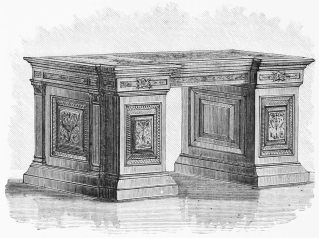
EBONY SERVING-TABLE, MR. LEHMANN’S HOUSE.
No wall-paper at all is used in this house. The ornamentation of
the walls throughout has been put on by the hand, and generally by
pouncing. Perhaps it may be well enough to state that the method of
pouncing is far more expensive than that of stencilling. In pouncing,
the figures to be painted on the wall are first pin-punctured on
paper; this paper is then laid on the wall and beaten with bags of
colored powder. When the paper is removed, each ornamental form is
delicately outlined on the wall in innumerable fine points. It is then
necessary that the decorative artist should trace the figures with a
pencil, and afterward paint them. Stencilling, which is less costly
than this by about one-third, consists simply in direct painting
through perforated metal, though it is necessary in most mural work
that the blank interstices so left should be painted over by hand.
The latter work is, however, always more stiff than the pounced. The
friezes have been painted on canvas, of course, since no gentleman
would allow his possession of works by such artists as those whom Mr.
Lehmann has employed to depend upon his remaining in any particular
house. It is, indeed, a very significant thing that such men as Albert
Moore and Smallfield should have been found ready to undertake work of
this description; for, though it is a return to such work as Giotto
and Michael Angelo were glad to do, we have heard of late years
occasional sneers at “mere decoration.” Strictly speaking, all art
is mere decoration. There are other instances also where artists of
the greatest eminence have done excellent work of this character.
In the house of the Hon. Percy Wyndham, Belgrave Square, there is a
grand staircase, which has on the wall, near one of its landings, five
life-sized classical figures, by Sir Frederick Leighton, and at the
top a deep frieze of cormorants, storks, and other wild birds; and the
dining-room of the same beautiful mansion has been elegantly adorned by
Mrs. Wyndham—herself an artist—aided by Mr. V. Prinsep.
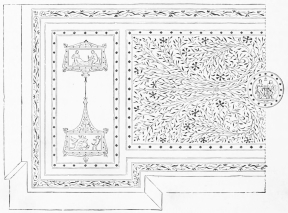
TOP OF SERVING-TABLE, MR. LEHMANN’S HOUSE.
The pleasure with which I have visited Mr. Lehmann’s house is just
a little tempered by the difficulties I have found in the effort to
convey some impression of it. Passing down the stairways amid the
delicate hues lighting them up at every turn, and through the door-ways
curtained off from halls by rich Oriental draperies, and finding
myself again in the embowered square at the front of the house, I
feel conscious of an utter inability to give any reader an adequate
conception of the decorations amid which I have invited him to wander
in imagination. Let any one who has passed a morning in visiting the
interiors of the old Venetian palaces attempt to describe them! He will
have a dreamy impression of soft colors fading into each other, of
apartments that have caught on their walls the tints of rosy morning
and golden evening, and held them in a thousand little contrivances to
catch such sunbeams, and he will feel that the subtle influences of
beauty have overpowered his analysis. The finer secrets of art elude
detection, much more explanation, like those of nature.
The houses I have been describing are those of millionnaires. Whatever
may be thought of the large sums expended on their mansions, they do
not suggest the remark made by a wit to a gentleman as remarkable for
spending little as for making much, “You cannot take all this gold with
you, and if you did, it would melt.” They have preferred that their
gold should be transmuted in this world, and into forms that are none
the less beautiful for being costly. They are men who occupy a somewhat
abnormal position even in wealthy London, and one which admits of a
correspondingly rich and even grand environment. They have occasion,
and are able, to have rooms which relate them to a large and cultivated
world, while they can reserve for domestic privacy apartments that
fulfil the want which to others is the only end of a home—a centre
amid a busy and weary world for friendship, love, and repose. Even in
these grand palaces one may, indeed, witness a modesty and reality
which contrasts favorably with the at once stimulating and exhausting
splendors of the princely dwellings of the past. There is no attempt
here to heap into the rooms the great works of art which appropriately
belong to the community, and should be set up in edifices built for the
common benefit. One perceives, too, that the time has passed away when
Madame de Guerdin could define the life of an apartment as consisting
in “fires, mirrors, and carpets.” The life of an apartment consists in
the degree to which it subserves its end. The decoration of the salon
may well sympathize with the gayety of festive occasions, for it does
not exist for the family alone; but in the more private rooms the
tired limbs will require rest on chair or couch, and equally the eye
will need rest upon soft and subdued shades.
There will, however, arise in the mind of many a reader of the poor
descriptions I have been able to give of these two houses (which
represent an exceptional class) a moral misgiving. Is not all this a
waste of money that might have been expended for greater and nobler
purposes? Is not all this mere luxury and extravagance? Well, in the
first place, it is difficult to draw the line between the beauty which
Nature seeks as she climbs to flowers and man as he decorates his
dwelling, and the luxuriousness which makes external beauty in itself
an end rather than a means. Take away all that has been added to our
homes by art, and we all become naked savages living in mud or log
huts. But, in the second place, what about this “waste of money” so
often charged against expensive decorations? Poor Zouloaga, working in
a little peasant village of people poor as himself, might not have the
same charge to bring against the wealthy Englishman who found him out.
He and a host of artists and artisans in this and other countries might
find more wisdom in Rhodora’s philosophy, that
“if eyes are made for seeing,
Then Beauty is its own excuse for being;”
and they might add that if the taste and skill which are able to make
beautiful things exist, there may be good reason why a demand should
also exist for what they can supply. I do not propose to argue the
vexed question of political economy concerning the degree to which
luxury is justified by its distribution of capital among laborers, but
it seems very clear that there can be no reason to deplore the free or
even lavish expenditures of the wealthy for objects which are not in
themselves pernicious.
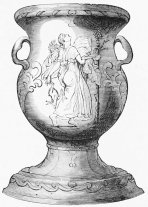
POT DESIGNED BY MISS LEVIN.
It has been one particularly gratifying incident of the passion for
decoration in this country that it has been the means of opening to
women beautiful and congenial employments. Miss Jekyl, who was one of
the first to take up this kind of work, attracted the attention of Sir
Frederick Leighton, Madame Bodichon, and other artists by her highly
artistic embroidery, and has since extended her work to repoussé, or
ornamental brass-work—especially sconces—and many other things. She
has, I hear, acquired not only distinction but wealth by her skill,
some specimens of which are exhibited in the International Exhibition
at South Kensington this year. There, also, may be seen the work of
other ladies who have followed in her footsteps, some of the finest
being by a Miss Leslie, a relative of the celebrated artist of that
name. Indeed, there has now been established in Sloane Street a school
for embroidery, which has succeeded in teaching and giving employment
to a number of gentlewomen who had been reduced in circumstances, and
whose success those who observed their contributions to the Centennial
Exhibition at Philadelphia will not underestimate. Miss Philott, whose
paintings have often graced the walls of exhibitions, and have gained
the interest of Mr. Ruskin, has of late been painting beautiful figures
and flowers on plaques, which, when the colors are burnt in by Minton,
make ornaments that are eagerly sought for. A Miss Coleman has also
gained great eminence for this kind of work. Miss Lévin has displayed
much skill in designing and painting pots, plates, etc., with Greek
or Pompeian figures. The painting of panels with vines, blossoming
branches, and even birds, is also a pretty industry of this kind.
The late Miss May Alcott was very ingenious in this kind of work,
and several specimens of her art are preserved with care in England.
Many of these ladies have begun by undertaking such work as this for
personal friends, but have pretty generally found that the circle of
those who desire such things is very large, and that their art is held
in increasing esteem among cultivated people. It is even probable that
the old plan which our great-grandmothers had of learning embroidery
will be revived in more important forms, and be taught as something
more than the accomplishment it was once thought.
It has been found, too, that artists, architects, decorators, and the
numerous workmen they employ have great respect for any woman who
can do anything well, which contrasts favorably with the jealousy
which the efforts of that sex to find occupation in other professions
appear to have aroused. One example of this is particularly striking.
A good many years ago I heard of a young lady of high position who
was making almost desperate efforts to win her way into the medical
profession. She had taken a room near one of the largest hospitals in
London, to which she was not openly admitted, that she might study
cases of disease or injury, but where, through the generosity of
certain physicians, she was able, as it were, to pick up such crumbs of
information as might fall from the table of the male students. By dint
of her perseverance means of information and study increased. I visited
her room near the hospital, and found this young lady surrounded by
specimens such as are conventionally supposed to bring fainting-fits
on any person of that sex at sight. I found that, being excluded from
the usual medical and surgical schools, she had been compelled to
employ lecturers to teach her alone. Fortunately she had the means of
doing this, but it amounted to her establishing a medical college, of
which she was the only student. That lady is now known as Dr. Elizabeth
Garrett-Anderson, an eminent physician, who has done not her sex alone
but this entire community a great benefit, by showing that a woman’s
professional success is not inconsistent with her being a devoted and
happy wife and mother. By the side of the long struggle through which
she had to go to obtain her present position—a struggle in which
many a woman with less means and courage has succumbed—I am able to
place the experience of her younger sister and of her cousin, Agnes
and Rhoda Garrett, who have entered into a partnership as decorative
artists. These young ladies, it may be premised, have by no means been
driven to their undertaking by the necessity of earning a livelihood.
They belong to an old family of high position, and are as attractive
ladies as one is likely to meet in the best society of London. But,
like the better-known ladies in the same family, Dr. Garrett-Anderson
and Mrs. Professor Fawcett, they are thinkers, and they have arrived
at conclusions concerning the duties and rights of their sex which
forbid them to emulate the butterflies. A few years ago, when the
decorative work of such firms as Messrs. Morris & Co. began to attract
general attention, it appeared to them that it offered opportunities
for employment suitable to women. They determined to go through a
regular apprenticeship; and though they were met by looks of surprise,
they were not met with any incivility. One gentleman allowed them to
occupy a room at his offices, where they might pick up what knowledge
they could in the art of glass-painting, and here they awaited
farther opportunity. The architect who had been connected with this
glass-staining firm separated from it, and, having begun a business of
his own, accepted the application of the Misses Garrett to become his
apprentices. They were formally articled for eighteen months, during
which they punctually fulfilled their engagement, working from ten
to five each day. Of course there were good stories told about them.
Some friend, calling upon them, reported that, though the interview
was interesting, the ladies could not be seen, as they were up on a
scaffolding, lying flat on their backs close to a ceiling which they
were painting. From that invisible region their voices descended to
carry on the conversation. The ladies themselves were quite able to
appreciate all the good-humored chaff attending their serious aim.
When their apprenticeship reached its last summer they went on a tour
throughout England, sketching the interiors and furniture of the
best houses, which were freely thrown open to them. They are now an
independent firm, with extensive business, and have gained fame, not
only by their successful decoration of many private houses, but by
their admirable treatment of the new female colleges connected with the
English Universities. Mr. J. M. Brydon, of Marlborough Street, is the
architect who has the honor of having had these ladies for apprentices;
and these ladies assure me that during their stay there and in their
work since they have met with no act of incivility. Occasionally the
workmen may stare a little at the unaccustomed sight of ladies moving
about with authority, but they are most respectful when they find that
there is intelligence behind the authority. From a friend of these
ladies I heard a significant anecdote. They directed that a certain
kind of mixture with which paint is generally adulterated should not be
used. When they came to look at the work they found that the mixture
had been used, though it is what no untrained eye could detect. They
called the painter to account, and he said he had used very little of
the mixture indeed.
“That is true,” said one of the ladies, “but we told you not to use a
particle of it.”
The painter was amazed, and at last said, “Will you be kind enough to
tell me how you knew that mixture had been used?”
It is precisely this knowledge which everywhere secures respect.
The Misses Garrett have made themselves competent decorators; they
undertake the wall decorations, upholstery, furniture, embroidery,
etc., as fully as any other firm.
There are many ladies employed in the new Kensington School of
Embroidery, which has a branch at Belgravia, in ornamenting with
needle-work stuffs for chairs, sofas, screens; and I have heard of a
scheme which includes art-work for ladies’ dresses. In the ancient
code of Manu it is said, “A wife being gayly adorned, her whole
house is embellished; but if she be destitute of ornament, all will
be deprived of decoration.” It is not a little curious to find the
remote descendants of those whom Manu thus instructed including
female dress among the concerns of decorative art. This is, indeed,
theoretically done in the lectures given at South Kensington, and
Charles Eastlake has interspersed some valuable hints concerning
ladies’ dress in his work on Household Taste. In this matter a
quiet revolution has been for some time going on in London. It is
said that the artists of England once thought of getting together
and making some designs for dresses, which they would recommend to
ladies; they did not do so formally, but they have certainly availed
to modify very materially the costumes visible in thousands of English
drawing-rooms. The “pre-Raphaelist lady,” with her creamy silk,
short-waisted and clinging—at once child-like and antique—was the
earliest revolutionary figure in evening companies. She was followed
by the Queen Anne dame, budding and great-grandmotherly, whose
raiment Punch and theatrical Judies have been “taking off” just a
little after the dame herself had transformed it into its beautiful
variations. These pretty reformers have emancipated Fashion herself:
there is no uniform for ladies any more. At a fashionable party lately
I was unable to pick out any two ladies out of a hundred whose dresses
were cut alike, and the variety of colors suggested a fancy-dress ball.
Yet these colors were all of moderate shades, and Hippolyte Taine
himself must have admitted that very few of them were “loud.” It would
not at all surprise me if the world which has so long laughed at the
Englishwoman’s dress should some fine evening glance into one of these
modern interiors and feel as if the ladies are among the most agreeably
dressed of womankind. But I must return from this digression.
The Misses Garrett appear to have an aim of especial importance in
one particular. They tell me that they have recognized it as a want
that a beautiful decoration should be brought within the reach of the
middle-class families, who are not prepared or disposed to go to the
vast expense which the very wealthy are able and willing to defray,
thereby occupying the most eminent firms. They believe that with care
they are able to make beautiful interiors which shall not be too costly
for persons of moderate means. This can surely be done, but it can
only be through a co-operation between the owners of the house and the
decorators which shall make it certain that there shall be nothing
superfluous. If an individual wishes a beautiful home, especially in
dismal London, it is first of all necessary that he or she should
clearly understand what is beautiful, and why it is desired. The
decoration will then, in a sense, be put forth from within, like the
foliage of a tree. In each case the external beauty will respond to an
inward want, and be thus invariably an expression of a high utility.
Nowhere more than in the homes of the great middle classes is there
need of beauty. Their besetting fault is a conventionality which often
lapses into vulgarity, and their thoughts (so-called) are apt to be
commonplace. The eye is often starved for the paunch. The pressure
of business sends every man engaged in it home fatigued, and yet it
is only when he enters that home that his real life, his individual
and affectional life, comes into play. On the exchange, in the office
or shop, he has been what commerce and the world determine; he has
been but perfunctory; but now he shuts the door behind him, and his
own bit of the day is reached. What is the real requirement for this
person? Does a house that furnishes him bed and board suffice him? or,
which is of greater importance, does so much alone suffice others who
dwell habitually in it?
Here I may mention a work of much importance by J. J. Stevenson, of the
Royal Institute of British Architects, entitled House Architecture.
It is in two volumes—the first devoted to Architecture, the second to
House-planning. The general aim of this work is stated by the author,
one of the ablest and most successful architects in England, in an
introductory chapter from which I quote. “To build a house for one’s
self is an excellent education in architecture. By the time it is
finished, and the owner has lived in it, he feels how much better a
house he could build with the experience he has acquired, if he had to
do it over again. While the work is going on his attention is called to
questions he had never thought of before, which are now of the greatest
interest to him. He examines the houses of his friends, and discovers
features in them which he wishes, when too late, he had introduced
in his own plans. The designs are altered and the cost increased.
His taste in architecture and his ideas about planning are changed
by his new experience; the building is too far advanced to adopt the
improvements, and the house which he had hoped would be perfect is
a source of trouble and disappointment. He could build another house
to his mind, but to go through the experience once in a lifetime is
enough for most people. To have, before commencing the building of a
new house, the knowledge which the experience of building gives in some
imperfect and fragmentary way at the end of the process, would save the
owner trouble, expense, and after-regret. To attempt to supply this is
the object of this book.” An admirable book it is! There are a hundred
and ninety excellent wood-cuts in it also. The entire science of
lighting, warming, ventilation, drainage, materials, and construction
is here clearly set forth. A man who has the means to build a house
for himself, and who really wishes it to be as genuinely related to
his human self as to the nautilus its shell, should study carefully
this work, unless he can get a better, in which case he will be more
fortunate than I have been.
But Mr. Stevenson’s book does not extend to the decoration of walls
after they are built. The house stands in native worth, but not yet
in honor clad. There ought not to be less reality and utility in the
ornamentation of a house than in its construction. In the ancient
Chinese Analects we read that Kih Tsze-Shing said, “In a superior man
it is only the substantial qualities which are wanted; why should we
seek for ornamental accomplishments?” Tsze-Kung replied, “Ornament is
as substance; substance is as ornament: the hide of a leopard stripped
of its hair is like the hide of a dog stripped of its hair.” It would
be difficult to find in literature a finer or more philosophical
statement of the deep basis of Beauty than thus comes to us from
a period of near three thousand years ago, and from a race whose
applications of decorative art to objects of every-day use are models
for Europe. The spots of the leopard are the sum of its history; its
hair is the physiognomy of its passion and power; it bears on its back
the tracery of the leaf and sunshine amid which it hides, and the
purpose of the universe hides with it. Transferred to floor or sofa in
a room, the coat of that cat is a bit of the wild art of nature, full
of warm life, purely pictorial; more beautiful than the skin of our
domesticated cats, because these have been adapted to other purposes,
and reduced to an environment of less grandeur. But strip the two of
their hair, and they are only larger and smaller pieces of leather,
and the depilated hide of a dog is the same. All of which confirms
Tsze-Kung’s dictum, that ornament is substance; and it at the same time
suggests the converse truth, that throughout the universe there must
be substance to insure true ornament. When we ascend to the region
of finer utilities—those, namely, which are intellectual, moral,
spiritual, social—we discover that household art is another name for
household culture. What germ in the child’s mind may that picture on
the wall be the appointed sunbeam to quicken? What graceful touch to
unfolding character may be added by the modest tint of a room? Who can
say how much falsehood and unreality have been shed through the life
and influence of individuals by tinsel in the drawing-room and rags
up-stairs?
Just now we are the victims of two reactions. Our ancestors made
external beauty everything, and the starved inner life of man rebelled.
Puritanism arose, with grim visage, turning all beautiful things to
stone. From it was bequeathed us a race of artisans who had lost the
sense of beauty. A reaction came, in which the passion for external
beauty displayed itself in an intemperate outbreak of gaudiness and
frivolity. We are sufficiently surrounded by the effects of the
reaction, sustained by wealth without knowledge or taste, to make
Charles Eastlake’s description appropriate to ninety-nine out of every
hundred English homes: “This vitiated taste pervades and infects the
judgment by which we are accustomed to select and approve the objects
of every-day life which we see around us. It crosses our path in the
Brussels carpet of our drawing-rooms; it is about our bed in the
shape of gaudy chintz; it compels us to rest on chairs and to sit at
tables which are designed in accordance with the worst principles of
construction, and invested with shapes confessedly unpicturesque. It
sends us metal-work from Birmingham which is as vulgar in form as it
is flimsy in execution. It decorates the finest possible porcelain
with the most objectionable character of ornament. It lines our walls
with silly representations of vegetable life, or with a mass of
uninteresting diaper. It bids us, in short, furnish our houses after
the same fashion as we dress ourselves, and that is with no more sense
of real beauty than if art were a dead letter. It is hardly necessary
to say that this is not the opinion of the general public. In the eyes
of materfamilias there is no upholstery which could possibly surpass
that which the most fashionable upholsterer supplies. She believes
in the elegance of window-curtains of which so many dozen yards were
sent to the Duchess of ——, and concludes that the dinner-service
must be perfect which is described as ‘quite a novelty.’” Mr. Eastlake
well says, also: “National art is not a thing which we may enclose in
a gilt frame and hang upon our walls, or which can be locked up in
the cabinet of a virtuoso. To be genuine and permanent, it ought to
animate with the same spirit the blacksmith’s forge and the sculptor’s
atelier, the painter’s studio and the haberdasher’s shop.” Under the
influence of such scornful words as these, persons of taste and culture
have risen in reaction against the reaction, and the result is that
there are now in London several thousands of homes which have filled
themselves with those old shreds of beauty which Puritanism cast to the
winds. Most of these are the homes of artists or virtuosi, and, as they
have thus set the fashion, a still larger number have tried to follow
them. A genuinely old thing is competed for furiously; and as it is
apt to go with the longest purse rather than the finest taste, we find
the past as often re-appearing in a domestic curiosity-shop as in a
beautiful interior.
Now, Puritanism in its day was one of the useful things, and if we do
not see the traces of beauty which it has left, the fault is in our
own eyes. The artists know very well that if it had spared the old
furniture for the main uses of our present society, the effect would be
as unlovely as if our homes were all buttressed and turreted in feudal
style. Feudalism and Puritanism have alike left to us just as much of
the styles of their ages as we need—enough to give, as it were, a
fair fringe to the appropriate vestment of to-day. A house made up of
antiquarian objects is a show-room, a museum, but not a home. We have
fallen upon an age when cultured people know that external beauty is
but one means to integral beauty, and when the prophets of that higher
end can see that the very flowers of the field are ugly, if they drink
up that which ought to turn to corn and wine. Much is to be said for
the antiquarian taste, if it does not run into an antiquarian passion.
It may safely be admitted that our churches need not be sombre nor our
services gloomy; that a few good pictures would not harm the one, nor
more poetry and music the other; but what is to be said of those who
find in albs and chasubles and incense-burners the regained Paradise of
man? Old lamps are not always better than new.
Much is said from time to time about the ugliness of London street
architecture. I have already quoted the London Times’ sentence
about “our ugly but not altogether uncomfortable old metropolis.” The
ugliness is mentioned at various points of this work. But there are
two kinds of it; as the famous Boston divine said there are two kinds
of fools—“the natural fool, and what the carnal mind, oblivious of
its duty, would call a d—fool.” When Temple Bar was removed from
Fleet Street because it was an impediment, the Corporation of London
devoted £10,000 to putting up in the centre of the street a columnar
monstrosity, carved with busts of royal personages, griffin-crowned.
This is the kind of London ugliness which suggests the definition of
the carnal mind. An effort was made in Parliament to get it removed;
but it was too large for Madame Tussaud’s “Chamber of Horrors;” and
perhaps it is as well that it should remain, as the monument of that
vast amount of wealth which is continually embodied in the ugliness
which Puritanism made a passion in the average middle-class Englishman.
But the other kind of London ugliness is represented in the miles on
miles of yellow-gray and sooty, brick houses, each as much like the
other as if so many miles of hollow block were chopped at regular
intervals. And yet there is something so pleasant to think of in
these interminable rows of brick blocks, that they are not altogether
unpleasant to the eye. For they are houses of good size, comfortable
houses; and their sameness, only noticeable through their vast number,
means that the average of well-to-do people in London is also vast.
It implies a distribution of wealth, an equality of conditions, which
make the best feature of a solid civilization. There is much beauty
inside these orange-tawny walls. Before any house in that league of
sooty brick you may pause and say with fair security: In that house
are industrious, educated people; there is good music there; and good
English, French, and German literature; pictures of noble men and
heroic events are on the walls; they have made there, within their mass
of burnt clay, a true cosmos, where love and thought dwell with them;
and between all that and a fine outside they have chosen the better
part.
But, while not forgetting that the body is more than raiment, we
need not forget that it can never be fairly expressed, in any but a
coarse way, save through the raiment related to it. On this we must
insist, that when individuality has been cultivated there should be
an harmonious and organic relation between the individual and his
dwelling-place. In a normal society each man would be able to build
his house around him as he builds his body, and to take the past, the
east, the west, for his materials as much as brick or stone. “Let us
understand,” says the wisest adviser of our time, “that a house should
bear witness in all its economy that human culture is the end to which
it is built and garnished. It stands there under the sun and moon to
ends analogous and not less noble than theirs. It is not for festivity,
it is not for sleep; but the pine and the oak shall gladly descend from
the mountains to uphold the roof of men as faithful and necessary as
themselves, to be the shelter always open to good and true persons—a
hall which shines with sincerity, brows ever tranquil, and a demeanor
impossible to disconcert; whose inmates know what they want; who do
not ask your house how theirs shall be kept.”
One residence particularly has connected itself in the course of my
observations with the high place given, in this extract from Emerson’s
chapter on Domestic Life, to the individuality so essential to a
home, and so difficult to obtain. Those who have found delight—as
who has not?—in the paintings which the American artist, Mr. George
S. Boughton, A.R.A., has given to the world will not be surprised to
learn that he has built up around him a home worthy of his refined
taste and his delicate perception of those laws of beauty which enable
it to harmonize with individual feeling without ever running into
eccentricity. Boughton was one of the first to make his home harmonious
with his art, and before he built West House, his present residence,
he made the interior of an ordinary house, Grove Lodge, Kensington,
into a residence as unique as one of those charming pictures of his
which so tenderly invest the human life of to-day with the sentiment
and romance of its own history. Passing once through that hall, touched
everywhere with the toned light of antique beauty, to his studio, the
picture just finished for the Royal Academy appeared as a natural
growth out of the aesthetic atmosphere by which he was surrounded—some
girls of Chaucer’s time beside an old well and a cross, filling the
water-bottles of pilgrims on their way, amid the spring blossoms, to
the shrine of St. Thomas à Becket, “the holy, blissful martyr,” at
Canterbury. The embowered English landscape closed as kindly around the
figures and costumes and symbols of the olden time as they do now about
the features of a new age; and no less harmoniously did the ornaments
and decorations of that home surround the cultured society which the
young host and hostess gather to their assemblies. Although Grove
Lodge is no longer the home of the Boughtons, its decorations were so
instructive as well as beautiful, that I insert here an account of them.
Entering the door, we find ourselves in a square vestibule, separated
from the main hall by rich and heavy curtains of greenish-blue
tapestry. The walls are here, for a distance of one-third of their
height from the floor, covered with a panelled wainscot, colored in
harmony with the hangings. For the rest, the walls are covered with a
stamped leather papering of large antique scrolls, outlined in gold.
A rich light fills this little apartment by reason of the quaint and
deep-hued glass of the door and side-window. In these both roundels and
quarries are used. In the door there are roundels above and quarries
beneath, furnishing a neat border to larger stainings, representing
marguerites and clover-blossoms on a blue ground. Above the door is a
curious horizontal glass mosaic, set in lead, as indeed are all the
squares and circlets of both window and door, with bees and butterflies
at the angles of the irregular lines. The zigzag flight of the little
winged symbols of industry and pleasure required that the pieces of
glass should be irregular, and this result was secured by an odd
device. The decorator having come with his oblong pane of precious
glass, asked how he should cut it up. The artist promptly ordered him
to let it fall through some feet on the door-step, and then gather up
the fragments. This was done, and as the pieces came of the fall so
were they put together, with the bees and butterflies at their angles.
The effect of this irregularity is very fine indeed, as setting off the
precision of the patterns in the rest of the door.
Passing through the curtains, we enter a hall running about two-thirds
of the depth of the house to the dining-room. The hall is lined with
fine old engravings and cabinets, with here and there an old round
convex mirror. The general color of the walls of the dining-room is
sage-green, thus setting off finely the beautiful pictures and the
many pieces of old china. There are several cabinets which have been
designed by Mr. Boughton himself, and a buffet somewhat resembling
that drawn by Charles Eastlake (Fig. 12, Hints on Household Taste),
but improved, as I think, by being made somewhat higher, and having a
small ornamental balustrade on the top shelf. And I may here say that
Mr. Boughton’s art has enabled him to make his many beautiful cabinets,
the antique ones as well as those designed by himself, particularly
attractive by introducing small paintings on the panels of their doors
or drawers. These figures are generally allegorical and decorative,
and are painted upon golden backgrounds. They are of rich but sober
colors, and usually female figures, with flowing drapery, great care
being taken that their faces shall have dignity and expression. In some
cases an old cabinet has small open spaces here and there which will
admit of medallion busts and heads being painted; and if care be taken
that the colors shall not be too loud, and especially that the designs
are not realistic, the beauty and value of the cabinet are very much
enhanced. The buffet to which I have referred has a curtain over the
arch beneath, and such an addition may be also made to a cabinet which
rests upon legs with good effect as well as utility, if care be taken
that the color of the curtain shall not be obtrusive.
This dining-room is lighted by a large window set back in a deep
recess, curtained off from the main room with hangings of red velvet,
and exquisitely environed by original designs. The window is composed
of the richest quarries, holding in their centres each its different
decorative flower or other natural form, and these being collectively
the frame of large medallions of stained glass, representing Van Eyck,
Van Orley, and the burgomaster’s wife, from Van Eyck’s picture in the
National Gallery.
It is a notable feature of the ideas of glass decoration, and, indeed,
of paper decoration, in houses where English artists have superintended
the ornamentation, that realism in design is severely avoided. In this
respect I cannot doubt that we are in London far more advanced in taste
than those decorators of Munich, and some other Continental cities, who
try to make the figures, in their glass at least, as commonplacely real
as if they were painting on canvas. Even if the material with which
the glass-stainer works admitted of a successful imitation of natural
forms, the result could not be beautiful. No one desires roses to
blossom on his window-panes, nor butterflies to settle on the glass as
if it were a flower. The real purpose of the glass can never be safely
forgotten in its decoration: it is to keep out the cold while admitting
the light; the color is to tone the light, and prevent its being
garish; and if, farther, any form is placed upon the glass, it is
merely to prevent monotony by presenting an agreeable variation from
mere color. But the form must be in mere outline, transparent, else it
suggests an opaque body, which were a denial of the main purpose of the
glass, i.e., to do away with opaqueness. Even when the ornaments on
the little panes are thinnest, they are hardly suited to the English
sky, which sends us little superfluous light.
The drawing-room at Grove Lodge was, and that of West House is,
adorned on the theory that its function is one which requires a degree
of richness bordering on brilliancy, which were out of place in a
study, or studio, or sitting-room. Here are to be happy assemblies of
light-hearted people, in gay dresses, and the room must be in harmony
with the purpose of pleasure which has brought them together; but
then the drawing-room must not obtrude itself—it must not outshine
their lustres or pale their colors; rather it must supply the company
with an appropriate framing, and set them all in the best light. The
drawing-room at Grove Lodge seemed to me a purely artistic creation of
a beautiful out of a poorly constructed room. A paper of heraldic pink
roses, very faint, with leaves in mottled gold, makes a frieze of one
width above a wall-paper of sage-gray, which has no discernible figures
at all on it. This sage-gray supplies an excellent background to the
pictures—which are moderate in quantity, charming in quality—and
for the picturesque ladies, who are too often fairly blanched by the
upholsterer’s splendor, as they might be by blue and silver lights
in a theatre. At the cornice is a gold moulding and fretting, making
an agreeable fringe to the canopy (as the star-spotted ceiling may
be appropriately called). The ceiling is not stellated, however,
with the regularity of wall-paper designs, but with stars of various
magnitude and interspaces. It must be, of course, a room in which the
deep tones of color preponderate which could alone make such a ceiling
appropriate. In this instance it is rendered appropriate not only by
the character of the hangings of the room, at once rich and subdued,
and by the carpet, which Mr. Boughton had made for the room, the
basis of whose design is the greensward, touched here and there with
spots of red, but also by the fact that it is a double drawing-room,
lighted in the daytime only at the ends, and requiring, therefore, a
bright ceiling. There are two old Japanese cabinets: one is richly
chased, but with nothing in relief except the gold lock-plates, and
some twenty-eight hinges (themselves a decoration); the other is more
complex, and has figures in relief. In addition to these there are two
cabinets of unique beauty, designed by Mr. Boughton—one possessing
a bevelled mirror running its whole width at the top; the other with
panels, on which the artist has painted Spring and Autumn in gold.
In this residence some of the best effects were produced by the
extraordinary lustre of color and quality of surface in the stuffs
used for curtains, furniture-covers, and upholstery. These are such as
are not ordinarily manufactured, and can be procured in London only
by searching for them. Manufacturers in this country, and no doubt in
America also, are in the habit of bleaching their stuffs as white as
possible, and the consequence is they will not take rich and warm dyes.
The secret of those Oriental stuffs upon whose surface, as they appear
in our exhibitions, English manufacturers are so often seen looking
with despair, is that they never bleach to whiteness anything that is
to be dyed. If the Eastern dyers should put their deep colors upon a
surface bleached to ghastliness, their stuffs would be as ghastly as
our ordinary goods speedily become. The Oriental dyer simply leaves the
natural color of the wool or cotton creamy and delicate, and the hues
never turn out crude and harsh, as do those of English stuffs. This
bleaching, moreover, takes the life out of a natural material, and is
the reason of the superior durability of colored Oriental fabrics.
Mr. Boughton has named the grand mansion built for him on Campden
Hill, “West House,” in honor of Benjamin West, the first American
artist who received in England honors similar to those which have been
accorded himself. In this house he has had ample room to develop his
ideas of decoration. It is Grove Lodge, as it were, in full flower.
An excellent effect has been secured by giving to each of three large
rooms, opening into each other through richly-draped door-ways, tints
of their own; each is different, while harmonious with its neighbor. It
would require a pamphlet to do justice to all the decorations of West
House, and I must content myself with having already given an extended
analysis of the ideas of ornamentation which our American Academician
has done so much to diffuse. But one thing I must not omit to mention.
In the removal to this house a large and magnificent old bevelled
mirror was cracked irregularly across the entire surface. The eye of
the artist detected in the misfortune an opportunity for a novel touch
of decoration. He painted the blemish into a beauty. A beautiful vine
in leaf and blossom now runs across the mirror, which, I hear, has been
imitated by some who have seen it, in ignorance, perhaps, that the
pretty device was suggested by a flaw. Boughton’s mirror might well
have an inscription beneath it from Shakspeare: “Best men are moulded
out of faults.”
Another American artist adorned his London residence in a way quite
notable. The ancient mansion of the Lindsays (300 years old) on the
northern bank of the Thames, at Chelsea, was divided up into six
houses, and one of these was for some years occupied by Mr. Whistler.
This gentleman’s enthusiasm for Japanese and Chinese art is well known;
but that large number of people who are in the habit of holding up
their china plates at dinner as texts from which to descant on the
strange ignorance of drawing and perspective under which the Chinese
and Japanese labor, would find good reason to check their laughter
should they be fortunate enough to see Mr. Whistler’s rooms. The
Chinese and Japanese have known for a good many centuries certain
principles of art which Europeans are only beginning to recognize; one
of these is, that a plate or pot is by no means the proper place for a
realistic picture, but, on the contrary, that the only use of art on
such an object is to give it spots of color. The chief object is not
the picture, but the pot. No people know the laws of perspective better
than the Chinese and the Japanese, or have greater realistic power.
Mr. Whistler dots the walls and even the ceiling of his rooms with
the brilliant Japanese fans which now constitute so large an element
in the decoration of many beautiful rooms; but in his drawing-room
there were fifteen large panels made of Japanese pictures, each about
five feet by two. These pictures represent flowers of every hue, and
birds of many varieties and of the richest plumage. The very lustre of
nature is on every petal and on every feather; the eyes of the birds
are as gems that emit light, and their tortuous necks are painted with
a boldness which no European art can rival. The Japanese, when they
aim at nature, have the rare courage to paint nature as it is; and, as
a result, the tortuous necks of their birds tell the story of their
reptilian relationship as clearly as it has been told by Professor
Huxley. There are also in the room an ancient Chinese cabinet with a
small pagoda designed on the top, an old Japanese cabinet of quaint
construction, and several screens from the same region, altogether
making one of the most beautiful rooms imaginable. Mr. Whistler did
much to light up and beautify a somewhat dark staircase in his house
by giving the walls a lemon tint above a dado of gold, on which he
has painted butterflies such as adorn the frames of his pictures, and
constitute the signature of his work. I have become convinced, however,
by a visit to the beautiful house which Chambrey Townshend arranged
at Wimbledon, that there can be nothing so suitable for somewhat dark
corridors and staircases as a faint rose tint. In Mr. Townshend’s
house, however cold and cheerless the day may be, there is always
a glow of morning light. This gentleman has shown that a sage-gray
paper with simple small squares (such as Messrs. Marshall & Morris
make) furnishes a good dado to support the light tints upon walls not
papered. Where the walls are papered several gentlemen of taste have
substituted for the usual dado, made of somewhat darker paper, one
of matting. If the matting has a dark red stripe the effect is good,
but checker marks are not pleasant. Mr. Ionides, a Greek gentleman,
of London, arranged a remarkably beautiful hall and stairway in his
house at Notting Hill by using a plain straw-colored matting for
the continuous dado, uniting it by an ebonized chairboarding with a
light-colored Morris wall-paper. Of course tiles are sometimes used
to make the dado, but either because of their common use in hotels
and public buildings, or for some other reason, they appear with
increasing rarity in private houses in any other capacity than that of
adorning the fireplace. This remark does not include the use of tiles
as plaques, to be hung as works of fine art—a use of them which is now
frequent, and is the means of producing a great deal of beautiful work.
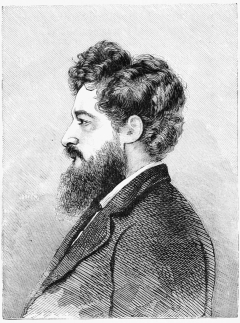
It is easy to understand that the house in which one resides must have
a large share in determining the decorations which shall be placed
in or upon it. An historic or semi-palatial mansion of the olden
time will require to have its great halls and stairways and deep
rooms illuminated with colors, and its large spaces intersected with
pictorial screens. Mr. William B. Scott, of whose mural paintings
I have already spoken, and whose occupation it is to study effects
of ornamentation, has a happy field for his taste and task in his
residence, Bellevue House, at Chelsea. This mansion merits particular
attention, both on its own account architecturally, and for its
decorations, added recently. These have been chiefly devised by the
artist himself in carrying out the original plan, and add a suggestive
and, properly speaking, imaginative character to the interiors. The
house was built, it is said, by the Adamses, the architects of the
Adelphi, in the Strand, where the Society of Arts holds its meetings
(the approach to which is still called Adams Street). At that time,
about a century ago, decorations in the way of carved mouldings running
around door-ways, and passing all round the rooms on the surbase and
dado, were in use. Previously to that time the entire walls were
generally panelled, but then began the system of panelling or boarding
flatly to the height of three feet only, at which height began the
lath-and-plaster wall. Along the top edge of this dado—which, being
just over the height of a chair or table, gives a very well-furnished
and comfortable air to a room, and ought on that account to be again
adopted—ran a more or less ornamental moulding. That mostly used in
Bellevue House is carved in wood, and very good, closely resembling,
indeed, those on the best specimens of Chippendale furniture, which
belongs to the same date—about 1770. I may add here that the demand
among artistic designers for a recurrence to the dado is shown by the
increasing frequency with which a darker paper than that above, with
paper cornice, is made to do duty for it.
A hundred years ago the hall of a mansion was a more important part of
the plan, and more decoratively treated, than now. The entrance is here
divided by folding-doors from the hall proper, which is ample enough in
area to place the stair a good way back, and to give a correspondingly
wide space above, on the drawing-room landing, filled in the olden
time by a table, cabinet, eight-day standing clock, and other objects.
The ends of the steps were carved, sometimes very elegantly. But the
most ornamental feature then in use was the moulded ceiling, which was
planned in ovals and spandrels, according to the shape of the room,
sometimes with medallions of Cupids, and occasionally with a picture,
representing an emblematic personage or some such matter, in the
centre. A few of these are still to be seen in London. There is one in
Knight-Rider Street, painted by Cipriani. In Bellevue House the two
drawing-rooms possess very pretty arrangements of fan-shaped ornaments
and delicate foliage. These are now “picked out” in colors—blue
and white for the most part—producing an effect resembling that of
Wedgwood ware.

CHIPPENDALE MAHOGANY MOULDING, BELMONT HOUSE.
The plan on which the rooms of large London houses were originally
arranged was en suite, entering one through another, connected by
double doors if the walls were thick enough, so that on great occasions
they could be opened throughout. On either side of the drawing-rooms at
Bellevue House are smaller rooms connected in this way, one of which is
at present used as a library and evening sitting-room, and, I must also
add, as a room on the walls of which the ever-bourgeoning studies of
the idealist take shape and color. The wood-work—that is to say, the
dado, doors, etc.—is painted Indian red, with black or light yellow
edgings; above this the wall is covered by a green pattern, but the
upper part of this surface is divided by painting into panels two feet
deep by a foot and a half wide, the stile, or division, between being
half a foot. The ceiling is, in the centre, a very faint blue, with a
darker blue meeting the cornice (two feet wide); this darker blue—the
blue of the sky—also fills the painted panels, which thus resemble
the openings for ventilation in some Oriental countries. Across these
openings a flight of vermilion birds—Virginian nightingales, plumed
and winged by imagination, red being evidently chosen for bright effect
against the blue—is represented. The birds reappear above the cornice,
and stream in pretty migration round the ceiling, decreasing in size
till they nearly disappear.
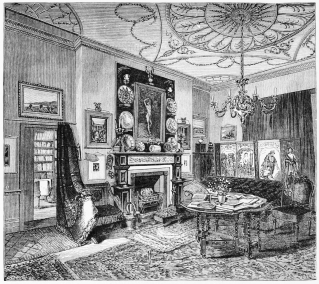
DRAWING-ROOM OF BELLEVUE HOUSE.
The chimney-piece of this little room is exquisite, and is much like
one designed by Sir E. Landseer, which I saw among his sketches, except
that the jambs were caryatides. The white marble jambs and architraves
in Mr. Scott’s design are diapered with leaves—laurel and ivy—of
Indian red color, and above the chimney-shelf is a second chimney-piece
and shelf, thus giving double accommodation for objects of ornament or
use. The artist’s collection of old china, majolica, and other objects
of similar kind serves to render his chimney-pieces particularly
beautiful. I have not seen a more attractive work of this kind than
the chimney-piece in his principal drawing-room. The jambs here are
panelled, the panels being filled with mirrors, and divided half-way,
two feet nine from the floor, by a shelf large enough to accommodate
a lamp or candle, with a teacup or other object. The arrangement is
admirable both for utility and beauty. A supplementary chimney-shelf is
added here, also, to the marble one; and rising nearly to the ceiling
is a surface of black wood, with brackets, for the exhibition of some
very fine old Hispano-Moresque ware, the golden, metallic lustre of
which is favorably seen against the black. The centre is filled by Mr.
Scott’s own most beautiful picture of Eve, which, with a large screen
covered with classical figures, sheds a glory of color through this
unique room, which has, besides, the good fortune to command from its
windows the finest views of the Thames.
Entirely different from either of these residences is that of Mr.
George W. Smalley, the distinguished correspondent of the New York
Tribune, in Chester Place. Birket Foster, George Boughton, W. B.
Scott, and J. McNeil Whistler have naturally decorated their houses
with an eye to picturesque effect; theirs are the homes of men whose
daily life is consecrated to art, and a use of colors seems appropriate
to their environment which might not so well accord with persons
differently occupied. Those who have experienced some of the wear and
tear of this busy London existence can hardly enter the door of this
American gentleman without finding a sufficient justification for
the growing desire of families to surround themselves with household
beauty, against all the charges of the puritanical. “Thus I tread on
the pride of Plato,” said Socrates, as he stepped on the carpet of
his famous friend. “With a pride of thy own,” answered Plato, who is
supposed to have got the better in this little encounter. Nature is not
nowadays in such discredit as formerly for having blended beauties with
utilities, making even her pease and potatoes bear graceful blossoms.
And there would appear to be some reason in the tendency of her yet
higher product, a home, to wear a fitting bloom as the sign of its
reality. Such a suggestion is made by the subdued and delicate tints
and tones which here meet the eye. One may have stepped from other
houses of this fashionable neighborhood to find here a sweet surprise.
There is, then, no absolute and eternal law making it compulsory to
select ugly things instead of pretty things. Tinsel is not intrenched
in the decalogue. Here is a hall in which gray and brown shades prevail
in dado and paper, where a soft light prevails, and the garish light
and the noise of the street can hardly be remembered. One may enter
the nursery and find the children at play or study amid walls that
bring no shams around their simplicity, no finery, but sage-gray and
straw-color, setting off well their bright faces and those panels in
the bookcase which tell the story of Cinderella.
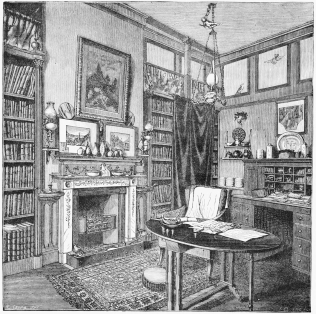
LIBRARY IN BELLEVUE HOUSE.
To the suite of drawing-rooms every excellence must be ascribed. They
consist of two large rooms and a large recess, all continuous, whose
decorations adapt them to any domestic or social purpose whatever.
It is an apartment in which the finest company would feel itself in
an atmosphere of refinement and taste, and it is a place to lose
one’s self in a good book; it is a place where the mind can equally
well find invitation to society or solitude. Perhaps it is the rich
Persian carpet that gives such grace. It is after a pattern more than
a thousand years old, but which in all that time has never repeated
itself, each carpet coming forth with its own tints and shades, and in
which every color is surrounded by a line which mediates between it and
the next. It is not stretched up to the walls and nailed, as if its
business were to conceal something, or as if it were too flimsy to lie
still except by force of iron: it is as a large rug laid for comfort
on the waxed parquet, which is ready to display more of its own beauty
when the proper season arrives. Beginning with this rich carpet, with
its sober tints, the eye ascends to the dado, to the walls, to frieze,
cornice, and ceiling, and finds variation at every stage, but no break
in the harmony of all. The golden tints in the carpet are more fully
represented in the dado, which is of an olive-golden color, with a
small turquoise line on its cornice leading to the main papering. This
paper is of a French tapestry pattern, in which the golden thread,
which is its basis, weaves in colors that are rich but always subdued,
and of every shade. There is no pattern to rivet the eye; it has
no certain relation to the vegetal, or floral, or animal kingdom.
This paper rises to a Moresque frieze of about one foot in depth,
which holds hexagonal medallions containing the ghosts of plants.
There is next a cornice of three mouldings—arabesque, Egyptian, and
floral—leading to the ceiling, which is covered with paper of a rich
creamy color, with very light cross-bands passing between figures in
which a fertile fancy may trace the decorative symbols of earth, air,
and water in an orb, a butterfly, and certain waving lines. It may be
remarked here that it is only on a ceiling that any forms, even in such
abstract shapes as these, are admissible. Here they are noticeable only
if one is lying flat on one’s back and gazing upward, in which case,
especially if invalidism be the cause, some outlines of a dreamy kind
are not without their value. Moreover, any designs, when raised to the
ceiling, require to be larger than similar ones on the floor or line of
the eye, in order that they may be at all similar in effect. The plan
of covering or coloring the ceiling has a good foundation in the fact
that a mere white wall overhead conveys the sorry impression that the
house is left naked in every corner and spot not likely to be gazed at.
The ceiling in Mr. Smalley’s drawing-room exemplifies, however, one
important fact: although a mere color placed on a ceiling depresses it,
a good pattern has just the contrary effect. By good pattern I mean
one that shows a double ground—the lower one being open work, through
which a farther ground is seen. Mrs. Smalley, whose taste has been the
life of the ornamentation of her house, told me that when this ceiling
was being painted the decorated part appeared to rise more than a foot
higher than the blank part.
The wood used in the drawing-room is ebonized, and of it are several
cabinets—one displaying some fine specimens of china—bracket-shelves,
and two remarkably beautiful chimney-pieces, supporting bevelled
mirrors, framed with shelves which display porcelain and other
ornaments. The recess which has been mentioned is what might be better
understood, perhaps, if described as a bay-window. Its chief object
is to hold a large window, in five contiguous sections, which admit a
toned light, and have each a cluster of sunflowers at the centre. This
little room has a broad divan, covered with stamped green (Utrecht)
velvet, running around, and its wall is decorated with gold-tinted
leather, on which are two bright tile ornaments. The large opening into
this recess is adorned by two antique bronze reliefs of great beauty,
and the whole is related to the drawing-rooms by an open drapery of
greenish-golden curtains—a velvet of changeable lustre—uniform with
the other hangings of these beautiful rooms.
It is remarkable, indeed, how much may be accomplished with rooms
inferior in size to those we have been visiting by the skilful use of
curtains. If a gentleman in London enters a house with the intention
of decorating it in accordance with principles of art, his first
work, probably, will be either to tear away doors that divide the
drawing-room, and substitute a draping, or else frame it round with
looped and corded drapery, which, having in itself an artistic effect,
shall change the barrier into beauty. Nothing is better understood than
that no square angles should divide a drawing-room, and the curtain
is more graceful than any arch or architraves for that purpose. The
following sketch may convey some idea of an effect which has been
secured in Townsend House, Titchfield Terrace, residence of the
distinguished artist Mr. Alma Tadema; though the impression can be but
feeble, on account of the exquisite use he has made of the colors,
which must be left to the reader’s imagination, with a warning that
they are as quiet as they are rich.
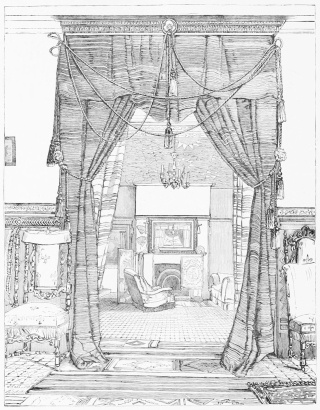
DRAWING-ROOM IN TOWNSEND HOUSE.
The question as to the best color for a wall, one of whose chief
objects is to show off framed pictures, is a vexed one. Messrs.
Christie & Co., the famous art auctioneers, have their rooms hung with
dark green baize from floor to sky-light, and certainly the result
justifies their experience; but I think any one who enters the hall of
Sir F. Leighton, P.R.A., will see that there may be a more effective
wall-color to set off pictures than green, not to speak of certain
other effects of the latter which really put it out of the question.
It is difficult to say just what the color in Sir Frederick Leighton’s
hall is. It is a sombre red, which at one moment seems to be toned in
the direction of maroon, and at another in the direction of brown. It
has been made by a very fine mingling of pigments; but the general
result has been to convince me that there can be no better wall for
showing off pictures, especially in a hall with a good deal of light,
than this unobtrusive reddish-brown. I remember that when the Boston
Theatre was first opened a wall of somewhat similar color added
greatly to the brilliancy of the scenery. But there are many eyes to
which this would not be a pleasing color or shade even for a hall—it
would hardly be beautiful in a purely domestic room—and such will do
well to try some of the many beautiful shades of olive or sage-gray.
Mr. W. J. Hennessy, the eminent American artist, made his house in
Douro Place, before he left it for the old château in Calvados,
remarkably charming by a careful use of such shades throughout. His
quiet rooms were restful as they were pervaded by refinement, and each
frame on the walls had a perfect relief, each picture a full glow.
The house of Sir Frederick Leighton, in Holland Park Road, is, in
the first place, a remarkably interesting house architecturally, and
shows plainly that Mr. George Aitchison has not only been in classic
regions, but imbibed their spirit. In this house, which he has built
for the artist who beyond all Academicians displays the most sensitive
sympathies with various styles, there is nothing foreign, and yet the
whole feeling about it is classic. The little balcony would have done
for the sweet lady of Verona, and yet there is as much of Shakspeare’s
England in the substantial arches at the base of the wall. It is rare,
indeed, that any house built in England in recent times has about
it as much elegance and simplicity as this. Entering the house, the
impression conveyed at once is that it is the residence of an artist.
He has employed decorators, indeed, but he has watched over them, and
he has secured thereby this—that there is nothing ugly in his house.
A great merit! Many rooms upon which large sums have been lavished
have something lugged in that makes all the rest appear vulgar or
pretentious. It is a large part of the art of decoration to know what
not to have in a house. In this house is also realized the truth of
the old French saying, “Peu de moyens, beaucoup d’effet.” For example,
the doors are of deal, painted with a rich black paint; on each jamb
there is at the bottom a spreading golden root, from which runs a stem
with leaves; half-way up the stem ends in the profile of a sunflower
in gold; another stem then passes up, ending in the full face of the
sunflower, which at once crowns the foliation of the jambs, and makes
a noble ornament for the capping of the door, which also has a central
golden ornament. This black door, with its black jambs and its golden
flowers, varied on other doors to other conventional forms, has an
exceedingly rich effect. The hall also bears witness, notwithstanding
its mosaic floors, marquet chairs, and the grand old stairway that
runs with it to the top of the house, that the wealth of knowledge and
experience has done more for it than riches of a more prosaic kind,
though there has been no stint of the latter. One thing in the hall
struck me as especially ingenious, and at the same time beautiful.
Just opposite to the entrance from the vestibule into the hall the
stair begins to ascend beyond large white pillars. Now, between the
first and second of these pillars there is a little balcony, about
as high above the floor as one’s head. On examination it is found
that this balcony is made out of an inlaid cabinet chest, the top and
farther side of which have been removed to make way for cushions. These
cushions have been finely embroidered with various delicate tints upon
a lustrous olive satin by Miss Jekyl, and the little balcony, with
pretty ornaments on it here and there, becomes a main feature of the
hall. There are several other pieces of Miss Jekyl’s work in the house,
one of the most beautiful being a red table-cloth in the dining-room,
upon which she has worked four figures of pots, whose flowers converge
toward the centre. This cover is appropriate to the red color which
prevails in the dining-room—a color which I do not much like in a
dining-room, though here it well sets off the large ebonized and
inlaid sideboard, which is adorned with a great deal of the finest
Rhodian porcelain. Sir Frederick Leighton on returning from a visit
to the East brought back a whole treasury of china and tiles; and he
has also brought a large number of beautiful Persian tiles, with which
he has made a little interior rotunda and dome which is a marvel of
beauty. A sentence of the Koran runs along the cornice; stained glass
throws a rich light through the room; a fountain plays in the centre.
Mr. Dillon, an artist, has for some time had a studio in which every
article came from Egypt, even to the inscription from the Koran (Sura
91) which makes its frieze—
“By the brightness of the sun when he shineth,
By the moon when she followeth him,” etc.
Sir Frederick Leighton’s chief room is his studio; it covers more
than half of the whole area of the top floor of the house. The walls
are hung with stuffs from many countries—tapestries, rugs, ancient
Japanese silks—which fall from the cornice to the floor. There are
some fine ebonized bookcases and cabinets, designed by Mr. Aitchison
and Sir Frederick together. The roof is arranged with sky-lights and
sliding curtains of various descriptions, so that there is no kind of
light or shade whatever that the artist is not able to bring upon his
work. The drawing-room has a white coffered and tinted ceiling, and
neat mouldings above the bay-window gather round a fine oil-picture, by
Eugene Delacroix, fixed in the ceiling. It is beautiful, but I could
not help feeling that some mural painting by another artist might
well be substituted, and the Delacroix placed “on the line.” There is
suspended a very rich central candelabrum of Venetian glass in many
colors. The walls are hung with cigar-tinted cloth, with modified
fleur-de-lis spots, beneath which a floor of ash-blue is disclosed
for the width of a yard between the wall and the bright Persian carpet.
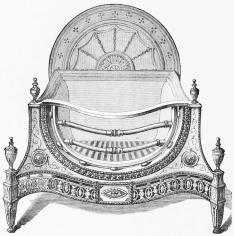
A GRATE OF ONE HUNDRED YEARS AGO.
In all the houses which are carefully decorated in London great use is
made of tiles. The tiles which are unrivalled in the esteem of artists
are the old Dutch, which consequently have been nearly all bought
up. A single old Dutch tile, which when made hardly cost more than a
sixpence, now finds eager purchasers at a pound. It is a singular fact
that our manufacturers can imitate Persian and Egyptian tiles, but have
still to send to Holland to get anything resembling the old Dutch,
and even there they can obtain but an approach to the rich coloring
and quaint designs of old times. Mr. Stevenson, the architect whose
book has been referred to on a previous page, obtained a large number
of these old tiles, which when put together formed large pictures;
but several of them were wanting, and he had to make designs of what
those he possessed appeared to imply were on the others. He had tiles
made which, at any rate, completed the pictures; and though the new
ones were carefully made, they may be easily picked out from the old.
These tile pictures have been placed by Mr. Stevenson on the side of
a sheltered entrance that leads from the street across the front-yard
to his beautiful residence in Bayswater. Inside of this house there
are many beautiful things, but it is chiefly remarkable for the
admirable mantel-pieces on the ground-floor and that above it—in the
hall common to both—which show rich old carvings set with tiles,
chiefly Persian and Dutch, which are built from floor to ceiling. In
the children’s school-room there is a chimney-piece covered with Dutch
tiles representing most quaintly all the most notable scenes in the
Bible, which must be a source of endless amusement to the little ones.
The finest designs for tiles which I have seen in London are those of
Messrs. Morris & Co., whose pictures, however, are often so beautiful
that one dislikes to see them ornamenting fireplaces. Nevertheless, the
grate and its arrangements are becoming matters of serious importance
in every room, and a walk through the establishment of Messrs. Boyd,
in Oxford Street, will show that the “warming engineers” have not
been behindhand in providing stoves, tiles, and grates that may be
adapted to many varieties of decoration. These gentlemen tell me that
they are continually on the watch to get hold of old grates, fenders,
fire-dogs, and so forth, that were made a hundred years ago, on account
of the great demand for them, and that they reproduce them continually;
nevertheless they believe that they can produce a prettier grate now
than could have been made in the last century. The engraving on page
198 represents a grate found in an English mansion about one hundred
years ago. The one on this page represents a grate recently made for
the late Baron Rothschild. The one on page 200 represents a grate and
fireplace designed and made by Messrs. Boyd, which appears to me one of
the most beautiful I have yet seen.
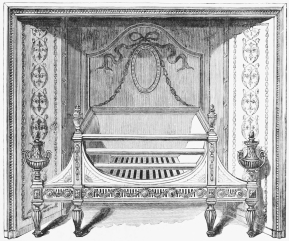
GRATE MADE FOR BARON ROTHSCHILD.
In the houses thus far described I have mentioned several which have
been decorated in whole or in part by Messrs. Morris & Co., but
have reserved until now a special treatment of their style. Their
decorations, apart from their undeniable beauty, derive importance from
the fact that they can be adapted to the requirements of persons with
moderate incomes, or to the needs of those who are prepared to pay
large sums. The firm in question—as befits a company whose head is one
of the most graceful of living poets—has mastered the Wordsworthian
secret of
“The eye made quiet by the power
Of harmony.”
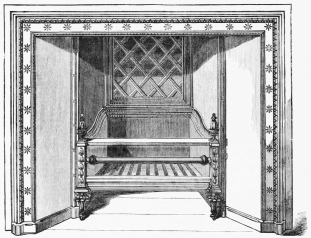
Of the many different papers with which they hang rooms, only a few
have appeared to me unsuited for the purposes of a refined decoration
of almost any room. One, an imitation of square trellis-work, with a
bird sitting in each opening, I have seen on the walls of a bedroom
(which, I suspected, might have been originally intended for a
nursery; in which case I am not prepared to say that it might not have
appeared in place), where it was not pleasing, and it has appeared
to my eye frivolous in sitting-rooms. Nor do I altogether like their
lemon-yellows, which are so well placed in corridors, to find their
way (as they sometimes do) into drawing-rooms; that color, however
adapted for daylight, suffers bleaching by candle or gas light. But
generally their wall-papers are of beautiful grays—pearl, sage, or
even darker—and, while full of repose and dignity by day, light up
well under any artificial light. This firm also does the finest wall
mouldings in relief that I have met with. A remarkable instance of this
may be found in the Grill Room at the South Kensington Museum, to which
reference has already been made. And a somewhat similar moulding is
still more effectively used in the drawing-room of the Hon. Mr. Howard,
in his house at Palace Gardens—a willow pattern, with buds, on a
cream-colored background, which rises to a deep frieze of green. In two
rooms of the same mansion the light pomegranate paper, with shut and
open flowers, is used with good effect. In the dining-room the general
hue is faint pink, and this is also pleasing. In the nursery there is
an exceedingly beautiful paper of wild daisies on a mottled ground. Mr.
Howard is not only an artist himself, but a collector of pictures and
other objects of art. His walls have in a great measure been decorated
with the idea of adapting them to the purpose of displaying to the
best advantage the quaint old cabinets which he possesses, and the
many fine pictures of pre-Raphaelist art which adorn his walls. On one
of the landings of the stairway there is a fine organ, upon which Dr.
Burne Jones has painted a charming picture of St. Cecilia playing on
her keys. This picture sheds light and beauty around, and shows how
much may be done in a house by having such objects brought into the
general system of ornamentation adopted in the house. It is hardly
enough to bring into the house furniture of a color which is vaguely
harmonious with the wall-paper; by a little decoration even the piano,
the cabinet, the book-case, may be made to repeat the theme to which
the walls have risen.
Dr. Burne Jones—for Oxford has bestowed on him its D.C.L., to its own
honor as much as his—has decorated a grand piano with finest art.
Around its bands is told the fable of Orpheus, the potency of music,
in scenes of classical, but not conventional, treatment. On the lid
is a Muse leaning from an oriel of the blue sky; beneath stands a
poet musing; and between them is a scroll inscribed with a bit of old
French, “N’oublié pas”—motto of the family for whom the piano was
made. At another end of the lid is painted amid bay-leaves the page
of a book, with illuminated letters here and there, the lines being
those of one of Dante’s minor poems, beginning, “Fresca rosa novella.”
But all these beauties are surpassed when the lid is lifted. Amid the
strings, which are exposed, there is a drift of roses, as if blown into
little heaps at the corners by the breath of music. On the interior
surface is painted a picture to be gazed on with silent admiration,
for few can be the strains from those keys which will interpret the
subtle sense of the picture. The only name given is Terra Omniparens.
Between the thorns and the roses sits this most beautiful Mother, naked
and not ashamed, with many babes around her. Above, beneath, around,
amid the foliations they are seen—impish, cherubic, some engaged in
ingenuities of mischief, others in deeds of kindliness and love. Greed,
avarice, cruelty, affection, prayer, and all the varieties of these are
represented by these little faces and forms. Some nestle around the
Mother; one has fallen asleep on her lap. The fair Mother is serene;
she is impartial as the all-nourishing, patient Earth she typifies; all
the discords turn to harmonies in her eternal generation. Her impartial
love waits on the good and the evil; she is one with the art that
“shares with great creating Nature.”
Although the hangings of Morris & Co. do not imply a lavish, but
only a liberal, expenditure, they do not readily adapt themselves to
a commonplace house inhabited by commonplace people. There must be
thousands of these square-block houses with square boxes for rooms
which would only be shamed by the individualities of their work. The
majority of houses attain the final cause of their existence when the
placard inscribed “To Let” may be taken down from their windows. No
doubt the decorative artist might do a great deal toward breathing a
soul even into such a house, if it were inhabited by a family willing
to pay the price. But there are houses built with other objects than
“to let,” built by or for persons of taste and culture, and to such
the decorations of Messrs. Morris & Co. come as a natural drapery. Mr.
Ionides, who has just entered a new house in Holland Park Villas, has
shown, by adopting in it decorations similar to those of the smaller
house he has left, that, after many years, the hangings of Morris &
Co. still appear to him the most beautiful; and it is significant of
the spirit in which he has carried out his own feeling in both cases
that he has steadily refused to let the house his family had outgrown
to all applicants who proposed to pull down its papers and dados, and
convert the house into the normal commonplace suite of interiors. He
preferred to retain for some time, at a loss, that which he and his
artistic friends built up with so much pains, rather than have it pass
into inappreciative hands. In the new residence of Mr. Ionides he
has found a beautiful hanging for his drawing-room in a Morris paper
of willow pattern, with two kinds of star-shaped blossoms, white and
yellow, which harmonizes well with the outlook of the room into a
conservatory. The curtains of the bay-window in the spring season are
of Oriental cream-colored linen, with flowers embroidered in outline
(light gold), and at wide intervals, upon them. The paper in the
large dining-room is the small floral square (sage-gray) pattern of
Messrs. Morris & Co., which harmonizes well with the red carpet, the
pictures, and the green-golden lustres of the velvet curtains. Mr. E.
Danreuther, in whose brilliant successes as interpreter of the “Music
of the Future” America as well as Germany has reason for pride, has his
residence in Orme Square decorated mainly with the Morris patterns.
The house is quaint and old, and nothing can exceed the sympathetic
feeling with which these designs harmonize with the style of the halls
and rooms. It is a picture for the imagination to think of Carlyle and
Sterling (who once resided here) conversing on great themes amid these
quietly rich, these even poetical designs and colors. Nearest to that
imaginary picture is the real one which I have seen a little way from
Orme Square, namely, in the villa of the late Mr. Edward Sterling, son
of the poet John Sterling, himself an artist, who had used his own
excellent taste, and that of his wife (a sister of Marcus Stone), in
adorning his house at Kensington. An especially fine appearance has
been given to a high wall which stretches through two stories beside
the stairway by changing the style and color of the (Morris) paper
midway, and thus breaking the monotony. The hangings of the lower
hall are dark, and the light shed down from the higher wall is thus
heightened. In this, as in the majority of beautiful houses, the first
effect at the entrance is that of shade. The visitor who has come from
the blaze of daylight is at once invited to a kindly seclusion. Beyond
the vestibule the light is reached again, but now blended with tints
and forms of artistic beauty. He is no longer in the hands of brute
Nature, but is being ministered to by humane thought and feeling, and
gently won into that mood
“In which the heavy and the weary weight
Of all this unintelligible world
Is lightened.”
That mood, my reader will easily understand, cannot be secured by
the papers of Morris & Co.; but where a true artist is able to find
such artistic materials as theirs to work with, he is able, as in the
case of Mr. Sterling, to weave them on the warp of his own mind and
sentiment into a home which shall not fail to distribute its refining
and happy influences to all who enter or depart.
Among the younger artists of high position and achieved fame in the
fine arts who have aimed to include house decoration within their
poetic domain, the most successful has been Mr. Walter Crane, who is
fortunate in having a firm of skilful paper-stainers (Jeffrey & Co.,
of Islington) to embody his beautiful and quaint designs. Mr. Crane’s
“Chaucer,” or “La Margarete,” paper received a special medal and
diploma at the Philadelphia Exhibition, and his more recent designs are
not inferior. The “Margarete” paper, which takes almost any color that
is not garish, has become a prime favorite among the lovers of chaste
decoration in London, and the light olive tint is preferred. The daisy
is the motive, taken from Chaucer:
“As she that is of allë floures flour,
Fulfilled of all virtue and honour,
And ever alike fair and fresh of hue.”
The burden of the daisy-song (in the “Legend of Good Women”)
“Si douce est la Margarete,”
is exquisitely blended with the pattern. The superb frieze shows, on
a background of gold, the youthful God of Love holding Alcestis, the
ideal wife, by the hand; next Diligence, with her spindle; Order, with
hour-glass; Providence, with well-filled basket; and Hospitality, with
her jar and extended cup. These figures support the roof as caryatides.
Plants of alternate leaf and flower, in pots, stand between the figures
and beneath the Chaucerian text: “To whom do ye owe your service? Which
will you honour, tell me, I pray, this yere? The Leaf or the Flower?”
In the dado are the types of purity and innocence—lilies and doves.
Mr. Walter Crane’s services to decorative art are well appreciated
by the little folk in some households, for he has designed papers
representing the most fascinating of Cinderellas and Boy Blues, and
as I write is bringing out an apotheosis of Humpty Dumpty and cognate
classicisms. That this artist is ambitious of canonization among the
young is farther suggested by the fact that he has actually turned
his hand to designing valentines, thus tempting staid persons to
indulge in that kind of thing—or, at any rate, to condone it—who
have long eschewed such pinky frivolities. He has designed three or
four valentines only, but they have been endlessly imitated. I must
not omit to mention that a great deal of the best needle-work done
in London has been after Mr. Crane’s designs, and also that he is at
present engaged in making tiles which promise to surpass all other
recent designs. These represent generally each some simple, graceful
figure—classic, allegorical, or antique—with flowers surrounding
them; but the charm is in the very pleasing expression this artist
conveys in a few lines by his careful drawing, and also by his delicate
sense of color. Whatever he does, however conventional the accessories
may have to be (and they must often be such with the real artist, who
will never dignify incidents with the same work as his main designs,
any more than he will paint his picture-frame like his canvas), no one
acquainted with his work can ever mistake the touch. When I first saw
Walter Crane’s papers I felt a certain heaviness of heart that one
could not have them all on the walls of some favorite room—all at the
same time!
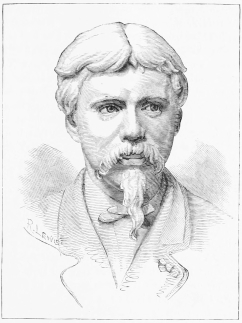
L. ALMA TADEMA.—[FROM A BUST BY J. DALOU.]
Perhaps the most complete rendering of the effects at which William
Morris and Burne Jones have aimed in their efforts at beautifying
London households is to be found at Townsend House, to which I have
before alluded. Mr. L. Alma Tadema, the finest colorist, has of course
been as one of the partners of the firm so far as his own home is
concerned, and the touches of his art are met with at every step in
it. Passing beneath the cheery “Salve” written over the front-door,
we at once meet with a significant piece of art. On each side of the
rather narrow hall is a door; one leads into a parlor, the other into a
library, and, as they are just opposite each other, the doors are made
to open outward, and, when open, meet. Now, when it is desirable, the
two doors when open make a wall across the hall; this extemporized wall
has its panels painted, and thus a pretty passage is made to connect
the separate rooms. One thing in Townsend House is very peculiar: the
ceilings are generally covered with the same paper as the walls. There
is a dado of matting with touches of color in it, or else painted in
some color related to the paper but of deeper shade, and above this
a uniform paper, with but slight frieze (most of the rooms being
comparatively small, a deep frieze would be out of place). I confess
that I have some misgivings about this continuance upon the ceiling
of the wall-paper. It would certainly answer very well in rooms that
were of very high pitch, for the heavier the color on a ceiling the
more it is depressed to the eye. But here the sense of comfort and
snugness secured—important as they are in this moist, chill climate,
which often makes one willing to be folded up in a warmly lined box—is
paid for by a sense of confinement. A ceiling ought not to be white
nor blue, which, not to speak of the quickness with which they become
black from the chandeliers, convey the feeling of exposure to the
open air, but there should be above one a lighter tint and shade,
lest the effect should be that of being in a cellar. The underground
effect nowhere occurs in Townsend House, because therein true artists
have been at work, but one might not be so secure if the papering had
been left to less judicious decorators. The corridors have the creamy
pomegranate paper, which carries a cool light through them. A small
back-room on the first floor has been Orientalized into a charming
place by a skilful use of rugs, skins, etc., on the floor, and on
the Persian divans fixed against the wall, which is covered with a
silvery and pinkish paper. The chief bedroom in the house presents the
novelty of walls entirely hung with a rich dark and reddish chintz,
with wide stripes flowing from ceiling to floor, the effect being a
grave Persian. The bed is hung and covered with the same stuff, and the
lower part of each window is made into a cushioned seat of the same.
The ceiling in this case is of a pearl-white, and there is plenty of
light. This room appeared to me, though at first a surprise, one that
was suggestive of every kind of warmth and comfort; it was, indeed, an
entire room made into the appropriate environment of a bed. In another
bedroom I observed how beautifully the light may be regulated by the
use of double curtains, one of dark green, when darkness is desired,
the other of a fine tracing-cloth, which is more snowy than the glass
of an astral lamp, while it similarly softens and diffuses light.
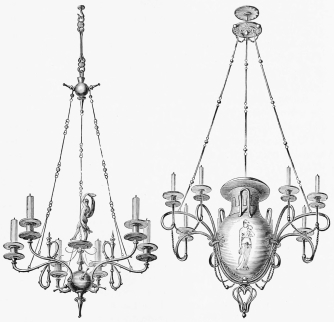
CANDELABRA, TOWNSEND HOUSE.
Mr. L. Alma Tadema—a fine bust of whom by J. Dalou appeared in the
Royal Academy in 1874—had contributed, as his picture of that season,
an admirable representation of his own studio, with a number of his
friends looking upon a work on his easel, the back of which is turned
to the spectator. But one can readily imagine those friends of his
dividing their attention between the picture and the rich ornamentation
of the room they are in. An artist’s studio is apt to be, and ought
to be, as much a picture as any work of art born in it, but it hardly
comes within the scope of this article to describe rooms that are
expressions of individual genius and purpose; yet in every house where
cultivated persons are found individual aims are found also, and there
will be the effort to give to each of these its fit environment. The
first point to be secured in the study, or studio, or workshop is,
that everything in it shall be related to the work which is its end
and raison d’être. When Carlyle was engaged in writing his Life of
Frederick he had prepared a special study apart from his library,
whose walls were covered with books and pictures of which each one,
without exception, was in some way connected with the man of whom
he was writing. They who are not, even for a time, specialists may
nevertheless follow his example so far as to take care not to surround
themselves with distracting objects. That which is beautiful in a
studio may be ugly in a study. The studio of Alma Tadema sympathizes
in its minutest object with the artist, who is so much at home in all
the ages of art. Touches of Egypt, of Pompeii, of Greece, of Rome,
blend in the decorations of his studio, as their influences are felt
in his powerful works. And, indeed, throughout Townsend House there
is a beauty derived from the fact that every ornament is subordinate
to the purpose of the room which contains it. The dining-room, for
instance, opens into a beautiful garden; it is, therefore, not simply
an eating-room, but must in some weathers do duty as the salon for a
garden party. The rich dado of matting is especially well placed in
such a room as this, which is large and luminous. It is capped by a
chair-board, which is ingeniously adorned with cockle-shells, and still
more at one point with the first name of the mistress of the house
painted in antique golden letters. Above this there is a cream-colored
paper of squares, with roses and birds, a hanging which I have already
spoken of as unpleasant in bedrooms or sitting-rooms; but in this large
dining-room, which opens into a garden, the effect of it is remarkably
fine. The cornice is Easter-eggs (variously and carefully colored),
beneath a higher member of grape and leaf, also colored. The whole of
one end of this room is covered by a rich drapery of fine Indian dyes,
elegantly striped. The servants’ entrance is behind a large screen of
gold leather.
Throughout this beautiful house there are little arrangements
for convenience, always attended by beauty, which are altogether
indescribable—a head or a sprig of ivy painted in some panel, or a
little gauze curtain draping a casual opening. But I must particularly
note in the drawing-room a beautiful capping to the dado. It is a white
moulding of the Elgin marble reliefs, and most beautifully fringes
the dark-figured stuff of the dado. I have already described the fine
drapery of this room. I need only now say that Mr. Alma Tadema has
designed some candelabra which appear to me most beautiful. The reader
will, I fear, be but little able to obtain from one of the drawings
an idea of the rich minglings of the bronze with the rose porcelain
egg-shaped centre-piece, and the figures painted upon it. Both of the
candelabra which I have selected as specimens are for rose-colored
candles. In the houses of many artists ancient oratory (suspended)
candelabra are used for the centres of rooms, and also brass repoussé
sconces bracketed with bevelled mirrors. The English upper classes have
never been reconciled to the use of gasaliers in their drawing-rooms,
and the artists have pretty generally opposed the use of gas, which is
believed to be damaging to oil-pictures.
In concluding this account of the most interesting examples of
decorative art with which I am acquainted in England, I add, in
preference to any general observations of my own, a few extracts from
very high authorities, affirming principles whose truth seems to me
to be illustrated by every exterior, and interior to which I have
referred. The first of these quotations is the placarded principles of
decorative art hung up in the school at South Kensington:
I.
1. The decorative arts arise from, and should properly be
attendant upon, architecture. 2. Architecture should be the
material expression of the wants, the faculties, and the
sentiments of the age in which it is created. 3. Style in
architecture is the peculiar form that expression takes under the
influence of climate and the materials at command.
II.
Metal-works, Pottery, and Plastic Forms Generally.—1.
The form should be most carefully adapted to use, being studied
for elegance and beauty of line as well as for capacity, strength,
mobility, etc. 2. In ornamenting the construction care should be
taken to preserve the general form, and to keep the decoration
subservient to it by the low relief or otherwise; the ornament
should be so arranged as to enhance by its lines the symmetry
of the original form, and assist its constructive strength. 3.
If arabesques or figures in the round are used, they should
arise out of the ornamental and constructive forms, and not be
merely applied. 4. All projecting parts should have careful
consideration, to render them as little liable to injury as is
consistent with their purpose. 5. It must ever be remembered that
repose is required to give value to ornament, which in itself is
secondary and not principal.
III.
Carpets.—1. The surface of a carpet, serving as a ground
to support all objects, should be quiet and negative, without
strong contrast of either forms or colors. 2. The leading forms
should be so disposed as to distribute the pattern over the
whole floor, not pronounced either in the direction of breadth
or length, all “up-and-down” treatments being erroneous. 3. The
decorative forms should be flat, without shadow or relief, whether
derived from ornament or direct from flowers or foliage. 4. In
color the general ground should be negative, low in tone, and
inclining to the tertiary hues, the leading forms of the pattern
being expressed by the darker secondaries; and the primary colors,
or white, if used at all, should be only in small quantity, to
enhance the tertiary hues and to express the geometrical basis
that rules the distribution of the forms.
IV.
Printed Garment Fabrics, Muslins, Calicoes, etc.—1.
The ornament should be flat, without shadow and relief. 2. If
flowers, foliage, or other natural objects are the motive, they
should not be direct imitations of nature, but conventionalized
in obedience to the above rule. 3. The ornament should cover the
surface either by a diaper based on some regular geometrical
figure, or growing out of itself by graceful flowing curves;
any arrangement that carries lines or pronounces figures in the
direction of breadth is to be avoided, and the effect produced by
the folding of the stuff should be carefully studied. 4. The size
of the pattern should be regulated by the material for which it
is intended: small for close, thick fabrics, such as ginghams,
etc.; larger for fabrics of more open textures, such as muslins,
baréges, etc.; largely covering the ground on delaines, and more
dispersed on cotton linens.
In all the beautiful effects which I have observed the ornamentation
has been in more or less accordance with the fundamental principle
of these rules—namely, the subordination of decoration to use. Many
persons of taste and culture have had to wage a sometimes unequal
conflict with architecture whose object was a low one—to sell;
but they have been rewarded just in the proportion that they have
regarded the principles just quoted. It will be especially observed
that realism, in the sense of exact imitations of nature, is entirely
repudiated. Conventionalism, precisely because it is a degradation in
human character, is a first necessity in ornamentation. The rationale
of this is admirably given in a little book on the Oxford Museum,
by Dr. Acland and Mr. Ruskin, not likely to have been seen by many
American readers. The following remarks by Mr. Ruskin, taken from it,
constitute my second extract:
“The highest art in all kinds is that which conveys the most
truth, and the best ornamentation possible would be the painting
of interior walls with frescoes by Titian, representing perfect
humanity in color, and the sculpture of exterior walls by
Phidias, representing perfect humanity in form. Titian and
Phidias are precisely alike in their conception and treatment of
nature—everlasting standards of the right. Beneath ornamentation
such as men like these could bestow falls in various rank,
according to its subordination to vulgar uses or inferior places,
what is commonly conceived as ornamental art. The lower its office
and the less tractable its material, the less of nature it should
contain, until a zigzag becomes the best ornament for the hem of a
robe, and a mosaic of colored glass the best design for a colored
window. But all these forms of lower art are to be conventional
only because they are subordinate; not because conventionalism is
in itself a good or desirable thing. All right conventionalism is
a wise acceptance of, and compliance with, conditions of restraint
or inferiority. It may be inferiority of our knowledge or power,
as in the art of a semi-savage nation, or restraint by reason of
material, as in the way the glass-painter should restrict himself
to transparent hue, and a sculptor deny himself the eyelash and
the film of flowing hair which he cannot cut in marble. But
in all cases whatever right conventionalism is either a wise
acceptance of an inferior place, or a noble display of power under
accepted limitation; it is not an improvement of natural form into
something better or purer than Nature herself.
“Now, this great and most precious principle may be compromised
in two quite opposite ways. It is compromised on one side when
men suppose that the degradation of the natural form, which fits
it for some subordinate place, is an improvement of it, and that
a black profile on a red ground, because it is proper for a
water-jug, is therefore an idealization of humanity, and nobler
art than a picture by Titian. And it is compromised equally
gravely on the opposite side when men refuse to submit to the
limitation of material and the fitnesses of office, when they try
to produce finished pictures in colored glass, or substitute the
inconsiderate imitation of natural objects for the perfectness of
adapted and disciplined design.”
I was much struck on a recent occasion with an illustration of how
little the principles thus explained by Mr. Ruskin are understood
even among the learned. It was at the Anthropological Society, where
archæologists, antiquarians, metallurgists, and experts of various
kinds were examining a collection of specimens of the gold-work of
the Ashantees. One of the leading authorities present gave it as
his opinion that the specimens, though of a fineness which English
workmanship could not rival, nevertheless represented a degradation of
art and of civilization among the Ashantees; and the reason assigned
was, that the ornamentation indicated that an original imitation of
forms—some natural, others of European design—had been departed
from till the significance of the forms had been lost. Of course the
argument really proved a progress in art among the Ashantees, and a
fine perception of the laws that must govern all work upon gold. But
it is of great importance that no one should confuse conventionalism
in the decorative flower or other form with conventionalism in the use
of them in any house or on any object. The houses of the millions are,
indeed, conventionally decorated now, and they are ugly; the individual
taste will convert the commonplace forms and colors into individual
expression, as his soul has previously transmuted the commonplace clay
into a physiognomy like and unlike all others.
But it were a serious error to suppose that the words “conventional,”
“heraldic,” “decorative,” etc., employed to express those ornamental
forms which are derived without being copied from nature, really
express the significance of those forms. They do represent the spirit
of nature. In the extract with which I conclude, the growth of such
flowers and forms in a fairer field is most subtly described. It
is from the best existing work on the genesis and evolution of the
decorative arts, Mr. Scott’s History and Practice of the Fine and
Ornamental Arts, now used as a manual and official prize-book at the
South Kensington School of Design:
“Taste is that faculty by which we distinguish whatever is
graceful, noble, just, and lovable in the infinitely varied
appearances about us, and in the works of the decorative and
imitative arts. The immediate impulse in the presence of beauty
is to feel and admire. When the emotion and the sentiment are
strong we are compelled to imitate. We cannot make ourselves more
beautiful physically than Providence has decreed, but we wish to
see again, to feel again, what caused in us so vivid a pleasure;
and we attempt to revive the image that charmed us, to re-create
those parts or qualities in the image that we found admirable,
with or without those other parts or qualities which did not touch
us, but which were necessary to its existence in a conditional and
transitory life. Hence a work original and peculiar to man—a work
of art.”
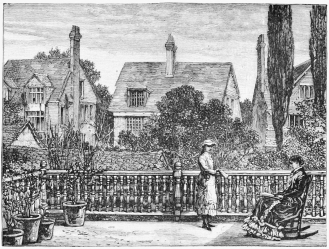
BEDFORD PARK.
FIVE years ago I happened to pass through Chiswick, near London, and
paused near a field where Prince Rupert and his little army camped
overnight, on their retreat before Hampden and his Roundheads—a
scene which the perspective of time has made into an allegorical
tableau of Aristocracy retreating before Yeomanry. (It is a retreat
that steadily goes on still.) At that time I found it pleasant to see
large and beautiful gardens, with stately poplars and every variety of
fruit-tree, glorifying the acres once steeped with the bluest blood
of England. Eight hundred Cavaliers were here found dead when the
Roundheads came in the early morning, glowing with victory, to pitch
their tents where the Cavaliers had just folded theirs. Last year I
turned in to take another look at the same place. I paused again near
the Rupert House—surely a very civil-seeming home for the barbaric
prince whose name was twisted into “Prince Robber.” Two lions couch
above the projecting door-way, two child-figures stand on the ground
beneath, which may be emblems of that ferocity for which the prince was
famed beyond all warriors of his time, until he fell in love with the
pretty actress under whose sway he became gentle as a child.
I meant to enter on the grass-covered Roman Road along which the prince
retreated some seventeen centuries after the Romans made it. Here Roman
coins and bits of ancient tile have been found, are still occasionally
found. At any rate, it is well enough to keep one’s eyes sharp upon
the ground for a few hundred yards. But first another good look at
the beautiful gardens which cover the camp of the Cavaliers—gardens
planned and planted by Lindley, the famous horticulturist and botanist,
father of the present Mr. Justice Lindley.
Angels and ministers of grace! am I dreaming? Right before me is the
apparition of a little red town made up of quaintest Queen Anne houses.
It is visible through the railway arch, as it might be a lunette
picture projected upon a landscape. Surely my eyes are cheating me;
they must have been gathering impressions of by-gone architecture along
the riverside Malls, and are now turning them to visions, and building
them by ideal mirage into this dream of old-time homesteads!
I was almost afraid to rub my eyes, lest the antique townlet should
vanish, and crept softly along, as one expecting to surprise fairies
in their retreat. But when across the Common a Metropolitan train came
thundering, and the buildings did not disappear, I began to feel that
they were fabrics not quite baseless. That they should be real seemed
even stranger than that they should be fantasies. The old trees still
stood, the poplars waved their green streamers in the summer breeze,
the huge willows branched out on every side; but the turnips and
pumpkins they once overhung had become æsthetic houses, and amid the
flowers and fruit-trees rosy children at play had taken the place of
grimy laborers. I passed beneath a medlar—who ever before heard of
a medlar-tree out on a sidewalk?—on through a wide avenue of houses
that differed from each other sympathetically, in pleasing competition
as to which could be prettiest. Their gables sometimes fronting the
street, their door-ways adorned with varied touches of taste, the
windows surrounded with tinted glass, the lattices thrown open, and
many comely young faces under dainty caps visible here and there,
altogether impressed me with a sense of being in some enchanted land.
After turning into several streets of this character, and strolling
into several houses not yet inhabited, watching the decorators silently
engaged upon their work, I recognized that this was the veritable land
of the lotus-eaters, where they who arrive may sit them down and say,
“We will return no more.”
My summer ramble ended in a conviction that Bedford Park was an
adequate answer to Mr. Mallock’s question, “Is life worth living?”
If lived at Bedford Park, decidedly yes! In one year’s time an
architectural design adapted to our taste and needs stood finished
in brick, amid trees planted by Lindley; the last convenience was
completed, the ornamentation added; and therein I now sit to write this
little sketch of the prettiest and pleasantest townlet in England,
while my neighbor Mr. Nash is out on the balcony sketching the trees
and houses that wave and smile through my study windows. For those
who dwell here the world is divided into two great classes—those who
live at Bedford Park, and those who do not. Nevertheless, we of the
first class are not so far removed from those of the second as not to
feel for them, and to help them as well as we can to see our village,
so far as it can be put on paper in white and black. It is with that
compassionate feeling that Mr. Nash with his pencil and I with my pen
have prepared some account and illustration of what has been done
toward building a Utopia in brick and paint in the suburbs of London.
For a long time cultured taste in London for persons of moderate means
had been able to express itself only on paper. Any deviation from the
normal style could be achieved only by the wealthy. The Dutch have the
proverb, “Nothing is cheaper than paint,” but the Dutch might have
discovered their mistake had they lived in London within recent years,
and ventured to desire any variation from the conventional decoration
of houses. Even twenty years ago the artistically decorated (modern)
houses in this vast metropolis might almost be counted on one’s fingers
and toes, and they were the houses of millionnaires or of artists. The
artists could do much of the work themselves, and the millionnaires
could command special labors. But meanwhile the people who most desired
beautiful homes were those of the younger generation whom the new
culture had educated above the mere pursuit of riches, at the same
time awakening in them refined tastes which only through riches could
obtain their satisfaction. However, London is a vast place. One of the
best things about it is that nearly every head, however ingeniously
constructed, can find a circle of other heads to which it is related.
The demand of a few expanded until its supply was at hand. Jonathan
Carr, member of a family to which much of this kind of artistic
activity in London is due, had become the proprietor of a hundred acres
of land out here at Chiswick. It was land on which art had already been
at work; a considerable part of it had been the home garden of Bedford
House, where, as already said, Lindley had resided. Around the large
garden were orchards and green fields. Mr. Carr believed that his land
might fairly be made the site of a number of picturesque houses, both
as to architecture and decoration, such as many of his acquaintances
were longing for; he believed that if a considerable number of persons
should contract for such houses, that kind of work which has been
costly because exceptional might be much reduced; he believed also that
there were architects and decorators who, out of materials sufficiently
alike to be secured in large quantities, could produce a rich variety
of combinations, so that a maximum of individual taste might be
expressed at a minimum of cost. Mr. Carr consulted Norman Shaw on the
matter; that architect encouraged the project, and agreed to devote
himself personally to it. And I may say here that the speedy success
of the scheme was largely due to the well-known characters of the
landlord and the architect. Their enthusiasm for art, their liberality
and honor, excluded all suspicion that the scheme was a money-making
bubble; the slow-growing plant of confidence was already grown in their
case for the kind of people who really wanted these houses. In the
course of little more than five years three hundred and fifty houses
have been erected. They are embowered amid trees, and surrounded by
orchards; their generous gardens are well stocked with trees, flowers,
and fruits, so that these houses appear as if they had been here for
generations. No one could imagine that seven years ago they were all
little sketches on paper, passing between landlord, architect, and
house-hunters; and indeed my friend Abbey, the artist, who has visited
us occasionally, says he cannot yet get it out of his head that he is
walking through a water-color.
The first consideration is health. Bedford Park is naturally healthy.
It is situated upon a gravel-bed, remote from the fogs of London,
and with easy access to the river for its drains. Kensington is but
twelve minutes nearer the centre of London than Bedford Park, yet at
Kensington few afternoons between October and February can be passed
without gas-light, whereas here there were only four or five occasions
last fall and winter when the lights were required before evening.
There are beautiful walks around, and in ten minutes by train we
reach Kew Gardens. The Chiswick Horticultural Gardens are under ten
minutes’ walk. Near these is the long avenue, overarched by trees,
the Duke’s Walk; it leads to famous Chiswick House, whose sixty acres
of ornamental wooded ground is the most beautiful private park in the
suburbs of London, to say nothing of the charms of romance investing
the old Italian villa where statesmen consulted the fair Duchess of
Devonshire. There is thus no lack of breathing space. The houses are
built with fourteen-inch brick walls, and without cellars. It is in
conformity with what has been decided to be the prudent plan in London
that underground rooms are unknown here, each house being founded on a
solid bed of concrete, the floors raised sufficiently high above this
to allow of full and free ventilation beneath every house.
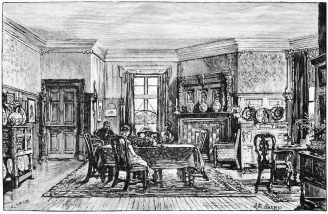
DINING-ROOM IN TOWER HOUSE.
Sanitary considerations are not neglected in the decorations. Matting
is used in the lining of halls and staircases; it is easy to keep
clean, and does not gather or send forth dust every time a door is
opened, as is often the case with paper. Tiles are also much employed,
which are also easy to keep clean; and although stained glass is used,
it is as a decorative casement, and is not allowed to impede the light,
which can never be spared in England.
What at once impresses the intelligent visitor to Bedford Park is
the fact that the beauty which has been admittedly secured is not
fictitious. A competent writer in the Sporting and Dramatic News
(September 27th, 1879), speaks very truly of this feature of the new
village: “We have here no unchangeable cast-iron work, but hand-wrought
wooden balustrades and palings; no great sheets of plate-glass,
but small panes set in frames of wood which look strong and solid,
although, the windows being large, they supply ample illumination for
the spacious rooms within. There is no attempt to conceal with false
fronts, or stucco ornament, or unmeaning balustrades, that which is
full of comfortable suggestiveness in a climate like our own—the house
roof; everything is simple, honest, unpretending. Within, no clumsy
imitations of one wood to conceal another, but a preserving surface of
beautifully flatted paint, made handsome by judicious arrangements of
color. Here brick is openly brick, and wood is openly wood, and paint
is openly paint. Nothing comes in a mean, sneaking way, pretending to
be that which it is not. Varnish is unknown. There is an old-world
air about the place despite its newness, a strong touch of Dutch
homeliness, with an air of English comfort and luxuriousness, but not a
bit of the showy, artificial French stuffs which prevailed in our homes
when Queen Anne was on the throne, when we imported our furniture from
France, and believed in nothing which was not French.”
Those who purchase or lease houses at Bedford Park are allowed the
choice where their wall-papers shall be purchased, what designs
shall be selected, and what colors shall be used on the wood-work. A
certain amount is allotted for the decoration of the drawing-room,
dining-room, and so on, and the occupants are invited to select up to
that sum freely; or, if they fancy some costlier paper or decoration,
the excess of price is added. As a matter of fact, a majority of the
residents have used the wall-papers and designs of Morris, the draught
on whose decorative works has become so serious that a branch of the
Bloomsbury establishment will probably become necessary in the vicinity
of Bedford Park. This natural selection of the Morris designs by so
many families, independently of each other, could hardly have occurred
a few years ago, or, if it had occurred, would have been a misfortune
of monotony; but recently these designs have been sufficiently varied,
and the new patterns, which may be had in divers colors and shades,
are now so numerous that it is quite possible for all to be satisfied
without a calamitous sameness. And this result is largely due to the
excellent taste and ingenuity of the founder of the village, who is
pretty certain to give those arranging the interiors of their houses
the best advice, not unfrequently guiding them about the place, to see
the effect of certain papers already on walls, and showing how by new
combinations of dado-paper and wall-paper, or distemper, repetitions of
neighboring decorations may be avoided. The besetting sin of the new
decoration—monotony—is thus measurably escaped.
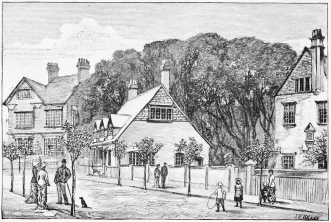
The best standards, indeed, Mr. Carr is generally able to show in
his own house. His taste and that of his wife have made their house
beautiful. It would be difficult to find a prettier room than the
dining-room, which our artist has drawn with care; but much of its
beauty depends upon the soft colors and tints of its walls and its
genuinely old furniture. This house, known as the Tower House, is as
elegant, comfortable, and charming as need be desired even by those
whose home is the seat of a continuous and liberal hospitality. The
hall, landings, and rooms are all spacious and well proportioned; yet
the entire building, arrangements, and decorations have probably not
cost four thousand pounds.
In Mr. Nash’s sketch of “Queen Anne’s Gardens” the observer may see
some characteristic features of the place, such as the venerable air of
our trees, and the relation of our streets to the old characters traced
upon the soil by the gardens which preceded these. It is said some of
the streets of Boston, Massachusetts, followed the old sheep-paths;
and it may now be entered in the archives of Bedford Park, against its
becoming a city, that its streets and gardens have been largely decided
by Dr. Lindley’s trees. Some of them curve to make way for the lofty
patriarchs of the estate, which we hope may long wave over us. There
has been an accompanying good result, that wherever the eye looks it
meets something beautiful.
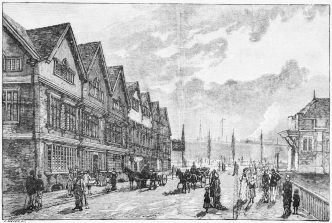
CO-OPERATIVE STORES AND TABARD INN.
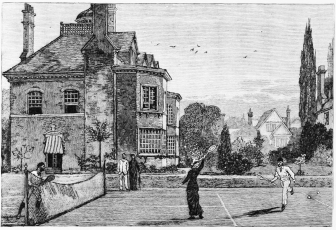
TOWER HOUSE AND LAWN-TENNIS GROUNDS.
One of our views is slightly utilitarian. It is taken from the old
Roman Road, and from the Co-operative Stores in the foreground commands
the railway, on which trains bear us to the heart of London in thirty
minutes. Indeed, one can start from our little station for a voyage
round the world, so many are the junctions to be reached from it. The
portico of the church is visible on the right in this picture, and in
the distance the steeple of Turnham Green parish church. Beside the
Co-operative Stores stands the one inn of Bedford Park. It is a part of
the contract of each lessee that he shall not allow any public-house
(or drinking-house) to be opened on his premises, nor allow any trade
to be carried on upon the same. Yet there is need of an inn, that
families may come to experiment on the place, and where lodgings may be
obtained when houses are overfull of guests, Bedford Park being much
given to hospitality. The inn is called “The Tabard.” That was the name
of the old inn in the Borough, near London Bridge, from which Chaucer’s
Canterbury Pilgrims started. The excellent artist, Mr. Rookh, whom
Bedford Park is fortunate enough to have as a resident, has painted a
beautiful sign for our “Tabard,” representing much the same scene as
our picture on one side, and on the other an old-time herald habited in
a tabard.
Another of Mr. Nash’s views shows our tennis lawn and Badminton floor
(asphalt), which are pretty generally the scene of merry games. These
beautiful grounds are at the west end of Tower House (seen on the
left), and contain beautiful trees, among others the first Wellingtonia
(as the English insist on naming that American institution) planted in
England.
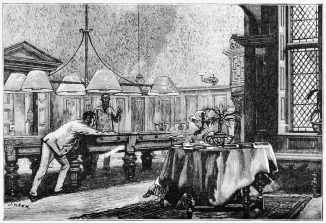
READING AND BILLIARD ROOM, CLUB-HOUSE.
The Club is the social heart of Bedford Park, and it is speaking
moderately to say it is as pure a sample of civilization as any on
this planet. After claiming that, my reader need hardly be informed
that in it ladies and gentlemen are on a perfect equality. Whatever
distinctions are made are such as instinct and taste suggest. The
ladies did not enter the billiard-room, possibly fearing that they
might put too much restraint upon gentlemen who not only smoke, but
sometimes like to take their coats off at the game; so there has been
added a ladies’ billiard-room, exquisitely panelled and papered. The
wainscot is of oak which was once in a church of London City built by
Sir Christopher Wren: the wood was so sound, after all those years,
as to “bleed” when sawed for this room. Above this panelling there is
a soft golden paper. A door opens between this and the reading-room,
beyond which is the gentlemen’s billiard-room. One of our two sketches
made in this room looks toward this door; the other shows its great
bay-window, on the seats about which ladies and gentlemen are wont to
sit to read the new books with which the table is always stocked, or to
take refreshments. Outside of this superb window may be seen flowers
and ornamental shrubs by day, but the time selected by our artist for
presenting it was somewhat after midnight, on an occasion when there
were prettier flowers inside—those of the night-blooming variety,
which never fail to spring up when the summons has gone forth for a
fancy-dress ball.
The book-shelves, settees, and, indeed, most of the furniture in these
rooms, are genuinely antique and finely carved oak of the seventeenth
century; other pieces are of the dark perforated pattern formerly
made in India. In the reading-room are to be found all the appliances
of the Pall Mall clubs, the journals and periodicals of the world,
and the newest works from the great circulating libraries. The Club
has a large hall for assemblies; it is appropriately decorated, and
especially rejoices in some panels, with classical subjects wrought
in gold on ebony, which fill the wall space above the mantel-piece.
There is a stage, with drop-scene, representing one of our streets,
and appointments for theatrical representations. Here the inhabitants
assemble to witness the performances of their amateur company, and
to listen to concerts by their musical neighbors. Here they enjoy
lectures, poetical and dramatic recitations, tableaux vivants, and
other entertainments, at the close of which they generally dance.
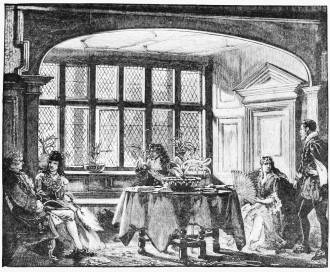
A FANCY-DRESS PARTY AT THE CLUB.
Fancy-dress balls are an amusement much esteemed at Bedford Park. There
is, indeed, a rumor in the adjacent town of London that the people of
Bedford Park move about in fancy dress every day. And so far as the
ladies are concerned it is true that many of their costumes, open-air
as well as other, might some years ago have been regarded as fancy
dress, and would still cause a sensation in some Philistine quarters.
At our last fancy-dress ball, some young men, having danced until five
o’clock, when it was bright daylight, concluded not to go to bed at
all, but went out to take a game of tennis. At eight they were still
playing, but though they were in fancy costumes they did not attract
much attention. The tradesmen and others moving about at that hour no
doubt supposed it was only some new Bedford Park fashion. There seems
to be a superstition on the Continent that fancy-dress balls must
take place in the winter, and end with Mi-Carême. It does not prevail
here. It was on one of the softest nights of June that we had our last
ball of that character. The grounds, which in one of our pictures are
seen beyond the tennis-players, were overhung with Chinese lanterns,
and the sward and bushes were lit up, as it were, with many-tinted
giant glow-worms. The fête-champêtre and the mirth of the ball-room
went on side by side, with only a balcony and its luxurious cushions
between them. Comparatively few of the ladies sought to represent any
particular “character;” there were about two hundred present, and fancy
costumes for both sexes were de rigueur; yet among all these there
were few conventionally historical or allegorical characters. There
was a notable absence of ambitious and costly dresses. The ladies had
indulged their own tastes in design and color, largely assisted, no
doubt, by the many artists which Bedford Park can boast, and the result
was a most beautiful scene.
There is hardly an evening of the spring and summer when Bedford Park
does not show unpurposed tableaux, which, were they visible any evening
at the Opera, would be declared fine achievements of managerial art.
Through the low and wide windows, on which the curtains often do not
fall, the light of wax-candles comes out to mingle with the moonlight,
and many are they who wend their way from the more dismal suburbs to
gaze in at the happy families en tableau, and listen to the music
stealing out on the ever-quiet air.
The new suburb which has thus come into existence swiftly, yet so
quietly that the building of it has not scared the nightingale I
heard yesternight nor the sky-larks singing while I write, has gone
far toward the realization of some aims not its own, ideals that have
hitherto failed. There is not a member of it who would not be startled,
if not scandalized, at any suggestion that he or she belonged to a
community largely socialistic. They would allege, with perfect truth,
that they are not even acquainted with the majority of their neighbors,
have their own circle of friends, and go on with their business as men
and women of the world. Nevertheless, it is as certainly true that a
degree in social evolution is represented by Bedford Park, and that
it is in the direction of that co-operative life which animated the
dreams of Père Enfantin and Saint-Simon. All society, indeed, must
steadily and normally advance in that direction. For a long time there
have been tendencies to put more and more of the domestic work out
upon establishments which all have in common. As one baker prepares
bread for many families, and one laundry washes for many, and the
railway, omnibus, cab, ply for many, so other accommodations needed by
all are found to be within reach of the co-operative principle; even
the luxuries of life are found to be largely within reach of it. This
village has been rendered possible by that principle, though it had
another aim. Houses of similar architecture have in recent years been
built here and there in London and other cities, but they have probably
cost their owners a third more than they have cost here, because the
large number of families which agreed to buy or rent houses enabled
the landlord and founder of Bedford Park to make large, therefore
comparatively cheap, arrangements for the supply of materials and
labor, elsewhere special or exceptional. By this means one of the chief
advantages of co-operation was to some extent secured. We have also our
co-operative stores; our newspapers and current literature are obtained
in common; we have billiard-rooms, tennis lawn, club conveniences, and
entertainments to a considerable extent in common; and by the time
this is read the Tabard, which has an excellent cook, may be supplying
the table d’hôte at a rate sufficiently moderate to place a daily
dinner within reach of families who may find that desirable. Thus the
co-operative principle has shown its applicability to the requirements
of the cultured class, who are especially interested in making for
their families beautiful homes, without, as Thoreau said, sacrificing
life to its means. Incomes are largely increased when they need no
longer be expended on the physical appliances of comfort beyond the
actual advantage derived. To keep a private carriage in order that it
may be used an hour or two each day is not economy, if an equally good
carriage can be hired for the hours needed. Now and then we hear a
little gossip when some of the dishes at a distinguished dinner-party
are suspected of having been prepared by Duclos instead of a private
chef, but the tendency of refined society is to smile still more at
large outlays for ostentation.
But while in some regards Bedford Park must be considered a socialistic
village, it is almost the reverse of any community which has been
so called hitherto, and is far away from the rocks on which most of
them have been wrecked. No step in the planting or development of the
village has been artificial, or even prescribed; each institution has
appeared in response to a definite want. It was not in consequence of
any original scheme that the co-operative stores, the club, or the
Tabard Inn were built. The entire freedom of the village and of its
inhabitants is unqualified by any theory whatever, whether social,
political, or economic. It is the home of such various minds as James
Sime, the biographer of Lessing and Schiller; of Bowdler Sharpe, the
ornithologist (active protector of our birds); Dr.Todhunter, who has
written a fine book on Shelley; Spalding, who wrote “Elizabethan
Demonology;” Julian Hawthorne; Fox Bourne, author of the Life of John
Locke, Miss Richardson, of the London School Board, and Miss Mary Cecil
Hay, the well-known novelist. The eloquent and philanthropic chaplain
of Clerkenwell Prison, Mr. Horsley, is a resident of Bedford Park. The
professions are all well represented. Artists are especially numerous.
The new Chiswick Art School has been erected at Bedford Park. It is
connected with the Science and Art department of the government, and
under the direction of E. S. Burchett and Hamilton Jackson, has already
become a flourishing institution.
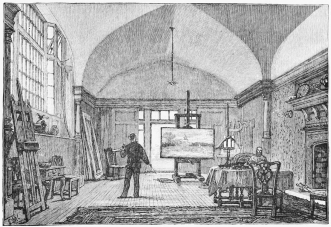
Bedford Park is in danger of becoming a show-place. Now and then the
fair riders of Hyde Park extend afternoon exercise to enjoy a look at
the new suburb. And sometimes the statesman, weary with his midnight
work in Parliament or in Downing Street, finds relief in this quiet
retreat. Professor Fawcett is apt to put in an appearance on Sunday
afternoons, and one day the grand face of John Bright, with its
white halo of silken hair, was seen among us. M. Renan, when he was
delivering his Hibbert lectures, was entertained in one of our homes,
and pronounced Bedford Park “que véritable utopie.” He appeared quite
amazed at finding in London that ideal place which French enthusiasm
has often dreamed of, and which differs from the “plain living and
high thinking” of the English philosophers. For here, where we have the
scientific lecture one evening, we may have theatricals on the next;
and if we have ambrosial poetry or classic music one day, on the next
the ladies will be found attending the School for Cookery, and learning
how to make dishes dainty enough to set before any gourmand. Minister
Lowell has also paid us a visit, and I believe he thought Bedford Park
ought to be somewhere in the neighborhood of Harvard University. But
our most memorable visitor was “H. H.,” whose eyes illuminated our town
for a day or two, and then went away with such pictures as can only be
painted when such vision as hers comes upon such a vision as she found
here. She came from a beautiful home in a beautiful land; from bright
rooms decorated with many a brilliant stripe and spot contributed by
the wild creatures and growths of Colorado, and touched all over with
her own poetic taste; and she realized at once that she had come to
sister homes with hers, where there was the same desire to cultivate
beauty in harmony with nature. The brilliant letter she wrote about
her visit here comes back to Bedford Park just as I write this my last
page, and among the many reports that have been written of us none
is more true. My distant readers will perceive that my enthusiasm is
not of delusion, if I conclude my rambling paper by borrowing for a
moment the pen of “H. H.” “Only thirty minutes by rail from Charing
Cross—gardens, country air, lanes, bits of opens where daisies grow,
where fogs do not hang, and from which far horizons can be seen—is not
the London prisoner lucky that can flee his jail at night, and sleep
till morning in such a suburb? Lucky indeed, no matter to what sort
of house he escaped, so it stood on a spot like this. But when to the
opens, the clear air, lanes, and daisies, it is added that, fleeing
thither, the London prisoner may sit down and rest, lie down and sleep
in, and rise up and enjoy, a charming little Queen Anne house, built,
colored, and decorated throughout with good taste by artists who know
what souls need as well as what bodies require, there is conferred
on him a double, nay, an immeasurable, benefit and unreckonable
obligation.”
THE END.
PRINTED BY BALLANTINE, HANSON AND CO.
EDINBURGH AND LONDON
| Typographical errors corrected by the etext transcriber: |
|---|
| explanatory catalogue of 1247=> explanatory catalogue of 1847 {pg 80} |
| which all from the cornice to the floor=> which fall from the cornice to the floor {pg 197} |