“Know’st thou the land where the citron grows,
Where midst its dark foliage the golden orange glows?
Thither, thither let us go.”
Goethe.
To Young America:
“Smart,” as the world over, you are acknowledged to be—in which opinion
I most heartily concur, having myself spent among you the best part of
my life—permit me to call your attention to one important fact which
has escaped your notice thus far, or rather that of your teachers,
namely, a better acquaintance with that vast and glorious portion of our
great continent lying at your very portals, South America—a region of
which you have only a faint idea from the meagre information supplied by
your School Geographies and occasional newspaper correspondents, but in
fact a land of wondrous exuberance and untold natural wealth, which
offers you a field of enterprise worthy of the founders of the States of
California and Oregon, and the Territories of Montana, Arizona, and
Colorado.
It is a fact that while Europe, situated as it is far beyond our own
hemisphere, has always sent her very best men to represent her in the
South American States, and to explore and report upon every thing worth
knowing, this country, America par excellence, has sent none as yet
but broken down and quarrelsome politicians, who, according to the
statements of some of the leading periodicals of this country,[1] are
absolutely incompetent to fill their post with credit to the nation they
represent. To my own personal knowledge I can testify as to the class of
men sent afloat to Venezuela, one of whom had previously been master of
a tug-boat on the Orinoco and Apure rivers, but through political
influence at home was suddenly enabled to emerge from that obscure
though honorable calling to that of a diplomatic functionary, although
it is but fair to state that his social status in that country was in no
wise improved by his change of vocation. When his term of office
expired, with the change of administration at headquarters, he was duly
replaced by another, whose conduct was so disgraceful[2] that his
countrymen resident in the Republic petitioned the Government at home to
remove him forthwith, which was granted, but only to replace him by
another—since deceased—who, I am informed, was the only drunken man
seen in the streets of the capital.
Thanks to the unaided efforts of a missionary gentleman, Rev. Mr.
Fletcher,[3] the magnificent empire of Brazil has lately been brought to
the notice of the people of the United States, who, quick to appreciate
the commercial advantages offered by a foreign country, when fully
demonstrated to them, have already established a line of steamers
between New York and the principal ports of the Empire. Outside of this
the people of this enterprising country have only had occasional
glimpses of the vast continent of South America, from the notes of
casual travellers and the official reports of Lieuts. Page, Herndon, and
Gibbon, of the navy, who confined their observations principally to the
practicability of navigating the two great rivers Amazon and La Plata,
already surveyed by their respective governments and explored from end
to end by several European travellers. It is to be hoped, however, that
the eminent naturalist, Agassiz, who lately visited the former river
with reference to a particular branch of science, will give us the
result of his explorations as clearly, and relieved of the
technicalities of scientific lore so common among naturalists, as the
distinguished artist Church, who several years ago penetrated, “on his
own hook,” to the heart of the Andes, has presented the grand and
beautiful ridge on canvass to the eyes of admiring thousands who have
gazed upon his admirable paintings, thus familiarising the outside world
with that picturesque region, and earning for himself a name second to
none in the estimation of the artistic world.
North Americans cannot longer ignore that great section of our
continent which, during thirteen years, warred to the knife against
her powerful antagonists, Spain and Portugal, for the possession of
those political principles proclaimed years before by their own Great
Republic; for it is a fact, that while most of the European nations
hastened to acknowledge the independence of the South American States,
the United States of America were the last to recognize them; and if we
of the South have not been as successful in the establishment of
Republican Institutions as our brethren of the North, the fault is not
ours, but is to be attributed to the “peculiar institutions” implanted
on our soil by its fanatical and remorseless conquerors, so utterly
inimical to enlightened educational development.[4]
And now look, on the other hand, to the host of distinguished names that
figure among the European representatives and explorers in the various
sections of South America, and the advantages gained by the countries
they represent. At the head of all stands the illustrious Humboldt, who
was the first to penetrate that comparatively unknown region at the time
(1799), and to lay open her wondrous treasures before the civilized
world. Any eulogistic comments upon this truly great man are
superfluous: the world is filled with his fame, as radiant as the
celestial spheres above, which he overran likewise with his penetrating
mind, and after devoting nearly three quarters of a century to the study
of the Universe, he died only a few years ago at the advanced age of
ninety-two, in the full enjoyment of his mental faculties. His works are
the grandest monument of the nineteenth century.
To Prussia we are indebted for the services of another resolute
explorer, Prince Adalbert, who fearlessly penetrated to the remotest
parts of Brazil, and the botanists, von Tschudi, Karzten, and Moritz,
who have enriched the European museums and conservatories with the
treasures of our Flora. Other parts of Germany have sent no less
distinguished individuals in the persons of Prince Maximilian of
Bavaria, and the great naturalists, Narterer, Spix, and von Martius, all
of whom have given to the scientific world the result of their
explorations in works of enduring fame. France ranks next in
distinguished names, such as La Condamine, D’Orvigni, Jussieu, St.
Hilaire, Bonpland (the companion of Humboldt), Depons, Lavayesse,
Webber, Liais, etc.; and Great Britain, with her Parishes and Fitzroys,
who surveyed and carefully sounded every estuary, bay, and inlet which
lie between the Plata and the Bay of Valparaiso, with the celebrated
naturalist, Darwin, as co-laborer; Sir Robert Schumbourgh, the
discoverer of that vegetable wonder, the Victoria Regia, and the
hitherto unknown sources of the great river Orinoco, the lake of Parime,
supposed in the seventeenth century to be the abode of a mighty and
resplendent Indian king—El Dorado—the gilded, from whom that veritable
land of gold, as it has subsequently been demonstrated, took the
name[5]—with other equally enterprising naturalists and explorers, such
as Waterton, Wallace, Bates, Vigne, Markham, and Spruce. Through the
efforts of the two last named, England has succeeded in transplanting
and successfully cultivating in the mountains of India the various
species of cinchona trees indigenous to the Andean range of mountains,
that yield that invaluable drug, quinine; while another enterprising
Englishman undertook to stock Australia with the Alpaca sheep of the
same region, at the risk of his life and fortune.
Thus England, France, and Germany have secured the monopoly of the South
American trade, with total exclusion of this country, which has to pay
cash for what the former obtain in exchange for the produce of their
manufactories. All these nations, moreover, appoint permanent
representatives, chosen from among their ablest diplomats, and keep them
there as long as they choose to remain, to enable them to become
thoroughly acquainted with the people and the peculiarities of the
country, endearing themselves to the inhabitants by their munificent
hospitality and courtly demeanor. Even distant and snow-bound Russia has
sent to South America her commissions of savants and maintains there,
as well as Sweden, competent representatives, whose duty it is to report
to their respective governments on the progress of affairs and the
resources of those countries.
I shall not close the list of European travellers and naturalists, with
whom I am acquainted, without adding those of Holland and Belgium, viz.,
Mr. Langsberg, for many years Minister Plenipotentiary from the former
country to Venezuela, Baron Ponthos, and Messrs. Linden and Funk, who,
by their united efforts, have contributed to enlighten their countrymen
respecting the source from whence India-rubber emanates, and the kind of
trees that yield the valuable Calisaya and Angostura barks; what plants
yield the fragrant Vanilla and Tonka beans, the healing balsams of
Copaiva, Tolu, and Peru; and how indigo, cacao, and coffee are raised.
“Does cotton grow in Venezuela?” “Are there any railroads in Chile?” are
questions which have respectively been addressed to me and to the
accredited Minister of the latter flourishing republic to the United
States by persons enjoying the greatest advantages of education in this
country. Now, it is a well-known fact to European merchants that the
cotton raised in Venezuela ranks among the finest in the world; and as
regards railroads, Chile possesses some of the most admirable works of
the kind, due to the skill of North American engineers.
But no wonder that so little is known here about South America, when one
of the standard School Geographies and most recent publications
describes the products of Venezuela in these few lines:
“Its principal products are the woods and fruits of the forest and
the cattle of the plains.”
“Exports.—The principal exports are the tropical fruits, which grow
without cultivation; and hides, cattle, horses, and mules.”
Any one would be led to suppose, from the perusal of the above
quotations, that the country at large is “in a state of nature,” and
that the inhabitants themselves are no better off than “the cattle of
the plains,”
“Where at each step the stranger fears to wake
The rattling terrors of the vengeful snake;
Where crouching tigers wait their hapless prey,
And savage men more murderous still than they.”
—The Deserted Village.
These things are only found in the depths of the primeval forest, or
amidst the labyrinths of rivers that traverse the vast extent of prairie
land or llanos which form the subject of this book. These are the
grazing grounds as well as military school of the republic: the
agricultural portion lies north of this region, amidst the great chain
of mountains, which, detaching itself from the main Andean trunk in New
Granada, or Colombia, as it is now called, runs eastward along the
shores of the Caribbean Sea. The products of this region consist
principally, as the school-book quoted above states, in the tropical
fruits, not collected at random, as might be inferred from the above
meager statement, but through the most careful cultivation, as a
contemporary English traveller in that country rightly describes it in a
few lines.
“July 11th.—Having got our passports, we started at about 3 P.M. for
San Pedro, distant about six leagues. The first three leagues lay
through the beautiful valley of Chacao (Caracas). Everything bore the
appearance of great prosperity. The road was as good as any in Europe.
The hedges were beautifully clipped; hardly a foot of ground could be
seen that was not in a high state of cultivation. The plantations were
numerous and in good order, and the long chimneys and black smoke showed
that even in this remote valley steam was rendering its thousand-handed
assistance. We crossed and recrossed the Rio Guaire several times before
we arrived at Antimano, some two leagues distant from Caracas. We met
several herds of wild cattle, being driven towards Caracas by the
llaneros in crimson or blue ponchos, mounted on high-picked saddles,
with their constant companion, the lasso, plaited into their horses’
tails, and the long cattle-spears in their hands. The cattle were
magnificent-looking animals, and reminded me of the breed that one sees
in the bull-rings of old Spain. Coffee is more cultivated in the valley
of Chacao than any other crop, and it contributes in no small degree to
the beauty of the scenery.”[6]
Besides coffee this country produces the famous Cacao and indigo of
Caracas, sugar-cane, and cotton of superior quality, tobacco hardly
inferior to that of Cuba, especially the celebrated Varinas and Guacharo
kinds, rice, Indian-corn, and most of the cereals of northern latitudes,
according to the elevation above the sea level; and as to the products
gathered “in a state of nature,” such as sarsaparilla, India-rubber,
Piassaba, Vanilla, and Tonka beans, cabinet and dye-woods, their name is
legion, and would require a separate volume devoted to that particular
branch of scientific research, which the reader can find admirably
compiled in the works of Humboldt and Bonpland, St. Hilaire, Sir Robert
Schombourgh, Codazzi, and others.
Now it is my purpose to introduce the young American reader to a
country—
“Where maidens’ love as close, as sweet will twine,
As cling the tendrils of their native vine,”
and which hitherto seems to have been a sealed book to the future
“Merchant Princes” of the great North. Humboldt describes it thus, in
1802:—
“Caracas is the capital of a country nearly twice as large as Peru, and
now little inferior in extent to the kingdom of New Granada. This
country, which the Spanish government designates by the name of
Capitania-General de Caracas, or the United Provinces of Venezuela, has
nearly a million of inhabitants, among whom are sixty thousand slaves.
It comprises, along the coasts, New Andalusia, or the province of Cumana
(with the island of Margarita), Barcelona, Venezuela, or Caracas, Coro,
and Maracaibo: in the interior the Provinces of Barinas and Guiana; the
former situated on the rivers of Santo Domingo and the Apure, the latter
stretching along the Orinoco, the Casiquiare, the Atabapo, and the Rio
Negro. In a general view of the seven United Provinces of Tierra Firme,
we perceive that they form three distinct zones, extending from East to
West.
“We find, first, cultivated land along the sea-shore, and near the chain
of the mountains on the coast; next, savannas or pasturages; and
finally, beyond the Orinoco, a third zone, that of the forests, into
which we can penetrate only by the rivers which traverse them. If the
native inhabitants of the forest lived entirely on the produce of the
chase, like those of the Missouri, we might say that the three zones,
into which we have divided the territory of Venezuela, picture the three
states of human society; the life of the wild hunter, in the woods of
the Orinoco; pastoral life in the savannas or llanos, and the
agricultural state, in the high valleys, and at the foot of the
mountains on the coast.”[7]
And yet this favored region can be reached in from twelve to fifteen
days by sailing packets between Philadelphia and La Guaira; or, should
your fast habits require it, we can avail ourselves of the Brazilian
line of steamships which will leave us at St. Thomas, where we shall
meet the little steamer plying regularly between both points, the whole
voyage being thus accomplished in eight days. As we are not in a hurry,
however, to get through our journey, we will, for the sake of
convenience and diversified amusement, follow the example of the
above-mentioned traveller, Sullivan, who, in company of a friend, made
the trip before us in a commodious yacht by the way of the West India
Islands; but having no craft of our own, we may be permitted to borrow
from the New York yacht squadron one of their idle cutters, which can
thus be better employed than in cruising round well-known fashionable
retreats during a few months of summer, and exposed for the rest of the
year to the hard knocks of a wintry climate. This is the best season to
visit the tropics, as well as the West Indies, when there is no fear of
the dreaded vomito or sweeping hurricanes.
Hardly a day passes without coming in sight of some lovely isle of the
Caribbean sea, which, like the “Queen of the Antilles,”—Cuba—rises
from amidst the placid waves, crowned with perpetual wreaths of fragrant
orange-blossoms and stately palms. Cuba, Hayti, Porto Rico, St. Thomas,
Sta. Cruz, Antigua, Granada, Barbadoes, Martinique, Guadaloupe, Tobago,
and Trinidad, rise one after another in quick succession. When we reach
the last named and most lovely of all, on the eastern extremity of
Venezuela, we have the choice of either penetrating at once into the
field of our adventures by entering one of the numerous outlets of the
Orinoco, which here pours out its tribute to the mighty Atlantic through
a hundred mouths; or, following the line of coast to the westward, we
may reach a point near the fertile valleys of Aragua, where well-trained
horses for the sport and hardy llaneros to guide us, await our arrival.
We shall thus have an opportunity of contemplating and admiring that
stupendous chain of mountains (fit offspring of the mighty Andes further
west), which seems as if thrown up by Titanic force as a barrier against
the encroachments of the fierce Atlantic.
Endless are the beauties and points of interest presented by this
splendid chain of mountains; its varied climes, from the scorching heats
of the tierra caliente on the sea level to the frigid blasts of winter
at higher elevations; its silvery springs and roaring cataracts; its
unrivalled vegetation and glittering veins of precious metals. The trade
winds and currents are in our favor, which will enable us to reach La
Guaira in a couple of days, passing in quick succession some minor
ports, such as Rio Caribe, Carupano, with its silver-bearing mountains
in the distance, the island of Margarita, famous for its pearls, as the
name implies; its fisheries, and the gallant defence made by the
inhabitants against the combined attacks of the Spanish hordes; Cumana,
for its delicious grapes and pine-apples, its salubrious climate, and
the purity of the sky, which enabled the immortal Humboldt to watch in
wonderment the great meteoric shower in 1799, which he compared to a
brilliant display of fire-works; Barcelona, noted only for its hides,
and the Monagas brotherhood, who were for many years the terror of the
country.
The coast, as we approach La Guaira, is lined with plantations of
sugar-cane, cacao and cocoa-nuts, two articles often confounded in
English spelling, but widely different in themselves. The former grows
on a moderately-sized tree, with large, glossy leaves, while the latter
is the product of a palm, remarkable for the height it attains, and the
prodigious size of its fruit, in bunches that few men can lift from the
ground. The cacao nuts, on the contrary, grow in pods, resembling
large cucumbers, of a rich chocolate color outside, filled with oblong
nuts enveloped in a white, sub-acid pulp, very agreeable to the taste
especially of parrots, monkeys, and squirrels, who destroy great
quantities of the pods for the sake of the pulp, so that they require
constant watching to protect them from these pests.
A cacao plantation is one of the handsomest orchards that can be seen,
shaded as they are by another tree of large proportions, the erythrina,
a leguminous plant with crimson flowers, which you may have noticed in
greenhouses at home, though much reduced in size, as it never attains
there more than a few feet above the boxes on which they are raised as
an ornament to the garden in summer. The rapidity with which these trees
grow in the tropics is astonishing, for in eight or ten years, the time
required to reach its maximum growth, they attain the size of the
largest denizens of the forest. Observe how their tops glow with the
fiery hue of their blossoms, for this is the season when they exchange
their leaves for flowers, the only instance of a plant shedding its
leaves in these latitudes, with the exception of the ceiba or silk
cotton tree, which the author of Amyas Leigh has so admirably described
as growing close to where we are journeying just now.
Here the cordillera rises considerably above the connecting mountains,
attaining a height of thirteen thousand feet in the peak of Naiguata,
which you may perceive peeping through the clouds yonder, and the next
one eleven thousand in the Cerro de Avila, both forming what is called
the Silla, or Saddle of Caracas, at the foot of which stands La Guaira,
the principal port of the republic, but the vilest anchorage in the
world. Here ends our yacht excursion; trusting in future to the
nimble-footed mule or to the thumping stage coaches for the rest of the
journey.
Despite its wretched shipping facilities, La Guaira carries on a very
active trade with foreign marts, as is attested by the number of
English, French, German, and Italian merchants, with a few Americans,
residing here, forming, as it were a truly foreign colony. The heat, as
you perceive, is intense, owing to the proximity of the barren
mountain-base, which leaves room scarcely for a loaded mule to turn
round in the narrow and crowded-up streets. On this account, I presume,
La Guaira is very healthy, for not even the Asiatic cholera could obtain
a footing here—excuse the pun—when it decimated the capital in
1853. Cases of vomito occur from time to time; but these are more the
exception than the rule; so it does not follow that all hot places in
the tropics are unhealthy, for Carupano, Margarita, Cumana, La Guaira,
and Coro, which are within the isothermal line of greatest heat—owing,
doubtless, to the dry, stony, or sandy soil on which they stand—are
among the healthiest spots in Venezuela. However, we shall soon be out
of this sultry place, and amidst the glories of a temperate climate. For
this purpose we will hire mules at one of the posadas or hotels, to
ascend the mountains on our way to Caracas, the capital of the republic,
giving the preference to the old road, which is much shorter and more
picturesque than the new one for carriage travel. Let us hear first the
enthusiastic English tourist describe this route, as I may be accused by
some of partiality towards my own country.
“The ascent is very precipitous, and the road rough and narrow, but the
view of the boundless ocean on one hand, and the magnificent range of
mountains on the other, was very grand. The road rather reminded me of
the Great St. Bernard, though the resemblance would not bear analyzing.
The sensation of rising gradually into the cooler strata of air was most
delicious; and at length, being suddenly enveloped in a cloud, I felt
actually cold (a novel sensation I had not experienced for several
months), and was not at all sorry to put on my jacket. There is no
mountain in the tropics where you rise as immediately and suddenly from
the stifling heat of the Tierra Caliente to the delicious temperature of
an European sunrise in spring, as the Silla of Caracas.
“On the road from Vera Cruz to Mexico, when the traveller arrives at the
height of four thousand feet, beyond which the fever never spreads, he
is upwards of thirty miles from the sea, whereas, on the road up the
Silla at that height the ocean lies immediately at his feet, and he
looks down upon it as from a tower. So perpendicular is the face of the
Silla towards the sea, that any large boulder or mass of rock becoming
detached high up the mountain and bounding down its face, would fall
clean into the ocean. About half way up the mountain, we crossed a deep
cleft in the mountain called the Salto—a jump—on rather a rickety old
draw-bridge. The bridge is commanded by a ruinous old town, called Torre
Quemada, or the Burnt Tower, a name it derives from its being placed
just at the height where the traveller, descending to La Guaira, first
encounters the stifling exhalations from the Tierra Caliente. About nine
o’clock we stopped to breakfast at La Venta, an inn some five thousand
feet above La Guaira. Here, in a perfectly European atmosphere, we lay
out in the grass, and gazed down upon the ocean and the town of La
Guaira; we could just distinguish the Ariel, looking the size of a
walnut-shell, hoisting her white sail, and standing away for Porto
Cabello, where we were to meet her, unless we returned to Trinidad via
the Rio Apure and the Orinoco.”
Both sides of the road are lined with Maguey plants, or varieties of
the Agave genus, improperly called aloes and century-plants, from a
mistaken notion that they only blossom once in a hundred years. The most
beautiful of these is the cocuy, with thick glossy leaves of a clear
emerald color, from six to eight feet, and a flower-stock from
twenty-five to thirty feet in length. I believe it is the same species
that yields the famous beverage of the Mexicans, called pulque, which
some compare to fermented animal juices. A much more agreeable drink is
obtained here by distillation from this plant, and its leaves turned to
better account by scraping out the fine fibres they contain, from which
most beautiful hammocks are made in various parts of the country,
besides ropes, coffee-bags, twine, etc., etc. A fortune is in store for
some Yankee genius who will invent the proper machine for dressing these
leaves and getting the fibres. The other varieties are the cocuiza
brava, or common century-plant (Agave Americana), with serrated leaves,
on which account it is very useful for making hedges, and the cocuiza
dulce, with perfectly smooth leaves, containing the strongest fibres
and usually cultivated for that purpose. The pith of the flower-stock is
also turned to account in various ways, especially for making the best
kind of razor-strops.
Were you as much a lover of plants as I am, I would invite you to
descend with me to one of those lovely glens formed by these mountains.
There, amid moss-covered rocks and sparkling rivulets, I would point out
to you those singular orchidacœous plants usually called air-plants,
because they obtain their nourishment from the moist air that surrounds
them,—not a bad idea,—those lovely daughters of Flora and Favonius, so
rich in perfume as well as color, but whose principal charm consists in
their caricaturing most living objects in nature, from the “human form
divine,” as in man-orchis (O. mascula) to the bumble-bee, often
deceived by a perfect representation of his species (Ophris apifera).
Thus we count among our floral treasures “angels,” “swans,” “doves,”
“eagles,” “pelicans,” “spiders,” “butterflies,” “bumble-bees,” and even
a perfect infant in its cradle, was found by Linden in the mountains of
Merida. The celebrated Flor del Espiritu Santo (Peristeria elata) is
another of this class. It is there only that are found those two most
beautiful species of cattleya (C. Mossiæ and C. Labiata), so highly
prized by plant collectors, from all nations, and here called Flor de
Mayo, or Mayflower, because it blossoms principally in the month of
May. Great favorites are they with us also, and no court-yard is deemed
sufficiently ornamented at Caracas without one or more baskets of
these lovely plants, the stump of a tree, or any rustic basket filled
with bark or moss, being sufficient support for them. In the same manner
the curious Butterfly-flower (Oncidium papillio) is raised along with
the others, often deceiving persons unacquainted with it, with a perfect
representation of the insect whose name it bears; and if you should
visit with me some of the cacao plantations in the tierra caliente, I
would point out to you two equally exquisite plants of the same family
attached to the rough stems and branches of the Erythrina, namely, the
Swan-flower (Cycnoches ventricosum) and the Vanilla, both filling the
air with the same perfume, but in different form, the former through its
swan-like flowers, in clusters of three, five, and even seven, and the
latter through its ripened pods—so well known to perfumers and
confectioners—as the blossoms of this last, though quite large and
handsome, are destitute of perfume.
But to return to our mountain ride, for it is time that we should be
prepared to behold a still more glorious view from the summit, than the
one just described by Sullivan: “After a regular Spanish breakfast of
chocolate and fried eggs, for which, in as regular Spanish custom, we
were charged about ten times the proper amount, we continued our ascent,
and gained the seat of the Saddle, a hollow between the two peaks,
called the Pummel and Croup,[8] about ten o’clock. The summit of the
pass called Las Vueltas, is a smooth undulating grass-land, somewhat
like the sheep-downs of Sussex. The bold rocky peaks on either hand,
stretching in a serrated ridge as far as the eye could reach, were very
fine. I could scarcely fancy myself to be only ten degrees north of the
equator, and actually on or rather only eight thousand feet above the
isothermal line of greatest heat, which passes through Cartagena, La
Guaira, and Cumana.
“We had left far below us all the tropical flora, and were amongst
English ferns and English blackberries; and I actually discovered one
familiar friend, a dandelion. From the summit of Las Vueltas, you first
get a magnificent view of the valley of Chacao, lying some four thousand
feet below you, with the city of Caracas in the centre of it. I don’t
think the view from that height is so fine as some thousand feet lower
down, where it certainly beats any view I have ever seen. It is finer in
my opinion than the first coup d’œil of the Vega and city of
Granada from the Ultimo Suspiro del Moro, where the degenerate Boabdil
el Chico, both in mind and body, turned to take one last fond look at
the luxurious abode of his chivalric ancestors and wept bitterly, though
too late, at his own cowardice and duplicity, which had almost without a
blow surrendered to the “curs of Nazareth” the splendid heritage of
nearly seven centuries, and which was never but in imagination to return
to the true sons of the Prophet. It is also finer than the Valley of
Chamouni or Martigny, from the Tête Noire, but I think it bears more
resemblance to the Vega of Granada.”
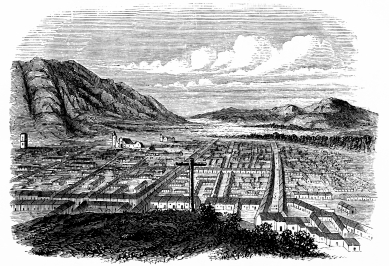
Observe how regularly laid out, at right angles to each other, the
streets are; the area of the city is great for the number of inhabitants
(sixty thousand), most of the houses being built one story high, and
occupying in consequence a large space, on account of the earthquakes,
which are of frequent occurrence all along the Andean range. As we
approach the suburbs, you may notice some of the ruins still remaining
of that dreadful catastrophe, which, in 1812, levelled this beautiful
city to the ground, burying beneath the débris twelve thousand of the
inhabitants, just as they had assembled in the magnificent churches of
that time to render homage to the day, Holy Thursday. Since then the
city has been rebuilt, it is to be hoped on more solid basis.
Caracas claims the honor of having given birth to several distinguished
individuals, among others to Bolívar and Miranda, two of the greatest
champions of South American independence; to Rosio, the Jefferson of
Venezuela;
 CARACAS.
to Andres Bello, a great poet and publicist; and to the eminent surgeon
and physician, Dr. Vargas, one of the Presidents of the Republic.
The climate of Caracas has often been called a perpetual spring. “What
can we conceive to be more delightful than a temperature which in the
day keeps between 20° and 26°,[9] and at night between 16° and 18°,
which is equally favorable to the plantain, the orange tree, the coffee
tree, the apple, the apricot, and corn? José de Oviedo y Baños, the
historiographer of Venezuela, calls the situation of Caracas that of a
terrestrial paradise, and compares the Anauco and the neighboring
torrents to the four rivers of the Garden of Eden.”[10]
The hotels, Sullivan describes as being as good as any in Europe. “You
might travel from one end of Old Spain to the other without finding
anything to be compared to them, either as regards cleanliness or the
civility of the landlords.” But as here I am at home, you are most
cordially invited to our mansion at the end of the Calle del Comercio,
where you may verify for yourself the truth of the statements concerning
the climate and productions of this fertile valley. We may at once enter
the garden, which occupies nearly the whole square, where, after our
rough ride, we can refresh ourselves with the fruits of the season.
Here, as you perceive, you find growing side by side the refreshing
orange and the luscious apple, the pomegranate and the peach; the
banana, the citron, the guava, the sapodilla, and papaw tree, all of
them eminently tropical fruits, with the pear, the grape-vine, and other
productions of temperate regions. Unsurpassed by any, not even by the
famous Mangosteen of the Spicy Islands, you have here the delicious
Chirimoya, or cherimoyer, as pronounced by Anglo-Saxons, and which I can
only liken to lumps of flavored cream ready to be frozen, suspended from
the branches of some fairy tree amidst the most overpowering perfume of
its flowers; for it is in bearing all the year round, as indeed are most
of the fruit trees you see about this garden, and consequently you may
at all times enjoy the advantage of refreshing the inner as well as the
outer man with a “wilderness of sweets.” Markham,[11] who has tasted
both the chirimoya and mangosteen in their native habitat, gives the
preference decidedly to the former, and says of it: “He who has not
tasted the chirimoya fruit has yet to learn what fruit is.” “The
pineapple, the mangosteen and the chirimoya,” says Dr. Seeman, “are
considered the finest fruits in the world. I have tasted them in those
localities in which they are supposed to attain their highest
perfection—the pineapple in Guayaquil, the mangosteen in the Indian
Archipelago, and the chirimoya on the slope of the Andes, and if I were
called upon to act the part of a Paris, I would without hesitation
assign the apple to the chirimoya. Its taste indeed surpasses that of
every other fruit, and Haenke was quite right when he called it the
masterpiece of nature.”
The numerous varieties of hot-house grapes, which in your variable
climate of the north require so much skill and attention to perfect
their growth, here thrive without the least care, and the vines which
you see struggling here and there among the trees for some kind of
support, proceed from cuttings which I brought over six years ago from
one of the best regulated establishments in Connecticut.
Here, too, the stately Mauritia-palm of the Orinoco, the date-palm of
the burning Sahara, the royal-palm of Cuba (Oredoxa Regia), and the
oil-palm of Africa (Eleis guinensis) commingle their majestic crowns
with the dense foliage of the mango tree of India, the aromatic cinnamon
tree of Ceylon, the bread-fruit tree of Otaheite, and the sombre pines
and cypress of northern regions, forming the most effective protection
to the shade-loving magnolia and the delicate violet of your native
woods.
Swarms of tiny and brilliant humming-birds flutter amid masses of
highly-scented orange blossoms that perfume the air around us. Any one
unacquainted with that bijou of the feathered tribe, would mistake it
at first sight for some of the metallic-colored beetles which dispute
with them the nectar of the fragrant flowers, so brilliant is the lustre
shed by both. “For that peculiar charm which resides in flashing light
combined with the most brilliant colors, the lustre of precious stones,
there are no birds, no creatures that can compare with the
humming-birds. Confined exclusively to America—whence we have already
gathered between three and four hundred distinct species, and more are
continually discovered—these lovely little winged gems were to the
Mexican and Peruvian Indians the very quintessence of beauty. By these
simple people they were called by various names, signifying ‘the rays of
the sun,’ ‘the tresses of the day-star,’ and the like.”[12]
You may have noticed in your conservatories at home a well known creeper
called the passion-flower, on account of a fancied similarity in the
arrangement of its inflorescence with the instruments of torture
employed in the martyrdom of the Saviour, such as the crown of thorns,
the three nails, the hammer, and even the spots of sacred blood round
the pillar of agony. The plants of this genus are general favorites with
northern horticulturists only on account of the beauty and delicious
aroma of their flowers, for they bear no fruit with you; but here, this
constitutes their principal merit, especially that of the granadilla,
which you may perceive intertwining its graceful vines amongst yonder
arbor set up for its support. Huge watermelon-like fruits hang from its
delicate tendrils as if suspended by a thread; cut open one of them; you
will find it filled with a nectarian juice, which, when crushed in the
mouth, regale your palate with the compound flavor of the strawberry and
the peach. Other varieties of passion-flower—of which there are many
though less pretentious in size than the granadilla—bear fruit equally
rich in flavor. Unfortunately, not all fructify in the same locality, as
they require different degrees of temperature, and maybe of atmospheric
pressure, also, to ripen their fruit, which they cunningly obtain for
themselves by “squatting” of their own accord higher up or lower down
the mountains, as the case may be.
I could still point out to you many other delicious fruits in this
garden were they in season, such as the tuna or Indian-fig, borne by
the nopal, a species of cactus, on the fleshy, downy stems of which the
cochineal insect is reared for those most valuable crimson and scarlet
dyes “which far outshine the vaunted productions of ancient Tyre;” and
the pitahaya, of the same family of plants, notable for the size and
effulgence of its flowers. “It begins to open as the sun declines, and
is in full expanse throughout the night, shedding a delicious fragrance,
and offering its brimming goblet, filled with nectarious juice, to
thousands of moths, and other crepuscular and nocturnal insects. When
the moon is at the full in those cloudless nights whose loveliness is
only known in the tropics, the broad blossom is seen as a circular dish
nearly a foot in diameter, very full of petals, of which the outer
series are of a yellowish hue, gradually paling to the centre, where
they shine in the purest white. The numerous recumbent stamens surround
the style, which rises in the midst like a polished shaft, the whole
growing in its silvery beauty under the moonbeams, from the dark and
matted foliage, and diffusing its delicious clove-like fragrance so
profusely that the air is loaded with it for furlongs round.”[13]
I well remember one night when a distinguished foreigner, General
Devereux, who rendered the patriot cause so marked a service by bringing
over the Irish Legion to assist this country in her struggle for
independence, honored me with a visit while keeping bachelor’s hall in
this—to me then—earthly paradise. The Queen of Night was shining in
all her glory, and the air redolent with the perfume of many exquisite
flowers, among others that of the pitahaya just described, while the
stillness that reigned around the spot, added to my youthful dreams of
fairy lands I had lately visited across the seas, made me feel a
particular pride about our mansion in the capital. Although the old hero
was perfectly blind—as will be recollected by many who knew him in the
United States where he resided afterwards—I could not resist the wish
to invite him to take a stroll about the garden. As we passed close to
the flowers of the pitahaya, the gallant old soldier stopped suddenly,
and seizing me by the hand with an emotion that made me feel the deepest
sympathy for the blind man, said: “How happy you must be here, my young
friend, surrounded as you are by plants that shed such heavenly
perfume!” But when we passed a bower of English honeysuckles, which was
my special favorite, as I had planted it with my own hands, his emotions
were indeed those of a man who felt as though everything on earth was
lost to him—sweet home, friendly associations, the world itself in
fact, and that he was only a wandering spirit in a strange sphere.
This, my good companion, reminds me too that such, more or less, is my
own situation in this my native land, subject as it has been for years
to political convulsions more disastrous to the peacefully inclined,
than those subterranean fires which agitate the soil from time to time.
Therefore our rambles in the capital must be of short duration, and
following the route already pointed out by the traveller Sullivan, we
will proceed on our journey towards the fertile valley of Aragua,
stopping for the night at Las Adjuntas, a village delightfully situated
at the foot of another lofty range of mountains which separates this
from that of Caracas, near the junction of two mountain streams that
form the Rio Guaire which passes near the capital.
Should you ever be troubled with nervousness or dyspepsia from too close
application to business, or even be threatened with that more serious
complaint of cold climates, consumption, don’t let your Doctor bother
you with physic, nor delude yourself with a trip “down South,” Cuba, or
even Europe; all this may at best prolong a miserable existence a little
longer; instead of that, come here at once; bring plenty of books to
while away the dolce far niente of this quiet place; or if you are a
sportsman, your gun and fishing tackle; when sufficiently convalescent
to undergo the fatigues of the journey, buy or hire horses for yourself
and a good peon or guide, and start for the llanos, where you will
have to rough it out as I did some years ago, and I guarantee you a
radical cure.
At Las Adjuntas we have the choice of two roads, one for carriages, made
at great cost since Sullivan’s visit to the country, and the other one
right over the mountains; as this is by far the most picturesque of the
two and the one described by him, we will follow on his footsteps, if
you wish to enjoy the glorious scenery, of which he says;
“Next morning, at 3 A.M., our faithful mozo roused us,—at San
Pedro—and we found our mules already saddled. The morning was very
cold, and a cloak was by no means disagreeable. As far as I could make
out by the light of a most glorious moon, San Pedro must be a very
picturesque and flourishing village. We continued ascending through a
thickly-wooded, mountainous path, for about three hours, when we found
ourselves along the summit of the mountain, here called Las Cocuizas.
Here the scenery was truly magnificent. The road wound along the summit
of the Sierra, giving alternate views of the valley of the Tuy, with the
distant valley of Aragua on the one hand, and the valley of Ocumare
bounded the snow-capped mountains that separate the valleys from the
plains on the other. Out of the main valleys narrow little glens wind,
and nestle up into the mountains, till lost to view. Their rounded
sides, and the emerald brilliancy of nature’s carpet with which they
were clothed, reminded me of some of the glens of the Cheviots.
“That morning’s moonlight ride along the summits of the sierra of Las
Cocuizas was certainly one of the most enjoyable I ever remember. It was
almost like magic, when as the sun began to approach the horizon, the
perfect stillness of the forests beneath was gradually broken by the
occasional note of some early riser of the winged inhabitants, till at
length, as the day itself began to break, the whole forest seemed to be
suddenly warmed into life, sending forth choir after choir of
gorgeous-plumaged songsters, each after his own manner, to swell the
chorus of greeting—a discordant one, I fear it must be owned—to the
glorious sun; and when the morning light enabled you to see down into
the misty valleys beneath, there were displayed to our enchanted gaze
zones of fertility embracing almost every species of tree and flower
that flourishes between the Tierra Caliente and the regions of perpetual
snow. It certainly was a view of almost unequalled magnificence. We were
riding amongst apple and peach trees that might have belonged to an
English orchard, and on whose branches we almost expected to see the
blackbird and the chaffinch; while a few hundred yards below, parrots
and macaws, monkeys and mocking-birds were sporting among the palms and
tree-ferns of a tropical climate. I consider that this view alone would
repay any lover of fine scenery for all the troubles and risks of
crossing the Atlantic, for I do not know where one to be compared with
it is to be found in Europe.”
This mountain takes the name of Las Cocuizas from the abundance of Agave
plants growing here, and which impart such peculiar aspect to the
landscape as we descend towards the bed of the Tuy, at the foot of the
mountain. Here we must stop to breakfast and pass the sun before we
proceed on our journey along the Tierra Caliente not far from our
resting-place.
“We found the pretty village of Las Cocuizas,” proceeds Sullivan,
“situated at the entrance of a delicious little glen, down which warbled
the waters of the Tuy. The Venta, in fact nearly the whole village was
shaded by one enormous saman-tree,[14] which to the dusty and wearied
traveller gave it a most enticing appearance; neither did it disappoint
our expectations, for a cleaner room and a better breakfast better
cooked and better served, I never wish to taste. This venta at Las
Cocuizas is most enchantingly situated at the foot of the mountain and
at the entrance of the valley of the Tuy, which is there a mere glen;
one side is entirely shaded by this enormous tree, and the other
overhanging the Tuy, which with its rocky bed and thickly-wooded,
precipitous banks, reminded one very much of some of the tributaries of
the Tweed. The venta would be a charming place to stay at for a few
days’ angling in the Tuy, which I believe is very good.”
After leaving the venta of Las Cocuizas, we wade through the waters of
the Tuy—no bridge being provided here—and proceed along a well graded
road for carts and carriages skirting the base of another ridge of
mountains until we reach the village of El Consejo, where the great
valley of Aragua, seventy miles in length, properly commences. And now
we are in the great coffee region, “the garden of Venezuela” as it is
very aptly called by common accord. As we ride towards the town of La
Victoria, where we shall stop for the night, we pass several extensive
plantations of that delicious shrub, shaded like the cacao by those
stupendous erythrinas which you might mistake for a primeval forest,
were it not for the uniformity of their growth and dazzling blossoms.
Nothing in your vaunted system of cultivation in the North can excel the
care bestowed upon these plantations, which must be kept in the best
order to yield handsome returns; but as we cannot stop to visit one of
these just now, you will permit me to repeat what the traveller often
quoted before, says in regard to the region we are traversing:
“The valleys of Aragua are the most thickly populated and the most
highly cultivated of all the districts of Venezuela. The level of the
valley is two thousand feet below the valley of Caracas, consequently
the heat much more intense. Coffee is now the chief article of
exportation from Venezuela, the fluctuating price of which has of late
years been very injurious to the country. The berry grown is of a
superior quality, and fetches a much better price than the Cuban or
Brazilian coffee, though not quite so high as that grown in Jamaica.
Some of the coffee and sugar estates we passed were on the largest
scale, employing as many as two hundred slaves,[15] besides the same
number of laborers. A coffee plantation, either in blossom or when the
berry is ripe, is the most beautiful culture in the world. The plant
itself, with its regular shoots like a miniature tree, and red berries,
is one of the most graceful shrubs I know; and as between the rows of
coffee-trees they usually plant plantains and bananas, these with their
enormous clusters of yellow fruits and their leaves of some six or eight
feet in length, add greatly to the effect, and give the country the
appearance of a large fruit garden. Moreover, as it is necessary to
plant the mango, and other large fast-growing trees, to protect the
ripening berry from the deluging rains and scorching heats, whenever you
pass a coffee plantation, even in the hottest day in the midst of
summer, when the whole face of the country is parched up and of an
unhealthy brown color, the eye is continually refreshed by the cool,
verdant appearance of these shaded gardens.”
I may add that the coffee of Venezuela is of various qualities,
according to whether it is raised in Tierra Caliente or Tierra Fria, id
est, coffee of the low, warm valleys, or coffee of mountainous
districts; this last is superior to the former, and bears in consequence
the highest price in the market. Again, café trillado, and café
descerezado, which means coffee dried in the berry as it is gathered,
and husked afterwards by a tread-mill composed of a heavy wooden wheel
revolving in a circular trough of masonry; and coffee deprived at once
of its pulpy covering by machinery as soon as it is picked, dried
afterwards in the sun upon extensive platforms of masonry called
patios, and passed through different sets of machinery to deprive the
grain or bean of the adhering shell and pellicle. The coffee thus
prepared is superior in quality to that which is trillado for want of
means on the part of the planter to put up the expensive works required
for this operation, and therefore bears a higher price.
Interspersed with these plantations are others of no less importance to
the industry of these valleys, such as indigo, cotton, indian-corn,
wheat and tobacco, all of them requiring the same share of careful
cultivation and intelligent management. “The road we were following,”
continues Sullivan, “was so well kept and so well wooded, and the hedges
so neatly clipped, that I could hardly sometimes help fancying myself
riding down some country lanes in England. We followed one lime hedge,
which enclosed a coffee plantation, for upwards of two miles. It was
the most perfectly kept hedge I had seen in any country; it was four or
five feet high and about three feet thick, and throughout its whole
length, I don’t believe there was a single flaw through which a dog
could have forced its way. Several slaves were employed in trimming it.
In fact, in this climate, where the growth of all inanimate nature is
unceasing, and so rapid, it must employ several hands continually to
keep it in such beautiful order. The scent of the lime as we approached
it from some parched country we had been crossing previously, was most
delicious.”
As there is nothing to interest us in the towns along this route, we
will pass by San Mateo, La Victoria and Turmero, all of them pleasantly
surrounded by plantations until we reach Maracay, the point of our
destination. On our way thither, we come up with that giant of the
vegetable world, the Saman de Güere, so well described by Humboldt in
his Travels, and subsequently by Sullivan. As their statements are
corroborative of the facts given elsewhere by me respecting these
enormous but most graceful mimosas, I will here use the language of the
last mentioned traveller about that of the hacienda de Güere.
“Soon after leaving Turmero we caught sight of the far-famed Saman de
Güere, and in about an hour’s time arrived at the hamlet of Güere, from
whence it takes its name. It is supposed to be the oldest tree in the
world, for so great was the reverence of the Indians for it on account
of its age at the time of the Spanish conquest, that the Government
issued a decree for its protection from all injury, and it has ever
since been public property. It shows no sign whatever of decay, but it
is as fresh and green as it was most probably a thousand years ago. The
trunk of this magnificent tree is only sixty feet high by thirty feet in
circumference, so that it is not so much the enormous size of the Saman
de Güere that constitutes its great attraction, as the wonderful spread
of its magnificent branches, and the perfect dome-like shape of its
head, which is so exact and regular, that one could almost fancy some
extinct race of giants had been exercising their topiarian art upon it.
The circumference of this dome is said to be nearly six hundred feet,
and the measure of its semicircular head very nearly as great. The saman
is a species of mimosa, and what is curious and adds greatly to its
beauty and softness is, that the leaves of this giant of nature are as
small and delicate as those of the silver willow, and are equally as
sensitive to every passing breeze.”
And now for the most picturesque of all the towns on our long ride,
Maracay, not on account of any architectural display about its
buildings, for it has no pretensions of this kind, but for its many
gardens, each house being literally embowered in the choicest
productions of the tropics in the way of fruits, such as orange, lime
and lemon trees, both sweet and sour; caimito or star-apple, a creamy
and luscious fruit growing upon one of the most beautiful trees with
which I am acquainted; the same might be said of two other fruit-trees
cultivated in these gardens, the mamon and cotopriz; both bearing
great bunches of an oval fruit the size of a pigeon’s egg, olive-green
in the former, and bright yellow in the latter, containing a kernel
enveloped in a sweet, sub-acid pulp; bread-fruit trees of two kinds and
accordingly distinguished as fruta de pan and pan de palo,
bread-fruit and bread-tree—the former being a large pulpy and greenish
fruit very like an Osage orange but larger, containing great numbers of
chestnut-like seeds, which roasted or boiled taste very much like bread,
and the latter a fruit precisely like its congener in appearance, but
destitute of seeds, which assimilates it still more to the “staff of
life” when boiled or baked, for it is beautifully white and compact
inside.
In addition to the foregoing, these gardens offer you a fine display of
other tropical trees no less esteemed for their grateful shade and their
delicious fruits, such as sapotes and sapodillas, both elegant in form
as well as in bearing; and so is also the splendid mamey apple-tree
(mamea Americana) bearing great quantities of large, round and heavy
fruits, brown outside, and golden-yellow within, from which marmalades
and other delicacies are made by the charming Maracayeras.
The family to which the famous chirimoya belongs (anonaciæ) have also
three other representatives hardly inferior to that “master-piece of
nature,” viz.; the guanábana (anona muricata) or sour-sop—an ugly
name in English for such fine fruit—from which a most cooling drink is
made, and still finer ices; the custard-apple, which needs no further
explanation than its name to recommend it; and the riñon, (anona
squamosa) also a custardy kindney-like fruit, hence its name.
Butter being expensive, and difficult to keep in this climate, nature
has provided a substitute for it in the fruit of the fine tree (Persea
gratissima), consecrated, as the name implies, to Perseus, the son of
Jupiter and Danaë; thus showing the wisdom of the botanist over the less
cultivated English settlers of the Caribean islands, who call it
alligator-pear, I presume, from the fact of its being indigenous to a
country abounding in saurian reptiles, although I am of opinion that a
creature of this sort would rather prefer a more substantial morsel in
the shape of a fat Briton, to a fruit which is well adapted to the taste
of demigods. In shape it resembles a large pear, but the interior of its
rind is lined with a marrow-like substance of a yellowish color, which
assimilates very nearly to butter, the place of which it supplies at the
breakfast-table. It is, in fact, vegetable-butter, and many prefer it to
the ordinary kind.
The extensive family of leguminous or pod-bearing trees also grace these
gardens with three additional members remarkable for fine foliage and
useful products, such as the algarroba, with hard-shelled pods,
containing a number of brown, round seeds or beans—also very hard,
enveloped in a farinaceous and very nutricious fecula; a fine aromatic
resin, good for varnishes, exudes from the trunk and branches of this
tree, and a still finer one can be extracted from its horny pericarp by
infusion in alcohol or other extractive medium; guamos (Inga) of
various kinds, with pellucid pods one and two feet in length, containing
a row of beans enveloped in white, cottony pulp, most grateful to the
taste; and the unrivalled tamarind, either as regards beauty of foliage,
brilliancy of blossoms, or the delicacy of its acidulous pulpy pods;
these are candied either in a green state or when fully ripe, affording
in the latter case a most refreshing drink to the fever-stricken in this
climate, when made into a decoction. In blossom, the tamarind-tree is
one of the most charming objects to behold, for amid its feathery,
dark-green foliage, somewhat similar to that of the hemlock, issues a
profusion of golden-yellow branches of delicate flowers, almost dazzling
to the eyes.
The coco-palm, although far away from the sea-coast, its native habitat,
also flourishes in great perfection, contributing not a little to the
splendor of the vegetation in these truly tropical gardens, with its
glorious crown of monster leaves. And last, though not least, the
plantain and banana claim here the supremacy which everyone accords them
over all productions of the tropics. A few plants of each only are
sufficient to supply a whole family with bread, vegetables, fruit, and
preserves of various kinds. “We might be surprised,” observes Humboldt,
“at the small extent of these cultivated spots, if we did not recollect
that an acre planted with plantains produces nearly twenty times as much
food as the same space sown with corn. In Europe, our wheat, barley, and
rye cover vast spaces of ground; and in general the arable lands touch
each other whenever the inhabitants live upon corn. It is different
under the torrid zone, where man obtains food from plants which yield
more abundant and earlier harvests. In those favored climates the
fertility of the soil is proportioned to the heat and humidity of the
atmosphere. An immense population finds abundant nourishment within a
narrow space covered with plantains, casava, yams, and maize.”[16]
Well has the immortal bard of the Torrid Zone[17] sung the marvellous
exuberance of this plant in the following lines, which I regret to be
unable to translate.
“Y para tí el banano,
Desmaya al peso de su dulce carga.
El banano, primero
De cuantos concedió bellos presentes
Providencia à, las gentes
Del Ecuador feliz con mano larga;
No ya de humanas artes obligado
El premio rinde opimo;
No es á la podadera, no al arado,
Deudor de su racimo.
Escasa industria bástale cual puede
Robar á sus fatigas mano esclava;
Crece veloz, y cuando exbausto acaba,
Adulta prole en torno le sucede.”
Silva á la Zona Tórrida.
Water being abundant throughout these gardens by the provident care of
the inhabitants in bringing it in flowing streams from a great distance,
they present at all times of the year, even during the driest months of
summer, the perpetual spring-like verdure which constitutes their
principal charm. Not far from here is the fine lake of Tacarigua or
Valencia, which by its gradual but marked evaporation, is constantly
adding to the already extensive area of fertile land nowhere to be found
like it in the wide world, and which doubtless extorted, even from an
Englishman, the following confession:
“It is a great pity Venezuela is so much out of the high roads of
travel, and that the inconveniences, for Europeans, of getting at it,
are so great. It is, in my opinion, the most beautiful country, as
regards climate, scenery, and productions, in the world. The inhabitants
are intelligent, civil, and honest; and although there is no excessive
wealth in the country, there is, on the other hand, no great poverty,
and actual want is unknown, where beef can be procured to any amount for
a half penny a pound, and plantains and bananas almost for nothing. The
inns are excellent, and travelling perfectly safe. You may, on the sides
of its precipitous valleys, in a few hours, ascend from the productions
of the torrid zone to those of the frigid. You may, if you like, dine
off beefsteak and potatoes, cooled down with French claret or real
London stout; or, if you prefer it, you may, in imitation of Leo X. and
the Emperor Vitellius, feast your guests on joints of monkey and jaguar,
and have your entremêts of parrots’ tongues and humming-birds’ breasts
washed down with sparkling pulque, tapped from the graceful maguey
growing at your very door. In fact, there is no luxury you cannot enjoy
at a moderate expense. Servants are cheap; and you can buy a horse for
five shillings, though it will cost you fifteen to have him shod! The
shooting on the llanos and in the mountains, according to all
accounts, is very grand. The woods are filled with jaguar and ocelot, to
say nothing of snakes, and the plains with deer and wild cattle.
“If any kind fairy were to offer me the sovereignty of any part of the
world out of Europe, with power to rule it as I choose, my choice would
certainly fall on Venezuela. I am fully convinced it only wants a
government strong and stable enough to ensure the necessary protection
to capital and property, to render it one of the most flourishing
countries in the world. I look back upon the few weeks I spent there as
amongst the most enjoyable I ever passed; and if ever any opportunity
was to offer of revisiting that delicious country, I should do so with
pleasure. Any traveller, wishing to judge for himself, has only to go by
the West India steamer to St. Thomas, where he meets the sailing-packet
for La Guaira, which he reaches in four or five days; and with a few
letters of introduction, or even without any, hospitality will meet him
on all hands, and he will never feel a moment hang heavy on his
hands.”[18]
And now, seated under the refreshing foliage of these paradisaical
gardens, rather than expose you to the dangers of a demi-savage country,
I will recount to you the adventures of a former journey, and the
peculiarities of a still more wonderful region.