DISCOVERY OF PERUVIAN BARK.
The Countess of Chinchon—Introduction of the use of bark into Europe—M.
La Condamine's first description of a Chinchona-tree—J. de Jussieu—Description
of the Chinchona region—The different valuable species—The
discovery of quinine.
The whole world, and especially all tropical countries where
intermittent fevers prevail, have long been indebted to the
mountainous forests of the Andes for that inestimable febrifuge
which has now become indispensable, and the demand for
which is rapidly increasing, while the supply decreases,
throughout all civilized countries. There is probably no drug
which is more valuable to man than the febrifugal alkaloid
which is extracted from the chinchona-trees of South
America; and few greater blessings could be conferred on
the human race than the naturalization of these trees in
India, and other congenial regions, so as to render the supply
more certain, cheaper, and more abundant.
It will be the principal object of the following pages to
relate the measures which have been adopted within the
last two years to collect plants and seeds of these quinine-yielding
chinchonæ, in the various regions of South America,
where the most valuable species are found; and to give an
account of their introduction into India, and of the hill
districts in that country where it is considered most likely
that they will thrive. But it is necessary that the reader
should have a general knowledge of these precious trees,
and of their history, before he accompanies the explorers
who were sent in search of them over the cordilleras of the
Andes, and into the vast untrodden forests.
It would be strange indeed, if, as is generally supposed,
the Indian aborigines of South America were ignorant of the
virtues of Peruvian bark; yet the absence of this sovereign
remedy in the wallets of itinerant native doctors who have
plied their trade from father to son, since the time of the
Incas, certainly gives some countenance to this idea. It seems
probable, nevertheless, that the Indians were aware of the
virtues of Peruvian bark in the neighbourhood of Loxa, 230
miles south of Quito, where its use was first made known to
Europeans: and the Indian name for the tree quina-quina,
"bark of bark," indicates that it was believed to possess some
special medicinal properties.[3] The Indians looked upon their
conquerors with dislike and suspicion; it is improbable that
they would be quick to impart knowledge of this nature to
them; and the interval which elapsed between the discovery
and settlement of the country and the first use of Peruvian
bark by Europeans may thus easily be explained.[4] The
conquest and subsequent civil wars in Peru cannot be said to
have been finally concluded until the time of the viceroy
Marquis of Cañete, in 1560; and J. de Jussieu reports that
a Jesuit, who had a fever at Malacotas,[5] was cured by
Peruvian bark in 1600. M. La Condamine also found a
manuscript in the library of a convent at Loxa, in which it
was stated that the Europeans of the province used the bark
at about the same time. Thus an interval of only forty
years intervened between the pacification of Peru and the
discovery of its most valuable product.
It may be added, however, that though the Indians were
aware of the febrifugal qualities of this bark, they attached
little importance to them, and this may be another reason
for the lapse of time which occurred before the knowledge
was imparted to the Spaniards. Referring to this circumstance
La Condamine says, "Nul n'est saint dans son pays."
This indifference to, and in many cases even prejudice against
the use of the Peruvian bark, amongst the Indians, is very
remarkable. Poeppig, writing in 1830, says that in the
Peruvian province of Huanuco the people, who are much
subject to tertian agues, have a strong repugnance to its
use. The Indian thinks that the cold north alone permits
the use of fever-bark; he considers it as very heating, and
therefore an unfit remedy in complaints which he believes to
arise from inflammation of the blood.[6] Humboldt also notices
this repugnance to using the bark amongst the natives;
and Mr. Spruce makes the same observation with respect to
the people of Ecuador and New Granada.[7] He says that
they refer all diseases to the influence of either heat or cold;
and, confounding cause and effect, they suppose all fevers to
proceed from heat. They justly believe bark to be very
heating, and hence their prejudice against its use in fevers,
which they treat with frescos or cooling drinks. Even in
Guayaquil the prejudice against quinine is so strong that,
when a physician administers it, he is obliged to call it by
another name.
In about 1630 Don Juan Lopez de Canizares, the Spanish
Corregidor of Loxa, being ill with an intermittent fever, an
Indian of Malacotas is said to have revealed to him the
healing virtues of quinquina bark, and to have instructed
him in the proper way to administer it, and thus his cure
was effected.
In 1638 the wife of Luis Geronimo Fernandez de Cabrera
Bobadilla y Mendoza, fourth Count of Chinchon, lay sick of
an intermittent fever in the palace at Lima. Her famous
cure induced Linnæus, long afterwards, to name the whole
genus of quinine-yielding trees in her honour chinchona. The
godmother of these priceless treasures of the vegetable kingdom
has, therefore, some claim upon our attention.
This Countess of Chinchon was a daughter of the noble
house of Osorio, whose founder was created Marquis of
Astorga by Henry IV., King of Castille. The eighth
marquis, who died at Astorga in 1613, had a daughter by his
wife Dona Blanca Manrique y Aragon, named Ana,[8] born
in 1576; and the ruins of the palace in the curious old town
of Astorga, in which she passed her childhood, are still
standing.[9] At the early age of sixteen she was married to
Don Luis de Velasco, Marquis of Salinas, who was about to
assume the important office of viceroy of Mexico. She probably
accompanied her husband to Mexico, and afterwards to
Lima, as he was viceroy of Peru from 1596 to 1604. In the
latter year he resumed his former office in Mexico, and, on
his return to Spain, he became President of the Council of
the Indies from 1611 to 1617.[10] The lady Ana had thus been
a great traveller, when, in the latter year, she found herself
a widow. In 1621 she was married, in the city of Madrid, to
her second husband the fourth Count of Chinchon, who was
descended from a long line of proud and valiant Catalonian
ancestors. One of his forefathers, Don Andres de Cabrera,
who was created Marquis of Moya in 1480, married Beatriz
de Bobadilla, so well known in history as the faithful
attendant and confidential friend of Queen Isabella the
Catholic. The Emperor Charles V., remembering the services
and ancient dignity of the illustrious families of Cabrera
and Bobadilla, created the second son of the Marquis of Moya,
by Beatriz de Bobadilla, Count of his town of Chinchon, in
the kingdom of Toledo, in 1517.[11] The third Count was one
of the over-worked ministers of that most indefatigable of
"red-tapists" Philip II.; and his son became the husband
of the widow Ana, who accompanied him to Lima on his
appointment as viceroy of Peru in 1629. Thus, for the
second time, this lady entered the City of the Kings as Vice-Queen.
While the Countess Ana was suffering from fever in 1638,
in her sixty-third year, the Corregidor of Loxa, Don Juan
Lopez de Canizares, sent a parcel of powdered quinquina
bark to her physician, Juan de Vega, who was also captain of
the armoury, assuring him that it was a sovereign and never-failing
remedy for "tertiana." It was administered to the
Countess and effected a complete cure; and Mr. Howard is
of opinion that the particular plant which had this honour,
and which, therefore, yields the true and original Peruvian
bark, is the Chahuarguera variety of the C. Condaminea.[12]
This kind contains a large percentage of chinchonidine, an
alkaloid, the great importance of which is only now just
beginning to be recognised, so that it is to chinchonidine,
and not to quinine, that the Countess's cure is due.[13]
The Count of Chinchon returned to Spain in 1640, and
his Countess, bringing with her a quantity of the healing
bark, was thus the first person to introduce this invaluable
medicine into Europe.[14] Hence it was sometimes called
Countess's bark, and Countess's powder. Her physician,
Juan de Vega, sold it at Seville for one hundred reals the
pound. In memory of this great service Linnæus named the
genus which yields it Chinchona, and afterwards the lady
Ana's name was still further immortalized in the great family
of Chinchonaceæ, which, together with Chinchonæ, includes
ipecacuanhas and coffees. By modern writers the first h has
usually been dropped, and the word is now almost invariably,
but most erroneously, spelt Cinchona.
After the cure of the Countess of Chinchon, the Jesuits
were the great promoters of the introduction of bark into
Europe. In 1639, as the last act of his viceroyalty, her husband
did good service to the cause of geographical discovery,
by causing the expedition under the Portuguese Texeira to
proceed from Quito to the mouth of the Amazons, accompanied
by the Jesuit Acuña, who wrote a most valuable
account of the voyage.[15] From that time the missionaries of
Acuña's fraternity continued to penetrate into the forests
bordering on the upper waters of the Amazons, and to form
settlements; and Humboldt mentions a tradition that these
Jesuits accidentally discovered the bitterness of the bark,
and tried an infusion of it in tertian ague. In 1670 the
Jesuit missionaries sent parcels of the powdered bark to
Rome, whence it was distributed to members of the fraternity
throughout Europe by the Cardinal de Lugo, and used for
the cure of agues with great success. Hence the name of
"Jesuits' bark," and "Cardinal's bark;" and it was a ludicrous
result of its patronage by the Jesuits that its use should have
been for a long time opposed by Protestants and favoured by
Roman Catholics. In 1679 Louis XIV. bought the secret
of preparing quinquina from Sir Robert Talbor, an English
doctor, for two thousand louis-d'ors, a large pension, and a
title. From that time Peruvian bark seems to have been
recognised as the most efficacious remedy for intermittent
fevers. The second Lord Shaftesbury, who died in 1699,
mentions in one of his letters—"Dr. Locke's and all our
ingenious and able doctors' method of treating fevers with
the Peruvian bark:" he declares his belief that it is "the
most innocent and effectual of all medicines;" but he also
alludes to "the bugbear the world makes of it, especially the
tribe of inferior physicians."
There can be no doubt that a very strong prejudice was
raised against it, which it took many years to conquer; and
the controversies which arose on the subject between learned
doctors were long and acrimonious. Dr. Colmenero, a professor
of the University of Salamanca, wrote a work in which
he declared that ninety sudden deaths had been caused by its
use in Madrid alone.[16] Chiflet (Paris, 1653) and Plempius
(Rome, 1656), two great enemies of novelty, prophesied the
early death of quinquina, and its inevitable malediction by
future ages; while the more enlightened Badius (Genoa,
1656) defended its use, and quoted more than twelve thousand
cures by the aid of this remedy, performed by the best
doctors of the hospitals in Italy. In 1692 Dr. Morton, one
of the opponents of its use, was obliged to retract all he had
said against quinquina; and it was then that it began to be
generally admitted as a valuable medicine. It still, however,
remained a subject of controversy, and as late as 1714 two
Italian physicians, Ramazzini and Torti,[17] held opposite views
on the subject. Ramazzini wrote against its use with much
violence, while Torti maintained that, in proper doses, it
would arrest remittent and intermittent fevers.[18]
Whilst the inestimable value of Peruvian bark was gradually
forcing conviction on the most bigoted medical conservatives
of Europe, and whilst the number and efficacy of
cures effected by its means were bringing it into general use,
and consequently increasing the demand, it was long before
any knowledge was obtained of the tree from which it was
taken. In 1726 La Fontaine, at the solicitation of the
Duchess of Bouillon, who had been cured of a dangerous fever
by taking Peruvian bark, composed a poem in two cantos to
celebrate its virtues; but the exquisite beauty of the leaves,
and the delicious fragrance of the flowers of the quinquina-tree,
with allusions to which he might have adorned his
poem, were still unknown in Europe.
The first description of the quinquina-tree is due to that
memorable French expedition to South America, to which
all branches of science owe so much. The members of this
expedition, MM. De la Condamine, Godin, Bouguer, and the
botanist Joseph de Jussieu, sailed from Rochelle on the 16th
of May, 1735, to measure the arc of a degree near Quito, and
thus determine the shape of the earth. After a residence at
Quito, Jussieu set out for Loxa, to examine the quinquina-tree,
in March, 1739, and in 1743 La Condamine visited
Loxa, and stayed for some time at Malacotas, with a Spaniard
whose chief source of income was the collection of bark. He
obtained some young plants with the intention of taking
them down the river Amazons to Cayenne, and thence transporting
them to the Jardin des Plantes at Paris; but a wave
washed over his little vessel near Para, at the mouth of the
great river, and carried off the box in which he had preserved
these plants for more than eight months. "Thus," he
says, "I lost them after all the care I had taken during a
voyage of more than twelve hundred leagues."[19] This was
the first attempt to transport chinchona-plants from their
native forests.
Condamine described the quinquina-tree of Loxa in the
'Mémoires de l'Académie;'[20] he was the first man of science
who examined and described this important plant; and in
1742 Linnæus established the genus Chinchona, in honour
of the Countess Ana of Chinchon. He, however, only knew
of two species, that of Loxa, which was named C. officinalis,
and the C. Caribæa, since degraded to the medicinally
worthless genus of Exostemmas.
Joseph de Jussieu, whose name is associated with that of
La Condamine in the first examination of the chinchona-trees
of Loxa, continued his researches in South America after the
departure of his associate. He penetrated on foot into the
province of Canelos, the scene of Gonzalo Pizarro's wonderful
achievements and terrible sufferings; he visited Lima
with M. Godin; he travelled over Upper Peru as far as the
forests of Santa Cruz de la Sierra; and he was the first
botanist who examined and sent home specimens of the coca-plant,
the beloved narcotic of the Peruvian Indian. After
fifteen years of laborious work he was robbed of his large
collection of plants by a servant at Buenos Ayres, who
believed that the boxes contained money. This loss had a
disastrous effect on poor Jussieu, who, in 1771, returned to
France, deprived of reason, after an absence of thirty-four
years. Dr. Weddell has named the shrubby variety of C.
Calisaya in honour of this unfortunate botanist C. Josephiana.
For many years the quinquina-tree of Loxa, the C. officinalis
of Linnæus, was the only species with which botanists
were acquainted; and from 1640 to 1776 no other bark was
met with in commerce than that which was exported from
the Peruvian port of Payta, brought down from the forests
in the neighbourhood of Loxa. The constant practice of
improvidently felling the trees over so small an area for
more than a century, without any cessation, inevitably led to
their becoming very scarce, and threatened their eventual
extinction. As early as 1735 Ulloa reported to the Spanish
Government, that the habit of cutting down the trees in the
forests of Loxa, and afterwards barking them, without taking
the precaution of planting others in their places, would undoubtedly
cause their complete extirpation. "Though the
trees are numerous," he added, "yet they have an end;" and
he suggested that the Corregidor of Loxa should be directed
to appoint an overseer, whose duty it should be to examine
the forests, and satisfy himself that a tree was planted in
place of every one that was felled, on pain of a fine.[21] This
wise rule was never enforced, and sixty years afterwards
Humboldt reported that 25,000 trees were destroyed in one
year.
The measures adopted by the Spanish Government towards
the end of the last century, in sending botanical expeditions
to explore the chinchona forests in other parts of their vast
South American possessions, led to the discovery of additional
valuable species, the introduction of their barks into commerce,
and the reduction of the pressure on the Loxa forests,
which were thus relieved from being the sole source whence
Peruvian bark could be supplied to the world.
The region of chinchona-trees extends from 19° S. latitude,
where Weddell found the C. Australis, to 10° N., following
the almost semicircular curve of the cordillera of the Andes
over 1740 miles of latitude. They flourish in a cool and
equable temperature, on the slopes and in the valleys and
ravines of the mountains, surrounded by the most majestic
scenery, never descending below an elevation of 2500, and
ascending as high as 9000 feet above the sea. Within these
limits their usual companions are tree ferns, melastomaceæ,
arborescent passion-flowers, and allied genera of chinchonaceous
plants. Below them are the forests abounding in palms and
bamboos, above their highest limits are a few lowly Alpine
shrubs. But within this wide zone grow many species of
chinchonæ, each within its own narrower belt as regards
elevation above the sea, some yielding the inestimable bark,
and others commercially worthless. And the species of chinchonæ,
in their native forests, are not only divided from each
other by zones as regards height above the sea, but also by
parallels of latitude. In Bolivia and Caravaya, for instance,
the valuable C. Calisaya abounds, but it is never found
nearer the equator than 12° S. Between that parallel and
10° S. the forests are for the most part occupied by worthless
species, while in Northern Peru the important grey barks of
commerce are found. In each of these latitudinal regions the
different species are again divided by belts of altitude. Yet
this confinement within zones of latitude and altitude is
not a constant rule; for several of the hardier and stronger
species have a wider range; while the more sensitive, and
these are usually the most precious kinds, are close prisoners
within their allotted zones, and never pass more than a
hundred yards beyond them. All the species are, of course,
affected by local circumstances, which more or less modify
the positions of their zones, as regards altitude.
Thus, to give a geographical summary of the chinchona
region, beginning from the south, it commences in the
Bolivian province of Cochabamba in 19° S., passes through
the yungus of La Paz, Larecaja, Caupolican, and Munecas,
into the Peruvian province of Caravaya; thence through
the Peruvian forests, on the eastern slopes of the Andes, of
Marcapata, Paucartambo, Santa Anna, Guanta, and Uchubamba,
to Huanuco and Huamalies, where the grey bark is
found. It then continues through Jaen, to the forests near
Loxa and Cuenca, and on the western slopes of Chimborazo.
It begins again in latitude 1° 51´ N. at Almaguer, passes
through the province of Popayan, and along the slopes of the
Andes of Quindiu, until it reaches its extreme northern limit
on the wooded heights of Merida and Santa Martha.
Humboldt remarks that, beyond these limits, the Silla de
Caraccas, and other mountains in the province of Cumana,
possess a suitable altitude and climate for the growth of chinchona-trees,
as well as some parts of Mexico, yet that they
have never been found either in Cumana or Mexico; and he
suggests that this may be accounted for by the breaks which
take place in Venezuela on the one hand, and on the isthmus
of Panama on the other, where tracts of country of low
elevation intervene between the lofty mountains of Cumana
and Mexico and the chinchona region of the main Andes.
In these low districts the chinchona-trees may have encountered
obstacles which prevented their propagation to the
northward: otherwise we might expect to find them in the
beautiful Mexican woods of Jalapa, whither the soil and
climate, and their usual companions the tree ferns and
melastomaceæ, would seem to invite them.[22]
Be this how it may, the chinchona-plant has never been
found in any part of the world beyond the limits already
described.
The chinchonas, when in good soil and under other favourable
circumstances, become large forest trees; on higher
elevations, and when crowded, and growing in rocky ground,
they frequently run up to great heights without a branch;
and at the upper limit of their zone they become mere
shrubs. The leaves are of a great variety of shapes and sizes,
but, in most of the finest species, they are lanceolate, with a
shining surface of bright green, traversed by crimson veins,
and petioles of the same colour. The flowers are very small,
but hang in clustering panicles, like lilacs, generally of a
deep roseate colour, paler near the stalk, dark crimson
within the tube, with white curly hairs bordering the laciniæ
of the corolla. The flowers of C. micrantha are entirely
white. They send forth a delicious fragrance which scents
the air in their vicinity.
The earliest botanists gave the name of Chinchona to a
vast number of allied genera, which have since been
separated, and grouped under other names.[23] There are three
characteristics by which a true chinchona may invariably be
known; the presence of curly hairs bordering the laciniæ of
the corolla, the peculiar mode of dehiscence of the capsule
from below upwards, and the little pits at the axils of the
veins on the under sides of the leaves. These characters
distinguish the chinchona from many trees which grow with
it, and which might at first sight be taken for the same genus.
The fact, established by the investigations of chemists, that
none of these allied genera contain any of the medicinal
alkaloids, has confirmed the propriety of their expulsion from
the chinchona genus by botanists; and Dr. Weddell gives a
list of seventy-three plants, once received as Chinchonæ,
which are now more properly classed under allied genera,
such as Cosmibuena, Cascarilla, Exostemma, Remijia, Ladenbergia,
Lasionema, &c.[24]
Thus thinned out and reduced in numbers, the list of
species of Chinchonæ has been established by Dr. Weddell at
nineteen, and two doubtful;[25] but even the classification of
this eminent authority, published in 1849, already requires
much alteration and revision. For instance: Dr. Weddell
gives no place to the "red-bark" species, the richest in
alkaloids, and one of the most important, which, through the
recent investigations of Mr. Spruce, will now probably be
admitted by botanists as a distinct species, the C. succirubra
(Pavon). A new grey bark now introduced into India as
C. Peruviana (Howard), and the C. Pahudiana (Howard), a
worthless kind, cultivated by the Dutch in Java, will also be
received as additional species. It seems likely also that the
C. Condaminea requires to be divided into two or three distinct
species; while the C. Boliviana (Weddell) will sink into
a mere variety of the C. Calisaya.
The commercially valuable species, however, comprise but
a small proportion of the whole; and, as all these have now
been introduced into India, they alone deserve our attention.
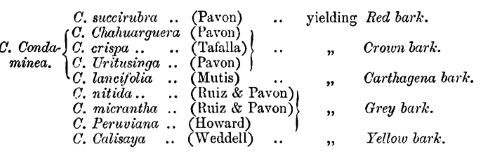
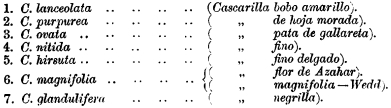
They are as follows:—
These species yield five different kinds of medicinal barks,
which are collected from five different regions in South
America; and in the following chapter I propose to give a
brief account of each of these regions, of their chinchona-trees,
and of the investigations of botanists down to the time
when measures were taken to introduce these inestimable
plants into Java and India. Such an account will naturally
divide itself into five sections:—
- —The Loxa region, and its crown barks.
- —The red-bark region, on the western slopes of Chimborazo.
- —The New Granada region.
- —The Huanuco region in Northern Peru, and its grey barks.
- —The Calisaya region, in Bolivia and Southern Peru.
Before entering on this subject, however, it will be well to
cast a hasty glance at the progress of those investigations
which ended in the discovery of the febrifugal principle in
Peruvian bark.
The roots, flowers, and capsules of the chinchona-trees have
a bitter taste with tonic properties, but the upper bark is the
only part which has any commercial value.[26] The bark of
trees is composed of four layers—the epiderm, the periderm,
the cellular layer, and the liber or fibrous layer, composed of
hexagonal cells filled with resinous matter and woody tissue.
In growing, the tree pushes out the bark, and, as the exterior
part ceases to grow, it separates into layers, and forms the
dead part or periderm; which in chinchonas is partially
destroyed, and blended with the thallus of lichens. The bark
is thus formed of the dead part, or periderm, and the living
part, or derm. On young branches there is no dead part, the
exterior layers remaining entire, while the inner layers have
not had time to develop. In thick old branches, on the
contrary, the periderm or dead part is considerable, while the
fibrous layer of the derm is fully developed. In preparing
the bark the periderm is removed by striking the trunk with
a mallet, and the derm is then taken off by uniform incisions.
The thin pieces from small branches are simply exposed to
the sun's rays, and assume the form of hollow cylinders, or
quills, called by the natives canuto bark. The solid trunk
bark is called tabla or plancha, and is sewn up in coarse
canvas and an outer envelope of fresh hide, forming the
packages called serons.
The character of the transverse fracture affords an important
criterion of the quality of the bark. Cellular tissue
breaks with a short and smooth fracture, woody tissue with
a fibrous fracture, as is the case with the calisaya bark.
The best characteristics by which barks containing much
quinine may be distinguished are the shortness of the fibres
which cover the transverse fracture, and the facility with
which they may be detached, instead of being flexible and
adhering as in bad barks. Thus, when dry calisaya bark is
handled, a quantity of little prickles run into the skin, and
this forms one of its distinguishing marks.[27]
Until the present century Peruvian bark was used in its
crude state, and numerous attempts were made at different
times to discover the actual healing principle in the bark,
before success was finally attained. The first trial which is
worthy of attention was made in 1779 by the chemists Buguet
and Cornette, who recognised the existence of an essential
salt, a resinous and an earthy matter in quinquina bark.
In 1790 Fourcroy discovered the existence of a colouring
matter, afterwards called chinchona red, and a Swedish doctor
named Westring, in 1800, believed that he had discovered
the active principle in quinquina bark. In 1802 the French
chemist Armand Seguin undertook the bark trade on a large
scale, and found it necessary to study the means of discovering
good barks, and distinguishing them from bad ones. He
found that the best quinquina bark was precipitated by
tannin, while the bad was not precipitated by that substance.
In 1803 another chemist found a crystalline substance in the
bark which he called "sel essentiel fébrifuge" but it was
nothing more than the combination of lime with an acid
which was named quinic acid. Reuss, a Russian chemist, in
1815, was the first to give a tolerable analysis of quinquina
bark; and about the same time Dr. Duncan of Edinburgh
suggested that a real substance existed as a febrifugal principle.
Dr. Gomez, a surgeon in the Portuguese navy, in
1816, was the first to isolate this febrifugal principle hinted
at by Dr. Duncan, and he called it chinchonine.[28]
But the final discovery of quinine is due to the French
chemists Pelletier and Caventou, in 1820. They considered
that a vegetable alkaloid, analogous to morphine and strychnine,
existed in quinquina bark; and they afterwards discovered
that the febrifugal principle was seated in two alkaloids,
separate or together, in the different kinds of bark, called
quinine and chinchonine, with the same virtues, which, however,
were much more powerful in quinine. It was believed that in
most barks chinchonine exists in the cellular layer, and
quinine in the liber, or fibrous layer; but Mr. Howard has
since shown that this view is quite incorrect.[29] In 1829
Pelletier discovered a third alkaloid, which he called aricine,
of no use in medicine, and derived from a worthless species
of chinchona, growing in most of the forests of Peru, called
C. pubescens.[30]
The organic constituents of chinchona barks are—
| Quina. | ¦ | Kinovic acid. |
| Chinchonia. | ¦ | Chinchona red. |
| Aricina. | ¦ | A yellow colouring matter. |
| Quinidia. | ¦ | A green fatty matter. |
| Chinchonidia. | ¦ | Starch. |
| Quinic acid. | ¦ | Gum. |
| Tannic acid. | ¦ | Lignin. |
These materials are in different proportions according to
the barks. Grey bark chiefly contains chinchonine and
tannin; Calisaya, or yellow bark, much quinine, and a
little chinchonine; red bark holds quinine and chinchonine
in nearly equal proportions; while the barks of New Granada
chiefly contain chinchonidine and quinidine. The two latter
alkaloids were definitively discovered in 1852 by M. Pasteur;
although the Dutch chemist Heijningen had, in 1848, found
what he called β quinine or quinidine. Chinchonidine is
only second to quinine itself in importance as a febrifugal
principle.
Quinine is a white substance, without smell, bitter, fusible,
crystallized, with the property of left-handed rotatory polarization.
The salts of quinine are soluble in water, alcohol, and
ether. Of all the salts the bisulphate of quinine is preferred,
because it constitutes a stable salt, easy to prepare, and containing
a strong proportion of the alkaloid. It is very bitter
and soluble, and crystallizes in long silky needles. It is
prepared by adding sulphuric acid to the sulphate.[31]
Chinchonine differs from quinine in being less soluble in
water, and being altogether insoluble in ether. It has the
property of right-handed rotatory polarization.
Quinidine also has the property of right-handed rotatory
polarization, and forms salts like those of quinine. It becomes
green by successive additions of chlorine and ammonia.
Chinchonidine has not the property of turning green, and
forms a sulphate almost exactly like sulphate of quinine.[32]
The discovery of these alkaloids in the quinquina[33] bark, by
enabling chemists to extract the healing principle, has greatly
increased the usefulness of the drug. In small doses they
promote the appetite and assist digestion; and chinchonine is
equal to quinine in mild cases of intermittent fever; but in
severe cases the use of quinine is absolutely necessary. Thus
these alkaloids not only possess tonic properties to which
recourse may be had under a multitude of circumstances, but
also have a febrifugal virtue which is unequalled, and which
has rendered them almost a necessary of life in tropical
countries, and in low marshy situations where agues prevail.
Many a poor fellow's life was saved in the Walcheren expedition
by the timely arrival of a Yankee trader with some chests
of bark, after the supply had entirely failed in the camp.[34] Dr.
Baikie, in his voyage up the Niger, attributed the return of
his men alive to the habitual use of quinine; and the number
of men whose lives it has saved in our naval service and in
India will give a notion of the vast importance of a sufficient
and cheap supply of the precious bark which yields it. India
and other countries have been vainly searched for a substitute
for quinine, and we may say with as much truth now as
Laubert did in 1820—"This medicine, the most precious of
all those known in the art of healing, is one of the greatest
conquests made by man over the vegetable kingdom. The
treasures which Peru yields, and which the Spaniards sought
and dug out of the bowels of the earth, are not to be compared
for utility with the bark of the quinquina-tree, which
they for a long time ignored.[35]
The valuable species of Chinchona-trees—their history, their discoverers, and
their forests.
I.—THE LOXA REGION, AND ITS CROWN BARKS.
The region around Loxa, on the southern frontier of the
modern republic of Ecuador, is the original home of the
Chinchona, and nearly in the centre of its latitudinal range
of growth. On the lofty grass-covered slopes of the Andes,
around the little town of Loxa, and in the sheltered ravines
and dense forests, those precious trees were found which first
made known to the world the healing virtues of Peruvian
bark. They were most plentifully met with in the forests
of Uritusinga, Rumisitana, Cajanuma, Boqueron, Villonaco,
and Monje, all within short distances of Loxa.
Linnæus had named these trees Chinchona officinalis; but
when Humboldt and Bonpland examined them, the discovery
of other species yielding medicinal bark had rendered the
name inappropriate, and they very properly re-christened
them, after the distinguished Frenchman who had originally
described them, Chinchona Condaminea. Humboldt says that
they grow on mica slate and gneiss, from 6000 to 8000 feet
above the sea, with a mean temperature between 60° and 65°
Fahr. In his time the tree was cut down in its first flowering
season, or in the fourth or seventh of its age, according as it
had sprung from a vigorous root-shoot, or from a seed. He
describes the luxuriance of the vegetation to be such that the
younger trees, only six inches in diameter, often attain from
fifty-three to sixty-four English feet in height. "This
beautiful tree," he continues, "which is adorned with leaves
above five inches long and two broad, growing in dense
forests, seems always to aspire to rise above its neighbours.
As its upper branches wave to and fro in the wind, their red
and shining foliage produces a strange and peculiar effect,
recognisable from a great distance."[36] It varies much in the
shape of the leaves, according to the altitude at which it
grows, and bark-collectors themselves would be deceived if
they did not know the tree by the glands, so long unobserved
by botanists. The C. Condaminea described by Humboldt
is the same as the C. Uritusinga of Pavon. It once
yielded great quantities of thick trunk bark, but, owing to
reckless felling through a course of years, it is now almost
exterminated, and its bark is rarely met with in commerce.
The distinguished botanist Don Francisco Caldas examined
the chinchona forests of Loxa after Humboldt, between 1803
and 1809. He says that the famous quina-tree of Loxa grows
in the forests of Uritusinga and Cajanuma, at a height of
from 6200 to 8200 feet above the sea, in a temperature of
41° to 72° Fahr.; but that it is only found between the rivers
Zamora and Cachiyacu.[37] He describes the tree as from
thirty to forty-eight feet high, with three or more stems
growing from the same root; the leaves as lanceolate,
shining on both sides, with veins a rosy colour, a short and
tender pubescence on the under side when young, and when
past maturity a bright scarlet colour; the bark black when
exposed to the sun and wind, a brownish colour when closed
in by other trees, and always covered with lichens;[38] and the
rock on which the trees grow, a micaceous schist.
Don Francisco José de Caldas, a native of New Granada,
was one of the most eminent scientific men that South
America has yet produced. He was associated with Mutis in
the botanical expedition of New Granada; he explored the
chinchona region as far as Loxa; and thus takes his place as
one of those to whom we are indebted for throwing light on
the nature of the trees yielding Peruvian bark. Caldas was
born at Popayan in the year 1770; and, from early youth,
devoted himself to the pursuits of science with untiring
energy, especially studying botany, mathematics, meteorology,
and physical geography. He constructed his own
barometer and sextant, and, ignorant of the methods adopted
in Europe, he discovered the way of ascertaining altitudes by
a boiling-point thermometer. He has left many memoirs on
botanical and other subjects behind him, and his style is
always animated, clear, and interesting; but many of the
productions of this remarkable man are still in manuscript,[39]
and others are lost to us for ever. Above all, it is to be
regretted that his botanical chart of the chinchona genus,
which he promised in one of his memoirs, has never seen the
light. After the declaration of independence Caldas was
nominated by the Congress at Bogota to publish the works
of his friend the botanist Mutis. When the brutal Spanish
General Morillo entered Bogota in June 1816, he perpetrated
a series of savage massacres, in which more than 600 of the
most distinguished men in the country fell victims. Among
them was Caldas, who was shot through the back on the 30th
of October 1816.[40]
The Spanish botanists Ruiz and Pavon also examined the
chinchona-trees of Loxa; and the latter described two species,
C. Uritusinga, named from the mountain on which it was
once most abundant, and C. Chahuarguera, so called from a
fancied resemblance of the bark to a pair of breeches (huara
in Quichua) made from the fibre of the American aloe
(chahuar). To these the botanist Tafalla added the C. crispa.
These three species are all included in Humboldt's C. Condaminea,
which is readily known by the little pits, bordered
with hairs, at the axils of the veins on the under side of
the leaf. It would appear that at one period of growth these
little pits or scrobicules are wanting, but when the plant is
in full vigour they are markedly prominent. The C. Chahuarguera[41]
is described by Pavon as growing from eighteen
to twenty-four feet in height; although now the trees, which
yield the Loxa bark of commerce, do not attain a height of
more than four to nine feet. It is met with on the grassy
open crests of mountain ridges, in light sandy soil interspersed
with rocks, amongst shrubs and young plants. The
barks of Loxa were called crown barks, because they were
reserved for the exclusive use of the royal pharmacy at
Madrid; and they originally sold at Panama for five and
six dollars, and at Seville for twelve dollars the pound;
but in later times they were much adulterated, and the
price fell to one dollar the pound.
The C. Chahuarguera is the rusty crown bark of commerce,[42]
and the C. crispa is the quina fina de Loxa or crespilla negra
of the natives. A parcel of it has quite recently sold at a
higher price than Calisaya quills. With this rusty crown bark
are mixed larger quills particularly rich in the alkaloid called
chinchonidine.[43] The C. Uritusinga grew to the height of a
lofty forest tree, but it is now nearly exterminated. The
leaves assume a red colour before they fall, acquiring the
most beautiful tints, and the tree is one of the finest in
those forests.[44] It is said that there is a great difference in
the bark, according as it is grown on the sides of mountains
most exposed to the morning or evening sun; and its position
is believed to have a great influence on the quality of its
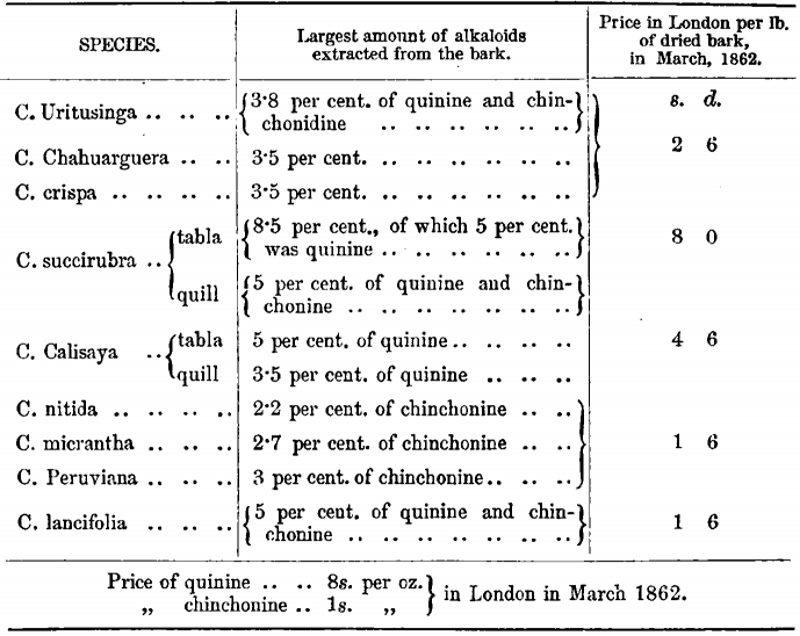
alkaloids. The usual yield of the large quills is 3.5 to 3.6 per
cent.[45]
The bark-collectors of Loxa are said to show some little
forethought, a quality which is entirely wanting in most of
their fraternity. To save the trees they occasionally cut off
the whole of the bark, with the exception of one long strip,
which gradually replaces its loss; and the second cutting is
called cascarilla resecada. This practice was in use in the
days of the botanist Ruiz, who protested against it, and
declared that it was very injurious to the trees, many having
been destroyed by it.[46] Later accounts, however, show that
the bark-collectors of Loxa are as thoughtlessly destructive
as those in other parts of South America. They often pull up
the roots, while the annual burning of the slopes, and the
continual cropping of the young shoots by cattle, assist the
work of destruction.[47]
It is, therefore, well that the C. Chahuarguera and C.
Uritusinga, the earliest known and among the most valuable
of the chinchona-trees, should have been saved from extinction
by timely introduction into India.
The annual export of Loxa bark, from the port of Payta,
is from 800 to 1000 cwts.
II.—THE "RED-BARK" REGION, ON THE WESTERN SLOPES
OF CHIMBORAZO.
The species yielding "red bark," the richest and most important
of all the Chinchonæ, is found in the forests on the
western slopes of Mount Chimborazo, along the banks of the
rivers Chanchan, Chasuan, San Antonio, and their tributaries.
So early as 1738 Condamine spoke of "red bark" (cascarilla
colorada) as being of superior quality;[48] and Pavon sent home
specimens of the "red bark of Huaranda," and named the
species C. succirubra. Some of these are now in the British
Museum; and in the collection of Ruiz and Pavon, in the
botanical gardens at Madrid, I found capsules, flowers, and
leaves marked "cascarilla colorada de los cerros de San Antonio."
In 1857 Dr. Klotzsch, an eminent German botanist, read a
paper at Berlin,[49] elaborately describing the "red bark" as a
product of C. succirubra, from a very good specimen of
Pavon's in the Berlin Museum. Mr. Howard has also received
a specimen from Alausi, and he is inclined to the
belief that there are several varieties of C. succirubra, and
one or two allied species, as yet undescribed.[50] Much light
was thrown upon the history of this valuable species by Mr.
Spruce, when he penetrated into the forests to collect seeds
and plants for transmission to India in 1860.
Though little was known of the tree until quite lately, there
was never any doubt concerning the value of the bark. In
1779 a Spanish ship from Lima, bound to Cadiz, was captured
off Lisbon by the 'Hussar' frigate, and her cargo consisted
chiefly of "red bark," part of which was imported into
England. In 1785 and 1786 Ruiz states that the collectors
began to gather the bark of C. succirubra, and sell it at
Guayaquil, and from that time it continued to be found in
the European markets. It contains a larger proportion of
alkaloids than any other kind, amounting to as much as from
3 to 4 per cent. of the substance of the bark, and of this
a fair share is quinine. Fine samples yield 3.9 per cent.,
selling at 8s. 9d. per lb.; and the quill bark from the
smaller branches 3.6 per cent.[51] Mr. Howard has recently
procured 8.5 per cent. of alkaloids from a specimen of "red
bark." A large supply of plants of this species is flourishing
in India and Ceylon, and, from the richness of the species,
the comparatively low elevation at which it thrives, and
its hardy nature, it may be expected to become a cultivated
plant of great value and importance.
In 1857 the export of bark from the port of Guayaquil, the
place of shipment for the C. succirubra, amounted to 7006
quintals, valued at 23,353l.[52] In 1849-50 Dr. Weddell gives
the amount at 1042 quintals.
III.—THE NEW-GRANADA REGION.
The importance of the chinchona-trees was fully established
in the middle of the last century, and, Don Miguel de Santistevan,
the director of the mint at Bogota, having addressed
a memorial on the bark trade (estanco de cascarilla) to the
Viceroy Marquis of Villar in 1753, the attention of the
Spanish Government was seriously turned to the subject.
When the Viceroy Don Pedro Mesia de la Cerda, Marquis
de la Vega de Armijo, went out to Bogota in 1760,[53] he was
accompanied by the botanist Don José Celestino Mutis, a
native of Cadiz, who was appointed to conduct a botanical
survey of New Granada, and especially to investigate the
bark of the chinchona-trees.[54]
In 1772 Mutis found these trees in the neighbourhood of
Bogota, and described four kinds in 1792, which he called
C. lancifolia, C. cordifolia, C. oblongifolia, and C. ovalifolia,
yielding four kinds of barks—anaranjada, amarilla, roja, and
blanca, or orange-coloured, yellow, red, and white.[55] He
declared the C. lancifolia to be excellent for intermittent
fevers, in which he was right, and to be identical with the
C. Condaminea of Loxa, in which he was wrong; the C. cordifolia
he recommended for remittent fevers, and the other
two for inflammatory diseases. In reality the two last are
not chinchonas at all, but belong to the genus Ladenbergia,
and contain no fever-dispelling alkaloids whatever; while
the C. Cordifolia is so poor in alkaloids as to be practically
worthless.
While Mutis, and his disciples Caldas and Zea, were prosecuting
their researches in New Granada, an expedition
under the botanists Ruiz and Pavon was sent to Peru; and
an acrimonious paper war sprang up between the rivals, as to
the respective merits of the barks of New Granada and Peru.
Ruiz declared the New Granada kinds to be inferior to those
of Peru, while Mutis contradicted him, and Zea[56] went so far
as to maintain that the species found by Ruiz and Pavon in
Peru were mere varieties of the four chinchonas of Mutis,
growing near Bogota.[57]
The C. lancifolia of Mutis is dispersed in wild inaccessible
forests, while the other three kinds grow in partly cultivated
and inhabited regions, and their barks are therefore
much more easy to collect. These worthless barks were, therefore,
largely exported from Carthagena and Santa Martha,
while the valuable C. lancifolia was neglected; and the consequence
was that the barks of New Granada fell entirely into
discredit for many years. In about 1849, however, Dr. Santa
Maria of Bogota discovered the C. lancifolia afresh, producing
the quina anaranjada, and it has recently been found in the
whole cordillera from Bogota to Popayan, and largely exported
between 1849 and 1855, when the supplies began to fail.
Dr. Karsten, a distinguished German botanist, has lately
returned from a residence of some years in New Granada,
where he thoroughly examined the region of C. lancifolia.
His remarks on the production of alkaloids in chinchona barks
are very important. He came to the conclusion that the
content of alkaloids was not always the same in the same
species of chinchona, and that the soil and relations of climate,
on which the nourishment of the plant depends, exercise
considerable influence. He also assumes, what is undoubtedly
true, that the chinchonæ with the capsule opening from the
base and crowned by the calyx, with a corolla of delicate
texture and bearded edges, and generally unindented seed-lobes,
give febrifugal barks; but his further position that the
short oval or elliptic capsules are a sign of a regularly larger
content of alkaloids, while long capsules show a small quantity
or total absence of quinine and chinchonine, though
doubtless correct so far as Dr. Karsten's personal observation
extended, will not bear general application. The C. succirubra,
the richest of all the barks in alkaloids, would certainly
come under the latter head. Dr. Karsten's observations on
the differences in the structure of the false and true barks
are also exceedingly valuable.
The C. lancifolia of New Granada has been found to contain
as much as 2½ per cent. of quinine and from 1 to 2 per
cent. of chinchonine. The trees are found in forest-regions
veiled in fog and rain, and often exposed to frost, where
the temperature ranges from freezing-point to 77° Fahr., at
heights of 7000 feet and upwards above the level of the sea.
They attain a height of 80 feet and 5 feet in diameter, but
the average size is 30 or 40 feet high and 3 feet in girth.[58]
Seeds of this species, collected by Dr. Karsten, were sent to
Java, and there are now several plants raised from these
seeds in India.[59]
I find that between 1802 and 1807 the export of New
Granada bark from the port of Carthagena was 3,340,000 lbs.;
the largest quantity in one year being 48,330 lbs. in 1806.
The first arrivals in Spain sold at 5 to 6 dollars a pound, but
in 1808 they were worth next to nothing, owing to the damaged
state in which the bark arrived.[60]
IV.—THE HUANUCO REGION IN NORTHERN PERU, AND ITS
GREY BARKS.
The chinchona-trees, in the forests of the province of
Huanuco, in Northern Peru, were discovered by Don Francisco
Renquifo in 1776, on the mountain of San Cristoval de
Cuchero or Cocheros; and Don Manuel Alcarraz brought the
first sample of bark from Huanuco to Lima.
At almost the same time the Spanish government was
organizing a botanical expedition to explore the chinchona
forests of Peru; composed of the botanists Don José Pavon,
Don Hipolito Ruiz, the Frenchman Dombey, and two artists
named Brunete and Galvez. They embarked at Cadiz on
November 4th, 1777, and reached Callao April 8th, 1778.
Having made a large collection of plants in the neighbourhood
of Lima, and despatched them to Spain,[61] they crossed
the Andes, explored the forests of Tarma, and then proceeded
to Huanuco. They traversed the valley of Chinchao, explored
the hill of Cuchero or Cocheros, near Huanuco, and discovered
seven species of chinchona-trees,[62] returning to Lima laden with
the precious spoils of their expedition. They then sailed for
Chile, and, after exploring the greater part of that province,
they returned to Lima, and sent off their botanical collections
in fifty-three boxes, which were all lost in the shipwreck of
the 'San Pedro de Alcantara,' off the coast of Portugal, in
1786. M. Dombey returned to Europe at about the same
time.
Ruiz and Pavon then returned to Huanuco, explored the
courses of the rivers Pozuzu and Huancabamba, and eventually
established themselves at the farm of Macora, near Huanuco,
where they resided for two months with Don Francisco
Pulgar and Don Juan Tafalla, who, by order of the king, had
joined them as pupils and associates in their labours—the
first as an artist, the second as a botanist. In August, 1785,
a fire broke out in their house, which destroyed all their journals
and collections; and they then undertook journeys
through the forests of Muña, Pillao, and Chacahuasi, examining
new species of chinchonæ.[63] On April 1st, 1788, taking
leave of Pulgar and Tafalla, they sailed from Callao, and
reached Cadiz in September, when they commenced the publication
of their great work the 'Flora Peruviana.'[64]
Tafalla continued his researches in the province of Huanuco,
and discovered the C. micrantha in 1797, in the cool and
shady forests of Monzon and Chicoplaya. Pavon calls him
"noster alumnus."
The expeditions and discoveries of the Spanish botanists
induced the merchants of Lima to speculate in bark, and
brought the grey barks of Huanuco into the European markets.[65]
In 1785 Don Juan de Bezares, a Lima merchant,
devoted 2000 dollars to the exploration of the forests of
Huamalies. He penetrated along the banks of the Monzon
to Chicoplaya, passing mountains thickly covered with chinchona-trees,
and engaged people to collect bark. Thousands
of arrobas were thus obtained of the bark of C. glandulifera;
and having been appointed Governor of Huamalies by
the Viceroy Don Teodoro de Croix in 1788, Bezares commenced
the construction of a good road down the valley
of the Monzon.[66] Up to 1826 the principal supplies of grey
bark were derived from C. nitida, but since that time they
are believed to have come chiefly from C. micrantha.
Science owes much to the labours of Spanish botanists: the
Spanish nation has every reason to be proud of her sons who
explored the forests of the Andes with such untiring energy
and distinguished ability; and the names of Mutis, Ruiz,
Pavon, and Tafalla occupy no unimportant place in the history
of botanical research. Nor, in this respect, have the
natives of South America been behindhand. Caldas and Zea
were worthy successors of Mutis; Franco Davila[67] represents
the botanical learning of Peru; while in more modern times
the name of the South American Triana is not unworthy to
stand side by side with those of the best botanists in Europe.
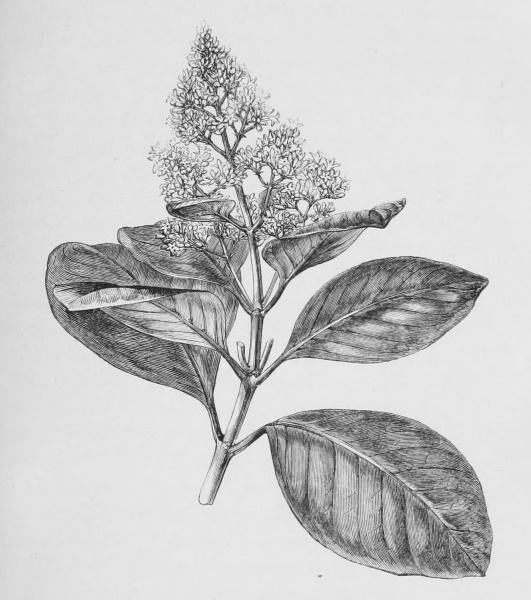
CHINCHONA MICRANTHA.
(From Howard's 'Nueva Quinologia de Pavon.') Page 32.
After the days of Ruiz and Pavon, our chief authority on
the grey barks of Huanuco is Dr. Poeppig, now a professor in
Leipsic, who travelled in Chile and Peru between the years
1827 and 1832.[68] He says that, as in New Granada, the grey
barks of Huanuco soon fell into discredit in the European
markets, owing to the adulterations of small speculators, and
that after 1815 the trade almost entirely ceased.[69] In 1830
scarcely 1250 lbs. of bark found their way from Huanuco to
Lima.
In the flourishing times of the Huanuco bark trade the
cascarilleros, or bark-collectors, entered the forests in parties
of ten or more, with supplies of food and tools. They penetrated
for several days into the virgin forest until they came
to the region of the chinchona-trees, when they built some
rude huts and commenced their work. The cateador, or
searcher, then climbed a high tree, and, with the aid of experience
and sharp sight, soon discovered the manchas or clumps
by their dark colour, and the peculiar reflection of the light
from their leaves, easily observable even in the midst of these
endless expanses of forest. The cateador, then, with never-erring
instinct, conducted the party for hours through the
tangled brushwood, to the chinchona clump, using the wood-knife
at every step. From a single clump they often obtained
a thousand pounds of bark, which was sent up to be dried
beyond the limits of the forest. All depended on the success
of this operation, for the bark easily becomes mouldy and
loses its colour. The cascarilleros got two rials for every
twenty-five pounds of green bark stripped, from the speculator,
and, as they could easily strip three hundred pounds, they
made two dollars a day. The bark cost the speculator about
four dollars, and the price at Lima was sixteen to twenty
dollars the arroba of twenty-five pounds.[70]
Dr. Poeppig makes some important remarks on the supposed
danger of the total extirpation of the chinchona-trees by reckless
felling. Condamine and Ulloa believed that this would
be the case in the Loxa forests, and Poeppig thinks that their
apprehensions were well founded, because there the trees are
not felled, but left standing deprived of their bark, in which
case they are attacked by rot with extraordinary rapidity in
tropical forests, hosts of insects penetrate to the stem, and the
healthy roots become infected. But it is only necessary to
observe the precaution of hewing the stem as near as possible
to the root, in order to be sure of its after-growth. After six
years, near Cuchero, the young stems may already be felled
again; but, at higher altitudes, where the most effective chinchonas
are found, it requires twenty years.[71]
The C. micrantha abounds in the province of Huanuco, and
the bark is known as Cascarilla provinciana. It yields 2.7 per
cent. of chinchonine, and is much sought after for the Russian
market.
The C. nitida is a lofty tree growing in the higher regions
of Huanuco, and is known by the natives as quina cana legitima
(genuine grey bark). It grows at a greater height than
the former species, and yields 2.2 per cent. of chinchonine.
The C. Peruviana, so named by Mr. Howard, is the Cascarilla
de pata de gallinazo of the natives. It grows in the forests
at a lower elevation than C. nitida, and yields 3 per cent. of
chinchonine and chinchonidine, consequently indicating a
considerable amount of febrifugal power. Quinine has also
been found in samples of grey bark.[72]
The name of grey bark refers to the striking effect of the
overspreading thallus of various Graphideæ, forming groups,
and indicating that the tree has grown in an open situation,
exposed to rain and sunshine. A large supply of all the best
kinds of grey bark is now growing in India.[73]
V.—THE CALISAYA REGION IN BOLIVIA AND
SOUTHERN PERU.
The chinchona region of Bolivia and Southern Peru, although
one of the most important, was the last to contribute supplies
of bark to the European markets. The trees first became
known through the investigations of the German botanist
Thaddæus Haenke, and a Spanish naval officer named Rubin de
Celis, who drew the attention of the inhabitants to the valuable
forests on the eastern slopes of the Bolivian Andes in 1776,
though the unfortunate French naturalist Joseph de Jussieu
had previously explored some portions of those forests.[74] But
it was not until 1820, when quinine was first discovered as
the febrifugal principle of bark, that the Chinchona Calisaya[75]
was recognised as containing more of that alkaloid than any
other species.
After 1820 the demand for calisaya bark increased enormously;
great numbers of cascarilleros, or bark-collectors,
entered the forests, and in a short time scarcely a tree
remained in the vicinity of the inhabited places; and the bark
was exported in such quantities that the price fell very much.[76]
It was not, however, until 1830 that the Bolivian Government
interfered in the bark trade. It was then considered
necessary by General Santa Cruz's administration to check
the drain of this precious source of wealth by limiting the
quantity of bark to be cut or exported; and in November,
1834, the Bolivian Congress decreed a law on the subject,
which, however, never took effect. Finally, the cutting was
prohibited for five years, but before the expiration of that
period the decree was abrogated, and an export duty of twelve
dollars to twenty dollars the quintal, or cwt., was imposed.
In 1844 the Bolivian Congress authorized the President,
General Ballivian, to negotiate for the establishment of a
national bank of bark, with the requisite capital, to export all
the quinquina bark produced in the country. This Bolivian
legislation on the chinchona bark, which is considered, with
justice, the most important product of their country, is very
curious, and sufficiently demonstrates the futility of attempting
a system of protection and monopoly. Instead of taking
measures to prevent the reckless destruction of the trees, to
establish extensive nurseries for young plants, and thus
ensure a constant and sufficient supply of bark, these Bolivians
have meddled with the trade, attempted to regulate European
prices by the most barbarous legislation, and allowed the
forests to be denuded of chinchona-trees. In 1845 the bark
monopoly was given to Messrs. Jorge Tesanos Pinto and Co.,
for five years, for the sum of 119,000 dollars, during which
time not more than 4000 quintals of bark were to be exported
annually. This company gave such iniquitously low prices
to the cascarilleros for their bark, that a clamour was raised
against it, and the President, General Belzu, put an end to
its existence in March 1849.
Free trade, with a duty of twenty dollars the quintal, was
then established during one year; but in 1850 exclusive
privileges were again granted to Messrs. Aramayo Brothers
and Co., who were to pay the Government 142,000 dollars a
year for the right of exporting 7000 quintals of bark
annually, to be purchased of the cascarilleros, the tabla or
trunk bark at sixty dollars the quintal, and the canuto or
quill bark at thirty to thirty-six dollars the quintal. The
Pinto company had only paid eighteen to twenty-two dollars
the quintal for tabla, and eight to ten dollars for canuto bark.
The favourable conditions thus offered to cascarilleros induced
so great a number of persons to undertake the business,
that at the end of the first year more than 20,000 quintals of
bark arrived at La Paz—that is to say, more than twice as
much as the company had agreed for, and more than the
Pinto company had exported in five years. The Government
then issued a decree to prevent the smuggling of bark,
and another that no bark should be cut except for the company:
but these measures caused much discontent, and in 1851
the Congress voted that the Executive had exceeded its powers
in making these arrangements with the Aramayo company,
and declared them to be null and void. The Aramayo company
purchased 14,000 quintals of the bark, and agreed to
take the same quantity during the two following years,
paying only a third of the price in ready money; but a new
company, formed under the name of Pedro Blaye and Co.,
engaged to purchase all the bark that was for sale, both at
La Paz and Cochabamba, for ready money. It was evident
that one or the other of these companies must break, and
finally that of Blaye fell. The Government then determined to
export the bark which remained in store on its own account,
paying the same price as had been agreed on by the company.
These two companies lasted for two years, during which
time the Bolivian forests yielded 3,000,000 lbs. of bark.
Such was the result of the high prices which followed the
fall of the Pinto monopoly; but it was the rich contractors,
and not the poor bark-collectors, who derived benefit from
the change.[77]
In 1851 Government prohibited the cutting of bark entirely,
from the 1st of January, 1852, to the 1st of January,
1854.[78] In 1858 a decree was issued to regulate the transition
of the system of monopoly to that of free-trade in bark,
which caused an improvement in the prices in European
markets; and in November, 1859, Dr. Linares, then President
of Bolivia, declared the right to cut bark in the forests to
be free, and reduced the duty 25 per cent. on the current
prices, to be fixed at the beginning of each year.[79] This is
the law which now regulates the bark trade in Bolivia, and,
after a course of short-sighted meddling legislation, extending
over twenty years, in 1850 it still brought 142,000 dollars
annually into the public treasury, being a fifteenth part of
the whole revenue of the Republic.
For exportation the bark is wrapped in fresh bullock-hides,
having been previously sewn up in thick cotton bags
containing 155 lbs. each. These hide packages are called
serons, a mule-load being 285 lbs., and the transport to the
coast costing about ten dollars for each mule-load.
It is to the persevering energy and great talent of that
distinguished French botanist Dr. Weddell that we owe our
knowledge of the chinchona regions of Bolivia and Southern
Peru, and especially of the inestimable quinine-yielding
species which he identified as the C. Calisaya. Dr. Weddell
accompanied the scientific expedition of the Count de Castelnau,
which was sent out by Louis Philippe to South America,
and, after crossing the vast empire of Brazil, entered Bolivia
by the country of the Chiquitos in August, 1845. It was
Dr. Weddell's chief object to examine the chinchona region of
this country, and his first step was to proceed to Tarija,
to ascertain the extreme southern limit of the chinchona-trees,
which he discovered in 19° S. lat. He named the
species C. Australis. Dr. Weddell then commenced a
thorough exploration of the Bolivian chinchona forests,
making his way over the most difficult country, from Cochabamba,
through Ayopaya, Enquisivi, and the yungus[80] of La
Paz; where the species of chinchonæ continued to multiply
under his eye. In Enquisivi he first met with and studied
the C. Calisaya, which he named and described, collecting
much information respecting the trade, and the methods
of collecting bark. In 1847 he entered the province of
Capaulican, descending the river Tipuani, where he was
attacked by fever, and ascending the Mapiri. At Apollobamba,
the centre of the most ancient bark-collecting district,
he found that the surrounding forests were quite cleared
of chinchona-trees, and that it was necessary to seek for them
at a distance of ten or twelve days' journey from any inhabited
place. In June 1847 Dr. Weddell entered the Peruvian
province of Caravaya, examined the chinchona forests of the
valleys of Sandia (San Juan del Oro) and Tambopata, and
concluded his investigations by a visit to the lovely ravine of
Santa Anna, near Cuzco.
Dr. Weddell was accompanied in his visit to the valleys of
Santa Anna by M. Delondre, a manufacturer of quinine at
Havre, who, after contemplating the project of paying a personal
visit to the chinchona forests for twenty years, had at
length set out, landed at Islay in July, 1847, and proceeded
by way of Arequipa to Cuzco. M. Delondre appears to have
employed a contractor to supply him with bark, who failed
in his engagements, and of whom the French quinine manufacturer
bitterly complains as a second Dousterswivel.[81] MM.
Weddell and Delondre finally left the chinchona forests in
September, 1847, and set out for the coast of Peru. Dr.
Weddell's valuable monograph on the chinchona genus, 'Histoire
naturelle des Quinquinas,' the most important work that
has yet appeared on the subject, was published at Paris in 1849.
In 1851 Dr. Weddell undertook a second voyage to South
America, and in 1852 he entered the Bolivian chinchona
region of Tipuani by way of Sorata. In descending the
eastern slopes of the Andes he describes the vegetation as
taking new forms at every mile of the descent. The undergrowth
was formed of Melastomaceæ with violet-coloured flowers
(Chætogastra), myrtles, Gaultherias, and Andromedas; lower
down there were many superb species of Thibaudias; and,
where the great forests succeed to the smaller growth of the
more elevated region, the predominant trees were Escallonias,
arborescent Eupatorias, Bocconias, and a fruit-bearing Papilionacea
with a scarlet corolla. He encountered the first forest
chinchona-trees at an elevation of 7138 feet, being the C. ovata
var. α vulgaris. Descending still, he came to paccay-trees
(Mimosa Inga) in flower, and met with the first plant of the
shrubby variety of C. Calisaya, on an open grassy ridge or
pajonal, at an elevation of 4800 feet.
Dr. Weddell descended the river Tipuani to Guanay, a
mission of Lecos Indians, and ascended the Coroico in a
canoe made of the wood of a species of Bombax. The forests
bordering on the river Coroico abounded in many species of
palms, chiefly Maximilianas and Iriarteas, the latter a singular
kind with a trunk supported on long aërial roots. There were
also many trees of C. micrantha on the banks of the Coroico,
a species of chinchona, the peculiarity of which is its fondness
for the bottoms of valleys and banks of rivers, while most of
the others prefer elevated ridges or slopes of the mountains.
With it were growing trees of the beautiful Cascarilla magnifolia,
an allied genus with deliciously fragrant flowers.
The cascarilleros of Bolivia lead a hard and dangerous life.
They only value the C. Calisaya, the other species being for
them carhua-carhua, a name given to all the inferior kinds.
Those who carry the bark on their shoulders from the interior
of the forests receive fifteen dollars for every quintal, and
they also have to carry all their provisions and covering for
the night. If by any accident they are lost, or their provisions
are destroyed, they die of hunger. Dr. Weddell, on
one occasion, while ascending the Coroico, landed with the
intention of passing the night on a beach well shaded by
trees. Here he found the hut of a cascarillero, and near it a
man stretched out on the ground in the agonies of death. He
was nearly naked, and covered with myriads of insects, whose
stings had hastened his end. His face was so swollen as to be
wholly unrecognisable, and his limbs were in a frightful state.
On the leaves which formed the roof of the hut were the remains
of this unfortunate man's clothes, a straw hat and some
rags, with a knife, and an earthen pot containing the remains
of his last meal, a little maize, and two or three chuñus. Such
is the end to which their hazardous occupation exposes the
bark-collectors—death in the midst of the forests, far from
all friends—a death without help, and without consolation.
Dr. Weddell returned to La Paz by ascending the Coroico,
and the results of his second visit to the chinchona forests
appeared in an entertaining book of travels.[82] To this able
botanist and intrepid explorer science is indebted, to no small
extent, for the present state of our knowledge of the chinchona
genus.
The C. Calisaya species has been divided by Dr. Weddell
into two varieties, namely, a vera and β Josephiana. The
former, when growing under favourable circumstances, is a tall
tree, often larger round than twice a man's girth, with its
leafy head rising above all the other trees of the forest. The
leaves are oblong or lanceolate-obovate, pitted in the axils of
the veins, with a shining green surface, and reddish veins.
The flowers, which hang in large panicles, are a rosy-white
colour, with laciniæ rose-colour, and bordered by marginal
white hairs. The capsule is smooth, and about twice as long
as broad. This tree grows on declivities, and steep rugged
places of the mountains, from 4900 to 5900 feet above the
sea, in the forests of Enquisivi, Capaulican, Apollobamba, and
Larecaja in Bolivia, and of Caravaya in Peru. The trunk
may be known by the periderm of the bark, sometimes of a
greyish-white, sometimes brown or blackish, being always
marked by longitudinal ridges or cracks, a characteristic
remarked of no other tree of these forests, excepting one or
two of the same family. The taste is strongly bitter, which
is apparent directly the tip of the tongue touches it, and,
when the exterior receives a cut, a yellow gummy resinous
matter exudes from it. The bark comes off with great ease,
like peeling a mushroom, while, in the inferior kinds, and
above all in the false chinchonas, it strips transversely, and
with much greater difficulty. A good tree yields 150 to 175
pounds of dried bark.
The other variety of C. Calisaya, called ychu cascarilla, or
cascarilla del pajonal, by the natives, was named Josephiana by
Dr. Weddell after the unfortunate French botanist Joseph de
Jussieu. It is a shrub, not attaining a greater height than six
and a half to ten feet, and growing on open grassy slopes, at
much higher elevations than the tree Calisaya. There is
another tree variety with a somewhat darker leaf, which Dr.
Weddell classed as a distinct species, and called C. Boliviana
in 1849, but which he now considers to be a mere variety of
C. Calisaya. The other good kinds in the forests of Bolivia
and Caravaya are C. micrantha, and two varieties of C.
ovata.
Dr. Weddell brought seeds of C. Calisaya to Paris, which
were raised in the Jardin des Plantes in 1848, and others in
the garden of the Horticultural Society in London, where one
of the plants flowered.[83] Many of these plants were given
away, and some of them were sent by the Dutch Government
to Java.
Plants of C. Calisaya are now flourishing in India. The
yield of quinine for the best kinds of calisaya bark is 3.8
per cent., that for the Josephiana variety 3.29.[84]
Arica and Islay are the ports for the shipment of calisaya
bark; and in 1859 the quantity and value exported were:—
| From | Arica | 1926 | quintals, | worth | £17,334 |
| " | Islay | 1365 | " | " | 12,383 |
| | 3291 | | | 29,717 |
Jan. 1st to Nov. 30th, 1860, Arica $160,260 = £35,000 (about).
1860, Islay, 1077 quintals.
Rapid destruction of chinchona-trees in South America—Importance of their
introduction into other countries—M. Hasskarl's mission—Chinchona
plantations in Java.
The collection of bark in the South American forests was
conducted from the first with reckless extravagance; no
attempt worthy the name has ever been made either with a
view to the conservancy or cultivation of the chinchona-trees;
and both the complete abandonment of the forests to the
mercy of every speculator, as in Peru, Ecuador, and New
Granada, and the barbarous meddling legislation of Bolivia,
have led to equally destructive results. The bark-collector
enters the forest and destroys the first clump of chinchona-trees
he finds, without a thought of any measure to preserve
the continuance of a supply of bark. Thus, in Apollobamba,
where the trees once grew thickly round the village, no full-grown
one is now to be found within eight or ten days'
journey:[85] and so utterly improvident are the collectors that,
in the forests of Cochabamba, they bark the tree without
felling, and thus ensure its death; or, if they cut it down,
they actually neglect to take off the bark on the side touching
the ground, to save themselves the trouble of turning the
trunk over.[86]
A century ago Condamine[87] raised a warning voice against
the destruction that was going on in the forests of Loxa.
Ulloa[88] advised the Government to check it by legislation;
soon afterwards Humboldt reported that 25,000 chinchona-trees
were destroyed every year, and Ruiz[89] protested against
the custom of barking the trees, and leaving them to be
destroyed by rot. But nothing was ever done in the way of
conservancy, either by the Government, or by private speculators
whose subsistence depended on a continued supply of
bark. Dr. Weddell, alluding to this recklessness as regards
C. Calisaya, observes that "the forests of Bolivia, rich as they
are, cannot long resist the continued attacks to which they
have been recently exposed. He who, in Europe, sees these
enormous and ever-increasing masses of bark arrive, may
perhaps believe that they will continue to do so; but he who
sees the chinchona-trees in their native forests, and knows
the real truth, is obliged to think otherwise."
There is, however, no danger of the actual extirpation of
the trees unless the plan is adopted of leaving them standing,
and stripped of their bark, as in the Loxa forests. Poeppig
says that, in these cases, the trees in the tropical forests are
attacked by rot with extraordinary rapidity; hosts of insects
penetrate the stem to complete the work of destruction, and
the healthy root becomes infected. Thus the valuable species
called C. Uritusinga has really been almost exterminated.
But where the trees are felled it is only necessary to
observe the precaution of hewing the stem as near as possible
to the root, in order to be sure of its after-growth.[90] Under
these circumstances, after six years the young trees are
ready to be felled again in the milder regions, and after
twenty years in cold and exposed localities. From the base
of the stems, when not barked, a number of shoots spring out
between bark and wood; and Dr. Karsten says that, though
an interval of rest of twelve or fifteen years must be given to
the forests where the chinchona-trees have thus been felled,
this only promotes further investigation in the endless
untrodden forests, while, in the mean time, the younger
generation is growing up in those which have already been
exhausted.[91]
The danger, therefore, is not in the actual annihilation of
the chinchona-trees in South America, but lest, with the
increasing demand, there should be long intervals of time
during which the supply would cease, owing to the forests
being exhausted, and requiring periods of rest. In many
districts this is already the case. The bark which comes
from Loxa is in the minutest quills, and in the forests of
Caravaya, after an interval of rest of several years, the root-shoots
had scarcely grown to a sufficient size to yield anything
but quill bark. Then again the supplies of bark from
South America are not nearly sufficient to meet the demand,
and the price is kept so high as to place this inestimable
remedy beyond the means of millions of natives of fever-visited
regions. For these reasons the incalculable importance
of introducing the chinchona-plant into other countries
adapted for its growth, and thus escaping from entire dependence
on the South American forests, has long occupied
the attention of scientific men in Europe.
In 1839 Dr. Royle, in his 'Illustrations of Himalayan
Botany,'[92] recommended the introduction of the chinchona-plants
into India, pointing out the Neilgherry and Silhet
hills as suitable sites for the experiment, and Lord William
Bentinck took some interest in the project. M. Fée had
previously recommended the introduction of these plants into
the French colonies;[93] and in 1849 both Dr. Weddell[94] and
M. Delondre[95] strongly urged the adoption of this measure.
The former declared that posterity would bless those who
should carry this idea into execution.[96]
The Dutch, who possess in the island of Java a range
of forest-covered mountains admirably adapted for chinchona
cultivation, were, however, the first to take active steps for
its introduction into the Eastern Hemisphere; and their
praiseworthy exertions deserve, what they lay claim to with
justice, the approbation of the whole civilized world. The
experiment in Java, however, has only been tried with a very
limited number of valuable species of chinchonæ, and has met
with very limited success, owing to the introduction of worthless
kinds, and to mistakes in the cultivation, committed
during the first few years.
For the last thirty years Dutch scientific men, among whom
the name of the botanist Blume may be mentioned, had
urged their Government to undertake the introduction of chinchona-plants
into Java. But it was not until the year 1852
that M. Pahud, the Dutch Minister of the Colonies, was authorized
to employ an agent to collect plants and seeds of valuable
species in Peru, and to convey them to Java. He selected, for
this important mission, M. Justus Charles Hasskarl, a botanist
who had for some time superintended the gardens in Java,
but who was a stranger to South America—ignorant of the
country, the people, and the languages—unacquainted with
the forests where the chinchona-trees are found, and who
had never seen them growing in their natural state. He
sailed for Peru in December, 1852, with orders not to confine
himself to the Calisaya plant, but to collect plants and seeds
of as many different species as possible. His original orders
were to proceed from Guayaquil to the chinchona-forests of
Loxa in the first instance; but he changed his plan, and,
landing at Lima, crossed the cordilleras in May, 1853.
It would be difficult, in making a chance journey from the
coast to the forests of the Eastern Andes, to hit upon a part
where valuable species of chinchona-trees are not known to
exist. There are such spaces—forest tracts—intervening between
the more favoured regions, where only species of little
value are found, such as C. pubescens, C. scrobiculata, &c.; and
on one of these, between the region of grey barks in Huanuco
and that of C. Calisaya in Caravaya, M. Hasskarl, through
being unacquainted with the localities, was so unfortunate
as to stumble. He crossed the Andes by the road from Lima
to Tarma, and descended the eastern slopes into the montañas
of Vitoc, Uchubamba, and Monobamba; returning thence by
Xauxa into the loftier region of the Andes. Near Uchubamba
he saw trees which he believed to be C. Calisaya; but that species
is never found to the north of the province of Caravaya.
He however collected a quantity of seeds of this imaginary
C. Calisaya, and four packets of a species which he called
C. ovata, with smaller quantities of C. pubescens and C.
amygdalifolia.
The species called by M. Hasskarl C. ovata now forms the
bulk of the chinchona-plantations in Java. He found it on
dry sunny hills, without much shelter from the sun, in a very
sandy micaceous soil, at an elevation of 5500 to 6000 feet
above the sea. It is sometimes a mere shrub, but occasionally
rises to fifteen or twenty-five feet, with elegant pink
flowers and reddish fruit. The native name is cascarilla crespilla
chica; and as the crespilla grande is the C. ovata of
Weddell, it is probable that M. Hasskarl was thus led into the
mistake of calling his new species C. ovata. The leaves are
smooth above, with a felt-like pubescence on the under surface,
and the hairy capsules are probably an indication of the
worthlessness of the species.[97] In fact, no good kinds are found
in this part of the country, and all the seeds sent home by
M. Hasskarl were equally valueless. He collected specimens
of C. lanceolata of Pavon, at a place called "Escalera
de San Rafael," on the road between Uchubamba and
Xauxa.[98]
From Xauxa M. Hasskarl went to Cuzco, and thence in
September to Sandia in the province of Caravaya; but finding
that the seeds of chinchona-trees are ripe in August, and that
he had arrived too late, he returned to Lima, and finally
took up his abode at Arequipa until the following year. In
March, 1854, he again set out, crossed the Andes to Puno,
and, after wandering over part of Bolivia, at length reached
the little village of Sina in Caravaya, near the frontier
between Peru and Bolivia, in April. He had assumed the
feigned name of José Carlos Müller, and had printed it on his
cards, one of which he presented to the governor of Sina,
Don Juan de la Cruz Gironda, requesting him to procure a
supply of chinchona-plants for him. Gironda refused, but
introduced the stranger to a Bolivian named Clemente
Henriquez, a clever and intelligent, but dishonest and unscrupulous
man. Henriquez agreed to procure 400 plants
of C. Calisaya for a certain sum, part of which was to be
paid down, and the remainder on delivery of the plants. M.
Hasskarl then went on to the village of Sandia, where he
took up his abode, without entering the chinchona forests,
and waited there until the plants should arrive. Meanwhile
Henriquez employed an Indian to collect the stipulated
number of plants, round a place called Ychu-corpa,[99] on the
frontier of Bolivia; and when they were brought to him he
went to Sandia, delivered them to M. Hasskarl, and received
his money. An outcry was afterwards raised against Henriquez,
by the people inhabiting villages bordering on the
chinchona forests, who considered that their interests would be
injured by the exportation of the plants: they declared they
would cut his feet off if they caught him, and he has ever
since been obliged to live at Pelechuco, in Bolivia.[100] This
feeling has rendered any future operations of a like nature
exceedingly difficult.
M. Hasskarl left Sandia with these plants in June, 1854,
but they were not placed in Wardian cases at the port of
Islay until August, and on the 27th of that month he finally
left the coast of Peru in a sailing vessel, and shaped his
course direct for Java.[101] He arrived at Batavia with twenty
Wardian cases on December 13th, but all his plants have
since died except two.[102] On his arrival M. Hasskarl was
intrusted with the cultivation of chinchona-plants in Java,
with the rank of Assistant-Resident, and was made a Knight
of the Netherlands Lion, and Commander of the Order of the
Oaken Crown.[103]
Besides the plants brought by M. Hasskarl, a plant of
C. Calisaya, raised in Paris from seeds sent home by Dr.
Weddell, had arrived in Java; as well as plants raised from
seeds previously sent from Peru, and seeds of C. lancifolia
sent by Dr. Karsten from New Granada, through the
Governor of Curaçoa; and thus the experimental chinchona
cultivation in Java was commenced.
Although through various circumstances the mission to
South America was not very successful, yet M. Hasskarl
deserves the greatest credit for the zeal and determination
displayed by him in his journeys, during which he was
surrounded by no ordinary amount of difficulties and dangers.
He certainly proved himself to be a most indefatigable and
courageous traveller.
M. Hasskarl, and his associate M. Teysmann, selected the
site for the first chinchona plantation, at a place called
Tjibodas, thirty miles south of Batavia, on the northern slope
of the volcanic range which traverses Java from east to west,
and 4400 feet above the sea. Ground was also prepared at
Tjipannas, half a mile above Tjibodas, and 4700 feet above
the sea. These sites were covered with rasamala-trees of
immense size (Liquidambar Altingia,[104] Blume), which had to
be felled. The superintendents, deceived by the sight of such
large trees, imagined that the soil was deep and good, but in
reality it was not more than six inches deep, and underneath
there was a formation completely impenetrable to roots,
called tjadas, composed of sand and small stones of trachytic
origin, strongly cemented together by crater slime,
the whole being as hard as rock. Not one of the huge
rasamala-trees in reality pierced this tjadas with their roots,
but ran along its surface horizontally for hundreds of feet.
In these localities the chinchona-plants continued to languish
during the year 1855, and in the end of that year the experiment
presented a most hopeless appearance.
The causes of this failure are sufficiently evident. After the
felling of the rasamala-trees, the young chinchona-plants were
exposed to the full force of a burning sun, without any shade
whatever, in an extraordinarily thin soil upon a rocky bank
impenetrable to roots. The dead and rotted roots of the
rasamala-trees were allowed to remain, developing fungi
which attacked the chinchona-roots; and the sites themselves
were in much too low and warm a climate. In consequence
of the combined effects of these adverse influences, there were
only 300 chinchona-plants in Java, in a sickly unpromising
condition, after the lapse of the first eighteen months.
In December, 1855, Dr. Franz Junghuhn came to Java
with 139 chinchona-plants, raised from seeds in Holland.
They were delivered over to M. Hasskarl, and in six months
seventy-six of them were dead. In June, 1856, M. Pahud,
who had been Minister of the Colonies, and was then Governor-General
of Netherlands India, relieved M. Hasskarl of his
duties, and gave the entire charge of the chinchona experiment
to Dr. Junghuhn, an experienced scientific botanist.
Dr. J. E. de Vry, a chemist of some eminence, was also
sent to Java, charged with the special duty of applying
chemical tests to the barks of the chinchona-plants, to ascertain
their intrinsic value.
When Dr. Junghuhn took charge the prospects of the
experiment were very far from promising, and he has displayed
an amount of intelligent perseverance, combined with
much practical knowledge, which is deserving of all praise.
He found the 139 chinchona-plants which he himself brought
out reduced to sixty-three; the seeds of C. lancifolia represented
by three sickly plants; the collection of plants of
C. Calisaya brought by M. Hasskarl from Peru, also reduced
to three; two plants of C. Calisaya raised from seeds sent
home by Dr. Weddell; and the remainder, consisting of the
worthless species collected by M. Hasskarl in Uchubamba,
making a total of only 300 plants.
In 1856 a new system was introduced, money was lavishly
expended, an efficient establishment was formed, and a great
effort was commenced to secure the successful cultivation of
the chinchona-plants. The superintendent receives 1350l. a
year, the chemist 1100l. a year, and under them there are
eight Dutch overseers; the total amount paid in salaries
being 3256l. a year.[105] It was ordered that, until the cultivation
is considered as quite successful, it should remain under
the management of scientific men, but that finally it should
be handed over to the ordinary direction of the chiefs of the
provincial government, under the Director of Cultures; and a
memorandum of instructions, consisting of eighteen articles,
was drawn up for the guidance of Dr. Junghuhn and his
subordinates.
Finding the chinchona-plants in so deplorable a condition,
one of Dr. Junghuhn's first measures was to transplant
them from Tjibodas to a more suitable site on the Malawar
mountains, a very delicate and hazardous operation, which
was, however, successfully performed: in 1857 plants both of
C. Calisaya and of the worthless species blossomed, and in
1858 bore fruit. Dr. Junghuhn found that the latter could
not be the C. ovata as named by M. Hasskarl; but he was
himself equally mistaken in naming it C. Lucumæfolia, from
a fancied resemblance to that species of Pavon.[106] The great
mistake of the Dutch has been in propagating this worthless
species, and spending vast sums of money on its cultivation,
tempted by finding that its nature was hardy, and that it
required less care than the delicate C. Calisaya.
In 1858 several of the plants sickened from the attacks of
destructive insects (Bostrichus or Dermestes), not larger than
the head of a pin, which pierced horizontally into the bark
and wood of the stem and branches, where they laid their
eggs and died. Dr. Junghuhn conjectures that they were
imported from Peru; as they are not natives of the Java
forests, and I found these boring insects in the wood of chinchona-trees
in the forests of Caravaya. Twenty-nine trees
were thus attacked in Java, and died.
Dr. Junghuhn established his new plantations on the
slopes of the Malawar mountains, where he has found that
the C. Calisaya is much more sensitive than his so-called C.
Lucumæfolia; and that very slight differences in temperature,
in elevation, in light, in shade, and in moisture, exercise a
very evident influence on the former, while the latter remain
quite unaffected by them. He considers that the best conditions
for the growth of C. Calisaya on the Malawar mountains
(between latitude 7° and 8° S.) are good loose forest
soil and moderate shade, at an elevation from 5000 to 5700
feet above the sea. The C. Calisayas, when they receive
light only on their crowns, and are surrounded by the dark
wood, have a rapidly rising, slender, tall stem, devoid of side
branches; whilst, when they stand on clear open spots, they
grow much stronger in width and thickness, but are shorter,
and have numerous side branches.
The following is Dr. Junghuhn's method of cultivation.
Pots, made of bamboo-joints, are loosely filled with finely-sifted
earth, composed of one-fourth part of black volcanic
sand (felspar, hornblende, and magnet iron) mixed with
brown forest soil. The pots are then placed in the interior
of the forests, on beds of heaped-up earth laid out in the
form of terraces, on the declivities of the mountains. A roof
of dry grass, supported by stakes, and high enough to admit
a side light, protects the pots from the falling rain-drops.
These seed-beds are from 200 to 500 feet long, and extend
in parallel lines between the trees, like the steps of an
amphitheatre. Each pot receives only one seed, and the
earth is kept constantly moist by watering twice daily with
the squeeze of a sponge.[107]
The pots remain standing on the seed-beds until the plants
are about half a foot high, which takes about eight months;
and during this time they are turned every five or eight days,
in order to prevent the crooked growth of the plants, which
always turn to the side where most light falls on the beds.
For the purpose of planting out, a few principal broad roads
are made along the mountain ridge through the wood, united
at intervals by cross footpaths, twenty-five feet asunder. At
the side of these footpaths, and twenty-five feet from each
other, wide trenches are dug, and filled up with cleansed
earth, so as to make slightly raised mounds, with gutters to
carry off the rain-water. The young plants are placed in the
loose earth on these mounds, and four strong stakes, driven
into the ground round them, are fastened together four or
five feet above their heads. This protects them from falling
boughs, drip, and wild animals, for some years. Thus
thousands of paths have been cut in the forests, and planted
with chinchona-trees, which are growing well. There are now
nine nurseries in Java—Tjibodas on Mount Gêdé; Tjiniruan
on the south-west slope, and Tjiborum on the southern slope
of Mount Malawar; Genting; Reong Gunung; Kawah
Tjirvidei in the Kendeng mountains; one on Mount Patna;
and two others.
Dr. Junghuhn, in adopting the above method of cultivation,
and in altering M. Hasskarl's arrangements, has run into an
opposite extreme. His system of planting the young chinchonas
in the forests under dense shade[108] is most erroneous;
and the way in which the seeds are treated quite accounts for
the small number which germinate.
On the 31st of December, 1860, the number of chinchona-plants
in Java was as follows:—
| C. Calisaya | 7,316 | plants, | and | 1030 | cuttings. |
| C. lancifolia | 80 | " | " | 28 | " |
| Species procured by M. Hasskarl | 939,809 | " | " | 18 | " |
| Total | 947,205 | plants.[109] |
Besides 700,264 seeds in stock, or sown. The extreme height
attained by the tallest C. Calisaya was, at the same date,
fifteen feet, and by the worthless species twenty-eight feet.
One of the trees of C. lancifolia had also attained a height of
fifteen feet.
Dr. de Vry, the eminent chemist who is associated with
Dr. Junghuhn, and who had for two years previously occupied
himself with the study of the chinchona alkaloids, has been
actively engaged in careful investigations of the chinchona
barks in Java. With regard to the C. Calisaya his results
have been very satisfactory. From the trunk-bark of a plant
of this species, six years old, he obtained, in August, 1860,
5 per cent. of alkaloids; and from that of the branches, 2½
per cent. But the specimens of C. Calisaya bark from Java,
which have been sent to the Exhibition of 1862, have a very
different appearance, and are much thinner than those from
South America. This circumstance leads to the inference
that the present system of cultivation in Java is erroneous.
With the species introduced by M. Hasskarl, Dr. de Vry
was not so successful. The leaves, flowers, fruit, and bark
of this species were sent to Mr. Howard by Dr. Junghuhn;
and it was found that the names of C. ovata, given it by M.
Hasskarl, and of C. Lucumæfolia by Dr. Junghuhn, were
equally erroneous. It was clear that it was one of the
numerous worthless species, not previously described, and Mr.
Howard, in the seventh number of his work, has named it C.
Pahudiana,[110] after M. Charles F. Pahud, who, as Minister of
the Colonies, sent M. Hasskarl to South America in 1852,
and who, being appointed Governor-General of Netherlands
India in 1855,[111] did so much to ensure the success of the
chinchona experiment in Java. Up to 1860 Dr. de Vry had
only obtained 0.4 per cent. of alkaloids from the bark of
C. Pahudiana, and Mr. Howard's examination coincides with
the analysis of Dr. de Vry in pronouncing it an inferior sort.
In 1861, however, he obtained 3 per cent. of alkaloids from
the bark of the roots of a C. Pahudiana plant eight years old,
and 1¼ per cent. from the trunk-bark. From a tree aged
two years and three months he only got 0.09 per cent. from
the trunk-bark, and 1.9 per cent. from the root-bark, of which
he states the greater part to be quinine; while in the trunk-bark
there was not a trace of that alkaloid. This result
leads Dr. de Vry to conjecture that the quinine, once formed
in the roots, is employed in the growth of the plant, and that,
when it attains its full growth, the trunk-bark will also be
rich in quinine. If this should not be the case, he hopes that
the roots of the young plants may be used profitably for the
manufacture of quinine. It is to be feared that the quinine
in the trunk-bark will not increase with age, for, while in the
younger tree there was 1.9 per cent. of alkaloids in the roots,
chiefly quinine, and 0.09 in the trunk-bark, in the older one
there was 3 per cent. in the roots, of which 1.8 was quinine,
and 1¼ per cent. in the trunk-bark, in which there was
only the minutest trace of quinine. Thus, while the quantity
of quinine decreased or remained stationary in the
roots, the trunk-bark was still destitute of that precious
alkaloid.
It is possible that Dr. de Vry, in his earnest desire to
discover quinine in a species upon which so much labour and
anxiety, and such vast sums of money, had been expended,
may have been deceived by appearances. Both from the form
of the capsules, the absence of quinine in the upper bark, and
the locality whence it was procured, there is every reason to
fear that the C. Pahudiana is a worthless kind; and the bark
of this species, which has been sent to the Exhibition of 1862,
is so evidently valueless that no dealer would buy it. In all
valuable species there is a good percentage of alkaloids in
the upper bark, and a very much smaller proportion, which,
too, is amorphous and of little commercial value, in the bark
of the roots. This law of nature, the existence of which is
proved by all experience, would have to be reversed in order
to enable the Dutch to extract large supplies of quinine from
the roots of a species, such as C. Pahudiana, which contains
none in the upper bark.
It is much to be regretted that the scientific men in Java,
instead of exerting all their skill and talent in the work
of cultivating C. Calisaya and C. lancifolia, of the value of
which there is no doubt, should have filled the forests of
Java with a kind which from the first was known to be of
very doubtful value, was unknown in commerce, and the cultivation
of which will, it is to be feared, only end in loss and
disappointment.
The valuable species were found to be much more tender,
and more sensitive to external unfavourable influences, than
the C. Pahudiana; the latter was therefore propagated
rapidly, and unwisely allowed to outstrip the other kinds in
the race, and the consequence has been that it has gained
an immense preponderance. Thus, so far as valuable species
of chinchona-plants are concerned, the Dutch experiment in
Java has been attended by a very small measure of success.
After three years the Dutch gardeners only had forty plants of
valuable species in Java, and after six years they had only
increased their stock to seven thousand plants. It will presently
be seen that far greater results were attained in India
within eighteen months of the first introduction of the chinchona-plants.
| 1857.[9] | December, | December, | |
| At Tjibodas. | 1859.[112] | 1860.[113] | 1861. |
| C. Calisaya | 37 | 3,201 | 7,316 | ? |
| C. lancifolia | 3 | 45 | 80 | ? |
| C. Pahudiana | 60 | 96,838 | 939,809 | Millions. |
Yet, so great are the difficulties of this most important undertaking,
that, in spite of the comparative failure in Java,
the highest praise and admiration are due both to M. Hasskarl
and to his successors. They have devoted great ability,
no ordinary amount of scientific knowledge, and untiring perseverance
to this good work; and, now that they have
received plants of other really valuable species from India,
there is a prospect that the chinchona cultivation in Java
may eventually attain such a measure of success as will
entitle Dr. Junghuhn and Dr. de Vry to the gratitude of
their countrymen.[114]
INTRODUCTION OF CHINCHONA-PLANTS INTO INDIA.
PRELIMINARY ARRANGEMENTS.
The distribution of valuable products of the vegetable kingdom
amongst the nations of the earth—their introduction
from countries where they are indigenous into distant lands
with suitable soils and climates—is one of the greatest benefits
that civilization has conferred upon mankind. Such measures
ensure immediate material increase of comfort and
profit, while their effects are more durable than the proudest
monuments of engineering skill. With all their shortcomings,
the Spaniards can point to vast plains covered with wheat
and barley, to valleys waving with sugar-cane, and to hill-slopes
enriched by vineyards and coffee-plantations, as the
fruits of their conquest of South America. On the other
hand, India owes to America the aloes which line the roads in
Mysore, the delicious anonas, the arnotto-tree, the sumach, the
capsicums so extensively used in native curries, the pimento,
the papaw, the cassava which now forms the staple food of
the people of Travancore, the potato, tobacco, Indian corn,
pine-apples, American cotton, and lastly the chinchona: while
the slopes of the Himalayas are enriched by tea-plantations,
and the hills of Southern India are covered with rows of
coffee-trees.
It is by thus adding to the sources of Indian wealth that
England will best discharge the immense responsibility she
has incurred by the conquest of India, so far as the material
interests of that vast empire are concerned. Thus too will she
leave behind her by far the most durable monument of the
benefits conferred by her rule. The canals and other works
of the Moguls were in ruins before the English occupied the
country; but the melons which the Emperor Baber, the
founder of the Mogul dynasty, introduced into India, and
which caused him to shed tears while thinking of his far-off
mountain-home, still flourish round Delhi and Agra. Centuries
after the Ganges canal has become a ruin, and the
great Vehar reservoir a dry valley, the people of India will
probably have cause to bless the healing effects of the fever-dispelling
chinchona-trees, which will still be found on their
southern mountains.
The introduction of the chinchona-plant into India was surrounded
by difficulties from which all other undertakings of a
similar nature have been free. When tea was introduced
into the Himalayan districts, it had been a cultivated plant
in China for many ages, and experienced Chinese cultivators
came with it. But the chinchona had never been cultivated;
since the discovery of its value in 1638 it had remained a
wild forest tree; all information concerning it was solely
derived from the observations of European travellers who
had penetrated into the virgin forests; and the only guidance
for cultivators in India is to be found in the reports of these
travellers, and in the experience slowly acquired by careful
and intelligent trials.[115] Great as these difficulties were, they
were probably exceeded by the perils and risks of every description
which must be encountered in collecting plants and seeds
in South America, and conveying them in safety to India.
But the vast importance of the introduction of these plants
into our Indian empire, and the inestimable benefits which
would thus be conferred on the millions who inhabit the
fever-haunted plains and jungles, were commensurate with
the difficulties of the undertaking. The subject had occupied
the attention of the Indian Government from time to time,
ever since Dr. Royle in 1839 advocated the introduction of
quinine-yielding trees into India, in his work on Himalayan
Botany; but it was not until twenty years afterwards, in 1859,
that any adequate steps were taken to effect this most desirable
end, and to bring an antidote within the reach of the fever-stricken
people of India, while adding a new source of wealth
to the resources of that great dependency.
The proposal to introduce the chinchona-plants into India
was first made officially in a despatch from the Governor-General,
dated March 27th, 1852. It was referred to the
late Dr. Royle, the reporter on Indian products to the East
India Company, who drew up an able memorandum on the
subject, dated June, 1852:—"To the Indian Government,"
he said, "the home supply of a drug which already costs 7000l.
a year would be advantageous in an economical point of
view, and invaluable as affording means of employing a
drug which is indispensable in the treatment of Indian fevers.
I have no hesitation in saying that, after the Chinese teas,
no more important plant could be introduced into India."
The only result of this application from India was that the
Foreign Office was requested to obtain a supply of plants and
seeds from the consuls in South America, and instructions to
that effect were sent out to them in October, 1852. In the
autumn of 1853 Mr. Mark wrote from Bogota that some
delay would be necessary, and nothing more was heard from
that quarter; Mr. Sullivan, the consul-general in Peru,
replied that it would be impossible to accomplish a successful
result, through the jealousy of the people; but Mr. Cope,
the excellent and venerable consul-general at Quito, made a
more satisfactory and substantial answer, in the shape of a
box of chinchona plants and seeds from Cuenca and Loxa.
They, however, did not long survive the voyage to England.
Seeds of C. Calisaya, procured through Mr. Pentland, were
sent to the botanical gardens at Calcutta, but did not germinate;
and in 1853 six plants of the same valuable species,
contributed by the Horticultural Societies of Edinburgh and
London, raised from seeds sent home by Dr. Weddell from
Bolivia, were taken out to Calcutta by Mr. Fortune. They
arrived in good order, but all died through gross carelessness
in their removal to Darjeeling. In May, 1853, Dr. Royle
drew up a second long and valuable report upon the subject,
and the question was then allowed to drop for some years.
It is a curious coincidence that at the very time when Dr.
Royle was writing this report I was actually exploring some
of the chinchona forests of Peru. But the object of my
travels was of an antiquarian and ethnological character, and
I was in ignorance of the desire of the Indian Government to
procure supplies of those plants, which I then only admired
for their beauty.
In March, 1856, Dr. Royle made a final attempt to induce
the East India Company to take efficient steps to procure
supplies of chinchona plants and seeds from South America;
and proposed to employ Dr. Jamieson, the able Professor of
Botany in the University of Quito, for this purpose. The
lamented death of that eminent botanist Dr. Royle, to whom
India owes so much, again put an end to all discussion of the
subject for some time; but in 1859 energetic measures were
set on foot, which at length effected the desired object fully
and completely. Dr. Royle is well known as the author of
works on Himalayan botany, on the cotton cultivation and on
the fibres of India, and of a 'Materia Medica' containing a
valuable article on the chinchona genus, which he caused to
be printed separately for circulation in India. For several
years he took the warmest interest in the proposed measures
for the introduction of chinchona-plants into India, and used
every influence at his command to effect this most important
object. But he was not destined to see the final achievement
of a design which he seems to have had so much at
heart.
In 1859 my services were accepted to superintend the collection
of chinchona plants and seeds in South America, and
their introduction into India; and I was authorised by Lord
Stanley, then Secretary of State for India, to make such
arrangements as should best ensure the complete success
of an enterprise, the results of which were expected to add
materially to the resources of our Indian Empire. The
urgent necessity of this measure had become more apparent
since Dr. Royle's time. Then the Government of India expended
7000l. a year upon quinine; but in 1857 the expenditure
had risen to 12,000l., and continued to increase during
the following years.[116]
I at once determined to take measures for obtaining plants
and seeds of all the valuable species of chinchonæ described in
a former chapter; to arrange so that, if possible, they should
be collected simultaneously in the different regions separated
by many hundreds of miles from each other; and that,
warned by the fatal error of the Dutch in Java, no species
should be introduced into India which did not possess bark of
well-established commercial value. In one of his reports Dr.
Royle had most truly said that "the greater the number of
species obtained, as well as the greater the extent of country
over which the seeds are collected, the greater is the probability
of finding soils and climates in India for their successful
culture." It was thus necessary to employ competent persons
to collect in New Granada, Ecuador, the Huanuco forests of
Northern Peru, and Caravaya or Bolivia at the same time. I
considered that it was essential that the proceedings should
be completed during the first year if possible, in order to
give as short a time as was practicable for the awakening of
that narrow-minded jealousy in the people of the South
American Republics, which I was well aware would sooner or
later be aroused. It was also my duty to get the work done
economically, and there could be no doubt that the employment
of several agents for a few months would cost less than
the mission of a single traveller, who would have to make his
way over thousands of miles, for three or four years. Time
also was an object with regard to the establishment of plantations
in India.
The Secretary of State for India sanctioned all the details
of my plan, with the exception of the expedition to New
Granada,[117] and the provision of a steamer to convey the plants
direct across the Pacific to India. But it was no easy matter
to find agents possessed of the necessary qualifications for the
work. A personal acquaintance with the chinchona forests, a
knowledge of the country, of the people, and of the languages,
were essential, as well as of the particular species of chinchona-trees
growing in each region; and, as the service was
to be performed without delay, no time could be spared for
acquiring any of these qualifications.
For the chinchona forests in Ecuador I was so fortunate as
to secure the services of Mr. Spruce, an excellent botanist
and most intrepid explorer, who had been engaged for several
years in the examination of the wilds of South America, and
who was actually on the spot. Of his qualifications there
could be no doubt, but I could scarcely have ventured to
hope that the service which he undertook to perform would
have been done so completely and so thoroughly, and would
have been crowned with such undoubted success. It is perhaps
invidious to make distinctions, where all have worked so
zealously; but it is due to Mr. Spruce to say that by far the
largest share of credit is due to him, and that his name must
take the most prominent place in connection with the introduction
of these precious plants into India. The region
assigned to him was the most important, as it yielded the
"red-bark" tree (C. succirubra), containing a larger percentage
of febrifugal alkaloids than any other species; and I
felt more sanguine of success in this quarter than in any other,
because the country of the "red bark" was more accessible
than any of the others, the forests being on the western slopes
of the Andes, navigable rivers flowing through them to the
Pacific Ocean, and there being, therefore, no necessity of conveying
the plants over the snowy wilds of the cordilleras.
I also requested Mr. Spruce to make an arrangement for
procuring seeds of the valuable species from the forests of
Loxa.
For the forests of the Peruvian province of Huanuco I procured
the services of Mr. Pritchett, a gentleman who had
passed some years in South America, and who was well
acquainted with that particular region. He was to collect
plants and seeds of the species yielding grey bark.
I myself undertook to explore the forests either of Caravaya
or Bolivia, and to collect the C. Calisaya and other important
species of that more distant region. This part of the
enterprise was surrounded by peculiar difficulties, arising
from the jealousy of the people, habitual with the Bolivians,
and recently excited in the minds of the Peruvians of Caravaya
by the proceedings of M. Hasskarl, the Dutch agent;
while the forests are far more inaccessible, and the journey to
the coast is longer and more formidable.
It was the opinion of Sir William Hooker, who gave me
the advantage of his valuable advice, that a good practical
working gardener should accompany both Mr. Spruce and
myself, and he considered this an imperative requirement, in
order that they might attend to the packing of the plants in
the forests, their establishment in Wardian cases, and have
charge of them during the voyage to India. I appointed Mr.
Cross, at his recommendation, to act under the orders of
Mr. Spruce; and Mr. Weir, who was recommended to me
by Mr. Veitch, accompanied me to the chinchona forests of
Caravaya.
In employing several agents in districts widely removed
from each other, my chief object was to effect the introduction
of as many valuable species as possible; but I also
reflected on the extreme difficulty of the undertaking, and
the overwhelming chances against success which confronted
a single-handed attempt. In such wild unfrequented regions
all is uncertainty. Along the dizzy paths of the Andes a
single false step may dash the fairest hopes, disappoint the
most careful calculations. Add to these dangers the probability
of obstacles raised by the natives, and it will at once
be seen that three independent expeditions materially increased
the chances of ultimate success.
By the end of 1859 I had completed all the preliminary
arrangements; and there was at length a prospect of securing
the successful introduction into India of a plant the inestimable
value of which had been felt, and the importance of
its cultivation discussed, for twenty years. On December
17th, 1859, we sailed from England, and, crossing the
isthmus of Panama, arrived in Lima, the capital of Peru, on
January 26th, 1860. Thirty Wardian cases for the plants
had been sent out round Cape Horn, and I forwarded fifteen
to Guayaquil for Mr. Spruce's collection, and fifteen to the
port of Islay in Southern Peru, to await my return from the
chinchona forests. After a month's residence in Lima we
embarked on board one of the mail-steamers for the southward,
and on the 2nd of March, 1860, we landed at Islay,
which is more conveniently situated than any other port
for a journey to the chinchona forests of Southern Peru or
Bolivia.
ISLAY AND AREQUIPA.
The port of Islay is the commercial outlet of the departments
of Arequipa, Cuzco, and Puno, in Southern Peru; and thus
a small town, dating from about 1830,[118] has risen up on the
rocky barren coast, surrounded by a sandy desert, and shut
in from the interior by a range of sterile mountains. The
coast consists of inaccessible cliffs, perforated with deep caves
by the incessant surge of the ocean, with several rocky islets
off the shore. The anchorage[119] is formed by a slight indentation
of the coast, and the landing is effected at a small
iron jetty clamped to the rocks, under which the swell
breaks and chafes with a ceaseless roar. A very steep path
leads up the cliff to a custom-house, forming one side of
the little plaza, which is constantly filled with droves of
mules from the interior. A single street leading up from
the plaza, with a few lanes off it, forms the town of Islay;
and a brief statement of the trade of this port will give
an idea of the importance of the country to which it forms
an outlet.
The principal articles of export are alpaca and sheep's
wool, vicuña wool, copper, bark, and specie; the total value
in 1859 being 336,842l.,[120] and the value of the imports, consisting
chiefly of European goods, is about equal to that of
the exports.
The country round Islay is as dreary and arid a waste as
the eye could rest on; yet from July to October, when there
is the greatest amount of moisture on the coast, the otherwise
barren mountains, which rise up abruptly from the desert,
at a distance of about three miles from the sea, are green
and carpeted with flowers, while the plain nearer Islay is
also dotted over with vegetation. This maritime range is
called the "Lomas." In consequence of the unusual quantity
of rain which fell in the early part of 1860, the Lomas had
broken out in renewed freshness in March. The country,
close to Islay, was covered with a scattered growth of Compositæ,
wild tobacco, Nympha, Oxalis, Salvia, an Umbellifer with
a large white flower, Verbena, Heliotrope, a purple Solanum,
an Amaranth, and other flowers. It is broken up into abrupt
ravines; and, near the foot of the mountains, some of them
contain deposits of soil washed down by little streams which
flow during the wet season, sufficient to sustain small groves
of fig and olive trees, the abodes of numerous flocks of doves.
Such is the case in the ravines called Catarindo, Yutu, and
Matarani, from the latter of which the water is led in pipes to
supply the town of Islay. The guardian of this water-supply is
an Irishman, generally known as Juan de la Pila (John of the
fountain), an active obliging man, who also follows the trades
of carpenter, cooper, and blacksmith; and to whom we were
indebted for much valuable assistance in procuring soil for
the Wardian cases, and in giving us the use of his yard.
The soil in the richest parts of these ravines, which had
been washed down from the higher slopes of the Lomas, is
several feet deep, and appeared sufficiently good to be used
for the Wardian cases, in the event of its being found impossible
to obtain soil from any more promising locality;
and the great number of wild flowers which were growing
in it convinced me that it could not contain anything very
pernicious.[121]
The formation consists of granite, with veins of very pure
quartz; but the plains are covered with large patches of
fine dust, consisting chiefly of silica, containing potash and
mica, with small quantities of the débris of the rocks associated
with the soil, which Admiral FitzRoy suggests may
have been the ashes ejected, at some remote period, from the
volcano of Arequipa. Near the sea-shore, and about half a
mile south-east of Islay, there is a very curious result of the
constant action of the weaves, in two immense cavities hollowed
out of the rock, called the Tinajones (jars). They are
circular holes about thirty yards across, and of great depth,
separated from the sea by a wall of cliffs not more than four
yards wide, the lower part of which is undermined, and forms
a passage by which the waves rush into the great tinajon,
or bowl, with a mighty roar; and, dashing themselves against
the rocky sides, throw back clouds of white spray. The only
vegetation near the coast consists of lowly little Mesembryanthema,
scattered about at long intervals, and an occasional
stonecrop (Sedum).
During our stay at Islay we enjoyed the hospitality of
Mr. Wilthew, H.B.M. Consul, and his wife, to whom we
were indebted for much thoughtful kindness. The rest of
the inhabitants consist of Peruvian officials, agents of commercial
houses in Arequipa, and a few shopkeepers and
artisans, besides the muleteers and other birds of passage,
and the porters and boatmen of mixed Indian and negro
extraction. The supplies for the market come almost entirely
from the rich valley of Tambo, some leagues down the coast.
On March 6th, our mules and horses having arrived, we
started for Arequipa in the morning, a distance of ninety
miles, and, crossing the country near Islay, entered a gorge
in the mountains, which winds up to the great desert above,
at the commencement of which there is a grove of dusty
olive-trees. This dismal ravine, with arid scarped mountains
rising up on either side, here and there a tall gaunt cactus,
and everywhere a dense cloud of white dust, leads up to a
little post-house built of canes, called the "Tambo de Guerreros,"
eighteen miles from Islay.
Guerreros is at the head of the gorge leading down to
Islay; and, from a rising ground a little beyond the tambo,[122]
the great desert of Arequipa opens upon the view, bounded
by a range of mountains which are crowned by the snowy
peak of the volcano. At this point there is a wooden cross
which marks the grave of a poor soldier belonging to the
fugitive army of Salaverry, in 1836, who, worn out with
fatigue and thirst, had here sunk down to die, and had been
lightly covered over with sand. The flesh was in perfect preservation.
We then entered the great desert of Arequipa,
extending to the horizon on the right and left, and ending in
front at the foot of the rocky range of mountains separating
the sandy waste from the fertile campiña of Arequipa. The
desert consists of hard ground, without a blade of vegetation,
affording good riding; but it is covered at short intervals
with mounds of the finest white sand, from twenty to thirty
feet high, all in the shape of a half-moon, with their horns
pointing north-west, and thus denoting the prevailing wind.
They are called Medanos. These Medanos shift their positions,
and the breeze, whirling the sand in eddies on their
summits, often causes a singing noise in the early dawn.
Frequently they form athwart the road, which has to deviate
in a half-circle, and rejoin the old track on the other side;
but they all resemble each other exactly, and afford no
landmark to the lost or benighted traveller.
In the centre of the desert is the post-house or tambo of
La Joya, twenty miles from Guerreros, kept by an Englishman,
whose homely name of Jimmy Eyres has been converted
into the more grandiloquent and euphonious Spanish
one of Don Santiago Casimiro de los Ayres. Water and
fodder for the beasts are brought from a great distance,
and their price is of course proportionately high; but, considering
its position in the midst of a desert and many leagues
from all supplies, the little tambo, consisting of several rooms
of deal planking roughly knocked together, was very comfortable.
Starting at four on a bright starlight morning, the perfect
stillness and the wild grandeur of the boundless desert were
very impressive, while there was a delicious freshness in the
cool air. As the sun rose behind the mighty cordilleras
which bounded the view, the whiteness of their snowy
peaks became quite dazzling. Immediately in front was
the perfect cone of the volcano of Arequipa; to the right
the glorious peaks of Charcani and Chuquibamba; to the
left the remarkable range of Pichupichu. It is probable
that in no part of the world is so sublime a view of mountain
peaks to be found as is presented at early dawn from this
desert. But its sublimity is similar to that which is witnessed
in a sunrise at sea; it fills the mind with an idea of vastness
and grandeur, while it wants all the details which usually
accompany and form no small part of the enjoyment derived
from ordinary mountain scenery. Yet here, while gazing on
those magnificent peaks, with no middle distance and no
foreground, save the flat sea-like wilderness, we felt that any
addition would have marred the simple glories of this unparalleled
view. The desert is between 4000 and 5000 feet
above the sea, and the cordillera peaks are, some more, some
a little less, than 20,000 feet in height; so that, within a
distance of under forty miles, we beheld mountains rising
upwards of 16,000 feet from the point on which we stood:
of no other mountains in the world could such a view be
obtained. In this land of the Incas Nature has done her
work on a truly gigantic scale.
The desert, from Guerreros to the entrance to the gorge
leading through the rocky hills which divide it from the
plain of Arequipa, is upwards of forty miles across, while its
length from the transverse valley of Tambo to that of Vitor
must be about sixty. During the greater part of the day we
were threading our way through arid mountain gorges, and
up and down zigzag rocky paths strewn with the bones and
carcasses of mules, under a scorching sun. A little pale
purple Nemophila, a small Crucifer, and the weird Cacti,
the appropriate inhabitants of the desert, are the only plants
of this cheerless region; and a few obscene gallinazos, floating
lazily in the upper air, with their keen-piercing eyes
watching for some luckless mule to sink under its burden,
were the sole representatives of animal life.
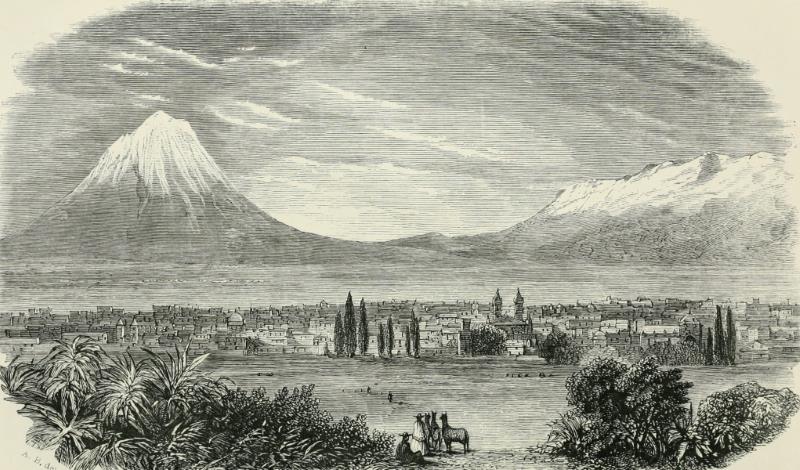
AREQUIPA.
Page 75.
At length our eyes were gladdened by the sight of the
green vale of Tiavaya, in the campiña of Arequipa. The
rows of tall willows, the bright green fields of lucerne, and
white farm-houses, were a blessed relief after the monotonous
glare of barren rocks and sand; but it was not until late at
night, and after a ride of more than fifty miles, that we
reached our hospitable lodging in the city of Arequipa.
Arequipa, the second city in Peru, is built on the banks
of the rapid river Chile, and at the foot of the great volcano,
called Misti, which rises up in a perfect cone to the
height of 17,934 feet, its upper half covered with snow.
Arequipa itself is 7427 feet above the sea, so that the mountains
ascend in one unbroken sweep upwards of 10,500 feet.
The climate, during my stay from March 11th to March
22nd, was as follows:—
| Mean temperature | 64⅓ |
| Mean minimum at night | 60½ |
| Highest observed | 67 |
| Lowest | 58 |
| Range | 9 |
The town is built of a white stone of volcanic origin, being a
trachytic tuffa containing pumice and lava, dug out of quarries
at the foot of the volcano. The houses are usually of one story,
built solidly and substantially, with vaulted stone ceilings,
the better to resist the shocks of the frequent earthquakes.
Like almost all Spanish American cities, the streets are
straight and at right angles to each other, with an azequia
flowing down the centre. Wheeled vehicles of any description
are unknown, and the traffic consists of horses, droves of
mules, donkeys laden with lucerne, and flocks of llamas. The
principal streets all lead to the great square, which forms a
busy and most interesting scene in the morning, the time for
marketing. It is then filled with gaily-dressed Indian women,
some sitting under shades, with their goods spread out on
the ground before them, and others, in constant movement,
threading their way amongst the sellers. Their dresses are
of baize, manufactured at Halifax,[123] of the gayest colours—consisting
of a skirt and mantle of the two most brilliant colours
they can find, red and blue, green and crimson, or purple and
orange. The effect of these bright-coloured groups, in constant
motion, as they move about buying fruit or vegetables,
potatoes, earth-nuts, medicinal drugs, corn, articles of dress,
and other necessaries, is very pleasing. The background is
formed by the handsome new cathedral of whitest stone, behind
which the noble volcano, and the peaks of Charcani (18,558
feet above the sea) dazzle the eyes by the brilliancy of their
snowy covering.
The campiña of Arequipa, which surrounds the city, is
about five miles broad from the foot of the cordillera to the
arid range of hills which separates it from the wilderness of
the coast; and about ten or twelve miles long, being bounded
at each end by a sandy desert. It is watered by the river
Chile,[124] coming from a chasm in the cordillera, on the north-west
side of the volcano, and by the streams called Posterio
and Savandia, which flow from the Pichu-pichu mountains to
the eastward of the volcano. These several streams unite on
leaving the campiña, and finally fall into the river of Quilca.
The campiña contains, besides the city of Arequipa, a number
of small villages, and numerous farm-houses. In March the
view from the hills above the city is most beautiful. The
brilliant green of the campiña, with its fields of maize and
alfalfa, its rows of tall willows, and orchards of fruit-trees, is
dotted with houses and villages, while it forms an emerald
setting to the white city. Looking from the other side of
Arequipa, the view, though not so beautiful, is more imposing:
the snow-capped volcano rearing its majestic head above the
stunted towers of the town. There is a great deal of maize
grown in the valley, and guano is extensively used as manure;
but the wealth of the campiña is chiefly derived from its
mules, which monopolize the carrying-trade from the coast
to Arequipa, and from Arequipa to the interior. A quantity
of lucerne or alfalfa is raised for their sustenance, and the
arrieros or muleteers are a wealthy class of men, generally
possessing a chacra or farm of their own, besides considerable
sums in ready money. They are, as a rule, good-looking,
well-grown men, with fresh complexions, and little mixed
blood, which is also made evident by the comparatively fair
complexions of their wives and daughters.
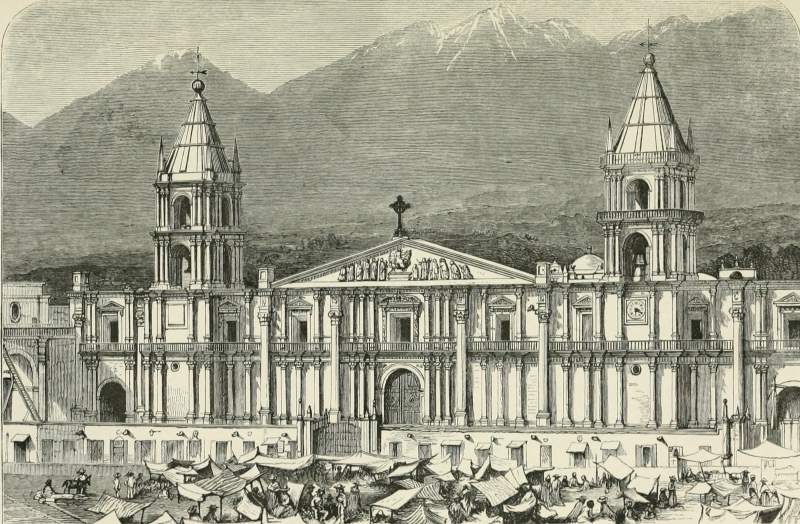
AREQUIPA CATHEDRAL.
From a Photograph. Page 76.
The families of the upper classes of Arequipa usually own
estates in the neighbouring warm valleys of the coast, such
as Vitor, Tambo, Siguas, Majes, and Camana, where the rich
vineyards yield them a profitable return by the sale of aguardiente.
Their houses in the city are built round a patio or
courtyard, on which the principal rooms open. Their sons
are frequently the leaders of the turbulent Cholos in revolt,
and follow the professions of abogados, lawyers or politicians,
traders, and haciendados or farmers, while the more ambitious
adopt a military life, the carrera de armas. The ladies are
considered the most beautiful and intelligent in Peru, and, at
Lima, the most attractive women are usually Arequipeñas.
Perhaps the majority have never moved beyond the campiña,
and adjacent warm valleys, and many have never seen the
sea. Yet they are sprightly and agreeable in society, full of
intelligent curiosity, and almost invariably excellent musicians.
They frequently sing the plaintive despedidas, and
other sonnets of their native poet Melgar, whose love for a
fair townswoman was unrequited, and whose melancholy fate
has surrounded his name with a halo of romance. He was
barbarously shot, after having been taken prisoner by the
Spaniards, at the battle of Umachiri in 1815, the first attempt
which the Peruvians made for their independence.
During the winter months the wealthier families remove
to villages in the campiña, either to Tingo, Tiavaya, or
Savandia, taking furniture with them. At the commencement
of the season droves of mules leave the city laden with beds,
chairs, and tables, to render the country houses habitable.
Here the Arequipeños enjoy the delights of the country and
of bathing in large swimming-baths faced with masonry, and
planted round with rows of tall willows. The rides in the
country which surrounds these villages are exceedingly
pretty. The trees consist chiefly of tall willows and of the
Schinus molle with its bunches of red berries, while bushes
of fragrant white Daturas and of the beautiful Bignonia
fulva fill the hedges, and the streams are bordered by
masses of Nasturtiums. The fields either bear crops of vivid
green alfalfa, or tall Indian corn, six to eight feet high, over
which the Tropæolum canariensis creeps in golden masses, and
at whose feet the bright blue lupins, and a Solanum with rich
purple flowers, grow as weeds. From many points of view the
rapid waters of the river Chile complete the picture, while far
away the snowy peaks of Chuquibamba, Charcani, and the
volcano glisten in the beams of the sun. Above Arequipa
the river flows through the valley of Chilinos, the steep sides
of which are lined with andeneria, or terraced maize-gardens,
with here and there a picturesque group of the stone huts
of the Indians, often completely hidden by the dark green
leaves and golden flowers of the gourds which cover
them. The courtyards of the houses are frequently ornamented
with a beautiful passion-flower, which creeps over
the trellised verandahs, and is covered with flowers. It is
a species of Tacsonia, called by the natives tumbo. The
flower has a very long tube, and is of a deep rich rose-colour:
and a delicious fresco, or sherbet, is made of the egg-shaped
fruit.
In addition to the baths of pure spring-water at Tingo
and Savandia, the medicinal baths of Yura are a great resort
during the winter months. Yura is thirty miles to the north-west,
and is situated, like Arequipa, just under the range of
the cordilleras. The road leads over very broken ground,
where the rugged spurs from the Andes project out into the
desert. In March the weary arid wilderness was enlivened
by wild flowers, bushes of yellow and purple Solanums, bright
orange Compositæ, and, in one place, a carpet of little purple
dwarf iris. The baths are in a green ravine, with tall willow-trees
and maize-fields, watered by a little rivulet. In this
narrow glen, bounded on one side by sandstone mountains,
which here form the base of the volcano, and on the other by
a ridge of trachyte, there are two places where thermal
waters bubble out of the rocks, one being ferruginous and the
other sulphurous. At the sulphurous baths there are some
solid stone buildings, intended as lodgings for the bathers,
with heavy arcades, and long vaulted rooms with no windows,
and without furniture, for, as at Tingo and Savandia, all
visitors bring their beds, tables, chairs, crockery, and cooking
utensils with them. In the bath-room there are four square
basins, faced with stone, of different temperatures, and called
the Vejeto (87° Fahr.), the Desague (88°), the Sepultura (89°),
and the Tigre (90°). They are said to cure dysentery, rheumatism,
and cutaneous diseases. The rivulet flows down the
glen and joins the river of Yura near a village called Calera,
where most of the soap is manufactured which is consumed
in Arequipa. Great quantities of carbonate of soda
are collected from the sandstone rock, which gives employment
to the people of the village. The land is divided
into topos (5000 square yards), each valued at a thousand
dollars, and every six weeks a harvest of salitre (carbonate
of soda) is reaped. From Calera there is a fine view of the
green valley of Yura, and of a grand range of porphyritic
mountains.
The population of the campiña and town of Arequipa is
reckoned at about 50,000.[125] The place was first colonized by
the Inca Mayta, who established a body of mitimaes or colonists
there, from the village of Cavanilla, near Puno, and
ordained that they should remain and settle there. Hence
the name "Ari quepay," "Yes! remain:" or more probably
it is derived from the words "Aric quepa," "Behind the sharp
peak." These mitimaes were the ancestors of the present
Indians, or Cholos as they are called, and were established in
villages in the campiña, occupied in the cultivation of maize;
but the city is purely Spanish, and was founded by Pizarro in
1540, at which time the stone-quarries first began to be
worked.
The Cholos or Indians of Arequipa have long been
notorious for their turbulence, and for the eagerness with
which they join any attempt at revolution, apparently from
mere love of excitement. They are addicted to the use of
chicha—a fermented liquor made from Indian corn—to such
an extent that it is said that nearly all the maize which is
raised in the campiña is used in brewing this liquor; under
the influence of which the Cholos have established the fame
of Arequipa as the grand focus of Peruvian revolutions.
But this habit of drinking to excess has rendered the
Cholos, though capable of fighting desperately behind walls,
quite worthless as soldiers in a campaign; and their habit
of body becomes so bad that a slight wound is frequently
fatal.
Though the received idea in Europe, that Peru is constantly
in a state of civil war, is erroneous in fact, as well as
unjust,[126] yet it is true that the period of tranquillity which had
lasted from 1844 to 1854 was broken in the latter year by
the successful revolution of General Castilla—the result of
the discontent caused by the dishonest financial measures
and the embezzlements of his predecessor; and two years
afterwards the Cholos of Arequipa commenced a rebellion
against Castilla. A brief account of the siege of that city,
which followed, will give a good idea of the endurance and
fighting qualities of the Cholos.
In October 1856 two young men of good family, named
Gamio and Masias, collected a handful of Cholos, and sent a
message to the Prefect Canseco, telling him that he must
either evacuate the city with his troops, or lay down his
arms. The prefect marched out, and left Arequipa in the
hands of the insurgents, who proclaimed the exiled General
Vivanco President of Peru, and appointed Don José Antonio
Berenguel prefect of the town; and most of the soldiers
who had marched out with Canseco returned on the following
day to join the rebels. Vivanco was an exile in Chile, but,
on receiving the news, he started for Islay by the English
mail steamer, and reached Arequipa in December; while
General San Roman, who had been sent from Lima to propose
terms of accommodation with the rebels, was dismissed,
and retired into the interior to collect forces for the support
of Castilla's government.
While the Cholos of Arequipa were maturing their rebellion,
a fortunate event placed the Peruvian navy at the disposal of
Vivanco. Their largest frigate, the 'Apurimac,' was lying
off Arica, and, while her captain, a rough old Chilian seaman
named Salcedo, was on shore, the crew, led by Lizardo
Montero, one of her lieutenants, a young man and native of
Piura, mutinied, declared for Vivanco, and steamed away,
leaving Salcedo storming on the beach. The 'Apurimac'
went at once to Islay, where Montero captured the port, and
where he was joined by two smaller steamers, the 'Loa' and
'Tumbez.'
Vivanco, meanwhile, had proclaimed himself "Regenerator"
of Peru, and offered his services as a lawgiver and
restorer of prosperity to his country, which were not accepted
or appreciated, as none of the other great towns followed
the example of Arequipa. Leaving a ministry consisting of
young inexperienced lawyers, who had nothing to lose and
all to gain, in charge of affairs at Arequipa, he embarked on
board the 'Apurimac,' in the end of December, 1856, and
sailed for Callao, but did not venture to disembark. He then
went on board the 'Loa,' leaving the 'Apurimac' to watch
Callao, and proceeded to Truxillo; while the 'Apurimac'
went down to the Chincha Islands, and began shipping off
the guano to any one who would buy it, thus leaving the port
of Callao open.
General Castilla is an old Indian, possessed of great military
talent and extraordinary energy and intrepidity; while
Vivanco is a native of Lima, of pure Spanish descent, indolent,
dilatory, and without personal courage; but eloquent
and persuasive, and possessed of qualities which have surrounded
him with numerous warm partisans and personal
friends. Between such men the issue could not be doubtful.
The veteran Castilla, as soon as the 'Apurimac' had sailed
for the Chincha Islands, formed the daring plan of attacking
his enemy in the north; and, in spite of the Navy, which had
declared against him, he bought an old steamer, the 'Santiago,'
belonging to the English Steam Navigation Company,
and boldly steamed away in search of the Regenerator. On
hearing of his approach, Vivanco was seized with a panic,
and, evacuating the places he had occupied, retreated to his
ships. He now thought that, in the absence of Castilla, he
might succeed in an attempt on the capital, and, collecting
all his vessels, he retraced his steps southward, and arrived
in Callao bay on April 22nd, 1857. A night attack was
then made on the fort, but, after some hard street fighting,
Vivanco's party were obliged to retire to their ships; and, his
expedition having proved a complete failure, the Regenerator
returned to Islay, and proceeded at once to Arequipa.
While Vivanco was absent in the north, General San
Roman had collected a considerable force in the interior, with
which he marched towards Arequipa. The warlike Cholos
came out to meet him, and a skirmish followed, which they
call the battle of Yumina. It consisted of a considerable
waste of powder, the two parties firing at each other, at very
long ranges, across a ravine; and in the afternoon the Cholos
returned in triumph to Arequipa. Having missed Vivanco
in the north, old Don Ramon Castilla steamed away to Arica
in the same old 'Santiago,' safely passing the rebellious fleet
at Islay, collected a force at Tacna, and, marching by land,
arrived in the campiña of Arequipa in the end of July; soon
afterwards establishing his head-quarters at the village of
Sachaca, some miles below the city, on the banks of the river
Chile. A detachment occupied Tiavaya, to cut off Vivanco's
communication with Islay.
The people of Arequipa were now hard at work to place
the city in a proper state of defence; barricades were erected
in the most important streets, and day and night the Cholos
were under arms. But, supplies having now entirely ceased
from the custom-house at Islay, Vivanco found himself in
great difficulties; for people, having little faith in the success
of his revolution, were unwilling to advance money in exchange
for his vales or promissory notes, even at a discount of
fifty per cent. The needy Regenerator then resorted to more
violent methods of raising money, and, breaking open several
of the principal shops, began to sell their contents to the
highest bidder.
Castilla made constant sham attacks upon the town, which
kept the inhabitants in a continual state of alarm; but all his
supplies were derived from Arica, by way of Tacna, as the
port of Islay remained in the hands of Vivanco's party. This
was his weak point; and when the 'Apurimac' arrived off
Arica, and her commander Montero, after a sharp street
fight, got possession of that port in February, 1858, Castilla
found himself in a position of great difficulty. His supplies
were entirely cut off, and it became necessary for him to
assault Arequipa at all hazards. Accordingly he moved from
his quarters at Sachaca and Tiavaya, marched round the
south side of the city, and early in the morning of March
5th, 1858, commenced an attack on the eastern suburbs. His
troops first stormed the church of San Antonio, and then
advanced to the attack of San Pedro, which had also been occupied
by the besieged. Here the Cholos held their ground for
four hours, from eight to twelve A.M., in spite of the desperate
attacks of Castilla's best troops, and the well-directed fire of
his artillery. At length, overpowered by numbers, they were
forced to retire, disputing every inch of the ground. They
rallied at the convent of Santa Rosa, and obstinately defended
the position for several hours, until night closed in upon the
combatants. Next morning, being the 7th of March, some
further resistance was made, but the troops of Castilla finally
stormed the barricades, and drove everything before them.
Vivanco escaped in the disguise of a friar to Islay, and thence
to Chile, while his officers looked after themselves, leaving
the gallant defenders of Arequipa to their fate. Tacna and
Arica at once returned to their allegiance, and the 'Apurimac'
was given up to Castilla's ministers at Lima by the
mutinous Montero.
The Cholos of Arequipa thus defended their position, with
great bravery and resolution, against Castilla's disciplined
army for upwards of eight months; and during the assault,
which lasted for two days, their desperate valour was as
remarkable as their extraordinary endurance, for, such was
the negligence of Vivanco and his officers, that they were
kept without refreshment or even water during the many
hours in which they sustained a deadly and unequal struggle
against Castilla's troops. It should also be recorded to their
credit, that, although the town was on several occasions entirely
in their hands, there was no instance of any act of
pillage or excess being committed by them; and, when all
authority was withdrawn, they showed no disposition to take
advantage of their power, but displayed a regard for order
which would not be found among the lower orders of most
other countries during periods of great excitement.
There is a very striking difference, however, between the
Cholos of Arequipa and the Inca Indians of the interior, who
appear in the streets with their llamas laden with silky vicuña-wool:
the former a turbulent, excitable race, who will
fight desperately behind walls, but who are without stamina
and quite unable to endure fatigue; the latter a patient,
long-suffering people, capable of extraordinary endurance,
and, as soldiers, in the habit of marching distances which
appear incredible to those whose experience is confined
to the movements of European troops. There is an evident
mixture of Spanish blood in the people who inhabit Arequipa
and its campiña, while the Indians of the interior are for the
most part of pure descent.
The road over the cordilleras to Cuzco and Puno leaves
Arequipa by the southern suburb, and, after a few miles,
ascends a rocky ridge to the more elevated valley of
Chihuata or Cangallo (9676 feet above the sea[127]), at the foot
of the southern spur of the volcano. A wretched stone hut
with a mud floor is here the only shelter for the traveller.
At one end a fire of sticks, where an old hag acted as cook,
filled the interior with smoke, and at the other each wayfarer,
as he arrived, made a shakedown of blankets and ponchos,
sipped his chocolate, and, after a short conversation, composed
himself for the night. The fire gradually smouldered
and went out, and the old woman, with a brood of children,
made a heap at the further corner.
At early dawn of the 23rd of March we were all in motion, and
our companion of the previous night, a Spaniard with a large
tropa of mules laden with aguardiente, was busily preparing
for a start. As the sun rose, the dazzling white of the snowy
peaks of Pichu-pichu and the volcano, with fleecy clouds
above their summits, gave a glorious effect. The rest of the sky
was blue, gradually clouding over as the morning advanced;
and the valley was covered with alfalfa-fields of the richest
green, with the pretty little village of Cachimarca perched on
a rounded hill to the southward. The flowering shrubs by
the roadside are the same as in the campiña of Arequipa,
except that a small yellow Calceolaria is more abundant. The
morning air was fresh and bracing as we mounted our mules
and faced the long zigzag path up the "alto de los huesos,"
the southern spur of the volcano, so called from the bones of
thousands of mules which are met at every turn. This ascent
conducts the traveller from the temperate valley of Cangallo
to the bleak and chilling plains of the upper cordillera.
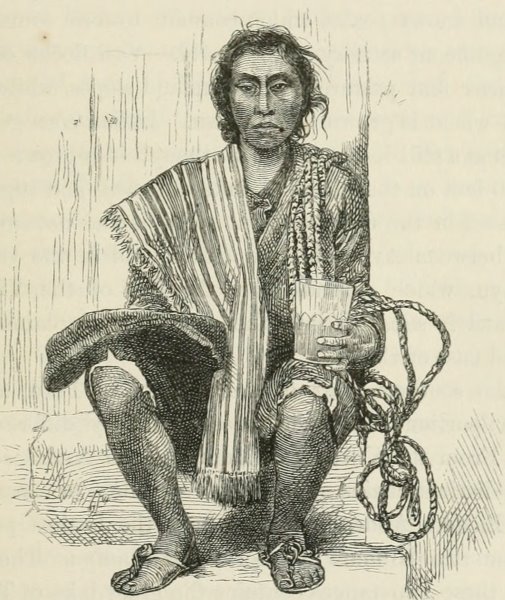
A CHOLO OF AREQUIPA.
From a Photograph. See page 80.
JOURNEY ACROSS THE CORDILLERA TO PUNO.
In the region of the cordillera of the Andes, in Northern and
Central Peru, the country is broken up into deep warm
valleys and profound ravines, separated by lofty precipitous
ridges and snowy peaks, which combine to form some of the
most magnificent scenery in the world. Vast flocks of sheep
and alpacas find pasture on the upland slopes, while abundance
of wheat is grown lower down. Indian corn generally
flourishes at a still lower elevation, though it is grown as high
as 13,000 feet on the islands of lake Titicaca, and sugar-cane
is cultivated in the deep valleys. This is the nature of the
country between Ayacucho and Cuzco, and in the valley of
Vilcamayu, which extends from the foot of the Vilcañota
range until it subsides into the vast tropical plains to the
north and east of Cuzco.
But the southern part of the interior of Peru, and the
northern portion of Bolivia, present a very different character.
From the Vilcañota mountains the Andes separate
into two distinct chains, namely, the cordillera or coast-range,
and the Eastern Andes, which include the loftiest peaks in
South America, Illimani and Sorata, or Illampu. The region
between these two ranges contains the great lake of Titicaca,
and consists of elevated plains intersected by rivers flowing
into the lake, at a height never less than 12,000 feet above
the sea. The magnificent scenery of Northern and Central
Peru is wanting in this southern part of the country, which
composes the department of Puno, and is usually called
the Collao. It, however, possesses features of its own which
are at once striking and imposing, while the land which is
drained by the lake of Titicaca was the cradle of the civilization
of the Incas.
The journey up the "Alto de los huesos" is very fatiguing,
and the change from the pleasant exhilarating air of Chihuata,
to the chilling icy blasts which constantly sweep over the
upper region of the cordillera, was severely felt. As the
afternoon advanced a drizzling mist came on, and added to
the cheerless desolation of the plains it was necessary to
traverse before reaching the post-house of Apo. Occasionally
a drove of llamas, with their Indian driver, loomed for a
moment through the mist, and at nightfall we arrived at the
post-house of Apo (14,350 feet), tired, drenched, and cold.
The rainy season of the cordilleras commences in November,
and continues until the end of March, and during most
of that time the discomfort of travelling is so great, and the
rivers so swollen, that a journey is seldom undertaken by an
ordinary traveller. In March, however, the rain does not
fall continuously or in any quantity. The early morning is
generally clear, but in the afternoon mists, rain, or snow
begin to fall, and continue until far into the night. From
April until October is the dry season, and in May, June,
July, and August a cloud is scarcely ever seen in the sky.
The post-houses in the desolate mountains between
Arequipa and Puno are all of the same character. They
consist of a range of low stone buildings surrounding a courtyard
on three sides, and consisting of five or six rooms with
mud floors, a rough table, and a platform of stone and mud
at one end, which is intended for a bed-place. The roof is
badly tiled or thatched, and the doors are so roughly fitted
that it is impossible to close them. Both man and beast are
subject to a most distressing illness, caused by the rarefaction
of the air at these great altitudes, which is called sorochi by
the Peruvians. I had suffered from a sharp attack of illness
at Arequipa, so that I was probably predisposed to a visitation
from sorochi, which I certainly endured to its fullest
extent. Before arriving at Apo, a violent pressure on the
head, accompanied by acute pain, and aches in the back of
the neck, caused great discomfort, and these symptoms increased
in intensity during the night at the Apo post-house,
so that at three A.M., when we recommenced our journey, I
was unable to mount my mule without assistance.
A ride of seven hours across grassy plains covered with
herbage, with patches of snow here and there, and ranges of
hills with fine masses of rocks, forming a setting to the distant
peaks of the cordillera, brought us to the post-house
of Pati. During this ride we had to ford the river, which
flows past Arequipa as the Chile, more than a dozen
times. The only living creatures are the lecca-leccas, a bird
which frequents the numerous streams, and the graceful
flocks of vicuñas. The lecca-lecca is a large plover, with red
legs, white head, grey body, white under the breast and tail,
and wings and tail broadly edged with black. It incessantly
utters a wild shrill scream. The vicuñas, a species of llama
with the habits of an antelope, are very beautiful and graceful
creatures. They have rich fawn-coloured coats, with patches
of white across the shoulders and inside the legs, and long
slender necks. They are constantly met with in the most
desolate parts of the cordillera, browsing on the tender shoots
of the tufts of ychu, or galloping along with their noses close
to the ground, as if they were scenting out the best pasture.
At Pati a range of abrupt porphyritic cliffs rises from the
plain, up which a rough zigzag pass leads to the "Pampa de
Confital,"[128] the loftiest part of the road over this pass of the
cordillera. A storm of hail began to fall, which turned into
snow as we reached the pampa, and a ride of many hours
over a succession of wild desolate plains, in an incessant snow-storm,
brought us to the "alto de Toledo," the highest part of
the road, and 15,590 feet above the level of the sea.[129] Some
glorious snowy peaks appeared through the gloom at sunset,
and after several weary hours in the darkness we at length
arrived at the post-house of Cuevillas.
In the neighbourhood of Cuevillas there are large sheep-farms,
one called Toroya, near the "alto de Toledo," and
another called Tincopalca farther on. The sheep, at this
enormous height, lamb in March and July, and, of the March
lambs, usually about fifty per cent. survive. Beyond Cuevillas
there are two large Alpine lakes, whence a river flows down
into Titicaca, and we thus passed the watershed between
the Pacific and the great lake. The scenery is grand and
desolate, reminding me, in some respects, of the interior of
Cornwallis Island in the Arctic regions. The road passes
between the two lakes, and we reached the post-house of La
Compuerta as the afternoon rain commenced. The hills are
covered with tufts of coarse grass (Stipa ychu), of which the
llamas eat the upper blades, while the sheep browse on the
tender shoots underneath; and with two kinds of shrubby
plants, one a thorny composita called ccanlli, and the other
called tola or ccapo, which is a resinous Baccharis,[130] and is
used for fuel.[131]
The gorge in which the La Compuerta post-house is situated
is the only outlet for the waters of the lake. Mountains
of great height rise up on either side, clothed, at this
season, with herbage of the richest green, while ridges of
scarped cliffs of dark porphyritic rock crop out at intervals.
The river dashes noisily over huge boulders, and near its
left bank are the rough stone buildings of the post-house.
Great quantities of ducks, gulls, coots, godwits, and sandpipers
frequent the shores of the lake. The postmaster
supplied alfalfa for the mules, and a chupé consisting of
potatoes and salt mutton for the travellers, at exorbitant
prices; the mules were freed from their cargoes, which were
placed within the porch, ready lashed up in their redecillas or
hide nets; and we were soon rolled up in blankets and ponchos,
while the snow continued to fall unceasingly through
the early part of the night. When we got up next morning
the thermometer was at 31° Fahr. indoors.
Starting at dawn, we descended the gorge, passing two
ruined mining establishments, San Ramon and Santa Lucia,
into green plains with large flocks of sheep scattered over them.
In these uninhabited wilds it is an event to meet a
traveller, and his appearance is the signal for a succession
of questions and answers. We here passed a cavallero, in
whose dress and general appearance we saw a reflection of
our own, excepting the comforters. He wore a large poncho
of bright colours, reaching nearly to his heels; a broad-brimmed
felt hat with a blue cotton handkerchief passed over
it, and tied in a knot under his chin; an immense woollen
comforter passed round his throat and face, until nothing
appeared but his eyes; a pair of woollen gaiters, bright green,
with black stripes; and huge spurs. He was an officer on
his way to Arequipa, and complained of the severity of the
weather and the heaviness of the roads. After a short
conversation the traveller passed on, followed by his cargo-mules,
and soon became a speck in the distance.
In the afternoon we came to the first signs of cultivation,
since leaving the valley of Cangallo, in the neighbourhood of
the great sheep-farm of Taya-taya—patches of quinoa, barley,
and potatoes, with the huts of Indians scattered amongst
them; and, crossing a rocky ridge, we came in sight of a vast
swampy plain, with the little town of Vilque, at the foot of
a fine rocky height, in the far distance, which we reached
at sunset. The long rows of thatched brown huts dripping
with rain, and the muddy streets, looked melancholy. But
at the time of the great fair, in June, Vilque presents a very
different appearance. The plains, for several miles beyond
this little town, were so swampy as to be rendered almost
impassable. It was with the greatest difficulty that we
made our way across them, constantly wading and splashing
through water, and in some places sinking so deep in the
adhesive mud, that it was not without desperate exertions
that the mules could extricate themselves. At length we
came to a rocky ridge which bounded the vast pampa of
Vilque, and continued our journey over rather drier ground.
Since leaving La Compuerta we had been continually
descending; the vicuñas had disappeared, as they confine
themselves to the loftiest and wildest parts of the cordillera;
but, in the lower region between Vilque and Puno, the feeling
of desolation and solitude is dissipated by the numbers of
birds which enliven the country, and by the increased quantity
and variety of wild flowers.
The lecca-leccas or plovers were very numerous, screaming
shrilly as they flew in circles, or ran along the ground. In
the clefts of the rocks there were many birds, like creepers,
called haccacllo by the Indians, and pito in Spanish—beaks
curved downwards, black on the top of the head, white underneath,
red at the back of the neck, speckled wings, white
breast, and a black line from the beak to the back of the
neck. We also saw many small green paroquets, bright
yellow finches called silgaritos, a kind of partridge called
yutu, and, above all, the glorious coraquenque or alcamari,
the royal bird of the Incas, whose black and white wing-feathers
surmounted the imperial llautu or fringe of the
sovereigns of Peru. The alcamari is a large and noble-looking
bird of prey, with a scarlet head, black body, and
long wing-feathers of spotless white. Wherever the plains
are intersected by ridges of rocky cliffs, which is frequently
the case, there are swarms of large rodents, called biscaches,
which sat on their hind legs, and looked about inquisitively
as we rode past.
Riding over several wide grassy plains, and passing the
village of Tiquillaca, we arrived at the banks of the river
Tortorani, which was so swollen as to be quite impassable.
By following its course for about half a mile, we came to a
place where the whole volume of water precipitates itself
down a sheer declivity of 250 feet, and forms a magnificent
cascade. A league below the falls we found a bridge, and,
at sunset, we came in sight of the great lake of Titicaca,
with the snowy range beyond. A steep zigzag descent leads
down to the city of Puno, which is close to the shores of the
lake, and hemmed in by an amphitheatre of argentiferous
mountains.
Puno, the capital of the department, owes its origin and
former prosperity to the rich veins of silver-ore in the surrounding
country. It is approached, from the north, by a
stone archway built over the road by General Deustua, who
was prefect in 1850; and the streets slope by a gradual
descent towards the lake. The houses are built of small-sized
brown adobes, with roofs of thatch or red tiles, and
courtyards very neatly paved with round pebbles and
llama's knuckle-bones in patterns. There are scarcely any
with more than a ground-floor, and the rooms open on to
the court; but, though at this elevation, 12,874 feet above
the sea, it is extremely cold at night, stoves are unknown;
and the unusual luxury of a fireplace, which exists in one
house, is merely a luxury to the eye, for it is never lighted.
The streets are clean and well paved, and the stone church
in the Plaza, dating from 1757, has an elaborately carved
front and two towers. In another plaza is the college, a
large building with an upper story, also built by General
Deustua; and both these public squares have bronze fountains
erected by the Government of General Echenique, the
late President, besides drinking fountains in the corners of
several of the streets. The water is excellent.
Puno is surrounded by heights covered with patches of
potatoes, barley, and quinoa (Chenopodium quinoa), the huts of
Indians being interspersed amongst them; and immediately
over the town there is an isolated rocky ridge of carboniferous
limestone perforated by several natural caverns, called the
Huassa-pata. The shores of the lake are a few hundred
yards from the town, and at the little port there are always a
number of balsas, made of large bundles of reeds tied together,
with a reed sail.[132] The view to seaward is, however, confined
by the peninsula of Capachica, and two islands at the mouth
of the bay of Puno. A canal to enable balsas to come up
nearer the town was made by the Spanish Intendente
Gonzalez Montoya in the beginning of the present century.[133]
The flora of a country which, though within the tropics, is
at an elevation of nearly thirteen thousand feet above the
sea, must necessarily be meagre, and the few plants are lowly
and inconspicuous. I noticed the following in the immediate
vicinity of Puno. The only tree was one of stunted growth,
with a pretty pink and white flower, and dark-green leaves,
almost white underneath, called "oliva silvestre" by the
Spaniards, and ccolli in Quichua (Buddlea coriacea); and of
these there were not more than a dozen, sheltered behind
walls. By far the greater number of plants are Compositæ: of
these I observed three species of Tagetes—one with a small
yellow flower; another very sweet, called by the Indians
huaccatay and chicchipa, and used to flavour their chupes;
and a large shrubby marygold, called sunchu;[134] also the common
sow-thistle, a Hieracium, and the tola and ccanlli before
mentioned, used for fuel. I found two Verbenas and a
Solanum, all with purple flowers; a clover, a creeping cucurbitaceous
plant, two Cacti, a large dock, three Geraniums, all
with pink flowers; three Crucifers, very small herbs, one with
a white flower, one with a yellow flower, and the third the
common shepherd's-purse; a Gilium with a minute white
flower, a small legume with tomentose leaves, a pretty little
creeping Adoxa, a Statice, a wild Chenopodium, a Veronica,
a minute Stellaria, a Rhinanthus, a mallow, a plantago, and
three species of wild Oxalis, two very minute with white flowers,
and one with a yellow flower. There were also two ferns, one
a very beautiful Gymnogramma with silvery fronds; nine
grasses, the most abundant of which was the coarse Stipa ychu;
and a few mosses. On the shores of lake Titicaca I saw
rushes in great quantities, a Mimulus, a Ranunculus, a Rumex,
and three grasses. These plants, though lowly and unpretending,
are in sufficient abundance to cover the country with
verdure and pretty wild flowers, and brighten those parts
which are not cultivated. The cultivation consists of quinoa,
cañahua (both Chenopodia), barley, potatos, ocas (Oxalis
tuberosa), and wheat in very small quantities, which does not
ripen.
Close to Puno, on the south, are the famous silver-bearing
mountains of Cancharani and Laycaycota, to which Puno
owes her existence: and to the discovery and working of the
Laycaycota mine in the middle of the seventeenth century a
very curious history is attached; which is always talked of
by the people of Puno as one of the principal events in the
annals of their city.
In about 1660 an exceedingly rich vein of silver had been
discovered on the hill of Laycaycota, by one José de Salcedo,
which was called the "Veta de la Candelaria." One account
says that the secret of its existence was revealed to Salcedo
by an Indian girl. José de Salcedo, and his brother Gaspar,
continued to work this vein, and several others which were
opened on the Cancharani and Laycaycota hills; enormous
quantities of silver were extracted; and the fame of his
enormous wealth, and its source, attracted crowds of unruly
people to the spot, from the various towns of Peru.[135] Salcedo
is said to have been generous and open-handed in finding
employment for applicants, but, from some unexplained cause,
tumults took place at the mines in 1665, which, from first to
last, are said to have caused 450 violent deaths. The governor
of the district, Don Angelo de Peredo, seems to have taken
part against the Salcedos, who retired to the village of Juliaca,
with a body of armed followers, in November, 1665. In March,
1666, they attacked the governor's people who had possession
of the mines; Salcedo neglected repeated orders to come
to Lima; and was accused of having threatened to extort
a general pardon from the Viceroy, at the head of a thousand
men. Salcedo himself, however, appears to have been
absent at Cuzco when the attack was made on the mines.
These tumults, accompanied by much bloodshed, continued
until 1669, when the Viceroy Count of Lemos came to Puno
in person, and settled the question by sending José and
Gaspar de Salcedo to Lima, where José was tried, condemned,
and executed. Gaspar was detained a prisoner in Callao
castle.
It was the general impression at the time, and is so still at
Puno, that jealousy and envy of their riches occasioned the
persecution of these men; for not only were the charges
against them most frivolous, but the Count of Santistevan,
the predecessor of the Count of Lemos, had caused the
Bishop of Arequipa to publish a general pardon of all
offences in 1666. The accusations against José Salcedo were
that he went about with armed men, took a seat next to the
corregidor at a bull-fight in Cuzco, and neglected to obey the
order to come to Lima.[136]
A petition was afterwards sent to Spain, representing that
the Salcedos were the victims of injustice, and not guilty of
disloyalty; that the Viceroy's proceedings were irregular;
and that the heirs of the Count of Lemos were bound to
make reparation for the evils caused to these deserving men.
The petition also prayed that the President of the Council of
the Indies might not be allowed to decide the case, because
he was related to the Count of Lemos.[137] This petition seems
to have received favourable consideration; for I find that the
son of José de Salcedo was afterwards created Marquis de la
Villa Rica de Puno, and that he took a leading part in subsequent
mining operations.
The most remarkable part of this story is that on the day
of Salcedo's death the mine became full of water, and the
Viceroy was thus disappointed in his expectation of succeeding
to the wealth of which he had deprived his victim.
This curious coincidence made a great impression on the
Indians, which is not yet effaced; and they still point out a
small lake or pond that is said to cover the once rich vein or
"Veta de la Candelaria."
Salcedo's son, the Marquis of Villa Rica, attempted to
reach his father's source of wealth by cutting a horizontal
adit or socabon in the side of the hill looking on lake
Titicaca; and he is said to have penetrated nearly 700 yards,
and within sixty yards of his father's perpendicular shaft;
but his funds failed him, and he died mad. In spite, however,
of the filling up of the "Candelaria," great numbers of other
shafts were sunk, and much silver was extracted, both by the
Marquis, and by other speculators. A report, dated 1718,
mentions as many as forty-six shafts on the hills near Puno,
which were then being worked.[138] In 1740 a native company
attempted to finish the socabon which had been commenced
by the Marquis, but their workmen were unable to cut
through the masses of porphyry, and, after vast expense, it
was abandoned a second time.
From 1775 to 1824 the mines near Puno yielded ores
worth 1,786,000 marcs of silver, at seven to nine dollars the
marc; the richest year being 1802, when the yield was
52,000 marcs; but since 1816 it has been steadily decreasing,
and in 1824, the year after the expulsion of the Spaniards, it
had sunk very low. In 1826 the manto mine, to which the
socabon leads, which was excavated by the Marquis of Villa
Rica, was granted to General O'Brien, a gallant and enthusiastic
old Irish hero of South American independence, who
resumed the work, but without any success. Mr. Begg, an
enterprising English merchant, undertook the completion of
the socabon in 1830. He imported expensive machinery from
England, employed an intelligent engineer named Patterson,
and continued to work the manto mine until 1839. He built
himself a house furnished with every English comfort, and lived
in very good style; but the speculation was a failure, and he
left the country a poor man in 1840, and died in Chile.
After the departure of Mr. Begg, some Peruvian speculators
continued to work at the same mine, but without any energy;
and, at the time of M. de Castelnau's visit in 1845, only
thirty workmen were employed.[139] When Lieut. Gibbon,
U.S.N., passed through Puno in 1851, the manto was still
being worked, but at the time of my visit it had been entirely
abandoned since 1858.
It is one of the great evils arising from the political condition
of Peru since the independence that there is a complete
want of confidence in each other amongst the moneyed
classes, and an absence, to a great extent, of the spirit of
enterprise; so that any combination on a large scale for
mining, or other purposes of a similar nature, is almost impossible.
Peru is still a very young country, and there is
reason to hope that this state of things will not continue;
but now a feeling of suspicion, added to a want of energy,
prevents the formation of native companies. Thus the
manto is abandoned, and the numerous mines which once
covered the hills of Cancharani and Laycaycota, and actually
created the city of Puno, which nestles at their feet, are not
worked. At present there is only one small mine at work,
high up on the hill of Cancharani, called the Cachi Vieja.
Its proprietor, Don Manuel Ferrandis, is an upright, intelligent,
and most kind-hearted old gentleman, who has had
much experience in mining operations; and on the 29th of
March he took me to visit the abandoned manto, and his own
works at Cachi Vieja.
About two miles south of Puno is the establishment built
by Mr. Begg, at the foot of the Laycaycota mountain, and
facing the lake. The buildings stand round a long courtyard,
containing four trees of the oliva silvestre, probably, as
the only trees in the country, once carefully tended by the
former English residents. There is a steam-engine which
turns a large stone wheel, twelve feet in diameter, for grinding
the ores; and the quicksilver was separated by the heat of
fires of llama-dung and tola,[140] the only fuel to be had. In the
house there were papered rooms, fire-grates, and English
conveniences, now all in ruins, and the rooms used as stables
for donkeys. At a short distance from Mr. Begg's ruined
house, and a little higher up the mountain, is the entrance to
the famous "Socabon de Vera Cruz" of the manto mine, commenced
by the Marquis of Villa Rica, and finished by Mr.
Begg. The "socabon" penetrates into the mountain, in a
generally south-west direction, for a distance of a mile and a
quarter; the first 900 yards having a depth of some feet of
water, which is dammed up at a little distance outside the
entrance. This part of the gallery is navigated by an iron
canoe about a foot and a half wide; but the canal is so
narrow that the canoe frequently grates on both sides at
once against the rocks. The roof of the excavation, too, is
very low, and several times we actually had to crouch down
in the bottom of the canoe, to avoid knocking our heads.
Thus we penetrated into the bowels of the earth by this
subterranean navigation, with an Indian holding a burning
torch in the bows. From the entrance, for about 300 yards,
the excavation traverses a mass of grey porphyry. In the
900 yards of navigation there are six locks; and when the
water terminates, the gallery continues for a hundred yards,
where there is an iron tramway laid down. The metal was
dragged down to the head of navigation in cars, by two old
mules, one of which had not seen daylight for fifteen years
when they ceased to work the mine. At the point where
the tramway comes to an end, the gallery still continues for
1200 yards; but this part is very narrow and tortuous, and
the metal was carried down to the cars on the backs of
Indians. The rock at the extreme end of the excavation is a
very hard green porphyry, with quartz and veins of silver ore.
The Cachi Vieja works are high up on the Laycaycota
hill, and not far from the famous "Veta de la Candelaria."
The mouth of the shaft is in a building opening on
a courtyard, where women were sorting the ores in small
heaps. The most abundant ore is called brosa, containing
forty marcs of silver in the cajon of fifty quintals (cwts.);
other ores are called rosicler, pavonado, and polvarilla. The
rosicler, or ruby silver, is a most beautiful rose-coloured
mineral, containing a considerable quantity of silver.[141]
Besides Cachi Vieja in the immediate vicinity of Puno,
there are some very productive silver-mines at San Antonio
de Esquilache, twenty miles south-west of that town, which
have been worked since 1847 by Don Manuel Costas, one of
the most influential citizens of Puno, and my host during my
stay in that city.
Wool and silver are the great staple products of the
department of Puno; the whole value of exported articles
being about 1,200,000 dollars.[142] The population is rather
under 300,000 souls; that of the town of Puno 9000.[143]
Upwards of 1,500,000 dollars come into the department
yearly, either in payments for wool, or in salaries for officials,
without counting the expenditure for the troops; and
it is calculated that more than half this sum eventually finds
its way into the hands of the Indians, who bury it. Thus, in
considering the mineral wealth of Peru, the enormous quantities
of coined money, and vases or other articles made of the
precious metals, which have been buried by the Indians, must
be taken into consideration; for this practice has been going
on since the time of the Incas. Now that the currency consists
almost entirely of the debased half-dollars of Bolivia, if a
Spanish dollar or any other good coin is accidently received
by an Indian, it is immediately buried.
The principal people in Puno, during my visit, were
General San Roman, in command of the army of the South,
an old man with the face and head of a pure Indian, and
plenty of white hair brushed off his forehead, who has been
mixed up in all the wars since 1822, and from whom I
received much information respecting the Indian rebellion
of Tupac Amaru in 1780, and of Pumacagua in 1815; Señor
Garces, the Prefect; Don Juan Francisco Oviedo; Don
Manuel Costas; and Don Manuel Ferrandis, the proprietor of
the mine on the Laycaycota hill. Every evening there was
a party assembled at the house of the latter to drink coffee,
and talk over the news of the day. On these occasions,
amongst other topics of conversation, the possibility of forming
a company for the navigation of lake Titicaca was
frequently discussed. Costas had first been struck by the
immense good that steam navigation on the lake would bring
to the department of Puno in 1840, and in 1846 he purchased
a small steamer called the 'Titicaca,' and had her sent out
in pieces. He sold her to the Government, on condition
that they would defray the expense of sending her up to the
lake; but this was never done. It is considered that any
steamers which may hereafter be ordered for this purpose
should be about forty tons, drawing four and a half feet, with
paddles (as a screw would inevitably foul amongst the rushes),
and accommodation for passengers on deck. They would take
all the products of the Bolivian forests, bark, timber, chocolate,
coca, fruit, and arnotto, to Puno; European manufactured
goods, sugar of Abancay, and aguardiente of the coast, from
Puno to Bolivia; provisions and traffic of all kinds amongst
the Indians of the shores; and copper of Coracora to Puno.
Timber in vast quantities might be felled in the forests of
Caravaya, and floated down the rivers of Azangaro and
Ramiz during the rainy season, which, with the coal on the
island of Soto, would furnish supplies of fuel. Markets and
easy means of communication having been formed, the trade
would rapidly increase on all sides. The face of the country
would be entirely changed; the people, finding new wants,
would become more civilised; and Puno, instead of a city
with empty silent streets, and half a dozen balsas at its
anchorage, would be a flourishing and busy port.[144] These
bright prospects, however, will require time, and a total
change in the political condition of Peru, for their realization
in a somewhat distant future.
It is also a very important question whether larches, firs,
and birch-trees might not be naturalized in the more
sheltered ravines of these lofty treeless regions; where large
plantations might be formed for the supply of timber and fuel.
The Indians are now entirely dependent, for the framework of
their roofs, on the crooked poles of the queñua tree (Polylepis
tomentella); and for fuel on llama's dung and the tola shrubs
(Baccharis). The winters, from May to September, are not
nearly so cold as in Scotland, though very dry; and, during
the summer or rainy season, though it is cold, there is plenty
of moisture. The introduction of these plantations would
change the whole face of the country, and the introducer
would confer an inestimable blessing on the inhabitants.
I remained for some time at Puno, in order to collect
information, and come to a determination respecting the best
course to pursue in the performance of the service on which
I was employed. The supply of the bark of Chinchona
Calisaya trees is now entirely procured from the forests
of Munecas, Apollobamba, Yuracares, Larecaja, Inquisivi,
Ayopaya, and the yungus of La Paz in Bolivia; but
I found that the difficulties in the way of making a collection
of plants and seeds in these districts would be
very great, and it afterwards turned out that these difficulties
would have been insurmountable. As a considerable
part of the revenue of Bolivia is derived from the
bark trade, which is not the case in Peru, the Bolivians
are exceedingly jealous of their monopoly; and the nature
of my mission was already suspected. Moreover there was
an imminent prospect of a war between Peru and Bolivia;
a large army was massed in three divisions—at Puno under
General San Roman, at Vilque under Beltran, and at Lampa
under Frisancho; and, as soon as hostilities commenced, it
would have been next to impossible for a private person to
preserve his mules from seizure. This war did not actually
take place, but Linares, the President of Bolivia, issued a
decree on May 14th prohibiting all traffic, or the passage
of travellers, from one country to the other;[145] a decree which
was strictly enforced, and which would have rendered it
impracticable at that time to have conveyed myself and
companion, with laden mules, from Bolivia to the coast,
without long delays and detentions. One of the pretexts
for this threatened war is perhaps the most extraordinary
that has ever been alleged in modern times; namely, that
the Bolivian Government persisted in coining and deluging
Peru with debased half-dollars. A strange way of settling
a financial difficulty!
While these objections weighed against an attempt to
collect plants in the forests of Bolivia, I found that, with
regard to the chinchona forests of the Peruvian province
of Caravaya, on the frontier of Peru and Bolivia, the facilities
for such an enterprise would be much greater. I had reason
to believe, though I afterwards found myself in error, that,
as there was no bark trade in Peru of any importance,[146] no
jealousy would be felt at the nature of my mission. Any
hostile proceedings on the Bolivian frontier would not
materially affect the route between the Caravaya forests
and the coast; and, above all, Caravaya is much nearer and
more accessible, as regards an available seaport, than any
part of the chinchona forests of Bolivia. This latter point was
of the very greatest importance, because success depended
chiefly on the rapidity with which the plants could be
conveyed across the frozen plains of the cordilleras. I
knew from Dr. Weddell that, though the bark trade from
Caravaya has now ceased, and bark from that district is
of no market value, owing to a foolish habit of adulteration
amongst speculators in former times, yet that young plants,
and trees bearing fruit, of the Chinchona Calisaya, and other
valuable species, were abundant in the forests of that province,
as far north as the valley of Sandia.
I, therefore, after much anxious consideration, determined
to proceed direct from Puno to the forests of Caravaya.
During my stay at Puno I had opportunities of examining
some interesting ruins, and of collecting information respecting
the Indian population of Peru, especially with regard to
the great insurrections of Tupac Amaru and Pumacagua in
1780 and 1815. Much of this information is quite new; and
I, therefore, trust that a description of ancient ruins near
Puno, and an account of some of the most stirring events
connected with the Indians since the Spanish conquest, may
prove of sufficient general interest to justify a halt on the
road to the chinchona forests, and a brief digression from the
principal subject of the present work.
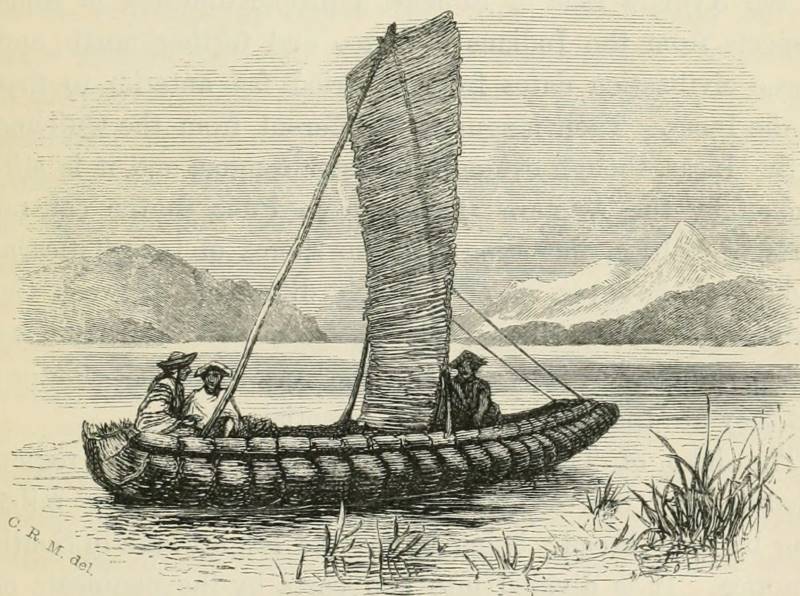
BALSA ON LAKE TITICACA.
See page 95.
LAKE TITICACA.
The Aymara Indians—Their antiquities—Tiahuanaco—Coati—Sillustani—Copacabana.
The region which is drained by rivers flowing from the
maritime cordillera and the eastern range of the Andes into
lake Titicaca consists of elevated plateaux, seldom less than
13,000 feet above the sea, which were originally inhabited
by the Aymara race of Indians, a people differing in some
respects from the Indians of Cuzco and further north, and
whose civilization dates from a period far anterior to that
of the Incas. Their language is different from the Quichua
of the Incas, though evidently a sister tongue, and it is still
spoken by the Aymara Indians from Puno to the central
parts of Bolivia, including all the shores of lake Titicaca.
I did not, however, observe much difference between the
Indians of Puno, who speak Aymara, and the Quichua
Indians of Cuzco. The men are, perhaps, somewhat stouter;
but they are the same race in all essential points.
The lake of Titicaca, the great feature in the region
inhabited by the Aymara Indians, is about eighty miles
long by forty broad; being by far the largest lake in South
America. It is divided into two parts by the peninsula of
Copacabana; the southern division, called the lake of
Huaqui, being eight leagues long by seven, and united to
the greater lake by the strait of Tiquina. A number of
rivers, which are swollen and of considerable volume during
the rainy season, flow into the lake. The largest of these
is the Ramiz, which is formed by the junction of the two
rivers of Pucara and Azangaro, and enters the lake at its
north-west corner. The Suchiz, formed by the rivers of
Cavanilla and Lampa, also flows into the lake on its north
side, as well as the Yllpa and Ylave; while on the eastern
side are the rivers Huarina, Escoma, and Achacache, all
flowing from a low lateral chain, parallel with the great
eastern Andes, whose gigantic peaks of Illimani and Sorata
form the principal feature of the views from all parts of the
lake. Much of the water thus flowing in is drained off by
the great river Desaguadero, which flows out of the south-west
corner, and disappears in the swampy lake of Aullagas,
in the south of Bolivia; and perhaps a greater quantity is
taken up by evaporation; for the volume of water which
flows in during the rainy season, when the sun travels
north, is drunk up again when the tutelar deity of the
lake returns, between April and September.[147] Indeed it
is evident that the waters are steadily receding, under the
combined influence of evaporation and of the sediment
brought down by the rivers. Lake Titicaca is very deep
in some places, the deepest part being on the Bolivian
side; but in others it is so shoal that there is only just
room to force the balsas through the rushes. The winds
blow from the eastward all the year round, sometimes in
strong gales, so as to raise a very heavy sea, during the day-time;
but at night they are occasionally westerly. Along the
western shore there are acres of tall rushes, and the east
winds blow all the dead rushes to the western side, mixing
with the living beds, and forming a dense tangled mass.
The lake abounds in fish of very peculiar forms, and in
aquatic birds.
The principal islands of the lake are those of Titicaca
and Coati, near the peninsula of Copacabana; that of
Campanario in the east, opposite the town of Escoma, and
nine miles from the shore; Soto, also in the northern
part, which is said to contain coal;[148] and Esteves, in the
bay of Puno, where the patriot prisoners were confined by
the Spaniards during the war of independence; besides a
small archipelago in the lake of Huaqui.
A very ancient civilization existed on the shores of lake
Titicaca long before the appearance of the first Inca of Peru;
the principal remains of which are to be found at Tiahuanaco,[149]
near the southern shore of the lake of Huaqui. An extensive
tract is here covered by huge blocks of carved stone. It was
with much regret that I was obliged, by my duty, to give up
my intention of visiting these interesting remains. M. de
Castelnau mentions two colossal statues of a man and a
woman, crowned with a kind of turban; a colossal head and
a lizard carved on blocks of stone; a great conical artificial
hill; and a monolithic doorway, the upper part of which is
covered with very curious sculpture. In the centre there is
a figure, probably representing the Sun, and on each side
a number of figures all turned towards it, with wings, and
sceptres in their hands: those on one side with their heads
crowned, and those on the other with heads of griffins, and
the bodies adorned with garlands of human heads.[150] All who
have visited these ruins consider them to be of a distinct
character from those of Cuzco, and other works of the Incas.
The stones are more richly carved, and many of them have
been united by means of a metal poured into transverse
grooves. M. de Castelnau considers that the chief characteristic
of Aymara ruins is the minute detail in the carving
on the stones, while that of the Incas consists in the grand
simplicity of the masonry.[151]
THE TOWERS OF SILLUSTANI.
Page 111.
On the islands of Titicaca and Coati there are also extensive
ruins, the remains of temples and convents of virgins dedicated
to the worship of the Sun and Moon; and Dr. Weddell
mentions that there is a kind of phlox on these islands (Cantua
buxifolia), its very elegant long scarlet flower being called by
the Aymara Indians the "flower of the Incas."[152]
Although I was unable to visit either the ruins at Tiahuanaco
or those on the islands, I found time to examine ruins of
the same character on the shores of the lake of Umayu near
Vilque, where the great cemetery of the chiefs of the Aymara
tribes of the Collao appears to have been. These ruins are
at a place called Sillustani, on the north side of the lake of
Umayu, where a high rocky table-land juts out so as to form
a peninsula, which is literally covered with places of sepulture.
Four of them are towers of finely-cut masonry, equal
to that of Cuzco, with the sides of the stones dovetailing into
each other. On climbing up the steep rocky path which leads
to the table-land, the first on the right-hand side is perched
on the very edge of the northern precipice. Half of it is
destroyed, the other half is of well-cut stones, with a broad
rounded cornice near the summit, and a vaulted roof, part
of which remains entire. In the interior, near the foundation,
there is a vaulted chamber entered by a small aperture,
and full of human bones. The rest of the tower was filled
up with small stones and earth, leaving a narrow shaft which
ascended from the chamber to the summit, down which the
bodies may have been lowered into the chamber.
On the left there is another smaller tower of exactly
similar construction. Further on, and near the verge of the
southern precipice, there are two other towers close together.
One is thirty-six feet high, and built of the same well-cut
masonry, with a cornice and vaulted roof, and a great lizard
carved in relief on one of the stones near the base, which
measures six feet by three.[153] The other tower was apparently
exactly similar, but it is now in a very ruinous state.
Besides these more remarkable edifices, the table-land is
covered with other towers of rough unhewn stone and earth,
and there are the remains of two square edifices built of cyclopean
stones. The fallen parts of the towers were covered with
masses of bright yellow compositæ called suncho, and a purple
solanum; and they were frequented by the creepers called
haccacllo, little green paroquets, a small quail called pucupucu,
and the little ground-dove cullca; numbers of biscache
rabbits burrowed in the ruins, while two or three lordly coraquenques
soared in circles over the table-land. After carefully
examining the old towers of Sillustani, I passed the night in
a very small hut, close to the lake of Umayu, the waters of
which were smooth as glass, an island in the centre, and blue
ranges of mountains capped with snow in the distance. To
get into the hut it was necessary to go on hands and knees,
the doorway being only three feet high, with a hide door
stretched on a wooden frame. The hut was built of rough
stones and thatched with barley-straw; but inside there was
a hospitable welcome and good cheer: the old Indian who
dwelt there, and his young daughter, providing excellent
boiled potatoes, cream-cheese, and fresh milk.
The ruins of Tiahuanaco, and on the islands in the lake,
and the towers of Sillustani, are the principal remains of
ancient Aymara civilization. Nothing is known respecting
the people who raised these imperishable monuments, except
that, in the middle of the eleventh century, a man and
woman, declaring themselves to be children of the Sun, are
said to have first appeared on the shores of the great lake,
and, marching north, to have founded the empire of the Incas.
The circumstance that Manco Ccapac, the first Inca of Peru,
originally appeared in the country of the Aymaras, has led to
the belief that he was himself a chief of that nation; but I am
more inclined to the opinion that he was one of a band of adventurers
who had been brought from Asia, or her vast archipelago
of islands, by the westerly winds of the South Pacific,
and the southerly breezes of the coast, to the port of Arica;
that he thence made his way to the banks of the great lake,
where he became indoctrinated in the religion of the people;
and that, for some reason, he continued his wanderings, until
he finally collected a sufficiently numerous following to found
an independent state at Cuzco. It seems certain, from emblems
found carved upon the ruins, and from tradition, that
the worship of the Sun and Moon was established amongst
the Aymaras for ages before the conquest of their country by
the Incas of Cuzco.
It was not for several generations after the foundation
of the empire of the Incas, that their conquests were
extended over the Aymara nation of the Collao; and it
was not until about the middle of the eleventh century
that the country on the shores of lake Titicaca became part
of the great empire whose centre and capital was at Cuzco.
From that time the islands of Titicaca and Coata, and
the peninsula of Copacabana, became the most sacred and
venerated spots within the dominions of the Incas; as the
localities where their great progenitor Manco Ccapac was
believed to have made his first appearance.
Copacabana means "the place of a precious stone," copa
being a precious stone, and cavana a place where anything
is seen.[154] A rock called Titicaca gave its name to the
island and lake: titi being Aymara for a cat, and caca a
rock, for on this rock a cat is said to have sat with fire
shooting from its eyes.[155] In Quichua titi means lead. On
this rock, which is at the west end of the island of Titicaca,[156]
there was an altar where the Aymaras adored the Sun, and
near it there were three idols joined in one, called Apu Ynti
(the Chief Sun), Churip Ynti (the Son's Sun), and Yntip
Huauqui (Brother of the Sun). The Inca Tupac Yupanqui
(A.D. 1439-75) founded a palace and a village about half
a league from the rock, and established a convent of virgins
there.[157]
The island of Coata, a league to the eastward of Titicaca,
was dedicated to the Moon, the name being derived from
Coyata, the accusative of Coya, a queen; the Moon ranking
as wife to the Sun. The ruins of the Accla huasi, or convent
of virgins, on Coata island, are 120 feet long, the
interior being divided into numerous cells, with rows of
niches in the walls. They are now overshadowed by queñua-trees,
whose dark foliage adds to the sombre melancholy of
these silent memorials of the past. On both the islands
there were, in the time of the Incas, large establishments of
Virgins of the Sun, who were divided into three grades,
according to their beauty. The most lovely were called
Guayruro; the next Yurac Aclla, or white maidens; and
the plain ones Paco Aclla, or beast maidens. Each grade
was governed by a Mamacona or nurse, and an Apu-panaca
or governor lived near the convent, who guarded it, and
supplied its inmates with provisions. The occupations of
the virgins were weaving, embroidery, and brewing sacrificial
chicha, to be poured out on the altar of the deity.[158]
After the conquest, the Spanish Viceroys handed over the
province of Chucuito, and the islands in the lake, to the
Dominican friars, who succeeded in introducing far grosser
and more degrading superstitions amongst the Indians than
they had ever practised on the islands of Titicaca and Coata;
and in establishing, on the adjacent peninsula of Copacabana,
a shrine, the pretended sanctity of which attracted devotees
and rich presents from all parts of Spanish America.
Its origin appears to have been as follows:—A member
of the family of the Incas, named Francisco Titu Yupanqui,
not having money enough to buy an image of the Virgin for
his church, painted a very bad picture, and the cura, Antonio
de Almeida, either to please the Indian, or because there
were few images or pictures in the country, allowed it to
be placed near the altar. But the next cura, Antonio de
Montoro, seeing that it caused more laughter than devotion,
ordered it to be put in a corner of the sacristy. The
poor artist then went to Potosi to learn to paint, and, after
much labour, he succeeded in completing a picture which,
the moment it was placed in the church at Copacabana,
began to work miracles. It was set up in 1583, and the
Inca painter died in 1608. The first thing the picture
did was to banish all devils out of the province, and to cure
many Indians of their diseases; and its fame became so great
that in 1588 the Count of Villar, viceroy of Peru, solemnly
delivered it to the care of the Augustine friars by a royal
edict. Between 1589 and 1652 it is said to have performed
186 miracles. One Alonzo de Escote, for favours received,
saved up money for the purpose of giving the Virgin a lamp,
and at length he presented the richest then to be found in the
Spanish colonies, twenty feet long, with sockets for as many
candles as there are days in the year, all of solid silver.
Even as late as 1845, when Dr. Weddell saw the church,
it was very richly gilt.
"Other images," says Father Calancha, "in Europe and
Asia perform miracles in their own towns or provinces, but
this picture of Copacabana performs them all over the new
world, and in parts of Europe!"[159]
Thus the Spanish conquerors supplied the Aymara Indians
of the shores of lake Titicaca with an object of devotion in
the shape of this old picture; which was to replace their
former simple worship of the Sun and Moon on the sacred
islands of the lake. It will be interesting to examine briefly
the way the Spaniards treated the people they subjected, in
other respects, and to glance at the kind of government
which they substituted for the mild rule of the Incas.
The forefathers of the present Aymara Indians established
a civilization of which we have no record save the silent
evidence of those cyclopean ruins which have just been
described. Subsequently, for nearly four centuries, from the
middle of the twelfth to the sixteenth, they formed a part of
the empire of the Incas, and their land was then called
Collasuyu. During this period the Incas followed their
constant policy of superseding the language of the conquered
land by their own more polished Quichua; and they so far
succeeded that the Aymara, which once extended and was
spoken all over the Collao, as far as the pass of Ayaviri, on
the road to Cuzco, has been entirely superseded in all parts
north of Puno by the Quichua, and is now only spoken
between Puno and La Paz, and farther south. Nevertheless
the people enjoyed a long period of tranquillity and prosperity
during the happy rule of the Incas, and the population continued
to increase. With the introduction of Spanish rule
a blight fell upon them: and we shall now see how the
beneficent laws of the sovereigns of Castile were administered
by their unworthy servants.
THE PERUVIAN INDIANS:
Their condition under Spanish colonial rule.
In reviewing the deplorable results of Spanish domination
in South America, it may at once be conceded that the
legislation which originated from the councils of the kings
of Castile was always, except in matters connected with
religion, remarkable for beneficence and liberality in all
that concerned the natives; and that, in the words of Mr.
Helps, "those humane and benevolent laws, which emanated
from time to time from the Home Government, rendered the
sway of the Spanish monarchs over the conquered nations as
remarkable for mildness as any, perhaps, that has ever been
recorded in the pages of history."[160] It may also be allowed
that the Viceroys of Peru were generally earnest and zealous
statesmen, who conscientiously strove to enforce the regulations
which they from time to time received from the council
of the Indies.
But it was almost as impossible for the viceroys to exercise
efficient personal supervision over the government of so
enormous a country, while residing at Lima, as it would
have been if they had remained at the council-table in Seville;
and their subordinates were, as a body, untrustworthy,
extortionate, rapacious, and often remorselessly cruel. Thus
the benign laws of the Spanish kings became a dead letter in
South America, and the natives groaned, for three centuries,
under a yoke which crashed them to the earth, and converted
vast tracts of once thickly populated country into uninhabited
deserts.
Yet the humane intentions of the Spanish government,
and the labours of the Peruvian viceroys, were not wholly
without results; and it is partly due to them that a system
of worse than African slavery was not established in Peru,
and that the native race has not long ago become entirely
extinct.
At the time of the Spanish conquest Pizarro was empowered,
in 1529, to grant "encomiendas," or estates, to his fellow-conquerors,
the inhabitants of which were bound to pay tribute
to the holders of the grants; and in 1536 these encomiendas
were extended to two lives. The consequent exactions and
cruelties were so intolerable that the good Las Casas, and
other friends of the Indians, at length induced the Emperor
Charles V. to enact the code so well known as the "New
Laws," in 1542; by which the encomiendas were to pass
immediately to the Crown after the death of the actual
holders; all officers under government were prohibited from
holding them; all men who had been mixed up in the civil
wars of the Pizarros and Almagros were to be deprived at
once; a fixed sum was to be settled as tribute to be paid
by the Indians; and all forced personal labour was absolutely
forbidden.
The promulgation of these beneficent laws excited a howl of
furious execration from the conquerors,—the wolves who were
thus to be dragged away, when their fangs were actually fixed
in the flesh of their victims. Gonzalo Pizarro rose in rebellion
in Peru, and defeated and killed Blasco Nuñez de Vela, the
viceroy who had arrived to enforce these "New Laws;"
while the more politic Belalcazar, at Popayan, though professing
obedience, contrived to evade the execution of his
orders, after a fashion which gave rise to the well-known
saying—"se obedece, pero no se cumple"—"he obeys, but
does not fulfil." Their unpopularity was so great that it was
considered unsafe to persist in the attempt to enforce them,
and they were revoked in 1545. The President Gasca re-distributed
the "encomiendas" in 1550, and they were granted
for three lives in 1629. Gasca, who showed more regard
for his own safety and convenience than for the public service,
arranged that his settlement of the encomiendas should
not be promulgated until he had sailed for Spain, and he
suspended the law prohibiting the forced personal service of
the Indians. The latter enactment, however, was boldly promulgated
by the Judges of the Royal Audience in 1552, and
was, as might have been expected, immediately followed by
a ferment amongst the conquerors and a formidable rebellion.
Finally the Marquis of Cañete arrived in Peru, as
viceroy, in 1554; and, by a mixture of severity and prudent
conciliation, trod out the last sparks of revolt amongst the
Spaniards.
In 1568 the viceroy Don Francisco de Toledo established
the system under which the native population of Peru was
professedly ruled for the two succeeding centuries. Toledo
was a bigot, without pity, and inexorably cruel. Justice
or humanity had no weight with him if they stood in the
way of any policy which he deemed to be advisable, as
was shown in the judicial murder of the young Inca Tupac
Amaru. But he was a faithful servant of his sovereign,
and resolutely determined to enforce the edicts of the
Council of the Indies; a statesman of considerable ability
and untiring industry. He was so prolific in legislation that,
on the subject of coca-cultivation alone, he issued seventy
ordinances; and future viceroys referred to his rules and
enactments as to a received and authoritative text-book. The
viceroy Marquis of Montes Claros, in 1615, declared that
"all future rulers of Peru were but disciples of Francisco de
Toledo, that great master of statesmanship."
By his Libro de Tasas, or Book of Rules, Toledo fixed the
tribute to be paid by the Indians, exempting all men under
the age of eighteen, or over that of fifty. The Indians were
governed by native chiefs of their own people, whose duty it
was to collect the tribute, and pay it in to the Spanish corregidor
or governor of the province, as well as to exercise
subordinate magisterial functions. These chiefs, called
Curacas in the time of the Incas, were ordered by Toledo
to be named Caciques, a word brought from the West Indian
islands;[161] and under them there were two other native officials—the
Pichca-pachacas, placed over 500 Indians, and the
Pachacas over 100. These offices were inherited from father
to son, and their possessors enjoyed several privileges, such
as the exemption from arrest, except for grave offences, and
they received a fixed salary. The native Caciques were often
men of considerable wealth; some of them were members of
the royal family of the Incas; they were free from the payment
of tribute and from personal service; and thus occupied
positions of importance amongst their countrymen.[162] They
wore the same dress which distinguished the nobles of the
Inca's court, consisting of a tunic called uncu, a rich mantle
or cloak of black velvet called yacolla, intended as mourning
for the fall of their ancient rulers; and those of the family of
the Incas added a sort of coronet, whence a red fringe of
alpaca-wool descended as an emblem of nobility. This head-dress
was called mascapaycha. They had pictures of the
Incas in their houses, and encouraged the periodical festivals
in memory of their beloved sovereigns, when plays were
enacted, and mournful music was produced from the national
instruments, drums, trumpets, clarions, and pututus, or sea
shells.[163] All these customs were left unchanged by Toledo,
and the system so far resembles that which now prevails in
the Dutch colony of Java.[164]
But, in addition to the tribute, the amount of which as
established by Toledo was not excessive, and which was
rendered still less objectionable to the Indians from being
collected by their native chiefs, there was the mita or forced
labour in mines, manufactories, and farms,[165] which became
the instrument of fearful oppression and cruelty. Toledo
enacted that a seventh part of the adult male population of
every village should be subject to the mita, and ordered that
the Caciques should send these mitayos, as they were called,
to the public squares of the nearest Spanish towns, where
they might be hired by those who required their services;
and laws were enacted to regulate the distance they might be
taken from their homes, and their payment.[166] It appears,
however, that this seventh part of the working men who were
told off for forced labour was exclusive of those employed in
the mines, so that, even in theory, the mita condemned a large
fraction of the population to slavery.[167]
There was a class of Indians, numbering about 40,000
souls in the time of Toledo (1570), called Yanaconas, who
were scattered over Peru, and forced to work on the lands of
Spaniards, or as domestic servants. They may have been
descendants of captives in war, or of persons who had been
condemned to slavery in the time of the Incas, and thus
became the property of the conquerors; but in 1601 an
enactment was promulgated to ameliorate their condition,
and fix the terms of their service.[168]
In matters connected with religion the Spanish legislators
allowed of no temporizing policy. All signs of idolatry must
disappear, and with the new religion came additional exactions,
in the shape of fees for masses, burials, and christenings.
Toledo enacted many laws for the suppression of the old
religion of the Incas: any Indian who married an idolatrous
woman was to receive one hundred stripes, "because that is
the punishment which they dislike most;" the people were
prohibited from using surnames taken from the names of
birds, beasts, serpents, or rivers, which was their ancient
custom; and no Indian who had been punished for idolatry,
joining in infidel rites, or dancing the dance called arihua,
could be appointed to hold any public office.[169]
On the whole, however, the legislation of the Spanish
kings, and the reports of the viceroys of Peru, display an
earnest desire to protect the Indians from tyranny, and to
render their condition tolerable. In 1615 the Marquis of
Montes Claros impressed on his successor the importance of
obliging all classes of Spaniards to treat the Indians well, and
of chastising oppression with rigour. In 1681 the Count of
Castellar states that one of the points most dwelt upon in the
instructions given to the viceroys, and in repeated royal
enactments, was the humane treatment of the Indians; and
he declares that he always sought to enforce these orders
from the day that he landed in Peru; and words to the same
effect are to be found in the reports of most of the other
viceroys.[170]
But side by side with these evidences of the good intentions
of the Government, is the testimony of the viceroys
that their efforts to comply with these beneficent orders, and
enforce these humane laws, were fruitless, and rendered of no
effect by the unworthiness of their subordinates; and almost
all complain of the rapid depopulation of the country. In
1620 the Prince of Esquilache reported that "the arm of the
viceroy was not powerful against the negligence and maladministration
of the corregidors;" in 1681 the Count of
Castellar said that he had to correct and punish the excesses
both of the corregidors and the curas; in 1697 the Duke of
La Palata speaks of the depopulation of the villages and
towns, caused by the forcible detention of the Indians to work
at the mines, in cloth and cotton workshops, and in farms;
and another viceroy attributes the rapid depopulation of
the country to the same causes, and also to drink, and
urges a closer supervision of the conduct of the corregidors
and curas.
I have, in a former work, given a brief account of the
treatment of the Indians, and of the way in which the laws
intended for their defence were evaded; from the evidence
of the brothers Ulloa, who were commissioned to make a
special and secret report on the subject to the King of Spain
in 1740.[171] I have since collected abundant testimony to the
same effect, printed and in manuscript, both at Madrid and
in Peru; but I have only space for a few brief notes, which
must serve to illustrate this part of the subject.
The mines of Potosi were supplied with labourers from the
nearest provinces, by enforcing a mita of a seventh of the
adult male population. In 1573 this mita consisted of
11,199 Indians, in 1620 of 4249, and in 1678 of 1674,[172] a
decrease which marks the rapid depopulation of the country;
and, at the latter date, when the authorities at Potosi failed
to receive a sufficient number of labourers by the ordinary
mita, they kidnapped people in their homes, and on the roads,
and carried them off to forced labour in the mines. The law
was that the mitayos should be paid for coming and going,
and that they should not be forced to work at night; but
these laws were habitually set at nought, and Potosi became
an exhausting drain to the surrounding country.[173]
The mines of Huancavelica, which supplied the quicksilver
necessary for extracting the silver of Potosi from
its ores,[174] also desolated the ten adjoining provinces. In
1645 the mita or seventh part of the adult male population
amounted to 620, and in 1678 to only 354 Indians.
The mita was a service which was abhorred and
dreaded by the people, and mothers maimed the arms and
legs of their children to deliver them from this slavery.
Don Juan de Padilla relates that, in 1657, when he was at
Santa Lucia, in the province of Lucanas, he saw the women
of the village go out to assist each other in sowing their fields,
and, at the end of their labour, they returned hand in hand,
singing a most melancholy song, and lamenting the cruel
fate of their husbands and brothers, who were slaving in the
mines of Huancavelica, while they were obliged to work in
the fields like men. They declared that when a man was
once taken for the mita his wife seldom or never saw him
again, unless she went herself to the place of his torments.[175]
The oppression of the owners of obrajes or manufactories of
coarse woollen and cotton cloths, in enforcing the mitas, was
as crushing as that of the miners. These people employed
men, called guatacos, to hunt the Indians, and drive them into
the obrajes. If they could not find the particular men for
whom they were in search, they took their children, wives,
and nearest neighbours, robbed them of all they possessed,
and frequently violated the women and young girls.[176] The
masters, in the obrajes, then forced their victims to get deeply
in debt to them, and thus obtained an excuse for keeping
them in perpetual slavery. In many obrajes there were
Indians who had not been outside the walls for forty years
and upwards. The law was that the natives should be free
from tribute and personal service until they attained the age
of eighteen; but it was the general practice to drag children
from their homes at the ages of six or eight, force them to
work hard at twisting woollen and cotton threads, and flog
them cruelly.[177]
Thus the work of depopulation went on until, in 1622,
many encomiendas which originally contained a thousand adult
male Indians, and yielded eight thousand dollars of tribute,
were reduced to a hundred; yet these unfortunate survivors
were forced to continue the payment of the original tribute,
or to render personal service instead. There was an encomienda
in Huanuco where the Indians had paid more than one
hundred thousand dollars over and above what was legally
due, during fifty years.[178]
It may well be asked of what use were the humane and
beneficent laws enacted by the kings of Spain if this was the
way in which they were universally evaded by corregidors,
curas, and Spanish settlers of all ranks? The caciques
sorrowfully watched the gradual extinction of their people,
perhaps secretly hoped for an opportunity of revenge, but
were without power to prevent the cruel oppression which
they deplored, though they did not neglect, from time to
time, to protest against the lawless exactions and cruelties of
the Spaniards.[179]
But the Indians did not endure their fate without occasional
attempts at resistance. On one occasion the people on
the western shore of lake Titicaca rose against the mita of
Potosi, and retreated amongst the beds of rushes on the shores
of the lake, which, in some places, are nine leagues long and
one broad. In the midst of these rushes there was an island,
whence secret lanes were cut through the tangled mass,
which the fugitives navigated in their balsas. Secure in their
retreat, they continued to make inroads on the Spanish
towns near the lake, until at last, in 1632, the viceroy Count
of Chinchon ordered his nephew, Don Rodrigo de Castro, to
chastise them. Five of their leaders were captured and hung
at Zepita, and their heads were stuck on the bridge over the
Desaguadero. This only exasperated the Indians, who
elected a brave and enterprising leader named Pedro Laime,
and, suddenly attacking the bridge over the Desaguadero,
they carried off the heads of their former chiefs. The
Spaniards marched along the shore and waded to some islets,
while the Indians hovered round them in their balsas, and
prevented them from advancing further. At length the
Spanish troops were embarked in twenty balsas, and came in
sight of the hostile squadron commanded by Laime. The
Indians went in and out of the lanes of rushes only known
to themselves, baffled their oppressors, and cut off several of
the Spanish balsas. A party of cavalry advancing into the
swampy ground was suddenly surrounded and cut to pieces,
the Indians only losing three men.[180]
Thus the fugitive Indians retained their liberty for many
years in these inaccessible fastnesses of lake Titicaca, and the
Augustine friar Calancha confesses that "the rebellion was
caused by the injustice and tyranny of the Spaniards, who
forced the Indians to work without pay, and seized on their
goods."
This was not a solitary instance of rebellion, though, on the
whole, the Indians endured their cruel fate with meekness
and long suffering. Yet they are not a mean-spirited people,
and at length they showed their oppressors that it was possible
to press the yoke down too hard even for their powers
of endurance.
The tribute, the mita, the exactions of the curas, and the
alcabala, or excise duties,[181] were all patiently borne; but
another method of extortion, the "repartimiento," or "reparto,"[182]
at length exhausted the patience of the over-tasked Indians.
The reparto was a system, ostensibly for distributing European
goods to the Indians, which was converted into a means
of wholesale robbery by the Spanish corregidors, and finally
led to a general rebellion. An Indian chieftain thus describes
the reparto system:—"Abandoning their souls for their
avarice, the corregidors have the assurance to distribute
(repartir) by force, and against all reason, baize and cloths
worth two rials for one dollar, and in the same proportion
with knives, needles, dice, pins, cards, trumpets, rings, and
pewter mirrors, which are all quite useless to the Indians;
besides velvets and silks, which the poor people cannot use;
for they are obliged to dress in the coarsest clothes, to sleep
on beds of rags, and feed on roots; while the corregidors and
their dependants commit the most unjust extortions and
outrages. They even exceed the legal quantity of repartos
assigned to their respective provinces; for example, that of
Tinta was ordered to be 112,500 dollars, and the corregidor
made it 500,000 dollars, as was proved by his books and
papers."[183] General del Valle, who commanded the troops
employed to put down Tupac Amaru's rebellion, complained
that the avarice of the corregidors, in recovering their claims
on the Indians for repartos, was such that they refused him
the aid of their people in pacifying the country. Their
obstinacy and avarice, he declared, had reached to such a
point that, if they were informed that the rebels had reached
the very suburbs of their towns, they would rather see the
defeat of the king's troops than send away a single Indian
who might owe them a yard of cloth.[184]
This unblushing dishonesty and extortion, which was
winked at by the Royal Audience at Lima, the highest court
of judicial appeal, drove the Indian population to a state of
desperation, which only required a spark to set it in a blaze.
The humane laws, and the elaborate system of legislation for
the Indians, had, after 200 years of hopeless inefficiency,
ended in this. The careful enactments to limit the amount
of tribute, to prevent the Indians from suffering by forced
personal service, the laws of ecclesiastical councils to protect
them from the exactions of the curas, the benevolent intentions
evinced in declaring all Indians to be minors in the eye
of the law, the "residencias," or arrangements for examining
the conduct of every official at the close of his term of office;
all these provisions, which have justly called forth the praise
of Mr. Helps, Mr. Merivale,[185] and other modern writers, had
become dead letters, absolutely and hopelessly, towards the
end of the last century. The laws remained the same, but
they were habitually set aside by those whose duty it was to
administer them. The tribute fixed for villages when they
contained a thousand men was continued the same when the
population had decreased to a hundred;[186] the mita was enforced
so mercilessly that whole districts were left without a single
adult male inhabitant;[187] the curas extorted exorbitant fees
from their victims, in spite of the law;[188] and the judges, who
were sent to take the "residencias," received bribes to overlook
all offences, and usually handed over the complaints
which were submitted to them to the officials who were complained
of in exchange for a sum of money, the price of their
silence.[189] These evils were long borne patiently; but when
the shameless enormities of the Repartos were superadded,
the poor remnant of the descendants of the subjects of the
Incas at length rose as one man against their oppressors.
There were not wanting, amongst the Spaniards in Peru,
as well as amongst the native Caciques, many good and
humane men who raised their voices against the lawless
cruelty of the majority of the officials, and earnestly warned
the Government of the inevitable consequences. Don Ventura
Santalices, the Governor of La Paz, devoted his time and
fortune to the cause of the oppressed Indians, and was
appointed to a seat in the Council of the Indies, but he was
poisoned on his arrival in Spain: the energetic remonstrances
of Blas Tupac Amaru, a descendant of the Incas,
caused him also to be summoned to Spain, where he obtained
promises of many concessions, but he was assassinated at sea,
during the return voyage: and the names of other bold and
fearless defenders of the Indians deserve to be recorded, such
as Don Manuel Arroyo, Don Ignacio Castro, Don Agustin de
Gurruchategui, Bishop of Cuzco, and Don Francisco Campos,
Bishop of La Paz.
But their remonstrances bore no fruit, and, in 1780, the
Corregidor of Chayanta having exacted three repartos in one
year, an Indian chief, named Tomas Catari, set the example
of revolt; thousands flocked to his standard, and to those
of his brothers Damaso and Nicolas; in a few months the
whole of Upper Peru (the modern Bolivia) was in revolt, and
an army of Indians under Julian Apasa, a baker of Hayohayo
near Sicasica, besieged La Paz.[190] At the same time there
was an uneasy feeling at Cuzco and throughout Peru, and
whispers of a conspiracy amongst the Indians. Don Pedro
Sahuaraura, the Cacique of Oropesa, near Cuzco, reported
that one Ildefonso del Castillo had solicited him to join the
conspiracy; suspicion was thrown on several other influential
Indians; and in June 1780 this Castillo, Bernardo Tambohuacto,
the Cacique of Pissac, and six others, were put to
death at Cuzco.[191] In the following November the Cacique
José Gabriel Condorcanqui, better known as Tupac Amaru,
raised the standard of revolt, and the last desperate struggle
for liberty was commenced by the descendant of the Incas.[192]
"It would be difficult," says Dean Funes, "to find in the
history of revolutions one more justifiable and less fortunate
than that of Tupac Amaru. America had, in those days,
become the theatre of the most wide-spread tyranny; but
the Indians of Peru were those on whose necks the yoke
weighed heaviest. Mitas and repartos were, in Peru, the
deadly plagues of Spanish invention, which devoured the
human race."[193]
I am enabled to give a more correct and circumstantial
account of the great rising of the Peruvian Indians in the
end of the last century than has yet appeared in Europe;
although, as this interesting subject is a digression from the
main purpose of the present work, I shall be obliged to compress
my narrative within the narrow limits of one or two
chapters.[194] In this brief sketch of the state of the Peruvian
Indians under Spanish rule, I have endeavoured to establish
the fact that Tupac Amaru's rebellion was justified because
the oppression of his people had become intolerable, and
because all law was set at defiance by the Spanish officials.
He protested, not against the tyranny of the laws, but against
the infringement of laws, and the oppressive acts done in
spite of the laws, by those whose duty it was to administer
them.
In writing on this subject one is apt to be carried away by
indignation against the Spanish rulers in South America;
yet, if we look round at the systems of colonization pursued
by other European nations, it will be found difficult to say
who has a right to cast the first stone. The Spanish colonies,
however, cannot properly be compared with those modern English
settlements, to which thousands of the labouring classes
have emigrated, and either annihilated the natives, or fenced
them off by a system of reserves and isolation. No European
labouring class was introduced into South America; the
Indians still continued to be the cultivators, the shepherds, and
the artizans; and the Spaniards were merely the dominant
race. This state of things is more allied to the conditions
which now exist in British India or Dutch Java, and there
is thus no analogy between the South American settlements
and any British colony in the proper acceptation of the
word.
Yet to Spain the credit is due, in spite of numerous shortcomings,
and notwithstanding the oppression of her subordinates,
of having endeavoured to establish the wisest, the most
humane, and the only successful system of treating natives
of an inferior race. It is certain that such a race must either
continue to form the mass of the population, amalgamate
with their conquerors, or be annihilated. The two former
of these three alternatives were adopted in Peru, partly from
natural causes, but partly also owing to the incessant exertions
of the earlier Spanish viceroys, and of the "Defenders
of the Indians;" and this result was achieved in spite of the
oppression and cruelty of their subordinates. The Indians
have continued to form the labouring class of Peru; amalgamation
has taken place, to a very large extent, with
Europeans; and the native race has thus been preserved
from extinction.[195] In the English colonies, on the other
hand, owing to the influx of settlers of the labouring class,
the aborigines have either been exterminated, or, through a
system of isolation, are rapidly and inevitably advancing on
the melancholy road to final annihilation.
But it was the intention of the Spanish system to do
more for the aboriginal race than merely to preserve it
from extinction. By adopting a system of tutelage, as
regarded the Indians, the Spanish Government endeavoured
to defend them, in legal matters, from the superior intelligence
of a more civilized race; and Mr. Helps points out
that it is hardly possible to carry legislation further, in favour
of any people, than by considering them as minors in the
eye of the law, in order to protect them from being imposed
upon in their dealings with their conquerors.[196] The opposite
plan, which has been adopted in some of the English colonies,
of making native tribes equal to Europeans in the eye of
the law, is a mere mockery, and cannot by any possibility
exist in reality.[197]
It may then be readily allowed that the intentions of the
Spanish Government towards the Indians were humane and
just; that their legislation was invariably marked by tenderness
and concern for the subject race; and that their policy,
had it been carried into effect, was far more wise and
generous than that by which modern nations have generally
been influenced in dealing with the aborigines of their
colonies. But I think I have clearly shown that, through
the unworthiness of their subordinates, this policy was only
very partially enforced; that the cruelty and oppression of
the colonial officials at length became insufferable; and that
no cause could be more just than that in which Tupac Amaru,
the last of the Incas, at length drew his sword.
NARRATIVE OF THE INSURRECTION OF JOSÉ GABRIEL TUPAC
AMARU, THE LAST OF THE INCAS.
The basin of lake Titicaca is bounded on the north by the
mountains of Vilcañota, which unite the maritime cordillera
with the Eastern Andes, and the river of Vilcamayu rises in
these mountains, and flows north through a fertile and well-peopled
valley, which is covered with fields of Indian corn.
The road from Puno to Cuzco, after crossing the Vilcañota
range by the pass of Santa Rosa, descends the valley of the
Vilcamayu, passing through the towns of Marangani, Sicuani,
Cacha, Tinta, Checacupe, Quiquijana, and Urcos; and then
leaves the river near Oropesa, and ascends a valley for three
leagues to the city of Cuzco. On either side of the ravine of
Vilcamayu are lofty table-lands, which only yield potatoes and
quinoa; the wild hills are covered with coarse grass, often
weighed down with snow; and in several places there are
large Alpine lakes. Uninviting as this bleak region appears,
it still contains several Indian villages, ruled in 1780 by
native caciques, who were subject to the corregidor of Tinta,
in the valley. The principal villages under the jurisdiction
of Tinta in this cold and lofty district are Sangarara, Lanqui,
Pampamarca, Surimani, Yanaoca, and Tungasuca—the latter
of which was the home of Tupac Amaru. It is a small village,
with a few patches of potatoes and quinoa round it, near
the banks of a wild-looking lake, with rocky mountains rising
abruptly from the water.
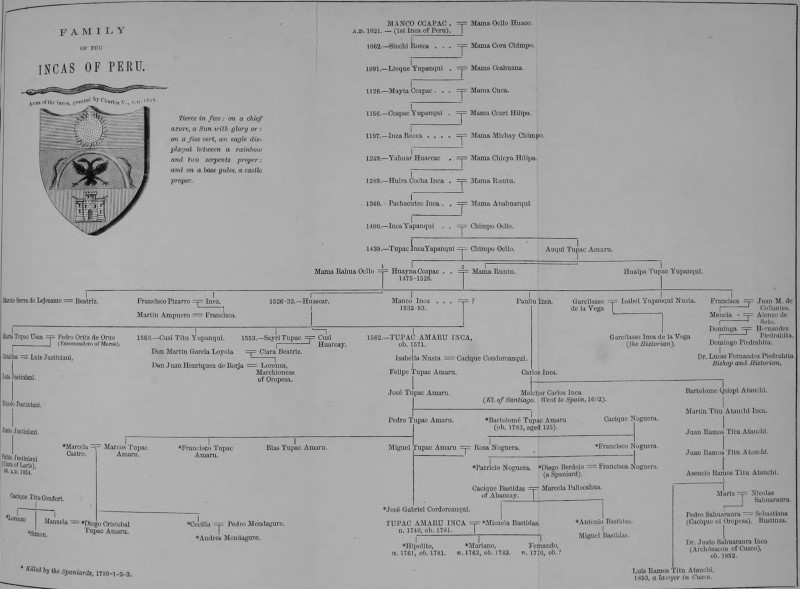
FAMILY OF THE INCAS OF PERU.
To face page 134.
José Gabriel Condorcanqui or Tupac Amaru,[198] the son of
the Cacique Miguel Tupac Amaru by his wife Rosa Noguera,
was born at Tinta in the year 1742, and baptized at Tungasuca,
the birthplace of his father.[199] He claimed to be the
representative of the family of the Incas, as fifth in lineal
descent from Tupac Amaru, the son of the Inca Manco, who
was judicially murdered by the Viceroy Toledo in 1571.
The young José received the first rudiments of his education
from two neighbouring clergymen, Antonio Lopez, Cura
of Pampamarca, a native of Panama, and a man of considerable
talent; and Carlos Rodriguez, Cura of Yanaoca, a
native of Guayaquil. At a very early age, however, he was
sent to the Jesuit college of San Borja at Cuzco, which had
been established for the education of young Indian chiefs.
He is said to have been particularly noticed by the professors
for his close application, capacity, and excellent disposition;
and his scholastic acquirements were not inconsiderable. He
spoke Spanish with fluent accuracy, and his vernacular
Quichua with peculiar grace.[200]
Before he was twenty he succeeded his father as Cacique
of Tungasuca, Pampamarca, and Surimani, three villages
situated on the cold and lofty region which overhangs the
valley of the Vilcamayu; and in 1760 he was married to
Micaela Bastidas, a beautiful Indian girl of Abancay.[201]
In person José Tupac Amaru was five feet eight inches in
height, well-proportioned, sinewy, and firmly knit. He had
a handsome Indian face, a slightly aquiline nose, full black
eyes, and altogether a countenance intelligent, benign, and
expressive. His address, remarkable for gentlemanlike ease,
was dignified and courteous towards superiors and equals;
but in his intercourse with the aborigines, by whom he was
profoundly venerated, there was a sedateness not inconsistent
with his legally-admitted claims (de jure) to the diadem of
the Incas. In mind he was enterprising, cool, and persevering.
He lived in a style becoming his rank, and, when
residing at Cuzco, usually wore a black velvet coat and small-clothes
in the fashion of the day, a waistcoat of gold tissue,
embroidered linen, a Spanish beaver dress hat, silk stockings,
and gold knee and shoe-buckles, and he allowed his glossy
black hair to flow in ringlets which extended down nearly to
his waist.[202] The chief source of his income arose from thirty-five
piaras or troops of mules, each piara consisting of ten,
which were regularly employed or hired out in the transport
of merchandise, home-made stuffs, sugar, and quicksilver to
Potosi and other parts.[203] He had travelled over a considerable
portion of Peru, and had two or three times resided in Lima;
and in his journeys he was always attended by a small retinue
of Indians, and sometimes accompanied by a chaplain.
In about 1770 Tupac Amaru went to Lima to establish his
claim to the Marquisate of Oropesa, which had been granted
to his family by Philip II. After some delay his claim was
acknowledged by the Royal Audience, and, in a judgment pronounced
by the Fiscal Don Serafin Leytan y Mola, he was
declared to be the heir to the marquisate, as fifth in lineal
descent from the Inca Tupac Amaru; but it would appear
that this judgment was withheld from official publication. It
was said that the fiscal paid the successful suitor so many
honours, and said so many complimentary things concerning
his nobility and royal descent, that he grew proud;[204] and it
certainly appears that he adopted a style of living in his
mountain home at Tungasuca, after his return from Lima,
which he had not previously assumed.[205] It is remarkable that,
in 1618, the Viceroy Prince of Esquilache wrote a despatch
on the claims to jurisdiction of the members of the Inca
family, who were heirs to the marquisate of Oropesa. He
represented that very great inconvenience might arise from
any descendant of the Incas, particularly of the family of
Oropesa, so closely representing the direct line, holding any
jurisdiction in Peru. The estates of the marquisate were the
richest and best in Peru, and situated near Cuzco, where the
memory of the Incas was most cherished. Many descendants
of the Incas, he added, were then living, subject to no tribute
and no personal service, and very rich and powerful; and he
recommended that all claimants to the marquisate should be
obliged to live in Spain, and that an equivalent should be
paid them for their estates.[206] This advice was not adopted by
the Council of the Indies.
The young Inca at this time dropped his surname of Condorcanqui,
and assumed that of Tupac Amaru Inca. He
governed his villages of Tungasuca, Surinani, and Pampamarca
exceedingly well, and was highly esteemed by the
corregidor of the province, Don Pedro Muñoz de Arjona, and
his successors, who admired his punctual attention to his
duty, and therefore distinguished him above all the other
caciques. He habitually cultivated the acquaintance of the
Spanish curas and officials, and never let pass an opportunity
of representing to them, in impassioned language, the deplorable
condition of the Indians.[207] He assisted the distressed,
paid tribute for the poor, and sustained whole families which
had been reduced to ruin.[208] He cherished the traditions of
his people, and such customs as were not inconsistent with
his profession of Christianity; and he especially delighted in
the dramatic representations which recalled the glorious
memories of the past. One of his most intimate friends was
Dr. Antonio Valdez, Cura of Sicuani, a perfect master of the
Quichua language, and author of a play called 'Ollantay,'
founded on ancient tradition, which was frequently acted
before Tupac Amaru at Tungasuca.[209]
The oppression of the Indians by means of the mitas and
repartos excited the indignation of the Inca Tupac Amaru; but
he exerted himself for years, and exhausted every means of obtaining
redress, before he was finally driven to take up arms in
their defence. Moved by his earnest and incessant appeals,
and his piteous account of the sufferings of his people, the
Bishops of Cuzco and La Paz forwarded them to the king
through Don Ventura Santalices; and Blas Tupac Amaru, the
Inca's uncle, also undertook a voyage to Spain; but death put
an end to the humane missions both of the Spaniard and the
Indian. Nevertheless, Tupac Amaru persevered in remitting
renewed petitions; while the corregidors not only eluded
compliance with the royal decrees, but also increased the burdens
of the Indians. At length his patience came to an end,
and he resolved to make an appeal to arms, not to throw off
the yoke of Spain, but to obtain some guarantee for the due
observance of the laws, and their just administration. His
views were certainly confined to these ends when he first
drew his sword, although afterwards, when his moderate
demands were only answered by cruel taunts and brutal
menaces, he saw that independence or death were the only
alternatives.
The most merciless oppressor of the Indians of Peru was
Don Antonio Aliaga, Corregidor of Tinta, and therefore
Tupac Amaru's immediate superior; and the Inca determined
to commence his revolt by punishing this great culprit. The
Inca's old tutor, Dr. Carlos Rodriguez, Cura of Yanaoca, in
celebration of his name-day, gave a dinner to the corregidor
of Tinta, and the Inca Tupac Amaru, on the 4th of November,
1780. The Inca, on pretence that some person had arrived
at his house from Cuzco, withdrew from the banquet early,
and placing himself in ambush on the road, with some
attendants, made the corregidor prisoner on his return, taking
him to Tungasuca,[211] and placing him in close confinement.
Tupac then wrote a letter marked reservadissima, which he
obliged Aliaga to sign, ordering his cashier at Tinta to remit
the public money in the provincial treasury to the Inca,
assigning as a reason that it was necessary to set out forthwith
to the port of Aranta,[212] threatened by a descent from
English cruisers. The Inca thus received 22,000 dollars,
some gold ingots, seventy-five muskets, baggage-horses, and
mules. Recruits were also ordered to be embodied, and sent
to Tungasuca.
Having thus drawn together a considerable force, he sent
for his old master, Dr. Antonio Lopez, the Cura of Pampamarca,[213]
and ordered him to make known to the corregidor
that he must die, and to administer to him the consolations of
religion. A scaffold was then erected in the plaza of Tungasuca,
around which the retainers of the Inca were ranged in
three ranks, the first armed with muskets, the second with
pikes, and the rear rank with treble-loaded slings. Aliaga
was then led out and publicly executed on November 10th.
Tupac Amaru at the same time addressed the astonished multitude,
in Quichua, as to his present conduct and ulterior
views. Mounted on a fiery charger, attired in the princely
costume of his ancestors, with a banner bearing the figure of
an Inca encircled by embroidered chains of gold and silver,
and two armorial serpents,[214] he exhorted his followers to lend
an attentive ear to the legitimate descendant of their ancient
sovereigns, promising to abolish the mitas and repartos, and to
punish the extortionate corregidors.
The whole multitude, with one accord, vowed implicit
obedience to his orders, and he at once began to form the
Indians into companies, and to nominate officers. Next day
he marched to Quiquijana, in the valley of the Vilcamayu,
the capital of the province of Quispicanchi, which he entered
at daybreak on the 12th, but the corregidor had fled. After
hearing mass Tupac returned towards Tungasuca, destroying
the obraje of Parapuquio on his way, where he found large
quantities of woollen clothes, which were distributed amongst
his followers. He also demolished the obraje of Pumacancha,
where he found property valued at 200,000 dollars, consisting
of 18,000 yards of woollen cloths (bayeta), 60,000 of cotton
cloths (tocuyo), some fire-arms, and two pieces of artillery,
belonging to the Corregidor of Quispicanchi.[215] These obrajes
were odious to the Indians, their owners having enforced the
mita far beyond the limits assigned by the law, and perpetrated
great cruelties on the women and children of the
mitayos. The Inca had now mustered 6000 troops, 300
armed with muskets, and the rest with pikes, clubs, and
slings. Nearly the whole population of the provinces of
Tinta, Quispicanchi, Cotabambas, Calca, and Chumbivilicas
rose in his favour, with the exception of a few whites.
The news of Tupac Amaru's revolt was brought to Cuzco
on the 12th, by Cabrera, the Corregidor of Quispicanchi, who
had so narrowly escaped capture. It created the greatest
alarm, as the city was only garrisoned by two regiments.
The college of the expelled Jesuits was turned into a kind
of citadel, into which private and public property was taken
for security; the white part of the population was enrolled;
requisitions for troops were sent to the neighbouring provinces;
and an express was despatched to Lima, imploring
speedy succour.
Next day 450 men, under the command of Don Tiburcio
de Landa, Governor of Paurcartambo, marched out of Cuzco,
accompanied by the Cacique of Oropesa, Juan Sahuaraura,
with 700 Indians of his ayllu, or tribe. Landa was ordered
to wait for reinforcements at a place called Huayra-pata;
but the Corregidor Don Fernando Cabrera, who accompanied
him, enraged at the loss of property which he had sustained,
induced him to advance to the village of Sangarara, within
five leagues of Tinta, which he reached on the 17th. At
dawn on the following morning it began to snow, and, finding
himself surrounded by a superior force of hostile Indians,
Landa retreated into the church. Tupac Amaru then wrote
to him, offering terms, which were refused; and he again
wrote to the cura, who was also in the church, urging him
to retire with the women and children. The Spanish troops,
however, prevented them from coming out, a scuffle ensued,
the stock of powder ignited, and the roof and one of the
walls were blown out. The Spaniards then made a dash
forward, and fought bravely until they were nearly all
killed.[216] Only twenty-eight wounded remained, who were
cured and set at liberty by order of the Inca. Landa,[217] his
lieutenant Escajadillo, Cabrera, and the Cacique Sahuaraura[218]
were amongst the slain.
The news of the disaster at Sangarara reached Cuzco on
the 19th, and produced indescribable confusion. The Cabildo
immediately began to collect arms, make powder, repair six
old field-pieces, and on the 20th Don Juan Nicolas de
Lobaton y Zavala, Marquis of Rocafuerte, arrived from
Urubamba with reinforcements. Every citizen came forward
to serve, and a corps of volunteers was formed under Don
Faustino Alvarez de Foronda, Count of Vallehermoso. The
Bishop ordered all the clergy to assemble, formed them into
four companies, and gave the command to the Dean, Dr.
Manuel de Mendieta. More troops soon came in from Calca,
under Don Pablo Astete, and from other parts, and by the
end of November there were 3000 men in arms at Cuzco.
Anxious to pacify the Indians, the Cabildo then issued a proclamation
abolishing the repartos, and the alcabala, or excise
on provisions, and declaring that the Indians should never
again be forced to work in the obrajes, if they remained faithful.
Defensive works were thrown up in the city and suburbs,
and religious processions paraded the streets.
At this moment Tupac Amaru might probably have entered
Cuzco without opposition; but unfortunately, relying on
the justice of his cause, he beguiled himself into the belief
that he could accomplish by argument and negotiation what
could only be obtained by the sword. He threw up embankments
and entrenched himself in an encampment near Tinta,
throwing out videttes to within three leagues of Cuzco; and
on the 27th he issued an edict from his head-quarters at
Tungasuca, setting forth the causes of his revolt. In this
document he recapitulated the grievances which his people
suffered, declared the tyranny of the Spanish officials to be
impious and cruel, and called upon the Indians to rally round
his standard.
Early in December 1780 Tupac Amaru crossed the Vilcañota
range, by the pass of Santa Rosa, and, entering the
Collao, advanced by Pucara to Lampa. At every village he
addressed the people from the church-steps, saying that he
came to abolish abuses and punish the corregidors; and that
he was "the liberator of the kingdom, the restorer of privileges,
and the common father of those who groan under the
yoke of repartos." Nothing was heard amongst the Indians
but acclamations for their Inca and Redeemer.[219] On the 13th
of December he entered the town of Azangaro, where he
destroyed the houses of the Cacique Chuquihuanca, who had
refused to join the insurrection. A private letter, dated
January 1781,[220] says that he rode into Azangaro on a white
horse, with splendidly-embroidered trappings, and that two
fair men, like Englishmen, of commanding aspect, were on
his right and left. He was armed with a gun, sword, and
pistols, and was dressed in blue velvet, richly embroidered
with gold, with a three-cornered hat, and an uncu, in the
shape of a bishop's rochet, over all, with a gold chain round
his neck, to which a large golden sun was attached. Having
received repeated letters from his wife, reporting the threatening
assembly of troops at Cuzco, he retraced his steps, by
Asillo and Orurillo, to the valley of the Vilcamayu, obliging
the curas of the villages through which he passed to receive
him in their churches under a canopy, and to chant the Te
Deum.
On the 28th the heights of Picchu, overhanging Cuzco on
the west, were covered with his army. His cousin Diego
Tupac Amaru was detached to the eastward with 6000 men,
to occupy the provinces of Calca and Paucartambo. Another
detachment under Antonio Castelo, one of the Inca's most
trusted followers, marched along the direct road to Cuzco,
but was defeated two leagues from the city at a place called
Saylla, and finally effected a junction with the main body on
the heights of Picchu.
Before attempting to force his way into Cuzco, the Inca
addressed a letter to the cabildo, and another to the bishop,
on the 3rd of January, 1781. To the cabildo he said that, as
the heir of the Incas, the ancient kings of the realm, he was
stimulated to endeavour by all possible means to put an end
to abuses, and to see men appointed to govern the Indians
who would respect the laws of the King of Spain. The
punishment of the Corregidor of Tinta was, he declared, absolutely
necessary as an example to others: and he announced
the object of his rebellion to be the entire abolition of repartos;
the appointment of an alcalde mayor, or judge of the
Indian nation, in every province; and the establishment of
an audiencia or court of appeal at Cuzco, within reach of the
Indians. "This," he concluded, "is at present the extent of
my wishes, leaving to the King of Spain his former dominion."
To the bishop he said that he had come forward, on behalf of
the whole nation, to put an end to the robberies and outrages
of the corregidors; and he promised to respect the priests,
all church property, and all women and inoffensive unarmed
people.[221]
But the garrison of Cuzco had, in the mean while, been
reinforced by Pumacagua, the Cacique of Chinchero, and by
200 mulatto soldiers from Lima under Don Gabriel de
Aviles, who arrived by forced marches on January 1st. The
cabildo, therefore, refused to entertain any proposals from the
Inca. The Spaniards came out to attack him under Don Pablo
Astete, and the Caciques of Chinchero and Anta, Pumacagua
and Rosas. There was a long skirmish in the broken
ground, which was brought to a conclusion by the evening
snow; but on the 8th a sanguinary battle was fought in the
suburbs and on the heights, which lasted two days, and during
which a Dominican friar, named Ramon de Salazar, concealed
behind a rock, did effective service with his musket, and
contributed to throw the Indians into confusion. The Inca
finally retreated to Tinta, to re-organize his forces.
His cousin Diego Tupac Amaru was also unsuccessful to
the eastward. His division was detached from the main army
at Checacupe, where he crossed some mountainous country, and
again descended into the valley of the Vilcamayu, following
the course of the river until he encountered the forces under
the command of the Marquis of Rocafuerte, consisting of the
levies of Pumacagua, Cacique of Chinchero, and those of the
Caciques of Maras and Huayllabamba. An engagement took
place at Huaran, on the banks of the river, near Calca, when
Diego was defeated, many of his Indians being drowned in
the river; and he again suffered defeat at Yucay on December
23rd. The Indian chief then left the valley of the Vilcamayu,
crossed a range of mountains, and laid siege to the town of
Paucartambo, on the banks of the rapid river of the same
name, while his videttes hovered over the heights above the
Vilcamayu valley, threatening the towns of Calca, Pissac, and
Taray. Don José Antonio Vivar was sent to occupy the
bridge at Urubamba, and watch the movements of the
Indians. Paucartambo, and a strong fort built on a rocky
height on the opposite side of the river, were desperately
defended by the Spaniards under Don Lorenzo Lechuga, who
had fortified and garrisoned the place. Astete was sent
across the bridge at Urubamba, with 400 men, to relieve it;
they had several encounters with the Indians on the march,
and on reaching the besieged town they found that Lechuga
had expended all his ammunition; but the besieging force,
under Diego Tupac Amaru, fell back towards Tinta, on the
approach of Astete, on the 18th of January, 1781. Having
re-organized his army at Tinta, the Inca, accompanied by his
cousin Diego, made another attack upon Paucartambo on the
11th of February; but, after several fruitless assaults, the
Indian army finally retreated to Tinta on the 14th.[222]
Tupac Amaru had now assembled a force of 60,000 men
in and around Tinta; but they were wholly undisciplined,
and only a few hundreds were armed with muskets. All the
caciques in Peru, with the exception of sixteen,[223] had, however,
declared in favour of the Inca; and the whole Indian and
mestizo population, except the ayllus or tribes of the sixteen
Hispanicized caciques, longed earnestly for the success of this
truly national insurrection. After the retreat from Paucartambo
in February, the Inca occupied himself in strengthening
his position round Tinta, and in visiting the distant provinces
of Chuquibamba and Cotabambas, while one Isidro Mamani,
an Indian of ferocious character, born at Pomata, on the
banks of lake Titicaca, Pedro Vargas, and Andres Ingaricona,
held the open country in the Collao.
The whole of the interior of Central and Upper Peru was
in revolt, and the viceroys of Peru and Buenos Ayres, Don
Augustin de Jauregui and Don Juan José de Vertiz, were
thoroughly alarmed. The former despatched Don José Antonio
Areche, as "visitador," with extraordinary judicial powers,
and a force commanded by Don José del Valle as Mariscal
del Campo, to Cuzco; while the latter named Don Ignacio
Flores, then Governor of Moxos, as commandante-general, to
put down the rebellion in Upper Peru.
Areche, accompanied by General José del Valle, and Don
Benito de la Matta Linares, a judge of the Royal Audience
at Lima, arrived at Cuzco on February 23rd, 1781, where an
army of 15,000 men was collected, consisting of the tribes of
the recreant caciques, negroes and mulattos from the coast,
and a small force of Spaniards.
Early in March General del Valle prepared to commence
the campaign. But, before his army marched out of Cuzco,
the visitador Areche received a letter from Tupac Amaru, in
which he represented the earnest endeavours he had made
to obtain justice for his people; the habitual violation of
the law by the Spanish officials; the cruel and intolerable
oppression caused by the repartimentos and the mita; and the
absolute necessity of some reform in the administration. He
concluded by proposing a negotiation by which these ends
might be attained without bloodshed. This despatch is very
ably written, and is a monument of the noble and enlightened
views of this great but most unfortunate patriot.[224] The
answer of the visitador Areche was a brutal menace, better
suited to a follower of Zengis Khan than to a Christian
judge. He refused all negotiation, vowed the most horrible
vengeance, and concluded by saying that, if the Inca surrendered
at once, the cruelty of the mode of his execution
would be lessened. The Spanish General del Valle protested
against the brutality of this reply.[225]
Tupac Amaru now prepared to resist to the utmost, as it
became evident to him that complete independence or death
were the only two alternatives which were left by the barbarous
policy of the bloodthirsty visitador; but his edicts
were still marked by humanity and good sense. It does not
appear that he ever actually proclaimed himself a sovereign
independent of Spain; yet the draft of an edict was found
amongst his papers, in which he styles himself "Don José I.,
by the grace of God, Inca, King of Peru, Quito, Chile, Buenos
Ayres, and the continents of the South Sea, Lord of the River
of the Amazons, with dominion over the Grand Paytiti." The
document is headed by a portrait of Tupac Amaru, crowned,
with Spanish trophies at his feet. It states that the King of
Castille had usurped the crown and dominions of Peru, imposing
innumerable taxes, tributes, duties, excises, monopolies,
tithes, fifths; appointing officers who sold justice, and treating
the people like beasts of burden. For these causes, and by
reason of the cries which have risen up to Heaven, in the
name of Almighty God, it is ordered that no man shall
henceforward pay money to any Spanish officer, excepting
the tithes to priests; but that tribute shall be paid to the
Inca, and an oath of allegiance to him be taken in every
town and village. The document is without date.[226]
On March 12th, 1781, the army under General del Valle
marched out of Cuzco. A detachment of 2000 men was
sent against the insurgents, commanded by the Caciques
Parvina and Bermudez,[227] in the province of Cotabambas, who
were both killed in a desperate action. Tupac Amaru used
to call these brave chiefs his right and left arms. Meanwhile
the main body of the royalist army advanced slowly
along the mountains to the westward of the valley of the
Vilcamayu, suffering much from the snow-storms, the want
of food and fuel, and the shameful neglect of all commissariat
arrangements by Areche. On the 18th the Inca sent a
message to the Spanish General, saying that the morrow,
being the festival of San José, would be an appropriate day
for settling their differences; and that he should prepare his
troops for a movement of which, in compliment to the name-day
of both himself and Del Valle, he deemed it courteous
to apprise his adversary. In consequence of this message
the Spaniard kept his men under arms all night, but no
attack took place, and in the morning the Inca's army was
found to be gone. Tupac had intended a stratagem, and
had retired into an unfrequented ravine: on the 21st a
snow-storm favoured his design, and his plan would have
succeeded, had not a traitor, named Zunuario de Castro,
given Valle notice of his movements. The Spaniards
changed their position, and the Inca passed the night in
vainly searching for it.
General del Valle was upwards of seventy years of age,
and, unable longer to endure the excessive cold of the
mountains, he descended into the valley of the Vilcamayu,
and captured Quiquijana, hanging the Cacique Luis Poma
Inca, who defended it. On the 6th of April the Spanish
army advanced up the valley, meeting with considerable
opposition, and reached Checacupe early in the day. Near
this village the Inca had taken up a position, defended by
a ditch and parapet stretching across the valley, and manned
by 20,000 men, but he had neglected to provide any defence
for his flanks. A Spanish division stole unperceived to
the back of the position, while the main body assaulted it
in front; and after an heroic defence the Indians, attacked
both in front and rear, fell back to another entrenched
position at Combapata, a league from Tinta, where the
village was surrounded by a mud wall, covered at the top
with thorny bushes. The Spaniards, following up their
success, played upon the village with their field-pieces for
several hours, then carried the position at the point of the
bayonet, and made a bloody entry into Tinta.
Tupac Amaru, with his wife and three sons, fled to Lanqui,
a village about twenty miles to the westward, on the shores
of a wild Alpine lake. Here he intended to have rallied
his disordered troops, but he was betrayed by one of his
own officers, named Ventura Landaeta, who, assisted by the
cura of the place, basely delivered the illustrious Inca and
his family into the hands of the Spaniards. On the same
day General del Valle hung sixty-seven Indian prisoners
at Tinta, whose heads he stuck on poles by the road-side.[228]
Diego Tupac Amaru, his nephew Andres Mendagure, and
Mariano, the second son of the Inca, fortunately escaped.
On the 8th of April Francisco, the aged uncle of the Inca,[229]
was also seized, and the prisoners were marched bareheaded
into Cuzco, the visitador Areche coming out as far as Urcos
to meet them. They were all separated from each other,
and told that they would not meet again until the day of
execution.
The chief prisoners were the Inca Tupac Amaru, his wife,
his two sons Hipolito and Fernando, his uncle Francisco,
his brother-in-law Antonio Bastidas, his maternal cousin
Patricio Noguera, his cousin Cecilia Tupac Amaru with her
husband Pedro Mendagure, a number of captains in the
Inca's army and other officials, and Aliaga's executioner
named Antonio Oblitas,[230] a negro slave.
It is necessary to record the diabolical cruelties of the
visitador Areche, and his assistant Matta Linares, in order
to complete the narrative of the ill-fated Inca's life, and
to show into whose hands the fate of the Peruvian Indians
was placed by the Spanish viceroy, and of what devilish
atrocities they were capable. On the 15th of May, 1781,
the visitador Areche pronounced a lengthy sentence, in which
he declared that it was necessary to hasten its execution,
in order to convince the Indians that it was not impossible
to put a man of such elevated rank to death, merely because
he was the heir of the Incas of Peru. He then accused the
Inca of rebellion, of destroying the obrajes, of abolishing
the mita, and of causing pictures to be painted of himself
dressed in the imperial insignia of the uncu or mantle, and
mascapaicha or head-dress; and others representing the triumph
of his arms at Sangarara. He condemned his victim
to behold the execution of his wife, his son, his uncle, his
brother-in-law Antonio Bastidas, and of his captains; to have
his tongue cut out, and afterwards to have his limbs secured
to the girths of four horses dragging different ways, and thus
to be torn in pieces. His body to be burnt on the heights
of Picchu, his head to be stuck on a pole at Tinta, one arm
at Tungasuca, the other in Caravaya, a leg in Chumbivilicas,
and another in Lampa. His houses to be demolished, their
sites strewn with salt, all his goods to be confiscated, all his
relations declared infamous, all documents relating to his
descent to be burnt by the hangman, all dresses used by the
Incas or caciques to be prohibited, all pictures of the Incas
to be seized and burnt, the representation of Quichua dramas
to be forbidden, all the musical instruments of the Indians
to be destroyed, all signs of mourning for the Incas to be
forbidden, all Indians to give up their national costumes,
and dress henceforth in the Spanish fashion, and the use of
the Quichua language to be prohibited.
In the annals of barbarism there is probably not to be
found a document equalling this in savage wickedness and
imbecile absurdity: and this was written by a Spanish judge
only eighty years ago.[231]
This hideous cruelty was literally carried into effect, in
all its revolting details. On Friday the 18th of May, 1781,
after the great square had been surrounded by Spanish and
negro troops, ten persons came forth from the church of the
Jesuits. One of these was the Inca Tupac Amaru, who had,
in the early morning, been visited in prison by Areche, and
urged to betray all the accomplices in his rebellion.[232] "You
and I," he replied, "are the only conspirators: you for
having oppressed the country with exactions which were
unendurable, and I for having wished to free the people
from such tyranny."[233] The Inca's companions in misfortune
were his wife Micaela, his sons Hipolito and Fernando, his
brother-in-law Antonio Bastidas, his uncle Francisco Tupac
Amaru, Tomasa Condemaita the Cacica of Acos, José Verdejo
and Andres Castelo, captains in the Inca's army, and the
executioner Oblitas.
Verdejo, Castelo, Oblitas, and Bastidas were hung at once.
The rest were heavily chained, tied up in the bags which are
used for carrying the maté or Paraguay tea, and dragged
backwards into the centre of the square by horses. Francisco
and Hipolito Tupac Amaru, the one an old man verging on
fourscore years, the other a youth of twenty, then had their
tongues cut out, and, with Tomasa Condemaita, were garrotted
by an iron screw, the first that had been seen in Cuzco.
Micaela, the wife of the Inca, was then placed on the same
scaffold, her tongue was cut out, and the screw was placed
round her neck in presence of her husband; but she suffered
cruelly, because her neck was so small that the screw failed
to strangle her. The executioners then placed a lasso round
her neck, and pulled different ways, at the same time kicking
her in the stomach and bosom until they succeeded in
killing her. The Inca was then taken into the centre of
the square, his chains were taken off, and his tongue was cut
out. He was then thrown on the ground; lassos, secured to
the girths of four horses, were fastened to his wrists and
ankles, and the horses were made to drag different ways, "a
spectacle never before seen at Cuzco." As the unfortunate
Inca's body was thus raised into the air, his youngest son
Fernando, a child of ten years, who had been forced to
witness this horrible massacre of his relations, uttered a heartrending
shriek, the knell of which continued to ring in the
ears of those who heard it to their dying day.[234] The horses
did not pull at the same time, and the body remained
suspended like a spider for many minutes, until at last the
brutal miscreant Areche, who was looking on from a window
in the College of the Jesuits, caused the head to be cut off.[235]
The child Fernando was then passed under the scaffold, and
sentenced to be banished for life to one of the penal settlements
in Africa.
Many of the Spanish citizens were present, but not an
Indian was to be seen. They afterwards declared that, while
the horses were torturing the Inca, a great wind arose, with
torrents of rain, and that even the elements felt the death of
the Inca, whom the inhuman and impious Spaniards were
torturing with such cruelty.[236]
The heads, bodies, and limbs of the victims were sent to
the different towns of Peru, and to the villages round Cuzco,[237]
in order to strike terror into the hearts of the Indians; but
this proceeding of course had the opposite effect, and goaded
them to fury. By the humane exertions of the Inca the war
had hitherto been carried on without unnecessary bloodshed,
and he had always protected unarmed persons and women;
but, after the perpetration of these barbarities in Cuzco, it
became a war of extermination, and during the following year
not less than 80,000 people fell victims to the vengeance of
the Indian and Spanish troops.
In the revolting cruelty of Areche may be traced the abject
terror of a dastardly and craven mind; and to this cowardice
may also be imputed the concessions which were afterwards
wrung from him.[238] Tupac Amaru did not die in vain; for,
after the suppression of his revolt, the repartos were abolished,
and the mitas were much modified.
Thus fell the last of the Incas. He was a man of whom
his nation might well be proud, and will bear comparison
with the greatest monarchs of his race. Having enjoyed the
best education which Spanish policy at that time permitted
to the people of the colonies, he brought a cultivated mind, a
clear understanding, untiring industry, and devoted zeal for
the welfare of his countrymen to his important duties as a
wealthy and influential cacique. When he afterwards undertook
the office of defender of the oppressed Indians he
displayed an amount of patient perseverance, combined with
great ability in the advocacy of their cause, which excited
the admiration of the Bishop of Cuzco and others of the
more enlightened Spaniards. Finally, after he had unwillingly
become convinced that all remonstrance was useless,
he, in his appeal to arms, combined promptitude of action
with great moderation in his demands; his edicts were remarkable
for their good sense and humanity; and had his
efforts been met by the Spaniards in a corresponding spirit,
the viceroy of the King of Castille might at length have
succeeded in enforcing the practical observance of the humane
laws of his master.
But this was not to be. Instead of a calm and enlightened
statesman, and Spain had many such, the viceroy placed full
powers in the hands of a wretch whose conduct was a mixture
of cowardice, atrocious cruelty, and incapacity. Fortune
decided in favour of the Spaniards, and the Inca fell into the
power of a man whose vile nature was excited to acts of
unequalled barbarity by the terror which his position and his
incompetence had caused him. I have felt obliged to relate
the shocking circumstances of the death of Tupac Amaru in
justice to the Indians; for who can be surprised if afterwards
they frequently refused to give quarter to any of the hated race
of Chapetones, as they called the Spaniards? and no atrocity
was ever perpetrated by them which can be compared to
the execution of the Inca and his family, committed by the
deliberate sentence of a Spanish judge.[239]
DIEGO TUPAC AMARU—FATE OF THE INCA'S FAMILY—INSURRECTION
OF PUMACAGUA.
While the events occurred in the valley of Vilcamayu which
ended in the capture of the Inca Tupac Amaru and his family,
the whole of the Collao was in a state of insurrection, and all
Spaniards had to escape for their lives to Puno, La Paz, or
Arequipa.
Don Joaquim Antonio de Orellana,[240] Governor of Puno,
made a most gallant defence of that town, with a force
consisting of 180 musketeers, 647 pikemen, 44 artillerymen
with 4 guns, and 254 cavalry. He retreated behind
his entrenchments when the Inca advanced as far as Lampa,
in December 1780; but in February 1781, in spite of the
heavy rains, he marched to Lampa, where he flogged an Indian
until he confessed that his rebel countrymen were on an
adjacent mountain called Catacora. Orellana found the rebel
army drawn up in an almost inaccessible position, with colours
flying; and, while seeking for a place where his troops might
ascend, they suffered from a storm of hail and snow. The
Spaniards were divided into two assaulting parties, but the
showers of stones which the Indians hurled from their slings
obliged them to retreat, and Orellana himself was wounded in
the jaw.
He found it prudent to fall back towards Puno, and, on
the 16th, encamped on the banks of the river of Juliaca, near
a place called Mananchili. The Indian army followed the
Spaniards and offered them battle—the chiefs sending a
message to Orellana to tell him that they acknowledged no
king but their Inca Tupac Amaru. They formed their forces
in a semicircle—the right being led by the Cacique Andres
Ingaricona, the left by Mamani, and the centre by a chief of
Caravaya named Alejandro Calisaya. The battle began at
four P.M., and, after a sharp fight, Mamani's division fled to
the adjacent heights, and Ingaricona was also routed. The
Indians left 370 killed on the field; among whom there were
many women who came to fight by the sides of their husbands
and brothers, armed with bones sharpened at one end. Notwithstanding
this success, Orellana made a rapid retreat to
his entrenched position at Puno, collected provisions, and sent
messengers to Arequipa for reinforcements.[241]
On the 18th of March the Indian army came in sight,
extending for three miles along the heights round Puno,
with colours flying and a great noise of drums and clarions,
entirely surrounding the town, except on the side of the lake.
It was commanded by the Caciques Andres Ingaricona and
Pedro Vargas. The dismal news of the capture of Tupac
Amaru reached the besieging Indians on April 12th, when
they retreated, followed by a Spanish force under Nicolas de
Mendiosala of Chucuito. He overtook them posted on a hill
called Condorcuyo, to the left of the road to Cuzco, when
a furious struggle commenced; but the Indians fought most
gallantly, and defeated Mendiosala, who retreated in disorder.
This success encouraged the rebels as much as it disheartened
the Spaniards, and Chucuito and the other towns on the
western banks of the lake of Titicaca fell into their hands.
They committed indiscriminate slaughter in revenge for the
cruel death of the Inca, and only a few Spaniards escaped
to Puno. The governor Orellana sent balsas to rescue some
fugitives who were concealed in the rushes on the shores of
the lake, he himself being confined to his house[242] by a wound
in his foot. Meanwhile the Indians of Azangaro, by capturing
the town and peninsula of Capachica, completed the conquest
of the province of Chucuito, and the rebel chiefs prepared
for a second siege of Puno.
Diego Cristoval Tupac Amaru the Inca's cousin, with his
nephew Andres Mendagure, Mariano the young son of the
Inca, and Miguel Bastidas a nephew of the Inca's wife,
escaped when the rest of their family were betrayed and captured
at Lanqui. They now joined the rebel army in the
Collao, Diego took the command, and on the 9th of May he
invested Puno on all sides, and commenced the second siege.
The Indians were formed in a semicircle on the sides of
the surrounding hills; while Orellana had deepened his
entrenchments, and occupied a very strong position on the
Huassa-pata hill, above Puno: he also built two forts, one
called Santa Barbara, where the triumphal arch now is, and
the other called Horca-pata, on the descent from the heights
of Cacharani. The corners of the plaza and of the streets
were barricaded. On the 10th there were skirmishes all day,
and on the 11th the Indians carried the forts of Santa Barbara
and Horca-pata by assault, and penetrated into the
streets, but failed in their attack on the rocky height of the
Huassa-pata.[243] On the 12th the besiegers suddenly retreated,
at the approach of the army advancing from Cuzco.
General del Valle, after defeating the Indians at Combapata,
continued his march up the valley of the Vilcamayu,
crossed the pass of Ayaviri, and, entering the Collao, advanced
towards Puno, where he arrived in the middle of May.
But the Indians of his army were disgusted at the excessive
rigour with which the rebels were treated; they deserted in
great numbers,[244] and assisted the troops of Diego Tupac
Amaru in harassing the Spaniards, and cutting of all supplies.
The army of del Valle had been shamefully neglected by the
visitador Areche, who was too busy in torturing his prisoners
to attend to the commissariat. The troops were wretchedly
clad, unpaid, without medical stores, or biscuit, or fresh meat.
Under these circumstances the General reluctantly determined
to retreat to Cuzco, taking with him the garrison and
inhabitants of Puno, which place was evacuated by Orellana
on the 26th of May. The army which had left Cuzco in
March 15,000 strong was now reduced, by desertions and
sickness, to 1443 men, with which force General del Valle
commenced the retreat, closely followed and constantly
harassed by the Indians. He reached Cuzco on the 4th of
July, when a paper war ensued between him and Areche, the
latter blaming him for evacuating Puno, while the General
retorted that Areche had shamefully neglected the wants of
his army, and failed to make any attempt to subdue the
country round Cuzco.[245]
The Viceroy seems to have taken the part of the General
in this controversy; and the foul vulture Areche, with his
companion Matta Linares, was recalled. He reached Lima
on August 23rd, 1781, and embarked for Spain with the poor
little Fernando, son of Tupac Amaru, who was sentenced to
imprisonment for life.
The Indians still remained in arms round Cuzco, especially
in the heights above Urubamba and Calca, and at Lauramarca
and Ocungate. Those near Calca fortified themselves in a
place called Chayña-ccasa, against whom the General sent a
force of 400 men under Don José de Barela, and the Indians
were defeated with great slaughter; while Don Joaquim
Balcarcel kept the insurgents in check, who continued to
threaten Paucartambo.
After the retreat of General del Valle from Puno, Diego
Tupac Amaru established his head-quarters at the town of
Azangaro, while Andres Mendagure and Miguel Bastidas
overran the provinces on the eastern shore of lake Titicaca,
captured the town of Sorata, and placed themselves in communication
with the insurgent forces in Upper Peru. It is
said that fifteen mule-loads of treasure, consisting of spoils
from the provinces of Omasuyos and Larecaja, were brought
into Azangaro at this time and buried. Diego Tupac Amaru
occupied a house near the plaza, where he gave audience in a
long sala; and he went from this house to the church every
night, wrapped in a large cloak. This story made people
believe that he was concealing treasure, and many a fruitless
search has since been made for it.[246]
The hopes of the Indians were now beginning to wane.
Diego, though a man of considerable talent, was not possessed
of the same influence over the people as his unfortunate
cousin; and the Spanish officials were rapidly receiving reinforcements
from Buenos Ayres, while the slaughter of the
Indians had been prodigious. In August, 1781, Diego issued
a decree, ordering that all women, children, and priests,
should be respected during the war;[247] and on the 18th of
October he promulgated a manifesto setting forth the numerous
violations of law habitually committed by the corregidors,
the exactions of the curas, and the extortionate duties imposed
by the aduaneros.[248] This is a very able and telling
document, and, together with the more detailed writings of
the unfortunate Inca, forms a most complete vindication of
this memorable insurrection.[249]
On September 12th, 1781, the viceroy of Peru, Don
Augustin de Jauregui, had issued a proclamation offering
pardon, on submission, to Diego Tupac Amaru and all his
followers.[250] It would swell this short narrative to an undue
length if I attempted to give any account of the events in
Upper Peru during this period;[251] but the final suppression
of the revolt in that part of the country by the Spanish
commanders Flores, Reseguin, and Segurola, induced Diego
Tupac Amaru to accept the Viceroy's offer of pardon, give
up the cause, and place himself in the power of a faithless
enemy. Dr. Antonio Valdez, cura of Sicuani, the friend of
the Inca, and author of the Quichua play of 'Ollantay,' was
sent to Azangaro by the Spanish authorities to persuade
Diego to adopt this course. They held their conferences on
the subject while walking up and down on the banks of the
river; and there is a tradition that Pedro Vilca Apasa, one of
Diego's bravest officers, overheard one of these conversations,
and remonstrated violently against the madness of trusting to
the word of a Spaniard. But the advice of Valdez prevailed,
Diego sent young Miguel Bastidas to open a negotiation with
the Spanish Colonel Reseguin in November; and on December
11th he gave himself up to Don Ramon de Arias,
commandant of the column of Arequipa. At the same time
Mariano Tupac Amaru, the son of the Inca, Andres Mendagure,
and Miguel Bastidas, surrendered to Don Sebastian de
Segurola at La Paz. Bastidas was sent to Buenos Ayres.
Diego Tupac Amaru received his pardon at Sicuani, from
General del Valle in the name of the viceroy, on January 26th,
1782; and on the same day the Bishop of Cuzco[252] solemnly
absolved him in the church. But Vilca Apasa, Alejandro
Calisaya, and other chiefs of Diego's army, refused to submit,
and continued in arms in the provinces of Caravaya and
Azangaro. General del Valle marched against them in
March 1782, and took most of them prisoners. Vilca Apasa
was captured in his native village of Tapa-tapa, eighteen
miles east of Azangaro, where his descendants still live. He
was torn to pieces by horses in the plaza of Azangaro, and
his limbs were stuck on poles by the road-side.[253] An old lady
told me that she could remember seeing one of his arms on
a pole near her father's house. Calisaya, and many others,
were hung. The Spanish General had the cruelty to force
Diego Tupac Amaru to accompany him, and to witness the
execution of his old friends. Del Valle then marched over
the cordilleras of Lauramarca and Ausangate, where the
Indians had been in rebellion, taking Diego with him in a
sort of triumph, and returned to Cuzco in August. The old
general was taken ill soon afterwards, and died at Cuzco on
the 4th of September, leaving the command of the troops to
Don Gabriel de Aviles.
Diego Tupac Amaru was permitted to retire to Tungasuca;
and young Mariano Tupac Amaru, with his cousin Andres
Mendegure, lived at Sicuani. But it would appear that the
Spanish authorities had no intention of keeping their faith
with these unfortunate Indians, and it was soon seen that
the distrust of Vilca Apasa was but too well founded. The
Spaniards were only waiting for an excuse before they completed
the extirpation of the whole family of the Incas. This
was soon found in a rebellion of the Indians of Marcapata
and Lauramarca, who, on the approach of a force under the
Corregidor Necochea in January 1783, retired to the lofty
and almost impenetrable heights of Hapo and Ampatuni. In
February their leader, Santos Huayhua, was captured with
his family, and torn to pieces by horses.[254]
Thus the desired excuse for treachery and faithlessness
was furnished. All the surviving members of the family of
the Inca Tupac Amaru were arrested, by order of the viceroy
of Peru.[255] The accusations against them were frivolous, and,
so far as appears in the sentences, without a shadow of proof
to support them. Diego was accused of calling the Indians
his sons, of living in a way unbefitting a pardoned rebel, and
of performing funeral rites for his cousin the Inca; young
Mariano Tupac Amaru of rescuing his lady-love on September
9th, who had been forced to become a novice in the monastery
of Santa Catalina in Cuzco; Andres Mendagure of conducting
himself in a suspicious way; Manuela Castro, the mother of
Diego, of keeping up disaffection amongst the Indians; and
Lorenzo and Simon Condori, the brothers-in-law of Diego, of
assisting the rebels in Marcapata. The rest of the family
were accused of being relations.
Diego was imprisoned with his kindred on the 15th of
April, 1783, by Don Raymundo Necochea, Corregidor of
Quispicanchi;[256] while Mariano Tupac Amaru and Andres
Mendagure were sent to Lima, put on board a ship, butchered
at sea, and their bodies thrown overboard. The vulture
Matta Linares, who was still an Oidor of the Audienica at
Lima, scented carrion from afar, and arrived at Cuzco on
April 20th, with the same extraordinary judicial powers as
had previously been given by the viceroy to Areche. On
the 17th of July he sentenced Diego Tupac Amaru to be
dragged at the tail of a mule, with a rope round his neck, to
the place of execution in the plaza of Cuzco, there to be hung
and quartered, his body and limbs to be distributed amongst
the towns of Tungasuca, Lauramarca, Paucartambo, and
Calca, his goods to be confiscated, and his houses destroyed;
his mother, Marcela Castro, to be hung and quartered, and
her body to be burnt in the plaza; Lorenzo and Simon
Condori to be hung; and Manuela Titu Condori, the wife of
Diego, to be banished for life.[257] These sentences were executed
on the 19th of July 1783; and Matta Linares obliged
the good cura of Sicuani, Dr. Valdez, by whose persuasion, as
the ancient friend of the Inca Tupac Amaru, Diego had been
induced to accept the treacherous pardon, to witness the executions.[258]
Matta Linares is still remembered in Cuzco for
his barbarous, immoral, and sneaking conduct. He died in
Spain in about 1818, having been one of the first among
the unworthy Spaniards who declared in favour of Joseph
Buonaparte.
At about the time of Diego's execution, the last spark of
insurrection was trampled out in Huarochiri, a province in
the Andes near Lima. The Indians of the villages near
Caramporna had risen under one Felipe Velasco Tupac Inca
Yupanqui, who declared that the Inca was not dead, but that
he was alive and crowned in the "Gran Paytiti."[259] Don
Felipe Carrera, who had been appointed Corregidor of Parinacochas,
was sent to Huarochiri, and by a rapid march succeeded
in capturing the chief. Towards evening, however,
he was surrounded by a large body of Indians armed with
slings and poles, in a narrow and dangerous part of the road.
He retreated to an eminence with his prisoner, where he
defended himself until dark against the storm of stones, and
then escaped to Lima. After daily fights with the Indians
the rebellion was put down in June, 1783. Felipe Velasco,
and his lieutenant Ciriaco Flores, were hung in the great
square of Lima on July 7th, 1783.[260]
Having, after two years and a half, succeeded in quelling
the insurrection, it remained for the viceroy to extirpate all
the innocent members of the family of the Incas, and all
who were connected with them by marriage. Ninety members
of the family were sent to Lima in chains, among whom
were Bartolomé Tupac Amaru, the venerable great-uncle
of the Inca; Marcela Pallocahua, the mother of the Inca's
wife Micaela Bastidas; and Manuela Condori, the wife of
Diego. Soon after his arrival at Lima Bartolomé Tupac
Amaru died at the extraordinary age of 125. A life of
temperance had given this aged prince the strength to
endure months of solitary confinement at Cuzco, to sustain
blows from muskets and staves in the plaza, to undergo a
cruel journey on foot and in chains of 400 miles, but the
horrors of the Lima prison at length killed him. The unhappy
survivors were shipped off at Callao, in two ships, the
'Peruana' and the 'San Pedro,' and thrown into cells in
Cadiz for three years, when Charles III. caused them to be
distributed, apart from each other, in prisons in the interior of
Spain, until their sufferings were relieved by death. Once
during the voyage they were allowed by the brutal captain
of the transport 'Peruana,' named José Cordova, to wash their
tattered clothes at Rio; but their fetters were never removed,
and, though the captain gave his word of honour to a Frenchman
who mended his damaged rudder, that he would take
them off, he unblushingly perjured himself; and the horrors
which were suffered by these innocent persons, many of them
aged women and young children, were never relaxed until
they arrived at Cadiz.[261]
Fernando, the youngest child of the Inca, "whose shrill
cry smote every heart with electric sympathy"[262] when he
beheld the cruel tortures of his parents, was taken to Spain
by the visitador Areche in 1781. He was then only ten
years of age. In 1783 one Don Luis Ocampo, a citizen of
Cuzco, went to Spain, and heard that young Fernando was
a close prisoner in the castle of San Sebastian at Cadiz.
Through the aid of an Irish gentleman, who was intimately
acquainted with the town major, Ocampo applied for a pass
to visit him, but was refused. He, nevertheless, made his
way into the fort, and, looking round at the iron gratings
of the cells, at length caught sight of a youth whose
countenance bespoke his origin. He addressed him in
Quichua, and found that he was speaking to Fernando Tupac
Amaru. While talking to him Ocampo received a blow
from the butt end of the musket of a Swiss sentry, whom,
however, he induced to permit him to continue the conversation.
It appeared that the government allowed Fernando
six rials a day, but that the soldiers of the guard cheated
him of half. Ocampo gave him two or three dollars a week
during his stay in Cadiz; and this is the last we know, for
a certainty, of the last surviving child of the unfortunate
Inca.[263]
The fate of these poor Indians, the remaining descendants
of those Incas of Peru whose remarkable civilization, and
great power and wealth, became a proverb during the sixteenth
century, will not fail to be interesting to those who
have become acquainted, through the pages of Robertson,
Prescott, or Helps, with the history of the Spanish conquest
of Peru. The sufferings and death of Tupac Amaru and his
family form a very sad story, yet they did not suffer and die
in vain: and it must be recorded of them that, unlike other
dispossessed families, they sacrificed themselves, not for their
own selfish ends, but in the hope of serving their people.
They did not die in vain, for in their fall they shook the
colonial power of Spain to its foundation. Not only was the
system of repartos at once abolished, and the mitas considerably
modified, but in 1795 the hated office of corregidors
was replaced by that of intendentes, and from the cruel death
of the last of the Incas may be dated the rise of that feeling
which ended in the expulsion of the Spaniards from Peru.
The rebellion which broke out in Cuzco, thirty-four
years after the death of Tupac Amaru, is historically
important, not on account of the patriotism of its leaders,
for they were almost all men of small weight and selfish
ends, but because the great body of the Indians rose as
one man at the first signal, in the hope of freeing their
country from a foreign yoke. In 1809 the people of Upper
Peru had formed an independent government, which they
called an "Institucion de Gobierno," and the viceroy sent
General Goyeneche against them with 5000 men from
Cuzco. The rebels, ill-provided with arms, were defeated
at Huaqui, near lake Titicaca, and slaughtered without
mercy;[264] but General Pezuela, who succeeded Goyeneche
in the command, had to face a patriot army from Buenos
Ayres under Belgrano, which kept him fully employed.
Then it was that the opportunity was seized of commencing
a rebellion at Cuzco; and this enemy in the rear of the
royal army placed Pezuela in a most critical position.
The leader of the rebellion was Mateo Garcia Pumacagua,
Cacique of Chinchero near Cuzco, then a very old men. In
January 1781, when Tupac Amaru occupied the heights of
Picchu above Cuzco, he had marched from Chinchero with
Indians to join him, but, hearing that a large Spanish army
was advancing from Lima, he changed his mind, and took
part against his countrymen with such zeal, that the viceroy
created him a brigadier in the Spanish service. On August
3rd, 1814, this Indian Cacique Pumacagua, with the three
brothers Vicente, Mariano, and José Angulo, Don Gabriel
Bejar, Hurtado de Mendoza, Astete, Pinelo, Prado, and
others, raised the cry of independence in Cuzco; and so
unanimous was the feeling against Spanish rule, that the
whole population of that city joined heart and soul in the
insurrection.[265] The brothers Angulo were men of low birth,
and vulgar both in their language and their persons;[266] but
Astete and Prado were gentlemen of good family and position.
It is possible that they made use of Pumacagua, as an
Indian cacique, that his countrymen might more readily be
induced to join their cause.
Having occupied Cuzco, the insurgents divided their forces
into three divisions, which separated in different directions, to
excite the other provinces to revolt. Mariano Angulo, Bejar,
and Mendoza, who was nicknamed Santafecino, marched to
Guamanga, assaulted the house in which several Spaniards
had taken refuge, and hung two officers in the plaza.
Colonel Vicente Gonzalez was sent against them from
Lima, and attacked the insurgents, who had been joined by
a body of Morochuco Indians, near Guanta, in September.
The rebels were defeated, and several Morochuco Indians
were shot at Guamanga, but the country continued in a
disordered state until Santafecino was finally routed at
Matara in April 1815.
Pinelo, and the cura of Munecas in Upper Peru, entered
Puno without resistance with another division on August
29th, advanced to La Paz, and took it by assault after a
siege of two days, on September 24th.
The main division, led by Pumacagua in person, and
Vicente Angulo, marched on Arequipa.
The position of the royalist army under Pezuela, with the
Buenos Ayrean army of independence in front, and this
formidable insurrection in the rear, was most critical: for the
Indians, believing that the rule of their Incas was to be
restored, and that Pumacagua would succeed where Tupac
Amaru had failed, were flocking in thousands to the standard
of the old cacique. Pezuela organized a division of his
army, 1200 strong, commanded by General Don Juan Ramirez,
who marched from Oruro in October, and fell upon
the rebels, numbering 4000 men, 500 armed with muskets,
and the rest with slings, who were encamped on the heights
above La Paz. The rebels retired in good order to Puno,
and Ramirez entered La Paz, and, having extorted 63,000
dollars from the citizens, continued his march to Puno, which
he occupied on November 23rd, and pressed on towards
Arequipa on the 26th.[267]
In the mean while Pumacagua and Angulo had been joined
by many caciques with their ayllus or tribes, and he organized
his army at Cavanilla, giving the rank of generals and
colonels to the Indian chiefs.[268] From Cavanilla the rebel
forces marched along the road from Puno to Arequipa,
descended the "alto de los huesos," and encountered the
Spanish troops under Brigadier Picoaga in the plain of
Cangallo. Picoaga was defeated and taken prisoner, and the
Indians entered Arequipa in triumph, where the greatest
enthusiasm prevailed for the cause of independence. Picoaga
and Moscoso, the Intendente of Arequipa, were shot by order
of the Angulos, who, early in December, issued a proclamation,
declaring that Peru was free; that there had been
a revolution in Lima; and that the viceroy Don José de
Abascal was in prison. These falsehoods were intended to
excite the Spanish Americans to revolt; but, indeed, they
required no such stimulus, for the people of all races and
classes were burning to throw off the yoke of Spain.
It was at this time that Melgar, the enthusiastic young
poet of Arequipa, joined the national army, and became
secretary to Vicente Angulo.
On the approach of Ramirez, Pumacagua evacuated Arequipa,
and manœuvred for some days on the lofty plains
between Apo and the post-house of Pati. Ramirez steadily
advanced, and came in sight of the Indian army at a little
hut called Chillihua, near the head of the "alto de los
huesos;" but Pumacagua, avoiding a battle, retreated hastily
into the interior, and Ramirez entered Arequipa without
opposition on December 9th. His first act was to shoot Don
José Astete, and other patriots who had compromised themselves
during the time that Pumacagua was in the city.
The enthusiasm of the Indians was so great that, notwithstanding
the affair at Chillihua, which one authority describes
as a retreat,[269] and another as a disastrous defeat,[270] they again
flocked to the standard of the old cacique at Pucara, where
he soon had another undisciplined half-armed force around
him, numbering 40,000 men. Ramirez organized a force at
Arequipa of 1200 men armed with muskets, and fifty dragoons;
and, commencing his march on February 11th, 1815,
he encamped round the town of Lampa on March 1st. On
that day he received a letter from Vicente Angulo, protesting
against the war being carried on in a savage and relentless
spirit, representing that, when a whole people rises in arms,
the insurgents ought to be granted belligerent rights; and
urging the duty of concluding the war by negotiation, and
not by bloodshed. "It is not fear," Angulo continues, "that
induces me to write thus, but a feeling of humanity."[271] Ramirez
answered that he would accept nothing but unconditional
surrender. On March 4th he advanced to Ayaviri, on
the Vilcañota range, which separates the Collao from the
valley of the Vilcamayu. Here he received a letter from
Pumacagua. The cacique asked the Spanish general for
whom he was fighting, seeing that Ferdinand VII. had been
sold to the French, and that no man knew where he had
been taken to; he declared that there was now no other
king but the caprice of Europeans, and that, therefore, he
desired to establish a national Government; and he told him
that he was ready to meet the Spanish army on the field of
battle.[272] Ramirez replied that a general of the king's army
would not waste words with vile and insolent rebels, and that
his bayonets would soon make them alter their tone.[273]
From the 6th to the 10th of March both armies marched
in parallel lines, separated by the rivers Umachiri and Ayaviri.
On the 10th Pumacagua drew up his army behind the river
Cupi, which was much swollen by the rains. He had 30,000
men, of whom 800 only were armed with muskets, and forty
field-pieces, said to have been cast at Cuzco by an Englishman
named George ——,[274] some of them of very large calibre,
with which he annoyed the Spaniards during the night before
the battle. Ramirez had only 1300 men; but they were all
disciplined and well-armed soldiers. He crossed the river
Cupi, near Umachiri, in spite of opposition; charged and
dispersed the Indians, killing a thousand men, and captured
all their cannon. The rout was complete, and the chiefs of
the patriot army sought safety in flight.[275]
The poet Mariano Melgar was taken prisoner, and immediately
shot on the field of battle. The fate of this young
man was very melancholy: an unrequited passion led him to
join the desperate cause of the insurgents, and he is now
chiefly remembered by his melancholy love-songs and despedidas.[276]
Ramirez, immediately after the battle of Umachiri, marched
to Cuzco, where he arrived on the 25th; but he detached a
portion of his troops in pursuit of the Indians, who were
again defeated close to the town of Azangaro. The Spaniards
cut off the ears of all their prisoners, flogged them cruelly,
and sent them to tell their comrades that they would be
treated in the same way unless they instantly laid down their
arms. The Indians fled over the hills, followed by the
Spaniards, who again defeated them on a hill near Asillo,
six leagues to the north. Amongst the prisoners at Asillo
were the mutilated Indians who had been sent to terrify the
rest, still bravely fighting against their tyrants. Of such
heroism is the usually meek and docile Indian capable.[277]
After the battle of Umachiri, Pumacagua had escaped to
the heights of Marangani; but he was betrayed by an Indian
whom he had sent down to buy some food, and brought a
prisoner into Sicuani. After a sort of confession had been
extorted from him, he was hung, not even with a respectable
halter, but with a lasso, being seventy-seven years of age.
José, Mariano, and Vicente Angulo, Gabriel Bejar, and many
others were shot at Cuzco by Ramirez, who, in the following
June, again united his forces with those of General Pezuela,
in Upper Peru. Thus ended the last great rising of the
Indians under one of their own chiefs, after a campaign which
lasted ten months.
Ten years after the death of Pumacagua every Spanish
soldier had been driven out of the country. Peru was independent,
and the Indians received equal rights with citizens
of Spanish descent in the new Republic, at least so far, and
only so far, as the law could give them. The mita or forced
labour was entirely abolished in 1825; but the tribute or
capitation-tax continued to be exacted until 1854 in Peru, and
is still the principal source of revenue in Bolivia, the Upper
Peru of Spanish times. It is not, however, quite exact to
suppose that this tribute was a capitation-tax; it was practically
at least a rent or tax on the produce of the land, and
more resembled the land-tax of India. The tribute was
levied on every male between the ages of eighteen and fifty;
but, in point of fact, nearly every individual between those
ages cultivated his own piece of land, or shared the produce
of a larger piece with several others. Latterly the tribute
paid by each Indian generally amounted to five dollars a
year; but, in some villages, the Indians paid double that
amount, the exact rule being handed down by tradition, and
known to the caciques. Those who paid most enjoyed a
more dignified position. The department of Puno yielded
300,000 dollars; that of Cuzco, 400,000. The entire abolition
of the tribute by General Castilla in 1854 is a portion of that
mad and reckless system of finance by which the revenue
of Peru is made to depend almost exclusively on the yield
of guano from the Chincha Islands.
In Bolivia the tribute is still paid by men between the
ages of eighteen and fifty: the amount being six to ten
dollars a year for proprietors of land, and five dollars for
strangers. The revenue from this source amounted, in 1850,
to 4,595,000 dollars.
But though the mita, the reparto, and the tribute have all
been abolished by law in Peru, the deplorable civil wars, and
the system of keeping up a large standing army, which is not
only unnecessary, but most mischievous, have entailed much
oppression on the Indians in the shape of impressment for
the army. Villages are frequently surrounded by a party of
soldiers, and all the able-bodied men that can be caught are
driven away to serve in the ranks. This deplorable waste of
human life is rapidly reducing the already scanty population;
and the system is more oppressive and cruel because it
is done in defiance of the law, by the military presidents and
generals who have hitherto been able to set the laws enacted
by civilians at defiance, when it suits their purpose.[278] Yet on
the whole the condition of the Indians is immeasurably more
endurable under the Republic than it was when they groaned
under the mitas of the Spanish corregidors.
The history of these Peruvian Indians has been a very
melancholy one. The early accounts which the Spanish
chroniclers gave of the great empire of the Incas represented
the Indians as a people ruled by laws and usages which provided
for almost every action of their lives; neither a thief
nor a vicious man was known amongst them; and they lived
in happiness and contentment, but under a most rigid system
of tutelage and subjection. Then came the Spanish conquerors,
and, after a quarter of a century of bloodshed and
rapine, the people found themselves bowed down by a grievous
yoke. While the most beneficent laws were enacted by the
Council of the Indies, their humane provisions continued to
be either entirely evaded, or converted into pretexts for additional
modes of oppression. From upwards of thirty millions
the population was reduced to three millions within the space
of two centuries; and all that can be said of the much-lauded
colonial legislation of Spain is that it prevented the Indians
from being actually exterminated; and that, when Peru
gained her independence, there were a few million survivors,
scattered in villages at wide intervals over a region once thickly
peopled by their ancestors. The Council-room at Seville was,
like another place, thickly paved with good intentions.
I was thrown a great deal amongst the Indians, and at one
time I had the most excellent opportunities of judging of their
character, and I was certainly most favourably impressed.
They now have many vices engendered by centuries of oppression
and evil example, from which their ancestors were
probably free: they are fond of chicha and aguardiente, and
are very suspicious; but I found that this latter feeling disappears
when the occasion for it is found not to exist. They
have had but too good reason for their suspicion generally.
On the other hand, they are intelligent, patient, obedient,
loving amongst each other, and particularly kind to animals.
Crimes of any magnitude are hardly ever heard of amongst
them; and I am sure that there is no safer region in the
world for the traveller, than the plateaux of the Peruvian cordilleras.
That the Indians are not cowardly or mean-spirited
when once roused was proved in the battles which they
fought under the banner of Tupac Amaru in 1781; and a
people who could produce men capable of such heroic constancy
as was displayed by the mutilated heroes of Asillo
should not lightly be accused of want of courage. When
well led they make excellent soldiers.
Although there is so large a proportion of mestizos, or half-castes,
in Peru, it is very remarkable how isolated the Indians
still remain. They have their separate language, and traditions,
and feelings, apart from their neighbours of Spanish
origin; and it is even said that there are secret modes of intercourse,
and even secret designs amongst them, the knowledge
of which is guarded with jealous care. In 1841, when General
Gamarra was at Pucara, on his way to invade Bolivia, it
was reported that certain influential Indians, from all parts
of the country, were about to assemble in the hills near
Azangaro, for the discussion of some grave business; and
that they were in the habit of assembling in the same way,
though in different localities, every five years. The object of
these assemblies was unknown—it may have been merely to
converse over their ancient traditions—but it was feared, at
the time, that it was for some far deeper and more momentous
purpose. It is believed that similar meetings have since
taken place near Chayanta[279] in Bolivia, near Quito, and in
other parts, but the strictest secrecy is preserved by the
Indians themselves. The abolition of the tribute has probably
had the effect of separating the Indians still more from the
white and mixed races, for they used to have constant intercourse
connected with the payments to the authorities, which
brought them into the towns, while now they live apart in
their solitary huts in the mountain fastnesses, or in distant
villages.
It may be that this unhappy people, descendants of the
once mighty race which, in the glorious days of the Incas,
conquered and civilised half a continent, is marching slowly
down the gloomy and dark road to extinction; "the fading
remains of a society sinking amidst storms, overthrown
and shattered by overwhelming catastrophes."[280] But I trust
that this may not be so, and that a fate less sad is still
reserved for the long-suffering gentle children of the Sun.
JOURNEY FROM PUNO TO CRUCERO, THE CAPITAL OF
CARAVAYA.
On April 7th we left Puno on the road to the chinchona
forests of Caravaya. There are three modes of travelling in
Peru: one by purchasing all the required mules and employing
servants; the second, by hiring an arriero, or muleteer,
who supplies the mules at so much for the journey; and the
third, by using the wretched animals which are provided at
the post-houses, and changing them at each stage, but this
can only be done on the main roads. The latter way, though
the least comfortable, is by far the most economical, and I
therefore determined to adopt it, yet I should probably have
hesitated had I known the trouble it would entail. I bought
a fine mule for a hundred dollars, with the gentle paso llano,
the easiest pace imaginable, for myself, and sent to the post-house
at Puno for beasts for Mr. Weir, the gardener who
accompanied me, and for the baggage. Four vicious-looking
brutes accordingly made their appearance, and we started;
but no sooner had we reached the plain at the top of the zigzag
path leading out of Puno to the north, than they all
ran away in different directions, kicking violently. After
hours of this kind of annoyance I at last got one of the
brutes into a corner of a stone-fenced field, but, just as I
was about to catch him, he gave a kick, jumped over the
wall, and went off again. It ended in our having to drag
the mules by their lassos until our arms were nearly torn
out of the sockets; and thus we ignominiously entered the
village of Paucar-colla late in the evening, a distance of
only twelve miles from Puno. As for the scenery, or the
nature of the country, between Puno and Paucar-colla, I can
remember nothing but vicious mules with their hind legs
kicking up in the air.
Paucar-colla is built on an eminence, surrounded by broad
grassy plains, which slope down to the shores of the lake of
Titicaca. It consists of a few streets of mud-built, red-tiled
huts, ranged round a large plaza, with a church in a dilapidated
state, also of mud. At this place I saw the last of
the Aymara Indians, or at least of their women, who can
always be distinguished by their dress, which differs from
that worn by the Inca or Quichua Indians. The Aymara
women wear an uncu, or garment brought together over
each shoulder, and secured in the mode of the classic Greeks,
with two topus, or large pins, generally in the shape of spoons.
The head-dress is a curiously-shaped, four-cornered red cap,
the sides curving outwards and stiff, with black flaps suspended
from it, sometimes hanging down, and at others
thrown up over the top. The Quichua dress, used by the
women from here as far as Cuzco, is quite different: they
have a full woollen skirt, reaching down half-way between
the knee and ankle; a bright-coloured lliclla, or mantle, over
the shoulders, secured across the bosom by a single topu;
and as a head-dress the broad-brimmed black velvet montero,
with red and blue ribbons.
I left Paucar-colla early next morning, and passed by
several fields of quinoa (Chenopodium quinoa), the harvest of
which was just beginning. The stalks are cut and tied up in
heaps, and then the grain is beaten out with sticks. It is
used by the Indians in their universal dish, the chupe, and in
various other ways; but it is an insipid and not very nutritious
grain. Just beyond the village there is a stream called the
Illpa, which, in the dry season, scarcely wets the mules' hoofs;
but at this time of year it was swollen into a broad river, and
it was necessary to cross it on reed balsas, with the luggage,
while the mules swam. A very large troop of mules, laden
with aguardiente, was passing over at the same time—a long
and tedious business. There are many streams crossing
these roads, which are swollen during the rainy season, and
very serious delays are thus caused for want of a few bridges.
From the Illpa to Caracoto there is a broad plain extending
to the shores of the lake, with the town or village of Hatun-colla
on one of the last spurs of the cordillera to the west.[281]
This wide expanse, in the rainy season, is swampy and half
submerged. It was covered with flocks and herds, with huts
and out-buildings scattered over it, and surrounded by mud
walls. Here and there we passed pretty little cow-girls and
shepherdesses, now dressed in the Quichua, not the Aymara,
costume. Some of these little maidens, as they stood by the
wayside spinning wool, had such pretty faces, with the rosy
colour showing through their soft, brown skins, and their
figures were so graceful and dignified, that they strongly
reminded me of the pictures of young Inca princesses in the
churches of Santa Anna, and of the Jesuits, at Cuzco:—
"La vi tan fermosa
Que apenas creyera
Que fuese vaquera
De la Finojosa."
Potatoes, quinoa, and barley were cultivated in the skirts
of the hills bordering on the plain.
The village of Caracoto is at the extreme end of a long
rocky spur, running out across the plain; a street of neat
mud huts, with a plaza and dilapidated church. At the post-house
a child had died, which was set out on a table with
candles burning before it, and the friends of the postmaster
were holding a wake, singing, fiddling, and drinking. Between
Caracoto and the next village of Juliaca there is
another swampy plain: most of the road was under water,
and we encountered a heavy hail-storm. The lights and
shades on the cordilleras and nearer hills, the heavy black
masses of cloud in one part of the heavens, and the sun's
rays breaking through in the other, were very fine. Juliaca
is a small town built under a spur of the mountains, with a
handsome stone church. It was Easter-Sunday, and I was
invited to meet all the principal families at dinner at the
house of the cura. Several Indian alcaldes were in attendance;
consequential old fellows in full dress, consisting
of broad-brimmed black felt hats, sober-coloured ponchos,
and black breeches very open at the knees, no stockings, and
usutas or sandals of llama-hide. The distinctive mark of the
alcaldes, of which they are very proud, is their staff of office,
with silver or brass head and ferule, and rings round it
according to the number of years the owner has held office.
The Indians here wear the hair in numbers of very fine
plaits reaching half-way down their backs. An Indian always
accompanied the post-mules from one village to another, in
order to take back the return-mules; and at Juliaca, while I
was quietly enjoying the cura's hospitality, the Indians took
my own mule back to Caracoto, as well as the post-mules.
Next morning, therefore, I sent for it, and received an
answer that the postmaster knew nothing about it. I was
eventually obliged, after seeing the gardener and luggage on
their way to Lampa, to go back to Caracoto, where the
postmaster was drunk and insolent; and at length I found it,
with a troop of others, on the great plain beyond Caracoto.
Several Indians took much trouble for me in catching my
mule; and it was late in the afternoon before I got back to
Juliaca, and was ready to set out on my journey to Lampa.
I mention this incident in order to show the trouble and
inconvenience of acting as one's own muleteer, although such
a mode of travelling is certainly four or five times as cheap
as hiring an arriero; and I may add that the travelling
by post-mules caused me incessant annoyance and trouble.
Whenever they saw a chance the vicious brutes always ran
off the road in different directions, bumped their cargo against
rocks, and tried to roll, keeping us constantly employed in
galloping after them, and greatly increasing the fatigues of
the journeys. On several occasions, too, an animal was provided
which was so weak or tired that it sank under its
cargo before it had gone a league, and obliged me to return
to the post-house for another. The adjustment and lashing of
the cargos, like everything else, requires considerable knack
and skill, which is only acquired by experience; the Indians
were as ignorant in such matters as we were; and during the
first three or four journeys our troubles were increased by
the cargos constantly slipping on one side, when the mules
always seized the opportunity of rushing off the road and
kicking furiously.
A few miles north of Juliaca there is a large river, formed
by the junction of those of Lampa and Cavanilla, the latter
being the same which rises in the lake on the road between
Arequipa and Puno, and flows by the post-house of La Compuerta.
We crossed it in a reed balsa while the mules swam.
Beyond the river is the great plain of Chañucahua, which was
covered with large pools of water, at this season frequented
by ducks and sandpipers. Close under the mountains, which
bound it on every side, were a few sheep-farms, one of them
the property of Don Manuel Costas of Puno, and the sheep
roamed at will over many leagues of pasture-land. At the
northern extremity of the plain the road ascends and descends
a range of steep hills, and, turning a rocky spur, I
came in sight of the town of Lampa. It was just sunset;
the tall church-tower rising over the town, and a stone bridge
spanning the river, were clearly defined by the crimson glow
in the western sky, while the lofty peaked mountains forming
the background were capped by masses of black threatening
clouds. At that moment a tremendous thunder-storm, with
flashes of forked lightning and torrents of rain, burst over
the town.
Lampa is the capital of a province in the department of
Puno, and I was hospitably received by the Sub-prefect, Don
Manuel Barrio-nuevo, who occupied a good house in the plaza.
A portion of the army of the South was quartered in the
town; and the General came every evening to have tea with
the Sub-prefect and his lady, a handsome Arequipeña. On
these occasions the party consisted of General Frisancho and
several officers, and ladies who came attended by their little
Indian maids, carrying shawls, and squatting on the floor in
comers during the visit. After tea and conversation the company
generally sang some of the despedidas and love-songs of
their national poet Melgar, in parts; and one young lady
sang the plaintive yaravis of the Indians in Quichua.
The church of Lampa is a large building of stone, dating
from 1685, with a dome of yellow, green, and blue glazed
tiles, of which I was informed there was formerly a manufactory
in Lampa. The tower is isolated, and about twenty
yards from the church, apparently of a different date. Rows
of Indian girls, in their gay-coloured dresses, were sitting in
the plaza before their little heaps of chuñus, ocas, potatoes, and
other provisions, amongst which, at the season of Easter,
there are always great quantities of herbs gathered on the
mountains, possessing supposed medicinal virtues. Among
these a fern, called racci-racci, is used as an emetic; churccu-churccu,
a small wild oxalis, is taken as a cure for colds;
chichira, the root of a small crucifer, for rheumatism; llacua-llacua,
a composita, for curing wounds; quissu, a nettle, used
as a purgative; cata-cata, a valerian, as an antispasmodic;
tami-tami, the root of a gentian, as a febrifuge; quachanca, a
euphorbia, the powdered root of which is taken as a purgative;
hama-hama, the root of a valerian, said to be an excellent
specific against epilepsy;[282] and many others, the native
names of which, with their uses, were given me, but I was
unacquainted with their botanical names. Generally when
the name of a plant is repeated twice in Quichua it denotes
the possession of some medicinal property.
On the morning of our departure from Lampa the ground
was covered with snow, which was slowly melting under the
sun's rays. Immediately after leaving the town the path
winds up a steep mountain range called Chacun-chaca, the
sides of the precipitous slopes being well clothed with queñua-trees
(Polylepis tomentella, Wedd.), which are gnarled and
stunted, with dark-green leaves, and the bark of the trunk
peeling like that of a yew. Their sombre foliage contrasted
with the light-green tufts of stipa, and the patches of snow.
The pass was long and dangerous, with little torrents pouring
down every rut; and on its summit was the usual pacheta, or
cairn, which the Indians erect on every conspicuous point.
The path descends on the other side into a long narrow plain,
with the hacienda of Chacun-chaca on the opposite side. The
buildings are surrounded by queñua-trees, and in their rear
two remarkable peaked hills rise up abruptly, clothed with
the same trees, with ridges of rock cropping out at intervals.
Their sides were dotted with cattle, tended by pretty little
cow-girls, armed with slings, and some of them playing the
pincullu, or Indian flute. The plain was covered with long
grass, in a saturated and spongy state, and groves of queñua-trees
grew thickly in the gullies of the mountains on either
side. After a ride of several leagues over the plain, latterly
along the banks of the river Pucara, I turned a point of the
road, and suddenly came in sight of the almost perpendicular
mountain, closely resembling the northern end of the rock of
Gibraltar, which rises abruptly from the plain, with the little
town of Pucara nestling at its feet. The precipice is composed
of a reddish sandstone, upwards of twelve hundred feet
above the plain, the crevices and summit clothed with long
grass and shrubby queñuas. Birds were whirling in circles at
a great height above the rock, which, in the Spanish times,
was famous for a fine breed of falcons, which were carefully
guarded and regularly supplied with meat. They tell a story
at Pucara that one of these birds was sent to the King of
Spain, and that it returned of its own accord, being known
by the collar.
Pucara means a fortress in Quichua; and here Francisco
Hernandez Giron, the rebel who led an insurrection to oppose
the abolition of personal service amongst the Indians,
was finally defeated in 1554. The town is a little larger
than Juliaca, with a handsome church in the same style,
and a fountain in the plaza. I dined and passed the evening
with the aged cura, Dr. José Faustino Dava, who is
famous for his knowledge of the Quichua language, in its
purest and most classical form. The fame of Dr. Dava's
learning, in all questions connected with the antiquities of the
Incas and the Quichua language, had reached me in England,
and I was glad to obtain his valuable assistance in looking
over a dictionary of the rich and expressive language of the
Incas, on which I had been working for some time.
Owing to the diminution of the aboriginal population in
Peru, and the constantly increasing corruption of the ancient
language, through the substitution of Spanish for Quichua
words, the introduction of Spanish modes of expression, and
the loss of all purity of style, that language, once so important,
which was used by a polished court and civilized
people, which was spoken through the extent of a vast empire,
and the use of which was spread by careful legislation,
is now disappearing. Before long it will be a thing that is
past, or perhaps fade away entirely from the memory of living
generations. With it will disappear the richest form of all
the great American group of languages, no small loss to the
student of ethnology. With it will be lost all the traditions
which yet remain of the old glory of the Incas, all the elegies,
love-songs, and poems which stamp the character of a once
powerful, but always gentle and amiable race.
Unlike the English in India, the half-Spanish races of
Peru have paid little attention to the history and languages
of the aborigines, within the present century; and, if left to
them, all traces of the language of the Incas, and of the songs
and traditions which remain in it, would, in the course of
another century, almost entirely disappear. A few honourable
exceptions must, however, be recorded. The late Mariano Rivero
paid much attention to the antiquities of his country, and the
results of his labours have been published at Vienna.[283] The
curas of some of the parishes in the interior, also, especially
Dr. Dava of Pucara, Dr. Rosas of Chinchero, and the Cura of
Oropesa, near Cuzco, are excellent Quichua scholars, but
they are very old men, and their knowledge will die with
them.
Dr. Dava had a large collection of the finches, and other
birds of the loftier parts of the Andes, hanging in wicker
cages along the wall of his house. Amongst them were a little
dove called urpi; the bright yellow little songster called
silgarito in Spanish, and cchaiña in Quichua; the tuya, another
larger warbler; the chocclla-poccochi or nightingale of Peru;
and a little finch with glossy black plumage, pink on the
back, and whitish-grey under the wings. He also had some
small green paroquets, with long tails and bluish wings,
which make their nests under the eaves of roofs, at a height
of fourteen thousand feet above the sea. At Pucara some of
the inhabitants have small manufactories for making glazed
earthenware basins, pots, plates, and cups,[284] which find an extensive
market in the villages and towns of the department
of Puno, and which will probably long hold their own against
the same kind of coarse wares from Europe or the United
States.
From Puno to Pucara I had travelled along the main-road
to Cuzco; but, at the latter place, I branched off to the eastward,
to pass through the province of Azangaro to that of
Caravaya. The main-road continues in a northerly direction,
crosses the snowy range of Vilcañota near Ayaviri, and
descends the valley of the Vilcamayu to Cuzco. At Pucara
I left post-houses and post-mules behind me, for they only
exist on the main-roads between Arequipa, Puno, Cuzco, and
Lima; henceforth I had to depend on being able to induce
private persons to let out their mules or ponies to me.
About 500 yards from the town of Pucara is the river of
the same name, which flows past Ayaviri in the mountains
of Vilcañota. It was very full, and eighty yards across. The
mules swam, and we had to cross in a rickety balsa made of
two bundles of reeds, which had to go backwards and forwards
five times before all the gear and baggage was on the eastern
side. After riding over a plain which became gradually narrower
as the mountains closed in, I began the ascent of a
rocky cuesta, with a torrent dashing down over huge boulders
into the plain. There was a splendid view of the distant rock
of Pucara, with the snowy peaks of the Vilcañota range
behind. A league further on there was an alpine lake, with
a fine peaked cliff rising up from the water's edge. There
were many ducks and widgeons, and large coots were quietly
busy, swimming about and building their nests on little reed
islands; also jet-black ibises, with dark rusty red heads and
long curved bills. After a ride of several leagues over a
grassy country covered with flocks of sheep, I reached the
summit of a range of hills, and got a distant view of the town
of Azangaro, in a plain with several isolated steep grassy
mountains rising from it, and the snowy Andes of Caravaya
in the background. After a very wearisome descent I
reached the plain, and, riding into Azangaro, was most
hospitably and kindly received by Don Luis Quiñones, one of
the principal inhabitants.
The region which I had traversed between Puno and
Azangaro is all of the same character—a series of grassy
plains of great elevation, covered with flocks and herds, and
watered by numerous rivers flowing into lake Titicaca, which
are traversed by several mountain-ranges, spurs from the
cordillera, which sometimes run up into peaks almost to the
snow-line, and at others sink into rocky plateaux raised
like steps above the plain. What strikes one most in travelling
through this country is the evidence of the vast
population it must have contained in the days of the Incas,
indicated by the ruined remains of andeneria, or terraces for
cultivation, rising in every direction tier above tier up the
sides of the hills. But it is now almost exclusively a grazing
country, and the Indians, employed in tending the large
flocks of sheep, only raise a sufficient supply of edible roots
for the consumption of their families, and the market of the
nearest town. Frequently the shepherds are what are called
yanaconas, or Indians kept to service by the owners of the
flocks, which vary from 400 to 1000 head. The condition
of this class of Indians is very hard, as they get only a
monthly allowance of an arroba of chuñu (frozen potato)
or quinoa, and a pound of coca, or four dollars a month in
money.
Puno, Juliaca, Lampa, Pucara, and Azangaro, are all
between 12,800 and 13,000 feet above the sea. Between
March 28th and April 15th, the indications of the thermometer
at these places were as follows:—
| Mean temperature | 52½° |
| Mean minimum at night | 37¼ |
| Highest observed | 58 |
| Lowest | 37 |
| Range | 21 |
Azangaro is the capital of the province of the same name.
There is a tradition that, when the Indians were bringing
gold and silver for the ransom of the Inca Atahualpa, they
received news of his murder by Pizarro, at Sicuani, and at the
same time orders came from Inca Manco, who was at Cuzco,
to remove the treasure to a greater distance; and that they
buried it near this town. Asuan is "more," carun "distant;"
hence Azangaro. It is generally believed that this treasure,
worth 7,000,000 dollars, as well as the fifteen mule-loads of
church-plate brought into the town by Diego Tupac Amaru
in 1781, are concealed somewhere, and that some of the
Indians know the place well, but will not divulge it. Hence
there have been numerous attempts to discover it, and one
sub-prefect made several excavations under the pavement in
the church, but without any success. On one occasion, not
long ago, an old Indian, who had been a servant in the house
where Diego Tupac Amaru lodged, told the sub-prefect that
in the centre of the sala, after digging down for about two
feet, a layer of gravel from the river would be reached; a
little further down a layer of lime and plaster; a little further
a layer of large stones; and that beneath the stones would be
the treasure. The excavation was commenced, and great
was the excitement when all the different layers were found
exactly as the Indian had described them; but there was no
treasure. It is not unlikely that the Indian only knew or
only told half the clue; and that these layers were some
mark, whence a line was to be measured in some particular
direction, and to a certain distance, to denote the spot under
which the treasure was deposited. Yet the searches have not
been wholly unsuccessful. There are several subterranean
passages and chambers under Azangaro, and one was discovered
a few years ago which had been made by the Indians
in ancient times. It led towards the plaza, and ended in
a recess, where there were several mummies, adorned with
golden suns and armlets, and golden semispheres covering
their ears—now the property of my host, Don Luis Quiñones.
Azangaro is par excellence the city of hidden treasure.
The houses are built of mud and straw, and thatched with
coarse grass (stipa ychu), the better sort being whitewashed.
To the north of the town there is a long ridge of rocky
heights; to the south an isolated peaked hill nearly overhangs
the town; to the east is the river; and to the west
is a plain bounded by the mountains towards Pucara. The
church, in the plaza, is like a large barn outside, with walls
of mud and straw, and a tower with broad-brimmed red-tiled
roof; but on entering it I was astonished at its extraordinary
magnificence, so entirely out of proportion to the wealth or
importance of this little town. The nave is lined with large
pictures on religious subjects, by native artists, in frames of
carved wood richly gilt. The elaborate gilded carving was
very striking; the leaves, bunches of grapes, and twisted
columns, being the workmanship of the famous carvers of
Cuzco. Over the arch leading to the chancel there is a picture
representing the Triumph of the Faith, in bright colours. The
high altar is plated with massive silver, with gilded columns,
pictures, and images, in gorgeous profusion up to the roof.
On either side are two very remarkable pictures, filling the
walls between the altar and the chancel-arch. On the right
an allegorical picture, and the Shepherds worshipping.
One figure, in the latter picture, a girl holding a basket on
her head, is of great merit, and exactly resembles the 'Santa
Justa' of Murillo in the Duke of Sutherland's collection. On
the left is a picture of the 'Woman taken in Adultery,' and
an excellent copy of the well-known 'Worshipping of the
Magi,' by Rubens, in the Madrid gallery. In a side chapel
there is a copy of Leonardo da Vinci's 'Last Supper,' with
portraits of two caciques—the heads of the two great families
of Azangero—with their wives, one of them very pretty,
looking on in a corner. These copies, which are excellent,
must have been procured from Europe at very great expense.
THE SONDOR-HUASI, AT AZANGARO.
Page 193.
The author of all this magnificence, according to the
inscription on his portrait, which is fixed in a handsome gilt
frame by the side of the chancel arch, was the Bachiller
Dr. Don Basco Bernardo Lopez de Cangas, a native of Cuzco,
and Cura of Azangaro. The interior decorations were completed
on January 12th, 1758, and the cura died in 1771.
He must have been possessed of enormous wealth, to have
enabled him thus to beautify and adorn his church with
such lavish profusion.
In the days of the Incas the two great families of Azangaro,
whose heads ranked as Curacas, were the Murumallcucalcinas
and Chuquihuancas; and they retained the office of
cacique until recent Spanish times. The Murumallcucalcina
family is now extinct: they lived in the town, and a portion
of their house still remains, called the Sondor-huasi, dating
from the time of the Incas, and the greatest curiosity in
the place. It is a circular building, about twelve feet in
diameter, with walls twelve feet high, of mud and straw,
very strong and thick. The dome-shaped roof of thatch
also dates from the time of the Incas. The outside coating
consists of a layer of stipa ychu, two feet thick, placed in
very regular rows, and most carefully finished, so as to
present a smooth surface to the weather. Next there is a
thick layer of the same grass placed horizontally, netted
together with reeds; and finally an inner perpendicular
layer; the whole thatch being five feet thick. The interior
framework consists of twelve perfect circles of bent wands,
with others descending in curves from the apex of the roof
to the crest of the wall, and where they cross there are
lashings of a tough reed. The whole is finished with most
admirable neatness, forming a perfect dome. This is the only
roof of the time of the Incas still remaining in Peru, and
hence its great importance in an antiquarian point of view.
It has been said that the colossal and highly-finished masonry
of the Incas, and their poor thatched roofs, formed a barbaric
contrast; but the Sondor-huasi proves that their roofs
rivalled their walls in the exquisite art and neatness of their
finish. The Sondor-huasi is now in a very dilapidated state,
and is used as a kitchen by the degenerate collateral heirs
of the old caciques.
The Chuquihuanca family had a country house about a
league from Azangaro, which was destroyed by the army of
Tupac Amaru in 1780, because the Chuquihuancas deserted
their countrymen and adhered to the Spanish cause. I accompanied
Don Luis Quiñones, and the whole of the society
of Azangaro, to a picnic at the ruined house of the Chuquihuancas;
and it was amusing to see all the masters of
families, the Sub-Prefect Don Hipolito Valdez, the judge,
the cura, and every one else, locking the great folding-doors
leading into their patios, and putting the keys into their
pockets. Azangaro was entirely deserted. We were all well
mounted, and there were fourteen young ladies of the party,
fresh pleasant girls, who thoroughly enjoyed a good gallop.
The ruined house was in a corner of the plain, and surrounded
on three sides by steep overhanging cliffs. There are the
remains of a house, with a long corridor of brick arches,
behind which several broad terraces rise up the face of the
cliff, which are still ornamented with some fine oliva silvestre
and queñua trees, a few ancient apple-trees, and a dense growth
of bright-yellow Compositæ, and Solanums with a purple
flower. A noisy torrent foamed down the cliffs and over
the terraces to the plain below. It was a very pretty spot,
but in a most desolate condition, and many small doves made
their nests in the trees. Lupins (ccerra[285]) and nettles (itapallu)
were growing in the crevices of the rocks. We had an excellent
and very merry dinner; a large amount of Moquegua
wine, and of the better-clarified and more generous liquor
from Don Domingo Elias's vineyards at Pisco, were drunk;
and guitar-playing and samocueca-dancing finished the day's
entertainment. We returned to Azangaro after dark. Don
Luis assured me that the people of this little town were like
one family; and that, though election-time or periods of civil
dissension sometimes caused estrangement amongst them, the
habitual concord and friendship always returned when the
excuse for alienation had passed away.
Azangaro is a great cattle-breeding province, and there is
a considerable trade in cheeses with Arequipa and other parts.
I found very great difficulty in procuring animals to enable
me to continue my journey. At length I succeeded in hiring
four miserable-looking, vicious, undersized ponies; and,
having crossed the Azangaro on balsas, by far the largest
river I had passed over since leaving Puno, the way led over
the rocky range of Pacobamba hills into another plain, where
there were several cattle and sheep farms; and the village of
Corruarini, consisting of a ruined church and a dozen huts.
The river Azangaro rises in the snowy mountains of Caravaya,
forms an immense curve of nearly half a circle in a
course of about two hundred miles, and, uniting with the
river of Pucara, falls into the lake of Titicaca as the river
Ramiz, the largest of its affluents. After a ride of six leagues
we reached the little village of San José, under a conical
hill, and close to the snowy mountains of Surupana.
I dined with the cura, Fray Juan de Dios Cardenas, who
gave me a list of medicinal herbs used in Azangaro; and
the beasts from that place were so infamous that I was
obliged to invoke his assistance to procure fresh ones. It
appeared that two Frenchmen had passed a few days before,
on their way to establish a saw-mill in the Caravaya forests,
with a view to floating timber down the river of Azangaro
to lake Titicaca, and that they had ill-treated some Indians.
It was thus very difficult to induce them to furnish ponies,
but the alcaldes, with their great hats and long sticks, were
summoned, and, after some negotiation, they were induced
to supply four ponies to go as far as Crucero, the capital of
the province of Caravaya. It was most fortunate that I was
enabled to do this, for, during the night, the owners of the
Azangaro ponies came out to San José, and stole them, so
that we should have been left without even this wretched
means of conveyance.
From San José the path winds up a long ravine for several
leagues, down which a torrent dashes furiously over the rocks,
descending from the snowy peak of Accosiri. The mountain
scenery, consisting of steep grassy slopes, masses of
rock, torrents, and distant snowy peaks, was very fine. The
ravine led up to the summit of the pass of Surupana, where
it was intensely cold, and the height of which I roughly estimated,
with a boiling-point thermometer, at 16,700 feet above
the sea. Here I met an active young vicuña-hunter, well
mounted, and provided with a gun, who said he was a servant
of the Cacique Chuquihuanca of Azangaro, on his way to buy
wool in Caravaya. He continued in my company during
most part of the day. Loud claps of thunder burst out in
different directions, and a snow-storm was drifting in our
faces. The ravines were covered with deep snow, between
high dark mountains, with abrupt cliffs cropping out. A flock
of vicuñas dashed across our path, disappearing again in the
driving sleet. After wading through snow and mud for
several leagues the weather cleared up, and we began to
descend a splendid gorge, exactly like some of the finest
coombs on the north coast of Devon, on a gigantic scale.
This led us down into a valley, where I parted with my young
vicuña-hunter, who had been a very pleasant companion.
Riding down the grassy valley, and passing many flocks of
sheep, I rode through the village of Potoni, a dozen huts on
the side of a hill; forded the river Azangaro, which is here
but a small stream even in the rainy season; and riding up
the opposite bank, got a magnificent view of the snowy
mountains of Caravaya, with their sharp needle-like peaks.
Two leagues brought me to Crucero, the capital of the province
of Caravaya, so called from the cross-roads which here
branch off to the various villages in the forests on the other
side of the snowy barrier which rises up close to the town,
to the eastward.
Crucero is a collection of comfortless mud-houses, with a
small dilapidated church in the plaza, on a very elevated
swampy plain. It was intensely cold, with heavy snow-storms
during the nights, and the people sat wrapped up in
cloaks without fires, shivering in a dreary helpless way, and
going to bed soon after sunset, as the only comfortable place.
I was most kindly received by the sub-prefect, Don Pablo
Pimentel, a veteran soldier, and an official who had served
many years at the head of the Government in Caravaya, and
in Lampa. Dr. Weddell had named a new genus of chinchonaceous
plants Pimentelia, in honour of the worthy old
sub-prefect, which had pleased him very much. I remained
a few days in Crucero, before setting out for the chinchona-forests
in the valleys of Sandia and Tambopata; and during
that time I obtained a good deal of information from Don
Pablo Pimentel, and from Señor Leefdael the Judge, respecting
the province of Caravaya. Don Pablo had travelled over
almost every part of it; and I also received much information
at Arequipa from Don Agustin Aragon, a former sub-prefect,
who has a large estate in the Caravaya forests. From these
sources I am enabled to offer some account of those parts of
Caravaya which I did not visit, and which will form the subject
of the following chapter. Caravaya is a region of which
little is known to European geographers, and, so far as I am
aware, no traveller has yet given any account of it to the
English public.
| Puno to | Paucar-colla | 9 | miles. |
| " | Caracoto | 18 | " |
| " | Juliaca | 6 | " |
| " | Lampa | 21 | " |
| " | Pucara | 27 | " |
| " | Azangaro | 16 | " |
| " | San José | 18 | " |
| " | Crucero | 36 | " |
| | 151 | " |
THE PROVINCE OF CARAVAYA.
A short Historical and Geographical Description.
The Peruvian province of Caravaya is drained by streams
which form part of the system of one of the largest and least
known of the tributaries of the Amazon—the river Purus.
The Purus is the only great affluent flowing into the Amazon
from the south, the course of which has never yet been
explored. We have detailed accounts of the Huallaga from
Maw, Smyth, Poeppig, and Herndon; of the Ucayali from
Smyth, Herndon, and Castelnau; and of the Madeira from
Castelnau and Gibbon; but of the Purus, the largest apparently,
and one which, in course of time, will probably
become the most important, we have next to nothing. Its
mouth, and the course of its tributaries, near the base of the
Andes, are alone described.
Condamine and Smyth, in descending the Amazon, mention
the great depth and volume of water at the mouth of the
Purus: Herndon heard from a Brazilian trader at Barra, who
had ascended its stream for some distance, that it was of
great size, and without obstructions; and Haënke, in the last
century, arguing from reliable geographical data which he
had collected from Indians, stated his conviction that a very
large river, flowing from the Andes east of Cuzco, reached the
Amazon to the westward of the mouth of the Madeira.
This is the sum of our knowledge of the mouth and lower
course of the Purus. The tributaries which flow into it drain
the eastern slopes of the Andes, from the latitude of Cuzco
quite to the frontier of Bolivia—that frontier dividing the
streams flowing into the Purus, on the Peruvian side, from
those which feed the Beni, on the Bolivian. These affluents
of the Purus are divided into three distinct systems: the
furthest to the north and west, consisting of the streams
flowing through the great valley of Paucartambo, which unite
under the name of the Madre de Dios, or Amaru-mayu; the
middle system, draining the ravines of Marcapata and Ollachea;
and the southern and eastern, being the numerous
rivers in the province of Caravaya, as far as the Bolivian
frontier, which unite as the Ynambari. The Madre de Dios
and Ynambari together form the main stream of the Purus.
The Paucartambo system is the only one which has, as
yet, been described by modern explorers. In Spanish times
the streams which compose it were explored, and farms of
cacao and coca were established on their banks; and in the
end of the last century an expedition was sent to explore the
course of the Madre de Dios, under an officer named Don
Tiburcio de Landa. This must have been at some time previous
to 1780, for Landa was killed in that year in the great
rebellion of the Indians under Tupac Amaru.[286] After the
declaration of Peruvian independence, General Gamarra,
the first Republican Prefect of Cuzco, sent an expedition to
protect the farms in the valley of Paucartambo from the
encroachments of the wild Chuncho Indians, and to explore
the Madre de Dios. It was commanded by a Dr. Sevallos,
now a very old man, retired to a farm in the Caravaya
forests, but he has, unfortunately, lost his journal. General
Miller made an expedition into the same region in 1835, and
penetrated to a greater distance than any other explorer
before or since. A very brief account of his journey was
published in the 'Royal Geographical Society's Journal' for
1836; but there is a much fuller and most interesting
journal kept by this gallant veteran, which has never been
printed. In 1852 Lieut. Gibbon, U.S.N., entered the valleys
of Paucartambo; and in 1853 I explored a part of the course
of its principal stream, the Tono.[287] Another expedition to
explore this region, under the sanction and with the aid of
the Peruvian Government, was undertaken by some native
adventurers, accompanied by a few Americans, and an English
artist named Prendergast, in 1856, but it completely failed.
Since that time the wild Chuncho Indians have continued to
attack and encroach upon the few farms which existed in
these valleys at the time of my visit in 1853, and at the
present moment there is not one remaining. The rich
valleys of Paucartambo, once covered with flourishing cacao
and coca farms, have again become one vast uncultivated
tropical forest.
Following the eastern slopes of the Andes to the south and
east, we next come to the streams which drain the valleys of
Marcapata and Ollachea, but of these very little is known.
These valleys are in the province of Quispicanchi, in the
department of Cuzco; and it is said that in times past they
were cultivated with advantage, and contained many coca farms.
In the beginning of the last century a Jesuit found
gold in a hill called Camante, in the Marcapata valley,
situated between two ravines, in one of which, called Garrote,
a Spanish company established gold-washings. The leading
man of this company, named Goyguro, employed hundreds of
Indians, and extracted gold from the Camante hill in lumps;
but one day an immense landslip fell into the Vilca-mayu,[288]
the chief stream of Marcapata, and all the workmen ran
away, and could not be induced to return. This was in about
the year 1788.
For forty years after this event coca-farms and gold-washings
were alike abandoned in Marcapata, until in 1828 the
cura of the village of that name, Dr. Pedro Flores, again
opened a road into the valleys, and, with some associates,
established several farms for raising coca and fruit. In 1836
a company was formed by several young adventurers, the
chief of whom were José Maria Pacheco of Cuzco and José
Maria Ochoa[289] of Huara, with the object of again discovering
the long-lost golden hill of Camante. The party assembled
at Ocongate, in the cold region of the Andes, whence the
distance to Marcapata, at the commencement of the warm
valleys, is fourteen leagues over a bad road, which traverses
the cordillera of Ausungate and Pirhuayani. From Marcapata
the two adventurers Pacheco and Ochoa, both active and
intrepid young men, advanced into the forests with fourteen
Indians, and a stock of chuñus and dried meat. These explorers
penetrated for several leagues, following the course of
the Vilca-mayu, but their expedition led to no practical
results.[290] In 1851 Colonel Bologenesi became the manager of
an expedition for collecting chinchona-bark in the forests of
Marcapata, and proceeded to the scene of his labours, accompanied
by a young Englishman named George Backhouse.
They advanced into the forests until they fell in with parties
of wild Chuncho Indians, who were propitiated by presents
of knives and other trifles, and induced to assist young
Backhouse and his party in collecting bark. Some of the
Chunchos, however, who had received knives, neglected to
work, which enraged the Indians in Backhouse's service, and
a quarrel ensued, ending in the massacre of Backhouse and
all his party. Those who were out collecting bark, on discovering
what had happened, fled to Colonel Bologenesi; but
in their retreat, while fording a river, the Chunchos poured
in a volley of arrows amongst them, and killed forty of their
number. Bologenesi then collected a military force and advanced
into the forests, where he suffered great hardships,
fighting with the Chunchos all day, and harassed by alarms
during the night. He, however, collected a thousand quintals
of bark, at a cost of fifty lives and three hundred thousand
dollars. During this expedition indications were met with of
the ancient gold-washings.
It will thus be seen that fevers and perilous roads are not
the only dangers to be apprehended in a search for chinchona-plants.
Lastly, and extending for a distance of one hundred and
eighty miles, from Marcapata to the frontier of Bolivia, is the
watershed along that part of the eastern Andes known as the
Snowy Range of Caravaya, where the numerous streams take
their rise which unite to form the Ynambari. The Madre de
Dios, Marcapata, and Ynambari are thus the three great
sources of the Purus. The tributaries of the latter drain the
province of Caravaya.
The first mention of this region is to be found in the pages
of the old Inca historian, Garcilasso de la Vega, who says
that "the richest gold-mines in Peru are those of Collahuaya,
which the Spaniards call Caravaya, whence they
obtain much very fine gold of twenty-four carats, and they
still get some, but not in such abundance."[291] The Jesuit
Acosta also mentions "the famous gold of Caravaya in
Peru."[292] After the final overthrow of the younger Almagro
in the battle of Chupas in 1542, some of his followers crossed
the snowy range, and descended into the great tropical forests
of Caravaya,[293] where they discovered rivers, the sands of which
were full of gold. On the banks of these rivers they built
the towns of Sandia, San Gavan, and San Juan del Oro;
large sums in gold were sent home to Spain, and the last-named
settlement received the title of a royal city from
Charles V. In 1553 these settlers received a pardon from
the Viceroy Don Antonio de Mendoza, in consideration of the
gold they sent home to the Emperor. It is said that they
sent him a nugget weighing four arrobas, in the shape of a
bullock's head; and that afterwards another nugget, in the
shape of a bullock's tongue, was sent to Philip II., but that the
ship which carried it was lost at sea. Eventually the wild
Chuncho Indians of the Sirineyri tribe fell upon the gold-washers,
and overpowered them. In the following century
certain mulattos occupied the gold-washings in Caravaya, and
the king, as a reward for their labours in extracting treasure,
offered to comply with any request they might make. The
mulattos asked to be called Señores, and for the privilege of
entering every town on white mules with red trappings, and
the bells ringing. The Señores mulattos were finally expelled
for knocking the priest of San Juan del Oro on the head
while he was saying mass, after a drunken broil. There are
many vestiges of washings, bridges, and cuttings made by
these mulattos, in different parts of Caravaya.[294]
The Spaniards, however, long continued to extract gold
from the rivers of Caravaya, and established coca-farms and
coffee-plantations in some of the ravines formed by spurs of
the cordillera. Gold, however, was the product for which
Caravaya was most famous.
In 1615 the viceroy Marquis of Montes Claros spoke of
the rich lavaderos or gold-washings of Caravaya;[295] and his
successor, the Prince of Esquilache, wrote a long report upon
them in 1620. It appears that, at that period, the richest of
the Caravaya mines was called Aporuma, and that it had then
been worked for fifteen years by a company of adventurers.
These men, the chief of whom were named Quiñones,
Frisancho, and Perez, had excavated very extensive works
to drain off the water, and they petitioned the Viceroy to
grant them a mita of Indians to complete the works, for that
thus the royal fifths would be augmented. The Prince of
Esquilache wrote a marginal note, which may still be seen on
the original petition, ordering Don Pedro de Mercado, the
"visitador-general" of Caravaya, to grant them a mita of
Indians within a circuit of twenty leagues of the Aporuma
mine, with three dollars a month each, besides salt-meat and
other provisions.[296] In 1678 the yield of the royal fifths from
the Caravaya gold-washings was at the rate of 806 dollars in
three months.[297] From this time to the end of the seventeenth
century Franciscan missionaries were at work amongst the
wild Chunchos in the forests of Caravaya.[298] Towards the end
of the last century Caravaya was separated from Peru to
form part of the new viceroyalty of Buenos Ayres, and the
population of whites and civilised Indians was then only
estimated at 6500 souls. Just before that period the town
of San Gavan, with four thousand families and a large
treasure, had been surprised and entirely destroyed by the
Carangas and Suchimanis Chunchos. This calamity took
place on the 15th of December, 1767. The viceroy Don
Manuel Amat swore vengeance on the Chunchos; but his
famous mistress, Mariquita Gallegas, better known as La
Perichola, interceded for them, and eventually nothing was
done. The other town of San Juan del Oro had been abandoned
some time before; and the very sites where they stood
are now uncertain.
In the great rebellion of Tupac Amaru the caciques and
people of Caravaya took part with the Indians, probably
owing to the influence possessed by the Inca, arising from
the large coca estate which belonged to him near San
Gavan.[299] At the independence Caravaya became a part of
the Peruvian department of Puno.
In 1846 Don Pablo Pimentel was appointed Sub-prefect
of Caravaya, and he endeavoured, by giving a glowing
account of its vast capabilities, to induce the government to
make roads and develop the resources of this important
province. Shortly afterwards, in 1849, Caravaya attracted
notice as a land rich in the precious metal, and it soon
became the California of South America. In July of that
year two brothers named Poblete, in searching for chinchona-bark,
discovered great abundance of gold-dust in the sands
of one of the Caravaya rivers, and the news soon spread far
and wide. Up to 1852 crowds of adventurers, among whom
were many Frenchmen, continued to follow in the footsteps
of the Pobletes, but most of them returned empty, and the
excitement has now died away. The trade in chinchona-bark,
which once was remunerative, and in which many Peruvians
displayed extraordinary energy and endurance of fatigue,
ceased to exist in 1847, owing to the habit of adulterating the
Calisaya bark with inferior kinds, which gave the Caravaya
article a bad name in the market, and at length rendered
it unsaleable. This adulteration was practised either through
fraud or ignorance. If the former, it was certainly very short-sighted;
but Don Pablo Pimentel declares that it was done
through ignorance, the bark-collectors mistaking the motosolo
(C. micrantha) and carhua-carhua (Cascarilla Carua) for the
Calisaya bark.[300]
The above meagre notices are all that I have been able
to glean respecting the history of Caravaya; and I will now
give a brief description of the geographical features of this
interesting region.
The province of Caravaya consists of a narrow strip of
lofty table-land, bordering on that of Azangaro; the snowy
range of the Eastern Andes for a distance of 120 miles; and
the boundless tropical forests to the eastward, stretching
away towards the frontier of Brazil. It is bounded on the
east and south by Bolivia, on the N.W. by the province of
Quispicanchi in the department of Cuzco, on the north and
N.E. by the illimitable forests, and on the west by Azangaro.
The lofty table-land to the westward of the snowy Andes
extends for 120 miles, the whole length of Caravaya, but is
only from five to ten miles broad. It is 13,000 feet above
the level of the sea, and here, about a century ago, after the
destruction of San Gavan, the town of Crucero was founded,
as a central position for the capital of the province, and as
being free from the attacks of wild Indians. It derives its
name from the numerous roads which branch from it to the
villages on the eastern slopes of the Andes. This narrow
plain, on which Crucero[301] is situated, is very swampy, covered
with long tufts of ychu grass, and intensely cold. It yields
pasture to immense flocks of sheep; and to the curious
hybrid, first bred by the cura Cabrera in 1826, between an
alpaca and a vicuña, called the paco-vicuña, with a black
and white fleece of long fine wool, which is wove into fabrics
like the richest silk.[302]
But the largest and only important part of Caravaya consists
of the forest-covered valleys to the eastward of the
Andes. On the western side that mountain-chain rises
abruptly into peaks covered with snow, from an elevated
plateau 14,000 feet above the sea; but on its eastern side
the descent is rapid into tropical valleys. Long spurs run off
the main chain to the northward, gradually decreasing in
elevation; and it is sometimes a distance of sixty or eighty
miles before they finally subside into the boundless forest-covered
plains of the interior of South America. Numerous
rivers flow through the valleys between these spurs, to join
the Ynambari; and in these valleys, near the foot of the
main chain of the eastern Andes, are the few villages and
coca and coffee plantations of Caravaya. In these long spurs
and deep valleys Caravaya differs in geographical character
from the more northern region of Paucartambo, where the
Andes subside much more rapidly into the level plain.
In the warm valleys are to be found all the wealth
and population of Caravaya. The population consists of
22,000 souls, almost all Indians; and the wealth, besides the
flocks of sheep on the western table-land, is created by
the produce of coca, coffee, sugar-cane, and aji-pepper plantations,
fruit-gardens, and gold-washings. Correct statistical
returns are unknown in Peru; but, as near as I could make
out, there is an annual yield of 20,000 lbs. of coffee and
360,000 lbs. of coca.[303] I could obtain no reliable statements
respecting the yield of gold.
The Caravayan valley which is furthest to the north and
west is that of Ollachea, bordering on Marcapata, where
there is a small village at the foot of the Andes. Next come
those of Ituata and Corani. The little village of Ayapata,
near the source of the river of the same name, comes next;
and thirty miles further in the interior, an intelligent and
enterprising Peruvian, named Don Agustin Aragon, has
established a sugar-cane estate called San José de Bella Vista.
It is situated at the junction of two rivers, and he is thus
protected from the attacks of the savage Chuncho Indians who
prowl about in the surrounding forests. He has made a road
practicable for mules from the village of Ayapata to his
estate; and he finds the manufacture of spirits from the
sugar-cane far more profitable than digging for gold or hunting
for chinchona-bark. He is a man full of energy and
resource. His attempt to establish a manufactory of india-rubber
only failed through the refusal of the Peruvian
government to give him a contract for supplying the army,
and thus assist his first efforts; in 1860 he sent an expedition
into the forests to collect wild cacao-plants; any scheme for
developing the resources of the country is sure to receive his
advocacy; and he looks forward with confidence to the day
when a steamer shall ascend the Purus and Ynambari, and
return to the Atlantic with a cargo of the produce of Caravaya.
It would be well for Peru if she contained many such
men as Don Agustin Aragon.
It is supposed that the old Spanish town of San Gavan was
situated near a river of the same name, about twenty miles
from Aragon's estate. The site is now overgrown with dense
forest, and it has never been visited since its destruction; yet
it is believed that vast treasure lies concealed amongst the
tree-covered ruins, because the attack of the Chunchos was
sudden, and at once successful; they care nothing for the
precious metals, and San Gavan contained a royal treasury,
and was a central deposit for the gold of Caravaya. The
Chunchos, in former times, were in friendly communication
with, and even took service under, the Spaniards; but the
tyranny of the latter at length exasperated them, and led to
the destruction of San Gavan. Since that time the Chunchos
have wandered in the forests in small tribes,[304] the implacable
enemies of all white men and Inca Indians.
Following the eastern slopes of the Andes to the south-east,
the next village to Ayapata, at the head of another deep
ravine, is Ccoasa, and next follow Usicayus, Phara, and Limbani.
Phara is in a ravine on the eastern slope of the
Andes, about thirty-five miles from Crucero. Here many
gold-mines were worked by the Señores Mulattos, and at no
great distance is the famous gold-mine of Aporuma, in the
ravine of Pacchani. Phara is on the road to the gold-diggings,
which were discovered by the brothers Poblete, and which
attracted so many luckless adventurers between 1849 and
1854. They are at a distance of fifteen leagues to the northward.
The path lies along a long ridge, gradually descending
for six leagues to a little hamlet called La Mina. Thence
to the banks of the river Ynambari, here called Huari-huari,
is a distance of three leagues, down a very dangerous road,
covered with huge blocks of schist, and skirting along fearful
precipices. For this distance the road is passable for mules.
The river is seventy yards broad, and is crossed by an oroya,
or bridge of ropes, traversed by a sort of net or cage, into
which the passenger gets, and is hauled over to the other side,
at a giddy height above the boiling flood. On the other side, at
the junction of the Huari-huari and the golden river of Challuma,[305]
there is a place which has been named Versailles by
some French adventurers, of whom the most daring and
energetic is a M. La Harpe. The road, so far, was opened
by a party of soldiers of the batallion Yungay. From Versailles
to the lavaderos or gold-washings is a distance of
six leagues up a narrow forest-covered ravine; and, in this
distance, it is necessary to wade across the river Challuma no
less than fifty-three times—the water coming up to the waist,
the feet constantly slipping over loose rounded stones, the
only support a long staff, and where one false step would be
inevitable destruction. At the end of this perilous journey
there is a place called Alta-garcia, where the administradores
of the company of first discoverers were established in 1850.
Thence to Quimza-mayu (three rivers) is half a league, and
here the lavaderos commence. In this part of its course the
river is called Taccuma. Many of the gold-seekers, such
as the Señores Carpio, La Harpe, Valdez, Tovar, Cardenas,
and Costas, have been men who were formerly engaged
in the chinchona-bark trade, and who know the country
thoroughly. The tributaries of the Challuma, called Quimza-mayu,
rise in hills completely isolated from the Andes, and
their sands are full of gold, both in dust and nuggets.
Immediately above the lavaderos rises a hill called Capacurco,
and by the French adventurers Montebello, formed of
quartz and other primitive rocks, with rich veins of gold.
Here Don Manuel Costas of Puno erected a house, and
brought out machinery for crushing the quartz, but the
undertaking failed through the badness of the machinery,
and the immense cost and difficulty of transporting materials
through such a country. A few adventurers, however, still
continue to wash for gold in the Challuma or Taccuma. In
the part of its course above the lavaderos this river descends
rapidly from an isolated range of forest-covered precipitous
hills, and in one place its waters plunge down in a cascade,
with a sheer fall of forty feet.[306] The gold-seekers of the
Challuma have penetrated further into the forests, and nearer
to the main stream of the Purus, than any other explorers;
and their discovery of the Challuma, and of the auriferous
hills near its banks, has added something to our geographical
knowledge of this region.
The remaining villages on the eastern slopes of the Caravayan
Andes are Patambuco, Sandia, Cuyo-cuyo, Quiaca,
Sina, and the farm of Saqui, on the frontier of Bolivia. The
river of Sandia has one of its sources near the pass twenty
miles north-east of Crucero, whence it flows past Sandia, and
for many leagues down a narrow gorge, with magnificent
mountains rising up abruptly on either side. At a distance
of twenty miles below Sandia, in a part of the ravine called
Ypara, the coca and coffee plantations commence, at a height
of 5000 feet above the sea. Beyond Ypara cultivation ceases,
and the river, now increased to double its former size by
its junction with the Huari-huari, flows for many leagues
between mountains covered from their summits with a
dense tropical forest. This region is known as San Juan del
Oro, once famous for its gold-washings; and here the royal
town of the same name stood, founded by the fugitive Almagristas,
and afterwards tenanted by the Señores Mulattos,
but long since destroyed and abandoned. The forests contain
chinchona-trees of valuable species, and, until the last fourteen
years, they were frequented by bark-collectors.
While flowing through the forests of San Juan del Oro the
river takes a turn to the westward, and, at a distance of
sixty miles from Sandia, enters the Hatun-yunca, or Valle
Grande, where the people of Sandia have very extensive
coca and coffee plantations. The curve here made by the
river is so considerable that the people from Sandia reach
their farms in the Valle Grande by leaving the ravine
above Ypara, and making their way across the grass-covered
mountains. The coffee-plants in these farms receive no
attention whatever from the time they are planted, so that,
instead of the dense well-pruned bushes of India or Ceylon,
they grow into tall straggling trees about twelve feet high,
with a very small harvest of berries on each, but each
berry well exposed to the sun. The coffee is certainly excellent.
Passing through the Valle Grande the river flows on past
Versailles, where it receives the golden Challuma, and,
uniting with all the other rivers of Caravaya, becomes that
great Ynambari which finally effects a junction with the
Madre de Dios, and forms the main stream of the mighty
Purus.
The river Huari-huari, which is formed by two streams
flowing from the villages of Sina and Quiaca, joins the river
of Sandia about thirty miles below that town, and their
united streams compose the Ynambari. Finally the river
Tambopata rises near a farm called Saqui, just within the
boundary between Peru and Bolivia, at the foot of a ridge
of the Eastern Cordillera. After a course of forty miles it
receives the river of San Blas, on the banks of which the
people of the Sina village have their coca-plantations. Eighty
miles lower down the Tambopata unites with the river Pablo-bamba,
on its right bank, at a place called Putina-puncu.
The Pablo-bamba rises in a hill called Corpa-ychu on the
very frontier of Bolivia, and is only divided from the Tambopata,
during its whole course, by a single range of hills. The
frontier between the two republics has never been surveyed.
Below Putina-puncu the united waters of the two rivers enter
the vast forest-covered plains into which the spurs of the
Andes finally subside, and henceforth its course is entirely
unknown. I think it probable, however, that the Tambopata
finds its way direct to the Purus, without previously uniting
with the Ynambari.
The respective distances and populations of the villages of
Caravaya are as follows:—
But some of these villages are at greater distances from the
foot of the Andes than others; thus they are not in a straight
line, and the direct distance from Ollachea to the Bolivian
frontier is a good deal under 180 miles. The valleys in which
the Caravaya villages are situated are separated from each
other by spurs of the Andes, many of them so wild and precipitous
as to be quite inaccessible; and there is no means of
passing from village to village, in many instances, without
crossing the Andes to Crucero or Macusani, and descending
again by another pass. For this reason Crucero, being in the
most central position, has been chosen as the site of the
capital of the province, though in a bleak and intensely cold
region.
The geological formation of Caravaya is composed of non-fossiliferous
schists, micaceous and slightly ferruginous, with
veins of quartz. It is a portion of the extensive system of
rocks which Mr. Forbes has grouped together as belonging
to the Silurian epoch, and which extends almost continuously
over an extent from north-west to south-east of more than
seven hundred miles, forming the mountain-chain of the
Eastern Andes, continuous from Cuzco, through Caravaya, to
Bolivia. These rocks throw off spurs along the eastern side
of the main chain. Of this formation, too, are the loftiest
mountain-peaks in South America:—Illampu, or Sorata
(24,812 feet), and Illimani (24,155 feet). Illampu, Mr.
Forbes assures us, is fossiliferous up to its very summit.[307]
Such is a brief account of the geography of Caravaya, and
especially of the streams which combine to form the great
river Purus, from the rivers of the Paucartambo valley on the
extreme north-west, to the Pablo-bamba on the frontier of
Bolivia. The streams flowing from the Eastern Andes to the
north-west of the Paucartambo system combine to swell the
Ucayali, while those to the south-east of the Pablo-bamba fall
into the Beni, one of the chief tributaries of the Madeira.
The intermediate streams are the sources of the unknown
Purus, they are all more or less auriferous, they flow through
forests abounding in valuable products, and through countries
of inexhaustible capabilities. Yet the courses of very few of
them have been explored to distances of seventy miles from
their sources, and the main stream of the Purus, one of the
principal affluents of the Amazon, may be said to be entirely
unknown to geographers.
CARAVAYA.—THE VALLEY OF SANDIA.
On the 18th of April I left Crucero, on my way to the chinchona
forests, rather late in the afternoon, accompanied by
Mr. Weir the gardener, a young mestizo named Pablo
Sevallos, and two cargo-mules. After a ride of three leagues
along the bleak plain of Crucero, covered with coarse Stipa
and stunted Cacti, we reached a little shepherd's hut, called
Choclari-piña, at dusk. It was built of loose stones, with a
sheepskin hung across the doorway, but with no plaster or
mud between the interstices of the stones, so that the
piercingly cold wind blew right through the hut.[308] The poor
Indian family were kind and hospitable, and gave us plenty
of fresh milk. Next morning we continued the journey
along the same plain, with the snowy peaks of the Caravayan
Andes on the left, and the glorious nevada of Ananea
ahead, whence rise the rivers of Azangaro flowing into lake
Titicaca, and of Ynambari finding its way to the Atlantic.
A ride of twelve miles brought us to a hut called Acco-kunka
(neck of sand), at the foot of long ridges of dark-coloured
cliffs, with huge boulders of rock scattered over the sides of
the hills. A hard white frost covered the ground.
At Acco-kunka I met a red-faced man, about fifty years
of age, who gave his name as Don Manuel Martel. He said
that he had been a colonel, and had suffered persecution
for being faithful to his party; that he had lost much money
in the cascarilla trade; and that he was now making a
clearing in the forests of Caravaya, for the purpose of
growing sugar-cane. He talked about M. Hasskarl, the
Dutch agent, who was employed to obtain chinchona-plants
in 1854, under his assumed name of Müller; said that he
employed an agent named Clemente Henriquez to collect
the plants; and vowed that if he, or any one else, ever again
attempted to take cascarilla (chinchona) plants out of the
country, he would stir up the people to seize them and cut
their feet off. There was evidently some allusion to myself
in his bluster; and I suspected, what afterwards proved to
be the case, that Martel had, by some means, got information
respecting the objects of my journey, and was desirous of
thwarting them. I had always carefully avoided any mention
of the subject since leaving Arequipa. Martel said he was
going to buy gold-dust at Poti, so I soon got rid of him;
and, passing an alpine lake, full of water-fowl, we began the
descent into the golden valleys of Caravaya.
On the left a black cliff, perpendicular, and fully 2000 feet
high, formed one side of the descent, and the space on its
inner side was occupied by a small glacier, the only one I
have ever seen in the Andes; whence descends, in a long
waterfall, the source of the little river Huaccuyo, which
dashes down the ravine. For the first thousand feet the
vegetation continues to be of a lowly alpine character, consisting
of coarse grass and flowering herbs, chiefly Compositæ,
of which there were several Senecios, generally with yellow
flowers, a gentian with violet-coloured flowers, a Bartsia with
a yellow flower, a little Plantago, and a Ranunculus. As we
continued the descent, the scenery increased in magnificence.
The polished surfaces of the perpendicular cliffs glittered
here and there with foaming torrents, some like thin lines
of thread, others broader and breaking over rocks, others
seeming to burst out of the fleecy clouds; while jagged
black peaks, glittering with streaks of snow, pierced the
mist which concealed their bases. After descending for
some leagues through this glorious scenery, the path at
length crossed a ridge, and brought us to the crest of the
deep and narrow ravine of Cuyo-cuyo.
The path down the side of the gorge is very precipitous,
through a succession of andeneria, or terraced gardens, some
abandoned, and others planted with ocas (Oxalis tuberosa),
barley, and potatoes; the upper tiers from six to eight feet
wide, but gradually becoming broader. Their walled sides are
thickly clothed with Calceolarias, Celsias, Begonias, a large
purple Solanum, and a profusion of ferns. But it was not
until reaching the little village in the bottom of the hollow
that all the glories of the scene burst upon me. The river of
Sandia, which takes its rise at the head of the ravine, flows
by the village of Cuyo-cuyo, bordered by ferns and wild
flowers. It is faced, near the village, with fern-covered
masonry, and is crossed by several stone bridges of a single
arch. Almost immediately on either side, the steep precipitous
mountains, lined, at least a hundred deep, with well-constructed
andeneria, and faced with stone, rise up abruptly.
In several places a cluster of cottages, built on one of the
terraces, seemed almost to be hanging in the air. Above all
the dark rocks shoot up into snowy peaks, which stood out
against the blue sky. A most lovely scene, but very sad,
for the great majority of those carefully-constructed terraces,
eternal monuments of the beneficence of the Incas, are now
abandoned. The alcalde of Cuyo-cuyo received me most
hospitably. In the early morning numbers of lambs and
young llamas were playing about in the abandoned terraced
gardens near the village. Besides Cuyo-cuyo, there are two
small hamlets, called Muchucachi and Sullanqui, and several
scattered huts in the ravine, the population of which is
estimated at 2000 souls.
In the morning of April 20th I rode down the beautiful
gorge to the confluence of the rivers of Sandia and Huaccuyo.
After this junction the stream becomes a roaring torrent,
dashing over huge rocks, and descending rapidly down the
ravine towards Sandia. On both sides vast masses of dark
frowning mountains rear themselves up for thousands of feet,
and end in fantastically shaped peaks, some of them veiled
by thin fleecy clouds. The vegetation rapidly increased in
luxuriance with the descent. At first there were low shrubs,
such as Baccharis odorata, Weinmannia fagaroides, &c.; which
gradually gave place to trees and large bushes; while all the
way from Cuyo-cuyo there were masses of ferns of many kinds,
Begonias, Calceolarias, Lupins, Salvias, and Celsias. Waterfalls
streamed down the mountains in every direction: some
in a white sheet of continuous foam for hundreds of feet,
finally seeming to plunge into huge beds of ferns and flowers;
some like driven spray; and in one place a fall of water
could be seen between two peaks, which seemed to fall into
the clouds below.
A most glorious and enchanting scene, allowing little
time to think of the road, which was very bad, and in many
places most perilous. In its best parts it was like a steep
back-attic staircase after an earthquake. Three leagues from
Cuyo-cuyo is the confluence of the torrent of Ñacorequi with
the river of Sandia; and after this point maize begins to be
cultivated, where the craggy jutting cliffs permit, between
the river and the mountains. The Indians live in eyrie-like
huts, perched at great heights, here and there, amongst the
maize terraces. The village of Sandia is at a distance of
fifteen miles from Cuyo-cuyo, down this ravine, a dilapidated
little place, with more than half the houses roofless and in
ruins. It is built along the banks of the river, and has a
church in the plaza. The mountains rise up all round it,
almost perpendicularly, forming a close amphitheatre; and
in two places glittering cascades foam down from their very
summits, into the bushes on a level with the town.
The descent from the summit of the pass over the Caravayan
Andes to Sandia is very considerable, nearly 7000 feet
in thirty miles, from an arctic to a sub-tropical climate. The
height of Crucero is 12,980 feet; of the pass 13,600; of Cuyo-cuyo
10,510; and of Sandia 6930 feet above the sea.[309]
The four mountains closely hemming in the village of
Sandia are mount Chicanaco, which is beautified by a splendid
cascade; mount Vianaco, which ends in two fine wooded
peaks, between which a long slender thread of water descends
into the foliage midway; mount Camparacani, on the other
side of the river, which rises up to a stupendous height,
ending in a jagged rocky peak; and mount Catasuyu, which
completes the circle, rising abruptly above the church. The
name of Sandia is probably a corruption of the Spanish word
sandilla, the first settlers having mistaken the quantities of
gourds which grow here for sandillas or water-melons.
When I arrived in Sandia the governor was absent on his
estate; the cura, my good friend Dr. Guaycochea, was getting
in his maize-harvest on his land near Cuzco; and the principal
remaining inhabitants were the Juez de Paz, Don
Francisco Farfan, and one Don Manuel Mena, who was drunk
in bed when I arrived, but who afterwards received me very
hospitably. These good people are, in manners and education,
the roughest backwoodsmen, much too fond of aguardiente,
and addicted to chewing coca to excess; but they
are warm-hearted and neighbourly, while they display some
energy in working the coffee and coca estates in the distant
montaña, and in making roads, such as they are, from these
estates to Sandia. The richer people of Sandia all have
more or less of Indian blood, and their wives and daughters
are unable to speak any language but Quichua; and thus
they seem to be more closely united in interests and feelings
with the mass of the population than in any other part of
Peru. The Indians of the district of Sandia are divided into
six ayllus or tribes, besides the inhabitants of the villages of
Sandia, Cuyo-cuyo, and Patambuco. These ayllus are established
on the mountains around Sandia, living in scattered
huts, some cultivating maize and potatoes, others raising
barley and alfalfa for mules. The ayllus are called Laqueque,
about a league up the river, on the right bank; Cuyo-cuyo
(not the village), behind mount Camparacani; Oruro,
on the heights below Cuyo-cuyo; Quiaca (not the village),
near Oruro; Quenequi, about a league down the river; and
Apabuco, behind mount Catasuyu. The population of the
parish of Sandia is about 7000; 4000 in Sandia and its six
ayllus, 2000 in the village and ravine of Cuyo-cuyo, and 1000
in Patambuco. As many as 1000 souls fell victims to the
dreadful pestilence of 1855, which raged over all parts of the
Andes of Peru. Nearly every Indian family, besides land
near Sandia, owns a small farm of coca or coffee down in the
montaña, to which men, women, and children go at harvest-time.
As in all parts of the Andes, so in the Sandia ravine,
I constantly found the Indians civil, obliging, and respectful,
always saluting with an "Ave Maria Taytay!" and a touch
of the hat in passing. They are reserved and silent, it is
true, and superficial observers take this for stupidity. Never
was there a greater mistake: their skill in carving and all
carpenter's work, in painting and embroidery, the exquisite
fabrics they weave from vicuña-wool, the really touching
poetry of their love-songs and yaravis, the traditional histories
of their ayllus, which they preserve with religious care, surely
disprove so false a charge.
The houses in Sandia are the merest barns, with mud-walls,
and roofs which let the water in. All the family sleep
together in a promiscuous way; pigs and fowls wandering
over the floor at early dawn. The Juez de Paz, Francisco
Farfan, administers justice in such a place as this, lounging on
a sort of mud-platform at one end of the room, where his bed
is made up, while the culprit, and a crowd of alcaldes and
spectators, stand before him. Every one chatters at the same
time for about ten minutes, and the prisoner is sent to
the lock-up. The Jueces de Paz have to render periodical
accounts of all their cases, attested by witnesses, to the Juez
de Primera Instancia in the capital of the province.
While upon the subject of these local authorities, it will
be well to give an account of the powers placed in their
hands by the Constitution of 1856, by which Peru is now
governed; both because the measures then adopted will,
I believe, have a lasting and beneficial effect on the people,
and because the persons so vested with power endeavoured
to display their patriotic zeal by throwing obstacles in my
way. By this constitution it was provided that in the capital
of each department there should be a Junta Departmental,[310]
the members of which should be elected in the same way
and with the same qualifications as those for the National
Congress, to meet every year. These Juntas were to deliberate
and legislate for the advancement and material progress
of the departments, their decrees being null if contrary to any
law of Congress. The evident objection to this measure is its
tendency to split the country up into small communities with
separate interests, which has always proved to be most
disastrous in thinly-peopled and half-civilized states. This
view is taken in a very able article on the constitution, in a
periodical published at Lima, where the Juntas Departmentales
are declared to be the initiation of a system of "federation,"
the result of which has always been to dismember countries
into so many small depopulated districts, as in Mexico, Central
America, New Granada, and the Argentine Republic, introducing
civil war, anarchy, and dissolution. The writer might
now add the dis-United States of North America also.[311]
But the institutions to which I before alluded, as having
had a beneficial effect, are the Juntas Municipales,[312] which
were to be established in every district where materials
existed to form them, and to have the regulation of the local
funds and improvements. They were to consist of the most
influential citizens, elected by their fellow townsmen, and
were to attend to local interests, have charge of the civic
registers, take the census, &c. The same writer speaks of
these municipalities in terms of unqualified praise, and says
that their establishment is a positive good, without in any
way promoting a federation which would be ruinous to
Peruvian nationality.[313] They will give young men the opportunity
of becoming acquainted with public affairs, teach them
habits of business, and gradually train them for more important
political duties. I look upon these institutions as one of
the sources of hope for a brighter future for Peru; and as
long as they show activity, whether in a right or wrong
direction, they must be productive of good. The habit of
taking an active part in public affairs must be better than
the torpor and indifference which formerly prevailed. I saw
several signs of activity in these Juntas Municipales during
my journey from Puno. At Lampa they were actively
engaged in an endeavour to re-establish a manufactory of
glazed tiles in that town; in Azangaro they were collecting
subscriptions for a bridge across the river, to which one of
their body had contributed half the required sum; and in
Sandia they were drawing up a report on the state of the roads,
with an estimate of the sum required for their thorough
repair and bridging. I was happy to be able to assist the
Sandia Municipality, by preparing a map for them, to illustrate
their report. The Juntas Municipales of Sandia and
Quiaca also, especially the latter, took measures to prevent
me from procuring a supply of chinchona-plants or seeds,
influenced by motives which exposed their ignorance of
political economy, while it displayed their activity and
patriotic zeal.
In Sandia the municipal body consists of the Alcalde Municipal,
who presides, the Teniente Alcalde, the Syndic, two
Judges of the Peace, three Regidores, one of whom is Don
Manuel Mena, and a Secretary.
My original plan had been to examine the chinchona forests
during this month, make as many meteorological and other
observations as was possible, and perhaps send down a small
collection of plants to the coast; but to make the principal
collection of plants and seeds in August, the month when the
seeds of C. Calisaya are ripe. I had not, however, been two
days in Sandia before I discovered that Martel had already
written to several of the inhabitants, urging them to prevent
me from taking chinchona plants or seeds out of the country,
and to bring the matter before the Junta Municipal of the
district. I heard also that he was busying himself in the
same way in other villages bordering on the chinchona forests.
My mission was becoming the talk of the whole country; and
I at once saw that my only chance of success was to commence
the work of collecting plants without a moment's delay, and,
if possible, anticipate any measures which might be taken to
thwart my designs.
It was at Sandia that it became necessary to make final
preparations for a journey into the forests, for beyond this
point the possibility of procuring supplies of any kind is
very doubtful. I here laid in a stock of bread to last for
about a month, which was toasted in the oven belonging to
the cura, the only one in the place, and which, together with
some chocolate and cheese, formed the provisions for myself
and the gardener. I then persuaded the judge to order
the alcaldes of four of the ayllus to procure four Indians and
two cargo-mules, the Indians to bring their own provisions
with them, for which I advanced them money. After considerable
delays my little expedition was ready to start, consisting
of myself, Mr. Weir the gardener, Pablo Sevallos the mestizo,
four Indians, and two mules. The supplies and provisions
were packed in six leathern bags, containing tea and sugar,
chocolate, toasted bread, cheese, candles, concentrated beef-tea,
changes of clothes, instruments, powder and shot, besides
a tent, an air-bed, gutta-percha robes, ponchos, a wood-knife
and trowel, and maize and salt meat for Pablo and the Indians.
It took several days to complete these preparations.
The climate of Sandia, at this time of the year, is exceedingly
agreeable, the days being fine and clear until late in
the afternoon, and not too hot. The prevailing wind blows
up the ravine from the north-east, being the trade which
comes across the vast forest-covered plains of the interior.
It is this warm trade-wind which produces a much milder
climate and more tropical vegetation in Cuyo-cuyo than in
Arequipa, though the former place is three thousand feet
higher than the latter. In Sandia, just after sunset, it feels
rather chilly, and during the middle of the day the sun is exceedingly
hot. Light clouds generally hang about the highest
peaks. The variety of most beautiful and graceful ferns on
the walls of the houses, and near the banks of the river, is
endless.
I had the satisfaction of seeing, in the house of Don Manuel
Mena, before leaving Sandia, a bundle of small branches of
the ychu cascarilla (C. Calisaya, var. β Josephiana), with
leaves and flowers, which had been collected as a tonic medicine
for a little daughter of my host.
On the 24th of April, late in the afternoon, we left Sandia,
and reached the tambo, or travellers' hut, called Cahuan-chaca,
before dark. The road leads down the ravine, along
narrow ledges overhanging the river, which dashes furiously
along, in most places between perpendicular cliffs. The
path is very narrow and dangerous, but the scenery is
superb, and the vegetation becomes richer and more tropical
at every league of the descent.
One of the Indians traitorously fled on the first day, and
my party was thus reduced to three, who were barely able
to carry the necessary provisions. These three men proved
faithful and willing fellow-labourers. Their names were
Andres Vilca of the Oruro Ayllu, Julian Ccuri of Cuyo-cuyo,
and Santos Quispi of Apabuco. They were fine-looking young
fellows, wearing their hair in long plaits down their backs,
coarse canvas trousers and shirts. They carry the cargos in
large cloths tied in bundles, and placed in other cloths, which
are passed over one shoulder and tied across the chest, called
ccepis. They stoop forward and step out at a great rate; and
it is in this way that Indians carry their burdens along the
roads, and women their children, throughout Peru. The
tambo of Cahuan-chaca is a shed, with one side open, and we
slept in company with three Indians and a woman on their
way to get in a coca-harvest in the Hatun-yunca, who were
living very well on salt mutton, eggs, and potatoes.
The river rushing down the valley winds along the small
breadth of level land, striking first against the precipitous
cliffs on one side, and then sweeping over to the other, so
that a road in the bottom of the valley would require a bridge
at almost every hundred yards. It has, therefore, been
necessary to excavate a path in the sides of the mountains,
high above the river, which in some places has a breadth of
three feet only, with a perpendicular cliff on one side, and a
precipice six or seven hundred feet deep on the other; while,
in others, it zigzags down amongst loose stones, where one
false step would be immediate destruction. But the scenery
continued to increase in beauty, and the cascades were really
splendid:—
"A land of streams! some, like a downward smoke,
Slow-dropping veils of thinnest lawn, did go;
And some thro' wavering lights and shadows broke,
Rolling a slumbrous sheet of foam below."
The river dashed noisily through the centre of the gorge,
and the masses of green on either side were toned down by
many flowers in large patches, bright purple Lasiandræ,
orange Cassiæ, and scarlet Salviæ. I also saw an Indigofera
growing in this part of the ravine.
A mile from the hut of Cahuan-chaca is the confluence of
the river Huascaray; and a league lower down is the little
shed or tambo of Cancallani. Here bamboos and tree-ferns
first appear, and coca is cultivated in terraces which are
fringed with coffee-plants, with their rich green foliage and
crimson berries. I observed that the huts in the middle of
these patches of coca or maize had no doors, showing the confidence
of the inmates in the honesty of the numerous passers-by,
who go to and fro between Sandia and the more distant
coca estates.[314] I passed the estate of Chayllabamba, with
terraces of coca at least fifty deep, up the sides of the mountains;
and Asalay, a coffee estate, with groves of orange and
chirimoya-trees, the extreme point reached by M. Hasskarl,
the Dutch collector, in 1854. At the confluence of the rivers
Asalay and Sandia perpendicular cliffs rise abruptly from the
valley to a stupendous height on both sides, and the path
winds up in a serpentine slippery staircase, to creep along the
edge of the steep grassy slopes or pajonales, far above the
tropical vegetation of the ravine. Winding along this path,
we came to the tambo of Paccay-samana, on the grassy
pajonal, the mountains rising up on the opposite side of the
ravine only about sixty yards distant; yet the river, in the
bottom of the gorge, was many hundreds of feet below. There
were thickets with masses of bright flowers in the gullies,
and glorious cascades shimmering in the sunlight on the
opposite mountain-sides.
It was at this spot that we first encountered chinchona-plants.
A number of young plants of C. Calisaya, var. β
Josephiana, were growing by the side of the road, with their
exquisite roseate flowers, and rich green leaves with crimson
veins. The rock is a metamorphic slate, unfossiliferous,
slightly micaceous, and ferruginous, with quartz occurring
here and there: the soil a stiff brown loam. Above the
tambo there was a small thicket of gaultherias, called ccarani
in Quichua, and Melastomaceæ with bright purple flowers
(Lasiandra fontanesiana), in a shallow gully, surrounded by
the rich broad-bladed grass of the pajonal. Here there were
some fine plants of the chinchona named by Dr. Weddell
C. Caravayensis; and further on more plants of C. Josephiana,
called ychu cascarilla by the natives. The height of this
spot is 5420 feet above the sea. A tree-fern and many
Trichomanes were growing with the chinchonæ. Paccay-samana
is sixteen miles from Sandia.
Animal life did not appear to be very abundant. There
were plenty of large doves, some ducks near the river, and
a brilliant woodpecker. I also saw great numbers of large
swallow-tailed butterflies, purple with light-blue spots on the
upper wings; and others with white upper wings edged with
jet black and rows of white spots, the lower wings orange.
Beyond Paccay-samana there were several more plants of
C. Josephiana, rising out of masses of maiden-hair and Polypodia.
After following the edge of the pajonal for about a
mile, we descended by a precipitous zigzag path and crossed
over the river Pulluma, at its confluence with the Sandia.
Here the road to the Hatun-yunca or Valle Grande branches
off up the mountain of Ramas-pata, while our way continued
down the ravine. The scenery is here remarkably beautiful.
Lofty mountains, with their bright cascades, are clothed to
their summits with rich grass, while their gullies are filled
with flowering trees and shrubs. Half-way up, in many
directions, the stone terraces of coca rise tier above tier,
fringed with ferns and begonias, and filled with the delicate
coloured green coca-branches, diversified occasionally by the
darker hues of the coffee. The ravine is filled with masses of
purple Melastomaceæ, and the river is fringed with tree-ferns,
plantains, and bamboos.
This purple Melastomacea (Lasiandra fontanesiana), called
in Quichua panti-panti, in the brilliancy and abundance of its
flowers, bears the same relation to this part of the Peruvian
Andes as the rhododendron does to the Himalayas. The
effect in masses is much the same, but the Lasiandra appears
to me to be a more graceful and delicate tree, with a more
beautiful flower. In this ravine we have the shrub chinchonæ
on the high grassy slopes, perhaps the finest coffee in the
world near the banks of the river, and a little galium by the
road-side—all chinchonaceous plants.
At noon on April 26th we rested in the tambo of Ypara,
in the centre of coca cultivation, and in the afternoon,
crossing the river by a wooden bridge, we had to travel along
the skirts of the mountains, at a considerable height, in the
region of the pajonales. No gullies or large cascades cut up
the face of these mountains, which were entirely exposed
to the full glare of the sun, and here, though there was a
profusion of purple Melastomaceæ in some of the shallow indentations,
there were no chinchonæ. Towards evening we
came to a lofty spur of the mountain, called Estanqui, at a
great height above the ravine, whence there was a most
extensive view. To the left was the valley of Sandia,
with little coca-farms nestling in all the sheltered gullies;
and I could just make out the boys and girls far far below,
like specks, busy with the coca-leaves in the drying-yards.
In front there was a distant view of the hills in the direction
of San Juan del Oro, covered with virgin forest; while at our
feet, and a thousand feet below us, was the confluence of the
rivers Sandia, Llaypuni, and Huari-huari, which unite to
form the great river Ynambari.
It was my intention, after marking down all the eligible
plants of the shrubby Calisaya, to be taken up on our return,
to make for the forest-covered valley of Tambopata, which
is full of chinchona-trees; and I therefore left the ravine
of the Sandia river at this point, and, by a rapid descent,
went down from the grassy uplands to a region of tropical
forest, full of palms and tree-ferns. We thus reached the
banks of the Huari-huari. This river flows through a deep
and very narrow ravine, lined with forest, for about 500 feet,
above which rise grassy mountains to an immense height.
Though only 30 feet across, and confined by dark polished
rocks, the Huari-huari is very deep, and decidedly a more
important stream than the Sandia, at their junction.
We established ourselves under a rock, where there was
no room to pitch the tent, and thus our first night of camping
out commenced, for previously we had slept in the road-side
tambos. The Indians carried little earthen pots for cooking,
in their ccepis, and got up a fire of dry sticks with great
rapidity. I had a delicious bath in the river, where the tall
forest trees overshadowed the water on either side. At
night the moon streamed its floods of light over the forest,
and the brilliant sparks from myriads of fire-flies shone
from the trees in every direction up the side of the opposite
mountain; but in the early morning the sky clouded over,
and a heavy drizzling rain began to fall, which prevented
sleep, and made us wish for day.
From this encampment our way led up the precipitous
sides of the mountain, to the grassy pajonales which divide
the valleys of Sandia and Tambopata; but I will here halt
awhile to give a brief account of the cultivation of that plant,
of which we had lately seen so much, and which enabled
me to ascend the mighty passes of the Andes on foot with
ease and comfort—the strength-giving, invigorating coca.
A general geographical description of all this country has
been given in the preceding chapter.
During my stay at Sandia the indications of the thermometer
were as follows, between the 20th and 25th of
April:—
| Mean temperature | 63⅕° |
| Minimum temperature at night | 50½ |
| Highest observed | 65 |
| Lowest | 47 |
| Range | 18 |
COCA-CULTIVATION.
The coca-leaf is the great source of comfort and enjoyment
to the Peruvian Indian; it is to him what betel is to the
Hindoo, kava to the South Sea Islander, and tobacco to
the rest of mankind; but its use produces invigorating
effects which are not possessed by the other stimulants.
From the most ancient times the Peruvians have used
this beloved leaf, and they still look upon it with feelings
of superstitious veneration. In the time of the Incas it was
sacrificed to the Sun, the Huillac Umu or high priest chewing
the leaf during the ceremony; and, before the arrival
of the Spaniards, it was used, as the cacao in Mexico, instead
of money. After the conquest, although its virtues were
extolled by the Inca Garcilasso de la Vega,[315] and by the
Jesuit Acosta,[316] some fanatics proposed to proscribe its use,
and to root up the plants, because they had been used in the
ancient superstitions, and because its cultivation took away
the Indians from other work. The second council of Lima,
consisting of bishops from all parts of South America, condemned
the use of coca in 1569 because it was a "useless
and pernicious leaf, and on account of the belief stated to be
entertained by the Indians that the habit of chewing coca
gave them strength, which is an illusion of the devil."[317]
In speaking of the strength the coca gives to those who
chew it, Garcilasso do la Vega relates the following anecdote.
"I remember a story which I heard in my native land of
Peru, of a gentleman of rank and honour, named Rodrigo
Pantoja, who, travelling from Cuzco to Rimac (Lima), met a
poor Spaniard (for there are poor people there as well as
here) who was going on foot, with a little girl aged two years
on his back. The man was known to Pantoja, and they thus
conversed. 'Why do you go laden thus?' said the knight.
The poor man answered that he was unable to hire an Indian
to carry the child, and for that reason he carried it himself.
While he spoke Pantoja looked in his mouth, and saw that it
was full of coca; and, as the Spaniards abominate all that
the Indians eat and drink, as though it savoured of idolatry,
particularly the chewing of coca, which seems to them a low
and vile habit, he said, 'It may be as you say, but why do
you eat coca like an Indian, a thing so hateful to Spaniards?'
The man answered, 'In truth, my lord, I detest it as much as
any one, but necessity obliges me to imitate the Indians, and
keep coca in my mouth; for I would have you to know that,
if I did not do so, I could not carry this burden; while the
coca gives me sufficient strength to endure the fatigue.' Pantoja
was astonished to hear this, and told the story wherever
he went; and from that time credit was giving to the Indians
for using coca from necessity, and not from vicious gluttony."
The Spanish Government interfered with the cultivation
from more worthy motives, and mitas of Indians, for the
purpose of collecting coca-leaves, were forbidden in 1569,
owing to the reputed unhealthiness of the valleys.[318] Finally
Don Francisco Toledo, viceroy of Peru, permitted the cultivation
with voluntary labour, on condition that the Indians
were well paid, and that care was taken of their healths.
This most prolific of Peruvian legislators issued no less than
seventy ordenanzas on this subject alone, between the years
1570 and 1574. Coca has always been one of the most
valuable articles of commerce in Peru, and it is used by
about 8,000,000 of the human race.
The coca-plant (Erythoxylon coca)[319] is cultivated between
5000 and 6000 feet above the level of the sea, in the warm
valleys of the eastern slopes of the Andes, where almost the
only variation of climate is from wet to dry, where frost is
unknown, and where it rains more or less every month in the
year. It is a shrub from four to six feet high, with lichens,
called lacco in Quichua, usually growing on the older trunks.
The branches are straight and alternate; leaves alternate
and entire, in form and size like tea-leaves; flowers solitary
with a small yellowish-white corolla in five petals, ten filaments
the length of the corolla, anthers heart-shaped, and
three pistils.
Sowing is commenced in December and January, when the
rains begin, which continue until April. The seeds are spread
on the surface of the soil in a small nursery or raising-ground
called almaciga, over which there is generally a thatch roof
(huasichi). At the end of about a fortnight they come up;
the young plants being continually watered, and protected
from the sun by the huasichi. The following year they are
transplanted to a soil specially prepared by thorough weeding,
and breaking up the clods very fine by hand; often in terraces
only affording room for a single row of plants, up the
sides of the mountains, which are kept up by small stone walls.
The plants are generally placed in square holes called aspi,
a foot deep, with stones on the sides to prevent the earth
from falling in. Three or four are planted in each hole, and
grow up together. In Caravaya and Bolivia the soil in which
the coca grows is composed of a blackish clay, formed from
the decomposition of the schists, which form the principal
geological features of the mountains. On level ground the
plants are placed in furrows called uachos, separated by little
walls of earth umachas, at the foot of each of which a row of
plants is placed; but this is a modern innovation, the terrace
cultivation being the most ancient. At the end of eighteen
months the plants yield their first harvest, and continue to
yield for upwards of forty years. The first harvest is called
quita calzon, and the leaves are then picked very carefully,
one by one, to avoid disturbing the roots of the young tender
plants. The following harvests are called mitta ("time" or
"season"), and take place three times and even four times
in the year. The most abundant harvest takes place in
March, immediately after the rains; the worst at the end of
June, called the mitta de San Juan. The third, called mitta
de Santos, is in October or November. With plenty of
watering, forty days suffice to cover the plants with leaves
afresh. It is necessary to weed the ground very carefully,
especially while the plants are young, and the harvest is
gathered by women and children.
The green leaves, called matu, are deposited in a piece of
cloth which each picker carries, and are then spread out in
the drying-yard, called matu-cancha, and carefully dried in
the sun. The dried leaf is called coca. The drying-yard is
formed of slate-flags, called pizarra; and, when the leaves
are thoroughly dry, they are sewn up in cestos or sacks made
of banana-leaves, of twenty pounds each, strengthened by an
exterior covering of bayeta or cloth.[320] They are also packed
in tambores of fifty pounds each, pressed tightly down. Dr.
Poeppig reckoned the profits of a coca-farm to be forty-five
per cent.
The harvest is greatest in a hot moist situation; but the
leaf generally considered the best flavoured by consumers,
grows in drier parts, on the sides of hills. The greatest care
is required in the drying; for too much sun causes the leaves
to dry up and lose their flavour, while, if packed up moist,
they become fetid. They are generally exposed to the sun
in thin layers.
Acosta says that in his time the trade in coca at Potosi
was worth 500,000 dollars annually; and that in 1583 the Indians
consumed 100,000 cestos of coca, worth 2½ dollars each
in Cuzco, and 4 dollars in Potosi. In 1591[321] an excise of 5 per
cent. was imposed on coca; and in the years 1746 and 1750
this duty yielded 800 and 500 dollars respectively, from
Caravaya alone. Between 1785 and 1795 the coca traffic
was calculated at 1,207,430 dollars in the Peruvian viceroyalty;
and, including that of Buenos Ayres, 2,641,487 dollars.
In the district of Sandia, in Caravaya, there are two kinds
of coca, that of Ypara and that of Hatun-yunca, which has a
larger leaf. The yield is 45,000 cestos a year. In the yungus
of La Paz, in Bolivia, the yield is about 400,000 cestos.
The coca-trade is a government monopoly in Bolivia, the
state reserving the right of purchasing from the grower, and
reselling to the consumer. This right is generally farmed out
to the highest bidder. In 1850 the coca-duty yielded 200,000
dollars to the Bolivian revenue.
The approximate annual produce of coca in Peru is about
15,000,000 lbs.,[322] the average yield being about 800 lbs. an
acre. More than 10,000,000 lbs. are produced annually in
Bolivia, according to Dr. Booth of La Paz; so that the
annual yield of coca throughout South America, including
Peru, Bolivia, Ecuador, and Pasto, may be estimated at more
than 30,000,000 lbs. At Tacna the tambor of 50 lbs. is worth
9 to 12 dollars, the fluctuations in price being caused by
the perishable nature of the article, which cannot be kept
in stock for any length of time. The average duration of
coca in a sound state, on the coast, is about five months, after
which time it is said to lose flavour, and is rejected by the
Indians as worthless.
The reliance on the extraordinary virtues of the coca-leaf,
amongst the Peruvian Indians, is so strong, that, in the
Huanuco province, they believe that, if a dying man can taste
a leaf placed on his tongue, it is a sure sign of his future happiness.[323]
No Indian is without his chuspa or coca-bag, made of llama-cloth,
dyed red and blue in patterns, with woollen tassels
hanging from it. He carries it over one shoulder, suspended
at his side; and, in taking coca, he sits down, puts his
chuspa before him, and places the leaves in his mouth one
by one, chewing and turning them till he forms a ball. He
then applies a small quantity of carbonate of potash, prepared
by burning the stalk of the quinoa-plant, and mixing
the ashes with lime and water; thus forming cakes called
llipta, which are dried for use, and also kept in the chuspa.[324]
This operation is called acullicar in Bolivia and Southern
Peru, and chacchar in the North. They usually perform it
three times in a day's work, and every Indian consumes two
or three ounces of coca daily.
In the mines of the cold region of the Andes the Indians
derive great enjoyment from the use of coca; the running
chasqui, or messenger, in his long journeys over the mountains
and deserts, and the shepherd watching his flock on the
lofty plains, has no other nourishment than is afforded by his
chuspa of coca, and a little maize. The smell of the leaf is
agreeable and aromatic, and when chewed it gives out a grateful
fragrance, accompanied by a slight irritation, which excites
the saliva. Its properties are to enable a greater amount of
fatigue to be borne with less nourishment, and to prevent
the occurrence of difficulty of respiration in ascending steep
mountain-sides. Tea made from the leaves has much the
taste of green tea, and, if taken at night, is much more effectual
in keeping people awake. Applied externally coca
moderates the rheumatic pains caused by cold, and cures
headaches. When used to excess it is, like everything else,
prejudicial to the health, yet, of all the narcotics used by
man, coca is the least injurious, and the most soothing and
invigorating.
The active principle of the coca-leaf has, a few years ago,
been separated by Dr. Niemann, and called cocaine. Pure
cocaine crystallizes with difficulty, is but slightly soluble in
water, but is easily dissolved in alcohol, and still more easily
in ether.[325]
I chewed coca, not constantly, but very frequently, from
the day of my departure from Sandia, and, besides the agreeable
soothing feeling it produced, I found that I could endure
long abstinence from food with less inconvenience than I
should otherwise have felt, and it enabled me to ascend precipitous
mountain-sides with a feeling of lightness and elasticity,
and without losing breath. This latter quality ought to
recommend its use to members of the Alpine Club, and to
walking tourists in general, though the sea voyage would probably
cause the leaves to lose much of their virtue. To the
Peruvian Indian, however, who can procure it within a few
weeks of its being picked, the coca is a solace which is easily
procured, which affords great enjoyment, and which has a
most beneficial effect.[326]
CARAVAYA.
Chinchona forests of Tambopata.
On the morning of April 27th we crossed a rude bridge over
the Huari-huari, and began to make our way up the face of
the steep mountain on the other side, first through a thick
forest, and then up into the grassy highlands, until, after
several halts, we at length reached the summit of the ridge,
though a mountain-peak still rose up in our rear. From
this point there was a most extensive panoramic view. A
sea of ridges rose one behind the other, with stupendous
snowy peaks in the background, and, more than a thousand
feet below, the rivers of Sandia and Huari-huari, reduced to
mere glittering threads, could be seen winding through the
tortuous ravines. We had now reached the pajonales, and
were on a ridge or back-bone between the rivers of Laccani
and San Lorenzo, two tributaries of the Huari-huari; a
grass-covered and comparatively cold region, interspersed
with thickets, forming the crest of the tropical forests which
line the sides of the ravines through which the rivers wind,
far below.
When there is sunshine, these pajonales form a very pleasant
landscape: the broad expanse of grass, dotted over with
a graceful milk-white flower called sayri-sayri, is intersected
by dense thickets, some in the gullies and watercourses, and
others in clumps, like those in an English park, the palms
and tree-ferns raising their graceful heads above the rest of
the trees. Here and there a black pool of sweet water is
met with at the edge of the thicket, with chinchona and huaturu-trees
drooping over it. Everywhere there is an abrupt
boundary to the foreground in the profound forest-covered
ravines, with splendid views of mountain ranges in the
distance.
The vegetation of the thickets in these pajonales consists of
palms, tree-ferns, Melastomaceæ (Lasiandra fontanesiana) with
bright showy flowers, exceedingly pretty Ericaceæ (Gaultheriæ),
Vacciniæ, the huaturu or incense-tree in great quantities,
and Chinchonæ, chiefly consisting of C. Caravayensis
(Wedd.), with a few plants of Calisaya Josephiana, but the
latter are much more rare here than in the neighbourhood of
Paccay-samana. The C. Caravayensis, a worthless species,
has panicles of beautiful deep roseate flowers, large coarse
hairy capsules, and lanceolate leaves, above smooth with
purple veins, and hairy on the under side. It can probably
bear greater cold than any other chinchona.[327]
The afternoon was passed in searching for plants of the
shrubby Calisaya, but with little success. During our examination
of the thickets we found a single specimen, evidently
belonging to the Calisaya species, but in the form of a tree,
and not of a shrub. Its height was eighteen feet six inches;
its girth, two feet from the ground, eight and a half inches;
and the position in which it was growing was 5680 feet above
the level of the sea. I was uncertain whether it belonged
to the tree variety (Calisaya vera, Wedd.), or to the shrub
(Calisaga Josephiana); for Dr. Weddell only gives the height
of the latter at eight or ten feet.
Near the banks of one of the black pools, overhung by
spreading branches, we found a shed, a roof of coarse grass
raised on four sticks four and a half feet high, and here we
encamped for the night. It had been made by some party of
incense-collectors from Bolivia, who wander through these
wilds. Towards sunset it began to pour with rain, and continued
through the night.
From this point to the Tambopata valley the road was
unknown to my Indians, and had not been traversed since
the time of the bark-trade, which came to an end fifteen
years ago. It was supposed that any path which might once
have existed would be entirely choked up by the forest, and
I therefore started early in the morning, with Andres Vilca,
to reconnoitre. The backbone of the ridge along which we
travelled was not level, but up and down like a saw, and
very rough work. After walking for a league the ridge
ended where a transverse range of hills, at a lower elevation,
connects the mountains on the further sides of the rivers
of San Lorenzo and Laccani, and, closing up the ravines,
contains their sources. This range, at right angles with the
one over which we had journeyed, is called the Marun-kunka,
and is covered with dense forests. It was necessary to force
our way through this formidable obstruction, and we plunged
into it at once. Our progress was vigorously opposed by
closely matted fallen bamboos for the first few hundred
yards, and afterwards we followed the course of a torrent,
deeply cut in the rock, and forming a passage four to six
feet deep, and about three feet across, with masses of ferns
and the roots of enormous forest-trees interlacing across
overhead, and two feet of exceedingly tenacious yellow mud
underfoot. In many places it was almost dark at midday,
while in others the rays of the sun succeeded in forcing their
way through the ferns, and throwing a pale light across the
otherwise gloomy passage. It was a weird unearthly scene.
After several hours of very laborious travelling we at length
forced our way across the Marun-kunka, and came out upon
another pajonal, on the eastern side, whence there was a
grand view of the forest scenery towards Tambopata, and
the snowy peaks of the cordillera above Quiaca and Sina to
the right.
The afternoon was again devoted to searching for plants
of Calisaya Josephiana in the thickets; where the C. Caravayensis
was very plentiful, together with several plants of the
shrubby Calisaya, and four or five trees of the normal tree
Calisaya, from 20 to 30 feet high. The elevation of this
place was 5600 feet above the sea. Later in the day the
journey was continued over a most difficult country, sometimes
over grassy pajonales, and at others painfully struggling
through forests like those on the Marun-kunka. In one of
these forests I came upon a Calisaya-tree, 38 feet high,
and 1 foot 3 inches in girth at a distance of 3 feet from
the ground, which was several feet deep in dead leaves,
chiefly the smooth leathery leaf of the huaturu-tree. At
length we commenced the descent into the valley of Tambopata,
1200 feet down slippery rocks and grass, then through
a belt of forest, until we suddenly emerged on an open space
on the banks of the large rapid river, where there was a
bamboo hut. A little coca and sugar-cane was planted, but
the occupant was absent. With touching confidence he had
left his door open, so my Indians established themselves
comfortably, while Weir and I pitched the tent.
The river of Tambopata, descending from the farm of
Saqui near the frontier of Bolivia, here flows in a northerly
direction. Up the stream I could see a few little clearings,
but looking down nothing appeared but the virgin forest.
A most magnificent range of mountains, with a fine growth
of forest trees, rises up on either side, and the rapid swollen
river rushed through the centre of the ravine. The rock
of all the ranges of hills between the Huari-huari and
Tambopata rivers is a yellow clay-slate, with masses of white
quartz cropping out on the pajonales.
Early in the morning we continued our journey down the
valley, through a forest of grand timber, passing the little
hut of Tambopata which Dr. Weddell had mentioned to
me as having been the great rendezvous for cascarilleros or
chinchona-bark collectors, at the time of his visit. After
wading across the rapid little river of Llami-llami, which
enters the Tambopata on the left bank, we came to a small
clearing, planted with sugar-cane, the property of a very
energetic and obliging old Bolivian, named Don Juan de la
Cruz Gironda. He was living in a shed, open on two sides,
and with a young son, and two or three Indians, was actively
clearing, planting sugar-cane, and making rum in an extemporized
distillery of his own manufacture. This little farm
was the extreme outpost of civilisation in this direction,
and had only been commenced since December 1859.
Gironda was cultivating sugar-cane, maize, and edible
roots; and, at the time of my visit, he was just commencing
his michca, or small sowing of maize. His people were
driving holes in the ground with long poles, about a foot
deep, into which they drop four to six grains, and cover over.
The holes are four feet apart, for here the maize grows to
an immense height. The agricultural tools were of a most
primitive kind. The ground is first broken and cleared
with a bit of old iron, fastened, at an acute angle, on a
short handle. It is further broken up by an attempt at a
spade, an oblong piece of iron, bent at one end round
a long pole. The weeds and brushwood are cleared away
by an instrument like the first, only turned a different way,
both being secured to their handles by leathern thongs.
They reap with the blade of an old knife, and where the
clods require to be broken up very fine, as in coca plantations,
it is done by hand. The only use that Gironda puts
his small supply of sugar-cane to, as yet, is making spirits
and a small quantity of treacle. The cane is expressed by
a very primitive mill of three upright rollers of hard wood,
worked by a single capstan-bar and a mule, the juice flowing
into a gutter, and running thence, through a bamboo, into
a large jar. The juice is then placed in two long canoes,
hollow trunks of trees, where it is allowed to ferment. In
about eight days the fermentation is over, and it is ready
for distilling. This sugar-beer is called huarapu, and is
rather good. The juice is then poured into a large jar, over
an oven, and above the mouth of this jar he places the
broken side of another smaller one, covering the joining
round with mud. From the mouth of the second jar a
bamboo is led through a large canoe to the mouth of a third
jar. The fire is lighted in the oven, the canoe is filled with
cold water to condense the vapour as it comes up through
the bamboo, and the work of distilling begins; the clear
colourless rum soon commencing to flow out of the bamboo
into the receiving-jar. The sugar-cane is of the purplish-brown
kind, which is said to ripen quickest.
Gironda also raises a few edible roots, such as yucas (Jatophra
manihot), aracachas[328] (Conium maculatum), camotes or
sweet potatoes, and ocas. He gave me the following information
respecting the climate and seasons in the valley of
Tambopata, which is worthy of attention, as this is the very
centre of the C. Calisaya region.
January.—Incessant rain, with damp heat day and night. Sun never
seen. Fruits ripen.
February.—Incessant rain and very hot. Sun never seen. A coca
harvest.
March.—Less rain, hot days and nights, little sun. Bananas yield most
during the rainy season.
April.—Less rain; hot, humid nights, and little sun in the daytime.
May.—A showery month, but little heavy rain. This is the month for
planting coca and sugar-cane, and what is called the michca, or small
sowing of maize, as well as yucas, aracachas, camotes, and other edible
roots. Coffee-harvest begins.
June.—A dry hot month. Much sun and little rain. Coca-harvest early
in the month. Oranges and paccays ripen. Cool nights, but a fierce heat
during the day.
July.—The hottest and driest month, but with cool nights. Very few
showers. Time for sowing gourds, pumpkins, and water-melons.
August.—Generally dry. Trees begin to bud. A month for planting.
September.—Rains begin. Time for blossoming of many trees. Coca-harvest.
October.—Rains increasing. Maize-harvest, and time for the "sembra
grande," or great sowing of maize.
November.—Heavy rains. A coca-harvest.
December.—Heavy rains. Pumpkins ripen.
The inhabitants of the valley of Tambopata consist of
Gironda, his two little boys, one Victorio Jovi, Villalba, and
the cascarillero named Martinez. Another cascarillero, named
Ximenes, has lately died. They live with their families at a
place called Huaccay-churu, about half a mile up the Llami-llami
river, where there are a few huts, and a small clearing.
Gironda's little farm is the last inhabited spot; beyond is the
illimitable virgin forest, stretching away for hundreds, nay
thousands of miles, to the shores of the Atlantic. This
forest has not been traversed since 1847, when the bark trade
ceased, and it is quite closed up.
By the desertion of one of my Indians on the day we left
Sandia, the other three and Pablo Sevallos were barely able
to carry the provisions and other necessaries, so that, on
reaching Gironda's clearing, which is called Lenco-huayccu,[329]
I found that I had only sufficient food to last for six days.
Gironda himself was little better off, and was living on roots,
and chuñus or potatoes preserved by being frozen in the
loftiest parts of the Andes. I determined, however, to penetrate
into the forest, in search of chinchona-plants, for six days, and
to trust to Gironda's kindness to supply me with provisions
to enable me to return to Sandia.
I was so fortunate as to secure the services of Mariano
Martinez, an experienced cascarillero, who had acted as guide
to Dr. Weddell, on the occasion of his visit to the valley of
Tambopata in 1846. He was thoroughly acquainted with all
the different species of chinchona-trees, and, reared from a
child in these forest solitudes, he was a most excellent and
expert woodman, intelligent, sober, active, and obliging.
On May 1st we prepared to enter the dense entangled
forest, where no European had been before, and no human
being for upwards of thirteen years, except the Collahuayas
and incense-collectors. Our party consisted of seven: the
three Indians, Weir, Pablo, Martinez, and myself. The
Indians, each with their chuspas of coca, and a chumpi or
belt round their waists, carried the ccepis or bundles of
provisions; Pablo bore the tent; and we were all armed
with machetes, or wood-knives, to clear the way. My people
were all dressed in coarse cotton cloth, and I wore a leathern
hat, red woollen shirt, fustian trousers, and the indispensable
polccos, or shoes made of bayeta or felt, always used
in these forests. We were all mustered and ready to start
on the verge of Gironda's clearing, which is surrounded by
tall forest trees, with the river rushing noisily past, and the
opposite mountains covered to their summits with fine timber,
when half a dozen pale-faced men emerged from the tangled
thicket in our front. They looked wan and cadaverous like
men risen from the dead, and worn out by long watching and
fatigue. They turned out to be Collahuayas, collectors of drugs
and incense, who penetrate far into the forests to obtain their
wares, and come forth, as we then saw them, looking pale and
haggard.
These Collahuayas, called also Chirihuanos on the coast of
Peru, Yungeños, and Charasanis, are a very peculiar race.
They come from three villages in the forest-covered ravines
of the Bolivian province of Larecaja, called Charasani, Consata,
and Quirbe; and their knowledge of the virtues of herbs
has been handed down from father to son from time immemorial.
They traverse the forests of Bolivia and Caravaya
collecting their drugs; and then set out as professors of the
healing art, to exercise their calling in all parts of America,
frequently being two and three years away from their homes,
on these excursions. With their wallets of drugs on their
backs, and dressed in black breeches, a red poncho, and
broad-brimmed hat, they walk in a direct line from village to
village, exercising their calling, and penetrating as far as
Quito and Bogota in one direction, and to the extreme limits
of the Argentine Republic in the other. Their ancestors did the
same in the time of the Incas, and Garcilasso de la Vega gives
some account of the medical treatment adopted by the ancient
Peruvian physicians. They were in the habit of letting blood
and purging, they administered the powdered leaf of the
sayri (tobacco) for headaches, mulli (Schinus molle) for
wounds, and a host of other simple herbs for other ailments.
Both Garcilasso[330] and Acosta[331] mention their knowledge of the
virtues of sarsaparilla, yet it is remarkable that the Collahuayas
should never have discovered the febrifugal qualities of chinchona
bark.
We saluted these hard-working physicians, and then
entered the forest from which they had just emerged. A short
walk brought us to the river Challuma,[332] a tributary of the
Tambopata, which we waded across. Martinez told me that
this was the extreme point reached by Dr. Weddell, and that
he came here to see a tree of C. micrantha growing.
Beyond the Challuma there is no road at all, and the really
serious forest work began; two hornets stinging me on the
temple and back of the neck, as I forced my way through
the first bush. Martinez went in front as pioneer, clearing
away obstructions with his machete, and the rest of our little
party followed. Between lordly trees of great height the
ground was entirely choked up with creepers, fallen masses of
tangled bamboo, and long tendrils which twisted round our
ankles, and tripped us up at every step. Ten miles on open
ground is only equal to one over such country as this. In
many places we had to scramble through the same dense
forest, along the verge of giddy precipices which overhung
the river. Often we came upon tracks where a giant of the
forest had fallen, bearing all before it, and finally dashing
over the cliff into the river below. The Tambopata was boiling
and surging over a rocky bed, at times far below us,
while at others we took advantage of a short strip of rocky
beach to escape the forest. Thus we struggled on until sunset,
when we reached a stony beach, and encamped for the
night. This had been a most fatiguing march. In some
places we were a quarter of an hour forcing and cutting our
way through a space of twenty yards, and the halt was most
welcome. It was a wild scene as the darkness closed round:
the camp-fire and Indians on the beach, the dense gloomy
forest close behind, the boiling river in front, and forest-clad
mountains rising up on the other side.
From this, the first day of our forest-life, until the 14th of
May, being just a fortnight, we were actively engaged in the
examination of the chinchona region, and in the collection of
plants. As the best way of recording the results of our investigations,
I now propose to give a detailed account of our
proceedings from day to day; and, in the following chapter,
to recapitulate our observations with special reference to the
climate, soil, and general habit of those species of chinchonæ
which came immediately under our notice. I owe much to
the intelligent assistance of our guide Martinez, who, to
great experience in woodcraft, added a lynx's eye for a Calisaya-plant;
and it required no little quickness and penetration
to distinguish these treasures, amidst the close entanglement
of the undergrowth, in the dense forests. Martinez spoke
Spanish very imperfectly, and, without a knowledge of Quichua,
I should have found much difficulty in conversing with
him; but he had a most complete and thorough knowledge
of all forest-lore, and was acquainted with the native name of
almost every plant, and with the uses to which they were or
might be applied.
At dawn the Indians found the marks of a jaguar on the
beach close to the tent; and a huge snake wriggled through
the fallen trees as we re-entered the forest. The brilliant
colours and great variety of butterflies were very striking. I
particularly noticed one, bright blue and crimson above, with
the underside marked with a pattern, as if drawn by a crow-quill
on a snow-white ground, edged with deep blue. After
struggling through the forest for about a mile we came to
the foot of the tremendous precipices, one on either side of
the river, which Martinez called Ccasa-sani. That on our
(the western) shore rises up perpendicularly from the water
to a height which we estimated at 500 feet, ending in a rocky
peak. Its sides are masses of bare polished rock, except in
the rear, and in some crevices, where vegetation finds a foothold.
Amongst other trees the paccay (Mimosa Inga), with
its cottony fruit, was drooping over the bubbling waves. The
river, surging furiously over and around huge masses of rock,
dashed noisily on between the two precipices.
We had to ascend the western precipice of Ccasa-sani by a
frightful kind of ladder, formed of ledges in the rock, or half-rotten
branches of trees, here and there having to cross a
yawning chasm on the fallen stems of tree-ferns rotting from
age. Near the summit we had a glorious view of the forest-covered
mountains, running up into sharp peaks, with graceful
palms rising above the other trees on their crests, and standing
out against the sky. Several Calisaya-trees were growing
on the summit, with bunches of young capsules, in company
with the leathery-leafed huaturu, and the Aceite de Maria
(Elæagia Mariæ, Wedd.). The latter is a tree about thirty
feet high, with bark covered with white lichens. Among the
numerous ferns the most conspicuous was a very large Polypodium,
called calaguala. Descending the rocks of Ccasa-sani,
we had to continue the work of cutting our way through
the forest, our passage being opposed by matted entanglements
of bamboo, and a Panicum with blades, the edges of
which cut like a penknife, called challi-challi. On many of
the trees there were hornets'-nests, globes of mud fixed to
the leaves, and covered with the insects. I was inadvertently
going to touch one, which was attached to the back of a
large fern-frond, when Martinez, with great dexterity, hurled
the plants down the precipice, before the savage creatures
were aware of their danger.
We were now in the midst of the chinchona region; and
passed several trees of C. ovata (morada ordinaria) and C.
micrantha (verde paltaya). There were also great quantities
of a false chinchona, called by Martinez Carhua-carhua blanca.
We passed through several large groves of this species, which
appeared to be a Lasionema, but differed in several respects
from the L. chinchonoides, mentioned by Dr. Weddell as growing
in the Caravayan forests. The tree is very common near
the banks of the river Tambopata, frequently with its boughs,
large coarse leaves, and panicles of flowers, drooping over the
water.[333]
The magnitude and variety of the trees of the forest were
very striking; and the imposing character of the scenery, in
these vast solitudes, was a source of constant enjoyment, and
lightened the fatigues of the journey. Among the wonders
of the forest there were enormous trees with great buttressed
trunks, others sending down rope-like tendrils from the
branches in every direction, the gigantic balsam-tree, the
india-rubber tree, and many others. A list of the ferns or
mosses, endless in the variety of their shape and size, would
fill volumes. Of palms, also, there were many kinds. The
tall chonta, with its hard serviceable wood; the slender beautiful
chinilla (Euterpe?); the towering muruna (Iriartea?),
with its roots shooting out in every direction from eight feet
above the ground, and triangular-notched leaflets; the chaquisapa
(Astrocaryum?), with its lofty stem thickly set with
alternate rings of spines, and thorny leaves; the sumballu
(Giulielma?), a beautiful palm with a slender stem covered
with long sharp spines, numerous graceful leaves, and an
edible fruit; and above all the sayal, the monarch of the
palms of these forests, with a rather short thick stem, inner
fibres of the stalks like black wool, but with enormous leaves
growing rather erect from the stem to a length of at least
forty feet—I should think they must be the largest leaves in
the whole vegetable kingdom. Among the bright flowers
there were crimson Melastomaceæ, called ccesuara, a scarlet
Justitia, the Manetia coccinea, and many beautiful orchids in
the branches of the trees.
At length, after a very hard day's work, we reached the
mouth of the Yana-mayu[334] or Black river; and attempted to
wade across the Tambopata, but found it too powerful. I
was particularly anxious to effect this, as Martinez assured
me that chinchona-trees were most abundant on the right or
eastern bank. We, however, managed to get upon an island,
near the left bank, and encamped for the night on a shingly
beach. After sunset it came on to rain very heavily, and the
waters foamed furiously around us in the inky darkness. The
rain continued to pour down, and the waters to rise through
the night, and I hourly expected the island to be submerged;
but, fortunately, we escaped this danger, though the river
came up to within a very few feet of the tent-door. I served
out a dram of brandy to all hands.
In the morning of May 3rd I continued my attempts to
cross the river, by stripping and trying the water for a ford at
several points, with a long pole as a support. But the water
was deep, much swollen, and very rapid; and, after having
twice been as nearly as possible carried away by the fury of
the stream, I was obliged unwillingly to give up the attempt
for the present. I considered it prudent also to remove our
encampment from the island, and to establish it on a narrow
beach overshadowed by the forest, at the point where the
muddy waters of the Yana-mayu unite with those of the
Tambopata.
These arrangements having been made, we devoted the day
to an examination of the adjacent forest. The spot on which we
were encamped was about 4600 feet above the sea. Our tent
was pitched close to the foaming torrent, and behind rose up
the tall dark forests. In front were the steep green sides of
the Yana-mayu ravine, while looking down the river the view
was bounded by forest-covered mountains, surmounted by
the lofty peak of Corimamani. On the actual banks of the
river there were trees of C. micrantha, with large bunches of
lovely and deliciously sweet white flowers; many carhua-carhua
blancas; and a chinchonaceous tree, which Martinez
called Huiñapu. The Huiñapu grows low down and near
the banks of rivers. Its capsules are three inches long;
and the veins of the leaves are a pale purple. Dr. Weddell
tells me that he recollects gathering the leaves of the
Huiñapu, and that he took it to be a variety of Cascarilla
magnifolia.
We commenced the day's work in the forest on the south-west
slopes of the Yana-mayu ravine, scrambling up the
steep forest-covered declivity amongst palms, tree-ferns, bamboos,
and trees with buttressed trunks of stupendous size.
Here too were the vast leaves of the sayal palm. At a
height of 400 feet above the river the Calisaya region commences;
while in the lower belt, from the river banks to a
height of 400 feet, the most abundant chinchonaceous plant
is the Carhua-carhua grande (Cascarilla Carua, Wedd.), with
very fragrant white flowers. I met with flowers and capsules
together on the same tree, which is forty feet high,
with a thick trunk, fine spreading branches, and masses of
beautiful white flowers.
I found that the C. Calisaya region extended in a belt from
450 to 650 feet above the banks of the river; bamboos, large
palms, C. micranthas, Huiñapus, Lasionemas, and the Cascarilla
carua being found below that line, and other species of
chinchonæ and chinchonaceous plants above it. We collected
twenty-five Calisaya-plants, two of them fine strong seedlings,
and the remainder root-shoots springing up from trees which
had been cut down by cascarilleros in former times, but with
good spreading roots of their own. The search was exceedingly
hard work, scrambling through matted undergrowth,
and up steep ascents, through masses of rotting vegetation.
The afternoon was devoted to an examination of the
heights on the north-east side of the Yana-mayu, where, at an
elevation of 450 feet, there is a level table-land, covered with
palms and bamboos. The search was chiefly conducted along
a ridge above this plateau, where the bamboos ended. We
obtained twenty more plants of C. Calisaya, one of which was
declared by Martinez to be a Calisaya morada (C. Boliviana,
Wedd.), and the leaf agreed well with Dr. Weddell's description,
though that botanist believed that the species was not
found in this part of Caravaya, but only in the valleys of
Ayapata, further north. To-day we saw a couple of tunquis,[335]
birds with the most gorgeous plumage I ever beheld. They
are the size of large pigeons, with orange-scarlet feathers on
the head, neck, breast, and tail, black wings, light-grey back,
and scarlet crest. They have a shrill, harsh cry. The butterflies
and moths were numerous and brilliant, but so tame,
and in such swarms, as to be a perfect plague. There was
one bright swallow-tail, with blue wings, fringed with crimson.
The torments from venomous insects were maddening; especially
from a kind of fly which in a moment raised swellings
and blood-red lumps all over the hands and face, causing
great pain and irritation. During the night it rained
heavily, with peals of thunder, and vivid flashes of lightning,
while the river increased in size, and roared past the tent
noisily.
The collection of chinchona-plants was deposited in a shady
place, near the tent, the roots being well covered over with
soft moss.
On the morning of May 4th the river was so swollen as to
destroy all hopes of crossing it for the present. It frequently
changed its colour, on one morning the surging flood being
black, on another tolerably clear, and on another a light
muddy colour. By these means Martinez could always tell
where the rains had been heaviest, and what stream was contributing
an unusual freshet to swell the waters of the
Tambopata.
I devoted the day to examining the forest on the declivities
overhanging the left bank of the Tambopata, and this was by
far the most toilsome and dangerous forest journey we had
yet made, rendered worse by a comparative want of success.
The whole way was along giddy precipices, seeming to hang
half way between the sky and the roaring torrent, with no
foothold but decaying leaves, nothing to grasp but rotten
branches, every motion a drenching bath from wet leaves,
every other step a painful and dangerous slip or fall, besides
hornets, and endless thorns. Among the latter I was
struck by a tree called itapallu, with trunk and branches
thickly set with thorns, very large leaves, and the fruit in
clusters, like bunches of pearls with purple stalks. We met
with large pigeons, flocks of green parrots, paroquets, and
tunquis. The forest peeps across the river were superb, but
it was difficult to enjoy them. Martinez pointed out a small
Asplenium, called espincu, which has a sweet taste, and is
sometimes chewed by the Indians for want of coca; and the
panchi, a tall slender malvaceous tree, with large round leaves
on spreading branches at the top, and very white wood. It is
used by the Chunchos for procuring fire by friction, and the
bark, which peels off in long strips, is serviceable for girdles.
During this day we came to the largest Calisaya we had yet
seen, and Martinez operated on the bark to show his dexterity
as a cascarillero, which was remarkable.[336] Our collection
only amounted to fourteen plants, among them two fine
seedlings of C. Calisaya, two of C. micrantha, two of C. ovata,
var. β rufinervis, and the remainder root-shoots of C. Calisaya:
seedlings of the latter species are exceedingly rare.
We returned to our camp dead beat, and drenched to the
skin, only to find that my Indians were mutinous, declaring
that they had been away long enough, that they had no
maize or coca left, and that they must return to their homes
at once. Our only hope rested upon them, and, if they had
deserted, all our plans would have been entirely frustrated.
It, however, required no little persuasion and eloquence to
induce them to change their minds, and, as they had nothing
left to eat, I sent Andres Vilca back to Gironda, to entreat
him to supply us with a few chuñus and a little coca. I then
told the others, in their own expressive language, that if they
deserted me they were liars, thieves, traitors, and children of
the Devil, whose punishment would soon overtake them;
while if they were true to me they would be well rewarded,
and would enjoy the friendship of a Viracocha. After this
great effort in Quichua, the evening ended pleasantly. The
Indians had built themselves a little shed of palm-leaves near
the tent door, a bright fire was lighted, and its cheery reflection
danced on the waves of the noisy flood.
It rained heavily through the night, and in the morning,
hearing from Martinez that the varieties of C. ovata, the
collection of which had been recommended to me by Dr.
Weddell, were only found in a zone at a much greater elevation
than that of the C. Calisayas, I devoted the day to a
search in an almost vertical direction, on the north-east side
of the Yana-mayu, towards some heights called Pacchani.
Ascending the steep sides of the ravine of Yana-mayu for
about two hundred feet, we reached a narrow level shelf
covered with ferns and the huge leaves of the sayal palm.
The locality was very damp and shady, and the C. micrantha,
Huiñapu, and Cascarilla Carua were in great abundance. We
continued to ascend through the forest which covered the
sides of the steep mountain, for several hours continuously;
the footing consisting of decayed leaves and rotten trunks,
moss and ferns covering every tree, and all the vegetation
intensely humid. At a height of 750 feet above the river we
came to some trees of the beno-beno (Pimentelia gomphosia,[337]
Wedd.), with its bright laurel-like leaves and minute capsules;
the C. pubescens, called by Martinez cascarilla amarilla,
still only in bud, which was very abundant; and
large trees of the morada naranjada (C. ovata, var. α vulgaris,
Wedd.). Near this place a troop of about twenty
monkeys went chattering along the tops of the trees, and
while I was looking at them a huge black hornet rushed up
out of the moss and stung me on the chin. These savage
creatures make their nests under the earth, and are called
huancoyru.
After a long and wearisome but fruitless search for young
plants of the zamba morada (the β rufinervis variety of C.
ovata) in these excessively damp forests, we began the
descent again. Nothing struck me so much as the extraordinary
variety of forms and shapes in which nature works in
these tropical forests. One is amazed to see enormous trees
with their gigantic roots separating at least twenty feet above
the ground, and forming perfect Gothic arches. In one place
a giant of the forest had grown on the edge of a ridge of rock,
and the roots had combined with the stone to form a spacious
vaulted cave large enough to hold ten men comfortably.
Beautiful variegated leaves of Colocasiæ, and a scarlet-flowered
Justitia, with bright purple leaves, united with a profusion of
ferns to ornament the opening, while some tree-ferns, and a
chinilla, the most slender and elegant of the palms of the
forest, guarded the entrance. Rays of the sun struggled
through a network of bamboos on an opposite bank, and
penetrated into the recesses of the cavern. While I gazed on
this lovely scene, the plaintive mournful notes of the little
"Alma perdida" reached me from the boughs of the great
tree. This is a small bird of the finch tribe, of which there
are two kinds, one black, the other chesnut with black
wings. Their loud clear note is peculiarly sad. Such peeps
as these into the secret beauties of the innermost forest
recesses are rewards for many hours of toil and disappointment.
Late in the evening I returned to the tent dead tired, sodden
and wet to the skin, covered with moss and fungus, bitten
all over by mosquitos, stung by a hornet, and with hands
sliced in pieces by the sharp blades of a Panicum called challi-challi,
but with only three plants of the valuable variety of
C. ovata. It is most provoking that only the seedlings of all
the worthless species of Chinchonæ should be in great abundance;
the reason is of course connected with the general
felling of the trees of valuable species by the cascarilleros,
years ago.
There was little rain during the night, and on May 6th we
commenced the search of a range of forest on the south-west
side of the Yana-mayu ravine, where we found a large supply
of plants of C. Calisaya. At a height of 500 feet above the
river there was a ridge of rock jutting out from the forest-covered
sides of the ravine. In this spot the ground was not
nearly so thickly covered with vegetation; there were no
palms, tree-ferns, or plants requiring extreme moisture, and
young plants received shade from taller trees, while they also
enjoyed plenty of sunshine through the spreading branches.
The most abundant plants were Melastomas, huaturus, and
Panica, which climb amongst the branches to a height of
thirty feet and upwards. These afford but very slight shade,
and below there is an undergrowth of ferns, Colocasiæ, and
young plants. In different parts of this ridge we collected 124
young C. Calisaya plants, most of them root-shoots, and
a few seedlings. There were also two young trees bearing
capsules. The C. Calisaya plants were all growing out of the
moss which covered the rock to a thickness of eight inches or
a foot, together with beautiful Hymenophylla,[338] but there was
scarcely any soil. The roots spread along the face of the
rock, which is a metamorphic clay slate, unfossiliferous,
slightly micaceous, and ferruginous;[339] and is easily broken up
into thin layers by the growth of the plants. In this situation
the C. Calisayas were more numerous than in any other
we have yet seen.
Two bears had made themselves a comfortable and very
carefully prepared bed on the summit of the ridge, whence
there was an extensive bird's-eye view of the windings of the
river, and of the forest-covered mountains beyond. On the opposite
mountains there were two or three long bare places—tremendous
landslips, not unfrequent occurrences in the forest.
There is a sudden crash, when masses of rock, huge trees, and
underwood come rushing down in one fell irresistible swoop.
A beautiful white Stephanotis was climbing over the rocks.
We returned to the camp in a heavy fall of rain, after a very
severe but successful day's work, and found that both the
Indians and ourselves had come to the end of our provisions,
and that Andres Vilca Lad not returned.
On May 7th we rose to find only a few bread-crumbs in the
corner of our bag, and, as famine was thus knocking at the
door, it became necessary to beat a hasty retreat. The plants
were carefully packed in layers of moss, and sown up in two
bundles of Russia matting, which we had brought with us,
containing about 200 chinchona-plants. In the absence of
Andres Vilca, Mr. Weir showed much zeal and energy in
undertaking to carry one of these bundles, four and a half
feet in circumference, over the slippery and dangerous road,
in doing which he fell into the river.
On the morning of May 7th, when we commenced our
retreat, it was pouring with rain, and the forest was saturated,
our bodies sodden, our hands crumpled like washerwomen's,
and our powder damp. We had to wade across many little
streams falling into the Tambopata. The first, after leaving
the Yana-mayu, was called Churu-bamba, because it empties
itself just opposite an island (churu, in Quichua). The next
stream was Uma-yuyu, uma being water in Aymara, and yuyu
a plant with a large cordate dock-like leaf, used in chupes.
Thus every little stream and hill had received a name from
the cascarilleros of former times, from some peculiarity of
position or other similar circumstance, which would easily
impress it on the memory. What an improvement on the
nomenclature in new countries discovered by Englishmen,
where we have an endless succession of Jones's rivers, Smith's
mountains, and Brown's islands! Near the banks of these
streams there are very large snail-shells, and Martinez
described the snails as "large kind of hornets, all made of
flesh, which do not sting." He called them Mamachuru, or
"Mother of the Island."
On reaching the precipice of Ccasa-sani we scrambled
along its slippery sides, in the pouring rain, to collect plants
of C. Calisaya, and obtained twenty-one good ones. They
were growing in a similar situation to those above the Yana-mayu,
in company with a number of Aceite de Maria trees
(Elæagia Mariæ),[340] and completely exposed to the sun, without
any shade whatever. Passing the precipice, we continued our
damp weary journey, Martinez pointing out everything that
was noticeable by the way, especially the palo santo (Guaiacum
sanctum), a very tall tree, the stem 60 to 70 feet high,
without a branch, with a few short horizontally spreading
branches at the summit, with pinnate leaves. When the
bark is cut, a host of stinging ants come forth. There
was also a plant, which he called achira silvestre (Canna
achira?) with a rhizome, and bunches of rank red berries.
We passed through groves of paccays (Mimosa Inga), a
creeping legume with bright flowers, wild coca, many Lasionemas,
with their large coarse leaves drooping over the
river, and a melastomaceous plant with a crimson fruit.
After having been nearly carried away by the force of the
Challuma river, in wading across it, I reached Gironda's
hospitable shed, after a journey of more than thirty miles,
in pouring rain.
On May 8th I left Gironda's clearing, with Martinez, in
order to examine the forests above the hut of Tambopata,
for plants of C. Calisaya. Here, in almost exactly a similar
ridge of rock to those which proved so prolific of these
precious plants on the heights above the Yana-mayu, and
on the precipice of Ccasa-sani, I found a number of plants
of Calisaya morada (C. Boliviana, Wedd.), growing out of
moss, amongst the rocks, with scarcely any soil. They were
overshadowed by numerous trees, called by Martinez "Compadre[341]
de Calisaya" (Gomphosia chlorantha, Wedd.), one of
the most graceful and beautiful of the chinchonaceous plants,
with deliciously sweet flowers. Dr. Weddell exactly describes
it as rising without a branch above all the trees of the forest,
and then spreading out in the form of a chandelier, and
attracting the attention of the traveller from afar. The
bark of this tree, with its transverse cracks, can with difficulty
be distinguished from that of C. Calisaya. Whilst climbing
amongst these rocks, I nearly put my hand on a small
viper of a most venomous kind, 18 inches long, with a black
skin marked with yellow rings, edged with white. In the
evening we returned to Gironda's clearing at Lenco-huayccu,
with eighty-seven chinchona-plants, sixteen of Calisaya fina
(C. Calisaya, var. α vera), and sixty-nine of Calisaya morada
(C. Boliviana, Wedd.).
We found Gironda, on whom we were now entirely dependent
for food, very little better off than ourselves. His
supplies consisted of maize, yucas, aracachas, chuñus or
frozen potatoes, and quispiñas, made of boiled quinoa-grains
dried in the sun, ground, and preserved as little gritty
hard lumps. He also had some achocches, which are poor
watery cucurbitaceous things, squeezed, and served up in
chupes. No salt.
Though frequently baffled, and more than once exposed to
much risk in making vain attempts, I had never given up
my determination to have at least one day's work on the
right bank of the Tambopata. For some days the volume
of water had been gradually decreasing, but it was still
40 yards across, and rushing with great velocity over a ford
which Gironda believed to exist a little below Lenco-huayccu.
I stripped and went in, with the stem of a young chonta
palm as a support, but, on approaching the mid-channel, the
water came up above my middle, the large pebbles slipped
and rolled under my feet, and for some time it was with the
utmost difficulty that I held my own; but finally we all
reached the right bank in safety.
We were rewarded by a very successful day's work. After
ascending the steep ravine, through the zone of bamboos,
to a height of 400 feet, we reached a ridge of rocks, where
we collected 109 good chinchona-plants of the Calisaya
morada species. The leaves of the chinchonæ, and more
especially the Calisaya species, are invariably perforated by
holes in every direction. Much of this mischief is the work
of caterpillars, but it may partly be attributed to the effects
of drip from the trees which overshadow them. In this
forest there were trees of great height, without a branch for a
distance of 50 or 60 feet from the ground, which Martinez
called canela. The inner bark had a strong taste of cinnamon,
and they use it to scent and flavour their huarapu, or
fermented juice of the sugar-cane. On many trees, in the
forest, there are immense masses of earth fixed on the trunk,
called cotocuro. They consist of exceedingly thin layers, one
added to another until they are sometimes of an immense
size, eight to ten feet high, and three or four feet across.
They are made by myriads and myriads of small yellowish
lice, which swarm between each thin layer.
In the evening we incurred the same risks in wading
across the river again, but arrived without any accident at
Gironda's clearing, where we now had a depôt of 436
chinchona-plants.
On May 10th I resolved to make a search on the heights
immediately above Lenco-huayccu, called Gloriapata, for
the valuable red-nerved variety of C. ovata. I first paid
a visit to the poor little Indian wife and children of Martinez
at Huaccay-churu, in a hut of split bamboos, surrounded
by aracachas, yucas, camotes with their white
convolvulus flowers, plantains, frijoles or beans, and the
Amaranthus caudatus, which they call jataccu and cuimi,
using the leaves in chupes. We then struck right up the
steep declivity of Gloriapata, making our way with difficulty
through the dense bamboo thickets, which, in spite of their
obstinate obstructiveness, make excellent cisterns, and their
joints will always afford a good drink of cool water. For
some time we followed a pathway made by a herd of peccaries,
until it ended at the mouth of a cave which, though
low, appeared to be of considerable size. These peccaries
come down in herds of thirty or forty to the clearings, during
the night, and do much damage amongst the roots. Some
are black and white, and others of a leaden colour.
After ascending for several hundred feet we came to trees
of C. pubescens, which appear to belong to a zone just below,
but in contact with the C. ovatæ. Their leaves were eaten
by a caterpillar, red at both ends, with a horn, red stripe
down the back, and red spots on each side, body striped
green and yellow. Some hundred feet higher there were
large trees of both varieties of C. ovata, growing in very
moist parts of the forest, where the trees were covered with
Hymenophylla and dripping moss, the former a sure sign of
extreme humidity. The ground was covered with fallen
leaves to a great depth, and there was a good deal of shade.
We collected seven plants of C. ovata, var. α vulgaris, and
eleven of C. ovata, var. β rufinervis, five of which were
strong healthy seedlings, the remainder being suckers, with
spreading roots of their own. With the C. ovatæ grows the
Carhua-carhua chica (Cascarilla bullata, Wedd.).
In descending from these heights I came to a tree which
Martinez called copal, but the trunk rose to such an extraordinary
height, without branches, that I was unable to make
out the appearance of the leaves or flowers. The bark was
covered with a milk-white fragrant resin, of a nature analogous
to gum thus or gum elemi. The forest also abounds
in vegetable and bees' wax, and in many varieties of gums
and resins.
On May 11th, as we had now collected a sufficient number of
chinchona-plants, including those of the shrub Calisaya which
we intended to take up on our return across the pajonales, to
fill the Wardian cases at Islay, Mr. Weir began to make up
the plants in layers, with plenty of moss between them, ready
for sewing up in the Russia matting. Having heard that a
young man, a nephew of Gironda's, had planted a C. Calisaya
in a small clearing a few leagues up the ravine, I went to
examine it. The clearing was on a steep declivity sloping
down to the river, and had been partly planted with coffee
and coca by its solitary occupant. The tree was a Calisaya
morada, having been a root-shoot twelve inches high when it
was planted in January, 1859. It is now seven feet high, six
inches and four-tenths in circumference round the trunk, and
three feet three inches across the longest branches from one
side of the stem to the other. It was growing on the side of
a steep hill, quite open to the south, east, and south-east, at
the edge of a clearing, while mountains covered with forest
rise up close behind it, on the north and west, to a great
height. It is planted in a soil consisting of stiff yellowish
loam, composed of vegetable matter, mixed with the disintegration
of the soft clay slate. This is probably the only
cultivated chinchona-tree in Peru. In returning to Lenco-huayccu
I saw a flock of Alectors, large birds analogous to
turkeys, and many parrots; and on my arrival I found that
Mr. Weir had already made up the chinchona-plants, in
four Russia-matting bundles, ready to start for Sandia on
the following morning.
GENERAL REMARKS ON THE CHINCHONA-PLANTS OF
CARAVAYA.
The range of my observations in the chinchona-forests extended
for a distance of forty miles along the western side of
the ravine of Tambopata, and one day's journey on the eastern
side. This region is covered, with few exceptions, from the
banks of the river to the summits of the mountain-peaks, by
a dense tropical forest. The formation is everywhere, as I
have before said, an unfossiliferous, micaceous, slightly ferruginous,
metamorphic clay-slate, with veins of quartz, and the
streams all contain more or less gold-dust. When exposed to
the weather this clay-slate quickly turns to a sticky yellow
mud,[342] and lower down it is very brittle, and easily breaks off
in thin layers. The soil formed by the disintegration of the
rock, mixed with decayed vegetable matter, is a heavy yellowish
brown loam, but there is very little of it on the rocky
sides of the ravine, and no depth of soil except on the few
level spaces and gentle slopes near the banks of the river.
Mr. Forbes, in speaking of the extensive range of Silurian
formation, of which the Tambopata hills form a part, attributes
the frequent occurrence of veins of auriferous quartz,
usually associated with iron pyrites, to the proximity of
granite, whence they have been injected into the Silurian
slates. In the cooling and solidification of granite the
quartz is the last mineral element to crystallize and become
solid, and he suggests that, during the cooling, the consequent
expansion due to the crystallization of the constituents
has forced the quartz and gold, still fluid, into the fissures
of the neighbouring rocks, and so formed the auriferous
quartz veins. These are only developed in the slate rocks,
which, when such veins occur, must be at no great distance
from granitic eruptions, either visible, or such as may be
inferred to exist.[343]
The chinchona forests which I examined in the Tambopata
valley are between lat. 13° and 12° 30´ S. The elevation
above the sea, on the banks of the river, is 4200 feet, while
the loftiest crests of the mountains which overhang it on
either side attain an elevation of about 5000 feet. In the
preceding chapter I have given a general idea of the nature
of the climate throughout the year, and my stay was too
short to enable me to give any more detailed information
for most of the months; but I did not fail to take careful
observations while I remained in the valley, which will
give an accurate idea of the climate during the month of
May. During the fourteen first days of May the results were
as follows:—
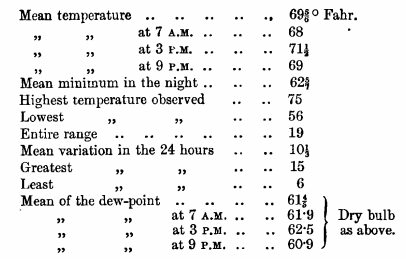
The wind generally blows up the valley during the daytime,
when the clouds ascend, to be condensed by the colder
night-air. Thus we almost invariably had rain at night,
generally in a heavy fall, but occasionally in small drizzle,
which usually continued until the forenoon. At noon it
cleared up for a fine afternoon, and only on two occasions
did we have rain throughout the day. The valley, and the
course of the river, bear N.N.W. and S.S.E.
The three valuable species of chinchonæ found in Tambopata
grow in distinct zones as regards elevation, together
with other chinchonaceous plants, up the declivitous sides of
the ravine.
From the banks of the river to about 400 feet up the
mountains, the forest consists of bamboos, several genera of
palms, tree-ferns, paccays, and other Leguminosæ, Lasionemas,
Cascarilla Caruas, and the Chinchona micrantha, together with
the chinchonaceous tree called by Martinez Huiñapu. This is
the lower zone. The C. micrantha, called by Martinez verde
paltaya and motosolo,[344] was in flower in May. I met with it
constantly in moist low places; and several trees, with their
very large ovate leaves, and bunches of white fragrant
flowers, were actually drooped over the waters of the river.
It produces a good quality of bark, and I collected seven
fine seedling-plants of this species.
From 400 to 600 feet above the river is the middle
zone, and that which contains the Calisaya-plants. The
vegetation chiefly consists of huge balsam and India-rubber
trees, huaturus, Melastomaceæ, Aceite de Maria (Elæagia
Mariæ), Compadre de Calisaya (Gomphosia chlorantha), and
occasional trees of Cascarilla Carua, which straggle up from
the lower zone. Here the young trees of C. Calisaya grow
in great abundance, but the cascarilleros had certainly done
their work well in former years, for every single tree of any
size had been felled, though many of the young root-shoots
were 20 and 30 feet high, and covered with capsule-bearing
panicles. These precious trees were most plentiful under
the ridges of rock which crop out at intervals, where the
ground was not so thickly covered with vegetation, and where
the young plants obtained plenty of light and air, while they
were partially protected from the direct rays of the sun by the
spreading branches of taller trees. The Calisaya-trees, on
the Ccasa-sani precipice, however, had no shade whatever.
They were covered with capsules. I observed that when the
young plants of C. Calisaya grew up the sides of the rocks,
and actually came in contact, they often threw out roots
from their stems or branches. The C. Calisaya is by far the
most beautiful tree of these forests. Its leaves are of a dark
rich green, smooth and shining, with crimson veins, and a
green petiole edged with red, and the deliciously sweet
bunches of flowers are white, with rose-coloured laciniæ,
edged with white marginal hairs. But it was evident that
we did not see them to advantage in these forests; they ran
up tall and straggling, as if seeking the sun, and seemed
to pant for more light and air, and a deeper and richer
soil. Martinez told me that, when the Calisaya is much
overshadowed by other trees, it loses the crimson colour
on the petioles and veins of the leaves; and that fifteen
leagues lower down the river (I suppose at about four thousand
feet above the sea) the leaves of the Calisaya morada become
quite bright purple all over the under side.
Gironda and Martinez told me that there were three kinds
of Calisaya-trees; namely, the Calisaya fina (C. Calisaya, α
vera, Wedd.), the Calisaya morada (C. Boliviana, Wedd.), and
the tall Calisaya verde. They added that the latter was a
very large tree, without any red colour in the veins of the
leaves, and generally growing far down the valleys, almost
in the open plain. A tree of this variety yields six or seven
quintals of bark, while the Calisaya fina only yields three or
four quintals; and Gironda declared that he had seen one,
in the province of Munecas in Bolivia, which had yielded
ten quintals of tabla or trunk-bark alone.
My remarks respecting the position of C. Calisaya trees, on
the sides of the ravine, only apply to the forest below Lenco-huayccu;
above that position they are not found so high up
the sides of the mountains, probably owing to their greater
proximity to the snowy region of the cordillera. The nearest
snow may be about forty miles from Lenco-huayccu, as the
crow flies. I also found that the Calisaya fina was most
abundant about the Yana-mayu, while the variety called
morada was plentiful in the upper part of the ravine. But it
was very difficult for an unpractised eye to detect the slightest
difference between these two varieties, until their leaves were
placed side by side, when that of the morada appeared to be
just a shade darker green. Dr. Weddell has, in his work,
named the Calisaya morada, as a distinct species, C. Boliviana,
but I understand that he is now of opinion that it is scarcely
more than a variety of the Calisaya vera, its bark being very
generally collected and sold as that of the latter. No plants
which I saw in the forests could be compared, for vigour and
regularity of growth, with the tree which I have already
described as having been planted on the edge of a clearing;
and I think this tends to prove that plenty of light and air is
essential to the vigorous growth of the C. Calisaya, so long
as there is a sufficient supply of moisture, and protection
from the direct rays of a scorching sun for the first year or
two. The C. Calisaya is undoubtedly the most delicate and
sensitive of all the species of chinchona.
Above the region occupied by C. Calisayas, in the forests,
is the third or upper zone, from 600 to 800 feet above the
river. Here, amidst very dense humid vegetation, covered
with ferns and mosses, are first met the trees of C. pubescens,
and Pimentelia glomerata, and a little higher up are numerous
trees of the two valuable species of C. ovata, namely, α vulgaris
and β rufinervis, with very large ovate leaves, the
latter being distinguishable by the deep red of the leaf-veins.
The Cascarilla bullata grows with them, and extends still
higher up the sides of the mountains. The bark of the β
rufinervis variety is habitually used to adulterate the Calisaya,
which it very closely resembles, and is called zamba
morada by the cascarilleros, while the α vulgaris variety is
known as morada ordinaria. Martinez said that the zamba
morada was very tenacious of life, and that, having once
thrown away a branch amongst some moss, he found it a fortnight
afterwards, still throwing out shoots. Both varieties of
C. ovata yield valuable barks.
Above the zone of the C. ovatas, and nearer the snowy
cordillera (for lower down the valley the forests cover the
crests of the mountains), commence the open grassy pajonales,
which I have already described. Here the formation is
exactly the same as that in the valley of Tambopata; and
the vegetation of the thickets which fill the gullies, and are
interspersed over the grassy glades, consists of huaturus,
Gaultheriæ, Vacciniæ, Lasiandræ, and other Melastomaceæ,
Chinchonæ, palms, and tree-ferns. The chinchonæ consist of
C. Caravayensis, and of the shrubby variety of C. Calisaya,
which is called ychu cascarilla by the natives. The shrub
Calisaya (β Josephiana) is generally from six and a half to ten
feet high, but I met with an individual plant which I believe to
belong to this variety, which had attained a height of eighteen
and a half feet; and this inclined me to think, at the time, that
this shrubby form could not even be considered as a variety of
the normal C. Calisaya, and that its more lowly habit was
merely due to the higher elevation and more rigorous climate
in which it grew. Dr. Weddell remarks that its appearance
varies very much according to the situation in which it grows,
and that the colour and texture of the different parts change
according to the amount of exposure.
I found the shrub Calisaya in flower in the end of April.
We crossed two pajonal regions, one above the valley of
Sandia, and the other between the valleys of Sandia and
Tambopata. The height of the former above the level of the
sea was 5422 feet, and of the latter 5600 feet. The time of
my visit was the end of April and beginning of May, and I
traversed both regions twice, so that an abstract of my meteorological
observations will give a tolerably correct idea of the
climate at that time of the year; although they only extend
over the 25th, 26th, 27th, and 28th of April, and a few days
in the middle of May.
| Mean temperature | 59° | Fahr. |
| Mean minimum at night | 52 |
| Highest temperature observed | 67 |
| Lowest temperature observed | 49 |
| Entire range | 18 |
| Mean of the dew-point | 53.6 | (dry bulb as above). |
In the early morning there were generally masses of white
clouds lying in the ravines, and in the afternoon a thick mist
drifted across the pajonal, with drizzling rain.
The shrub-Calisayas, which were growing plentifully by the
roadside, above the valley of Sandia, were entirely exposed,
without any shade whatever, and the hill on which they grew
had a western aspect. There is a difference in elevation of
about 1000 feet between the locality where we saw the shrub-Calisayas,
and the region of the normal tree-Calisaya in the
Tambopata forests; and the shrubby form is also many
leagues nearer the snows of the cordillera. These circumstances
are alone sufficient to account for the difference in
the habit of these two forms of C. Calisaya; and there seems
to be no doubt that the barks of the shrubby varieties of chinchonæ
are specially good when their stunted growth is owing
to the altitude of the locality.
Our collection of chinchona-plants in the Tambopata
forests, and on the pajonales, was completed on May 14th, as
follows:—
| No. of Plants. |
| C. Calisaya (calisaya fina) | 237 |
| C. Boliviana (calisaya morada) | 185 |
| C. ovata, var. α vulgaris (zamba ordinaria) | 9 |
| C. ovata, var. β rufinervis (zamba morada) | 16 |
| C. micrantha (verde paltaya) | 7 |
| C. Calisaya, var. β Josephiana (ychu cascarilla) | 75 |
| Total | 529 |
JOURNEY FROM THE FORESTS OF TAMBOPATA TO THE
PORT OF ISLAY.
Establishment of the plants in Wardian cases.
On May 11th Mr. Weir completed the packing of the plants,
and we were preparing for the journey up into the pajonales
on the following day, having previously fixed on the Calisaya-trees
from which we intended to obtain a supply of seeds in
August, when Gironda received an ominous letter from Don
José Mariano Bobadilla, the Alcalde Municipal of Quiaca,
ordering him to prevent me from taking away a single plant;
to arrest both myself and the person who had acted as my
guide; and to send us to Quiaca.[345] I found that an outcry
against my proceedings had been raised by Don Manuel
Martel, the red-faced man whom I had met on the road to
Sandia, and that the people of Sandia and Quiaca had been
excited by assertions that the exportation of cascarilla-seeds
would prove the ruin of themselves and their descendants.
Gironda, though friendly and hospitable, feared that the
finger of scorn would be pointed at him, as the man who had
allowed the stranger to injure his countrymen. He wanted
to throw away all the plants, except a few which we might
take without observation, and, if we had not kept constant
guard over them, he would have carried his views into effect
without consulting us. I saw that in an immediate retreat
was the only hope of saving the plants; and I explained to
Gironda that his views were incorrect, and that, if necessary,
we were prepared to defend our property by force.
At the same time I addressed a letter to Don José Bobadilla,
stating that his interference was an unwarrantable
step which I would not tolerate; and that, as I understood
the provisions of the Constitution of 1856, the functions of
the Juntas Municipales were purely consultative and legislative,
conferring no executive powers whatever, concluding
with an expression of my sense of his patriotic zeal, and of
regret that it should be accompanied by such misguided and
lamentable ignorance of the true interests of his country.
Nevertheless, I felt the imperative necessity of immediate
flight, especially as I obtained information from an Indian of
Quiaca that Martel's son and his party, who had brought the
letter, were only the vanguard of a body of mestizos, who
were coming down the valley to seize me, and destroy my
collection of chinchona-plants.
Early in the morning of May 12th we took leave of our
kind and hospitable old friend Gironda, without whose
assistance we should have been exposed to much suffering
from want of food; and of the honest forester Martinez. I
expressed my sincere regret to Gironda that any misunderstanding
should have arisen at the close of our acquaintance,
and promised Martinez to obtain guarantees that he should
suffer no molestation on account of the services he had rendered
to me. The most melancholy part of travelling is the
parting with friends, never to meet again.
After a laborious ascent through the forest we found
Martel's son and his party stationed on the verge of the
pajonal. They were evidently waiting for us, but did not
attempt to impede our passage, and a display of my revolver,
although it may have been very efficacious, was perfectly
harmless, as the powder was quite damp. The young Martel
asked the Indians in Quichua how they dared to carry the
plants, and called after them that they would be seized at
Sandia; but he was civil to me, and we continued our journey
peaceably, though full of apprehensions at the turn affairs
might take on our arrival at Sandia.
We had to cross the same country as we had traversed in
our journey to the Tambopata valley; and, in skirting along
the verge of a ridge, near the Marun-kunka, the cargo-mule
fell headlong down a precipice of twenty feet, into a dense
mass of trees and underwood. We could see the poor beast's
legs kicking in the air, but it was long before we could
reach her, and more than two hours before a circuitous
path could be cut and cleared away to extricate her. We
encamped on the pajonal, and next day, after a very laborious
walk of twelve hours, we reached the Ypara tambo,
in the valley of Sandia, Mr. Weir having collected twenty
plants of Calisaya Josephiana on the way. On May 14th we
continued our journey towards Sandia, and collected fifty-five
more plants of Calisaya Josephiana on the pajonal of Paccay-samana,
chiefly seedlings.
The water of the numerous cascades is very refreshing, and
as beautiful in its limpid transparency as when it dashes down
the rocks in dazzling streams of purest white. We were now
too in the land of luscious oranges and chirimoyas. The commonest
bird in the valley of Sandia is the cuchu, a kind of
large crow, with a shrill weak caw. It has a long yellow bill,
greenish-brown body and wings, rump-feathers red, and a long
bright yellow tail, with a black line down the centre. The
cuchus walk about the fields eating the young maize, and
perch upon the adjoining trees. Humming-birds are numerous,
and very beautiful; I saw also a little cream-coloured
hawk, and lordly eagles were soaring over the ravine, having
their eyries in the inaccessible parts of the lofty cliffs. Approaching
Sandia in the early morning of May 15th, I came
upon many groups of Indians, with their wives and daughters,
who had slept in the road, on their way to and from their
coca-harvests. They were boiling their breakfasts of potatoes
over little fires of dry sticks, which crackled pleasantly.
Grand precipices towered up on either side of the valley, and
in the bottom, where the bright river was murmuring on its
way, there was a hut in a field of maize, surrounded by the
drooping crimson flowers of the "love-lies-bleeding," with a
girl in a bright blue woollen dress sitting at the door.
On arriving at Sandia I went through the ceremony of paying
off my Indians, and taking leave; and Vilca, Ccuri, and
Quispi returned to their homes. I formed a very high opinion
of the Indian character from my experience with these my
fellow-labourers. Suspicious they certainly were at times,
and with good reason after the treatment they have usually
met with from white men, but willing, hard-working, intelligent,
good-humoured, always ready to help each other, quick
in forming the encampments, conversing quietly and without
noise round the camp-fires, and always kind to animals; altogether
very efficient and companionable people.
I found things at Sandia in a very alarming state; most of
the people had been excited by letters from Quiaca to prevent
me from continuing my journey with the chinchona-plants,
and a sort of league had been made with other Juntas Municipales
to protect their interests, and prevent foreigners from
injuring them. The tactics which were adopted would have
succeeded in their object, but for a great piece of good luck.
I was prevented from hiring mules, except to go to Crucero,
where I knew Martel was stationed, with the intention of
raising obstacles to my further progress until the plants
had been killed by the frost. I was in despair, and meditated
setting out on foot, with all the four bundles of
plants on my own mule, when Don Manuel Mena told me
confidentially that, if I would give him my gun, he would get
an Indian to supply beasts, and accompany me to Vilque, on
the road to Arequipa. I willingly agreed to this bargain,
and sent Mr. Weir and Pablo to Crucero, so as to throw
Martel off the scent, while I hurried the plants down to the
coast by the most unfrequented line of country.
An alarm had, however, been spread through all the
villages bordering on the chinchona forests, both in Caravaya
and Bolivia, and I ascertained that effectual measures had
been taken to prevent my return for seeds in August.
Martel had also written to the towns and villages between
Crucero and Arequipa, to put obstacles in the way of my
retreat, so that I found it necessary to avoid entering any
town or village, and to shape a direct compass-course over
the cordilleras from Sandia to Vilque. I also reluctantly
abandoned my intention of returning to collect seeds in
August, and made the best arrangements in my power to
obtain a supply, through a reliable agent, in the ensuing
year. Martel was a mischievous meddling fellow, but the
members of the Juntas Municipales may have been influenced
by misguided zeal for the interests of their country, and for
the preservation of a strict monopoly in a trade which has
ceased to exist, for no bark is now-exported from Caravaya.
In the morning of May 17th I left Sandia on my own
trusty mule, driving two others with the plants before me,
and accompanied by their owner on foot, an Indian named
Angelino Paco, a middle-aged respectable-looking man, who
had been one of the Alcaldes of Sandia in 1859. Mr. Weir
started for Arequipa on the same day, by way of Crucero.
Passing through Cuyo-cuyo without stopping, I continued to
ascend a mountain-gorge, by the side of the stream, but
Paco had never been out of the valley of Sandia before,
and was useless as a guide. All along the banks of the
stream there were square pools dammed up and filled with
heaps of potatoes and ocas, placed there to freeze into
chuñus, the principal food of the Indians when in the forests,
or on the coffee or coca estates. Higher up the gorge all
signs of habitation cease, though there are still abandoned
tiers of ancient terraces, and the mountain scenery is quite
magnificent. Night coming on without a moon, I halted
under a splendid range of frowning black cliffs, and succeeded
in pitching the tent in the dark, but there was no
fuel, and on opening the leathern bag I found that my
little stock of food and lucifer-matches had been stolen in
Sandia. I was thus entirely dependent for existence on
Paco's parched maize, which proved uncommonly hard fare.
The cold was intense during the night, and penetrated
through the tent and clothes to the very marrow.
At daybreak Paco and I loaded the mules, and continued
to ascend the gorge by the side of the river of Sandia, which
becomes a noisy little rill, and finally falls, as a thin silvery
cascade, over a black cliff. Reaching the summit of the
snowy cordillera of Caravaya, we commenced the journey
over lofty grass-covered plains, where the ground was
covered with stiff white frost. There were flocks of vicuñas
on the plain, and huallatas, large white geese with brown
wings and red legs, on the banks of the streams; but as
we advanced even these signs of life ceased, and, when night
closed in, I looked round on the desolate scene, and thought
that to make a direct cut across the cordilleras to Vilque
by compass-course was a very disagreeable way of travelling,
though, in this case, a necessary one. I had been
eleven hours in the saddle, when Paco found an abandoned
shepherd's hut, built of loose stones, three feet high, and
thatched with ychu grass. The minimum thermometer,
during the night, was as low as 20° Fahr. by my side.
At daylight on May 19th Paco complained of having to
rise before the sun, although he must have been half-frozen.
The mules had escaped, and we were fully three hours in
catching them. The ground was covered with a crisp frost,
and during the forenoon we were traveling over the same
lofty wilderness, consisting of grassy undulating hills, with
ridges of cliffs, and huge boulders here and there. The view
was bounded on the north and east by the splendid snowy
peaks of the Caravayan range, and to the north-west by
those of Vilcañota. The only living things, in these wild
solitudes, are the graceful vicuñas, which peered at us with
their long necks from behind the grassy slopes, the guanacos,
the biscaches burrowing amongst the rocks, and the huallatas
or large geese on the margins of streams or pools of water.
At about noon we began to descend a rocky dangerous
cuesta, where there was much trouble with the mules, which
were constantly attempting to lie down and roll with the
plants. The steep descent led into the plain of Putina,
which was covered with flocks of sheep, with small farms,
shaded by clumps of queñua-trees, nestling under the sandstone
cliffs which bound the plain. Crossing another range,
we reached a swampy plain, with sheep and cattle scattered
over it, and stopped at an abandoned shepherd's hut, the
exact counterpart of last night's lodging. I had been ten
hours in the saddle, and was faint from hunger, but had to
go supperless to bed. Paco was nearly breaking down from
a bad wound in his foot, but I bandaged it with lint, and
he was able to proceed. He had an alco or Peruvian
dog with him, which was devotedly attached to its master.
These dogs are something like Newfoundlands, only much
smaller, generally black or white, and seldom bark.
On the morrow the way, for the first two hours, led over
grassy hills covered with flocks of sheep, with shepherd-lads
playing on pincullus, or flutes, the sound of which came
floating pleasantly on the air, from every direction far and
near. We passed several blue mountain-lakes, with islands
of rushes, and many ducks. From 10 A.M. until sunset the
whole day was occupied in crossing a vast plain covered
with sheep and cattle, and just after sunset we reached a
small estancia or sheep-farm. It was occupied by a large
family of good-tempered Indians, whose eyes glistened when
I offered them a cesto of coca which I had with me, in
exchange for unlimited supplies of milk and cheese. It was
pleasant to see their happiness at the acquisition of this
treasure, which was shared by the children and dogs. The
place was full of guinea-pigs, which are considered great
delicacies. The extreme hunger from which I had suffered
since leaving Sandia was here relieved by plenty of milk,
cheese, and parched maize. Every night I had wrapped the
Russian mats, which enveloped the plants, in warm ponchos,
and the tent. The crooked wriggling queñua-branches, which
formed the roof of the hut, looked like snakes in the dim
light after sunset.
At sunrise on May 21st there was a white frost, and the
deep blue sky was without a single cloud. Suddenly an immense
flock of flamingos, called parihuanas[346] in Quichua, rose
in a long column from the margin of the river of Azangaro,
which flows through the plain. These birds, with their crimson
wings, and rose-coloured necks and bodies, whirring up
in a long spiral column, formed one of the most beautiful
sights I ever saw.
Crossing a range of rocky hills, we entered a plain, which
extended to the banks of a large lake, with the little town of
Arapa built along the shore. Dark mountains rise up immediately
in the rear. I believe that I am the first English
traveller who has ever visited this lake, and M. de Castelnau,
who obtained some information respecting it at Puno, says
that it is not to be found in any map.[347] Along the shores there
were long rows of flamingos, standing like a gigantic regiment,
with a few skirmishers thrown out fishing. There were
also huallatas, ibises, ducks, and a stout-built stunted sort of
crane. Journeying on, we began to cross a vast plain which
extends for many leagues round the north-west corner of
lake Titicaca, and is dotted with walled estancias and flocks
of sheep. At length we reached the ford over the river of
Azangaro, in sight of the little village of Achaya, to the
left. The water came above the mules' bellies, and, crossing
half a mile of swampy ground, we came to another
ford over the river of Pucara. The two rivers, uniting just
below Achaya, form the Ramiz, the largest feeder of lake
Titicaca. We continued our way for many hours over the
plain, until we reached an Indian's hut long after dark, having
been twelve hours in the saddle, at the slow tedious pace of
a tired mule. The cargo-mules had played every kind of
vicious trick throughout the day, running off in different
directions at every opportunity, and constantly trying to
roll.
Starting at daybreak on the 22nd, we forded the river of
Lampa, crossed the road between Lampa and Puno, passed
over a rocky cordillera and a wide plain, and reached the
little town of Vilque by four in the afternoon. The place
presented a very different appearance from the time when we
passed through it in March, on our way to Puno. It was now
the time of the great yearly fair, when buyers and sellers
from every part of South America flock to the little sierra
town. This great gathering was first established in the time
of the Spaniards, and it is not improbable that the Jesuits,
who once possessed the great sheep-farm of Yanarico near
Vilque, and who always looked well after the improvement
of their property, may have been the great promoters of the
fair.
Outside the town there were thousands of mules from
Tucuman waiting for Peruvian arrieros to buy them. In the
plaza were booths full of every description of Manchester and
Birmingham goods; in more retired places were gold-dust
and coffee from Caravaya, silver from the mines, bark and
chocolate from Bolivia, Germans with glass-ware and woollen
knitted work, French modistes, Italians, Quichua and Aymara
Indians in their various picturesque costumes—in fact, all
nations and tongues. In the plaza, too, there were excellent
cafés and dining-rooms, all under canvas; but house-rent was
exorbitant, and a lodging was not to be had for love or
money. There was much complaint of the injury done to
trade by the threatened war with Bolivia, and the edict of
President Linares, prohibiting all intercourse with Peru.
I placed the bundles of plants, carefully wrapped round
with ponchos, in a barley-field occupied by arrieros, covered
over with their warm aparejos; but the thermometer was
down to 23° Fahr. in the night.
In the afternoon of the 23rd I left Vilque for the sheep-farm
of Taya-taya, in company with Dr. Don Camillo Chaves
the superintendent. The road was crowded with people
coming from Arequipa to the fair at Vilque: native shopkeepers,
English merchants coming to arrange for their
supplies of wool, and a noisy company of arrieros on their
way to buy mules, and armed to the teeth with horse-pistols,
old guns, and huge daggers, to defend their money-bags.
Many of them were good-looking fellows, the older ones
bearing signs of hard drinking.
The sheep-farm of Taya-taya,[348] four leagues from Vilque, is
a large range of mud-plastered buildings with thatched roofs,
built round a large patio, on a bleak plain surrounded by
mountains. In the morning a flock of forty llamas were
being laden with packs of wool in the patio, at which they
were making bitter lamentations. We started early on May
24th, and encountered a cold gale of wind, blowing in icy
squalls over the cordillera. I reached the posthouse of Cuevillas
in the night, a distance of 45 miles; got as far as the
posthouse of Pati the next day; encountered a tremendous
gale of wind on the skirts of the volcano of Arequipa, but
descended to the valley of Cangallo on the 26th; and rode
into the city of Arequipa, with my plants, on the morning of
the 27th of May. Mr. Weir arrived from Crucero on the
29th, having, as I expected, found Martel in that town, whose
designs were thus baffled. From Sandia to Arequipa is a distance
of nearly 300 miles. No opposition was made to my
departure from Arequipa, although the local newspaper had
something to say afterwards,[349] and on June 1st the plants were
safely deposited by the Wardian cases at the port of Islay.
"John of the Fountain" had provided plenty of soil, and
by the 3rd all the plants were established in the Wardian
cases by Mr. Weir. But the difficulties of getting the plants
out of the country were not entirely ended by my escape from
Martel and the Juntas Municipales of the interior. The
Superintendent of the custom-house of Islay declared it to
be illegal to export cascarilla-plants, and refused to allow
them to be shipped without an express order from the
Minister of Finance and Commerce at Lima. He had
probably received intelligence respecting the contents of the
cases from Vilque, where all news centres at the time of the
fair. This obliged me to go to Lima to obtain the necessary
order from Colonel Salcedo, the Minister of Finance, which,
after much difficulty, I succeeded in doing, and returned with
it to Islay on June 23rd.[350]
Meanwhile, since the plants had been established in the
Wardian cases, they had begun to bud and throw out young
leaves, which seemed to prove that they had quite recovered
from their journey across the arctic climate of the Andes.
In the evening of the 23rd the cases were hoisted into a
launch, ready to go on board the steamer on the following
morning; and during the night attempts were made to
bribe the man in charge to bore holes and kill the plants by
pouring in boiling water, but without success. On the following
day they were safely lodged on board the steamer
bound for Panama.
It was impossible not to feel regret that H. M. steamer
'Vixen,' then lying idle at Callao, had not been ordered
to take the plants direct across the Pacific to Madras, when
a majority would have arrived in perfect order. But this was
not to be, and we had to look forward to long voyages, several
trans-shipments, and the intense heat of the Red Sea,
before this most valuable collection of plants could reach
their destination in Southern India.
Yet it could not but be satisfactory to look back upon the
extraordinary difficulties we had overcome, the hardships and
dangers of the forests, the scarcity of the plants, the bewildering
puzzle to find them amidst the dense underwood, the
endeavour to stop my journey first at Tambopata and then in
Sandia, the rapid flight across unknown parts of the cordillera,
and the attempts first to stop and then to destroy the
plants at Islay: it was a source of gratification to look back
upon all this, and then to see the great majority of the plants
budding and looking healthy in the Wardian cases.
The climate at Islay, during the time that the plants
remained there, was as follows, from the 1st to the 24th
of June:—
| Mean temperature | 69° | Fahr. |
| Mean minimum at night | 60 |
| Highest temperature observed | 73 |
| Lowest | 58 |
| Entire range | 15 |
The temperature is almost exactly the same as that of the
Tambopata forests in May; but the forests were always exceedingly
moist, while Islay is intensely dry. This, however, was
unimportant to the plants in their cases.
PRESENT CONDITION AND FUTURE PROSPECTS OF PERU.
Population—Civil wars—Government—Constitution—General Castilla and
his ministers—Dr. Vigil—Mariano Paz Soldan—Valleys on the coast—Cotton,
wool, and specie—The Amazons—Guano—Finances—Literature—Future
prospects.
After a sojourn of a few days at Lima we took a final
farewell of the land of the Incas, on June 29th, 1860. As
we steamed along the coast, in sight of the emerald-green
valleys, surrounded by trackless wastes of sand, and of the
glorious cordilleras which towered up behind them, a long
train of memories passed in array before us. In this land
alone, of all the nations of the earth, did the ideal of a
perfect patriarchal form of government become a reality.
Here, too, are the scenes of the most romantic episode in
modern history, comprised in the career of the Pizarros.
The sufferings of the gentle Indians excited the indignation
of the Elizabethan chivalry; the fabulous riches extracted
from the mines of Peru attracted the adventurous spirit of
the buccaneers of a baser age; and the brave struggle for
independence led more than one gallant Englishman to shed
his blood in the cause of Peruvian liberty.[351] What is now
the state of this famous land, and what prospect is there of
the glowing hopes expressed in Mr. Canning's well-known
speech ever being fulfilled, are questions which cannot fail
to arouse some passing interest.
In giving an account of the present condition and future
prospects of Peru, the invariable kindness and frank hospitality
of its inhabitants impose an obligation to speak with
as much leniency and forbearance as the interests of truth
will admit. The South American Republics are peopled by
races of mixed origin, who are doubtless inferior to Europeans,
both mentally and physically; and the unsettled
condition of those countries, which inevitably succeeded the
struggles for an independence for which the people were
unprepared, has continued longer than might justly have
been expected. But it appears to be a generally received
idea in England, originating from the accounts of travellers
unacquainted with the people, and ignorant of
their language, that the South Americans are a mongrel
degraded race, incapable of improvement, and hopelessly
degenerate.[352] So far as my experience extends, and after
a careful consideration of the subject, I can see no grounds
for resigning the hope that a brighter future is yet in store
for the land of the Incas.
It is true that, after a casual and superficial glance at
the state of affairs in South America since the expulsion
of the Spaniards, the prospect appears sufficiently gloomy.
But a more intimate acquaintance with the subject, and
especially a knowledge of the tone of thought amongst the
younger men, as expressed in conversation and in their
writings, would show that, under the surface, noble aspirations
and steady enlightened views prevail, which must eventually
yield fruit, and thus justify our hopes for the future. When
independence was established in South America, there were
two principal causes which led to the civil wars which
ensued; namely, the question between a federal or a centralized
form of government, and the disputes respecting
boundaries. The power attained during the revolution by
the armies, and the selfish ambition, treason, and corruption
of public men, aggravated these sources of evil to a melancholy
extent. But other countries, far greater and nobler
than these poor struggling republics, have had to pass
through as long and as degrading a crisis in their history.
Englishmen must remember the thirty years comprising the
reigns of the two last Stuarts with quite as much shame as
the great-grandchildren of the present Peruvians will experience
when they learn the history of their country for the
first forty years after its independence. It is recorded that
in a British House of Commons there was but one Andrew
Marvel. To my personal knowledge there are now several
Andrew Marvels in Chile and Peru. These young and inexperienced
countries have had to pass through a fierce ordeal,
and, truth to say, they have played their part but indifferently
as yet. They indeed require forbearance, but let us not
turn from them with disdain and contempt, in the pride of
our present grandeur and prosperity. Were treason and
corruption and base selfish faction never rife in England's
court and parliament?
The fatal mistake of several of the old Spanish colonies
was in establishing a federal system of government, in
imitation of the United States. This was the case in Mexico,
Central America, New Granada, and the Argentine Confederation.
No system can possibly be more entirely unsuited
to a thinly-peopled mountainous region, without roads, and
unprovided with a sufficient number of capable educated men
in the distant provinces to undertake the local government.
Power necessarily falls into the hands of any cunning
adventurer, every little state becomes a focus for revolution,
and an endless succession of civil wars are the result. Such,
in fact, has been the fate of those republics where federation
has been established. Pernicious as centralization always is
when carried too far in old and densely-peopled countries,
it is an absolute necessity in young states, with a small
population thinly scattered over a vast extent of country.
The distant inaccessible districts do not possess the materials
for self-government within themselves, and necessarily depend
for their prosperity and advancement on the capital.
Peru has only once been subjected to the federal experiment,
and she has not suffered so much from internal
dissensions as the unfortunate countries above mentioned.
She holds a central position amongst the South American republics,
not so cruelly torn by anarchy as Mexico on the one
hand, and not enjoying so good and settled a government as
Chile on the other. Her people too are perhaps inferior in
capacity and mental endowments to the Chilians and the
natives of New Granada, but infinitely superior to those of
Central America and Mexico. She may, therefore, be taken
as an average example of these half Spanish, half Indian
states; and as such I will proceed to give some account of
her people, her government, and her material resources.
The population of Peru, by the latest accounts, was 1,880,000
souls: the whole of the labouring classes in the interior being
pure Indians; the artizans and shopkeeping classes in the
towns partly Indians and partly half-castes or mestizos; the
lower orders on the coast being negros, or zambos, a caste
between negros and Indians, with some imported Chinese;
and the upper classes being chiefly of Spanish descent with a
slight dash of Indian blood, many nearly or quite half-castes,
not a few pure Indian, and an exceedingly small proportion
of pure Spanish descent.[353] The men of Indian extraction
display perhaps more energy and equal ability with their
fellow-countrymen of pure Spanish origin; and many Indians
are wealthy enterprising men, while others have held the
highest offices in the state. The Peruvians are intelligent
and quick of apprehension, exceedingly hospitable and kind-hearted,
and remarkably humane and forgiving, as a rule,
in the conduct of their civil wars; but they are apt to be
fickle and volatile, incapable of any long-sustained effort, and
inclined to indolence. Corruption, bribery, treason, and pusillanimity
are but too common; but may not these be the
vices engendered by civil strife and periods of anarchy, rather
than the normal characteristics of the people? With the
exception of the negro races on the coast, there are few
people among whom crime is more uncommon.
The causes of the civil and foreign wars which have retarded
the progress of Peru since her independence may be explained
in a very few sentences.
The first of these has arisen from disputes with her neighbours
respecting boundaries. On her southern frontier the
ambitious policy of Bolivar created a small republic, from no
reason or motive that was apparent, beyond the childish vanity
of having a country called after his name. This country was
to all intents and purposes a part of Peru. Her people, her
languages, her traditions and feelings were the same, and,
until the latter part of the last century, she had formed a part
of the Peruvian viceroyalty. No good end was attained by this
division; while disputes respecting a doubtful unsurveyed
boundary, jealousies and misunderstandings arising from all
imported goods from Europe having to be landed at the
Peruvian port of Arica, and conveyed to Bolivia across Peruvian
territory, has created a hostile feeling, embittered year
by year, between people who should have lived as brothers
under a single government. On her northern frontier Peru
has the little republic of Ecuador, until 1830 a portion of
Colombia; which possesses the only good port, with the exception
of Callao, on the western coast of South America,
that of Guayaquil. This port has always been coveted by
Peru; and the question of the frontier was further confused
by the civil jurisdiction in Peru and Quito, during Spanish
times, having been divided by one line, and the ecclesiastical
by another. The generally recognised rule for deciding the
frontiers between the South American Republics is the uti
possidetis, as regards the former colonial jurisdictions, at the
time of the war of independence.
These frontier disputes, carried on with feelings embittered
by former jealousies, led to a war between Colombia and
Peru in 1828,[354] in which the latter republic was worsted; and
a campaign, ending in a treaty, between Peru and Bolivia at
the same time.
The second and more disastrous cause for civil dissensions
was the question between a federal and a centralized form
of republican government. Peru enjoyed a period of peace
between the war with Colombia in 1828 and the year 1834; but
between the latter period and the year 1844 the unfortunate
country was subject to a constant series of civil wars and insurrections.
The ten years between 1834 and 1844 was Peru's
most miserable time. Her public men were corrupt, pusillanimous,
and selfishly ambitious; she was given up to be torn and
distracted by wretched military adventurers; and the marches
of armies, with their system of forced recruiting, banished all
attempts at advancement or improvement from the country.
Yet even during this dark interval there was a space of two
years, when General Santa Cruz established his dream of a
federal republic under the name of the Peru-Bolivian Confederation,
during which the land enjoyed peace and some signs
of revived prosperity. The able and vigorous administration
of Santa Cruz, whose mother was an Indian chieftainess, was
the one bright spot in this dreary waste of anarchy.
For the following ten years Peru enjoyed a period of peace,
under the rule of General Don Ramon Castilla, an old Indian
of Tarapaca, for the first six years, and afterwards of General
Echenique. During this period the country advanced
rapidly in material prosperity, but in 1854 it was again convulsed
by a revolution, caused by the general discontent of
the people at the gross malversations and unblushing robbery
of Echenique's Government. Castilla placed himself at the
head of this movement, and, with the aid of a large army,
has retained his power up to the present day. The insurrection
at Arequipa, and mutiny in the fleet, in 1857-58, were
purely local, and did not affect the general tranquillity of the
country.
Towards the close of Peru's ten years of convulsion, a constitution
was adopted, establishing a strictly centralising form
of government, in 1839, in which immense power was placed
in the hands of the executive. But during the ten years of
peace which followed the election of Castilla in 1844, men's
minds were strongly influenced by European travel and by
more extended reading, extreme liberal views were very
generally adopted, and the old constitution was felt to be out
of date. In 1856, therefore, a new constitution was promulgated
by a national assembly summoned for the purpose by
General Castilla, in which abstract ideas of what is just and
right were unhesitatingly and heedlessly adopted; and a
strong tendency to federalism and local self-government was
displayed.
By a stroke of the pen the capitation-tax paid by the Indians,
the principal source of revenue in ordinary times, the slavery
of negros on the coast, and all capital punishments were entirely
abolished. There would have been some nobleness in
the abolition of slavery, and the grant of 1,780,000 dollars
as compensation, as well as a display of liberal sentiment, if
it had in any way increased the burdens of the people, but
this was not the case. For the same reason the discontinuance
of the tribute paid by the Indians was a mere act
of recklessness. In this constitution there were two legislative
chambers, a Senate and a House of Representatives; but
half the representatives were chosen by lot to form a Senate,
so that one chamber was a mere counterpart of the other.
The most remarkable clauses, however, were those in which
measures leading to the federal form of government, a plagiarism
of the disastrous system of the United States, were
adopted. Peru continued to be divided into Departments
governed by Prefects appointed by the President; but it was
now enacted that in the capital of each Department there
should be a sort of state legislature called a Junta Departmental,
the members being elected by the people, and empowered
to deliberate and legislate for the good of the
Department. This measure was but a commencement of that
fatal system which had convulsed some of the other republics;
and its tendency was so apparent that Castilla was accused of
intending to divide Peru into a dozen petty states, and to rule
as a Dictator, by fomenting dissensions among them.[355] A
wiser and more useful measure was the establishment of what
are called Juntas Municipales in the towns and unions of
villages, composed of the principal residents, who are intrusted
with the supervision and promotion of all local
interests and improvements.
In November 1860 this constitution was reformed, improvements
were introduced, and some of its more absurd and
injurious provisions were repealed. Capital punishment for
the crime of murder was again enacted. The Congress was
to meet every two years on the 28th of July; a third of their
number to be renewed every two years; and, during the
recess, a permanent committee of the Congress, consisting
of seven senators and eight deputies, to be elected at the end
of each session, was to watch the execution of acts passed
by the Congress, and to exercise its functions. A great
improvement was also adopted in the constitution of the
Senate. The members of that body are to be elected by the
Departments, each one electing a certain number according to
the number of its provinces, and the qualification of a senator
is raised to 1000 dollars a-year. Thus there is now an intelligible
difference between the two chambers, and, in the
formation of the Senate, one of the few good points of the
constitution of the United States has been wisely adopted.
The executive power is in the hands of a President and two
Vice-Presidents elected for four years, and a council of
ministers. Finally the mischievous Juntas Departmentales,
which I believe had never been allowed to meet, were
abolished, while the municipal institutions of the constitution
of 1856, which could only be productive of good, remained
in full force.
Such is the present form of government in Peru, perhaps
as good a one as the country is fit for, and capable, in firm
and honest hands, of meeting all the present requirements of
the people; but it is of more importance to know in whose
hands the government of the country is placed, and what
manner of men are intrusted with the destinies of a country
so rich in memories of the past, as well as in material resources;
a young republic still bleeding at every pore from a
series of civil wars, yet with a growing desire to struggle up,
through shame and misfortune, to a respectable place among
the nations. I will give a few hasty sketches of the men
who formed the executive power during my stay at Lima in
1860.
General Ramon Castilla, the President, is a native of Tarapaca
in the extreme south of Peru, and must now be close
upon seventy years of age. He is the son of Pedro Castilla,
who worked the refuse silver-ores of the mines of El Carmen,[356]
and young Ramon acted as his father's leñatero, or woodcutter.
He, afterwards, entered the Spanish army, and on
the arrival of the patriot forces from Chile in 1821 he joined
their cause, and attained the rank of colonel. After the independence
he was appointed Sub-prefect of his native province
of Tarapaca, in 1826; and he was Prefect of Puno
from 1834 to 1836; but he was mixed up in all the civil
wars, and, after a victory gained by him in 1844, he was
elected President of the Republic. Castilla is a small spare
man, with an iron constitution, and great powers of endurance.
His bright fierce little eyes, with overhanging brows, stiff
bristly moustaches, and projecting under lip, give his countenance
a truculent expression, which is not improved by a
leathery dried-up complexion; but he has a look of resolution
and an air of command which is almost dignified. This
remarkable man is an excellent soldier, brave as a lion,
prompt in action, and beloved by his men. Uneducated and
illiterate, his political successes and management of parties
almost amount to genius, while his victories have never been
stained by cruelty, and his antagonists have seldom been
proscribed for any length of time, generally pardoned at once,
and often raised by him to posts of importance in the service
of the Republic. His firm and vigorous grasp of power has
secured for Peru long periods of peace; faction has been
kept under, while an incalculable blessing has thus been
conferred on the country; and probably no other man had
the ability and the nerve to effect this. But Castilla,
though a necessity, has been a necessary evil. His want
of education renders him useless as a statesman. He has
generally shown himself indifferent to all public works, and
to measures for the moral or material benefit of the country,
while he insists on keeping up an enormous standing army,
and on spending untold sums on a costly navy, thus squandering
the public money, and continuing a pernicious and
ruinous system. The brave old man has been a necessity.
He alone has been able to keep the peace, and give time
to the Peruvians slowly to develop the resources of their
country; and through this period of tranquillity, when he
shall have passed away, interests and influences may have
insensibly risen up, which will prevent the recurrence of such
periods of anarchy as preceded Castilla's first accession to
power.
Juan Manuel del Mar, the first Vice-President, a tall,
sallow, earnest-looking man, is a native of Cuzco, the old
capital of the Incas. He has held office for some years, and
has more than once been in supreme command during the
absence of Castilla. This statesman was called to the bar
in 1830, and has led an active public life as deputy to
Congress, judge, or minister ever since. He is thoroughly
honest, possessed of enlightened views and some ability,
very popular, and universally and deservedly respected.
The second Vice-President, elected under the provisions of
the reformed constitution of 1860, is General Pezet, the son
of a physician of French extraction, who died in Callao Castle
when it was held by the Spaniards, and stood a long siege.
General Pezet, a native of Lima, joined the patriot ranks
when they landed in Peru in 1821, then only eleven years
of age; and was at once sent on active service. Thus he
was present at the battles of Junin and Ayacucho, which
destroyed the Spanish power, and was mixed up in the subsequent
civil wars.
Castilla's ministers, at the time of my visit, were far from
representing the most able and distinguished class of Peruvians.
Colonel Salcedo, the Minister of Finance, a native of
Lampa, was born in 1801. He was one of the few members
of Congress who, in 1824, firmly opposed and defeated the
ambitious designs of Bolivar; and he has since almost
constantly served as sub-prefect or prefect, or as a member
of Congress. Another minister was Don José Fabio Melgar,
a brother of the famous poet of Arequipa, whose melancholy
death I have already mentioned. He has served as chief
clerk in one or other of the public offices since 1833, is an
amiable man, well read, and intelligent, but with only
moderate abilities, and no originality or force of will. The
minister of Foreign Affairs was Don Miguel del Carpio, a
veteran statesman, born in 1795, and who, having joined the
patriots and been taken prisoner by the Spaniards in 1822,
was long kept in prison, and heavily chained. Since the
independence he has held important offices both in Bolivia
and Peru.
But old Castilla requires obedient clerks around him, not
independent ministers, and the more able and active-minded
Peruvians are not to be found filling high political posts.
The best specimens of the natives of Peru are either to be
met with leading unobtrusive literary lives, and preparing
for better times; or on their estates actively and energetically
developing the resources of their country. Such men are
Mariategui, Felipe Pardo, Vigil, Paz Soldan, and Elias,
whose patriotism and great ability would do honour to any
country.
Dr. Vigil is one of Peru's most distinguished sons. In
early life he was an active and eloquent member of Congress;
subsequently he was engaged on one of the most learned, as
well as the most liberal works that a Roman Catholic clergyman
has ever ventured to publish on the Papacy; and now
in his old age he continues to advocate, in his forcible
writings, every cause and every measure which is intended
to advance religious freedom, or the moral well-being of his
countrymen. Dr. Vigil fears that liberal views on religious
subjects, such as toleration, the marriage of the clergy, and
independence of Rome, cannot be expected to make any
rapid progress at present, but he is confident that a future
generation will appreciate his works, and introduce the
measures which he advocates. One of his strongest convictions
is that priests will never lead virtuous lives until they
are humanized by family ties: and that, while now they live
for the Church—that is for themselves and their order—they
ought to live for their flocks.
While the learned and amiable Vigil represents the literary
men of Peru, Mariano Paz Soldan is one of the best specimens
of the men of action. His benevolent mind was shocked
at the wretched condition of the prisons in Peru, and he has
displayed an amount of energy and ability in endeavouring
to remedy this evil which goes far to vindicate the Peruvian
character from the charge of indolence and procrastination.
In 1853 Paz Soldan published a very able and detailed
report on the prisons of the United States; and in 1856, by
dint of unceasing representations, he obtained the necessary
grant from the Government for the erection of a penitentiary
on the most improved principle at Lima. The work was at
once commenced with vigour. The foundations, basement,
and first story are built of a very hard porphyritic stone,
brought from the hills about two miles from Lima, where a
quarry was opened for the first time by Paz Soldan, with a
tramroad direct to the works. The entrance is by a flight
of four steps, cut out of a single block of this porphyritic
rock. The second story is of brick, and all the iron for
gratings, doors, bolts, and roofing came out ready made from
England. The wards for men, women, and children are
separated, each with its large well-ventilated workroom,
exercising yard, and cells; and everything is arranged on
the best English and American models. It will hold 52
women, 52 boys, and 208 men. This great public work will be
a credit to the country, and a lasting monument of the energy
and perseverance of its projector, who trusts that it will be
but the first of a series of such penitentiaries in different parts
of the country. Don Mariano Paz Soldan is also engaged in
organizing a general topographical survey of Peru.
There are many landed proprietors and others, of Paz
Soldan's stamp, who have availed themselves of the period
of tranquillity since 1844, interrupted only by one year of
revolution, to improve their estates, and thus add to their
country's wealth, especially in the valleys on the coast. The
long slip of land between the Andes and the Pacific Ocean
enjoys an equable climate, rain and heavy storms are nearly
unknown, and refreshing dews descend during the night. The
greater part of this region consists of sandy desert, traversed
by ridges of rocky barren hills; but wherever a stream,
descending from the Andes, is of sufficient volume to reach
the ocean, a rich and fertile valley borders its banks. These
valleys, of greater or less extent, and at various intervals,
break the monotony of the desert from the bay of Guayaquil
to the river Loa, which separates Peru from Bolivia. They
are admirably adapted for the cultivation of cotton, the vine,
the olive, and sugar-cane.
Immense wealth is already derived from these valleys, and,
with judicious outlay for obtaining more regular supplies of
water, their capabilities might be multiplied indefinitely. The
valley of Cañete, south of Lima, which is in the hands of six
enterprising proprietors, is covered with sugar-cane plantations.
In 1860 it yielded sugar worth 1,000,000 dollars, all raised by
Chinese and free negro labour. Further south, the valleys of
Pisco and Yca, thanks chiefly to Don Domingo Elias and his
sons, yield 70,000 botijas of a spirit called pisco, 10,000 barrels
of excellent wine, 800,000 lbs. of cotton, and 40,000 lbs. of
cochineal. Still further south there are many valleys which
render their owners wealthy by the produce of cane-fields and
vineyards, in the departments of Moquegua and Arequipa;
and in the valley of Tambo, near Arequipa, there are 5000
olive-trees and seven mills.
Now that the question of cotton-supply is attracting so large
a share of attention in England, it is gratifying to be able to
state that landed proprietors on the coast of Peru have seriously
turned their attention to the subject, and that in 1860 the
cultivation of cotton was becoming a favourite speculation.
The soil and climate of these coast valleys are admirably
adapted for its growth, and, though the quantity that could
be drawn from them would be insignificant when compared
with the vast demands of Manchester, yet the quality is good,
and they will supply one out of many sources which may
hereafter render us partially independent of the Confederate
States. The estates of Don Domingo Elias and others, in the
valleys of Yca, Palpa, San Xavier, and Nasca, yield 800,000
lbs. of excellent cotton. I visited these cotton estates in
1853, and found that the cotton was carefully picked, and
packed by screw presses. A great deal of cotton is also
shipped from the port of Payta, which sells in Liverpool at
8d. to 9½d. the lb.; and in the valley of Lambayeque,[357] between
Payta and Lima, cotton cultivation has lately been
undertaken on a very large scale. In 1860, in the four
districts of Talambo, Cayalti, Collus, and Calupe, there were
already 600,000 plants in the ground, and in neighbouring
estates extensive tracts of land had been prepared for cotton
by the house of Zaracondegui and others. At Talambo, in
the valley of Pacasmayo, there are many Biscayan families,
numbering in all 176 souls, who are exclusively engaged in
cotton cultivation; and the yield in that district in the first
year was 800,000 lbs. In the province of Chiclayo 700,000
plants were put in the ground during 1860, and land was
being prepared for the growth of cotton crops to a much
larger extent. These cotton-growing provinces of Lambayeque,
Chiclayo, and Truxillo are fertile and well watered;
storms of rain are unknown, and they enjoy an equable
climate with a mean temperature between 70° and 84° Fahr.
It has been calculated that, after leaving a fifth of the
available land for crops to supply provisions for the inhabitants,
as many as 140,000 fanegadas[358] might be brought under
cotton cultivation in these provinces alone. Allowing four
feet for each plant, and that each plant yields four pounds a
year, this extent of land would produce 580,000,000 lbs. of
cotton annually, worth twelve dollars the cwt. at the port of
shipment, or 69,600,000 dollars. Deducting 22,400,000 for
expenses, this would leave 47,200,000 dollars profit. But
these provinces only contain a small fraction of the fertile
coast valleys of Peru; and it is clear that, if the speculations
of 1860 yield a reasonably profitable return, the cultivation
of cotton may, in all probability, be undertaken over a vast
area, and render Peru an important source of supply for
Manchester.[359]
The lofty table-lands of the cordillera of the Andes produce
sufficient maize, wheat, and sugar for home consumption;
but their chief exportable wealth is to be found in the vast
flocks of sheep and alpacas which find pasture on those
grassy uplands, and in the veins and washings of silver and
gold. About 400,000l. worth of wool is annually exported,
of which 5,017,100 lbs., valued at 287,339l., were embarked
from the port of Islay in 1859, and 4,214,000 lbs. in 1860.
The export of specie amounted to about 200,000l. in 1859, of
which 34,705l. were exported from Islay, and 32,000l. from
Arica. But of this a portion is in coined money and chafalonia,
or old plate.
Besides the raising of the various valuable products
suitable to the coast valleys and the sierra, the vast forests
to the eastward of the Andes, and the great fluvial highways
which flow through them to the Atlantic, offer an
inexhaustible field for Peruvian enterprise. The incredible
resources of this portion of Peru are only now beginning
to be fully appreciated, though ten, and even twenty
years ago, there were evident symptoms of the first early
pulsations of life and commerce on the mighty river Amazons
and its tributaries. Petty traders, the pioneers of
a stirring future, were then busy, each in his little traffic;
canoes laden with hammocks, hats, wax, sarsaparilla, copaiba,
and other products of the forest, found their way to Para at
the mouth of the Amazons, and returned with European
manufactured goods.
But of late years an immense stride in advance has been
taken; and in 1857 a Brazilian company was working eight
steamers on the Amazons and its tributaries, conveying passengers,
and bearing up and down a ceaseless ebb and flow of
commerce. Measures were adopted in 1853 to connect the
Brazilian line of steamers with a Peruvian line navigating the
upper waters, and two small steam-vessels were sent out from
New York for the purpose, called the "Tirado" and "Huallaga."
The revolution of 1854 temporarily put a stop to these
efforts, and the two steamers were left to rot at Nauta, 2300
miles up the Amazons. Latterly, however, steps have again
been taken to supply the Peruvian tributaries of the Amazons
with steam navigation, and thereby to encourage settlement,
attract commerce, and thus develop the incalculable wealth
of Peru's Amazonian provinces.
In October 1858 a fluvial convention was signed between
Brazil and Peru, establishing the free navigation of the
Amazons, under certain restrictions; and in February 1860 the
Brazilian steamer 'Tabatinga' arrived at Laguna on the Peruvian
river Huallaga, upwards of 3000 miles from the mouth
of the Amazons. Meanwhile the Peruvian Government have
ordered steamers to be constructed to work on the upper
waters of the Amazons, in conjunction with the Brazilian line;
and roads are to be made connecting inland towns with the
nearest navigable points on the tributaries of the Amazons.
In June 1860 a party of sixty men left the town of Huanuco
to explore the wide forest-covered plains known as the "Pampas
del Sacramento" to the eastward; and in July a road had
already been commenced, which is to connect Huanuco with
a navigable part of the river Ucayali, a distance of 150 miles.
A small colony of Germans has been established on the river
Pozuzu. Other measures of a similar nature are in contemplation,
and it is impossible to estimate the rapid and certain
increase of wealth which will accrue to this hitherto neglected
region, when steam communication has thus brought one of
the richest regions in the world within reach of a market.
Para, at the mouth of the Amazons, already exceeds, in the
number of its staple commodities of export, all indigenous to
the regions of which it forms the outlet, almost any other port
on the surface of the globe. My space will not allow me to
dilate further on this most interesting subject; but it is assuredly
one which well deserves the attention of commercial
men in England.
The most remarkable source of Peruvian wealth, and one
which has caused effects on her financial system which are
perhaps unique in the history of any country, is the guano
on the desert islands off the coast. When the South American
Republics were thrown open to the trade of Europe, the
value of guano as a manure was soon discovered, the demand
rapidly increased, and the Peruvian Government were not
long in availing themselves of this, as they believed, inexhaustible
source of riches.[360] The three Chincha islands, in the
bay of Pisco, contained a total of 12,376,100 tons of guano in
1853, and, as since that time 2,837,365 tons have been exported
up to 1860, there were 9,538,735 tons remaining in
1861.[361] In 1860 as many as 433 vessels, with a tonnage of
348,554, loaded at the Chincha islands; so that, at the above
rate, the guano will last for twenty-three years, until 1883.
The guano monopoly brings in a revenue to the State of
14,850,000 dollars.
In Peru even the arid deserts are the sources of enormous
wealth; for while the desolate Chinchas pour millions into
the treasury, the pampa of Tamarugal, in the Tarapaca province,
contributes its nitrate of soda (salitre) and borate of
lime to swell the riches of this favoured land. It is calculated
that the nitrate of soda grounds in this district cover fifty
square leagues, and, allowing one hundred pounds weight of
nitrate for each square yard, this will give 63,000,000 tons,
which, at the present rate of consumption, will last for 1393
years.[362] In 1860 the export of nitrate of soda from the port
of Iquique amounted to 1,370,248 cwts., and a good deal
of borax is also exported, though its shipment is prohibited by
the Government.
The extensive use of mineral substances, such as guano and
nitrate of soda, as a top-dressing for corn-crops, is a discovery
of modern times, and these manures were not generally appreciated
in England until a period between 1824 and 1829.
I believe that farmers consider guano and nitrate of soda to
be about equally efficacious as a top-dressing for corn; and
it is now a matter of pressing interest to the agricultural
community in England to reduce their prices, which are as
high as twelve and sixteen pounds a ton respectively. But,
with this view, a careful search for deposits of guano in other
parts of the world has only led to the discovery of those at
Ichaboe, on the coast of Africa, in 1843, and of those on the
Arabian Kooria Mooria islands more recently. The deposit
at Ichaboe was all carried off by the end of 1845, while that
on Jibleea, one of the Kooria Moorias, is still being worked;
but it is very inferior to the guano of the Peruvian islands.[363]
On the whole these attempts to find other deposits of
guano, which would tend to bring down the price in England,
have failed of success; and the Peruvians may consider
themselves secure of their strange source of revenue for some
twenty years to come. And a stranger means of defraying
nearly the whole expenditure of the state was never before
heard of. In 1859 the disbursements amounted to 20,387,756
dollars, of which sum three-fourths were raised by shovelling
heaps of dirt off a desolate island on the coast!
A prudent Government would have looked upon the guano
monopoly as an extraordinary item in the receipts, and would
have reserved it for paying off the internal and foreign debt,
for public works, and improvements; but the heads of the
Peruvians appear to have been turned by this wonderful increase
of their revenue, and they have squandered it with
ruinous and dishonest recklessness. It is true that the interest
of the foreign debt has been paid,[364] but otherwise the large
receipts have either been embezzled, as in General Echenique's
time, or spent on immense and unnecessary armaments, and
in jobbing salaries and pensions. Thousands of families now
live on the public money, and, when the guano receipts fail,
the ruin and suffering will be severe and widely spread. On
the strength of the guano monopoly almost all the taxes have
been abolished, the tribute of the Indians amongst them,
and the revenue is composed mainly of three items—guano,
customs, and stamps. A biennial budget, containing the receipts
and disbursements, is laid before Congress every session.
I have these budgets before me for several years back;
but that for 1859 will suffice to show the extraordinary nature
of the revenue, and the still more extraordinary way in which
it is spent:—
| Receipts. | | Disbursements. |
| Dollars. | | Dollars. |
| Guano | 15,875,352 | Pay, &c., to members of Congress | 211,084 |
| Customs, &c. | 5,079,439 | Army and navy, with pensions | 9,746,432 |
| Surplus from 1858 | 938,389 | Civil expenses, with pensions | 2,129,904 |
| | Payments to ecclesiastics | 63,296 |
| | Public works | 718,124 |
| | Education and charitable institutions | 332,471 |
| | Police | 92,807 |
| | Compensation for slaves and internal debt | 1,576,004 |
| | Redemption of Bonds | 3,218,700 |
| | Miscellaneous | 107,146 |
| | Interest of all kinds | 2,191,777 |
| | | 20,387,745 |
| | Surplus | 1,505,435 |
| 21,893,180 | | 21,893,180 |
The foreign debt is 24,205,400 dollars, and the internal
debt and compensation for slaves amount to a still larger sum.
But the great drag upon the public treasury is the enormous
army of 15,000 men for a population under two million, with
upwards of 2000 officers, those who are unattached being still
retained on full pay. This will give some idea of the number
of families who are living in luxury and idleness on the public
money, and of the distress that will follow the sudden stoppage
of their incomes, which is inevitable when the guano
comes to an end. It will be an embarrassing and difficult
question for some future Government to decide upon the
proper measures for the disposal of an unwieldy army and a
crowd of hungry beggared officers. The best suggestion on
this subject has come from the late General Miller, who, when
governing Cuzco in 1836, proposed to establish military
colonies in the forests to the eastward of the Andes, and thus
convert a mischievous and dangerous tool for treason and faction
into a means of enriching the country.
The administration of justice in Peru, though the laws are
excellent, and have been codified and ably edited, is so corrupt
that it is better to pass over the subject with a hope
that things may be better in a future generation; and the
police administration, especially round Lima, is disgraceful.
Much indeed will be required, and much I trust is to be
hoped, from the rising generation of young men who are now
about to enter upon public life. Many of them have been
educated in Europe, a large proportion are well-informed,
polished by travel and extensive reading, and ardently desirous
of distinguishing themselves in the service of the State.
In literature they have already displayed considerable industry
and ability. The 'Revista de Lima,' a bi-monthly
periodical, contains archæological, biographical, historical, and
financial articles and reviews, generally very ably written, in
an enlightened and liberal spirit, and by men who evidently
take an earnest view of life. The contributors, among whom
are the Señores Lavalle, Ulloa, Pardo, Flores, Masias, and
the painter Laso, are all young men with a career before
them. It is a good sign, too, that effective steps have been
taken to edit and reprint historical materials which have long
remained in manuscript, or in scarce old editions. Thus Don
Manuel A. Fuentes has recently brought out six most interesting
volumes containing reports of the administrations
of several of the Spanish viceroys of Peru,[365] and a new edition
of the 'Mercurio Peruano.' His 'Estadistica de Lima' is also
a work which displays considerable merit: and Don Sebastian
Lorente's well-known learning, and habit of careful research,
promise that his history of Peru, now on the point of being
published in Paris, will be a work of great value.
This hasty glance at the present state of Peru, as regards
its government, material resources, and literature, will, I
trust, have shown that the people of these South American
states are not altogether the hopelessly degraded race that
they are often represented; and that there are grounds for
believing that there is yet a happier future in store for them.
For, be it remembered, that Peru is far from being the best
specimen of these republics, and that the Chilians have displayed
tenfold the ability, both in governing, in commercial
and agricultural pursuits, and in literature. I think there can
be no doubt that a hasty conclusion respecting the South
American races, founded on their history since the independence,
is likely to be erroneous and unfair; and that, under
more favourable circumstances, they are in every way capable
of better things.
I cannot better conclude this chapter than by quoting the
words of that noble old warrior General Miller, written only
a few months before his death, in November 1861. This
most excellent of men fought all the battles of independence
from 1817 to 1824; he was covered with wounds and riddled
with bullets[366] while striving for South American freedom; he
had watched with sorrowful attention the subsequent anarchy
and civil wars, and his words carry great weight with them.
It will be seen that he does not despond, but looks forward
with hope to the future.
He says, "South America, with good reason, must feel for
ever proud of Camilo Henriquez, Vigil, and Mariategui,
Olmedo and Felipe Pardo, San Martin and O'Higgins, and
many others of her illustrious sons. And what may not be
expected from the rising and future generations, now that
there are such universities as that of Santiago de Chile, and
such men as Bello to direct and foster them! Who can be
blind to the genius and great natural abilities of the Peruvian
youth, now shooting forth, notwithstanding the great disadvantages
under which Peru at present labours, with regard to
the state of her colleges? With her immense resources, a
good government, and tranquillity, what may not be expected!
But every nation has its beginning, an inevitable
and perhaps necessarily rough ordeal to undergo, and South
America must not expect to make a leap that no other
country has been able to do."
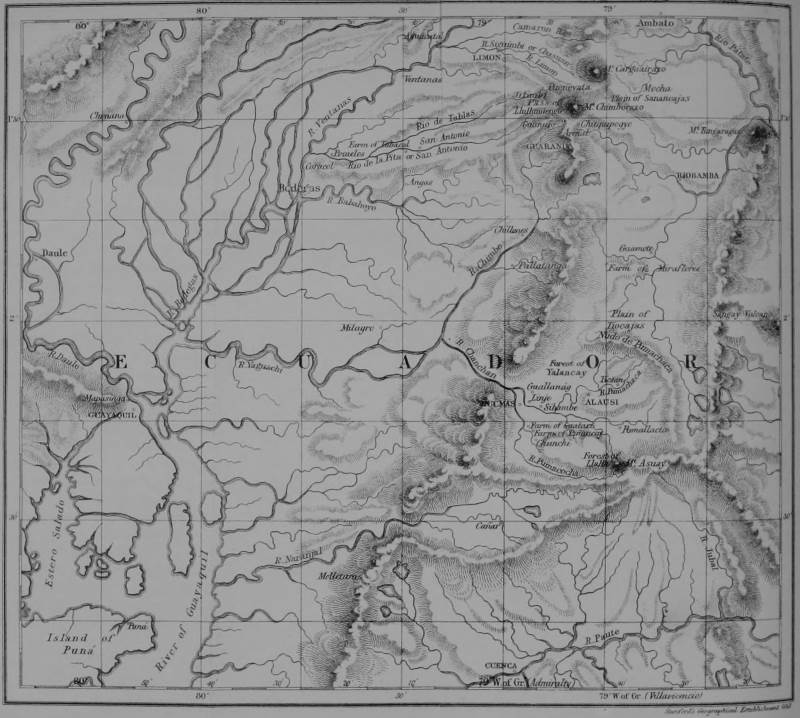
Map to illustrate MR. SPRUCE'S REPORTS on the "RED BARK" REGION OF ECUADOR.
Mr. Spruce's expedition to procure plants and seeds of the "red bark"
or C. succirubra—Mr. Pritchett in the Huanuco region, and the
"grey barks"—Mr. Cross's proceedings at Loxa, and collection of seeds
of C. Condaminea.
In a previous chapter I have given an account of the
arrangements which I made for procuring the various species
of Chinchonæ in districts other than that of the Calisaya,
and it now remains for me to record the labours of those
whom I employed on this service, and the successful results
with which those labours were rewarded. And first, both in
importance and success, stands the expedition of Mr. Spruce,
to collect the seeds and plants of the "red-bark" tree or
C. succirubra, of whose services it would be impossible to
speak too highly. I may mention, at starting, that he
received my first letter, requesting him to undertake the
work, on July 2nd, 1859, and such was his zeal that on
the 22nd of the same month he was on his way to the
chinchona forests, at his own expense, to ascertain the best
locality for collecting the plants and seeds.
The species of chinchona, known as the "red-bark" tree,
yields a larger per-centage of febrifugal alkaloid than any
other, and must therefore be considered as the most important.[367]
Its native forests are on the western slopes of the
famous mountain of Chimborazo, in the Republic of Ecuador,
and for a great many years it has not been found beyond
2° 36´ S. lat., but Mr. Spruce thinks it probable that in
former times the tree grew all along the roots of the Andes
of Cuenca and Loxa to the limits of the Peruvian desert
in 5° S. To the north it scarcely passes the latitude of
1° S.; and these precious trees are thus confined within
a very narrow latitudinal zone.[368] Within the ascertained
limits of the true "red-bark" tree, it exists in all the valleys
of the Andes which debouch on the plain of Guayaquil;
but great havoc has been made amongst the trees of late
years by the bark-collectors. In the valleys of Alausi,
Pallatanga, and Chillanes (see map) all the large trees
have already been cut down. At the bases of the ridges
of Angas and San Antonio, the localities originally mentioned
by Pavon, and where "red-bark" trees once grew
in abundance, the same destructive system has been adopted;
and now the "red-bark" grounds are confined to the ravine
of the river Chasuan, and its tributaries, which rise on the
northern slopes of Chimborazo, and fall into the river of
Guayaquil.
On the 22nd of July 1859 Mr. Spruce set out from the
pleasant town of Ambato, in the Quitenian Andes, where he
was then residing, and, passing through Alausi, arrived at the
banks of the river Chanchan, and established himself at a
place called Lucmas, which is conveniently near the "red-bark"
chinchona forests. Lucmas is a sugar-cane farm,
between 5000 and 6000 feet above the sea; there are forest-trees
in the valleys and on the hills, while the steep slopes
are often covered with scrub and grass. From Lucmas Mr.
Spruce went to the forests on the banks of the river Pumachaca,
which rises in the mountain of Asuay, and falls into
the Chanchan, at an elevation of 4000 feet. One circumstance,
among many, will give an idea of the difficulties
which he had to encounter. On reaching the Pumachaca
he found that the ford had been destroyed by the falling of a
cliff, and that in its place there was a deep whirlpool; so,
with the driftwood along the banks, a bridge had to be made
where the river was narrowed between two rocks, by which
his party crossed with the baggage. Then, after a long
search, he found a place where the horses could swim across,
and, by rolling down masses of earth and stones, a way was
made for them to ascend on the other side. Once across, a
hut was made among vegetable-ivory palms, thatched with
the palm-fronds, and Mr. Spruce commenced the examination
of the forest.
After a long search, during which he passed several felled
trunks of chinchona-trees, he at length came upon a root-shoot
about twenty feet high. It is very rare to find these
root-shoots, because the bark is stripped from the roots
as well as from the trunk. Mr. Spruce, from his observations
in the Pumachaca forest, came to the conclusion that the
"red-bark" trees grow best on stony declivities, where there
is, however, a good depth of humus, at an elevation of from
3000 to 5000 feet above the sea. The temperature was very
like that of a summer day in London, but with cold mists
towards evening, and from January to May unceasing rain.
He found the chinchona-trees, in this part of the country,
almost entirely extirpated, and, after a short stay at Lucmas,
he proceeded to examine the region of the "hill barks" or
cascarillas serranas, which is at an elevation of 8500 to 9000
feet, on both sides of the river Chanchan. In the forest
of Llalla, at the foot of the mountain of Asuay, he found two
kinds called by the natives cuchi-cara (pig-skin) and pata de
gallinazo;[369] and on a stony hill-side there were twenty large
trees of the former, from 40 to 50 feet high.
By this excursion in the summer of 1859 Mr. Spruce
ascertained the districts where he should not go to, a very
important point; and he finally determined to carry on his
collecting operations, in the season of 1860, at a place called
Limon, at the junction of a stream of that name with the
river Chasuan, which falls into the river of Ventanas at a
place called Aguacatal. (See map.) The forests are all
private property, and, after much negotiation with the owners,
Señor Cordovez of Ambato, and Dr. Neyra of Guaranda, an
agreement was made by which, on payment of 400 dollars,
Mr. Spruce was allowed to take as many seeds and plants as
he liked, on condition that he did not touch the bark.
Mr. Spruce had made arrangements for Dr. Taylor of
Riobamba to proceed to Loxa, and collect seeds of the
C. Condaminea species; but a severe rheumatic and nervous
attack, almost amounting to paralysis, induced him to resign
the duty of collecting the "red bark" to Dr. Taylor, and it
was only at the last moment that he was strong enough to
undertake the journey in company with his friend. During
the whole time that Mr. Spruce was at work he was suffering
severely from illness; the benefit derived from the milder
climate of the forests was neutralized by the fogs and damp;
and, to use his own words, "although upheld by a determination
to execute to the best of my ability the task I had
undertaken, I was but too often in that state of prostration
when to lie down quietly and die would have seemed a
relief." Leaving the town of Ambato on the 11th of June,
Mr. Spruce and Dr. Taylor reached Guaranda on the 13th,
and continued their journey towards the forests on the 17th.
At a very little below 4000 feet above the sea they reached
the small farms at Limon. Their abode stood on a narrow
ridge sloping gradually to the river Chasuan. It was merely
a long low shed, two-thirds of which was occupied by the
rude machinery of a sugar-cane mill; the remaining third
had an upper story with a flooring of bamboo-planks, half of
it open at the sides, and the other half with a bamboo wall
about six feet high, not coming up to the roof in any part of
it. This was their dormitory, and it was reached by a ladder,
merely a trunk of a tree with rude notches for steps. On
the ground-floor was the kitchen, with a wall of rough planks
of raft wood, not touching each other; so that the whole
fabric was abundantly ventilated, and only too often filled
with fog, causing coughs, aching limbs, and mouldy clothes.
This was their head-quarters during the time that they
were collecting seeds and plants; and the severe hardships,
miserable lodging, and acute sufferings from illness must
increase our admiration for Mr. Spruce's zeal and resolution
in performing this great public service.
Mr. Cross, the gardener whom I had engaged to assist Mr.
Spruce, conveyed the fifteen Wardian cases, which I had
previously sent to Guayaquil, up the river as far as Ventanas,
and reached Limon on the 27th of July.
In the mean while Mr. Spruce had carefully examined the
chinchona forests, and visited all the bark-trees known to exist
within reach of Limon. He found a good crop of capsules
on many of them, which had already nearly reached their full
size on the finest trees; on others, however, there were only
very young capsules, and even a good many flowers, and not
one of the late-flowering panicles produced ripe capsules.
On the tree which bore most capsules they began to turn
mouldy, the mould being not fungi, but rudimentary lichens,
which, whilst it proved that the capsules were still alive and
growing, proved also that they were exposed to an atmosphere
almost constantly saturated with moisture.
The manchon or clump of "red-bark" trees at Limon lies
nearly west from the peak of Chimborazo, and the river
Chasuan rises on the northern shoulder of that mountain.
The view from Limon takes in a vast extent of country, and
the whole is unbroken forest, save towards the source of the
Chasuan, where a lofty ridge rises above the region of
arborescent vegetation, and is crowned by a small breadth of
grassy paramo. The waters of the Chasuan run over a black
or dull blue, shining, and very compact trachyte, over which,
in the bottom of the valleys at Limon, there is a fine-grained
ferruginous sandstone of a deep brown colour, in thick strata.
The soil is a deep loamy alluvial deposit. The ridges on
which the "red-bark" trees grow all deviate a little from an
easterly and westerly direction, and the chinchonæ are far more
abundant on the northern than on the southern slopes. The
northern and eastern sides of the trees, too, had borne most
fruit, and scarcely a capsule ripened on their southern and
western sides. This is explained by the trees receiving most
sun from the east and north, the mornings being generally
clear and sunny in the summer, whilst the afternoons are
foggy, and the sun's declination is northerly. Mr. Spruce
also observed that the trees standing in open ground were
far healthier and more luxuriant than those growing in the
forest, where they are hemmed in and partially shaded by
other trees; and he concludes, from this circumstance, that,
though the "red-bark" tree may need shade whilst young
and tender, it really requires (like most trees) plenty of air,
light, and room wherein to develop its proportions.
The lowest site of the "red-bark" tree at Limon is at an
elevation of 2450 feet above the sea, and its highest limit is
at an elevation of about 5000 feet. The trees nearest the
plain are generally the largest, but those higher up have
much thicker bark in proportion to their diameter.
The havoc committed by the bark-collectors on these trees
within the last twenty years has been very great. The
entire quantity of "red bark" collected in 1859 did not reach
to 5000 lbs., and in 1860 no "red bark" at all was got out,
so that the trade is nearly extinct. In the valleys of the
Chasuan and Limon Mr. Spruce saw about 200 of these trees
standing, but only two or three were saplings which had not
been disturbed; all the rest grew from old stools, whose
circumference averaged from 4 to 5 feet. He was unable to
find a single young plant under the trees, although many of
the latter bore signs of having flowered in previous years; and
this was explained by the flowering trees invariably growing
in open places, where the ground was either weeded, or
trodden down by cattle.
Mr. Spruce describes the C. succirubra or "red-bark" tree
as very handsome, and he declares that, in looking out over
the forest, he could never find any other tree at all comparable
to it for beauty. It is fifty feet high, branching from
about one-third of its height, with large, broadly ovate, deep
green, and shining leaves, mixed with decaying ones of a
blood-red colour, which give it a most striking appearance.
The Cascarilla magnifolia, a very handsome tree, with a
fragrant white flower, grows abundantly with the "red bark,"
and attains a height of 80 feet.
After the arrival of Mr. Cross at Limon the work of collecting
commenced in earnest. A piece of ground was
fenced in, and Mr. Cross made a pit and prepared the soil to
receive cuttings, of which he put in above a thousand on
the 1st of August and following days; and he afterwards
went round to all the old stools and put in as many layers
from them as possible. "But," as Mr. Spruce most truly
observes, "only those who have attempted to do anything in
the forest, possessing scarcely any of the necessary appliances,
can have any idea of the difficulties, and Mr. Cross's
unremitting watchfulness alone enabled him to surmount
them."
Towards the end of July, in a few sunny days, the fruit of
the "red-bark" trees made visible advances towards maturity;
and in the middle of August the capsules began to
burst at the base, and appeared ripe. An Indian was then
sent up the trees, and, breaking the panicles gently off, let
them fall on sheets spread on the ground to receive them, so
that the few loose seeds shaken out by the fall were not lost.
The capsules were afterwards spread out to dry for some days
on the same sheets. In September Mr. Spruce went across
to the valley of the San Antonio, to the southward, in order
to secure additional seeds from "red-bark" trees there, leaving
Mr. Cross to watch over the rooting of the cuttings at
Limon. Between the 14th and 19th he gathered 500 well-grown
capsules at San Antonio, in addition to 2000 already
collected at Limon. Good capsules contain forty seeds each,
so that at least 100,000 well-ripened and well-dried seeds
were now gathered; and on the 28th of September Mr.
Spruce started for Guayaquil.[370] In November he proceeded
up the river again, and purchased one of the rafts at Ventanas,
which are used for conveying cacao to Guayaquil. It
was composed of twelve trunks of raft-wood, sixty-three to
sixty-six feet long and one foot in diameter, kept in their
places by shorter pieces tied transversely, and covered with
bamboo planking, fenced round with rails to a height of three
feet, and roofed over. The rope used for binding the parts of
the raft together was the twining stem of a Bignonia. The
Wardian cases were got ready on the raft at Ventanas, and
Mr. Cross arrived with the plants from Limon on the 13th of
December, and established them in the cases to the number
of 637.
After encountering several dangers and mishaps in navigating
the river, the raft with its precious freight reached
Guayaquil on the 27th of December; and the plants were
safely embarked on board the steamer, in charge of Mr. Cross,
on the 2nd of January, 1861.
Thus skilfully and successfully did Mr. Spruce, and his able
colleagues, perform this most difficult and important service.
Mr. Spruce, during the whole time that he was in the chinchona
forests, made most careful meteorological observations.
From June 19th to December 8th the results of observations
of the thermometer were as follows:—
| Mean minimum | 61½ | ° |
| Mean maximum | 72⅓ |
| Mean temperature at 6½ P.M. | 67¾ |
| Highest temperature observed | 80½ | on July 27th. |
| Lowest temperature observed | 57 | on July 11th. |
| Entire range | 23½ |
| Mean daily variation | 10½ |
On the western side of the Quitenian Andes, south of the
Equator, the summer or dry season lasts from June to December,
the remaining five months constituting the wet season.
In the summer, at Limon, the early part of the day is
often sunny, and fogs come on in the afternoon and night;
but in the wet season there are fogs in the morning, and
heavy rains during the rest of the day and night.
A perusal of the foregoing pages, which are nothing more
than a brief abstract from Mr. Spruce's official reports, cannot
fail to impress the reader with the valuable nature of the
service which has been performed, and with the energy and
fortitude, combined with great skill and ability, which enabled
Mr. Spruce to overcome so many difficulties; and almost
equal praise is due to Mr. Cross. But in recounting these
arduous labours, only half of Mr. Spruce's services have been
recorded. That gentleman is an accomplished botanist, and
most accurate observer; and he has supplied us with a detailed
report which, I do not hesitate to say, contains a larger
amount of valuable information on the chinchona-forests than
any account which has yet appeared in Europe. In addition
to the narrative of his proceedings, and his observations on
the "red-bark" tree, Mr. Spruce here gives a minute account
of the vegetation of the "red-bark" forests of Chimborazo, a
detailed meteorological journal, and important remarks on
the climate and soil.[371]
My apprehensions respecting the feelings of the natives,
when our proceedings became known, were fully justified by
what took place in Ecuador, as well as in Peru. But the
South Americans are, as a rule, remarkable for the slowness
of their movements; and it was not until May 1st, 1861, that
the legislature of Ecuador decreed that every person, whether
foreigner or native, should be forbidden to make collections
of plants, cuttings, or seeds of the quina-tree; and that precautions
should be taken to prevent those articles from
passing the ports and frontiers of the Republic. A fine of
100 dollars on every plant, and every drachm of seed, was
imposed on those who attempted to break this decree. But
by May 1st, 1861, the plants and seeds of the quina-tree were
safe on the Neilgherry hills, in Southern India.
While Mr. Spruce was engaged in collecting these seeds
and plants in the forests at the foot of Chimborazo, Mr.
Pritchett, whose services I had secured for the Huanuco
region in Northern Peru, was employed on the species of
chinchonæ yielding grey bark.
Mr. Pritchett left Lima on the 18th of May, 1860, and
arrived in the town of Huanuco, the centre of the grey-bark
region, on the 28th, where he made the necessary preparations
for a journey into the neighbouring forests. On the 9th
of June he set out for the mountain-range of Carpis, to the
northward, where there are several species of chinchonæ. The
C. purpurea is very abundant; the C. nitida is common on
the north-east side, and on the upper part of the mountains;
the C. obovata is more rare; and the C. micrantha and C.
Peruviana are both inhabitants of the lower slopes. After
crossing the Carpis range, Mr. Pritchett followed the course
of the river of Casapi to the village of Chinchao, and went
thence to the coca estate of Casapi, at the eastern end of
the valley, where it joins that of the river Huallaga, and here
he was joined by his guide.
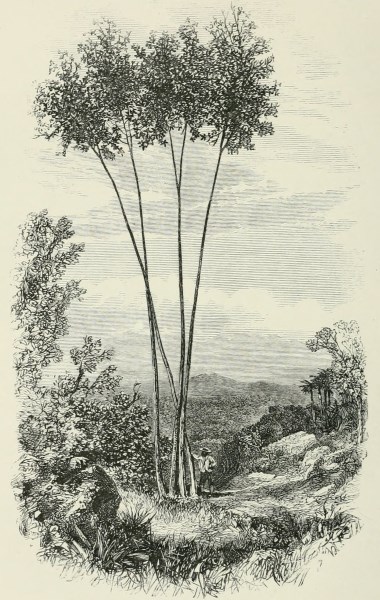
CHINCHONA NITIDA TREES.
FROM A SKETCH BY MR. PRITCHETT.
Page 323.
About three leagues from Casapi, and close to the Huallaga,
is the mountain called San Cristoval de Cocheros (Cuchero of
Pavon and Poeppig), which rises from the low land at the
junction of the two rivers to a height of about 1200 feet
above them, and is the centre of the bark district of Huanuco.
On the northern side Mr. Pritchett found abundance of C.
micrantha, and some trees of C. Peruviana; but the latter
species was much more rare. They both grow to a very
large size, some of them being thirty inches in diameter and
seventy feet in height. The trees of C. nitida were at a
higher elevation.
During June and July, though it was the dry season, heavy
rains continued to fall from day to day; but towards the end
of July the weather broke up, and the sun began to make an
impression on the solid banks of cloud which filled the valleys,
and then it was that, during some portion of the day, the sun
penetrated to the very underwood of the forest. In the first
half of August there was fine weather, with only an occasional
shower. The seeds on the chinchona-trees ripened rapidly in
the sunshine, and Mr. Pritchett collected them by felling the
trees—a labour which was performed by Indians, whom he
hired from the coca estate of Casapi. Seven large trees were
cut down daily, and denuded of their capsules, for a fortnight;
the drying process being carried on at the estate, where every
moment of sunshine was taken advantage of. On the 13th
of August he started for the coast with his collection of seeds,
and half a mule-load of young chinchona-plants, which were
in perfect health when placed in the Wardian cases at Lima.
Mr. Pritchett reports that in the district around Cocheros,
Casapi, and Carpis, the rocks are of crystalline formation, in
many localities highly disintegrated, and composed of masses
of hornblende, felspar, and mica. He remarks that felspar
contains much potash, of which the chinchona-trees are said to
require a large quantity for their full development; and, as
felspar abounds in this region, he attributes the abundance
and size of the chinchona-trees to this circumstance. He also
reports that steatite, a silicate of magnesia and alumina,
abounds in the vicinity of Huanuco.
He describes the climate as moist and warm, and says that
the difference in the degree of moisture and warmth between
the lower slopes where the C. micrantha flourishes, and the
higher parts of the mountains inhabited by the C. nitida,
is very striking, while on the lower slopes the soil is much
deeper and richer.[372] He reports the elevation of Cocheros
above the level of the sea to be about 4000 feet,[373] but he made
no meteorological or other observations; and I think there
can be no doubt that the elevation of that mountain is much
greater than Mr. Pritchett supposes. I do not find any information
on this point in Poeppig's travels; but the Huanuco
region is quite a beaten track, and there are several accounts
of it by modern travellers. Huanuco itself is 6300 feet
above the sea;[374] the distance thence to the summit of the
cuesta del Carpis, which is 8000 feet above the sea, is about
twenty miles, and there is a descent on the other side into
the valley of the Casapi of 2920 feet.[375] According to this
account the village of Chinchao, in the Casapi valley, would
have an elevation of about 5000 feet. From Chinchao to the
foot of the Cocheros mountain is a distance of twenty-five
miles down the Casapi valley,[376] a gentle descent, with numerous
cottages and plantations on both sides of the road.[377] Thus the
foot of the Cocheros mountain would be about 4500 feet above
the sea, and its summit at least 6000 feet.
We shall not, therefore, be very far from the truth if we
place the region of C. nitida on the Cocheros and Carpis
mountains at from 6000 to 7000 feet above the sea, and of
C. micrantha at from 4000 to 5000 feet.
Mr. Pritchett performed the portion of this important undertaking
which I intrusted to him with promptitude and
zeal. Time was a great object, and, by going direct from
Lima to the best locality in the Huanuco chinchona region, he
completed the necessary collection of plants and seeds, and
returned to the coast in little more than three months.[378] This
shows how essential a previous knowledge of the chinchona
region, of the people, and of the language, was, without
which the collector would probably lose much time, which is
the same thing as spending much money, and eventually
wander into a locality where only worthless species are found,
as was the case with the Dutch agent.
Owing to the unavoidable abandonment of Mr. Spruce's
intention of sending Dr. Taylor to collect seeds of C. Condaminea
at Loxa, one portion of my scheme for introducing all
the valuable species into India remained incomplete at the
close of 1860. On my return from India, therefore, in May
1861, I obtained the sanction of the Secretary of State for
India to take measures for obtaining a supply of seeds from
the Loxa forests. Mr. Cross, the gardener who had so ably
assisted Mr. Spruce, and shared his labours, after safely
depositing the collection of seeds and plants in India, had
returned to South America, attracted by the richness and
variety of the flora of the Andes. Having acquired experience
of the people and language, of the localities where
chinchona-trees are found, and of the mode of travelling,
during his former visit, he possessed the necessary qualifications;
and, as Mr. Spruce was too ill to undertake the work,
it was intrusted to Mr. Cross, who performed it with expedition
and success. He is an excellent practical gardener,
intelligent and persevering, ardently devoted to his profession,
and thoroughly trustworthy.
On the 17th of September, 1861, Mr. Cross left Guayaquil
in an open rowing boat, and landed at Santa Rosa, the
port of the province of Loxa, whence he proceeded, by way
of Zaruma, to the town of Loxa, which he reached on the
27th. He had to pass through dense swampy forests, over
dangerous precipitous ridges of the Andes, in crossing one of
which his mule slipped down a deep ravine and was dashed
to pieces, and along barren lofty plains. He mentions that
during the ascent to Zaruma he saw several "red-bark"
trees growing at an elevation of eight or nine thousand feet.
On the 1st of October he left Loxa, and went to a long
low ridge of hills, called the Sierra de Cajanuma, about eight
miles to the southward, a locality which is mentioned by
Humboldt, Bonpland, and Caldas, as the abode of the most
valuable kinds of C. Condaminea. He came to an Indian hut
on a little rounded eminence near the summit of the mountain,
which, being far from public roads or other dwellings,
seemed well suited for his head-quarters during the time that
he was searching for seeds. For be it remembered that the
Decree of May 1st, 1861, already mentioned, was in full force,
and that he was running the risk of fine and imprisonment in
performing this important service. The owner of the hut, who
was an experienced bark-collector, allowed Mr. Cross to establish
himself in a little shed at one end of it, which, although
favourable for drying seeds, was so cold that he was sometimes
compelled, during windy nights, to seek shelter in the
bottom of a neighbouring ravine.
After many comparatively unsuccessful searches in the
surrounding woods, he was one day passing along the bank
of a steep ravine, and, happening to look over a projecting
rock, he saw a number of fine young trees of the C. Condaminea
on the steep slope beneath, some of which bore a
few panicles of seeds, which, on examination, he found to be
perfectly ripe. After this discovery he continued to search
all the ravines in the vicinity from sunrise to sunset, some
of which he had to descend by means of the trailing stems
of a species of Passiflora, and in this way a good supply of
seeds was collected. He reports that on the accessible slopes
there are few chinchona-trees, owing partly to the annual
burning, and partly to continual cropping of the young shoots
by cattle. He describes the rocks, composed of micaceous
schist and gneiss, as being, in many places, in a state of
decomposition, and states that large portions are frequently
tumbling down from the more elevated summits. The
alluvial deposit in the ravines, where the C. Condaminea is
found growing, is shallow, in many places not more than six
inches in depth, and Mr. Cross often gathered seeds from
trees which were growing in clefts of rock, where there was
not a single ounce of soil to be found. He describes the
C. Condaminea as a slender tree, from 20 to 30 feet in
height,[379] and from 8 to 10 inches in diameter at the base;
but he saw few trees of these dimensions, and the plants
from which the bark of commerce is now taken are in
general not more than 8 to 10 feet in height.[380] When the
plants are cut down, three or four young shoots or suckers
generally spring up, but this does not always happen, as
some of the more industrious bark-collectors frequently
pull up the roots, and bark them also. The bark is taken
from the smallest twigs, and thus the annual growths are
often taken, especially if they are strong. The plants are
sometimes found growing in small clumps, and sometimes
solitary, but always in dry situations.
The temperature of this region ranges according to Humboldt
and Caldas from 41° to 72° Fahr., and according to
Mr. Cross from 34° to 70° Fahr.; but he adds that it seldom
falls below 40°, and rarely rises above 65°; the mean range
being from 45° to 60° Fahr. The climate of Loxa is very
moist. The wet season commences in January and lasts
until the end of April or middle of May; in June, July,
and August there are heavy rains, accompanied by strong
gales of wind; from September to January there is generally
fine weather, but occasional showers of rain fall even at that
time of year.[381]
The vegetation on the Sierra de Cajanuma is of a semi-arborescent
character, but some of the higher summits are
bare. In the bottoms of the ravines grow a species of Alnus,
Melastomæ, Peperomias, palms, and two species of tree ferns;
and on the slopes throughout the low-lying country, barley,
maize, peas, and potatoes are cultivated. Mr. Cross sent
home a large collection of dried specimens of plants gathered
on the Sierra de Cajanuma. Among them I observed a
Befaria with pretty crimson flowers, of which he says that one
ounce of the roots in two pints of water is taken twice a day
by the Indians for dysentery; a very handsome purple
lupin, growing six to eight feet high; an Embothrium, a wide-spreading
shrub, growing in dry situations; another smaller
Befaria, a beautiful shrub, growing in very lofty dry
localities; a Veronica, a shrub six to eight feet high, with
a blue flower; a Gaultheria; a wide-spreading melastomaceous
plant, with inconspicuous flowers; and a number of Lycopodia
and ferns.
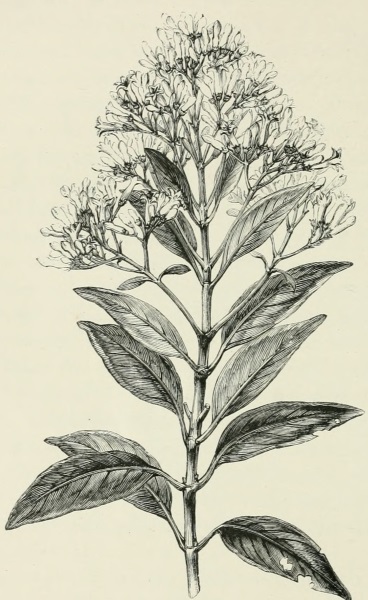
CHINCHONA CHAHUARGUERA.
(From Howard's 'Nueva Quinologia de Pavon.')
Page 329.
Besides the seeds of the C. Condaminea, which is identical
with the C. Chahuarguera (Pavon), Mr. Cross succeeded in
collecting a few seeds of C. crispa (Tafalla) after several
long journeys up the mountains. He found this kind
growing at a great elevation, in a deposit of peat, where
the temperature sometimes falls to 27° Fahr. This species
of chinchona yields the cascarilla crespilla negra, one of the
most esteemed forms of Loxa bark. Mr. Howard[382] mentions
that the Josephiana bears the same relation to the normal
C. Calisaya as the Crespilla bark at Loxa does to the normal
and full-grown C. Chahuarguera.
Mr. Cross did his work right well, and in December, 1861,
he returned to Guayaquil with nearly 100,000 seeds of
C. Chahuarguera, and a smaller parcel of C. crispa, which
were forwarded to India by way of Southampton.[383]
Thus were the various operations which I organized for
procuring the valuable species of chinchona-trees in South
America satisfactorily completed; and the labours of Mr.
Spruce, Dr. Taylor, Mr. Pritchett, Mr. Cross, and Mr. Weir,
though differing in value and importance, all deserve the
warmest recognition, for all those intrepid and courageous
explorers worked zealously and successfully, and did good
service in furthering this most important public enterprise.
CONVEYANCE OF CHINCHONA-PLANTS AND SEEDS FROM
SOUTH AMERICA TO INDIA.
Transmission of dried specimens—Voyages of plants in Wardian cases—Arrival
of plants and seeds in India—Depôt at Kew—Treatment of plants
in Wardian cases—Effects of introduction of chinchona-plants into India
on trade in South America—Neilgherry hills.
The attempt to make simultaneous collections of seeds and
plants of all the valuable species of chinchonæ was thus
crowned with almost complete success. Out of my original
scheme the C. lancifolia of New Granada was the only one
which had not been procured. It is unnecessary to say
more respecting the numerous difficulties and dangers which
were encountered by the collectors, for the narrative of the
proceedings detailed in previous chapters will have made
these sufficiently obvious. So far as the labours in South
America were concerned, all obstacles were surmounted, and
the objects of this great enterprise were fully attained. Not
only were plants and seeds safely brought to the coast, but,
in every instance, the collectors took care to provide themselves
with botanical specimens from the chinchona-trees.
Thus the leaves, flowers, fruit, and bark of each species,
which were brought to England, placed the identity of the
valuable species to which the plants and seeds belonged
beyond the remotest possibility of a doubt.[384] But in conveying
these precious mule-loads to the coast of Peru, and
safely embarking them, only half the difficulties had been
overcome; and I could not but feel that some failures and
disappointments must be expected before the chinchona-plants
were fairly established in India.
There was not much reason for apprehension with regard
to the seeds; but the plants, in the absence of any provision
for conveying them direct across the Pacific, had to undergo
an ordeal of unprecedented duration. Yet the great advantage
of introducing plants as well as seeds, in the immense
start they would give to the young plantations in India, was
strongly felt, and the complete success that attended the
hazardous transit of at least one relay, which came under
peculiarly favourable circumstances, fully justified the
attempt.
I gave directions to Mr. Spruce and Mr. Pritchett to send
small parcels of seeds of each species to Jamaica and
Trinidad, in obedience to an order received from England,
so that quinine-yielding trees might also be introduced into
our West Indian colonies; and the results of the experiment
in those islands will be given in a future chapter. The great
bulk of the collections, however, were despatched to India, by
the roundabout way of Southampton, directly they arrived
on the coast of the Pacific.
The thirty Wardian cases which I sent out round Cape
Horn were three feet two inches long, ten feet ten inches
broad, and three feet two inches high; and, with soil and
plants, each case weighed a little over three hundredweight.
The collection of plants of C. Calisaya, C. ovata, and C.
micrantha filled fifteen cases; and the other fifteen received
the collection of C. succirubra at Guayaquil. I also had six
cases of somewhat smaller dimensions constructed at Lima
for the plants from Huanuco. The fifteen cases containing
the collection of chinchona-plants from Caravaya sailed from
the port of Islay on the 23rd of June, and reached Panama
on the 6th of July, 1860, when 207 had already begun to
throw out green shoots. On their arrival in England, in
August, these 207 plants were in a most flourishing and
healthy condition, and continued so until their arrival at
Alexandria early in September. But the intense heat of the
Red Sea, where the thermometer ranged from 99° in the
night to 107° in the day-time, proved too much for them, and
the damage was increased by a detention of a week at Bombay.
Their roots were attacked by rot, yet, on their arrival in
the Neilgherry hills, their leaves still looked fresh, and several
hundred green cuttings were obtained from them, which,
however, failed to strike. The cases containing the chinchona-plants
from Huanuco left Lima in September, and were also in
a most promising state when they reached England, but on
their arrival in India they were all dead. The "red-bark"
collection, under the able management of Mr. Cross, sailed
from Guayaquil on the 2nd of January, 1861. On their
arrival in England in excellent order, six of them were left
at Kew as a precaution, and replaced by six plants of C. Calisaya
supplied by Sir W. Hooker. At that season the climate
of the Red Sea is cool, and, owing to this circumstance and
still more to the intelligent watchfulness of a good practical
gardener, 463 plants of C. succirubra and six of C. Calisaya
were handed over to the superintendent on the Neilgherry
hills, in as vigorous and healthy a condition as could possibly
have been hoped for after such a voyage.
The "grey-bark" seeds arrived in the Neilgherry hills
early in January, 1861, and the "red-bark" in the following
March, and both collections came up abundantly. The
supply of seeds of C. Condaminea reached their destination
in Southern India in February 1862. In order to guard
against all accidents, a portion of the seeds of each species
was left in England, and a depôt of young chinchona-plants
has thus been formed at Kew Gardens, with a view to fall
back upon them in the event of possible failures or misfortunes
in India.[385] Seeds of each of the species were also sent
to Ceylon, to which Sir W. Hooker added a few plants of
C. Calisaya from his stock at Kew.
Thus, in spite of one or two disappointments, the great
object of the undertaking sanctioned by the Secretary of
State for India was fully attained. By the spring of 1861 a
large supply of plants and young seedlings was established
in the Neilgherry hills; and at the present moment we have
thousands of chinchona-plants, of all the valuable species,
flourishing and multiplying rapidly in Southern India, and in
Ceylon. When the unprecedented length of the voyages and
the numerous trans-shipments are taken into consideration,
the wonder is that any of the plants should have been successfully
conveyed from the slopes of the Andes in South America
to the ghauts in Southern India, over thousands of miles,
through every variety of climate, and subject to the risk of
crossing the isthmus of Panama, of changing steamers at
the island of St. Thomas, at Southampton, at Suez, and at
Bombay, and of the journey through Egypt.
The most important introduction of plants into India, by
means of Wardian cases, previous to the arrival of the chinchonas,
was that of the tea from China in 1849 and following
years by Mr. Fortune. On those occasions the cases were
strongly and coarsely made, the glass shades firmly fixed, and
the glass itself thick, and glazed in pieces of moderate size.
The frames were protected by a grating of iron wire, with a
canvas covering capable of being unrolled so as to screen the
plants from the direct rays of the sun, if necessary. The soil
was not less than eight or ten inches deep, and kept down by
cross-battens, and the plants were fairly established in it
before starting. In 1849 Mr. Fortune sowed large quantities
of seeds in the cases, between rows of young plants, which
germinated on their way from China to India, and reached
their destination in the Himalayas in good condition. Out of
250 tea-plants, 215 arrived in perfect order.[386]
But it was an easy process to convey plants by the short
voyage from China to Calcutta, when compared with the
introduction of plants from the western coast of South
America into India; and the performance of the latter feat,
in the case of the chinchona-plants under Mr. Cross's care,
is undoubtedly the most extraordinary success of the kind
that has yet been achieved.
A few remarks on the treatment of plants in Wardian cases
were supplied to me by Mr. Weir and Mr. Cross, who acquired
their experience in the voyages from South America to
India; and by Mr. McIvor, who received the plants on the
Neilgherry hills. The cases were filled with soil to a depth
of nine to ten inches, in which the chinchonas were planted
in rows, from the back to the front of the case. The distance
from plant to plant was regulated by their size, but, in the
case of their having much foliage, they should be rather wide
apart, for the crowding of foliage is always injurious, and
often brings on mildew or mould. After having been planted
they were well watered, and shaded from the glare of the
mid-day sun. On the surface of the soil, between each row
of plants, a batten was placed, extending from the back to
the front of the case, and held firmly down by two longer
battens extending lengthways. By this means the soil and
plants are not disturbed in the operation of moving the cases.
When the cases are finally closed the soil should be in a
medium state as regards moisture, and all dead foliage should
be removed. The cases should be made as air-tight as possible
by filling the seams with putty, and every precaution
must be taken to preserve the plants from the slightest contact
with salt water.[387] Mr. McIvor strongly recommends
that the cases should be furnished with a false bottom, raised
about two or three inches above the true bottom, by bars
of wood of the required thickness being nailed on the underside.
The false bottom should have holes bored in it at
regular intervals, with a few broken pieces of pot and a layer
of moss placed over them. He considers that the best sort
of soil is formed of equal parts of leaf-mould, turfy loam,
and sand, mixed in a dry state, and spread out and exposed
to the action of the sun for a few days before being placed in
the cases. During the voyage the plants should have plenty
of light and air, one side of the case being left open for two
or three hours, morning and evening, during fine weather,
when dead leaves should be picked off, and water administered
to any plant which may require it. The soil should
be turned up on the surface to the depth of about half
an inch with a small pointed stick every three or four days,
and always kept rough on the surface, so as to allow the
air to circulate in the soil. This circulation of air is also
facilitated by the false bottom. The action of the air on the
soil keeps the roots in fine condition, and entirely prevents
the formation of mildew and damp; but the principal object
of the false bottom is to allow any excess of water to drain off
into a place where it cannot sour the soil, and yet will not be
lost. Then, as the soil becomes dry above, the water will be
attracted to it.
With the exception of the false bottom, all the above suggestions
were carefully attended to by the gardeners who
were in charge of the chinchona-plants during the voyage to
India; the partial failures which attended some of the relays
from South America could not, under the circumstances, have
been avoided by any human foresight; and, as the general
result of my arrangements has been to introduce all the
valuable kinds of quinine-yielding plants into India, we
have every reason to congratulate ourselves on the success
of our labours.
With the chinchona-plants I brought from Peru a supply
of seeds of the chirimoya, of aji-pepper, and of the Schinus
molle, all of which are coming up well on the Neilgherry
hills.[388] They have most of the other kinds of Anonas in India,
but the chirimoya fruit, the most exquisite of all, has yet to
be raised. He who has not tasted the chirimoya has yet to
learn what fruit is. "The pine-apple, the mangosteen, and
the chirimoya," says Dr. Seemann, "are considered the finest
fruits in the world. I have tasted them in those localities in
which they are supposed to attain their highest perfection—the
pine-apple in Guayaquil, the mangosteen in the Indian
archipelago, and the chirimoya on the slopes of the Andes;
and, if I were called upon to act the part of a Paris, I would
without hesitation assign the apple to the chirimoya. Its
taste indeed surpasses that of every other fruit, and Haenke
was quite right when he called it the masterpiece of nature."[389]
In obtaining plants and seeds of these valuable chinchonas
from South America, it would be a source of deep regret to
me if that measure was attended by any injury to the people
or the commerce of Peru or Ecuador, countries in the welfare
of which I have for years taken the deepest interest. But I
have no apprehension that such will be the result of the cultivation
of these plants in other parts of the world. The
demand for quinine will always be in excess of the supply
from South America; and the result of chinchona cultivation
in India and Java will have the effect of lowering the price,
and bringing this inestimable febrifuge within the reach of a
vast number of people who are now excluded from its use,
without in any way injuring the trade of Peru and Ecuador.
I trust that not only will this measure do no injury to the
South Americans, but that it may be hereafter productive of
good to them, as well as to the rest of mankind. Hitherto
they have destroyed the chinchona-trees in a spirit of reckless
short-sightedness, and thus done more injury to their own
interests than could possibly have arisen from any commercial
competition; but it may be that the influence of peace
and education will inaugurate a new system in time to come,
that more enlightened views will prevail, and that they
themselves may undertake the cultivation of a plant which is
indigenous to their forests, but which, up to this time, they
have so foolishly neglected. It will then be a pleasure to
supply them with the information which will have been
gained by the experience of cultivators in India, and thus to
assist them in the establishment of plantations on the slopes
of the eastern Andes.
Under any circumstances the South Americans, who owe
to India the staple food of millions of their people, and to the
Old World most of their valuable products—wheat, barley,
apples, peaches, sugar-cane, the vine, rice, the olive, sheep,
cattle, and horses—have no right to desire to withhold from
India a product which is so essentially necessary to her welfare.
Nor do I believe that the better conditioned Peruvians
have any such desire. On the contrary, many of them have
shown themselves willing to promote a friendly interchange
of the products of the New and Old Worlds; and the
foolish decree issued in Ecuador on the 1st of May, 1861, as
well as the numerous obstructions thrown in my way in
southern Peru, may be imputed either to the narrow-minded
selfishness of half-educated officials, or to the ignorant
patriotism of backwoodsmen. These are feelings which are
not shared by either the educated few, or by the Indian
population.
After much careful consideration it had been decided that
the best place for commencing the experimental cultivation
of chinchona-plants in India would be the Neilgherry hills,
in the Madras Presidency. Here are to be found a climate,
an amount of moisture, a vegetation, and an elevation
above the sea, more analogous to those of the chinchona
forests in South America than can be met with in any other
part of India. In the Government gardens at Ootacamund,
on the Neilgherries, there were the necessary conveniences
for propagating plants and raising seedlings; and in Mr.
William G. McIvor, the Superintendent, was to be found a
zealous, intelligent, and practical gardener, who had carefully
studied the botany of the chinchona genus, and under whose
care the cultivation would be commenced with the best
possible guarantees for its success.
From the Neilgherries the chinchona-plants will, it is
hoped, be introduced into such other hill districts of Southern
India as, after examination, may be found suitable for
their growth; and it was a part of my duty to visit the most
promising localities, and, in conjunction with Mr. McIvor, to
select the sites for chinchona plantations on the Neilgherry
hills. With this object in view we landed at the port of
Calicut, on the coast of Malabar, on the 7th of October,
1861.
MALABAR.
Calicut—Houses and gardens—Population of Malabar—Namburi Brahmins—Nairs—Tiars—Slaves—Moplahs—Assessment
of rice-fields, of gardens,
of dry crops—Other taxes—Voyage up the Beypoor river—The Conolly
teak plantations—Wundoor—Backwood cultivation—Sholacul—Sispara
ghaut—Black-wood—Scenery—Sispara—View of the Nellemboor valley—Avalanche—Arrival
at Ootacamund.
He who would desire to receive the most pleasant impression
of India, on a first arrival, must follow in the wake of Vasco
de Gama, and land on the coast of Malabar, the garden of
the peninsula. Here Nature is clad in her brightest and most
inviting robes, the scenery is magnificent, the fields and
gardens speak of plenty, and the dwellings of the people are
substantial and comfortable.
As we steamed into the anchorage at Calicut, on board the
little yacht 'Pleiad,' no appearance of any town was visible,
and no building except a tall white lighthouse. Thick
groves of cocoanut-trees line the shore, and are divided
from the sea by a belt of sand; while undulating green hills
rise up behind, and the background of mountains was
hidden by banks of clouds. The whole scene bore a close
resemblance to one of the Sandwich or Society Islands, down
to the canoes which came off to us the moment the anchor
was let go. They are hewn out of the trunk of the jack-tree,
with an upper bulwark fastened with coir twine; and the
canoe-men were naked athletic-looking fellows, with enormous
hats made of a frond of the tallipot palm (Corypha umbraculifera).
When we shoved off from the 'Pleiad' a handsome
fish-hawk, with white head and breast, was perched on the fore-topsail
yard-arm, and sea-snakes were playing in the water
alongside. In-shore there were a few native craft, called
pattamars, at anchor. Pattamars are the vessels which have
carried on the coasting trade on the western side of India
from time immemorial. As in the days of Sinbad the
sailor, their planks are not nailed, but sewn together with
coir-twine, and they have high sterns and bows sheering
rapidly aft. The deepest part is at the stem, whence the
bottom curves inwards to the stern. A pattamar has two
masts raking forward, with long picturesque lateen yards
slung with one-third part before the mast, and two-thirds
abaft. They never attempt to tack, but always ware, and
if taken aback there is no alternative but either to wait
until she comes round, or to capsize.
On landing at Calicut, a carriage drawn by two white
bullocks was, through the hospitality of Mr. Patrick Grant,
the Collector of Malabar, waiting for us on the sandy beach,
to convey us to his house; a drive of about two miles. The
excellent road, of a bright red colour from the soil being
composed of laterite, passes through groves of cocoanut-trees,
interspersed with many houses, each surrounded by its
garden of mangos, nux vomica trees, jacks with pepper-vines
creeping over them, and palm-trees. The houses are all
substantial and comfortable-looking, built of square blocks of
laterite joined with chunam, or lime made from calcined sea-shells,
and roofed with tiles. The laterite or iron-clay is a
rock full of cavities and pores like coral, overlying the
granite which forms the basis of Malabar. When excluded
from the air it is so soft that any iron instrument can readily
cut it, and is dug up in square masses with a pickaxe, and
afterwards shaped into blocks with a knife or trowel. After
exposure it soon becomes as hard, and is as durable as bricks.
Each house has a cocoanut safe or store-room on one side, of
open wood-work. Many people were walking along the road,
naked men with huge tallipot-palm hats, and women with
nothing on but bright-coloured petticoats, looking picturesque
in the foreground and middle distance of the palm-shaded
vistas. At intervals the cocoanut groves were broken by
fields of vivid green paddy, and tanks filled with red lotus-flowers.
From Mr. Grant's house, on the top of a rounded grassy
hill, there is an extensive and very beautiful view of the
undulating hills and dales of Malabar, generally covered
with forest; with the ocean on one side, and the Wynaad
mountains on the other. Malabar is 188 miles long, 25 miles
broad in the northern, and 70 in the southern half, and
contains 6262 square miles. It is divided into 17 Talooks
or districts, and has a population of 1,602,914 souls; of
whom 1,165,174 are Hindus, 414,126 Moplahs, and 23,614
Christians.
The people of Malabar are a thriving active race, the men
well built and handsome, and the women remarkable for their
beauty. The highest caste among the Hindus is that of the
Namburi Brahmins, who claim all the land below the ghauts,
and appear to have actually possessed a large portion of it
previous to the invasion of Hyder Ali of Mysore. They declare
that when Parasu Rama, one of the incarnations of Vishnu,
hurled his axe from the mountains, the ocean receded, leaving
the land of Kerala, as Malabar, Cochin, and Travancore were
called; which he gave to the Namburi Brahmins. It is true
that the undulating flat-topped hills, which cover the part of
Malabar near Calicut, are like the waves of the sea, and
appear as if the ocean in receding had forced channels, and
thus formed the intervening valleys. The Namburis are fast
dying out: they are landed proprietors, and perform such
offices as bestowing holy water and ashes, or performing
poojah or worship for the other Hindus, but never enter the
public service.
The most important portion of the population is included
in the eleven classes of Nairs,[390] a race of pure Sudra caste.
They pretend to be born soldiers, and formed the armies
of the Zamorin and Cochin Rajahs, the lower castes not
being allowed to bear arms. The Nairs now hold most of
the land in Malabar, and are frequently very rich. Both
the Zamorin of Calicut and the Rajah of Cochin are Nairs;
and the origin of their rule is said to have been as follows.
About a thousand years ago, a Viceroy of the Sholum Rajah
ruled over Malabar, named Cheruman Permal, who made
himself independent, and divided the country among his
nobles, of whom five were of the Kshatri caste, and seven
were Nairs. After the division it was found that one of his
bravest officers, the ancestor of the present Zamorin or Tamori
Rajah, had been left out; Cheruman Permal, therefore,
gave him his sword, and all the territory in which a cock
crowing at a certain small temple could be heard. Hence
Calicut, from Colicodu, a cock-crowing.[391] Down to the time
of Tippoo the whole of Malabar was governed by the descendants
of the sisters of these thirteen Nair chiefs. The
Zamorin of Calicut has some influence, though he is much
reduced in wealth and importance since the days of Vasco
de Gama.
The Nairs live under the remarkable institution called
murroo-muka-tayum. Sisters never leave their homes, but
receive visits from male acquaintances, and the brothers go
out to other houses, to their lady-loves, but live with their
sisters. If a younger brother settles in a new house, he takes
his favourite sister with him, and not the woman who,
according to the custom in all other countries, should keep
house for him. The man's mother manages the house, and
after her death his eldest sister takes her place; but no man
has any idea who his father is, and the children of his sisters
are his heirs. Moveable property is divided amongst the
children of the sisters of the deceased equally, and the land
is managed by the eldest male of the family, but each
individual has a right to a share in the income.
This strange custom gives the women an important position;
and as they are pretty, and take pains with their
personal appearance, their influence is very great. The
Nairs are addicted to drink, and may eat venison, fowls, and
fish; and the families are fond of gaiety, and of visiting among
people of their own rank, when there is much talking and
singing. Most of the men, as well as the women, read and
write in their own character, and there is a Government
Gazette printed in the Malayalim language. The Collector
was anxious, also, to establish a paper in Malayalim, containing
general information, which would no doubt have an
excellent effect, but the difficulty is to find a good native
editor.
Next in rank to the Nairs come the Tiars or Shanars, a
stout, good-looking, hard-working race, who do not pretend to
Sudra origin. Formerly the Nairs exacted deference from
the Tiars with extreme cruelty and arrogance, treating them
more like brutes than men; and if a Tiar defiled a Nair by
touching him, he was instantly cut down. But British rule
is gradually uprooting these caste barbarisms, and the position
of the Tiars is improving. Some of them hold appointments
as clerks in Government offices, and they are protected
by just and equal laws. The Tiars form the mass of the
field labourers; but the proper duty of their caste is to
extract juice from the palm-tree, and either boil it into
jaggery (unrefined sugar), or distil it. Their women are
exceedingly pretty, with masses of long hair; but there is a
prevalent custom for all the brothers of a family to have but
one wife amongst them to save expense, which leads to most
disastrous consequences. Below the Tiars there are several
outcast tribes; among them the Churmas or slaves, a miserable
and down-trodden race, possibly the remnant of the aboriginal
inhabitants. Even now they are slow to understand that they
are not slaves, and land on which there are most Churmas
still sells at the highest price.
The Moplahs, or Mohammedans of Malabar, are descended
from Arab mariners and traders by native women, and hence
their name, from Mah-pilla "son of the mother." They have
certainly been established in Malabar for a thousand years, if
not more, as it is on record that the Viceroy Cheruman Permal,
who then divided the country amongst his chiefs, was converted
by a Moplah, and sailed for Mecca. All the sympathies
of the Moplahs are with Arabia and the Red Sea, and they
frequently undertake pilgrimages to Mecca. Respecting
their creed they are fanatical, and are easily roused to fury
by an insult, or an attempt on the part of the Nairs to treat
them as a lower caste. On these occasions they run mucks;
but in ordinary times they are hard-working, intelligent,
abstemious, excellent boatmen, and capital backwoodsmen.
Many of the Moplahs are very wealthy. Their mosques,
however, are poor edifices, not to be distinguished from
ordinary dwelling-houses, and the temples of the Hindus are
no better. There is no attempt at ornamental architecture in
the religious buildings of Malabar.
One-fifth of the collectorate of Malabar is taken up with rice
and garden cultivation, the remaining four-fifths being covered
with forest, or cleared for dry grains and coffee plantations.
The land revenue, taking the average of five years ending in
1858-59, is 255,000l. The assessment of the rice-lands is
essentially the same as that fixed by the Government of
Tippoo Sultan of Mysore in 1783-84. Though unequal, and
in some places burdensome, it is on the whole light, and,
except in two of the Talooks,[392] it is lighter in the north than
in the south. As an example of the inequality of the land-tax,
I may mention that the district of Pattaumby, on the
river Ponany, is very highly and unfairly assessed, as it is
said, from the following cause. Before the invasion of Tippoo
all the land in Malabar was in the hands of feudal chiefs;
there was no land-tax, and the Zamorin and other Rajahs
were supported by the produce of their own estates. The
first ruler who imposed a land-tax was the Mysore conqueror.
Any village which offended his officers was highly assessed;
and hence the present inequalities, which will, however, be
corrected by the new Survey and Assessment Commission. In
the case of Pattaumby the accountant quarrelled with the
landowners, and threatened to impose a heavy assessment,
and, when they attempted to murder him, he escaped to
Wynaad, and sent in his report to Tippoo.
All land in Malabar is private property, and the landlord
gets 20 to 40 per cent. of the net rent, the remainder being
the Government demand. From the gross produce of the
rice-fields 20 per cent. is deducted for reaping and other
small charges called puddum, the remainder being available
gross rent. From the gross rent one-third is deducted as
the expense of cultivation, called vitoo vally; one third as the
cultivator's share, or koshoo labon, whether he be a jemakar or
proprietor, a kanomkar or mortgagee, or a pattamkar or
renter; and the remaining third is the pattom, net produce,
or rent. Of this last third the Government share is 65 per
cent., leaving 35 per cent. as the share of the proprietor.
The Government share is thus a little less than a quarter of
the gross produce.
The assessment is not calculated on the extent of land,
but on the amount of seed required to sow a given space,
according to the quality of the soil, which is divided into
three classes, namely pasma (clay), rasee pasma (sand and
clay), and rasee (sand). On an average the soil does not
yield more than tenfold, and most of it bears only one crop.
Some lands are sown in April or May, and the crops cut
in August or September. These are chiefly in the coast
Talooks. Others are sown in September and October, and
the crops cut in January and February. The seeds are raised
on small pieces of land, and the plants, when young, removed
by hand, and planted in the paddy-fields.
The garden assessment, as it is called, on cocoanut-trees,
the great wealth of Malabar, betel-palms, and jacks, was fixed
in 1820.
The cocoanut-trees are divided according to their situations
and soils into five classes—the first and second classes being
attivepoo, or sea-coast; and the third, fourth, and fifth, karavepoo,
or inland cocoanut-trees. Each tree pays, on an
average, eighteen pies,[393] those which are unproductive from
age or youth being excluded. The betel-nut palms pay, on
an average, six pies, and the jack-trees twenty-eight pies;
but the tax on gardens is not more than forty per cent. of the
landlord's rent. A cocoanut-tree is estimated to bear at
least sixteen to forty nuts in the year, according to its site;
and the owner of a plantation derives profit from the leaves
as well as from the husks and shells of the nut. The leaves,
used for covering houses, sell at two and a half to five Rs. the
thousand, each tree yielding ten to fifteen annually; and the
husks, for coir ropes, fetch six annas the thousand.[394]
The betel-nut palm (Areca catechu), which is also taxed
has a long slender smooth stem, and graceful curving fronds.
I have seen palm-trees in the South Sea islands, many kinds
in the forests of South America, and in India; but, of the
whole tribe, the betel-nut palm is certainly the most elegant
and beautiful. Dr. Hooker likens it "to an arrow shot from
heaven, raising its graceful head and feathery crown in luxuriance
and beauty above the verdant slopes." A tree will
produce 300 nuts in the year, and continues to bear for
twenty-five years. The nut is very hard, the size of a cherry,
and is chewed by all the natives of India with the leaves of
the betel-pepper (Chavica betel) spread with chunam. It is cut
into long narrow pieces, and rolled up in the leaves of the
betel-pepper or pawn. It makes the mouth and teeth red,
and gives the chewer a disgusting appearance. The consumption
must be enormous, for it is chewed by 50,000,000 of
men, and, next to tobacco, is the most extensively used
narcotic; but it has none of the excellent properties of the
coca-leaf of the Peruvians.
The jack (Artocarpus integrifolius), the only other tree
which is taxed in Malabar, grows to a considerable size, and
the wood is much used for furniture of all kinds. The fruit,
a favourite article of food, is of enormous dimensions, and
grows out of the trunk. In Travancore they put the whole
fruit in the ground, and, when the young shoots grow up, the
stems are tied together with straw, and by degrees they form
one stem, bearing fruit in six or seven years.[395] Besides the
taxed trees, the gardens round Calicut generally contain
mangos and nux vomica.
In addition to the rice or wet cultivation, and the above-mentioned
trees, the upland or dry cultivation of rice and
sesame or gingelee oil-seed is assessed on an annual inspection:
forty per cent. of the gross produce of the former
being deducted, on account of the peculiar labour and probable
loss, and twenty per cent. of the remainder being the
Government share. The sesame cultivation has no deduction
from the gross produce; and ginger, pepper, and some other
dry crops are free of land-tax. The pepper cultivation is
chiefly carried on in northern Malabar, and ginger in the
Shernaad district, south of Calicut, by the Moplahs.[396]
The other taxes are abkarry, or the privilege of selling
liquors, which is either farmed by public sale, or levied from
the toddy-drawers, when it is called kutty-chatty (knife and
pot) tax; mohturfa on houses, shops, fishing-boats, oil-mills,
and looms; licences, stamps, and the salt monopoly; the
whole revenue of Malabar in 1859 having been 266,860l. The
income-tax had not yet been levied at the time of our visit,
but its nature had been carefully explained to the people, it
had been stripped of everything that was offensive or inquisitorial,
and no difficulty was anticipated in its introduction,
although it was very generally considered that it was unwise
and impolitic, and that it would be unproductive. In
the matter of taxes there was a striking contrast between
Peru, whence we had just come, and where they are scarcely
known, and this land of manifold imposts.
On the whole, however, Malabar is a splendid possession;
the people are very flourishing, the population increasing,
and cultivation rapidly encroaching on the forests. There is
no gang robbery, but occasional housebreaking, and a good
many murders, often caused by jealousy, the criminals usually
making a full confession, and thus saving much trouble.
In the evening we embarked in a canoe which had been
prepared for us near the fine timber bridge over the Calicut
river, on the road to Beypoor. The setting sun and banks
of rosy clouds were visible through the graceful fronds of the
cocoanut-trees as we drove along the shady road, with occasional
glimpses of the sea. The canoe was very long, and
cut out of one trunk, with raised bow and stern, ornamentally
carved. It was pulled by four tall wiry-looking Moplahs, with
nothing on but clouts and huge umbrella-hats, made of the
tallipot palm;[397] and a fifth steered with a paddle. Their oars
were long bamboos, with circular boards fastened to one end
by neat coir seizings. We started a little after sunset, and
passed from the Calicut river by a backwater into the Beypoor,
where there were many shallow places, and the Moplahs
had constantly to jump out and drag the canoe over them.
The banks of the river are wooded down to the water's edge,
with groves of slender betel-nut palms rising aloft, and standing
out against the starry sky. The foliage was covered with
brilliant fire-flies, and here and there we passed a hut, with
its owner standing on the shore, waving a burning brand.
All night the boatmen sang noisy glees, and in the morning
we reached the landing-place at Eddiwanna, forty miles from
Calicut, and near the Government teak plantations of Nellamboor.
These plantations were originated by Mr. Conolly, the late
Collector of Malabar, with a view to the establishment of
nurseries for replenishing the teak forests, as nearly all the
fine timber had been felled many years ago. There is a
great deal in North Canara of small size, and still more in
Cochin and Travancore; but the reckless system of felling
threatened the same results as has already overtaken the
supply of chinchona-bark in South America. The only forests
containing teak, in Malabar, in which Government has a
proprietary right, are 25 square miles in the Palghat talook,
where all the mature trees have long since gone to the
Bombay dockyard; but in 1842 leases of forest-land were
obtained from the Zamorin for the cultivation of teak, 70 to
80 square miles in extent, chiefly in the Ernaad talook,
near Nellamboor. This most important and now successful
measure is due to the zeal and perseverance of Mr. Conolly,
and there is a good prospect of the stock of teak-timber in
these forests being eventually replenished. The trees, however,
require a growth of 60 or 80 years to reach a maturity
fitting the wood for shipbuilding; but it is then unequalled
by any other known timber; it does not injure iron, and is
not liable to shrink in width.
It was some time before the method of inducing the teak-seeds
to germinate was discovered, and several experiments
were tried. In the forests it was observed that the seeds
were prepared for growth by losing the hard outer shell
through the warmth caused by fires which annually consume
the brushwood. Mr. Conolly, therefore, burnt a coating of
hay over the ground where the seeds were sown. This trial
was unsuccessful, and in 1843 it was found that the best
method was to steep the nuts in water for thirty-six hours,
then sow them in holes four inches apart, and half an inch
under the surface, covering the beds with straw, so as to
prevent evaporation, and gently watering them every evening.
By following this plan the seeds germinated, and
sprouted in from four to eight weeks. In 1844 as many as
50,000 young trees, raised in the adjacent nurseries, were
planted, eight feet apart, in the cleared ground near Nellamboor,
along the banks of the Beypoor river, which had been
cleared of jungle. The seedlings are transplanted from the
nursery at the age of three months, and for the first seven
or eight years they sprout up very fast, but afterwards they
grow slowly. From 1843 to 1859 as many as 1,200,000
trees have been put down, and they are now planted at the
rate of 70,000 a year. Much care is required in systematic
thinning and pruning, and, for the superintendence of this
important work, an annual visit is paid to the plantations by
Mr. McIvor, who is now so ably conducting the chinchona
experiment on the Neilgherry hills.
We were met by Mr. McIvor at Eddiwanna, and started
for the village of Wundoor, six miles distant, in munsheels
or hammocks, slung to bamboos with a shade over them,
and carried by six men, who kept up unearthly yells the
whole time. The road leads through rice-cultivation and
groves of betel-nut palms, jacks, and mangos. Wundoor is
a pretty village, with an avenue of sumach-trees[398] leading up
to the post-house or travellers' bungalow. These post-houses,
which are erected by the Government at easy stages along
all the roads in India, for the convenience of travellers, are
exceedingly comfortable, and render travelling in India as
easy and commodious as it is the reverse in Peru and other
parts of South America. At Wundoor the first bungalow
we had seen put an end to all idea of having to rough it
while travelling in India. The building contained several
clean rooms, with cane-bottom sofas, arm-chairs, and tables;
and outside there was a pleasant verandah, with a glorious
view of the Koondah mountains, which it was necessary to
ascend on our road to the Neilgherries. A clump of trees,
consisting of jacks, mangos, and peepuls, formed a huge
arch, through which there was an enchanting landscape of
smiling hill and dale, with the dense forest beyond, crowned
by the broken outline of the distant mountains.
We set out from Wundoor at daybreak, and passed a house
just outside the village, where, a few days before, a tiger had
carried off a child before the eyes of its parents. Next day
the brute had the temerity to come again and try to force open
the door, when a man shot it from the window. For some
hours we rode through a country where the jungle alternated
with cultivation in open glades, which in their natural state
are covered with Pandanus, but the people here, as in other
parts of Malabar, are fast encroaching on the forest, and
converting these glades into paddy-fields. As we approached
the foot of the mountains cultivation at last entirely ceased,
and the road led through a dense forest of enormous
bamboos, teak-trees with their large coarse leaves, black-wood,
and other fine timber. At noon we reached the post-house
of Sholacul, at the foot of the Sispara ghaut, which
leads up to the summit of the Koondahs, a western continuation
of the Neilgherries.
The building at Sholacul was surrounded by a very stout
pallisade, to protect it from the wild elephants, who strongly
object to all encroachments on their domain; and even take
the trouble of pulling up the wooden milestones by the side
of the roads. We found all the roads which we travelled
over in Malabar excellent, and the ascent of the Sispara
ghaut, though only a zigzag bridle-path, is in very good
order. After leaving Sholacul the road first passes through
a region of gigantic reeds, and then through a belt of black-wood,
palms, and tree-ferns, with an undergrowth of Curcumas,
ferns, and a brilliant purple flower (Torenia Asiatica). The
black or rose-wood tree (Dalbergia latifolia) grows to a
height of about fifty feet, with handsome spreading branches,
and pinnate leaves. The timber is very valuable; it is extensively
used in Bombay for making beautiful carved furniture,
and planks are sometimes obtained four feet broad, after the
sap-wood has been removed. In consequence of the increasing
price, Dr. Cleghorn, the able and energetic Conservator
of Forests in the Madras Presidency, has caused a
number of seedlings to be planted at Nellamboor; and
plantations have also been formed in N. Canara and Mysore.
The occasional openings in the forests, at turns in the
road, afforded us views of the mountains below us covered
with the richest vegetation, and of the rice-fields of
Malabar stretching away to the faintly indicated blending
of sea and haze on the horizon; which almost equalled
in beauty the finest parts of the eastern Andes. From
about 1000 to 5000 feet above the sea the jungle is
covered with innumerable leeches, which eagerly fasten
on their prey, whether men, horses, or dogs, and make a
journey through this region, in the wet season, exceedingly
disagreeable. Within this leech-zone there is a considerable
clearing called Walla-ghaut, planted with coffee, which
is in a ruinous and abandoned state, chiefly owing to the
difficulty of inducing labourers to venture among the leeches.
As we continued the ascent, the scenery increased in magnificence,
the views became more extensive, and there were
mountain-tops crowned with glorious forest trees far below
us. At 6000 feet mosses appear, then lilies, brambles, and
wild strawberries, and occasionally we crossed noisy little
streams overshadowed by the trees. We reached the Sispara
bungalow, on the summit of the ghaut, 6742 feet above the
level of the sea, late in the afternoon.
The Sispara ghaut takes the traveller from the tropical
plains to the temperate climate of the hills, where the face of
nature is entirely changed. Here the hills are covered with
grass, and the ravines only are filled with trees, forming
thickets called sholas. In the rear of the bungalow there
is an almost unrivalled view of the Malabar plains, from the
edge of a precipice. The Koondah hills sweep round until
they join the Wynaads, half encircling the Nellamboor valley,
which was thousands of feet below us, and is covered with
forest, intersected in all directions by open glades of a rich light
green. The Koondahs rise up from Malabar like perpendicular
walls, so steep that even a cat could not scale them in
any part, for a distance of forty miles; and the grandeur
of the view from this point, with these sublime cliffs, and the
vast expanse of forest-covered plain below, is very striking.
At daylight next morning we left the Sispara bungalow,
and rode for several miles through a valley interspersed with
sholas of rhododendron-trees. Eighteen miles from Sispara
is the Avalanche bungalow, 6720 feet above the sea, whence
there is a good carriage-road to Ootacamund, the chief
European station on the Neilgherry hills. At Avalanche the
Koondah range is considered to cease, and the Neilgherry
hills to commence, but the nature of the country is the same.
Between Avalanche and Ootacamund, a distance of 15 miles,
the country consists of grassy undulating rounded hills,
divided from each other by wooded sholas. Herds of fine
buffaloes were grazing by the roadside, and here and there we
saw patches of millet (Setaria Italica) near the huts of the
natives of these hills. As we rode round the artificial lake,
and, passing several pretty little houses surrounded by
shrubberies, stopped at the door of Dawson's hotel at Ootacamund,
it was difficult to persuade ourselves that we were
not again in England. The garden in front of the house
was stocked with mignonette, wallflowers, and fuchsias, but the
immense bushes of heliotrope covered with flowers, ten feet
high and at least twenty in circumference, could not have
attained such dimensions in an English climate. Ootacamund
is nearly in the centre of the table-land of the
Neilgherries, at the foot of the western face of the peak of
Dodabetta, and, except to the N.W., the station is completely
surrounded by grass-covered hills. Houses are scattered
about under the shelter of the hills, with gardens and
plantations of Eucalyptus and Acacia heterophylla, trees introduced
from Australia, around them; and the broad excellent
roads are bordered by Cassia glauca bushes with a bright
orange flower, honeysuckles, fox-gloves, geraniums, roses,
and masses of the tall Lobelia excelsa. A graceful white iris
is also common.
This charming spot, now that the roads are planted
with tall trees, and the hedges filled with all the familiar
flowers introduced from old England, while curling
smoke ascends through the foliage, and suggests the idea
of chimneys and warm firesides, is as unlike India, and as
like an English watering-place, as can be imagined. The
tower of the church, seen from many points of view, increases
the resemblance, which is certainly not lessened by the rosy
cheeks and healthy looks of the children, and the fresh
invigorating mountain air. But when a few miles from the
station, and out of sight of all English associations, there
was much that reminded me of the pajonales in the chinchona
region of Caravaya at a first glance: and I felt sanguine
that all the pajonal chinchona-trees would thrive in most of
the sholas on the Neilgherry hills, while suitable sites for
those species which require a warmer climate would be
found in the forest slopes which overlook the plains. A
closer inspection confirmed me in this opinion.
NEILGHERRY HILLS.
Extent—Formation—Soil—Climate—Flora—Hill tribes—Todars—Antiquities—Badagas—Koters—Kurumbers—Irulas—English
stations—Kotergherry—Ootacamund—Coonoor—Jakatalla—Government
gardens
at Ootacamund and Kalhutty—Mr. McIvor—Coffee cultivation—Rules
for sale of waste lands—Forest conservancy.
The Neilgherry[399] hills, between latitude 11° 10' and 11° 32'
N., and longitude 76° 59' and 77° 31' E., form the most
elevated mountain mass in India, south of the Himalayas;
the highest peak, that of Dodabetta, being 8610 feet above
the level of the sea. They are isolated on three sides, and
rise up abruptly from the plains of Coimbatore on the south,
and from the table-lands of Wynaad and Mysore on the
north and east, to a height of 6000 feet above the former, and
2000 to 3000 above the latter; from which they are divided
by the broad ravine of the river Moyaar. On the west they
are united with the Koondah range, which is a continuation
of the western ghauts. The area of the Neilgherries contains
268,494 acres, of which 24,000 are under cultivation.
The formation consists of syenitic granite, with veins
of basaltic rock, hornblende, and quartz, while, in some
parts, half-decomposed laterite underlies the soil. The plateau
is not a flat table-land, but a succession of undulating
hills and intervening grassy valleys, with ravines thickly
wooded, numerous streams, and occasional rocky ridges
running up into fine mountain-peaks. The streams all go
to swell the great river Cauvery, by its tributaries the Moyaar
and Bowany; the Moyaar descending from the hills by a
fine waterfall at Neddiwuttum, on the northern slope; and
the Bowany flowing down between the Koondahs and Neilgherries
to the south. The soil of the plateau is very rich,
being formed by the decomposition of basaltic and hornblende
rocks, mixed with the clayey products of the granite,
and much decomposed vegetable matter. The latter consists
of the grass killed down to the roots by the frost, washed
in by the succeeding rains, and mixed with the subsoil,
increasing its richness and depth season after season. The
richest land is on the lower slopes, where there are accumulations
of soil washed from the hills above:[400] and there
are extensive deposits of peat in the valleys, which afford
supplies of fuel. The chief defect in the soil is the absence
of lime.
The temperature and amount of humidity vary according
to the locality. At Ootacamund, 7300 feet above the sea,
the means of the thermometer range from 42° to 68°, while
in the two other lower and warmer stations of Coonoor and
Kotergherry, about 6000 feet above the sea, the range is
from 52° to 71°. The annual rainfall at Ootacamund is
sixty inches, at Coonoor fifty-five inches, and at Kotergherry
fifty inches. During the south-west monsoon, from May to
September, the rain comes down in torrents at Sispara,
and in the western parts of the Neilgherries, but their force
is somewhat exhausted before reaching Ootacamund, in the
centre of the plateau. At that station the rainfall, during
the south-west monsoon, is about thirty-four inches; and the
range of Dodabetta, which rises up like a wall, immediately
to the eastward of Ootacamund, almost entirely screens the
eastern part of the hills from the rains of the south-west monsoon,
and there the rainfall is only twelve inches from May to
September. During the portion of the year from October
to April the western parts of the hills are comparatively dry,
the prevalent winds are from the north-east, and the rains
which they bring with them from the Madras coast do not
extend farther west than the neighbourhood of Ootacamund.
Kotergherry, and the eastern parts of the hills, receive the
full benefit of the rains from the north-east monsoon, but
they are not heavy, and the rainfall at Kotergherry, in that
season, is thirty-eight inches. Ootacamund also gets some
of the rain of the north-east monsoon (thirty-six inches),
so that, in that central part of the plateau, there is a
belt which receives a moderate supply of rain throughout the
year. In January and December there are frosts in the
night, and the extreme radiation which goes on in the valleys
causes great cold at sunrise; but these frosts are confined to
the valleys in the upper plateau, and they never visit the
higher slopes, or the well-wooded "sholas."
The climates of the Neilgherry hills are the most delightful
in the world; and it may be said of this salubrious region,
with its equable seasons, what the Persian poet said of Kung,
"the warmth is not heat, and the coolness is not cold."[401] On
the open plateau, in the wooded sholas, and in the thick
forests of the lower slopes, there is a great variety of beautiful
flowering trees and shrubs; and the vegetation of the hills is
both varied and luxuriant. First, in the brilliant splendour of
its flowers, must be mentioned the tree rhododendron (Rhododendron
arboreum), which is very common in all parts of the
hills, either forming small thickets or dotted about on the
grassy slopes. It grows to a height of twenty feet, with a
gnarled stunted trunk, and masses of deep crimson flowers.
In the "sholas" are the Michelia nilagiraca, a large tree, with
yellowish-white fragrant flowers of great size; the Symplocos
pulchra, with hairy leaves and snow-white flowers; the Ilex
Wightiana, a large umbrageous tree, with small white flowers
and red berries; the pretty pink-flowered Rhodo-myrtus tomentosa,
the berries of which are called "hill gooseberries;" the
Jasminum revolutum, a shrub with sweet yellow flowers; the
Sapota elingoides, a fine forest-tree, with rough cracked bark,
and an edible fruit used in curries; Crotalariæ; Bignoniæ;
peppers, cinnamon, a number of chinchonaceous shrubs, and
many others.
In the open grassy slopes and near the edges of the wooded
ravines are several Vaccinia, especially the Vaccinium Leschenaultii,
a shrub with pretty rose-coloured flowers; the beautiful
Osbeckia Gardneriana, with a profusion of large purple
flowers; the handsome Viburnum Wightianum; a number of
balsams (Impatiens of several species); the Gaultheria Leschenaultii
in great quantities, a pretty little shrub with white
flowers and blue berries; the Berberis Mahonia, with its
glossy prickly leaves and long slender racemes of yellow
flowers; and the bright little pink Indigofera pulchella; while
the climbing passion-flower (Passiflora Leschenaultii) hangs
in festoons over the trees, especially in the eastern parts of the
hills. Among the more inconspicuous plants are the Gallium
requienianum; the Rubia cordifolia;[402] the thorny Solanum
ferox, with stem and leaves covered with strong straight
prickles; the Girardinia Leschenaultii,[403] or Neilgherry nettle,
a most virulent stinger; the tall Lobelia excelsa; a Justitia,
with a blue flower, which entirely covers some of the hills;
some pretty Sonerilas; several beautiful Ipomœas and lilies;
elsias; and the Hypericum Hookerianum, growing plentifully
in the meadows, with large orange flowers; besides ferns,
lycopods, and numberless small wild flowers in the grass and
underwood.
Enjoying a delightful climate, well supplied with water,
and with its gentle undulations of hill and dale in some
places clothed with rich pasture, in others presenting woods
of fine timber and beautiful flowering shrubs, the Neilgherry
hills are eminently fitted for the abode of a thriving and
civilized people. Yet for many centuries it would appear
that their sole inhabitants were a strange race of cowherds, a
people differing in all respects from their neighbours in the
plains, and indeed from all the other natives of Hindostan.
These are the Todars, a race numbering less than a thousand
souls, who now claim to be the original "Lords of the
hills." In times so remote that no record of them remains
there are still indications that the Indian peninsula was
peopled by races of Scythic origin: and, when the Aryan
warriors came forth with their Vedic hymns and grand old
civilization from the fastnesses of Sind, they swept irresistibly
over Hindostan, and formed as it were an upper stratum of
the population. The Scythic element either mixed with, or
became subservient to the Aryan in the plains, as the Sudra
caste, while in the hill and forest fastnesses a few tribes
remained isolated and independent. Such, possibly, may
have been the origin of the Todars on the Neilgherries.
The Brahmins, characteristically dovetailing every tradition
and every race into one or other of their historical myths,
declare that the Todars came from the north in the army of
Rama, when he marched against the wicked Ravana; and
that, deserting their chief, they fled to these hills. They
themselves have no tradition of their origin, but believe that
they were created on the hills.
They are certainly a very remarkable and interesting
people, tall, well-proportioned, and athletic, and utterly
unlike all other natives of India. They have Jewish features,
with aquiline noses, hazel eyes, thick lips, bushy black beards,
and immensely thick clusters of glossy hair cut so as to stand
in dense masses round the sides of the head, a very necessary
protection from the sun, as they never wear any other head-covering.
The old men are very handsome, with long white
beards and upright gait, looking like the patriarchs of the
Old Testament, with their strongly marked Jewish features:
but the expressions of the younger men are less agreeable to
look upon. The women are very careful of their hair, which
hangs down in long glossy ringlets; and both sexes wear
nothing but a long piece of coarse cotton cloth, with two
broad red stripes round the edges, worn by the men like a
Roman toga, which sets off their well-shaped limbs to advantage,
and exposes one leg entirely, up to the hip; and by the
women so as to form a short petticoat and mantle. They
never wash either their persons or their clothes from the day
of their birth to the day of their death. They live in small
encampments called munds, which are scattered over the
hills, and consist of five or six huts, and a larger one used as
a dairy. The families are in the habit of migrating from one
mund to another, at certain seasons of the year; so that we
often came upon a mund apparently abandoned. A Todar's
hut is exactly like the tilt of a waggon, very neatly roofed,
with the ends boarded in, and a single low entrance. They
are generally surrounded by a stone wall, and the dairy, a
larger and more important building, is always a little apart.
The only occupation of this singular people is to tend their
large herds of fine buffaloes; they live on milk, and on the
grain which they collect as a due or goodoo from the other
hill tribes, and pass the greater part of their time in idleness;
lolling about and gossiping in their munds, or strolling over
the hills. We passed through one of these munds, about a
quarter of a mile from our hotel, almost daily, but I never
remember having seen a Todar engaged in any occupation
whatever.
The women become the wives of all the brothers into
whose families they marry, the children being apportioned to
husbands according to seniority. This pernicious custom is
also common among the Coorg, and the Tiars of Malabar.
The Todars, formerly, only allowed one female child to live
in each family, the rest being strangled; but the authorities
have lately interfered to put a stop to this custom.
When a Todar bride is given away, she is brought to the
dwelling of her husbands, who each put their feet upon her
head; she is then sent to fetch water for cooking, and the
ceremony is considered to be complete.
The German missionaries, who have had a good deal of
intercourse with these people, say that they worship the
"sacred buffalo bell," as a representation of Hiridea, or the
chief God, before which they pour libations of milk; and
when there is a dispute about wives or buffaloes it is decided
by the priest, who becomes possessed by the Bell God, rushes
frantically about, and pronounces in favour of the richest.
Formerly there were seven holy munds, each inhabited by a
recluse called palaul (milkman), attended upon by a kavilaul
(herdsman); but three of these are now deserted, and the
fourth is rarely frequented. The rest have a herd of holy
buffaloes attached to them for the use of the sanctified occupants,
and no women may approach them. The only religious
festival of any kind celebrated by the Todars, and that
scarcely deserves the name, takes place on the occasion of a
funeral, when there is much dancing and music. The body
is burnt, and buffaloes are slaughtered to go with the spirit,
and supply it with milk. This is called the green funeral.
A year afterwards there is another ceremony called the dry
funeral, when forty or fifty buffaloes were hunted down, and
beaten to death with clubs; but the Government has recently
prohibited the immolation of more than two beasts for a rich,
and one for a poor Todar. The burial-places are like gigantic
extinguishers, twelve feet high, and thatched with grass. The
bodies are burnt, and the ashes collected and put into
chatties, which are deposited in the extinguisher. The
Todars have no other ceremonies, care for nothing but their
buffaloes, and leave prayers to the palaul in his lonely retreat,
or to the palikarpal or dairyman of each mund, who covers
his nose with his thumb when he enters the sacred dairy, and
says "May all be well!"[404]
The Todar language is a very rude dialect of the old
Canarese, and similar to that of the Badagas, another hill
tribe. It is very poor in words conveying abstract ideas, as
they have few notions beyond their buffaloes; their verbs
have generally but one tense, and they express the future
and past by means of adverbs of time.[405]
There are many ancient cairns and tumuli on the peaks of
the Neilgherries, and it has been objected that they cannot be
assigned to the ancestors of the Todars, because agricultural
implements have been found in them, and these people never
cultivate the ground. But it must be remembered that the
Todars now extort goodoo or tribute of grain from the other
hill tribes, and that it is their only food. It must be inferred,
therefore, that, before they discovered this easy mode of procuring
food, and previous to the arrival of these weaker agricultural
tribes on the hills, the Todars must have been their
own cultivators. The hill people attribute all ancient ruins,
of the origin of which they know nothing, to the Pandus,
the famous heroes of Hindu tradition; and all that can be
said of these Neilgherry cairns is that they are probably the
work of an unknown extinct race, who practised Druidical
rites.[406]
We visited several of these remains of an ancient people.
On the summit of the peak of Kalhutty, on the left hand of
the road leading down the Seegoor ghaut to the Mysore
plains, whence there is a grand view of mountain scenery,
forest-clad slopes, and a wide expanse of country stretching
away to the horizon, we found several old cairns. They were
of great size, built of immense stones, and hollow in the
centre. On another peak, called Ibex Hill, one side of which
is a scarped cliff many hundreds of feet in height, overhanging
the Seegoor ghaut, we also found two huge cairns,
forming a circle about eight feet in diameter. There are
many others in different parts of the hills, generally on the
highest peaks, and iron spear-heads, bells, sepulchral urns
with figures of coiled snakes, tigers, elephants, dogs, and
birds on them, sickles and gold rings have been found buried
under the piles of stones.
The Todars, as has been said, are the "lords of the hills,"
and not only all the other hill tribes pay them tribute, but
the English Government also pays rent to them for the land
on which the stations are situated.[407] But the agricultural
tribe of Burghers or Badagas, who came to the hills several
centuries after the Todars, and are subject to them, are by
far the most numerous, numbering 15,000 souls, and occupying
300 villages. They are divided into eighteen classes
or castes, the members of one of which, called the Wodearu
Badagas, wear the Brahminical string, are proud and lazy,
and inhabit five villages apart from the rest. The villages
of the Badagas are scattered all over the plateau of the hills,
and their land occupies two-thirds of its area. They are
much darker, and not nearly such fine men as the Todars,
wear cotton-cloth turbans and clothing much like other
natives of India, and are very superstitious and timid; but
they are industrious, though not so much so as the labourers
who come up from the plains, and kind and affectionate to
their women and children. The Badagas, though they possess
herds of buffaloes, are chiefly employed in cultivation. Their
crops consist of raggee (Eleusine corocana), the most prolific
of cultivated grasses,[408] which is made into dark brown cakes
and porridge; samee or Italian millet, barley, an amaranth
called keeray, some pulses, mustard, onions, and potatoes.
We often passed through the Badaga villages. The houses
are built in a single row, with one thatched roof extending
over so as to form a verandah, supported on poles. In front
there is a hard mud floor, where the piles of grain are heaped
up; and there is generally a Swami-house or temple, with a
verandah in front supported by numerous poles, the walls
and poles being painted in red and white stripes, the Hindu
holy colour. Round the villages there are cultivated patches
of raggee and samee, which they were reaping in December.
In the centre of the fields there is a small threshing-floor,
where we often saw the Badagas sifting the grain from the
chaff by shaking it through sieves, and letting the wind blow
the chaff away. A Todar was generally squatting near, like
an old vulture, waiting for his goodoo. The Badagas belong
to the Siva sect, their principal deity being Rungaswamy,
whose temple is on the summit of the easternmost peak of
the Neilgherries; but they also worship 338 other idols or
Swamis, such as trees, streams, stone pillars, and even old
knives.
Another hill tribe is that of the Koters, who occupy seven
large villages called Kotergherry (cowkiller's hill). They
are of very low caste, and work as carpenters, smiths, rope-makers,
and potters, besides cultivating the ground. The
Koters also dress and prepare buffalo-hides, and they are
a squalid dirty race, living on the carrion they pick up on
the road-sides. They number about five hundred souls, and
are the artizans of the hills, repairing the ploughs, hoes, and
bill-hooks for the Badagas.
The Kurumbers, another tribe, live on the slopes of the
hills, in the most feverish places. They are a short miserable-looking
race, and those called Mooloo or jungle Kurumbers
are regular wild men of the woods, in no respect raised
above the beasts of the forest. The others act as musicians
and sorcerers to the Todars and Badagas.
Lastly, the Irulas live low down the slopes of the hills,
perform the office of priests in the Badagas' temple on the
Rungaswamy peak, and occasionally act plays from the life
of Krishna at Badaga festivals.
These five tribes of Todars, Badagas, Koters, Kurumbers,
and Irulas, appear for centuries to have had the exclusive
enjoyment of the Neilgherry hills; though Tippoo Sultan of
Mysore erected a fort at Kalhutty, half-way up the Seegoor
ghaut, and another on the Hoolicul-droog, overhanging the
Coonoor ghaut, which leads up from the Coimbatore plains.
He is said to have used these strongholds for the detention of
prisoners, and to enable his officers to extort tribute from the
hill tribes. The Neilgherry hills were first discovered by two
English civilians who made their way up to the plateau in
chasing some Moplah smugglers.[409]
In 1820 Mr. John Sullivan, then Collector of Coimbatore,
built the first house in Ootacamund, on the site of a Todar
mund of the same name.[410] It is now used as the building for
the Lawrence Asylum. The first sanatarium on the hills,
however, was at Dimhutty, on the eastern side, and at the
adjoining station of Kotergherry, but the former is now
abandoned. The delightful climate soon attracted crowds of
visitors from the burning plains; many houses gradually rose
up on the grassy slopes round the lake which was formed at
Ootacamund by bunding up one end of the valley, and the
place rapidly became an important hill-station. A small
native town and bazaar sprang up on the banks of the lake, a
handsome church was erected, a club-house, and, most conspicuous
of all, an immense Parsee shop kept by Framjee
Nusserwanjee of Bombay. The roads are excellent, and planted
with tall graceful Acacia and gum-trees from Australia, and
many of the houses are surrounded by beautiful gardens and
shrubberies. The most charming, perhaps, is that of the late
Bishop Dealtry, called Bishops-down, whence there is a
glorious view of the station on one side, and of the distant
Koondah hills, overtopped by the sharp peak of Makoorty, on
the other. Advantage has here been taken of a wooded shola to
make pleasant shady walks, and cut vistas through the trees.
The warmer station of Coonoor is about nine miles from
Ootacamund, at the head of the ghaut which leads down
to the plains of Coimbatore. Here the scenery is far more
beautiful than at the central station, as the wooded sides
of the ghaut run up into a fine peak called the Hoolicul-droog,
and the view extends far away over the plains. The
houses are perched on the rounded tops of a range of hills,
and there is a church with a fine tower, which is a great
addition to the view of Coonoor from the surrounding eminences.
A mile from Coonoor, in the direction of Ootacamund,
is the military station of Jakatalla, the finest barracks I ever
saw in any part of the world. It is well sheltered by high
hills from the cold north winds to which Ootacamund is
exposed, as well as from the south-west monsoon, and is in
every respect admirably adapted as a sanatarium for soldiers
and their families. It has been maintained that the children
of Europeans cannot be reared even on the hills of India,
though upon what grounds this extraordinary assertion is
based I have not yet learnt. The strongest arguments against
this idea are the fresh rosy cheeks and rude health of the
boys and girls in the Lawrence asylum, and of the boys and
young men at Mr. Pope's[411] and Mr. Nash's schools in Ootacamund,
who present a striking contrast to the children on the
plains. The bracing climate of the upper plateau of these
hills appears to me to be perfectly well adapted for European
colonists: it has all the advantages with none of the disadvantages
of England, and there are no influences which can
be detrimental to English constitutions. At the time of our
visit a battalion of the 60th Rifles, and a number of convalescent
soldiers from other regiments, were stationed at
Jakatalla. The quarters for the men are built round a
large quadrangle, with an upper story, and airy corridors for
exercise in wet weather. Beyond are the married quarters
for ninety couples, each with two comfortable rooms and a
little garden; and there are also a hospital, library, schoolrooms,
substantially-built skittle-alley with brick arches, fives-court,
and swimming-bath. The officers are quartered in
bungalows on the surrounding hill-slopes, or at Coonoor. It
would be well if the whole of the European troops in the
Madras Presidency were permanently quartered on the Neilgherry
and other hills as soon as the railroads are completed.
Many of the married men might be permitted to cultivate
and settle on land of their own, with their families, subject to
the condition of being liable to be called on to serve if required,
and a sort of military colony might thus be formed.
There is excellent pasture for flocks of sheep, wheat may
be grown in any quantity, and there is not the slightest
danger to Europeans in undertaking field labour.
The English settler on the Neilgherries will find English
fruits, flowers, vegetables, and grasses, the introduction of which
is mainly due to the exertions of Mr. William G. McIvor, the
Superintendent of the Government gardens at Ootacamund,
and now also Superintendent of Chinchona plantations in
Southern India. This gentleman has been in charge of the
gardens at Ootacamund since 1848, and unites zeal, intelligence,
and skill to the talent and experience of an excellent
practical gardener. Under his auspices the steep slopes of
one of the spurs, which run off from the peak of Dodabetta,
and overlook the cantonment of Ootacamund, have been
converted into a tastefully laid-out garden, in a succession of
terraces. Hampered at first by the interference of a useless
committee, and with no assistance beyond that of an East
Indian foreman and labourers from the Mysore plains, he
has succeeded in changing the wild mountain-sides into a
very beautiful public garden. Every point of view is taken
advantage of with admirable taste, and numerous trees and
flowering shrubs have been introduced from England, Australia,
and other countries, while the native flora of the hills
is fully represented. There are English roses and geraniums,
ponds bordered by white arums, shady walks over-arched
by trellis-work, tasteful vases filled with showy
flowers, thickets of rhododendrons, hedges of heliotrope and
fuchsia, fine clumps of tall spreading trees, and, from the upper
terraces, between the leafy branches, there are glorious views
of the Ootacamund valley, and of the finely broken range of
the distant Koondah hills.
Mr. McIvor also has a small branch-garden at Kalhutty,
about half-way down the Seegoor ghaut, leading to the
Mysore plains, for raising fruits which require a warmer
climate. This garden is self-supporting. A magnificent
waterfall descends into a rocky basin close beside it, and the
garden contains oranges of many kinds, shaddocks, lemons,
limes, citrons, nutmegs, loquats, and plantains. On this spot
the delicious chirimoyas, the seeds of which we brought from
Peru, will hereafter ripen, and enable the people of India to
taste the "masterpiece of nature."
European enterprise on the Neilgherries has hitherto been
chiefly directed towards the cultivation of coffee, and there
are several fine estates near Coonoor. On the 15th of
November we set out from Ootacamund to visit them, and
rode down the valley of Kaitee, where the house stands which
once belonged to Lord Elphinstone, certainly not in a well-selected
spot. It was originally chosen for a Government
farm, which was given up, and the house was then occupied
for a short time by the Governor of Pondicherry. Lord
Elphinstone, when Governor of Madras, took a fancy to the
place, erected a very substantial house, finished it handsomely,
and frequently resided there. In 1845 the property
was bought by Mr. Casamajor of the Civil Service, who
established a school there for Badaga children, on the principle
of paying them for coming, at the rate of 1 anna a day.
On his death he left it to the Basle Evangelical Missionaries,
by whom it is now occupied. They have schools, and labour
amongst the Badagas, but as yet with scarcely any success.
The stream which drains the Kaitee valley forms a very
beautiful waterfall down the face of a cliff into the Karteri
valley, where there is a small coffee estate worked by a
Frenchman; and, after crossing a range of hills, in parts
thickly wooded, and in parts covered with a shrubby Justitia
with a blue flower, we reached the coffee plantation of
Hoolicul,[412] owned by Mr. Stainbank. The highest part of his
estate is 5700 feet above the sea,[413] and here he has twenty-five
acres planted in rather poor soil. Below his house there
are about forty-five more acres planted, down the steep slopes
of the hill, some of the bushes in very good bearing. They
are thick, as he is against pruning the branches, saying that
when covered by leafy branches the fruit ripens by degrees,
and consequently requires less labour in picking. The estate
has passed through several hands, and the oldest trees
were planted seventeen years ago. Mr. Stainbank expects
eventually to get fifty tons of coffee off this estate, in the
year. An acre will occasionally yield twenty-five hundredweight.
The view from the house is very fine. The plantation
slopes away by a very steep descent, and in the distance are
the Lambton's Peak range of mountains, and the wide plains
of Coimbatore.
Leaving Hoolicul, we again descended into the ravine of
Karteri, where the river passes close under the steep face of
the hills on which the station of Coonoor stands, and on the
slopes of the opposite mountains there are several coffee
estates. Mr. Dawson, a son of the landlord of the hotel at
Ootacamund, has 100 acres planted; but the most extensive
estate, on the steep slopes overlooking the ghaut leading
down into the Coimbatore plains, belongs to Mr. Stanes. He
has 200 acres planted with 250,000 trees, up the precipitous
sides of the mountain, facing east, and protected from the
excessive rains of the S.W. monsoon. The elevation above
the sea is upwards of 4800 feet. On the summits of the
mountains above this estate Mr. Stanes has induced the
Todars to form two cattle crawls, whence manure is washed
down to his plantation. The trees are planted in rows, 6 to
8 feet apart, and regularly topped and pruned, so as to
admit the sun to ripen the fruit on every branch. They are
from 4 to 6 feet high, and planted in holes 20 inches deep
by 18; the young plants being brought from a nursery,
where seedlings are raised. The trees are generally in full
bearing in the third year. After the berries are picked, and
brought in baskets to the godown or warehouse, the pulp or
fleshy part has to be removed. The berries are placed in
heaps in a loft, above the pulper, looking bright and red like
ripe cherries. They are then sent down a shoot, into which
a stream of water is conducted, and are thus washed into the
pulper. On Mr. Stanes's estate this machine is worked by a
water-wheel, but generally it is turned by hand and a fly-wheel.
The pulper is a roller covered with a sheet of copper,
made rough like a nutmeg-grater. The berries fall on it as
it goes round, but there is only room for the seed to pass, so
that the pulp is squeezed off, and carried away by a stream
thrown off by the water-wheel, while the naked coffee drops
on the other side. The seeds are still covered with glutinous
matter, to remove which they are well washed in a cistern,
the inferior ones floating, while the good ones sink. The
coffee-seeds are then laid out on the barbecus, square platforms
of brick plastered with chunam, with sides a foot high;
where they dry in the sun for about three days, and are
afterwards stored in the godowns.
It is estimated that an acre of jungle on the Neilgherries
may be cleared for 200 Rs., including all expenses. The
coffee-seedlings, from the nursery, may be planted out in
seven months, and they will yield a first crop in three years.
Coffee-seeds are 5 Rs. a bushel, and that quantity will rear
10,000 plants, covering 10 acres. One acre ought to yield
one ton, when well cultivated, selling at Calicut, uncleaned,
for 4 annas the pound. In three years the estate ought to
pay 10 per cent. on the capital expended, if well conducted;
the next year the gross profit should increase to 60 per cent.,
and afterwards to 100 per cent. A good dwelling-house will
cost 4000 Rs.; the pulping-house, machinery, and godowns,
4000 Rs. more. Carpenters get 20 Rs. a month, bricklayers
15 Rs., with 2 annas a day batta for coming out of the town,
and common labourers 4½ Rs.
The Neilgherry planters have great advantages in the way
of means of conveyance from their estates to Calicut and Beypoor,
their ports of shipment. The coffee is carried down the
Coonoor ghaut on pack-bullocks to Matepoliem, and thence
in carts along a good road, by Palghatchery, to the sea-coast.
Generally the coffee from the Neilgherry estates is bought
by Mr. Perry and Mr. Andrews at Calicut, in rather a dirty
state. They have garbling-machines for clearing away all
remaining dry pulp, and removing the outer coat from the
seeds; and they make their profit by shipping the coffee and
selling it in a clean state fit for European use. Neilgherry
coffee has an excellent name in the London market.
Europeans, on the Neilgherries, hold land by a puttum or
grant from Government, leasing it in perpetuity, so long as
the assessment is paid, which is fixed at 1 R. per acre of
coffee-land, levied after the third year. By the resolution
of the Madras Government, dated August 5th, 1859, the terms
on which waste lands can be purchased were regulated.
These orders apply to all the regions in Southern India
which are suited for coffee or chinchona cultivation. It was
resolved to sell outright the fee-simple of all land used for
building, and of waste land in the hills, without reservation
of quit-rent, and with an absolute and indefeasible title,
sold to the highest bidder at an upset price, at twenty times
the amount of yearly quit-rent or land-tax. A title-deed
will be given under the seal of the Government, declaring
the absolute title of the holder, free from all demands on
account of land-revenue, with full powers to dispose of the
land at pleasure, but not exempting it from payments for
municipal purposes. Other parties, however, claiming a
previous right in the land, will be free to sue the holder in
the Civil Courts, up to a certain time, so that it will be
necessary to make careful investigations on this point before
purchasing. When the land-tax is not redeemed, Government
will issue permanent title-deeds, reserving a quit-rent,
and the holder will be free to redeem the tax, on the same
terms, at any future time.
With regard to labour on the Neilgherries, there used to
be abundant supplies of coolies from Mysore and Coimbatore,
but they have recently fallen off, owing to competition on
the railway works. Mr. Stanes was paying his labourers
4½ Rs. a month, and women 3½ Rs. He told me that he was
particular always to pay every labourer himself, and to be
very kind to them, by which means he never found any
difficulty in procuring labour. Some of the planters get the
services of Badagas, and even of some Kurumbers in the
picking-time, but the hill tribes are not generally willing to
work on the coffee plantations. There are fifteen coffee
estates on the Neilgherry hills.
But the oldest coffee-district in Southern India is Wynaad,
a forest-covered plateau about 3000 feet above the sea, which
adjoins the Neilgherries on the north. In this district there
are upwards of thirty coffee-plantations, some of them, such
as that of Messrs. Campbell and Ouchterlony, near the ascent
to the Neilgherry hills, being very extensive.[414] There is a
great rainfall in Wynaad during the S.W. monsoon, and the
crops are very abundant; but at the same time the coffee is
not so good as that grown in drier situations, such as the
Neilgherries near Coonoor, though the yield is greater.
Most of the available land is already taken up. The labour
is derived from Mysore, whence the coolies come, often from
distances of sixty or seventy miles, returning to their families
when their wages are paid. In 1860 the tax on coffee-estates
in Wynaad was fixed at 2 Rs. an acre on land actually
planted, to be imposed in the third year, at which time the
trees are in bearing.[415]
The export trade in coffee, from all the hill-districts of
Southern India, was, in 1859-60, as follows:—
| Quantity. | | Value. |
| From the ports of Malabar | 7,35,19,26 | lbs. | 7,35,177 | Rs |
| From the ports of Canara | 5,13,36,35 | | 8,66,644 |
| From the ports of Tinnevelly | 23,36,93 | | 23,387 |
| From the port of Madras | 8,15,89,74 | | 2,49,846 |
| 20,87,82,28 | | 18,75,054 |
In connexion with the clearing of forests for coffee-cultivation,
it is imperative that due attention should be paid to the
preservation of valuable timber, and the conservancy of the
belts of wood near the sources and along the upper courses of
streams, so as to ensure the usual supplies of water, and to
retain a due amount of moisture in the atmosphere. For the
superintendence of these important measures, together with
other duties, Dr. Cleghorn has been placed at the head of a
Forest Conservancy Department in the Madras Presidency.
He strongly urges that the high wooded mountain-tops overhanging
the low country should not be allowed to be cleared
for coffee-cultivation, lest the supplies of water should be
injured.[416] "The courses of rivulets," he says, "should be
overshadowed with trees, and the hills should therefore
be left clothed for a distance of half their height from the
top, leaving half the slopes and all the valleys for cultivation.
Immense tracts of virgin forest in the valleys of the
Koondah hills are eminently suited for coffee-cultivation.
The clearing should only be allowed from 2500 to 4500 feet,
this being the extreme range within which coffee planted on
a large scale is found to thrive."
There are still thousands of acres of uncleared forests, at
suitable elevations, well adapted for the growth of coffee, in
the cultivation of which the English capitalist would make
large and rapid profits; yet it is not many years since the
first coffee-plants were introduced into these hills. Coffee
now forms an important item in the exports from the Madras
Presidency. There is every reason to hope that the bark
from quinine-yielding chinchona-trees may also become one
of the valuable products of the hills; and in the following
chapter I propose to give an account of the selection of the
sites for the first experimental plantations.
SELECTION OF SITES FOR CHINCHONA-PLANTATIONS ON
THE NEILGHERRY HILLS.
The Dodabetta site—The Neddiwuttum site.
In selecting sites for chinchona plantations in the Neilgherry
hills we had to compare the climate and other conditions of
growth which prevail in the chinchona forests and open
pajonales in the Andes with any similar localities which
might be found in Southern India. For the first experimental
sites, it was of course important that the resemblance,
as regards elevation, temperature, and humidity, should be
as close as possible; but there was every reason to hope
that, under cultivation, these plants, like most others, would
adapt themselves to conditions of soil and climate extending
over a far more extensive area.
It was necessary to fix upon two sites in the first instance,
one at the highest point at which chinchona-plants were likely
to flourish, for the species from Loxa and others growing at
great elevations, and as an experimental plantation; and
another in a lower and warmer position for the plants of
C. succirubra, C. Peruviana, C. micrantha, and the tree
C. Calisaya. The highest point at which these plants will
flourish, and the greatest exposure they will bear without
injury, are the most favourable conditions for the formation
of quinine; while, if the sholas in the upper plateau of the
Neilgherry hills should prove to be adapted for their growth,
their cultivation might be indefinitely extended in a climate
suitable for English settlers.
Previous to my arrival on the hills Mr. McIvor had selected
a site for the highest plantation in a wooded ravine or
shola at the back of the hills which rise above the Government
gardens; and, after a careful examination, I came to the
conclusion that it was well suited for the growth of the hardier
species, and for the experimental culture of all the kinds
which have been introduced into India. It has been named
the "Dodabetta" site, from the peak, the highest point of
the Neilgherries, and 8640 feet above the sea, which rises
up immediately behind it.
With regard to the species for which I considered the
Dodabetta site to be suitable, it will be well in this place to
recapitulate the circumstances under which they grow on
their native mountains.
The shrub variety of C. Calisaya (lat. 13° to 15° S.)
flourishes in open pajonales, quite exposed, at elevations from
5000 to 7000 feet above the sea, and in April and May I
found the mean temperature to be 60⅓°, minimum 55°, and
range 17°. The C. nitida (lat. 10° S.) grows at similar elevations,
but we have no exact information respecting the temperature
and humidity. The varieties of C. Condaminea (lat.
4° S.) flourish at heights from 6000 to 8000 feet above the sea,
where the mean range is from 45° to 60°, in a moist climate,
and in exposed but always dry situations; and one kind, the
C. crispa, the seeds of which have been received in India and
Ceylon, grows in a deposit of peat, 8000 feet above the sea,
in a temperature falling as low as 27°.[417] The C. lancifolia
(lat. 5° N.) is found at 7000 feet above the sea and upwards,
where the annual range is from freezing-point to 75°, in an
exceedingly moist climate. The rainy season lasts for nine
months, when the constant rain is only interrupted in the day
by interchanging sun-rays and fog-clouds. In the dry season
cold clear nights follow days in which a warm sun penetrates
through the fog, which almost constantly lies on the damp
foliage of the forest.[418] Mr. Cross mentions that he saw trees
of C. succirubra on his way to Loxa, growing at elevations of
from 8000 to 9000 feet above the sea.
The site, in the Dodabetta ravine, slopes down from 7700
to 7600 feet above the sea, yet, from local causes, it is several
degrees warmer than the station at Ootacamund; and the
temperature agrees with that of the species of chinchona-plants
described above. The annual temperature of the peak
of Dodabetta, of Ootacamund, and of the warmer station of
Kotergherry, are given on the following page.
The Dodabetta site, being four or five degrees warmer than
Ootacamund, throughout the year, has a temperature, on
the whole, somewhat warmer than the lofty regions where
the species of chinchona grow, for the cultivation of which
this position was selected. The elevation above the
sea exactly corresponds, and the amount of humidity is
about the same. The ravine is full of fine trees, with a
variety of exposures, the general aspect being north-west; a
clear little stream flows through it; and, in most parts, the
soil consists of a rich loam four or five feet deep. Outside
the wooded ravine there are tree Rhododendrons, Berberis,
Gaultherias, lilies, Lycopodia, and brake-ferns, scattered
about on the grassy slopes; and the character of the scenery and
vegetation very closely resembles that of the pajonal country
between the valleys of Sandia and Tambopata in Caravaya,
where the shrub Calisaya flourishes. The site is protected by
rising grounds from the cold northerly winds, and the colder
breezes blowing over it from ridge to ridge prevent the
warm air in the ravine from rising, so that the temperature
became warmer as we ascended through the wood, and in the
highest part there were orchids and pepper-vines hanging on
the trees.
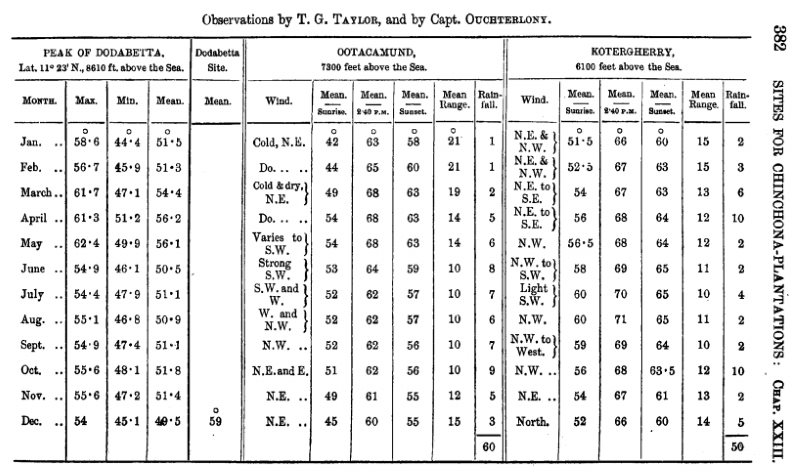
The analogy between the flora of the Dodabetta ravine and
of the loftier parts of the chinchona region was another point
which influenced my decision. Within the ravine there are
nine species of chinchonaceous plants, namely—
| Hedyotis Lawsoniæ. | Canthium umbellatum. |
| Hedyotis stylosa. | Grumilea elongata. |
| Lasianthus venulosus. | Grumilea congesta. |
| Coffea alpestris. | Psychotria bisulcata. |
| Coffea grumelioides. | |
These are mostly ornamental pretty shrubs, from six to eight
feet high, with clusters of white or cream-coloured flowers.
The other genera of which the wood is composed are as
follows:—Vaccinium, Myrsine, Symplocos, Ilex, Michelia, Sapota,
Isonandra, and Cinnamon among the trees; Eugenia,
Myrtus, Jasminum, Osbeckia, Sonerila, Solanum, Viburnum,
and Acanthus among shrubs; Lonicera, Passiflora, Rubia,
and pepper-vines among the climbers; with an undergrowth
of Lobelia, Begonia, Convolvulus, orchids, and ferns. The
Osbeckias and Sonerilas represent the melastomaceous plants,
the constant companions of chinchonæ in South America.
It was no small advantage that this excellent site for a
chinchona plantation was close to the Government gardens,
and that it would thus be under the constant supervision
of Mr. McIvor. It receives a supply of moisture during
both monsoons, and is, therefore, as good a position as could
have been selected on the higher plateau of the Neilgherries,
though there are many sholas which will be found equally
well adapted for the growth of the hardier chinchonas. These
precious plants will, it is to be hoped, before very long, form
large plantations on all parts of the hills, and become one of
the most important products of the Neilgherries. In the
mean while Mr. McIvor, the Government Superintendent,
using the Dodabetta site as an experimental plantation, will
be enabled to demonstrate the successful results of chinchona
culture, and to raise thousands of plants for the supply of
private enterprise.
The most extensive operations must, however, necessarily
be carried on at much lower elevations, where the C. succirubra,
the species richest in febrifugal alkaloids, will
flourish best, and where vast unoccupied forests afford space
for plantations on a large scale. A northern aspect is the one
best adapted for the vigorous growth of trees on the Neilgherry
hills, and we, therefore, proceeded to examine the
forest-covered slopes overlooking the table-lands of Wynaad
and Mysore, for a site for the lower chinchona plantation.
We started from Ootacamund early one November morning,
and rode across the central plateau of the hills, consisting of
rounded grassy undulations, intersected by wooded sholas. In
some of the hollows the streams had formed large swamps,
where there were extensive deposits of peat. The traveller's
bungalow of Pycarrah, the first on the road towards Wynaad,
is ten miles from Ootacamund, on the banks of a river of
the same name. Several huge boulders of syenite obstruct
the stream and cause it to foam noisily round them, and
the wet stones were covered with Podostemads, herbaceous
branched floating plants, with the habit of liverworts. We
saw several otters playing in the water, and peering at us
from behind the rocks. Six miles beyond Pycarrah is the
bungalow of Neddiwuttum, on the edge of the rapid descent
into Wynaad, and the road descends from the upland slopes
through a jungle where the ferns first appear, and maiden-hair,
ceterach, and other ferns grow by the roadside. Some
garden marigolds from England had been planted near the
Neddiwuttum bungalow, and they had spread themselves
in masses over the adjacent slopes.
The tract of forest land which we came to examine is close
to the bungalow, and from the grassy hill above it there is
a glorious view of Wynaad, and of the plains of Mysore,
stretching away to the horizon. Here the mountains sink
abruptly down to the Wynaad table-land, and the Moyaar
river thunders down in a long waterfall, divides Wynaad from
Mysore, and, flowing through a deep gorge to join the Bowany
in Coimbatore, eventually swells the waters of the great river
Cauvery. The land available for immediate occupation comprises
about 400 acres of uncleared forest on the mountain
slopes, at an elevation from a little over 6000 to a little under
5000 feet above the level of the sea, and with a mean temperature
about 8° warmer than that of Ootacamund.
I selected this site for a plantation of C. succirubra, C.
Calisaya, C. micrantha, and the very delicate C. Peruviana,
because, with a good supply of water, and a deep rich soil on
a base of decomposing laterite and syenite, it had a suitable
elevation above the sea, temperature, and amount of humidity.
The information we possess on these points, with regard to
the above species, is by no means complete; but it is sufficiently
exact to enable us to form a correct opinion. Mr.
Spruce gives the following details respecting the climate of
the region of C. succirubra, in latitude 1° 40´ S. The zone
of the "red bark" is from 2450 to 5000 feet above the sea.
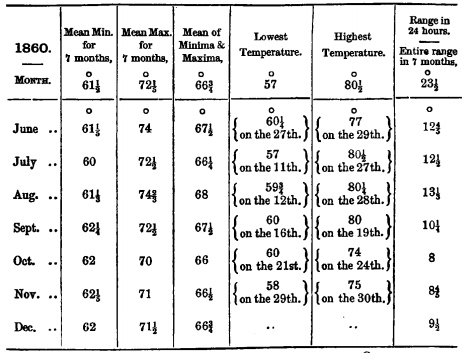
From the 1st of June to the 31st of December is the dry
season in the "red-bark" region, when the days are usually
sunny in the early morning, and mists generally begin to form
as the sun declines; while after the autumnal equinox there
are heavy rains and thunder-storms. In the wet season the
early part of the day is foggy, and there is heavy continuous
rain during the afternoons and nights. In the region of C. Calisaya,
from 13° to 16° S. lat., and from 4000 to 6000 feet above
the sea, the dry season lasts from April to the end of August.
April and August are showery months. May is also showery,
but clear in the forenoons, and the mean temperature during
the first half is 69°, mean maximum 71½°, and mean minimum
62½°. June and July are hot dry months, with little rain, a
bright hot sun in the day, but cold clear nights. In September
the rains begin, increase in October, and pour down incessantly
from the beginning of November to the middle of March,
with very hot, damp days and nights. We have no detailed
information respecting the region of C. micrantha and C.
Peruviana, species which flourish in 10° S. lat., from 4000 to
5500 feet above the sea. From May to November the sun
shines powerfully, yet heavy rains fell from day to day in
June and July 1860, and it was not until August that the
days were clear and bright. At Casapi, in this region, where
a register was kept, it rained during half the days in the
year.[419] From November to May is the rainy season, and
sometimes the rain pours down for six or seven days without
intermission.[420]
The Neddiwuttum site, being about 8° or 10° warmer than
Ootacamund, has a temperature exactly similar to that of the
forests where the above species of chinchonæ flourish. Its
elevation above the sea is also the same as that of the chinchona
forests. It is true that Mr. Spruce gives the extreme
upper limit of the "red-bark" region at 5000 feet; but Mr.
Cross saw that species growing at an elevation of 8000 feet;
and the great importance of cultivating this species at the
highest possible elevation is demonstrated by Mr. Spruce's
observation that the bark of trees growing low down and
near the plains is by no means so thick as that of trees
which flourish in a loftier and more temperate climate.[421] The
Neddiwuttum site is within the limit of the region which
receives both monsoons. Though protected to some extent
from the south-west, it receives a full share of the rains during
the summer, and is also supplied with moisture by the north-east
monsoon, coming across Mysore between October and
December. During the remaining months it is visited by
mists and heavy dews in the nights until the south-west
monsoon again commences in May. It will probably be
found that these species of chinchonæ will bear a much drier
climate than we at present suppose; and I have no misgivings
that the amount of humidity at Neddiwuttum will not be amply
sufficient for their successful cultivation. The only person
who has visited this site since its selection, who is capable,
through personal knowledge of the South American chinchona
forests, of forming an opinion, is Mr. Cross. It is exceedingly
satisfactory to find that he not only approves of it for the
cultivation of plants of the "red-bark" species, but that,
from the superior depth and richness of the soil, he considers
that they are likely to thrive even better than in their native
forests near Limon, on the eastern slopes of Chimborazo.
In the Neddiwuttum forest, among other plants, I found the
Hymenodictyon excelsum,[422] wild yams, coffee-plants, cinnamon,
pepper-vines, Andromedas, Osbeckias, wild ginger, a Balanophra
with a scarlet flower, and abundance of orchids and ferns.
On the edge of the forest there was a little hut, merely a
few branches covered with grass, and leaning against the
trunk of a tree, with some empty honeycombs lying about.
It was the habitation of a family of Mooloo Kurumbers, a
wild race who live in the forests, and run away in great terror
when any one approaches them. The establishment of the
plantation will soon make them alter their haunts from the
neighbourhood of Neddiwuttum.
The magnificent view from this point embraces a great
part of Wynaad. Far below there was a small coffee-estate,
its bright green contrasting with the more sombre hues of
the surrounding forest; and more to the left, though out of
sight, is the extensive plantation which, together with a tract
of forest on the slopes of the Neilgherries, is owned by
Messrs. Ouchterlony and Campbell.
After passing the night at Pycarrah, we started next
morning to examine another site further to the eastward,
and overlooking the plateau of Mysore. We crossed several
ranges of grassy hills, with streams in the intervening valleys
flowing through thickets of tree rhododendrons, with the
gorgeous crimson flowers just beginning to bloom, Osbeckias,
and a Lasianthus with a beautiful glossy leaf. The hills were
dotted with a St. John's-wort with a bright orange flower
(Hypericum Hookerianum). We soon reached the edge of
the plateau, overlooking the low country, and looked down
on the wide plains of Mysore, with some Neilgherry peaks in
advance of us, and a valley between, where there was bright
green cultivation, and crimson patches of amaranth, surrounding
the Badaga village of Choloor. Between the place
where we stood and the Choloor valley there were some fine
patches of forest on the steep hill-slopes; but they did not
offer the same advantages as Neddiwuttum for a first experimental
chinchona plantation. This side of the hills is drier,
the soil poorer, and water is less abundant, though it is
nearer Ootacamund, and both labour and supplies are more
easily procurable. Returning to Ootacamund we rode up
to a Todar-mund, where something unusual had evidently
occurred. About thirty Todars were walking in a line through
the forest glades below, and several jackals were prowling
about in the broad daylight. We afterwards heard that a
huge tiger had killed one of the Todar buffaloes that morning,
and retreated into the shola on the edge of which we
had just had luncheon. They expected him to come out at
sunset for his supper.
We continued our excursion to the summit of the Kalhutty
peak, overlooking the Seegoor ghaut, whence several
fine tracts of forest-land slope down; but Neddiwuttum was
decidedly preferable in every respect to all the localities which
we examined on the northern side of the Neilgherries, and
to the eastward of that site. The part of the hills on the south,
towards Coonoor and Kotergherry, was out of the question on
account of the summer drought, as it is completely screened
from the south-west monsoon by the spurs from the Dodabetta
peak; and the forests towards the Sispara ghaut, being too far
west to receive moisture from the north-east monsoon, were
not so good as Neddiwuttum, at least for a first experiment.
When the success of the chinchona culture on the 400 acres
of the Neddiwuttum plantation is fully established, the experiment
may then be extended to the east and west, both by
Government and through private enterprise; and these precious
barks may be expected to yield remunerative profits to
European speculators, while they will at the same time confer
an inestimable blessing on the native population.
Everything, however, depends upon the method which is
adopted for the cultivation of the chinchona-plants in the
experimental plantations; and, in a future chapter, I propose
to give a detailed account of the course of events, as regards
the chinchona-plants on the Neilgherry hills, up to the latest
date.
JOURNEY TO THE PULNEY HILLS.
Coonoor ghaut—Coimbatore—Pulladom—Cotton cultivation—Dharapurum—A
marriage procession—Dindigul—Ryotwarry tenure—Pulney hills—Kodakarnal—Extent
of the Pulneys—Formation—Soil—Climate—Inhabitants—Flora—Suitability
for chinchona cultivation—Forest conservancy—Anamallay hills.
In the end of November I set out from Ootacamund, by way
of the Coonoor ghaut and Coimbatore, with the intention of
examining the suitability of the Pulney hills in Madura for
chinchona cultivation. The Coonoor ghaut, on the southern
side of the Neilgherry hills, leads down into the plain of
Coimbatore. The road is good, though much too steep ever
to make a convenient means of carriage traffic, and the
scenery is exceedingly fine. The deep gorge has forest-covered
mountains on the left, and a grand range of cliffs on
the right, crowned by the bold peak of the Hoolicul Droog.
There are few districts in India without some local tradition
respecting the five Pandus,[423] the great mythical heroes of
ancient Hindoo history, and the Hoolicul Droog is not without
one. It is said that the fort on the summit of the Droog was
inhabited by a rakshi or giant named Pukasooren, who levied
a tribute on the people of the plains, in the shape of a cart-load
of provisions daily. When he had eaten the provisions
he swallowed the driver, and kicked the cart down again.
Bhima, the impersonation of strength, when passing through
this part of the country, volunteered to act as driver, had a
desperate encounter with the giant, and killed him. The
dying Pukasooren cursed the whole country over which the
shadow of the mountain fell during the day, and it has ever
since been the abode of a deadly fever. It is certain that
the jungles at the roots of the hills are the most fever-haunted
districts in India, and I rode rapidly through this
belt of forests, and along a road bordered with cana-fistula
and sappan-trees,[424] to the village of Matepoliem, on the banks
of the river Bowany, and five miles from the foot of the
ghaut.
Matepoliem is twenty-three miles from the town of Coimbatore,
and I rode this distance on a Neilgherry pony in
the early morning. The road is perfectly straight, with an
avenue of shady trees along the whole length, and good
bridges over the dry sandy water-courses. The soil appeared
to be poor, partly waste, and partly cultivated with cholum
(Sorghum Vulgare[425]), lablab,[426] and sesame. Cholum, or great
millet, is much cultivated in the peninsula, and used as food
in the shape of cakes and porridge, where rice is scarce or
too expensive. It grows to a height of five or six feet, and
cattle are very fond of the straw, which contains sugar, but
it soon exhausts the soil, and two crops are never taken off
the same land in succession. There are two villages on the
road between Matepoliem and Coimbatore, called Karamuddy
and Goodaloor, in both of which there is a choultry
or native bungalow, and in the latter an English post-house.
At Karamuddy there is a very picturesque temple, and on
the roadside I passed several horses of earthenware, votive
offerings by the potters to their god. Under many of the
trees there are images of the elephant-headed, pot-bellied
god of wisdom, Ganesa, anointed with ghee, and adorned
with garlands of flowers.
The streets of Coimbatore consist of long rows of red-tiled,
mud-walled buildings, with no windows, and overhanging
eaves supported by wooden pillars, under which there
are raised platforms where the people sit and talk. In
peeping in at the doors, I could never discern any article
of furniture in the dark obscurity of the interiors, but they
generally looked clean and well swept. The houses of the
English officials are about a mile from the town, generally
surrounded by park-like compounds, but the trees and grass
thrive badly in the shallow sandy soil. Outside the town
there are two very large tanks, one nearly a mile long, which
irrigate some rice-fields. The view is very pretty, with these
extensive sheets of water in the foreground, the cupolas of
temples rising above the trees beyond, and Lambton's Peak
with the blue line of the Neilgherries in the distance.
Some exertions are being made at Coimbatore, both by
Protestant and Roman Catholic missionaries, and about sixty
natives attend the little chapel of the London Mission
Society. The Bible is very properly not admitted into any
of the Government schools, and, strange to say, educated
natives often inquire why this is not done, and why Christians
are ashamed of their Shaster. But in schools unconnected
with the Government the study of the Bible is enforced
like any other class-book, and there are upwards of forty
Brahmin youths in Coimbatore who habitually take it home
to learn, with their other lessons, and never make the slightest
objection. Mr. Thomas, the Collector, felt very strongly the
great importance of educating the women, and a girl-school
has been set on foot, after much difficulty. At present the
influence of the women, and all women have influence, is
for evil. The men, to maintain their superiority, dislike
the women to know anything, and the head official of the
cutcherry at Coimbatore, who is a Brahmin, dare not let his
friends know that his wife can read and write, though this
accomplishment makes her a more useful and agreeable
companion. The women, generally, are treated like slaves
by their husbands. They are never allowed to eat at the
same time, except on the wedding-day, and must walk behind
their husbands on a journey, generally carrying a child on
their hips; yet I have seen the man carrying the child, and
at least taking turn about, and in other respects they always
appeared to be on good terms with each other.
At Coimbatore I bought a bandy or country cart of the
simplest construction, with two wheels, no springs, and a hood
of matting spread over curved canes; and started, with relays
of bullocks posted at intervals of fifteen miles. This mode
of travelling is inconceivably slow, the rate being about three
miles an hour, and it was near sunset before I reached Pulladom,
a village twenty-two miles from Coimbatore. The road
is nearly straight, and planted on both sides with trees of
stunted growth, owing to the shallowness of the soil. It was
market-day at Pulladom, and people were sitting in rows,
before piles of cotton cloths, rice, and dry grains; while an
old Tahsildar, in spectacles and snow-white garments, was
holding a court under a verandah. In strolling about I came
upon the huge idol-car belonging to the village, on heavy
wooden trucks. The carvings on its sides were very elaborate,
with elephant-headed gods at the angles; but it is only
dragged out on very great occasions, and will require new
trucks before it is moved again.
All this country round Coimbatore produces much cotton,
and cloths are manufactured in great quantities, which supply
garments, such as they are, for the people of the plains, as
well as for the hill tribes of the Neilgherries. The native
cotton is of two kinds, called oopum-parati and nadum parati.[427]
The seed of the latter is sown broadcast, in the same field with
cholum and cumboo.[428] After the grain is cut, the ground is
ploughed between the plants four times, and in the next year
the cotton yields a small crop in July, and a larger one in the
following January. After the third year the field is manured
and cultivated with grain for two years, cotton being again
sown when the third crop of grain has been reaped. This
nadum cotton is very little cultivated in the Coimbatore district.
The chief product is the oopum, the best indigenous
cotton, raised, in rotations of two years, with cumboo and
cholum.
The oopum cotton is raised on the black soil,[429] an adhesive
black clay, while the little Bourbon cotton that is cultivated
is grown on red soil. It is picked very carelessly, and the bales
are so badly pressed that those which I passed in carts on the
road looked as if they would sink in like a feather-bed, if any
one sat upon them.
Much pains have been taken by the Government for a
series of years to improve the method of cultivating cotton
in India, and to introduce American and other species; and
very large sums of money have been spent on experiments.
Bourbon cotton was cultivated in Coimbatore as early as
1824; and in 1842 Government cotton-farms were established
for the growth of New Orleans and Indian plants, both in the
black and red soils, under the able superintendence of Dr.
Wight, the eminent botanist. In 1849 these experiments
were abandoned.
The great importance of the question of cotton supply from
India has been long felt, and never more so than at the present
time. To meet the requirements of the English markets
numerous and costly attempts have been made during a
course of years to introduce the American species, which
produces a much longer staple than the indigenous Indian
kind. Yet American cotton has not hitherto been raised so
as to yield a profitable return, excepting in the province of
Dharwar, in the Bombay Presidency. The success in this
instance is chiefly to be attributed to a suitable soil and climate;
but also, in no small degree, to the energy of Mr.
Shaw, a former Collector.
Great attention has been paid to the nature of the soils,
while less importance than it really deserves has been
attached to climate, though climate, and mainly one element
of climate—the moisture of the atmosphere—is an essential
condition in the successful culture of American cotton. In
travelling southward from the latitude of Bombay the climate
becomes gradually moister, and at 300 miles there is a very
decided change. The American cotton-plant has a very
different constitution from the Indian; it cannot stand so
much drought, and the conditions required for its culture are
an equable and moderate supply of moisture through all the
stages of its growth. These conditions are fulfilled in the
Dharwar country, which retains a considerable quantity of
moisture in the air during the cold season, when other parts
of the Bombay Presidency are intensely dry. Wherever this
is the case, as in Sind, Guzerat, Broach, and Ahmednuggur,
the American plant will not yield a remunerative crop. The
indigenous plant is able to endure this dry season well, because
it is a native, not of the peninsula, but of the arid
country of Sind and part of the Punjab, where it grows wild.
If careful hygrometrical observations were taken throughout
the year in the various cotton districts, the results might
be compared with similar observations taken in Dharwar; and
thus the localities may be ascertained where the American
cotton can be advantageously cultivated, so far at least as
this depends on the amount of moisture in the atmosphere.
The supply of aqueous vapour in the atmosphere, at any
period of the year, diminishes as we recede from the coast;
but, having once found a centre where the American plant
can be profitably raised, in Dharwar, it is advisable to work
from that centre, especially in a south-eastern and southerly
direction. This spread of the growth of American cotton has
already taken place to the eastward of Dharwar, to a considerable
extent. The people in the Bellary district, and in
neighbouring parts of the Nizam's territory, have for some
years grown cotton from American seeds, and value it more
highly than their native species.
In Coimbatore, where scorching hot dry winds parch up
the plains during part of the year, and where the rainfall
varies so much in different seasons,[430] sometimes being thirty
inches, and at others only seven inches, it is perhaps doubtful
whether it will ever answer to cultivate American cotton
on a large scale, yet excellent samples were obtained from
cotton raised on the farms, under the superintendence of Dr.
Wight. The attention of Sir William Denison, the present
Governor of Madras, has been chiefly directed to the improvement
of native cotton, by increasing the length of the staple,
and lessening the coarseness of the fibre. It is a well-established
fact that "the best seeds make the best breeds,"[431] and
Sir William Denison proposes to select those seeds to which
the largest fibres are attached, to be used for the next crop,
and so on in each successive season, the minimum length
being increased every year. He believes that, in this way, a
permanent addition may be made to the length, and possibly
to the fineness of the fibre of the native cotton, which might
thus ultimately be able to compete in the English markets
with its American rival. Mr. Haywood, the Secretary of the
Manchester Cotton Company, on the other hand, strongly
urges that attention should be given to the improvement of
American cotton. Well-directed efforts in both directions
will doubtless be rewarded.
I left Pulladom in the night, and arrived at the large
village of Dharapurum in the following morning, a distance
of twenty-eight miles. Dharapurum is on the banks of a
small river, where there are rice-fields and cocoanut-trees;
for wherever there is the means of irrigation, rice is always
cultivated. Great quantities of cows and calves swarm along
the roads, and in the open spaces of the village, where there
are some fine spreading peepul-trees (Ficus religiosa), one of
the sacred trees of the Hindus. It has a peculiarly shaped
cordate leaf, with a long narrow acumen one-third the length
of the leaf, and yellow flowers; and it is venerated from a
belief that the god Vishnu was born amongst its branches.
Potters' horses, and images of the elephant-headed Ganesa,
were placed under the trees, the objects of worship by the
villagers, who make offerings of ghee and flowers to them.
Literally "an idol under every green tree."
After leaving Dharapurum the road becomes very sandy,
and passes over a bleak open country covered with low
bushes, on the frontier between the Coimbatore and Madura
collectorates. A range of mountains bounded the view to the
south. A slow jolting journey of thirty miles brought me to
the village of Pulkanooth in Madura. Cholum and lablab
were cultivated in the surrounding fields, and from the top of
a ridge of rocks overhanging the village there is an extensive
view of open country covered with waving cholum, and bounded
by the broken outline of the Pulney hills. Near the village
there is the ruin of a square brick fort, with bastions at the
angles, entirely overgrown with bushes. One of the happiest
signs of English rule is to be found in the number of
ruined forts scattered over the country, once the lurking-places
of brutal robbers who extorted half the crops from a
wretched peasantry, whose descendants now reap the fruits of
their labour in peace.
In taking a walk near Pulkanooth I encountered a marriage
procession. First came a man with a drum, then two
more with a gong of skin stretched on wooden hoops, then a
man with a large game-cock under his arm, then a bullock
led by a woman, then four women covered with bracelets and
anklets, then a pony ridden by a boy about twelve, with
nothing on but a red turban and gold necklace and bracelets,
with a little girl about five in front, whom he clasped round
the waist; then more men and women, another drum, and
lastly a small boy mounted on a large cow. They appeared
to have come from a distance, as they stopped to rest under
a peepul-tree, by the road-side.
Another night journey took me to the town of Dindigul, a
pretty little place at the foot of an isolated mass of primitive
rock, whose perpendicular sides are crowned by a dismantled
fort, said to have been erected in the days of Dupleix and
French ambition, and to have been occupied and long held
by Hyder Ali of Mysore. Here the plains are chiefly covered
with cholum and cumboo; and between the town and the
rock there is a grassy esplanade, a grove of cocoanut and
betel-palms, and a neat little temple to Ganesa. Troops of
young girls were drawing water from a tank near the esplanade.
Their slight graceful figures, supporting chatties on
their heads, were perfect models of beauty; but they had
black ugly faces, flabby ear-lobes, and large studs stuck in
their noses. To be admired their backs must be turned.
The Tamil people, who inhabit this part of India, are an
exceedingly black and ugly race, and the Brahmins are the
only people who have any pretensions whatever to fair skins.
On the whole the peasantry in the country between the
Neilgherry and Pulney hills appeared to be tolerably well off,
and the country was well cultivated, considering the unpropitious
climate and poor soil. As is well known, the people
in this part of India hold their land by what is called the
ryotwarry tenure, which is a settlement for the land assessment
with each individual ryot or cultivator, without the
intervention of any zemindar or renter. The land is made
over to the actual cultivator, who is regarded by the Government
as the proprietor of the soil, and the arrangement for
the payment of land-tax is made directly with him, while he
receives assistance by remissions of assessment in unfavourable
seasons, and cannot be ejected so long as he pays his dues.
The land is classified as irrigated and un-irrigated, and then
according to its different degrees of fertility; and this settlement
is permanent so long as the land remains in the same
condition. The Collector of each district makes an annual tour
of inspection, called jummabundy, to ascertain the extent to
which the Government demand ought to be reduced, owing to
particular circumstances of season; but in ordinary times the
duty of collection is intrusted to the Tahsildars or native officials,
and their subordinates the Sheristadars. These officials,
who visited me in the villages through which I passed,
appeared intelligent respectable men, and all the younger
ones talked English fluently.
Sir Thomas Munro, who was Governor of Madras from
1818 to 1827, established the ryotwarry system, and since his
time the conditions on which the ryots hold their land have
been made lighter and more advantageous. In 1837 it was
enacted that there should be no increase of land-tax on
account of the growth of more valuable crops; in 1852 it
was ordered that no ryot should pay an additional tax on
account of improvements made by himself, causing an
increased value;[432] and, during Lord Harris's administration,
considerable reductions were made in the land-assessment
in nearly all the Madras collectorates. These reductions,
independent of the boon conferred on the people, have been
attended by the most successful results, in an increasing
revenue, and in the extension of the area of cultivation over
lands which were formerly waste.
Dindigul is about forty miles from the foot of the ghaut
leading up to the Pulney hills, and relays of bullocks were
posted for me every seven miles, with a man running in
front of the cart with a blazing torch. Passing through the
village of Periacolum, round which there are many large
tanks and extensive rice cultivation, we reached the jungle at
the foot of the Pulney hills at early dawn. The path, which
is only practicable for ponies and pack-bullocks, leads up a
ravine for half the distance, and then corkscrews up the steep
sides of the mountain. The range looks very imposing from
the plain, but not equal to the Neilgherries at the foot of
the Coonoor ghaut. After resting under a clump of trees I
commenced the ascent on foot, driving an unhappy sheep
before me, which was to be sacrificed on the summit, where,
at this time of the year, there are no residents, no market,
and no means of procuring any supplies.
The ascent is exceedingly beautiful, but the undergrowth
is thick grass, and the vegetation is not nearly so luxuriant
as at similar elevations on the Neilgherries. The trees are
chiefly Leguminosæ, and at an elevation of 3000 feet chinchonaceous
plants commence, amongst which I observed the
Hymenodictyon excelsum. At 6000 feet the steep ascent is
covered with long grass, and trees are confined to sheltered
hollows and ravines. After reaching the plateau it is
necessary to scale a second steep grassy slope before arriving
at the settlement of Kodakarnal, which is 7230 feet above
the level of the sea. Kodakarnal consists of eight houses,
built along the crests of undulating hills, and one of the
inner slopes is clothed with a wood of fine trees and tree-ferns,
from which the Tamil people have named the settlement.[433]
Round the houses there are gum-trees. Acacia
heterophylla, Cassia glauca, fruit-trees, and hedges of roses
and geraniums as at Ootacamund. The houses belong to the
officials of the Madura district, the American missionaries,
a Mr. Clerk of Madras, and the French priest of Pondicherry,
who come here to recruit their healths, and for short intervals
of holiday and relaxation.
Mr. Ames, the Sub-Collector at Dindigul, had kindly
given me the use of a house which he shared with Mr.
Levinge, the Collector of Madura. It has a pleasant garden,
whence there is a glorious view of the Madura plains, with
their numerous tanks glittering in the sun; and close to
the house a torrent of deliciously cold water babbles over
huge boulders of rock, and finally leaps in long falls down
the face of the cliffs, making a noise at night like the roar
of the sea. The house was in charge of a very original
old native of low caste, with a large family, named Chenatumby,
who is a tolerable gardener, and cultivates his own
patch of potatoes. Chenatumby is a devoted Protestant,
feels a conscientious horror for the idolatry of the Roman
Catholics, and intends to bring up his eldest son as a half-caste,
this honour being conferred on him by the simple process
of attiring him in a hat and trousers. Old Chenatumby
acted as a guide in my walks over the hills, and was very
useful.
The Pulney[434] or Varragherry hills, like the Neilgherries
further north, branch out in an easterly direction from the
main line of the western ghauts. United to a portion of the
Anamallay range at their western end, they stretch out into
the Madura plains for a distance of fifty-four miles, with a
medium breadth of fifteen, and an area of 798 square miles.
On the south they rise very abruptly from the plains, presenting,
near their summits, a perfect wall of gneiss; but on the
north and east they slope down in a succession of broken
ridges. The Pulneys are divided into two parts: a lower
series of hill and dale to the eastward, called Mailmullay or
Kunnundaven, averaging a height of 4000 feet, and covering
231½ square miles, where there are extensive tracts of forest,
some cultivation, and several villages; and a loftier region
to the westward 6000 to 7500 feet above the sea, with undulating
grassy hills and mountain-peaks, the highest of which,
Permanallie, attains an elevation of 8000 feet.
The formation is gneiss, interstratified with quartz, and
traversed by veins of felspar; and the rock is generally decayed
to a considerable depth on the plateau, and disintegrated
so as to form a gritty clay. In the eastern part the
soil is a light reddish loam; but on the western and loftier
half it is very poor, being a heavy black peat several feet
thick, with a stiff and plastic yellowish clay as a sub-soil. The
rains on the Neilgherry hills have the effect of mixing the
decaying grass with the decomposed rock, and a rich soil is
thus formed; but on the plateau of the Pulneys this operation
does not appear to take place, the one becoming a black
peat, and the other a stiff clayey subsoil. These remarks,
however, only apply to the interior valleys, for on the outer
slopes, overlooking the plains of Madura, there is plenty of
good soil, and magnificent forests clothe the mountains at the
foot of the perpendicular walls of gneiss which form the
southern ridge of the Pulneys.
The climate of the Pulneys, as regards temperature, very
closely resembles that of the Neilgherries. At the time of
my visit, in the end of November and beginning of December,
the season was very late, though there were thick mists and
showers of rain every afternoon. This is the time of the
north-east monsoon, and the streams swell to torrents after
every shower. During the first two months in the year it is
very cold, and the ground is often covered with frost on the
upper plateau. In March there are light showers of rain,
which increase during April and May, and continue, with
strong westerly winds, until October. Thus the Pulneys are
within the influence of the south-west monsoon.[435] In June
and July, the warmest months, the thermometer never falls
below 50°, nor rises above 75°; and the westerly winds, with
occasional rain, continue during August and September.
The eastern part of the Pulneys, called Kunnundaven, and
Poombary, the principal village to the westward, are inhabited
by people of the Kunnuver and Karakat Vellaler castes, numbering
about two thousand of both sexes. The villages are
chiefly on the lower Pulneys, and one which I visited, called
Vilputty, was surrounded by terrace cultivation of mustard,
garlic, raggee, and keeree or amaranth. The people also cultivate
lablab, limes, oranges, and plantains; and I heard that
in one or two villages there were small coffee-gardens. Many
low-country natives are also settled on the Pulneys, chiefly
men outlawed from their castes; and in the more inaccessible
forests are the Poliars, a race of timid wild men of the woods.
Chenatumby told me that they have no habitations of any
kind, but run through the jungle from place to place, sleep
under rocks, and live on wild honey and roots. The women
run with them, like wild goats, their children slung in rows
on their hips. The Poliars occasionally trade with the country
people, who place cotton and grain on some stone, and the
wild creatures, as soon as the strangers are out of sight, take
them and put honey in their place, but they will allow no one
to come near them.
The undulating hills and valleys of the interior plateau are
covered with an aromatic grass (Andropogon), which grows
in large coarse tufts, like the Stipa ychu in Peru; and it is
not until the young tender shoots come out that it affords
good pasture for cattle, of which there is a small herd on the
hills, belonging to American missionaries and others. The
grassy slopes are dotted with tree-Rhododendrons, Gaultherias,
Osbeckias, Lobelias, the Hypericum Hookerianum, and brake
ferns. This upper plateau is admirably adapted for the
growth of English fruits and vegetables. In Mr. Levinge's
garden there were bushes of Fuchsias, Daturas, roses, and
geraniums; and behind the house grew peach, apple, plum,
and loquot-trees, strawberries, potatoes, green peas, and
artichokes.
Where there are springs or watercourses on the higher
range, there are generally fine wooded "sholas" facing
inwards, and very extensive tracts of forest on the outer
slopes; but the timber, especially teak and black-wood, has
been very extensively cut by the people of the hills. I
examined a shola called Minmurdi-karnal near Pattoor, on
the south side, another between that and Kodakarnal, and
two others, and observed trees of the following genera:— Michelia,
Cinnamomum, Dodonæa, Millingtonia, Myrsine,
Monocera, Symplocos, Bignonia, Crotalaria, Passiflora, Osbeckia,
Jasminum, Hedyotis, Lasianthus, Canthium, and
Hymenodictyon. Tree-ferns abound near the streams, and
in some of the jungles there were trees of enormous size.
Early one morning I went with Chenatumby to see the
"pillar-rocks," three miles to the westward of Kodakarnal.
They consist of grand perpendicular cliffs descending from
the grassy heights, with their bases clothed with forest.
Two of them are separated by fissures from the main cliff,
and have the appearance of gigantic columns. It was altogether
a most magnificent sight, with volumes of fleecy
clouds rolling up from the low country, and occasional peeps
of the far-away plains and glittering tanks through their
folds.
The natives have long been in the habit of recklessly felling
the most valuable timber, and acres of fine shola used to
be annually destroyed to make clearings for plantain and
cardamom groves. For the latter, however, only the small
trees and underwood are burnt on the Pulneys, the larger trees
being left standing. But this wasteful destruction of timber
has recently been checked by the authorities, and in 1860
Mr. Spershneider was appointed as overseer of the Pulney
forests, with a small staff, to prevent the reckless cutting of
timber, and to mark, from year to year, the trees which
arrive at sufficient maturity, and are fit to be felled.
I came to the conclusion that in several of the wooded
sholas the chinchona-plant might be cultivated with advantage,
the C. Condaminea, and other species which thrive at great
elevations, on the upper plateau, and the C. succirubra in Kunnundaven.
Mr. Levinge, the Collector of Madura, takes an
interest in the experiment, and Mr. Spershneider would be
willing to superintend the chinchona plantations; so that, when
the undertaking is in a sufficiently advanced stage on the
Neilgherry hills to enable Mr. McIvor to distribute plants for
cultivation in other parts of India, a number might advantageously
be sent to the Pulneys. I understand, too, that it
is in contemplation to form a Company for the cultivation of
coffee on these hills, in which case it is to be hoped that the
extension of the growth of chinchona-plants will be advanced
by private enterprise, from motives of humanity as well as
with a view to successful commercial speculation.[436]
I did not visit the Anamallay hills, to the south of Coimbatore
and westward of the Pulneys, as no planter was as yet
established on them, and a considerable time must elapse
before they are prepared for the introduction of the chinchona-plant.
At the time of my visit no bold clearer of jungles had
ventured to invade the domains of the conservators of forests
on the Anamallays.
Dr. Cleghorn reports that these hills are under the influence
of the south-west monsoon, though not so much so as
the Koondahs at Sispara: but I do not find that he gives any
detailed account of the amount of moisture in the atmosphere
during the winter. The soil is described as deep and covered
with rich pasture, streams of water are numerous, there are
table-lands 6000 to 7000 feet above the sea, and very fine
timber in the ravines. The three hill-tribes, called Kaders,
Poliars, and Malsars, trade in cardamoms, turmeric, ginger,
honey, wax, resins, soapnuts, and millet. Dr. Cleghorn considers
that, from the extent of forest, the resemblance of the
flora to that of Ceylon, and the altitude, the Anamallays are
suitable for the cultivation of coffee on a large scale, and for
colonization of small communities of Englishmen.[437] In this
case they are also adapted for the growth of chinchona-plants,
and their introduction, which will of course be simultaneous
with the settlement of Europeans, will be the more beneficial
because the lower slopes of the Anamallays are the haunts of
fevers. The quinine-yielding trees will confer blessings on
those whose duties or interests oblige them to frequent the
forests of the Anamallays, while their cultivation will be
a remunerative speculation to the settlers on the upper
plateau.
MADURA AND TRICHINOPOLY.
Arrive at Madura—Peopling of India—The Dravidian race—Brahmin
colonists in Southern India—Foundation of Madura—Pandyan dynasty—Tamil
literature—Aghastya—Naik dynasty—The Madura Pagoda—The
Sangattar—The Choultry—Tirumalla Naik's palace—Caste prejudices—Trichinopoly—Coleroon
anicut—Rice cultivation—The palmyra
palm—Caroor—Return to the Neilgherries—Shervaroy hills—Courtallum.
The road from the foot of the Pulney hills to Madura, a
distance of upwards of forty miles, is very bad, but it passes
through avenues of shady banyan and peepul trees most of
the way, and is, therefore, not so wearisome for the natives
on foot, as for a European jolting at the rate of three miles
an hour in a bullock-cart without springs.
Near Madura there are tracts of rice cultivation, plantain
groves, and topes of palm-trees; and at sunrise I came in
sight of the gopurams or towers of the great pagoda, rising
above thick groves of palmyra palms, with a foreground of
bright green paddy-fields. The city is very interesting from
its remarkable palaces and temples, as the capital of a once
powerful kingdom, and as the ancient centre of Tamil
civilization: and a few words respecting the former history
of this part of India appear necessary before describing the
pagoda, and other architectural remains of the former greatness
of Madura.
Tradition relates that in the most ancient times the country
from the mouths of the Godavery to Cape Comorin was one
vast forest. Here the great Aryan hero Rama is said to have
resided during his exile, with his wife Sita, and here he
commenced his wars against the Rakshasas or fiends, who
divided with hermits and sages the possession of the wilderness.
The simple truth probably is that these "fiends" were
the original inhabitants of Southern India, which was called
Dravida Desa, and that Rama was the first Hindu invader.
Dravida denotes the country of the Dravidas, who are
described in Sanscrit writings as men of an outcast tribe,
descended from degraded Kshatriyas.
The history of the early peopling of India, by its various
races, is involved in much obscurity; and the little light
which has been thrown upon it is chiefly derived from a
comparison of languages. The prevailing opinion is that
India was originally inhabited by a people whose remains
are to be found in the Koles, Sontals, Bheels, and other wild
hill tribes; that the Dravidians, a Scythic people, came
from the north, settled in Hindustan, and drove the aborigines
into the hills and fastnesses; that in their turn the
Dravidians were driven across the Vindhya mountains by
another Scythic race, and became the ancestors of the present
population of Southern India; and that finally the Aryan
race, with its Vedic civilization, brought this pre-Aryan Scythic
race under subjection, and formed it into the servile
Sudra caste.
Thus the Dravidian people of Southern India were of
Scythic origin, and they spoke a language from which the
four modern ones of the Madras Presidency, Tamil, Telugu,
Canarese, and Malayalam,[438] are derived. These are all
grouped as Dravidian languages, and their source is no
longer a matter of doubt. It was formerly supposed that
they were Aryan, from the great number of apparently Indo-Germanic
roots; but it is now known, from the structure of
their grammar, that they belong to the great Turanian or
Scythic group of tongues. Mr. Caldwell considers that the
Scythian family to which they are most closely allied is the
Finnish or Ugrian;[439] and in this view Professor Max Müller
concurs with him.[440] The ancient Dravidian religion, before the
people were converted to the belief taught in the Puranas,
also favours Mr. Caldwell's view. If we may judge from the
creed which still lingers in Tinnevelly and other districts, it
consisted in the worship of evil spirits by means of bloody
sacrifices and frantic dances, while a Supreme Being was
acknowledged but not venerated, and there was no trace of
worship of the elements. In these respects it closely resembled
the Shamanism of the Scythic races of High Asia.
It is tolerably certain that the Dravidian races had attained
to some degree of civilization before the Aryans appeared in
their country, and, with a system of castes, introduced the
worship of Vishnu and Siva. One evidence of the ancient
civilization of the Dravidians is that they possessed a system
of numerals up to 1000, essentially the same in all the four
languages; though in counting above 1000 they make use
of Sanscrit numerals. From the existence of these native
numerals among the Dravidian nations, Mr. Crawford draws
the inference that these people must have attained a considerable
measure of civilization before they adopted the
Hinduism of the north, and hence stood in no need of foreign
numerals.[441]
From the time of Rama, who appears to have been assisted
in his invasion of Lanka (Ceylon) by a Dravidian chief, now
deified as the monkey God Hanuman, the influence of
Hinduism rapidly increased, and caste prejudices spread over
Southern India. But the annals are far too obscure, and too
deeply buried under extravagant fable, to enable us to form
any idea of the time and manner of the complete inoculation
of the Dravidian races with Brahminical legends, caste observances,
and Hindu religious ideas. It is clear, however,
that "to the early Brahminical colonists the Dravidians are
indebted for the higher arts of life, and the first elements of
literary culture."[442]
The Brahmins came to Southern India not as conquerors,
but as peaceful settlers and instructors; and their influence
was obtained through their superior civilization and learning.
They gave the name of Sudra to all the upper and middle
classes of native Dravidians, while the servile classes were
not, as in Hindustan, called Sudras, but Pariars. Thus, while
in the north a Sudra is a low-caste man, in the south he
ranks next to a Brahmin.
It is said that, after the avatur of Rama, pilgrims came
in great numbers to visit the scenes of his triumphs, and,
settling in the country, cleared land for cultivation, and laid
the foundations of future principalities. One of these settlers
was a man named Pandya, of the Vellaler or agricultural
caste, who established himself in the south; and his descendant
Kula Sekhara, son of Sampanna Pandya, was the first
king of Madura. Some centuries elapsed, probably five,
before the foundation of the city of Madura, during which
the settlers were occupied in clearing the ground, and forming
themselves into an organized state; and it has been
conjectured that the building of the capital was commenced
between 500 and 600 B.C. Previously the kings of the
Pandyan dynasty resided at a place called Kurkhi.[443]
Another tradition states that a merchant lost his way in
the forests, and discovered an ancient temple dedicated to
Siva and his wife Durga, which had been erected by the
God Indra. The merchant was directed by the God to
announce to the Pandyan king, named Kula Sekhara, that it
was the will of Siva that a city should be erected on the spot.
Kula Sekhara, therefore, cleared the forest, rebuilt the temple,
and founded a city. On the completion of the work a
shower of nectareal dew fell from heaven, spreading a sweet
film on the ground, and hence the name of Madura (sweet).[444]
The wife of Siva became incarnate as the daughter and
successor of this prince, under the name of Minakshi; and
Siva himself as Sundara, or the handsome, was her mortal
husband. Thus the Pandyan kings, like many of the dynasties
of ancient Greece, placed their gods at the head of their
genealogical tree. The immigration of a colony of Aryan
Brahmins from Magadha into the Madura country, and the
commencement of Tamil civilization and literature, have
been placed, by Mr. Caldwell and others, in about the
seventh century B.C.
At the Christian æra the kings of Madura were very
powerful, and had extended their dominions over the whole
of the peninsula. They sent two embassies to Rome—the
first in the eighteenth year after the death of Julius Cæsar,
which found the Emperor Augustus at Tarragona; and the
second six years later, when he was at Samos.[445] Subsequently
the kingdom was reduced in size by the independence of
Malabar, the rise of Chira in the west, of the state of Chola
in the east, and of Ramnad in the south.[446] A long list of
kings is mentioned in the native annals, with numerous wars,
first against the Buddhists, and afterwards with the Rajahs of
Chola and Ramnad.
The most flourishing period of Madura history appears to
have been during the reigns of Vamsa Sekhara and his son
Vamsa Churamani, in about 200 A.D. They erected grand
temples and palaces, and the more ancient and massive parts
of edifices still in existence probably date from their reigns.
A college, called Sangattar, was founded at Madura, at this
time, for the cultivation of the Tamil language and literature.[447]
The first stimulus was given to this movement by the
famous Rishi or sage, Aghastya, the leader of a colony of
Brahmins, whose migration to the south is mentioned in the
Ramayana. He was a chief agent in diffusing the worship of
Siva in the Deccan; and it is supposed that there was a
second man of learning of the same name in the eighth or
ninth century. Aghastya is said to have been the offspring
of two gods, Mithra and Varuna, and he received the Brahminical
string from seven holy prophets. He became a
most wonderful and enlightened personage, and composed
works on medicine, moral and natural philosophy, and botany,
in high Tamil verse, called Yellacanum, greatly improving
and refining his adopted language. Aghastya's memory is
deeply venerated by the Tamil people, and his healing spirit
is still believed to hover amongst the mountains of Courtallum,
in Tinnevelly;[448] where he is worshipped as Agast-isvara,
or the star Canopus.
From the ninth to the tenth centuries the Jain religion
predominated in Madura. The Jains were animated by a
national and anti-Brahminical feeling, and it is chiefly to them
that Tamil is indebted for its high culture and independence
of Sanscrit. They were expelled in the reign of Sundara
Pandya, at about the time when Marco Polo visited India.
The Mohammedans first made an inroad into the Deccan in
the reign of Alla-ud-deen of Delhi in 1293, they crossed the
Kistna in 1310, and advanced as far as Rameswara in 1374.
After reigning for many centuries the Pandyan dynasty
became tributary to the powerful Brahminical kingdom of Bijayanuggur
in Mysore, in about 1380 A.D. A list of more than
seventy kings is given in the annals.[449] But in the fifteenth
century an officer of the Bijayanuggur Rajah, named Nagama
Naik, was installed as feudatory King of Madura, and founded
the Naik dynasty. He procured the cession of Trichinopoly
from the Chola Rajah, and his son Viswanath Naik distributed
the district of Tinnevelly amongst his adherents of the Totia
caste, the ancestors of the Poligars of Tinnevelly. His descendant
Tirumalla Naik, who succeeded in 1623 A.D., had a long
and flourishing reign, and public edifices still furnish splendid
proofs of his wealth and magnificence. He died in 1657 A.D.;
and the Naik dynasty, which came to an end in 1730 A.D.,[450] was
followed by obscure feudatories of the Nawabs of the Carnatic,
who eventually made way for British rule.
I went early one morning, with Mr. Levinge the Collector,
to visit the great pagoda of Madura, some of the oldest parts
of which date from the reigns of Pandyan kings in the eighth
century. It covers twenty acres of ground, and is surrounded
by a high stone wall painted in red and white stripes, the
Hindoo holy colours. The walls form a perfect square, and
in the centre of each side there is a lofty gopuram or tower.
These towers are broad, solid, and very lofty masses of
brick, in the form of a truncated pyramid. From the base
to the summit they are one mass of sculptured figures, representing
all the gods in Hindu mythology, rising tier above
tier to the summit, and decreasing in size with the height.
Each end of the top of the gopuram is ornamented by a fan-shaped
structure of brick-work, representing the hood of a
cobra. We entered the pagoda by a gateway in the left
corner of the wall facing the great choultry built by Tirumalla
Naik. Here the warden of the pagoda was waiting for us, who
had arrived just before in his palkee. He is of Sudra caste, a
man advanced in years, and of much reputed holiness; and
he received us in a state of nudity, with the exception of a
yellow gauze scarf, his belly, chest, and forehead being
smeared with holy ashes. A crowd of Brahmins accompanied
us.
A long corridor leads from the entrance to the cloister,
with a roof supported by stone pillars, between which elephants
were stationed, gaudily painted and caparisoned. The
cloister is the finest part of the interior of the pagoda. The
walls are covered with paintings representing the marvellous
adventures of Krishna, and the pillars supporting the roof of
the galleries are roughly carved. The central space is occupied
by "the tank of the golden lotus," with very dirty green
water, and stone steps leading down from the cloister. The
view from one corner of this tank is very striking; with
green stagnant water as a foreground, rows of fantastically-carved
pillars supporting the gallery on the opposite side,
with the lofty gopurams in the rear, rising as it were from the
graceful fronds of cocoanut-trees which waved over the roof
of the cloisters. Sacred monkeys were running about in all
directions over the roofs.
The Sangattar or literary college of Madura held its sittings
in this cloister; and Siva is said to have presented it with a
diamond bench which extended itself readily for such persons
as were worthy to be on a level with the sages of the Sangattar,
and excluded all who tried to sit on it without possessing
the necessary qualifications. In other words, the
learned corporation of Madura maintained a strict and exclusive
monopoly. One day a man of the Pariar or lowest caste,
named Tiruvallavar, appeared as a candidate for a seat on the
bench of Sangattar professors. The sages were indignant at
his presumption, but, as he was patronized by the Rajah, they
were obliged to give his book a trial. It was to find a place
on the bench, which the professors took care to occupy fully.
But the miraculous bench extended itself to receive the book,
which expanded and thrust all the sages off into "the tank
of the golden lotus," and the Sangattar was abolished. This
took place in about the ninth century, and the work of Tiruvallavar,
called kural, and consisting of 1330 aphorisms, still
exists, and is the oldest extant work in Tamil literature.
Though rejected by the Sangattar, on account of the low
caste of its author, it was received by the Rajah and people;
and the college was abolished, or perhaps dissolved itself from
mortification at this defeat.
In a corner of the cloister is the entrance to one of the
gopurams, and we went up to the top. Holding on by the
cobra's hood which crowns the tower, there was an extensive
view of the town of Madura and surrounding country, with
its bright green rice cultivation, groves of palmyra-palms,
broad expanses of water, isolated masses of rock, and the
Pulney hills in the far distance.
We passed from the cloister, and walked round the corridors
which surround the holy of holies containing the
Sokalinga, the sacred emblem of the God Siva, which no one
but a Brahmin can enter; and the temple of Minakshi, his
fish-eyed wife. The pillars in these corridors are curiously
carved in the form of dancing-girls, elephant-headed Gods,
Sivas, and bulls. Here I was decorated with garlands of
flowers by the warden of the temple, and I saw that there
was a flower-garden in a small enclosure near the cloister, to
supply offerings of flowers for the ceremonial worship in the
temple. In the Hindu religion bright-coloured or fragrant
flowers take a prominent place as offerings to the gods. The
arrows of Kama, the God of Love, were tipped with five
flowers:[451] the asoka (Jonesia pinnata), a beautiful flower diversified
with orange, scarlet, and bright-yellow tints, is consecrated
to Siva; the lotus-flower, called kamata or padma, to
Vishnu and his wife Lakshmi; a sweet-scented jasmine
(Jasminum undulatum) to Vishnu, and Mariama the Goddess
of Pariars; the superb crimson Ixora Bandhuca is offered at
the shrines of Vishnu and Siva; and the Nauclea Cadumba,
a stately tree, yields the holiest flower in India.[452]
In an angle of one of the corridors all the jewels of the
temple were spread out on a table for our inspection, and we
sat down before them, by the side of the old warden. It was
a truly magnificent display of wealth; and it was impossible
not to feel that there must be deep faith and conviction in a
religion which induces men to go about naked and in ashes,
and to devote tens of thousands of rupees to ornament the
mystic emblems of their Gods. I particularly noticed some
sapphires of extraordinary size and brilliancy; the cover of
the lingam, a cylinder of pure gold, four feet high, encrusted
with pearls and rubies; the golden sceptre of Siva, three
feet long, and one mass of rubies; the golden shoes and
gauntlets of Siva and Minakshi, inlaid with rubies, emeralds,
and pearls; the head-dress of Minakshi of gold Trichinopoly-work,
adorned with pearls and rubies, with enormous emeralds
hanging from it; her playthings, consisting of golden birds
overlaid with rubies and emeralds; and necklaces and bracelets
covered with jewels of priceless value. There was also
a costly gold chain presented by Mr. Peters, a former Collector,
and another which had lately arrived from Agra, in
an anonymous letter addressed to the pagoda.
From this corridor I was able to peep down a dark passage
at the end of which there were some dim lights surrounding
the sacred Soka-linga, but I could not distinguish anything.
The warden told us that it was a piece of solid rock cropping
out of the ground, and cut into the shape of a cylinder, with
a rounded top, as the mysterious emblem of Siva, the God of
reproduction. Its roots are said to be in the centre of the
earth, and to have been there since the creation. The
Pandyan kings, when they were dying, were taken into the
innermost sanctuary of Siva's temple, to expire and be united
with their God. Parallel with this holy of holies dedicated
to the worship of Siva, in the form of his mystic emblem,
is the temple of his wife Parvati, here better known as
Minakshi, or the fish-eyed.
We then went into the hall of the thousand pillars, which
are carved into the shape of gods or dancing-girls, and
support a flat stone roof. Here some nautch-girls came
dancing before us in silk trousers, long tunics, golden headdresses,
and rings on their ears, noses, and toes; as we
walked down the long vistas of pillars. Their motions are
stiff and without grace, like the contortions of galvanized
corpses, and they are generally very ugly, with black teeth.
I was glad when they relieved us of their disgusting presence,
as we were shown into a chamber near the outer door,
where the horses and bulls used in the great processions are
kept. These are made of solid silver, ornamented with
precious stones, and on festivals the God and Goddess are
mounted on them, and carried round the town.
This great pagoda is very richly endowed, and is one
of the most famous in Southern India. It was originally, and
for several centuries, the centre of Tamil civilization, and
it is a very characteristic specimen of Hindu architecture.
All originality and intellectual vigour has disappeared from
amongst the Tamil people, under the blighting influence of
foreign domination, but their devotional feeling appears to
have survived; together with respect and veneration for the
doctrines and aphorisms of their classic sages, among the
more educated. Aghastya stands at the head of the Tamil
authors, and the following confession of faith, in the Njana-nuru
is attributed to him:—
"Worship thou the light of the Universe, who is One:
Who made the world in a moment, and placed good men in it;
Who afterwards himself dawned upon the earth as a Guru;
Who, without wife or family, as a hermit performed austerities;
Who, appointing loving sages to succeed him,
Departed again into Heaven:—worship Him."[453]
We left the pagoda by a corridor leading through one
of the gopurams into the street, immediately in front of the
great choultry erected by Tirumalla Naik. It consists of an
immense hall of granite, 300 feet long by 80, supported by
upwards of a hundred pillars of the same stone, elaborately
carved, and about thirty feet high. One of them is formed
of a single block of granite. Figures of the Madura kings
of the Naik dynasty are carved on these pillars, amongst
whom is Tirumalla Naik, the founder of the edifice. One
curious group of carved figures represents a tradition of the
old Pandyan times. It is related that a rich farmer, living
near Madura, had twelve sons, who passed their time in the
chace. A wild hog once attacked them, killed some, and
chased the rest to the vicinity of a sage engaged in meditation.
The angry ascetic cursed them, declaring that, in
their future life, they should be hogs themselves. They were
born again as porkers, but Minakshi took pity on them,
officiated as their nurse, and they became men with pig's
heads, in which capacity they are sculptured on one of the
pillars of the choultry. The pig-headed brethren were
taught the arts and sciences, and were eventually advanced
to the ministerial administration of the affairs of the Pandyan
kingdom. The choultry was originally built as a magnificent
approach to the temple, and to receive the image of the
God Siva for ten days every year. It was crowded with
people, and the spaces between the pillars were occupied by
traders selling silks and cotton-cloths, turbans, bags for betel,
and trinkets.
Next to the great pagoda and the choultry, the most
interesting architectural remains of the former grandeur
of Madura are the ruins of the palace of Tirumalla Naik.
They consist of a large quadrangular court, now roofless,[454] but
apparently once covered over, with side aisles supported
by massive stone pillars, rendered almost double their original
size by a thick coating of chunam, or lime made with
pounded sea-shells, which takes a very fine polish, like
marble. These columns are exceedingly handsome, and
their capitals bear evidence of Italian design.[455] They are in
double rows, and the roof of the aisles is most elaborately
carved with mythological figures, originally painted in bright
colours. Numerous green paroquets were screaming and
flying about near the roof. At the end of this splendid
court, opposite the street entrance, there is a broad flight
of steps leading up to an inner hall, where columns of the
same massive character support a richly carved roof. The
whole building has an exceedingly imposing effect, and in
the sombre melancholy of its decay it gives a grand idea
of the former civilization of the Tamil people; but as the
English Judge now holds his court in a portion of the ruins,
we must not say, with the Persian poet,—
"The spider now weaves its web in the palace of Cæsar,
The owl stands sentinel on the watch-tower of Afrasiab."
Tirumalla Naik also constructed a great tank, about a
mile outside the town, said to be the finest in Southern India.
It is an exact square, with sides 300 yards long faced with
granite, and flights of steps down to the water, at intervals.
In the centre there is a square island, rising in broad flights
of steps from the water, and covered with a grove of trees,
above which rises the tall tower of a pagoda.
The town of Madura, situated on the banks of the river
Vaigay, contains about 50,000 inhabitants. It is by far the
cleanest and best built city that I saw in India, with fine
broad streets, and houses with tiled roofs extending far beyond
the walls, so as to form verandahs supported by poles. Here
and there a house with an upper story, belonging to some
wealthy citizen, rose above the rest; and in the bazars there
was a strong sickly smell of spices. Madura is indebted, for
its superiority over other Indian towns, to Mr. Blackburn, a
former Collector, and the inhabitants have erected a lamp on
a tall pedestal to his memory.
On the day of my visit to the pagoda, the streets were
densely crowded, the women were decked out in all their
finery, and those of the Brahmin caste had their faces
hideously stained with saffron. It was a festival in honour of
some cow or other, who had been turned into a rock, through
the excess of her love for Nandi, the bull on which the God
Siva rides. The religious feelings of the people are displayed
in these festivals, and whether they worship and venerate
the stone or wooden image, or the attributes of God-like
virtue and wisdom which the emblems connected with the
image are intended to represent, my observations led me
to believe that, in all classes, there was a display of most
undoubted sincerity. In connection with their religious
observances, the people of Southern India feel very strongly
on the subject of caste distinctions. The Brahmins are fair
skinned, of Aryan descent, and comparatively strangers,
having been barely a thousand years in the country.[456] Next
come the Sudras, who represent the upper classes of the
Tamil race. The Vellaler or agricultural caste comes next,
and then the Maravar and Kallar, or robber castes. The
Prince of Ramnad, who is hereditary guardian of Rama's
bridge, belongs to the Maravars, and the Rajah of Tondiman
to the Kallars. Below the robber castes are the Shanars or
toddy-drawers, who are free and proprietors of land; then
the Pariars[457] and chucklers or slaves; then the Korawars or
vagrant basket-makers, and last of all the shoemakers and
low-caste washermen.
The higher castes had recently been outraged by the
Shanars having been allowed to go in procession along the
road, on the occasion of a marriage at Arpucaté, a populous
mercantile town in the Madura district. This was done in
defiance of all ancient customs and usages connected with
caste, which are clearly defined and acknowledged by all
classes of Hindus. The high-caste people defend their feeling
of exclusiveness by urging that the Shanars and Pariars
are guilty of one or other of the five great sins, namely,
killing the sacred cow, theft, drunkenness, adultery, and
lying: for that the Shanars draw toddy, and the Pariars eat
meat. They claim for immemorial custom the same authority
that is given in England to common law, and declare that
the Shanars never had the right of parading the streets in
procession, with music and flags. In considering this question
it should not be forgotten that the Shanars and other
low castes will no more allow a man of still lower caste to
overstep his privileges by one hair's breadth than will a
Sudra or a Brahmin. Even the Pariars are a well-defined,
distinct, and ancient caste, jealous of the encroachments of
the castes both above and below them: they have strong
caste feelings, and treat the caste of shoemakers with contempt.[458]
Thus, if the Shanars and Pariars insist upon their
own caste privileges, it is difficult to see why they should
be permitted to infringe upon those of the castes above
them; and it would seem that a feeling of content and
satisfaction with our rule would be best promoted by ensuring
to all classes of the community the exclusive enjoyment
of their own peculiar usages and privileges.
Caste is one among many instances of the peculiar exaggerations
in which the Hindu mind loves to indulge. The social
distinctions which prevail in other countries are represented
in India by this institution, in which those distinctions are, not
altogether illogically, carried to an extreme point. Caste may
be modified and rendered less harsh in its general outline;
but it will never cease to exist. The Protestant missionaries,
of course, declare war to the knife against it, as a system of
falsehood and deceit, and an absurdity contrary both to reason
and revelation. This may be true, as well as that Brahmins
get drunk, and eat asafœtida-cakes in which buffalo flesh
forms an ingredient, without losing their caste; but missionary
denunciations of caste absurdity, and exposures of Brahminical
irregularities, are not likely to make the slightest
impression on the minds of a people with whom caste distinctions
are hallowed by immemorial usage, and bound up
in every act of their lives. The favourite missionary receipt
is, therefore, to deprive Brahmins of their Enam or rent-free
lands, to induce Government entirely to disavow caste, to
put an end to all caste distinctions in jails, and to raise the
Pariars and Chucklers from their degradation.[459] A very
summary plan no doubt, but as impracticable as it would be
impolitic and unjust.
After a most delightful visit at Madura, I started for
Trichinopoly late one night, and found the road so execrable
in some places, that it was necessary to go off into the fields,
and make a long circuit. The country between Madura
and Trichinopoly is chiefly cultivated with dry grain, but
there are occasional patches of rice. Ranges of rocky
hills intersect the plain, covered with underwood and low
trees, which the natives are allowed to use for firewood,
but, when they carry it off for sale, in cart-loads, there is
a small duty. I walked most of the distance under the shade
of the peepul and banyan-trees which line the road, and
reached Trichinopoly after a journey of a day and two
nights.
Trichinopoly is a large military station, and the European
houses, therefore, are very numerous, and occupy a considerable
space, as they are generally surrounded by large parks
or compounds. A bridge over a small tributary of the
Cauvery leads to the bazar and native town; and the view
from the bridge is very pretty, with cocoanut-trees and bushes
coming down to the water's edge, and houses embosomed in
trees, whence flights of steps lead down into the water. Beyond
the bridge there is a picturesque mosque of white stone,
and the bazar, a long street leading to the principal part of
the town, in the centre of which the famous rock of Trichinopoly
rises up abruptly. Brahmins and other traders were
sitting in their shops, before piles of earthenware and copper
chatties, cotton cloths, and numerous kinds of grains and
pulses in baskets. The rock is a mass of granite, 400 feet
high, crowned by a small Hindu temple; the ascent is cut in
steps out of the solid rock, and from the summit there is a
most extensive view, including the city, the fine bridges over
the Coleroon and Cauvery, the gopurams of the great pagoda
of Seringam on an island in the river, and a vast expanse of
rice cultivation and palm-groves, with Tanjore on the distant
horizon. The native town contains several large handsome
houses belonging to Mohammedans, and the ruins of the
palace of the Nawabs of the Carnatic.
Through the kindness of Mr. McDonnell, the Collector, I
was enabled to pass a very interesting day at the Upper
Coleroon anicut. Passing the base of the rock of Trichinopoly,
and following the main street of the native town, the banks
of the river Cauvery are reached, where there are rows of
stone temples and houses with open corridors, whence flights
of steps lead down into the water. Near the river there is
a tank filled with red and white lotus-flowers. A handsome
stone bridge spans the Cauvery, and another of equal length
crosses the Coleroon, about a mile further on. The two
rivers form an island, and unite a few miles lower down; and
the upper anicut is about fourteen miles up the river, where
Mr. McDonnell had a comfortable bungalow on the banks,
shaded by lofty trees.
The Upper Coleroon anicut or weir is constructed at the
west end of the island of Seringam, which is formed by the
separation of the Cauvery into two branches, namely the
Coleroon on the north, and the Cauvery on the south. Formerly
the bed of the Coleroon was continually deepening,
while that of the Cauvery was rising, so that there was much
difficulty in obtaining a sufficient supply of water for the
irrigation of the rice-fields of Tanjore. The upper anicut,
commenced by Colonel Cotton in 1836, and finished in 1850,
completely answered the purpose of deepening the bed of the
Cauvery, so much so that another weir was made across that
river, sixty miles lower down; and by means of the second
weir, made in 1845, and the under sluices in the upper one,
the water is now effectually kept under command.[460] The upper
anicut, which I visited, is broken into three parts by two
small islands. The south part is 282 yards long, the centre
350, and the north 122, the whole length, including the
islands, being 874, and without them 754 yards. The weir is
a plain brick wall, plastered with chunam, six feet thick, and
seven feet high, the top being lined with masonry. It is
defended from the overfall by masses of rough stone; and
there are twenty-four sluices, which prevent accumulations of
sand from forming above the anicut. The sluices are connected
by a narrow bridge of sixty-two arches, to secure
access to them during floods, and it also serves as a means of
communication between the banks for foot passengers. The
cost of the work, and of repairs between 1836 and 1850, was
two lacs of rupees, and it assists the irrigation of 600,000
acres, yielding a revenue of 400,000l., or equal to two-thirds
of that of the whole island of Ceylon.
By means of these anicuts the fertile province of Tanjore is
converted into one vast rice-field,[461] and the portion of Trichinopoly
below the upper weir is equally rich. The country to
the north of the road between the anicut and the town of
Trichinopoly was a wide expanse of bright green rice cultivation,
stretching to the horizon. In Southern India there
are two annual crops of rice, called the caar and the soombah
or peshanum crops. The former is reaped in October and is
reckoned inferior, and the latter in February and March.
Two crops in the year from the same land do not yield
much more than a single crop, but, owing to the liability
of the seasons to fail, the cultivators rear as much as possible
for the first crop. This is reaped in the rainy season,
when the straw cannot be preserved, so that the second crop
must necessarily be sown, for fodder for cattle. Rice requires
rain to ensure the full development of the grain, as well as
irrigation. The seed is sown thick, and then transplanted to
the fields about forty days afterwards; and the fields must
be constantly supplied with water. The stalks when cut are
stacked for a few days, and the grain is then thrashed out by
manual labour or cattle, the husk being separated from the
grain with a rice-stamper, generally beaten by women. In
the interval of sowing, the natives often sow the land with
pulse or sesame, the stubble of which is used as manure for
the next rice-crop.
At intervals scattered over the plain, there are groves of
cocoanut and palmyra-palms, like islands in the vast sea of
rice-fields, with small villages built under their shade. As
the betel-nut palm is the most graceful in India, so the
palmyra (Borassus flabelliformis) is undoubtedly the ugliest,
with its black stem the same size all the way up, and coarse
fan-shaped leaves. It is chiefly from this tree that the
Shanars draw the toddy. The spadix or young flowering branch
is cut off near the top, and an earthenware chatty is tied on
the stump, into which the juice flows. Every morning it is
emptied and replaced, the stump being cut afresh, and so on
until the whole is exhausted. Sugar is also extracted by the
same process, the inside of the chatty being powdered with
lime to prevent fermentation, and the juice being boiled down
and dried. The sugar thus obtained is called jaggery. The
timber of the palmyra-palm is extensively used for building.
As we drove towards Trichinopoly, with these rice-fields
studded with palm-groves on our right, the tall towers of
Seringam[462] appeared rising above the trees which border the
waters of the Cauvery; and near the town there are large
plantain-groves. In leaving Trichinopoly on the road to the
Neilgherries it is necessary to cross a small affluent of the
Cauvery in ferry-boats. Those for foot-passengers are of
wicker covered with hides, and perfectly round, like those
which are described by Herodotus, and are still used on the
Tigris and Euphrates. After jolting all night through endless
groves of banyan and peepul trees, I reached Caroor,[463] the
ancient capital of the Chira Rajahs, the following morning.
The Chira state, in the days of its prosperity, extended over
Coimbatore, and part of Mysore and Malabar. Caroor is a
town of some size, in the middle of a plain, through which
flows the river Amaravati, a tributary of the Cauvery. Mr.
Roberts, the Sub-Collector, was living in a curious upper
story, on the top of a pagoda, the entrance to which leads
under a tall brick gopuram, 86 feet high, 64 feet long at the
base, and 52 feet broad, sculptured with images exactly on
the pattern of those at Madura. The country between Caroor
and the foot of the Neilgherries is flat and uninteresting,
chiefly cultivated with cholum, cumboo, cotton, and a few
pulses, with rice in some places. The road is execrable, and
generally lined with banyan-trees, which, though affording
pleasant shade, are ungainly and ugly, owing to the numerous
bunches of dusty-looking roots, which hang in all directions
from the branches. On arriving at Matepoliem I found a
pony waiting, and, riding up the Coonoor ghaut, returned to
Ootacamund. Half-way up the ghaut, at a place called Burlear,
Mr. Thomas, the Collector of Coimbatore, has a small
but interesting garden, containing all kinds of spices, cacao,
coffee and tea plants, besides oranges, lemons, and citrons.
During my tour through the principal Tamil districts I
was chiefly struck with the evidences, furnished by the
pagodas of Madura and Seringam, and the works of Tirumalla
Naik, of the great surplus revenue which was once derived
from the land. By the execution of additional public works,
the improvement of means of communication, and judicious
reductions of the land-tax, which will induce the ryots to bring
more waste land under cultivation, much has been effected, but
much still remains to be done, before the country attains the
same degree of prosperity which it appears to have enjoyed
in the best days of the Pandyan and Naik dynasties. Tanjore
has probably already reached the highest state of profitable
rice cultivation, through the irrigation supplied by the
Coleroon anicuts. But much may yet be done with regard
to the encouragement of the growth of cotton in Coimbatore,
Madura, and Tinnevelly; and hereafter the coffee and chinchona
plantations of the Neilgherry hills, the Pulneys, and
the Anamallays will supply another important source of
wealth and prosperity.
To the north of the Cauvery, in the district of Salem,
there is a range of isolated hills, called the Shervaroys, which
rise, a few miles north-east of the town of Salem, into a mass
of densely wooded flat-topped hills. The mean height of the
table-land of the Shervaroys, on their summits, is 4600 feet,
and the highest peak rises to 5260 feet. In the Salem district
the south-west monsoon sets in early in June, and
showers continue till September; and in the end of October
the north-east monsoon brings a return of rain from the
opposite quarter, which continues until December, when the
rains cease, owing to the change of wind from north-east to
due north. There are several coffee estates on the Shervaroy
hills, but they are considered to be too dry, and, although
the coffee produced is said to be of excellent quality, yet the
yield is small, and I was told that the Shervaroy plantations
were generally losing concerns. The land-tax on these
estates is one rupee an acre. Between December and June
it is exceedingly dry, and I, therefore, did not consider it
advisable to try the experiment of chinchona cultivation on
the Shervaroys during the first or second years. If the plants
are hereafter found to be capable of enduring longer droughts
than we at present expect, they may then be tried on the
Shervaroys.
For the same reason I gave up all idea of the hills near
Courtallum, in Tinnevelly. At Courtallum, notwithstanding
the perennial humidity, the rainfall is only 40 inches, though
on the surrounding hills it is probably greater.[464] The elevation
of those hills, however, is not sufficient for the
profitable cultivation of most species of chinchona-plants.
Tinnevelly is sheltered from the south-west monsoon by the
Travancore mountains, and from the north-east monsoon by
the Serumullay hills, 3500 feet high, which rise from the
Madura plains near Dindigul, and by the island of Ceylon to
the east. This extreme south part of the peninsula, between
latitude 8° and 10° north, therefore receives little moisture,
and has a hot arid climate, resembling Egypt, and producing
senna and Indian cotton of the best quality.[465] It is possible,
however, that localities may hereafter be found, where the
chinchona species suited to comparatively low elevations
might flourish, such as C. succirubra and C. micrantha, on
the mountains dividing Tinnevelly from Travancore.
MYSORE AND COORG.
Seegoor ghaut—Sandal-wood—Mysore—Seringapatam—Hoonsoor—The
tannery—Fraserpett—Mercara—The fort—The Rajahs of Coorg—The
Coorgs—Origin of the river Cauvery—Coorg—Climate—Coffee
cultivation—Sites for chinchona-plantations—Caryota Urens—Virarajendrapett—Cardamom
cultivation—Kumari—Poon, blackwood, and
teak—Pepper cultivation in Malabar—Cannanore—Nuggur and Baba
Bodeen hills—The Beebee of Cannanore—Compta—Sedashighur—Arrive
at Bombay.
The descent from the plateau of the Neilgherries to the plains
of Mysore on the north, is by the Seegoor ghaut, the only
one which is practicable for carriages. It is much tamer,
and not to be compared with those of Sispara or Coonoor;
and at the foot there is a wide belt of thin, stunted, pestiferous
jungle, twenty-five miles in breadth, through which the river
Moyaar flows to join the Bowany. There are a great many
young teak-trees, and sandal-wood is also found, in the
forests on the inner or eastern slopes of the ghauts; but all
the timber looked poor and stunted.[466] The sandal-wood tree
(Santalum album) is about twenty feet high, with numerous
spreading branches, and small purplish flowers. Dr. Cleghorn
reports that with vigilant supervision, and slight assistance to
nature in clearing the heads of young plants, which are often
matted down by creepers, an addition might accrue to the
revenue of several districts in the Madras Presidency by the
sale of sandal-wood. The export trade in sandal-wood and
oil is even now very considerable. The road from the foot of
the Seegoor ghaut to Mysore, a distance of sixty-four miles, is
excellent, and there is a very good bridge over the river Moyaar.
We passed the night at the half-way bungalow of Goondulpett,
whence there is a grand view, with scattered date-palms
in the foreground, a vast expanse of undulating plain beyond,
bounded by the belt of forest, with the blue line of the Neilgherries
in the distance. There is nothing of interest between
Goondulpett and Mysore.
Mysore is on a table-land 2450 feet above the sea. On the
western side of the town flows the Purneah canal, which
comes from a distance of seventy miles to supply Mysore
with water, and was made by the Brahmin minister Purneah,
who came into power during the present Rajah's minority,
after the death of Tippoo. In approaching the town, the
isolated rocky hill of Chamandi is seen on the right. Mysore
is fortified, and, after passing under the ramparts, we entered
a square, one side of which is occupied by the Rajah's palace.
Here, and in the adjoining streets, there was an unusual
amount of life and bustle owing to the presence of a native
court; and we met crowds of nautch-girls, men in various
costumes, elephants, camels, and bullock-carts. Some of the
houses have upper stories, but the majority are dark places,
with red-tiled roofs extending far over, and forming verandahs.
Mysore is so called from its having been the abode of the
buffalo-headed demon Mahesh-asur, who was slain by Parvati,
the wife of Siva, in her most hideous and repulsive form, as
Cali, the impersonation of vengeance. The country, from
1336 to 1565, formed a part of the Brahminical kingdom of
Bijayanuggur; and in 1576 one Raj Wadeyar established his
independence as ruler of Mysore, from whom the present
Rajah is descended. After the death of Tippoo Sultan, and
the capture of Seringapatam by the English in 1799, the
present Rajah, then only five years old, was placed on the
throne, and the country was ruled by his very clever minister
Purneah, until he came of age. He afterwards proved so
utterly incompetent to govern, that the country fell into a
state of anarchy, and the English therefore undertook the
administration in 1832. The Mysore Commission was then
formed, with Sir Mark Cubbon at its head, and Mysore was
divided into four divisions—Bangalore, Astagram, Nuggur,
and Chitteldroog.
The table-land of Mysore covers an area of 30,886 square
miles, and contains a population of 3,300,000 souls. Sir
Mark Cubbon's administration was vigorous and progressive.
In 1832 the revenue was 440,000l., in 1860-61 it was
950,000l., and in the latter year there was an excess of
income over expenditure, amounting to 120,000l. The Chief
Commissioner has made upwards of 1600 miles of excellent
carriage-road, bridged throughout, and has introduced many
important measures, while the officers who have worked
under him have generally been distinguished for ability and
zeal. The good old general was sixty years in India, and
governed Mysore from 1832 to 1861. He was adored by all
ranks of the people, and his resignation caused universal
regret, when, early in 1861, he sailed for England. But he
was not destined to see his native land again, he died at Suez,
and thus passed away a brave soldier and an enlightened
statesman, one who had done as good and valuable service to
his country as any English public servant during the present
century.
During our stay at Mysore we drove over to Seringapatam,
a distance of twelve miles. The immediate neighbourhood
of the capital is chiefly planted with dry grains, such as
raggee and pulses. The common people live chiefly on raggee,
which they store in underground pits. They also use the
seeds of gram (Cicer arietinum) in curries and cakes, and the
oxalic acid which exudes from every part of the plant serves
instead of vinegar for their curries. The roads round Mysore
are lined with hedges of American aloe. After the first few
miles, we began to pass through groves of cocoanut and
betel-palms,[467] much rice cultivation, and fields of sugar-cane.
Close to Seringapatam a sugar manufactory has been established
by Mr. Grove, who buys up the jaggery from the
ryots and refines it. We crossed the Cauvery by a fine
bridge, and saw the great canal constructed by Tippoo for
irrigating the rice-fields. There are large ruinous houses
and temples, embowered in palm-trees, with flights of steps
down to the river, outside the old town itself, which is
surrounded by a wall and ditch.
We first drove to the tomb under which Hyder Ali and
Tippoo are buried. It is in the middle of a garden called
the Lal-bagh, with a pretty avenue of cocoanut and betel-palms
leading up to it. The tomb is a square building,
surmounted by a dome, with minarets at the angles, richly decorated
with arabesque-work in chunam. It is surrounded by
an open corridor, supported by pillars of black hornblende, and
in the centre of each side there is a doorway. That facing
the avenue is filled in with an open-work screen of the same
stone, and the others have double doors richly inlaid with
ivory, the gift of Lord Dalhousie. The tombs are placed
under the dome, three in number, namely, of Hyder, Tippoo,
and Tippoo's mother, each covered over with a pall of crimson
silk. The building is surrounded by cloisters, a part being
used as a choultry for Moslem travellers, another as a mosque,
and another as a school for small boys who learn to read the
Koran. Government grants an allowance for keeping the
place in repair, and paying Moulvies to serve in the mosque.
The effect of the snow-white tomb, richly adorned with
arabesque-work, the lance-like minarets, the cloudless sky,
and the feathery palm-trees rearing their graceful heads
round the building, was exceedingly like a scene in the
Arabian Nights. The tomb of Colonel Baillie, who was
taken prisoner by Hyder Ali in 1780, is close by, but in a
very neglected state.
We then went to the Derya Dowlet-bagh close to the town,
which was the favourite summer-palace of Tippoo. It is a
very richly ornamented arabesque building, every part being
covered with gilding and bright colours, and pictures on the
walls representing the repulse of Lally, and the defeat of
Colonel Baillie. From this place we went to the town of
Seringapatam itself, which is built on an island in the
Cauvery, and surrounded by a strong wall and two very deep
ditches. Close to the gate is the jumma musjid, or principal
mosque, with two tall minarets; and, in one corner, the spot
was pointed out where Tippoo was accustomed to pray,
entering the mosque by a small side-door. The double ditch
is a very formidable defence to the town, but it does not
extend along the side facing the river, and it was here that
the assault was delivered by the English general. A feint
was made in the direction of the Lal-bagh, where the
English suffered severely, while the real storming party was
formed on the opposite side of the Cauvery, at a spot which
is now marked by two upright posts. A bastion facing the
river had previously been breached, the four guns on it
dismounted, and scarcely any other guns could be brought
to bear on the soldiers of the assaulting column at this
particular point, who dashed across the Cauvery and up the
breach. Tippoo was jammed by the flying crowd in a small
doorway, which we saw, where he was killed, and from that
day the pestiferous Seringapatam ceased to be the capital
of Mysore. The palace, now in ruins, is very like that of
the Nawab of the Carnatic at Trichinopoly, a plain rambling
building with rows of large windows, and there are extensive
gardens round it, full of tamarind-trees, cocoanuts, plantains,
and vines.
The old town of Seringapatam is exceedingly interesting,
but it now wears an appearance of silent decay and desolation.
It is notoriously unhealthy, and the inevitable
penalty of a night passed in the town is a severe attack of
fever.
From Mysore we took our way, by Hoonsoor, to the hill
district of Coorg. The road to Hoonsoor passes over twenty-eight
miles of a country very little cultivated, with extensive
tracts of waste land, and a few fields of dry grain near the
villages. Hoonsoor has for many years been a Government
grazing-farm and manufactory. In 1860 the bullocks were
all sold off, but there are still thirty-eight fine elephants, and
upwards of a hundred camels. We saw the elephants having
their breakfasts in a solemn motionless row, large heaps of
rice wrapped in bundles of reed being put into their mouths
by the mahouts. Besides an establishment of blacksmiths,
carpenters, brass-workers, and of women employed in making
blankets, there is an extensive Government tannery at Hoonsoor.
There are many trees in India well adapted for
tanning purposes, but the American sumach (Cæsalpinia
coriaria) introduced by Dr. Wallich in 1842, and called by
the natives divi-divi, appears to be considered the best at
Hoonsoor. The kino-tree (Pterocarpus marsupium) is another,
and there are two kinds of catechu used for tanning, one from
the betel-nut-palm, and the other from an acacia. To obtain
the catechu from the betel-palm the nuts are boiled, and the
remaining water is inspissated, and yields the best kind,
which is used for the golden coffee-brown colour in dyeing
calico, as well as for tanning. From the acacia the catechu is
obtained by boiling the unripe pods and old wood. It is not
considered so good as kino or divi-divi for tanning purposes,
on account of its extreme astringency. The tannery at
Hoonsoor is a very extensive establishment, where shoes,
sandals, crossbelts, and scabbards are made for the army.
This place suffers frequently and most severely from
cholera; and, during these terrible visitations a Swami or
God, in the shape of a small stone image of Ganesa seated
under a black-wood tree, is specially invoked.
Hoonsoor is 25 miles from Fraserpett, at the foot of the
Coorg mountains, and we passed through extensive groves of
palm-trees with chatties fastened round the spadices to catch
the toddy. Fraserpett is within the Coorg district, and it is
in the pleasant little bungalows which have been built here,
that the English take refuge during the heavy down-pour of
the south-west monsoon. Through the kindness of Captain
Martin, a former Superintendent of Coorg, and now engaged
in the cultivation of coffee, we found horses waiting for us at
Fraserpett, and continued our journey to Mercara, the capital
of the district.
After the first two miles the road enters a dense bamboo
jungle, extending along the base of the mountains. It was
the month of January and the forest was completely dried
up and burnt by the sun and want of rain, looking brown
and sombre. A splendid white Ipomæa, with a rich lilac
centre, was creeping in festoons to the very top of the
feathery bamboos which bent gracefully over the road. At
a place called Soonticoopah, ten miles from Fraserpett, the
ascent of the mountains begins. The road leads up and
down a succession of wooded heights, which gradually increase
in elevation, with intermediate valleys cultivated with
rice and generally fringed with plantain-groves, through
which the huts of the Coorgs are visible. At the heads of
these valleys the streams are divided into two channels, and
led down each side, the space between being sown with rice
in terraced fields, gradually descending with the slope of the
valley. These bright patches of cultivation are very pretty,
with their light vivid green contrasting with the sombre hues
of the forest. Near Mercara the jungle is a good deal
cleared, and the slopes are covered with coffee-plants. The
road is excellent.
Towards evening we came in sight of Mercara, by far the
prettiest place I have seen in India. On the opposite side of
a deep narrow valley was the fort and palace, built on an
eminence overlooking a vast extent of mountainous, forest-covered
country. The palace is surrounded by a fortified
wall of dark-coloured stone, with semicircular bastions at
intervals. On the wall facing us were two square buildings,
with a row of long windows, and an overhanging roof, the
residence of Captain Eliott, the Superintendent of Coorg;
and behind rose up the long edifice forming the old palace,
and the white steeple of a modern church. A range of
wooded hills, with heavy clouds hanging over them, formed
the background. To the right, at a lower elevation were the
native town, and two mosque-like buildings, snowy white,
with domes, and minarets at the angles, rising up amongst a
grove of trees. These are the tombs of the former Rajahs.
The narrow gorge below the fort is planted with coffee and
plantains, which almost hide the huts that nestle amongst
them. In the bottom of the ravine is the principal pagoda
of Mercara, built like a mosque, with the tops of the
minarets richly gilded. The entrance to the fort is by a
steep ascent, leading under a deep gateway in the outer line
of fortification, into a courtyard. A second archway leads
into a second small court, where there is an elaborately
carved pagoda to Ganesa. A third archway opens upon the
principal courtyard of the fort, one side of which is occupied
by the Rajah's palace, a long barrack-looking building, with
an upper story and projecting tiled roof. The officers of a
native regiment are quartered in the palace. To the left is
the English church, and to the right there is a dark dungeon
under the rampart, where the late Rajah kept his prisoners.
He used to allow one at a time to run out, and try to escape
by the archway, while he picked them off with a rifle from a
window of the palace as they ran. There are two full-sized
models of favourite elephants, built of brick and chunam, in
the courtyard. The huts of the native regiment are clustered
in a little valley close under the south wall of the fort.
The palace is entered by an archway, over which there is
a balconied window supported by two white horses. The
inner court is surrounded by a corridor of stone pillars, with
a roof entirely of copper; and in the centre of the court
there is a tank paved with stone flags, now dry, with five
steps down to it, on two sides, and a carved stone tortoise in
the centre.
On the other side of the small valley filled with soldiers'
huts, there is a parade-ground, and a small amphitheatre dug
out of the solid rock, where elephants and tigers fought for
the diversion of the Rajah. Beyond the parade-ground the
ridge on which Mercara is built abruptly terminates, and the
land sinks down into a wooded valley. Here the late Rajah
had built a little brick and chunam summer-house, whence
the land descends precipitously to the road leading down the
Mangalore ghaut. From this point there is one of the most
glorious views to be found in India, and we could sit on the
grassy edge of the cliffs for hours, without ceasing to enjoy
it. Right and left there is a wide expanse of forest-covered
ranges of mountains extending into the blue distance, and in
front rises up the mountain of Tadiandamol, the loftiest
peak in Coorg. We watched the crimson sunset over the
hills, and after dark a spontaneous ignition of the dry grass
wound like a serpent along the loftier ridges of the opposite
mountains, producing an indescribably beautiful effect in the
clear starry night.
Coorg has been a portion of the British dominions since
1834, when the last Rajah was deposed. The old Rajahs were
not Coorgs, but Hindu Lingayets, a peculiar sect whose
members wear a small god round their necks, in a little
silver coffer.[468] The family had certainly reigned in Coorg
since 1633; and Dodda Virappa, who died in 1734, fixed the
seat of government at Mercara, and was the greatest prince
of his family. He repulsed a simultaneous invasion of the
Mysore Rajah and the Nairs of Malabar, and afterwards
reigned in peace for eighteen years. Hyder Ali invaded and
overran the country several times, but in 1788 the young
Rajah Viraraja rallied the people round him, disputed every
inch of ground against Tippoo's invading army, and made an
alliance with the English in Malabar. On the fall of Tippoo
a treaty was signed between the East India Company and
Viraraja of Coorg, who died in 1807, leaving the country to
his favourite daughter Devammaji. His brother Lingaraja,
however, usurped the throne. He was a monster of cruelty,
and, dying in 1820, was succeeded by his still more brutal
son Viraraja, who massacred all his father's friends, together
with the poor young princess Devammaji. Her sister, who
had married a Coorg, escaped into British territory. It would
be too revolting to recount all the atrocities of the last Rajah
of Coorg; but at length the patience of Lord William Bentinck
was exhausted, and in April 1834 General Fraser
entered Mercara, and deposed him. Coorg has since been
governed by an English Superintendent, under the orders of
the Commissioners of Mysore.
The Kodagas or Coorgs are a tall, muscular, broad-chested,
well-favoured race of mountaineers, numbering about 25,000,
with a population rapidly increasing since the deposition of
the Rajah.[469] They are of Dravidian origin, and speak a dialect
of Canarese; but a colony of Brahmins early settled in the
country, and endeavoured to mould the traditions of the
Coorgs into harmony with their own legends. These are embodied
in the Cauvery Purana, where there is a romantic
account of the origin of that important river, which rises in
the mountains of Coorg.
In the Mahabharata it is related that the amrit or drink of
immortality, which had been lost in the waters of the Deluge,
was recovered by the Suras and Asuras, gods and demons, by
churning the ocean. The Asuras are then said to have stolen
it, and it was finally restored to the gods by the maiden
Lopamudre, who charmed the Asuras by her beauty. The
fair damsel then resolved to become a river, and thus pour
herself out in blessings over the earth. But the sage Aghastya,
so famous in the history of Madura, was enamoured of her,
and she at length so far yielded as to consent to be his wife,
on condition that she should be at liberty to forsake him the
first time he left her alone. One day he went to a short distance
to bathe, when Lopamudre immediately gratified her
early longings, by jumping into Aghastya's holy tank, and
flowing forth as the river Cauvery. The sage, on his return,
ran after her, but the only consolation that was left to him
was to explain to his beloved the course she ought to take in
flowing towards the eastern sea.
The Cauvery Brahmins, as persons of that caste are called
in Coorg, wear the sacred thread, and perform poojah to Amma,
the goddess of the river. They number about forty families,
but are fast dying out. They are often very rich, and are
employed in the pagoda, or as clerks in the Superintendent's
office. The Coorgs themselves, the inhabitants of this mountainous
district, are divided into thirteen castes.[470] They
generally retain the old devil-worship of the Scythic or
Dravidian race from which they are descended, and are
addicted to the use of charms and sorceries. They marry at
a ripe age, but the wives of brothers are considered as common
property. All the men wear a silver-mounted dagger,
secured round the waist by a silver chain; and the women,
who are often very pretty, wear a white cotton cloth round
the head, with the ends hanging half-way down the back.
The men are an independent, hard-working race, tall, with
comparatively fair skins. They are very keen sportsmen,
and most of them possess a gun, the boys practising with
pellet-bows.
Coorg consists of a succession of lofty wooded ridges and
long deep valleys, forty miles broad by sixty long, between
lat. 12° and 13° N. It is bounded on the north by the river
Hemavati, on the south by the Tambacheri pass, on the west
by Malabar and South Canara, and on the east by Mysore.
South of Mercara the country appears covered with forest,
wave upon wave of wooded mountain ranges rising one
behind the other, the highest peak of all having its summit
partially bare of trees, and covered with rich herbage. The
elevations above the sea are as follows:—
| Tadiandamol (the highest peak) | 5781 | feet |
| Pushpagiri (another peak) | 5682 |
| Mercara | 4506 |
| Virarajendrapett | 3399 |
| Fraserpett | 3200 |
The river Cauvery drains about four-fifths of the surface
of Coorg, while about a dozen streams, issuing from the
same hill region, traverse Malabar and South Canara. From
the end of December to the end of March rain is very
scarce, but the valleys are seldom without fogs more or less
dense in the evenings and mornings, and heavy dews are
frequent. During these months a dry east wind prevails,
which has long ceased to carry rain with it from the Bay
of Bengal. Towards the end of March clouds begin to collect,
and the air grows moister. In April and May there
are thunderstorms and frequent showers, with a warm and
moist climate. In the end of May the clouds in the western
sky grow in strength; and in June rain prevails, descending
at times softly, but generally with great violence, accompanied
by heavy gusts of westerly wind. In July and
August the rain pours down in floods day and night, to such
a degree that a flat country would be deluged, but Coorg,
after being thoroughly bathed, sends off the water to the east
and west by her numerous valleys. The yearly fall of rain
often exceeds 160 inches. In September the sun breaks
through, in October a north-east wind clears the sky, in November
showers fall over Coorg, being the tail of the north-east
monsoon, and December is often foggy.[471] The following
table will give an idea of the annual temperature of Mercara,[472]
the extremes ranging from 52° to 82°, and the average being
60°:—
| Mercara, the Capital of Coorg |
| 1836-37. |
| MONTH. | Mean Temperature. | Rainfall in Inches. | Prevailing Wind. |
| | 6 A.M. | 10 A.M. | | |
| January | 56 | 69 | None. | N.E. |
| February | 60 | 74 | None. | E.N.E. |
| March | 64 | 76 | 1.3 | Variable. |
| April | 65 | 78 | 0.2 | Variable. |
| May | 63 | 72 | 7.6 | N.W. |
| June | 62 | 68 | 20.8 | W.N.W. |
| July | 62 | 64 | 23.7 | W.N.W. |
| August | 60 | 63 | 24.7 | W.N.W. |
| September | 62 | 67 | 7 | W.N.W. |
| October | 63 | 68 | 0.5 | W.N.W. |
| November | 60 | 70 | 1.5 | E.N.E. |
| December | 58 | 70 | 0.07 | N.E. |
An immense quantity of rice is cultivated in the Coorg
valleys, and largely exported, but scarcely any dry grain is
raised. In 1853 the rice harvest was said to have been worth
seven lacs of rupees. The Coorgs pay so much on the seed
sown, as a land-tax, besides a small house-tax, and the cardamom
sales yield about 35,000 Rs.[473]
Coffee cultivation was only commenced in Coorg about six
years ago, but its extension both amongst natives and Europeans
has since been very remarkable. There are now more
than a dozen plantations owned by Europeans, chiefly near
the road leading down the ghaut from Mercara to the port of
Mangalore, and several thousand acres are already under cultivation.
Mr. Mann, the largest proprietor, has upwards of
800 acres planted with coffee-trees. The natives too have
shown great enterprise in undertaking a cultivation previously
unknown to them, and there is now scarcely a hut to be seen
without its little coffee-garden. All the plantations on the
eastern side of Mercara, excepting one, belong to natives; and
close to the town I observed a small clearing where a Coorg
was hard at work building himself a hut, cutting away the
jungle, leading a small stream into new channels for purposes
of irrigation, and planting the slopes of two hills with coffee.
An export duty of four annas the maund is levied on coffee
in Coorg, which, in 1861, brought in a revenue of 23,000 Rs.
In that year 1,29,869 maunds were exported, 1,17,223 by
native growers, and 12,645 by Europeans. This disproportion
will not exist this year, as the plants on several new
estates will now be in bearing for the first time. The main
roads in Coorg are excellent, and one at least of the planters,
if not more, has displayed great energy in connecting his
estates by good roads with the main Government highways.
Most of the available land, within reasonable distance of a
highway, is already taken up for coffee cultivation. Labour,
as is also the case in Wynaad and the Neilgherries, is chiefly
procured from Mysore, the coolies coming up after their own
work is done.
It will be seen by the account I have been able to give
of the elevation, temperature, and of the periods of drought
and moisture in this hill district, that it is not nearly so well
adapted for the cultivation of chinchona-plants as Neddiwuttum,
and many other localities on the Neilgherry hills.
It may be compared, more appropriately, with the forests
near Sispara on the Koondahs, as it is exposed to the full
force of the south-west monsoon, and suffers from a long
drought during the winter.
The country to the north and east of Mercara is a plateau,
about 4500 feet above the sea, intersected by ravines full of
trees and underwood, amongst which I observed wild orange
and lime-trees, Michelias, and tree-ferns, with an undergrowth
of ferns, Lobelia, Ipomæa, and Solanum. The scenery is
charming, with grassy slopes, wooded glades, and here and
there a secluded hut in a grove of plantains, on the edge of a
small patch of rice cultivation. I also examined some of the
forests down the Mangalore ghaut. The road is excellent,
winding with a gentle gradient through the beautiful forest
scenery past numerous coffee-plantations to their port of
shipment at Mangalore. At the fourth milestone from Mercara
there is a forest extending for nearly a mile, on the left
of the road, at an elevation of 3800 feet above the sea. It
descends from the road to the bottom of the ravine, and on
the opposite side there are forest-covered heights of greater
elevation. The forest contains many tall trees, not growing
very close, with tree-ferns, Cinnamomum, Hymenodictyon, Melastomaceæ,
a Papilionacea with a bright yellow flower, and
ferns, of which I collected five kinds. The general character
of the flora appeared suitable for the growth of chinchona-plants;
and, though this was the driest time of the year, I
found at least one small stream trickling down through the
underwood. The valley runs north-west and south-east.
In this locality plants of C. succirubra would no doubt
flourish, and the experiment ought certainly to be tried;
though, from the low elevation, the bark would probably
be thin, and would yield perhaps a small per-centage of
alkaloids. These points, however, can only be ascertained
by experience gained from experimental culture. I was
told by Captain Eliott, the Superintendent of Coorg, that the
forest in question has been applied for and refused to several
coffee-planters. The land belongs to Government, but there
is a devil living on it, to which the Coorgs do poojah, and
the Commissioner of Mysore has, therefore, been hitherto
unwilling to allow it to be occupied.
There are many other localities equally suited for the
cultivation of C. succirubra and C. micrantha in Coorg; the
Government will shortly establish a chinchona nursery there;
and, with so many energetic and intelligent planters in the
district, it will be strange if the growth of this important
product is not extended and rendered profitable by private
enterprise. A few rows of chinchona-plants ought to be
established in the loftiest part of each coffee-clearing; and
every settler should plant them, and encourage the cultivation
among the natives, from motives of humanity, as
well as with a view to successful commercial speculation.
We finally left Mercara before dawn, and rode for three
miles down the steep ghaut leading to the lower and more
extensive valleys of south-eastern Coorg, which we reached
as the sun rose. It was a very pleasant ride through the
beautiful hill country, with uplands covered with fine forest,
and long strips of fertile valley. In the jungles we saw
immense clumps of bamboo, which overshadowed the road;
a leafless and thorny Erythrina with crimson flowers; and a
Solanum with a small white flower by the road-side. Here
and there we came to open grassy glades, whence little footpaths
led through the neighbouring jungle to some secluded
hut. The cultivated valleys are covered with rice, and
fringed with plantain groves and Caryota urens.
The Caryota urens is a lofty palm-tree, with large leaves,
and the Coorgs draw an immense quantity of toddy from
it during the hot season. The pith of the trunk of old trees
is a kind of sago, and is made into bread and gruel by the
natives of many parts of India. Humboldt says that the
form of the leaves is very singular, the singularity consisting
in their being bipinnatisect, with the ultimate division having
the shape of the fin and tail of a fish.[474]
We passed several hundred pack-bullocks conveying
Bombay salt from the Malabar ports to the interior, and,
having forded the Cauvery at a point where the bed is full of
large boulders of rock, reached the village of Virarajendrapett.
It consists of two clean streets, at right angles, with
a missionary church and school. The mountains are here
dotted with plantain-groves, and nearly every house has
a small coffee-garden attached. The surrounding country
is exceedingly pretty, the view being bounded by forest-covered
mountains. The bungalow at Virarajendrapett is
on the site of an old palace of the Rajahs, and the compound
is surrounded by a high wall, with an ornamental gateway,
flanked by stone sentry-boxes.
From this point the descent into Malabar commences,
through dense forest, with bright moonlight glancing through
the branches of gigantic trees, and after a journey of fifteen
miles we reached the bungalow of Ooticully in the middle
of the jungle. It is in these forests, on the western slopes
of the Coorg mountains, that cardamom cultivation is carried
on to a great extent. In February parties of Coorgs start
for these western mountains, and, selecting a slope facing
west or north, mark one of the largest trees on the steepest
declivity. A space about 300 feet long and 40 feet broad is
then cleared of brushwood, at the foot of the tree; a platform
is rigged about twelve feet up the tree, on which a pair of
woodmen stand and hew away right and left until it falls
head foremost down the side of the mountain, carrying with
it a number of smaller trees in a great crash.
Within three months after the felling, the cardamom-plants
in the soil begin to show their heads all over the
cleared ground during the first rains of the monsoon, and
before the end of the rainy season they grow two or three
feet. The ground is then carefully cleared of weeds, and left
to itself for a year. In October, twenty months after the
felling of the great tree, the cardamom-plants are the height
of a man, and the ground is again carefully and thoroughly
cleared. In the following April the low fruit-bearing
branches shoot forth, and are soon covered with clusters of
flowers, and afterwards with capsules. Five months afterwards,
in October, the first crop is gathered, and a full
harvest is collected in the following year. The harvests
continue for six or seven years, when they begin to fail, and
another large tree must be cut down in some other locality,
so as to let the light in upon a new crop.
The harvest takes place in October, when the grass is very
high and sharp, sorely cutting the hands, feet, and faces
of the people. It is also covered with innumerable large
greedy leeches. The cultivators pick the cardamom capsules
from the branches, and convey them to a temporary hut,
where the women fill the bags with cardamoms, and carry
them home, sometimes to distances of ten or twelve miles.
Some families will gather 20 to 30 maunds annually, worth
from 600 to 1000 Rs.[475]
This method of cardamom cultivation must be considered
injurious to the conservancy of fine timber in the forests, but,
on the other hand, the crops themselves are very valuable,
and bring in a considerable revenue. But there is another
kind of cultivation carried on in these vast forests on the
western slopes of the ghauts, which is far more prejudicial
to the production of valuable timber-trees. This is called
kumari, and punam in Malabar. It has been altogether
prohibited in Coorg and Mysore, while in Canara it is not
now allowed within nine miles of the sea, or three of any
navigable river, or in any of the Government forests without
previous permission. But in Malabar, where all the forests
are private property, the Government is unable to interfere
in the matter, and kumari is quite unrestricted.
Kumari is cultivation carried on in forest-clearings. A
space is cleared on a hill-slope at the end of the year; the
wood is left to dry until March or April, and then burnt.
The seed, generally raggee (Eleusine coracana), is sown in the
ashes on the fall of the first rain, the ground not being
touched with any implement, but merely weeded and fenced.
The produce is reaped at the end of the year, and is said to
be worth double that which could be procured under ordinary
modes of cultivation. A small crop is taken in the second,
and perhaps in the third year, and the spot is then deserted
and allowed to grow up with jungle. The same spot is
cultivated again after 10 or 12 years in Malabar, but in
North Canara the wild hill tribes generally clear patches
in the virgin forest. Dr. Cleghorn reports that kumari
renders the land unfit for coffee-cultivation, destroys valuable
timber, and makes the locality unhealthy, dense underwood
being substituted in the abandoned clearings for tall trees
under which the air circulated freely.[476] The Kurumbers and
Irulas, wild tribes of the Neilgherries, also raise small crops
by burning patches of jungle and scattering seeds over the
ashes. This system, which sounds so wasteful and is so
injurious to the yield of timber in the forests, is exceedingly
profitable to the cultivator, who has no expenses beyond the
payment of land-tax, which in these wild unfrequented
spots is often evaded. A common profit is 18 to 28 Rs.
an acre.
After leaving Ooticully we still had to pass through fifteen
miles of jungle, before reaching the open cultivated country
in northern Malabar. In driving down the ghaut the views,
through occasional openings, of the wide expanses of forest
were very grand. Tall trunks of trees towered up to a great
height in search of light and air, palms and bamboos waved
gracefully over the road, and the range of Coorg mountains
filled up the background. Most of the valuable timber has
been long since felled in these forests, excepting in the very
inaccessible parts. The poon-trees (Calophyllum angustifolium),[477]
which are chiefly found in Coorg, and yield most
valuable spars for masts, have become exceedingly scarce.
The young trees are now vigilantly preserved. Black-wood
(Dalbergia latifolia) is also getting scarce, though I saw a
good deal of it in some of the Coorg jungles; and teak-trees
of any size have almost entirely disappeared, excepting
in the forests of North Canara.
At a distance of twenty miles from the sea the cultivated
country commences in this part of Malabar, and the road on
each side is lined with pepper-fields, with occasional groves
of plantains and clumps of cocoa and betel-nut palms. The
land undulates in a succession of hills and dales, with rice
cultivation in some of the hollows. Here the pepper is
regularly grown in large fields, and not in gardens as at
Calicut. In the first place trees are planted in rows, usually
such as have rough or prickly bark—the jack, the mango,
or the cashew-nut. In the country we were passing through
the tree used was an Erythrina, with the bark of trunk and
branches thickly covered with thorns. Until the trees have
grown to the proper size the land is often used for raising
plantains. When the trees have attained a height of 15 or
20 feet, the pepper is planted at their bases, and soon thickly
covers the stem and festoons over the branches. The
pepper-cuttings or suckers are put down by the commencement
of the rains in June, and in five years the vine begins
to bear. Each vine bears 500 to 700 bunches, which yield
about 8 or 10 seers when dried. During its growth it is
necessary to remove all suckers, and the vine is pruned,
thinned, and kept clear of weeds. The vine bears for thirty
years, but every ten years the old stem is cut down and
layers are trained. It is an exceedingly pretty cultivation,
and, if it was not for the crests of straggling branches which
crown the vine-covered trunks, it would not be unlike the
hop-fields of Kent.
The houses on the road were built of laterite, large and
comfortable like those at Calicut. We saw the people sitting
before their doors, busy with their heaps of pepper. When
the berries have been gathered they are dried in the sun on
mats, and turn from red to black. The white pepper is from
the same plant, the fruit being freed from the outer skin
by macerating the ripe berries in water. Before reaching
Cannanore we passed over three or four miles of elevated
rocky land, without cultivation, and arrived in the cantonment
late at night.
In enumerating the localities where it is likely that chinchona-plants
will thrive, the mountainous country in Mysore,
north of Coorg, including Nuggur and the Baba-Bodeen
hills, must not be forgotten. Nuggur consists of rounded hills,
from 4000 to 5000 feet above the sea, with peaks rising as
high as 6000; and the adjoining Baba-Bodeen hills attain a
height of 5700 feet. The climate is exceedingly moist, and
at the town of Nuggur, on the western side of the hills, the
rains last for nine months, during six of which they are so
heavy that the inhabitants cannot leave their houses. The
eastern side is drier and more level. North of Nuggur the
chain of western ghauts sinks down far below the chinchona
zone, and north of 14° they scarcely rise above the plain of
Dharwar.[478]
There are several profitable coffee plantations in Nuggur,
and I understand that it is in contemplation to establish a
teak plantation in that district. Though, as a locality for
chinchona cultivation, it is not to be compared with the
Neilgherries or Pulneys, or even with Coorg, still it is
probable that some of the hardier species might thrive
there, and thus the area of the chinchona-plants would be
eventually extended from Nuggur, in 14° N., to the hills near
Courtallum, in the extreme end of the peninsula.
We embarked at Cannanore on board a little steamer for
Bombay. The view from the sea is pretty. On the left is
an old fort built long ago by the Dutch; in the centre,
looking from the anchorage, is a sandy beach, where elephants
were being loaded with the luggage of a detachment of
troops just arrived from Calicut; and a little to the right is
the native town surrounded by extensive groves of cocoanut-trees,
with the blue line of the Coorg and Wynaad mountains
visible in the distance. There are three very large buildings
on the sea-shore, one of which is the palace of the Beebee,
a long house, with the ground-floor let out as a pepper
warehouse.
The Portuguese built a fort at Cannanore in 1505. They
were driven out by the Dutch, who sold the place to a
Moplah, from whom the present Beebee of Cannanore is
descended, the succession going in the female line. She
is much in debt, but owns the Laccadive islands, as well as
Cannanore, and the land round the town. We were told that
the Beebee considered that she had been shamefully treated
by the English Government, and that she spoke her mind
very freely on the subject. It appears that, in about 1545,
the Laccadive islands were conferred in jagheer on the head
of the Moplah caste at Cannanore, the ancestor of the Beebee,
by the Rajah of Cherikul, on the payment of a certain tribute,
which was duly rendered to the Cherikul family until its
destruction by Hyder Ali in the last century. After the
storming of Cannanore by the English in 1791, the islands
came into possession of the East India Company, and in
1799 they were restored to the Beebee's family, subject to
the payment of an annual peshcush of 10,000 Rs.
In April, 1847, a hurricane of unequalled violence swept
over the islands, which are only nine feet above the sea in
the highest part. The wind tore up the trees by the roots,
the waves flooded the land, and almost everything on the
two most valuable islands was destroyed. The Beebee borrowed
a steamer from the Government to send supplies for
the relief of the islanders, and she also obtained a remission
of one-third of the peshcush for ten years, on certain conditions
connected with reforms in her administration. Her
difficulties have chiefly arisen from being unable to pay the
sum demanded for arrears of peshcush, and for the use of
the steamer, and in 1854 the English Government assumed
the administration of the islands until the debt was paid.
It was desired that the Beebee should give them up altogether
for a pecuniary equivalent, but to this she has
resolutely refused to consent. The islands have since been
restored to her.[479]
On the day after sailing from Cannanore we put into Mangalore,
where the town, like that of Calicut, is completely hidden
from the sea, the lighthouse and a few bungalows being
visible on a hill in the rear. This was the dry season, and
the coast of Canara was not nearly so pretty as that of Malabar,
looking parched and dried up. North of Mangalore is
the port of Compta, with a lighthouse on a steep conical hill,
but no town visible. Compta is now the port of shipment for
the cotton of Dharwar, and there were several pattamars in
the anchorage, with their decks piled up with bales of cotton.
They take it up to Bombay, where it is pressed and shipped
for England; and we heard that the crews of the pattamars
work their way into the bales, and pull out large handfuls of
cotton, filling the space up with filth. In this way there is a
petty trade in stolen cotton along the coast, and the people
work it up into gloves, stockings, &c., for sale.
Though, at the time of my visit, Compta was used as
the cotton-port for Dharwar, yet the port of Sedashighur,
further north, has a great advantage over it, and is the
only place along the coast where there is safe anchorage
during the S.W. monsoon. A point of land, called Carwar
head, forms and protects the bay of Carwar and Beitcool cove,
and, with the assistance of a breakwater, there would be
safe anchorage throughout the year. A line of islands and
rocks, called the Oyster rocks, a little to the northward, also
offers a place of shelter. There is an anchorage under their
lee during the S.W. monsoon, where vessels might ride in
perfect safety, and, when a lighthouse is established on the
highest Oyster rock, vessels will be able to approach this
dangerous coast, and run into the anchorage, during the summer
months. Sedashighur is nearer Dharwar than any other
port; a river, the Kala-nuddee, navigable for boats for twenty
miles, falls into the sea close to the anchorage, and a good
road is all that is required to make this place an important
port for the shipment of cotton. Energetic measures have
already been adopted for this purpose, and it will not be long
before Dharwar, the only cotton district in India where the
American species has as yet been profitably cultivated, will
be supplied with a port where the cotton may be pressed and
shipped direct for England.[480]
After passing Sedashighur we put into Goa harbour, and
went thence to Vingorla, the port of the Belgaum district,
and a great place for the manufacture of earthenware chatties,
which are taken up the coast in pattamars. The following
day we were at Rutnagherry, and passing Sevendroog,
the famous stronghold of the pirate Angria, we concluded our
coasting voyage by anchoring in Bombay harbour.
THE MAHABALESHWUR HILLS AND THE DECCAN.
Journey from Bombay to Malcolm-penth—The Mahabaleshwur Hills—The
village and its temples—Elevation of the hills—Formation—Soil—Climate—Vegetation—Sites
for chinchona-plantations—Paunchgunny—Waee—Its
temples—The babool-tree—Shirwul—The village system—Village
officials—Barra balloota—Cultivators—Festivals—Crops and
harvests—Poona—The Bhore ghaut—Return to Bombay.
The districts best adapted for the cultivation of chinchona-plants
are those in the southern part of the peninsula, at
suitable elevations, which receive moisture from both monsoons.
The Neilgherry hills are the centre of these hill
districts, and as we advance further from that nucleus in a
northerly direction the rainfall from the south-west monsoon
becomes heavier, while the climate of the winter, when
easterly winds are blowing, increases in dryness. In 14° N.
lat. the hills of Nuggur sink down into the plains of Dharwar,
and from that point to the Mahabaleshwur hills in 18° N.
there are few parts of the western ghauts which attain a
sufficient elevation for the successful growth of chinchona-plants.[481]
The Mahabaleshwurs, however, are upwards of 4000 feet
above the sea, and it was therefore possible that they might
present localities suitable for chinchona cultivation. In
February 1861 I started from the Mazagon bunder, at
Bombay, in a bunder-boat, for the purpose of examining
these hills, and, crossing the harbour, coasted for a short
distance along the shores of the Concan, and then sailed up
the Nagotna river, with low jungle on either side. At
Nagotna two sets of hamals were waiting for us, and we
started for Mhar, a distance of forty miles across the low
country of the Concan. The hamals or palkee-bearers belong
to the Mhar or Parwari caste, who are also watchmen, porters,
and guides, and are believed to be the aborigines of the
country. They are athletic men, with slender and remarkably
symmetrical figures when young, always working in
gangs of twelve to each palkee, three at each end, and the
others relieving them at intervals. They carry the weight
with a skill which only a life-long practice could give, and go
over the ground at the rate of four miles an hour, at a sort
of trot.
The country is generally well covered with rice-fields, now
in stubble; and the numerous stacks of rice-straw, raised
five or six feet from the ground on stakes, formed the
principal feature of the landscape. A few miles beyond Mhar
the western ghauts rise abruptly from the plain of the
Concan, in two gigantic steps. The first step is ascended by
the steep corkscrew road of the Parr ghaut, and between its
summit and the foot of the Rartunda ghaut, which winds up
the second step, there is a level cultivated plateau. To the
left of the road, overlooking the Concan, there is a steep
conical hill, crowned by the famous robber fort of Pertaubghur.
Here, in 1659, Sevajee, the famous founder of
Mahratta power, assassinated Afzul Khan, the general of
the Mohammedan King of Beejapore's army, at an interview.
We could see the dark walls of the fort, with ruined buildings,
and a tall tree rising behind them. The ascent of the
second ghaut brought us, almost immediately, into the hill
station of Mahabaleshwur. The view from our lodging
embraced a foreground of rounded hills covered with green
wood, with ranges of pointed, rounded, and flattened peaks in
the distance, shimmering in the rays of a hot sun.
The Mahabaleshwur hills are the loftiest part of the
western ghauts in the Bombay presidency. They form an
undulating table-land of small extent, terminated to the
westward by a very abrupt descent, often forming scarped
precipices overhanging the Concan; and sloping down more
gradually on the side of the Deccan. The highest point, close
to the English station, in lat. 17° 59´ N., is only 4700 feet
above the sea. The English station, with a native bazar and
village, was formed by Sir John Malcolm in 1828, and has
received the name of Malcolm-penth. Several of the surrounding
peaks are named after his daughters. The roads
are excellent, and are bordered by such trees and shrubs as
jasmine, figs, Randias, Gnidias, and Crotalariæ, with a pretty
white Clematis climbing over them. The station is near
the edge of a range of precipitous mountain crags and cliffs
overlooking the Parr valley. The cliffs are broken by several
profound ravines, thus forming promontories commanding
grand views of the hill fort of Pertaubghur, the Concan, and
even the sea on very clear days. Good carriage-roads have
been made to those points which command the best views,
such as Babington, Bombay, Sidney, and Elphinstone points,
all looking west. From Babington point there is a magnificent
view. The station, with numerous bungalows peeping
out amongst the trees to the north, is seen along the crest of
a ridge which is separated from Babington point by a profound
ravine. The precipitous cliffs, now dried up and
barren, are scarped and furrowed by the water which deluges
them during the prevalence of the south-west monsoon; but
there was one bright green spot where some potatoes were
cultivated in terraces, on the edge of a precipice.
The most conspicuous object in the station is an obelisk
of laterite, erected to the memory of Sir Sidney Beckwith.
From this point, immediately above the little thatched
church, there is a good view of the station, the numerous
bungalows, peeping out amongst their shrubberies, dotted
about in all directions; the billiard bungalow, sanatarium,
and public library, all built of laterite, standing in an open
space; the native bazar at our feet; and a curiously shaped
mass of mountain peaks to the south and west.
One day we rode over to the native village of Mahabaleshwur,
which is three miles from Malcolm-penth. The little
village consists of a few dozen thatched huts, on the side of a
wooded hill, and some very interesting temples. By the
roadside, in the hedges surrounding the huts, there were
roses, daturas, and jambul-trees (Eugenia jambolanum) with
heads of graceful flowers.
The chief temple, built at the foot of a steep hill, has an
open space in front. The exterior wall is faced with pilasters
painted yellow, the intermediate space being red. In the
centre there is an arched doorway leading into an interior
cloister, built round a tank. No European is allowed to
enter, but, from the outside, a cow carved in stone is visible
on the opposite side of the tank, with a stream of water
pouring from its mouth. This fountain is said to be the
source of the Krishna, and the temple is considered very
sacred in consequence. To the right, and a little in front
of the temple, there is a square chapel sacred to Siva or
Mahadeo. A flight of steps leads up to three narrow arched
doorways, the centre one being occupied by an image of the
bull Nandi in stone, in a sitting posture, with its back to the
people, and facing the image of the God inside. The chapel
is surmounted by a very picturesque dome, with stone tigers
at each angle. Tall trees and thick bushes cover the hill in
the rear immediately above the larger temple, and on the
left there is a long native choultry, with a thatched roof.
These temples were built about a century ago by a rich
banker of Sattara, but they stand on the sites of more ancient
structures, the work of Gowlee Rajahs. The Gowlees are a
race of aboriginal herdsmen, scattered over the western ghauts
from Mahabaleshwur to Kolapore. Though they now speak
the Mahratta language, yet a great number of their words,
their features, and many of their customs are Canarese; and
they are evidently a branch of the great Dravidian group of
nations.
The temples of Mahabaleshwur possess extensive landed
property, some of it on the slopes overhanging the Parr
valley. It is in charge of an hereditary Enamdar, who lives
in the Deccan, and visits the temples once a year. He keeps
them in tolerable repair, and pockets the surplus of their
revenues. From the village there is an extensive view of the
deep valley of the Krishna and Yena, to the eastward, which
slopes down abruptly from the hill on which Mahabaleshwur
is built.
As in Coorg there is a curious legend respecting the origin
of the Cauvery, so in the Mahabaleshwur hills an equally wild
story is attached to the source of the Krishna. It is said that
two giants, called Mahaballee and Anteeballee, made war upon
the Brahmins, until they were destroyed by Siva. Before
they died they asked a favour, which was granted, namely,
that they and their followers might be turned into rivers.
This is the fabulous origin of five rivers:—the Krishna, named
in honour of one of Vishnu's avaturs; the Koina and the
Yena, flowing to the Deccan; and the rivers Sawitri and
Gawitri, finding their way through gorges to the westward,
and becoming tributaries of the Bancoot river in the Concan.
The Krishna is looked upon as a personation of the God
Krishna in a female form, and is often called baee or lady
Krishna. This important stream, issuing from the cow's
mouth at Mahabaleshwur, flows down a gorge bounded by
steep barren hills, terminating in rocky cliffs. We could see
the river, like a silver thread, meandering through some
cultivated land far below; but the general aspect of the
country was barren and cheerless. During the monsoon it
is doubtless quite green.
The Mahabaleshwur hills average an elevation of 4500
feet above the sea. They are composed almost entirely of
laterite,[482] overlying eruptive rocks, such as basalt, greenstone,
and amygdaloid; and the soil is a clay resulting from the
disintegration of the laterite.
On these hills October is the commencement of the dry
season, but during that month the amount of aqueous vapour
in the atmosphere is still considerable, while the temperature
is cool and equable. From November the air becomes gradually
drier until the end of February; the weather is dry
and cold, and a sharp dry easterly wind usually prevails.
The mean temperature of this season is 64°, with a daily
variation of about 12°. Fogs and mists commence in March,
and gradually increase until the rain begins in the end of
May. The hottest month is April. From the end of May to
September there is almost incessant rain, and the hills are
constantly enveloped in clouds and fog. The mean temperature
of the rainy season is 64.5°, but the daily variation is
only 3°. The average rainfall is 227 inches, of which nearly
one-third comes down in August.[483] (See Table, next page.)
The vegetation of these hills, as might be expected from
the essential difference in the climate, is quite distinct from
that of the Neilgherries. There is a great want of forest-trees
in the jungles, and the trees and bushes are, as a rule, poor
and stunted. The hills are covered with grass and ferns, and
are dotted over with a shrub called by the natives rumeta.
It is the Lasiosiphon speciosus,[484] with flowers something like
small Guelder roses, clustered in terminal umbels. The Randia
dumetorum, a thorny bush, is also common. In the thickets
I observed a Memecylon, called by the natives anjun, a melastomaceous
tree, with beautiful purple flowers;[485] a small
Crotalaria, with a bright yellow flower; a Jasminum; an
Indigofera; the Eugenia Jambolanum; the pretty creeping
Clematis Wightiana; some willows near streams; a Solanum;
and the Curcuma caulina, a kind of arrowroot, with enormous
leaves, sometimes tinged with red,[486] in flower during the
rains.[487]
| MAHABALESHWUR HILLS. |
| Month. | Mean Temperature. | Mean Maximum. | Mean Minimum. | Extreme Maximum. | Extreme Minimum. | Mean daily Variation. | Rainfall in inches. | Wind. |
| Jan. | 63 | 70 | 56 | 75 | 45 | 14 | None. | N.E. |
| Feb. | 64 | 72 | 57 | 78 | 46 | 14 | 0.3 | N.N.W. |
| March | 71 | 79 | 65 | 87 | 57 | 13 | 0.07 | Do. |
| April | 74 | 81 | 67 | 90 | 56 | 13 | 1.3 | N.W. |
| May | 71 | 78 | 66 | 88 | 57 | 12 | 1.45 | Westerly. |
| June | 67 | 70 | 63 | 82 | 62 | 6 | 47.9 | W.S.W. |
| July | 63 | 64 | 62 | 73 | 62 | 1 | 67.4 | Do. |
| Aug. | 63 | 65 | 63 | 70 | 61 | 2 | 81.8 | Do. |
| Sept. | 64 | 66 | 62 | 73 | 56 | 3 | 30.6 | Do. |
| Oct. | 65 | 70 | 61 | 73 | 54 | 8 | 5.5 | Easterly. |
| Nov. | 64 | 70 | 58 | 72 | 51 | 11 | 2.9 | Do. |
| Dec. | 63 | 68 | 58 | 73 | 49 | 10 | 0.2 | Do. |
I reluctantly came to the conclusion that the Mahabaleshwur
hills were not well suited for the growth of chinchona-plants.
The intense dryness of the atmosphere during the
greater part of the year, the poor character of the vegetation,
and even the enormous rainfall during the summer months,
which more resembles the climatic conditions of the forests of
Canelos to the eastward, than the region of "red-bark" trees
to the westward of Chimborazo, all pointed to this conclusion.
Nevertheless some seeds of chinchona-plants were forwarded
to Mr. Dalzell, the Conservator of forests in the Bombay
Presidency, which are said to have come up well at Mahabaleshwur.
If these plants should really thrive it will prove
that they are capable of adapting themselves to differences of
climate to an extent of which we previously had no idea. I
sincerely trust that this may be the case, and that some
at least of the species of Chinchonæ now in India may be
successfully introduced into the Mahabaleshwur hills. Mr.
Dalzell informs me that there are high hills to the eastward
of the Portuguese settlement of Goa, but not so elevated as
Mahabaleshwur, where he thinks that some of the Chinchonæ,
which flourish at low elevations, might be acclimatized. He
had observed that, in the Bombay Presidency, a difference of
150 to 200 miles southing is equivalent to a certain elevation,
that is, that plants confined to the highest ground in lat. 18°
are found at a much lower level in lat. 15°; and that
members of the family of Chinchonaceæ increase in the
number of genera and species as we travel south from
Mahabaleshwur, along the summit of the range, to lat. 15°.
The road down into the Deccan, from Malcolm-penth, leads
to the eastward over hills bare of jungle, and sprinkled over
with a scanty growth of Lasiosiphons and ferns. After six
miles it begins to pass along a ridge or saddle, with the deep
valley of the Krishna on one side, and that of the Yena on
the other. The hills which bound these valleys are very precipitous,
and, at this season, look grey and barren, with ridges
of rock cropping out, entirely destitute of all vegetation. The
valleys and lower slopes of the hills are covered with fields of
grain, now in stubble, but which must look bright and green
during the rainy season.
At a distance of ten miles from Malcolm-penth, on a slope
overlooking the Krishna valley, there are some small experimental
farms, belonging to apothecaries in Sir Jamsetjee
Jeejeebhoy's hospital at Bombay, at a place called Paunchgunny.
An application was made for some chinchona-plants,
to be raised at Paunchgunny; no doubt all possible care and
attention would have been bestowed upon them; and I,
therefore, regret that it should be a locality where they are
not at all likely to flourish. Here the road descends the Tai
ghaut into the Deccan, and in a couple of hours we reached
the bungalow on the banks of the river Krishna, opposite the
town of Waee.
The town on the other side of the river, with its numerous
temples, was by far the most interesting place, in an architectural
point of view, that we had yet seen. Long flights of
stone steps lead up from the waters of the sacred Krishna to
the paved platform on which the temples are built. Crowds
of women and children in blue dresses, and men in white
cotton cloths and red turbans, were washing their clothes in
the river, or sitting on the steps and gazing into the water,
while naked Brahmins employed themselves in scrubbing the
copper utensils of the temples. The largest and most imposing
temple is that dedicated to Ganesa, or Gunputty as he
is called in the Deccan. It is a mass of solid masonry, whence
a wide flight of stone steps leads down to the Krishna. The
shrine itself is a plain stone building, with a large vestibule
in front, consisting of four arched entrances on each side, and
three at the end. The ceiling of this porch is very curious.
It is formed of square flagstones fitted into each other, and
clamped together above, so as to make a flat surface exactly
resembling the pavement below. From the porch a square
doorway leads into the shrine, which is a small chamber without
ornament or decoration, with the colossal figure of Gunputty
facing the entrance. The idol, with a huge elephant's
head, the trunk of which it holds in one of its four hands, an
enormous belly, and cross legs, is hewn out of a solid block of
black stone.
The temple of Gunputty is surmounted by a very remarkable
spire, consisting of broad concave flutings rising out of a
circlet of lotus-leaves, and approaching each other slightly as
they ascend, until they finally terminate in another circle of
lotus-leaves, out of which a fluted dome rises and crowns the
spire. The whole effect is very good, and forms the principal
feature in the view of Waee from the right bank of the
Krishna.
A little further back there is a small temple dedicated to
Siva or Mahadeo, surrounded by a high wall. Within the
enclosure, and in front of the shrine, there is a canopy
supported on sixteen stone columns, the inner four being
under a small dome, and the rest of the roof consisting
of a very curious pavement-like ceiling, exactly similar to
that in front of Gunputty's temple. Advancing through this
vestibule, which is a plain but perfect piece of masonry in
very good taste, we came to a large image of Siva's bull, called
Nandi, under a mandap or canopy, supported by four pillars.
The image, which is in a sitting posture, with its head turned
towards the door of the shrine, has numerous ornaments
carved about its head and neck, amongst them a necklace of
bells. It is hewn out of an immense block of stone. Immediately
in front of Nandi is the shrine itself, but the interior
was too dark to enable us to discern the god. The lower part
of the building is of plain masonry, with two small square
windows in fretted stone-work; but the upper part is surmounted
by a richly-carved spire and dome, while on the
cornice of the roof there are niches containing stone figures.
The spire has three tiers of gods round it in niches, and is
crowned by a fluted dome, resting on a circlet of lotus-leaves.
There is another temple on the platform facing the river,
dedicated to Parvati, Siva's wife.
By the time we had completed the examination of these
temples, we were surrounded by a great crowd of Brahmins,
hamals, girls and boys, who continued to follow us
about.
We then went up one of the streets of this most devout
little town, and came to a temple dedicated to Vishnu, the
enclosure of which is also surrounded by a high wall, with
lean-to grain-shops outside. The interior of the enclosure is
lined with betel-nut palms, and paved with large flags, on one
of which the figure of a tortoise is carved. The temple stands
in the centre, with a richly ornamented spire above it. The
interior consists of a nave, with aisles on each side, and at
the end, opposite the doorway, there is an open grating,
within which is the deity. The temple was crowded with
nautch-girls, and numbers of people were passing in and
out, doing poojah. They first prostrated themselves at the
entrance, then before the grating, and finally touched a bell
overhead before giving place to other devotees. Nearly
opposite Vishnu's temple is another to his wife Lakshmi.
We afterwards walked through the bazar, a busy interesting
scene, crowded with people. We saw exposed for
sale grains of all kinds in baskets, heaps of red ochre for
painting Gods and the sect-marks on the forehead,[488] sweetmeats,
cotton cloths, muslins, and chatties of clay and
copper. Near the river there are five smaller temples to
Siva, each with its Nandi outside the door, and many sacred
peepul-trees, surrounded by walls of solid masonry.
At sunset the view of Waee from the opposite side of the
river, with the temples reflected in the water, the thickets of
trees behind, and the crowds of people in snow-white cotton
dresses and red turbans, was enchanting. Waee derives its
great sanctity partly from being on the banks of the sacred
Krishna, and partly from the tradition that it was the
residence of the five Pandus, the favourite mythical heroes
of the Hindus, during part of the time of their exile. The
people still have many tales respecting their deeds, especially
those of Bhima, who was the biggest and strongest of the
five. A peak rising above the dried-up barren line of
mountains behind the town is called after them Pandughur.
The temples of Waee were chiefly built, about a century ago,
by the head of a wealthy Mahratta family named Rastia.
From Waee we travelled over dried-up plains, with arid
desolate hills in the distance, and reached the village of
Shirwul at early dawn. There were a few banyans near the
road, and some babool-trees (Acacia Arabica) dotted about
over the plain. The babool-tree in the Deccan has the same
uses as the carob in Peru. The hard tough wood is extensively
used for ploughshares, naves of wheels, and tent-pegs;
its necklace-shaped pods are favourite food for sheep and
goats, and the bark is used for tanning.[489] It flourishes on dry
arid plains, and especially in black cotton-soil, where other
trees are rarely met with. The hedges round Shirwul are of
prickly pear or milk-bush (Euphorbia tirucalli[490]).
Shirwul is one amongst many of those village communities
of the Deccan which have retained their peculiar customs
and organization from time immemorial. The Hindu Rajahs
have been succeeded by Mohammedan Kings, who in their turn
have been followed by Mogul Subadars, Mahratta Peishwas,
and English Collectors, but the village communities have
continued unchanged through all these revolutions, and thus
the great mass of the people still live under institutions
which excite veneration from their immense age. The cultivator
of the Deccan obeys precisely the same rules and has
the same customs as were followed by his ancestor before the
period of history commenced; and, as the land-assessment
has now been established for thirty years, on remarkably easy
terms, his condition may not disadvantageously be compared
with that of any other peasantry in the world.
The village-system of the Deccan is so curious in itself, and
so interesting from its unknown antiquity, that some account
of one of the villages a few miles from Poona, similar in all
respects to that of Shirwul, will not be out of place. I have
taken it from an article written thirty years ago.[491]
The land belonging to the village comprises 3669 acres,
1955 arable and the rest common pasture, with hedges of
milk-bush (Euphorbia tirucalli) enclosing the garden-grounds.
The village, which is surrounded by a mud wall with two
gates, includes 107 dwelling-houses of sun-dried bricks with
terraced roofs, a chowree or town-hall, and three temples.
The houses have wosurees or open porticos in front, and the
interiors consist of three or four small dark rooms with no
windows. The temples are of hewn stone and chunam.
The boundaries and institutions of the village have undergone
no alteration from time immemorial, and its offices
are hereditary. They consist of that of the Pattel or chief
magistrate, his deputy the Chowgulla, the Koolcurny or
accountant, and of the Barra Balloota, or twelve subordinate
servants.
The Pattel holds his office, which is hereditary and saleable,
from Government, under a written obligation specifying his
duties, rank, and the ceremonies he is entitled to. He has
to collect the Government dues from the cultivators, punish
offences, redress wrongs, and settle disputes. In important
cases he summons a Punchayet or sort of jury, and when
they are of a serious nature he refers them to the Amildar or
Collector of revenue.
The Koolcurny or accountant keeps the records and
accounts, comprising a general measurement of village-lands,
a list of fields, of the inhabitants, and a detailed account
of the revenue. He is generally a Brahmin, and has lands
or fees allotted to him by Government.
The Barra Balloota offices are hereditary, and the holders,
called Ballootadars, are bound to their services to the
community for a fixed proportion of the produce of the soil,
from each cultivator. They are twelve in number, namely,
the Sutar or carpenter, who repairs all wooden instruments;
the Lohar or blacksmith, who keeps all iron-work in repair;
the Parit or washerman, who washes all the men's clothes;
the Nahawi or barber, who shaves and cuts the nails of the
villagers, and kneads the muscles and cracks the joints of the
Pattel and Koolcurny; the Kumbhar or potter; the Potedar
or silversmith; the Goorow or dresser of idols; the Koli or
water-carrier; the Mang or ropemaker, who makes ropes of
Hibiscus cannabis, and is of very low caste; and the Mhar
or Parwarree, an outcast whose dwelling is outside the
village—he acts as watchman, carries letters, and gives
evidence as to village rights, before Punchayets; the
Tsamhar or cobbler, and Gramjosi or astrologer.
Besides the above duties, the Ballootadars have certain
perquisites. The carpenter furnishes the stool on which the
brides and bridegrooms are bathed in the marriage ceremony;
the blacksmith sticks the hook through the flesh
of devotees who swing; the barber plays on the pipe and
tabor at weddings; and the potter prepares the stewed
mutton at harvest-homes. In addition to the Ballootadars
there are some other lower officials called Alutadars, consisting
of a watchman, gatekeeper, betel-man, gardener, bard,
musician, and host of the Ganjams of the Lingayet sect.
The cultivators of the Deccan are lean short men, with
black straight hair, kept shorn except on the upper lip,
bronze complexions, high cheek-bones, low foreheads, and
teeth stained with betel. They are temperate and hard-working,
warmly attached to their children, frugal, and not
improvident, but deceitful, cunning, and false. Their food
consists of grains, pulses, greens, roots, fruits, hot spices, and
oil; together with milk and ghee. No liquor is sold in the
villages. Their every-day fare is first a cake of bajree,[492] or
jowaree,[493] baked on a plate of iron; secondly green pods
or fruits cut in pieces, and boiled with pepper, garlic, or
turmeric; and thirdly a porridge of coarse-ground jowaree and
salt. They have three meals daily. For breakfast they eat
a cake with spiced vegetables, and a raw onion; their wives
bring them their dinners in the fields at noon, consisting
of two cakes and green pods boiled; and porridge and milk
form their suppers. The holiday fare is cakes of pulse and
sugar, and balls of split gram and spices.[494]
These hard-working people generally wear nothing but
a dirty rag between their legs, and another round their
heads. On holidays, however, they come out in a white
turban, a frock of white cloth coming down to the knees,
a cloth round the waist, and a pair of drawers. The
furniture of their dwellings generally comprises two wooden
pestles and a stone mortar, earthenware and copper utensils,
a wooden dish for kneading dough, a flat stone and rolling
pin for powdering spices, two iron cups for lamps suspended
by a chain, and two couches laced with rope; the total value
being about 40 shillings.
The men, as well as the women, are very fond of attending
annual pilgrimages at the temples, and several festivals
break the monotony of their working days, the chief of which
are the Hooli, the Dussera, the Dewallee, and another in
honour of the cattle. The Hooli is held at the full moon in
April, and lasts five days. The Dussera, to celebrate the
destruction of the Demon Mysore by the Goddess Kali,
is in October, and the Dewallee twenty days afterwards.
The cattle festival is in August, when the oxen are painted
and dressed up, fed with sugar, and worshipped by their
owners. In the hot dry months the cultivators hunt deer,
hares, and wild hogs.
The agricultural implements used in the Deccan are the
same as were in use upwards of 3000 years ago. They
consist of a plough, which makes a mere scratch, made of
babool-wood; a rude cart on two solid wheels; a harrow with
wooden teeth; and a drill-plough.[495] The oxen do most of the
work; and the sheep are black and white, with long hanging
ears. There are two crops, called the Khereef and Rubbee.
In the Khereef crop the sowing takes place in June and
July, and the harvest in October. Bajree is sown with a
drill-plough in rows, mixed with toor and other pulses. It is
the chief food of the people. Next comes the other common
grain jowaree. Italian millet, raggee, badlee, and the amaranthus
are sown in smaller quantities. All land, whether
ploughed or not, is subjected to the drag-hoe, first lengthways
and then across, loosening the surface and destroying weeds:
and crops of millets are alternated with those of pulses.
When the harvest begins, a level spot is chosen for a threshing-floor,
and made dry and hard. A pole, five feet high, is
fixed in the centre, the grains are heaped round the floor, and
the women break off the ears and throw them in. Oxen
are then tied to each other and to the post, and driven round,
to beat out the corn. Winnowing is done by a man standing
on a high stool, and pouring out the grain and chaff to the
winds. Ceremonies are then performed in honour of the five
Pandus, and the grain is stored in large baskets. The pulses
which are sown in the Khereef crop are toor raised in jowaree
and bajree fields, the pods of which are detached by beating
the plant with a log of wood; moong, sown by itself, and when
ripe pulled up by the roots; ooreed; mutkee; and lablab.
Plants from which cordage is made, namely the sun (Crotalaria
juncea) and ambadee (Hibiscus cannabinus) are also
raised. They grow to a height of five or six feet, and are
then pulled up, steeped for some days in water, and the bark
stripped off.
In the Rubbee, or cold season crop, the sowing takes place
in October and November, and the harvests in February. At
this time wheat is sown in rich black or loamy soil, well manured;
gram (Cicer arietinum) in the best black soil; and
flax, generally raised on the edge of wheat-fields, in strips of
four rows. The land is only ploughed once in two years, to
the depth of a span.
As the Indians of Peru live chiefly on roots, so the natives
of the parts of India which I visited find their chief sustenance
in numerous kinds of millets and pulses. Rice is
certainly their favourite food; but, from the expenses attending
the necessary irrigation, it is dearer and not so easily
attainable as the other cereals, and the great mass of the
people live on dry grains and pulses. All these cereals contain
less nourishing matter than wheat, being comparatively
poor in nitrogen, but this deficiency is made up by the pulses
which are generally eaten with them. It is a most remarkable
fact that the natives habitually combine these two
different kinds of food, in their dishes, in about the same
proportions as science has found to be necessary in order that
the mixture may contain the same proportion of carbonous to
nitrogenous matter as is found in wheat.[496]
Every one who has travelled much, in different parts of the
world, or who has reflected at all on the subject, well knows
that there is far more happiness than misery on this earth,
that the good outweighs the evil, and that the wars and
revolutions of history are but specks on the long periods of
tranquillity which remain for ever unrecorded. The village
system of the Deccan is a venerable monument, reminding us
how little the turmoils and civil wars, invasions, and revolutions,
of which history is composed, affect the mass of the
people. The endless conspiracies, treasons, massacres, and
battles which fill the narrative of Briggs's Ferishta might
not have happened in the Deccan at all, for all the change
they have effected in the institutions and customs of the bulk
of the population. The Ballootadar still holds the same office
which was filled by his ancestor centuries ago, performs the
same service, and receives the same perquisites. The cultivator
uses the same implements, raises the same crops in the
same way, and practises the same customs. As it was centuries
ago, so it is now; nothing is changed, and these time-honoured
institutions continue to be admirably adapted to
the simple wants and habits of the people who live under
them. These Deccanees now enjoy their land for a very
trifling assessment unalterable for thirty years, their means
are sufficient to supply themselves and their families with all
they require in the way of clothing and furniture, they have
a considerable variety in their food, days of relaxation and
festivity are not of rare occurrence, their immediate superiors
are of their own race and religion, and there is little to
remind them of the presence of foreign rulers. On the whole,
in their own simple way, they probably enjoy as much happiness
as the peasantry of most other countries in the world,
while their wants are fewer and their desires more easily
attainable.
In the country between Shirwul and Poona the harvest
had already been reaped when we crossed it. In one or two
places there were avenues of mango-trees by the road-side,
but generally the country was bare and treeless. The great
city of Poona, once the seat of Mahratta power, still retains
the signs of its former splendour. In the narrow crowded
streets there are many large houses of two stories, with much
richly carved wood about the balconies and doorways, and
frescos painted on the walls of Gods and Goddesses, and scenes
in the lives of the Pandus or of Krishna. The bazar is generally
thronged with Brahmins, Moslems, Lingayets, Bohrahs,
Parsees, men, women, and children, while the shops are
occupied by silversmiths, workers in copper, brass, and wood;
sellers of grains, drugs, oils, and ingredients for curries; of
sweetmeats, of cloths, of blue and green bangles for women,
and of endless other wares. The temples are numerous, but
none of them are remarkable either for size or beauty. The
old palace of the Peishwas forms one side of an open space,
and is surrounded by a high wall with semicircular bastions.
The entrance is by an archway, flanked on either side by
solid Norman-looking towers, with a balcony over it, extending
from one tower to the other, from which the young
Peishwa Mahadeo Rao threw himself in 1795.
In 1773 the Peishwa Narrain Rao was murdered in this
gloomy-looking castle by his uncle Ragonath Rao, and many
another deed of darkness has been done within its walls.
Leaving the town, we drove past the Hira Bagh or
"diamond garden," where there is a large tank with a wooded
island in the centre, to the foot of the rocky hill of Parbutty,
on the summit of which there is a temple to Siva. The
ascent is by a well-cut flight of steps, and the temple,[497] which
crowns the hill, is surrounded by a wall of very solid
masonry, with a covered gallery having quaintly carved
wooden balconies, and an open rampart above. From one of
these balconies Bajee Rao, the last of the Peishwas, watched
the defeat of his army at Kirkee in 1817; when Poona, and
all its territory, became an integral part of British India.
The view from the Parbutty hill is very extensive. At
our feet was the Hira Bagh, with its broad sheet of water,
and numerous groves of trees; beyond was the great city
almost hidden by trees, the roofs of houses showing here and
there, but no conspicuous towers or lofty building. Further
still we could see the windings of the rivers Mula and Muta,
tributaries of the Krishna. To the left was the village of
Kirkee, and to the right the churches, numerous bungalows,
and other buildings of the English cantonment. At this
time of year the whole mass of buildings and gardens forming
and mingling with the city and cantonment, is surrounded
by brown dried-up plains, and rocky arid-looking mountains,
which furnish a sombre frame to the picture.
This magnificent view was exceedingly interesting, because
it seemed more than probable that, in a not far distant
future, the city of Poona might become the capital of British
India—the seat of Government of a vast Empire, united for
the first time in history under one firm and beneficent rule,
enjoying a universal peace unknown for centuries, and rapidly
advancing in material prosperity. Calcutta must be given
up as the most distant from England, the least conveniently
situated as regards other parts of India, and the most unhealthy
place that could be selected for a capital. This
point once granted, the old Mahratta capital recommends
itself as combining all the advantages in which the pestiferous
banks of the Hooghly are deficient. Poona is within a few
hours' journey of the port of Bombay by railroad; situated
on an elevated table-land, its climate is healthy and suitable
both for Europeans and natives; and it is in a central
position as regards all the Presidencies of India.
The railroad from Poona to Bombay stopped at Khandalla,
on the summit of the Bhore ghaut, where a portion of it
is still unfinished. The village of Khandalla is perched on
the edge of a deep chasm, mountains rise up into sharp
peaks to the right and left, and there is a very extensive
view over the Concan plains. Here the passengers had to
get out of the train, and go down the ghaut by the excellent
road made by Sir John Malcolm, in bullock-gharries or
in palkees, on ponies or on foot. The works of the railway
were, however, progressing fast; and when finished, the
railroad up the Bhore ghaut will be one of the most remarkable
works of the kind in the world. The station at
Khandalla is 1800 feet, and Kampuli, at the foot of the
ghaut, barely 200 feet above the sea. For a distance of
220 miles there are no passes for wheeled vehicles from
Bombay to the interior, except the Bhore and Tal ghauts, so
precipitous is the volcanic scarp which forms this portion of
the western mountains.
The railroad incline down the Bhore ghaut is upwards
of fifteen miles long, the rise being 1831 feet, and the
average gradient 1 in 48. In this distance there will be
2535 yards of tunnelling, besides an immense amount of
cutting and embanking, eight viaducts, and eighteen bridges.
The best known work of this kind in Europe is at Semmering,
across the Noric Alps; but that of the Bhore ghaut
exceeds it in length, in height, and in the steepness of the
gradient.
At the foot of the Bhore ghaut is the village of Kampuli,
whence the railroad runs across the plains of the Concan,
over an arm of the sea, past Tannah, and through the island
of Salsette, into the town of Bombay.
I had now personally examined the Neilgherry hills, the
Koondahs, the Pulneys, Coorg, and the Mahabaleshwurs;
and collected information respecting the hills near Courtallum,
the Anamallays, the Shervaroys, Wynaad, the Baba-Bodeens,
and Nuggur. After a careful consideration of the
conditions which each of these districts offer, and a comparison
of their elevations, climate, soil, and the character
of their vegetation, with those of the South American
chinchona forests; I was fully confirmed in the opinion that
the mountains of the Indian peninsula offered a splendid
field for the cultivation of this new and most valuable
product.
The different species thrive in different localities, and
require various modes of treatment, but I am inclined to the
belief that one species or another will thrive in all the hills
from Cape Comorin to the parallel of 14° N. This view
may prove to be too sanguine, and it may be that the
droughts at one season, and the excessive rainfall in another,
in several of the hill districts, will prove prejudicial to successful
cultivation. Under any circumstances, however, there
can be no doubt that the climates of the Neilgherries,
Anamallays, Pulneys, and probably Coorg, are admirably
adapted to the production of quinine in these precious
trees. On the other hand, it is possible that, under cultivation,
the chinchonæ may be able to adapt themselves
to conditions of climate differing as much from those of
their native habitat even as the Mahabaleshwur hills, and
that their cultivation is capable of far wider extension than I
am now able to expect. It would be a source of gratification
if chinchona plantations could be established in any part
of the Bombay Presidency; and while Mr. Dalzell, the able
Conservator of forests, superintends any experiments which
may be made, it will certainly not be from a want of
botanical knowledge or intelligent care, if his anticipations
of success are not realised.[498]
CULTIVATION OF THE CHINCHONA-PLANTS IN THE NEILGHERRY
HILLS, UNDER THE SUPERINTENDENCE OF
MR. McIVOR.
In previous chapters detailed accounts have been given of
the proceedings connected with the collection of chinchona
plants and seeds in South America, their conveyance to
India, and the selection of suitable sites for their cultivation.
It now only remains to record the progress of this important
experiment in the Neilgherry hills during the last year, and
to offer some remarks on the contemplated measures connected
with its future management. A very valuable Report
by Mr. McIvor, on the same subject, will be found in an
Appendix.
It is a subject of congratulation that the Government
should have at their disposal the services of one so admirably
fitted for the post of Director of chinchona cultivation as Mr.
McIvor. This gentleman has superintended the Government
gardens at Ootacamund for fourteen years, and their beauty
as well as their usefulness are due to him;[499] while his periodical
visits to the Conolly teak plantations have been productive
of the most valuable results,[500] and he has successfully
introduced a great number of English and other plants into
the Neilgherry hills.[501] Mr. McIvor combines with his attainments
as a scientific gardener great practical experience, and
a thorough acquaintance with the climates, soils, and flora of
the hills. He has long taken a deep interest in the question
of the introduction of chinchona-plants into India, and he
brought the subject to the notice of Lord Harris, then
Governor of Madras, as long ago as 1855. Since that time
he has made himself master of the subject by a study of
every work of any importance which has appeared in Europe
within the last thirty years;[502] while the practical knowledge
which he has acquired of the requirements of chinchona-plants
during the fifteen months that he has now superintended
their cultivation, in addition to his previous qualifications,
makes him fitter than any other person that could be found
for the direction of this most important experiment.
In July 1861 Mr. McIvor was appointed Superintendent of
chinchona cultivation by the Madras Government, with full
and entire control over the operations, in direct communication
with the Government, and subject to no interference
from any intermediate authority.[503] Orders to the same effect
were sent out to Madras by the Secretary of State for India
in Council on July 2nd, 1861, and the same orders were repeated
both to the Governor-General and to the Governor of
Madras, in despatches dated February 1862. It was above all
things important that Mr. McIvor's position, in connexion
with the chinchona experiment, should be authoritatively
defined, in order to protect him from attempts at interference,
which have been as vexatious as they have been
unnecessary, and which have more than once threatened
to render success impossible. These dangers are now, fortunately,
at an end; and the interest taken by Sir William
Denison, the present Governor of Madras, in a measure
calculated to confer so great a benefit on the people of India,
ensures to it a fair trial, and is one of the best guarantees of
ultimate success.
Mr. McIvor's zeal and ability, his intimate knowledge of
his profession, of the Neilgherry hills, and of all questions
bearing on the subject of chinchona-plants, and his acquirements
as a scientific as well as a practical gardener, justify the
confidence which has thus been placed in him by the Secretary
of State in Council, and by the Madras Government. He
has also had the advantage of personal intercourse, for weeks
together, with Mr. Cross, Mr. Weir, and myself, after we had
explored and carefully examined the chinchona forests in
South America; but his subsequent experience in the cultivation
of the plants under his charge has furnished him with
means of observation which now gives his opinion greater
weight than those of persons whose knowledge is derived
from books, from short visits to the plantations in Java, or
even from personal examination of the South American
forests.
In offering my opinion on the best method of cultivating
the chinchona-plants, I have the satisfaction of knowing that
my conclusions substantially agree with those of Mr. McIvor—mine
being founded on experience gained in the chinchona
forests, and his on careful observation of the plants which he
has reared in India. That these views should be concurred
in by Dr. Weddell, Mr. Howard, and Mr. Spruce, is most
satisfactory, as it supplies an additional presumption of their
correctness.
I will now proceed to give an account of the progress of
the chinchona cultivation in the Neilgherry hills. The first
batch of seeds, being those of the "grey-bark" species from
Huanuco, arrived at Ootacamund on the 13th of January,
1861, and those of the "red-bark" followed in the end of
February. On the 7th of April 463 plants of C. succirubra
and six of C. Calisaya reached their destination on the
Neilgherry hills in very good condition, considering the
length of time they had been in Wardian cases, and thus the
experiment was fairly commenced.
The first sowing, which took place in January, was not very
successful, because Mr. McIvor was induced to use too retentive
a soil, having been misled by the treatment of seeds
adopted in Java; and only 3 to 4 per cent. germinated.
The second sowing took place early in March, the soil used
being of a much freer nature, half composed of burned earth;
and 15 to 25 per cent. germinated. Encouraged by this
result, Mr. McIvor used a soil composed entirely of burned
earth for the third sowing, which took place in the beginning
of April, and included the seeds of the "red-bark" species.
Of this sowing 60 per cent. germinated, and of the seeds of
C. micrantha 90 per cent. It is to be remembered that all
these seeds were collected in the South American forests
some months before, and that they had passed through the
perils of several climates, and a voyage of many thousands
of miles.
In May all the plants of C. succirubra had taken fairly to
the soil, and were in a healthy and flourishing condition,
those of C. Calisaya were doing well, but recovering more
slowly from the effects of the voyage, and the seedlings were
growing fast. The temperature given to the plants was 60°
in the morning, rising to 75° in the day, with plenty of light
and air; this treatment having proved to be best adapted for
their rapid growth. Of course they would grow higher if
shaded, and consequently drawn up, according to the erroneous
plan adopted in Java; but this is not what is wanted,
and, by giving them plenty of light and air, they grew into
fine strong plants, as broad as they were long.
It was found that the chinchonæ are remarkably impatient
of any damp at their roots, all the species thrive better in
rough and open than in fine soil, and there is reason to believe
that they will bear a much drier climate than we originally
supposed.
During the autumn of 1861 the work of propagation, by
means of cuttings and layers, progressed rapidly; and, whereas
in June 1861 we only had 2114 chinchona-plants of valuable
species at Ootacamund, in January the number was increased
to 9732 plants. The layers of C. succirubra root sufficiently
to be removed in five weeks, and cuttings in two months;
layers of the "grey-bark" taking a little longer time to root,
or about six weeks. Mr. McIvor has also made the important
discovery that chinchonæ strike freely from eyes, and make
beautiful plants exactly like strong seedlings. These eyes will
give about eight fine strong plants for one that is obtained
from cuttings, which is a great advantage while there is not
much wood in the young plants. In October Mr. McIvor reduced
the temperature of one of the propagating houses to 55°
at night, and 65° during the day; and, under this treatment,
which is also probably advantageous to the bark, the plants
appeared to grow faster, and the leaves became a very beautiful
bright green. The thickness of the bark, in the plants
of C. succirubra, is very remarkable, having been in some instances
nearly one-seventh of an inch last January, and in
the smaller stems the average thickness of the bark considerably
exceeds that of the wood. Mr. McIvor attributes the
unusual thickness of the bark to the presence of a large
number of healthy leaves, exposed to bright light. These
leaves throw back into the bark a large quantity of highly
elaborated matter. The experience of a year's cultivation
convinced Mr. McIvor that, although the most suitable elevation
and climate differs with the various species, yet that they
all require a rich, rough, and very open soil. In September
the erection of a new propagating house for chinchona-plants,
in the Government gardens at Ootacamund, was sanctioned,
which was completed early in December. It is 63 feet long
by 21 broad, and will hold about 8000 plants.
The Dutch Government in Java, at the request of the
Government of India, arranged to forward some chinchona-plants
of the species cultivated in that island to Calcutta;
and accordingly 100 of C. Calisaya, 300 of C. Pahudiana,
and 7 of C. lancifolia were transmitted. Of these 48 of C.
Calisaya, 4 of C. lancifolia, and 250 of C. Pahudiana arrived
at Ootacamund on the 20th of December, 1861. In exchange
for these plants a supply of C. succirubræ, and a proportionate
number of the other species, will be sent to Java, "not more in
return for the valuable accession actually received to our stock
of plants of C. Calisaya, than in acknowledgment of the very
courteous and liberal spirit evinced by the Dutch authorities."[504]
At about the same time Mr. McIvor also sent 100 plants of
C. succirubra and 50 of each of the "grey-bark" species to
Calcutta, with a view to the establishment of a chinchona
plantation in the Sikkim or Bhotan hills.
The plants which arrived from Java were drawn and weak,
and had evidently been grown without sufficient light. They
were all more or less affected by rot at their roots, and many
of the roots were covered with fungi. A few of the plants of
C. Calisaya died, but the others recovered under Mr. McIvor's
watchful care.
A large parcel of seeds of C. Condaminea, probably of two
varieties (Chahuarguera and Uritusinga), and a smaller packet
of seeds of C. crispa, were despatched from England in
January, and arrived at Ootacamund in March, 1862. By
this time Mr. McIvor had discovered the best method of
treatment for chinchona-seeds. He sows in very sandy soil;
and while so much water is never given as to make the
particles of soil adhere to each other, yet the soil is kept
in a uniform medium state of moisture. In this way the
seeds not only germinate soon, but come up very strong.
There is every reason to expect that a good per-centage of
these seeds will germinate,[505] and that a large number of these,
the earliest known of all the valuable chinchona species, will
soon be growing luxuriantly in the upper sholas of the Neilgherry
hills. Mr. Howard has also presented the Government
with a plant of C. Uritusinga of Pavon (C. Condaminea,
H. and B.), six feet high, which he had raised from seed sent
to him from Loxa. This precious plant was embarked on
board the steamer on the 4th of March, 1862, and arrived
at Ootacamund early in April.
Thus, after two anxious years, we now have all the valuable
species of chinchonæ mentioned in the second chapter, safely
established in Southern India. In the following tabular
statement will be seen at a glance the number of species, the
number of each species, the number of plants last February,
their monthly increase since June, their monthly growth,
and their present dimensions. The number is now increasing
at the rate of several thousands every month. The imported
plants of C. succirubra have already produced some thousands
by propagation; and in December the seedlings had attained
a size sufficient to give wood for propagation, the first of them
having even then produced a few hundred plants.
From the total number of 10,157 chinchona-plants must
be deducted 425 of the worthless C. Pahudiana sent from
Java, leaving a total of 9732 of valuable species on the
1st of February, with the number rapidly increasing. The
increase was not so large as it otherwise would have been
during the first two months of 1862, owing to the supply of a
number of plants to Java, and the transmission of others to
Calcutta, with a view to the formation of a plantation in
the Bengal hills, and of sixteen to Mr. Maltby for the Rajah
of Travancore.
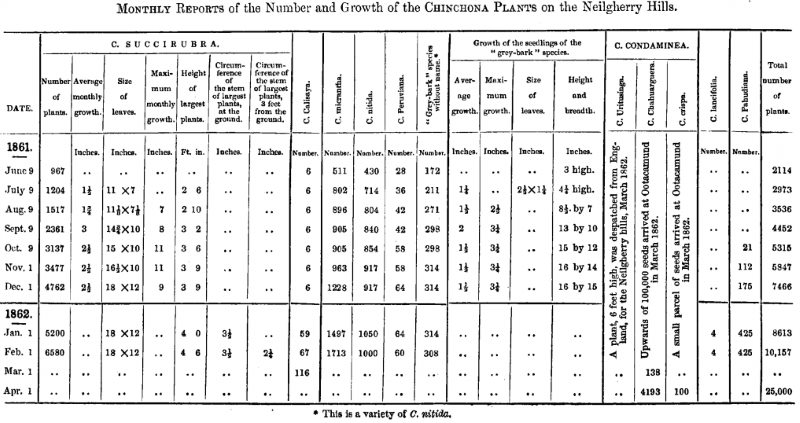
It is exceedingly satisfactory to compare these results with
those of the Dutch cultivators in Java. After six years they
only had (exclusive of the C. Pahudiana, which is quite
worthless) 8454 chinchona-plants of valuable species;[507]
whereas in rather less than one year Mr. McIvor has reared
9732, without counting several hundreds which he has transmitted
to Java, Calcutta, and Travancore. The Dutch have
only introduced two good species, while we have obtained
nine, exclusive of the four plants of C. lancifolia presented by
the Dutch authorities. Thus, the average increase of valuable
species of chinchona-plants in Java between 1854 and 1860
being at the rate of 1409 a year, the results attained in
India have been nearly seven times as great as those of the
Dutch cultivators. These facts are not mentioned in any
spirit of undue exultation, but in order to show that it is
not advisable slavishly to follow the methods of cultivation
adopted by the Dutch, as two gentlemen, in official positions,
who have recently visited the plantations in Java, appear to
imagine. On the contrary, a system of cultivation diametrically
opposed to that of the Dutch has enabled Mr. McIvor
to achieve his present success; and the sites for plantations
have been selected and prepared, not with any reference
to the erroneous and comparatively unsuccessful systems
pursued in Java, but on the principle of carefully comparing
the elevations, temperature, amount of humidity, and of
exposure of the mountains where the different valuable
species of chinchona thrive in South America, with analogous
situations in the hills of Southern India.
The important process of planting out has now commenced
in the Neilgherry hills, and it has been a subject of careful
consideration whether the chinchona-plants should be grown
under dense shade, under the partial shade of forest-trees,
or quite in the open: in other words—what are the elevations
and amounts of exposure best suited to the growth of
the plants, and the development of their alkaloids?
In Java the chinchona-plants were at first established at
far too low an elevation, in a wretched soil, and exposed
to the full glare of the sun. Dr. Junghuhn, the present
Superintendent, went to the other extreme, and, though the
proper elevation has been ascertained, yet the error has been
committed of forming the plantations in the dense shade of
the forest, with the intention of allowing some trees to be
drawn up in search of light, without a branch for thirty or
forty feet, and of cutting them down for their bark in about
forty years, and of grubbing up others in search of imaginary
quinine in their roots.[508] I understand that this plan has
at last been found to be erroneous, and that Dr. Junghuhn
now directs all the trees in the vicinity of the chinchona-plants
to be cut down, though faith is still maintained in the
quinine-yielding roots of the worthless C. Pahudiana.[509]
If the thing was not sufficiently evident in itself, the appearance
of the barks sent from Java to the Exhibition of
1862 is quite enough to prove that chinchona-plants ought
not to be cultivated under the shade of forest-trees. The
question of the proper amount of exposure to which each
species should be subjected is, however, one which requires
very careful consideration; as upon its correct solution depends
the most important point of all, namely the method of
cultivation which will be most profitable, and most suitable to
the operations of private enterprise.
Mr. McIvor commenced experiments in planting out in the
spring of 1861. In April he planted out three plants of
C. succirubra, two under shade, and one in an open spot surrounded
by brushwood and undergrowth. On the 29th of
the same month the S.W. monsoon set in, and the plants
under dense shade assumed a weak climber-like habit, and
were injured from the leaves being cut to pieces by the constant
drip from the forest-trees;[510] while the plant shaded by
the brushwood continued in the most luxuriant state of health,
with its leaves uninjured. In September 1861, six plants
of different species were planted out in cleared spots on
the highest and most exposed points of the Neddiwuttum
site, and all of these have not only borne the cold and
drought without injury, but their growth has never even been
checked, and at present they are in the finest possible state
of health. Their leaves are of the deepest green, some of
them measuring 12 inches by 9.
Between May and August fifteen "red-bark" plants were
planted out at Ootacamund. The unusual cold of December
checked the growth of these plants, but did not injure them
in the least, and the leaves still keep their deep-green colour,
and measure from 7 to 9 inches.[511]
Early in January 1862, the formation of a nursery was
commenced at Neddiwuttum, large enough for 300,000 or
400,000 Chinchonæ; and 2400 were planted out. 150
acres are to be planted, at the Neddiwuttum site, during the
year; of which 75 acres will be planted under various
degrees of shade from forest-trees, in order to ascertain the
results of this method by actual experiment; and 75 quite
in the open, the young plants being protected from the
direct rays of the sun by artificial shade during the first
year or two. The original stock will be retained in the
gardens at Ootacamund, for the purpose of propagation,
and the propagated plants will be used for stocking the
nurseries and plantations.
With regard to the question of whether the chinchonæ
should be planted out in dense shade of forest-trees or in
the open, it will be well to recapitulate some of the information
which has been collected in their native habitat in South
America.
In the forests of Caravaya I observed that the plants of
C. Calisaya, when in dense shade, were tall and weak, with
few branches, and without any sign of ever having flowered
or fruited. When very slightly shaded, as on the ridge of
rocks above the Yanamayu, or scarcely at all, as on the
precipice of Ccasa-sani, they spread more, have a more healthy
appearance, and are covered with capsule-bearing panicles;
while the most thriving and healthy-looking young plant
that I met with, was growing in the open, without any shade
whatever. It is quite certain that an abundance of light and
air is an absolute necessity for the full development of the
alkaloids in the bark of C. Calisaya, and that the trees must
either grow at the edge of the forests, or else find their way
to the light, by overtopping all other trees: otherwise, as is
too often the case, they assume a weakly, straggling habit
under the baneful influence of dense shade.
Dr. Weddell is of opinion that, during the first year or two,
the soil and trunks of young trees of C. Calisaya should be
protected from the direct influence of the scorching sun, as
he had observed that plants so exposed generally appeared
to have a stunted growth. He refers of course to the
Josephiana or shrub variety of C. Calisaya, but their dwarfed
habit must be attributed to the less fertile soil of the open
grass-land in which they grow, and partly also to the great
altitude, and consequently cold climate, rather than to effects
of exposure to light and air.
With respect to the "red-bark" species, there cannot be
a doubt that they should be planted in the open. On this
point Mr. Spruce's observations are quite conclusive. He
says—"The trees standing in open ground, pasture, cane-field,
&c., are far healthier and more luxuriant than those
growing in the forest, where they are hemmed in and partially
shaded by other trees; and while many of the former had
flowered freely, the latter were, without exception, sterile.
This plainly shows that, although the red-bark may need
shade whilst young and tender, it really requires (like most
trees) plenty of air, light, and room, wherein to develop its
proportions."[512]
The "grey-bark" species all bear the marks of exposure
to free air, cold, and sunshine; and the overspreading
thallus of various Grapideæ on their barks indicates that the
trees have grown in open situations, exposed to rain and
sunshine.[513]
The C. Condaminea trees, in the neighbourhood of Loxa,
grow sometimes in little clumps, and sometimes solitary, but
always in dry situations.[514] Dr. Seemann, who visited Loxa
when serving on board H.M.S. Herald, informs me that
those which he saw, bearing ripe fruit, were on the edge of
thickets, entirely exposed to the influence of air and sunshine.
Dr. Weddell assures me that he would never recommend
that any of the chinchona-trees should be planted in the
dense shade of the forest, as in such a situation the greater
number would evidently soon be smothered. He is of opinion
that the Chinchonæ, in India, should be planted in open
ground; but he considers it important that the trunks and soil
should be shaded during the first year or two. He proposes to
effect this object either by planting the chinchonas at convenient
distances in a quincunx, alternately with some more
fast-growing trees, which might be cut away when no longer
required;[515] or by planting the chinchonas themselves close
enough to oblige each other to run up, sufficient space and
air being gradually provided by judicious pruning and thinning
out. The former method might be a good one if it
were not for the faster-growing trees taking up a great
proportion of the nourishment from the soil, which would be
more profitably reserved for the chinchonas; and probably
the efficient shading of the trees, while young and tender,
will be more easily and effectually provided for by simple
artificial means.
Mr. Howard, the author of 'Nueva Quinologia de Pavon,'
whose knowledge on all questions connected with chinchona-plants
is not surpassed by that of any botanist in Europe, is
clearly of opinion that they should be planted in the open,
without shade from other trees, and that they should be
cultivated as shrubs; when their branches will yield an
ample and remunerative supply of bark.
On the other hand, Dr. Junghuhn, in Java, has planted
his chinchonæ under the dense shade of forest-trees, where
they must necessarily be watery and unhealthy, where they
will not flower or bear fruit, and where he does not expect
that they will yield quinine for fifty years, when he contemplates
the entire demolition of the plantations by felling
all the trees. Now, if such a system as this is to be adopted
in India, the chinchona-plants might as well never have been
introduced. The plantations would be a wasteful expense to
Government, with a remote chance of some profit, forming
but a small fraction of the outlay, about twice in a century;
and the idea of chinchona cultivation ever being undertaken
by private enterprise, on this system, is quite out of the
question; for what planter in his senses would commence
the cultivation of a product which would yield him no return
for forty or fifty years?
When planted in the open chinchonæ grow luxuriantly,
yield abundant supplies of seed, and form fine thick bark,
which, owing to the free exposure of the leaves to the
influence of light and fresh air, contains a large per-centage
of alkaloids; while, in the shade of forest-trees, they run up
into tall, weak, straggling plants, with little chance of either
bearing fruit, or elaborating much quinine in their bark,
until, after nearly half a century, some of them at length
overtop the other trees, and reach that essential sunshine of
which they had been so long deprived.
I not only think, with Mr. Spruce, Dr. Weddell, Mr.
Howard, Mr. McIvor, and Mr. Cross, that the chinchona-plants
must be planted in the open, and freely exposed to the
influence of fresh air and sunshine; but I am most strongly
of opinion that, if the opposite system was unfortunately
adopted, it would have been far better if the expense and
trouble of introducing these precious trees into India had
never been incurred.
It is true that, when planted in the forest, the chinchonæ
will look well to the casual observer, and that their cultivation
can be conducted without skill or care, as all will be left
to nature; while, in open ground, it will require great skill
and constant attention to get the young trees over the first
year or two. The cleared ground will be exposed to the full
effects of evaporation and radiation, and much judicious
management will be necessary in applying artificial shade,
and in adopting other precautions. The open spaces should
not, I think, be of very great extent, without being broken
up by clumps or irregular lines of trees; and care must be
taken that the supplies of moisture and of water are not
prejudiced by too much felling. But these details may safely
be left to Mr. McIvor, who now has the assistance of two
well-instructed English gardeners, named Batcock and Lyall;
and he will be able to obtain uniform and constant yearly
supplies of bark, without any damage to the trees, which,
when once full-grown, will thrive luxuriantly, and yield
abundance of seeds.
The most suitable positions for chinchona-plants, as regards
elevation and climate, having been pointed out, and the
best method of treatment with respect to exposure being
decided in favour of planting out in open ground, two other
questions remain to be discussed which are intimately connected
with the above,—namely, the conditions under which
the largest per-centage of febrifugal alkaloids will be formed
in the bark,[516] and the method of cultivation which is likely to
yield the largest and most remunerative supplies of bark in
the shortest time.
One well-established fact, which is proved by universal experience,
is that all the species of chinchona-trees produce the
thickest bark and the largest per-centage of alkaloids when
growing at the highest elevation at which they respectively
flourish. Thus, all other circumstances being favourable, the
C. Calisaya and C. succirubra species will yield more profitable
crops when growing at an elevation of 6000 feet, than
at one of 5000 feet. The shrubby varieties of chinchonæ are
specially good when their stunted growth is owing to the
altitude of the locality.[517] Mr. Spruce ascertained, with regard
to the "red bark," that the greater the height at which the
tree grows, the larger is the proportion of alkaloids contained
in the bark;[518] and that, although the trees growing nearest
the plain were generally much larger, yet their bark was by
no means so thick in proportion to their diameter as in trees
higher up. He adds that, in cutting down trees in the hot
plains, he has often been struck with the thinness of the bark
compared to that of trees growing in temperate climates.[519]
There are several other conditions under which the largest
amount of alkaloids is formed in chinchona-barks, which
are as yet little understood. Dr. Karsten suggests that the
content of alkaloids in the same species of chinchona-trees,
growing in different ravines, is affected by unceasing mists in
one, and constant sunshine resting on the vegetation in the
other; the former impeding, and the latter promoting, the
formation of quinine.[520] In the Loxa region a great difference
has been noticed in the bark of C. Condaminea, according as
the tree has grown on the sides of the mountains most
exposed to the rays of the morning or of the evening sun:
and Mr. Spruce remarks of the "red-bark" trees that the
ridges on which they grow all deviate from an easterly and
westerly direction, and that the trees are far more abundant
on their northern than on their southern slopes. The northern
and eastern sides of the trees had also borne most flowers,
and scarcely a capsule ripened on their southern and western
sides, except on one tree of more open growth than the rest.
This phenomenon is due to the fact that the trees receive
more sunshine from the north and east, during the summer
mornings,[521] the afternoons being usually foggy.
All these points will receive careful attention from Mr.
McIvor, in conducting the cultivation; and his observations
will soon enable him to decide many points connected
with the formation of quinine in the bark, and to ascertain
the most advantageous conditions under which the plants
should be cultivated.
The sites have been selected at Neddiwuttum and Dodabetta
with reference to the similarity of elevation and climate
in those localities to the native mountains of the species
which it is intended to cultivate in them, and because they
have plenty of deep loamy soil. It has also been determined
that the best method of cultivation will be found in planting
out the chinchonæ in the open, for reasons already given;
and not only will the luxuriant and healthy growth of the
plants be provided for by this treatment, but it is also
essential for the formation of an abundant supply of alkaloids
in their bark. This process depends on the vigorous action
of the leaves, and the healthful condition of the leaves is
due to a sufficient supply of sunshine. Dr. Lindley says,—"It
is to the action of leaves,—to the decomposition of their
carbonic acid, and of their water; to the separation of the
aqueous particles of the sap from the solid parts that were
dissolved in it; to the deposition thus effected of various
earthy and other substances, either introduced into plants as
silex or metallic salts, or formed there, as the vegetable
alkaloids; to the extrication of nitrogen; and, probably, to
other causes as yet unknown—that the formation of the
peculiar secretions of plants, of whatever kind, is owing.
And this is brought about principally, if not exclusively, by
the agency of light. Their green colour becomes intense, in
proportion to their exposure to light within certain limits."[522]
Under cultivation the chinchona-plants must either be
raised in their shrubby form in the open, or as tall trees under
the shade of the forest. The latter system, which has been
adopted by Dr. Junghuhn in Java, is defended on the ground
that, in their natural localities in the Andes, the chinchonæ
"grow in damp forests overshadowed by trees." There are
two things to be said against this. Firstly, that it is not the
case; for though it is true that some species of chinchonæ do
grow in damp shady forests, yet they never flourish in such
positions, but only when supplied with plenty of light and
air; and secondly, even if it was the case, such an argument
would be worth nothing. In their wild state, and in localities
where they are indigenous, all plants find certain conditions
which are favourable to their perfect development; but they
have to struggle for existence with a multitude of neighbours.
Every condition is not supplied by Providence for the special
behoof of one particular genus, and, in virgin forests, all trees
suffer more or less from being overcrowded and overshadowed.
But under cultivation the case is different. The cultivator
endeavours to combine all the conditions best calculated to
ensure the perfect development of a particular plant, and
does not subject it to the baneful influences of too much shade,
merely because it suffered from overshading in its wild state.
Mr. McIvor has very aptly illustrated this point, by mentioning
that Bruce found wheat growing wild in Upper Egypt,
struggling for existence with rushes and other weeds. An
English farmer would be surprised if he was told to sow his
wheat in the hedges, instead of in the fields, because in its
wild state it is found amongst weeds and briars!
The facts that it will be necessary to wait for thirty years
before any return can be expected; and that it will have a
most injurious effect on the formation of alkaloids in the bark,
are sufficient arguments against planting the chinchonæ in
the shade of the forest, and waiting for them to run up until
the survivors overtop the surrounding trees. It has been
necessary to bring these points prominently forward, because
attempts have been made to introduce the erroneous system,
adopted by the Dutch cultivators, into India.
We now come to the other alternative, that of raising the
chinchonæ in their shrubby form, on plantations in open
clearings, with plenty of fresh air and sunshine. It is the
system of cultivation which I, in common with Mr. Howard
and Mr. McIvor, consider to be the most likely to lead to
successful results, because it is the only one by which remunerative
harvests of bark can be obtained year by year,
without injuring the plants.
Two questions require consideration before adopting this
method: first, whether the chinchonæ in their shrubby form
will yield a sufficient annual supply of febrifugal alkaloids to
make the cultivation remunerative; and secondly, whether it
will be possible to take the required quantity of bark every
year, without checking the growth of the trees.
The trunk or tabla bark naturally yields a much larger per-centage
of alkaloids than the canuto or small bark of
branches; but as a supply of the former could only be
obtained once in forty years, and then at the cost of destroying
the plantations, while the latter will yield an annual
harvest without any injury to the trees, this point is not of
much consequence.[523]
The fact is that very little tabla or trunk-bark comes from
South America, and that nearly the entire bark trade is
supplied by quill-bark from the branches of shrubs. Some
Calisaya bark from Bolivia, some "red bark," and "West-coast
Carthagena," from the trunks of C. Palton, arrive in
the form of large slabs of tabla-bark; but a great deal of the
Calisaya and succirubra bark, the whole of the "crown-bark"
from Loxa, and all bark from other quarters, is found only in
the form of quills from small branches. I have measured
several of the quills which come into the London market,
and find that none of them have bark equal in thickness to
that already attained by some of the young plants reared by
Mr. McIvor at Ootacamund.[524] These quills are evidently
taken from small shrubs, and they yield a very good per-centage
of quinine. Several samples of quill Calisaya bark,
sold in London in March 1862, contained four per cent. of
quinine. Their bark was one-eighth of an inch thick, and
the quills were just under an inch in circumference. In a
cultivated state the yield will of course be much greater, and
Mr. Howard, judging from the usual yield of quill-bark, is of
opinion that a large produce may be annually realised by
growing the chinchonæ as shrubs.[525]
In cultivating the chinchonæ in rows on cleared plantations
it will probably be found advisable to grow them to a
height of ten or twelve feet, and about twelve feet from each
other, so that they may be able to spread out until they are
nearly as broad as they are long; and they should be induced
to branch as near the ground as possible. A certain number
of the branches should be lopped annually for the quinine
harvest; shoots would immediately be thrown out below the
cuts, from which one or two should be selected to take the
place of the lopped branch; and in about six years the new
branches, thus formed, would be sufficiently grown to be
again removed. In the mean while the same operation would
have been going on with other branches, and thus an annual
harvest of quill-bark may be obtained for any number of
years. Mr. McIvor considers that this treatment will ensure
a quick, uniform, and constant supply of bark; and if the
lopping and pruning is judiciously conducted, the trees will
be benefited rather than injured by the annual removal of a
few branches.[526] Chinchona-plants, like oaks and willows,
might also be cultivated as pollards.
By cultivating the chinchona-plants on these principles,
forming plantations in cleared open ground, giving the plants
plenty of light and air, and obtaining annual harvests of quill-bark
from the shrubs, quinine-yielding chinchona-bark will
become an article of commerce within eight years from the
first introduction of the plants into India. After the first
harvest the supply will rapidly increase. Extensive Government
plantations of the different species at Neddiwuttum and
Dodabetta on the Neilgherries, will be in a position to supply
any number of chinchonæ for private enterprise, and it is to
be hoped that the Government will establish other chinchona
nurseries on the Pulney hills, in Coorg, and eventually on the
Anamallays.
As quinine-yielding bark is a more valuable product than
coffee, there is every reason to believe that, as soon as the
Government plantations are proved to be successful, many
planters will undertake the cultivation; and I understand
from Mr. McIvor that several persons have already expressed
a desire to give the chinchonæ a trial, and that he expects to
be able to distribute plants by June 1862.[527] Thus another
important product will be added to the resources of India,
while the Government will have an abundant and cheap annual
supply of the most indispensable of all medicines to
Europeans in tropical climates, which is now only obtained at
immense expense, and in quantities quite insufficient to meet
the demand.
In a commercial point of view the introduction of chinchona-plants
into India is likely to prove very beneficial, by
adding another valuable article of export to the numerous
products of that favoured land; but an equal if not a greater
result will be derived from this important measure, in the
naturalisation of these healing plants in a country the inhabitants
of which suffer so severely and constantly from intermittent
and other fevers. From motives of humanity, as well
as from personal interest, every coffee-planter, as I have
before said, ought to cultivate a few rows of chinchona-plants
in the upper part of his clearing. Even if it is not intended
to rear them on account of their commercial value, yet such
a measure recommends itself as a duty, in order to have a
supply of this inestimable febrifuge constantly at hand for the
use of those who are employed on the plantations.
Many of the natives are already fully aware of the febrifugal
virtues of Peruvian bark, and it is to be hoped that, in all the
hill-districts where there is a suitable elevation and climate,
they will grow chinchona-trees in their gardens, just as is now
generally done with coffee in all the villages in Coorg. For
the use of the natives there will be no necessity to go to the
expense and trouble of extracting the alkaloids, as the green
fresh bark is itself very efficacious. After the natives have
once used this unfailing remedy, and experienced the power
it has over the fevers from which they suffer, they will, like
Dr. Poeppig in the wilds of Peru, approach the beautiful healing
trees with warm feelings of gratitude,[528] their fame will
spread far and wide, and the cultivation of chinchonæ will,
I trust, be extended to its utmost limit throughout the
peninsula of India.
So far as my observations extended, the impression which
I had previously received, that the natives can with difficulty
be induced to undertake the cultivation of any new plants to
which they have not been accustomed, was not confirmed.
Not to mention the potato, maize, tobacco, and capsicums,
which originally came from America, and are now generally
cultivated in India, it is a fact that in Wynaad upwards of
2000 acres are taken up for coffee cultivation by the natives;
and in Coorg, where coffee was only introduced about six years
ago, I scarcely saw a single hut to which a small coffee-garden
was not attached. The extent to which the cassava
(Jatophra Manihot), only lately introduced, is now cultivated
in Travancore, is quite remarkable; and there is every
reason to suppose that the natives will be equally ready
to cultivate a plant possessing such extraordinary febrifugal
powers as the chinchona, the value of which they will soon
appreciate.
Thus will the successful cultivation of the quinine-yielding
chinchona-plants confer a great and lasting benefit upon the
people of India, as well as upon the commerce of the whole
world; and the concluding words of Dr. Weddell's Introduction[529]
may, therefore, with strict propriety, be applied to Mr.
McIvor and his assistants: "Reste la ressource de la culture,
et il faut l'employer. S'il est un arbre digne d'être acclimaté,
c'est certes le Quinquina; et la postérité bénirait ceux qui
auraient mis à exécution une semblable idée."
While speaking of the incalculable value of quinine-yielding
chinchona-plants, it must be understood that I include those
of the "grey-bark" species, which yield chinchonine; and it is
the more important to dwell upon this, because a sentence in
the Introduction to Mr. Howard's valuable work is perhaps
calculated to give a different impression.[530] It is true that
chinchonine will not command so remunerative a price in the
London market; yet it produces effects on the system precisely
analogous to quinine. To stop intermittent fever, doses of
chinchonine require to be one-third larger than doses of quinine;
but it is absolutely certain that the former is as good
a febrifuge as the latter, and it costs infinitely less. Planters
will of course, in the first instance, undertake the cultivation
of those species which yield quinine, such as C. succirubra,
C. Condaminea, C. lancifolia, and C. Calisaya; but the grey-bark
species will yield barks which will afford valuable
supplies to the Government hospitals; and their naturalisation
all over the plateau of the Neilgherries and other hill
districts will be a great boon to the natives. Hereafter the
latter species will well repay the outlay and labour of cultivation.
Even now there is a great demand for chinchonine;
the chinchonidine of C. Condaminea is considered by Mr.
Howard to be scarcely if at all inferior to quinine, and Dr.
J. Macpherson thinks so highly of the value of chinchonine
that he considers it to be of little importance whether the
species introduced into India are rich in quinine or chinchonine.
This gentleman speaks from experience acquired
by long practice in the East Indies.[531]
The following is a table of the largest amount of alkaloids
extracted from, and the price in the London markets of the
barks of species of chinchonæ now introduced into India:—
Under cultivation the barks may be expected to yield a
much larger per-centage of alkaloids than they ever do in
their wild state.
CHINCHONA-CULTIVATION.
Ceylon—Sikkim—Bhotan—Khassya Hills—Pegu—Jamaica—Conclusion.
The complete success which has attended the cultivation of
chinchona-plants in the Neilgherry hills, encourages the hope
that similar happy results will follow their introduction into
other hill districts of Southern India, which have been described
in more or less detail in previous chapters. I have
no doubt of the suitability of the Pulney hills, the Koondahs,
the Anamallays, and Coorg for such experimental cultivation;
and trials should hereafter be made on the Mahabaleshwurs,
the high hills east of Goa, the Baba-bodeens, Nuggur,
Wynaad, the Shervaroys, and the mountains between Tinnevelly
and Travancore.
The hill districts of the island of Ceylon, which have the
necessary elevation, and are within the region of both monsoons,
also offer peculiarly favourable conditions for the
cultivation of chinchona-plants, probably equal to the best
localities on the peninsula of India. Mr. Thwaites, the
Director of the Royal Botanical Gardens at Peradenia, takes
a deep interest in this important measure, and under his
auspices there can be no doubt of its ultimate success. It
was from the first determined to send a portion of the chinchona-seeds
to Ceylon, although the whole expense of the
undertaking has been borne by the revenues of India, and no
assistance whatever has been given by those colonies which
will thus profit by its success.
The gardens at Peradenia are 1594 feet above the level of
the sea, and the following table will give a correct idea of the
climate:—
| Observations taken at Peradenia, in Ceylon, in 1857. |
| MONTH. | Thermometer. | Rainfall in inches. | REMARKS. |
| | Max. | Mean. | Min. | |
| 1857. | | | | | |
| January | 82 | 79.3 | 74.7 | 1.8 | Fine and sunny. Cold dewy nights and foggy mornings. |
| February | 82.5 | 79.8 | 76.5 | 1.3 | Do. do. do. |
| March | 84.2 | 82 | 77.5 | 5.8 | A few showers of rain in the evenings. |
| April | 86.5 | 81.9 | 77.5 | 8.4 | Rain in the latter part of the month. |
| May | 82.5 | 81.5 | 75 | 4.7 | Showery, with occasional gales of wind. |
| June | 82.5 | 81.1 | 75.5 | 6 | Showery. |
| July | 80.5 | 77.1 | 75.5 | 9.8 | Continued rain. |
| August | 81.5 | 79.2 | 77.5 | 6.4 | Showery, with high winds. |
| September | 82.5 | 78.8 | 75.5 | 7.2 | Rainy. |
| October | 81.5 | 78 | 74.5 | 14.9 | Rainy, with occasional sunshiny days. |
| November | 82 | 77.9 | 73.5 | 22.3 | Heavy rain. |
| December | 81.5 | 78.6 | 75.5 | 2.8 | Fine. Cold nights and hot days. |
| | | | | 96 | |
It is evident that Peradenia is far too low and hot for chinchona
cultivation. The C. succirubra, and some other species,
would probably grow to fine large trees there, but the bark
would be very thin, and would yield little or no febrifugal
alkaloids. But there are many other localities in Ceylon
admirably suited, from their elevation and climate, for this
cultivation, and sites may be selected, well adapted to the
different species, from 5000 feet to Pedrotallagalle, which is
8280 feet above the sea. Among these is the Government
garden of Hakgalle, at Nuwera-ellia, which is 6210 feet above
the sea, in a climate with an annual temperature of about 59°
Fahr., and abundantly supplied with moisture. Here most of
the chinchona-plants have been established under the superintendence
of Mr. Thwaites, who is assisted in their cultivation
by Mr. McNicoll, a zealous and intelligent gardener from
Kew. Mr. Thwaites reported, last September, that the progress
of the important experiment in the cultivation of chinchonæ
was satisfactory.
In February 1861 the first instalment of chinchona-seeds
arrived in Ceylon, being a parcel of the "grey-bark" species
sent from the Neilgherry hills by Mr. McIvor; and soon
afterwards a portion of the "red-bark" seeds was received.
In April six plants of C. Calisaya were transmitted from Kew,
but two only survived, and are now growing vigorously at
Hakgalle. Last September eight cuttings had been taken
from them, two of which had rooted. From the seeds received
early in 1861, 800 plants had been raised last September,
namely, 530 of C. succirubra, 180 of C. micrantha, 25 of C.
Peruviana, 45 of C. nitida, and 60 of the "grey-bark" species
without name.
In January 1862 I forwarded parcels of seeds of C. Condaminea
and C. crispa to Mr. Thwaites; and early in March six
Wardian cases filled with chinchona-plants, from the depôt at
Kew, were shipped for Ceylon.
Chinchona cultivation in Ceylon has thus been fairly started.
It is exceedingly gratifying to hear that many coffee-planters
will be glad to try the experiment upon their estates;[532] and
that Mr. Thwaites will shortly be in a position to distribute
plants from the Hakgalle garden.[533]
Chinchona-trees, in their wild state, have never been found
at a greater distance than one thousand miles from the equator,
and they are essentially inter-tropical plants; though
they only flourish at considerable elevations above the sea.
The reason appears to be that one of their chief requirements
is a tolerably equable climate throughout the year, which the
temperate zones, with their great differences of temperature
between winter and summer, do not afford. For this reason
sites were selected, in the first instance, both in India and
Ceylon, within the tropics; and indeed this point was essential
for the first experiments, because all the other conditions
of the growth of chinchonæ could not have been found
beyond the equatorial zone. Under cultivation, however, it
is probable that, with other favouring circumstances, these
plants might thrive within the temperate zone, at short
distances from the tropic, and attention was naturally drawn
to the hill districts of the Eastern Himalayas, in Bengal.
The usefulness and importance of the introduction of the
chinchonæ into India will be much enhanced if their cultivation
can be extended to these regions, and attempts will,
therefore, be made to form chinchona plantations in Sikkim,
Bhotan, and subsequently in the Khassya hills.
The province of Sikkim,[534] at the base of the mighty Himalayan
peak of Kunchinginga, consists entirely of the basin of
the river Tista, which, with its tributaries, drains the whole
country. Its position, opposite to the opening of the Gangetic
valley, between the mountains of Behar on the one hand
and the Khassya hills on the other, exposes it to the full
force of the monsoon. Its rains are, therefore, heavy and
almost uninterrupted, accompanied by dense fogs and a saturated
atmosphere throughout the year. There are frequent
winter rains accompanied by cold fogs, alternating with frost,
hail, and snow. March and April are the driest months,
but rains commence in May, and continue with little intermission
until October. The bounding mountains are very
lofty, and snow-clad throughout a great part of their extent;
but the central range in Sikkim, which separates the Tista
from its great tributary the Rangit, is depressed till very far
into the interior. The rainy winds have thus free access to
the heart of the province.
The snow-level is at 16,000 feet; and the mean monthly
temperature of the English hill station at Darjeeling, which
is 7430 feet above the sea, and in lat. 27° 3´ N., is as follows:—
| Darjeeling. |
| | MONTH. | Mean temperature. | MONTH. | Mean temperature. | |
| | January | 40 | July | 61.4 |
| | February | 42 | August | 61.7 |
| | March | 50.7 | September | 59.9 |
| | April | 55.9 | October | 58 |
| | May | 57.6 | November | 50 |
| | June | 61.2 | December | 42 | |
The annual rainfall is 122.2 inches.
Of course no chinchona-plant would flourish in such a
climate; and in the latitude of 27° it will be necessary to
seek for suitable sites in much lower situations than in the
hill districts of Southern India, which are in corresponding
latitudes to those of the chinchona forests. In the Neilgherries
the sites have been selected at the same altitudes as
those at which the plants are found in South America, but in
the Eastern Himalayas the localities must probably be chosen
upwards of a thousand feet lower for each species—the C.
Condaminea and its companions perhaps at 5000, and the
C. succirubra between 3000 and 4000 feet.
From the sea-level to an elevation of 12,000 feet Sikkim
is covered with a dense forest, consisting of tall umbrageous
trees, often with dense grass jungle, and in other places
accompanied by a luxuriant undergrowth of shrubs. In the
tropical zone Myrtaceæ, Leguminosæ, and tree-ferns are common,
and the air is near saturation during a great part of the
year. Vaccinia are found at from 5000 to 8000, and snow
occasionally falls at 6000 feet. A sub-tropical vegetation
penetrates far into the interior along the banks of the great
rivers, and tree-ferns, rattans, plantains, and other tropical
plants are found at 5000 feet, in the Ratong valley.[535]
I should conjecture that the extreme limit for the growth
of the hardier species of chinchonæ, in Sikkim, will be found
where their constant companions the tree-ferns and Vaccinia
end, namely at 5000 feet; and that the best sites for such
species as C. Calisaya and C. succirubra are about 1000 to
2000 feet lower, amidst the sub-tropical vegetation of the
valleys.
Bhotan, which adjoins Sikkim on the east, is a mountainous
district of much the same character. In its western part the
mountain ranges are lofty and rugged, and the river-courses
very deep and generally narrow. The climate is equable, and
the humidity of the winter appears to increase in the part
adjoining Sikkim. The steepness of the mountains, and the
influence of the elevated mass of the Khassya hills to the
south, make the lower slopes, which skirt the plains of Assam,
drier than those more to the eastward. Deep narrow valleys
carry a tropical vegetation very far into the interior of
Bhotan, among lofty mountains capped with almost perpetual
snow. These attract to themselves so much of the
moisture of the atmosphere, that the bottoms of the valleys
are comparatively dry and bare of forest. The flora resembles
that of Sikkim.[536]
The Khassya hills in 25° N. lat. form an isolated mass,
rising up from the plains of Assam and Silhet to a height of
6000 feet. They rise abruptly from the plains of Silhet to
the south, and at 3000 feet tree vegetation ceases, and is succeeded
by a bleak stony region, with a temperate flora, up to
4000 feet, where the English station of Churra Poorji is built.
The table-land is here three miles long by two, to the eastward
flat and stony, and to the west undulating and hilly.
On the south there are rocky ridges of limestone. The southern
side of the hills is exposed to the full force of the monsoon,
and the rainfall is excessive, as much as 500 or 600
inches annually. Further in the interior the fall is less, and
it gradually decreases until the valley of Assam is entered.
This great rainfall is attributable to the abruptness of the
mountains to the south, which face the Bay of Bengal, and are
separated from it by 200 miles of Jheels and Sunderbunds.
The heavy rains on the Khassya hills are quite local, as in
Silhet the fall is only 100 inches. The plateau presents a
bleak and inhospitable aspect, and there is not a tree, and
scarcely a shrub to be seen, except occasional clumps of
Pandanus. This desolation is caused by the furious gales of
wind, and the extraordinary amount of rain which washes off
the soil. The valleys are open, though with deep flanks, and
the hill-tops are broad. The grassy slopes to the north are
covered with clumps of shrubby vegetation, and the forests
are confined to sheltered localities. Though the rainfall on
the southern side is 600 inches, twenty miles inland it is
reduced to 200 inches. The mean annual temperature of
Churra Poorji is 66°, and in summer the thermometer rises
to 88° and 90°. To the westward of the Khassyas lie the
Garrows, which do not attain a greater height than 3000 to
4000 feet.[537]
The flora of the Khassya hills bears a greater resemblance
to that of the hills in Southern India than to the Sikkim and
Bhotan types. Genera and species forming masses of shrubby
vegetation are identical with those of the Neilgherry sholas.
It is probable that chinchona-plantations, especially of C.
succirubra, might hereafter be formed advantageously on the
northern slopes of the Khassyas, but it is evident that the best
chances of success for the species growing at great altitudes,
in South America, are offered in the Himalayan districts of
Sikkim and Bhotan.
With a view to the establishment of chinchona-plantations
in the Eastern Himalayas, plants have been forwarded by Mr.
McIvor to the Botanical Gardens at Calcutta. On January
19th, 1862, there were at Calcutta 91 plants of C. succirubra,
all except four supplied by Mr. McIvor; six of C. Calisaya
from Java, and 133 of "grey-bark" species, of which 106 were
supplied by Mr. McIvor, and twenty-seven were raised from
the original South American seeds. Altogether there were 230
of the valuable species of Chinchonæ, besides fifty-nine of the
worthless C. Pahudiana. It is intended to commence a chinchona
plantation on the lower and outer range of Darjeeling
in Sikkim at once, with a propagating-house on the model of
Mr. McIvor's at Ootacamund; and afterwards to form a nursery
for species growing at lower elevations on the Khassya hills.
There is another region in our Eastern dominions where
suitable localities may be found for the cultivation of chinchona-plants,
but it is as yet too little explored, and the difficulties
of obtaining supplies, labour, and transport would be
too great at present to allow of the possibility of forming
plantations for some years to come. I allude to the recently
formed province of Pegu. Dr. Brandis, the Conservator of
Forests in Pegu, reports that it will be preferable to delay
the introduction of chinchona-plants into that province, until
their cultivation shall have proved successful in other parts.
In Pegu there are four great mountain ranges, running
parallel with the sea-coast, which separate the valleys of the
principal rivers. Commencing from the eastward, the first
range is the Arracan-Yomah, dividing Arracan from Pegu,
which is not higher than 4000 feet. The Pegu-Yomah, the
principal seat of the Pegu teak, which separates the valleys
of the Irrawaddy and the Sitang, only has a mean elevation
of 2000 feet. The third range consists of the Martaban and
Tenasserim coast-ranges, and barely attains a height of 5000
feet. The fourth and most eastern range, forming the watershed
between the Sitang and Salween rivers, extends into the
large and compact mountain mass of Yoonzaleen, to the
south-east of Toungoo. The area of this lofty region is a
hundred square miles, and several peaks rise to a height of
7000 and 8000 feet above the sea. The rains are heavier on
these hills than on the adjacent plains, and the temperature
is much cooler and more uniform. The formation consists of
granite, gneiss, and quartzite. Up to 3000 feet the vegetation
is of a tropical character, at which elevation teak disappears,
and pines (Pinus Khasyana) begin, and go up to 5000
feet on dry gravelly soil. There are plenty of small mountain
streams on these hills, with running water throughout the
year; and the valleys and slopes are covered with evergreen
forest.[538]
The Yoonzaleen hills are doubtless the best localities for
chinchona-plantations in Pegu, but as yet there are no facilities
for taking any steps with a view to the introduction of these
inestimable trees, which will hereafter be as great a blessing to
the fever-haunted jungles of Pegu as to those of India. The
Yoonzaleens are forty miles from the town of Toungoo, which
is at a distance of fifteen days of river navigation from Rangoon;
and until a Sanatarium is formed on those hills, or
some European settlers have established themselves there, it
will be useless to attempt the introduction of the chinchona-plants.
Before many years, however, it is to be hoped that
plantations on the Yoonzaleen hills will supply quinine-yielding
bark to the inhabitants of the plains of Pegu.
In a former chapter I stated that I gave directions for the
transmission of a supply of seeds both of the "grey" and the
"red-bark" species to two of our West Indian islands—Trinidad
and Jamaica. In Trinidad they did not germinate,
but in Jamaica, under the watchful care of Mr. N. Wilson,
the Superintendent of the Botanical Gardens in that colony,
they came up plentifully. By the spring of 1861 Mr. Wilson
had a good stock of all the species in the gardens on the
sweltering plains, where the "grey-bark" species naturally
began to die off, but the C. succirubra plants were doing well,
and sixty of them were quite strong enough to be planted
out early in June. On the 4th of June, 1861, Mr. Wilson
removed 120 plants, 60 of C. micrantha and 60 of C. nitida,
to the foot of Catherine's Peak, which is 4000 feet above the
sea. Here he was obliged to leave them, as the Jamaica
Government had furnished him with no efficient assistant.
In November he reported that the plants of C. succirubra
were doing well, and by the latest accounts, dated March
24th, 1862, all the plants were thriving; but the chinchona
experiment is not likely to succeed in Jamaica, owing to the
listless apathy of the legislators of this colony. They have
taken no steps to supply Mr. Wilson with assistant-gardeners,
have allotted no land in suitable localities as sites for chinchona-plantations,
and have thus neglected to secure the
successful introduction of a product which would have enriched
the island, when the means of doing so were placed
gratuitously at their disposal by the Secretary of State for
India.
In our Eastern possessions the successful cultivation of
quinine-yielding plants in the hills of Southern India, in
Ceylon, and in the Eastern Himalayas, will undoubtedly be
productive of the most beneficial results. Commercially this
measure will add a very important article to the list of Indian
exports; the European community will be provided with a
cheap and constant supply of an article which, in tropical
climates, is to them a necessary of life; and the natives of
fever-haunted districts may everywhere have the inestimable
healing bark growing at their doors.
It is impossible to exaggerate the blessings which the
introduction of chinchona-cultivation will confer upon India.
Since quinine has been extensively used among the troops in
India, there has been a steady diminution of mortality; and
whereas in 1830 the average per-centage of deaths to cases of
fever treated was 3.66, in 1856 it was only one per cent. in
a body of 18,000 men scattered from Peshawur to Pegu.[539]
The present measure will not only ensure a constant and
cheap supply of quinine to those who already enjoy its
benefits, but it will also bring its use within the means of
millions who have hitherto been unable to procure it. Many
lives will thus annually be saved by its agency. In former
ages its use would perhaps have changed the history of the
world. Alexander the Great died of the common remittent
fever of Babylon, merely from the want of a few doses of
quinine.[540] Oliver Cromwell was carried off by ague, and,
had Peruvian bark been administered to him, which was
even then known in London, the greatest and most patriotic
of England's rulers would have been preserved to
his country. In time to come the lives of men of equal
importance to their generation may be saved by its use, while
the blessings which it will confer on the great mass of
mankind, and especially on the inhabitants of tropical countries,
are incalculable. The introduction of chinchona-plants
into our Eastern possessions will be the most effective measure
which could have been adopted to ensure a permanent
and abundant supply of febrifugal bark; and a debt of
gratitude is, therefore, due from India to Lord Stanley, who
originated it, and to Sir Charles Wood, who has sanctioned
all the necessary arrangements, until this great enterprise has
finally been crowned with complete success. To Mr. Spruce,
as the most successful collector in South America, and to
Mr. McIvor, who has so ably and zealously conducted the
cultivation in India, the chief credit of having achieved so
important a result is due; but the author may be allowed
to express his deep satisfaction at having been one of the
labourers in this good work, where all have worked so
zealously.
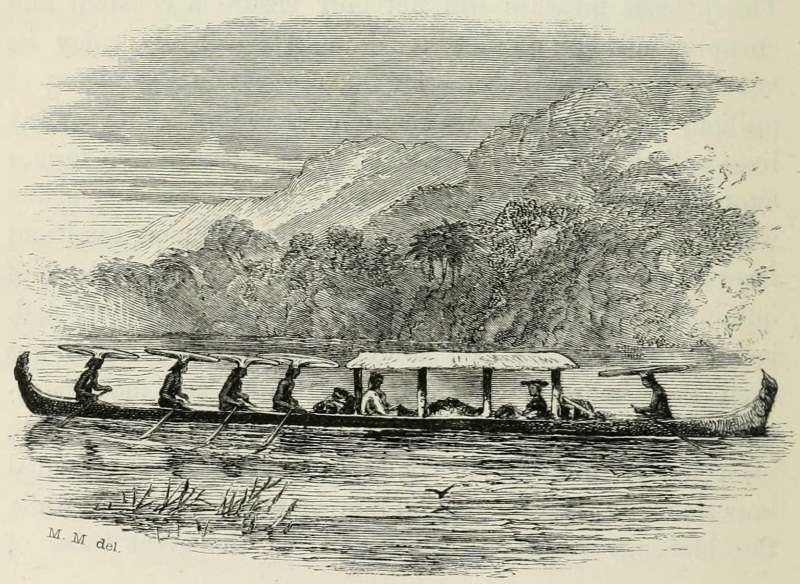
CANOE ON THE BEYPOOR RIVER.
See page 351.
GENERAL MILLER, AND THE FOREIGN OFFICERS WHO SERVED
IN THE PATRIOT ARMIES OF CHILE AND PERU, BETWEEN
1817 AND 1830.
When the war of independence broke out in South America, many gallant
spirits were attracted from different countries of Europe to fight for liberty
and justice against Spanish oppression. Fired with enthusiasm for the
cause of liberty, these knights errant, many of whom had been distinguished
in the wars of Napoleon and Wellington, went forth to risk their
lives for an idea. That they were in earnest is proved by the fact that,
out of the whole number of sixty-seven, as many as twenty-five were killed
or drowned, and eighteen were wounded.
In this band of brave adventurers, next perhaps to Lord Dundonald, the
late General Miller takes the most prominent place, as one of the ablest, the
truest, and the best. There is a halo of romance round all who joined in
this crusade for liberty; all passed through many strange adventures, and
did honour to the land from which they hailed; but the lamented old
warrior who went to his rest last year was pre-eminent amongst his
gallant companions, for his many acts of chivalrous daring and bravery.
William Miller, a native of Kent, served in the British Field Train
Department of the Royal Artillery, during the Peninsular war, under Lord
Wellington. He was present at the sieges and storming of Ciudad Rodrigo,
Badajoz, and San Sebastian, at the battle of Vittoria, and investment of
Bayonne. He had charge of a company of Sappers and Miners in the
American war, was within a few yards of General Ross when he received
his death-wound near Baltimore, and was also present at the attack upon
New Orleans in 1814.
In 1817, having been placed on half-pay, and tired of an inactive life, he
proceeded to South America, and offered his services in the war against
the Spaniards. He was appointed Captain of artillery by the Government
of the United Provinces of Rio de la Plata, crossed the Andes into Chile,
and saved two pieces of artillery, under a heavy fire, at the battle of Talca,
in March 1818. In April he became a Major, and assisted with his regiment
at the declaration of Chilian independence on September 18th, 1818.
In 1819 he commanded the Marines in Lord Cochrane's squadron, and in
March an explosion of gunpowder, on the island of San Lorenzo, in Callao
Bay, shattered one of his hands to pieces, injured his face, and caused
blindness for many days. In October he was again at the head of his
men, leading them to victory at Pisco, when he was pierced by two balls,
one passing through his liver, and another through his breast. In
February 1820, though still weak and suffering from his former desperate
wounds, he headed the storming party in the boats, in the gallant attack
and capture of the forts of Valdivia in Chile, where he was again wounded
in the head; and in the subsequent attempt on Chiloe he received a ball
through his left groin, and a cannon-shot broke one of his feet. In May
1821 he landed in Peru, and defeated the Spaniards in the hard-fought
battle of Mirabe; in 1823 he conducted a most adventurous and romantic
campaign through the whole range of the deserts of Peru, from Arequipa to
Pisco, defeating the Spaniards, with greatly inferior numbers, on several
occasions; and in the same year he became General of Brigade.
In May 1824 General Miller received the command of the Peruvian
cavalry of Bolivar's liberating army, and took a principal part in the victory
of Junin in the following August. Soon afterwards he assumed the command
of the whole of the cavalry of the liberating army, at the head of
which he charged, and routed the division of General Valdez in the
glorious battle of Ayacucho, at a most critical moment. This brilliant
action was fought on the 9th of December 1824, and decided the fate of
the war, the entire Spanish army of 10,000 men under General La Serna,
Viceroy of Peru, being utterly routed. In February 1825 he was Prefect
of Puno, and in April of Potosi; but in 1826 he returned to England on
leave of absence, to cure himself of his wounds, which still caused him
great suffering.
After a stay of some years in England he returned to Peru in June 1830
but, owing to the factious outbreaks in which he did not choose to take
part, he again obtained leave of absence in 1831, and visited many of the
islands of the Pacific Ocean, especially the Sandwich and Society groups,
of which he wrote a most interesting account; and only returned to Peru
after the constitutional election of General Orbegoso as President of the
Republic. In the early part of 1834 he served in a campaign against the
revolutionary chief Gamarra; and, though defeated at Huaylacucho, his
operations were on the whole successful, and he was promoted to the rank
of Grand Marshal of Peru on June 11th, 1834.
In October 1834 he was appointed Military Governor of Arequipa, Puno,
and Cuzco; and it was at this time that he conceived the idea of forming a
military colony in the valleys to the eastward of Cuzco, on the banks of
some of the tributaries of the great river Purus. In March 1835, while on
the point of setting out on an exploring expedition, a revolution broke out
in Cuzco, and he was arrested by Colonel Lopera. He was, however,
allowed to set out on his expedition, with two companions and seven
Indians. He penetrated on foot to a greater distance to the eastward of
Cuzco, on this occasion, than has ever been done before or since.
In September 1835 he again placed himself under the orders of the Constitutional
President Orbegoso, and in February 1836 he captured Salaverry
and eighty officers of his revolutionary army by a very clever stratagem,
near Islay. Shortly afterwards Santa Cruz established the Peru-Bolivian
Confederation, and General Miller was sent as Minister Plenipotentiary to
Ecuador, where he signed a treaty of peace and amity between that Republic
and the Confederation. In August 1837 he became Governor of Callao,
when all customs duties were reduced one half, smuggling ceased, and the
receipts were soon quadrupled. He organized an efficient police; made a
subterraneous aqueduct 3 feet wide, 3½ deep, and 280 yards long, for
supplying Callao with water; commenced the erection of a college; and
formed a tramway for the conveyance of goods from the mole to the
custom-house. The people of Callao still look back with satisfaction and
gratitude to the period when General Miller was their Governor.
In February 1839, on the overthrow of the Peru-Bolivian Confederation,
General Miller was banished with many other able and distinguished men,
whose names were taken off the army list by a decree dated in the following
March. This unjust and illegal act was cancelled by a law of Congress
dated October 1847.
After leaving Peru in 1839, General Miller was appointed in 1843
H. M. Commissioner and Consul-General for the Islands in the Pacific. In
1859 he revisited Chile and Peru, partly for his health, and partly to
obtain the payment of his large arrears from the Government. When he
arrived in Peru the Vice-President Mar, while the President, General
Castilla, was absent at Guayaquil in 1859, reinstated him on the army list
of Peru, by a decree dated December 9th, the anniversary of the battle of
Ayacucho, and granted him his current pay as a Grand Marshal of Peru,
and he continued to reside at Lima until his death on the 31st of October
1861. It is satisfactory to be able to record, for the honour of the Peruvian
nation, that the whole of his claims were acknowledged in Congress in a
most handsome way, and without a dissentient voice. But unfortunately the
executive in Peru is still able to set the laws passed by the representatives
of the people at defiance; delays and evasions were resorted to by Castilla,
and the last days of one from whom Peru had perhaps received as valuable
services as from any of her own sons, were embittered by the treatment
which he experienced from the President of the Republic.
General Miller was a man of whom England may well be proud. He
was one of those characters who combine great ability and extraordinary
daring, almost amounting to rashness, with modesty and diffidence. If
there was any fault to be found in any part of General Miller's former
career, in the camp or in the cabinet, it would be from himself that it
would first be heard. To his bravery and prowess, his body riddled
with bullets, and the history of South American independence, bear testimony;
to his administrative ability the gratitude of the people of Callao
and Cuzco is the witness; his pure standard of honour, his scrupulous
integrity, his warmth of heart, and single-mindedness are known to a
wide circle of sorrowing friends; but of his numerous acts of self-denial
and charity few can tell, for he was one who let not his left hand know
what his right hand did.
In person he was more than six feet high, and when young he was
remarkably handsome; his features and shape of the head being of a
thoroughly English type. In society he was exceedingly agreeable to the
last; his conversation was always interesting, and often very instructive;
and there was a peculiarly gentle and winning expression in his eyes. He
took a deep interest in the attempt to introduce chinchona cultivation into
India, and I was indebted to him for much valuable advice, and for many
letters of introduction which were of great service to me. He also supplied
me with most of the material which has enabled me to write the narrative
of the insurrection of Tupac Amaru, the last of the Incas, forming the
ninth chapter of the present work.
His memoirs, published by his brother many years ago, give by far the
fullest and most interesting account of the war of independence in Chile
and Peru, though the work of Garcia Camba, a Spanish general, is the
best military history.
General Miller breathed his last on board H.M.S. 'Naiad' in Callao
Bay, on the 31st of October 1861; and the remains of the gallant old
warrior were interred in the cemetery at Bella Vista, with all the honours
which the Peruvian Government could bestow. While the body was
being embalmed, two bullets were found in it, and twenty-two wounds
were counted on different parts of his frame. The most gratifying incident
on the occasion was that the people of Callao, who had never forgotten the
good he had done them as their Governor, insisted on carrying the coffin.
One of the last things on which General Miller was employed was the
compilation of the list of his brave companions in arms. Such a list, I
believe, has never appeared before; and as the employment interested and
amused him during a time of much harassing annoyance, it gives me great
pleasure to be able to insert it here, in order that his labour may not have
been entirely in vain.
A List of Foreign Officers, Europeans (not Spaniards) and North
Americans, who served in the patriot armies in Chile and
Peru, between the years 1817 and 1830, showing the killed,
wounded, and not wounded.
[The rank specified is that which each officer held when killed, or in 1830.]
Killed.
Major-Gen. Frederic Brandsen (French).—Served on the staff of
the French army under Prince Eugène. Killed at the battle of Ituzaingo,
Feb. 20, 1827.
Major-Gen. James Whittle (Irish).—Was present at the battles of
Junin and Ayacucho. Killed in suppressing the mutiny of a battalion
near Quito in 1830.
Colonel Charles O'Carrol (Irish).—Served in the British and
Spanish armies in the Peninsula. Killed in an encounter with the Araucanians
at Pangal in 1831.
Colonel William Ferguson (Irish).—Present at the battles of Junin
and Ayacucho. Killed in defending General Bolivar from assassins at
Bogota on September 25th, 1828.
Colonel Peter Raulet (French).—Was a cornet in the French cavalry
at Badajoz, when that place was taken by storm on April 6th, 1812,
and remained a prisoner of war in Scotland until the peace of 1814. Married
and left children in South America. Killed at the battle of the
Portete, Feb. 27th, 1829.
Colonel William de Vic Tupper (Guernsey).—Married and left
children in the country. Killed at the battle of Sircay, April 17th,
1830.
Lieut.-Col. James A. Charles (English.)—Served in the Brigade
Royal Artillery, and joined the Lusitanian Legion under the late General
Sir Robert Wilson in Portugal in 1808. Upon Sir Robert being appointed
Military Commissioner with the Russian army, he served as his aide-de-camp
in the campaigns of Russia and Germany, and received the crosses of
St. George of Russia, of Merit of Prussia, and of Maria Theresa of Austria.
Killed in the action of Pisco on November 7th, 1819.
Lieut.-Col. Charles Sowersby (German).—Killed in the action of
Junin, August 6th, 1824.
Major William Gumer (German).—Killed at the battle of Ica, April
7th, 1822.
Major Thomas Duxbury (English).—Present at the battle of Junin.
Killed in the affair at Matara, Dec. 3rd, 1824.
Captain Quitospi (Russian).—Killed in an encounter with the Araucanians
on the Bio-Bio, 1818.
Captain Joseph Borne (Irish).—Married, and left children in the
country. Killed in an encounter at Arauco, May 1820.
Captain John B. Gola (French).—Killed in an encounter at San
Carlos, 1821.
Captain Robert Bell (English).—Killed at the battle of Sircay, April
17th, 1830.
Lieut. Charles Eldredge (U.S.).—Killed at the assault of Talcahuano,
December 6th, 1817.
Lieut. Ernest Bruix (French), son of Admiral Bruix.—Killed in an
encounter with the Araucanians on the Bio-Bio, January 1819.
Lieut. —— Gerard (Scotch).—Killed at the battle of Cancha-rayada,
March 19th, 1818.
Lieut. Le Bas (French).—Killed in the affair of Biobamba, April 22nd,
1822.
Lieut. Chris. Martin (English).—Killed near Ayacucho in 1824.
Cornet Danviette (French).—Killed in an encounter at Caucato near
Pisco, in 1822.
Surgeon William Welsh (Scotch).—Killed in the action of Mirabe,
on May 21st, 1821.
Total Killed .. .. 21.
Wounded.
Lieut.-Gen. Wm. Miller (English).—(See ante.)
Major-Gen. Francis B. O'Connor (Irish).—Brother to the late Fergus
O'Connor. Was for some time Chief of the Staff of the Liberating Army, and
was present at the battles of Junin and Ayacucho; was wounded at Rio de
la Hacha in 1820. He is now residing on his estate at Tarija, in Bolivia.
Married and has children in the country.
Major-Gen. Arthur Sands (Irish).—Wounded at the battle of
Pantano de Bargas, July 25, 1819. Was present at the battles of Junin
and Ayacucho. Died at Cuenca in 1832.
Major-Gen. Daniel F. O'Leary (Irish).—Wounded at Pantano de
Bargas. He was Aide-de-Camp to General Bolivar in Columbia and Peru,
and subsequently H.B.M. Chargé d'Affaires and Consul General at Bogota,
where he died in 1854, having married and left children in the country.
Major-Gen. Philip Braun (German).—Present at the battle of
Ayacucho. He was wounded at Junin, August 6th, 1824. He married in
the country, and now resides in Bolivia.
Colonel George Beauchef (French).—Was at the battles of Austerlitz,
Jena, Marengo, and Friedland. Wounded at the assault upon Talcahuano,
December 6th, 1817. Died in Chile 1840, having married and left
children in the country.
Lieut.-Col. Edward Guitekue (German).—Wounded in the action of
Pisco, November 7, 1819. Died in Chile 1857. Married and left children
in the country.
Lieut.-Col. Eugène Giroust (French).—Wounded at the cutting-out
of the 'Esmeralda' under the fortresses of Callao, Nov. 5th, 1820. Was page
to King Jerome; served in the French Horse Artillery; was made prisoner
at the crossing of the Beresina, and sent to Siberia. Married in Peru, and
is now residing at Lima.
Captain Philip Marguti (Italian).—Wounded at the battle of Maypo,
April 5th, 1818. Died in Chile 1848.
Captain Henry Ross (U.S.).—Wounded at the battle of Yerbas-buenas,
March 31st, 1813. Died in Chile.
Captain George Brown (English).—Present at the battle of Junin.
Wounded at Ayacucho, Dec. 9th, 1824.
Captain James Lister (English).—Wounded in the affair of Rio
Hacha in 1820. Died at St. John's, New Brunswick.
Captain Henry Hind (English).—Wounded in an attack on Callao,
Oct. 2nd, 1819. Since dead.
Captain W. Kennedy (Jamaica).—Wounded in an encounter at Rio
Cuarto, where both his eyes were shot out in 1821. Died some years afterwards
in the United States.
Captain Danl. L. V. Carson (U. S.).—Wounded at the assault upon
Talcahuano, Dec. 6th, 1817. Married and left children in the country.
Died in Chile.
Captain Henry Wyman (English).—Present at the battle of Junin;
wounded at Ayacucho in 1824. Is now residing in England. Married in
South America.
Lieut. John Heldes (German).—Wounded at the battle of Cancha-rayada,
March 19th, 1818. Since dead.
Lieut. James Lindsay (English).—Belonged to the expedition under
General Beresford. Wounded at the battle of Maypo, April 5th, 1818.
Married and left children in the country.
Total Wounded .. .. 18.
Not Wounded.
Lieut.-Gen. Michael Brayer (French).—Was present at the assault of
Talcahuano, Dec. 6th, 1817, and in the battle of Cancha-rayada, March
19th, 1818. He then returned to France, was reinstated in his former
rank of General of Division, and was created a Peer of France.
Major-Gen. James Paroissien (English).—Was Surgeon-General to
the Buenos-Ayrean army under General Belgrano in 1814, and to the
army of the Andes, under General San Martin, at the battles of Chacabuco,
Feb. 12th, 1817, and Maypo, April 5th, 1818. Was appointed Aide-de-Camp
to General San Martin, and became Major-General in 1821. Associated
with M. Garcia del Rio, proceeded from Lima to Europe on a political
mission in 1822, returned to Peru in 1825, and died on his passage from
Callao to Valparaiso in 1826.
Colonel John O'Brien (Irish).—Served at the siege and taking of
Montevideo and campaign in the Banda Oriental in 1814; was Aide-de-Camp
to General San Martin in the battles of Chacabuco and Maypo;
withdrew from active service while with the army in Peru in 1822. Joined
General Santa Cruz a short time previous to the battle of Yanacocha, at
which he was present, August 12th, 1835. He became a Major-General,
and died in 1861.
Colonel Belford H. Wilson (English).—Son of the late General Sir
Robert Wilson; was Aide-de-Camp to General Bolivar from 1823 to 1830;
subsequently H.B.M. Chargé d'Affaires and Consul General at Lima and
at Caraccas. Was appointed a K.C.B. Died in London in 1858.
Colonel Albert B. d'Alve (French).—Son of the French General of
the same name. Served in the campaigns in Spain and Russia, 1809 and
1813, and was at the battle of Waterloo in 1815. Died at Valparaiso 1821.
Married and left children in the country.
Colonel Benjamin Viel (French).—Served in the French army encamped
at Boulogne in 1804, and commanded a squadron of cavalry at the
battle of Waterloo 1815. Is now a Major-General in Chile.
Colonel Joseph Rondisoni (Italian).—Is now a Major-General in Chile.
Colonel Clement Althaus (German).—Was present at the battle of
Junin. Became a Major-General and died at La Concepcion in Peru,
having married and left children in the country.
Colonel Salvador Soyer (French).—Was Commissary to the navy,
afterwards Aide-de-Camp to General Gamarra, and for some time charged
with the Ministry of War. Married and left children in the country. Died
at Lima.
Lieut.-Col. Lewis Crammer (French).—Retired from the army 1818;
was afterwards murdered with his wife and family by the Patagonian
Indians.
Lieut.-Col. Alexis Bruix (French).—Son of Admiral Bruix; was
page to Napoleon I. Was present at the battle of Junin. Was killed by
accident at Lima in 1825.
Lieut.-Col. Charles Wood (English).—Married and left children in
Chile. Died in England while on leave of absence in 1856.
Major Michael O'Carrol (Irish).—Died in Chile in 1839, having
married and left children in the country.
Captain William Smith (English).
Captain Miller Hallowes (English).—Was present at the battles of
Junin and Ayacucho. Married and resides in the United States.
Captain William Harris (Irish).—Is now living at Cuenca, in Ecuador.
Captain John Rodriguez (English).—Married and left children in the
country. Died at Callao.
Captain Robert Young.—Belonged to the 71st under General Beresford.
Died in Chile.
Lieut. Maguan (French).—Retired in 1818, and was subsequently
killed in a duel in France.
Lieut. Count Lucien Brayer (French).—Served as Aide-de-Camp
to his father, General Brayer, in Chile.
Staff-Surgeon Thomas Foley (Irish).—Dead.
Staff-Surgeon Charles Moore (English).—Present at Junin. Dead.
Staff-Surgeon Hugh Blair (Irish).—Dead.
Staff-Surgeon Michael Crawley (Scotch).—Dead, Sub-prefect of
Lampa, under General Santa Cruz, in 1837.
Total .. .. .. 24.
Drowned at sea off Chiloe, in 1823, while prisoners of war on board a
Spanish privateer.—Major Soulange (French); Captain W. Hill (English);
Captain Robert Hannah (English); and Lieut. Saint Amarand (French).
Abstract.
| Total of | killed | 21 |
| " | wounded | 18 |
| " | drowned | 4 |
| " | not wounded | 24 |
| | | 67 |
Note.—Admiral George Martin Guise, Captain George O'Brien, Lieut.
Bayley, and others killed; Admiral Thomas Lord Cochrane, Commodore
(now General) Thomas Charles Wright, and others wounded; are not
included in the foregoing list, because they belonged to the Patriot Navy.
BOTANICAL DESCRIPTIONS OF THE GENUS CHINCHONA, AND
OF THE SPECIES OF CHINCHONÆ NOW GROWING IN
INDIA AND CEYLON.
From Weddell, Howard's Pavon, Spruce, and Karsten.
CHINCHONA.
(From Weddell's 'Histoire Naturelle des Quinquinas,' p. 17.)
Calyx tubo turbinato, cum ovario connato, pubescente; limbo supero, 5-dentato,
persistente; dentibus in præfloratione valvatis.
Corolla hypocrateriformis, tubo tereti vel subpentagono, in angulis baseos
nonnunquam fisso, intus glabro vel rarissime pilosiusculo; limbo 5-fido:
laciniis lanceolatis, intus glabris, margine piloso-barbatis (pilis claviformibus
lanatis) extus tuboque pubescentibus, æstivatione valvatis, explicatis
patulo-recurvis.
Stamina 5, corollæ laciniis alterna, glabra; filamentis inferno tubo
insertis, adnatis; antheris linearibus, inclusis vel apice subexsertis, bilocularibus,
introrsis, imo dorso affixis.
Ovarium disco carnoso, pulviniformi, obsolete 5-vel 10-tuberculato
coronatum.
Ovula numerosa, in placentis linearibus dissepimento utrinque affixis
peltata, imbricata, anatropa.
Stylus simplex, glaber, stigma bifidum, in tubo corollino latens vel
subexsertum.
Capsula ovata oblonga vel lineari-lanceolata, utrinque sulcata, limbo
calycis coronata, lævis vel obscure costata, glabra pubescensve, bilocularis,
polysperma, septicide a basi ad apicem dehiscens, valvulis sejunctis, pedicello
simul longitrorsum fisso.
Semina plurima in placentis angulato-alatis denique liberis peltatim
affixa, sursum imbricata, compressa, nucleo oblongo ala membranacea
margine denticulata ex toto ambitu cincto.
Embryo in axi albuminis carnosi rectus; cotyledonibus ovatis integris;
radicula tereti, infera.
Arbores vel frutices sempervirentes, vallium Andinarum intertropicalium
inter 10° lat. Sept. et 19° lat. Austr. altitudineque 1200-3270 metr.
supra Oceani ripas incolæ; trunco ramisque teretibus; ramulis sæpius subtetragonis,
cicatrices foliorum stipularumque delapsorum monstrantibus,
harumce vestigiis in ramis adultis etiam conspicuis.
Cortex amarus, Quinina et Chinchonina fœtus. Peridermis varia: modo
tenuissima valde adhærens, e solo subere confecta; modo incrassata et stratis
squamiformibus, e parenchymate cellulari librove externo constantibus
formata, natura frustulatim aliquando secedens, cæterum arte haud ægre
solubilis.
Lignum albidum, demum flavescens, e stratis concentricis pro arboris
ætate numero variis, radiisque medullaribus secundum caulis longitudinem
singulariter protractis constans; cellulæ enim quibus isti conflantur hic
horizontaliter extenduntur sicutique in radiis vulgo notis lateriformes
seriem plerumque triplicem agunt, illic vero præter normam longitrorsum
summopere protractæ seriem simplicem exhibent; quapropter radii in
trunco nudato (adempto cortice) inspecti lineas exiles hinc et illinc brevi
spatio ellipticeque dilatatas effingunt. Vasa porosa approximata, seriebus
continuis simplicibus ordinata.
Medulla ramorum vulgo tetragona.
Folia opposita, integerrima, decrescenti-venosa, petiolata, glabra varie
pubescentia vel tomentosa, planiuscula aut margine leviter revoluta; axillis
venarum venularumque paginæ inferioris in nonnullis speciebus scrobiculatis;
scrobiculis simplicissimis, vacuis aut succum adstringentem
sudantibus. Epidermidis cellulæ, paginæ superioris præsertim, ambitu
vulgo sinuosæ, in quibusdam speciebus humore translucido tumidæ, particulas
foventes innumeras innatantes, oculo armato mirantique motu rapido
quasi vitali trepidantes.
Petiolus limbo brevior, semicylindricus, subtus convexus, supra planus
vel subcanaliculatus, rarissime in foliis arboris junioris teres.
Stipulæ interpetiolares plerumque liberæ citoque deciduæ vel basi leviter
connatæ, intus ad basim glandulis minutis lanceolatis crebre consitæ.
Flores interdum fortuitu 4 vel 6-meri, cymoso-paniculati, albi vel
sæpius carnei aut purpurascentes, mire fragrantes; paniculis terminalibus,
ramulis pedicellisque basi bracteatis.
CHINCHONA CONDAMINEA.
(From Howard's 'Nueva Quinologia of Pavon,' No. i.)
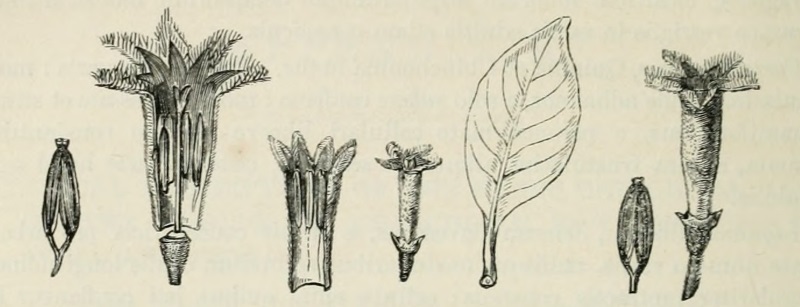
Capsules and parts of the flower of Chinchona Chahuarguera.
(Magnified and natural size.)
Chinchona Chahuarguera.
Chinchona Chahuarguera.—Foliis oppositis, petiolatis, lanceolatis,
oblongis ovato-lanceolatisque, undulatis, acuminatis acutisque, pedunculis
paniculatis.
Arbor 3-4 orgyalis, comâ, frondosâ ramosissimâ.
Truncus solitarius, erectus, cortice fusco aspero maculis cinereis indutus,
rimis longitudinalibus transversalibusque.
Lignum compactum, durum.
Rami erecti, teretes, cortice extus nigrescente, intus pallido cinnamomeo.
Ramuli subteretes, asperi, rimacei, colore ferrugineo-roseo.
Folia opposita, petiolata, lanceolata, oblonga ovato-lanceolataque, acuminata
acutaque, utrinque glabra, subtus nervosa, venosa, integerrima,
undulata, marginibus revolutis, glandulis subtus concavis rotundis villosis,
ad sinus nervorum ortum insertis, supra prominentibus.
Foliola floralia opposita, petiolata, parva, ovata ovaliaque, glabra, marginibus
revolutis, nervis centralibus purpureis.
Petioli teretes, purpurei.
Stipulæ duæ oppositæ, supra-axillares, sessiles, ovatæ, integerrimæ, acuminatæ,
basi cohærentes, nervo centrali prominente, marginibus revolutis,
deciduæ.
Pedunculi communes, terminales, axillaresque, subtetragoni, partiales
pubescentes, bracteolis oppositis subulatis ad pedicellorum basim, pedicellis
pubescentibus.
Pedicelli bracteolis subulatis, solitariis ad basim.
Calyx rosaceus.
Corolla dilute purpurea, extus pubescens, laciniis reflexis supra villoso-tomentosis,
villis albicantibus.
Antheræ fauce parum exsertæ.
Capsula ovalis oblongaque, purpurea (nonnullæ capsulæ ventricosæ),
bilocularis, bivalvis, valvulis basi dehiscentibus.
Habitat in collibus Santa Rosa nominatis, situ Huancocolla appellata,
ditione Vilcobamba, Loxa provinciâ.
Floret Maio, Junio, Julio, et Augusto.
Varietas Prima, Cascarilla amarilla fina del Rey. Varietas Secunda?
Cascarilla colorada fina del Rey. Varietas Tertia? Cascarilla crespilla
negra.
(From Howard's 'Nueva Quinologia of Pavon,' No. vii.)
Chinchona Uritusinga.
Chinchona Uritusinga.—Foliis oppositis, petiolatis, lanceolatis; pedunculis
axillaribus terminalibusque, paniculato-corymbosis, trifidis.
Arbor 20-ulnaris et ultra.
Lignum compactum, luteo colore.
Truncus solitarius, erectus, teres, crassus, fuscus, nonnullis maculis
nigris obsitus, comâ frondosâ, valde ramosâ.
Cortex scaber, fuscus, maculis nigris fuscis et albicantibus, rimis transversalibus.
Color intus luteus, amarissimus, acidulus, non ingratus.
Rami erecto-patentes, teretes; superiores brachiati, complanati, leviter
pubescentes, dilute fusci.
Ramuli utrinque sulcati.
Folia opposita, petiolata, lanceolata, integerrima, acuta, supra glaberrima,
nervosa, venosa, subtus per nervos et venas villosiuscula; nervis
alternis, rarius oppositis; marginibus revolutis; tenerrima subtus hirsuta;
glandulis minimis, rotundatis, subtus concavis, circum villis albicantibus
ad nervorum ortum insertis, supra prominentibus.
Petioli teretes, supra canaliculati, glabri, subtus hirsuti, basi incrassati.
Stipulæ duæ, oppositæ, interfoliaceæ, supra-axillares, ovatæ, acutæ,
erectæ, integerrimæ, cauli appressæ, pubescentes, deciduæ.
Pedunculi communes axillares terminalesque, trifidi, obtusi tetragoni,
paniculato-subcorymbosi, hirsuti, solitarii, erecti, complanati, foliis breviores;
partiales hirsuti, tri-septemflori trifidique; bracteolis duabus,
oppositis, minimis, ovatis, acutis, concavis, rubris, ad basim insertis, persistentibus.
Pedicelli teretes, breves, pubescentes; bracteolis solitariis, minimis, ovatis,
acutis, persistentibus, ad basim et in medio insertis.
Flores nonnulli sessiles.
Calyx campanulatus, ruber, glaber, in fructu ampliatus, denticulis retroflexis
persistens.
Corolla albo-rosacea, extus pubescens. Tubus intus glaber. Limbus
quinque-partitus, patens; laciniis villoso-tomentosis; villis albicantibus,
densis, longiusculis.
Capsula oblonga, angusta, striata, striis longitudinalibus prominentibus
utrinque sulcata, lævis, calyce crescente ampliato coronata, denticulis
retroflexis, bilocularis, bivalvis, basi dehiscens.
Semina minima, fulva, alâ obovatâ leviter lacerâ albo-pallescente circumdata.
Receptaculum lineare.
Habitat prope Loxa in collibus Cajanuma, Uritusinga, Boqueron, Villonaco,
Huancabamba, et Ayavaca.
Floret Maio, Junio, Julio, et Augusto.
Vulgo "Cascarilla Fina."
Chinchona Crispa (Tafalla).
(From Howard's 'Nueva Quinologia de Pavon.')
Chinchona Crispa. Quina fina de Loja, Cascarilla crespilla buena,
Quina Carrasqueña, Tafalla M.S. sec. Ruiz in M.S. Compendio, Mus. Brit.
C. Condaminea. H. et B. specimen florif. in pl. x. Pl. Equin. exclus.
specim. fructif. et descriptione.
C. Chahuarguera, varietas (tertia). Pavon, Nueva Quinologia.
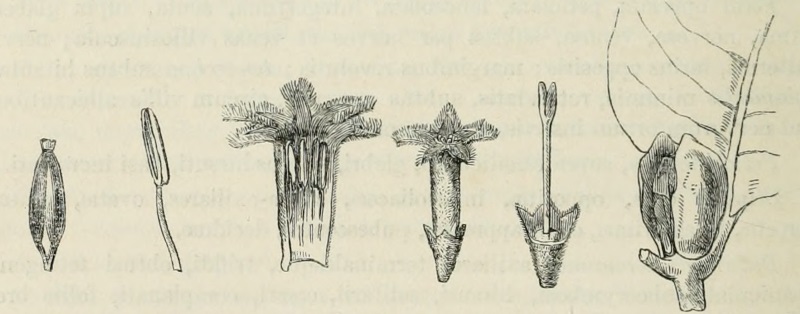
Capsule and parts of the flower of Chinchona Succirubra.
CHINCHONA SUCCIRUBRA.
(From Howard's 'Nueva Quinologia of Pavon,' No. iii.)
Chinchona Succirubra.—Foliis oppositis, petiolatis, ovatis ovalibusque;
petiolis nervisque rubicundis, glabris, nitidis; pedunculis racemoso-paniculatis.
Arbor 6-7 orgyalis.
Truncus solitarius, erectus; aliquoties duo tresve ex eadem radice repullulant.
Coma frondosa ramosaque. Lignum compactum.
Cortex fuscus, nonnullis maculis albicantibus; rimis transversalibus horizontalibusque.
Rami erecti, nonnulli horizontales, teretes, teneri pubescentes.
Folia opposita, petiolata, ovata ovaliaque, integerrima, acumine brevissimo,
nonnulla subrotunda, glabra, superne parum nitida, nervosa, venosa,
venis reticulatis, nervis venisque villosis, tenuia marginibus retroflexis.
Folia superiora, floralia petiolata, lanceolata, nonnulla sublinearia.
Petioli subteretes, basi crassiores, pubescentes, rubicundi sicuti nervi.
Stipulæ duæ, interfoliaceæ, supra-axillares, oppositæ, subamplexicaules,
oblongæ, sessiles, integerrimæ, parum concavæ, cauli appressæ, deciduæ.
Pedunculi communes, axillares terminalesque, racemoso-paniculati, pubescentes.
Partiales oppositi alternique, pubescentes.
Pedicelli bracteolis lanceolato-subulatis, parvis, concavis, deciduis, ad
basim et in medio rubicundo.
Flores pedicellati, nonnulli sessiles.
Corolla rubicunda, marginibus laciniarum ciliatis, villis albicantibus.
Capsula oblonga, parum incurva, immatura rubicunda, bivalvis, basi
hians. Receptaculum lanceolatum.
Semina alis dilaceratis.
Habitat ad radices collium, ad declivia Sancti Antonii, in via ad
Huaranda Provinciæ Quitensis, locis frigidis.
Floret Julio et Augusto.
Vulgo. Cascarilla Colorada.
In arborum corticumque amputatione, succum lacteum primum profluit;
postea, in colorem intense rubicundum transmutatur, unde Cascarilla
Colorada nomen oritur.
Chinchona Succirubra (Pavon MSS.) arborea; ramis teretibus; ramulis
obtuso-angulatis flavido-pubescentibus; foliis membranaceis magnis latissime
ovatis petiolatis, utrinque brevissime attenuatis, supra saturate viridibus
glabris subnitidis, subtus pallide viridibus puberulis, ad costam
nervosque primarios pubescentibus; petiolis semiteretibus puberulis, supra
canaliculatis; stipulis oblongis obtusis carinatis subpuberulis caducis;
floribus congestis in paniculam terminalem interruptam dispositis; ramis
floriferis pedunculatis pubescentibus erectis compressis trichotomo-ramosis,
inferioribus foliosis superioribus bracteatis; bracteis subpersistentibus oblongo-linearibus,
extus subpubescentibus carinatis basi attenuatis; calycibus
turbinatis, basi bracteola minuta suffultis, tubo dense albido pubescente,
limbo cupulari quinque-dentato rubescente sparsim pubescente, dentibus
brevibus latis acutis, dorso carinatis; corollis hypocraterimorphis brevissime
pubescentibus, tubo inferne attenuato, limbo quinquefido, laciniis
ovatis acutis, intus longe (ad siccam) luteo-barbatis; staminibus subinclusis
glabris; stylo versus basim attenuato; stigmate bipartito incluso.
(From Spruce's Report, p. 104, described from fresh specimens.)
Chinchona succirubra, Pavon.
Hab.—In sylvis primævis cordilleræ occidentalis Andium Quitensium
præcipue ad radices montis nivosi Chimborazo, alt. 2000-5000 ped.
Angl. (610-1520 metr.) supra mare.
Descr.—Arbor pulcherrima, 50-80 pedalis; caudice recto circumferentiâ
4-usque ad 10-pedali; comâ symmetricâ elongatâ, ramis infimis longioribus
deinde superioribus sensim decrescentibus paraboloideâ, vel ramis
infimis iis proxime sequentibus sub-brevioribus ovoideâ.
Cortex, caudicis ubi lichenibus non obvelatus est fusco-badius, haud
profunde longitudinaliter rimosus, demum etiam rimulis transversalibus
fissus; ramulorum annotinorum rufescens, novellorum e viridi cinerascens
secus apicem rubescens.
Succus ecoloratus, cortice autem inciso, in lucem aeremque susceptus
exinde sæpius albescit, postea sensim albescit.
Rami decussati, angulo 50°-80° adscendentes, teretes, e foliorum stipularumque
cicatricibus annulati; novelli tamen tetragoni foliosi fragiles
succosi, pube brevi deciduâ densiuscule vestiti.
Folia opposita decussata, cujusque ramuli 4-6 paribus contemporalibus,
cujusque paris inter se subæqualia raro valde inæqualia, sæpe perfecte
ovalia, secus paniculas ovato-ovalia, raro rotundato-ovalia, basi in petiolum
sensim abrupteve attenuata, apice abrupte acuta vel levissime acuminata
rarius rotundata, nitida subcoriacea (fragilissima tamen) læte viridia ad
luteum potius quam ad cæruleum vergentia, ætate tota sanguinea, suprà
sparse decidue puberula et inter venas plus minus bullato-elevata, subtus
pubescentia, raro in utraque facie glabrata; venis 11-12 cujusque lateris,
angulo 56°-59° cum costâ tereti (siccando complanatâ) efformantibus,
subtus prominulis, a costâ ultrà, medium rectis dein sensim incurvantibus
et prope marginem anastomosantibus; petiolo tereti, e folii laminâ decurrente
suprà lineis duabus parum elevatis percurso, tomentello. Folia
ramulorum tenuiorum nonnunquam ovali- vel etiam obovato-lanceolata.
Stipulæ interpetiolares deciduæ erecto-patulæ ligulato-oblongæ obtusæ ad
costam carinatæ, basi subventricosæ superne explanatæ, reticulato-venosæ,
sub-puberulæ, juniores pallide virides, adultiores basi roseæ vel etiam totæ
sanguineæ.
Pedunculi ex axillis foliorum superiorum minorum lanceolatorum (v.
etiam ad bracteas lineari-lanceolatas subulatasve redactorum) orti, subinde
paniculam elongatam pedalem vel etiam sesquipedalem efformantes, tomentosi,
bis terve decussatum pinnati dein trichotomi; divisionibus basi
bracteatis sæpe indistincte oppositis v. plane alternis. Pedicelli calycesque
basi bracteolis minutis rigidis sanguineis ovato-lanceolatis basi utrinque
unidentatis suffulti.
Calyx parvus dense appresso-puberulus; tubus subturbinato-hemisphæricus;
limbus cupulatus fere ad medium usque in lobos 5 lato-triangulares
carinatos, apicibus sinubusque acutis, fissus, pubescens raro subglabratus,
persistens.
Corolla calycem fere 5-ies excedens, extus dense puberula, ante anthesin
clavata postea hypocraterimorpha; tubus elongato-truncato-obconicus, intus
glaber; limbus e lobis 5 patulis valvatis elongato-ovato-lanceolatis, margine
apiceque villis densis albis (siccando flavidis) barbatis.
Stamina, corollæ tubum paululum superantia; filamenta glabra compressa
à basi fere ad medium usque cum corollâ concreta; antheræ elongatæ
lineares.
Stylus teres; stigma subemersum e lobis duobus ovato-lanceolatis crassis
faciebus unisulcis erecto-patulis constans.
Capsula stricta curvulave tenui-ovoideo-fusiformis à basi dehiscens,
valvulis dorso costis 5 parum elevatis percursis.
Semina anguste subovali-lanceolata sæpius asymmetrica, alâ margine
lacero-fimbriatâ ciliatâ, basi angustata et ibidem integra bilobave.

CHINCHONA CALISAYA.
(From Weddell's 'Histoire Naturelle des Quinquinas,' p. 30.)
C. foliis oblongis vel lanceolato obovatis, obtusis, basi attenuatis, rarius
utrinque acutis, glabratis, nitidis vel subtus pubescentibus, in axillis venarum
scrobiculatis; filamentis quam dimidia anthera plerumque brevioribus;
capsula ovata, flores longitudine vix æquante; seminibus margine crebre
fimbriato-denticulatis.
α Calisaya vera, arbor foliis oblongo- vel lanceolato-obovatis, obtusis.
β Calisaya Josephiana, frutex, foliis oblongo- vel ovato-lanceolatis, acutiusculis.
α. Calisaya Vera.
Arbor excelsa, trunco recto vel e basi arcuatim ascendente, nudo, crassitudinem
corporis humani duplam non infrequenter excedente. Coma
frondosa incolas omnes sylvæ ferme superans.
Cortex trunci crassus. Peridermis ejusdem quam in omnibus fere
generis speciebus crassior, e libro facile solubilis et avulsa ad hujus superficiem
sulcos impressionesve sculpturas referentes detegens, rimis parallelis
verticalibus et scissuris transversalibus plus minus annularibus ornata,
albida vel etiam nigricans. Ramorum peridermis dealbata aut lichenum
thallis diverse marmorata, rimis magis sinuatis et scissuris angustioribus
exculpta; aliis annularibus distantibus, aliis brevioribus subapproximatis.
In ramulis denique cortex tenuis est, lævigatus et fusco-olivaceus vel
nigricans.
Folia oblongo vel lanceolato-obovata (3 to 6 inches) 8-15 cm. long; (1
to 2 inches) 3-6 cm. lat. obtusa, basi acuta aut leviter attenuata, molliuscula,
patula, supra glaberrima, nitore scilicet velutino a cellulis epidermidis prominentibus
orto condecorata, obscure virentia, venis pallidioribus, parum
conspicuis, subtus dilute smaragdina, glabrata, in axillis venarum scrobiculata,
scrobiculis ab antica pagina vix manifestis. Petiolus 1 cm. long.,
virescens, rarius cum costa rubescens. In arbore juniori folia sæpius
utrinque acutiuscula sunt, flaccida, læte viridia, eximie velutina, costa et
petiolo roseis, nervis supra lacteo-albidis et limbo persæpe maculis roseosanguineis
insignito paginaque inferiori plus minus purpurascenti.
Stipulæ oblongæ, obtusissimæ, petiolis longiores vel subæquales, glaberrimæ,
basi interna glandulis parce obsitæ.
Panicula Florifera ovata vel subcorymbosa, vix multiflora, pedunculis
pedicellisque (2-4 mm. long.) pubescentibus. Bracteæ lanceolatæ.
Calyx pubescens, limbo-crateriformi, dentibus brevibus, triangularibus.
Corolla 9-10 cm. long., tubo cylindrico vel basi subpentagono, et leviter
angustato, in angulis interdum fisso, carneo-albescente, laciniis lanceolatis,
superne roseis, villis marginalibus candidis.
Stamina in medio tubo latentia; filamenta glabra, dimidiis antheris
breviora.
Stylus tubum fere æquans, stigmatis lobis linearibus, subexsertis, viridescentibus.
Panicula Fructifera laxiuscula, haud raro valde depauperata, pedunculis
puberulis.
Capsula ovata (.4 to .6 of an inch) 10-15 mm. long., latitudine sua vix
duplo longior, basi rotundata, ecostata, glabrata, sub maturitatem rubiginosa,
dentibus coronæ brevibus, erectiusculis.
Semina elliptico-lanceolata, margine fimbriato-denticulata, denticulis
approximatis, obtusiusculis; nucleo tertiam seminis partem circiter æquante.
Habitat in declivibus et præruptis montium, ad altitud. 1500-1800 m.
fervidissimas inter valles Bolivæ et Peruviæ meridionalis, sylvas incolit,
inter 13°-16° 30' S. lat., nempe in provinciis Bolivianis Enquisivi, Yungas,
Larecaja, et Caupolican dictis, et in provincia Caravaya Peruvianorum.
Floret Aprili et Maio.
β. C. Josephiana.
Frutex (6½ to 12 feet) 2-3 m. alt., trunco gracili (1 to 2 inches) 3-5 cm.
crass.; ramoso, ramis erectis.
Cortex ligno valde hærens, trunci ramorumque schistaceo-nigricans,
læviusculus aut lichenibus diversis ornatus scissurisque nonnullis angustissimis,
distantibus, annulatim notatus; ramulorum brunneo-rufescens.
Folia oblongo- vel ovato-lanceolata, utrinque subacuta aut obtusiuscula,
rigidula, superiora præsertim plus minus concava s. cymbiformia, utrinque
glaberrima vel subtus pubescenti-tomentosa, læte viridia, denique sanguinea
nervique et petiolus.
Panicula tum florifera cum fructifera sæpissime interrupta.
Corolla quam in varietate præcedente paulo longior. Stamina imo tubo
inserta, filamentis nunc brevibus ut Calisayæ Veræ, stylo simul longiore,
nunc elongatis antherisque subexsertis, stylo contra iis breviore antherisque
superato.
Capsula ut in typo vel flore aliquanto longior et non raro superne plus
minus attenuata, versus maturitatem pulchre rubescens simulque ramuli
paniculæ. Dentes coronæ paululum elongatæ eleganterque patentes.
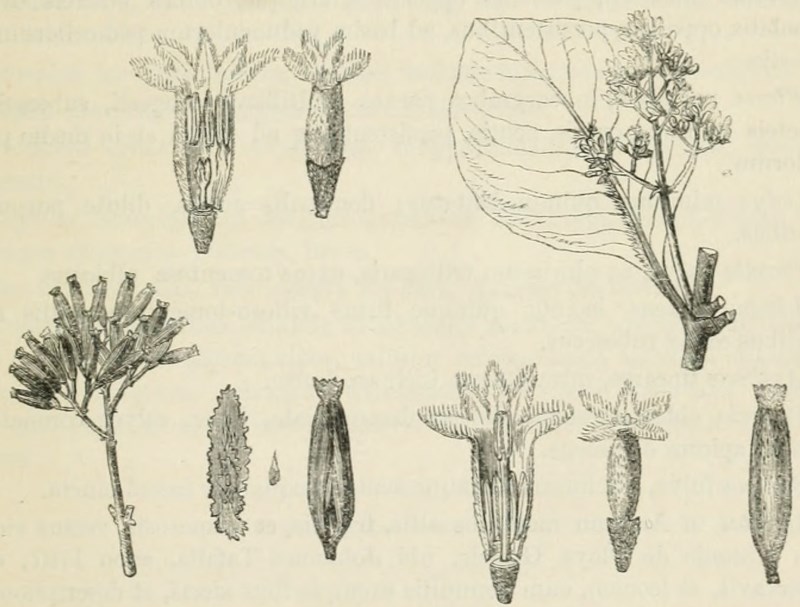
Parts of the flower and fruit of Chinchona Micrantha.
CHINCHONA MICRANTHA.
(From Howard's 'Nueva Quinologia of Pavon,' No. ii.)
Chinchona Micrantha.—Foliis oppositis, petiolatis, ovalibus obovatisque
glabris; floribus minimis, paniculatis.
Arbor 10-15 orgyalis, comâ frondosâ.
Truncus solitarius, erectus, teres; cortice scabro-fusco-cinereo, sapore
valde amaro, acidulo non ingrato; in febribus tertianis usurpari potest; in
commercio ignoto.
Rami patuli, teretes, cortice fusco-nigrescente; teneri foliosi, obtuse
tetragoni, glabri.
Folia opposita, petiolata, ovalia obovataque, integerrima, obtusa, acumine
brevi, ampla, marginibus revolutis, patentia, ut plurimum quadripalmaria,
supra nitida, glaberrima, subtus nervosa, venosa, nervis purpureis; glandulis
obovatis, subtus concavis, supra prominentibus, in foliis adolescentibus
circum villosis, in senioribus deciduis, ad nervorum axillas insertis.
Petioli breves, vix pollicares, supra plano-canaliculati, subtus semiteretes.
Stipulæ supra axillares, interfoliaceæ, oppositæ, ovatæ, integerrimæ,
connatæ, caducæ.
Panicula maxima diffusa, subracemosa, foliosa, floridissima, tomentosa,
helvolo colore.
Pedunculi vix striati, tetragoni, compressiusculi, axillares terminalesque,
communes brachiati, partiales oppositi alternique, omnes bracteis ovato-subulatis,
oppositis, persistentibus, ad basim pedunculorum pedicellorumque
insertis.
Flores numerosi, in corymbos parvos multifloros congesti, subsessiles;
bracteis minimis, ovatis, acutis, persistentibus ad basim et in medio pedicellorum.
Calyx minimus, quinquedentatus; denticulis acutis, dilute purpurascentibus.
Corolla parva, ut plurimum trilinearis, extus tomentosa, albicans.
Limbus patens, laciniis quinque intus villoso-tomentosis, villis albicantibus
extus rubescens.
Antheræ lineares, intra faucem inclusæ, luteæ.
Capsula oblonga, acuta, leviter decemstriata, fusca, calyce coronata, a
basi ad apicem dehiscens.
Semina fulva, alâ lineari utrinque acutâ inæqualiter lacerâ cincta.
Habitat in Andium montibus altis, frigidis, et nemorosis, versus vicum
San Antonio de Playa Grande, ubi Johannes Tafalla, anno 1797, eam
observavit, et iconem, cum nonnullis exemplaribus siccis, et descriptionem,
nobiscum communicavit.
Floret Maio, Junio, et Julio.
Vulgo: Cascarilla fina. Cascarilla Provinciana.
Chinchona Micrantha, β. Oblongifolia (Weddell).
Chinchona Micrantha, var. α. flor. extus roseis; var. β. flor. extus albidis
(Poeppig).
(From Weddell's 'Histoire Naturelle des Quinquinas,' p. 52.)
Chinchona Micrantha.—Arbor 6-10 m. alt. sat frondosa, trunco recto,
tereti, 2-4 dm. crassitudine raro excedente; ramis patulis.
Cortex trunci crassiusculus. Peridermis ejusdem tenuis, libro extus
subcarioso vix hærens, plus minus lævigata, sordide grisea fuscescensve;
ramorum lævis, cinerascens; ramulorum viridescens.
Folia plerumque ovato-rotundata, 12-20 cm, long. 10-15 cm. lat. basi
(præcipue in junioribus) plus minus cuneata vel attenuata, obtusiuscula,
membranacea, supra glabra nitidiuscula, læte viridia, subtus læevissime
puberula pallide virescentia, venis venulisque parce pubescentibus, axillis
pilosiusculis, pilis subfasciculatis. Petiolus 2-3 cm. long. glaber, ejusdem
coloris ac costa.
Stipulæ ovatæ, obtusæ, extus pubescentes, intus puberulæ, deciduæ.
Panicula Florifera maxima, thyrsoidea; ramulis subpatentibus pedicellisque
(2 mm. long.) pubescentibus, cinereo-virescentibus.
Calyx pubescens, limbo crateriformi, dentibus acuminatis.
Corolla alba, tubo tereti 5-7 mm. long. basi et fauce leviter coarctato,
laciniis lanceolatis.
Stamina imo tubo inserta, antheris inclusis filamenta subæquantibus.
Stylus brevissimus; stigmatis laciniis linearibus.
Panicula Fructifera ovata vel subpyramidalis, subconferta, ramulis
glabratis.
Capsula lanceolata vel oblongo-lanceolata, 25-30 mm. long. 5-7 mm. lat.
utrinque attenuata, glabrata, lævis.
Semina lanceolata, basi integra vel fissa, margine denticulata.
Crescit in nemoribus humidis subobscuris montium, nec non infrequentius
juxta ipsas rivulorum ripas, vallium provinciarum Larecaja et Caupolican
Bolivianorum, vallisque Tambopata provinciæ Caravaya incola;
provenit etiam in editioribus versus Chicoplaya et Playa Grande Peruvianorum.
CHINCHONA NITIDA.
(From Howard's 'Nueva Quinologia of Pavon,' No. vii.)
Chinchona Nitida.—Foliis oppositis, petiolatis, obovatis, ovali-oblongis
ovato-oblongisque, nitidis, paniculâ terminali—Cascarilla Officinal. (Ruiz
Quinologia, Art. 2, p. 56.)
Arbor procera, a decem usque ad quadraginta ulnas, glabra.
Truncus solitarius, erectus, teres, aliquando tres aut quinque repullantes.
Cortex extus scaber, fusco-nigricans, sæpe ex fusco et cinereo colore
variegatus; intus obscure fulvus, amarissimus, acidulus non ingratus, in
commercio et in febribus tertianis magno usu fit.
Rami seniores teretes, scabri, fusco atri-cinereo colore variegati, teneri
leviter tetragoni, fusci.
Folia opposita, petiolata, obovata, ovali-oblonga ovato-oblongaque, integerrima,
nitidissima, decurrentia, marginibus ad basim revolutis, subtus
venosa, venis purpurascentibus, glandulis rotundis oblongisque, supra prominentibus,
subtus concavis, ad sinus nervorum ortum insertis, villis longis
albicantibus vestitis.
Petioli subtus semiteretes, supra planiusculi, purpurei.
Stipulæ interfoliaceæ, oppositæ, supra-axillares, basi coadunatæ, oblongæ,
sessiles, obtusæ, intus rubescentes, marginibus reflexis.
Panicula terminalis, composita, subracemosa, rubescens.
Pedunculi multiflori, tetragoni.
Flores breviter pedicellati.
Pedicelli bracteolis ovatis acumine subulato concavis ad basim stipati,
persistentes.
Calyx parvus, purpureus.
Corolla alba, extus dilute rubicunda, vix semipollicaris, laciniis intus
villosis, villis albicantibus.
Capsula oblonga, decem-striata, rubescens, bivalvis, valvulis basi hiantibus.
Semina ovalia, fulva, alis membranaceis oblongis inæqualiter denticulato
cincta.
Habitat in Andium montibus altis, nemorosis, frigidis, ad Pampamarca,
Chacahuasi, Casapi, Casapillo, Cayumba, Sapan, Cuchero, aliisque tractibus,
et in montibus Provinciarum Huamalies, Tarma, et Jauja.
Floret Maio, Junio, et Julio.
Vulgo: Cascarilla fina aut Quina fina. Cascarilla lustrosa (Pritchett).
(From Weddell's 'Histoire Naturelle des Quinquinas,' p. 47.)
Chinchona Nitida.—C. foliis lanceolato-obovatis, acutis, basi attenuatis,
utrinque glabris, nitidis vel inferne leviter pilosis, escrobiculatis; filamentis
antheras æquantibus; capsula anguste lanceolata, latitudine sua duplo longiori;
seminibus lanceolatis, margine denticulatis.
Arbor 8-12 m. alt., trunco recto, tereti, crassitudine corporis humani;
coma parum frondosa.
Cortex trunci crassus, peridermide rimosa, obscure brunnea; ramorum
peridermis inæqualis, plus minus sulcato-rimosa, brunneo-cinerascens.
Folia lanceolato- vel oblongo-obovata, 9-10 cm. long., 25 mm. lat.,
utrinque acuta, basi cuneata aut attenuata, sub-membranacea; supra glabra
nitida, subtus nonnunquam (ad venas præsertim) pilosa; petiolo 1 cm.
longo.
Stipulæ oblongæ vel obovatæ, obtusæ, deciduæ, raro basi connatæ.
Panicula ovata, subcoarctata, ramulis pedicellisque puberulis; bracteis
triangulari-lanceolatis.
Calyx limbo subcampanulato, dentibus triangularibus.
Corolla rosea, tubo subcylindrico, laciniis lanceolatis, villis albidis.
Antheræ apice exsertæ, filamenta æquantes vel paulo breviores.
Stylus antheras haud attingens; stigmatis lobis linearibus, brevibus.
Capsula lanceolata, denique glabra, læviuscula vel striata, sub maturitatem
obscure rubiginosa, dentibus coronæ erectiusculis.
Semina lanceolata, utrinque acuta, margine denticulata.
Habitat in montibus altis, noctu frigidiusculis, diu apricis ventilatisque.
(Ruiz et Pavon. Poeppig.)
CHINCHONA PERUVIANA. (Howard.)
(The "Pata de Gallinazo" of Pritchett's Collection.)
(From Howard's 'Nueva Quinologia of Pavon.')
Chinchona Peruviana.—Foliis oppositis, petiolatis, lanceolato-ovatis,
basi attenuatis, junioribus lanceolatis, scrobiculatis, paniculâ terminali
compositâ.
Arbor procera ... Lignum compactum, luteum.
Cortex extus scaber, rimosus, corticem Calisayæ maxime æmulans,
sæpe ex albo et cinereo colore variegatis; intus obscure fulvus, amarus,
fragrans.
Folia opposita, petiolata, lanceolato-ovata, nonnulla lanceolato-obovata,
alia elliptica, basi attenuata, obtuse acuminata, juniora lanceolata, scrobiculata,
scrobiculis supra valde prominentibus, nitida, subtus venosa.
Petioli subtus semi-teretes, supra planiusculi.
Panicula terminalis, composita, pyramidalis.
Capsula oblonga, leviter decemstriata, calyce coronata, bivalvis, valvulis
basi hiantibus.
Semina ovalia, alis membranaceis, valde laceratis.
Habitat in Andium montibus frigidis Cocheros aliisque tractibus.
Vulgo: "Cascarilla Pata de Gallinazo."
Obs.:—In commercio magno usu fit.
Speciminibus nobis à Pritchett datis descript.
CHINCHONA LANCIFOLIA.
(From Karsten's 'Floræ Columbiæ Specimina Selecta,' I. p. 21.)
Arbor vasta, usque ad 24 metr. adscendens, trunco recto, 1-1½ metra in
diametro; coma subovata, ramosa, ramis teretibus adscendentibus vel
inferioribus, horizontalibus, cortice rugoso, fuscescenti, ut plurimum hic
illic profunde transversim annulato, tectis; ramulis brachiatis, compressiusculis,
uti pedicelli leviter striguloso-pilosiusculis.
Folia opposita, petiolata, petiolo semitereti 16-20 m. m. longo, supra
plano, glabro, subtus pilosiusculo insidentia, lanceolata, acuminata, basi
attenuata, integerrima, glaberrima, in axilla venarum leviter scrobiculata,
et hic facie inferiore glomerulo pilorum obsita, patentia, læte viridia, nitida,
lamina 10 centim. longa, 3½ centim. lata, petiolo nervisque, demum folio
integro, rubescentibus; juniora subtus in costa minutissime pilosiuscula;
vernatione applicativa.
Stipulæ interpetiolares, liberæ, lanceolatæ, acutæ, pedicellorum longitudine,
glaberrimæ; intus basi pluriseriatim glandulosæ, demum rubræ,
deciduæ.
Inflorescentia terminalis foliosa, paniculata, e cymis dichotomis axillaribus
composita, foliis floralibus lineari-lanceolatis; pedunculi pedicellique bracteis
minutis, glabris, lanceolato-acutis, subpersistentibus, suffulti.
Calycis tubus turbinatus, ovario adnatus, pilis minutis, adpressis strigosus;
limbus persistens campanulatus, quinquefidus, glaber, rubescens, laciniis
triangularibus, acutis.
Corolla tubo cylindrico 10 m. m. longo, extus sericeo, carneo-rubro, intus
glabro; limbo quinquepartito, lobis ovatis, acutis, æstivatione valvatis,
rubris, extus sericeis, intus margine albide-villosis sub anthesin patentibus.
Stamina quinque, tubo medio inserta, paullo exserta.
Filamenta subulata, glabra, 1 m. m. longa; antheræ lineares, introrse
longitudinaliter birimosæ, basi sagittata affixæ, filamentis paullo breviores,
plus minus exsertæ; pollen sphæricum granulosum, triocellatum.
Discus epigynus, annularis, carnosus, subpentagonus, quinquesulcatus.
Ovarium inferum biloculare, loculis multiovulatis, placentis linearibus,
medio dissepimenti longitudinaliter adnatis, ovula anatropa, pluriseriata,
imbricatim adscendentia, mox peltata gerentibus; stylus teres glaber,
staminibus longior, exsertus aut inclusus; stigmata duo linearia.
Capsula oblonga, striato-costata, calva, post dehiscentiam septicidam, a
basi ad apicem progredientem, calycis limbo diutius coronata, epicarpio
cum endocarpio connato, 17-20 m. m. longa, 6-8 m. m. lata.
Semina lanceolata, applanata, 7-8 m. m. longa, 2-3 m. m. lata, spermophoro,
a valvis apertis soluto, adhærentia, caduca, ala membranacea,
hyalina, imperforata, margine crenulato-denticulata, cincta; nucleo ovali
sextam partem fere seminis longitudinis attingente.
Embryo in axi albuminis carnosi rectus, cotyledonibus ovalibus, planis,
applicativis, radicula tereti infera.
In declivitate Andium Granatensium inter 5° et 1° lat. Sept. altitudine
2500-3000 metr. supra oceani littora ad temperaturam glacialem in horis
nocturnis fere refrigerata hic illic frequenter in locis nebulosis et illuviosis
nascitur.
Tunita ab incolis dicta.
NOTES ON THE PRINCIPAL PLANTS EMPLOYED IN INDIA,
ON ACCOUNT OF THEIR REAL OR SUPPOSED FEBRIFUGE
VIRTUES. BY ALEXANDER SMITH, ESQ.
The following enumeration of Indian febrifuge plants, though, from the
limited time at my disposal, not so complete as could be wished, will serve
to give an idea of the great variety of indigenous plants used by the natives
of India in the treatment of the different kinds of fevers so prevalent in
that country. European physicians of the present day rely to a great
extent upon the invaluable products of the Chinchonas, as the most certain
remedies for these disorders; but a couple of centuries ago, when quinine
and the kindred alkaloids were undreamt of, and when even Peruvian Bark,
or, as it was then called, "Countess' Bark" or "Jesuits' Bark," was
scarcely known, and its source a jealously guarded secret, their ancestors
made use of a much greater number of substances, and highly extolled the
febrifuge properties of many of our native wild plants. Most of these,
however, are now known to be of little use and are discarded from the
modern practice of physic, though amongst rustic practitioners, or herb-doctors,
they still to a certain degree enjoy their ancient reputation. We
must not therefore be surprised that the native doctors of the East, whose
knowledge of chemistry and the allied sciences is as limited as was that of
our old herbalists, should in like manner ascribe powerful properties to the
barks, roots, stems, and other parts of plants which in reality possess as
little value in a medical point of view, as the indigenous plants at one
time used in our own country.
It must not, however, be imagined from these remarks that all the plants
mentioned below are known to be completely devoid of medicinal properties.
Some of them possibly possess qualities of the greatest value, and, were
they properly tested by the enlightened science of the present day, might
yield products useful either as tonics or febrifuges, or prove otherwise
valuable. But the great majority are comparatively valueless, and their
supposed virtues merely the result of fancy.
Alex. Smith.
Kew, Surrey, April 5th, 1862.
RANUNCULACEÆ.
Thalictrum foliolosum, D. C.
The bitter roots of this Himalayan species of Meadow Rue are used by
the natives in intermittent fevers, and have, according to O'Shaughnessy,
been experimented upon by European practitioners, and found serviceable
not only as a febrifuge, but as a tonic in convalescence from acute diseases.
The plant is an erect, branching perennial, three or more feet high,
with large quadripinnate leaves composed of numerous small leaflets. It
is common throughout the Himalayas, and is called "Pelijuree" or
"Shuprak" by the natives.
Coptis Teeta, Wall.
Several bitter roots are called "Teeta" in the Bengal bazaars. Those
of the present plant are brought down from the Mishmee Mountains on
the northern borders of Assam, and are consequently called "Mishmee
Teeta." They are usually packed in little baskets about two inches wide,
made of strips of rattan-cane. In the Scinde bazaars they are called
"Mahmira," and they are likewise said to be imported from China under
the name of "Sou-line" or "Chyn-len," but the plant is not known to be a
native of that country. They have an intensely bitter taste, and the
native doctors esteem them very highly as a tonic and stomachic. M.
Virey says that a decoction of them is a powerful febrifuge, but O'Shaughnessy
states that in experiments made in the Indian hospitals they did
not seem to exercise any febrifuge virtues, though their tonic properties
were very manifest. The roots of an allied American species (Coptis
trifolia, Salisb.) are used throughout the United States and Canada as a
tonic, under the name of "Gold Thread."
Aconitum, sp. pl.
The roots of several species of Aconite, common in the Himalayas, are
reputed to possess febrifuge properties, but the identification of the
particular species is very uncertain. Amongst others the most virulent
kind of "Bikh" or "Bish," that yielded by the Aconitum ferox, Wall., is
said to be thus employed and also in chronic rheumatism; and likewise
the "Bikhma" of Hamilton, supposed to be the Aconitum palmatum,
Don. The little tuber-like roots called "Atees" or "Butees," much
esteemed for their bitter tonic properties, are afforded by the Aconitum
heterophyllum, Wall.
MAGNOLIACEÆ.
Michelia Champaca, Linn.
Several of the Magnoliaceæ are known to possess powerful febrifuge
virtues, particularly the Magnolia glauca, Linn., and other American
species, the bark and fruits of which are greatly used in intermittent fever.
Among the Indian species, the only one reputed to possess similar virtues
is the "Champa" (Michelia Champaca, Linn.), O'Shaughnessy remarking
that, after several trials, its bark appeared to him to possess the properties
attributed to the Magnolia glauca. It, however, contains tannin and
gallic acid, both of which are absent in the American bark. The Champa
grows to a large size, has ovate-lanceolate leaves from eight to ten inches
long and two to four broad, and bears exceedingly fragrant yellow or
orange-coloured flowers, which the Hindus offer to their deities.
BERBERIDACEÆ.
Berberis Lycium, Royle.
According to the learned investigations of the late Dr. Royle, it would
appear that this species of Barberry afforded the λύκιον ινδικον of
Dioscorides. At the present day an extract of the sliced root, stem, and
branches is prepared in Nipal and the Dhoon, and employed by the native
doctors in diseases of the eyes, for which purpose the drug was also valued
by the physicians of old. It is known in Bengal by the name of "Rusoot"
or "Rasot," and in Scinde by that of "Ruswul." Employed as a substitute
for Chinchona bark this extract has been found to be a most valuable
remedial agent in common and tertian agues, checking the fever in three
days. The skin is invariably moist during its action. The plant is a
small stiff shrub with twiggy, pale-barked branches armed with conical
tripartite spines, and bearing clusters of small obovate-lanceolate leaves,
either entire or with spiny teeth along the edges.
MENISPERMACEÆ.
Tinospora cordifolia, Miers (= Cocculus cordifolius, D. C., and
Menispermum cordifolium, Willd.).
A tall, climbing shrub with rough corky bark, and broad, heart-shaped,
pointed leaves from two to four inches long, upon stalks of
about the same length; common in woods throughout the peninsula
of India and in Ceylon, and known in the former country by the name
of "Guluncha" or "Gurcha," and amongst the Cinghalese by that of
"Rassakinda." All parts of the plant have a bitter taste, and an infusion
of the young stems and leaves is highly esteemed by the native physicians
as a febrifuge medicine, and also as a tonic, while in some districts it is
looked upon as a certain cure for poisonous snake-bites. Ainslie says that
the bruised plant is put into the water drunk by the Brahmins at some of
their religious ceremonies.
Tinospora crispa, Miers (= Cocculus crispus, D. C., and Menispermum
crispum, Linn.).
This is closely allied to the above, and is known by the same name,
"Guluncha." It has smooth bark, more oval and less heart-shaped
leaves on shorter stalks. Like the last it is greatly valued in the treatment
of intermittent fever; but the natives in Silhet consider that it is
more efficacious when found climbing upon mango-trees. It is found in
Silhet and Pegu, and in several of the Indian islands.
Cissampelos Pareira, Linn.
The woody stems of this widely spread tropical plant are used in a
variety of diseases, and amongst others in fevers, but it is principally
valued for its antilithic properties, on account of which it is admitted into
our Pharmacopœias under the name of Pareira-brava. It is a tall, hard-wooded
climber, indigenous to the tropics of both hemispheres, and is
found in all parts of India. In Ceylon, where it is also used as a fever
medicine, it is called "Deyamitta."
CAPPARIDACEÆ.
Gynandropsis pentaphylla, D. C. (= Cleome pentaphylla, Linn.).
A decoction of the little black seeds of this plant is considered useful in
typhus fever, and in convulsive affections. The plant is called "Vaylee"
in the Tamul language; "Hurhuriya" in Bengalese; "Caraila" by the
Hindus; and "Waila" by the Cinghalese. It is an annual plant, a foot
or more in height, with hairy stems, and palmately divided leaves usually
with five, but sometimes with seven or only three segments.
Cratæva Nurvala, Ham. (= Cratæva Tapia, Burm.).
A small tree, fifteen to twenty feet high, common on the banks of
rivers on the Malabar coast and in Mysore, producing an astringent bark,
a decoction of which is prescribed as a tonic in both intermittent and
typhus fevers. The Sanscrit name of the plant is "Varuna," and it is the
"Nurvala" of Rheede's Hortus Malabaricus, according to Hamilton, who
says that the real name of the plant in the Malabar dialect is "Vala," the
prefix "Nur" (water) merely denoting the localities in which the tree is
found.
MORINGACEÆ.
Moringa pterygosperma, Gaertn. (= Hyperanthera Moringa, Vahl.).
Well known in India as the Horse-radish tree, on account of its roots
possessing a pungent odour and biting aromatic taste similar to those of our
common horse-radish, for which they are substituted by European residents
in both the East and West Indies. They are also used medicinally by the
native doctors as a stimulant in paralysis and intermittent fevers, and are
also considered valuable as a rubefacient. "Morunghy," from which the
generic name adopted by modern botanists has been derived, is the Tamul
name; and "Sujna" or "Salijuna," the Hindu. It is a small tree, seldom
more than twenty feet high, and has large compound three-times pinnated
leaves, and axillary bunches of whitish flowers, producing long pendulous
three-sided fruits, containing numerous winged seeds, which some authors
regard as the source of the celebrated Ben-oil.
CARYOPHYLLACEÆ.
Mollugo Cerviana, Ser. (= Pharnaceum Cervianum, Linn.).
This little herb is used as a medicine in fevers in Ceylon, where it is
called "Pat-paadagan;" and as the plant is also found in the Indian
peninsula, it is most probably employed in a similar manner by the Hindu
doctors. The order to which it belongs is remarkable for little besides the
presence of saponine in several species.
MALVACEÆ.
Sida acuta, Burm. (= Sida lanceolata, Retz.).
The roots of this have an intensely bitter taste, and their infusion, in
conjunction with ginger, is prescribed in cases of intermittent fever, for
which they have also been tried in the Indian hospitals, but without satisfactory
results, though they were found to possess some medicinal virtues as a
tonic. The plant is called "Pata" in Sanscrit; and "Malaytanghie" in
Tamul. It is a shrub with narrow lance-shaped, pointed leaves, coarsely
toothed along the edges, and either smooth or sprinkled with bristly hairs,
especially on the veins underneath.
Pavonia Zeylanica, Cav. (= Hibiscus Zeylanicus, Linn.).
A tall annual plant, with variable leaves, the lower ones being roundish
heart-shaped, and the upper deeply three to five lobed, and whitish or
pale-red flowers. It is called "Sittamootie" in Tamul, and an infusion of
the root is administered in fevers, but Ainslie states that it does not
appear to possess any virtues.
OLACACEÆ.
Olax Zeylanica, Linn.
A small tree, native of Ceylon and of some parts of India, yielding a
fœtid, salt-tasted wood, which is employed in putrid fevers. The
Cinghalese, who call the tree "Malla," eat the leaves in their curries.
AURANTIACEÆ.
Ægle Marmelos, Corr. (= Cratæva Marmelos, Linn.).
The Bengal Quince-tree. Almost every part of this tree is used medicinally
by the native Indian doctors. In fever cases a decoction of the
bark of the root, and also of the stem, is employed, but when the latter is
used it is generally combined with a great variety of other substances.
The expressed juice of the leaves, diluted with water, is also administered
in incipient fevers and colds. The fruit is a valuable remedy in diarrhœa
and dysentery, and has been successfully employed in those complaints by
medical men in this country. It is a tree of moderate size, with its young
branches furnished with sharp spines, and has ternate or rarely pinnate
leaves, and axillary panicles of few large fragrant flowers. It has a great
number of vernacular names. In Hindustanee and Bengalee it is called
"Bael, Bêl, or Bêla;" in Telinga, "Maredoo;" in Tamul, "Willamarvum;"
in Malayan, "Tanghula," &c.
MELIACEÆ.
Azadirachta Indica, A. de Juss. (= Melia Azadirachta, Linn.).
The bitter astringent bark of this tree, the Neem or Margosa tree of
India, is considered by the native doctors to be a most valuable tonic
and febrifuge, and it has been successfully employed as a substitute for
Chinchona-bark by English physicians in India. A bitter principle called
Azadirine has been obtained from it. Other parts of the tree are likewise
reputed to possess medicinal properties: the bitter oil obtained from the
pericarp being employed as an anthelmintic, and the olive-like fruit itself
in leprosy, while the leaves are universally used in India for poultices.
The Neem forms a large ornamental tree, and has pinnate leaves with
unequal-sided smooth leaflets sharply toothed at the edges, and loose
axillary panicles of bluish flowers. "Neem" or "Nim" is its Hindustanee
and Bengalee name; "Nimba," in Sanscrit; "Vaypun" or "Vapan,"
in Tamul; and "Kohomba," in Cinghalese.
CEDRELACEÆ.
Cedrela Toona, Roxb.
The Toon-tree grows to a large size, and yields a valuable reddish
timber, resembling some kinds of mahogany. It has abruptly pinnate
leaves composed of from six to twelve pairs of opposite, usually entire,
smooth leaflets of an ovate-lanceolate shape; and its flowers are small,
yellowish, and sweet-scented, and are disposed in terminal drooping
panicles. Toon bark is powerfully astringent, but is said to be devoid of
bitterness. It is much esteemed in the treatment of intermittent fever,
though seldom administered alone, but generally prescribed in combination
with the excessively bitter seed of the Guilandina Bonducella. The
flowers yield a yellow dye, but the colour is not permanent.
Soymida febrifuga, A. de Juss. (= Swietenia febrifuga, Roxb.).
The specific name of this tree indicates its use as a medicine in fevers.
The part employed is the bark, which is of a reddish colour and has a very
bitter, slightly astringent, but not unpleasant taste. It was long ago
highly recommended as a substitute for Peruvian bark by several English
doctors in India, and appears to possess considerable medicinal virtues,
though Ainslie found that when given in large doses it deranged the nervous
system, occasioned vertigo and subsequent stupor. The tree is called
"Shemmarum" by the Tamuls; "Soimido" by the Telingas (whence the
generic name adopted by botanists); and "Rohuna" by the Bengalese. It
is a very large, hard-wooded tree, with abruptly pinnate leaves composed
of from three to six pairs of opposite, oval-oblong blunt leaflets; and produces
large panicles of small yellowish flowers towards the points of
the young branches.
The bark of another large Indian tree belonging to this order, the
"Chikrassee" of the Bengalese (Chickrassia tabularis, A. de Juss.), is
a powerful astringent, but, like the Toon bark, devoid of bitterness.
OXALIDACEÆ.
Averrhoa Bilimbi, Linn.
A syrup prepared with the juice of the excessively acid gherkin-like
fruits of the Bilimbi is used by the native doctors in the treatment of
fevers, as also is a conserve of the flowers. The Bilimbi is a small tree,
with unequally pinnate leaves, which, like those of the well-known sensitive
plant, are irritable and close their leaflets together when touched. Its
fruits are commonly used for pickling by Europeans, both in the East and
in the West Indies.
XANTHOXYLACEÆ.
Toddalia aculeata, Pers. (= Scopolia aculeata, Smith).
Powerful stimulating properties are ascribed to all parts of this plant.
The fresh bark of its root is administered by the Telinga physicians, who
call the plant "Conda cashinda," for the cure of the kind of remittent
fever known by the name of "hill fever," from its being caught in the
jungles of the Indian hills. It is a moderately tall shrub with prickly
stems and branches, alternate, trifoliate, smooth leaves marked with
numberless pellucid dots, and usually having prickles on their stalks and
on the midribs of the leaflets; and its flowers, which are whitish and
strong scented, are borne in simple or compound racemes. Its Cinghalese
name is "Koodoomirris-wel."
SIMARUBACEÆ.
Samadera Indica, Gaertn.
All parts of this tree partake of the excessively bitter qualities common
to the order. The decoction of the rasped wood has recently been extensively
and successfully employed in Ceylon, in the treatment of intermittent
fever, and is recommended to be given in combination with Myrobalan
galls. The wood is of a pale colour, resembling quassia-wood, and is very
light. The tree is indigenous to Ceylon, and also to the Indian peninsula,
and is the "Karin-njotti" of Rheede. It attains a considerable size, and
has oblong-elliptical, alternate leaves, and long, pendulous, compressed
flower-stalks, divided at the top into a many-flowered umbel. The bark,
called "Niepa bark," also possesses febrifugal properties.
RHAMNACEÆ.
Zizyphus Jujuba, Lam. (= Rhamnus Jujuba, Linn.)
The root of this common Indian tree is a reputed febrifuge, and an
infusion of it, combined with some warm seed, is said to be employed as
such in the Moluccas, while the bark is used in diarrhœa. It is a small
tree, with prickly branches, usually having the spines in pairs, and elliptical
or oblong obtuse leaves, covered on the under side, as also are the branches,
with dense short tawny tomentum, and it bears small greenish-yellow
flowers, which produce roundish, yellow, edible fruits about the size of
cherries. Its Sanscrit name is "Vadari," and its Bengalese "Kool."
LEGUMINOSÆ.
Cassia Fistula, Linn. (= Cathartocarpus Fistula, Pers.).
The black, sweet-tasted pulp contained in the long cylindrical pipe-like
pods of this common tropical plant is well known as a gentle laxative
medicine; and its roots are reputed to be an excellent febrifuge. It is
the "Sonali" of the Bengalese, the "Amultas" of the Hindus, and the
"Ahalla" of the Cinghalese, and is a moderately large tree, with very long
pinnate leaves, and loose drooping racemes of bright-yellow fragrant
flowers.
Guilandina Bonducella, Linn. (= Cæsalpinia Bonducella,
Fleming).
The seeds and bark, but particularly the former, have an intensely bitter
taste, and are supposed to possess powerful tonic virtues. The seeds,
called Bonduc nuts, are lead or ash coloured and most excessively hard.
Their cotyledons, powdered and combined with spices or other medicinal
substances, are prescribed with beneficial results in intermittent fever.
The root is also said to be a good tonic in dyspeptic complaints; in fact,
all parts of the plant are reputed to possess medicinal properties. The
plant is a prickly, trailing shrub, with abruptly twice-pinnate leaves, each
pinna consisting of from five to eight pairs of oval leaflets, and bears
racemes of rusty-yellow flowers. The Tamuls call it "Kalichikai;" the
Telingas "Getsakaia;" the Hindus "Cat-caleyi" and "Natacaranja;" and
the Cinghalese "Koombooroo-wel." It is a common plant throughout the
tropics of both hemispheres.
Phaseolus trilobus, Roth. (= Dolichos trilobus, Linn.).
Ainslie says that "this plant was brought to Dr. F. Hamilton in Bahar,
where he was informed by the Vytians of that district that the fresh herb
was given in decoction in cases of irregular fever." It is a procumbent,
spreading, herbaceous plant, with leaves composed of three roundish, entire,
or three-lobed leaflets on long stalks, and bears a few pea-like flowers at
the ends of long ascending stalks.
Ormocarpum sennoides, D. C. (= Hedysarum sennoides, Willd.).
A shrub with glutinous hairy shoots, unequally pinnate leaves, and
short axillary racemes bearing a few pea-like flowers, producing jointed
pods. The decoction of the roots of this shrub, which is called "Caat
Morungie" in the Tamul language, and "Adivie moonaga" in Telinga, is
prescribed by the native physicians as a tonic and stimulant in fevers, and
a liniment made of the powdered bark and sesamum oil is applied externally
in paralysis and lumbago.
COMBRETACEÆ.
Terminalia tomentosa, W. et A. (= Terminalia alata, Roth.).
This is a large tree with deeply-cracked bark, and nearly opposite,
linear, oblong, obtuse leaves, somewhat cordate at the base, crenulate, and
clothed with pubescence underneath. It is the "Peea-sal" or "Usan" of
the Bengalese; the "Nella madoo" of the Telingas; and the "Aans" of
the Hindus. The reddish-brown, cracked bark has a strong but not
unpleasant astringent taste, and is classed amongst the febrifuge medicines
by the native doctors: powdered and mixed with oil it is employed in
apthæ.
MYRTACEÆ.
Syzygium caryophyllifolium, D. C. (= Calyptranthes caryophyllifolia,
Willd.).
"Nawel" of the Tamuls; "Nereddie" of the Telingas; and "Madang"
of the Cinghalese. The thick, brownish-coloured bark of this tree has an
astringent, slightly aromatic taste, and a decoction of it is sometimes
prescribed by native doctors in fevers and bowel complaints, and is also
employed as a wash for foul ulcers. It has been recommended as a tanning
substance, but it does not possess sufficient astringency to render it suitable
for that purpose. The tree has smooth, entire leaves of an oblong-lanceolate
shape and attenuated at the base, and bears cymose panicles of flowers
upon the old branches, producing little edible fruits about the size of peas.
BARRINGTONIACEÆ.
Barringtonia racemosa, Roxb. (= Eugenia racemosa, Linn.).
"Cadapum" (Tam.); "Kamtee" (Tel.); and "Deya-midella" (Cing.).
Ainslie says that the reddish-coloured bark of the Cadapum is supposed
to possess virtues similar to those of Chinchona bark. Medicinal properties
are also ascribed to the root and seed, both of which have a bitter though
not unpleasant taste. It is a large tree, with cuneate-oblong, acuminate,
serrulate leaves, crowded together towards the ends of the branches, and
long pendulous racemes of large flowers, producing ovate, bluntly quadrangular
fruits.
CUCURBITACEÆ.
Zanonia Indica, Linn.
Mr. Thwaites says that the Cinghalese value this plant as a febrifuge,
and call it "Wal-rasakinda." It is also found in India, and is the "Penar-valli"
of Rheede's Hortus Malabaricus. The plant is a climber, supporting
itself by means of tendrils, and has alternate, elliptical, pointed leaves,
slightly cordate at the base, and axillary racemes of flowers.
Trichosanthes cucumerina, Linn.
This is another cucurbitaceous plant much used by the Cinghalese as
a febrifuge, and from the experiments made with it in the hospitals at
Badulla it appears to possess considerable efficacy. It is astringent and
contains a bitter principle, which it yields to boiling water, and is therefore
recommended to be used in the form of an infusion, made with the dried
stem and leaves. The plant is called "Doommaala" by the Cinghalese,
and is very common both in Ceylon and India. It is an annual climbing
plant, with three-cleft tendrils, and broadly-cordate, angular or lobed
leaves toothed along the edges. Its seeds are used in bowel complaints.
UMBELLIFERÆ.
Hydrocotyle Asiatica, Linn.
The Asiatic Pennywort has recently been discovered to be a valuable
remedy in leprosy, scrofula, venereal, and other complaints. The native
doctors, however, have hitherto considered it serviceable only in bowel
complaints and fevers, administering it in the form of an infusion of the
toasted leaves in combination with fenugreek. It has a bitter, pungent,
disagreeable taste, and when bruised gives off a peculiar offensive odour.
The active principle of the plant is said to be due to a thick pale-yellow
oil or extract, which has been called Vellarine, from the Tamul name
of the plant, "Vullarei." Its Telinga name is "Babassa;" its Hindu,
"Thulkura;" and its Cinghalese, "Heen-gotookola." By the latter people
it is used as an anthelmintic. Though named Asiatica by botanists, it is
by no means confined to that continent, but is spread very generally
throughout the tropics. It has creeping stems, and tufts of roundish
kidney-shaped leaves.
CHINCHONACEÆ.
Hymenodyction excelsum, Wall. (= Cinchona excelsa, Roxb.)
Roxburgh supposed this tree to belong to the same genus as the Peruvian
barks, but no species of true Chinchona has ever been found wild in the
Eastern hemisphere. The present tree grows to a large size and yields
a thick bark, the inner coatings of which possess the bitterness and astringency
of the real Peruvian bark, especially when fresh; but the bitterness,
though more durable, is not so quickly communicated to the taste. It
is called "Bundaroo" by the Telingas.
COMPOSITÆ.
Verbesina cinerea, Less. (= Conyza cinerea, Linn.).
A low-growing annual plant, widely spread throughout the tropics of
the old world, and considered by the Hindus to possess medicinal virtues,
a decoction of the entire herb being administered in febrile affections in
order to promote perspiration. It is the "Seera shengalaneer" of the
Tamuls, and the "Gherutti Kamma" of the Telingas.
Aucklandia Costus, Falc.
In an elaborate memoir upon this plant, Dr. Falconer has shown it
to be the source of the celebrated "Costus" of the ancients, which was
previously referred to the Costus Arabicus, Linn. (= Costus speciosus, Sm.),
a plant belonging to the order Zingiberaceæ. It is a gregarious herbaceous
plant with a perennial root sending up annual erect stems six or seven
feet high, bearing large, somewhat lyrate pinnatifid leaves. Costus-root
is collected in large quantities in Cashmere, but the only use made of
it there is for perfuming bales of shawls, and thus protecting them from
insects, the great bulk of it being exported to China and Persia, in both of
which countries it is highly esteemed as a medicine, the Persian doctors
regarding it as an efficacious remedy in nearly all the ills human nature is
heir to. Ainslie says that the native practitioners in India prescribe an
infusion of it as a stomachic and tonic, and also in the advanced stages
of typhus fever. In Cashmere it is called "Koot," which agrees with
the Arabic "Koost:" in Bengal it is known by the name of "Putchuk."
Emilia sonchifolia, D. C. (= Cacalia sonchifolia, Linn.).
"Shudimudi" of the Bengalese, or "Kadoo-para" of the Cinghalese.
An annual, with erect or spreading, branching stems, and variously shaped
leaves, the lower ones being usually lyrate, and the upper more or less
amplexicaul, with blunt or sharp auricles. On the Malabar coast the
native practitioners, according to Rheede, consider a decoction of this plant
to possess antifebrile qualities.
EBENACEÆ.
Diospyros Embryopteris, Pers. (= Embryopteris glutinifera, Roxb.).
An American species of Diospyros (D. Virginiana, Linn.) is employed
as a febrifuge by rustic practitioners in the United States, and O'Shaughnessy
states that the bark of the present tree has been given in India, but
with doubtful results, in the treatment of intermittent fevers. It is well
known as the Gaub-tree, and the viscid, excessively astringent juice of its
fruit is used for tanning, and for paying the seams of boats. It is a
middle-sized tree, with long elliptic-lanceolate, smooth, coriaceous leaves,
and whitish flowers.
APOCYNACEÆ.
Ophioxylon serpentinum, Willd.
"Chivan amelpodi" in Tamul; "Chota Chand" in Hindostanee;
"Chandra" in Bengalee; "Patalganni" in Telinga; and "Aikawaireya"
in Cinghalese. The root of the Chandra is very bitter, and is administered
by the Telinga and also by the Javanese doctors in the form of a decoction,
as a remedy in fever cases. It is one of the numberless supposed remedies
for the bites of venomous snakes, but, as in many other similar instances,
its virtues are fanciful, and its great reputation is probably ascribable to the
old doctrine of signatures, the plant being a climber and having a twining
stem.
Wrightia antidysenterica, R. Br. (= Nerium antidysentericum,
Linn.).
The bark of this species of Wrightia is included in some European
works on Materia Medica under the name of Tellicherry or Conessi bark.
It has long enjoyed a high reputation in India as a tonic and febrifuge;
but other parts of the plant likewise appear to possess similar properties, a
decoction of the long oat-like seeds being employed in ardent fever. The
bark is also given in dysentery. Among the Tamuls it goes by the name
of "Veppalei," while the Hindus call it "Curayia," and the Telingas "Pala
codija." It is a small tree producing a white ivory-like wood, which has
been tried for engraving purposes, but found unsuitable on account of it
not being of even quality throughout. It has obovate-oblong, shortly
acuminate, smooth leaves, and nearly terminal corymbs of jasmine-like
flowers.
ASCLEPIADACEÆ.
Calotropis gigantea, R. Br. (= Asclepias gigantea, Linn.).
Various parts of the Yercum-plant have long been employed for medicinal
purposes by the native doctors, and experiments made by Anglo-Indian
practitioners have proved that the inner bark of the root, called Mudar
bark, is a valuable remedy in leprosy, and that it may also be given with
advantage in several other complaints, including intermittent and other
fevers. An elastic gum and a valuable fibre are also obtained from the
plant. There are two varieties of Yercum, one with white and the other
with purple flowers, the former forming a tree fifteen or twenty feet high,
and the latter a shrub.
LOGANIACEÆ.
Strychnos Nux-Vomica, Linn.
According to Roxburgh the exceedingly bitter wood of the Nux Vomica
is employed as a remedy in fevers of the intermittent kind, and also for
the cure of snake-bites, when that of the next species cannot be obtained.
The poisonous bark is commonly sold in the Indian bazaars in place of the
febrifuge "Rohuna bark," which is in reality the produce of Soymida
febrifuga. It is the false Angostura bark of our Materia Medica. Nux
Vomica seeds have also been administered with some benefit in intermittent
fever. The Strychnos Nux-Vomica forms a small tree, has oval,
entire, shining leaves, strongly marked with from three to five longitudinal
nerves, and bears small corymbs of greenish-white flowers.
Strychnos colubrina, Linn.
The "Naga musadi" of the Telingas, or "Koochilaluta" of the Bengalese.
The wood of this species is greatly esteemed by the natives as a remedy
for snake-bites, and is also given in cases of intermittent fever. It is a
climbing shrub with thick woody tendrils, elliptic-oblong, blunt-pointed,
three-nerved leaves, and small corymbs of yellowish flowers.
GENTIANACEÆ.
Ophelia Chirata, Griseb. (= Gentiana Chirayta, Roxb., and Agathotes
Chirayta, Don.).
The name "Chirata" or "Chirayta," by which this plant is commonly
known in India, is derived from the Sanscrit "Kirataticta." The dried
stems of the Chirata have long been famed amongst the natives of India as
a tonic and febrifuge; and they have also gained considerable reputation
amongst European practitioners in India, who, however, have found them
to be more efficacious in the cure of intermittent fever when employed
in combination with the seeds of the Guilandina Bonducella, mentioned
above. It is an annual plant, two or three feet high, with smooth round
stems and opposite, ovate or somewhat cordate, acuminate leaves, marked
with from five to seven nerves, and bears yellow flowers. Chirata is
included in the Edinburgh Pharmacopœia.
Ophelia angustifolia, Don. (= Swertia angustifolia, Ham.).
The stems of this species are called "Pukaree Chirata" in the Himalayas,
and are substituted for the true Chirata. The species is distinguished
by its stems being somewhat four-sided, by its much narrower, sharper-pointed,
obscurely three-nerved, short-stalked leaves, and by its white,
violet-spotted flowers. Both this and the true Chirata are natives of the
Himalayas.
Ophelia elegans, Wight.
It has recently been discovered that the stems of this South Indian species
are made up into bundles in the same manner as the Himalayan Chiratas,
with which they have hitherto been confounded in the bazaars. The
plant, however, has a different native name, being called "Salaras" or
"Salajit" by the inhabitants of the Pulney hills; but it is considered
equally efficacious as a febrifuge. It has obsoletely four-sided stems,
narrow, ovate-lanceolate, sessile, three-nerved leaves, tapering to a slender
point, and beautiful pale-blue flowers.
SALVADORACEÆ.
Salvadora, sp.
A decoction of the bark of a species of Salvadora is recommended by
Hindu doctors in cases of low fever, and as a tonic. Great confusion, however,
exists among the species of this genus, and it is therefore uncertain
which one is thus employed. Ainslie mentions Salvadora Persica, but
it is very doubtful whether that species is found in any part of India.
CORDIACEÆ.
Cordia Myxa, Linn.
Tonic and febrifuge properties are ascribed to the bark of this tree, it
being, according to Horsfield, one of the chief remedies used in fevers by the
Javanese, who call it "Kendal." It is a small tree with rounded branches,
ovate leaves, smooth on the upper surface but roughish underneath, and
usually terminal panicles of flowers, producing yellow, sweet-tasted pulpy
fruits about the size of cherries. In the Tamul language it is called "Vidi
marum;" "Nekra" in Telinga; "Lesura" in Hindostanee; and "Loloo"
in Cinghalese.
SOLANACEÆ.
Solanum xanthocarpum, Schrad. et Wendl. (= Solanum Jacquini,
Willd.).
There are two varieties of this plant, one of which was formerly considered
a distinct species, and named Solanum Jacquini. All parts of the
latter variety are used medicinally, and it is one of the fever remedies
employed by the Cinghalese, who call it "Kattoo-wel-battoo." It is a
decumbent, spreading annual plant, armed with numerous long white
prickles, and has sinuately-pinnatifid prickly leaves. The Tamuls call it
"Kandung Kattiri."
SCROPHULARIACEÆ.
Picrorhiza Kurrooa, Royle.
A small perennial herbaceous plant found in Kemaon, at Gossain-than,
and other parts of the Himalayan mountains, where its roots, which are
called "Hooling" in Tibet, and have a powerful bitter taste, are used as a
febrifuge by the natives, and also sent down to the bazaars of Bengal, where
they form one of the many bitter roots sold under the name of "Teeta."
The plant grows about six inches high, and has scarcely any stem, its
leaves all rising from the summit of the thick root, and also its flower-stalks,
which are five or six inches high, and bear a dense spike of small
bluish flowers at the top.
Herpestis Monnieria, Humb. (= Gratiola Monnieria, Linn.)
The Cinghalese consider this plant to possess febrifuge virtues: they
call it "Loonoo Weela." In India its expressed juice is mixed with
petroleum, and used as a topical application in rheumatism. It is a little
creeping plant, common in moist places throughout the tropics of both
hemispheres, and has obovate-cuneate leaves, bearing solitary long-stalked
pale-blue flowers in their axils. The Bengalese call it "Adha birni," and
the Telingas "Sambrani-chittoo."
ACANTHACEÆ.
Andrographis paniculata, Nees ab Essen. (= Justicia paniculata,
Burm.).
This is the celebrated Creyat, the principal ingredient in the famous
bitter tincture called drogue amère, so highly esteemed in India for its
tonic and stomachic properties, and also as a febrifuge. The entire plant
is employed, the intensely bitter principle being found in all parts of it. It
is an annual, with stiff quadrangular stems from one to two feet high,
bearing smooth lanceolate leaves, attenuated at the base. In the Telinga
language it is called "Nella vemoo;" in Bengalese, "Kala-megh;" in
Hindustanee, "Calapnath;" and in Tamul, "Kiriat," hence the common
Indian name of the plant, Creat or Creyat.
Justicia Adhatoda, Linn. (= Adhatoda Vasica, Nees ab Essen.)
The flowers, leaves, and roots have a bitterish and somewhat aromatic
taste, and are supposed to possess antispasmodic properties. An infusion
of them, especially of the flowers, is given to prevent the return of rigour
in intermittent fever. In Ceylon it is used as an expectorant for children.
The Bengalese call the plant "Bakus;" the Tamuls, "Adhatodey;" the
Cinghalese, "Paawetta;" the Telingas, "Adasara;" and in Sanscrit it is
called "Vasica" or "Uroos." It forms a tree fifteen or twenty feet high,
with elliptic oblong leaves, attenuated to both ends, and pale-coloured
flowers with purple stripes and rusty spots.
LABIATÆ.
Ocimum sanctum, Linn.
The Tamul physicians prescribe a decoction of the root of this common
Indian species of Basil in fever cases, and the juice of the leaves in catarrhal
affections. The Brahmins consider the plant sacred to Vishnu, and cultivate
it in the vicinity of temples, while the Malays strew it upon the graves
of their departed friends. The whole plant generally has a purplish tinge,
and grows about a foot high: it has long-stalked, downy, oval leaves,
toothed along the edges, and small pale-purple flowers. Its Tamul name is
"Toolasee;" its Bengalese, "Kala-toolsee;" and its Cinghalese "Madooroo-tallu."
Anisomeles Malabarica, R. Br. (= Nepeta Malabarica, Linn.).
"Pemayrutie" of the Tamuls; "Moga beerakoo" of the Telingas; and
"Bootan Kooshum" in Sanscrit. A shrub, 2 to 5 feet high, clothed with
short tomentum, and having oblong-lanceolate leaves, narrowed at the base,
and purplish flowers disposed in distant whorls. The leaves are bitter,
astringent, and somewhat aromatic, and are given in infusion in the later
stages of dysentery and in intermittent fevers. Patients suffering under
the last-mentioned disease are also made to inhale the vapour rising from
an infusion of the whole plant, in order to induce a copious perspiration.
Geniosporum prostratum, Benth. (= Ocimum prostratum, Linn.).
A small herb used as a febrifuge by the natives of the Madras presidency.
It has a prostrate stem and numerous hispid branches, bearing small
oblong-lanceolate, serrated leaves, and long spike-like racemes of very small
flowers.
Roylea elegans, Wall. (= Phlomis calycina, Roxb., and Ballota cinerea,
Don.).
According to the late Dr. Royle, after whom the genus is named, this
plant is employed as a febrifuge in the Himalayas, where it is called
"Putkuroo." It is a much-branched, erect shrub from three to five feet
high, having the branches clothed with ash-coloured tomentum, and bearing
ovate, sharp-pointed, coarsely toothed leaves, slightly cordate at the
base. Its flowers vary from white to pale-rose colour.
VERBENACEÆ.
Premna serratifolia, Linn. (= Premna integrifolia, Linn.).
The warm, bitterish-tasted root of this plant is prescribed in decoction
by the native practitioners as a gentle stomachic and cordial in fevers. It
has an agreeable odour. The tree is called "Moonnee" by the Tamuls;
"Ghebboonellie" by the Telingas; and "Middee-gass" by the Cinghalese.
Its trunk and large branches are armed with spines, and its leaves are
ovate or oval, entire or toothed towards the top, of a shining green above
and paler underneath.
Vitex trifolia, Linn.
Different parts of this plant are employed medicinally, in various ways
and for various diseases, by native doctors in India and also in Java. The
part used as a remedy for intermittent fever is the leaves, which are
powdered and taken in water. Pillows stuffed with them are used to cure
cold in the head, and headache. It is a decumbent shrub, with the
branches, under side of the leaves, and inflorescence mealy-white. There
are two varieties: one with trifoliate and the other with simple leaves.
Its Tamul name is "Neer-noochie;" its Telinga, "Neela vavilie;" and
its Hindustanee, "Nisindha," or "Seduari."
Vitex Negundo, Linn.
This species is considered to have medicinal properties similar to but
weaker than the last. The decoction of the root has a pleasant bitter taste,
and is administered in cases of intermittent and typhus fever. In Tamul
it is called "Noochie;" in Telinga, "Wayalakoo;" in Hindustanee,
"Nisunda;" and in Cinghalese, "Sooddoo-nikka." It is a more erect
shrub than the last, and its leaves are all compound, consisting of from
three to five entire or toothed or deeply pinnatifid leaflets, covered with
white meal underneath, as also are the branches and flowers.
NYCTAGINACEÆ.
Boerhaavia diffusa, Linn. (= Boerhaavia procumbens, Roxb.).
The roots of several species of Boerhaavia are employed medicinally by
the natives of various parts of the world. In India those of the present
have the reputation of being antifebrile, and Ainslie also says that the
native practitioners include them amongst their laxative medicines. This
plant is a herbaceous perennial with decumbent, smooth, or rarely pubescent
stems and leaves, the latter varying very much in shape. Among the
Bengalese it is known by the name of "Gadha-poorna;" and it is the
"Pittasooddopala" of the Cinghalese. Its leaves are eaten as a potherb.
EUPHORBIACEÆ.
Tragia cannabina, Willd.
"Sirroo canchorie" in the Tamul; and "Doolya-gunda" in the Telinga
language. The root of this plant has a pleasant odour when fresh: the
native doctors consider it to possess diaphoretic and alterative qualities, and
they prescribe an infusion of it in ardent fever. It is an erect shrub, about
four feet high, with hispid stems and leaves, the latter being divided into
three sinuated lobes. Roxburgh says that the hairs on this plant sting as
bad as those of the common nettle.
PIPERACEÆ.
Chavica Betle, Miq. (= Piper Betle, Linn.).
This affords the celebrated Betle leaves, so extensively employed as a
masticatory in the East. Ainslie says that the warm juice of the leaves is
prescribed by the native doctors as a febrifuge, in the quantity of a small
spoonful twice daily.
Piper nigrum, Linn.
Black pepper has long been known to possess febrifuge powers: an
infusion of it in some kind of spirit is a popular remedy for preventing the
return of the paroxysms in intermittent fevers. The root, however, is the
part used by the native doctors in India, and is administered in the form of
a decoction. Piperin, one of the constituents of pepper, has been said to
be a more certain and speedy febrifuge than the chinchona alkaloids, but
O'Shaughnessy says that after repeated and careful trials he found it was
not of the least utility. The Tamul name of the plant is "Shuvium."
ZINGIBERACEÆ.
Curcuma longa, Linn.
The uses of the various kinds of Turmeric for dyeing purposes and as
a condiment, particularly for the preparation of curry-powder, are well
known, both in this country and to the natives of India; but the latter
consider that it also possesses medicinal virtues, and give it as a stimulant
and tonic in intermittent fever and some other diseases. European practitioners
at one time regarded it as useful in jaundice.
LILIACEÆ.
Allium sativum, Linn.
Ainslie says that the Hindus express a stimulating oil from common
garlic, which they prescribe internally in ague to prevent the recurrence of
the paroxysms, and use externally in paralytic and rheumatic affections.
Garlic is called "Vullay poondoo" in Tamul; "Lassun" in Hindostanee;
and "Lasuna" in Sanscrit.
ORONTIACEÆ.
Acorus Calamus, Linn.
The rhizomes of the common Sweet-Flag are well known in some parts
of England as a cure for ague, and the natives of the East are well aware
of their virtues in this respect. Indian practitioners also reckon it valuable
in the "indigestions, stomach-aches, and bowel affections of children," so
much so, indeed, that, according to Ainslie, "there is a penalty incurred
by any druggist who will not open his door in the middle of the night
and sell it if demanded." The Bengalese call it "Shwet buch;" the
Cinghalese, "Wadakaha;" and the Hindus, "Bach."
Pothos scandens, Linn.
The native practitioners use this plant in putrid fevers. It is an epiphyte
with slender rooting stems adhering to the branches of trees like ivy, and
has entire, lanceolate, smooth, coriaceous leaves, tapering upwards to a
point and blunt and rounded at the base, where they are articulated with
the winged stalk.
GRAMINACEÆ.
Andropogon muricatus, Retz.
The fragrant aromatic roots of this grass, called Cuscus or Vetivert, are
only employed for perfumery purposes in this country, but in India they
are well known as the material of which window and door screens are
made, and the native doctors, moreover, consider them to possess medicinal
virtues, prescribing an infusion of them as a diaphoretic and gentle stimulant
in some kinds of fever. "Vittie" is the Tamul name of the plant,
and "Vayr" in the same language signifies root, and, by combining and
corrupting these, Europeans have formed the word Vetivert; while its other
European name, Cuscus, is derived from the Persian "Khus-Khus." In
Hindustanee it is called "Useer;" and in Sanscrit "Viratara."
Andropogon Iwarancusa, Roxb.
The natives administer an infusion of the roots of this grass, combined
with pepper, in fevers, of both the continued and intermittent kind. It
has a bitter, warm, pungent taste, and fragrant odour. The specific name
is derived from the Bengalee and Hindustanee, which is variously spelt
"Ibharankusha," "Iwarankusha," "Kurankusha," or "Iwarancussa."
Andropogon Calamus-aromaticus, Royle.
According to Royle, this is the κάλαμος ἀραματικός of the ancient Greeks,
and the Sweet-cane or Calamus of the Bible. When chewed it has a
strong taste of ginger, whence it is commonly called Ginger-grass. The
native doctors give an infusion of it as a stomachic and febrifuge; and they
also prepare from it a very fragrant aromatic oil, which they esteem very
highly as a liniment in chronic rheumatism. This is sent to this country as
grass-oil, or ginger-grass oil, and is sold by our perfumers as oil of geranium
or spikenard.
REPORT ON THE CULTIVATION OF CHINCHONAS IN SOUTHERN
INDIA. BY WILLIAM G. McIVOR, ESQ., SUPERINTENDENT
OF CHINCHONA-CULTIVATION IN THE NEILGHERRY
HILLS.
Rearing Seeds.—The first sowing of imported seeds took place in the
beginning of February 1860. No certain data being given for the treatment
of Chinchona-seeds, our first operations were necessarily experimental,
and a good number of seeds were lost by being sown in too retentive a soil,
and supplied with what, to Chinchona-seeds, proved to be an excess of
moisture; the greatest success we obtained in our first attempts was with
the use of a soil composed almost entirely of burned earth, and of this
sowing nearly sixty per cent. germinated, the temperature of the earth
being about 70°. The number of days required before germination took
place in the several sowings varied from sixty-two to sixty-eight. The
seedlings made but little progress for the first six weeks, but after that
time they sprung into rapid growth, averaging from 1¼ to 2 inches per
mensem.
Seeds of the valuable Chinchona Condaminea, received on the 16th
February 1862, were sown on the same day in a very light open soil
composed of a beautifully open sort of sand, with a very small admixture of
leaf-mould. Our experience with the first seeds having established beyond
all doubt that the Chinchonas are very impatient of any excess of moisture,
particular care was taken in the preparation of the soil used in this sowing.
The earth was in the first instance exposed to the sun for two or three days
and thoroughly dried, it was then heated to about 212° in order to destroy
all grubs or larva of insects; after being allowed to cool, it was brought
into the potting-shed and watered sufficiently to make it moist, but only to
that degree of moisture that the particles of soil would not adhere together
on being pressed firmly with the hand, that is, the earth on being laid
down was sufficiently dry to break and fall into its usual form. With the
soil in this state the pots were filled, the surface lightly pressed down, and
the seeds sown thereon, being lightly covered with a sprinkling of sand.
The pots were then placed on a slight bottom heat of about 72°. These
were never watered in the strict sense of the word; when the surface got
dry they were slightly sprinkled with a fine syringe just sufficient to
damp the surface, but never to penetrate the soil. Under this treatment
the seeds began to germinate very vigorously on the sixteenth day after
sowing, and now, 17th March 1862, or twenty-nine days after sowing,
upwards of sixty per cent. of the whole of the perfect seeds sown have
germinated, and we may fairly hope to rear over ninety per cent. of this
sowing. I may, however, observe that these seeds possessed the great
advantage of being forwarded to India in a letter, and thus they were never
subjected to the damaging effects produced on seeds sent out in air-tight
parcels. The reason of this is the want of a circulation of air through the
packets, and a consequent deposit of moisture on the interior of the outer
covering by every increase and decrease of temperature on the voyage. As
soon as the seeds germinate they are carefully pricked out into fresh pots
(the soil being prepared as before described for the seeds). This must of
course be done with very great care, the radicle being carefully covered
with soil, while the seed and cotyledons are kept above the surface. In this
way about twenty-five seedlings are transplanted into a four-inch pot, and
treated in every respect the same as the seeds; that is, they are never
watered, the soil being merely sprinkled as before stated to keep it in that
medium state of moisture in which it was first put into the pots. This
prevents the damping off of the seedlings, to which they are very liable
when treated otherwise; it also greatly facilitates their growth and the
formation of roots, the soil being so perfectly open that it is readily affected
by the atmosphere, and thus kept in the most favourable condition for promoting
vegetation. When treated in this way our seedlings have made an
average growth in ten months of over eighteen inches, the growth being
much more rapid towards the end of the ten months than in the earlier
stages.
Propagation.—As soon as the seedlings and imported plants attained
sufficient size, they were propagated by being layered; in this way it was
found that they rooted readily in about six weeks or two months, and
threw out shoots from every bud; and not only this, but many latent buds
were developed, and a fine growth of young wood produced for succeeding
layers and cuttings. The principle of layering, being so well known to
English gardeners, requires no detail; but in the Chinchona-plants it was
found that the layers were very liable to bleed, and this not only weakened
the plants but retarded the formation of roots; this we found to be remedied
in a great degree by inserting in the cut a triangular piece of perfectly
dry broken porous brick. An abundance of young wood being produced,
we proceeded to propagate by cuttings, the earth being prepared with
great care, the same as for the seeds, with the exception of not being
heated. The ends of the cuttings are placed upon pieces of perfectly dry
porous brick, around the sides of the pots. They are then placed on a
bottom heat of 75° or 80°; and, with this treatment, young and tender
wood roots in about three weeks or one month, older wood in about six
weeks to two months. With cuttings of the young wood our loss has
not exceeded two per cent., and with older wood about ten per cent.
Our object being to produce the largest number of plants in the shortest
possible space of time, it was found that cuttings and layers required more
wood than could be conveniently spared, and it was resolved to try the
propagation by buds; in this respect the success has been most satisfactory.
The secret of success entirely lies in the amount of moisture given; if in
excess, they rot immediately, but, if sufficient care is exercised in reference
to moisture, the losses will not exceed three or four per cent. Six C. Calisaya
buds put in on the 30th January all rooted in forty-one days. It
may be observed that it is not necessary that a leaf should be attached
to the bud: this is no doubt an advantage, although we have struck many
buds of the red bark without leaves, and also a few of the Calisayas.
It ought to be explained that the reason why the earth is brought to a
medium state of moisture before being put into the pots is because it is
never afterwards watered to such an extent as to render it really wet, being
in fact just kept in that state of moisture in which it was originally placed
in the pots, and this uniform and medium state of moisture is more easily
retained by the pots being plunged in beds of earth. The reason why we
found this system necessary was, that, when the soil was watered in the usual
way after the seedlings or cuttings were placed in it, it was found, from its
expansion and adhesion by the action of the water, that its particles were
forced far too close together to be beneficial to the growth of the plants,
and in many instances this proved to be injurious, vastly retarding their
growth.
In the nurseries in the open air the same principle of cultivation and propagation
as that described above has been adopted, and, with reference to
the condition of the plants and layers, with nearly equal success, the
period of rooting of the layers being from two months to ten weeks, while
cuttings take from two to three months, the average loss being about
fifteen per cent.: this occurs from the impossibility, in the open air, of
keeping a uniform state of the atmosphere around the cuttings. With
layers this is not so important, as they root quite as surely (though slower)
as in the propagating-houses, and flourish equally well.
Formation of Plantations.—The mode of cultivation of these plants
likely to prove the most advantageous being uncertain, it was resolved in
May and June of 1861 to place out a number of plants under different
conditions of shade, exposure, &c., and the result has been that the plants
placed without the protection of living shade have made the most satisfactory
progress, and borne the dry season without the least injury. The
plants placed under living shade were found to be damaged in some degree
during the rains by the incessant drip, but on the weather clearing up they
threw out new leaves and quickly recovered. Nine months after planting,
or at the end of our dry season, these plants were found to be suffering
considerably from the drought; and on taking a few of them up, it was
found that the holes in which these Chinchonas were planted had become
entirely filled by the fibres of the roots of the living trees in their neighbourhood,
which had drawn up the whole of the moisture and nourishment
from the soil in which the Chinchona-plants were placed. In putting the
plants out, which were placed in the open, we of course saw from the first
that with the young plants we had to combat the bad effects of excessive
evaporation during our dry season, under a bright and scorching sun; we
also saw the injury likely to be done to the plants by radiation during
bright and cloudless nights. To obviate these disadvantages the plants
were sheltered on the approach of the dry season by a rough enclosure of
bamboo-branches, with the leaves adhering to them, so as to give them
sufficient shade both from the effects of evaporation and radiation. The
enclosure is left open on the north side, and enclosed on the south, east,
and west; the sun's declination being south during the dry weather. The
ground will not be impoverished by the roots of other trees, and the whole
of its nourishment is preserved for the Chinchona-plants. At the same
time they will, by this treatment, be far more efficiently protected from
evaporation and radiation than they would be by the use of living shade,
whether caused by forest-trees or by the admixture of faster-growing plants.
In addition to this shade of the branches of cut bamboos, the soil around
the roots of some of the young Chinchona-plants was covered one or
two inches in thickness with half-decayed leaves, and the plants thus
treated show a very great luxuriance, which is not exceeded by any of the
plants in our propagating-houses. To ascertain the cause of this luxuriance
a few of the plants were recently examined, and although at the end of
the dry season the soil about the roots was found to be perfectly moist;
thousands of young rootlets of great strength were found to have been
thrown into the covering of decayed leaves, so that it had become one
matted mass of beautiful white roots, many of them nearly the thickness
of a crow-quill. On the strength of these observations we have resolved
to place out this season seventy-five acres of Chinchona-plants in cleared
land, and exactly under the conditions and treatment last described; we
also propose planting seventy-five acres under various degrees of living
shade, in which every attempt will be made to mitigate as much as
possible the injurious effects of this system already described. The cultivation
of these plants being experimental, it is necessary that we should
give every method of cultivation which appears reasonable a fair trial, and
that only developed facts should influence us in giving preference to one
method of cultivation over that of another. The distances at which we
have prepared to place the plants are for the larger growing species from
nine to ten feet apart, for the sorts of medium size eight feet, and for the
shrubby sorts seven feet: these distances are of course too close to admit of
the plants attaining a full size, but we believe that it will be advantageous
to plant them close in the first instance, and thin them out afterwards. In
order to illustrate the extreme growth of our plants, it is worthy of note
that one or two of them, although not yet twelve months old, have
attained a height of about five feet by three and a half feet in diameter
through the branches; we may therefore conclude that the plants will in
about two years fairly cover the ground if placed at the distances given
above. When they begin to crowd and impede the growth of each other
they will of course be thinned out and pruned; and it is anticipated that
a good supply of bark may be obtained by these means in from eight to
twelve years, or perhaps earlier.
Ootacamund, 19th March, 1862.
P.S. On the 5th of April the seeds of C. Condaminea were coming up
plentifully, and 4193 seedlings had already been transplanted. 100 seedlings
of C. crispa had also come up. The seeds of C. Condaminea were
coming up at the rate of 500 a-day. At this date there were 25,000
Chinchona-plants on the Neilgherry hills, and all the species, except C.
lancifolia, were increasing rapidly. It will be some time before Mr. McIvor
will be able to propagate from the latter species, owing to the very unhealthy
state in which the plants arrived from Java. In April 50 acres
of ground were prepared for planting at the Dodabetta site, and 70 acres at
Neddiwuttum.
NOTE ON THE EXPORT TRADE IN PERUVIAN BARK FROM
THE PORTS OF SOUTH AMERICA, AND ON THE IMPORT
TRADE INTO ENGLAND.
Arica, the port for the "Calisaya" bark from Bolivia. In 1859 the
export of bark amounted to 192,600 lbs., valued at 17,334l.; and between
January and November, 1860, to 388,800 lbs., valued at 35,000l.
Islay, another port for the "Calisaya" bark from Bolivia. In 1859
the export of bark amounted to 146,000 lbs., valued at 13,460l. (of which
136,500 lbs. went to England, and 9500 lbs. to France); and between
January and November, 1860, to 107,700 lbs., valued at 9770l.
Payta, the port for the "Crown" barks from Loxa. The price of bark
at this port for the last nine years has been twenty-four dollars the cwt.;
but during the last year the price has risen to thirty dollars, where it is
likely to remain for some time. The usual annual export amounts to
140,000 lbs., the actual quantity shipped in 1861, and it is valued at
8400l.
Guayaquil, the port for the "Red" bark and the "West Coast Carthagena"
bark. The quantity exported varies very much in different years,
the price being at present about twenty dollars the cwt. In 1857 the
export of bark amounted to 516,600 lbs.; in 1858 to 533,300 lbs.; in 1859
to 201,700 lbs.; in 1860 to 91,500 lbs.; and in 1861 to 443,700 lbs.;
valued in the last of these years at 17,748l.
The "Grey" barks were exported, in former years, from Callao, and in
small quantities from Huanchaco and Lambayeque, but of late years none
has been exported.
The "Carthagena" barks from New Granada are exported from the ports
of Carthagena and Santa Martha, and also from the little port of
Tumaco on the Pacific coast. From 1849 to 1855 great quantities were
exported, but in the latter year the supply began to fail. The existing
civil war in New Granada has still further injured this trade. No reliable
account of the export of bark from the above ports of New Granada has
been received.
From the four ports of Arica, Islay, Payta, and Guayaquil the average
amount of bark annually exported may be taken at 912,900 lbs., valued
at 59,076l. Small quantities may come from other ports, of which no
authentic account has been obtained; so that the total amount annually
exported from South America may be estimated at considerably over
2,000,000 lbs.
There being no duty on the importation of Peruvian bark into England,
the returns of the amount imported are much less carefully kept
than was formerly the case. The returns, too, are in packages, and not
in lbs. or cwts., and these packages vary in weight from 120 lbs. to
60 lbs. The number of packages of Peruvian bark imported into England
in 1858 was 19,831; in 1859 the number was 10,651; in 1860 it was
10,456; and in 1861 it was 20,748. Taking the average of the weight
of the packages at 80 lbs. each, the quantity imported into England
during the last four years would be 4,934,880 lbs., and in the year 1861
about 1,659,840 lbs.
The quantity of Peruvian bark imported into England during the three
months ending on March 31st, 1861, was reported to be 306,300 lbs., and
during the same period, in the present year, 310,700 lbs. At this rate the
annual import would be a little over 1,200,000 lbs., which is probably
more correct than the above estimate from the packages.
THE END.
LONDON: PRINTED BY W. CLOWES AND SONS, STAMFORD STREET, AND CHARING CROSS.
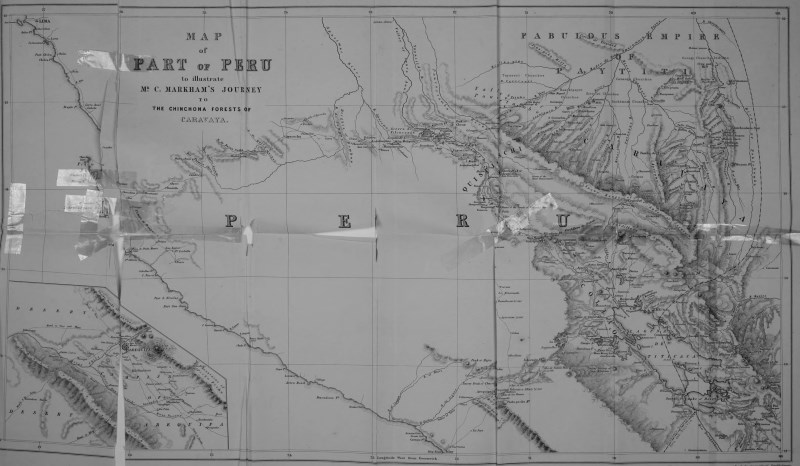
MAP
of
PART OF PERU
to illustrate
Mr. C. MARKHAM'S JOURNEY
TO
THE CHINCHONA FORESTS OF
CARAVAYA.