Iohn Lewis
Burckhardt. Ætat. 24. Etched by Angelica Clarke, from the
original drawing by Slater. Published as the Act directs,
Decr, 1, 1819, by Iohn Murray, Albemarle
Street.
BY THE LATE
JOHN LEWIS BURCKHARDT.
PUBLISHED BY
THE ASSOCIATION FOR PROMOTING THE
DISCOVERY OF THE INTERIOR PARTS OF AFRICA.
WITH MAPS, &c.
LONDON:
JOHN MURRAY, ALBEMARLE STREET.
1819.
PRINTED BY W. BULMER AND CO.
CLEVELAND ROW, ST. JAMES’S.
THE ASSOCIATION FOR
PROMOTING THE DISCOVERY OF THE INTERIOR PARTS OF
AFRICA.
THE COMMITTEE.
The Marquis of Hastings, K. G.
The Earl of Morton, K. T.
The Earl of Aberdeen, K. T.
The Earl Spencer, K. G.
The Earl of Caledon.
The Right Hon. Charles Yorke.
The Right Hon. Sir Joseph Banks, G. C.
B.
Lieutenant Colonel Leake.
William Hamilton, Esq.Secretary.
The Earl of Carlisle.
Sir Everard Home, Bart.
The Earl of Carysfort.
Richard Payne Knight, Esq.
The Right Hon. Lord Clive.
The Right Hon. Lord Lovaine, M. P.
Robert Chaloner Esq. M. P.
Thomas Legh, Esq. M. P.
Thomas Coutts, Esq.
John Maitland, Esq.
The Earl of Darnley.
John Motteux, Esq.
Sir Harry Englefield, Bart.
The Earl of Mountnorris.
The Hon. and Rev. Francis Egerton.
D. L. North, Esq. M. P.
The Right Hon. Lord Gwydir.
William Morton Pitt, Esq. M. P.
The Rev. Thomas Gisborne.
James Rennell, Esq.
George Gostling, Esq.
Henry Salt, Esq.
The Earl of Guildford.
The Reverend William Smelt.
The Earl of Hardwicke, K. G.
John Symmonds, Esq.
George Harrison, Esq.
Sir William Watson, Bart.
The Earl of Harrowby.
William Wilberforce, Esq. M. P.
The Marquis of Hertford, K. G.
Roger Wilbraham, Esq.
Charles Hoare, Esq.
Right Rev. the Bishop of Winchester.
Henry Hoare, Esq.
The Right Hon. Lord Yarborough.
Henry Hugh Hoare, Esq.
CONTENTS.
Memoir on the Life and Travels of John Lewis
Burckhardt.
No. II. Some Notices on the Countries of
Soudan, west of Darfour; with Vocabularies of the Borgho and Bornou
Languages; collected at Cairo from Negroe Pilgrims.
John Lewis
Burckhardt was of an eminent family of Basle, but born at
Lausanne. He was the eighth child of John Rodolph Burckhardt,
commonly called Burckhardt of Kirshgarten from the name of his
mansion in the city of Basle.
Burckhardt of Kirshgarten began life with the best prospects,
but they were soon blighted by the French revolution; from the very
beginning of which he became involved in a series of dangers and
difficulties, which at one time had nearly brought him to the
scaffold. On the accusation of having been concerned in betraying
the Tête-de-pont at Huningen to the Austrians, when they besieged
that fortress in the year 1796-7, he was tried for his life by the
French party at Basle; and although, in consequence of the
undoubted proofs of his innocence brought forward upon his trial,
he was released from prison, he found it impossible to remain in
the power of the French, as he had certain information of his being
upon the list of those who were to be destroyed either by open or
secret means. He entered into a Swiss corps in English pay, but was
under the necessity of leaving his wife and children at Basle, to
save the family if possible from total ruin. Here his son Lewis
Burckhardt was a daily witness of the misery suffered under the
republican French, and here he imbibed, at a very early age, a
detestation of their principles, and a resolution never to bend
under their yoke. It was his wish to serve in the armies of some
nation which should
be at war with France; but he was first desirous of completing his
education, which with the exception of two years in an
establishment at Neuchatel, had been hitherto under the care of a
person residing in his father’s house.
In the year 1800, being then 16 years of age, he was carried by
his father, Colonel Burckhardt, to the university of Leipzig, from
whence after a stay of near four years he was removed to Göttingen.
In both places his exemplary conduct and high feelings of honour,
his distinguished talents and ardent zeal for knowledge, ensured
him universal esteem and respect; while a remarkable frankness,
cheerfulness, kindness, and evenness of temper, made him
particularly beloved by his more intimate acquaintance. After
leaving Göttingen in 1805, he returned to his father, and remained
also a short time with his mother at Basle. Uncertain what plan to
pursue, unable to find upon the continent any nation which was not
either subject to the French or in alliance with them, and having
for these reasons rejected an offer made to him by one of the royal
courts of Germany to enter the diplomatic line, he resolved at
length upon proceeding to England, in the hope of meeting some
opening to his wishes in the service of this country. He arrived in
London in the month of July, 1806, bringing with him several
excellent letters of introduction, among which was one to Sir
Joseph Banks, from Professor Blumenbach of Göttingen. The President
of the Royal Society had long been an active member of the
Committee of the African Association, which at that time had more
than begun to despair of any further intelligence from Mr.
Horneman, and in the following year received an account of the
death of another of their travellers, Mr. Henry Nicholls, at Old
Calabar, in the bight of Benin, where he was preparing himself for
an expedition into the interior country.
The result of the information obtained by the travellers of
the Association on the
Western side of Africa, compared with that transmitted by Mr.
Horneman from the North, had now rendered it advisable to make a
new attempt in the latter direction. These wishes of the
Association soon became known to Burckhardt, through his
acquaintance with some of the leading members. To a mind equally
characterised by courage, a love of science and a spirit of
enterprise, such an undertaking afforded peculiar attractions, and
accordingly it was not long before Burckhardt made an offer of his
services to Sir Joseph Banks and the Rev. Dr. Hamilton. The latter,
who was at that time Treasurer and acting Secretary of the
Association, perceiving him to be undismayed by the strong
representations of danger, which it was peculiarly right to make to
a person of his birth and education, and having found him admirably
adapted to the undertaking by his natural and acquired talents, as
well as by the vigour of his constitution, laid his offer before
the Association at the next general meeting in May, 1808. The offer
was willingly accepted, and Burckhardt received his instructions on
the 25th of January, 1809, having diligently employed the interval
in London and Cambridge in the study of the Arabic language, and of
those branches of science which were most necessary in the
situation wherein he was about to be placed. He allowed his beard
to grow and assumed the Oriental dress: he attended lectures on
chemistry, astronomy, mineralogy, medicine and surgery, and in the
intervals of his studies he exercised himself by long journeys on
foot, bareheaded, in the heat of the sun, sleeping upon the ground,
and living upon vegetables and water.
As an intimate knowledge of Arabic was the most important of all
acquirements, our traveller was instructed to proceed in the first
instance to Syria, where at the same time that he studied the
language in one of its purest schools, he might acquire a habitude
of Oriental manners at a distance from those countries which were to be the scene of
his researches, and consequently without much risque of being
afterwards recognised. After a stay of two years in Syria, he was
instructed to proceed to Cairo, from whence, accompanying the
Fezzan caravan to Mourzouk by the same route traversed by Horneman,
he was directed to make that town the point of his departure for
the interior countries.
On the 2d of March, 1809, Burckhardt sailed from Cowes on board
of a merchant ship, proceeding with convoy to the Mediterranean,
and he arrived at Malta in the middle of April, from whence he
addressed two letters to Sir Joseph Banks, of which the following
are extracts:
Extract of a letter dated Malta, April
22, 1809.
You will be much interested in hearing that at this moment an
attempt is making to explore the Interior of Africa; and that I
have, unknowingly, entered upon my expedition as rival to a
gentleman who is probably by this time in the scene of action. I
was allowed the perusal of a letter from Dr. Seetzen to Mr. Barker,
who is a merchant of Malta, and brother to the British Consul at
Aleppo. Dr. Seetzen is a German physician, who was sent five or six
years ago by the Duke of Saxe-Gotha into the Levant, to collect
manuscripts and Eastern curiosities. He has resided for a
considerable length of time at Constantinople, at Smyrna, at
Aleppo, at Damascus, and for the last eighteen months at Cairo,
from whence his letter to Mr. Barker is dated on the 9th of
February last. After remarking that he had sent off from Cairo to
Gotha a collection of fifteen hundred manuscripts and three
thousand different objects of antiquity, he informs Mr. Barker that
he is waiting for the next caravan to set out for Suez; that he
means to go down the eastern coast of the Red Sea, and then
entering Africa to the southward of the line, to explore its
interior parts. Such are his expressions.
The late Bey of Tripoli is at present a fugitive at Malta: he is
a much respected old man; his name Akhmed Karamaly: five or six
years ago he was dispossessed of his throne by his brother, the
present reigning Bey. I take Akhmed to be the Bey mentioned in
Horneman’s letters. He has at length come to a compromise with his
brother, who has ceded to him the province of Derna, and promises
not to molest him there, provided he keeps quiet himself; and
Akhmed is now going to take possession of his new territory. I had
never heard before that Derna was a dependency of Tripoli; the
country was generally, I think, supposed to be inhabited by free
tribes of Arabs. It is much to be regretted that the whole extent
of that coast, from Mesurata to Derna, and almost as far as Alexandria, should
still remain unsurveyed; no accurate soundings have been taken
along the shore, and its inland parts, even those nearest the sea,
are totally unknown. I am assured that there are three safe
anchoring places between Derna and Alexandria; the harbour of
Bomba,[1] formed by an island lying
across the bay, is particularly spoken of as able to contain almost
any number of ships and of any size. When the French fleet, under
Admiral Gantheaume victualled Corfu last year, and escaped the
vigilance of Lord Collingwood’s cruising squadrons, they were hid
for some time, with their fore and top masts struck, behind the
island of Bomba, and were passed unnoticed. The Malta pilots are
perfectly well acquainted with all the inlets of the coast, but
their intelligence is little to be depended upon, because the
safety of many of their privateers depends upon an exclusive
knowledge of that part of the Mediterranean. An English traveller
might, under the protection of the governor of Malta, and of the
new sovereign of Derna, who is said to be very much attached to
this country, visit with great personal safety, the ancient site of
Berenice, Cyrene, and the gardens of the Hesperides.
Some account of the recent eruption of Mount Ætna has probably
already reached you; until you receive a detailed description of
it, even such a superficial account as I have received from
different quarters may perhaps prove acceptable to you. It was from
the letter of an English gentleman who was on the spot, that I
obtained the following account.
The time of the first eruption is not mentioned, but on the 27th
of March, Messina was covered with ashes and cinders early in the
morning. The children said it rained black snow. No earthquake
seems to have been felt. A new crater, approaching in size to that
of the Monti Rossi, had been formed; and in the neighbourhood of
it, seven or eight small ones; they lie in the direction of
Lingua-grossa, about three or four miles from that place, and at an
equal distance from Castiglione. On the other side of the mountain,
over Nicolosi and over Randazzo, two other craters have opened; the
old crater at the summit was also smoking, so that the whole
mountain seems to have been in combustion. The principal stream of
lava took the slope towards Franca Villa and Castiglione; its
breadth varied, according to the shape of the country, from twenty
yards to one mile. On the steepest part where the lava was most
liquid, it flowed between three and four miles an hour; at other
places, and particularly where it approached the vineyards of
Franca Villa, its rate was only about fifty yards during the same
space of time. As it ran down a very woody country, the breaking
down of the forest and its ingulphing in the fiery waves are
described as a most sublime spectacle. On the 12th of April the
eruption had nearly subsided, but the inhabitants, for whose relief
the English had raised a subscription, were in dread of new
eruptions.
Extract of a letter dated Malta, 22nd
May, 1809.
I am proceeding from hence to Aleppo as an Indian Mohammedan
merchant, the supposed bearer of dispatches from the East India
Company to Mr. Barker, British Consul, and the Company’s well known
Agent at Aleppo. As such I am recommended to the British Consul at
Cyprus, a Greek; and as such I shall find means to excuse my
present irregularity of speech and manners. I shall escape the
exaction of the custom-house officers, be protected on the road,
even by the country authorities, and shall soon be lost in the
crowds of Aleppo.
During my stay here, I have succeeded in equipping myself
thoroughly in the Oriental fashion. The dress I have taken is
somewhat Syrian, yet sufficiently differing from the real Syrian
costume, to shew that I have no wish of passing for a native. I
have practised as much as was in my power the speaking of Arabic,
and have reason to believe that none of my secrets have transpired.
I have lived out of the way of intruders, and of being taken notice
of, in the lodgings of Lieutenant Corner of the navy,
Harbour-master, to whom, as well to Mr. Chapman, the Public
Secretary, and Mr. Peter Lee, I am under infinite obligations for
the help and advice which they have given me. Sir Alexander Ball
has been very kind to me upon every occasion, and seemed much
interested in the success of my travels. Circumstances would not
allow me often to call at the palace, which his friendly and
instructive conversation, whenever I did call, rendered a matter of
great regret to me. (...)
A singular misrepresentation prevails in Europe respecting this
island, namely, that the greater part of the soil is imported from
Sicily; and it has even been said, that by these importations the
soil is completely renewed every ten years. I believe it would be
difficult to produce a single instance of earth having been brought
over from Sicily. To make the soft and friable limestone, of which
the island consists, fit for agriculture, they break through it to
the depth of twelve or fifteen feet. A sort of rough cistern from
six to eight feet high, often running under the whole length of the
field, is then constructed with part of the stones which have been
taken out; large fissures are found in the rocks full of earth;
this is taken out, and is sufficient to cover the cistern to the
height of four or five feet; the rest of the stones are used for
buildings, and to construct a wall round the field, which prevents
the soil from being washed away by the torrents of rain in the
rainy season, at the same time that it shelters the fig and olive
trees planted within the wall from the violence of the wind. The
whole island is covered with these enclosed fields, whose soil is
very fertile. The mistaken notion alluded to, may arise perhaps
from the following circumstances. Ships and boats coming here from
Sicily often take in ballast at that island, consisting of sand,
mixed perhaps with some earth, which, when they arrive here, they
are obliged to carry to a particular part of the harbour, to
prevent its being thrown overboard and choaking the anchorage. Or perhaps the
frequent importation of terra puzzolana, which is in common use to
make cement, and which when landed may have been mistaken for
earth, may have given rise to the assertion.
The government of Malta is at this moment a curious mixture of
English and Maltese authority. As yet the island does not belong to
England. The islanders having, with the assistance of Sir Alexander
Ball, who was then a captain, obliged the French garrison at
Valetta to surrender, applied to the British government for
assistance in the further defence of their island, against the
attempts that might be made by the French, and the Knights; and
they offered in return, to give up the government and the
revenue.
In consequence of this proposal, Sir Alexander was sent to them
soon afterwards, as his Majesty’s Civil Commissioner. After the
peace of Amiens, when the island was to be restored to the Order,
he was appointed Minister Plenipotentiary to the Court of the Grand
Master. The Court however never resumed its existence, though it is
still nominally recognised; all the English resident here,
excepting of course the military, are judged by Maltese laws and
courts of justice, at the head of which is a Maltese president, but
the decisions are submitted to the approbation of the civil
governor, who in capital cases may reprieve the criminal. All civil
situations, except three or four, appointed from home, are in the
patronage of the governor, but are exclusively held by natives. It
is by this policy, and by totally excluding military law, that the
hearts of the people have been gained. It may well be worth while
to do so, for the Maltese are an independent high spirited people,
however they may have been represented by the Knights. In the time
of their rising against the French, they formed a well disciplined
corps of 15,000 men, the greater part of whom were expert
sharp-shooters.
The port of Valetta has lately been declared a free port, and
this will render it for a long time to come the centre of trade
from Gibraltar as far as Odessa. The numerous Greek traders find
themselves better protected here than in their own islands. Here
are no greedy custom-house officers nor interested kadis to share
their profits, but they find that justice is dealt to them with the
same equity as to the first London merchants, and that even the
England home trade does not enjoy greater privileges than their
own. The island of the Archipelago which sends out the greatest
number of ships is Ydra; they are well built, armed and manned.
Government monopolizes the corn trade of the island, and engages
in return to sell the corn at a fixed price. A supply for two or
three years consumption for the whole population is always kept in
the fortress.
The former Pasha of Tripoli, whom I spoke of in my last letter,
is gone to Derna, under convoy of a brig which Sir Alexander sent
with him. His ship was moored for a whole day close under my
window, which afforded me a fortunate opportunity of
prying unobserved into
the Moors’ private manners, and behaviour to each other; and even
the short history of one day became very instructive to me.
You may well conceive that I avoided all intercourse with these
persons from Barbary. I often met parties of them in the streets,
but the “Salem aleik” given and returned, was all that passed
between us. The trade between Malta and Barbary, especially that
with Tripoli and Tunis, acquires daily more vigour and stability.
Even the English merchants begin to enter into it; hitherto the
Moors and the Maltese have chiefly had it in their hands. The
Tunisians, besides bartering in the Mediterranean for themselves,
are also shippers for others, and enterprising smugglers with the
enemy’s ports. During my passage from Gibraltar, being above six
miles to the westward of Cape Toro in Sardinia, five Tunisian
vessels passed in the night close to our ship, standing right over
for the coast of France. Our Commodore was not near enough to see
them, nor was it thought advisable to make any signals.
It happens rather unfortunately, that a Swiss regiment in the
English service is in garrison here, to many of the officers of
which I am personally known: this has made me very cautious in
going abroad, and now, after a seven weeks residence, I have the
satisfaction to find that I have succeeded in passing unknown, and
unnoticed. The great intercourse between the Moorish merchants and
Malta, made it absolutely necessary for me to keep my travelling
plans very secret.
The next intelligence which the Association received from their
traveller was a detailed account of his progress from Malta to
Aleppo, in a letter dated from the latter place on the 2d of
October, 1809. The following copious extract contains all the most
interesting parts of it.
I have already had the honour to inform you, that I had settled
at Malta with a Greek, for my passage to Cyprus on board his ship.
A few hours before my departure, the captain called upon me to tell
me that the owner of the ship had changed his mind as to its
destination, that he himself had been ordered to go to Tripoly, but
that a friend of his, whom at the same time he introduced to me,
was on the point of sailing in his stead for Cyprus, and that he
had already put my baggage on board this other ship. Though
displeased with so preremptory a proceeding, I had no objection to
change my conveyance, both captains being known to Mr. Lee; but the
very moment I was embarking, the new captain told me that he was
not quite sure whether he should touch at Cyprus, his ship being
properly bound for Acre. I had now the option to wait at Malta,
perhaps another month or two, for an opportunity for Cyprus or the
coast of Syria, or to run the chance of disembarking at a place where there
was no person whatever to whom I could apply for advice or
protection. Luckily an Arab of Acre, then at Malta, happened to be
known to Mr. Barker, jun.; in half an hour’s time a letter for a
merchant at Acre, with another, in case of need, for the Pasha,
were procured, and I embarked and sailed the same morning, in the
hope of finding, when arrived at Acre, a passage for Tripoly
(Syria), or for Latikia. However, we were no sooner out of sight of
the island, than it was made known to me that the real destination
of the ship was the coast of Caramania, that the captain had orders
to touch first at the port of Satalia, then at that of Tarsus; and
that if grain could not be purchased at an advantageous price at
either of these places, in that case only he was to proceed to
Acre. My remonstrances with the captain would have been vain:
nothing was left to me but to cultivate his good graces, and those
of my fellow travellers, as the progress of my journey must depend
greatly upon their good offices. The passengers consisted, to my
astonishment, of a rich Tripolitan merchant, who owned part of the
ship, two other Tripolines, and two Negroe slaves. I introduced
myself amongst them as an Indian Mohammedan merchant, who had been
from early years in England, and was now on his way home; and I had
the good fortune to make my story credible enough to the
passengers, as well as to the ship’s company. During the course of
our voyage numerous questions were put to me relative to India, its
inhabitants, and its language, which I answered as well as I could:
whenever I was asked for a specimen of the Hindu language, I
answered in the worst dialect of the Swiss German, almost
unintelligible even to a German, and which, in its guttural sounds,
may fairly rival the harshest utterance of Arabic. Every evening we
assembled upon deck to enjoy the cooling sea breeze, and to smoke
our pipes. While one of the sailors was amusing his companions with
story-telling, I was called upon to relate to my companions the
wonders of the farthest east; of the Grand Mogul, and the riches of
his court: of the widows in Hindostan burning themselves: of the
Chinese, their wall and great porcelane tower, &c. &c. The
Tripolitan merchant, in his turn, regaled us with the wonders of
Soudan, of one nation which is in continual warfare with their
neighbours, of a nation of speaking sheep, of another of
necromancers, who lately defeated a whole army which the King of
Bornou had sent against them, &c. &c. Still there was
something instructive in his tales, as I learnt with certainty that
the yearly caravan intercourse between Fezzan and Tripoly is still
uninterrupted; in February 1809, a caravan from thence had arrived
at Tripoly; but the pilgrim caravans from Fezzan to Cairo and Mekka
have suffered greatly by the irruptions of the Wahabi. In a short
time I got upon a very friendly footing with the Tripolines. I had
taken but a scanty provision of eatables on board, consisting of
bread, rice, oil, dates, vegetables, and coffee. After the second
day, the wealthy Moor would not allow me to mess by myself; he
insisted upon my joining his mess, which was plentifully supplied
with all sorts of Barbary dainties. In return for his hospitality,
I was not backward with my manual labour whenever he wanted it. One
day we cleared one of his coffee bags of its rotten beans, to
prepare it for being shewn at Satalia to the buyers as a sample of
the whole stock: another day we killed a sheep, and made Barbary
sausages and Kuskusey; and among other things, we refitted the
foremast, which had been carried away off Candia. Provided there
was something to divert the passengers’ thoughts from my person and
affairs, I was contented. We made Candia on the 15th; sailed on the
15th and 16th along the southern coast, about ten leagues distant
from it: saw on the 17th Rhodes, at a great distance: entered the
next day the bay of Satalia, and anchored on the 19th in the port
of Satalia.
The bay is an inlet into the mountains of Caramania, which
surround it on the east and west side. Towards the north, where a
cliff about fifty feet high overhangs the bay, the country is
level. The port of Satalia is at the foot of the cliff, in the
bottom of the bay. The mountains on the western side, which we
passed very near, are of considerable height. Their highest ridge
was on the top covered with snow. I observed one of those mountains
apparently higher than the rest, whose foot touched the sea, on the
sides of which the snow was sparingly spread down to one third of
the mountain’s height; and this was on the 18th of June. They are
all barren; their shape and whole appearance is much the same as
that of the African mountains in the Straits of Gibraltar. The town
of Satalia is built partly upon the cliff, partly in the plain
which the cliff terminates; its gardens extend to about three or
four miles along the rocky shore. The town is separated from the
port and the few buildings which surround the landing place, by a
wall constructed on the top of the cliff; a narrow passage leads
from the beach up to the town, the gate of which is regularly shut
at sunset. The entrance of the harbour seems to have been defended
formerly by two towers, the ruins of which are still extant. The
inner harbour is small; a Turkish guard ship, four Arab vessels
from Damiat, five or six small country sailing boats, and our own
ship, crowded the whole space between the two ruined towers. There
is good anchorage in the larger outer bay, but no shelter against
the southerly winds. Two fine streams of spring water descend the
cliff on both sides of the landing place. As soon as we approached
the harbour a Turkish police boat came alongside of us, and the
Tripoline immediately went with the officer on shore. After we had
come to anchor we were informed that the plague was in the town,
and that the watch ship moored near us had two sick on board; and
though nobody had died in the town within the last fortnight, yet
all the principal Christian and Turkish merchants had left their
town houses, and were still living in their gardens. Of course our
captain would not allow any body to go on shore, and pressed the
Tripoline to return on board; but the latter having already
recovered once from the plague, thought himself quite secure from
any second attack, and treated the captain’s remonstrances very lightly.
He remained four days on shore, trading all the while for his own
account, without finding grain to purchase for the ship’s cargo.
During that time I went once on shore to see two bullocks killed
and weighed, which had been bought for the ship’s company; we
purchased besides some other fresh provisions, the whole at very
low prices: the two bullocks at fifty-five piastres, fowls at eight
paras, or about two-pence halfpenny each; seven eggs for one penny,
&c. &c. The Turks laughed much at the captain’s continually
warning them off from our persons, (yet it seems that both at
Satalia and here at Aleppo, the more prudent amongst them adopt
measures of precaution against the plague. I am told that at Smyrna
also they have followed the Franks’ example). On the evening of the
23d, having sold for his private account all the merchandize he had
on board, the Tripoline, accompanied by several Turks, made his
re-appearance along side our ship, and demanded forthwith to be
taken on board. A very ridiculous scene then took place. The
captain required that he should undress and wash himself in the
sea, and that his clothes should undergo a similar operation; the
Moor, on his side, insisted on washing only part of his clothes and
his body; and all his Turkish friends were of the same opinion; (an
aged Musselman thinks it a great shame to expose his body naked
except in the bath.) The contention lasted upwards of half an hour:
it being now dark he was at last prevailed upon to jump into the
sea, but nothing could persuade him to allow his clothes to be
washed, for fear of having them spoiled; they were afterwards
suspended at the rigging of the foremast, that the air might purify
them, and he recovered them after a three days quarantine. Our
captain thought he had now done his duty. He told me that upon his
return to Malta he should think himself justified in taking the
usual oath, that he had had no communication with any infected
place; and instead of a three months quarantine, which the ship
ought properly to undergo, he will only have to perform a
quarantine of forty days, like all other ships which come from
healthy parts of the Levant. We left Satalia the same evening.
Satalia is governed by a Pasha: the greater half of the population
consists of Greeks, who have got almost all the commerce into their
hands. Till three or four years ago there was a French Consul
resident in the town; in consequence of an avanie practised upon a
merchant under his protection he left it, and no European power has
since appointed a Consul at this place. The export trade consists
chiefly in corn, oil, and cotton. The country boats trade to Cyprus
and the coast of Syria. The Arabs of Damiat and Alexandria bring
rice, Mocha coffee, and sugar; those who were then lying in the
harbour purchased from us with great eagerness some coarse English
pocket handkerchiefs.
After we had left Satalia, we sailed for three days along the
coast of Caramania, and kept our course constantly ten leagues
distant from the shore. The chain of snowy mountains seems to
continue in a direction parallel with the shore. At the foot of
these mountains I
observed every evening thunder clouds and lightning; during our
stay in the port of Satalia we were twice refreshed by heavy
showers, though it was now the season when it very seldom rains in
other parts of the Levant. I suppose that the vicinity of the snowy
mountains, which rapidly condense the copious vapours arising from
the heated earth, give rise to these clouds. On the 26th, late at
night, we anchored in the roads of Mersin, a collection of villages
so called, situated to the west of Tarsus, about fourteen miles
distant from it. The next morning some of us went with the
Tripoline on shore, where we found a party of about twenty
Turkmans, encamped under and around a single tent; they were
selling grain, with which the buyers loaded several camels. After a
short parley the chief of the party led us to his village, about
two miles distant. We remained there the whole day in the chief’s
house, couched upon carpets, which were spread upon a terrace
sheltered from the sun by the shade of two large mulberry trees. We
returned to our ship in the evening; and spent the next four days
in the same manner with these hospitable people.
An Aga is at the head of this Turkman tribe; he commands about
twenty-five villages, over each of which he appoints a chief to
collect the revenue, which is equally divided between the Chief and
the Aga. Many of these chiefs are Greeks, who by their long
residence with the Turkmans have completely adopted their manners.
Their dress is the same, excepting the red cap, which the Greeks do
not wear; and but for that mark it would be impossible for a
stranger to distinguish them from their masters. The Turkmans are
continually moving about on horseback from one village to another;
they are tolerably well mounted and well armed, each with a gun,
two pistols, a poignard, and a sabre. They never go but armed, but
it seems to be chiefly from ostentation, for they live at peace
with the inhabitants of the neighbouring villages, have nothing to
fear from straggling Arab tribes, and have no opportunity of
attacking travellers or caravans, which never pass this way. They
occupy the whole plain, which extends in length from Cape Bajarre
to beyond Tarsus; its breadth extends from the sea to the lowest
ridge of the mountains of Caramania, and varies from four to five
or ten miles. This plain, at least as much as I saw of it in my way
to Tarsus, is for the greater part sown with barley and wheat;
where it is left uncultivated, numerous herds of buffaloes and fine
cattle feed upon the wild grass. Wild capers grow in great
abundance. I found in several rivulets small tortoises, and amongst
the ruins of deserted houses we got here and there sight of a
zerboa. The Tripoline having made his purchase of grain from the
Aga, the latter sent on board our ship three fat sheep in earnest
of his engagements. In six days the ship was to begin loading. The
Tripoline being at leisure during this time, I persuaded him to go
with me to Tarsus, in search of a further conveyance for me by sea
or land; one of the other Tripolines was likewise desirous of
looking out for a passage for Beirout; the excursion was therefore
soon agreed upon. We
formed a small caravan, and set out on horseback on the morning of
the 30th. The road from our anchoring place to Tarsus crosses the
above mentioned plain in an easterly direction: we passed several
small rivulets which empty themselves into the sea, and which, to
judge from the size of their beds, swell in the rainy season to
considerable torrents. We had rode about an hour, when I saw at
half an hour’s distance to the north of our route, the ruins of a
large castle, upon a hill of a regular shape in the plain; half an
hour further towards Tarsus, at an equal distance from our road,
upon a second tumulus, were ruins resembling the former; a third
insulated hillock, close to which we passed midway of our route,
was overgrown with grass, without any ruins or traces of them. I
did not see in the whole plain any other elevations of ground but
the three just mentioned. Not far from the first ruins, stands in
the plain an insulated column. Large groups of trees shew from afar
the site of Tarsus. We passed a small river before we entered the
town, larger than those we had met on the road. The western outer
gate of the town, through which we entered, is of ancient
structure; it is a fine arch, the interior vault of which is in
perfect preservation: on the outside are some remains of a
sculptured frieze. I did not see any inscriptions. To the right and
left of this gateway are seen the ancient ruined walls of the city,
which extended in this direction farther than the town at present
does. From the outer gateway, it is about four hundred paces to the
modern entrance of the city; the intermediate ground is filled up
by a burying ground on one side of the road, and several gardens
with some miserable huts on the other. We led our horses to the
Khan of the muleteers, and went ourselves to the Khan of the
merchants, where we found tolerable accommodation, the brother of
the Tripoline being known here. Our room was soon filled with all
the foreign merchants who lived in the Khan, and the principal town
merchants; we sold to them a few silk handkerchiefs and coarse
cambrick, and were plagued with their company for the whole
remaining part of the day. The foreign merchants were a party of
Kahines, several Aleppines, and some Constantinopolitans. In the
evening the alley at the gate of the Khan was transformed into a
dark coffee room, where every body went to smoke a pipe. As we were
strangers, we were greeted at our entrance with the usual
politeness of Orientals towards travellers; “Peace be with you, you
are welcome among us, how are you? God send you a happy evening,
&c. &c.” were compliments which every one whom we
approached addressed to us. We were treated by several merchants
with pipes, coffee, ice-water, and Bour, which latter drink is
water mixed with the juice of liquorice. The ice is brought from
the mountains three days journey distant, at the price of three
piastres for about five pounds. A tolerable singer sung some
Turkish airs, and accompanied himself upon a sort of mandoline.
Many questions were addressed to me about my person and affairs: my neighbour the
Tripoline took the trouble of answering them to the satisfaction of
the company. “Allah Kerim,” “God is great,” was their usual
exclamation at hearing that I came from so far. We retired rather
late: for my part I had been much entertained with the party. We
went to sleep before the door of our room, upon a covered terrace
built of wood, which runs along the interior circuit of the Khan.
Before sun rise every body was up; some of the merchants descended
into the court yard to perform at the fountain the ablutions which
are prescribed to the Musselman after his night’s rest. But in this
part of their religious rites, as well as in the performance of
their daily prayers, I observed much indifference amongst the
plurality of the Turks I saw here, as well as of those with whom I
travelled afterwards from Suedieh to Aleppo. Amongst the latter
were many who, during eight days, did not pray once: even two
Hadjis, who had performed the Mekka pilgrimage, were of that
number. Some would pray once, others twice a day, before sun rise,
and after sun set; only three or four of the caravan were strict in
regularly chaunting the three daily prayers, to which number the
Koran limits the duty of travellers; but I did not find that more
respect or deference was paid to them than to the others.
We remained in the Khan that morning, and quitted the town at
noon to return to our ship, leaving the Tripoline behind to settle
our affairs. The little I saw of Tarsus did not allow me to
estimate its extent; the streets through which I passed were all
built of wood, and badly; some well furnished bazars, and a large
and handsome mosque in the vicinity of the Khan, make up the whole
register of curiosities which I am able to relate of Tarsus. Upon
several maps Tarsus is marked as a sea town: this is incorrect; the
sea is above three miles distant from it. On our return home we
started in a S. W. direction, and passed, after two hours and a
half’s march, Casal, a large village, half a mile distant from the
sea shore, called the Port of Tarsus, because vessels freighted for
Tarsus usually come to anchor in its neighbourhood. From thence
turning towards the west, we arrived at our ship at the end of two
hours. The merchants of Tarsus trade principally with the Syrian
coast and Cyprus: Imperial ships arrive there from time to time to
load grain. The land trade is of very little consequence, as the
caravans from Smyrna arrive very seldom. There is no land
communication at all between Tarsus and Aleppo, which is at ten
journeys (caravan travelling) distant from it. The road has been
rendered unsafe, especially in later times, by the depredations of
Kutshuk Ali, a savage rebel, who has established himself in the
mountains to the north of Alexandretta. Tarsus is governed by an
Aga, who I have reason to believe is almost independent. The French
have an agent there, who is a rich Greek merchant.
On the following day the Tripoline rejoined us; he had taken, to
my great satisfaction, a passage for me on board a Greek sailing
boat from Tripoli of Syria.[2]
That vessel was at anchor at Casal, and according to its master’s
affirmation was bound for Latikia, which was exactly the place
where I wished to land. I left our ship on the second of July; in
taking leave of the Tripoline I took off my sash, a sort of red
cambric shawl, of Glasgow manufacture, which he had always much
admired, thinking it to be Indian stuff, and presented it to him as
a keepsake or reward for his good services. He immediately
unloosened his turban, and twisted the shawl in its stead round his
head: making me many professions of friendship, and assuring me of
his hospitality, if ever the chance of mercantile pursuits should
again engage me to visit the Mediterranean, and perhaps Tripoli in
Barbary. The time I hope may come, when I shall be enabled to put
his assurances to the test. (I think I forgot to mention, that the
Tripoline was much skilled in languages, which enabled me freely to
converse with him; besides his native Arabic tongue, he spoke
Turkish, Greek, and Italian.) The vessel on board of which I now
embarked, was an open boat with three masts, about thirty-five feet
long, and nine broad, much resembling the representation of the
Germs of the Nile, which Bruce and other travellers have given.
These vessels are very common on the Syrian coast; where they are
called Jackdur. I had engaged to pay for my passage twenty-five
piastres, at my arrival in Latikia, but was no sooner with my
baggage on board, than the master informed me that he meant to
proceed to Antakia (Antiochia) not to Latikia, and that I was at
liberty to return to my own ship, if I did not choose to go his
way. I thus found myself duped a second time, though I had most
distinctly agreed for my passage to Latikia. However, there being
no other conveyance to the coast of Syria at hand, I resolved to
remain on board. I was afraid of being kept in these parts, until
after the return of my old ship for Malta; when I should have
nobody to recommend me to those, in whose company I might continue
my way; I knew moreover, that there was a brisk intercourse between
Antakia and Aleppo. There had not been for some time, any
opportunity from Tarsus to the opposite coast. A crowd of
passengers came therefore on board. I counted fifty-six men and
women lying upon deck, besides six sailors, and six horses in the
ship’s hold. We had each just as much space allowed, as the body
covered, and remained in this state two nights and one day. In
general the passage is performed within the twenty-four hours.
On the morning of the 5th, we entered the bay of Suedieh, which
is formed on one side by the promontory called Ras Khanzir, on the
other by another projecting rocky mountain; both are the
extremities of chains of barren rocks, which I conceive to be the
remotest branches of the Libanus. These mountains come down to the
water’s edge on
both sides of the bay; in the bottom of it, where the Orontes now
called Aasi empties itself into the sea, begins a level country of
four or five miles in width and length. It is to the whole of this
tract of level land, which contains several villages, that the name
of Suedieh is applied, though that appellation is also given
sometimes exclusively to the port.
The wind being favourable we entered the river, and anchored,
after half an hour’s sailing through its sinuosities, at Mina, the
port of Antakia, where the ship was laid close to the shore, where
the elevated banks of the river form a kind of quay. Mina is a
miserable village built close to the river’s right bank, consisting
of about seven or eight houses, the best of which serves as a place
of residence to the Aga, whom the Aga of Antakia appoints to
receive the duties upon exports and imports. Higher up than Mina
the Aasi is not navigated; the navigation is rendered impracticable
by rocks, though there is plenty of water. Here, at the last stage
of its course, it is a fine slow-flowing river, much about the size
of the Thames beyond Richmond bridge; its waters are muddy, and
this being the case in the month of June, three or four months
after the rainy season, I suppose they can hardly be clear during
any other part of the year.
Arrived at Suedieh, I found myself very uncomfortably situated.
I had lost my friend the Tripoline, and though he had warmly
recommended me to the master of the Jackdur, yet I found the crew
of the vessel to be thievous and treacherous; they spread the
rumour amongst the people of Suedieh that I was a Frank, and as the
ship was immediately to return to Tarsus, I expected to find myself
completely at the mercy of the inhabitants; amongst whom, as well
as amongst the crew, there was nobody who understood the Italian,
or, as they called it, the Latin tongue. I remained on board the
ship that day and the following; and was bargaining for a horse and
mules to take me to Antakia, when, to my great satisfaction, a
caravan from Aleppo came down to the coast with Indian goods; I
soon got acquainted with the muleteers, and made my bargain with
one of them for the whole journey, from Suedieh to Aleppo. He first
asked fifty piastres per Kantar قنطار (about five-hundred pounds English weight). I got
him down to thirty, and was afterwards informed at Aleppo, that I
should not have paid more than twenty-five. It is a great point
gained by travellers in these countries, if they can make with
their mule or camel drivers the usual bargain of the country. If
the muleteer overcharges them, he makes a boast of it wherever he
goes, the traveller is immediately known to be a person little
conversant with the customs of the country, and he may be sure to
be dealt with accordingly, in every respect, wherever the
mule-driver accompanies him. I was helping the servants to
distribute my baggage into mules loads, and to tie it round with
cords, when the Aga sent for me. I found him smoking his pipe in a
miserable room, surrounded by his people; entering the room I pulled off my
slippers, and sat down on the floor before him. I shall here remark
that it is a custom most strictly adhered to, never to sit down
upon a carpet, or even a mat, and in presence of a man of rank, not
even upon the bare floor, without pulling off the slippers, and if
a person has but one pair on his feet, which is the Moggrebyn and
the Greek fashion, he must sit down bare footed.
After I had drank a dish of coffee, I asked the Aga what his
pleasure was; he answered me, by making a sign with his thumb and
forefinger, like a person counting money. I had several chests for
the British Consul at Aleppo with me, and had also marked my own
baggage with the Consul’s name, thinking by these means to prevent
its being examined. He asked me what the chests contained, I
expressed my ignorance about it, telling him only, that I thought
there was a sort of Frank drink (beer), and some eatables, which I
had been charged with at Malta, for the Consul, on my way home. He
sent one of his people to look over their contents; a bottle of
beer had been broken in loading, the man tasted it by putting his
finger into the liquor, and found it abominably bitter: such was
his report to the Aga. As a sample of the eatables, he produced a
potatoe which he had taken out of one of the barrels, and that
noble root excited a general laughter in the room, “It is well
worth while,” they said, “to send such stuff to such a distance.”
The Aga tasted of the raw potatoe, and spitting it out again, swore
at the Frank’s stomach which could bear such food. The other trunks
were now left unexamined; and I was asked fifteen piastres for the
permission to depart with them. I gave him ten piastres, and
received from him a sort of receipt for that money, because I told
him that without it, the Consul would never believe that I had
really paid down the money as duty upon his effects. The Aga was
very high in his expressions, talking of his grandeur, how little
he cared about the Sultan, and still less for any Consul, &c.
He laughed a great deal at my Arabic, which certainly was hardly
intelligible; but he did not much trouble himself with questions
about my affairs, his mind seeming now solely taken up by the hope
of extorting money from the Aleppine merchants, and so I left him,
and soon afterwards, about an hour before sunset, departed from
Suedieh, with part of the caravan, the rest intending to pass the
night there. The road from Suedieh to Antakia crosses the plain for
about one hour’s distance. On the right runs in a deep bed a branch
of the Aasi, and forms in this place several islands; on your left
extends the well cultivated plain of Suedieh.
As we approached the mountains which inclose the plain on the
western side, we passed several extensive and regularly planted
orchards, belonging to the Aga of Antakia; the road now lay through
lanes thickly overhung on both sides with shrubs, and I was
entering a country famous for the beauties of its landscape
scenery, when the sun shed its last rays. We continued our way in
the dark for about one hour and a half longer, and halted near a
rivulet, at the entrance of the hills, where men and horses were
fed: we remained there till about two hours after midnight.
From thence the
road leads over a mountainous and rocky ground, abounding with
trees and springs. At the break of day we passed a village and a
considerable rivulet flowing towards our right; one hour’s march
further another rivulet; the country then opens, and the traveller
finds himself upon the ridge of a high plain, encompassed by the
two beforementioned chains of mountains, from which he descends
into the valley which the Aasi waters, and where he finds Antakia
very picturesquely situated, near the foot of the southern chain of
mountains, surrounded with gardens and well sown fields. It was yet
early in the morning when we passed the river and entered the town;
a strong built bridge leads over the river immediately into the
town gate. I was stopped at the gate, and asked for one of the two
pistols, which I wore in my girdle; I had told the people of the
caravan that they belonged to the English Consul. My muleteer
assured me that the pistol would be restored, I therefore gave it
up voluntarily, well convinced it would have been forced from me
against my will. The Aga’s man brought it back in the evening, I
was asked two piastres for the returning of it; they had taken the
flint, and the powder from the pan. Arrived at Antakia, the
muleteer led his mules to the Khan of the muleteers; I might have
gone to the Khan of the merchants, but having no body to accompany
me and introduce me there, I preferred staying with the muleteers,
whose way of living I also wished to see. The Khan is a large court
yard built in a triangular shape: the basis of the triangle is
distributed on both sides of the entrance door into small dark
cells, which serve as magazines for the goods, and as places to
cook in. On another side are the stables; and the whole length of
the third side is taken up by a terrace built of stone, about four
feet elevated from the ground, and eight feet broad, where the
muleteers eat, sleep, and pray, that side of the Khan being built
in the direction of Mecca. In the midst of the yard is a large
water bason, which affords drink to men and beasts
indiscriminately.
My entrance into the Khan excited considerable curiosity, and
the little cell I took possession of was soon beset by troublesome
enquirers, who unanimously declared that I was a Frank come to the
country for evil purposes. I had nobody to take my part except my
muleteer, whose remonstrances in my behalf were soon lost in the
general cry of Djaour (infidel) raised by the other inhabitants of
the Khan and by the town’s people, who came to visit their
friends.
Whenever I could get any of them to listen to me for half an
hour, I found means to appease them, but the town’s people did not
even condescend to speak to me, and I evidently saw that their plan
was to make religion a pretext, for practising an avanie upon me.
My property fortunately was mixed with that of the Consul; a spare
shirt and a carpet constituted my whole baggage; besides a pocket
purse, containing the money necessary for my daily expenses, I had
about twenty sequins hidden upon me. The Aga of Antakia sent his Dragoman to get
something out of me. This was a wretched Frank, who pretended to be
a Frenchman, but whom I should rather suppose to be a Piemontese. I
pretended complete ignorance of the French language, he therefore
asked me in Italian minutely about my affairs, and how I could
attempt to travel home without any money or goods, to defray the
expenses of the journey. I answered that I hoped the Consul, in
remuneration of my having carefully watched his effects, would pay
the expense of a camel from Aleppo to Bagdad, and that at the
latter place I was sure of finding friends to facilitate my farther
journey. When the man saw that nothing in my manners betrayed my
Frank origin, he made a last trial, and pulling my beard a little
with his hand, asked me familiarly “Why I had let such a thing
grow?” I answered him with a blow upon his face, to convince the
by-standing Turks, how deeply I resented the received insult; and
the laugh now turned against the poor Dragoman, who did not trouble
me any farther. I am at a loss to state how far I succeeded in
sustaining my assumed character; I thought that the major part of
the caravan people were gained over to my side, but the town’s
people were constant in their imprecations against me. I had been
flattered with an immediate departure for Aleppo, but the caravan
was detained four days in the Khan. During the whole time of our
stay, I spent the day time in the cell of the goods, amusing myself
with cooking our victuals; the town’s people, though often
assembled before the door of the room, never entered it; in the
evening the gates of the Khan were shut, and I then went to sleep
with the muleteers upon the terrace.
I was relieved from this unpleasant situation on the 10th, when
it was decided that the caravan should depart. The muleteers began
preparing for their departure by dividing the whole court into
squares of different sizes, by means of ropes, at the end of which
iron wedges are fastened, which are driven into the earth up to
their heads; each muleteer takes one of these squares proportionate
in size to the number of his beasts; and loads them in it. Though
the ropes are little more than one inch above ground, the animals
never move out of the square assigned to them, and thus great order
prevailed in the Khan, though it was dark when we loaded, and the
whole court crowded with beasts and bales. At halting places when
the beasts are fed, the same ropes are extended in front of them,
to prevent their getting amongst the baggage.
I cannot say much of Antakia, having seen nothing of it but the
streets through which I entered. It looks like a neat town, at
least in comparison to Tarsus: living is only half as dear as it is
in Aleppo. This circumstance, joined to the beauty of the
surrounding country, and the proximity of the sea would make it a
desirable place for Franks to live in, were it not for the
fanaticism of its inhabitants, who pride themselves upon being
descendants from the Osmanlis the conquerors of Syria. Last year at
a tumult raised
at Suedieh, these Osmanlis murdered the Greek Aga of Suedieh with
his whole family, and a young French physician, who had come to his
house to cure his son. The Aga of Antakia is appointed by the Grand
Signior, and is independent of any Pasha.
We marched the whole night of the 10th over a plain country, and
reached early the next morning Hamsin, a village situated at nine
hours march from Antakia, on the right bank of the Orontes. We
passed the river in a ferry boat: its banks on both sides are about
forty feet high at this place; its breadth is near fifty yards, the
depth no where more than five feet. On a little eminence a few
hundred paces from the ground on the river’s side where we
encamped, rises a spring of excellent water; my companions however,
drank of the muddy water of the Orontes, in preference to taking
the trouble of filling their flasks at the spring. One of the
merchants had a tent with him, under the shade of which we passed
the whole day. In the evening the village youths kindled a large
fire, and amused themselves with music and dancing. The next day we
passed a chain of calcareous mountains planted here and there with
olives; on the top of one of these mountains lives a custom-house
officer, who exacted a toll from each individual, as it was said,
in the name of the Grand Signior. The descent on the eastern side
is steep, but the mules walked with the greatest firmness. In the
valley into which we descended lies the town of Ermenaz
(ارمناز,) watered by several
streams. Though small, it is one of the best towns in this part of
Syria; its gardens are cultivated with great care, and its
inhabitants are industrious, because they are out of the immediate
reach of rapacious Pashas and Janisaries. They work a glass
manufacture which supplies Aleppo. The olives of the country round
Aleppo are, next to those of Tripoly, the best in Syria: its grapes
are likewise much esteemed. As we rode by, I saw lying on the right
hand side of the road near the town, a broken ancient column of
about four feet in diameter, and I was told afterwards in Aleppo,
that many like remains of antiquity are to be met with in the
neighbourhood of Ermenaz. At half an hour’s distance from this
latter place we again began to mount, and the path became difficult
and tiresome for the beasts, from the number of detached rocks with
which it is overspread. After nearly eight hours march (meaning the
whole day’s work), we descended into the eastern plain of Syria,
and encamped at the foot of the mountains, round a large tree in
the vicinity of a copious spring. Whenever the beasts were
unloaden, it was with much difficulty that I could prevent my
luggage from being thrown upon the ground. The caravan people in
this country, and I should suppose every where else in the East,
are accustomed to loads of bales of goods, which do not receive any
injury from letting them fall to the ground. The loads on each side
of the beast are tied together over its back, by a cord. Arrived at
the halting place, the first thing the muleteer does, is to go from
mule to mule to unloosen that cord; the loads then fall to the
ground. This mode of unloading, and the great carelessness of these people, render
the transport of many European commodities utterly impracticable,
without their being accompanied by a servant sent along with them,
for the express purpose of taking off the loads. A Frank merchant
of Aleppo received some years ago a load of Venetian
looking-glasses which were all dashed to pieces. Provided the
chests which contain the merchandize be entire, the muleteer thinks
himself free from responsibility. We were joined in the evening by
some other travellers, whose curiosity led them to new inquiries
about my person and affairs. None of my companions had till now
found out any thing which could have directly inculpated myself;
they however kept a strict watch over all my motions: being obliged
at night to go aside, two of the travellers last arrived followed
me unseen, and pretended afterwards to have observed some
irregularities in the ablutions necessary to be performed on such
occasions; in consequence of which, I was told that I was “Harām,”
or in a forbidden unclean state, and notwithstanding every thing I
said to defend and excuse myself, I found that from that time I had
lost the good opinion of all my companions. We marched the next day
six hours, and halted at Mart Mesrin, a village belonging to
Ibrahim Pasha, who in the time of Djezar was Pasha of Aleppo,
afterwards Pasha of Damascus, and who lives now in disgrace and
poverty at this place, the whole appearance of which makes it
probable, that in a few years hence it will be deserted by its
inhabitants. The wide extended plain over which we marched this day
consists almost throughout of a fertile soil, but without any
trees, and in most places uncultivated, but where a number of
ruined and deserted villages, indicate that many parts of it must
have formerly been cultivated. Having been much plagued during this
whole day by my fellow travellers, and in the evening also by the
peasants, who had collected round the caravan; I swore that I would
not eat any more with any of them. This declaration being somewhat
in the Arab style, they were startled at it; and my muleteer
especially much pressed me to rejoin their mess; I assured him that
I would rather eat nothing and starve, than have any further
friendly dealings with men who professed themselves my friends one
day, and proved my enemies the next, (it should be observed that
this was the last stage of our journey, I therefore did not run
great risk in making good my words). The tract of country over
which we passed on the following day was similar in appearance to
that which we had seen on the preceding. The number of deserted and
ruined villages increased the nearer we approached Aleppo; we had
marched about eight hours when we discerned the castle of Aleppo,
at the sight of which the armed horsemen of the caravan set off at
a gallop, and repeatedly fired off their guns; the merchants put
themselves ahead of the caravan and after one hour’s march farther,
we entered the town. All merchandizes coming to Aleppo must be
taken to the custom-house Khan ترك
خان; they are weighed there to determine the amount of the
sum due to the muleteer for freight, and a duty must be paid for
them to the Grand Signior, which together with the taxation money of the
Christians and Jews, is the only branch of revenue which the
Janissaries, the present masters of the town, still allow the Porte
to retain. The English consular house is in that very Khan.
I was now arrived at Aleppo in a shape which entirely left it to
my option, either to continue in my disguise, or to avow my
European origin. After a long conversation on that subject with Mr.
Barker, I was convinced that it would better answer the purpose of
my stay in Aleppo to choose the latter, and my reasons for it were
the following: at the time I left England and Malta, I imagined
that the intercourse between Cairo and Aleppo was frequent, and
that it might easily happen, that Cairine merchants might see me
here and recognise me afterwards at home, or that travelling
Aleppines who knew me here, might afterwards see me again in Egypt.
The departure of the Syrian pilgrim caravan to Mecca, not having
taken place for the last three years, has almost annihilated the
commercial intercourse overland between the two countries. At the
meeting of the Syrian and African caravan near Mecca, Egyptian
merchants used formerly to join the former, and return with them to
Damascus and Aleppo, and vice versa; at present the little commerce
carried on between Cairo and Aleppo, is entirely in the hands of a
few Turkish and Greek houses at Tripoli, Latikia, and Alexandria,
and the Egyptian merchants themselves never come to Aleppo. Had I
continued in my disguise, and continued to live exclusively amongst
the Turks, opportunities would have frequently happened to put the
veracity of my story to the test. East Indians come from time to
time to Aleppo with the Bagdad caravan, and many of the Bagdad and
Bassorah merchants established at Aleppo have been in India. My
person would have been infinitely more noticed than it now is, if
taking a shop in the bazar, as I first intended, I should have
exposed myself to the curiosity of the whole town; I should have
entirely foregone the instruction to be derived from books and
masters skilled in the language; and moreover I have no doubt that
the French Consul residing here would have heard of my arrival, and
have done every thing to put my pursuits in a dubious light. These
are the reasons which convinced me, that for the present time it
was more advisable to appear in a shape which would preclude the
intrusion of curious inquirers; and afford more facility to my
studies. I continue my name of Ibrahim, and pass in my Turkish
dress unnoticed in the crowds of the street and the bazars. The
Consul receives me at his house as a travelling country merchant of
his; and as it frequently happens that people coming into the
Levant change their names; nobody wonders at my being called with
an oriental name. I had first my doubts whether my fellow caravan
travellers might not be over inquisitive here; but such of them as
I have since met, greeted me without further questions, and the
government of the city is now such, that a man picking a quarrel
with me about what I might have told him at Antakia, would only
expose himself to be fined for a sum of money by the Janissaries, the masters of
the town, for their trouble to settle the business with the
Consul.
My plans for the present are to remain at Aleppo the whole of
the winter and part of next summer. I have been fortunate enough to
find a good and willing master of Arabic, and I hope to make
progress in the study of the literal as well as vulgar language. As
soon as I shall be able to express myself with some precision in
the vulgar dialect, and perfectly to understand it, I shall visit
the Bedouin Arabs in the Desert, and live with them some months. I
can do this in perfect security; and I have no doubt that you will
approve of it, as it will afford me the best opportunity of
practising the manners and becoming acquainted with the character
of a class of people who are the same, whether they over-run the
deserts of Arabia or those of Africa.
You need not be afraid that the history of my own person, which
has taken up so considerable a portion of the preceding pages, will
any more be exhibited before you at such a length. I thought it
might be of some interest to the Association, to see how far I was
able to succeed in making good my way to Aleppo in the disguise in
which I left London; unaided as I was by a knowledge of Eastern
languages, or a familiarity with Eastern manners. This trial has so
far been satisfactory to me, that, in the first place, I am
persuaded that nothing of my pursuits has transpired at Malta,
which will always be of material consequence to me; secondly, in
being landed at a remote corner of Syria, I have avoided the
general intercourse of a mercantile seaport, such as Acre, Beirout,
Tripoly, or Latakia; and finally, it has created within me the
confidence that whenever I may be able to call in support of a
similar disguise, a fluent utterance of Arabic, and a habitude of
Oriental manners, I shall easily find means to triumph over such
obstacles as those I met with in the Khan at Antakia.
A few days after my arrival at Aleppo, I was attacked by a
strong inflammatory fever which lasted a fortnight. The want of
night’s rest occasioned by the quantity of vermin which had
collected upon my person, principally during my stay in the Khan of
Antakia, was, as I thought, the cause of it. I have enjoyed perfect
health since that time, and the climate agrees with me better than
I expected.
Aleppo, October 2nd, 1809.
Mr. Burckhardt remained two years and a half in Syria, making
daily additions to his practical knowledge of the Arabic language,
and to his experience of the character of Orientals, and of
Mohammedan society and manners. His principal residence was at
Aleppo. Having assumed the name of Ibrahim Ibn Abdallah at Malta,
he continued to bear it in Syria; but apprehensive of not having
yet had sufficient experience, thoroughly to act the
part of a
Mussulman, and finding no necessity for such a disguise at Aleppo,
he was not studious to conceal his European origin, and wore only
such a Turkish dress, as is often assumed in Syria by English
travellers, less for the sake of concealment than to avoid
occasional insult. Thus he had the benefit of an unmolested
intercourse with the Mussulman population of Aleppo, at the same
time that he was not prevented from openly accepting the friendship
and protection of Mr. Barker, the British Consul, nor under the
necessity of denying himself the social resources afforded by the
houses of the European residents; especially those of Mr. Barker,
and of Mr. Masseyk, formerly Dutch Consul. Of his obligations to
the former of these gentlemen, he omitted no opportunity of bearing
testimony.
Besides two short tours which he made from Aleppo, he was absent
from thence in the year 1810, for six months, during which time he
visited Palmyra, remained three months at Damascus, and from thence
made two journeys into the neighbouring districts; one through the
Libanus and Anti-Libanus, and the other through the unexplored
country of the Haouran, or Auranitis. After his final departure
from Aleppo, in February 1812, he again made some stay at Damascus,
and performed a second journey in the Haouran, including a part of
the ancient Decapolis. Upon quitting Damascus for Egypt, he visited
Tiberias and Nazareth, and from thence having crossed to the
Eastern side of the Jordan, proceeded through the countries to the
east and South of the Dead Sea, until he arrived at Wady Mousa,
where he had the satisfaction of discovering the remains of a large
ancient city, consisting of a great number of buildings and
monuments excavated in the rocks, a singularity which, added to the
testimony of ancient history, marks the place for the site of
Petra, the capital of Arabia Petræa. From Wady Mousa he pursued a
westerly course towards the capital of Egypt, across the valley of
Araba, and the desert of El Tyh.
A sketch of his travels in Syria is communicated in
letters which
he addressed from time to time to Sir Joseph Banks, or to Mr.
Hamilton, Secretary of the Association. The following are extracts
of the most interesting parts of this correspondence.
Aleppo, May 12, 1810.
With the present I transmit to you in duplicate a short sketch
of the recent history of Aleppo, and some notices concerning the
Turkmans Rihanli, which I collected during a visit to them in the
beginning of March last. They are a tribe of Nomade Turkmans, who
encamp in winter time at one day’s journey from Aleppo. I got
myself introduced to one of their chiefs as a physician in search
of medicinal herbs, and spent a fortnight amongst them.
I am now so far advanced in the knowledge of Arabic, that I
understand almost every thing that is said in common conversation,
and am able to make myself understood on most subjects, although
sometimes with difficulty. I have made acquaintance with some
Shikhs, and some of the first literati amongst the Turks of Aleppo,
who from time to time visit me. I owe this favour principally to
Mr. Wilkins’s Arabic and Persian Dictionary. The common manuscript
dictionaries, or Kamus, being generally very defective, the learned
Turks are often very glad to consult Wilkins, and never do it
without exclaiming “How wonderful that a Frank should know more of
our language than our first Ulemas.” Learning at Aleppo is in a
very low state; no science, the Turkish law excepted, is properly
cultivated; not even that of Arabic grammar, which is so necessary
to the interpretation of the Koran. I am assured by the best
authority, that there are now in this town only three men, (two
Turks and a Christian) who know this language grammatically. The
chief quality of a literary man is that of getting by heart a great
number of verses made upon different occasions, and of knowing the
proper opportunity of reciting them; to this must be added, a
knowledge of the different learned significations of one and the
same word, and of the words which express the same idea. For
example, the word Adjuz, which in common language means a decrepid
old man, has in the learned language about sixty other different
significations; and there are in Arabian poetry about one hundred
and fifty different words for wine. But to interpret passages of
difficult grammatical construction, or rationally to amend errors,
or even to compose prose or verse free from grammatical blunders,
is a task much above the capacity of an Aleppine Ulema.
Two Persian Dervishes arrived here about two months ago, who had
lived upwards of two years at the Wahabi court of Derayeh. I got
acquainted with one of them, a young man of twenty-two; the other
has gone to Mosul, from whence his companion shortly expects his
return. The latter has been in the habit, singular enough for
a Mohammedan
traveller, of keeping a regular journal of his travels, describing
whatever struck his inquisitive mind, and abounding, as I
understand, with geographical notices.
Another traveller of a singular description passed here two
years ago. He called himself Aly Bey, and professed to be born of
Tunisian parents in Spain, and to have received his education in
that country. Spanish appears to be his native language, besides
which he spoke French, a little Italian, and the Moggrebyn dialect
of Arabic, but badly. He came to Aleppo by the way of Cairo, Yaffa,
and Damascus, with the strongest letters of recommendation from the
Spanish Government to all its agents, and an open credit upon them.
He seemed to be a particular friend of the Prince of the Peace, for
whom he was collecting antiques; and from the manner in which it
was known that he was afterwards received by the Spanish ambassador
at his arrival in Constantinople, he must have been a man of
distinction. The description of his figure, and what he related of
his travels, called to my recollection the Spaniard Badia and his
miniature in your library.[3] He
was a man of middling size, long thin head, black eyes, large nose,
long black beard, and feet that indicated the former wearing of
tight shoes. He professed to have travelled in Barbary, to have
crossed the Lybian Desert between Barbary and Egypt, and from Cairo
to have gone to Mekka, and back. He travelled with Eastern
magnificence, but here he was rather shy of shewing himself out of
doors; he never walked out but on Fridays to the prayers of noon,
in the great mosque. One of the beforementioned Dervishes told me
that there had been a great deal of talking about this Aly Bey, at
Damascus and Hama; they suspected him of being a Christian, but his
great liberality and the pressing letters which he brought to all
the people of consequence, stopped all further enquiry. He was
busily employed in arranging and putting in order his journal
during the two months of his stay at Aleppo.
Aleppo, 2nd July, 1810.
My long stay in Syria having been determined upon, in
consequence of the absolute necessity of my familiarising myself
with the idiom of these countries, I shall deem it my duty to send
you from time to time some vouchers of my application to Arabic
literature. I have for some time past been engaged in an Arabic
exercise, which has proved of great utility to me; it is the
metamorphosis of the well known novel of Robinson Crusoe into an
Arabian tale, adapted to Eastern taste and manners. A young Frank
born at Aleppo, who speaks Arabic like a native, but who neither
reads nor writes it, has been my assistant in the undertaking. I
take the liberty of sending you here inclosed a copy of this
travestied Robinson, or as I call the book in Arabic, Dur el Bahur,
the Pearl of the Seas. Of the merits or defects of the translation
I can claim at most forty per cent.; the handwriting excepted,
which is my own.
I am on the
eve of leaving Aleppo for an excursion into the Desert, and shall
probably set out the day after to-morrow. My good luck conducted
some days ago an Arab Shikh to town, who is the mightiest chief of
all the Arabs between Aleppo, Damascus, and Bagdad. He came for the
purpose of receiving in person the passage duties upon certain
goods which are shortly to be sent by means of a great caravan to
Bagdad. He belongs to the wide extended tribe of the Aenezy, who
have all become Wahabi; his own very powerful tribe is called the
Tedhan, and his name is Duehy Ibn Ryeiben. I easily got acquainted
with him; we ate and drank together, and I succeeded in making an
agreement with him, that he should take me by way of Tedmor or
Palmyra home to his family and tents, which he says are not far
from Damascus in the plain of Haouran; he himself came to Aleppo
accompanied only by a few people upon dromedaries. He is to shew me
his tents and horses, of which latter I told him the English Consul
here might be perhaps induced to buy some upon my recommendation;
and he is then to set me down at Damascus.
He is known to all the principal Bagdad merchants of this town,
and my agreement with him has been made in writing, signed by the
most respectable of these merchants, as witnesses; I am so far in
perfect tranquillity as to the security of my person under his
protection. He is indeed a famous robber, but the Shikhs of the
Desert have never been known to withdraw their protection from
those to whom they have promised it.
Damascus, August 15, 1810.
The Arab Shikh mentioned in my last kept true to his engagements
only during the two first days of our journey. Instead of
conducting me, on the third day, in person, to Hamah, he gave me
one of his men as a guide. Returning the next day towards the
watering place seven hours east of Hamah, where we had left the
Shikh, we were attacked and stript by a party of Mawáli Arabs, who,
unfortunately for me, happened to be engaged in a quarrel with the
Aenezy tribe of the Shikh. A watch and compass were the only
articles I regretted to have lost; as to cash, I had not a single
farthing in my pocket. We returned to the town, to refit ourselves
as well as possible, and then set out again the next night, to
rejoin our chief. The latter had however in the interval left the
watering-place; we were obliged to run after him in the Desert for
thirty-six hours, and finding him at last at another watering-place
he declared to me that he could not possibly conduct me himself any
further, because his people had very much pressed his return,
afraid as they were of the approaching Wahabi. In reply to my
remonstrances, he offered me another guide to take me to Tedmor,
and from thence to the Haouran. With this guide I reached Tedmor
after a march of thirty hours, and contemplated the wonders of the
Palm city for nearly two days. The Shikh of Tedmor, in consideration of my empty
purse, contented himself with taking my saddle from me. Leaving
Tedmor we reached by a forced march Kariatein in one day, and from
thence Yerud, a village about twelve hours to the N. E. of
Damascus. Duehy, the Arab chief, had passed there a few days
before, and knowing that my guide would likewise take that route,
he had left at the village-Shikh’s house, an open letter to my
address, in which he peremptorily told me not to proceed any
farther in my journey towards the Haouran, but to go direct to
Damascus, because he was determined to fly with his tribe away from
the Wahabi. The fact was, that he did not wish to feed me under his
tents for two months, according to our contract. Convinced that the
whole was but a trick, I insisted upon proceeding in the original
direction. My guide, however, refused to accompany me; he even left
me in the evening; there were no other trusty people present to
guide my steps through the Desert, I was therefore at last obliged
to follow Duehy’s advice, and came to this place with a salt
caravan from Tedmor, which I had found at Yerud. Two days after my
arrival Duehy likewise made his appearance, and there being nobody
present to take up my cause against him, I was obliged strictly to
fulfil the stipulations of our contract, which he on his side had
thus shamefully eluded.
Notwithstanding these disappointments, which often occur to
travellers in these countries, my tour to Tedmor has given me much
satisfaction. Besides the pleasure of seeing those interesting
ruins, I have had some good opportunities of observing the Bedouins
under their own tents; we alighted every day at different
encampments, and were every where received with hospitality and
kindness.
I should have put my project of visiting the Haouran in
execution, even before now, had not the recent changes in the
government of this city, and the state of suspense which it
naturally occasions, in the districts depending upon it, rendered
the roads insecure, and the inhabitants more than usually
suspicious of strangers, until the new Pasha shall have had time
firmly to establish himself in his newly acquired territory. A few
days after my arrival at Damascus, Yussef Pasha, who had governed
the town and its territory for the last four years, was turned out,
and his place occupied by Soleiman Pasha of Akke (Acre.) This
change being connected with the interruption of the pilgrim caravan
to Mekka, and with the late Wahabi affairs, some details concerning
it may perhaps be thought acceptable. As to the state of the Wahabi
power in the southern parts of Arabia, I must confess that I am in
perfect ignorance of it. Without being an eye witness, or meeting
by chance with a credible eye witness, it is impossible to guide
oneself through the labyrinth of false reports, which policy,
fanaticism, and party spirit spread on their account. To mention
but one instance: at my leaving Aleppo the general voice was, that
the Wahabi were at the gates of Damascus.
It is now the sixth year since the Damascus pilgrim caravan,
which included the Hadjis of the greatest part of the
Turkish dominions, has not been able to reach Mekka. In 1805,
Abdallah Pasha, then Pasha of Damascus, set out at the head of a
caravan; having arrived in the neighbourhood of Medineh, the Wahabi
governor of that city, by orders of Ibn el Saoud the great Wahabi
chief, refused entrance to the caravan. The Hadjis were obliged to
pass on the outside of the walls, and thus continued their way
towards the Kaaba. They were yet three days journey from it, when
they found themselves surrounded by the innumerable host of Saoud’s
army. The two parties came to a parley, when Saoud declared to the
Pasha, that he should thenceforward suffer no Turkish army to march
through his territory, and that the army must therefore immediately
return; but that those Hadjis who were determined to complete their
pilgrimage might continue their way in safety, on condition that
they should go unarmed, and promise to stay only three days at the
holy city. None of the pilgrims were tempted to accept the offer of
a free passage. Abdallah himself, frightened by the Wahabi numbers,
made Saoud conceive hopes that he would be a convert to the new
religion. Before he returned, it was stipulated that in case of any
caravan taking its departure the following year, there should be
neither Pasha nor army to convoy it; that all the Hadjis should be
unarmed and without ammunition; that there should be no Mahmal (the
camel which carries the new carpet for the decoration of the
Kaaba); and that arrived at the same place where they then were,
Saoud should have the right of selecting the individuals who were
to proceed, while the others should wait there for the speedy
return of their brethren. It is said that Abdallah Pasha was
obliged by his officers to give his consent to these shameful
articles. He insisted upon their attesting with their signatures
that he had declared his determination to appeal to the sword, but
that he was prevented from doing so, by their unanimous opinion
that it was better not to shed blood. The Hadj returned to Damascus
and Constantinople, and Abdallah sent the attestation of his
officers to Constantinople, to excuse his retreat. Instead of
recruiting and strengthening his forces, and protecting the next
year the caravan with an army capable of forcing its way through
the Wahabi tribes, Abdallah set out in 1806, with a corps not
exceeding 8000 men, and a very small caravan of Hadjis. They were
met, at three days journey from Mekka, by the Sherif of Mekka, who
is a subject of the Wahabi. He told them that he had positive
orders to refuse to any armed force the entrance into the holy
city; but he again offered to let the unarmed Hadjis complete their
pilgrimage. It is said that Abdallah had beforehand entered into
some secret negociations with the Sherif, and that the latter had
declared his wish to join the Pasha, with the Mekka people, against
the Wahabi; thinking, of course, that the Pasha would not hazard
the Hadj, without being accompanied by a considerable force; but
that when he saw the small number of the troops and the
mutinous spirit
which reigned amongst them, he remained true to his former
engagements with Ibn Saoud.
Abdallah returned to Damascus a second time, without having been
able to accomplish the pilgrimage, which he had formerly led
fifteen times to Mekka and back to Damascus. He soon afterwards
fell into disgrace with the Grand Signor, when Yussef Aga, an
upstart, who from the rank of a simple soldier, had raised himself
to the first dignities in the town, was named Pasha of Damascus.
His military temper and courage were known, and he had promised to
conduct the Hadj. It may be necessary to explain here the policy of
the Pasha of Damascus and of the Porte respecting the Hadj. The
Miri, or land tax, of the Pashaliks of Damascus and Tripoli, which,
according to the original assessment amounted to about 3500 purses,
(it is now worth more than triple that sum,) has been abandoned to
the Pasha of Damascus for the necessary expense of the Hadj; and to
the Pasha of Tripoli for the expense of the Djerde, or caravan of
provisions, which meets the Hadjis on their return. Besides these
3500 purses, the Pasha of Damascus contributes at least 1000 more,
out of his own treasury, because the expenses, particularly the
tribute paid to the Arab tribes on the pilgrim route, are yearly
increasing. Abdallah Pasha, who had already given apparent proofs
of his zeal for the Hadj, seeing the power of the Porte daily
decreasing, and knowing the terror which the Wahabi name had
inspired, thought that the time was come, when, without inculpating
himself, he might at last put a stop to the Hadj, and add its
expenses to the revenue of the Pashalik. For this reason, he
neglected to recruit the forces, which were to accompany the
pilgrims, as he might have done, if it had been his real intention
to favour the Hadj, and he returned the second year to prove to the
country that if he himself, who had so often led the Hadj to Mekka,
was no longer able to do so, certainly any other person who should
attempt it, would be equally unsuccessful. The Porte however
prevented his design; before the conclusion of 1806, Yussef Pasha
was named to the command of Damascus, and Abdallah Pasha, who was
much disliked in the town, peacefully retired to Aleppo, where he
lives now as a private grandee. Yussef Pasha governed the territory
of Damascus and Tripoli for four years, without once conducting the
caravan. What Abdallah had projected his successor executed; the
Miri, instead of defraying the expenses of the Hadj, or being
accounted for to the Porte, entered into the Pasha’s chests. In the
present degenerate and tottering state of the empire, the Porte has
forgot that the religious and fanatical spirit which is diffused
over its subjects by the visitors of the Kaaba, is perhaps the last
supporter of its political existence. She thinks no longer of the
religious importance of the pilgrimage; her troubles and cares are
all for money; as if money alone would uphold an empire.
Yussef
Pasha was the best Pasha Damascus ever had; his firmness and
justice kept the turbulent Damascenes in order; he never committed
avanies upon the inhabitants, and was respected and even liked by
every honest man. He had one vice however which the Porte never
forgives in its officers, that of avarice. Instead of transmitting
the greater part of the Miri to the Porte, who had a claim to it
all, as not being employed in the expense of the Hadj, the sums
carried by his yearly envoys to Constantinople, every thing
included, did not amount to more than fifteen hundred purses; he
thought himself sure of the attachment of his troops and the
country people; and slighted the Porte’s remonstrances.
It was under these circumstances that in May last the news
spread over the country, that Ibn Saoud, the chief of the Wahabi,
had left his head quarters at Derayeh at the head of an immense
army, with hostile intentions against Syria. Their arrival spread
general terror; the rich caravans which were expected from Bagdad
at Aleppo and Damascus were immediately countermanded; and although
there was no certain intelligence of the intended route of the
Wahabi, it was supposed that their first attempt would be upon
Damascus. Others, and perhaps better informed people, were of
opinion, that Saoud came to punish the Aenezy, who, divided into
more than one hundred and fifty different tribes, people the desert
as far as ten journeys to the east of Aleppo, Hamah, Homs, and
Damascus. The Aenezy had long ago been converted to the Wahabi
faith, but had for the last three years neglected to pay the fifth
or tribute, which Saoud exacts from all his followers.[4] At the same time, there were still several
tribes of Arabs, inhabiting the plains and mountains on both sides
of the Hadj route, as far as the eighth stage from Damascus, who
were not yet Wahabi, and their conversion might likewise enter into
Saoud’s plan. The Pasha of Damascus was glad to see fresh obstacles
arise to prevent the pilgrims from proceeding, and have a new
excuse to the Porte, for not transmitting the Miri, which he might
now be supposed to employ for his preparations against the
approaching enemy. The month of June passed away, and nothing sure
was yet known of the direction which Saoud had taken. In the
beginning of July, intelligence reached the town from Mezerib, a
castle on the third stage of the pilgrims route, that the Aga
commanding in the place had been attacked by swarms of Wahabi.
Yussef Pasha immediately left the town at the head of above 5000
men. Arrived at Mezerib he found that his officer had already
repulsed the attack, and that twelve of the enemy had been killed;
their heads were forthwith dispatched to Constantinople, and this
insignificant skirmish blazoned forth as an important victory. A
person who was
at that time with the Pasha at Mezerib has assured me, that the
corps of Arabs which attacked the castle consisted of about 800
men, mounted upon camels and armed with lances. Saoud, it was said,
had fixed his head-quarters, with the great body of his army, at
about two days journey from Damascus, amongst the encampments of a
Wahabi tribe called Shammar. The Pasha of Acre was now required to
send troops in aid of Yussef Pasha; the Emir Beshir, or chief of
the Druses, was addressed to the same effect, and Yussef Pasha
remained from the 9th of July till the 26th at Mezerib without so
much as seeing an enemy; but he had the mortification to hear that
Saoud’s vanguard had plundered and entirely destroyed seventeen of
the best villages of the Haouran, and massacred all the
inhabitants. Soleiman Pasha of Acre had meanwhile encamped with
about three thousand men at Tabaria, and the Emir Beshir had joined
him there with as many more Druses. The town of Damascus was in
perfect tranquillity, the fear of the Wahabis having already
subsided, when on the 25th a civil officer came to town with a
letter from Soleiman Pasha, addressed to the Kadi, Ulemas, and
Grandees of Damascus, including the copy of a Firman from the
Porte, by which Yussef Pasha was deposed, and Soleiman Pasha named
Pasha of Damascus. Soleiman had obtained his Firman by transmitting
considerable sums of money to Constantinople, by promising to
conduct the Hadj, or in case it should be absolutely impossible, to
remit the Miri, and at all events to send Yussef’s accumulated
treasures to the Grand Signor. Nothing was done in his favour at
Damascus but to deposit, as usual, a copy of the Firman in the
registers of the Mehkemeh, or court of justice. Yussef Pasha, by
forced marches, arrived three days after with his army, and ordered
several heads to be struck off. Soleiman Pasha with the Emir Beshir
likewise advanced, and the town was in expectation of some great
event. Luckily for its inhabitants Yussef Pasha’s avarice prevented
a civil war; instead of liberally distributing his treasures
amongst his troops, he only paid them a part of their arrears, upon
which the emissaries of Soleiman fomented the dissatisfaction which
began to break out, the principal officers were bought over, and in
a little skirmish that happened on the 31st, the troops of Yussef
loudly expressed their disinclination to fight their master’s
rival. By the sacrifice of his treasures Yussef Pasha might perhaps
have been able to sustain his cause. Being informed that Soleiman
was in possession of a second Firman which demanded his head, he
determined suddenly to fly. He was preparing to leave his Seraglio
in the night of the 1st of August, accompanied by about
eight-hundred chosen horsemen, with his treasure loaded upon
seventy mules, when his Arnauts, who were to have been left behind,
fell upon the loaded mules, part of which had already nearly gained
the town-gates, forced open the money chests and pillaged the
whole. The guard of eight hundred men, seeing there was now nothing
more to be gained in the Pasha’s service, deserted him, and the
broken hearted Pasha, who during four years had been the benefactor of Damascus,
was lucky in securing his retreat, with six or seven of his suite,
amongst a friendly tribe of Arabs in the neighbourhood of the city.
Soleiman made his solemn entrance into Damascus on the 5th of
August, and is now joint Pasha of three Pashaliks: Damascus, Acre,
and Tripoli, that is to say, he is in possession of almost the
whole of Syria, from Gaza to the vicinity of Aleppo and Antioch.
Soleiman Pasha is by birth a Georgian Christian; he was brought up
by Djezzar as a Turkish slave, and was much liked by his master,
who elevated him to the first situations, in his Pashalik of Acre.
After the death of Djezzar, Soleiman made himself master of Acre,
by expelling Ismael Pasha, who had succeeded Djezzar, and the Porte
soon after recognised him. He bears a good character, at least as
good as any Pasha can sustain without being made a fool of. His
principal favourite and counsellor is a rich Jew, named Haym, whose
talents had already been acknowledged by Djezzar. After having cut
off his nose and ears, and torn out one of his eyes, that monster
kept him for ten years a prisoner in his Seraglio, obliging him
during the whole time to conduct all his most important affairs.
Under Soleiman Pasha, Haym has governed Acre, and it is worthy of
remark, that at the very same time, the principal men of business
of Soleiman’s rival Yussef, were the two brothers and the cousin of
Haym, who are supposed to be the richest house in Damascus. Now
that Soleiman is Pasha of both places, the whole fraternity is
here, and the Jews of Syria may flatter themselves (as the
Christians here say) that Israel reigns again in his ancient
limits.
Nothing farther has transpired of the Wahabi; but it is easy to
foresee that Soleiman Pasha will soon raise again the Wahabi
war-cry.
Having had frequent occasions during my stay at Aleppo to
observe the deplorable state of the whole country round it, it has
been a very gratifying sight to me to witness the comparative ease
and I might even say wealth of the inhabitants of the territory of
Damascus. The neighbourhood of the city in particular is in a very
prosperous state, owing partly to the richness of the ground, which
is no where equalled in Syria, partly to the effect of Yussef
Pasha’s government, who during his whole reign never extorted any
extraordinary contributions from the peasant, and protected him
against the oppressions of minor tyrants. It is the misfortune of
the Turkish government, at least in its present decayed state, that
popular virtues in the persons of its governors are quite
incompatible with the Porte’s own views. The Porte demands
supplies, and nothing but supplies; and the Pasha, to satisfy her,
must press upon the industry of his subjects. He who is the
well-wisher of his people, who contents himself with the ordinary
revenue, and who lets justice preside in his councils, will
undoubtedly incur his sovereign’s displeasure, not because he is
just, but because his justice prevents him from plundering and
transmitting a portion of the acquired plunder to the Diwan. To
save his existence he has nothing left but silently to resign his
unhappy subjects to the rod of a succeeding despot, or to declare
himself a rebel and to contend with his rival until the Porte,
convinced of the difficulty of deposing him, patiently waits for a
more favourable opportunity of effecting her purposes. These
principles are applicable to all persons in office, from the Pasha
down to the Shikh of the smallest village; and it is to them that
the rapid decay of Turkey is chiefly to be ascribed. It requires
but one year’s reign of a man like Djezzar to destroy the benefits
of the four years government of a Yussef. The rapidity however,
with which ease and wealth are seen to reflow into the reopened
channels of industry, prove that Syria, on the downfall of the
Turkish empire, would soon regain its former lustre.
My last letter, of the 4th of July, from Aleppo, was accompanied
by an Arabic imitation of the well known novel of Robinson Crusoe,
arranged so as to suit the Arabian taste. I was desirous of giving
some proof of my application to the study of that language. I can
conscientiously say, that I have done, and still do, every thing in
my power to make myself master of it, but I must confess that I
find its difficulties out of proportion to the time which has been
allotted to me, to surmount them. I have no other motives in this
confession than the sincerest zeal to succeed in my travels to the
fullest expectations of the African Association. A two years
residence in Syria was thought sufficient to enable me to speak
with fluency. After one year’s stay, I think I may be
allowed to be able to calculate what remains yet to be done, and I
conclude that a twelve month more of study and practice is not
sufficient for the remaining task. I therefore take the liberty to
entreat the Committee to allow me six months more, over the already
granted two years, before I proceed to Egypt. If the Committee is
persuaded of the truth of what I advance, a delay of six months and
the expense accompanying it, will not be thought an object, nor
will it, I trust, be believed, that after the expiration of the
prolonged term, I shall again demand a farther delay. The
additional six months, however, is of the greatest importance to
me, because I know from experience that when once tolerably
conversant with a language, a short practice has a more rapid
effect than triple the time employed in getting over the first
difficulties. In case no distinct answer to this application should
arrive before next July, I shall look upon my proposition as
rejected, and strictly follow the tenour of my former
instructions.
Aleppo, January 6th, 1811.
I had the honour of writing to you from Damascus on the 15th of
August, 1810; soon after my arrival in that city from Palmyra. The
unsettled state of the government of Damascus obliged me to prolong
my stay there for upwards of six weeks. I again left it in the
middle of September to visit Baalbec and the Libanus. My route lay
through Zahle, a small but prosperous town on the western side of
the valley Bekaa, the ancient Coelosyria, and from thence to
Baalbec, where I remained three days; then to the top of the
Libanus, the Cedars and Kannobin, from whence following the highest
summits of the mountain, I returned to Zahle by the villages called
Akoura and Afka. Descending the Bekaa I proceeded to the Druse
territory of Hasbeya; this village is at the foot of Djebel el
Shikh, or Mount Hermon, and is famous for its wells of bitumen
judaicum and for the cinnabar found near it; from thence I went to
Banias, the ancient Cæsarea Philippi, where I saw some ruins, and
copied some inscriptions. At an hour’s distance from it is the
source of the river El Dhan (Jordan), in the plain of the Houle, or
lake Samachonitis. Three hours from it, upon the top of a mountain,
are the ruins of the ancient city of Boustra, mentioned in the holy
scriptures. I returned to Damascus over the chain of mountains
called Djebel Heish, which under the different names of Djebel
Adjoulan and Djebel Belkaa continues southerly along the eastern
borders of the Dead Sea. I remained this time only a fortnight at
Damascus; it was preparatory to an excursion into a region which
till a few years ago had never been visited by European travellers;
I mean the country called Haouran, the patrimony of Abraham, of
which Dr. Seetzen, the German traveller, had seen a part four years
ago, previous to his memorable tour round the Dead Sea. During a
fatiguing journey of twenty-six days I explored this country as far
as a five days journey to the south and south-east of Damascus; I
went over the whole of the Djebel Haouran, or mountain of the
Druses, who have in these parts a settlement of about twenty
villages; I passed Bosz ra (بُصره), a place likewise mentioned in the books of
Moses, and not to be confounded with Boustra, (بُستره); I then entered the desert to the
south-east of it, and returned afterwards to Damascus through the
rocky district on the foot of the Djebel Haouran, called El Ledja.
At every step I found vestiges of ancient cities, saw the remains
of many temples, public edifices, and Greek churches, met at Shohbe
with a well-preserved amphitheatre, at other places with numbers of
still standing columns, and had opportunities of copying many Greek
inscriptions which may serve to throw some light upon the history
of this almost forgotten corner. The inscriptions are for the
greater part of the Lower Empire, but some of the most elegant
ruins have their inscriptions dated from the reigns of Trajan and
M. Aurelius. The Haouran with its adjacent districts is the spring
and summer rendezvous of most of the Arab tribes who inhabit in
winter-time the great Syrian desert called by them El Hammad
(الحماد). They approach the
cultivated lands in search of grass, water, and corn, of which last
they buy up in the Haouran their yearly provision.
In my last letter from Damascus, I gave you some details
concerning the invasion of the Wahabi in July last, observing at
the same time that many people at Damascus were still in doubt
whether it was really a Wahabi corps, which had penetrated so near
to the principal seat of the Turkish power in Syria. My inquiries
upon the spots where they passed, place it beyond
any doubt that Ibn Saoud himself, the Wahabi chief, accompanied by
the Sherif of Mekka, headed the expedition, which consisted of
about six thousand men, mounted upon camels, together with about
four hundred horsemen. The camels were all females, whose milk
afforded drink to men and horses during their march from the Djof
(an assemblage of Wahabi villages, twelve days journey from Boszra)
to the Haouran, at a time of the year when no water is met with in
the desert. Ibn Saoud executed his plans in the true Arab style. He
remained only two days and a half in the cultivated districts of
the Haouran, over-ran in that short time a space of at least one
hundred and twenty miles, burnt and plundered near thirty villages,
and returned flying, loaded with booty, into the heart of his
dominions. The terror of his name was so great, that Yussef, the
Pasha of Damascus, did not dare to attack him while he defiled with
his loaded camels before the Pasha’s troops; but contented himself
with aukwardly firing off his field artillery. Many of the Wahabi
were armed with musquets. It is probable that Ibn Saoud will return
next year; an expedition conducted as the former was, will always
be successful, if no other means of defence are employed; the
Haouran people entertain great apprehensions of his return; a few
successful attacks will render the eastern borders of Syria
deserted, and the great Desert, which already daily gains ground
upon the inhabited districts, will soon swallow up the remaining
parts of the eastern plain.
After a short excursion to the Djebel el Shikh to the west of
Damascus, I returned from thence by Homs and Hamah to Aleppo, where
I arrived on the new year’s day.
During this six months journey I have gained some experience in
acting as well as in speaking. This indeed was the motive which
principally induced me to it, and although disappointed on my first
outset, yet I have no reason to be dissatisfied with the remaining
part of the journey. I am now occupied in working up my journal, of
which I shall send you the first part by the next opportunity for
Malta. It will contain my observations among the Arabs, and the
classification of about one hundred and fifty of their tribes. The
journal of my Haouran tour shall follow as soon as possible.
I am at last under the disagreeable necessity of telling you
that notwithstanding every economy in expense I have spent my last
farthing. I performed my travels throughout in the garb of a
pauper, (the Haouran tour for instance only cost me four pounds
sterling), yet some expense in feeding myself and my horse,
together with some occasional presents were unavoidable. I should
less regret the want of remittances if it was not for the
consideration that my stay in Syria might have afforded me
opportunities of laying out whatever I might have spared of my
appointments in manuscripts or objects of antiquity, an opportunity
which if lost now, may be lost for ever. I have lived for nineteen
months, since my leaving Malta, upon £170. the remainder of my
credit upon Mr.
Lee, and I shall now be obliged to accept Mr. Barker’s kind offers,
gradually to advance me the sums necessary for my livelihood, until
I may be enabled to reimburse him by the receipt of my salary from
the Committee.
Aleppo, May 3, 1811.
I am sincerely obliged to the Committee for having granted me a
six months prolongation of my stay in Syria.
I have the honour to transmit to you a parcel of papers
containing: 1. A classification of the principal Arab tribes near
the confines of Syria. 2. A treatise on Bedouin customs and
manners. 3. The journal of my tour into the Haouran. 4. The journal
of my tour over part of the Syrian mountains. 5. Some geographical
notices concerning the Desert. The geographical part of my journey
to Palmyra is too insignificant to be laid before you, as I was
deprived by the Arab robbers of the aid of my watch and compass; my
observations made among the Bedouins on my way to and from Palmyra,
you will find dispersed in my treatise on their manners; and any
researches at Palmyra itself, must be superfluous after the
excellent and most correct work of Wood and Dawkins. My tour into
the country of the Haouran might have been interesting on account
of its novelty, were it not for the account which the indefatigable
German traveller, Dr. Seetzen, must ere now have published of his
travels in these parts.[5] As
I have had opportunities of copying, in the Haouran villages, many
Greek inscriptions, it will be necessary to tell the reader of my
journal that the author’s knowledge of Greek is very superficial.
The excursion to Baalbec and over Mount Libanus towards the lake
Houle, was undertaken rather to gratify my own curiosity, than in
the hope of being able to gather new information in a country so
often travelled over by Europeans. The investigation of Bedouin
customs was a favourite object of mine, being convinced that their
civil institutions are still very imperfectly known in Europe,
although their social manners have often been described. In my
treatise on Bedouin customs I thought it necessary, frequently, to
subjoin the Arabic names, and sometimes, likewise the Bedouin
phraseology; because both greatly differ from the Syrian language.
If I had been in possession of some books descriptive of Arab
manners before Mohammed, such as Pococke, Schultens, &c. I
might have rendered my inquiries among the Arabs more useful, and
might have drawn some interesting parallels. Not having met with
any such works in Syria, I was contented faithfully to note down
what I myself saw or what I heard related by competent
witnesses.
Since the late change in the government of Damascus, Syria
enjoys perfect tranquillity, the whole of the country, excepting only the
territory of Aleppo, being now in the hands of Soleiman Pasha of
Damascus. It is said, that he is determined to set out next winter
with the Hadj, but I very much doubt whether he will be able to
make good this promise to the Porte. The Wahabi chief has been for
some time past embarrassed by domestic dissensions. Three of his
sons have become rebels; in December last they plundered a part of
their father’s treasures at Derayeh, while the latter was
sacrificing upon Mount Arafat near Mekka, and they have now retired
to the city of El Hassa, near the Persian gulf, where Ibn Saoud is
preparing to besiege them. At Aleppo the power is still in the
hands of the rebellious Janissaries. A few hundred of them set out
last summer to join the grand Vizier’s army before Adrianople, but
they returned at the approach of winter; these are the only troops
which the Sultan has been able to draw from Syria.
Aleppo, Sept. 7, 1811.
The most untoward circumstances have prevented until now my long
projected excursion into the desert towards the Euphrates. Since my
last, I have been continually endeavouring to find means to
re-enter the desert, with some degree of security, but the state of
the country has always thrown insurmountable obstacles in my way.
The neighbourhood of Aleppo has been infested since spring, until
about a month ago, by great numbers of Aenezy Arabs, who had
declared war against the towns people as well as against the Manali
Arabs, who are looked upon as the hereditary friends of the Aleppo
government. The Aenezy have ruined about forty villages, have eaten
up the whole harvest of the open country, and have rendered the
roads so insecure that nobody dares travel but in the company of a
large caravan. I repeatedly tried to take some of the Aenezy for my
guides, and had chosen one from each of the principal tribes who
surrounded Aleppo, as the only means left to me to execute my
design; but the exorbitant demands of these people greatly exceeded
my powers, and I was moreover informed that the Aenezy had declared
war upon the Arabs of the Zor, or valley of Euphrates, which was
exactly the country I wished to visit; I was therefore obliged to
wait till the Aenezy should have retired from this neighbourhood.
It is now about a month since they returned into the interior of
the desert, to meet the autumnal rains; and I am now on the point
of setting out. A caravan arrived here a few days ago from Sokhne,
a village in the desert, five days journey from hence on the Bagdad
route. The people of that village, together with the inhabitants of
Tedmor or Palmyra, bring to Aleppo once or twice every year alcali,
which they collect in the desert. The day after tomorrow the
caravan is to return to Sokhne, and I intend to proceed with it in
order to visit from thence Deir, the ancient Thapsacus, and several
ruined places which I have heard much spoken of. I intend to return if
possible along the shores of the Euphrates, although I am afraid
that the eternal quarrels of the Arabs of the Zor may put many
obstacles in my stay. The Shikh of Sokhne, to whom I am strongly
recommended, and to whom I carry some small presents, is a powerful
man in those parts, and will certainly take care of my safe return
to Aleppo; I shall then only remain as long in Aleppo as will be
necessary to copy my Journal and put it in order, and proceed to
Damascus, to trace my way from thence into Egypt round the Dead
Sea. My present tour will take up about seven or eight
weeks.[6]
My time at Aleppo has been exclusively taken up in endeavours to
enlarge my knowledge of Arabic. I have completed the perusal of
several of the best Arabic authors, prosaic writers as well as
poets; I have read over the Koran twice, and have got by heart
several of its chapters and many of its sentences; I am likewise
nearly finishing a thorough course of the precepts of the
Mohammedan religion, a learned Effendi having taken upon himself
the task of explaining to me the book of Ibrahim Halebi on the
religious laws of the Turks. This is the book upon which D’Ohsson
has grounded his excellent work.
There is no kind of political news in these parts. It is a long
time since we have heard of the Wahabi. Aleppo continues in the
hands of the Janissaries, but it is said that Gharib Pasha, whom
the Porte has lately named Pasha of Aleppo, is collecting in
Anatolia a considerable force to subdue these rebels. Damascus,
Tripoli, and Acre, are completely under the dominion of Soleiman
Pasha, but it is known that Mohammed Aly, Pasha of Egypt, spares
neither intrigues nor money to dispossess Soleiman at least of one
of his Pashaliks. The pilgrimage from Damascus to Mecca is again
put off for another year. There is a great scarcity all over Syria;
wheat has risen to an exorbitant price, and the two last years
having been remarkably dry, almost every kind of vegetable has
failed. The same quantity of wheat which at the time of my arrival
at Aleppo sold for six piastres and a half, is now worth
twenty-seven. Such scarcity makes travelling much less pleasant,
and the natives much less inclined to forward the stranger’s
purposes.
Damascus, May 30, 1812.
The last, which I had the honour to address you, was from
Aleppo. It was accompanied by a large chest of Arabic manuscripts.
Incessant rains delayed my departure from Aleppo, until the 14th of
February. I arrived on the 3d of March at Tripoli, and on the 22d
at Damascus. Being very desirous of visiting the Haouran once more
before I should leave Syria, in order to examine those parts which
I had not been able to see during my first tour through that
country, I set out with this object, as soon as I was satisfied of
the tranquil state of the Pashalik. I left this city on the 21st
April, and returned to it on the 9th May. One of the packets of
papers herewith inclosed contains my notes on this journey through
the Haouran, and part of the ancient Decapolis; the second consists
of my observations during the previous journey from Aleppo to
Damascus. The third paper contains corrections and annotations to
the description of Bedouin manners, which I hope has long since
reached you.
I intend to set out from hence in a few days. It is my wish to
proceed along the eastern borders of the Dead Sea into Arabia
Petræa, to visit there if possible, some unknown districts, and to
make my way from thence straight to Cairo.
Although my arrival in Egypt will thus be still further delayed,
I trust that the Committee will not be displeased at this delay.
The countries I have seen, and am now about to visit, are of
difficult access, and not without interest to literature; and
without going to great expense, or knowing the language and manners
of the country, European travellers cannot expect to be able to
explore them. Thinking myself in some measure qualified for the
journey, I perform it, as a general would take possession of any
strong post on his way, even without any express commands to that
purpose. Such, indeed, have been my only motives for undertaking
these journies, which are sufficiently laborious and hazardous, not to be
mistaken for tours of pleasure. That which I am now entering upon
is certainly subjected to almost as many difficulties as any
African travels can be. In performing it, I hope to complete my
preliminary exercises, and at the same time to obtain some
information upon the geography of an unknown region. The Committee
will decide whether I do right or wrong. Their disapproval indeed
would far outweigh any satisfaction I may derive from the success
of the journey.
I cannot quit Syria without repeating that the kind services and
most friendly treatment of Mr. Barker, the British Consul at
Aleppo, have put me under everlasting obligations to him. He is a
most worthy man and of very superior talents. Being at present the
only Englishman established in these countries, the important care
of the English interests in Syria is exclusively confided to him;
and the reputation which he has acquired in every part of the
country by his prudent and generous conduct proves him fully equal
to the charge.
Syria still enjoys perfect tranquillity, although the governors
of the country are continually changing. A new Pasha has been named
for Aleppo, who is at present intriguing there to get the better of
the Janissaries. The day before my arrival at this place, the news
had reached the town of the dismissal of Soleiman Pasha from the
Pashalik of Damascus; but he has been permitted to keep his seat at
Acre. There are some reports, of its being the intention of
Mohammed Aly Pasha to invade Syria. His ill success against the
Wahabi may have hitherto prevented him, but if he lives, and is
successful in Arabia, he may still execute his designs, for he is a
man of vast ambition, and great energy of character.
There is no news from the desert; the Wahabi, being fully
occupied in opposing the forces of Mohammed Aly, have been obliged
to give up for the present their plundering expeditions against
Syria. The hopes of re-establishing the pilgrim caravan to Mekka is
entertained only by those fanatic Turks, who, from the
discontinuance of it, prognosticate the fall of the empire. The
important English coffee trade, opened within the last twelve
months, between Malta and the Levant, considerably lessens the
desire of the Hadj in the minds of all those who were in the habit
of performing the pilgrimage merely in order to buy up Mocha coffee
at Mekka, which they sold with great profits at Damascus, Aleppo,
and Constantinople. The greater half of the pilgrims were merchants
of coffee and India goods. At present American coffee has entirely
supplanted that of Yemen all over Syria and the Syrian desert.
7th of June. I have tarried so long at Damascus
principally in order to get a letter of recommendation for Kerek,
from a Damascene, who was out of town. Kerek is a considerable
village to the east of the Dead Sea, where I shall probably stay a
few days, for it is from thence that I must look for a conveyance
to Suez. I hope to be at Cairo about the 20th of July.
Cairo, Sept. 12th, 1812.
I hasten to announce to you my arrival at Cairo. The last letter
I had the honour of addressing to you was from Damascus, of the
30th of May; I did not leave that city until the 18th of June, and
arrived here on the 4th of September, in perfect health, but
considerably worn by the fatigues of the road and the intense heat
of the season. The following is a short sketch of my journey, the
further details of which I shall transmit to you in a short
time.
My first station from Damascus was Saffad, (Japhet) a few hours
distant from Djessr Beni Yakoub, a bridge over the Jordan to the
south of the lake Samachonitis. From thence I descended to the
shore of the Lake of Tabarya (Tiberias), visited Tabarya, and its
neighbouring districts, ascended Mount Tabor, and tarried a few
days at Nazareth. I met here a couple of petty merchants from
Szalt, a castle in the mountains of Balka, which I had not been
able to see during my late tour, and which lies on the road I had
pointed out to myself for passing into the Egyptian deserts. I
joined their caravan; after eight hours march, we descended into
the valley of the Jordan, called El Ghor, near Bysan (Scythopolis);
crossed the river, and continued along its verdant banks for about
ten hours, until we reached the river Zerka (Jabbok), near the
place where it empties itself into the Jordan. Turning then to our
left, we ascended the eastern chain, formerly part of the district
of Balka, and arrived at Szalt, two long days journey from
Nazareth. The inhabitants of Szalt are entirely independent of the
Turkish government; they cultivate the ground for a considerable
distance round their habitations, and part of them live the whole
year round in tents, to watch their harvest and to pasture their
cattle. Many ruined places and mountains in the district of Balka
preserve the names of the Old Testament, and elucidate the
topography of the provinces that fell to the share of the tribes of
Gad and Reuben. Szalt is at present the only inhabited place in the
Balka, but numerous Arab tribes pasture there their camels and
sheep. I visited from thence the ruins of Aman or Philadelphia,
five hours and a half distant from Szalt. They are situated in a
valley on both sides of a rivulet, which empties itself into the
Zerka. A large amphitheatre is the most remarkable of these ruins,
which are much decayed, and in every respect inferior to those of
Djerash. At four or five hours south-east of Aman, are the ruins of
Om Erresas and El Kotif, which I could not see, but which,
according to report, are more considerable than those of
Philadelphia. The want of communication between Szalt and the
southern countries delayed my departure for upwards of a week; I
found at last a guide, and we reached Kerek in two days and a half,
after having passed the deep beds of the torrents El Wale and El
Modjeb, which I suppose to be the Nahaliel and Arnon. The Modjeb
divides the district of Balka from that of Kerek, as it formerly divided
the Moabites from the Amorites. The ruins of Eleale, Hesebon, Meon,
Medaba, Dibon, Arver,[7] all
situated on the north side of the Arnon, still subsist to
illustrate the history of the Beni Israel. To the south of the wild
torrent Modjeb I found the considerable ruins of Rabbat Moab, and,
three hours distant from them, the town of Kerek, situated at about
twelve hours distance to the east of the southern extremity of the
Dead Sea. Kerek is an important position, and its chief is a
leading character in the affairs of the deserts of southern Syria;
he commands about 1200 match-locks, which are the terror of the
neighbouring Arab tribes. About 200 families of Greek Christians,
of whom one third have entirely embraced the nomade life, live here
distinguished only from their Arab brethren by the sign of the
cross. The treachery of the Shikh of Kerek, to whom I had been
particularly recommended by a grandee of Damascus, obliged me to
stay at Kerek above twenty days. After having annoyed me in
different ways, he permitted me to accompany him southward, as he
had himself business in the mountains of Djebal, a district which
is divided from that of Kerek by the deep bed of the torrent El
Ansa or El Kahary, eight hours distant from Kerek. We remained for
ten days in the villages to the north and south of El Ansa, which
are inhabited by Arabs, who have become cultivators, and who sell
the produce of their fields to the Bedouins. The Shikh having
finished his business, left me at Beszeyra, a village about sixteen
hours south of Kerek, to shift for myself, after having maliciously
recommended me to the care of a Bedouin, with whose character he
must have been acquainted, and who nearly stripped me of the
remainder of my money. I encountered here many difficulties, was
obliged to walk from one encampment to another, until I found at
last a Bedouin, who engaged to carry me to Egypt. In his company I
continued southward, in the mountains of Shera, which are divided
to the north from Djebal by the broad valley called Ghoseyr, at
about five hours distance from Beszeyra. The chief place in Djebal
is Tafyle, and in Shera the castle of Shobak. This chain of
mountains is a continuation of the eastern Syrian chain, which
begins with the Anti-Libanus, joins the Djebel el Shikh, forms the
valley of Ghor, and borders the Dead Sea. The valley of Ghor is
continued to the south of the Dead Sea; at about sixteen hours
distance from the extremity of the Dead Sea, its name is changed
into that of Araba, and it runs in almost a straight line,
declining somewhat to the west, as far as Akaba, at the extremity
of the eastern branch of the Red Sea. The existence of this valley
appears to have been unknown to ancient as well as modern
geographers, although it is a very remarkable feature in the
geography of Syria, and Arabia Petræa, and is still more
interesting for its productions. In this valley the manna is still
found; it drops from the sprigs of several trees, but principally
from the Gharrab; it is collected by the Arabs, who make cakes of
it, and who eat it with butter; they call it Assai Beyrouk, or
the honey of Beyrouk. Indigo, gum arabic, the silk tree called
Asheyr, whose fruit encloses a white silky substance, of which the
Arabs twist their matches, grow in this valley. It is inhabited
near the Dead Sea in summer-time by a few Bedouin peasants only,
but during the winter months it becomes the meeting place of
upwards of a dozen powerful Arab tribes. It is probable that the
trade between Jerusalem and the Red Sea was carried on through this
valley. The caravan, loaded at Eziongeber with the treasures of
Ophir, might, after a march of six or seven days, deposit its loads
in the warehouses of Solomon. This valley deserves to be thoroughly
known; its examination will lead to many interesting discoveries
and would be one of the most important objects of a Palestine
traveller. At the distance of a two long days journey north-east
from Akaba, is a rivulet and valley in the Djebel Shera, on the
east side of the Araba, called Wady Mousa. This place is very
interesting for its antiquities and the remains of an ancient city,
which I conjecture to be Petra, the capital of Arabia Petræa, a
place which, as far as I know, no European traveller has ever
visited. In the red sand stone of which the valley is composed, are
upwards of two hundred and fifty sepulchres entirely cut out of the
rock, the greater part of them with Grecian ornaments. There is a
mausoleum in the shape of a temple, of colossal dimensions,
likewise cut out of the rock, with all its apartments, its
vestibule, peristyle, &c. It is a most beautiful specimen of
Grecian architecture, and in perfect preservation. There are other
mausolea with obelisks, apparently in the Egyptian style, a whole
amphitheatre cut out of the rock with the remains of a palace and
of several temples. Upon the summit of the mountain which closes
the narrow valley on its western side, is the tomb of Haroun
(Aaron, brother of Moses). It is held in great veneration by the
Arabs. (If I recollect right, there is a passage in Eusebius, in
which he says that the tomb of Aaron was situated near Petra.) The
information of Pliny and Strabo upon the site of Petra, agree with
the position of Wady Mousa. I regretted most sensibly that I was
not in circumstances that admitted of my observing these
antiquities in all their details, but it was necessary for my
safety not to inspire the Arabs with suspicions that might probably
have impeded the progress of my journey, for I was an unprotected
stranger, known to be a townsman, and thus an object of constant
curiosity to the Bedouins, who watched all my steps in order to
know why I had preferred that road to Egypt, to the shorter one
along the Mediterranean coast. It was the intention of my guide to
conduct me to Akaba, where we might hope to meet with some caravan
for Egypt. On our way to Akaba we were however informed that a few
Arabs were preparing to cross the desert direct to Cairo, and I
preferred that route, because I had reason to apprehend some
disagreeable adventures at Akaba, where the Pasha of Egypt keeps a
garrison to watch the Wahabi. His officers I knew to be extremely
jealous of Arabian as well as Syrian strangers, and I
had nothing
with me by which I might have proved the nature of my business in
these remote districts, nor even my Frank origin. We therefore
joined the caravan of Arabs Allowein, who were carrying a few
camels to the Cairo market. We crossed the valley of Araba,
ascended on the other side of it the barren mountains of Beyane,
and entered the desert called El Ty, which is the most barren and
horrid tract of country I have ever seen; black flints cover the
chalky or sandy ground, which in most places is without any
vegetation. The tree which produces the gum arabic grows in some
spots: and the tamarisk is met with here and there, but the
scarcity of water forbids much extent of vegetation, and the hungry
camels are obliged to go in the evening for whole hours out of the
road in order to find some withered shrubs upon which to feed.
During ten days forced marches, we passed only four springs or
wells, of which one only, at about eight hours east of Suez, was of
sweet water. The others were brackish and sulphureous. We passed at
a short distance to the north of Suez, and arrived at Cairo by the
pilgrim road.
The first employment of Mr. Burckhardt upon his arrival at
Cairo, was to draw up a detailed account of his journey from
Damascus, which he soon afterwards transmitted to the
Association.
There happened at the moment of his arrival, to be a small
caravan on the point of returning from Cairo, into some of the
northern countries of the Great Desert. This was precisely the
route in which it was intended that Mr. Burckhardt should commence
his travels, towards the countries of the Niger: the Committee
nevertheless perfectly approved of the determination of their
traveller, not to risk his own hopes and those of the Association
upon such a precarious prospect of success, as this caravan would
have afforded. Unless an opportunity offered in every respect
favourable, it was not desired that he should enter upon his
undertaking, until a residence of several months in Egypt had made
him familiar with a dialect and with a system of manners, and of
policy differing considerably from those to which he had been
accustomed in Syria. It was far from the wish of the Committee,
that he should leap over such an important step in that preparatory
course of experience which had been thought advisable for him; and nothing was
more to be avoided than the hazarding of his personal safety,
together with that of the success of his mission, by the
irretrievable imprudence of an ill prepared and hasty departure
from Egypt.
His own sentiments upon this subject are conveyed to the
Secretary of the Association in a letter from Cairo, which
announces also his intention of undertaking a journey into Nubia.
Of this letter the following is an extract.
Cairo, Nov. 13th, 1812.
There will be no opportunity of proceding into Africa by the
road to Fezzan, before next year. A small caravan of
Twatees[8] from Augila was at Cairo at
the moment of my arrival, and left it three weeks afterwards; but
it would not have been advisable for me to have made any attempt to
accompany it. I should hardly have had time to prepare for setting
out with them; I knew no body to whom to address myself for
introduction to the caravan; I had no funds to equip myself; and I
was as yet too little acquainted with the Egyptian and African
world to suppose that I should be able to take my measures in such
a way as to remain undiscovered. I am moreover extremely averse to
any hasty steps; they are the ruin of the traveller’s health as
well as of his plans; and a hasty proceeding it would have been to
set out upon such a journey, without having recovered from the
fatigues of the former one, and without being in the least
acquainted with the people, to whom I was to have intrusted my
fortunes.
The delay thus occasioned in my Fezzan expedition, I shall
endeavour to make profitable to African geography, in another
quarter. I mean to set out next month, by land, for Upper Egypt, as
soon as the state of the Nile renders the voyage practicable. I
shall push on beyond the first cataract, and follow the course of
the river by the second and third cataract, towards Dóngola. That
country, farther up than Derr, has never been visited by any
travellers; yet I am informed by many of the natives, that the
borders of the river are full of ancient temples and other
antiquities; resembling those of Luxor, and the Isle of Philæ. The
present tranquil state of Egypt renders such a voyage of much less
danger than it might have been during the whole of the last
century; for the Pasha is completely master of the country, and is
in friendly intercourse with the princes of Nubia. Were it not for
the Mamlouks who have settled at Dóngola, and taken possession of
the country, I might hope to reach that point. But I shall not
expose myself to their treachery, and shall be contented with
approaching to within a journey of five or six days from Dóngola, and with making
perhaps some lateral excursions into the Nubian desert. This
journey will, I hope, make me acquainted with the character of the
Negroe nations, and of those who traffic for slaves, and will thus
facilitate my travels in the interior of the continent. It will
take me about five months to perform this tour. The Fezzan caravan
is not expected to arrive till June next, I shall therefore be in
full time to join it after my return to Cairo.
The first part of the intended journey, which Mr. Burckhardt
here announces, was performed to the exact amount of his
expectations, but his “lateral excursion into the Nubian desert”
was much more extensive than his most sanguine hopes had
anticipated, for he succeeded in penetrating to the banks of the
Astaboras; and from thence crossed the desert to Souakin on the
shore of the Red Sea. This and the former journey along the Nile
towards Dóngola, were the only travels in the unexplored regions of
the interior of Africa, which he was destined to accomplish, but
they led to a tour in Arabia, which was productive of information
not less interesting, and scarcely less original than that which he
collected in his Nubian journeys.
No less than two years and an half were spent in these travels,
and in a long residence in Upper Egypt, during the interval which
occurred between his two Nubian journeys; but no opportunity of
forwarding the main object, of penetrating into the interior of
Africa in the intended direction, was lost by the delay, as no
caravan departed from Egypt to the westward during the whole period
of his absence from Cairo.
As Mr. Burckhardt’s description of his two journeys to Nubia
forms the subject of the present volume, it will be unnecessary to
detain the reader with the outline or abridgement of them, which
his letters contained: it will be sufficient to insert a few
extracts from those letters, for the sake of connecting the several
occurrences of his travels in their order of time.
The first letter
which the Association received from their traveller; after his
departure from Cairo, was dated from Esne, in Upper Egypt, soon
after his return from his first journey into Nubia.
Extract of a letter from Esne, May 2nd,
1813.
I am returned to this place from a journey up the Nile, which
has carried me into the vicinity of Dóngola. In my last letter from
Cairo, I informed you of my projects relative to this excursion,
and I am now happy to say, that I have succeeded almost to the full
extent of my wishes. I left Cairo on the 11th of January,
accompanied by a trusty servant, a native of Siout. We were both
mounted upon asses which, besides our persons, carried the little
baggage I thought necessary to take with me. I was furnished with
the strongest letters of recommendation to all the governors of
Upper Egypt, besides which, Mohammed Aly Pasha had given me a
private letter of introduction to his son Ibrahim Beg, who commands
in Upper Egypt. I was, however, so lucky as never to have occasion
to make use of these letters; nothing unpleasant occurred to me
during my route through Egypt, and when such is the case it is
always better to keep clear of Turkish governors. The canals of
Egypt were dried up; I therefore prosecuted my journey without any
difficulty along the Nile’s western bank, sometimes crossing over
to the opposite side; and I arrived after twelve days at Siout,
having seen on my way the southern pyramids, and the antiquities of
Beni Hassan, Shikh Abade and Ashmouneyn. It had been my intention
to make from Siout an excursion into the Great Oasis, which is not
thoroughly known yet. Several circumstances impeded my project; I
should however have persisted had I not been informed that the
Siwah people are continually visiting the Oasis, and I should not
like to be afterwards recognised by them on my way to Fezzan. I
remained ten days at Siout, and continued then my journey
southwards; visiting on my way Gaou, Akhmym, Farshiout, Dendera,
Kenne, and Goft; and after four days stay at the different
villages, situated within the precincts of Thebes, I arrived at
Esne sixteen days after having left Siout. Esne is the last place
of note in Upper Egypt, it was therefore here that I was to make
the necessary preparations for my journey into Nubia. (...) I
arrived at Assouan on the 22nd of February. The Aga of Assouan
procured me a guide up to Derr, the chief place in Nubia. (...) It
took me four days and an half to reach Derr, which is about one
hundred and forty miles distant from Assouan. About fifty miles
below that place I fell in with two English gentlemen, Messrs. Legh
and Smelt, who had been up to Ibrim and were returning to Assouan,
on board a small ship they had hired there. I had already had the
pleasure of seeing them at Cairo and at Siout. (...) After three
days journey from Ibrim (which is only five hours distant from
Derr), I reached the
second cataract at Wady Halfa. From thence in three days more
Sukkot, in travelling along the mountainous district called Batn el
Hadjar. (...) I passed the large island called Say, and from
thence, at the end of two days more, arrived at Tinareh, a small
castle, the chief place in the country of Mahass, which I calculate
to be at four hundred and thirty, or four hundred and fifty miles
above Assouan. (The above mentioned distances are dromedary’s days
of thirty miles each.) From Tinareh to the northern limits of
Dóngola are two and a half days journey. (...) I returned by the
same way to Sukkot, swam here my camels across the river, in order
to see the western bank, which I continued to follow until I again
crossed to the eastern bank, a few miles above Philæ.
I returned to Assouan on the 31st of March, seventeen days after
my departure from Tinareh, and thirty-five days after my setting
out from Assouan; during which time I had only allowed myself a
single half day’s rest at Derr. So far my personal story through
Nubia. The enclosed journal contains my observations during the
journey; I must solicit your indulgence for the rude manner in
which it is written. It is certainly not as I wish it to be, nor as
it should have been, had I been at my leisure and ease. It has been
written in a miserable court-yard, on the side of my camel, under
the influence of the hot Kamsin winds, which now reign in Upper
Egypt. I have suffered also from a strong inflammation in my left
eye, which has become still worse by writing, and which makes
writing painful to me.
I have been now for these last three weeks at Esne, waiting for
the departure of a Sennaar caravan, which is to set out in a few
days from Daraou, about sixty miles south of this place, whither I
shall without delay proceed. For I have conceived the project of
making a journey on that side of Africa, before I begin my western
tour. I wish to visit the shores of the Astapus or Astaboras, on my
way from Gous towards Massuah; which harbour I should thus reach by
a northern road, different from that of Bruce. The road from Egypt
to Gous is perfectly safe. I am well recommended to the people in
power at Gous and Damer; from whence there is a practicable road
eastward into Abyssinia. It is not my intention to make any stay in
Abyssinia whatever; not holding myself at all qualified for travels
in those parts; but up to the frontiers of Abyssinia Arabic is
spoken, and wherever that is the case I hope to be able to
penetrate with some advantage to science. From Massuah I shall
proceed to Djidda, or to Mokka, and return without delay, by land,
along the eastern shore of the Red Sea, to Cairo. I hope to be in
Cairo again in ten months. If I supposed that this journey
presented great risks I should not undertake it; for I wish to
expose myself to hazards only on the western side of Africa, but
there is only a distance of twenty days (from Gous to Massuah),
which presents any difficulties; of these twenty days, fourteen (from Gous to Taka)
are by caravan routes; there remain six days from Taka to Massuah,
where it will be necessary to join the Bedouins, in order to have
any security on the road. Travelling in Arabia, few parts excepted,
is as safe as travelling in Egypt; and it will not be less so to
me, as I shall have recommendations to all the officers of Mohammed
Aly who garrison the cities of the Hedjaz, since the complete
defeat of the Wahabis, who have retired to their native seats in
the Nedjed. I repeat to you that I look with confidence upon the
success of my projected journey. As to health, I am in the perfect
enjoyment of it, my eye excepted, which I hope will be cured by the
pure air of the desert. According to the directions I have given I
hope to find money supplies either at Mokka or at Djidda. I proceed
from hence, as a Derwish, having nothing with me but a camel, some
provisions, and about four guineas in sequins, hidden in my woollen
cloak. This will carry me, I hope, as far as Massuah, where, in
case of need, a free passage is easily obtained from the charity of
the Turkish merchants.
I cannot help feeling some apprehensions lest this project
should not meet with the entire approbation of the Committee: as it
will defer again for a twelvemonth my grand journey. As for myself,
as long as I have any vigour of mind and body left, I shall look
upon time as a very secondary consideration, and subservient only
to objects of science; and I am indifferent to what extent my
absence from Europe is prolonged, provided my final object of
visiting as much of the unknown countries of Soudan as I possibly
can, is obtained. If I am not to be tired with respect to time it
is hardly to be supposed that my employers should; but other
considerations may certainly make them desire a more prompt
conclusion of my journey. And for this reason I am extremely
anxious to know what opinion they entertain of my conduct.
Postscript, dated from Siout in Upper Egypt,
12th of July, 1813.
I am sorry to say that I have not been able to set out with the
Sennaar caravan as soon as I expected. A small caravan, coming from
the south, arrived at Daraou at the end of May. The merchants had
been stripped on the road by the chief of Mograt, through whose
territory they are obliged to pass. That chief had espoused the
cause of the Mamelouks, and declared war against the Egyptian
slave-traders. The party of the latter, with whom I intended to set
out from Daraou, where they had already assembled, were now afraid
to proceed on their journey in small numbers, and they put off
their departure, until they might be joined by several other
parties, in order to form a large caravan, capable of fighting its
way through, if the robber of Mograt should attack them. I profited
by the interval to return to Siout, from whence I sent a messenger
to Cairo, for my purse was almost exhausted.
I shall write
to you once more before I set out from hence, which I hope will be
in three weeks. If the departure and arrival of the caravans, were
as well regulated in Africa, as they are in Syria, this vast
continent would soon be explored. But the difficulties and delays
are great, and can only be overcome by patience.
The plague is said to have ceased at Cairo, but it still
continues in some parts of Lower Egypt, after having almost
depopulated Alexandria and Damietta. It had reached a village only
two hours distant from here, but made no farther progress. But
great fears are entertained that it will increase and spread next
winter, over the whole country, which is generally the case
whenever it has not completely subsided towards the end of
June.
Extract of a letter from Esne, October
14th, 1813.
The great Djelabe traders from Sennaar who have just arrived
here, have at length put an end to the impediment caused by the
chief of Mograt, by killing him and his principal men in his own
house at Mograt. But another difficulty has occurred. There is a
great scarcity of provisions in the Nile countries, from Gous up to
Sennaar, occasioned by the locusts, who devoured entirely the last
winter crops. The envoys sent last year by Mohammed Aly, to the
King of Sennaar, who have returned with the late caravans, describe
the state of the inhabitants as most deplorable; they kill each
other for a measure of Dhourra, and neither law nor government is
any more attended to. Under such circumstances the caravans
assembled at Daraou, in the neighbourhood of Assouan, have not
thought proper to leave Egypt, where every kind of provision is at
the lowest price. They have wisely resolved to defer their
departure until the new Dhourra grain should have been reaped in
the southern countries, when as the inundation of the Nile has been
very copious this year, plenty will have returned to those
districts. I shall thus start in their company in about three weeks
from this time, and have little doubt, provided I remain in good
health, that I shall reach Massuah in safety, by taking my road
straight across the mountains from Damer towards Massuah.
From Massuah I mean to cross over to the Arabian coast, and to
return to Cairo by the Hedjaz; I hope the Committee of the African
Association will not object to this extension of my travels. I keep
my ultimate object well in view, and after my return to Cairo, I
shall be ready to put it in execution. But I think that the
discovery of the interior parts of Nubia is well worth a year’s
labour and the expense attending it. My journey through Arabia may
probably qualify me better than any thing else, to future perilous
travels in the Mohammedan world, nor will it, I hope, be devoid of
some advantages to science.
I have collected some information on the interior parts of
Africa, from the Soudan pilgrims, of whom I have seen great numbers in Upper
Egypt. But I wish to improve upon it, before I transmit it to the
Association. These pilgrims go here by the name of Tekaýrne (sing.
Tekroury, from the verb تكرر:
meaning to renew, improve and purify, that is to say, their faith
and learning by the pilgrimage. It is probably from this name of
Tekroury, that the Arabian geographers have placed a country called
Tekrour, between Timbuctou and Kashna; none of these travellers
knew of any such country.) Such of them as are most distinguished
for skill in writing and reading, style themselves “Fokara,” (from
فقير: a poor man, i. e.
before the Lord) which name is given in Upper Egypt to the whole
class of learned men. Most of the Tekaýrne come from Darfour; some
from Bornou and the country of Wady el Ghazal, between Bornou and
Darfour; others from Bagherme and Borgho. I have not met with a
single man from Wangara, nor could I ever find any whose native
country was west of Wangara. The road they take is from Darfour to
Kordofan and Sennaar, from whence they follow the course of the
Nile through Dóngola and Nubia, to Egypt. Those only who can afford
to buy camels and provisions, cross the desert from the Nile to
Souakin, the others live upon alms, and upon the selling of
amulets. I understand that there is a still more frequented pilgrim
road from Sennaar through Abyssinia to Massuah.
Upper Egypt enjoys at present perfect tranquillity, under the
severe but equitable government of Ibrahim Pasha, son of Mohammed
Aly. The taxes are moderate and the whole country is equally
assessed; no avanies are practised, and the soldiery is kept in
strict order. By secularizing a part of the revenues of the church,
such as the superfluous income of mosques, schools, public
cisterns, Olemas, village Shikhs, &c. the Pasha has of late
considerably enriched his treasury. The clerical interest is of
course now in opposition, although the Pasha has become the
restorer of the faith, by delivering the holy cities. The Mamelouks
have no chance of succeeding in any attempt upon Egypt, as long as
Mohammed Aly keeps in power; but if he should happen to fall, I
conceive that although their number is now reduced to three hundred
fighting men only, they would forthwith regain their lost seat in
Egypt, where their friends are still very numerous, especially
among the most daring adventurers, who greatly dislike the just and
vigorous measures of the actual government.
P. S. I am in good health, but have gone
during the course of the summer and autumn, through two very
painful ophthalmic attacks, from the latter of which I have just
recovered.
The cause of delay mentioned in the preceding letter continued
to operate during the next four months, and it was not until
the 2nd of March,
1814, that the caravan finally quitted upper Egypt. During the
tedious intervals, which Mr. Burckhardt was under the necessity of
passing at Esne, he continued to wear his usual disguise of a poor
Mohammedan trader; taking care to be as little known or noticed as
possible. Among the jealous, treacherous, and cruel Mussulman
nations which he traversed, after leaving Daraou, it was with
difficulty that he seized opportunities of continuing the journal
of his remarks and proceedings. Still less was it in his power to
transmit any intelligence to the Association, until after having
arrived in safety at Souakin, a port of considerable traffic on the
African coast of the Red Sea, he crossed over from thence to
Djidda, in Arabia.
The following extract of a letter from Djidda will put the
reader in possession of the general direction of the route,
together with the most important heads of information acquired by
Mr. Burckhardt in his second Nubian journey. The detailed account
of it, which was not transmitted to the Association until the year
1816, forms the subject of the greater part of the present
volume.
Extract of a Letter from Mr. Burckhardt to
Sir Joseph Banks, dated Djidda, 7th August, 1814.
I left Upper Egypt on the 2nd of March, and crossed the Nubian
desert during a journey of twenty three days, slow travelling;
nearly in the same route, by which Bruce returned from Abyssinia,
fifty years ago. Our caravan rejoined the Nile at Berber, in the
vicinity of Bruce’s Gooz, and after a fortnight’s stay among the
Arabs Meyrifab, and as much at Damer (two days south of Berber), we
reached Shendy, which is at present the principal market for the
slave-traders, from Egypt, Darfour, Kordofan, and Sennaar.
Its King is tributary to the King of Sennaar, as are likewise
all the petty rulers down the river as far as Dóngola; it would
have been easy for me to proceed to Sennaar, nine days journey
distant from Shendy, and from thence into Abyssinia, following
Bruce’s track. But I wished to visit unknown districts, and I was
convinced, from what I had already experienced, that a tour through
those countries would be attended with expenses, which I was little
able to bear. When I left Egypt, I had only sixty dollars, and an
ass to carry me;
not having thought proper to lose the opportunity of the caravan,
for the sake of the supply of money which I expected from Cairo.
Twenty-five dollars were spent in the way to Shendy. I was thus
much straitened, and I had scarcely enough left to buy a slave, a
camel, and the necessary provisions for my journey to the Red Sea.
From Shendy I proceeded towards the river Atbara (Astaboras), whose
fertile banks are cultivated by the Arabs Bisharein. I followed
that river in a S. S. E. direction for about one hundred and twenty
miles as far as Goz-Radjeb, a place under the dominion of Sennaar,
five days journey distant from it. The course of the Astaboras, as
well as that of the Astapus (now called Mogren), is very
erroneously laid down upon the maps. From Goz I reached the country
of Taka, a low ground of four or five days journey in length, and
two days in breadth, which is regularly inundated by torrents,
rushing down from the Abyssinian mountains; and which produces a
rich crop of Dhourra. I had hoped to cross the mountains from hence
to Massuah, on the Abyssinian sea coast; but I found,
notwithstanding the information given to me at Shendy, that there
is no commercial intercourse between the two places. The infamous
treachery of the Arabs Hadendoa, Melykenab, and Hallenga, who
inhabit Taka and the southern mountains, renders it impossible to
proceed alone, with any baggage of the smallest value, and the
total want of hospitality among all the Arabs of these parts
forbids any attempt to travel as a Derwish or beggar. After a ten
days stay amongst the Arabs Hadendoa, I left Taka for Souakin,
which place draws its whole supply of corn from Taka. The rains
began to set in; a high chain of mountains, midway between Taka and
Souakin, divides the climate; to the south of this chain, we had
every night heavy showers, to the north, the season of the hot
winds had begun, and the rains were not expected until September.
Thirteen days from Taka we reached Souakin. The Turkish governor of
that place was going to seize me, supposing me to belong to the
Mamelouks of Dóngola; fortunately I had an old Firman of the Pasha
of Egypt with me, the producing of which saved me from prison, and
procured me a free passage on board a country boat to Djidda, where
I arrived in good health on the 20th of July.
It is now my intention to visit the principal places of the
Hedjaz, to perform the Hadj, or pilgrimage to Mekka, and then to
return to Cairo by land. I shall send to England the journal of my
late tour, together with that of the Hedjaz, after my return to
Cairo, not being at present at liberty to write much.
The Pasha of Egypt is in possession of all the principal towns
of the Hedjaz, but whenever he has endeavoured to push on into the
interior, he has constantly been defeated by the Wahabi Arabs,
amongst whom a female chief, called Ghalye, whose residence is in
Taraba, eight days journey S. E. of Mekka, has particularly
distinguished herself. The chances however seem at present to be
greatly in favour of the Pasha. Saoud, the Wahabi chief, died three
months ago of illness; his son Abdallah, and his brother of the
same name, have been fighting for the succession, and have both
been killed in the civil war. The treasure of Saoud is now in
possession of the younger sons of Saoud, who are besieged at
Derayeh, the capital of Nedjed, by other branches of their family,
and several great Arab Shikhs. Many powerful Wahabi chiefs have
come over to the Pasha, who has thus been led to undertake an
expedition against Derayeh, and the Nedjed itself. At the moment I
am writing, Tousoun Pasha, the son of Mohammed Aly, is proceeding
from hence to Medina, in order to command the expedition which will
take place as soon as the rains have set in, and there is some
reason to believe that he will succeed in his project, although it
is hardly to be expected that the Turkish troops will be able to
keep possession, for any length of time, of those inland
countries.
I am under great difficulties for a supply of money, the letter
of credit which I brought from Cairo not having been honoured,
under the pretext that it was dated eighteen months ago; it must be
confessed also that my torn clothes did not speak much in my
favour. Disappointed in all my endeavours to sell a bill upon
Cairo, I have addressed myself to the Pasha, Mohammed Aly himself,
who is now at Tayf, five days journey from hence. He knows me well,
and when at Cairo had often expressed himself in my favour. If he
does not comply with my wishes I shall be obliged to return
forthwith to Egypt, without performing the Hadj: which will not
take place for three months, for the Hedjaz is not the country
where a man can hope to travel gratis. Every thing is enormously
dear at all times, and in the time of the pilgrimage the prices are
still higher.
P. S. August 9th. I have been so fortunate
as to procure a supply of money, by the means of Yahya Effendi, the
physician of Tousoun Pasha, a man educated in Europe, and who had
known me at Cairo. He received me with singular kindness, and as he
was departing with the Pasha for Medina, he was anxious to see me
furnished with money before he set out. The answer from Mohammed
Aly has not yet arrived.
Nearly a year elapsed before the Association received any
further advices from their traveller, his next letter being dated
from Cairo, upon his arrival in Egypt from Arabia. As the
unfortunate state of his health prevented him, upon this occasion,
from entering into any particulars of his Arabian journey, it is
right to inform the reader, that in the following year he
transmitted to the Association the most accurate and complete
account of the Hedjaz, including the cities of Mekka, and Medina,
which has ever
been received in Europe. His knowledge of the Arabic language and
of Mohammedan manners had now enabled him to assume the Mussulman
character with such success, that he resided at Mekka, during the
whole time of the pilgrimage, and passed through the various
ceremonies of the occasion, without the smallest suspicion having
arisen as to his real character. Upon one occasion, when the Pasha
of Egypt, Mohammed Aly, then holding his head quarters at Tayf, to
the eastward of Mekka, and who was not altogether ignorant of
Burckhardt’s connexion with England, thought proper to put his
qualifications as a Mussulman to the test, by directing the two
most learned professors of the law, then in Arabia, to examine him
upon his knowledge of the Koran, and of the practical as well as
doctrinal precepts of their faith, the result was a complete
conviction upon the minds of his hearers, or at least of his two
examiners, of his being not only a true but a very learned
Mussulman. It was his firm conviction, that the title of Hadji,
which his pilgrimage gave him the right to assume, would be of the
greatest use to him in his future travels in the interior of
Africa. Important however as were the experience and information
acquired by his journey in Arabia they were too dearly purchased;
for there can be little doubt, that his constitution never
recovered from the effects of that fatal climate, which has always
proved pernicious to Europeans.[9] The
severe attacks of fever and dysentery, which he suffered in Arabia,
appear to have been the ultimate cause of the fatal termination of
the disorder which, two years afterwards, in closing at once his
labours and his existence, destroyed the best founded hopes of
success, in exploring the unknown regions of Africa, which the
Association had ever formed.
The following is
an extract of the letter from Cairo, already alluded to. It was
dated the 25th June, 1815, and addressed to Sir Joseph Banks.
A long interval has elapsed since I gave you in my letter of
August 1814, the news of my happy arrival at Djidda from my Nubian
journey. The difficulty of correspondence between the Hedjaz and
Egypt, arising from the jealous policy of the newly established
Turkish government, is one of the reasons which have prevented me
from sending you any account of the journey, which I have just
accomplished. Another is, I am sorry to say, repeated and long
continued attacks of illness. It is now eight days since I am
returned to this city, in a weak state of health, still suffering
from the effects of a fever which detained me three months at
Medina, and had nearly put a stop to all further travels. The
receipt of your obliging favour of the 10th September, 1814, and of
a letter from Mr. Hamilton, of the 4th June, of the same year, have
contributed more than medicines can do to revive my strength, and
to exhilarate my spirits. Indeed the assurance which these letters
contain, of my former labours having met with the approbation of my
employers, has been to me the source of most heartfelt joy, and the
encouragement which I have derived from it, has entirely banished
from my mind that despondency, which my bodily sufferings had
caused.
My physicians will not permit me to write much, I can therefore
give you but a short sketch of my travels in the Hedjaz. On my
arrival at Djidda in August 1814, I remained there about a month,
principally employed in endeavouring to procure a supply of money,
a bill I had taken with me from Cairo, upon a person residing
there, not having been honoured. Having at last succeeded in
obtaining a temporary supply, sufficient until I should receive
answers from Egypt, I went to Tayf, five days journeys east of
Djidda, where I spent the Ramadhan and met the Pasha of Egypt,
Mohammed Aly, who gave me the most polite reception, having already
seen me at Cairo. It had been my wish to push on farther into the
mountains of the Hedjaz, but the whole country was over-run by
parties of hostile Wahabi, and the road itself from Tayf to
Kolatsh, eight hours distant, where the Turkish head quarters were,
was continually infested by them. I returned therefore from Tayf to
Mekka, where I past the months of September, October, and November,
and after recovering from a violent attack of dysentery, I
performed on the 25th of November, in the company of more than
eighty thousand pilgrims, the Hadj to Mount Arafat. In the
beginning of January, I set out from Mekka to Medina, a journey of
ten or eleven days, mostly through deserts. My project was to
remain about three weeks at Medina, and to return from thence over
land to Egypt, in the hopes of being able to visit on my road, some
ruins at a place called Hedjer, six days north of Medina, where I expected to meet
with some specimens of the most ancient Arabian monuments. Six days
after my arrival at Medina, I was attacked by a fever which kept me
chained to my carpet until April. The state of weakness to which I
was then reduced obliged me to give up all attempts to travel by
land; fatigue would have brought on a relapse, and I should have
perished in some Bedouin hut on the road. As soon as I could
support the motion of a camel, I left Medina and descended to the
sea coast at Yembo. The plague, an evil hitherto unknown to Arabia,
had lately made its appearance here as well as at Djidda, and its
ravages soon became so great that all the inhabitants left these
towns, and I found Yembo almost deserted; after a stay of fifteen
days I embarked on board a country ship, landed at the promontory
of Ras Mohammed in the peninsula of Mount Sinai, from whence I
reached Tor, where I had a relapse of my fever, which obliged me to
remain there near a fortnight. I then took the road of Suez, and
arrived at Cairo on the nineteenth of June, after an absence of
nearly two years and a half.
I ascribe my bad health in the Hedjaz to the climate and water;
the latter, which in these countries is so important an article of
diet, is every where brackish and of bad taste, much endangering
the health of all strangers.
In a letter to the Secretary of the Association he adds,
Of the prosecution of my travels into the interior of Africa
through the Lybian deserts, I shall say nothing at present. Some
time will be required to recover my strength and to complete my
journals; when these are accomplished there will, I hope, be
nothing to prevent me from speedily commencing my final journey,
for which I trust that I am now qualified in such a manner as to
authorise my entertaining some hopes of success.
It is impossible for me to express the satisfaction I felt at
being apprized by you, that my labours had hitherto met with the
approbation of the African Association. I hope my employers will
not be disappointed in the favourable hopes they have conceived of
my future proceedings, and that the sense of gratitude which I
entertain for their having so liberally left to my entire disposal
a school time of upwards of six years, will be a pledge that I
shall use my utmost exertions in the final execution of those
projects for which I have been so long preparing myself.
My convalescence goes on slowly; the great heat of the present
season does not permit a rapid return of strength, and I can for
the same reason work only a few hours during the day.
The following is extracted from a private letter, written about
the same time, and obligingly communicated to the Association.
Cairo, 20th July, 1815.
I returned to Egypt last month, in very bad health, for the
Arabian climate is of the worst kind, and has proved much more
dangerous to Mohammed Aly’s army than all the forces of the Wahabi.
Mohammed Aly himself, who had been in the Hedjaz for twenty months,
returned at the same time to his capital, after having completely
defeated and destroyed the power of his enemy from Medina southward
as far as Arabia Felix. Tousoun Pasha remains in the neighbourhood
of Medina to finish the war by taking Derayeh, the Wahabi capital;
he has with him about twenty-five hundred or three thousand Turks,
and eight or ten thousand Arabs. The hasty return of the Pasha to
his capital was probably owing in some measure to the great fears
lately prevailing at Cairo and Alexandria, of an expedition of the
Sultan against Egypt. The Kapoudan Pasha was equipping his fleet,
had taken on board a numerous corps of soldiers, and issued from
the Dardanelles without any body knowing the destination of his
expedition. Mohammed Aly continues to improve the state of Egypt,
and that of his finances. He has begun to exercise his troops in
the European manner, has established a large fabric of muskets at
Cairo, and possesses also two thousand muskets bought in London. An
Italian has set up a gunpowder manufactory where he has constantly
two hundred men at work: an Englishman is beginning to establish a
distillery of rum at the Pasha’s expense upon a very large scale.
About twenty ships belonging to the Pasha are trading to Italy and
Spain: six ships in the Red Sea trade to Yemen, and it is in view
to establish a direct commerce with the East Indies. Immense sums
have been spent during the last two years in fortifying Alexandria
and the Castle of Cairo, together with the mountain behind it. But
what secures to the Pasha the possession of Egypt more than any
thing else, is the death of three or four thousand soldiers, the
most rebellious and fiercest of his troops, whom he constantly
placed as vanguards against the Wahabi, and of whom very few
returned to Cairo.
I doubt not that your Syrian correspondent has informed you of
the changes which have taken place in that country. Ibn Djassau
Oglu has been raised to the Pashalik of Aleppo; he approached that
town with a large army, and promised safe conduct to all the
Janissaries, on condition, that they should give him up Ibrahim Aga
Herbily. The latter in vain offered to his comrades to defray all
the expenses of the war; they themselves laid hold of him and
delivered him to the Pasha, who soon afterwards found means to
entice also the other chiefs to his palace, where he had them all
massacred. In the possession of Ibrahim Herbily, who was cruelly
tortured before his death, forty thousand purses were found, the
greater part of which were hidden in the house of Raphael P———.
Five hundred
Janissaries were killed. Mamuel, one of Mr. Barker’s, shared the
same fate. The Pasha has been quarrelling with all the Consuls and
has behaved extremely ill to the Franks. Soleyman Pasha still keeps
Acre, and has now the whole sea coast up to Latikia under his
orders. Soleyman Pasha of Damascus has already twice conducted the
Syrian war to Mekka, and remains in his government.
I hope that you have found Sir Joseph Banks in good health. That
venerable and noble minded patron of science has written me a
letter containing expressions which I could expect only from a
parent. As such I really revere him, and my gratitude towards him
would alone be sufficient to induce me to pursue my task, even if
so many other considerations of honour and duty did not concur in
demanding from me every exertion of my faculties towards this
object.
During the succeeding nine months, the attention of Mr.
Burckhardt was almost entirely devoted to the regaining of his
impaired strength, and to the preparation of his Nubian and Arabian
journals for the Association. The following are extracts from three
letters addressed by him to the Secretary of the Association during
this period.
Alexandria, 2d September, 1815.
I am sorry to say that the cure of my long protracted illness
was not so expeditious as the assurances of my physicians at Cairo
led me to expect. I had several relapses of my fever; the intense
heat contributed to weaken my system still more, nor was my
remaining strength supported by any confidence in the medical skill
of the persons who attended me: I determined therefore to go to
Alexandria, fully persuaded that the sea-breeze, and the society of
Col. Missett would powerfully co-operate to the re-establishment of
my health. I have now been here for the last sixteen days. Col.
Missett’s kind and generous hospitality is too well known to all
Eastern travellers, to stand in need of my commendations; the
deplorable state of his own health did not prevent him from
watching with the liveliest interest over the recovery of mine, and
it is to his attentions and the friendly assistance of Dr. Meryon,
physician of Lady H. Stanhope, whom her Ladyship had sent here to
attend the Colonel, that I attribute my present convalescence. Lady
Hester has been occupied travelling over Syria for the last three
years, and has established herself at Mar Elias, a convent above
Seyda.
I shall leave Alexandria next week and return by way of Damietta
to Cairo, where I hope to finish my journals. The worst effects of
my fever were shewn in a depression and listlessness which seldom
permitted me to take up the pen. I hope however soon to make amends, and to be
able to put a speedy term to my stay in Egypt. Convinced as I still
am, that the Fezzan route presents fewer difficulties for
penetrating into Africa from the East, than any other, my departure
from Cairo must depend upon the arrival and redeparture of a Fezzan
caravan. I trust that I shall have a less severe trial of patience
than that which made me lose nearly a twelve month in Upper Egypt,
before I could find an eligible conveyance into Nubia; yet it was
to that patience that I owed the success of my journey, and I have
laid it down as an invariable rule never to sacrifice security to
time, however reluctantly I may submit to the privation of almost
every means of instruction, and to the total want of rational
society. The latter, which is but feebly felt in travelling,
engrosses all one’s leisure thoughts during the tediousness of a
long protracted fixed residence in any part of these uncivilised
countries.
The city of Cairo has been lately exposed to serious
disturbances. The Pasha, after his return from Arabia, attempted to
introduce the Nizam Djedid, and began to drill both his infantry
and cavalry according to European tactics. The discontent of the
troops soon broke out into open rebellion, and Mohammed Aly, who
had carried his victorious arms to the remotest parts of the
Turkish empire, had the mortification to see his capital exposed to
the fury and avidity of his own soldiers, who stripped the greater
part of the shops, and sacked all the principal Bazars of the town,
after which they retreated quietly to their quarters, having in
vain endeavoured to break open the gate of the Frank street. The
Nizam Djedid has now been given up, and the Pasha, conscious of the
strength of the rebels, has not deemed it advisable to adopt any
strong measures of punishment; but in order to conciliate the good
will, and in case of need the assistance, of the town’s people, he
has reimbursed to them, out of his own pocket, the whole amount of
their loss, which has been calculated at four millions of piastres.
The rebellion happened during the first days of last month. Many
Franks have left Cairo. Several of them have been much ill treated,
and shot at by the soldiers, even after the two days of plunder. It
was the vulgar belief that the Franks had persuaded the Pasha to
the adoption of European tactics.
The Wahabi war draws to a conclusion. The Pasha on quitting
Arabia let his son Tousoun Pasha, at the head of his small army, in
the northern parts of the country. In April last, during the time
of my residence at Medina, Tousoun took possession of the province
of Kasyne, a fertile district between Medina and Derayeh, the chief
seat of the Wahabi; he fought there several battles with the
Wahabi, in one of which Ibrahim Aga, his treasurer, the first
officer of his court, was killed after a desperate resistance. This
man, who was Governor of Medina during the latter part of my stay
there, was a Scotchman, who had been taken at the battle of
Rosetta, and who had turned Turk and was become the favourite of
Tousoun Pasha, whose life he had once saved in an
engagement with
the Bedouins. His determined bravery, and faithful attachment to
the cause of the Pasha would probably have procured him the rank of
a Pasha of two tails, if he had had the good fortune to return to
Egypt. Before he fell under the lances of the Wahabi he killed five
of them with his own hand. The Chief of the Wahabi, Abdallah Ibn
Saoud, was apprehensive that the repeated advantages gained by
Tousoun Pasha might cause the principal of his adherents to join
his enemy; he therefore commenced negotiations. In the month of
June he paid a visit to Tousoun Pasha, and although the articles of
peace were not ultimately settled during their conferences, yet
little doubt was entertained when the last dispatches were sent off
from Arabia that they would soon be concluded. Abdallah Ibn Saoud,
in returning to Derayeh, left his own child, two of his brothers,
and upwards of thirty of the principal Shikhs of Derayeh in the
hands of Tousoun Pasha, as hostages for his good behaviour.
Mohammed Aly demands from the Wahabi Chief an enormous sum in
retribution of his pillaging the temple of the Prophet at Medina;
he endeavours to prevail upon him to do hommage to the grand
Signior for the possessions of the Wahabi in Arabia, but leaves him
in the exercise of his new religion, provided he takes no further
steps for propagating it.
Cairo, 8th February, 1816.
I have the honour of enclosing herewith the journal of my tour
through Nubia, from Upper Egypt to Souakin and Djidda. It has been
ready for some time, but the hope of the arrival of a slave caravan
which is daily expected, had made me delay its dispatch, in order
to be able to clear up some doubts from the testimony of these
traders, whom I might have examined here with much more leisure and
safety than I could do in their own country. The caravan however is
not yet arrived, and as I wish this to reach you before the yearly
meeting of the African Association, I send it off at present,
reserving the additional remarks and notes for a future period. I
am busy now in arranging my Arabian journals, which are more
voluminous than the enclosed, because I found myself more at
liberty, and much less observed at Mekka and Medina than I was in
Soudan.
I am sorry to say that my hopes of departing from Cairo are not
likely to be quickly realised. No Moggrebyn caravan has arrived,
although the yearly epoch of its arrival in Egypt has long passed
by. Almost out of patience myself, I am little able to intreat my
employers not to lose theirs; but if my former labours have
convinced them that I am averse from trusting my hopes to the
chances of rash and ill-prepared measures they will also (I hope)
have experienced that I am not likely to give up projects to which
I have once pledged myself. My success must be the fruit of
patience and caution, and I should be wanting in duty both to my
employers and myself, as well as in the gratitude which I owe to
providence for having hitherto bestowed success upon my patience,
if I were now to lose it. I am far from feeling myself comfortable
in Egypt, and every private motive engages me to wish for a speedy
departure from this country.
Tousoun Pasha, left by his father Aly as governor of Arabia,
concluded, in June, 1815, a treaty of peace with the Wahabi. The
possession of the whole desert and the far greater part of the
Bedouin tribes were given up to them, while the holy cities with
their territories were acknowledged as dependencies of the Sultan.
The Wahabi promised to put no obstacles in the way of the great
pilgrim caravans. But it is contrary to the politics of Mohammed
Aly to quell that war entirely, for he knows that as long as Arabia
is in an unsettled state, and Mekka in danger, he becomes necessary
to the Mussulman world in his governorship of Egypt, of which he
might possibly be soon deprived if the Hedjaz was quiet; he has
therefore refused to ratify the treaty, and his younger son,
Ibrahim Pasha, is now proceeding to Arabia with a new armament of
troops. The expenses of the war are covered by the income of Djidda
and the great profits accruing to the Pasha from his monopolies in
the trade of the Arabian coast. A lucky chance has put me in
possession of very interesting papers concerning this Wahabi war,
which together with the information I collected in the Hedjaz, will
enable me to throw considerable light upon the whole Wahabi sect
and their affairs.
For three successive years the plague has raged at Cairo, and
great apprehensions are entertained of its return this spring. If
it be so I shall neither imitate my Mussulman neighbours in taking
no precaution whatever against its attacks, nor the Greeks and
Franks who shut themselves up for three or four months in their
houses as close prisoners; but I shall leave the infected borders
of the Nile, and seek for refuge among the Bedouins. As I have at
present completely recovered my health, which I principally ascribe
to an excursion through the Delta, after my visit to Alexandria, I
do not despair, provided my health keeps pace with my spirits for
the next three or four years, to bring my labours to a successful
completion.
I send this with a messenger to Alexandria, from whence it will
be forwarded by Col. Missett. It has been my peculiar good fortune
to have met in Syria and in Egypt with such men as Mr. Barker and
Col. Missett. The latter is now on the point of retiring from
office, for his infirmities increase rapidly, and the climate of
Egypt is little calculated to remove them. His public and private
virtues are such as will ever make him regretted by the Europeans
of this country, whose zealous protector he has often been, in most
trying circumstances, and to many a kind benefactor. I have known
few men who treat and know Turks so well as he does. His rigid
integrity, his accuracy in business, and his inflexible firmness,
are the only checks which Mohammed Aly has experienced in his
relations with
European governments, for the other Consuls are under such great
obligations to him that they never dare uphold their nation’s
interests when they are in opposition to those of the Pasha.
Nevertheless, the urbanity and generosity of the Colonel’s
character conciliated the friendship of all the Turks who were
known to him, and he departs sincerely regretted both by Egyptians
and Europeans, but particularly by myself, who have always
experienced from him the most friendly solicitude.
Cairo, 18th April, 1816.
I depart the day after to morrow for Mount Sinai. The plague has
declared itself in this town, and all the Franks are shut up. I
should not like to imitate them, and still less to expose myself to
the infection. As the disorder is likely to spread among the
villages on the Nile, I have thought that I could not do better
than retire while it lasts to the Bedouins, who among their many
advantages over the settled Arabs, enjoy a total exemption from the
plague. I shall endeavour to push on as far as Akaba, and trace the
direction of the eastern gulf of the Red Sea, which, as far as I
know, has never been seen by European travellers.
In the following letter Mr. Burckhardt furnishes the Association
with a short account of the result of his journey in the peninsula
of Mount Sinai.
Cairo, 1st July, 1816.
I acquainted you in a former letter with my intention to pass
the time of the plague in the desert of Sinai. My return to Cairo
was about the time when the infection usually ceases. From the
convent of Mount Sinai I made an excursion towards the eastern gulf
of the Red Sea, which I followed up nearly in its whole length,
till I came within sight of Akaba (Elana, not Ezion Geber).
Circumstances did not permit me to visit that spot itself, but I
could see enough to trace the direction of the gulf as well as of
the chains of mountains by which this part of Arabia is linked to
Syria. The sea of Elana is much narrower than that of Suez. Close
to the shore, on both sides, are high mountains; its main direction
is more easterly than is generally laid down upon the maps. Bedouin
of the Arabian coast navigate it, in open boats, in which they
carry their cattle to the inhabitants of the peninsula for sale,
and they fish for pearls in several parts of it. Excepting a small
island, called El Deyr, not far west of Akaba, where some ruins are
seen, no vestiges of ancient settlers, which could be attributed to
the Israelites, fell under my observation. At Wady Fizan (one day
and a half S. W. of the convent of Sinai), are some remains of
small towns, of the date of the Lower Empire, erected at the time
when the monastic order had spread over the whole peninsula, which
appears to have
contained at that time a great number of convents, forming an
establishment much resembling that existing now at Mount Athos. The
most interesting antiquities are the celebrated inscriptions of
Wady Mekatteb, which have never been fully copied yet; and which
are so numerous, that they would afford several days labour even to
an experienced draughtsman. I have met with similar inscriptions in
many other parts of the mountain, but invariably to the West of
Djebel Mousa, which is a strong argument in favour of the belief,
that the authors of them were pilgrims coming from Egypt; and not
Israelite shepherds, as many have supposed. They evidently appear
to be mere names, to which the sign is always prefixed. I
saw no inscriptions of more than a line or two; it appears that
each pilgrim in passing wrote his name, and the inscribed rocks are
constantly found on the side of the different great roads, leading
from Suez to Djebel Sinai, usually near the resting places, which
were chosen where some impending rock afforded shelter from the
sun; and where the same convenience still induces travellers to
halt. In the lower part of the mountains the inscriptions are cut
in sand stone, in the higher upon granite; the characters have no
depth, but upon granite even this would be a labour exceeding the
strength and leisure of ordinary pilgrims. The want of water,
especially about Wady Mekatteb, precludes the idea of an army
having passed that way, the soldiers of which might have wished to
perpetuate their names. Perhaps some of the drawings of animals,
particularly those of camels and mountain goats, (in Arabic
“Beden,” which are to this day very common in the mountain) may
have been done by the Israelite shepherds; I saw similar drawings,
without inscriptions, upon rocks not far from Akaba. Upon the whole
these inscriptions appear to me to have a strong resemblance to
some I have seen in Nubia, written in the ancient Egyptian current
character; some letters at least appear to be common to both. My
opinion is that they were the work of Egyptian Christians, or
perhaps Jews, during the first centuries of our era. Besides those
of Wad Mekatteb, the most numerous and well written, are those at
the foot, on the declivity, and at the summit of Djebel Serbal, a
high mountain, apparently the highest of the whole chain, situated
S. W. b. W. from the convent about forty miles distant, and which,
as far as I know, has not been ascended by any former traveller.
Many circumstances indicate that its pointed summit was once the
object of a pilgrimage. Artificial steps lead up to it, and the
inscriptions about the top are innumerable. From what causes this
mountain derived its sanctity, I could not learn, neither from the
Arabs nor the priests of the convent, who were even ignorant of the
ruins of a large convent, situated near the foot of Djebel
Serbal.
A botanist would find a rich harvest in these high regions, in
the most elevated parts of which, a variety of sweet scented herbs
grow. The Bedouins collect to this day the manna, under the very same
circumstances described in the books of Moses. Whenever the rains
have been plentiful during the winter, it drops abundantly from the
tamarisk (in Arabic Tarfa); a tree very common in the Syrian and
Arabian deserts, but producing, as far as I know, no manna any
where else. They gather it before sunrise, because if left in the
sun it melts; its taste is very sweet, much resembling honey; they
use it as we do sugar, principally in their dishes composed of
flour. When purified over the fire, it keeps for many months; the
quantity collected is inconsiderable, because it is exclusively the
produce of the Tarfa, which tree is met with only in a few valleys
at the foot of the highest granite chain. The inhabitants of the
Peninsula, amounting to almost four thousand, complain of the want
of rain and of pasturage; the state of the country must therefore
be much altered from what it was in the time of Moses, when all the
tribes of Beni Israel found food here for their cattle. About the
highest part of the peninsula, springs and wells are in plenty; in
the middle parts and near the shore water is scarce. The present
inhabitants are a motley crowd of Bedouins from all quarters,
Arabians, Syrians, Egyptians, Moggrebyns, united at present in
three tribes, who are called masters of Sina, and who live like
true Bedouins. They are in possession of several fruitful valleys
where date trees grow, and where agriculture is practised by a
minor set of Arabs, the descendants of Christian families, servants
of the convents, who turned Mussulmans in the sixteenth century,
and are no longer to be distinguished from their neighbours. To
trace the route of the Israelites in this desert becomes very
difficult, from the change which the proper names seem to have
undergone. I could find very few watering places, whose names
correspond with those in the Arabic version of the scriptures,
although there are several principal valleys and watering places,
which must have been in the time of Moses, as they are now, the
main places of resort of the shepherds of this province. About half
way from Ras Abou Mohammed to Akaba, lies Dahab. (Deuter. I. i.),
an anchoring place, with date plantations, and several mounds of
rubbish covering perhaps ancient Hebrew habitations; five hours
north of Ras Abou Mohammed lies the harbour of Sherm, the only one
on this coast frequented by large ships. In its neighbourhood are
volcanic rocks; I could find no others of that description in any
part of the Sinai deserts, although the Arabs as well as the
priests of the convent, pretend that from the mountain of Om
Shommar (about eight hours S. S. W. from Djebel Mousa), loud
explosions are sometimes heard, accompanied with smoke. I visited
that mountain, but searched in vain for any traces indicating a
volcano. The library of the convent of Mount Sinai contains a vast
number of Arabic MSS. and Greek books; the former are of little
literary value; of the latter I brought away two beautiful Aldine
editions, a Homer, and an Anthology. The priests would not
show me their
Arabic memorandum books, previous to the fifteenth century. From
those I saw, I copied some very interesting documents concerning
the former state of the country, and their quarrels with the
Bedouins.
On my return to Cairo, on the 14th of June, Mr. Salt delivered
to me a couple of pocket compasses, and a letter, to my address,
which you had ordered to be forwarded to him. This letter was from
my mother; and I can find no terms adequate to express my thanks
for your kindness in informing my mother of my welfare, and of the
satisfaction which my services have caused to my employers. Next to
the desire of contenting the latter, that of contributing to the
happiness of my mother is the most fervent I have in this world. So
flattering a testimony as that which came from you, could not fail
to excite in her heart very lively emotions, and has created in
mine sentiments of lasting and heartfelt gratitude towards their
authors.
I can still give you no hopes of my speedy departure from hence.
The time has gone by when the Fezzan caravan might have arrived at
Cairo, and I am left in a state of suspense in which I master with
difficulty my impatience. My uneasiness encreases by the reflection
that this prolonged stay in Egypt may be falsely interpreted in
England, by those who do not know me personally. Yet I cannot
prevail upon myself to take a false inconsiderate step; and however
acute my feelings may be on that score, I will rather expose myself
to the temporary imputation of a neglect of duty, than act with
rashness and against my conviction. Futurity alone can shew whether
I was worthy of the full confidence of my employers, or not. If, as
it is said, the great Moggrebyn pilgrim caravan is to pass here on
its way to Mekka in October, I may perhaps join it on its return,
if no earlier occasion offers. I shall thus be enabled to reach
Fezzan by a circuitous route. Of this I shall of course give the
African Association further advice, if I should resolve upon
it.
Mr. Salt I believe has already acquainted you with our project
of conveying the fine granite head of the Memnonium to Alexandria,
with the intention of sending it to England, and of offering it in
our joint names to the British Museum. You know that beautiful
specimen of Egyptian workmanship; the impression which it made upon
you and your travelling companions in Upper Egypt, was the chief
incitement to Mr. Salt, who had not yet seen it, to engage in the
proposed scheme. Mr. Belzoni, a Roman, lately in the service of the
Pasha, who is a good mechanician, has had proper machines made here
for its transport, and is gone to Gorne to fetch it. Mr. Salt and
myself have made a common purse to defray the expenses of the land
and water carriage, &c. and have given Mr. Belzoni the
necessary instructions. If we do not succeed, our intentions at
least were too good to be laughed at, but should the head reach its
destination, and become as it deserves to be, an object of general
admiration, it will afford me infinite satisfaction to have been a
promoter of this
enterprize. The heads of the colossi, at Ebsambal (See my journal
in Nubia.) bear a great likeness to this, with the difference that
they are of sand stone. The expression of the face is the same;
perhaps a little more gravity is perceived in those of Nubia, but
the incomparable serenity, and godlike mildness are remarkable in
both.
The excursion to Mount Sinai was the last journey which Mr.
Burckhardt accomplished. From the time of his return to Cairo in
June 1816, to that of his death in October 1817, he continued to
reside in the Egyptian capital, occupied in preparing various
papers for the Association; and in other employments connected with
Arabic literature, and his travelling pursuits. The letters which
he addressed during this period to the Committee, shew how deeply
he felt the disappointment, caused by the non-arrival of any
caravan from the interior, by the return of which, he might have
proceeded upon the ultimate object of his mission. His letters
contain also a series of valuable observations upon the events
which occurred about that time in Egypt and Arabia, together with
many remarks upon the manners and government of Egypt, and upon
those subjects which were his principal objects of enquiry, as an
agent of the African Association. The remarks of a person who
unites good sense and judgment to local knowledge and experience,
are of the highest value in countries where every branch of enquiry
presents results so different from our preconceived notions,
founded upon what we have been accustomed to in Europe; where
accurate information is very difficult to acquire; and where,
consequently, the remarks of the transient traveller are often
replete with error. These considerations are a sufficient excuse
for laying before the reader the most interesting parts of the last
epistolary communications of Mr. Burckhardt to the Association.
They are contained in the following extract from his letters, all
of which, except the last, are addressed to Mr. Hamilton, the
Secretary.
Cairo, October 15th, 1816.
I have the honour of transmitting to the Committee of the
African Association some papers, forming part of the information
obtained by me, during my journey through Arabia. They consist of,
1st. Some further fragments on the Bedouins of Arabia, in sequel to
those forwarded on former occasions. 2nd. A history of the Wahabi,
and principally of Mohammed Aly’s late campaign in the Hedjaz. 3rd.
A few notes to my former journals.
The repeated notices I have transmitted concerning the Bedouins
of Arabia, will show how much I am interested about them. I believe
that very little of their real state is known in Europe, either
because travellers have not sufficiently distinguished Bedouins
from Arabs in general, or because they have attempted to describe
them without having had the advantage of seeing them at leisure in
their own tents, in the interior of the desert. Their nation is the
original stock, from which Syria, Egypt, and Barbary derive their
present population, and for this reason alone they deserve to be
enquired into; but they acquire a still greater interest when we
consider, that amidst the utter depravity of manners and morals,
and the decline of laws and civil institutions throughout the
Mohammedan world, the Bedouins are the only Eastern nation who have
preserved unchanged their ancient customs, and the manners of their
forefathers and who still continue to be what they were twelve
hundred years ago, when their emigrating tribes conquered part of
Asia, Africa, and Europe. I am aware that my description of the
Bedouins is not calculated to be acceptable to the public in
general, as it contains nothing but dry facts: my only object has
been to fill up a vacuity in our knowledge of the East, and I
flatter myself that those who are interested in obtaining a
knowledge of this part of the world will not be displeased at what
I have done.
You will forgive my having forwarded the papers in so imperfect
a state. Although my general health is at present very good, my
eyes are far from being as I wish them to be; and since my severe
ophthalmic attacks in Upper Egypt, I have repeatedly suffered from
them, and have lately had again a severe inflammation.
I see that Aly Bey el Abbasi has got the start of me in his
description of Mekka, but I hope to be able to give some
information in addition to his. I have lately had an opportunity of
perusing his work; little as I like the style in which it is
written and the pretensions of its author, yet I find it incumbent
upon me to state, that after a minute examination of it, I find no
reason to doubt the general veracity of Aly Bey; what he says of
himself in Syria, Egypt, and the Hedjaz, I know to be true,
although he has not always thought proper to state the whole truth.
I could tell you many anecdotes to prove how little he imposed,
with his almost utter ignorance of Arabic, upon the sharp-sighted natives of
these countries; but he was perhaps to be excused in fancying that
he did, as those who partook of his bounty would be the last to
hint to him their real thoughts on this subject, and whether Bey or
not, he was a Mussulman, and that was sufficient. His method of
travelling was very injudicious; surrounded with so much pomp, it
was almost impossible for him to make many interesting
observations, for a Turkish grandee is never left alone, and his
numerous dependents are spies upon all his actions. The plan which
he gives of the mosque at Mekka is very correct; that of the town
is much less so, as you will see by comparing it with that which
accompanies my description of the city. All his views of Hedjaz and
Syria are drawn from memory; that of Wady Muna is the only one
slightly resembling the reality. He has made one very curious
mistake, which is, that he persuades himself that he was at Mekka,
when the Wahabi took possession of that town, an event which
happened three years before his arrival there. I am indignant at
his daring to question the veracity of Mr. Browne, (by whose side
he is a mere pigmy,) upon so trivial a fact as that of the
existence of carpets in one of the mosques of Cairo, where I
actually saw carpets spread not longer ago than yesterday.
To advert to another more humble African adventurer,—I have
lately seen the Quarterly Review of the Travels of Adams to
Tombuctou, (which the Africans call Timbuctou,) but not the work
itself. From what I have heard related in Egypt, and the Hedjaz, by
several Felata Bedouins coming as Hadjis, from the neighbourhood of
Timbuctou, by the way of Tunis, I believe that Adams’s description
of that town is correct. One of them told me it was half as large
as Cairo, and built of low mud houses, such I believe as are common
all over Soudan. As to his river, I likewise heard that the
Timbuctou river flows westward. The old story, that it is the same
river with the Egyptian Nile was also repeated, which of course is
in direct contradiction to the former supposition. The truth seems
to be, that the ignorant Africans finding the two rivers to
resemble each other, in size, in productions, and in the regularity
of their inundation, conclude them to be the same. The name of La
Mar Zarah, which he ascribes to the river of Timbuctou, I believe
to be misspelt for Bahr El Ahmar El Sahára; (بحر الاحمر الصحرا) or the Red River of the
Desert.[10] This epithet is perhaps
applied to it in the same manner, as Abiadh, Azrak, Akhdar, “white,
blue, green,” are given to the different branches of the Nile. La
Mar Zarah is said to be of a muddy colour, and the Egyptians
describe the Nile by the word Ahmar, at the time when it first
begins to rise and to become muddy.
The names of the King and Queen of Timbuctou seem to shew that
they are Mohammedans. Woolo seems to be Wouli, which in Arabic,
means Governor or Ruler (والي), and is given to all their governors,
and Fatima is evidently a Moslim name. That Adams did not see them
pray, is no proof to the contrary; he might reside for months at
Berber or Shendy without witnessing any sort of public worship.
There are however some of his statements which struck me as quite
impossible, and convinced me of his want of veracity, at least with
regard to them. I can never believe that twenty-three persons
travelling on foot, with women and children, can cross a waterless
desert of thirty days journey, without any other supply of water
than what was loaded upon four camels; nor again, that twenty eight
persons could travel in the same manner, for twenty-nine days, with
four camels only partly loaded with water. Such powers of
abstinence, neither Arabs nor Nubians, nor their camels possess;
every person who has travelled in a caravan of camels, will
disbelieve such assertions. After eight days the water kept in the
best Soudan water skins is partly evaporated, and the remainder,
from the continual shaking, is reduced to a thick black mud, which
extreme necessity alone can make one swallow. The best camels for
transport, known in the countries which I have visited, are the
Darfour breed. They are never longer than ten or twelve days on
their road to Egypt, without water, and even in that journey many
of them perish of thirst. The daily supply of one quart would
afford little relief to an animal which when thirsty swallows fifty
or sixty, and after several days thirst, one hundred pounds of
water. Four camel loads of water would in North-eastern Africa,
even among the Nubian merchants, who carefully reckon every pound
weight to be loaded upon their camels, be thought a scanty
allowance for twenty-eight persons, even if they were mounted on
camels, for a journey of five or six days. It is not by a daily
allowance of half a pint mixed with urine, that a pedestrian
traveller in the sands of Africa can hope to support his strength,
through the continued exertions of such a journey; nor shall I ever
believe that the Moors are so much superior to the Nubians,
although they may be rather stronger than Aly Bey el Abbassi, who
was perishing with thirst in a desert of Barbary, of one day’s
journey across, fainting at four P. M. after having drank at noon a
large draught. Stories of long journeys without water are to be
placed in the same class with those of hot winds, overwhelming
sands, and the miraculous swiftness of camels, &c. &c. They
all originate in the fancy of Bedouins, who at the expense of
truth, thus indulge the curiosity of the inhabitants of the towns,
gaping at the wonders of the desert. They can be contradicted only
by the few who have actually crossed the deserts, while they will
be constantly corroborated by those who draw their information only
from bragging Arabians or Moors.
I am certain that you take a lively interest in the travels of
the unfortunate Seetzen, who was poisoned five years ago in Yemen.
His labours, I can assure you, have been very extensive, and
conducted in a most enlightened manner. His intimate
acquaintance
with all branches of natural history was applied with indefatigable
zeal to countries the most difficult of access, and he had many
times nearly become a martyr to those pursuits, before he met with
his ultimate fate. It has fallen to my lot to trace his footsteps,
in many hitherto unknown parts of Syria and Arabia Petrӕa, and
again in the Hedjaz; these, together with what I heard from the
Europeans who knew him at Aleppo, Damascus, and Cairo, as well as
from many Arabs on the road, have inspired me with as great a
respect for his private character, as the dispersed memoirs of his
researches already published, must give every reader for his
literary acquirements. Although endowed with a lively fancy, and
even with considerable poetical talents, he was a man of plain
truth. If sometimes over fond of speculating upon the facts which
he had collected, yet I am certain that in stating those facts, he
observed the strictest adherence to truth, and I have not the
smallest doubt, that if he had lived to publish the mass of
knowledge which he had acquired during his travels, he would have
far excelled all travellers, who ever wrote on the same countries.
Mr. Salt has lately shewn me a letter which he received in 1811,
from Mr. Rutland, then factor at Mokha, acquainting him with the
death of Seetzen, which had just taken place, and making mention,
at the same time, of several papers which he had left as a present
to Mr. Rutland, who adds that as they are in German he cannot read
them. As Mr. Seetzen would hardly have thought it worth while to
make such a present to a person who could so little appreciate its
value, I am much inclined to suspect they were only left in his
hands as a deposit. Exact designs and descriptions of Mekka and
other places, vocabularies of eighteen African languages, &c.
are stated to be among the number. Seetzen’s friends at Cairo,
according to the common practice of Levantines, amongst whom most
of the pseudo Franks established in these parts must be classed,
entirely forgot him as soon as he was beyond their threshold, and
it thus happened that although his death took place as far back as
September, 1811, in the vicinity of Mokha, where it was of public
notoriety, and that although since the beginning of 1811, no news
whatever had been heard of him at Cairo, yet nobody thought proper
to write to Mokha, for further enquiry, and as late as July 1815,
nothing was known here of his fate. I then received a letter from
Mokha, giving some details of the death of Mr. Seetzen, which I
forwarded immediately to Vienna, accompanying it with a letter of
my own to Mr. Hammer, which he, without being authorized to it,
abridged and published, together with the other paper.
An Italian physician of the name of Cervelli, now established as
a merchant at Alexandria, made four years ago some interesting
travels in the North of Africa; he was attached to the son of
Yousef Pasha of Tripoli, in the capacity of physician, and his
patron being sent by his father to reduce Fezzan, the chief of
which had been
dilatory in the payment of the tribute, Cervelli accompanied the
Pasha’s son upon that expedition; they first went from Tripoli by
land to Derne, near to which Mr. Cervelli saw the splendid ruins of
Cyrene, at least what he supposed to be the remains of that town;
they went from Derne to Augila, and from thence to Fezzan, where
they remained about six weeks, and then returned over a chain of
mountains, where he found snow, (for it was in winter,) by Sokhne
to Tripoli.
He heard of two English travellers having been at Fezzan, of
whom one died, and the other was never heard of after his departure
for Soudan; the name of Hornemann was unknown to Mr. Cervelli. This
gentleman, although not a man of letters, possesses natural
talents, and a good deal of vivacity and good nature; he told me
that he took many notes, that he has not yet drawn up a journal,
but that he has some intention of publishing his travels: I never
could get him to shew me any of his papers, but I know that he
possesses some, together with a few sketches of drawings; as his
time is now totally occupied by commercial pursuits, I doubt,
whether he will ever have leisure to work up his journal, and
therefore, being well persuaded of the interest which his tour
would excite, I have done my best to get possession of his papers,
and offered him a thousand piastres for them, under the formal
promise that if ever they should be published, it should be under
his own name. Since his departure for Alexandria, I have charged
Mr. Thurburn, formerly secretary to Colonel Missett, and now a
partner in the house of Briggs and Co. a gentleman of much
information, to renew the negociation with Mr. Cervelli. He has
lately informed me, that Mr. Cervelli refuses to part with his
papers; but has promised to employ his evenings in arranging them,
as he wishes to publish them himself.
I feel the greatest regret, in being obliged to inform you, in
closing this letter, that I have no well founded hopes of being
able to leave Egypt before next spring. It would be tedious to
enter into all the disappointments I have experienced, by the
non-arrival of the western caravan. If the Committee believes that
I am not a trifler in my duty, they will not doubt that nothing but
imperious circumstances could so long detain me at Cairo. If, on
the contrary, my prolonged stay in this city should give rise to
any doubts of the sincerity of my intentions, I feel that nothing
that I could say on the subject could possibly remove them.
Cairo, 20th February, 1817.
By the present conveyance, I have the honour of transmitting to
the Committee, my journals in the Hedjaz, together with some
notices on the interior of Africa, and a translation from Macrizi, containing
some documents on the history and geography of Nubia and the Nile
countries; which may serve to illustrate my travels in Nubia.
You will be pleased to hear that the colossal head from Thebes
has at last, after many difficulties, safely arrived at Alexandria.
Mr. Belzoni, who offered himself to undertake this commission, has
executed it with great spirit, intelligence, and perseverance. The
head is waiting now at Alexandria for a proper conveyance to Malta.
Mr. Salt and myself have borne the expenses jointly, and the
trouble of the undertaking has devolved upon Mr. Belzoni, whose
name I wish to be mentioned, if ever ours shall on this occasion,
because he was actuated by public spirit fully as much as
ourselves. The Committee need not be under any apprehension, that
this transaction has caused my name to become of public notoriety
in Egypt; which would certainly have been the case, if it had been
known that I had a hand in the business, for during the fortnight
the head remained at Boulak, the vessel was constantly crowded by
swarms of visitors, of all classes. Nobody knows that I have had
any thing to do with it. The Kahirines ascribe it entirely to Mr.
Salt and Mr. Belzoni, who, they say, send it to England to have it
taken to pieces, in order to find the invaluable jewel which it
contains. The residence of the French Savans in Egypt has not
taught them to form better notions, and the same kind of belief
which caused the Shikh of Tedmor to resist my carrying off a small
mutilated bust, found near the portico at Palmyra, still operates
in every part of Egypt.
The peasants of Gourne reported to me, that the French had in
vain endeavoured to carry off this head: and that they had even cut
a hole in the lower part of the bust, to blow off part of the
stone, and render it thus more transportable. I am ignorant for
what reason they relinquished that scheme, but it is somewhat
curious to find that in the drawing which they have given of that
head, in their great work, they have represented it as it would
probably have been, after the lower part should have been
destroyed.
The discoveries of Mr. Belzoni in Upper Egypt, are too
interesting not to deserve notice here. He has half cleared the
temple of Ebsambal in Nubia, of the sands that obstructed it. The
frontispiece of the temple, which has thus been discovered, is full
of hieroglyphics; of the four colossi which stand before it, the
face of one only (which I have mentioned in my journal), remains
perfect; one of the three others has been reduced by mutilation to
a mere lump of rock.
Behind Gourne[11]
he has discovered a new tomb of the kings, about one mile distant
from the most western “insulated tomb,” as the French laid it down
in their map. He says it is beautiful, and larger than
any of the others, with a sarcophagus in it. All the paintings are
done upon a white stucco, adhering loosely to the wall, and thus
easily to be removed.
By digging at Gourne, in the plain between the Memnonium, and
Medinet Habou,[12]
in a western direction from the two sitting colossi, about half a
mile distant from them, he found a mutilated colossal head of
granite, of much larger dimensions than the one he carried off, or
any other at Thebes, being from ten to twelve feet across the
front.
You remember the small pond, within the enclosure of the
interior part of the temple of Karnak, towards the side of
Luxor,[13] which encircles on three
sides an elevated ground. A row of Andro-sphynxes, or whatever they
may be called, stand there, which the French had dug up, and of
which Mr. William Banks carried off last year the two best. In
digging farther on in the line in which these statues stood, Mr.
Belzoni has discovered eighteen others, of similar shape, but of
much superior workmanship, all in beautiful preservation; he has
brought down six of them to Mr. Salt, who had furnished him with
money for the express purpose of procuring antiquities; besides the
commission to carry off the head. By the side of these figures he
has found another statue, of a hard, large grained sand stone: it
is a whole length naked figure, sitting upon a chair, with a ram’s
head upon the knees; the face and body entire; with plaited hair
falling down to the shoulders. This is one of the finest, I should
say the finest Egyptian statue I have seen; the expression of the
face is exquisite, and I believe it to be a portrait. From the
beautiful preservation of all these figures, which is so rare in
Egypt, Mr. Belzoni argues, that the Egyptians used this place to
hide their idols, when the Persians came to destroy them,
and he hopes, in going up a second time to Thebes, to find at the
same place other treasures. He has likewise found at Karnak, the
four sided monument, with figures in high relief on three sides of
it, of which the French talk so highly in their work, and of which
they have given a drawing. But it was in quite a different place
from that indicated by them, for Mr. Belzoni found it under ground
far to the east of the adytum of Karnak. This, with a dozen of
Sphinxes, he has been obliged to leave on the shore of the river
near Karnak, the boat being already over loaded. The head alone
weighs, I believe, from twelve to fifteen tons.
Mr. Belzoni, who is as enterprising as he is intelligent,
high-minded, and disinterested, further informs us, that he has dug
up the colossus, indicated by the French upon their map of Karnak,
as laying on the N. W. side of the abovementioned pond, under the
name of “Colosse renversé.” He has turned it up, and finds it to be
a torso without head, or feet, about thirty feet in length, of
beautiful workmanship; he says that he has seen nothing in Egypt,
not even excepting our head, that can be compared to it, as it is a
true imitation of nature, not done in the usual hard style, but
according to the best rules of art.
If Mr. Belzoni had had a flat bottomed boat at his command, he
is confident that he should have been able to float down one of the
small obelisks of Philӕ, about twenty five feet in length. He
handles masses of this kind with as much facility as others handle
pebbles, and the Egyptians who see him a giant in figure, for he is
six feet and a half high, believe him to be a sorcerer. Manual
labour is so very cheap in Upper Egypt, that a little money goes a
great way: the hire for a Fellah per day, is about four-pence;
although upwards of one hundred Fellahs were occupied for many days
with our head, and that we paid one hundred pounds for the boat
only, and made a present to Mr. Belzoni, small indeed, but as much
as our circumstances permitted, the total expense incurred by us,
as far as Alexandria, does not amount to more than three hundred
pounds, and Mr. Belzoni’s whole expedition, to about four hundred
and fifty pounds. The Pasha of Egypt is luckily not yet aware of
the value of these statues; if he was, he would probably imitate
Wely Pasha of the Morea, and ask for passage money, for he extends
his extortions over every article of Egyptian produce, and
condescends even to farm out the trade of camel and sheep’s dung.
Mr. Belzoni, who is known in England as a hydraulic engineer, and
is married to an English woman, who has accompanied him to Egypt,
entered last year the service of the Pasha, as a mechanic, but not
being able to contend with the intrigues of a Turkish court, and
too honourable to participate in them, he was dismissed as unfit
for his business, and five months of pay still remain due to him.
So much for the Pasha’s encouragement of European artists. They are
enticed into his service by his emissaries in the Mediterranean,
but are soon left to bewail their credulity.
You will
find in the notes accompanying my translation of Macrizi, the
account of some other very interesting discoveries, in the Eastern
mountains of Upper Egypt; and last month, the old and so often
visited pyramid of Djize was so well rummaged, that much curious
new matter has come to light. Mr. Caviglia, an Italian, and Mr.
Kabitch, a German, settled here, formed the project of exploring
the well in the great pyramid. In the course of the operation, they
have discovered that a continuation of the descending passage leads
to a chamber under the centre of the pyramid, and they find that no
other well descends into the passage.
I have been led to believe from various circumstances, that this
new discovered continuation of the entrance passage was opened in
the time of the Khalif who opened the pyramid, and that it has been
choaked up ever since. If I am to believe Sherif Edrys, the author
of a history of the Pyramids, a book, I believe, unknown in Europe,
and which I have lately purchased here, the interior of the pyramid
is full of passages and rooms, and several sarcophagi are yet to be
discovered. This author wrote in the twelfth century, and himself
minutely examined the pyramid.
I cannot dismiss the subject of Egyptian antiquities, without
saying a word of Mr. Drovetti’s collection. It is certainly at
present the finest of all those extant, in Italy, France, and
England. There are few large statues, but great numbers of middle
sized, and an innumerable series of idols, scarabees, medals,
intaglios, and other articles illustrative of the religion and
domestic life of the Egyptians, their dress, furniture, &c.
&c. His rolls of papyrus are particularly valuable. He has ten
quite entire, three of which are, I believe, the largest ever found
in this country, together with a great number of smaller ones; and
a large Coptic manuscript, written upon gazelle skin, found in the
island of Omke, above the cataract of Wady Halfa. Many large
specimens of Egyptian sculpture may yet be obtained, but it will be
long before so complete a collection of smaller articles will be
collected by one person. Mr. Drovetti has been for twelve years a
person of great influence, and even power in Egypt; and his great
object has been, to augment his collection, for which purpose he
employed people in every part of the country. As it often happens
in the Levant, with Europeans, long settled there, mercantile and
pecuniary interests have at last got the better of his love for
antiquity, and Mr. Drovetti having now turned corn-dealer, is
desirous of converting his collection into cash. It would certainly
be most desirable to have the collection in England. I believe that
it has cost him about fifteen hundred pounds, and is certainly
worth three or four times that sum in Europe.
I am in anxious expectation of a caravan for Lybia, and I have
been long prepared to start at the shortest notice; I shall now
leave Egypt with the more pleasure, because I shall not have to
regret the abandoning of my journals in a rude state, which
would have been
the case if I had departed last year; for it will afford me no
small consolation in my future travels, to think that whatever may
be my fate, some fruit has been reaped from my pursuits, and that
the Association is now in possession of several journals,
containing new information upon very interesting countries.
Cairo, March 23d, 1817.
If any thing can give me pleasure, it is the information which
you give me, that my employers are contented with me, and I beg you
to assure them, that as long as I shall have the honour to be in
their service, no efforts shall be left untried by me to deserve
their approbation. I fully appreciate the permission they have
given me, to pass so long a time out of the intended direction of
my labours. If some credit be due to me for the manner in which I
have spent this time, no less is due to their liberality, in
affording me the means of applying my exertions to countries and
subjects, that fell not within the immediate scope of my mission;
although I flatter myself, that the purposes of the latter were at
the same time considerably advanced.
It affords me much satisfaction to understand that what I have
written on the Bedouins has been found of interest. My last
additions to those papers, which complete all the information I
possess on that nation, have perhaps not reached you. I have
illustrated their manners, laws, and character, with much pleasure,
because I hold them to be infinitely superior to their neighbours
the Turks. They have happily escaped the corruption of Levantine
manners and morals, and this alone entitles them to the attention
of the European public, although few travellers have thought them
worth noticing, otherwise than as a nation of bloody, savage, and
faithless robbers.
When you ask me whether I know Antar, you probably forget that
the first knowledge I gained of that author, was from an odd volume
in your own library.[14]
I fully agree with you in your sentiments concerning it; it has
certainly every characteristic of an epic poem; it is throughout of
high interest, and often sublime. I have attentively read little
more than one twelfth part of it; the copy I bought at Aleppo is
among the MSS. which I sent to England from Syria. Its style is
very remarkable; without descending to the tone of common
conversation, as the One Thousand and one Nights often do, it is
simple, and natural, and clear of that bombast, and those forced
expressions, and far-fetched metaphors, which the Orientals admire
even in their prosaists, but which can never be to the taste of an
European critic. The poetry appears almost every where to be the
effusion of real sentiment, and the heroic strain of Antar’s war
and love songs, his satires and bursts of self-praise, are as
exalted as they are natural. You are no doubt informed that this same Antar was
one of the poets of the Moallakat, and that Osmay, who relates his
life in this work, occupied a high rank among the poets at the
court of Haroun er-Rashid, and his son Mamoun. I believe Sir
William Jones was the first to call the attention of the public to
this romantic poem, in his Comment. Poes. Asiat. He possessed only
one or two volumes of it, yet enough to convince him of the
excellence of the whole performance, of which he speaks in terms of
the highest praise.
Having occasion to write to your brother[15] not long since, I suggested to him the
expediency of making some abridgement, in case of his publishing a
translation of any part of Antar, for there are many repetitions,
in which the Arabs delight, but which lessen the general interest
of the work. I am confident that the translation of the abridged
Antar would extremely gratify the public, and nothing would give me
greater pleasure, than to see the noble Bedouin romance ushered
into this world.
Cairo, 18th May, 1817.
By the present opportunity I transmit to Sir Joseph Banks, my
journal in the peninsula of Sinai, and to you, a volume of proverbs
and popular sayings current at Cairo. I am afraid the Committee
will be startled at all the Arabic it contains, and exclaim that
the writer was sent to these countries not to become a translator
but a discoverer. I can only say in excuse, that as my stay in this
city has been unfortunately, but necessarily, so much prolonged, I
thought that with a view to forward my future designs, I could not
do better than pursue my study of Arabic, and in so far I can
assure you, that I have derived essential benefit from this
compilation, while at the same time I hope that a knowledge of the
Arab nation, and of their present language, may be somewhat
advanced by it, and facilitated to others. In translating and
explaining these sayings, I have been actuated by another motive; I
wished to leave a memorial with my employers, as well as with the
public, that I had acquired a competent knowledge of the vulgar
dialect of the people whom I have described in my journals. The
simple assurance to that effect, would go very little way with
those, who know that for the last fifty years few Europeans have
published their travels among Arabs, without pretending to be
familiar with their language, and at the same time giving proofs of
gross ignorance of it. It is true that from the perusal of my
journals, and from the information which I collected in the course
of my travels without the help of interpreters, the reader will
probably infer that I must have understood something of this
language; but he would still be left in utter ignorance whether that
acquaintance was such, as to confirm or detract from the veracity
of the stated facts; the latter being often applicable to those,
who hear and understand only by halves, yet enough to make them
believe that they are not in want of a Dragoman. I have therefore
thought it incumbent upon me, to give some clear proof how far I
really possess that knowledge, and cannot help flattering myself
that by this little work I have given a greater degree of
authenticity to my journals. If I am not able to display the
learning of a profound Arabic scholar, I trust at least that those
who take the trouble to peruse this volume, will give me credit for
understanding the language of the bazar, and of the peasants, and
that is all I wish for at present.
From what I have just said, you will perceive that I am desirous
of having these sheets published. The number of amateurs of Arabic
is so very small in Europe, and the printing of Arabic is so
expensive, that even the advantageous sale of such a work would, I
believe, hardly defray one third of the expenses. It is reasonable
to doubt whether the African Association would like to engage in an
undertaking, so foreign to its avowed pursuits, although I shall be
very happy to find that I am mistaken in this surmise. But it
strikes me that the Directors of the East India Company, who
patronise so liberally every branch of Oriental learning, may
perhaps be willing to lend their assistance to this
publication.
Mr. Salt has already acquainted you with the further discoveries
near the pyramids. He and Mr. Briggs made a common purse to enable
Captain Caviglia, whose pecuniary resources were exhausted by his
works, in the interior of the pyramid, to pursue his labours under
their directions in its neighbourhood, and especially near the
Sphinx. The small temple which the Sphinx holds between its
monstrous paws, is certainly very interesting, and of the best
Egyptian workmanship. The hieroglyphics upon its walls are
beautifully cut, and belong to the best period of Egyptian art. The
many fragments of sculpture found between the paws are of a less
remote period, and seem to have been placed there as offerings by
the Greek Egyptians, who wrote the Greek inscriptions found on one
of the paws and upon a large detached slab of stone; they belong to
the reigns of Claudius, and Adrian, &c. The flight of steps cut
out of the rock, that lead down to the avenue in front of the paws
about sixty feet distant from them, and which describe a curve,
bear likewise more resemblance to Greek than to Egyptian work. The
designs which Mr. Salt has made are strikingly correct, and will
indemnify future travellers, for having missed the opportunity of
inspecting these curious monuments. Very few of them can have the
satisfaction to admire these beautiful ornaments of the Sphinx, a
colossus that is to me more imposing even than the pyramids, for
the latter, after all, appear like small mountains; while the
former is a gigantic animal. The labourers will no sooner quit the
place, than
the sands will return to their former situation, and few people
will have the courage to dig them out again. Captain Caviglia, who
continues at the work with incredible ardour, says that with two
thousand pounds he should be able to clear the whole Sphinx, from
top to bottom on all sides, and little doubt can be entertained of
his finding in that case, other important monuments of antiquity;
perhaps large temples or grottos cut out of the rock, below and on
the sides of the Sphinx, which appears to stand in a hollow.
Our colossal head is to leave Alexandria very soon, on board a
transport which Admiral Penrose has sent to load corn. Mr. Belzoni,
who is at present with Mr. Beechy, the secretary of Mr. Salt, at
Thebes, has made many excavations there, and has found at Karnak a
colossal head very little injured equal in beauty and size to ours,
and in the highest preservation. Among other things he has found
two large bronze vases covered with hieroglyphics.
As soon as the plague is over at Alexandria, I shall transmit to
England a large chest of Arabic manuscripts. My whole collection,
including two chests already sent to England, amounts to about four
hundred volumes, composed principally of historical books, among
which are many not found in Europe, and very scarce even in the
East.
I have still to regret the non-arrival of caravans from the
west, and I can only repeat that whenever one arrives, I shall
certainly accompany it, on its return to Fezzan. In the meanwhile I
must rely on the justice of the Association, not to put any other
construction on my delay than those which I have stated. I am
conscious that I subject their patience to a very severe trial, but
mine at the same time is put to the torture.
Did I not indulge the reasonable hope that my conduct, since I
have been in their service, entitles me to the confidence of my
employers, I should be inclined to load my camel, and enter Lybia
alone, to prove to them that it is neither want of courage, nor of
zeal, that keeps me so long in inaction.
My journal in the peninsula of Sinai has grown to such a bulky
volume, that I am somewhat apprehensive, of its being less
acceptable on that account, but as there is no necessity for its
being published at full length, the editor may cut off at pleasure
all the less interesting matter. I had more liberty to write during
the greater part of this journey, than I possessed in several
former ones. This small country so important to the history of
mankind, has never before been described in detail. The commentary
on the route of the Israelites, which I have annexed to it, I
submit with much diffidence to the perusal of the Committee, as I
cannot but feel apprehensive that what strikes me to be correct,
may not appear equally so to persons who have not visited the desert, and
have not travelled with Bedouins. Should my opinions meet with
approbation, I shall be particularly gratified, in having been able
to elucidate some obscure points of early history, and to vindicate
the authenticity of the sacred historian of the Beni Israel, who
will be never thoroughly understood, as long as we are not minutely
informed of every thing relative to the Arabian Bedouins, and the
country in which they move and pasture.
There was a time when I never wrote to you, without being able
to acquaint you either with the termination of some interesting
excursion, or with my being just upon the start for another.
Instead of which, I have been obliged to content myself now for
nearly two years, with comments upon former journeys, or to offer
you of future ones, the promise instead of the deed.
I cannot yet move from hence as no caravan has yet arrived from
the west; it is indeed expected, but so it has been for a length of
time, and that very expectation prevents me from undertaking any
other journey, and chains me to this town, the air of which presses
more heavily upon my lungs than did the pestilential exhalations of
the saltmarshes of Medina. Had I any reasonable hope of being able
to reach my destination by any other route, than that of Fezzan,
believe me, not a moment’s delay should be incurred, to relieve
myself from the most painful sensation I have felt since I left
England, that of being more or less exposed to the blame of
relaxation or want of spirit, in the performance of my duty. Had I
less at stake I should perhaps be less prudent, but when I consider
that during eight years, I have done my best to acquire the proper
qualifications for the undertaking, I am unwilling to risk the
prospect of success now in my hands, while if I can finally set out
upon my journey in an eligible manner, I have some well founded
expectations of bringing it to a happy issue. If I fail, it must
cost my successor many years of apprenticeship, to be able to enter
the gates of Libya, with as much confidence, as I shall now be able
to do. I believe that the non-arrival of the Fezzan caravan is to
be ascribed to the encreased demands of black slaves on the coast
of Barbary, to replace the white slaves so gloriously delivered by
the English fleet, for I have understood that the intercourse
between Tripoly and Fezzan has been very brisk for the last
twelvemonth. The demand for slaves, however, is no less great in
Egypt, where the plague has made for the last four years, great
ravages among the black species, which it appears to attack in
preference even to the white; and if the Barbary market is glutted,
which already must be the case, the Fezzan traders will again drive
their human cattle to the slave folds of this town.
Mohammed Aly has within the last month begun a work for which he
would deserve great credit, were it not clear that far from its
being made subservient to the benefit of his subjects, it will only
furnish him with pretexts for new extortions. He is
re-opening the
ancient canal from Rahmanye to Alexandria, a measure that becomes
from year to year more necessary, as the bar of Rosetta is almost
choaked up by sand; and has been during this winter for four months
quite impassable, even to the flat bottomed boats of this country.
Already last year the Pasha had caused a causeway to be carried
across the mouth of the lake of Madye, and thus stopped the
communication of that lake with the Sea, establishing by these
means, a land-road all the way from Rosetta to Alexandria. But the
Lybian Bedouins who were called with their camels, to transport the
corn collected at Rosetta from all Egypt, by this new road to
Alexandria, were so ill-treated by the Turkish officers, and so
much curtailed of their freight, that they soon fled back to the
desert, and thus the trade has as yet derived very little profit
from that road. The opening of the canal, which is calculated to be
a work of two years, for sixty thousand men, at an expense of about
two millions of dollars, will open a water communication from all
parts of Egypt to Alexandria, uninterrupted through the whole year,
but such imposts will be levied, as will soon cause the native
merchants to regret the ancient passage by the bar of Rosetta; the
Fellahs meantime employed in this and the other public works, are
treated much in the same manner as were the Israelites by Pharaoh.
The income of the Pasha, which upon a moderate calculation is two
and a half or three millions sterling, per annum, (and of which he
spends at most half,) added to the low price of labour, and the
abundance of hands, render similar undertakings in Egypt much less
difficult than they would be in other parts of the Turkish
dominions. Perhaps the canal between the Nile and the Red Sea will
be opened afterwards; if the direct intercourse with India, which
the Pasha has already set on foot, succeeds according to his
wishes, and is not opposed by the East India Company. Such
enterprises might cause any other country to flourish, and to
increase in wealth and industry; but here, none will benefit by
them but the Pasha himself, and those employed by him in lucrative
situations, while the mass of the people bewail the long duration
of these works, in the execution of which they are in every
instance defrauded of their dues; they are forced by government to
attend to the labour, and are obliged to accept two thirds, and
sometimes only half of the price that labour holds in the
country.
We are left without precise news from the seat of the war which
Ibrahim Pasha, the son of Mohammed Aly, conducts in the Hedjaz
against the Wahabi. Until within the last two months, he had not
pushed on farther than Hanakye, a station three days journeys in
advance of Medina, towards the interior of the Wahabi country. He
is reported to have obtained several advantages over small corps of
the enemy, and to have defeated them even in a more important
battle, but his success appears not to have been decisive, as he
has not advanced. Meantime reinforcements are continually sent to
Arabia. Three Frenchmen who are in the suite of Ibrahim Pasha, have written
lamentable letters to Cairo, stating that they were one night
robbed of their whole baggage, and left in their shirts, while
sleeping in a tent adjoining to that of the Pasha, whose military
chest was carried off on the same occasion. A frigate is building
at this moment at Bombay, for Mohammed Aly, with which he intends
to harass his enemy in the Persian gulf; and to protect his
commerce in the Red Sea which he daily extends, and from which he
will succeed to shut out in a short time all private adventurers
from Egypt and the Hedjaz.
5th of June. I have sent off by this opportunity, a
packet to Mr. Hamilton, containing a collection of popular sayings
of the Arabs of Cairo, written in the vulgar dialect of the city.
Captain Gambier, of the Myrmidon, who has come here for a few days,
and who departs immediately for Malta, has promised to forward both
packets from thence. I hope that within a few weeks, the colossal
head will also be embarked at Alexandria.
In the Hadj of the year 1817, among the pilgrims collected at
Mekka from every part of the Mussulman world, was a party of
Moggrebyns, or western Africans, who were expected to return home
as usual, by the way of Cairo and the Fezzan; it was believed that
the caravan would take its departure from Egypt in the month of
December. As Mr. Burckhardt had now transmitted to England the last
of his papers relating to his former journeys, it was with the
utmost satisfaction, that he contemplated the prospect, which at
length so opportunely offered, of putting the great purpose of his
mission into execution. Feeling strongly armed, in his long
previous course of study and experience, he entertained hopes, not
more sanguine, than reasonable, of being able to penetrate in
safety from Fezzan to the countries of the Niger; and of at last
receiving the reward of his long perseverance, in the acquirement
for the public of some authentic information, upon the unknown
regions of Africa. But the Divine Providence ordained otherwise. On
the 4th of October, he found the symptoms of dysentery, which had
for several days incommoded him, so much encreased, that he applied
for relief to Dr. Richardson, an English physician, who fortunately happened
at that time to be at Cairo, travelling in the company of Lord
Belmore. Thus it is a satisfaction to know, that our lamented
traveller, in his last illness, had as good advice and assistance
as medicine could supply. The disease however, in spite of all the
remedies administered, continued its progress from bad to worse,
with fatal obstinacy, and without any favourable remission. On the
morning of the 15th, conscious of his danger, he proposed and
obtained the consent of his physician, that Mr. Salt, His Majesty’s
Consul General, should be sent for. “I went over immediately,” says
Mr. Salt, in a letter to the Secretary of the Association, “and
cannot describe how shocked I was, to see the change which had
taken place in so short a time. On the Tuesday before, he had been
walking in my garden with every appearance of health, and
conversing with his usual liveliness and vigour; now he could
scarcely articulate his words, often made use of one for another,
was of a ghastly hue, and had all the appearance of approaching
death. Yet he perfectly retained his senses, and was surprisingly
firm and collected. He desired that I would take pen and paper, and
write down what he should dictate. The following is nearly word for
word what he said: ‘If I should now die, I wish you to draw upon
Mr. Hamilton for two hundred and fifty pounds, for money due to me
from the Association, and together with what I have in the hands of
Mr. Boghoz, (two thousand piastres), ‘make the following
disposition of it. Pay up my share of the Memnon head,’ (this he
afterwards repeated, as if afraid that I should think he had
already contributed enough, as I had once hinted to him). ‘Give two
thousand piastres to Osman’ (an Englishman, whom at Shikh
Ibrahim’s[17]
particular request, I had persuaded the
Pasha to release from slavery). ‘Give four hundred piastres to
Shaharti my servant. Let my male and female slaves, and whatever I
have in the house, which is little, go to Osman. Send one thousand
piastres to the poor at Zurich. Let my whole library, with the
exception of my European books, go to the University of Cambridge,
to the care of Dr. Clarke, the librarian; comprising also the
manuscripts in the hands of Sir Joseph Banks. My European books’
(they were only eight in number) ‘I leave to you’ (Mr. Salt). ‘Of
my papers make such a selection as you think fit, and send them to
Mr. Hamilton for the African Association; there is nothing on
Africa. I was starting in two months time with the caravan
returning from Mekka, and going to Fezzan, thence to Tombuctou, but
it is otherwise disposed. For my affairs in Europe, Mr. Rapp has my
will.[18] Give my love to my
friends,’ (enumerating several persons, with whom he was living
upon terms of intimacy at Cairo). ‘Write to Mr. Barker.’—(He then
paused, and seemed troubled, and at length with great exertion
said,) ‘Let Mr. Hamilton acquaint my mother with my death, and say
that my last thoughts have been with her.’ (This subject he had
evidently kept back, as not trusting himself with the mention of it
until the last). ‘The Turks,’ he added, ‘will take my body, I know
it, perhaps you had better let them.’—When I tell you that he lived
only six hours after this conversation, you will easily conceive
what an effort it must have been. The expression of his countenance
when he
noticed his intended journey, was an evident struggle between
disappointed hopes, and manly resignation. Less of the weakness of
human nature was perhaps never exhibited upon a death bed. Dr.
Richardson and Osman, who has for some time lived with him, were
both present at this conversation. He ended by expressing a wish
that I should retire, and shook my hand at parting as taking a
final leave. So unhappily it proved; he died at a quarter before
twelve the same night, without a groan. The funeral, as he desired,
was Mohammedan, conducted with all proper regard to the respectable
rank which he had held in the eyes of the natives. Upon this point
I had no difficulty in deciding, after his own expression on the
subject. The Arabic manuscripts for the University of Cambridge are
in a large chest, and shall be forwarded by the first safe
opportunity, together with his papers, which are few, and appear to
be chiefly copies of what I believe him to have already
transmitted.”
To those who have perused the preceding extracts from Mr.
Burckhardt’s correspondence, it will be almost superfluous to add
any remarks upon his character. As a traveller, he possessed
talents and acquirements, which were rendered doubly useful, by his
qualities as a man. To the fortitude and ardour of mind, which had
stimulated him to devote his life to the advancement of science, in
the paths of geographical discovery, he joined a temper and
prudence, well calculated to ensure his triumph over every
difficulty. His liberality and high principles of honour, his
admiration of those generous qualities in others, his detestation
of injustice and fraud, his disinterestedness and keen sense of
gratitude[19]
were no less remarkable, than his warmth of heart and
active benevolence,
which he often exercised towards persons in distress, to the great
prejudice of his limited means. No stronger example can easily be
given of sensibility united with greatness of mind, than the
feelings which he evinced on his death bed, when his mother’s name,
and the failure of the great object of his travels, were the only
subjects upon which he could not speak without hesitation. By the
African Association his loss is severely felt, nor can they easily
hope to supply the place of one whom birth, education, genius, and
industry, conspired to render well adapted to whatever great
enterprize his fortitude and honourable ambition might have
prompted him to undertake. The strongest testimony of their
approbation of his zealous services is due from his employers, to
their late regretted traveller; but it is from the public and from
posterity, that his memory will receive its due reward of fame; for
it cannot be doubted that his name will be held in honourable
remembrance, as long as any credit is given to those who have
fallen in the cause of science.
Although the journeys of Mr. Burckhardt in the parts of Africa,
to the southward of Egypt, together with the oral information which
he obtained, relative to the interior regions situated to the
westward of those countries, are the only parts of his transmitted
papers, which belong in strictness to the objects of an Association
for promoting the discovery of the interior parts of Africa; yet
his remarks upon
several parts of Syria, the Holy Land, and Arabia, are so replete
with new and accurate information, that the Association cannot
think itself justified in withholding them from the public. His
travels in Nubia, and all his information upon the north-eastern
parts of Africa, have therefore been selected for a first volume,
and it is in the contemplation of the Association, to continue the
publication of his remarks upon the other countries described by
him, in the order of precedence to which they shall appear to be
entitled, by the novelty or importance of their matter.
There remains only one observation to be made by the member of
the Committee, upon whom has devolved the task of editing the
present volume. Although Mr. Burckhardt was gifted by nature with
sagacity and memory for making accurate observations, and with
taste and imagination to give a lively description of them, it must
not be forgotten, that he wrote in a language which was not his
native tongue, which he did not learn until he was twenty-five
years of age, and in the writing of which he had little exercise,
until he had arrived in those countries, where he very seldom heard
it spoken, and where he had still more rarely any opportunities of
referring to English models of composition. When, in addition to
these great disadvantages, it is considered that the journal which
forms the contents of this volume, was only once transcribed from
his collection of daily notes, and was written, as the traveller
himself states, in the corner of an open court, by the side of his
camels, under the influence of the hot winds of the Desert, and
under the sufferings of an ophthalmia, the reader will easily
believe that the Editor has found it necessary to make some
alterations in the diction of the original manuscript. Some changes
of arrangement have also been occasionally required, in order to
bring together dispersed observations upon the same subject, which,
having been
noticed as they occurred, are, as usual in the first transcription
of a traveller’s journal, found in such a desultory and unconnected
state, as could not be agreeable to the reader. In these attempts
of the Editor to present the work to the public in a more
perspicuous form, it has at the same time been his most studious
endeavour to make as few changes as possible; for he would much
rather expose himself to the imputation of having left passages
liable to be criticized for inelegance and an idiom not English,
than to that of having, in the remotest manner, injured the spirit
and originality of the Author’s thoughts and expressions, by an
ill-judged attempt to polish or correct them.
FOOTNOTES:
[1]Bomba was a Greek colony under the name of
Plateia. It was the first possession of the Greeks on the coast of
Africa. (Herodot. 1. 4. c. 151.)
[2]This Tripoli is distinguished from the city
of which my fellow traveller is a native, by the appellation of
Tarabolaus fel Shark, or Tripoli of the East.
[4]Another part of the nation of the Aenezy, who
live in the Nedjd, are faithful Wahabi, and their chief Ibn
Haddali, is the third in command and esteem amongst that sect.
[5]They have not been published, and it is
feared the greater part of his manuscripts are lost.
[6]No description of this journey of Mr.
Burckhardt ever reached the Association. His epistolary sketch of
it was lost on its way to England: and it seems probable, from the
following extract of a letter from Mr. Barker of Aleppo, to the
editor, (dated London, 4th September, 1819,) that no journal was
ever kept. Extract.—“One hundred and twenty or one hundred
and fifty miles, below the ruins of Membigeh in the Zor, there is a
tract on the banks of the Euphrates, possessed by a tribe of very
savage Arabs. Not far from them is the village of Sukhne, at the
distance of five days from Aleppo, and of twelve hours from
Palmyra, in the road which Zenobia in her flight took to gain the
Euphrates. The people of Sukhne are sedentary Arabs, of a breed
half Fellah and half Bedouin. They bring to Aleppo alkali and
ostrich feathers. It was upon one of these visits of the Sheikh of
Sukhne to Aleppo, that Burckhardt, after some negotiation, resolved
to accept the protection of the Sheikh, who undertook, upon their
arrival at his village, to place him under the care of a Bedouin of
influence, sufficient to procure him a safe passage through the
tribes of the country which he wished to explore. Burckhardt had
reason to be satisfied both with the Sheikh of Sukhne and with the
Arab whom he procured as an escort, except that in the end, the
protection of the latter proved insufficient. The consequence was,
that poor Burckhardt was stript to the skin, and he returned to
Sukhne, his body blistered with the rays of the sun, and without
having accomplished any of the objects of his journey. It was in
this excursion to the desert, that Burckhardt had so hard a
struggle with an Arab lady, who took a fancy to the only garment
which the delicacy or compassion of the men had left him.”
[8]Twat is a country surrounded by the Great
Desert, in the road from Fezzan to Timbuctou.
[9]The Danish scientific mission to Arabia in
the year 1761, consisted of five persons. Niebuhr was the only one
who returned to Copenhagen.
[10]The Bahr el Azrak, or Blue river, is called
Bahr el Akhdar by Makrizi, the Arabian historian.
[11]قُرنه,
This word means “Corner,” as being at the north-west angle of the
mountain, where it takes a more eastern direction.
[12]Pococke has led travellers into error by
calling this place Medinet Abou, “the city of the father.” If such
had been the meaning of the name, it would have been Medinet el Ab.
But, in fact, Habou was, according to tradition, an ancient king,
of whom many wonderful stories are told; and it is the firm belief
of the natives, that the object of the French expedition was to
find out the treasures of Habou. The Arabs, who inhabit Thebes and
the adjacent country, are originally Moggrebyns.
[13]Luxor is abbreviated from El Aksor
(الاقصر), an ancient plural
of Qaszer (قصر), which is not
to be confounded with Kasser (كسر), a word meaning ruins generally. I have
added the explanations of these names, because I believe them to be
new, and know them to be accurate. The present Memnonium is now
called Qaszer el Dekaky. Dekaky (دقاقي), the prince who is said to have built it, had,
according to tradition, the largest of the broken colossi erected
to his honour.
[17]From the time of his departure from Aleppo,
Mr. Burckhardt had continued to pass by this name.
[18]This refers to a will made previous to his
departure from England, according to which, in case he had advanced
into the interior of Africa, and was not heard of by the 1st of
January, 1820, he was to be considered as dead. By this will, after
shewing his gratitude to a relation, to whom he had been indebted
while at Leipzig, he appointed his mother residuary legatee for all
sums which might accrue to him, from his engagements with the
African Association.
[19]His present to the University of Cambridge,
of the choicest collection of Arabic manuscripts in Europe, was
intended as a mark of his gratitude, for the literary benefits, and
the kind attention which he received at Cambridge, when preparing
himself for his travels. Of his disregard of pecuniary matters, and
his generous feeling towards those who were dear to him, a single
example will be sufficient. His father having bequeathed at his
death about ten thousand pounds, to be divided into five equal
parts, one to his widow, and one to each of his children, Lewis
Burckhardt immediately gave up his portion, to increase that of his
mother. If, he said, I perish in my present undertaking, the money
will be where it ought to be; if I return to England, my employers
will undoubtedly find me some means of subsistence.
Burckhardt’s Travels.
To face page 1
Map of the Course of the Nile from ASSOUAN to the Confines of DONGOLA.
W. M. L. delt.
Published as the Act directs,
1st Decr, 1819, by John Murray Albemarle
Street London.
This Map has been constructed solely from the Journals of
Mr. Burckhardt in the parts above Ibrim: below Seboua
the bearings of the windings of the River, as taken by
Messrs. Legh and Smelt were of some assistance. The
Latitude and Longitude of Syene and Philæ are certain, having been
observed by the French Astronomer Nouet; for the rest we are guided
solely by bearings and distances: future travellers therefore will
contribute easily and essentially to the correction of this part of
African Geography, by a few observations of Latitude on the parts
of the Nile here delineated.
W. M. Leake.
It may be inferred from the account which
Herodotus has given of the Island Tachompso, the lake near it
&c. that the Greeks had very little correct information
regarding the country above Syene, for no such island or lake now
exists, nor is there any appearance or probability of its having
ever existed.
The Greek Inscription on the temple of Debod copied by
Messrs. Hamilton and Leake in 1802 and another at Dakke,
are the only ones so old as the time of the Ptolemies: all the
others are of the Roman Empire & some of Christian Times.
The following are the names & distances of the
anct. places above Philæ, as given in the Itinerary of
Antoninus
M. P.
From
Contra Syene to Parembole
16
Tzitzi
2
Taphis
14
Talmis
8
Tutzis
20
Pselcis
12
Corte
4
Hyero-Sycaminon
4
The modern names Tafa and Korti and the relative distances of
the principal ruins leave little doubt of the Site of all the above
places. The entire District was called Dodescaschœnus by the Greeks
& Romans on account of its length. Making use of the Thebaic
Schœne of 60 Stades (Strabo L. 17. p. 804.) and taking the English
Mile at 8½ Stades, twelve Schœnes will be found to correspond very
accurately with the actual distance from Assouan to Mahárraka
measured along the stream.
The first accurate knowledge of the country beyond the
Dodecaschœnus seems to have been obtained by the military
expedition commanded by Petronius in the reign of Augustus.
Strabo, who travelled in Egypt shortly afterwards has left us
an authentic account of it. He describes the Æthiopians to have
been armed (nearly as the Bisharye now are) with shields, axes,
spears, and swords. Petronius having defeated them in the field, took
Pselca, and from thence, having crossed the sands, which in a more
remote age had proved fatal to Cambyses, he advanced to Premnis, a
strong position. He then marched against Napata, the capital of
Queen Candace, took and destroyed it, and returning to Premnis
fortified that place. Here the Roman Garrison was soon attacked by
Candace, and opportunely relieved by Petronius. Pliny speaking of
these occurrences says “Oppida expugnavit (Petronius) quæ sola
invenerat, quo dicemus ordine, Pselcin, Primin, Aboccin, Phthurin,
Cambusin, Attenan, Stadisin, ubi Nilus præcipitans sese fragore
auditum accolis aufert. Diripuit et Napata. Longissimi a Syene
progressus 870 M. Passus.”
Pliny also gives the distance from Syene to Meroe, as reported
by some exploratores sent there
expressly by Nero, but among the names there are only two of the
places above mentioned, viz. Hierosycaminon, 54 M. P. and Napata
524 M. P. from Syene. Little illustration is derived from Ptolemy,
who names some of the places mentioned by Pliny but not in the same
order. On the Western bank above Pselcis, he has Phthur, Abuncis,
and Cambysis Ærarium.
JOURNEY ALONG THE BANKS OF THE NILE. — FROM ASSOUAN TO MAHASS, ON THE FRONTIERS OF DONGOLA. — RETURN FROM DAR-EL-MAHASS TO ASSOUAN. — VOCABULARY OF THE KENSY AND NOUBA LANGUAGES: — VOCABULARY OF THE DIALECT OF THE ARABS BISHARYE.
After
having visited most of the celebrated ruins in the valley of the
Nile, I arrived at Assouan on the 22d of February, 1813, being
actuated by a strong desire of continuing my journey up the river,
as far as I should be able to do it, without exposing myself to
imminent danger. During a week’s stay at Esne, the last town of
note in Upper Egypt, I had collected a good deal of information
concerning the state of Nubia, and had taken my measures
accordingly. Amongst other arrangements, it became necessary for me
to purchase a pair of good dromedaries, one for myself, and another
for the guides, whom I might hire at the several places I should
pass through in Nubia;[1] I
therefore sold the two asses, which had carried me from Cairo to
Esne, and bought, for about 22l., two dromedaries which
proved upon trial, to be excellent animals; for during a journey of
thirty-five days, from Assouan to Mahass, and back again, I allowed
them only one day’s rest, and generally rode them ten hours per
day. There is a market
for camels in Esne, famous all over Egypt, from being frequented by
the Arabs Bisharye and Ababde, who possess the best breed of camels
in these parts of Africa. The Turkish governor of Esne, Hassan Beg,
a native of Cyprus, furnished me, at my request, with a strong
letter of recommendation to the three brothers, sons of Soleyman
Kashef, who at present govern Nubia: and it was hoped that the
increasing power of Mohammed Aly, the Pasha of Egypt, would render
such a letter from one of his principal officers, of some weight. I
had, besides, a firman from the Pasha himself, but as it was
written in Turkish, which nobody reads in Nubia, and of a general
nature, I placed little reliance upon it, further than as it
contained among other names, those of the castle of Ibrim, and of
its governor, which might be distinguished even by an Arab reader.
The letter upon which I principally founded my hopes of success,
was from the house of Habater, the principal merchants in Esne, to
whom I had been recommended by a friend at Cairo. The Habater have
almost monopolized the Nubian trade in dates; they act as the
chargés d’affaires of the Nubian princes in all their political
transactions with Egypt, and being also Sherifs, or descendants of
the Prophet, and men of large fortunes, they enjoy great credit,
and their recommendation may be useful to travellers and merchants
in the whole route up the Nile, as far as Sennaar.
After an easy journey of four days from Esne, I reached Assouan,
the most romantic spot in Egypt, but little deserving the lofty
praises which some travellers have bestowed on it for its
antiquities, and those of the neighbouring island of Elephantine.
Hassan Beg, of Esne, had given me a letter to the Aga of Assouan,
to whom I applied for a guide to conduct me as far as Derr, where
Hassan Kashef, one of the Nubian chiefs, resides: an old Arab, a
native of Nubia, was soon found for this purpose, and after
bargaining a long
while, I at last agreed to give him one Spanish dollar for his
services to Derr, which was considered an ample payment for a
journey of 140 miles. I left at Assouan my servant, with the little
baggage I had; and after purchasing some provisions, started, with
my guide, on the 24th of February, carrying nothing with me but my
gun, sabre, and pistol, a provision bag, and a woollen mantle
(Heram) of Moggrebyn manufacture, which served either for a carpet,
or a covering during the night. I was dressed in the Thabaut, or
blue gown, of the merchants of Upper Egypt, having quitted my
common Turkish travelling dress at Esne. After estimating the
expenses which I was likely to incur in Nubia, I put eight Spanish
dollars into my purse, in conformity with the principle I have
constantly acted upon during my travels, namely, that the less the
traveller spends while on his march, and the less money he carries
with him, the less likely are his travelling projects to miscarry.
After a journey of 450 miles up the Nile, from Assouan, and the
same distance down again, I returned with three dollars, having
spent about five dollars, including every expense, except the
present to Hassan Kashef.[2]
This must not be attributed to parsimony; I mention it here as a
part of my plan of travelling, and by way of advice to all travellers who
visit unknown and dangerous countries in the East.
February 24th, 1813. I left Assouan at noon, and
proceeded by the tombs of the ancient Saracen town of Assouan, on
the east side of the hill where the French under Desaix raised a
bastion. A high brick tower, dedicated to the memory of the Turkish
saint, Shikh Wanes (شيخ
وانس), stands near it. The Turkish sepulchres cover a space
of nearly three miles in circumference. Here a great number of
highly esteemed saints are buried, whose tombs are visited by
devotees from all parts of Egypt. The Cufic tombstones are
innumerable, but the inscriptions upon them are not of a remote
date: and the letters are badly shaped. Makrizi, the Egyptian
historian, relates, that in the year 806 of the Mohammedan æra,
21,000 persons died of the plague at Assouan; a fact by which we
may estimate the importance of the town in those times. About one
mile distant from the tombs begins the brick wall mentioned by
Denon, called Hayt el Adjour (حيط
العجور), which continues along the sandy plain between the
granite rocks, as far as the neighbourhood of the island of Philæ.
The inhabitants say that this wall was built by a king of the name
of Adjour. I think it was intended as a defence against the inroads
of the Bedouins of the eastern mountain, at the time when a brisk
overland transport trade existed between Philæ and Syene. The
natives say that it was originally the embankment of a canal; and Norden is of
opinion that in ancient times, the bed of the Nile was on this
side. But this seems impossible, as the ground evidently rises from
Philæ towards Assouan. On the granite rocks along the road,
hieroglyphic inscriptions are met with, which increase in numbers
as we approach the island. There are also some illegible Greek
inscriptions, which probably once recorded the names of curious
Greek travellers. There is another and longer road from Assouan to
Philæ, along the side of the river, by the Cataract.
After riding about four miles from Assouan, we reached an open
plain, free from rocks, on the west side of which the river flows:
here the ruins of the island of Philæ (انَس الوجود), Anas el Wodjoud[3]) presented themselves to my view. As there
was no vessel at hand to convey me over to the island, and knowing
that I should pass this way on my return to Assouan, I did not stop
any longer than was necessary to look at the granite rocks, on the
banks of the river, where the famous seat, of which many travellers
have given drawings, principally attracts notice. The small village
opposite Philæ is called Birbe, and is the boundary of Egypt. The
different hamlets, from hence down the river, as far as Assouan,
form part of the territory of Birbe; which, in consequence of old
firmans from the Porte, enjoys an entire exemption from all kinds
of land tax. On the south side of Birbe commences the territory of
the Nubian princes, to which Philæ belongs. The natives, in the
invirons of the Cataract, are an independent race, and boast of the
security which the nature of the ground affords to their homes;
many of them inhabit the islands, and support their families
principally by fishing in the river.
At the time of my
visit, the Nubians belonging to Assouan were at war with their
southern neighbours, occasioned by the latter having intercepted a
vessel laden with dates, knowing it to belong to a merchant of
Assouan. A battle had been fought opposite Philæ, a few days before
my arrival, in which a pregnant woman was killed by a stone; for
whenever the Nubians are engaged in skirmishes, their women join
the party, and furiously attack each other, armed with slings. The
southern party, to whom the deceased belonged, was now demanding
from their enemies the debt of blood, not only of the woman, but of
the child also, which she bore in her womb at the time of her
death. This the latter refused to pay, and being the weaker in
numbers, and there being no garrison at Assouan to support them,
the men thought proper to retire from the field; they abandoned the
villages nearest to Philæ, leaving only their women and female
children, and retired with the males to Assouan. On my return from
Mahass, peace had not yet been restored; the Nubians were still at
Assouan, where a caravan of women arrived daily, with provisions
for their husbands.
We recrossed the before mentioned plain, opposite the island,
where I observed numerous fragments of pottery, and then ascended
the mountain to the south of it, there being no road fit for camels
by the side of the river. We traversed the deep valleys of this
mountain for about two hours. The rocks present an endless variety
of granite, among which a rose-coloured species is particularly
beautiful. Sienite, and red feldspath, together with granite,
compose this chain. We afterwards descended again to the side of
the river, near one of the small hamlets which compose the district
of Shamet el Wah (شعامة
الواح). The bed of the river here is free from rocks and
islands, but its banks, on both sides, are so narrow, that there is
hardly a hundred yards of cultivable ground. Half an hour farther, we reached the
village of Sak el Djemel (ساق
الجمل), belonging to the district called Wady Debot, and
alighted at the Shikh’s house, where we passed the night. Here I
first tasted the country dish which, during a journey of five
weeks, became my constant food; thin, unleavened, and slightly
baked cakes of Dhourra, served up with sweet or sour milk. From the
Dhourra being badly ground, this food is very coarse, and nothing
but absolute hunger could have tempted me to taste it.
February 25. I continued along the east bank of the
river. The road the whole of the way to Derr is perfectly safe,
provided one of the natives accompanies the traveller. I every
where found the people to be possessed of a degree of curiosity
which I had never met with before. Whenever we passed a village,
often at a full trot, the men came running out of their houses, and
across the fields, to ask my guide who I was, and what was the
object of my journey. The answer was, that I was sent from Esne to
Derr, with letters from the governor to the Nubian chiefs. They
would then enquire after the contents of the letters, and, that
they might do this more at their ease, would press me to alight,
and breakfast with them. One hour and a half brought us to Wady
Syale (وادي سياله). Two hours
and a half, Wady Abdoun (وادي
عبدون). Four hours, Wady Dehmyt, (وادي دهميت). All the villages, as far as Dóngola, are
called Wady, or valley. There are always three or four of
them comprised under one general name: thus, Wady Dehmyt extends
about four miles along the bank of the river, and includes upwards
of half a dozen hamlets, each of which has its particular name.
Travellers, therefore, who note down the names of villages in these
parts, will easily be led into mistakes, by confounding the
collective appellation with that of the single hamlet. There are
few large villages; but groups of five or six houses are met with
wherever a few palm
trees grow on the banks of the stream, or wherever the breadth of
the soil is sufficient to admit of cultivation.
I found Daoud Kashef, the son of Hosseyn Kashef, encamped with a
party of men at Dehmyt, in huts constructed of Dhourra[4] stalks. I alighted at his own hut, and
breakfasted there, informing him, that I was sent on business to
his father and uncles. The governors of Nubia are continually
moving from one part of their dominions to another, to collect the
tribute from their subjects, and are always accompanied by a guard
of forty or fifty men, in order to levy it by force, wherever
necessary, and to be the better able to commit depredations. On the
night preceding my arrival at Dehmyt, a Nubian came to me at Sak el
Djemel, to complain of Daoud’s tyranny; it had been reported to the
latter, that this man, with his family, was secretly indulging in
bread made from wheat, a sufficient proof of great wealth. Daoud’s
people, in consequence, surrounded his house during the night, and
demanded from him a camel, as a present to their master: on his
refusal to comply, they attacked the house; and as the owner had no
near neighbours, he in vain attempted to defend himself: he was
severely wounded, and the whole of his property fell a prey to the
aggressors. Daoud was but poorly equipped; he was dressed in the
common white shirt of the country. He asked me for some
gunpowder,[5]
and, on my telling him that the supply I had of that article was scarcely sufficient for
myself, he did not appear at all offended by the refusal. Several
hundred peasants were assembled round the camp, with herds of cows
and sheep, with which they pay their land tax.
We quitted Dehmyt, and in five hours from our departure from
Wady Debot, reached Wady Kardassy (وادي كرداسه), where I passed the ruin of a small
temple, of which one corner of the wall only remains standing. I
saw no fragments of columns; but, on some of the stones which lay
scattered about, hieroglyphic figures are sculptured; and the
winged globe appears upon several of them. On the west side of the
river, opposite to this place, is a large ruin. My guide told me,
that, at a long day’s journey from hence, in the eastern mountain,
are the ruins of a city called Kamle. In five hours and a half, we
came to Djama (جمع); and in
six hours, to Tafa (تافه);
the villages so named lying on both sides of the river. The plain
between the banks of the river and the foot of the mountain is
about a quarter of a mile in breadth. Here are the ruins of two
buildings, standing near each other, of which nothing now remains
but the foundations; they are constructed of sand-stone, in a very
rude manner, and are about forty feet square. There are no
fragments of columns, nor of sculptured stones of any kind. There
are also some ruins on the opposite side. These are undoubtedly the
remains of Taphis and Contra Taphis.[6] Immediately to the south of the ruins, the
mountains on both sides of the river prevent all passage along its
banks; the road, in consequence, lies, for one hour, across the
mountain, which I again found to be composed of rocks of granite.
The granite chain had been uninterrupted from Assouan to Dehmyt. To
the south of Dehmyt, the mountain which borders the river is
composed of sand-stone, and continues thus as far as the second Cataract, at Wady Halfa,
with the exception only of the granite rocks above Tafa, which
extend as far as Kalabshe.
We descended again to the bank of the river in one hour, and
passed the village of Darmout (درموت), built partly upon a rocky island, and partly
upon the high rocks of the eastern shore. The effect of the evening
sun upon the black granite islands, surrounded by the
pure[7] stream, and the verdant
banks, was very beautiful. From hence to Tafa the river is studded
with numerous islands. Seven hours and three quarters brought us to
El Kalabshe (القلابشه), the
largest Wady, or assemblage of villages, we had yet passed.
Although the plain is very narrow, there are nevertheless
considerable mounds of rubbish and broken pottery, along the foot
of the mountain, indicating the site of an ancient town; and as
there is a large ruin opposite to this place, on the western
bank,[8] we may safely conjecture
these to be Talmis and Contra Talmis. There are
no remains of any edifice on the eastern side. The two hundred
houses which compose the village on that bank occupy a space of
about half an hour in length. In eight hours and a half we came to
El Shekeyk (الشقيق); in eight
hours and three quarters, to Abou Hor (ابو هور). In the course of this day, I passed several
beds of torrents. When the rains are copious in the mountain,
torrents occasionally rush down into the river, but they never
continue longer than two days. These torrents account for the
momentary increase of the Nile in Egypt, during the
winter, when the river is at its lowest. Throughout Nubia, rain
never falls in the valley, some light showers excepted; but there
is a regular rainy season in the eastern mountains, as far as Suez,
which produces abundant crops of wild herbs, and pasturage for the
cattle of the Bedouins who inhabit those districts. I had occasion
to mention a similar phenomenon, in my former Journals, in the
mountains of Eastern Palestine. In the Ghor, or valley of the
Jordan, rain seldom falls, while the mountains on either side have
their regular rainy season. Our host at Abou Hor served us this
evening with the dish called Asyde, which consists of the green
ears of barley boiled in water, and mixed with milk.
Feb. 26th. The Wady Abou Hor is about three quarters of
an hour in length. After a ride of two hours we passed the village
Dandour (دندور); three hours
and a half, Wady Abyadh (وادي
ابيض) the plain still continuing very narrow. In order to
gain some soil from the river, the ancient inhabitants of Nubia had
erected numerous piers or jetties of stone, extending for twenty or
thirty yards into the river; which, by breaking the force of the
stream, would leave, on their northern side, a small extent of land
free from water. Many of the piers still remain, but in a decayed
state. I generally observed, on the western side of the river, a
similar structure, exactly opposite to that on the eastern. In four
hours and a half, Merye (مريه); five hours, Gyrshe (كرشه). I passed the ruins of an ancient town, probably
Saracen, built partly of bricks, and partly of small stones. The
natives say that a king of the name of Dabagora reigned here. The
plain at Gyrshe is broader than I had any where yet seen it, to the
south of Assouan, being about a mile. Like all the villages I had
hitherto passed, Gyrshe is but poorly inhabited, two-thirds of the
houses being abandoned. The country had been ruined by the
Mamelouks, who remained here several months, when on their retreat
before the Turkish troops of Mohammed Aly; and the little they left
behind was consumed by the Turks under Ibrahim Beg, Mohammed Aly’s
son, who finally succeeded in driving the Mamelouks out of Nubia,
and across the
mountains, into the plains of Dongola. A terrible famine broke out
after their retreat, in which one-third of the population of Nubia
perished through absolute want; the remainder retired into Egypt,
and settled in the villages between Assouan and Esne, where numbers
of them were carried off by the small-pox. The present inhabitants
had returned only a few months before my visit to these parts, and
had begun to sow the fields after the inundation had subsided; but
many of their brethren still continued in Egypt. The great number
of newly-dug graves which I observed near each village, were too
convincing proofs of the truth of the melancholy accounts which the
natives gave me.
In six hours I came to Wady Kostamne (قُستَمنه), a well built village. Here the Mamelouks
fought a battle with the troops of Ibrahim Beg, and were routed.
They retreated to the eastern mountains, where they remained for
several months, till their enemies retired to Assouan; when the
greater part of the Begs descended to the banks of the Nile, and as
the stream happened at that moment (May, 1812) to be extremely low,
they crossed it at a ford near Kostamne,[9] with all their women and baggage. Some of
them continued their route southward along the western bank,
plundering in their way all the villages of Derr, Wady Halfa,
Sukkot, and Mahass; while the chief Begs, with their Mamelouks,
made a short cut through the western desert; and the whole party
united again on the banks of the Nile, near Argo, one of the
principal places within the dominions of the King of
Dongola;[10] mustering in the whole
about three hundred white Mamelouks, and as many armed slaves, the wretched
remains of upwards of four thousand, against whom Mohammed Aly had
begun his contest for the possession of Egypt. The fate of about
twelve hundred of them, who, with their chief, Shahin Beg, were
treacherously slaughtered in the castle of Cairo, notwithstanding
the most solemn promises of personal security had been given to
them, is too well known to be repeated here; but a similar
massacre, which took place at Esne, is less known, and may here be
related, as serving to prove the stupidity and infatuation which
have always presided over the councils of the Mamelouks. These
fierce horsemen had sought refuge in the mountains inhabited by the
Ababde and Bisharye Arabs, where all their horses died from want of
food, and where even the richest Begs had been obliged to expend
their last farthing, in order to feed their troops, provisions
being sold to them by the Arabs at the most exorbitant prices. Thus
cut off from all the comforts, and luxuries of Egypt, to which they
had been accustomed from their infancy, Ibrahim Beg thought it a
propitious moment to ensnare them, as his father had done their
brethren at Cairo. With this design, he sent them the most solemn
promises of safe conduct, if they would descend from the mountain,
and pledged himself that they should be all placed in situations
under the government of Mohammed Aly, corresponding with the rank
which each individual then held amongst themselves. It will hardly
be believed that, well acquainted as they were with the massacre at
Cairo in the preceding year, more than four hundred Mamelouks,
headed by several Begs, accepted the delusive offer, and descended
in small parties from the mountains. They were stripped in the way
by faithless guides, so that, with the exception of about thirty,
the whole reached the camp of Ibrahim Beg, then near Esne, in a
state of nakedness. After the different parties had all joined, and
it was ascertained that no others were ready to follow them, the
signal of carnage was
given, and the whole of them, with about two hundred black slaves,
were unmercifully slaughtered in one night. Two French Mamelouks
only were saved, through the interest of the physician of Ibrahim
Beg. Similar instances of perfidy daily occur among the Turks; and
it is matter of astonishment, that men should still be found stupid
enough to allow themselves to be thus ensnared by them.
Eight hours and a quarter brought us to Djebel Heyaty
(جبل حياتي) eight hours and a
half to Kobban (قبّان),
opposite the fine temple of Dakke, which stands on the western
bank.
February 27. Near Kobban are the remains of an ancient
town, enclosed by a wall of bricks burnt in the sun, much
resembling that of Eleithias, to the north of Edfou in Egypt. The
length of the oblong square is about 150 paces, its breadth 100
paces. The wall is upwards of 20 feet in thickness, and in several
places more than 30 feet in height. Within its area are ruins of
private habitations, partly constructed of stone, and partly of
bricks. Some capitals of small columns of the Egyptian order lay
about. On the S. E. corner of the wall, beyond its precincts, is
the ruin of a very small Egyptian chapel, of a rude construction,
with a few stones only remaining above the foundations. There are
several hieroglyphic figures: a chariot sculptured on a stone
indicates that a battle was represented. It appears that this
enclosure, which stands close to the river, was meant as a castle.
Large mounds of rubbish, the ruins of the ancient town, continue
for about five minutes walk further. In one hour, I reached Oellaky
(علاقي), having passed, close
to it, a broad canal: similar canals are met with in almost every
part of Nubia, where the extent of the shore, and its height above
the level of the river, rendered artificial irrigation necessary;
but they are now no longer taken care of, and are gradually
choaking up. The plain here is a mile in breadth. Oellaky has given
its name to a chain
of mountains, which begins to the east of it, and runs quite across
the high hills of the eastern desert, towards the shores of the Red
Sea. If I am not mistaken, Bruce passed this chain. According to
the reports of the natives, and the unanimous testimony of all the
Arabian geographers, this mountain, called Djebel Oellaky, contains
gold mines; I am inclined to believe, however, that the Bedouins,
who alone wander about in those districts, and who must therefore
be the authors of such reports, have mistaken yellow mica for gold;
for the river carries down with it through the whole of Nubia a
great deal of micaceous sand. Hassan Beg, the governor of Esne, who
is fond of mineralogy, as far as it relates to precious stones and
metals, had read in some book, of the mines of Oellaky; and being
desirous to ascertain whether the report was true, sent four of his
soldiers to escort a Greek, who pretends to a knowledge in stones,
with an order to make researches in the mountain. They reached the
village of Oellaky, and proceeded from thence about two hours to
the eastward; but being frightened by a report that a large party
of Mamelouks was descending from the mountain, they immediately
returned, throwing the whole country into an alarm. I had met them
at Dehmyt, when they earnestly pressed me to return with them,
assuring me that the Mamelouks would certainly strike off my head,
if they learnt that I was the bearer of letters from Hassan Beg.
There was some truth in the report; for two Mamelouk Begs, Ibrahim
Beg Djezayrly, and Osman Beg Bouhanes, who had remained in these
mountains with the Arabs, after the departure of their companions
for Dongola, in order to be as near at hand as possible, in the
event of a change taking place in Egypt, had at last, with five of
their women, and two servants only,[11] been obliged, through absolute want, to rejoin
their brethren. All the money and valuables which they possessed
had been extorted from them by the Arabs, as the price of
provisions; their horses had died; their Mamelouks had deserted
them; and their clothes and equipages were in rags; in this state,
they abandoned for the present all ideas of the re-conquest of
Egypt, and quitting their station near the shores of the Red Sea
opposite Djidda, they took the road to Derr. The arrival of the
Greek and the four soldiers above mentioned drove them back one
day’s journey into the mountain, until their spies informed them of
their departure; they then returned, and arrived at Derr one day
before me.
I travelled from two to three hours along a rocky shore,
opposite the island Derar (درار), which is well cultivated, and about three
quarters of an hour in length. On the western bank is the village
of Korty. From three to four hours the Wady Meharraka (وادي محرّقه) extends; and farther south,
from four to five hours, the Wady Thyale (وادي ثياله). I had here the pleasure of falling in
with two English travellers, Messrs. Legh and Smelt, and Captain
Barthod, an American; I had already seen the two former at Cairo,
and at Siout. They had left Cairo on board a country ship, two days
after my departure from thence, and on reaching Assouan, had hired
a large boat to carry them up to Derr, from whence they had visited
Ibrim, being the first Europeans who had reached that place, and
examined the antiquities between it and the island of Philӕ; for
Norden saw them only through his telescope. I hailed their boat as
I rode along the bank of the river, and we passed a few hours
together, after which they pursued their course down to Assouan. In
five hours and a half, I came to Wady Name (وادي
نعمه); in six hours, Bareda (بارده); six and a half, Kokan (قوكان); here I saw a great number of crocodiles,
the first I had seen since leaving Cairo, my road through Egypt
having seldom been close along the river. Here also I observed
stone piers in the river at several places. Seven hours and a half,
Wady Nasrellab (وادي
نصرالاب). South of Kokan, for two hours, the mountains come
down so close to the river as to leave no space for a passage along
its banks, and of course none for cultivation. We passed several
beds of torrents. Eight hours and a half brought me to Wady Medyk
(وادي مديك), where I
slept.
February 28th. One hour from Wady Medyk is Wady Seboua
(وادي سبوع), or the Lion’s
Wady, so called from the figures of sphynxes with the bodies of
lions, which stand before the ruined temple on the west side of the
river, opposite to Seboua. This is the best cultivated part of the
country which I met with, between Assouan and Derr. The inhabitants
of Seboua, and those of Wady el Arab, to the south of them, are
active merchants, and possessed of considerable wealth. They travel
across the mountain to Berber (where Bruce’s Goos lies), eight days
journies distant, and import from thence all the different articles
of the Sennaar trade. This route is so perfectly secure that
parties with four or five laden camels arrive almost weekly; but
the character of these Arab merchants themselves is very
indifferent; they are treacherous, and despised for their want of
hospitality. The inhabitants of Seboua and Wady el Arab are not,
like all their neighbours, of the tribe of Kenous,[12] but belong to the Arabs Aleykat
(عليقات), who are originally
from the Hedjaz.[13]
Some of them wander
about in the eastern mountains, like Bedouins; they all speak
exclusively Arabic, and the greater part of them are ignorant of
the language of the Kenous. The governors of Nubia levy a tribute
from all the goods imported from the south by the Aleykat; but the
latter being numerous, and well armed, seldom submit to any extra
exactions from the governors, and have thus acquired considerable
property. They dispose of the slaves, ivory, gum arabic, ostrich
feathers, and camels, which they bring from Berber, in Upper Egypt,
where they purchase the merchandize necessary for the southern
market.[14]
Two hours and a half from Wady Medyk is Wady el Arab
(وادي العرب), where, besides
the Aleykat, Arabs of the tribe of Gharbye (غربي) have been settled since the period of the
Mohammedan conquest of Nubia. The shore is every where well
cultivated. From three hours and a half, till five hours and a
half, the rock is close to the river, with a narrow footpath on the
bank; the road for camels traverses the rugged sand-rocks and deep
valleys of the mountain. Five hours and a half brought us to Wady
Songary (وادي سنكاري); six
hours and a half, to Korosko (قرسكو). Here the shore widens, and a grove of
date-trees begins, which lines the banks of the river as far as
Ibrim. Groups of houses are now met with at every hundred yards, which render it
difficult to determine the exact limits of each village. At seven
hours, is Beshyra Nerke (بشير
نرقه); seven and a quarter, Shakke (شقّه); eight hours, Kherab (خراب). Here are some heaps of hewn stones, the
remains of ancient edifices, from which the village has taken its
name (Kherab signifying ruined). Nine hours, Wady
Oeshra(وادي عشرا). Nine and a
half, Wady Diwan (ديوان). Ten
and a half, Derr, (الدر), the
chief place between Egypt and Dongola. I do not remember to have
seen, in any part of Egypt, fields more carefully cultivated than
are those between Korosko and Derr. The peasants’ houses too are
larger, and more cleanly, than those of the Egyptian Felah.
March 1st. I had reached Derr late in the evening, and
alighted at the house of Hassan Kashef, as do all travellers of
respectability, and where the two Mamelouk Begs above mentioned
were also quartered. As the governor had retired to his women’s
apartments, I did not wait upon him, but went to rest, having
refused to answer all the inquisitive questions put to me as well
by his people, as by the servants of the Begs; but the next
morning, Hassan, after having visited the Mamelouks, surprised me
in the open hall where I was lodged, before I had risen, and
immediately asked me what was the object of my arrival, and whether
I was a merchant, or sent to him by the Pasha of Egypt. It had been
my intention, before I knew of the arrival of the Mamelouks, to
pass for a person sent by the Pasha upon a secret mission into
Nubia, having learnt from the people of Upper Egypt, that the
governors of that country dread the power of Mohammed Aly, and
would not dare to molest me: but when I was apprised of the arrival
of the two Begs, and being also led to believe, from the
conversation of the peasants at whose houses I had slept in my way
up to Derr, that the Nubian princes were as much afraid of the
Mamelouks, their southern neighbours, as they are of their northern
one, I thought it would be dangerous to disguise my real intentions;
and, encouraged by the success of Messrs. Legh and Smelt, I
candidly told Hassan Kashef, that I had merely come to make a tour
of pleasure through Nubia, like the two gentlemen who had been at
Derr before me; and presented to him, at the same time, my letters
of recommendation. I however profited little by my candour. The
frank avowal of my intentions was interpreted as a mere scheme of
deception; no one would believe that I was only a curious
traveller; the Arabic I spoke, and my acquaintance with Turkish
manners, led the Kashef to believe that I was a Turk, and sent by
Hassan Beg of Esne to watch his motions; and the two Begs, although
they had behaved remarkably civil to me, upon my visiting them,
strengthened the Kashef in his opinion. I spent the whole of this
day, and part of the next, in negociations with the governor, in
order to obtain a guide to conduct me to the southward. An offering
of soap,[15] coffee, and two red caps,
worth, altogether, about sixty piastres, which I made to him,
would, at any other time, have been very acceptable; but the
presents made to him by Messrs. Legh and Smelt were worth about
1000 piastres, and they had only gone to Ibrim, “while you,” said
the Governor, “give me a few trifles, and wish to go beyond that
place, even to the second Cataract.”—I replied, that my present was
certainly not proportionate to his rank and claims; but that it was
already more than my means could afford; and that I thought myself
possessed of an advantage over my predecessors in my letters of
recommendation from Esne. The following lucky incident at last led
to the attainment of my wishes: I had been informed that a large
caravan was on its way from Mahass to Esne, and that a considerable
part of the
merchandize belonged to the Kashef himself, who wished to sell it
at Siout and Cairo. I therefore waited privately upon him, and told
him, that if I returned to Esne, and the Beg who had given me the
letter of recommendation, should be informed of the little
attention that had been paid to his letter, in not allowing me to
pass beyond the second Cataract, notwithstanding its express tenour
that I should be so permitted, he would readily think himself
justified in raising a contribution upon the caravan on its arrival
at Esne, or impeding its route towards Siout. This became a matter
of serious reflection with the Kashef; and he at last addressed me
in the following terms: “Whoever you may be, whether an Englishman,
like the two other persons who passed here, or an agent of the
Pasha, I shall not send you back unsatisfied: you may proceed; but,
farther than Sukkot the road is not safe for you; and from thence,
therefore, you will return.” I requested a letter of recommendation
for Sukkot, which was immediately written, and a Bedouin guide also
was soon found. I bought some Dhourra and dates, for provision on
the road, and left Derr a little before noon on the 2d of March,
the two Mamelouk Begs in vain endeavouring to create obstacles to
the prosecution of my journey. But before I continue the
description of my route, I shall here give some details concerning
the country I had already passed through from Assouan, and its
inhabitants.
The general direction of the river from Assouan to Korosko is
south; it there takes a western course, which it retains the whole
of the way to Dongola. The eastern bank is, throughout, better
adapted for cultivation than the western; and wherever the former
is of any breadth, it is covered with the rich alluvial earth
deposited by the Nile. On the western side, on the contrary, the
sands of the desert are impetuously carried to the very brink of
the river, by the north-west winds which prevail during the
winter and spring
seasons; and it is, generally, only in those places where the
course of the sandy torrent is arrested by the mountain, that the
narrow plain admits of cultivation. The eastern shore is, in
consequence, much more populous than the western; but it is not a
little singular, that all the chief remains of antiquity are upon
the latter. The ancient Egyptians, perhaps, worshipped their
bounteous deities more particularly in those places where they had
most to dread from the inimical deity Typhon, or the personified
desert, who stands continually opposed to the beneficent Osiris, or
the waters of the Nile.
The bed of the river is, in general, much narrower than in any
part of Egypt, and the course of its waters less impeded by
sand-banks. Immediately after the inundation, the poor Nubians
cultivate, on the narrow shore, Dhourra, and the grain called
Dokhen (دخن), of which bread
is made;[16] but it is upon the crop of
Dhourra that they depend for their subsistence; while its dry
stalks serve during the whole of the summer, as food for their
cattle, instead of straw. The Birsim, or lucerne of Egypt, is
unknown here, as well as in Upper Egypt, south of Kenne. After the
inundation has subsided, and the Dhourra harvest is finished, the
soil is irrigated by means of water wheels (Sakie ساقيه), turned by cows, which throw up
the water either from the river, or from pits dug in the shore; for
water is every where found in plenty, on digging to the depth of
fifteen or twenty feet, after the inundation; it is the same in
Upper Egypt during the summer; but the water of these pits or wells
has a disagreeable, brackish taste; and even the best of it is very
heavy, and difficult to digest.[17]
In order that the
soil may be well soaked, the fields are divided into numerous small
squares, of about ten feet each, with elevated borders, so as to
retain the water, which is conveyed to them by narrow side
channels. The fields are then sown for the second time with barley,
a kind of bean called Kasherangag, tobacco of the worst kind, and
the French bean (Louby), the leaves of which afford, when boiled, a
soup much esteemed among the Nubians. I seldom saw any wheat. Near
Derr are some fields of lentils, peas, and water melons. On the
declivity of the shore, towards the river, which is more humid, and
less exposed to the sun than the upper plain, a kind of bitter
horse-bean (Turmus ترمس) is
sown, which does not require irrigation; they are well known in
Egypt, and are the Lupini of the Italians. The wheat and
barley are ripe in the middle of March. In the end of April, after
the latter is reaped, the ground is sometimes sown, a third time,
with Dhourra; and watered by means of the water-wheels. This is
called “the summer seed” (زرع
صيفي), and comes to maturity in the month of July; but the
most fertile spots only are used for it.
Besides the palm and Doum[18]
tree, a variety of thorny trees of the Mimosa species (Sant
صَنت) grow wild on the banks
of the river. The low shrub of the Senna (Senna mekke (سنا مكّه), is every where met with from
Esne to Mahass, growing wild, but upon those spots only which have
been inundated. This Senna, however, is little esteemed for its
quality, and is used only by the peasants, who are well acquainted
with its medicinal virtues. The Senna of Upper Egypt is
distinguished from that of Nubia, and of the mountains, by the
larger size of its leaves. Among the mounds of sand on the western
shore grows the tamarisk (Tarfa, طرفا), the same tree which lines the borders of the
Euphrates, in the Mesopotamian deserts.
Of animals I saw but few, in riding along the banks of the
river. The cattle of the Nubians consist in cows, sheep, and goats;
and sometimes a few buffaloes are met with. The wealthier have
asses. Few camels are seen, except among the merchants of Seboua,
and in Wady el Arab. In the eastern mountain, the mountain goat, or
Bouquetin of the Alps, (called in Upper Egypt Taital تَيتل), is found, one of which I saw at
Siout: it is called Beden in Arabia Petræa. The Arabs Bisharye
speak of a wild sheep, with straight horns, which inhabits their
mountains. Gazelles of the common gray species are every where in
great numbers; and hares are not uncommon; some of the Arabs
Kerrarish hunt them both with greyhounds kept for that purpose.
The birds of Nubia are, a small species of partridge, with red
legs, which sometimes afforded me a welcome supper; wild geese of
the largest kind, a few storks, the eagle Rakham, crows in vast
numbers, the bird Katta,[19]
but in small flights, and clouds of sparrows, which are the terror
of the Nubians, as they devour at least one-third of the harvest. A
species of lapwing is also extremely common. It is the head of this
bird which is represented in the hieroglyphic figures upon the
augural staff; at least so it appeared to me whenever I saw the
bird displaying its crest. A white water-bird of the size of a
large goose, called Kork, by the natives, inhabits the sandy
islands in the Nile, in flocks of several hundreds together, but I
could never get near enough to examine any of them. The bird Zakzak
(زقزاق), frequently seen in
Upper Egypt, which is said to creep into the crocodile’s mouth, and
to feed upon the digested food which that animal throws up from its
stomach, does not visit Nubia; neither did I see any bird of the
shape of the Ibis.
On the sandy
shore, on the west side of the Nile, are numberless beetles
(Scarabæi), of great variety in size and shape; I often found the
sandy road on that side completely covered with the traces of their
feet. The Nubians, who call them Kafers, or Infidels, dread them
from a belief that they are venomous, and that they poison whatever
kind of food they touch. Their colour is generally black, and the
largest I have seen were of the size of a half-crown piece. The
worship paid to this animal by the ancient Egyptians may probably
have had its origin in Nubia; it might well be adopted as a symbol
of passive resignation to the decrees of providence; for it is
impossible, from the sandy mounds which they inhabit, that these
beetles can ever taste water, and the food they partake of must be
very scanty; they are however always seen busily and unweariedly
toiling their way over the sands.
The Nubians have no fishing apparatus whatever, except at the
first Cataract, at Derr, and at the second Cataract, where some
fish are occasionally caught in nets. The two species of fish which
seem to be most common, are called by the natives Dabesk and
Meslog.
The country which I had crossed, from Assouan to Derr, is
divided by its inhabitants into two parts: the Wady el Kenous,
which extends from Assouan to Seboua, and the Wady Nouba,
comprising the whole country south of Seboua, as far as the
northern limits of Dongola. Of the Wady Nouba, and its inhabitants,
I shall speak hereafter.[20]
The Wady el Kenous is inhabited by the Arabs Kenous (sing. Kensy, قنسي), who derive their origin, according
to their own tradition, from the deserts of Nedjed, and who settled
here at the period when the great Bedouin tribes from the East
spread over Egypt.[21]
Among these were also Bedouins of the neighbourhood of Bagdad,
whose descendants are still known by the name of Bagdadli, and
inhabit the Wady Dehmyt, and Wady el Embarakat, on the western side
of the river. The Kenous are subdivided into many smaller tribes,
which have given their names to the districts they inhabit; thus,
Wady Nasrellab, Abou Hor, &c. &c., are inhabited by Kenous
of the tribe of Nasrellab, and Abou Hor. Great jealousies often
exist amongst these different tribes, which sometimes break out in
wars.
It should seem that the new settlers had soon familiarized
themselves with the conquered natives, whose language they adopted,
and still retain. This language has no Arabic sounds whatever, and
is spoken all the way south of Assouan, as far as Seboua, and in
every village to the north of the former place, as far as Edfou;
numbers of Kenous having settled in Upper Egypt in later times. I
have subjoined a vocabulary of the Kenous and another of the Nouba.
It is a fact worthy of notice, that two foreign tongues should have
subsisted so long, to the almost entire exclusion of the Arabic, in
a country bordered on one side by Dongola and on the other by
Egypt, in both of which Arabic is exclusively spoken. Those only of
the Kenous who have been in Egypt speak Arabic; their women are,
for the greater part, entirely ignorant of it. Nor is it less
remarkable that the Aleykat Arabs of Seboua, and Wady el Arab, have retained
their pure Arabic, placed as they are on the boundaries both of the
Kenous and Nouba. The men are acquainted with both languages; but
the Aleykat women understand Arabic only.
The way of living, and the manners, of the Nouba and Kenous
being much the same, I shall speak of them, after I have given a
description of my route.
The neighbourhood of Derr is interesting on account of a temple
situated on the declivity of a rocky hill, just behind the village.
Its structure denotes remote antiquity. The gods of Egypt appear to
have been worshipped here long before they were lodged in the
gigantic temples of Karnac and Gorne, which are, to all appearance,
the most ancient temples in Egypt. The temple of Derr is entirely
hewn out of the sand-stone rock, with its pronaos, sekos or cella,
and adyton. The pronaos consists of three rows of square
pillars, four in each row. The row of pillars nearest the cella,
which were originally joined by the roof to the main temple, are of
larger dimensions than the rest; they are nearly four feet square,
and about fourteen feet high, and are still entire, while fragments
of the shafts only remain of the two outer rows. In front of each
of the four pillars are the legs of a colossal figure, similar to
those of the temple of Gorne, at Thebes. A portion of the excavated
rock which had formed one of the walls of the pronaos, has fallen
down; on the fragments of it, a battle is represented: the hero, in
his chariot, is pursuing his vanquished foe, who retires to a
marshy and woody country, carrying the wounded along with him. In a
lower compartment of the same wall, the prisoners, with their arms
tied behind their backs, are brought before the executioner, who is
represented in the act of slaying one of them. All these figures
are much defaced. On the opposite wall is another battle, but in a still more mutilated
state: in this, prisoners are brought before the hawk-headed
Osiris. On the front wall of the cella, on each side of the
principal entrance, Briareus is represented in the act of being
slain, and Osiris, with uplifted arm, arresting the intended blow.
This is the same group which is so often seen in the Egyptian
temples; but, Briareus has here only two heads, and four arms,
instead of the numerous heads and arms represented in Egypt. On the
four pillars in front of the cella, variously dressed figures are
sculptured, two generally together, taking each other by the hand.
The Egyptian Mendes, or Priapus, is also repeatedly seen. The cella
of the temple consists of an apartment thirteen paces square, which
receives its light only through the principal gate, and a smaller
one, on the side of it. Two rows of square pillars, three in each
row, extend from the gate of the cella to the adytum: these pillars
show the infancy of architecture, being mere square blocks, hewn
out of the rock, without either base or capital; they are somewhat
larger at the bottom than at the top. The inside walls of the
cella, and its six pillars, are covered with mystic figures, in the
usual style; they are of much ruder workmanship than any I have
seen in Egypt. Some remains of colour prove that all these figures
were originally painted. On one of the side walls of the cella, are
five figures, in long robes, with shaven heads, carrying a boat
upon their shoulders, the middle of which is also supported by a
man with a lion’s skin upon his shoulder. In the posterior wall of
the cella, is a door, with the winged globe over it, which leads
into the small adytum, where the seats of four figures remain, cut
out of the back wall.[22]
On both sides of the adytum are small chambers, with private
entrances into the
cella; in one of which a deep excavation makes it probable that it
was used as a sepulchre.
On the side of the mountain, near the temple, are some
sepulchral pits excavated out of the rocky ground: over two of them
are the following inscriptions, which I copied:
Derr being the principal place in Nubia, and the usual residence
of the chiefs, whenever they are not travelling about, is resorted
to by strangers, and carries on some commerce. The dates of Derr
and Ibrim are much esteemed in Egypt, and the merchants of Esne and
Assouan export many ship-loads from hence in autumn, when the
height of the waters insures a quick passage down the river. Young
date trees are also carried hence to Egypt, as the trees propagated
there from seed soon degenerate. The dates are paid for in Dhourra,
and in coarse linen and Melayes, of Esne and Siout manufacture; but
if the harvest of Dhourra has been abundant in Nubia, the payment
is then made in Spanish dollars. The state of commercial
intercourse in this country is, however, very bad; dates, for
example, bought at Derr, even when paid for in cash, leave, when
sold at Cairo, a clear profit, after paying all expenses, of at
least 400 per cent. Dhourra, on the contrary, carried from Assouan
to Derr, yields there 100 per cent. profit. The hundred weight of
dates at Derr is worth about eight shillings. The common currency
is the Moud, or small measure of Dhourra, by which every article of
low value is
estimated. The dollar is rather an article of exchange than a
currency. Piastres and paras have only been known here since the
invasion of the Mamelouks.
The village of Derr stands in a grove of date trees, and
consists of about two hundred houses. Hassan Kashef and his two
brothers have each a good house. The greater part of the
inhabitants are Turks, the descendants of the Bosnian soldiers who
were sent by Sultan Selym to take possession of the
country.[23]
March 2d. I departed from Derr with an old Arab, named
Mohammed Abou Saad (محمّد ابو
سَعد), one of the Bedouins called Kerrarish (قراريش). These Bedouins, a remote branch
of the Ababde, pasture their cattle on the uninhabited banks of the
river, and on its islands, from Derr southward, as far as Mahass
and Dongola, where they are said to be more numerous than in Nubia.
They are poor; their tents are formed of mats made of the leaves of
palm-trees, with a partition in the middle to separate the women’s
apartment; but, notwithstanding their poverty, they refuse to give
their daughters in marriage to the Nubians, and have thus preserved
their race pure. They pride themselves, and justly, in the beauty
of their girls. The Kerrarish are, for the most part, in the
service of the governors of Nubia, to whom they are attached as a
corps of guards, and guides, and accompany them in their journies
through their dominions. Whilst the father and grown up sons are
absent, the mother and daughters remain in their solitary tent; for
they generally live in separate families, and not in encampments.
These Bedouins receive occasional presents from the chiefs of
Nubia, and such of them as cultivate the islands in the river are
exempted from taxes. They are a very honest and hospitable people,
and more kind in their dispositions, than any of the inhabitants of
Nubia whom I met
with. Those who are not in the employ of the governors, gain their
livelihood either by acting as guides, or in collecting the senna
in the eastern mountain, which they sell to the merchants of Esne
at about £1. per camel’s load (from four to five hundred weight).
Numbers of them also travel from Wady Halfa, on the Nile, three
days journies into the western desert, and collect there the Shabb,
(شبّ) or nitre, which they
exchange with the same merchants for Dhourra; giving two measures
of the former for three equal measures of the latter. The nitre is
found on digging only a few inches deep, and covers a space of
several miles in extent. This is, however, a perilous traffic, as
the inhabitants of Kubbanýe, a village about twelve miles north of
Assouan, also engage in it; these are eleven days in reaching the
nitre pits, and whenever the two parties meet, a bloody conflict
ensues. Between Wady Halfa and the Shabb, one day’s distance from
the latter, is a spring where is some verdure, and where a few Doum
trees grow North of the Shabb, one day, in the direction of the
great Oasis, is a similar spring, called Nary (ناري), with many date trees growing round it.
After having rode along by the date groves, and well built
peasants houses, for about half an hour from Derr, we ascended the
eastern mountain, the road along the river side being interrupted
by the rocks. On the top of the mountain is a wide plain, covered
with small fragments of loose sand-stone; and bordered on the east,
at about two hours distance, by a higher range of mountains. We
continued along this plain in the direction of W. S. W., until two
hours and a half from Derr, when we descended again to the banks of
the river, near the village Kette (قتّه), where we crossed the dry bed of a branch of the
stream, and alighted on an island, at the tent of my guide, where I
remained for the night. These people, who all speak Arabic as well
as the Nouba language, are quite black, but have nothing of the Negro
features. The men generally go naked, except a rag twisted round
their middle; the women have a coarse shirt thrown about them. Both
sexes suffer the hair of the head to grow; they cut it above the
neck, and twist it all over in thin ringlets, in a way similar to
that of the Arab of Souakin, whose portrait is given by Mr. Salt in
Lord Valentia’s Travels. Their hair is very thick, but not woolly;
the men never comb it, but the women sometimes do; the latter wear
on the back part of the head, ringlets, or a small ornament, made
of mother of pearl and Venetian glass beads. Both men and women
grease their head and neck with butter whenever they can afford it;
this custom answers two purposes; it refreshes the skin heated by
the sun, and keeps off vermin. The young boys go quite naked; but
the grown up girls tie round their waist a string of leather
tassels, much resembling the feather ornaments worn for a like
purpose by the south sea islanders.
March 3d. I sent my guide back to Derr, to purchase
more Dhourra, in order that we might give some of it to the camels,
in those places where no wild herbs grow; and on his return we set
out. Our road lay along a grove of date trees, and an uninterrupted
row of houses, for two hours, when the perpendicular rock reached
close to the river. At the height of about sixty or eighty feet
above the footpath, I observed from below, the entrance to an
apartment hewn in the rock, but without any road leading to it, the
rock being there quite perpendicular. In like manner I have seen
sepulchres cut in the rock of Wady Mousa in Arabia Petræa, which
can only be approached by means of ladders, forty or fifty feet in
height. In two hours and a half we reached the castle of Ibrim
(ابريم), which is now
completely in ruins, the Mamelouks having sustained a siege in it
last year, and in their turn besieged the troops of Ibrahim Beg, in
the course of which operations, the walls were battered with the few cannon that
were found in the castle, and many of the houses of the village
levelled with the ground.
Ibrim is built upon an insulated rocky hill, just above the
river, and is surrounded by barren mountains entirely incapable of
cultivation, on the tops of which are many ancient tombs of Turkish
saints. The houses are constructed of loose sand-stone, as is the
modern wall which surrounds the town. On the west side are some
remains of the ancient wall; this had been built of hewn stones
cemented together with great neatness: the stones are rather small.
It appeared to me to be an erection of the Lower Empire. Within the
area of the town are the remains of two public buildings, probably
Greek churches, built in the same style as the ancient wall. The
castle is about fifteen minutes walk in circumference. A small gray
granite column was the only remnant of antiquity it contained.
The castle of Ibrim, with its territory, which commences half an
hour south of Derr, and extends as far as Tosko,[24] is in the hands of the Aga of Ibrim, who
is independent of the governors of Nubia; the inhabitants being
thus freed from taxes, and paying nothing to their own Aga, had in
the course of years acquired, by the annual sale of their dates,
great wealth both in money and cattle; but the Mamelouks, in their
retreat last year, destroyed in a few weeks the fruits of a
century. They took from the Wady Ibrim about twelve hundred cows,
all the sheep and goats, imprisoned the most respectable people,
for whose ransom they received upwards of 100,000 Spanish dollars;
and on their departure, put the Aga to death; their men having
eaten up or destroyed all the provisions they could meet with. This
scene of pillage, was followed by a dreadful famine, as I have
already mentioned.[25]
The people of Ibrim are often at war with the governors
of Nubia, and
although comparatively few in number, are a match for the latter;
being all well provided with fire arms. They are white, compared
with the Nubians, and still retain the features of their ancestors,
the Bosnian soldiers who were sent to garrison Ibrim by the great
Sultan Selym. They all dress in coarse linen gowns, and most of
them wear something like a turban: “We are Turks,” they say, “and
not Noubas.” As they are not under absolute subjection to their
Aga, and independant of every other power, quarrels are very
frequent among them. They have a hereditary Kady: blood is revenged
by blood; no commutation in money being accepted for it when death
ensues; but all wounds have their stated fines, according to the
parts of the body upon which they are inflicted. A similar law
prevails among the Syrian Bedouins. When a Turk of Ibrim marries,
he presents his wife with a wedding dress, and gives her besides, a
written bond for three or four hundred piastres, half of which sum
is paid to her in case of a divorce. Divorces, however, are very
rare. At a wedding a cow or a calf is killed; for to eat mutton
upon such an occasion would be a great scandal to the spouse.
In no part of the Eastern world, in which I have travelled, have
I ever found property in such perfect security as in Ibrim. The
inhabitants leave the Dhourra in heaps on the field, without a
watch, during the night; their cattle feed on the banks of the
river without any one to tend them; and the best parts of the
household furniture are left all night under the palm-trees around
the dwelling; in short, the people agreed in saying, that theft was
quite unknown in their territory. It ought, however, to be added,
that the Nubians, in general, are free from the vice of
pilfering.
From Ibrim we crossed the mountain, and at one hour’s distance
from it descended to the river side, at Wady Shubak (شُباق), whither most of the inhabitants of Ibrim
retired, after the passage of the Mamelouks. We slept here, at the
house of the children of the Aga whom the Mamelouks murdered.
Wherever I alighted, a number of peasants assembled, in the
evening, at the house; I always gave out that I had business of a
public nature with the two chiefs, who were stationed to the south
of Sukkot, and being accompanied by a man known to be attached to
the Kashefs, no one dared to create the least obstacle to my
journey. Indeed, travellers in Nubia, in general, have little to
fear from the ill will of the peasants; it is the rapacious spirit
of the governors that is to be dreaded.
March 4th. The grove of date trees continues to the
south of Shubak. I found many of the houses abandoned; and at every
step were graves. The Nubians place an earthen vessel by the side
of every grave, which they fill with water at the moment the
deceased is interred, and leave it there: the grave itself is
covered with small pebbles of various colours, and two large palm
leaves are stuck into the ground at either extremity; the symbol of
victory thus becoming, in Nubia, that of death. Near Shubak are
some mounds of hewn stones, indicating the remains of an ancient
edifice. One hour from Ibrim brought us to Wady Bostan
(وادي بُستان). The soil, fit
for culture, is here very narrow; the eastern mountain is distant
about one hour; between it and the plain is a rising spot of ground
covered with loose sand-stones. The shape of the insulated
mountains which compose this part of the chain, is remarkable; most
of them resembling cones flattened on the top, or perfect pyramids;
and when viewed from afar, they appear so regular, that they seem
to be the work of man. In two hours and a half we came to the
village of Tosko (تسقه), the
southern limits of Wady Ibrim. In the rocky plain east of Tosko
stands an insulated, shattered rock, with several
sepulchres excavated
in it; these are supported on the inside by low square pillars: in
one of them, a vaulted passage leads out to a back entrance. They
are of very rude workmanship; and have no sculptures upon the
walls, except the figure of the cross. Near the rock are
considerable mounds of rubbish. It is matter of surprise, that
these are the only sepulchres met with in the eastern hills, from
Assouan to this place: the sand-stone rock might have easily been
excavated, as has been done in numerous places in Egypt. Tosko
continues for about one hour. Three hours and a half, passed over
the mountain. Four and a half, Ermenne (ارمنّه), a fine village, belonging to the territory of
Nubia. Our road had been till now, in the direction of S. W. From
hence, southward, we travelled W. S. W. Five hours and a half,
again passed over the mountain, which is close to the river. Six
hours, Formundy (فرمندي), a
poor village, extending for several miles. The Nubians here grow a
little cotton, small plantations of which are every where met with
from Kenne, in Upper Egypt, as far as Dongola. The women weave the
cotton into coarse shirts, or sell it for Dhourra to the merchants
of Derr. Seven hours and a half, we passed the ruins of a Greek
church, which had been used in later times as a mosque. Its walls,
for half their height, are constructed of small stones, and the
upper part of bricks burnt in the sun; there are many names of
visitors written on the white plaister; the writing is of the
latest time of the Lower Empire. The river here has many windings;
and this part of it is reputed a favourite haunt of the crocodile.
I saw myself half a dozen of them lying close together on a
sand-bank. All the Nubians, as well as the people of Upper Egypt,
eat the flesh of this animal whenever they can catch it, which is,
however, very seldom.[26]
Beyond the Greek church, the road again crosses the
mountain, on the
other side of which, at eight hours and a half, is the Wady Fereyg
(فريك). The different
villages comprised under the collective term Wady, are generally
separated from the Wadys on their northern or southern side by a
part of the mountain projecting close to the river, which thus
forms a natural division. Nine hours and a half, long after sunset,
we alighted, at the house of one of the wives of Hassan Kashef,
where I slept. Our day’s march, reckoning by the length of the day,
must have been at least ten hours and a half. My watch had
unfortunately stopped, from the dust having penetrated into it. My
day’s march in Nubia is therefore calculated only by the sun’s
height, and the length of the day; I may have in this way erred as
to partial distances from one village to another; but the entire
day’s route will generally be found correct.
March 5th. In half an hour we arrived at the
Akabe[27] of Fereyg, or the place
where the mountain separates that Wady from its southern neighbour.
I sent my guide, with the camels, over the mountain; and following
a narrow foot-path along the almost perpendicular shore, I arrived,
at one hour’s distance from Fereyg, at an ancient temple hewn out
of the rocky side of the mountain; no other road leads up to it but
this dangerous foot-path, neither are there any traces of an
ancient road. I entered through a high narrow gateway into a small
Egyptian temple, cut entirely out of the rock, and in as perfect a
state of preservation, as when first finished. It consists of a
cella, ten paces in length and seven in breadth, and about twelve
feet high. Within it are four columns, with Egyptian capitals. On
either side of the cella is an apartment which receives
light only by the
entrance from the cella. Low stone benches run along the walls of
the cella, a peculiarity which I had not seen in any other Egyptian
temple. There is an ascent by three low steps from the cella into
the adytum, in which is a deep sepulchral excavation; there is also
a similar but smaller one in the cella itself. The walls both of
the cella and adytum are covered with mystic sculptures in the
usual style, but there are none in the two side chambers. The
Greeks had converted this temple into a church, and had plaistered
the walls white, to receive their paintings, many of which still
remain; a St. George killing the dragon is particularly
conspicuous. Many Greek travellers have inscribed their names on
the walls. The whole fabric is of coarse execution, and the
hieroglyphics much in the same style as those at Derr. On the
opposite side of the river, a little to the north of it, is the
large temple of Ebsambal, and the colossal figures, of which I
shall speak hereafter.
One hour and three quarters from Fereyg, I rejoined my guide, at
the foot of an insulated hill, close to the water, on which a
castle has been built, resembling in size and form, that at Ibrim;
it bears the name of Kalat Adde (قلعت ادّه); it has been abandoned many years, being
entirely surrounded by barren rocks. Part of its ancient wall,
similar in construction to that of Ibrim, still remains. The
habitations are built partly of stone and partly of bricks. On the
most elevated spot in the small town, eight or ten gray granite
columns of small dimensions lie on the ground, with a few capitals
of red sand-stone near them, of clumsy Greek architecture. The rock
of this hill is a fine pudding-stone, of flint, quartz, and red
sand-stone; the only specimen of the kind I have met with in Nubia.
Opposite the castle, the river forms a large island, called
Beyllany (جزيرة بيلاني), from
the name of the village nearest to it, on the western side. The
mountain round Adde is composed of rugged hills of grotesque shape, which seem
to have been shattered by some violent commotion of nature. From
hence, upwards, the course of the river is W. S. W. Two hours and a
half from Fereyg, the eastern mountain branches out far to the
eastward, and closes with the river again beyond the second
Cataract of Wady Halfa. The wild shrub, Oshour (عشور), called by the Arabs of the Dead
Sea, Asheyr (عشير), grows
here in great quantity. This plant produces a fruit, within which
is a bunch of silky fibres enveloping a small bean. It has been
described by Norden. It grows in every part of Upper Egypt, south
of Siout, in sandy spots near the river; but is not so large there
as it is in Nubia; the Egyptians call it Fetme (فتمه). From Silsilis (south of Edfou) to
the district of Mahass, it is the most common weed met with on the
road: its leaves are poisonous to the camels. The Coloquintida
(حَنضَل) is likewise
frequently met with, where the Oshour grows. Like the Arabian
Bedouins, the Nubians make tinder of it.[28] At the end of three hours we passed, in
the sandy plain, a number of tumuli, or barrows, of various sizes,
covered with sand: I counted about twenty-five within the circuit
of a mile and a half: the regularity of their shape, which is
exactly the same as that of the tumuli in the Syrian deserts, and
the plain of Troy, makes it almost certain, that they are
artificial. Three hours and a half, Kosko, a small village. Four
hours, the large village of Endhana, also called Adhendhan
(انضانا—اضنضان). In riding
along, we were invited to a funeral feast by the inhabitants of a
house belonging to some relation of the Nubian princes; the
possessor had died a few days before at Derr, and on receiving the
news of his death, his relations here had slaughtered a cow, with
which they were entertaining the whole neighbourhood; at two hours
distance from the village, I met women with plates upon their
heads, who had been
receiving their share of the meat. Cows are killed only by people
of consequence, on the death of a near relation; the common people
content themselves with a sheep or a goat, the flesh of which is
equally distributed; the poorer class distribute some bread only at
the grave of the deceased. Four hours and three quarters; upon the
hill, at the south end of Wady Endhana, opposite the village of
Faras, on the west side of the river, stands an ancient ruined
mosque. Five hours and a half, passed the fine island of Faras. The
country is here open, but the plain, on both sides of the river, is
covered with sand. Seven hours, the village Serra gharby
(سرّه غربي) on the west side.
Seven and a half, the ruins of a small Arab town close to the
water, enclosed by a thick brick wall. Eight hours, Serra
(سرّه), a fine village; eight
and a half, Debeyra (دبَيرهَ), where I slept. My guide always conducted me
to the house of the principal person in the village; we should
otherwise have often gone supperless to rest. Wherever we alighted,
a mat was spread for us upon the ground, just before the gate of
the house, which strangers are never permitted to enter, unless
they are intimate acquaintance. Dhourra bread, with milk, was our
usual supper; to this were sometimes added dates. The landlord
never eats with his guests, except when earnestly pressed to do so.
Our camels were not always fed by our hosts, who excused
themselves, by saying that the stock of Dhourra stalks was already
exhausted. If the stranger is to be well treated, a breakfast is
brought in, at sunrise, before he departs; it consists of hot milk
and bread, the supper being usually cold: but we were seldom so
fortunate as to get a breakfast, and generally rode the whole day
without tasting any thing but a few dates from our own stock, at
some spot where we stopped in the morning to bait our camels upon
the tamarisk or acacia trees.
March 6th. Our road lay over a fertile plain, covered
with date trees and
habitations, to Eshke (اشقه).
The Nile had been so very low last year, that the plain had not
been inundated. An old man, a relation of the governors of Nubia,
on seeing me pass by his house, invited me to stop, and entertained
me most hospitably. He had been, in his youth, governor of Sukkot,
where he had acted with great tyranny; but he seemed to have
repented of his former deeds, and was now become the benefactor of
Eshke. A handful of burnt coffee, which I gave him, was a most
acceptable present, and he insisted upon my staying with him one
day, promising that he would cause a lamb to be killed for me; but
this did not appear to me a sufficient temptation to retard my
journey.
The slave caravan from Mahass, which I mentioned above, passed
along the west bank of the river, while I was at Eshke; the usual
route of these caravans, which generally visit Egypt twice in the
year, lies across the desert, from Mahass to the Great Oasis, a
journey of twenty-three days; and from thence to Siout and Cairo.
It was only this year that the slave-traders, informed of the
perfectly tranquil state of Nubia and Upper Egypt, had ventured to
proceed along the banks of the Nile, a road they had not followed
in the memory of man.
To the south of Eshke is a sandy plain; in three hours, we
reached Dabrous (دَبروس); the
direction of the road S. W. by S. Four hours, Sukoy (سَقوي). Five hours, Wady Halfa
(وادي حلفه), to the east of
which, the eastern mountain terminates in slight undulations of the
ground; but these increase in size, and collect again into
mountains, about thirty miles farther up. There is some trade
carried on at Wady Halfa; vessels from Assouan often moor here to
load dates, and the nitre which the Arabs collect at three days
journeys from hence in the western desert.[29] In summer, the navigation from Derr to Wady
Halfa becomes, in many places, very difficult, except for small
boats, on account of the sand banks. One of the relations of the
governors of Nubia resides here, and collects the revenue.
At the end of six hours, we came to the southern extremity of
Wady Halfa. The river forms here several islands, upon one of which
are the remains of an ancient town, built of bricks, with a high
brick wall. Seven hours, the plain over which we rode became
uneven, and studded with insulated clusters of rocks, whose summits
just appear above the surface of the sand. To the west is the
second Cataract. Eight hours, halted for the night, in this desert,
near one of the islands, which are formed by the river. The noise
of the Cataract was heard in the night, at about half an hour’s
distance. The place is very romantic; when the inundation subsides,
many small lakes are left among the rocks; and the banks of these,
overgrown with large tamarisks, have a picturesque appearance
amidst the black and green rocks; the lakes and pools thus formed
cover a space of upwards of two miles in breadth. I here shot a
wild-goose, which afforded a supper to our party, now increased by
the company of a poor young girl from Dabrous, who ran after us,
when she saw us pass by, and begged we would take her under our
protection as far as Wady Mershed, beyond the Cataract. From Wady
Halfa to Sukkot is a stony wilderness, with many cataracts in the
river, similar to that at Assouan; and the navigation is
interrupted for about one hundred miles. This rocky tract is called
Dar el Hadjar, or Batn el Hadjar, i. e. the rocky district, or the
“womb of rocks.”
March 7th. After a march of one hour, the straggling
hillocks and mounds rose into a low chain of hills, the road
amongst them being a perfect sandy plain. In one hour and a half we
came to Wady Amka
(وادي عَمقه). In the Batn el
Hadjar, there occur a few spots that admit of cultivation; but they
consist of very narrow strips of plain by the side of the river,
where the banks are generally so high, that the waters do not reach
them during the inundation, and where the soil must consequently be
irrigated, by means of water-wheels. These narrow plains, called
Wady, as in other parts of the country, were formerly well
cultivated. Their principal inhabitants pretend to be Sherifs from
Mekka, and to have come here at the time of the invasion of the
other Arab tribes. They have a chief named Abdallah Ibn Emhyd
(عبدالّه ابن امهيد), who
resides in Wady Attar,[30]
and is honoured with the title of Melek, or king, which is bestowed
on chiefs of all ranks from hence southward. These Sherifs, called
Omsherif (اُم شريف), pay a
small tribute to their Melek, and the Melek is tributary to the
governors of Nubia, who besides carry off as much of the property
of these Arabs as falls in their way, whenever they pass along the
Batn el Hadjar. The greater part of the Sherifs, however, have now
quitted their abode, owing to the continued incursions of the Arabs
Sheygya (شَيِكيعَ), who live
on the banks of the river, south of Dongola, eight days journeys
distant from Sukkot, across the desert; and whose depredations have
so much ruined the Sherifs, that the greater part of them have
retired to Sukkot, and many of them to Dongola. At present, the
male inhabitants in the whole district of Batn el Hadjar hardly
amount to two hundred, half of whom are Sherifs, and the other of
the Bedouin tribe of Kerrarish. Some Arabs remain at Amka; and a
small village is built upon a rocky island, where are the ruins of
a large brick tower; from hence the Arabs cross the branch of the
river every morning, (upon the trunk of a palm-tree, using their
hands as paddles) for the purpose of cultivating their fields upon
the shore, and return
in the evening in the same manner. As we advance the river
continues to be full of rocks and islands, and the country has a
very wild aspect. There is no place that so much resembles the Batn
el Hadjar and its Wadys, as the road along the Nile from Assouan to
the first Cataract; the same rocky shore, with here and there the
same narrow strip of soil, continues all along “the womb of rocks,”
from Wady Halfa to Sukkot.
At two hours and a half, is Wady Mershed (مرشد). The Wadys are
separated from each other by rocky tracts, which reach close to the
river. At Wady Mershed there are again numerous islands in the
river; upon two of them are some brick ruins, an ancient tower, and
a few huts of Arabs. Our route from Wady Halfa to Mershed had been
W. S. W. Above Mershed, the river is free from islands, and few
rocks are seen in it; but its bed is very narrow, and the banks are
high: I could throw a stone over to the opposite side. Four hours
and a half brought us to Sette Hadje, a cultivable patch of ground,
enclosed by rocks, with some ancient brick dwellings; it is
inhabited only by an old Arab, who lives in the hut constructed
over the tomb of the female saint called Sette Hadje, and who owes
his livelihood to the charity of passengers: I found him extended
upon his mat, with a pot of water, and an earthen vessel near him,
into which I put a few handfuls of dates. From hence southwards,
the river has many windings. The hills on the east side increase in
height until eight hours and a half, at Wady Seras (سِراص), when they again form a regular
chain of mountains, over which lies the road from Wady Sette Hadje.
My old Arab guide, afraid of robbers from among the Sheygya Arabs,
who are continually hovering about in these parts, to waylay
travellers, hurried me along as fast as he could. We met very few
persons on the road, excepting small parties of five or six Soudan
pilgrims, or Tekayrne (sing. Tekroury); these courageous
travellers come from
all parts of Soudan to Darfour, from whence they proceed either by
Kardofan to Sennaar, or direct to Dongola. From the Nile some of
them take the route of Suakin, crossing the Red Sea, from thence to
Djidda; others follow the Nile through Dongola and Mahass, and
perform their pilgrimage with the Egyptian Hadjis, after having
remained some time in the mosque El Azhar at Cairo, occupied in
reading the Coran and a few books of prayers. I found, upon
subsequent enquiry, that the greater part of these pilgrims were
natives of Darfour, and Bergho. Among more than forty whom I spoke
to at Esne, I could not find one whose country was as far west as
Kashna; but I met with several who came from Wangara. The name
Tekroury is given to them, I suppose, from their being natives of
the district of Tekrour in Soudan. Such of them as can read and
write are called Fókara (plur. of Fakyr), a term applied in Upper
Egypt to all learned persons, by which is meant, such as can read
the Coran, and who know how to write talismans, for preservatives
against charms, and spells of the devil.
Nine hours and a half, we stopped at the southern extremity of
Wady Seras, at a hut of Kerrarish Arabs, who, together with a
family of the Sherifs, were watching the produce of a few cotton
fields, and bean plantations. They gave us some milk for supper,
assuring us that they had no bread, and that they had not even
tasted any for the last two months. I distributed a measure of
Dhourra amongst them, upon condition that they should not exchange
it for any thing else, but make bread of it for themselves and
their women, for the latter very seldom enjoy this luxury, which is
almost exclusively reserved for their husbands and brothers. In
consequence of my present, the women were all set to work to grind
the Dhourra between two granite stones, for the richer class only
have hand-mills (رحا), like those of the Arabian Bedouins. Plenty of bread was
then made, and the girls sat up, eating and singing, the whole of
the night, and being separated from us only by a partition formed
of tamarisk branches, they often joined in the conversation. The
leaves of beans, and the grain of the shrub Kerkedan, which is
black, and resembles in size the coriander seed, form the food of
these people. The Kerkedan grows wild in the Batn el Hadjar, and is
sown in some parts of Northern Nubia; a coffee is made from the
roasted grains, which is not disagreeable to the taste, but the
Arabs more usually make bread of them. The leguminous shrub Symka
is also very common here, and affords excellent food for camels; it
produces a pod, resembling pease, and containing several round rose
coloured grains, which are edible, when green; these the Arabs
collect and dry, and by hard boiling, obtain from them an oil,
which they use, instead of butter, to grease their hair and
body.
The Sherifs of Batn el Hadjar are of the darkest brown colour,
with fine features, and are remarkably well made. Both men and
women go naked; but the latter wear leather amulets round the neck,
copper armlets and bracelets, and silver ear-rings. Most of them
speak a little Arabic.
March 8th. From Seras we ascended a high mountain. The
rock, which had been everywhere sand-stone as far as Wady Halfa,
changes its nature at the second Cataract, where grunstein and
grauwacke predominate; these primitive rocks continue throughout
the Batn el Hadjar. In the mountain beyond Seras are granite, and
immense rocks of quartz: the grunstein rocks are also every where
crossed by strata of quartz. Three or four hours east of our route,
a high chain of mountains extends parallel with the course of the
river; it bears the name of Djebel Bilingo (جبل بَلَنكو), and is uninhabited: it is regularly
visited by winter rains, and the water remains in the clefts and
hollows the whole of the summer. In two hours and a half we came to a plain on
the top of the mountain, called Akabet el benat (عقبة البنات), the rocks of the girls.
Here the Arabs who serve as guides through these mountains have
devised a singular mode of extorting small presents from the
traveller: they alight at certain spots in the Akabet el benat,
which they call قبضه or
مقبضه, and beg a present; if
it is refused, they collect a heap of sand, and mould it into the
form of a diminutive tomb, and then placing a stone at each of its
extremities, they apprize the traveller that his tomb is made;
meaning, that henceforward, there will be no security for him, in
this rocky wilderness. Most persons pay a trifling contribution,
rather than have their graves made before their eyes: there were,
however, several tombs of this description dispersed over the
plain. Being satisfied with my guide, I gave him one piastre, with
which he was content. On the southern descent of Akabet el benat,
the principal rock is micaceous schist and chlorite, and farther
down, towards the Wady Attyre, fine porphyry rocks are met with. I
saw only a few specimens of green porphyry, with red slabs of
feldspath; the greatest part being red porphyry, and porphyry
schist. I possess specimens of all these rocks. From Seras, our
route lay S. W. by S. Four hours and a half, Wady Attyre
(التّيره), the principal
village in the Batn el Hadjar. Here again, there are several
islands in the river, with ruins of ancient brick habitations and
towers upon them. The shores seem to have offered little security,
even in ancient times, for I met with no ruined buildings on the
eastern bank of the Batn el Hadjar; the ancient inhabitants seem to
have exclusively chosen the islands for their abode. There is
another cataract in the river at Wady Attyre, and a similar one
between that place and Seras, opposite to Samne, on the west bank.
We continued in the Wady Attyre upwards of an hour. Some date trees
grow in all these Wadys, but the Doum is more common. At five
hours, a wild passage across the mountain begins, called Akabet Djebel Doushe
(عقبة جبل دوشه). From the top
of it I enjoyed a beautiful view of the course of the river to the
southward; but its narrow verdant banks are almost lost in the wide
expanse of the rocky desert, where the eye, fatigued by the view of
the dreary wilderness, searches with difficulty for the blue
stream, often hidden by islands, and only appearing partially. Its
course from hence is S. W. by S. At seven hours, we descended from
the mountain into Wady Ambigo (اَمبقُو). At eight hours, were several cataracts, where
the stream rushes impetuously over the rocks, and carries its
foaming current to the distance of several hundred feet; there is
no where, however, any fall, that can be properly so called. All
these cataracts resemble those of Assouan, but the river is more
narrowly hemmed in by rocks than at the latter place; and its whole
course through the Batn el Hadjar is so very rapid, that navigation
of every kind seems to be quite impracticable. At the end of nine
hours, we stopped at a hut of Omsherifs.
March 9th. To the east of Ambigo, there are high
mountains; and to the south of it, the eastern chain decreases in
height. The mountains of Ambigo seem to be the highest summit of
the Batn el Hadjar. Our road lay alternately along the shore, and
over the rocks; I no where saw any traces of an ancient road
through this rugged district. In three hours we reached Wady Om
Kanaszer (اُم قناَصِر), in
which is a small watch-tower built of stones, upon a hill. From
hence we followed a mountainous road as far as Wady Lamoule
(وادي لاموله), which we
reached in five hours; here are some cataracts in the river, and
several rocky islands, upon which I saw crocodiles basking. At five
hours and a half, we ascended the mountain; and in six hours gained
a high summit, known by the name of Djebel Lamoule (جبل لامولَه), and corresponding with a
similar one on the west side. At the foot of this hill, the Arabs
repeat the custom of digging the traveller’s grave, but as I knew not how often a
present might in this way be demanded of me by my guide, I refused
to give him any thing upon his making the demand; and as soon as he
began to construct my tomb, I alighted, and making another, told
him that it was intended for his own sepulture; for that, as we
were brethren, it was but just that we should be buried together.
At this, he began to laugh; we then mutually destroyed each other’s
labours, and in riding along he exclaimed from the Coran, “No
mortal knows the spot upon earth where his grave shall be digged.”
Seven hours brought us to a sandy plain in the mountain, called
Khor Sonk (خور سُنك), Sonk
being a Wady, situated below it. As the road which leads to the
country of the Sheygya turns off here, this spot is more frequently
visited by them, than any other part of this rocky tract, and is
noted for the many robberies committed here by those Arabs; my
guide shewed me the place where his cousin had been killed, at his
side, in an encounter with the Sheygya, and hurried me, at a full
trot, over the plain. The whole of the Batn el Hadjar is dangerous
for single travellers; but it was my good fortune not to meet with
any banditti; should any European be inclined to make the same
journey hereafter, he may procure at Derr as many guards to
accompany him as he chooses, provided he previously arranges
matters with the governors of Nubia.
At eight hours and a half we issued from the mountains, and
crossing a sloping plain, arrived, at the end of nine hours and a
half, at the side of the river. The country opens here, and the
eastern chain continues at about two miles distance from the river.
At ten hours and a half, we halted for the night in a thick grove
of tamarisk trees, opposite a long island, upon which are several
brick ruins, and a tower of the same material. The ruins of a small
village are upon the east bank: the place is called
Wady Okame
(عقمه); and here the
dominions of the governor of Sukkot begin, although the Wady is
considered to belong to the Batn el Hadjar. Close to the spot on
which we slept is the tomb of a saint, Sheikh Okashe (شيخ عُقاشه), much revered by the Nubians.
Offerings of earthen vessels, mats, and small pieces of linen, were
spread within the enclosure of the tomb, and all around it. The
inhabitants of Sukkot make frequent pilgrimages to this tomb. My
guide, in constant dread of the Sheygya, would not allow me to
light a fire, although the nights were now very cold.
March 10th. After a ride of two hours over low hills,
in a S. S. W. direction, we arrived opposite the island of Kolbe
(قُلبه), the northern
extremity of Sukkot, and the residence of the governor of that
district;[31]
the island is about one hour in length: the shore, on both sides,
is hemmed in by huge masses of gray granite. Here some regular
cultivation commences. I had a letter of recommendation from Hassan
Kashef to the governor, who is an old man, named Daoud (David)
Kara, distantly related to the three chief governors of Nubia,
under whose control he holds his district. Being desirous of paying
him a visit, in order to gain some information from him respecting
the state of things farther southward, I left my guide to watch the
camels, and with some Arabs, who had arrived at the place where we
alighted, crossed the river upon a Ramous (راموس). This kind of ferry boat is formed of four
trunks of date-trees, tied loosely together, and is worked by a
paddle about four feet in length, forked at the upper extremity,
and lashed to the raft by ropes of straw. It precisely resembles
those which are represented on the walls of the Egyptian temples.
Persons who trust themselves upon such frail vehicles should be
able to swim, for as these people have no idea of skulling, and use
only one paddle to each Ramous, they row alternately to leeward and windward, so that
the Ramous is never directed towards the shore. The old governor
received me coolly; “This is not a country,” he said, “for people
like you to travel in, without being accompanied by caravans.” I
requested a letter of introduction to his son, who governs the
southern parts of Sukkot, when he caused his scribe[32] to write a few lines for me upon a blank
corner of an old letter, the only paper that could be found. He
repeatedly enquired my business; I answered, that I was the bearer
of letters from Esne to the two Kashefs, who were at Mahass. After
a stay of one hour I retired, recrossed the river, and continued my
journey. We rode over mountainous ground, where the sand-stone
again appears among the grauwacke and feldspath, until, at two
hours and a half from Kolbe, we reached Wady Dal (وادي دال), which may be called the
southern extremity of the Batn el Hadjar. At Dal the river is
interrupted by immense blocks of granite lying confusedly across
it, occasioning several foaming cataracts, and forming many rocky
islands; upon one of these is a large brick building, in ruins.
Here the country opens, and we continued for half an hour along a
cultivable shore, overgrown with date trees, amongst which was a
ruined village, called Dabbe. One hour farther, still following the
plain by the side of the river, we arrived at the village of
Zergamotto (زرقَمطو), where
we slept. The inhabitants of Zergamotto bring rock salt from
Selyma, distant two long days and a half in the western desert, and a
halting-place of the Darfour caravan, in its way to Siout. Whenever
this caravan passes Selyma, the Nubians resort thither, to sell
dates and other provisions to the travellers. Rock salt is found
also in every part of the eastern mountain from Kenne southward,
and the peasants of Egypt and Nubia collect it; but it has a very
disagreeable bitterish-sweet taste.
March 11th. From Dabbe our road lay S. by W. We rode
along the bank of the river; where the plain is about two miles in
breadth, but for the greater part barren. The river continues to be
full of low islands, and rocks. In one hour and a half we came to a
cluster of small hamlets, called Ferke (فرقه). In the plain are five barrows, or tumuli,
evidently artificial, like those I saw near Kosko.[33] The son of the governor of Sukkot, to
whom I had the letter of recommendation, lives upon an island at
Ferke. We stopped opposite the island to bait our camels upon the
tamarisk trees; and as this place, according to the injunction of
Hassan Kashef, was to be the termination of my journey southwards,
and the farthest point to which my guide was to conduct me, the
latter insisted upon complying with the orders of his master. A
promise, however, of two piastres and a woollen Melaye, worth as
much, overcame his fidelity, and he agreed to accompany me to
Mahass; “If Hassan Kashef,” said he, “upbraids me, I shall tell him
that you rode on, notwithstanding my exhortations, and that I did
not think it honourable to leave you alone.” My plan was, to reach
Tinareh, the chief place in Mahass, and there to cross over to the
western side, as I knew that the Kashefs, who were encamped there,
had a vessel at their disposal. On my way back, I intended to visit
Say, and all the ruins on the western side.
Having no
particular business with the governor of Ferke, I did not pay him a
visit; but when he saw us riding on, he came gallopping after us on
horseback, with one of his slaves, to enquire who we were, and
insisted upon our returning with him to his house. In cases like
this, compliance is always better than fruitless resistance; and we
therefore crossed over the dry bed of a branch of the river to the
island, where we found the whole neighbourhood assembled at the
governor’s house, to partake of a cow slaughtered in honour of the
same deceased relation, to whose funeral feast we had been invited
at Endhana. The women who were present had a small drum; and some
of them sang glees, in honour of the deceased, while others danced.
Our host had a great desire to possess himself of my camels, and he
would have done it, by giving me two others of no value instead of
them, had it not been for his father’s letter. I excused my having
rode on by saying that I thought his residence had been farther to
the southward. He insisted that we should stay all the night with
him; but as I knew this was only to extort a present from me, I
gave him a large piece of soap, after which he suffered us to
depart. From hence to Say, the route is W. 1 S. In two hours, we
reached Mekrake (مقرقه). Four
hours, Kennis (قِنّس). The
plain is cultivated in a few spots only. Senna mekke grows in
quantity, and is of a good quality, though still inferior to that
of the Eastern mountain; it is collected here by the Arabs
Kerrarish, whenever there is any demand for it at Esne.[34] The western borders of the river are
quite sandy and barren. Five hours, Sheikh Medjdera (شيخ مجدره), a small village built round
the tomb of a saint.
Here, as in every other part of Nubia, the thirsty traveller finds,
at short distances, water-jars placed by the roadside, under a low
roof. Every village pays a small monthly stipend to some person to
fill these jars in the morning and again towards evening. The same
custom prevails in Upper Egypt, but on a larger scale; and there
are small carawanserais often found near the wells,[35] which supply travellers with water. In
five hours and a half, we reached Aamara (عَماره), the extremity of the territory of Sukkot,
to the south of which begins the district of Say.
In the plain of Aamara are the ruins of a fine Egyptian temple:
the shafts of six large columns of the pronaos remain, constructed
of calcareous stone, and they are the only specimen of that kind I
have seen, all the Egyptian temples being built of sand-stone. The
sculptures upon these columns are in imitation of those of Philæ,
and are of middling execution; but much better than those of the
temple at Derr: the figure of the ibis most frequently occurs: over
each compartment or group of figures is a square blank tablet, as
if to receive an inscription; the same thing is seen at Dakke,
Kalabshe, and Philæ; but not in the more northern Egyptian temples.
All the capitals of the columns are wanting. Of the cella nothing
remains but mounds of rubbish, except the lowest part of the walls,
and their foundations, which are of stone, reposing upon a
substructure of bricks burnt in the sun: the walls were probably
built of alternate layers of stone and brick. A thick enclosure of
brick surrounds the site of the temple, at about fifty yards
distance from the columns. The temple appears to have been erected at the period when
Egyptian architecture began to degenerate; the finest specimens are
found at Philæ and Dakke.
From Aamara a wide plain opens: the eastern chain making a wide
circuit, while, to the west, the mountains terminate. The
cultivable soil on the east side is nearly one mile and a half in
breadth; and between it and the mountains is a barren tract covered
with small flints and pebbles, similar to that at Suez. Here the
river has many windings. In seven hours we came to Ebar
(اَِبر), where we slept, at
the house of one of the women of the brother of Hassan Kashef; for
the governors of Nubia have a number of women dispersed over their
dominions, in order that they may find a comfortable home wherever
they stop, in their unceasing journeys through them. Hosseyn Kashef
has about twenty wives, each of whom has her own separate
establishment. In the inner court-yard of the lady’s house where we
stopped was a well, and water-wheel, turned by cows; by means of
which the surrounding fields were irrigated: similar wheels are
every where met with, but this was the only instance I saw of their
being within the walls of a dwelling. During this day’s march our
camels were constantly at a trot.
March 12th. Our road lay over a quartzy plain, in a
direction S. 1. E. At one hour is a high insulated hill, in the
plain, called Djebel Ollaky, (جبل
عُلاقي). Here the island of Say (ساي) begins. In one hour and a quarter, I saw upon the
island, close to the water, the castle of Say, built of alternate
layers of stone and bricks, with high walls. The few guns which
were formerly in it had been carried off by the Mamelouks. Say,
with its territories, like Ibrim and Assouan, has its own governor,
or Aga, who is independent of the governors of Nubia; it having
been, like the two former places, garrisoned by a troop of Bosnian
soldiers, sent hither
by Sultan Selym, whose descendants still remain. The island is well
cultivated on its eastern side, where the principal branch of the
stream runs; on the west side, it appeared to be quite barren; its
breadth is about two miles. In the middle of it is a high hill or
mountain. There is a ford on the west side, at this period of the
year, which I intended to cross, on my return from Mahass, in order
to examine the island; but in this I was disappointed, as will
presently appear. There is no Ramous or ferry in any part of it,
and when the Nubians have any business on the opposite shore, they
swim over, with their spear, or lance, fastened on the top of the
head. I have reason, however, to believe, that there are no remains
whatever of antiquity on Say, except the above-mentioned castle,
which is probably of the same date as that at Ibrim.
In two hours and a half from Ebar the road takes a S. W.
direction, and continues close to the river, opposite Say; a thick
grove of palm trees lining the shore. In three hours we came to
Koeyk (قويق): the plain is
here covered with the tombs of Nubian saints. Four hours, Wady der
Hamyde, opposite to which is the southern extremity of the island
of Say. The Wady Hamyde has a king, or Melek, of the Arab tribe of
Hamyde,[36] who is tributary to the
governors of Nubia. On the east side of the river is a large pier
or jetty, formed of huge sand-stones confusedly thrown in upon each
other. On both sides are numerous habitations, and thick groves of
date-trees; indeed Wady Hamyde seemed to be more populous than any
part of the country south of Ibrim. The dates of Sukkot and Say are
preferred to those of Ibrim, and are considered superior to all
that grow on the banks of the Nile, from Sennaar down to
Alexandria: they are of the largest kind, generally three inches in
length. As there is no navigation northwards through the Batn el Hadjar, these dates
reach the northern parts of Nubia only in small quantities, as
presents. They are sold to the Arabs Sheygya, who arrive here in
large caravans, and take them in exchange for Dhourra (one measure
of Dhourra for an equal measure of dates), for butter, and for
targets made of the skin of the hippopotamus, which are highly
prized by the Nubians; there are few date trees in the country of
the Sheygya, and those of a bad kind. Five hours brought us to Wady
Aboudy (وادي عبودي), opposite
to which, in the eastern plain, is a high insulated hill. Here the
river takes a direction S. S. E. The sandy and quartzy plain
continues, and the eastern mountain is from twelve to fifteen miles
distant from the river. Six hours, Irau (اِرَو); here many of the houses are abandoned, and
there is very little cultivation. This is the southern limit of the
district of Say, which name, though properly confined to the island
only, is commonly applied to the whole country between Sukkot and
Mahass. From hence, southwards, begins the Dar el Mahass. Our route
now lay S. 1 W. To the west, the low hills again begin to form a
chain, which increases in height towards the south. In seven hours
we reached Eshamotto (اشامطّو). Eight hours and a half, El Waouy
(الواوي), a considerable
village. The river here takes a circuitous bend to the westward. We
made a short cut across the plain, and at the end of nine hours and
a half, halted for the night at a few huts of Kerrarish Arabs. I
put our hosts into good humour by distributing some Dhourra amongst
them; to testify their gratitude, two of them kneeled down by my
side, and began rubbing and kneading my body, legs, and
arms, in the same manner as is done in the Turkish baths. After a
fatiguing journey, the limbs are benumbed; this operation restores
the circulation of the blood, and induces a gentle slumber.
March
13th. The eastern mountains again approach the river, and
consist here, as at the second Cataract, of grunstein. We followed
the narrow shore in an easterly direction, and passed several of
the villages of Mahass. The houses are constructed only of mats,
made of palm leaves, fastened to high poles, the extremities of
which rise considerably above the roof. The countenances of the
people are much less expressive of good nature than those of the
Nubians; in colour they are perfectly black; their lips are like
those of the Negro, but not the nose, or cheek bones; numbers of
the men go quite naked, and I even saw several grown up girls
without any thing whatever round the middle. The Nubian language
here has certainly superseded the Arabic, which none of the
peasants understand.
In approaching the place where the Nubian governors were
encamped, I found several of the villages deserted; their former
inhabitants had preferred abandoning their cotton fields, and their
prospects of a harvest, to submitting to the oppressive conduct of
the followers of the governors, whose horses and camels were now
feeding amidst the barley, while the mats of the deserted houses
had been carried off to the camp, to serve as fuel. After a ride of
four hours, we reached the camp of Mohammed Kashef, opposite the
Wady Tinareh, a cluster of hamlets, situated round the brick castle
of that name, and the chief place in Mahass; here was the
termination of my journey southwards. I had told my guide to be
cautious in his answers to Mohammed Kashef, and if he should be
questioned respecting me, to say that he had been ordered by Hassan
Kashef to accompany me, but knew nothing of my business; which was
really true; for I had never allowed him to see me taking notes
during our journey.
The two brothers, the Kashefs Hosseyn and Mohammed, had come to
Mahass, in order to besiege the castle of Tinareh,
which had been seized
by a rebel cousin of the king of Mahass. The latter being Hosseyn
Kashef’s father-in-law, the Kashef was bound to come to his aid,
and had accordingly brought with him about sixty men, with whom I
found him encamped, or rather hutted, on the western side of the
river, close under the walls of the castle, while his brother
Mohammed had possession of the eastern bank, with an equal number
of men. They had been here for several weeks, and had often
summoned the castle, to no purpose, although the garrison consisted
only of fifteen men. They at length conceived the idea of cutting
off the water from the besieged, by placing close in shore, just
below the castle, a vessel, which they had sent for from Argo, and
on board of which they put some men armed with musquets, who were
protected from the fire of the garrison by a thick awning formed of
the trunks of date trees thrown across the deck; these men, by
their fire, having effectually prevented the besieged from
obtaining water from the river, the garrison was under the
necessity of making proposals for peace; pardon, and safe conduct,
were promised them, and the castle was surrendered on the evening
preceding my arrival.
When I reached the camp of Mohammed Kashef, he was not present,
but occupied, with his brother, in taking possession of the castle.
His people crowded round me and my guide, desirous to know what
business had brought me among them, and supposing that I belonged
to the suite of the two Mamelouk Begs, of whose arrival at Derr
they had already been apprized. Shortly afterwards, Mohammed came
over from the opposite bank with his suite, and I immediately went
to salute him. Born of a Darfour slave, his features resembled
those of the inhabitants of Soudan, but without anything of that
mildness which generally characterizes the Negro countenance. On
the contrary, his physiognomy indicated the worst disposition; he
rolled his eyes at me like a mad-man; and, having drank copiously of palm-wine at
the castle, he was so intoxicated, that he could hardly keep on his
legs. All his people now assembled in and around his open hut; the
vanquished rebels likewise came, and two large goat skins of palm
wine were brought in, which was served out to the company in small
cups neatly made of calabashes; a few only spoke Arabic; the Kashef
himself could scarcely make himself understood; but I clearly found
that I was the topic of conversation. The Kashef, almost in a state
of insensibility, had not yet asked me who I was, or what I came
for. In the course of half an hour, the whole camp was drunk;
musquets were then brought in, and a feu-de-joie fired, with ball,
in the hut where we were sitting. I must confess, that at this
moment I repented of having come to the camp, as a gun might have
been easily levelled at me, or a random ball have fallen to my lot.
I endeavoured several times to rise, but was always prevented by
the Kashef, who insisted upon my getting drunk with him; but as I
never stood more in need of my senses, I drank very sparingly.
Towards noon, the whole camp was in a profound sleep; and in a few
hours after, the Kashef was sufficiently sober to be able to talk
rationally to me. I told him that I had come into Nubia to visit
the ancient castles of Ibrim and Say, as being the remains of the
empire of Sultan Selym; that I had had recommendations from Esne to
himself and his two brothers, and that I had come to Mahass merely
to salute him and his brother, conceiving that I should be guilty
of a breach of good manners if I quitted Say without paying my
respects to them. Unfortunately, my letters from Esne, addressed to
the three brothers, were in the hands of Hassan Kashef, who would
not return them to me when I quitted Derr, saying that I should not
want them, as he had not given me permission to go beyond Sukkot.
My story was, in consequence, not believed: “You are an agent of Mohammed,” said the
Kashef’s Arabic secretary; “but, at Mahass we spit at Mohammed
Aly’s beard, “and cut off the heads of those who are enemies to the
Mamelouks.” I assured him that I was not an enemy of the Mamelouks,
and that I had waited upon the two Begs at Derr, who had received
me very civilly. The evening passed in sharp enquiries on the one
side, and evasive answers on the other; and the Kashef sat up late,
with his confidents, to deliberate what was to be done with me,
while I took post with my camels, under cover, behind his hut. No
one had the slightest idea that I was an European, nor did I, of
course, boast of my origin, which I was resolved to disclose only
under the apprehension of imminent danger. In the night a messenger
was sent across the river to learn Hosseyn Kashef’s opinion
respecting my arrival.
March 14th. Early in the morning, Hosseyn Kashef came
over with a number of his men, to pay a visit to his brother, and
to have a look at me. The same questions were again repeated, and
the like answers returned, as on the preceding evening; but
Hosseyn’s behaviour towards me was more gentle than that of his
brother; for while the latter was constantly threatening to send my
head to Ibrahim Beg, the chief of the Mamelouks, the former
contented himself with telling me that I might return; but he
begged I would leave my two camels and my gun with him; my pistols
I had concealed under my wide Egyptian cloke. I at last plainly
told the two brothers, that if any thing should happen to me, their
mercantile speculations at Esne would certainly be the worse for
it; that they had only to send to Derr, to be convinced of the
truth of my story; that were I even, as they supposed, an agent of
Mohammed Aly, they might be assured that he was not a man who would
suffer any person in his employ to perish treacherously without
revenging his death; but that being, as I told them, simply a traveller, they
could have no pretext whatever for detaining me, or offering any
insult to my person. These and many other arguments at last made
some impression on the two chiefs; but I am very doubtful, what
might have ultimately been my fate, had it not been for the arrival
of two nephews of the governor of Sukkot, on a visit to their
relations; they confirmed all I had stated, having seen the strong
letter of recommendation from Hassan Kashef, which I brought to
their uncle, Daoud Kara. The language of the two brothers now
changed; but I still continued an object of great distrust, as the
newly-arrived visitors were unable to give any satisfactory account
of my motives for coming so far. Hosseyn Kashef returned to the
opposite shore, and promised to send me back the vessel to carry
over me and my camels; but soon afterwards I saw her dropping down
the river, and was informed that the camp was to break up the next
day, and return by slow marches to Sukkot.
Though extremely disappointed in my wish to visit the western
bank of the Nile, yet I felt it would be madness to attempt to
proceed farther southward. I was now without a friend or protector,
in a country only two days and a half distant from the northern
limits of Dóngola, the newly conquered kingdom of the Mamelouks,
against whose interests I was suspected to be acting, while the
governors of Mahass supported them; I knew, likewise, that the two
Mamelouk Begs whom I had seen at Derr were rapidly advancing, and,
from what I had heard of them, at that place, they might probably
be inclined to intercept me on my return. Under these circumstances
I determined to return northward immediately, as I did not think it
prudent to travel in the company of the followers of Mohammed
Kashef; but when I waited upon that chief to take leave of him, he
abruptly told me to stay till the morrow, and to return in his
company. Having already gained my principal object, that of personal safety, which
could only be owing to the governor’s secret fears of offending the
Pasha of Egypt, I thought I might venture a little farther, and I
therefore told the Kashef, that I was anxious to reach Derr as
speedily as possible, and for this reason should not wish to
proceed at such slow marches as his soldiers would make. When he
still persisted in desiring me to defer my departure, in the hope,
probably, of extorting some presents from me, I frankly told him
that I should, from that moment consider myself as a prisoner in
his camp, not having been permitted to act according to my own
will; “Go then, you rascal!” (Inshi ya marras), he exclaimed, in
his usual brutal language. I immediately obeyed him, and in five
minutes was out of sight of the camp, where I had passed one of the
most uncomfortable days I remember to have experienced during four
years travelling. I slept that night in a deserted hut, four hours
distant from Tinareh, near the Kerrarish encampment where we had
alighted two nights preceding.
It will here, perhaps, be asked, why I did not travel in Nubia
as a merchant; the answer is, that merchants travel as far as
Mahass only with slave caravans; they are, besides, obliged to
tarry long in the countries they pass through, which was contrary
to my views. I might, indeed, have carried merchandize with me,
sufficient to purchase one or two slaves; but the people would then
have said that it was not worth while to come to Mahass to make
such a purchase, the profits upon which would not counterbalance
the expenses of the journey from Esne and back again; and I should
have thus been still suspected of being sent on a secret mission.
On the other hand, had I carried goods with me equal to the value
of half a dozen slaves, contributions would, in all probability,
have been levied upon me by the governors, and I should have been
detained much longer than I could have wished.
The inhabitants of
Mahass pretend to be descendants of the Arabs Koreysh, the tribe to
which the prophet Mohammed belonged, and who, as is well known,
were partly Bedouins, and partly husbandmen. It is the tradition of
Mahass, that a large party of Koreysh took possession of the Wady
at the same period when numerous Bedouins from the East invaded
Egypt and Nubia. The chief, or king of Mahass (ملك الدار) is of the family of Djama (جامع). He collects the revenue of his
kingdom, and pays tribute to the governors of Nubia, who receive,
annually, from each of the six principal places in his dominions,
five or six camels, as many cows, two slaves, and about forty
sheep, besides making extraordinary requisitions. I had the honour
of seeing the king of Mahass, a mean looking black, attended by
half a dozen naked slaves, armed with shields and lances. From
hence, along the Nile to Sennaar, about thirty-five days journies,
there are upwards of twenty kings and kingdoms, every independent
chief being styled Melek. The power of each of these
petty-sovereigns is very arbitrary, as far as relates to exactions
upon the property of his own subjects, but he dares not put any of
them to death, without entailing upon his own family the
retaliation of blood by that of the deceased. All the respectable
inhabitants of Mahass are merchants; they buy slaves in Dóngola,
Berber, and in the country of the Sheygya, and dispatch a caravan
to Cairo twice a year; Mahass is the nearest place, in the Black
country, from whence slave traders arrive at Cairo; the distance is
about a thousand miles. A male slave in Mahass is worth from
twenty-five to thirty Spanish dollars, a female, from thirty to
forty. At Cairo they sell at a profit of one hundred and fifty per
cent.; and the merchandize taken in return produces from two to
three hundred per cent., or even more under the present
circumstances, as the Mamelouks are eager purchasers. Dollars are
the currency in
concerns of great amount; but in trifling bargains, the medium of
exchange is the measure of Dhourra, before mentioned,[37] and the pike of linen cloth, of which
shirts are made; thirty pike make a piece, which is worth one
dollar; at Siout its value is two piastres, or two-sevenths of a
dollar. The Nubians, from Derr to Dóngola, have no commercial
intercourse with Darfour, or Bournou. An Arab told me, in Mahass,
that Bournou was from twenty-five to thirty days journies distant
from thence, but that there was scarcely any water on the road.
The Wady Mahass extends two days beyond Tinareh; its principal
places to the south are: Delligo, from two to three hours from
Tinareh, on the east side of the river; farther on, Koke
(كوكّه), on the west side:
here is the last cataract in the Nile; one day’s journey from
Tinareh, is Naoury (نوري), on
the east side; then Berdje (بِرجه), and Ferreg (فريك) on the west side. Two days journeys from Tinareh,
is Hannek (حنق), where the
mountains which confine the Nile through the Wady Mahass terminate.
South of Hannek, half a day’s journey, an island commences, called
Mosho, with a village of the same name on the west bank; and close
to it is the island of Argo, a long day’s journey in length, and
belonging to Dóngola; there is a brick castle upon it, the only
building of any size south of Mahass. Mosho is the northern limit
of Dóngola. Between Argo and Dóngola, is the village or city of
Handak, which I find laid down on the African maps. The river must
take many considerable turnings in the Wady Mahass, as Mosho may be
reached in one day and a half from Tinareh, by a road which lies
over the mountains. The Jesuit missionaries, if I recollect right,
visited Mosho in their way from Dóngola to the Great Oasis.
The Wady Dóngola, where the Nubian language ceases to
be spoken, extends
southward on both sides of Argo, and of the numerous other islands
formed in the river, for five days. South of Hannek, the immense
plains of Dóngola commence; I was credibly informed that there are
no rocks in this district, which, during the period of the
inundation, presents a watery surface of from twelve to fifteen
miles in breadth. Commerce is not so flourishing in Dóngola as it
is in the states to the south of it; merchants being exposed to
many vexations from the kings, as well as from the village chiefs,
who seem to be almost independent of the former. A man’s property
is valued, as in Nubia, by the number of water-wheels he possesses,
and the revenue is collected from them. The Arabs Sheygya, since
they have been in possession of a share of the revenue, take from
the ground irrigated by each wheel, four Mhourys[38] of Dhourra, two or three sheep, and a
linen gown worth two dollars. The native kings take the same.
Dóngola is noted for its breed of horses, great numbers of which
are imported by the people of Mahass; they are chiefly stallions,
the natives seldom riding mares. The breed is originally from
Arabia, and is one of the finest I have seen, possessing all the
superior beauty of the horses of that country, with greater size
and more bone. All those which I have seen had the four legs white,
as high as the knee, and I was told that there are very few of them
without this distinctive mark. Prime stallions bear a high price,
from five to ten slaves being paid for one. These horses do not
thrive in northern climates, not even at Cairo, though Mohammed Aly
has lately sent one as a present to the Grand Signior, for which he
gave 750 Spanish dollars. The greater part of them are fed for ten
months in the year merely on straw, and in the spring, upon the
green crops of barley. The Mamelouks, since their irruption into Dóngola, are all
mounted upon these horses.
There are no elephants in Dóngola; but the hippopotamus is very
common in the river. Its Arabic name is Barnik (برنيق), or Farass-el-Bahr (فَرَس البَحر), the Nubians call it Ird.
It is a dreadful plague on account of its voracity, and the want of
means in the inhabitants to destroy it. It often descends the Nile
as far as Sukkot: the peasants, as I passed, told me that there
were three of them in the river between Mahass and Sukkot. Last
year several of them passed the Batn el Hadjar, and made their
appearance at Wady Halfa and Derr, an occurrence unknown to the
oldest inhabitant. One was killed by an Arab, by a shot over its
right eye; the peasants ate the flesh, and the skin[39] and teeth were sold to a merchant of
Siout. Another continued its course northward, and was seen beyond
the cataract at Assouan, at Derau, one day’s march north of that
place.
The city of Dóngola, by the natives called Dóngola el Adjouze
(دُنقله العجوزه), Old
Dóngola, or more properly Tongol (تُنكُل), is equal in size to Derr. The Bedouin tribe of
Kobabish (قبابيش) reside in
the country and are continually making incursions into Darfour,
from whence they carry off slaves. Many individuals of the tribe of
Ababde, of the eastern mountain, were also settled at Dóngola,
where they had acquired great wealth, and influence; but, when the
Mamelouks spread themselves over the country, as will be presently
related, they retired with their chief, Hay (حاي), to Egypt.
South of Tongol, or Dóngola, proceeding along the banks of the
Nile, the following places are met with; near Tongol, Afar
(افار), then Daffar
(دَفّار); Hattany
(حَتّاني); Kennat
(كنّات); and
Ambougo (امبوكو), which last is three days
journies from Tongol, and seven or eight from Argo.[40] Here the territory of Dóngola terminates,
being divided from that of the Arabs Sheygya by a mountainous rocky
tract, two hours journey in breadth, reaching close to the river,
and forming the recommencement of the chain which terminates at
Hannek. On the south side of this tract, or rather the east side,
for the river here flows in the direction from east to west, the
country of the Sheygya commences; the first city or village (Beled
or Wady) is Gos (قوس),
inhabited by the tribe Onye; then follows Hannek el Zebeyr
(حَنق الزبير), inhabited by
another tribe so called; farther on is Dar Essorab (دار الصُوراب); Koreyr (كُرير); Koray (قُرَي); Abramnar (ابرمنار); Wosta (وَسطه); Tongazy (تُنكاسي); Koro (قُرو); Kadjeba (قَجبه), Merawe (مروه), a singular coincidence in sound with the ancient
Meroë; Bargal (بركل); Noury
(نوري); Kasandjar
(كَسنجر); Hamdab
(حمداب); Oly (اولي); Zoara (زواره); and Dollago (دلاكو); where terminates the territory of the Sheygya,
the whole length of which may be estimated at from thirty-five to
forty hours march. The principal of the above enumerated places
are, Koray, Kadjeba, and Merawe, the two latter being situated, on
the banks of the river, nearly opposite each other. Merawe may be
considered as the capital, or chief residence, of the Sheygya; it
has a castle built of brick. Between the city of Dóngola and Merawe
is the Wady of the Arabs called Bedeyr (بدير), whose chiefs have, till lately, been tributary
to the Sheygya. There is a short road from Dóngola to Merawe, over
the desert, of two days and a half. From Mahass to Merawe, over the
mountains, is seven or eight days easy journeys; but there is no
water on the road.[41]
The valley of the
Nile throughout the country of the Sheygya is no where more than
three miles in breadth; in several parts of the river are small
cataracts, where the mountains on each side nearly join. There are
few crocodiles in this part of the river, and the hippopotamus is
not met with. The tree most frequently seen on the banks of the
stream is the Sant, or acacia; date trees are scarce. Dhourra, and
the grain called Dhoken, are the most common productions of the
fields, which are irrigated in the summer by means of water-wheels.
The country is as well inhabited as the most populous parts of
Egypt.
The Sheygya, of whom I have seen only one individual, at Mahass,
are certainly a very interesting people, and form the most powerful
state to the north of Sennaar. They have a tradition that their
forefather was a man of the name of Shayg (شايق), whose four sons gave origin to their
principal tribes. At present they are divided into many tribes, of
which the Adelanab is the most powerful, being that of the great
chief; the others are: El Hamdan (حمدان); Essoleymane (سليماني); and El Amrab (الامراب); to these may be added the tribes of Onye,
Zebeyr (which must not be confounded with the royal family of Argo,
to which they have no relationship), and the Arabs Menasyr
(عَرَب المناصِر), who inhabit
the Wady Menasyr, to the east of the country of the Sheygya, and
who, although not strictly belonging to the Sheygya, may, from
their intimate connection with them, be enumerated among their
tribes. These
different people are continually at war with each other, and their
youth make plundering excursions as far as Darfour, to the west,
and Wady Halfa, to the north. They all fight on horseback, in coats
of mail (ذرع), which are sold
to them by the merchants of Suakin and Sennaar. Fire-arms are not
common among them, their only weapons being a lance, target, and
sabre; they throw the lance to a great distance with much
dexterity, and always carry four or five lances in the left hand,
when charging an enemy. They are all mounted on Dóngola stallions,
and are as famous for their horsemanship, as the Mamelouks were in
Egypt; they train their horses to make violent springs with their
hind legs when gallopping; their saddles resemble the drawings I
have seen of those of Abyssinia, and, like the Abyssinian horsemen,
they place the great toe only in the stirrup. It is from the
Sheygya that the people of Mahass are supplied with saddles.
The Sheygya are a perfectly independent people, and possess
great wealth, in corn and cattle; like the Bedouins of Arabia, they
pay no kind of tribute to their chiefs, whose power is by no means
so great as that of the chiefs of Dóngola. They are renowned for
their hospitality; and the person of their guest, or companion, is
sacred. If the traveller possesses a friend among them, and has
been plundered on the road, his property will be recovered, even if
it has been taken by the king. They all speak Arabic exclusively,
and many of them write and read it. Their learned men are held in
great respect by them; they have schools, wherein all the sciences
are taught which form the course of Mohammedan study, mathematics
and astronomy excepted. I have seen books, copied at Merawe,
written in as fine a hand as that of the scribes of Cairo. Whenever
young men are sent to them from the adjacent countries for
instruction, the chief of the Olema distributes them amongst his
acquaintances, in whose houses they are lodged and fed for as many
years as they choose to remain.
Such of the Sheygya as are soldiers, and not learned men,
indulge in the frequent use of wine and spirits made from dates.
The manners of their women are said to be very depraved. The
merchants among them travel to Darfour, Sennaar, and Suakin; and,
in years of dearth in Arabia, they export wheat and Dhourra to the
Djidda market, by the way of Suakin. A caravan of pilgrims departs
annually to these two places. Suakin is twelve days journeys
distant from the borders of the country of the Sheygya.
Having thus endeavoured to give some account of Dóngola, and the
countries bordering upon it, I shall now add a few words respecting
its political relations at the period of the irruption of the
Mamelouks, and the consequences of that event, as far as they were
known when I visited Mahass. According to the relation of the
Arabs, Dóngola had been governed from time immemorial by the
families of Zebeyr (زبير) and
Funnye (فنيه), the former
ruling over the northern provinces and the latter over the
southern; but, in latter times, these families had only possessed
the shadow of power, the real government being in the hands of the
Sheygya. These Arabs had been accustomed to make continual
incursions into Dóngola, and to lay waste whole districts; until at
length, after the principal men of Funnye had been slain, the
chiefs of Dóngola, forced by the remonstrances of their people,
entered into a treaty with the invaders, and gave up to them the
half of the revenue as the price of their forbearance: from that
period they lived on amicable terms with each other; but as the
Sheygya chiefs resided occasionally at Dongola, at Handak, and at
Argo, in order to collect their share of the revenue, and had thus
the means of acquiring influence in every part of the country,
their authority soon began to preponderate. When the
Mamelouk Begs reached
Argo, in their flight from Egypt, as I have already
related,[42] they were received by the
great chief of the Sheygya, Mahmoud el Adelanab (محمود آلدلَناب), with the wonted
hospitality of his nation; and as they then declared that their
intention was to settle in Sennaar, he made them considerable
presents in horses, camels, slaves, and provisions. These
treacherous fugitives, however, had not been a month at Argo, when,
upon some slight pretext, they killed their benefactor, with
several of his attendants; and then spreading themselves over the
country, plundered the property of the Sheygya, and seized upon the
revenue. In this state of things, one of the kings of the Zebeyr
family joined the Mamelouks against the Sheygya; while the other,
his brother, named Toubol ibn Zebeyr, repaired to Egypt, to seek
for aid in men and arms against the new invaders,[43] who were joined by another body of
Sheygya, amounting to about eighty horsemen, the inveterate enemies
of the tribe of Mahmoud el Adelanab. The Mamelouks have since been
at continual war with the Sheygya, and several individuals have
been slain on both sides. In January last, the former made an
expedition, with their whole force, towards Merawe; but, while they
proceeded southward, a party of Sheygya crossed the mountains, and
falling on the rear of the Mamelouks, killed the few followers whom
they had left at Argo and Handak, and plundered what remained of
their property. This was the state of the country, when I was at
Tinareh: the Sheygya were still at Argo, the result of the
expedition against Merawe was then unknown, and the partizans of
both sides spread the most contradictory reports. It was evident,
that under such circumstances, the two Begs whom I saw at Derr
could not rejoin
their companions; it was supposed that they would wait the result
of the contest, in the castle of Hannek, in Mahass, which is a
strong place.[44]
It appears to me that, in the present state of their affairs,
the Mamelouks have only one alternative; either to strike a last
desperate blow upon Upper Egypt, if the slightest opportunity
should present itself, though the vigilance of Mohammed Aly leaves
them little chance of success in that quarter; or, to endeavour to
seize upon some harbour in the Red Sea, where they may recruit
their strength by the importation of young Georgian slaves, no
others being admitted among them. Massuah is the best situation for
such a project; it is distant from their present position,
twenty-two days; four days across the desert to Shendy, and
eighteen days from thence to Massuah, for the most part along the
cultivated banks of the Astaboras. I believe that the project of
invading Abyssinia is really entertained by the Mamelouks; were
they to attempt it, and succeed, a new and important branch of
trade might be opened to the East India Company; but woe to the
country occupied by these tyrannical and unprincipled slaves! At
present, they have no money left, but they have plenty of slaves
with them, with which they can purchase any thing; a slave being a
kind of currency in the southern countries. Many of the Mamelouks
died last summer from the effects of a putrid fever, which
regularly prevails in Dóngola during the hot season, and carries
off numbers of the inhabitants. Unable to bear the heat in their
thick woollen dresses, which they still continue to wear, they
constructed a number of rafts, on board of which they passed the
whole of the summer, under awnings of mats, kept continually wet by
their slaves.
March 15th. My guide, as it appeared, had received
secret instructions to retard my march. At sunrise, I found him
still asleep, contrary to the custom of the country, which is to
rise at the break of day; and shortly after we had set out, he
pretended that the camel he rode was lame, and unable to proceed at
a trot. Seeing clearly that his intention was to allow Mohammed
Kashef’s troops to come up with us, I told him that he might
dismount, as I knew my way back to Derr perfectly well, and was
determined to travel with all possible haste. On hearing this, he
went on, but remained several times, during the day, at the
distance of a mile behind me, thinking by this means to make me
wait for him.
Instead of proceeding across the desert to Waouy, we followed
the river; in one hour and a half, from the place where we slept,
we arrived opposite to Soleb (صُلب), a fine village on the west bank. There I saw the
ruins of a large temple, which it had been my intention to visit,
after crossing the river at Tinareh. I offered some peasants, who
were watering the fields upon an island opposite Soleb, all the
Dhourra remaining in my provision sack, to carry me over, and back
again, which, I think, was as much, as offering a guinea for a
similar service to a London waterman; but there was no Ramous, nor
any of those goat-skins, which when inflated, often serve as a
conveyance on the Nile; and as I did not think it prudent to trust
to my arms only, in swimming over, I was obliged pursue my route,
without gratifying my curiosity. The temple appeared to have been
of the size of the largest of those found in Egypt; the body of it
seemed to be entire, with ten or twelve large pillars of the
pronaos. I hope some other traveller will be more fortunate than myself, in being
able to examine this ruin, which I believe to be the most southern
specimen of Egyptian architecture; for I was credibly informed that
no ancient buildings whatever are to be found in the southern parts
of Mahass, or in Dóngola. It was, perhaps, a very fortunate
circumstance for me, that I did not cross the river at Tinareh, and
proceed down the western bank, as I should have again fallen in
with the two Mamelouk Begs, who were proceeding rapidly southward
on that side, and our meeting in this part of Nubia might not,
perhaps, have been so friendly as it was when I visited them at
Derr.
In two hours we reached Waouy; two and a half, Eshamotto; three
and a half Irau; four and a half, Wady Aboudy; six hours, Dar
Hamyde; seven hours, Koeyk. The insulated mountain called Djebel
Oellaky,[45] bears N. E. by N. from
Waouy. The western mountain, which may be said to terminate at the
southern extremity of the Batn el Hadjar, in low sand hills, begins
again to the west of the island of Say, and describing, from
thence, a wide semicircle westward, joins the river again near
Soleb. From Koeyk we crossed the stony plain, overspread with
cornelians, quartz, and agate, and leaving the river, and the
village Ebar, far to our left, arrived by a straight course at the
village of Sheikh Medjdera, a part of Wady Aamara, where we slept,
at the house of a man, whose father was from Damascus, and had
married here.
In order to explain the difference between the distances as
noted in my journal up the river, and those on my return, it is to
be observed that I travelled at a quick rate the whole of the way
from Assouan to Derr, (except where prevented by the rocky nature
of the ground), or at an average of four miles an hour, at the
least. From Derr to Wady Halfa, it appears to me, that I went at
the rate of three
miles and a half per hour; and through the Batn el Hadjar, three
miles. From Sukkot to Mahass, again four miles an hour. On my
return from Mahass to Sukkot the rate was three miles and a half an
hour. From Sukkot to Derr, through the sands of the western shore,
three miles an hour. From Der to Assouan I travelled only two miles
in the hour, as I was fearful of injuring my camels by fatigue.
March 16th. We rode this day from sunrise to sunset,
resting only one hour, opposite the island of Ferke, under a tent
of Kerrarish. I have already described this route. The western bank
of the river from Dal to opposite Aamara is a sandy desert with
scarcely any interruption. The river is full of rocks as far as
Aamara, where there is a trifling cataract; from thence southward
it is quite free from rocks. To the east of Ferke and Zergamotto is
a high mountain, called Djebel Mama (جبل ماما), at the foot of which are the tumuli or
barrows before mentioned;[46]
this may be said to form the extremity of the Batn el Hadjar, on
the east side. Opposite to it, on the west side, the mountains of
this tract are terminated by low hills called Kitfukko
(قتفقو). We recrossed the
mountain from Dabbe to Kolbe in an E. N. E. direction, and arrived
at sunset opposite the island of Kolbe. The principal rock met with
in passing this mountain is feldspath, and close to the river are
granite, and granite schist. I wished to pass the river at Kolbe;
but as it was too late in the evening to attempt it, I sent over my
guide to Daoud Kara, with my compliments, and a request that he
would send me a supper, and on the morrow two men, to assist me in
transporting my camels, and the little baggage I had, to the west
bank of the river. The guide soon returned, with a promise of what
I requested; and late in the night, a slave brought us some barley
soup. We slept among the rocks over the water side. My Arab had
been informed that the two Mamelouk Begs had passed Kolbe two days before, on their
way to Mahass, which was very agreeable intelligence to me.
March 17th. Two slaves came over, as promised, to
assist us in crossing the river. The two camel’s saddles and the
two sacks were placed upon the Ramous, at the head of which one of
the slaves seated himself, to paddle it over, while the other took
hold of the halters of the camels, with one hand, and the stern of
the Ramous with the other; an inflated goatskin was tied to the
neck of each camel, to aid it in swimming, but we had great
difficulty to get them into the water, the Egyptian camels not
being accustomed to this mode of passing the river. My guide
stripped, and laid hold of the tail of his camel with one hand,
while he urged the beast forward by a stick which he carried in the
other. It was proposed to me to take my seat upon the Ramous, but
finding that frail conveyance already too heavily laden, I followed
the example of my guide, and placing my clothes upon the Ramous,
swam over with my camel in the manner just mentioned. At Mahass the
people are afraid to cross the river in this manner, on account of
the crocodiles, so that the communication between the two shores is
very irregular. The vessel, which the Kashefs had brought to
Tinareh had no boatmen capable of towing it from one side to the
other; if the wind was favourable, a few rags were put up to serve
as sails, and were sufficient to carry the vessel across; but
whenever the wind was contrary, two horses were attached to it by
ropes, and being driven into the water, dragged the boat after them
in swimming across.
The governor of Sukkot had left Kolbe early in the morning, to
go in search of a cow that was due to him, as tribute, from the
chiefs of the Omsherifs in Batn el Hadjar; I therefore breakfasted
with his slaves, and pursued my journey. Kolbe appears to be an
artificial island; a deep canal, too regular to be the work of
nature, runs along
the western side of it, and is dry in the spring season, so that we
could at present wade across it. On the west side of this canal is
a recess in the mountain, where is a plain that bears traces of
former cultivation. There is a small village upon the island, and
several ruins of brick buildings, one of which I entered, and was
not a little surprised to find myself in a Greek chapel: figures of
saints were painted in gaudy colours upon the walls, and the names
of many visitors or pilgrims inscribed. The colours of the
paintings are extremely well preserved, probably owing to the
extreme dryness of the air of Nubia. I found the date ΥC to
several of the names. It should seem from the quantities of brick
ruins upon the islands of Batn el Hadjar, that the builders of
those edifices were unable to hew the rocks of the neighbouring
mountains, which are throughout of considerable hardness. In
proceeding towards the northern limits of the island, I found a
deep and wide well, lined on the inside, up to the top, with large
stones. The rock on this side of the river is granite, crossed by
strata of quartz three or four inches in thickness.
From Kolbe we rode two hours and a half to Wady Okame, in the
direction of N. N. E.; in the Batn el Hadjar the Wadys on both
sides of the river bear the same name. We continued four hours in
the Wady, where we saw only some ruined houses. From thence the
road lies over high sandy hills. Six hours and a half, Wady Sonk:
the sands here descend into the river like torrents; the northerly
winds blew the sand directly in our faces, and greatly annoyed us.
We supped at Wady Sonk, at the hut of a poor Arab woman, whose
husband had gone to Derr to sell a few goats, and bring home
Dhourra in return. A plant called Kharoua (خروع), which is also found in Upper Egypt, growing
to the height of four or five feet, is cultivated here, as well as
in several parts of the Batn el Hadjar; a medicinal oil is
extracted from its fruit, with which the people anoint their hair. The
situation of most of these Wadys among the rocks and tamarisk trees
is delightful, especially wherever the water is collected in little
pools; but the gnats frequent the pools in such numbers, that we
could get no rest for them, and we therefore quitted our station,
when the moon rose, and halted again, half an hour farther, on the
sands of the upper plain, at the foot of the mountain called Djebel
Lamoule. We heard here the noise of the river rushing over the
rocks at the foot of the western Lamoule.
March 18th. Our road lay over a high sandy plain, in
the direction of E. by N.; insulated rocky hills rise above the
plain, and form a hilly chain, much inferior in height to the
mountains on the east side. At two hours the beginning of Wady
Formoke (وادي فرمكه), lay
several miles to our right, on the banks of the river. Three hours,
Wady Om Kanaszer; here, upon a rocky island, are several brick
ruins, and a tower of some size, of the same material. This place
is inhabited by some Omsherifs, who cultivate a few acres of
ground; they begged a little gunpowder of me to shoot the gazelles,
which devour their harvest. These animals inhabit the western
mountains in large herds, and regularly descend to the banks of the
river during the night, to feed upon the herbage which grows there;
I every morning found the sands above the river thickly covered
with the traces of the delicate feet of this pretty animal. The
Arabs have no other means of guarding their fields against them,
than by setting up objects to frighten them; I frequently met with
the grotesque figure of a hyena, formed of straw, and mounted upon
legs of wood. The hyena inhabits the mountains on both sides of the
river, and is the most formidable enemy of the gazelle. I did not
hear of any other beasts of prey in these parts. In five hours we
came to Wady Ambigo, or Ambougo, with large islands in the river.
The high sandy plain,
with insulated hills, continues on this side; and the Nile has many
turnings. We always made a short cut over the mountain. Our road
from Ambigo lay E. N. E. until at eight hours and a half, Wady
Ambigo terminated; Djebel Doushe being on the eastern bank; the
road for the greater part lies over a plain covered with what are
called Egyptian pebbles; the mounds and hillocks on both sides of
the road consist, for about three miles, of red porphyry. Ten
hours, Wady Attyre, where we passed the house of the Melek of the
Omsherifs, built of stone: this, and several other habitations, had
been plundered and ruined last year by the Arabs Sheygya, who do
not confine their depredations to the eastern side, but often cross
the river, and lay waste the western shore. At ten hours and a
half, we halted for the night opposite the hut of a Kerrarish
family, who lived upon an island; they brought us some butter and
milk, and received Dhourra in exchange. In the night, a little girl
came over to us, and begged us to give her some Dhourra for her
mother and herself, as the men never allowed them any bread. I
satisfied her beyond her expectations; and early in the morning she
returned with a pot of milk, as a present from her mother. I should
observe, that my guide was known to this family, otherwise the girl
would not have trusted herself, alone, among entire strangers. The
high thorny shrub, called Syale (سياله) grows here in large quantities; it bears red
berries, which are eaten by the Arabs.
March 19th. Our path, on setting out, lay along a
narrow passage between rocks of granite, quartz, and feldspath; the
direction north. In one hour and a half we returned to the banks of
the river, near the northern extremity of Wady Attyre, opposite the
Akabet el benat, on the eastern side.[47] Throughout the Batn el Hadjar, there are
a few date trees at intervals on the west bank, but not so many as on the
east; no one claiming a property in these trees, their fruit is
collected by the traveller. We again crossed the sands from Wady
Attyre. In three hours, we reached Wady Samne (وادي سَمنه), near which is a cataract in the
river: the stream forces its way through a narrow passage, not more
than fifty paces in breadth, formed by two rocks, which project
from the opposite sides. On the east side, upon a hill over the
cataract, are some brick ruins; and, on the west side, are similar
ruins, with an ancient temple on the top of the hill. It is built
of sand-stone, and differs in its shape from other Egyptian
temples, though it somewhat resembles in its plan the small temple
of Elephantine. It consists of a principal building twelve
paces in length, and three paces only in breadth. On each side,
stood originally four small pillars, of which two remain on one
side, and three on the other; one of the former has a polygonal
shaft, the others are square; they are all covered with sculptures.
The pillars are joined to the main building by blocks of stone,
which serve as a roof to the vestibule. There are two small gates.
The inner walls of the apartment are covered with hieroglyphics,
and mystic representations of the divine worship. On both sides a
long ship is sculptured, with Osiris in it; and the group of two
figures resting their hands upon each others shoulders is every
where repeated. The roof is painted blue, and there are some
remains of colours upon several of the figures. Near the posterior
wall, opposite the main entrance, a statue lies on the floor, the
head of which has been cut off; it is about five feet high; the
arms are crossed upon the breast, and in one hand is the flail, and
in the other the instrument usually called a crosier. On the
exterior wall of the temple I distinguished several figures of
Mendes, or the Egyptian Priapus. All the sculptures are of coarse
execution; and several of the lines of the compartments wherein the hieroglyphics
are cut, are not straight, as if they had been the work of young
persons only learning their art. Some of the hieroglyphics on the
pillars have evidently been left unfinished; and even those which
are completed, are badly and rudely done. A part of the wall
appears to be of a different date from the rest, as it is
constructed of stones much larger, and better hewn. There seems to
have been another similar building near this temple, for several
capitals of columns are lying on the ground, and a large block of
granite covered with hieroglyphics. All around are heaps of
rubbish. The temple is surrounded by ruined brick buildings, which
are certainly of high antiquity; they cover the top of the hill
which overhangs the shore, and are enclosed by a double wall, or
rather by a wall within a parapet; the former is of brick, from
eight to twelve feet thick, and wherever entire, upwards of thirty
feet in height; the parapet is constructed of stone, twenty feet in
breadth, with sides sloping towards the declivity of the hill; the
stones of the parapet are thrown irregularly upon each other,
without cement, but those which form the sloping side are either
cut, or dexterously arranged, so as to present a perfectly smooth
surface, which, at the period when the work was taken care of, must
have rendered it impossible for any one to climb over it. These
works of defence indicate powerful enemies; but who they were, it
is impossible to ascertain. Did the forefathers of the Blemmyes
disturb the hierarchy of Egypt, as their descendants afterwards did
the Roman prætors?
In four hours we arrived opposite the ruins of a brick tower, or
small castle, upon a rocky island: here begins Wady Seras. Our road
was N. E. over ground, covered with deep sand, and perfectly even,
with the exception of a few low insulated hillocks. At five hours,
the plain opens wide to the west, and the river takes a winding course to the
eastward. At the end of seven hours, in an E. N. E. direction, we
came again to the side of the river. In eight hours and a half,
reached the northern extremity of Wady Seras: an ancient brick
castle, called Escot (اسقُط),
stands upon an island. At the end of nine hours, we halted on the
high shore, over the river, opposite a small island, on which was
an Arab hut; we called out to its inhabitants, and one of them swam
over to receive some Dhourra, of which the women made us bread.
Doum trees grow here in plenty, and the fruit had already come to
maturity. The tamarisk and acacia trees also abound.
March 20th. We rode over a sandy plain, in the
direction of N. E. by E., and in two hours and a half, came again
to the river at Wady Djayme (وادي
جيمه). The face of the country here has a less rugged
appearance; the river, for several miles, is free from rocks and
islands, and a narrow strip of cultivable soil lines the shore. We
met with an Arab, who was digging salt in the western hills: it is
found in small white pieces, mixed with sand and stones; these are
boiled in water, and when the salt is dissolved, the Arabs strain
the solution through their shirts, and preserve it in large earthen
vessels; whenever they are in want of salt, for their dishes, they
pour a little of this brine over them. From hence the road along
the shore was N. N. E. The rock here is entirely grünstein. In
three hours and a half, we reached Wady Mershed. On the west side,
opposite the island mentioned in my way southward, stand two
detached brick buildings, a small Greek convent, and a church; in
which some paintings of saints are still visible on the walls. The
plain here is broader than in any other part of the Batn el Hadjar,
and bears traces of former cultivation; it is now entirely
deserted, although many date trees grow here. From hence northward,
the face of the country gradually loses its wild aspect, and the
eastern chain diminishes considerably in height. In
four hours and a half
we came to three or four chapels, or dwellings of cenobites, close
to, but detached from, each other: these may have been the
habitations of ambitious monks, whom the fanaticism of party had
driven from Constantinople into the deserts of Nubia. Five hours
and a half, the river is again choked with rocks and islands, and
continues so to the Cataract of Wady Halfa. Here the Wady Sulla
(سُلّه) commences: the road
ascends the sandy hills which skirt the narrow plain along the
shore. On the top of these hills is an immense plain, in which are
a number of small insulated hillocks, some of them so regular in
their shape, as to appear like the work of art. In six hours, we
reached the borders of the upper plain; overhanging the river are
the remains of a considerable brick enclosure, about three hundred
feet square, with a thick wall; it had probably served as a
watch-tower; there are no ruins whatever within the area of the
enclosure. At this place a distant view opens over the river and
its islands, upon one of which, just below, are some brick ruins.
In seven hours and a half we came again to the river; the road N.
E. by E. At eight hours we passed the celebrated second Cataract of
the Nile, or The Cataract of Wady Halfa, laid down in all
the maps of Nubia under the name of the Cataract of Jan
Adel.[48]
The cataract is formed by a part of the stream only, at most twenty
yards in breadth; its fall is more rapid, and the noise and foam
greater, than in any other place in the Batn el Hadjar, or than at
the cataracts of Assouan; still, however, it little deserves to be
called a Cataract, or Shellal (شلّال).[49]
There are three principal falls, or sloping rocks, one
above the other, over
which the water descends with great velocity. The Arabs who inhabit
some of the neighbouring islands, stretch a net across the fall,
and in this way catch a considerable number of fish. The high hill
on the west bank, close to the Cataract, forms the termination of
the primitive rocks of the Batn el Hadjar; from thence northward,
as far as the first Cataract, the rock is everywhere
sand-stone.
As the sun was near setting, when I viewed the Cataract, and our
provisions, except Dhourra, were entirely exhausted, I was desirous
of reaching some inhabited spot before night, and therefore
proceeded at a quick trot. In the course of our passage over the
sand hills we came opposite to Wady Halfa; and in ten hours reached
the banks of the river in front of Sukoy (سقوي), where I met with the remains of a temple,
but in a very dilapidated state. The whole building is buried under
mounds of sand and rubbish, except the fragments of shafts of
columns, standing as described in the annexed figure. The four
corner columns, and two of the side ones, are square, the others
are round; they appeared to be about two feet and a half in
diameter; no hieroglyphics, or sculptures, are visible, and the
stones are in a very decayed state. The temple had been surrounded
by a high brick wall, fragments of which are still seen. I observed
no other remains of
antiquity in my hasty view of this ruin. We continued at a brisk
trot till the end of eleven hours and a half, when we again reached
the bank of the river, opposite Dabrous, and crossed the dry bed of
a branch of the stream to an island, where some Kerrarish Arabs
were encamped, and we alighted at their tents, late at night, after
a ride of twelve hours. I celebrated my safe return into the
northern parts of Nubia by having a lamb, which I purchased of the
Arabs for three measures of Dhourra, roasted for my supper. The
island is thickly overgrown with tamarisk trees, which shoot up
spontaneously upon all the islands whose surfaces consist of
alluvial mud, and not of sand. I was informed, in the course of the
night, that a caravan of sixty camels of the Arabs Sheygya had
arrived at Wady Halfa, for dates. Although continually harassed by
the predatory incursions of the Sheygya, the Nubians never offer
any insult to the merchants of that nation, who visit their
villages as friends.
March 21st. In passing over from the island to the main
land, my dromedary[50]
sank into the mud, and it was with great difficulty that I saved
it: these animals walk with a firm step through sands as high as
their knee; but mud, the depth of an inch only, will make them
stumble. In half an hour we passed the village of Argyn
(اركين). The western shore,
from the Cataract to this village, is quite barren, and continues
so to the north of it, where deep sands cover the plain. In one
hour and a half, we passed opposite to Eshke. Two hours and a half,
saw the village of Debeyra, on the east bank; there is on that side
an uninterrupted grove of date trees, from Eshke to Serra. Our road
lay N. E. by N. In four hours and a half we came to Serra, nearly
opposite the village
of the same name, on the east side. At five hours, are the ruins of
a small temple, not far from the river, in the midst of low sand
hills: its main building is about twenty-four feet square; the roof
has fallen in, and the lower parts only of the original walls
remain; upon these the Greeks had raised mud walls, and converted
the ruin into a church, which, in its turn, had become a mosque.
There are no remains of columns; and the hieroglyphics, and other
sculptures, which cover the walls, are worse executed than any I
had seen, worse even than those at Samne, abovementioned. The
fragments of a battle-piece may still be discerned upon the wall,
and there is a very spirited, but rudely executed group of
Briareus, seized by the hair, and under the victor’s knife, but
protected by the out-stretched arm of Osiris; it differs from the
similar representation so often repeated on the walls of the
Egyptian temples; inasmuch as Briareus is not here a many-headed
monster, but of the natural human form, holding in his arms a dying
friend; both these figures have rings in their ears, and the hair
of the head is cut like that of the Arabs of this part of Africa,
in a form which has been mistaken for a cap by some travellers, in
describing the same head-dress in the figures of the temples of
Egypt. Opposite to this temple, on the east side, is the hamlet of
Artynok (ارتنوق), which lies
to the north of the eastern Serra. Five hours and a half, Faras,
(فَرَس), opposite the fertile
island of that name. The sand-hills of Serra continue till opposite
Adhendhan; to the west is a wide plain, with insulated rocky hills.
At seven hours is a ruined Greek church, the walls of which, in the
lower half of their height, are of stone, and in the remainder of
bricks. At seven hours and a half, we passed three sepulchres
excavated in the sand-stone of a low range of hills; they are
coarsely worked; in their interior are several Greek inscriptions
of the time of the Lower Empire. Our road was now E. N.
E. Opposite Adhendan
the western chain of mountains terminates, and some low hills,
separated from the river by rising sandy ground, continue to the
northward. In nine hours we reached the shore, opposite Kosko. Nine
and a half, crossed the dry bed of a branch of the stream to the
island of Ballyane; and alighted, at the end of eleven hours, at
the huts of some Kerrarish Arabs, on its northern extremity,
directly opposite the castle of Adde. All these islands are
deserted during the period of the inundation.
March 22d. We recrossed, to the shore, over the sands
left on the decrease of the waters, and passed the village of
Ballyane (بليني). At one hour
and a half, ascended a steep sandy mountain: the mountains on both
sides are close to the river. On the east side is Wady Fereyg: on
the west side the mountain bears the name of Ebsambal (اِبسَمبَل), probably a Greek word, the
final syllable bal being a modification of polis.
When we reached the top of the mountain, I left my guide, with the
camels, and descended an almost perpendicular cleft, choaked with
sand, to view the temple of Ebsambal, of which I had heard many
magnificent descriptions. There is no road at present to this
temple, which stands just over the bank of the river; but, it is
probable, that some change may have taken place in the course of
the stream, and that there may have been formerly a footpath along
the shore, by which the temple was approached. It stands about
twenty feet above the surface of the water, entirely cut out of the
almost perpendicular rocky side of the mountain, and in complete
preservation. In front of the entrance are six erect colossal
figures, representing juvenile persons, three on each side, placed
in narrow recesses, and looking towards the river; they are all of
the same size, stand with one foot before the other, and are
accompanied by smaller figures, which I shall presently
describe. They
measure from the ground to the knee six feet and a half, and are
placed in the following order: 1. A juvenile Osiris, with a narrow
beard, and a tiara on his head, accompanied by two small upright
figures, about four feet in height, one on each side of his legs.
2. Isis, with Horus in her arms, and a small figure also, on
each side; though coarsely executed, the expression of the
countenance of the Isis is truly grand and benevolent. 3. A youth,
with the usual high bonnet upon his head, his arms hanging down,
and two small figures like the preceding. These are on one side of
the door. On the other side is, 4. The same youth; 5. Isis, having
the globe, encompassed by two serpents, upon her head; and 6. the
youth a third time; each with the two small accompanying figures,
as before. Of the small figures, some of those on the side last
mentioned differ from the others in having the hair on the right
side of the head falling in a thick bunch upon the right shoulder,
while the left side is shaved. The spaces between the niches where
the large figures stand, are covered with hieroglyphics. A small
door leads into the pronaos of the temple, which is supported by
six square columns, each three feet square: the pronaos is thirteen
paces in length, and seven in breadth. The capitals of the columns
represent heads of Isis, similar to those at Tintyra, except that
they are in much lower relief, and in the same style as the
sculptures on the walls of the temple; the ornament represented on
these heads is in the form of a temple, and the hair falls down in
two thick ringlets, differing in this respect, also, from the
figures at Tintyra. The narrow cella is entered from the pronaos by
one large, and two small gates; it is only three paces in depth,
with a dark chamber on each side. The adytum is seven feet square;
the remains of a statue, cut out of the rock, are visible in the
back wall, and in the floor is a deep sepulchral excavation. The walls of the three
apartments are covered with hieroglyphics, and the usual sacred
figures of the Egyptian temples. The figures seem all to have been
painted yellow, excepting the hair, which, in several of them is
black; that of Isis is in black and white stripes. Offerings to
Osiris of lotus and of leaves of the Doum tree, are frequently
represented; and, as in all the Nubian temples, Briareus, beneath
the hand of the victor, is repeated in several places; he is here
again of the natural human form. The temple of Ebsambal seems to
have been the model of that at Derr, to which I think it much
anterior in date; it was no doubt dedicated to the worship of Isis.
The style in which the sculptures are executed denotes high
antiquity. A few paces to the north of the entrance, in the rock
above it, is a bas-relief of Osiris, in a sitting posture, with a
supplicant kneeling with extended arms before him: both figures are
surrounded with hieroglyphic characters. I was afterwards informed,
at Derr, that there is, near this temple, on the bank of the river,
the statue of a man somewhat above the human size, with the
Egyptian corn measure under his arm; and that it is completely
overflowed during the inundation.
Having, as I supposed, seen all the antiquities of Ebsambal, I
was about to ascend the sandy side of the mountain by the same way
I had descended; when having luckily turned more to the southward,
I fell in with what is yet visible of four immense colossal statues
cut out of the rock, at a distance of about two hundred yards from
the temple; they stand in a deep recess, excavated in the mountain;
but it is greatly to be regretted, that they are now almost
entirely buried beneath the sands, which are blown down here in
torrents. The entire head, and part of the breast and arms of one
of the statues are yet above the surface; of the one next to it
scarcely any part is visible, the head being broken off, and the body covered with sand
to above the shoulders; of the other two, the bonnets only appear.
It is difficult to determine, whether these statues are in a
sitting or standing posture; their backs adhere to a portion of
rock, which projects from the main body, and which may represent a
part of a chair, or may be merely a column for support. They do not
front the river, like those of the temple just described, but are
turned with their faces due north, towards the more fertile climes
of Egypt, so that the line on which they stand, forms an angle with
the course of the stream. The head which is above the surface has a
most expressive, youthful, countenance, approaching nearer to the
Grecian model of beauty, than that of any ancient Egyptian figure I
have seen; indeed, were it not for a thin oblong beard, it might
well pass for a head of Pallas. This statue wears the high bonnet
usually called the corn-measure, in the front of which is a
projection bearing the figure of a nilometer; the same is upon the
bonnets of the two others: the arms are covered with hieroglyphics,
deeply cut in the sand-stone, and well executed; the statue
measures seven yards across the shoulders, and cannot, therefore,
if in an upright posture, be less than from sixty-five to seventy
feet in height: the ear is one yard and four inches in length. On
the wall of the rock, in the centre of the four statues, is the
figure of the hawk-headed Osiris, surmounted by a globe; beneath
which, I suspect, could the sand be cleared away, a vast temple
would be discovered, to the entrance of which the above colossal
figures probably serve as ornaments, in the same manner as the six
belonging to the neighbouring temple of Isis: I am also led to
conjecture, from the presence of the hawk-headed figure, that this
was a temple dedicated to Osiris. The levelled face of the rock
behind the colossal figures, is covered with hieroglyphic
characters; over which is a row of upwards of twenty sitting
figures, cut out of the rock like the others, but so
much defaced, that I
could not make out distinctly, from below, what they were meant
for; they are about six feet in height. Judging from the features
of the colossal statue visible above the sand, I should pronounce
these works to belong to the finest period of Egyptian sculpture;
but, on the other hand, the hieroglyphics on the face of the rock
are of very indifferent execution, and seem to be of the same age
as those in the temple at Derr. A few paces to the south of the
four colossal statues, is a recess hewn out of the rock, with steps
leading up to it from the river; its walls are covered with
hieroglyphic inscriptions, and representations of Isis, and the
hawk-headed Osiris.
The temple of Ebsambal serves as a place of refuge to the
inhabitants of Ballyane, and the neighbouring Arabs, against a
Moggrebyn tribe of Bedouins, who regularly, every year, make
incursions into these parts. They belong to the tribes which are
settled between the Great Oasis and Siout. When they set out, they
repair first to Argo, where they commence their predatory course,
plundering all the villages on the western bank of the river; they
next visit Mahass, Sukkot, Batn el Hadjar, Wady Halfa, the villages
opposite Derr, and lastly Dakke; near the latter place, they ascend
the mountain, and return through the desert towards Siout. The
party usually consists of about one hundred and fifty horsemen, and
as many camel-riders: no one dares oppose them in Nubia; on the
contrary, the governors pay them a visit, when they arrive opposite
to Derr, and make them some presents. The incursions of this tribe
are one of the principal reasons, why the greater part of the
western bank of the Nile is deserted. Whenever they advance towards
Ballyane, its inhabitants retreat with their cattle to the temple
of Ebsambal. The Moggrebyns, last year attempted to force this
place of refuge, but failed, after losing several men.
From Ebsambal our
road lay E. N. E. along a barren, sandy shore. At three hours and a
half from our setting out in the morning, we passed some ruined
Greek chapels; and at the end of six hours and a half, alighted
(opposite to Formundy, on the east side), at an Arab tent, in which
was a young man, and a pretty girl, his cousin; their relations
lived on the east side, and had sent them over to watch a few sown
fields. I asked the girl whether she was not afraid of remaining
alone with the youth? “O no,” she replied, “is he not my cousin?”
(ليش اخاف ما هو ابن عمي).
Cousins among the Bedouins are considered almost in the same light
as brothers and sisters.
March 23d. A continuation of the high sandy shore. We
left the river to our right, and made a short cut across the plain,
in a N. E. by E. direction. In two hours and a half, we passed, at
about one hour’s distance to our right, the village of Tosko, which
stands on both sides of the river. Five hours, Mosmos (مُسمُس), a village on the west bank,
opposite to Wady Bostan. Six hours, passed Wady Shubak, on the east
bank; from thence our road was E. N. E. over a wide plain, between
the western mountains and the river. At nine hours, saw, to our
right, the village of Kette. About two miles distance from the
river is an insulated hill, composed of sand-stone, in which a
small sepulchral chamber has been formed, seven paces in length,
three in breadth, and five feet and a half in height, with a
sepulchral excavation in the centre; adjoining to it is a smaller
chamber, in the bottom of which is a bust placed between two seats,
destined probably for mummies. The sides of the principal chamber
are covered with paintings, the colours of which are as well
preserved as those in the tombs of the kings at Thebes, though they
are not so well executed; the principal subjects are figures making
offerings and paying adoration to Osiris and Apis: I observed on
one side a Cynocephalus embalming a body extended upon a table before
him; and on another, the same figure holding in his hand a balance,
before which stands a sphinx: in the small chamber agricultural
subjects are depicted, as ploughing, sowing, hoeing, &c. There
are no other sepulchres in this place. It will always be matter of
surprise that similar excavations are not frequently found in the
mountains of Nubia, abundant as they are in those of Egypt, in the
neighbourhood of all ancient cities. In eleven hours we came again
to the river, at a village called Ayfe (عيفه); and at the end of eleven hours and a half
reached Tomas (توماس), where
we alighted, at a house belonging to Hassan Kashef. This is a large
village, and the greater part of its inhabitants are descendants of
the Arabs Gharbye, by whom Nubia was formerly occupied.
March 24th. In about one hour and a half from Tomas, we
arrived opposite Derr, where is a ferry to convey passengers
across. After waiting some time for the boat, which happened to be
on the opposite side, I saw Hassan Kashef himself enter it, to
cross the river; when he reached the shore, he received me very
coolly; “You had no business,” said he, “in Mahass; why did you not
return, after reaching Sukkot?” He then asked me what presents I
had given to his brothers. I told him that I had given them no
presents, as I had none to give. “I wonder, then,” he said, “how
they let you pass, for you had no letters to them.” I replied, that
they had treated me very kindly, and had even killed a lamb for me;
though this was not the truth, and I only said so by way of rebuke
to Hassan Kashef, who had not offered me any animal food, while I
remained with him. I then entered the boat, which the governor’s
slaves dragged along shore, to Tomas, where the Kashef wished to
inspect some fields. Here I witnessed one of those cruel acts of
despotism which are so common in the East: in walking over a large
field, with about thirty attendants and slaves, Hassan told the owner that he had
done wrong in sowing the field with barley, as water-melons would
have grown better. He then took some melon seed out of his pocket,
and giving it to the man, said, “you had better tear up the barley
and sow this.” As the barley was nearly ripe, the man of course
excused himself from complying with the Kashef’s command: “Then I
will sow them for you,” said the latter; and ordered his people
immediately to tear up the crop, and lay out the field for the
reception of the melon seed. The boat was then loaded with the
barley, and a family thus reduced to misery, in order that the
governor might feed his horses and camels for three days on the
barley stalks.
I returned to Derr with Hassan Kashef, but remained there only a
few hours. I dismissed my honest Kerrarish guide, Mohammed Sad; at
parting, I gave him a woollen Mellaye,[51] which he had long before expressed a
great desire to possess. He was a good man, but had one defect, and
a very great one in a guide: he never could be prevailed upon to
tell me the distances of places; or state the spot where we should
halt for the night. Whenever I questioned him on these points his
constant reply was, Allah ysahhel aleyna (الّه يسهّل علينا), “May God smooth our path!” and
when I pressed him for a decisive answer, he would exclaim: “God is
great; he can prolong distances, and shorten them.” Like many
Arabs, he thought, that to pronounce, with any degree of certainty,
on the future, is an insult to the Deity, and the occasion of
misfortunes in a journey; few of them, therefore, ever speak of any
thing to be done without adding; “In shallah” (ان شاآله). If it pleases God: but my old guide
would not even go so far; and always evaded conversing on what was
likely to happen. At parting, when he asked me for my
Mellaye, I answered,
“May God smooth your path,” a phrase usually employed towards
beggars, when they are civilly told to be gone; “No,” said he, “for
once, I will beg you to smooth it;” so I gave him the Mellaye, and
a small present in money; and am confident that Abou Sad will never
forget me. On taking leave of Hassan Kashef, I offered him my
pistols, as a present, for I certainly had reason, upon the whole,
to be satisfied with his behaviour towards me; but he was in a very
ill humour, and told me, that they were not pistols fit for a
Kashef; and that he wanted a pair of long pistols, such as the
Mamelouks carry in their holsters. I promised to send him such a
pair, and thus we parted. I have already written to Cairo for the
pistols, and the Kashef will be not a little surprised at receiving
them; for it is very unusual in the East to remember the services
of any one, whose good offices are no longer wanted.
As long as Egypt enjoys a settled government, travellers may
proceed through Nubia with safety, as that government will always
be respected by the Nubian chiefs, at least as far as Wady Halfa.
Whenever the Kashefs have nothing to apprehend from Egypt, I
suspect that no traveller will be able to penetrate farther than
Derr, but that he will there be stripped of his property, and sent
back. In any case, it is necessary to be furnished with presents,
particularly if all the three brothers happen to be at Derr; for
they are extremely jealous of each other, and if a present were
given to one only, the two others would certainly prevent the
traveller from proceeding farther into the country.
Being furnished with a new guide, who was to accompany me to
Assouan, I recrossed the river, and slept this night, at one hour
and a half from Derr, nearly opposite Diwan, in a hut which some
labourers had built at a water wheel.
March 25th. At one hour and a half from where I slept,
is a place near the
river called Hassaya (حسّايه), where a village formerly stood; here are the
ruins of a small temple. The pronaos is sixteen paces in length,
and consists of three rows of square columns, four in each row,
and two feet square, with a row of four round ones next the cella;
the whole are without capitals. The hieroglyphics are badly
sculptured; the beetle is the figure most frequently met with on
the columns. The pronaos is encompassed by a wall, which fills up
the intervals between the outer rows of columns. The cella is
entered from the pronaos through a narrow chamber; on either side
of the cella is an apartment, equal to it in depth, but narrower;
there is no adytum. The walls of the cella have a thick coat of
plaister, on which are paintings of Greek saints. The temple is
interesting on account of its preservation, being almost entire;
but the sands have accumulated considerably round its walls and
columns. There is a well paved terrace on the top of the cella; and
the Greeks had built a cupola over the pronaos. I believe this to
be the temple mentioned by Norden, as situated near Amada. About
twenty yards distant from it, towards the river, are the
foundations of another stone edifice.
At two hours and a half, is the village Areyga (اريكه), opposite Shakke, on the east
side. There is a short route over the mountain from Derr to
Assouan; but I preferred following the banks of the river. The
shore continued to be very sandy; from an excavation made by the
peasants, in search of treasure, I perceived that the sands covered
a stratum of rich alluvial soil, whose surface was at a height
which the water does not now reach, even during the highest
inundations. I had opportunities of making the same observation in
several other places; which seems to prove that either the bed of
the Nile or its inundations have been formerly much higher in Nubia, than they are
at present; for the earth is evidently a deposit of its waters. The
shore is quite barren from Areyga northwards. At four hours we
passed opposite to Songary. At five hours, we came to the small
village of Maleky (مالكي),
opposite the northern extremity of Wady Songary. In six hours and a
half, we arrived in front of the southern extremity of Wady el
Arab; the shore here is quite barren, and there is only a small
hamlet. In ten hours, we reached the banks of the river, opposite
Seboua, where are the fine ruins which I mentioned, in describing
my route southward.[52]
They stand on the side of low hills, which a narrow plain separates
from the river. In front of the temple is a propylon similar to
that of the temple of Gorne at Thebes. It is twenty-eight paces in
length; and in the centre of its two pyramidal wings is a small
gateway, leading into the court of the pronaos, two-thirds of which
are buried in sand. The pronaos has five columns, without capitals,
on each of its longest sides; in front of each column, and joined
to it, is a colossal figure (like those at Gorne), about sixteen
feet in height, having the arms crossed upon the breast, with the
flail in one hand and the crosier in the other; all these figures
are much mutilated. The walls of the propylon, and of the pronaos,
having been constructed of small blocks of very friable sandstone,
are so much decayed, that little now remains of the sculptures with
which they were originally covered; but a Briareus, with two
bodies, may yet be distinguished on the outside wall of the
propylon. In front of the entrance, there lies on the ground a
colossal human statue, the head and breast of which are buried in
the sand; it probably stood on the side of the gate, like the
colossi at Luxor; it is a male figure, and in the same attitude as
the statues in front of the temple of Isis at Ebsambal. In front of
the propylon, and about thirty yards distant from it, are two
statues ten feet in
height, and seven paces from each other; their faces are towards
the river, and they are attached by the back to a stone pillar of
equal height; they are rudely executed, proportion being so little
observed, that the ears are half the length of the head; they both
wear the high bonnet, and represent unbearded male figures. An
avenue of sphinxes leads from the river to the temple; but the
greater part of them are now buried; four remain by the side of the
two last mentioned statues, differing from each other in size and
shape, but all representing the bodies of lions with the heads of
young men, and the usual narrow beard under the chin. I observed a
hole on the top of their flattened heads, intended, perhaps, to
receive a small statue. Near the temple are some mounds of rubbish
and broken pottery. The whole fabric appears to be of the remotest
antiquity; and to have been imitated by the more modern architects
of Egypt; for the propylon, and the pronaos with its colossal
statues, are found at Gorne, on a larger scale; the two statues in
advance of the propylon, are the miniatures of those in front of
the Memnonium; and the sphinxes are seen at Karnac. As it was long
after sunset before I quitted this temple, we proceeded only half
an hour farther, and alighted at the hut of an Aleykat Arab.
March 26th. In one hour and a half we came to Wady
Medyk, which stands on both sides of the river. The Senna-mekke
grows here in large quantities. The inhabitants of Medyk who
retired to Esne after the passage of the Mamelouks, had not yet
returned. Many of them died there of the small-pox.[53] In two hours and a half, we passed
opposite to Wady Nasrellab. In three hours and a half, we came to
El Nowabat, a ruined village, opposite to Thyale on the east bank. The shore is
here very narrow, and the western hills are low, and sandy. At five
hours and a half, we saw, upon the hills, the ruins of several
Greek churches. Seven hours, El Meharraka, on both sides of the
Nile. Upon the rocky hill, over the river, stands a small ruined
city, the houses of which had been built partly of small stones,
and partly of mud; they are of Arab construction. Eight hours and a
half brought us to the northern extremity of Wady Meharraka, where
the plain widens considerably, being broader than in any other part
north of Derr; though it is cultivated at present only near the
river. Here is the ruin of a temple, consisting of a portico of
fourteen massy columns, with capitals of different sizes
and forms, according to the ancient Egyptian taste in
architecture. They are encompassed by a wall, which being joined to
the entablature of the colonnade, forms a covered portico all
round. The southern wall has fallen down, apparently from some
sudden and violent concussion, as the stones are lying on the
ground, in layers, as when placed in the wall; a proof that they
must have fallen all at once. I observed some hieroglyphics
sculptured upon single stones lying about in this part. The columns
on the south side are joined to each other, except the two centre
ones, by a low wall, half their height, in the same manner as those
in the temple of the hawk-headed Osiris at Philæ. There is one
large entrance, and two smaller ones, and a stair-case leading up
to the top. Several paintings of Greek saints are upon the walls;
but no hieroglyphics, nor sculptures, of any kind, are visible, not
even the globe, common to all the Egyptian temples; neither are
there any sculptures on the columns. The walls of this ruin are
very neatly and well constructed. There are several Greek
inscriptions upon them, in red ink; but I could only read the
following clearly:
I also copied the following inscription, which is
upon the wall; but I am unacquainted with the characters, and have
no opportunity at present of ascertaining what they are:
There are besides, several inscriptions in the
ancient popular Egyptian character, such as is seen on the
manuscripts of papyrus.
The whole portico stands upon a terrace of massy stones, eight
feet high towards the river; on this side is the great gate, but,
as there are no steps up to it, it is probable that it was used
only during the period of inundation, when vessels might moor close
under it; at present, the water does not reach the temple at the
time of the inundation. The portico is fifteen paces in length, and
nine in breadth: there is nothing about it which denotes it to be
of Egyptian origin, except the palm-leaves sculptured on the
capitals of the columns; it possesses, however, an imposing
simplicity, and belongs, I think, to the last epoch of Egyptian
architecture. Close to the walls of the portico are the remains of
another building, which had probably been a temple similar to the
above, and not a part of the same structure, for I could not
perceive any corresponding parts in the two buildings. A wall only remains, and the
foundations of the principal building; on the former are several
sculptures, one of which represents Isis sitting under a tree, and
receiving offerings; it is in high relief, unlike any thing of the
kind I have seen in Egyptian temples, and more resembling Grecian
sculpture. This circumstance, and the Grecian-like simplicity of
the portico, lead me to conjecture that both edifices were the work
of the Ptolemies, who constructed temples to the Egyptian deities
in several parts of Egypt, in which they imitated the architecture
consecrated to their worship. I saw no hieroglyphics on the
wall.
There are large mounds of rubbish, and fragments of pottery, in
this place. Several travellers have expressed their astonishment at
the immense heaps of rubbish consisting chiefly of pottery which
are met with on the sites of ancient Egyptian towns; and, if we are
to attribute their formation to the accumulation of the fragments
of earthen vessels used by the inhabitants for domestic purposes,
they are indeed truly surprising; but I ascribe their origin to
another cause. In Upper Egypt, the walls of the peasants houses are
very frequently constructed in part of jars placed one over the
other, and cemented together with mud; in walls of inclosures, or
in such as require only a slight roof, the upper part is very
generally formed of the same materials; in the parapets also of the
flat-roofed houses a double or triple row of red pots, one over the
other, usually runs round the terrace, to conceal the females of
the family when walking upon it. Pots are preferred to brick,
because the walls formed of them are lighter, more quickly built,
and have a much neater appearance. They possess, likewise, another
advantage, which is, that they cannot be pierced at night by
robbers, without occasioning noise, by the pots falling down, and
thus awakening the inmates of the dwelling, while bricks can be
removed silently, one by one, as is often done, by nightly depredators, who break
into the houses in this manner. If then we suppose that pot walls
were in common use by the ancient inhabitants, the large mounds of
broken pottery may be satisfactorily accounted for. As for stone,
it seems to have been as little used for the private habitations of
the ancient Egyptians, as it is at the present day.
Near Wady Meharraka the island of Derar commences. At eight
hours and three quarters is the village of Korty. About two hundred
yards from the river stands a ruined temple; it is the smallest I
have seen, and may truly be called an Egyptian temple in miniature,
being only ten paces in length; the cella and adytum are yet
standing; the pronaos seems to be buried under the sand. Of the
sculptures, a few figures, and the winged globe over the gates,
remain; but the whole temple is in a very mutilated state. At the
end of nine hours and a half, we stopped at the house of a Shikh,
on the southern extremity of Wady Dakke (وادي دقّه).
March 27th. After an hour’s march, we came to the ruin
of a temple, one of the finest remains of antiquity that is met
with in the valley of the Nile. In the front stands a large
propylon, thirty paces in length, in the centre of which is a gate
similar to that of the propylon at Edfou; before this gate lies a
fragment of the body of a sphinx. There are neither hieroglyphics
nor figures of any kind upon the outer wall of the propylon; in
both the wings are staircases leading up to the top, exactly
similar in their construction to those in the propylon at Philæ;
the two wings communicate with each other by a terrace over the
gate: there are numerous small chambers one above the other from
the bottom to the top, in both wings. On the wall which fronts the
gate of the temple, and on the sides of the gateway, are sculptures
and hieroglyphics.
Sixteen paces distant from the propylon is the entrance to the
pronaos, between two columns, united to the wall, which is half
their height; they have the same capitals as the columns of the
open temple at Philæ, which are seen no where else in Egypt, and
which are represented in the travels of Denon, who says that they
approach the Grecian style by the elegance of their forms. Upon the
columns of the temple of Dakke are various figures, among which, I
particularly noticed one of a harper. The pronaos is ten
paces in length, and seven in breadth: its roof is formed of
enormous blocks of stone, at least fifteen feet long. A door leads
from the pronaos into a narrow apartment, only four paces in
breadth,[54] which communicates with
the adytum, by another door richly ornamented. On one side of the
adytum is a small dark chamber, in which is a deep sepulchre, with
a large lion sculptured in the wall immediately over it; and, on
the other side, behind the wall, is a passage, communicating with
the pronaos, and containing a staircase which leads up to the top
of the building.
The adytum is about six paces square; beyond it is another
apartment, somewhat larger, communicating, by a small gate, with a
narrow passage inclosed between the wall of the temple, and a thick
stone wall which inclosed the building on three sides, but of which
the foundations only are now remaining. A large block of granite
lying on the floor of this apartment, is one of the few instances
wherein granite is found in the temples of Nubia. Along the bottom
of the walls are represented lotus plants in flower, to which
offerings are presented.
There are no historical sculptures in any part of this temple,
but the exterior walls, as well as all the apartments within, are
thickly covered with figures representing religious subjects: on
the former some of the figures are four feet in height; those on
the latter are all beautifully executed, and equal, to the best
specimens of the kind which travellers admire at Hermonthis and
Philæ; indeed, I prefer the figures in the chamber behind the
adytum, to any that are in the temples at those places: in no
temple of Egypt have I seen such correctness of design or
gracefulness of outline: some of the figures might have adorned a
Grecian building. On each side of the narrow apartment behind the
pronaos is a small gate, opening into the passage above mentioned;
opposite to one of these gates is an avenue leading down to the
river, and on the outside of the other are two long inscriptions;
one of which is in hieroglyphics, and the other, immediately below
it, and, apparently, by the same hand, in the common Egyptian
character, like that on the rolls of papyrus. I conjecture the
latter to be a translation of the former, and if so, it may prove
to be of some interest. The propylon and the whole of the temple
seem to have been encompassed by a brick inclosure, parts of which
still remain, and traces of the rest may be discerned under the
mounds of sand. The Greek Christians had appropriated this temple to their worship,
several paintings of saints yet remaining on the walls. In the
gateway, and on the wall of the propylon, are numerous Greek and
Egyptian inscriptions, by curious visitors; of the former I copied
the following:
I conjecture the temple of Dakke to have been built after the
plan of Philæ; although upon a smaller scale, its execution
appeared to me to be still more careful than that of Philæ: and it
is extremely interesting from the high preservation of all its
details. Dakke is probably the ancient Pselcis, and the
small chapel at Kobban, on the eastern side of the river,
Contra-Pselcis. The temple at Korty has retained its
ancient name, Corti; and the portico of Meharraka must
therefore stand upon the site of Hierosycaminon: the
temples of Seboua, Hassaya, and Ebsambal, with their cities, are
consequently unknown to the itinerary of Antoninus.
To the north of
the temple are the remains of an Arab town, where I saw some
tombstones with Cufic inscriptions similar to those among the
sepulchres of Assouan. The plain is covered with large heaps of
rubbish. From Dakke to Benbaan, a village opposite Darau,
twenty-five miles north of Assouan, there is a route of three easy
days across the western mountain; there is a spring in the way,
called Kurkur (قُرقُر), with
date trees growing near it.
At the end of three hours travelling from our setting out in the
morning, we reached Wady Kostamne, situated on both sides of the
river. In five hours, Wady Gyrshe; at the northern extremity of
this village is a temple, cut out of the rock, which presents a
fine contrast to its neighbour at Dakke, having been executed in
the infancy of architectural art, when the artist produced an
imposing effect not by the gracefulness, but the magnitude of his
figures. This temple stands upon the top of a hill, the broad
declivity of which is covered with rubbish and some fragments of
colossal statues. In front, is a portico, consisting of five square
columns on each side, cut out of the rock, with a row of circular
columns in front, constructed of several blocks, and which
originally supported an entablature. Of these columns only two
remain. Before each of the square side columns stands a colossal
statue of sand-stone, about eighteen feet high, holding a flail in
one hand, the other hanging down; they all represent male figures,
with the narrow beard under the chin, and the high sphinx cap upon
the head: their shoulders are covered with hieroglyphic
inscriptions. On both sides of the portico is an open alley, hewn
in the rock, from whence, perhaps, the materials of the front
colonnade were taken. The pronaos, which is entered from the portico by a large
gate, is eighteen paces square, and contains two rows, three in
each, of immense columns, or rather props, (for they are without
capitals,) measuring five feet by seven in the plan. In front of
each of these columns is a colossal figure, more than twenty feet
in height, representing the usual juvenile character, with the
corn-measure or bonnet on the head, the hands crossed upon the
breast, and holding the flail and crosier. Although these statues
are rudely executed, the outlines of their bodies being less
correct even than those of the statues at Seboua, and their legs
mere round blocks, yet they have a striking effect in this
comparatively small apartment; indeed, accustomed as I had been to
the grandeur of Egyptian temples, of which I had examined so many
incomparable specimens, I was nevertheless struck with admiration
on entering this gloomy pronaos, and beholding these immense
figures standing in silence before me. They immediately recalled to
my memory the drawings I had seen of the caves near Surat, and
other Indian excavated temples, which, in many respects, bear a
strong resemblance to those of Nubia. On the side walls of the
pronaos are four recesses, or niches, in each of which are three
statues of the natural size, representing the different symbolical
male and female figures which are seen on the walls of the temples
of Egypt. The centre figures are generally clothed in a long dress,
while the others are naked. All these figures, as well as the
colossi, are covered with a thick coat of stucco, and had once been
painted; they must then have had a splendid appearance. A door
leads from the pronaos into the cella; in the centre of the cella
are two massy pillars, and on either side a small apartment, which
was probably a place of sepulture; in the floor of each are high
stone benches, which may have served for supporting mummies, or
perhaps as tables for embalming the bodies deposited in the temple;
the floors have
been broken up in search of treasure, and are now covered with
rubbish. Behind the cella, and communicating with it by a door, is
the adytum, on each side of which is a small chamber, also opening
into the cella, exactly like those in the temple at Derr. In the
posterior wall of the adytum are four statues, above the human
size, seated; and in the centre of the floor is a large cubical
stone, the use of which I cannot determine; its sides are quite
smooth, and without any kind of sculpture. It may, perhaps, have
served as the pedestal of a statue; or is it an inverted
sarcophagus? Of the sculptures and hieroglyphics with which the
walls of this temple were covered, very little is now discernible,
the sand-stone being of a very friable nature, and soon falling to
decay; added to this, the walls are quite black with smoke from the
fires kindled by the neighbouring shepherds, who often pass the
night in the temple with their cattle; enough, however, still
remains to shew that the sculptures are rudely executed. The
colossal figures are in good preservation, particularly those of
the pronaos; those in the portico have been mutilated.
While inspecting the interior apartments of this temple with a
lighted candle, for they receive no light but what is communicated
through the outer gate, I was joined in the adytum by the Shikh of
Gyrshe, who had hurried after me, on seeing us take the road to the
building. He begged me to give him half the treasure I had found,
or at least, a handful; but he was obliged to be contented with a
piece of wax candle. He shewed me the place where the Englishmen
(Messrs. Legh and Smelt), who had been here before me, found, as he
asserted, an immense treasure, with which they loaded their vessel;
one of the peasants had seen the gold! Similar tales are often
spread abroad; every peasant swears to their truth; and singular as
it may appear, all the inhabitants of Egypt, notwithstanding the
long residence of the French in that country, and the continual passage of travellers,
are still persuaded that the ancient temples are visited for no
other purpose than to search for treasure.
I am uncertain whether Gyrshe, or the more northern Dandour,
represents the ancient Tutzis. The spot upon which the
temple just described stands, is called by the natives Djorn
Hosseyn (جُرن حسين).
From Gyrshe, northward, the shore is very narrow; we rode over
the rocky mountain, which is close to the river, and, at the end of
six hours from Dakke, alighted at Merye (مريه), where we slept. There are only a few families in
the western Merye; but the western Gyrshe is well inhabited.
March 28th. After a ride of one hour and a half, along
the narrow shore, we came to Wady Gharby Dandour, or the western
Dandour (غربي دندور), where I
was surprised to meet with another ruin of a temple, as the shore
is so narrow, that no city of any consequence could have been
situated here. The shore, from the foot of the rocky hills to the
banks of the river, is only thirty paces in breadth.
Before this temple stands a small propylon, or gateway, with a
high projecting cornice, resembling that at Tintyra. Behind
the propylon is the pronaos, with two columns in front, similar to
those of the temple of Dakke. The pronaos is seven paces in length.
Next follows the cella, and beyond that, the adytum; there are a
few sculptures on the walls of the adytum; on those of the pronaos
I observed lotus plants in flower, as at Dakke, with persons making
offerings to them. On the exterior wall of the temple are figures
in the style of those at Tintyra; I particularly remarked a fine
figure of Horus, with a finger on his lip. This temple is, in
general, extremely well built, and the sculptures are of the best
times; though I conceive it to be posterior in date to the temple
at Philæ, from a visible decline both in the architecture and
sculpture. In front of the propylon, towards the river, is a stone
inclosure, thirty-five paces in length, by fifteen in breadth; the
stones with which it is constructed are in their rough state on the
outside, but smoothly cut on the interior. The wall fronting the
river is fifteen feet in height, and describes a slight curve. The
floor of this inclosure, now covered with stones and ruins, is
considerably below the level on which the propylon and the temple
are built. Had it been a place for sacred processions, or for
sepulture? I have seen nothing like it in any Egyptian temple; the
stones and rubbish in its area, render it probable that it had
originally a roof. In the rock, just behind the temple, a grotto is
excavated.
In two hours, we came to Merowau (مرواو); the shore is no where more than fifty yards in
breadth; but is well cultivated. Merowau belongs to Wady Gharby
Dandour. Four hours and a half, Abou Hor. In the rock, a little to
the south of this place, a reservoir has been cut, with an outlet,
through which the water descends into a lower and smaller basin; it
is difficult to conceive for what purpose they were intended, being
so near the river. There are many jetties or piers in the river,
which prove how anxious the ancient inhabitants had been to
preserve and increase the portion of cultivable soil in this part.
Here are some rocky islands. In the sides of the western hills
adjoining Merowau and Abou Hor, are several small quarries, and the
foundations of ancient stone buildings. Like their ancestors, the
Nubians of the present day build their huts of stone, upon the
declivity of the hills, wherever the shore is very narrow, that
they may not encroach upon the cultivable ground. Where the plain
is broad their dwellings stand in the midst of it, and are formed
of mud only. Date
trees, and the various species of acacia, grow all along the shore;
the latter produces, in the spring, a bitter fruit, in shape like
that of the Karoub, or locust tree; this the Arabs gather and sell
at Assouan to the merchants of Egypt, who use it in tanning
leather; it is called Garad (قَرَظ). Large quantities of it, of a superior quality,
grow in the neighbourhood of Siout, and have rendered the tanneries
of that place highly celebrated.
After a slow ride of six hours we reached Kalabshe, the largest
village on the west bank of the river between Assouan and Derr. At
the foot of the hill, in the midst of the village, and reaching
down to the river, is the ruin of a very large temple. The front of
the portico consists of a large propylon of great beauty and
simplicity, with a gate in the centre, by which the portico is
entered; there had been a colonnade along the side wall of the
latter, but one column only now remains, three feet three inches in
diameter; the fragments of the others are lying in the area. On
each side of the portico, and communicating with it, is a narrow,
dark passage, with a door opening into the area which surrounds the
temple, opposite a large gateway formed in the wall of the outer or
general inclosure. The front of the pronaos is decorated with four
beautiful columns, and two pilasters; the columns are united by a
wall rising to half their height, similar to what is seen at
Meharraka, Dakke, Dandour, Kardassy, and Debot, a mode of
construction belonging apparently to the times in which the temples
at Tintyra and Philæ were built. The roof of the pronaos has fallen
in, and now covers the floor; of the columns which supported it,
two only remain. There are no sculptures of any kind, either on the
propylon, or in the pronaos, except on the back wall of the latter,
or rather on the front wall of the cella, where the two-headed
Briareus, under the hand of the victor, and protected by Osiris, is
the most conspicuous.
The cella is fifteen paces in length, by nine in breadth, and
projects several feet into the pronaos, thus forming, as it were,
an insulated chamber in the midst of the temple, a mode of
construction which I observed at Dakke, and afterwards at Philæ:
two low columns stand within the cella. In the adytum are the
remains of columns, lying on the ground, the only instance of the
kind I have seen in any Egyptian temple: in its walls are some low
dark recesses, and windows or loop-holes like those in the temple
at Tintyra: its roof is formed of single blocks of stone reaching
the whole breadth, and upwards of three feet in thickness. There is
a chamber behind the adytum, as at Dakke, and communicating with it
by two doors; the roof has fallen in, but it may be seen that this
chamber was lower than the adytum, and had a chamber over it. In
the walls of this
chamber are several cells, or recesses, each of which forms two
small apartments, one behind the other, divided by a narrow
entrance, and just sufficiently large to hold one person; they are
closed in front by a stone, which may be removed at pleasure; and
were, perhaps, prisons for refractory priests, or places of
probation for those who aspired to the priesthood; the persons who
were placed in them may be literally said to have been shut up in
the wall, as there is not the slightest appearance of any recess
being there, when the stones which close the outer entrance are in
their places. I observed a hollow stone in the interior of one of
them, but I am not certain whether it was a sarcophagus or not.
The walls of the cella and adytum are covered with painted
figures, the colours of which still remain tolerably perfect, more
so than those at Philæ, owing to a coat of plaister having been
laid upon the walls by the Greeks, to receive the paintings of
their saints; but which has for the most part fallen off; the
colours generally used are red, blue, green, and black. The
hawk-headed Osiris, with a staff in one hand, is painted of a light
green colour, some females, holding the lotus in their hands, are
quite black; the variously coloured striped robes of the Osiris
with a tiara on his head have a most gaudy appearance; the hair, in
general, of all the figures is painted black, though in some it is
blue; the spaces between the different figures are covered with
hieroglyphics, painted red. On the lower part of the side walls of
the adytum are single human figures, each with an animal by its
side, generally an ox, a gazell, or a goose. The exterior walls of
the temple are covered with sculptures of colossal figures, like
those at Tintyra and Edfou; though not so large: they are rudely
executed, and by no means correspond with the beauty of the
sculpture on the interior of the chambers. Heads of
sphinxes project
from the walls, as at Tintyra; through which perhaps the priests
delivered their oracles.
The walls of the portico are prolonged the whole length of the
temple, and by means of a transverse wall in the rear of the
chamber behind the adytum, form a high inclosure all round; at
about twenty feet beyond which, is the general inclosure to the
whole building; this is carried to the foot of the hill, which has
been cut down perpendicularly, so as to serve as the end wall. In
the south-west corner of the area thus formed around the temple, is
a small quadrangle formed on one side by three columns, and on the
adjacent interior side by a short wall built across the area; here
a grotto, or sepulchre, has been hewn in the perpendicular rock,
similar to what I noticed behind the temple at Dandour; it consists
of a single chamber, with the winged globe over its entrance, but
without any other sculpture. A flight of steps leads from the
propylon down to a paved terrace which extends to the foundations
of an oblong building, standing just over the river, where are some
fragments of columns. Visitors by water, during the inundations,
might have stepped from their vessel into this building.
The temple of Kalabshe deserves to rank, with that of Dakke,
amongst the most precious remains of Egyptian antiquity. I have
given merely a rapid description of it, but, I hope, sufficient to
shew, that it deserves to be investigated closely in all its
details. In its site, it is to be compared with the temples of
Tintyra and Edfou; and it belongs to the best period of Egyptian
architecture, though it bears traces, in several of its parts, of a
less careful and more hurried execution, than that of the two
temples just mentioned. The walls are uncommonly well built: the
existing columns have the Philæ capitals, but are less nicely
worked.
The Greeks had formed this temple into a church; and
several of the
paintings of their saints are still remaining upon the walls. In
the portico I copied the following inscription:
About a quarter of an hour distant from this temple, on its
north-west side, is a small temple cut out of the rock; the road to
it lies through the remains of the ancient town, a heap of stones
and rubbish, covering a space along the shore of about a mile and a
quarter. In front of the temple is an open area (also hewn out of
the rock), in which is the entrance to the cella; the cella is
thirteen paces in length, by six in breadth; its roof is supported
by two polygonal pillars; in the walls are two small recesses, with
three statues in each. Adjoining the cella is the adytum, a small
room, eight feet square. The sculptures and hieroglyphics on the
walls are of the same rude execution as those at Derr. The group of
Briareus is again repeated on both sides of the
entrance.[55]
The walls of the open area in front of the temple are covered
with sculptures
representing very interesting historical subjects: on one side is a
battle; the victor in a chariot, drawn by two fiery steeds, like
those at Karnac, is driving his vanquished enemies before him, who
are flying towards a country thickly covered with fruit trees of
various shapes and sizes, some of which have large round leaves,
and clusters of fruits hanging from them, with apes sporting
amongst the branches. Behind the victor’s car are two smaller ones,
of the same form, each drawn by two horses at full speed; and
bearing a female, standing upright, with a charioteer in front
holding the reins. In another compartment, on the same wall, is a
triumphal procession passing before Osiris, seated: naked men come
first, bearing upon their shoulders large blocks of wood, probably
ebony;[56] one of them leads a wild
mountain goat, a second carries an ostrich, a third holds in one
hand a large shield, and in the other a gazell, and a fourth is
bringing an ape into the royal presence; next comes a man bearing a
block of precious wood, like the former, and driving two large
buffaloes before him; the train is closed by a tall cameleopard,
with its leader, followed by two prisoners, who are naked, with the
exception of the skin of a wild beast tied round their waists. In
another compartment, just above the latter, is a large lion, with
his keeper; an animal of the size of a large goat, with long
straight horns, and
a pair of buffaloes. In front of these two compartments, and before
the king, lie heaps of quivers and arrows, elephants teeth, skins
and furs of wild beasts, and a row of calabashes, supposed,
perhaps, to contain precious ointments or perfumes. On the wall
opposite to this, is a compartment, in which the king is
represented seated, while bearded prisoners, with their hands
bound, are brought before him; amongst them a train of female
slaves is distinguished, dressed in long robes, with a high
head-dress of this shape, over which the cloke is thrown. In another
compartment, close to this, a prisoner is immolated: and farther
on, is a small battle-piece, in which the assault and capture of a
tower are represented; a man, with an axe in his hand, is
endeavouring to make a breach in the walls, from which some of the
garrison are precipitated, while others are brought in prisoners.
All these subjects are in bas-relief, and extremely well executed;
they are the best specimens of historical sculpture that I have
seen in the valley of the Nile, even more spirited than those at
Thebes; the figures of the animals, in particular, are faithfully
and correctly delineated. On considering the subjects they
represent, they will be found very important, because they record a
historical fact, no where else alluded to in any Egyptian
structure. The hero of Egypt has here carried his arms into a
country inhabited by lions, cameleopards, apes, and elephants: none
of which animals are found in Nubia or Dóngola; the elephant and
cameleopard inhabit the banks of the Nile towards Sennaar, the
forests on the frontiers of Abyssinia, and the banks of the
Astaboras and Astapus, from whence also the most beautiful and
highest esteemed female slaves are now imported into Egypt: all the
above-described trophies of victory, therefore, indicate, that the
battles must have been fought in the countries to the south of the
civilized country of the ancient Meroe; for the
skin-clad prisoners
denote a savage people. The battle-pieces of Thebes, at Luxor and
Karnac, seem to allude to less distant scenes of warfare. May not
the castles, surrounded with water, which are there represented,
relate to the fortified islands in the Batn el Hadjar, where we
still meet with so many brick ruins? The head-dress of the
fugitives, which is close-cut hair, and not a cap, as has been
erroneously described, and the short, narrow beard, under the chin,
are perfectly characteristic of the southern Noubas, whose colour
is not quite black, but of that deep copper tinge, which a painter,
unskilled in mixing colours, would rather represent by dark red
than black. It may readily be imagined, that the inhabitants of the
sterile districts of Nubia, and the Batn el Hadjar, would look with
an envious eye upon the riches of Egypt, and would frequently
excite the resentment of the monarchs of Thebes, by making inroads
from their strong-holds, upon the adjacent provinces of Egypt.
The small temple I have just described, is called by the natives
Dar el Waly. Travellers proceeding by water are not likely to see
it, without enquiring for it. In the hill close by, are the
quarries whence the stones were hewn for the erection of the town
and temples of Kalabshe. This, no doubt, was the ancient
Talmis, and some mounds of rubbish on the east side,
indicate the remains of Contra-Talmis. Talmis must have
acquired its opulence by commerce, and not by agriculture, as the
shore, in its neighbourhood, is no where more than forty yards in
breadth. In ancient times, as at the present day, the traffic in
dates probably supplied the Nubians with their chief means of
subsistence, and gave life to the whole valley of the Nile from
Wady Halfa to Philæ. Considerable profits might also be derived
from the passage of vessels laden with goods from Meroe; whose
traders perhaps, landed their merchandize at Sukkot, and
transported it from
thence upon camels, across the Batn el Hadjar. It is probable,
however, that the principal part of the trade of that ancient city
with Egypt was carried on over-land, by the present route of the
Sennaar caravans; for had it been by water, I think that some
remains of commercial towns would be met with at both extremities
of the Batn el Hadjar, where the vessels must have been unloaded
and reloaded, as navigation is impracticable throughout that rocky
district. When we consider the cataracts which occur in the country
of the Sheygya, south of Dóngola, at Koke, in Mahass, at Wady Dal,
and in the Batn el Hadjar, and that the distance from Goos to Derr,
through Dóngola, following the course of the river, is twenty-five
days journeys, while it is only eight by the route of the slave
caravans, across the mountains, it seems probable that the ancient
caravans of the southern countries descended into the valley of the
Nile opposite Ebsambal, where the navigation down the river may
have recommenced.[57]
We halted for the night, a little way beyond Dar el Waly, at
Khortum (خُرطم), a village
opposite the island of Darmout, and belonging to Kalabshe, having
rode about six hours and a half in the course of the day. There was
a shower of rain in the night, by which both myself and my guide
caught a severe cold. The heat, which, in my journey up the river,
was very moderate during the day, began now to be great, and the
sudden change occasioned by the rain from almost tropical heat to
winter cold, affected the health of us both.
March 29th. We ascended the mountain which interrupts
the road along the shore. On its summit I saw fragments of
very small Egyptian
columns and capitals, lying near some Arab structures. I observed
no ancient edifice near them. The rock on the southern side of the
mountain is granite and feldspath; on the northern side, it is
sand-stone. At the end of two hours we again reached the banks of
the river, at the village of Tafa, close to the spot where the rock
projects perpendicularly into the water. Here are the ruins of two
small temples: one of them consists of an apartment ten paces
square, the roof and one side of which are in ruins; two columns
are yet standing in it, two feet in diameter, with the palm-leaf
capitals. Adjoining this apartment was the adytum, the
foundations of which only remain. The winged globe is over the
entrance into the adytum; but I saw no other sculptures, nor any
hieroglyphics. The Greeks, as usual, have painted their saints upon
the walls; and a Greek almanac, and several badly written
inscriptions, are also visible upon them. The other temple is
a
small square apartment, quite entire, with six pillars in it,
similar, in size and shape, to those just mentioned. The winged
globe over the gates is the only sculpture of any kind about it.
Around these two buildings are numerous remains of the private
dwellings of the ancient inhabitants, consisting of thick and
strongly built walls of stone; this material, from its greater
proximity, having been frequently used in Nubia instead of
bricks.
The peasants of Tafa (no doubt the ancient Taphis)
relate that they are the descendants of the few Christian
inhabitants of the city, who embraced the Mahommedan faith, when
the country was conquered by the followers of the Prophet; the
greater part of their brethren having either fled, or been put to
death on that event taking place. They are still called Oulad el
Nusara (اولاد النصَارَي); or
the Christian progeny. On the east bank are some ancient remains,
on the site of Contra Taphis.
From Tafa
northwards, as far as Dehmyt, the shore bears the name of Wady el
Mebarakat (وادي
المباركات).The Arabs Mebarakat are a tribe of Kenous. The
uncultivated fields here are overgrown with Senna-mekke. At three
hours we passed Hindau; four hours, Kardassy, where, close to the
water, is a large stone inclosure, about one hundred and thirty
paces in length, by one hundred in breadth; in its area are heaps
of ruined dwellings built of stone. The entrance into this
inclosure is by a large gateway, similar in shape to that in the
front of the temple near Merowau.[58]
The walls are about ten feet in thickness, and are faced on either
side with hewn stones, having the centre filled up by small ones
thrown in confusedly, without cement; these walls were certainly
intended for defence; it was, perhaps, a station of the Romans,
against the Blemmyes. I searched in vain for remains of
hieroglyphics or sculptures. About a mile farther down the river,
upon the top of a hill, are the ruins of a temple, resembling in
its construction that of the hawk-headed Osiris at Philæ. There
remains no part but the portico; it consisted originally of eight
columns, of which six are still standing; these are partly united
with each other by a wall, rising to half their height, and
inclosing the whole of them. Of the stones which formed the roof,
one block only remains; it is at least sixteen feet in length, and
reaches the whole breadth of the temple. Over four of the columns
the architraves still remain; the capitals of the two others are
formed by four faces of Isis, with the same head-dress as at
Tintyra, but with countenances more juvenile and less grave; the
ears are very peculiar, and of the annexed form. There
is a sculptured figure on one of the columns only; the others bear
traces of having been covered with hieroglyphics.
To the S. W. of the hill on which the above temple stands, and close to the
river, are some very extensive quarries of sandstone, from whence
the materials were probably taken for the erection of the sandstone
temples at Philæ and Parembole, where the rocks are entirely of
granite. In walking through the quarries, I came to a spot where a
niche is cut in the levelled side of the rock; within it is a stone
bench, which may have been the pedestal of a statue; small winged
globes are sculptured above it. This niche seems to have been used
by the ancient Egyptians, and subsequently both by the Pagan and
Christian Greeks, as a shrine, at which they offered up their
prayers to the deity for the preservation of their own health and
that of their friends. Several heads of Greek saints are sculptured
in the rock on both sides of the niche; and I also observed whole
length figures, and small heads of sphinxes only three or four
inches in length, representations, perhaps, of similar images of
gold or silver offered to the Pagan deities. The adjoining rock is
covered with a great number of Egyptian and Greek inscriptions. Of
the latter, which are much more numerous than the Egyptian, I
selected the following, as being the most interesting, from their
purport.
There is also a Latin inscription, of which I could
only make out the two words, FABIO . CVM. There are small niches in
several other parts of the rocks of this quarry, with the winged
globe over them; but I saw no inscriptions upon any, except that
abovementioned.
In four hours and a half, we passed Wady Hadyd; opposite to
which, on the east side, is Wady Sahdab (وادي سهداب). On a rocky hill stands an insulated
column, the only remains of a small temple, whose ruins are spread
about; several small sepulchres are excavated in the declivity of
the hill, and heaps of rubbish indicate an ancient city. Five
hours, Djara (جعره). The
shore from Tafa to this place is well cultivated. Five hours and a
half, Dehmyt, where the Wady Mebarakat terminates. The eastern
Dehmyt is better cultivated than the western. Here are the
foundations of a small square edifice built of massy stones; with a
thick mud wall running parallel to the hills, and the course of the
stream, for about fifty yards; it was intended, perhaps, as a
barrier against the sands of the desert. In six hours and a half we
came to Merys (مريس);
opposite to it, on the east side, is the village Syale.
There is an island
in the river, with several brick ruins on it. The rock is granite,
and continues so all the way to Assouan. The road from Syale lies
over a sandy plain, with insulated hills of granite, which separate
it from the river. On the east side, to the north of Syale, is the
village of Abdoun. At seven hours and a half is Debot (دبوت), consisting of several villages
lying on both sides of the river. At seven hours and three quarters
is a hill, overhanging the shore, and forming part of Wady Debot,
on which are the ruins of an Arab town; the houses are of brick,
and seem to have been extensive, and well built. In the river are
several large granite piers. At the end of eight hours, we halted
for the night at a small hamlet. The Mamelouks remained in this
neighbourhood several months, till the advance of Ibrahim Beg
compelled them to retire: during that period, fodder became so
scarce, that they were obliged to feed their camels upon the
palm-leaves: they stripped all the date trees of their leaves in
this vicinity, and as far south also as Wady Halfa, so that the
Nubians were a whole year without any produce from the trees.
March 30th. After a ride of half an hour, over a well
cultivated plain, we came to the temple of Debot, which stands upon
the site of the ancient Parembole.
The temple is approached through three high, insulated gateways,
with projecting cornices, like that near Merowau. The distance
between the first and second gateway is twenty paces; ten paces
between the second and third; and fifteen paces between the third
and the pronaos of the temple. In front of the pronaos are four
columns, with a wall half their height. Along the centre of three
of the interior walls of the pronaos is a compartment of sculpture,
the other parts of the walls being quite bare; a peculiarity I saw
no where else. Adjoining the pronaos to the left is a square
chamber, the walls of which project beyond the side of the
temple, and destroy
its symmetry. There are no sculptures of any kind on the walls of
this apartment.
The cella is an oblong square; its walls are
covered with hieroglyphics and sculptures: on one side of it is a
dark apartment, opening into the pronaos, and on the other side is
a staircase leading up to the top of the temple: below the
staircase are several small rooms. The adytum, which is entered
through a narrow chamber, three paces in breadth, is ten feet in
length by nine in breadth; in its posterior wall are two fine
monolith temples of granite, the largest of which is eight feet in
height by three in breadth; the winged globe is sculptured over
each of them. They appear to have been receptacles for some small
sacred animals, perhaps beetles. The places are yet visible where
turned the hinges of the door, which shut up whatever was contained
within. These monolith temples are similar to those at Philæ; but
differ in their construction from that at Gaou
(Antæopolis), which is much larger:[59] nor are there any hieroglyphics in the
interior, whereas that at Gaou is covered on the inside with
inscriptions and sculptures, some of the latter representing
scarabæi. On each side of the adytum at Debot is a small room,
communicating with the narrow chamber behind the cella; the walls
of both are without sculptures, but contain some secret recesses,
similar to those at Kalabshe, and which were destined, probably,
for the same purposes. One of these rooms had an upper story, like
the one at Kalabshe, but it is now ruined; the other apartments of
the temple are in good preservation. The sculptures on the inside
walls are much defaced; but some faint remains of their colouring
are yet visible. There are no sculptures whatever on the exterior
walls. A wall, now in ruins, had encompassed the whole of this
temple, including the three gateways in front of it. I observed in
the broken-up floor of the pronaos deep stone foundations, upon
which the temple is built. I should not be surprised if
subterraneous rooms were discovered here, as well as in other
Egyptian temples: they would be quite in the spirit of the Egyptian
hierarchy.
The temple of Debot appeared to me to have been built at an
epoch when the arts had begun to decline in Egypt. Its columns and
sculptures are imitations of those at Philæ, but far inferior in
beauty, to their models: the small temple at Merowau seemed to be
about the same age, though of more careful execution. We thus find
in Nubia specimens of all the different æras of Egyptian
architecture, the history of which indeed can only be traced in
Nubia; for all the remaining temples in Egypt (that of Gorne,
perhaps, excepted) appear to have been erected in an age when the
science of architecture had nearly attained to perfection. If I
were to class the Nubian temples according to the probable order of
their erection, it would be as follows: 1, Ebsambal. 2, Gyrshe. 3,
Derr. 4, Samne. 5, Ballyane. 6, Hassaya. 7, Seboua. 8, Aamara, and Kalabshe. 9,
Dakke, and Meharraka. 10, Kardassy. 11, Merowau. 12, Debot. 13,
Korty. 14, Tafa.
At a short distance from the temple of Parembole, we ascended
the sandy mountain; and after a ride of one hour, again reached the
river at Wady Shamet el Wah: here is a small ferry-boat, by means
of which, as I wished to visit the island of Philæ, I determined to
cross over to the eastern shore; for there is no road fit for
camels along the western bank, the common route from Debot lying
directly over the mountain to the shore opposite Assouan. Having no
inflated goat-skins to tie to the necks of the camels, we fastened
cords round their bodies, and towed them across, along side the
boat; but as the boat was very leaky, and had only two boys for
rowers, we were more than a quarter of an hour in crossing the
river, and one of the camels reached the shore in an almost
lifeless state. There are only six ferry-boats between Philæ and
Derr; these are at Debot, Kalabshe, Dehmyt, Gyrshe, Dakke, and
Seboua. There is none south of Derr, as far as the frontiers of
Dóngola. The owners of the boats take from every peasant a handful
of whatever provision he happens to carry with him, or an armful of
straw, &c.; women pass free. We landed at Sak el Djemel, the
same place where I had slept on the night of my departure from
Assouan; and from thence we recrossed the mountain towards Philæ by
the same road as before.
It was about mid-day when I visited this celebrated island. The
inhabitants of Birbe, a small village on the eastern shore, keep a
boat for the conveyance of passengers to it, the ruins being often
visited, and few of the Egyptian merchants, whom business brings to
Assouan, returning without seeing the Cataract and Philæ. As there
is no regular government in this part of the country, the people of
Birbe have taken advantage of the necessity which the stranger is
under of employing their boat, and make exorbitant demands upon him. On
approaching the ferry, he is immediately beset by half a dozen of
them, calling themselves the owners of the boat, and requiring
their fare, while an equal number, representing themselves as the
lords of the island, demand a compensation for permission to visit
it. When I stepped into the boat, the people, who took me for a
messenger from the Pasha on my way to Derr, crowded about me, and
asked six piastres for carrying me over, and allowing me to see the
island. This was certainly a trifling sum, for permission to
examine the most precious remains of antiquity in Egypt; but I was
determined, for once, not to be imposed upon by these extortioners,
and offered them one piastre, to be divided amongst
them;[60] on their refusing to take
it, I gave my clothes to my guide, and putting my pocket-book into
my turban, swam over to the island. I had scarcely landed when the
boat came after me; and they were very glad afterwards to take the
piastre for carrying me back again. On a second visit, two days
afterwards, I found them more reasonable in their demands. I have
been told of instances where they extorted upwards of twenty
piastres from strangers, by threatening to return with the boat to
the main land, and leave them upon the island. Birbe is under the
government of the Nubian chiefs. The territory of Assouan,
belonging to Egypt, commences to the north of Philæ.
I forbear making any remarks upon Philæ, or the adjoining island
of Bidge, as the great French work on Egypt has so thoroughly
described all the antiquities of that country.
I returned late in the evening to Assouan, where I found my
servant, who had begun to despair of my return. During the
thirty-five days I had been absent, I had rested only one day, on
my first reaching Derr; being in consequence a good
deal fatigued, no
less than the camels, I determined to devote a few days to repose;
I therefore hired a room in the Okale, or public carawanserai,
where I remained five days, in the course of which, I visited at my
leisure the invirons of the town; the bed of the river was almost
dry between Assouan and the island of Elephantine, where I
generally passed the morning. The nilometer of Elephantine will
continue to puzzle the researches of travellers, as long as the
high banks of the river are covered with rubbish. The nilometer
built by the Calif Maouya is still extant. Near the extremity of
the pier which forms the harbour of Assouan is a square aperture as
low as the river, with steps at the bottom, by which the rise of
the water might have been easily determined; it now bears the name
of Mekyas, (Nilometer). This pier is not, as has been supposed by
some travellers, a Roman bridge, but a Saracen erection.
On the western shore, somewhat to the north of Assouan, is an
ancient convent; it stands on the declivity of the sandy hill upon
the summit of which is the saint’s tomb generally known by the name
of Kobbat el Howa, or the airy cupola. In the rocks below the
convent are several ancient temples and sepulchres, hewn out of the
rock, which have not been mentioned by any traveller. They are
interesting on account of their antiquity: each of them consists of
a square chamber, covered with hieroglyphics, in which are square
pillars, without capitals; the largest of these pillars measure two
feet and a half, and are fifteen feet in height; they are all of
very rude workmanship: in some of the temples are four, in others,
six, or eight pillars. The Greeks have made chapels of almost all
these temples. Large sepulchral excavations remain in several of
them.
The ruined convent of St. Lawrence, on the west side of the
river, opposite to Assouan, little deserves the animated
description which
Denon has given of it. On a tombstone lying on the floor of one of
its rooms, I read the following inscription, which I copied on
account of the rude and uncommon appearance of the characters.
On the 9th of April, I returned to Esne.
I shall here subjoin a few general remarks upon the Nubians and
their history;[61]
my stay among them was too short to enable me to enter at length
into the subject; and my observations were limited by my ignorance
of the Nubian language, in which all conversation among the people,
in my presence, was carried on.
I have already observed, that Nubia is divided into two parts,
called Wady Kenous, and Wady el Nouba (often named exclusively
Saÿd); the former extending from Assouan to Wady Seboua, and the
latter comprising the country between Seboua and the northern
frontier of Dóngola. The inhabitants of these two
divisions are
divided by their language, but in manners they appear to be the
same.
According to their own traditions, the present Nubians derive
their origin from the Arabian Bedouins, who invaded the country
after the promulgation of the Mohammedan creed,[62] the greater part of the Christian
inhabitants, whose churches I traced as far as Sukkot, having
either fled before them or been killed; a few, as already
mentioned, embraced the religion of the invaders, and their
descendants may yet be distinguished at Tafa, and at Serra, north
of Wady Halfa. The two tribes of Djowabere (جوابره) and El Gharbye (الغربيه), the latter a branch of the great tribe of
Zenatye (زناتيه) took
possession of the country from Assouan to Wady Halfa, and
subsequently extended their authority over a great number of
smaller tribes who had settled on the banks of the river at the
period of the general invasion, among whom were the Kenous, a tribe
from Nedjed and Irak.[63]
The large tribe of Djaafere occupied the shores of the Nile from
Esne to Assouan; a few families of Sherifs settled in the Batn el
Hadjar; and a branch of the Koreysh possessed themselves of Mahass.
For several centuries Nubia was occupied by these Arabs, who were
at continual war with each other, in the course of which the kings
of Dóngola had acquired so much influence over them, as to be able
at last, to compel them to pay tribute. The Djowabere having nearly
subdued the Gharbye, the latter sent an embassy to Constantinople,
in the reign of the great Sultan Selym, to seek aid against their
enemies, and they succeeded in procuring from the Sultan a body of
several hundred Bosnian soldiers, under a commander named Hassan Coosy. By their
means the Djowabere and people of Dóngola were driven out of Nubia,
into the latter country; and to this day the more wealthy
inhabitants of Dóngola derive their origin from the tribe of
Djowabere. Some families of the Djowabere, however, remained
peacefully behind, and their descendants, who are found chiefly at
Derr and Wady Halfa, are still known by the name of their
ancestors.
The Bosnian soldiers built the three castles, or rather repaired
the existing fabrics, at Assouan, Ibrim, and Say; and those who
garrisoned the castles obtained certain privileges for themselves,
and for such of their descendants as should continue to occupy the
castles, and the territory attached to them; one of these
privileges was an exemption from all kind of land tax, which Selym
had then for the first time imposed throughout his dominions; and
as the country was thought incapable of affording food sufficient
for the soldiers, an annual pension was likewise assigned to them
out of the Sultan’s treasury at Cairo; the pay of the garrison of
Ibrim was four purses, now equal only to £100., but then probably
worth four times that sum. They were also made independent of the
Pashas of Egypt. While the Pashas had any influence in Egypt, these
pensions were paid; but the Mamelouks generally withheld them.
Hassan Coosy, with his forces, chiefly cavalry, governed Nubia,
while he lived, and was constantly moving from place to place; he
paid an annual Miry to the Pasha of Egypt, but in other respects
was independent of him. The descendants of such of the Bosnian
soldiers as intermarried with the Gharbye and Djowabere tribes
still occupy the territories assigned to their ancestors at
Assouan, Ibrim, and Say; and they continue to enjoy immunity from
taxes and contributions of every kind. They call themselves
Kaladshy, or the people of the castles, but are distinguished by
the Nubians by the appellation of Osmanli (Turks). They have long forgotten their
native language; but their features still denote a northern origin,
and their skin is of a light brown colour, while that of the
Nubians is almost black. They are independent of the governors of
Nubia, who are extremely jealous of them, and are often at open war
with them. They are governed by their own Agas, who still boast of
the Firmauns that render them accountable only to the Sultan.
About fifty years ago, Hamman, chief of the Howara Arabs, having
taken possession of the whole country from Siout to Assouan,
extended also his authority over Nubia, which he several times
visited, as far as Mahass; but, at present, the political state of
the country may be said to be, nominally at least, the same as when
Hassan Coosy took possession of it. The present governors, Hosseyn,
Hassan, and Mohammed, are his descendants; their father was named
Soleyman, and had acquired some reputation from his vigorous system
of government. The title of Kashef, assumed by the three brothers,
is given in Egypt to governors of districts. The brothers pay an
annual tribute of about £120. into the treasury of the Pasha of
Egypt, in lieu of the Miry of Nubia, for which the Pasha is
accountable to the Porte. In the time of the Mamelouks, this
tribute was seldom paid, but Mohammed Aly has received it regularly
for the last three years. The three Kashefs have about one hundred
and twenty horsemen in their service, consisting chiefly of their
own relations, or of slaves; these troops receive no regular pay;
presents are made to them occasionally, and they are considered to
be upon duty only when their masters are upon a journey. Derr is
the chief residence of the governors;[64] but they are almost continually moving
about, for the
purpose of exacting the taxes from their subjects, who pay them
only on the approach of superior force. During these excursions,
the Kashefs commit acts of great injustice, wherever they find that
there is none to resist them, which is frequently the case. The
amount of the revenue is shared equally amongst the three brothers;
but they are all very avaricious, extremely jealous of each other,
and each robs clandestinely as much as he can. I estimate their
annual income at about £3,000. each,[65] or from 8 to £10,000. in the whole. None
of them spends more than £300. a year. Their principal wealth
consists in dollars and slaves. In their manners they affect the
haughty mien and deportment of Turkish grandees; but their dress, which is
worse than what a Turkish soldier would like to wear, ill accords
with this assumed air of dignity.
The mode of estimating the revenue in Nubia is not from a
certain extent of ground, like the Syrian and Egyptian Fedhan, but
from every Sakie, or water-wheel employed by the natives, after the
inundation, and during the summer, for the purposes of irrigation;
the same mode prevails on the banks of the Nile as far as Sennaar.
In poor villages one Sakie is the common property of six or eight
peasants; but the wealthier inhabitants have several. The number of
water-wheels between Assouan and Wady Halfa, or between the first
and second cataract, is from six to seven hundred. The ground
watered by one Sakie, which requires the alternate labour of eight
or ten cows, comprises from three to five Egyptian Fedhans. In
fruitful years, the winter wheat and barley irrigated by one wheel
yields from eighty to one hundred Erdebs (twelve to fifteen hundred
bushels); the proportions sown of these grains are generally one
fourth wheat and three fourths barley.[66] The rate of taxation is different in
different places; thus at Wady Halfa, each Sakie pays annually six
fat sheep, and six Egyptian Mouds, or measures of Dhourra. In
Mahass, the Malek, or king, takes from every wheel six sheep, two
Erdebs, (twenty-six bushels) of Dhourra, and a linen shirt. The
governors also take from every date tree two clusters of fruit,
whatever may be the quantity produced, and levy a duty upon all
vessels that load dates at Derr.[67]
But the whole system of taxation is extremely arbitrary and irregular, and poor
villages are soon ruined by it, from their inability to resist the
exactions made upon them, while the richer ones pay much less in
proportion, because the governors are afraid of driving the
inhabitants to acts of open resistance. The Kashefs derive also a
considerable income from their office of judges; the administration
of justice being a mere article of merchandize.
If one Nubian happen to kill another, he is obliged to pay the
debt of blood to the family of the deceased, and a fine to the
governors of six camels, a cow, and seven sheep; or they are taken
from his relations. Every wound inflicted has its stated fine,
consisting of sheep and Dhourra, but varying in quantity, according
to the parts of the body wounded. This is an ancient Bedouin
custom, and prevails also among the people of Ibrim, with this
difference, that the mulct is given to the sufferer himself, and
not to the Aga. If one of the governor’s tribe, or an El Ghoz
(الغُزّ a name given in Egypt
and Nubia to the Mamelouks) or any of the people of Ibrim is slain
by a Nubian, no debt of blood is paid to the family of the
deceased, he being considered a soldier, and not an Arab; but the
governor still exacts his fine. Much animosity exists between the
Kenous, and their southern neighbours the Noubas; the latter
upbraiding the former with avarice, and bad faith, while the Kenous
call the Noubas filthy slaves, living like the people of Soudan.
Disputes and sanguinary quarrels often take place, in consequence,
between the inhabitants of neighbouring villages; if death ensues,
the family of the deceased has the option of taking the fine
stipulated on such occasions, or of retaliating upon the family of
the slayer. The people of Ibrim generally claim the right of retaliation; but it
is not considered as sufficient to retaliate upon any person within
the fifth degree of consanguinity, as among the Bedouins of Arabia;
the brother, son, or first cousin only can supply the place of the
murderer, and such being the case, the whole family often
flies.
Although the governors of Nubia extort large sums by the various
means above-mentioned, yet their tyranny is exercised only upon the
property of their subjects, who are never beaten or put to death,
except when in a state of open rebellion, which happens not
unfrequently.[68]
If a Nubian, from whom money is to be extorted, flies, his wife, or
his young children, are imprisoned till he returns. This practice
is much complained of by the people, and is unknown even among the
tyrannical Pashas of Syria and Egypt, who respect the persons of
the wives and children of their greatest enemies. The following is
a curious method which the governors of Nubia have devised, of
extorting money from their subjects. When any wealthy individual
has a daughter of a suitable age, they demand her in marriage; the
father seldom dares to refuse, and sometimes feels flattered by the
honour; but he is soon ruined by his powerful son-in-law, who
extorts from him every article of his property under the name of
presents to his own daughter. All the governors are thus married to
females in almost every considerable village; Hosseyn Kashef has
above forty sons of whom twenty are married in the same manner.
The inhabitants of the banks of the Nile, from the first
Cataract to the
frontiers of Dóngola, do not plough their fields, after the
inundation has subsided, as is done in Egypt; the waters above the
Cataract never rising sufficiently high to overflow the shore. In a
few places, where the cultivable soil is broader than usual, as at
Kostamne, Gyrshe, Wady Halfa, &c., there are canals which
convey the water towards the fields on the side of the mountain,
but the water in them is not sufficiently high, as in Upper Egypt,
to irrigate the low grounds near the hills. Irrigation in Nubia,
therefore, is carried on entirely by means of the Sakies, or
water-wheels. Immediately after the river has subsided, the fields
are watered by them, and the first Dhourra seed is sown, the crop
from which is reaped in December and January; the ground is then
again irrigated, and barley sown; and after the barley harvest, the
ground is sometimes sown a third time for the summer crop. The
barley is either sold in exchange for Dhourra, or eaten green in
soups. The harvest suffers greatly from the ravages of immense
flocks of sparrows, which the united efforts of all the children in
the villages cannot always keep at a distance; and whole fields of
Dhourra and barley are often destroyed by a species of small worm,
which ascends the stalks of the plant. Tobacco is every where
cultivated; it retains, when dried, its green colour, and exactly
resembles that of the mountains on the east side of the Dead Sea.
Tobacco forms the chief luxury of all classes, who either smoke it,
or mixing it with nitre suck it, by placing it between the lower
gums and the lip.
The habitations of the Nubians are built either of mud or of
loose stones; those of stone, as I have already observed, stand
generally on the declivity of the hills, and consist of two
separate round buildings, one of which is occupied by the males,
and the other by the females of the family. The mud dwellings are
generally so low, that one can hardly stand upright in them:
the roof is covered
with Dhourra stalks, which last till they are eaten up by the
cattle, when palm leaves are laid across. The houses at Derr, and
those of the wealthy inhabitants of the larger villages, are well
built, having a large area in the centre with apartments all round,
and a separation between those of the men and of the women. The
utensils of a Nubian’s house consist of about half a dozen coarse
earthen jars, from one to two feet in diameter, and about five feet
in height, in which all the provisions of the family are kept; a
few earthen plates; a hand-mill; a hatchet; and a few round sticks,
over which the loom is laid.
To the north of Derr, the dress is usually a linen shirt only,
which the wealthier classes wear of a blue colour; or the woollen
cloak of the peasants of Upper Egypt; the head dress is a small
white linen cap, with sometimes a few rags twisted round it in the
shape of a turban. Young boys and girls go naked: the women wrap
themselves up in linen rags, or black woollen gowns; they wear
ear-rings, and glass bracelets; and those who cannot afford to buy
the latter, form them of straw. Their hair falls in ringlets upon
the neck, and on the back part of the head they wear short tassels
of glass or stones, both as an ornament and an amulet. The richer
class wear copper or silver rings round their ankles. South of
Derr, and principally at Sukkot and in Mahass, grown up people go
quite naked, with the exception of the sexual parts, which the men
conceal in a small sack. This sack resembles exactly what is seen
in the figures of the Egyptian Priapus upon the walls of the
temples. The hair of the people of Mahass is very thick, but not
woolly. All the young men wear one ear-ring, either of silver or
copper, in the right ear only, and men of all classes usually carry
a rosary suspended round the neck, which they never remove; they
also tie round one arm, above the elbow, a number of amulets
covered with leather about three or four inches broad, consisting of mystical
writings and prayers, which are sold to them by the Fokara.
The Nubians seldom go unarmed; as soon as a boy grows up, his
first endeavour is to purchase a short, crooked knife, which the
men wear tied over the left elbow, under their shirt, and which
they draw upon each other on the slightest quarrel. When a Nubian
goes from one village to another, he either carries a long heavy
stick (نَبّوت) covered with
iron at one of its extremities, or his lance and target. The lance
is about five feet in length, including the iron point; the targets
are of various sizes; some are round, with a boss in the centre;
others resemble the ancient Macedonian shield, being of an oblong
form, four feet in length, and with curved edges, covering almost
the whole body. These targets, which are sold by the Sheygya Arabs,
are made of the skin of the hippopotamus, and are proof against the
thrust of a lance, or the blow of a sabre. Those who can afford it,
possess also a sword, resembling in shape the swords worn by the
knights of the middle ages, a long straight blade, about two inches
in breadth, with a handle in the form of a cross; the scabbard, for
fashion sake, is broader near the point, than at the top. These
swords are of German manufacture, and are sold to the Nubians by
the merchants of Egypt, at from four to eight dollars apiece.
Fire-arms are not common; the richer classes possess match-locks.
Hassan Kashef himself had no pistols. Ammunition is very scarce and
highly valued; travellers therefore will do well to carry with them
a few dozen cartridges, which are very acceptable presents. When I
left the camp of Mohammed Kashef at Tinareh, his nephew ran after
me for at least two miles, to obtain a single cartridge from me,
telling me that he had shot off the only one he had, during the
rejoicings of the preceding day.
I have already mentioned the usual dishes of the Nubians.
The Dhourra bread
is extremely coarse, and is made without salt.[69] It is prepared upon the Sadj, or thin
iron plate in use among the Bedouin Arabs; but as the whole
operation of grinding, kneading, and baking does not occupy more
than ten minutes, it may easily be supposed that it is never
thoroughly baked. The Dhourra for the day’s use is ground early
every morning by the women, for the Nubians never keep meal in
store. In Sukkot and Mahass, the bread is made in very thin round
cakes, which are placed upon each other when served up at meals.
Animal food is rarely tasted by the Nubians; the governors even do
not eat it every day. In the larger villages palm-wine is common;
it is not unpleasant to the taste, though too sweet and thick, to
be drank in any considerable quantity. It is obtained by the
following process: as soon as the dates have come to maturity they
are thrown into large earthen boilers, with water, and the whole is
boiled for two days, without intermission; the liquid is then
strained, and the clear juice is poured into earthen jars, which
after being well closed, are buried under ground; here they are
allowed to remain for ten or twelve days, during which the liquor
ferments; the jars are then taken up, and their contents are fit to
drink; but the wine will not keep longer than a year, or beyond the
next date-harvest; if kept longer it turns sour. The Nubians also
make a liquor called Bouza, much resembling beer; it is extracted
from Dhourra or barley, but the best is furnished by the latter. It
is of a pale muddy colour, and very nutricious. At Cairo, and in
all the towns and larger villages of Upper Egypt, there are shops
for the sale of Bouza, which are kept exclusively by Nubians. Great
quantities both of the wine, and of the spirit distilled from
dates, are drank at
Derr, where they are sold in shops kept for the purpose, and where
the upper classes are intoxicated with them every evening. From
Siout, southward, through the whole of Upper Egypt, date spirits
are made and publicly sold; and the Pasha levies a tax upon the
venders. A kind of jelly or honey is also extracted from the date,
which serves the rich as a sweet-meat. Except date trees, and a few
grape vines which I saw at Derr, there are no fruit-trees in
Nubia.
The climate of Nubia, though intensely hot in summer,
particularly in the narrow rocky parts of the country, is very
healthy, owing perhaps to the extreme aridity of the atmosphere. I
do not recollect having seen a single person labouring under any
disease, during the five weeks I was in the country. Occasionally,
the small-pox, as I have already observed, makes dreadful ravages
in every part except the Wady Kenous; inoculation being unknown, or
at least unpractised, both here and in Upper Egypt; and the several
attempts that have been made to introduce the vaccine into the
latter country, or rather to establish it there, having entirely
failed. Some travellers have supposed that the plague is
communicated to Egypt from the south; but this is a very erroneous
supposition, as it never prevails in Nubia so high as the second
Cataract, and is unknown in Dóngola, and along the whole route to
Sennaar.
The men in Nubia are generally well made, strong, and muscular,
with fine features; in stature they are somewhat below the
Egyptians; they have no mustachios, and but little beard, wearing
it under the chin only, like the figures of the fugitives in the
battle-pieces sculptured upon the walls of the Egyptian temples. In
passing along the Wadys of Nubia, it often occurred to me to remark
that the size and figure of the inhabitants was generally
proportioned to the breadth of their cultivable soil; wherever
the plain is broad,
and the peasants from being enabled to carry on agriculture to a
tolerable extent, are in comparatively easy circumstances, they are
taller and more muscular and healthy; but in the rocky districts,
where the plain is not more than twenty or thirty yards in breadth,
they are poor meagre figures; in some places appearing almost like
walking skeletons.
The women are all well made, and though not handsome, have
generally sweet countenances, and very pleasing manners; I have
even seen beauties among them. Denon has certainly not done justice
to them; but they are worn down, from their earliest years, by
continual labour; the whole business of the house being left to
them, while the men are occupied exclusively in the culture of the
soil. Of all the women of the East, those of Nubia are the most
virtuous; and this is the more praiseworthy, as their vicinity to
Upper Egypt, where licentiousness knows no bounds, might be
expected to have some influence upon them. During my stay at Esne,
girls came every morning to my lodging to offer milk for sale; the
Egyptians boldly entered the court-yard and uncovered their faces,
a behaviour equivalent to an offer of their persons; but the
Nubians (of whom many families are settled at Esne) stood modestly
before the threshold, over which nothing could induce them to step,
and there they received the money for their milk without removing
their veils.
The Nubians purchase their wives from the parents: the price
usually paid by the Kenous is twelve Mahboubs, or thirty-six
piastres. They frequently intermarry with the Arabs Ababde, some of
whom cultivate the soil like themselves; an Ababde girl is worth
six camels; these are paid to her father, who gives back three to
his daughter, to be the common property of her and her husband; if
a divorce takes place, half the value of the three camels goes to the
latter.[70] In Upper Egypt, when a
wife insists upon being divorced, her husband has the right to take
all her wearing apparel from her, and to shave her head; nobody
will then marry her till her hair be grown again. The Nubian is
extremely jealous of his wife’s honour; and on the slightest
suspicion of infidelity towards him, would carry her in the night
to the side of the river, lay open her breast by a cut with his
knife, and throw her into the water, “to be food for the
crocodiles,” as they term it. A case of this kind lately happened
at Assouan.
Public women, who are met with in thousands in every part of
Egypt, are not tolerated in Nubia, except at Derr, and these are
not natives, but emancipated female slaves, who being left
destitute, betake themselves to this vile profession, to gain a
subsistence. The execrable propensities which the Mamelouks have
rendered so common in Egypt, even amongst the lowest peasants, are
held in abhorrence in Nubia, except by the Kashefs and their
relations, who endeavour to imitate the Mamelouks in every thing,
even in their most detestable vices.
Small looms are frequently seen in the houses of the Nubians;
with these the women weave very coarse woollen mantles, and cotton
cloth, which they make into shirts. From the leaves of the
date-tree they also form mats, small drinking bowls, and large
plates on which the bread is served at table; and though these
articles are formed entirely by the hand, they are made in so very
neat a manner, as to have every appearance of being wrought by
instruments. The above are the only manufactures in Nubia; every
thing else is imported from Egypt.
The only musical instrument I saw in Nubia was a kind of
Egyptian tamboura, with five strings, and covered with the skin of
a gazell: it is of the shape here represented. The girls are fond of singing;
and the Nubian airs are very melodious.
The game of chess is common at Derr; and that called Beyadh is
also frequently played. I have described the latter in my journal
through Arabia Petræa, when speaking of the Arabs of Kerek.
I found the Nubians, generally, to be of a kind disposition, and
without that propensity to theft so characteristic of the
Egyptians, at least of those to the north of Siout. Pilfering
indeed is almost unknown amongst them, and any person convicted of
such a crime would be expelled from his village by the unanimous
voice of its inhabitants; I did not lose the most trifling article
during my journey through the country, although I always slept in
the open air in front of the house where I took up my quarters for
the night. They are in general hospitable towards strangers, but
the Kenous and the people of Sukkot are less so than the other
inhabitants. Curiosity seems to be the most prominent feature in
their character, and they generally ask their guest a thousand
questions about the place he comes from, and the business which
brings him into Nubia.
If the government were not so extremely despotic, the Nubians
might become dangerous neighbours to Egypt; for they are of a much
bolder and more independent spirit than the Egyptians, and ardently
attached to their native soil. Great numbers of them go yearly to
Cairo, where they generally act as porters, and are preferred to
the Egyptians, on account of their honesty. After staying there six
or eight years, they return to their native Wady, with the little
property they have realized, although well knowing that the only
luxuries they can there expect, in exchange for those of Cairo, are
Dhourra bread and a linen shirt. Such of them as do not travel into
Egypt, hardly ever go beyond the precincts of their village, for,
generally, the Nubians have no inclination towards commercial
speculations. At Ibrim I met with two old men, who assured me that
they had never visited Derr, though it is only five hours distant.
Those Nubians who have resided in Egypt, and can speak Arabic, are
for the most part good Mussulmen, and repeat their prayers daily:
but in general the only prayer known to the others is the
exclamation of Allahu Akbar. A few make the pilgrimage to Mekka, by
the way of Suakin.
I estimate the whole population of Nubia, from Assouan to the
southern limits of Mahass, an extent of country about five hundred
miles long, with an average breadth of half a mile, at one hundred
thousand souls.
I shall subjoin to this account of Nubia some notices upon the
Bedouins who inhabit the mountains lying between that country and
the Red sea. They consist of two principal tribes, the Ababde and
Bisharye. The Ababde (عبابده)
occupy the country south of Kosseir, nearly as far as the latitude
of Derr. The Bisharye (بشاري)
inhabit the mountains from thence southwards, as far as Suakin,
where they find pasture for their camels and cattle in the wild
herbage which grows in the beds of the winter torrents. Many of the
Ababde have settled in Upper Egypt, on the east bank of the Nile
from Kenne to Assouan, and from thence to Derr; but the greater
part of them still live like Bedouins. They act as guides to the
Sennaar caravans which depart from Daraou (دَراوُ), and were formerly conductors likewise of
the trade from Kosseir to Kenne; but their enemies, the Arabs
Maazyu (معازي) and Ataony
(عَتاونه), who live to the
north of Kosseir, have succeeded in depriving them of the profits
arising from this employment, which the latter now farm from the
Pasha of Egypt. The Ababde are possessed of considerable property, but have a bad
character, being described by all those who deal with them as a
faithless people, who betray their companions, thus rendering
themselves unworthy of that origin from the Arabian Bedouins, of
which they boast. No oath binds an Ababde; but I was informed that
they dread breaking their word, if they give it with the
expression, “by the hope I entertain of remaining in good health
(وحياة العا فيه).” They are
known in Upper Egypt for their excellent breed of camels,
particularly dromedaries, and they trade largely in Senna-Mekke,
and in charcoal of acacia wood, both of which are produced from the
trees, growing abundantly in their mountains; the fuel is exported
as far as Cairo. The Ababde have few horses; when at war with other
Arab tribes they fight upon camels, armed with a target, lance, and
sword. Their principal tribes are, El Fokara (فُقَره), El Ashabat (عشَابات), and El Meleykab (مليقاب). The Ashabat seldom descend from the mountains
to the banks of the Nile, but many individuals of the tribe have
settled on its banks near Mograt and Demar, on the route to
Sennaar, where they have intermarried with the native inhabitants.
Such of them as encamp with the Bisharye speak the language of the
latter.
The Bisharye, who rarely descend from their mountains, are a
very savage people, and their character is worse even than that of
the Ababde. Their only cattle are camels and sheep, and they live
entirely upon flesh and milk, eating much of the former raw;
according to the relation of several Nubians, they are very fond of
the hot blood of slaughtered sheep; but their greatest luxury is
said to be the raw marrow of camels. A few of these Arabs
occasionally visit Derr or Assouan, with Senna, sheep, and ostrich
feathers, the ostrich being common in their mountains; and their
Senna is of the best kind. In exchange for these commodities they
take linen shirts and Dhourra, the grains of which they swallow raw, as a dainty, and
never make it into bread. These traders do not remain long on the
banks of the Nile, as the dread of the small-pox soon drives them
back to their tents. The Bisharye are much addicted to theft, and
will even rob the house of the person who receives them as guests.
Their youth make plundering excursions as far as Dóngola, and along
the route to Sennaar, mounted upon camels, of a breed superior to
any other, that exists between the shores of the Mediterranean and
Abyssinia. Few of the Bisharye speak Arabic. They fear none but the
Ababde, who know their pasturing places in the mountains, and often
surprise their encampments. When the two tribes are at peace, which
happens to be the case at present, the mountains inhabited by the
Bisharye may be crossed in the company of an Ababdi; but the latter
is not to be trusted, unless one of his nearest relations is left
behind as a hostage. Great numbers of the dispersed Mamelouks fell
victims to the treachery of these Arabs, and the others escaped
only by keeping together in considerable bodies.
Encampments of the Bisharye are found on the northern frontier
of Abyssinia; and the sea-coast from Suakin to Massuah is peopled
by their tribes, the most noted of which are, Hammedab, Batra,
Alyab, Amerab, Kamhetab, Hamdora, Eryab, Hazz, Modourab, Kameylab,
el Amarer, all of whom live in separate encampments, and are often
at war with each other. They have no fire-arms; towards the
frontiers of Abyssinia some of the tribes use the bow and arrow,
and, as I was informed, speak the Abyssinian language, or rather
understand the Abyssinians, who are said to have greater difficulty
in comprehending the Bisharye. The two languages are probably
derived from the same source, like many others of the numerous
dialects which prevail towards the northern frontiers of
Abyssinia.
The Bisharye are kind, hospitable, and honest towards
each other; their
women, who are said to be as handsome as those of Abyssinia, mix in
company with strangers, and are reported to be of very depraved
habits. After long and fruitless enquiries for a Bisharye Arab, I
at last met with a youth who had come to Esne to sell leather
thongs, for the manufacture of which these Bedouins are famous. I
enticed him to my dwelling by bargaining for his goods, and made
him breakfast with me; but when I began to question him about his
language he would stay no longer, although I offered him a shirt as
a present. He imagined that I dealt in spells, which I meant to put
in practise to the injury of his nation; he forced his way out of
the court-yard of my house, and I could never afterwards prevail
upon him to return. The words in the annexed
vocabulary,[71]
were procured from a Negro slave who had been educated among the
Bisharye, and sold by them to the chief of a village near Esne.
FOOTNOTES:
[1]Single men are always easily found, to act as
guides, but few are willing to expose their own beasts to the
chances of a dangerous journey.
[2]The different
items of expense during my journey were as follow:
Piast.
Par.
To the guide from Assouan to Derr
6
20
Present to him
0
10
Dhourra, bought at Assouan
1
30
Bread and onions, bought at Assouan
0
25
Present to the servant of the governor, at
Derr
1
0
Present to the secretary, for writing a
letter to Sukkot, which induced him to recommend me in strong
terms
1
0
Provisions of Dhourra from Derr to Mahass
6
0
Tobacco bought at Derr
1
0
Shoes repaired at Derr
0
5
Paid on the way to my guide to Mahass
1
0
Paid wages to my guide on my return to Derr
6
20
Present to my guide
2
0
Paid to Nubians, for shewing me the ruins, on the
road from Derr to Assouan
1
10
Ferry-boat at Debot
0
10
To the guide from Derr to Assouan
6
20
Present to him
0
20
36
10
or, £1. 15s. sterling.
[3]Anas el Wodjoud; i. e. “the social pleasures
of Wodjoud.” Wodjoud, say the Arabs, was the name of the mighty
king who built the temples of Philæ.
[4]There are two species of Holcus cultivated in
Egypt, nearly resembling one another in appearance before they
ripen, but bearing a very different kind of grain, the one being
that which we commonly call Maize or Indian corn, the other a small
grain like millet, the same which is known in the West Indies by
the name of Guinea corn. Maize being suited to a more northerly
climate, is little grown in Upper Egypt, where it is known by the
name of Dhourra es-Shamy (Syrian Dhourra). In Nubia the
millet-grained Dhourra is exclusively cultivated.
[5]Since the Mamelouks have retired to Dóngola,
Mohammed Aly, the Pasha of Egypt, has prohibited the sale of
gunpowder in every part of Upper Egypt. He has thus cut off his
enemies’ ammunition, who pay at present, in Dóngola, one slave for
every six dozen of musquet cartridges.
[9]This is the only spot, where I know the Nile
to be fordable.
[10]A Highlander, who had been taken prisoner in
the unfortunate affair at Rosetta, in 1807, and had afterwards
joined the Mamelouks, has lately arrived at Cairo. He left the
Mamelouks at Dongola, and traced his way back, alone, through Nubia
and Upper Egypt, notwithstanding the spies of the Pasha.
[11]One of the servants of these Begs, a Greek
Christian of Brusa, in Asia Minor, assured me afterwards, at Derr,
that their party, being unable to forego the habit of smoking, had,
in a total want of tobacco, in the mountains, filled their pipes
with the dry dung of the Gazells.
[12]Concerning this tribe, and their language,
vide infra.
[13]I have since been in the mountains of Sinai,
where I found another tribe of Bedouins, called Aleykat, settled in
the southern valleys of that province. They all affirmed that the
Aleykat of Nubia were their brethren, and originally a colony from
them. Some years since, a poor man of the Sinai Aleykat took the
resolution of visiting those of Nubia, and of collecting a few
presents: he was well received at Wady Seboua, as one of their
brethren, and returned with several camels, purchased with the alms
he had obtained from every family in that place.
[14]A caravan of from thirty to forty laden
camels proceeds every winter from Seboua to Cairo. The merchants of
Seboua are accustomed to enter into partnership with the poor
Nubians; to whom they advance sums of money, to induce them to try
a trading journey to Berber, and on their return take half the
profits. There are families who have thus been mutually travelling
partners from time immemorial. The distance between Seboua and
Mograt, on the Nile, north of Berber (vide infra), is seven days
easy travelling. Three days from Seboua is a large well called Rebt
(ربت); and another at five
days journey.
[15]In all these parts soap is a very acceptable
present, none being made in Egypt, except at Siout, which is of a
very inferior quality. It is imported from Syria, and principally
from Palestine. At Esne, one pound of soap is worth 1s.
6d.
[16]This grain is not sown in Egypt, but is a
principal food in Darfour, Sennaar, and on the coast of the Red
Sea, from Djidda to Mokha.
[17]All Orientals have a delicate taste of
water, and generally describe its qualities by the words light and
heavy. The Greeks in like manner distinguished waters into κοῦφα
and βαρέα.
[18]The Doum (Palma Thebaica) is a common tree
in Egypt as far north as Dendera.
[20]The inhabitants of Nouba, and Wady Kenous,
as far as Dongola, are known in Egypt under the name of Berábera
(sing. Berbery); but that appellation is seldom made use of by the
inhabitants themselves, when speaking of their own nation. It is
probably derived from the name of the country called Berber, which
lies in the direction of Bruce’s Goos. The people of Berber are
sometimes considered as belonging to the Nouba.
[21]The descendants of many Bedouin tribes are
found in every part of Egypt north of Minia; the greater part of
the peasants of Upper Egypt are of Bedouin origin; and branches of
several Syrian tribes, have even settled on the banks of the
Nile.
[22]Statues are met with in the adyta of all the
ancient temples in Nubia which are cut out of the rock; and the
distribution of the apartments in those temples is much the same as
in the one here described.
[26]I never heard the Nubians speak of
crocodiles of a monstrous size; I conceive that the largest I saw
was about twenty-five feet in length. Crocodiles as large as that
in the British Museum, are met with on the Nile only in the
latitude of Shendy and Sennaar.
[27]Akabe is a term very frequently met with in
Arabian geography; it generally designates a mountainous district,
or a rocky descent, over which the road lies.
[31]There is no village bearing the
name of Sukkot; it is a mere territorial appellation.
[32]The few Nubians who know how to write, and
who serve the governors in the capacity of secretaries, are taught
by the Fokara of Damer, south of Goos, (vide Bruce’s Map), who are
all learned men, and travel occasionally to Cairo as already
mentioned, to visit the mosque El Azhar. On their way thither they
alight at the houses of the rich inhabitants, and teach their
children to read and write. Many of the children of Sukkot and
Mahass are likewise sent to the school of the Arabs Sheygya, where
they remain for ten years and upwards, and are fed and taught
gratuitously by the Olema of that tribe.
[34]M. Rosetti has, for many years, had the
trade in Senna exclusively in his own hands; and has factors at
Esne and Assouan. Since Mohammed Aly has farmed out almost all the
articles of commerce, both foreign and domestic, M. Rosetti has
paid for the monopoly of Senna 150 purses per annum, or about
£3,500.
[35]I have already observed, that the water of
the wells in Upper Egypt is of the worst kind, although dug in the
neighbourhood of the river, from which the wells are no doubt
supplied, by the water filtrating through the ground after the
inundation, and collecting at a depth of from twenty to thirty
feet. See p. 22,3.
[36]In the mountains east of the Dead Sea are
Bedouins called Beni Hamyde.
[38]The Mhoury is a measure corresponding with
twelve Mouds of Cairo, or about eight bushels.
[39]The whips known in the East under the name
of Korbadj, are made of the skin of the hippopotamus, and form an
article of commerce with the Sennaar and Darfour caravans.
[40]I found the reports of distances to be very
contradictory; the only mode of reckoning is by days journeys; but
the daily rate of camels, when not travelling in caravans, is
subject to great variation.
[41]Merawe is seven days journeys distant from
Demar (vide Bruce’s Map). Between Merawe and Bruce’s Goos lies the
country of Mograt مُقراط,
whose chief, Naym, is a robber; he often attacks the caravans which
travel from Goos to Egypt, if their numbers are not sufficient to
overawe him. Mograt is three days journeys from Goos. This latter
name is not known to the Africans of those parts which I visited;
but they are well acquainted with the county called Berber, which
lies one day’s journey north of Demar, and therefore corresponds
with Bruce’s Goos. The caravans from Berber arrive, at present,
almost every month in Upper Egypt.
[43]I saw this chief at Siout, a naked black,
without the smallest sign of royalty about him.
[44]When at Esne in the June following, I saw
persons from Dóngola, who brought intelligence that the Mamelouks
had failed in their attempt against Merawe, and had returned to
Dóngola.
[48]The Arabian historians and geographers give
the cataracts of the Nile the appellation of Shellal, or Djenadel
(شلّال), (جنادل). Of the latter generic term, the
proper name, Jan Adel, has been framed, and applied exclusively to
this cataract, on European maps.
[49]The reports of my guide, and of many other
persons, had made me very anxious to see the second Cataract, the
water of which, I was told, “fell down, as if from heaven!” When,
after seeing it, I reprimanded my guide for his extravagant
description, he replied, “Why, have you seen a finer cataract, from
Cairo to Mahass?” But the reports of these people are still less to
be depended upon than even those of the Syrian Arabs. I was told by
many Nubians that the distance from Derr to Mahass was sixteen days
and nights journeys; but I found it to be only ten; they in like
manner endeavoured to deceive me, in numberless other instances,
whenever I asked questions which appeared to them out of the common
course of conversation, the continual topic of which is, the price
of dates and Dhourra, the taxes on the water-wheels, and complaints
on the injustice of the governors.
[50]The word dromedary is here used (according
to a custom general among the Franks in the Levant), to
distinguish the camel of lighter make, fit for riding, from the
camel of burthen.
[51]A sort of shawl worn about the neck and
shoulders by the Egyptians.
[53]It is a curious fact, which has been
attested to me by many persons, that the small-pox has never been
known to visit the Wady Kenous or the narrow shore from the
Cataract up to Korosko. This disease is well known at Derr, where
it is much dreaded.
[54]This narrow room behind the pronaos is
peculiar to some of the temples of Nubia; I have not seen it in
Egypt; nor do I know whether I should be right in calling it the
cella.
[55]In Nubia the figure of Briareus has the hair
of the head cut like that of the Arabs and the Noubas, with rings
in the ears, exactly resembling the Noubas and inhabitants of
Mahass at the present day. It is possible that the Briareus may
have originated in some great chieftain of the desert, vanquished
by the king of Egypt, and converted by the priests into a
many-headed monster, in conformity with an adage current in the
East, in speaking of the Bedouin robbers, “Cut off one head and a
hundred will spring up in its stead:” (اقطع راس الواحد تطلع ماية عَوضَه).
[56]In the little room, in one of the tombs of
the kings at Thebes, where articles of furniture are represented on
the walls, I observed a heap of similarly shaped blocks of wood, a
proof that it was made use of in the manufacture of the choicest
articles of furniture.
[57]In countries where camels are bred in great
numbers, land-carriage is almost as cheap as that by water. The
carriage for a camel-load of goods, weighing from six to seven
hundred pounds English, from Bagdad to Aleppo, a distance of six
hundred miles, is £4. What is the freight by sea of seven quintals,
from London to Hull?
[59]Near the western avenue of sphinxes at
Karnac a monolith temple lies on the ground, resembling the one at
Gaou, but smaller.
[60]One para is the usual fare of a ferry-boat
in Egypt.
[61]The secretary of Hassan Kashef at Derr, told
me that there were details on the history of Nubia, in the history
of the city of Béhnese (Oxyrinchus), which work is among the Arabic
manuscripts sent by me to England from Aleppo. The best Arabian
historian of Nubia is Ibn Selym el Assouany (ابن سليم الاصواني في اخبار النوبة); but I never
saw his book either in Syria or Egypt.
[62]The greater part of the Egyptian peasants
north of Benisouef have the same origin: they are the descendants
either of Moggrebyn or Arabian tribes. In Egypt I have even met
with the descendants of Syrian Bedouins.
[64]When the Turkish troops, under Ibrahim Beg,
after driving the Mamelouks into the eastern mountains, occupied
Nubia as far as Wady Halfa, the three princes retired with their
followers into Dóngola, and remained there till the Turks withdrew
towards Assouan, when they returned to Derr.
[65]In November 1813, Mohammed Kashef arrived at
Esne, in his way to Siout, for the purpose of visiting Ibrahim
Pasha, the governor of Upper Egypt, who, it was well known,
entertained hostile designs against Nubia. Being anxious to
conciliate the Pasha, he had brought with him presents of slaves,
dromedaries, and Dóngola horses; but the chief object of the
Kashef’s journey was to complain against Hosseyn, his eldest
brother, who had lately invested his two eldest sons, Daoud and
Khalil, with a share of the government of Nubia, and had obliged
his two brothers to divide the revenue equally, with their nephews,
thus creating five governors of the country. At Esne, Mohammed met
a troop of about one hundred soldiers, who had been dispatched by
Ibrahim Pasha, against Nubia; deeming it useless, therefore, to
proceed farther, he returned towards his home with the Turks, at
whose approach his two brothers fled to the island of Okme, beyond
the second cataract at Wady Halfa, notwithstanding every promise of
safety. The Turks pursued their march as far as Wady Halfa,
collecting from every Sakie in the name of Ibrahim Pasha, the
land-tax, of which they allowed Mohammed Kashef about one-twelfth
of the whole amount, for his own subsistence. It was evidently the
object of this expedition to seize the persons of all the
governors; but in this it failed. After staying nearly a year in
the country, in the course of which they collected the land-tax,
from the summer seed also, the Turks returned to Upper Egypt. In
1815, the Turks again visited Nubia, and compelled the peasants to
furnish the amount of the imposts in camels, instead of grain; as
soon as they withdrew, the Kashefs returned to Derr, and, in their
turn also exacted the land-tax from their subjects, who are now
exposed both to the rapacity of the Turks and to that of their own
governors, all equally merciless, owing to the uncertain duration
of their respective powers.
[66]In 1813, the taxes levied upon the above
produce from every Sakie, was eight Erdebs; and wherever the
governors of Nubia repaired in person to the village, to collect
it, an additional assessment of four fat sheep and one Erdeb was
made, as provision for the governor’s followers and horses.
[67]The quantity of dates imported from Nubia,
by way of Assouan, into Egypt varies, according to the harvest,
from fifteen hundred to two thousand Erdebs annually; every Erdeb
weighing about two hundred weight. The freight from Assouan to
Cairo is five piastres per Erdeb, from each of which the governor
of Assouan takes half a piastre, as transit duty. The date trade,
which is extremely profitable, is now, for the greater part, in the
hands of the government.
[68]The Arab tribe called by the Nubians
Amenelab (probably اُمَّة
الاب, for they pronounce the Arabic very badly) who inhabit
the villages about Gyrshe are known frequently to oppose the
governors; they are the most independent tribe of the Kenous Arabs,
and never give their daughters in marriage to any of the followers
of the governors.
[69]The people who live in the vicinity of
ancient habitations, or mounds of rubbish, procure, by digging, a
substance called Mabouk, which they put into their bread as a
substitute for salt.
[70]See p.
34 for the marriage customs of the people at Ibrim.
DESCRIPTION OF A JOURNEY FROM UPPER EGYPT THROUGH THE DESERTS OF NUBIA TO BERBER AND SUAKIN, AND FROM THENCE TO DJIDDA IN ARABIA. — JOURNEY FROM BERBER TO SHENDY. — JOURNEY FROM SHENDY TO TAKA. — JOURNEY FROM TAKA TO SOUAKIN. — PASSAGE FROM SOUAKIN TO DJIDDA.
PERFORMED IN THE YEAR 1814.
After my
return from a journey along the banks of the Nile towards Dóngola,
in the spring of the year 1813, I remained in Upper Egypt, waiting
for an opportunity to start with a caravan of slave traders,
towards the interior parts of Nubia in a more easterly direction. A
numerous caravan had set out from the neighbourhood of Assouan,
only a few days before my return there from Mahass; and it was the
last which performed that journey in the year 1813.
About this time, a robber named Naÿm, Shikh of the Arabs
Rebatat, who inhabit the country of Mograt, (نعيم شيخ عرب الرباطات المقمين في بلاد مقرات) on
the banks of the Nile, three days N. W. from Goz, had begun to
infest the caravan route; several parties of traders had already
been plundered by him, and the above-mentioned caravan shared the
same fate on its return to Egypt in October 1813. Naÿm was killed
in December by a numerous armed caravan from Sennaar; and the roads
then became safe. The traders, however, still delayed their
departure. They were apprized that the southern countries on the
borders of the Nile, were severely suffering from famine; the crops
of Dhourra had failed from a scanty inundation, and such was said
to be the effect of famine, that the poor Negroes had killed each
other, for a few measures of Dhourra. The merchants foresaw that
the expense to be incurred in feeding their slaves would eat up all
their profits, and therefore determined to wait till the next
harvest.
During this time I had established my principal quarters at
Esne, which is three days journey from Daraou, the place from
whence the caravan takes its departure. Not wishing to be much
known, I kept as little company as possible, dressed myself in the
poorest dress of an inhabitant of Egypt, and spent as little money
as I possibly could, the daily expense, of myself, servant,
dromedary, and ass, being about one shilling and sixpence; my horse
cost me sixteen-pence per month. Yet, with all this I could not
help creating some suspicion of my being a rich man, or of my
having had the good luck to find a treasure. I was fearful of
engaging in any traffic because it would have obliged me to mix
with the merchants, and my person would then have become generally
known. But in Egypt, there is no such condition as that of a man
who lives upon his income without employment. Every body is either
a cultivator or a merchant, or in some public service; and to be
able to live without begging, and without belonging to any of those
classes appears very strange, and exposes the individual to the
suspicion of having chests full of dollars.
I had been several times at Daraou to look after the caravan,
and to become acquainted with the leading people. About the middle
of February my correspondent at that place sent a messenger to
Esne, to acquaint me that every thing was ready for departure. I went there, but
the traders still delayed; and it was not until a fortnight
afterwards that the signal of departure from Daraou was given.
Daraou is a considerable village, about ten hours north of
Assouan, on the east bank of the Nile. Its inhabitants are partly
Fellahs of Egypt, and partly Arabs Ababde, many of whom have become
settlers in the villages south of Goft, as far as Assouan; but who
still keep a part of their families in the mountains; living there
like Bedouins, during the season, when their agricultural pursuits
do not require their attendance on the banks of the Nile, and
during the remainder of the year inhabiting villages like the
peasants of Egypt.
The two principal chiefs have their settlements, one at Kolétt
(قُليِط), about four hours
north of Daraou, on the east bank of the river, and the other at
the latter place.
From time immemorial the Ababde have been the guides of the
caravans through the Nubian desert; many of them are great
speculators in the slave trade, and their chiefs exact a tribute
upon every slave, and upon every loaded camel passing through the
desert, which does not belong to one of their own tribes.
The other part of the inhabitants of Daraou, are Fellahs,
intermarried with Ababde women, who for the greater part, likewise
engage in the same trade. These I have found, from sad experience,
to be a worthless set of vagabonds; notwithstanding the profits
arising from that traffic, they are all poor; spending their gains
in drunkenness and debauchery.
I had equipped myself at Esne for my journey: but soon found on
my arrival at Daraou the necessity of making some alteration in my
plans. I had brought with me a camel and an ass; the former I had
intended to load with baggage, provisions, and water: the latter to
mount myself, according to the custom of the Nubian traders; who generally perform
their travels towards the Negro countries on these animals, which
they sell there and return on their camels. I had no servant. The
Fellah who had faithfully served me during my whole stay in Upper
Egypt I had sent, on my departure from Esne, with a packet of
letters to Cairo; for I was determined to try my luck in this
country alone, unaccompanied by any servant. Experience had taught
me that in difficult and dangerous travels, those who have no other
motive in performing them, but that of gaining their monthly pay,
are averse to incur any perils, and stagger at the smallest
difficulties; thus they become more troublesome than serviceable to
their master: whom moreover their imprudence or treachery may
expose to danger. I was in full health, and therefore not afraid of
undertaking the additional fatigue, which otherwise would have been
borne by my servant. Arrived at Daraou, I had an opportunity of
seeing the preparations of my fellow travellers, and of observing
that mine were not regulated by that strict economy which served as
a rule to the others. My baggage and provisions weighed about two
hundred weight. The camel however was capable of carrying six
hundred weight. The water for my use on the road was to be
contained in two small skins slung across the saddle of the ass. My
camel therefore could carry four hundred weight more, the freight
of which at five dollars per hundred weight, was worth twenty
dollars. Had I slighted such a sum, I might have exposed myself to
the animadversions of my companions, who would probably have
thought me possessed of great wealth. I soon had an offer of a
freight of four hundred weight, to convey across the desert as far
as Goz, at the above price: but I considered that the loading and
unloading of the camel would occasion me a great deal of trouble: I
therefore thought it best to sell him, and soon found a purchaser
at twenty-five
dollars in ready money, camels being at that time very scarce in
Upper Egypt; it was part of the bargain, that the purchaser should
carry my baggage across the Desert.
I appeared at Daraou in the garb of a poor trader, the only
character in which I believe I could possibly have succeeded. It
may not be superfluous that I should inform the reader in detail of
the contents of my baggage, and of my provisions: at least, it had
always been, with me, a great desideratum in reading books of
travels, to collect such information for my own use.
I was dressed in a brown loose woollen cloak, such as is worn by
the peasants of Upper Egypt, called Thabout, with a coarse white
linen shirt and trowsers, a Lebde, or white woollen cap, tied round
with a common handkerchief, as a turban, and with sandals on my
feet. I carried in the pocket of my Thabout, a small journal-book,
a pencil, pocket-compass, pen-knife, tobacco purse, and a steel for
striking a light. The provisions I took with me were as follows:
forty pounds of flour, twenty of biscuit, fifteen of dates, ten of
lentils, six of butter, five of salt, three of rice, two of coffee
beans, four of tobacco, one of pepper, some onions, and eighty
pounds of Dhourra for my ass. Besides these I had a copper boiler,
a copper plate, a coffee roaster, an earthen mortar to pound the
coffee beans, two coffee cups, a knife and spoon, a wooden bowl for
drinking and for filling the water-skins, an axe, ten yards of
rope, needles and thread, a large packing needle (مسلهّ), one spare shirt, a comb, a coarse
carpet, a woollen cloth (Heram) of Mogrebin manufactory for a night
covering, a small parcel of medicines, and three spare water
skins.
I had also a small pocket Coran, bought at Damascus, which I
lost afterwards on the day of the pilgrimage, 10th of November
1814, among the crowds of Mount Arafat,—a spare journal book and an
inkstand, together with some loose sheets of paper, for writing amulets for the
Negroes. My watch had been broken in Upper Egypt, where I had no
means of getting another. The hours of march noted down in the
journal, are therefore merely by computation, and by observing the
course of the sun.
The little merchandize I took with me consisted of twenty pounds
of sugar, fifteen of soap, two of nutmegs, twelve razors, twelve
steels, two red caps, and several dozen of wooden beads, which are
an excellent substitute for coin in the southern countries. I had a
gun, with three dozen of cartridges and some small shot, a pistol,
and a large stick, called nabbout, strengthened with iron at either
end, and serving either as a weapon, or to pound the coffee beans,
and which, according to the custom of the country, was my constant
companion. My purse, worn in a girdle under the Thabout, contained
fifty Spanish dollars, including the twenty-five, the price of my
camel, and I had besides sewed a couple of sequins in a small
leathern amulet, tied round my elbow, thinking this to be the
safest place for secreting them. Had my departure from Egypt not
been too long delayed, I should have carried a larger sum of money
with me: although I much doubt, after the experience I have since
had, whether I should have been the better for it. I had originally
destined two hundred dollars for this purpose, which I had carried
with me from Siout to Esne, in September 1813, expecting to be able
to start immediately with the caravan: I was afterwards obliged to
encroach upon that sum, to defray my daily expenses, to purchase my
camel, &c. &c.; and a fresh supply of money which I had
written for, had not arrived when the caravan started.
Having already waited so long, I was unwilling to give up so
eligible an opportunity, merely on account of the low state of my
funds: and the information I had collected on the state of the
Negro countries, made me think it probable that if I did not
make a prolonged
stay there, I might succeed in my journey, even with the trifling
sum then at my command. Besides I was ready to supply the want of
money by an increase of bodily privations and exertions, to elude
which is the principal motive for spending money in travels of this
sort.
All my baggage and provisions were packed up in five leather
bags, or djerab, much in use among the slave traders; those
articles of which I stood in daily need, I put up in a small saddle
bag on my ass.
The most substantial merchants of our caravan were fitted out in
the same style as to provisions for the journey: the only dainties
which some of them carried, were dried flesh, honey, and cheese;
the latter, although certainly agreeable in travelling, is not a
proper article of food in the desert: where the traveller should
abstain from whatever excites thirst. Several of our people had
among their camels she-camels in full milk, which gave them a daily
supply of this agreeable beverage.
On the 1st of March, all the traders had assembled at Daraou,
and early in the morning of the 2d the different goods, for loading
the camels, were carried to a public place, in front of the village
called Barzet el Gellabe (برزت
الجلابه).
At noon, the camels were watered,[1] and knelt down by the side of their
respective loads. Just before the lading commenced, the Ababde
women appeared with earthen vessels in their hands, filled with
burning coals. They set them before the several loads, and threw
salt upon them. At the rising of the bluish flame, produced by the
burning of the salt, they exclaimed, “may you be blessed in going
and in coming.” The devil and every evil genius are thus, they say,
removed.
We were
accompanied for about half an hour beyond the village by all the
women and children. My principal friend at Daraou, Hadji Hosseyn el
Aloüan (الحاج حسين العلوان),
at whose house I had lived, and who had obtained from me a variety
of presents, in making me believe that he intended to undertake the
journey in person, in which case he might have proved to me a most
useful companion on the road, had declared the day before, that he
should remain at Daraou; but his brother and his son Aly joined the
caravan, and their party formed the largest and most wealthy party
of the Fellah traders among us. The old man followed us with his
women to a distance from the village, and at parting, recommended
me to his relations; “he is your brother,” he said to his son, “and
there,” opening his son’s waistcoat, and putting his hand upon his
bosom, “there let him be placed:” a way of recommendation much in
use in the Arabian desert likewise, where it has some meaning, but
among these miserable Egyptians it has become a mere form of
speech. We then proceeded upon a sandy plain, in great disorder, as
it always happens upon the first setting out of a journey. Many
loads were badly laid on, several were thrown off by the camels who
had for some time been unused to them, and we were obliged to
encamp for the night in a small valley, with shrubs in it, about
two hours and a half to the S. S. E. of Daraou, where we feasted
upon the dainties which had been prepared by the ladies of Daraou;
large fires were lighted, and the whole night was passed in singing
and noise.
3d March. We departed early from our resting place, and
entered Wady Om Rokbe (وادي اُم
رُكبه), a broad valley with good pasture, which we followed
for upwards of two hours; we then ascended a steep hill, and after
several ascents and descents, encamped in a valley near the source
of water called Abou Kebeyr (ابو
كبير), having proceeded to day about six hours, very slow
march There are a
few trees in this valley; and water is found every where by digging
pits in the sand. The source of Abou Kebeyr which yields a very
scanty supply, had attracted some Ababde Bedouins from whom we
bought some sheep. The mountains we had traversed to day, were all
composed of flint.
4th. March. Our route this morning lay through sandy
valleys until we arrived, after about four hours march, at a steep
ascent, or Akaba, where the sand and flint hills terminate. After
crossing over the Akaba which is composed of granite schistus, we
arrived, at the end of six hours, at a fine natural reservoir of
rain water, among the granite rocks called Abou Adjadj
(ابو عجاج); our route was in
a S. S. W. direction. From hence to Assouan the distance is six
hours. Just beyond the bason of rain water, begins a narrow pass
among the rocks, where loaded camels proceed with difficulty. In
here turning round a corner of the mountain we found our advanced
men, loudly quarreling with a strong party of armed Bedouins, and
before I could inform myself of the particulars, the Ababde
belonging to our caravan had armed themselves, and proceeded to
attack the enemy. The latter were likewise Ababde, but of a
different tribe. Having been informed of our departure from Daraou,
they had left their homes at Khattar (خطّار), a village near Assouan, to way-lay us in this
narrow pass, and to levy a contribution upon us as passage money.
They were about thirty, and our Ababdes as many. The individuals of
both parties were naked, for it is a rule among them never to fight
with any incumbrance upon their bodies, and merely to wrap a rag or
napkin round their waists.[2]
They were armed with long two-edged swords, and short lances and
targets, which latter were particularly useful to them in warding
off the shower of stones with which the attack commenced. When I
saw them thus attack each other, and then under the most horrible clamour come
to close action with swords believing that we were attacked by
robbers, I was about to join our people, and had already levelled
my musquet at the principal man of the assailants, when one of our
Ababdes cried out to me, for God’s sake not to fire, as he hoped
there should be no blood between them. By the advice of our guides,
the Egyptian merchants, who were armed with swords, (for nobody had
a gun but myself, and few had pistols) willingly took charge of the
defence of our baggage in the rear, for the Ababde were anxious to
fight out the quarrel amongst themselves. After about twenty
minutes’ rather shy fighting, the battle ceased by the interference
of the chiefs on both sides, and both parties claimed the victory.
The whole damage amounted to three men slightly wounded and one
shield cleft in two. Our people however gained their point, for we
passed without paying any tribute, and I was somewhat gratified in
seeing how far our Arabs might be depended upon in any future
attack in the course of the journey. As for the Egyptians they had
given evident proofs of the most cowardly disposition,
notwithstanding their boasting language. Several Shikhs of the
Ababde have a right to claim a tribute from the caravan. Others set
up unfounded pretensions of the same kind, and it is the duty of
the guides (Khobara plur. of Khabir, خَبير) to protect the caravan from such extortions. No
caravan can cross the desert in safety without being accompanied by
some of the Ababde, and although many of the Fellah merchants
perfectly know the road, they never venture to perform it
alone.
Our assailants retreated after a long parley, which succeeded
the fight; and although we had at first intended to remain at Abou
Adjadj for the night, our guides now thought it adviseable to push
further on, because they were afraid that the opposite party might
send during the night for a reinforcement of men from
their village. We
therefore rode three hours farther over a rocky ground until we
arrived in a wide valley called Wady Houd (وادي هود), where we halted. During the whole of
this afternoon’s march we had observed among the barren granite
rocks, great quantities of locusts.
March 5th. Wady Houd is a broad valley full of shrubs
and pasturage, bordered on both sides by rocks of fine granite,
similar to those of Assouan and the Cataract. We pursued our road
for two hours along the valley; and at the end of three hours march
came to sandrocks intersected by layers of quartz. We then ascended
a slightly sloping plain, and at the end of four hours entered a
wide sandy valley, in which we continued in a direction, S. W. by
S. for several hours, until we reached, after about seven hours
march, a narrow Wady called Om el Hebal (اُم الحبال), or the mother of ropes; so called from its
numerous windings. Here we halted after a day’s march of about
seven hours and a half. The Wady is full of thorny trees of the
acacia species, the dark-green leaves of which are in singular
unison with the surrounding granite rocks, the surface of which is
smooth and shining, and of the deepest black. The valley is in few
places more than sixty yards across; the highest summits of the
rocks, which are every where steep cliffs, may be about two or
three hundred feet above the level ground. This evening we lighted
our fires with the dried dung of the camels that had rested here
before; indeed we seldom halted in the evening without finding fuel
of this kind, for the traders rarely go out of the accustomed
track, nor can they choose their resting places at random, being
fixed to those spots where there is some pasturage of herbs and
shrubs, or at least some acacia trees, upon the leaves and branches
of which their camels may feed for a few hours in the evening. I
found much less order at the encamping of this caravan, than I had
observed among other caravans in the Eastern Desert. Our party consisted
of thirty nine loaded camels, thirty five asses, and about eighty
men, and it was divided into a dozen different families or messes,
each of which on the halting ground formed a separate
bivouac. We had two men from Assouan, the others were from
Daraou, Klit, and Esne, and a few from Gous, and Farshiout. People
from Siout seldom travel this road. Although the chief of the
Ababde was the acknowledged head of the caravan, yet the Fellah
merchants generally followed their own humour in moving and
halting;[3] and there was every evening
some quarrelling about the place of halting. None of the traders
had any tent; we all slept in the open air, but none ever shut his
eyes without placing his baggage in such a manner as to render it
difficult for thieves to attempt it without awaking him. We were
not afraid of robbers from without, but it was too well known that
many of our own people were of a pilfering disposition, and
notwithstanding every precaution, they repeatedly indulged
themselves in it in the course of the journey.
6th March. We continued in Wady el Hebal for about
three hours, when we stopped near an inlet in the western chain of
hills, where we found among the rocks a large natural reservoir of
rain water, delightfully clear, sweet, and cool. The place is
called Damhit (دمحيت), and is
much praised by the Arabs, because the water is very seldom dried
up. It is situated in a cleft of the mountain, which has the
appearance of having been rent asunder by a violent earthquake.
Large blocks of granite are heaped up at the entrance; these masses
increase in quantity, in ascending through the cliff, and rise to a
considerable height, among them are two other reservoirs of water of equal size
with the lower, but of difficult access. The Wady itself is not
without its natural beauties. It is about forty yards across,
overgrown with acacia or (سنط) Sant trees, and bordered on both sides by
steep shattered granite cliffs, of grotesque shapes. During heavy
rains, which often happen here, the water descending from the
western chain collects in a large torrent, which, as I was
informed, empties itself into the Nile, near the village of Dehmyt,
eight hours south of Assouan. About four hours distant from Damhit,
in a S. W. direction, is a spring of good water called El Moeleh
(الموِيلَح); it is resorted
to by the caravans, which set out from Assouan. We remained here
the whole day, for it is a general rule among caravans in the east,
to make slow marches during the three or four first days of a long
journey, in order to accustom the cattle, which are generally
allowed several months of rest before the journey, to fatigue by
degrees; and this is particularly the case when the ground affords
good pasturage. Loss of time is seldom taken into consideration by
eastern merchants, and least of all by Arabs, and thus I have heard
it related at Damascus that the caravans from thence to Bagdad are,
in the spring, sometimes three months in crossing the desert. We
again met great numbers of locusts. These rapacious insects had
spread sometimes in such quantities over the mountain as to eat up
every green vegetable: the cattle of the Bedouins are some times
reduced by these animals to the greatest distress.
7th March. After two hours we issued from the Wady and
met several Bisharein Arabs. These Bedouins, whom I have already
mentioned in my journey towards Dóngola, remain in winter time in
the mountains near the Red Sea, where the rains produce plenty of
pasture; but there being very few wells and springs in that
quarter, they are obliged to approach in summer nearer to the Nile,
where wells are more numerous. We were now upon an open sandy plain, without any
vegetation, bordered on the east by high mountains, and towards the
west, at a shorter distance, by lower hills. The whole valley of Om
el Hebal is of granite, but here in the plain I again found
sandstone with quartz. We were about five hours in crossing this
plain, which bears the name of Birket Zokhan (بركت زُخان), and then after seven hours slow march
(in the direction S. 1° ½ E.) we stopped at the entrance of a chain
of low mountains, where we found very luxuriant pasture. The herb
called Towyle (طويله) grows
here in abundance, and is an excellent food for the camels. From my
first setting out from Daraou, I had been involved in continual
disputes with the man, to whom I had sold my camel, and who carried
my baggage. He had undertaken to take more baggage than the camel
was able to bear, and in order to lighten it, he was constantly
endeavouring to transfer my baggage, for the carriage of which I
paid him, to my ass. This evening the camel broke down, when he
accused me of having cheated him, in selling him an unsound animal,
insisting at the same time upon having his money returned, a demand
which was however soon over-ruled. According to justice, and to the
customs even of the traders themselves, he would have been obliged
to pay the further freight of my baggage out of his own pocket; but
he was so loud in his oaths and lamentations, exclaiming that he
was a ruined man, and besmearing his face with dirt and dust, in
sign of excessive grief, that he brought the chiefs of the caravan
all over to his side, and I was obliged to contract a second time
for the freight of my goods and provisions, with one of the
Bedouins Ababde. As we had already been six days on our journey,
our provisions were considerably diminished, and the camel’s load
became every day lighter. Upon this the traders always reckon,
never taking any spare camels from Egypt with them, as other desert
caravans usually do, and if camels break down, their loads are distributed among the
others, and the carriage is paid for according to a fair
calculation. No man can ever refuse to charge his camel with part
of such load, if necessity demands it, and his own camel is strong
enough. We again set out after sunset, and marched about three
hours farther, through several vallies, until we came to the low
mountains called Om Hereyzel (اُم
حُريذَل), where we stopped.
8th March. The mountain of Om Hereyzel is of a dark
gray granite. We passed it, and then crossed a deep sandy plain
entirely barren, direction S. 1° ½ E. The road was strewn with
carcases and bones of camels. Few caravans perform the journey
without loosing some of their beasts, and this happens more
frequently in rocky districts, of difficult passage, or in the
neighbourhood of wells, where the already weakened camels surfeit
themselves with water, which has the effect of rendering them
incapable of resisting fatigue, and the weight of their loads. We
passed many low insulated granite hillocks, and granite blocks in
the midst of the sands. We halted about mid-day at the entrance of
a chain of mountains, running S. E. and N. W., called Djebel
Heyzorba (جبل هِزُربه). It is
a custom with caravans always to rest during the mid-day hours,
when they dine, and sleep afterwards for a couple of hours. At the
return from the black countries, when camels are always plentiful,
and every body is mounted, the caravan travels in forced marches;
but two-thirds of our people were at present on foot. Towards two
o’clock we usually set out again, and alighted just before sunset.
In the afternoon of this day we passed Heyzorba, and continuing in
the same direction as before, halted near some rocks called Beiban
(بيبان); a day’s march of
about nine hours. I had seen neither trees nor verdure during the
whole day. The rocks where we rested, were of granite mixed with
large masses of feldspath.
9th
March. Being in want of water, we set out soon after midnight,
and reached, after five hours march, the Wady Nakeyb (نقيب), with wells of the same name. The
Wady is full of Sant trees, and has near its extremity two deep
wells of tolerable water.
From the first day of our departure from Daraou, my companions
had treated me with neglect, and even contempt; they certainly had
no idea of my being a Frank, but they took me to be of Turkish
origin, either from European Turkey or Asia Minor, an opinion
sufficient of itself to excite the ill treatment of Arabs, who all
bear the most inveterate hatred to the Osmanlis. I had with me a
Firman of Ibrahim Pasha, son of Mohammed Aly Pasha, and governor of
Upper Egypt, together with a letter of recommendation from him,
addressed to all the black kings on the Sennaar route, and wherein
I was called Hadji, or Shikh Ibrahim el Shamy, or the Syrian. For
obvious reasons I had never let this be known amongst my
companions, and all that I gave them to understand was, that I was
by birth an Aleppine; they knew that I was much befriended by
Hassan Beg, the Governor of Esne, under whose jurisdiction Daraou
is included, as well as by the great commercial house El Habater of
Esne, who had recommended me to his correspondent at Daraou. Seeing
that I had brought a very small quantity of goods with me, they
thought I had been forced to leave Egypt on account of debts, but I
gave out that I was in search of a lost cousin, who several years
ago had departed from Siout to Darfour, and Sennaar, upon a
mercantile expedition, in which my whole property had been engaged.
This was a pretext for my undertaking, quite suited to the notions
of these people. The smallness of my adventure in goods would
hardly have justified any man in his senses in attempting such a
journey with mere commercial views, for after paying all the
passage duties in the road, the most sanguine person could not hope
for any greater
success, than that of returning with the full capital. I was
obliged therefore to allege some reasons for undertaking the
journey. I often repeated my hopes of finding my lost cousin, and
at all events of conducting my expenses in such a manner as not to
be a loser on my return. My companions were not disinclined to
believe my story, and thought it not at all improbable, that I
might also be avoiding my creditors; but I could easily perceive at
the same time that they could not divest themselves of some
commercial jealousy, thinking it not improbable that I might find
the means of attempting a second expedition into these countries
with a large capital, in case I should return from the present with
a conviction of the profitable nature of the trade. It was probably
for this reason that they thought it necessary to ill treat me, in
order to prevent my making any further attempt. Several Turks from
Asia Minor or from European Turkey had within the last ten years
endeavoured to engage in the trade, but the Daraou people had
always found means to disgust them so much, as to make them abandon
any second enterprize. When in addition to other motives for ill
treating me, the traders saw in me every appearance of a poor man,
that I cut wood, and cooked for myself, and filled my own
water-skins, they thought me hardly upon an equality with the
servants who are hired by the merchants, at the rate of ten dollars
for the journey from Daraou to Guz, or Shendy, and back again. I
had always endeavoured to keep upon good terms with the family of
Alowein, who were the principal Fellah merchants, and whose good
offices I thought might be useful to me in the black countries; but
when they saw that I was so poor that they could have but little
hopes of obtaining much from me in presents, they soon forgot what
I had already given them before we set out, and no longer observed
the least civility in their behaviour towards me. They began by
using opprobrious language in speaking of Hassan Beg, of Esne, observing that now we
were in the desert, they cared little for all the Begs and Pashas
in the world; seeing that this did not seriously affect me, they
began to address me in the most vulgar and contemptuous language,
never calling me any thing better than Weled, “boy.” Though they
became every day more insulting, I restrained my anger, and never
proceeded to that retaliation to which they evidently wished to
provoke me, in order to have sufficient reasons for coming to blows
with me. In the beginning of the journey I had joined the party of
the Alowein in our evening encampment, although I always cooked by
myself; I was soon, however, driven away from them, and obliged to
remain alone, the people of Daraou giving out that several things
had been purloined from their baggage, and that they suspected me
of having taken them. Not to enter into any further details, it is
sufficient to say, that not an hour passed without my receiving
some insult, even from the meanest servants of these people, who
very soon imitated and surpassed their masters. When we arrived at
the well of Nakeyb, and the camels and asses went to be watered,
and the water-skins were carried to be filled, some people of the
caravan descended according to custom into the wells to fill the
Delou or leather bucket, while others drew up the water. Having no
friend to go down for me, I was obliged to wait near the well the
whole afternoon, until near sunset, to the great amusement of my
companions, and I should have remained unsupplied had not one of
the guides at last assisted in drawing up the water from above,
while I descended into the well to fill the Delou.
We were joined at Nakeyb by a small party of traders, who being
in great haste to depart, had left Daraou three days before us, but
afterwards thinking it imprudent to venture alone through the
desert, had been waiting here for us, for several days.
10th
March. After a march of three hours, over a rocky and
mountainous country, along a road thickly covered with loose
stones, we arrived at El Haimar (حيمَر), a collection of wells of great repute in this
desert. Just before we reached it we passed by the tomb of a
distinguished person belonging to the Mamelouks, who died on this
spot. His companions having inclosed the naked corpse within low
walls of loose stones, had covered it over with a large block. The
dryness of the air had preserved the corpse in the most perfect
state. Looking at it through the interstices of the stones which
enveloped it, it appeared to me a more perfect mummy than any I had
seen in Egypt. The mouth was wide open, and our guide related that
the man had died for want of water, although so near the wells.
When the remnant of the Mamelouks under the command of Ibrahim Beg
el Kebír, and Osman Beg Hassan, left the shores of the Nile, near
Ibrim, in the year 1810, to escape from the eager pursuit of the
Pasha’s troops, they retired to these mountains, and claimed the
hospitality of the Ababde Bedouins, who received them in their
encampments, but left no means untried of getting possession of all
the property they had brought with them. Provisions were sold to
them at enormous prices, and as one well or source could not afford
water to so large a party for any length of time, the Mamelouks
were obliged to trust to their Ababde guides to carry them from one
watering place to another. During these wanderings the Ababde often
carried their guests through circuitous routes in order to create a
momentary distress for water, and sell their skins of water (which
they secretly filled at some neighbouring spring), at the most
exorbitant prices. It was a want of water, caused by these
contrivances, that proved fatal to the above mentioned Mamelouk,
and to others, who lie buried in the neighbourhood. Their whole
corps remained several weeks at Haimar, and it was from thence that
they ordered all
their unnecessary servants and followers to depart: among these
were several dashing Egyptian dancing girls, the price of whose
charms had increased in the mountains, in the same proportion as
other commodities, and who had thus been enabled to acquire large
sums of money in a very short time. The dismissed followers of the
Mamelouk camp formed a caravan, which was proceeding towards
Assouan under the guidance of several Ababde, when, the night
before they expected to reach the Nile, their guides absconded, and
the next morning they found themselves attacked by a large body of
Ababde, by whom they were robbed and stripped naked, and in this
condition permitted to pursue their journey towards Egypt. The
Ababde, as an excuse for their abominable treachery upon this and
other occasions when many of the Mamelouk stragglers were robbed
and killed by them, allege that the Mamelouks were the first to
prove themselves unworthy of good faith and the rights of
hospitality, by slaughtering the cattle of the Bedouins, and taking
liberties with their women. Some such instances may have happened,
but they were certainly not sufficient to exculpate the Ababde,
whose treacherous character is too well known. The wells of Haimar
are formed in a small sandy plain, in the midst of craggy hills. In
one or two of them the water is drinkable, but in the greater part,
it is of a bitterish and very disagreeable taste, though in great
plenty. A nitrous crust is seen on the borders of the wells: the
ground around them was still covered with the dung of camels and
horses which had remained there since the time of the Mamelouk
encampment. Old boots and shoes, with rags of tents and clothing
covered the ground. The plain of Haimar is often frequented by
large encampments of Bisharein Bedouins, who pasture here their
cattle, but as the wells are within the dominion of the Ababde,
they are obliged to pay a certain yearly tribute to the Ababde
chiefs. This is
often the cause of wars, but at present the Ababde have become more
formidable than the Bisharein, and their intercourse with Egypt
renders them much the wealthier of the two. It is only the northern
Bisharein, who ever come in contact with the Ababde. We found only
a few families of Bisharein encamped at Haimar, and passed through
the plain without stopping, having filled our water skins with the
comparatively sweet water of the Nakeyb. Beyond Haimar begins a
wild, stony district, through which our camels had difficulty in
passing. We ascended amidst granite and sand-stone rocks, for about
one hour, and then descended again into the plain, about five hours
and a half after our setting out in the morning. Our direction was
S. 1° E. The mountains we passed are called Akabet Haimar
(عَقَبِة حيمَِر) and are
visible at a considerable distance. The plain beyond the Akabe is
sandy, with many insulated granite rocks. I could see no where any
regular strata, but the rocks were all in shattered, sharp-edged
masses, bearing the marks of some violent commotion of the earth.
In one hour we entered a fine valley called Wady Nehdyr, or Ghedeyr
(the Arabic name in my journal is not quite clear (غَدير or نَحدير), with plenty of acacia trees. We had hoped to
find some rain water here, in a large basin formed by nature, but
it was dry, and the quantity of camel’s dung round it, proved that
it had lately been exhausted by an Arab encampment. We therefore
rode on, and alighted, after eight hours and a half, at the
extremity of the Wady.
11th March. Our road lay over stony hills and rocky
passages, for three hours, to the well called el Morra
(المُرَّهَ), meaning “the
bitter,” a name which it justly bears when compared to the sweet
waters of the Nile; but the eastern Arabs, who are more accustomed
to bad water than Nubians and Egyptians, would hardly perceive its
disagreeable taste. It is a very large well, upwards of forty feet in depth, and I
was told that it never dries up. Wady Morra extends for two or
three hours, in an eastern direction. Having here taken in a small
provision of water, we immediately continued our road, for five
hours, to Wady Olaky (وادي
عُلاقي) a fine valley extending from east to west, and
having its extremities (as I was told) on one side near the Red
Sea, and on the other near the Nile. In time of rain considerable
torrents collect in the Wady, and empty themselves into the Nile.
There is excellent pasturage and many trees in the valley, for
which rare advantages it is held by the Bedouins in great
veneration. Our guides in approaching the Wady saluted it with
great solemnity, and thanked heaven for having permitted them to
arrive so far in safety (السلاُم
عليك يا وادي علاقي الحمد لَّله الذي جيناك بالسلامه). In
crossing the valley, which is about one hundred and fifty yards
across, each person took a handful of Dhourra and threw it on the
ground, a kind of pious offering to the good genius who is supposed
to preside over the Wady. At the end of six hours we entered Wady
Om-gat (اُم قاط). It has a
reservoir of rain water, which renders it a resting place for
caravans; but we found it dry. No valley we had hitherto passed was
so thickly overgrown with acacia trees. Swarms of locusts were
feeding upon the young sprigs and leaves. The ground was covered
with the coloquintida, a plant very common in every part of this
desert. The people of the caravan amused themselves with throwing
these round gourds at each other, and warding them off with their
targets, in which they shewed great dexterity. Unfortunately I had
no target, and my Daraou friends so often aimed at my
head, that I was at last obliged to apply seriously to the chief of
the caravan for protection, a measure which saved me from a bloody
nose, but procured for me the title of a “cowardly boy,” which
lasted for several days, until it was exchanged for an appellation
still more insulting. Our direction was this day S. by W. The ground of the
Wady Omgat is all sandy; the hills lose their wild, grotesque
shape, and are disposed in more regular chains. Most of the trees
were entirely dried up, there having been no rain for nearly three
years. I was surprised not to see the footsteps of any wild animals
in the sand, and no birds, except a few crows. We met several
Bisharein, accompanying camels loaded with Senna-mekke, which they
were carrying to Derr for sale, or to barter for Dhourra. We
continued the whole evening in the Wady, and halted after about
nine hour’s march.
12th March. We set out before sunrise, and in three
hours arrived at the extremity of Wady Omgat, the hills of which
are throughout composed of granite. We entered here upon a wide
sandy plain, and beyond it crossed, for two hours, a chain of
mountains composed of grunstein. At six hours we descended into
Wady el Towashy (وادي
الطواشي), or the Valley of the Eunuch. It is so called from
an eunuch belonging to the great temple of Mekka, who was here
killed and robbed of the presents which he had received from the
kings of Darfour and Sennaar.[4] I
could not gain exact information, as to the year when this murder
was committed; but one of our guides told me that his father
remembered it perfectly well. I have no doubt, therefore, that this
eunuch was the same called Mahomet Towash, by Bruce, and whose body
was found by the traveller, exactly in this situation, three days
after he had taken prisoner a Bisharye Bedouin, one of the
murderers; a story which appears to be made up in all its details,
although true in its principal facts. The people who killed the
Towashy however were not Bisharein, but the Towashy’s own
guides, a party of Ababde of the tribe of Asheybab, called
Hameydab, whose chief seat is at Beyheyra, a village not far from
Edfou, on the eastern bank of the Nile (حميداب من قبيلة عشيباب في بحيره). They were much blamed
for that action by their friends, and it is observed that ever
since, the Hameydab have fallen into disrespect and weakness. The
tomb of the Towashy is near the foot of the mountain, on the spot
where he fell, and is looked upon as that of a saint or martyr. The
tomb is of stone, and was erected by another tribe of Arabs. We
found it covered with a few loose mats. All our people went up to
it, and many of them prayed near it. In parting, they strewed some
Dhourra and other offerings upon it, and filled with water a jar,
which some other traveller had left there. Coloured rags had been
tied upon poles near the tomb, according to a custom common among
the Arabs. Several camel saddles lay about, which travellers had
dedicated to the saint. We passed the hours of noon near the tomb,
in the broad valley, to which it has given name. After mid-day we
again started, and traversed an uneven ground of sand and stones.
Our way for the whole day was S. 1° E. After about ten hours march,
we halted in Wady Abou Borshe (وادي
ابو بُرشه); a chain of mountains runs here in a N. W.
direction. Some Sellam trees grow in the barren sands of this Wady:
this tree is a species of acacia; the Arabs value the wood for its
great hardness; they use it for the shafts of their lances, and cut
the thin branches into sticks of about the thickness of the thumb,
and three feet in length, the top of which they bend in the fire,
while the wood is yet green, and rubbing it frequently with grease,
it acquires greater weight and strength. Every man carries in his
hand such a stick, which is called Sélame.[5] There is another tree of the same species, called by the
Bisharein El Dodda, which is preferred to the Sellam, for making
these sticks. It grows nearer to the Red Sea. In the Wady Abou
Borshe we met with some gazelles, the first we had seen since
leaving Daraou; where water is only found in deep wells, it cannot
be supposed that game much abounds.
13th March. We set out before sun rise, and reached,
after three hours, Wady el Berd (وادي البرد), a fine wide valley overgrown with trees.
Large flocks of white birds, of the size of geese, passed over our
heads, on their way northwards. The Arabs have given this valley
the name of Berd (cold), because they find that even in summer, a
cold breeze always reigns here; it is open to the Nile, from whence
the winds at that time generally blow. We found it at the early
hour of the morning in which we passed it so extremely cold, that
during a short halt we set fire to several dead trees, of which
there are many in the Wady. Having continued our way along it for
about two hours, and then crossed a chain of hills, we halted again
during the mid-day hours, in another valley. The halting at noon
always gave rise to disputes. Whenever it was known before hand
that the chiefs intended to stop in a certain valley, the young men
of the caravan pushed eagerly forwards, in order to select at the
halting place the largest tree, or some spot under an impending
rock, where they secured shelter from the sun for themselves and
their mess. Every day some dispute arose as to who arrived the
first, under some particular tree: as for myself I was often driven
from the coolest and most comfortable berth, into the burning sun,
and generally passed the mid-day hours in great distress: for
besides the exposure to heat, I had to cook my dinner, a service
which I could never prevail upon any of my companions, even the
poorest servants, to perform for me, though I offered to let them
share in my homely fare. In the evening, the same labour occurred
again, when fatigued by the day’s journey, during which I always walked for
four or five hours, in order to spare my ass, and when I was in the
utmost need of repose. Hunger however always prevailed over
fatigue, and I was obliged to fetch and cut wood to light a fire,
to cook, to feed the ass, and finally to make coffee, a cup of
which, presented to my Daraou companions, who were extremely eager
to obtain it, was the only means I possessed of keeping them in
tolerable good humour. A good night’s rest, however, always
repaired my strength, and I was never in better health and spirits
than during this journey, although its fatigues were certainly very
great, and much beyond my expectation. The common dish of all the
travellers at noon was Fetyre (فطيره), which is flour mixed up with water into a
liquid paste, and then baked upon the sadj, or iron plate; butter
is then poured over it, or honey, or sometimes a sauce is made of
butter and dried Bamyé. In the evening some lentils are boiled, or
some bread is baked with salt, either upon the sadj or in ashes,
and a sauce of Bamyé, or onion poured over lentils, or upon the
bread, after it has been crumbled into small pieces. Early in the
morning every one eats a piece of dry biscuit with some raw onion
or dates. In the afternoon we again crossed a mountainous country,
and then a sandy plain, terminated by a valley, where some Doum
trees afford a delightful prospect to the traveller. After a day’s
march of about nine hours, we halted in that valley, near the wells
called el Nabeh (النَابِح).
While we were crossing the before mentioned plain, we met a small
caravan of eight Ababdes; coming from Berber, and bound for Daraou.
They had about thirty slaves and several loaded camels with them,
which they intended to sell in Upper Egypt. The intelligence they
gave us was extremely discouraging. Two wells which lay before us,
on our road to Berber, they had found almost dried up. In one, that
of Shigre, they said, we might still find some water, but in the
farther one at “Nedjeym” we must reckon upon very little or
no supply. Some of
our people, alarmed at this intelligence, thought of returning with
the Ababde caravan, but they were dissuaded by the others. The
Daraou people bought a strong camel from the other caravan, for the
purpose of loading it with water, and we passed the whole night in
consulting what was to be done. In Wady el Nabeh there are five or
six wells, close together, three of which are brackish, and two
drinkable, but the latter contain very little water, and this
little was immediately consumed in filling the water-skins. On the
next morning disputes arose about the water that had flowed out of
the wells during the night, each party wishing to appropriate it
for its own use.
14th March. The fine shade afforded by the numerous
Doum trees, and the copious wells, render the Wady el Nabeh next to
Haimar, and Shigre, the most important position upon this route.
Small caravans generally stop here a few days, in going to Berber,
in order to give their camels a little time to repair their
strength. It is supposed, that the water of the Nabeh is peculiarly
refreshing to them. It certainly has strong purgative qualities.
Large caravans however find it impossible to remain here for more
than one night, because the drinkable water is but scanty. Our
chiefs were the whole morning consulting, what to do; we had a two
days march to Shigre, and from thence five days to the Nile at
Berber. It was impossible to load the animals with a quantity of
water, sufficient for the whole journey, yet we had no water to
expect south of Shigre, and very little at Shigre. There is another
source called Nawarik (نواريق) in the mountains to the S. E., four days and a
half journey from El Nabeh, and as many from Berber, which would
have been an eligible route to take. But none of our party were
acquainted with the road, excepting a Bisharye Arab, and the others
were not willing to trust themselves to his guidance. A third route
was pointed out to me from Nabeh, leading in a S. S. W. direction, to the Nile in
three long days and a half, but that part of the Nile is inhabited
by the Arabs of Mograt, who were enemies of our caravan, and whose
chief, Naym, had lately been killed by a Shikh of the Ababde. Upon
such occasions as these, every man gives his opinion, and mine was,
that we should kill our thirty-five asses, which required a daily
supply of, at least, fifteen water skins, that we should load the
camels to the utmost of their strength with water, and strike out a
straight way through the desert towards Berber, without touching at
Shigre; in this manner we might perform the journey in five forced
marches. But the Arabs can seldom be brought to take manly
resolutions, upon such occasions, generally consoling themselves
with the hope of Allah Kerim, or God’s bounty; so that the result
of our deliberation was, that we should follow the usual track. We
repaired our water skins and our sandals, refreshed ourselves with
bathing in the cool wells, and then set out. It was not without
great apprehension that I departed from this place. Our camels and
asses carried water for three or four days only, and I saw no
possibility of escaping from the dreadful effects of a want of
water. In order to keep my ass in good spirits, I took off the two
small water skins with which I had hitherto loaded him, and paid
one of the Ababdes four dollars to carry four small water skins as
far as Berber; for I thought that if the ass could carry me, I
might bear thirst for two days at least, but that if he should
break down, I should certainly not be able to walk one whole day
without water in this hot season of the year. This evening, for
about one hour, we passed along the valley, and then for two hours
across a stony country (direction S. by E.), when we stopped for
the night in a narrow valley. I was overcome by fatigue, my eyes
had for several days been sore, and my reflections on our
melancholy situation kept me long awake. A camel overloaded with
water fell down this evening and broke its leg, by
which accident
several water skins were burst. The camel was killed in the legal
way, by turning its head towards Mekka, and cutting its throat.
Some of our people remained behind, and overtook us at night with
some choice morsels of flesh, which they had cut from the
carcass.
15th March. We set out before day break, were about one
hour and a half in crossing over a rocky district, and then reached
a wide sandy plain, called Gob el Kheyl (قُب الخيل), which has many insulated granite rocks,
similar in shape to those described on the 6th. After four hours
march we halted at the entrance of Wady Tarfawy (وادي طَرفاوي), so called from the Tarfa
or tamarisk tree, that grows there. The ground was covered also
with the fine Senna shrub, the verdure of which was quite a novel
sight. The pulse or fruit of the Senna had now come to its full
maturity, and supplied food to swarms of locusts. Many thorny
tamarisks, and a few Doum trees, also, grow here, and render the
valley the most pleasant of the whole route.
In general, I found the dreaded Nubian deserts, as far as Shigre
at least, of much less dreary appearance than the great Syrian
desert, and still less so than the desert of Suez and Tyh. We
seldom passed a day without meeting with trees and water, as far at
least as Shigre; they are much more frequent than on the caravan
route from Aleppo to Bagdad, or from Damascus to Medina. The
flatness of the Syrian desert may appear less horrid than the
barren shaggy rocks of the Nubian desert; but the latter has at
least the advantage of variety. As we arrived very early at our
halting place in the Wady Tarfawy, the camels were sent to a side
valley, at the distance of more than one hour and a half, to get
some water from a pool, the slight brackish taste of which makes it
probable that, besides the rain water collected in it, there is a
spring at the
bottom. They returned soon after mid-day. Another camel, which was
pronounced unable to continue the journey, was killed to day, and
many of the eagles, called Quakham, quickly assembled to have their
share of the meat. Our Ababde guides had a quarrel to day with the
men from Daraou, from whom they endeavoured to extort some
additional payment. I was not sorry to see this dispute, hoping
that it might lead to a greater cordiality between me and the
Ababde, who might perhaps join their interests with mine against
the common adversary. The caravan set out again about four P. M. At
the moment of departure, the Arab who carried my water, brought me
the largest of the four skins, and told me that his camel was
unable to carry it any further. Before I had arranged two smaller
skins, had filled them with the water of the large one, had tied
ropes to them, and had loaded them upon my ass, the caravan had
gained a great distance ahead, so that following their footsteps in
the sand, I could not rejoin them till late after sunset. It is in
such cases that the want of a servant or companion is chiefly felt;
for slave traders show no sort of compassion for the embarrassments
of their fellow creatures. We marched this evening about six hours,
over stony ground, and encamped late at night in Wady Kowa,
(وادي كوع), a valley full of
pasturage. The direction during the day was S. by E.
16th March. After a few hours rest we again started.
Our road lay over a sandy flat. High mountains appeared far in the
east. At the end of three hours we halted in Wady Safyha
(وادي صَفيحه), which cannot
properly be called a valley, being a strip of lower land, running
across the plain, where the rain water collects, and produces some
trees and shrubs. Such spots in the Arabian deserts are called
Ghadyr (غدير). After mid-day
we continued over the plain. During the whole day’s march we were
surrounded on all
sides by lakes of mirage, called by the Arabs Serab. Its colour was
of the purest azure, and so clear that the shadows of the mountains
which bordered the horizon were reflected on it with the greatest
precision, and the delusion of its being a sheet of water was thus
rendered still more perfect. I had often seen the mirage in Syria
and Egypt, but always found it of a whitish colour, rather
resembling a morning mist, seldom lying steady on the plain, but in
continual vibration; but here it was very different, and had the
most perfect resemblance to water. The great dryness of the air and
earth in this desert may be the cause of the difference. The
appearance of water approached also much nearer, than in Syria and
Egypt, being often not more than two hundred paces from us, whereas
I had never seen it before at a distance of less than half a mile.
There were at one time about a dozen of these false lakes round us,
each separated from the other, and for the most part in the low
grounds. After about eight hours march we stopped at Wady Om Doum
(وادي اُم دوم). The name
indicates the existence of Doum trees, but I could see no trees of
any kind. I have observed that the vallies south of Omgat run
generally from east to west, while those to the north of that place
were parallel to our route. Our direction was still S. by E.
17th March. We set out at daylight and approached the
high mountains of Shigre, which we had had in view the whole of the
preceding day. After two hours march, we entered among these
mountains, and then turning east, came to a fine Wady full of Doum
trees, and bordered on either side by steep, and almost
inaccessible cliffs. In following the windings of the valley, we
arrived, after four hours march, near the water of Shigre,
(شِقر) where we encamped. The
surrounding mountains are all of granite, and consist of blocks of
various sizes, heaped upon one another in the wildest disorder.
Near the opening of the mountain, where the water is found, at some distance
below the highest summit, I found the rock to be porphyry of a
light reddish colour, close grained, with small veins of feldspath,
much resembling the porphyry I saw last year, in Wady Lamoule,
beyond the Second Cataract of the Nile. The approach to the spring
is somewhat difficult, being at the extremity of a very narrow
passage, in a cavern or cleft of the rock, where, besides the
spring, there is also a collection of rain water. The water is
excellent, and very cool, but unfortunately not very copious; at
least, we found only a small supply. Some pigeons were flying about
the spring. The well of Shigre is famous throughout this desert.
The Bisharein frequently encamp in the neighbouring Wadys, and one
of their principal Shikhs or Saints is buried near the well.
Travellers often make pious offerings at the tomb, and if any
Bedouins happen to be encamped in the neighbourhood, some sheep are
purchased from them, and killed in honour of the Saint. One of our
party found behind a rock, near the tomb, an empty chest, of
Egyptian workmanship, quite new, which had probably been deposited
there by some trader, whose camel could not carry it further, and
who expected to take it up again on his return. The Ababde guides
claimed it of the person who found it, alleging that they are the
masters of the desert, and that all treasures found in it belong to
them. We encamped at about half a mile from the well, and our first
care was to fill our water skins. The Ababde kindly permitted the
Fellah traders to fill their skins first, but the latter abused the
permission, by watering likewise their camels; so that after they
had retired from the well, very little water was left in it. The
Ababde then declared that they should be obliged to stop here until
the well should fill again. We remained therefore the whole night,
the Ababde sleeping at the mouth of the cavern, to prevent any body
from stealing water during the night.
On the morning
of the 18th March, about twenty skins were filled, but the
Ababde were not yet satisfied, and the merchants, rather than
protract their stay, and see their store of water diminished by the
hourly waste, preferred ceding some of their skins to the guides,
upon the condition of departing immediately. After much patience
and labour, I had succeeded in filling two large skins, and having
still some water left, I should thus have been at least as well
provided as any other individual in the caravan but I was not to be
so fortunate. Having taken one of the skins upon my shoulder to the
camp, I had left the other near the well, with the intention of
coming back with the ass to take it away. When I returned, I found
it empty. My Daraou friends had poured its contents into one of
their own skins; and although they excused themselves by saying it
was done by mistake, I could not by any means prevail upon them to
refill it; indeed the water, now left in the well was rendered so
muddy by the blueish clay which covers the bottom, that it was
quite unserviceable. It was in vain that I offered two dollars for
a full skin. My companions only laughed at me, saying that the
price was indeed enormous, but that no one would part with his
provision of water, and that they had never been in the habit of
doing so. I was thus obliged to retreat from the well with the
melancholy reflection that my stock of water was at the utmost
sufficient for myself and ass for two days. It may here be remarked
that it is of little use in travelling through deserts, to have a
very large stock of water; for if the other travellers are in want
of water they will take it by force; the rule being that water and
bread are common to all, that is to say, that the stronger takes it
from the weaker. The eastern Arabs allow the poor traveller to
partake of their stock of water even when it is scarce, but the
Africans are not so liberal, and all that an individual can do
among them, is to lay in such a stock of water as will last as long as that
of the great merchants; for he will find no supply from others,
while he must give up all he can spare, and sometimes, even his
whole stock, to meet the necessities of his more powerful
companions. I searched about the well for some traces of ancient
works, in the supposition that the place was as well known and
frequented in the time when the trade of Meroe flourished as it is
at present. But I could find nothing, although the situation is
well suited to the construction of a fortress. The road leading up
to the cavern which contains the well is almost blocked up by large
masses of stones. And near it is another source, which has lately
been entirely choaked up by the falling down of a projection of the
mountain.
The Ababde chief of the caravan being acquainted with my
misfortunes, sent for me just as we were on the point of departure,
and having made some severe reflections upon the cruelty of the
Egyptians towards me, made me a present of a sufficient quantity of
water to fill one of the smaller skins. I was of course very
sincere in my protestations of thanks and of gratitude, although I
well saw that his anxiety for my welfare was not so great as his
wish to mortify the Egyptians. We left Shigre in the course of the
morning; it took us four hours to cross the chain of mountains,
which bear the name of Djebel Shigre (جِبال شِقر). They appeared to me the highest points of
Western Nubia, but their most elevated summit is not more than
eight hundred or one thousand feet above the plain. All these
mountains are of granite, and are every where as wild in their
shape as those about the well. After four hours march, we issued
from the mountains, and by a slight descent reached a sandy plain,
covered with sharp stones. Our road S. 1° W. At five hours, passed
Wady Kabkaba (وادي قَبقَبه);
at seven hours, passed Wady Zeynatyb (وادي زَينَاتيب). Trees are very scarce in these Wadys,
which are nothing but low grounds with some shrubs. We marched until late at night,
and halted in the plain, after a day’s journey of about eleven
hours. The country we passed over, after quitting the mountains of
Shigre, is one great sandy flat, occasionally interrupted by
gravelly ground, with small pebbles of quartz. We likewise passed
several districts of moving sands. From Daraou as far as Shigre we
had constantly followed a broad beaten path, where it is almost
impossible for any one who has once performed the journey to go
astray. The road seldom varies in its direction, and the prominent
features of the mountains on both sides serve to the traveller as a
guide at the few places where the sandy ground prevents any lasting
impression of the footsteps of former caravans. From Shigre
southward we found no beaten path, and there being no longer any
mountains in view, it requires the eye and experience of a Bedouin
to keep the caravan in a proper direction, especially during the
day time.
19th March. Our road was S. by W. over an immense
plain, bordered by low hills in the distant horizon. After about
one hour we passed Wady Dimoka-yb (a Bishary name) (وادي ديموكايب), full of dry shrubs. The
day was intensely hot. I thought I could perceive a considerable
alteration in the climate, to the south of Shigre, it being much
warmer than to the north of that place. Eight hours and a half
passed Wady Abou Daey (وادي ابو
ضَيّ). All these Wadys extend from east to west. Eleven
hours arrived at the wells of Nedjeym (ابيار النجيم); in approaching which, we passed, long
after sunset, by several tomb-stones, called Gobour Adjouad el
Arey-ab (قبور اجوَد
الاريَاب); “the bravest men of Are-ab lie buried here,” said
one of our chiefs; “their companions carry them from many days
journies to this spot, that they may repose in the cool
neighbourhood of the wells, and their deeds be remembered by those
who pass here.” The Are-ab are a tribe of Bisharein. We had already
sent some men to the wells early in the morning, to clear them of the sand, for
notwithstanding the report of the caravan travellers which we
received at Nabeh, our people still believed that some water might
be procured here. But we found them sitting with melancholy
countenances near the well, where they had been digging for several
hours, without finding any thing but wet sand. Even the Bedouins
now became alarmed, and nothing was left for us but to endeavour to
reach the Nile by forced marches; each of us had some water left,
though not more than sufficient for a single day. Nedjeym is a
collection of three or four wells, where the water oozes from the
ground, and collects in sand pits of twenty or thirty feet in
depth. The winds often choak these pits with sand, and almost every
caravan that passes must be at the trouble of digging them out. We
only found one accessible, the others being filled with sand to the
brim. In times of dryness, such as occurred this year, the wells
are exhausted, but when the rains are not deficient they produce
excellent water, in sufficient quantity to supply a caravan of
middling size. The low insulated rocky hills which surround the
Nedjeym are composed of chlorite and petrosilex.
20th March. Some of our people continued at work at the
well the whole night, and at length by great assiduity filled the
water skins. We left the place soon after midnight. Issuing from
the hills which surround the wells, and diverging from the straight
road that leads to Berber, we took our route over a barren plain
covered with moving sands, in a S. S. W. direction. At four hours
we passed Wady Holhob (وادي
حُلهُب). All the Wadys south of Shigre empty themselves in
large torrents into the Nile whenever rain falls in the eastern
chain. The ground now became gravelly, covered with small black
flints and petrosilex, a dark expanse of waste much resembling some
parts of the desert of Tyh. No mountains or hills are any where
seen. Here and there only small rocks of granite, quartz or sienite interrupt the
dreary uniformity of the plain. Fortunately for us we had northerly
winds, but we suffered nevertheless considerably from the heat. We
drank only twice to day, and our asses were put upon half
allowance. At eleven hours we halted in a Wady. I had a quarrel to
day with a man of Daraou, who accused me of having opened his water
skin in the night, in order to give my ass some water; he called me
by the most insulting names, pelted me with stones, and seemed to
have succeeded in persuading the whole caravan that I was
guilty.
21st March. We set out after midnight, and marched over
a sandy ground. At three hours passed Wady Amour (وادي عامور). It was a chilly night, and
the heat of the preceding day had rendered us still more sensible
to the cold. Wady Amour is full of Sellam trees and acacias, many
of which were quite dried up: our people, to warm themselves, set
several of them on fire in passing along, and the flames spreading
over the valley, beautifully illuminated the travellers and their
frightened beasts. Issuing from the Wady we again met with a
gravelly plain, and some low grounds. In seven hours passed a Wady
of Sant trees. The heat was very great, and the wind southerly;
half a dozen asses had already broken down, and their riders were
obliged to walk over the burning plain. I had not drank the whole
day, but still gave my ass every now and then a little water to
keep up his spirits. At nine hours (direction S. S. W.), reached
Wady Abou Sellam (وادي ابو
سِلَّم) which abounds with Sellam trees. Here we stopped;
for the beasts were much fatigued, and there were many stragglers
behind, whom we might have lost in proceeding further. In order to
spare my stock of water, I had lived since quitting Shigre entirely
upon biscuits, and had never cooked any victuals; I now made
another dinner of the same kind, after which I allayed my thirst by
a copious draught of water, having in my skins as much as
would serve me for
another draught on the morrow. We were all in the greatest
dejection, foreseeing that all the asses must die the ensuing day
if not properly watered, and none of the traders had more than a
few draughts for himself. After a long deliberation they at last
came to the only determination that could save us, and which the
Ababde chief had been for several days recommending. Ten or twelve
of the strongest camels being selected, were mounted by as many
men, who hastened forward to fetch a supply of water from the
nearest part of the Nile. We were only five or six hours distant
from it, but its banks being here inhabited by Arabs inimical to
the traders, the whole caravan could not venture to take that road.
The camels set out at about four P. M., and would reach the river
at night. They were ordered to choose an uninhabited spot for
filling the skins, and forthwith to return. We passed the evening
meanwhile in the greatest anxiety, for if the camels should not
return, we had little hopes of escape either from thirst or from
the sword of our enemies, who, if they had once got sight of the
camels, would have followed their footsteps through the desert, and
would certainly have discovered us. After sunset several stragglers
arrived, but two still remained behind, of whom one joined us early
next morning, but the other was not heard of any more. He was
servant to a Daraou trader, who showed not the least concern about
his fate. Many of my companions came in the course of the evening
to beg some water of me, but I had well hidden my treasure, and
answered them by showing my empty skins. We remained the greater
part of the night in sullen and silent expectation of the result of
our desperate mission. At length, about three o’clock in the
morning, we heard the distant hollowings of our watermen, and soon
after refreshed ourselves with copious draughts of the delicious
water of the Nile. The caravan passed suddenly from demonstrations
of the deepest distress, to those of unbounded joy and mirth. A
plentiful supper was dressed, and the Arabs kept up their songs
till day break without bestowing a thought on the fate of the
unhappy man who had remained behind. It rarely happens that persons
perish by thirst on this road, and if the Nedjeym has water, it is
almost impossible that such an accident should happen. Last year,
however, an instance occurred, the particulars of which were
related to me by a man who had himself suffered all the pangs of
death. In the month of August, a small caravan prepared to set out
from Berber to Daraou. They consisted of five merchants, and about
thirty slaves, with a proportionate number of camels. Afraid of the
robber Naym, who at that time was in the habit of waylaying
travellers about the well of Nedjeym, and who had constant
intelligence of the departure of every caravan from Berber, they
determined to take a more eastern road, by the well Owareyk. They
had hired an Ababde guide, who conducted them in safety to that
place, but who lost his way from thence northward, the route being
very unfrequented. After five days march in the mountains, their
stock of water was exhausted, nor did they know where they were.
They resolved therefore to direct their course towards the setting
sun, hoping thus to reach the Nile. After two days thirst, fifteen
slaves and one of the merchants died. Another of them, an Ababde,
who had ten camels with him, thinking that the camels might know
better than their masters where water was to be found, desired his
comrades to tie him fast upon the saddle of his strongest camel,
that he might not fall down from weakness; and thus he parted from
them, permitting his camels to take their own way: but neither the
man nor his camels were ever heard of afterwards. On the eighth day
after leaving Owareyk, the survivors came in sight of the mountains
of Shigre, which they immediately recognized, but their strength
was quite exhausted, and neither men nor beasts were able to move any further. Lying
down under a rock, they sent two of their servants with the two
strongest remaining camels, in search of water. Before these two
men could reach the mountain, one of them dropped off his camel,
deprived of speech, and able only to wave his hands to his comrade
as a signal that he desired to be left to his fate. The survivor
then continued his route, but such was the effect of thirst upon
him, that his eyes grew dim and he lost the road, though he had
often travelled over it before, and had been perfectly acquainted
with it. Having wandered about for a long time, he alighted under
the shade of a tree, and tied the camel to one of its branches; the
beast however smelt the water, (as the Arabs express it,) and
wearied as it was, broke its halter, and set off gallopping
furiously in the direction of the spring, which as it afterwards
appeared, was at half an hour’s distance. The man well
understanding the camel’s action, endeavoured to follow its
footsteps, but could only move a few yards; he fell exhausted on
the ground, and was about to breathe his last, when Providence led
that way from a neighbouring encampment a Bisharye Bedouin, who by
throwing water upon the man’s face restored him to his senses. They
then went hastily together to the water, filled the skins, and
returning to the caravan, had the good fortune to find the
sufferers still alive. The Bisharye received a slave for his
trouble. My informer, a native of Yembo in Arabia, was the man
whose camel discovered the spring, and he added the remarkable
circumstance that the youngest slaves bore the thirst better than
the rest, and that while the grown up boys all died, the children
reached Egypt in safety.
In 1813 a large caravan arrived at Siout from Darfour. As they
had undertaken their journey in the latter end of the hot season,
many of their camels perished on the road, and they found
themselves under the necessity of leaving a considerable part
of their goods,
together with many young slaves who could not march on foot, at the
well of Sheb, with all the provisions that could be spared. Having
hired several hundred camels, they returned to Sheb; but in the
meanwhile, the thoughtless slaves had been too prodigal of their
provisions, and several had died from hunger.
Such accidents as these may sometimes happen either from want of
proper guides, from the necessity of taking circuitous roads, or
from not having a sufficient quantity of camels loaded with water;
but they must in general arise from a want of proper precaution,
and I cannot help thinking that those which my predecessor Mr.
Bruce describes himself to have suffered in this desert, have been
much overstated. But while I think it my duty to make this remark,
I must at the same time declare that acquainted as I am with the
character of the Nubians, I cannot but sincerely admire the
wonderful knowledge of men, firmness of character, and promptitude
of mind which furnished Bruce with the means of making his way
through these savage inhospitable nations as an European. To travel
as a native has its inconveniences and difficulties, but I take
those which Bruce encountered to be of a nature much more intricate
and serious, and such as a mind at once courageous, patient, and
fertile in expedients could alone have surmounted.
March 22. After partaking of a hearty breakfast, we
proceeded, late in the morning, over an extensive gravelly plain,
intersected by several Wadys or low grounds, running towards the
river, and in general bearing few trees. Our road was S. by W. At
the end of five hours we halted in one of the Wadys called Netyle
(وادي نَتيله). The foliage of
the acacia trees under which we encamped during the noon hours, is
too scanty to give much shade, and the Arabs with justice compare
the traveller’s endeavours to shelter himself from the burning sun
under a Sant tree, to the folly of placing full confidence in the promises of
the great; “Confide in his words as you do in the acacia’s shade;”
has become a proverbial saying (كلامه مثل ظِلّ السَّنط). Ostriches are very numerous in
this plain in several places, and we saw this morning many broken
pieces of their eggs. I observed also some very large lizards, at
least a foot in length from head to tail. The wind was still
southerly. I again enquired, as I had often done before, whether my
companions had often experienced the Semoum (which we translate by
the poisonous blast of the desert, but which is nothing more than a
violent south-east wind). They answered in the affirmative, but
none had ever known an instance of its having proved fatal. Its
worst effect is that it dries up the water in the skins, and so far
it endangers the traveller’s safety. In these southern countries,
however, water skins are made of very thick cow-leather, which are
almost impenetrable to the Semoum. In Arabia and Egypt on the
contrary the skins of sheep or goats are used for this purpose, and
I witnessed the effect of a Semoum upon them, in going from Tor to
Suez over land in June 1815, when in one morning a third of the
contents of a full water skin was evaporated. I have repeatedly
been exposed to the hot wind, in the Syrian and Arabian deserts, in
Upper Egypt and Nubia. The hottest and most violent I ever
experienced was at Suakin, yet even there I felt no particular
inconvenience from it, although exposed to all its fury in the open
plain. For my own part I am perfectly convinced that all the
stories which travellers or the inhabitants of the towns of Egypt
and Syria relate of the Semoum of the desert, are greatly
exaggerated, and I never could hear of a single well authenticated
instance of its having proved mortal either to man or beast. The
fact is that the Bedouins when questioned on the subject, often
frighten the townspeople with tales of men, and even of whole
caravans having perished by the effects of the wind, when upon closer enquiry made by
some person, whom they find not ignorant of the desert, they will
state the plain truth. I never observed that the Semoum blows close
to the ground, as commonly supposed, but always observed the whole
atmosphere appear as if in a state of combustion; the dust and sand
are carried high into the air, which assumes a reddish, or blueish,
or yellowish tint, according to the nature and colour of the
ground, from which the dust arises. The yellow however always, more
or less, predominates. In looking through a glass of a light yellow
colour, one may form a pretty correct idea of the appearance of the
air, as I observed it during a stormy Semoum at Esne, in Upper
Egypt, in May 1813. The Semoum is not always accompanied by
whirlwinds; in its less violent degree it will blow for hours with
little force, although with oppressive heat; when the whirlwind
raises the dust it then encreases several degrees in heat. In the
Semoum at Esne the thermometer mounted to 121° in the shade, but
the air seldom remains longer than a quarter of an hour in that
state, or longer than the whirlwind lasts. The most disagreeable
effect of the Semoum on man is, that it stops perspiration, dries
up the palate, and produces great restlessness. I never saw any
person lie down flat upon his face to escape its pernicious blast,
as Bruce describes himself to have done in crossing this desert;
but during the whirlwinds the Arabs often hide their faces with
their cloaks, and kneel down near their camels to prevent the sand
or dust from hurting their eyes. Camels are always much distressed,
not by the heat but by the dust blowing into their large,
prominent, eyes. They turn round and endeavour to screen themselves
by holding down their heads, but this I never saw them do except in
case of a whirlwind, however intense the heat of the atmosphere
might be. In June 1813, going from Esne to Siout, a violent Semoum
overtook me upon the plain between Farshiout and Berdys. I was quite alone,
mounted upon a light-footed Hedjin. When the whirlwind arose
neither house nor tree was in sight, and while I was endeavouring
to cover my face with my handkerchief, the beast was made unruly,
by the quantity of dust blown into its eyes, and the terrible noise
of the wind, and set off at a furious gallop; I lost the reins and
received a heavy fall, and not being able to see ten yards before
me, I remained wrapped up in my cloak on the spot where I fell,
until the wind abated, when pursuing my dromedary, I found it at a
great distance, quietly standing near a low shrub, the branches of
which afforded some shelter to its eyes.
Bruce has mentioned the moving pillars of sands in this desert,
but although none such occurred during my passage, I do not presume
to question his veracity on this head. The Arabs told me that there
are often whirlwinds of sand, and I have repeatedly passed through
districts of moving sands, which the slightest wind can raise; I
remember to have seen columns of sands moving about like water
spouts in the desert on the banks of the Euphrates, and have seen
at Jaka terrible effects from a sudden wind; I therefore very
easily credit their occasional appearance in the Nubian desert,
although I doubt of their endangering the safety of travellers.
The plain which we crossed this morning was in some places
covered with granite rocks, and large blocks of gneiss. We marched
in a S. by W. direction, nearly parallel to the course of the
river, which was about four hours on our right. We saw some low
sand hills on the western banks of the Nile. At eight hours we
reached Wady el Homar (وادي
الحُماَر), i. e. the asses valley, where we halted. It is
said that wild asses are sometimes seen in the neighbouring desert
called Homar Elwaheish (حُمار
الوَحش). The Wady el Homar contains a few trees.
March
23d. We continued to traverse in a S. by W. direction, the
same level country, where no mountains are in sight. The plain is
covered with black stones, Egyptian pebbles, and quartz. I have not
observed any specimens of jasper during the whole route from
Daraou. We passed several Wadys, and saw some hares. At four hours
we halted in Wady Belem (وادي
بِلَم), perhaps (وادي
سِلَم) full of trees. The Ababde guides obliged the caravan
traders to pay them here one half of what was due to
them,[6] and several people started
for Berber to carry the news of our arrival. We set out again late
in the afternoon. The plain was sandy, with a slight slope towards
the Nile. In approaching the river we met with large flocks of the
Katta (a bird of the partridge kind). We felt the approach of the
river at more than two hours distance from it, by a greater
moisture in the air. The Arabs exclaimed “God be praised we smell
again the Nile.” At the end of nine hours we reached about ten
o’clock at night the village of Ankheyre (انخُيِرَه), the principal place in the district of
Berber (بربر). The caravans
always make it a rule to arrive here in the night, in order that
their loads may be less exposed to public examination, and that
they may be able to secrete some trifles from the vigilance of the
custom officers.
The road, which we had travelled is the only one that leads from
Berber to Egypt, and is the general route of the Shendy and Sennaar
caravans. There is a more western route from Berber to Seboua, a
village on the Nile in the Berbera country, not far from Derr, the
inhabitants of which actively engage in the slave trade. On that
road the traveller finds only a single well, which is situated
midway, four long days distant from Berber, and as many
from Seboua. It is
called el Morrat (آلمُرَّة),
and is very copious, but the water is ill-tasted. A great
inconvenience on that road is that neither trees nor shrubs are any
where found, whence the camels are much distressed for food, and
passengers are obliged to carry wood with them to dress their
meals, and to warm themselves in winter. The journey from Daraou to
Berber had taken us twenty-two days. But it is to be observed that
until we reached Haimar, and even as far as Naby, we made very
short journies. The mountains to the east of Assouan and Haimar,
three days journies towards the Red Sea, are said to be much higher
than any we have seen. They are called the mountains of Otaby
(عُتابي), which appellation
is extended sometimes to the whole chain as far as Kosseir, meaning
always those mountains distant from the Nile and not far from the
sea. The Djebel Otaby is the exclusive patrimony of the Ababde, and
is most peopled in summer time, when the Ababde settlers of Upper
Egypt send there their cattle. There is much intercourse between
the Ababdes of Otaby and the Bisharein of Olba.[7] Haimar is reckoned five days from Daraou,
and we were nine days on the road. The distance from Daraou to
Berber is generally computed by the traders at six-teeen or
seventeen days. In returning from Berber, the journey is performed
more rapidly, because they are abundantly furnished with camels,
are all mounted themselves, and the camels are relieved every day
of their loads. They then sleep three or four hours during the day,
and travel the greater part of the night, thus often performing the
journey in twelve days. Messengers on dromedaries have often gone
in eight days from Daraou to Berber. When the rains fall abundantly
and the water collects every where on the road, in ponds or low
grounds producing pasturage in the valleys, the caravans generally
remain a month on their passage. We had reckoned upon eighteen days only,
and had taken provisions accordingly, which was the reason why we
were in so much distress for provisions and water towards the end
of the journey, particularly for the beasts; my own ass fed for two
days upon nothing but lentils. The traders give their camels every
two or three days about twelve pounds of Dhourra; but to the most
heavy loaded camel, which bears from six to seven hundred-weight,
they give a daily allowance. All our animals were very much
fatigued; the greater part of the camels had their backs horribly
wounded,[8] in consequence of the
pressure of the loads, and of the avarice and negligence of the
owners, who, in order to save a few piastres for a good and well
stuffed saddle, exposed the poor beasts to the greatest sufferings.
Many camels however are able to perform this journey three times,
backwards and forwards, in the year.
On our arrival at Ankheyre, each merchant repaired to the house
of his friend, for there are no public Khans here, and traders
always lodge at private houses. The Alowein from Daraou established
themselves in the house of Edris el Temsah,[9] a man related to the chief of the place,
and as I still thought that these people might be of some service
to me, and wished therefore not openly to break with them, I joined
their party. We were that night hospitably entertained by Edris,
and the next morning crowds of visitors poured in.
The village belongs to the district of Berber, which comprises
also three other large villages to the south of it: Goz el Souk
(قوز السوق), or
Goz[10] the market place, Goz el
Funnye (قوز
الفنّيَه),
and to the north el Hassa (الحَصَّه), about three quarters of an hour distant from
Ankheyre. It is a mode of division prevalent all over Upper Egypt
and Nubia, to divide the country into Wadys, or vallies, each of
which is composed of several villages. The name of the district is
frequently applied to the principal village, and thus the word
Berber is often used in speaking only of Ankheyre. The name of
Berber has probably given rise to the appellation by which the
Nubians are generally designated in Egypt, where they are called
Berábera (plural of Bérbery); but this name is not in use in their
own country, for, as I have already mentioned, in my former
Journal, they are known among themselves by the names of Nouba and
Kenous. The Egyptians seeing traders of the same complexion coming
both from Berber and from the district of Ibrim, have applied the
same name to both nations; and for a similar reason, the people of
Berber are often confounded with those of Sennaar, and called
Senáry.
The inhabitants of Berber are Arabs of the tribe of Meyrefab
(ميريفاب). In common with all
the different Arab tribes who inhabit the Nile valley, from Upper
Egypt to Sennaar, they report that their origin is from the Sherk,
or east (من الشرق), meaning
Arabia. The name of Meyrefab however does not appear to be from an
Arabic root, and bears more resemblance to the Bisharein language.
None of the tribes who live on the banks of the Nile are large, and
each district is seldom more than one day’s march in length. The
territory of the Arabs Sheygya[11] is the largest. The settlements of the Meyrefab
extend only for six or eight hours along the river, but many of
them inhabit the neighbouring districts, as foreign settlers. They
say that the Meyrefab can arm a body of one thousand free Arabs,
and five hundred slaves, but in their wars with their neighbours, they
seldom appear with more than four or five hundred men. Their chief
is a man of their own tribe, who assumes the title of Mek (an
abbreviation of Melek, king), which is common to all the petty
chieftains of these countries, as far as Darfour and Sennaar. The
authority of the Mek is confined to the reigning family, but is not
hereditary from father to eldest son; for the king of Sennaar, who,
since the succession of the royal family of Funnye has extended his
authority along the Nile as far north as the southern limits of
Wady Mahass, nominates to the governorship of this place any member
of the family of Temsah whom he pleases, or rather he sells it to
the highest bidder, after the Mek’s decease. With the exception of
this nomination, the king of Sennaar exercises no authority over
Berber, but he sends every four or five years one of his people to
collect, in the way of tribute, some presents, consisting of gold,
horses, and camels; about twenty horses and thirty camels. The
kings of Dóngola, until the invasion of the Mamlouks, had always
paid a similar tribute to Sennaar, and the Sheygya were bound to
the same, but the latter having of late become powerful, have
refused to pay it any longer. A similar tribute is exacted of the
petty tribes between the Sheygya and Berber, and the king of
Sennaar names their chiefs in the same manner as he does that of
Berber. Many strangers beside the Meyrefab have settled at Berber,
particularly natives of Dóngola and Ababde Arabs from Upper Egypt;
many of these have taken up their constant residence here, others
are married at Berber, and have another family in Egypt.
The Mek exercises only a feeble authority over the Arabs of his
tribe, especially those who belong to powerful families; nor does
he exact any taxes from the fields or their produce, but he is
oppressive to strangers, the taxes and other exactions from
whom make up the
best part of his income. The tribute which he pays to Sennaar is
collected from the whole tribe, and he takes care not to be a loser
by the contribution. The sums paid to Sennaar for recognizing him
in his office, after the decease of his predecessor, are generally
made up by a forced loan from any caravan that may then be passing;
and whichever individual of the reigning family possesses the
greatest influence, and most friends and money to secure his
election at Sennaar, easily places himself at the head of the
government.
The four villages of Berber are all at about half an hour’s walk
from the river situated in the sandy desert, on the borders of the
arable soil. Each village is composed of about a dozen of quarters,
Nezle (نزله), standing
separate from one another, at short distances. The houses are
generally divided from each other by large court-yards, thus
forming no where any regular streets. They are tolerably well
built, either of mud or of sun-baked bricks, and their appearance
is at least as good as those of Upper Egypt. Each habitation
consists of a large yard divided into an inner and outer court.
Round this yard are the rooms for the family, which are all on the
ground floor; I have never seen in any of these countries a second
story, or staircase. To form the roof, beams are laid across the
walls; these are covered with mats, upon which reeds are placed,
and a layer of mud is spread over the whole. The roof has a slope
to let the rain water run off, which in most houses is conducted by
a canal to the court-yard, thus rendering the latter in time of
rain a dirty pond. Two of the apartments are generally inhabited by
the family, a third serves as a store room, a fourth for the
reception of strangers, and a fifth is often occupied by public
women. The rooms have seldom more than one very small window, so
that to have them well lighted the door must be kept open. The
doors are of wood,
and have the same wooden locks and keys (Dabbé) which are used in
Syria and Egypt, but of still coarser workmanship. I have seldom
seen any furniture in the rooms, excepting a sofa or bedstead,
which is an oblong wooden frame, with four legs, having a seat made
either of reeds, and then called Serír, or of thin stripes of
ox-leather drawn across each other, and then called Angareyg (a
Bishary word). The best of the latter kind are brought from
Sennaar; many of them are exported to Upper Egypt, and Arabia, and
they are used all over the black countries. The honoured stranger
always has an Angareyg brought to him upon his arrival, which
serves as a bed for the night, and a sofa in the day, and it is
said that the peculiar smell of the leather keeps it free from
vermin. Mats made of reeds are spread in the inner part of the
rooms where the women sleep, as well as in other rooms, where the
men take a nap during the mid-day hours, a luxury never dispensed
with in these countries. When they sleep they generally spread a
carpet made of pieces of leather sown together, stretching
themselves out upon this, and preferring, according to the general
custom of the Arabs, to sleep without any pillow, and with the head
lying upon the same level with the rest of the body. In the
store-room Dhourra is kept, either in heaps upon the floor, or in
large receptacles formed of mud, to preserve it from rats and mice.
Swarms of these animals nevertheless abound, and they run about the
court-yards in such quantities that the boys exercise themselves in
throwing lances at them, and kill them every day by dozens. Besides
the Dhourra, the store rooms generally contain a few sheep-skins
full of butter, some jars of honey, some water-skins for
travellers, and if the proprietor be a man in easy circumstances,
some dried flesh. The inner court is generally destined for the
cattle, camels, cows and sheep, and it has a subdivision, where are
preserved the dry Dhourra stalks, which become the usual food of the cattle, when
the summer heats have dried up all the verdure which the inundation
had produced. The outer court in the generality of houses, contains
a well of brackish water, fit only for cattle; here the
male-inhabitants of the house and strangers sleep, during the hot
season, either upon mud benches adjoining the rooms, or upon
Angareygs, or upon the ground; here the master’s favourite horse is
fed, and here all business is transacted in the open air. I have
already mentioned a room of public women, often met with in these
habitations. Indeed there are very few houses of people called here
respectable, where such women are not lodged, either in the
court-yard itself, or in a small room adjoining the yard, but
without its gate; in the house where I lodged, we had four of these
girls, one of whom was living within the precincts, the three
others in contiguous apartments. They are female slaves, whom their
masters, upon marrying or being tired of them, have set at liberty,
and who have no other livelihood but prostitution, and the
preparation of the intoxicating drink called Bouza. Female slaves
are often permitted to make a traffic of their charms before they
are at liberty, in order that they may acquire a sufficient sum of
money to purchase it. When at liberty their former owners take care
to make them pay house rent; some masters are said to participate
in their gains, and generally afford them protection in the
quarrels which frequently happen.
The night of our arrival at Berber, after we had supped, and
that the neighbours who had come to greet us had retired, three or
four of these damsels made their appearance, and were saluted with
loud shouts by my companions, who were all their old acquaintance.
Some Angareygs were brought into the open court-yard, which the
principal people of our party having taken possession of, the women
proceeded to give them “the welcome,” as they call it. The men having undressed
to their loins, and stretched themselves at full length upon the
Angareygs, were rubbed by the women with a kind of perfumed grease,
much in the same manner as is used after coming out of the bath.
This operation lasted for about half an hour, but the parties
remained together for the whole night, without being in the least
annoyed by the neighbourhood of those who were lying about in the
court-yard. During the whole of our stay at Berber we had these
damsels almost every evening at our quarters, and the same was the
case in the other houses occupied by travellers. The rooms of the
women were scarcely for a moment free from visitors. They prepare,
as I have already stated, the Bouza, and as it is difficult for any
person to indulge in the drinking of this liquor in his own house,
where he would be immediately surrounded by a great number of
acquaintance, it is generally thought preferable to go to the
women’s apartment, where there is no intrusion. Many of these women
are Abyssinians by birth, but the greater part of them are born at
Berber of slave parents (مولُدَّين). They are in general handsome, and many of
them might even pass for beauties in any country.
The women of Berber, even those of the highest rank, always go
unveiled, and young girls are often seen without any covering
whatever, except a girdle of short leathern tassels about their
waists. Many, both men and women, blacken their eyelids with Kohel
or antimony, but the custom is not so general as in Egypt. The
women of the higher classes, and the most elegant of the public
women, throw over their shirts, white cloaks with red linings of
Egyptian manufacture, made at Mehalla el Kebir, in the Delta. Both
sexes are in the almost daily habit of rubbing their skins with
fresh butter. They pretend that it is refreshing, prevents
cutaneous complaints, and renders the surface of the skin smoother; the men, in
reference to their frequent quarrels, add, that it renders the skin
tougher and firmer, and more difficult to be cut through with a
knife. I can say from my own experience that I have found great
relief during the mid-day heats, from rubbing my breast, arms, and
legs with butter, or my feet, if I was fatigued with walking. The
cutaneous eruption called the prickly heat, which is so common in
Egypt, is never seen here, and I had often occasion to admire the
smooth and delicate appearance of the skin, even in men who were
very much exposed to the sun. It is by the nature of their skin
that these Arabs distinguish themselves from the Negroes; though
very dark coloured, their skin is as fine as that of a white
person, while that of the Negroes is much thicker and coarser. The
hands of the latter are as hard as a board, while the touch of the
Arabs, who are not of the labouring class, is as soft as that of
the northern nations. The perfumed grease, which is made use of
only upon extraordinary occasions, is a preparation of sheep’s fat
mixed with soap, musk, pulverized sandalwood, senbal, and mahleb.
It has an agreeable odour, and the men pretend that it is a
powerful stimulant; but the truth seems to be, that they generally
use it before they visit their mistresses.
The people of Berber are a very handsome race. The native colour
seems to be a dark red-brown, which if the mother is a slave from
Abyssinia becomes a light brown in the children, and if from the
Negro countries, extremely dark. The men are somewhat taller than
the Egyptians, and are much stronger and larger limbed. Their
features are not at all those of the Negro, the face being oval,
the nose often perfectly Grecian, and the cheek bones not
prominent. The upper lip however is generally somewhat thicker than
is considered beautiful among northern nations, though it is still
far from the Negro lip. Their legs and feet are well formed, which
is seldom the case with the Negroes. They have a short beard below the chin, but
seldom any hair upon their cheeks. Their mustachios are thin, and
they keep them cut very short. Their hair is bushy and strong, but
not woolly; it lies in close curls, when short, and when permitted
to grow, forms itself into broad high tufts “We are Arabs, not
Negroes,” they often say; and indeed they can only be classed among
the latter by persons who judge from colour alone.
The Meyrefab, like the other Arab tribes of these parts of
Africa, are careful in maintaining the purity of their race. A free
born Meyrefab never marries a slave, whether Abyssinian or black,
but always an Arab girl of his own or some neighbouring tribe, and
if he has any children from his slave concubines, they are looked
upon only as fit matches for slaves or their descendants. This
custom they have in common with all the eastern Bedouins, while, on
the contrary, the inhabitants of the towns of Arabia and Egypt are
in the daily habit of taking in wedlock Abyssinian as well as
Negroe slaves.
In marrying, the bride’s father receives, according to the
Mussulman custom, a certain sum of money from the bride-groom, for
his daughter, and this sum is higher than is customary in other
parts inhabited by Arabs. The daughters of the Mek are paid as much
as three or four hundred dollars, which the father keeps for them
as a dowry. Few men have more than one wife, but every one who can
afford it keeps a slave or mistress either in his own or in a
separate house. Kept mistresses are called companions (فيقه), and are more numerous than in the
politest capitals of Europe. Few traders pass through Berber
without taking a mistress, if it be only for a fortnight.
Drunkenness is the constant companion of this debauchery, and it
would seem as if the men in these countries had no other
objects in life.
The intoxicating liquor which they drink is called Bouza
(بوزه). Strongly leavened
bread made from Dhourra is broken into crumbs, and mixed with
water, and the mixture is kept for several hours over a slow fire.
Being then removed, water is poured over it, and it is left for two
nights to ferment. This liquor, according to its greater or smaller
degree of fermentation, takes the name of Merin, Bouza, or Om
Belbel (ام بلبل), the mother
of nightingales, so called because it makes the drunkard sing.
Unlike the other two, which being fermented together with the
crumbs of bread, are never free from them, the Om Belbel is drained
through a cloth, and is consequently pure and liquid. I have tasted
of all three. The Om Belbel has a pleasant prickly taste, something
like Champagne turned sour. They are served up in large roundish
gourds open at the top, upon which are engraved with a knife a
great variety of ornaments. A gourd (Bourma بُرمه) contains about four pints, and whenever a
party meet over the gourd, it is reckoned that each person will
drink at least one Bourma. The gourd being placed on the ground, a
smaller gourd cut in half, and of the size of a tea-cup, is placed
near it, and in this the liquor is served round, to each in turn,
an interval of six or eight minutes being left between each
revolution of the little gourd. At the beginning of the sitting,
some roasted meat, strongly peppered, is generally circulated, but
the Bouza itself (they say) is sufficiently nourishing, and,
indeed, the common sort looks more like soup or porridge, than a
liquor to be taken at a draught. The Fakirs or religious men, are
the only persons who do not indulge (publicly at least) in this
luxury; the women are as fond of it, and as much in the habit of
drinking it, as the men. A Bourma of Bouza is given for one measure
of Dhourra, three-fourths of the measure of Dhourra being required to make
the Bourma, and the remainder paying for the labour.
In other respects the people of Berber are abstemious, and they
often fast the whole day, for the sake of being able to revel in
the evening. The chief article of food is Dhourra bread. As they
have no mills, not even hand-mills, they grind the Dhourra by
strewing it upon a smooth stone, about two feet in length and one
foot in breadth, which is placed in a sloping position before the
person employed to grind. At the lower extremity of the stone, a
hole is made in the ground to contain a broken earthen jar, wooden
bowl, or some such vessel, which receives the Dhourra flower. The
grinding is effected by means of a small stone flat at the bottom;
this is held in both hands and moved backwards and forwards on the
sloping stone by the grinder, who kneels to perform the operation.
If the bread is to be of superior quality, the Dhourra is well
washed and then dried in the sun; but generally they put it under
the grinding stone without taking the trouble of washing it. In
grinding, the grain is kept continually wet by sprinkling some
water upon it from a bason placed near, and thus the meal which
falls into the pot, resembles a liquid paste of the coarsest kind,
mixed with chaff and dirt. With this paste an earthen jar is
filled, containing as much as is necessary for the day’s
consumption. It is left there from twenty-four to thirty-six hours,
during which time it slightly ferments and acquires a sourish
taste. No leaven is used; the sour liquid is poured in small
quantities upon an iron plate placed over the fire, or when no iron
is at hand, upon a thin well smoothed stone: and if the iron or
stone is thoroughly heated, the cake is baked in three or four
minutes. As each cake is small, and must be baked separately, it
requires a long time to prepare a sufficient quantity; for it is
the custom to bring several dozen to table while hot, in a large
wooden bowl; some onion sauce, or broth, or milk, is then poured upon them, the
sauce is called Mallah (ملَّاح). The bread is never salted, but salt is mixed
with the sauce. This dish is the common and daily food both at
dinner and supper. Although very coarse it is not disagreeable, and
the sourish taste, renders it peculiarly palatable during the heat
of the mid-day hours. It is of easy digestion, and I always found
it agree with me; but if left to stand for a day it becomes ill
tasted, for which reason it is made immediately before dinner or
supper. Cakes of this kind, but still thinner, and formed of a
paste left for two or three days to turn quite sour, are made for
travelling provision. After being well toasted over the fire, they
are left to dry thoroughly in the sun, they are then crumbled into
small pieces and put into leather bags, called Abra (ابره). They thus keep for many months,
and serve to the traders upon occasions, when it is impossible to
prepare a supper with fire. Some melted butter is poured over a few
handfuls of this food, and appetite is seldom wanting to make it
palatable. Sometimes the crumbs are soaked in water, and when the
water has acquired a sourish taste it is drank off; this is called
by the traders “the caravan beverage, Sharbet el Jellabe
(شَربة الجَلَّابه).”
Meat is often brought upon the table boiled or roasted, and milk
is a principal food of the people. Dates are a great dainty; they
are imported by the Dongola merchants from Mahass, and are used
only upon extraordinary occasions. They are often boiled together
with bread, meat, and milk. Coffee is drank only by the merchants
and the very first people, and even by them it is not in daily use.
The coffee is not the Arabian or Mokha coffee, but that which grows
wild in the south-western mountains of Abyssinia, from whence it is
imported by the Sennaar merchants. It is sold thirty per cent.
cheaper than the Mokha coffee in Egypt, but its shape and taste
appear to be the same.
The effects
which the universal practice of drunkenness and debauchery has on
the morals of the people may easily be conceived. Indeed every
thing discreditable to humanity is found in their character, but
treachery and avidity predominate over their other bad qualities.
In the pursuit of gain they know no bounds, forgetting every divine
and human law, and breaking the most solemn ties and engagements.
Cheating, thieving, and the blackest ingratitude, are found in
almost every man’s character, and I am perfectly convinced that
there were few men among them or among my fellow travellers from
Egypt who would have given a dollar to save a man’s life, or who
would not have consented to a man’s death in order to gain one.
Especial care must be taken not to be misled by their polite
protestations, and fine professions, especially when they come to
Egypt: where they represent their own country as a land inhabited
by a race of superior virtue, and excellence. On the contrary,
infamous as the eastern nations are in general, I have never met
with so bad a people, excepting perhaps those of Suakin. In
transactions among themselves the Meyrefab regulate every matter in
dispute by the laws of the strongest. Nothing is safe when once out
of the owner’s hands, for if he happens to be the weaker party, he
is sure of losing his property. The Mek’s authority is slighted by
the wealthier inhabitants: the strength of whose connections
counterbalances the influence of the chief. Hence it may well be
supposed that family feuds very frequently occur, and the more so,
as the effects of drunkenness are dreadful upon these people.
During the fortnight I remained at Berber, I heard of half a dozen
quarrels occurring in drinking parties, all of which finished in
knife or sword wounds. Nobody goes to a Bouza hut without taking
his sword with him; and the girls are often the first sufferers in
the affray. I was told of a distant relation of the present chief,
who was for several years the dread of Berber. He killed many people with
his own hands upon the slightest provocation, and his strength was
such, that nobody dared to meet him in the open field. He was at
last taken by surprise in the house of a public woman, and slain
while he was drunk. He once stript a whole caravan, coming from
Daraou, and appropriated the plunder to his women. In such a
country, it is of course looked upon as very imprudent to walk out
unarmed, after sunset; examples often happen of persons, more
particularly traders, being stripped or robbed at night in the
village itself. In every country the general topics of conversation
furnish a tolerable criterion of the state of society; and that
which passed at our house at Ankheyre gave the most hateful idea of
the character of these people. The house was generally filled with
young men who took a pride in confessing the perpetration of every
kind of infamy. One of their favourite tricks is to bully
unexperienced strangers, by enticing them to women who are the next
day owned as relations by some Meyrefab, who vows vengeance for the
dishonor offered to his family; the affair is then settled by large
presents, in which all those concerned have a share. The envoy whom
Ibrahim Pasha sent in 1812 to the king of Sennaar was made to
suffer from a plot of this kind. Upon his return from Sennaar to
Berber, he was introduced one evening to a female, at whose
quarters he passed the night. The Mek of Berber himself claimed her
the next morning as his distant relation. “Thou hast corrupted my
own blood.” (انت فَسلَة في
دَمّي) said he to the envoy, and the frightened Turk paid
him upwards of six hundred dollars, besides giving up to him the
best articles of his arms and baggage. I had repeated invitations
to go in the evening to Bouza parties, but constantly refused.
Indeed a stranger, and especially an unprotected one, as I was,
must measure all his steps with caution, and cannot be too
prudent.
Upon our first
arrival the people appeared to me very hospitable. Every morning
and evening large dishes of bread and meat and milk, often much
more than we could eat, were sent to us from different quarters.
This lasted for five or six days, when those who had sent the
dishes came to ask for presents, as tokens of friendship; this was
well understood to be a demand of repayment; and we found ourselves
obliged to give ten times the value of what we had eaten. In
general foreign merchants are considered as “good morsels”
(لقُمةَ as the Arabs say), of
which every body bites off as much as he can; we were the whole day
beset by people who came to ask for presents, but our companions
were old traders; they well knew to whom it would have been
imprudent to deny a favour, but never made the smallest present,
except when necessary. I have had people running after me the whole
day praying to have a piece of soap to wash their shirt. Had I
listened to them I should have had ten demands of the same kind the
next day. It may be taken as a general rule in these countries
never to make any presents unasked, or to give more than half of
what is requested, for a traveller will find it more useful to his
purposes to have the reputation of parsimony, than that of
generosity. The same advice would not be suitable in Syria or
Egypt, and it may here be remarked, that of all the duties which
belong to the traveller, that of knowing the proper seasons for
making or withholding presents is the most troublesome and
difficult, not only in the Negroe countries, but in every part of
the East known to me.
Among the plagues that await the traveller in Berber the
insolence of the slaves is the most intolerable. Being considered
as members of the family in which they reside, they assume airs of
importance superior even to those of their masters. The latter are
afraid to punish or even seriously to reprimand them
for their offences,
as they can easily find opportunities of running away, and by going
to the Bedouins or the Sheygya they are safe from any further
pursuit. One of the slaves of Edris, to whom I had already made
some little presents, tore my shirt into pieces because I refused
to give it him, and when I applied to Edris for redress, he
recommended patience to me, for that no insult was meant. The grown
up slaves are always armed; they hold themselves upon a par with
the best Arabs, and feel humbled only by the conviction that they
cannot marry the Arab girls. The insolence of the slaves, as well
as of the people in general, is in nothing more displayed than
their behaviour with regard to smoking; if they see a stranger with
a pipe in his mouth, they often take it from him without saying a
word, and are unwilling to return it before they have smoked it
out. To a smoker, as all the orientals are, nothing can be more
disagreeable. The people of Berber are themselves immoderately fond
of tobacco, but they smoke only at home when they expect no
visitors, and scarcely ever carry their pipes abroad, because
tobacco is a very dear commodity, and they fear lest the best whiff
should fall to the lot of others. I have often seen the Egyptian
traders, men who would rather give up their dinner than their pipe,
reduced to desperation by the impudence of their Berber
visitors.
In a small treatise on physiognomy by Ali Ben Mohammed El
Ghazali, wherein he paints the characters of the different
Mohammedan nations, he thus describes the Nubians: “They are a
people of frolic, folly and levity, avaricious, treacherous and
malicious, ignorant and base, and full of wickedness and lechery.”
This picture is true in every part, applied to the people of
Berber; for besides what I have already said of them, they are of a
very merry facetious temper, continually joking, laughing, and
singing. Even the elderly men are the same, and they have at least
retained one good
quality of their Arabian ancestors; they are not proud. The Mek of
Berber is satisfied with common civility, and assumes no
distinction of rank; the slaves of his family, shew much more
haughtiness than himself.
The people of Berber, can be very polite when they think proper.
In receiving strangers and in offering them hospitality, they
assume an air of goodness of heart, and patriarchal simplicity,
which might dupe the most practised traveller, but consummate
hypocrites as they are, they seldom deceive those, who have been at
Berber before. Their language is full of complimentary phrases, and
they ask after your health and welfare in a dozen different forms
of speech. After a long absence they kiss and shake hands with
eagerness. Women are saluted by men in a very respectful manner, by
touching their foreheads with the right hand, and then kissing the
part of the fingers which touched the woman’s head. A common
question asked in saluting is Shedid? (strong?). A still more
curious expression, and one which I never heard before, is
نَعلَك طَيب Naalak Tayeb, “is
your sole well?” meaning, “are you strong enough to walk about as
much as you like?” On meeting a person for the first time after the
death of a near relation, they kneel down upon one knee by his
side, and repeat in a howling tone of voice, as a lamentation,
“Fi’Sabil Allah, fi’Sabil Allah” (في
سَبيل اللَّه), literally, “in the road of God,” but
signifying that the deceased went through the right way of God and
may hope to obtain the divine protection. Then they lift up the
person, either man or woman, by the hand, and the common salutation
passes between them.
With some surprise, I observed that in an avowed Mussulman
country, the usual salute of “Salamun aleykum,” is quite out of
use. The general expression of salute is only the word
Tayeb? (well);
repeated several times. The religious men only say sometimes,
“Salam Salam,” without any other word; but they never are answered,
as usual among Mussulmen, with Aleykum essalam, the common reply
being “Tayeb, ent tayeb? well, are you well? The members of the
Mek’s family are saluted by the appellation of “Ya Arbab”
(يا آرباب), plur. of “Rab,”
(lord). They have the title of “Ras,” meaning head, as Ras Edris,
Ras Mohammed, &c. which is used all over these countries; and
from hence the same title seems to have been introduced into
Abyssinia. Government is called with the pompous title of Es
Saltane (السلطَنه), which is
not applied to the existing chief, but to the government in
general.
I lived too short a time at Berber to be able to witness their
peculiar customs in wedding, burying, circumcising, &c. &c.
which are no doubt different from the true Mohammedan customs, as
prescribed by the law. Upon the death of a person, they usually
kill either a sheep, or, if the relations are wealthy, a cow or
camel. During our stay at the house of Edris, he killed a cow for a
relation of his, who died several months before, in the time of
famine, when it was impossible to find a cow to slaughter for that
purpose. Almost all the religious men of Ankheyre were sent for to
read some passages of the Koran in a separate room. A great number
of women assembled in another room, singing to the tambourine, and
howling horribly during the greater part of the night. Many poor
people were treated in the court yard, with broth and the roasted
flesh of the cow, while the choice morsels were presented to the
friends of Edris.
I have more than once mentioned the Fakirs,[12] or religious men. They are likewise known
by the appellation of Fakih (فقيه), i. e. a man learned in the law.[13] There are few respectable families who
have not a son or relation that dedicates his youth to the study of
the law. At the age of twelve or fourteen he is sent to some of the
neighbouring schools, of which those of Damer, on the road to
Shendy, of Mograt,[14] and of the Sheygya are at present the most
celebrated. There they are taught to read and write, and to learn
by heart as much of the Koran and of some other prayer books, as
their memory can retain.[15] They are taught the secret of writing amulets
or charms; and at the age of twenty they return to their homes,
where they live, affecting great uprightness of conduct and
strictness of morals, which amount however to little more than not
to smoke tobacco, or drink Bouza in public, and not to frequent the
resorts of debauchery.
Sometimes they write amulets upon a piece of paper, which if the
unhappy lover swallows, it will force the object of his love to
listen to his intreaties. There are particular Fakirs famous for
love receipts; others for febrifuges, &c. The following are two
amulets, one of which was given to me at Berber, and the other at
Damer. If to the former, the proper name is added, no female is
capable of withstanding the charm, at least such was the assurance
given to me by the Fakir Mansur, from whom I bought the secret for
a string of wooden beads, but I never yet had an opportunity of
trying its efficacy.
The following is an amulet which protects the owner from being
wounded.
The people of Berber appear to be a healthy race. There seemed
to be few invalids, and the place being situated on the skirts of the desert, the air
is certainly wholesome. I was told of a fever called wardé
(ورده), from woid (rose),
which seems to be epidemic, and often proves mortal; the people of
Dóngola are very subject to it; it exists during the time of high
water, but does not make its appearance every year. The plague is
unknown, and from what I heard during my former journey in Nubia, I
have reason to believe that it never passes the cataract of
Assouan. The small-pox is very destructive whenever it gains
ground. Last year it was added to famine, and deaths were very
numerous. It had been brought to Berber by the people of Taka, who
had received it from the Souakin traders; it spread over all the
country up the Nile. Grown people were attacked as well as
children; it was observed even, that the latter suffered less and
that more of them escaped. About one-third of those who were
attacked recovered, but they bore the marks on their skin,
especially on the arms and face, which were covered with
innumerable spots and scars; very few instances happen where the
disease is of a mild kind, or where it leaves but few marks.
Inoculation, Dak-el-Jedri (دق
الجدري), is known, but not much practised; little benefit
being supposed to arise from it. The incision is usually made in
the leg. Of the large family of Temsah (our landlord’s), fifty-two
persons died within a few months, and while I am writing this (at
Cairo, December 1815), I hear from some traders, that the same
disease has again broken out, and that almost the whole family,
including Edris, have perished. Their only cure for the small pox
is to rub the whole body with butter three or four times a day, and
to keep themselves closely shut up. The disease generally visits
them every eight or ten years. They are infinitely more afraid of
it than the Levantines are of the plague: and great numbers of the
inhabitants emigrate to the mountains, to fly from the infection. I have heard it said
in Egypt, that the small pox is rendered more dangerous in the
negroe countries than elsewhere, by the thickness of the negroe
skin, the fever being increased by the resistance of such a skin,
to the efforts of the poison to break through it. This may be true
with respect to the negroe slaves, but is not probable at Berber,
where the people’s skin is quite as soft as ours. I saw few
instances of ophthalmia. Venereal complaints are said to be common,
but if it be so, their consequences appear to be less fatal than in
Egypt, for I never saw any of those ulcered faces, or mangled
noses, which are so common in the northern valley of the Nile.
The Meyrefab are partly shepherds, and partly cultivators. After
the inundation, they sow all the ground which has been inundated,
with Dhourra, and a little barley. Just before they sow, they turn
up the ground with the spade. The plough is not in use among them;
last year an Egyptian employed one for the first time. They have
very few water wheels, not more than four or five in the districts
of Ankheyre and Hassa. They sow only once a year, and as the banks
of the Nile are very high, higher in general than in Upper Egypt,
many spots of arable soil remain without being inundated. The
deficiency is not often supplied, as in Upper Egypt, by artificial
irrigation, for the purpose of procuring several crops from the
same land, so that it may easily be conceived, that famine often
visits them. Thus it happened the year before my arrival, when one
moud of Dhourra was sold for half a Spanish dollar. The
country, however, appears, at no very remote period, to have
enjoyed a more flourishing state of culture than it does at
present; for I observed in the fields vestiges of deep canals,
which are at present entirely neglected, although by their help,
even part of the adjoining desert plain might be rendered
cultivable. Dhourra is the principal produce of the ground, and the
chief food both of man and beast. Wheat is not sown at Berber, and
very little is found in any of the adjoining countries. The Dhourra
is of the same species as that of Upper Egypt, but the stalks are
much higher and stronger, rising often to the height of sixteen or
twenty feet. No vegetables are grown except onions, kidney beans
(Loubieh), the esculent mallow, or Bahmieh,[16] and the Melukhyeh (ملوخيه), all of which are common in Egypt. No
fruits whatever are cultivated, and if I am rightly informed, the
lotus nebek, which grows wild, is the only one known.
The Berberys rear a large quantity of cattle, of the best kind,
which in winter and spring time, after the rains, is pastured in
the mountains of the Bisharein, where the keepers live like
Bedouins in huts and tents. During the latter part of the spring,
the cattle feed upon the wild herbs, which grow among the Dhourra
stubble as thickly as grass in a meadow. In summer time, when the
herbs are dried up, and there is scarcely any pasture upon the
mountains, they are fed at home with the dry stalks, and leaves of
the Dhourra. The principal riches of the shepherds consist in their
cows and camels. They have sheep and goats, but the greater part
having been consumed during the last famine, they are at present
not numerous. The cows are of a middling size, and not strongly
built: they have small horns, and upon the back, near the fore
shoulder, there is a hump of fat. This breed is unknown in Egypt;
it begins in Dóngola, and all along the Nile, as far as Sennaar, no
others are seen. The cows represented in the battle-pieces on the
walls of several ancient temples in Upper Egypt, have the same
excrescence. I saw the same species in the Hedjaz. Cows
are kept for their
milk, but principally for their meat, and there are a few for the
purpose of turning the water-wheels.
The camels are of the best breed, much stronger, and more
endured to fatigue even than the celebrated breeds of Upper Egypt:
their dromedaries surpass all that I saw in the Syrian and Arabian
deserts. The camels have very short hair, and have no tufts on any
part of their body. The Hedjin or dromedary, is not of a different
species from the camel of burthen, but they are very careful of the
breed, and an Arab will undertake a journey of several days to have
his dromedary covered by a celebrated male. At present there is a
great demand for camels for the Egyptian market; they are bought up
by the Pasha to be sent to Arabia, for the transport of army
provisions, and every month three or four hundred are marched off
through the desert; yet a camel is worth here only from eight to
twelve dollars, though sold at Daraou for thirty or forty, and at
Cairo for fifty or sixty dollars.
The sheep of these southern countries have no wool, but are
covered with a thin short hair, resembling that of goats; hence the
inhabitants set little value upon them, and rear them for the table
only. Almost every family keeps two asses; they are of a strong
breed, and are employed chiefly to bring home the produce of the
fields, and transport the nitrous earth called Sabakha
(سَبَخه), which is procured
in the mountain: the inhabitants cover their fields with this
earth, previously to sowing their seed, but whether as manure, or
as a corrective to the fatness of the soil, I could not learn.
Egyptian asses are much in demand, because they run faster than the
native; they are rode by the great people, and are eagerly
purchased on the arrival of every caravan. Horses are numerous;
every family of respectability keeping at least one, and many two or three. The
Arabs in the Nubian countries ride stallions only. In their wars
with their neighbours, the Meyrefab bring into the field a
considerable number of horsemen, who generally decide the battle.
The horses are of the Dóngola breed, which, as I have already
stated in my journey towards that country, is one of the finest
races in the world. They are fed upon Dhourra, and its dried leaves
serve instead of straw or hay: for several weeks in the spring they
are pastured in the green barley. A horse costs from fifteen to
forty dollars. They are not called Hoszan, as in Egypt, but Hafer
(حافِر). The saddles, which
are of the same form as those used in Dóngola, Sennaar, and
Abyssinia, somewhat resemble those of the European cavalry, having
a high pommel in front, bending forward on the horse’s neck. When
entering on a campaign, the back, sides, neck, and breast of the
horses are covered with pieces of woollen stuff, thickly quilted
with cotton, which are said to be impenetrable by the lance and
sword; they are called Lebs (لِبْس), the name given to a similar covering used by
the Eastern Bedouins, but which the Meyrefab work in a neater
manner, and lighter, though stronger.
Almost all the people of Berber, who are cultivators, employ the
time not required by their fields, in commercial transactions; the
place has thus become a principal mart for the southern trade, and
the more so, as all the caravans from Sennaar and Shendy to Egypt
necessarily pass here. Berber itself carries on trade with Egypt,
and many small caravans load and depart from hence, without waiting
for supplies from the southern markets. Almost every article of the
Negro trade, including slaves, may be purchased at Berber, from
fifteen to twenty per cent. dearer than at Shendy. Berber has a
public market; but the late famine, and the great mortality caused
by the small pox, had occasioned a momentary suspension, which had not been
removed at the period of our arrival.
The common currency of the country at Berber, and all the way
from thence to Sennaar, is Dhourra, and Spanish Dollars; every
thing of minor value has its price fixed in Dhourra, which is
measured by Selgas (سلقا), or
handfuls. Eighteen Selgas make one Moud, or measure: one Selga is
as much as can be heaped upon the flat extended hand of a
full-grown man. It may easily be conceived that disputes frequently
arise between buyers and sellers, from the unequal size of their
hands; in such case a third person is usually called in to measure
the Dhourra: ten Mouds are now given for one dollar. If a
considerable quantity of Dhourra is to be measured out, the
contents of a wooden bowl, or other vessel, is previously
ascertained in handfuls, and this vessel is then used. They have,
it is true, Mouds, or measures of wood, but nobody trusts to them,
the hand-measure being always preferred. Besides the Dhourra,
another substitute for currency is the Dammour (دمّور), a coarse cotton cloth, which is
fabricated in the neighbourhood of Sennaar, and principally used by
the people of this country for their shirts: one piece of Dammour
is exactly sufficient to make one shirt for a full grown man; this
is called Tob, or Thob Dammour (توب
دمّور, plural تياب).
When I was at Berber, one dollar was paid for two Tob. The Tob
Dammour is divided into two Ferde Dammour; the Ferde (فرده) makes a long napkin, used by the
slaves to wrap round their waists. The Ferde contains two Fittige,
(فِتقِه) which serve for
nothing else than a currency; thus I remember to have bought some
tobacco with a Fittige. Dhourra is generally the most acceptable
medium, as sellers will not always take the Dammour at the real
market price, which, moreover, varies on the arrival of every
caravan from the
south. Slaves, camels, horses, or any other articles of large
amount, are paid for in dollars, or Tob Dammour; but the broker
takes his commission in Dhourra, which he readily converts into
dollars. In commerce, two reals, or dollars, are called Kesme
(قِسمه); four are termed
Mithkal (مثقال); eight, or
half an ounce, Nosfwokye (نصف
وقيه), and sixteen are called Puma, or Wokye. These
denominations were taken originally from the gold weights, one
ounce of gold being generally worth about sixteen dollars; but they
have now become fixed appellations, and sixteen dollars are called
Wokye, even though the ounce of gold should be worth eighteen or
twenty dollars, as was the case during my stay at Berber.
In Cordofan, besides Dhourra and Dokhen, the usual currency is
small pieces of iron, which are wrought into lances, knives, axes,
&c.; besides these pieces of iron, cows are used as a
representative of money in large bargains, and are thus continually
transferred from one person to another.
I shall enter more into detail on the different articles of
Negro trade, when I come to speak of the Shendy market; both places
deal in the same commodities; there is much less trade, however, at
Berber, than at Shendy, from its having no direct intercourse with
any southern state, except Shendy, while the latter is visited by
slave caravans from all quarters, and is at present the first
commercial town, perhaps, of Africa, south of Egypt, and east of
Darfour. All the slaves, and every other article for sale in the
Berber market, come from Shendy; yet the Egyptian merchants often
prefer this market to the more southern ones, notwithstanding the
increased charges; because they can finish their business more
quickly, and profit by the first opportunity to return through the
desert. During my stay at Berber, a caravan set out for Daraou,
consisting of about two hundred and fifty camels, and twenty
slaves; several of my companions having disposed of their
merchandize,
returned with it. Still, however, the Berber market contains but a
small quantity of goods, and is fit only for the Egyptian traders
with small capitals.
In Upper Egypt the caravans from Berber are commonly called
Sennaar caravans; for the Egyptians having little knowledge of the
southern countries, all the caravans which arrive from thence are
classed under the two heads of Darfour and Sennaar, according as
they enter Egypt from the western or the eastern desert: the latter
comprise the caravans from Sennaar, Shendy, Berber, Mahass, and
Seboua. Every caravan arriving at Berber from the south remains
there for some time, in order to engage proper guides, and make
other preparations for the journey across the desert. Many of the
Ababde are settled here, and are always ready to undertake the
journey; for twenty dollars none will refuse to accompany a
caravan, and they serve both for guides and protectors. Many
traders are well acquainted with the route, but if unaccompanied by
an Ababde, they would be stripped by any Bedouin of the same tribe
whom they might happen to meet on the road. The caravans must pay
at Berber a transit duty to the Mek, the collection of which, from
every individual, requires several days. The Mek exacts from each
person coming from Egypt, without reference to the number of loads
or camels he may have, or whether he be a master or a servant, five
Tob Dammour; his officers must be paid one Tob, his slaves one Tob;
and whenever the chiefs of the Bisharein of the tribes of Are-ab
and Ali-ab, or their relations, meet a caravan here, they demand
one Tob more; this demand is made because the Bisharein are masters
of the desert from hence to the wells of Naby: to the north of Naby
the country is reckoned to be in the dominions of the Ababde, and
may thus be said to form part of Egypt, the Ababde being tributary
to the government of Egypt. The seven Tobs are collected by the Mek, who
distributes to his people their portion; the Bisharein collect
their Tob themselves; and if none of them happen to be present, the
caravan does not pay any thing on their account. The Mek takes his
payment either in dollars or in Dammour, or if the people of the
caravan have no ready cash upon their arrival, which frequently
happens, their last farthing being often invested in goods
previously to their quitting Egypt, he then takes merchandize, but
at a value fixed by himself. The Ababde are exempted from this
transit duty, because they are themselves, as is said, “Ahl
Soltane,” or independent people, in their own mountains; and it is
held that one chief cannot with honour take any thing as duty from
another. But the fact is, that the people of Berber are afraid of
them, because, when any quarrels happen between them and the
Ababde, the latter descend from their mountains and make plundering
incursions towards Berber, carrying off cattle and slaves in the
night. The Bisharein traders also pass duty free, but their numbers
are very small; only three or four merchants of their tribe
frequent this route.
The Mek exacts no fixed toll from the caravans arriving from the
south, and here entering the desert, because these traders come
from the capital of his sovereign; but he receives some trifling
presents from each trader, proportionate to the number of his
camel-loads and slaves.
The above are not the only duties exacted by the Mek and his
party. They enquire after the particular merchandize brought by
every merchant from Egypt, and then ask for presents beyond what is
due to them: the Mek is assisted in this enquiry by the traders
themselves, who inform against each other, in order to ingratiate
themselves in his favour. The first week of our stay at Berber was
passed in continual endeavours on the part of the Mek to obtain
various presents, and corresponding efforts in the traders to elude them. Having been
always represented as a very poor man in the caravan, the Mek took
only three dollars from me at first; but being afterwards informed
that I had some dollars in my girdle, he obliged me to give him a
fourth. Were it not for his apprehensions of the more powerful
chief of Shendy, and of a total interruption of the transport trade
by way of Berber, he would certainly prove still more vexatious to
traders by his demands. I calculate his yearly income from the
caravans at about three or four thousand Spanish dollars; he spends
this sum in keeping a large establishment of male and female
slaves, of horses, and fine dromedaries; and in feeding daily about
fifty people belonging to his household, as well as strangers. He
must likewise make frequent presents to his relatives, and his
party, to strengthen his influence over them; thus he has never
been able to accumulate any considerable capital.
The most wealthy man of Berber, next to the Mek, was pointed out
to me, with the observation that he possessed about two thousand
dollars, which he gained last year, during the famine, by happening
to have a full-stocked granary. The generality of the people styled
respectable possess from three to six hundred dollars each,
including the value of their cattle, household furniture,
&c.
Berber has few channels of commercial intercourse, except Daraou
and Shendy. I was told that caravans used formerly to go from hence
to Dóngola, not along the Nile, because they would then be stopped
at every village for toll, but across the mountains on the western
bank of the river. Since the Arabs Rebatat have been at war with
all their neighbours, that road has been continually infested by
them, and has therefore been discontinued. At present the
intercourse with Dóngola is carried on by way of Shendy only, from
whence the caravans depart in a straight direction across the mountains. Many
merchants from Dóngola are settled here; they trade principally in
dates and tobacco; and their wives and slaves have the reputation
of making the best Bouza. The Bisharein Bedouins, and the
husbandmen on the banks of the river Mogren (the Mareb of Bruce),
repair to Berber to buy Dammour; and they purchase from the
Egyptian traders beads, antimony, nutmegs, and the various
ingredients used in the preparation of the perfumed grease already
mentioned. Caravans also arrive occasionally from Taka, across the
eastern mountains, a journey of ten or twelve days, to buy the same
articles, or to exchange ox hides and camels for them. Small
caravans, composed principally of Bisharein, come also from
Souakin, a journey of ten days, with spices and India piece goods,
chiefly cambrics. This route is not frequented by foreign traders,
from apprehension of the treachery of the Bisharein; but if any
pilgrims happen to be at Berber, in their way to Mekka, when one of
these caravans sets out on its return, they often take the same
route, in which water is found in plenty. The usual route of the
Negro pilgrims, however, is either along the banks of the Nile, or
by way of Taka, of which I shall speak hereafter. I had myself some
idea of trying the journey to Taka, from whence I had reason to
hope that I might reach the northern frontiers of Abyssinia, in the
direction of Massouah. As there were many people at Berber who had
come from Sennaar, and as these, upon being questioned, by my
companions, about my pretended lost relation, all agreed that no
white man was then in Sennaar, I was obliged to resort to the
supposition that he had quitted it, and gone on towards Abyssinia;
I was thus enabled to make enquiries concerning the route across
the desert to Taka, and towards Souakin, without creating
suspicion; and my companions pressed me much to travel in the
latter direction, and to wait at Berber till a favourable
opportunity should
offer for setting out. They would, no doubt, have been glad to see
me undertake a journey of evident peril, thinking that if I
perished, they would be entirely rid of me, for they could not
divest themselves of some secret apprehensions that, if I ever
returned to Egypt, I should find means of being revenged upon them
for their behaviour towards me. Upon closer enquiry, however, I
found that this route is quite impracticable for strangers; the
people of Berber, even, are afraid to trust themselves, except in
large numbers, with the Bisharein, who will kill their companions
if they have a prospect of the smallest gain; and persons
recommended by the Mek himself are not more secure. The traveller
must always carry with him some little merchandize and baggage, in
order to barter on the road for provisions, and this is more than
sufficient to excite the cupidity of the Bisharein, and render him
the victim of their treachery. In the course of my enquiries on
this occasion, I was informed that, about five or six years before,
a man had reached Berber from Egypt, who was supposed to be a
Christian, because he made notes of his journey in
writing.[17] It was said that he made considerable presents
to the Mek, who strongly recommended him to a small party of
Bisharein; he set out for Souakin in their company, but was
murdered by them in the road, and on their return, a small present
purchased their peace with the Mek.
I heard afterwards that, about eight or ten years since, an
avowed Christian, who spoke very little Arabic, and passed Sennaar,
in his way from the north (I suppose from Egypt), was murdered by
the Arabs in the mountains between Sennaar and Abyssinia, but not
in the caravan route. When at Shendy, I enquired after such a
traveller, but nobody knew any thing of him. Had he come by the western caravan
route from Darfour and Kordofan, I think I must have heard of him,
because white people (and this person was said to be white) are
much more noticed in that quarter, than in the route from Egypt;
and he must have been seen by some of the Kordofan travellers, with
several of whom I became acquainted at Shendy. I did not hear that
he was seen writing a journal.
The success of a traveller, in this part of the world, depends
greatly, I may say wholly, upon his guides and fellow travellers,
and their being well disposed towards him. If he is not thoroughly
acquainted with the language of the country it will be very
difficult for him to select proper persons for his guides or
companions, or to elude the snares laid for him by villainy or
treachery; it is in vain to suppose that fortune will throw in his
way honest or friendly people, who are too scarce ever to be
calculated upon, in preparing for a journey through these
countries. The traveller must consider himself as surrounded by
some of the most worthless of the human race, among whom he must
think himself fortunate, if he can discover any less depraved than
the rest, whom he can place some degree of confidence in, and make
subservient to his views; and which can only be done by identifying
their interest with his own safety. Above all, he must never be
seen taking notes. I am fully convinced, that if I had ever been
detected by my companions with my journal in my hand, it would have
given rise to the most injurious reports, and blasted all my hopes
of success. While travelling through the desert I took my notes
with much more ease than during my stay at Berber. Being mounted on
a good ass, I used to push on ahead of the caravan, and then alight
under some tree, or rock, where I remained, unobserved, apparently
occupied only in smoking my pipe, until the caravan came up; but at
Berber, and at Shendy also, I was often at a great loss how to withdraw from
the persons who surrounded me in the house where we lodged; and it
was unsafe to walk so far from the village into the fields, as not
to be observed. The having persons thus continually hanging about
me, was the most disagreeable circumstance attending my stay in
these countries. I might have escaped it in some measure, perhaps,
by taking a lodging for myself, which I could have readily
procured, but then I should have been entirely unprotected in the
house of a stranger, who might have proved worse even than my
companions; I should also have been unmercifully annoyed the whole
day by visitors begging presents, and the little baggage I had
would have been much less secure. On the contrary, by continuing to
live with my old companions from Daraou, my person was far less
noticed than if I had resided alone, my expenses were not so great,
I acquired a good deal of information as to the mode of carrying on
the trade, and found myself in some degree secure, by the
respectability of my companions, however little disposed they might
be to protect or favour me.
Merchants always prefer taking up their abode in some
respectable house, and if possible in that of a relation of the
chief, because they are then protected by the authority of their
landlord, who would resent any serious insult offered to his
guests. Our Ababde guides, who were in no fear of any
importunities, or insolence from the Meyrefab, took up their
quarters in the house of a poor Fakir, where they were much more
comfortable, and more at their ease than ourselves. My companions
made me contribute two dollars for my share of the landlord’s bill;
I paid, besides, one dollar for my quota of the presents given to
those who had sent us some dishes of meat at different times; one
dollar I exchanged for Dhourra to feed my ass, and for a little
tobacco: these, together with four dollars to the chief at Berber,
and three to the chief of the caravan, who had a right to exact
five; five dollars paid for the carriage of my baggage, and four
for that of my water-skins through the desert, amounted to so
considerable a sum, when compared with the state of my purse, that
I could not help entertaining some melancholy thoughts on my future
prospects.
When the day was at length fixed for our departure for Shendy,
whither the greater part of the merchants intended to carry their
goods, some presents were made up amongst our party for our
landlord Edris: he was not easily satisfied; his old wife too had
some claims; but after much quarrelling, he at last accepted
merchandize to the value of twenty dollars, as a recompense for
having entertained us in his house fourteen days. We were about a
dozen in number, but the daily expense did not, certainly, amount
to more than one-third, or half a dollar; for, except on the first
day, when he killed a lamb for us, we never partook of any other
dish from his kitchen than Dhourra bread, with butter, one large
dish of which was served up at mid-day, and another late at night.
As we were only passengers, and had no slaves with us, our meals
were provided by the master of the house; but when traders return
hither, on their way to Egypt, accompanied, as they usually are, by
a number of female slaves, the latter dress their masters victuals,
and the owner of the house is then paid only for his lodgings.
The preceding details respecting Berber are for the greater part
applicable to Shendy, and, as far as I could learn, to all the
petty Mekdoms from thence to Sennaar.
The country on the western side of the Nile, opposite to Berber,
is not cultivated, but I was told that, in following the course of
the river, on that side, considerable settlements of Arabs are met
with, especially in the country of Mograt, which is inhabited by
the Arabs Rebatat, an independent tribe like the Meyrefab,
extending two or three days journey along the Nile. One of its
principal places is
Bedjem (بجم), three long days
from Berber; it is at present the residence of Hedjel, the chief of
Mograt, who succeeded his relation Naym, the famous robber, already
mentioned: The latter had accumulated great riches by robbing the
Egyptian caravans; he expended the greater part in purchasing young
female slaves, and was fond of boasting of the enjoyments of his
Harem. He generally waylaid the caravans between Berber and the
wells of Nedjeym, but sometimes he followed them as far as Shigré.
He had frequently been fired at, but his strong coat of mail being
proof against a distant musket shot, he had acquired the reputation
of being a sorcerer, furnished with amulets to render him
invulnerable to mortals. Some Faky having told the merchants that,
as his amulets were written in defence of leaden bullets only, he
might be killed with silver ones, several of the traders melted
Spanish dollars into large slugs, with which they loaded their
guns. Naym’s true amulet, however, was the distant firing and bad
aim of his assailants. Whenever he apprehended that the strength of
a caravan might be superior to his own, he used to halt at some
distance from the travellers, and having ordered some particular
party to withdraw from the rest, assured them that it was not
against them that his intentions were directed; having thus
succeeded in separating a part, he easily dispersed the remainder.
He always kept his word with those who thus retired, and allowed
their loaded camels to proceed untouched, although, on some other
occasion, perhaps, they might be comprised amongst the number
attacked. His success is the strongest proof of the cowardice and
bad faith of the traders who were capable of thus abandoning their
companions; such conduct, in the Arabian deserts, would consign a
tribe to everlasting infamy.
Naym shewed less cruelty towards the helpless travellers than
might be expected from an African robber. After stripping
the caravan, he
generally permitted them to take as many camels, and as much
provision as would carry them to Egypt, or back to Berber; and as
he knew the greater part of the merchants personally, he often
returned them a slave or two at parting. Several Ababdes having
been killed in one of his attacks, the whole tribe was inspired
with the desire of revenge, and it was not long before they found
an opportunity of exercising it. The large caravan which left
Sennaar for Egypt in 1812, in company with the envoys of the Pasha,
was escorted by several hundred armed Ababdes. They halted for many
days at Berber, in order to prepare for their journey through the
desert. During this time the Ababde chief of the caravan received
secret intelligence that Naym had taken a new bride, and had fixed
a certain day for his nuptials. The caravan was ordered to leave
Berber on the preceding day, and the chief, accompanied by about
one hundred armed camel-riders, set out the night before, for the
purpose, as he said, of dividing the number of camels, and thus
watering the animals with more ease at Shigré. When he had
proceeded some distance into the desert, instead of following the
direct road, he turned westwards, and hastened across the mountains
towards Mograt. Reaching the residence of Naym, he surrounded the
house and set fire to it, when Naym sallied forth and was killed,
with about half a dozen of his companions. His head was carried to
Egypt, and his ears sent to Mohammed Aly Pasha, then in the Hedjaz.
The unfortunate bride was obliged to marry one of her husband’s
murderers, who brought her to Egypt, from whence she afterwards
found means to escape to Dóngola, and is now again with her family
at Mograt. The fate of Naym, however, has not prevented another
robber from succeeding him in these mountains: his name is Kerar,
and he is chief of the Ababdes of the tribe of Asheybab. In 1814,
he plundered several caravans, composed mostly of people of
Berber, and retreated with his booty to his tents in the mountains
of Ottaby. The Pasha of Egypt has made many attempts to seize him,
but hitherto without success.
At present, as may well be conceived, there is very little
intercourse between Berber and Mograt, or the more distant country
of the Sheygya, except by Negro pilgrims, who follow the inhabited
banks of the Nile to Egypt. The war now carried on between the
Sheygya, and the Mamelouks in Dóngola is unfavourable to mercantile
speculations. Several battles have been fought, in which about one
hundred and fifty of the Sheygya, and fifty of the Mamelouks, have
been killed. The latter captured some horses and slaves, but being
unable to subdue their adversaries, and tired of a fruitless and
harassing warfare, they have withdrawn their forces from the
southern limits of Dóngola, and concentrated themselves in its
northern provinces towards Argo, where they still remain. Their
principal chief, Ibrahim Beg el Kebir, died of old age in 1813, and
Abdurrahman Beg el Manfoukh is now considered as the head man
amongst them. Several of the Begs, instead of going to Dóngola,
came from Egypt across the desert to Berber, and Selim Beg el Towyl
(سليم بك الطويل) lived for
several months in the same house we occupied. The chief of Berber
being afraid of the Mamelouks, behaved to the Beg with the greatest
appearance of kindness and generosity. Many persons at Berber
believed that I belonged to the Mamelouks, and that I had made my
escape from Upper Egypt, in order to join them. Though I disliked
this report, yet I preferred it to being supposed to belong to the
household or army of the Pasha of Egypt. The circumstance of his
having sent an envoy to Sennaar, had made people suspect that he
had some design upon these countries; the chiefs every where viewed
his increasing
strength in Egypt with great jealousy, and he was much disliked by
all merchants, on account of the heavy duties he had laid on the
imports from the south; I therefore took great care to avoid
exciting any suspicion that I was in his interest, and concealed
the letters of recommendation I had with me, which I intended to
make use of only in case of the utmost necessity.
The distance from Berber to the southern limits of the country
of the Arabs Sheygya is four long days journey across the mountains
on the western side of the Nile. A district called Djohfe
(جهفه), where trees and
springs are met with, forms a part of these mountains. The former
king of Kordofan, El Hashemy (الهاشمي), retired to these mountains after having been
dispossessed of his territory by the present chief, called
Metsellim, an officer of the King of Darfour, and he remained
encamped there for several years, with a troop of followers; but he
was at last so hard pressed by the Sheygya, as to be obliged to
retire to Shendy, and to put himself under the protection of Nimr,
the Mek of that place, by whom he was afterwards killed, having
engaged, with the Mek’s brothers, in a conspiracy against him.
After having settled all our accounts at
Berber, our caravan, reduced to about two-thirds of its original
number, set out again on the afternoon of the 7th of April. Several
of the merchants had returned to Egypt, others remained at Berber
to sell their goods, as did also many Ababdes, who had their
families there, and who intended to remain till the return of the
caravan from Shendy. I was not sorry to leave Berber; for the
character of the inhabitants is such, that a stranger can never
consider himself safe for a moment amongst them. Several of the
first people of the
town advised me strongly to remain, and wait for the opportunity of
proceeding with a Taka caravan; but alone, I should have been
entirely at the mercy of the Meyrefab, who, no doubt, intended to
plunder me; I therefore resolved to proceed as far as Shendy, where
I thought I should be more likely to meet with a safe conveyance
towards the Red Sea.
We proceeded this evening about two miles through the sands, and
stopped at the village of Goz el Funnye (قوز الفنّيه), belonging to Berber. Here we alighted in
the court-yard of the house of a Fakir, a trader well known in
Egypt, who entertained us hospitably, and asked for no presents.
Whenever he visits Egypt, he quarters himself in like manner upon
his acquaintance at Daraou. Late in the evening our host Edris paid
us a last farewell visit, and insisted upon some further presents.
After much disputing, he wrested from the Daraou traders a fine
shield, worth eight dollars, the value of which we were obliged to
pay him by a general contribution, in order to recover it.
April 8th. There are many ruins of modern buildings at
Goz, which is now in decay; formerly, it was the chief place in
Berber, and it is so mentioned by Bruce. In several places are
public wells or pits of brackish water, where travellers water
their beasts, the banks of the river being steep, and the descent
to it very difficult. We pursued our way along the skirts of the
desert, over a perfectly level plain or arable track of land, about
two miles in breadth, which lay between us and the Nile. The ground
was every where overgrown with the Oshour tree (عُشور), so often mentioned in my journey
along the Nile towards Dóngola, and in the previous one through
Arabia Petræa. Our path was well trodden, and might be called a
high road; numerous paths diverged from it in every direction into
the eastern desert. After about two hours march, we reached a woody
tract, where Sant
and Sellam trees grow. The country on the western side of the Nile
was, as far as I could see, perfectly flat, without any mountains
or hills; but a white line, indicating the sands of the desert, was
every where discernible beyond the narrow stripe of arable land
which borders the course of the stream. We met many travellers, on
horseback and on dromedaries, and women and children either riding
alone on asses, or driving loaded asses before them. This road
appears to be perfectly safe for the inhabitants of the country,
though it would not be so for strangers, without a proper guide. We
had taken two men from Ankheyre to escort us to the limits of the
Wady Berber. At the end of three hours and a half, we entered the
district of Ras el Wady; and at the end of four hours reached the
village of that name (راس
الوادي), where we were obliged to stop, as a transit duty is
here levied upon merchants. Ras el Wady is a considerable village,
larger than Ankheyre, but not so well built, and containing many
huts made of mats. We went straight to the Mek’s dwelling, and
encamped on the open ground before it. This Mek, whose name is
Hamze, is a relation of Noureddyn, the Mek of Berber (مك حمزه ابن عم المك نورالدين في بربر),
but is quite independent of him, Ras el Wady being a principality
of itself, although I think that most of its inhabitants are
Meyrefabs, and of the same tribe with those who people Berber. Like
the latter place, however, it is subject to the king of Sennaar, by
whom the Mek is appointed. Hamze is much dreaded by the caravan
travellers, especially the Egyptians. The Daraou traders supposing
that they might, perhaps, on my account, experience some ill
treatment from this chief, and convinced, at all events, that my
society could no longer be of any advantage to them, as they saw
that I fought for every handful of Dhourra, determined to abandon
me entirely. We had halted for some minutes in the plain, near a
pond of water, before the village. On starting again, they ordered
me, in a contemptuous manner, to keep off, and not to come near
their party any more. The boys accompanied these orders with a
shouting similar to that which is made in driving dogs away, and
then beating my ass with the but-end of their lances, they drove
him into the desert.
I had always endeavoured to keep on good terms with our Ababde
companions, who, bad as they were, were still better than the
Daraou people; I now asked them whether they intended to leave me
to the mercy of the Meyrefab robbers, or would permit me to make
one of their party. They immediately consented to my joining them,
and my situation became thus materially bettered. During the whole
of our stay at Berber, no dirty villainous trick or joke was left
untried by my companions from Daraou to hurt my feelings and render
me contemptible; at last, well assured that my bodily strength was
superior to that of any of their party (for I had several times
thrown the strongest of them in wrestling), the boys attempted to
tire my patience by an incessant teazing, which I could not easily
resent upon them, and which I thought it necessary to put up with,
because I was afraid, that if I should leave the party abruptly I
might expose myself to some more deliberate mischief, which I could
not estimate, and had not the means of preventing.
The Mek Hamze gave us a very cold reception. We remained from
morning, till late in the evening, before he sent us any food; and
my companions said, that if he should hear of any of us having
eaten in the meanwhile of our own provisions, he would consider it
as a great affront, because we were now his guests. Two of our
merchants went up to the Mek, to negociate with him, about the sum
to be paid, while the rest were all busily engaged in defending the
baggage from the rapacity of the inhabitants, who had at first
collected round it in great numbers, and inquiring, with
apparent friendly
concern, about our welfare, had soon after placed themselves in the
midst of it. There was no open quarrel, but many things were found
missing, and amongst the rest I lost my pipe. Late at night we were
informed that the Mek would not be satisfied with less than ten
dollars for each camel’s load, and four dollars from each trader; I
was comprised among the latter, and the sum was paid down, partly
in cash, and partly in goods. The Ababdes paid nothing, and for
some presents given to them, they even secured several Egyptian
camel loads from taxation, by claiming them as their own. I had
reason to be afraid that the Mek would take my gun, for I had heard
that he is in the habit of seizing upon all the fire-arms he can;
in the preceding night, therefore, I made a pretended bargain for
it with the Ababde chief, in the presence of the caravan, well
knowing that my companions themselves would otherwise have betrayed
me. The Ababde chief now declared to the Mek’s people that the gun
was his, which nobody could deny. It was thus saved, but the Ababde
took a dollar for his trouble.
The Mek remained in his house the whole night, without our
seeing him; but his son came down to ask for some presents for
himself, which were flatly refused. He then inquired if there was
any jolly fellow amongst us, who would keep him company at the
Bouza shop. One of the Egyptians stepped forward, and had the
honour of being led by him to a common brothel just by, where they
sat drinking and singing the whole of the night.
April 9th. This morning Mek Hamze made his appearance;
on quitting his house, he walked across the plain, and set himself
down on a stone bench, near a house, in front of our baggage. It
being a hot day, he was quite naked, with the exception of a towel
tied round his loins, and his hair had just been smeared with
grease. He was attended by six or eight slaves, one of whom carried
a small
water-flask, very prettily made of leather, of Sennaar manufacture;
another his sword, and a third his shield; so that his Mekship had
altogether a most proud and commanding appearance. The merchants,
who had expected to be permitted to depart early in the morning,
were alarmed, and apprehended the levy of a new contribution. We
all went up to him, kissed his hand, and stood before him in the
most humble posture. He said he was glad to see us, that he was a
great friend to traders, but that of late they had become very
niggardly; he then insisted upon a present for his son, and seeing
a fine ass in the caravan, told him to mount it. The owner of the
ass offered in vain six dollars, as a ransom; the animal was
carried to the Mek’s stable, and we were then permitted to depart.
This ass happened to be the very one which had carried me through
the desert. Understanding, while on the road, that Egyptian asses
were in great demand in the southern countries, especially among
the great people, and mine having become famous in the caravan, for
his great strength and activity, I foresaw that it would be
difficult for me to preserve him from the avidity of the Meks, and
I therefore exchanged him on the night preceding our arrival at
Berber, for one of a smaller size, and of inferior strength,
belonging to one of the traders from Daraou, who gave me a dollar
into the bargain; he undoubtedly flattered himself that he had
over-reached me, little thinking that any body would take the ass
from him, and reckoning upon selling it afterwards for ten or
twelve dollars. At Berber he contrived to save the animal from the
clutches of Mek Noureddyn; but Mek Hamze’s rapacity was of a more
determined kind, and made him sorely repent of his bargain with me.
He pretended to insist upon taking back the ass he had exchanged
with me; but the Ababdes took my part, and even secretly praised me
for having led him into the scrape.
A large party of
Bisharein was encamped near Ras el Wady; they had come to purchase
Dhourra for their summer provision. The brother of Mek Hamze had
lately gone to Souakin, on his way to Arabia, with several slaves
and fine horses, which he meant to offer as a present to the Sherif
Hamoud, the chief of Yemen, expecting, of course, some suitable
presents in return. Speculations of this sort are often made in
these countries. Some of the dromedaries belonging to Mek Hamze
were very fine animals, and their bridles and saddles were very
fantastically ornamented. Every chief keeps a couple of dromedaries
of the best race, for show, and, whenever he rides out, he is
followed by them, mounted by two of his slaves.
We departed from Ras el Wady in the course of the morning. The
Mek sent two of his relations, to accompany us to the limits of his
jurisdiction. Our road lay partly through barren sands, and partly
through thin woods of acacia trees. In two hours we passed several
hamlets, where Doum trees were numerous, and in the neighbourhood
of which a large island is formed in the river. The inhabitants of
these hamlets are said to be great robbers, and this was, probably,
the reason why our two guides made us halt here, and demanded ten
dollars for having accompanied us so far. Fond as the traders are
of their money, they thought that circumstances required them to
submit to the imposition, and the money was paid. At this time our
caravan was reduced to about twenty camels; many of the lesser
traders, in order to elude the payment of passage-money, having
already preceded us, and passed during the night through the desert
to the east of Ras el Wady; others, who had no camels to mount, had
engaged a man of Goz to conduct them by night along a perilous path
by the side of the river, and they joined us again beyond the
territory of Mek Hamze.
At a short distance from the hamlets, we came to a great
number of new
tombstones, in the desert, the melancholy proofs of the terrible
ravages of the small-pox. According to the Nubian custom, and which
I had already observed in the Berábera country, every tomb was
covered with white pebbles, and pieces of quartz. The plain of the
eastern desert is here interrupted by several sandy and gravelly
hillocks. At the end of four hours, after passing through a wood of
acacia trees, we reached the river Mogren (مُقرن), not Mareb, as Bruce writes it, a name
quite unknown here. After descending a high bank, we passed for at
least a mile, over deep sands in the bed of the river, and then
came to a pool of stagnant water, about twenty paces broad, where
the water reached up to the ankle: in many places there were
similar pools, but no where any running stream. I estimated the
height of the banks at thirty feet, and I observed the high-water
marks to be about twenty feet from the bottom, from whence it is
evident that this river can never inundate the adjacent country;
indeed this fact was confirmed by my companions, who told me that
during the time of high-water they pass the river in a boat brought
from Damer for the purpose, and that they had never seen the
country on either side of the river inundated, except by the waters
of the Nile. The verdant banks of the Mogren, covered with fresh
herbage and tamarisk bushes, afforded a delightful scene, which I
was permitted to enjoy for a full hour, as many of the camels, in
ascending the steep banks on the south side of the river, stumbled,
and threw their loads, thus occasioning a delay.
The Mogren forms the boundary between the territories of Ras el
Wady and Damer. On its southern banks several water-wheels were at
work, drawing up the water from some of the pools. The regular
distribution of the fields, and the small channels for irrigation,
shewed that agriculture is here more attended to than in
the districts we
had passed. The banks of the Mogren, for about two days journey
above its confluence with the Nile, are inhabited by the Arabs, or
Bedouins Djaalein (جاعلين);
they are quite independent, and their tribes are widely spread over
these countries as high as Sennaar. They are the strongest Arab
tribe in this neighbourhood; they cultivate some Dhourra fields on
the banks of the river, and feed many cattle.
After passing the Mogren, we rode across a sandy barren plain,
overgrown with Oshour, of which I saw trees twenty feet high, and
then re-entered upon the arable soil, where we were met by some of
the Shikhs of Damer, whom our advanced party had despatched to meet
us, and to serve as an escort against the robberies of the
Djaaleins, several of whose horsemen were seen hovering about, at a
little distance from the caravan, with evidently bad intentions. At
the end of six hours, and after sun-set, we entered Damer
(دامر), a place of
considerable note and reputation in this part of the world, and
whose inhabitants, I was glad to find, are of a much better
disposition than their neighbours of Berber. Having now joined the
Ababdes of our caravan, I accompanied them to the house where they
took up their quarters. We entered the dwelling of a Dóngola
merchant, an old friend of my companions; he happened to be absent,
but his wife gave us a kind reception, and cleaned two rooms in her
court-yard, where the goods and baggage were deposited. We found
here some Kordofan merchants, who had just come from Dóngola, by
way of Shendy, and who gave us the latest news concerning the
Mamelouks.
At Damer, from 10th to 15th April. Damer is a large
village or town,[18] containing about five hundred houses. It is
clean, and much
neater than Berber, having many new buildings, and no ruins. The
houses are built with some uniformity, in regular streets, and
shady trees are met with in several places. It is inhabited by the
Arab tribe of Medja-ydin (مجايدين), who trace their origin from Arabia; the
greater part of them are Fokara, or religious men. They have no
Shikh, but a high pontiff, called El Faky el Kebir (the great
Faky), who is their real chief, and decides all matters in dispute.
The family of Medjdoule, in whom this office is established, has
the reputation of producing necromancers, or persons endowed with
supernatural powers, from whom nothing remains hidden, and whose
spells nothing can withstand. Innumerable stories are related of
their magic powers, of which the following is a specimen: Abdallah,
the father of the present Faky, caused a lamb to bleat in the
stomach of the thief who had stolen, and afterwards eaten it. The
Faky is resorted to in all cases where property is stolen, and as
every body entertains the greatest terror of his supposed
omniscience, it is generally an easy task with him to perform
wonders. If I am not mistaken, the office of the great Faky is
hereditary; of course it is essential that the successor should be
a shrewd man, and well instructed in the Mussulman law, these being
absolutely necessary to enable him to act his part. The great
Shikh, however, is not the only person in the place who possesses
magical powers; there are many Fakys of less note, who enjoy a
similar credit, in proportion always to their sanctity and
learning, and thus the whole town of Damer has acquired great
reputation. Here are several schools, to which young men repair
from Darfour, Sennaar, Kordofan, and other parts of Soudan, in
order to acquire a proficiency in the law, sufficient to enable
them to make a figure as great Fakys in their own countries. The
learned men of Damer have many books, but they treat exclusively of
religious and judicial subjects. Amongst others, I saw a copy of the Koran
worth at least four hundred piasters, and a complete copy of
Bochari’s Commentaries upon the Koran, worth double that sum, at
the Cairo book-market. These books are brought from Cairo by the
young Fakys of Damer themselves, many of whom go to study there in
the mosque El Azher, or in the great mosque at Mekka, where they
remain for three or four years, living during that time principally
upon alms and stipends. In the schools at Damer they teach the true
reading of the Koran, and deliver lectures on the Tefsyn
(explanations of the Koran), and on the Touhyd, or the nature of
God, and his divine attributes. They have a large well built
mosque, but without a minaret; it rests upon arches built of
bricks, and the floor is covered with fine sand. This is the
coolest spot in Damer, and much resorted to by strangers to pass a
few hours in sleep after the mid-day prayers. Around an open place
adjoining the mosque are a number of school-rooms. Many Fakys have
small chapels near their own houses, but the Friday’s prayers are
always performed in the great mosque. The chief Fakys live with
great ostentation of sanctity, and the Faky el Kebír leads the life
of a hermit; he occupies a small building in the midst of a large
square in the town. One part of this building is a chapel, and the
other a room about twelve feet square, in which he constantly
resides day and night, without any attendants, and separated from
his own family. He lives upon what his friends or disciples send
him for breakfast and supper. About three o’clock in the afternoon
he quits his chamber, after having been shut up all the morning,
occupied in reading, and takes his seat upon a large stone bench
before the building. He is here joined by all his fraternity, and
business is then transacted until long after sun-set. I went once
to kiss his hands, and found him a venerable figure, entirely
wrapped up in a white cloke. He asked me from whence I came, in
what school I had
learnt to read, and what books I had read; and he seemed satisfied
with my answers. Near him sat a Moggrebyn Shikh, a native of
Mekinéz, who had come from Mekka, to serve as his scribe, and who
transacted all the public business. I was told that this person had
found means to amass a large sum of money.
The affairs of this little hierarchical state appear to be
conducted with great prudence. All its neighbours testify much
respect for the Fakys; the treacherous Bisharein even, are so
completely kept in awe by them, that they have never been known to
hurt any of the people of Damer when travelling from thence across
the mountains to Souakin. They particularly fear the power of the
Fakys to deprive them of rain, and thus to cause the death of their
flocks. Caravans pass occasionally from Damer to Souakin, for many
of the Fakys are traders. On the outside of the town we found
encampments of Bisharein, and Djaalein, who had come to sell their
sheep. There are several public wells in the town, as well as at
some distance along the roads leading to it.
The principal trade of Damer is with Dóngola and Shendy; with
Berber there is little intercourse, except by means of the Egyptian
caravans passing that way. There is a manufacture of coarse cotton
stuffs in imitation of the Dammour of Sennaar, and most of the
articles of the Egyptian trade are found in the warehouses of the
Damer merchants. There is no Souk, or daily market, but there is a
weekly one, in which every merchant exposes his goods; the sales of
cattle are said to be considerable, and the Damer mats, made of
Doum leaves, are greatly in demand throughout the neighbouring
country. In places like Damer, where there is no daily market, and
where nothing whatever is sold publicly except on the weekly market
day, the traveller finds it very troublesome to buy the articles of
small value which he may be in need of. I wanted a few measures of
Dhourra for my ass,
but there being no metal currency less than a dollar, which would
have purchased a larger quantity than I could have carried with me,
I was under the necessity of imitating my companions, and went from
house to house with some strings of beads in my hands, offering
them for sale at about four handfuls of Dhourra for each bead. I
gained at this rate about sixty per cent. above the prime cost, and
had at the same time an opportunity of entering many private
houses. I was somewhat surprised to find that, notwithstanding the
austerity of the Fakys, a great number of Bouza shops, and houses
of debauchery, were established all over the town. I repeated these
walks every day during our stay at Damer. One afternoon, while
crying my beads for sale, I was accosted by a Faky, who asked me if
I could read. On answering in the affirmative, he desired me to
follow him to a place where, he said, I might expect to get a good
dinner. He then led me to a house where I found a great number of
people collected to celebrate the memory of some relative lately
deceased. Several Fakys were reading the Koran in a low tone of
voice. A great Faky afterwards came in, whose arrival was the
signal for reciting the Koran in loud songs, in the manner
customary in the east, in which I joined them. This was continued
for about half an hour, until dinner was brought in, which was very
plentiful, as a cow had been killed upon the occasion. After a
hearty meal, we recommenced our reading. One of the Shikhs produced
a basket full of white pebbles, over which several prayers were
read. These pebbles were destined to be strewed over the tomb of
the deceased in the manner which I had often observed upon tombs
freshly made. Upon my enquiries concerning this custom, which I
confessed to have never before seen practised in any Mohammedan
country, the Faky answered that it was a mere meritorious action,
that there was no absolute necessity for it, but that it was
thought that the
soul of the deceased, when hereafter visiting the tomb, might be
glad to find these pebbles, in order to use them as beads in
addressing its prayers to the Creator.[19] When the reading was over, the women
began to sing and howl. I then left the room, and on taking my
departure my kind host put some bones of roasted meat in my hand,
to serve for my supper.
The ladies of Damer adorn their sitting rooms with a number of
large wooden bowls or dishes hung against the walls like so many
pictures. The floor is covered with fine mats of various designs
and colours, for the art of dying the Doum leaves appears to be
known here. I have likewise seen ostrich eggs, and black ostrich
feathers put up as ornaments on the wall, over the door.
On the west bank of the river, opposite the town, is a small
village, called Damer el Gharby (دامر الغربي), or the Western Damer. The communication
between the two places is kept up by ferry-boats, of the rudest
workmanship, consisting merely of the excavated trunk of a large
Nebek tree.
The cultivation of the soil is much more attended to at Damer,
than in any other place from Dóngola to Shendy. Artificial
irrigation is carried on by numerous water-wheels, turned by cows,
like those used in Egypt; this custom enables the cultivators to
obtain two crops every year. Damer suffered less during the last
famine than any of the neighbouring countries; but great numbers
died of the small-pox. The principal produce of the soil is
Dhourra; some wheat is sown, but not for exportation; it serves
only for the private consumption of the great Fakys, who have
learnt the use of this luxury in Egypt. Some Bamyes are cultivated,
and a considerable quantity of red pepper (Sheteyta شطيطه). Of the latter a part is exported,
and the people are immoderately fond of it for the
seasoning of their
dishes. The district produces cotton plentifully, and a little
tobacco of the worst kind, for the Bisharye market. The Fakys
themselves never smoke. I thought the cattle looked finer and
better fed than those of Berber. Few horses are kept, but asses are
numerous. Our traders bought some camels, and disposed of some of
their merchandize. No passage duties are paid to the Fakys, whose
principal income arises from agriculture and trade. This is the
reason why Damer flourishes, caravans being never averse from
staying here a few days. Our landlord was very reasonable in his
demands, and our whole party, myself included, left the town well
satisfied with its inhabitants. The Ababde sent some loaves of
sugar to the Faky el Kebír, but quite as a voluntary donation.
April 15th. We set out early in the morning, being
accompanied by two Fakys, who were to serve as guards as far as the
limits of the country of Shendy. The road is dangerous, and the
inhabitants upon it are robbers; but such is the fear entertained
of the Fakys of Damer, that the mere sight of them marching unarmed
at the head of the caravan was sufficient to inspire the country
people with the greatest respect; they often came, as we passed
along, to kiss the Fakys hands, and then retired. It would require
an armed force to pass here, without the aid of some of these
religious men. Caravans from the south halt on the northern
frontier of Shendy, until a Faky arrives from Damer to accompany
them.
Our companions were all under great apprehensions, in setting
out from Damer, notwithstanding the presence of our guides. We kept
close together, lest any stragglers should be cut off in the woods
through which the road lies. I carried my gun in my hand, which I
knew would frighten a host of robbers, but, according to my
constant practice in travelling, I did not think it necessary
to load it. The
principal of the Daraou traders rode up to me, and knowing the gun
to be unloaded, ordered me, in a very peremptory tone, to put in a
ball; upon my refusing a sharp dispute arose; he called me at last
a cowardly rascal (معرّص
خّواق), who was unworthy of wearing arms; “that may be
true,” I replied, “but I am at least accustomed to wear them, while
you peasants find a stick or a scithe more suited to your hands
than a sword.” His pride was so much hurt by this reply, that he
struck me a blow with his stick across the shoulders which almost
levelled me to the ground; I warded off a second blow with my gun,
and was going to return it with the butt end, when our companions
leapt in between us, and wrested the gun from me, which, after a
moment’s reflection, I was glad of, for if I had struck the man, I
should have wounded him, and it would then have become a serious
business. I vented my anger in heavy curses upon my aggressor, who
was blamed by every body, and especially by the Ababdes, who
declared that they would resent any further insult offered to me.
The bustle which this affair occasioned, together with our fears of
robbers, which did not permit me to quit the caravan, prevented me
from taking my notes as fully as usual. On leaving Damer we entered
a wood of Sellam trees, and continued our route at a little
distance from the arable ground. Near the river we saw several
small villages and hamlets, among clusters of Doum trees; they are
inhabited by the Arabs Mekaberab (مكابراب),[20] who were formerly tributary to the chiefs of
Shendy, but who have long since asserted their freedom, and now
live partly upon the produce of their fields, and partly by
robbery; they are at war with all their neighbours, and having
acquired a reputation for superior valour, are much dreaded by
them. Travellers
unaccompanied by one or more Fakys from Damer, are sure of being
stripped by them.
At the end of six hours from Damer we quitted the valley of the
Nile, and made a short cut over sand hills, which brought us, after
a march of nine hours, to Hawaya (حوايه), a village which forms at present the northern
frontier of the territory of Shendy. Shendy extends de jure
as far as the river Mogren, including Damer; but we have already
seen that the Fokaha of Damer are quite independent. It was a
beautiful evening, after a very hot day; and we all went to bathe
in the river, the bed of which, near the shore, I found covered
with pebbles. We encamped in an open square in the midst of the
village, and understanding it to be a safe place, I took some beads
to exchange for bread in the village. After a long and fruitless
search, I was met by some men who invited me to go home with them,
saying that their wives would take the beads. I followed them,
until we reached a narrow unfrequented lane, when they turned short
upon me, snatched away the beads, tore off my cap, and then finding
that unarmed as I was I still made some resistance, they drew their
swords. I now took to my heels, and rejoined my companions, who
laughed at my misfortunes. They advised me to go to the Shikh of
the village, who, they said, would find out the robbers. I met with
the Shikh late at night in a Bouza hut, surrounded by a drunken
party. Having described the persons of the thieves, the beads and
cap were soon discovered, and returned to me. The Shikh then
insisted upon my taking a merry cup with him, and, upon my refusal,
he accompanied me back to our people, when I was at last obliged to
pay him, as a compliment, twice the value of the stolen goods. I
mention this anecdote to show how small a chance a single traveller
has of passing through this country without being stripped.
April
16th. After a march of four hours from Hawaya we came to the
village of Gabaty (قباتي).
Here, as in the higher parts of Upper Egypt, all the larger
villages are built on the declivity of the hills of the desert, and
at some distance from the soil cultivated by their inhabitants. At
Gabaty I saw a very uncommon building, which covered the tomb of a
saint; it is in the form of a well rounded cone, about thirty
feet in height, resting upon a square substructure five or six feet
high, in which is a low door. The whole is built of sun-burnt
bricks. I found the entrance shut, and was told that it was opened
on Fridays only. At a distance this tomb had the exact appearance
of a pyramid, and I could not help thinking that such buildings
might have been used as sepulchres from the earliest times by the
Ethiopians, and might have given origin to the stupendous tombs of
Memphis. I observed a similar but smaller structure at Shendy, but
I met with them nowhere else, although every village of note has
some tombs of revered saints or Shikhs.
Beyond Gabaty we rode alternately through the arable plain, and
the sandy hills. The former, where it is broadest, appears to be
about four miles in breadth, from the hills to the river. The
harvest had long been collected, but we saw the whole plain still
full of Dhourra stalks, not thickly crowded together as in Egypt,
but at wide intervals asunder, evidently shewing a great neglect of
cultivation. In the fields are many Nebek trees, and the borders of
the desert are everywhere overgrown with Oshour. We passed several
hamlets in the hills on our left; and at the end of ten hours, late
in the evening, reached Djebail (جبيل), a large village in the hills, with several small
mosques, and good buildings. It is governed by a relative of the
Mek of Shendy, whose district extends as far as Hawaya. We encamped
upon a piece of
open ground at the back of the village. After we had retired to
rest we were awakened by the servants of the principal Faky of the
place, who sent us a plentiful supper. During this day’s march we
often met passengers on the road, riding, for the most part, upon
asses, and also a small caravan from Shendy, on its way to Berber.
I observed several ancient dikes of earth, without any appearance
of stone or brick in them, and many canals for the purpose of
irrigating the plain, which were almost filled up with earth, and
of little or no use. Near Djebail begins a chain of mountains of
sandstone, running southwards, parallel with the river.
April 17th. At the end of two hours from Djebail, in
crossing the arable soil, we passed low mounds consisting of
rubbish, and red burnt bricks; they were about eighty paces in
length, and extended quite across the arable soil, for at least one
mile eastwards, turning, as I thought, towards their extremity, a
little more to the south. The bricks are of a very rude make, much
coarser than those now in use in Egypt. The mounds have the
appearance of having served as a wall, although but little remains
by which to form a judgment. Both on the northern and southern side
we passed some foundations of buildings, of moderate size,
constructed of hewn stones. These were the only remains of
antiquity I could discover; nor could I see any stones scattered
amongst the mounds of rubbish, as far, at least, as my sight could
reach. A closer examination might, perhaps, have led to some more
interesting discoveries, but I was in the company of the caravan,
and had the wonders of Thebes been placed on the road, I should not
have been able to examine them. At the end of three hours we came
to Dawa (داوه), a small
village. The hills here take a direction more to the east, and
leave a plain of at least ten miles in breadth, luxuriantly covered
with wild plants, mixed with all the species of the thorny acacias,
and where are a
great number of dispersed huts and hamlets. The Arabs Djaalein here
pasture their numerous herds of cows, camels, and sheep. They have
also a few water-wheels, and grow considerable quantities of
onions, with which they supply the Shendy market. Their huts are
made of mats; I entered several of them, but could not get a drop
of milk without paying for it in Dhourra. The road across the plain
was much entangled with weeds, and overhanging branches of acacia,
which rendered the passage somewhat troublesome to our loaded
camels.
We rode for two or three hours in this fertile district, and
then entered again upon a sandy plain overgrown with large Syale
trees, where we stopped during the noontide hours, on the high
banks of the river, and watered our camels. Large flocks of storks
passed over our heads to the northward. At the end of seven hours
from our setting out in the morning we reached the extremity of the
sandy plain, where commences a tract called Boeydha (بويضه), less extensive, but equally
fertile with the plain preceding. It contains many small hamlets,
in which the houses consist generally of one room only, serving for
all purposes. Here are the salt-works which supply the whole
country as far as Sennaar with salt. The earth, which for several
miles round is strongly impregnated with salt, is collected by the
Arabs in heaps upon the side of the road. The salt is separated
from the earth by boiling in large earthen vessels, and the saline
part is then boiled a second time, in smaller vessels. The salt is
afterwards formed into small round cakes about a foot in diameter,
and three inches in thickness; it is perfectly white, and has much
the appearance of rock salt. About a dozen cakes are packed
together in a basket; four baskets make a camel’s load. This salt
constitutes a considerable branch of the Shendy trade. The Sennaar
merchants buy it in great quantities for the Abyssinian markets,
and exchange it in
the mountains about Ras el Fil, for slaves and gold. The works are
the property of the Mek of Shendy: there were about twenty boilers
on the fire when I passed.
Just beyond the plain of Boeydha, where the road again enters a
barren sandy desert, stands a tall date-tree, the only one of its
species met with hereabouts, for no dates are grown anywhere from
Dóngola to Sennaar. The merchants hail this tree as a beacon which
marks the successful termination of their journey. Several people
of Shendy were waiting for us, to salute their acquaintances, and
take a look at the loads. As traders never enter Shendy in the day
time, we halted till sun-set, and then proceeded slowly towards the
town, which we reached after about nine hours march from our
departure from Djebail.
At Shendy from April 17th to May 17th. We entered a
large house belonging to the friends of the Ababdes, situated on
the skirts of the town, towards the desert; but the next morning
the Mek sent one of his slaves to tell us, that he wanted that
house himself for one of his Abyssinian female slaves, who was to
be inoculated with the small-pox, and whom he wished to pass the
time of her illness in an open, airy, and insulated place. He
ordered a house to be prepared for us in the middle of the town,
and we took possession of it the next day; the owner was absent,
but his wife gave us a civil reception.
Next to Sennaar, and Cobbé (in Darfour), Shendy is the largest
town in eastern Soudan, and larger, according to the report of the
merchants, than the capitals of Dóngola and of Kordofan. It
consists of several quarters, divided from each other by public
places, or markets, and it contains altogether from eight hundred
to a thousand houses. It is built upon the sandy plain, at about
half an hour’s walk from the river; its houses are similar to those
of Berber; but it contains a greater number of large buildings, and
fewer ruins. The
houses seldom form any regular street, but are spread over the
plain in great disorder. I nowhere saw any walls of burnt bricks.
The houses of the chief, and those of his relatives, contain
court-yards twenty feet square, inclosed by high walls, and this is
the general description of the habitations of Shendy. The
government is in the hands of the Mek; the name of the present
chief is Nimr (نِمر), i. e.
Tiger. The reigning family is of the same tribe as that which now
occupies the throne of Sennaar, namely the Wold Adjib(ولد عجيب), which, as far as I could
understand, is a branch of the Funnye. The father of Nimr was an
Arab of the tribe of Djaalein, but his mother was of the royal
blood of Wold Adjib; and thus it appears that women have a right to
the succession. This agrees with the narrative of Bruce, who found
at Shendy a woman upon the throne, whom he calls Sittina (an Arabic
word meaning our Lady). The Mek of Shendy, like the Mek of Berber,
is subject to Sennaar; but, excepting the purchase money paid for
his government, on his accession, and occasional presents to the
king and vizier[21] of Sennaar, he is entirely independent, and
governs his district, which extends about two days journeys farther
to the south, quite at his own pleasure.
Before the arrival of the Mamelouks in Dóngola Mek Nimr had been
for many years in continual warfare with the Arabs Sheygya, who had
killed several of his relatives in battle, and, by making inroads
into his dominions with large parties of horsemen, had repeatedly
laid waste the whole western bank of the river. The Sheygya made
peace with him, in order more effectually to oppose the Mamelouks,
when his own brother, to whom the command of the western bank had
been entrusted, declared against him, and they have now carried on
war for several years, with little success or loss on either side, as they are
separated from each other by the river, and can never pass it but
in small parties.
The government of Shendy is much to be preferred to that of
Berber: the full authority of the Mek is not thwarted by the
influence of powerful families, which in these countries tends only
to insecurity, nor has he adopted that system of rapacity which
makes Berber so justly dreaded by strangers. His absolute power is
owing to the diversity of Arab tribes inhabiting Shendy, none of
which is strong enough to cope with his own family and its numerous
branches. The largest of these tribes are the Nimrab, Nayfab, and
Djaalein, the greater part of whom still lead the Bedouin life. The
most respectable class of the inhabitants of Shendy are the
merchants, amongst whom are great numbers of foreign settlers from
Sennaar, Kordofan, Darfour, and Dóngola: the last are the most
numerous, and they occupy an entire quarter of the town, but their
nation is less esteemed than any other. They are reproached with
inhospitality, and their avarice has become proverbial; the broker
business, which is almost exclusively in their hands, has added to
the odium of their name, so that an Arab of Shendy considers it as
an insult to be called a Dongoláwy, a name here considered as
equivalent to that of Jew in Europe.
Commerce flourishes at Shendy because the Mek does not extort
any taxes from the merchants, which many people assured me he dared
not do from his fear of the vizier of Sennaar. I am not able to
judge how far this may be true; but the fact is, that caravans pay
nothing whatever by way of duty; they generally make up a small
present to the Mek, in order to enjoy his particular protection,
and add something further for one of his brothers, who is a
principal man in the place. Our party of Ababdes sent him a small
parcel of soap and sugar, of which my quota amounted to half a
dollar. I did not hear of any subordinate offices in
the government of
Shendy, and the Mek seems to unite all the branches of authority in
his own person. His relatives are the governors of villages; and
his court consists of half a dozen police officers, a writer, an
Imam, a treasurer, and a body guard, formed principally of slaves.
The character of the people is much the same as that of the
inhabitants of Berber. They are kept in some order, it is true, by
the Mek; but wickedness and injustice govern all their conduct, for
they know that the law can do little more than endeavour to prevent
crimes, and that it very seldom punishes them. Nightly robbers,
drunken people who have assaulted strangers, thieves detected in
the market, &c. &c. are often carried before the Mek, but
he is generally satisfied with imprisoning them for two or three
days; and I did not hear a single instance of his having ordered
any person to be put to death, or even flogged, although such
crimes as I have mentioned were committed daily during my stay at
Shendy. The delinquents were permitted to return quietly to their
homes, on paying a small fine to the Mek and his people. I was told
that at Kordofan thieves are always punished with death.
Debauchery and drunkenness are as fashionable here as at Berber;
the latter, I think, is even more common. No night passed without
my hearing the loud songs of some Bouza meeting, though our
quarter, that of the Dongoláwy, who are too avaricious to be
addicted to these vices, was one of the quietest. At Berber public
women were constantly seen in the street; at Shendy I very seldom
met any of them, though within the inclosures of the houses they
are almost as numerous as at Berber.
The dress, habits, and manners of the inhabitants of Shendy are
the same as those of the places last described, and appear to
prevail as far as Darfour, and Sennaar. I observed more well
dressed people at Shendy than at Berber, and clean linen was much
oftener seen. Gold being a very current article in the Shendy
market, the women
have more frequently golden rings at their noses and ears than
those of Berber; the people also possess more wealth. It is not
uncommon to see a family possessed of a dozen slaves, acting as
servants in the house, and labourers in the field.
The people of Shendy, like those of Berber, are shepherds,
traders, and husbandmen. Agriculture, however, seems to be little
thought of by the inhabitants themselves, being chiefly left to the
Arab peasants of the vicinity; the cultivable soil in the
neighbourhood of the city is narrow; but to the north and south of
it are some fine arable plains. Water-wheels are common; they are
erected generally on those parts of the high banks, which the most
copious inundations of the river cannot overflow; by means of them
the cultivators raise one winter crop; but they are too lazy to
bestow the labour necessary for watering the soil a second or third
time, as is done in the most elevated parts of Upper Egypt, where
also the river very seldom rises high enough to overflow the banks.
Dhourra is the chief produce; Dokhen and wheat are sown in small
quantities, the former for the consumption of the western traders
who visit Shendy, the latter almost exclusively for the families of
the great. Large quantities of onions, some red pepper (brought
from Kordofan), Bamyes, chick-peas (حُمّص), Meloukhye, and Tormos,[22] are always found in the market either
green or dried. During the inundation some water-melons and
cucumbers are sown, but for the use only of the Harem of the
Mek.
The cattle is very fine; and the inhabitants say that their size
and quality continue to increase, in proportion as you ascend the
river. I saw no domestic animals that are not common in Egypt.
Elephants are first met with at Abou Heraze, two or three days to
the north of
Sennaar; and they have never been known to pass to the northward of
that district, which is bounded by a chain of mountains six or
eight hours in breadth, reaching close to the river. I was told
that tigers are frequently seen in the Wadys east of Shendy. In the
mountains of Dender, a district towards the Atbara, and six or
eight journies south-east of Shendy, the giraffa is found (Arabic,
Zerafa, ظرافه, i. e. the
elegant). It is hunted by the Arabs Shukorein and Kowahel, and is
highly prized for its skin, of which the strongest bucklers are
made. I frequently saw mountain-goats of the largest size brought
to the market of Shendy; they have long horns bending to the middle
of the back; their flesh is esteemed a great dainty. They call them
Areal (آريَل), a name given
in Syria to the red deer. In Upper Egypt they are called Teytal
(تيتل), and in Syria Beden
(بَدَن). They are caught by
the Djaalein Bedouins in nooses, in the same manner as they catch
ostriches, which are also very common in this neighbourhood. The
ostrich-feathers however are inferior to those of the western
deserts. Those most esteemed in Egypt are from Kordofan and
Darfour, which the caravans from the latter place bring to Siout.
The Djaalein peasants bring the feathers to the market in bundles,
good and bad together, and exchange them for Dhourra. Their price,
when I was at Shendy, was about one-tenth of what they would bring
at Cairo, where the best kinds, in 1812, sold at two hundred and
eighty piastres per pound. The Pasha of Egypt has lately included
them among the articles monopolised by him[23].
The hippopotamus
(in Arabic Farass el Bahhr, فَرَص
البحر, or Barnick, برنيق), is not common at Shendy, though it occasionally
makes its appearance there; during my stay there was one in the
river in the vicinity of Boeydha, which made great ravages in the
fields. It never rose above water in the day-time, but came on
shore in the night, and destroyed as much by the treading of its
enormous feet, as it did by its voracity; the people have no means
of killing them. At Sennaar, where hippopotami are numerous, they
are caught in trenches, slightly covered with reeds, into which
they fall during their nightly excursions. It is generally said
that no musket ball can bring them to the ground, unless they are
hit in the vulnerable spot, which is over the ear. The whips called
Korbadj (كرباج), which are
formed of their skins, are made at Sennaar, and on the Nile, above
that place, immediately after being taken off, the skin is cut into
narrow strips, about five or six feet in length, gradually tapering
to a point: each strip is then rolled up, so that the edges unite,
and form a pipe, in which state it is tied fast and left to dry in
the sun. In order to render these whips pliable, they must be
rubbed with butter or grease. At Shendy they are sold at the rate
of twelve or sixteen for a Spanish dollar; in Egypt, where they are
in general use, and the dread of every servant and peasant, they
are worth from half a dollar, to a dollar each. In colder climates,
even in Syria, they become brittle, crack, and lose their
elasticity.
Crocodiles are very numerous about Shendy. I have generally
remarked that these animals inhabit particular parts of the Nile,
from whence they seldom appear to move; thus, in Lower
Egypt, they have
entirely disappeared, although no reasonable cause can be assigned
for their not descending the river. In Upper Egypt, the
neighbourhood of Akhmim, Dendera, Orment, and Edfou, are at present
the favourite haunts of the crocodile, while few are ever seen in
the intermediate parts of the river. The same is the case in
different parts of Nubia towards Dóngola. At Berber nobody is
afraid of encountering crocodiles in the river, and we bathed there
very often, swimming out into the midst of the stream. At Shendy,
on the contrary, they are greatly dreaded; the Arabs and the slaves
and females, who repair to the shore of the river near the town
every morning and evening to wash their linen, and fill their
water-skins for the supply of the town, are obliged to be
continually on the alert, and such as bathe take care not to
proceed to any great distance into the river. I was several times
present when a crocodile made its appearance, and witnessed the
terror it inspired; the crowd all quickly retiring up the beach.
During my stay at Shendy a man who had been advised to bathe in the
river, after having escaped the small-pox, was seized and killed by
one of these animals. At Sennaar crocodiles are often brought to
market, and their flesh is publicly sold there. I once tasted some
of the meat at Esne, in Upper Egypt; it is of a dirty white colour,
not unlike young veal, with a slight fishy smell; the animal had
been caught by some fishermen in a strong net, and was above twelve
feet in length. The Governor of Esne ordered it to be brought into
his court yard, where more than an hundred balls were fired against
it without effect, till it was thrown upon its back, and the
contents of a small swivel discharged at its belly, the skin of
which is much softer than that of the back. Fish are very seldom
caught by the Arabs of Shendy. Nets appear to be unknown, but
children often amuse themselves in angling with hooked nails.
The produce of
the fields of Shendy and its neighbourhood is not sufficient for
the supply of the population, the wants of which are much increased
by the continual arrival of caravans. Dhourra is imported
principally from Abou Heraze, in the route to Sennaar. A caravan of
more than three hundred camels arrived from thence with Dhourra
during my stay at Shendy, and the price, which, on our arrival, was
at the rate of one dollar for twelve measures, fell to twenty
measures per dollar. The price of grain varies almost daily, the
market being affected by the arrival of every caravan of traders,
who always buy up a considerable quantity for the food of the
slaves and camels. The Mek also monopolizes the corn-trade as much
as he can. At Abou Heraze and Sennaar, Dhourra is said to be in
great plenty; forty measures being sold for a dollar. This grain is
of the same shape and size as that of Shendy and Upper Egypt; but
it is of an ash gray colour; it is said to be less nourishing, and
of course is less esteemed than the other.
Horses are more numerous here than at Berber. The Mek, it is
said, can raise within Shendy itself from two to three hundred
horsemen. According to the custom of the Eastern Arabs, the
Djaalein Bedouins ride mares in preference to stallions; but the
latter are preferred by the inhabitants of the town. The Mek’s
brother, Ras Saad ed Dyn (سعد
الدين), had a horse for which he had given in the southern
districts thirteen slaves; it surpassed in beauty any other horse I
ever remember to have seen. At a public festival on the occasion of
the circumcision of one of Mek Nimr’s sons, all the horsemen of
Shendy met, and accompanied the family of the chief through the
town, their horses prancing about. They appeared to me but very
indifferent horsemen; none attempted any of the manœuvres for which
the Mamelouks are so famous; they contented themselves with
gallopping backwards and forwards; nor did I see one bold rider
amongst them. It is in this cavalry, however, that the Mek places his
chief strength, and it decides the fate of all the battles he is
obliged to fight with his enemies. The saddles, and bridles, as
well as the stirrups, in which they place the great toe only, are
the same as those used at Berber and by the Arabs Sheygya, who
appear to be as celebrated for their horsemanship in this country
as the Mamelouks once were in Turkey. Mek Nimr has about twenty
firelocks, which he has either bought or taken from Egyptian
traders; with these he arms his favourite slaves, but few of them
have courage sufficient to fire them off, and there are none who
dare take an aim by placing the gun against the shoulder. The sight
of it alone generally frightens the enemy, and so far it fully
answers their purpose, for it is always the wish of both parties to
finish the battle with as little bloodshed as possible, because the
law of retaliation is in full force amongst these Arabs. Several of
Mek Nimr’s musquets are either broken, or so much rusted, as to
make them unserviceable, and nobody could be found to clean and
mend them. Having been seen one day cleaning my gun, I was supposed
to be skilful in this art, and serious proposals were made to me,
to enter into the Mek’s service as gunsmith. He offered me one male
and two female slaves, and as much Dhourra as I might want for
their maintenance; and it was with difficulty that I could persuade
the slaves who made me the proposal in the name of their master,
that I knew nothing of the business of a gunsmith. Travellers in
these countries ought to avoid shewing their capacity in the most
trifling things that may be of use or afford pleasure to the
chiefs, who will endeavour to force them into their service. Not
having succeeded in prevailing upon me to remain, the Mek wished at
least to have my gun. He sent for it, and kept it for several days;
and upon my urgent entreaties to have it returned to me, he sent me
four Spanish dollars, ordering his slaves at the same time to carry
me several dishes
of bread and meat from his own kitchen. Upon complaining to some of
the inhabitants of this treatment, they replied, that having now
eaten of the Mek’s food I had become his friend, and that it would
therefore be a disgrace to me to make any difficulty in parting
with my gun. I was very sorry to lose it, especially when I
considered in what countries I still intended to travel; but in my
present circumstances four dollars were not to be despised. Seeing
no chance therefore of either getting back my gun, or obtaining a
higher price for it, I accepted the Mek’s four dollars with many
professions of thanks.
It will appear very singular that fire-arms are not more
frequently met with here, as they may so easily be imported. But
the fact is, that traders are afraid to carry them, lest they
should excite the cupidity of some or other of the chiefs; and it
is not to be supposed, that until they are more numerous, they can
be taken to market like other goods, or be paid for at a regular
price. To the country people, who seldom visit the towns where
traders make any stay, a musquet is an object of the greatest
terror, and will frighten away dozens of them. A Djaalein Arab, who
had some ostrich feathers to sell, came one day to the house where
I lodged, to barter with my companions for his feathers. The moment
he espied my gun standing in the corner of the room, he got up, and
desired it might be removed, for that he did not like to remain
near so deadly an instrument.
The envoy whom the Pasha of Egypt sent to Sennaar, related, upon
his return, that the king exhibited one day a review of cavalry
before him, when the envoy desired to be permitted to shew the
Turkish artillery exercise, he having with him two small
field-pieces mounted on camels, and three soldiers. When they began
to fire, the greater part of the people fled, and many threw
themselves on the ground, crying out for help. I never saw
a man of these
countries who dared touch my gun, unless he had been either in
Egypt or Arabia; and the young men belonging to our caravan
frequently got rid of troublesome visitors by laying hold of it,
and saying that they were going to fire it off. If such is the case
in this part of the continent, which has so much intercourse with
the Turkish dominions, what must be the degree of surprise and
terror upon first witnessing the effect of fire-arms among the
people farther removed in the interior, where such instruments have
never been seen, and scarcely heard of. This is one of the reasons
which lead me to believe that with prudence and perseverance a very
small body of European soldiers might make their way across these
countries without opposition. Three hundred, for instance, well
inured to a tropical climate, might, I am persuaded, penetrate very
far into Eastern Africa. From Assouan to Sennaar they certainly
would have little to apprehend. If 250 miserable Mamelouks
conquered and kept possession of Dóngola, against the joint efforts
of the Dongoláwy and the Sheygya, a body of experienced Europeans
could not have much to fear from these Africans, divided as they
are into small principalities, which possess no union among one
another. The difficulties arising from fatigue, privation, and
climate, might be obviated by patience and prudence; by following
the banks of the rivers, where provisions and camels may be always
procured, and, by selecting salubrious and elevated spots, wherein
to pass the rainy season, which moreover has none of those dreadful
effects experienced in the western countries of Africa. Single
individuals attempting to make discoveries in the interior of this
continent, through districts unfrequented by northern traders,
will, I fear, always fall victims to their zeal and honourable
ambition; and if the sources of the Bahr el Abyadh are ever to be
discovered, it must be by an armed force. England has, by her
different voyages of discovery, and her missions to explore distant countries,
far surpassed all the nations of Europe: and a successful
expedition through the interior of the African continent is alone
wanting to render her triumph complete.
Shendy has a daily, and one large weekly market, which is
frequented by all the surrounding Arabs. The common currency is the
same as that at Berber, viz. Dhourra and Dammour. Slaves and camels
are generally bought with dollars, or whole parties of slaves are
bartered for Egyptian and Souakin merchandize. Of dollars those
only are current that are coined in Spain. They are called Abou
Medfaa (ابو مدفع), from
having the supposed figure of a gun on the reverse, or Abou Amoud
(ابو عمود), from the columns:
none pass current but those with the inscription Carolus IIII.,
which they term Reyal Abou Areyaa (ريال ابو اريع), and these numerals, or lines, must be
visible upon the dollar to make it pass at its full value. They say
that the dollars with Carolus III. must be of less value, because
they have only three lines, whence they are estimated at one-sixth
below the real value. Those coined under the Ferdinands lose
one-third. Austrian dollars are not taken at all. During my stay at
Shendy, I found a blacksmith secretly employed in adding an I to
the dollars of Charles III., for which he received two measures of
Dhourra per dollar. This distinction of the numerals, it is said,
was first made by the Bedouins; as it is now known amongst the
merchants, little inconvenience arises from it. Gold coins have no
currency; but pure gold, in small pieces, or lumps, or ear-rings,
can always be procured from the Sennaar merchants at the market
price. I never saw any gold dust in the possession of the traders
during the whole of my journeys. The Mamelouks had sent one of
their servants to Shendy with Venetian zecchins, and Turkish gold
coins, in order to exchange them for dollars; the Egyptians bought
them up at half their value, but they afterwards repented of it,
when they recollected that they might have employed their dollars
in other purchases, which would have returned them more than fifty
per cent. profit in Egypt.
The market of Shendy is held upon a wide open space between the
two principal quarters of the town. Three rows of small shops built
of mud, one behind the other, in the shape of niches, about six
feet in length by four feet in depth, and covered by mats, are
occupied by the more opulent tradesmen, who carry their goods to
their respective shops every morning, and back to their houses in
the evening, as these shops have no door by which they can be
secured. The other merchants sit upon the ground, under a kind of
shed or awning of mats supported by three long poles, which can be
turned in all directions, to keep off the sun, so as to afford
sufficient shade to the seller and his customers at all times of
the day. Similar awnings are in common use in the Hedjaz. The
articles usually offered for sale in the daily market are the
following:
Butchers Meat. Cows and camels are slaughtered daily
for this supply, but sheep very seldom. I did not hear that they
were in the habit of emasculating the animals destined for the
shambles. The tallow is sold by particular merchants, who wash and
cleanse it, in order to make it fit for anointing the hair and
skin. Close by the butchers shops are sold pieces of roasted fat,
upon which and a little Bouza, the Bedouins of the desert usually
dine when they come to the town. The flesh is not weighed, but sold
in lots of about two or three pounds weight. Weights, in general,
are only met with in the merchants own houses; in the market they
use for this purpose stones, by means of which the sellers have
often an opportunity of cheating. The pound or rotolo is equal to
that of Cairo.
Milk.
In the morning both fresh and sour milk is brought in by Bedouin
girls, and exchanged for Dhourra; they carry with them small wooden
bowls, one of which the buyer fills with the grain, and receives in
return three measures of milk; these girls also sell boiled
chick-pease and boiled Tormous, both of which are a favourite
breakfast, and called Belileh (بِليله). Bread is never sold in the market; but there
are many women living in poor huts in different parts of the town,
who, for a trifling recompense, immediately grind the Dhourra, and
make it into bread. It is an established custom not to eat in the
market-place, nor any where in public; it is even considered very
indecorous for a person to be seen chewing any food beyond the
threshold of his own house: the reason of this is a superstitious
notion that a hungry man may observe the eater and may envy the
morsels he puts into his mouth; for there is no blessing, they say,
or nutriment in food upon which another has cast an envious eye
(الطعام المحسود مافيه
بَرَكة). It is for the same reason that in the Levant, the
meanest peasant never eats his dinner of bread and onions without
exclaiming (بِسمللّه)
Besmillé, and inviting every one who passes by to partake with him;
and he considers it a great favour if a small portion of his loaf
is accepted, and as great an insult if his offer is silently
refused; he expects, according to the custom of the country, that
the person invited should answer him at least with the word Hannyan
(هَنّياًprosit), if
he does not choose to eat with him. In Turkey, this custom is not
observed; and people may often be seen eating in the market places,
and before their own houses. I often bought milk early in the
morning in the market at Shendy, and then retired into a
neighbouring hut, to drink it; but I was obliged to give the woman
of the hut a handful of Dhourra for permission to do so.
Tobacco.—Retail dealers in tobacco are met with in
every corner of the market; the people are immoderately addicted to
the use of it, and
esteem it a luxury; they have not, however, the insolent custom of
taking the pipes of others, like the people of Berber. The Fokara
never smoke. The best tobacco comes from Sennaar, and is called
Taba; when dry, it is of a dark green colour, and has much the same
taste and appearance as that cultivated in the mountains of Arabia
Petræa. Pipes, and pipe-heads of clay, are also imported from
Sennaar. Many persons mix natron with the tobacco before they chew
it. Snuff is much in use; it is made by reducing the tobacco to a
fine powder, and mixing about one-third of natron to given
quantities of it. They use for snuff-boxes small cocoa nut shells
brought from Sennaar, or very small gourds; like the inhabitants of
the Hedjaz, they lay the snuff upon the thumb-nail, and never take
it between the finger and thumb. The Souakin merchants take off
several camel loads of the tobacco, for the Djedda and Yemen
markets. Unlike the Arabs and Turks, the people of these countries
spit at every whiff; and they say that he who does not, will never
be a hardy bouza drinker. They squirt the spittle through the
fore-teeth, a custom I should not have thought worth noticing here,
had it not been a habit so totally different from that of all the
Musulman smokers I ever saw.
The dealers in tobacco also sell natron, which is brought from
Kordofan, whither it is imported from Darfour; and salt, from the
salt mines of Boyedha; but this salt is dear, and the poor use as a
substitute for it a brine, which they procure by dissolving in hot
water lumps of a reddish coloured saline earth, of a bitterish,
disagreeable taste, which they purchase from the Bedouins of the
eastern desert; it seems to contain ochre and allum. Some of the
poorer merchants sell dried Bamyes, red pepper, onions, and
Meloukhye.
The grocers and druggists shops are the most frequented of any;
there are always half a dozen of them opened, in which are
sold cloves
(قرنفل), pepper, cardamoms,
(حَبّ الحال), and tamarinds,
called here Erdeyb (عِرديب),
which are brought from Kordofan, in small cakes. The tamarinds are
prepared by exposing the pulse together with the beans to the sun
until they approach putrefaction, in which state they are kneaded
into cakes. The best sort grows to the N. W. and W. of Darfour,
between that country and Dar Saleht; but they abound also in the
neighbourhood of Kordofan. The people of Shendy dissolve the cakes
in hot water, which they drink as a refreshing beverage. Many camel
loads of this excellent fruit are carried to Egypt; it is called
Tamerhindy (تمرهندي), the
date of India, at Cairo, where it is in part imported from the
East-Indies. I have seen considerable quantities of it in the hands
of the Indian merchants, at Djidda, where it is called Homar
(حُمر); but this sort is much
cheaper than the other, being loose, not made into cakes, and of an
inferior quality. The Tamerhindy tree grows at Mekka[24] and in different parts of the Hedjaz.
Sandal wood is imported from India, in considerable
quantities; it forms one of the ingredients of the perfumed paste
with which they rub the skin; and in cases of sickness the
patient’s room is perfumed with it by strewing chips of the wood
upon burning charcoal. It is sold in pieces about six inches in
length. Much of it is carried to Sennaar.
Fenugreek (Helbeh, حلبه) is brought from Egypt, and used by the medical
practitioners in this part of the country as a tonic.
The Liban (لبان)
is a species of gum, collected by the Bedouin Arabs who inhabit the
deserts between Kordofan and Shilluk, on the road to Sennaar. It is
said to exude from the stem of a tree in the same manner as gum
arabic. It is sold in small thin cakes, is of a dull gray colour, very brittle, and
has a strong smell. The country people use it as a perfume, but it
is dear. It is much in demand for the inhabitants of Taka, and all
the tribes between the Nile and the Red Sea. It is exported to
Souakin; the Cairo merchants receive it from Djidda. At Cairo it is
considered as the frankincense, and is called Incenso. There are
two sorts, one of which is much coarser than the other. It is also
imported into Djidda from Souahal, on the eastern coast of Africa,
beyond Cape Gardafui; and from Abyssinia, by the way of Massouah;
but this last is of an inferior quality.
Gum arabic is sold in small quantities in the markets
of Shendy; but loads of it may always be had of the Sennaar or
Kordofan merchants; that of which the fine white colour causes it
to be most esteemed comes from Kordofan, from the districts
inhabited by the Bedouins Fadhel. The trade in gum arabic by this
route has of late been of little consequence, as the profits
arising from it are much less than those on slaves and camels; but
the Darfour caravan continues to import it. It is now, however,
become scarce and dear in Egypt, and will therefore, probably, be
again imported in large quantities.
Shishm (ششم), a
small grain of the size and shape of the smallest lentils, of a
deep black, shining colour, is imported from Darfour. It is
pulverised and rubbed into the eyelids for complaints of the eyes.
The Darfour caravans carry large quantities of this grain to Egypt,
where it is much more in request than in the southern countries;
there it is in general use amongst all classes, rather as a
preserver of the eyes, than as a remedy for ophthalmia. It
certainly communicates a refreshing coolness to the eye. I did not
understand that any of it was exported from Egypt.
Antimony is sold in large quantities to people from all
parts, and of all descriptions, to blacken the eyelids. In the open
country, small
pieces of antimony (Kohhel) often answer the purpose of a currency,
as the peasants wives will always readily barter for it any thing
that their house can afford.
A drug called Kerfé[25] (قرفه),
i. e. bark, is imported by the western merchants; it is a
yellow-coloured bark, of considerable thickness, of a fibrous
texture, and apparently belonging to a shrub, or the smaller
branches of a tree, being about an inch in diameter. A decoction of
it is used as an astringent in fever and dysentery; it has a very
bitter taste. I was told that the tree or shrub from which this
bark is procured, grows also in the mountains towards Abyssinia, in
the country of the Shukorye.
I had collected small specimens of the articles above
enumerated; but I unfortunately lost them through the negligence of
my companions during the voyage from Souakin to Djidda. Amongst
them was some of the fruit Allobé, brought from Sennaar and
Kordofan. In its dry state it is of the size of a pigeon’s egg, of
a brownish yellow colour, with a large kernel, inveloped in a thin
fleshy substance, which has a sub-acid, and rather agreeable taste.
It is eaten as a dainty; and is believed to be a remedy for
flatulency, of which many people here complain. It is likewise
called Tamr el berr (تمر
البرّ),[26] or the date of Soudan. The Allobé is said to
grow on a large tree. The people of Kordofan are extremely fond of
it. I have seen at Cairo a specimen of a fruit called Zakkoum, from
the plains of Ramle, in Palestine, which appeared to me to be the
same as the Allobé.
On the great market days, which are every Friday and Saturday,
several thousands of people resort to Shendy from the distance of
three or four days; the greater part of whom bring cattle
for sale. Judging
from the individuals I saw in the market, all these Arabs appear to
be entirely of the same race, excepting only that the true Djaalein
Bedouins who come from the eastern desert are much fairer-skinned
than the inhabitants of the banks of the Nile, which arises
probably from their taking greater care not to mix in concubinage
with the negro race. I was much struck with the physiognomy of many
of these Djaaleins, who had exactly the countenance and expression
of features of the Bedouins of eastern Arabia; their beards are
even shorter, and thinner. Some individuals of a tribe of Djaalein
who border, to the south, upon the Shukorye, appeared at the market
with hats on their heads, made of reeds; they were high and
pointed, with broad brims, and were tied under the chin with a
leather thong. They are worn both by men and women.
About four or five hundred camels, as many cows, a hundred
asses, and twenty or thirty horses, were on sale on the great
market-days. Every merchant then takes his stand in one of the open
shops, or in the open market, and exposes part of his merchandize;
for even the richest traders are not ashamed of trafficking in the
minutest detail. The Egyptian, Souakin, Sennaar, and Kordofan
merchants form separate corps, in the midst of which is a great
circle of slaves, thus exposed for sale. The country people bring
to market mats, baskets, ox hides, and other skins, coarse pottery,
camel saddles, wooden dishes, and other articles of their own
manufacture, &c. About a dozen shoe-makers, or rather
sandal-makers, from the country, work for these two days in the
market, and will make a pair of sandals at an hour’s notice. The
works in leather are very prettily done. The leather is tanned with
the Garadh (قَرَض) or pulse
of the acacia (Sant سَنت[27]); the Bedouins about Sennaar are said to be the
most skilful in its preparation. Leather sacks (Djerab جراب plur. جربان) are likewise sold here; they serve for the
transport of every kind of baggage and merchandize, excepting
Dhourra, gum arabic, and salt, which are carried in baskets. Many
blacksmiths repair to Shendy from the country; they make and sell
the small knives generally worn among these people. These knives
are about eight inches long, and are worn in a leathern scabbard
tied over the left elbow: they are two-edged, like those worn by
the Berábera, and are of the shape here represented.
The market is so crowded, and the dust and heat are so great,
during the mid-day hours, which is the favourite time for
transacting business, that I was unable to remain in the
market-place many hours together, and always left one of my
companions in charge of the little I had to sell. In different
parts of the place are stationed peasants with jars of water, which
they sell to the thirsty, at the rate of a handful of Dhourra for
as much water as two persons can drink. Several of the Fakys have
water cisterns in the court-yards of their houses, which are always
kept full, and at which every one may drink gratis. Many of them
have likewise small chapels annexed to their dwellings. There is no
mosque in the whole place.
The only artizans I saw at Shendy were blacksmiths,
silversmiths, who work very coarse ornaments for the women,
tanners, potters, and carpenters. If a house is to be built, the
owner, his relatives, and slaves, with a few labourers, execute the
masonry, and the carpenter is only called in to lay the roof and
make the doors. Like the Bedouins of the desert, these Arabs are
their own artizans upon all ordinary occasions.
There are no
weavers at Shendy, but all the women and grown up children, and
many of the men, are seen with a distaff constantly in their hands,
spinning cotton yarn, which they sell to the people of Berber. The
distaff, Mugzil (مغزل),
resembles that used in Egypt and Syria. Cotton is cultivated in
this neighbourhood, and is a general produce of all the countries
on the banks of the Nile, although nowhere in any great quantity,
except at Damer and about Sennaar.
The wholesale trade at Shendy is principally conducted through
the agency of brokers. Most of these are Dongoláwy, who seem, in
general, to be the most acute and intelligent traders of this part
of the country. A caravan no sooner arrives, than every merchant’s
house is crowded with brokers; but the avidity and parsimony of all
parties are too great to allow them to bring their transactions to
a speedy conclusion. Even after the bargain is made, each party
endeavours to cheat the other before the goods are delivered and
the money paid. In addition to this, every attempt to enter into an
engagement of any importance becomes known all over the place, and
the jealousy of the traders often prevents its taking place. No
merchandize has its fixed price; there is no such thing as a price
current; every one sells according to the prospect he has of
cheating the buyer and bribing the broker. The purchase money, or
in cases of barter, its equivalent in merchandize, is almost always
immediately paid down; the longest credit I have witnessed is a
couple of days; and it is evident, on the termination of every
commercial transaction, that the buyer and seller reciprocally
entertain suspicions of each others honesty. To oblige a debtor to
settle his accounts, recourse is generally had to the slaves of the
Mek, who act as police officers; but a man who is unprotected, and
without friends, is sure to lose the greater part of his goods, if he allows
them to go out of his hands without immediate payment.
I shall now briefly mention the different articles of the trade
of Shendy with Egypt, Kordofan, Sennaar, and Souakin; premising,
however, that I remained too short a time to collect the fullest
and most correct information on that subject.
The principal articles imported from Egypt are the
Sembil[28] (سِنبِل), and Mehleb (محلب), both of which are in great request in Soudan;
the former as a perfume and medicine, the latter as a condiment,
and occasionally as a medicine also. The traders usually sell them
together, in the proportion of about three parts of Sembil to one
of Mehleb. Thus, in general, each camel load contains about 350
pounds of the former, and 120 pounds of the latter; but sometimes
it consists of equal quantities of each. The loads of these
articles are termed exclusively Zamele (زامله), i. e. the full, or great load. Every
respectable merchant coming from Egypt brings with him two Zameles.
In the caravan with which I came there were eight, distributed
amongst thirty-nine camels, the whole number of the beasts of
transport. The Zamele is easily disposed of, in wholesale, to the
Sennaar merchants, who give, in exchange, dollars, Dammour, and
slaves.
There is much less demand for these drugs in the west than in
the south of Africa. In the countries to the north of Abyssinia, in
those south of Sennaar, and in Abyssinia itself, they are in
constant use, and besides what passes by land,
considerable
quantities are shipped from Djidda to Massouah, for the Abyssinian
market. They are here at least 250 per cent. dearer than at Cairo.
The Egyptians sometimes push on as far as Sennaar, if they cannot
find a ready sale for their Zamele at Shendy.
Soap. The soap which supplies all Egypt and Arabia, is
manufactured at Gazé, Yaffa, Hebron, and Jerusalem. No good soap
has hitherto been made in Egypt itself; there are several
manufactories of it at Siout, but it is of a very inferior kind,
the oil which they employ being made from the lettuce, instead of
the olive. The Pasha of Egypt, however, has lately established,
under the direction of an able Italian, a soap manufactory in the
Delta. The oil is brought from the Archipelago, and the natron
lakes furnish the alkali. Soap is a very profitable article, and in
great demand in all parts of the southern countries, but it exposes
the merchant to the importunities of numerous beggars of all
classes, whose commonest intreaty is for a piece of soap to wash
their shirt, and whom it is not always advisable to send away
unsatisfied. Soap is sold at Shendy by the piece, without examining
into its greater or smaller size. This is likewise the case with
sugar. The loaf, weighing about four pounds, and the prime
cost of which in the sugar works of Upper Egypt is one-sixth of a
dollar, is sold for a dollar at Shendy. Its dearness is owing to
the great risks incurred in transporting it, as a sudden fall of
rain on the road might ruin a whole cargo.
Sugar is much in demand in all parts, for presents to the great
people, and to the women.[29] It is always eaten by itself, never entering
into any dish of sweetmeats, or cookery.
The other chief imports of Egyptian manufacture are
Takas, a sort of coarse cambric, died blue, with which the
women, especially
the Bedouin women, line their best clokes. It is sold in small
pieces, one of which, when I was at Shendy, was worth a dollar; it
is the most current article of merchandize in small bargains, and
is principally bought up by the Kordofan merchants. It is
everywhere very acceptable, as it serves to pay the local
authorities, when dollars are not at hand. White cotton
stuffs, with red borders, made at Mehalla, in the Delta; they
are worn by the great people, especially at Sennaar.
Melayes, a blue striped cotton cloth, in which the women
of distinction wrap themselves up when they sleep. The Darfour
caravans also take from Egypt, as presents to kings and other great
persons, scarlet cloth, and some velvet, satin, and
gold-embroidered stuffs, of the lighter kind, from Lyons and
Florence, together with a variety of English calicoes and cambrics.
Linen made at Siout and Monfalout is in great request for
shirts, but is too dear to be commonly worn. Egyptian
Sheep-skins, dressed with the wool on, form also a
considerable article of importation. They are used as saddle-cloths
for the horses, dromedaries, and asses, of the natives, and as
carpets to sit upon in their women’s apartments. They are often
died blue or red, and find their way to the farthest parts of the
west and south. No chief of a tribe, or head of a village, is
without one of these skins. The sheep of the southern countries
bear no wool.
Beads. I have already mentioned the use of beads in
these countries, as a kind of currency. The most common are small
wooden beads, made by the turners of Upper Egypt, which are bought
up chiefly by the Bedouin and other peasants. Others, of which the
chief manufactory is at Déndera in Upper Egypt, are made of the
kernels of the Doum, and are worn by all those who wish to
distinguish themselves by an appearance of sanctity. A variety of
beads, of a red and black colour, are imported from
Jerusalem. There is
hardly a man, woman, or child, without a string or two of beads
round the neck, or arm, or in their hands. Glass beads (Kherraz
خرّز) have not the same
currency here as they have in Abyssinia and Darfour, though they
are constantly seen in the market. The better sort are of Venetian
manufacture, but the greater part are made at El Khalil (or Hebron,
near Jerusalem), which furnishes the whole of southern Syria, and
the greatest part of Egypt, and of Arabia, with glass ware. The
white glass beads of Bohemia, called by the Italians Contaria
d’Olanda, go to Darfour. Of Venetian glass beads, from four to five
hundred chests, of ten cwt. each, are sold annually at Cairo, at
from fifty to one hundred patacks per cwt., or from 4l. to
8l. I had an opportunity, when at Djidda, of seeing the
beads destined for the Abyssinian market, of which I counted at
least a dozen varieties, each known by its name, as, Om Shaher
(ام شهر, the renowned), Serdj
el Melouk (سرج الملوك, the
king’s saddle), Ayn el Kahba (عين
القحبه, the whore’s eye), Alowan (الوان, the many-coloured), Khams djenous (خمس جنوس, the five sorts), Hassan Beg
(حسّن بك), Othman Beg
(عثمن بك), all different
species. Every district there has its particular glass bead, which
is not in fashion in the neighbouring districts. The Souakin
merchants import into Shendy a species of beads called Reysh
(رَيش), which are bought up
exclusively by the Kordofan merchants, and which form the principal
article of exchange for slaves, in their own country: they are
likewise in demand at Darfour, Dar Saleh, and Bergho, to the west
of Darfour. The Reysh come from the East Indies, principally from
Surat; they are perforated balls of coloured agate, of the size of
a small cherry, much resembling the marbles with which the children
in Europe play. One thousand of these Reysh were worth, at Djidda,
fifteen Spanish dollars. At Shendy they are sold at three Wokyes,
or forty-eight dollars; and I was told that at Kordofan one thousand of them would
purchase six female slaves, who, on being carried to Shendy, are
there worth one hundred and twenty dollars. The Reysh are worn as
necklaces by the women. The trade in this article is considered as
one of the most profitable, because the beads are easily
transported, and may escape the notice of the chiefs of the
country.
Coral (Merdjan مرجان) of a bad kind is brought in small quantities;
the tribes of the chiefs adorn their necks with it, and also with
amber. False coral (Merdjan kudab مرجان كداب) comes from Venice, and goes principally to
the western countries. Of amber the transparent kind only is in
request.
Paper (Papier de trois limes, from Genoa and Leghorn),
is rather a heavy article here; it is more in demand in the western
countries, to which it is carried by the Darfour caravans: it is,
however, always found in the warehouses of the Egyptians.
Pewter (Gasdir قصدير), in thin bars, in small quantity. Old
copper, principally large boilers, and pots, which are bought
up by the slave traders, for their own use. Yellow brass
wire (Selk Asfar سلك
اصفر), for which there is a great demand throughout all
these countries, for ornamenting the lances, by twisting it round
different parts of the shaft.
Of hardware, the most current articles are razors, of
that quality which, in Germany, from whence they come, may be worth
three pence each; at Cairo, they are sold wholesale for twelve
paras apiece. Files, almost all of which are transformed
into knives, in order to obtain a good steel blade. Thimbles,
scissars, needles, all of the coarsest kind, of Nuremberg
manufacture; Nails, steels to strike fire;
Sword-blades, of the kind, which I have already described,
and which are in common use all over the Black countries to the
east of the Fezzan trade. They come from Sohlingen in Germany;
about three thousand of them are annually sold at Cairo to the southern traders.
Antimony, in small lumps. Tar (Gitran
قطران), with which
water-skins are rubbed, to make them water-tight, and the backs of
camels, to preserve them from the scab, or to cure them of that
disease. Silver trinkets for female ornaments, as
bracelets, ear-rings, &c.; of these the Darfour caravans take
off considerable quantities from Egypt. Very small bells
(sonaglii), with which they ornament, in Sennaar and
Darfour, the camel’s bridle and halter. Marcasite (Roh
toutiya روح توتيه) goes
likewise to Sennaar and Darfour. Looking-glasses of
Venetian and Trieste manufacture, with gilt covers, constitute a
distinguished article of the Egyptian trade; the most common kinds
are about four inches square; others are round, of about the same
size, with a long handle, made at Cairo. No woman marries here
without decorating her room with such a looking-glass.
Since the Mamelouks have established themselves in Dóngola,
every Egyptian caravan brings to Shendy some articles of Mamelouk
dress, as cloths, shoes, &c., which are purchased by the
Dóngola merchants. Until lately the direct trade between Upper
Egypt and Dóngola was prohibited by the Pasha of Egypt, and the
merchants preferred this circuitous route to the danger of having
their goods confiscated. During the warfare between the Mamelouks
and the Sheygya, the former sent the greater part of their women to
Shendy, as a place less exposed to the casualties of desultory
warfare; they afterwards recalled them, but some were still there
when I arrived, making themselves ridiculous by their arrogance and
pretensions.
The Egyptian trade is, in general, carried on with very small
capitals. I do not believe that there is a single merchant, the
whole amount of whose stock exceeds fifteen hundred Spanish
dollars. The family of the Alowein, with whom I came from Daraou, and who formed of
themselves a party of about a dozen people, had no more than a
thousand dollars embarked in their adventure. The common class of
merchants have from two to three hundred dollars; even this money
is seldom their own property; in general it is either borrowed by
them in Upper Egypt, at high interest, or their merchandize is
bought at Esne, Kenne, or even at Cairo, upon credit: the reason
is, that no truly respectable merchant of Egypt ever engages in
such enterprizes. A journey to Soudan is looked upon, even in
Egypt, as a desperate undertaking, in which those only embark who
have little or nothing to lose; and in general, the traffic in
slaves, or, as it is often called in Egypt, the trade in human
flesh (التسبّب في لحم بن ادم)
is by no means thought creditable. The people of Daraou, however,
find credit, and might easily accumulate riches, if they were not
so incorrigibly vicious and dissipated, spending the best part of
their profits in drinking and debauchery. The money which they
borrow in Upper Egypt, and for which they generally pledge their
houses or landed property, as security, is lent to them at an
interest of fifty per cent. for the journey, whatever length of
time they may remain absent; and the goods which are bought upon
credit in Egypt, on condition of payment upon their return, are
sold to them at a price raised in the same proportion. The Daraou
merchants train their children, at a very early age, to this
commerce. Several boys, hardly ten years of age, followed their
fathers in the caravan with which I travelled from Daraou; and when
once embarked in this traffic, they perform at least two journeys
annually until their latest years. I have seen people at Daraou,
who boasted that their great, great grandfathers (جد جدّي) had been Sennaar merchants.
The Darfour merchants have at Cairo the reputation of being much
better paymasters than those of the eastern route; they
have also much
larger capitals embarked in their trade, and are entrusted with
more considerable sums upon credit, especially at Siout, where many
of them make their purchases. It may easily be conceived, from what
I have already said of the prices of several articles of trade,
that the profits of the Egyptians are very great. In fact there is
not a single article of Egyptian or European manufacture, which is
not sold at Shendy at double or triple its prime cost in Egypt, and
the products of the southern countries yield as great a profit when
sold in Egypt. The rapacity of the chiefs through whose territories
the caravans pass, the expense of transport across the
desert,[30] the feeding of the
slaves, the tribute paid to the Ababdes, and the duties laid upon
the trade by the Pasha of Egypt,[31] are indeed heavy drawbacks, but still the
profits are very considerable; and I am certain that a well chosen
assortment of goods carried from Daraou to Shendy, leaves, after
the sale of the return-cargo at Daraou, a clear gain of one hundred
and fifty per cent., according to the most moderate calculation. I
have heard of Zameles, or camel loads of Sembil and Mehleb, which,
after having been exchanged at Shendy for slaves, produced at Cairo
a profit of almost five hundred per cent. Of late, the Egyptian
merchants have found dollars the most beneficial article of
importation from Europe, because with dollars camels can be
immediately procured in any quantity; but this preference will last
only as long as camels continue to be in great demand in Egypt, for
the transport
between Kenne and Kosseir, and for the supply of the Turkish army
in the Hedjaz.
There are a few instances of wealthy merchants from Egypt having
come to Shendy with large capitals, as Bakim Aga, a Smyrniote by
birth, who, eight or ten years ago, left Egypt with about twenty
loaded camels, but who died at Shendy: his property fell a prey to
the Mek, and no one has since made a similar attempt. The entire
amount of the capital invested by the Egyptian merchants in the
Soudan trade, I calculate to be from sixty to eighty thousand
dollars, but as this sum produces a profit twice, and sometimes
thrice in one year, according to the number of journeys, the whole
value of the imports into these countries from Egypt, may be
computed at about fifteen hundred, or two thousand dollars per
annum. No dollars are re-exported from the Negro countries; they
are dispersed or hoarded by the chiefs and other persons, and thus
Soudan becomes a continual drain for a part of the silver of
Europe.
The trade might be much improved, either by regularity in the
departure of the caravans (they might quit Daraou, for instance,
every two months), or by establishing factories at Berber and
Shendy; for at present, caravans from all parts are often kept
waiting for months for the arrival of others, to which alone they
can dispose of their goods. The Nubian desert is indeed crossed
almost every fortnight by small parties of adventurers; but they
trade at every place on the road, and Egyptian goods can seldom be
found in any quantity at Shendy (and I suppose it is the same at
Sennaar), except after the arrival of the large caravans, the
departure of which from Daraou is at present quite irregular. The
Sennaar caravan sets out from Upper Egypt generally once a year,
and returns the next year. It rests at Berber, Damer, and Shendy,
and is often from two to three months on its way from Daraou to Sennaar. This
caravan consists of three or four hundred men, and several hundred
camels, and it is joined on its return by many Sennaar traders,
chiefly agents of the king of Sennaar and his vizier, who are the
principal merchants at that place. It was with this caravan that
the Pasha of Egypt sent last year an envoy to Sennaar, for the
purpose, as it was said, of exciting the king against the
Mamelouks, and at the same time of informing himself of the
practicability of invading the country with a Turkish army.
Notwithstanding the contrary assertions of the government of Egypt,
it is certain that the ambassador was much slighted, and narrowly
escaped ill treatment in the road. He carried to the king of
Sennaar presents of shawls, muslins, arms, &c. to the amount of
three or four thousand dollars; in return for which the king sent
to Mohammed Aly three or four ugly female slaves, some leopard
skins, a civet cat, two monkeys, and a young lion, which died in
its passage through the desert; the whole present was worth, at
Sennaar, about eighty dollars. During my stay in Arabia I was
informed that an embassy sent by Mohammed Aly to Abyssinia, had had
a still less agreeable issue. Mohammed having taken possession of
the town and harbour of Massouah, where, until that time, the
Sherif of Mekka had kept his collector of customs,[32] and having thus become a neighbour of the
Abyssinians, thought it necessary to place himself upon good terms
with the king of Gondar, preferring, by these means, to counteract
any efforts which the Mamelouks might make in that direction, while
he gratified his vanity in causing it to be said that the celebrity
of his name had
reached even the most inaccessible parts of Africa. The ambassador,
however, was stopped at Axum by Ras Weled Selase, in the same
manner as Mr. Salt had been, some years before. Selase took the
presents destined for the king, and sent the Pasha, in return, a
white linen shirt (the dress of the country), and one hundred
Spanish dollars, as a subsidy for his expenses in the Wahabi
campaign.[33]
Caravans from Sennaar arrive at Shendy every six weeks, or two
months. Whenever they bring Dhourra, the number of their loaded
camels amounts to five or six hundred; but if they have only goods
and slaves, they seldom have one hundred camels with them. The
principal import from Sennaar is the Dammour, or cotton stuff,
which is in use not only along the banks of the Nile, as far as
Dóngola, but in Kordofan, in a great part of Darfour, and
Abyssinia, and throughout the whole of Nubia east of the Nile, as
far as the Red Sea. This article is always in great demand, and is
therefore taken in exchange for almost every article of trade. The
cotton manufactories of Sennaar, and those of Bagerme, to the west
of Darfour, furnish the greater part of north-eastern Africa with
articles of dress.
Gold is the second article in the Sennaar trade. It is
purchased by the merchants of Sennaar from the Abyssinian traders;
but I have not been able exactly to ascertain in what province of
western Abyssinia it is found. The principal market for gold
appears to be Ras el Fil, a station in the caravan route from
Sennaar to Gondar, four days journeys from the former. This route
is at present much frequented by Sennaar traders, as well as by
that class of Abyssinian merchants called Djebert (جبرت), who appear to be the chief slave
and gold traders of that country. I have never heard of a single Egyptian merchant who
ever pushed on as far as Ras el Fil; for although the road is not
unsafe, yet every body seems to be afraid in these countries of
undertaking distant journeys unaccompanied by a large party of his
own countrymen. The jealousy of all classes of merchants is very
great, and their known treachery prevents single adventurers from
trusting themselves to their mercy, or good faith.
The Djebert above mentioned often repair to Sennaar, chiefly in
search of Negro slaves; and I have reason to believe that the route
from Sennaar through Ras el Fil to Gondar, and from thence to the
coast, may be safely travelled in time of internal peace. The gold
imported from Sennaar is principally bought up by the Souakin
traders, who carry it to Djidda, where it is given in payment for
India goods. It is seldom purchased by the Egyptian merchants, as
it is not very profitable. At Sennaar the ounce of pure gold is
worth twelve dollars; at Shendy, sixteen; at Souakin, twenty; at
Djidda, twenty-two. Although the Souakin merchants might purchase
at Shendy many articles more profitable than gold, they often
prefer it on account of its easy transport, and the facility with
which they can secrete it, and avoid paying any duty on the
road.
Slaves are also brought to Shendy by the merchants of Sennaar.
Since the direct caravan route from Sennaar to Kordofan has been
interrupted, principally by the robberies and the rapacity of the
Arabs of Shilluk, at the passage of the Bahr el Abyadh, this is the
only route open to them. The slaves are chiefly either Abyssinians
or of the race called Nouba (sing. Nebowy, نبوه). The former consist principally of females
of the Gala nations, and of a few Amaaras.[34] Upon the whole, the number of Abyssinians
sent to the
northward by Shendy is small. The best female Abyssinians are
always purchased by the chiefs for their own harems; and in Arabia
and Egypt Abyssinian slaves may be had cheaper by the Djebert
traders from Massouah, who sell them at Djidda. I think that not
more than one hundred female Abyssinian slaves are annually
exported from Sennaar either to Souakin or to Egypt. Latterly the
Mamelouks have bought up many of them, the Abyssinians being
remarked above all other black women for their beauty, and for the
warmth and constancy of their affection to the master who has once
taught them to love him.
The name of Nouba is given to all the Blacks coming from the
slave countries to the south of Sennaar. The territory of Sennaar
extends, as far as I could learn from the merchants of the country,
ten days journey beyond the city, in a south and south-east
direction, and is inhabited exclusively by free Arab tribes, who
make incursions into the more southern mountains, and carry off the
children of the idolaters. These Nouba slaves (among whom must also
be reckoned those who are born in the neighbourhood of Sennaar, of
male Negroes and female Abyssinians; and who are afterwards sold by
the masters of the parents) form a middle class between the true
Blacks and the Abyssinians; their colour is less dark than that of
the Negroe, and has a copper tinge, but it is darker than that of
the free Arabs of Sennaar and Shendy. Their features, though they
retain evident signs of Negroe origin, have still something of what
is called regular; their noses, though smaller than those of the
Europeans, are less flat than those of the Negroes; their lips are
less thick, and the cheek-bones not so prominent. The hair of some
is woolly; but among the greater part it is similar to the hair of
Europeans, but stronger, and always curled. The palm of their hands is soft, a
circumstance by which they particularly distinguish themselves from
the true Negroe, whose hands, when touched feel like wood.
The male Noubas in Egypt, as well as in Arabia, are preferred to
all others, for labour: they bear a good character, and sell at
Shendy and in Egypt twenty per cent. dearer than the Negroes. The
male Abyssinians, on the contrary, are known to be little fit for
bodily work, but they are esteemed for their fidelity, and make
excellent house servants, and often clerks, their intellects being
certainly much superior to those of the Blacks. The Noubas are said
to be of a healthier constitution, and to suffer less from disease
than the Abyssinians. The greatest part of them are exported to
Egypt; but some are sent to Souakin.
Ivory. Elephants teeth are bought up by the Egyptian
merchants, but in small quantities. This branch of commerce seems
to have been formerly much more flourishing; but at present there
is little demand for ivory in Egypt, probably because Europe draws
its supplies cheaper from Barbary and the East Indies. The
importation of ivory, however, from Darfour into Egypt is still of
some importance, though ivory often fails entirely in the market of
Cairo.
The Negroes seem never to have known the art of taming the
elephant; they catch him in pits, or kill him by discharging a
shower of javelins from the trees under which he passes. The flesh
is said to be eaten near Sennaar.
Rhinoceros horns; in Egyptian Arabic called Khartit
(خرتيت). The rhinoceros is
called in the Negroe countries Om Korn (ام قرن or, the mother (i. e. the owner) of the one
horn; it is evidently from this animal that the imaginary unicorn
has had its origin. The Arabs have often described to me the
rhinoceros as an animal like a large cow, with thick legs, and a
short tail, with one long horn[35] on its forehead, and having a skin like large
scales, as hard as iron. Whenever I described the unicorn, and
asked them whether such an animal, with a long horn existed, they
never failed to point out the Om Korn, as the animal I meant. The
rhinoceros inhabits the neighbourhood of Sennaar, but never the
countries of the Nile to the north of that place. Its northern
boundary, like that of the elephant, seems to be the mountain to
the north of the village of Abou Heraze, two days journeys from
Sennaar, which advances close to the river, and thus intercepts the
passage along its banks. Neither of these animals is known at
Shendy, or at Halfaya, which is two days to the south of the former
place. The Khartit, or horn of the rhinoceros, is worked at Cairo
into ornaments for the handles of swords and poniards, to be
mounted in the Mamelouk fashion. It is dear; I have seen pieces
about four inches long, and one inch thick, sold for four or five
Spanish dollars each.
The Musk of the civet-cat is not sold at Shendy; but
the Souakin merchants who visit Sennaar bring with them small
quantities of it, which they sell again at Djidda. The principal
markets for this article are Massouah, and Mekka, during the Hadj.
It is brought to Cairo by the Djidda merchants.
The Whips above mentioned, called Korbadj, are imported
from Sennaar only.
Ebony is brought in small pieces; the largest I saw
were about one foot in length. The wood is said to grow to the
south of Sennaar; but, I suspect, at a great distance, as it is
very dear. Knife handles, neatly worked in ebony, are brought from
Sennaar; the
knives, which are worn tied over the elbow by the Arabs of those
countries, are afterwards fitted into them. The Djellabs, or slave
merchants, do not carry any ebony into Egypt, Cairo being supplied
with it from Djidda; but I understand that it grows in the deserts
adjoining to Darfour on the west.
Coffee-beans, in small quantity, the growth of
Abyssinia and the Gala country. None of these are carried from
Massouah to Djidda, as the coffee plant grows in the most western
parts of Abyssinia only. Coffee is not commonly drank here; it is a
luxury in which the chiefs alone indulge.
Leather. The best manufactories of leather, between
Darfour and the Red Sea, are at Sennaar. The manufacturers exercise
their skill chiefly in making camel saddles (قصعة Gassaat), leathern sacks, and sandals. The
first are exported to Egypt for the dromedaries, or riding-camels,
and are sold there as high as twenty dollars. They are ornamented
with many pretty leathern tassels, and are of workmanship equally
elegant and durable. The leathern sacks are bought up by the
Souakin merchants, and sold by them to the inhabitants of Yemen,
who use them for carrying provisions in travelling; they are
extremely well sewed; some of them are secured with a padlock:
great numbers of them were formerly sold at Mekka to the Wahabi by
the Souakin people. The leather is of the best quality, much
superior to that made in Egypt and Syria, and almost as good as the
Russia leather. The Sennaar sandals are worn by all the
well-dressed men and women throughout Nubia; a young woman had
rather wear a torn shirt than ugly sandals. They are sown with a
precision and nicety little to be expected from the rude Arabs. At
Shendy the best sandals cost two dollars a pair. Every place in
these countries has a peculiar fashion in the form of the sandals
worn by its inhabitants; so that, with a little experience, the
residence of every man may be ascertained by looking at his feet.
The same custom prevails in Arabia; and I remember, that when I
first arrived at Djidda, wearing a pair of sandals which I had
bought at Souakin, many persons, who knew nothing of me, pointed to
my sandals, and asked what business I had had at Souakin.
Small water flasks (مطهَره Mattharah, or زَمزَميِّه Zamzamieh), made of leather, which are much
esteemed in Egypt.
To the imports of Sennaar belong likewise the Shields
made of the skins of the rhinoceros and giraffa; they are made by
the Bedouin Arabs, who sell them at Sennaar, and they are used all
along the Nile, and across the mountains, as far as Kosseir and
Kenne, in Upper Egypt.
The fruit of the Nebek, the fleshy part of which is
separated from the stone, and dried in the sun; it is put up in
small leathern bags and carried as far as Souakin; it affords a
very agreeable provision during a journey.
The most important articles of the Sennaar trade at Shendy are
camels and Dhourra, without the continual importation of which
Shendy would soon be in danger of famine. The Dhourra caravans
usually perform the journey by themselves, the merchants seldom
joining them, but forming caravans of their own. They are more
wealthy people than the Egyptian traders; and it is not rare to see
a man possessing ten camel loads of Dammour, and a whole party of
slaves. I was told the name of a Sennaar merchant who bought at
Shendy the entire loads of an Egyptian caravan, consisting of
thirty camels.
Honey, in considerable quantity, is also imported from
Sennaar. As far as I could understand, the Arabs about Sennaar
collect wild honey in great quantity, but do not trouble themselves
with keeping beehives near their own houses.
I did not learn
that any passage duties, or customs, are exacted at Sennaar; the
only obstacle thrown in the way of trade is that the king always
forces his own merchandize upon the buyer, before the private
adventurers can enter into any bargains. The Sennaar merchants take
in return from the Egyptian traders Sembil and Mehleb, in large
quantities, sugar, soap, and almost every article of the Egyptian
and Souakin markets. Since the interruption of the direct
communication between Sennaar and Kordofan, the inhabitants of the
former place have been known to buy at Shendy Negro slaves brought
from Kordofan, which they can obtain here at lower prices than
their own Nouba slaves at Sennaar. During my residence at Shendy,
the route along the Nile to Sennaar was rendered dangerous, from
the disputes that had arisen between the Meks of Halfaya and
Herbadjy; the caravans therefore preferred taking the desert route,
which lies parallel with the river, at about one day’s journey
inland, as far as Abou Heraze, where they again join the river; a
single well is met with in this route, at about three days from
Shendy, and this even is sometimes not taken into the road, on
account of the visits of the Bedouins Shukorye, of whom the Sennaar
people entertain great fears.
The arrival of the Kordofan caravans at Shendy is quite
uncertain, and depends upon the caprice of the governor of
Kordofan, who often prevents the departure of merchants, in order
to increase his own commercial profits. Three months sometimes
elapse without any arrival, after which they come in rapid
succession. The road from Obeydh (اُبيّض) (not Ibeit, as Browne writes it), the capital
of Kordofan, to Shendy, is quite safe; it is performed in about
fourteen days, of which the five last are through a desert without
water. With the Kordofan caravans arrive also merchants from
Darfour; and the intercourse between Kobé, the capital of Darfour, and Obeydh, is said
to be at present very brisk, and quite safe. Kordofan has no other
slaves than those brought from Darfour; its own people, it seems,
do not traffic with the southern Negro countries; but since the
arrival of the Mamelouks in Dóngola, a direct trade has been opened
between that country and Kordofan, the northern limits of which are
said to be only six days distance from the frontiers of
Dóngola.
The arrival of every Kordofan caravan at Shendy fills the market
with slaves, who constitute the principal import from thence. The
Kordofan merchants bring likewise gum arabic, of the best quality
known in the Negro countries;[36] Erdeyb, or Tamarinds; the gum Leban; Natron
from Darfour; Sheshme, the seed used in Egypt for diseases of the
eye; Shooshe, a small pea of Kordofan and Darfour growth; the
latter are of a fine pink colour, with a small black spot at one
end, and are worn in strings as necklaces. They sell also ropes of
leather. The inhabitants of the countries on the Nile make their
ropes and cords of the fibrous inner bark of the palm date-tree,
called Lif (ليف), or of reeds
which grow on the banks of river; but all the western nations,
where no date-trees grow, use for their packages twisted leathern
thongs, which are of great solidity and strength, a very important
advantage in travelling through the deserts with heavily loaded
camels. These ropes are sold to the Egyptian and Souakin merchants,
as are likewise large leathern sacks made of very thick ox-leather
in Kordofan and Darfour. These sacks are used for the transport of
Dhourra meal through the desert for the food of the slaves. Large
water-skins (Rey رَيّ) made
of ox-hides, in which traders who have many slaves transport water
through the desert: two of these Reys make a camel’s load; they
keep the water much better than the smaller goats skins, and the
thickness of the leather prevents it from evaporating so readily.
Reys are a considerable article of commerce between Darfour and
Egypt; they are used in all the towns of Egypt, and particularly at
Cairo, to transport the water from the river to the town, for the
daily use of the inhabitants. The Kordofan merchants bring likewise
water-skins made of sheep-skins, in the manufacture of which great
skill is shown, because the skins are preserved entire. The animals
are killed by cutting off the head; and those who slaughter them
possess an art, unknown to the Arabian Bedouins, of taking off the
skin without cutting it, by introducing the hand at the aperture in
the throat, armed with a small knife, and thus separating it
entirely from the carcase. A Kordofan water-skin has thus no seams
but where the legs are cut off, while the common ones are sewed up
on three sides. Another import from Kordofan are large wooden
dishes, or bowls, carved, as it is said, out of the root of some
tree; they are rubbed with butter, and then held over the fire, to
give them a black colour. These bowls often supply the place of the
China ware, vessels, dishes, cups, &c. which in the more polite
parts of the East are placed upon shelves along the walls of the
sitting-room, as ornaments. Some of these bowls are large enough to
contain sufficient food for twelve persons; they are very nicely
worked; not the smallest trace of the instruments with which they
are formed can be observed.
Ostrich feathers brought by the Kordofan merchants are also in
great request. These merchants are people of moderate
property; the
greater part of them have wives at Shendy and at Darfour, as well
as at Obeydh; they buy up slaves at Darfour, remain awhile with
their families at Obeydh, and then bring their slaves to Shendy.
They have a better character for honesty than the people of
Sennaar, but the favourable opinion entertained of them does not
induce any one to trust them with goods upon credit. They take in
return from Shendy, a little Sembil and Mehleb, some antimony and
beads, a good deal of spices, especially cloves, which are in great
demand all over the western countries; a little hardware; Dammour
from Sennaar; Egyptian linen; Indian cotton stuffs imported from
Souakin; a few silk and cloth dresses from the Hedjaz, which are
worn by the chiefs, who seem to be extremely fond of gaudy showy
dresses, as a mark of distinction; some coffee-beans; but above
all, Reysh, or Indian agate beads. The common currency of Kordofan,
besides Dhourra, is said to be small pieces of iron, with which
milk, flesh, and Dhoken bread, are bought in the market. These
pieces of iron are collected and worked into axes and spear-heads.
Cows are likewise taken as a medium of exchange. Slaves are often
bought for so many cows; wild herbage for their food is so
abundant, that nobody objects to keeping large numbers of those
animals in their court-yards.
The most substantial of all the traders who at present frequent
the Shendy market are the people from Souakin, or as they are more
commonly called in this part of Africa, the Hadharebe, or
Hadharame, that is, people of Hadremaut, in South Arabia, from
whence they draw their origin. Some of these traders are always
found at Shendy: during my stay there two caravans took their
departure for Souakin, and one large party arrived; and no month
passes without some arrivals from that quarter. The Hadhareb also
visit the Sennaar market; their caravans to that place either take
the road by Shendy, or the nearer one by Goz Radjeb, on the Atbara, from whence
they proceed straight across the desert to Sennaar. Some of the
Hadharebe also frequent Obeydh in Kordofan, but not in sufficient
numbers to form a caravan of their own, and they therefore join the
native traders. Their caravans are hailed at Shendy by the Sennaar
and Kordofan people, as the promptest purchasers of their goods;
but they create great jealousy among the Egyptians, whose rivals
they are in various articles of import. The Souakin trade supplies
Shendy principally with India goods. Different sorts of cambric
(بفت Baft, and another sort
called بنوه Benoueh) from
Madras and Surat; and coarse muslins from Bengal are partly wanted
for the use of the Shendy and Sennaar inhabitants themselves; but
the greater part is given in exchange to the Kordofan merchants for
slaves. They bring also spices, especially cloves, ginger
(Zandjebil زنجبيل), India
sugar, Mokha beads, as they are called, though none are made at
Mokha; sandal wood, which is an article of consequence, and finds
its way from hence to the countries west of Darfour, as far as
Bagermé; and all the articles of hardware imported by the
Egyptians, in which, however, the latter can afford to undersell
them. They also bring the Dhofer, which is taken by the Sennaar and
Darfour merchants. It is the shell of an animal found in the Red
Sea, cut into small pieces, and used as a perfume, emitting a
pleasant odour when held over the fire. The pieces of the Dhofer,
cut like beads, are much esteemed in the Hedjaz and Egypt, where
the ladies wear them as necklaces; they are of a black, or dark
blue colour, with veins of a lighter hue. The people of Souakin
export them likewise to Djidda.
The Hadharebe take in return gold, slaves (Abyssinians in
preference), and all the other articles of the Negro trade, except
gum arabic; though they sometimes take this article also, and sell
it at Mokha, to English and American traders. Every Souakin caravan purchases at
Shendy a number of horses of the Dóngola breed, which they sell to
great advantage in Yemen, at Hodeyda, Loheya, and as far south as
Mokha. The cavalry of the Sherif Hamoud, the present chief of
Yemen, are mounted almost entirely upon horses from Dóngola, for
the good breed of native Arab horses is very scarce in Yemen.
The Souakin caravans, that go as far as Sennaar, bring from
thence a large quantity of tobacco, which they sell in the Yemen.
These merchants enjoy more credit at Shendy than any others,
because they are the richest and most numerous, all free Arabs
themselves, not peasants, like those of Upper Egypt, or Blacks,
like those of Kordofan; but composed chiefly of the best families
of Souakin, and who are prompt to revenge an insult offered to any
individual amongst them. They are always treated very politely by
the Mek, to whom they make larger presents than any other traders.
But I shall recur to this subject hereafter, under the head of
Souakin, which at present is, next to Massouah and Cairo, the most
important slave-trading place in north-eastern Africa, beyond the
limits of Soudan.
The Dóngola trade is of little consequence at Shendy. The
Dongoláwy bring dates, which they buy up in Mahass, and tobacco,
the growth of their own country. Dates are sent to Sennaar and to
Kordofan as presents to the chiefs, and are there considered, next
to sugar, the most exquisite dainty they have.
The female slaves who have served an apprenticeship in the
houses at Dóngola are eagerly sought for by all traders, as expert
cooks, and good servants.[37]
From the
concurrence of all these traders, Shendy has become the first
commercial town in the Black countries for the Egyptian and Arabian
slave trade. These two trades, and the Abyssinian, are closely
allied to each other, and merchants of all the three countries
occasionally meet each other upon the most distant limits of their
respective trades: and the imports into Africa from the north and
east are much the same. The farthest limit of the trade appears to
be Dar Saley, or perhaps Bagermé, to the west and north-west of
Darfour. Although the countries, to a considerable distance beyond
those provinces, keep up an intercourse with Darfour, for the
purpose of receiving Arabian and Egyptian merchandize, they are not
accessible to commercial enterprize; and merchants, with goods of
any value, would in vain attempt to pass through the hostile tribes
of Arabs and Bedouins who people the Bahr el Ghazal, and the
idolatrous African nations between Bagermé and Afnou. Beyond Bahr
el Ghazal, towards the frontiers of Bournou, the Fezzan, or
Zeyla trade, as it is here termed, begins to exercise its
influence, and spreads from thence far westward across Soudan.
Notwithstanding my repeated questions on this head (and such
questions may be put to the Black traders without fear of exciting
jealousy or suspicion), I never could trace any regular
intercourse, by means of caravans, between eastern and western
Soudan; nor have I ever seen any merchants who came from the
countries beyond Bagermé. Those persons who wish to engage in that
direction join the Fezzan caravans at Bornou. The few Bornou people
who come by the direct route through Bahr el Ghazal to Darfour are
pilgrims who live by charity. The greater part of the slaves met
with at Shendy are from the idolatrous countries in the vicinity of
Darfour, Borgho, and Dar Saley. Those from Bornou, who are easily
distinguished by their tattooed skin, never find their way to
Shendy; such of them as are seen in Egypt, came by the way of Fezzan. Few foreign
traders, except Egyptians, visit Shendy. A few Yembawy, or Arabians
from Yembo, arrive occasionally by the Souakin caravans, and there
are others of the same people, who accompany the Egyptian caravans,
for there are considerable settlements of Yembawy at Kenne and
Gous, in Upper Egypt. When I was at Shendy, there were at Kordofan,
two Yembawy and one Turk from Mohil; the latter had gone thither
with a small adventure from Egypt, but had spent his money in
debauchery, and could not raise enough to carry him back to the
northern countries. Turkish[38] merchants going from Egypt to Darfour, and
Sherifs from the Hedjaz, whose object it is to importune the chiefs
for presents, occasionally come this way. While I was at Shendy an
Arabian came from Souakin, who was of the tribe of Refaay
(رفاعي), which is related to
the great tribe of Djeheyne (جهينه),[39] near Yembo; he told me that he had heard that
there were descendants of his own tribe of Refaay settled to the
south of Sennaar, and that he intended to visit them, in the hope
of obtaining some presents from them, as they had always manifested
kindness to their relatives in the Hedjaz, especially to such as
had undertaken the journey for the purpose of saluting them. He
knew the name, and the place of residence of one of the chiefs of
these Refaay on the river, about six days above Sennaar, and he
left Shendy with the Sennaar caravan, on his way thither.
Persons from the Hedjaz and from Egypt sometimes pass by Shendy
on their way to Sennaar, in search of young monkeys, which they
teach to perform the tricks so amusing to the populace in the towns
of Arabia, Syria, and Egypt. I was repeatedly asked whether I had not come in
search of monkeys, for that my equipments appeared too shabby for
those of a merchant. These monkey-hunters are held in great
contempt, because, as the Negroes say, they pass their whole lives
in making others laugh at them.
I have extended my remarks upon commerce to so great a length
because it is the very life of society in these countries. There is
not a single family which is not connected, more or less, with some
branch of traffic, either wholesale or retail, and the people of
Berber and Shendy appear to be a nation of traders in the strictest
sense of the word. I have a few remarks to add upon the most
important branch of their commerce, the slave-trade.
I calculate the number of slaves sold annually in the market of
Shendy at about five thousand, of whom about two thousand five
hundred are carried off by the Souakin merchants, and fifteen
hundred by those of Egypt; the remainder go to Dóngola, and to the
Bedouins who live to the east of Shendy, towards the Atbara and the
Red Sea. I have already made some mention of the places from whence
these slaves come. Those brought from Kordofan to Darfour, are, for
the greater part, from the idolatrous countries of Benda, Baadja,
Fetigo, and Fertit, to the south and south-west of Darfour, from
twenty to forty days from Kobbe; each of these countries speaks a
separate language. The Darfour merchants trade with Fertit, which
lies about twenty days distant from Kobbe, in a southerly
direction: the country is mountainous, and its inhabitants are
wholly ignorant of agriculture; but they have tasted the luxury of
Dhourra and Dokhen; and are said, in cases of a dearth of these
grains, to sell even their own children to procure them.
Far the largest proportion of the slaves imported into Shendy
are below the age of fifteen. All of them, both male and female,
are divided by the traders, with reference to age, into three
classes: namely,
Khomasy (خماسي), comprising
those apparently below ten or eleven years; Sedasy (سَداسي), those above eleven and below
fourteen or fifteen; and Balegh (بالغ), or grown up, those of fifteen and upwards. The
Sedasy are the most esteemed; when I was at Shendy a male of this
class was worth fifteen or sixteen dollars, provided he bore the
marks of the small pox, without which a boy is not worth more than
two-thirds of that price; a female was worth from twenty to
twenty-five Spanish dollars. The price of the male Khomasy was
twelve, of the female fifteen dollars. The male Balegh seldom sells
for more than eight or ten dollars; and there is but a small
proportion of this class, because it is thought both in Egypt and
Arabia, that no great dependance can be placed upon any slave, who
has not been brought up in the owner’s family from an early age.
Hence there is a great reluctance to the purchasing of grown up
slaves for domestic purposes, or even for labourers. The Baleghs
are chiefly bought by the Bedouins, who employ them as shepherds.
The Bisharein have many of them in all their encampments. Grown up
female slaves, although past the age of beauty, sometimes sell for
as much as thirty dollars, if they are known to be skilful in
working, sewing, cooking, &c. In Syria few slaves are kept;
those which I have seen there are, for the greater part, imported
by the caravans from Bagdad, and come from Souahel on the Mozambik
coast.
Few slaves are imported into Egypt, without changing masters
several times, before they are finally settled in a family; for
instance, those from Fertit are first collected on the borders of
that country by petty merchants who deal in Dhourra. These sell
them to the traders of Kobbe, who repair to Fertit in small
caravans for that purpose. At Kobbe they are bought up by the
Darfour, or Kordofan traders, who transport them to Obeydh in
Kordofan. Here they generally pass into the hands of other Kordofan
dealers, who carry
them to Shendy, for the Soudan merchants commonly limit their
speculations to a single market; thus the Kordofan people who trade
to Darfour are different from those who visit Shendy, while, on the
other hand, the Egyptians who trade to Shendy only, are different
from those who proceed forward to Sennaar; and, in like manner, the
Souakin traders are divided into Shendy and Sennaar merchants. At
Shendy the slave is bought by some Egyptian or Abadbe. Upon his
arrival in Upper Egypt he is disposed of either at Esne, Siout, or
Cairo. In the two first places, entire lots of slaves are taken off
by merchants, who sell them in retail at Cairo, or in the small
towns of Upper Egypt, in each of which they stop for a few days, in
their passage down the river. Even at Cairo they are not always
finally disposed of in the first instance. The Khan of the
slave-traders, called Okal-ed-djelabe, which is near the mosque El
Azher, is crowded with pedlars and petty traders, who often bargain
with the merchants of Upper Egypt for slaves immediately after
their arrival, and content themselves with a small profit for the
re-sale. Again, there are merchants from Smyrna and Constantinople
residing constantly at Cairo, who deal in nothing but slaves; these
persons export them from Alexandria, and it often happens that they
pass through three or four hands, between Alexandria and their
final destination in the northern provinces of Turkey. Such is the
common lot of the unfortunate slave, but many instances happen of a
still more rapid change of masters. At Shendy and Esne I have seen
slaves bought and sold two or three times before they were finally
removed from the market; after which, perhaps, if the master at the
end of a few days trial did not find them answer his expectations,
he would again put them up for sale, or exchange them for others.
In fact, slaves are considered on the same level with any other
kind of merchandize, and as such are continually passing from one
merchant to another. The word Ras (head) is applied to them as
to the brute
species; and a man is said to possess ten Ras Raghig (رقيق), or ten head of slaves,[40] in the same manner as he would be said to
possess fifty Ras Ghanam, or head of sheep. When the buyer is
desired to take the slave away, it is usual to say, Soughe,
(سوقه), drive him out, an
expression which is applied only to cattle, as Soug el ghanam go
damek (سوق الغَنَم
قدامك).
I have seen among the young slaves on sale at Shendy, many
children of four or five years old without their parents; others of
the same age are met with in the market, with their mothers; and
the traders so far shew humanity, that they seldom sell them
separately; when such a thing is done, the vender is in general
reproached with being guilty of an act of cruelty.
The traders, in buying slaves, are very attentive to their
origin, because long experience has proved to them that there is
little variety of character amongst individuals of the same nation.
Thus the Noubas who come from Sennaar are said to have the best
dispositions next to the Abyssinians and Gallas, and to be the most
attached to their masters. Of the Abyssinians, those from the
northern provinces, called Kostanis, are said to be treacherous and
malicious, while the Amaaras are noted for their amiable tempers.
Of the western Negroes those from Benda are the most esteemed, and
next to them those imported into Darfour from Borgho, a Mohammedan
country, whose inhabitants carry off their pagan neighbours. The
slaves from Fertit are said to be ferocious and vindictive, and
stand the lowest on the list.
Few slaves arrive at Shendy who have not already passed a
considerable time in a state of slavery. The strongest proof of
this fact is, that I never saw any who could not make themselves
understood in Arabic; and the greater part of those
imported from
Darfour and Kordofan, besides their own native tongue, and Arabic,
have some acquaintance with the idioms of those countries.
As soon as a slave boy becomes the property of a Mussulman
master he is circumcised, and has an Arabic name given to him. They
are seldom honoured with a true Mussulman name; such as Hassan,
Mohammed, Selim, Mustapha, &c. Most of them bear such names as
these: خير الله Kheyr el
illah; فضل الله Fadil ’lilah;
فضل الواسع Fadil Elwasia;
جبر واجد Jaber Wadjed;
اُم الخير Om Elkheyr, and the
like. Sometimes the names are more extraordinary, as صباح الخير Sabah el Kheyr (good morning),
جراب Djerab (leather sack),
&c. &c. It very rarely happens that any uncircumcised boys
come from the west; and I never knew any instance of a Negroe boy
following the pagan worship of his father, and refusing to become
Mussulman; though I have heard it related of many Abyssinian
slaves, who, after having been converted from idolatry to the
Christian religion by the Abyssinian Copts, were sold by them to
the Mussulman traders. I have been told of several of these slaves,
particularly females, so steadily refusing to abjure their faith,
when in the harem of a Mohammedan, that their masters were finally
obliged to sell them, in the dread of having children born of a
Christian mother, which would have been a perpetual reproach to the
father and his offspring. In Soudan, the slaves, though made
Mussulmans by the act of circumcision, are never taught to read or
to pray: and even in Egypt and Arabia this instruction is seldom
given to any but those for whom their masters take a particular
liking. It may be observed, nevertheless, that they are greater
fanatics than the proudest Olemas, and that Christians and Franks
are more liable to be insulted by slaves than by any other class of
Mussulmans.
I enquired at Shendy whether any of the slaves were
eunuchs, but I was
informed that no eunuchs were imported into that place during my
stay, and that Borgho, to the west of Darfour, is the only country
in eastern Soudan where slaves are thus mutilated for exportation.
Their number, however, is very small; a few are carried to Egypt
from Darfour, and the remainder are sent as presents by the Negroe
sovereigns to the great mosques at Mekka and Medina, by the way of
Souakin. The great manufactory which supplies all
European, and the greater part of Asiatic Turkey with these
guardians of female virtue, is at Zawyet ed-deyr (زويت الدير), a village near Siout in
Upper Egypt, chiefly inhabited by Christians. The operators, during
my stay in that part of the country, were two Coptic monks, who
were said to excel all their predecessors in dexterity, and who had
a house in which the victims were received. Their profession is
held in contempt even by the vilest Egyptians; but they are
protected by the government, to which they pay an annual tax; and
the great profits which accrue to the owners of the slaves in
consequence of their undergoing this cruel operation, tempts them
to consent to an act which many of them in their hearts abhor. The
operation itself, however extraordinary it may appear, very seldom
proves fatal. I know certainly, that of sixty boys upon whom it was
performed in the autumn of 1813, two only died; and every person
whom I questioned on the subject in Siout assured me that even this
was above the usual proportion, the deaths being seldom more than
two in a hundred. As the greater number undergo the operation
immediately after the arrival of the Darfour and Sennaar caravans
at Siout, I had no opportunity of witnessing it, but it has been
described to me by several persons who have often seen it
performed. The boys chosen, are between the age of eight and twelve
years, for at a more advanced age, there is great risk of
its proving
fatal.—Puer, corpore depresso, a robustis quibusdam hominibus,
super mensâ continetur. Tunc emasculator, vinculis sericis sapone
illitis, genitalia comprimit, et cum cultro tonsorio (dum puer pro
dolore animo deficit) quam celerrime rescindit. Ad hemorhagiam
sistendam plagam pulvere et arenâ calidâ adurunt, et post aliquot
dies calido oleo inungunt. Dein vulnus cum emplastro aliquo, quod
inter Coptos arcanum est, per quadraginta spatium dierum donec
glutinetur curatur. Nunquam de celotomia sub hoc cœlo audivi.—The
operation is always performed upon the strongest and best looking
boys; but it has a visible effect upon their features when they
arrive at full age. The faces of the eunuchs whom I saw in the
Hedjaz, appeared almost destitute of flesh, the eye hollow, the
cheek bones prominent, and the whole physiognomy having a
skeleton-like appearance, by which the eunuch may generally be
recognised at first sight.
A youth on whom this operation has been successfully performed
is worth one thousand piastres at Siout; he had probably cost his
master, a few weeks before, about three hundred; and the Copt is
paid from forty-five to sixty for his operation. This enormous
profit stifles every sentiment of mercy which the traders might
otherwise entertain. About one hundred and fifty eunuchs are made
annually. Two years ago, Mohammed Aly Pasha caused two hundred
young Darfour slaves to be mutilated, whom he sent as a present to
the Grand Signor. The custom of keeping eunuchs has greatly
diminished in Egypt, as well as in Syria. In the former country,
except in the harems of the Pasha and his sons, I do not think that
more than three hundred could be found; and they are still more
uncommon in Syria. In these countries there is great danger in the
display of wealth, and the individual who keeps so many female slaves as to
require an eunuch for their guardian, becomes a tempting object to
the rapacity of the government. White eunuchs are extremely rare in
the Turkish dominions. In Arabia I have seen several Indian eunuchs
of a sallow or cadaverous complexion, and I was informed that
slaves are often mutilated in Hindostan. Almost all the eunuchs of
Siout are sent to Constantinople and Asia Minor.[41]
Among the slave girls who arrive at Shendy and Siout, there are
several who are called مُخَيَّط Mukhaeyt (consutæ), from an
operation[42] which has been described by Mr.
Browne.[43] I am unable to state
whether it is performed by their parents in their native
country, or by the
merchants, but I have reason to believe by the latter. Girls in
this state are worth more than others; they are usually given to
the favourite mistress or slave of the purchaser, and are often
suffered to remain in this state during the whole of their
life.
The daughters of the Arabs Ababde, and Djaafere, who are of
Arabian origin, and inhabit the western bank of the Nile from
Thebes, as high as the cataracts, and generally those of all the
people to the south of Kenne and Esne as far as Sennaar, undergo
circumcision, or rather excision,[44] at the age of from three to six years. Girls
thus treated are also called Mukhaeyt (مخيط), but their state is
quite different from that of the Negroe slave-girls, just
mentioned.
The treatment which the slaves experience from the traders is
rather kind than otherwise. The slaves are generally taught to call
their masters Abouy (ابوي, my
father, and to consider themselves as their children. They are
seldom flogged, are well fed, are not over-worked, and are spoken to in a kind
manner; all this, however, results not from humanity in the
traders, but from an apprehension that under different treatment
the slave would abscond; and they are aware that any attempt to
prevent his flight by close confinement would injure his health;
for the newly imported slaves delight in the open air, and
reluctantly enter houses, which they look upon as prisons. But when
they are once in the desert, on the way to their final destination,
this treatment is entirely changed; the traders knowing that the
slaves have no longer any means of escaping, give a loose to their
savage temper. At Shendy I often overheard my companions, who,
although savage enough, were certainly not of the worst class of
slave-merchants, say to each other, when a slave had behaved ill,
and they were afraid of punishing him, “Let him only pass Berber,
and the Korbadj will soon teach him obedience.” The Souakin traders
with whom I afterwards travelled, shewed as little humanity, after
we had passed Taka. The health of the slave, however, is always
attended to; he is regularly fed, and receives his share of water
on the road at the same time that his master drinks; and the
youngest and most delicate of the females are permitted to ride
upon camels, while all the others perform the journey on foot,
whether it be to Egypt or to Souakin, as they had done from Darfour
to Shendy. The hardiness of the young slaves is very extraordinary;
after several successive days march at the rate of ten or twelve
hours a day, I have seen them, in the evening, after supper,
playing together as if they had enjoyed a long rest. Females with
children on their backs follow the caravan on foot; and if a camel
breaks down the owner generally loads his slaves with the packages.
If a boy can only obtain in the evening a little butter with his
Dhourra bread, and some grease every two or three days, to smear
his body and hair, he is contented, and never complains of fatigue. Another
cause which induces the merchants to treat the slaves well, is
their anxiety to dissipate that horror which the Negroes all
entertain of Egypt and of the white people. It is a common opinion
in the black slave countries that the Oulad er-Rif[45] (ولد
الريف), or children of Rif, as the Egyptians are there
called, devour the slaves, who are transferred thither for that
purpose.[46] Of course the traders do every thing in their
power to destroy this belief, but notwithstanding all their
endeavours, it is never eradicated from the minds of the slaves.
Another terrible apprehension which they have is of a small jumping
animal, which they are told will live upon their skin, suck their
blood, and leave them not a moment’s rest. By this description they
mean fleas, which are entirely unknown in the interior parts of
Soudan, and of which the most curious stories are told by the
people of the country, in enumerating the superior advantages of
their own country over those of Egypt. Other vermin however, more
to be dreaded than fleas, are too common among them. The fear of
being mutilated on their arrival in Egypt operates powerfully also
upon the minds of the young slaves.
Slave boys are always allowed complete liberty within the yard
of the house; but the grown up males, whose characters
cannot be depended
upon, or whose dispositions are unknown, are kept in close
confinement, well watched, and often chained. On the journey they
are tied to a long pole, one end of which is fastened to a camel’s
saddle, and the other, which is forked, is passed on each side of
the slave’s neck, and tied behind with a strong cord, so as to
prevent him from drawing out his head; in addition to this, his
right hand is also fastened to the pole at a short distance from
the head, thus leaving only his legs and left arm at liberty; in
this manner he marches the whole day behind the camel; at night he
is taken from the pole and put in irons. While on my route to
Souakin I saw several slaves carried along in this way. Their
owners were afraid of their escaping, or of becoming themselves the
objects of their vengeance: and in this manner they would continue
to be confined until sold to a master, who, intending to keep them,
would endeavour to attach them to his person. In general the
traders seem greatly to dread the effects of sudden resentment in
their slaves; and if a grown up boy is only to be whipped, his
master first puts him in irons.
It is not uncommon to hear of a slave-dealer selling his own
children born of Negroe women; and instances occur daily of their
disposing of female slaves who are pregnant by them; in such cases
the future child of course becomes the property of the purchaser.
Most of the traders have old slaves who have been for many years in
their service; these are placed over the young slaves bought in
trade, and become very useful in travelling; but even these too I
have seen their masters sell, after they had become members as it
were of the family, merely because a high price was offered for
them. It is in vain to expect in a slave trader any trace of
friendship, gratitude, or compassion.
Slave girls are every where thirty per cent. dearer than males
of the same age.
They are called in these countries Khademe (خادمه) and not Djarye (جاريه), as in Egypt. The finest of them are kept by the
traders themselves, and are called Serrye (سرّيه); their masters allow these girls great
liberty, which they often abuse. It is falsely asserted by the
caravan traders in Egypt, that it is a custom among them to respect
the chastity of the handsomest female slaves; on the contrary, the
traders do not observe the slightest decorum in their intercourse
with the slave-girls. During our journey to Souakin, where the
caravan often encamped, on account of the apprehension of danger,
in one large circle, I frequently witnessed scenes of the most
shameless indecency, which the traders, who were the principal
actors, only laughed at. I may venture to state (whatever may be
the opinion at Cairo), that very few female slaves who have passed
their tenth year, reach Egypt or Arabia in a state of virginity.
The grandees, and rich people of those countries, take care never
to buy grown up females from the traders, except for servants; but
they often purchase very young girls, whom they educate among their
women.
Young slaves are bought upon trial; at Shendy one day’s trial is
allowed, in Egypt three days are usually granted. Girls are often
delivered in this manner for Tadjrebat leilat (تجربة ليلة), as it is called, and the purchaser
may return a girl without alleging any other reason than that he
dislikes her, so little do these savages care about cherishing a
sense of shame or honour in their female slaves, who, of course,
whenever they remain any length of time in a trader’s hands,
acquire the most depraved habits. Sometimes young slaves are sold
under the express condition that they shall not be returned.
There are certain defects (عيوب Aayoub), which if met with in the male slave
authorize the purchaser to return him, even so long as a fortnight after he has
bought him, unless, in making the bargain, he has renounced this
right. Of these defects the principal are; 1. snoring at night,
which is considered as a capital defect; 2. si mingit dormiens; 3.
grinding and rubbing the teeth upon each other during sleep; this
is much disliked, from an idea that the boy who does so will never
become attached to his master; 4. any disease which has not been
completely cured, or recurs while in the hands of the purchaser, as
intermittent fever, itch, &c. &c. In buying a slave it is
carefully observed, and enquired, whether or not he has had the
small-pox; those who have not had it sell for less than the others.
Traders have told me, that in Darfour and Kordofan, one-fifth upon
an average of the young slaves die of the small-pox.
Many of the traders engage their female slaves to turn their
beauty to profit, which they afterwards share with them. In our
caravan one of my companions openly sold the favours of one of his
females for two measures of Dhourra, of which he always received
one. This man also, when a favourite little slave girl died during
our stay at Shendy, with the utmost indifference ordered the body,
after stripping it of every rag of Dammour, to be laid on an ass
and carried to the Nile to be thrown in. It is true, indeed, that
slaves are very seldom buried, the corpse being usually thrown into
the river.
The merchants take great care to prevent any improper
intercourse between the slaves themselves, always separating the
boys from the girls at night; this is not so much done from
jealousy, as because the pregnancy of the females diminishes their
value. It frequently occurs however, notwithstanding all their
vigilance; and it is generally found that every female has some
favourite among her master’s slaves. It is a received opinion also
in all the countries where the slave-trade prevails, that a female
black conceives
more readily from her intercourse with a black male, than with a
stranger. If a female proves pregnant under these circumstances, no
means are left untried by the trader who owns her, to procure
abortion. She is compelled to swallow certain potions, which are
supposed to have this effect; and I have several times even seen
masters beating pregnant women in a manner, that evidently shewed
that it was for this purpose. It is a general observation in the
East, that a female slave, when pregnant, easily acknowledges the
true father; and several instances have come within my own
knowledge, where such an avowal, which they might easily have
avoided, has subjected them to great hardship. In Egypt, where
almost every family keeps a couple of slave servants, abortion is
still more common, and is considered as being far from a criminal
act. The favourite females are often admitted by their masters to
the Bouza, or drinking parties, where the great joke is to
intoxicate the girls.
What I have seen and heard of the Negroes has made me conceive a
very indifferent opinion of their general character; but I ought to
add that I have not yet seen them in their native countries, before
they fell into the hands of these vile traders, who would spoil the
mildest and most amiable dispositions. I have found, however, very
few instances of slaves being sincerely attached to their masters,
even when well treated by them. Their general vice is an
incorrigible stubbornness and haughtiness of temper, and many of
them betray a deadly rancour and spirit of revenge; but in general
the treacherous disposition discernible in the children even of the
free Arabs of the Nile and of Nubia, is certainly not to be found
among them. They are lazy and slovenly, and will not work but when
forced to do so. They seem to be almost entirely devoid of every
feeling but that of gratifying their appetites; and provided
the slave is well
fed, and receives a regular allowance of butter and meat, and of
grease to besmear his body, he cares little for the stripes or
curses he receives. The merchants say: “Never trust a black slave;
whip him well, and feed him well, and the work will be done”
(لا تامن العبد اضربه و اطعمه فتشوف
الحاجه مقضيه). I know not whether the maxim is founded in
truth or not, but it is certainly that by which the merchants are
guided, when they are no longer afraid of their slaves escaping.
The slaves, nevertheless, whether from strength of mind, or from a
brutal apathy, manifest the same propensity to mirth and frolic. In
intellect, I think they are much upon a level with the Negroe
Arabs, and little lower than the inhabitants of Egypt and Syria;
nor should I much blame their obstinacy, if it were not too often
accompanied by malignity. I have already observed that different
characters are assigned to different countries, and all that I
observed of them has not diminished my belief, that with proper
education the Black nations might be taught to approach, and,
perhaps, to equal the white.
Though the slaves endure the greatest fatigue, they are not of a
hardier constitution than Europeans; indeed, I have reason to
believe that, upon the whole, they are more frequently attacked by
diseases; when ill, they certainly endure them much less patiently.
It is a saying among the traders that “a blow (i. e. illness) which
scarcely makes an Arab stagger, knocks down a slave.” The most
common disease among them is inflammatory fever, to which the
people of Shendy also are very subject. The remedies applied by
them are cupping on the legs, and a drink made of infusion of
tamarinds, but the disorder carries off great numbers of the
slaves, and especially those who have endured a fatiguing journey,
which is, perhaps, chiefly owing to their exposing themselves to
currents of air while perspiring, and to their sleeping the whole
night quite naked. I heard many people complain of bile, which is
occasioned, perhaps, by their immoderate use of the ill-fermented Bouza. Piles
(Bouassir, بواسير) are very
common among the country people, less among the slaves. The only
remedy they know or practise for it is cauterising, by the
application of a red-hot iron to the parts. I first saw here the
Fertit, or genuine Guinea worm, although it is not unknown among
the slaves, and Soudan merchants who come to Upper Egypt. It seems
very common in Soudan, and I also saw it in Arabia. The worm does
not attach itself exclusively to the leg; I have seen it issuing
from the arm, the breast, and the knees, though its favourite place
seems to be the calf of the leg. Persons are more rarely attacked
with it in Shendy than in Kordofan and Darfour; and great numbers
of the slaves and traders coming from the two latter places are
affected by it. Though it occasions great pain, it does not prevent
the sufferer from walking until the very approach of death. I have
been shown persons who had been repeatedly attacked by it, but who
had always had the good fortune to descry the worm breaking through
the skin, when they were able, with patience, to draw it entirely
out; for it proves mortal only when it does not issue through the
skin, or when, having issued, it is afterwards broken off in the
act of drawing out. Even in the latter case many persons are cured.
In Kordofan and Darfour the attack of the Fertit is universally
ascribed to the animal matter contained in the water which is drank
after the first rains.
In Soudan it is rare that male slaves are emancipated (Maatoug
معتوق), but we find many
females who have obtained their liberty. It is different in Arabia
and in Egypt, where a slave very seldom remains in a respectable
family for a series of years without being made free; and then he
is either married to a female slave of the family, or remains
voluntarily as a servant, and receives wages. It is a general
custom in these latter countries to emancipate every female slave
who has borne a child to her master. It is then considered
discreditable, especially if the child is a male, not to
present the mother
with the Tezkeret el Nekah (تزكرة
النكاح), or the marriage contract, signed by the Kadhi,
which is the only marriage ceremony used on those occasions. If the
child dies after this marriage, it is not considered improper to
divorce such a wife, but provision must in that case be made for
her. As the number of wives is limited by the Mussulman law to
four, it sometimes happens that the rich people keep, besides their
four wives, several of these emancipated female slaves, who live
with them as mistresses.
Slavery, in the East, has little dreadful in it but the name;
male slaves are every where treated much like the children of the
family, and always better than the free servants. It is thought a
mean action to sell a slave after he has been long resident in a
family. If a slave behaves ill, he is generally sent into the
country to work as a labourer in the fields of his master. Female
slaves who are servants in families, are not so well off as males,
because they generally suffer much from the jealousy of their
mistresses. It is only by the Turkish soldiers that slaves are
ill-treated. They purchase, in Upper Egypt, slave boys, whom they
rear in their service, and who, after they have come to a certain
age, and learned the Turkish language, are clothed and armed as
soldiers, and enlisted into the company or corps of which their
master is the chief. He then draws the monthly pay of his slave
from the governor, as he does that of every other soldier; for,
according to the regulations of the Turkish army, the captain, or
Binbashy, receives the pay for the number of men whom he has under
his command, and distributes it among them. It thus becomes a
source of emolument to him to enrol slaves, to whose services the
government never objects, and whose pay goes into his own pocket,
as he is subject only to the obligation of feeding and clothing
them. Great numbers of Black soldiers have, in this manner, been
introduced into the Turkish army in Egypt; it was even thought that
Mohammed Aly Pasha
had formed the plan of organizing a body of Black troops, and of
drilling them according to the European manner; but the great
dislike to this innovation expressed by his principal officers,
appears to have made him abandon it. At present, from six to eight
hundred slaves are bought up annually by the Turkish officers in
Egypt.
In the southern countries a slave brought up in the family (I do
not here speak of the traders) thinks himself superior to every
other person in it except the master: he is admitted to all the
family councils, is allowed to trade, or to engage in any other
business on his own account, and to do just as he pleases, provided
he proves a bold fellow, and in case of emergency can wield a sword
in his master’s defence; he may then misbehave at pleasure, without
the fear of punishment. If a slave kills a free man his master is
obliged to pay the price of blood, otherwise his own family becomes
exposed to the retaliation of the relations of the slain; for the
death of a slave who commits murder is not deemed a sufficient
atonement for the blood of a free man.
In Arabia and Egypt the law gives to the slaves one great
advantage; if they are discontented with their master, and
decidedly determined not to remain with him, they have the right of
insisting upon being sent to the public slave market, (Beaéni fi
Souk el Sultaun, بيعني في سوق
السلطان), to be resold. The owner may at first refuse to
part with his slave, but if, having overcome the fear of exposing
himself to the effects of his master’s rage, the slave finds an
opportunity of making his demand, in presence of respectable
witnesses, and perseveres in this conduct, he must at last effect
his purpose. Some slaves are less able to take advantage of this
privilege, which the law grants to all, from being shut up in the
harem, where no one hears their complaints except those who are the
cause of them.
According to the most moderate calculation, the number
of slaves actually
in Egypt is forty thousand, two-thirds of which number are males,
and the rest females. There is hardly a village in which several of
them are not found, and every person of property keeps at least
one. During the plague in the spring of 1815, upwards of eight
thousand slaves were reported to the government to have died in
Cairo alone. I have reason to believe, however, that the numbers
exported from Soudan to Egypt and Arabia, bears only a small
proportion to those kept by the Mussulmans of the southern
countries themselves, or in other words to the whole number yearly
derived by purchase, or by force, from the nations in the interior
of Africa. At Berber and Shendy there is scarcely a house which
does not possess one or two slaves, and five or six are frequently
seen in the same family, occupied in the labours of the field,
tending cattle, &c. &c.; the great people and chiefs keep
them by dozens. As high up the Nile as Sennaar the same system
prevails, as well as westwards to Kordofan, Darfour, and thence
towards Bournou. All the Bedouin tribes also who surround those
countries are well stocked with slaves. If we may judge of their
numbers by those kept on the borders of the Nile, (and I was
assured by the traders, that slaves were more numerous in those
distant countries than even at Shendy,) it is evident that the
number exported towards Egypt, Arabia, and Barbary, is very greatly
below what remains within the limits of Soudan. From what fell
under my own observation at Berber and Shendy, I believe that the
slaves of both sexes on the borders of the Nile from Berber to
Sennaar, amount to not less than twelve thousand. As the population
of Darfour, according to Mr. Browne, is two hundred thousand, there
are probably twenty thousand slaves in that kingdom; and every
account agrees in proving that as we proceed farther westward into
the populous countries of Dar Saley, Bournou, Bagermé, and the
kingdoms of Afnou
and Haoussa, the proportion of the slave population does not
diminish.
The laudable efforts made in Europe, and particularly by
England, to abolish the slave trade, will, no doubt, in time,
extend a beneficial influence over the Negroe countries of Western
and South-western Africa, from whence slaves have hitherto been
drawn for the supply of the European traders; but there does not
appear to be the smallest hope of the abolition of slavery in
Africa itself. Were all the outlets of Soudan closed to the slave
trade, and the caravans which now carry on the traffic with
Barbary, Egypt, and Arabia, prevented from procuring further
supplies, still slavery would universally prevail in Soudan itself;
for as long as those countries are possessed by Mussulmans, whose
religion induces them to make war upon the idolatrous Negroes,
whose domestic wants require a constant supply of servants and
shepherds, and who considering slaves as a medium of exchange in
lieu of money, are as eager to obtain them as other nations might
be to explore the African mines, slavery must continue to exist in
the heart of Africa; nor can it cease until the Negroes shall
become possessed of the means of repelling the attacks and
resisting the oppression of their Mussulman neighbours. It is not
from foreign nations that the Blacks can hope for deliverance; this
great work must be effected by themselves, and can be the result
only of successful resistance. The European governments, who have
settlements on the coasts of Africa, may contribute to it by
commerce, and by the introduction among the Negroes of arts and
industry, which must ultimately lead them to a superiority over the
Mussulmans in war. Europe, therefore, will have done but little for
the Blacks, if the abolition of the Atlantic slave trade, which is
trifling, when compared with the slavery of the interior, is not
followed up by some wise and grand plan, tending to the
civilization of the continent. None presents a fairer prospect than the
education of the sons of Africa in their own country, and by their
own countrymen, previously educated by Europeans. Faint hopes,
however, can be entertained that the attention of European
governments will be turned towards the remote and despised Negroes,
while selfishness and a mistaken policy have prevented them from
attending to the instruction of their own poor.
What I have said on the manners of Berber is applicable, in
every respect, to Shendy, where the habits of the people are
equally dissolute. The chief of Shendy, however, possesses much
more power than the Mek of Berber, and keeps the violence and
rapacity of his subjects in check. The inhabitants of the district
are all free Arabs; of these the Djaalein are the most numerous,
and next to them the following: 1. Ababde, who pretend to be
descended from the same Djidd (جِدّ) or forefather as those of Egypt; namely, Selman,
an Arab of the Beni Helal, the great eastern tribe which emigrated
into the northern parts of Africa, as far as Tunis, after the
Mohammedan conquest; 2. Battakhein (بطخين); 3. El Hamdeh (الحامده); these, I understand, are acknowledged as
relations by the Arabs of the same name who inhabit the
neighbourhood of Luxor and Karnak, in Upper Egypt; Luxor has hence
received the name of El Hamdye, and is more generally known in
Upper Egypt by that appellation. The several tribes are constantly
quarrelling with each other, chiefly respecting the retaliation of
blood, to which, among the eastern Bedouins, the near relations are
liable; but it appears to me that those nice distinctions which I
have detailed in my description of the Bedouins, are not here
attended to. Among the Djaalein the price of blood is one thousand
Tob Dammour, equivalent, at the present time, to three or four
hundred Spanish dollars. If the relations of the slain agree to
take it, which seems to expose them to less obloquy than a similar action does in
Arabia, the murderer pays the sum by instalments; a regular account
is kept, and credit given for the smallest sum paid to the family
of the deceased by the murderer or his family, even if it be no
more than a little bread, or a few handfuls of Dhourra. Many years
may pass before the whole sum is paid, and during this time the
parties keep the peace.
The Djaalein have the character of being treacherous, but this
is common to all the Arabs of these countries; and they have not
yet so much degenerated from their forefathers, as not to know that
good faith is held the first of Arab virtues: I have often heard
the Djaalein boast of their sincerity to those to whom they have
pledged their word as friends or companions; but this character,
which they give of themselves, is not confirmed by the general
opinion.[47]
All these Arabs have two tribes of mortal enemies, the Shukorye
(شُكُريه) and the Kouahel
(قواحل), names which are both
Arabic in their formation. They inhabit to the south and south-west
of the others, and make frequent inroads upon the Djaalein,
plundering the country, and driving off the cattle. Some of the
Shukorye live on the banks of the Nile near Abou Heraze, but the
greater part of them lead a pastoral life in the Eastern desert.
The Kouahel are said to extend as far as the country of Dender, and
some of them are found on the Atbara. Both tribes speak the Arabic
language. During my stay at Shendy the Djaalein
returned from a
successful expedition against them, bringing back a booty of two
hundred camels taken from the hostile encampment which was then
about four days distant from Shendy. In the Syrian and Arabian
deserts in like manner, there is scarcely an Arab tribe of any
importance which has not a national enemy in some equally powerful
tribe; the warlike spirit and rivalship of the young men of both
parties being kept up by continual expeditions against each other.
These, however, seldom occur between tribes who are immediate
neighbours: among whom although war often happens, it is generally
soon succeeded by peace and alliance.
All the Arabs of the southern countries, excepting those who
inhabit the valley of the Nile, besides their daily movements from
one spot to another, make two general movements in the year. In the
summer they retire towards the mountains, where springs and
pasturage are more abundant than in the parched plains; during the
rains they spread themselves, with their flocks, over the wide
expanse between the Atbara and the Nile, which in that season is
clothed with abundant pasturage. The Kouahel are said to be less
numerous but more powerful than the Shukorye; they are both,
nominally at least, Mohammedans; it is said that their cattle is
admirable.
Though I remained only a month at Shendy, and in a situation not
at all favourable for such inquiries, some geographical information
respecting the surrounding countries may reasonably be expected
from me. In the Appendix will be found some details of this kind
respecting the western countries, which, however, are the
less interesting as Mr. Browne has already elucidated the geography
of those parts. Of the countries to the south I was
unfortunately unable to obtain any information, nor of those
between Shendy and Habbesh, to the eastward. This was not
owing to indolence
or indifference; but to my situation with the caravan, which
rendered it extremely difficult for me to take any notes whatever.
Surrounded on all sides by curious observers of my conduct, and
having no other protection than that which poverty gives, I knew
that if suspicion was once excited, it would end in my ruin.
Accurate and detailed statements of positions and distances could
only have been acquired by expressly questioning the traders on
this head; but nobody showed any inclination so far to oblige a
person from whom no profit was to be derived, and to have
paid[48] for information would
have rendered me a subject of conversation and enquiry through the
whole town, where I was already but too conspicuous an object. I
often indeed attempted to entice people from Sennaar into familiar
conversation, by sitting down near them, and filling their pipes
with my own tobacco; but they soon got tired of my questions
concerning the southern countries, and put the strangest
constructions upon them. Such information, therefore, I could only
have derived from casual conversations during a long stay. Had I
been known as a Frank traveller, like Bruce in Abyssinia, and
Browne in Darfour, I might have made the best use of my leisure
time, without thereby indangering my person much more than it would
otherwise have been. But my case was different: I had succeeded in
keeping my secret: I had still a very dangerous road before me, nor
could I ever have hoped to reach the sea, had any suspicions been
excited concerning my travelling projects; at least such was my
firm belief. In asserting that I was unknown, I do not mean to
claim the merit of extraordinary prudence, but merely to inform the
reader upon what
depended my success.[49] I must be allowed to add, that if future
travellers should hear me described, in these countries, as a
Frank, they will have no right to disbelieve on that account the
other parts of my personal history during this journey. For
although the people of Daraou will undoubtedly at last discover who
the poor man was who travelled with them, I was certainly unknown
during the journey.
Mr. Browne, in the course of his two years residence at Darfour,
collected highly valuable information concerning the Negroe
countries surrounding that kingdom, but I have little doubt, that
the bad opinion which the Darfour people entertained of him, was
owing in great part to such enquiries. The same thing would have
happened to him in any other part of Soudan, had he been permitted
to quit Darfour, and it must ultimately have frustrated all his
views. This remark is not made for the purpose of detracting from
the merits of Mr. Browne, whose talent and perseverance were such
as will seldom be found united in the same person, whose friendship
for me I can never forget, and to whose excellent advice I owe much
of my success. It is for the sake of those who may succeed me, that
I make these observations. When Mr. Browne undertook his journey to
Darfour he was not possessed of that knowledge of Arabic, and of
Arab manners, which he afterwards acquired; unable therefore to
attempt to pass for a native of the Levant, he never assumed any
other name than that of a Frank, justly thinking that it would be
more to his advantage to maintain his native character, however
little it might be respected in those parts, than by an awkward
imitation of native dress and manners, to expose himself to still
worse consequences, and to the hourly dread of being
discovered. But
even as a Frank he would have been more secure in the character of
a mercantile adventurer, than in that of a physician, which is a
profession quite unknown in these countries. During my stay at
Siout, in Upper Egypt, I became acquainted with a man who had seen
Mr. Browne in Darfour, and in whose brother’s house Mr. Browne had
spent a considerable part of his time. He told me that Mr. Browne,
during his journey from Siout to Darfour, was busily occupied in
writing down the daily occurrences, and in inquiring after the
names of all the hills and valleys met with on the road; that he
had a piece of lead, with which he wrote, and which never failed
him. The Soltan of the English (the man observed) had undoubtedly
sent him to inquire after these countries; and the king of Darfour
prevented him from travelling about the country, as knowing that
his sole motive was curiosity. The same person confirmed Mr.
Browne’s statements respecting himself while in Darfour, of the
veracity of which, indeed, no one, acquainted with that gentleman’s
integrity, would ever entertain any doubt. My departed friend, who
has fallen a noble sacrifice in the cause of truth and science,
felt at last, that the circumstance of his taking notes had
prevented him from succeeding to the full extent of his wishes; and
he repeatedly advised me to use the greatest precaution in this
respect. To an European reader such a maxim may look like
pusillanimity, or at least excess of prudence, for it can be fully
appreciated only by those persons who embark in such
expeditions.
There is no communication by water between Sennaar, Shendy, and
Berber; boats are used only as ferries, but even these are
extremely scarce, and the usual mode of passing the river is upon
the Ramous, or small raft of reeds. It is usual with the native
Arabs to call the branch of the river on which Sennaar lies, and
which rises in Abyssinia, by the name of Nil, as well as by that of
Bahr el Azrek
(Blue-River.) Thus every one says that Sennaar is situated on the
Nile, (بلد سنار مبنيه علي حافيه
النيل); so far therefore Bruce is justified in styling
himself the discoverer of the sources of the Nile. But I have often
heard the Sennaar merchants declare, that the Bahr el Abyadh
(White-River), which is the name invariably given to the more
western branch, is considerably larger than the Nile. I was
credibly informed, that between Shendy and Damour, there is a
cataract in the river, similar to that of Assouan, and another of
greater size and rapidity in the country of the Arabs Rebatat,
below Berber.
At Shendy the river, owing to the height of the banks, often
fails to inundate the adjacent lands; and the husbandmen are too
lazy to aid nature by digging canals. I have already said that
Shendy depends, for its Dhourra, principally upon importations from
the south; but during the famine last year, part of the supply was
drawn from Taka. The rains generally begin about the middle of
June; their season, however, seems to be less settled than in the
western countries of Soudan. In the last days of April, some slight
showers fell at Shendy, and in the evening much lightning was seen
to the east. So early as the 10th of May, we were informed that the
bed of the Mogren was filled with water, and that its stream, then
several feet deep, emptied itself into the Nile; it was therefore
evident that heavy rains must have fallen either towards the
Bisharye mountains, where the Mogren rises, or towards the source
of the Atbara, in Abyssinia; the latter is the more probable, as we
afterwards found no traces of rains in the Bisharye desert. They do
not appear to be very abundant, never continuing for weeks together
without intermission, as is said to be the case in Kordofan, but
falling at intervals, though in heavy torrents. In the northern
desert, between Berber and Egypt, but more particularly in the
mountainous country north of the well of Shigre, there appears to
be no fixed rainy
season: all the Egyptians and Ababdes whom I questioned on the
subject, agreed in stating that rain falls in those mountains both
in winter and summer, but never in great quantity. The caravans are
always under some apprehensions of having their bales spoiled in
crossing the desert, by an occasional shower of rain, whatever may
be the time of year. The same information as to the nature of the
rains was given to me during my journey up the Nile towards
Dóngola. In the chain of mountains extending from Assouan to
Kosseir, between the river and the Red Sea, the rain falls in like
manner at all seasons, while to the north of the Kosseir route, and
from thence to Suez, in the mountains of the Arabs Maazy, it is
much more confined to the winter season. It is well known that
showers rarely fall in the valley of the Nile, but the Delta has
its months when the rain falls occasionally. Upper Egypt is almost
entirely deprived of rain near the river, and thus exhibits the
singular spectacle of continual dryness of atmosphere in the
fertile valley, while the barren mountains, at a few hours
distance, have their regular falls of rain. During my stay at Esne,
in Upper Egypt, there occurred in the month of September a most
violent shower, which lasted for two hours; the inhabitants did not
remember having ever experienced any thing like it.
The inhabitants of Shendy, in common with the Egyptians,
distinguish the time of the Khamsein (خمسين), or hot wind. The word is derived from Khamsyn
(fifty), because the winds are computed to last fifty days, from
the 29th or 30th of April, to the 18th or 19th of June, which is
the period of the Nokhta, or dew, when the river first begins to
rise in Egypt. During my stay at Esne the Khamsein began on the 1st
of May, with a suffocating hot wind. I passed the early part of the
same period at Shendy, where we had several days of hot winds, but
whether it was in consequence of my temperate habits, which (I have
reason to believe) tend greatly to weaken the effect of immoderate
heat, as well as cold, or whether it was owing to the climate
itself, the heat appeared much less oppressive than during the
Khamsein in Upper Egypt, although at Shendy I was, day and night,
exposed to the open air, without ever entering a cool room, and
having seldom any thing but a shed to shelter me from the mid-day
heat. It must be recollected, however, that Shendy is upon a level
considerably higher than that of Upper Egypt.
The people of the countries on the Nile from Dóngola to Sennaar,
and all the other true Arab tribes, as far as Bornou, speak no
other language than the Arabic; and they look with disdain upon
their western and eastern neighbours, whom they designate by the
same epithet of Adjem,[50] which the Koran bestows upon all nations who
are strangers to the Arabic language. There exist, however, among
them as many dialects, and as much difference in pronunciation and
phraseology, as are found among the Arabian Bedouins. The eastern
nations on the Atbara, towards Taka and the Red Sea, speak the
Bisharye language, of which I have given a short
vocabulary,[51] and to the west the nearest foreign language is
that of Kordofan, a dialect differing in pronunciation only from
that of Four. The Arabic is well spoken in these countries, and the
black Arabs appeared to me to possess a greater command of it, and
to be more eloquent than their Egyptian brethren. The pronunciation
is similar to that of Upper Egypt, which differs considerably from the
pronunciation of Cairo and the Delta. The inhabitants of Upper
Egypt, to the south of Siout, are in fact ancient Bedouin tribes,
and their idiom appears to me the purest, next to that of Arabia
proper. The pronunciation indeed is Egyptian, but the terms and
phraseology are, for the most part, borrowed from the language of
the Hedjaz, and Yemen, as I fully convinced myself afterwards,
during my stay at Djidda and Mekka. The southern Arabs use many
expressions foreign to the language, and which have been introduced
perhaps by their intimate connexion with the Negroes. They have a
great number of technical terms, which seem to be derived from the
Abyssinian, and others from the Bisharye and Negroe languages.
The Djaalein particularly value themselves upon speaking their
language well. I have heard Arabs of the tribe of Beni Hassan, who
pasture their flocks in the Bahr el Ghazal, speaking much the same
dialect as the Djaalein, and, as I particularly observed, without
any tincture of the Moggrebyn. This circumstance makes it very
probable, that they are of eastern, and not western origin. In the
same manner there are numerous tribes of Arabs in Darfour and
Kordofan, who still retain the language of their forefathers,
although they speak also the idiom of the country. Few persons
among the Arab tribes know how to write and read, but all express
themselves with great neatness, and often very eloquently; and
poets are not rare among them. Like the eastern Arabs, they
celebrate the praises of their warriors in the Kaszyde
(قصيده);[52] these are not written down, but are
transmitted orally
from one to another; and although they may often fail in
grammatical accuracy, the measure of the verse is always
scrupulously attended to. The melodies of their songs appear not to
be national, for the songs of the Arabs (I do not mean the
Bedouins), whether in Mesopotamia, Syria, Arabia or Egypt, retain
amidst their varieties a common character, whereas the melodies of
the Moggrebyns as well as of the Negroe Arabs are quite different.
Those of the latter seem to originate with the Bisharye Bedouins,
whose national airs approach much nearer to them than those of the
Egyptians. The Ababde Bedouins have borrowed the melodies of their
songs entirely from the Bisharein, and they sing in Upper Egypt the
same airs, which I heard again at Shendy from the Sennaar
merchants, over their Bouza. There is however, one species of song
common to all these nations; I mean the Hedou (حدو), or song with which they animate their camels
on the march, especially during the night; it is the favourite air
of all the Bedouins in the Arabian deserts, and I have heard it on
the banks of the Euphrates as well as on those of the Atbara. Among
the peculiarities of all these people, is a very common practice of
smacking with the tongue, when denying, or refusing any thing, and
the same, but in a sharper or higher tone, as a sign of affirmation
or approbation. In Turkey and Arabia this is considered as an
affront, or at least as a most vulgar habit; they also snap the
fingers at the person of whom they demand any thing, as equivalent
to saying “Give me.”
The people of Shendy know little of musical instruments, however
fond they may be of songs. The lyre (Tamboura) and a kind of fife
with a dismal sound, made of the hollow Dhourra stalk,
are the only
instruments I saw, except the kettle-drum. This appears to be all
over Soudan an appendage of royalty; and when the natives wish to
designate a man of power, they often say the Nogára (نُقاره) beats before his house. At Shendy
the Mek’s kettle-drums were beaten regularly every afternoon before
his house. A favourite pastime of the Negroe Arabs, and which is
also known among the Arabs of Upper Egypt, is the Syredje
(سيرجه), a kind of draughts;
it is played upon sandy ground, on which they trace with the finger
chequers of forty-nine squares; the pieces, on one side, are round
balls of camel’s dung, picked up in the street, and on the other
those of goats. It is an intricate game, and requires great
attention; the object is to take all the antagonist’s pieces, but
the rules are very different from those of Polish draughts. The
people are uncommonly fond of the game, two persons seldom sitting
down together without immediately beginning to draw squares in the
sand. The Mek himself will play with the lowest slave, if the
latter is reputed a good player. If a bye-stander assists one of
the parties with his advice, it gives no offence to the other;
sometimes they play for a gourd of Bouza, but not usually. Chess is
not quite unknown here, but I never met with any one who played
it.
Nothing unpleasant occurred to me during my stay at Shendy. The
Ababdes with whom I lodged, although they did not shew me great
kindness, yet forbore to treat me with rudeness; this was all I
demanded. Their society served as a protection, for my person soon
became conspicuous throughout the town, and I took care to let
every one know that I belonged to the respected party of Ababde
guides. Our house and court-yard were soon filled with slaves and
camels: we separated into different messes, and every one delivered
a daily ration of Dhourra to the female slaves, who cooked for the
mess; we defrayed all our common expenses with Dhourra. Every evening some of my
companions had a Bouza party; the day was spent in commercial
pursuits. Soon after our arrival, in order to conciliate the
Ababdes, I bought a young sheep, and had it killed for their
entertainment, and I always kept my tobacco pouch well supplied for
their use. I attended the market regularly, and courted the
acquaintance of some Fakys, whose protection I thought might prove
useful to me against the ill-will which my former companions from
Daraou never failed to manifest towards me whenever we met. The son
of my old friend of Daraou, to whom I had been most particularly
recommended by his father, went so far as once to spit in my face
in the public market-place, because I pressed him for the payment
of a small sum which I had lent him, and which he denied with a
solemn oath having ever received from me; indeed I never met any of
these Egyptians in the streets without receiving some insulting
language from them, of which, had I taken notice, they would, no
doubt, have carried me before the Mek, where their superior
influence might have been attended with the worst consequences to
me. It was to them, as I afterwards learnt, that I was indebted for
the loss of my gun; and I do not know what they might have
attempted further, had I not fallen upon an expedient which was
attended with the happiest effects. They had always thought that I
intended to proceed straight to Sennaar, for I had never informed
any one that I was bound direct to the Red Sea. They became
anxious, in consequence of their own behaviour to me, that I should
never return to Egypt, where I might be able to call them to an
account, and where, though they certainly did not know it, a word
from me to Ibrahim Pasha, who then governed Upper Egypt, would have
been of the most serious consequences to them. They endeavoured
therefore to prepare my ruin, by spreading the most injurious
reports of me among the Sennaar merchants, whom they supposed that I should
accompany; they represented me to be possessed of wealth, which I
had fraudulently acquired in Egypt; and they urged that it would be
an act of justice towards those whom I had cheated, to deprive me
of my baggage. I had now been about three weeks at Shendy; my
companions the Ababde having purchased a considerable number of
slaves and camels, were preparing to return home; a Souakin caravan
was also about to depart. Under these circumstances, I gave out
that I had abandoned all idea of proceeding farther southward, as
foreseeing that I should not have more than enough to defray my
expenses beyond Sennaar. Accordingly, with the remainder of my
funds, I bought a slave boy, and a camel, and declared that I
intended to return to Egypt with my friends the Ababde, a course
which they had often endeavoured to persuade me to adopt. This
proceeding completely thwarted the plans of the Daraou people, and
caused them suddenly to change their behaviour towards me; the
principal man amongst them, he who struck me at Damer, repeatedly
visited me, sent me several times a choice dish for my supper, and
expressed his wishes that we might again meet, as good friends, in
Egypt, for which country (he added) his party intended to set out
soon after the Ababde, and to take guides for the journey across
the desert from among the Ababde at Berber. In the meanwhile I made
every preparation for my journey. I had secretly informed myself
respecting the Souakin caravan, and on the eve of its departure,
which happened to be two days previous to the time fixed by the
Ababde for their return, I communicated my design to the chief of
the latter, and by making him a small present, prevailed on him to
accompany me to the chief of the Souakin caravan, and to recommend
me to him, as his friend. Much ceremony is not necessary on such
occasions; every person has his own beast of burthen, and joins at
pleasure, whatever caravan he chooses. An increase of numbers is always desirable by
the chief, as it both adds to the amount of his duties, and to the
means of general defence.
It was not from any apprehensions of the consequences likely to
result from the representations of the Egyptian traders, that I was
induced to take the route to the Red Sea. Situated as I was, there
seemed to be no great obstacle in my way to Sennaar, nor from
thence to Gondar and Massouah; for I knew that the Abyssinian
traders go constantly backwards and forwards between Gondar and Ras
el Fil, where they are met by the Sennaar merchants; and once at
Gondar, and in the fertile valleys of Abyssinia, I should, at all
events, have been able to beg my way to the coast. But in this case
I should have followed the footsteps of Poncet and Bruce; and am
persuaded that it will not be long before Abyssinia, from its
comparatively easy access by sea, will be thoroughly explored. On
the other hand I thought that a journey through the country between
Shendy and the Red Sea would add new information to our knowledge
of Ethiopia, and being full of difficulty and danger, could only be
undertaken by a traveller who had already served a hard
apprenticeship; I preferred therefore traversing this comparatively
small tract of ground, which might otherwise still remain for a
long course of years unknown. The wish to be at Mekka in the month
of November, at the time of the pilgrimage, was another
consideration that had a strong effect upon me. It had indeed been
a principal object with me during all the time that I was in Upper
Egypt, and a motive in determining me to this second journey into
Nubia. I was then, as I still am, fully convinced, that the title
of Hadji would afford me the most powerful recommendation and
protection in any future journey through the interior countries of
Africa. From Suez or Kosseir I should have found it extremely
difficult to carry my designs into effect; in going through
Abyssinia, I might
perhaps have been detained too long on the way by land or sea to
reach Mekka at the above-mentioned period, and I knew that if I
should reach Mekka without being present at the ceremonies of the
Hadj, I could not hope to pass afterwards as a true Hadji, without
exposing myself to daily detection.
I sold at Shendy the whole of my adventure of merchandize, and
after paying my share of the expenses of our stay there, including
a suitable present in money to our landlord, I bought a slave boy
about fourteen years of age, partly for the sake of having a useful
and constant companion, and partly to afford me an ostensible
reason for going in the direction of the Red Sea, where I might
sell him with profit. I still pretended to be in search of a
relation, but added, that having experienced the difficulties of
journeys by land through these countries, I intended to embark at
Souakin for Massouah, and by that route to enter Abyssinia, where I
affected to have every reason to believe that I should find my
relation. I knew that the Souakin caravan consisted of two parties,
one of which was bound direct to Souakin, while the other intended
to take the route by Taka. It was with the latter that I resolved
to proceed, and to take the chance of finding a favourable
conveyance from Taka to Massouah.
I chose my slave, who cost me sixteen
dollars, from among a great number, and he proved to be a very good
and serviceable boy. I also purchased a camel, for which I gave
eleven dollars; and as my safety entirely depended upon it, I took
care to make choice of one of the strongest. I laid in a provision
of Abré, or dried bread, Dhourra, Dhourra meal, and butter, and
purchased several pieces of Dammour, which I knew was much in
demand on the way to Taka. After all my accounts were settled, I
had four dollars left; but the smallness of this sum occasioned me
no uneasiness, for I calculated on selling my camel on the coast
for as much as
would defray the expenses of my voyage to Djidda, and I had a
letter of credit on that place for a considerable sum, which I had
procured at Cairo.
Early in the morning of the 17th of May, the Souakin caravan
took its departure; it had passed the precincts of the town before
I had completely loaded my camel; while I was thus employed several
of the Daraou people, who had just been informed of my intended
departure, came to vent their rage at my having foiled them in
their rancorous projects against me; it was, however, too late; I
was beyond the reach of their malice. The Ababde accompanied me to
a short distance beyond the town, where I took an affectionate
leave of them, for I could not but consider that almost from the
time of my quitting Egypt, I owed my safety entirely to their
protection or interference; I was still to owe them farther
obligations; for in quitting the town one of the Mek’s slaves had
followed me, and, after I had taken leave of the Ababde, the
caravan being then about half a mile in advance, in the plain, he
continued to keep alongside of me. One of the Ababde seeing this,
and observing that the slave was armed, entertained some suspicion
of him. He therefore immediately turned back, and came up just in
time to extricate me from the slave, who, although he had, during
our stay at Shendy, partaken almost daily of our meals, had
followed me for the purpose of obliging me to give up to him my
pistol.[53] He probably thought I
should part with it, rather than expose myself to delay, and the
consequent danger of joining the caravan alone. He had taken
hold of the camel’s halter, and had already demanded the pistol,
when the Ababde came up, and severely reprimanded him for his
conduct. In the afternoon we arrived at El Hassa (الحسّا), a hamlet situated beyond the
salt works and plain of Boeydha, not far from the place where we
encamped at noon on the day of our arrival at Shendy.
May 18th.—We remained encamped at El Hassa the whole
day, and were joined in the afternoon by several Souakin and Shendy
merchants, who came to take leave of their friends. The Djaalein
Arabs hovered about us, and endeavoured to carry off several camels
while brouzing on the acacia leaves, under the guard of the slaves;
this obliged me to take great care of my own camel. While driving
it to the thickest groves of acacias, I met with some remains of
ancient buildings close to the river, the banks of which are here
very high. These remains consist of stone foundations of houses,
and some brick walls; the former appear to have belonged to private
buildings of moderate size, and consist of blocks of sandstone
three or four feet in length, very rudely worked, and much decayed.
The stones bear a small proportion to the brickwork; the bricks are
of the same description as those I saw near Dawah, and form the
walls of private dwellings. I saw no remains of any town wall, nor
of any thing like a large edifice; the whole of what I observed
seemed to have belonged to a small open city. The circumference of
these ruins is eight or ten minutes walk at most; I could trace no
regularity in their plan; they seemed to consist of small insulated
oblong squares irregularly dispersed among the trees. Of the brick
walls there were no where more than two feet standing above ground,
and even this is matter for astonishment when we consider the
effect which the annual rains must have upon such deserted and
loosely combined structures. I could discover no other remains of
any kind in the vicinity. There is a ford over the river near this place,
which the Djaalein use for three or four months before the rise of
the waters.
May 19th.—We set out this morning, and travelled along
the eastern limits of the cultivated plain, till we reached the
village of Kaboushye (كبوشيه), the residence of a relation of the Mek of
Shendy, about three hours from El Hassa. As we had three long days
march to the Atbara, we filled our water-skins at the river, which
is half an hour from the village. Just as we were starting, an
accident happened to me, which frequently occasions great distress
to the traveller in the desert; when I had tied the water-skins to
my camel’s saddle, one of the largest of them sprung a leak, out of
which the water issued as from a fountain. In such cases the Arabs
generally stop the hole with a peg made of the green twig of a
tree, wrapped with a bit of linen; but the best substance for the
purpose is the pith of the Dhourra cane, which swells in the water,
and thus fits very tight. We crossed a flat district, intersected
by many low grounds and Wadys, in which were shrubs and wild grass
(قش) Gish. We passed a large
encampment of Djaalein, distant four hours from the river, from
which, nevertheless, they bring their daily supply of water; we
encamped late at night, after a march of seven or eight hours from
Kaboushye.
May 20th.—We set out before sunrise, in a N.E. b. E.
direction. The caravan consisted of at least two hundred loaded
camels, twenty or thirty dromedaries, carrying the richest traders,
without any other loads; about one hundred and fifty traders, three
hundred slaves, and about thirty horses, destined for the Yemen
market; they were led the whole way by the slaves. The greater part
of the loads consisted of tobacco, which the Souakin people had
themselves brought from Sennaar, and of Dammour, from the same
place. The caravan was under good care. Its chief was one of the
principal men among the Arabs of Souakin, connected by marriage with the
first tribes of the Bisharye and Hadendoa Bedouins, through whose
territory our road lay; but notwithstanding this, I clearly
perceived that there was a constant dread of the Bisharein. The
people yielded without reluctance to the orders of the
chief[54] in every thing that
related to the march of the caravan. The only strangers who had
joined the Souakin merchants were a party of Tekaýrne (sing.
Tekroury), or black traders, consisting of five masters, ten
camels, and about thirty slaves. I joined this party, as we were
all strangers, and glad of each other’s assistance; I encamped near
them during the whole of the journey to the coast, separating
myself from the Souakin traders, who were also divided into many
different parties. I soon became tolerably familiar with my
companions; they rendered me many little services, of which no one
stands more in need than a caravan traveller, and I was never
backward in returning them; so that we continued to be upon good
terms: I cannot say a friendly footing, for nobody, even in the
Negroe countries, is inclined to form an intimacy with a poor
man.
Of these Tekaýrne one was from Darfour, another from Kordofan,
and three had come originally from Bornou, from whence, many years
ago, they had travelled with the caravan to Fezzan, and from thence
to Cairo. The principal among them, and who became the head of our
mess, Hadji Aly el Bornaway (حاج علي
البرناوي), had travelled as a slave-trader in many parts of
Turkey, had been at
Constantinople, had lived a long time at Damascus, (where many
Tekaýrne serve as labourers in the gardens of the great), and had
three times performed the Hadj: he was now established at Kordofan,
and spent his time in trading between that place and Djidda. His
travels, and the apparent sanctity of his conduct, had procured him
great reputation, and he was well received by the Meks and other
chiefs, to whom he never failed to bring some small presents from
Djidda. Although almost constantly occupied, (whether sitting under
a temporary shed of mats, or riding upon his camel on the march,)
in reading the Koran, yet this man was a complete bon vivant, whose
sole object was sensual enjoyment. The profits on his small
capital, which were continually renewed by his travelling, were
spent entirely in the gratification of his desires. He carried with
him a favourite Borgho slave, as his concubine; she had lived with
him three years, and had her own camel, while his other slaves
performed the whole journey on foot.[55] His leathern sacks were filled with all
the choice provisions which the Shendy market could afford,
particularly with sugar and dates, and his dinners were the best in
the caravan. To hear him talk of morals and religion, one might
have supposed that he knew vice only by name; yet Hadji Aly, who
had spent half his life in devotion, sold last year, in the slave
market of Medinah, his own cousin, whom he had recently married at
Mekka. She had gone thither on a pilgrimage from Bornou by the way
of Cairo, when Aly unexpectedly meeting with her, claimed her as
his cousin, and married her:[56] at Medinah being in want of money, he sold her
to some Egyptian
merchants; and as the poor woman was unable to prove her free
origin, she was obliged to submit to her fate. The circumstance was
well known in the caravan, but the Hadji nevertheless still
continued to enjoy all his wonted reputation.
The Tekaýrne treated me in the same manner as they would have
treated any other traveller; and as travellers are always treated
in these countries, where, except assisting their neighbour
occasionally in lifting a camel’s load, no one thinks of any thing
but his own comforts; but this was all I wished for; I was in no
real need of any one’s help; and I never experienced any thing like
ill treatment from the Souakin merchants that was not equally
shared by the Tekaýrne themselves. I was much upon my guard,
behaved civilly to every body, shunned all intimacy with the
slaves, with whom I was considered nearly upon a level; and shewed
a proper spirit of resistance against any attempt to cheat or
wheedle me out of a part of my baggage or provisions. By this
conduct I have reason to believe, that I acquired the character of
a hardy, active man, very selfish, stingy, and attentive to his own
interests.
We travelled the whole morning across a plain composed chiefly
of petrosilex. To the right we had a number of Wadys, or low
grounds.
After a march of ten or eleven hours we rested; it is the custom
to set out about sun-rise, to halt during the mid-day hours, or
from ten o’clock A. M. till three or four P. M., and then to
continue the march till late at night, and often till after
midnight.
May 21st. Our road continued to traverse the plain. We
this day experienced a violent Semoum. The camels of the Souakin
merchants being heavily loaded with goods, had taken but a small
supply of water, in proportion to the number of the slaves and
horses. Towards noon, most of their skins were empty, and the chief
of the caravan
coming to our mess, almost forcibly took from every one of us a
fourth part of the water which was left. We passed the mid-day
hours upon a black gravelly plain, near some acacia trees; and
after a long day’s march of ten or eleven hours, in a N. E. b. E.
direction, we slept in a Wady full of shrubs and deep sands. The
whole caravan went thirsty to rest. We found, almost the whole way
across the desert, a well trodden path, much frequented by the
people of Atbara, who carry their cattle to the Shendy market: we
met several of them on the road, on their way to Shendy with mats
made at Atbara of the leaves of the Doum tree.
May 22nd.—After a march of three hours among sandy
plains, we came in sight of the river Atbara, and entered the
groves of trees which line its banks. The luxuriant vegetation
which now surrounded us filled with pleasure even the stony hearts
of the slave-traders; one of whom, alluding to the dreary tract we
had passed, exclaimed: (بعد الموت
الجنّه Baad el mout el djenna), “After death comes
paradise.” We marched for about a quarter of an hour among high
trees, from the boughs of which we had much difficulty in
disentangling the camels’ loads. There was a greater variety of
natural vegetation here than I had seen any where on the banks of
the Nile in Egypt. I observed different species of the mimosa, Doum
trees of the largest size, whose luxuriant clusters of fruit
excited the wishes of the slaves; the Nebek tree, with its fruit
ripe; the Allobé, of the size of the Nebek, besides a great number
of others, unknown to me; to these must be added an abundance of
wild herbage, growing on a rich fat soil, similar to that of Egypt.
The trees were inhabited by great numbers of the feathered tribe,
whose song travellers in Egypt very rarely hear. I saw no birds
with rich plumage, but observed small ones of several different
kinds. Some sweet notes struck my ears, which I had never before
heard, and the amorous cooings of the turtle doves were
unceasing. We
hastened to the river, and eagerly descended its low banks to allay
our thirst. Several camels, at the sight of the water, broke the
halters by which they were led, and in rushing or stumbling down
the banks, threw off their loads, and occasioned great clamour and
disorder.
We remained but a short time at this place, and then continued
our route along the banks of the river for about an hour, for the
most part among the date trees, which line the borders of the
desert. These trees were larger than any I had seen in Egypt. At
the end of one hour we forded the river, without any difficulty, as
the water hardly reached above the knees of the camels. In less
than half an hour from the opposite bank, we came to the village of
Atbara, so named from its vicinity to the river. As the caravan was
to remain here some days, the first care of every one was to choose
a proper halting-place. The Souakin merchants alighted on an open
ground in front of the village, where they formed several parties
among themselves. The Tekaýrne and myself took possession of some
thick thorny bushes on one side of the village, within which, after
a few hours labour with the axe, each cut a small birth, just large
enough to contain himself and his baggage, while the slaves were
ordered to sleep before the entrance. We thus secured our goods
from pilferers, and by spreading a few mats over the bushes,
procured a comfortable shade.
The village, or more properly encampment, of Atbara, consisted
of several long irregular rows of tents, formed of mats made of the
leaves of the Doum tree, and containing about two hundred families
of Bisharein. This is the general mode of dwelling throughout the
tract of desert country lying between Egypt and Abyssinia. The bare
skins of the Nubian sheep and goats not furnishing the inhabitants
with the necessary materials for making tent-coverings of wool or
goats’ hair, like the eastern Bedouins, their place is supplied with mats. They fix
a row of poles, about twelve or fifteen feet high, into the ground,
opposite to each other, and converging at the top; over these they
fasten others horizontally; upon which mats are thrown in such a
way as to present every where an inclined plane for the rain to run
off. Every tent is furnished with two or three Angareygs, which
take up nearly the whole of the interior, so that a very small part
remains for any one to stand in; nor is this very necessary, as the
Bisharein pass the greater part of their time reclined upon the
Angareyg.[57] In the smaller tents both sexes live together;
but in the larger there is a partition across the tent, behind the
Angareygs, which divides it into a front and back apartment; the
latter is occupied by the women, and serves also as the kitchen;
though the women never think of concealing themselves from
strangers. All persons of quality have separate tents for their
women, to which they sometimes add an open shed, for the reception
of strangers. Whenever the Bedouins remove, the tents are struck,
and the poles, mats, &c. are loaded upon camels.
Atbara is the residence of the chief of the tribe
Hammadab
(هامّداب); which must not be
confounded with the Hameydab (حميداب,) a tribe of Ababde. The Hammadab are one of the
strongest tribes of the Bisharye nation:[58] the chief had travelled with us from
Shendy, where he had purchased some slaves and horses. There are
always a few inhabitants in this place who trade with Shendy, and
wait here for the arrival of the Souakin caravans. As soon as it
was known in the neighbourhood that a caravan had arrived, and
intended to stop a few days, a great number of Bisharein came with
Dhourra, sheep, butter, and milk, in order to barter these articles
for Dammour and drugs, especially Mehleb, cloves, and incense, or
Libban, from the west. Scarcely any of these people understand the
Arabic language, except those who trade to Berber and Shendy; but
it is understood by almost all their slaves, the greater part of
whom are educated among the inhabitants on the Nile. Their dress,
or rather undress, was every where the same, consisting only of a
Dammour shirt, worn by both men and women; I thought the latter
remarkably handsome; they were of a dark brown complexion, with
beautiful eyes, and fine teeth; their persons were slender and
elegant. They seemed to be under no fear of jealousy in their
husbands or fathers, as they came laughing and joking quite close
to our tents, and those who could not speak Arabic endeavoured to
make themselves understood by signs. The beauties seemed to be
fully conscious of their charms; but it was easy to perceive that
they flirted with us for no other purpose than to make a better
bargain for their Dhourra and milk, than the less handsome ones could obtain;
and they all betrayed bad faith in their dealings with us. I had
already heard in Egypt, that the Bisharein are not jealous of their
women; it is with them a law of honour never to suspect their wives
till they have the most unequivocal proofs of their incontinency. A
Bisharye seeing a stranger kiss his wife, would laugh it off, but
death would inevitably ensue if he caught her in adultery.
The Bisharein of Atbara, like all their brethren, are a handsome
and bold race of people; they go constantly armed, and are seldom
free from quarrels. Drunkenness is as common among them as it is
among the Arabs of Shendy, and we heard every night some loud
dispute in the Bouza huts. They are much addicted to pilfering, and
notwithstanding all our precautions, every person in the caravan
lost some small articles of baggage; several camels were also
stolen, but they were afterwards returned through the interference
of the chief, who exacted a handsome present for his trouble. Their
propensity to theft is not the worst part of their character; they
appear to be treacherous, cruel, avaricious, and revengeful, and
are restrained in the indulgence of these passions by no laws
either divine or human. One of the people of this village, who had
come with us from Shendy, found on his arrival, that two of his
best camels had been stolen. Suspecting one of his neighbours to be
the thief, he came to the Tekaýrne, to know whether they would, by
charms, inform him if his suspicions were well founded; but they
refused to give him any distinct answer, or to meddle in the
business. The man then swore that if he ever ascertained who the
thief was, he would cut the throats of all his children, maim his
camels, and reduce him to such poverty, as would oblige him to feed
with the cattle in the woods. The Bisharein are all Mussulmans, but
they observe none of the rites prescribed by that religion, thus
forming a remarkable contrast to the Negroe Hadjis who pass this way, and who never
omit any of the exterior duties of the Musselman faith. The
inhospitable character of the Bisharein would alone prove them to
be a true African race, were it not put beyond all doubt by their
language. Not a drop of milk could be had without purchasing it,
and the women obliged us to pay for the use of some old earthen
pots which we were in need of during our stay; no one would even
interpret between us and such of the people as were ignorant of
Arabic, without exacting at least a handful of Dhourra for his
trouble; this avaricious spirit is conspicuous in all their
actions, and it is not merely caravan passengers, from whom it is
natural for them to extort some profit, that are thus treated; the
poor Negroe pilgrims who pass this place in their way to Taka
complain bitterly of the pitiless inhabitants of the banks of the
Atbara.
Dhourra, and a small quantity of Loubye, or kidney-beans, are
sown in the woods close to the river, without any previous
preparation of the ground. Water-wheels are unknown. The extent of
fertile soil is equal on both sides of the river; but nothing is
cultivated on the left bank, on account of the depredations of the
Djaalein on that side. In years when the river does not overflow
the banks, they draw all their supplies from Taka. The same trees
grow near the village which I saw on the west bank; the Nebek was
the most common; its fruit is so abundant that the camels are
sometimes fed upon it. The Oshour occupies the intervals between
the larger trees, and leaves but little space for the growth of the
Dhourra. A great number of turtle-doves and pigeons flew about;
they have numerous enemies in a species of eagle, which is very
little larger than the eagle Rakham of Egypt; the body is quite
black, the head bald, and of a deep purple red, like that of the
turkey. The Bisharein say that tigers abound in the woods, and that
very large serpents are sometimes seen; but though I
crossed the woods
every day to bring water from the river, I never saw any
quadrupeds, except innumerable hosts of rats, of the largest size,
running among the Dhourra stubble, great numbers of which the
slaves killed, and were delighted to eat. The large ants, which are
said to be extremely obnoxious in Kordofan and Darfour, are never
seen any where to the east of the Nile. During high water
crocodiles are found in the river, but no hippopotami. The
rhinoceros is unknown here.
The cattle of the Bisharein are very fine, and in great
abundance. Their camels had just been sent to the nearest
mountains, where some rains had fallen, to feed upon the fresh
herbage, while those in our caravan were driven every morning into
the woods to feed upon the twigs of the acacias. The flocks of
sheep and goats were following the camels to the mountains; we
bought two large sheep for one dollar’s worth of Dammour. The chief
and some of his relatives keep horses, and wear coats of mail;
there are a couple of asses belonging to every tent.
The river Atbara joins the Mogren at about two days from this
village, beyond which the united stream bears the latter name. The
Mogren is said to rise in the Bisharye mountains, but it is almost
dry in summer; and even in the rainy season, appears to be nothing
but a collection of torrents. The direct road from hence to Souakin
does not cross it, whence it is evident that its course must be
much more from the northward than is generally laid down in the
maps. I have already stated that we found very little water in the
Atbara; a few weeks before, it must have been almost dried up; for
in the bed of the united stream, where we crossed it near Damer, we
found nothing but some stagnant pools. During our stay at Atbara we
had several light showers at night, and the days were cloudy, often
with foggy mornings. On the 3d and 4th of June the river fell
suddenly, leaving the greater part of the bed quite dry. I
afterwards observed
in our way to Taka, that the fall must have been at least one foot.
The banks are not more than twenty-five feet high; I did not
measure the river’s breadth, but from a clear impression left on my
mind, I conjecture the banks to be distant from each other at most
from four to five hundred paces. The current of the stream was so
slow as hardly to be perceptible.
The women of Atbara shave their heads on the death of their
nearest relatives; a custom prevalent also among several of the
peasant tribes of Arabs in Upper Egypt. The law of retaliation is
said to exist among the Bisharein in all its force; their tribes
are in continual war with each other; their national enemies are
the Shukorye on one side, and the Hadendoa on the other. The
Hammadab who live at Atbara have for neighbours, up the river,
towards Goz Radjeb, the Beni Kurb, and in the desert the Baterab,
both of the Bisharye race. The Hammadab cultivate the banks of the
Atbara as low as its junction with the Mogren, below which commence
the territories of the Djaalein. From thence to Berber is four long
journeys, but the road is very little frequented, and the only
places these people communicate with are Shendy, Goz Radjeb, and
Taka, and with the Bisharein of the mountains to the northward.
After remaining three or four days at Atbara the chief of the
village collected passage duty from every individual, according to
the number of his slaves. Each slave pays one Tob Dammour, and the
same is levied upon every camel’s load, whatever it may consist of.
Those merchants who are supposed, or known to carry gold, are taxed
arbitrarily, which, as may readily be conceived, gives rise to many
disputes. I paid on the whole one Tob and a half; but the Souakin
merchants were extremely dissatisfied with the chief on account of
his extortions, and told him that they would never again return by
this route. It is, however, the safest road to Souakin, the desert on this side being
inhabited by tribes friendly to the Hadherebe, and to Souakin; and
I was informed that the chief of Atbara is obliged to divide with
several of those tribes the sums which he derives from the caravan.
The road, on the contrary, from Souakin to Damer, lies through the
pasturing-places of some potent Bisharye tribes inimical to
Souakin, and cannot be passed but by caravans sufficiently strong
to repel any attack. The day after we had paid the duties, the
chief sent to every party of traders a large dish of Dhourra made
into a liquid paste, and some Bouza for the use of the caravan.
The caravan, on quitting Atbara, was to divide into two parties,
the one taking the direct road through the desert to Souakin, the
other proceeding by Taka. The former route, for the three first
days, takes a direction more easterly than Souakin, to the well of
Gengerab, when it passes in a direct line to Souakin, by three
watering-places, situated two days from each other. The entire
journey is of ten or twelve days; the road abounds with pasturage
and many encampments of Bedouins are met with in the fertile
valleys, which are watered by winter torrents, giving birth to
luxuriant crops of wild herbage. The part of the caravan proceeding
to Taka, intended to sell there the Dammour and tobacco which they
had brought from Sennaar; some of them purposed returning
immediately afterwards to Shendy, while others intended to go on to
Souakin. I determined to take the Taka road, and had the pleasure
of seeing the Negroe merchants in whose company I travelled, follow
my example. They had many slaves; their camels were weak, and on
the Taka road they knew that water was to be met with daily.
May 31st.—The merchants destined for Souakin had left
us on the preceding night. We departed ourselves in the morning,
following the banks of the Atbara, and passing over a plain
about two miles in
breadth, overgrown with Doum trees and Oshour, among which the
Dhourra stubble was still standing. I observed several hamlets in
the thick groves of acacia trees near the river. At the end of
three hours we halted upon a sandy beach near the river, where I
saw several skeletons of crocodiles of moderate length lying on the
ground. There appeared not the smallest elevation of ground; as far
as the eye could reach, the horizon was unbroken in every
direction, and the country on both sides of the river was an
uninterrupted flat. A great number of rats ran, at every step,
among the legs of the camels, and the slaves amused themselves the
whole day with hunting them. From this place we took a short cut,
leaving the river at some distance to the right, and proceeded over
a gravelly and sandy plain, in a direction south. After a day’s
march of about ten hours we again reached the river, and encamped
for the night.
June 1st.—We continued to follow the bed of the river;
the banks on both sides are overgrown with trees. This district
belongs to the Beni Kurb. The soil is fertile, but bears no traces
whatever of cultivation; the inhabitants of several hamlets or
encampments appear to be exclusively shepherds. At a spot, where we
came close to the bed of the river, I calculated its breadth at
about ten minutes walk. At the end of four hours we passed Om
Daoud, a large encampment of the tribe of Nefidjab of the
Bisharein; this is the most southern boundary of the Bisharye
dominions, and the beginning of the territory of the Hadendoa, a
very powerful tribe, of which I shall again have occasion to speak;
the son of their Shikh had come with us from Shendy, and we had
therefore little to fear, except from their pilfering habits. The
caravan halted near the village, and I walked up to the huts to
look about me. My appearance on this occasion, as on many others,
excited an universal shriek of surprise and horror, especially
among the women,
who were not a little terrified at seeing such an outcast of nature
as they consider a white man to be, peeping into their huts, and
asking for a little water or milk. The chief feeling which my
appearance inspired I could easily perceive to be disgust, for the
Negroes are all firmly persuaded that the whiteness of the skin is
the effect of disease, and a sign of weakness; and there is not the
least doubt, that a white man is looked upon by them as a being
greatly inferior to themselves. At Shendy the inhabitants were more
accustomed to the sight if not of white men, at least of the
light-brown natives of Arabia; and as my skin was much sun-burnt, I
there excited little surprise. On the market days, however, I often
terrified people, by turning short upon them, when their
exclamation generally was: Owez billahi min es-sheyttan erradjim
(اعوز باللّه من الشيطان
الرّجيم), “God preserve us from the devil!” One day, after
bargaining for some onions with a country girl in the market at
Shendy, she told me, that if I would take off my turban and shew
her my head, she would give me five more onions; I insisted upon
having eight, which she gave me; when I removed my turban she
started back at the sight of my white closely shaven crown, and
when I jocularly asked her whether she should like to have a
husband with such a head, she expressed the greatest surprise and
disgust, and swore that she would rather live with the ugliest
Darfour slave.
On the side of the desert near the village of Om Daoud, were a
number of tombstones; the small-pox made great ravages here last
year. According to the Nubian custom, the graves were covered with
pebbles of white quartz, and a pole was stuck down at each end. We
here fell in with a large caravan of Bisharein, who were travelling
the same road with us as far as Goz Radjeb, where they intended to
purchase Dhourra. The Souakin traders entertained great suspicions
of them, as they belonged to a tribe which was not altogether friendly, and we
therefore kept carefully separated from them, and upon the
watch.
From Om Daoud we continued along the Atbara, making occasionally
short cuts across the desert. Our general direction was S. E. b. S.
After a march of nine hours and a half, having seen that the
Bisharein caravan had alighted at some distance from us, we halted;
our chief was afraid to continue our route and halt farther on,
lest we should be surprised; he thought it more prudent to have the
enemy in view, than behind us, and we kept under arms the whole of
the night. We lighted a fire, and placed our baggage in such a
manner as to serve as a protection to us, in case of an attack. The
Bisharein, however, were probably in as much fear of us as we were
of them; for they remained the next morning on their halting place,
while we continued our journey.
June 2d.—We travelled this morning about four hours, in
a south-east direction, over a plain of cultivable soil, though
distant several miles from the river. No mountains were any where
visible. We rested during the mid-day hours in a grove of Nebek,
Syale, and Allobe trees. I here observed several unknown birds; one
was of the size and shape of a black-bird, with a long tail striped
with white. I saw some large crows with a white neck. The Bisharein
seemed to have no names in their language for these different
birds; amongst them it is a great scandal to eat the flesh of
birds, and I several times heard them sneeringly call the Egyptians
“bird-eaters.” On resuming our journey we entered the sandy desert
in the direction of S. E. b. E. In the afternoon the Souakin
traders chased with their swiftest dromedaries a wild beast which
they descried at a distance; they called it in Arabic Homar el
Wahsh (حمار الوحش), which
means the wild ass. It did not come near enough to be distinctly
seen; but they say it is of the size of a hyæna, with a head and
tail much resembling those of an ass: it has no horns. In the Arabian deserts they
speak of an animal to which they give the same name; whether it is
really the same animal I am not certain. The ground was covered in
every direction with innumerable footsteps of the Gazelle species,
some of which appeared to belong to animals of a much larger size
than any I had yet seen. At the end of four hours, we halted in a
Wady with trees. The heat during the day was very oppressive; at
night we had a shower of rain. Along the whole route I observed in
the form of the sand-hills, and in the shape of the trees, evident
proofs of the prevalence of strong easterly winds. A high insulated
mountain in the plain bore east, four hours distant.
June 3d.—We saw this morning, while travelling in the
plain, a mirage of the brightest azure, as pure and clear as those
I had witnessed in the desert between Egypt and Berber. After a
march of four hours (direction south), we again reached the river,
nearly opposite the large village of Goz Radjeb (قوز رجب), an Arabic name. The banks on
both sides were quite barren. We encamped under some Oshour trees,
large enough to afford shade to the whole party. It was our
intention to remain here a few days, as the Hadherebe thought the
market of Goz Radjeb a fit place for disposing of a part of their
merchandize. In approaching the river I saw at a distance two
insulated hills close to each other in the plain, and at a short
distance from the river; and when we drew nearer to them, I was
extremely surprised to see upon the summit of the largest a huge
fabric of ancient times. Being naturally short-sighted, and my
vision having been further impaired by two attacks of ophthalmia
while I was in Upper Egypt, I could not trust my eyes, and
therefore asked my companions what it was that appeared like a
building upon the hill. “Don’t you see,” they replied, “that it is
a church?” (Kenise, كنيسه, a
name often applied by the Egyptians to their ancient
temples, which they
ascribe to the Christians) “and no doubt the work of infidels.” We
continued to approach the hill, and encamped at about half an
hour’s distance from it. As soon as we had alighted, and placed our
baggage in order, I started for the hills, in great eagerness to
examine these Ethiopian remains; but a loud cry from the Souakin
people brought me back. “The whole country,” they said, “is
infested by the peasants of Goz Radjeb; you will not be able to
move a hundred paces alone, without being attacked.” Indeed several
suspicious looking persons were seen lurking among the trees that
lined the banks of the river farther on. My companions added, that
the hill was inhabited by Hadendoa robbers, who lived in caverns in
it, and were at war with all their neighbours. As they could have
no interest in deceiving me, I readily believed them, and returned,
not with the intention of abandoning my design, but in the hope of
being able the next day to concert measures with some of the
country people who might come to barter with us, for their
accompanying me to the ruins, which I was then fully determined to
visit, whatever might be the consequences. Unfortunately I was
deceived in my expectations; and I shall never forgive myself for
the momentary irresolution which prevented me from examining the
most interesting object which occurred during my journey.
A party of our people had crossed the river to Goz Radjeb to
inquire after the state of the market. About two hours after
sunset, when we were retiring to sleep,[59] they returned, and soon after the chief
of the caravan came to us, crying: “Make haste, the caravan is in
fear; if we remain here we shall be attacked. Fill your
water-skins, and load your camels, for we shall depart
immediately.”[60] In such cases, every feeling gives way to that of
self-preservation. Forgetting for a moment the temple, I ran with
two skins to the river, while my slave got the camel ready, and by
the time I returned with my filled skins, the chief had set off.
The people who went to Goz Radjeb had been there secretly informed
that a large party of Bisharein intended to surprise us, and the
immediate departure of the caravan became in consequence advisable,
as it would have been very difficult to pass the river during the
night, in order to take refuge at Goz, where we might have been
moreover besieged for a long while. We proceeded in silence along
the bank of the river; I passed the foot of the hill, but the night
was cloudy, and its darkness prevented me from catching the
smallest glimpse of the ruins. The barking of dogs proved to me
that our people had told me the truth in saying that the rocks were
inhabited. Our merchants seemed much frightened, the greatest
silence was observed, no pipes were permitted to be lighted, lest
the burning ashes might indicate the direction of our march, and
nothing was heard but the groans of a few infirm female slaves, and
the whips of their cruel masters, who obliged them to follow the
caravan on foot, having lent the camels upon which they rode to
some people of Goz, for the transport of goods to Taka. I cast a
last look towards the object of my curiosity, and lamented the ill
fortune, which last year, when at the most southern point which I
reached on the Nile, had prevented me from seeing the temple of
Soleb in Mahass, and now again, when I had gained the farthest term
of my journey southwards, had equally thwarted my desires, and had
deprived the public of what many persons might perhaps have thought
the most valuable fruit of this difficult journey. May a more
fortunate or a more courageous traveller be hereafter able to
examine what I have thus merely pointed out.
The rock of these hills is granite; while passing them in
the night, I picked
up several stones, which I found the next morning to be red
coarse-grained granite. The hill upon which the ruin stands appears
to be the highest, being about three or four hundred feet above the
river, with sloping sides covered with large irregular blocks, and
masses of rock. It is perpendicular on the side towards the river,
between which and the hill is a space of about thirty yards, where
the road passes. The building appears to be just over the
precipice, and to face the river. What I could distinguish
of it were two high and extremely massive walls, with an
equally massive flat roof; on the roof was a sort of cupola, the
sides of which appeared to be perpendicular. I could perceive no
columns, or any other building. The ruin itself is enclosed on all
sides by high rocks, which hide the greater part of it from view;
and in the day time I was unable to get a sight of it in front. As
far as I could judge its walls must be between thirty and forty
feet in height, and I suppose them to be built of granite, as they
were of the same hue as the surrounding rocks. I had no telescope
with me, and can therefore give no accurate details respecting
these remains; but the whole building, with the exception of the
pointed roof, appeared to me to be of the rudest construction, and
of the remotest antiquity. I asked the Souakin merchants if they
had ever seen any similar ruins in this neighbourhood, but they had
never gone higher up the river, and could therefore give me no
positive information, and no natives appeared whom I could question
on the subject.
The village of Goz Radjeb stands in the sandy plain, at a
distance of about a quarter of a mile from the left bank of the
river. It is named Goz from its situation among sands. Its
inhabitants are said to be a mixture of all sorts of Arabs,
Bisharein, Hadendoa, Djaalein, and Shukorye, who have settled
here principally for the purposes of trade. As far as I could
judge, agriculture forms no part of their occupation, and I
understood that they draw all their Dhourra from the neighbouring
district of Taka. They possess cattle, which feed in the summer on
the bank of the river, and in winter in the interior of the desert.
Goz is under the dominion of Sennaar, and its chief, like that of
Shendy, is of the reigning family of Wold Adjib (ولد عجيب). The inhabitants carry on a
brisk trade with Sennaar and Shendy, and sometimes visit the market
of Damer, where, as at Shendy, they sell their cattle. Slaves are
always to be found in the market of Goz, which is frequented
sometimes by Souakin traders, but more usually by the Bisharye and
Hadendoa Bedouins, for, although they are enemies, yet, in these
countries, as among the Arabian Bedouins, a free passage is allowed
through a hostile territory, under certain restrictions. The
caravans from Souakin to Sennaar, which do not wish to pass by
Atbara or Shendy, take the route by Goz, from whence they proceed
straight across the desert to Sennaar. In the winter pools of water
abound in the sands; but in summer the caravans are obliged to
carry water with them for the whole journey of six days; this
desert is said also to be destitute of trees. The route is only
attempted during the hot season, because the Bedouins Shukorye
encamp there during the winter, and render the road dangerous.
Although the barrenness which prevails in this route in the summer
often proves fatal to the slaves, the traders nevertheless prefer
it to incurring the expenses which attend a stay at Shendy, and the
payment of passage duties at Atbara. We marched about four hours
during the night, and then rested upon deep sandy ground near some
thorny trees and tamarisks.
June 4th.—We set out before sun-rise. Our road lay over
an immense plain, without the smallest elevation, except the
abovementioned
hills to our left, which, in the morning, bore N. N. E. and at
mid-day, when we halted, N. W. The soil of the plain consists of
clay, with very few stones, and is almost as fertile as that on the
banks of the Nile; it is over-grown with many different species of
wild herbs, and what appeared to me remarkable, each species
occupied a separate spot, seldom mixing with those adjoining it, so
that the whole plain had the appearance of an immense sheet of
patterns. Many of the herbs were now withered.
Our direction was E. N. E.; during the morning a part of our
companions quitted the caravan, and took a more southerly route
towards the southern parts of the country of Taka. About noon we
descried some trees at a distance, and as the heat of the sun was
extremely great, every one hastened in search of a shady place. The
surface of the ground, as well as the trees, afforded proofs of the
prevalence of strong easterly winds. In the afternoon we entered
upon a completely barren, gravelly plain, without trees or the
slightest vegetation of any kind, and without any elevation, or
other land marks to guide the traveller. In the evening there were
some vivid flashes of lightning, which served as a direction for
the march, as the people of the caravan knew the quarter from
whence they came; the horizon was cloudy, and threatened rain.
After a march of about eleven hours we encamped, much tired, in a
Wady of trees, a part of the caravan having gone astray during the
night.
June 5th.—It appeared that we had all missed our road
yesterday, owing to the extreme flatness and barrenness of the
plain; for we started to-day in the direction of E. S. E. After
about an hour’s march we reached the boundaries of the province of
Taka; where we found a rich soil as fine as that near the Nile, and
much like it in colour; the march of the camels was obstructed by
thick groves of Oshour and acacias. A most violent gust of
wind arose, and
blew about the dust and sand in such a manner, that we were unable
to see ten yards before us; we in consequence lost our way among
the trees, and after wandering about for some time, during which we
frightened several shepherds, who mistook us for Bisharye enemies,
and hastily drove away their flocks, we reached, after a three
hours march, an encampment of Hadendoa Bedouins, where we rested.
One of our chief guides or Khobara (خبرا) was married to a relative of the chief of this
encampment. We alighted in the open area surrounded by the tents,
which, as in Arabia, were pitched in a Douar or circle
(دوار). Towards evening we
were visited by another hurricane, the most tremendous I ever
remember to have witnessed. A dark blue cloud first appeared,
extending to about 25° above the horizon; as it approached nearer,
and increased in height, it assumed an ash gray colour with a tinge
of yellow, striking every person in the caravan, who had not been
accustomed to such phænomena, with amazement at its magnificent and
terrific appearance; as the cloud approached still nearer, the
yellow tinge became more general, while the horizon presented the
brightest azure. At last, it burst upon us in its rapid course, and
involved us in darkness and confusion; nothing could be
distinguished at the distance of five or six feet; our eyes were
filled with dust; our temporary sheds were blown down at the first
gust, and many of the more firmly fixed tents of the Hadendoa
followed; the largest withstood for a time the force of the blast,
but were at last obliged to yield, and the whole camp was levelled
with the ground. In the mean time the terrified camels arose, broke
the cords by which they were fastened, and endeavoured to escape
from the destruction which appeared to threaten them, thus adding
not a little to our own embarrassment. After blowing about half an
hour with incessant violence, the wind suddenly abated, and when
the atmosphere became clear, the tremendous cloud was seen continuing
its havoc to the north-west. Similar hurricanes frequently happen
at this time of the year, their consequences, however, are never
more disastrous than what I have just detailed; in a few minutes
the tents were raised, and every thing was again put in order.
The Hadendoa showed us little hospitality; we encamped in the
very midst of them, that we might not be exposed to any hostile
attacks in the night, during the whole of which we kept watch to
preserve our baggage from their pilfering propensities. The wells
were at some distance from the encampment, and as the road to them,
which lay through the wood, was unsafe for strangers, the Hadendoa
made us pay for the water they supplied us with. The guide and his
relations feasted upon a sheep that had been slaughtered in honour
of him; a few pounds of the roasted meat were sent from their board
to the party of black merchants to which I belonged, and presently
afterwards the Shikh of the Douar sent a slave to beg some cloves,
which could not be refused, as they were evidently considered as a
return due for the meat. In the Arabian deserts, such meanness
would disgrace a Bedouin and the whole tribe to which he
belongs.
June 6th.—Our people did not like to remain longer with
the Hadendoa, because the smallness of their encampment, and its
distance from any market, left our people little hopes of disposing
of their goods; we therefore, against the opinion of our chief,
moved on this morning in a S. S. E. direction, over the fertile
grounds of Taka, which consist every where of a rich soil, but
uncultivated, with trees, and wild herbs in great abundance. After
a winding march of three hours through the woods, we came to a
large encampment called Filik, where we intended to stop. We
entered through one of the openings made in the high thick
enclosure formed of the thorny branches of trees, with which all
these encampments are surrounded, and we pitched our huts in the
square area within. Many of the merchants had friends here, in
whose tents they took up their quarters. The black traders kept
close together, and as I knew that we should, at all events, remain
here for several days, I hired a Bedouin, for a handful of tobacco,
to construct for me a small tent of mats, which might at least
afford me shelter from the sun.
Taka (بلاد التاكا
Bellad el Taka). The country of Taka, or as it is also called by
its inhabitants, El Gash (القاش), is famous all over these countries for its
extreme fertility. It extends in a SE. direction for about three
long days journeys in length, and one in breadth, and is peopled
entirely by tribes who are part settlers and part Bedouins. One
day’s journey, in a SE. direction from Filik, which is an
encampment of Hadendoa, begin the encampments of the Bedouins
called Melikinab; further on live the Bedouins Segollo; one day’s
journey from the Melikinab, begin the tribe of Hallenga, which is
divided into the Upper and Lower, the former dwelling about one
day’s journey beyond the latter. Taka forms part of the country of
Bedja,[61] which includes the course
of the river Atbara from Goz Radjeb, and continues, as I was
informed, to the south, as far as the mountains (of Abyssinia, I
suppose), while, to the north, the chain of mountains called Langay
marks the boundary of Bedja, thus including many deserts, and
several hilly districts. Taka itself, however, is an entirely flat
country, or rather low ground, bounded on the N. and W. by deserts,
and on the SE. by a chain of mountains called Negeyb, which, from
what I learnt, runs parallel with the Red Sea. Of the nature of its
frontiers to the south I cannot speak with certainty, but I believe
it to be a country interspersed with mountains and fertile
valleys.
The reason why Taka is so fertile, and has become so
populous, is its
regular inundation, a fact of which not a doubt can be entertained,
although I found it impossible to obtain exact information of the
causes of this inundation, or of the circumstances attending it.
About the latter end of June, or sometimes not till July, for the
period does not seem to be so fixed as that of the rise of the
Nile,[62] large torrents coming
from the S. and SE. pour over the country, and in the space of a
few weeks (or according to some, in eight days), cover the whole
surface with a sheet of water, varying in depth from two to three
feet; these torrents are said to lose themselves in the eastern
plain, after inundating the country, but the waters remain upwards
of a month in Taka; and if I am to believe the reports of several
persons who had seen the Nile, and could draw a comparison, the
waters, on subsiding, leave a thick slime, or mud, upon the
surface, similar to that left by the Nile. It is certain that
immediately after the inundation is imbibed, the Bedouins sow the
seed upon the alluvial mud, without any previous preparation
whatever. The inundation is usually accompanied by heavy rains,
which set in a short time before the inundation, and become most
copious during its height. I was informed that the rains are
ushered in by hurricanes of incredible violence, blowing from the
south every evening after sun-set. The rains last several weeks
longer than the inundation; but they are not incessant, falling in
heavy showers at short intervals. In the winter and spring, the
people of Taka obtain their water from deep wells, extremely
copious, dispersed all over the country, but at a considerable
distance from each other; they are in groups of half a dozen
together, with large mud basins round them for the cattle to drink
from, and as they supply the adjacent country to the distance of
four or five miles, they are crowded the whole day with shepherds and their flocks.
The water of most of these wells is brackish; but it is said that
there is always found one in each group of which the contents are
sweeter than the rest. They are dug to the depth of from
twenty-five to forty feet, and are not lined on the sides with
either brick or stones.
The produce of Taka is very disproportioned to what it might be
in such a fine soil, every part of which is inundated, and where
the inundation rarely fails. The people appear to be ignorant of
tillage. They have no regular fields; and the Dhourra, their only
grain, is sown among the thorny trees, and Oshour, by dibbling
large holes in the ground, into each of which a handful of the seed
is thrown. After the harvest is gathered, the peasants return to
their pastoral occupations; they seem never to have thought of
irrigating the ground for a second crop with the water which might
every where be found by digging wells. Not less than four-fifths of
the ground remain unsown; but as the quantity of Dhourra produced
is, generally, sufficient not only for their own consumption, but
also for the supply of others, they never think of making any
provisions for increasing it, notwithstanding that when the
inundation is not copious, or only partial (no one remembers its
ever failing entirely), they suffer all the miseries of want.
Twenty-four Mouds of Dhourra were bought here with one piece of Tob
Dammour; at Shendy the same price is given for seven Mouds.
Calculating the price by dollars, nearly the same quantity of
Dhourra is obtained here for one Spanish dollar, as in Upper Egypt,
which is the cheapest corn-market in the East.[63] The Dhourra is of the best quality, and
of the same species as that of Upper Egypt, and the countries on
the Nile, but it is much larger grained, whiter, and better flavoured; it
is therefore in great request, and when I was at Souakin, in the
house of the Turkish officer of the customs, I eat of loaves made
of this Dhourra, which were little inferior to wheaten bread. In
the Djidda market the Taka Dhourra is sold twenty per cent. dearer
than that grown in Egypt. I believe nothing else is cultivated
except a few Bamyes and Loubyes. The people are extremely fond of
onions, which have become a kind of currency between them and the
Souakin traders; but no one has ever tried to grow them in
Taka.
Taka is as celebrated for its herds of cattle as for its
Dhourra; they are very numerous; the cows are particularly
handsome, and have all humps on the back, like those on the Nile;
they serve, as in Darfour and Kordofan, for a medium of exchange.
The price of a large fat cow was four pieces of Dammour, or
ninety-six Mouds of Dhourra, which is equivalent to about two
Erdeybs, or thirty bushels. The price of a strong camel is
one-fourth more. As it was now the hottest part of the year, just
before the period of the rains, when the ground is quite parched
up, I saw few cattle. According to the annual custom, the herds had
been sent several months before to the Eastern desert, where they
feed in the mountains and fertile valleys, and where springs of
water are found. After the inundation, they are brought back to the
plain. The camels of Taka are highly prized, from an idea that the
young shoots of the acacia trees, on which they feed in the woods,
render them stronger than camels fed with other food. The people
use the skin of the long neck of the camel, sowed up on one side,
and left open on the other, as sacks to transport their grain in,
when travelling; their form is very convenient for loading. The
quantity of cattle would be even greater than it is, were it not
for the wild beasts which inhabit the forests, and destroy great
numbers of them; the most common of these are lions,
and what they call
tigers, but which I suppose to be leopards or panthers. I never saw
any of these animals, but I heard their howlings every night. The
flocks of the encampment, near which a few sheep are always kept,
are driven in the evening into the area within the circle of tents,
and the openings in the thorny enclosure already described are
filled up with a heap of thorns. No one dares stir out of this
entrenchment during the night; it is sufficiently strong to be
impenetrable to the wild beasts, which prowl about it the whole of
the night, filling the air with their dismal howls, which are
answered by the incessant barking of the dogs within. It rarely
happens that either lions or tigers are killed in these countries;
when such an occurrence happens, it is in self-defence; for the
inhabitants having no other weapons than swords and
lances,[64] have little chance of
conquering the king of the forest, of which this district appears
to be a favourite haunt. Some of the Shikhs, but very few, have
lion skins in their tents; they appeared to be of middling size;
but if the testimony of the Hadendoa may be credited, a lion here
sometimes reaches the size of a cow. Persons are frequently killed
by them. In the woods wolves (ذيب), Gazelles, and hares abound; and the Bedouins
relate stories of serpents of immense size, which often devour a
sheep entire. The fiercest animals, however, that inhabit these
woods are the Bedjawy, or inhabitants of Bedja, themselves. Great
numbers of asses are kept by all these Bedouins. In the mountains
of Negeyb, the Giraffa is said to be very numerous; I saw a piece
of the skin of one in the tent of a Hadendoa. Locusts are always
seen in Taka, which seems to be their breeding-place, from whence
they spread over
other parts of Nubia. However innumerable their hosts may be, they
appear to be incapable of destroying the verdure of this country,
as sometimes happens in Egypt and Syria. Those I saw were of the
largest size, with the upper wings of a red, and the lower of a
yellow colour. The trees are full of pigeons, and crows in large
flocks. I do not remember having seen any birds remarkable for
their plumage. From the acacia trees gum arabic is collected, which
is sold at Souakin to the Djidda merchants; from Djidda it finds
its way to Egypt; but it is of an indifferent quality, owing,
probably, to the moisture of the soil; for the best gum is produced
in the driest deserts.
The Hadendoa Bedouins, the only inhabitants of Taka seen by me,
evidently belong to the same nation as the Bisharein, and all the
Eastern Nubians, with whom they have the same features, language,
character, and manners. They are the strongest of the four tribes
who people Taka; the Melikinab are the weakest. All these people
are partly cultivators and partly Bedouins. Each tribe has a couple
of large villages built in the desert, on the border of the
cultivable soil, where some inhabitants are always to be found, and
to which the whole population, excepting those who tend the cattle
in the interior of the desert, repairs during the rainy season.
When the waters subside the Bedouins then spread over the whole
district, pitching their Douars or camps in those places where they
hope for the best pasturage, and moving about from month to month,
until the sun parches up the herbage; the settlers in the village
meantime sow the ground adjoining the neighbouring desert. The
camps consist of huts formed of mats, like those of Atbara. There
are also a few huts with mud walls, resembling those in the
countries on the Nile, but smaller: even of the settlers, however,
the greater part prefer living in the open country, under sheds, to
inhabiting close dwellings. Besides the villages just described,
there are others
within the fertile districts, which are built upon insulated sandy
spots, like islands, somewhat elevated above the general level. I
enquired whether there were any marshes, or large ponds of stagnant
water in Taka, but was answered in the negative.
The encampment where we remained consisted of from one hundred
and fifty to two hundred tents, divided into four Douars, or
circles; these were separated from each other by fences lower than
the general thorny enclosure, by which the whole were surrounded.
In every settlement in Taka, as at Shendy and Atbara, there are
several Bouza huts, and many public women, with some of whom even
the most respectable of the Souakin merchants took up their
quarters. These women seemed to me to be more decent in their
behaviour than those of the same description in the countries on
the Nile; at least they seldom appeared abroad during the day,
whereas the others were seen walking about at all hours. Both sexes
wear the common Nubian dress, a Dammour shirt, and a cloke of the
same stuff thrown over the shoulders. I observed one peculiarity
amongst the women, that of wearing brass or silver rings on their
toes; many of them wear leathern aprons, instead of the Dammour
cloth which the Nubian women generally wrap round the middle; the
same custom prevails amongst the Bedouins of the Hedjaz. In their
tents they suspend various ornaments of white shells, Woda
(وضع), from the Red Sea,
intermixed with black ostrich feathers. All the women go unveiled,
and the most respectable think it no shame whatever to receive a
man in their tent, and to be seen chatting with him during the
husband’s absence. This, however, never happened to me, for
whenever I presented myself before a tent, the ladies greeted me
with loud screams, and waved with their hands for me to depart
instantly. Nothing astonished them more than my beard and
mustachios; for the beards of the Bedouins never grow long or
thick, and they cut
their mustachios very short, it being a disgrace amongst them to
wear them long, and considered as great a mark of slovenliness as
an unshorn beard among Europeans.
In almost every village we found one or two individuals who had
been on the Hadj, and who exercised the functions of Fakys. They
are the only persons who trouble themselves about religious
ceremonies, the people generally being entirely ignorant of the
Mohammedan law and religion. In some instances they act directly
contrary to the dictates of Mohammed, as for example, in eating the
blood of slaughtered animals, which is prepared by placing it over
the fire till it coagulates, when some salt is mixed with it, and
butter poured upon it. Cows blood is most esteemed for this dish,
which is equally common in Darfour, as I was informed by the Negroe
slaves from that country. They eat no flesh raw excepting the
liver, or kidneys; these the Arabian Bedouins, and the inhabitants
of Syria, also eat raw with salt. The raw marrow of cows is
considered a great dainty. When their cattle is near the encampment
they live almost wholly upon milk, particularly that of the camel.
When a company is collected, a large bowl of milk is set on the
ground in the midst of them, and is handed round at intervals of
about five minutes, for every one to sip a little; when emptied the
bowl is filled again, and thus continues as long as the guests
remain.
The Hadendoa are very indolent; the business of the house is
left to the wives and slaves, while the men pass the day either in
paying an idle visit to some neighbouring encampment, or at home
reclined upon the Angareyg, smoking their pipes, and generally
going drunk to bed in the evening. To each other they shew great
hospitality, but towards strangers I never saw a more pitiless race
of people, which is the more remarkable from its being so contrary
to the general disposition of the Bedouins, one of
whose first
considerations is how to supply the wants of the stranger.
Inhospitality to strangers seems to be a marked characteristic both
of this people and of those of Souakin. In the market village near
our encampment I could never obtain a drop of water without paying
for it in Dhourra; and in our own encampment I was obliged to pay
for the hire of a mat for a few minutes, to spread a little Dhourra
meal upon in order to dry it in the sun. The poor Negroe pilgrims
who pass through Taka in their way to Mekka, complain bitterly of
this want of hospitality. Several of them were here during our
stay, and lived in the encampment; they used to go round in the
evening with their wooden bowls to beg for a little bread, when
they knew that the people were at supper; but from two hundred
tents they never could collect enough to make a meal sufficient for
themselves; and myself and companions were obliged to entertain two
of them every evening at supper. Where no feelings of generosity
exist, the baser passions easily find access. The people of Taka
are as noted for their bad faith as for their inhospitality; they
live in continual broils with each other, which are not terminated
by open hostility, but by a warfare of treachery, wherein each man
endeavours to surprise and destroy his enemy by secret
contrivances. Even in their own encampments they are armed with a
spear, sword, and shield; and when they go to any distance it is
generally in parties. During my stay two men were murdered in the
woods by some persons unknown. The people of the caravan never
ventured out of the encampment except in large parties; in the
evening it was our practice to form a small caravan to proceed to
the wells to fill our water-skins, taking care to keep as close
together as possible. Treachery is not considered here as criminal
or disgraceful, and the Hadendoa is not ashamed to boast of his bad
faith, whenever it has led to the attainment of his object. The
Souakin people assured me that no oath can bind a man
of Taka; that which
alone they hesitate to break is when they swear, “By my own health”
(وحياة عافيتي). A Hadendoa
seldom scruples to kill his companion on the road in order to
possess himself of the most trifling article of value, if he
entertains a hope of doing it with impunity; but the retaliation of
blood exists in full force. Among the Hallenga, who draw their
origin from Abyssinia, a horrible custom is said to attend the
revenge of blood; when the slayer has been seized by the relatives
of the deceased, a family feast is proclaimed, at which the
murderer is brought into the midst of them, bound upon an Angareyg,
and while his throat is slowly cut with a razor, the blood is
caught in a bowl, and handed round amongst the guests, every one of
whom is bound to drink of it, at the moment the victim breathes his
last. I cannot vouch for the truth of this, although several
persons asserted it to be a fact, and I heard no one contradict it.
I might, perhaps, have come to the knowledge of several other
strange customs amongst these savages, had I understood their
language, or met with many of them who spoke Arabic; it was not
sufficient to have found one or two who were acquainted with that
language, for they will not endure to be plagued with questions,
when no advantage is to be gained by answering them, and a
traveller circumstanced as I was, can only obtain information of
this kind by listening to general conversation, or by endeavouring
to draw it insensibly to the subject upon which he wishes to be
informed.
To treachery the people of Taka add a great propensity to theft.
We had all occasion to complain of their pilfering habits, but
particularly a Sowakiny, who lodged in the tent of one of the
principal Bedouins of the encampment: his leathern sack was cut
open during the night, and one hundred ounces of gold taken out of
it. We missed every morning some trifles; but our precautions were
such, that nothing of value could be taken away without
awakening us. One
day when I was in the market-place measuring some Dhourra, the
Ferdes (or quarter of a piece) of Dammour, which I had thrown over
my shoulder to expose it for sale, was taken off without my
immediately missing it, although all the bye-standers saw the thief
walking off with it. As soon as I discovered the robbery I pursued
him, but as I found him armed, and more than a match for me, and as
others interfered in his favour, I thought myself fortunate in
recovering two-thirds of the value of the Dammour in Dhourra, the
thief keeping the remainder to himself for the trouble he had had
in stealing the whole.
Their own quarrels, and their national enmity to the Bisharein,
with whom they are never known to be at peace, have rendered the
people of Taka a warlike nation. They use the same weapons as the
inhabitants of the Nile countries; bows and arrows are unknown
amongst them. Their chiefs keep horses, and arm themselves with
coats of mail. They are said to be brave, but I never saw scars on
any part of their bodies except the back. The same remark applies
to all the people of Nubia, where I have never seen any individuals
with scars upon their breasts, while the backs of most of the men
bear the marks of large wounds, in which they seem to pride
themselves. The shield is said to protect the sides from blows. I
found a custom here, which in my journey towards Dóngola I had been
told of, as existing among the Bisharein; when a young man boasts
of his superior prowess, in the presence of another, the latter
draws his knife and inflicts several flesh wounds in his own arms,
shoulders, and sides; he then gives the knife to the boaster, who
is bound in honour to inflict still deeper wounds upon his own
body, or yield for ever in reputation to his antagonist. They are
certainly a strong and hardy race of men; and are more robust and
muscular than any Bedouins I ever saw. During winter they live
almost wholly upon flesh and milk, tasting very little bread; and it is to this they
attribute their strength. The only disease which they dread is the
small-pox, which made great ravages among them last year, and had
not yet entirely disappeared; a neighbouring encampment was still
infected, and all communication had in consequence been cut off
between it and the surrounding encampments. The disease was first
brought here by the Souakin merchants, from whence it has spread
over all the countries on the Nile.
On the skirts of the desert, at a quarter of an hour from our
encampment, was a village called Souk Hadendoa, or the market-place
of Hadendoa (the Arabic word Souk سوق being used in the native idiom), the residence of
the great chief of the Taka Hadendoas. On the sands behind the
village a market is held once a week, which is frequented by great
numbers of Bedouins and country-people; I visited it twice, and
occasioned no little amusement and astonishment among the
strangers, to whom I was an object of the greatest curiosity; but I
always excited much more contempt and disgust amongst the women
than amongst the men. The Black traders with whom I lived
accompanied me to this market, where we sold various articles
brought from Shendy, for Dhourra, which is the common currency
here. Bedouins who take dollars are seldom found at Taka, but
Dammour is in great demand. The following were the articles brought
to market by the country people, besides cattle. A variety
of mats and baskets made of reeds, and of the leaves of
the Doum tree, which is common in the valleys of the desert to
the N. and E. Earthen pots for cooking, and for ablution
(Ibareik alloudhou اباريق
اللوضو); the latter are of the annexed form, and are bought
by the Souakin people and carried to the Hedjaz; all the Negroes,
and other poor Hadjis carry one of them for their daily
ablutions.—Camel saddles; ropes, made of reeds;
hides; water-skins; a few
fowls,
which are met with all over Nubia; dried camel’s flesh
(butter was no where to be procured, the flocks being at a
distance); the Allobe and Nebek fruits; of the
latter they make here a sort of viscid jelly, which has an
agreeable taste. Tama, the bark of a tree similar to that
which I observed at Shendy under the name of Gyrfe, of like taste,
and used for the same purposes; in the mountains south of Hallenga
it is called Basinya. Gum arabic. Gharab, the
pulse of the acacia, with which leather is tanned. Salt,
brought from Souakin, which forms a considerable article. Black
Ostrich feathers; these are the feathers of the female
ostrich; the white feathers are sold privately to the Souakin
traders. Some blacksmiths attend the market; a slave works the
bellows, while the master is employed in mending knives, lance
heads, or the iron chains which are used for tying the fore legs of
the camels during the night.
The principal article sold by the foreign merchants is
tobacco, as well the produce of Sennaar as of Persia and
the Yemen; that which comes from the latter countries is called
here Suratty, and is the yellow leaved sort called Tombac in the
Hedjaz and Egypt, and which is smoked in the East in the Persian
pipe or Nargyle; being much stronger than the Sennaar tobacco, it
is preferred in Taka principally for the manufacture of snuff, of
which the people are very fond; the snuff is prepared by mixing
natron or salt with the pulverised tobacco. No man or woman is seen
without a small gourd, the size of a goose’s egg, in which they
carry their snuff. The Souakin traders sell here also
natron, which they bring from Shendy; all kinds of
spices, especially cloves, which are in great demand among
the Hallenga; incense, beads, and
hardware; but the chief articles are tobacco, Dammour, and
cloves. Dhourra is taken in exchange for all these articles, and is
the main object with the merchants from Souakin, because that place
depends solely upon
Taka for its supply of this necessary of life, none, or very
little, being cultivated in its neighbourhood. The Dhourra of Taka
is imported into Souakin in such quantities that many ship-loads of
it can at any time be sent from thence to Djidda, where it is
always to be purchased in the markets. I need hardly add, that the
intercourse between Taka and Souakin is in consequence extremely
brisk; a fortnight seldom passes without some arrivals from the
latter place; and as camels are very cheap, the expense of
transport is proportionally small; nevertheless the Dhourra at
Souakin was just four times dearer than at Taka, twelve measures
being sold for one dollar; but it was still sufficiently cheap to
enable the dealers to transport it to Djidda, and there sell it to
advantage. During the last famine Taka supplied the whole valley of
the Nile from Shendy to Mograt with Dhourra. There are several
market places in the district similar to the one I have described;
that of the Hallenga is said to be the largest, and Dhourra is even
cheaper there than it is in this part of Taka. The Tob Dammour was
there worth from thirty-two to thirty-six Mouds. Several of our
people rode thither to sell their tobacco.
The direct road from Taka to Shendy is rendered unsafe by the
incursions of the Shukorye, which obliges the Taka people bound for
that place to go by Goz Radjeb and Atbara. Small caravans sometimes
go straight from Taka to Sennaar for Dammour and tobacco; from the
most southern limits of the Hallenga they travel half a day to the
village of Menan; from thence three days across a sandy desert,
without water, to the river Atbara, where its banks are inhabited
by the Arabs Omran, who speak Arabic. From the Atbara they reach,
after two days desert journey, the Arabs Dhebdayle (ضبدايله), who possess considerable herds
of cows and camels. From thence a journey of one day among woods
and cultivated spots, to the village of Dender, and two days
more, across a
desert bring them to Sennaar, making in the whole a journey of
eight or nine days, slow march, but not in a straight line. This
route is much frequented by the Negroe pilgrims. The above
distances were given to me by a man from Dar Saley, who performed
the journey with a boy, and without a guide. He was well treated by
the Arabs Omran, from whose tents he performed the journey to Menan
across the desert, without a guide, directing his course by the
stars. The accuracy of his statements I believe may be depended on.
The following is the account which I received of the route towards
Ras el Fil, but I am not so well convinced of its correctness as of
that of the preceding.
From the last settlements of the Hallengas, one long journey to
the Arabs Fohara (فحاره);
from thence to Wady Omran (امرن), one day and a half. To Ayaye (عيايه) one day; and from thence in two
days to Ras el Fil (راس
الفيل), on the route from Sennaar to Gondar. Three days
below the Arabs Omran, towards Goz on the Atbara, is a large
settlement of Shukorye, called Gabaryb (قباريب), which was stated to be as large as Shendy; its
name often occurred in the conversations of the people of Taka.
Great animosity seems to prevail between the Hallengas and the
Abyssinians, the latter never being mentioned by them without some
opprobrious epithet, the mildest of which is Kafer. I had heard in
Upper Egypt, and at Berber, that caravans sometimes depart from the
Hallengas for Massouah; and I was afterwards told at Djidda, by
some Massouah merchants, that Hallengas were sometimes seen at that
place with cows for sale; but I could hear of no such intercourse
during my stay at Taka. The Hallengas have a slight commercial
intercourse with the Abyssinians of the province called Walkayt.
Had I seen the least probability of making my way towards Massouah,
I should have attempted it, for that part of the country appeared
to me to be very interesting; it would have led me through the dwellings
of many tribes who form the links of the chain by which the
Abyssinians are connected with the Arabs, and whose manners, no
doubt, present striking originalities; but after what I observed of
the character of the people of Taka, I did not think that I should
have the smallest chance of being able to protect my little
property after quitting my companions the Souakin merchants; and
from what I saw of the hospitality of these people, I was certain
that if once stripped I should perish of want. To have engaged one
of these savages as a guide would have been of little avail, had he
even proved faithful, as he could not have ensured my safety for
more than one day’s journey, or as far as the limits of his own
tribe. I should then have fallen among strangers, all intent upon
plundering me of whatever I possessed, while I should have had
nothing to offer in my defence, and could hardly have made myself
understood, very few people in those parts speaking Arabic. I hope,
therefore, I shall not be blamed for abandoning this project,
while, on the other hand, I had reasonable hopes of reaching
Souakin in safety. I heard at Taka that Souakin and Massouah were
at equal distances from the Hallengas.
I was not molested during my stay at Taka, and nothing
particularly disagreeable happened to me; but I learnt afterwards,
that I had nearly been reduced to a most distressing situation, a
grown up slave of one of my companions having formed the design of
stealing my camel, and selling it at a neighbouring encampment, in
which case I should probably never have recovered it. Our camels
were driven into the woods every morning to feed, under the care of
the slaves; mine was entrusted to my own slave-boy; during the
mid-day heat, when the slaves sometimes indulged in sleep, camels
belonging to the caravan were occasionally lost, and mine would
certainly have shared the same fate, had not the man who intended to steal it
communicated his intention to another, who informed me of it. I
complained to his master, who reprimanded him severely, and from
that day I never permitted my camel to pasture abroad, but kept it
in the camp, and fed it with Dhourra. To prevent their best camels
from being stolen, the merchants are in the habit of fastening
their fore legs with heavy iron chains, which being locked on, and
not removable without a key, prevent at least any attempt to drive
off the animal suddenly. The day after our arrival the chief of the
encampment treated the whole party with a breakfast and supper of
Dhourra, in a state of thin paste, sent round to each mess. Two
days after, he ordered a couple of cows to be slaughtered, in
honour of our arrival; a part of the flesh was intended for my
companions the Tekaýrne and myself, but the slaves of the Souakin
merchants got hold of it, and it disappeared in an instant. In
return for this hospitality we were obliged to make a present to
the chief, of a Ferde Dammour, equivalent to about twelve measures
of Dhourra, for each slave in the caravan, which amounted in all to
nearly twenty times the value of the bread and meat he had given
us. No direct duties are paid here, neither do the Taka people pay
any at Souakin.
By the 14th the merchants of the caravan had sold all their
cotton stuffs and tobacco; and some of them had already set off
with a small party on their return to Goz Radjeb. We had learnt
that, on the morning of our departure from opposite that place, the
Bisharein arrived there in superior force, but that they retired
again when they found, by the extinguished fires of the caravan and
the cold ashes, that we had got a long start of them. On the eve of
our departure from Taka the caravan was joined by several people of
the place with loads of Dhourra. Our own merchants had converted
all their goods into Dhourra, and had loaded their camels to the
utmost they could bear. A large party of Negroe pilgrims also joined, and we
formed in all a caravan of about three hundred camels. Our
departure was extremely irregular; the principal chief had set out
on the 14th, and we thought that we should remain several days
longer, when the second chief broke up suddenly, and began to load.
One of my companions was thus obliged to abandon an outstanding
debt, which made him a loser to the amount of twenty measures of
Dhourra; he hesitated long whether or not he should stay behind, in
order to recover it, and repair to Souakin with some future
caravan; but prudence got the better of avarice, and we marched off
early on the morning of the 15th of June. Before our final
departure we were beset by all the people of the Douar endeavouring
to obtain some small presents from us before we left them; they had
plagued us during the whole of our stay, especially the women, who
left no arts of coquetry untried, in order to possess themselves of
the objects of their wishes. One of the cousins of the chief, who
had just been married, was particularly importunate. Knowing that
she looked on me with disdain and derision, I could not help
admiring her subtilty and address in persuading me by signs, that
she had conceived a great affection for me, giving me plainly to
understand that for a handful of cloves she would refuse me
nothing. Her own people probably knew that the whole was a trick to
get from me something of value; it was some satisfaction to me,
therefore, that all her arts were ineffectual, and that she did not
succeed in obtaining the smallest present from me.
During the whole of my stay in this encampment, as well as at
Shendy, I affected the greatest sanctity of manners, imitating, as
far as possible, the Fakys, whose character is the more respected
in these countries from their enjoying the reputation of great
learning, and of exemplary private conduct. This is the character
of the whole body, but it is well known how unworthy many
individuals are of
it, and that all their actions are governed by hypocrisy.
Superstitious prejudices, and respect for a religion which appears
more awful from the great bulk of the people being ignorant of its
tenets; fear, perhaps, of incantations, and the great respect shewn
towards each other, still tend to keep up the popular belief that a
Hadji must be a being superior in virtue and sanctity; and if he
ever proves the contrary, no one is bold enough to accuse him, as
the whole body would then become the enemy of the accuser. It is
much the same with the Olemas in Turkey and Arabia; their real
character is well known; but they continue to enjoy great credit,
because no one likes to be the first to raise his hand against
them; and they are protected by the government, which finds them
useful in enslaving the multitude, and in directing public
opinion.
During the two last days of our stay at
Taka, we were greatly alarmed by intelligence from Souakin that a
man of Taka had been killed there by a Hadherebe. The Hadendoa
deliberated whether they should not detain all the individuals of
the caravan till they knew the result of the affair, and they would
probably have done it had not another Bedouin arrived soon after,
with information that the business had been settled by the Souakiny
paying the price of blood.
June 15th.—Just as we started a violent wind rose and
continued the whole of the morning; the sand flew about in every
direction, and caused us to miss our way. Our general direction was
N. E. by N. We passed alternately sandy and fertile ground, the
latter, which traverses the desert in narrow strips, is regularly
inundated by the waters of Taka. At the end of about four hours
we reached the
extremity of this cultivable tract, where high acacias were
growing. Here we found the principal chief of the caravan waiting
for us. In the afternoon we continued in the same direction, over
the desert plain, and halted after a day’s march of nine or ten
hours. After sunset we were involved in a violent whirlwind, during
which the camels became unruly, and we were obliged to remain on
the spot till it ceased.
June 16th.—We continued in the direction of N. E. by N.
We had now with us eighteen or twenty of the Tekaýrne, or Negroe
pilgrims. Tekroury, the singular of this name, is not
derived from a country called Tekrour, as is generally supposed in
the East, and which has misled all the Arabian geographers, but
from the verb Takorror (تكرّر), to multiply, renew, to sift, to purify, to
invigorate; i. e. their religious sentiments, by the study of the
sacred book, and by pilgrimage. The appellation is bestowed on all
Negroes who come from the west, in search of learning (Taleb Olm,
طالب عُلم—or simply Taleb),
or for the Hadj, of whatever country they may be. They do not call
themselves by this name of Tekroury, which many assured me they had
never heard till they reached the limits of Darfour. All these
pilgrims can read and write a little; and they all belong to the
class styled Faky (plur. Fakiha). I never found any of
them quite illiterate. After making some progress in the schools of
their country, (schools being met with in all the Mohammedan
countries of Africa,) they proceed to Mekka for the Hadj, or in
order to study the Koran and the commentaries upon it, in that
place and Medinah; or to Cairo, for the same purpose; but the
greater part go for the Hadj; at present there are not more than
twelve in the mosque El Azhar at Cairo, and I did not find above
double that number in the great mosque at Mekka, where they are
occupied chiefly in learning the Koran by heart, in the belief,
that they can never forget a chapter which they have once learnt in the Beit ullah
(house of God). The greater part of the Tekaýrne who visit Mekka
come from the schools of Darfour, the principal of which are at
Kondjara, in the neighbourhood of Kobbe. Those from the most
western countries who pass this road are from Bahr el Ghazal and
Bagerme. All the Black Hadjis from the countries to the west of
Bagerme, from Bournou as far as Timbuctou, either travel with the
Fezzan, or great Moggrebyn pilgrim caravan, or proceed by sea from
the coast of Barbary. Their motives for undertaking the journey
are, partly a sincere desire to fulfil the precepts of their
religion, and partly the ambition of enjoying afterwards the credit
which the Hadj confers in their own country upon those who have
performed it, and which is of course in proportion to the
difficulty of the journey.
Some of the Tekaýrne of Darfour and Kordofan are possessed of
considerable property, and trade during their journey. At Djidda I
met with a man from Darfour with three or four female attendants,
and half a dozen female slaves, which formed his household, besides
the slaves he carried with him for sale; but the greater part of
them are quite destitute, and find their way to Mekka, and back to
their own country, by begging, and by what they can earn by their
manual labour on the road. The equipments of all these pilgrims are
exactly alike, and consist of a few rags tied round the waist, a
white woollen bonnet, a leathern provision sack, carried on a long
stick over the shoulder, a leathern pouch containing a book of
prayers, or a copy of a few chapters of the Koran, a wooden tablet,
one foot in length, by six inches in breadth, upon which they write
charms, or prayers, for themselves or others to learn by heart, an
inkstand formed of a small gourd, a bowl to drink out of, or to
collect victuals in from the charitable, a small earthen pot for
ablution, and a long string of beads hanging in many turns round
the neck. The Tekaýrne seldom travel alone, at least they never set out alone
upon their journey; they generally form parties of about half a
dozen, and as opportunity offers, join some caravan on the road, or
proceed by themselves. Their usual route to Mekka is by Siout, by
Sennaar, or by Shendy. Those from the most western countries meet
at Darfour; after which, such only as can afford to travel with the
Darfour caravan, (which requires capital sufficient to buy camels
and provisions for the journey through the desert), repair to
Siout, from whence they proceed to Djidda, by the way of Kosseir.
The pilgrims who go by Sennaar come from Kordofan, and pursue their
journey by three different routes; viz. 1, through the interior of
Abyssinia, by Gondar and Axum, to Massouah; 2, along the Nile from
Sennaar to Shendy; and, 3, from Sennaar to Taka, by the way of Ras
el Fil, and from thence to Hallenga, by which they escape the
journey through the desert. Those who travel by the first route
complain of being ill-treated by the Christians of Abyssinia, of
never being allowed to enter any house, or even court-yard, and of
being fed like dogs (as they express it) before the threshold.
They, however, always obtain a copious evening meal. At Massouah
they remain a few weeks, till they earn by their labour sufficient
to pay their passage-money by sea either to the nearest coast of
Yemen, which is one dollar, or to Djidda, which is two dollars.
Their usual rendezvous is Hodeyda, the sea-port of Yemen, from
whence they proceed to Mekka, by land, passing through the
hospitable tribes of Bedouins in the mountains of the Hedjaz. I
estimate the number of Negroe pilgrims who pass by this route
annually to Mekka at about one hundred and fifty, or two hundred.
Many Tekaýrne are settled in the sea-ports of Yemen, as well as at
Djidda and Mekka. The third route is preferred by all pilgrims who
are able to make a common purse in order to buy a camel for the
transport of water and provisions; and they are sure of finding at Taka, after a
short stay, some merchants from Souakin, in whose company they can
proceed to that place.
The route most frequented by them is that from Darfour or
Kordofan straight to Shendy. The latter part only of this route
presents any difficulty; in the inhabited districts they everywhere
find hospitable people, who pride themselves in giving alms to the
poor Fakiha. But from the limits of the dominions of Kordofan to
Shendy is a journey of five days through a desert, without water,
the dread of which often induces them to take either the circuitous
route by Sennaar, or to wait at Kordofan for the rainy season, when
water is found in plenty in the barren tract. At Shendy they
generally remain some time to recruit their strength, visiting
every evening the residence of the foreign merchants, and sitting
down without ceremony to their supper. In general, the Tekroury is
under little anxiety; wherever he finds himself comfortably
situated there he will remain for weeks together; and he prefers
taking a circuitous road of fourteen days through a country where
he knows that he will find charitable inhabitants, to passing a
desert or inhospitable tract of only two days. From Shendy they all
proceed to Damer, and this road is never unfrequented by parties,
consisting of half a dozen or a dozen of them. On arriving at a
village they disperse among its families, and re-assemble again in
the evening to partake in common of the victuals which the charity
of the inhabitants has provided for them.
At Damer the two principal pilgrim routes separate, and they
either proceed along the Nile towards Egypt, or ascend the banks of
the Mogren and Atbara, as far as Goz Radjeb, from whence they cross
over to Taka and to Souakin. The former is a long but a less
fatiguing journey; and the nearer they approach Egypt the more
charity they find among the inhabitants on the Nile. The Arabs
Sheygya pique themselves on their bounty to the
Tekaýrne, in return
for which the pilgrim is sure to be stripped of every thing of
value that he may possess. Their little property is tolerably
secure on the road from Darfour to Shendy, where they are protected
by the government; but from thence they are in a very different
predicament. At Shendy they usually exchange whatever they possess
for gold, as they can secrete it with greater facility than any
other article of value; but as this is known to be their practice,
they are frequently ill-treated on the road, in consequence of it.
I have been assured by many, that among the Bedouins of Atbara and
Taka, as well as among the Sheygya, they are often stripped to the
skin, in search of their gold, and that all their books, and even
their inkstands, are examined, no means being left untried to rob
them of the little cash or gold they may have about them. The
Sheygya compensate, in some degree, for their rapacity, by their
otherwise hospitable conduct; but the Bedouins on the Atbara and at
Taka are as uncharitable as they are greedy of booty, and subject
the poor travellers to great hardships.
The pilgrims who follow the course of the Nile, stop a short
time in the villages of Upper Egypt, in many of which are
foundations annexed to the revenues of the mosques,[65] for the entertainment of the passing
Tekaýrne during three days. At Esne every one receives one piaster
from the mosque, at parting. If they are entirely destitute of
money they endeavour, by manual labour, or by writing charms, to
collect as much as will pay, at the time of the Hadj their passage from Kosseir to
Djidda, otherwise they rely on the charity of some Turkish Hadji,
to pay it for them. The Kosseir route is most usually followed by
them; few visit Cairo, although there is a public foundation in the
mosque El Azhar, in which a small number of them, not exceeding, I
think, forty (for more than that number seldom unite together,
except in the time of the Hadj), are fed daily with bread and
broth. Those who pass Cairo follow the great pilgrim caravan to
Mekka, and the Emir el Hadj has strict orders from the Sultan, to
furnish with food and water all the Negroes who have no beasts of
burthen of their own.
The route most frequented by the Negroe pilgrims is that from
Damer along the Mogren to Taka, and from thence to Souakin; I do
not over-rate the number who pass this way at five hundred
annually; as I have before said, they never travel in large
parties; but a few are seen almost daily passing along the banks of
the river. At Damer, such as can possibly afford it, buy asses, and
load them with Dhourra meal for their provisions on the road; these
proceed in parties of twenty, and make with their sticks a
determined resistance when assailed by robbers in the open country;
in the villages or encampments they are certain of protection from
the chief, at least that they shall not be robbed of their beasts
and provision. From Taka they proceed with the caravans to Souakin,
where they wait till they find a ship to convey them to Djidda. The
usual fare is from one to two dollars. While I was at Souakin, a
party of at least fifty returned to Taka, because the masters of
the vessels, then lying in the harbour, refused to take less than
two dollars for each passenger; they offered one dollar, and this
being refused, they quitted Souakin with the intention, after
reaching Taka, of proceeding to Massouah, where they were certain
that one dollar, which was all they could afford, would provide
them a conveyance
to the coast of the Yemen; for the sake of this advantage they
entered upon a journey of at least thirty days, and reckoned that
on so well frequented a road they should be able to defray their
expenses by labour or by begging. Distance is scarcely ever taken
into consideration by these pilgrims, nor indeed by any Bedouins or
traders in those countries; fatigue they care little about; loss of
time still less; one object only occupies their attention, under
the two forms of a direct gain and the saving of expense. When I
come to speak of Souakin, I shall have an opportunity of adding
some further remarks on the conveyance of these pilgrims by sea;
and in my description of my journey in the Hedjaz, I shall have
occasion to recur to the subject, and to describe the proceedings
of the Tekaýrne after their arrival in Arabia.
It will readily be conceived that the danger and fatigue
incident to the journey prove fatal to great numbers of the
pilgrims; perhaps one-sixth fall victims to their zeal; the greater
part of the diseases by which they are attacked on the road arise
from their being almost destitute of clothing; many perish in the
deserts through want and fatigue, and others are murdered; but as
all who die on the road are looked upon as martyrs, these
contingencies have little effect in diminishing the annual numbers,
or in diverting others from their purpose. Although the greater
number of the pilgrims are stout young men, yet it is not rare to
see women following their husbands to the Hadj; and almost
incredible as it may seem, one of the men who joined our caravan at
Taka was blind. He had come from Borgho, to the west of Darfour, in
company with three others, and was continually led by a stick,
which one of his companions held in his hands as he marched before
him; I saw this man afterwards begging in the mosque at Mekka, and
again at Medina, sitting on the threshold of the temple, exclaiming, as he
appealed to the charity of the Hadjis, “I am blind, but the light
of the word of God, and the love of his prophet, illumine my soul,
and have been my guide from Soudan to this tomb!” He received very
liberal alms, and would probably return to his home richer than he
left it.
Some of the Tekaýrne are men of power and wealth in their own
country, but travel as paupers, in order to escape the dangers
attendant on riches in the journey. During our encampment in the
plain near Souakin, I saw a young Tekroury sleeping in a lonely
spot, while another, kneeling by him, kept off the flies from his
face. On enquiry, I learnt from the other Negroes, that he was the
son of a great chief in Dar Saley, who had been educated with the
Fakys, and had set out upon this journey, with a camel, and one
servant only. At Shendy he had exchanged the camel for an ass; the
servant had become his friend and companion, and both mixed in the
crowds of the poorest pilgrims. It is principally owing to a few
examples such as these, that the generality of the inhabitants of
the countries through which the pilgrims pass are so uncharitable
and cruel to them; they think that every Tekroury is a king of
Soudan in disguise, with abundance of gold about him. During the
Mamelouk government in Egypt, the Begs were very liberal in their
donations to the Tekaýrne; but the present government shows little
compassion to them, and no Tekroury is permitted to embark at
Kosseir, without first paying a fixed rate for his passage to the
masters of the ships, which almost all belong to the government. In
Africa, as well as in Arabia, the country people, wherever the
black Fakys pass, are eager to procure amulets of their writing,
which are supposed to possess greater virtue than those of any
other class of pilgrims. There lives at present, in Cairo, near the
Kara-meydan, a Tekroury, who has been for many years famous for his
amulets, and who makes large sums of money by writing them. In general the
Negroe pilgrims are industrious, and rarely ask for charity where
they can procure a subsistence by their own labour.
The routes of the Negroe caravans from Kordofan to Dongola or
Berber, laid down in the Maps of Africa, are at present quite
unfrequented. There is no direct communication whatever between
Kordofan and Berber, and that between Kordofan and Dóngola has only
been established since the arrival of the Mamelouks in those parts.
The route from Berber to Souakin is seldom chosen by the Hadjis,
from their dread of the merciless Bisharein, and from the little
chance they have of joining caravans of traders, who very seldom
pass this way.
To return to our march, we crossed this morning a tract of flat
country. At the end of two hours we came to a small pool of water,
the effect of the rain that had fallen here occasionally for the
last fortnight, and of which we had several showers during our stay
at Taka. At about four hours distance on our right was a chain of
mountains extending in a S. E. direction, and as I computed, from
two to three thousand feet in height; I was told that they are all
inhabited by Hadendoas, and that they abound in pasturage. We here
met a caravan from Souakin, loaded with salt, one of the principal
articles in the Taka trade; it is brought from Souakin and exported
by the merchants of Taka towards the Atbara, and among the Bedouin
tribes in the neighbourhood, where no salt whatever is found. After
a march of four hours we came to a Wady full of trees and shrubs;
further on we crossed several other valleys that bore traces of
violent torrents rushing through them during the rainy season. At
the end of five hours we stopped in one of the Wadys during the
mid-day hours. The soil is in general sandy; a species of low oak
tree, very much resembling the Balout of Syria, grows here; the
Oshour also abounds. In the afternoon we entered upon rocky uneven
ground, where I found fine rose-coloured quartz in thick layers
among the sand-stone. The chain of mountains seen in the morning
was no longer visible. At the end of eight hours we halted at Wady
Lado, a low ground extending in a westerly direction. Here are a
great many Doum trees, and the valley is full of excellent
pasturage; it is inhabited by the Bedouins Hadendoa. In summer,
they procure their water from several wells; but when we passed
plenty of rain water was found among the clusters of rocks which
are dispersed through the Wady. A chain of hills runs from hence
eastward. We alighted early in the evening, that our cattle might
enjoy the pasture.
June 17th.—In riding along a gravelly plain, thickly
covered with thorny trees, we started several female ostriches,
which are known from the males by the darker colour of their
plumage; they at first ran off, without appearing to be much
frightened; but followed the caravan for upwards of an hour, at the
distance of about two gun-shots. High mountains were seen far to
our right. At the end of two hours we came to a large pond of rain
water. In five hours we reached Wady Ody, where are wells and rain
water, with thorny shrubs and Doum trees in great plenty. Here was
a large encampment of Hadendoa, just breaking up in order to retire
to the eastern mountains, on account of the incursions of the
Bisharein. We continued our march in this Wady the whole evening;
it is three or four miles in breadth, the soil very fertile, and
well irrigated by winter torrents. It is not enclosed by hills, but
is called a Wady from the flatness of the ground, which in winter
becomes the bed of a torrent. Our course was N. N. E. The Hadendoa
here cultivate Dhourra, and a little cotton, the latter apparently
with more care, than I had any where witnessed since quitting the
banks of the Nile. The verdure was richer than I had seen it even at Atbara; the
ground was covered with Senna Mekke. The black merchants told me
that this shrub is very common in Kordofan, where it grows to the
height of four or five feet. A large hedge-hog was found here,
which the Tekaýrne skinned, and ate in the evening. We halted late
at night, near the extremity of the Wady, by a pond of water, after
a long day’s march of ten hours.
June 18th.—Some disputes arose this morning between the
chief of the caravan, and the Sowakin merchants, about the route to
be taken from hence; and after a march of two hours over generally
level ground, but not without trees, we stopped in a wood of Syale
trees, to settle the matter. There were two routes towards Souakin;
the nearest branches off in a N. E. direction, and lies over steep
mountains, inhabited by Bedouins; where are many wells, but the
road is bad, and difficult from the number of ascents and descents.
The other is more easy, but two days longer; the chief insisted
upon taking the latter route in order to spare the camels, which
were heavily laden, while the merchants wished to pursue the
former. Not being able to agree, the parties separated; the black
traders and myself remained with the chief; and in the evening we
were joined by the others, who upon mature consideration, and
finding the chief determined not to yield to them, thought it would
be a folly to endanger their safety, in order to accelerate their
arrival by two days only. In the place where we halted there grew
many wide spreading trees of moderate height, which had a vast
number of branches issuing in every direction out of the trunk,
from the root to the top, and reaching down to the ground; the
leaves much resembled those of the laurel; I found them to be very
bitter, and the camels refused to eat them: the Negroes eat of
them, in order, as they said, to strengthen their stomach
(يمَكّن البطن Yemakken el
battn). The Oshour is common here. After marching three hours farther, or five
hours from our starting (direction N. E. ½ E.), we halted in a Wady
of Doum trees, where our slaves killed and ate a quantity of
locusts. An herb was here collected, the leaves of which resemble
those of the Meloukhye; when boiled they were thrown into the broth
with which the Assyde is seasoned. The Assyde is the principal dish
of the Black traders, and appears to be in general use in every
part of North Africa; it consists of a thick pap of Dhourra or
Dhoken meal, over which a sauce made of butter and onions, or
Bamye, is poured: it is prepared with more care than the Fetyre,
formerly described, and when the meal is fine, it is far from being
disagreeable. The Kordofan merchants carried Dhoken in their
leathern sacks, which is more common with them than Dhourra. Most
of the traders carried also the stones with which the Dhourra is
ground, and their slaves were obliged by turns to pass the greater
part of the night in grinding meal for the provision of the
following day. Others, and among them myself, had during their stay
at Taka filled their sacks with Dhourra flour, prepared as already
described, which is also made into Assyde; it is esteemed more
wholesome than the other. The slaves eat the Dhourra pap for dinner
without any sauce or seasoning, except salt; for supper they
generally boil the grain till it bursts, some salt is then strewed
over it, and it is eaten by handfuls without butter or sauce. My
slave was envied by all the others, because he always got his
dinner and supper with butter, as I did. The Souakin merchants have
their own dishes better seasoned than those of the slaves, which is
not the case with the Egyptian traders. Among the former, if a
slave is much fatigued, or suffers from severe head-ache, of which
they often complain, he receives a small allowance of butter. Some
of the merchants had dried flesh with them, which they boiled in
the sauce of the Assyde. Whenever a camel was killed the flesh was
cut into strips, and hung exposed for two days in the sun, round the camels
saddles until it was sufficiently dried not to putrify; after which
it was put into sacks. The heat was intense the whole of this day;
after sunset we had loud thunder with lightning, followed by a
heavy shower of rain, which set us all afloat. I had a mat which
afforded me some shelter, but before the night was passed the water
came through, and I was completely drenched, like the rest; this is
no trifling inconvenience, when one is unprovided with a change of
clothes, and when the body is still affected by the heat of the
preceding day.
June 19th.—The morning was fine, and the birds sang so
sweetly, at sunrise, that even slaves and slave-traders expressed
their delight. After marching an hour, we entered the mountains;
this is one of the principal chains in this part of Nubia,
extending, as far as I could understand, in the direction from NW.
to SE. for four or five days, on each side of the point at which we
entered it. A branch of it runs to the north, near the coast, all
the way to Kosseir. We ascended through a Wady, with steep rocks on
each side, and we met with several difficult ascents and descents.
The whole mountain is intersected by Wadys, in all of which trees
and pasturage are met with. The path was well trodden, and
tolerably free from stones. At the end of three hours we halted in
a narrow elevated plain, where acacia trees grew in a soil of sand
and gravel; it is called Wady Aréwad;[66] some colossal Doum trees afforded us a
shade, and we had hoped to find water in a small well near them;
but it was choaked up with gravel, and we were unable, after long
digging, to obtain a sufficiency for ourselves and camels. We in
consequence took off the loads, mounted our beasts, and rode about
three quarters of an hour to the westward up the rocky slope of the
mountain, when we came to a large and deep basin of rain
water which had
been filled since last year. This morning I had a narrow escape
from a Souakiny, who joined me while I was in advance of the
caravan, and succeeded in leading me astray into a side valley
about half a mile from the road. He was armed with a lance, while I
had nothing but a small stick. Luckily for me, at the moment when I
perceived his intention, I found a thick branch of a tree. He
laughed when I took it up; but as I could not mistake his object in
following me, I ordered him to stand off, threatening to become the
assailant; by this means I made good my retreat, and rejoined the
caravan. Had this man murdered me and taken the few dollars I had,
which he probably supposed to be more than they really were, there
would have been no danger in his returning to the caravan; no body
on my being missed would have thought it worth his while to make
any particular enquiries about me, still less to revenge my death.
This proved an unlucky day to me, for about noon, while I was
filling my water-skin at the basin, the camel, which I had left
tied to a tree in the valley below, broke loose, without my
knowledge, and returned to the resting place, in company of many
others that were loaded with water. When I carried my water-skin
down the cliff, I found the camel was gone as well as my companions
the black traders; no one present would permit me to place the skin
upon his camel, and as it was too heavy to be carried any distance
on the shoulder, I was obliged to return to the caravan for my
camel. By the time I had rejoined the caravan with the water, they
had began to load; so that after having toiled during the heat of
the morning and noon, I was obliged immediately to resume the march
without either food or repose. The merchants who have several
slaves, are very comfortably situated; cooking, carrying water, and
loading are left to them, and the master merely adjusts the loads,
and takes care that nothing be left behind. During the mid-day hours he sleeps
soundly under a shed of mats erected for him by his slaves, and is
only awakened when every thing is ready for departure. My little
slave became useful to me in this route, in bringing wood and
tending the fire; but cooking, and fetching water, when it was at
any distance, fell entirely to my care, as well as the loading of
the camel.
There are some poor families of Hadendoa in this Wady, who are
afraid of descending into the plain, on account of the incursions
of the Bisharein. The rains not having yet set in, there was little
verdure in this elevated valley; but the lower plain had been
several times irrigated.
We continued our route in the afternoon, along the narrow plain,
in a northern direction, for about an hour and a half, when we met
a small caravan coming from Souakin, and bound to Taka. This was
the seventh day of their march. On reaching the extremity of the
plain, we began again to ascend through a narrow sandy valley,
thickly overgrown with the Seder (سدر) tree,[67] a small space in the middle only being open for
the road. The valley winds very much: it is generally about four
hundred yards across, but in many places only one hundred, with
steep cliffs on both sides worn into deep channels by the rains; we
passed several pools of water; I might therefore have saved all the
labour I had had in filling my water-skins; but thus it often
happens in the desert with travellers who are ignorant of the road;
those who know where the wells or pools are situated, generally
keep their knowledge secret, and urge the necessity of taking as
copious a supply as possible, for they have this saying, “We would
transport the Nile itself, if the camels could but carry
it.” Sometimes it
becomes necessary to load water, even if a well is known to be at a
short distance, because the caravan is not to halt there, and no
one ever thinks of stopping alone to fill his water-skins. The
Oshour and tamarisk trees grow in many parts of the valley, but the
Seder predominated quite to the upper extremity. On looking back
towards the plain we had quitted, a vast rocky wilderness presented
itself with the green strip of the Wady serpentizing through it;
there was in many parts of the Wady cultivable soil, for wherever
in these countries water abounds, the most barren sands become
fertile. The valley every where bore traces of the devastation
occasioned by the torrents, and the sides of the mountain had been
so much undermined by them, that the upper layer of rocks had been
displaced, and was lying about shattered to pieces.
After a march of nine hours, (the general direction NNE.) four
of which had been occupied in ascending, we came to a spot where
the valley, having reached the summit, becomes level for about five
hundred yards; here we encamped. We had met with several Hadendoa
families near the pools of water, and as they are reputed to be
great thieves, we determined to continue our march thus far, as we
thought they would follow us no farther in the woods. One of the
men asserted that in coming up the valley he had seen a monkey
among the trees, and I was informed that these animals are not
unfrequently met with in this place, and that they are very common
on the western road to Souakin, which leads over the same chain of
mountains. We saw many Gazelles, and several hares. The heat of the
day, which had become particularly oppressive in the lower plain
between the high mountains, was here succeded by a chilling cold.
We lighted many fires, and the fear of robbers kept us awake the
greater part of the night. I killed a scorpion just by my fire.
June
20th. The highest summit of the mountain was about three
hundred feet higher than the elevation on which we were encamped.
It is from its steep and almost perpendicular cliffs that the
torrents in the rainy season are precipitated through innumerable
clefts in the rocks, into this plain, where they divide, part
rushing towards the northern, and part towards the southern plain.
We followed, this morning, the bed of the northern torrent, in our
descent, which was not so steep as the ascent had been. The climate
of this mountain recalled to my feelings, that of the valleys of
Mount Lebanon; the fresh morning air breathed a vigour through my
frame which I had not felt since I quitted Syria. Trees were met
with during the whole of the descent. At the end of four hours we
halted where the valley widens considerably; here we found fine
pasturage among the barren rocks; there were also many Doum trees,
and some water in shallow pools. The whole aspect of the valley was
extremely picturesque, at least to a traveller who, after passing a
desert, hails every spot of verdure as an Eden. A small caravan,
six days from Souakin, bound for Taka with salt here passed us.
Several side valleys, all equally full of trees, join the main bed
of the torrent. After again starting we continued descending very
slowly for two hours, and then issued where the Wady is lost in the
open plain; our road then lay over uneven, gravelly ground,
(direction N. E. ½ N.) and after a day’s march of nine hours and a
half we halted for the night; the chain of mountains extended to
the right and left; on the right appearing to take a S. E.
direction; and on the left dividing into two branches, one of which
runs to the westward, and loses itself in the desert, and the other
northwards parallel with the sea shore. Having met several
straggling parties during the day, we kept close together the whole
night, for fear of robbers.
The route over the mountain which we had just crossed
presents no
difficulties whatever; the mountain is called by the inhabitants
Orbay Langay, or the mountain of Langay, and is one of the
principal features in the topography of Eastern Nubia. It is full
of pasturage in every direction, but more particularly to the west,
where many wells and springs are found. I think it probable that in
the most western point of this mountain the river, or rather great
torrent, Mogren has its rise, for as I have already said, its
course does not intersect the caravan route from Atbara to Souakin.
The mountain Langay is inhabited by Hadendoa Arabs only, and serves
them as an asylum against the depredations of the Bisharein. The
Hadendoa who live at several days distance, and the people of
Souakin also, send their cattle in the summer to this mountain,
where they are certain of finding pasturage. The Langay forms a
separation of climates in Eastern Nubia; to the south of it the
rains had set in for a fortnight, while to the north no rain had
yet fallen, as appeared both by the dusty ground, and the testimony
of the Bedouins. At Souakin, I was told that the rains were not
expected there till the middle of July. In the plains of the
Bedja,[68] easterly winds had
generally prevailed; but in this northern plain we had usually
northerly breezes. On the south of the mountains, since quitting
the Atbara, we had never felt any dew during the night, whereas
heavy dews now fell every night, and continued during our stay at
Souakin. The whole of this chain consists of primitive calcareous
rock. I could no where find any petrifactions, nor any granite.
June 21st.—We rode this morning over uneven and
generally stony ground; direction NE. ½ N.; the rocks were quartz
and grünstein, which latter is met with in every part of Nubia.
Many low grounds, the beds of torrents, intersected the road. At
the end of three
hours we halted in Wady Osouyt, near a pool of water. These
collections of rain water amongst the rocks are often of
considerable depth; those on the level plain are shallow and of
greater extent. From Wady Osouyt we continued NW. by N. over a
plain having exactly the appearance of the Syrian deserts. Low
shrubs were growing everywhere in a soil that might easily be
rendered productive. We travelled parallel with the chain on our
left, and from four to six miles distant from it. This chain is
called Dyaab, and extends along the coast, I conjecture, as far as
Kosseir: at first sight it appears barren, but the sheep and goats
find plenty of herbage in its clefts. We met another caravan of
about thirty camels, returning unloaded, to Taka. We also passed a
small encampment of Hadendoa, who had large herds of camels. We
halted in the plain after a day’s march of ten hours.
June 22d.—We travelled over stony ground; direction
NNW. After three hours march we entered Wady Moez, full of large
fragments of rocks, among which we rode westward towards the
mountain, till we reached a well, close to which was a pool of rain
water; here we found flocks of sheep and many camels, which the
Hadendoa shepherds had been watering. Notwithstanding the steepness
of the mountain there are trees to its very summit, exhibiting an
interesting and novel sight to me, who had seen nothing like it
since I quitted Syria. There are numberless ravines through which
the torrents are precipitated into the plain during the rains, when
they must form so many cascades boiling over the rocks, and
presenting altogether a grand spectacle. Many Seder trees grow in
the plain. Here again the slaves caught locusts, which they roasted
over the fire, after taking out the entrails. From Wady Moez we
continued over even but rocky ground, four hours farther, when we
halted.
June
23d. The country before us presented a valley (called Wady
Osyr) of at least four hours in breadth, bordered on the east side
by low hills. We continued our route close to the high western
chain; the whole plain is full of trees and shrubs, and in every
low ground was herbage, now parched up. We passed another
encampment of Hadendoa, with large herds of camels; they appear to
live here in perfect security from any surprise by their enemies.
We also met a travelling party of Hadendoa, with their women and
tents; the women were seated upon the camels, on high saddles
fantastically decorated, with three or four poles sticking out in
front, beyond the animal’s head, having the extremities ornamented
with large bunches of black ostrich feathers. The African, like the
Arabian Bedouins, seem to display elegance of equipment in the
decorations of their women only: leathern tassels of different
sizes, small bells, and white shells, from the Red Sea, contributed
to the ornament of the harness and saddles of the camels. None of
the women passed me without uttering a loud shriek, and then
laughing. After marching two hours and a half, we halted under a
thick cover of acacia trees, in low ground, called Wady Shenkera.
The slaves had to bring water from an hour’s distance in the
mountain. We here collected the same herb which I have already
mentioned, to season our Asyde. A few poor women came to sell us
milk and to beg a little Dhourra, which is scarce among these
Bedouins; they draw their supplies from Taka, but they live
generally upon milk and flesh only. We continued travelling in Wady
Osyr during the evening, NE. b. E. and halted for the night after a
day’s journey of eight hours and a half.
June 24th.—During the night the chief of the caravan
and several of the principal merchants left us, and being well
mounted upon dromedaries, expected to reach Souakin the next day.
We started before
sunrise. The eastern hills terminate in this latitude; and the sun
was just rising beyond them, when we descried its reflection at an
immense distance in the sea, affording a pleasing sight to every
individual in the caravan, but most of all to me. The slaves asked
whether it was the Nile, for they had never heard of any other
great water or sea, and the Arabs apply the same word Bahr
(بحر) both to the sea and to
the Nile. A plain which lay between us and the sea appeared to
consist of barren sand, covered towards the sea with a superstratum
of salt. Our road continued among trees and the beds of torrents
which empty themselves into the sands. After a march of three hours
and a half we reached Wady Shinterab in which is a copious spring,
but the water has a brackish taste; it collects in a basin, and can
only be drank by man when sweetened by rain water. Around this well
are some rocks of gray granite, the only granite I had seen since
quitting the hills of Goz Radjeb. A good deal of Senna Mekke grows
here. A very wild rocky valley branches off into the chain on the
left. The Wady Shinterab forms a very large torrent during the
rainy season; it is at least three hundred yards broad, and about
twelve feet deep. Farther on the ground was uneven, and the road so
very rocky, that the camels proceeded along it with difficulty.
There was a beaten path the whole of the way we had come from the
Langay, and it continued as far as Souakin. After a journey of six
hours and a half, direction NE. by N. we halted in a Wady full of
verdure, where our cattle were driven to pasture.
A camel belonging to one of the Kordofan traders fell and was
killed during this day’s march. The Souakin merchants, who proved
themselves on every occasion to be destitute of every feeling of
compassion or charity, passed on without shewing the least
disposition to aid the owner in his distress. My camel was the
strongest in the party, I therefore volunteered my services,
and transferred the
greater part of the dead camel’s load to mine, which obliged me to
perform the remainder of the journey to Souakin on foot. The
merchant to whom the camel belonged had several times ordered his
slaves to cook my supper and bring me water, when he had seen me
exhausted by fatigue, and it thus became my duty to repay his
kindness.
June 25th.—We set out soon after midnight, and
travelled over a rocky plain. When the sun rose, we saw the sea
about five hours distant. The soil now began to be strongly
impregnated with salt; a bitter saline crust covering its surface
in many places to the depth of several inches. The atmosphere
arising from this soil, rendered still more saline by the sea
breezes, had made the branches of all the trees as black as if they
had been charred; and it was with difficulty that the herds of
camels of forty or fifty together, could find out a few green
leaves. I had never seen the camel so nearly approaching to a wild
state. Whole herds are here left to pasture without the care of
either men or dogs; the Hadendoa keep them almost entirely for
their milk and flesh, very few being employed as beasts of burthen;
they appeared to be frightened at the approach of men and of loaded
camels, a circumstance I had never witnessed before. In the Arabian
and Syrian deserts, the camels when grazing come running and
frisking towards any strange camel which they perceive at a
distance, and they easily obey even the call of strangers, provided
they are Bedouins like their own masters. The herds of camels which
we saw this day were, like those of Nubia, in general of a white
colour. The acacia trees in this plain are stunted, owing to the
violent winds to which they are exposed. I observed a parasitic
species of cactus growing upon all of them, and completely covering
some of them like a net.
After marching about four hours, we took the direction
of N. by E. and
approached a mountain branching into the plain, from the main chain
of Dyaab. It is called the mountain of Gangerab, and is inhabited
by families of Hadendoa, who supply Souakin with butter and milk
during the summer, when no cattle is to be found near that place.
We encamped during the mid-day hours at some distance from the
mountain, and were much distressed for water, having taken a very
small supply on the 23d. The Souakin merchants, who knew the
country well, hired without our knowledge, an Arab who brought them
several camel loads of water from the mountain, which we in vain
intreated them to share with ourselves and slaves. No idea can be
formed by Europeans of the quantity of water necessary for
drinking, cooking, and washing during a journey through these
countries, but more particularly to allay the thirst of the
traveller, whose palate is continually parched by the effects of
the fiery ground and air, who has been confined perhaps for several
days to a short allowance of water, and who lives upon food which,
consisting of farinaceous preparations and butter, is calculated to
excite thirst in the greatest degree. It is a general custom in the
caravans in these parts, as well as in the Arabian deserts, never
to drink, except when the whole caravan halts for a few minutes for
that purpose; the time of doing this is, in the slave caravans,
about nine o’clock in the morning, and twice during the afternoon’s
march, namely about four and six o’clock. In the forenoon also
every one drinks at the halting of the caravan, and again after the
meal; and the same rule is observed in the evening. To drink while
others do not, exposes a man to be considered effeminate, and to
the opprobrious saying, that “his mouth is tied to that of the
water-skin.” (فمه مربوط علي خشم
القربه—Fomoh marboutt alá kháshm el gerbé), and it is
otherwise imprudent, as the opening of his water-skin at an unusual
time subjects the traveller to importunities which it is not
always prudent to
reject; but none thinks of asking such a favour when the whole
caravan halts to drink. Those who have many slaves fill the large
wooden bowl in which dinner is served up, and place it upon the
ground, when the slaves kneel down and drink out of it half a dozen
times, as cattle do out of a trough; this is done to prevent the
waste of water that would be occasioned by each having a separate
allowance. Travellers in these journeys drink a great quantity of
water when it is plentiful; I do not exaggerate when I say that I
have often drank in the afternoon, at one draught, as much as would
fill two common water-bottles. To drink three or four times a day
is considered short allowance; few Blacks and Arabs, when water is
abundant, drink less than six or seven times daily; but when the S.
E. wind blows no quantity is sufficient to keep the mouth moist,
and one wishes to drink every quarter of an hour. The stories
related by the Bedouins to the town’s-people, of their remaining
often two or three days in the desert without drinking, are mere
fables. In all parts of Nubia, at least in the caravan routes,
travellers can never be in very great distress from want of water,
if the wells are not dried up. The only portions of the road, of
any length, without water, are from Goz Radjeb to Sennaar, and from
the frontiers of Kordofan to Shendy. Yet the Black traders often
suffer from want of water, even where the wells are near, because
their avarice leads them to load their camels so heavily with
merchandize, that they have no room for a plentiful supply of
water. The usual computation is that a middling sized skin or Gerbé
(قربه) holding about fifty or
sixty pounds of water, will serve a man for three days, if he is
alone, or four men for one day, if they mess together.
The Arabs call the halt at noon, el Keyale (القيله). They say, “Nahun kayalna fi el mattrah el
fulani” (نحن قيلناَّ في المطرح
الفلاني). “We halted in such a place.” The chief, in giving
orders to alight, cries out: “Keyaloua ikhouatna (قيلويا اخواتنا) Brothers, let us alight. When the
caravan is to set out again, he exclaims, Esshedeid, Esshedeid
(الشديد, from شدّ to tie fast the ropes of the loads.)
In the evening he gives the word Hottoué, (حطّوا), to rest. Thus an Arab, when relating the
history of his day’s march, says, “Komna fi el fadjer, wa keyalna
alá el ma’a, wa shaddeyna wa ed-dhal bettoul es-shaksz, wa baad el
nizoul hatteyna, wa beitna fi mattrah el fulani.” (قمنا في الفجر و قيّلنا علي الماء و شدّينا و الظل
بطول الشخض و بعد النزول حطينا و بيتنا في المطرح الفلاني). We
started at day break, we rested at noon near the water, we set out
again, when a man’s shadow was equal to his length, and after
sunset we alighted and slept, in such and such a place.
The Souakin caravans, like those of the Hedjaz, are accustomed
to travel in one long file; the Egyptians, on the contrary, march
with a wide extended front; but the former method is preferable,
because if any of the loads get out of order, they can be adjusted
by leading the camel out of the line, before those behind have come
up; in the latter case, the whole caravan must stop, when any
accident happens to a single camel. The caravans from Bagdad to
Aleppo and Damascus, consisting sometimes of two thousand camels,
marching abreast of each other, extend over a space of more than a
mile. Our Souakin traders obliged their slaves to lead each of the
camels by a halter, and upon every false step made by the animal
they applied the whip to the leader.
I was much amused by a circumstance which took place to day,
during our halt at noon: the black merchants had bought a sheep,
and after it was killed a part of the meat was distributed among
the slaves; some of it was offered to me, but I refused it, because
meat always made me very thirsty; it had this effect upon the
slaves who ate it, and unfortunately for them, their masters had no
water left in the Gerbes. A boy came to me with a bone he had just
been gnawing, and offered it to me, remarking that the
best part of the
meat was still remaining on it, if I would give him a drink of
water for it; ‘my master,’ he added, ‘has sent to Gangerab with the
Souakin people, and if his water-skins return filled, I faithfully
promise to repay you the draught.’ The greediness of this little
fellow in devouring his allowance of meat, together with his
attempt to cheat me, by offering me the bone, and promising what he
knew he could not perform, presented as complete a picture of the
Oriental character in low life, as could be drawn: he failed
however in his artifice, for I drank with my slave the last drop of
water left in the skin.
We had a long afternoon’s march over the saline plain. I saw a
Gazelle of the largest size, almost as tall as a stag, with long
pointed horns. A Souakiny approached it near enough to throw his
lance at it, but missed it. Towards sun-set we came in sight of
Souakin, and halted near a small village, or rather encampment,
after a day’s march of ten or eleven hours. The greater part of the
merchants proceeded immediately to the town; but myself and
companions thought it more prudent to enter it in the day time.
June 26th.—We reached the invirons of Souakin at the
end of two hours, and pitched our little sheds at about twenty
minutes walk from the town.
Souakin (سواكن)
is situated at the extremity of a narrow bay, about twelve miles in
depth and two in breadth. Towards the bottom of the bay are several
islands, upon one of which the town itself is built, separated from
its suburb, called El Geyf (القيف), which stands on the main land, by an arm of the
sea about five hundred yards wide. The harbour is on the east side
of the town, and is formed by a prominent part of the continent.
The arm of the sea on the west side affords no anchorage for ships
of any size. The islands, as well as the whole of the surrounding
country, are sandy,
and produce nothing but a few shrubs, or low acacias. The town upon
the island is built in the same manner as Djidda; the houses have
one, or two stories, are constructed of blocks of madrepores, and
have a neat appearance; but the greater part of them are falling to
decay; the suburb El Geyf, on the contrary, is rapidly increasing
in size and population, and is now larger than the town itself. On
the south-east side of the town, near the harbour, some ancient
walls indicate the former existence of fortifications. It is within
the precincts of these walls that the Aga resides, and the ships
generally anchor just under the windows of his house. Two or three
rusty iron guns lie dismounted upon the rubbish of the ruined
walls, which at present afford not the slightest protection to the
town. The Aga’s house is a mean building, but commands a fine view
over the bay towards the sea; near it are some warehouses, and a
wharf, at which were lying the shattered hulls of several small
ships, for no body has here the means or skill to repair vessels
when once damaged.
The number of houses in Souakin is about six hundred, of which
two-thirds are in ruins, for the madrepore with which they are
built soon decays, unless constantly kept in repair. The only
public buildings in the town are three mosques. In the suburb El
Geyf are a few houses of stone, built rather in the Soudan than
Arabian style, having large courtyards; the other dwellings are
formed of mats, like those of the Nubian Bedouins. El Geyf contains
one mosque.
At half an hour’s distance from El Geyf are the wells which
supply Souakin, the suburbs, and the shipping, with water; they are
about a dozen in number, and within fifty yards of each other; near
them stand a few Nebek trees. One of the wells is lined with stone,
the others are mere holes dug in the ground. The water of a few of
them is tolerable, but in none of them is it good. In
the town are
cisterns for holding rain water; but they are in ruins, and nobody
will incur the expense of repairing them.
All those concerned in the maritime trade, and about the
shipping, and those connected with the government, reside upon the
island, while the native Arabs and the Soudan traders live in the
Geyf, where the market is kept.
The inhabitants of Souakin, like those of all the harbours in
the Red Sea, are a motley race; one principal class, however, is
conspicuous; the forefathers of the chief families of the Arabs of
Souakin were natives of Hadramout, and principally of the town of
Shahher, the harbour of that country in the Indian ocean. They came
hither, according to some, about a century ago; others state that
they arrived soon after the promulgation of the Islam; it is from
them that the collective population of the town has obtained the
name of Hadherebe[69] with foreigners; but the inhabitants themselves
draw a strict line of distinction between the true Hadherebe, or
descendants of the natives of Hadramout, and the other settlers,
whom they term Souakiny (سواكني). To the latter belong many individuals of the
Bedouin tribes of Hadendoa, Amarer, the Bisharein, and others of
Arabian and of Turkish origin. The former are intimately mixed with
the Hadherebe, and retain their Bedouin names even in the town.
Those of Turkish origin are, for the most part, descendants of
Turkish soldiers, who, in the beginning of the sixteenth century,
during the reign of Selim the Great, were sent here, after that
emperor had conquered Egypt, to garrison Souakin, in the same
manner as those who occupied Assouan, Ibrim, and Say. Many of them assert that their
forefathers were natives of Diarbekr and Mosul; but the present
race have the African features and manners, and are in no respect
to be distinguished from the Hadherebe. There are at Souakin also a
few Turkish merchants, masters of ships, refugees, &c. &c.
descended from later settlers; but these have long forgotten the
Turkish language, and are now connected both by interest and
consanguinity with the descendants of the people from the towns of
Arabia, who are numerous here, and who wear the dress of the
inhabitants of the towns in the Hedjaz, and have all the customs
and manners of that country. Thus two principal races of people are
conspicuous in Souakin: 1. the Bedouins, who comprise the
Hadherebe, Hadendoa, &c. &c., including the descendants of
the ancient Turks: 2. the towns-people, who are either Arabs of the
opposite coast, or Turks of modern extraction. The Bedouins
intermarry among themselves; but it is difficult for a townsman to
obtain a Bedouin girl; the daughters of the principal families are
given to none but Bedouins. The latter inhabit the suburbs El Geyf;
the towns-people live upon the island.
The government of Souakin is in the hands of the Emir el
Hadherebe, who is chosen from among the first families of the
tribe; these are five in number, and are distinguished from the
others by the Bisharye word Orteyga, which means Patricians. The
jurisdiction of El Geyf is in the hands of the Emir, but his
authority over the Bedouins is trifling, though he presides in
their councils. He is nominally dependent upon the Pasha of Djidda,
but his conduct is regulated by the strength or weakness of his
superior. When the Sherif Ghaleb held Djidda, and was hard pressed
on all sides by the Wahabi, the Emir was quite independent of the
Sherif; since the conquest of the Hedjaz by Mohammed Aly, Pasha of
Egypt, he has entered into terms with the Pasha. He is confirmed
annually in his office by whoever happens to be governor of Djidda,
and is generally invested with the power of collecting in the Geyf
the customs which the Hadherebe levy upon the caravans from the
interior. For several years he had paid nothing for this privilege
to the Sherif; at present his fear of Aly Pasha leads him to
purchase the collectorship annually at the rate of about forty
ounces of gold, or eight hundred Spanish dollars.
The Emir has no insignia of royalty about him, except his yellow
Turkish slippers, which, according to ancient custom, he is obliged
to wear, and the small Takye, or Arabian bonnet; these form a
singular contrast with his Bedouin dress; and as it is not thought
decorous to wear the bushy Bedouin hair with the bonnet, he is
obliged also to shave his head. He has two or three men attached to
his establishment, as officers, or spies to find out the exact
number of slaves and merchandize imported by every caravan. He
resides in the Geyf, and is altogether different from the Shikh of
the Hadherebe, who has nothing whatever to do with the Turkish
government, being chosen merely for the administration of their
internal affairs.
The Turkish government is represented in Souakin by a custom
house officer, who lives on the island, and who bears the title of
Aga. He commands the town, but his influence is greatly
circumscribed by the power of the Hadherebe; it is at present even
insignificant, and before the conquest of Arabia by Mohammed Aly it
must have been held in great contempt. The Pasha of Djidda is also
Waly (والي) or governor of
Souakin, and has therefore the right to send a representative here;
a right which has never been disputed by the Souakinese, although
they preserve the tradition that Souakin, before it was annexed to
Djidda, had its own Pasha, sent from Constantinople. The Aga has no
other means of maintaining the little authority he possesses, than by
living on good terms with the Emir, whom he either permits, or aids
to extort sums from weak individuals in the Geyf, in order that he
may receive the Emir’s assistance in the collection of the customs
on the island. During late years the Aga has farmed the customs of
the maritime commerce of Souakin, and has paid annually into the
treasury at Djidda three thousand two hundred dollars for this
privilege; it is supposed that he gains two or three thousand
dollars a year by it, and that this sum might be doubled if the
customs were strictly paid; but very little can ever be obtained
from the Hadherebe, who are the richest individuals. The customs
are levied upon all merchandize imported, principally India goods
and spices destined for the Soudan markets, and upon all the
imports from Soudan which are shipped at Djidda for other
countries, consisting chiefly of slaves, horses, and tobacco; two
dollars are paid on every slave, and three on every horse. Dhourra
passes duty free, as do the articles which remain in Souakin.
The Aga is either re-appointed, or a new one sent, annually. The
present Aga is a man of the name of Yemak (يمك), a native of Djidda, whose father was a Hadji
from Mosul, settled in the Hedjaz. In the time of the Sherif, Yemak
was the buffoon of the court, and a broker in the market of Djidda.
When Mohammed Aly arrived, he ingratiated himself with the Osmanlis
by means of his scanty knowledge of their language, and after
having served the Turks as a mediator with, and spy upon the
Sherif, he was appointed to his present situation. He is a man of
the meanest disposition, and has rendered himself ridiculous by
affecting to adopt the Osmanli customs in such a place as Souakin;
the titles of Khaznadar, Selehdar, Kahwedji Bashy, Bash Keteb,
&c. which are those of a Pasha’s officers of treasurer,
sword-bearer, cup-bearer, chief secretary, &c.; are bestowed by
him upon his
miserable servants; young slaves wait on him, in imitation of
Mamelouk boys, and he talks with as much consequence as a Pasha of
three tails, intermixing his broad vulgar Arabic dialect with a few
Turkish expressions. The Aga has five or six soldiers of the
mercenaries of Yemen, such as are found in the service of the
Sherif of Mekka and of all the chiefs of Arabia; they are paid by
the Aga out of his own revenues; and they form the only garrison of
Souakin, whence it may easily be conceived that the Turkish
authority is little respected here. These soldiers hardly dare stir
out of the island, for fear of being insulted; and the Aga himself,
for obvious reasons, never enters the Geyf. When any disputes
happen, the Hadherebe generally interfere, and the Aga is obliged
to waive his authority. The Bedouins pay only half the customs
levied upon other traders; and I have often heard them plainly tell
the Aga that they had no money to pay more. The soldiers who,
during the night, are put into the ships anchored under the Aga’s
windows to watch for smugglers, frequently get a beating or a
ducking: even the Aga is insulted in his own house; yet he bears it
all with complacency, and tells the people that if he were not so
much their friend, he would write thundering letters to the Pasha,
and draw a terrible storm upon their heads. When the Bedouin who
has insulted him is gone, he curses him behind his back in Turkish,
and vents his rage upon his own servants: he one day said to me,
when a Bedouin, who in the heat of dispute had called him a liar
(انت كذاب), had just left the
room, “You see me put up with these people; but they will at last
learn to know the resentment of the Turkish government, for the
vengeance of the Turks when once exerted is terrible. I continue to
ward off the arm of vengeance from them, because if the Pasha were
to send an expedition, the whole place would be ruined, and many
innocent
individuals would perish.” In fact, were it not for their secret
apprehensions of such an expedition from Djidda, which might with
the greatest ease suddenly fall upon them and destroy both towns,
this people would, no doubt, throw off all submission, and publicly
assert their independence. But the smallest brig of war might
compel the place to surrender. About twenty or thirty years since a
Pasha of Djidda sent hither a corps of about two hundred soldiers,
who plundered the Geyf; they were afterwards besieged for some time
by the Bedouins, in the governor’s house, and adjoining buildings,
but they contrived at last to get off with their booty. The Wahabi,
after the conquest of Mekka, sent two commissioners to Souakin, to
exhort the people to embrace the doctrines of their chief; but they
were not permitted to proceed to Geyf, and were obliged soon to
re-embark. During the power of the Wahabi the people of Souakin
were allowed to trade with Djidda; but Saoud, the Wahabi chief, who
had seen several of them at Mekka, with their bushy hair white with
grease, obliged them to cover their heads with a handkerchief, like
the Arabian Bedouins.
The Hadherebe, and the Bedouins of Souakin, have exactly the
same features, language, and dress, as the Nubian Bedouins. They
are clothed chiefly in the Dammour imported from Sennaar; but the
better classes of both sexes wear the Nubian shirt, made of Indian
cambric; they have, however, one dress, which is seldom seen in
other parts of Nubia; it consists of a long piece of cambric, one
end of which is wrapped round the loins, while the other, thrown
across the breast and left shoulder, hangs loosely down over the
back, leaving the legs, and the greater part of the upper body,
entirely naked: this is the favourite negligé of the Hadherebe; and
if to it be added a handsome pair of sandals, three or four large
amulets hanging over the left elbow, like those worn in the
countries on the Nile, a sword and Korbadj in the hands, the thick
and bushy hair
white with grease, and a long wooden skewer sticking in it, to
scratch the head with, the whole will afford a tolerable picture of
a Souakin Bedouin. In general they have handsome and expressive
features, with thin and very short beards. Their colour is of the
darkest brown, approaching to black, but they have nothing of the
Negroe character of countenance. They are a remarkably stout and
muscular race.
The inhabitants of Souakin have no other pursuit than that of
commerce, either by sea, or with Soudan. They export the
commodities which they receive from the African continent, to all
the harbours of the Hedjaz and Yemen, down to Mokha, but chiefly to
Djidda and Hodeyda. In Djidda they have a quarter of the town
allotted exclusively to themselves, where they live in huts made of
rushes, like those of El Geyf. Many of the Hadherebe Bedouins,
after visiting Sennaar, perform the journey to the Arabian coast,
but others sell their African merchandize to the traders in
Souakin, by whom they are exported to Arabia. Besides the articles
of trade from Shendy and Sennaar; namely, slaves, gold, tobacco,
incense, and ostrich feathers, no ship leaves Souakin for any part
of the Arabian coast, without having its hold filled with Dhourra
from Taka; and they furnish nearly the whole of the Hedjaz with
water-skins, leathern sacks, and leather in hides; the water-skins
are bought up in the five principal towns of the Hedjaz, as well as
in the open country; the sacks are bought by the Bedouins only, who
use them to carry their provisions in. These articles form a very
profitable branch of trade, for as cattle in general is very scarce
in the Hedjaz, from the want of pasturage, and as great numbers of
water-skins are wanted for the pilgrims to Mekka, the skin sowed up
is worth as much at Djidda as the sheep is worth at Souakin. They
are also exported, but in smaller quantities, to the Yemen; and I
have seen them in
the market of Suez; they are preferred to all other water-skins, on
account of the well-tanned leather and the excellence of the
sewing. The hides are tanned as in Upper Egypt, and along the Nile
with the pulse of the acacia, which I have frequently had occasion
to mention (الجلود مدبوغين
بالقَرَض El djeloud madboughin b’el karad.) All the Bedouins
in the vicinity of Souakin, sell their hides in the market there,
and take Dhourra in return. The leather and cow-hides which are
exported to Djidda, are used in Arabia to make sandals; but the
best hides imported into the Hedjaz come from Massouah. Souakin
also exports butter[70] to Djidda. During the Hadj, both Mekka and
Djidda principally depend upon Souakin and Massouah for this
article; its consumption is very great in those places, where it is
used by all ranks, and where the poorest man will expend half his
daily income in order to have plenty of butter to his dinner, and
that he may drink at least a quarter of a pound of it every morning
for his breakfast. While I resided at Djidda butter rose to one
half above its usual price, because two ships loaded with it from
Massouah had sold their cargoes in the Yemen, instead of proceeding
to Djidda. Mats made of Doum-leaves, of which every ship
takes a quantity; they are in general use throughout the Hedjaz and
Yemen, where Doum trees are scarce, and where few people condescend
to earn a livelihood by manual labour. The floors of the mosques at
Mekka and Medina are covered with these mats, which are renewed
almost annually by the donations of the pilgrims; and few Hadjis
quit Mekka without taking with them a very small neatly made
Souakin mat, in the shape of a carpet, for the purpose of kneeling
upon when they
pray. The mats are manufactured by the Bedouins in the mountains
near Souakin. A small shell-fish, very common on the
African coast, is also exported to Djidda. It is eaten chiefly by
children and poor people; it is called Sorúmbak (سُرُمباق), and is supposed, from its
astringent properties, to be a remedy for the dysentery. Dhourra,
water-skins, and mats are exported also to Hodeyda, in the Yemen,
which is the principal market for the horses brought by the Souakin
merchants from the Nile countries. I have already mentioned that
the Sherif of Yemen eagerly purchases African stallions to remount
his cavalry; a horse worth about twenty-five dollars at Shendy, is
sold at Hodeyda at one hundred or one hundred and fifty; but the
risks are great, and many of the horses die during the passage from
want of proper care on board the small country ships. Dromedaries
of the Bisharye race, which is the finest in existence, are put on
board the larger ships, and carried to Djidda. If they arrive safe,
they are sold at from sixty to eighty dollars each, or about eight
times the sum paid for them at Souakin; but half at least of those
embarked die on the passage; the freight for each is ten
dollars.
At Djidda the Souakin merchants purchase all the Indian goods
wanted for the African markets, together with those articles of
luxury which are in demand in Souakin; such as dresses and
ornaments for the women, household utensils, and several kinds of
provision for the table, such as Indian sugar, coffee beans,
onions, and particularly dates, which are not produced in any part
of Eastern Nubia. A good deal of iron is likewise imported from
Djidda, for lances and knives; they are manufactured by common
smiths, who are the only artisans I saw in Souakin, except masons
and carpenters, and who furnish these weapons to all the Bedouins
in a circuit of fifteen days journey.
Few foreign
vessels, as I was informed, ever enter the harbour of Souakin
except from stress of weather. The trade by sea is carried on
principally with ships belonging to people of Souakin and Djidda,
who are almost entirely occupied in sailing between the two coasts.
No week passes without some vessel arriving from Djidda, or sailing
for that port. During my stay only one ship sailed for Hodeyda, and
another for Mokha, and nine for Djidda; the ship for Mokha was
laden with a considerable part of the slaves who had come with us
in the caravan from Shendy, for natives of Souakin are settled in
most of the towns of the Yemen, where they act as agents for their
countrymen. One ship arrived from Djidda, and a small boat from
Loheya; there were besides four or five vessels in the harbour,
bound for the Arabian coast. These ships are often manned by
Bedouins, who are as expert in handling the rigging, as they are in
tying the ropes of their camels loads; but the greater part of the
sailors are Somaulys from the African coast lying between Abyssinia
and Cape Guardafui, and who are the most active mariners in the Red
Sea. The pilot is usually a man from Djidda or Yemen. The people of
Souakin are active fishermen, and have a dozen small fishing boats
constantly at sea. Fish is always found in the market, but very few
Bedouins will touch it. Pearls are sometimes found in the
neighbourhood by the fishermen. Souakin, upon the whole, may be
considered as one of the first slave-trade markets in Eastern
Africa; it imports annually from Shendy and Sennaar from two to
three thousand slaves, equalling nearly in this respect Esne and
Siout in Egypt, and Massouah in Abyssinia, where, as I afterwards
learnt at Djidda, there is an annual transit from the interior of
about three thousand five hundred slaves. From these four points,
from the southern harbours of Abyssinia, and from the Somauly
and Mozambik coast,
it may be computed that Egypt and Arabia draw an annual supply of
fifteen or twenty thousand slaves brought from the interior of
Africa.
The market of Souakin is held in the Geyf, in an open space
surrounded by huts, where almost the same articles are exposed for
sale as at Shendy. All the surrounding Bedouins take from hence
their supplies of Dhourra and Dammour, in exchange for hides; the
selling of Dhourra to the northern Bedouins is very advantageous to
the Hadherebe and Hadendoa, who have an exclusive intercourse with
Taka. At the market of El Geyf I saw for the first time after four
months, Dhourra loaves for sale; these with butter form the only
food of the poor classes in the town. In all small concerns, the
currency is Dhourra, which is measured by handfuls or with the same
sized Moud as at Shendy: for greater bargains dollars are used.
Neither the piastre, nor the para, nor the gold coins of Turkey are
taken: but they have old paras cut into four parts, which are paid
for articles of little value. Sales to a large amount are paid by
Wokye, or the ounce of gold, which has its fixed value in
dollars.
The manners of the people of Souakin are the same as those I
have already described in the interior, and I have reason to
believe that they are common to the whole of Eastern Africa,
including Abyssinia, where the character of the inhabitants, as
drawn by Bruce, seems little different from that of these Nubians.
I regret that I am compelled to represent all the nations of Africa
which I have yet seen, in so bad a light. Had I viewed them
superficially I might have been scrupulous in giving so decided an
opinion, but having travelled in a manner which afforded me an
intimate acquaintance with them, I must express my conviction that
they are all tainted more or less deeply with ill faith, avarice,
drunkenness, and debauchery. The people of Souakin partake of these
vices with their
neighbours of the desert, and in cruelty surpass them. My not being
ill treated by the Souakin merchants in the caravan must not be
adduced as a proof of their kindness of disposition. The secret
fears of the Turks, which the entrance of Mohammed Aly into the
Hedjaz had generally inspired, together with the apprehension of
being brought to an account, if it should be known at Souakin and
Djidda, that an Osmanly[71] had been ill-treated by them, were probably a
powerful protection to me, although not a motive sufficient to
induce them to shew me the smallest kindness on the route. I do not
recollect a single instance of their condescending to assist me in
loading my camel, or filling my water skin, of interpreting for me,
or of rendering me any of those little services which travellers
are in the habit of interchanging: on the contrary, they obliged
me, on different occasions, to furnish them with provisions and
water; and in the evening their slaves were often sent to me to ask
for a part of my supper for their masters, or to demand permission
for the slave to eat with mine, under pretence that he had not had
time to cook his supper. The intimacy of the people of Souakin with
the Nubian Bedouins, and the unsettled state of their own
government, have been the principal causes of their degenerating
from the character of their Arabian ancestors. They have every
where on the coast of the Red Sea, the character of avarice and
ingratitude, or, to use the expression of an Arab of Yembo: “Though
you give them water from the holy well of Zemzem to drink when they
are thirsty, yet they will suffer you to choke with thirst even
when their own wells are full” (حَتَّي اذا سقينهم من مأ زمزم فليخّلوك تموت من الظما و لو كان
بير هم مليان); and this character is confirmed by the
testimony of all those who have had an opportunity of observing
them in their houses. At Souakin, the law of the strongest alone is
respected, and it is impossible to carry on business without
purchasing the protection of some powerful Hadherebe. Every day
some bloody quarrel takes place among them. Their bodies,
principally their backs, are covered with scars; and a man, far
from being reproached as a murderer, prides himself in the number
of persons he has slain in private quarrels, and the sums he has
paid as the price of blood. Three or four years ago a slave
belonging to one of the chiefs of the Hadherebe spread terror
through the whole town. He was superior to every body in strength,
as well as in courage and enterprise; and after committing the most
horrible crimes, and murdering upwards of twenty persons, he
quitted his master, who through fear still continued to protect
him. He was at last killed by a youth, whose mother he had
attempted to ravish. While I was sitting one day with the Aga, a
poor sailor entered with a fresh sword-wound in his side, begging
the Aga to protect him from a Hadherebe, who was attempting his
life. The Aga advised him to make up the matter amicably, and gave
him two measures of Dhourra to console him. Hospitality is as
little known here as at Taka. Bouza huts and public women are as
common as in any part of Nubia; but I do not believe that any
Hadherebe woman dares openly to prostitute herself. The druggists
shops in the market are kept exclusively by public women, who are
Abyssinian slaves restored by their masters to liberty. All the
women in El Geyf go unveiled; those who reside on the island are
veiled, and clothed like the women of Arabia.
There is one coffee-house on the island, where all matters of
importance are settled among the towns-people and the Hadherebe.
The coffee is paid for in Dhourra. The communication between the
Geyf and the island is by rafts; a handful of Dhourra is paid to the
man who manages the raft; but even this trifling fare the Souakin
people are seldom willing to pay; they strip, and fastening their
cloak, sandals, and
sword upon their head, they swim across the channel, in the same
manner as the Egyptians cross the Nile. They are the most expert
swimmers I ever saw, and are particularly skilful in keeping the
body, as high as the top of the shoulder, in an upright posture in
the water, while they work their way with their lower extremities,
as if they were walking on firm ground, and almost as
fast.[72]
The Bisharye language is generally spoken at Souakin; the
Arabic, though understood by every one in the Geyf, is spoken there
with a bad accent, but the inhabitants of the town speak it as
their native language, and with the Djidda pronunciation. Among the
neighbouring Hadendoas, who bring butter and sheep to the market of
El Geyf, I saw many individuals entirely ignorant of Arabic.
The people on the island have a Kadhi, a Mufti, a public school,
and two or three persons belonging to the corps of Olemas. The
chief and richest man amongst them had filled the office of Aga
during the time of the Sherif; he was now at the head of an
opposition against the actual Aga, who was of Mohammed Aly’s
appointment, and whose official acts his opponent had sufficient
cause to censure. Before I left Souakin the Kadhi secretly called
me to his house, and gave me a letter, which he entreated me to
carry to the Hedjaz, and to deliver into Mohammed Aly’s own hands;
it contained a statement of complaints against Yemak, and the
Hadherebe; wherein the latter were described as rebels, and as
having proved themselves to be such by not permitting the coin of
Mohammed Aly and the piastres of Cairo to pass current in the
place, and by not attending the Friday’s devotions,
when public prayers
were added for the Sultan and the Pasha. The complaints against
Yemak were, that he made the Turkish name ridiculous, that he stood
in too much fear of the Bedouins, and that he disgraced his office
by his unnatural propensities.[73] The letter was altogether a curious
composition; the most ridiculous titles were given in it to the
Pasha; among others, he was styled Asad el barr wa fil el bahr
(اسد البرّ و فيل البحر), the
lion of the earth and the elephant of the sea. It was signed and
sealed by a dozen supplicants; and although I did not deliver it
myself in the Hedjaz, I took care that it was duly forwarded to the
Pasha.
The inhabitants of Souakin use very few fire-arms, and few
individuals in the Geyf dare fire a gun. They carry the same
weapons as the Nubians, a sword, a lance, a target, and a knife.
About a dozen horses are kept in the town; in war, the bravest men
mount upon dromedaries and surprise the enemy. Almost every house
in the Geyf possesses a dromedary. The Bedouins of the Geyf are as
indifferent about religion as those of the desert; very few of them
would be found, upon inquiry, to know how to pray in the Mohammedan
form; and I was told that even the fast of Ramadhan is little
attended to. In the town the inhabitants are as strict in their
religious duties as sea-faring people usually are.
I calculate the whole population of Souakin at about eight
thousand souls, of whom three thousand live upon the island, and
the rest in the Geyf.
The cattle of the Souakin Bedouins are extremely numerous; they
are kept in the neighbourhood only during the months immediately
following the rainy season, when the surrounding plains
produce some
pasture; during the rest of the year they are pastured, under the
care of shepherds, in the encampments of the Hadendoa, in the
mountains of Dyaab, or Langay. An active and daily intercourse is
kept up between the town and all these neighbouring Bedouins.
About three hours from Souakin is a Wady, in the mountain of
Dyaab; it is watered by a rivulet, and is full of date trees, which
are all of the male species, and produce no fruit: a few Hadendoa
live there at present. A report is current at Souakin, that when
that place was the residence of a Pasha, a town stood in this Wady,
which was much frequented by the Souakin people, and where the
Pasha himself passed a part of the hot season, in cool
retirement.
Some of the Hadendoa inhabitants of the Geyf cultivate, after
the rains, a fertile plain called Tokar, situated about two days
south of the town, and not far from the sea; it is spacious,
fertile, surrounded by mountains, and watered by torrents; but its
produce bears a very small proportion to the consumption of the
town.
About five hours north of Souakin, the chain of the Dyaab,
already mentioned, advances considerably towards the sea; and the
projecting part forms the northern boundary of the territories of
the Bedouins Hadendoa; beyond it begins the tribe of Amarer, an
independent nation, unconnected with any of the former, whose
encampments are met with on the whole of the coast as far as the
island called Djebel Mekowar. These Amarer are friendly to the
Hadendoa, but upon bad terms with the Bisharein; though it is said
that they are descended from the same progenitors.
Upon enquiry whether the road along the coast to Massouah was
ever followed, I was told that nobody attempts it, and that
the only
communication southwards is through Taka. From Souakin to Assouan
is said to be from twenty to twenty-four days journey, but the road
is not frequented. Last year, when the robber Naym interrupted the
regular route between Shendy and Upper Egypt, some enterprising
Souakin merchants planned a journey to Egypt, through the country
of the Bisharein, expecting to get a good price for their camels,
slaves, and various articles of Indian produce. Although at war
with the Bisharein, they procured a couple of guides of that
nation, to ensure their safety, and to point out the roads, and
they settled at the same time the passage duties that were to be
paid to the Bisharye chiefs. In Arabia traders travel safely in
this manner through the territories of hostile tribes, who dare not
molest them, when accompanied by some of their own people. But the
Africans are less scrupulous: at about half-way, the whole of the
Souakin caravan was completely destroyed, and not a single
individual escaped. It is not likely, therefore, that this route
will ever be again attempted. The Hadherebe have no intercourse
whatever at present with those Bisharye tribes who people the
desert to the east of the Amarer and Hadendoa, and northward of the
former as high as the territories of the Ababde. The Amarer and
Hadendoa, although at war with the Bisharein, do not cherish the
same deadly hatred towards them as towards the Hadherebe, and some
little traffic is carried on between them. The Amarer buy at
Souakin their Dhourra, Dammour, and tobacco, which they barter with
the Bisharein for cattle and hides. The principal settlement of the
latter appears to be Olba (عُلبَه), a high mountain close to the sea, with a small
harbour, at about ten or twelve days from Souakin, and about
fifteen days from Daraou in Upper Egypt. Their principal chiefs
encamp in the valleys of this mountain, which is said to be
extremely rich in pasturage, and to be always inhabited
by several powerful
tribes. Its name is well known in Upper Egypt, and the Bedouins
Ababde often repair thither with Dhourra, and cotton stuffs of
Egyptian manufacture. It is also visited by the chiefs of the
Ababde, for the purpose of collecting a certain tribute paid to
them by these mountaineers for the permission of pasturing their
cattle in the rainy season in that part of the northern Nubian
mountains which the Ababde claim as their own patrimony; but as the
two tribes are often at war, the tribute is not regularly paid.
I was told repeatedly, both in Upper Egypt and at Souakin, that
in the rocks near the shore in the vicinity of Djebel Olba there
are excavated habitations, which appear to have been the work of
the infidels. According to the testimony of several
sea-faring people, Olba is the only tolerable harbour on the
African coast, between Kosseir and Souakin. The Bisharein have a
regular market there, which is supplied from Upper Egypt, Berber,
and indirectly from Souakin. Sometimes, but very rarely, small
boats arrive there from Arabia for hides and butter; but masters of
vessels are afraid of the treachery of the Bisharein, and are
seldom willing to encounter this hazard, in addition to that of the
voyage, although it affords the chance of great profits. It is said
that camels are very numerous there, and that the Bisharein live
almost entirely on their milk and flesh. They cultivate no part of
their valleys, though rivulets are said to be met with in several
of them; Dhourra is in consequence dear, being all carried to them
from a great distance; the quantity which costs two dollars in
Upper Egypt will purchase a fine camel at Olba. It would be highly
gratifying to visit this harbour, which I suspect has remained
unknown to all modern travellers and navigators, and which, if
examined, might perhaps at once settle the disputed points in the
geography of this coast.[74]
When we arrived,
on the morning of the 26th of June, in the neighbourhood of the
Geyf, I expected that we should immediately enter the place; but
this was not the established custom. The Souakin merchants repaired
to their homes, while the party of foreign traders alighted at
about twenty minutes walk from the town, near the wells which
supply it with water; and where we found a great number of Negroe
Hadjis, who had been waiting several weeks for a conveyance to
Djidda. As we were to remain here till our affairs should be
settled with the chief of Souakin, who levies duties on all the
caravans, every one formed a small tent by means of a few poles,
over which we tied mats. The brother of the chief paid us a visit
in the afternoon; and the next day the Emir himself came. We paid
him half a dollar for each slave, which is the regular imposition.
As the black merchants had some loads with them for which no
regular duty is fixed, and were suspected also to have gold in
their sacks, it was amicably agreed that the Emir, who was an old
acquaintance of theirs, should take two of their camels. The chief
of the caravan takes besides, from every merchant who is not a
Hadherebe, one dollar. With respect to myself, my camel had become
so famous in the caravan for his strength and agility, that the
Emir wished to make it his own; he told me that all camels brought
from Soudan by foreign traders belonged to him by right, and
therefore insisted upon taking mine. As I had calculated upon
selling it here to defray my passage to Djidda, and felt confident
that no such law existed, I refused to comply with the chief’s
demand and insisted upon having our differences referred to the
Turkish custom-house officer. I was now in a place where I thought
I might turn to account the Firmaan I had received from Ibrahim
Pasha, as well as an old one given me by his father Mohammed Aly,
when I left Cairo eighteen months ago, and before the latter had
gone to the Hedjaz.
Yet as I was not quite sure of the dispositions of these Bedouins
and their obedience to the Pasha’s authority, I said nothing of the
Firmaans, but demanded to be carried before the Aga, to whose
commands I declared I should immediately comply, if he ordered me
to deliver up the camel. The Emir from the first day of our arrival
had interdicted me from passing over to the island; he now thought
he might concert his measures with the Aga himself to strip such an
unprotected person as I appeared to be: he acquainted the Aga with
my arrival, and soon after carried me himself to the Aga’s house on
the island. When we entered, the Aga was sitting listening to some
sailors; I made him a low bow, when he addressed me in the Turkish
language in such phrases as would be used in speaking to servants.
Finding that I did not answer him in the same idiom, he exclaimed
in Arabic, “Look at that scoundrel! he comes from his brethren the
Mamelouks at Dóngola, and pretends not to know any thing of
Turkish.” It was true indeed, that in my face and beard I resembled
more a Mamelouk than any other eastern native; but every person in
the caravan knew that I had come from Egypt to Shendy, and that I
did not belong to the Mamelouks. Dóngola being only from ten to
sixteen days distant from Souakin some apprehensions had long been
entertained lest the Mamelouks should endeavour to effect their
retreat to this harbour, and attempt to join the Wahabi in Arabia
against their common enemy, Mohammed Aly Pasha. Hassan Djouhar
(حسن جوهر كاشف), one of their
Kashefs, had passed through Souakin in his way to Mekka, in 1812,
while Sherif Ghalib was master of Djidda, and it was well known
that he had had several conferences with Saoud, the Wahabi chief.
The Aga therefore thought, by pretending to consider me either as a
Mamelouk spy, or refugee, though he must have been convinced that I
was neither, and by apprehending me as such, he might seize my property with
impunity, and also merit the thanks of his superiors at Djidda, for
his vigilance. I coolly told him that I had come to him for the
purpose of knowing from his own mouth, whether the Emir was
entitled to my camel. “Not only thy camel,” he replied, “but the
whole of thy baggage must be taken and searched. We shall render a
good account of them to the Pasha, depend upon it; for you shall
not impose upon us, you rascal, and you may be thankful if we do
not cut off your head.”[75] I protested that I was nothing but an
unfortunate merchant, and begged that he would not add to the
sufferings I had already experienced. It was my wish, for obvious
reasons, to pacify him, if possible, without shewing my Firmaans,
but Yemak soon obliged me to give up this idea; he began cursing
and swearing in Turkish, and then calling an old cripple, to whom
he had given the title of Waly, or police-officer, he ordered him
to tie my hands, to put me in prison, and to bring my slave and
baggage into his presence. I now thought it high time to produce my
Firmaans, which I drew from a secret pocket in my Thabout; one of
them was written in Turkish, upon a piece of paper two feet and a
half in length, and one foot in breadth, and was sealed with the
great seal of Mohammed Aly; the other, a smaller one, was written
in Arabic, and bore the seal of Ibrahim Pasha, his son, in which
Ibrahim termed me “our man, Ibrahim, the Syrian” (رجلنا ابرهيم الشامي, Radjilna Ibrahim
es-Shamy.)
When Yemak saw the Firmaans unfolded, he became completely
stupified and the persons present looked at me with amazement. The
Aga could read the Arabic only, but he kissed them both, put them
to his forehead, and then protested to me, in the most submissive terms, that it
was the good of the public service alone, that had led him to treat
me as he had done, and for which he begged me a thousand pardons.
Nothing more was said about the Emir’s right to my camel, and he
declared that I should pay no duty for my slave, though he was
entitled to it. He very naturally asked me the cause of my
appearance; for by this time my dress, which had not been very
splendid when I set out on my journey, was literally in rags. I
replied that Mohammed Aly Pasha had sent me as a spy upon the
Mamelouks, and to enquire into the state of the Negroe countries,
and that I had assumed the garb of a beggar, in order to pass
unmolested. Yemak now began to consider me a great personage, and
the natural consequence was, that he became afraid of me, and of
the reports I might hereafter make to the Pasha concerning his
conduct and his government in Souakin. His behaviour became most
servile; and he offered me a slave girl, and a new dress of his
own, as a present, both of which I refused. During my stay at
Souakin, I repaired daily to his house to partake of a good dinner,
of which I stood in great need, and to indulge myself in smoaking
Yemak’s Persian pipe. The people of the town laughed at seeing this
man’s pride humbled by the attentions he thought it incumbent on
him to shew to a beggar like me. My object was to find protection
in his company, to recruit my strength by his good fare, and to
save expense, for by this time I had only two dollars in my
purse.
Among the persons whom I frequently met at Yemak’s table was a
Sherif, who during the reign of the Sherif Ghalib had been his
officer of customs and Aga at Massouah, in which he had at first
been confirmed by Mohammed Aly Pasha; but was soon after dismissed
on account of several fraudulent transactions, and had taken refuge
at Souakin. This man had known Mr. Salt during his second visit to Abyssinia, and he
told me that his master Ghalib had given him strict orders to
prevent, by every means in his power, any Franks, and English
especially, from entering Abyssinia. As he had no knowledge who I
really was, I had not the smallest reason for doubting what he
said. Lord Valentia’s short stay at Souakin was remembered, and
often spoken of as a singular event.
I continued during the whole of my stay here to live with the
Black merchants outside the Geyf, notwithstanding the pressing
invitations of the Aga to take up my abode in his house. I assisted
them in smuggling several of their slaves into the town, a service
which they repaid by ordering their slaves to prepare some dried
meat for my voyage across the Red Sea. We lived surrounded by
several hundred Tekaýrne, who were waiting for a passage, and who
in the mean while earned their livelihood partly by acting as
porters (for the Souakin people are too proud to act as such), and
partly in making earthen pots for the kitchens of the town. I sold
my camel for four dollars only, for the Shikh of the Hadherebe
having declared that he wished to buy him, no other purchaser
ventured to offer, and he was thus enabled to fix his own price.
Worn down as it was with fatigue, it was still worth double that
sum, for camels are of much the same value here, as on the Nile
countries of Soudan. My camel had sometimes carried not only my
baggage and water, but also myself and slave, at times when we were
both over-fatigued. In general I permitted the boy to ride four or
five hours in the early part of the day, and then succeeded him
myself for the remainder. The Souakin merchants were astonished at
my condescension, in which, I must confess, that although humanity
had some share, self-interest had still more; for I knew that if
the slave had been exhausted by fatigue, I should probably have
soon shared his fate. During my stay at Souakin the hottest and most
violent Simoum occurred that I ever remember to have experienced.
The whole atmosphere appeared to be in a blaze, and we escaped with
some difficulty from being suffocated by the clouds of sand that
were blown about in every direction.
A small ship, one of those called Say in the Red Sea, had begun
to load, and I informed the Aga of my intention to take my passage
on board of it. At any other time, and under other circumstances, I
should probably have gone from hence to Mokha; for previous to my
leaving Cairo, Colonel Missett, his Britannic Majesty’s Resident in
Egypt, among numberless kindnesses towards me, had done me the
favour to write to the East India Company’s agent at Mokha,
apprising him that a traveller of my description might perhaps
arrive there from the opposite coast, and desiring him to furnish
me with money for my future travelling expenses. It had been for
some time a favourite project with me to visit the interior of the
Yemen mountains, where the origin of most of the Bedouin tribes of
Arabia is to be found, and where their ancient manners are said to
subsist in all their original purity. In departing therefore from
Upper Egypt I had intended to proceed from Massouah or Souakin,
whichever of the two places I should reach, to Mokha, and from
thence to Sana, the capital of the Yemen, where I might hope to
join the Yemen pilgrims in their annual route over the mountains to
Mekka. The performance of this journey would have been of
considerable advantage to Arabian geography, and it might, perhaps,
have led to interesting facts respecting Arabian history. But the
information I collected at Souakin respecting the war in the Hedjaz
soon made me abandon this project; the head quarters of Mohammed
Aly were then at Tayf, and his advanced corps was several days
journey to the south of that place, in the very mountains where I
should have passed, and where the greatest body of the Wahabi forces was
collected. There was not the smallest chance of my passing through
these fanatics, who would have certainly taken me for a Turkish
spy, and sacrificed me to their vengeance.
The Aga ordered the master of the ship to
give me a free passage, and to put on board some provisions for me,
consisting of dates and sugar, the best articles of his own
store-room. We embarked in the evening of the 6th of July. When I
saw the great number of people assembled on board, I repented
having taken my passage in this ship; but I soon understood that
from this time till the month of the Hadj (November) every vessel
that sailed from Souakin would be equally crowded with passengers.
My old companions the Black merchants were too numerous including
their slaves, to find room in this vessel, they therefore
determined to wait till another opportunity; they arrived at Djidda
about three weeks after me. Our ship, or rather boat, for it was
not more than between thirty and forty feet long, and nine feet
broad in the widest part, had only one sail, and was quite open,
without either deck or awning. It had taken in Dhourra as ballast;
the baskets[76] were covered with several layers of mats and
hides, upon which one hundred and four persons, including the crew,
were to be accommodated; of these fifty were Tekaýrne men and
women, and fifty were slaves, belonging either to Black or to
Souakin merchants, who were on board. During the night, about
fifteen persons were sent on shore, to whom the Reis returned their
fare, which they had paid in advance, but there were still
eighty-nine persons in the ship when we sailed the next morning.
The avidity of the masters in thus overloading their vessels often
causes their ruin; about six months ago, two ships on their way
from Djidda to
Souakin, with a number of Negroe pilgrims on board, were wrecked on
the coast at a short distance to the north of Souakin; a few lives
only were saved, and the cargoes were entirely lost. No year passes
without accidents of this sort happening; but the Arab sailor
says—“Allah is great!”—and follows the practice of his
predecessors.
July 7th.—We remained in port the whole of the morning,
waiting for a supply of water. The Tekaýrne and their slaves pay
one dollar a head for their passage; each of them has his
water-skin suspended over the side of the vessel. Provisions of
water for the master and crew, and for the Souakin merchants, for
three days, are kept in a few large jars standing on the prow. The
sailors and Souakin people dealt heavy blows among the blacks, who
were fighting with each other for room in the vessel. We sailed in
the evening, and anchored after midnight, at the mouth of the bay
of Souakin, where a small ruined bastion or watch tower stands.
Here the pilot who had brought us out of the channel left us, to
return by land to El Geyf.
July 8th. We sailed after sun-rise, with a good wind;
the course was northward along the coast, at the distance of four
or five miles, amongst rocks and coral-reefs. At three o’clock P.
M. we entered a very narrow creek, of dangerous access, called
Dagoratag; the breadth, at the entrance, was hardly sufficient to
allow a ship of any size to veer round, but the depth of water was
considerable, except close in-shore. The beach is sandy and
gravelly, with some trees and shrubs growing upon it. The Bedouin
inhabitants, who are of the tribe of Amarer, soon ran down to
demand their harbour dues, which consist of about one dollar’s
worth of Dhourra, and must be paid by all ships touching at
this harbour. They
sold us at the same time, some milk. All these anchorages are
called by the Arabs, Merasy (مراسي).
July 9th. We sailed after sunrise; it is the practice
in all parts of the Red Sea to sail at this hour, and to anchor in
a port in the afternoon; the mariners never depart from this custom
till they are obliged to stand over to the opposite coast. The
ignorance of the Arabians in navigation obliges them to proceed
with great caution in this dangerous sea. Conscious of their want
of skill, and of the insufficiency of their vessels, they avoid
encountering an open sea or an adverse wind. The smaller ships have
neither logs nor compasses on board, or if they have, never make
much use of them. Our captain’s plan was to proceed along shore as
far as Djebel Mekouar. This is the common route of the Souakin
vessels during the prevalence of the northerly breezes, as the wind
from thence is usually fair for stretching across to Djidda. Ships
bound from Souakin to Mokha generally proceed southward along the
African coast, anchoring in some port every evening, till they
reach Massouah, from whence they cross over to the Arabian shore.
In the northern part of the Red Sea, the vessels bound from Kosseir
to Djidda cross over to the nearest point of the opposite coast,
and then proceed along shore to Djidda. On the contrary, those from
Djidda to Kosseir follow the coast as high as the latitude of
Moyla, or Ras Mohammed, and cross from thence, by the help of the
northerly winds. These coasting voyages are still more necessary to
the Souakin slave vessels, because they are generally so full of
passengers and slaves as to be obliged to take in a daily supply of
water.
We had a fair westerly wind this morning. The Blacks were all
sick, no person had room sufficient to stretch out his limbs, and
we were confined the whole day in the same position, exposed to the
heat of the sun; the sailors were obliged to walk over
the passengers to
do their work, and the whole vessel was a scene of confusion and
quarrelling. In the course of the morning we passed the tomb of a
Shikh named Berghout (شيخ
برغوت), with a cupola over it, built upon the beach by
Souakin sailors, who revere him as the protector of mariners. We
saw a great number of dolphins, of the same size and shape as those
seen on the coast of Egypt, near the mouths of the Nile; the
sailors would not allow me to throw a lance at them; to wound one
of them they think will be attended with disaster to the voyage.
Soon after mid-day we anchored in the bay of Gayayá; we had sailed
almost the whole morning among rocks just appearing above water. In
sailing into the bay we ran ashore, an accident which often
happens; the sailors are in the habit of entering these creeks in
full sail; when at a certain distance from the beach, they suddenly
furl the sail, and let the vessel run up to the anchorage; but they
often mistake the distance, and as they have no anchor in these
small vessels, she is aground before she can veer round. The moment
the sail is lowered three or four men jump overboard, with ropes
fastened to grappling-irons, which they make fast to some coral
rock or tree on shore. The passengers go on shore every evening,
and often pass the night there. As we had no boat, and the vessel
could not always be brought close in shore, we were sometimes
obliged to wade or swim to the beach.[77] The Negroes encamped every afternoon in
the same manner as they had done when crossing the desert. This
evening I observed the whole beach to be covered with shells, and
in the water among the coral rocks were numberless fishes of
various shapes and colours. I was shewn the shell of the Sorombak,
the fish of which is eaten by the Arabs all along the coasts of the
Red Sea, and particularly in this part. Among the calcined shells, I saw those
of the lobster. A party of Amarer Bedouins came to the beach to
sell water, sheep (three fat sheep for a dollar’s worth of
Dhourra), shell-fish, boiled fish, and some hares,[78] and to receive the usual presents from
the master of the vessel. These people were entirely ignorant of
the Arabic language, and although we were in much greater numbers
than themselves, they appeared to think very lightly of us, and
behaved with little ceremony or civility. The bay of Gayayá is one
of the best anchorages on this coast; even large ships might find
shelter here in stress of weather.
July 10th. A good wind carried us before mid-day to the
bay of Deroura, where we anchored, knowing that there is a copious
well in the neighbourhood. We passed yesterday, as well as to-day,
several other bays frequented by country ships. Every pilot
(رُبّان Robban) knows their
situation, but long practice is wanted not to mistake the entrance,
which is always through a labyrinth of shoals. The Tekaýrne went
and filled their water-skins at the well, and after their return
the captain obliged them to go a second time, to bring a sufficient
quantity for the ship’s company. These poor people were, on all
occasions, extremely ill-treated, although not one of them owed his
passage to the captain’s charity; the Souakin people and sailors
cursed and beat them repeatedly in the course of the day, and
obliged them to do the ship’s work, while they themselves sat at
their ease smoaking their pipes: the water and provisions of the
poor pilgrims were constantly pilfered by the crew, and they were
crowded into as narrow a space as three persons would be in the
seat of a carriage intended to carry but two. The ship’s company
and the merchants
had every morning and evening fresh Dhourra bread, baked in a small
oven on the prow, while the Negroes, who were never allowed to make
use of the oven, fasted the whole day, till they could cook their
supper on shore. If any of them attempted to take out a leaf of his
papers, or to read or write his prayers, some Souakiny was sure to
throw water over him, and spoil his book. At Souakin the Tekaýrne,
before they embark, are exposed to another inconvenience: instances
having been known of black traders dressing their slaves like
pilgrims in order to elude the duties levied upon them, the Aga has
made it a pretext for exacting duties upon free-born pilgrims, by
insisting that they are slaves in disguise, and thus taking two
dollars from each, though they may be able to prove the contrary.
For three or four months previous to the time of the Hadj Souakin
is always full of Tekaýrne, and they would be much more numerous
were it not for the ill treatment they meet with from the people of
Souakin, and the dangers of the passage across the Red Sea; the
dread of which, more than of the journey to the coast, discourages
great numbers from coming.
July 11th. The wind was adverse, and we found ourselves
greatly entangled among rocks. We passed a ruined castle, or large
tower, situated two miles in-land. The Souakin people told me that
it had been built by an ancient Pasha of Souakin, near a well, and
that it was a halting-place on the road, once frequented, between
Kosseir and Souakin. The former existence of such a route through
the mountains of Nubia had already been mentioned to me by the
people of Upper Egypt, and the Pasha of Souakin, it was said,
always travelled by this route from Egypt to his government. The
Souakin people farther informed me, that at every halting place a
similar tower was found; but this they knew only by report, none of
them having ever travelled the road.
In the mountains
to the eastward of Daraou in Upper Egypt, three journeys from that
village towards the Red Sea, is a plain with wells of sweet water,
which is called Shikh Shadely (شيخ
شادلي) from the tomb of a holy man, who is said to have died
there, on the road from Kosseir to Souakin; which passes by the
wells. The tomb is held in great veneration by the Egyptians; one
of the Mamelouk Begs built a cupola over it, and people frequently
make vows to visit the Shikh’s tomb, and there sacrifice a sheep in
his honour. The surrounding valleys are full of trees; and
according to the statements of my informants there are some remains
of buildings, and caverns cut in the rocks. The mountain has long
had the reputation of containing emeralds, and most of the Arabian
geographers confirm the opinion by their writings. Mohammed Aly
Pasha having been informed of the tradition, sent in 1812 a party
of soldiers to Shikh Shadely, accompanied by a Greek jeweller of
Cairo, who was supposed to understand something of precious stones.
They carried several hundred peasants with them, and after digging
in the rocky ground, and in the plain near the tomb, in a place
were a Mamelouk Beg had been reported to have found a stone of
inestimable value, they happened, by a singular accident, to dig up
a piece of green opaque glass, about eight cubic inches in size,
with something of an emerald hue; this was immediately declared to
be the true stone, and carried as such in triumph to Cairo. When
the jeweller passed through Esne, I had just arrived there, and saw
the supposed treasure at the governor’s house; but I took care not
to damp the joy of the officer of the detachment, who no doubt
considered that his fortune was made. I heard afterwards that the
news of the lucky discovery reached Cairo before the arrival of the
treasure; that the discoverers received a handsome present from the
Pasha; and that it was not till long afterwards that some
connoisseur had the courage to assure his highness that the supposed
emerald was nothing but a piece of glass. It had been dug out of a
thick bed of gypsum, between ancient walls; and I have little doubt
that a glass manufactory was anciently established on the spot. The
surrounding mountains are very well wooded, and the Ababde Arabs
burn there a large quantity of charcoal from the acacia trees,
which they carry to the Nile, from whence it is shipped by the
merchants to Cairo. The herbs Shieh (شيح), and Rothe (روثه), from which the best Kelhy or soda is made are
common in the same mountain, and sand is found in plenty in the
valleys; this, therefore, was a most convenient spot to establish a
manufactory of glass. No doubt can be entertained that the ancient
Egyptians made use of glass vessels; fragments of which, of the
most varied shapes and colours, are found in the ruins of all their
towns. It is even evident that they must have attained to
considerable skill in this art, and that they had attempted to
imitate precious stones in glass; for during my stay at Esne,
several small pieces of glass were dug up amongst the ruins of
Edfou (Apollinopolis Magna), which were perfect imitations of the
amethyst and topaz.
Before mid-day we entered the bay of Fedja (فجع)[79]; its entrance is easy, and the anchorage
spacious. The ship’s yard was injured this morning through the
unskilfulness of the sailors in tacking; nothing, indeed, can be
more awkward than the manner in which these country ships are
navigated; none of the crew has any particular duty assigned to
him, and every manœuvre creates general confusion. The captain has
no real command over his men, who generally do only what they like,
without attending either to his or the pilot’s orders; but as they
are great cowards, the consequences of their ignorance prove less
frequently fatal to the vessel than might be supposed. Whenever a fresh breeze
springs up, the Arabian sailor instantly furls his sails, and runs
his vessel ashore, where he remains till it abates; if the ship
reaches the neighbourhood of a bay before noon, and doubts are
entertained from the state of the wind, of the possibility of
reaching the next bay before sun-set, the first is at once entered,
and the whole afternoon is passed in idleness; for after the ship
is made fast, there they remain, however favourable the wind may
prove.
El Fedja is a noted anchorage on this coast. We soon opened a
market with some Bedouins, who brought us excellent water. The
mountains continue all along the coast at about four or five miles
distant from the shore, which rises gradually to their base. The
beach is sandy, with layers of chalk, formed by calcined
conchylias; great numbers of shells are everywhere found, and it
appeared to me that each species was generally confined to a
particular spot on the coast. There were however various sorts in
the bay of El Fedja. I particularly noticed the Sorombak, and the
small white shell called at Cairo Woda (وَدَع), with which the Gipsey women tell fortunes, by
tossing them up, as they pronounce the person’s name, and by
observing the position in which they fall on the ground.
July 12th. We had a good wind, but want of water
obliged us to run into the bay of Arakyá long before noon. It was
our practice not to sail in the morning till the sun was
sufficiently high to render shallow water and reefs visible at a
good distance, for in most of these intricate channels the pilot’s
eye is his only guide. Late this evening, the Arabs brought a large
supply of water upon camels and asses, which they had drawn from a
reservoir of rain-water three or four hours distant in the
mountains. The bay is composed entirely of calcined shells, and
affords a safe anchorage for large ships. I fought here a hard
battle with some of the Souakin merchants, who continued to ill treat, by
every means in their power, the poor Negroes, and would listen to
none of my representations in their behalf. They had conceived a
contemptible opinion of myself, notwithstanding the respect they
saw paid to me at Souakin, because I had not got a new dress, and
because they thought that I had made myself too familiar with the
Black wretches, as they termed them. I was seconded in my
endeavours for the benefit of the Tekaýrne by a Greek Christian,
who had come with us from Souakin, and who afforded me much
entertainment during the voyage. His name was Stafa, a native of
Negropont, and he was a sailor by profession. He had visited
England some years ago on board a brig of war sent there by
Mohammed Aly Pasha, to solicit permission to sail to the Red Sea by
the way of the Cape of Good Hope. Having remained in England a
whole year, he had learned a little English; after his return the
Pasha had given him the command of a Dow in the Red Sea. He had
been to Souakin to recover a debt of some hundred dollars, from a
Souakiny, and was now returning to Djidda. Like all the other
persons on board, he took me for a Syrian, and conversed with me in
broken Arabic. I was exceedingly amused with the account of his
travels in Europe, and the palpable falsehoods and absurdities
which he uttered respecting what he had seen in England, and the
manners of the inhabitants. Comparatively speaking, I had no reason
to complain of my treatment on board the vessel; the Reis, an
inhabitant of Djidda, was the more willing to accommodate me, as I
had given him a dollar as a present, notwithstanding my being a
free passenger: the merchants paid two dollars each.
July 13th.—We had a tolerable wind, and by the help of
the oars, which we often had recourse to, we reached at two o’clock
A. M. the bay of Tahde. As there was a settlement of Amarer close
to the beach, and as these Bedouins are not in much
reputation for good
faith, we remained at a considerable distance from the shore. Some
of the sailors swam to the beach to settle with the chief the
amount of duty to be paid; and the Greek captain and I were obliged
to pay each half a measure of Dhourra above the stipulated sum,
under the pretence that we were in the service of the Pasha, and
not Arabs, like the others. We then landed upon a small raft towed
alongside the vessel from the shore, and were well treated, or at
least were unmolested by the Bedouins who assembled around us. They
are of the tribe of Coubad, a principal branch of the Amarer, and
they live here in tents made of black goats hair, like those of the
Arabian Arabs. There were about thirty or forty tents. That of the
Shikh was pitched close by the side of the tomb of his grandfather,
a man who had been much respected among his tribe, and to whom a
sepulchre of stone had been erected. In the evening immense herds
of camels, sheep, and goats, came running down to the beach to
drink at about half a dozen springs among some trees close to the
sea. The water of all these springs, except one, is brackish. The
sheep have short bad wool; but the hair of the goats is long. In
the mountains are reservoirs of rain water; but the Bedouins seem
to be accustomed to the water of the springs, and do not take the
trouble of bringing sweet water from such a distance. Not far from
the wells the beach becomes very rocky, is covered with loose
stones of great size, and rises rapidly towards the mountains; as
far as I could observe, these rocks are entirely of gray granite.
The whole of the morning was spent in bargaining for milk; after
the camels had drank water, their owners milked them; and the milk
was placed before the camels in large vessels made of reeds,
closely interwoven, exactly like those made by the Barábera above
Assouan. We had all brought with us a quantity of Dhourra and
tobacco, which are the best medium of traffic on this coast. We put
down near each
vessel as much of the one or the other, as we thought fit to give;
but until we made up the exact quantity which the Bedouin was
determined to have, he continued to order us very coolly to “go
away” (Kak); they would not admit of any sort of bargaining, but
repeated the word Kak.[80] Several of the Souakin merchants and sailors
found here some female friends of old acquaintance, and although
the captain had given orders that every body should return on board
after sun-set, they remained on shore, and we heard their
boisterous songs the whole night. The women here went unveiled, and
behaved with great freedom. The dress of the men is the usual
Dammour shirt; they carry lances, and targets, and a few have
swords; their principal enjoyment seems to be, as in other parts of
Nubia, to get drunk with Bouza. The great numbers of their cattle
expose them sometimes to the inroads of foreign enemies. The people
of Yembo occasionally come here in small ships, well armed with
firelocks, and plunder the whole neighbourhood of the cattle,
alleging as an excuse, that the Amarer formerly killed several of
their countrymen, who had been shipwrecked on this coast.
July 14th.—As we stood out of the bay a ship from
Djidda was entering: vessels bound from that port to Souakin
usually cross over here, and then coast along southward to their
destination. Unless the wind is particularly favourable, they
rarely cross the sea direct to Souakin. Had the wind been
favourable for us, we should have stood across from this bay; but
it was southerly, and we therefore steered for a small island, a
few miles to the north of Tebade, where we entered a fine bay, with
the intention of waiting there for a northerly wind. This island
bears the name of Djebel Mekouar; Djebel, because it consists
almost entirely of a single low rocky mountain; and Mekouar, from
كورّ, يكورّ, which in the dialect of the Yemen sailors
means to cross over, or to start in order to cross
over.[81] The passage across the
sea is usually begun at this island, as well from its being in a
more northern latitude than Djidda, and thus affording the full
advantage of the northerly winds, as from the passage across being
quite free from hidden shoals or reefs, which otherwise might
render the navigation dangerous during the night. It requires
generally two days and one night to perform the passage.
We dispersed among the low trees and shrubs with which the
shores of the island are thickly lined, and some of which even grow
in the water; in foliage the trees resemble the aloe; the wood is
very brittle. The island, as far as I could judge, is about eight
miles in circumference; on its north-east side, and close to it, is
a much smaller one. I wished to visit the interior of the island;
but we were kept ready to sail at a moment’s notice, in case the
wind should come round to the northward. The island is of secondary
formation, with chalk, and entirely barren, except the beach, where
the trees grow. On its western side is another anchorage, but less
spacious than that on the south side, in which our vessel moored.
It is inhabited by about twenty Bisharye families, who are complete
ichthyophagi: they have very few sheep and goats, the mountain
scarcely affording any pasture. On the north side of the island are
some wells, but the water is so brackish that even the inhabitants cannot drink
it. During the winter they find rain water among the rocks; in the
summer they cross over weekly upon the rafts used by them in
fishing, to the continent, which is only one or two miles distant,
and where they obtain a supply from some wells to the north of
Tebade. They appear to live almost entirely upon fish, shell-fish,
and eggs; they obtain a little milk from their sheep, which are not
more than thirty in number. They fish with nets and hooks, which
they buy from the Souakin ships. Of the thick skin of some large
fish, unknown to me, they make targets of a round and square form,
about a foot and a half in diameter, and sufficiently strong to
resist a spear-thrust. In the mountains they collect at this season
vast numbers of the eggs of a species of sea-gull, which is very
common here. About a dozen men and women came to the bay, with some
sheep and a little milk and eggs for sale. The boiled yolks of the
eggs were piled up on their targets, and carried on their heads,
and I was told that they preserve them in this state for many
weeks. Both the men and women had a very emaciated appearance; none
of them spoke Arabic. I wished to barter for some milk, but the
women had conceived such horror on seeing me, that they absolutely
refused to have any dealings whatever with me. They all seemed
extremely desirous of Dhourra, which they have no other means of
obtaining than from ships touching here; but their sheep were still
more valuable to them, for they would not part with any of them,
though we offered a good price.
From the adjacent point of the main land begin the territories
of the Bedouins Bisharein, which extend northwards eight days
journey to the limits of the dominions of the Bedouins Ababde. The
inhabitants of Mekouar are exposed to the attacks of the Amarer
from Tebade, when the two tribes are at war; they then usually
retire to the main land; their principal object in coming here
seems to be to
barter with the ships which touch at the island in their passage to
or from Djidda and Souakin. I was told that they consider the
island as their own property, and that no other Bisharein are
permitted to settle on it. It has been supposed to be the
Emerald Island; but the Arabian sailors give that name to
some islands further northward, between this and Kosseir.
I was informed here, that one day’s sail farther north, or from
twenty to twenty-five miles, which is the usual rate of these
vessels, there is a large bay extending considerably inland, called
Mersa Dóngola (مرسي دنقله),
or the harbour of Dóngola, with an island at its entrance: it is
well known for its rich pearl fishery. The captain of our boat,
Seid Mustafa ed-Djedáwy (سيد مصطفي
الجداوي), had once been there, and brought home a
considerable quantity of pearls of middling quality, which the
Sherif Ghalib afterwards took from him at Djidda. He told me that
the bottom of the sea in the bay was full of pearl-oysters, and
that they may easily be fished, as the water is not very deep. It
is not however frequented at present for pearl-fishing, partly
because the treacherous character of the Bisharein, who inhabit the
harbour, is much dreaded; but chiefly because the ship-owners are
fearful of its being said that they have found treasures of pearls,
which would immediately attract the attention of the government of
Djidda. I was repeatedly assured that the coast northwards from
Djebel Mekouar towards Kosseir is entirely unknown to the Souakin
and Kosseir pilots; and that of the Djidda pilots very few only, of
the tribe of the Zebeyde Arabs, have even a slight knowledge of it.
No commerce, nor direct intercourse is carried on between Kosseir
and Souakin; and the navigation of this part of the coast, as well
as northward from Kosseir to Suez, is scarcely ever performed by
natives of the Red Sea. The Zebeyde Arabs alone sometimes touch at
the harbour of Olba, which is four days sail beyond the harbour of
Dóngola, and five
from Djebel Mekouar. Pearls are said to be found all along this
coast, as far south as Massouah, but no where in such plenty as at
Mersa Dóngola.
We had to repair a leak in the vessel, occasioned by her
striking on a coral reef the preceding day; proper arrangements
were also made in the distribution of the cargo and passengers, in
order to leave room sufficient for the sailors to work the vessel
in the passage across the sea, which the Arabians never undertake
without evident signs of fear, and without recommending themselves
to the protection of the Prophet and all the saints.
July 15th.—A favourable wind sprung up this morning,
and we steered for the open sea. A compass was brought from amongst
the ship’s lumber, but merely for form’s sake, for the captain and
pilot quarrelled which was the due north. Towards evening the wind
increased, when the sailors exchanged the large sail for a smaller.
When night set in, the brilliant light on the surface of the water,
wherever it was agitated, greatly astonished the Negroes, who
endeavoured in vain to obtain an explanation of the phænomenon from
the sailors. We passed a cold uncomfortable night, no one having
room enough to sleep in. The bold travellers of the desert betrayed
great fear in the open sea, to the great amusement of the people
from Souakin.
July 16th. Early in the morning we descried the coast
of Arabia; the ignorance of the pilot now became evident, for
instead of finding ourselves off Djidda, as we might have been, had
he steered by compass, we were at least fifty miles to the south of
it. We entered a small bay in full sail, and had nearly foundered
by a whirlwind that sprung up at the moment. We found the beach to
be entirely barren, and without wells or springs to a considerable
distance; no Bedouins were any where visible. We were now in great
distress for water; the last supply we had taken in at Arakyá was nearly consumed; and
the water-skins of the Tekaýrne were all empty; the wind was foul,
and we had no reasonable hope of reaching Djidda in less than two
days. In the evening the greater part of the Tekaýrne left the
ship, to proceed by land to Djidda; the sailors represented this
place to them as being much nearer than it really was, and pointed
to a mountain, about twelve miles distant from our anchorage, where
they said a well would be found; but where, as I afterwards
understood, no such well existed, their design being merely to get
rid of the pilgrims in the fear that necessity might at last force
them to fall upon the crew’s stock of water.[82] The Souakin ships seldom arrive at Djidda
with pilgrims, without their having suffered from a want of water;
the number of pilgrims on board being always so great, that it is
impossible for them to carry a supply for more than three days,
without a sacrifice of other conveniences, which they are never
willing to make; and Djebel Mekouar, from whence the ship takes her
departure for the opposite coast, furnishes no water at all. I
afterwards saw Negroes at Djidda who had not drank water during
this passage for four whole days. We were obliged to remain at
anchor here till the following day. There are fewer shells on this
coast than on the other.
July 17th. About noon we sailed with a southerly
breeze, and at sunset the vessel was moored to a coral reef at some
distance from the shore. There was an almost total eclipse of the
sun this morning; the sailors and the Tekaýrne who remained on
board were all equally terrified at the unusual darkness which
surrounded them. According to the Mohammedan law, every
Mussulman repeated
two Rekats (صلاةْ الكسفه
Salat el-kassfé, i. e. Prayers of the eclipse), which done,
kettles, swords, shields, and spoons were beaten against each other
while the eclipse continued.
July 18th. It was a calm this morning, and the sailors
were employed at the oars; but they became so fatigued with rowing,
that we entered about mid-day a harbour opposite to the tomb of a
Shikh, with a cupola upon it; it was called Shikh Amer
(شيخ عمرْ) There was now not
a drop of water in the vessel; a well was said to be in the
mountain behind the shore, but no one on board knew exactly in what
part; and though we were so near Djidda as to hear the report of
some guns in the evening, yet there was a probability of our still
remaining on board several days, and thus suffering all the pangs
of thirst. I desired therefore to be set on shore upon a raft which
the captain had purchased at Tebade. The Greek passenger, and two
Souakin men, with their slaves also followed. We walked the whole
night along the barren beach, which was covered with a saline
crust, till we fell in with the high road leading along shore
towards Yemen; about an hour from Djidda we reached a Bedouin
encampment, where we refreshed ourselves, and safely entered the
town in good health. In the course of the morning of the 19th, we
smuggled the slaves who had walked with us, into Djidda; those
landed from the ships pay a duty of a dollar a head. The vessel
arrived the day following, the 20th July, 1814.
FOOTNOTES:
[1]The traders are in the habit of giving to
their camels several days before they start, each day three times
the usual quantity of Dhourra; which they force down their throats.
The camels chew this supply of food for several days after, during
the march.
[3]The Ababde pay some deference to the Fellah
merchants, and are unwilling to disoblige them, because they expect
presents from them. But the Ababde enjoy much higher credit every
where than the Fellahs, and in all essential points the latter must
yield to the former.
[4]Until lately eunuchs belonging to Mekka and
Medina often went upon mendicant expeditions into Soudan. In 1811,
an eunuch went there, and was so much respected, for his connection
with the holy places, that he formed a strong party, and at length
possessed himself of a district, which he now governs as Melek, or
King.
[5]Sélames are common all over Nubia, as well as
in Taka and Suakin. A man when he has no lance in his hand is
seldom without a Sélame.
[6]Their pay is five dollars from each man, and
as much from every load. On the return they take from each slave
two dollars, and from every load coming from the black countries
five dollars.
[8]This kind of wound is very dangerous, and is
called Dabr (ضَبر). It takes
place on the fore shoulders and the fore ribs of the camels, and is
occasioned by bad saddles. Wounds in other parts of the body are
soon healed, when the camels have enjoyed some days of repose.
[13]At Tekake, in Mograt, there lives a tribe of
Fokaha (plu. of Fakih,) who are Sherifs (nobles), and pretend to
descend from the Abbassides (شُرفاَ
من بن عبّاس.) Shorafa mimbaní Abbass.
[14]At Wady Heysad, (وادي حيصاد) a village on the Nile, in Mograt, two and a
half days journey from Berber, there lives a celebrated Fakih, who
has a great number of disciples.
[15]I have seen several Fokaha at Berber and
Damer who knew the whole of the Koran by heart.
[16]In all these countries the Bahmieh is called
Weyke, (ويكه).
[17]The expression used here, and also in Egypt,
when any traveller is seen taking notes, is, “he writes down the
country.” (يكتب البلاد).
[18]There is no distinction made in these
countries between villages and towns. Every inhabited place of any
size is called Beled, and a small hamlet Nezle. The word Medineh
(city or town) is never applied to any place in this part of
Soudan.
[19]يُسَبّحِ
باِلحصوةِ صَمَدَهِ. Musulmans, in praying over their beads
say; “Praise be to God;” as they pass each bead through their
fingers.
[21]The vizier of Sennaar, of the Adelan family,
is said to be the real master there, while the king has a mere
shadow of authority.
[22]In Egypt, the meal of the Tormos is used as
a substitute for soap in washing the head and body.
[23]The trade in ostrich feathers is one of the
most complicated in the markets of Africa: at Cairo the feathers
are assorted into several different qualities, and parcels are made
up by the Jews (who alone understand the trade well), containing
portions of every kind. Each parcel of ten pounds weight must
contain one pound of the finest and whitest sort, one pound of the
second quality, also white, but of a smaller size, and eight pounds
of the sorts called Jemina, Bajoca, Coda, and Spadone, the last of
which is black, and of little value. The market price of white
sorted feathers is at present (1816) two hundred and eighty
piastres per rotolo, or pound, or two thousand eight hundred
piastres, each parcel of ten pounds.
[24]The Editor saw it growing in the
island of Elephantine.
[25]The same name is given to cinnamon, which is
here called Kerfé Hindy.
[26]Berr, originally meaning “continent,” is a
word often used to indicate the whole extent of the Soudan
countries.
[28]The Sembil is the Valeriana Celtica,
or Spiga Celtica of the Italians. It is chiefly grown in the
southern provinces of the Austrian dominions, and is exported from
Venice and Trieste. The Mehleb is brought from Armenia and Persia,
and is exported from Smyrna and other ports of Asia Minor. It
appears to be the fruit of a species of Tilia.
[29]The most fashionable among the women of the
town at Shendy have fixed the price of their favours at a loaf of
sugar.
[30]The expenses of the outward journey are
three times as much as those attending the transport back from
Berber to Daraou, on account of the cheapness of camels at
Berber.
[31]Upon every slave imported into Upper Egypt,
Government exacts at present a duty of sixty piastres. The most
important articles of the trade, as slaves, Erdeyb, ostrich
feathers, natron (from Darfour), are besides exclusively bought up
by the Pasha, who fixes a maximum to the Soudan merchants, and
resells them at pleasure, with a great profit.
[32]The Pasha of Djidda takes the title of
Governor of Djidda, Souakin, and the Habbesh, or Abyssinia
(والي جده و سواكن و الحبش),
although he possesses nothing in the latter country, except the
customs of Massouah, and the nominal jurisdiction of that place.
Since the Wahabi have reduced the Hedjaz, and, in conjunction with
Ghaleb, Sherif of Mekka, have dispossessed the Turks of Djidda,
Ghaleb has taken Massouah into his own hands.
[33]The eastern fashion is to give, as a
present, a suit of clothes (Kessoua كسّوه), and a sum for pocket-money (Massrouf,
مصروف).
[34]Such is the pronunciation given to this word
by the Arabs, and not Amhara, as Bruce writes it. The Abyssinians
are not called Habbeshy, but Nekkaty, by which appellation the
whole country is more frequently known than by that of Habbesh.
[35]It is well known how little discrimination
the Arabs shew in judging of quantities; the terms long or short,
great or small, high or low, deep or shallow, &c. &c. are
seldom accurately applied by them, and in their descriptions they
generally magnify or diminish the object beyond what it naturally
is.
[36]Formerly the Sennaar caravans brought as
much as 2000 cwt. of gum arabic, annually, to Egypt; at present
they do not bring more than 100 cwt. The gum arabic which is
collected from the acacias, in the deserts of the Hedjaz, is known
at Cairo under the name of Samegh Embawy or rather Yembawy, from
Yembo, (صَمغ يمباعوي). The
gum arabic collected in the deserts of Suez, Tyh, and in Mount
Sinai, is called Gomma Torica (Samegh Tori, صَمغ طوري), from the Arabs of Tor; this
is exported to no part of Europe but France. The Kordofan gum is of
the best quality, small grained, and of the clearest white. The
Sennaar gum is less esteemed.
[37]Since the Mamelouks have established
themselves in Dóngola, they are under the necessity of procuring
their Egyptian articles by the way of Shendy. The shortest road,
which is across the mountains from Korti, in the southern limits of
Dóngola, is five days journey, but it is not quite safe.
[38]Wherever I use the word Turks, I mean the
Osmanli, or Mohammedans of Europe and Asia Minor.
[39]I met with a Djeheyne Arab at Cairo, who
told me that the tribe consisted of both Bedouins and
cultivators.
[40]In the country of Sennaar the slave is not
called Abd but Raghig.
[41]During the wars of the Sherif of Mekka with
Saoud, the chief of the Wahabi, the Arab tribe of Kahtan was
particularly obnoxious to the Sherif, as being zealous proselytes
of the Wahabi faith. He once took forty of them prisoners, and
telling them that he had already killed individuals enough of their
tribe, he ordered the whole to be mutilated and sent to their
homes. As they were all grown up men, two only survived the
operation; these rejoined their families, and became afterwards
most desperate enemies of the Sherif Ghaleb; one of them killed the
cousin of Ghaleb with his own hand, in battle; the other was killed
in endeavouring, on another occasion, to pierce through the ranks
of Ghaleb’s cavalry, in order to revenge himself personally upon
the Sherif. The Sherif was much blamed for his cruelty, such an
action being very contrary to the generally compassionate
dispositions of the Arabs; I mention it to shew that the ancient
practice of treating prisoners in this manner, as represented in
the paintings on several of the temples of Upper Egypt,
particularly at Medinet Habou, is not quite forgotten: but the
above is the only instance of the kind I ever heard of.
[42]Mihi contigit nigram quandam puellam, qui
hanc operationem subierat, inspicere. Labia pudendi acu et filo
consuta mihi plane detecta fuere, foramine angusto in meatum urinæ
relicto. Apud Esne, Siout, et Cairo, tonsores sunt, qui
obstructionem novaculâ amovent, sed vulnus haud raro lethale
evenit.
[43]W. G. Browne’s Travels to Africa, &c. p.
347. The same custom, as well as that mentioned in the next page,
has also been described by M. Frank in the Mémoires sur l’Egypte,
tome 4, p. 125.
[44]Excisio clitoridis. The custom is very
ancient. Strabo (p. 284) says—και τοῦτο δὲ τῶν ζηλουμένων μάλιστα
παρ᾽ αὐτοῖς (τοῖς Αἰγυπτίοις) τὸ πάντα τρέφειν τὰ γεννωμένα παιδία,
καὶ τὸ περιτέμνειν, καὶ τὰ θήλεα ἐκτέμνειν. ὅπερ καὶ τοῖς Ἰουδαίοις
νόμιμον καὶ οὗτοι δὲ εἰσὶν Αἰγύπτιοι.
Its effect in rendering them Mukhaeyt has not been
noticed by the ancients. Cicatrix, post excisionem clitoridis,
parietes ipsos vaginæ, foramine parvo relicto, inter se glutinat.
Cum tempus nuptiarum adveniat, membranam, a quâ vagina clauditur,
coram pluribus pronubis inciditur, sponso ipso adjuvante. Interdum
evenit ut operationem efficere nequeant sine ope mulieris aliquæ
expertæ, quæ scalpello partes in vaginâ profundius rescindit.
Maritus crastinâ die cum uxore plerumque habitat: unde illa
Araborum sentenzia, “Leilat ed-dokhlé messel leilat el fatouh”
(ليلة الدُخله مشل ليلة
الفتوح) i. e. post diem aperturæ, dies initus. Ex hoc
consuetudine fit ut sponsus nunquam decipiatur, et ex hoc fit ut in
Ægypto Superiori innuptæ repulsare lascivias hominum parum student,
dicentes, “Tabousny wala’ takhergany” (تبوسني ولا تخرقني). Sed quantum eis sit invita hæc
continentia, post matrimonium demonstrant, libidini quam maxime
indulgentes.
[45]Rif is the name given to Egypt throughout
those countries; it means properly a low ground abounding in
water.
[46]A curious proof of this happened while I was
in Upper Egypt; a great man who had bought two girls at Siout from
the Darfour caravan, soon afterwards made a party with some friends
to spend an afternoon in the cool caves in the mountain behind
Siout, and ordered the two girls to attend him. When they entered
the caves they immediately conceived it to be the place destined
for their immolation; and when the knives were produced to cut the
meat that had been brought for dinner, one of them ran off, and
endeavoured to escape, while the other threw herself on the ground,
imploring the company to spare her. It required a considerable time
to convince them that their fears were ill-founded.
[47]On the death of a Djaaly chief at Shendy, I
saw the female relations of the deceased walking through all the
principal streets and places, uttering the most lamentable
howlings. Their bodies were half naked, and the little clothing
they had on was in rags; while the head, face, and breast, being
almost entirely covered with ashes, they had altogether a most
ghastly appearance. They were accompanied by their female friends,
in great numbers, echoing their howlings, and continually clasping
their hands. Several cows were killed in the evening, and small
dishes of the flesh sent to all the foreign merchants.
[48]A Greek priest, with whom I visited part of
the Hauran, south of Damascus, made me pay two paras for every
answer he gave me on curious subjects, and one para for the name of
every village, or Arab tribe which I noted down, from his
information; for every Greek inscription he found for me to copy,
he received five paras.
[49]As far as I am able to judge, the road to
Sennaar is practicable to a Christian or Frank traveller, or to an
experienced person of any nation; but the routes from the Nile
towards the Red Sea are impracticable to any one who cannot appear
as a native trader.
[50]Adjem (عجم). This word is applied by the Arabians to Persia on
the one side, and on the other to the countries of the African
coast opposite to Arabia, where many different languages are
spoken. These countries are still known to the inhabitants of Yemen
and the Hedjaz, by the name of Berr el Adjem (برّ العجم), under which appellation is comprised
the whole of the coast from Souakin to Barbara, not excepting
Abyssinia. It is the Regnum Adjamiæ of the European
geographers.
[52]The Kaszyde is one of the most ancient kinds
of Arabic versification; the compositions in it are never long,
rarely exceeding one hundred distichs, and they ought not to
contain less than twenty, though some of seven are met with. The
long or true Kaszyde is confined to heroic or serious subjects; the
shorter are generally of a playful or amatory description. The
versification is peculiar, the two first lines of the poem, and
each alternate one, throughout, ending with the same sound. See
Jones’s Comment. Poet. Asiat. c. iii. p. 78.
[53]The slaves of the Mek are the only persons
who sometimes wear their master’s fire-arms.
[54]I afterwards learnt that a Shikh can never
be the chief of a caravan; because, according to the ancient custom
still prevalent in the eastern deserts of Arabia, the Shikh of the
tribe is never the commander (قايد Kayed) of the armed parties, which the tribe sends
out against an enemy. He may join the expedition, but the command
of it is in the Kayed or leader, a dignity which is always
hereditary in the same family. The Arabs say, (الشيخ ما يقيد القوم) Es Shikh ma yakyd el koum.
“The Shikh has no right to be a leader.” I shall recur to this
subject in a future journal.
[55]Several of the Souakin merchants had
concubines with them, whom they always carry with them on their
travels.
[56]In all the Mussulman countries the female
cousins can be demanded in marriage by the males of the family.
[57]I omitted to mention in a preceding part of
this journal, that in all the countries on the Nile which I
visited, as well as in the Nubian desert, I observed the people
make use of small wooden supports, about five inches in height,
with a top about the same length, and three or four inches broad,
much resembling, on the whole, the head of a crutch; they are
formed out of single pieces of very hard wood, and the best are
brought from Sennaar; they are placed under the head when persons
go to sleep, or serve during the day-time to rest one arm upon
while in a reclining position. Whenever a great man walks out, one
of these supports is carried after him, and in the house or tent of
every person one of them is always found, which is offered to the
stranger who pays a visit; but it requires to have been accustomed
to it from infancy to find any kind of ease in the use of it. I am
led to notice this, from observing in Mr. Salt’s book that a
similar machine is used in Abyssinia, the manners of which country
appear, from the descriptions of Mr. Salt and Mr. Bruce, to bear a
great resemblance to those of the people on the borders of the
Nile.
[58]Several of the Bisharye tribes, although
Bedouins, do not despise agriculture; they repair to the banks of
the Atbara immediately after the inundation, to sow Dhourra, and
remain there till the harvest is gathered in, when they return to
their mountains. During the hottest part of the summer, when
pasturage is dried up in the desert, they again descend, to feed
their cattle on the herbage on the borders of the stream. In like
manner the Turkmans in the vicinity of Aleppo are both Bedouins and
cultivators.
[59]Whenever the country is dangerous the whole
caravan is divided into two watches, one till midnight, and the
other from midnight till day.
[60]استعجلوا يا
ناس الجلابه ساقت اذا قعدنا يقتلونا يا الله دلوّا قِرَبّكم وشدّوا
علي جمالكم.
[61]البجه
سُكَّانها يسمون بجاوا, Bedja and its inhabitants are called
Bedjawa.
[62]This year, as I learnt afterwards at
Souakin, it began about the 26th or 29th of June.
[63]When I was in Upper Egypt, the Erdeyb of the
best wheat, about fifteen bushels, cost five patacks, equivalent to
eleven bushels for a Spanish dollar. The Pasha monopolized it, and
sold it at Alexandria, for forty patacks the Erdeyb, or eleven
bushels for eight dollars.
[64]The Souakin merchants are equally unused to
fire-arms. A few Arabians sometimes pass this way armed with
matchlocks, in company with the Souakin caravans, on their road to
Shendy or Sennaar.
[65]The mosque El Azhar is famous for its pious
foundations for the relief of poor travellers of various nations.
In this building the Upper Egyptians, the Negroes, the Moggrebyns,
the Abyssinians, (or Djebert, as they are called,) the Yemeny, the
Indians, the Afghans and Soleymany, the Bokharas, the Persians, the
Kurds, the Anatolians, the Syrians, &c. &c. have each their
separate establishment, called Rouaks, over which one of the
principal Olemas of Cairo presides; these together form the Olema
of El Azhar, a body which has often made Pashas tremble.
[66]This, like the other names of places, since
we have quitted the Atbara, is not of Arabic, but Bisharye
formation.
[67]This tree bears a great resemblance to the
larch: I often saw it in the Hedjaz: the dried branches, as I was
told, are used to procure fire, by rubbing them against each
other.
[68]This comprises the whole country south of
Langay, as far as the Atbara, and the Abyssinian mountains,
including Taka.
[69]Thus pronounced in the vulgar dialect of the
Hedjaz, instead of Hadhareme, the plural of Hadhramy, or a native
of Hadhar el Mout (حضر الموت,
meaning in Arabic, “Come death,”) and which Europeans have
converted into Hadramout. The people of Hadramout are famous for
emigrating; large colonies of them are found in all the towns of
the Yemen and Hedjaz. The greater part of the people of Djidda, and
the lower class of the inhabitants of Mekka, are from the same
country.
[70]It is in a liquid state, which is the only
kind of butter used in the black countries. It is made, as in Egypt
and Arabia, by shaking the milk in goatskins till the butter
separates (بخضّوا
القِربَ).
[71]I had assumed the name of Osmanly on
quitting Shendy, having there heard that there was an officer of
the Pasha at Souakin, and another at Massouah.
[72]This method of swimming is called, on the
lakes in Swisserland, ‘Water-treading.’ Das wasser stampfen.
[73]This seems to be the only crime in the east
which has not yet penetrated into Africa, where all classes express
disgust and horror at the descriptions given by the returning
pilgrims, of the unnatural excesses of the Turks and Arabians.
[75]ما هو الحمل
بَسّ بَل نا خذ عفشك كله و نفتّشه و ندبّر شغلك مع لفندينا حقاً و لا
تخمّن انك تحيّل علينا يا معرّص و استكثر بخيرنا اذا ما رمينا
رقبنك
[76]Dhourra is transported from Taka to Souakin
in baskets two of which make a camel’s load, and in these it is
shipped to Djidda.
[77]It was on one of these occasions that a
small sack of mine in which were all the collections I had made at
Shendy, fell overboard through the negligence of a sailor. A few
specimens of rocks still remain in my possession.
[78]In the market of Souakin I often saw hares,
and was told that the Bedouins in the neighbourhood follow their
footsteps in the sands, and surprise and kill them during the noon
tide heat, while they rest under the shade of the shrubs.
[79]This is an Arabic name; the names of the
bays we had hitherto visited are Bisharye.
[80]The Syrian Bedouins have the same custom in
bargaining for their horses. The purchaser states the price he is
willing to give, and the owner, without explaining the sum he
wants, replies to every bidding by the word Hot (حط, give or set down,) till the bidder
has reached the price which he has fixed in his own mind.
[81]Thus they say, “We crossed over the sea on
such a day” (نحن كورّنا البحر يوم
الفلاني)—and again, “We started from Djebel to cross over to
Djidda (نحن كورّنا من الجبل الي
جدّه). In the northern parts of the Red Sea they use,
instead of the second expression, the verb دفع, and say, “We started from Ras Mohammed to
cross over to the western continent (نحن دفعنا من راس محمّد الي البَّر الغربي).
[82]These unfortunate Tekaýrne were two days and
a half in reaching Djidda; one of their women and a boy, perished
of thirst by the way, and the remainder of the party arrived in an
exhausted state: they uttered bitter complaints against the sailors
for their falsehood.
APPENDIX.
APPENDI X. N o. I.
Itinerary from
the Frontiers of Bornou, by Bahr el Ghazal, and Darfour to
Shendy.
From Bornou towards
Bahr el Ghazal, lies Dar Katakou (دار كتاكو); its king is tributary to the king of
Bornou, who resides at Birney (برني).[1]
The principal districts of Katakou, which have all their own
chiefs, are Dar Mandara (منضره); Dar Mekry (مكري); Dar Ankala (انكالا); Dar Afady (افَدي); Dar Kolfey (كلفي). The Bedouin tribes in Katakou, are Beni
Hassan[2] (بني حسن); Oulad Abou Khedheyr (اولاد ابو خضير); El Nedjeymé
(النجيمه); El Fellate
(الفلّاته); Beni Seid
(بني صيد); Essalamat
(السلامت); El Kobbar
(الكبّار); El Aouy Sye
(العويسيه); Om Ibrahim
(ام ابراهيم); El Adjayfe
(العجايفه). All these tribes
pay tribute to Bornou; and all pretend to draw their origin from
Arabia. Some of them speak the Bornou language, while others, as
the Beni Hassan, Essalamat, Om Ibrahim, speak only Arabic. The
strongest among them are the Fellate. They are often at war with
the king of Bornou, and have, in later times, it should seem,
extended their influence over the northern limits of Soudan, quite
across the continent, for they are also in great strength at
Timbuctou; and about ten years ago conquered, and half ruined
Kashna. Their chief force is cavalry, and their chiefs dress in
robes of coloured cloth or silk.
Between Katakou and Bahr el Ghazal, flows the great river called
Shary (شاري), in
a direction, as far
as I could learn, from N.E. to S.W.,[3] towards Bagerme, but its source was
unknown. It is represented to be as large as the Nile, full of
fish, and abounding with crocodiles, hippopotami, and an animal
called Om Kergay (ام قرغي),
said to be as large as the rhinoceros, with a very small head and
mouth, but harmless. Its banks are inhabited by elephants,
rhinoceroses, lions, and giraffas. The Bahr Djad (بحر جاد) a considerable stream, runs into
the Shary, besides several smaller ones. The tribe Abou Khedheyr
reside chiefly on its banks, which are also visited in the summer
by the other Bedouins, for the purpose of pasturing their cattle.
From the limits of Bornou to Bahr Shary is fifteen days slow march,
in the direction of the Kebly.[4]
The route from Bahr Shary to Bahr el Ghazal is in the same
direction.
The Bahr el Ghazal (بحر
الغزال) is a wide extent of low ground without any
mountains: it is called Bahr (i. e. sea, or river), and also Wady,
because tradition reports, that in ancient times a large river
flowed through it. Rice grows wild; elephants are in great numbers,
and all the other wild beasts above mentioned are found in it. It
is inhabited only during the rainy season, and the months
immediately following it, by Bedouins, who there pasture vast herds
of cows, camels, and sheep (the latter without wool like those of
Shendy), and who retire, in the dry season, towards the limits of
Katakou, Bagerme, and Dar Saley. They purchase the Dhourra
necessary for their consumption in Dar Saley and Bagerme; and in
the latter place they also procure the blue and red striped cotton
stuffs there manufactured, for which they give in exchange cows,
the general currency of the country in all large bargains; a fine
slave girl is there worth ten cows. All these Bedouins, as well as
those of Katakou, are Mussulmans, and the greater part of them
speak nothing but Arabic. They have a good breed of horses, which
they mount in their wars; their weapons are lances, and a few
two-edged swords of German manufacture, like those used in Nubia
and Abyssinia; coats of mail, worth twenty cows each, are frequent
among them; they ride mares only. They live in huts (Ishash
عِشَش) made of rushes and
brushwood, and intermarry with the people of Bornou, Bagerme, and
Saley. There is no trade in their country, which is not visited by
any caravans; and it is not unusual to see heaps of elephants tusks
collected, which no body carries away. These Bedouins are sometimes
visited by Sherifs from the Hedjaz, who come by the way of Sennaar
and Darfour, in order to solicit alms of the chiefs of the tribes,
who respect them as descendants of the family of the Prophet. The
chiefs, every three or four years, pay tribute to Bornou,
consisting of horses, camels, and slaves. A man who possesses
fifty cows, two camels, and a mare, is considered to be poor.
Spanish dollars are found amongst them, but not as a currency. The
law of retaliation is in full force. Among the Beni Hassan the
price of blood (Azzeye, الذيه) is two hundred cows, if a stranger kills one of
them, or one hundred, if an Arab of the same tribe is the murderer,
a distinction which is also made in Arabia. Few people among them
read and write, or are Fakys; those who aspire to that name, study
in the schools of Bagerme, Katakou, and Saley, and are held in
great reverence by their countrymen. The place nearest to the Shary
in the Bahr el Ghazal, is Kanem (كانم), four days distant; it is a large district
inhabited by the tribes of Tendjear (تنجر) and Beni Wayl[5]
(بني وايل); they have their
own language, and speak no Arabic. Between Kanem and Shary is the
Dar Karka (داركاركا), which
forms no part of the Bahr el Ghazal; it is inhabited by the
Bedouins Kory (كوري), who
pasture their cattle on the banks of a large river, called Bahr el
Feydh (بحر الفيض), i. e. the
inundating river, from its periodical risings, and which empties
itself into the Shary. The Kory have a breed of very large cows,
with horns two feet long.
The principal tribe in the Bahr el Ghazal is that of Beni
Hassan, who pretend to be from the Hedjaz, and who assert that the
Sherif Rashouan is their forefather. They are related to the Beni
Hassan in Katakou. They speak no other language than Arabic, are of
a deep brown colour, and have lips rather thick, but nothing else
of the Negroe character; their hair is not woolly. They are
subdivided into the tribes Daghana (دَغَنَه), which inhabits close to Kanem; Oulad Mehareb
(اولاد محارب); Oulad Serar
(اولاد سرار); Oulad Ghanem
(اولاد غانم); Oulad Abou Aisa
(اولاد ابو عيسي), and El
Aszalé (الاصالع). In the
district occupied by the Daghana, is a place called Mezrag
(مزراق), in which is a
fresh-water lake (بحر ما حلو,
Bahr ma halou), two days journies in length, and half a day in
breadth; it is called Wady Hadaba (وادي هدبا), and is always filled with water. The
Bedouins of Bahr el Ghazal are continually moving about. Three or
four days from them, on the northern side, live Negroe tribes of
infidels, who have many languages; as El Kareyda (القريده); El Keshreda (الكشرده); El Nouarme (النوارمه); El Famallah (الفامالله); the Arabs of Bahr el Ghazal
often make predatory incursions among them, and drive away their
children as slaves. If we had fire-locks, said my informant, we
should soon be able to subdue them entirely.
Four or five days from Bahr el Ghazal lies Bagerme (باكرمه), a country lately conquered by
the king of Saley; its inhabitants have a language of their own,
but are all Mussulmans; their manufactories of cotton stuff furnish
the whole of the eastern part of Soudan, with the stuff of which
the people make their shirts. Once in two or three years caravans
of Fakys go from Bagerme to Afnou, a journey of twenty or
twenty-five days, to sell their stuffs; but they are often obliged
to fight their way through the idolatrous tribes on the road. In
Bagerme are the Bedouins Essalamat (السلامات); Oulad Abou Dhou (اولاد ابو ضو); Fullatem (فلّاتم); Oulad Ahmad (اولاد احمد); not Oulad Ahmed; Oulad Aly[6] (اولاد
علي), who speak Arabic.
From Kanem there is a road to Fittre (فتره) a journey of eight days. From Kanem to the
Bedouins called Oulad Hameid (اولاد
حميد) is three days; through the district of the Hameid two
days; and from thence to Fittre three days. Another road leads from
Fittre to Megrag, near the lake Hadaba, a journey of ten days. The
Arabs of Fittre are Belale (بلاله), who inhabit nearest to the Bahr el Ghazal;
Djaathene (جاعثنه);[7]
El Heleylat(الحليلات); El
Khozam (الخزام). The road
between Fittre and Bahr el Ghazal is inhabited by Bedouins only in
the rainy season. The only travellers who pass through these
districts are a few Negroe pilgrims, who follow the wandering
tribes in their slow and irregular movements, proceeding from tribe
to tribe till they reach Saley, where they join the caravans of
merchants.
From Fittre to Dar Saley (دار
صليح), are three days journey. The Arabs Beni Hassan, in the
Bahr el Ghazal, turn their faces towards Dar Saley when they pray.
The King of Saley, Abd el Kerim, nick-named Saboun, Soap,
(عبد الكريم صابون) is, next
to those of Darfour and Bornou, the most potent prince in the
eastern part of Soudan,[8]
and has conquered several of the neighbouring states. Mekka is
visited annually by pilgrims from his dominions. The Bedouin
inhabitants in Dar Saley, are Mehameid (محاميد); Nowadiéh (نواديه); Beni Hellyé (بني حليه); El Masirieh (المسيريه); El Fawalé[9]
(الفواله); Essalamat
(السّلامات); Esshorafa
(الشّرفه); El Aszalé
(الاصالع); El Heymat
(الحيمات); Oulad Rashed
(اولاد راشد).[10]
The soil of Saley is well cultivated, and sown with grain after
the rains; the country is full of villages, with houses built of
mud, like those of Shendy; and many of the above mentioned Bedouins
have become settlers and cultivators. One of the principal villages
in Dar Saley is
called Kauka (كَوكا). There
are many schools in the country; the Fakys, as well of Saley as of
the countries to the east of it, all write the eastern Arabic
Nuskhy character (خط نسخي),
though very much corrupted; while those to the west and north have
uniformly adopted the Moggrebyn character (خط الغرب), which differs in several of its letters
from the eastern Arabic; this I know from my own observation, and I
think it worth noticing.
There are two routes from Dar Saley to Darfour. The shorter one
leads over a hilly country, and a barren desert; there are three
long days journeys from the farthest limits of Saley to the Dar
Beni Mohammed (دار بني
محمّد), a district of Bedouins belonging to Darfour. But
travellers seldom use this road, because it is infested by robbers
of both countries; they prefer a longer, but safer journey through
a country where they meet with many rivulets. From Saley they
proceed along the banks of the river Oulad Rashed (بحر اولاد راشد), next along those of the
river Abou Redjeyle (بحر ابو
رجيله), and further on by those of the river Om Etteymam
(بحر ام التّمام). The borders
of all these rivers are populous, and cultivated, and the grain
Dhoken is plentiful there. From the last mentioned river they
reach, in three days, Dar Rouka (رُكا), and from thence cross an uninhabited district of
fifteen days to Darfour. This is a safe road, but as there is no
water whatever in this district, it is crossed only in the rainy
season, or immediately after it; it is full of trees, among which
is the Nebek, the Erdeyb (شجر
العرديب) which bears the Tamarind; the ebony tree
(بابانومو), which is very
common; and also a tree called Djerdjak (جرجق), from which a kind of honey is extracted. As the
Kings of Darfour and Saley are generally at war with each other,
their respective officers are stationed at both extremities of the
desert, who search the goods of the merchants and pilgrims, and
confiscate every kind of fire arms, and all horses; the traveller
suffers greatly from their rapacity. In travelling from Saley, the
first district of Darfour which is entered, is that of Taayshe
(تعايشه); from thence to
Kobbe is five days, and from Kobbe to Dar Essoltáne, or the
residence of the king, one day.
The Bedouin inhabitants of Darfour are the Mehameid
(محاميد); Areykat
(عريقات); Djeleydat
(جليدات); Zeyadye
(زياديه); Beni Djella
(بني جلّه); Taayshe
(تعايشه); and
Djeheyne[11] (جهينه);
they bring gum arabic, Tamarinds, ostrich feathers, and ivory, to
the market of the slave-traders.
From the Dar Essoltáne to the village of Ako (اكو) is four days journey, through an
inhabited country; between Ako and the frontiers of Kordofan
extends a desert of eight days, over which there are two roads; by
the one the traveller proceeds straight across the desert, but
finds no water; by the other he proceeds two days from Ako to a
place called Armen (ارمن),
inhabited by Arabs, where water is found, and from thence he
crosses the waterless track in seven days. But this is a dangerous
route on account of the incursions of the Arabs Bedeyat
(عرب بديات), the same who often way-lay the
Darfour caravans to Egypt. Both roads terminate on the frontiers of
Kordofan at one point, at a village called Om Zemeyma (زميما), from whence the caravans proceed
through a cultivated and fertile country for three days to El
Obeydh (الاُبيض), the capital
of Kordofan.
Kordofan is at present under the jurisdiction of Darfour; its
King, who is called Mosellim, was formerly a slave of the King of
Darfour; he is praised for his justice, but it is said he would
gladly act otherwise, were it not for fear of his master at Kobbe,
in whose name he governs; he resides at Obeydha, and keeps about
five hundred horsemen. There is also at Obeydha a king of the
Tekaýrne (مك التكارنه), as he
is styled; he is a native of Bornou, and a Tekroury himself; his
jurisdiction extends over all the foreign traders, from whom he
levies a tribute. Obeydha is a large place, but with few houses;
the far greater part of the inhabitants live in huts made of
bushes, to which is annexed a court yard enclosed by hedges. They
are active traders, and also cultivators of the soil, their
principal grain is Dokhen; and Bamyes and red pepper are
common.
The Bedouins of Kordofan are called Bakara, from their rearing
great numbers of cows, Bakar (بكر). The principal tribes are Moteyeye (متييه); Hamma (حمّاي); Djeleydat (جليدات); Djerar (جرار); Kobabeish (قبابيش); Feysarah (فيساره), who bring the best ostrich feathers to the
market of Obeydha; Zyade (زياده); Beni Fadhel (بني
فضل); Maaly (معالي),
and on the south-east limits of Kordofan, and subject to it, lives
a strong tribe called Ghyatene (غياتنه). They all speak Arabic exclusively, but
intermarry with the free-born inhabitants of Obeydha and the
surrounding villages, whose language is the idiom of Darfour. The
Djerar, Kobabeish, and Feysara live to the north and north-east,
and in winter time render the roads to Dóngola and Shendy
dangerous. The Beni Fadhel and Maaly live on the route from Obeydha
to Shilluk on the way to Sennaar; they supply the best Leban
(لبان), or incense. During
the summer all these tribes approach the cultivated ground in
search of pasture for their cattle. They have all good breeds of
horses, are warlike, and are dreaded by the chief of Kordofan. Many
of them have become settlers and cultivators; many Djaalein also
have done the same, but these live chiefly on the borders of the
Nile. The manners of Kordofan appear to be similar to those of
Darfour, and differ little from those of Shendy.
From Obeydha the traveller proceeds three days through an
inhabited country, to the large village of Douma (الدومه) which is entirely inhabited by
Djaalein Arabs; and from thence three days more to Om Ganater
(ام قناطر) where duties are
levied on the caravans which arrive there from Shendy, by an
officer appointed by the Mek of Kordofan; they are levied in a very
arbitrary manner; and amount to about five per cent.; the goods are
all closely searched. On quitting Om Ganater the desert is entered,
and on the second day the traveller arrives at a mountain called
Abou Dhober (ابو ضبر),
standing in the midst of sands; it is inhabited by Noubas and a few
people from Dóngola, who are in possession of deep wells, the water
of which they sell to the passing caravans. From thence to the
Nile, opposite to Shendy, is a desert without water of five or six
days, but with Wadys of trees, and inhabited in the rainy season by
Bedouins.
Kordofan is a
complete Oasis, being separated on all sides from the neighbouring
countries by deserts of six days extent, except that of Shilluk,
which is only four.
I have reason to believe that this Itinerary is very exact. I
might have extended it, but not with the same certainty or
accuracy; I could occupy many pages with the most plausible
statements respecting countries in the interior of Africa; for a
Tekroury, if asked, is never at a loss to answer; but very few of
them are met with who can be brought to any thing like accurate
details. The route from Dar Saley to Shendy was confirmed to me by
great numbers of them.
FOOTNOTES:
[1]All reports agree that there is a great
fresh-water lake in the interior of Bornou, on the west side of
which the city of Birney is said to be built. The size of this lake
cannot be so easily determined by hearsay, for the statements
respecting its length vary from four to fifteen days. Several large
torrents are reported to empty themselves into it, and it contains
many islands. On its east side dwell idolatrous nations, the most
numerous of which are the Voey. The name of the lake is Nou, and
from it the country derives the name of Bornou (برنو), or the land of Nou.
[2]I received this Itinerary at Mekka from one
of the Beni Hassan, a remarkably shrewd young man, who knew the
whole of the Koran by heart. He was of the darkest brown colour,
somewhat approaching to a copper tinge; his features were decidedly
Arab, having nothing of the Negroe in them.
[3]At Medina I met with another man from the
Beni Hassan, who was well acquainted with the one above mentioned;
he confirmed the accuracy of the Itinerary, but insisted that the
Shary flowed from south to north.
[4]In questioning Mussulman Negroes about
bearings, the only mode of obtaining a satisfactory answer, is to
ask them what country or town they had before or behind them, or on
either side of them, when they prayed at a certain place. The
bearing of the Kebly, or Mekka, is tolerably well known all over
Africa, and much attended to in praying, and it forms a much more
certain point to reckon from than either the quarter of the rising
or setting sun.
[5]The Aeneze, the most powerful Bedouin tribe
of Arabia, deduce their origin from the Beni Wayl.
[6]In the Lybian desert between Cairo and Siwah,
and extending as far as Derne, is a potent tribe of Moggrebyn
Bedouins, called Oulad Aly, who draw their origin from the Would
Aly, a branch of the Aeneze tribe in the Arabian desert.
[7]A tribe of Djaathene lives in the mountains
of Yemen.
[8]It should seem that the Negroes themselves,
(not the slave-traders, who call the whole of the Black country
Soudan,) give this name to the countries west of Bagerme.
[9]On the east side of the Nile, between Esne
and Edfou, is a small tribe of Arab peasants, called El Fawalé.
[10]All the Bedouins of Soudan, of whom I have
seen many individuals, differ entirely in colour and features from
the aborigines, approaching more to the Arab cast: the aborigines
are of the deepest black; but they are divided into two distinct
races; the free Mohammedan blacks, who, though evidently of Negroe
origin, have features not entirely Negroe; and the Negroe slaves,
from the idolatrous countries, who have never mixed with Arabs, and
therefore retain the true African features. The former by
continually intermarrying with the Bedouin Arabs, their conquerors,
have now become intimately intermixed with them; but no man of
Bedouin extraction in any part of Africa ever marries a girl whose
parents were not free people.
[11]A tribe of Djeheyne still flourishes in the
Hedjaz. At Cairo I met with a Djeheyne of Darfour, who told me that
they were both Bedouins and husbandmen.
APPENDI X. N o. II. — VOCABULARIES OF THE BORGO AND BORNOU LANGUAGES.
Some Notices on
the Countries of Soudan west of Darfour, with Vocabularies of the
Borgo and Bornou Languages; collected at Cairo from Negroe
Pilgrims, in the winter of 1816-17.
In the preceding
Itinerary, I have mentioned Dar Szaleyh, or Seleyh, or Saley. Dar
Szeleyh (دار صليح) is the
name used by the natives themselves. The people of Darfour and
Kordofan give to it the name of Borgo (بُرقو). Their northern neighbours of Bornou and Fezzan,
and the Moggrebyn merchants, call it Waday (واداي). Similar instances of different names
applied to the same country are not unfrequent in Soudan. Horneman
makes the same observation. Next to Bornou and Darfour, Dar Saley
is the most important country in eastern Soudan. It is said to be a
flat country, with few mountains. In the rainy season, which
usually lasts two months, large inundations are formed in many
places, and large and rapid rivers then flow through the country.
After the waters have subsided, deep lakes remain in various places
filled with water the whole year round, and sufficiently spacious
to afford a place of retreat to the hippopotami and crocodiles,
which abound in the country.
Mr. Browne has indicated in his map several rivers to the west
of Darfour; but I was told that none of them are large, except
during the rains. The principal of these streams is called Abou
Teymam, or Om Teymam, (ابو
تيمام). According to a very general custom in Soudan, of
giving to the same river different names; it is also called Djyr
(جير), which in the Egyptian
pronunciation, sounds Gyr, and may perhaps be the Gir of
Ptolemy. The name of Misselad was unknown to my informants.
Elephants, rhinoceroses, hippopotami, giraffas, and herds of wild
buffaloes, are very common in this country; there is another animal
also, of the size of a cow, with large horns, called Abou Orf
(ابو عُرف). It is hunted by
horsemen for its meat and skin. When attacked, it lowers its head
to the ground, and then rushes furiously at the hunter, whom it
often kills or severely wounds as it raises its head, and strikes
with its horns. There is another species of horned animal, about
the size of a calf, called Djalad. The mountain goat
(تيتل) Taytal, (known by the
same name in Upper Egypt) is also met with in the mountains of
Borgo. The tree Hedjyly grows there, bearing a sweet fruit, much
like a date. The wood, of which I have seen specimens, is hard and
heavy. The pilgrims write their prayers and charms upon small
boards made of it.
The kingdom of
Borgo is divided into many provinces, the principal of which
are—Wara, where the Sultan resides in a place of the same
name; an open town consisting of houses built of mud, and huts
constructed of brushwood: Sila, a large district, with a
governor, who likewise styles himself king. Runga, (well
known to Mr. Browne): Dar Tama; (these two have a peculiar
language): Modjo, probably the same which Mr. Browne calls
Moddago (p. 465, Ed. of 1797) and Mr. Seetzen, Metko.[1] What Mr. Seetzen relates of this district,
is perhaps applicable to the whole country of Borgo; for the
Negroes frequently apply to the whole country, the name of any one
of its districts; thus, for instance, I have often heard them call
Darfour by the name of Dar Gondjara, Gondjara being a town of
Darfour, where the learned men reside, and have their schools, in
the vicinity of Kobbe: it is the same place, I believe, which Mr.
Browne calls Hellet el Fokara. The district of Metko was likewise
known to Horneman. The practice of changing the names of countries,
rivers, and districts, is, I fancy, one of the principal causes of
the great confusion still prevailing in the geography of Soudan.
Other provinces of Borgo are, Abasa: Mankary, a
large province in a south-west direction: Gimur (known to
Mr. Browne by the name of Gimer); Djyr, from the
name of which province the above mentioned river takes its
appellation.
The chiefs of the provinces of Borgo hold their office from the
Sultan of Wara, and pay to him a yearly tribute, which they
withhold, and declare themselves rebels, whenever they have a good
opportunity. The present Sultan of Borgo is Yousef, the son of Abd
el Kerim Saboun, who died last year. The power of Borgo is
principally owing to this Saboun, who was a just, but very severe
ruler, showing no mercy to any of the governors who had swerved
from the duties of obedience; and who had condemned many of his
subjects to suffer death during his long reign. It was this prince
who conquered Bagerme, the chief of which country had been
dependent upon Bornou, but had declared himself independent. The
King of Bornou applied to Saboun to assist him in reducing the
rebel, representing to him that the war was a religious duty,
because the chief of Bagerme had, contrary to the laws of the
Islam, married his own sister, and thus proved himself to be a
pagan. Saboun marched with his army to Bagerme, and conquered the
whole country, but kept it for himself. It is said that he there
found a large treasure in silver, which he carried off upon two
hundred camels; for that in Bornou and Bagerme there are many
silver mines. Upon this occasion great numbers of the inhabitants
of Bagerme, with their wives and children, were driven off as
slaves; but on their arrival at Borgo, the learned men of that
country, who form a corps as powerful, it seems, as the Ulemas at
Constantinople, represented to Saboun, that as they were
Mahommedans, it was unjust to reduce them to slavery. They were
then restored to liberty, and many of them returned: others
remained voluntarily at Borgo, where they continue to earn a good
livelihood by their art of giving the blue dye to cottons; this dye
is produced from an indigenous plant, resembling indigo, and which is said
to be preferable to the indigo of Egypt. Both are known by the same
name of Nili.
The Sultan of Wara, or of Fasher, as he is
likewise called (Fasher being a term applied to the open place
where he gives audience) has among his troops many Negroes, some of
whom are still pagans: other pagans are likewise settled in almost
every town of Borgo. The Sultan leaves his residence every Friday
after prayers,[2]
and it is an established custom, that if any one has to complain of
oppression from the Sultan’s officers, he runs about on the plain
like a mad man; until the Sultan seeing him, sends for him, and
listens to his story.
Among the Sultan’s troops are a few armed with fire-locks, and
he has several small guns, that have lately been given to him by
the Bey of Tripoli. His principal strength consists in horsemen,
many of whom are clad in coats of mail, and are well mounted, the
horses of that country being reported to be of the best breed.
The country of Bornou is inhabited by many Arab tribes, who
speak only Arabic, and are much fairer than the natives. Among them
are the Djeheyne (جهينه) and
Khozem (خزام), both of whom
are from Arabia, and famed in Arabian history. Many of the Khozems
are said to be Sherifs. To these Arab tribes, other indigenous
Negroe Bedouin tribes are united; who, after the rainy season is
over, when the ponds in the desert are dried up, pitch their tents
and pasture their flocks in the cultivated country among the
villages, permission being granted them by the Sultan, who levies
heavy duties upon them, paid in cows, camels, and sheep. Among the
Negroe tribes, is the great tribe of Fellata, of whom those who
dwell in the neighbourhood of Bornou are Musselmans; while others
of the same tribe, who live farther west, are still pagan. This
nation of Fellata appears to be in great strength throughout
Soudan: they have spread across the whole continent, and I saw one
of them at Mekka, who told me that his encampment, when he left it,
was in the neighbourhood of Timbuctou. The Fellata have attacked
and pillaged both Bornou and Kashna, and the latter town is said to
be at present half ruined. They are mostly horsemen. They fight
with poisoned arrows, as do in general all the pagan tribes of this
part of Soudan; the arrow is short, and of iron; the smallest
scratch with it causes the body to swell, and is infallibly mortal,
unless counteracted by an antidote, known amongst the natives. This
antidote is prepared from a small worm, called at Borgo and
Bagerme, Kodongo, which is dried and reduced to powder. The wound
is rubbed with the powder, and some of it is eaten. Whenever the
soldiers of Borgo go to war, they are furnished with a small box of
this powder. The Borgo soldiers, who are pagan Negroes, are armed
with the same poisoned arrows.
The pagan Negroe nations are from ten to fifteen days journey
distant from Borgo: and the people of the latter country are
continually making inroads upon them to carry off slaves. The most
noted of these pagan countries[3]
are Dargulla, Benda, Djenke, Yemyem, and Ola, which is the farthest off. Some of the
pagan nations are tributary to the King of Borgo, who keeps an
officer stationed in their territory to receive the tribute; which
is paid in copper and slaves. In return for this tribute, they are
exempted from all open attacks from the Moslims, although they are
constantly suffering from the secret inroads of Borgo robbers.
Merchants who wish to purchase slaves, repair into these pagan
countries, and address themselves to the Borgo officers stationed
there. The officer sends to the chiefs of the country, and native
merchants, who carry to him for sale either their own slaves
acquired in war, (for the Borgo officers constantly stir up war
amongst them) or such as are adjudged to them by the law (for the
smallest trespasses are punished by captivity). The people
themselves also often steal the children of their neighbours, or if
they have a large family, sell their own.
The slaves are bought from the native traders in presence of the
officer, in exchange for Dhourra, Dokhen, and cows. The pagan
natives cultivate few fields, but are extremely fond of Dhourra.
They have great abundance of sheep and goats, but very few cows:
one sack of Dhourra, making a quarter of a camel’s load, or about
one cwt. is equal in value to a slave; a cow is valued at four
slaves. The Borgo merchants in returning to their country, tie the
slaves they have purchased to a long iron chain, passed round the
neck of every one of them, from twenty to thirty being thus tied
one behind the other; nor is the chain taken off until they reach
Borgo. The provinces of this kingdom are full of slaves: some are
to be met with in every house; and they are said to be very
industrious, which is ascribed to their change of religion, most of
them being converted to Islamism soon after their arrival. They
manufacture copper, and make earthern-ware and pipe-heads. They
work also in leather. My informants, who had never been in the
pagan countries, told me from hear-say, that they are throughout
mountainous, and that several very large rivers flow through them,
which are never dry. The butter-tree grows there; and there is
abundance of copper.
Fezzan traders sometimes repair in caravans to Borgo, which they
call Waday. Though the result of my inquiries among the
Negroe pilgrims was, that the caravans were not regular, there can
be no doubt as to the existence of the route: as I have seen a
Borgo pilgrim who came by way of Fezzan and Tripoli to Cairo. But
although the Fezzan traders do sometimes cross this desert, their
trade between Fezzan and Borgo is principally in the hands of the
Tibbou Bedouins, who occupy the intervening waste. Hornemann makes
no mention of the caravans, though he speaks of the country of
Wadey, p. 134; and he says that he met a man from Siout, who had
come by Darfour, Borgo, and Bagerme to Fezzan.
My informer gave me the following route from Borgo to Fezzan,
which seems to be of some importance, as shewing that the position
of Bornou, as laid down in the last maps, is much too far to the
east. From Borgo this caravan proceeded five days journey, over a
flat desert of sand, to the well Marmar (مرمر), thence
Three days journey over the same sandy plain to the well Abou
Doum (ابو دوم), where a few
date trees grow: thence
Two days journey across low hills to the well Bir Hadjara
(بير حجارة), with good water;
thence
Four days
journey over a flat desert to the place called Bahr (بحر), a low ground, where the travellers
dig pits in the sand, and find water in great plenty. It is called
Bahr, because in the rainy season the ground is overflowed:
thence
Three days journey to the well of Dirky (دركي), at the entrance into the mountains of
Dirky. Dirky is the name of a strong tribe of Tibbou, who inhabit
these mountains, but whose principal abode is at several days
journey west of the road. Thence to Fezzan the country is almost
without interruption mountainous. In the vallies of these mountains
grow a few date trees and Doums; the Tarfa, or tamarisk, is also
very common, and affords food to the camels of the caravan. From
Dirky they proceed two days journey to the well in the mountain,
called Byr Akheybesh (بير
اخيبش): thence
Five days journey, mostly of mountainous road, to the well Woyk
(ويق).
Three days to the well Sarfaya (صرفاية).
Four days journey to the mountains called Hedjar es Soud,
(حجار السود) or the black
rocks, so called from their colour, and which are a part of the
above mentioned chain. At the entrance of them lies the well called
Byr el Asoad (بر الاسود),
where the caravans usually stop a few days. From thence in crossing
the mountains, the traveller comes, after
Five days journey to a well, the name of which my informant had
forgotten. Some date trees grow there: from thence
Seven days journey to El Boeyra (بويره) a small well, which is likewise called
Abo. I suspect that several of these wells have different
names, and that the northern Arab traders apply to them Arabic
names, in addition to those they receive from the native Tibbous.
At this well the mountains terminate, and the road descends again
into a level plain. The well of Boeyra or Abo, is
situated within the country of Tibertz, a large district of that
name, where the strongest tribe of the Tibbou reside. From hence
the road leads over the plain
Six days journey to Katroun (قطرون), the first village within the territory of
Fezzan, which is likewise called Heleit el Morabetein
(حلة المُرابطين), or the
village of the learned men. Cultivated districts are passed from
thence to Morzouk (مرزوق),
which is at the distance of two or three days journey. In all,
fifty-two days journey from Borgo to Morzouk: but as the rate of
march is slow, and the caravans make considerable halts at several
of the wells, they usually occupy sixty or seventy days in the
journey.
During this march, Bagerme, Bahr el Ghazal, and Bornou, are to
the west of the road. I have been constantly assured that Bornou is
more to the westward than due north of Bagerme, which agrees
likewise with what Hornemann heard at Fezzan; namely, that Bornou
lies south of Fezzan. On the road just described, no river or lake
is to be met with except during the rainy season.[4] The water found in the wells is every
where sweet: and many of them are very deep, and cased with stone,
the labour, it is said, of Djân or demons. In the winter time rain water is met with
in the torrents and ponds. The wells are the property of different
tribes of the Tibbou nation, who are idolaters, and do not speak
Arabic. Their encampments are met with in the neighbourhood of the
wells, and the caravans in passing pay to them some trifling
passage duties. The road is safe from any open attacks, as the
Fezzan traders are well armed with firelocks, a weapon unknown to
the Tibbou, but they are obliged to be upon constant guard against
nightly robbers. In the most barren parts of the sandy desert, the
camels find shrubs or herbs to feed upon, and the travellers some
brushwood to light their evening fires.
It seems that the current prices of articles used in the slave
trade at Fezzan, bear the same proportion to those at Waday or
Borgo, as do those of Sennaar, when compared with those of Upper
Egypt. A camel at Waday is worth seven or eight dollars, which at
Fezzan costs from twenty-five to thirty-five dollars. A slave boy
at Fezzan is worth from forty to fifty dollars, and at Waday from
ten to twelve dollars.
The Bey of Tripoly, as chief of Fezzan, sends presents to the
Sultan of Borgo, and receives others in return. From Dar Saley to
Bagerme are 15 days journey, and as many from Bagerme to Bornou,
but there is a shorter road from Dar Saley to Bornou, which leads
in 20 days to that place.
I should observe here, that the statement of distances in Soudan
is subject to great uncertainties, because the Negroes often reckon
the distance only to the confines of the country, and not to the
principal town; thus for instance, they will state the distance of
Bornou from Dar Saley, without specifying whether it is Birney, the
capital of Bornou, or only as far as the frontier.
The native of Bornou who gave me the annexed vocabulary, was a
man upon whose general information no great reliance could be
placed. However, he absolutely denied the existence of any lake in
his country—such as is mentioned in the preceding itinerary. He
stated that the large river Tsad (the same mentioned by Hornemann
under the name of Zad: though I strongly question his information
as to its identity with the Joliba) flows through Bornou at a short
distance from the capital of Birney. Its source was unknown to him.
But at the time of the inundation, which is as regular there as in
Egypt, it flows with great impetuosity. A female slave, richly
dressed, is on this solemn occasion thrown into the stream by order
of the king.
The river Shary was well known to this man, although he had
never seen it; he called it the river of Bagerme.
Whilst British philanthropy
is directed towards the abolition of the slave trade in the west of
Africa, the eager pursuit of gain has opened in the eastern parts
of that continent a new channel, by which the captive Negroes are
carried into foreign countries, never to see their homes again. In
the summer of 1816, a caravan arrived at Cairo from Augila, with
above three hundred
slaves procured from Waday or Borgo. The Arabs of Augila seeing
that the Fezzan traders attempted sometimes a direct communication
with Borgo, were of opinion that a road thither might be found
likewise from Augila, southwards across the desert; and in 1811,
they for the first time tried that journey. They reached Borgo, but
upon their return, having no guides, they lost the road, and a
great number of them, as well as the greater part of the slaves
they had with them, died of thirst. In 1813 they made a fresh
attempt, as unsuccessful as the former. Many of them died in the
desert before they reached Waday; those who arrived there might
have gone back by Fezzan, but they were afraid of the jealousy of
the Fezzan traders, and trusting their fortunes to the same fatal
road, very few found their way back to Augila. Such however is the
determined spirit of the slave-trader, and the energy and
enterprize of these people, that they were not discouraged by these
failures. In 1814 a party of Augila Arabs set out again on the same
road; reached Waday, and traced back their way to their own town,
when the great profits which they had derived from the sale of
their slaves made them forget all the dangers they had experienced,
and the trade no doubt will be continued.
FOOTNOTES:
[1]Vide Supplement to the Encyclopædia
Britannica, voce Africa.
[2]The Sultan of Bornou is never seen but on
feast days.
[3]The name of Wangara, and the existence of any
great inland sea, were unknown to my informers.
[4]The Bornou river probably takes its rise in
the mountains described in the foregoing route.
Obs. The words marked with A. are
Arabic, or of Arabic origin.
English.
Language of Waday, Borgo, or Dar Saley.
Bornou.
Head
Kidjy
Kela
Hair
Soufa (Souf, in Arabic, means wool)
Kondoly
Eye
Kapak
Shim
Forehead
—
Angoum
Nose
Kharsouma, A.
Kensa
Cheek
Ghambilanak
Fyly
Beard
Gamur
on the cheek, Gyga under the chin, Andjedy
Mustachios
They have no word for these, as they are close
shaved.
Lips
—
Kadjéba
Mouth
Kana
Djy
Teeth
Saateni
Tim̄y
Tongue
Dalmek
Telam̄
Ears
Kozah
Somou
Neck
Bitik
Dabbou
Breasts
Kosso
Gandjy
Teats
Angoun
—
Shoulder
Korkoro
Kabana
Arm
Galma
Bȳbe
Hand
Kara
Mousko
Fingers
Nyngar Missy
Kolnado, A?
Nails
Dodjay
Gyrgane
Belly
Tabok
Soro
Loins
Gondini
—
Heart
Goly
Kāgergy
Entrails
Konny
Kālem
Bones
Gandjig
Sila
Liver
—
Kemāren
Pudenda hom.
Gomlou
Kemkarem
— fem.
Ganyak
Kissi Kanarem
Bottom
Dober, A.
Ourarem
Leg
Djah
Sakal
Foot
Djastongoly
Pelli Shybeh
Flesh
Nȳo
Da
Skin
Dou
Katyge
Blood
Ary
Bou
Father
Tonouny
Abāk, A.
Mother
Tinyng
Yany
Son
Kalak
Tata
Daughter or girl
Kakalak
Pyro
Brother
Mirr
Kerāmy
Sister
Mokk
—
Uncle, by the father
Manmāk
Babany
Ditto by the mother
Mannak
Rabbany
Grand-father
Mongola
Kagany
First Cousin
Myrāk
Kagansytilo
Slave, sing.
Borik
Kalȳa
Slave, plur.
Bourto
—
Female Slave, sin.
Madjek
Kyr
Ditto, plur.
Mayto
—
The world
Donya, A.
Donya, A.
Heaven
Sema, A.
Pery
God
Kalak
Kamande
likewise Allah, A.
likewise Allah, A
Prophet
Naby, A.
Naby, A.
Angels
Melāyke, A.
Melayke, A.
Devil
Sheytaan, A.
Sheytaan, A.
Demon
Djan, A.
Djen, A.
Sun
Anyk
Konkal
Moon
Aȳk
Kōmbal
Stars
Meniet
Shilluga
Day
Dealka
Kaōō
Night
Kosonga
Boune
Dawn
Fedjer, A.
Sebeh, A.
Evening
Moghreb, A.
—
Noon
Dhoher, A.
—
Shade
Andjelo
Kābya
Rain
Andjy
Dolāya
Lightning
Māltery
Tsolty
Thunder
Dortery
Gyrdjy
Fire
Wossyk
Kanou
Clouds
Abouya
Pagāou
Wind
Awlek
Kerāwa
Calm
Kebȳa
—
The Earth
Berr, A.
Tsedy
The Ground
Dordjeh
Kolgoun
Sand
Alāle
Kary
Water
Andjy (like rain)
Angy
Stone
Koduk
Ko
Mountain
Koduk
Ko
Free
Songou
Kesgā
Wood
Songou
—
Grass or plants
Lowa
Kadjem
Date tree
Sondo
—
Sea
No word for it
No word for it
River
Bettak
Kamadogo
Wady (torrent or valley)
Bettak
—
A Cow
Daȳg
Faȳeh
Cows
Daa-y
—
Bull
Mar
Ganymou
Bulls
Marsha
—
Calf
Dongolak
Kona
Camel
Torbok
Kalgamou
Camels
Tormbosy
—
Buffaloe
Shem
Gerān
Sheep
Mindago
Timy
plural, Mundji
Goat
Djow,
Katy
plural, Djosy
Jack-ass
Adyk
Koro
Horse
Barak Mar
By
Mare
Barak Madjek
Ferr
Mule
Baghal, A.
No mule in the country.
Dog
Nyouk
Kiry
Antelope
Lar
Ingary
Hyæna
Morfan or Dabak
Bolso
Lion
Amarak
Gorgoly
Tiger
Tomory
Zarerma
Monkey
Gorr
Dagyl
Elephant
Koukoty
Kemāgen
Hippopotamus
Seleen
Engōrodo
Rhinoceros
Omkorn, A.
—
Crocodile
Temsah, A.
Karam
Fish
Hout, A.
Bony
Serpent
Todjoun
Kady
Giraffa
Efar
Kenzar
Bird
Kosh Kashy
Ongoda
Birds
Alyl
—
Ostrich
Adak
Kergyga
Locusts
Adak
Gaby
Grain in general
Asch
—
Corn
Kamh, A.
Elgamé
Dhourra, mais
Koshmo
Kabely
— Egyptian
—
Misreky
Dokhen
Kelawa
Argym
Barley
Shayr, A.
None in the country
Rice
Ror, A.
Gargamy
Tobacco
Tāba
—
Snuff
—
Tabah
Onions
Basal, A.
Lebassar
Garlick (Hibiscus)
Toum, A.
—
Bamye, raw
Goroun
Kabalesou
— dish of it
Soo
—
Melookhye
—
Gam
Cucumbers
Saboro
—
Gourds
Anka
Komou
Water Melons
Andadjy
Faly
Cotton
Moryo
Kalokosem
Wool
Sool, A.
Kondoly
Butter
Tesra
Kendafy
Milk
Sila
Ky-am
Salt
Odja
Mareda (which is extracted from certain herbs.)
Bread
—
Tabesca
APPENDI X. N o. III. — NOTES. — A Recapitulation of the Chronological Dates contained in these Notices on Nubia and Bedja.
Translation of the
Notices on Nubia contained in Makrizi’s[1] History and Description of Egypt, called
El Khetat, &c. with Notes, written at Cairo, Dec. 1816, and
Jan. 1817.
The following extracts
are made from the first volume of this excellent work, which is
already too well known in Europe, to be farther described here.
They form about one hundredth part of the whole work. In my opinion
the information here given is more detailed, accurate, and
satisfactory, with regard to Nubia, than that of any other Arabian
geographer or historian. The translation is made from a good MS.
copy in my possession, which I compared with two other copies
belonging to different libraries of Cairo. The book itself is
become scarce in Egypt, and five copies of it only exist at present
at Cairo.
In the notes I have subjoined extracts from other Arabic authors
in my possession.
Description of the
Cataracts, and Notices concerning the Noubas, extracted by Macrizi
from Selym el Assouany.
Macrizi gives the explanation of the term Djandal (cataract),
which word has given rise to the erroneous name of the cataract of
Djanadel, applied to the cataract of Wady Halfa in
Nubia.[2] He then continues:
Ibn Selym el Assouany, in his book entitled “Notices on Nouba,
Mokra, Aloa, El Bedja, and the Nile,” relates as follows: The first
city of Nouba is called El Kaszer (Philæ), five miles distant from
Assouan; the last fortified place of the Moslims is the island of
Belak, one mile distant from this city of the Nouba. From Assouan
to Belak are several cataracts, in passing which ships require the
guidance of persons who know the passage; these are generally
fishermen. The cataracts are abrupt, with rocks advancing into the
river; and the fall of the water produces a deep and hoarse murmur,
which is heard from a great distance. At the city of El Kaszer is a
garrisoned post, which forms a gate into the country of the Nouba.
From this post to the first cataracts of Nouba is a ten days
journey.[3]
The Moslims freely frequent this district. In the hither part of
it they are possessed of landed property, and trade into the higher
country, where some of them are domiciliated. None of them speak
Arabic fluently. The district is narrow and mountainous. The Nile
is confined by the
rocks of the desert, and the villages are at considerable distances
from one another on both banks. The trees are the date and the
Mokel.[4] The higher parts are
broader than those which are lower down, and the vine is there
cultivated. There is no natural irrigation of the soil, from its
being too elevated. The inhabitants sow by the fedan, or
two and three fedans,[5]
and cows are employed to raise the water from the river by means of
water-wheels. Wheat is scarce among them; barley and selt
are more abundant.[6]
As their soil is so confined, they cultivate it a second
time.[7] In the summer (after
having renewed the soil with dung and earth) they then sow Dokhen,
Dhourra, Djawars,[8]
Sesamum and Loubya. In this district lies Bedjrash, the town of the
chief of Merys,[9]
and the castle of Ibrim, and another smaller castle, with a harbour
called Addoa, which is said to have been the native place of Lokmat
and Jonas.[10]
A wonderful ruin (Birbe) is seen here. In this district
resides a governor named by the great chief of the Noubas, who has
the title of Lord of the Mountain, and is one of their principal
governors, because he is so near the territory of the Moslims.
Whenever any Moslim travels to this country, and has a stock of
merchandize either for sale, or as a present to the king or
governor, the latter receives it all, and returns the value in
slaves; for no one, whether Moslim or not, is ever permitted to
present himself in person to the king.
On the first cataract of Nouba lies the city called
Takoa,[11] on a level ground, where the boats of the Nouba
ascending from the Kaszer usually stop. The boats dare not pass
this village, and no Moslim, nor any other person, dare ascend the
river further up, without permission from the Lord of the Mountain.
From hence to the upper Maks are six days
journey.[12] Cataracts continue the whole way up. These are
the worst parts of Nouba which I have seen, owing to the difficulty
and narrowness of the ground, and the fatiguing road. The river is
constantly interrupted by rapid falls and projecting mountains, so
that it is precipitated down the rocks, and is in some places not
above fifty peeks (cubits) wide from one bank to the other.
The country abounds in high mountains, narrow passes, and roads
along which you cannot proceed mounted, and if weak, you will in
vain attempt to walk.[13] These mountains are the strong holds of the
Noubas, and among them the inhabitants of the districts bordering
on the Moslim country take refuge. A few date trees, and some poor
fields are found on the islands. The principal food of the
inhabitants is fish, with the fat of which they anoint their bodies. The district
belongs to the territory of Merys; and is governed by the Lord of
the Mountain. The garrison in the Upper Maks is so rigorously
governed by an officer named by the great chief of Nouba, that when
the great chief himself passes that way, the governor stands by his
side, and prevents the people from applying to him, until they have
recourse to his son, or his vizier, or inferior
officers.[14]
No money or dinars are here current: these are only used in
traffic with the Moslims below the cataracts; above them they are
unacquainted with buying or selling. Their trade is limited to
mutual exchanges of cattle, slaves, camels, iron and grain. No one
passes onward without the king’s permission; disobedience to this
order is punished with death. On account of this system of
prohibition, no intelligence is ever communicated of their
movements, and the soldiers attack the Bedouins of the country and
others without any previous alarm. In this part of the Nile is
found the Sembad,[15] which is used in cutting precious stones. The
natives dive for it, and easily distinguish it from other stones;
but in case of doubt they blow upon it, and the genuine Sembad is
immediately covered with moisture.
Between this post and the city of Say, are some cataracts. Say
is the last place where they are found. It is the residence of a
Bishop, and it contains an ancient ruin.[16] Then follows the district of
Saklouda, which means “The Seven Governors.”[17] The soil resembles that of the district
bordering upon the Muslim country, in its alternate width and
contraction: as well as in its producing dates and grapes of
different sorts, and the tree Mokel. There are likewise
some cotton trees, from the produce of which they make coarse
shirts—and some olive trees. The governor of this district is
subjected to the great chief, and has some minor chiefs under him.
Here lies the castle of Astanoun, where the third cataract
begins. This is the most difficult and longest of them all, because
the mountain on the east projects far into the river. The water is
here precipitated through three gates or passes, and when the water
is low, through two. It makes a powerful noise, and the spectator
is astonished at seeing it curl down from the top of the mountain.
To the south of it is a bed of stones in the river, three
baryd[18] in length as far as the
city of Yosto,[19] which is the last of Merys, and the beginning
of the country of Mokra. From this place to the frontiers of the
Moslim country, the inhabitants speak the Merysy language; and this
is the best district belonging to their king.
Then follows the district of Bakou,[20] which means “The Wonder,” and derives its
name from its beauty. I have seen no where on the Nile more
extended banks: the river flows from east to west; the country is
nearly five days journey in breadth; there are many islands,
between which flow the branches of the river through a fertile soil
where are cities, touching each other, consisting of fine
buildings. Here also are pigeon-houses.[21] Plenty of cattle and flocks are found here, which form the
principal stock of provisions for the towns of Nouba. Among the
birds of this country are the Taghtit, the Nouby[22] parrots, and others of equal beauty. The
great chief makes this province his principal residence. “I was
once,” says Selim el Assouany, “in company with this chief, and we
passed along narrow canals shaded by trees growing on both banks.
It is said that crocodiles never hurt people in this country, and I
have seen persons swim across many of the branches of the
river.”[23]
Next follows Sefdykal,[24] a district of narrow banks, similar to the
lower end of the country. Here are fine islands, and at the
distance of less than two days journey, about thirty cities,
containing good buildings, with churches and monasteries. Here grow
dates and vines; there are gardens and fields, with large meadows,
in which live camels of a reddish colour and noble race. The great
chief frequently comes here, because, on the south, this district
borders upon Dóngola, their (principal) city and seat of
government. From Dóngola to Assouan are fifty days
journey.[25] Ibn Selim then continues to describe Dóngola,
and says, that they make the ceilings of their sitting rooms of the
wood of the Sant and Sadj trees,[26] the latter of which are brought down by the
Nile in large smoothed beams, but nobody knows from whence they
come. “I have myself,” says Selim, “seen traces of an Arabic
origin[27] on several of them.” The
distance from Dóngola to the nearest limits of Aloa, is greater
than that from Dóngola to Assouan.[28] The number of cities, and villages, and
islands, and cattle, and date-trees, and Mokel trees, and fields,
and vine plantations, met with in this district, is double of what
is on the side towards the Moslim dominions. In these parts are
large islands, several days in length, mountains inhabited by wild
beasts and lions, and tracts where the traveller is liable to
suffer from thirst. The Nile takes a turn for many days in the
direction from sun rise to sun set, and the person who ascends
travels in the same direction as the one who descends the
river.[29] It is in these quarters
that the turnings of the Nile lead towards the mines called Shenka,
at a place named Shenkyr,[30] from whence issued El Aoury, who conquered
these countries, till he met his ultimate fate. Many hippopotami
are found here. From these parts are roads leading to Souakin, and
Nadha,[31] and Dahlak, and the
islands of the sea, whither those of Beni Omeya who escaped, fled,
and thence crossed over into Nubia.[32] People of Bedja, also called Zenafedj,
dwell here, who emigrated in ancient times into the country of
Nouba, and settled there. They pasture alone by themselves, have
their own language, and do not intermix with the Noubas, nor do
they live in their villages; but they have a chief appointed by the
Noubas.
Description by
Selim el Assouany of the Branches of the Nile in the Country of
Aloa, and of the People who live on their Banks.
It is to be noticed that the Noubas and the Mokras are two
different races, with two different languages,[33] and both living on the Nile. The Noubas
are the Merys who border on the Moslemin country, and from their
frontier to Assouan is a distance of five miles.[34] It is said that Salha, the forefather of
the Noubas, and Mokry, the forefather of the Mokras, were natives
of Yemen; and likewise, that the Noubas and Mokry are descended
from Hemyar. The greater part of the genealogists state them to be
the descendants of Ham, the son of Noah. Before the Christian
creed, the Noubas and Mokras were often at war with each other. The
first place of Mokra[35] is the city of Tafa,[36] one day’s journey from Assouan, and the
city of their king is Bedjrash, less than ten days journey from
Assouan. It is said that Moses (may God’s mercy be with him!) made
a hostile incursion into this country, before he received the call
as a prophet in the time of Pharao, and destroyed Tafa. They were
then Sabeans, adoring stars, to which they had erected idols. After
this all the Noubas and Mokras became Christians, and the city of
Dóngola is (or became) the seat of their government.
The first place of the country of Aloa is Aboale,[37] a city on the eastern shore of the Nile.
The governor who presides over this district is called Rahwah, and
is dependant on the chief of Aloa.
In these parts the Nile has seven branches; one of them is a
river coming from the east, the water of which is muddy, and it
dries up in summer-time, so that its bed is inhabited; but at the
period of the rising of the Nile, the water again rises out of it;
the tanks are replenished; the rains and torrents spread over the
whole country, and the Nile then reaches its utmost height.[38] It is reported, that the upper end of
this river is a very large spring coming from the mountain.
The Nubian historian[39] then says, “Semyoun (i. e. Simon), the reigning
chief of Aloa, told me that a fish is found in the bed of this
river without scales, and of a species that is not seen in the
Nile. They dig to the depth of three or four feet, in order to take
it.[40] On this river dwells a
race of mixed origin, of Aloa and of Bedja, called Deyhyoun, and
another race called Nara,[41] from whom the species of pigeons called
Narein[42] are obtained. Further the
country of Habesh begins.
A second branch of the Nile is the White Nile (Nil el Abyadh), a
river coming from the western parts, of a deep white colour like
milk. “I have enquired,” continues Selym, “of Moggrebyns, who have
travelled in Soudan, respecting the Nile of their country, and its
colour, and they stated, that it rises in mountains of sand, and
that it collects in Soudan into large seas;[43] that it is unknown where it afterwards
flows to; and that its colour is not white. Both sides of the Nil
el Abyadh are inhabited.
Another branch of the Nile is the Green Nile (Nil el Akhdar), a
river coming from the south, somewhat towards the east.[44] Its waters are of a deep green colour,
and so clear that the fish can be seen at the bottom of it. The
taste of its water is different from that of the Nile, and he who
drinks of it soon becomes thirsty again. The fish in the two rivers
are the same, but their taste is different. In the time of high
water, the Green Nile carries down the woods Sadj, and
Bekam,[45] and Kena,[46] and a wood, the smell of which resembles
incense, and large beams of wood of which helms of ships are made.
This last mentioned wood grows likewise on the banks of this river,
and it is said that the aloe wood is also met with there. I have
myself, says Selim el Assouany, seen signs of Arabic origin on
several beams of Sadj, floated down in the time of high water.
These two rivers, the White and the Green, unite at the capital of
Aloa, and retain their respective colours for nearly one day’s
journey, after which their waters mix, and their waves furiously
combat with each other.” “I was informed,” adds Selim, “by some
body who had taken (water from) the White river, and emptied it into the Green
river, that it fell like milk, and that it was an hour before the
waters mixed.
An island is inclosed between these two rivers, the upper end of
which is unknown, as is likewise the upper extremity of these two
rivers, on account of the fear which the inhabitants entertain of
each other; for there are many powerful nations in the island. I
was told that some chief of Aloa once travelled for the purpose of
finding the extremity of the island, but after several years could
not reach it; and that on its southern side dwells a people who
live, together with their cattle, in the day time in houses under
the earth, like cellars or caverns,[47] on account of the sun’s heat, and who go
out to pasture by night-time; and that there are likewise people
going entirely naked.[48]
The other four rivers come likewise from the
southwards, somewhat towards the east, all at the same
time,[49] nor is their extremity
known. They are less broad than the White and Green rivers, and
have fewer side channels and islands.[50] All the four rivers empty themselves into
the Green river, as does also the first mentioned, after which they
unite with the White river.[51] They (i. e. their banks) are all inhabited and
cultivated; they are navigated by ships and other vessels. One of
them in its passage, comes from the country of Habesh. I made many
enquiries concerning these rivers,” adds Selym, “and traced them
from nation to nation; but I found no person who could say that he
had reached their extremity, and the final information of those who
spoke on the authority of others, shewed that there were desert
countries (on the extremity of them) and that the rivers floated
down, in the time of high water, wrecks of ships, and doors, and
other similar things, which appears to afford a proof, that there
are cultivated districts beyond these deserted countries. As to the
rise of the Nile, it is agreed by all, that it is occasioned by
rains; and that in all the countries forming Egypt, and the two
Sayds, and Assouan, and Nouba, and Aloa, and the countries above,
the rise happens at the same time. I observed, however, that the
river rose at Assouan before it rose at Kous. If the rains are
copious in the upper countries, and the torrents descend, it then
becomes known that it will be a year of good inundation; and if, on
the contrary, the rains are partial, a season of drought
ensues.”[52]
Selym adds, “persons who have travelled to the country of
Zendj,[53] informed me of the route
in the Indian sea to the northern Zendj: they keep along the coast
on the eastern side
of the island of Egypt (i. e. of Africa), until they arrive at a
place called Ras Hofra,[54] which they hold to be the extremity of the
island of Egypt;[55] they wait there for the appearance of a
constellation, by which to direct their course, and then take their
course westward,[56] after which they again turn
northward,[57] so as to have the north in their face, until
they reach a tribe of Zendj, where lies the town of their chief.
From thence they turn towards Djidda in their prayers. Some of
these four rivers, says Selym, come from the country of Zendj,
because the Zendj wood is floated down by them.
Souba[58] is the residence of the chief of
Aloa;[59] it lies to the east of
the great island, on its northern side, and between the White and
the Green rivers, near their confluence. Eastwards of that city is
the river which dries up, and whose bed is then inhabited. The city
contains handsome edifices and extensive dwellings, and churches
full of gold, and gardens, and inns,[60] where Moslims live. The chief of Aloa is
a greater person than the chief of Mokra; he has a stronger army
than the latter, and his country is more extensive and more
fertile. Date trees and vineyards are scarce there; the most common
grain is the white Dhourra, which is like rice, and of it they make
their bread and their Mozer.[61] Flesh they have in great plenty from the
quantity of cattle and the excellence of the meadows, which are of
such extent, that several days journeys are required to reach the
mountains.[62] Their horses are of a noble race, and their
camels are the reddish coloured species of Arabia; their religion
is that of the Jacobite Christians, and their Bishops are named by
the chief of Alexandria, as are those of the Noubas.[63] Their books (i. e. their sacred books)
are in the Greek tongue, which they translate into their own
language. The understanding of these people is inferior to that of
the Noubas.[64] Their king reduces to slavery whomsoever he
chooses of his subjects, whether they have committed a crime or
not; nor do they object to this practice; on the contrary,
they prostrate
themselves before him, in submission, and never oppose any of the
hateful orders with which they are oppressed; but exclaim “Long
live the king, and may his will be done!” The king wears a crown of
gold, for there is plenty of gold in his dominions.[65] One of the curiosities of his country is,
that in the great island between the two rivers, lives a nation of
the name of Koroma,[66] or Kersa, possessing a wide district which is
cultivated by means of the Nile and the rains. When the time of
sowing arrives, every one of these people issues into the fields
with seed for sowing. He draws lines proportionate in size to the
quantity of his seed, and sows a little in each of the four
corners, placing the principal seed in the midst of the square, and
by its side some Mozer (or Bouza), and then retires. The next
morning he finds that the seed he had heaped up has been sown all
over the square, and that the Mozer has been drank. At harvest time
he cuts a little of the corn, and carries it to the place in which
he wishes to deposit it, again placing some Mozer by its side, and
goes away: he afterwards finds the whole harvest completed, and the
corn heaped up in its proper place. If he wants to thrash and to
winnow the corn, the same thing is done. If any one wishing to
clear in like manner the field of wild herbs makes a mistake, and
pulls out some of the good seed, he finds, on the following
morning, the whole of the seed pulled out. In the parts where this
practice prevails are large and extensive provinces, of two months
travelling in length and breadth; every where the time of sowing is
the same. The supply of corn for the city of Aloa, and for their
chief, comes from these parts; they send their ships to load there,
and sometimes war breaks out between them. Selym affirms that the
above story is true, and publicly known amongst the people of Aloa
and Nouba, and that the Moslim merchants who travel through this
country never entertain the least doubt of it. Were it not, he
adds, for the celebrity and notoriety of this fact, which it would
be wrong to condescend to imitate, I should never have mentioned
any thing about it, on account of its filthiness. The neighbouring
people believe that it is done by demons, who appear to some of
them, and serve them, by means of stones that ensure their
obedience, and that the clouds and rain are at their command. The
Nouba governor of Mokra told me also, that when it rains in the
mountains, they gather fish on the ground; and when I asked him
about their species, he answered, that they were small, with red
tails.
I have seen, continues Selym, many different races of the people
above mentioned, the greater part of whom acknowledge the existence
of the Almighty God, but associate with him the sun, moon, and
stars. Others do not know God, and adore the sun and fire, and
others adore whatever they hold particularly beautiful of trees or
of animals. Selym adds, that he had seen a man in the audience
chamber of the chief of Mokra, and had asked him about his country;
he replied, that it was three months journey from the Nile. When
questioned about his religion, he said, “My God, and thy God, and
the God of the universe, and of men, is all one.” When asked where
God lived, he answered, “in heaven;” and again declared the unity of the Almighty. He
related, that when the rains tarried, or plagues and pestilence
visited them or their cattle, they ascended the mountain to pray to
the Almighty, who forthwith granted their prayers, and fulfilled
their demands before they descended. Selym then asked the man
whether God had ever sent them a prophet, and was answered in the
negative; whereupon he related to him the missions of Moses, and
Jesus, and Mohammed (God’s mercy and peace be with them!) and the
miracles which they were permitted to perform. The man then
replied, “if they have really done this, truth is with them; and if
they have done these miracles,” he afterwards said, “I believe in
them.”
The author (Makrizi) having given these copious extracts from
Selym el Assouany, now resumes his own narrative, and says: The
sons of Kenz el Doula conquered Nouba, and took possession of it in
the year ———;[67] and in Dóngola they built a mosque, where
strangers might dwell.
We shall add here, continues Makrizi, that on the borders of the
Nile lies also Kanem, the king of which is a Mohammedan. It is at a
very great distance from the country of Maly. The residence of the
king is in the town called Heymy. The first town on the side
towards Egypt is called Zela,[68] and the last, reckoning lengthways, is called
Kaka, about three months journey distant from the other. The people
of this country go veiled;[69] their king is hidden behind curtains, and sees
nobody excepting on the two feast-days, in the morning, at the time
of the Aszer.[70] During the whole of the year nobody speaks to
him, except behind a curtain. Their main food is rice, which grows
there without being sown;[71] they have wheat, Dhourra, figs, lemons,
Badendjams, turnips, and dates. Their currency is cotton stuffs,
woven in the country, and called Dandy;[72] every piece is ten peeks in length, and
they make purchases with pieces of it of one-fourth, and
more.[73] They use also as a
currency shells (i. e. cowries) glass-beads, broken copper, and
paper, all of which have their fixed value in the cotton stuffs. To
the south of them are forests and deserts, inhabited by wild
creatures, like demons, approaching to the figure of man, whom a
horseman cannot overtake, and who hurt people. In the night there
appears something like fire; it shines, and when any one goes
towards it to take it, it retires to a distance from him, so that
should he even run, he never can come up with it; but it always
keeps before him, and if he throws a stone at it and hits it,
sparks fly from it. The gourds grow to a large size; they make
ships of them, upon which they cross the Nile.[74] These countries lie between Africa and
Barka, and extend to the south as far as the limits of the middle Gharb. It
is a country of dearth, productive of little, and with a bad
climate. The first who there divulged the Islam, was El Hady el
Othmany, who is said to be descended from the son of Othman Ibn
Affan. It became afterwards subjected to the Zeznyein, of the Beni
Seyf Zy Yezen; they are of the sect of the Imam Malek Ibn Anes.
Justice is upheld among them; they are very rigorous in religious
matters, and show no indulgence. They built at Cairo a Medrese of
the Malekites, known by the name of Medreset Ibn Rashyk, in A. H.
640, where their travellers alight. It is said that they are
descended from the Berbers.
Description of El
Bedja.
The beginning of Bedja is from the city (or village) of
Kherbe,[75] at the emerald mines in
the desert of Kous, about three days journey from that
town.[76] Djaheth mentions that
there are no other emerald mines in the world, but in this spot.
They are found in far extended and dark caverns, into which they
enter with lights and cords,[77] for fear of going astray, and with these they
trace their way back. They dig for the emeralds with axes, and find
them in the midst of stones, surrounded by a substance[78] of less value, and inferior in colour and
brilliancy.[79] The extremities of Bedja touch upon the
confines of Habesh. The Bedja live in the midst of this island,
meaning the island of Egypt, as far as the shores of the salt sea,
and towards the island of Souakin, and Nadha, and Dahlak. They are
Bedouins, and fetch the herbs, wherever they grow, in leathern
sacks. They reckon lineage from the female side. Each clan has a
chief; they have no sovereign, and acknowledge no religion. With
them the son by the daughter, or the son by the sister, succeeds to
the property, to the exclusion of the true son, and they allege
that the birth of the daughter, or sister’s son, is more certain,
because, at all events, whether it is the husband or some one else
who is the father, he is always her son.[80] They had formerly a chief, upon whom the
minor chiefs depended, who lived at the village of Hedjer, on the
extremity of the island of Bedja. They ride choice camels, of a
reddish colour, the breed of which they rear, and the Arabian camel
is likewise there met with in great numbers. Their cows are very
handsome, and of various colours, with very large horns; others
without any horns; their sheep are spotted, and full of milk. Their
food is flesh and milk, with little cheese, though some of them eat
it. Their bodies are full grown, their stomachs emaciated, their
colour has a yellowish tinge. They are swift in running, by which
they distinguish themselves from other people. Their camels are
likewise swift and indefatigable, and patiently bear thirst; they
outrun horses with them, and fight on their backs, and turn them
round with ease. They perform journies which appear incredible. In
battle the Bedja pursue each other with their camels; when they
throw the lance,
and it adheres, the camel flies after it, and its master takes it
again; but if the lance falls down, the camel lowers its hinder
parts to permit the master to take the lance up from the ground.
They are people of good faith; if any of them has defrauded his
guest, the latter holds up a shirt on the end of his lance, and
exclaims, “This is the tent-covering[81] of such a one,” meaning the guilty; the
people then abuse the culpable until he satisfies the defrauded.
They are very hospitable; if a guest arrives they kill for him (a
sheep); if there be more than three people, they slaughter a camel
of the nearest herd, whether it belongs to them or to anyone
else;[82] and if nothing else is at
hand, they kill the camel upon which the guest arrived, and
afterwards give him a better in return. Their arms are the lances
called Sebaye, with an iron point three peeks in length, and a
wooden shaft of four peeks, for which reason they are called
Sebaye.[83] The iron head is of the
breadth of a sword. They very seldom deposit these lances, but keep
them always in their hands. On the extremity of the wood is
something like a handle, which prevents it from slipping through
the hand. These lances are made by women, at a place where they
have no intercourse with men, except with those who come to buy the
lances. If any of these women bears a female child by one of these
visitors, they permit it to live; but if a male, they kill it,
saying that all men are a plague and a misfortune. Their shields
are made of cow-skins full of hair; and others of their shields,
called Aksomye,[84] are inverted in shape, and made of buffaloe
skin, as are likewise the Dahlakye,[85] or else of the skin of a sea
animal.[86] Their bow is the Arabian
bow, large and thick, made of the wood of Seder and
Shohat;[87] they use with them
poisoned arrows: their poison is made of the root of the tree Falfa
(or Galga), which is boiled over the fire, until it dissolves into
a glue. To try its efficacy, one of the people scratches his skin,
and lets the blood flow, if the blood, upon being touched with the
poison, is driven back, they know that the poison is strong, and
they wipe the blood off, that it may not return into the body, and
kill the person. If the arrow hits a man, it kills him in an
instant, even though the wound be not larger than the scratch made
in cupping; but it has no effect except in wounds, and in blood,
and it may be drank without any harm.
This country is full of mines; the higher it is ascended the
richer it is found to be in gold. There are mines of silver,
copper, iron, lead, loadstone, marcasite, Hamest,[88] emeralds, and a very brittle stone, of
which if a piece is rubbed with oil, it burns like a wick; other
similar productions are found in their researches after gold; but
the Bedja work none of these mines except those of gold. In their
valleys grow the tree Mokel, and the Ahlyledj,[89] and the Adkher,[90] the Shyh,[91] Sena, Coloquintida,[92] Ban,[93] and others. On the farthest confines of their
country dates, and vines, and odoriferous plants, and others, grow
naturally. All sorts of wild animals are seen here, as lions,
elephants, tigers, Fahed,[94] monkeys, Anak el Ardh,[95] civet cats, and a beautiful animal
resembling the Gazelle, with two horns of a golden colour; it holds
out but a short time when it is hunted.[96] Their birds are the parrot, the Taghteit,
the Nouby, the pigeon called Narein, the Komary,[97] the Habesh fowl,[98] and others. Maribus omnibus in hâc
regione testiculorum dexter abstrahitur: præcisa autem fœminarum
labia pudendi, intensione primâ, ut medici dicunt, contrahuntur et
sibi invicem radicitùs adhærent: ante nuptias perforantur, cum rima
ad mensuram inguinis virilis efficitur. Hæc autem, quæ jam rarior
est, consuetudo, originem traxisse fertur ex antiquo pacis fœdere,
cum tyranno quodam inito, qui, ad gentem funditùs delendam,
universis imperavit, ut masculorum liberorum testiculos, alterius
autem sexûs mammas abscinderent: hi vero, diversâ ratione, maribus
quidem mammas, fœminis pudenda exsecabant. A race of Bedja tear out
their back teeth, alleging that they do not wish to resemble asses.
Another of their races living on the extremity of their country is
called Baza.[99] Among them all the women are called by the same
name, and so are the men. A Moslim merchant[100] once travelled through their country,
who happening to be a handsome looking man, they called out to each
other and said, “this is God descended from heaven;” and they kept
looking at him from afar while he sat under a tree.[101] The serpents of this country are large
and of many different species: it is related that a serpent was
once lying in a pond, with its tail above water, and that a woman
who came in search of water looked at it, and died in
convulsions.[102] Here lives a serpent without a head, not
large, with both extremities (or sides) alike, and of a spotted
colour. If a person walks upon its track he dies; and if it is
killed, and the person takes into his hand the stick that killed
it, he himself is killed: one of these serpents was once killed by
a stick, and the stick split in two. If any of these serpents,
whether alive or dead, is looked at, the beholder will be hurt.
The Bedja country is always in commotion, and the people are
prone to mischief. During the Islam, and before that time, they had
oppressed the eastern banks of Upper Egypt, and had ruined many villages. The
Pharao kings of Egypt made incursions against them, and at other
times left them in peace, on account of their works at the gold
mines; and the Greeks did the same when they took Egypt. Remarkable
ruins of Greek origin are still to be seen at the mines, and their
people were in possession of these mines when Egypt was conquered
by the Moslims. Abderrahman Ibn Abdallah Ibn Abd el Hekham relates,
that when Abdallah Ibn Sayd Ibn Aly Sarh returned from the country
of Nouba, he met with the Bedjas on the banks of the Nile; he asked
them about their state, and they told him that they had no king.
Hearing this he scorned (going to war with) them, and left them,
without concluding a peace nor any treaty with them. The first who
concluded an engagement with them was Obeydullah Ibn el Hydjab, to
whom they agreed to pay yearly a tribute of three hundred female
camels, in order to be permitted, for the sake of trade, to repair
to Egypt, where they were never to take up their residence; that
they should kill neither Moslim nor any of their
tributaries:[103] that if they killed any, the treaty was to be
void; that they should not give refuge to any of the slaves of the
Moslims; that they should return whatever slave or cattle should
have run away and come to them; that fines were to be paid on that
account, and that for every sheep a Bedjawy took, he was to pay
four dinars, and for every cow, ten. An agent of theirs remained in
Egypt, as hostage in the hands of the Moslims. The Moslims at the
mines afterwards increased in number, they mixed with the Bedjas,
and intermarried with them, and many of the people called
Hadharebe, who are the principal and the primates of the nation,
became Moslims, but their faith was weak. These dwell from the
nearest limits of their country where it borders on Upper Egypt, to
the Ollaky and Aidab, from whence the sea is crossed to Djidda, and
likewise beyond. With them lives another race called Zenafedj,
superior to the Hadharebe in numbers, but subordinate to them; they
serve as their guards, and supply them with cattle. Every chief of
the Hadharebe has among his attendants people of the Zenafedj, like
slaves, whom they transmit in inheritance to their successors,
although, formerly, the Zenafedj were more powerful than
themselves.[104]
The mischievous doings of the Bedjas against the Moslims
afterwards increased. At that time the governors of Assouan were
from Irak. Representations were made to the Emir of the true
Believers, El Mamoun, at whose command Abdallah Ibn Djahan set out
against them; he fought many battles with them, and then left them,
and a treaty passed between him and Kanoun, the chief of the Bedja,
who resided at the above mentioned village of Hedjer. This is the
copy of the letter: “This letter is written by Abdallah Ibn el
Djahan, the officer of the Emir of the True Believers, the chief of
the victorious army, the governor of the prince Aby Is-hak, son of
Er-rasheid, the Emir of the True Believers; (may God, prolong his
days!) In the first month of Rabya, in the year (A. H.) 216. It is
addressed to Kanoun Ibn Azyz, the chief of the Bedja, and written
at Assouan. “Thou hast asked me, and demandest from me, a safe
conduct for theyself and the people of Bedja, binding for all
the Moslims, I
therefore grant it to thee, and promise thee this safe conduct, as
long as thou and thy people shall observe the conditions to which
thou bindest thyself in this letter; which are: That the plains and
mountains of thy country, from Assouan in Egypt to the country
between Dahlak and Nadha[105] shall belong to Mamoun Abdallah Ibn Haroun
Er-rasheid, the Emir of the true Believers, may the Almighty
increase his honours!—and thou and all thy people shall be slaves
of the Emir of the true Believers, so that he shall be called King
of the country, as thou art King of the Bedjas. Thou shalt pay an
annual tribute, as the Bedjas did formerly, which is to consist
either in one hundred camels or three hundred Dinars, full weight,
to the Beit el Mal,[106] at the option of the Emir of the true
Believers, or his governors, and thou shalt not purloin any part of
this tribute. If any one of you shall mention the name of Mohammed,
the Prophet of God, may his mercy be with him!—or of the book and
the religion of God, in a way in which it ought not to be
mentioned; or if any one kills a Moslim, free man or slave, he is
no longer entitled to this pledge of faith, which is given in the
name of God, and of the Prophet, and of the Emir of the true
Believers,—may God increase his honours!—and of the whole body of
the Moslims, and his blood becomes lawful, like the blood of the
enemies of the Islam, or their descendants. If any of you give
assistance to the enemies of the people of the Islam, either by
aiding them with his property, or by shewing them the weak sides of
the Moslims, or by actually attempting to deceive or delude the
latter, the pledges of this treaty are annulled with respect to
him, and his blood becomes lawful. If any of you kill a Moslim
purposely, or involuntarily, whether it be a free man or a slave,
or a tributary, or rob the property of a Moslim or a tributary in
the country of Bedja, or the country of the Islam, or in Nouba, or
any other country, by land or by water, he is to pay ten times the
fine of blood; and if it be a slave, ten times his value; and if it
be a tributary, ten times his fines, as these fines are enacted by
the laws. If any Moslim enters Bedja as a merchant, either to
remain, or to pass through, or as a pilgrim,[107] he shall be in perfect safety, like one
of yourselves, until he leaves the country. You shall not harbour
any run-aways from the Moslims, and if any one of them come to you,
you shall return him. In the same manner you shall send back the
cattle of the Moslims, if it strays into your territory, without
requiring any fee on its account. If you descend into Upper Egypt,
either to pass through that province, or to trade, you shall wear
no arms, nor enter any cities or villages whatsoever. You shall not
prevent any of the Moslims from entering your country, and trading
in it by land or by sea. You shall not endanger their passage, nor
waylay any Moslims or tributaries on the road, and you shall not
pilfer any goods of the Moslims or their tributaries; you shall not
ruin any part of the Mesjed that the Moslims have built at Dhyher
and Hedjer, or in any other part of your country, in its whole
length and breadth. If you do this, no promise or pledge given to
you shall be binding. Kanoun Ibn Azyz shall appoint in Upper Egypt
an agent to ensure the payment of the tribute, as well as
of those sums which
the Bedjas may have to pay to the Moslims in fines of blood or of
stolen property. None of the Bedjas shall pass into the Nouba
territory from the Kaszer to the city of Koban; the limits to be
reckoned from the columns.[108] Obeyd Ibn ed-Djaham, the officer of the Emir
of the true Believers, grants the peace to Kanoun Ibn Abd el Azyz,
the chief of the Bedja, on condition that he shall fulfil these
engagements to the Emir of the true Believers. But if he shall
contravene them, and prove rebellious, all promises and pledges are
annulled. Kanoun shall moreover permit the officers of the Emir of
the true Believers to enter the country of Bedja to collect there
the alms of those who are converted to the Moslim
faith.”[109] This letter was
translated word for word by Zakerya Ibn Saleh, el Makhrouny, an
inhabitant of Djidda,[110] and Abdullah Ibn Ismayl, the Koreyshy, and
some people of Assouan added their testimonies.
This treaty was for a long time observed; after which the Bedjas
re-assumed their inroads into Upper Egypt, and clamorous
representations were repeatedly made on that subject to the Emir of
the true Believers, Djafar el Motewakel al’Allah; upon which the
latter ordered Mohammed Ibn Abdallah el Komy to prepare to attack
them. He begged to be permitted to take with him those only he
liked, as he did not wish for great numbers, the passage through
the country being difficult. He set out against them from Egypt,
with a well furnished and well chosen force,[111] and the ships departed by
sea.[112] The Bedjas collected in
vast numbers, all mounted on camels, and the Moslims were
frightened. But their commander drew off the attention of the
Bedjas by a long letter which he wrote to them on a roll wrapped up
in cloth.[113] They assembled to read it, and at that moment
the Moslims attacked them, having small bells hung to the necks of
their horses. The camels of the Bedjas could not withstand the
noise of the bells, and fled. They were pursued by the Moslims, who
killed many of them, and among their numbers, the chief. He was
succeeded by the son of his brother, who sued for reconciliation,
which was acceded to, on condition that he should pay his personal
obeissance to the Emir of the true Believers. He repaired to
Bagdad, and presented himself before Motewakel, at the place called
Sermanraa, in the year of the Hedjra 241. Peace was then granted to
him, on condition of the payment of his dues, and the
Bakt;[114] and it was prescribed to
him that the Bedja should not put any obstacles to the work of the
Moslims at the mines. El Komy remained a long time at Assouan, and
deposited in the
treasury of that town all his arms and instruments of war, of which
the governors of Assouan continued to take till none were left.
When the Moslims increased at the mines, and intermixed with the
Bedjas, the mischievous doings of the latter diminished. The number
of people who now went in search of gold-dust discovered it (in
abundance), the news spread, and people of all countries repaired
thither. There arrived Abou Abderrahman Ibn Abdallah Ibn Abd el
Hamyd el Amry, after his campaign against the Noubas in the year
255. He had with him the Rabya, and Djeheyne, and others, by whom
Bedja became more cultivated and populous, so that the caravans
which brought the provisions from Assouan consisted of six thousand
camels; and this was exclusive of what the ships carried by the sea
of Kolzoum to Aidab. The Bedja liked the Rabyas, and intermarried
with them. It is related that the priests of the Bedja, before some
of that nation had become Moslims, had told them that their gods
ordered them to obey the Rabya, and likewise Kanoun, which they
did. When Amry was killed, and that the Rabya became masters of the
island (of Bedja) and that the Bedja according to this injunction
united with them; those Arabs who were inimical to them, left the
country. The Rabya married the daughters of the chiefs of the
Bedja, and the conduct of the latter towards the Moslims (of Egypt)
became now less mischievous.
The interior Bedja live in the desert between the country of
Aloa and the salt sea, and extend to the limits of the country of
Habesh. Their people rear cattle and are pastors; their way of
living, their ships, and army, are like those of the Hadharebe, but
the latter are a more courageous and more religious people, while
those of the interior all remain infidels. They adore the devil,
and follow the example of their priests: every clan has its priest,
who pitches a tent made of feathers, in the shape of a dome,
wherein he practises his adorations; when they consult him about
their affairs, he strips naked, and enters the tent stepping
backwards; he afterwards issues with the appearance of a mad and
delirious person, and exclaims, “the devil salutes you, and tells
you to depart from this place, for that a hostile party (naming it)
will fall upon you.” If you ask advice about an expedition which
you may be about to undertake against any particular country, he
often answers, “march on, and you will be victorious, and will take
booty to such an amount, and the camels you will take at such a
place must be my property, as well as the female slave you will
find in such a tent, and the sheep, &c.” On the march, the
priest loads his tent upon a camel destined for that sole purpose,
and they believe that the camel rises up from the ground, and walks
with great difficulty, and that it sweats profusely, although the
tent is quite empty, and nothing is in it. Among the Hadharebe live
some of those people who still retain this religion, and others who
mix with it the Islam.
The Nubian historian (Selym) from whom I (Macrizi) have made
these extracts, says, “I have read in the “Discourse of the Ahbas,”
by the Emir of the true Believers, Aly Ibn Aly Taleb,[115] and found therein mention made of the
Bedja and the Kedja, and that they are warlike nations who do not
make much booty.” The Bedja are of that description, but I know not
who the Kedja are.
Abou el Hassan
el Massoudy relates as follows, (continues Macrizi:[116]) The Bedja took up their abode in the
country between the sea of Kolzoum and the Egyptian Nile; they
separated into branches, and chose a king. In this country are the
mines of gold, that is the gold dust, and the emerald mines. Their
hostile parties and partizans, mounted upon camels, penetrate as
far as Nouba, which country they attack, and from thence they carry
off prisoners. In former times the Nouba were stronger than the
Bedja, until the Islam took firm footing among the latter. A number
of Moslims came then to inhabit the gold mines, and the country of
Ollaky and Aidab, and Arabs of the tribe of Rabya Ibn Nezar Ibn Mad
Ibn Adnan settled in these parts. Their chiefs grew powerful and
intermarried with the Bedja, whose strength increased by this
connection, while they on their side supported the Rabya against
the Arabs of the tribe of Kahtan and Modher, who had settled there,
and other tribes who had settled in the vicinity of this territory.
The possessor of the mines in our times (says Masoudy,) which is in
the year 332 (A. H.) is Besheir Ibn Merwan Ibn Is-hak of the Rabya,
who has under his command three thousand horsemen of the Arabs
Rabya and other Arabs of Egypt and Yemen, and thirty thousand
fighting men of the Bedja mounted upon camels of good race, armed
with the Bedja bucklers, and these are the people called Hadharebe,
who are the only Moslims among the Bedja, those of the interior
being infidels and adoring an idol. By the valley of Bedja, which
encloses the emerald mines, this country extends to the Ollaky,
where are the gold mines. From the Ollaky to the Nile are fifteen
days journey, and the nearest cultivated part of it is
Assouan.[117]
The island of Souakin is less than one mile in length and in
breadth. Its inhabitants are a tribe of Bedja called Khasa; they
are Moslims, and have a king. Hamadany relates, that Kenan, the son
of Ham, married Arteyt,[118] the daughter of Benawyl Ibn Ters Ibn Yafeth.
She gave birth to Haka and El Asáwed, and the Nouba, and
Koran,[119] and Zendj, and
Zaghawa,[120] and all the tribes of the Negroes. It is also
said that the Bedja descend from Ham, the son of Noah, or else from
the son of Koush, the son of Kenan, the son of Ham. Others state,
that they are a tribe of the Habesh. The Bedja live under tents of
hair, their colour is darker than that of the Habesh;[121] they have the manners of Arabs. They
have no towns, no villages, no fields. Their provisions are carried
to them from Egypt, and Habesh, and Nouba. They were formerly
idolatrous, and then took the Islam, under the governorship of
Abdallah Ibn Sad Ibn Aly Sarh. They are hospitable and charitable
people; they are
divided into tribes and branches, every one of which has its chief.
They are pastors, and live entirely on flesh and milk.
Of the Tribute of
the Nouba, called Bakt, by Ibn Selym el Assouany.
The captives received in tribute from the Nouba are called
Bakt.—(Here follow some etymological remarks on the word Bakt).—It
was levied at the Kaszer (Philæ) five miles from Assouan, situated
between Belak and the Nouba territory. The income of the customs of
the Kaszer belongs to Kous. This Bakt[122] was first instituted in the reign of Amr
Ibn el Ras,[123] who after the conquest of Egypt sent Abdallah
Ibn Sad Ibn Aly Sarh, in the year 20 or 21 (A. H.) with twenty
thousand soldiers against the Nouba. He tarried there a long time,
until Amr el Aas wrote to him to come back. After the death of Amr,
the peace that had been concluded between the Nouba and Aly Sarh
was broken, and they frequently renewed their invasions of Upper
Egypt, when they ruined the country and committed many excesses.
Aly Sarh now attacked them a second time, while he was governor of
Egypt, in the time of the Khalifat of Othman, in the year 31 (A.
H.) He besieged them very closely in the city of Dóngola, and with
slinging machines,[124] unknown to the Nouba, launched stones into the
town, which shattered their church. This appalled them, and their
king, Koleydozo,[125] asked for a renewal of peace. He issued from
the town, and met Aly Sarh with all the signs of weakness, misery,
and humbleness. Aly Sarh gave him a polite and kind reception, and
concluded the peace upon the condition of an annual tribute of
three hundred and sixty head of slaves. Upon the king’s complaints
of the want of provisions in his country, he promised him a present
of grain. A document was written out on that occasion, of which the
following is a copy.
After the invocation of God:—“This is a pledge of peace given by
the Emir Abdallah Ibn Sad Ibn Aly Sarh, to the chief of Nouba, and
all his people, valid for the great and the small among the Nouba,
from the limits of Assouan to those of Aloa. Aly Sarh establishes
safe conduct and peace between them, the neighbouring Moslims of
Upper Egypt, and the other Moslims, and all their tributaries. You
people of Nouba shall be in complete security, the security of God
and his prophet Mohammed, that we shall not attack you, or wage war
upon you, or make hostile incursions against you, as long as you
fulfil the conditions existing between us; which are, that you
shall enter our country merely to pass through it, without
remaining therein, and that we likewise shall only pass through
your country, without taking up our residence there. You shall
protect those Moslims, or their allies, who arrive in your country
and travel through it until they have left it. You shall send back
to the country of the Islam the run-away slaves of the Moslims, who
have come to you, and likewise the Moslim who is at war with the
Moslims, and has demanded your protection. You shall expel him, and
oblige him to return to the country of the Islam; you shall not
embrace his party, and prevent his being seized; and you shall not
put any obstacle to the business of a Moslim (in your country); on the contrary, you
shall favour him with respect to it, until he quits the
country.—You shall take care of the mosque which the Moslims have
built on the side of your town, and not prevent any body from
praying there; you shall keep it clean, and light it, and honour
it. Every year you shall pay three hundred and sixty head of slaves
to the chief of the Moslims, of the middle sort of slaves of your
country; none with bodily defects; males and females, but no old
men and women, and no children under age; these you shall deliver
into the hands of the governor of Assouan. No Moslim shall be
obliged to protect or defend you against enemies that may attack
you from Aloa, as far as Assouan. If you harbour the slave of a
Moslim, or kill a Moslim, or an ally, or attempt to ruin the mosque
built by the Moslims on the side of your town, or withhold any part
of the 360 head of slaves, then this peace and pledged security
shall be void, and we shall return to be enemies, until God shall
judge between us, and he is the best of all judges. Upon these
conditions we pledge to you, and engage to you our promise and
security, in the name of God and his Prophet; and you stand pledged
to us by those you hold most holy in your faith, the Messiah and
the Apostles, and all those you venerate in your religion, and who
are witnesses between you and ourselves.”
Omar Ibn Sharhabyl wrote (this) in the month of Ramadhan, in the
year 31 ———[126]
The Nouba had already paid this tribute to Amr Ibn el Aas,
before the rupture of the peace, and had presented him moreover
with a present of forty head of slaves; but this he refused to
accept, and returned the present to the chief (collector) of the
Bakt, called Samkous, who purchased for them wine and provisions to
the same value, which he sent to them.[127] Aly Sarh fulfilled his promise to the
Nouba, and sent them corn and barley, lentils, clothes, and horses.
This remained afterwards a regular custom. The Nouba received the
amount of it every year, when they paid their tribute, and the
number of forty slaves who had been offered to Amr Ibn el Aas were
now yearly taken by the governors of Egypt. Aly Kheleyfa Homeyd Ibn
Hesham el Baheyry relates, that the stipulated conditions of peace
with the Nouba consisted of three hundred and sixty head of slaves
to the Shade of the Moslims,[128] (في
المسلمين) and forty to the governor of Egypt, and that they
should receive in return one thousand Erdeybs of wheat, and their
delegates three hundred Erdeybs of it; the same quantity of barley
was to be given, and further, one thousand Kanyr of wine to the
king, and three hundred Kanyr of wine to the delegates, together
with two mares of the best kind, fit for princes.[129] Farther, of the different stuffs of
linen cloth one hundred pieces, and of the kind called Kobaty four
pieces to the king and three to the envoys, of the kind called
Baktery eight pieces, and of the Malam five pieces, and moreover a
fine Djebbe[130] to the king. Of the shirts called Aly Baktar,
ten pieces, and of the first quality of shirts likewise ten, every
one of which is equal to three of the common sort.
The Nouba regularly paid their Bakt every year, and received in
return the above menmentioned articles, until the times of the Emir of
the true Believers, El Motassem b’illah Aly Is-hak, the son of
Er-rasheid, when Zakarya Ibn Bahnas[131] was their king. At that period the Nouba
having perhaps been tardy in paying the Bakt, and the Moslim
governors of the frontier provinces having treated them harshly,
and withheld from them the supply of provisions, Feyrakey the son
of Zakarya refused his father to submit in obedience to foreigners,
and reproached him with weakness in paying the tribute. His father
then asked him what his advice was, and he replied, to revolt
against the Moslims, and make war with them. Our forefathers,
answered Zakarya, thought this a just measure; I am afraid that the
worst of the business will devolve upon you. We shall prepare for
this war against the Moslims, but I will send you to their king as
an envoy: you will know the state of their affairs and your own. If
you think that we are a match for them, we shall go to war, and
trust to God; if not, you will ask the king for presents. Feyraky
then set out for Bagdad; he passed through the towns, and the
country appeared to him very fine. In coming down, he was joined by
the king of the Bedja and his retinue. They met El Motasem, and
they were astonished to see in the Irak, besides what they had
already witnessed on the road; the quantity of soldiers, and the
flourishing state of the country. El Motasem received Feyraky with
politeness and kindness, and treated him with great generosity. He
accepted his presents, and returned them two-fold, and told him to
demand any favour he liked. Upon which he begged that the
prisoners[132] might be set free, which was granted to him.
Feyraky rose high in the opinion of Motasem; who made him a present
of the house at which he had alighted in the Irak, and gave orders
to purchase in every town on his way a house for the accommodations
of the messengers he might send, and wherein no other travellers
should be permitted to lodge. At Cairo two houses were purchased
for him; one at Djyze and another at Beni Wayl,[133] and they received from the treasury of
Cairo seven hundred Dinars, a mare, a saddle, a bridle, a gilt
sword, a rich habit, a silk turban, a cloke, and a shirt of the
finest sort, and pieces of stuff for his delegates, which were not
accounted for in the returns of the tribute. They had further to
receive two loads,[134] and from the collector of the Bakt a suit of
clothes, and had, in their turn, to give to the latter, and to
those who accompanied him, certain articles. Whatever might be
given to them (beyond these fixed things) should be considered as
presents, which they would return in the same manner. Upon enquiry
El Motasem found that what was given to the Noubas by the Moslims
exceeded the value of the Bakt; he therefore refused to give them
any more wine, or to send them (the full amount of) the corn and
the stuffs above mentioned; and he re-established the Bakt to be
sent at intervals of every three years; and wrote to them a letter
on that subject, which remained in their hands. The king of the
Noubas demanded justice from some of the inhabitants of Assouan,
who had purchased landed property from his slaves.[135] El Motasem ordered inquiry to be made
into it at Assouan,
where the tribunal of the judge was. But the slaves being
questioned, said, “We are his subjects, not his slaves,” and thus
his suit was rejected. He then demanded among other things, that
the military post at the Kaszer, which was situated within his
territory, should be removed to the frontier; but this request was
not granted. These stipulations continued to subsist between the
Noubas and Egypt, and the Bakt was paid, and the returns given as
Motasem had regulated them, until the Fatimites arrived in
Egypt.—Thus far goes the relation of the Nubian historian.
Abou Hassan el Masoudy[136] relates:—The Bakt is the annual tribute of
slaves which has been imposed upon the Noubas, and is received from
them and carried to Egypt. It consists in three hundred and sixty
five head of slaves to the public treasury, according to the tenour
of the articles of peace between the Noubas and the Moslims.
Besides these, the governor of Egypt receives forty head; his
representative, who resides at Assouan, and collects the Bakt,
twenty head; the governor of Assouan, who, together with him, is
present at the collecting of the Bakt, five head, and the twelve
trusty witnesses of the people of Assouan, who are to accompany the
governor on this business, twelve head; the whole, according to the
stipulations of the Bakt, when the Moslims and Noubas first
concluded their treaty.
El Beladiry, in his work entitled El Tetouhat,[137] says: “the amount of the renewed tribute
of the Noubas is four hundred slaves, for which they take in return
victuals, that is to say, grain. The Emir of the true Believers, El
Mohdy Mohammed Ibn Aly Djafar el Mansour,[138] obliged them to pay three hundred and
sixty head of slaves, and a Giraffa. The mischievous and
troublesome behaviour of Daoud (David) the king of the Noubas, was
principally manifested in the year of the Hejira 674. After he had
committed great excesses at Aidab, he came with his army nearly as
far as Assouan, and there burnt many water wheels. The governor of
Kous marched against Daoud, but not meeting with him, laid hold of
the Lord of the Mountain, and numbers of Noubas, whom he carried
before the Sultan Daher Bybars el Bondokdary, at the Castle of
Cairo, where their bodies were severed in two.
Shekendy,[139] the son of the King of Nouba’s sister, then
came to implore assistance against the injustice which he had
experienced from his uncle Daoud. The Sultan ordered the Emir
Shams-eddyn Ak Soukor el Farekany, the intendant of his
household,[140] with the Emir Djandar Emir Oz-eddyn Aybek el
Afram,[141] to march together with
Shekendy against Daoud, with a large army composed of the
provincial horsemen,[142] and of the Arabs of southern Egypt, and of
lancers, bowmen, and fire-men.[143] They left Cairo on the first of the month of
Sheban. Upon their arrival in Nouba the enemy met them, mounted
upon camels, armed with lances, and covered with black Dekadek.[144] Both parties fought bravely, and the
Noubas fled. El Afram now fell upon Kallat Addo,[145] where he killed and took prisoners many
of them. El Farakany penetrated into the interior of Nouba by land
and by the river, killing or enslaving every body. He took an
innumerable quantity of cattle, and alighted at the island of
Mykayl, at the top of the cataracts;[146] from whence he obliged the Nouba ships
to retreat, while the Nouba themselves fled to the islands. He then
wrote a promise of safe conduct to Kamr el Doula,[147] the lieutenant of Daoud, who swore
allegiance to the Shekendy, and brought back all the people of
Merys, and the fugitives; after which El Afram crossed over a
shallow part of the river, to a tower built in the water, which he
besieged until he took it. Two hundred men were killed there, and a
brother of Daoud was taken prisoner; Daoud fled, and was closely
pursued for three days by the soldiers, who killed and took
prisoners a great number on the road, until the people submitted.
The mother and sister of Daoud were taken, but he himself escaped.
Shekendy was now confirmed in his stead, and agreed to pay an
annual personal tribute of three elephants, three giraffas, five
female Fahed, one hundred camels of good race, and four hundred
chosen cows,[148] and that the soil of Nouba should
thenceforward be divided into two parts;[149] one half for the Sultan, and the other
to be appropriated to the fertilizing and guarding of the country;
excepting the territory of the cataracts, which was to belong
entirely to the Sultan, on account of its vicinity to Assouan: this
alone was about one-fourth of Nouba.[150] Farther, that the dates and the cotton
of this part, as well as the ancient customary duties, should be
carried off, and that as long as they should remain Christians,
they should pay the Djezye, or annual Om Dinar in cash, for every
grown up person.[151] There was a form of oath written out
concerning these articles, by which Shekendy bound himself, and
there was another by which his subjects swore. The two commanders
destroyed the churches of Nouba,[152] and carried away whatever they found in them.
They seized about
twenty of the chiefs of Nouba, and liberated the Moslims of Assouan
and Aidab, who were captives in the hands of the Noubas. Shekendy
was crowned, and seated on the throne of his kingdom, after he had
taken his oath. He was obliged to send the property of Daoud, and
that of all those who were killed or taken captives, whether money
or cattle, to the Sultan, together with the usual Bakt. This
consisted in an annual payment of a giraffa and of four hundred
slaves, of whom three hundred and sixty were for the Khalif, and
forty for his lieutenant at Cairo, with the condition that he
should send them in return, upon the full receipt of the Bakt, one
thousand Erdeybs of wheat to the king of Nouba, and three hundred
to his delegates.[153]
It begins with some remarks on the etymology of the word
Assouan, which is said to mean a person in grief. Assouan lies on
the extremity of the territories of Sayd. It is one of the harbours
of this province, and divides Nouba from the country of Egypt. In
former times a great plenty of wheat, grain, fruits, vegetables,
and pot herbs, was found here, together with abundance of camels,
cows, and sheep, whose flesh is of peculiar good flavour and
fatness. The prices of provisions were always very low. Goods and
articles of trade were found here, that were transported to the
country of Nouba. To the east there is not any Moslim country
bordering on Assouan: to the south there is a mountain, in which
are the mines of emeralds, in an insulated barren country. At
fifteen days journey from Assouan are the gold mines.[155] To the westward are the Oases. From
Assouan a road leads to Aidab, from whence is the passage to the
Hedjaz, and Yemen, and India. Masoudy relates: Assouan is inhabited
by people of the Arabs Kahtan, Nezar Ibn Rabya, Modher, and Arabs
of Koreysh, most of them transplanted from the Hedjaz.[156] The town has abundance of date trees; it
is fertile and rich. The date stone is put into the ground, and the
tree grows out of it, and after (a certain number of) years they
eat the fruit.[157] The people of Assouan possess many villages
within the confines of Nouba, the duties on which they pay to the
king of Nouba. These villages were bought from the Noubas in the
time of the Islam, during the reign of Beni Omeya and Beni Abbas.
When El Mamoun arrived in Egypt, the king of Nouba asked for his
protection against these people of Assouan, by means of emissaries
whom he dispatched to Fostat. They complained to El Mamoun, that
some villages of Nouba had been sold to their neighbours of
Assouan; that these villages belonged to the king of Nouba, and
that those who sold them were the king’s slaves, who possessed no
property, and whose only business it was to take care of
the cultivation.
Mamoun referred them to the governor of Assouan, to the learned
men, and Shikhs of that town. The people of Assouan who had bought
the villages, perceiving that they were in danger of losing them,
had recourse to a stratagem against the king of Nouba. They
proposed to the Noubas who had sold the villages, when they
appeared before the governor, to deny that they were slaves of the
king, and to say, “the same relation exists between us and our
king, O Moslims, as between you and your king. We owe him only
submission, and are bound only not to contravene his orders. If
you, therefore, are the slaves, and the property of your king, then
we are the same.” They spoke other similar things, to which they
had been prompted, and thus the sale was confirmed, and so it has
remained until our times. The possession of these villages, in the
territory of Merys in the country of Nouba, was transmitted by
inheritance, and the Noubas, the subjects of the king, now became
divided into two classes; the one, as we have stated, freemen, not
slaves, and the other part slaves.[158] The latter were those who did not dwell in
this territory of Merys, which is in the neighbourhood of
Assouan.
Masoudy relates,[159] that the Noubas were divided into two
branches. The one dwelt on the two banks of the Nile; their
territory bordered upon the territory of the Copts of Upper Egypt,
and extended far up the river; they built, as the seat of their
government, the large city of Dóngola. The other race of the Noubas
is called Aloa, and they have built the large town of
Serfeta.[160] The country of Nouba, the territory of which
borders upon the soil of Assouan, is called Merys, from which the
Merysan wind takes its name.[161]
On the east side of Upper Egypt is a large mountain of marble,
from whence the ancients cut columns, and pedestals, and capitals,
which the Egyptians call Assouanye, (the same name they also give
to the mill-stones). The ancients wrought these things many hundred
years before the appearance of Christianity, and among them are to
be reckoned the columns of Alexandria.
In the month of Zol Hadj, in the year 344, the king of Nouba
attacked Assouan, and killed many Moslims. In the month of Moharran
345, marched against him Mohammed Ibn Abdallah, the treasurer of
the Egyptian army of El Wodjour, Ibn el Ak Shedy (king of Egypt),
by land and by sea.[162] He sent back many prisoners of the Noubas, who
were beheaded at Cairo, after the king of Nouba had likewise met
with his fate. He continued his march until he conquered Ibrim, and
reduced its inhabitants to captivity, and he returned to Cairo with
150 prisoners, and many heads, in the middle of the month of Djomad
el Awal, 345.[163]
The Kadhy el Fadhel states, that in the year 585, the income of
the port of Assouan was 25,000 Dinars.[164] Djaafar el Edfouy relates:[165] at Assouan are 80 officers of the
tribunal of justice, and Assouan produced in one year 30,000
Erdeybs of dates. Somebody informed me that he had met with a
writing that contained the names of 40 Sherifs of the purest race
(of Assouan) and another in which there were 60, besides the rest.
And (El Edfouy) says: “I have met with a writing, dated in the year
620, that mentioned the names of 40 authors of Assouan.”
At Assouan were settled the Beni el Kenz, a tribe of Rabya, very
praiseworthy people, celebrated by many verses. El Fadhel el Sedyd
Abou el Hassan Ibn Aram has written their history. When Salah eddyn
Ibn Ayoub[166] sent an army against Kenz el Doula[167] and his party, they left this
territory.[168] The soldiers entered their houses, and found
therein verses of those who had sung their praises, and among the
rest a poem of Mohammed el Hassan Ibn Zebeyr, in which was this
passage:
They help him whom the times have
betrayed or oppressed;
People they are, who never dwell where
dishonour abides;
When they grant their protection, no man
under the stars fears;
When they dispense with their generosity,
no want remains upon the earth’s surface.
For which the author received 1000 Dinars, and a
water-wheel (with its field) was entailed upon him, worth 1000
Dinars.[169] regular armed garrison
had always been stationed at Assouan, to guard the harbour against
the inroads of the Nouba, and the blacks. When the reign of the
Fatimites terminated,[170] this port was neglected. The king of Nouba,
with 10,000 men, fell then again upon the island opposite
Assouan,[171] and took prisoners all its Moslim
inhabitants.[172] After this period the affairs of this harbour
declined. After the year 790, the tribe of El Kenz became masters of it. They
behaved vilely, and had many wars with the governors of this town,
until the destructive epoch of 806.[173] Upper Egypt was then ruined and
depopulated, the Sultan drew off his hand from Assouan, and he no
longer kept a governor there. It remained in a deserted state for
many years. In the month of Moharram, of the year 815, the Arabs
Howara[174] proceeded to Assouan and
attacked the Beni Kenz, and obliged them to fly.[175] They killed many of them, and reduced to
slavery all the women and children whom they took
prisoners.[176] They destroyed the walls of Assouan, departed
with their captives, and left the city in ruins, without
inhabitants. In this state the town remained, of which Selym el
Assouany relates, that when Abd el Hamyd el Amry took the mines, he
wrote to Assouan to demand from the merchants to supply him with
provisions, upon which one man of the name of Othman Ibn Hauthale
el Temymy, carried to him 1000 loads of provisions and corn. (Here
follows a few other notices on Assouan of little interest.)
Belak.
Belak is the last fortified place of the Moslims. It is an
island in the neighbourhood of the cataract, surrounded by the
Nile, with a large town upon it, well inhabited, with a number of
date trees, and a Mambar (pulpit) in a mosque.[177] Between this and the city called Kaszer,
which is the first town of Nouba, is one mile, and between Assouan
and Belak four miles. Between Assouan and Belak are cataracts in
the river, over which the ships cannot pass but with great caution,
and guided by the fishermen of these parts, who are acquainted with
the passage. At the Kaszer is a garrison post, and it is a gate
towards Nouba.
On the Desert of
Aidab or Aizab.
The pilgrims from Egypt and Barbary remained upwards of 200
years without taking any other road to Mekka, may God honour her,
than by the desert of Aidab. They embarked on the Nile at the plain
of Fostat, and ascended as far as Kous. From thence they mounted
camels, and crossed this desert to Aidab, where they afterwards
embarked in vessels for Djidda, on the coast of Mekka. In the same
manner the merchants of India, and Yemen, and Habesh, arrived by
this sea at Aidab, reached through this desert the town of Kous,
and from thence Mesr. This desert continued to be peopled and
frequented by caravans of merchants and of pilgrims going and
coming, in so much that loads of spices and drugs, as pepper, cinnamon, and others
were found on the road, while caravans were ascending and
descending, and nobody touched them until their owner took them
away.[178] The pilgrims in going to
Mekka and returning from thence, continued to frequent that road
more than 200 years, from the year 453 and upwards, to the year 663
and upwards, at which time happened the great misfortune during the
reign of the Khalif Mostanser b’illah Aly Temim Mad Ibn el
Dhaher,[179] and the pilgrim caravans
were interrupted by land and by sea until the Sultan Dhaher Roken
eddyn Bybars el Bondokdary clothed again the Kaba, and made a key
to it. A caravan then departed by land in the year 66—.[180] But the passage of pilgrims through this
desert became less frequent, although it continued to be the road
by which the merchandises were carried from Aidab to Kous, until
the year 760, when it was abandoned, after which the affairs of
Kous declined. This desert from Kous to Aidab is seventeen days
journey across, during which no water is found for three, and once
for four, successive days.[181] Aidab is a town on the coast of the sea of
Djidda. It has no walls, and most of its houses are built of
mats.[182] It was formerly one of
the first harbours of the world, because the ships from India and
Yemen brought here their merchandise, and set sail again in company
with the ships of the pilgrims that passed to and fro. When the
Indian and Yemen ships ceased to arrive at this place, then Aden,
of the Yemen, became the great harbour, until after 820 and
upwards, Djidda became the first harbour of the world, and likewise
Hormuz, which is a fine anchoring place. Aidab is situated in a
desert devoid of any vegetation; all the provisions, even the
water, are imported. Its inhabitants derived immense gains from the
merchants and the pilgrims; they had certain established dues from
every camel’s load belonging to the pilgrims,[183] and hired their ships to them to cross
over the sea to Djidda, and from thence back to Aidab; by which
they accumulated great riches. There was no inhabitant of Aidab who
had not one or more ships, in proportion to the amount of his
property. In the sea of Aidab, at some islands in the vicinity of
it, is a pearl fishery.[184] The divers issue from Aidab every year at a
fixed period, in small boats. Arrived at the island, they remain
there some time, and come back with whatever has fallen to their
good fortune. They find the pearls in water of little depth.
The people of
Aidab live like brutes. They resemble in their character wild
beasts more than human beings. The pilgrims are exposed during
their sea voyage to terrible adventures. They usually meet with
strong winds in distant and desert anchoring places to the
south.[185] The Bedja people then
come down to them from their mountains and hire to them their
camels, with which they travel without any supply of
water.[186] Many of them die from
thirst, and the Bedjas take whatever they had with them. Others
lose their road, and likewise die from thirst, and he who escapes
reaches Aidab as if risen out of his winding sheet, and entirely
altered in features and in body. No where perish more pilgrims than
in these anchoring places. To others, but the smaller number, the
wind is propitious, and carries them to Aidab. In the ships that
carry the pilgrims, are no nails whatsoever. They sew the planks
with the Kombar, which is made of the cocoa tree,[187] and drive into them wooden pegs made of
the date tree; after which they pour butter over them, or the oil
of the Kheroa,[188] or the fat of the Kersh,[189] which is a very large sea fish that
swallows up the drowned. The sails of these ships are made of the
mats of the tree Mokel.[190] The inhabitants of Aidab use all kind of
devilish practices with the pilgrims. Anxious for the fare, they
load their ships with passengers one above the other, and never
care about what may happen to them at sea, saying, on the contrary:
“to us belongs the care of the ships, and to the pilgrims that of
their own selves.”[191] The inhabitants of Aidab are of the Bedja, and
have a king of that nation, and a governor named by the Sultan of
Egypt. I have seen myself their Kadhy at Cairo, a man of black
colour. The Bedjas have no religion, and are people of no
understanding. Their males and females go constantly naked, with
some rags round their loins, but many of them have no covering
whatever. The heat is very great at Aidab, on account of the
burning Simoum. (V. note b at the
end.)
(1.) This work of Ibn
Selym I have in vain searched for in Egypt. Its title is well
known; at Assouan and at Derr in Nubia, I found that some people
knew it by name, but I never could find any body who had seen
it.
(1.*) (see p. 494). I
am led to believe, from different circumstances, that the Mokel
here meant is the Doum. Wahyshe speaks of a tree called the blue
Mokel, or Mokel el Azrek, which he says resembles the quince tree,
has no fruit or flower, but emits from its trunk a fluid that has a
good odour, and is used as a perfume. This tree, he adds, is
principally found in Barbary. Of the Mokel simply so called,
Wahyshe says that it produces a gum which is used by the Arabs as a
mixture with perfumes, and that it grows in Arabia. He no farther
describes the tree. I am ignorant whether the Doum produces a
gum.
(2.) Selt (سلت) is a species of barley. In an abridgment of Ibn
Wahyshe’s translation of the Agriculture of the
Nabateans,[192] it is said that the Selt requires a hard stony
soil and little water. (The country of Bedja would therefore be
well fitted for it.) The bread made of it is of difficult
digestion.
(3.) The expression of the author (فيعتقبون الارض لفيقها) may likewise mean,
that the first cultivator makes room for another, who sows in the
same spot after him.
(4.) Djawars or Djawarsh (جاورس or جاورش). A grain unknown to me, and, I believe, unknown
in Egypt. The above cited author says that it requires a well
watered soil to prosper; and that it is like Dhourra.
(5.) I find this name spelt Bedjrash, Bahrash,
Narash, Bakhrash, Nadjrash. The two first occur most
frequently.
(6.) The sense of this passage is not clear in
my MSS. من قال حتي ان عظيمهم اذا
جزبها و قف به المسلمي و اوهم افه يفتّش عليه حتي يجد الطريق الي و
لده او وزيره و من دو نهما.—In another copy I find
اذا حاربها و قف بها.
(7.) The Sembad is a stone still used in Egypt
by jewellers and goldsmiths to give a polish; but it is imported
from India and not from Nubia.
(8.) This ruin of Say I have not seen myself, as
I could find no boat to carry me over. But I saw from a distance an
ancient castle-like edifice among the palm groves.
(9.) This corresponds to the country of Mahass.
(10.) I find this word written Yonso, Benso,
Noso. Perhaps Mosho, the frontier town of Dóngola is meant. The
extent of the Merysy language is perfectly well indicated here.
(11.) I find it spelt likewise Yaoun
(يعون). The description of
this country agrees well with the present state of the country of
Dóngola.
(12.) Taghtit and Nouby are, I believe,
different species of the parrot. The term Babagh (ببغ), which I have translated here by
parrot, is given to a small green parrot of the size of a
black-bird. The Sennaar caravans bring them to Cairo. Some of them
are found at Sennaar, but the greater part come from the
neighbourhood of Shilluk, on the Nil el Abyadh. I never saw any
wild parrots in any part of Nubia.
(13.) I find this written likewise Sendykal and
Sefdabkal (سنديقل,
سفدبقل).
(14.) The Sant is a well known species of
Mimosa, very common in Upper Egypt and all over Nubia. The wood
Sadj is of a dark brown colour, and very hard. Articles of
furniture are manufactured from it at Bombay and Surat, and are
exported to Djidda, from whence they are sent to Cairo. According
to Masoudy, in his Golden Meadows (مروج الزهب), the Sadj is a very large tree, larger than
the palm or the walnut tree.[193]
(15.) The Arabic reads ولقد رايت علي بعضها علامة عربية, and another copy
has: علامة غريبة, which would
mean, I have seen myself on several of them very curious signs of
workmanship.
(16.) Instead of Shenka and Shenkyr, I find
these words also written Sheka, Shekfyr, and Shenfyr.
(17.) This name is written in a different
manner, every time that it occurs. Nadha, Nasza, Madha, Badha
(ناضع, ناصع, ماضع,
باضع). Shultens, in the
extracts he gives from Masoudy in his Monumenta, has adopted the
reading of Nasza, which he calls Nazoa. It is no doubt a harbour on
the coast of Abyssinia, or on the coast between Souakin and Dahlak.
If on the coast of Abyssinia, the names of Massouah, or as it may
likewise be written, Masōa (مصوع), or Madyr, in the bay of Amphila, two days
journey south of Massouah, which, according to Mr. Salt, is a much
frequented port, are the nearest corresponding to it in sound. If,
on the contrary, a harbour is meant north of Massouah or Dahlak, it
seems, from Capt. Court’s map, that the only good harbour on that
coast is Port Mornington, of which it is to be regretted that we
are not acquainted with the native name.
(18.) The Beni Omeya and Koreysh, who fled from
Mekka into Abyssinia, are meant here.
(19.) I find this city spelt Maafa, Naka, Yafa
(معافة, ناقه, يافه);
in Arabic MSS. the points over the consonants of proper names are
very often misplaced. I read here Tafa (تافة),
because, at one long day’s journey from Assouan is a ruined town of
that name, which I have mentioned in my journal. More considerable
remains of private habitations are seen there than any where else
between the cataracts, and likewise several small temples.
Descendants of ancient Christian families are still found here
among the tribe of Kenz, who inhabit these parts.
(20.) Of this word are different readings. I
find it spelt Nara in two copies, and Zonara in one: (from the
latter word Sennaar might perhaps be derived.) نارة, زناره.
(21.) These pigeons are called Narein or Bazein
(نارين or بازين). I prefer the former name, as
being derived from the name of Nara.
(22.) The Bekam is a dye wood that comes to
Cairo by the way of the Red Sea, from India and the Somauly coast.
I believe it to be the logwood.
(23.) The Kena (قناة, plur. قنا)
is the cane of which the shafts of lances are made.
(24.) The Arabic name of سرداب, is applied to cellars, caverns, grottos,
and subterraneous passages, the work of men and not of nature.
(25.) To place Meroe between the Nile and the
Atbara, where Shendy lays, is totally inconsistent with the nature
of the ground. For, instead of the fertile island, we find there
only a narrow border of cultivated ground, close by the river,
while the whole country from thence to the Atbara is a desert,
barren soil. I believe that the distances given by Herodotus will
be found to agree very well with the position of the island
described by Selym.
(26.) This theory of the rise of the Nile is
certainly more natural than the theory of Herodotus, Strabo, or
Diodorus Siculus. The remarkable fact that the Nile rises every
where at the same time is universally believed in Egypt, and the
first day after the Khamseyin, or the 18th-20th of June is stated
all over Egypt as the day of rise. To make exact researches on that
subject would require several observers stationed in different
spots, and making their observations on the rise of the river at
the same time. I am ignorant whether the French savants have done
it.
(27.) The explanation which I have given of this
passage appears to me the only reasonable one. I do not find the
term of Ras Hofra applied to the Cape of Guardafui by the Arabian
geographers, who usually call this promontory Djebel Mandeb. But I
find in Edrisy a passage that supports my opinion of this cape
being designated here by the name of Ras Hofra. He says (Geog. Nub.
i. 6.) in speaking of the Djebel Mandeb: “on the back of this
mountain is a cave, which if once entered, none comes out again, on
account of some beast that devours him, or on account of pits
(Hofer, the plural of Hofra), into which he falls.”[194]
(28.) Northwards is here rendered by the word
بحري, Bahry, which is the
usual word applied to the north by the Egyptians, who have the
Mediterranean or el Bahr always to the north.
(29.) The different readings of this name are,
Souba, Souya, (سوية,
سوبة). I strongly suspect it
to be the same city which is called below Serfeta, Serketa, Serkya
(سرقيه, سرقته, سرفته), as a copyist might easily make that
mistake.
(30.) Edrys, in describing Nubia, speaks of a town called
Ghaloa (غلوه), which he
places much farther down the Nile than this Aloa, although I
believe that the latter is meant. The point over the ع makes the sole difference.
(31.) This I find written Korsa, Kortyna, and
Koroma (كرما, كرتينا, كرسا). I have chosen the latter appellation, because it
is an Arabic word, meaning “the generous,” an epithet that might
well be given to the Meroe shepherds.
(32.) This town is likewise spelt Zerla
(زرلا). I prefer
(زلا), as similarly
corresponding in sound to Zeyla; and if under the country of Kanem
we must understand here the whole of the middle part of northern
Africa, the author is quite right in stating that the nearest place
to Egypt is Zela, (or Zeyla) because this was no doubt the nearest
place on the caravan road, although it might not be so in a
straight direction.
(33.) This is likewise spelt Wandy (وندي, دندي).
(34.) I find this name written likewise Djezye
or Herye (جزية, حريه, خربه).
(35.) The work of Djaheth alluded to here, is
probably his natural history.
(36.) The existence of these emerald mines has
lately been authenticated by an European traveller. (V. note 82.)
(37.) هذا عرش
فُلان, may mean “this is the tent covering, or the tent
pole, or the panoply, of such a man.” In one of the MSS. it is
written عرس; which would
mean, “this is the wedding of such a one.” But the allusion to the
tent is preferable, because it was therein that the guest was
defrauded or ill treated.
(38.) I am not acquainted with the tree Shohat
(شوحظ), but I find in the
dictionary that it is a kind of yew tree. Wahyshe, in the above
cited work, says that it is a fine looking tree which grows to a
considerable height, with yellow leaves, shaped like those of the
apple tree; its wood is of a spotted colour, black and white, of
which the Persians and Arabs formerly made great use.
(39.) In a small minerological treatise of
Tyfashy (خواص الاحجار ليو سف
التيفاشي), I find the Hamest mentioned as a stone used in
polishing sword blades, and other arms, and likewise to cut with.
It is added, that this stone is principally found in the valley of
Szafra, in the Hedjaz.
(40.) Under Ahlylid, I believe the Myrobolan to
be understood, although it is not quite certain whether this is
really the tree. Ibn Wahyshe describes four different species of
it; the Indian, which is divided into two species, the yellow and
black; and the Kabely, which is likewise of two sorts, black and
white.
(41.) The Adkher or Azkher (ادخر or اذخر), is, according to Wahyshe, a shrub growing in
deserts. It is odoriferous, with a red flower or rose. Its seed is
a narcotic and an astringent. The plant is not unknown at Cairo.
Amongst the charcoal rolled up in mats which is sent to Cairo from
Upper Egypt, where it is collected principally by the Arabs Ababde,
who live in the mountains south of Kenne and Kosseir, some branches
of this Adkher are often met with, and are bought up by the
druggists. In Azraky’s history of Mekka, I find that it grows
likewise in the Hedjaz, and that formerly the Mekkans mixed it with
the mortar (or to burn the mortar), with which they built their
houses and their tombs, or perhaps they burnt the mortar with
it.
(42.) The Shyh is the Artemisia; and is found in most deserts,
for I have seen it in those of the Euphrates, of Arabia petræa, of
the Hedjaz, of Nubia, and it is likewise found in Libya. It is one
of the favorite herbs of the camels. In the Syrian deserts it is
burnt by the Arabs, and the alkali procured from it is exported to
the Syrian towns, where it is used in the manufacture of soap.
(43.) The Senna and coloquintida are mentioned
in different parts of my journal.
(44.) El Ban, a species of tamarisk, I believe.
Wahyshe says it produces a pulse, the shape of which is like that
of a lupin, and the bean like a pistaccio nut. It has a green
flower.
(45.) The Fahed is a beast of prey, which,
according to Damyry, in his Zoology, is called Heyat el Heywan
(حيوة الحيوان للدميري), and
is born of the tiger and the lion. Its propensity to sleep has
become proverbial among the Arabs. The Khalifs of Bagdad and the
governors of Mekka used it to hunt game.[195]
(46.) Anak el Ardh (عناق الارض), according to the same, is an animal
smaller than the Fahed, of the size of a small dog. It has a long
back. It hunts every thing, even birds. It is probably a weazel or
a martern. Damyry adds, that it belongs to the species of the lion,
and that it is likewise called Teffa (تفّه).
(47.) At Cairo the name of Komary is given to a
species of turtle dove, with a ring of white or coloured feathers
round the neck. They are scarce in Egypt.
(48.) I do not know what is meant by the Habesh
fowl. In Egypt a species of fowl is distinguished by the name of
Bedja fowl (دجاجه البحر),
which is somewhat larger than other fowls, but is indigenous in the
country.
(49.) Perhaps the people called Nara (v.
note 20) are meant here; or else it is from this
race of Baza, that the name of the pigeon Bazein derives its origin
(v. note 21.)
(50.) In my journal, in speaking of Souakin, I
have mentioned these Hadareb; but, according to the manner in which
I saw their name spelt then, I wrote them Hadherebe (حضارب) and not Hadareb. I have stated
that they are a colony from Hadhramout, at least this is
universally affirmed by themselves. From what is said here, it
should seem that they are Bedjas, or at least very ancient settlers
in that country.
(51.) From the manner in which Nadha is
mentioned here, with regard to Dahlak, it should appear that both
places are distant from each other, and that Nadha, or Madha, or
Maza, cannot therefore be Massouah (V. note
17.)
(52.) It seems that at that time, as at present,
people were found among the Djidda inhabitants who spoke Bedja or
the Bisharein language. Many Djidda people are established even now
at Souakin, and return home after having made a small fortune with
the trade in slaves and Soudan merchandise.
(53.) Instead of في عدة قوية و رجال منتخبة, one of the copies has
في عدة قليلة, which would
mean, with a small but well chosen force. عدة means the equipment of an army or numbers.
(54.) The Discourse of el Ahbās: خطبة الاحباس.—الاحباس, has the same signification as الاوقاف, and means property bequeathed
for pious or beneficent purposes. It is probably a small treatise
in which the different decisions which Aly gave on that subject
have been collected.
(55.) It should appear therefore that the famous
mines of Ollaky contain gold dust, and no ore.
(56.) The extracts which Macrizi has here given
from Masoudy’s excellent work, called Meroudj e’dahab, or the
Golden Meadows, are made from different parts of it. The great work
of that historian, called Akhbar e’Zaman (اخبار الزمان), which I suspect is one of the
richest treasures of Arabian literature, is not extant in Egypt. A
Shikh from Cairo told me that he had seen above 20 volumes in
quarto of it,[196] in the library of the mosque of St. Sophia at
Constantinople.
(57.) Arteyt, or Arneyb (ارتيت, ارنيب).
(58.) This does not agree with the statement
above, that their colour has a yellow tinge. I believe the colour
of the Bedjas and that of the Habesh people to be much the same,
from the many individuals of the latter whom I have seen at Mekka.
The people of the Amhara province of Abyssinia are certainly less
black than the Bedjas.
(59.) Thus I translate و كان القصر فرضة القوص. The word فرضة, is still applied in Egypt and in
the Hedjaz to designate the income of the custom-house.
(60.) I call the conqueror of Egypt Amr, because
his name is thus pronounced by the Arabs, and not Amrou, as the
Europeans pronounce it. The و
at the end of عمرو, which is
added to distinguish the name from عمر, Omar, is never pronounced.
(61.) Slinging machines (مجانيق), to throw stones, appear to have been used
by the Arabs in very ancient times. Some time after the death of
Mohammed, the rebel Yezyd defended himself at Mekka against Ibn
Zebeyr with similar machines. (V. Azraky’s History of Mekka).
(62.) The different names recorded in these
notices of Nubian kings, are all Greek or Christian names. In an
odd volume of Macrizi’s “ancient history of Egypt,” called Akhbar
Messr fi Ed-daher Elawel (اخبار مصر
في الدهر الاول), in the chapter of “the titles and surnames
given to the kings of different nations,” I find it stated, that
the name of the ancient kings of Nouba was always Kabyl
(كابيل), in the same manner
as Hatty was the name given to the kings of Abyssinia, Toba to
those of the Hemyar race of Yemen, &c. &c. This volume of a
work of Macrizi’s, which I believe is no where found complete in
Egypt, is the more valuable, because it is written by the author’s
own hand, with many notes and corrections.[197] It belongs to the library of Seyd
Mahrouky, the first merchant of Cairo, who has the finest
collection of books in Egypt, and which he is continually
enlarging, although he has given them to a mosque lately built by
him.
(63.) In the history of Bahnase (Oxyrinchus),
and that of its valorous defence against the Arab conquerors of
Egypt, I find it stated, that a large army of Bedjas and Noubas,
headed by Maksouh, king of Bedja, and Ghalyk, king of Nouba, came
to the assistance of the Christian chief, Batlos, who was besieged
at Bahnase, by the officers of Amr Ibn el Aas. This black
army is said to
have consisted of 50,000 men. They had with them 1,300 elephants,
each bearing upon its back a vaulted house made of leather, in
which 10 men took their post in the battle. In the company of the
Bedjas were a race of men of gigantic stature, called El Kowad
(القواد), coming from beyond
Souakin. They were covered with tiger skins, and in their upper
lips copper rings were fixed. The Moslims defeated this army. There
is a strange mixture of truth and romance in this history, but the
arrival of the Bedja army is so well authenticated by a train of
witnesses, that little doubt can remain of its having really taken
place; although the number both of men and elephants seems to be
exaggerated. The elephants of southern Nubia are, as far as I know,
no longer used to ride upon.
(64.) I am unacquainted with the wine measure
called Kanyr.
(65.) Or Bahbas (بحنس—بحبس).
(66.) The text has ان اسوان اشتروا املاقاً من عبيده. The word املاق (Emlak, plural of Malaka) is used
in Egypt as synonymous with بلاد, or ضياع,
villages. It is likewise used as a measure of distance, and the
peasants say, “such a place is distant so many Emlak from another,”
meaning that so many villages intervene between the two points.
According to the greater or lesser population of the province, the
villages are farther from or nearer to each other. A Malaka in
Upper Egypt may be taken for one hour and a half, and in Lower
Egypt for one hour.
(67.) I find this name written in my MSS.
Shekende, Sekebde, Tenekde, Sekende, (شكندة, سكبدة,
تنكدة, سكنده).
(68.) The intendant of his household, or Istedar
(استدار). Syouty, in his
description of Egypt, called Hossn el Mohādhera (حسن المحاضرة) says, in his chapter of the
officers at court, that the Istedar has under his inspection the
household establishment of the Sultan of Egypt, in as far as
relates to domestic affairs, expenses, and dress. He is one of the
great officers at court.
(69.) Djanedar (جاندار) I believe to be a chief of soldiers, from the
word Djend, (جند).
(70.) Provincial horsemen, اجناد الولايات. The word جند, or جندي, is at present applied in Egypt exclusively to a
horseman, in opposition to عسكري, a foot soldier. I do not know how far back this
use of the word جند may date,
which originally means a soldier of any kind, whether cavalry or
infantry.
(71.) Kallat Addo (قلعة الدو), or the castle Addo, is no doubt the same
mentioned before, in the description of Nouba, under the name of
Addoa, which I believe to be the castle of Adde.
(72.) From this Moslim name it should seem that
the Noubas had Moslims in their service; and it is not surprising
that they should go over to the enemy.
(73.) We have seen above that a giraffa had
already been sent in tribute by the Noubas to the Kalif el Mohdy.
Masoudy, in his chapter on the Negroe nations, in the Golden
Meadows, says that it was the custom in the time of the Abassides,
to present them with giraffas. Djaheth, in his natural history,
called “The Animals” (الحيوان),[198] says that the Giraffas are no where found
in the world, but
in the southern Nouba country. The southern parts of Africa were
unknown to the Arabs.
(74.) The notices of these Arab tribes is
interesting, because it shows how this part of Africa came to be
peopled by them, and explains why we find on the Nile, in Kordofan,
Darfour, and Borgho, pure Arabian blood. In speaking of the Bedjas,
the author has already mentioned the tribes of Modher (مُضر), Rabya, and Djeheyne, who
intermixed with the Bedjas. Of the Djeheyne, some appear to have
wandered farther on towards Darfour, where I have heard that they
are still settled, and of whom I have myself seen an individual at
Cairo. I have stated in my first journal through Nubia, that the
few inhabitants of the Batn el Hadjar, above the second cataract,
trace their origin from the tribe of Koreysh, no doubt descendants
of those who were settled in the neighbourhood of Assouan. In the
chapter on Upper Egypt, which precedes these notices on Nubia,
Macrizi states, “the most numerous and potent tribes of Upper Egypt
were six: Beni Helal, Bily, Djeheyna, Koresh, Howata, and Beni
Kelab. Besides these great tribes, many of the Anzar[199] alighted in these parts, and many from
the tribes of Mezeyna, Beni Deradj, Beni Keleb, Thalebe, and
Djezam.” Almost all these tribes can still be traced in Egypt and
its neighbouring country. Beni Helal have retired to Barbary, where
they are very powerful; I do not believe that any of them remain in
Egypt at present.[200] The Bily are found in the province of Sherkye
in Lower Egypt. The Djeheyne are in the same province, and some
descendants of them have a few poor encampments in the plains of
Kous and Goft in Upper Egypt. The Koreysh, as I have said before,
are met with in Nubia[201] Some of the Beni Kelab are at present
cultivators in several villages in the vicinity of Miniet in Upper
Egypt. The Mezeyna, a strong tribe of Beni Harb, still living in
the desert east of Medina, are likewise found in the peninsula of
Mount Sinai. Several peasant tribes of the Sherkye[202] claim descent from the Rabya, a tribe
that accompanied Amr Ibn el Aas to Egypt, and had the principal
share in the conquest of the country. And the Beni Kenz, a branch
of these Rabya, are still settled above the cataract of Assouan,
forming part of the nation commonly called Berábera in Egypt, a
name which, as I have stated in my journal, is given to them by the
Egyptians only, and is not their own.[203] The history of the emigration of the
Arab tribes into
Mesopotamia, Syria, Egypt, Barbary, and Soudan, would throw great
light upon the race of these nations, and in Egypt in particular,
we should find that the Ethiopian blood is not the aboriginal of
the nation, as some ingenious authors have asserted. From Syout to
Assouan the country is exclusively inhabited by Arab tribes; on the
west bank as high up as Orment, and on the east side as high as
Kenne, live peasant tribes who state their origin to be from
Barbary Bedouins; farther south, tribes from Arabia are found, as
the Hāmede, Djaafere, Rowādjah, and others.
(75.) I believe the town of Souba to be here
meant, (v. note 29) of which Selym el Assouany
speaks, as being the capital of Aloa. In my manuscript of Masoudy,
which I have compared, the name of this town is spelt Serfeta. The
MSS. of Macrizi call it Serketa, Serkya, and another MS. of
Masoudy, belonging to the library of the mosque of Mohamed Beg at
Cairo, has not accentuated the word at all.
(76.) The Merysan wind is still well known in
Egypt. The name is applied to chilly, violent south winds, which
take place in Egypt in the month of Touba, or January; and which in
Lower Egypt are often followed or preceded by showers. The south
winds prevailing from March to June, are called simply, southerly
winds (ريح قبلي), and the
name of Merysan wind is exclusively given to those of Touba, which
are always cold, and are much disliked by the people of
Cairo.[204]
(77.) It is probable that the Beni Kenz then
first entered Nubia, where they have closely intermixed with the
inhabitants, and adopted their Merysan language. I have stated in
my journal, that the Kenz of Nubia still assert their origin to be
from Arabia, although few, if any of them, are acquainted with
their history. Here it appears therefore that they belong to the
Rabya.
I find in Macrizi’s history, called el Selouk,[205] ad annum 569, and in a short note of
Macrizi’s treatise of the Kalifs who performed the pilgrimage
(رسالته من حج من الخُلفَا والسلاطين
للمقريزي) that in the year 568-69, A. H. Shams eddyn Touran
Shah, a brother of Salah eddyn, made an incursion into Nubia from
Yemen.
(77.)
و ينجد ه
ان خانه الدهر او سطا
اناسٌ اذا
ما انجد الذل اتهموا
اجار وا
فما تحت الكواكب خايفٌ
اجادوا فما
فوق السيطه معدم
The second line,
literally translated, is “People they are who go to Tehama, when
dishonour (or ignominy) goes to Nedjed.” That is to say, they
retire to the side opposite to dishonour. Nedjed receives its name
from being an elevated country, in opposition to Tehama, the sea
coast of Yemen and Hedjaz. In translating it in this manner, I am
warranted by a verse of Abou Temama el Tāy, in which he says,
وانجد تموا من بعد اتهام دار كم
You have turned to Nedjed after your
mansion was in Tehama.
فيا
دمع انجد ني علي ساكني نجد
O tears! help me against the inhabitants
of Nedjed.
(78.) The author of these verses, which convey
the highest praise that can be given to an Arab, is probably the
same Ibn Zebeyr who is known as the author of a history of
Assouan.
(79.) I suppose this attack to be that mentioned
by the Egyptian historians, to have taken place in the time of the
before mentioned Salah eddyn; of which I however know no more
particulars, than that during his reign the King of Nouba fell upon
Assouan.
(80.) The Arab tribe of Howara (هوارة) occupy all the villages on both
sides of the Nile from near Siout up to Farshiout and Haou on the
west, and to near Kenne on the east; at least the principal and
most wealthy peasants of these villages belong to that tribe. Until
the time of Mohammed Aly they were very powerful, and a branch of
them, the Oulad Yahya (اولاد
يحيي), settled on the east banks from Badjoura to Kenne
(comprising the large villages of Salmye, Kaszer e’Seyad, Faoun,
and Disher), were very conspicuous for their rebellious behaviour.
The province of the Howara is of all Egypt the richest in horses,
and the best breed of Egyptian horses is reared there. Every
wealthy peasant kept his horse, and a large corps of cavalry could
thus be collected at a moment’s notice.[206] The Hamam, the principal family of the
Howara, had within the last century assumed the whole government of
Upper Egypt, south of Siout, and the Mamelouks had been obliged to
cede it to them by treaty. Their government was certainly more just
than that of the Osmanlis, and although Mamelouks, far from being
entitled to praise. The soil was moderately taxed: one Fedhan at
Esne, which now pays 14 Patacks to Mohammed Aly, then paid only two
Patacks; but extortions were practised upon all merchants,
especially at Kenne, and Farshiout, and Girge; and the numerous
relations of the Hamam governed in their own districts with great
oppression and pride. None had more to suffer from the Howara than
the Copts. Such of these people as were not in the service of the
Shikhs Hamam, as financiers or writers, but who were employed, as
many of them still are, in agriculture or in crafts, especially
weaving, were so much exposed to the extortions of the Hamams and
the Howara in general, who appear to have been very fanatic, that
they found no other means for ensuring repose and protection than
by offering themselves in slavery to their oppressors. It thus
happened that in
every village of southern Egypt, where Copts were settled, the
latter chose one of the Howara Shikhs as his master; whom he called
“my Bedouin,” (بدويّ), and
was called by the Shikh “my Christian,” (نصرانيّ). He became now like a member of his master’s
family; if he was poor, the latter sent to his house provisions of
corn and butter, and gave him a dress every year; but in return, he
was obliged to be constantly attending to his master’s orders;
assisting him in his field labours, doing all kind of work for him,
and accompanying him on an ass like a servant, whenever the Shikh
rode out to meet his equals or superiors. If the Copt happened to
be in good circumstances, he was obliged to make occasional
presents to his master, who exempted him on that account from hard
work, and protected him from the oppressions of any other Shikh. If
the daughter of the serf was to be married, the master entered her
house on the wedding night; and put an iron chain round her ankles,
which he secured with a padlock, and the bridegroom was obliged to
make him a present in order to have the padlock opened, and the
girl restored to liberty. The possession of these Christians was
transmitted by the Shikhs to their descendants, who seldom parted
with them, unless they were themselves reduced to poverty, when
they sometimes sold them to the protection of other Shikhs. In 1812
a Christian family residing on the east bank, opposite to Siout,
was thus sold for two Erdeybs of corn. I am ignorant of the exact
time in which this custom took its origin, but I believe it has
subsisted only since the establishment of the Hamam. It is still in
usage in Upper Egypt, in many parts of the open country, and
especially in the most southern districts, where the peasants,
although quite in subjection to the Pasha, are left in their own
villages to act at pleasure, the government caring little for the
impositions practised by the village Shikh upon poor individuals,
provided the land tax be regularly paid. During my stay at Esne, I
was well acquainted with several Christians who were thus the
hereditary slaves or servants of great Shikhs, and I have myself
assisted at the ceremony of tying the chain at the wedding. The
Hamams were not quiet possessors of Upper Egypt even after the
Mamelouks had made peace with them. They were exposed on the
northern side to continual attacks from the Libyan Bedouin tribes
of Tarhoun, Amaym, Djahame, Rabaya, and others, who dwell in the
desert west of Siout and in the plain towards Beni Ady, and many
accounts of battles fought between them and the Howara are still
related. On the south, the tribe of Kaszas (قصاص) who people the country on the west banks
from Thebes to near Esne, and to whom belong the inhabitants of
Gourne, Orment, and Reheygat (all celebrated for their bold
plundering enterprises) were their determined enemies; although
both these and the Howara report that they have the same origin
from Barbary. When, after Aly Beg, the Mamelouk power had increased
in Egypt, the Hamams were attacked by them, and defeated in several
bloody encounters, and the chief Hamam being wounded, fled to Esne,
where he died. He was buried at Nagady opposite Kous. The treasure,
in cash, which he had accumulated was in vain searched for; his
people put to the torture, confessed that he had buried it in the
mountains behind Haou; but nothing could be found, although to this
day many a ruined peasant or pedlar, or necromancer wanders in that
direction in the hopes of finding it. The power of the Hamams
was thus destroyed,
but that of the Howara remained, and the Mamelouk Begs, though
often at war with them, could never break their strength. A part of
them, the Oulad Yahya, for instance, were often entirely
independent, and the village Shikhs themselves received the land
tax from the peasants.[207] When Mohammed Aly had succeeded in driving
away the Mamelouks, he was several years before he could reduce the
Howara. His governors in Upper Egypt, Abdim Beg, Saleh Aga, Hassan
Pasha, sacked many of their villages, but it was his own son,
Ibrahim Pasha, who firmly settled his authority by acts of great
rigour and severity, having killed by the sword or the executioner
at least 2000 Howara. He changed the Shikhs of villages, in the
same manner as the Wahabi chief had changed the Shikhs of the
Arabian tribes; he disunited the villages among themselves, and
punished with celerity and without any mercy all those who opposed
the smallest obstacles to his authority. The last village sacked by
Ibrahim Pasha in Upper Egypt was Orment, the chief place of the
Kaszas, who had withheld their tribute. In the autumn of 1813, he
fell by night upon that village, killed about 30 of the principal
people and plundered all. Since that time Upper Egypt is completely
reduced to submission. The Howara have now been obliged to abandon
their horses, none but the Shikhs of villages dare keep any, and
their dreaded cavalry is thus completely reduced. The descendants
of Hamam, the chief, still remain; I knew a nephew of his at
Farshiout and another at Esne; the latter had several Christians
belonging to his family as serfs.
(81.) This city of Belak no longer remains. In
the direction in which it is placed are several islands, upon
which, looking from the shore, I saw several ruined buildings. It
might be supposed that Belak was upon the Island of Philæ, but in
that case there is no place, one mile in advance of Philæ, where we
can place El Kaszer; and the latter name seems strongly to indicate
that magnificent and ancient buildings stood there. Luxor, or El
Akszar at Thebes, derives its name from the same circumstance.
(82.) The Moggrebyn traveller, Batouta, crossed
this desert repeatedly. The relation he gives of it, when he passed
it the first time, in 725 A. H. is the following: “he embarked on
the Nile at Cairo and ascended the river as far as Edfou. From
thence he went to the village of Adjerna el Fil (اجرنا الفيل), and to the village El
Atoany (عطواني).[208] From the latter village he set out on
his journey through the desert. He travelled with Arabs of the
tribe of Dogheim (دغيم), for
15 days over barren mountains and plains. In one of their stations
they alighted at
Hemeytry (حميتري), where the
tomb of the Saint Aby el Hassan el Shadely (ابي الحسن الشادلي) is shown.[209] He then came to Aizab. The people of
Aizab are Bedjas, of a black colour. They never let their daughters
partake in the inheritance. Two-thirds of the revenue of Aizab
belongs to the King of the Bedjas, called el Hadraby, and one-third
goes to the Sultan of Egypt. The voyage to Djidda could not take
place on account of disturbances that had broken out between the
Bedjas and people of Bornou,[210] and he was obliged to re-cross the desert to
Egypt.” This is all that I find of this road, in an abridgement
which I possess of the great work; and of which, as I believe it is
not known in Europe, I shall give some farther notices here.
Ibn Batouta is perhaps the greatest land traveller who ever
wrote his travels. When I first rapidly ran over his book, I took
him for no better than Damberger the pseudo African traveller; but
a more careful perusal has convinced me that he had really been in
the places and seen what he describes. His name was Aby Abdallah
Mohammed Ibn Abdallah el Lowaty el Tandjy, surnamed Ibn Batouta. He
was born at Tangier in Barbary, from which place he derives the
name of Tandjy. (ابن عبدالله محمد بن
عبدالله اللواتي الطنجي المعروف با بن بطوطة). He published
his travels after the year 755, A. H. They consist of a large
quarto volume, which is so scarce in Egypt, that I never saw it;
but I know that a copy exists at Cairo, though I was not able to
discover who was the owner. A small abridgment in quarto is more
common, and of that I have two copies.[211] I shall give here a rapid sketch of his
travels, which lasted for 30 years. Being a learned man he found
every where a polite and generous reception from Moslim chiefs and
kings, and he lived as a true derwish, sometimes in great affluence
and sometimes in poverty.
He left Tandja in 725, A. H., and went by Algiers, Tunis,
Tripoly, and from thence by sea, to Alexandria and Cairo. From
thence he proceeded to Upper Egypt and Aizab, with the intention of
going to Mekka, but as we have seen before, he was obliged to
return to Cairo. Without stopping long at Cairo he set out for
Syria. In 726 he visited Jerusalem, Akka, Tripoly, Homs, Aleppo,
Antioch, the fortresses of the Ismaylis, Balbek, and Damascus. From
thence he started with the pilgrim caravan to Mekka, where he
performed his first pilgrimage. He returned with the Hadj to
Medina, from whence he travelled across the Nedjed to Meshed Aly,
and Bassora. After an excursion to Shiraz and Ispahan he came back
to Koufa, and went by Kerbela to Bagdad. From hence he visited
Tebryz, and by way of Mosul again returned to Bagdad, from whence
he went with the Hadj caravan across the Arabian desert a second
time to Mekka in 729, where he remained for one year. He then
embarked at Djidda for Yemen, touched at Souakin, which was then
under the command of the Sherif Zeyd Ibn Aby Nema, whose father was
Sherif of Mekka. He touched at all the sea ports of Yemen, as far
as Aden. From thence he visited Zeyla on the African coast, the
capital, he says, of the Barbara, a Negroe nation,
turned Moslim, of
the sect of the Shafey, whose territory extends from Zeyla two
months journey as far as Mokdosho.[212] The greater part of the inhabitants of Zeyla
are Rowafid (or sectaries of Aly). He then travelled 15 days by sea
to Mokdosho; then to Mombaza, an island thus called; to Kilo, where
he found the whole coast peopled with the Zendj nation, and every
where Moslims mixed with pagans. From thence he crossed over to
Thafar on the south coast of Yemen, 16 days journey by land from
Hadramout, and one month to Aden, which was a harbour trading with
India. Half a day’s journey from thence is the town of Ahkak, the
ancient residence of the tribe Aad. From thence he coasted the
shore to the chief city of Oman, called Nezoa. He then crossed over
to the Persian coast, visited Hormuz, Khoristan, Lar, Djenhbal,
Syraf (or Keys), Bahreyn, and El Hassa. From Hassa he went with the
Hadj caravan in 733 to Mekka, performed his pilgrimage, and by way
of Aidab and the desert again visited Egypt and Cairo. He then
proceeded to Syria, and from thence into Anatolia, which country he
visited in all directions. Taking his road by the Black Sea, he
entered the north of Persia, Khowarezem, and Bokhara. He visited
Samarkand, Termah, Balkh, Herat, El Djam, Tous, Sarkhas, and
Nysabour. From Nysabour he crossed over the snowy mountains called
Hindwaksh and Bisha-y, to Berden, to Ghazna, and Kaboul; then to
the mountains of Shishghar, and across a desert of 15 days journey
to the Pandjab, or five waters. He continued his road to Seboustan,
and Lahoa on the river; went to Bekar, Audjed, and Mulsen; from
thence 40 days journey to Dehly by the road of Abou Hour, Serseta,
Hasky and Masoudabad. He arrived at Dehly in 740, and remained
there a while. From thence he joined an embassy to China, but was
afterwards separated from it. He travelled from Dehly to Byane,
Koul (near the town of Djelaly) to Youhpour, Kanoudj, Meroua,
Kalyour, Beroun, Kadjoura, Tahār (which is 24 days journey from
Dehly) Dowletabad, Nezerabad, and Sagher; then on the river of
Sagher, to Combabe, near the sea, and to Kawa. Here they embarked.
Having passed at sea the island of Byram, the city of Kouka, the
island of Sandabour, and the city of Hanoud, he arrived at Malebar.
In that country he visited Mandjeroun, Heyly, Darkonna, and
Calicut. From thence he visited the islands called Zobyt el Mahal
(2000 small islands—no doubt the Maldives), where he met with
curious adventures, and married in a Moslim family. The chiefs and
kings of Malebar had been particularly generous towards him. He now
set out for China. He landed at Sylan, where the Djebel Serendyb
is, and where he visited Kankar, the residence of the king of
Sylan, as well as the towns of Columbo and Batala. From hence he
sailed for the country of Mabar, where he reached the king’s
residence at Matrat. He now found himself obliged by wayward
circumstances, to return to Kolam in Malebar, and to Calicut. He
again started from thence by sea to Bendjala, where he alighted in
the town of Sedka.
Fakker eddyn was Sultan of Bendjala. He made from thence a long
excursion to the mountains of Kamero, which join the mountains of
Tibt. He reached the town of Habnak, situated on the river Azrak,
which flows down from the mountains of Kamero towards Bendjala;
passed the town of Seter kawan, from whence he travelled to the
country of Ber hankar, on the sea shore, where he embarked for the
Jawa (or Malay) country, on his way to China. He reached the island
of Jawa, passed by the town of Meldjaza, the harbour of Kakouly,
and from thence had a 34 days voyage to the sea of Kahel, where
calms reign. He then touched at the town of Toualysy, and from
thence sailed 27 days to the first town of China, called
Kaoupoazyne. Wishing to see the interior of the country he
travelled to the province of Kylan, upon a river. He visited the
large town of Zeytoun, where the great river Ab-hya empties itself
into the sea, and the cities of Kondjonfor and Khonsa, from whence
he went back to Zeytoun. He found in almost every town of China,
Moslims who received him with hospitality. From China he returned
back to Java, Kolam, and Calicut; from thence to Yemen, to Maskat,
Hormus, Khoristan, Shiraz, Ispahan, Bassora, and Bagdad, where he
arrived in 748. He joined here a caravan going to Damascus, which
passed by Anak and Tedmor, and from Damascus he returned to Cairo.
In order to perform one more pilgrimage, he set out to Mekka by way
of Upper Egypt and the desert to Aizab, and in 749 he was present
at the Hadj of Arafat; he then visited Medina, and returned from
thence by Cairo and Alexandria to Barbary, and his native town of
Tandja. After a short excursion into Spain, where he visited Djebel
Tarek (Gibraltar), Malaga, and Garnata, he recrossed the sea into
the dominions of Morocco, and visited the capital, and Sedjelmessa.
The vicinity of the Soudan kingdom now tempted this indefatigable
traveller. In 753 he crossed the desert with the slave traders to
Theghary, 25 days journey from Sedjelmessa, a village, the houses
of which are built of salt stone, and are covered with camel skins;
it is without any trees, in a sandy plain, and inhabited by slaves
who dig up the salt in the neighbourhood, and sell it to the people
of Soudan. From thence there was a waterless road of 10 days
journey to a station where caravans alight and repose for 3 days,
called Tashala. Farther on he crossed a sandy glittering plain,
without water, or birds, or trees, but composed entirely of sand,
which the wind moves, and where no footsteps remain. This desert is
also 10 days across, after which he reached Abou Laten, the first
place of Soudan. Here are a few date trees, and water melons; the
people dress in clothes brought to them from Egypt; most of them
are traders. Their women are beautiful, and are more honoured than
the men, who are not jealous of them. They count the lineage from
the uncle, and not from the father; the son of the sister inherits
to the exclusion of the true son; a custom, says Batouta, which he
saw no where else except among the pagan Hindoos of Malebar. These
Negroes are Moslims. From Abou Laten he travelled to Maly. The road
is full of large trees, a single one of which affords shade for a
whole caravan. In the (hollow) trunk of one of these trees the
traveller saw a weaver working at his loom. Among them are the
trees Istaset, the interior of which is filled with water, and
affords drink to the passengers. In other trees live bees, and they
are full of honey. Gourds grow here to a very large size. They cut
them in two, and thus make two large bowls out of one gourd. Almost
all their vessels are of gourds. Ten days from Abou Laten, he
passed the city of Zaghary (زغاري), an extensive place inhabited by Negroe traders, and some
white people of the heretic creed of Byadha. Leaving
this,[213] he came to a very large
river, which is the Nile. Here is the village of Kar Sendjou, from
whence the Nile flows down to Kabera, and from thence to Zagha
(زاغه), the inhabitants of
which are Moslims of old, and strong in their faith. From Zagha the
Nile flows down to Timbuctou, then to Kuku, to Mouly, the last
place of the country of Maly, to Bowy, which is one of the largest
cities of Soudan, and the Sultan one of the most powerful of that
country; no white man enters it, for he would be killed before his
arrival. From thence the Nile descends into the country of Nouba,
where the people are Christians, and passes by Dóngola, the largest
town of Nouba, the king of which is at present called Ibn Kenz
eddyn, who turned Moslim in the time of El Melek el Naszer (of
Egypt). From thence the Nile flows down to the cataract. From
Karsendjou (or Karsendjer) the traveller proceeded to the river
called Sansera(صنصره), about
10 miles from Maly, and then entered Maly, where he remained two
months, and received presents from the Sultan, Mousy Soleyman, an
avaricious but very just king. The women in this country never
cover their nakedness until after marriage. In 754 he left Maly,
and came to a branch or canal of the Nile, where he saw a great
number of hippopotami, and from whence, after many days, he reached
Timbuctou. Most of its inhabitants are traders; it is a town of the
kingdom of Maly, and a black governor, named by the Sultan of Maly,
resides there. He then proceeded to Kuku, a large city, one of the
finest in Soudan. Here as well as in Maly they use shells as
currency. From Kuku he reached the town of Berdamma, the
inhabitants of which are the guardians of the caravans; their women
are beautiful. Farther, he arrived at the town of Nekda, built of
red stones. The water (with which it is supplied) runs over copper
mines, and assumes a red colour, whence it is called Bahr-el-Ahmar.
The people have no employment excepting trade and the copper mines
on the outside of Nekda (or Tekda), where slaves work. The copper
is melted into long pieces, which are carried to the pagan Negroes
for sale, and to other places. The Sultan of Nekda was of the
Berber nation. From hence the traveller returned in 754 to Barbary.
He passed the district of Hekar of the Berbers, Sedjelmessa, and
arrived at Faz, where his travels are concluded.
This slight sketch is sufficient to show the importance of the
travels of Ibn Batouta, and to warrant the opinion, that he was the
greatest known traveller of any age, as far at least, as relates to
the quantity of ground travelled over. The information contained in
his complete work, regarding the north of Persia, India, China, and
the interior of Africa, must be invaluable, and as he saw more of
Africa than most travellers, I thought it not irrelevant to give
the reader the result of my examination of his abridged work.
The desert, (the notice of which by Ibn Batouta gave rise to my
digression upon his travels in general) was visited in the autumn
of 1816, by Mr. Cailleau, a Frenchman, sent by Mohammed Aly Pasha to discover the
renowned emerald mines in these mountains. His journey was
facilitated by all the means which the government of Egypt can
afford, and was successful. He returned in January, 1817, to Cairo,
and his discoveries are very interesting.
He set out from Redesia, a small village nearly opposite Edfou
in Upper Egypt. He found a well defined road eastwards. At the end
of one day’s journey was a well, and another at two days journey.
On the second day two different roads branched off towards Kosseir.
At every eight or nine hours, from Redesia on the Nile, he met with
the ruins of square massive buildings (not near the wells), as if
of fortified stations; and the road appeared in many parts ancient,
and the labour of men. On the second day he found on the road an
ancient temple, cut out of the sand-rock, like those of Nubia, with
four pillars in the interior of the cave, and two before it, having
on both sides of the principal room a small apartment, and three
colossal figures on the back wall of the cave, thus exactly
resembling the excavated temple at Derr. The walls were all covered
with hieroglyphics and figures in beautiful colours, as fine, the
traveller says, as those of the tombs of the Kings of Thebes.
Several Greek inscriptions were engraved on the walls of the cave,
which he did not copy.[214] Beyond this temple (near which no water is
found), he saw in continuing his route along the road, on various
parts of the mountain, tablets of hieroglyphics and figures cut out
of the granite rock; and on the third day after his departure from
the Nile, he fell in with a great ancient road running from north
to south. The road is broad, and evidently a work of great labour.
The Arabs told him that several ancient buildings were found on
that road farther south, but the traveller could not go in quest of
antiquities, as he was sent in search of emeralds. He therefore
crossed that road, and travelled over the mountains eastward until
he met with the emerald mines, at the distance of seven days
journey from Edfou, as many from Kous, and four days south of
Kosseir. They are situated in a narrow valley composed of granite
rocks. Along the mountain on both sides runs a horizontal stratum
of mica, into which pits have been dug. Some of the pits, following
this layer of mica in an oblique direction into the interior of the
mountain, are four or five hundred feet in depth. The layer of mica
being only from three to four feet in breadth, the alleys formed in
the mountain are of no greater height, and whenever the mica layer
increases in height, the roof of the passage is supported by wooden
beams. In the interior of the pits, Mr. C. found a few specimens of
emerald, of which I have seen a small piece about eight lines in
length and five in breadth; a six-sided crystal, broken on both
ends, its colour fine, but not clear. A better specimen is said to
be in possession of the Pasha. When three years ago the Pasha’s
mineralogist worked in these mountains to find emeralds (as I have
said in my journal) his party had likewise come to these mines, and
made some slight excavations. The road leading to the mines, to
which the Ababde Bedouins apply the name of Zaboura, is cut through
the rock with great labour. Close to the pits, of which there are
about 60, basins or tanks have been formed in the granite rock to receive the rain
water, Mr. C. found most of them filled with water. Some ruins of
stone habitations stand in the valley. The nearest source of water
is about five miles distant; it is very copious, and much resorted
to by the Bedouins. About six hours distant, there is said to be
another collection of similar pits with ruined buildings, where
drawings of figures, &c. are seen, but these the traveller did
not visit. In descending from the emerald mines to the sea, which
is about eight hours distant, a broad sandy shore is seen, with a
small flat island in the vicinity. The Pasha informed Mr. C. that
it appears from the public registers that these mines were still
worked in the 17th century. In proceeding from the mines farther
south, the traveller met at two days journey from thence, at a
quarter of an hour distant from the sea shore, a mountain entirely
composed of sulphur, of which he brought away specimens. This
mountain is well known in Upper Egypt, for whenever the Mamelouks
were cut off from Cairo, they procured from thence the sulphur
necessary to make gunpowder. The whole neighbourhood of this
sulphur mountain is volcanic, and the sulphur itself is closely
mixed with puzzolana earth.
On the whole road travelled by Mr. C. acacia wood grows in great
plenty; the tree Allobe, of which I have spoken in my Shendy
journal, is likewise met with. The Arabs call it the date of the
desert. I immediately recognised the fruit, of which Mr. C. brought
back some specimens. (Perhaps it may be the Labakh of the Arabs, or
the Persea of the ancients.)
Little doubt can remain that the route which has thus been
traced was the great road from Coptos to Berenice, or from thence
perhaps to Aidab. The Arabs told the traveller that in continuing
on the road which he crossed, a large temple was to be seen with
several columns, situated a few days to the east of
Assouan.[215]
(83.) Sherif Edrys in the Geog. Nub. says that
eight Dinars were taken at Aizab from each pilgrim. In the short
notice he has of that town, he adds that from Aizab to Djidda, the
sea is crossed in one day and a night. The pilgrims coming from
Aizab to Djidda had in former times to pay likewise at the latter
place, a heavy personal duty, which was abolished in 572, A. H. by
Salah eddyn, (v. Asamy’s History of Mekka.)
(84.) Damyry in his Zoology above cited, says of
the Kersh (قِرش) that it is a
large fish found in the Red Sea, of a round shape. It swims like
lightning, and sometimes impedes the ship’s course, overturns
boats, and breaks them.[216]
A.H.
20.
The Bedjas and Noubas send an army in aid of the
besieged Greeks at Bahnasa.
21.
Aby Sarh, a commander of Amr Ibn el Aas, invades
Nouba.
31.
Aby Sarh makes a second expedition against Nouba,
besieges Dóngola, and obliges the king of Nouba to pay a tribute in
slaves.
216.
Ibn Djaham, a commander of the Khalif Mamoun,
renders the Bedjas tributary. Under Motasem, the successor of
Mamoun, Zakaria the king of the Nouba and his son Feyraky, confirm
the tribute.
241.
El Komy defeats the Bedjas, whose chief repairs
to Bagdad to sue for peace.
255.
El Amry, with the Arab tribes of Rabya and
Djeheyne, takes possession of the gold mines in the Bedja
country.
332.
The tribe of Rabya continues in possession of
these mines.
345.
Ibrim is taken, and the King of Nouba repulsed by
the officer of Akshedy, Sultan of Egypt.
453.
The pilgrim route is opened from Upper Egypt
through the desert to Aidab.
568.
Salah eddyn sends an army against the Noubas, who
had ruined Elephantine and Assouan.
569.
A brother of Salah eddyn makes an incursion into
Nouba from Yemen.
570.
The army of Salah eddyn defeats Kenz el Dowla,
the rebel of Assouan.
660.
The pilgrim route through Bedja is
discontinued.
674.
Sultan Dhaher Bybars of Egypt sends an army into
the Nouba country; the churches are ruined; part of the country is
annexed to Egypt, and the Nouba are obliged to pay a
capitation.
684 and 688.
The army of Sultan Seyf eddyn Kelaoun over-runs
the country of Nouba, as far as 18 days journey higher up than
Dóngola.
760.
Aidab is abandoned as a sea port of Indian
merchandises.
790.
The Beni Kenz take Assouan.
799.
The Osman Emperor Selym conquers Egypt. He sends
garrisons to Assouan, Ibrim, Say, and Souakin.
815.
The Howara Arabs drive the Beni Kenz from Assouan
(above the cataract) and destroy that city.
Note a.I have
found in Mackrizi’s History of the Sultans of Egypt, called
Es-Selouk, which I have cited above, some farther notices on the
wars between Egypt and Nouba, which I shall add here. In relating
in his chronicles of the year
674.
The campaign of Dhaher Bibar’s officers against
Daoud, the King of Nouba, he describes it in the same terms as
those mentioned here, and he adds: The Moslim army reached Dóngola,
built on the east side of the Nile, where they remained 17 days.
They ruined the church of Ysous (Jesus). They took from all the
churches the golden
crosses and silver vessels. The soldiers took so many captives,
that after they had killed and sold great numbers, at three Derhems
per head, 10,000 of them still remained in their hands.
It appears that Daoud died, and that Shekendy was
dispossessed of his kingdom by Samamoun, who became a rebel; for in
the year
684.
The Sultan of Egypt, Seyf eddyn Kalaoun el Elfy
es-Salehy, ordered a large army to repair into the Nouba country,
among the numbers of which were likewise the Arab tribes of Kenz
and Beni Helal. Samamoun, together with Djerys, the governor of the
castle of Addo retired before the approaching enemy as far as
Dóngola, when a bloody battle took place, in which the Nouba king
was defeated and fled. The Moslims pursued him 15 days journey
beyond Dóngola; they took Djerys prisoner, together with the nephew
of the King. The kingdom of Nouba was then given to a cousin of
Samamoun, Djerys was appointed his lieutenant, and the tribute of
slaves was re-established. The Moslim army retired, carrying with
them great numbers of Nouba captives, men and women, whom they sold
at Cairo.
After the army had departed, Samamoun rallied his
party, retook his country, and in the year
687.
The fugitive rival king, together with Djerys,
arrived as refugees at Cairo. In the year
688,
the Sultan of Egypt set on foot an army of 40,000
men to recover the Nouba country. They were accompanied by 500
ships of all sorts, with many Harakes (a sort of gondolas, called
now Kandje, in Egypt), and both the refugees set out with them. The
pretender of Nouba died on the way at Assouan; a nephew of Daoud,
the former King of Nouba, who then happened to be at Cairo, was
dispatched from thence to be installed in the government of Nouba
in his stead. The army divided into two parts, and ascended the
Nile on the east and west side. The country between Addo and the
islands of Mykeyl, which was the province under the command of
Djerys, submitted; but farther on the inhabitants remained firm in
allegiance to their king, and fled. The soldiers plundered and
destroyed every thing before them, and reached Dóngola, which they
found entirely abandoned by its inhabitants; an old man and an old
woman being the only people who had remained there. Samamoum had
taken refuge in an island of the Nile, 15 days journey beyond
Dóngola. The army followed him, but it was found that the ships
could not pass the river on account of rocks.
In 689
the army reached however the banks opposite the
islands, when they saw many ships of the Nouba. They offered a safe
conduct to the king, but he did not accept it, and afraid as he was
of the coming up of the ships and the Harakes, he fled towards
Aboab, three days journey distant from that island, which is a
place beyond the limits of his territory.[217] His chiefs and officers, the bishop and
priests abandoned him, and demanded a safe conduct from the commander of the
Moslims, who granted it. His army remained three days before that
island, and then returned to Dóngola. They made a feast for him and
exhibited martial evolutions, and the dinner was spread in the
church of Ysous, the first church of Dóngola. The nephew of Daoud
was then crowned, and a corps of Moslim was left with him for his
defence. The chiefs swore allegiance to him, and the Bakt was
confirmed. After an absence of six months the army returned to
Assouan, and soon after to Cairo with great booty. No sooner had
they left Nouba than Samamoun returned in disguise to Dóngola. He
knocked at the doors of all his officers, who when they came out
and saw him, kissed the ground (in sign of obedience). On the next
morning he assembled his whole army; he proceeded to the mansion of
the king, sent back the Moslim guard with their commander to Kous,
and laid hold of his rival. He dressed him in an ox skin, and tied
him to a post where he was left until he died. Djerys was killed.
Samamoun then wrote to the Sultan of Egypt to ask his pardon,
promising to send the Bakt. He sent slaves and other presents,
which were accepted.
Note b.It
deserves mentioning here, that Aidab was at the end of the 12th
century, for a short time in possession of the Crusaders. I find in
Macrizi’s History, Es-Selouk, that in the year
578.
El Bernys Ernat[218] (البرنيس
ارناط), the Franks chief of Kerek, built ships, and
transported them by land to the Red Sea. He stationed two ships at
the castle of Kolzum, to prevent the Moslim inhabitants of that
place from taking in water,[219] while he proceeded with the rest of his fleet
towards Aidab. He killed and took captives on the road. He burnt
about 16 ships, and took at Aidab a ship full of pilgrims coming
from Djidda. He intercepted the caravan route with Kous, and took
at Almor,[220] in the desert between Kous and Aidab, a
caravan of pilgrims, whom he killed. They took two ships that had
come from Yemen full of merchandise, together with a great quantity
of provisions which had been collected on the coast for the supply
of the holy city. Such a misfortune had never been heard of in the
time of the Islam, and before them no Roumy[221] had ever come into these parts, for
there remained only one day’s journey between them and Medina, the
town of the Prophet. They marched against Medina to take it. The
governor of Egypt, El Melek el Aadel, sent an army to Kolzum; ships
were built at Cairo and at Alexandria. The Moslims reached Aila,
and took some of the ships of the Franks, which they burnt,
making their crews prisoners. The commander then set out for Aidab
in pursuit of the Franks. He overtook their ships and took them,
and having liberated the captives, restored what had been taken
from them by the enemy. He then landed on the firm
land,[222] and the Arab horsemen
pursued the fugitives of the Franks; two of the latter were carried
to Muna,[223] and were slaughtered there in the same manner
as a ram is immolated. The Moslims then returned to Cairo with many
captives, who were decapitated.
London: Printed by W. Bulmer and Co.
Cleveland Row, St. James’s.
FOOTNOTES:
[1]Macrizi was a native of Baalbek, who
flourished about the year 800 of the Hejra, or in the beginning of
the 15th century.
[5]Meaning, I suppose, the extent of ground
irrigated by each water-wheel, which exactly corresponds with what
I have observed on that subject in my journal.
[25]This is over-rated; but I have reason to
believe, that the bend of the Nile will, on examination, be found
much greater than is laid down in the maps.
[33]Two different languages are still spoken on
the borders of the Nile in Nubia.
[34]On the west bank of the Nile, above Debot,
at no great distance from the cataracts, are the ruins of a city,
still bearing the name of Merys. Vide Journal.
[35]The name of Mokra still remains in the
appellation of Wady Mokrat, on the Nile, three days journeys below
Berber.
[38]This river is, no doubt, the Mogren, the bed
of which I found dry, with the exception of a few pools, in April,
1814.
[39]This name is usually applied to the Sherif
Edrys, as having been a native of Nubia; Macrizi here applies it to
Selym of Assouan, as the historian of Nubia.
[40]This description answers to that of a fish
found in some of the rivers of Asia Minor. Ed.
[48]In reading the account of this
island, as it is called, and of the people, it is
impossible not to think on Meroë, and the Troglodytes of Herodotus.
See note 25.
[49]Meaning, I suppose, that their periodical
risings take place at the same time.
[50]By the four rivers are probably meant the
branches of the Bahr el Azrek.
[51]If under the first mentioned river the
Mogren is really to be understood, this statement is erroneous.
[53]The Arabic geographers give the name of
Zendj to the south-eastern coast of Africa, about Melinda and
Mombaza; but the Zendj here meant, is a northern tribe in the
Somauly or Abyssinian country. From Zendj, or as it is likewise
pronounced Zeng, the term Zanguebar is no doubt derived.
[60]رُبط,
the plural of رباط, are
public buildings, destined originally for the accommodation of
students; many of them still exist in the Hedjaz, and at Cairo,
where they have declined into mere lodging-houses.
[61]Mozer is a species of Bouza, or fermented
liquor, still known by that name in Egypt, and especially in Upper
Egypt. I have mentioned this white, large grained Dhourra, in my
journal.
[62]Towards Sennaar the cultivable soil on the
Nile extends far inland.
[63]It thus appears that Christianity had at
this time extended nearly as far as Sennaar.
[64]At this day the people of Berber and Shendy,
as I have remarked in my journal, are less intelligent than the
Noubas of Dóngola.
[65]It should seem from this, that his country
extended far to the south towards the Abyssinian mountains.
[76]Masoudy says, that they are seven days
journey from Goft, which is in the immediate neighbourhood of Kous;
and it will be seen from the note 82, that he was right.
[96]Perhaps this is the species of Gazelle with
two straight horns, represented in the beautiful historical
bas-relief of Kalabshe in Nubia. See p. 117.
[101]The aspect of the translator excited quite
different emotions in the Bedja women, for whenever they saw him
they uttered a shriek, and those who spoke Arabic exclaimed, “God
preserve us from the devil!”
[102]In the original it is more coarsely
expressed.
[108]A village of the name of Koban, with an
ancient ruined city, is situated about three days south of Philæ
(Kaszer,) opposite to Dakke, on the east bank of the Nile (see
p. 106); the columns
here mentioned were probably a part of the ruins at Koban. The
columns of Philæ are all upon the island, and could not, therefore,
well serve as a line of demarcation.
[109]Here follows a repetition of the solemn
assurance of peace, as above.
[117]Masoudy, whose work I possess, adds that
the people of Ollaky are supplied with water by the rains, and have
running springs in the Djebel Ollaky. See note
56.
[148]A similar tribute received by the kings or
priests of Egypt, is represented in the beautiful historic
bas-relief in the grotto of Dar el Waly, behind the temple of
Kalabshe. See note 73.
[150]The latter remark leads me to suppose that
by the expression, “territory of the cataracts,” the district
between Wady Halfa and Philæ is meant.
[151]This proves that at the end of the 13th
century, the prevailing religion of Nouba was still Christian.
[152]Besides marks in the ancient temples of
their having been converted into churches, numerous ancient
churches are seen in every part of the country between Wady Halfa
and Assouan.
[154]This chapter is placed, by Macrizi, before
the notices on the Bakt; but I have preferred placing it here.
[155]This often stated distance is exactly the
same as that reported to me, between Assouan and the mountain of
Olba, the chief seat of the Bisharein, where remains of ruins are
said to exist.
[167]This Kenz el Dowla was the Egyptian
governor of the town, who had rebelled against Salah eddyn, and had
marched against Cairo with an army of blacks and of Arabs. Malek el
Aadel, one of the brothers of Salah eddyn, defeated him in 570, in
a great battle near the village of Toud; and soon after he was
killed. I am ignorant whether this Kenz el Doula has any thing in
common with the Beni Kenz; from the pedigree given of it by
Macrizi, in his history of Egypt, called el Selouk, from which I
have made this extract (السلوك
لمعرفة دول الملوك للمقرزي) he is said to be descended from
Ibn el Doul, from whom he took the name.
[172]The history of similar attacks forms the
subject of many paintings on the walls of the ancient temples of
Upper Egypt. See note 79.
[173]In this year a terrible famine destroyed
the population of Upper Egypt. 17.000 souls died at Kous, 11,000 at
Siout, 15,000 at Haou, of those only who were regularly buried. (V.
Macrizi’s chapter of Upper Egypt.)
[178]Even now the travellers to and from
Darfour, are in the habit of depositing their loads in the desert,
if their camels have perished on the road, or are too weak to carry
them on.
[179]The author means here the great famine that
happened at that time in Egypt, or the Tartar invasion of Syria and
Mesopotamia. At the same time the Sherif Ibn Sayd of Mekka had
obstructed the passage of the Hadjis.
[180]The last figure being deficient in the MSS.
it is uncertain in what year it was between 660 and 670.
[181]I have mentioned something of this Hadj
route in my second journal. Batouta states the distance at fifteen
days journey (see note 82.) Between Coptos and
Berenice were twelve stations.
[184]Probably that in the bay, now called
Dóngola. (See my journal.)
[185]I suppose northerly winds are meant here.
According to the present system of navigation in the Red Sea, they
would run over to the African coast from Djidda, and then coast the
shore as far as Aidab northwards.
[186]The small country ships of the Red Sea,
never carry more than three or four days provisions of water, and
this was probably the case likewise in those times; and those who
left the ships to proceed by land, could therefore take no water
from the ship for their journey.
[187]Ropes made of the cocoa tree bark, coming
from India and the Somauly coast, are still in general use in the
Red Sea.
[190]The people of Souakin export to Arabia
quantities of mats made of the leaves of the Doum date, but I have
seen none of their ships with similar sails. I recollect only to
have seen in the port of Djidda, small fisher boats with such Doum
mats put up for sails.
[191]These remarks are fully applicable to the
ship owners and sailors from Souakin, and their behaviour towards
the Negroe pilgrims at the present time.
[192]خلاصة
الاختصاص في معرفة القوي و الخواص مختصر الفلاحة النبطية التي ترجمها
ابو بكر ابن و حيشة تأَليف ابن ر قام المرسي
[193]Wahyshe says of the Sadj, that the colour
of the wood approaches to black. It has a red bark, with large
leaves of the size of a shield. Its odour resembles that of the
walnut tree. It grows in India. The elephants eat the leaves as a
favorite food. Of the trunk boats are made by excavating them, and
some trees are large enough to contain 50 persons. An oil is
extracted from the fruit.
[194]و في هذا
الجبل من ظهره مغارة فكل من دخلها لايخرج منها و اما لحيوانٍ ياكله
اولحفرٍ يقع فيه.
[195]I am told that when the French were in
Egypt, General Kleber received several Fahed in presents from the
chiefs of the Sennar caravan.
[196]The complete work must consist of about 30
volumes.
[197]He shews therein the intimate knowledge
which he possessed of Greek and Roman history.
[198]Of this voluminous work, which is much more
interesting than Damyry, I have only the 5th and 7th vol. The
description of the elephant fills almost the whole of one of
them.
[199]Thus are called those Arabs who happened to
be at Medina and its neighbourhood, when Mohammed fled thither from
Mekka.
[200]Although several villages exist that have
taken from them the name of Helalye.
[201]And some of them in the Sherkye of Lower
Egypt, and in the desert of Mount Sinai.
[203]Of the Beni Djozam, some encampments
likewise remain in Darfour, if the authority of an Egyptian trader
may be taken, who told me that he had there known some of them. The
tribes of the Ababde and Bisharein at present people the great
desert of Bedja, according to the limits which are given to that
country by Macrizi, but which appear to have been much
circumscribed by the present inhabitants (v. my notices on Bedja);
these two tribes are no doubt a mixture of Arab and native Bedja
blood. The Ababde however pride themselves in a pure pedigree, and
assert their descent to be from an Arabian tribe.
[204]There is a small village in Upper Egypt, to
the south of the site of Thebes, and about half an hour north of
Orment (Hermontis) which still bears the name of Merys. Macrizi, in
speaking of el Aksar (called by us Luxor, on the east side of
Thebes) says that the inhabitants are reported to be of Merys
origin.
[205]Macrizi, in the above cited work, el Selouk
(which is one of the best histories of Egypt, from the time of
Salah eddyn) speaks likewise shortly of this invasion of Melek el
Aadel, and says that Kenz el Doula joined the army sent against the
Nubians in 568, which reached and plundered Dóngola, where the
house of the king was the only one built of stone, the rest being
mere huts.
[206]Their province is at the same time one of
the most populous and well cultivated; from the hill of the small
town of Tahta I counted 35 villages within reach of the eye.
[207]In every part of the province of the Howara
the land was assessed not by the Fedhan or acre, as it is now; but
every district had to pay an annual round sum, and the Shikhs of
villages were at liberty to partition it out according to their own
pleasure, by which they accumulated great wealth. The Howara Shikhs
were renowned for their hospitality. I alighted one night in the
house of one of them in a village near the site of Abydus, where I
found upwards of sixty people sitting down to supper in the
court-yard of the house.
[208]I slept in a village called Adoane
(عدوانه), on the east side of
the river, about one hour north of Edfou. It is inhabited at
present by the Aboudye, a branch of the great Ababde tribe; from
thence a road of seven days leads to Kosseir.
[209]This is the tomb mentioned in my second
journal through Nubia, page
463.
[210]Who, it seems, then took that road, as the
Negroe pilgrims pass now by Souakin.
[211]There are two abridgments of these travels,
one by Ibn Djezy el Kelby (ابن جزي
الكلبي), the other by Ibn Fathallah el Beylouny(البيلوني ابن فتح الله); the latter I
possess.
[212]Mr. Seetzen, in a treatise on the Berber
nation, inserted in the Mines de l’Orient, says that Batouta states
the inhabitants of Makdosho to be Berbers. He calls them, it is
true, of the nation of Barbara, but it remains to be proved whether
the northern Berbers have any thing in common with these Barbaras,
or with the Berábera above the cataract of Syene, whom Mr. Seetzen
likewise affiliates with the Berbers of Libya. I am ignorant
whether Mr. Seetzen was in possession of the great work of Batouta,
or merely of the abridgment.
[214]I have mentioned this temple and road from
hearsay, in my second journal.
[215]Mr. C. is soon to set out upon a second
expedition, to discover the gold mines, and although he cares much
less for geography and antiquities than for mineralogy, which he
knows well, being a disciple of Haüy, yet he intends to examine as
exactly as possible the whole desert between the Nile and the Red
Sea, as far as about eight or ten days to the south of Kosseir. The
Pasha, who is greatly interested in the search after gold and
jewels, has done every thing to facilitate and ensure his journey,
from which much interesting matter may be expected.
[216]This fish is called in Italian, “Pesce
Cane.” A. S.
[217]We have seen above, that Aboab is the first
city of the country of Aloa. From the distances here given, it must
be in the country inhabited at present by the Arabs Sheygya. It
seems therefore that ships can sail all the way from Assouan to
Dóngola, across all the cataracts. This, can only be possible in
time of high water.
[218]This is the Arabic mode of writing
Prince Renaut.
[219]That is to say, that they prevented them
from fetching it from the other side of the gulph.
[220]I am ignorant of the situation of this
place.
[221]Roumy, i. e. a Roman,—a word first applied
by the Arabs to the Greeks of the Lower Empire, and afterwards to
all Christians.
VOYAGES AND
TRAVELS, &c. PUBLISHED BY JOHN
MURRAY, BOOKSELLER to the ADMIRALTY and to the BOARD of LONGITUDE.
TRAVELS in the INTERIOR DISTRICTS of AFRICA; performed in the
Years 1795-6-7, and during a subsequent Mission in 1805. By
Mungo Park. A New
Edition, 2 vols. 8vo. 24s.
The Volumes may be had separately, price 12s.
A few Copies of the first Volume have been re-printed in Quarto, with (by permission) Major
Rennell’s valuable Memoir on the Geography of Africa: with the Portrait, and all the
Maps and Views, 2l. 2s.
Vol. 2, 4to. containing Park’s Last Journey, and Life,
1l. 11s. 6d.
An ACCOUNT of the MISSION from CAPE COAST CASTLE to the KINGDOM
of ASHANTEE, in Africa; comprising its
History, Laws, Superstitions, Customs, Architecture, Trade, &c.
To which is added a Translation, from the Arabic, of an Account of
Mr. Park’s Death, &c. By Thomas Edward
Bowdich, Esq., Conductor and Chief of the Embassy. With a
Map, and several Plates of Architecture, Costumes, Processions,
&c. In one 4to. volume, 3l. 3s.
NARRATIVE of Robert Adams, a Sailor, who
was wrecked on the Western Coast of Africa in the year 1810, was
detained three years in Slavery by the Arabs of the Great Desert,
and resided several months at Tombuctoo. With a Map. Printed
uniformly with Park’s Travels in 4to. 25s.
LOSS of the AMERICAN BRIG COMMERCE, on the Western Coast of
Africa, in 1815; with an Account of the sufferings of her surviving
Crew, who were enslaved by the Wandering Arabs on the Great African
Desert, or Zahahrah. By James Riley, with a
Map. 4to. 36s.
NARRATIVE of an EXPEDITION to explore the River ZAIRE, usually
called the CONGO, in South Africa, in 1816,
under the direction of Captain J. K.
Tuckey, R. N. Published by Permission of the Lords
Commissioners of the Admiralty. Fourteen Engravings, 4to.
2l. 2s.
TRAVELS ABOVE the CATARACTS of EGYPT and in NUBIA. By
Thomas Legh, Esq. M. P. Second Edition, with a Map, and eleven Plates, 8vo.
12s.
The PLATES, separately, to complete the 4to. edition,
3s. 6d.
A VOYAGE of DISCOVERY, made under the Orders of the Admiralty,
in His Majesty’s Ships, Isabella and Alexander, for the purpose of
exploring Baffin’s Bay, and of inquiring into the probability of a
North-West Passage. By Captain John Ross,
K. S. R. N. Commander of the Expedition. With Two and Thirty
coloured Plates, Maps, &c. 4to. 3l. 13s.
6d.
A CHRONOLOGICAL HISTORY OF VOYAGES into the POLAR REGIONS;
undertaken chiefly for the purpose of discovering a North-East, or
North-West Polar Passage between the Atlantic and Pacific; from the
earliest period of Scandinavian Navigation, to the Departure of the
recent Expeditions, under the orders of Captains Ross and Buchan.
By John Barrow, F. R. S. To which are
added, a Narrative of Captain Buchan’s Expedition into the Interior
of Newfoundland, and a Relation of the Discovery of the Strait of
Anian, made by Capt. L. F. Maldonado, in the Year 1588. With an
original Map of the Arctic Regions. 8vo. 12s.
JOURNEY through ASIA MINOR, ARMENIA, and KOORDISTAN, in the
years 1813 and 1814. With Remarks on the Marches of Alexander, and
Retreat of the Ten Thousand, By John Macdonald
Kenneir, Esq. 8vo. 18s.
JOURNEY from MOSCOW to CONSTANTINOPLE. With a Continuation of
the Route to Jerusalem, the Dead Sea, Petra, Damascus, Balbec,
Palmyra, &c.; By Wm. Macmichael, M. D.
F. R. S., With six plates, 4to. 1l. 11s.
6d.
JOURNEY OVER LAND from INDIA, through Egypt to England, in the
Year 1818. By Lieut.-Colonel Fitz-Clarence,
with Maps, Plans, and Views, 4to. 2l. 18s.
JOURNAL of the PROCEEDINGS of the late EMBASSY to CHINA;
By Henry Ellis, Esq., Secretary of Embassy,
and Third Commissioner. Second Edition. 2
Vols. 8vo., 21s.
VOYAGE of His Majesty’s late Ship ALCESTE, along the Coast of
Corea, to the Island of Lewchew: with an
account of her Shipwreck. By John M‘Leod,
Surgeon of the Alceste. With a Portrait of Sir Murray Maxwell, and
Five coloured Engravings. Second Edition,
8vo. 12s.
ACCOUNT of a VOYAGE of DISCOVERY to the Western Coast of COREA
and the Gerat LOO CHOO Island, in the Japan Sea, in H. M. S.
Lyra. By Captain Basil
Hall, R. N. Eight coloured Engravings. With Maps, &c.
4to. 2l. 2s.
JOURNAL of an EXPEDITION over Part of the hitherto TERRA
INCOGNITA of AUSTRALASIA, performed by Command of the British
Government of the Territory of New South Wales, in the Year 1817.
By John Oxley, Esq. Surveyor-General of the
Territory, and Lieutenant of the Royal Navy. With an entirely new
Map, and other Plates, 4to. In the Press.
LETTERS from the NORTH of ITALY, relating principally to the
Government, Statistics, Manners, Language, and Literature of that
Country. Addressed to Henry Hallam, Esq., by William Stewart Rose. 2 vols. 8vo. 18s.
JOURNAL of a TOUR in GERMANY, SWEDEN, RUSSIA, POLAND, &c.
during the Years 1813, and 1814. By J. T.
James, A. M., Christ Church, Oxford. Third
Edition, 2 vols. 8vo. with Twelve Plates, 1l.
10s.
A GEOGRAPHICAL, STATISTICAL, and HISTORICAL DESCRIPTION of
HINDOSTAN, and the Adjacent Countries, composed from the most
authentic printed documents, and from the manuscript records
deposited at the Board of Controul; consisting of the official
reports, and public correspondence of nearly all the most eminent
Civil Servants at the three Presidencies, and also of many of the
most distinguished Military and Medical Officers. By Walter Hamilton, Esq. 2 vol. 4to. with Maps by
Arrowsmith. In the Press.
GEOGRAPHICAL MEMOIR of the PERSIAN EMPIRE; interspersed with
Accounts of Manners and Customs. By John Macdonald
Kenneir, Esq., Political Assistant to Brigadier-General Sir
John Malcolm, late Envoy to the Court of Persia. 4to. 2l.
2s. or, with the Map, 3l. 13s.
6d.
SKETCH of the SIKHS; a singular Nation, who inhabit the
Provinces of the Penjab, situated between the Rivers Jumna and
Indus: By Sir John Malcolm, royal 8vo.
8s. 6d.
AN ACCOUNT of the ISLAND of JAVA, containing a General
Description of the Country and its Inhabitants. By Sir Thomas Stamford Raffles, Bart. 2 vols. 4to., with a
Map and numerous Plates. 6l. 6s.
AN ACCOUNT of the KINGDOM of CAUBUL, and its Dependencies in
Persia, Tartary, and India; comprising a View of the Afghan Nation, and a
History of the Dooraunnee Monarchy. By the Hon. Mountstuart Elphinstone, of the Hon. East-India
Company’s Service, Resident of the Court of Poona, and late Envoy
to the King of Caubul. With Plates, and a Map, 4to. 3l.
13s. 6d. 8vo. 2l. 2s.A New Edition, in 2 vols.
LIFE and ADVENTURES of ANTAR, a celebrated Bedowen Chief,
Warrior, and Poet, who flourished a few years prior to the
Mahommedan Æra. Now first translated from the original Arabic, by
Terrick Hamilton, Esq., Oriental Secretary
to the British Embassy to Constantinople. 4 vols. Cr. 8vo. In
the Press.
Transcriber's note:
The changes indicated in the Errata have
been done.
pg xiii Changed:
nothing could persaude to: persuade
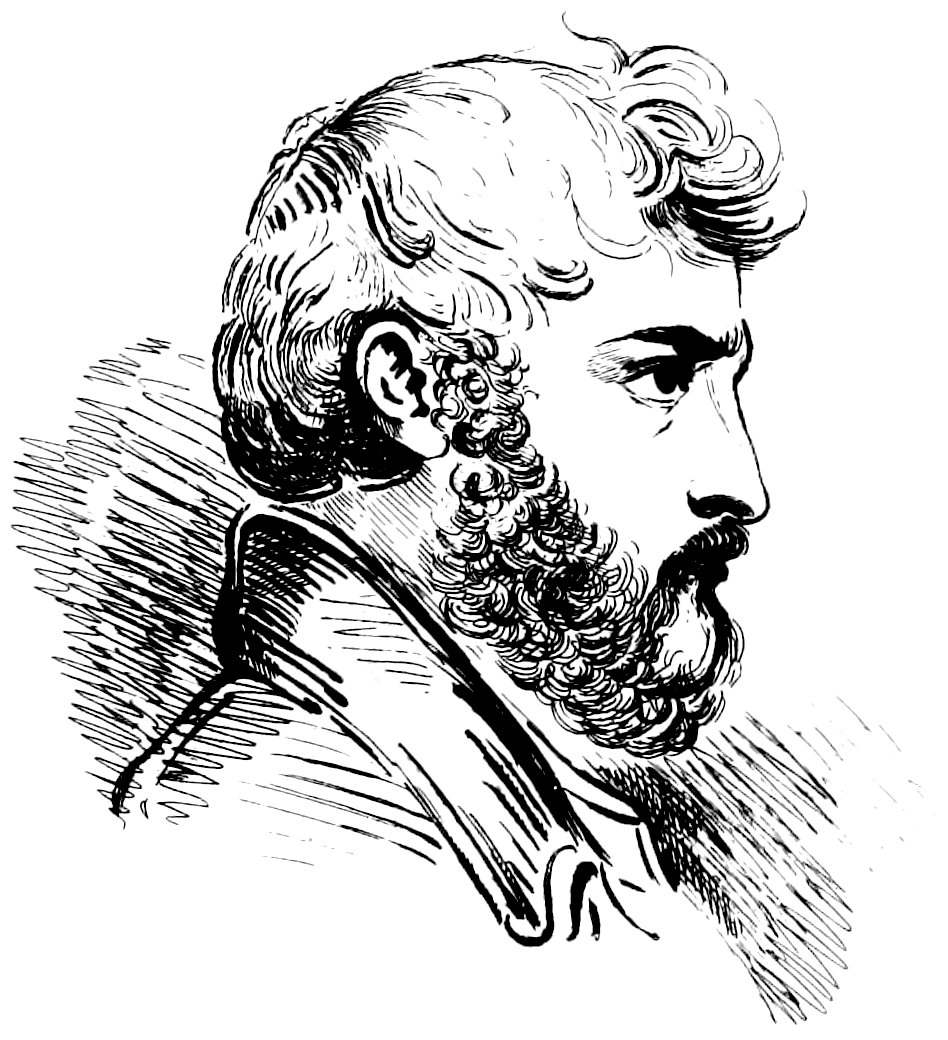
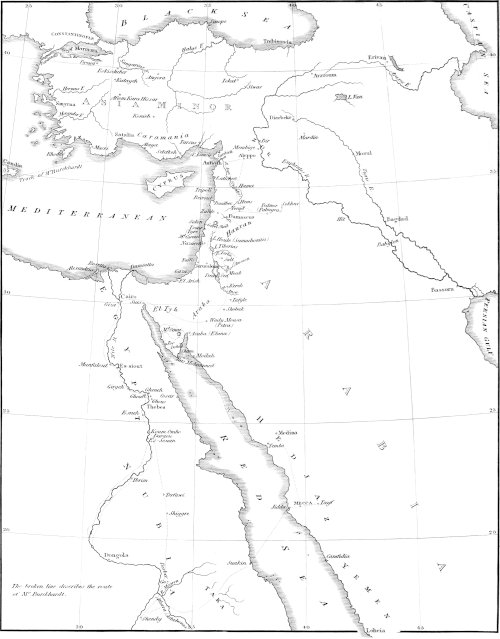
![[Digamma-like symbol]](https://openoldbooks.sgp1.digitaloceanspaces.com/books/travels-in-nubia/images/symbol1.jpg) is always prefixed. I
saw no inscriptions of more than a line or two; it appears that
each pilgrim in passing wrote his name, and the inscribed rocks are
constantly found on the side of the different great roads, leading
from Suez to Djebel Sinai, usually near the resting places, which
were chosen where some impending rock afforded shelter from the
sun; and where the same convenience still induces travellers to
halt. In the lower part of the mountains the inscriptions are cut
in sand stone, in the higher upon granite; the characters have no
depth, but upon granite even this would be a labour exceeding the
strength and leisure of ordinary pilgrims. The want of water,
especially about Wady Mekatteb, precludes the idea of an army
having passed that way, the soldiers of which might have wished to
perpetuate their names. Perhaps some of the drawings of animals,
particularly those of camels and mountain goats, (in Arabic
“Beden,” which are to this day very common in the mountain) may
have been done by the Israelite shepherds; I saw similar drawings,
without inscriptions, upon rocks not far from Akaba. Upon the whole
these inscriptions appear to me to have a strong resemblance to
some I have seen in Nubia, written in the ancient Egyptian current
character; some letters at least appear to be common to both. My
opinion is that they were the work of Egyptian Christians, or
perhaps Jews, during the first centuries of our era. Besides those
of Wad Mekatteb, the most numerous and well written, are those at
the foot, on the declivity, and at the summit of Djebel Serbal, a
high mountain, apparently the highest of the whole chain, situated
S. W. b. W. from the convent about forty miles distant, and which,
as far as I know, has not been ascended by any former traveller.
Many circumstances indicate that its pointed summit was once the
object of a pilgrimage. Artificial steps lead up to it, and the
inscriptions about the top are innumerable. From what causes this
mountain derived its sanctity, I could not learn, neither from the
Arabs nor the priests of the convent, who were even ignorant of the
ruins of a large convent, situated near the foot of Djebel
Serbal.
is always prefixed. I
saw no inscriptions of more than a line or two; it appears that
each pilgrim in passing wrote his name, and the inscribed rocks are
constantly found on the side of the different great roads, leading
from Suez to Djebel Sinai, usually near the resting places, which
were chosen where some impending rock afforded shelter from the
sun; and where the same convenience still induces travellers to
halt. In the lower part of the mountains the inscriptions are cut
in sand stone, in the higher upon granite; the characters have no
depth, but upon granite even this would be a labour exceeding the
strength and leisure of ordinary pilgrims. The want of water,
especially about Wady Mekatteb, precludes the idea of an army
having passed that way, the soldiers of which might have wished to
perpetuate their names. Perhaps some of the drawings of animals,
particularly those of camels and mountain goats, (in Arabic
“Beden,” which are to this day very common in the mountain) may
have been done by the Israelite shepherds; I saw similar drawings,
without inscriptions, upon rocks not far from Akaba. Upon the whole
these inscriptions appear to me to have a strong resemblance to
some I have seen in Nubia, written in the ancient Egyptian current
character; some letters at least appear to be common to both. My
opinion is that they were the work of Egyptian Christians, or
perhaps Jews, during the first centuries of our era. Besides those
of Wad Mekatteb, the most numerous and well written, are those at
the foot, on the declivity, and at the summit of Djebel Serbal, a
high mountain, apparently the highest of the whole chain, situated
S. W. b. W. from the convent about forty miles distant, and which,
as far as I know, has not been ascended by any former traveller.
Many circumstances indicate that its pointed summit was once the
object of a pilgrimage. Artificial steps lead up to it, and the
inscriptions about the top are innumerable. From what causes this
mountain derived its sanctity, I could not learn, neither from the
Arabs nor the priests of the convent, who were even ignorant of the
ruins of a large convent, situated near the foot of Djebel
Serbal.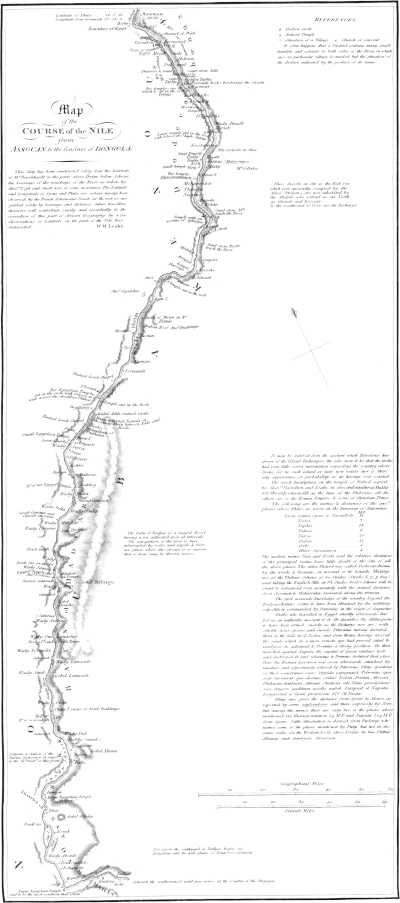
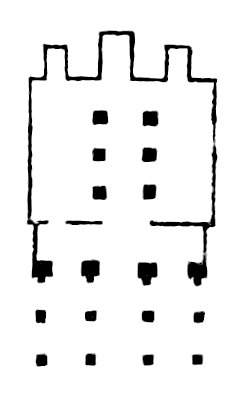 square
pillars, four in each row. The row of pillars nearest the cella,
which were originally joined by the roof to the main temple, are of
larger dimensions than the rest; they are nearly four feet square,
and about fourteen feet high, and are still entire, while fragments
of the shafts only remain of the two outer rows. In front of each
of the four pillars are the legs of a colossal figure, similar to
those of the temple of Gorne, at Thebes. A portion of the excavated
rock which had formed one of the walls of the pronaos, has fallen
down; on the fragments of it, a battle is represented: the hero, in
his chariot, is pursuing his vanquished foe, who retires to a
marshy and woody country, carrying the wounded along with him. In a
lower compartment of the same wall, the prisoners, with their arms
tied behind their backs, are brought before the executioner, who is
represented in the act of slaying one of them. All these figures
are much defaced. On the opposite wall is another battle, but in a still more mutilated
state: in this, prisoners are brought before the hawk-headed
Osiris. On the front wall of the cella, on each side of the
principal entrance, Briareus is represented in the act of being
slain, and Osiris, with uplifted arm, arresting the intended blow.
This is the same group which is so often seen in the Egyptian
temples; but, Briareus has here only two heads, and four arms,
instead of the numerous heads and arms represented in Egypt. On the
four pillars in front of the cella, variously dressed figures are
sculptured, two generally together, taking each other by the hand.
The Egyptian Mendes, or Priapus, is also repeatedly seen. The cella
of the temple consists of an apartment thirteen paces square, which
receives its light only through the principal gate, and a smaller
one, on the side of it. Two rows of square pillars, three in each
row, extend from the gate of the cella to the adytum: these pillars
show the infancy of architecture, being mere square blocks, hewn
out of the rock, without either base or capital; they are somewhat
larger at the bottom than at the top. The inside walls of the
cella, and its six pillars, are covered with mystic figures, in the
usual style; they are of much ruder workmanship than any I have
seen in Egypt. Some remains of colour prove that all these figures
were originally painted. On one of the side walls of the cella, are
five figures, in long robes, with shaven heads, carrying a boat
upon their shoulders, the middle of which is also supported by a
man with a lion’s skin upon his shoulder. In the posterior wall of
the cella, is a door, with the winged globe over it, which leads
into the small adytum, where the seats of four figures remain, cut
out of the back wall.
square
pillars, four in each row. The row of pillars nearest the cella,
which were originally joined by the roof to the main temple, are of
larger dimensions than the rest; they are nearly four feet square,
and about fourteen feet high, and are still entire, while fragments
of the shafts only remain of the two outer rows. In front of each
of the four pillars are the legs of a colossal figure, similar to
those of the temple of Gorne, at Thebes. A portion of the excavated
rock which had formed one of the walls of the pronaos, has fallen
down; on the fragments of it, a battle is represented: the hero, in
his chariot, is pursuing his vanquished foe, who retires to a
marshy and woody country, carrying the wounded along with him. In a
lower compartment of the same wall, the prisoners, with their arms
tied behind their backs, are brought before the executioner, who is
represented in the act of slaying one of them. All these figures
are much defaced. On the opposite wall is another battle, but in a still more mutilated
state: in this, prisoners are brought before the hawk-headed
Osiris. On the front wall of the cella, on each side of the
principal entrance, Briareus is represented in the act of being
slain, and Osiris, with uplifted arm, arresting the intended blow.
This is the same group which is so often seen in the Egyptian
temples; but, Briareus has here only two heads, and four arms,
instead of the numerous heads and arms represented in Egypt. On the
four pillars in front of the cella, variously dressed figures are
sculptured, two generally together, taking each other by the hand.
The Egyptian Mendes, or Priapus, is also repeatedly seen. The cella
of the temple consists of an apartment thirteen paces square, which
receives its light only through the principal gate, and a smaller
one, on the side of it. Two rows of square pillars, three in each
row, extend from the gate of the cella to the adytum: these pillars
show the infancy of architecture, being mere square blocks, hewn
out of the rock, without either base or capital; they are somewhat
larger at the bottom than at the top. The inside walls of the
cella, and its six pillars, are covered with mystic figures, in the
usual style; they are of much ruder workmanship than any I have
seen in Egypt. Some remains of colour prove that all these figures
were originally painted. On one of the side walls of the cella, are
five figures, in long robes, with shaven heads, carrying a boat
upon their shoulders, the middle of which is also supported by a
man with a lion’s skin upon his shoulder. In the posterior wall of
the cella, is a door, with the winged globe over it, which leads
into the small adytum, where the seats of four figures remain, cut
out of the back wall.![[Illustration]](https://openoldbooks.sgp1.digitaloceanspaces.com/books/travels-in-nubia/images/i02.jpg)
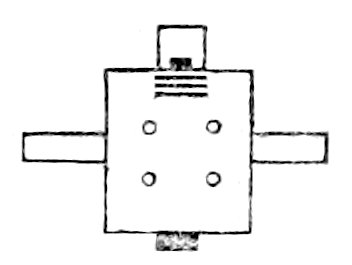 finished. It consists of a
cella, ten paces in length and seven in breadth, and about twelve
feet high. Within it are four columns, with Egyptian capitals. On
either side of the cella is an apartment which receives
light only by the
entrance from the cella. Low stone benches run along the walls of
the cella, a peculiarity which I had not seen in any other Egyptian
temple. There is an ascent by three low steps from the cella into
the adytum, in which is a deep sepulchral excavation; there is also
a similar but smaller one in the cella itself. The walls both of
the cella and adytum are covered with mystic sculptures in the
usual style, but there are none in the two side chambers. The
Greeks had converted this temple into a church, and had plaistered
the walls white, to receive their paintings, many of which still
remain; a St. George killing the dragon is particularly
conspicuous. Many Greek travellers have inscribed their names on
the walls. The whole fabric is of coarse execution, and the
hieroglyphics much in the same style as those at Derr. On the
opposite side of the river, a little to the north of it, is the
large temple of Ebsambal, and the colossal figures, of which I
shall speak hereafter.
finished. It consists of a
cella, ten paces in length and seven in breadth, and about twelve
feet high. Within it are four columns, with Egyptian capitals. On
either side of the cella is an apartment which receives
light only by the
entrance from the cella. Low stone benches run along the walls of
the cella, a peculiarity which I had not seen in any other Egyptian
temple. There is an ascent by three low steps from the cella into
the adytum, in which is a deep sepulchral excavation; there is also
a similar but smaller one in the cella itself. The walls both of
the cella and adytum are covered with mystic sculptures in the
usual style, but there are none in the two side chambers. The
Greeks had converted this temple into a church, and had plaistered
the walls white, to receive their paintings, many of which still
remain; a St. George killing the dragon is particularly
conspicuous. Many Greek travellers have inscribed their names on
the walls. The whole fabric is of coarse execution, and the
hieroglyphics much in the same style as those at Derr. On the
opposite side of the river, a little to the north of it, is the
large temple of Ebsambal, and the colossal figures, of which I
shall speak hereafter.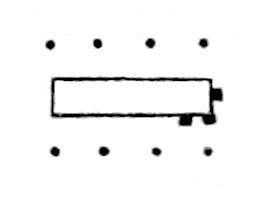 twelve
paces in length, and three paces only in breadth. On each side,
stood originally four small pillars, of which two remain on one
side, and three on the other; one of the former has a polygonal
shaft, the others are square; they are all covered with sculptures.
The pillars are joined to the main building by blocks of stone,
which serve as a roof to the vestibule. There are two small gates.
The inner walls of the apartment are covered with hieroglyphics,
and mystic representations of the divine worship. On both sides a
long ship is sculptured, with Osiris in it; and the group of two
figures resting their hands upon each others shoulders is every
where repeated. The roof is painted blue, and there are some
remains of colours upon several of the figures. Near the posterior
wall, opposite the main entrance, a statue lies on the floor, the
head of which has been cut off; it is about five feet high; the
arms are crossed upon the breast, and in one hand is the flail, and
in the other the instrument usually called a crosier. On the
exterior wall of the temple I distinguished several figures of
Mendes, or the Egyptian Priapus. All the sculptures are of coarse
execution; and several of the lines of the compartments wherein the hieroglyphics
are cut, are not straight, as if they had been the work of young
persons only learning their art. Some of the hieroglyphics on the
pillars have evidently been left unfinished; and even those which
are completed, are badly and rudely done. A part of the wall
appears to be of a different date from the rest, as it is
constructed of stones much larger, and better hewn. There seems to
have been another similar building near this temple, for several
capitals of columns are lying on the ground, and a large block of
granite covered with hieroglyphics. All around are heaps of
rubbish. The temple is surrounded by ruined brick buildings, which
are certainly of high antiquity; they cover the top of the hill
which overhangs the shore, and are enclosed by a double wall, or
rather by a wall within a parapet; the former is of brick, from
eight to twelve feet thick, and wherever entire, upwards of thirty
feet in height; the parapet is constructed of stone, twenty feet in
breadth, with sides sloping towards the declivity of the hill; the
stones of the parapet are thrown irregularly upon each other,
without cement, but those which form the sloping side are either
cut, or dexterously arranged, so as to present a perfectly smooth
surface, which, at the period when the work was taken care of, must
have rendered it impossible for any one to climb over it. These
works of defence indicate powerful enemies; but who they were, it
is impossible to ascertain. Did the forefathers of the Blemmyes
disturb the hierarchy of Egypt, as their descendants afterwards did
the Roman prætors?
twelve
paces in length, and three paces only in breadth. On each side,
stood originally four small pillars, of which two remain on one
side, and three on the other; one of the former has a polygonal
shaft, the others are square; they are all covered with sculptures.
The pillars are joined to the main building by blocks of stone,
which serve as a roof to the vestibule. There are two small gates.
The inner walls of the apartment are covered with hieroglyphics,
and mystic representations of the divine worship. On both sides a
long ship is sculptured, with Osiris in it; and the group of two
figures resting their hands upon each others shoulders is every
where repeated. The roof is painted blue, and there are some
remains of colours upon several of the figures. Near the posterior
wall, opposite the main entrance, a statue lies on the floor, the
head of which has been cut off; it is about five feet high; the
arms are crossed upon the breast, and in one hand is the flail, and
in the other the instrument usually called a crosier. On the
exterior wall of the temple I distinguished several figures of
Mendes, or the Egyptian Priapus. All the sculptures are of coarse
execution; and several of the lines of the compartments wherein the hieroglyphics
are cut, are not straight, as if they had been the work of young
persons only learning their art. Some of the hieroglyphics on the
pillars have evidently been left unfinished; and even those which
are completed, are badly and rudely done. A part of the wall
appears to be of a different date from the rest, as it is
constructed of stones much larger, and better hewn. There seems to
have been another similar building near this temple, for several
capitals of columns are lying on the ground, and a large block of
granite covered with hieroglyphics. All around are heaps of
rubbish. The temple is surrounded by ruined brick buildings, which
are certainly of high antiquity; they cover the top of the hill
which overhangs the shore, and are enclosed by a double wall, or
rather by a wall within a parapet; the former is of brick, from
eight to twelve feet thick, and wherever entire, upwards of thirty
feet in height; the parapet is constructed of stone, twenty feet in
breadth, with sides sloping towards the declivity of the hill; the
stones of the parapet are thrown irregularly upon each other,
without cement, but those which form the sloping side are either
cut, or dexterously arranged, so as to present a perfectly smooth
surface, which, at the period when the work was taken care of, must
have rendered it impossible for any one to climb over it. These
works of defence indicate powerful enemies; but who they were, it
is impossible to ascertain. Did the forefathers of the Blemmyes
disturb the hierarchy of Egypt, as their descendants afterwards did
the Roman prætors?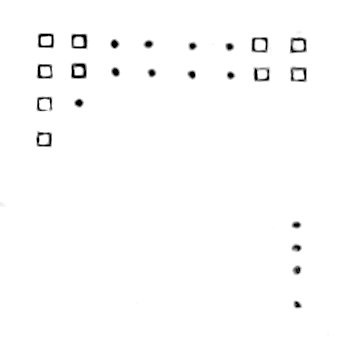 fragments of shafts of
columns, standing as described in the annexed figure. The four
corner columns, and two of the side ones, are square, the others
are round; they appeared to be about two feet and a half in
diameter; no hieroglyphics, or sculptures, are visible, and the
stones are in a very decayed state. The temple had been surrounded
by a high brick wall, fragments of which are still seen. I observed
no other remains of
antiquity in my hasty view of this ruin. We continued at a brisk
trot till the end of eleven hours and a half, when we again reached
the bank of the river, opposite Dabrous, and crossed the dry bed of
a branch of the stream to an island, where some Kerrarish Arabs
were encamped, and we alighted at their tents, late at night, after
a ride of twelve hours. I celebrated my safe return into the
northern parts of Nubia by having a lamb, which I purchased of the
Arabs for three measures of Dhourra, roasted for my supper. The
island is thickly overgrown with tamarisk trees, which shoot up
spontaneously upon all the islands whose surfaces consist of
alluvial mud, and not of sand. I was informed, in the course of the
night, that a caravan of sixty camels of the Arabs Sheygya had
arrived at Wady Halfa, for dates. Although continually harassed by
the predatory incursions of the Sheygya, the Nubians never offer
any insult to the merchants of that nation, who visit their
villages as friends.
fragments of shafts of
columns, standing as described in the annexed figure. The four
corner columns, and two of the side ones, are square, the others
are round; they appeared to be about two feet and a half in
diameter; no hieroglyphics, or sculptures, are visible, and the
stones are in a very decayed state. The temple had been surrounded
by a high brick wall, fragments of which are still seen. I observed
no other remains of
antiquity in my hasty view of this ruin. We continued at a brisk
trot till the end of eleven hours and a half, when we again reached
the bank of the river, opposite Dabrous, and crossed the dry bed of
a branch of the stream to an island, where some Kerrarish Arabs
were encamped, and we alighted at their tents, late at night, after
a ride of twelve hours. I celebrated my safe return into the
northern parts of Nubia by having a lamb, which I purchased of the
Arabs for three measures of Dhourra, roasted for my supper. The
island is thickly overgrown with tamarisk trees, which shoot up
spontaneously upon all the islands whose surfaces consist of
alluvial mud, and not of sand. I was informed, in the course of the
night, that a caravan of sixty camels of the Arabs Sheygya had
arrived at Wady Halfa, for dates. Although continually harassed by
the predatory incursions of the Sheygya, the Nubians never offer
any insult to the merchants of that nation, who visit their
villages as friends.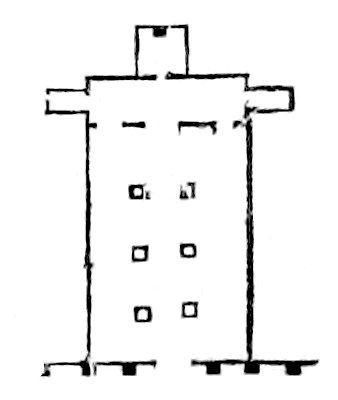 also, on
each side; though coarsely executed, the expression of the
countenance of the Isis is truly grand and benevolent. 3. A youth,
with the usual high bonnet upon his head, his arms hanging down,
and two small figures like the preceding. These are on one side of
the door. On the other side is, 4. The same youth; 5. Isis, having
the globe, encompassed by two serpents, upon her head; and 6. the
youth a third time; each with the two small accompanying figures,
as before. Of the small figures, some of those on the side last
mentioned differ from the others in having the hair on the right
side of the head falling in a thick bunch upon the right shoulder,
while the left side is shaved. The spaces between the niches where
the large figures stand, are covered with hieroglyphics. A small
door leads into the pronaos of the temple, which is supported by
six square columns, each three feet square: the pronaos is thirteen
paces in length, and seven in breadth. The capitals of the columns
represent heads of Isis, similar to those at Tintyra, except that
they are in much lower relief, and in the same style as the
sculptures on the walls of the temple; the ornament represented on
these heads is in the form of a temple, and the hair falls down in
two thick ringlets, differing in this respect, also, from the
figures at Tintyra. The narrow cella is entered from the pronaos by
one large, and two small gates; it is only three paces in depth,
with a dark chamber on each side. The adytum is seven feet square;
the remains of a statue, cut out of the rock, are visible in the
back wall, and in the floor is a deep sepulchral excavation. The walls of the three
apartments are covered with hieroglyphics, and the usual sacred
figures of the Egyptian temples. The figures seem all to have been
painted yellow, excepting the hair, which, in several of them is
black; that of Isis is in black and white stripes. Offerings to
Osiris of lotus and of leaves of the Doum tree, are frequently
represented; and, as in all the Nubian temples, Briareus, beneath
the hand of the victor, is repeated in several places; he is here
again of the natural human form. The temple of Ebsambal seems to
have been the model of that at Derr, to which I think it much
anterior in date; it was no doubt dedicated to the worship of Isis.
The style in which the sculptures are executed denotes high
antiquity. A few paces to the north of the entrance, in the rock
above it, is a bas-relief of Osiris, in a sitting posture, with a
supplicant kneeling with extended arms before him: both figures are
surrounded with hieroglyphic characters. I was afterwards informed,
at Derr, that there is, near this temple, on the bank of the river,
the statue of a man somewhat above the human size, with the
Egyptian corn measure under his arm; and that it is completely
overflowed during the inundation.
also, on
each side; though coarsely executed, the expression of the
countenance of the Isis is truly grand and benevolent. 3. A youth,
with the usual high bonnet upon his head, his arms hanging down,
and two small figures like the preceding. These are on one side of
the door. On the other side is, 4. The same youth; 5. Isis, having
the globe, encompassed by two serpents, upon her head; and 6. the
youth a third time; each with the two small accompanying figures,
as before. Of the small figures, some of those on the side last
mentioned differ from the others in having the hair on the right
side of the head falling in a thick bunch upon the right shoulder,
while the left side is shaved. The spaces between the niches where
the large figures stand, are covered with hieroglyphics. A small
door leads into the pronaos of the temple, which is supported by
six square columns, each three feet square: the pronaos is thirteen
paces in length, and seven in breadth. The capitals of the columns
represent heads of Isis, similar to those at Tintyra, except that
they are in much lower relief, and in the same style as the
sculptures on the walls of the temple; the ornament represented on
these heads is in the form of a temple, and the hair falls down in
two thick ringlets, differing in this respect, also, from the
figures at Tintyra. The narrow cella is entered from the pronaos by
one large, and two small gates; it is only three paces in depth,
with a dark chamber on each side. The adytum is seven feet square;
the remains of a statue, cut out of the rock, are visible in the
back wall, and in the floor is a deep sepulchral excavation. The walls of the three
apartments are covered with hieroglyphics, and the usual sacred
figures of the Egyptian temples. The figures seem all to have been
painted yellow, excepting the hair, which, in several of them is
black; that of Isis is in black and white stripes. Offerings to
Osiris of lotus and of leaves of the Doum tree, are frequently
represented; and, as in all the Nubian temples, Briareus, beneath
the hand of the victor, is repeated in several places; he is here
again of the natural human form. The temple of Ebsambal seems to
have been the model of that at Derr, to which I think it much
anterior in date; it was no doubt dedicated to the worship of Isis.
The style in which the sculptures are executed denotes high
antiquity. A few paces to the north of the entrance, in the rock
above it, is a bas-relief of Osiris, in a sitting posture, with a
supplicant kneeling with extended arms before him: both figures are
surrounded with hieroglyphic characters. I was afterwards informed,
at Derr, that there is, near this temple, on the bank of the river,
the statue of a man somewhat above the human size, with the
Egyptian corn measure under his arm; and that it is completely
overflowed during the inundation.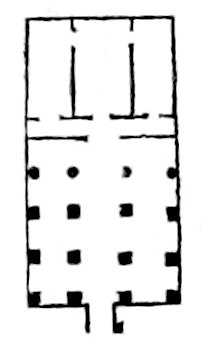 columns, four in each row,
and two feet square, with a row of four round ones next the cella;
the whole are without capitals. The hieroglyphics are badly
sculptured; the beetle is the figure most frequently met with on
the columns. The pronaos is encompassed by a wall, which fills up
the intervals between the outer rows of columns. The cella is
entered from the pronaos through a narrow chamber; on either side
of the cella is an apartment, equal to it in depth, but narrower;
there is no adytum. The walls of the cella have a thick coat of
plaister, on which are paintings of Greek saints. The temple is
interesting on account of its preservation, being almost entire;
but the sands have accumulated considerably round its walls and
columns. There is a well paved terrace on the top of the cella; and
the Greeks had built a cupola over the pronaos. I believe this to
be the temple mentioned by Norden, as situated near Amada. About
twenty yards distant from it, towards the river, are the
foundations of another stone edifice.
columns, four in each row,
and two feet square, with a row of four round ones next the cella;
the whole are without capitals. The hieroglyphics are badly
sculptured; the beetle is the figure most frequently met with on
the columns. The pronaos is encompassed by a wall, which fills up
the intervals between the outer rows of columns. The cella is
entered from the pronaos through a narrow chamber; on either side
of the cella is an apartment, equal to it in depth, but narrower;
there is no adytum. The walls of the cella have a thick coat of
plaister, on which are paintings of Greek saints. The temple is
interesting on account of its preservation, being almost entire;
but the sands have accumulated considerably round its walls and
columns. There is a well paved terrace on the top of the cella; and
the Greeks had built a cupola over the pronaos. I believe this to
be the temple mentioned by Norden, as situated near Amada. About
twenty yards distant from it, towards the river, are the
foundations of another stone edifice.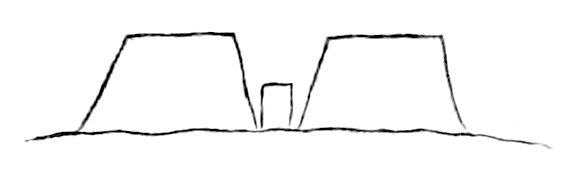 and in the centre of its two pyramidal wings is a small
gateway, leading into the court of the pronaos, two-thirds of which
are buried in sand. The pronaos has five columns, without capitals,
on each of its longest sides; in front of each column, and joined
to it, is a colossal figure (like those at Gorne), about sixteen
feet in height, having the arms crossed upon the breast, with the
flail in one hand and the crosier in the other; all these figures
are much mutilated. The walls of the propylon, and of the pronaos,
having been constructed of small blocks of very friable sandstone,
are so much decayed, that little now remains of the sculptures with
which they were originally covered; but a Briareus, with two
bodies, may yet be distinguished on the outside wall of the
propylon. In front of the entrance, there lies on the ground a
colossal human statue, the head and breast of which are buried in
the sand; it probably stood on the side of the gate, like the
colossi at Luxor; it is a male figure, and in the same attitude as
the statues in front of the temple of Isis at Ebsambal. In front of
the propylon, and about thirty yards distant from it, are two
statues ten feet in
height, and seven paces from each other; their faces are towards
the river, and they are attached by the back to a stone pillar of
equal height; they are rudely executed, proportion being so little
observed, that the ears are half the length of the head; they both
wear the high bonnet, and represent unbearded male figures. An
avenue of sphinxes leads from the river to the temple; but the
greater part of them are now buried; four remain by the side of the
two last mentioned statues, differing from each other in size and
shape, but all representing the bodies of lions with the heads of
young men, and the usual narrow beard under the chin. I observed a
hole on the top of their flattened heads, intended, perhaps, to
receive a small statue. Near the temple are some mounds of rubbish
and broken pottery. The whole fabric appears to be of the remotest
antiquity; and to have been imitated by the more modern architects
of Egypt; for the propylon, and the pronaos with its colossal
statues, are found at Gorne, on a larger scale; the two statues in
advance of the propylon, are the miniatures of those in front of
the Memnonium; and the sphinxes are seen at Karnac. As it was long
after sunset before I quitted this temple, we proceeded only half
an hour farther, and alighted at the hut of an Aleykat Arab.
and in the centre of its two pyramidal wings is a small
gateway, leading into the court of the pronaos, two-thirds of which
are buried in sand. The pronaos has five columns, without capitals,
on each of its longest sides; in front of each column, and joined
to it, is a colossal figure (like those at Gorne), about sixteen
feet in height, having the arms crossed upon the breast, with the
flail in one hand and the crosier in the other; all these figures
are much mutilated. The walls of the propylon, and of the pronaos,
having been constructed of small blocks of very friable sandstone,
are so much decayed, that little now remains of the sculptures with
which they were originally covered; but a Briareus, with two
bodies, may yet be distinguished on the outside wall of the
propylon. In front of the entrance, there lies on the ground a
colossal human statue, the head and breast of which are buried in
the sand; it probably stood on the side of the gate, like the
colossi at Luxor; it is a male figure, and in the same attitude as
the statues in front of the temple of Isis at Ebsambal. In front of
the propylon, and about thirty yards distant from it, are two
statues ten feet in
height, and seven paces from each other; their faces are towards
the river, and they are attached by the back to a stone pillar of
equal height; they are rudely executed, proportion being so little
observed, that the ears are half the length of the head; they both
wear the high bonnet, and represent unbearded male figures. An
avenue of sphinxes leads from the river to the temple; but the
greater part of them are now buried; four remain by the side of the
two last mentioned statues, differing from each other in size and
shape, but all representing the bodies of lions with the heads of
young men, and the usual narrow beard under the chin. I observed a
hole on the top of their flattened heads, intended, perhaps, to
receive a small statue. Near the temple are some mounds of rubbish
and broken pottery. The whole fabric appears to be of the remotest
antiquity; and to have been imitated by the more modern architects
of Egypt; for the propylon, and the pronaos with its colossal
statues, are found at Gorne, on a larger scale; the two statues in
advance of the propylon, are the miniatures of those in front of
the Memnonium; and the sphinxes are seen at Karnac. As it was long
after sunset before I quitted this temple, we proceeded only half
an hour farther, and alighted at the hut of an Aleykat Arab.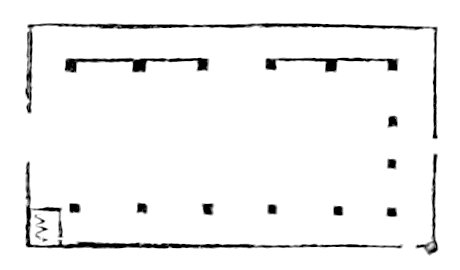 forms, according to the ancient Egyptian taste in
architecture. They are encompassed by a wall, which being joined to
the entablature of the colonnade, forms a covered portico all
round. The southern wall has fallen down, apparently from some
sudden and violent concussion, as the stones are lying on the
ground, in layers, as when placed in the wall; a proof that they
must have fallen all at once. I observed some hieroglyphics
sculptured upon single stones lying about in this part. The columns
on the south side are joined to each other, except the two centre
ones, by a low wall, half their height, in the same manner as those
in the temple of the hawk-headed Osiris at Philæ. There is one
large entrance, and two smaller ones, and a stair-case leading up
to the top. Several paintings of Greek saints are upon the walls;
but no hieroglyphics, nor sculptures, of any kind, are visible, not
even the globe, common to all the Egyptian temples; neither are
there any sculptures on the columns. The walls of this ruin are
very neatly and well constructed. There are several Greek
inscriptions upon them, in red ink; but I could only read the
following clearly:
forms, according to the ancient Egyptian taste in
architecture. They are encompassed by a wall, which being joined to
the entablature of the colonnade, forms a covered portico all
round. The southern wall has fallen down, apparently from some
sudden and violent concussion, as the stones are lying on the
ground, in layers, as when placed in the wall; a proof that they
must have fallen all at once. I observed some hieroglyphics
sculptured upon single stones lying about in this part. The columns
on the south side are joined to each other, except the two centre
ones, by a low wall, half their height, in the same manner as those
in the temple of the hawk-headed Osiris at Philæ. There is one
large entrance, and two smaller ones, and a stair-case leading up
to the top. Several paintings of Greek saints are upon the walls;
but no hieroglyphics, nor sculptures, of any kind, are visible, not
even the globe, common to all the Egyptian temples; neither are
there any sculptures on the columns. The walls of this ruin are
very neatly and well constructed. There are several Greek
inscriptions upon them, in red ink; but I could only read the
following clearly:![[Illustration]](https://openoldbooks.sgp1.digitaloceanspaces.com/books/travels-in-nubia/images/i10.jpg)
![[Illustration]](https://openoldbooks.sgp1.digitaloceanspaces.com/books/travels-in-nubia/images/i11.jpg)
![[Illustration]](https://openoldbooks.sgp1.digitaloceanspaces.com/books/travels-in-nubia/images/i12.jpg)
![[Illustration]](https://openoldbooks.sgp1.digitaloceanspaces.com/books/travels-in-nubia/images/i13.jpg)
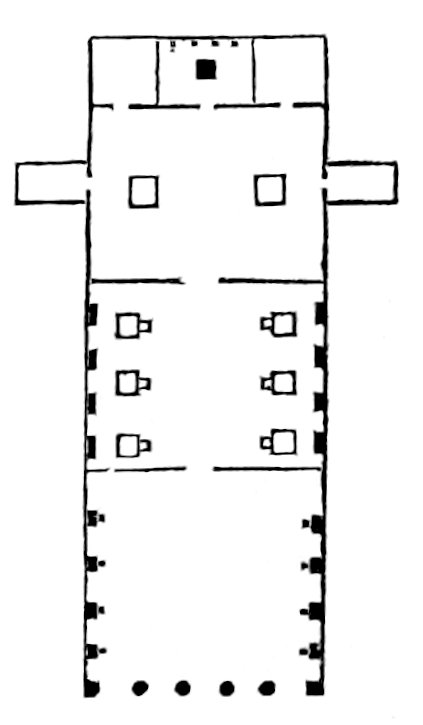 which
originally supported an entablature. Of these columns only two
remain. Before each of the square side columns stands a colossal
statue of sand-stone, about eighteen feet high, holding a flail in
one hand, the other hanging down; they all represent male figures,
with the narrow beard under the chin, and the high sphinx cap upon
the head: their shoulders are covered with hieroglyphic
inscriptions. On both sides of the portico is an open alley, hewn
in the rock, from whence, perhaps, the materials of the front
colonnade were taken. The pronaos, which is entered from the portico by a large
gate, is eighteen paces square, and contains two rows, three in
each, of immense columns, or rather props, (for they are without
capitals,) measuring five feet by seven in the plan. In front of
each of these columns is a colossal figure, more than twenty feet
in height, representing the usual juvenile character, with the
corn-measure or bonnet on the head, the hands crossed upon the
breast, and holding the flail and crosier. Although these statues
are rudely executed, the outlines of their bodies being less
correct even than those of the statues at Seboua, and their legs
mere round blocks, yet they have a striking effect in this
comparatively small apartment; indeed, accustomed as I had been to
the grandeur of Egyptian temples, of which I had examined so many
incomparable specimens, I was nevertheless struck with admiration
on entering this gloomy pronaos, and beholding these immense
figures standing in silence before me. They immediately recalled to
my memory the drawings I had seen of the caves near Surat, and
other Indian excavated temples, which, in many respects, bear a
strong resemblance to those of Nubia. On the side walls of the
pronaos are four recesses, or niches, in each of which are three
statues of the natural size, representing the different symbolical
male and female figures which are seen on the walls of the temples
of Egypt. The centre figures are generally clothed in a long dress,
while the others are naked. All these figures, as well as the
colossi, are covered with a thick coat of stucco, and had once been
painted; they must then have had a splendid appearance. A door
leads from the pronaos into the cella; in the centre of the cella
are two massy pillars, and on either side a small apartment, which
was probably a place of sepulture; in the floor of each are high
stone benches, which may have served for supporting mummies, or
perhaps as tables for embalming the bodies deposited in the temple;
the floors have
been broken up in search of treasure, and are now covered with
rubbish. Behind the cella, and communicating with it by a door, is
the adytum, on each side of which is a small chamber, also opening
into the cella, exactly like those in the temple at Derr. In the
posterior wall of the adytum are four statues, above the human
size, seated; and in the centre of the floor is a large cubical
stone, the use of which I cannot determine; its sides are quite
smooth, and without any kind of sculpture. It may, perhaps, have
served as the pedestal of a statue; or is it an inverted
sarcophagus? Of the sculptures and hieroglyphics with which the
walls of this temple were covered, very little is now discernible,
the sand-stone being of a very friable nature, and soon falling to
decay; added to this, the walls are quite black with smoke from the
fires kindled by the neighbouring shepherds, who often pass the
night in the temple with their cattle; enough, however, still
remains to shew that the sculptures are rudely executed. The
colossal figures are in good preservation, particularly those of
the pronaos; those in the portico have been mutilated.
which
originally supported an entablature. Of these columns only two
remain. Before each of the square side columns stands a colossal
statue of sand-stone, about eighteen feet high, holding a flail in
one hand, the other hanging down; they all represent male figures,
with the narrow beard under the chin, and the high sphinx cap upon
the head: their shoulders are covered with hieroglyphic
inscriptions. On both sides of the portico is an open alley, hewn
in the rock, from whence, perhaps, the materials of the front
colonnade were taken. The pronaos, which is entered from the portico by a large
gate, is eighteen paces square, and contains two rows, three in
each, of immense columns, or rather props, (for they are without
capitals,) measuring five feet by seven in the plan. In front of
each of these columns is a colossal figure, more than twenty feet
in height, representing the usual juvenile character, with the
corn-measure or bonnet on the head, the hands crossed upon the
breast, and holding the flail and crosier. Although these statues
are rudely executed, the outlines of their bodies being less
correct even than those of the statues at Seboua, and their legs
mere round blocks, yet they have a striking effect in this
comparatively small apartment; indeed, accustomed as I had been to
the grandeur of Egyptian temples, of which I had examined so many
incomparable specimens, I was nevertheless struck with admiration
on entering this gloomy pronaos, and beholding these immense
figures standing in silence before me. They immediately recalled to
my memory the drawings I had seen of the caves near Surat, and
other Indian excavated temples, which, in many respects, bear a
strong resemblance to those of Nubia. On the side walls of the
pronaos are four recesses, or niches, in each of which are three
statues of the natural size, representing the different symbolical
male and female figures which are seen on the walls of the temples
of Egypt. The centre figures are generally clothed in a long dress,
while the others are naked. All these figures, as well as the
colossi, are covered with a thick coat of stucco, and had once been
painted; they must then have had a splendid appearance. A door
leads from the pronaos into the cella; in the centre of the cella
are two massy pillars, and on either side a small apartment, which
was probably a place of sepulture; in the floor of each are high
stone benches, which may have served for supporting mummies, or
perhaps as tables for embalming the bodies deposited in the temple;
the floors have
been broken up in search of treasure, and are now covered with
rubbish. Behind the cella, and communicating with it by a door, is
the adytum, on each side of which is a small chamber, also opening
into the cella, exactly like those in the temple at Derr. In the
posterior wall of the adytum are four statues, above the human
size, seated; and in the centre of the floor is a large cubical
stone, the use of which I cannot determine; its sides are quite
smooth, and without any kind of sculpture. It may, perhaps, have
served as the pedestal of a statue; or is it an inverted
sarcophagus? Of the sculptures and hieroglyphics with which the
walls of this temple were covered, very little is now discernible,
the sand-stone being of a very friable nature, and soon falling to
decay; added to this, the walls are quite black with smoke from the
fires kindled by the neighbouring shepherds, who often pass the
night in the temple with their cattle; enough, however, still
remains to shew that the sculptures are rudely executed. The
colossal figures are in good preservation, particularly those of
the pronaos; those in the portico have been mutilated.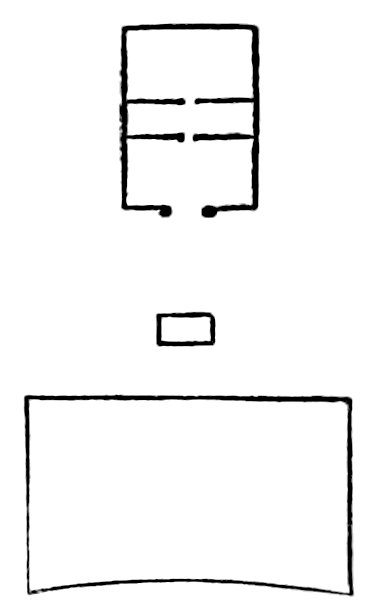 Behind
the propylon is the pronaos, with two columns in front, similar to
those of the temple of Dakke. The pronaos is seven paces in length.
Next follows the cella, and beyond that, the adytum; there are a
few sculptures on the walls of the adytum; on those of the pronaos
I observed lotus plants in flower, as at Dakke, with persons making
offerings to them. On the exterior wall of the temple are figures
in the style of those at Tintyra; I particularly remarked a fine
figure of Horus, with a finger on his lip. This temple is, in
general, extremely well built, and the sculptures are of the best
times; though I conceive it to be posterior in date to the temple
at Philæ, from a visible decline both in the architecture and
sculpture. In front of the propylon, towards the river, is a stone
inclosure, thirty-five paces in length, by fifteen in breadth; the
stones with which it is constructed are in their rough state on the
outside, but smoothly cut on the interior. The wall fronting the
river is fifteen feet in height, and describes a slight curve. The
floor of this inclosure, now covered with stones and ruins, is
considerably below the level on which the propylon and the temple
are built. Had it been a place for sacred processions, or for
sepulture? I have seen nothing like it in any Egyptian temple; the
stones and rubbish in its area, render it probable that it had
originally a roof. In the rock, just behind the temple, a grotto is
excavated.
Behind
the propylon is the pronaos, with two columns in front, similar to
those of the temple of Dakke. The pronaos is seven paces in length.
Next follows the cella, and beyond that, the adytum; there are a
few sculptures on the walls of the adytum; on those of the pronaos
I observed lotus plants in flower, as at Dakke, with persons making
offerings to them. On the exterior wall of the temple are figures
in the style of those at Tintyra; I particularly remarked a fine
figure of Horus, with a finger on his lip. This temple is, in
general, extremely well built, and the sculptures are of the best
times; though I conceive it to be posterior in date to the temple
at Philæ, from a visible decline both in the architecture and
sculpture. In front of the propylon, towards the river, is a stone
inclosure, thirty-five paces in length, by fifteen in breadth; the
stones with which it is constructed are in their rough state on the
outside, but smoothly cut on the interior. The wall fronting the
river is fifteen feet in height, and describes a slight curve. The
floor of this inclosure, now covered with stones and ruins, is
considerably below the level on which the propylon and the temple
are built. Had it been a place for sacred processions, or for
sepulture? I have seen nothing like it in any Egyptian temple; the
stones and rubbish in its area, render it probable that it had
originally a roof. In the rock, just behind the temple, a grotto is
excavated.![[Illustration]](https://openoldbooks.sgp1.digitaloceanspaces.com/books/travels-in-nubia/images/i16.jpg)
![[Illustration]](https://openoldbooks.sgp1.digitaloceanspaces.com/books/travels-in-nubia/images/i17.jpg)
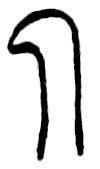 over which the cloke is thrown. In another
compartment, close to this, a prisoner is immolated: and farther
on, is a small battle-piece, in which the assault and capture of a
tower are represented; a man, with an axe in his hand, is
endeavouring to make a breach in the walls, from which some of the
garrison are precipitated, while others are brought in prisoners.
All these subjects are in bas-relief, and extremely well executed;
they are the best specimens of historical sculpture that I have
seen in the valley of the Nile, even more spirited than those at
Thebes; the figures of the animals, in particular, are faithfully
and correctly delineated. On considering the subjects they
represent, they will be found very important, because they record a
historical fact, no where else alluded to in any Egyptian
structure. The hero of Egypt has here carried his arms into a
country inhabited by lions, cameleopards, apes, and elephants: none
of which animals are found in Nubia or Dóngola; the elephant and
cameleopard inhabit the banks of the Nile towards Sennaar, the
forests on the frontiers of Abyssinia, and the banks of the
Astaboras and Astapus, from whence also the most beautiful and
highest esteemed female slaves are now imported into Egypt: all the
above-described trophies of victory, therefore, indicate, that the
battles must have been fought in the countries to the south of the
civilized country of the ancient Meroe; for the
skin-clad prisoners
denote a savage people. The battle-pieces of Thebes, at Luxor and
Karnac, seem to allude to less distant scenes of warfare. May not
the castles, surrounded with water, which are there represented,
relate to the fortified islands in the Batn el Hadjar, where we
still meet with so many brick ruins? The head-dress of the
fugitives, which is close-cut hair, and not a cap, as has been
erroneously described, and the short, narrow beard, under the chin,
are perfectly characteristic of the southern Noubas, whose colour
is not quite black, but of that deep copper tinge, which a painter,
unskilled in mixing colours, would rather represent by dark red
than black. It may readily be imagined, that the inhabitants of the
sterile districts of Nubia, and the Batn el Hadjar, would look with
an envious eye upon the riches of Egypt, and would frequently
excite the resentment of the monarchs of Thebes, by making inroads
from their strong-holds, upon the adjacent provinces of Egypt.
over which the cloke is thrown. In another
compartment, close to this, a prisoner is immolated: and farther
on, is a small battle-piece, in which the assault and capture of a
tower are represented; a man, with an axe in his hand, is
endeavouring to make a breach in the walls, from which some of the
garrison are precipitated, while others are brought in prisoners.
All these subjects are in bas-relief, and extremely well executed;
they are the best specimens of historical sculpture that I have
seen in the valley of the Nile, even more spirited than those at
Thebes; the figures of the animals, in particular, are faithfully
and correctly delineated. On considering the subjects they
represent, they will be found very important, because they record a
historical fact, no where else alluded to in any Egyptian
structure. The hero of Egypt has here carried his arms into a
country inhabited by lions, cameleopards, apes, and elephants: none
of which animals are found in Nubia or Dóngola; the elephant and
cameleopard inhabit the banks of the Nile towards Sennaar, the
forests on the frontiers of Abyssinia, and the banks of the
Astaboras and Astapus, from whence also the most beautiful and
highest esteemed female slaves are now imported into Egypt: all the
above-described trophies of victory, therefore, indicate, that the
battles must have been fought in the countries to the south of the
civilized country of the ancient Meroe; for the
skin-clad prisoners
denote a savage people. The battle-pieces of Thebes, at Luxor and
Karnac, seem to allude to less distant scenes of warfare. May not
the castles, surrounded with water, which are there represented,
relate to the fortified islands in the Batn el Hadjar, where we
still meet with so many brick ruins? The head-dress of the
fugitives, which is close-cut hair, and not a cap, as has been
erroneously described, and the short, narrow beard, under the chin,
are perfectly characteristic of the southern Noubas, whose colour
is not quite black, but of that deep copper tinge, which a painter,
unskilled in mixing colours, would rather represent by dark red
than black. It may readily be imagined, that the inhabitants of the
sterile districts of Nubia, and the Batn el Hadjar, would look with
an envious eye upon the riches of Egypt, and would frequently
excite the resentment of the monarchs of Thebes, by making inroads
from their strong-holds, upon the adjacent provinces of Egypt.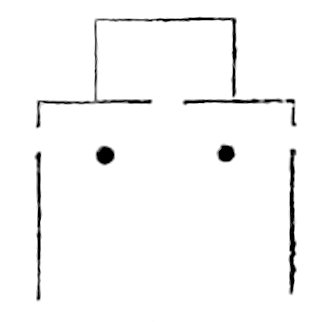 the adytum, the
foundations of which only remain. The winged globe is over the
entrance into the adytum; but I saw no other sculptures, nor any
hieroglyphics. The Greeks, as usual, have painted their saints upon
the walls; and a Greek almanac, and several badly written
inscriptions, are also visible upon them. The other temple is
a
the adytum, the
foundations of which only remain. The winged globe is over the
entrance into the adytum; but I saw no other sculptures, nor any
hieroglyphics. The Greeks, as usual, have painted their saints upon
the walls; and a Greek almanac, and several badly written
inscriptions, are also visible upon them. The other temple is
a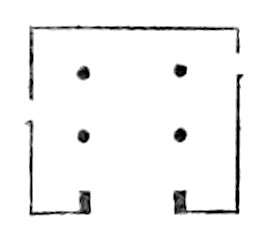 small square apartment, quite entire, with six pillars in it,
similar, in size and shape, to those just mentioned. The winged
globe over the gates is the only sculpture of any kind about it.
Around these two buildings are numerous remains of the private
dwellings of the ancient inhabitants, consisting of thick and
strongly built walls of stone; this material, from its greater
proximity, having been frequently used in Nubia instead of
bricks.
small square apartment, quite entire, with six pillars in it,
similar, in size and shape, to those just mentioned. The winged
globe over the gates is the only sculpture of any kind about it.
Around these two buildings are numerous remains of the private
dwellings of the ancient inhabitants, consisting of thick and
strongly built walls of stone; this material, from its greater
proximity, having been frequently used in Nubia instead of
bricks. it consisted originally of eight
columns, of which six are still standing; these are partly united
with each other by a wall, rising to half their height, and
inclosing the whole of them. Of the stones which formed the roof,
one block only remains; it is at least sixteen feet in length, and
reaches the whole breadth of the temple. Over four of the columns
the architraves still remain; the capitals of the two others are
formed by four faces of Isis, with the same head-dress as at
Tintyra, but with countenances more juvenile and less grave; the
ears are very peculiar,
it consisted originally of eight
columns, of which six are still standing; these are partly united
with each other by a wall, rising to half their height, and
inclosing the whole of them. Of the stones which formed the roof,
one block only remains; it is at least sixteen feet in length, and
reaches the whole breadth of the temple. Over four of the columns
the architraves still remain; the capitals of the two others are
formed by four faces of Isis, with the same head-dress as at
Tintyra, but with countenances more juvenile and less grave; the
ears are very peculiar, and of the annexed form. There
is a sculptured figure on one of the columns only; the others bear
traces of having been covered with hieroglyphics.
and of the annexed form. There
is a sculptured figure on one of the columns only; the others bear
traces of having been covered with hieroglyphics.![[Illustration]](https://openoldbooks.sgp1.digitaloceanspaces.com/books/travels-in-nubia/images/i23.jpg)
![[Illustration]](https://openoldbooks.sgp1.digitaloceanspaces.com/books/travels-in-nubia/images/i24.jpg)
![[Illustration]](https://openoldbooks.sgp1.digitaloceanspaces.com/books/travels-in-nubia/images/i25.jpg)
![[Illustration]](https://openoldbooks.sgp1.digitaloceanspaces.com/books/travels-in-nubia/images/i26.jpg)
![[Illustration]](https://openoldbooks.sgp1.digitaloceanspaces.com/books/travels-in-nubia/images/i27.jpg)
![[Illustration]](https://openoldbooks.sgp1.digitaloceanspaces.com/books/travels-in-nubia/images/i28.jpg)
![[Illustration]](https://openoldbooks.sgp1.digitaloceanspaces.com/books/travels-in-nubia/images/i29.jpg)
 The only musical instrument I saw in Nubia was a kind of
Egyptian tamboura, with five strings, and covered with the skin of
a gazell: it is of the shape here represented. The girls are fond of singing;
and the Nubian airs are very melodious.
The only musical instrument I saw in Nubia was a kind of
Egyptian tamboura, with five strings, and covered with the skin of
a gazell: it is of the shape here represented. The girls are fond of singing;
and the Nubian airs are very melodious.![[Decoration]](https://openoldbooks.sgp1.digitaloceanspaces.com/books/travels-in-nubia/images/decor.jpg) [The words derived from the Arabic, and especially
from the dialect of Upper Egypt, are marked A.]
[The words derived from the Arabic, and especially
from the dialect of Upper Egypt, are marked A.]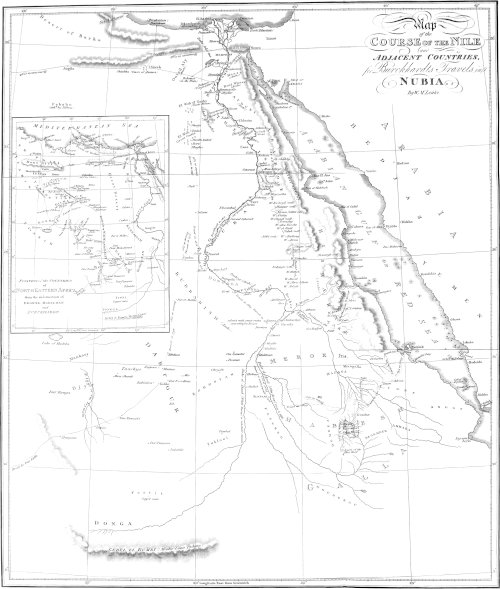
![[Illustration]](https://openoldbooks.sgp1.digitaloceanspaces.com/books/travels-in-nubia/images/i31.jpg)
![[Illustration]](https://openoldbooks.sgp1.digitaloceanspaces.com/books/travels-in-nubia/images/i32.jpg)
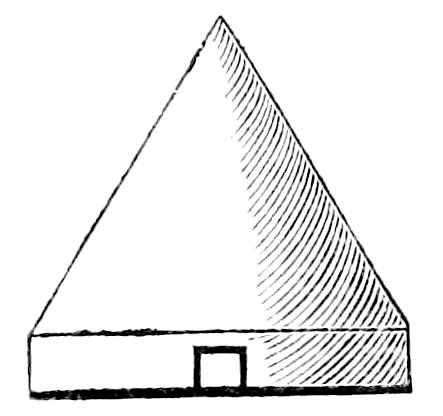 well rounded cone, about thirty
feet in height, resting upon a square substructure five or six feet
high, in which is a low door. The whole is built of sun-burnt
bricks. I found the entrance shut, and was told that it was opened
on Fridays only. At a distance this tomb had the exact appearance
of a pyramid, and I could not help thinking that such buildings
might have been used as sepulchres from the earliest times by the
Ethiopians, and might have given origin to the stupendous tombs of
Memphis. I observed a similar but smaller structure at Shendy, but
I met with them nowhere else, although every village of note has
some tombs of revered saints or Shikhs.
well rounded cone, about thirty
feet in height, resting upon a square substructure five or six feet
high, in which is a low door. The whole is built of sun-burnt
bricks. I found the entrance shut, and was told that it was opened
on Fridays only. At a distance this tomb had the exact appearance
of a pyramid, and I could not help thinking that such buildings
might have been used as sepulchres from the earliest times by the
Ethiopians, and might have given origin to the stupendous tombs of
Memphis. I observed a similar but smaller structure at Shendy, but
I met with them nowhere else, although every village of note has
some tombs of revered saints or Shikhs.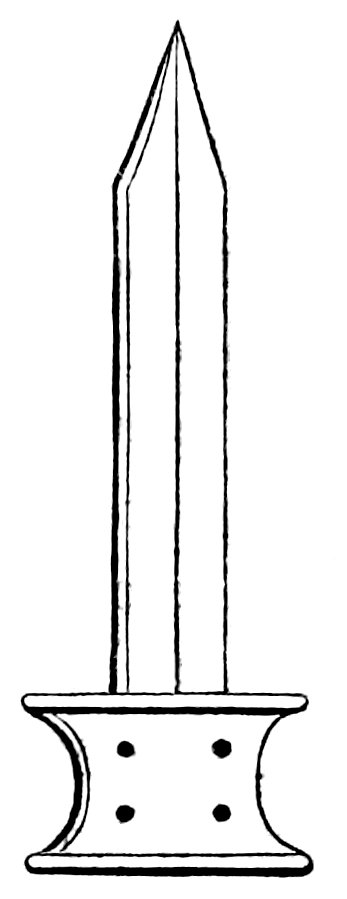 the country; they make and sell
the small knives generally worn among these people. These knives
are about eight inches long, and are worn in a leathern scabbard
tied over the left elbow: they are two-edged, like those worn by
the Berábera, and are of the shape here represented.
the country; they make and sell
the small knives generally worn among these people. These knives
are about eight inches long, and are worn in a leathern scabbard
tied over the left elbow: they are two-edged, like those worn by
the Berábera, and are of the shape here represented.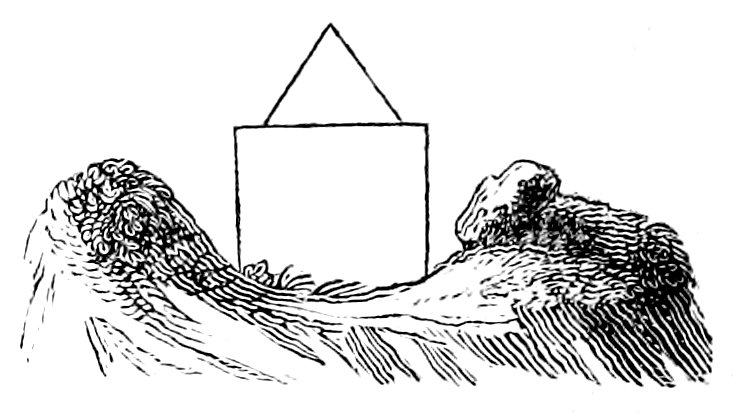 it were two high and extremely massive walls, with an
equally massive flat roof; on the roof was a sort of cupola, the
sides of which appeared to be perpendicular. I could perceive no
columns, or any other building. The ruin itself is enclosed on all
sides by high rocks, which hide the greater part of it from view;
and in the day time I was unable to get a sight of it in front. As
far as I could judge its walls must be between thirty and forty
feet in height, and I suppose them to be built of granite, as they
were of the same hue as the surrounding rocks. I had no telescope
with me, and can therefore give no accurate details respecting
these remains; but the whole building, with the exception of the
pointed roof, appeared to me to be of the rudest construction, and
of the remotest antiquity. I asked the Souakin merchants if they
had ever seen any similar ruins in this neighbourhood, but they had
never gone higher up the river, and could therefore give me no
positive information, and no natives appeared whom I could question
on the subject.
it were two high and extremely massive walls, with an
equally massive flat roof; on the roof was a sort of cupola, the
sides of which appeared to be perpendicular. I could perceive no
columns, or any other building. The ruin itself is enclosed on all
sides by high rocks, which hide the greater part of it from view;
and in the day time I was unable to get a sight of it in front. As
far as I could judge its walls must be between thirty and forty
feet in height, and I suppose them to be built of granite, as they
were of the same hue as the surrounding rocks. I had no telescope
with me, and can therefore give no accurate details respecting
these remains; but the whole building, with the exception of the
pointed roof, appeared to me to be of the rudest construction, and
of the remotest antiquity. I asked the Souakin merchants if they
had ever seen any similar ruins in this neighbourhood, but they had
never gone higher up the river, and could therefore give me no
positive information, and no natives appeared whom I could question
on the subject.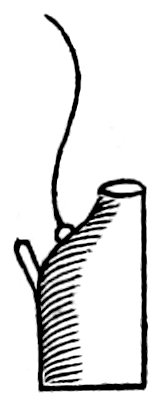 desert to
the N. and E. Earthen pots for cooking, and for ablution
(Ibareik alloudhou
desert to
the N. and E. Earthen pots for cooking, and for ablution
(Ibareik alloudhou ![[Illustration]](https://openoldbooks.sgp1.digitaloceanspaces.com/books/travels-in-nubia/images/i37.jpg)
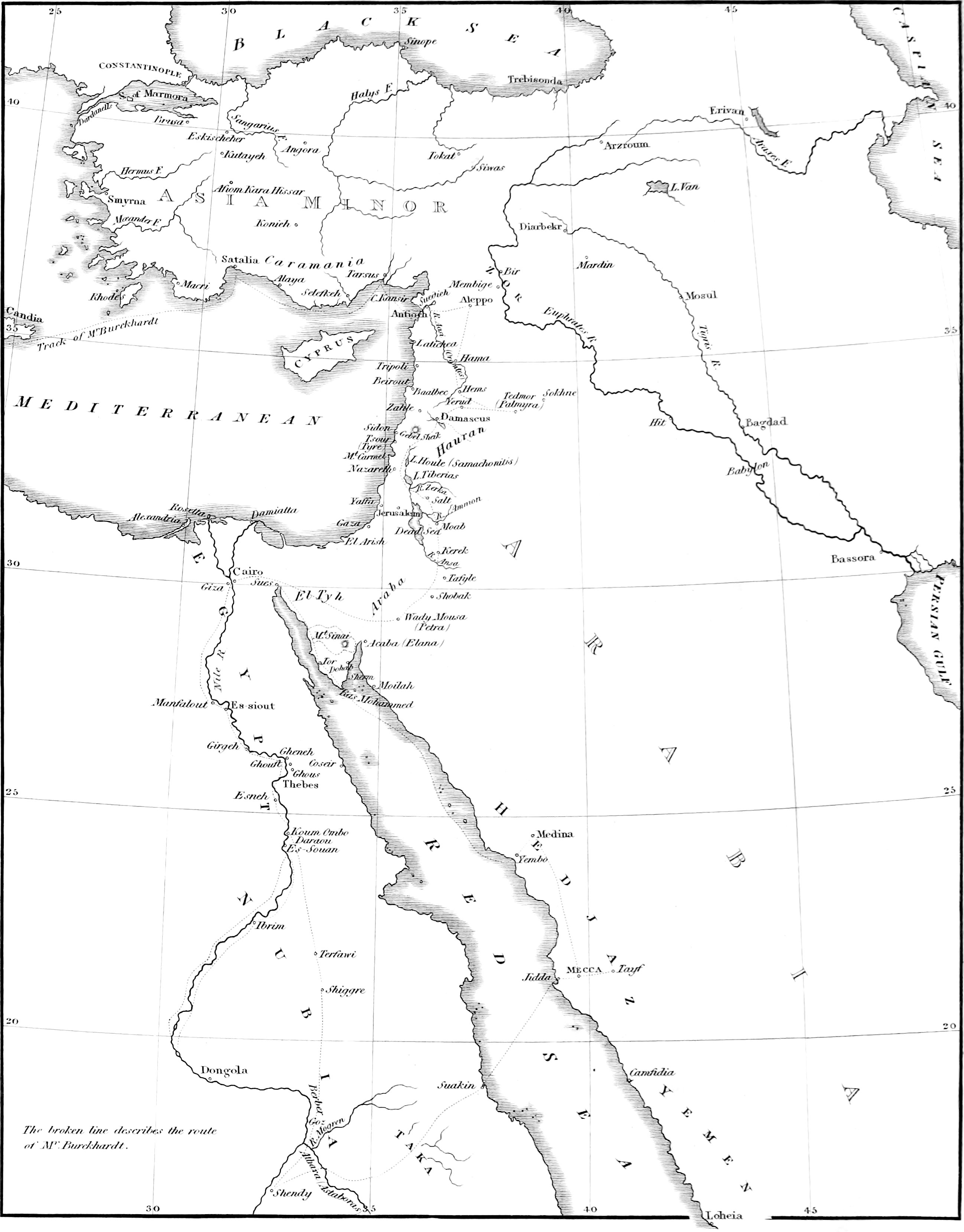
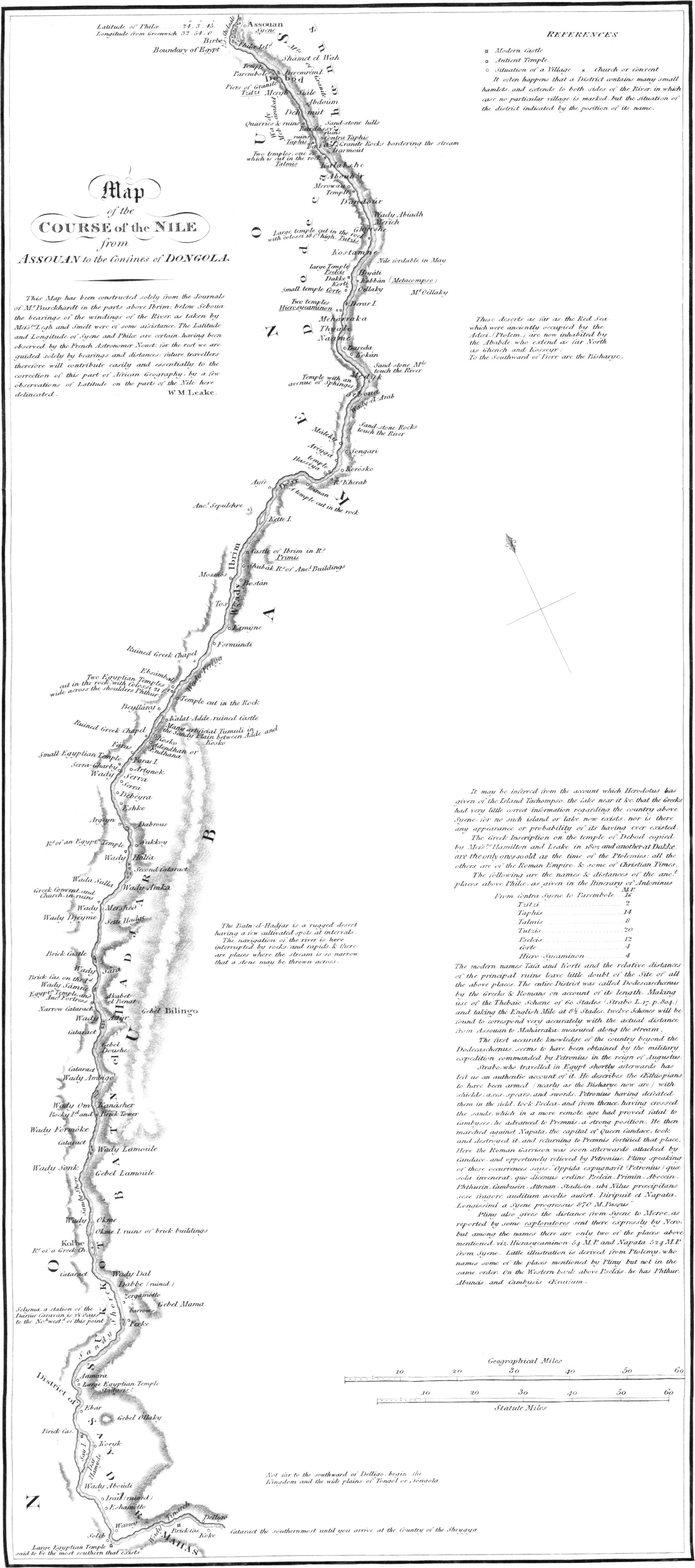
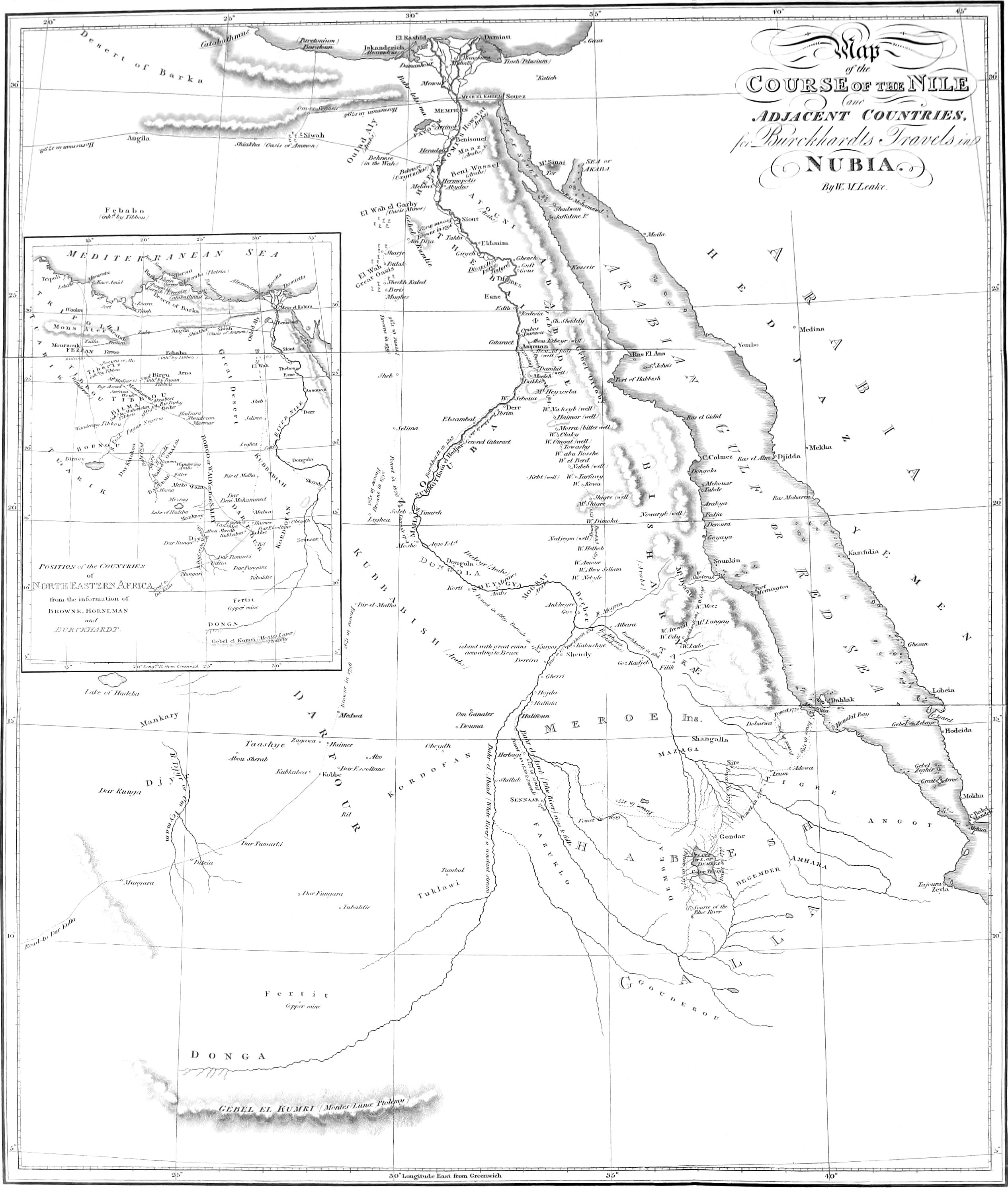
This Map has been constructed solely from the Journals of Mr. Burckhardt in the parts above Ibrim: below Seboua the bearings of the windings of the River, as taken by Messrs. Legh and Smelt were of some assistance. The Latitude and Longitude of Syene and Philæ are certain, having been observed by the French Astronomer Nouet; for the rest we are guided solely by bearings and distances: future travellers therefore will contribute easily and essentially to the correction of this part of African Geography, by a few observations of Latitude on the parts of the Nile here delineated.
W. M. Leake.
It may be inferred from the account which Herodotus has given of the Island Tachompso, the lake near it &c. that the Greeks had very little correct information regarding the country above Syene, for no such island or lake now exists, nor is there any appearance or probability of its having ever existed.
The Greek Inscription on the temple of Debod copied by Messrs. Hamilton and Leake in 1802 and another at Dakke, are the only ones so old as the time of the Ptolemies: all the others are of the Roman Empire & some of Christian Times.
The following are the names & distances of the anct. places above Philæ, as given in the Itinerary of Antoninus
The modern names Tafa and Korti and the relative distances of the principal ruins leave little doubt of the Site of all the above places. The entire District was called Dodescaschœnus by the Greeks & Romans on account of its length. Making use of the Thebaic Schœne of 60 Stades (Strabo L. 17. p. 804.) and taking the English Mile at 8½ Stades, twelve Schœnes will be found to correspond very accurately with the actual distance from Assouan to Mahárraka measured along the stream.
The first accurate knowledge of the country beyond the Dodecaschœnus seems to have been obtained by the military expedition commanded by Petronius in the reign of Augustus.
Strabo, who travelled in Egypt shortly afterwards has left us an authentic account of it. He describes the Æthiopians to have been armed (nearly as the Bisharye now are) with shields, axes, spears, and swords. Petronius having defeated them in the field, took Pselca, and from thence, having crossed the sands, which in a more remote age had proved fatal to Cambyses, he advanced to Premnis, a strong position. He then marched against Napata, the capital of Queen Candace, took and destroyed it, and returning to Premnis fortified that place. Here the Roman Garrison was soon attacked by Candace, and opportunely relieved by Petronius. Pliny speaking of these occurrences says “Oppida expugnavit (Petronius) quæ sola invenerat, quo dicemus ordine, Pselcin, Primin, Aboccin, Phthurin, Cambusin, Attenan, Stadisin, ubi Nilus præcipitans sese fragore auditum accolis aufert. Diripuit et Napata. Longissimi a Syene progressus 870 M. Passus.”
Pliny also gives the distance from Syene to Meroe, as reported by some exploratores sent there expressly by Nero, but among the names there are only two of the places above mentioned, viz. Hierosycaminon, 54 M. P. and Napata 524 M. P. from Syene. Little illustration is derived from Ptolemy, who names some of the places mentioned by Pliny but not in the same order. On the Western bank above Pselcis, he has Phthur, Abuncis, and Cambysis Ærarium.