TRAVELS IN EASTERN AFRICA. — CHAPTER I.
Governor-general of Mozambique Superseded for Slave-dealing,
and Arrival of His Successor—Trick of Slave-dealers
to cause an Early Misunderstanding between the
New Governor-general and the British Consul—Polite Attentions
of the New Governor-general—Decisive Measure
adopted for the Suppression of the Slave-Trade—The
Fort signalizes to a Slaver in the Offing—Seizure of the
“Charles et Georges”—Arrival of H.M. Frigate “Castor,”
and desertion by her of the British Consul—Combination
of Slave-dealers to drive the British Consul from
the Port.
On the afternoon of the 22nd September, 1857,
the city of Mozambique was in a great state of
excitement, for in the offing was the frigate “Don
Ferdinand,” having on board the new Governor-general,
sent by the government of Portugal to
supersede Vasco Guedes de Carvalho e Menezes,
for carrying on the slave-trade in the province
of Mozambique.
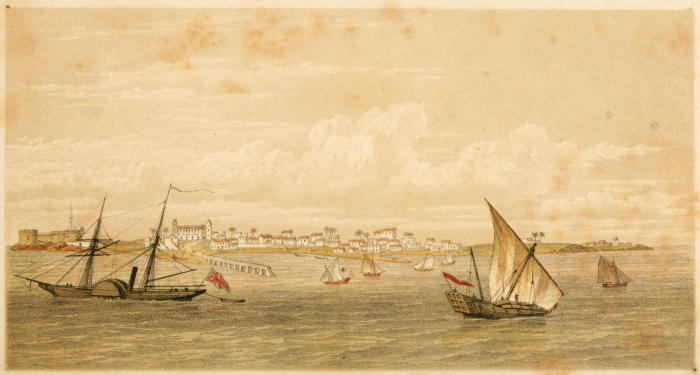
Slowly the old frigate threaded her way into
the harbour, and took up a berth, opposite the
town, between Fort San Sebastian and the
Palace of the Governor-general.
On the next day invitations were issued for
the principal personages at Mozambique to attend
the ceremony of the installation of the new Governor-general,
on the following Saturday, the
29th, at eleven o’clock.
An invitation was sent to the British consul
as a matter of course, but it was for Saturday the
30th, at half-past eleven o’clock. The object of
wording his invitation in this manner was that it
was hoped he would attend on the 30th instead
of on the 29th, by which he would be “a day
after the fair,” and by this means a misunderstanding
might be at once created between the
new Governor-general and the British consul.
The consul found that he was evidently asked
for the wrong day, but hoping that this might
be a mistake, he proceeded to the palace at
a few minutes before half-past eleven, as invited.
On his arrival, he found that the ceremony of
presentation to his Excellency was almost finished;
and, while elbowing his way through the
reception-rooms of the palace, crowded with brilliant
uniforms, the Jesuit secretary of Vasco
Guedes met him, and informed him that he “regretted
exceedingly that the British consul had
arrived too late to be presented to the new
Governor-general.” The British consul quietly
replied by pulling the letter of invitation out of
his pocket, and pointing out that by reading it in
one way, he was just five minutes and a quarter
before the time invited; and reading it another
way, he was at the palace twenty-four hours, five
minutes, and one quarter before the hour indicated
in the letter. The secretary smiled, apologized,
wished to explain, and, in fact, do anything
to cause delay until the presentation was over.
But the British consul at once requested him to
present him to the new Governor-general; when
this nephew of a cardinal positively declined,
alleging, as an excuse, that it was too late. Hereupon
the British consul produced his commission,
and, politely bowing to the cardinal’s nephew,
reminded him that the Exequatur of the King of
Portugal, &c., gave access at all times to the
Governor-general of Mozambique. The secretary
smiled, showing all his white teeth, and
bowed low in acknowledgment of his defeat.
The consul passed on, and at last, just before the
ceremony was over, reached the astonished Vasco
Guedes, to whom, after paying the usual compliments
of the day, he preferred a request that he
would at once present him to his successor,
Colonel Almeida, who was standing on his left
hand.
The new Governor-general shook hands with
the British consul, and requested him to take his
proper place, on his left hand, and then inquired
if he had brought over with him, from the mainland,
a machilla, for the purpose of attending
the ceremony, which was to take place in the
principal church. A machilla, I ought to
explain, is a sort of cot, or swinging sofa, with an
awning over it, in which persons are carried by
four slaves, bearing on their shoulders the large
bamboo pole to which it is attached.
Finding that the British consul had no
machilla with him, and would, consequently,
have to walk in the sun, Colonel Almeida asked
Vasco Guedes if a machilla could not be procured
for the consul; to which the latter replying
in the negative, his Excellency called a young
aide-de-camp, a nephew of the Sa de Bandeira,
and asked him to procure a machilla; but this the
polite young aide-de-camp found impossible, for
every one had made up his mind to make the
British consul walk.
The ceremony being ended, and no machilla
making its appearance for my use, the new
Governor-general said, “Now, gentlemen, we
will repair to the church; but, as Mozambique
cannot provide a machilla for the use of
the British consul, we must all accompany that
gentleman on foot.”
I have been particular in mentioning the above,
to show the animosity of the slave-dealers towards
myself; and how it was at once perceived by the
new Governor-general.
On the way to the church, Colonel Almeida
insisted that I should take my place with himself
and Vasco Guedes, under the large purple velvet
umbrella, which, on state occasions, is held over
the Governor-general of the province.
After the religious ceremony in the church was
over, I was requested to repair to the palace,
with the officers of H.M.S.V. “Geyser,” who were
present at the ceremony, and there to await
the return of the procession from Fort San
Sebastian, to which the new Governor-general
had to repair for the purpose of receiving the
keys of the fort.
On his Excellency’s return, we were again
presented, and congratulated him on his taking
possession of the government of the province.
In the evening there was a ball, where all
the “beauty and fashion” of Mozambique
attended.
On the following Monday I called the attention
of the new Governor-general to some serious
charges preferred by me against the Governor
of Ibo, in being openly engaged in the slave-trade.
Vasco Guedes had told me that he could not
supersede the Governor of Ibo for these practices,
as he was appointed directly by the King, but
Colonel Almeida made short work of it, by
appointing another governor to Ibo, and
requesting me to obtain a passage for him in
H.M.S.V. “Geyser.”
This request I was not able to comply with,
as an urgent order had arrived from the Cape
of Good Hope, recalling the “Geyser.” At
that time I had only just heard of the Indian
mutiny. I expected that Sir George Grey would
send every regiment and vessel on to India, and
that he would be anxiously looking out for the
“Geyser.” Although I saw hot work for the
new Governor-general and myself, I hurried the
“Geyser” to the Cape, where, I hoped, she
would be useful to my country.
On the arrival of the new Governor at Ibo,
he found a vessel under French colours lying
there waiting for slaves, which his predecessor
was about to supply. This vessel, called the
“Marie et Caroline,” the new Governor,
Lieutenant J. Romeiro, sent down to Mozambique;
and there being a French Delegate
on board, who stated that she had sailed from
Réunion for the purpose of embarking free
labourers from the east coast of Africa, he
was informed by the Governor-general of
Mozambique that this traffic in human beings
was forbidden, and had to enter into a bond that
he would not endeavour to carry on this species
of slave-trade within the precincts of the province
of Mozambique. The “Marie et Caroline”
was then released; and another vessel, named the
“Maria Stella,” under the French flag, being
sent down from Ibo to Mozambique, was treated
in the same manner.
The new Governor-general had thus shown
himself determined to put an end to the slave-trade,
and to carry out faithfully the treaties
entered into by Portugal and Great Britain,
for the suppression of the slave-trade in these
seas.
In the middle of November I had received
intelligence that slaves were to be shipped close
to Mozambique, and had communicated this fact
to the Governor-general, during an interview
which I had with his Excellency.
On the evenings of the 17th, 18th, and 19th
of November, I observed from my house that
signals were being made from Cabaçeira Point,
by means of fires, to some sail in the offing.
On the last of those evenings the Fort San
Sebastian was communicating with the vessel in
the offing by means of lights; and I afterwards
found that for these three days a large
three-masted vessel was in sight from the fort.
The commandant of the fort, an old colonel of
artillery, I knew to be a notorious slave-dealer,
and when he was telegraphing to the vessel in
the offing I felt convinced that the rumour
which I had heard relative to slaves being about
to be shipped in the neighbourhood of the fort
was but too true.
On the following day I received an intimation
in writing from the city of Mozambique that a
three-masted vessel was lying in Conducia Bay,
shipping slaves; and having, on the 21st November,
satisfied myself that two refractory
slaves belonging to my neighbour, Brigadier
Candido de Costa Soares, had been shipped on
board a slaver in Conducia Bay, I no longer
hesitated to address the Governor-general on the
subject, simply writing to his Excellency “that
I had received intelligence that a three-masted
vessel was at anchor in Conducia Bay; and that
there was reason to suppose that she was shipping
a cargo of slaves.”
Now, this vessel was the celebrated “Charles
et Georges,” and she was visible from the fort
during the whole time that she was at anchor in
Conducia Bay. Slaves were taken from the city
of Mozambique, and put on board of her, and
everyone in Mozambique was aware what trade
she was engaged in.
No one moved in the matter until I addressed
an official intimation to the Governor-general,
and it is quite certain that if there had been no
British consul at Mozambique she would never
have been seized.
As soon as the Governor-general received my
despatch, he sent a force overland, past my house,
to Conducia Bay; and one of the obliging merchants
of Mozambique offered his Excellency
the use of the “Enigma” schooner to take the
troops to Conducia Bay to seize the slaver. The
troops embarked on board the “Enigma” at one
o’clock in the afternoon, and that vessel did not
raise her anchor until five in the evening. She
dropped her anchor again in about an hour’s time,
and remained in harbour until the next morning.
When the “Enigma” reached Conducia Bay,
the slaver was gone; of course she was warned off,
and the “Enigma” had been offered simply to
detain the soldiers until the slaver escaped.
The Governor-general refitted the “Zambesi”
schooner, already well known to the reader, and
she was sent to sea in three days’ time.
The “Charles et Georges” had shipped
some portion of her slaves, and as she left four
thousand dollars on shore with the Portuguese
official, the Sheik at Matabane, for the purchase
of more slaves, it was natural that she should
return.
Accordingly, while cruising off the coast,
the “Zambesi” observed a strange three-masted
vessel at anchor in Conducia Bay, and, bearing
down on the stranger, boarded her on the 29th of
November.
She was conveyed to Mozambique, and handed
over to the judge, who condemned her, as he
found that there were four thousand dollars on
board of her, the handling of which he would
of course have.
A small French war schooner was sent from
Réunion to demand her restoration. The judge
immediately represented that the slave barque
“Charles et Georges” was improperly condemned,
and advised the Governor-general to restore
her.
The reason for the head of the law reconsidering
his decision was that he was told he might
retain the four thousand dollars found on board
the “Charles et Georges,” and that one thousand
more would be added if the vessel was restored.
The Governor-general was not to be trifled
with in this manner, and decided that, as the judge
had condemned her, he would send the “Charles
et Georges” to Lisbon.
So far so good. The slave-trade was being
effectually suppressed, as the British consul urged
the Governor-general of Mozambique to do his
duty. But another actor appeared on the scene,
and soon altered the position of H.M. Consul at
Mozambique.
On the 3rd of December H.M. frigate “Castor”
called at Mozambique. The captain of that vessel,
Henry Lyster, Esq., was quite astonished at the
energy and determination displayed by the Governor-general
of Mozambique, acting under the
advice of the British consul. The day after his
arrival he called upon the latter functionary, and
remained with him about ten minutes.
In this short space of time H.M. Consul informed
Captain Lyster, R.N., that on the night
the “Charles et Georges” anchored in Mozambique
harbour, the slaves belonging to the
slave-dealers stoned the band of the Governor-general,
while playing before the palace, and that
he was obliged to flog a number of the slaves of the
town, to prevent a repetition of this offence; that
the slave-dealers, baffled in their attack on the Governor-general,
twice attacked the consul’s house,
through the medium of their slaves, whom they
sent to stone the consul in his house; that he
was served with a notice to quit the house he was
then residing in, and that there was not one in the
town which he could get to live in; that some
short time previous, having gone to look at a house
in the country, which he was told was to let, he
was attacked by infuriated natives, who had been
urged to this act by the slave-dealers, and that he
escaped with his party by having been shown a road
which led him from the natives to his own house.
He further showed Captain Henry Lyster,
R.N., that he was without servants—all the slaves,
with the exception of a child, which would not
leave, having been taken from the house. He
claimed his protection, and also asked him for a
small boat by which he could communicate with
the Governor-general.
To which Captain Lyster replied that he must
immediately return to the Cape of Good Hope,
and apprize the admiral of the serious state of
affairs at Mozambique; and requested the consul
to close his despatches, as his departure was immediate.
He promised to send over in the evening
for the consul’s despatches, if they did not
reach him; and hurried out of the consul’s house,
stating that he had to make arrangements for
watering the ship at once.
The next morning at daylight, the “Castor”
was observed, under her topsails, standing out to
sea. It was imagined that H.M. frigate had gone
in chase of some strange sail in the offing, but as
day passed after day, the fearful and humiliating
truth dawned on the inmates of the British consulate,
that they had been abandoned to their fate.
The captain of H.M. frigate “Castor” left Mozambique
without the consul’s despatches, either
for the admiral at the Cape, or the British government.
On the arrival of the “Castor” in
England, Captain Lyster, R.N., was made superintendent
of a naval dock-yard. Comment is
needless, but sometimes truth is stranger than fiction.
Soon after the desertion of the British consul
and the Governor-general of Mozambique by H.M.
frigate “Castor,” a marked change took place in the
conduct of the Governor-general of Mozambique;
for he anticipated that the British government
would not support Portugal in the struggle which
he saw that weak power would have with France.
Those who have studied this subject may pronounce
their own opinion, but one thing is certain,
that to the base desertion of the British consul at
that critical period may be traced the subsequent
insolence of the slave-dealers, the increase of the
slave-trade, and the sufferings of H.M. Consul
and family.
As long as Vasco Guedes remained at Mozambique,
the slave-trade party felt that they had
nothing to fear; but now that Colonel Almeida
had arrived, and had published the Portarias of
the King of Portugal, forbidding the French Free
Labour Emigration, and his own declaration that
it was his determination to persecute that traffic
wherever he might find it in the province of Mozambique,
the slave-dealers found that the British
Consul and the Governor-general united were too
much for them; they therefore determined to do
all in their power to drive the former out of the
colony, believing that afterwards they would be
able to do as they pleased with the new Governor-general.
Three days after the sailing of H.M.S.V. “Geyser,”
by which vessel Mr. Soares believed I had
sent an application to England to have him appointed
H.M. Vice-Consul at Mozambique, (but
which I did not forward in consequence of learning
to what extent he was engaged in the slave-trade,
and by his own admission to me
that he had been the principal person in establishing
the French Free Labour Scheme at
Mozambique):—Mr. Soares sent me a written
intimation that he would require both his houses,
the one on the island in twenty-four hours, and
that on the mainland in a month or forty days.
Until I received this intimation, I had not the
slightest knowledge of anything of this sort which
was going on, and, indeed, looked forward daily to
getting into the house on the island.
I immediately called Mr. Soares to an account
for treating me in this manner. His reply was,
“They say, Mr. M’Leod, that I give you all the
information about the slave-trade, and that I must
leave the place, or that you must.” I asked him
who they were, but he would not answer my
question.
He told me that his father said that he must put
me out of his house, to clear himself of the charge
that had been brought against him by the Mozambique
people. I asked him to tell me—if I was
so foolish as to give up to him a house which I
had taken for twelve months—where I could find
another house vacant? He told me that there
was not one in Mozambique; and that, if there
was, the people had determined among themselves
not to let me even have a room for an office,
much less a house to live in.
I reminded him that he was differently treated
at the Cape of Good Hope; he begged me, with
tears in his eyes, not again to allude to what he
could never forget; and stated that what he was
doing he was compelled to do, and that if he left
Mozambique it would be much worse for me.
Finding that he was quite insensible to reason, I
gave him to understand that since, under numerous
pretexts, he had prevented my taking absolute possession
of that portion of the house on the island
which was let to me, and that he was now in possession
of it, why, I must submit to be deprived
of it; but that, with regard to the house on the
mainland, I intended to remain in it until the
time agreed upon was completed, or until such time
as I obtained another house. He got into a great
rage, and told me that “he would remove all the
slaves, and that I would be unable to live in the
house then.” To which I replied “that then he
would break his agreement with me.” This caused
him to answer that he “did not care what he did
to get me out of the house, for that his father said
I must leave the place.”
From that day the slaves were gradually removed,
until there was only one little child, called
Azinte, left, who refused to leave.
Azinte was about eight years of age; she was a
melancholy child, with intelligence far above her
years. Her face was good, and there was a sweet
resigned smile upon it, which interested the commonest
observer.
She came especially under my wife’s notice in
the following manner:—
The grown up slaves, while employed at their
work, left one of the little ones always to watch
their meal while it was cooking, and to keep a
good fire under the pot.
On one of these occasions Azinte was left guardian;
and, whether it was the pangs of hunger, or
the curiosity inherent to her sex, and inherited
from our common mother, Eve, which urged
her, I know not, but she uncovered the pot to
look at its contents, and, like many children of an
older growth and a fairer skin, the temptation was
too much for her, and she was caught in the act
of helping herself to the old folks’ dinner. To the
Mozambique negro mercy is never shown; and
therefore, in the hour of his might, we cannot
expect him to be merciful. Nay, cruelty for
successive ages has made him cruel. Azinte’s
little hand was seized by a powerful grasp, and
held upon the burning faggots.
For three days and three nights she endured
excruciating torments. Rosa, my wife’s maid,
inquiring for her little favourite, found her hid
away in an outhouse, neglected by all her companions,
who would not even take her a drink of
water. Rosa took the suffering child to her mistress.
The little hand was in a frightful state;
but by careful dressing and constant attention it
was saved. The little Azinte was ever afterwards
kept in the house. She would never point out
the monster who had seared her hand. The little
negress was very grateful, and loved my wife
dearly. Many attempts were made to steal the
child from us, but she escaped them all. At last,
the hour of parting came; I asked Mr. Soares to
give the child her freedom. He told me to buy
it, and to name my own price. He would have
sold me the child for one shilling; but not even
to liberate could I buy a slave. Poor Azinte, you
were sacrificed to a stern sense of duty. Here
was a little being humanized, if not civilized; those
who had raised her to that state had no control
over her. She was a chattel belonging to a Portuguese
of Mozambique descent, and was to be
used as such. We often think what may be her
fate!
When the slaves were removed from Mr. Soares’
house, in the hope of driving us away, I used
every endeavour to hire some from persons in the
city of Mozambique. A German merchant would
have procured me the services of some, but as he
could not hold slaves more than myself, he was
dependent on the will of the Mozambique people,
who hired their slaves to him on the express condition
that he would not lend them to the British
consul. On all sides, I was now beset with offers
of slaves, cheap slaves to sell.
In this dilemma, I applied to the Governor-general
for the loan of government slaves. At
first he said he would, of course, give me what I
required; but afterwards, he stated that he found
it was impossible to supply me with a crew for
my boat, or even one government slave.
Anticipating that things might come to this,
when the Mozambique people found that what I did
on my arrival to suppress the slave-trade, I continued
during my sojourn among them, I had written
to a Parsee house at Bombay to send me a suitable
number of servants. Since my arrival in England,
I have received a letter from the Parsee merchant,
containing the envelope of my letter from Mozambique,
to show me by the post-mark the date of
its arrival at Bombay, and to prove that my order
not being executed was no fault of his. The
simple fact is that my letter was detained at
Mozambique.
Being without any assistance in the house, if
I except a sick Portuguese soldier, who used to
oblige us occasionally by attending on table, I
was obliged to face the work manfully. The
Portuguese refused to light the fire, alleging that
it was negroes’ work, and so the British consul
had to do it. For months, I drew water from the
well and cut up the fire-wood. The Portuguese
said his arms were not strong enough to draw
water from the well, and that cutting up fire-wood
made his back ache; so, of course, this
necessary work devolved upon me.
But there were some things I could not do—for
example, cook our meals; this devolved on my
wife and Rosa. Those who have a fancy to know
what this was like must get some mangrove-wood,
the arsenical fumes from which, after suffocating
and blinding them, will render them unfit to
eat anything for that day. Hard-earned was the
morsel that was cooked for dinner; but the day
came when we had no wood and no food, and
God, in his mercy, sent our countrymen, who were
the survivors of the crew of the unfortunate
“Herald,” to save us.
At Mozambique, no one would wash our clothes;
and for months this necessary work was performed
by my wife and poor weak Rosa, with no assistance
but the little Azinte, who, poor child, learned
in the course of time to lay the clothes upon the
grass. This necessary labour had to be performed
by two delicate Englishwomen, with the thermometer
ranging from 80° to 96° in the shade,
and yet they are both alive at this moment.
All this had to be endured; we were in the
hands of the Philistines, and we had to do battle
with them; ours was the battle of patient endurance.
The Portuguese wished to degrade us in the
eyes of the negroes; to show them what an inferior
race the English were; that they could not keep
one slave, whilst the Portuguese had hundreds.
After the severe toil of the day, we were all
glad when night came, and thankful that health
and strength were granted to us.
Such was the state of affairs in my house,
when my German friend offered me a passage in
one of the vessels belonging to his firm,
which was then in port, and proceeding to
Zanzibar.
Although resolved to remain at Mozambique,
and maintain my post, despite all persecution,
I reasoned with myself on the sinfulness
of sacrificing the lives of two other
persons, and, therefore, determined to avail
myself of this opportunity of sending my wife
and her maid to Zanzibar, to await my arrival
there; as, in that case, I would have been able
to find accommodation for myself on board some
vessel or dhow in the harbour, until such
time as the hour of deliverance arrived, by the
presence of one of Her Majesty’s ships.
On proposing to my wife a visit to Zanzibar,
her countenance revealed with what joy she
hailed any change from that continued toil under
which herself and her maid were rapidly failing.
But, instantly divining that it was my intention
to remain at Mozambique, and maintain my post,
while she and her maid were expected to proceed
to Zanzibar, with her eyes suffused with tears,
she claimed, and successfully pleaded, her wife’s
privilege to share her husband’s trials.
Soon afterwards my wife sent for her maid,
and told her that there was a passage provided
for her to Zanzibar, where arrangements would
be made for her conveyance to the Cape of
Good Hope, where her mother lived. But
that noble girl, Rosa Smith, refused to desert
her mistress; and, when this offer was again
made to her, after the desertion of H.M.
frigate “Castor,” she adhered to the same
resolution.
From that evening, during our stay at
Mozambique, in all our sufferings and privations,
with sickness, hunger, and even death in my
house, I never heard a murmur. Both these
Englishwomen felt that they were called upon to
perform a sacred duty. They suffered in a holy
cause—that of the slave—and HE who “tempereth
the wind to the shorn lamb” gave them
strength to endure.
The following is an account of an act of
brutality towards a domestic slave which came
under my own eye, and the particulars of which
I extract from my journal at Mozambique:—
“On Monday, the 15th of March, 1858, at
8.30 A.M., we were greatly distressed by screams,
which proceeded from some fellow-being in the
compound of the next house, the wall of which
was about thirty yards distant from our own.
Mrs. M’Leod was at the time slowly recovering
from the effects of the fever, and the treatment
she had received from Dr. Fonseca, and it may
be easier imagined than described, what a serious
effect this affair had on her system. The
screams proceeding from that house were, on this
occasion, more alarming than those that were
heard from time to time, daily, when the female
overseer was employed in punishing the slaves
under her control. At last, they became so
alarming that we came to the conclusion that the
slaves had risen upon Portuguese Rosa, the
overseer, and having succeeded in getting her
into one of the outhouses, they were employed
in avenging themselves for the gross and continued
wrongs which they had suffered at her
hands.
“Believing that this was the case, and urged by
the entreaties of my wife and her maid to
endeavour to save the woman from the fury of
the negroes, I repaired to Mr. Soares’ house,
in the court-yard of which the following revolting
scene met my view:—
“Portuguese Rosa was lying on a native bed,
or sofa, which was placed with its head about
three feet from the doorway of an outhouse, in
which cocoa-nuts were stored until required for
the use of the house.
“This Portuguese woman was reclining at full
length on the sofa, her chin supported by her
hand, and contemplating, with evident pleasure,
the disgusting scene of barbarity which was
being enacted inside of the cocoa-nut house. A
negro, one of the finest specimens of man I have
ever looked upon, and one that an artist would
have wished for a model of Apollo, was lashed
up to a ladder by his hands and legs; two negroes
were castigating him on his posteriors; two spare
ones were waiting to relieve them, and one old
negro stood by, who appeared to be a doctor,
witnessing how much the sufferer could bear
without being killed. The poor creature’s posteriors
and thighs were covered with blood,
and a pool of blood was around his feet.
There lay the Portuguese woman, calmly enjoying
this scene of blood, occasionally instructing
the actors where to strike, when a cry of
more thrilling anguish would testify to her refinement
in torment.
“Anxious to put an end to this revolting
scene, I asked—nay, I begged—this fiend in
woman’s form to pardon and release the man.
“Instantly her dark eye was lighted up
with the frenzy of intense hatred, and, turning
to me, she said, ‘For anything with a white
skin, I would pardon—but for you, thou
champion of the slave!—never!’ Then
turning to the executioners, she yelled, ‘Flog,
sons of hell, flog! or else I’ll pour the boiling oil
upon you.’ This drew my attention to a neighbouring
fire, on which stood a pot, which, I
afterwards learned, contained boiling oil. To
have remained longer would have only added to
the sufferings of the slave. This was a case of
domestic slavery, in which, of course, I could not
interfere. A late Portaria of the King of
Portugal declares that this slavery shall cease in
twenty years time; that is to say, continues it for
that period. Subsequently, I heard that this slave
was punished for disobedience of orders.
Inquiring further into the matter, I learned that
this noble black had refused to castigate his own
mother. Women of England, and mothers of
Portugal, hear me; and when you hear,
speak—so that Don Pedro the Fifth, of Portugal,
shall cause slavery to cease in his African
dominions, and leave to his dynasty a name, the
memory of which shall awaken prouder
associations than those even of the Era of
Conquest.”
A few days after witnessing the frightful
atrocity just related, I had a letter sent to me
from the master of the cruel Portuguese woman,
and the owner of the godlike manly form, with a
black skin, whose ignominious tortures I had
witnessed, in which I was called a spy, and
sundry other equally complimentary epithets,
for having unfortunately witnessed a scene
revolting to humanity, when I imagined I was
bound on an errand of mercy, in an endeavour to
save the life of a fellow-being. Of this I took no
notice; but, from that moment, I felt convinced
that my neighbours’ slaves were more rigorously
dealt with than even before. With a refinement
of devilment, during the remainder of my stay
at Mozambique, the Sabbath of the Lord was
set aside specially for the punishment of Mr.
Soares’ negroes; and, as that Portuguese gentleman
knew that the Consul of Protestant
England performed the service of the Church
of England, every Sunday, at eleven o’clock in
the forenoon, that hour was chosen for the
commencement of these harrowing tortures, which
were continued until one P.M., when he imagined
that the prayers of the heretic were ended.
Where those cries of anguish ascended to the
throne of the Omnipotent, the song of praise
will, assuredly, be heard at no distant period.
The Portuguese, entirely devoted to slavery,
have neglected the natives in religion, as in all
other matters; and as the Makuas have not
imbibed Mahometan principles from the Moors
or Arabs, who do not here attempt any proselytism,
there is an admirable opening at Mozambique for
Protestant missionaries; but Moloch, in the shape
of the slave-trade, must first be done away with,
when a noble field for missionary labour will be
laid open.
As a further example of the cruelty which
Portuguese women perpetrate on their slaves,
the following barbarity was related to me as
having been inflicted in the city of Mozambique:—
A Mozambique lady, having been clearly
convicted of some delinquency, by the evidence
of one of her female slaves, adopted this method
of punishment, which,—even among those who
are in the habit of burning their slaves with red
hot iron, pulling out the nails of the fingers and
toes for punishment, and otherwise perpetrating,
in that remote region, the horrors of the Inquisition—is
spoken of with disgust. The unhappy
girl was seized and firmly secured; an egg was
boiled, and, on being removed from the pot, was
forcibly placed in the mouth of the wretched
slave. A sail-needle was then driven as a
skewer through both lips, when the girl was
released, and the lady owner viewed her torments.
This she-devil, not yet satisfied with the punishment
inflicted on her fellow-being, ordered the
slave-girl to be struck on both cheeks until the
egg was broken, and the scalding contents went
down her throat.
The slave-trade thrives only in the African
dominions of the King of Portugal; and the late
Portaria of that monarch at once places His
Majesty foremost among the advocates of
slavery. Until slavery is entirely abolished in
the African dominions of Don Pedro the Fifth,
the slave-trade will flourish, while outraged
humanity and the suffering Africans exclaim to
that potentate, “Thou art the man!”
CHAPTER II
The Portuguese Merchant and the Governor-general—Arbitrary
Measures adopted towards the Banyans—The
Piratical seizure of the “Ari-passa”—Measures adopted
for her Restoration—Comparison between Wellington’s
Soldiers and Mozambique Soldiers—The “Ari-passa” is
restored—Seizure of the British cutter “Herald.”
There being some misunderstanding as to what
portion of the coast between Cape Delgado and
Delagoa Bay has belonged to Portugal, and, as
the British government has never been represented
by any agent on that coast until within the
last three years, it naturally devolved upon me, as
the first British functionary employed by Great
Britain in the province of Mozambique, to make
myself thoroughly acquainted with the real state
of the question of Portuguese possession in
Eastern Africa, on which, in a great measure,
hangs the future commercial development and
civilization of Central Africa; and I now lay
before the intelligent reader the result of my
patient and impartial inquiries on the subject.
On referring to the accompanying chart of
Eastern Africa, the reader will observe
that the Portuguese territory consists of
positions almost entirely insular—namely, Ibo,
Mozambique, Killimane, Sofala, Bazarutto,
Inhambane, Delagoa Bay, and Pemba Bay;
at which last named place the Portuguese
have made a settlement within the last
year.
On the river Zambesi they also have the towns
of Seña and Tete.
Some of these positions—Ibo, Mozambique,
and Bazarutto—are beyond gun-shot distance of
the coast, virtually exercising no authority whatever
over the mainland; and, strictly speaking,
from my own personal observation, the Portuguese
authority, even nominally, does not extend
five miles above high-water mark, nor more than
that distance from any flag-staff erected by Portugal
anywhere on the whole line of coast from
Cape Delgado to Delagoa Bay.
Excepting at the points indicated in the
accompanying chart, and already named, the
Portuguese do not, and have never, even
for a short period of time, held even nominal
possession of the coast referred to, with the
exception of what is known as the kingdom of
Angoxa.
The kingdom of Angoxa, having a sea-board
of ninety miles, and reaching into the interior
180 miles, is reigned over by an independent
sultan, having under him from thirty to forty
chiefs. It is rich in produce, which is fully described
in the chapter on the “Resources of Eastern
Africa.”
Soon after my arrival at Mozambique, my
attention was called to the very arbitrary
measures which the Portuguese authorities
can adopt when it suits their purpose, showing
that it is not want of power, but want of
inclination, which prevents them stopping the
slave-trade, and encouraging legitimate commerce.
A merchant at Mozambique had a
serious difference with the Governor-general, the
subject of their quarrel being the French Free
Labour Emigration. It appears that the merchant,
having a high character for probity, had
been entrusted by the French agents with the
division of the head money, which was allowed to
the authorities at Mozambique for the generous
supply of slaves for this traffic.
The merchant acquitted his task to the satisfaction
of all parties, retaining, for himself, a certain
portion, to which he was entitled by agreement,
as one of the promoters of this very successful
scheme. During the absence of the
merchant from Mozambique the Governor-general
had divided the plunder, and he refused to
account for the amount which was due to the
merchant as his share of the transaction.
On the merchant’s return, he became again the
person in whom all parties placed confidence, and
he therefore re-imbursed himself from the
Governor-general’s share in the next slave cargo
which was supplied to a French Free Labour
Emigration ship.
The Governor-general was furious, while
every one applauded the justice of the merchant.
Shortly afterwards, a vessel belonging to the
merchant was about to sail; the Governor-general
refused her permission to leave the
harbour, and would assign no reason. The
merchant threatened to sell the vessel to the
English consul, much under her value, and to
communicate the whole of the circumstances
attending the transaction, unless the Governor-general
allowed his vessel to sail. The Governor-general
was obstinate, but at last relented.
During his fit of obstinacy the uncontrollable rage
of the other party caused him to make the circumstances
of the case known to the English consul,
who thus got a deeper insight into the slave-trade
as carried on at Mozambique, and was
timely prevented forwarding the application of
the honest Portuguese merchant to the British
government for the appointment of H.M. Vice-Consul
at Mozambique, for which he had been
strongly recommended to me, both verbally and
in writing, by the officer commanding Her
Majesty’s naval forces at the Cape of Good
Hope. It requires a residence at Mozambique
to unmask the slave-dealers there. One casually
visiting the place is hospitably entertained, and
those deepest engaged in the traffic are the
loudest in their apparent denunciations of
it. Thus our naval officers have been misled,
and made to believe that parties there were
opposed to the slave-trade when they were
actually conversing with the prime movers of
the whole scheme.
From the seizure of Mr. Sunley’s brig off Angoxa,
and the tacit manner in which legal trade is
carried on between Angoxa and Zanzibar by the
Arabs, under the protection of their immediate
dreaded neighbour, the Imâm of Muskat, it will
be seen that a different policy is pursued by the
Mozambique government towards a prince who
has taught them to fear him, and the great English
nation, whom they look upon as a good-natured
people, inoculated with a Quixotic idea of improving
the moral, intellectual, and physical condition
of a race which they consider irreclaimable,
and so degraded that they treat them as the
brutes which perish. The sacrifices made by
Great Britain in this cause are ever a subject of
ridicule with the Mozambiquers; and they never
lose an opportunity of retaliating in their own
way upon those persons belonging to the English
nation who may unfortunately fall into their
power. Each individual is made answerable for
the wrongs which they perseveringly assert have
been heaped upon them by the suppression of the
slave-trade, and even this feeling is carried out to
the natives of India who may be under our rule
or our protection.
I heard, from time to time, of some arbitrary
measure adopted towards the Banyans, who are
natives of India, trading in their sailing vessels
called dhows, from various places on the Malabar
coast to that of the coast of Africa. These men
come over in their dhows from Goâ, which is a
Portuguese settlement, and from the British settlement
at Bombay, and also from Cutch, where
there is a British resident, in the season of the
N.E. monsoon, which blows from the month of
April to that of September or October. They
bring over to Mozambique what may be called the
refuse of the European goods sent out to the
Indian market, where they find a ready sale.
In exchange, they take back principally ivory,
which, being resold in India, finds its way to
Europe and America, as the best Indian transparent
ivory, which is really obtained at Zanzibar
and Mozambique. The profits derived from the
trade which they carry on with Mozambique, to
which place all the ivory of the province generally
finds its way, are so considerable that the Banyans
are induced to submit to great exactions and considerable
injustice. They have no appeal, and
must either put up with the robberies to which
they are liable, or entirely abandon the trade.
It may be easily imagined that they rejoiced
on seeing a British consul established at Mozambique;
and they testified their satisfaction at my
arrival in a variety of ways, more especially those
who were sailing their dhows under the British
ensign. They complained to me generally of the
exorbitant tariff, and that they had been led to
believe, year after year, that it would be altered.
They complained of the unjust manner in which
the duties were levied, and the robberies to which
they had to submit from the officials in the Custom-house,
against whom they dare not complain without
incurring considerable delays in their business,
and for which there was no redress; that the only
means left to them was by bribing the officials,
which was a great burden on their fair gains; and
ended by saying, that if some protection was not
afforded them, they would be compelled to abandon
the trade altogether, as numbers had already
done. These men were so intimidated by the
Portuguese officials, that they feared to state even
to me, their consul, the particulars of their losses,
saying that, in the event of anything happening
to me, they would be marked by the officials, and
ruined; and they only prayed that I would
generally supervise their affairs, and, in the event
of any flagrant act of injustice occurring while
at the port, that I would afford them that protection
which they were always led to expect
from a British functionary. It was with my mind
thus prepared that the following piratical affair
was brought under my notice:—
The Cutch dhow, “Ari-passa,” on a trading
voyage, arrived at Zanzibar, in the African dominions
of the Imâm of Muskat, in the month of
July, 1857, which port she left on the 14th July,
bound for Port Mozambique, with instructions to
call at Ibo on the passage down. On leaving
Zanzibar, her passport was duly visé by Colonel
Hamerton, the British consul at that port, and all
her papers were correct.
After going into the harbour of Ibo, the captain
found that there was a great difficulty in obtaining
his passport from the Governor; and as
there was a considerable amount of money on
board the dhow, he became alarmed for its
safety, and also, I may add, for his own. However,
after loudly complaining of the detention,
and making some very strong observations on the
cause of his detention, he was permitted to leave
Ibo, and proceeded on his voyage to Mozambique.
He found the wind south, or dead against him, and
consequently, every night, he, as is customary with
the dhows, stood in and anchored under the land,
getting under weigh at daylight every morning.
It will be remembered that Vasco Guedes, then
Governor-general of the province of Mozambique,
had refused to supersede the governor of Ibo,[1] for
supplying slaves to the “Minnetonka” American
slaver, which left Ibo with a cargo of 1,200 slaves
for Havannah de Cuba. The real reason for the
Governor-general not superseding this delinquent
governor was, that he kept his accounts properly—or,
in other words, gave to the Governor-general
a share of the head money for the slaves exported
from Ibo, this share being (as I have already
stated) six dollars for every negro shipped on
board the French Free Labour ships, or the
Spanish and American slavers.
We have seen these two officers, representing
the King of Portugal, in defiance of all laws and
commands to the contrary, engaged in the nefarious
traffic in their fellow-beings.
One would imagine that this was bad enough,
but the Governor-general had received an intimation
that his successor had left Lisbon in the
month of May, and there was no time to be lost—every
opportunity must be seized for making
money; so thought his worthy coadjutor at Ibo.
He dare not take upon himself to plunder a vessel
openly in the harbour of Ibo, but he wrote to the
Governor-general of Mozambique, to inform him
that this dhow was on its way to Port Mozambique,
and he detained her at Ibo to give his
superior time to act.
About the 20th of August, I heard that a Portuguese
schooner of war, called “19 de Maio,” had
left Port Mozambique, and was bound to the
northward to intercept a dhow coming from Ibo,
with a large quantity of bullion on board. At
that time a number of extraordinary revelations
were made to me relative to the slave-trade, and
French Free Labour Immigration; and I naturally
inquired if it was usual to intercept traders in
this manner. I was told that it was not usual,
but that such things did occasionally occur. I
asked if the authorities had no fear of the matter
being inquired into? I was answered with a
laugh, and informed that “there was no one to
inquire into these matters.” If inquiry was made,
the reply was that the vessel had been seized for
attempting to smuggle with the shore, or that it
had been done to suppress the slave-trade. This
was always satisfactory. But in making such a
capture occasionally vessels were scuttled, when
they gave no further trouble. It was evident that
I was living in a nest of pirates. Let us come to
the facts again.
The dhow “Ari-passa” had been gradually
working down to Port Mozambique. On the 26th
day of August, 1857, blowing fresh from the southward,
she endeavoured to get into Conducia Bay
(since celebrated by the “Charles et Georges”
affair), but did not succeed in fetching it; she
therefore bore up, and ran away before the wind
to the entrance of Quicimajulo Bay, where she
anchored, the wind still blowing fresh from the
southward. Soon after she had anchored, the
Portuguese schooner of war, “19 de Maio,” dashed
alongside, and threw a party of soldiers on board
of her. These soldiers, under the direction of
their officer, forced open the hatches; and proceeded
at once to the place where the boxes
containing the bullion were stowed; evidently
being well instructed from Ibo. They removed
the money to the schooner, and then amused
themselves by breaking open the boxes containing
the cargo, after which the night was passed in
scenes of revolting debauchery which cannot
even be alluded to.
The captain and three of the crew were taken
on board the schooner as prisoners; and, the
next day, the schooner and her prize weighed,
and after two days arrived at Mozambique.
As no house could be obtained for me in the
city of Mozambique, I was obliged to live on the
mainland; which had the object desired by the
slave-dealers at Mozambique, who had all conspired
not to let me have a house in the city,
namely, to prevent my obtaining a knowledge of
all their movements. In consequence of this, it
was a day or two before the real state of the case
came to my knowledge.
It appears that, on the arrival of the “Ari-passa”
at Mozambique, the Banyans became
very excited, and induced the captain to demand
his release, and the immediate restoration of the
vessel, asserting their intention of appealing to
the British consul. The Governor-general, it
appears, regretted the occurrence when he found
the vessel had been brought into harbour, and
had a British passport; but as the foolish captors
had not sunk the vessel, it was necessary to put a
bold face on the matter, and therefore a temporizing
course was adopted. The prisoners were
set at liberty, and vague promises made to them,
with which not being satisfied, they asked permission
to visit the British consul on the mainland;
at first this was refused, but at length
permission was granted, and a deputation waited
upon me, and stated the case. The information
which I had received relative to the destination
of the Portuguese schooner, “19 de Maio,” came
to my recollection, and I found that the “Ari-passa”
was the vessel which she had been sent to
capture.
The facts of the case were duly deposed before
me by Hery, the captain of the dhow; and I
made myself thoroughly master of the whole subject,
by examining a number of the crew, and
inquiry into the whole circumstances of the
affair.
I then addressed the Governor-general in
writing, and asked His Excellency to inform me,
why the dhow “Ari-passa” had been seized, and
her crew, under British protection, had been ill-treated
and imprisoned? To which he replied
that the “Ari-passa” was “found in communication
with Quitangonha, which was forbidden, and
in consequence she was seized, as being suspected
of smuggling, and she was delivered to the tribunals
according to law.”
Now, I knew that being delivered to the “tribunals
according to law” meant that, having been
plundered of the bullion by the Governor-general,
she was then handed over to the judge, to see
what he could make out of her in the way of
a bribe, or fine, to release her and her cargo;
and was only submitting to be further robbed.
It was, therefore, necessary to adopt bold measures,
and to let Vasco Guedes know that I was
acquainted with the circumstances connected
with her capture. And although I could not
write and state what I knew about the Governor
of Ibo writing to him relative to the “Ari-passa,”
and the arrangements which were made in consequence,
because I would then have to state who
my informant was, still I addressed His Excellency
in such a manner that he could not doubt
that I was fully aware of all that had taken place.
I particularly pointed out that the vessel was
seized at anchor at the entrance of Quicimajulo
Bay, which was, at least, twenty miles from Quitangonha;
that she had simply anchored from
stress of weather; that it was usual for dhows
working along the coast to anchor every night,
and that the vessel had not communicated with
the shore. I then stated the manner in which
the dhow had been boarded by the “19 de Maio,”
by dashing alongside like a pirate, and throwing
a party of armed boarders on to the deck of a
peaceful trader, laying emphasis on the manner in
which the soldiers had broken open the boxes
containing money, and rifled the cases containing
cargo, and designated the whole affair as an
illegal and piratical seizure. “Suaviter in modo et
fortiter in re,”—is a good diplomatic motto; but,
in dealing with Portuguese one must not forget
the “fortiter in re.”
The Governor-general’s reply is one of the
richest things on record. He commences by
stating:—
“That it is with regret that he sees a vessel,
the flag of which is under the protection of Great
Britain, engaged in illicit commerce, more especially
as in the province of Mozambique every
facility is afforded for legitimate commerce to
ships of all nations, and particularly to those of a
friendly ally.
“That in regard to the deposition of the captain
of the ‘Ari-passa,’ which I had sent to him,
he doubts its correctness; for the captain does
not mention her stay at Ibo, which was the most
important circumstance connected with his voyage.
That the dhows from India bear very suspicious
characters; as a proof of which, one of
the dhows from India lately entered the port with
a cargo of fire-wood! But, however the matter
may be, it was not for his Excellency and myself
to settle it, but the tribunals, before which the
depositions ought to be made.”
His Excellency then indulged in a geographical
disquisition relative to Quicimajulo and Quitanhonga,
and admitted that my knowledge
might be correct as to their relative positions.
With reference to the conduct of the soldiers
who boarded the “Ari-passa,” he reminded me of
what the illustrious Lord Wellington himself
states as to the conduct of his soldiers in the
Peninsula, contained in his letters addressed to
Viscount Castlereagh; and, also, begs me to bear
in mind that, it is said, similar acts are practised
by the British cruisers on the coast of
Angola, and also on that of Mozambique; and
that, in fine, he possesses a document of a recent
date, in which the depositions of the crew and
passengers are given, of one of the Portuguese
vessels coming from India, which, being at anchor
in Conducia Bay, was boarded by a boat from a
British cruiser; that the officers searched the
Portuguese vessel, broke the seals of the dispatches
addressed to the custom-house, and
endeavoured also, during the night, to introduce
chains, or slave-irons, on board the vessel, so as
to seize her as a slaver.
The fact of the matter was, that the Governor-general,
at that time, was hard pressed by me on
the subject of the slave-trade. I had discovered,
in the short space of a month, all the ramifications
of the slave-trade which he had established
at Mozambique, under the denomination of the
French Free Labour Emigration Scheme, and
how the victims for that traffic were supplied
from the interior of Africa, renewing the horrors
of the slave-trade in the heart of that continent.
This letter was evidently written to annoy and
irritate the British consul; but, coming from such
a source, I could well afford to smile at the insult
to my country, in comparing the glorious soldiers
of Wellington, who, on their victorious bayonets,
carried liberty to Spain and Portugal, to the convicted
and degraded felons who formed the
soldiery of Mozambique. In regard to the statement
directed against the British navy, I simply
let that matter rest until the arrival of a British
ship of war, the commander of which considered
it beneath notice.
The Scotchman kept his temper, and simply
renewed his demand for the unconditional release
of the “Ari-passa.” Some days afterwards I received
an invitation for my wife and myself to
drink a cup of tea at the palace; and a postscript
was added by his Excellency, intimating that the
“Ari-passa” was restored!
Yes, the “Ari-passa” was restored, because
there was a British consul there to protect her;
but how many “Ari-passas” have been seized and
plundered without redress! Some portion of the
money which had been robbed from this vessel
could not be found when restoration was ordered;
this was put down to the soldiers, who had been
compared to the companions of Wellington; but
the Banyan appeared well contented with what
was given back to him, and begged me to let the
matter drop.
It is necessary to show how this affair affected
the owner of the “Ari-passa.” In consequence
of her seizure, and the delay in restoring the
vessel, she could not get away from Mozambique
for her return voyage to Bombay, whither she was
bound, until late in the month of September.
On the voyage across the Indian Ocean the
south-west monsoon failed her, and she was
obliged to bear up for Zanzibar, from which place
she returned to Mozambique in the month of
December, 1857. She was in Mozambique harbour
during the hurricane on the 1st of April,
1858, during which she suffered considerable
damage, and was nearly lost. Had she reached
Bombay in the end of 1857, her valuable cargo
would have arrived at a good market; but as she
could not leave Mozambique until after the setting
in of the south-west monsoon, she did not reach
her destination until late in 1858, when we all
know she found a depreciated market for her cargo,
owing to the Indian mutiny. Add to this the
loss sustained by the depreciation of the value of
her cargo by being so long in her hold, the
wages and keep of her crew, and the loss of the
vessel’s earnings during twelve months.
At Mozambique I obtained her release; and
the same sense of duty to my country induces
me to make the affair known in England, in order
that the merchants of Great Britain may urge
upon the British government that redress to
which the mercantile community of this country
are entitled. Be it remembered that these dhows
frequenting Mozambique from Bombay, and other
places in India, are laden with British goods sent
to supply the Indian markets, and thence exported
to East Africa.
I have already mentioned that when at Natal,
on my way to Mozambique, a deputation from
the Chamber of Commerce of Natal did me
the honour of waiting upon me, in order to
bring forcibly before my notice the great desire
of the enterprising merchants of that young and
energetic colony to trade with the neighbouring
Portuguese possessions, and to explain the great
and apparently insurmountable obstacles to carrying
on any relations with the rich tract of
country lying between Cape Delgado and Delagoa
Bay.
The following letter, among others, was
addressed to me by Mr. Cato of that place:—
(Copy.)
“Port Natal, 6th July, 1857.
“Dear Sir,
“I am glad that H.M.S. ‘Hermes’
called off this port, as it has afforded me the
pleasure of paying my respects to you on your
way to your Consulate, which I trust will be the
commencement of more extended relations.
“I have long been anxious to see a trade established
between this port and some of the ports to
the northward; but the difficulties, official and
others, have been so great, that no honest man
could overcome, and make his trading speculation
pay him. The duties and port charges demanded
at the said ports have been the cause of complaint
with every person that I have known
attempt to trade in that direction.
“Should you at any time wish to send letters
overland to this place, I would advise that they
be sent to the Norwegian mission station in the
Zulu country, addressed to me.
“The head of the mission in that country is
the Rev. H. Schreuder—the farthest station from
this is the Empangeni.
“On your arrival at your destination, and at
your convenience, if you would favour me with
the tariff of duties and charges at the different
ports within your jurisdiction, I should feel
obliged;—also—if not asking too much—add the
facilities at those ports—pilots, boats, depth of
water on the bars, produce obtainable, articles in
demand, with any information you may think
proper, or likely to lead to a trade. Placing my
services at your disposal,
“I have the honour to be, dear Sir,
“Yours obediently,
“G. C. Cato.
“To Lyons M’Leod, Esq., H.M. Consul,
East Coast of Africa.
“Allow me to mention that I have the honour
to represent at this port—Swedish and Norwegian
Vice-Consul, Danish Vice-Consul, American
Consular Agent, and Lloyd’s Agent.
“G. C. Cato.”
From the above letter it will be observed what
a strong desire there was for trade with the
province of Mozambique, and an anxious inquiry
as to the capabilities of the country, of which little
is known even at Natal, and much less in the
mother country. It is to be hoped that this
work will supply the wants of the mercantile
community as to information regarding the productions
of this rich country, and also as to the
proper means of establishing commercial relations
on a healthy basis.
Various attempts have been made to establish
trade between Natal and Delagoa Bay; and it is
openly stated by the Portuguese at Delagoa Bay,
that more Englishmen have perished in these
attempts from the poisoned cup than from the
deleterious climate. In England people may be
startled at this statement, but the Natal people
will be only too glad to hear that such a statement
has gone forth to the world, as it may call
for a searching inquiry into the fate of those who
have perished, and give some hope that property,
belonging to British subjects, now lying there,
may be restored. Any one who will visit
Delagoa Bay may make himself satisfied with the
correctness of these statements; and, once for all,
let it be said, that nothing is asserted in this
work which, if an opportunity is given, cannot
be proved.
I have already drawn attention to an able letter
which appeared in the Natal Mercury, from Mr.
G. W. Duncan,[2] of Natal, on his return from a
trading voyage to Delagoa Bay. Not many
months afterwards—viz., on the 15th of November,
1857, a small cutter named the “Herald,”
of eleven tons burthen, set sail from Port Natal,
duly registered, and licensed for a trading coast
voyage. She was bound to the river King
George, which discharges itself into Delagoa
Bay. The cutter was commanded by Mr. G.
W. Duncan, and his friend, Mr. Charles Hilliard,
who had been on a former voyage with Mr.
Duncan, accompanied him as mate. The crew
consisted of three men.
To make this affair clearly understood, it will
be necessary to explain that the southern extreme
limit of the Portuguese claim to possession on the
east coast of Africa was but ill defined until, in
1823, it was settled by Captain W. F. Owen,
R.N., when making his remarkable survey of
that coast. Without entering into minute details
of the arrangement made on that occasion, which
it will be found is fully entered into in another
part of this work,[3] it will be necessary to state
that a line drawn due west from Cape Iniack
marks the boundary of the Portuguese and
British possessions in that bay; the territory to
the south of the said line having been ceded to
the British government by the natives of the
country in 1823. To the northward of that line
lies that extensive and valuable tract of country
claimed by the Portuguese, to which the natives
everywhere dispute their right, and along which
the Portuguese have, as already explained at the
opening of this chapter, a few insular positions,
from which they interfere with legitimate, and
carry on slave, trade.
The mouth of the river King George, to
which the cutter “Herald” was bound, is in
Delagoa Bay, to the northward of the line already
described, and, consequently, within the line of
coast claimed by the Portuguese. The river
King George is called by the natives Manakusi;
they claim sole right of dominion over the river,
and acknowledge no superior power but that of
their king, Manakusi, and his subordinate chiefs.
It will be seen by the letter of Mr. Duncan,
already referred to, that he was fully aware that
the Portuguese, in the adjoining small settlement
of Lourenço Marques, claimed the entrance to the
river King George, and that they informed him,
in reply to a request to trade there, that if he
attempted to enter the river he was liable to
seizure going in and coming out. Nevertheless,
the “Herald,” on this voyage, entered the river
from the sea, by a channel discovered by Mr.
Duncan, and proceeded up it.
The object of the expedition was to open
friendly relations with the natives; to engage a
hunting party, and establish an ivory trade, for
which purpose a piece of ground was to be purchased,
and a wooden house built for a depôt of
goods and ivory.
The cargo of the “Herald” was well selected
for the trade proposed to be established. The
cutter and cargo were valued at 1,200l., and the
estimated clear profit, after paying the amount
invested, and all expenses and charges, was 2,400l.,
being a return of 200 per cent. on the original
outlay. This instance alone will show what immense
profits would be derived from trading with
the natives, if the east coast of Africa was thrown
open to legitimate traffic; and how the immediate
neighbouring British colony of Natal would be
enriched.
The Portuguese, from their neighbouring
settlement of Lourenço Marques, are occasionally
permitted to ascend the river in boats; this
permission must first be obtained from the king of
the river. When the application is made, it is
always accompanied by a present; and if granted,
which is only done in the trading season, the king
demands a present from each boat ascending the
river. Whenever the Portuguese have attempted
to ascend the river without permission from the
king, they have been attacked by the natives, and,
if captured, compelled to pay a heavy ransom.
The “Herald” proceeded up the river, and the
king, Manakusi, having heard of the arrival of
an English vessel in the river to trade, immediately
sent messengers with a welcome, who were
returned with presents for their master.
Meanwhile, the Portuguese at Lourenço
Marques heard of the entrance of this small
English vessel into the river King George, and
in her immediately recognized the “Herald,”
which had been trading with themselves some
months previous. Governor Mochado had
received a copy of Mr. Duncan’s letter, which
appeared in the Natal Mercury, and so fearfully
exposed what was going on at Lourenço Marques;
and he longed to be revenged on the Englishman
who had dared to publish what he had seen.
Lieutenant Silva was despatched in charge of
nearly the whole of the available force at Lourenço
Marques, and that officer found himself placed at
the head of a formidable force, consisting of about
100 men, armed with old flint muskets, principally
negroes belonging to the Crown, assisted by a few
of the convict soldiers who formed the garrison
of that place. They were embarked in three
large launches, without any sails, and a very short
supply of oars, ammunition, and provisions. It
is therefore not surprising that they took more
than two weeks to overtake the “Herald,” which,
at that time, was about 120 miles up the river.
On the 6th of December, the “Herald” was
overtaken by this formidable party. The
advanced force consisted, of course, of armed
negroes; and Captain Duncan, imagining that
they might be the natives of the country meditating
an attack, anchored the cutter, and prepared
to defend the vessel. But on the other
two launches, with troops in them, making their
appearance, he began to surmise whence the
hostile force had come. Observing the “Herald”
anchor, and prepare to defend herself, the
Portuguese launches dropped down the river,
landed a party on each bank, and took up a position
on either side, abreast of the cutter. Mr.
Duncan hereupon hailed the soldiers in Portuguese,
to request their commandant to come
alongside, informing them that he was not a pirate,
but a trader.
The commandant accordingly came alongside,
and informed Mr. Duncan that he had orders
from the Governor of Lourenço Marques to take
the cutter, and all she contained, together with
all on board, to Governor Mochado.
Mr. Duncan, believing that he was in native
waters, over which King Manakusi had dominion,
asked Lieutenant Silva for his authority. That
officer replied that intelligence had been received
from a native chief that a boat, unlike any which
had been seen before, had gone up the river; and
that the chief, fearing those on board, had solicited
the assistance of the Portuguese government at
Lourenço Marques. Mr. Duncan replied that he
was quite sure that such was not the impression
at that time, for he had already established
friendly relations. To which the commandant
replied that he had his orders, and must comply
with them.
Mr. Duncan now informed his captor that he
had two men on shore, and that he could not consent
to leave without them; and Lieutenant Silva
consented to their being sent for.
The news soon spread of the interruption to
the trade which was just about opening between
the natives and the English, and a formidable
number of negroes collected from all parts. The
position of the English was soon made known to
the natives, by the negroes belonging to the Portuguese;
and the natives claimed the cutter for
their prize, alleging that she was in their waters,
where the Portuguese had never been before.
Shortly afterwards, a conference took place between
the contending parties, viz., the Portuguese
officers and the native chiefs. The native chiefs
declared that if they gave up their claim to the
vessel, they certainly would have a handsome
ransom. Lieutenant Silva sent for Mr. Duncan,
and informing him what had passed at the conference
with the chiefs, stated that he thought
Mr. Duncan would have to sacrifice half, if not
the whole, of the cargo to get out of the river,
and begged him earnestly to sacrifice the cargo
to save the lives of the party. Mr. Duncan said
it was too late that night to do anything; he
would consider the matter, and give his decision
next morning. On the following morning, December
the 8th, Mr. Duncan took an early opportunity
of informing Lieutenant Silva that he
considered himself his prisoner, and the vessel his
capture—whether illegal or otherwise, was a matter
for after-consideration; that he consequently
ceased to exercise any authority over the cargo,
and the commandant might do as he pleased.
But that, although a prisoner, if it was the commandant’s
intention to fight his way, he might
depend upon him for assistance.
Meanwhile, the natives had not been idle.
Under the direction of their king they had made
the river impassable, until such time as their
wants were satisfied. During the previous day,
and on the morning of the 8th, canoes were observed
floating down the river—sometimes one
alone, at other times two or three lashed together;
these were collected at a narrow part of the river,
and with them a boom was formed, rendering all
exit from the river impossible. Above this boom,
on each side of the river, an army (as the natives
called it) was placed; and the king gave
Lieutenant Silva to understand that it was his
intention to enforce his sovereign rights, and
make the commandant pay handsomely for the
ransom of himself and party, when he might take
the cutter with him; warning him that next
time he came up the river, without previously
receiving permission from King Manakusi, the
consequences would be more serious. Another
attempt was made to induce Mr. Duncan to pay
the ransom, but he simply replied that he was no
longer a free agent, but a prisoner.
At last, after much disputation with the natives,
Lieutenant Silva, commandant of the Portuguese
force, took from the cargo of the British cutter
“Herald” sixty pounds sterling worth of goods,
to pay for the release of himself and party, and
to be permitted to take with him the “Herald.”
The boom was then removed, and King Manakusi
bade him “go!”—at the same time warning him
what the consequences would be, not only to any
Portuguese whom he might find in the river
without his permission, but to the settlement at
Lourenço Marques, if they again attempted to
infringe on his territory. This Lieutenant Silva
knew was no idle threat; for the fort, as it is
called, at Lourenço Marques, is frequently in imminent
peril from the natives, who generally
inflict some punishment on the Portuguese annually,
after the trading season is ended, as a return
for some injury inflicted during that period.
Previous to getting under weigh, the two men
who were missing from the “Herald” joined the
party, one being ill with fever.
Soon after weighing, it became apparent that
the captors were quite incompetent to manage
the prize, and Lieutenant Silva was obliged to ask
Mr. Duncan to navigate the “Herald” to Lourenço
Marques. The following remarks are from Mr.
Duncan’s journal, and show the relative position
of the English and the Portuguese in this affair:—
“On our way down the river, it was somewhat
novel that, although prisoners, we were left on
board to enjoy our floating home, contrary to all
instructions; a condescension worthy of esteem,
had it emanated from a feeling of sympathy or
kindness; for although the accommodation on
board our cutter was far from being sufficient for
any length of time, yet it was a palace compared
with the wretched condition which those miserable
creatures were in, in their open boats, and which
we should have had to endure, had it not been
that on us alone they depended to take their
cutter with a deck-load of their vermin to Lourenço
Marques; for though so many in number,
there was not one sailor among them who could
work the craft.
“This doubtless will appear strange, especially
to persons who understand the nature of such an
expedition, not to be provided with a few mariners
to carry out, to the strict letter, their orders.
What could be more absurd than to entrust those
whom they considered their prisoners to take the
cutter, and a host of their force on board, to
where they had orders to take her? Doubtless
it was to their overwhelming numbers compared
with us, more especially as they were armed to
the teeth, that they trusted. But could they
have conceived the danger they placed themselves
in, they would have been glad to take to their
boats when we got into the open bay, and let us
go; for nothing could have been more easy, with
a strong breeze blowing from the southward and
eastward, having a good offing, and the sea running
considerably high, than to have washed the
deck, and rid ourselves of the nuisance. Nothing
but an opinion of their proceedings being unlawful,
and a hope of having full damages awarded
through the official interposition of H.M. Consul,
Mr. M’Leod, prevented me ridding the world
of an intolerable portion of its offscourings.
“On the evening of the third day’s sail down
the river we arrived at Lourenço Marques harbour,
and shortly after coming to an anchor, an
order came for the rudder of the cutter to be
unshipped and sent on shore; between ten and
eleven o’clock another order, for her mainsail to
be unbent and sent on shore, together with the
guns, which had been kept loaded in the cabin,
and the ship’s papers. Next day, an order came
for the cutter to be got under weigh and laid on
the beach, without her rudder and mainsail, and
a fresh breeze blowing off the land.
“As it was to me the Governor sent the orders,
I refused to comply, telling him that I would not
undertake to do any such thing—that I considered
his orders absurd,—that I thought I had done sufficient
in bringing the vessel, cargo, Portuguese
troops, and his people safe into port—that if he
wished to humbug the boat about, he must send
men of his own, and at his own risk. Shortly
afterwards, a large barge was sent off, manned
with negroes, to tow her on shore, which was
accomplished, but not without considerable difficulty.
“On the following day, Saturday, the 12th
December, everything was taken out of her and
carried into the fort. That done, we were all
ordered to land, and marched into the fort, the
sick among us being placed in the same room.
“In the afternoon, myself and two others were
ordered back to the boat, the sick sent to a place
on the opposite side of the square in the fort,
called an infirmary, a most wretched apology for
one; it was far inferior to the one attached to the
D’Urban Gaol in comfort, although much larger.
The scenes witnessed there by our sick I leave
them to describe, should they be disposed to do
so. As to the district surgeon, his attention, and
the use of means placed at his disposal, nothing
can be said against him.
“A Portuguese who had shipped with us as
cook was kept in the fort, and allowed greater
latitude than any of us who were sent on board
the cutter. He was allowed to walk in and out
of the fort at pleasure, and to dispose of a number
of articles which, with the assistance of the Portuguese
guard, he had stolen from the cargo of
the ‘Herald.’
“Why this Portuguese should be allowed to
remain in the vessel when all were ordered on
shore, he being one of the crew, seems strange,
and more so that he should be kept in the fort
when we were ordered back to the ‘Herald;’ except
it is, as I have since imagined, to make him
an instrument to effect some purpose for which
he is very capable; for a more unmitigated scoundrel
never could exist. I said that he is an
instrument to effect some purpose; for, on our embarking
on board the brig ‘Clara,’ all the officers
belonging to Lourenço Marques were on board;
and on their leaving the vessel I heard the Commandant-Lieutenant
Silva say, ‘You know what
has been said to you, take care!’ To which he
replied that he would.
“On Monday, the 21st December, 1857, we
set sail for Mozambique, on board of a Portuguese
brig, called ‘Clara,’ commanded by Señhor José
Antonio de Olliveira. Their object in sending
us is as yet a mystery, nothing having been said
to us by any of the authorities. Nor was I summoned
to appear before any one to answer for
myself, except before the Collector of Customs,
to whose office I was marched under a guard of
four soldiers and a corporal, armed with muskets
and fixed bayonets,—treated more like a brigand
than a man endeavouring to establish friendly and
peaceable commercial relations among that portion
of the uncivilized inhabitants dwelling on the
banks of the river King George.
“Our passage to Mozambique was more than
persons in our circumstances could possibly expect.
Strange to say, after the barbarous treatment
I had received during my stay of nine
days, a close prisoner on board the cutter, with a
guard of four soldiers over me, that a cabin
passage should have been provided for me, with
everything necessary for my support and comfort
at discretion. Those of the crew, five in number,
were not so comfortable as I should have wished,
there being no other accommodation for them than
the longboat, with a tarpaulin for an awning.
Two of them were very ill from the effects of
marsh fever, one especially being, as I considered,
in a dangerous state; but who has up to the present
gradually improved, by taking the medicines
that I had fortunately provided, their properties
being very efficacious.
“With respect to the kindness of Captain José
Antonio Olliveira, his officers and crew, to assist
in promoting the comfort of our party while on
board the ‘Clara,’ too much cannot be said; more
especially the captain, who was a perfect gentleman,
and worthy of that name in its purest sense,
the very opposite, indeed, of almost all of his countrymen
at Lourenço Marques, Governor Mochado
included. I had, indeed, many fears, on embarking,
that ill-treatment would have been continued
during our passage; but happy am I to state
that, amidst many troubles, the passage to Mozambique
was an interval of ease and plenty, added
to which was the pleasure derived from delightful
weather. Nothing could have proved a greater
relief and change (except that of being homeward-bound
in our little craft), from what we had
suffered under the Russian despotism of the
Portuguese Governor Mochado, at Lourenço Marques.
“The care of those of our party who were sick,
and the fear that they would not survive the
passage, caused me great anxiety; but when in
that I was favoured, having the daily pleasure of
seeing them rapidly improving, nothing, at last,
seemed to burden my mind, excepting a strong
desire of arriving at Mozambique, buoyed with
the hope that through the official interposition of
H.B.M.’s Consul, Mr. M’Leod, we would meet
with a speedy settlement of the affair, and thereby
enable me the sooner to return to Natal.
“This composure and satisfaction for myself, and
for those who were with me, was not continued to
me long, for on the 31st December I had the pain
of reading the burial-service over the remains of
one of my crew, John Fysh, a young man, aged
nineteen years, who not many days previous enjoyed
perfect health, and who was remarked by
all on board as a fine, healthy young man. On
the 23rd December, about ten o’clock in the evening,
I was pacing the deck, when the deceased
appeared coming from the forepart of the ship; I
seriously reproved him for his imprudence in being
on deck so late in a heavy cold dew, after an excessively
hot day, with nothing on but light trousers
and a very thin flannel. The following day he
did not appear well, but did not complain; the
day after I went to see him, found him very
feverish, and gave searching medicine.
“On Sunday, the 27th, according to his own
statement, feeling as well as he ever did, he
dressed himself, and in the hottest part of the forenoon
I saw him under the port-bow of the longboat,
on his knees, cutting out a pair of trousers
for one of the ship’s company. I reproved him,
telling him that it was the Sabbath-day, and that
the scorching heat of the sun under the lee of the
boat might affect him more than the dew had a
few days previous. On Monday he complained
of not being well, but did not seem much indisposed.
On Tuesday he was very bad. I gave
him medicine, and blistered him on the back of
the head, kept him on low diet, &c., but the treatment
adopted had no effect.”
On the 3rd January, 1858, the Portuguese brig
“Clara” arrived at Mozambique, when Mr. Duncan
and his unfortunate companions claimed the
protection of the British consul, and the next
day they were provided for by me.
The following extract from the statement of
Mr. Charles Hilliard, a highly intelligent man,
who accompanied Mr. Duncan as his mate, in the
“Herald,” throws additional light on this affair,
and shows us that considerable changes among
the Portuguese on the east coast of Africa must
take place if commercial relations are to be established
with the interior of the country by way of
the magnificent rivers on that coast:—
“On a previous trip to Lourenço Marques, Captain
Duncan had, out of charity, taken three poor
starving wretches, by permission of the Portuguese
Governor of that place, to Natal. One of
these men, João Alberto, shipped with us on this
voyage as cook and interpreter, pretending also to
a knowledge of the language of the natives to
whom we were going. After the seizure of the
vessel by the Portuguese on our way to Lourenço
Marques, he ingratiated himself with the half-starved
soldiers who were on board, by stealing
the ship’s bread for them at night, in which he
was several times detected. On the removal of
the cargo from the vessel to the fort, at Lourenço
Marques, he gained the patronage of the
guard by treating them with liquor he had
stolen from the cabin, part of which I took from
him while serving it out; and in the confusion
and pillage that took place, and which
neither the captain, myself, nor the custom-house
officers could restrain, he was leader, throwing
articles out on the beach, breaking, and wasting
their contents. And in a scuffle that ensued for
some private articles between him, assisted by
the guard, and a fellow from the shore called the
harbour-master, and one of the crew, John Fysh,
he attempted the life of Fysh, by stabbing him
twice with a clasp knife; and I got some blows on
the breast from the butt of the corporal’s musket
in endeavouring to save Fysh.
“When we were sent back to the vessel, he was
allowed to remain in the fort, and to keep for his
own use a number of articles, beads, handkerchiefs,
pieces of blue calico, &c., belonging to the
cargo of the vessel, which he had stolen with the
assistance of the guard, and afterwards sold; and
in a few days many of the Portuguese troops
were dressed in new blue cotton jackets, the property
of J. D. Koch, Esq., of Natal.
“At Lourenço Marques he wanted to leave the
cutter’s crew, but, finding that if he did so the Portuguese
would make him carry the musket again,
and give him a sound flogging into the bargain,
he claimed the protection of the British flag, and
was sent on board the ‘Clara,’ where he again
refused to do anything, even to carry refreshments
from the galley to his sick shipmates; for which
he was treated with just contempt by his countrymen.
“During our stay at Delagoa Bay, no examination
of any one, not even the captain, took place
respecting our voyage, nor were any questions
asked upon the subject.
“The object of the expedition was to open
friendly commercial intercourse with the natives
of Manakusi, or River King George, for which
we had an assorted cargo, to engage a hunting
party and obtain a place from the natives, or build
a house for a depôt of goods and ivory.
“As great stress has been laid on the monstrous
ingratitude of Captain Duncan (in the Portuguese
despatches) in firing a pistol at Lieutenant Silva
(who had so generously come to save him), I assert
that it is a base falsehood, as Captain Duncan
neither burnt a grain of gunpowder, nor had a
pistol in his hands during the affair. What did
take place was done by myself. One barrel of my
rifle, which I was loading, not being clear, I blew
some loose powder out of it to clear it, but which
I don’t believe either the lieutenant, or any of his
party, so much as saw the smoke of, they having
pulled away round a bend of the river below us,
and were wholly hidden from view by a thick
border of high reeds.”
How it fared with the master and crew of the
“Herald” at Mozambique will be related in the
following chapters. Meanwhile, enough has been
stated in this one to show the restrictions which
are thrown in the way of legitimate trade.
CHAPTER III.
Escape of British Consul and Party from the Attack of the
Natives—Supplies Cut Off—Governor-General Protects
the Consul—Insolence of the Portuguese Guard—The
Crew of the Cutter “Herald” Arrive—The Consul’s Position
Improved—Insolence of the Portuguese Coxswain
Exposed—The Governor-General furnishes the Consul
with a Guard—The Slave-dealers Disband the Mozambique
Police, and the Consul is without a Guard—Fever
Attacks the Inmates of the Consul’s House—The Portuguese
Doctors Refuse to Render any Assistance—Mr.
Duncan Dies—Hurricane at Mozambique.
Having learned that there was a house to let at
Messuril, I called upon the owner of it in the
city of Mozambique, and as he asked me a yearly
rent of seventy-five pounds sterling, and assured
me “that it was just the residence suitable for a
British consul,” I determined to go and see what
it was like; and according to arrangement with
the owner of it, the next afternoon I went to
Messuril, accompanied by Mrs. M’Leod and her
maid. On approaching the house, we saw at
once that sending us to look at it was intended as
an insult, for it was nothing more than a large
hut with the walls whitewashed, and indeed was
but little better than the stable of the house I
was then living in. However, as we had seen the
outside, we determined to look at the inside, and
entered it for that purpose, when we found there
was not an apartment in it that would contain my
bed. Before entering the house, I had made a
remark on the loneliness of the situation, and
what a distance it was from the sea; and while
examining the house, and smiling at the impertinence
of those who had played off such a practical
joke on us, I observed that a number of
people were collecting round the carriage. I
hurried my wife and her maid into the carriage,
and made the best of my way to the palace, as
the native war-drums were sounding, and a
number of the natives, armed with assegais and
muskets, were collecting round us, yelling and
shouting. As soon as I got in sight of the guard
at the palace of Messuril, the natives stopped and
made off to the road by which we usually went
to Messuril. Here I was met by one of the
native Portuguese soldiers, who desired me to
save my party by taking the lower road nearer
the sea. I therefore pushed on for my house by
that road, and when the natives observed that we
had escaped, they began yelling and shouting at
their own discomfiture.
In the time of Vasco Guedes, when he was encamped
at Messuril with all the available force in
Mozambique, and the war was going on between
him and the natives, my wife, accompanied only
by her maid, frequently drove fearlessly through
numbers of the natives; she was never annoyed,
but always treated by them with great respect.
I therefore brought this matter under the
notice of the Governor in a semi-official note,
and he took care to have the guard on the alert
at Messuril after that occurrence.
Subsequently I had inquiries made among the
natives, and I found that a party of strange
people, who had come in to barter, were engaged
to attack us; and that, humanly speaking, we
owed our safety to going to Messuril at an earlier
hour than was anticipated.
Soon after this event, finding that we were not
to be tempted into the country again to our destruction,
Mr. Soares sent one Sunday morning
to borrow the carriage and horse, and forgot to
return them.
After this occurrence, the natives were ordered
by their masters, the neighbouring Portuguese, not
to sell us anything; and some of them having been
seen to enter my house for the purpose of selling
fowls and eggs, they were waylaid by the overseers
of the neighbouring plantations and cruelly beaten.
Those slaves who were in the habit of bringing
fire-wood to my house, by the sale of which
they obtained food for themselves, were forbidden
to come near the house; and there was a cordon
of slaves established for the purpose of preventing
any supplies coming near us. But the slaves
were more considerate than their masters, and
for a time some of the very slaves who were set
to keep a watch over the house, and prevent any
supplies reaching us, came after dark with wood,
fowls, eggs, and milk.
This went on for some time, until they were
betrayed by the other slaves of our neighbours,
when a more rigid look-out was established, and
regular night parties were told off, not only to
watch the house for the purpose of preventing
any supplies arriving, but also to disturb us at all
hours of the night.
In the dead of the night a tremendous thumping
would be heard at the door of the house, disturbing
us out of our sleep; when, on going to
one of the windows to see the cause of this disturbance,
there would be no one near the house.
Hardly had I returned to my bed, when again I
was obliged to rise from the same cause.
I had recourse to the Governor-general in this
state of affairs, and he promised that he would
establish a night patrol. Finding that this was
only a promise, after putting up with it for three
weeks longer, during which I had been frequently
disturbed four, five, and six times of a night, I
addressed his Excellency officially, when he informed
me that this was the first intimation which
he had received of my having been molested, and
forthwith he supplied me with a night patrol.
The annoyance ceased at once, and we had some
rest at night.
However, the Capitain-Mor, commanding on the
mainland, ordered the patrolling to cease, and the
slave-dealers, apprized by him of the circumstance,
ordered their slaves to renew their midnight
attacks on my house.
I was obliged to make another official intimation
to the Governor-general, when the patrol
was restored, with an intimation from the Governor-general
that it had been discontinued without
his knowledge, and contrary to his express
orders, and that he had, in consequence, visited
the Capitain-Mor with a severe reprimand, and
directions to continue the patrol as long as I remained
resident on the mainland.
The Portuguese patrol now informed me that
they were directed to intimate to me their
presence, and that they would do so as long as I
desired it. They arrived about eleven o’clock at
night, and intimated their presence by battering
the house-door with the butts of their muskets.
They patrolled the house and grounds until four
o’clock in the morning, and during the whole of
that time they kept up an incessant yelling from
one to the other. There were four men and a
sergeant, and every time they came to the front
of the house they made an attack on the front
door with the butts of their muskets, accompanying
the assault with the most frightful oaths
in Portuguese. When I remonstrated with the
sergeant, he coolly informed me that he was
obeying his orders by thus intimating his
presence, and that he was instructed to do so on
every occasion that he visited the house; that
my remonstrances were in vain, and that he
would continue this as long as I required a
patrol. For three more nights this continued,
we in the house being obliged to go without
any sleep. On the fifth night a violent storm
rid us of our persecutors; and, as I did not make
another official complaint to the Governor-general,
the patrol was discontinued.
As soon as the slave-dealers were aware of
this, their slaves were sent again to disturb us,
during the night, not only by stoning the house
at all hours after dark, but even, at times, by
firing musketry close under the windows.
This state of affairs went on until, at last, we
had no fire-wood to light a fire, and all the old
casks and packing-cases in the house were being
fast consumed. Since the desertion of the “Castor”
frigate, things were worse and worse, and I even
found that the Governor-general could not be
prevailed upon to carry out the promises of
assistance which he had made me.
Finding that I had been so shamefully deserted
by one of Her Majesty’s ships, immediately after
the seizure of the “Charles et Georges” he began
to be quite careless about the suppression of
the slave-trade, and informed me that, with the
best intention, he found himself quite powerless
to protect me; in fact, he began to dread the
consequences of the decisive step which he had
taken by seizing the “Charles et Georges;” and,
I believe, had made his mind up to see myself
and family perish from the state of starvation
which we were in by the rigid blockade established
by the slave-dealers.
He knew that I had not a slave in my house,
and that the only means of communication which
I had with him was in writing, by way of his
palace at Messuril. To get a letter there, I
had to fee a negro well, for he ran the risk of
being flogged for having any communication with
my house; and, on his arrival at Messuril, he
was obliged to fee the sergeant of the guard to
send the letter to Mozambique. The Governor-general
had promised to provide a house for me
on the island, and in the city of Mozambique, but
he found he could not procure one—at least, so
he said. His Excellency had asked me to wait
for some servants until the “Charles et Georges”
was condemned, and that then he would place
under my protection as many of the slaves comprising
her cargo as I was willing to take charge
of, knowing, as he said, that they could not be
in kinder hands, until it was decided what was to
be done with them. But here I found that he had
otherwise arranged, for, it having been represented
to him that if those slaves got into my
hands I should be able to learn who their masters
were, and also who were the owners of the other
slaves on board of that vessel, it was decided that
they should be returned to their owners in the
city of Mozambique.
On being apprized of this distribution of the
slaves, it became more certain that the state of
imprisonment in which I was held on the mainland
was decided to continue.
Fortunately for me, at this juncture, the crew
of the British cutter “Herald,” which had been
illegally seized by the Portuguese, when trading
with the natives in the Manakusi river, arrived
at Mozambique, and the Governor-general, now
that I had some more witnesses to testify to the
treatment to which I was subjected by the
officials and slave-dealers, attended to my
requisition for a government boat to communicate
with him relative to the cutter “Herald.”
The Superintendent of the Dock-yard, a notorious
slave-dealer, sent this boat over for me without
an awning, in the mid-day sun, although, at all
other times, the boat was fitted with an awning.
The object which he contemplated by this
arrangement was to give me fever by exposure to
the sun. He succeeded in this. The government
slaves, who rowed the boat, were ordered
by this officer not to carry me into the boat, so
that I would be compelled to walk through the
water up to my knees. The coxswain of the boat
was made drunk, so as to be excessively insolent
to me.
On this occasion I was accompanied by the
late Mr. G. W. Duncan, the captain of the
“Herald,” who, from having been in the Brazils
some five years, spoke Portuguese fluently. I
had cautioned him not to speak a word but
English on the passage across to the town; and,
on my arrival at the palace, I complained to the
Governor-general of the conduct of the coxswain
of the boat, and of his not allowing the crew to
carry me through the water into the boat; also,
of his insolence on the passage across. The
Governor-general apologized for the absence of
an awning, which he said must have been
accidental. He sent for the coxswain of the
boat, when he was satisfied of his not being
sober. When asked for an explanation of his
conduct, he at first denied everything in toto,
and, of course, said that I had entirely mistaken
his meaning. The Governor-general hoped that
I was satisfied, when I informed him that I was
by no means satisfied by the explanation given
to him by the drunken coxswain of the boat, and
requested Mr. Duncan to explain to His Excellency
the nature of the language made use of by the
Portuguese coxswain.
Hereupon Mr. Duncan pulled out a small
pocket-book; and to the consternation of His Excellency,
the coxswain, and the negroes, read out of
it some of the oaths made use of by the coxswain
on the passage across; and, commencing with
our arrival on the beach, he, in the purest Portuguese,
described everything that had occurred
until our arrival at the palace, particularly
dwelling upon the curses heaped upon the British
consul and the English nation by this Portuguese
felon.
The Portuguese coxswain, finding the tables
completely turned upon him, informed the
Governor-general that in all he had done he was
only obeying the orders of his superior, who took
the awning out of the boat with his own hands,
and directed him not to allow the crew to carry
me into the boat.
The slaves, interrogated by the Governor-general,
confirmed the statement of the coxswain,
while they stated that every word uttered
by Mr. Duncan in recounting the passage across
was perfectly true. The Governor-general made
a most abject apology, and begged that I would
make great allowances for him when I saw him
surrounded by such people.
Mr. Duncan and I now proceeded through the
city, and prevailed upon some of the Banyans to
allow their slaves to come and serve in my
house. By this means we were enabled to collect
a crew for my boat, which had been lying idle,
for want of hands, on the beach in front of my
house for many weeks.
Mr. Duncan took the boat in hand, and employed
her between the house and the city until
we laid in a large stock of fire-wood, fowls,
ducks, two sheep, a goat, and two cows.
During this time the most strenuous endeavours
were used to get the slaves in my employment
away, but we made the Banyans stick to
the agreement, which was in writing, and by
that means got the consulate provisioned.
We could not get the Portuguese to sell us
any flour, but we hoped to get some from
vessels coming in. In this we were disappointed,
for Mr. Duncan was only able to get 12lbs.
of flour from a German brig, and this had to be
obtained through the Portuguese custom-house
officer on board of her.
Soon after the arrival of the survivors of the
crew of the British cutter “Herald” at Mozambique,
I succeeded in obtaining the house of
Señhor José Vincente de Gama, at the yearly
rental of 400 dollars; and now that there were a
few more Englishmen in the port, the Governor-general
was pleased to furnish me with a guard
consisting of four native policemen belonging to
the city of Mozambique, under the command of
a Portuguese sergeant from His Excellency’s
body-guard.
The slaves of the neighbouring slave-dealers
were not allowed to insult me; the natives were
permitted to approach the house and furnish us
with supplies; and the Banyans were persuaded
to allow their slaves to come and serve in my
house. All this was in consequence of the
presence of a few Englishmen, and the persevering
energy of Mr. Duncan, who thought he could
not do too much for the consul of his nation, to
enable him to maintain his post against the slave-dealers.
Loud were the complaints among all
classes of the shameful desertion of H. M. Consul
and the Governor-general by the British frigate
“Castor,” and by no party at Mozambique was
the captain of that vessel more thoroughly despised
and abused than the very slave-dealers
who had been assisted by the absence of a British
ship of war.
Mr. Duncan and his mate, Mr. Charles
Hilliard, both resided in my house, while the
remainder of the crew of the “Herald” lived in
the city of Mozambique.
Mr. Duncan gave the Portuguese very clearly
to understand that their treatment of the British
consul should be made known to the world; and
as they already were aware that he had exposed
slaving practices at Lourenço Marques,
by his letter in the “Natal Mercury,” they
were afraid of him, and consequently hated him
intensely. I cautioned him at all times to avoid
eating or drinking with them when he had
occasion to visit the city of Mozambique to
look after his crew. But having escaped the
poison cup at Lourenço Marques, he said
that he felt he would live to expose the infamy of
these people to the world. Among other good
offices which he rendered us, he induced a Portuguese
lady in the city of Mozambique to allow her
slaves to wash our linen; and thus my wife and
poor Rosa were relieved from labour which was
absolutely killing them, with the approaching
sickly season before us.
Everybody spoke of the fearful season which
was approaching; that it was the seventh year
since the awful hurricane and fatal season of 1851,
and that it was sure to be most destructive of
life. Constant inquiries were made relative to
the health of the British consul and his family
as the season advanced, but Providence wonderfully
protected us, as will be seen in the following
pages.
For a brief space after getting into our new
house we had peace, and we made the best use of
our time by putting everything in order, and laying
in a good stock of supplies; we were successful
in obtaining all we stood in need of, excepting
flour; but as we were able to buy bread at
Mozambique, after the arrival of the crew of the
“Herald,” we hoped that we would be able to
hold out until the dhows began to come over
from Bombay.
The slave-dealers at Mozambique remonstrated
with the Governor-general for giving me a guard
of police from Mozambique. His Excellency
explained that all the trustworthy men of the garrison
were sick, and that it was useless his sending
men to guard me, who would give as much
trouble as the negroes who were sent to persecute
me; and that, as he was compelled to
protect me, he could but furnish me with a police
guard.
The Governor-general of Mozambique is
entirely in the hands of the Finance Committee,
and they are governed by slave-trade interests.
Finding that remonstrance was useless, the
Finance Committee informed the Governor-general
that they, from motives of economy, had disbanded
the police force, and, of course, next
morning my guard vanished.
A few days afterwards the two cows and
nearly all the poultry were stolen. The butcher
at Mozambique, from whom I had purchased the
cows, sent me word that they were at the palace
of the Governor-general at Messuril. At first
the Governor-general refused to return them,
alleging that they were his property. The
butcher went to his Excellency, and stated that
I had purchased the cows from him, they being
his property. Some days after the butcher had
seen the Governor-general on this subject, the
cows were returned to me, and the butcher was
put in prison.
Some days previous to this occurrence, Mr.
Charles Hilliard, the mate of the “Herald,” was
attacked with fever, and after Mr. Duncan and
myself had completely despaired of his recovery,
by the blessing of Providence on my wife’s treatment
of this fever, and her unwearied nursing, he
was enabled to get about again. He had five different
attacks of this most malignant fever before
we left Mozambique, but, owing to his good constitution
and the treatment adopted in his case,
he recovered, and is now, I believe, in the enjoyment
of the best health at Natal. Mr. Duncan,
in consequence of the illness of some of his men
at Mozambique, exposed himself a good deal, and,
in fact, had never felt quite well since his arrival
at Mozambique, having suffered considerably from
the treatment he underwent at the hands of the
Governor of Lourenço Marques.
On the 24th of February, he complained of
headache, lassitude, loss of memory, and pains in
his back and limbs, being the usual symptoms of
this fever.
Having studied for the medical profession in
his younger years, he had some knowledge of the
treatment of fevers in general, and adopted what
he considered was a most efficacious mode for his
recovery. For this purpose he had recourse to
emetics, to clear the stomach; and, although
remonstrated with, he, by this treatment, so
reduced the system, that when we took him in
hand, although we were able to keep him alive by
the use of quinine for some short time, still he
never recovered sufficiently to rally against the
fever, and he positively died from sheer exhaustion,
the fever having in his case assumed the
most malignant form.
Unfortunately, at the same time that Mr.
Duncan was attacked with fever, my wife had an
attack of the same fever, but at first in a milder
form, and was of course confined to her room.
Rosa, observing a great change in Mr. Duncan
on the evening of the 2nd of March, communicated
her fears of his approaching dissolution to her
mistress; and, in the hope of being able to suggest
something for the recovery of Mr. Duncan, my
wife insisted on being wrapped up in blankets, and
taken to see him. Mrs. M’Leod was at the time
in that stage of the fever when it is so necessary
to humour the patient, and by no means to excite
irritation by offering opposition to their wishes.
Finding that dissuasion only rendered her more
determined to endeavour to be as useful in his
case as she had been in Mr. Hilliard’s, she was
wrapped in blankets, and conveyed to the side of
the sufferer, when she at once pronounced that
there was no hope. Perceiving that he was
partially conscious, she endeavoured to prepare
him for his approaching end, and asked for any
message he might have for her who was so soon
to be a widow. While trying to catch a few
inarticulate sounds from the dying man, she leaned
over him, and, in her anxiety not to lose a sound,
she inhaled the fetid breath of him who was fast
passing into eternity. The consequence of this
was that she had a putrid sore throat accompanying
her fever, and for six long weeks she was confined
to her bed.
During the time that Mr. Duncan was dying,
Mr. Hilliard was suffering from another attack of
fever, and for three days and nights I expected
from hour to hour to lose him.
The Portuguese frigate, “Don Ferdinand,” was
lying in the harbour, on her return from Goâ, and
en route to Lisbon. There were two medical
officers on board of that vessel; at the city of
Mozambique there were three medical men; and
of these five doctors not one could be found to
visit the British consul’s house, with three people
at the point of death in it, although I made an
application to the Governor-general for that
purpose.
To my neighbour, Brigadier Candido da Costa
Soares, I applied, asking him to send me his
native doctor, in the hope of saving Mr. Duncan,
and suggesting something for the other sufferers;
but although this man’s son, João da Costa
Soares, had been treated by my wife and myself,
when he was sick at the Cape of Good Hope, as
if he had been our brother, he brutally refused to
send me any assistance.
I again applied to the Governor-general,
begging him to send me a doctor, and if he could
not get the Portuguese doctors to visit my house,
to oblige me by sending his aide-de-camp on board
the French steamer of war “Mahé Le Bourdonnais,”
then in harbour, and ask the doctor of that
vessel to visit the sick in my house. The
Governor-general was obliged to ask the French
doctor to visit us, for the Portuguese had made
up their mind to let us all die. His Excellency
also procured a dozen leeches for me, which were
immediately applied to my wife’s throat, and
had the desired effect of giving her immediate
relief.
When the French doctor visited us, he found
my wife propped up with pillows in bed, much
relieved from the application of the leeches, and engaged
in making the shroud of our departed
friend, Mr. Duncan. This employment he of
course forbade, and it was laid aside, but only to
be renewed on his departure. Mr. Hilliard was
in that state that it was very doubtful if he would
recover, and Rosa he found had a low, nervous
fever. Poor girl, she was struggling hard to help
her mistress.
That night a coffin was sent over by the Governor-general,
in answer to my application, and
the next morning his Excellency sent a boat to
convey the remains of Mr. Duncan to their last
resting-place. Previous to their leaving, I had
the coffin placed under a large tamarind tree in
the court-yard of my house, and, spreading over
it my consular flag as a pall, I read the beautiful
service for the dead of the Church of
England.
Rosa, at last worn out, had taken to her bed,
unable to move; and my poor dog “Belle” was
the only one to mourn with me over my friend.
Having thus performed the last sad Christian
rites over the remains of the noble Duncan, and
wrapped them in that flag which he loved so well,
I had them conveyed to the boat for interment
in a grave by the side of his countrymen, Captain
Dacres, R.N., and Lieutenant Loch, R.N., which
the Governor-general was so considerate as to
attend to. I wrote to the survivors of his crew,
and my German friend, to see him laid in his
grave. The sail was hoisted, and I turned from
the service of the dead to endeavour to save those
who were between life and death.
Mr. Hilliard I found was quite sensible, and I
made known to him that the French doctor had
strongly urged his removal to the hospital, as the
only chance of saving his life. I pointed out to
him that even poor Rosa was at last ill, and that
I had no one to assist me about the house. He
asked for his friend Duncan, and I answered that
“he was better now,” for he was too ill to be informed
of his death.
Looking at me very earnestly, he asked me to
grant him one favour—to allow him to remain in
my house. I explained to him that I did not know
the moment when the fever might attack myself,
and then there would be no one to attend to his
wants; and that he would perish from neglect;
that his only chance of being saved was going
to the hospital, where there were plenty of attendants.
To all this he replied by asking me in a tone
and with an earnestness that I could not resist,
“To let him die under his own flag?” Of course
he remained in my house.
In a few days Rosa was herself again, but my
wife was a long and patient sufferer.
The French vessel proceeded to sea; the day
after, the good young doctor of her visited us,
and I was then obliged to make an urgent official
application to the Governor-general for medical
assistance. Dr. Fonseca, the Surgeon Major,
then visited the inmates of my house. For my
wife he prescribed manna, and what he called
cream of tartar, and finding this had not been
taken on his second visit, he asked for a cup, in
which he placed the manna, and sprinkled over it
the cream of tartar, instructing me to fill the cup
with warm water next morning, and, after mixing
it well, to insist upon my wife taking it.
On my asking when he would next visit us,
he said that Mr. Hilliard’s was a hopeless case;
Rosa was quite well; and that after Mrs. M’Leod
had taken the medicine prescribed by him, “she
would require no more;” adding, that “it would,
therefore, be unnecessary for him to call again.”
The next morning my wife took the medicine
prescribed, which was administered by my own
hand, and I went to look at Hilliard. On my
return, I found my wife in the greatest agony,
with Rosa hanging over her. It appears that soon
after my leaving the room the medicine had acted
as a violent emetic, and Rosa was attracted to
the room by my wife’s shrieks of agony, which I
did not hear, being in the lower part of the house.
Mrs. M’Leod complained of a feeling of intense
burning, not only in her stomach, but in her
throat, and during more than two hours she
endured great agony, during which we observed
the curving of the back, and twitching of the
muscles, as described in cases of poisoning from
strychnine. Her belief is that an over-dose of
poison was administered to her, which, acting as
an emetic, had not time to lodge in the system.
After this we felt that we had a better chance of
living without the attendance of Mozambique
doctors than with them; and consequently dispensed
with their services for the remainder of
our stay at that place.
The sickly season had now set in, and it proved
a very fatal one; numbers of deaths occurred daily
at Mozambique.
The Governor of Killimane had come out, with
his wife and three daughters, in the Portuguese
frigate from Lisbon, in company with the Governor-general.
At first the mother fell a victim to the
climate; and on being apprized of this intelligence
by the Governor-general, my wife sent an invitation,
through his Excellency, for the young ladies to
stay with us while they remained at Mozambique.
But they very naturally preferred remaining with
their bereaved parent. They were all very ill,
and the youngest of the three died just before
the hurricane, and was buried during that great
calamity which I am now going to describe.
On the 1st of April, 1858, the city of Mozambique,
on the east coast of Africa, situated in
latitude 15° 2′ S., and longitude 40° 48′ E. of Greenwich,
was visited by a hurricane which in less
than twenty-four hours did more destruction to
the city and surrounding districts than any tempest
in the memory of the oldest resident in these
parts.
For some eight days this great convulsion of
nature had been announced by heavy rains, which
laid in ruins many dwellings in the city, and on
the mainland; and more especially, since the 29th
of March the weather had been very uncertain—torrents
of rain, changeable winds, an atmosphere
overcast with thick clouds, charged with electricity,
were the forerunners of a terrible tempest,
which commenced on the morning of the 1st of
April.
The following vessels were anchored in the
harbour of Mozambique:—the French schooner of
war “l’Aigle;” the French barque, “Charles
et Georges;” the Portuguese ship, “Adamastor;”
brigs, “Amisade,” “2 Irmaõs,” and
“Nostra Señhor de Soccorro,” “Flor do Mar;”
schooners, “19 de Maio,” “Esperança,” and
“Livramento,” together with twenty-nine Arab
dhows.
On Thursday, April the 1st, at six A.M., at the
British consular residence, Cabaçeira Grande,
on the mainland of Port Mozambique, the barometer
B.T., No. 341, stood at 29·924 (t. 78°). The
wind was from the S. and S.W., very squally,
and up to eleven A.M. very heavy showers, or
almost torrents of rain, came up from the S.W.
At noon the barometer had fallen to 29·800 (77°),
when the wind commenced blowing furiously, the
horizon became less distinct, and the clouds
denser and more lowering.
The wind kept increasing, and with it the sea
in the harbour, until four P.M., when the Portuguese
schooner of war, “19 de Maio,” the Portuguese
schooner, “Livramento,” some of the dhows
and other vessels, began to drag their anchors.
The blasts of wind were augmented in force, until
the tempest became furious at sunset; from
which it gradually increased in violence, so that
all the dhows, with the exception of one called
the “Mantalla,” parted their cables; and some of
them, as well as the schooner, “19 de Maio,” and
“Livramento,” were blown on the Cabaçeira side
of the harbour, and stranded there.
The schooner “Livramento,” thrown in the
first place on the north side of the harbour, turned
upside down, and, when the wind chopped round
from the opposite quarter, she righted; then
being forced afloat again by the violence of the
wind, she was again upset in the middle channel,
or, as it is called, the grand canal. Four men
belonging to the crew of this vessel were able to
cling to that part of the hull which was not entirely
submerged, and were saved by the crew of
the Portuguese ship “Adamastor,” whose captain
sent a boat to rescue these unfortunates.
At nine P.M. the wind appeared to lull, and
almost gave rise to the hope that the hurricane
had passed. This lull was of short duration; the
wind appeared to cease, in order to commence
afresh with greater fury, which continued until
eleven P.M.
The destruction that the first part of this terrible
visitor had caused was already considerable.
The plantations on the mainland had suffered in
a great measure, many of the cocoa-nut trees
having been uprooted, and all stripped of their
nuts; whilst temporary buildings, and even houses,
had been laid in ruins.
The city of Mozambique had suffered likewise,
and up to this time considerable damage had been
done to the shipping in the harbour. In my
house on the mainland every precaution had been
taken to resist the hurricane; all doors and windows
having been well secured, and even the
shutters of the latter were doubly secured by
being screwed to the frame-work of the windows.
No opening was allowed for the entrance of the
wind.
Shortly before eleven P.M. I had observed the
barometer, and placed a lamp near a window to
attract the attention of the unfortunate shipwrecked
mariners, or any of the natives whose
huts might have been destroyed by the tempest.
From the barometer still continuing to fall, I was
led to believe that the centre of this revolving
storm was passing not far distant from my house.
I had retired about ten minutes, when suddenly
the wind ceased, and was followed by a calm too
horrible to describe. Springing out of bed, I observed
it was exactly 11 P.M., and that the barometer,
which an hour previous had stood at 29·000,
had now fallen to 28·740.
The wind had ceased; the sea suddenly became
still, not a leaf moved—nothing was heard but
the lowing of the cattle, and the bleating of the
sheep, which had hitherto survived the storm, and
these signs of animal life added to the horror of
so intense a calm after such a convulsion of
nature. The stars shone bright in the firmament
of heaven, more especially in the zenith, and
the atmosphere had the most serene appearance.
Since the commencement of this calm I had
been narrowly watching the barometer, and, instead
of its rising, it continued to fall, so that I
might almost say that the mercury was seen to
move in the tube. At 11h. 18m. P.M. the barometer
had fallen to 28·700; at this instant a blast of
wind, never to be forgotten by those who experienced
it, came from the N.W., accompanied by
rain, thunder, and lightning; blast upon blast of
wind succeeded each other rapidly, if possible,
increasing in force. Torrents of rain accompanied
these blasts more rapidly and violently.
The heavens instantly became black and obscured—not
a star was visible; for twelve minutes
the barometer was stationary; then at 11h. 30m.
P.M. it began to rise very gradually until midnight,
when it was 28·720. At this time I went to observe
if the magnetic instruments were affected
by this storm, but the house shook so violently
that it was impossible to read the instruments;
these instruments were placed on pillars of solid
masonry, which I had built for the purpose; the
pillars were on the ground-floor, or basement of
the house, and the instruments were so much
agitated, that one was almost led to the belief
that the ground on which the pillars were built
was moved by an earthquake, and yet I think
that it was only the violence of the wind.
My house was built of solid masonry, the outside
walls from three to three-and-a-half feet
thick, and the partition walls at least three feet
thick. The houses are built with walls thus
thick in order to make them cool, and yet my
house moved as if built of wood; and at one
time, when the wind came from the N.W., I
expected it would have been swept into the sea.
It was much shaken at that time, and immediately
afterwards the rain began to make its
way through the flat roof, and deluge the rooms.
Some idea of this blast of wind may be formed
by my stating that I counted upwards of four
hundred cocoa-nut trees which had all been
uprooted by this one blast, the whole of them
having been thrown on the ground towards the
south.
In the city of Mozambique, the frightful
darkness of night, unillumined by moon or stars,
added to the horrors of the scene which this convulsion
of nature produced.
It was impossible to traverse the streets
inundated with water. The sand raised from
the beach was formed into sand-whirlwinds,
which reached to a great altitude, and, breaking,
descended with the torrents of rain invading
every place; the houses themselves, even those
most solidly built, trembled from the impetuous
violence of the wind, and shook everything contained
in them. The rain deluged the houses;
many trees, and some of them gigantic, lost their
limbs, which were carried great distances; others,
on which the first Portuguese voyagers had
looked with admiration for their enormous size,
were now uprooted from their mother earth, and
laid beside their companions.
The shrubs and plants looked as if they had
been burned by the fury of the wind; not a
garden escaped the ravages of this fearful
storm.
All these direful events, heightened by the
shrieks of the unfortunate, which, at intervals,
added to the howling and hissing of the wind,
increased the terror and consternation of the
inhabitants of this doomed city. Many huts were
swept away by the wind; others, as fragile, being
saved by the fact of their being almost buried by
the sand which the sea and wind drove over the
island. But if this was the terror and suffering
in the city, how much greater damage did the
tempest cause in the harbour!
There the horrors of the tempest were increased
by the fury of the sea, the fragileness of the
vessels, the frightful darkness of the night,
and the absolute impossibility of help from any
quarter.
After the illusive calm already described,
when the wind changed suddenly to the N.W.,
just previous to midnight, the dhows commenced
to get foul of each other. Immediately all was
disorder, confusion, and terror. Some dhows
were capsized; others were dashed to pieces on
the beach, or crumpled up among the rocks. In
the middle of this sad disorder were heard the
despairing cries of the wretched sailors, calling
for help, and raising their hands to the Almighty
to save them. To hear the piercing cries of those
men, child-like in the depth of their despair,
was heart-rending, but to witness their struggles
when cast upon the beach, and they came
nigh being dashed against the rocks, without
being able to assist them, was horrible.
The numerous wrecks subsequently encountered
on the shore of the island of Mozambique
attested, at the same time, the violence
of the tempest and the extent of this direful
catastrophe. Sad to relate, among the debris of
the wrecks and cargoes on the beach, numerous
corpses were met with.
The ship “Adamastor,” the barque “Charles
et Georges,” and the brig “Amisade,” were
the only vessels at anchor in Mozambique that
escaped.
The French schooner of war, “l’Aigle,” was
only saved by her anchors holding until 11 P.M.;
she appeared to be anchored too close to the
beach; after that time she went on shore in consequence
of two dhows drifting on top of her,
from whose crews she succeeded in saving
fourteen persons. She parted her anchor, lost her
rudder, and was otherwise injured, but the solidity
of her construction prevented her making water,
and after the hurricane she was got afloat again.
The schooner belonging to the Portuguese
government, called the “19 de Maio,” was
thrown on the Conducia or north shore of the
harbour, with little damage to her hull; as was
likewise a dhow sent from Ibo, and detained
at this port for having four sea-pieces on board,
which suffered no damage. The brigs “2 Irmaõs,”
“Nostra Señhor do Soccorro,” and “Flor do
Mar,” were beached, and more or less injured.
On the mainland the hurricane destroyed houses,
swept away huts, uprooted gigantic trees, killed
many negroes and cattle, and levelled with the
ground many palm-trees, and in some places
whole plantations of cocoa-nut trees, each tree
producing annually nuts to the value of three
shillings.
This hurricane will almost cause the ruin of
some of the proprietors of plantations, and perhaps
for some time turn their attention with
fresh zeal towards the slave-trade.
Late on the 2nd of April, the hurricane
gradually declined in strength, and then ceased
entirely during the night of that day, which saw
the last of the Mammekia or hurricane in these
latitudes. This was a calamity which affected
the whole of the province of Mozambique more
or less, not only in its immediate results, but also
in those which are to follow. The slaves themselves
told me that now that their masters’ property
was destroyed there was no food for them,
and that many would be sent away in ships, where,
or to whom, they did not know. But, alas! I
knew but too well their fated doom.
In the city of Mozambique the Governor-general
adopted every precaution, as soon as the
hurricane was over, to maintain order and protect
the property which had been washed on the
beach from the wrecks. The Custom-house was
opened to receive the merchandize saved; the
military were posted in different places to maintain
order; the dead were interred to prevent a
plague; and in short, despite the great number
of slaves with which the island abounds, there
were not many robberies nor any disorders worth
mentioning.
CHAPTER IV.
The Negro José—Negro Bread—The Promised Sail of Hope—The
Commander of H. M. B. “Cruizer”—The Consul
Supplied with a Guard by H. M. Brig—Jealousy of Slave-dealers—Governor-General
Furnishes a Guard—Consul
Renews his Correspondence on the Slave-trade—House
Attacked and Wife Wounded—Governor-General Declares
his Inability to Protect the British Consul—Consul
Embarks on board H. M. S. “Lyra”—Outrage on the
Grave of a British Subject.
The hurricane described in the last chapter had
passed away; the north-east monsoon had set in,
bringing with it the dhows from Cutch, Bombay,
Goâ, and Zanzibar; and the marshy aspect given
to the mainland around our house by the
recent rains was somewhat disappearing, when
one of my patients, after assisting me about the
house for some few days, took advantage of a
fine cool morning to steal out unobserved, and the
first intimation which I had of his absence was
again to hear the sound of his rifle.
In a few minutes Hilliard made his appearance
in the court-yard, bearing in his hand a fine
specimen of the Mozambique crow, jet black
from bill to the tip of the tail, with the exception
of a cravat of the purest white, which makes the
bird, when standing on a wall, look uncommonly
like a parson.
For being out before taking his quinine he received
an extra dram, and we then began to talk
seriously as to what chance we had of obtaining
any bread. The Portuguese had positively refused
to sell me any; and the Governor-general
had written to say that he could not assist me—in
fact, he had written as if there was a famine in
the place, to justify his inhumanity in not assisting
me to supply the wants of two Englishwomen
exposed to these slave-trade persecutions.
Among the slaves which I had hired from a
Banyan at Mozambique, one of them, José, had
stuck to me through all; and many a time did this
poor negro find his way to the city of Mozambique,
and succeed in buying negro bread for me
from the negroes at Mozambique. At first José
acted very honestly; but, latterly, it appears that
some of the slaves of Señhor João da Costa Soares,
and others of the slave-dealers, instructed by their
masters, got hold of José on his visits to the city,
and, making him drunk, robbed him of his money.
José would, in this way, be absent at times for
some days, but as soon as he became sober the
negro would always turn his face homewards, and
he had the good sense not to return without
bread. Sometimes he obtained it on credit, at
others he would be accompanied by the owner of
the bread; and as on all these occasions I took care
not to scold the negro too much, and always to
pay what he had promised the negroes who accompanied
him from the city, I was never many
days without bread. It is true that this was a
very inferior article, and at all times expensive—costing
me as much as three and four dollars for
what might be bought at Mozambique for sixpence,
or, at the outside, a shilling. It is true
that this negro bread was generally sour, and at
times blue-mouldy when it reached my house;
but Rosa used to cut out the mouldy parts, and,
steeping the remainder for a short time in boiling
hot water, place it in an oven and rebake it,
thereby making it at least eatable. While we
were all sick, this miserable supply of bread was
sufficient; but now that Hilliard was recovering,
his appetite increased with his strength, and as
there was no bread, nor any substitute, in the
house, I looked very anxiously for the negro on
this morning, for he had been absent more than
five days. To apply to our neighbours I knew
was useless, and I was thinking of making my
breakfast of the heart of the head of one of the
fallen cocoa-nut trees, when José made his appearance
with enough bread to enable us to hold
out for three days longer.
After breakfast, my wife—pale, anxious, and
feeble—crawled out of her room, which she had
not left for the last six weeks; and poor Rosa,
who had struggled through it all for so long a
time, now that she saw her mistress about once
more, took to her bed, and succumbed to a severe
attack of fever. Every attention was paid to
the poor girl who had behaved so nobly throughout,
and for some time we feared that she would
fall a victim, not to the climate, but to the persecutions
which we had endured.
About noon, my wife, on this memorable day,
the tenth of April, was seated in a room of the
house set aside for my office, preparing the skin
of the bird which Hilliard had shot in the morning,
to be added to our Mozambique collection;
when, having finished my meteorological observations,
I took up the telescope to scan the
horizon, as I had done for so many months, unsuccessful
in discovering the promised sail of hope,
when I observed, standing in through the southern
channel, a vessel which, from her rig, I at once
knew to be one of the beautiful Symonite brigs of
our navy. Doubting my own senses, I took the
glass into another room to inspect the stranger
more leisurely; when I satisfied myself that I
was not mistaken, and that the intelligence might
be safely communicated to my fellow-sufferers.
My wife immediately tried to cheer Rosa with
the intelligence, and we all expected that we
should hold communication with our countrymen
before evening.
The stranger anchored about two P.M., but,
instead of communicating with the British consul,
the commander of the British ship-of-war amused
himself at the billiard-table of the slave-dealer,
João da Costa Soares, and then returned on board
of her Majesty’s ship. The next day, Sunday, this
promising officer again repaired to the same
society; and on the following day, after a letter by
José from me reaching him, he woke up to the
folly of his conduct, and reached my house, after
being at anchor in the harbour fifty-two hours, at
six o’clock in the evening of Monday.
It appears that the captain of the “Castor,”
who was senior officer at the Cape, in the absence
of the admiral, to cover his own flagrant
desertion of me, had sent up to Mozambique an
officer whose total incapacity and unfitness for
the Mozambique business was too well known to
him. For the credit of the service and of the
country, I have not named even the vessel, commanded
by one who is at present on half-pay, to
escape the severe punishment which the total
neglect of the public service had justly merited.
While at Mozambique, he was the constant companion
of slave-dealers, contrary to repeated and
official remonstrance, and he must not complain
if those who used him as a tool now express their
unmeasured contempt for him—an unenviable
reputation, that of being despised even by slave-dealers.
The morning after the commander visited me
I returned his official visit, and requested him to
furnish me with a guard, in order that I might
renew in safety my correspondence with the
Governor-general on the subject of the slave-trade
going on in the province, which was conducted
by the officials of all ranks and denominations.
This guard consisted of a corporal and five privates
of the Royal Marines. On the guard reaching
my house, I despatched my communications to
the Governor-general, and the next day the slave-dealers
represented to him that the British consul
had landed an armed force, preparatory to
taking possession of the country. The commander
of the brig-of-war and myself were called
upon to explain our conduct, when the former
referred the Governor-general to me for an
answer.
My reply was simply, that “His Excellency
had stated, that it was not in his power to protect
me from the fury of the slave-dealers; that for
months, leaving me thus unguarded, he had silenced
my remonstrances against the slave-trade,
openly carried on in every port of the Province;
that now a British cruiser had anchored in the
port, I had demanded a guard from her Commander,
to enable me to communicate with His
Excellency on the public service.”
The Governor-general talked about an invasion
of Portuguese territory; and told me that, if
not satisfied with the treatment I had received,
I was welcome to haul down my Consular flag
and retire from the Province.
To which I replied, that having suffered so long
in the cause of the oppressed slaves, it was my
intention to obtain some results from the same—the
first of which was, to make His Excellency
officially acquainted with, what I knew well he
was aware of, the fearful extent to which the
slave-trade had increased in the last few months.
He now called on the Commander to re-embark
the Marines; and on this officer again referring
him to me, the Governor-general told me, “that
I was like my country—now, that I was strong
with a British ship-of-war in the harbour, I intended
to trample upon him in his weakness.”
At this outbreak I kept my temper; and when
Colonel Almeida recovered his, he apologized for
his rudeness, and begged me, as a favour, to order
the guard to be re-embarked.
On this point I was immovable. He then
offered to furnish me with a Portuguese guard of
soldiers, and pledged his honour, as a soldier, that
they should protect me from all insult, if I would
re-embark the Marines. I accepted His Excellency’s
offer, and he pledged his word that they
would be at my house before sunset, again repeating
his application, that the Marines would leave
my house at once. At last it was arranged, that
the Portuguese guard were to arrive about five
o’clock in the afternoon, and that the English
guard would leave the house at the same time.
At the appointed hour, a boat was in waiting from
the brig-of-war, but no Portuguese guard made
their appearance; consequently, the English guard
remained in my house that night. Seeing that I
was determined on this point, the next morning
the Portuguese guard made their appearance, and
the English guard returned to the brig. Two of
the Marines, who had volunteered to do duty, as
servants in the house, were retained, and with
them Hilliard and myself, we were prepared for
any treachery on the part of our convict guard.
Rockets were supplied from the brig to be fired
off at night, in the event of an attack on the Consulate;
and I awaited the reply of the Governor-general
to my communications. The first intimation
of their having told was—the Portuguese
lady, who had been prevailed upon by Mr. Duncan,
to allow her slaves to wash our linen, declining
to accommodate us for the future. I had pointed
out a fact, notorious to every one, that this lady’s
father, Major Olliveira, Governor of Inhambane,
was carrying on the slave-trade, as successfully
as his predecessor, the Buccaneer Leotti; and,
because I had done so, I was, according to Portuguese
justice, to go without clean linen.
Dr. Huson, R.N., from the brig, attended on
Rosa day and night, with the most unremitting
attention, and his efforts in saving her life were
crowned with success.
The Marines insisted upon washing everything
they could lay their hands upon; but my poor
sick wife and her weak maid had again to have
recourse to the washing-tub—there was no help
for it—no one in Mozambique would wash for the
Consul’s family.
The brig-of-war had now been lying in the
harbour about a month; the slave-dealers had
learned from those who were in daily and hourly
communication with them the signal which I had
arranged should be made, in case of a night attack
on the Consulate; and to feel our pulse they had
made a false alarm, which caused the boats of the
brig, manned and armed, to present themselves
before my house at one o’clock in the morning,
which resulted in nothing.
A court-martial was at last summoned to try
Leotti and the Moor, who commanded the
“Zambesi,” on the occasion of her communicating
with the “Minnetonka,” and these worthies were
of course acquitted, being simply tried for disobedience
of orders—not one word in the charge
relative to the “Minnetonka.” In order that this
mockery of justice should be made known in the
proper quarter, I asked for a copy of the sentence
of the court in both cases, and in consequence my
house was attacked the same evening. During
the time the house was mobbed, and before the
lazy Portuguese guard would turn out, my wife
was wounded by a stone thrown through our bedroom
window, which broke a pane of glass, some
of which lodged in her hand. This stoning
lasted until the guard fired three times on those
thus engaged; and finding that our gallant protectors,
enraged at having to turn out, were
determined to do mischief, the mob withdrew.
The next day the Governor-general made a great
fuss, and furnished me with another guard to
patrol around the house. Two officers were sent
over to inquire into the affair; and, although I
led them over the house, and showed them the
damage done by the stoning—the broken windows
and damaged exterior of the house—a report was
sent to Portugal that no attack was made on my
house. Being prepared for this, I caused the
Portuguese corporal to make to me a statement
in writing; likewise the two marines, and also
Charles Hilliard, whose blood was up that night,
when he saw my wife, his gentle nurse, bleeding
from the effects of her wounds. It is satisfactory
to know that the British Government was not
imposed upon; for, when a high authority in this
country read to me the Portuguese report, without
waiting for any remark from me, he at once pronounced
it an “infernal lie”—very plain and very
true.
From the late attack, when protected by the
presence of a Portuguese guard in my house, and
that of a British ship of war in the harbour, it
became apparent to what extent the slave-dealers
intended to carry their animosity. To demand
satisfaction from the Governor-general for these
insults would have only lowered him still more,
where it was the Anti-Slavery policy clearly to
support him and strengthen him against the slave-dealers.
Numbers of the men and officers on
board of the brig were on the sick list from the
effects of the climate, and the medical officer was
urging upon the Commander the necessity of proceeding
to sea immediately, when I would have
been wholly unprotected, and when the Governor-general
distinctly stated to me that he would not
be answerable for any consequences which might
ensue, affirming that he was totally unable to protect
me against the slave-trade party, and that
I would be doing a service to the interest of both
my own country and also that of Portugal by
representing his utter inability to protect the
consul of any nation professing anti-slavery principles,
until his hands were strengthened by the
Imperial Government of Portugal.
Taking all the circumstances into consideration,
after mature deliberation, it was decided, in consultation
with the senior naval officer, that the
best course was to retire to Mauritius, or even
England, until such time as arrangements were
made between England and Portugal for the
reception of a British consul, in honour and safety,
to Mozambique. This decision was made known
to His Excellency, which he looked upon as the
wiser course, to prevent more serious results than
had already arisen; and, on the 18th of May, I
embarked on board H.M.S. “Lyra,” which had
lately joined her consort from the Cape, with my
fellow-sufferers.
The next day we proceeded to sea, and soon
lost sight of the city of Mozambique.
Perhaps of all the melancholy reminiscences of
this vile nest of slavery, the most painful which
recurs to my mind is the great indignity offered
to the British nation in the desecration of the
grave of one of her most enterprizing members.
I have already stated that the remains of my
lamented friend Duncan were interred beside
those of his countrymen already buried there.
The grave was dug by the express orders of the
Governor-general of the Province, but when
Señhor José Vincente de Gama commenced
building a tomb over the remains, in compliance
with my earnest request that he would do so,
and charge the expense to me, he was interrupted
in this Christian office by a ruffian named Thomas
de Souza Santos, who stated that the ground
belonged to him, and that he would not allow a
tomb to be erected over the remains of the
Englishman. When remonstrated with by Señhor
de Gama, he made use of the vilest reproaches
at his daring thus to honour the resting-place of a
heretic; and when told that he was only carrying
out the wishes of a countryman of the deceased
viz., the British Consul, the rage of this brute,
Santos, became ungovernable. He kicked the
stones from off the sacred spot, and jumped upon
the grave of him before whose living eye his vile
and coward heart had often quailed. This insult
was offered to England while a British ship of
war was lying in the harbour, and a British
consular flag was flying in the port.
Being further remonstrated with, the wretch
threatened De Gama, that if he addressed
another word to him on the subject, he would
disinter the remains of the Englishman, and cast
them on the beach—to prevent which Señhor
Gama immediately repaired to me. On my representing
matters officially to the Governor-general,
he could only give me an assurance
that the remains of my countryman should not
be disturbed; and I was obliged to content
myself with having a cross made on board Her
Majesty’s ship, then in harbour, and having
this erected at the head of poor Duncan’s
grave.
The future is unknown to us; but if it should
be in my destiny ever to go to Mozambique
again, I hope to be able to erect a monument
over the remains of Duncan, the pioneer of
British commercial enterprise in Eastern Africa,
which will at once attest the admiration of his
countrymen and their abhorrence of his persecutors,
who would attempt to carry their contemptible
hatred even beyond the tomb.[4]
After the trials of the last five months, it will
not be surprising that the sudden change to shipboard,
where all was peace and comfort, was too
much for me. And although I had borne the
excitement of this period with apparent indifference,
now that the long struggle was over,
the spirit yielded to the weakness of the body,
and before we were many days at sea I had a
severe attack of fever. The blessing of God on
the skill of Dr. Speers, and the unwearied attention
of an ever-gentle nurse, soon brought me
round.
Anxious to meet with Dr. Livingstone, whom I
expected to fall in with off the Zambesi, we
directed our course to the mouths of that river;
and while approaching the Killimane mouth, we
fell in with a dhow, under Portuguese colours,
which we found bound to Mozambique. This
vessel, called the “Flor de Moçambique,” when
boarded, was discovered to have on board a
number of boys, who were being doubtless carried
to Mozambique for the purpose of being sold as
slaves. The captain of the dhow, who was a
Moor, at first strenuously denied that this was
the case; but on a more diligent search being
made, a poor decrepit slave was discovered
headed up in a cask in her hold. On being
brought on board the “Lyra,” and finding
himself in safety, he stated, that having been
taken in war, he had been most cruelly treated
by the Portuguese, pointing to various wounds
and putrifying sores on his body; that he was
now going to Mozambique, in company with a
number of small boys, to be sold as slaves; and
that this system of slave-trade was carried on
constantly from Killimane. The Moor tried to
get over this by stating that the slave in question
was a refractory one, belonging to the Government,
and that he was being sent up to
Mozambique for punishment by the Governor-general,
as they could do nothing with him at
Killimane! I thought that they were getting
mighty particular about negro life, and that this
tale differed considerably from what I had heard
at Mozambique was a usual mode of disposing of
refractory slaves throughout the whole Province,
viz., tying them up in a sack and drowning
them.
The ship’s papers were produced, and on them
were a number of fictitious names; the Moor wished
the boys to answer to these names, but the imposition
was too gross to be allowed to pass. Boys
of seven, eight, and nine years, were required to
pass muster for persons of thirty and forty
years, whose names they had never heard
before!
At this stage of the proceeding the Commander
of the “Lyra” asked my opinion of matters, and
I told him that she appeared to be one of the
numerous dhows employed along the coast feeding
the slave-trade, by collecting them from
distant parts, and so obtaining cargoes for the
large slavers from America and Cuba.
I told the Moor that I was the British Consul
for Mozambique, and that he had better make a
clean breast of it. The Moor then stated that,
previous to leaving Killimane, the Governor of
that place had sent twenty-two slaves on board,
to be delivered to his owner at Mozambique. He
remonstrated with the Governor of Killimane, and
told him that, since they had a British Consul at
Mozambique, the English stopped all slave-trade.
That when at sea he was sure to meet with an
English man-of-war, and when the Captain of the
man-of-war found he had slaves on board he
would seize the dhow. That to make his mind
easy on this point, the Governor of Mozambique
added what he thought a sufficient number of
names to the list of his crew, so that no English
man-of-war would seize the dhow. He admitted
that these slaves were, with some others which were
to follow, a portion of a cargo for a slaver; and
stated that the owner of the dhow was the Collector
of the Customs at Mozambique, and the
uncle of João da Costa Soares, the notorious
French Free Labour Agent at Mozambique.
Commander Oldfield at once decided upon seizing
this slave dhow. The crew were subsequently
landed at the Bazarutto Islands; the captain and
slaves conveyed to Natal, where we were bound,
and the vessel set on fire.
Commander Oldfield, acting on information
which I supplied to him, after landing me at
Mauritius, on his return to the Mozambique
Channel, captured sixteen dhows engaged in the
slave-trade, showing what one energetic officer,
having the public service at heart, could do in
the Mozambique Channel, while his senior officer,
playing at billiards, kept his vessel at anchor in
that harbour. These are facts which ought to be
inquired into, and the zealous officer should obtain
his well-earned promotion.
Although we were twenty-four hours off the
Luavo mouths of the Zambesi, we could not obtain
any response to the guns which we fired, to
make known the presence of the “Lyra” to the
“Hermes,” which we had heard was anchored off
one of the mouths; and although greatly disappointed
in not meeting with the expedition, we
were compelled to hurry on to Natal.
There we learned that there was no hope of
overtaking the mail to the Cape of Good Hope,
and, after landing the faithful Rosa (who was
there among many friends), the survivors of the
“Herald,” whom I had brought with me from
Mozambique, and the slaves from the captured
dhow, with a Lieutenant in charge of them, to
the Mixed Commission Court at Cape Town, we
proceeded to Port Louis, Mauritius, where I immediately
forwarded a telegram, through Her
Majesty’s Consul-general in Egypt, apprising the
Government of my arrival at Mauritius, and desire
to proceed to England, as soon as sufficiently
recovered, for the journey home.
CHAPTER V.
Mauritius—The Introduction of Labour from India—Machinery
and Guano—Population—Revenue Exceeds the
Expenditure Considerably—Immigration Crimps—Coloured
Ball—The Key to India—The Governor of Réunion
offers to Garrison “the Isle of France”—Port Louis—Two
Bishops—Bad Hôtels—“Dieu et Mon Droit”—“Trumpeters
before Travellers”—“There, you Poor
Devil!”—The Colonel’s Wedding-day—British Barque
“Sutton” Opens a New Description of Slave-Trade—The
Gallant Affair of the “Sarah Sands.”
The history of the Island of Mauritius, or—as
the French will insist upon calling it—the Isle of
France, is too well known to be even briefly
alluded to here. But as this island, from its
position in the Indian Ocean, has been hitherto
looked upon as the key, or stepping-stone, to our
possessions in the East, a short statement of its
present state may not be unacceptable to the
general reader; more especially as this island,
together with that of Barbadoes, are the two
great striking examples of the success of the
British emancipation of the slaves, when followed
up by an adequate supply of free labour.
The cessation of the apprenticeship of the
former slaves took place in April, 1839; but as
the abolition of slavery had been proclaimed four
years previous, and many of the apprentices obtained
by purchase, or otherwise, their complete
liberty, the colonists began to replace them by the
introduction of natives from India. The Government
offered no obstacle to this introduction
of labourers; there was no restriction as to
the number to be carried in each vessel, and from
1834 to 1838, 24,566 of the natives of India
were introduced into the island of Mauritius.
These labourers engaged to work at field labour
for a term of five years, at the rate of five rupees
per month; and a certain amount, it appears, was
retained out of their wages to provide a passage
back to India, if they wished, at the expiration
of their engagement.
From the facility with which labour was obtained
from India, the newly-emancipated labourers
were entirely neglected; and if the Government
had not checked this supply of labour,
the wise and beneficent intentions of the British
Legislature, in responding to the call of the
nation, and emancipating the slaves throughout
our colonies, would here have been entirely frustrated,
and the godlike boon of liberty would
only have been the precursor to a miserable death
by famine.
The want of control in the shipment of these
immigrants in the Indian ports led to abuse; for
vessels took a much larger amount of persons
than they had room for on board, and the natural
consequence was that disease was created on
board of the vessels, and numbers of the coolies
perished on the voyage to this El Dorado of the
native of India.
At this time the Imperial Government and the
Government of India wisely stepped in, and for
a time stopped a system of immigration which at
that time was creating a great amount of suffering,
both to the lately-emancipated negro, and also
to the native of India endeavouring to better his
condition by proceeding to the Mauritius.
But on its being fairly shown that the ex-apprentices
could not be brought back to field
labour—which they looked upon as a mark of that
abject slavery from which they had just been released,
and that their labour found employment
in other channels, the Imperial Government, after
having stopped this labour for four years, namely
from 1838 to 1842—removed the prohibition on
the introduction of Indians. During this prohibition,
the staple product of the island, viz.,
sugar, declined from 39,559 tons in 1840 to
36,542 tons in 1842.
Since the prohibition of the introduction of
Indian labourers in 1842 was removed, the produce
of agricultural industry in this colony has
been regular and rapid, the increase of the productions
of the soil being in proportion to the
introduction of labourers as follows:—
| Year. |
No. of Indians in the Colony. |
Sugar Exported. |
| Males. |
Females. |
lbs. |
| 1842 |
18,105 |
888 |
73,082,177 |
| 1857 |
107,072 |
35,452 |
229,321,468 |
and also in nearly the same proportion during the
intermediate years.
Mauritius has suffered from more than one
crisis in the money-market during the last twenty
years, which may be fairly traced to the cessation
of immigration from 1838 to 1843, as well as to
the modification and equalization of the duties on
foreign sugar, in 1842 and 1846. The last crisis,
that of 1847-8, proved so violent as to completely
annihilate some houses connected with large
London firms, who had been led to advance considerable
sums of money in the hope of eventually
obtaining returns from the estates they
were supporting. Since this last crisis there has
been less speculation, and estates are said to
have been managed with more economy than
formerly. I was told that they are now better
cultivated, and, from the introduction of superior
machinery, the manufacture of sugar is more
economical.
The introduction of guano has done wonders
for this island; for by the use of it in the wet
districts, where the soil is of a cold clayey
nature, land formerly deemed unfitted for the
culture of the sugar-cane has become some of the
most fertile in the island.
The increase of production and consumption,
added to the large immigration of native labour
from India, has given employment to an increased
number of shipping; while the repeal of the
navigation laws in 1850 threw the ports of this
small colony open to the vessels of all nations.
In 1857, the population of the island amounted
to 239,007 persons, consisting of:—
| General population |
55,794 |
| Ex-Apprentice ditto |
40,678 |
| Immigrant ditto |
142,534 |
Taxes have lately been much reduced; but the
extending trade, larger production, and increasing
population and wealth have raised the revenue of
this thriving colony far beyond the expenditure.
The large amount of 79,500l. sterling is annually
expended on immigration, while every
means are taken to see the immigrant properly
protected. In consequence of the competition
among the planters for labour, a system of crimpage
existed at Mauritius, when I visited that
island, which was injurious to the best interests of
the immigrant and his employer; the middle-men
or crimps, who obtained the labourers on their
arrival in the island, being the only parties benefited.
While the expense of importing a labourer
from India has cost a planter 6l. for the passage-money
of the immigrant, I have known instances
in which he was obliged to pay the crimp an additional
6l. to secure the immigrant—which, together
with a further expense of 2l. for government fees,
made each labourer placed on the estate, before
he began to work, cost 14l.
By recent regulations enabling the planter to
engage the immigrant in India, and making that
engagement binding on their arrival at Mauritius,
the crimpage system will now be done away
with.
With regard to the treatment of the blacks,
natives of India, or ex-apprentices, nothing could
be more liberal, nor could freedom be more perfect
than that which they enjoy.
I have been in many mixed communities, and
have seen the black in Cuba, Jamaica, and all the
other West India Islands, in Sierra Leone, Liberia,
and Mozambique, but I have never seen him
enjoying a better position in the social circle than
at Mauritius.
Soon after our arrival at Port Louis, we were
invited to a coloured ball, at which the Governor
and principal ladies of the island were guests;
the dresses of the ladies, for beauty or costliness,
could not have been surpassed in Paris or London;
while the ceremonies of the ball-room and
supper-table were conducted with the utmost
decorum and grace.
The employers being so much at the mercy of
the employed, the labouring classes are insolent
in the extreme; and any amount of wealth does
not secure the more opulent portion of the community
from suffering from a want which no
amount of money can purchase.
In the towns and on the plantations everywhere
one hears the same complaint—the bad conduct
of the servants. Coolies from Madras and
Calcutta, who really are good servants, after a
few months’ residence on the island, become
lazy, insolent, and drunkards.
For the coloured population, the rate of wages
is a great deal too high; the consequence is that
the majority spend their abundance in drink, and,
when under the influence of this, much mischief,
and crimes of a minor description, are committed.
The Government of the island is, in a great measure,
answerable for this, for the number of small
drinking places which they license throughout the
island. Every plantation has the curse of one or
more small drinking place, just beyond the limits
of the grounds, where the labourers betake themselves
at any hour, and absent themselves from
their work for any time they please.
For this conduct, on the part of the labourer,
the employer has little or no redress; as, if he
punishes the coolie, he loses his services while
imprisoned, and the period of engagement is progressing,
just as if he were engaged in the field
instead of the prison.
If those labourers who are committed to prison
were usefully employed in improving the roads,
which in general are bad, a wholesome dread of
prison discipline would be instilled, which, in a
short time, would have a beneficial effect on the
labouring community.
The great obstacle to the suppression of these
small drinking shops is the large revenue which
their licences bring in to the Government. This
is one of the causes of the revenue so far exceeding
the expenditure; and this unhealthy state of
prosperity, based on the immorality and demoralization
of the masses, must, sooner or later, bring
a destructive change, leading to the most serious
results.
The Indian population, already overpaid and
demoralized by the excessive use of intoxicating
liquors, if thrown out of employment by two successive
years of failure of the sugar-cane—the
staple product of the island—and the consequent
ruin of many of the planters, deprived of the
means of living, and excited by the intoxicating
drinks which have now become habitual to them,
would commit the most frightful excesses, and incalculable
injury might be inflicted on the interests
of the colony ere the Executive could be sufficiently
strengthened to check these excesses.
From its position in the Indian Ocean, this island
should always have a reserve of at least 10,000
men, who would be acclimatized for our eastern
possessions, and form a force at all times available
for service, from Bombay to our furthest
eastern possession, while its proximity to the
Cape of Good Hope, Natal, and Aden, would
afford our garrisons in those parts ready aid, in
case of a sudden outbreak among the natives of
Africa or Arabia.
At the neighbouring French island of Réunion,
formerly called Bourbon, there is always a large
force, evidently with the view of being useful in
those seas in the case of any sudden emergency.
This force consists of five regiments, each 800
strong, and a municipal force of about 1,600 men,
making in all about 6,000 men, within one night’s
steaming distance of this little gem of the Indian
Ocean; while the island of Mauritius has been left
without more than four small companies of one
regiment to protect it.
I know from the best authority that, when the
Indian mutiny broke out, the kind-hearted and
polite Governor of Réunion, evidently desirous to
carry out the entente cordiale existing between the
two nations to its fullest extent, offered to garrison
the Isle of France, or, as we call it, Mauritius,
with French troops; but with many thanks his
generous offer was politely declined, although, I
believe, we had not 400 fighting men on the
island—while there were nearly 6,000 Frenchmen
longing for a glorious coup d’état, within ten or
twelve hours steaming distance from our “key to
India.”
The island of Mauritius presents the most diversified
and beautiful scenery throughout, being
everywhere in a high state of cultivation. From
the moment of its being seen from the deck of a
ship on the Indian Ocean, until it fades away in
the distance, it presents one continued view of
rich vegetation. Many of the planters’ seats
are luxurious abodes; and all those having English
for their owners, or residents, may be known by
that air of comfort which accompanies an English
home in every quarter of the globe.
The principal city is Port Louis, which is beautifully
situated in the centre of a snug harbour,
having in its rear an amphitheatre of hills, which
inclose a space where the races and reviews take
place. The town is a mixture of houses built in
the English and French styles, and, being situated
principally on a steep incline, might, if properly
drained, be one of the healthiest spots in the
world; but, in consequence of the neglect of this
necessary precaution in that climate, the inhabitants
suffer greatly when cholera invades the island,
in spite of the admirable quarantine regulations
established there. There are two cathedrals and
two bishops, for the Protestant and Roman Catholic
religions. Dr. Ryan, the Lord Bishop of
Mauritius, is indefatigable in “all good works,”
and already his labours have produced their good
fruits, by the awakening of the Protestant community
to what may, from all statements, be really
called “a new life.”
With the surplus revenue of this colony, for
more than twenty years of almost uninterrupted
prosperity, one is surprised to find no great buildings,
the general mark of social progress. In all
the Roman colonies these marks of their ameliorating
influence were found; but here, as in many
other British colonies, there are no monuments to
mark the dominion of a mighty nation. People
at the Mauritius appear bent upon making money,
and then returning to Europe—few looking upon
it as their abiding place.
The island keeps pace with modern improvements,
in machinery especially; and preparations
are making for the establishment of a railway,
which will lead to the further development of this
fruitful little island.
The hotels are the worst managed establishments
I have ever seen; firstly, because the proprietors
are all above their business, driving in
equipages which outvie those of the Governor and
principal planters; and, secondly, because the law
between employer and employed is not sufficiently
binding, and consequently the hotel proprietors
have no control over their servants.
In the Hôtel d’Europe, I have known every
one in the house waiting for breakfast, while all
the waiters were employed in polishing up the
harness for the horses of the splendid carriage of
the proprietor, which bore on the panel the armorial
bearings of a noble English family, without
the bend of bastardy, to which the owner was
alone entitled; while, surmounting the arms, there
was the representation of a cockatoo fluttering,
with a ribbon in its mouth, on which was the
royal motto, “Dieu et mon droit!”
On another occasion, wishing to have breakfast
previous to going to church on Sunday morning,
the boarders in this hotel requested to know the
cause of delay, and they were told that a party of
gentlemen were engaged in breakfasting in the
public room, and that the boarders who supported
the house could not breakfast until the gentlemen
had finished. In company with a naval friend, I
ventured to intrude on the privacy of the strangers,
when we were presented with the sight of
the German brass band—they, their wives, and
their little ones—belonging to this fashionable
hotel, at breakfast. Being a traveller, and from
time to time seeing various strange scenes, I observed
to my friend that this was doubtless “the
custom of the country.” To which he replied
that in that little island “trumpeters evidently
came before travellers.” Remonstrance was quite
useless; so, after the Germans had finished their
“sauer-kraut,” we, who supported them, were
allowed to eat off the same table.
After the excitement of arriving at Port Louis
had somewhat worn off, my wife and myself were
very ill, and confined to our room, with low nervous
fever from the effects of the Mozambique
affair. During this time we should certainly have
fared very badly, if it had not been for the widow
of a naval officer and her daughter, Mrs. Russell,
who were unremitting in their kind attentions to
us—even bringing nice nourishing soup from their
own house for us, it being quite impossible to
obtain anything, even a drop of water when
one was sick, from those in the hotel, although
we were paying very handsomely.
The whole of the first floor was originally
intended for a large ball-room; and so as not
to interfere with this design (for which it is
sometimes required, when the guests have to
go without beds), it is partitioned off into
small apartments, barely large enough to hold a
small iron bed and wash-hand stand. The
wooden partitions dividing these spaces into
apartments are about ten feet in height, there
being a space between them and the ceiling of
some six or seven feet—so that one may hear
everything going on over the whole floor. In
fact, the wooden partitions simply acted as screens
to divide one bed from the other.
The usual mode of calling the servants at
table was by dropping a tumbler on the marble
floor, which, breaking in pieces, had the effect of
drawing the attention of the proprietor of the
arms surmounted with a fluttering cockatoo, who
immediately made his appearance to look after
his motto—“Dieu et mon droit.”
In this first-rate hotel, with its brass band and
flaming advertisements in the local papers, I have
seen people, on returning to the hotel after
spending the evening at some family party,
obliged to find the way to their room by means
of a candle stuck in a black bottle, which had been
lighted by a match supplied by the driver of the
coach which brought them to the door of the
hotel—every servant remaining in the house being
insensibly drunk.
After recovering from our short attack of
illness, we removed to an adjoining hotel just
opened, where we could procure decent apartments,
but nothing to eat. We had therefore to make
arrangements with another hotel for our meals—but
they would not undertake to send the
meals, as the servants were so bad they could not
depend on them bringing the things as required.
On the other hand, they had no rooms vacant. I
was therefore obliged to hire a Madras coolie,
named “Sammy,” to act as “butler,” as he styled
it.
On arriving at the second hotel, one of the
servants lifted out of the carriage a bird-cage, and
carried it up to my room, for which he demanded
payment.
Tired, ill, and worried, in the hope of getting
rid of his importunity, I put my hand into my
pocket and reached him a shilling, not having any
smaller change about me at the time. Looking
very hard at the shilling, which was lying on the
palm of his hand, he backed to what he considered
a safe distance, and then the “poor
black” asked me if “I called myself a gentleman
in offering him a shilling?” Without waiting for
my answer, he slapped his leg to make the money
in his pocket jingle, and then putting his hand into
his pocket he pulled out a shilling, which, adding
to the one I had given to him, he threw at my
feet, and exclaiming, “There, you poor devil!” he
walked off.
Sammy, after the first day, acted fool—and
he did it admirably—but the only way was
to keep one’s temper, and patience generally
conquered.
My wife’s appetite and my own were exceedingly
small, but still we found what the hotel
sent us for dinner was less than we could fairly
manage. I asked our host to add another
dish, but yet there seemed to be a small supply.
One day I observed Sammy enter the hotel
with our dinner on his head, and thinking he took
a very long time coming from the hall door to my
room, I went in search of my “butler.” I found
him in an adjoining room with the dinner spread
out on the floor, and in deep consultation with
another “poor black,” as to how much more they
ought to remove from the dishes before “butler”
laid dinner before his master. I had the dinner
restored to the dishes, and on that occasion I
found that the hotel-keeper furnished much more
than was necessary.
These anecdotes are necessary to show what I
really saw, and how much the “poor blacks” have
the upper hand at Mauritius.
All ranks are entirely at the mercy of their
servants, as the following account of what
occurred in an officer’s family will illustrate.
Colonel B. was celebrated for giving good
dinners; and Mrs. B. used to smile at the different
tales which she heard of the servants in the
island.
She was in the habit of humouring the servants;
and although they used occasionally to absent
themselves for days, and the colonel and his lady,
on returning from church on Sunday, have had
to dine on cheese and bread, as the butler was
quite drunk under the dining-room table, and
the cook had fortified himself in the kitchen,
threatening to run anyone through who dared to
invade his dominions—still Mrs. Colonel B. said
“that these ‘poor blacks,’ had gratitude; for
whenever they had a dinner-party they never behaved
badly.”
The colonel’s charming dinner-parties had an
end, from the circumstances arising out of the
keeping up of their wedding-day. A nice party
of guests were invited, and everything went like
a marriage feast, until shortly before dinner, when
the colonel’s dress boots were not to be found anywhere.
Better had he not troubled himself further
about the said boots. The butler was sent for, and
he said he knew nothing about the cause of the
absence of the boots. Mrs. B. was appealed to,
and she could give no information. And the
colonel at last told the butler that he would make
him pay for the missing boots.
Blackey immediately got saucy, and the colonel
gave him a whipping. The guests were arriving,
the colonel hurried to meet them, and the boots
were forgotten.
Dinner was announced, and the party were
ushered into the dining-room. Soup and fish
were served—and there was a considerable pause.
The room being left without a single attendant,
Mrs. B. rose and retired to see what was the
cause of the delay. Along the passages, in
the verandah, and on the way to the kitchen,
which was some distance from the house, she met
with no one. On entering the kitchen she found
that also deserted. She called, but no one answered.
Looking round for the dinner, she observed
all the dishes standing on a table, placed there
for the purpose of serving the dinner up, preparatory
to taking it to the dining-room, and
in the centre stood the colonel’s boots which
had been missing that day. In each boot she
found a roasted duck had been thrust, and over
them the sweet sauce for pudding had been
poured.
The turkey was there, but it was garnished
with cinders, and, in short, a beautiful dinner
was completely spoiled. At the sight of which
poor Mrs. B. fainted away. The colonel, soon
afterwards making his appearance, found his wife
insensible, and his dinner ruined.
The above is a well-known story, and I
could enumerate many more, but I fear the
reader’s patience is already well nigh exhausted.
From the law there is but little redress, for,
when one imprisons servants for punishment, the
time, I was told, counts in the period of their
servitude. And if one takes the law into his
own hand, by striking the natives, a severe pecuniary
penalty is, very properly, always inflicted.
During my stay at Mauritius, my attention
was called to the following gross outrage committed
under the British flag by an inhuman
monster, who, calling himself an Englishman,
proceeds to distant parts of the world, and,
seizing unoffending natives in the most open
manner, sells them from under the British
ensign into the most hopeless slavery.
In the month of August, 1857, the British
barque “Sutton,” of Sydney, New South Wales,
under the command of Captain Joseph Wilson,
called at Byron Island, one of the King
Mill group in the Pacific, and engaged
William Ferrier, an Englishman, who, with his
family, had resided on that island for more
than sixteen years, as an interpreter, for the purpose,
as Captain Wilson stated, of enabling the
barque “Sutton” to obtain a cargo of cocoa-nuts
from the neighbouring islands.
With Ferrier six of the natives of Byron
Island were embarked on board the “Sutton,”
who formed the crew of his canoe; and the
barque bore away in search of cocoa-nuts—Captain
Wilson agreeing to reland Ferrier and
his crew of natives on Byron Island as soon
as he had effected his object at the neighbouring
islands.
At Perouse and Clarke Islands, Captain
Wilson, with the assistance of the interpreter
Ferrier, induced sixty-five male natives to
ship themselves on board the “Sutton,” for
the purpose of gathering cocoa-nuts, and with
the understanding that when he had accomplished
this object the natives would be relanded
on the respective islands to which they
belonged.
The King Mill group of islands are much
frequented by whalers, more especially those
under the American flag. The natives are
very peaceably inclined towards Europeans;
and these whaling vessels derive great benefit
from their crews being refreshed at these islands
with supplies of vegetables, fruit, &c., so necessary
to prevent the fearful havoc at times
made among the men by the attacks of scurvy
to which they are subject, from their voyages
being sometimes protracted even beyond three
years. It is, therefore, the policy of all shipmasters
to treat the natives on these islands with
kindness, and hence the outrage which I am now
relating assumes even a more serious aspect than
when merely viewing it in an anti-slavery light.
Captain Joseph Wilson had heard of free
labourers being in great demand at the French
island of Réunion; and, as the means by which
this description of labour was supplied from the
province of Mozambique was notorious, being
styled everywhere “The French Slave-trade from
Africa,” he thought he would try his hand at it,
and hit upon the above mode of obtaining the
raw material cheap. The reader will observe that
he did not overcrowd the ship—he only took
sixty-five of the natives on board, for the purpose
of selling them; and to obtain a good
price he was determined to have them in good
condition, and therefore gave them ample space
during their confinement on the long voyage
he contemplated.
Having obtained his living cargo, he turned
his face to the west in search of a good market,
and day and night the British barque
“Sutton,” with her cargo of slaves, was
urged, under a press of canvas, to the desired
haven.
Captain Joseph Wilson, commanding the
“Sutton,” was a bold man, for the first land he
made was the island of Mauritius; and he stood
boldly for the principal harbour in the island,
viz., Port Louis; arrived off which he hove-to,
and waited for the shades of evening. I
carefully searched the list of all vessels boarded
by the authorities of Port Louis in the month
of November, 1857, when the “Sutton” was off the
harbour, but her name does not appear in the list,
showing that she did not come sufficiently near to
the entrance of the harbour to be visited by the
boarding officer. During the night on which
the “Sutton” was hove-to off Port Louis, Captain
Wilson communicated with a mercantile
house in that town; and at dawn, the following
day, he stood away for the neighbouring French
island of Réunion.
The British bark “Sutton,” which could not obtain
a market for her living cargo at Mauritius,
with the English ensign flying at her peak, anchored
boldly off the island of Réunion, and sold
her cargo at 40l. sterling per head, realizing the
sum of 2,600l.
Captain Joseph Wilson also found a market
for his vessel, and sold the “Sutton” for 1,600l.
sterling. Whether the ship was as much his property
as the natives of Byron Island whom he
had stolen and sold, I know not, but it appears
that he left Réunion with 4,200l., and repaired
to Port Louis, Mauritius.
Captain Wilson was accompanied to the Mauritius
by William Henry Meadows, an American
citizen, William Ferrier, and, I believe, four of
the natives forming the crew of Ferrier’s canoe.
Meadows, as far as I recollect, was the mate
of the “Sutton,” and he was obliged to appeal
to the American consuls to make Captain
Wilson provide a passage for him and the four
natives of Byron Island to Sydney. The American
consul refusing to interest himself for
William Ferrier, who was an Englishman, application
was made to His Excellency the Governor
of Mauritius, to provide a passage for
the unfortunate man to Sydney, from which
port it was expected the authorities would forward
him to Byron Island. The man Ferrier
was at Port Louis during my stay there, and I
saw him on two occasions.
I have heard that a prosecution, instituted by
the authorities at Sydney, against Captain
Joseph Wilson, of the late British barque “Sutton,”
failed, from some cause with which I am
unacquainted, and that this affair has caused
much indignation at Sydney.
In the Mercantile Marine List there are four
master-mariners holding certificates under the
name of Joseph Wilson; but having been informed
that there was no difficulty in identifying the
person referred to as the perpetrator of the
above outrage, so degrading to our national character,
and that he was in England some months
since, I did what I conceived was my duty to the
cause of humanity by dragging this thief to justice;
and if he has not received that punishment
which he so richly deserves, it is from no dereliction
of duty on my part.
From the perusal of such a perfidious act it is
a pleasant relief to turn to that of one of the noblest
deeds of the many which have been performed by
the mercantile marine of Great Britain. While at
Port Louis I had the pleasure of making the
acquaintance of Captain Castle, of the “Sarah
Sands;” and as my wife had seen that vessel
on her first visit to the United States, where
she was gazed upon at that time as a prodigy of
marine construction, we made up a small party to
visit the wreck of this once noble ship.
We found her lying in the inner harbour; and,
looking at her hull, one would never expect to
see the ruin which a view from the remaining
portions of her deck presented to the astonished
spectators. This vessel was bound with troops
to India, and when about 200 miles off the
island of Mauritius she was reported to be on
fire. Immediately the usual measures for overcoming
this frightful calamity were resorted to
by those on board. Large supplies of water
were furnished from all parts of the ship to destroy
the destroyer; but it was found that the
fire was too powerful for the rival element, and
that it was closely adjoining a considerable portion
of powder, which was stowed away in the
after-compartment of the vessel.
The cool commanding mind of Captain Castle
was equal to the emergency; and well did he
prove himself deserving of the command of one of
the finest vessels in our mercantile navy. Order
was maintained throughout; and to the
exertions of the noble crew of the “Sarah Sands,”
led by their gallant commander, and seconded by
the admirable discipline of the troops on board,
the safety of all may unquestionably be attributed.
Finding that the raging element had obtained
possession of the after-part of the vessel, the
boats were carefully lowered, and the ladies,
women, and children placed in them. An officer
of the ship was despatched in command of the
boats, with orders to keep them at a distance—so
that, if the vessel blew up, those in the boats
would be uninjured.
In the meanwhile, the most daring spirits on
board, regardless of the suffocating smoke and
the scorching flames, boldly approached the
powder, and dragged it up through the raging
element, package after package, to be cast into
the sea. Blackened and speechless, these brave
men were dragged up from the hold of the vessel
by the ropes which they had secured round their
bodies before descending—although insensible
from the heat, still holding in their grasp the
kegs of powder. These were succeeded by others
as daring, who, on being dragged on deck,
were again relieved by their predecessors, whose
recovery was effected by dashing water over
them. While this fearful struggle of the most
daring valour with death was taking place, the
hose were playing upon the raging fire, and
rafts were being constructed on each side of the
ship, for the purpose of saving at least a portion
of the apparently doomed band.
The ship was built of iron, and fortunately in
compartments. The fire had arisen in the after-compartment,
and the most incredible exertions
were made to confine it there. The decks were
ripped up and sawed across to prevent the fire
spreading; further forward, across the deck, partitions
were formed of wet blankets, which, being
deluged with water, prevented the fire spreading.
At last the fire, in spite of superhuman efforts,
obtained the upper hand; the flames soared high
into the heavens, and as they overcame all human
efforts, the cry of anguish might be heard from
the passive spectators in the boats. Imploring
voices asked for the boats to approach the
burning ship, in the hope of saving some loved
ones among that doomed band; but the young
officer in command, even in that trying hour,
obeyed the orders which he had received from his
chief, and kept the boats at a safe distance.
At last those grown reckless by their former
success in obtaining the coveted kegs of
powder had to be held forcibly back from flinging
themselves into the flames, in the hope of obtaining
the few remaining kegs, and thereby saving
the ship from the impending destruction. In this
noble rivalry a quarter-master belonging to the
crew, and a sergeant of the regiment embarked,
were the most conspicuous.
Some portion of the powder yet remained in
the after-compartment, and over it the flames
enjoyed their dance of death; high up they
soared, licking the top-mast shrouds, and encircling
the mizen-mast with ropes of fire.
The boom, the gaff, the deck, all had disappeared,
and ever and anon, as the ship rolled
from side to side, and the flames leaped to starboard
or to port, the iron beams which had formerly
supported the decks were seen of a fiery
red, forming an awful lattice-work, through which
the burning element raged with its fearful roar.
At last the beams began to bend with their own
weight, and the pressure of the sea on the sides of
the vessel. The rafts were rapidly building; but
moments were felt by all as days. Meanwhile
the smoke rose dark and lowering into the
heavens, making the sky even look fiery, and
forming a beacon far and near on the Indian
Ocean. From the foremast head the horizon
was anxiously scanned, but no telescope on board
could bring to the eye the promised “sail of hope.”
The awful hour was fast approaching when life
or death would be pronounced for those on board
that ship. The powder pent up in that fiery
cavern must soon ignite, and, bursting through the
ship’s sides, let in the sea either to save or engulph
them.
At last the moment came—the explosion took
place—and hearts which never quailed before for
an instant ceased to beat.
The mighty ship reeled and staggered like a
drunken man; the waves surged high and rushed
upon her; the raging fire yelled and hissed, and
roared again. Then all was still—a cloud of
steam marking where the fire had been. That
awful silence was broken by the captain’s voice
exclaiming:—“Thanks be to God, she’s saved!”
But, before the fervent “Amens” had reached
him, again was heard his resolute tone of command
to “man the pumps!”
Again was hope deferred. The ship was sinking
fast! It was perceptible to all. Down—down—she
was gradually settling—there was no
mistaking the feeling!
The excitement of another struggle with the
element which had destroyed the fire now took
place. The pumps were manned, and buckets,
tubs, everything was used to bale out the
water.
Captain Castle, always collected, soon found
that one quarter was blown out of the ship, while
the stern and the other quarter still held together.
He rapidly formed a temporary breakwater of
plank and canvas, to keep out the body of the
sea; then hooking relieving tackles on the rudder
outside of the ship (for the tiller and head of the
rudder were burnt away), he manœuvred his
vessel, which was under steam, until he got her in
such a position that the injured portion of the
vessel was sheltered from the violence of the sea.
He then built a temporary bulkhead, and with the
pumps going night and day, he brought the
“Sarah Sands,” without a compass, sextant, or
chronometer, into Port Louis, a distance of two
hundred miles from that spot on the Indian
Ocean where this disaster originated.
The officers and their families lost everything;
and indeed the ladies landed at Mauritius in
canvas dresses made by them out of the ship’s
stores. The hospitable reception afforded to all
on board the “Sarah Sands” by the people of
Mauritius can never be forgotten by the grateful
recipients; while the memory of Captain Castle,
his coolness and courage, will be the theme of
admiration wherever the name of the “Sarah
Sands” is heard. And yet—must I write it?—no
reward has been conferred on him for saving a
regiment which afterwards did such gallant
service in India, and contributed to the saving of
our Eastern Empire.
CHAPTER VI.
France and Madagascar—Radama, Sovereign of the whole
Island—Mayotte, the French Gibraltar—Nossi-bé and
Hell Town—Holy Fathers in St. Augustine Bay—Malagasy
Children taken to Réunion and educated by
the Jesuits—Recent Attempt of the French to Revolutionize
Madagascar—M. Lambert—Madam Ida Pfeiffer—Père
Jean—Laborde—The Plot thickens—The Queen
discovers all—The Conspirators banished from the Island—Death
of Ida Pfeiffer—Products—Means proposed
for securing the Independence of Madagascar.
At Mauritius, the neighbouring island of Madagascar
is a constant subject of interest, dependent,
as that island and Réunion are, upon Madagascar
for supplies of cattle, rice, &c.
Its history has already been made known to
us by the Reverend William Ellis, while the more
recent work of that talented and adventurous
missionary has made us more intimately acquainted
with the present social state of that
island.
To France this island has been an object of
desire ever since the days of Cardinal Richelieu,
who, foreseeing the important position which
the island must eventually hold in commanding
the commerce of the East, in the Indian Ocean,
both by way of the Cape of Good Hope, and also
by the Red Sea, granted, about two hundred
and fifty years ago, to a company of merchants
the right of trading with Madagascar, evidently
with the intention of eventually obtaining
possession of that island for the crown of
France.
Jean Baptiste Colbert also, the great financial
minister of Louis XIV., to whom France owes
so much of her greatness, appointed a Governor-general
for this new dependency, which it was
hoped in the course of time would form a large
and successful colony of France in these seas;
and went so far as to give to it the “beautiful”
name of Eastern France.
The Governor-general carried out with him
the grand seal of Eastern France.
This seal represented the King in his royal
robes, the crown on his head, the sceptre in one
hand, and the scales of justice in the other;
around the seal was the following inscription:—
“Ludovici XIV. Franciæ et Navarræ Regis
Sigillum ad usum supremi consilii Galliæ Orientalis.”
But the company founded by Colbert, like that
set on foot by Richelieu, became bankrupt from
mismanagement and the personal animosities of
those sent out to Madagascar.
The only period at which France has ever had
a shadow of a chance of obtaining the sovereignty
of this magnificent island—which from its commanding
position is deservedly called the Great
Britain of Africa—was when the French settlements
were under the command of the mastermind
of the Count Benyowski, one of the magnates
of the kingdom of Hungary and Poland,
who, after escaping from a Russian prison in
Kamtschatka, took service in that of the King of
France; and being appointed to the government
of the French settlements in Madagascar, by his
tact, perseverance, and energy, obtained the confidence
of the natives. But the French authorities,
envious of his great glory, eventually
destroyed him.
After the fall of the noble but unfortunate
Benyowski, and the abandonment of the different
settlements which he had formed, France only
held a few ports on the east coast of Madagascar,
for the purposes of commerce, which were under
the direction of a commercial agent, and protected
by a military detachment furnished by the Isle of
France, now called Mauritius. These factories
were kept up for the purpose of provisioning
the isles of France and Bourbon (Réunion), and
affording supplies to the French squadrons occupying
the Indian Ocean. At last, in 1810, they
were confined to two—namely, Tamatave and
Foulpointe.
In that year the Isles of France and Bourbon
were taken possession of by the English, and the
French settlements on the east coast of Madagascar
shared the fate of those islands; and on
the 18th of February, 1811, they capitulated to
Captain Lynn, R.N., commanding his Britannic
Majesty’s corvette “L’Eclipsé”—M. Sylvian Roux
having signed the capitulation as French Agent-General.
After the capitulation, the fort at Tamatave
was occupied by a detachment of British soldiers,
under the command of Captain Wilson, of the
22nd Grenadiers, who reported that event in a
communication to the government of Mauritius,
dated Tamatave, 27th February, 1811. Foulpointe,
which was a dependency of the settlement at
Tamatave, with a subordinate French agent, also
surrendered, and was taken possession of by the
English. These portions of the coast were under
the government of native princes, to whom M.
Sylvian Roux had been accredited by the French
government of the isle of France, now Mauritius,
as agent or superintendent of trade, and
the fort at Tamatave was for the protection of
French trade.
This capture was ratified by the Definitive
Treaty, signed at Paris on the 30th of May,
1814, ceding these settlements on the east
coast of Madagascar to Great Britain, as one
of the dependencies of the Isle of France or Mauritius;
and again, that treaty was confirmed by
Article XI. of the Definitive Treaty, signed at
Paris on the 20th day of November, 1815.
By these treaties the island of Bourbon or
Réunion, which the British had captured at
the same time as the Isle of France or Mauritius,
was restored to France, but no mention was
made of the late French possessions on the
east coast of Madagascar in such restoration.
The contrary is indicated by an ordinance
of the King of France, dated from the Tuileries,
December 17, 1817, regulating the terms on
which trade with Bourbon shall be open to
the English. This ordinance states that all
kinds of merchandize brought in English vessels
from the English establishments in Mauritius,
Seychelles, and the English settlements in
Madagascar, shall be admitted, subject to the
same charges as those paid by French vessels.
The only English settlements in Madagascar
at that time were those that had been surrendered
by the French. The ordinance is
signed by Louis XVIII. and Count Molé.
In 1816 the Governor of Bourbon stated
that France had no colonial claims on Madagascar,
but desired to trade with the island.
In the previous year the Governor of Mauritius
had been authorized to allow trade for supplies
of provisions, namely, cattle and rice, to be
prosecuted between Bourbon and Madagascar.
The claim on the part of France to parts of
the eastern coast of Madagascar seems to have
been an after-thought; and the French government
wished it to be understood that France
had settlements there in 1792, and that the
Treaty of Paris, dated 30th of May, 1814,
guaranteed the restoration of these possessions.
But neither Tamatave nor Foulepointe, the
only settlements held by the French at the
time of their capture by the English, were
in their possession in 1792, and it was not until
1804 that French troops had been sent by
General Decaën from the isle of France to
Tamatave.
In the meantime Sir Robert Farquhar, Governor
of the Mauritius, had, on the part of England,
surrendered both the above settlements—and
another, obtained by purchase, to the northward,
to Radama.
Radama—the supreme chief of the island—had
by a proclamation declared that he considered
Madagascar an independent kingdom,
and that no foreign power had any right or claim
to the country.
At one time the Governor of Bourbon objected
to the claim of England to keep the settlements
in Madagascar; and the French imperial
government, requiring that any settlements
possessed by France in 1792 should be given
up to that power, orders were sent out to Mauritius
that any such settlements should be restored.
But it does not appear that the French had any
settlements in Madagascar in 1792, or that any
settlements were given up to France by the
English Governor of Mauritius.
In 1829 the French took possession of Tamatave,
but it is well known that it was taken from
them in 1830 by Admiral Schomberg. A claim
was afterwards preferred, as stated by the
Rev. Wm. Ellis, in his History of Madagascar,
vol. ii., p. 316, but it was denied by
Radama.
The reasons for Great Britain not asserting the
sovereign rights which she obtained from France
by the capture of the French settlements on the
east coast of Madagascar are obvious.
In the first place, the claims of France were
neither founded in reason nor in justice.
And in the second place, when Captain Lesage—the
British agent—was sent into Madagascar
for the adjustment of these claims on the part of
Great Britain, he found, A.D. 1816, at the
capital of the island, a great and successful
warrior king, who had established himself as
supreme chief, and proclaimed himself sovereign
of the whole island.
It was at once seen that, by supporting this
prince, who possessed a liberal and enlightened
mind, the great object of Great Britain in establishing
relations with Madagascar, namely, the
suppression of the slave-trade, would be most
readily carried out; and, therefore, the support of
the British government was given to Radama, the
great king of Madagascar; and during the
whole life-time of that prince he was acknowledged
by England as Radama Manjaka.
He became the undisputed king of the whole
island, and lowered the French flag wherever
the folly of a few employés dared to hoist it—replacing
it with that of the Ilovas, the dominant
race, whose chief he was, and whose valour gave
to him the sovereignty of Madagascar.
On the death of Radama, and the accession
of Ranavola Manjaka, one of the first acts of
the queen was to annul the treaty made by
Radama with Great Britain. The British agent,
Mr. Lyell, was insulted and obliged to retire
from the court of Antananarivo, and Great
Britain has not since that period had a representative
in Madagascar.
Although diplomatic relations have ceased between
the courts of St. James’s and that of
Antananarivo since the retirement of the British
agent, in 1831, still commercial intercourse has
been maintained between the islands of Madagascar
and Mauritius; the east coast of the
former, from Tamatave southward, plentifully supplying
the ever-increasing demand of Mauritius.
Sixty-seven thousand head of cattle, and from
three to four hundred tons of rice, were by one
merchant annually imported into Mauritius from
Madagascar previous to 1845.
In that year the trade of Madagascar was put
a stop to by the unfortunate interference of
H.M.S. “Conway” and two French ships of war;
and, for the space of eight years, commercial
relations ceased, and were only renewed in
1853-54 in consequence of the Mauritius merchants
paying the queen of Madagascar an indemnification
of fifteen thousand dollars.
The government of Madagascar is anxious to be
on the most friendly terms with Great Britain; and,
as the Rev. Mr. Ellis says in his recent work on
that interesting island, “the Madagascar people
will never forget that the King of England and
the people of England have been their best and
constant friends.”
How different is the view presented by France
to the Malagasy people. Ever bent on conquering
the great island, the bravery of whose sons
has baffled her for more than two and a half
centuries, she has seized upon every pretext
for obtaining possession of neighbouring
small islands, from which she could harass and
irritate the natives of Madagascar.
These possessions have been obtained in the
most illegitimate manner—native princes springing
up and ceding to the great French nation
territory which does not belong to them.
Madagascar and its dependencies belong to
Ranavola Manjaka, who inherits them by succession
from her predecessor, Radama, who obtained
them by right of conquest over all the
native princes; and yet we hear of ex-kings
of the Sakalaves and different people ceding to
France territory which they have no more right
to than to the tin mines of Cornwall.
Nevertheless, the French have established themselves
in Mayotte, Nossi-bé, and St. Mary’s by
means of such claims.
The first-named of these islands, Mayotte, in
the time of Louis Philippe, was strongly fortified,
with the intention of making it the Gibraltar
of the Indian Ocean. It is surrounded
by a reef, in which it was supposed, when these
fortifications were built, there was only one
narrow entrance, which was completely commanded
by the powerful batteries raised at that
time; but subsequent experience has proved
that these are entirely useless, as that enterprise
which particularly distinguishes the British
seaman has found a passage through these reefs
safer than the narrow entrance commanded by
the French cannon, by which vessels of the
largest draught of water could enter and shell
the French Gibraltar, while the breeches of the
guns of this formidable battery were pointed towards
the foe. On this island they have no
water, and are obliged to obtain it from Madagascar.
The soldiers die, as the French say, “like
rotten sheep.” Within the last twelve months
large quantities of coal have been collected at
Mayotte, and no doubt that island would be the
centre of operations on Aden, Bombay, Natal,
the Cape of Good Hope, and Ceylon; but it is
satisfactory to know that the party most deeply
interested is fully prepared for any contingencies
which may arise.
The island of Nossi-bé (the meaning of the
native name by which it is known being “large
island”) has upon it, including the small garrison
kept there by the French, about 150 Europeans.
The town on this island is called, after one of the
late governors of Réunion, Hell Town; and it is
by no means a misnomer, for the deeds enacted
there throw those perpetrated at Otaheite, on the
bosom of the beautiful Pacific Ocean, entirely in
the shade. The native population, including that of
the small islands of Nossi Comba and Nossi Fali, is,
according to the census recently taken, 26,700
souls. These people have been principally employed
by the French to attack the Hova forts
and settlements in the former Sakalave districts,
but as they found that the garrison of Mouransung
were rather their superiors in incendiary
expeditions, the small French settlement has been
glad to cry “Pax!” of late.
At other places in Madagascar, the French
have their agents in the Jesuits. Two of these
priests, represented as very intelligent men, are
located in St. Augustine Bay; and so much is
the government of Réunion interested in them,
that every two months a government schooner
communicates with them, to attend to the wants of
the holy fathers.
The Jesuits have a very extensive school at
Réunion for the education of Malagasy children,
whom they obtain principally from the French
settlements of Nossi-bé and St. Mary.
These children remain at Réunion ten or
twelve years, according to their age. The boys
are generally brought up as mechanics; the girls
are taught sewing, &c., while all learn to read
and write. When educated they are returned to
their own country; and having been brought up
in the Roman Catholic religion, they often
induce their relatives and friends to be baptized
in that faith.
Children are easily obtained, more especially on
the north-west or Sakalave portion of the island;
for among them Radama did not abolish infanticide,
although he succeeded in doing so among
the other nations of the island. Among the
Sakalaves, every child born on a Friday is abandoned,
and these, added to the numbers who are
exposed by the heathen party throughout the
island if born on what the diviners designate an
unlucky omen or day, and saved for the Jesuits,
form a numerous aggregate.
My informer, an English gentleman who has
been out there for some years, says that he has
seen in the school at Nossi-bé as many as twenty
boys and girls, who had been abandoned as above
stated, and afterwards conveyed by the police to
the Sisters of Charity.
There is no doubt that the children thus educated
at Réunion will help very much to extend
the influence of the French amongst the tribes
on the coast of Madagascar. These Jesuits cast
their bread upon the waters, and after many days
it will return unto them. They do so very judiciously,
especially devoting their attention to the
Malagasy girls, knowing well the great advantages
of educating the future mothers of the
Madagascar people in French interests.
The recent attempt of the French to obtain
the upper hand in Madagascar, by creating a revolution
in that island, has resulted in the most
humiliating failure, and has given to the British
interest that preponderance which it is sure to
maintain with a noble race like the Malagasy
people, as long as our relations with them are
conducted on just and honourable principles.
A. M. Lambert, of the late firm of Minon,
Lambert, & Co., of Port Louis, Mauritius,
visited Antananarivo in 1855, avowedly with
commercial intentions; and while in the capital
of Madagascar, he made certain political proposals
to a number of the most influential of the chiefs,
but with what success is not exactly known.
He is reported to have received a number of
cattle from the Hova government, or chiefs, to be
disposed of at Mauritius, the proceeds of which
he was to spend in such articles as the natives
required, which were to be brought out when he
renewed his visit to Antananarivo from France,
where he was going to make a short stay.
Madame Ida Pfeiffer, the celebrated lady traveller,
was at that time in England raising a subscription
to enable her to visit Madagascar, in
which object she was successful; the Mauritius
papers reported that the Prince Consort contributed
10l., and the British Association for the
Advancement of Science a similar amount,
towards this purpose.
After M. Lambert’s return to Paris from his
political visit in 1855, Madame Ida Pfeiffer went
to France; but it cannot be said with certainty
whether she met M. Lambert there, or what assistance
she received from the French for her
proposed expedition.
M. Lambert having made the necessary arrangements
in Paris, and being favoured with two
audiences by the Emperor of the French, proceeded
to Madagascar, and, having called at the
Cape of Good Hope en route, he there met with
Madame Ida Pfeiffer. The Frenchman, charmed
with the enterprise of this aged lady, offered his
services as knight-errant on the occasion; and
Madame, nothing loth, accepted his offers to
escort her to Antananarivo. Arrived at Mauritius,
where they had to await the return of
the healthy season, the knight-errant recollected
that he was charged, among numerous other
things, with a pianoforte for the Queen of Madagascar;
and not being a musician, he bethought
him to make Madame Pfeiffer useful; and accordingly
suggested to her the necessity of her learning
the pianoforte, in order to play it before the Queen
of Madagascar. The aged Ida acquiesced immediately,
and made herself mistress of the instrument
before she left Mauritius.
At Mozambique I learned of this intended
expedition of M. Lambert, and the large amount
of presents which he was taking up with him.
On inquiry I found that Minon, Lambert, & Co.,
were a very young firm at Mauritius—the
former gentleman having been a clerk in a
bank at Paris, and the latter a civil engineer
there, a short time before they made their
appearance at Mauritius. The amount of the
presents was stated to be 2,000l.; and as I
knew that this was a sum which a young
firm could not well afford to give away, I
might very fairly surmise that the funds came
from Paris; while the munificence of the gifts
gave them an imperial aspect.
At the same time that M. Lambert was
to arrive at Antananarivo, Père Jean, Préfet
Apostolique of Madagascar, and the head of the
Jesuit Mission in that island and its neighbourhood,
would visit that capital, disguised
as a trader.
In Dalrymple Bay M. Lambert had a vessel
anchored, by which the Hova chiefs, whose
aid he expected, might escape to the neighbouring
island of Mohilla, in the event of failure;
and, in fact, every precaution was taken to secure
success in the contemplated expedition which
was to give Madagascar to France at last.
Being apprized of the whole of the above circumstances,
I sent several letters from Mozambique
to Madame Ida Pfeiffer, in the hope that she
would be warned in time, and not take part in
such an enterprise, as it was well known in
Madagascar that this travelling lady was going
to visit the island from England.
In the healthy season of 1857, M. Lambert,
accompanied by Madame Ida Pfeiffer, arrived at
Antananarivo, where he was met by Père Jean,
who was disguised as a trader: “the end justifies
the means.”
M. Lambert was welcomed by his countryman,
M. Laborde, master of the ceremonies at
Antananarivo, late slave-dealer, and, by repute,
if possible something worse.
M. Lambert took up a great number of presents,
consisting of horses, camels, musical
instruments, &c. He was treated with
great hospitality and attention by all parties.
Meanwhile the priest, the slave-dealer, and the
ambassador (?) worked hard in their projected
scheme; and, in the course of a fortnight or so,
these three worthies had proposed to a number
of the chief people “to put the Queen Ranavola
aside, and place another ruler on the throne,
allowing the Queen a pension—to form a
treaty of alliance between the French and the
Prince whom they should put on the throne—to
establish the Roman Catholic religion as the
only religion to be allowed in Madagascar—and
to abolish domestic slavery, &c.”
The conspirators rejoiced, for the time of putting
the plot into execution arrived.
There was a grand entertainment given at the
Palace, and, if practicable, the Queen and her
principal adherents were to be seized.
Madame Pfeiffer, the three French worthies,
and all the chief personages were invited; but
in the middle of the entertainment the awful
intelligence was announced that the Queen had
discovered the conspiracy to dethrone her, and
seize the government of the kingdom.
Immediately the wretched Madame Pfeiffer and
the three Frenchmen were made prisoners, and
placed in the midst of a great concourse of
people, where a deathlike silence prevailed, in anticipation
of the doom which awaited them.
After a fearful suspense, during which the
Queen, surrounded by her council, decided upon
their fate, it was announced that the Queen had
spared the lives of the conspirators; but they
were to be banished from the island within a
certain time; and if ever they were found on the
island again the forfeit of their lives would be the
penalty.
Laborde refused to go, but was forced away by
the officers; and they were accompanied to the
coast by the Queen’s officers, who had instructions
to lead them through the most insalubrious districts,
so that the malaria of the swamps might seize
upon their constitutions.
On arriving at the coast they were embarked
and sent from the island within the time specified
by the Queen.
Madame Ida Pfeiffer for a long time hung between
life and death, but the kind nursing of the
hospitable people of Mauritius at length restored
her sufficiently to enable her to embark in a ship
for Europe; but it was only to arrive in her
native country to die.
M. Lambert proceeded to Paris, where want
of success made him an unwelcome guest. He
returned to Mauritius, where I saw him for a few
moments. He appeared intent upon another
attempt on the crown of Madagascar, and sanguine
of success.
There are various accounts of the manner in
which the Queen became aware of the conspiracy
which threatened her crown.
One is, that two of the conspirators, being
native chiefs, communicated the particulars of
the conspiracy to the government. Another,
that among the et ceteras of the presents conveyed
by Lambert to Antananarivo there was a
writing-desk for the Queen, in a secret drawer of
which there was a letter warning her Majesty of
the intended attempt to overthrow her government.
There is no doubt that the government were
fully aware of what was meditated long before
the dénouement; and it is certain that the warning
came through English influence, but by what
channel I do not feel farther at liberty to state.
The commerce of the island has not increased
since the re-opening of the trade in 1853-4 so
much as was expected—the political state of
the country not being favourable to industry and
cultivation; and the present policy is rather to
restrict than to encourage commerce, as the government
do not want to make the island more
attractive to foreigners, or to make it more desirable
as a possession.
Cattle and rice are to be obtained in every portion
of the island. Orchella-weed is found in
enormous quantities all over Madagascar. Silk,
wool, cotton, and the most valuable and varied
descriptions of timber for ship-building and all other
purposes, are to be procured in the greatest abundance.
Large quantities of India-rubber have
been exported since 1834, and the gutta-percha
tree is also found. Gums, dyes from woods,
nuts, and roots are in great plenty, and it only
requires the independence of this noble people to
be secured, when the trade would be enormous.
The French will never obtain possession of the
island, for the forests and fevers in the lower districts
are its natural protectors; and while the
present state of things lasts, there will be no roads
made, for these would only facilitate the conquest
of the island—a fact to which the Malagasy are
quite alive.
A specimen of the coal from the north-west
end of Madagascar was given to me when at Mauritius.
It appears to be of an inferior quality,
but doubtless many seams of superior coal lie in
that portion of the island closely adjoining the
iron districts.
Madagascar is rich in valuable articles of export,
but its resources are yet comparatively unknown.
During the reign of Radama the demand
for articles of European manufacture increased
with astonishing rapidity. Since the death of
Radama the trade of Madagascar has very much
declined. The reasons are obvious. The government
of the Queen, unsupported by Great
Britain, does not hold that command over the
whole of the island which was accorded to Radama
alone; and this want of confidence in themselves
has revived that continued fear of invasion which
harassed the Malagasy people for so long a
period, and for more than two hundred years,
in the person of the French nation, has been
their persecuting demon.
Thoughtful men inquire how a stop may be put
to this state of things, which deprives five millions
of human beings of the benefits of civilization,
robs them of the religion of Christ, and continues
them, and them alone (for everywhere but in
Madagascar there is progress), in a state of semi-barbarism,
in the year of our Lord one thousand
eight hundred and fifty-nine.
The answer to the question is simply—Let
France, once and for ever, withdraw claims which
have not their foundation in right, justice, or
humanity, on Madagascar; and join with England
and America in a tri-partite treaty, guaranteeing
the independence of the Malagasy people.
Immediately the ports of Madagascar would be
thrown open; commercial relations would be encouraged,
the resources of the island developed,
a permanent government established; roads, canals,
bridges, steamboats, and railroads would appear
where now are to be found only the pathway
through the gloomy forest, and the canoe on the
silent stream.
From Aden the copper cable, resting on one of
the Comoro Islands, would convey the message to
Bombatok, which, flashing through the wires at
Antananarivo and Tamatave, would through
another cable pass on to Réunion and Mauritius,
and thence to Ceylon, to “farthest India and
Cathay,” the glad tidings that the Queen of the
Indian Ocean had joined the family of civilized
and Christianized man. Less than five years
may see this accomplished.
CHAPTER VII.
The Vale Estate—Departure from Mauritius—Réunion—Ex-mayor
of St. Denis—History of Seychelles—Equable
Temperature—Magnificent Harbour of Refuge in the
Centre of the Indian Ocean—Actors in the Reign of
Terror—Products—Sperm Whale—Turtle—Coco de Mer—Exports.
After a stay of ten weeks at Mauritius, two
steamers having arrived from Aden without any
instructions not to proceed to England, as indicated
in my telegram to the Foreign Office, and
feeling that we were sufficiently recovered to bear
the fatigue of travelling, we embarked on board
the mail steamer “Granada,” chartered by the
Mauritian government for the conveyance of the
mail to and from Aden.
Our restoration to health was in a great measure
to be attributed to the kind attentions of our
friends at the “Vale Estate,” where we were
guests during the last four weeks of our stay at
Mauritius. Here I had an opportunity of making
myself acquainted with the manufacture of sugar,
the cultivation of the cane, and the general management
of a sugar estate, under the tuition of
my esteemed friend, Mr. Thomas Wade West.
We embarked on board the “Granada,” on the
afternoon of the 11th of September, where we
found a number of kind friends who had gone on
board to say farewell to us; among whom was the
worthy Lord Bishop, whose attention, together
with that of his wife and family, had been
most unremitting during our sojourn on the
island.
The moorings were slipped—our friends departed—the
screw revolved—and the beautiful
“Granada” glided out of Port Louis. The next
day we were off Réunion, where we had to call
for the mails, and the aspect alone of the island,
when compared to Mauritius, told at once in
favour of the latter.
Mauritius has two splendid harbours, and a
number of minor ones; but Réunion has not a
single harbour. Vessels anchor all round Réunion,
for every place is equally safe and equally dangerous;
when it comes on to blow there is nothing
for it but to stand out to sea. The French Imperial
Government have voted a million and a
half of francs for the construction of a harbour;
and there is one part of the island where this may
be effected. In the hurricane months it is extremely
dangerous even to approach the island—for
in case of being dismasted, and the island
becoming a lee shore, during the violence of the
tempest there is no safety to be found in anchor
or cable; and destruction awaits the barque that
reaches the surrounding reefs or the surf-beaten
shore.
While we were embarking the mails, I observed
the small war-steamer “Mahé Lebourdonnais,”
which had afforded me such valuable aid at Mozambique,
when the Portuguese doctors refused to visit
the patients in my house who were attacked with
fever. I regretted exceedingly that I was not
able to go on board to thank both the commander
and surgeon for the aid they afforded me at a
very trying moment, but I hope to have the
pleasure of doing so at some future time.
We embarked two passengers at Réunion with
the mails, and proceeded on our voyage. One of
these passengers was the captain of a French
merchant vessel. He was excessively amusing,
and kept us company to Marseilles. It appears
that he had loaded his ship in the Malay Islands
with a very valuable cargo, and, having put the
mate in charge to bring her to France, was travelling
home express. He was a very sharp fellow,
and up to everything going on at Madagascar.
Finding that I had learned a little, he became very
communicative, and confirmed much that I had
heard.
The other passenger from Réunion was the
ex-mayor of St. Denis, the capital of the island.
At first he was very civil, but having learned my
name, and that I was Her Majesty’s consul for
Mozambique, he told his countryman that I was
the destroyer of Réunion, for that I had completely
stopped the French free labour emigration from
Mozambique to the French island. For the remainder
of the voyage I had nothing but black
looks from the ex-mayor, and it was very evident
that he regarded me as one who had caused
him the loss of large sums of money. This led to
inquiry on my part, and I learned that the ex-mayor
was the principal labour importer for
Réunion.
In a week after leaving Mauritius we anchored
for a few hours in the magnificent harbour of
Port Victoria, in the island of Mahé, the principal
of the archipelago known as the Seychelles.
Proceeding on shore, we called on the acting
commissioner, Mr. Charles Telfair; and as his lady
was not only a countrywoman, but a namesake of
my own, we at once received a “hearty Highland
welcome” in this paradise of the Indian Ocean.
The following sketch of the Seychelles is principally
from information afforded to me by Mr.
Telfair during my short stay there, and any omission
I hope may be attributed to the writer rather
than to his obliging informant.
These islands, twenty-nine in number, form an
archipelago which is the most considerable of the
dependencies of the island of Mauritius; they
extend from 3° 33′ to 5° 35′ south latitude, and
from 55° 15′ to 56° 10′ east longitude; they lie at
a distance of 915 miles from Mauritius, 550 miles
from Madagascar, and 1500 miles from the continent
of India.
The Seychelles were first discovered by the Portuguese
in the sixteenth century—probably by the
squadron belonging to that nation, which, under
the command of Fernan Suarez, was driven upon
the coast of San Lourenço or Madagascar by a
hurricane, A.D. 1506.
The Portuguese called them the Seven Brothers,
from a group of seven islands near Mahé.
They are all mountainous, well watered, and
richly wooded. In 1742 they were explored by
Captain Lazare Picault, in the tartane “L’Elizabeth,”
despatched from the isle of France by
Mahé de Labourdonnais.
Captain Picault, having taken possession in the
name of the King of France, called them Labourdonnais
Islands, after the great governor of the
Isle of France; and the principal one Mahé—which
name has been retained to this day; but subsequently
that of Seychelles was substituted for
Labourdonnais, in honour of Viscount Herault de
Seychelles, at that time marine minister of France.
The Seychelles islands are composed of:—
1. Isle Mahé; 2. Ste. Anne; 3. Aux Cerfs;
4. Anonyme; 5. Sud-Est; 6. Longue; 7. Moyenne;
8. Ronde; 9. Thérèse; 10. La Conception;
11. Silhouette; 12. Du Nord; 13. Praslin;
14. Ladigue; 15. Curieuse; 16. Ronde;
17. Aride; 18. Félicité; 19, 20. Les Deux Sœurs;
21. Marianne; 22. Aux Récifs; 23. Les Mamelles;
24, 25. Cousin et Cousine; 26. Aux Frégates;
27. Aux Vaches Marines; 28. Denis, the most
northerly; 29. Plate, the most southerly.
They rest upon a bank of sand and coral. The
climate of the Seychelles is mild, and considered
very healthy; from the mountainous formation of
these islands, and an entire absence of marshy
districts, there is no predisposing cause for
malaria or miasma, and they are exempt from all
epidemic diseases and endemic fevers.
The Mauritius and Réunion hurricanes do not
extend to the Seychelles, their limit being about
10° S: so likewise those hurricanes which strike
the north end of Madagascar, and devastate the
Mozambique coast, do not approach the Seychelles.
This may fairly be attributed to the equable temperature
which they enjoy.
Although situated near the equator, these
islands do not experience the great heat so
common to the countries in their neighbourhood,
the temperature being always about the same, viz.,
from 80° to 84° Fahrenheit: the extremes are from
70° to 74° at night in the cool season, and from 84°
to occasionally 92° in the hot and rainy season.
The two monsoons known at the Seychelles
Islands are the S.E., prevailing from May to
October, the cool season; and the N.W., from November
to April, the hot and rainy season.
During the N.W. monsoon, occasionally, squalls,
accompanied by lightning and very heavy rains,
make their appearance. These islands, situated
in almost the middle of the Indian Ocean, at
nearly equal distances from the neighbouring
countries, in addition to their salubrious climate,
possess a large and wonderfully safe harbour, in
which fleets may lie in security, even during the
hurricane season, when it is dangerous to remain
in any port of the neighbouring countries.
Although these islands were known to the
navigators of the sixteenth century, and the Arabs,
they were not colonized before 1742, after the
exploration of Captain Lazare Picault, when a
few French settlers from Bourbon and Mauritius
established themselves on the principal island—Mahé.
Unfortunately, in clearing the ground for
their plantations of manico, maize, rice, &c.,
forests of valuable timber were destroyed by
fire. In 1750 a commandant and a civil commissioner
was appointed by the French government—the
last of whom, M. Quean de Quincy, in
1794, capitulated to a small British squadron, consisting
of the “Orpheus,” “Centurion,” and
“Resistance,” under the command of Commodore
Newcome.
In 1801 the French government banished
from France 132 of the wretches who had acted
in the most atrocious scenes of the Reign of Terror.
Having been prevented from landing at the
Isle of France they were conveyed to the Seychelles,
which resulted to France in the loss of
the two vessels employed upon the service; for
the “Chiffonne,” whilst refitting at Seychelles,
was captured by the “Cybèle,” Captain Adams—and
the “Flèche,” after a long chase and a
gallant resistance on her part, was sunk by the
“Victor,” Captain Cullis.
In 1814 these islands were formally ceded to
Great Britain, as one of the dependencies of
Mauritius. Mahé, the principal island, is about
seventeen miles long, and about four miles broad;
it attains an elevation of 2,000 feet in height, and
may be seen at a distance of twelve to fifteen
leagues.
It is mountainous, of primary formation, hard
granite rock, the soil varied and productive,
watered with numerous rivulets, and, being well
wooded, the scenery is very picturesque.
On the east side of the island is a magnificent
bay, about four miles deep, and three and a half
miles wide; it is enclosed, excepting towards the
north, by several small islands, the outermost of
which is Ste. Anne; outside of these islands are
extensive reefs of coral, an opening through
which, easily approached, leads to this harbour
of refuge, formed by nature, in the Indian
Ocean.
The roadstead could contain from 300 to 400
vessels, while in the harbour five or six sail of the
line might be safely moored, with sufficient room
for smaller vessels.
Hurricanes and gales of wind are never known
there: even during the N.W. monsoon the
squalls from W. to S.W. or N.W. to N. are not
so heavy as to require more than one good anchor
and cable—the holding-ground being pipe-clay,
with an intermixture of shell.
From the harbour, a narrow channel through
the reefs (which might be easily enlarged)
leads to an inner harbour, or rather basin, where
large ships may be hove down for repair.
The adjoining land is well adapted for dry
docks and ship-building yards.
The coral which would have to be removed
for the improvement of the outer and inner harbours
could be employed for building the upper
portions of the wharves—as, on being removed
from the sea, and exposed to the air, it hardens
and assumes the appearance of white marble;
when in its soft state it is easily worked;
and, already, at Seychelles it is used for
building purposes. A beautiful little church which
is now being erected there is entirely composed of
this coral.
In 1841, by special permission of the Queen,
the name of Port Victoria was given to this magnificent
harbour.
In the bight of the bay lies the town; the
houses being built of wood and covered with
shingles, it has not a very imposing appearance.
Situated in the opening of a ravine, at the foot
of a range of hills covered with wood, and immediately
under the highest, is the “Morne Blanc,”
rising to an elevation of 1300 feet; in the course
of time, when the capabilities of these islands will
have become known, and the coral extensively used
for building purposes, a city worthy of the name
of the port may grace the spot which nature has
already rendered beautiful and lovely in the
extreme.
During the S.E. monsoon there is good
anchorage on the west side of Mahé; but
heavy gusts come over the high land when the
winds are moderate and steady on the east side.
From 1817 to 1827, a flourishing and lucrative
cotton-trade was carried on at the Seychelles, and
it requires only labour to compete with America
in this article, which it produces of the very finest,
silky sea-island quality.
The sugar-cane grows luxuriantly. A sugar-house
and mill were erected at Mahé some time
since, at considerable expense; but it is not working,
simply for the want of labour.
There is no tobacco superior to that grown at
Seychelles; yet very little is exported.
Rice of the very best quality, far superior to
that brought from India for the supply of Mauritius,
might be exported from the Seychelles, but at
present rice is sent from Mauritius to these islands.
Vessels, from small coasters up to ships of 400 and
500 tons, have been built at Seychelles; they have
always been found strong and durable, and being
built of wood impervious to the toredo navilis,
they are peculiarly adapted for tropical seas.
Timber, for ship-building, furniture, and all
domestic purposes, is to be found in abundance.
Forests of excellent wood, called “Capuchin,”
one of the most durable kinds known, are falling
daily, and rotting on the ground.
The “bois puant,” so well adapted for the
spokes of cart and carriage wheels, is in great
abundance; it is very valuable, and spokes in
large numbers might be prepared for exportation.
The “bois de natte” is an ornamented wood,
suitable for furniture; it is of a reddish colour,
very closely grained, and marked something like
fine heart of oak.
This wood is highly esteemed at Mauritius; it
has been observed that the most curiously marked
grows on rocky places—where, from the difficulty
and slowness of its growth, it becomes contracted
and stunted. Nearly the whole of the forests
belong to government, and require only roads, so
as to get at them, to become very remunerative;
the roads for this purpose would be easy of construction,
and could be made at no very great expense.
The sperm whale is found about the Seychelles,
but the numerous whaling-vessels, both English
and American, visit the Comoro Islands for supplies,
being, I am told, deterred from entering Port
Victoria by the heavy harbour dues. With the
large herds of cattle, and ample supplies of vegetables,
to be obtained at these islands, it would be
but a wise policy to make this port free to all
vessels simply calling for supplies.
The domestic animals comprise the cow, sheep,
dog and cat. Pigs and poultry in all varieties
are to be found in abundance—as are likewise fish,
tree and rock oysters, guinea fowl, pigeons, doves,
and willow birds; rice, maize, manioc, coffee,
sugar-cane, chocolate, cloves, cinnamon; among
the fruits may be named pine-apples, bread-fruit,
raspberries, grapes, maniæ tamarinds, mangoes,
bananas, limes, oranges, guavas; among the vegetables,
yams, sweet potatoes, carrots, turnips,
pumpkins, &c.; and there is even a description of
tea called hyapunna.
The oranges are the most delicious I ever tasted.
Last year two-thirds of the cloves that were produced
by the remains of the spice gardens established
by Mahé Labourdonnais were left on the
ground for want of labour to gather them. Pine-apples
are in such abundance, that I proposed,
when there in the month of September 1858, that
they should be used for making wine. At Natal
wine is made from the pine-apple, which is stated
to be a superior champagne.
These islands are visited by the hawk-billed
turtle, from which the natives obtain the tortoise-shell.
In some countries, where the fishermen
take the turtle alive, they bury it in sand as far
as the edge of the shell, and by kindling a fire on
its back, or by pouring boiling water on it, the
shell becomes detached, and the turtle is then
liberated. By some it is stated that Nature
furnishes it with a new shell, but the Seychellois
sacrifice the animal to obtain the
shell.
The hawk-billed turtle weighs from 100 to 150
pounds, and yields from two to six pounds of
tortoise-shell, worth from six to nine dollars per
pound. The flesh of the hawk-billed turtle is
considered poisonous, but some affirm it to be fit
for food.
Green turtle, the flesh of which is so
delicious, are also found in great numbers; oil
is extracted from them, and occasionally the flesh
is salted and exported to Mauritius. Even the
shell of this species has lately come into use—in
Europe for veneering purposes—and is melted
into an imitation of tortoise-shell. The green
turtle weighs from 200 to 300 pounds, and the
flesh is worth about four dollars per pound. Both
descriptions of turtle are obtained, when they
come on shore to lay their eggs, by turning them
on their backs, when they are quite helpless; and
also by striking them at sea with a light
harpoon.
The best months for procuring the hawk-billed
turtle are from July to December, and from
December to March the green turtle are easily
obtained, those being the laying seasons.
They both lay many hundreds of eggs in large
holes, which they scoop out with their fins in the
sand, and, having covered them over, they leave
them to be hatched by the sun and by time.
It is worthy of remark that the hawk-billed
turtle comes on shore to lay during the day,
and the green turtle, with but few exceptions,
during the night. The Seychellois call the hawk-billed
turtle “Caret,” and the green turtle
“Tortue.”
These islands have obtained a world-wide
celebrity, from being the only place yet known
where the Coco de Mer (the most curious
of the palms, so justly styled by Linnæus the
prince of the vegetable kingdom), is found.
This species of palm—known as the Ladoicea
Sechellarum, the double cocoa-nut, the Coco
de Mer, the Cocos Maldivicus of Rumphius,
and Nux Medica of Clusius—is from 50 to 120
feet in height, and from 12 to 15 inches in diameter,
with scarcely any difference in size to the top,
where it is crowned with a tuft of leaves; and the
whole of the stem is so flexible that the
tops of those trees which stand in each other’s
vicinity strike against and chafe each other in
a strong breeze.
On the stem rings, four inches apart, mark
the annular age of this palm, which, even in this
archipelago, is confined to Praslin, Curieuse, and
Ronde, on which islands alone it appears to bear
fruit.
The leaves are very large and open, like a fan;
they are from 20 to 30 feet in length, including
the petiole, which is of sufficient strength to support
a man.
The tree is twenty or thirty years old before
it bears fruit, and always 130 years are required
before it attains its full development.
The fruit is generally double, sometimes triple
and even quadruple; when young the fruit is refreshing,
and not unlike ice sherbet in appearance,
and in taste it somewhat resembles the common
cocoa-nut, and is remarkably cold when taken out
of the shell.
The germ when developed is a sweet dish. The
fruit remains on the tree about three years, and
when ripe it drops off the tree and is no longer fit
for food. In a few months, if not exposed to the
rays of the sun, the fallen nut germinates and a
new plant is formed.
It bears only one spadix in each year, and yet
it is said to have above ten in bloom at once—thus
bearing flowers and fruit of all ages at the same
time.
The crown of the trunk is called cabbage, and
is eaten like that of the true cabbage palm. This
part of the tree, like that of the common cocoa-nut
when parboiled, tastes like cooked chestnuts;
and when cut into strips about eight inches
long and well-boiled, is remarkably like asparagus.
The trunk is employed for making palisades
and water-troughs.
The leaves are taken to thatch houses, and
even fences.
The down, which is attached to the young
leaves, serves for filling mattresses and pillows.
With the ribs of the leaves and fibres of the
petiole, baskets and brooms are made.
The young unexpanded leaves are bleached in
the sun until they become quite white; they are
then cut into longitudinal strips, and plaited for
making beautiful hats and bonnets; elegant fans,
and also fancy baskets, are made from the young
leaves, by the Seychelles ladies, who excel in this
work.
Out of the nut, beautiful vessels of different
forms and for various uses are made; amongst
other articles, shaving dishes, black, beautifully
polished, set in silver and carved, are made from it.
A long and remarkably correct account of the
Lodoicea Seychellarum is given by Sir W. J.
Hooker in the “Botanical Magazine and Register,”
vol. xii., from which I have largely borrowed
information relative to this wonder of the vegetable
kingdom.
In a recent communication to me from that
distinguished botanist, relative to the Seychelles,
Sir William says, “I may add, too, that though
these islands are British, with the exception of
the Coco de Mer, and one or two objects, such as
curiosities, we are as ignorant of the vegetable
productions as if it were a region in the very
centre of Africa or Australia, where no human foot
has yet trod.”
The venilla bean is cultivated at Mauritius
and Bourbon, despite the hurricanes, which in
their visits to these islands destroy this article of
commerce; it has lately been introduced into the
Seychelles, and will in these islands, free from
tempests, become a source of wealth to the inhabitants.
The exports through the customs at Seychelles,
for the year ending 7th of July 1858, were as
follows:—
| Cocoa-nut oil |
19,750 |
gallons |
| Fish |
1,805 |
” |
| Cocos de Mer |
3,463 |
” |
| Vacoa bags |
119,996 |
” |
| Spokes for cart wheels |
45,902 |
” |
| Tortoise-shell, 2 cases |
223 |
lbs. |
| Do., weight not given |
15 |
cases |
| Wax |
1 |
do. |
The above is the total production of 7000 inhabitants,
with the sexes about equally divided.
The largest item, the vacoa bags, exported to
Mauritius for holding sugar, might be produced
by one hundred persons in a year; and it appears
that the oil is made by Creoles sent from Mauritius—the
Seychellois being at present a lazy,
indolent people, given to pleasure and idle amusements;
the soil they will not cultivate, preferring
to gain a subsistence from the sea.
This love of the ocean might be turned to advantage,
by encouraging maritime pursuits and
commercial relations between these islands, Madagascar,
and the whole of the east sea-board of
Africa, for which the Seychellois are already
acclimatized. Nuts and seeds yielding oil might
be carried to the Seychelles, the oil made there,
and exported to Europe from these islands; the
colouring matter from the orchella weed, at present
conveyed round the Cape of Good Hope,
might be extracted at the Seychelles and sent
home by way of Suez.
The employment of these islands for the above
purposes would cause a great saving in the freight
of ships now carrying the raw materials to Europe,
and would at the same time develop the resources
of these valuable islands.
With regard to the cultivation of the soil, if the
government of Mauritius was to introduce one
thousand coolies from India direct, and give some
encouragement to the inhabitants of Mauritius
to emigrate there, by granting lands on favourable
terms, capital would soon be found, from
the Mauritius, for the development of these islands,
which, already possessing a harbour of refuge suitable
for their position, nearly in the middle of the
Indian Ocean, would soon rival Mauritius in their
productions and commercial and political importance.
At present, to keep up the establishment there,
they cost the government of Mauritius about
£3000 per annum: with a judicious expenditure
of a few thousand pounds for the opening of
roads to get at the valuable timber, and the
building of wharves for the inner harbour, the
Seychelles would soon yield a large and profitable
revenue to Mauritius.
CHAPTER VIII.
Arrival at Aden—Arabia the Ancient Nursery of Commerce—How
Aden became a British Possession—Description
of the Peninsula, Town, Tanks, &c.—Departure
from Aden—Perim—Sight the Comet—Crossing the
Desert—Arrival in England.
On the 25th September, just one week after
leaving the Seychelles, the “Granada” arrived at
Aden, where we expected to meet with the
steamer from Bombay on her way to Suez.
The “Simla,” the vessel expected from Bombay,
had not arrived; and there being no hotel at
Aden, the passengers were thrown upon the small
village at Steamer Point, to find accommodation
as best they could. This is a subject of continued
complaint, and one great objection to the overland
route, which the Peninsular and Oriental Steam
Navigation Company might easily obviate by
erecting an hotel with reasonable charges, and
keeping a steamer in the port of Aden until such
time as the hotel is adapted for use. The accidents
occurring in the Red Sea, and the frequent
breaking down of the machinery of some
of these vessels, will render a reserve vessel always
necessary either at Suez or Aden; and, under
existing circumstances, for the accommodation of
passengers arriving at the latter place, and awaiting
the irregular arrival of the company’s
ships, Aden ought never to be without a reserve
vessel.
For myself, I always make it a point to pay
respect to my flag, and therefore paid my respects
to the chief authority at Aden, Brigadier William
Marcus Coghlan, Political Resident and Commandant
of the forces at Aden.
The Brigadier was kind enough to give me a
very hearty invitation to reside with him while at
Aden; and Mrs. M’Leod and myself felt the
benefit of the change from the “Granada,” in
the harbour of Back Bay, to the Brigadier’s cool
bungalow on Steamer Point.
Bunder Toowaï, or Aden Harbour, has at
various periods of the world’s history commanded
the commerce of the East; and, from the remotest
antiquity, it has been an emporium for the great
commercial nation of the age. It is not, therefore,
surprising that at the present date the British
flag should float triumphantly over the seaport of
the Queen of Sheba.
On looking at a chart of the world we are at
once struck with the position of Arabia, whose
seaport Aden is.
It is almost insular, lying between Asia, Africa,
and India. On two sides it is bounded by the
ocean, on a third by the desert, and on the fourth
side it was the point d’appui of the commerce established,
by way of the Persian Gulf, between
the Mediterranean and the Indian Ocean.
On the one side it has Egypt, on the other Palestine,
Syria, Babylon, Chaldea; and the Divine
Creator has given it the patient and unwearied
camel, the ship of the desert, to cross the ocean
of sand which divides it from those countries.
On the east lies the Gulf of Persia, which, by
the river Euphrates, reaches the heart of Western
Asia; while the island of Ormus forms a stepping-stone
from its coast to that of India.
On the west the Red Sea protects it from the
invasion of the Ethiopian nations; placing it in
communication with Egypt and Abyssinia: while
on the south the continent of Africa, at the straits
of Bab-el-Mandeb, visibly invites the natives of
Arabia to visit its coasts.
Thus it is protected by a desert of sand, for the
crossing of which there is an animal specially
provided on the one side; and on two others by
the ocean, which along six hundred miles of its
coast invites the enterprise of its inhabitants to
search for richer lands.
By its proximity to Africa, from which it is
visible, the western shore of the Indian Ocean
became known to the Arabs at an early date, with
all its gold, pearls, precious stones, and valuable
woods and spices; and, by way of the Persian
Gulf, these first pioneers of commerce found a
route to its eastern shores, and likewise formed
colonies in Western India.
When we remember that the Arabs were the
first astronomers, it is natural to suppose that
these early observers of the heavens had, from the
south of Arabia, remarked that the wind blew
from one quarter half the year, and from the
opposite for the remainder; and thus had been
acquainted with the regularity of the monsoons
for ages before this wonderful phenomenon of
nature dawned upon the mind of the Greek
philosopher and mariner, Hippalus.
The knowledge of this remarkable fact would
enable them to put to sea with confidence, in
search of the Arabian colonies already formed in
India and Africa.
From the former country did they obtain a
knowledge of the needle which points ever to the
pole? This is probable, for the inhabitants of
China were acquainted with the mariner’s compass
ages before Flavio Gioia of Amalfi gave it to guide
the wonderful discoveries of the European era of
conquest; and from the remotest antiquity China
had commercial relations with India.
From the Arab word “Maussem” (meaning “remarkable
epoch”) the modern name, monsoon, for
the periodical winds which blow in the Indian
Ocean, is derived; and we know that when Vasco
de Gama arrived at Mozambique, the Arab
dhows which he met with there, trading to the
Red Sea, the Persian Gulf, Madagascar, and
India, were all supplied with an astrolabe, or
instrument for taking the altitude of the sun,
moon, and stars, and with the mariner’s compass.
This is very natural; the Arabs had been astronomers
and navigators for many ages.
More than ten centuries before the advent of
the Messiah, these Arabs must have traded with
India and Ophir, or Sofala, in East Africa, for we
find that the Queen of Sheba, or Saba or Yemen
or Arabia (all names for the land of the Arabs),
on visiting Solomon at Jerusalem, B.C. 981,
“gave the king an hundred and twenty talents of
gold, and of spices very great store, and precious
stones; there came no more such abundance of
spices as these which the Queen of Sheba gave to
King Solomon.”[5]
These spices came from India, or north-eastern
Africa, and the gold and precious stones from
Ophir;[6] for we have already proved that not one of
these articles was the produce of Arabia. In the
time of Moses spices were known and much used
among the Hebrews, and the nearest places for
obtaining them were north-eastern Africa, the
Malabar coast and Ceylon, through the Arab’s
emporium at Aden.
Aden has been successively occupied by the
Persians and the Romans, and, in more modern
times, by the Turks, and the Portuguese. It
became a British possession under the following
circumstances, as stated by Captain Playfair,
assistant political agent, in his “History of Arabia
Felix or Yemen” recently published, with the
sanction of the Honourable East India Company.
On the morning of the 4th of January, 1836,
the Madras ship, “Deria Dowlat,” under British
colours, went on shore in the Koobet Sailán, a
few miles distant from Aden, having on board a
valuable cargo, and a number of pilgrims bound for
Jedda. As daylight dawned she was boarded by
crowds of Arabs from Aden, who plundered her of
everything that could be removed. The passengers,
amongst whom were several ladies of
rank, landed on rafts, in doing which fourteen
perished. The survivors were seized by the
Arabs, stripped naked, and the females subjected
to the most brutal indignities, and only saved from
being carried off into the interior by the intercession
of the Seyed of Aidroos, an influential family
in Aden, who supplied them with food and clothing.
The government of Bombay felt bound not
only to demand redress for this outrage, but to
take such further precautions as should preclude the
recurrence of similar atrocities.
For this purpose Captain Haines, I.N., was
despatched to Aden in the Honourable Company’s
sloop-of-war, “Coote;” and he was instructed, in
the event of his negotiations proving successful,
to endeavour to obtain the place by purchase, in
order that British commerce in the Red Sea might
be placed on a safer footing for the future, and
that a secure coal depôt for the vessels engaged in
the overland transit might be established.
On Captain Haines arrival at Aden, he had an
interview with the Sultan of Aden, when the
latter denied, most solemnly, all knowledge of, or
participation in, the atrocity with which he was
charged; but as the property of the “Deria
Dowlet” was being sold publicly in the market,
his assertion was not received. A formal demand
was accordingly made for the sum of 12,000
dollars, as an indemnity, or the entire restitution
of the plundered property. After much negotiation,
goods to the value of 7,808 dollars were
restored; and the Sultan passed a bill, at twelve
months’ sight, to Captain Haynes, for the remaining
4,192 dollars.
Having thus settled the primary object of his
mission, Captain Haynes succeeded in obtaining
from the Sultan a written bond, dated 23rd January,
1838, that he would cede the peninsula on
which Aden is built to the British in the following
March, in consideration of an annual pension
of 8,700 dollars. But before this could be embodied
in a treaty, a plot had been formed by the
Sultan’s son for the seizure of the papers and
person of the political agent after the parting
interview. Intelligence of the meditated treachery
having reached Captain Haines, the interview was
evaded, and he proceeded to Bombay.
On the 24th October, he again returned to
Aden, authorized by his government to enforce
the completion of the stipulated agreement.
Captain Haynes’ requisition to the Sultan was
met with language and conduct the most violent
and insulting. The Sultan refused to allow the
plundered property, which had formerly been
restored, to be removed from Aden: he issued
orders that the “Coote” should not be supplied
with water or provisions, and his soldiers fired
upon the pinnace of that vessel, without the
slightest provocation, slightly wounding two
sailors.
In consequence of these outrages the port was
blockaded; but ere a month had elapsed the
Sultan begged a truce of three days, which he
treacherously employed in sending a boat to
Saiárah, on the African coast, whence the
“Coote” was supplied with provisions, to endeavour,
by a bribe of 200 dollars, to induce the
Somalies to murder all the English who landed
there.
On the 18th December, the H.C. schooner
“Mahi” and the barque “Anne Crichton,”
laden with coals, arrived; a most significant intimation
to the Sultan, had he chosen to
accept it, that the British were determined to
enforce the fulfilment of the agreement into
which he had voluntarily entered.
On the 11th of January a skirmish took place
off Seerah Island, between the battery on the
Mole, and the schooner “Mahi,” with two gunboats.
Two seamen were wounded, and about
twenty or thirty of the Arabs put hors de combat.
On the 16th of January a force, consisting of
H.M.S. “Volage,” 28 guns, under the command
of Captain Smith, H.M.S. “Cruizer,” 10 guns,
with 300 European and 400 native troops, commanded
by Major Baillie, arrived at Aden. A
final message was sent to the Sultan, directing
him to deliver up the place; but as this was not
complied with the town was bombarded and
taken by assault. The loss on the side of the
British was 15, and on that of the Arabs 150
men, killed and wounded.
The garrison consisted of 700 soldiers from the
interior, and the remaining population did not
exceed 600, of whom a great proportion were
Jews. The Sultan, his family, and a number of
the chief people of the city effected their escape
to Láhej.
Thus Aden fell into the hands of the British,
being the first capture in the reign of Her
Majesty Queen Victoria, and from this period the
process of its restoration to something like its
former importance was not less rapid than had
been its decline.
I have been thus particular in giving the
official account of the British conquest of Aden,
as various erroneous statements have been made
relative to its seizure by England. These statements
are marked by that ignorance which
usually accompanies the malevolent attacks on
“perfide Albion.”
The British settlement of Aden is a peninsula
of about fifteen miles in circumference, of an irregular
oval form, five miles in its greater and
three miles in its lesser diameter, connected with
the continent by a low, narrow neck of land,
1,350 yards in breadth, but which is in one place
nearly covered by the sea at high spring tides.
The formation of Aden is purely volcanic, and
bears the appearance of having been in recent
activity. It is supposed that the peninsula was
originally an island, and became gradually connected
by the accumulation of sand in the narrow
channel which intervened between it and the
mainland.
The whole peninsula is a large crater, formed
by lofty and precipitous hills, the highest of
which, Shumshum, has an elevation of 1,755 feet,
but, being entirely destitute of vegetation, looks
much higher.
The range of hills which forms the wall of
the crater is nearly circular: on the western side
the hills are very precipitous, and the rain-water
descending from them is carried rapidly to the
sea; on the interior, or eastern side, the hills are
quite as abrupt, but the descent is broken by a
table-land occurring midway between the summit
and the sea-level, which occupies about one-fourth
of the entire superficies of Aden. This plateau is
intersected by numerous ravines, nearly all of
which converge into one valley, which thus receives
the drainage of the peninsula. From the
remotest times this provision of nature has been
seized upon for supplying the town of Aden with
water. Tanks of various dimensions, and the most
fantastic shapes, have been formed, in many cases
by simply building a dyke across a ravine; while
they are so constructed that on the overflowing
of one the water reaches the next—and thus a
complete chain has been formed, reaching the
heart of the town.
The annual fall of rain in Aden is very limited,
seldom exceeding seven inches; and as the neighbouring
country is in too unsettled a state to
restore the aqueduct built by the Sultan of Yemen,
Melek-el-Mansoor, towards the close of the
fifteenth century, which conveyed the water of the
Bir Hameed into Aden, and it having been found
that increasing the number of wells does not proportionately
increase the supply of water, recourse
is now being had to condensing the water of the
bay into fresh water.
The scarcity of water in such a climate, and at
a place of such importance, both in a commercial
and also a strategic light, is a matter of serious
consideration, and is engaging all the energies of
Brigadier Coghlan to remedy, by clearing out and
repairing all the ancient tanks.
The town and the principal portion of the military
cantonments are within the crater already described,
and consequently they are surrounded on all sides
by hills, except on the eastern face, where a gap
exists opposite the fortified island of Sheerah.
This inlet is called Front or East Bay.
The crater has been cleft from north to south,
and the rents thus produced are called the
northern and southern passes; the former, better
known as the main pass, is the only entrance into
the town from the interior or from the harbour.
When this town was visited by Captain Haynes,
of the Indian navy, the ruin of Aden appears to
have been complete. It was nothing but a
wretched village, built on the ruins of the former
city, containing about ninety stone houses, in a
dilapidated state, and only one mosque in a state
of repair. The remainder of the dwelling-places
were miserable huts made of mats. Its trade was
annihilated, its wells brackish from neglect, and
everything bearing the mark of ruin and decay.
Since the conquest in 1839, how rapidly has it
changed! A neat and well-built town has superseded
the former squalid-looking village. The
population has increased from 600 to 25,000;
while the value of the trade, including imports
and exports, amounts to upwards of one million
sterling per annum.
All the ancient defences have been abandoned,
and the place has been entirely re-fortified.
Strong by nature, immense sums have been expended,
and the highest engineering skill employed,
to render it impregnable to any probable
attack. Nothing short of a large European force,
naval and military, supplied with a complete
siege train, could succeed in making any impression
on it; and as long as Great Britain rules the
ocean, with the aid which our navy would render
in case of being attacked, it may be deemed
impregnable, and pronounced the British Gibraltar
of the Indian Ocean.
Curious coins have frequently been found after
heavy rains, and also some highly interesting
Himyaritic inscriptions. One had reached the
Brigadier’s hands while we were at Aden, and we
were politely favoured with a view of what may,
by some, be deemed a portion of the inscription
on the tomb of the Queen of Sheba.
On the 29th of September, the “Simla”
called at Aden, and we took leave of our hospitable
host, embarked, and were steamed out of
Aden that evening.
At daylight on the next day we were off Perim,
a small island commanding the entrance of the
Red Sea, which has lately been re-occupied by
the British.
As this island holds a very important position
in the event of war, and is attached to the government
of Aden, some account of it may be acceptable
to the general reader.
By the Arabs it is called Mayoon; to the
ancients it was most probably known as the
island of Diodorus. It is situated in the straits
of Bab-el-Mandeb, a mile and a half from the
Arabian shore, and eleven miles from the coast
of Africa. The safe channel for shipping is on
the north or Arabian side, and is barely half a
mile in width. The passage on the southern
shore is exceedingly difficult, and may with a
little ingenuity be made impassable. It will thus
be seen, that with suitable fortifications, rendered
bomb-proof, and built with a ventilation so that
the smoke of the gunpowder would clear away to
enable the gunners to keep up a constant fire,
Perim may command the passage of the Red Sea,
and, if provided with impregnable fortifications, no
fleet could force the passage.
Of late years, in consequence of increasing
steam navigation in the Red Sea, the attention of
the British government has been directed to the
necessity of a lighthouse to facilitate the navigation
of the Straits of Bab-el-Mandeb. And as the
French government had early in 1857 despatched
a ship-of-war to hoist the tri-color on this island,
the political agent at Aden, very probably on
being apprized of the circumstance, despatched
the assistant political agent, Capt. R. L. Playfair, to
Perim, for the purpose of re-occupying an island
which, in the hands of Great Britain, will be a
Pharos for the Red Sea, instead of a standing
menace to the peaceful navigation of the East.
With this intention the works have been already
commenced, and Perim will soon become another
link of that chain which shows our power to
enlighten ignorance, and, if need be, to check
arrogance.
The formation of Perim is purely volcanic, and
consists of long, low, and gradually sloping hills,
surrounding an excellent harbour, about a mile and
a half in length, and half a mile broad. This
capacious harbour has a depth of from four to
six fathoms in the best anchorage, and could
easily accommodate a numerous fleet of ships,
having a large draught of water, should they be
required for the protection of the island. About
one-fourth of the island, on the north side, consists
of low plains of sand and coral, scantily covered
with salsola, sea-lavender, wild mignonette, and
other plants which delight in a salt sandy soil.
The remainder of the island is covered with a
layer of loose boulders, or masses of black
vesicular lava, in some places so thickly set as to
resemble a rude pavement. Captain Playfair
states the highest point of the island to be 245
feet above the level of the sea.[7]
Perim has never been permanently occupied by
any nation except the British. The great Albuquerque
landed upon it in 1513, on his return
from his unsuccessful expedition in the Red Sea.
He erected a cross upon an eminence, and called
the island Vera Cruz.
The pirates who kept the Indian Ocean in such
a state of excitement, during a great portion of
the seventeenth and eighteenth centuries, made
this their stronghold for some time; but having
dug through the solid lava a distance of fifteen feet
in search of water, they abandoned their intention
of settling there, and took up their abode in St.
Mary’s island, on the east coast of Madagascar.
In 1799, a force from Bombay, under Lieutenant
Colonel Murray, was sent to occupy it, with the
view of preventing the French troops, then engaged
in the occupation of Egypt, from proceeding
to India to effect a junction with Tippoo Saib.
The troops were subsequently withdrawn, and it
has remained unoccupied until the British
standard was again hoisted upon it in 1857.
There being no water on the island, and but a
scanty supply to be obtained from the adjoining
mainland, the water-tanks which have been
lately constructed are supplied from Aden, and
reservoirs to collect the rain are being erected,
which, together with a condensing apparatus,
will fully supply its wants in this respect.
In proceeding up the Red Sea the weather was
oppressively hot, and at night the majority of the
passengers were to be found on deck—sleep being
almost out of the question. In the day time the
awnings—good, strong, and thick as they were, well
fitted, and beautifully spread—afforded but a poor
protection against the powerful sun. From noon
to three in the afternoon one was best below to
avoid a sun-stroke, which with some appeared
imminent.
The ship was greatly over-crowded with passengers;
all invalids, and many of them in a
most critical position. There was abundance of
discontent, but those on board the vessel were not
at all to blame; everything the vessel afforded
was dealt out with a liberal hand, and from
Captain Cooper, the commodore of the line, to the
youngest subordinate, all was attention and
civility.
Soon after passing Perim we sighted the comet,
and this afforded a subject of wonder and conversation
to all. Two days before arriving at Suez, the
coals in the bunkers ignited, and the fire was kept
down by large applications of water; but the matter
was well concealed by the officers of the “Simla,”
and I believe that few of those on board were
aware of the great danger we were in at one time.
We arrived at Suez on the morning of the 6th
October, and the “Columbia” arrived a few
hours after us, with the Australian mails and
passengers. As it was telegraphed from Alexandria
that the steamer of the Australian line was
at anchor in that harbour, and the Peninsular and
Oriental steamer had not arrived, of course the
“Australians” got the preference, and the
“Indians” had to wait until the former were
despatched by train.
By a succession of blunders, caused by the
employés on shore, we had neither lunch nor
dinner on board the “Simla;” and as we were all
hurried to our breakfast at six o’clock in the morning,
we were in want of some refreshment on
landing at Suez at 4 P.M.
At the hotel they could have given us some
dinner, but the railway people told them that
a sumptuous entertainment was provided on the
road.
The railroad not being finished to Suez, we had
to perform some portion of the journey in two-wheeled
machines, very similar to those used in
England for sea-bathing. Each of these machines
contained six persons, and they were drawn by
two horses in the shafts and two mules for leaders.
There were about thirty of these machines to
start together, and having formed our party
of six, we took possession of one of these
vehicles.
All being ready we started off together, amidst
a shouting, yelling, cheering, and general vociferation.
The vehicles had each a guard and
driver, the duty of the guard being to keep company
with the mules, and urge them to the utmost
speed.
The animals were allowed to breathe about
every half hour, after which a general race took
place until the next resting-place. At last, some
time after dark, when we all began to think that
we were going on to Cairo in these vehicles
without any rest, we suddenly came to a stand-still
in the midst of the desert.
The horses were taken out, and as these carriages
would not remain upright on the two
wheels, we were obliged to turn out. It was
very cold, and all that could be seen of a
railroad was one single line of rails in the
sand.
There were a number of small low canvas
tents pitched closely adjoining, but these were for
some troops which were expected by the approaching
train. We had only to walk about and keep
ourselves warm the best way we could; it was
very trying for the ladies, and, indeed, for all who
were more or less invalids. Some foolish people
asked for dinner, and all for the train. After exercising
two hours’ patience, a long train made
its appearance; but instead of proceeding as soon
as we were seated, the officials told us that they
dare not start without 2,500 packages of raw silk
which the camels were bringing up from Suez.
About ten o’clock a long string of these patient,
wearied beasts made their appearance, and a little
after midnight the train was loaded. At one in
the morning we started; and while the train was
progressing it was amusing to hear these hungry
people in their dreams apparently enjoying the most
sumptuous banquets. After a journey of one hour
the train stopped, and we found large tents containing
refreshment, which consisted of one dish,
being a description of hash made of camel and
vegetables of every variety. Those who could
eat this did so, and those who could not, and
there were very many, went without.
One hour was allowed for refreshment and
then we renewed our journey. In another
hour we stopped, the reason for which only a few
of the initiated learned. The engineer wanted
his supper, and pulled up at his “cabin in the
desert.” Here we remained two good hours,
while the guard and driver were refreshing themselves
on good Irish stew. Some of the passengers
induced them to supply their wants, and
were very liberal in rewarding them in consequence.
The next morning early we arrived at Cairo,
and fortunately we obtained rooms at Shepherd’s
Hotel, so justly celebrated for its comfort and
economy. Many of the passengers suffered severely
from the previous twenty-four hours, myself
among the number. However, although
threatened with an attack of fever, I managed to
get into the train again at 2 P.M., when it started for
the Nile; here we crossed in a steamer, where we
came in contact with the “Australians,” whom we
had overtaken. The mixing of the two descriptions
of people was quite amusing. The haughty
soldier, the wealthy planter, and the skilful diplomatists,
side by side with the successful miner, the
wealthy publican, and the colonial adept. The
former marked by the lightness and simplicity of
their garments, while the latter were bedecked
with massive and ostentatious jewellery sufficient
to pay their ransom if seized by the sons of the
desert. The Australians all had private feuds, and it
was with difficulty that at times they could be prevented
from renewing them as the accidents of the
journey brought them into collision with each other.
At last we arrived at Alexandria, and finding
that H.M. Consul-General had received no telegram
forbidding my pushing on to England, I felt
bound to continue by the most direct route,—and
proceeded by way of Malta, Marseilles, and Paris,
arriving in London on 17th day of October, when,
twenty minutes after I got out of the train, I reported
myself at the Foreign Office.
The subsequent history of the “Charles et
Georges” is a matter of public notoriety, and so
here I end my narrative.
CHAPTER IX. ON THE RESOURCES OF EASTERN AFRICA.
“Ethiopia shall soon stretch out her hands unto God.”
Psalm LXVIII., v. 31.
In the foregoing pages of this work, attention
has been drawn to the capabilities which East
Africa offers, on its coast line, for the production
of the finest cotton, by the fact of its whole sea-board
being washed by that great ocean-current
which subsequently, in its course on the east
coast of America, obtains the name of the Gulf
Stream. The wonderful effect which the heat
contained in this great body of water has on the
climate of England, and other more torridly-situated
countries, is a fact too well attested to
be disputed. For my present purpose it will be
simply necessary for me to state that the long and
beautiful staple of the sea-island cotton is produced
by the warm yet humid atmosphere arising from
the Gulf Stream, accompanied by the saline
breezes on the islands and coast of America; and
similarly that cotton of the sea-island quality may
be likewise produced on the east coast of Africa,
and the islands of the Ethiopian archipelago,
bathed by this great oceanic current. In proof
of which, I would point to the cotton now grown
on the Seychelles, and also to that produced on
the coast line of the British colony of Natal.
Labour along the whole of the east sea-board
of Africa has, for more than three hundred years,
been found in such abundance that it has been
forcibly transported to the great continent of
America and the neighbouring Antilles.
So permanent and profitable has this supply of
labour been to the western inter-tropical portion
of the earth, that the Europeans, Arabs, and
Asiatics, located on the east sea-board of Africa,
have neglected to develop the resources of the
country where nature is so prolific, and have confined
their attention to speedily enriching themselves,
and retiring to more healthy parts of the
globe, to enjoy those riches which they have rapidly
amassed by supplying labour for less densely
populated portions of the world.
Since 1834, when England so resolutely took
her stand at the head of the nations progressing
in humanity and civilization, by paying twenty
millions sterling for the liberation of her slaves,
a gradual but visible change for the better has
taken place in the state of the natives of Eastern
Africa and the neighbouring archipelago.
In Mauritius slavery has entirely ceased, so
also in its dependency of the Seychelles.
Madagascar has had the gospel of Jesus
Christ preached on its soil; the germ of civilization
has been planted in that extensive island;
and the slave-trade is no longer tolerated among
the Malagasy people.
In the African dominions of the Imâm of
Muskat the slave-trade is forbidden; spice-gardens
have arisen, the cocoa-nut is cultivated, and
large exports of simsim seed annually take place.
In the south-eastern portion of the continent
the small but rapidly-developing British colony
of Natal has been established, forming a nucleus of
civilization, which is already beginning to have a
visible effect on the amelioration of the state of
the natives of that portion of Africa.
The discoveries of Dr. Livingstone have
drawn attention to the vast interior of that
continent, to which access may be obtained by
the Zambesi and other rivers, which are soon
destined to become highways of commerce and
civilization; while recent events on the east coast
of Africa have arrested the attention of civilized
communities, and commerce seeks for instruction
as to the productions of this portion of the
world, in order that with her enterprise and fostering
care the nations of that continent may be
brought into close connection with the other portions
of our globe.
I have already, in the course of these pages,
touched upon the productions of Eastern Africa,
following the coast as high as the city of Mozambique,
and I propose now briefly continuing that
account as far as Cape Guardafui, and thence up
the Red Sea to Suez.
The natives from the far interior bring down to
Messuril, on the mainland, opposite the city of
Mozambique, every year, gold, silver, ivory, wax,
skins, and malachite, the latter in considerable
quantities—showing that there are mines of
copper in the Monomoises’ country.
In 1856 many of these natives who came
down to trade were seized by the Portuguese to
supply the (so-called) French Free-Labour Emigration,
since which occurrence they have not made
their appearance at Messuril.
When Mozambique was in the hands of the
Arabs, an important trade was carried on between
it, Arabia, and India; but for the last two hundred
years, under its present rulers, the trade,
principally carried on by Banyans to Cutch and
Goâ, has been gradually decreasing.
At present it exports ivory, annually two hundred
and fifty thousand pounds, bees-wax, sesame
seed, orchella, rhinoceros horns, cocoa-nut oil,
castor oil, ground-nut oil, coir, arrowroot, sago,
coffee, tortoise-shell, indigo of inferior quality
(from ignorance in manufacturing it), and a spirit
made from the cachu.
There are large plantations of cocoa-nut trees,
which for the last three years have been much
neglected; coffee plantations, likewise in the same
position; and a coir manufactory has for the
same period of time ceased to work: all caused
by the new impetus given to the slave-trade,
under the denomination of French Free-Labour
Emigration, which was established in 1854.
Some few of the residents at Mozambique I
induced to clear away and cultivate the cotton
shrubs; and, with the intention of encouraging
legitimate commerce, I wrote to H.M. Ambassador
in the United States, and also to the Chamber of
Commerce of Manchester, asking for the three
descriptions of cotton seeds—viz., the Nankin,
green seed, and sea island—intending to send the
two former into the interior, and to plant the
“sea-island” on the coast, where the saline breezes
from the ocean would favour its growth.
Having discovered the mulberry tree growing
close to my house on the mainland, and that it
was indigenous to the soil, I wrote to England for
eggs of the silkworm, and addressed a letter to His
Excellency the Governor of Bombay, praying his
lordship to send me some eggs of the Tussah and
other moths indicated in my letter.
Similarly I drew the attention of His Excellency
the Governor-general of Mozambique to a
very important discovery which I had made, and
of which the Portuguese were entirely ignorant,
viz., that both the gutta-percha tree, and also a
tree yielding india-rubber, were to be found in
large numbers on the banks of the Zambesi; and
after having pointed out to him the commercial
value of these trees, I begged him to issue an order
forbidding any gutta-percha trees to be cut down—but,
instead, pointing out that they should be
tapped longitudinally, by which the supply would
indeed be less, but permanent; whereas, if cut
down for the purpose of extracting the juice, these
trees, as at Singapore, would, in the course of a
few years, disappear.
The present enlightened Governor-general of
Mozambique, Colonel Almeida, responded to
my endeavours by drawing attention to my
communication in the official bulletin, calling
upon all proprietors to preserve and increase
the mulberry trees, and by inserting
an article on the gutta-percha and india-rubber
trees in the Bulletin.
Ibo, in latitude 12° 20′ S. and longitude 40° 38′
E., is admirably situated for trade. At present it
is the great warehouse for slaves.
Zanzibar, the capital of the African dominions
of the Imâm of Muskat, in latitude 6° 28′ S. and
longitude 39° 33′ E., exports gold, ivory, drugs,
coir, cocoa-nuts, gums, bees-wax, tortoise-shell,
spice, rice from Pemba, sesame-seed from Angoxa,
and a great quantity of timber annually to the
Red Sea and Persian Gulf.
In 1818 cloves were introduced into Zanzibar
from Mauritius; they thrive so well that the cultivation
of them has in a great measure superseded
that of the sugar-cane, and even the cocoa-nut.
The imports are—Surat and Dunjaree cloths
from Cutch; iron, sugar, and rice from Bombay;
salt fish and ghee from Socotra; cloths, cotton,
china-ware, earthen jars, toys, and ornaments
from Surat; dates from the Gulf of Persia;
ivory, drugs, bees-wax, tortoise-shell, gums, and
sesame-seed, from Angoxa and other parts of the
coast. These imports may be valued at 500,000l.
per annum.
Mombas and Melinda are both well adapted
for trade, which at one time was of considerable
importance between these places and India and
Arabia; but Melinda, in less than a century after
it had been conquered by the Portuguese, ceased
to be a place of any importance.
Lamu, in latitude 2° 15′ 45″ S., and longitude
41° 1′ 5″ E., is a place of considerable trade, more
especially in hides and the general exports from
Zanzibar. Brava, in latitude 1° 6′ 40″ N. and longitude
44° 3′ E., carries on a considerable trade
with India and Arabia, and a rapidly-increasing
one with America.
The exports are—hides, bullocks, horses, and
camels, oil from the joints of camels, salt beef,
great varieties of the skins of wild animals, taken
by Gallas who go from Zanzibar to Cape Guardafui.
Small horses, purchased here from five to
six dollars each, will realize from sixty to seventy
dollars at the Mauritius.
The Sumalis inhabit the sea coast north from
the equator, round Cape Guardafui to Zeyla;
the whole of this vast extent of country is but
little known to us.
The kingdom of Kimweri, or Usambara, more
generally known as the Pangany district, is rich
in produce, which may be increased to supply any
demand. The sugar-cane is very luxuriant in its
growth, and forests of magnificent timber await
the woodman’s axe, with the Pangany and its
tributaries to carry it to the ocean.
Dr. Krapf, in describing one of these forests,
writes, “This forest is worth millions of money
for its fine, long, and straight timber, being
as useful for ship-building as for carpentering;”
and again, “We descended into a large forest of
timber, sufficient for centuries to come. The trees
are big and straight, from 70 to 100 feet in
height.”
The recent discoveries of Captains Burton and
Speke, in the country immediately to the south of
this, throw a new light on a region hitherto
wrapped in the deepest mystery, and give access
into the far interior, even to the Victoria Tanganyka
lake, and perhaps to the sources of the
Nile.
To the northward of Malinda the river Dana,
under the name of Osi, reaches the Indian
Ocean. It is stated to flow from the eastern side
of Mount Kenia; that it is navigable for boats,
from the India Ocean to the Ukambani country;
that there are no rocks in the way of navigation,
and that even during the dry season the water
reaches as high as a man’s neck, while during the
rains it cannot be forded. Its ordinary breadth
is two hundred yards, and it is the privilege of the
people of Mbé to carry strangers proceeding to
Kikuyu, or other countries, from one bank to
another.
A small steamer placed on this river would soon
open the country to European commerce; and
from the source of the Dana to that of the White
Nile can be no great distance.
By the Dana, or Kilimansi, is assuredly the
most direct route for settling the great geographical
question of the sources of the Nile.
About 200 miles from Cape Guardafui lies the
island of Socotra, the principal commercial products
of which are derived from the wild plants,
and are aloes and dragon’s-blood. The aloe
plant (Aloe spicata or Socotrina) in the western
districts covers the hills for many miles, at an
elevation of from 500 to 2000 feet above the plains.
This aloe is also to be found along the whole east
coast of Africa, even as far south as the Cape of
Good Hope. The dragon’s-blood tree also grows
on the western portion of Socotra, at an elevation
of from 800 to 2000 feet; and, as well as the
aloe, is in such abundance that at least ten times
the quantity of these drugs which at present is
exported from the island might be easily procured.
Berbera has been for centuries the outlet for
north-eastern Africa, and especially Harrar. In
former times it was one of the numerous emporia
of the Arabs at the entrance of the Red Sea, and
its harbour is by no means ill-adapted for steam
communication.
Zeyla, or Zeïla, if properly encouraged by the
British Government, would be a very good outport,
as the descent to that place from the interior
is easier than to Massoa, and it is the best outlet
of ancient Ethiopia. It is situated opposite Aden,
where steam communication would place its productions
at once in European markets.
A great trade may be carried on at Zeyla in all
the produce of Abyssinia; viz., gold, ivory, coffee,
gums, musk, ostrich-feathers, neats’-foot oil from
the wild animals (quantities of it are sent to
America), tallow, hides, horns, hoofs, &c. Fairs
are held at Zeyla in April and October, at which
mules are sold very cheap, and, if purchased
here for Réunion and Mauritius, they would
have the advantage of avoiding the Red Sea
passage.
Mocha and Jedda, in Arabia, are already too
well known to require any notice but that of their
names.
Massoa, the national outport of Abyssinia, in
consequence of the descent from the interior being
so easy, exports ivory, musk, wax, coffee, senna,
linseed, ostrich-feathers, &c., and carries on a
large trade with Jedda. The imports are of the
value of about four hundred thousand dollars per
annum.
Suez has already become a place of vast importance,
foreshadowing the future greatness
which awaits it, when the Egyptian transit shall
be completed, and leviathan ships like the “Great
Eastern,” on a trunk line to India and China, will
make that port their western terminus, and Suez
and Alexandria become the emporia of the East
and West.
Having thus briefly stated what articles of
commerce Eastern Africa can produce, I feel that
it would be a very imperfect notice of this portion
of the earth’s productions, were I to omit the
valuable islands on the coast.
In the Mozambique Channel, Europa Island
stands conspicuous, from its central position in
the southern end of this channel. At present it
is used as a place of resort for dhows from the
whole of the eastern coast of Africa, to land their
cargoes of slaves, here awaiting some large
European vessel to carry them to their future
place of bondage.
This island is well situated for a lighthouse and
a depôt, which would command the trade of the
Mozambique Channel both on the African and
the Madagascar coasts.
On the north side there is a good anchorage,
plenty of water and fuel, fish in abundance, turtle,
and also land-turtle; and the island has also
orchella weed on it. From its insular position
there is an entire absence of miasmata.
Reference has already been made to the
Comoro Islands, Seychelles, and Madagascar,
called the Great Britain of Africa.
Having thus briefly pointed out the resources
of Eastern Africa, let us consider the best means
for the development of them.
At present the mail, by way of the Atlantic
Ocean, reaches the Cape of Good Hope in thirty-five
days, and Natal in forty days.
When at Mozambique in 1857, I wrote to Sir
Roderick Murchison, the President of the Royal
Geographical Society, proposing that the mail
should be carried to those two British colonies
by way of Aden, touching, on the way down the
east coast of Africa, at Zanzibar and Mozambique.
By this route a letter would reach Natal
in twenty-five days, and the Cape of Good Hope
in thirty days. A line of light would be thrown
along the whole east coast of Africa, now darkened
by the mist of ages, and polluted by the
traffic in human beings; an inter-colonial trade
would be established between the British colonies
in South Africa, the Portuguese settlements, and
the rich Sumali possessions of the Imâm of
Muskat, and the slave-trade would be entirely
superseded by legitimate commerce. In the presidential
address of Sir Roderick Murchison, delivered
before the Royal Geographical Society this
year, mention is made of this route, and I am in
hopes that it may soon be adopted for the carriage
of the mail; more especially as the electric
telegraph is now working at Aden, from which
place a steamer might convey a message to Cape
Town in fourteen days.[8]
This route once established, the merchants of
the Cape and Natal could visit Mozambique and
Zanzibar, and establish houses at those places,
where they would have a good climate during
seven months of the year, which is the healthy as
well as the trading season, viz., from the end of
April to the month of November. By the establishment
of this route there is nothing in the
climate to prevent merchants from Europe annually
visiting their establishments, and personally
supervising the prosperity of their factories for
trade.
In the accompanying chart of Eastern Africa
I have laid down a series of electric cables, as
proposed by me for connecting Great Britain with
the South and East African British colonies by
way of Aden. This is by no means in advance
of the requirements of the times; for, at this
moment, we are completing the telegraphic communication
with London and Bombay; and the
enterprising colonists of Natal have, for more
than two years, resolved upon connecting themselves,
by means of a cable, with the neighbouring
wealthy colony of Mauritius. Telegraphic
communication is fully contemplated between
Graham’s Town and Petermaritzburg, the capital
of Natal, and there is nothing in the intervening
space between Mauritius and Aden, by way of
the Seychelles and Abd-el-Kuri, or Cape Guardafui,
either as to distance or depth of water, to
render this proposed electric route to the Cape
Colony either impracticable, doubtful, or hazardous.
The advantages, both politically and commercially,
which such a communication will afford to
the mother country, by uniting it with its rich
African colonies, through our own possessions
of Aden, Seychelles, and Mauritius, are too apparent
to be dwelt upon, and of too vital importance
to British interests in the Indian Ocean to
be neglected.
Along the whole of the east coast of Africa,
and the island of Madagascar, we are outstripped
by the Americans, Germans, and
French.
Almost the whole of the ivory-trade is now in
the hands of the Americans.
Large quantities of beef are salted down on
the west coast of Madagascar, and taken to
America; hides, horns, hoofs, and tallow find a
ready market there, while the French take the
oils and oil-seeds. One Hamburg house sends
annually fourteen vessels to Zanzibar, ordered to
call at Mozambique since a British consul is established
there, for cargoes of cowries, with which
they proceed to the rivers on the west coast of
Africa, and purchase cargoes of palm-oil.
Few British vessels are seen in these parts—as,
in the first place, the trade is unknown in England,
and, secondly, British merchants consider
that, at present, there is a degree of risk and uncertainty
attending any ventures in a portion of
the world where our commerce is wholly unprotected,
and where, hitherto, vessels have been
seized, and redress has been sought but not obtained.
In the proper quarter I have already suggested
that, for the development of the resources of
Eastern Africa, and the opening up of a highly
remunerative trade for Great Britain, a consular
officer should be appointed from Natal to Suez,
including Madagascar and the other islands on
that coast; that he should be furnished with a
small steamer, which would be entirely for the
consular service—by which means the whole coast
could be constantly visited, our trade encouraged,
new markets for our manufactures made known,
and our acquaintance with Eastern Africa become
more intimate in a few years than it would be in a
century by any other mode of procedure.
At first sight the expense attending a vessel
for that service may apparently cause an objection;
but when we reflect upon the great results
to which such an appointment must lead, and its
obviating the necessity of a cordon of consular
agents on such a coast, with the accompanying
expenses and sacrifice of valuable lives, I feel
assured that the country will cheerfully respond
to the call which it is hoped the merchants of
Great Britain will make upon the legislature.
The young Prince Madji, who has inherited
the rich Sumali possessions of the late Imâm of
Muskat, has declared his intentions resolutely to
follow in the steps of his great father, by discouraging
and eventually abolishing the traffic in our
fellow-beings.
The facts stated in the foregoing pages of this
work having been brought under the notice of
Napoleon III., by the circumstances attending the
seizure of the celebrated “Charles et Georges,”
the Emperor addressed the following loyal letter
to his cousin:—
“To Prince Napoleon,
“Minister of Algeria and the Colonies.
“St. Cloud, Oct. 30, 1858.
“My dear Cousin,
“I have the liveliest desire that,
at the moment when the differences with Portugal
relative to the ‘Charles et Georges’ have terminated,
the question of the engagement of free labourers
on the African coast should be definitely
examined, and finally settled on the truest principles
of humanity and justice. I energetically
claimed from Portugal the restitution of the
‘Charles et Georges’ because I will always maintain
intact the independence of the national flag; but,
in this case even, it was only with the profound
conviction of my right that I risked with the
King of Portugal a rupture of those friendly relations
which I am glad to maintain with him.
But as to the principle of the engagement of the
negroes, my ideas are far from being settled. If,
in truth, labourers recruited on the African
coast are not allowed the exercise of their free
will, and if this enrolment is only the slave-trade
in disguise, I will allow it on no terms; for it is
not I who will anywhere protect enterprises contrary
to progress, to humanity, and to civilization.
I beg you, then, to seek out the truth with the zeal
and intelligence which you bring to bear on all
affairs about which you employ yourself. And
as the best method of putting a stop to what is a
continual cause of dispute would be to substitute
the free labour of Indian coolies for that of the
negroes, I beg you to come to an understanding
with the Minister for Foreign Affairs to resume
with the English Government the negotiations
which were entered upon a few months ago. On
this, my dear cousin, I pray God to have you in
his holy keeping.
“Napoleon.”
In the above letter the Emperor Napoleon emphatically
states, “If, in truth, labourers recruited
on the African coast are not allowed the
use of their free will, and if this enrolment is
only the slave-trade in disguise, I will have it on
no terms; for it is not I who will anywhere protect
enterprises contrary to progress, to humanity,
and to civilization.” Admitting, on the one hand,
that he may have been deceived by those who
had induced him to believe that free labour might
be obtained on the east coast of Africa without
re-establishing the slave-trade, on the other hand,
he approved of that policy adopted by Great
Britain in Eastern Africa, which had for its result
the thus forcibly bringing before the world the
horrors which were being renewed by this so-called
Free Labour Emigration.
No higher approval of the conduct of the
British functionary who had pursued the path of
duty, undaunted by continued persecution, could
have been afforded to the world; while the subsequent
decree, ordering this traffic to cease on
the east coast of Africa, proved the loyalty of
Napoleon, and prepared Europe to hail in him the
liberator of Central Italy.
The two greatest powers of Europe have resolved
that Africa shall have the opportunity of
developing her own material resources; and it now
only remains for Portugal to prove that her professions
for the abolition of the slave-trade are as
sincere and as loyal as the great head of the
French nation has shown his to be.
Our beloved Queen succeeded to the throne on
the 20th of June, 1837, and was crowned sovereign
of these realms at Westminster, June 28, 1838.
Great Britain had previously to that, in 1834,
voted twenty millions sterling for the liberation of
the slaves throughout our colonies; but still a
large number of our fellow-beings groaned in
slavery under the apprenticeship system. On the
1st of August, 1838, the first returning anniversary,
after the Queen’s coronation, of that auspicious
day when the house of Brunswick ascended
the throne of these realms, the world
beheld the sublime spectacle of the Virgin Queen
of Great Britain pronouncing on earth the will of
heaven, that—Slavery in every form should cease
where Britain ruled; and Queen Victoria, on that
day, made eight hundred thousand slaves eight
hundred thousand loyal subjects—thus inseparably
uniting the House of Brunswick with the imperishable
monument of England’s greatest
deed.
In distant ages, when the glories of the “Isles
of the West” are told, the memory of Boadicea,
the Queen of the British Iceni, who boldly met the
invading Roman legions, may be forgotten; so,
likewise, that of Queen Elizabeth and the
Spanish Armada may fade from the memory of
man; but while the world lasts, and humanity has
a heart for other’s woes, the tale of Victoria and
the slave shall not pass away, while generations
yet unborn will exclaim: “Blessed art thou among
women.”
With such an inspiring example before him, is
it possible that the young King of Portugal can
pause in the course which duty, interest, and humanity
alike dictate? No! Dom Pedro the
Fifth will now see slavery as it exists in his
African dominions; his decree will go forth that
slavery shall cease wherever the Portuguese flag
flies; he will thus ally the House of Braganza
with that of Brunswick by ties more indissoluble
than those of blood—namely, the memory of good
deeds. The curse of slavery shall pass away from
his land; Portugal will again resume her position
among the first powers of civilization, and admiring
posterity will point to Dom Pedro the
Fifth as the regenerator of Portugal and the
saviour of Africa.
APPENDIX. — A. — Trees. — B. TIMBER TO BE FOUND IN EASTERN AFRICA, MADAGASCAR, AND THE SEYCHELLES. — List of Woods to be found on the Island of Madagascar. — Notes on the Woods of the Seychelles. — C. ON THE POSITION OF OPHIR. — 1. That Ophir was in India. — 2.— That Ophir was in the Persian Gulf. — 3.— That Ophir was situated in South Arabia. — 4. That Ophir was situated at Sofala.
The reader’s attention is called to the following
note from “Buxton on the Slave-trade,” London,
1839, in connection with the accompanying notice
of trees, shrubs, and plants to be found on the
Zambesi:—
“Many beautiful kinds of wood have been discovered
by accident amongst the billets of fire-wood
brought home in the slave-ships of Liverpool.
Mr. Clarkson gives the following anecdote
in his ‘Impolicy of the Slave-Trade.’ After mentioning
the tulip-wood, and others found in this
manner, he says:—‘About the same time in which
this log was discovered (A.D. 1787), another wood
vessel, belonging to the same port, brought home
the specimen of the bark of a tree that produced
a very valuable yellow dye, and far beyond any
other ever in use in this country. The virtues of
it were discovered in the following manner:—A
gentleman resident upon the coast ordered some
wood to be cut down to erect a hut. While the
people were felling it he was standing by; during
the operation some juice flew from the bark of it,
and stained one of the ruffles of his shirt. He
thought that the stain would have washed out,
but, on wearing it again, found that the yellow
spot was much more bright and beautiful than
before, and that it gained in lustre every subsequent
time of washing. Pleased with the discovery,
which he knew to be of so much importance
to the manufacturers of Great Britain,
and for which a considerable premium had been
offered, he sent home the bark now mentioned as
a specimen. He is since, unfortunately, dead,
and little hopes are to be entertained of falling in
with this tree again, unless a similar accident
should discover it, or a change should take place
in our commercial concerns with Africa.
“I shall now mention another valuable wood,
which, like all those that have been pointed
out, was discovered by accident in the
same year. Another wood vessel, belonging
to the same port, was discharging her cargo;
among the barwood a small billet was discovered,
the colour of which was so superior
to that of the rest, as to lead the observer
to suspect that it was of a very different
species, though it is clear that the natives, by
cutting it off the same size and dimensions, and
by bringing it on board at the same time, had, on
account of its red colour, mistaken it for the
other. One half of the billet was cut away in
experiments. It was found to produce a colour
that emulated the carmine, and was deemed to be
so valuable in the dyeing trade, that an offer was
immediately made of sixty guineas per ton for
any quantity that could be procured. The other
half has been since sent back to the coast, as a
guide to collect more of the same sort, though it
is a matter of doubt whether, under the circumstances
that have been related, the same tree can
be ascertained again.” P. 9.
A Description of the various Trees, Bushes,
Herbs, and Plants of a Medicinal character to
be found about the town of Tete; with an account
of the application which the natives of
the country make of them, for the mechanical
uses of life, and in the treatment of the diseases
to which they are subject:—
The town of Tete is situated sixty leagues N.W.
of the town of Seña, which is also sixty leagues
from the town of Killimane, built on the northern
mouth of the river Zambesi, which discharges
itself into the Indian Ocean on the east coast of
Africa.[9]
Muxetéco, or root of St. Augustine, as it is
called at Mozambique.—The flower of this tree,
which blooms in the months of November and
December, is small, of a yellow colour, and sweet
scented. It produces pods of the colour of cinnamon,
more than two and a half spans in length;
the beans inside are of the size of the tamarind
stone. These pods, after being dried, are used
for torches by the natives when entering caves
in search of the porcupine. An infusion of the
bark of the tree is applied in cases of indigestion,
toothaches, colics, vomits, and also as a healing wash
for wounds. It is used to promote menstruation.
Mucorongo.—This tree is called jambalaõ in
Inhambane. The flower is white, round, and
like that of the mangoe-tree, or elder-tree.
From the fruit both wine and vinegar are
made. Its fruit, which is eaten, is like that of
the olive of Elvas, in Portugal; and, when ripe,
it is the colour of red wine. The juice of the
fruit is also of the same colour. A decoction of
the root used in a hip bath is a remedy for hemorrhoids,
and checks purgations (anti-cathartic?)
Cut up into small pieces and strung on a thread,
like beads, it is worn round the neck, as a remedy
for ophthalmia.
Mutarára.—This tree is found principally in
the sand-hills of Muxem. The flower is very
small, and of the same colour as the leaves. The
fruit is of the size of the Agriote (sour cherry), and
of a yellow colour, when ripe and fit to be eaten;
the skin is very coarse, the seed round, and the
colour of red-wine. A decoction of the root
is used for rinsing the mouth, as a cure for
toothache. The stems being straight and elastic,
the negroes use them in making those bows which
they call Uta.
Mupanda-panda.—A decoction of the root of
this tree, made into pulp, is applied in the shape
of a poultice, as a remedy for chest diseases.
Chirussa.—The flower is yellow, and similar to
that of casula cheirosa. The fruit is like the apple-seed.
By rubbing the body with the dried leaves
heated, a copious perspiration is produced, which
arrests fever. A decoction of the bark pounded
is used in a hip-bath, as a remedy for tenesmus.
Mutacha.—The flower is small, and of the
colour of the dried rose. The fruit is very sweet,
and of the size of the small olive; when ripe it
assumes a yellow colour, and it is then fit to be
eaten. When dry the bark is reduced to flour,
and mixed with the flour of Indian corn; it is then
used as a poultice. A decoction of the bark is
used for rinsing the mouth, as a cure for toothache.
A decoction of the bark, when drank, is a
remedy for hemorrhage of the smaller veins. A
decoction of the bark and the root is used as a
cure for hernia.
Tussi, called by the natives of India “Curo.”—The
fruit of this tree is in the form of very long
pods, within which there is a species of cotton or
down. The natives of the country and Banyans
attribute to it the same effects and virtues as cinchona,
and therefore give a decoction of the bark
to those who have fever, which is also used as a
healing wash for wounds.
Mupumpua.—The root of this tree is applied as
a cure for bubos and gonorrhœa, by drinking the
water in which it has been steeped.
Goóo.—The flower is small and yellow. The
fruit is the size of a small grain, and in clusters.
The negroes use this fruit in proving cases of
feiticeros (witchcraft), for which purpose they
pound the peel, mix it with cold water, then strain
it; and after it has assumed a darkish shade they
add a portion of boiling water, making it just
drinkable. Two, three, and even five gamellas
(bowls) full are given to drink to the person under
trial. Should it act as a purgative the accused is
pronounced guilty, and punished as a feitecera.
On the other hand, if it acts as an emetic, the
accused is acquitted. This judicial proof is called
by the negroes Muavi or Lucasse.
Mutóa.—This tree is the height of an orange-tree.
The leaves are long. The bark resembles
that of the cork-tree in colour and thickness. A
species of milk is extracted from the trunk and
branches by making an incision. The wood is
very oily, and the Cazembé and the Regulos
Maraves use it cut up into lengths like candles,
which they use as lights.
Nhamucu-ucúu.—The bark of this tree, reduced
to powder and used in the way of snuff, is an
efficacious remedy for giddiness; and the same
effect is caused by a decoction of the leaves, when
applied to the head as a sudorific.
Musequesse.—The leaf of this tree resembles
that of the vine. The full-grown leaves are applied
to heal wounds; and an infusion of the
young leaves is used in chest complaints. The
bark is thick, and very much cracked; it resembles
that of the Goóo, and an infusion of it is drunk as
an antidote for the Goóo prepared for the Muravi
or Lucasse.
Mudáma.—The flower is of a white colour;
leaves rough, large, and stiff. The juice of the
leaves mixed with cold water, when drunk, is an
efficacious remedy for the diarrhœa, with which
Europeans are attacked in that country.
Mupubuzo.—The branches and the trunk of this
tree are covered with large and thick prickles.
The negroes use the root to give the vermilion
colour to threads, cords and straw, with which
they braid their hair.
Muziquezi.—It is called in Inhambane Mafurreira,
and the fruit of it is called Mafurra. This
tree is very lofty, shady, and fragile. The flower is
small, white, and similar to that of the elder-tree.
The leaves are long and narrow. The fruit is in
clusters, and of the size of a small fig; it has a
strong rind, covered with down; when ripe it
splits of itself, and lets out a seed of a black colour,
with vermilion eyes, from which oil and tallow
are extracted. The bark, when bruised in either
hot or cold water, assumes the colour of milk, with
which the natives season their food and make
poultices. The tallow is used for curing erysipelas,
by anointing with it the inflamed part.
Mucuiu.—Is that which in sacred history is
called the sycamore tree. The tree itself, and its
mode of fructification, resemble the fig-tree, with
this difference—that the fruit is smaller, and indigestible.
The water in which its root has been
steeped, when drunk, cures colics and palpitation
of the heart. The powder of the root, dried in
the sun, mixed with any liquid, produces the same
effects.
Canunca-utare.—Its roots are orange colour,
and have the property of driving away snakes by
the pungency of the smell, for which purpose
they are used.
Mucuniti.—The flower is like that of the lemon-tree,
with the difference of being long. The fruit
is round and small. The wood is of a purple
colour, and is most excellent for cabinet work.
It is very sweet-scented, and the roots more so.
Fundi.—This is a species of palm-tree. The
leaves are long and narrow like grass, with lines
running the length of them. The leaves are
used for making brooms and brushes. In Zumbo
the Caffres use the leaves to stop the leaks in
their vessels.
Mussonzóa.—The fruit of this tree is like the
gall-nut, with this difference, that it has no
prickles upon it. It produces the same effects.
The Caffre women use it for dyeing cloth a black
colour, in the following manner:—The fruit is
well pounded, and gradually mixed up with a kind
of black earth, known to them, which has in it
particles of copper. It makes a very black fixed
dye. Poultices made of the roots are applied in
cases of hernia, which it cures very quickly.
Mussio.—The nature of this tree is very much
like that of the acacia in leaf, spines, and flower,
with the difference of not being scented. It
produces a species of bean called quissio, which
the natives use in the same way as the fruit of
the Mussonzóa. As these beans are very astringent,
wounds are washed with the water in which
they have been steeped.
Mutengueni, called by the natives of India
“Nino.”—This bush, which flourishes in the
months of November and December, has a small
white long flower, which, when it opens, presents
the fruit called Tengueni, which is the size of an
almond. When ripe and fit to be open, it is of a
vermilion colour; it is very acid, and the oil
which is extracted from it is used for softening
skins, and also for reducing tumors. The leaves
reduced to powder, and mixed with the juice of
the lemon, are a cure for troublesome ulcers; and
the juice of the leaves when taken as a drink
destroys intestinal worms.
Cangóme.—The flower and fruit of this bush
are like that of the Mocha coffee. The fruit serves
as food for the negroes in time of famine, by
boiling it, when green, three or four times,
and mixing with it, in the last boiling, some
ashes to remove the bitter taste. The powder of
the root, when dried, or of the bark when fresh,
is used to cure contusions, by laying it over the
part affected. An infusion of the bark is used
for the cure of sores of long standing, for which
a powder of the root is also used.
Canémbe-Numbe.—The flower is yellow, and
resembles much that of the Muxetero. It has no
aroma. The fruit is in pods of half a palm in
length, which are eaten when tender. An infusion
of the root is a strong diuretic.
Catungúro.—The flower is a bright yellow, and
resembles tassels of fringe. The fruit, when ripe,
is the colour and size of the lemon. The root is
of the consistency of the common potatoe; when
cut into pieces, dried in the sun, and reduced to
powder, it is applied to the cure of bubos. Bubos
are also cured by washing them with an infusion
of the root when it is fresh. The leaves pounded
are used in the cure of wounds caused by blows;
and the boiled leaves applied to the head, as a
sudorific, are a cure for mistiness and cataracts of
the eyes. Also, the root when fresh, pounded, and
thrown into a lake, destroys all the fish in it.
Tindinhava Sensitiva.—The flower forms first
a small bud like the pine-apple, of the size of a
small seed, which gradually opens, and forms a
suspiro of a brown colour, having the tops of the
stamens of a pale green colour. The fruit is in
pods, flat, of two inches in length, or a little less,
snuff-coloured, and covered with down. It is
found near brooks, and on banks of rivers. On
touching the leaves, they contract as far as the
tremour of the touch extends. The root is very
soft, and when tied over an inflamed part of the
body it removes the swelling. Baths of the
bark pounded and boiled are used for erysipelas.
Mutava-Nherere.—The name of Nhere which
this bears implies that it is persecuted by ants.
The flower is yellow, similar to that of the
ganalinho. The fruit is the size of the mad-apple.
They grow in clusters. The leaves
pounded are applied in cases of pleurisy, when
they act as a blister. A decoction of the roots
is applied in hip-baths as a remedy for diarrhœa.
Mutavan-sato.—The flower is similar to that of
the apple-tree. The fruit is small, and always
surrounded by leaves. The juice of the leaves,
mixed with water and taken daily, cures diseases
of the spleen. An infusion of the root is used to
rinse the mouth, as a cure for toothache.
Buaze.—The flowers of this bush are small,
and of the form of guergelin. These flowers
swell like the pepper of India. The leaves are
small. The seed is properly linseed, both in size,
colour, and form. The negroes make use of the
thread which it gives to form their fishing, hunting,
and bird-nets. In short, it has a perfect resemblance
to the flax which is manufactured in Europe.
Mudia-coro.—Mudia signifies “that which eats;”
coro, “macaca,” monkey. The leaves are white
on the under side, as if they had been sprinkled
with lime or ashes. The root is used by the
negroes, either by chewing it, infusing it, or by
drying it in the sun, and reducing it to powder,
when it is mixed with their pombe. It has the
same effect as cantharides, and is taken internally
for the same purpose.
Titifiti.—This bush is to be found in marshy
places, upon the banks of rivers and rivulets.
The leaf resembles that of the carmagasuro, and
it is very aromatic. Of it, and of other herbs
and plants, a decoction is made and applied in
hip-baths to those who suffer from tenesmus.
A decoction of the leaf is used as a sudorific,
and produces a very copious perspiration. The
root cut in small pieces, and worn about the neck
like beads, is a remedy for nervous attacks. And
for greater efficacy in this respect the bedroom
ought to be fumigated with the root and leaves
of this bush.
Capande.—The flower is small, and inclining to
purple in colour. The seed is of the size of the
agriote, and similar to the fruit of the matarara.
The Caffres use this bush as a muavi (an oath of
judicial proof among them), prepared in the same
manner as the goóo, which also is muavi among
them, as already stated. An infusion of the root is
applied to the fever itáca—causing a copious perspiration—having
a very beneficial effect. The
powder of the root, dried in the sun, is used as
snuff, giving great relief in severe colds.
Enteca.—This is the same as capande in its
characteristics and its effects.
Carangasúro.—This herb has a yellow flower
similar to camomile. A decoction of it is as a
sudorific in a hip-bath to those who suffer from
tenesmus. Mixing it with the herb cacici, or escorcioneira,
and with the roots of the bush capande,
and applying the mixture as a sudorific,
fever is alleviated.
Cacici camuzuqua, or escorcioneira.—There are
two qualities of this herb—one large, the other
small. The flower is yellow, and very minute in
proportion to the size of the leaves. It resembles
the saffron of Portugal. The fruit is of the size
of a small bead. A decoction of the leaves is
applied as a sudorific to the head in cases of headache.
The bark of the root, boiled along with the
root of wild endive, and drunk, arrests fevers in
their progress towards the malignant stage. A
simple decoction of the root is applied to tertian
fevers; and, when mixed with that of the root of
the mucoronga, is applied in cases of complicated
gonorrhœa.
Cacici camuzuqua pequena, or escorcioneira
menor.—By anointing the body with a decoction
of the root of this herb, mixed with the filings of
ivory, orange peel, and leaves of the orange-tree,
pounded, fever is destroyed.
Avenca.—A plant well-known among the negroes,
but it does not seem to be made any use
of by them.
Munhaze.—The leaves are oily and sticky. The
negroes use the root in the composition of the oil
of Friar Pedro, which has the property of drawing
the poison out of a wound made by a poisoned
arrow.
Uombue.—This herb has broad leaves like a
gourd, but at the same time long and very hairy.
It produces a potatoe very large, which, when
pounded and thrown in water where fish are, destroys
them. A poultice of the root pounded,
applied to pleurisies, destroys the pain.
Casuzumire.—It is a very small herb like mint.
A decoction of it used in baths is a remedy for
hemorrhoids and diarrhœa.
Cacumate.—This herb has the appearance of the
claws of the sparrow-hawk when dead. A decoction
is applied to intermittent fevers, and fevers
produced by fatigue. The negroes place it in
vessels in which their young animals drink,
through a superstition which they have, that the
leaves being shrunk and similar to the claws of
the sparrow-hawk, their young birds or poultry
which drink this water will never be taken by
the kite, sparrow-hawk, or any other bird of prey.
Mudossua; figueiro do inferno (the fig-tree of
Hell, Palma Christi.)—The flower of this plant is
large, white, and funnel-shaped. The fruit like
the poppy of Amphiaõ, with the difference of having
spines or prickles like the pipons of St. Gregory
(wild cucumber). It is always in leaf, and
the leaves are applied entire as plasters in the
cure of scalds. They have the property of eating
away corrupt flesh. From the kernel of the
poppy an oil is extracted, which, mixed with any
liquid, produces sleep. In short, it produces the
same effect as laudanum.
Bange, é o canamo de Portugal (the hemp of
Portugal).—The negroes, at the time this plant
begins to wither, collect it, stalk by stalk, and
make it into bundles. They smoke it through
water, and then drink the water through which
the smoke has passed, which immediately acts as
an emetic. The natives of the interior cultivate
it in their villages; and there are some, as the
Morenges, who smoke it with a mixture of tobacco,
long pepper, and galinhaça, which makes
them very nervous. The smoke of the leaves and
seed received into the eyes cures belida, or web,
that grows over the eye.[10]
Conge.—This plant is what in Brazil is called
Pita. The negroes of Muzezuro, a part of the
interior where gold is found, work it into thread
to make clothes for covering themselves, and the
Zimbas, a people of Zimbave, as also the Caffres,
make nets of it for hunting and fishing.
Inhafoncori.—This plant grows in stems, or
stalks, straight and scaly. The leaves are very
small, and resemble those of purslane; although
dry, when made into an infusion they recover their
green colour. An infusion of it is employed for
pectoral diseases.
Carúco-ruco. The flower is small, and of a
light yellow colour. The fruit is always in pairs,
and similar to the fruit of the panheira. After
it is ripe it opens and gives out a yellow down,
which is a species of cotton. The two parts of
the shell of the fruit remain like two spoons,
hence the name “carúco-ruco,” which signifies
“small spoons.” The root when dried in the sun is
made into a powder, and is used as a remedy
for venereal sores, by sprinkling it over them. A
decoction of the root is used for rinsing the mouth
as a cure for toothache.
Combe.—This climbing plant has a long fruit,
more than a span in length; it has a strong shell
like an almond. The fruit grows in pairs, and the
interior of the fruit contains small beans; and in
the spaces between the beans there is a kind of
small hair, which, combined with the said beans
and reduced to powder, is mixed with the gall of
the alligator and that of the cobra capella; this
mixture is employed to poison arrows and lances.
This poison is so powerful that when any animal
is wounded with an arrow or lance prepared with
this poison, it dies in less than half an hour,
through the subtilty of the poison, which immediately
passes through every part of the body,
leaving the injured part quite black.
Mupessa.—A wild fig-tree, the fruit of which
is somewhat acid, and of a purple colour. A decoction
of the root is applied to the cure of pleurisy,
by drinking it; also by placing on the part
affected the root boiled and softened in vinegar.
The same decoction is also employed to reduce
apostumes; swellings caused by falls; to expel
after-births; to remove the pains of colics; and
also for gonorrhœa.
Mutubzi.—The flower is round, and of a yellow
colour. The fruit is flat, and one bean only. A
decoction of the flower is applied in cases of
tenesmus, flux, &c. It is also used as a sort of
gruel for sick people. This plant has an insufferable
smell.
Abutua.—The root of this creeping plant, made
into pombe, is given as a drink to those who have
received injuries from severe falls. The same
pombe heated is applied as a plaster over the
inflamed part.
List of specimens of Woods from the River
Zambesi, to be seen at the rooms of the Royal
Geographical Society, 15, Whitehall-place:—
1. Inhampásse.—Planks six feet long, eight
inches broad, and three inches thick, may be
procured.
2. Pingué—ou Páo preto (beautiful wood)—Six
feet in length, and six inches square.
3. Mocua.—About fourteen feet in length, eight
to ten inches square; and, from its being forked,
is peculiarly adapted for knees and futtocks in
ship-building.
4. Imbila.—From fifteen to eighteen feet long,
twelve inches square; a very flexible wood for
ship-building purposes.
5. Muramanhâma.—About eighteen feet in
length, twelve inches square, and bright red in
colour.
6. Mocunca.—Fifteen to eighteen feet in
length, eight to ten inches square; grows crooked,
and well adapted for the tiers of wheels.
7. Mocôzo.—From thirty-five to forty-five feet
in length, three to four feet square; this wood is
of a canary colour, which dyes cotton, silk, and
wool that colour, without any other preparation
than by simply pouring boiling water on it.
8. Mucunite—Or sandal wood; planks six to
eight feet in length, and eight inches broad, but
the greater part of it is not straight.
9. Pumburo.—This is a sort of shrub, which
does not exceed the thickness of one’s arm,
including the white part which surrounds the
heart, from which a colouring matter, gold colour,
is extracted; and from the white part a canary
colour, by simply infusing in water, is given
to silk, cotton, and wool.
10. Peám.—Eighteen feet long, sixteen inches
square.
11. Mussangara.—Twelve feet long, not very
straight, ten inches square.
12. Taxa.—Twenty feet in length, twenty
inches square.
13. Mocundo-cundo.—Thirty-six feet in length,
three to four feet square; well adapted for
vessels’ masts; the bark of this tree supplies
quinine, and from the wood also quinine may be
extracted.
14. Mucorongo.—Eighteen feet long, twelve
inches square.
15. Raiz de Pingué on Páo-preto.—This is
the root of the Páo-preto or Pingué (beautiful
wood) (No. 2), which is adapted for cabinet-work.
16. Monangare.—Fifteen feet long, fifteen
inches square, not very straight, but adapted for
block-making and wheelwrights.
17. Mocossocossa.—Eighteen feet long, twenty
inches square; adapted for joiner’s work, and
takes a high polish.
18. Páo-ferro.—Iron-wood, twenty-four feet
long, eight inches square; well adapted for
furniture, takes a high polish, and is suitable for
tree-nails in ship-building, and wherever it can
be substituted for iron.
19. Páo-ferro Mais escuro.—Iron-wood, of a
darker quality; dimensions as No. 18.
20. Panguira.—Thirty feet in length, straight,
twenty inches square; well adapted for ship-building
and beams of houses.
21.—Páo-fava.—Twenty-two feet in length,
straight, twelve inches square at least.
22. Meterral.—Twenty-four feet in length,
straight, twelve inches square.
23. Mugunda.—Forty to sixty feet long,
straight, from three to six feet square; well
adapted for ship-building.
24. Morrondo.—Fifteen feet long, two feet
square; adapted for ship-building.
25. Moáno.—Fifteen feet long, twelve inches
square; generally straight.
26. Luabo.—Twelve feet long, and ten inches
square.
In addition to the above specimens of wood
brought home by me, Dr. Livingstone has found
teak, or African oak, as well as lignum-vitæ, on
his way up to Tete.
Red Tacamaca, ninety feet long; Colofan, of
great length. Red Tacamaca and Colofan are
impervious to the Teredo Navalis, and they may
both be easily obtained, and in any quantity, on
the north-east end of Madagascar.
The Bois de natte.
The Faux gaiac.
Sandal-wood and ebony—also a very valuable
wood; iron and steel instruments inserted in
which will not corrode.
On the west side of Madagascar, from Bombatok
to the north, opposite Nossi-Bé, rosewood
and ebony abound.
Specimens of which are to be seen at the rooms
of the Royal Geographical Society, 15, Whitehall-place.
Tacamaca red; tacamaca white.
The bois de natte, both descriptions—the large
and the small leaf.
Olive-wood.
The faux gaiac, which is as strong and durable
as iron.
Sandal-wood; bonnet carré; l’arbre à pommes
de suisse; ebony; rosewood; the filao; le badinier;
le ledanier; le var; le rima; the white
acajou; l’ontelier; le capucin; l’arequier; l’arbre
fougère; and the vacoa.
Many of these trees are of great grandeur, and
of immense size.
With tacamaca canoes are made in one piece,
twenty-four, thirty, and thirty-six feet in length,
and five to six feet beam.
Many vessels have been built at these islands;
see the report on the “Thomas Blyth.”
“Admiralty, 19th February, 1859.
“Sir,—In pursuance of the directions of
the Lords Commissioners of the Admiralty, I
transmit herewith a copy of a report, dated the
11th instant, from the timber-inspector at Woolwich
Dock-yard, on the specimens of woods from
the Zambesi, the Seychelles, and Madagascar,
presented by you to the Royal Geographical
Society; and, with reference to the specimens
numbered in the enclosed Report, 12, 17, 21, and
22, from the Zambesi, and 17, 18, and 19 from
Seychelles, I have to request you will state, after
being so obliging as to confer with me on the
subject, what steps you would recommend should
be taken for obtaining a supply of these descriptions
of timber, and for conveying the same to
England.—I am, Sir, your humble servant,
“R. Dundas,
“Storekeeper-General of the Navy.
“To Lyons M’Leod, Esq.,
Late H.M. Consul at Mozambique.”
“Woolwich Dock-yard, Feb. 11, 1859.
“Sir,—I have the honour to report, that, in
obedience to your order of the 2nd instant, I
visited the rooms of the Royal Geographical
Society, and inspected the under-mentioned
specimens of woods brought from Mozambique by
Mr. M’Leod, late H.M. Consul there:—
“1. Inhampásse; 2. Pingué ou Páo-preto;
3. Mocua; 4. Imbila; 5. Muramanhâma; 6. Mocunca;
7. Mocôzo; 8. Mucunite, or sandal-wood;
9. Pumburo; 10. Peám; 11. Mussangara; 12.
Taxa; 13. Mocundo-cundo; 14. Mucorongo; 15.
Raiz de Pingué on Páo-preto; 16. Monangare;
17. Mocosso-cosso; 18. Páo-ferro, iron-wood; 19.
Páo-ferro mais escuro; 20. Panguira; 21. Páo
fava; 22. Metteral; 23. Mugunda; 24. Morrondo;
25. Moána; 26. Luabo.
“After a careful examination of the above
specimens, I find they may be classed as follows:—
“1st. All those which are of small dimensions,
and do not attain in their growth the size of timber-trees,
but, being of good quality, may be useful
for local purposes—such are Nos. 1, 2, 3, 6, 8, 9,
15, 16, 18, 19, 25, and 26.
“2nd. Those which are of small dimensions,
and do not attain to the character of timber-trees,
and, being of inferior quality, are not likely to be
of any value in manufacture—such are Nos. 4, 5,
10, 11, and 14.
“3rd. All those trees of finer growth and
nobler dimensions, the quality of which is inferior,
and apparently not of a durable character—of
this class are Nos. 7, 13, 20, 23, and 24.
“4th. The woods of good quality which just
attain in their growth the minimum of length
which would fit them for naval purposes—these
are Nos. 12, 17, 21, and 22.
“Assuming that the character of the woods
enumerated in classes 1 and 2 are sufficiently
explained, it will only be necessary to remark
further, that in determining their classes I have
been guided by the dimensions given me by
Mr. M’Leod, and that I have taken these for
my data throughout.
“Class 3 requires a fuller notice, as the trees
are reported to be of large growth.
“No. 7, Mocôzo, produces timber thirty-five to
forty-five feet in length, and from three to four
feet square; its specific gravity is about forty-seven
pounds; it is of yellowish colour, and is
said to possess dyeing properties; the wood is
porous, and inferior in quality.
“No. 13, Mocundo-cundo, produces timber
thirty-six feet in length, and from three to four
feet square; its specific gravity is about forty-one
pounds. The wood is yellow in colour,
porous, and inferior in quality. From the bark of
this tree quinine is extracted.
“No. 20, Panguira, produces timber thirty feet
in length, and will square about twenty inches;
its specific gravity is fifty-three pounds; the
wood is of a dark brown colour, porous, and
inferior in quality. It is, however, stated to
be used at Mozambique for both house and ship-building
purposes.
“No. 23, Mugunda, produces timber forty to
sixty feet in length, and squaring from three to
six feet; its specific gravity is thirty-eight
pounds; it is of straight growth, yellowish
in colour, light, porous, and inferior in
quality.
“No. 24, Morrondo, produces timber fifteen feet
in length, and two feet square; its specific
gravity is about forty-seven pounds; the wood
is yellowish in colour, porous, and apparently
inferior in quality; it is stated to be used for
ship-building purposes at Mozambique.
“There is, probably, some mistake, either as
to length, or in the size, given for this tree,
and in some others, as they do not appear
proportionate.
“Class 4 appear to be trees of a more useful
description.
“No. 12, Taxa, produces timber twenty feet
in length, and twenty inches square; its specific
gravity is about sixty-seven pounds; the wood
is close in the grain, heavy, of a reddish colour,
and apparently of good and durable character.
I have no information as to whether it has been
used at the Mozambique for any purpose; but
it might be taken as a substitute for African oak,
or sabian, in ship-building, if greater lengths can
be found, as would seem probable, if it square up
to twenty inches.
“No. 17, Mocosso-cosso, produces timber
eighteen feet in length, and twenty inches
square; its specific gravity is fifty-nine pounds;
it is a little lighter in colour than mahogany,
and somewhat resembles that wood in its grain;
it might be used as a substitute for it in ship-building
and cabinet-work; its quality is apparently
good, and, if greater lengths are procurable,
would be valuable.
“No. 21, Páo-fava, produces timber twenty-two
feet in length, and twelve inches square; its
specific gravity is forty-eight pounds; it is of
straight growth, has a fine clear grain, and is
apparently of good quality, it may be used as a
substitute for mahogany.
“No. 22, Metteral, produces timber twenty-four
feet in length, and twelve inches square; its
specific gravity is fifty-six pounds; it is darker
in colour than the Páo-fava, heavier, and better
in quality; it may be used as a substitute for
mahogany in ship-building and cabinet-work.
“It is somewhat remarkable that among the
trees of the largest growth they should nearly all
be found of inferior quality, and apparently liable
to early decay—yet such is their character,
when considered in reference to the specimens
examined.
“The trees of more moderate dimensions
assume a better character, and if greater lengths,
in proportion to the given diameter, can be
obtained in the Taxa and the Mocosso-cosso,
they would be found useful for beams, keelsons,
&c. The Páo-fava and the Metteral are
both very good woods, but an increased length
and size is wanting to give them value for beams,
planks, &c. Further information is needed from
Mozambique on these four last-named woods,
us to whether greater lengths are procurable,
and as to the quantities to be found in the forests;
if these are easy obtainable in large quantities,
and they can be brought readily to a port for
shipment, they would be deserving of a trial in
our dock-yards.
“Mr. M’Leod states that Dr. Livingstone has
found African oak and lignum-vitæ up the
Zambesi.
“The under-mentioned woods from the Seychelles
and the Mauritius were examined:—
“1. Tacamaca red; 2. Tacamaca white;
3. Bois de natte; 4. Bois de natte; 5. Tacamaca
rouge; 6. Tacamaca blanc; 7. Bois montagur;
8. Bois danner blanc; 9. Bois blanc;
10. Bois marri petite feuille; 11. Bois rouge;
12. Bois de pomme; 13. Bois de ronde; 14.
Bois d’olive; 15. Faux gayac d’ile de Solomon;
16. Tambalicoque; 17. Capuchin; 18. Calofan;
19. Bois puant.
“The foregoing may be classed as follows,
viz.:—
“1st. All those of small dimensions, that
scarcely attain to the character of timber-trees,
and including the larger woods of inferior quality—of
these are Nos. 1 to 16 inclusive.
“2nd. The trees of large growth—these are
Nos. 17 to 19 inclusive.
“No. 17. Capuchin, a red, hard wood, heavy,
and apparently of good quality; it is stated to
grow to an enormous size at the Seychelles, and
to be durable. The specimen examined was
too small to enable me to form a correct opinion
of its qualities as a ship-building wood.
“18. Colofan, stated to grow to the height of
forty to fifty feet before branching, and from
two to three feet in diameter, at the Seychelles.
“No. 19, Bois puant, stated to grow to a very
large size at the Mauritius, and to be durable.
The specimens of both 18 and 19 were very
small, and it would be unsafe to give an opinion
based on this inspection, as to the value of these
woods for ship-building purposes; it may, however,
be mentioned, that Mr. M’Leod informed
me that nearly all the woods found at the Seychelles
are used in building such vessels as are
required at that place.
(Signed) Thos. Laslett,
“Timber-Inspector.
“To the Hon. R. Dundas,
Storekeeper-General of the Navy.”
“15, Whitehall-place, May 3, 1859.
Sir,—With reference to your letter of the
19th February last, politely inquiring what steps
should be taken for obtaining a supply of the
descriptions of woods approved of from the
Seychelles and the river Zambesi, I have the
honour to state that the ‘Thomas Blyth,’ a vessel
of 500 tons, built at the Seychelles in 1837, of
timber grown on those islands, is now lying in
the West India Dock. Her owners, Messrs.
Blyth, Brothers and Co., Philpot-lane, City, have
kindly consented to allow her to be submitted
to any inspection that you may deem necessary
for the purpose of satisfying the Lords Commissioners
of the Admiralty as to the fitness of the
timber from the Seychelles for ship-building.
“Hoping to be favoured with a copy of the
report of survey on the ‘Thomas Blyth,’—I
have, &c.
“J. Lyons M’Leod.”
“To the Hon. R. Dundas,
Storekeeper-General of the Navy.”
“11th June, 1859.
“Sir,—Referring to your letter of the 3rd
ultimo, I have to request, in pursuance of the
directions of the Lord Commissioners of the
Admiralty, that you will be so obliging as to
state what you would consider the most practicable
method for obtaining a supply of a few logs
of the descriptions of woods approved of, from
the Seychelles.
“I have also, in compliance with your request
contained in your letter above referred to, to
transmit on the other side hereof a copy of a
report, dated the 23rd ultimo, from Mr. Luke,
of the department of the Surveyor of the Navy,
on the ship ‘Thomas Blyth.’—I am, Sir, your
humble servant,
“R. Dundas,
“Storekeeper-General of the Navy.”
“To J. L. M’Leod, Esq.”
“Admiralty, 23rd May, 1859.
“Having inspected the ship ‘Thomas Blyth,’
lying afloat in the West India Docks, I beg to
state that the timber and planking of which she
was built at the Seychelles in 1837 appear to be,
at the present time, in sound and good condition.
“This wood is of a chocolate colour, close,
hard, and somewhat stringy in its texture, and
free from shakes.
“The degree of natural curvature in the
growth of the frame timbers could not be ascertained,
the vessel being ceiled.
“The scantlings of this vessel are small, the
timber squaring from nine to twelve inches, and
the lengths of her beams and shifts of planking
about twenty-six feet.
“Judging from the appearance of this wood,
where it could be inspected, and its durability, I
consider it to be fit for ship-building purposes,
if it can be procured of sufficiently large size for
ships of war, of the same quality as the smaller
timber used in the construction of the vessel
above referred to.
“Two pieces of the wood taken from the
inside planking of the ‘Thomas Blyth’ are herewith
forwarded as samples.
(Signed) “J. Luke.”
On behalf of the conjecture that places Ophir
in India, the following arguments are alleged:—
That it is most natural to understand, from the
Sacred narrative, that all the articles enumerated
as forming the cargoes of the ships belonging to
Solomon which visited Ophir were procurable in
the country where Ophir was situated; and that
all those articles were alone to be found in
India.
The Septuagint translators appear to have
held this opinion from rendering אוֺפִיר (Ophir)
Σωφιρ, Σουφιρ, Σωφιρά, which is the Egyptian
name for India.
Josephus also states: “Moreover, the king
built many ships in the Egyptian bay of the Red
Sea, in a certain place called Ezion-geber; it is
now called Berenice, and is not far from the
city Eloth. This country belonged formerly to
the Jews, and became useful for shipping from
the donations of Hiram, king of Tyre; for he sent
a sufficient number of men thither for pilots,
and such as were skilful in navigation, to whom
Solomon gave this command:—That they should
go along with his own stewards to the land that
was of old called Ophir, but now the Chersonesus
Aurea, which belongs to India, to fetch
gold. And when they had gathered four hundred
talents together they returned to the king again.”—Josephus,
Antiquities of the Jews, book viii. c. 6, 4.
And again:—“About the same time there were
brought to the king from the Chersonesus Aurea,
a country so called, precious stones and pine-trees,
and these trees he made use of for supporting
the temple and the palace, as also for the
materials of musical instruments, the harps and
the psalteries, that the Levites might make use
of them in hymns to God. The wood which
was brought to him at this time was larger
and finer than any that had ever been brought
before; but let no one imagine these pine-trees
were like those which are now so named,” &c.—(Ibid,
viii. c. 7. 1.) The vulgate renders the words
“the gold of Ophir” (Job xxviii. 16), by “tinctis
Indiæ coloribus.” See Wahner, De Regione Ophir;
Tychsen, “De Commerc. Hebr.” in Commentt.
Gott. xvi. 164, &c.; Huetti Commentatio de
Navigatione Solomonis; Reland, Dissertt. Miscell.,
i. 172; or in Ugolini Thesaurus, vii.; Vitringa,
and others.
Professor Heeren, in his excellent work on the
Commerce of the Phœnicians, states that he is
of opinion that the fleet of Solomon did visit
India; but, on his own showing, this was unnecessary,
for if the Phœnician colonies trading
to India did, at the time of the Hebro-Phœnician
voyage, exist in the Persian Gulf, it would be
unnecessary for Solomon’s fleet to proceed further
than to those colonies in the Persian Gulf to
obtain all the produce of India which they were
constantly importing. This opinion, held by
Seetzen, has evidently induced him to place
Ophir in the Persian Gulf.
Although the large majority of writers on this
subject seek for Ophir in India, they are by no
means united as to the exact locality; some
believing it to be the town of Σομπάρα, at or
near Goâ, mentioned by Ptolemy, Ammianus,
and Abulfeda, while the majority place it on the
island of Trophane, generally recognized as that
of Ceylon.
Some have sought Ophir in the islands of this
Gulf; while others have proceeded up the Euphrates
in search of it. Among the latter may be
mentioned Calmet, in his “Dissertation sur le
Pays d’Ophir,” who places the Ophir of Solomon
in Armenia. To carry out this theory, he makes
the fleet of Solomon to pass through the Persian
Gulf up the Tigris and Euphrates, as far as these
rivers were navigable, and to where they receive
the produce of Armenian Ophir. It will be subsequently
shown that, by the building of Tadmor
in the wilderness, Solomon commanded the
Phœnician trade, by this route, from India to
Tyre, and that it would therefore have been useless
for Hiram and Solomon to dispatch a fleet up
the Persian Gulf. The Rev. Charles Foster, B.D.,
in “The Historical Geography of Arabia,” London,
1844, places the Ophir of Solomon in the
east of Arabia, recognizing that locality in the
town of Ofor, situated at about 60 or 70 miles
from the sea-coast—having a river running a few
miles from that town, and discharging itself into
the Persian Gulf. After arguing the subject very
fully, he sums up his opinion as to the above being
the locality in the following words—“From these
collective premises may unpresumptuously be
drawn the conclusions—1. That the Ofor of Sale
and d’Anville, a town and district in the mountains
of Omân, west of the coast of Maham, is the
Ophir of the Old Testament. 2. That the littus
Hammœum ubi auri Metalla, or Gold Coast,
mentioned by Pliny, was the true term of the
famous voyage in the reign of Solomon, from
Ezion-geber, or Akaba, at the head of the Gulf
of Elah. 3. And, lastly, that this Ophir or Ofor,
the country of the Kottabani of Ptolemy, one of
the many tribes known generally in Arabia by
the denomination of Beni Kahtan or Kahtanys,
was the primitive and proper seat of the family of
Ophir, the son of Joktan, which, like so many
other districts denominated from the brethren of
this patriarch, still preserves, at the present day,
the name and memory of their fathers.” The
Rev. Mr. Foster adds in a note, “The name of
this Joktanite patriarch, and of the famous gold
country of Arabia, which, in the time of Ptolemy
and Pliny, bore, and which still retains, his name,
is a curious specimen of the flexibility of proper
names in the Arabic, and its kindred dialects.
For Ophor can be traced through, at least, eight
varieties of form—thus, in the prophecies of
Jeremiah and Daniel (Jer. x. 9, Dan. x. 5), it is
written Uphaz; in the Song of Solomon (v. 11) [?]
Paz, (LXX. vers.) Kephaz; in Chronicles
(2 Chron. iii. 6) Paravim; by Eupolemus, Orphe;
by Ptolemy, Appa; by Niebuhr, Efi; and by Sale
d’Anville, and all subsequent authorities, Ofor.
M. Niebuhr notices variations nearly as numerous
in the pronunciation of the word Simoom.”
“Vent empoisonné, qu’on nomme Sâm, Smum,
Samiel, ou Samêle, suivant les différens prononciations
des Arabes.”—Descript. de l’Arabie, tome
iii. p. 7; Historical Geography of Arabia, vol. i. p.
171. To the opinion expressed by the Rev. Mr.
Foster the objection already made to that of
Calmet equally applies, viz., that Hiram and
Solomon already commanded all the trade of the
Persian Gulf which reached Tyre and Jerusalem
by way of Tadmor.
M. Niebuhr may be quoted as the great authority
for Ophir being situated in South Arabia,
although he failed in pointing out its exact position,
as may be learned from the following:—“Je
n’ai point trouvé de nom ressemblant à celui
d’Ophir; mais je ne doute pas que si quelq’un
avoit occasion de parcourir le pays depuis Aden
jusqu’à Dafar, comme je l’ai parcouru de l’Mâm,
il ne la trouve quelque part. Ophir étoit vraisemblablement
le principal port du royaume des
Sabéens, et il étoit san doute situé entre Aden et
Dafar, peut-être même étoit-ce le port que les
Grecs appellent Cana.”—Niebuhr, tome iii. p. 253.
Two thousand years before the Christian era,
we learn that Semiramis, the great Queen of
Assyria, not contented with the extensive dominions
left to her by her husband, Ninus, enlarged
them by the conquest of a great part of Ethiopia.
(Rollin, book iii. chap. i. sec. 5. See also Memoirs
of the Academy of Belles Lettres, vol. iii.
p. 343, et seq. for two learned dissertations upon
the Assyrian Empire, and particularly on the
reign and actions of Semiramis.)
Sesostris, one of the most powerful kings of
Egypt, ascended the throne on the death of his
father, B.C. 1491. He formed no less a project
than the conquest of the known world. He
began his expedition by the conquest of Ethiopia,
and obliged the nations of that country to furnish
him, annually, with a certain quantity of ebony,
ivory, and gold. Having fitted out a fleet of
four hundred sail, he advanced to the Red Sea,
and made himself master of the isles and coasts of
that sea, proceeding afterwards to India. In the
countries which he conquered, he left pillars on
which the following inscription was engraved:—“Sesostris,
king of kings, and lord of lords,
subdued this country by the power of his arms.”
His empire extended from the Ganges to the
Danube. Diodorus Siculus tells us that he cut
canals from Memphis to the Red Sea, opening
Egypt to the commerce of Libya, Ethiopia, and
Arabia. (Herod. l. ii. chap. 102, 110. Diod. l. 1,
sec. 48, 54.)
In the sublime poem of Job—now generally
attributed to Moses, and supposed to have been
written previous to the Egyptian Exodus, during
some part of Moses’ residence with his hospitable
father-in-law, Jethro, in that district of Idumæa
which was named Midian—about 1520 B.C.—mention
is made of the gold of Ophir, Job xxviii.
v. 16, showing that the gold of Ophir was at
the date of this poem known to the Arabs of
Idumæa, where the poem was written. In
Genesis and Exodus frequent mention is made
of myrrh, cinnamon, cassia, and aloes, articles
which were imported by the Arabs of the south
of Arabia from India and Africa, but which were
believed by the Hebrews to be the produce
of Arabia.
David, in Psalm xlv. v. 8, 9, mentions myrrh,
aloes, cassia, ivory palaces, and the gold of Ophir.
The Queen of Sheba, in Luke xi. v. 31, is
called the “Queen of the South,” that is to say,
of the country the most remote known to the
Hebrews; see 1 Kings x. 1 and 2, Chron. ix.
1. In vol. ii., p. 233, I have shown how
Arabia was situated for commerce, and, bearing
its position in mind, it may now be proper to
refer to the account of this expedition of Solomon.
“And King Solomon made a navy of
ships in Ezion-geber, which is Eloth, on the
shore of the Red Sea, in the land of Edom.
And Hiram sent in the navy his servants, ship-men,
that had knowledge of the sea, with the
servants of Solomon. And they came to Ophir;
and fetched from thence gold, four hundred and
twenty talents, and brought it to King Solomon....
And when the Queen of Sheba heard
of the fame of Solomon, concerning the name
of the Lord, she came to Jerusalem with a very
great train, with camels that bare spices, and
very much gold and precious stones. And when
she was come to Solomon, she communed with
him of all that was in her heart: and Solomon
told her all her questions; there was not any
thing hid from the king which he told her not.
And when the Queen of Sheba had seen all
Solomon’s wisdom, and the house that he had
built, and the meat of his table, and the sitting
of his servants, and the attendance of his ministers,
and their apparel, and his cup-bearers, and
his ascent by which he went up into the house of
the Lord, there was no more spirit in her. And
she said to the king, It was a true report that I
heard in mine own land, of thy acts, and of
thy wisdom. Howbeit, I believed not the words
until I came, and mine eyes had seen it. And
behold, the half was not told me; thy wisdom
and prosperity exceedeth thy fame which I heard.
Happy are thy men, happy are these thy servants,
which stand continually before thee, and that
hear thy wisdom. Blessed be the Lord thy God
which delighteth in thee, to set thee on the throne
of Israel, because the Lord loved Israel for ever,
therefore made he thee king, to do judgment
and justice. And she gave the king one hundred
and twenty talents of gold, and of spices very
great store, and precious stones; there came
no more such abundance of spices as these which
the Queen of Sheba gave to King Solomon....
And the navy, also, of Hiram, that brought gold
from Ophir, brought in from Ophir great plenty
of almug trees, and precious stones. And the
king made, of the almug trees, pillars for the
house of the Lord, and for the king’s house;
harps also, and psalteries for singers; there came
no such almug trees, nor were seen unto this
day. And King Solomon gave unto the Queen
of Sheba all her desire, whatsoever she asked;
besides that which Solomon gave of his royal
bounty. So she turned and went to her own
country, she and her servants.”
Some have looked upon the Queen of Sheba
as the Queen of Sabia, situated in the kingdom
of Sofala, on the east coast of Africa; but for our
present purpose it will only be necessary to recognize
in her the head of that portion of the
Arabs commanding the south of Arabia, and the
Emporia there located, and also on the opposite
adjoining north-east coast of Africa—although
she may have been Queen of the Arabian kingdom
of Sheba, and also the African-Arabic kingdom
of Sabia.
The account given of the visit of the Queen of
Sheba, both in the 1st book of Kings and also in
2nd book of the Chronicles, is preceded by the
statement of the friendly terms on which Solomon
was with Hiram, king of Tyre, who, by way
of the Gulf of Persia and the Phœnician colonies
established there, commanded the commerce of
India, which reached Tyre by way of the Persian
Gulf, and the Wilderness or the Desert. We
are also told, previously to the account of the visit
of Solomon’s ships to Ophir, that he built Baalath
and Tadmor in the Wilderness (1 Kings ix., 18,
and 2 Chron. viii., 4-6), doubtless to secure the
caravans of his ally, Hiram, from the depredations
of the Bedouin Arabs, while crossing the desert
on their way with the merchandize of India, which
arrived by the Persian Gulf to Tyre.
This Tadmor or Palmyra was, we know, a
fenced city, built in a desert, solely for the protection
of commerce, and was lost to the Hebrews
on the division of the kingdom after the death of
Solomon; it is doubtless the Palmyra so celebrated
for its destruction by the Romans, when
its Queen, Zenobia, endeavoured to throw off the
Roman yoke. It commanded the commerce of
India by way of the Gulf of Persia; and therefore
we may fairly suppose that the fleets of
Solomon and Hiram, which proceeded down the
Red Sea, were bent upon opening a new mart of
commerce, doubtless that commanded by the
Queen of Sheba, who is mixed up with this account,
and who, from history, we learn, bore a son
to Solomon during her stay in Jerusalem, with
whom she returned to her own country.
This was a trade which the Phœnicians had
not possession of, and Hiram naturally enlisted
the co-operation of his great ally, Solomon, for
the purpose of obtaining the productions of Ophir
direct, instead of through the Arabs of Southern
Arabia. The time chosen was most propitious; it
was after the building of Tadmor in the Wilderness,
when the affairs of Hiram and Solomon had become
united by commerce; and at the period
when Solomon had obtained possession of Idumæa
or Edom, and his great renown had attracted to
his court the Queen of Sheba, who had brought
with her those imports into Arabia most valued
by her own subjects, as being those sought after
by the nations of the west, which gave so great an
impulse to the maritime enterprise of the Arabs.
Some difficulty appears to arise from the different
reading of the account of the Hebrew-Phœnician
ships going to Ophir, as given in 1
Kings and 2 Chronicles. Let us compare them
thus:—
| 1 Kings, x. 22. |
2 Chron. ix. 21. |
“For the king had at sea a navy of Tharshish with the navy
of Hiram. Once in every three years came the navy of Tharshish,
bringing gold and silver, ivory, and apes, and peacocks.” |
“For the king’s ships went to Tarshish with the servants of
Hiram: every three years once came the ships of Tarshish, bringing
gold and silver, ivory, and apes and peacocks.” |
| 1 Kings, xxii. 48. |
2 Chron. xx. 36-37. |
“Jehoshaphat made ships of Tarshish to go to Ophir for gold,
but they went not; for the ships were broken at Ezion-geber.” |
“He (Jehoshaphat) joined himself with him (the King of Israel)
to make ships to go to Tarshish; and they made the ships in
Ezion-gaber.... And the ships were broken, that they were not
able to go to Tarshish.” |
The passages of Scripture in which “Ophir”
and “Tharshish” are named, bring before us the
only maritime commerce which the Hebrews
appear to have been engaged in, and which arose
from Solomon’s alliance with Hiram, king of Tyre.
Tarshish, or Tharshish, is, on very good grounds,
considered to be Tartessus, a very important
commercial settlement of the Phœnicians, on the
Atlantic coast of Spain, at the mouth of the
Bœtis, or Guadalquiver, and not far from the
ancient Gades, now Cadiz: in Gen. x. 4; Ps. lxxii.
10; Ezek. xxxiii. 13; Jer. x. 9; Ezek. xxvii. 9;
Isa. xxiii. 1, 6, 10; Isa. lxvi. 19, mention is made
of this Phœnician trade.
I imagine that the Phœnicians, who doubtless
built the ships for this new trade to Ophir,
took for their models those vessels which were
engaged in their most distant voyages, viz., in
the trade to Tartessus, and the isles of the west
(Britain); or that they took some of these
vessels to pieces, carried them across the Isthmus
of Suez (as has been done subsequently by the
Sultan of Cairo and others), and put them
together in the Red Sea. In either case the
name “ships of Tharshish” would be applied to
them in the same sense as we should make use
of the terms “Indiamen,” or “Australian clippers.”
That is to say, first-class merchant vessels.
Some have supposed that two fleets were used
for this voyage, one in the Mediterranean, and the
other in the Red Sea; but it is by no means
likely that the Phœnicians, who were not “Free-traders,”
would allow Solomon to participate
in the Tartessus or Mediterranean trade, although
they were perfectly willing to obtain his co-operation
and powerful assistance where they
required it, by way of Tadmor and in the Red
Sea, by both of which routes they had to contend
with the Arabs. If the Tarshish in these passages
be the Tartessus in the Mediterranean, then we
have a certain proof that the ships of Solomon
circumnavigated Africa, and that Ophir must have
been situated on the east or west coast of
Africa in the voyage from Ezion-geber to
Tartessus or Tharshish.
The earliest account which we have of Africa
having been circumnavigated is certainly by the
Phœnicians, under the orders of Necho (Pharo-Necho),
king of Egypt, who sent ships on a
voyage of discovery down the Red Sea, to
proceed along the coast of Africa, and endeavour
to return by the Pillars of Hercules.
Herodotus narrates, in a few words, the results
of this enterprize, which was undertaken about
604 years before the Christian era. He says,
“The Phœnicians, setting sail from the Red Sea,
made their way into the Southern Sea; and
when autumn approached they drew their vessels
to land, sowed a crop, and waited till it was
grown, when they reaped it, and again put
to sea. Having spent two years in this manner,
in the third year they reached the Pillars of
Hercules, and returned to Egypt, reporting what
does not find belief with me, but may perhaps
with some other person; for they said that
in passing Africa they had the sun on their
right hand. In this manner Libya was first
known.” Now, it so happens that the very fact
which caused Herodotus to doubt the authenticity
of the account of this voyage is to us
one of the most convincing proofs of the truth
of the narrative, viz., “that in passing Africa
(after rounding the Cape of Good Hope) they had
the sun on their right hand.” While I am disposed
to contend that Africa was circumnavigated
from the Red Sea in the reign of Pharo-Necho,
I cannot bring myself to believe (without more
convincing proof than simply the statement that
from Ezion-geber “the king’s ships went to
Tharshish”) that the Hebrew-Phœnician fleet
circumnavigated Africa 400 years previous to
the Egypto-Phœnician fleet of Pharo-Necho;
for, if such was the case, the Phœnicians
would have been aware of the previous circumnavigation
of Libya, and both events would have
been handed down by the Phœnicians—for we
learn from Josephus that they were in the
habit of preserving in their records events of
much less importance to them, as a commercial
nation, than the circumnavigation of a large
continent, rich in the most coveted commodities
of the eastern world. I am therefore inclined
to think that the Tharshish of Chronicles cannot
be the Tartessus of Spain; and will, in the
following inquiry, seek only to establish the position
of Ophir, as the products of that place were the
objects sought by the Hebrew-Phœnician fleet.
Various points on the eastern coast of Africa
have been fixed upon, but generally the conclusion
is in favour of Sofala, which I am inclined
to think is the correct position. João dos Sanctos
tells us, as we find it in Purchas:—
“Near to Massapa is a great hill called Fura,
whence may be discerned a great part of the
kingdom of Monomotapa, for which cause he
(the king) will not suffer the Portuguese to go
thither, that they should not covet his great
country and hidden mines. On the top of that
hill are yet standing pieces of old walls and ancient
ruins of lime and stone, which testify that there
have been strong buildings—a thing not seen in
all Caffraria, for even the king’s houses are of
wood, daubed with clay, and covered with
straw. The natives, and especially the Moors,
have a tradition from their ancestors, that those
houses belonged to the Queen of Saba, who
carried much gold thence down to the Cuama
(Zambesi) to the sea, and so along the coast of
Ethiopia to the Red Sea. Others say that
these ruins were Solomon’s factory, and that
this Fura or Afura is no other than Ophir, the
name being not much altered in so long a time.
This is certain, that round about that hill
there is much and find gold. The navigation
might, in these times, be longer, for want of so
good ships or pilots as are now to be had, and
by reason of much time spent in trucking with
the Caffres, as even in this time the merchants
often spend a year or more in that business,
although the Caffres be grown more covetous of
our wares, and the mines better known. They are
so lazy to gather gold that they will not do
it till necessity constrain them. Much time is
also spent in the voyage by the rivers, and by
that sea which hath differing monsoons, and
can be sailed but by two winds, which blow six
months from the east, and as many from the
west. Solomon’s fleet had, besides those mentioned,
this let, that the Red Sea is not safely
navigable but by day, by reason of many isles
and shoals; likewise it was necessary to put
into harbours for fresh water and other provisions”—[“This,”
Purchas remarks, “was by
reason their ships were small, as that infancy
of navigation required”]—“and to take in new
pilots and mariners, and to make reparations,
which considered”—[adds Purchas, “with their
creeping by the shore for want of compass and
experience in those seas, and their Sabbath
rests, and their truck with the Caffres”]—“might
extend the whole voyage, in going, staying, and
returning, to three years. Further, the ivory,
apes, gems, and precious woods (which grow
in the wild places of Tebe within Sofala) whence
they make almaidas, or canoes, twenty yards
long, of one timber; and much fine black wood
(ebony) grows on that coast, and is thence carried
to India and Portugal. All these may make the
matter probable. As for peacocks, I saw none
there, but there must needs be some within
land; for I have seen some Caffres wear their
plumes on their heads. As there is store of fine
gold, so also is there fine silver in Chicona, which
are rich mines.”
In addition to the statement of João dos Sanctos,
who was a resident at Sofala, it may be asserted
that all the circumstances which are against the
theories which place Ophir in Arabia, the Persian
Gulf, or even India and Ceylon, are in favour
of its being fixed on the African coast.
It appears that “every three years” may, with
equal or greater propriety, be rendered “every
third year,” which may mean any time more than
two years, and less than three; and, further,
that as the Hebrews counted broken years and
days for whole ones, it might not be even two
years. Thus, if they left in the year 1, continued
away all the year 2, and returned in the
spring of the year 3, they would be said to
return in the third year, though they had only
been absent eighteen months. Thus our Saviour
rose “on the third day,” though he had only
been one day and two nights in the tomb.—See
notes on 2 Chronicles, chap. xx., in the “Pictorial
Bible.”
In order to throw a little more light on this
subject, let us consider the winds in the Red Sea,
which, in connection with the monsoons on the
east coast of Africa, would be the most favourable
for the navigation of a large fleet, in the infancy
of maritime enterprise, prosecuting a voyage
from the Gulf of Akaba to Sofala and back.
South winds predominate for two-thirds of the
year in the south part of the Red Sea, viz., from
October to June, and from about the middle
of the month of June to the middle of October
north winds prevail throughout the Red
Sea.
I will, therefore, suppose that the Hebrew-Phœnician
fleet was prepared to start from Ezion-geber
with a fair wind on the 1st of July of the
year 1 of this memorable voyage, and that all the
vessels composing the fleet succeeded in rendezvousing
at the great Arab emporium of Aden in
Arabia, or at Berbera, Zeyla (or any of those
outlets which we know the Arabs possessed for
the commerce of north-eastern Africa), on the
opposite coast of Africa. Here the fleet would
be detained some time while refitting, provisioning,
watering, repairing the damages of those
vessels which had suffered in the dangerous navigation
of the Red Sea; and obtaining pilots from
the Arabs, who were acquainted with the harbours
and rivers on the east coast of Africa.
The north-east monsoon blows in the Mozambique
Channel, through which the fleet would
have to pass on the voyage to Sofala, from
November to April. This monsoon reaches
Makallah about the 5th of November, and until
about the 3rd of January the weather is unsettled
in the Gulf of Aden—that is to say, between the
meridians of Cape Guardafui and that of Bab-el-Mandeb.
It may fairly be supposed that the Hebrew-Phœnician
fleet would not put to sea from the
Arab emporium, where it was refitting, until the
end of January of the year 2; for in the months
of January, February, and March, fine clear
weather prevails in the Gulf of Aden, and it is at
this season that the Arabs carry on trade in the
Gulf of Aden in their dhows, measuring from 50
to 300 tons burthen. By starting at this season
the fleet would enter the north-east monsoon
with fine clear weather, and reach Sofala in
March or April, with the cessation of the north-east
monsoon.
As the Phœnicians were accustomed to carry
on their trade themselves, and had no factors or
agents established, at least in the infancy of the
trade, at Sofala, we may assume that they
spent the whole of the six months from April to
November of year 2, when the south-west or fair
monsoon for the return voyage was blowing, in
trading with the natives or residents at this
African-Arabic settlement of Sabia; and also
that they were only prepared to return when the
next fair monsoon (S.W.) set in at Sofala, viz.,
in April of year 3. That is to say, they were detained
by trading and a contrary monsoon for one
year at Sofala.
In the month of April or May of year 3, we
will suppose the fleet to leave Sofala with the
south-west monsoon, and reach Aden, or any
neighbouring Arab emporium, before the unsettled
weather which is to be found in the Gulf
of Aden in the month of August. The fleet
would be able to refit there so as to take advantage
of the south wind commencing to blow in
the month of October, and would reach Ezion-geber
before the end of December of the year 3.
I have thus endeavoured to show that the time
for prosecuting a successful trading voyage from
Ezion-geber to Ophir or Sofala and back, would
be nearly three years.
All the articles enumerated in Scripture are to
be found at Sofala, with, perhaps, the exception
of the peacock (see vol. i., p. 208); I am not
aware that this bird is to be found in Africa—it
has hitherto been looked upon as an Indian bird;
and, in consequence, I suppose, some have compared תוכיים,
tukejem, with the word תכה, takah,
to cling; in Deuteronomy xxxiii., v. 3, and translated
it parrots.[11] But the east coast of Africa
has no parrots—only paroquets—while they are
to be found in great numbers at the mouth of
nearly all the rivers on the west coast of Africa.
The nearest place to Sofala where parrots can be
obtained is on the island of Madagascar, where a
very handsome jet-black parrot may be procured.
The meaning of the Hebrew word translated
peacocks is a disputed point, and some have held
that it means the bird called guinea-fowl, which
is found in great numbers on the east coast of
Africa.
The inscriptions on the ruins at Zimboë might
throw a new light on the position of Ophir, and
perhaps entirely clear up one of the most interesting
questions of Sacred history.
THE END.
LONDON:
PRINTED BY R. BORN, GLOUCESTER STREET,
REGENT’S PARK.
NEW AND INTERESTING WORKS PUBLISHED BY MESSRS. HURST AND BLACKETT, SUCCESSORS TO MR. COLBURN. — WORKS OF FICTION.
13. GREAT MARLBOROUGH ST. LONDON
MEMOIRS OF THE COURT OF GEORGE IV. From
Original Family Documents. By the DUKE OF BUCKINGHAM
AND CHANDOS, K.G. 2 vols. 8vo. with Portraits. 30s. bound.
Among the many interesting subjects elucidated in this work will be found:
The Trial of Queen Caroline—The King’s Visits to Ireland, Scotland, and Hanover—Female
Influence at Court—The Death of Lord Castlereagh—Junction of
the Grenville Party with the Government—The Political and Literary Career of
George Canning—O’Connell and the Catholic Claims—The Marquess Wellesley
in Ireland—The Duke of Wellington’s Administration—George the Fourth as a
Patron of Art and Literature, &c.
“The country is very much indebted to the Duke of Buckingham for the publication of
these volumes—to our thinking the most valuable of the contributions to recent history
which he has yet compiled from his family papers. Besides the King, the Duke of
Buckingham’s canvass is full of the leading men of the day—Castlereagh, Liverpool, Canning,
Wellington, Peel, and their compeers. We are sure that no reader, whether he seeks
for gossip, or for more sterling information, will be disappointed by the book. There are
several most characteristic letters of the Duke of Wellington.”—John Bull.
“These volumes are the most popular of the series of Buckingham papers, not
only from the nature of the matter, but from the closeness of the period to our own
times.”—Spectator.
“There is much in these volumes which deserves the perusal of all who desire an
Intimate acquaintance with the history of the period. The comments of well-informed
men, like Lord Grenville and Mr. T. Grenville, disclosing as they do the motives of individuals,
the secret movements of parties, and the causes of public events, are of high value
to the student, and exceedingly interesting to the general reader.”—Daily News.
“These volumes are of great Intrinsic and historical value. They give us a definite
acquaintance with the actions, a valuable insight into the characters, of a succession of
illustrious statesmen.”—Critic.
“The original documents published In these volumes—penned by public men, who were
themselves active participators In the events and scenes described—throw a great deal of
very curious and very valuable light upon this period of our history. The private letters of
such men as Lord Grenville, Mr. T. Grenville, Mr. Charles Wynn, Mr. Freemantle, Dr.
Phillimore, and Mr. Plumer Ward, written in the absence of all restraint, necessarily possess
a high interest even for the lightest and most careless reader; whilst, in an historical
sense, as an authentic source from which future historians will be enabled to form their
estimate of the characters of the leading men who nourished in the reign of the last
George, they must be regarded as possessing an almost inestimable value. The more reserved
communications, too, of such men as Lord Liverpool, the Duke of Wellington, the Marquis
of Wellesley, Sir Henry Parnell, &c., will be received with great interest and thankfulness
by every historiographer, whilst the lighter billets of Sir Walter Scott and Mr. Henry Wynn
will be welcome to every body. Taking this publication altogether, we must give the Duke
of Buckingham great credit for the manner in which he has prepared and executed it, and
at the same time return him our hearty thanks for the interesting and valuable information
which he has unfolded to us from his family archives.”—Observer.
MEMOIRS OF THE COURT OF THE REGENCY.
From Original Family Documents. By the DUKE OF BUCKINGHAM
AND CHANDOS, K.G. 2 vols. 8vo., with Portraits, 30s. bound.
“Here are two more goodly volumes on the English Court; volumes full of new
sayings, pictures, anecdotes, and scenes. The Duke of Buckingham travels over nine years
of English history. But what years those were, from 1811 to 1820! What events at home
and abroad they bore to the great bourne!—from the accession of the Regent to power to
the death of George III.—including the fall of Perceval; the invasion of Russia, and the
war in Spain; the battles of Salumanca and Horodino; the fire of Moscow; the retreat of
Napoleon; the conquest of Spain; the surrender of Napoleon; the return from Elba; the
Congress of Vienna; the Hundred Days; the crowning carnage of Waterloo; the exile to
St. Helena; the return of the Bourbons; the settlement of Europe; the public scandals at
the English Court; the popular discontent, and the massacre of Peterloo! On many parts
of this story the documents published by the Duke of Buckingham cast new jets of light,
clearing up much secret history. Old stories are confirmed—new traits of character are
brought out. In short, many new and pleasant additions are made to our knowledge of
those times.”—Athenæum.
“Invaluable, as showing the true light in which many of the stirring events of the
Regency are to be viewed. The lovers of Court gossip will also find not a little for their
edification and amusement.”—Literary Gazette.
“These volumes cover a complete epoch, the period of the Regency—a period of large
and stirring English history. To the Duke of Buckingham, who thus, out of his family
archives, places within our reach authentic and exceedingly minute pictures of the governors
of England, we owe grateful acknowledgements. His papers abound in fresh lights on old
topics, and in new illustrations and anecdotes. The intrinsic value of the letters is enhanced
by the judicious setting of the explanatory comment that accompanies them, which is put
together with much care and honesty.”—Examiner.
MEMOIRS OF THE COURT AND CABINETS OF
GEORGE THE THIRD. From Original Family Documents. By
the DUKE OF BUCKINGHAM AND CHANDOS, K.G., &c. The
Third and Fourth Volumes, comprising the period from 1800 to 1810
and completing this important work. 8vo., with Portraits. 30s. bound.
“The present volumes exhibit the same features as the former portion of the series.
The general reader is entertained, and the reader for historical purposes is enlightened.
Of their value and importance, there cannot be two opinions.”—Athenæum.
“These volumes comprehend a period the most important in the events relating to our
domestic affairs and foreign relations to be found in the British annuls; told, not only by
eye-witnesses, but by the very men who put them in motion. The volumes now published
immeasurably exceed their predecessors in interest and importance. They must find a place
in the library of every English gentleman.”—Standard.
HISTORY OF THE REIGN OF HENRY IV., KING OF
FRANCE AND NAVARRE. From numerous Original Sources. By MISS
FREER. Author of “The Lives of Marguerite d’Angoulême, Elizabeth
de Valois, Henry III,” &c. 2 vols. with Portraits, 21s.
LECTURES ON ART, LITERATURE, AND SOCIAL
SCIENCE. By HIS EMINENCE CARDINAL WISEMAN. 1 vol.
with Portrait. (In Preparation.)
HENRY III. KING OF FRANCE AND POLAND;
HIS COURT AND TIMES. From numerous unpublished sources, including
MS. Documents in the Bibliothèque Impériale, and the Archives
of France and Italy. By MISS FREER. Author of “Marguerite d’Angoulême,”
“Elizabeth de Valois, and the Court of Philip II,” &c. 3 vols.
post 8vo. with fine portraits, 31s. 6d. bound.
“Miss Freer having won for herself the reputation of a most painstaking and trustworthy
historian not less than an accomplished writer, by her previous memoirs of
sovereigns of the houses of Valois and Navarre, will not fail to meet with a most
cordial and hearty welcome for her present admirable history of Henry III., the last of
the French kings of the house of Valois. We refer our readers to the volumes themselves
for the interesting details of the life and reign of Henry III., his residence in
Poland, his marriage with Louise de Lorraine, his cruelties, his hypocrisies, his penances,
his assassination by the hands of the monk Jaques Clément, &c. Upon these points, as
well as with reference to other persons who occupied a prominent position during this
period, abundant information is afforded by Miss Freer; and the public will feel with us
that a deep debt of gratitude is due to that lady for the faithful and admirable manner in
which she has pourtrayed the Court and Times of Henry the Third.”—Chronicle.
“The previous historical labours of Miss Freer were so successful as to afford a rich
promise in the present undertaking, the performance of which, it is not too much to say,
exceeds expectation, and testifies to her being not only the most accomplished, but the
most accurate of modern female historians. The Life of Henry III. of France is a
contribution to literature which will have a reputation as imperishable as its present
fame must be large and increasing. Indeed, the book is of such a truly fascinating
character, that once begun it is impossible to leave it.”—Messenger.
“Among the class of chronicle histories, Miss Freer’s Henry the Third of France is
entitled to a high rank. As regards style and treatment Miss Freer has made a great
advance upon her ‘Elizabeth de Valois,’ as that book was an advance upon her
‘Marguerite D’Angoulême.’”—Spectator.
“We heartily recommend this work to the reading public. Miss Freer has much, perhaps
all, of the quick perception and picturesque style by which Miss Strickland has
earned her well-deserved popularity.”—Critic.
ELIZABETH DE VALOIS, QUEEN OF SPAIN, AND
THE COURT OF PHILIP II. From numerous unpublished sources in
the Archives of France, Italy, and Spain. By MISS FREER. 2 vols.
post 8vo. with fine Portraits by Heath. 21s.
“It is not attributing too much to Miss Freer to say that herself and Mr. Prescott are
probably the best samples of our modern biographers. The present volumes will be a boon
to posterity for which it will be grateful. Equally suitable for instruction and amusement,
they portray one of the most interesting characters and periods of history.”—John Bull.
“Such a book as the memoir of Elizabeth de Valois is a literary treasure which will be
the more appreciated as its merits obtain that reputation to which they most justly are
entitled. Miss Freer has done her utmost to make the facts of Elizabeth’s, Don Carlos’, and
Philip II.’s careers fully known, as they actually transpired.”—Bell’s Messenger.
THE LIFE OF MARGUERITE D’ANGOULEME,
QUEEN of NAVARRE, SISTER of FRANCIS I. By MISS FREER.
Second Edition, 2 vols. with fine Portraits, 21s.
“This is a very useful and amusing book. It is a good work, very well done. The
authoress is quite equal in power and grace to Miss Strickland. She must have spent great
time and labour in collecting the information, which she imparts in an easy and agreeable
manner. It is difficult to lay down her book after having once begun it. This is owing
partly to the interesting nature of the subject, partly to the skilful manner in which it has
been treated. No other life of Marguerite has yet been published, even in France. Indeed,
till Louis Philippe ordered the collection and publication of manuscripts relating to the
history of France, no such work could be published. It is difficult to conceive how, under
any circumstances, it could have been better done.”—Standard.
LODGE’S PEERAGE AND BARONETAGE FOR 1860.
Under the Especial Patronage of Her Majesty and H.R.H. the
Prince Consort. Corrected throughout by the Nobility. Twenty-Ninth
Edition, in 1 vol. royal 8vo., with the Arms beautifully engraved, handsomely
bound, with gilt edges, price 31s. 6d.
Lodge’s Peerage and Baronetage is acknowledged to be the most
complete, as well as the most elegant, work of the kind. As an established and
authentic authority on all questions respecting the family histories, honours,
and connections of the titled aristocracy, no work has ever stood so high. It is
published under the especial patronage of Her Majesty, and His Royal Highness
the Prince Consort, and is annually corrected throughout, from the personal
communications of the Nobility. It is the only work of its class, in which,
the type being kept constantly standing, every correction is made in its proper
place to the date of publication, an advantage which gives it supremacy over all
its competitors. Independently of its full and authentic information respecting
the existing Peers and Baronets of the realm, the most sedulous attention is
given in its pages to the collateral branches of the various noble families, and
the names of many thousand individuals are introduced, which do not appear in
other records of the titled classes. For its authority, correctness, and facility of
arrangement, and the beauty of its typography and binding, the work is justly entitled
to the high place it occupies on the tables of Her Majesty and the Nobility.
“Lodge’s Peerage must supersede all other works of the kind, for two reasons: first, it
is on a better plan; and, secondly, it is better executed. We can safely pronounce it to be
the readiest, the most useful, and exactest of modern works on the subject.”—Spectator.
“A work which corrects all errors of former works. It is the production of a herald,
we had almost said, by birth, but certainly by profession and studies, Mr. Lodge, the Norroy
King of Arms. It is a most useful publication.”—Times.
“As perfect a Peerage of the British Empire as we are ever likely to see published.
Great pains have been taken to make it as complete and accurate as possible. The work
is patronised by Her Majesty and the Prince Consort; and it is worthy of a place in every
gentleman’s library, as well as in every public institution.”—Herald.
“As a work of contemporaneous history, this volume is of great value—the materials
having been derived from the most authentic sources and in the majority of cases emanating
from the noble families themselves. It contains all the needful information respecting the
nobility of the Empire.”—Post.
“This work should form a portion of every gentleman’s library. At all times, the information
which it contains, derived from official sources exclusively at the command of the
author, is of importance to most classes of the community; to the antiquary it must be
invaluable, for implicit reliance may be placed on its contents.”—Globe.
“This work derives great value from the high authority of Mr. Lodge. The plan
is excellent.”—Literary Gazette.
“When any book has run through so many editions, its reputation is so indelibly
stamped, that it requires neither criticism nor praise. It is but just, however, to say, that
‘Lodge’s Peerage and Baronetage’ is the most elegant and accurate, and the best of its
class. The chief point of excellence attaching to this Peerage consists neither in its
elegance of type nor its completeness of illustration, but in its authenticity, which is insured
by the letter-press being always kept standing, and by immediate alteration being made
whenever any change takes place, either by death or otherwise, amongst the nobility of the
United Kingdom. The work has obtained the special patronage of Her Most Gracious
Majesty, and of His Royal Highness the Prince Consort, which patronage has never been
better or more worthily bestowed.”—Messenger.
“‘Lodge’s Peerage and Baronetage’ has become, as it were, an ‘Institution’ of this
country; in other words, it is indispensable, and cannot be done without, by any person
having business in the great world. The authenticity of this valuable work, as regards the
several topics to which it refers, has never been exceeded, and, consequently, it must be
received as one of the most important contributions to social and domestic history extant.
A book of reference—indispensable in most cases, useful in all—it should be in the
hands of every one having connections in, or transactions with, the aristocracy.”—Observer.
LODGE’S GENEALOGY OF THE PEERAGE AND
BARONETAGE OF THE BRITISH EMPIRE. A New and Revised
Edition. Uniform with “The Peerage” Volume, with the arms
beautifully engraved, handsomely bound with gilt edges, price 31s. 6d.
The desire very generally manifested for a republication of this volume has
dictated the present entire revision of its contents. The Armorial Bearings
prefixed to the History of each Noble Family, render the work complete in
itself and uniform with the Volume of The Peerage, which it is intended to
accompany and illustrate. The object of the whole Work, in its two distinct
yet combined characters, has been useful and correct information; and the
careful attention devoted to this object throughout will, it is hoped, render the
Work worthy of the August Patronage with which it is honoured and of the
liberal assistance accorded by its Noble Correspondents, and will secure from
them and from the Public, the same cordial reception it has hitherto experienced.
The great advantage of “The Genealogy” being thus given in a separate volume,
Mr. Lodge has himself explained in the Preface to “The Peerage.”
EPISODES OF FRENCH HISTORY DURING THE
CONSULATE AND FIRST EMPIRE. By MISS PARDOE, author of
“The Life of Marie de Medicis,” &c. 2 vols. 21s.
“We recommend Miss Pardoe’s ‘Episodes’ as very pleasant reading. They cannot
fail to entertain and instruct.”—Critic.
“One of the most amusing and instructive books Miss Pardoe has ever given to the
public.”—Messenger.
“In this lively and agreeable book Miss Pardoe gives a fair picture of the society of
the times, which has never been treated in a more interesting and pleasant manner.”—Chronicle.
THE LIFE AND TIMES OF GEORGE VILLIERS,
DUKE OF BUCKINGHAM. By MRS. THOMSON, Author of “The
Life of the Duchess of Marlborough,” “Memoirs of Sir W. Raleigh,” &c.
With Portrait. (Just Ready.)
THE LIVES OF PHILIP HOWARD, EARL OF
ARUNDEL, AND OF ANNE DACRES, HIS WIFE. Edited from the
Original MSS. By the DUKE OF NORFOLK, E.M. 1 vol. antique.
“These biographies will be read with Interest. They throw valuable light on the
social habits and the prevalent feelings of the Elizabethan age.”—Literary Gazette.
MEMOIRS OF BERANGER. WRITTEN BY HIMSELF.
English Copyright Edition. Second Edition, with numerous
Additional Anecdotes and Notes, hitherto unpublished. 8vo. with Portrait.
“This is the Copyright Translation of Beranger’s Biography. It appears in a handsome
volume, and is worthy of all praise as an honest piece of work. In this account of his life,
the Poet displays all the mingled gaiety and earnestness, the warm-hearted sincerity,
inseparable from his character. He tells, with an exquisite simplicity, the story of his early
years. His life, he says, is the fairest commentary on his songs, therefore he writes it.
The charm of the narrative is altogether fresh. It includes a variety of chansons, now first
printed, touching closely on the personal history of which they form a part, shrewd sayings,
and, as the field of action in life widens, many sketches of contemporaries, and free judgments
upon men and things. There is a full appendix to the Memoir, rich in letters hitherto
unpublished, and in information which completes the story of Beranger’s life. The book
should be read by all.”—Examiner.
THE BOOK OF ORDERS OF KNIGHTHOOD, AND
DECORATIONS OF HONOUR OF ALL NATIONS; COMPRISING
AN HISTORICAL ACCOUNT OF EACH ORDER, MILITARY, NAVAL
AND CIVIL; with Lists of the Knights and Companions of each British
Order. Embellished with Five Hundred Fac-simile Coloured
Illustrations of the Insignia of the Various Orders. Edited
by SIR BERNARD BURKE, Ulster King of Arms. 1 vol. royal 8vo.,
handsomely bound, with gilt edges, price £2. 2s.
“This valuable and attractive work may claim the merit of being the best of its kind.
It is so comprehensive in its character, and so elegant in its style, that it far outstrips all
competitors. A full historical account of the orders of every country is given, with lists of
the Knights and Companions of each British Order. Among the most attractive features of
the work are the illustrations. They are numerous and beautiful, highly coloured, and
giving an exact representation of the different decorations. The origin of each Order, the
rules and regulations, and the duties incumbent on its members, are all given at full
length. The fact of the work being under the supervision of Sir Bernard Burke, and endorsed
by his authority, gives it another recommendation to the public favour.”—Sun.
“This is, indeed, a splendid book. It is an uncommon combination of a library book
of reference and a book for a boudoir, undoubtedly uniting beauty and utility. It gives a
sketch of the foundation and history of all recognised decorations of honour, among all
nations, arranged in alphabetical order. The fac-similes of the insignia are well drawn and
coloured, and present a brilliant effect. Sir Bernard Burke has done his work well; and
this book of the quintessence of the aristocracy will soon find its place in every library and
drawing-room.”—Globe.
JOURNAL OF AN ENGLISH OFFICER IN INDIA.
By MAJOR NORTH, 60th Rifles, Deputy Judge Advocate-General, and
Aide-de-Camp to General Havelock. 1 vol. with portrait.
“We must commend Major’s North’s ‘Journal’ to universal approbation. It is manly
in tone, noble in expression, and full of feeling, alike honourable to the soldier and his
gallant profession. When we state that the book tells of the progress of the lion-hearted
Havelock’s little band which relieved Lucknow, and is the first faithful record of the deeds
of arms performed by that phalanx of heroes, we have said enough to cause it to be read,
we are convinced, by every person who can avail himself of the opportunity of learning
what were the hardships of his countrymen, and how immense were the sacrifices they
made to save the English besieged inhabitants from a repetition of the atrocities of Cawnpore.
We have as yet seen no book connected with the Indian mutiny which has given us
so much gratification as Major North’s Journal.”—Messenger.
EASTERN HOSPITALS AND ENGLISH NURSES;
The Narrative of Twelve Months’ Experience in the Hospitals of Koulali
and Scutari. By A LADY VOLUNTEER. Third and Cheaper Edition,
1 vol. post 8vo. with Illustrations, 6s. bound.
“The story of the noble deeds done by Miss Nightingale and her devoted sisterhood
will never be more effectively told than in the beautiful narrative contained in these
volumes.”—John Bull.
PICTURES OF SPORTING LIFE AND CHARACTER.
By LORD WILLIAM LENNOX. 2 vols. with Illustrations. 21s.
“This work may be characterised as a perfect synopsis of English sports in the 19th
century. Were the whole of the books previously written on the subject destroyed. Lord
William Lennox’s alone would preserve a lifelike picture of the sports and amusements of
our age. The volumes will be read with intense enjoyment by multitudes, for their author
is an accomplished littérateur, who has known how to vary his theme so skillfully and to
intersperse it with so many anecdotes and personal recollections of England’s most distinguished
men, that even those who are not themselves given to sport will be deeply interested
in the light he throws upon English society.”—Illustrated News of the World.
THE COUNTESS OF BONNEVAL: HER LIFE AND
LETTERS. By LADY GEORGIANA FULLERTON. 2 vols. 21s.
“The whole work forms one of those touching stories which create a lasting impression.”—Athenæum.
“The life of the Count de Bonneval is a page in history, but it reads like a romance;
that of the Countess, removed from war and politics, never oversteps the domestic sphere,
yet is equally romantic and singular. An accomplished writer has taken up the threads of
this modest life, and brought out her true character in a very interesting and animated memoir.
The story of the Countess of Bonneval is related with that happy art and grace
which so characterise the author.”—U. S. Magazine.
THE LIFE OF MARIE DE MEDICIS, QUEEN OF
FRANCE, Consort of Henry IV., and Regent under Louis XIII.
By MISS PARDOE. Second Edition. 3 vols. 8vo. Portraits.
MEMOIRS OF THE BARONESS D’OBERKIRCH,
Illustrative of the Secret History of the Courts of France,
Russia, and Germany. Written by HERSELF, and Edited by Her
Grandson, the COUNT DE MONTBRISON. 3 vols. post 8vo. 15s.
“The Baroness d’Oberkirch being the intimate friend of the Empress of Russia, wife of
Paul I., and the confidential companion of the Duchess of Bourbon, her facilities for
obtaining information respecting the most private affairs of the principal Courts of Europe,
render her Memoirs unrivalled as a book of interesting anecdotes of the royal, noble and
other celebrated individuals who flourished on the continent during the latter part of the
last century. The volumes form a valuable addition to the personal history of an important
period. They deserve general popularity.”—Daily News.
MEMOIRS OF RACHEL. 2 vols. with Portrait. 21s.
“A book sure to attract public attention, and well meriting it.”—Globe.
SCOTTISH HEROES IN THE DAYS OF WALLACE
AND BRUCE. By the Rev. A. LOW, A.M. 2 vols. post.
MEMOIRS AND CORRESPONDENCE OF MAJOR
GENERAL SIR W. NOTT, G.C.B., Commander of the Army of
Candahar, and Envoy at the Court of Lucknow. 2 vols. 8vo.
with Portrait. 16s. bound.
RULE AND MISRULE OF THE ENGLISH IN
AMERICA. By the Author of “SAM SLICK.” 2 vols. post 8vo.
“We conceive this work to be by far the most valuable and important Judge Haliburton
has ever written. While teeming with interest, moral and historical, to the general reader,
it equally constitutes a philosophical study for the politician and statesman. It will be found
to let in a flood of light upon the actual origin, formation, and progress of the republic of
the United States.”—Naval and Military Gazette.
RECOLLECTIONS OF WEST END LIFE; WITH
SKETCHES OF SOCIETY IN PARIS, INDIA, &c. By MAJOR CHAMBRE,
late 17th Lancers. 2 vols. with Portrait of George IV.
“We find in Major Chambre’s lively sketches a mass of amusing anecdotes relating to
persons eminent in their day for their position, wit, and political reputation. All that
relates to George IV. will be read with attention and interest.”—Messenger.
THE UPPER and LOWER AMOOR; A NARRATIVE
OF TRAVEL AND ADVENTURE. By T. W. ATKINSON. Author of
“ORIENTAL and WESTERN SIBERIA.” With Map and numerous
Illustrations. (In the Press.)
SIXTEEN YEARS OF AN ARTIST’S LIFE IN
MOROCCO, SPAIN, AND THE CANARY ISLANDS. By MRS.
ELIZABETH MURRAY. 2 vols. 8vo. with Coloured Illustrations.
“Mrs. Murray, wife, we believe, of the English Consul at Teneriffe, is one of the first of
female English Water Colour Artists. She draws well, and her colour is bright, pure, transparent,
and sparkling. Her book is like her painting, luminous, rich and fresh. We welcome
it (as the public will also do) with sincere pleasure. It is a hearty book, written by a clever,
quick-sighted, and thoughtful woman, who, slipping a steel pen on the end of her brush,
thus doubly armed, uses one end as well as the other, being with both a bright colourer,
and accurate describer of colours, outlines, sensations, landscapes and things. In a word,
Mrs. Murray is a clever artist, who writes forcibly and agreeably.”—Athenæum.
“Mrs. Elizabeth Murray is known to the artistic world as the principal star of the
Female Exhibition of Paintings. She left England as she tells us, at eighteen, with all the
man who is successively Consul at Tangiers and Teneriffe. She has, in consequence, peculiar
advantages for the observation of Moorish and Spanish society, and as she possesses
great observation and wields the pen as cleverly as the pencil, she has produced a book not
only of interest, but of importance. In every way, whether descriptive or anecdotal, the
work claims to be placed amongst the very best works of travel in the English Language.”—Chronicle.
REVELATIONS OF PRISON LIFE; With an Enquiry
into Prison Discipline and Secondary Punishments. By
GEORGE LAVAL CHESTERTON, 25 Years Governor of the House of
Correction at Cold-Bath Fields. Third Edition, Revised. 1 vol.
“Mr. Chesterton has had a rare experience of human frailty. He has lived with the
felon, the forger, the lorette, the vagabond, the murderer; has looked into the darkest
sepulchres of the heart, without finding reason to despair of mankind. In his belief the
worst of men have still some of the angel left. Such a testimony from such a quarter is full
of novelty us it is of interest. As a curious bit of human history these volumes are remarkable.
They are very real, very simple; dramatic without exaggeration, philosophic without
being dull.”—Athenæum.
THE OLD COURT SUBURB; OR, MEMORIALS OF
KENSINGTON; Regal, Critical, and Anecdotical. By LEIGH
HUNT. Second Edition. 2 vols. post 8vo.
“A delightful book. It will be welcome to all readers, and most welcome to those
who have a love for the best kinds of reading.”—Examiner.
MY EXILE. BY ALEXANDER HERZEN. 2 vols.
“Mr. Herzen’s narrative, ably and unaffectedly written, and undoubtedly authentic, is
indeed superior in interest to nine-tenths of the existing works on Russia.”—Athenæum.
A PRACTICAL GUIDE IN OBTAINING PROBATES,
ADMINISTRATIONS, &c., in Her Majesty’s Court of Probate; with
numerous Precedents. By EDWARD WEATHERLY, of Doctor’s Commons.
Dedicated, by permission, to the Right Hon. Sir Cresswell
Cresswell, Judge of the New Court of Probate. Cheaper Edition. 12s.
“A most valuable book. Its contents are very diversified—meeting almost every
use.”—Solicitor’s Journal.
ORIENTAL AND WESTERN SIBERIA; a Narrative
of Seven Years’ Explorations and Adventures in Siberia,
Mongolia, the Kirghis Steppes, Chinese Tartary, and Central
Asia. By THOMAS WITLAM ATKINSON. In one large volume,
royal 8vo., Price £2. 2s., elegantly bound. Embellished with upwards
of 50 Illustrations, including numerous beautifully coloured plates, from
drawings by the Author, and a map.
“By virtue alike of its text and its pictures, we place this book of travel in the first
rank among those illustrated gift books now so much sought by the public. Mr. Atkinson’s
book is most readable. The geographer finds in it notice of ground heretofore left
undescribed, the ethnologist, geologist, and botanist, find notes and pictures, too, of which
they know the value, the sportman’s taste is gratified by chronicles of sport, the lover of
adventure will find a number of perils and escapes to hang over, and the lover of a frank
good-humoured way of speech will find the book a pleasant one in every page. Seven
years of wandering, thirty-nine thousand five hundred miles of moving to and fro in a wild
and almost unknown country, should yield a book worth reading, and they do.”—Examiner.
“A book of travels which in value and sterling interest must take rank as a landmark
in geographical literature. Its coloured illustrations and wood engravings are of a high
order, and add a great charm to the narrative. Mr. Atkinson has travelled where it is
believed no European has been before. He has seen nature in the wildest, sublimest, and
also the most beautiful aspects the old world can present. These he has depicted by pen
and pencil. He has done both well. Many a fireside will rejoice in the determination which
converted the artist into an author. Mr. Atkinson is a thorough Englishman, brave and
accomplished, a lover of adventure and sport of every kind. He knows enough of mineralogy,
geology, and botany to impart a scientific interest to his descriptions and drawings;
possessing a keen sense of humour, he tells many a racy story. The sportsman and the
lover of adventure, whether by flood or field, will find ample stores in the stirring tales of
his interesting travels.”—Daily News.
“An animated and intelligent narrative, appreciably enriching the literature of English
travel. Mr. Atkinson’s sketches were made by express permission of the late Emperor of
Russia. Perhaps no English artist was ever before admitted into this enchanted land of
history, or provided with the talisman and amulet of a general passport; and well has Mr.
Atkinson availed himself of the privilege. Our extracts will have served to illustrate the
originality and variety of Mr. Atkinson’s observations and adventures during his protracted
wanderings of nearly forty thousand miles. Mr. Atkinson’s pencil was never idle, and he
has certainly brought home with him the forms, and colours, and other characteristics of a
most extraordinary diversity of groups and scenes. As a sportsman Mr. Atkinson enjoyed
a plenitude of excitement. His narrative is well stored with incidents of adventure.
His ascent of the Blelouka is a chapter of the most vivid romance of travel, yet it is less
attractive than his relations of wanderings across the Desert of Gobi and up the Tangnou
Chaiu.”—Athenæum.
“We predict that Mr. Atkinson’s ‘Siberia’ will very often assume the shape of a
Christmas Present or New Year’s Gift, as it possesses, in an eminent degree, four very
precious and suitable qualities for that purpose,—namely, usefulness, elegance, instruction
and novelty. It is a work of great value, not merely on account of its splendid illustrations,
but for the amount it contains of authentic and highly interesting intelligence concerning
regions which, in all probability, has never, previous to Mr. Atkinson’s explorations, been
visited by an European. Mr. Atkinson’s adventures are told in a manly style. The valuable
and interesting information the book contains, gathered at a vast expense, is lucidly
arranged, and altogether the work is one that the author-artist may well be proud of, and
with which those who study it cannot fail to be delighted.”—John Bull.
“To the geographer, the geologist, the ethnographer, the sportsman, and to those who
read only for amusement, this will be an acceptable volume. Mr. Atkinson is not only an
adventurous traveller, but a correct and amusing writer.”—Literary Gazette.
TRAVELS IN EASTERN AFRICA, WITH THE
NARRATIVE OF A RESIDENCE IN MOZAMBIQUE: 1856 to 1859.
By LYONS McLEOD, Esq. F.R.G.S., &c. Late British Consul in Mozambique.
2 vols. With Map and Illustrations.
A JOURNEY ON A PLANK FROM KIEV TO EAUX-BONNES.
By LADY CHARLOTTE PEPYS. 2 vols., with Illustrations.
21s. (Just Ready).
LAKE NGAMI; or, Explorations and Discoveries
during Four Years’ Wanderings in the Wilds of
South-Western Africa. By CHARLES JOHN ANDERSSON. 1 vol.
royal 8vo., with Map and upwards of 50 Illustrations, representing Sporting
Adventures, Subjects of Natural History, &c. Second Edition.
“This narrative of African explorations and discoveries is one of the most important
geographical works that have lately appeared. It contains the account of two journeys
made between the years 1850 and 1854, in the first of which the countries of the Damaras
and the Ovambo, previously scarcely known in Europe, were explored; and in the second
the newly-discovered Lake Ngami was reached by a route that had been deemed impracticable,
but which proves to be the shortest and the best. The work contains much scientific
and accurate information as to the geology, the scenery, products, and resources of the
regions explored, with notices of the religion, manners, and customs of the native tribes.
The continual sporting adventures, and other remarkable occurrences, intermingled with
the narrative of travel, make the book as interesting to read as a romance, as, indeed, a
good book of travels ought always to be. The illustrations by Wolf are admirably designed,
and most of them represent scenes as striking as any witnessed by Jules Gérard or Gordon
Cumming.”—Literary Gazette.
THE OXONIAN IN THELEMARKEN; or, Notes
of Travel in South-Western Norway, with Glances at the
Legendary Lore of that District. By the Rev. F. METCALFE
M.A., Fellow of Lincoln College. 2 vols. with illustrations.
“This new book is as lively as its predecessor, its matter is as good, or better. The
intermixture of legends and traditions with the notes of travel adds to the real value of the
work, and strengthens its claim on a public that desires to be amused.”—Examiner.
THE OXONIAN IN NORWAY; or, Notes of
Excursions in that Country. By the Rev. F. METCALFE, M.A.,
Fellow of Lincoln College, Oxford. New and Cheaper Edition, revised,
1 vol. post 8vo., with Map and additional Illustrations.
“Mr. Metcalfe’s book is as full of facts and interesting information as it can hold, and
is interlarded with racy anecdotes. Some of these are highly original and entertaining.
More than this, it is a truly valuable work, containing a fund of information on the statistics,
politics, and religion of the countries visited.”—Blackwood’s Magazine.
SIX YEARS IN RUSSIA. BY AN ENGLISH LADY.
2 vols. post 8vo. with Illustrations. 21s. bound.
A SUMMER AND WINTER IN THE TWO SICILIES.
By JULIA KAVANAGH, Author of “Nathalie,” “Adèle,” &c. 2 vols.
post 8vo. with illustrations, 21s. bound.
“Miss Kavanagh is a woman of genius and imagination. She has a graceful and
brilliant pen, much observation of character, and a keen eye for the aspects of nature. Her
volumes contain much that is new. They are among the pleasantest volumes of travel we
have lately met with, and we can cordially recommend them. Readers will find in these
volumes the glow and colour of Italian skies, the rich and passionate beauty of Italian
scenery, and the fresh simplicity of Southern life touched by the hand of an artist, and
described by the perceptions of a warm-hearted and sympathizing woman.”—The Press.
THE JEWS IN THE EAST. BY THE REV. P.
BEATON, M.A. From the German of Dr. Frankl. 2 vols. 21s.
“Those persons who are curious in matters connected with Jerusalem and its inhabitants,
are strongly recommended to read this work, which contains more information than is
to be found in a dozen of the usual books of travel.”—Times.
“This book will richly reward perusal. We cordially recommend the narrative for
solid information given from an unusual point of view, for power of description, for
incident, and for details of manners, domestic habits, traditions, &c.,”—Globe.
“A very interesting work, one of the most original books of modern travel, that we
have encountered for a long time.”—John Bull.
CHOW-CHOW; BEING SELECTIONS FROM A JOURNAL
KEPT IN INDIA, &c. By the VISCOUNTESS FALKLAND.
New and Revised Edition, 2 vols. 8vo., with Illustrations. 21s.
“Lady Falkland’s work may be read with interest and pleasure, and the reader will rise
from the perusal instructed as well as amused.”—Athenæum.
A PERSONAL NARRATIVE OF THE DISCOVERY
OF THE NORTH-WEST PASSAGE with Numerous Incidents of Travel
and Adventure during nearly Five Years’ Continuous Service in the Arctic
Regions while in Search of the Expedition under Sir John Franklin. By
ALEX. ARMSTRONG, M.D., R.N., late Surgeon and Naturalist of H.M.S
‘Investigator.’ 1 vol. With Map and Plate, 16s.
“This book is sure to take a prominent position in every library in which works of
discovery and adventure are to be met with.”—Daily News.
THE WANDERER IN ARABIA. BY G. T. LOWTH,
Esq. 2 vols. post 8vo. with Illustrations. 12s.
“Mr. Lowth has shown himself in these volumes to be an intelligent traveller, a keen
observer of nature, and an accomplished artist.”—Post.
SPORTING ADVENTURES IN THE NEW WORLD;
OR, DAYS AND NIGHTS OF MOOSE HUNTING IN THE PINE
FORESTS OF ACADIA. By CAMPBELL HARDY, Royal Artillery.
2 vols. post 8vo. with illustrations. 12s.
“A spirited record of sporting adventures, very entertaining and well worthy the attention
of all sportsmen who desire some fresher field than Europe can afford them.”—Press.
A PILGRIMAGE INTO DAUPHINE; with a Visit
to the Monastery of the Grande Chartreuse, and Anecdotes,
Incidents, and Sketches from Twenty Departments of France.
By the REV. G. M. MUSGRAVE, A.M. 2 vols. with Illustrations.
FAMILY ROMANCE; OR, DOMESTIC ANNALS OF
THE ARISTOCRACY. BY SIR BERNARD BURKE, Ulster King of
Arms. 2 vols. post 8vo. 21s.
Among the many other interesting legends and romantic family histories comprised
in these volumes, will be found the following:—The wonderful narrative
of Maria Stella, Lady Newborough, who claimed on such strong evidence to be
a Princess of the House of Orleans, and disputed the identity of Louis Philippe—The
story of the humble marriage of the beautiful Countess of Strathmore, and
the sufferings and fate of her only child—The Leaders of Fashion, from Gramont
to D’Orsay—The rise of the celebrated Baron Ward, now Prime Minister at
Parma—The curious claim to the Earldom of Crawford—The Strange Vicissitudes
of our Great Families, replete with the most romantic details—The story of the
Kirkpatricks of Closeburn (the ancestors of the French Empress), and the remarkable
tradition associated with, them—The Legend of the Lambtons—The
verification in our own time of the famous prediction as to the Earls of Mar—Lady
Ogilvy’s escape—The Beresford and Wynyard ghost stories, &c.
“It were impossible to praise too highly as a work of amusement these two most interesting
volumes, whether we should have regard to its excellent plan or its not less excellent
execution. The volumes are just what ought to be found on every drawing-room table.
Here you have nearly fifty captivating romances with the pith of all their interest preserved
in undiminished poignancy, and any one may be read in half an hour. It is not the least of
their merits that the romances are founded on fact—or what, at least, has been handed down
for truth by long tradition—and the romance of reality far exceeds the romance of fiction.
Each story is told in the clear, unaffected style with which the author’s former works
have made the public familiar.”—Standard.
THE ROMANCE OF THE FORUM; OR, NARRATIVES,
SCENES, AND ANECDOTES FROM COURTS OF JUSTICE.
SECOND SERIES. BY PETER BURKE, Esq., of the Inner Temple
Barrister-at-Law. 2 vols. post 8vo. 12s.
PRINCIPAL CONTENTS:—Lord Crichton’s Revenge—The Great Douglas
Cause—Lord and Lady Kinnaird—Marie Delorme and Her Husband—The
Spectral Treasure—Murders in Inns of Court—Matthieson the Forger—Trials
that established the Illegality of Slavery—The Lover Highwayman—The
Accusing Spirit—The Attorney-General of the Reign of Terror—Eccentric
Occurrences in the Law—Adventuresses of Pretended Rank—The Courier of
Lyons—General Sarrazin’s Bigamy—The Elstree Murder—Count Bocarmé and
his wife—Professor Webster, &c.
“The favour with which the first series of this publication was received, has induced
Mr. Burke to extend his researches, which he has done with great judgment. The incidents
forming the subject of the second series are as extraordinary in every respect, as those which
obtained so high a meed of celebrity for the first.”—Messenger.
THE MAN OF THE PEOPLE. BY WILLIAM
HOWITT. 3 vols. post 8vo. (Just Ready).
SONGS OF THE CAVALIERS AND ROUNDHEADS,
JACOBITE BALLADS, &c. By G. W. THORNBURY. 1 vol. with
numerous Illustrations by H. S. Marks. Elegantly bound. 6s.
“Mr. Thornbury has produced a volume of songs and ballads worthy to rank with
Macaulay’s or Aytoun’s Lays.”—Chronicle. “Those who love picture, life, and costume
in song will here find what they love.”—Athenæum.
POEMS. BY THE AUTHOR OF “JOHN HALIFAX,
GENTLEMAN,” “A WOMAN’S THOUGHTS ABOUT WOMEN,” &c.
1 vol. with Illustrations by Birket Foster. 10s. 6d. bound.
“A volume of poems which will assuredly take its place with those of Goldsmith, Gray,
and Cowper, on the favourite shelf of every Englishman’s library. We discover in these
poems till the firmness, vigour, and delicacy of touch which characterise the author’s prose
works, and in addition, an ineffable tenderness and grace, such as we find in few poetical
compositions besides those of Tennyson.”—Illustrated News of the World.
“We are well pleased with these poems by our popular novelist. They are the expression
of genuine thoughts, feelings, and aspirations, and the expression is almost always graceful,
musical and well-coloured. A high, pure tone of morality pervades each set of verses,
and each strikes the reader as inspired by some real event, or condition of mind, and not by
some idle fancy or fleeting sentiment.”—Spectator.
A LIFE FOR A LIFE. BY THE AUTHOR OF
“John Halifax Gentleman,” &c.
“In ‘A Life for a Life’ the author is fortunate in a good subject, and she has produced a
work of strong effect. The reader, having read the book through for the story, will be apt
(if he be of our persuasion) to return and read again many pages and passages with greater
pleasure than on a first perusal. The whole book is replete with a graceful, tender delicacy;
and, in addition to its other merits, it is written in good, careful English.”—Athenæum.
“This book is signally the best its author has yet produced. The interest is intense,
and is everywhere admirably sustained. Incident abounds, and both dialogue and style are
natural and flowing. Great delicacy in the development of character, and a subtle power of
self-analysis are conspicuous in ‘A Life for a Life,’ while the purity of its religious views,
and the elevation—the grandeur, indeed—of its dominating sentiments, render its influences
in every sense healthy and invigorating.”—The Press.
“‘A Life for a Life’ is one of the best of the author’s works. We like it better than
‘John Halifax.’ It is a book we should like every member of every family in England to
read.”—Herald.
REALITIES OF PARIS LIFE. BY THE AUTHOR
of “FLEMISH INTERIORS,” &c. 3 vols. with Illustrations. 31s. 6d.
“‘Realities of Paris Life’ is a good addition to Paris books, and important as affording
true and sober pictures of the Paris poor.”—Athenæum.
“There is much new matter pleasantly put together in these volumes. Their merit will
commend itself to all readers.”—Examiner.
NOVELS AND NOVELISTS, FROM ELIZABETH TO
VICTORIA. By J. C. JEAFFRESON, Esq. 2 vols. with Portraits. 21s.
THE RIDES AND REVERIES OF MR. ÆSOP SMITH.
By MARTIN F. TUPPER, D.C.L., F.R.S., Author of “Proverbial Philosophy,”
“Stephen Langton,” &c., 1 vol. post 8vo.
“This work will do good service to Mr. Tupper’s literary reputation. It combines
with lucidity and acuteness of judgment, freshness of fancy and elegance of sentiment. In
its cheerful and instructive pages sound moral principles are forcibly inculcated, and everyday
truths acquire an air novelty, and are rendered peculiarly attractive by being expressed
in that epigrammatic language which so largely contributed to the popularity of the author’s
former work, entitled ‘Proverbial Philosophy.’”—Morning Post.
A MOTHER’S TRIAL. BY THE AUTHOR OF
“The Discipline of Life,” “The Two Brothers,” &c. 1 vol.
with Illustrations, by Birket Foster. 7s. 6d. bound.
“‘A Mother’s Trial,’ by Lady Emily Ponsonby, is a work we can recommend. It
breathes purity and refinement in every page.”—Leader.
SEVEN YEARS. By Julia Kavanagh,
Author of “Nathalie,” 3 vols.
“Nothing can be better of its kind than
Miss Kavanagh’s ‘Seven Years.’ The
story never flags in interest, so lifelike
are the characters that move in it, so
natural the incidents, and so genuine the
emotions they excite in persons who have
taken fast bold on our sympathy.”—Spectator.
LUCY CROFTON. By the Author of “Margaret Maitland.”
1 vol.
“This is a charming novel. The characters
are excellent; the plot is well
defined and new; and the interest is kept
up with an intensity which is seldom
met with in these days. The author deserves
our thanks for one of the most
pleasant books of the season.”—Herald.
THE WOOD-RANGERS. By Captain Mayne Reid.
From the French of Louis de Bellemare.
3 vols., with illustrations.
THE LITTLE BEAUTY. By Mrs. Grey,
Author of “The Gambler’s Wife.” 3 v.
MR. AND MRS. ASHETON. By the Author of “Margaret and her
Bridesmaids.” 3 vols.
THE WAY OF THE WORLD. By Alison Reed. 3 vols.
“There is a spell and fascination upon
one from the first page to the last.”—John
Bull.
ALMOST A HEROINE. By the Author of “Charles Auchester,”
&c. 3 vols.
“This novel is the author’s best.”—Herald.
WAIT AND HOPE. By John Edmund Reade. 3 vols.
“‘Wait and Hope’ reminds us of the
style of Godwin.”—Athenæum.
RAISED TO THE PEERAGE. By Mrs. Octavius Owen. 3 vols.
“‘Raised to the Peerage’ possesses very
many of the requisites of a really good
novel.”—Examiner.
FEMALE INFLUENCE. By Lady Charlotte Pepys, 2 vols.
LETHELIER. By E. Henkage Dering, Esq. 2 vols.
THE QUEEN OF HEARTS. By Wilkie Collins. 3 vols.
“‘The Queen of Hearts’ is such a fascinating
creature that we cannot choose but
follow her through the pages with something
of a lover’s tenderness. As for the
three old men, they are as good in their
way as the Brothers Cheeryble of immortal
memory.”—Literary Gazette.
STEPHAN LANGTON. By Martin F. Tupper, D.C.L. F.R.S.
Author of “Proverbial Philosophy,”
&c., 2 vols. with fine engravings.
“These volumes are pre-eminently qualified
to attract attention both from their
peculiar style and their great ability. The
author has long been celebrated for his
attainments in literary creation, but the
present work is incomparably superior to
anything he has hitherto produced.”—Sun.
CREEDS. By the Author of “The Morals of May Fair.” 3 vols.
“This is a novel of strong dramatic
situation, powerful plot, alluring and continuous
interest, admirably defined
characters, and much excellent remark
upon human motives and social positions.”—Literary
Gazette.
THE LEES OF BLENDON HALL. By the Author of “Alice Wentworth.”
“A powerful and well-sustained story of
strong interest.”—Athenæum.
NEWTON DOGVANE. A Story of English Life. By Francis Francis.
With Illustrations by Leech. 3 vols.
“A capital sporting novel.”—Chronicle.
HELEN LINDSAY; Or, The Trial of Faith. By A
Clergyman’s Daughter. 2 vols.
WOODLEIGH. By the Author of “Wildflower,”
“One and Twenty,” &c. 3 vols.
BENTLEY PRIORY. By Mrs. Hastings Parker. 3 vols.
“An acquisition to novel-readers from
its brilliant descriptions, sparkling style,
and interesting story.”—Sun.
HURST AND BLACKETT’S STANDARD LIBRARY OF CHEAP EDITIONS OF POPULAR MODERN WORKS.
NOW IN COURSE OF PUBLICATION.
Each in a single volume, elegantly printed, bound, and illustrated, price 5s.
A volume to appear every two months. The following are now ready.
VOL. I.—SAM SLICK’S NATURE AND HUMAN NATURE.
ILLUSTRATED BY LEECH.
“The first volume of Messrs. Hurst and Blackett’s Standard Library of Cheap Editions
of Popular Modern Works forms a very good beginning to what will doubtless be a very
successful undertaking. ‘Nature and Human Nature’ is one of the best of Sam Slick’s
witty and humorous productions, and well entitled to the large circulation which it
cannot fail to obtain in its present convenient and cheap shape. The volume combines
with the great recommendations of a clear, bold type, and good paper, the lesser, but
still attractive merits, of being well illustrated and elegantly bound.”—Morning
Post.
“This new and cheap edition of Sam Slick’s popular work will be an acquisition to
all lovers of wit and humour. Mr. Justice Haliburton’s writings are so well known to
the English public that no commendation is needed. The volume is very handsomely
bound and illustrated, and the paper and type are excellent. It is in every way suited
for a library edition, and as the names of Messrs. Hurst and Blackett, warrant the
character of the works to be produced in their Standard Library, we have no doubt the
project will be eminently successful.”—Sun.
VOL. II.—JOHN HALIFAX, GENTLEMAN.
“This is a very good and a very interesting work. It is designed to trace the career
from boyhood to age of a perfect man—a Christian gentleman, and it abounds in incident
both well and highly wrought. Throughout it is conceived in a high spirit, and written
with great ability, better than any former work, we think, of its deservedly successful
author. This cheap and handsome new edition is worthy to pass freely from hand to hand,
as a gift book in many households.”—Examiner.
“The new and cheaper edition of this interesting work will doubtless meet with great
success. John Halifax, the hero of this most beautiful story, is no ordinary hero, and this,
his history, is no ordinary book. It is a full-length portrait of a true gentleman, one of
nature’s own nobility. It is also the history of a home and a thoroughly English one.
The work abounds in incident, and many of the scenes are full of graphic power and true
pathos. It is a book that few will read without becoming wiser and better.”—Scotsman.
VOL. III.—THE CRESCENT AND THE CROSS.
BY ELIOT WARBURTON.
“Independent of its value as an original narrative, and its useful and interesting
information, this work is remarkable for the colouring power and play of fancy with
which its descriptions are enlivened. Among its greatest and most lasting charms is its
reverent and serious spirit.”—Quarterly Review.
“A book calculated to prove more practically useful was never penned than ‘The
Crescent and the Cross’—a work which surpasses all others in its homage for the sublime
and its love for the beautiful in those famous regions consecrated to everlasting
immortality in the annals of the prophets, and which no other writer has ever depicted
with a pencil at once so reverent and so picturesque.”—Sun.
VOL. IV.—NATHALIE. BY JULIA KAVANAGH.
“‘Nathalie’ is Miss Kavanagh’s best imaginative effort. Its manner is gracious and
attractive. Its matter is good. A sentiment, a tenderness, are commanded by her which
are as individual as they are elegant. We should not soon come to an end were we to
specify all the delicate touches and attractive pictures which place ‘Nathalie’ high among
books of its class.”—Athenæum.
“A tale of untiring interest, full of deep touches of human nature. We have no hesitation
in predicting for this delightful tale a lasting popularity, and a place in the foremost
ranks of that most instructive kind of fiction—the moral novel.”—John Bull.
“A more judicious selection than ‘Nathalie’ could not have been made for Messrs.
Hurst and Blackett’s Standard Library. The series as it advances realises our first impression,
that it will be one of lasting celebrity.”—Literary Gazette.
VOL. V.—A WOMAN’S THOUGHTS ABOUT WOMEN.
BY THE AUTHOR OF “JOHN HALIFAX, GENTLEMAN.”
“A book of sound counsel. It is one of the most sensible works of its kind, well-written,
true-hearted, and altogether practical. Whoever wishes to give advice to a young lady
may thank the author for means of doing so.”—Examiner.
“The author of ‘John Halifax’ will retain and extend her hold upon the reading and
reasonable public by the merits of her present work, which bears the stamp of good sense
and genial feeling.”—Guardian.
“These thoughts are good and humane. They are thoughts we would wish women to
think.”—Athenæum.
“This really valuable volume ought to be in every young woman’s hand. It will teach
her how to think and how to act. We are glad to see it in this Standard Library.”—Literary
Gazette.
VOL. VI.—ADAM GRAEME, OF MOSSGRAY.
BY THE AUTHOR OF “MRS. MARGARET MAITLAND.”
“‘Adam Graeme’ is a story awakening genuine emotions of interest and delight by its
admirable pictures of Scottish life and scenery. The plot is cleverly complicated, and
there is great vitality in the dialogue, and remarkable brilliancy in the descriptive passages,
as who that has read ‘Margaret Maitland’ would not be prepared to expect? But
the story has a ‘mightier magnet still,’ in the healthy tone which pervades it, in its feminine
delicacy of thought and diction, and in the truly womanly tenderness of its sentiments.
The eloquent author sets before us the essential attributes of Christian virtue,
their deep and silent workings in the heart, and their beautiful manifestations in the life,
with a delicacy, a power, and a truth which can hardly be surpassed.”—Morning Post.
“‘Adam Graeme’ is full of eloquent writing and description. It is an uncommon work,
not only in the power of the style, in the interest of the narrative, and in the delineation
of character, but in the lessons it teaches.”—Sun.
VOL. VII.—SAM SLICK’S WISE SAWS AND MODERN INSTANCES.
“The best of all Judge Haliburton’s admirable works. It is one of the pleasantest
books we ever read, and we earnestly recommend it.”—Standard.
“The humour of Sam Slick is inexhaustible. He is ever and everywhere a welcome
visitor; smiles greet his approach, and wit and wisdom hang upon his tongue.
The present production is remarkable alike for its racy humour, its sound philosophy,
the felicity of its illustrations, and the delicacy of its satire. We promise our readers
a great treat from the perusal of these ‘Wise Saws and Modern Instances,’ which contain a
world of practical wisdom, and a treasury of the richest fun.”—Post.
VOL. VIII.—CARDINAL WISEMAN’S RECOLLECTIONS OF THE LAST FOUR POPES.
“There is no dynasty of European sovereigns about which we English entertain so
much vague curiosity, or have so little information, as about the successors to the Popedom.
Cardinal Wiseman is just the author to meet this curiosity. His book is the lively record
of what he has himself seen, and what none but himself, perhaps, has had so good an
opportunity of thoroughly estimating. There is a gossipping, all-telling style about the
book which is certain to make it popular with English readers.”—John Bull.
“A picturesque book on Rome and its ecclesiastical sovereigns, by an eloquent Roman
Catholic. Cardinal Wiseman has here treated a special subject with so much generality and
geniality, that his recollections will excite no ill-feeling in those who are most conscientiously
opposed to every idea of human infallibility represented in Papal domination.”—Athenæum.
“In the description of the scenes, the ceremonies, the ecclesiastical society, the manners
and habits of Sacerdotal Rome, this work is unrivalled. It is full of anecdotes. We could
fill columns with amusing extracts.”—Chronicle.