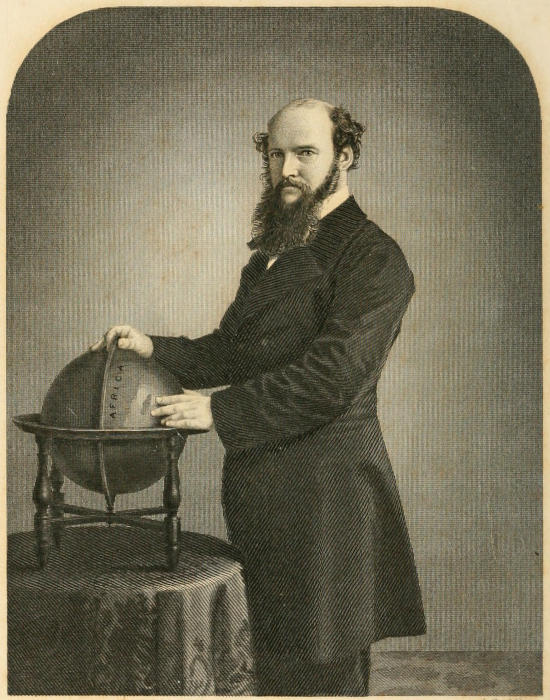
BY LYONS McLEOD, Esq., F.R.G.S., HONORARY FELLOW OF THE ROYAL SOCIETY OF ARTS AND SCIENCES
AND OF THE METEOROLOGICAL SOCIETY, MAURITIUS
LATE H.B.M. CONSUL AT MOZAMBIQUE.
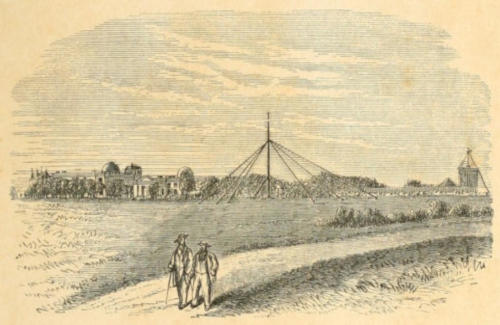
THE ROYAL OBSERVATORY, CAPE OF GOOD HOPE.
“Ethiopia shall soon stretch out her hands unto God.”—Psalm LXVIII. v. 31.
IN TWO VOLUMES.
VOL. I.
LONDON:
HURST AND BLACKETT, PUBLISHERS,
SUCCESSORS TO HENRY COLBURN, 13, GREAT MARLBOROUGH STREET.
1860.
The right of Translation is reserved.
TO THE MERCHANTS AND MEMBERS OF CHAMBERS OF COMMERCE OF GREAT BRITAIN AND IRELAND.
Gentlemen,
Impressed with the conviction that, from the most
remote time, Civilization and Christianity have been best
promoted by Commerce, which binds rival nations in the
bonds of Peace, I respectfully dedicate this work to the
Mercantile portion of my countrymen, in the hope that by
their united efforts, Slavery may be made to disappear
from the continent of Africa, through the establishment
of commercial relations, especially with that rich portion
of its coast and the neighbouring Ethiopian Archipelago,
including the fertile island of Madagascar, described in
the following pages.
I have the honor to be, Gentlemen,
Your most obedient and humble Servant,
THE AUTHOR.
CONTENTS OF THE FIRST VOLUME.
CHAPTER I.
The “Ireland”—W.S.L. Postal-line—Mr. Jenkins—The
Author Discovers that he is Styled a “Government”—The
General’s Quarters—Proceed to Sea—Accident in
the Saloon—Total Darkness in the “Lower Regions”—Spittoons
and Safety Lamps—The Gale—Put Back to
Plymouth—Ten Passengers Leave the “Ireland.”
Departure from Plymouth—Reflections on Leaving England—Cabin
Attendants—Live Stock—Mr. Jenkins and
“the Pure Element”—N.E. Trades—Red Atlantic Dust—Short
Allowance of Water—Viewing the “Line”—The
Southern Cross—A Lady Navigator—“Fire! Fire!”—The
Maniac—Arrival at the Cape
Table Bay—Breakwater to be Built—Harbour of Refuge—Policy
of Sir George Grey—Proposal for Carrying the
Mail to the Cape by way of Aden—Discovery of Coal
on the Zambesi—Its Effects on the Future of South and
East Africa—Absence of Trees at Cape Town—Climate
of the Cape
Further Detention at the Cape—Arrival of the “Frolic”
from Mozambique—“John of the Coast”—New Naval
Commander-in-Chief—Storm at the Cape—Courage of
Cape Boatmen—Destruction of Shipping in Table Bay—Embark
in the “Hermes”—Coast of Kaffraria—Well
Watered and Beautiful Country
Arrive at Natal—The Bar—Proposed Harbour of Refuge—Wharves
in the St. Lawrence—Railroad at Natal—D’Urban—Port
Natal Harbour—Verulam—Pieter-Maritzburg—Slave
Ship off Port Natal—The Havannah
Slavers—Chamber of Commerce—Natal Waggon—“Daft
Jemmy”
Present State of Natal—Physical Formation—Succession of
Terraces—Products most suitable for Each—Labour Required
for Natal—Development and Prosperity of Free
Labour Colonies—The Destruction of the Slave Trade—Climate
of Natal—“Shall we Retain our Colonies?”
Port St. Lucia—Zulu Country—Panda—Delagoa Bay—Its
Unhealthiness; Causes Examined—Lourenço Marques—Dutch
Fort—Tembe and Iniack—British Territory—Fecundity
of Boer Females—Products—Transvaal Republic—Mineral
Wealth—Future of the Country
Appearance of the Coast to the North of Delagoa Bay—Facility
of Shipping Slaves—Slavers’ Signals—Rivers
Lagoa and Inhampura—Cape Corrientes—“Sail, ho!”—The
Chase—“Zambesi”—Ex-Governor Leotti—A
Slaver Clears from Cardiff—Inhambane—Products—Mineral
Wealth
Kingdom of Mocoranga—Kotba for the Soudan of Cairo—Sultan
of Kilwa—Kingdom of Algarves—Remains of
Ancient Cities—Inscriptions not Deciphered—Zimboë
Bruce—Sofala, the Ancient Ophir—Productions—The
Manica Gold Mines—Surrounding Region Adapted for
Europeans—Industry of the Natives—The Priests Rob
the Jewels from the Image of the Blessed Virgin
The River Zambesi—Luavo Mouths—Killimane—River
Shire—Valley of the Shire Abounding in Elephants—How
Salt is Made on the Zambesi—From the Ocean to
Kaord Vasa Navigable at all Seasons—Water Rises
Sixty Feet in Narrows of Lupata—Access to the Cazembe
Territory by the Zambesi—Three Seams of Coal Discovered—Products
Angoxa—Its History—Perfidious Conduct of the Portuguese—Effects
of British Interference—Wholesome Dread
which the Portuguese have of the Imâm of Muskat—Visit
of the Sultan of Angoxa to Johanna—Invites a
British Merchant to Trade with him—Seizure of the
British Brig “Reliance”
Arrival at Mozambique—Interview with the Governor-General—Saluting
the Consular Flag—Description of the
Consul’s House on the Mainland—Portuguese Rosa—Cruelty
of the Portuguese Towards their Slaves—“Flog
until he will Require no More!”—Irrigation and Native
Labour
Brief Historical Sketch of the Portuguese on the East Coast
of Africa—Description of Mozambique—Its Position as
an Emporium for Commerce—Its Restoration, like that
of Alexandria, possible—Fort San Sebastian—Churches
and Chapels—Palace of the Governor-General—Wharf—Population—Society
Slave-Trade under the French Flag—Vessels Employed—How
Fitted and Provisioned—Price Paid for Slaves
by the French—Ceremony of Engaging the “Labourers”—How
Treated at Réunion—Dhows Employed, and
Horrors of the Traffic—Statement of the Captain of a
French Trading Vessel—Statement of the Supercargo of
an American Trading Vessel—Revolt of Slaves on Board
of a French Brig, and Massacre of the Crew—How the
Slaves are obtained in the Interior of Africa—The
Natives Rise en masse—Feelings of the Natives towards
British Consul and Family—The “Zambesi” assisting
the “Minnetonka” to obtain Slaves
The “Ireland”—W.S.L. Postal-line—Mr. Jenkins—The
Author Discovers that he is Styled a “Government”—The
General’s Quarters—Proceed to Sea—Accident in
the Saloon—Total Darkness in the “Lower Regions”—Spittoons
and Safety Lamps—The Gale—Put Back to
Plymouth—Ten Passengers Leave the “Ireland.”
On the 6th December, 1856, I embarked, with my
wife, on board the Royal Mail Screw Steamer
“Ireland,” for the Cape of Good Hope, en route
to Mozambique, to which place I had been appointed
as Her Majesty’s Consul.
Externally, the “Ireland” was what sailors call
a very “tidy craft.” She was about 1,000 tons
burthen; long, low, and rakish; having three
masts and one funnel, and what is called a stump
bowsprit. As she was fitted with a screw propeller,
she was devoid of those great protuberances
called paddle-boxes, which in a steamer so
materially (to my eye) destroy the symmetry of
the hull of the vessel, which, in this case, was
built of iron, and painted entirely black.
Flying at the mizen peak was the well known
ensign of Old England, the field of which appeared
to me unusually disfigured by the talismanic
letters, W.S.L., in a glaring yellow colour, begrimed
by soot.
On asking the meaning of those letters, I was
told that they were the initials of an M. P., who
had not only sufficient interest to obtain the contract
for carrying the mail in a line of very slow
steamers, but who was held in such dread by a
venerable body of old gentlemen sitting behind
the sign of the “Sea Horses,” in Whitehall, known
as the Board of Admiralty, that the M. P.,
W.S.L., was permitted to place the initials of
his name on the national ensign, without being
subjected to the usual fines and penalties inflicted
on those similarly offending. Others told me
that W.S.L. stood for the “worst steam line,”
but this I looked upon as the invention of some
disappointed mail contractor.
Such was the “Ireland” externally; and, as she
was at anchor in the beautiful little west-country
harbour of Dartmouth, which boasted W.S.L.
for its representative in the House of Commons,
the saucy craft might well say, “I am monarch of
all I survey.”
Arriving alongside of the “Ireland,” about one
hour before her advertised time of sailing, in a
small steamer full of fellow passengers, which had
brought us some miles down the little river Dart,
we imagined that there would be every accommodation
for our reception; but, on the contrary,
we found that we were not supposed to come
near her for some imaginary time, which they on
board could not name to us. All that we learned
was, that the numerous barges then alongside of
her, full of coals, had to be cleared of their cargoes
before the passengers were allowed on board.
To our repeated applications to be permitted
alongside, we were told to return to the shore;
and as it was raining very heavily, the man who
was steering the small steamer, put her helm up
and made for the land; however, this being done
without the consent of the passengers, they soon
took matters into their own hands, and compelled
the small craft to dash alongside, causing considerable
damage to the coal-barges. Exposed to
a volley of abuse, some of the most adventurous
of the gentlemen scrambled on board, and we
were actually compelled to appeal to the commander
of the vessel before we could get the
ladies on the deck of the “Ireland.”
It appears that we had unfortunately arrived
alongside of the vessel at the cabin dinner-hour,
and were exposed to all this inconvenience at the
whim of the chief officer and the head steward;
the former of whom wished to clear the coal-barges,
and the latter to save himself the trouble
of laying a few more plates on the table.
No sooner were we on board of this passenger
ship than we found ourselves rudely pushed about,
and, after having been driven round the wet deck
with pigs, sheep, and poultry, with considerable
difficulty we threaded our way through hampers,
water-casks, coals, &c., to the cabin saloon.
This was an elegant apartment, decorated with
gold and green, having at the further end a grate
and marble mantel-piece; but as the chimney led
to the screw propeller, of course, the first time a
fire was lighted, the saloon and cabins were deserted
in consequence of the smoke, which made
one almost fancy that the ship was on fire; so it
turned out to be for ornament and not for use.
Observing the state of confusion in which
everything was on board this first-class passenger
ship—being an old traveller—as soon as the ladies
were placed in shelter from the rain, which was
coming down in a most pitiless manner, I returned
to the deck to look after my luggage,
when I found that the chief officer had ordered
the small steamer to return to the shore with the
luggage of all those passengers who had succeeded
in reaching the deck of the “Ireland,” contrary
to his wishes. This officer, who was promised a
command in the W.S.L. Line of Steamers on his
return to England, took upon himself to mark
the passengers who had so offended him, and
during the passage he had to be admonished by
the commander for his marked rudeness to some
of the ladies, as well as the gentlemen who had
acted contrary to his wishes on the occasion referred
to. On an application being made to the
commander, the small steamer was ordered alongside,
and we recovered our luggage.
Returning to the saloon, we found considerable
commotion among the lady passengers, as it
was discovered that the “ladies’ saloon” had been
appropriated for the use of a family.
To my inquiry for my cabin or state-room, the
head steward replied, “You’re a government
passenger, sir—you must go below; your cabin is
the aftermost one but one, on the starboard side
of the lower deck. That’s the way, sir! down
that ladder.” With considerable difficulty I descended
a ladder which received many a blessing
from the passengers during the voyage. Arrived
at the bottom of the shaft (for I can liken the
descent only to that into a coal mine), I found
myself in a dark, dismal locality, always afterwards
denominated the “lower regions.” Here
were squalling babies, fighting stewards, swearing
sailors, and discontented everybodies.
On asking if there was any one there to point
out the cabins, a voice answered from a distance,
“Why the d—l do you not come with that water?
I will not get a bit of dinner this night;” while
another one exclaimed, “I’ll break your head if
you do not hurry and bring me a light?” Even
the children in this dismal place appeared to be
bent on doing harm, and were engaged in combat
with each other, or struggling with their
weary and discontented nurses.
After making good use of my lungs, a queer-looking,
red-headed, one-eyed individual, in shirt
sleeves, made his appearance, carrying in his
hand a tin spittoon, on the rim of which was the
miserable remains of a purser’s dip, by the flickering
light of which I was examined from head to
foot. Cautiously approaching, the stranger welcomed
me on board, and requested me to make
myself “quite at home.”
To my inquiry, “Who are you?” he replied:—“It’s
all right, sir; you’ll know me before long.
On shore they call me ‘Mr. Jenkins,’ but on
board this thing I am called the ‘bed-room steward.’
However, here we are for the voyage, sir, and we
must make the best of it.”
I asked “Mr. Jenkins” to show me my cabin,
when he inquired what my name was. Having
satisfied my interrogator on this point, he
exclaimed:—
“Oh, you’re a government; come this way, sir.”
To my inquiry what he meant by calling me a
“government,” Mr. Jenkins replied, “You’ll see
directly, sir!”
Following this extraordinary being through a
labyrinth of boxes, hampers, deal boards, carpenter’s
tools, and carpet-bags, we arrived at the door
of a cabin, seizing the handle of which, Mr. Jenkins
cautioned me not to be disappointed, and gently
opened it. Being in the after part of the ship,
I expected to find a small cabin, but not the
miserable dog-hole now revealed to me. It was
barely six feet in length, and its extreme breadth
scarcely five feet.
To my exclamation that “there must be some
mistake!” Mr. Jenkins replied:—
“No, sir; he never makes mistakes! You see,
sir, you’re a ‘government,’ as I told you before,
and that is why he has given you this cabin.”
After some exercise of patience and temper, I
learned from Mr. Jenkins that he meant W.S.L.,
and that the term a “government” applied to
myself, referred to my being a government passenger,
a certain number of whom are carried by
all steamers belonging to lines which have a contract
for carrying the mails.
To my observation that I was surprised that
W.S.L. was not afraid to treat the government
passengers in such a shameful manner, by putting
them into cabins which he could not possibly let
to any other passengers, Mr. Jenkins stated that
“W.S.L. was not afraid of any government, that
he hated all ‘governments,’ and when he got
them on board of his ships he always served them
in that way.”
To this I could only remark, on more minutely
examining the cabin, that it was a most disgraceful
place to put a lady into. Jenkins, ever ready
with an answer, immediately replied:—
“You see, sir, all ‘governments’ are supposed
to be gentlemen—‘governments’ are not supposed
to be married.”
“But surely, Jenkins, there must be some
better cabin than this still vacant?”
“No, sir, not one; take my advice and make
the best of it. You see, sir, outside here in the
steerage we have little enough room at any time,
but, considering we are bound to a hot climate, it
will be stifling in a fortnight’s time—well, the
Admiralty insist upon his taking the full number
of ‘governments’ with him this voyage. Well, he
has already let all the cabins and got paid for
them; the consequence is that for one of ‘the
governments’ he has ordered this ‘structure’ to
be built. Just come and look at it, sir.”
Following my loquacious friend, I managed at
last to reach the hatchway close to which the carpenters
were elevating what Jenkins had termed a
“structure,” to be adapted into a sleeping cabin
for a gentleman, as I afterwards found, six feet in
height.
Asking for an explanation of this stoppage to
the ventilation of the “lower regions,” Jenkins,
ever ready to explain his part of this passenger
ship, exclaimed:—
“This, sir, is what I wish particularly to point
out to you; the men employed upon it call it the
‘general’s quarters,’ the children call it ‘Punch’s
house,’ and I call it the ‘structure.’ Have you
any interest, sir, with the Board of Trade?”
“What makes you ask such a question?”
“Don’t be offended, sir; I have put that question
to every ‘government’ that has come on
board of this ship.”
“If I was a ‘government,’ I would stop this
ship—that ‘structure’ is sure to cause fever and
death.”
Leaving Mr. Jenkins gazing on the “structure,”
I hurried on deck and found my way into the
saloon, where I explained the state of things
below to my wife. I found that some ladies who
had preceded us in their arrival on board, and
who, like us, were government passengers, had
already made her acquainted with the very inferior
accommodation to which we were condemned
for the voyage.
The ladies retired early that evening, for the
greater number of them had travelled a considerable
distance during the day; but what with the
hammering kept up all night by the carpenters,
the straw pillows, and the miserable coffins of
berths, on comparing notes the next morning, it
was found that but few among the passengers,
male or female, slept during the first night on
board the “Ireland.”
On examining the “structure” the next morning,
we perceived that it had visibly increased its
dimensions during the night, thereby excluding
light and air. Jenkins talked in a despairing tone
of the “Board of Trade,” and occasionally alluded
to the “Emigration Commissioners,” but despite
this the “structure,” accompanied by, if possible,
increasing noise, progressed, greatly to the amusement
of the little boys, and to the annoyance of
all adults.
After breakfast we were told that the vessel
would not be ready for sea before two days, and
some of the passengers and myself went on shore
in search of carpenters to fit up our cabins. In
my cabin, the dimensions of which I have already
given, there were two sleeping berths, the lower
of which it was impossible for one to lie in, much
less to sleep there; and this vessel was going to
cross the equator twice during her outward
voyage.
Such meagre accommodation would not have
been permitted in an emigrant vessel; and here
was a mail steamer, under the pretence of being a
first-class ship, obtaining passengers from the old
established Indian traders, who were paying higher
passage money than by those ships, and sixty
passengers were crowded into a space where
there was barely accommodation for half that
number.
With the aid of a carpenter from the shore,
the upper berth was enlarged, but with the lower
one it was found impossible to do anything without
curtailing the already small standing room.
It was therefore turned into a receptacle for
carpet-bags, and I made my mind up to sleep on
the floor for the passage to the Cape of Good
Hope.
With an outlay of about three pounds sterling
on our state-room, it was made tenantable; and it
was calculated that the passengers had expended
about one hundred pounds on fittings in their
cabins, or state-rooms, which ought to have been
there on their arrival on board the “Ireland.”
Evening came, and there was no cessation to
the hammering which had been going on ever
since we scrambled on board. The carpenters
were to be employed another night in completing
the “general’s quarters,” or, as the children
would insist upon calling it, “Punch’s house.”
It was therefore determined, by those whose unfortunate
lot it was to have their state-rooms in
the “lower regions,” to remain in the saloon all
night, as it was quite impossible to sleep with the
hammering and shouting carried on below, accompanied,
as it would be, by the thrilling tones of
the interesting little darlings who had hitherto
displayed very bellicose dispositions.
About eleven o’clock, we asked the head
steward to furnish us with some supper; firstly,
because we were really hungry; and, secondly,
because we were all good-humouredly putting up
with the great inconvenience of remaining in the
saloon, instead of retiring to our cabins, we
thought, and very naturally too, that some supper
would have enabled us to pass the time more
agreeably.
The steward appeared quite bewildered at our
asking such a thing, and replied “that suppers
were not allowed.” But we were not to be put
off with this reply. The passengers whose state-rooms
led out of the saloon determined that their
friends belonging to the “lower regions” should
have some refreshments, and soon produced from
their state-rooms innumerable delicacies, which
had been laid in for the voyage. While enjoying
this pic-nic, the unhappy steward, who foresaw
in this demonstration the future violation of the
rules and regulations of the W.S.L. Line of
Steamers, without a moment’s notice, put the
lights out, and left us in utter darkness. Some
of the young folks proposed a serenade, to which
all willingly gave their consent, and in this
agreeable manner another hour was passed.
At midnight the steward again made his appearance,
and informed us that we were too
noisy, and that we must disperse.
Under these circumstances, there was nothing
to be done but to go below. Bidding our
hospitable friends in the saloon state-rooms
“pleasant dreams and sweet repose,” we descended
the ladder leading to the “lower regions,” and
formed ourselves into a committee of inspection
on the “general’s quarters,” where we found a
young indigo planter, of five years of age, was
in possession of the premises, where he insisted
upon rehearsing, even at that early hour, certain
portions of Punch, much to the amusement of
the carpenters working at the expense of
W.S.L., and of some young Scotch cadets
bound to India, who, even at that early period of
the voyage, began to look upon young Frank
Indigo as a “fearfu’ laddie.”
The whole of that night there was a continuation
of hammering, shouting, singing, whistling,
and crying. And thus another sleepless night
was passed; and we were all glad when daylight
dawned, and we repaired to the steamer’s dirty
deck.
On the afternoon of the 8th, preparations were
made for going to sea; and about 5 P.M., Captain
Bully, the agent of the W.S.L. Line of Steamers,
came on board, and informed the commander of
the “Ireland” that he must proceed to sea at
once.
The steam was up, and, although thick clouds
were seen banking up in the south west, the scud
flying fast to the north east over our heads, the
sea-birds, with their alarming cries, flying inland,
and the mercury in the barometer falling rapidly,
Captain Bully said these indications were “all
nonsense,” and that we would have fine weather;
besides, if the mails were detained any longer,
W.S.L. would be fined; and that therefore
we must go to sea, after which he had nothing
to do with us. Accordingly, at 6 P.M., we
passed from the snug little harbour of Dartmouth
into the English Channel, to breast a gale
of whose approach even the ducks and geese on
board the ship were sensible.
As soon as we got into the Channel, we found
it was blowing fresh, with a heavy cross sea from
the south west. The engines were weak, and,
although the screw propeller made a great deal of
noise, it did very little work.
In two hours’ time all the passengers were
obliged to retire to their state-rooms, with the
exception of a few old tars, myself being numbered
among the latter.
As the night advanced the wind grew louder,
the sea more boisterous, and the straining and
creaking of the ship, together with those mysterious
noises which are heard in a new vessel,
increased.
In the “lower regions” we were entirely
in darkness, and it appeared impossible to procure
a light in the state-rooms.
In the middle of this melancholy state of
affairs, a fearful crash was heard in the saloon,
which conveyed the impression to those below
that something serious had happened. The
report was immediately circulated in the “lower
regions” that the marble mantel-piece had been
carried away, killing three of the gentlemen in the
saloon. When the accident occurred, I happened
to be in the saloon, and was fortunate
in saving one gentleman from seriously injuring
himself. The fact was that the seats or benches
running along the saloon-tables were secured to
the deck by large screws, which, being made of
inferior metal, or imperfectly cast, snapped off
during one of the heavy rolls of the vessel; the
consequence was that all those persons seated on
the bench which gave way were precipitated
with some considerable violence against the side
cabins, suffering more or less injury. The second
officer and two of the passengers were a good
deal hurt, the officer being carried to his cabin.
As I sat at the end of the table, near the
marble mantel-piece, until the real circumstances
of the case were known, it was supposed by
many that I was one of those injured, and, on
descending to the “lower regions,” I found my
wife, who is a great sufferer at sea, almost dead
with terror. For, it appears, she heard those outside
of her cabin say that three of the gentlemen
were killed. This accident had such an effect
upon her nervous system, that she did not recover
from it for the whole voyage.
On asking Mr. Jenkins the cause of his portion
of the ship being in darkness, he replied that
“the candles sent on board were too large for
the lamps in the state-rooms, and that it was impossible
for one man to cut them down fast
enough.”
Jenkins had no one to help him, his ordinary
assistants having to yield to the “mal
de mer,” and he was at his wit’s end what to do
to keep the place lighted. Fertile in invention,
on this occasion a most amusing idea came to his
aid. In the earlier part of the day he had come
across some dozens of tin spittoons, which had
been sent on board the vessel, by a mistake, for
some other articles of more importance. Jenkins
bethought him of these useless implements, and
having tried one of the offending candles, he
found that it would just fit into the spittoon, and
he at once decided upon saving himself the
trouble of reducing the candles by placing them
in the spittoons. Accordingly, on a bed-room
candle-stick being asked for, Jenkins handed one
of these spittoons, with a candle in it, accompanied
by a polite bow and a bland smile, as if
he was supplying the latest fashion of safety-lamp.
It was afterwards suggested to Jenkins,
by a lady, that if the candles were held in hot
water they might be evenly reduced to any
diameter; while, at the same time, there would
be a considerable saving of the material, which
Jenkins might turn into money on getting into
harbour. The hint was taken, and the passengers
were not compelled to use a spittoon for a bed-cabin
candle-stick.
There was little sleep in the “Ireland” that
night, what with the noise below, the rolling
and pitching of the ship, the screams of the
affrighted children, the rushing of feet upon
deck, the noise of the steam, and the screw-propeller—all
occasionally hushed in the howling
of the tempest. Still the “Ireland” had to breast
the sea, and it would be no common gale that
would induce her determined commander to put
back.
About four o’clock the next morning, we were
disturbed by a noise which made every one in the
afterpart of the vessel, below the upper deck,
imagine, for a moment, that the ship had struck a
rock, so violent was the shock given to the frame
of the vessel.
On inquiry, it was ascertained that one of the
extra water-tanks carried on deck, not having
been lashed, had got adrift; and, after having
first nearly unshipped the funnel, it brought up
against the bulwark, where it injured the side of
the vessel considerably.
So slight a cause creating so violent a shock
gave us but a poor opinion of the frame of the
ship, which we found was built by contract.
The storm continued with that loud howling of
the wind, and sharp whistling among the shrouds,
which betokened the increase of the gale; while,
occasionally, the vessel would descend into the
sea as if she were overburdened, and anon a
mighty sea would strike, arresting her in her progress,
and making her shake from stem to
stern.
At five o’clock the close-reefed topsails were
blown into ribbons, the storm staysail was torn
to shreds, and the engines, unassisted by canvas,
soon gave indications of their weakness. It was
found that the machinery was totally unfit to
drive the vessel in the face of the gale and sea
with which she had to contend. As day dawned,
there was every prospect of an increase of the
gale, and the prudent commander determined to
seek shelter while yet the engines were not disabled.
Hardly had we bore up for Plymouth,
when the gale increased, and, by the rapid falling
of the barometer, we had reasons for believing
that the most dangerous part of the revolving
storm passed very near to us.
As soon as we were at anchor under shelter in
the magnificent breakwater at Plymouth, the
passengers began to make their appearance in
the saloon, and it was then discovered that
there were not seats for many of them at
the table; in consequence of which, and the
general discontent at the arrangements on board,
ten of the passengers left the ship.
This created some vacancies in the state-rooms
leading out of the saloon, and as I was obliged to
go on by that mail, I insisted upon having one of
the vacant state-rooms, by which means we left
the “lower regions.” All the fixtures which
we had put up for our comfort were removed to
our new quarters, and the ladies on board said
that my wife’s cabin was the most comfortable in
the vessel, which I thought was not saying much
for it.
During our late cruise, many of the ladies who
had embarked without their husbands fared very
badly. Mrs. R., with two children and a nurse,
passengers to Mauritius, from the hour she came
on board, on the eve of our departure from Dartmouth,
until her husband stepped on deck at
Plymouth, to take herself and little ones on
shore, had not tasted anything with the exception
of a little cold water taken from a can in her
cabin, which was so strong of paint that it made
herself and her children quite ill. Of course this
lady and her family did not return to the
“Ireland” after landing at Plymouth, nor would
any of her friends sail again in any vessel having
W.S.L. connected with her.
Soon after our arrival at Plymouth, we had a
warm invitation from our friends on shore to
renew our late visit. We got a good ducking
while reaching the shore in one of the Plymouth
boats; but this and our past dangers were soon
forgotten in the affectionate greetings and smiling
welcomes of our kind friends. But this was not
to last long, for the next day, as we were sitting
down to an early Sunday dinner, a carriage drove
up to the door, with a note from the Captain of
the “Ireland,” telling us that he was going to
start immediately; so, once more taking a hasty
farewell of our hospitable friends, we found ourselves
again on board the “Ireland.”
CHAPTER II.
Departure from Plymouth—Reflections on Leaving England—Cabin
Attendants—Live Stock—Mr. Jenkins and
“the Pure Element”—N.E. Trades—Red Atlantic Dust—Short
Allowance of Water—Viewing the “Line”—The
Southern Cross—A Lady Navigator—“Fire! Fire!”—The
Maniac—Arrival at the Cape.
It was a beautiful Sunday evening when we again
embarked in the “Ireland.” The gale had been
succeeded by a calm which lent enchantment to
the view of the rich and varied scenery of Plymouth
harbour. Evening was closing in, and
anon from the shore might be heard the bells of
the churches and chapels calling on man to praise
his Maker.
The steam was up, the passengers were all
embarked, the latest mail-bags had just arrived,
so that the “Ireland” once more moved into the
English Channel. This time the “Channel of Old
England” was as still as a mill-pond, and mirrored
the bright stars of the firmament as the busy
steamers glided about with their red and green
lights, warning each other of danger.
Many an eye was cast on the receding shores of
that loved island, never to gaze upon it more.
Many sad hearts were sighing for homes never to
be visited again.
Of the numerous passengers pacing that deck,
and thinking of those who would miss them at the
accustomed hearths, as the long winter evenings
set in, how few were destined to return to the
homes they loved so well!
Some of the brave men who talked so lightly
then, and tried to cheer the drooping spirits of
their fair companions, were to be sorely tried in a
distant clime, and to fall gloriously struggling to
retain India for the land of their birth.
Wives going to their longing husbands were
destined never to meet them—or only in danger
and in death.
Longing hearts were then on the way to be
wedded to those whose plight had been trothed
many years before, and now, having earned independence,
invited their young loves to share it.
Girls blooming into womanhood, bound for
their unknown journey in the East, were soon to
find rest in death.
The majority of the passengers were journeying
to India, then on the eve of rebellion. Loving
wife, gallant soldier, blooming maiden, and almost
lisping childhood, were destined to take their part
in that awful tragedy, the acts of which may never
be told.
Not one-fourth part of the passengers in the “Ireland”
on that voyage are now living; and even
of the survivors, some have been sorely tried, as
the pages of this book will reveal. But I must
not anticipate.
I have travelled much, but I have never met
with a party of ladies who had such a strong presentiment
of coming evil. Many and many a
time have some of those, who are now no more,
expressed their dread, not only of proceeding in
the vessel, but even of going to India; although
they were then on the way to those they loved
best on earth.
In a few days we had all shaken into our places,
and, despite sundry inconveniences, we were
determined to be happy, and that goes a long
way in this world, both on shore and afloat, to
render unhappy mortals as we are contented
with our lot.
It is true that the stewardess, being too fond of
the “cratur” in her coffee, the ladies dispensed
with her services as much as possible; and that
the servants being altogether inadequate in
number for the work which they had to perform,
the greater part of the attendance at table fell
upon the gentlemen passengers, who, to stop the
daily occurrence of the soup being poured over
the ladies, kindly offered their services during
dinner time.
These cabin assistants, or incumbrances, eventually
drove the head steward out of his mind. On
going to sea, the poor man found that the cabin-servants
had never been in a vessel before, having
shipped on board for the purpose of learning
their duty, with which understanding they were
paid accordingly, at the rate of ten shillings per
month, and to pay for their own breakages.
The balance these men would have to receive
on the pay-day would indeed be very trifling,
for they were always breaking. One poor youth,
who had not got his “sea legs,” fell down and
broke thirteen dishes at once, and as for plates,
they appeared to be broken by dozens.
The live stock placed on board at Dartmouth
was the admiration of every one; and yet, from
there not being one man expressly to look after
the stock, fowls, ducks, and geese disappeared
very quickly, literally dying in the coops from
starvation and want of water. At last the gentlemen
passengers, as a matter of precaution, made
a point of examining the stock every morning, in
order that they might see those thrown overboard
which had died during the previous night.
On one occasion I recollect seeing eleven dead
geese thrown overboard; and from this neglect
a vessel that was most liberally found, on starting
from England, for the entire voyage to India, ran
short of everything before she arrived at the Cape
of Good Hope.
The ladies were without a bath during the
whole voyage, although there was a comfortable
bath-room on board; owing to the pump not
being properly fitted, the bath could only be filled
once a day, during the time of washing the decks
before breakfast. To overcome this difficulty, the
stewardess very coolly proposed that a certain
number of the ladies should bathe in the same
water each day; a proposition which of course
found no seconder in those most interested, and
in consequence only one lady could enjoy the
luxury of a bath per diem.
It was found that 2,000 gallons of fresh water
had been destroyed, by letting the salt water run
into the tank while washing decks. This water,
being impossible to drink, was set aside for washing
water, to be used in the cabins. Jenkins
thought that pure salt water was equally as good
for washing the body, and therefore supplied the
cabins with the “pure element,” while he disposed
of that which was brackish to those who
were glad to pay him for the same.
Soon after we had entered the North East Trade
Wind, and more especially when passing the Cape
de Verde Islands, the atmosphere assumed that
hazy appearance so remarkable during the blowing
of the Harmattan winds on the west coast of
Africa. But on the present occasion I did not
experience that dryness of the air of which one is
made so sensible during a Harmattan wind.
When at the river Gambia, some years previous,
the feeling caused by the dryness of the Harmattan
wind was, although generally pleasant
and very bracing, at times painful; the skin
being dried up and wrinkled, and a general feeling,
on the surface of the body, as if suffering
from an attack of acute rheumatism. The teeth
were affected as if one had been using some very
strong acid in the mouth, and the bones of the
head and face were slightly painful; and yet I am
inclined to think that these were not rheumatic
affections.
During the prevalence of these winds, I have
frequently seen the furniture split, and articles
which were veneered considerably damaged; the
veneering in some cases being curled up like
dried sheets of paper. Books left closed on the
table at night would be found on the following
morning completely opened, and each leaf standing
up as if it had been highly stiffened with
gum. At such times glass tumblers would break,
apparently of their own accord; and I have known
one slight tap given to a tumbler made of blown-glass,
not only to break it, but, as if by sympathy,
others remotely placed in different parts of the
room.
When in the latitude of the Cape de Verde
Islands on former occasions, at about this season
of the year, and with the same hazy appearance,
I have succeeded in obtaining some of the red
Atlantic dust which is found to fall upon the rigging
and decks of vessels. This dust was supposed
for a long time to be carried by the north-east
trade wind from the desert of Africa into
the Atlantic; but it has been shown more recently,
by Professor Ehrenberg, to consist, in great part,
of infusoria with siliceous shields, and of the
siliceous tissue of plants. Although many species
of infusoria peculiar to Africa are known to Professor
Ehrenberg, he has, I believe, found none of
those in this Red Atlantic Dust examined by him.
But, on the other hand, he has discovered in it two
species hitherto known to him as living only in
South America. At the season when this dust is
so very plentiful in the air about the Cape de
Verde Islands, the valley of the Orinoco is dry;
and as the strong winds which sweep at that
period of the year, over the valley of the Orinoco,
are known to blow towards the Southern Andes,
at the time when much vapour is condensed on
that chain, and strong ascending currents of air
are thereby created, it is held by writers on the
Trade Winds, that this dust is carried to the
eastward by an upper current of air, which again
naturally falls to the earth, where the lower, or
north-eastern, current commences.
In accordance with the above theory, Lieutenant
Maury, of the United States Navy, concludes,
with much apparent confidence, that this
Red Atlantic Dust comes originally from South
America; and it is even stated that it is carried by
the south-west or upper current over Africa, and
that some of this dust has even reached Germany
and other parts of Europe.
It certainly is one of the most interesting phenomena
of nature, throwing great light on the
aërial currents, and one of which there are too
many attesting witnesses to cause it to be doubted.
This Red Atlantic Dust has often fallen on ship’s
decks, when even one thousand miles distant from
the African coast, and at points upwards of
1500 miles distant from each other in a north
and south direction; showing over what an immense
area of the Atlantic this phenomenon may
be observed.
I can easily believe that vessels have run on
shore, owing to the obscurity of the atmosphere,
in this part of the ocean, for I have observed
that large vessels were hardly visible at the distance
of a mile from this cause; and navigators
must have suffered great anxiety from the difficulty
of making good observations at this, our
winter season, in those latitudes.
After an experience of seven years on the
West Coast of Africa, I have no hesitation in
stating that the feeling of a Harmattan wind is
very different from that of the north-east trade
in the region just referred to.
On approaching the Equator, we were informed
that some more of the drinking water was
damaged, that the passengers were, in consequence,
placed upon an allowance of one pint of
water each per diem, and that we were to take
charge of this allowance ourselves. The water
was placed at the cabin-doors at six o’clock in the
morning; and from the time we were put on short
allowance of water, there was very little sleep on
board of the ship after four o’clock in the morning;
for every one was on the look-out, and, if
one did not open the door of one’s cabin and
seize the water the moment it was placed there, it
disappeared immediately;—there was no redress,
and no more water to be had until the next morning.
Under these circumstances the children, of
course, asked for more water than before; and
young Frank Indigo recommended his companions
to eat ham, bacon, in fact anything salt, “because
then, you know, they must give you water.”
The weather was getting warmer every hour,
while we had the gratification of knowing that
the liquids were decreasing rapidly; after the
tenth day at sea, there was not a bottle of soda-water
on board the “Ireland,” bound to Calcutta,
in the hot season.
On crossing the Equator, there were great
inquiries for old Father Neptune, but the captain
thought it was judicious to bribe him not to visit
the “Ireland,” as the ceremony of shaving so
many young ladies would have created quite a
scene. So we found ourselves in another hemisphere
without the occurrence of anything more
amusing than the old trick of an aged tar exhibiting
the “line” through a battered telescope; and
the day was pretty well spent before the younger
passengers discovered that the old wag had
been inducing them to look at a thread of a
spider’s web instead of the Equator. The first
visit to the Ocean reveals such mysteries that the
human mind is prepared to entertain great absurdities
as sublime truths.
From the time of passing the Cape de Verde
Islands, the younger ladies had taken considerable
interest in the Southern Cross. It was really a
beautiful sight, as we proceeded rapidly to the
south, under the power of steam, to see some of
these fair maidens, night after night, sitting on
the deck, gazing in silent admiration on the
glorious firmament, spangled with the starry hosts.
Some of these fair girls had not been out of
England before; and one, I remember well, had
never seen the Ocean until she beheld it in its
fury from the deck of the “Ireland,” when we
made our first start from England. Those who
have visited the Southern Hemisphere, and seen
the emblem of Christianity standing alone in the
heavens, pointing to the South Pole, may imagine
the effect of this glorious panorama on the minds
of these young girls.
The eye looks in vain for another constellation
to rest upon; it is to the glorious revolving Cross
that the Southern Hemisphere is indebted for its
celestial beauty; and I have never been able to
look upon it without thinking what must have
been the feelings of Bartholomew Diaz, of Vasco
de Gama, and their followers, who, as they bent
their way to the dark pole, perceived this emblem
of their faith dominant in the South:—
“Ja descoberto tinhamos diante
La no novo hemispherio nova estrella,
Não vista de outra gente.”
“In this new hemisphere we first perceived
A constellation great and brilliant,
By all, but Lusians, hitherto unseen.”
J. Musgrave’s translation of the Lusiad.
The ladies never appeared tired of asking
questions relative to the heavens; every book
treating on astronomy, which could be discovered
on board the vessel, was eagerly examined; and
those gentlemen who were privileged to be present
at the “star meetings” found both instruction
and rational amusement, while some who had
only studied the heavens before in a cursory manner,
or even with scientific objects, were really
surprised at the practical knowledge acquired by
the young ladies in a few evenings.
One of these young ladies, and she was by no
means a “blue stocking,” informed us that her
brother, who was a naval officer, had explained to
her how both the Great Bear, in the north, and the
Southern Cross, in the south, might be used for correcting
the variation of the compass. When called
upon one evening, with the compass before her, she
very clearly pointed out how, with the Pole Star
in the northern hemisphere, the variation of the
needle may be ascertained within tolerable limits.
A few evenings afterwards, on coming on deck,
after tea, the Southern Cross was observed standing
nearly upright, but inverted; that is to say,
approaching its lower culmination. The same
young lady held a plumb line, made of a bullet
and silken thread, before her eye, until the two
extreme stars of the Cross came to the meridian,
nearly pointing out the true south, by which our
fair navigator read off the variation of the needle
very correctly.
After this, I happened to state that both the
Great Bear and the Southern Cross were clocks in
the heavens for the use of those inhabiting the
torrid zone, and each of them served the same
purpose for the inhabitants of their own hemispheres.
I was immediately called upon to explain
my statement, and induced to give the following
account of the manner of telling the hour by the
Southern Cross:—
There can be little difficulty in remembering
that, at the southern winter solstice, on the 21st of
June, the right ascension of the sun is six hours;
at the northern autumnal equinox, on the 21st of
September, twelve hours; at the southern summer
solstice, on the 21st of December, eighteen hours;
and at the northern vernal equinox, on the 21st of
March, twenty-four hours, very nearly: consequently
we may say that the daily increase of the
right ascension of the sun, the whole year round,
is, on an average, almost four minutes.
If, therefore, I wish to know the sun’s right
ascension on the 1st of July, I recollect that at the
last solstice, on the 21st of June, it was six hours.
From this date to the 1st of July, ten days will
have elapsed, which, multiplied by the daily increase,
four minutes, makes its accumulation forty
minutes, which, added to the six hours of right
ascension attained by the sun on the 21st of
June, gives a right ascension of six hours, forty
minutes, on the day proposed.
Having obtained the right ascension of the sun,
I have only to subtract that from the mean right
ascension of the two antarctic pointers, α and γ
Crucis, which being twelve hours, nineteen minutes,
may easily be remembered.
“Do I make myself understood, ladies?”
“Oh, yes!”
“On the present occasion we have to subtract
six hours, forty minutes, from twelve hours, nineteen
minutes: which will leave five hours, thirty-nine
minutes.”
“Exactly so!”
“And that five hours, thirty-nine minutes, is
P.M. time, when the Southern Cross will be upright
on the meridian, on the day proposed, viz.,
the 1st of July.”
“Well! this is Christmas Eve; what time was
the Southern Cross on the meridian?”
“At the southern solstice, on the 21st of December,
the right ascension of the sun was eighteen
hours; from that date to the present, three days
have elapsed.”
“Yes—quite right.”
“That will make the right ascension of the sun
to-day, eighteen hours, twelve minutes; but how
can we subtract that from twelve hours, nineteen
minutes?”
“A very correct question; you must increase
the right ascension of the pointers, in this and
similar cases, by twenty-four hours, making it
thirty-six hours, nineteen minutes, from which
subtracting the right ascension for to-day, will
give eighteen hours, twelve minutes, the time of
the upper culmination of the Cross, counting from
yesterday at noon, as you added twenty-four
hours to the right ascension of the pointers; consequently
the Cross was upright at twelve minutes
past six o’clock this morning, and nearly twelve
hours afterwards, it was at its lower culmination,
when you saw our fair navigator correct the variation
of the compass by it.”
In this way the Southern Cross became an
object of great admiration to the ladies, and they
were soon able to estimate the time from it in any
position.
The passengers in general made themselves
agreeable to each other, and therefore many of
our discomforts were made light of. This was
not the case in other vessels belonging to the
W.S.L. Line, and hence the disagreeable scenes
which took place on board of them.
The ladies formed themselves into singing
classes, under the direction of one of the reverend
gentlemen passengers. Some of the gentlemen
gave us their experience as travellers. One
medical man gave us a lecture on the eye, and
other subjects. Another young friend favoured
us with an account of his ascent of the Nile, as
far as Kartun. In this manner the day was got
through, while in the evening, when tired of
dancing, we gathered round the Captain on the
poop, and there spent a pleasant hour or two in
listening to some tale from him, or a song from
the ladies.
The “Bill of Fare,” in consequence of the destruction
of our poultry from sheer neglect, became
beautifully less; and, indeed, after the first fortnight,
no dish left the table with anything on it—a
pretty clear proof that the table was not well
supplied. About the same time puddings were
discontinued, in consequence of the head steward
having thrown a dish containing an uncooked
pudding at the baker’s head. This placed the
baker on the doctor’s list, and stopped fresh bread
for the cabin. All these trials were very severe
on the children, of whom there were an unusual
number on board. Still we all had some delicacies
for the voyage, and these were cheerfully
divided among the little ones.
At last the drinking water got very bad, the
pint allowed to us being really as thick as the
coffee, and looking very much like a dose of rhubarb,
from the immense quantity of iron rust
which it contained. It became so bad that it was
impossible to drink without filtering it through
blotting paper, an interesting occupation, which
engaged the gentlemen’s attention for some hours
per diem. Here was another instance of neglect,
the water-tanks having been filled without being
cleaned. The officers of the ship said that they
had never heard of white-washing the tanks inside
with lime, to keep the water pure, and that
the rust was always left in the tanks to purify
their contents. I thought, after this, that a man
might learn something new every day.
Our usual amusements began to tire us, and
the increasing discomforts made us all long for
the Cape of Good Hope, for we were becoming
very discontented with the vessel, and began to
give our feelings expression; when one day, while
at lunch, where every one looked as if a little
change of scene would do him good, there was
a sudden cry of “Fire!—the ship’s on fire!”
“Oh, where?—where?”
For a moment there was a scene of confusion,
easier to imagine than to describe—
“Then shrieked the timid, and stood still the brave.”
The Captain was at his post immediately; and
it was soon discovered that the head of the main-mast
was on fire.
The ship was at the time under steam, and all
the sails were furled, it being a dead calm. The
funnel was too close to the main-mast; and, as
the vessel steamed ahead, there not being a
breath of air, of course the smoke and heat from
the funnel struck the main-mast and set it on fire.
The energetic exertions and cool example of
the commander were not lost upon his subordinates,
who ably seconded him. The chief officer
greatly distinguished himself; as, indeed, did all
the officers. The spars and burning rigging falling
on some hay placed on the main hatchway,
caused a blaze and considerable smoke, which
made us imagine at one time that the ship was
on fire in the main hold; but fortunately this was
not the case.
The steam being up, we soon had a good supply
of water from the engine-room, by means of a
small auxiliary engine, called a “donkey engine,”
I suppose from the fact of its making a braying
noise like that much-abused animal.
Water was got aloft, and poured over the sails,
many of the men, as well as the chief officer,
working on the hot-iron crosstrees at the mast-head,
in the thick stifling smoke from the funnel,
at the risk of their lives.
For some short time there was considerable fear
that the fire would master us; but by the strenuous
exertions of all, and the meritorious efforts of the
crew, the fiery element was subdued. The only
damage suffered was the loss of two sails, which
were entirely burned, and the head of the main
mast seriously charred.
In the middle of the fire, one of the gentlemen
passengers, who had become deranged, and was
in consequence confined to his cabin, finding his
keeper absent, and alarmed by the confusion in
the Saloon, rushed into it, among the ladies, with
only one garment on him, and a large carving-knife
in his hand. I need not say that the Saloon
was instantly cleared.
At this moment the position of the ladies was
anything but pleasant: a fire raging on deck,
from which they did not know how soon they
would be called upon to escape by the boats of
the ship, which could not have held half the persons
on board; and in the Saloon a raging
maniac brandishing a large knife, by which he
kept the cabin clear against all comers, and at
the same time confined the ladies to their state-rooms.
As soon as the fire was got under, attention
was turned to the disarming and securing of the
poor maniac, when the “general” proposed
getting his sword, and cutting the poor creature
down; but younger heads and kinder hearts
overruled this.
Some of the gentlemen promised to assist the
doctor; and, having taken their stations, gradually
closed on the poor sufferer; while the surgeon,
conversing with his patient, and keeping him
under the influence of his calm eye, approached
and disarmed him. He was then easily secured,
and confined in his cabin, until so much improved
that, on approaching the Cape, he was allowed to
roam about the decks, molesting no one. How
different might have been his fate had violence
been used to him during the temporary absence of
reason!
Thankful, indeed, were we that the fire did not
take place at night; in the consequent confusion,
what accidents might not have happened? But
He in whose “hands our times are” suited our
trial to our means.
I observed that all were more contented with
the ship after this exciting scene; but, nevertheless,
we were exceedingly glad when, ten days
after escaping from this great danger, we arrived
in Table Bay, and anchored off Cape Town, the
capital of the colony, grateful to that Merciful
Providence who had led us so far safely on our
journey.
CHAPTER III.
W.S.L., Worst Steam Line—Table Mountain—The Table-cloth
is Spread—Pic-nic to Constantia—Careless Smoking—Cape
Wines—The “Ireland” Proceeds to India—Melancholy
Forebodings—Midnight Alarm in Simon’s Bay—The
Cape Observatory.
At noon of the last day in the month of January,
1857, the “Ireland” cast anchor in Table Bay,
which was crowded with vessels of all sizes and
under every flag. Even the national ensign of England,
with the three talismanic letters, W.S.L., in
glaring yellow, was seen flying at the mizen-peak
of a steamer, recognized as the “England,” a
sister ship to the “Ireland,” and belonging to the
same line, well known at the Cape of Good Hope
as the “worst steam line” which has yet called at
that great turning point in the navigation between
the East and the West.
Immediately on our anchoring, some of the
passengers of the “England” came on board,
who informed us that they were on the way to
Europe, and that, between Mauritius and the
Cape, they had fallen in with the tail-end of a
hurricane, which had placed them in considerable
danger, but that, having repaired damages, they
were going to start for England in a few hours’ time.
Many of our passengers seized the opportunity
to convey to their friends the intelligence of their
safe arrival as far as the Cape of Good Hope.
Of course there was a comparison of “notes”
as to the state of these two vessels, and we found
that we were not worse off than the passengers on
board our sister ship. We afterwards learned,
from persons residing at the Cape, who had come
in the “England” on her outward voyage, that
previous to their arrival at Cape Town, they ran
entirely out of drinking water, and that, on their
making the harbour, they had to telegraph to the
signal staff to send them water, by which means
a water-tank was sent to them before their
arrival. They had a large number of soldiers on
board on that occasion, and it was stated that the
military officers had to take matters in their own
hands as far as the discipline of the stewards was
concerned.
Fortunately, these two vessels were commanded
by gentlemanly, considerate officers, and their tact
and temper kept the discontent within reasonable
bounds. With another vessel, belonging to the
same line, matters took a different course, and on
her arrival at the Cape of Good Hope the passengers
were obliged to bind the commander to
keep the peace towards them for the remainder of
the voyage. The commander of the “Ireland”
used his best endeavours to make the passage
from England in thirty-five days; but we were
forty-three days on the voyage, and would have
been longer had we not been favoured by slants of
wind, which, under ordinary circumstances, we
could not have expected on the route adopted.
The real fact was that the vessels were not fitted
with sufficiently powerful machinery, and the
space which ought to have been devoted to fuel
was appropriated for cargo.
On arriving at Table Bay, our attention was
drawn to a beautiful phenomenon of nature, by
which Cape Town is supplied with water, and of
which the following is a brief description:—
Table Mountain, under which Cape Town is
built, is the terminus of a ridge of high land
which covers a considerable portion of the promontory
of the Cape of Good Hope. The side
of this mountain, facing the north-west, and immediately
behind the town, is perpendicular, and
about 4000 feet in height. From the basin of Table
Bay, during that portion of the twenty-four hours
in which the air is warmer than the water, there
is a considerable evaporation, which saturates the
warm air overhanging the basin. The air,
saturated with this moisture, rising to the edge of
the cliff or summit of Table Mountain, meets
with a cold polar current of air in the form of the
prevalent south-east wind, by which it is immediately
condensed into a cloud, and then precipitated
on the ridge in the shape of dew or rain,
according to the relative difference of temperature
of the two currents of air. Thence, falling down
the face or perpendicular side of the mountain,
this deposit of dew or rain forms a stream of cool
sparkling water, which affords an abundant supply
to the 30,000 inhabitants of Cape Town, and the
numerous ships that make this their port of
call. From the harbour this white cloud appears
as if ever pouring over the edge of the ridge, and
never able to attain its object, the foot of the
mountain. When dense, so as to entirely cover
the top of Table Mountain, it is the precursor of
a storm; so that, when bad weather is expected,
it is usual to say that “the table-cloth is spread.”
While engaged in looking at this beautiful phenomenon
of nature, the increasing size of the
table-cloth on the mountain warned us of the
coming storm, and hastened us in our efforts to
reach the shore. As there were a number of
ladies and children on board the vessel having no
gentlemen to assist them, and all anxious to reach
the shore, after a passage during which they had
suffered considerable privations, my wife made an
offer of my services to provide accommodation
for them at Cape Town, and render them any
little assistance during their short stay in harbour.
Accordingly our party was soon formed; a large
shore-boat was provided, and we found ourselves
on shore at Cape Town, and assembled at the
custom-house, where the ladies had to remain
until accommodation was provided for them. In
consequence of there being so many vessels in
harbour, the hotels, which are remarkably good,
were full. After some little difficulty, always to be
encountered in a strange town where one does not
know one street from another, we succeeded in
discovering two houses in which our large party
could be accommodated as boarders, and where
we were rendered very comfortable during our
stay. The following day was devoted to viewing
the town, already so often described, when the
younger ladies discovered that they had left England
without “quite a number” of little trifles
which afforded them an opportunity of parting
with their pin-money, and at the same time drawing
a comparison of the value of “trifles” in
England and in her Colonies. In the evening we had
a visit from the young gentlemen passengers, when
we were asked to join a pic-nic, to see one of the
wine-producing estates. Preliminaries were soon
arranged, and on the next morning a private
omnibus (if I may use such an expression), with
four beautiful horses, made its appearance at the
door of our boarding-house. The hour was early,
five in the morning, and this was supposed to
afford an excuse for sundry performances on a
key bugle, which hastened our departure, and considerably
disturbed the neighbourhood. Adding our
contribution to the already large supplies of edibles
on the omnibus, and with the ladies comfortably
seated inside, and the gentlemen on the outside,
away we started for Constantia, the well-known
estate of the hospitable family of the Vanreenans.
The gale, which had been blowing since our
arrival, was at an end; the rain which had fallen
had laid the red dust on the roads, which is the
subject of great annoyance to the residents. The
morning was cool, the air bracing and exhilarating
to the spirits. Nature appeared to have put
on her most smiling aspect to welcome us to this
portion of her domain. And, in short, it was one
of those charming mornings, so prevalent at the
Cape, when the better nature of man will rise
with the song of the birds in gratitude to the
Divine Maker of all.
So sudden and so great a change from the confinement
and discomfort of a vessel had a corresponding
effect on us all; and, as the fleet horses
dashed along, we fully enjoyed the scenes of quiet
beauty, and the picturesque views which the road
to Constantia revealed to us in that sunny morning.
There was not a disagreeable person in the
party; all the agreeables had been gathered together,
and the contrary natures had been excluded.
The jest and quick repartee followed each other
in rapid succession; all were smiles, and sorrow
and sadness appeared to have lost their existence
for that day.
Strange that we had been so long together, and
had not until that morning learned the better part
of each other’s nature. How many surprises
there were that day! Some learned that they were
related by family ties, others that they were close
neighbours in “the Old Country,” and all that
from that day forth they felt interested in each
other’s career.
Arrived at Constantia, we found the whole of
those persons engaged on the estate in great commotion,
for here, in this lovely spot, the frightful
element “Fire,” from which we had so lately escaped,
had been doing considerable destruction;
and, although the fire had been overcome, it
was not known how soon it might break out
again.
It appeared that the fire originated from one of
the natives employed on the estate having carelessly
thrown away the ashes of his pipe; these
smouldered for a time, and the vegetation at that
season being dry, when once inflamed, soon
created an alarming conflagration, which rapidly
assumed gigantic proportions, threatening to destroy
all the surrounding estates. Fortunately
the heavy rain of the previous night had somewhat
arrested the progress of the fire, but, as the
sun rose and the vegetation dried, it required constant
vigilance to prevent the fire breaking out
again.
In this state of things, of course our happy
party could not think of intruding on these good
people in their distress. But being politely
offered the use of the grounds, we outspanned our
horses, procured water, milk, and eggs, and, having
some good housewives among the party, we enjoyed
a most comfortable breakfast of our own
providing.
The day was spent in rambling over the
country, and making ourselves somewhat acquainted
with the wine-growing of the colony.
We were informed that the vine, from the grapes
of which the delicious Constantia wine is produced,
will only grow upon this estate, from
which it derives its name, and only on certain portions
of it where the soil is said to be of
a quality peculiar to a few localities of this district.
The grape with which the wine is coloured is
grown in a part of the estate set aside for
that purpose, and appeared to us dryer and more
stony than other localities.
The Cape, or South African, wines have been
received with considerable favour in the English
market, and are recommended in all our hospitals
for their purity and absence of spirit.
The export of wine from the Cape has increased
from 106,067 gallons, in 1854, to 797,092
gallons, in 1857; and during that period, in consequence
of the failure of the grape in Europe,
the price of the wine has increased three-fold;—a
cask of Cape wine, which could be purchased formerly
in England for eighteen pounds, now
fetching fifty-four pounds sterling.
At the present moment, I am inclined to think
that the merchants give too high a price to the
producers to enable us to benefit to the extent
that we should in England from the large supplies
of wine which we may obtain from the Cape.
But now that roads through newly-discovered
mountain passes are opening up new districts
suitable for the production of wine, such as the
Oudts horn, and many others, the increased supply
will naturally decrease its cost in the market.
There is an earthy taste in the South African
wines, which greatly reduces their value; as
this is not inherent to the grape, but simply the
effect of the red dust of the district with which the
grapes are covered, more attention in the manufacture
of the wines will obviate this objection, and
place them in that position in the markets of Europe
to which their intrinsic merit entitle them.
After passing a most agreeable day, we returned
to Cape Town, as the shades of evening were closing
in, and night was about to spread her mantle
over the forest of masts floating in Table Bay.
In two days afterwards the “Ireland” was
away on her course to India, bearing with her
those who were to take part in the great Indian
drama. The merry-hearted whip, who handled
the ribbons so gracefully; the mother, with her
loving children; the maidens, with their mirthful
laughter; the soldier, with his gallant bearing;
the beardless boys, panting for glory and this
world’s renown, who joined us on that festive
day at Constantia—where are they?
Foremost amongst the stormers of Lucknow
the soldiers fell; the merry-hearted whip died,
homeward bound, from the effects of his fearful
wounds; the mother, after watching over her
babes through dangers worse than death, arrived
in safety at Calcutta, then drooped and died.
The maidens—one, the loveliest of them all, was
seized with cholera on her arrival in India; her
beauty vanished and her spirit fled—some are
wedded, while others perished—ask not how.
On landing at Cape Town, I had made inquiries
for the Naval Commander-in-chief, and was
informed that Commodore Trotter was up the
Mozambique Channel. In the absence of the
chief, I applied to the officer in charge of the
naval station, when I found that, although orders
had been sent out to the Cape, at the request of
the Foreign Office, to forward me to my Post in
one of Her Majesty’s ships, no definite steps had
been taken for that purpose.
When the Admiralty orders for the conveyance
of Her Majesty’s Consul for Mozambique to his
Post, in a ship of war, reached Simon’s Town, it
appears there was, at that time, the miserable
remains of a vessel lying in the harbour, which,
in former times, did duty as a tender to the ship
of the senior officer, but, owing to her being
unseaworthy, she had been condemned. As
the orders were imperative, it was supposed that
an officer of some standing, commanding a large
steamer, would have to convey me to Mozambique;
as the steamer in question, from her
great expenditure of coals, was worse than useless
on the Cape station, to which all the coals
used have to be carried from England at a great
expense. This steamer was a remarkably good
sailor, and might have been usefully employed
under canvas, in the Mozambique Channel,
instead of lying, month after month, at Simon’s
Bay doing nothing.
The Mozambique Channel is looked upon as
one of the most unhealthy stations in the world;
and, therefore, it is but natural that a naval
officer, who has arrived at a position on the Navy
List, where he knows that seniority will alone
advance him, should hesitate to go to a part of
the world where he is likely to make a vacancy.
On the return of the Commodore, the destination
of the large steamer was pretty well indicated,
and, therefore, it was suggested that the old
condemned schooner “Dart” should be fitted
out to take the Consul to Mozambique, and, by
her imposing appearance in that port, awe the
slave-dealers of Eastern Africa.
Accordingly, a lieutenant and a party of men
were ordered on board the “Dart;” her old sails
were bent, and with the assistance of some coils
of rope, a few buckets of tar, two or three pounds
of putty, and the expenditure of a pot or two
of black paint, all supplied by order from Her
Majesty’s Dockyard at Simon’s Town, the
“Dart” began to look quite smart. The loftier
spars were put in their places, the lighter yards
thrown across, the masts nicely stayed, the yards
squared, ropes hauled taut—long, low, and
rakish; with a blue ensign abaft, and a long
blue pennant at the mast head, she looked “quite
the thing.”
Many smiled at the “Consul’s Yacht” (as I
was told they called the “old Dart done up”);
some shook their heads, and ventured to doubt
if the Consul would ever reach his Post in her,
and all were on the look out for the arrival of
the “Ireland,” when suddenly, one night, there
was heard, over the harbour of Simon’s Town,
a cry of distress proceeding from the “old Dart
done up.” “Help! help! for heaven’s sake, the
Consul’s Yacht is sinking.” Immediately, the
boatswain’s mate’s whistles were heard on board
of all the men-of-war in the harbour. “Away
there, boat’s crews—away, there, away!”
“Hurry up, lads; that d—d thing of paint
and putty is going down at her anchors!!”
By the exertions of those on board, pumping
and baling with buckets, the “old Dart” was
kept afloat until the men-of-war’s boat towed her
into shallow water, when she was again dismantled,
being pronounced not even fit for a
“Consul’s Yacht.”
This, I found, was the only step that had been
taken towards forwarding me to my Post, where
the slave-trade, in its most revolting form, was
carried on without a hope of being checked, but
by my intervention as the British Consul.
As a large amount of specie was expected from
England, which would have to be carried by one
of Her Majesty’s ships from Simon’s Bay to
Algoa Bay, the large steamer was compelled to
remain for this important service, and Her
Majesty’s Consul for Mozambique was detained at
the Cape of Good Hope for more than five
months, the greater portion of which time three
steam-ships of war were lying in Simon’s, or
Table, or Algoa Bay. To those who may not be
initiated in the subject of the carriage of specie,
I ought to explain that the Captains of Her
Majesty’s ships receive a certain per centage
on all specie carried by the vessel which they
command; while, for carrying Consuls, and other
public servants, they receive only a fairly remunerative
amount of table-money to compensate
them for any expense they may have been put
to in entertaining their guest.
When head money for pirates was found to
be a premium for murder, it was very properly
abolished. Similarly, let us hope that freight-money
for the carriage of gold and silver will no
longer be an inducement to the neglect of the
public service.
As the movements of the squadron at the
Cape were wrapt in the most sublime mystery, it
was quite impossible to anticipate the distant
period when one of Her Majesty’s ships could be
placed at my disposal.
Under these circumstances, finding that my
future movements were in nubibus, I resolved to
take time by the forelock. Having made the
acquaintance of Mr. Thomas Maclear, F.R.S.,
the Astronomer Royal for the Cape of Good
Hope, and, through the courtesy of the
Honorable Mr. Field, Collector of the Customs,
being allowed to take my scientific instruments
out of the Custom House, I had my magnetic
instruments conveyed to the Royal Observatory,
where Mr. Maclear, with that generous aid which
he is always ready to afford in the cause of
science, had a room placed at my disposal.
Lodgings were procured near the Observatory,
and many agreeable hours were passed
by my wife and myself in the society of
Mr. and Mrs. Maclear, and their amiable and
highly intelligent family, whose unvarying kindness
and attention to us, while resident at the
Cape, will never be forgotten.
CHAPTER IV.
Table Bay—Breakwater to be Built—Harbour of Refuge—Policy
of Sir George Grey—Proposal for Carrying the
Mail to the Cape by way of Aden—Discovery of Coal
on the Zambesi—Its Effects on the Future of South and
East Africa—Absence of Trees at Cape Town—Climate
of the Cape.
Since the Portuguese voyagers, Bartholomew
Diaz and Vasco de Gama, rounded the Cape of
Good Hope, and opened to the commerce of
Europe, by way of the Southern Ocean, the rich
and still undeveloped countries of the East, what
magnificent ships of war, and fleets of merchantmen—chartered
with the good, the fair, and the
brave—have sailed past that Cape of Tempests,
finding, in the midst of that stormy sea, no haven
of rest from the gale, no harbour of refuge from
the hurricane!
During the four hundred years which have
passed since the gorgeous panorama of the
East was made known to Europe by the immortal
actors in the Portuguese Era of Conquest, what
numbers of human beings have perished, what
untold riches have been engulphed around that
stormy headland!
On the great ocean route from Europe to
India, if we except Port Louis, in the Island of
Mauritius, there is not one harbour containing dry
docks, and the necessary accommodation for repairing
in security the hulls of the immense
merchant fleets, of sailing and steam-ships, which
are for ever ploughing the watery waste which lies
between the East and the West. That such a
great necessity should so long have existed, at
such an important turning point of navigation as
that of the Cape of Good Hope, can only be
accounted for by the great natural difficulties to
be overcome in the formation of a harbour of
refuge having the necessary capabilities to supply
the wants of the large amount of shipping passing
the Cape.
Lying in a great line of commerce and navigation,
and, from the recent rapid development of
internal communication by the construction of
roads, which will be immediately followed by
railroads, already commenced, it requires only a
judicious expenditure of money, rendering Table
Bay a safe, accessible, and quiet harbour, to make
Cape Town a port of great wealth, an emporium
for the East and the West, and the outlet for the
rich and varied productions of Southern Africa.
From time to time projects have been set on foot
for this purpose, but it has been reserved for the
era of Colonial Self-Government to introduce a
plan, magnificent in conception, practicable in
details, and incalculable in results, for the purpose
of rendering Table Bay a safe harbour at all times
and seasons.
The principal wants which will be supplied by
this great undertaking are:—
1st. A harbour easy of access, and safe at all
times and seasons for the commerce between the
East and the West.
2nd. A refuge for vessels repairing and refitting;
and—
3rd. A naval station for the purpose of protecting
the navigation to India, China, and Australia
in time of war.
Table Bay, with its roadstead, is a bight facing
the north, and protected on the west by the promontory
of the Lion’s Rump, running due north
about one mile and a half. On the south-east it
is a flat shore. Cape Town lies in the south-west
or most sheltered part of the bay; and if an
imaginary line be drawn from Mouille Point due
east, until it cuts the opposite shore, it will give
to this anchorage an extent of three miles.
Nature has already provided for it an admirable
shelter, by the promontory on the west, from
which point of the compass to north it is exposed
to the most violent local winds, which prevail
chiefly in the months of June, July, and August,
occasionally occurring with fatal violence in other
months of the year. These winds are accompanied
by a very heavy swell, which, driven into a narrow
bay, with no outlet, forms a sea dangerous to
shipping, during the continuance of which vessels
are unable to discharge or receive cargoes. Owing
to there being no sheltered quays, the loading and
discharging of ships is performed by means of
lighters. The aggregate expense arising from
loss of vessels, detention of shipping, conveyance
of goods and passengers by lighters and boats,
may be fairly stated at 30,000l. sterling per
annum, nearly equivalent to 900,000l. of capital;
which, with the value of the land which will be
reclaimed by the proposed works, and the rental
of the sea frontage of quays and wharves, will
more than cover the expense of outlay.
The funds for the necessary outlay have
already been provided by the Colonial Parliament,
by “An Act for Constructing a Breakwater, to
form a Harbour of Refuge in Table Bay, and
otherwise improving the said harbour.”
A comprehensive plan for the construction of
the harbour was some time since prepared by
Captain James Vetch, R.E., F.R.S., Engineer to
the Admiralty in England.
Mr. Coode, Engineer to the Portland breakwater,
has been appointed Engineer-in-chief, resident
in England.
Mr. Arthur Thomas Andrews, Civil Engineer, of
considerable practice, and possessing the confidence
of Mr. Coode, has been appointed Resident
Engineer, and left England, accompanied by an
agent of the contractor for the works, for Cape
Town, in March of this year (1859).
The facilities for the construction of the Breakwaters
are great; stone of admirable quality may
be conveyed from the quarries on a tramway to
the works, and there are about 600 local convicts
who may be profitably employed on this great
undertaking.
From the Engineer-in-chief being engaged in
the construction of Portland breakwater, it may
be fairly anticipated that the practical experience
obtained there will be beneficially applied to an
undertaking redounding to the energy of the Cape
Colony, beneficial to the commerce of all nations,
and a lasting monument of the protective power
of Imperial Britain.
Similar works are contemplated at Port Elizabeth,
in Algoa Bay; and a railway has been commenced
in Cape Town, which will eventually form
a grand trunk line in South Eastern Africa.
Numerous minor works, such as bridges, convict-stations,
and other public buildings, are in the
course of execution, while mountain passes are
being explored for the purpose of carrying roads
through them, which will give access to districts
which, for the want of means of transit, have hitherto
been shut up. These undertakings will not only
provide employment for great numbers of the
working-classes for many years to come, but will
effectually develop the agricultural and commercial
resources of the colony.
The dangers which formerly existed to the
colonists, from the frequent Kaffir eruptions, may
be fairly stated as now ended; for the enlightened
policy adopted by the Imperial Government, suggested
and firmly carried out by the present
governor, Sir George Grey, has entirely broken
up the former formidable power of the Kaffir
chiefs, and has made them, in the hands of the
governor, willing instruments for the gradual
civilization of their people. The independence
of the tribes no longer exists; one-third of them,
forced by famine, brought on by their own imprudence,
have migrated to the Cape Colony,
where they seek for work, and imperfectly supply
the wants of the colonists.
The present time, in view of the great and
varied public works undertaken in the colony,
appears a most favourable period for emigration
to the Cape of Good Hope; and as the Cape
Colony has appropriated 50,000l. a year for the
introduction of well-selected emigrants into the
colony, and the governor has sent to England a
gentleman of high official standing, and well acquainted
with the requirements of the colony, as
Emigration Commissioner, measures will be
adopted for carrying out this object with a view
to the true interests of the colony, by supplying
it with an amount of labour commensurate with
its wants.
Sir George Grey, in inviting the co-operation
of the landed proprietors of the colony for the
introduction of emigrants, writes on the 7th
January, 1858:—“The present time is very
favourable for making an effort in this direction.
The rapid progress which the colony has recently
made—the prospect of future immunity from the
constantly recurring alarm of Kaffir outbreaks—the
extraordinary development of the productive
powers of the colony, notwithstanding the paucity
of its population—the demonstration of its fitness
for yielding the principal sources of agricultural
wealth, grain, wine, and wool—and of its capabilities
of consuming the productions of other
countries in large and increasing quantities, as
indicated by the returns of importations, and by
the rank which it now holds in this respect among
the colonies of Great Britain—all hold out great
inducements to persons contemplating emigration
from Great Britain to turn their attention to this
country, and the strongest incentives to the
government and people of the colony to avail
themselves of such an opportunity of offering
every encouragement to the best classes of emigrants
to select it for their future home.”
During my stay at Cape Town, I proposed that
the mail should be carried from England to this
colony by way of Aden, ensuring, in the first
place, a greater certainty in the arrival of the
mail, and the return of post in a shorter period;
besides affording to the colony direct communication
with the Portuguese Colonial Possessions
and the Dominions of the Imâm of Muskat in
Eastern Africa, by which an inter-colonial trade,
highly renumerative to all parties, and truly
beneficial to the Cape Colony, would be established.
But I regret to say that my plan was objected
to, on the very narrow-minded ground that the
neighbouring enterprising British Colony of
Natal would be more directly benefited than the
Cape people; and, more especially, that the
Natal merchants would by that route receive
their advices from England before the Cape
merchants, and would also have the great advantages
of the last quotations, both from the Cape
and Natal markets, in addressing their correspondents,
in England, which objections appeared
to outweigh the advantages to be
derived from a terminus to the route, and the
opening out of the rich produce of Eastern
Africa.
The experience of the last two years has
proved what I then predicted, viz., that the
steam communication between the Cape Colony
and Natal would pay; for now, instead of there
being only one steamer, there are no less than
three on that line. The communication by
steamer being thus successfully established
between the Cape of Good Hope and Port
Natal, it remains only to complete it by establishing
a line from Natal to Aden. The Natal
people have the matter now entirely in their
own hands; and I have so great confidence in
their energy, that I feel assured that steamers
will be running, before two years are over,
between Natal and Aden, calling at Iniack
Island (in Delagoa Bay), the mouths of the Zambesi,
Mozambique, Zanzibar, and one of the
outlets for the commerce of North Eastern
Africa; throwing a brilliant ray of light to
illumine the darkness of East Ethiopia; an advancement
in civilization which the world will
owe to the energy of the young and enterprising
British Colony of Natal.
The recent discoveries of coal on the Zambesi
have given an immediate practicability to the
early development of the resources of South and
Eastern Africa, which could scarcely have been
anticipated a few years since.
It may not be generally known that Great
Britain exports 700,000 tons of coal annually to
the East of the Cape of Good Hope; and now
that railroads are being introduced into the
colonies of the Cape and Natal, and new steam
lines of ships are coming into existence for the
requirements of those young and thriving
colonies, eager to place themselves in communication
with neighbouring settlements, it is not
too much to say that double the amount of fuel
already named will be required to carry out these
necessary projects, cramping them in their infancy
by the enormous expense entailed in carrying
fuel from England to those colonies.
In the colony of Natal it is true that a seam of
coal has been discovered, which may be found, on
more careful examination, to be of a quality and
in quantity suitable for the already great demands
for fuel of that colony, from its sugar, indigo, and
other mills; and that in the same locality further
discoveries of coal may be made; but until these
points are satisfactorily cleared up, it is to us a
subject of great interest, as well as thankfulness,
that rich supplies of coal have been discovered by
Dr. Livingstone on the Zambesi, with which that
practical discoverer is now working the engine of
his small steam launch, the “Ma Robert.”
When it is stated that one British steam company,
namely, the Peninsular and Oriental Steam
Navigation Company, expend the enormous sum
of 600,000l. per annum on coal alone, for the
supply principally of their depôts at Aden, and
other places to the east of the Cape of Good
Hope, it ought to stimulate our colonists in South
Africa to make diligent search for this valuable
commodity.
Those now residing at Cape Town are aware of
the serious item which fuel makes in the expenditure
of a family; and, as the colonists
increase, of course this must be looked forward to
with serious consideration.
The first distinguishing feature in the country
on landing at Cape Town, and even subsequently,
after becoming more familiar with the locality, is
the almost entire absence of trees. It is true
that this want is in a fair way of being supplied
by the active measures which have been adopted
by all parties in surrounding their residences
with the beautiful blue gum tree, which in ten
years attains the height of from sixty to seventy
feet, with a diameter of twelve inches. This
tree affords an agreeable shade, and may be usefully
employed, as the wood is hard, close grained,
and resinous. But many years must elapse ere
this laudable object, of giving a wooded appearance
to Cape Town, is carried out.
The history of the Cape of Good Hope is
already too well known to be even briefly alluded
to here, and may be derived at any time from
means which are open to all; but, without wishing
to weary the reader, it will be necessary to
give some account of the climate, and the present
state of the revenue, imports, and exports of the
colony.
In a letter addressed to the Honourable
William Field, now Emigration Commissioner
for the Cape Colony in England, Mr. Maclear,
the Astronomer Royal at the Cape, writes, under
date of September 9th, 1857:—
“In respect to the important subject of health,
the leading feature of the Cape climate is remarkable.
Perhaps there is no country on the face of
the globe so free from those diseases which spring
from putrid exhalations. Cholera, typhus, bilious,
remitting, and yellow fevers are unknown. The
explanation is found in the frequent refreshing
winds which carry off deleterious matter, and
diminish the depressing effects of summer heat.
For this indulgence the Cape is indebted to its
geographical position. Freely exposed to the
breeze from the Southern and Atlantic oceans, it
reaps the advantages which are sought in England
by a residence on the coast.
“Contagious complaints, you are well aware,
are far between; and when they do appear, they
have been imported, and soon wear out from the
same cause which checks malaria.
“Upon the whole, the Cape climate approaches
closely to the climate of Madeira; indeed, the
only difference seems to consist in the winds being
stronger and more regular at the Cape.”
The following table, compiled from observations
made for 14 years under the immediate superintendence
of Mr. Maclear, the Astronomer Royal,
at the Royal Observatory, three miles from Cape
Town, will give an accurate idea as regards the
general character of the climate:—
Royal Observatory, Cape of Good Hope. MEAN OF METEOROLOGICAL OBSERVATIONS, FROM 1842 TO 1856.
MONTHS.
Mean of each Month.
Highest and lowest of Maximum each Month.
Highest and lowest of Minimum each Month.
January
68·77
94·7
81·4
60·4
52·4
February
68·99
97·4
78·6
61·6
51·5
March
66·29
91·2
77·8
55·6
46·7
April
62·95
91·4
73·0
52·6
45·0
May
58·01
85·2
64·4
48·6
41·0
June
55·35
77·2
65·5
44·6
37·7
July
54·57
75·4
62·7
44·2
38·0
August
51·21
76·8
62·2
45·1
38·0
September
57·43
83·0
69·4
48·9
40·0
October
61·06
86·2
73·0
50·8
43·7
November
64·28
93·6
72·6
56·8
46·0
December
67·61
96·8
74·9
59·0
48·6
Mean
61·71
The mean temperature of England is 62°; and
while the average temperature of the Cape of
Good Hope is shown to be even below that of
our own country, these colonists have not the
extremes of temperature which we suffer in England,
as the average temperature of their winter
is but 14°.42 below that of summer.
From the foregoing observations it will be seen
that not only as regards temperature itself, but
also as to its diurnal and yearly range, and the
amount of rain and wind, there is nothing in the
climate unfavourable to the European constitution,
but on the contrary. These observations,
most carefully conducted, prove it to be a climate
free from violent changes of heat and cold; and
experience has proved that in many cases the
change to the Cape climate has checked, if not
entirely eradicated the early symptoms of phthisis
in European, and more especially English subjects.
The climate is also peculiarly favourable for
Emigrants; for, from its equable temperature, during
ten months of the year, fire is only required
for cooking purposes; and it will be at once
apparent that this alone removes many of the
hardships and expences attending emigration, to
less genial climates.
While on the subject of emigration, it may be
remarked that too much care cannot be used in
the selection of emigrants for this colony. Provisions
continue to be enormously high, showing
that a more extensive cultivation of the soil is
required, and at once pointing out the description
of labour which ought to be introduced. House-rent
is extravagantly high; and all classes have to
struggle against the general dearness of the necessaries
of life.
If the large supplies of native labour, introduced
by Sir George Grey, can be turned to the
cultivation of the soil, one of the great ends of all
good government, the supply of cheap food for
the people, will be the result.
Since 1852, the principle of self-government
has been wisely accorded by the imperial government
to the Colony of the Cape of Good Hope;
and it appears really wonderful what an improvement
has taken place in the development of the
resources of the colony since that date, and the
consequent increase of its revenue.
By a reference to the statistics of the colony,
it will be seen that for six years previous to that
important change in its government, the revenue
was gradually decreasing. As soon as the affairs
of the colony were left in the hands of the colonists,
an impetus was given to the opening of
new, and repairing of old, passes and roads, by
which large tracts of country, scarcely accessible
before, were brought into commercial relationship
with the coast and shipping ports. The colonists
knew the requirements of the colony; and the
natural result was that a revenue which, in 1852,
was 289,482l. sterling, became in the short space
of five years, viz., 1857, 406,702l.—a striking
proof of the benefit of colonial self-government.
To its temperate and genial climate the Cape
Colony is indebted, in a great measure, for its
prosperity; for it is this which enables it to produce
such large quantities of wool and wine,
and to breed sheep, cattle, and horses with such
success.
The production of wool in this colony, in the
year 1833, was 113,000 lbs.; in twenty years it
had increased to 7,700,000 lbs. per annum; and
since that date, in the short space of five years,
it has more than doubled, being in 1858,
18,000,000 lbs.; these are figures which require
no comment.
The number of hides exported in 1853 was
5,278, and in 1856, 96,218; of sheep and goat
skins, 168,708 were exported in 1854; and
766,000 of the same in 1856; showing at once
the increase in cattle and sheep.
For many years American flour has been introduced,
to supply the wants of the colonists; but
lately this importation has almost entirely ceased,
owing to greater attention having been paid to
the cultivation of the soil, so that the colony has
already commenced exporting to the neighbouring
wealthy colony of Mauritius; having supplied
that island in 1857, with 1,000,000 lbs. of flour,
800,000 lbs. of bran, 1,500 quarters of barley and
beans, and 3,116 quarters of oats.
Without fatiguing the general reader with
statistics, it may be briefly stated that, while the
colony contains 126,930 square miles, or nearly
80,000,000 acres, there are at present only
186,292 acres under cultivation, showing at once
its great power of increase.
CHAPTER V.
Further Detention at the Cape—Arrival of the “Frolic”
from Mozambique—“John of the Coast”—New Naval
Commander-in-Chief—Storm at the Cape—Courage of
Cape Boatmen—Destruction of Shipping in Table Bay—Embark
in the “Hermes”—Coast of Kaffraria—Well
Watered and Beautiful Country.
I have already stated that I had arrived at Cape
Town on the last day in the month of January,
since which date I had been using my best
endeavours to induce the Naval authorities to send
me on to Mozambique. But from some inexplicable
cause I was detained at the Cape month
after month.
At first the Commodore was absent. In about
six weeks after my arrival he returned, and a
month after that he had not made up his mind
which of the steamers of his squadron to send up
the Mozambique Channel. Then he intimated to
me that it was the unhealthy season on the East
Coast of Africa. To this I replied, that all
seasons were alike to me, and that it was my duty
to reach my Post immediately.
It was then stated that the governor, Sir
George Grey, required the steamers. I waited on
His Excellency, and found that one steamer was
required for the service of the colony, to examine
the St. John’s River. I got into the mail cart,
and proceeded to Simon’s Town, a distance of
twenty-two miles from Cape Town. At the end
of my journey, I found that the Commodore
wished to wait for the arrival of H.M.S. “Frolic,”
from the Mozambique Channel, and that my
movements were as uncertain as ever.
The “Frolic” arrived, and in her a passenger
from Mozambique, who was sent to officer’s
quarters at the naval hospital. I again repaired
to Simon’s Town, and found that the Illustrious
Señhor from Mozambique had strongly recommended
that no ship of war should be sent up the
Mozambique Channel at that season, as it was so
unhealthy. I was introduced by the Commodore
to the Illustrious Señhor, who was recommended
to me as a “very good fellow,” a great friend of
the English, and one who gave great information
relative to the slave trade. The Commodore was
pleased to say that the detention which had taken
place would be all to my advantage, as I would
be accompanied to Mozambique by the Illustrious
Señhor, who had merely come to the Cape for the
benefit of his health.
The Illustrious Señhor, whom I shall for the
future call “John of the Coast,” informed me
that he had been ill for a long time, and that the
Commodore had offered him a passage to the Cape
when there, in H.M. frigate “Castor;” but that,
having been apprized by his friends in London
that I had left England, he determined to remain
at Mozambique, and await my arrival at that
place.
I thanked my newly made friend for his great
consideration, and informed him that I had already
learned his great kindness to my countrymen who
called there in H.M. ships.
Subsequently, he told me that, having heard of
my arrival at the Cape, and being aware that no
Cruiser would be sent up the Mozambique
Channel until the return of the “Frolic,” he had
accepted the invitation of her Commander, and
had come to the Cape to make my acquaintance,
as he felt sure it would be mutually beneficial.
Acknowledging his great consideration, I asked
him to pay me a visit as soon as he was sufficiently
recovered to undertake the journey. In a fortnight’s
time he was my guest, and remained
in that capacity during our further stay at the
Cape.
“John of the Coast” informed me that he
was the eldest son of a Portuguese officer, of
very exalted rank, at Mozambique; that his father
was a Brigadier in the Portuguese army, a man of
great influence among the native chiefs in Eastern
Africa, and that, like himself, he was very anxious
that the Slave Trade should be abolished, and
legitimate trade introduced.
My guest gave me great information relative to
the country which I was about to visit, all of
which, I afterwards found, was correct.
Time passed on, and the month of June
arrived, bringing the steamer “Charity” to
Simon’s Bay, with the Honourable Sir Frederick
Grey, K.C.B., as Rear-admiral and Commander-in-chief
of Her Majesty’s naval forces on the East
and West African stations. Her Majesty’s steamer
“Geyser” was immediately placed at my disposal,
and ordered to Table Bay to embark myself and
my baggage.
Whilst at anchor in Table Bay, the Commander
of that vessel indulged in such extraordinary
antics, that it was apparent to most people that
he was suffering from an aberration of intellect,
or from some other exciting cause, which rendered
him totally incompetent to command the vessel in
which the late Commodore had placed him as
Acting Commander.
My baggage was on board the “Geyser,” and
everything was ready for our departure, when
that vessel was ordered to Simon’s Bay, under
charge of the Senior Lieutenant, as it was found
necessary to inquire into the extraordinary conduct
of her Acting Commander; and the
“Hermes” was ordered to receive my baggage
and myself for conveyance to Mozambique.
On the eve of the departure of the “Geyser”
from Table Bay for Simon’s Bay, one of those
terrific storms came on, which generally visit the
Cape some time in the month of June. Fortunately,
the “Geyser” had her steam up, and the
officers succeeded in getting her out of Table
Bay, after she had carried away both chain cables
from the violence of the sea which sets into that
anchorage with the commencement of a north-westerly
gale.
When the chain cables of Her Majesty’s ships
(which are not insured) are carried away, it is
certain that those supplied to merchantmen will
not hold out, and therefore it will not be surprising
to hear that the gale alluded to caused great
destruction in Table Bay. When it commenced,
there were thirty-three fine merchantmen, of different
sizes, and under various flags, lying at
anchor there, all more or less prepared for the bad
weather which is expected at Table Bay in the
winter months of the southern hemisphere.
For three days it blew with terrific violence,
and during this time it was a sublime but melancholy
spectacle to see the sport made of the
works of man by the mighty power of the ocean
which came tumbling into this bay.
But, on the other hand, it was a lofty and
inspiring sight to witness the undaunted resolution
with which the Cape boatmen laid out
anchors to windward of the ships in distress, and
then conveyed the strong coir elastic cables
attached to them to hold on the parting vessels.
During the height of the storm, in the fury of
the hurricane, the great and good governor of
the colony, Sir George Grey, was, by his presence
and by his exertions, aiding these measures in the
cause of humanity.
For the laying out of an anchor, and conveying
a coir cable attached to it, the boatmen receive
150l. sterling, and well do they deserve that
amount, for the risk is very great. During the
storm, one vessel was charged 600l. for assistance
of this sort, and it would be unwise to dispute
the charges made by these people; for one
moment’s hesitation in supplying the required aid
may result in the loss of a vessel. This is not
the only danger, for when once a vessel gets
adrift, there is no knowing what amount of
damage she may do to other vessels, and the loss
of how many of them she may cause.
Out of the thirty-three vessels lying in Table
Bay at the commencement of the gale, eleven
were blown on shore, most of which became total
wrecks, and all of those that remained afloat
were more or less severely damaged, besides costing
a large amount for anchors and cables. Of
course all this money is lost to the owners or
underwriters. This one example will show the
necessity for the Harbour of Refuge already
referred to.
The gale was over, the “Hermes” reported
ready for sea, and we impatient to start. After
bidding farewell to our kind friends, the Maclears,
the Chevalier Duprat and family, and Mr. and
Mrs. George Frere, from all of whom we had
received great kindness during our protracted
stay at the Cape, we got into a carriage, and
started off to Simon’s Bay, where the “Hermes”
was awaiting us. Our party consisted of Mrs.
M’Leod, Mr. Soares, myself, and my wife’s
maid, Rosa Smith, of whom mention will frequently
be made in the following pages.
A few miles before arriving at Simon’s Town,
just previous to descending to the sandy flats
over which the public road passes, I desired the
coachman to pull up for the purpose of showing
my wife a sign over a wayside inn, which had
struck my fancy amazingly.
As it was something novel in the way of
advertising, I took a copy of it while the horses
were breathing, and insert it for the benefit of
the reader.
The house of refreshment rejoices in the name
of “The Gentle Shepherd of Salisbury Plain,”
and the following inscription is placed on a large
board, which swings about with a screeching
noise, evidently with an eye to business:—
“Multum in parvo! Pro bono publico!
Entertainment for man and beast all of a row.
Lekker kost as much as you please,
Excellent beds without any fleas.
Nos patriam fugimus: Now we are here,
Vivimus, let us live by selling Beer.
On dit, à boire et à manger ici,
Come in and try it, whoever you be.”
On arriving at Simon’s Town, previous to
embarking, I waited on the Admiral; and Sir
Frederick Grey being a man of business, a
few minute’s conversation with him placed me in
possession of all the information relative to the
Mozambique territory, in his office. While the
“Hermes” was getting up her steam, the
admiral’s clerks were set to copy the documents
which I selected as likely to be useful to me.
I had been endeavouring, without success, to
learn something from the naval authorities
relative to Mozambique, for more than five
months, during which I was detained, most
unwillingly on my part, at the Cape, and now a
new chief arrived, who immediately placed a
vessel at my disposal, and gave me the information
I required. To me it is a subject of great satisfaction
to meet with the right man in the right
place.
Besides those already named as belonging to
my party, an officer and thirty-three soldiers for
Natal were passengers in the “Hermes;” and
Mr. Daniel Cloete, a brother of the Recorder of
Natal, who is well known for his lectures on
that colony, was a guest of the ward-room officers
of the ship.
Pacing the deck of the “Hermes,” memory
carried me back fourteen years, to the day when
I first ascended her side in Port Royal Harbour,
Jamaica, with my promotion into her as a midshipman,
from the subordinate rank of a volunteer of the
first class, now denominated a naval cadet. The
old craft and I were no strangers; and I was
glad to find that there was as nice a set of
fellows in her as in former days. Captain
Gordon set an example to all; and, indeed, I can
never forget his great attention to our comfort
while on board. My wife, from his hearty welcome,
felt quite at home; and, although the old
Symonite did roll uncommonly, we enjoyed the
passage in her amazingly.
Captain Gordon was an old cruiser in these
waters, having been Senior Lieutenant of a steamer
during the Kaffir war; and, being well acquainted
with the coast, he kept well in shore, and took
great pleasure in pointing out to us every
remarkable place on the passage to Natal.
One cannot help being struck with the park-like
appearance of the land, when steaming along
the coast of Kaffraria; a valuable territory,
situated between our two colonies of the Cape and
Natal, which, in the course of events, must become
annexed to our South African possessions.
Many parts of the country along this line of
coast are truly picturesque, and all really
beautiful. But until one arrives at the St. John’s
River, the country appears to be indifferently
wooded, with the exception of a few places where
magnificent timber-trees make their appearance.
At the St. John’s River, a visible change in the
aspect of the country takes place. There the
land, being a succession of terraces rising from
the ocean, offers the most beautiful spots,
already cleared away by the hand of nature, for
the erection of residences, having for their backgrounds
magnificent forests, while the sea view
unfolds the boundless expanse of the Southern
Ocean, through storm and calm, bearing on its
bosom the argosies richly laden with the commerce
of the East and the West.
From St. John’s River to Port Natal there are
one hundred and twenty-two rivers, all of which,
of course, are not navigable; but many of them
are more or less practicable for boats and small
vessels, giving access, by water, to this rich
country. Its value cannot be over-estimated,
being exceedingly healthy, and having a climate
in which the vegetable productions of the temperate
and torrid zones may be raised side by
side. The fact of there being one hundred and
twenty-two rivers discharging themselves into the
ocean, in a coast-line of one hundred and thirty
miles, shows how beautifully the country is
naturally irrigated. Man’s energy is alone
required to turn the virgin soil of this district
into a land of plenty.
CHAPTER VI.
Arrive at Natal—The Bar—Proposed Harbour of Refuge—Wharves
in the St. Lawrence—Railroad at Natal—D’Urban—Port
Natal Harbour—Verulam—Pieter-Maritzburg—Slave
Ship off Port Natal—The Havannah
Slavers—Chamber of Commerce—Natal Waggon—“Daft
Jemmy.”
After a remarkably fine passage of five days
from Simon’s Town, the “Hermes” anchored off
Port Natal on Wednesday, the 1st July, 1857.
In consequence of its having blown fresh from
the northward and the eastward, the Bar was impassable,
and we had no communication with the
shore on that day, excepting by telegraph from
the ship to the signal station on the Bluff; by means
of which we informed the Natalians that there
was an officer and thirty-three soldiers on board,
and requested the authorities to send off boats to
land this small party as soon as the Bar was practicable.
On Thursday the port boat, built as a life-boat,
came alongside, but the Coxswain of her declined
taking any passengers in consequence of the unsettled
state of the Bar.
During Friday and Saturday the Bar was still impassable;
and I was pleased to have a fair opportunity
of seeing the outside of it and the coast-line
at a time when the Bar was pronounced to be in
a worse state than it had been in for many years.
The line of coast to the northward of Port
Natal lies nearly N.E. and S.W. Along this
coast-line the gulf stream sets about S.W., at
a rate of from one mile and a half to four miles
per hour, according as the stream is retarded or
accelerated by the wind.
When the wind is anything to the southward of
east, the southern terminus of the entrance of the
harbour, which is a steep bluff, about a mile in
extent, and running to the N.E., in a line nearly
with the coast, effectually shelters the harbour;
and the Bar at the entrance, having from eight to
eleven feet of water on it, is passable, and the sea
at such times does not break on the Bar.
As the wind draws more to the southward, it meets
with the usual set of the current, and deflects it
to the eastward from the mouth of the harbour,
so that any detritus in solution is not at such times
deposited at the mouth of the harbour.
On the other hand, when the wind is in that
quarter of the compass from north to east, which
it frequently is at Natal, the wind increases the
velocity of the current, sometimes to as much
as four miles per hour, and this accelerated current,
setting down the coast, is arrested by the
Bluff already referred to. The consequence is,
that to the northward of this Bluff—which is the
direct entrance into the harbour—all the detritus
in solution, carried down by the stream, is deposited
there; and, as the current passes along a
sandy shore immediately before arriving at the
Bluff, a great deposit of sand is the natural consequence;
and the filling up of the entrance of
the harbour of Port Natal would be the result.
This is prevented by the scoure which takes place
on the ebbing of the tide, augmented by the
water of the river Umlas, which runs into Port
Natal.
On the northern shore of the entrance of the
harbour a pier has been commenced, extending
seawards, and running somewhat parallel with the
opposite shore of the entrance, which is the inner
side of the Bluff. The object of this pier is to
confine the channel, by which means it is hoped
to increase the power of the scourage, and, with
the assistance of a steam dredge, to keep the
Bar clear; so as to have on it at all times twelve
feet of water, while at high tides it is expected
that there will be twenty-two feet.
At the time of our visit, Mr. Pilkington, the
Engineer of the Cape colony, and Mr. Skeade,
R.N., an able marine surveyor, were at Natal, examining
the Bar and Harbour. What the nature of
their report has been I do not know; but with the
harbour before me, and the best admiralty chart,
I came to the conclusion that to make Port Natal
what it ought to be, the following plan should be
adopted:—
From Fort Farewell, in a line with the pier
now building, run out a breakwater into four
fathoms of water to the eastward, until in a line
with the eastern extreme of the Bluff, after which,
curve the breakwater to the southward and eastward,
and continue the Bluff, by means of a
similar pier, leaving a sufficient opening for vessels
under canvas to enter in foul weather. This would
form a large horse-shoe Harbour of Refuge outside
of the Bar, having at its entrance, which should
face the south-east, from five to six fathoms of
water.
Increase the scoure in Port Natal harbour, by
leading into it the river Umgani in addition to
the Umlas, and not only would twenty-two feet
of water be found on the Bar, but in the course of
time the sand now forming the Bar would be
washed away and the Bar would entirely disappear,
and the Breakwater to the northward would prevent
its ever forming again.
The expense of such an undertaking would be
considerable; but the loss and damage sustained
by shipping, at present, for want of a harbour, is
more than the interest of a sum which would
easily cover that expense; while the increased
revenue from the formation of such a harbour
would soon enable the colony to liquidate any
liability incurred for so desirable an end.
The southern pier, from the bluff, might be
built of the bluff itself; which is stone of a quality
durable but not difficult to work. While the
northern pier, forming the breakwater, might be
constructed of timber and stone. How quickly,
easily, and permanently such a breakwater might
be formed, may be learned from the wharves running
out into the River St. Lawrence, at Point
Levi, opposite to the city of Quebec.
These wharves are built in compartments of
hard durable timber. The timber compartments
are floated out, and placed over the spot where
they are intended to be built in, and they have
planks secured in them, forming a rough bottom.
The compartment is put in position by loading
it with stones, when it gradually sinks to its
proper place; it is then loaded with more stones,
until permanently fixed. Another compartment
is similarly placed, on top of the former, and
piers are thus run out into forty feet of water.
All these compartments are firmly secured to
each other by strong logs of timber at the top,
the sides, and transversely.
These piers form docks or basins along the
bank of the St. Lawrence, under the shelter of,
and attached to which, ships of the largest
tonnage lie in security at all times, in a river
with a great rise and fall, having a current with
a considerable velocity. When the ice in Upper
Canada breaks up, and floats down the St.
Lawrence, packing up mountain on mountain of
ice, and crumpling up steamers and vessels in the
stream as if they were made of paper, the ships
lying under shelter of the piers described escape
all danger. The stream of the St. Lawrence,
carrying on its bosom the materials for forming
icebergs, makes no more impression on these
than on the solid rock.
In proposing to build the northern pier of
timber and stone combined, the objects considered
have been:—Firstly, economy, which is everything
in great undertakings of this nature, especially
when connected with a young colony.
Secondly, expedition, for the rapid development
of the resources of Natal is crushed by the want
of a harbour. Thirdly, the timber required for
such an undertaking is to be found on the third
terrace of the colony, at a distance of from forty
to sixty miles from the harbour; while procuring
which, roads would have to be made, thereby
providing the greatest internal want of the
colony.
The people of D’Urban have already undertaken
the construction of a railway from the pier now
forming to D’Urban, a distance of two or more
miles, and the formation of the proposed Breakwater
would cause that railway to be extended
along the fertile sugar, coffee, and indigo producing
valleys, to the timber districts.
I have already alluded to Captain Veitch,
R.E., F.R.S., the intelligent engineer to the
Board of Admiralty, as the officer who planned
the Harbour of Refuge at Table Bay. Since
my return to England, that gentleman has done
me the honour of consulting me relative to Natal
harbour, and the foregoing is the substance of
my communication to him. I have reason to
believe that a plan, similar to that proposed by
me, is now under consideration.
Sunday, the 5th of July, the bar being practicable,
Mrs. M’Leod, her maid, who was an old
resident at Natal, Captain Gordon, and myself,
landed in the port boat at about two P.M.
Being high water, by means of a small boat we
were able to ascend a creek in the harbour,
leading to the house of Mr. Cato, Vice-Consul
for America, Sweden, Norway, &c., and, after
making the acquaintance of Mr. and Mrs. Cato,
we proceeded, on foot, to Weeden’s (late
M’Donald’s) Hotel, where we were made very
comfortable during our visit to D’Urban.
There were a number of small vessels in the
harbour, and some of a larger tonnage than I
was prepared to meet with; but I was told that
the latter took advantage of the Bar at certain
times, about once a fortnight, when there were
15 feet of water on it.
The Harbour of Port Natal is a vast circular
pond (for, from its security, I can call it nothing
else), three miles in depth, and having a breadth
of about one mile and a half. In it there are
three islands, easy of access at low water; and
the Harbour could contain, at present, about
thirty vessels, sheltered from every point of the
compass. When the Harbour of Refuge, outside
of the Bar, is constructed, it requires no prophetic
powers to foretell the future of this port. The
three islands will form the foundations of large
warehouses, holding the imports and exports of
the colony, and of the neighbouring Orange Free
State, which has no other outlet for its commerce.
The creeks, running between these three islands,
will form floating-docks; while, on the sides of
this extensive harbour, dry docks for repairing,
and building-yards for constructing, ships, will
find their natural locations. Viewing this harbour
with reference to the wants of the country,
there is no doubt that it will become the Liverpool
of South-Eastern Africa; but when we
reflect that between Europe and India, by way
of the Cape of Good Hope, there is only one
dry dock to repair disabled ships, and that only
at Port Louis, Mauritius, in the region of hurricanes,
which all are anxious to avoid, it may
readily be imagined what numbers of ships will
be attracted to Port Natal with its Harbour of
Refuge and dry docks. Many vessels disabled
by the hurricane, now obliged to put into
Mauritius, however distant from it they may
be, will resort to Natal, where the gulf stream,
setting along South Eastern Africa, will aid them
to reach this haven of safety.
The town of D’Urban is situated on this fine
harbour, and is about a mile distant from the
anchorage.
It is of recent construction, well laid out, the
streets very wide, and lined with beautiful trees,
which give to it a charmingly healthy and cheerful
appearance. The houses are about 400 in
number, built principally of wood, but giving
place to stone edifices. It contains about 1,200
Europeans, mostly English, who have their
Episcopalian Church and Wesleyan Methodist
Chapel.
About twenty miles from Port Natal, Verulam
is situated, at present a small town, but, from its
being in the centre of the district where sugar,
arrowroot, and indigo are grown, and from its
position on the right bank of the Umbloti River,
it must soon become a place of importance,
although it has sprung into existence since
1850.
The capital of the colony is Pieter-Maritzburg,
sometimes already abbreviated to Maritzburg,
and is called after one of the martyred Dutch
farmers who founded the colony, with the early
history of which he is inseparably connected.
It is the see of a bishop, the first of whom is the
well-known author of Colenso’s “Ten Weeks in
Natal.” It stands on the second terrace of the
colony, is well watered, and built in the Dutch
style. It is the seat of government, and contains
about 1,800 Europeans.
On coming from the ship in the port boat, we
heard some statements relative to a suspicious
vessel seen off the port some days previous to
our arrival, and which, it appears, must have
slipped away just about the time we were directing
our course towards the harbour.
Immediately we reached the shore, we made
some inquiries about this vessel, and learned as follows:—
It appears that, on the Monday previous to our
arrival, a vessel approached Port Natal and
anchored far out. This vessel had been seen for
two days from the signal-house on the Bluff, and
the day before she anchored off the harbour, she
was at anchor for some hours off the mouth of the
Umlazi River, which is eight miles from Port
Natal. She was believed from her build—long,
low, and rakish—to be the “Jessie Macfarlane,”
an iron barque, under English colours, which was
expected about that time from the Cape of Good
Hope.
Soon after the stranger anchored, she was
boarded by the port boat, and the captain of her,
who spoke English, said that he was in want of
water and refreshments, that he had a cargo of rum,
and was bound from Havannah to Madagascar.
The vessel appeared to be very light, and some
of the crew said that she was in ballast. On the
Coxswain of the port boat remarking that the
vessel had a large crew, the Captain replied that
he had been fortunate in picking up the crew of
a vessel, who had abandoned their ship when she
was sinking.
The crew of the port boat were permitted to
ascend her side; and the pilot who went to her in
the port boat had some questions put to him
which made the Natalians acquainted with the
voyage upon which the stranger was bound.
It appears that a boat, with six men in her, had
left the vessel on the previous evening, when off
the Umlazi, and the captain of the Slaver was
anxious to know if they would succeed in attaining
the object they had gone in search of, namely,
the purchase of a cargo of the natives.
No sooner was this question put to the pilot,
than he became greatly alarmed; the chest lying
open on the deck of the stranger immediately
came to his remembrance; glancing round the
cabin, he observed it full of arms, in good condition;
and, hurrying on deck, he observed preparations
making for placing guns in the portholes,
with which the vessel was pierced.
The pilot, unfortunately for the cause of
humanity, instead of using a ruse to entrap the
man-stealer, thought only of his personal safety,
and therefore stated that there was a British
sloop of war in the Harbour of Natal. This was
enough to alarm the Slaver; the port boat was immediately
ordered off; the sails were let fall from the
topsails yards, which had been at the mast head
during the whole time that she remained at anchor;
and while the topsails were being sheeted
home, the small warp with which she had brought
up was slipped, and, two minutes after hearing
that Natal was a British colony, and that there
was a vessel of war at anchor there, the stranger
was off to the northward.
The port boat had hardly arrived in the harbour
with the astounding intelligence that there
had been a large slaver at anchor off the port,
endeavouring to obtain some of the natives by
purchase, when six Spaniards made their appearance
in D’Urban.
On the morning of the following day, Tuesday,
they were examined relative to the stranger.
They denied all knowledge of the vessel being a
slaver, but said that they shipped at Havannah
on the 5th of April, the day she sailed; that they
never signed or saw any articles; that they never
saw the hold of the vessel, the hatches having
been battened down during the whole voyage;
that the Captain was an American, and the vessel
a large three-masted American clipper; that they
were not acquainted with the name of the Captain,
nor that of the owners of the vessel; and
that even the name of the vessel was unknown to
them. They declared themselves to be all Spaniards;
that they had been sent on shore with
twenty-eight dollars, to buy provisions; and that,
when landing at the mouth of the Umlazi, their
boat was capsized, and with difficulty they reached
the shore. They further stated that, when the
Captain saw the boat was swamped, he approached
the surf in another boat, and directed them to
walk round to Natal, and stated that he would
call for them there.
The magistrate ordered them rations and lodgings,
as shipwrecked seamen, and directed the
Mate to see to their good behaviour, until they
could be forwarded to the Cape.
When the Mate really found that the Slaver
had gone, and that there was no hope of her
return, he communicated the fact that the vessel
was a Slaver in ballast, from Havannah, bound to
Cape Corrientes for a cargo of slaves; and
having on board 70,000 dollars for the purchase
of her cargo. It appears that the Captain was an
American, of the name of John Ward, and that
the vessel’s name was the “Minnetonka.” The
Mate, who was a Spaniard, and the Captain had
a quarrel on the passage, and the former imagined
that landing him in the Umlazi was a trick to get
rid of him.
By degrees it was learned that twenty-one
slavers had been towed out of the Havannah, in
open day, during the space of one month. These
vessels left Cuba openly, with the declared intention
of proceeding to Africa for cargoes of slaves.
Fourteen of these vessels were going to make a
run to the West Coast; and the remaining seven,
being larger, were going to the East Coast, to
obtain their cargoes in the Mozambique Channel,
where the Emperor of the French had established
the Slave Trade, under the denomination of Free
Labour Emigration.
It will hereafter be shown that, by following
the motions of this Slave barque “Minnetonka,”
under both American and Spanish colours—for
Captain Ward used both flags whenever it suited
his convenience—I discovered the Slave Trade
carried on by the Portuguese authorities in the
Province of Mozambique, from Cape Delgado to
Delagoa Bay; and was further enabled to drag to
light, and lay before the world, the whole system
of French free-labour emigration, as carried on
by delegated authority;—a system of so-called
emigration, which has caused a renewal of all the
horrors perpetrated by the natives on each other,
for the purpose of supplying that Slave Trade
which England has, for more than half a century,
been endeavouring to put an end to by a lavish
expenditure of money, and the continued sacrifice
of the most heroic spirits in her peerless Navy.
In confirmation of the statement of the Mate
of the “Minnetonka,” that she was bound for
Cape Corrientes, I learned at Natal that four
full cargoes of Africans had been shipped from
that locality within the two last months, while
Her Majesty’s Consul for Mozambique was detained
at the Cape of Good Hope; and the Mozambique
Channel was left without a cruiser on
the advice of Mr. João de Costa Soares, better
known as “John of the Coast;”—the governor
of Inhambane and “John of the Coast’s” aunt
supplying the slaves for those four vessels.
On the morning after landing at D’Urban, a
deputation from the Chamber of Commerce of
Natal did me the honour of waiting on me at
Weeden’s Hotel, to lay before me the great difficulties
which the Natal merchants had to encounter
in pushing British commerce into Eastern
Africa. They stated that the rates of duty
charged by the Portuguese authorities were too
high, and at least fifty per cent. above the tariff
established by the government at Lisbon; that
every conceivable difficulty was thrown in the
way of legal traders, and that it was impossible
to carry on legitimate commerce in those
parts possessed by the Portuguese; while, on
every other part of the coast, between Cape
Delgado and Delagoa Bay, which did not belong
to the Portuguese, they were forbidden to trade
with the natives, under pain of their property
being confiscated.
To this I replied:—“That the object of Her
Majesty’s government in appointing a Consul to
Mozambique was to establish Legitimate Trade in
those parts, and at the same time to abolish the
Slave Trade; and that it would be my most earnest
endeavour to establish commercial relations
on those terms which ought to subsist between
the subjects of friendly sovereigns.”
A member of the deputation next inquired if I
could not promote the supply of Native Labour
from Mozambique to Natal, placing this British
Colony on the same terms, as to labour, as the
neighbouring French Colony of Réunion.
To this I replied:—“That if an application of
that nature was made to the Lieutenant-governor
of the Colony, no doubt it would receive an
immediate and definite reply.”
Hereupon the deputation withdrew; and Captain
Gordon and myself had a good laugh at the
proposal of one member of the deputation to
make Her Majesty’s Consul a Delegate for obtaining
free labour from Mozambique.
During the course of that morning I had a visit
from Mr. G. V. Duncan, who had been up to
Delagoa Bay, in a small Cutter called the
“Herald,” of Natal, endeavouring to establish
commercial relations with the natives on the
south part of that Bay, which is British territory;
and he complained to me of the obstacles
thrown in his way by the Portuguese authorities
at Lourenço Marques, situated in that Bay,
in preventing him from trading with persons who
were willing to do so; and also of their preventing
him trading with the Zulus in the British
territory on the south part of Delagoa Bay,
unless he first paid duties to the custom-house at
Lourenço Marques. To give me some further
insight into the conduct of the authorities at the
above-named place, he placed in my hands a copy
of the following letter, which will be again referred
to in these pages:—
“DELAGOA BAY AND THE SLAVE TRADE ON
THE EAST AFRICAN COAST.
“To the Editor of the Natal Mercury.
“Sir,
“During my stay at Lourenço Marques, Delagoa
Bay, I usually visited, after business hours, persons
there considered of high standing; and, being
in quest of knowledge that might in future prove
advantageous, I generally introduced such subjects
as would best lead to the information I was
most desirous of gaining.
“Their commercial policy is not to deal in
trifles. Specimens illustrative of natural history,
which excite the admiration of the civilized portion
of the world, have with them no charm.
Ivory and Negroes appear to be the only articles
of commerce to which they aspire, and they succeed
in obtaining them to an astonishing extent,
at comparatively small cost.
“With regard to ivory, each merchant has
several negro hunters, who kill a number of elephants
during the season; besides which they
purchase ivory in barter, on the banks of the
Manakusi, or King George’s River, which river
offers great advantages, being navigable for
craft of light draught.
“This river is monopolized by the Portuguese,
who will not allow foreigners to penetrate. In
proof, I need but mention that, having a strong
desire to make as many discoveries as I could, for
the advancement of trade and commerce, I intimated
to the authorities my intention of entering
the said river, but was forbidden to do so, with
an earnest caution as to the consequence, which,
I was told, would be the seizure of the cutter and
cargo; that, though their jurisdiction did not extend
so far, yet I should expose myself, if I attempted
the passage of the river, both in going
in and in coming out.
“But there are, doubtless, other motives than
those of monopoly in the ivory trade, which I will
leave your readers to conjecture from the following
information which I gathered as to the manner
in which the abominable practice of slave
dealing is carried on.
“It does not unfrequently happen that irruptions
take place between neighbouring tribes,
with a view to the number of prisoners they may
be fortunate in taking, as a means of obtaining
articles of home consumption, such as beads,
blankets, &c., which are obtained in exchange for
the unfortunate captives. Those of the age of
eighteen years are most suitable; all above that
age, I was told, are put to death. The women
are distributed among the conquering warriors,
and the young men sold into slavery. Slaves in
any number can thus be procured; the only difficulty
traders have to contend with is to secure
them; and, happily, that difficulty does exist, else,
I imagine, it would be beyond human power to
depict the misery which would ensue.
“In spite of all difficulties, however, the trade
is carried on with comparative impunity, and
with considerable success. Agents are established
on the East Coast of Africa, by slave merchants,
to purchase slaves of those who obtain
them in barter. Those agents act under instructions,
particularly as to signs, and signals, and
places of embarkation; and also establish relations
with those already engaged in the traffic,
from whom and through whom large numbers of
negroes are collected, and chained in small groups,
some by the neck, and others by the hand, and
are then marched, at the time, and to the place
appointed, to await the arrival of the vessel that
is to carry them to their destiny.
“A trial was made, not long since, to establish a
‘legitimate’ trade, if in any way it can be called
legitimate. Not many months ago, four or five vessels,
carrying the French flag, called at Killimane,
for the purpose of establishing a Free Emigration.
“Negotiations were entered into between the
Governor and the Agent. The former, it was said,
was well ‘palmed,’ and offered opportunity to
all large slaveholders to supply the agent with a
large number of so-called ‘free emigrants.’ The
system upon which it was carried out, I am told,
was similar to that which is practised for procuring
coolies, with this difference, that the Africans
were purchased and sold into hopeless bondage.
The truth of this statement can easily be ascertained
by a reference to the Cabinet at Lisbon,
under whose notice, I learned, the affair has been
brought. Such an atrocity, practised almost
within call of a British port, is horrible to contemplate,
more especially when there is safe
anchorage at this port for a man-of-war cruiser;
besides which, from what I learn, the south side
of Delagoa Bay, having been ceded to the British
Government, can be made available, not only for
the suppression of slavery, but for the advancement
of trade and commerce. It is to all appearance
very desirable, and no doubt very fertile, as
considerable traffic is carried on between the
Portuguese and the queen of the island, who is a
tributary of our Zulu neighbour, Panda.
“Direct slavery is not countenanced by the
Portuguese authorities. So far they act in
union with their government; but it is my belief,
from information gathered, that they aid and abet
all concerned in it.
“It is well known that the government of
Delagoa have taken negro prisoners, and sold
them to persons residing in the town. Moreover,
almost all Moorish sloops, trading between Delagoa
Bay and the Mozambique, are slavers in a modified
form. Limited numbers of slaves are occasionally
shipped on board of them, to and from Mozambique,
with passports as passengers, to evade
detection if overhauled by a cruiser.
“Considering, sir, your space valuable, I have
much curtailed this subject. I could, by dwelling
lengthily upon it, have established beyond a doubt
the certainty of slave-trading on this coast; but
forbear, hoping that you will pardon me for having
already encroached at great length, and that what
I have said will be sufficient to awaken those
whose duty it is to notice such startling facts;
and to endeavour, by all possible means, to put an
end to these appalling outrages upon our common
humanity.—I am, sir, your obedient servant,
“G. W. Duncan.
“D’Urban, June, 1857.”
The information obtained at Port Natal, relative
to slaving carried on in the Mozambique Channel,
induced Captain Gordon and myself to hasten
our movements, and, by the time the deputation
had retired, our party were ready to return to the
harbour.
The tide being out, we proceeded along the
margin of the bay in the usual conveyance employed
in this colony. It consisted of a large
lumbering four-wheeled waggon, drawn by eight
oxen. In the waggon, chairs were placed to sit
upon; and it was driven by a Zulu Kaffir, who
flourished a long whip, with which at one moment
he would tickle the ear of one of the leaders, and
then, in quick succession, distribute his favours on
the remainder of the team in such a way as to
drive them furious. This Kaffir was a good
type of his class, his hair being done up in the
“married men style.” On a Kaffir being married,
it is usual for the wife to do up the hair of her
lord and master in the following manner:—A
ring fitting tight on the top of the head is provided;
sometimes the ring is made of iron, occasionally
of brass, but more generally of some
elastic climber. The hair is drawn up over this
ring, and retained in its place by gum from the
mimosa, or any glutinous matter. In the
course of time it becomes as hard as iron, and
will resist, not only a severe blow, but the
rays of an African sun, affording a protection
against fever and the tomahawk.
Our Kaffir Jehu had a name for every one of
his oxen. He appeared to be particularly down
upon “Sir Harry Smith,” while “Sir George
Grey” was a prime favourite. Occasionally the
Kaffir would stand up, and after flourishing his
whip in the air, accompanied with, to us, unintelligible
jargon, he would come down with
terrific violence on “Aliwal,” and then make a
furious dig with the handle of his whip at
“Sobraon,” who was one of the wheelers. All
went pretty well until we came nearly to the end
of the journey, when “Sir George Grey,” who up
to this time had been deservedly, from the way
in which he worked, a great favourite, happened
to stumble. Down jumped the Kaffir,
and laid into poor “Sir George Grey” with as
much reason and sense of justice as if he had
been a Colonial Minister.
After our party were seated in the port boat,
an extraordinary looking individual, with a profusion
of red locks oh his head, making one quite
warm to look at him, presented me with a small
note, requesting that “His Excellency would
settle that small account before he left the
harbour.” On opening the note, I found it was
a formal document demanding the small amount
of three pounds, five shillings, for the use of the
small boat which had taken us up the creek on
the previous day, after getting out of the port
boat. This, of course, I refused to pay, especially
as I had given what I considered a sufficient
amount to the two men who had rowed us up the
creek. I found the stranger was called “Daft
Jemmy,” and that he obtained a living in this
manner by imposing upon all persons arriving at
Port Natal. I informed him that I had no intention
of paying for a boat twice, and told the
port boat to shove off. Nothing daunted, “Daft
Jemmy” hailed the coxswain to “accept any
amount which ‘His Excellency’ might think
proper to offer, on account, as no doubt he
would settle the balance next time he came to
Natal.”
We crossed the bar in safety; reached the
“Hermes;” and I closed my dispatches for England,
and wrote to the Admiral and Mr. Frere,
urging them to send all the disposable steam
force up the Mozambique Channel for the purpose
of seizing vessels carrying on the slave trade
in those waters. These matters being finished,
Captain Gordon started in chase of the “Minnetonka,”
now supposed to be about loading her
cargo of slaves.
CHAPTER VII.
Present State of Natal—Physical Formation—Succession of
Terraces—Products most suitable for Each—Labour Required
for Natal—Development and Prosperity of Free
Labour Colonies—The Destruction of the Slave Trade—Climate
of Natal—“Shall we Retain our Colonies?”
While the “Hermes” is steaming away to the
Northward in search of the “Minnetonka,” we
purpose giving to the reader a short statement of
the present condition of the Colony of Natal.
A history of Natal has already been written by
the Rev. Mr. Holden, which, combined with Five
Lectures on Natal by the Hon. Henry Cloete,
LL.D., the celebrated Recorder of Natal, and
the perusal of “Ten Weeks in Natal” by Bishop
Colenso, will give those anxious to obtain definite
information relative to the origin, rise, and rapid
progress of this colony, a very fair insight into its
state previous to the era of self-government. It
is hoped that the following statement, together
with the observations contained in the last chapter
relative to the harbour of Port Natal, may be
acceptable to those seeking information relative
to the colony up to the present date.
The British Colony of Natal, situated on the
south-east coast of Africa, extends from latitude
29° 16′ to latitude 31° 34′ south; or, speaking more
definitely, from the mouth of the river Omzinyat,
or Fisher’s River, to that of the Umzimkulu,
which latter river divides it from the rich district
of Kaffraria. It will thus be seen that it has a
coast line of 150 miles, washed by the Indian
Ocean, and along which the gulf stream runs
to the south west, at a velocity of from one and a-half
to four miles per hour. From the coast it
extends into the country a distance of eighty
miles to the Quathlamba Mountains, which divide
it from the neighbouring Boer Settlement, culled
the Orange Free State. It has an area of
18,000 square miles, or about one-third of that of
England and Wales. Viewed, as to its territorial
extent, with other colonies of Great Britain, it
holds a very insignificant position; but its
physical formation is such that, small though it
may be, it is capable of producing the luxuriant
vegetation of the tropics in close proximity with
that of the more temperate climate of Europe;—forming
a bijou in South Eastern Africa, which
must have a considerable effect in civilizing the
natives of the surrounding territories.
The variety in the soil and climate of this interesting
and truly valuable possession of Great
Britain is caused by the country rising rapidly
from the Indian Ocean in a succession of four
steps or terraces, each having an average width
of twenty miles, with its own peculiarity of soil
and climate.
Along the lower terrace, which is washed by
the Indian Ocean, the heat is greatest; and
though scarcely even in the height of the hot
season to be called “tropical,” outside of which
the colony lies, yet it is sufficient to allow of the
growth of cotton, sugar, coffee, indigo, arrowroot,
pine-apples, bananas, and the cocoa-nut, and oil
palms (as soon as introduced), over an area of
three thousand square miles. In addition to
which, the coast line being washed by the gulf
stream, the moist warm temperature from which,
aided by the saline breezes from the ocean, render
a belt of this coast line, extending from high
water mark to five or ten miles inland, peculiarly
adapted for the growth of the sea-island cotton,
whose long fleecy staple is the produce of similar
physical advantages. This fact alone will show
the value of the lower or sea-coast terrace of the
Colony of Natal; upwards of 1000 square
miles of which are capable of producing the most
highly prized of the cottons of America, without
the accompanying drawback of an unhealthy
climate for the European constitution.
In this region, where vegetation is luxuriant,
there is much woodland and park-like scenery,
which gradually disappears as one proceeds inland,
while the temperature is diminished, and
the air becomes clear and bracing.
The second terrace of the colony is almost
bare of trees; but well adapted for grazing purposes.
It affords abundant crops of hay, oat
fodder, mealies, or Indian corn and barley.
The third terrace contains plenty of forest
timber of considerable size and of very superior
quality, both for the wants of the colony and for
ship-building purposes.
The fourth terrace is well adapted for growing
wheat and all European productions.
Throughout the length and breadth of the
colony it is well watered, there being a stream
every four or five miles of its extent. These
streams are never dried up, excepting some few
of them in the winter season, when the temperature,
even along the coast, is delightfully cool and
pleasant. During this season, which lasts for four
or five months, more inland there is hoar frost
upon the ground, and sometimes snow upon the
wooded highlands; while on the Quathlamba
Mountains it may be seen for a week or ten days
together.
Products of Natal—
Cotton. The seed named the “petit gulf prolific,”
is said to be the most successful yet tried at
Natal. One pound weight of this seed, which
costs ten shillings, is sufficient to plant an acre of
ground. September, October, and November are
the months for planting it. The yield of one acre,
having 6,000 plants on it, averaged two and a half
pounds of seed cotton per plant, which, when reduced
by the cotton cleaning gin, gave one pound
and one quarter of clean cotton per plant; at
sixpence per pound this would give the enormous
return of 187l. 10s. sterling per acre. There are,
at the lowest computation, 640,000 acres, on the
lower or coast line terrace of the colony, which
will produce cotton of this quality, so that our
Liverpool merchants may look forward to a supply
of no less than 4,800,000,000 lbs. of cotton from
one of the smallest and latest acquired of our
colonies. Surely a colony, whose capability for producing
one of the great staples of our manufactures
is thus shown to be almost unlimited, deserves
the most encouraging attention of our statesmen
both in a commercial and anti-slavery light.
Wool. This article may be produced as well
as in the Cape of Good Hope, although for
some time it was believed that the grass, being too
rank and abundant, either killed the sheep or filled
the wool with seeds and weeds. As cultivation
increases, the annoying insects, which did much
destruction to the sheep and cattle by living upon
and impoverishing them, are rapidly disappearing.
Some parts of the colony, where horses and cattle
would not thrive, are now well known as breeding
districts, and the colonists have commenced exporting
both cattle and horses, to some considerable
extent, to the island of Mauritius.
Sugar. The sugar-cane flourishes here remarkably
well; and, from the great abundance of water,
the cane is not likely to be attacked by the insect
called the “borer,” which does so much destruction
at Mauritius.
There are already in the colony seven sugar
mills, some of considerable power. Large portions
of the country are being planted with the cane,
and it is said that this virgin soil yields from three
to four tons of sugar per acre.
The supply at present is not great, as the
colonists are hampered for want of labour, more
especially that labour adapted for the sugar-cane,
which appears to be found in Indian or Chinese
coolie labour. As soon as facilities are afforded to
the colony of Natal for coolie labour, similar to that
employed at Mauritius, the yield of this article
alone will be enormous; there being at least
1,280,000 acres of the soil, irrespective of what
may be more appropriately devoted to cotton,
capable of producing sugar. It may be confidently
asserted that the supply of Natal sugar
will not equal the demand. Its saccharine properties
have been proved by Mr. Milne, the great
sugar-refiner at Bristol, to be stronger than the
Mauritius sugar, and not surpassed by the best
Trinidad. Already, from the balcony of one
house, no less than seven shafts can be seen puffing
away the fumes of boiling syrup; and, when labour
is supplied to Natal, this necessary for the artisan
of the mother country will be supplied at a much
reduced price, completely driving slave-grown
sugar out of the market. The growing of mealies,
or Indian corn, may be carried on at the same
time as that of sugar. The mealies ought to be
grown in every other row of the cane, and about
twice the distance apart of the cane roots. By
this means the young canes are protected, and
provision is made for the labourers without impoverishing
the ground or materially increasing
the labour of the cane-fields.
Indigo. Many varieties of indigo grow luxuriantly
and wild in the colony; almost justifying
the thought that on this side of Africa the plant
is indigenous, although we are aware that on the
west coast it was introduced by the Jesuits, and
perhaps also, by way of the Zambesi, into the
interior.
Large factories are being erected for the manufacture
of indigo; and, in order that it may be
thoroughly successful, arrangements have been
made for the introduction of persons who have
been already acquainted with its manufacture in
the island of Java.
Tobacco. The cultivation of tobacco has been
carried on for some considerable time, but on a
very small scale, in consequence of the want of
labour. Two crops may be grown in the year;
and there is an ample market for it already in the
colony, which imports annually thousands of
pounds weight of the real Virginia.
On the higher terraces inland, to a great
extent, wheat, oats, barley, and other cereals are
grown; while the climate of those districts admirably
suits them for the pasturage and rearing of
sheep and cattle, with which they may be said
already to abound.
The export of wool, from the neighbouring Boer
Settlement of the Orange Free State, through
Natal, is increasing rapidly, while the enterprise of
the young Natalians has given them access to the
ivory grounds of the Zulus, who prefer dealing
with them rather than with the Transvaal
Republic Boers.
Coffee and Arrowroot. The following testimony
to the quality of Natal coffee and arrowroot was
forwarded last year to Natal:—
“3, King William Street, London, E.C.
“September 17, 1858.
“Gentlemen,
“We have carefully tested the two
samples of Natal coffee you sent us. We find
the Costa Rica kind very strong coffee, and
worth, in our present market, 65s. to 68s. per
cwt., in bond. The sample of West India kind
is strong, rich, good coffee, full of aroma, and
worth about 70s. to 75s. in bond. If such coffees
are sent to England, we think they will always
command good market value, as does your Natal
arrowroot, &c., &c.
“Phillips and Co.
“Messrs. Savory, Natal.”
Large quantities of American flour, and even
the coarser description of that produced at the
Cape, are imported into Natal; but now that
farmers are turning their attention to the production
of wheat, which will flourish on the upper
terraces, we may expect to see bread stuffs
cheaper; more especially as numbers of the
Boers, getting disgusted with the unsettled aspect
of affairs in the two neighbouring Boer states, are
coming from beyond the Drakenburg Mountains,
and settling themselves down on the higher
terraces of Natal, from which great quantities of
wheat and cattle may soon be expected, not only
for the supply of cheap and abundant food for the
colonists, but for the purposes of exportation.
I have already touched upon the subject of
labour, and stated that the labour adapted for the
cultivation of the soil is greatly required at Natal.
Looking at a chart of the country, one would exclaim,
how can this possibly be the case when the
colony of Natal is surrounded on all sides, but
that facing the ocean, with countries abounding in
natives? Yes; but natives unadapted for the
wants of the soil. The Zulus are a pastoral
people, and, as long as employed in tending
cattle, they are very well; but, as yet, they have
shown no aptitude for agricultural purposes—such
occupation is contrary to their nature, and to the
customs of their ancestors, who have always been
a nomadic race.
With difficulty the colonists of Natal can
secure the services of a native, even in household
work, for more than six months at a time. At
the end of that period, the Zulu Kaffir wishes to
return to his own people, to enjoy the sweets of
liberty in the forest, or the boundless prairie, to
drink of the milk of his own krall, and dance
with the Kaffir girls. This is all very natural; and
it depends greatly on the treatment which he has
received from the white man if he will ever
return. In some instances, when pleased with
his situation, a Kaffir, previous to the time of
leaving, will ask his employer permission to bring
his little brother, for the purpose of teaching him
the work of the place. If his application is
acceded to, the Kaffir will take great trouble to
teach his younger brother what he is required to
do in order to give satisfaction to his employer.
When the senior’s period of engagement has expired,
his brother fills his place for another six
months, and then he is succeeded by some other
member of his family, whom he has prepared.
In this manner, the situation, when a good one, is
kept in a family; and the colonists, knowing this,
are anxious to get hold of what is called a “nest
of Kaffirs”—that is, where there are a number in
a family—for by that means they are provided at
all times with domestic labour, and generally well
served. But the Kaffir, who will clean windows,
and wash plates and glasses very carefully, will
not labour in the field. Harder working Kaffirs—and
there are some few—when they have passed
through the school of industrial training, and have
learned their own value, like many other men
having similar souls, but different coloured skins,
will obtain credit for a waggon and oxen, and
throw their labour into the market in a different
form from their less industrious brethren.
Natal wants labour, and of a description which
can only be supplied from India; the native of
which, having for ages cultivated the soil, has an
aptitude for this description of labour, in which he
displays a degree of neatness which cannot be
found among the nomadic pastoral races of
Africa.
Coolie labour must, therefore, be provided either
from India or from China: let it be abundant,
and hampered with no regulation which is not for
the protection of the labourer. By restricting
the supply of labour to our colonies, obstacles are
placed in the way of their development which
prevent them so successfully competing with the
Slave Labour States of America and Cuba as
they otherwise might do. On the other hand, by
supplying abundance of labour, our colonies will
produce supplies for European markets in so great
abundance, and at such a great reduction in cost,
that the working men of our own country will be
able to obtain in plenty many articles which are
now looked upon almost as luxuries, although
absolutely necessaries to overworked frames;
while, at the same time, the produce of slave
labour, being so much dearer, will find no market,
and the producing article, namely, slave labour,
must entirely cease.
With reference to the climate of Natal, besides
what has here been stated, it is only necessary,
to add the testimony of my late lamented friend,
Dr. Stranger, who, after surviving the unfortunate
“Niger Expedition” of 1841, died at Natal, while
filling the important post of Surveyor General
of that Colony. The worthy doctor’s report
states:—
“The climate of Natal is very healthy, but, I
think, more salubrious at some distance from the
coast. There appears to be scarcely any disease
incidental to the country. Dysentery is not frequent;
ophthalmia occurs occasionally, and is,
perhaps, the only disease of the colony; it is,
however, not often of a severe character.
“The rains commence with violent thunderstorms
about the month of September, and continue
till about April, when they terminate with
thunder. During the rainy season, which is also
the summer, the average daily temperature is about
76°, but the evenings are generally cooled by a
S.E. breeze. The thermometer rarely rises above
80°. The winter temperature varies from 50° to
60°; frosts are frequent in the higher parts of the
district, and at the Mooi River, in June, I have
seen the thermometer stand at 27° at 7 A.M.
Cold nights are generally succeeded by warm
days. Rain rarely falls in the interior between or
during the months of May and August. On the
coast the seasons are not so well defined, as
showers occur throughout the year. Long
droughts are almost unknown.”
To Natal has been accorded by the Imperial
government the great boon of Self-government;
and while taking leave of this Colony, before we
proceed to the northward, and view the state of
other settlements which are not under the
ameliorating influence of British rule, it may not
be inappropriate to quote a few words from an
article in the Edinburgh Review, of April, 1850,
headed, “Shall we retain our Colonies.” The
words referred to are:—
“The affection of the colonists it is easy to
preserve, or to recover, where, through misjudgment
or misunderstanding, it has been shaken or
impaired. By ruling them with forbearance,
steadiness, and justice; by leading them forward
in the path of freedom with an encouraging but
cautious hand; by bestowing upon them the
fullest powers of Self-government, wherever the
influence of British blood is large enough to warrant
such a course; in a word, by following out
the line of policy announced and defended by
Lord John Russel, in his speech on the introduction
of a Bill for the government of the Australian
colonies, in February of the last year, we
may secure the existence and rivet the cohesion of
a dominion blest with the wisest, soberest, most
beneficial form of liberty which the world has yet
enjoyed, and spreading to distant lands and future
ages the highest, most prolific, and most expansive
development of civilization which Providence
has ever granted to humanity.”
CHAPTER VIII.
Port St. Lucia—Zulu Country—Panda—Delagoa Bay—Its
Unhealthiness; Causes Examined—Lourenço Marques—Dutch
Fort—Tembe and Iniack—British Territory—Fecundity
of Boer Females—Products—Transvaal Republic—Mineral
Wealth—Future of the Country.
After leaving the limits of the Colony of Natal,
in proceeding to the northward, the first port
which attracts attention is that of Port St.
Lucia, in latitude 28° 26′ S., and longitude
32° 26′ E.
This port is admirably adapted for throwing
supplies of ammunition, and also useful commodities,
into the Zulu country, from which they
are carried into the Orange Free State, and
the Transvaal Republic, thereby eluding the
custom’s dues payable at the Cape of Good Hope
and Natal.
A considerable trade of this description is
already established by several mercantile houses
at the Cape of Good Hope; and, this fact having
become known in London and Liverpool, merchants
are naturally inquiring what articles of
trade are suitable for a port where no duties
whatever are levied, and where the returns of
ivory, hides, horns, and hoofs are immediate.[1]
As the colony of the Cape of Good Hope pays
annually to the Boers 5,000l. (five thousand
pounds sterling) as a compensation for the duties
levied on commodities passing through that
colony to the Orange Free State and Transvaal
Republic, it is natural to expect that the revenue
of that colony should be protected by obtaining
possession of a port at present belonging to no
country, and which offers a sore temptation to
the Boers, ever on the look-out for an outlet for
their productions, without passing through and
enriching a country from which they trecked, in
consequence of real or imagined wrongs.
From Port St. Lucia, proceeding northwards,
we pass a line of coast, of which we absolutely
know nothing, until we arrive at Cape Colatto,
in latitude 26° 4′ S., and longitude 33° 1′ E.
The whole of this coast is low, and washed by
the gulf stream; and is, for the reasons already
given in the previous chapter, well adapted for
the growth of cotton. Doubtless, some of the
Kaffirs of Natal, seeing the great care devoted
to the production of this staple of our manufactures
in that thriving and industrious little
colony, will communicate the intelligence to
their countrymen, and eventually it may be
brought to the notice of their chiefs. If Panda,
the great chief of the Zulus, was once convinced
of the benefits which would arise to his people
by the cultivation of this plant, we should hear
no more of bloody wars and wholesale massacres
in his dominions; for he would soon learn that
the increase of his people would be an increase
of his own wealth and power.
It would be well to try the experiment by
presenting Panda with a certain number of
pounds of cotton-seed, holding out some great
inducement for him to return, at the proper
season, a proportionate amount of seed-cotton,
which might be easily ginned in the colony. A
trade of this sort, once established, would tend
greatly to the civilization of the whole Zulu
Kaffir race, by which they would, under their
own chiefs, be turned to agricultural occupations,
affording eventually to Natal a large and immediate
supply of labour for the soil, which is all
that Natal requires to become the great nucleus
of civilization in South Eastern Africa.
On Friday, the 10th of July, 1857, the
“Hermes” steamed into Delagoa Bay, known in
the history of Eastern Africa as one of the most
unhealthy parts of that coast. As we propose
investigating the causes of this reported
unhealthiness, it will be necessary to describe the
bay, and then to examine whether the locality or
the visitors are to be most blamed for the great
fatality which has taken place amongst those who
have visited it.
The Bay of Delagoa, formerly called Formosa
Bay, from the security of the anchorage and
beauty of the scenery, is a deep inlet of the
Indian Ocean, formed by the stream, known in
the Atlantic as the Gulf Stream, constantly
setting to the southward along the east coast of
Africa.
The abrading influence of this current has been
arrested in the south part of the bay by the
firmer and loftier formation of the country,
assisted by the continual deposits brought down
to their mouths by the Mapoota and English
rivers, which flow into the south side of the
bay.
The current having been deflected thus from
the mainland, in its easterly set, while returning
to the ocean, has formed for itself a channel,
by separating a lofty headland from the
main and forming of it the island now called
Iniack.
The bay thus forms an arc, on the chord of which
may be found large shoals, and even islands,
formed by the action of this great stream, and
the natural deposits of two large rivers, which
discharge themselves into the upper or north-western
portion of the bay, called respectively the
Magaia or Esperito Santo, and the King George’s
or Manakusi.
The anchorage of the bay lies mainly in the
mouth of the English River, which there runs due
east and west, and it may, therefore, be imagined
how secure is this anchorage, land-locked from all
winds, and protected from the sea by a number
of islands and shoals placed as natural breakwaters.
Nature could not well have formed a bay more
admirably adapted for the purpose of holding
communication with the interior of the adjoining
country.
To seaward, open on all sides to this bay and
the Indian Ocean, forming the southern arm of
Delagoa Bay, is Iniack Island, which is 240
feet in height, and shows no indication of a sickly
climate; but, on the contrary, has been always
used by the natives of the adjoining low country
of Tembe (which forms the south side of the bay)
as a sanitarium.
Inland, on the north bank of the English River,
is a lofty cliff, called Point Rubin, gradually
declining into the interior to the banks of the
adjoining rivers. This would be almost as healthy
a locality as the former, although, of course, it
would not have the advantage of the pure and
bracing breezes from the Indian Ocean.
The remainder of the bay may be pronounced
a dead flat, extending into the interior for many
miles; and, in viewing the bay, the simplest idea
of self-preservation, which, we are told, is the first
law of nature, would at once suggest that in such
a locality there were only the two above named
places for the erection of a town. To make this
matter plainer, we have only further to observe
that the lowness of the surrounding extent of
country, the humid atmosphere arising from the
surface of a bay wherein the great Gulf Stream
constantly circulates, and the malaria which must
naturally arise from the mouths of four considerable
rivers discharging the drainage of large tracts
of country, and, before disemboguing themselves,
traversing flat districts where their streams are
sluggish and overcharged with masses of decayed
and decaying substances, must naturally lead to
a state of the atmosphere, in the bay tending to
generate, with the heat of the climate, those
virulent forms of fever known under the name of
marsh and putrid.
With the above description of this lovely
bay, it will only be necessary to state that the
most unhealthy spot has been chosen for the
erection of a town; which will at once explain the
reason of the unhealthiness of the Portuguese
settlement of Lourenço Marques.
This town derives its name from a Portuguese,
who first established the ivory trade, at this
place, with the natives of the country. It is
situated on the north bank of the English River,
almost at the foot of the high red cliff which
forms the south and eastern face of Point Rubin;
consequently, all the heat and glare from this
cliff is reflected on the unhappily-situated settlement
from sunrise until three o’clock in the
afternoon. Between the town and the river there
is a high sand-bank, which effectually cuts off the
sea-breeze. In the rear of the town there is a
swamp, or marsh, which is at once the destruction
and salvation of the settlement, for, while its pestiferous
breath pollutes the atmosphere, and
causes all in its neighbourhood to breathe the air
of death, its slimy nature, depth, and treacherous
bottom prevent the onslaught of the natives, with
which the Portuguese are constantly threatened;
for which reason the only two field-pieces which
the garrison possesses are pointed towards this,
their best friend and worst foe.
The town consists of a miserable square of
squalid-looking houses, surrounded by huts containing
the natives whom the occupants of the
ruinous-looking habitations have enslaved. This
miserable place is protected by a structure, to
which is applied the name of a fort, having a large
flag-staff, displaying the flag of Portugal, and a
few honey-combed guns, which cannot be fired.
The town is filthy in every sense; even the
Governor’s quarters being so surrounded with filth
and dirt of all sorts, that none but Portuguese
and Natives, acclimatized by long usage to the
pestilential atmosphere of the place, can approach
it without being attacked with fits of vomiting.
It is impossible for any one to see the town of
Lourenço Marques without being struck with the
idea how it is possible for human beings to live
there.
I suppose, on the Portuguese first settling in
Delagoa Bay, they erected a temporary location
on the bank of the river, opposite to where their
vessels were at anchor; intending at an early date
to remove to the adjoining highland, but that
those who were left behind, on their vessels sailing
to form the new settlements along the coast,
were overtaken by the effects of the malaria of the
position which they had first chosen, and that
many of them must have fallen victims to this want
of foresight in the Commander of the expedition;
while the survivors found themselves too enfeebled
to undertake the formation of another town in a
more healthy locality; and getting gradually
acclimatized to the atmosphere of the place, they
decided upon remaining where they were.
After the above description of Lourenço
Marques, the reader will not be surprised at the
unhealthiness of the place, and will seek for its
cause, not in the climate of this portion of Africa,
but in the locality chosen for this Portuguese settlement.
There is a slimy mud bank between
Waterloo and Southwark Bridges on the Thames;
the occupant of a hut built on that mud bank
would, in the height of our summer, be nearly as
liable to marsh or putrid fever as the inhabitants
of Lourenço Marques.
When the Dutch made their appearance on the
East Coast of Africa, they built a Fort on English
River, opposite to Lourenço Marques; having
only one object in view, namely, the wresting of
the valuable commerce, then established, from the
Portuguese. To place themselves in communication
with the natives, and cut them off from
Lourenço Marques, their settlement was opposite
to that of the Portuguese, and therefore, was like
wise unhealthy. The first Dutch Factory was destroyed
by the Natives, who were instigated to
this by the Portuguese, at a time when the Dutch
were disappointed of reinforcements, and demoralized
and enfeebled by the pestilential atmosphere
of the malaria district, which circumstances
somewhat compelled them to choose, in order
that they might break up the monopoly of the
ivory trade enjoyed by the Portuguese.
The second Factory of the Dutch was built in
the same place as the former one; and this they
abandoned on the appearance of the English in
these waters.
On the Dutch again becoming masters of the
Cape of Good Hope, they found that they could
not compete with the English, whose superior
manufactures, brought by the Banyans from
Bombay to Lourenço Marques, had established a
trade with which they could not interfere. That
trade has been carried on ever since, but has now
dwindled down into utter insignificance, in consequence
of the difficulties thrown in the way by
the Portuguese officials abandoned to the Slave
trade. They obtain sufficient American goods for
the ivory trade with the Natives; whilst, by excluding
the English, they are enabled to carry
on the Slave Trade in complicity with the neighbouring
chief who may be paramount at the time;
and who, being the victor, has more prisoners to
supply the odious traffic by which alone the
Portuguese Official may hope to make the means
of retiring to his own country.
The Portuguese claims to territory on the East
Coast of Africa begin at Lourenço Marques, which
is the most southern point on the coast where the
Portuguese flag is permitted to fly.
Formerly, the authorities of Lourenço Marques
claimed the whole of Delagoa Bay; but the
southern portion of the bay, comprehending
Tembe and its dependency, Iniack Island, having
been ceded to Captain W. F. Owen, R.N., by
King Keppel, in 1823, we have been in possession
of a tract of country which affords us access to
the Zulu country by way of the British river
Mapoota, while the English River gives us access
into the interior, even, it is believed (for this
country is very little known), to the Transvaal
Republic.
The Boer States of the Orange Free State
and Transvaal Republic have no port, and consequently
no outlet for their commerce. Their
products have, therefore, to find their way to the
ocean by the harbours of the Cape Colony, or
that of Port Natal. To avoid the transit dues of
import and export, they have turned their attention
to Port St. Lucia, as already stated; but this
not altogether suiting their purpose, and being on
a line of coast in close proximity to Natal, where
they may expect to be checkmated by Great
Britain extending her authority to Cape Colatto,
they have turned their thoughts more directly to
Delagoa Bay; which, from its receiving four large
navigable rivers, communicating with the interior
and their own States, offers every facility for
extending their commerce to the richest portion
of Africa. These Boers are very prolific,
many of the women bearing upwards of twenty
children. I am personally acquainted with three
such mothers; and, after a careful calculation, I
am inclined to believe that the average of the
Boer families is sixteen; and, I may almost say,
never less than twelve. It may well be imagined
that a people who increase so rapidly, and with
whom the south part of Africa is known to agree
remarkably, require only an outport to become a
mighty nation.
While residing at the Cape of Good Hope, I
was informed that the Boers contemplated the
purchase of Delagoa Bay; and I am now in a
position to state that I know, from undoubted
authority, that this arrangement was far
advanced.
In the execution of what I conceived my duty
to my country, I brought this matter under the
notice of Her Majesty’s late Government, recalling
the cession of Tembe and Iniack Island, and pointing
out the advantages of establishing a Factory
for the purposes of trade, and also a Lighthouse
for steam-postal communication on the last named
place, which, from the salubrity of its climate and
central position, would soon become an emporium
for trade. And I am glad to think that I
have been thus far successful in upholding the
rights of my country and frustrating the Portuguese
intentions of selling, and those of the Boers
of buying, British Territory.
The Tembe country abounds in Orchella weeds,
which were first discovered by a British subject,
not more than three years ago.
It may be recollected that, when at Natal, I
stated that Mr. G. W. Duncan handed me a letter
relative to slaving transactions going on at Delagoa
Bay. During the visit of Mr. Duncan to this
place, he discovered that the Orchella weed was to
be had in enormous quantities on the South, or
British, side of the bay. He persuaded the natives
to collect some for him, so as to take it down to
Natal as a specimen. On his return to Delagoa
Bay, wishing to obtain a cargo of this valuable
weed from the Zulus living on the British side of
the bay, he commenced operations for that purpose;
but the Portuguese Governor, Muchado, of
the small settlement of Lourenço Marques, built
on the opposite side of English River, informed
him that such traffic with the natives was forbidden.
In the meanwhile, during his stay at Lourenço
Marques, a large vessel was filled up with
Orchella weeds and ivory, obtained from the Zulus
of Tembe. This vessel had been sent for to Mozambique,
by Governor Muchado, when informed
of the discovery made by the enterprising Englishman
from Natal.
Mr. Duncan had the mortification to see his
discovery not only seized upon by the Portuguese,
but, at the same time that Governor Muchado
forbade him to trade with Tembe, he saw a vessel
under the Portuguese flag obtaining the weed
which he had discovered in British territory.
Truth is stranger than fiction. What Mr. Duncan
did at Delagoa Bay on a small scale, Dr.
Livingstone has done on a grand scale in the interior;
both endeavoring to make discoveries for
the benefit of the natives of Africa, and the commerce
of their own much-loved country, and—mark
the sequel—both with the same results.
Dr. Livingstone has opened the Luavo mouths
of the Zambesi to commerce. These mouths were
known to the Portuguese before, but they were
always reported to be impassable; the object of
this being that, while the Portuguese Officials kept
our Cruisers at anchor off the Killimane mouth of
the river, the Slavers might come in and go out
by the Luavo mouths. As soon as Dr. Livingstone
had pointed out that these mouths were
navigable, and proved it by entering the river by
one of those mouths, the Portuguese Government
immediately decided upon establishing Customhouses
on the river. Thus are we prevented from
trading with the natives of the country, and from
benefiting by the enterprise of our countrymen.
This digression was somewhat necessary, to show
how our valuable possession of Tembe has been
trifled with by the Portuguese in Delagoa Bay.
The Orchella weed is gathered in bags, and
a number of these are placed together under a
screw press (with which all vessels in this trade
are provided), and formed into bales.
As many of my readers are, doubtless, unacquainted
with the properties of this valuable weed,
the following brief account of it and its habitat
may not be unacceptable:—
Dyer’s Orchella Weed.—This is one of the
most valuable of the vegetable products of
Eastern Africa, and may be found, in greater
or less quantity, from the Cape of Good Hope
to the Red Sea.
There are several species or varieties of this
lichen; and it has been used, from the most ancient
times, for the purpose of supplying a colouring
matter.
Theophrastus, Dioscorides, and Pliny mention
a plant which grew near the ground on the rocks
of Crete, and was used for dying purple; the last
named of these three ancient writers calls this
plant phycos thalassion; while Dioscorides says
that some persons imagine that the paint used by
women was made from this plant; but he adds
that it was a root bearing this name.
The phycos thalassion of the ancients has been
usually assumed to be the Rocilla tinctoria; and
Bory de St. Vincent even thinks that the ancients
made their celebrated purple dye, brought from
the isles of Elishah, with the R. tinctoria, which he
therefore calls R. purpura antiquorum.
In the fourteenth century, a nobleman, named
Ferro, or Fredrigo, of German extraction, while
travelling in the Levant, discovered that the colour
might be extracted from this plant by the action
of urine: in the Levant, this plant was called
respio or respo, and in Spain, orciglia. Proceeding to
Florence, where his family were settled, he made
known his discovery, and it was applied to the
dyeing of wool. His family was ennobled for this
discovery, under the name of Oricellarii, altered
to Rucellai, and became greatly enriched in consequence
of the monopoly of the importation of
this weed, which they had for some generations.
From the name Rucellai, the generic term Rocella
is supposed to be derived.
All species and varieties of Rocella found in
commerce bear the general appellation of Orchella
weed; but they are distinguished by the name of
the country from which they are exported.
The commercial kinds of Orchella weed may be
conveniently arranged in two divisions.
1st. Orchella weeds having a cylindrical tapering
thallus—Rocella tinctoria.
Found in the Canary Islands; Western Islands;
Cape de Verde Islands; some parts of the coast
of Barbary; South America, and the Cape of
Good Hope.
2nd. Orchella weeds having a flat (plane) or
compressed thallus. These consist of R. fuciformis,
and perhaps R. Montagnei.
Found in Angola (Portuguese Province on the
West Coast of Africa); Madagascar; the Portuguese
Province of Mozambique, from Cape Delgado
to Delagoa Bay, on the East Coast of
Africa; South America; and Pondicherry in India.
There is certainly a third description in commerce,
known as mixed Orchella weeds, and consisting
of varieties of the foregoing, mixed irregularly.
The second division of these Orchella weeds,
R. fuciformis, is the more valuable, and is known
in commerce, in its various forms, under the
denomination of the country, as already stated,
from which it is imported.
Angola Orchella weed; R. fuciformis. Thallus
very flat, seldom exceeding an inch and a-half,
or two inches, in length; in breadth (except at
the fork or division) rarely more than one-sixth
of an inch; colour greenish, or yellowish grey.
As a dye stuff, it is the most valuable of all the
Orchella weeds.
The above is Dr. Pereira’s description of the
Angola Orchella weed, and the Mozambique Orchella
weed is exactly the same; the Madagascar
being smaller, but in other respects similar to the
Angola and Mozambique.
Although the Portuguese have had possessions
of immense territorial extent, both on the West
and East Coasts of Africa, for more than three
centuries, in regions where this weed of the most
superior quality abounds, it is only within the
last twenty or thirty years that they have brought
it into the European market; and, from what I
could learn at Mozambique, it is only since the
Slave Trade was partially checked in that Province,
that the Mozambique people began to export this
valuable commodity, viz., subsequent to 1850. It
abounds in such quantities along the whole of this
coast, that literally fleets may be loaded with it.
As this work is written for practical purposes,
I offer no apology for inserting what may hereafter
be useful in developing the Resources of
Eastern Africa.
Mode of extracting the colorific principles for
transport. Dr. Stenhouse suggests the following
method:—
Cut the lichens into small pieces, macerate
them, in wooden vats, with milk of lime,
and saturate the solution either with hydrochloric
or acetic acid. The gelatinous precipitate is then
to be collected on cloths, and dried by a gentle
heat. In this way almost the whole colorific
matter can be easily extracted, and the dried
extract transported, at a small expense, from
the most distant inland localities, such as the
Andes or Himalayas. Lime along the whole
East Coast of Africa may be made from shells and
coral.
The Angola, Mozambique, and Madagascar
Orchella weeds, being all of the same variety,
R. fuciformis, are found growing on both trees
and rocks; while in other places they are found
only on trees, or on rocks.
The country surrounding the magnificent Bay of
Delagoa abounds in cattle. In the waters of the bay
the sperm whale is to be found; and here American
whalers generally call, not only for the purpose
of fishing the whale, but also of obtaining some
of the far famed ivory which finds an outlet from
the interior by means of this bay. The rivers
abound with hypopotami; and the natives kill
them, either by means of pits, which they dig on
the banks of the rivers, or by means of large
stakes of wood attached to the branches of trees.
These stakes are sometimes pointed with the
barb of a large iron arrow, or the head of an
assigay; and to make them heavy, so as to penetrate
the skin of the hypopotamus, the stakes are
loaded with stones, which are attached to them.
One of the numerous creeping or climbing plants,
found in abundance, are used to suspend the
stake thus prepared, while the end of the cord or
plant is led across the path where the hypopotamus
is expected to pass. The natives are aware
that the animal does not lift his feet off the
ground, and therefore avail themselves of this
peculiarity to make him his own executioner.
The foot of the beast coming in contact with the
cord or creeper, laid across his path, disconnects
the loaded stake with its poisoned barb; it
enters the back of the hypopotamus, and his fate
is sealed.
On other occasions, the Natives in their canoes
approach the hypopotamus, and lance their poisoned
arrows and assigays at the monster, while
sporting in the river. The river horses, feeling
themselves wounded, dive to the deepest holes in
the river; but they are not lost to the eye of
the vigilant savage. To the arrow or lance,
firmly imbedded in the body of the monster, a
long line is attached, which has on the end of it
an inflated bladder, this buoys the spot where the
hypopotamus is breathing his last; and in twenty-four
hours, or less, according to the potency of the
poison used, and the vulnerability of the place
struck, the huge carcase floats; when the Natives
tow it to the shore, and enjoy the rich repast
which their industry and ingenuity has provided
for them. The teeth of these monsters are very
good ivory. I endeavoured to obtain both here,
and also at Killimane, the skeleton of one, pointing
out to the Portuguese that the ants would
soon clean the bones, if they would pack them
up, and send them to me at Mozambique. I even
offered a handsome amount for a fœtus, which
might often be obtained from the females which
they kill, intending to forward it to my friend,
Professor Owen. But the truth is, the Portuguese
all laughed at the idea of troubling
themselves with any specimens in natural
history beneath the dignity of man. Of man
in all his varieties, male and female, and of all
ages, from lisping infancy to decrepid age, I
could have had any number at my own price;
frequently for two dollars per specimen, and
sometimes even for half that price.
Rice, Indian corn, or mealies, milho (small grain
for the use of the slaves), simsim seed, yams, cassava,
&c., and nearly all the European vegetables,
will grow well and abundantly, if sown in a
shady place, under lofty trees, and well watered.
Potatoes, when a foot above the ground, ought
to have the plant broken, not off, but so that it
will lie on the ground; this will promote the
growth of the bulb; otherwise the plant would
grow to a great height at the expense of the root.
English and Mapoota Rivers are both said to take
their rise in the Transvaal Republic, the following
brief notice of which may not be unacceptable to
the reader anxious to obtain an insight into the
riches of a hitherto unknown country.
The Transvaal Republic is divided into six principal
divisions, viz.:—
1. Potchefstroom, or Mooi River Drop, which
is the capital of the Transvaal Republic, said to
be a village of some extent, but as yet thinly
built upon. It is watered by the Mooi River, a
narrow and rapid stream, said to take its rise
about fifteen miles above the town, and to flow
into the Vaal River, about twenty miles after passing
the town. This district is not reported as
being very inviting to emigrants.
2. Pretoria Philadelphica, situated on the south
side of the Magaliesberg, or Eushan Mountains,
contains only seven houses, and yet is said to have
as numerous a population as any other district in
the Republic. It is spoken of as the most salubrious,
picturesque, and productive of the Transvaal
districts.
3. Rustenberg is situated on the north of the
Magaliesberg, and lies about seventy miles west
by north from Pretoria Philadelphica. This is a
most fruitful district, but like most of those
situated to the northward of the Magaliesberg
Mountains, it is excessively hot in the summer
season; very trying to adults, and although not
fatal to children, yet during the hot season there
is much sickness among them.
4. Zoutpansberg is the northern boundary of
the Transvaal country. The southern side of the
mountain has a climate similar to that of Rustenberg,
but to the northward of the mountain the
climate is said to be bad. Persons crossing it, in
the summer months, have been frequently attacked
with fever of a very pernicious character; and, it
is said, have brought yellow fever into the small
village of Schoemansdel, which lies under the
mountain. In consequence of this a law has been
passed that no one shall cross the mountain between
the months of October and May. This district
seems principally inhabited by ivory hunters,
who have not as yet been compelled to turn their
attention to the soil.
5. Waterberg is situated between Pretoria and
Zoutpansberg, at a distance of about seventy miles
from the former, in a northerly direction. It is
said to be very beautiful, more especially the more
mountainous portions of it. The climate is similar
to that of Rustenberg.
In this district, horse sickness, which is at times
so destructive at the Cape and Natal, appears to
be very prevalent. To the Boers, who may be
said to be always in the saddle, this is very distressing,
and a great drawback to the other advantages
of the district. Even horses which have
had the sickness at Natal, and are therefore considered
proof against it, and are termed “salted
horses,” here suffer as if they had not been seasoned.
But those which have been “salted” in
the neighbouring Orange Free State are said to
be proof against the horse sickness in this district.
A horse, which at Natal might be purchased
for from ten to twelve pounds sterling, will consequently
bring from sixty to eighty pounds if
properly salted.
6. Zuiker Bosch Rand is a hilly district, lying
about twenty miles north of the Vaal River. It is
said to be the highest land in the Transvaal
country, and therefore one will not be surprised to
hear that it is the most healthy. Sheep do here
remarkably well, and some quantity of wool is
produced; while horses are as healthy on the
highest portions of the district as at Natal.
The Transvaal country has been long celebrated
for abundance of game; but here, as in the other
portions of South Africa, it is rapidly disappearing,
and, before the end of this century, will probably
be one of those things which have been.
In the more southerly or cooler districts, that
is to say, in Potchefstroom, or Mooi River Drop,
and Zuiker Bosch Rand, the white-tailed gnu,
blesbok, sprigbok, hartebeest, are still numerous;
whilst toward the source of the Vaal River elands
and the common quagga are met with.
North of the Magaliesberg the roybok or
pallah, the brindled gnu, springboks, zebras,
giraffes, rynosters, hartebeest, bastard hartebeest,
khooder, waterbuck, gemsbuck, the harris, or
zwart wit-pens buck, the striped eland, discovered
by Livingstone on the Shesheke, the buffalo and the
elephant, are still to be found within the Transvaal
territory.
The government, foreseeing the rapid disappearance
of the game, has passed a law forbidding
any one to waste the flesh of any wild animal,
under a penalty ranging from three to fifteen
pounds for each offence, according to the size of
the animal. It is hoped that this will check the
indiscriminate slaughter carried on to obtain the
skins of the animals.
Immediately to the north of the Transvaal
country, the elephant is found in plenty. During
the summer months, Tetse fly and yellow fever
take up their abode in the northern side of the
Zoutpansberg; but about the middle of May,
when the fever has disappeared, the hunters of
the Transvaal set out on foot, accompanied by
Kaffirs to carry their guns, ammunition, and provisions,
and to bring in the ivory and rhinoceros’
horns.
Boers, from the age of fourteen to that of even
seventy, may be seen engaged in the hunt; and it
is said that one William Fitzgerald, an Englishman,
carries off the palm as being the most fearless
hunter in the Transvaal country. It is
stated that last year he remained in the veldt
without cover for nearly three months, during
which time he was accompanied by two half-castes
in his employ. These three are said to have
killed, during that period, seventy elephants, the
tusks of which weighed upwards of 3,000 lbs.
This man has, during twelve years as a hunter,
encountered as marvellous adventures as Gordon
Cumming, which some day he may communicate
to the world.
In the Transvaal, wheat and other cereals
thrive well. Tobacco is produced in large quantities.
All the fruits of the temperate zone are
said to be abundant; while, in the Magaliesberg
district, oranges, lemons, grapes, figs, peaches,
apples, pears, apricots, with musk and water
melons, may be had in any quantity.
A Boer, of the name of Roos, has been growing
the sugar-cane to the north of the Magaliesberg,
and has succeeded in making sugar.
The country is reported to be almost as well
watered as Natal; and that, we know, has a
stream about every four miles.
The much-disputed source of the Limpopo is
now said to be in the Web Water Rond, a range
of hills running parallel to Magaliesberg;
Elephant River is stated to run into the
Maputa, or English River, both of which discharge
themselves on the south side of Delagoa
Bay.
Apies River and Pienaars River are reported
as running into the Limpopo, near the boundary
of the district of Rustenberg, on the confines of
the Transvaal; while the Limpopo is thought
to be the Manakusi, or King George’s River,
running into the north part of Delagoa Bay.
The country of the Transvaal is rich in mineral
productions. The rocks are primary, with but
here and there a superstratum of lime-stone. A
German miner, Dr. Dousterswivel (?), has succeeded
in persuading the Government that he can
make a lead mine pay, and is working it for the
benefit of the state. Copper and plumbago are
to be found there in great quantity, and also in
close proximity to Delagoa Bay. Already the
Transvaal republic supplies the Orange Free
State, and also Natal, with grain; and, when well
governed, its destiny, whether as an independent
state, or one of the future federated South
African states, under British protection and
rule, must be great.
The recent expedition of the British cutter,
“Herald,” up the Manakusi river, has shown its
capabilities for navigation and commercial intercourse
with the interior; and, if it should be
proved that this is the outlet of the Limpopo, it
is not the miserable hybrids at the Portuguese
factory of Lourenço Marques who will prevent
British traders establishing themselves on some
healthy elevation in Delagoa Bay.
The value of the exports of these industrious
Boers, in a few years, when they have settled
themselves, and turned their attention to the
riches of the soil, both on the surface and below
it, may be estimated from the fact that, last year,
in the short space of three months, the ivory
obtained by the Boers, in Zoutpansberg alone,
was computed at 60,000 pounds weight Dutch, or
nearly thirty tons.
CHAPTER IX.
Appearance of the Coast to the North of Delagoa Bay—Facility
of Shipping Slaves—Slavers’ Signals—Rivers
Lagoa and Inhampura—Cape Corrientes—“Sail, ho!”—The
Chase—“Zambesi”—Ex-Governor Leotti—A
Slaver Clears from Cardiff—Inhambane—Products—Mineral
Wealth.
Soon after anchoring in Delagoa Bay, and while
the boat was getting ready to take Captain
Gordon and myself on shore, the Captain of an
Arab brig, lying at anchor opposite to the town,
came on board the “Hermes,” accompanied by
some other Arabs. These Arabs or Moors recognized
Mr. Soares, to whom they appeared to be
well-known, and they willingly took charge of
some dispatches for the Governor of Lourenço
Marques.
The delivery of these dispatches was the only
cause of our visiting the bay, besides that of
looking in to see if the “Minnetonka,” or some
other slaver, might not be loading with a cargo
of slaves, provided for her by the accommodating
Governor Mochado, of whom we shall have to
speak further during this truthful narrative.
Finding the “Minnetonka” could neither be
seen nor heard of at Delagoa Bay, after a stay of
only two hours, we proceeded in search of her to
the northward; steaming close in shore up to
Cape Corrientes, which we had heard at Natal
was the point on the coast which she was to
make.
Steaming along this coast, we remarked that all
the trees, or rather bushes (for they were not
higher), close along the sandy beach, had an inclination
towards the south-west, showing the
fury with which the hurricanes, coming down the
Mozambique Channel, strike this coast from the
north-east.
Numbers of the natives came down to the
coast, and kept company with the ship by
running along the sandy beach. Along nearly
the whole of this coast, it is quite apparent that,
if the native chiefs are willing, slavers can easily
ship their cargoes; for there are few places where
a vessel could not anchor, send the planks of her
slave-deck on shore, and with these construct a
raft, and warp it, laden with negroes, from
the shore to the ship.
In all these parts the slave-dealers must have
agents to procure the natives they require to
keep up a regular supply for the traffic. On the
high ridge of land running parallel to the beach,
and at from three to ten miles inland, might be
observed fires lighted up to herald our approach.
At times we could almost imagine that we were
overtaking these, but when we came nearly
abreast of the latest beacon, and were keeping a
bright look out for our anticipated prize, another
and yet another fire on the hills would tell how
we were baffled, and how well the slave-dealers
were served. Of course this could only have
been done with the connivance of the native
chiefs; and while it shows how fearfully the
Portuguese have abused their position on this
coast, it convinces one that they are not without
influence among the natives, and that if they can
use it for such a purpose, they might be equally
successful in employing it in ameliorating the
condition of the blacks, whom they now use only
as objects of barter with the man-stealer. The
natives observed on shore were armed with
lances, and bows, and arrows; and viewing them
through the telescope, they looked a well-developed,
warlike race. The natives between
Delagoa Bay and Sofala have always been a
subject of great anxiety to the Portuguese ever
since their settlement in Eastern Africa.
There are numerous rivers running down to
the coast to the southward of Inhambane, and
indeed it is said to be one of the best watered
portions of this side of the great continent.
Some of these rivers are navigable for small
craft; but all are more or less difficult of access
in consequence of the bars at their entrance,
formed by their own deposit at their mouths,
being acted upon by the stream already named
and the local monsoons.
The rivers Lagoa and Inhampura, the former
in latitude S. 25° 21′, and the latter nine miles
further to the northward, being in latitude
25° 12′ S., are both said to be navigable for some
distance, and give a ready access to a country
abounding in the richest productions of this
coast. But the blight of slavery is on the whole
district; and the knowledge of the natives of
this part regarding Europeans is that the object
of the white man in approaching them is to make
slaves of them. For more than three centuries
the Portuguese have been located at the neighbouring
town of Inhambane, and during the
whole of that time the unfortunate child of
Africa has been taught to believe this. Three
centuries is a long time for a barbarian people to
hold such a belief. How much longer shall this
continue?
Coming abreast of Cape Corrientes early on
the morning of the 11th of July, we could see
our approach heralded from hill to hill by the
beacon fires which were immediately lighted.
North and south the smoke of these fires
was seen as far as the eye could reach, alarming
the whole coast.
Off Cape Corrientes nothing like a vessel could
be seen, but, while searching the bight of land
between Cape Wilberforce and Barrow Hill, a
sail was reported from the mast-head.
“Where away?”
“Two points on the starboard bow, sir.”
“Port!—port the helm!”
“Port it is, sir!”
“The sail bears right ahead now, sir.”
“Very well. Steady as she goes, quartermaster!”
“Steady it is, sir!”
“Engine-room, there!”
“Sir.”
“Draw forward the fires under the spare
boiler, and set on full speed!”
“Ay, ay, sir!”
“How is her head, master?”
“East-north-east, sir!”
“Steer very steady.”
“Ay, ay, sir.”
Such were the rapid questions and answers exchanged
immediately after the cry of “Sail, ho!”
from the mast-head man.
The shovelling of coal, and banging of furnace
doors, might be distinctly heard from the engine-room,
on the quarter-deck.
The whole ship was in a commotion. Cape
Corrientes in sight, and a strange sail reported to
seaward.
The ward-room officers had just sat down to
dinner, when the cry of “Sail, ho!” made them
all, with the exception of the doctor, who was
too fond of creature comforts, rush upon deck.
The master repaired to the steering-wheel, to
superintend the steerage of the vessel.
The senior lieutenant walked quietly forward
to the forecastle, and cast his scrutinizing eyes on
the “long gun,” and then on the stranger. The
second lieutenant, unbidden, bent his way up the
fore-rigging, his telescope slung over his shoulder,
and perched himself on the fore-topmast crosstrees.
Over his head, leaning on the fore-top-gallant-yard,
he perceived Mr. Bliss, telescope in
hand, examining the stranger.
Mr. Midshipman Bliss, who had kept the forenoon
watch, having dined, and worked out the position
of the ship, for want of some more interesting
occupation, had betaken himself to sleep, and was
having a very comfortable “caulk” when the cry
of “Sail, ho!” had disturbed him in a pleasant
dream of home and promotion.
With a sort of instinct he rushed immediately
to the mast-head, and although only half awake,
he was able to make out that the stranger was
long, low, and rakish.
To the lieutenant’s hurried inquiry, “What do
you make of her?” Mr. Bliss replied, “Well,
sir, I do not know whether it is the haze or the
sleep in my eyes, but she appears to loom very
large.”
After overhauling her with his glass, the lieutenant
remarked that she was “long, low, and
rakish, but did not look much of a craft.”
Meanwhile, the steam was getting up in all the
boilers, and the “Hermes” was closing on the
chase.
The gunner was moving mysteriously about the
deck with priming wires, vent bits, and detonating
matches, evidently bent on mischief.
The watch below had all gone on deck, and the
ship’s deck was crowded with anxious faces
directed towards the chase.
The senior lieutenant, who was no stranger in
these waters, having served as a midshipman in
the ship of a well-known commodore on this
station, spoken of to this day as “Old Ben
Wyvell,” suddenly turned round, and facing the
“bridge” on which the captain was looking out,
exclaimed, “She’s about, sir—the chase has
tacked.”
At the same moment the middy’s voice from
the mast-head was heard:—
“The chase is in stays, sir!”—indicating
that she was going about on the other tack.
Soon after, the stranger was observed to bear
up, and crowding all sail, to steer for the land.
The excitement throughout the ship was now
at its greatest pitch.
Soon after it was reported that negroes in great
numbers were observed upon her deck.
Meanwhile, the chase was kept upon the
same bearing, and, as the two vessels neared each
other, for we gained on the chase, they approached
closer and closer to the land.
We were now off the harbour of Inhambane;
and it was evidently the intention of the stranger
either to beach herself, or to run into Inhambane
harbour, under the protection of the fort,
when we could not board her without the sanction
of the Portuguese authorities.
The vessel was urged to the utmost, under the
power of steam; but still it was evident that the
stranger sailed well, and, under her crowd of
canvas, it was feared that she might attain one of
the two objects which she had evidently in view.
During the whole of the chase, the “Hermes”
displayed the British ensign and pennant, but the
stranger showed no colours.
At last, moments became hours, and the
stranger stood boldly on to destruction on the
reefs, or safety under the Portuguese flag at Inhambane.
“Clear away the ‘long gun,’ and load with
blank!”
In a minute was heard the report, “The gun
is ready, sir!”
“Very good—Fire!”
Bang went the fifty-six pounder, and when
the smoke cleared away, the stranger was seen
holding on the same course.
Meanwhile we had shoaled our water, and the
“leads-men” were ordered “into the chains.”
Numbers of negroes might now be seen with the
naked eye, on the deck of the stranger, which
was a large brigantine, evidently armed to fight
her way, as the muzzles of one or two guns were
observed protruding from her side.
“Forecastle, there!”
“Sir?”
“Load again—with shot!”
“Ay, ay, sir.”
“All ready, sir.”
“Who fires the gun?”
“Mr. Carr, sir, the gunner.”
“Tell him to drop a shot under the stern of the
chase; but to be careful not to strike her!”
“Now, Mr. Carr, you hear the order—‘Drop a
shot under her stern, but do not strike her.’”
“Very good, sir!” “Muzzle to the right,”
“Muzzle to the left”—“Well”—“Elevate”—“Lower”—“Well”—“Fire!”
Bang went the gun, and the shot was seen to
strike the water close to the taffrail; the water
splashing over the quarter-deck of the chase. This
appeared somewhat to alarm those on board. A
flag was hoisted abaft, but being rolled up, it was
impossible to make out what colours she displayed.
Still the stranger held on her course, every
moment, apparently, hurrying her and all on board
to destruction.
“With shot, load!”
“All ready, sir!”
“Fire across her bows, but be careful you do
not strike her!”
“Ay, ay, sir.”
In less than a minute, a fifty-six pound shot
dropped under the bow of the stranger, covering
her bowsprit with a cloud of foam. This
appeared to bring her commander to his senses,
for the anchor was immediately let go, and amidst
the din of the chain-cable rattling out of the hawse-hole,
and the most fearful yelling and shouting—interspersed
with which might be heard the stentorian
lungs of a ruffian uttering the most awful
oaths, in the vilest of Portuguese—she came head
to wind.
As for ourselves, the leads-men’s cry of a “half-three”
told us that we were just on the reefs. By
stopping and reversing the engines quickly, the
“Hermes” was saved; but a few yards further,
and we would have been on the coral reefs outside
of Inhambane harbour.
As soon as the safety of H.M.S. “Hermes”
would allow, a boat, with a lieutenant in command,
was sent to board the stranger, which, now that
she was at anchor, was observed to display the
Portuguese ensign and pennant.
On the return of the boat, we learned that the
stranger’s name was the “Zambesi;” that her
rig was that of a patacheo or brigantine; that she
was a vessel of war, belonging to His Most Faithful
Majesty Don Pedro the Fifth, King of “Portugal
and Algarves;” and that she had on board
of her a Moor, who stated that he was in temporary
command of her, while embarked with him
was no less a personage than His Excellency the
Ex-Governor of Inhambane. The Moor appeared
to be entirely under the orders of the Ex-Governor
of Inhambane, who wore the uniform of a Portuguese
naval officer; and, when asked why he had
not hove-to and communicated with a steamer,
which, from her English ensign and appearance,
must have been known at once for one of Her
Britannic Majesty’s cruisers, he referred the lieutenant
to the Ex-Governor of Inhambane. This
officer, who was very much confused, could, or
would not, give any explanation of his personating
a slaver, by which we had lost valuable time, and
perhaps a prize, and Her Majesty’s ship had been
greatly jeopardized.
We subsequently learned that the Ex-Governor
of Inhambane was Señhor Leotti, a Capitain de
Corvette in the Portuguese Navy, and that he had
left Inhambane that morning, after an ineffectual
attempt to usurp the government from his successor,
Major Olliveira.
It will be further shown, during the course of
this personal narrative, that this Captain Leotti,
a commander in the Portuguese navy, had in the
“Zambesi” schooner, belonging to the Royal
Navy of Portugal, communicated with the “Minnetonka”
slaver that we were in search of on
the first of July, the very day, it will be recollected,
that we anchored off Port Natal, in the
“Hermes.”
It will be proved by the clearest evidence,
taken on oath, in documents laid before the British
Parliament, that this slaver, the “Minnetonka,” lay
at anchor off Barrow Hill, outside of Inhambane
harbour, flying American colours; that while so
lying at anchor off Inhambane, where she had
anchored for a cargo of slaves, the Portuguese
schooner “Zambesi,” with the ensign and royal
pennant of Portugal flying, approached the slaver
“Minnetonka,” and instead of capturing her, as
she was bound to do by treaties with Great Britain
(for the slaver was within gun-shot distance of
the beach), made arrangements for supplying the
slaver “Minnetonka” with slaves.
And it will be shown that when the British
consul asked the Governor-general of Mozambique
for a copy of the sentence of the court
which had acquitted the Ex-Governor Leotti, and
the Moor commanding the “Zambesi,” of the
charge made against them, the consul’s house
was mobbed by natives sent by the slave-dealers
to endeavour to intimidate him; and during the
stoning, which was indulged in by the natives
against his house, his wife was wounded. All
these things will be seen; and the reader is only
now advised to bear in mind what has already
been seen of the “Zambesi,” and those on board
of her.
The harbour of Inhambane forms the mouth of
a large river which has hitherto been unexplored,
and is by some believed to be the Limpopo.
Sufficient is, however, known to justify one in
stating that it communicates with the interior for
a great extent, and that the country through
which it has its course is rich in all the products
of Eastern Africa.
Timber, of a large and superior quality, may be
had in considerable quantities, while the harbour
offers every facility for loading vessels with it.
But, at the same time, it is proper to state that a
cargo of timber has not been sent from this
harbour within the memory of man; the only
trade carried on being that in human beings.
Shortly before we arrived off the port, a large
vessel had gone into the harbour, partly laden
with coals. While going in, it appears she struck
on the reef, and suffered considerable damage.
I was afterwards favoured with the history of
this vessel by the Governor-general of the
province of Mozambique. His Excellency’s
statement was as follows:—
That a large three-masted vessel, under Spanish
or English colours—he was not certain which—had
loaded with a cargo of coals at Cardiff, in
South Wales, in 1856, and had cleared for the
Philippine Islands. As soon as the master of the
vessel found himself to the eastward of the Cape
of Good Hope, he commenced throwing the coals
overboard, and arrived at Inhambane with only
sufficient coals to serve as ballast. On his arrival
in the harbour, he endeavoured to repair the
damage sustained while entering it, and for this
purpose he placed the vessel on the beach.
While undergoing the necessary repairs, she was
irreparably injured in consequence of not having
been shored up properly, and the captain abandoned
her. He had gone into Inhambane for the
purpose of receiving a cargo of slaves, arrangements
for which, it appears, had previously been
made by parties in England.
I endeavoured to obtain the name of this vessel,
in order to trace those connected with her; but
I was told that the name had been carefully
obliterated from her stern, and also from her main
hatchway, where some said they had seen it.
The different names given to me as belonging to
the vessel were certainly English, but I was not
able to satisfy myself fully as to the truth of her
being an English vessel. The Governor-general
told me that the captain said that he had
destroyed all the papers before visiting Mozambique,
where he repaired after the wreck of his
vessel. The captain spoke English and Spanish
fluently.
From the intimate acquaintance which some
merchants in England have with notorious slave-dealers
at Mozambique, I am inclined to credit
statements which have been made relative to
British capital being engaged in this horrid traffic
in our fellow-beings.
It will be seen in subsequent pages that I have
brought under the notice of the government that
an English vessel was employed to seize natives
in the Pacific, and convey them to the French
island of Réunion, where they were sold at 40l.
sterling per head.
The town of Inhambane consists of a few ill-built
houses, thatched with the leaves of the
cocoa-nut tree, built along the margin of the
harbour, or interspersed among the cocoa-nut and
mango trees growing along the beach. Of these
structures there are about one hundred and fifty,
containing in all about seven hundred persons,
including Portuguese, Canareens, Moors, and free
blacks.
The governor is appointed by the King of
Portugal or the Governor-general of Mozambique,
for the time being, and is supposed to have a
company of soldiers, numbering sixty, but he has
seldom half that number for his protection. The
soldiers are picked out of those who misbehave
themselves at Mozambique; and as the garrison
of that place consists of the refuse of the convict
regiments at Goâ, who are sent to Mozambique
as a further punishment, it may be imagined what
a thorough set of scoundrels the Inhambane company
are. They are, from time to time, reinforced
by the natives, either degenerate Moors or Caffres,
who are called upon to mount guard, while the
veterans take care of a building styled a hospital,
either as inmates, orderlies, or guards.
The malingerers and the recruits, forming the
force called “the garrison,” are commanded by a
captain, lieutenant, and alfares, or ensign; while
the most thorough-going and boldest villain among
the convicts is picked out for a non-commissioned
officer to awe and outwit his comrades. Some of
these Portuguese soldiers have outraged every
law, human and divine; on this side of the grave
there is no hope for them. Banished from their
country to Goâ, they have there, in that sink of
iniquity, committed fresh crimes, for which they
have been sent, as an additional punishment, to
Mozambique. Reckless of all consequences, condemned
to carry a musket for the remainder of
their lives, on a miserable pittance which, unaided,
will not support life, they break out of the fort at
night, and continue the course of robbery and
crime which they had commenced many years
previously in Portugal, until their excesses deprive
them of life, or lead to their detection; when
they are drafted off to Lourenço Marques,
Inhambane, Killimane, or some other of the
Portuguese settlements on this coast. When
corporal punishment is inflicted, it is very severe,
and usually with the intention of depriving the
culprit of life. The particulars are too revolting
to be communicated.
The church is also represented at Inhambane
by a “Vigário,” or Curate; who, besides his religious
duties, engages in commercial pursuits.
The character of this “holy man” is aptly described,
by one of his own countrymen, as being
“Mais cobiçoso e avaro que os seculares, e mais
engolfado queelles na vileza dos vicios;”—“More
covetous and avaricious than the laymen, and
more deeply instructed than them in the vileness
of their vices.”
Justice is also represented; but not by the
blind goddess of communities less advanced than
the people of Inhambane. Here, he who bribes
highest wins his suit.
In short, all the officers necessary for carrying
on a good government are appointed; some without
salaries, and others with salaries which are a
mockery, and all without even a public place in
which they can transact business. Doubtless the
imperial government of Portugal has supplied
the means for these buildings, and they exist, but
only on paper. The funds for erecting them
having been embezzled by some Governor-general,
and his subordinates, who may now be basking in
the sunny rays of the court of Lisbon.
The principal edifice is a church, in a deplorable
state of ruin; the roof being thatched with
the leaf of the palm, and within and without
bearing witness to the neglect of that religious
faith which it was built to propagate.
Leaving this melancholy picture of man’s degradation,
let us proceed into the country, beyond
the limit of so-called civilization, and explore the
vast field which nature here unfolds to us.
In the district of Inhambane, the valleys, the
mountains, and the rivers abound in riches. Copper,
gold, and iron are found in abundance;
nuts, roots, and even trees, are found producing
dyes.
The juice of the India-rubber tree affords
amusement for the little black boys of Inhambane,
who chew it until it becomes plastic, and then
inflating it with their breath, are pleased with
the report which the bladder makes on bursting.
The same amusement may be witnessed among
the children of Europe. This is mentioned to
show how plentiful India-rubber is in the neighbourhood
of Inhambane.
Oranges and lemons are found in great abundance,
while grapes grow here on trees, as on the
married or grafted trees in Portugal. With
these, wine and vinegar are both made. The
banana, plantain, and pine apple are very delicious,
and abound everywhere.
All the fruits of Brazil are found here as if
indigenous to the climate, and in equal perfection;
while the country produces trees, herbs, plants,
roots, and nuts, having medicinal qualities (see
Appendix).
Cocoa-nut trees, the coffee-tree, bearing a small
berry, similar in flavour to Mocha coffee, and
the sugar-cane, are found in great perfection;
the last named being large, and affording abundance
of saccharine matter.
Cotton is growing over the whole country; and
indigo is everywhere.
The Kaffirs bring in plenty of ivory, hunting
the elephants with poisoned bows and arrows, and
sometimes digging pits for them.
The sea washes up large quantities of amber,
while both descriptions of turtle are found along
the coast. The sperm whale may be seen in the
season off the harbour; and the sea and rivers
abound with varieties of delicious fish.
The natives are a warlike race, and appear to
keep the Portuguese in good order, but all their
prisoners taken in war are supplied for the slave
trade. It is unnecessary to state that many of
these wars are occasioned by the demands of that
inhuman traffic.
The huts of the natives of Inhambane are built
square, instead of round, like those of the Kaffirs,
and are sometimes made of mud bricks, but more
commonly of wattle-dab, or palm leaves. Their
manners and customs are very much like those
of the natives met with on the Zambesi, of whom
we purpose giving some account.
CHAPTER X.
Kingdom of Mocoranga—Kotba for the Soudan of Cairo—Sultan
of Kilwa—Kingdom of Algarves—Remains of
Ancient Cities—Inscriptions Not Deciphered—Zimboë
Bruce—Sofala, the Ancient Ophir—Productions—The
Manica Gold Mines—Surrounding Region Adapted for
Europeans—Industry of the Natives—The Priests Rob
the Jewels from the Image of the Blessed Virgin.
Captain Gordon having satisfied himself that
the “Zambesi” was a Portuguese schooner of war—for
from the number of negroes on board of
her, and the confusion of Ex-governor Leotti,
there were serious doubts entertained whether or
not she were a slaver—we steamed away to the
northward, keeping a bright look-out for the
“Minnetonka,” and other slavers known to be on
the coast.
Before proceeding further in a description of
this interesting coast-line, perhaps it would be as
well to explain that on the first arrival on this
coast of the Portuguese discoverers, at the commencement
of the sixteenth century, they found
existing in the interior a large kingdom called
Mocoranga, which reached to the coast, along
which it extended from the northern portion of
Delagoa Bay to the mouths of the river Zambesi,
being bounded on the north by that river.
This kingdom was fast falling into decay, and
appears to have been the remains of a much
greater one, which was partially destroyed or
broken up, at some remote period, by the invasion
of a warlike people known as the Lindens.
At the principal places along the coast the
Portuguese found Arab settlements established,
which appeared to be under the dominion of a
Sultan at Kilwa, to whom they all looked up as
their common local head, while the Kotba, or
prayer on Friday, was offered for the head of the
Arab family, who at that time was Kansu-el-Ghauri,
Soudan of Cairo, called also the Mamlook
Sultan of Egypt.
The Sultan of Kilwa was immensely rich in
consequence of the vast quantity of gold which
he obtained from his dependency of Sofala, which
from time immemorial had been the great gold
field of the Hebrews and Phœnicians, and even
at that time yielded gold in great abundance.
In the course of a few years the Portuguese
made themselves masters of these Arab settlements,
and thus the Portuguese kingdom of
Algarves was formed.
The enterprising Portuguese of those days, having
obtained a footing on the coast, soon pushed
into the interior, for the purpose of discovering
the gold and silver mines of the country; and
the natives, instructed by the Arabs, did all in
their power to baffle the enterprising Europeans.
During this struggle, the Portuguese made
themselves acquainted with the country, and
formed settlements on the Zambesi, such as Seña,
Tete, and Zumbo, and indeed others, from some
of which they were driven to the coast by the
natives.
These discoverers and conquerors learned that
the kingdom of Mocoranga was very powerful,
and the neighbouring vast territory under the
Monomotapa more powerful still.
They heard of people who had formerly inhabited
these countries, who were far advanced in
civilization. And from the west coast of Africa,
at the same time, the Portuguese priests were
pushing into the interior, to the centres of kingdoms
in a state of semi-civilization, where they
were at first very successful in making proselytes
to the Christian faith, but from which they were
eventually banished in consequence of their endeavouring
to get the government of those kingdoms
into their own hands.
Besides the information thus obtained of the
state of civilization then and formerly in that vast
continent, rumours reached them of the remains
of cities built of large blocks of well-hewn stone.
Some of these cities remain until this day, like
those in the desert east of the Haurán, and in the
ancient land of Bashan, affording an interesting
field for the explorer, and bearing inscriptions
which neither European nor Arab has yet been
able to decipher, but which may be of equal importance
with the Adite inscription engraven on
the rock at Hishen Goreb.
Feeling deeply interested in this matter, during
my residence at Mozambique I did all in my
power to obtain information about the Sofala
district, which resulted in the Governor-general
of the province publishing an official account of
the mines known to the Portuguese in that and
the surrounding districts, which have been so
much neglected by the Portuguese residing
there.
This account gives a long list of gold, silver,
copper, and iron mines which have been worked,
but are now entirely neglected, as the country is
destitute of labour—the Portuguese having
drained it to supply the slave-trade of the Brazils,
Cuba, and America. Previous to which, that
district was, as already stated, greatly depopulated
by the invasion of the Lindens. These mines
still have attached to them the names of the discoverers,
and these names are supposed to be
those of the kings who reigned there when the
mines were first opened.
In this report it is stated that 500 leagues from
Seña there are the remains of large edifices,
which indicate that they were once inhabited, but
by whom is not known.[2] This confirms the
statement of Barros, in his description of the
ruins of the city of Zimboë, who states that
there are the remains of a fort built of well cut
stones, having a surface of twenty-five palms
in length, and a little less in height, in the
joining of which there appears to have been no
lime used. Over the door or entrance of this
fort is an inscription which some Moors, well
versed in Arabic, could not decipher, nor were
they acquainted with the character of the writing.
Around this edifice there are other erections
similar to it, having bastions of stone uncemented
by lime, and in the middle of them there are the
remains of a tower, at least seventy feet in height.
These edifices are called, in the language of the country,
Zimboë, which signifies a royal residence.
I was told at Mozambique that the Arabs
could not decipher the inscriptions to be found at
Zimboë.
Barros thinks that the country of Sofala ought
to be that designated, by Ptolemy, Agyzimba.
Zimboë, the name of the remains of the royal
residences there, certainly offers some affinity to
that of Agyzimba; and there is still the remnant
of a once powerful nation, called the Zimbas, to be
found on the banks of the Zambesi.
Bruce, in the third volume of his travels, tells
us, when speaking of the celebrated Portuguese
traveller, Covilham, who was detained in Abyssinia,
and communicated thence with the King of
Portugal, that “in his journal, Covilham described
the several ports in India which he had
seen; the temper and disposition of the princes;
the situation and riches of the mines of Sofala.
He reported that the country was very populous;
full of cities, both powerful and rich; and he exhorted
the king to pursue, with unremitting
vigour, the passage round Africa, which he declared
to be attended with very little danger, and
that the Cape itself was known in India. He
accompanied this description with a chart which
he had received from the hands of a Moor in
India, where the Cape, and cities all around the
coast, were exactly represented.”
These statements of Bruce are confirmed by
what the Portuguese have reported of the state
of the country when they first settled there:
that the princes were pure Moors; that their
form of worship was the same as that of the
Arabs; and that they lived, more especially in
the interior, in considerable state.
Among the learned it has been a subject of
considerable dispute where the country of Ophir,
abounding in gold, was situated.
After a display of great ingenuity and considerable
research, in the endeavour to prove Ophir situated
in Arabia, India, and even Peru, I think it
will be at length allowed that Sofala, on the east
coast of Africa, is indubitably the Ophir of
Solomon.
“And King Solomon made a navy of ships in
Ezion-geber, which is beside Eloth, on the shore
of the Red Sea, in the land of Edom. And Hiram
sent in the navy his servants, shipmen that had
knowledge of the sea, with the servants. Solomon.
And they came to Ophir, and fetched from
thence gold, four hundred and twenty talants, and
brought it to King Solomon.”[3]
“And the navy also of Hiram, that brought
gold from Ophir, brought in from Ophir great
plenty of almug trees, and precious stones. And
the King made of the almug trees pillars for the
house of the Lord, and for the King’s house, harps
also and psalteries for singers: there came no such
almug trees, nor were seen unto this day.”[4]
“For the King had at sea a navy of Tharshish
with the navy of Hiram: once in three years came
the navy of Tharshish, bringing gold, and silver,
ivory, and apes, and peacocks.”[5]
Writers on this subject have endeavoured to
prove that this Ophir, where Solomon obtained
such immense quantities of gold, is Ofor, on the
eastern side of the Arabian peninsula; and that
the immense gold-field alluded to by the sacred
writer is the adjoining very small extent of coast,
known as the littus Hammæum ubi auri metalla,
or Gold Coast, mentioned by Pliny; asserting
that this was the true term of the famous voyage,
undertaken in the reign of Solomon, from
Ezion-geber, or Akaba, at the head of the Gulf
of Elah.
That the small district referred to may have
contained a small quantity of gold (as no doubt it
does at present, for it is stated to be highly metalliferous),
I am not going to dispute.
But we know that Arabia does not contain
elephants, and therefore it could not have produced
ivory.
The coast line has the pearl oyster, in common
with the whole of the Persian Gulf; but not in
such abundance as to have been an article of commerce
at that place.
Arabia contains no peacocks, nor the guinea-fowl,
which is evidently intended by the Hebrew
word in the original text.
It never contained apes at the time referred
to; for they were introduced into Arabia by
Dthoo’l-Adhàr, “the lord of terror,” or “the terrible
one,” who received that epithet in allusion
to the frightful animals he had introduced. He
reigned in Yemen, during the invasion of Ælius
Gallus, which took place in the year one of the
Christian era.
The almug tree, supposed by the best authorities
to be sandal wood, is not indigenous to Arabia.
Some have gone as far even as Anam, or
Cochin-China, for what they believe is this fragrant
wood, called in Arabic A’llawwa, and in
Sanscrit Aguru.
Arabia has never produced precious stones in
any quantity.
By the extract from the Book of Kings already
given, we are told that the voyage to Ophir and
back took three years to accomplish, which, if
situated in Arabia, might be performed easily in
one-third of that time.
It is evident that this Ophir of Solomon was
the Ultima Thule of the Jews and Phœnicians in
the East (or rather South); and if situated in
Arabia, it would be approached by land, and not
by sea, the latter being in those days a more difficult
mode of travelling than the former; and
commercial relations being, even at that date,
established by land between the Persian Gulf
and the Holy Land.
Now, on the other hand, we are distinctly told
that “the navy also of Hiram, that brought gold
from Ophir, brought in from Ophir great plenty
of almug trees and precious stones,” showing that
these articles were all found at Ophir, and were
not imported into that place.
And it will be seen when we describe the produce
of Sofala, which we hold to be the Ophir of
Solomon, that from time immemorial it has produced,
in great abundance, gold, silver, pearls, precious
stones, apes and monkeys, and also guinea-fowls,
which is supposed, by some authorities,
to be the true meaning of the word in the original
text which has been translated in our version
“peacock.”
With reference to the almug trees, I brought to
England specimens of the woods to be found on
the “Zambesi.” Among these specimens is sandal
wood, which grows along the whole coast from
Delagoa Bay to Mozambique, and is also to be
found in great abundance on the opposite side of
the Mozambique Channel, on the north-west end
of the island of Madagascar, whence it is exported
to China. Besides the common sandal wood,
which is yellowish-white, I have a specimen of
red sandal wood from the “Zambesi,” which is
very beautiful, not unlike the handsomest specimens
of Bermuda cedar, but still having the scent
of the common sandal wood, both in the wood of
the tree and also that of the root. This I look
upon as the almug tree that Solomon made such
great use of in the house of the Lord; a specimen
of which may be seen at the rooms of the Royal
Geographical Society of London.
Finally, we know how the Arabs constantly
called places “after their own names,”—what so
natural as to call this rich country after the name
of their own land? This they positively did; for
they call to this hour the river leading from the
ocean to the Manica Gold Mines—which are the
great mines of the country—the river Sabia; and
the large district adjoining Sofala, lying between
the rivers Sabia and Sofala, has been, ever since
Europeans appeared on that coast, and is now
called Sabia; which all persons versed in Arabian
history are aware is synonymous with Saba,
Sheba, or Yemen; names alike applied to the
south part of Arabia, from which the Arabs would
naturally start for Africa.[6]
The great empire of Monomotapa existing in
these parts, on the arrival of the Portuguese in
Eastern Africa, was divided into two kingdoms,
viz., Monomotapa, or Bonomotapa Proper, and
the empire of Mocoranga, which latter comprehended
eight kingdoms, as follows:—Carruro-Medra,
Mujao, Mukuku, Turgeno, Gengir-Bomba,
Manöemouges, Ruenga, and Bororo.
Monomotapa Proper also consisted of eight
kingdoms—viz., Chikova, Sacumbé, Iñabasé,
Munare, Shiroro, Manica, Chingamira, and
Sofala.
All these kingdoms were tributary to the
Emperor of Monomotapa, except Sofala, which,
nominally, belonged to the Portuguese.
The ancient kingdom of Sofala extended north to
the Luavo mouth of the Zambesi; and to the south,
as far as the river Sofala, formerly to the river
Sabia; and west as far as the kingdom of Manica.
The kingdom of Sofala, like all those comprehending
Monomotapa Proper, is rich in
mines of gold, silver, copper, and iron; precious
stones of every variety have been found in this
region, and may be obtained in considerable
quantities.
The sugar cane, coffee, and indigo are growing
everywhere, while wheat is grown on the
uplands. All the products already described as
appertaining to Inhambane are to be found here;
while, if the surrounding district of Monomotapa
is included, it may safely be said that there
is nothing grown in the torrid and temperate zones
which may not be produced in this extensive
territory, reaching from the Indian Ocean to the
crest of the Lupata Mountains, which are said to
be covered with perpetual snow.
The Manica gold mines are situated in a valley,
inclosed in an amphitheatre of hills, having a
circuit of about 100 miles. The spots containing
gold are known by the barren and naked aspect
of the surface soil. The district is called Matouca,
and the natives who obtain the gold are the
Botongos. Although this country is situated between
the equator and the tropic of Capricorn, in
the cold season the mountains surrounding the
mining district are covered with so great a quantity
of snow, that, if the natives are caught there
at that season, they perish from the cold; but in
the hot season, the sides and summits of these
mountains enjoy a serene, bracing, equable
temperature, while it is hot in the inclosed
valleys.
These mountain heights afford at once a desirable
residence for Europeans, and will doubtless
be found similar in temperature to the upper
terraces of Natal.
The natives dig in any small crevice made by
the rains of the preceding winter, and there find
the gold in dust. They seldom go deeper than
one or two feet at the most from the surface, and
on digging five or six feet deep, they reach the
rock.
There are other mines still farther from Sofala,
being about 400 or 500 miles distant, where the
gold is found in solid lumps, or as veins in the
rocks and stones.
In the still portions of the rivers, when they
are low, the natives frequently dive to obtain the
lumps of gold which have been washed down into
these holes and gullies in the beds of the rivers.
They will also sometimes join together in hundreds,
and deflect a stream temporarily from its
course, to drain these holes, and obtain the rich
deposits which they contain. With such natives,
what could the Portuguese not do if they would
only exert themselves?—but they tell one that the
natives are lazy and stupid brutes. On the other
hand, the Moors induce the natives to work and
obtain gold for them; and so it is very apparent
who are deserving of the degrading epithets
applied to them by the degenerate hybrid race of
Canareens who lord it over them.
On this side of Africa I believe mercury has
never been employed for the purpose of extracting
the gold, the more valuable metal being so
abundant. The natives do not value it, making
their ornaments of copper in preference to gold.
The iron from Sofala has been long celebrated
for its malleable qualities, and has been carried to
India for many ages by the Arabs, where it has
always found a ready market.
In the whole of this territory elephants are
found; and it has been estimated, from the
enormous quantity of ivory produced, that the
natives at one time must have killed from three
to four thousand of these animals every year.
Along the whole of this coast, the pearl-oyster
is to be found. At Inhambane the natives obtain
it along the beach without even going out of
their depth; while the Bazarutto Islands, near
the mouth of the Sabia river, have been
long celebrated for the pearl fishery carried on
there. It was from these islands that the pearls
which accompanied the gold and ivory and
precious stones to the court of King Solomon
were doubtless obtained.
The Portuguese flag is kept flying at the Bazarutto
Islands, but for what purpose, except to
keep others from benefiting by the pearls which
they neglect, one cannot imagine. From accounts
which I have received, I am led to believe that
the pearl-fishery at these islands, properly worked
and protected, would rival that of Ceylon.
On both banks of the river Sofala, and from
that river northwards to the southern bank of the
Zambesi, the country is one mass of mineral
wealth; gold, silver, copper, and, toward Tete,
even iron and coal being found in abundance.
The town of Sofala, which is built at the mouth
of the river of the same name, is divided into two
portions, one of which contains the Moors, or
labourers of the small settlement, and the other
the Governor and his subordinates, together with
their slaves, who may, collectively, be well styled
the drones, for they live by taxes and duties levied
on the more industrious Moorish community.
The houses are not unlike those already described
at Inhambane, the exteriors by no means
leading one to surmise the high-sounding titles of
the occupants. That portion of Sofala which is
known as Portuguese Town is dirty in the extreme,
while the Moorish Town is but little better.
When the Portuguese first appeared on this
coast, Sofala was one of those places of which
they obtained possession; and Don Pedro da
Nhaya built a remarkably fine fort at this place,
which remains to this day, a monument of the
bygone glory of the nation, and a reproach to the
degeneracy of the present race.
At a short distance to the northward of this
fort, is a church dedicated to “Our Lady of the
Rozario,” the walls of which are built of rough
stones, while it is roofed in with palm leaves. A
covered porch leads to the entrance, on each side
of which there is a chamber, one serving as a
sacristy, while the other answers as a lodging for
the priests. The holy Fathers have no means of
support, and are entirely dependent on the alms
of the faithful.
Formerly the church was rich in gold and
jewels of great value, which adorned the statue of
the blessed Virgin; but the priests who sold their
fellow-beings into slavery did not hesitate to rob
the temple of their God.
There is a great want of water in the town,
which might be easily supplied by a pure stream
not more than a mile distant; but as there is a
large cistern in the fort, built by Da Nhaya
upwards of three hundred and fifty years since,
they have recourse to this; and neither dig wells
nor build an aqueduct.
Of labouring Moors, groaning slaves, and degenerate
everybodies, there are said to be 1225
persons.
The military establishment of Sofala is from
thirty to thirty-five soldiers, sent from Mozambique
for some misdemeanour while serving in
that garrison; to these are added a few Moors
and Kaffirs, who are shut out of the fort at night,
and do double duty by day.
Sofala is admirably situated for commerce;
and nothing but the baneful influence of the
slave-trade could have reduced it to its present
state: a melancholy contrast to the flourishing
Arab settlement which the Portuguese found
there in 1505.
CHAPTER XI.
The River Zambesi—Luavo Mouths—Killimane—River
Shire—Valley of the Shire Abounding in Elephants—How
Salt is Made on the Zambesi—From the Ocean to
Kaord Vasa Navigable at all Seasons—Water Rises
Sixty Feet in Narrows of Lupata—Access to the Cazembe
Territory by the Zambesi—Three Seams of Coal Discovered—Products.
The river Zambesi is one of the most remarkable
of the mighty streams of the African continent,
and is destined to work great changes in the
future of that vast portion of the globe.
The course of this river was but imperfectly
known until the recent publication of the travels
of the enterprising missionary, Dr. Livingstone.
Like all the great rivers of Africa, it was supposed
to have its source in one of two great lakes
communicating with each other; and thus it was
stated that the Nile, the Niger, the Congo, and
the Zambesi had one common origin.
This idea of the most ancient geographers,
strictly speaking, has been found to be erroneous;
but the march of discovery shows us that, in a
general sense, ancient geographical writers had a
very fair conception of the physical formation of
the interior of Africa.
The existence of a large hydrographical basin,
draining Central Africa, and affording the sources
of the main streams discharging themselves into
the oceans and seas surrounding that continent,
has been clearly indicated by Sir Roderick
Murchison; while the task of exploring the paths
pointed out by this great geologist has been
cheerfully undertaken by our countrymen, Livingstone,
Burton, and Speke, whose explorations have
won for themselves a world-wide celebrity, and
maintained for this country the proud pre-eminence
of her sons, even in this region, being
the first in the path of discovery.
By the achievements of our countrymen at
present, we are aware that there are four large
lakes in Central Africa, viz., the Nyanza,
Tanganyika, Nyassi or Maravi, and Nyngesi,
doubtless affording the sources of the White Nile,
the Zambesi, and its feeders, and perhaps, more
remotely, those of the Niger.
The object of the present work being to draw
attention to East Africa as a rich field for commercial
enterprise, geographical and historical
disquisitions are studiously avoided, as they have
been deemed unsuitable to the general reader,
whose attention to this neglected portion of the
globe it is my earnest endeavour to attract. I
shall, therefore, at once proceed to view this great
river in a practical light, remarking upon the
products of the country through which it runs,
and the suitableness of this stream as a highway
for commercial relations between the Indian
Ocean and the interior of Africa.
The mouths of the Zambesi extend from
18° to 19° S. Lat., or a distance of 90 miles
along the coast. The most southern of these
are called the Luavo Mouths, the two principal
of which are known as the East and
West Luavo Mouths. The East Luavo Mouth
was surveyed by the late Captain Hyde Parker,
R.N., in 1850; and we also had an imperfect
survey of the West Luavo Mouth; but
the channels leading from them to the Zambesi
at the Boca do Rio were not explored, and therefore
deemed unnavigable; although the Portuguese
have known all along that these Luavo Mouths
were navigable, and they have been used by the
Portuguese authorities engaged in the slave-trade
for the ingress and exit of vessels engaged
in this traffic, while the British cruisers have
been detained at anchor off the Killimane Mouth
of the river, and their boats have been kept under
specious pretexts of information received relative
to an embarkation of slaves being about to take
place in the Killimane branch of the river, while
vessel after vessel was sailing away from the
Luavo Mouth full of slaves.
The present Zambesi expedition, under the
command of Dr. Livingstone, has dispelled the
mystery which hung over the mouths of this
great river, for he entered the East Luavo Mouth
in the “Pearl” steamer, in June, 1858, and
thence ascended the Zambesi in the exploring
steam launch, “Ma Robert.”
The town of Killimane (Quillimane) stands on
the north bank of the most northern mouth of
the river, having the same name as that of the
town. From the descriptions already given of
Inhambane and Sofala, the intelligent reader may
draw for himself a picture of this Portuguese
town, or, as we should term it, “dirty village.”
After leaving Killimane, on the left hand
ascending the river, we arrive at Iñhasuja, which
is about two leagues from Killimane. Here a
stream runs to the sea. On the same side of the
river, we next come to Interro, about three and
a-half leagues farther, where there is another
stream running to the sea. From this place,
about four leagues distant, is Maenboosha; about
four leagues more, Mangara, where there is
another stream running to the sea; three leagues
farther is Chataunga; four leagues onwards
Mejerumba; and six leagues farther is Mazaro, at
the Boca do Rio. This was believed to be the
main mouth of the river, as its name indicates. A
long musket shot from Mazaro, on the same side
of the river, but looking down the Luavo, is
Maruro.
The tide reaches Mangara, which is about
twelve or thirteen leagues from Killimane.
It takes three days going from Killimane to
Mangara by water, in the native boats or large
Portuguese launches, while by land one may
reach the same place in one day.
Boca do Rio, leading to Killimane, is dry when
the Zambesi is low; but there is always plenty of
water in passing Mazaro to the sea, by way of the
Luavo mouths.
Above Boca do Rio, on the left hand ascending
the river, immediately opposite Mazaro, is Shupanga,
where the Zambesi is, both during the wet
and also the dry season, at least two miles wide.
On the right hand going up (the left bank of
the river), from Boca do Rio to the Rio Shire,
the land is called Magangha. The Rio Shire,
in the rainy season, has as large a volume of
water as the Zambesi; and at the Boca do Shire
(or mouth of this river) the Zambesi rises very
high in the rainy season, which causes the water
at Mazaro to flow down to Killimane, and enables
one to enter the Zambesi by that mouth during
the whole period of its affluent, the Shire, being
in flood; at the other season, as already stated, the
Killimane branch is dry, and its bed may be
observed at Boca do Rio to be some eight or ten
feet higher than the surface of the water in the
river during the dry season.
Even in the dry season the Rio Shire is navigable,
but the stream is not so rapid as in the
Zambesi. The natives ascend it in large canoes,
making voyages of from twelve to twenty days,
to trade with a people called Magengheros. This
river flows past the western flank of the Merambala
Mountains (that is to say, these mountains
are to the east of it), which are very high. In
ascending the Zambesi, this ridge is seen first
from Mangara, and it is in sight until after passing
Seña.
With reference to the navigation of this affluent
of the Zambesi, Dr. Livingstone states, in a letter
from Tete, dated Feb. 19, 1859, to Sir George
Grey, the great Governor of the Cape Colony:—
“I may mention that we went up the Shire
about the beginning of January, and found it a
good navigable river for at least a hundred miles
from its confluence. The mountain Merambala
is four thousand feet high, and has a wonderfully
well cultivated large top. Lemon trees grow
quite wild in the woods, and so do oranges and
pine-apples. There are several fine little fountains,
with water slightly chalybeate; the people
independent, and very hospitable. The view
from the top of the Shire, winding across an
extended plain, inhabited by real Solophagi, is
magnificent; and, as you may judge from the
height, we had quite a different climate from that
of the plain. The vegetation is very like that of
Loanda and Angola. We have also a fine hot
sulphureous fountain at the base (174). Yet no
advantage has been taken of this splendid sanatorium
by the Portuguese. The valley of the
Shire at one part abounds in elephants, and if
you come to see us about January, I undertake
to show five hundred of these animals grazing in
one plain. We saw more than that; as there
are branches of the river which form islands, we
sometimes chased them with this vessel. They
had magnificent tusks. I think that they were
attracted down from the hills by the sweet fruit of
wild palmyras, of which there are fine forests there.
“The people are very suspicious of us—never
having been visited by Europeans before—but
treated us civilly. Our wooding parties were
never molested, yet a guard was set over us both
day and night. They are well armed with bows
and poisoned arrows. The women insert an
ornament exactly the size and shape of the rings
for table napkins, into the upper lip. The effect
is frightful. It is a most unaccountable ornament.
They cultivate largely on the upper third
of the Shire valley, and we purchased abundance
of provisions at a cheap rate, besides specimens
of their cotton yarn. They have two kinds of
cotton, and both very good in quality.
“Our first object was to gain their confidence,
and seeing them so suspicious, though we had
pretty certain information of the Shire becoming
smooth again beyond the cataract which stopped
our progress, and that Arabs from Zanzibar were
in the habit of coming down in canoes from Lake
Nyanja, we thought it imprudent to leave the
vessel in their power, and go overland. We
leave them, to allow our first visit to have its
effect, and in the course of a month return to
them again. The reason why the Portuguese
have not gone farther up about Merambala is,
probably, the steady rapidity of the current—two
and a half knots. There are no still reaches, and
with the heavy Zambesi canoes, it is difficult to
get on in a current. The people, too, have had a
bad name. They are said to have killed some
native traders. In 1856, when I was coming
down past the mouth of the Shire, I was told
that an expedition had been sent up, but was
unable to go far because the river was blocked up
with duckweed. Quantities of that were then
coming out of the river; but at twenty-five miles
from the confluence the duckweed ceases, so that
the expedition could not have gone far. Above
that the river widens a little, but it is free from
sandbanks, and deep. Indeed, it may be said to
be superior to the Zambesi for steam navigation.
We could get on at night even.”
Here we find the intrepid explorer, Dr. Livingstone,
opening the Shire to navigation, and determined
to reach its source in the Nyngesi, out
of which, I was informed by Moors, that river
flows to the harbour of Mozambique, and also to
Angoxa. And yet we shall find that when he
has accomplished this great feat, a Portuguese
minister will spring up and claim the honour of
prior discovery for some Canareen who never
existed.
On ascending the Zambesi, before arriving at
the mouth of the river Shire, one meets with
many small islands which have no names, and
which disappear during a very wet season; but
close to the Boca do Shire, and just below it, are
two considerable islands, the first of which is
called Ilha Muinha; the second, which is larger,
is called Ilha Mozambique, and has about three
hundred natives living on it. Ilha Muinha (in
Kaffir) means “Salt Island;” and on this island,
at Caia, and at Sone (close to Seña), the salt
used by those living on the banks of the river is
made. Along both banks of the Zambesi the salt
is made thus:—A portion of earth (taken up any
where) is placed in an earthen vessel with a crack
in the bottom of it; this is placed over another
vessel, water is poured into the upper vessel, and
the earth is moved about; the water that comes
through the upper into the lower one is boiled, or
allowed to evaporate in the sun; the residuum is
very fine salt, proving that the valley of the
Zambesi was formerly the bed of the ocean. The
country in the interior, opposite the mouth of the
Rio Shire, is called Chiringoma, from which to
Sofala is eight days’ journey, and by land to
Seña, twelve days’ journey.
After passing the Boca do Shire, and on the
opposite side of the Zambesi, is Caia, where the
best fish in the river abound; the fish are salted
and dried in the sun; some are also smoked,
but the former are preferred in the native markets.
From Caia to Seña is two days’ walking
(about ten leagues); by water about three and
a half days’ (sixteen leagues). After passing
Caia, you immediately come to Inhamudendundo,
meaning, in the Maravi language, “large country.”
It runs along the river about five leagues, when
one arrives at Inhamatuze, which, in the Seña
language, means “dirty island,” as in the rainy
season it is entirely surrounded by water, at which
season, before it was brought under cultivation, it
was the resort of numerous animals, who made
their lairs there;—it is one league from Seña.
Above the Boca do Shire, on the same side of
the river, and nearly opposite to Inhamudendundo,
is Santa Beze, in the rear of which, and all the
way from the Boca do Shire, is a range of low,
rocky mountains, dividing the streams of the
Zambesi and Shire, the latter river running between
this range and the Merambala Mountains.
Between Seña and Tete there are numerous
islands and banks, and even some rocks, and a
few eddies; but when the river is in flood, there
is no difficulty in the way of steam navigation;
and the river may be confined into a narrow channel,
at some of the shoaler places, so as to have
at all times a channel for navigation.
The Zambesi, even in the dry season, is navigable
from the Luavo Mouth to the rapids of Kaord Vasa,
for a vessel drawing four feet. During the rainy
season, the water rises about sixty feet in the
narrows of Lupata, when the rapids of Kaord Vasa
are entirely covered, and only require a powerful
steamer to overcome them, as Livingstone has
just reported. At the same season it will be found
that the two rapids above Kaord Vasa will also be
navigable; so that the steamer may soon be lying
opposite the city of Zumbo, where one of the
affluents, or branches, of the Zambesi will give it
access to the country of the Cazembe, and even
to Londa. Behold what the energy of one
Englishman can do! But to carry out this great
feat, leading to incalculable benefits to Africa,
Livingstone must be provided with a proper
steam launch, fitted with a screw (as proposed by
me for the exploration of the river Niger, in
1852), instead of the trumpery paddle-wheeled
“Ma Robert,” very properly designated by
Livingstone the “Asthmatic,” in allusion to her
shortcomings.
As I have already stated, the tide in the
Zambesi reaches Mangara. The current is from
two to six miles per hour, according to the season.
The river is about 3,000 yards wide at Tete; at
Seña, 1½ miles; at Killimane, about 800 yards;
at Killimane Bar, more than 2 miles; and at
the Luavo Mouths, from 200 yards to nearly a
mile.
There are no fords. In some dry seasons there
are rapids between Seña and Tete; they are
always passable. The bed of the river is mud,
gravel, and sand.
In the dry season, the water of the river is clear
and transparent; in the rainy season, it is brown,
and at times approaching to a bright yellow. At
this season, the Mozambique Channel is discoloured
at a distance of 80 or 100 miles from the Killimane
Bar.
In the neighbourhood of Tete, gold, coal, and
iron are found in close proximity. Dr. Livingstone
has worked the “Asthmatic” with the coal
of the country; and he states, in a letter to Sir
George Grey, dated Tete, December 18, 1858,
that “the Geologist reports having found three
seams of coal:—1st, seven feet thick; 2nd, thirteen
feet, six inches; 3rd, twenty-five feet thick in a
fine cliff section. It was fired by lightning a few
years ago, and burned a long time.”
Opposite to Tete the country is almost overrun
by the sugar-cane. The natives make sugar, but
it is of an inferior quality, owing to their not understanding
the manufacture of it.
Dr. Livingstone is supplied with a small steam
engine, for the purpose of showing the natives in
the interior what machinery can do. By the last
accounts he had erected this little steam-engine,
with which he had sawn timber into planks; and
intended trying his hand at making sugar as soon
as the cane was fit to cut.
Large quantities of wheat are grown at Tete
and in the surrounding country, which is considered
the granary of the Zambesi, and may become that
of Southern Africa; both Seña and Killimane
are already supplied by Tete, which exports 6000
Portuguese bushels of wheat. Any quantity of
this wheat may be raised at six shillings per
quarter.
The people of Tete have a great advantage
over other parts of the river, for in the rear of
the town, and only a mile distant from it, is the
Karuera, a high mountain, said to be from 3,000
to 5,000 feet in height. Here they have their
plantations, consisting of different varieties of
Indian or Kaffir corn, peas, beans, sweet potatoes,
cabbages, onions, &c.; and close to the village is
a place called Ilhalutanda, having an area of from
ten to twenty square miles, which, in the rainy
season, is more or less flooded. When the waters
retire, they plant rice, corn, wheat, beans, &c.; so
that, should the plantations in the high lands fail
for want of rain, they have a crop below; and if
the floods destroy the crop below, they have a
supply in the mountains. In the rainy season,
there is generally a great fall of rain, accompanied
by very high winds from the south and south-west.
At times, when it is very hot, after continued
calms, they have violent whirlwinds, which destroy
everything in their course, breaking trees,
and taking up houses, and whirling them in the
air as if they were straw mats. Some years, in
the months of June and July, they have a hot
wind from the south-west, which burns up everything
that may be in the ground; but this is unusual.
From Iñhasuja (which is close to Killimane) to
Mazaro, and even in different parts of the river,
as high as Seña, the natives build their huts on
stakes, about twenty feet above the ground, so
that in the rainy season they will not be endangered
by the floods, which are constant and sudden.
During this time it is not unusual for a native to
indulge in the luxury of fishing out of his bed.
In 1855, thousands of the natives were drowned
by the river rising higher than usual; many who
escaped the flood fell victims to the famine that
succeeded it.
Fish of different species abound in the Zambesi.
Buqueña; a long fish, long head, no scales; white;
from one to six feet in length, weighing about
eight pounds; very oily, and without any small
bones. Pende; from six to twenty inches in
length, broad scales, black; from one to four
pounds in weight; no small bones. Muja; from
one to six feet in length; long scales; round head,
sides silver, back black; from one to ten pounds
in weight. Cação; shark, called in the salt water
Tuberaõ. Similarly, certain fish of this family
ascend the Senegal, Amazon, and other great
rivers, to the distance of several hundred miles
from the ocean (vide Lyell’s Manual of Elementary
Geology, 5th edition, p. 126; and the Proceedings
Geol. Soc., No. 43, p. 222). There are many
other fish, and none poisonous.
The principal feeders or tributaries of the Zambesi
are, the Shire, between Mazaro and Seña,
which is now being explored by Dr. Livingstone;
the Zangué, just below Seña (it is small); the
Aruenha, between Massangane and Marangue;
the Revubue, nearly opposite to Tete, besides the
Loangwa, the Luambesi, and a host of others
above the rapids of Kaord Vasa.
The banks of the river are well wooded with
large timber; many varieties of which are well-adapted
for ship-building, and all for household
furniture and cabinet purposes.
The timber is to be found close to the stream.
In the dry season it may be cut down, hewn into
logs, placed on the banks of the river, and there
formed into rafts, which, with the rising waters,
could be easily navigated to the various mouths of
the river, and supply the increasing wants of this
country for ship-building timber. Here, as on the
west coast of the same continent, side by side with
the heavy teak wood, whose specific gravity is so
great that it will barely float, and even sometimes
sinks in the water, may be found the cork-wood
tree, wherewith to float the heavy timber to the
shipping.
See the Appendix A, for a list of Medicinal
Botanical trees, herbs, and plants, and some of
the uses to which they are put by the natives.
A list of woods to be found on the Zambesi,
specimens of which were brought home by
me, and are to be seen at the rooms of the Royal
Geographical Society, will be found in Appendix
B.
CHAPTER XII.
Angoxa—Its History—Perfidious Conduct of the Portuguese—Effects
of British Interference—Wholesale Dread
which the Portuguese have of the Imâm of Muskat—Visit
of the Sultan of Angoxa to Johanna—Invites a
British Merchant to Trade with him—Seizure of the
British Brig “Reliance.”
Passing on from the mouths of the Zambesi, with
all its untold treasures, we come to a country
which, having abandoned the slave-trade, and entered
into legitimate commerce, finds its reward
in growing richer and more powerful every year,
while the neighbouring Portuguese settlements,
abandoned to the nefarious traffic in human beings,
become annually more impoverished.
Steaming along this coast the prospect was
quite enchanting, as ever and anon island after
island rose from the sea, displaying their shores of
the purest white sand, surrounded by the blue
ocean, and surmounted by the beautiful and graceful
Kasurina tree, which, at a distance, has much
the appearance of our own fir tree.
At last we anchored as close as the surrounding
reef would permit us, to an island called Mafamale.
This island is at the mouth of the Angoxa
river, and is well known to the Arabs who frequent
these seas as the burial-place of one of their
prophets.
We visited the island, and made diligent search
for the tomb of the prophet, but could not find a
vestige of anything which might be taken for
an Arab tomb. In fact, the only marks which we
observed at all on the island of its having been
visited at any time, were that some of the trees
had been lately cut down and removed; and
we also saw the remains of a recent fire.
On the 15th of July, the morning after we anchored,
the Prime Minister of the Sultan of Angoxa
came on board the “Hermes,” accompanied
by the Sultan’s nephew. The latter evidently came
to look after the prime minister, who, although entirely
in the confidence of the chief of the country,
was anxious to get back to Zanzibar, of which
place he was one of the Arab community.
On the following day Captain Gordon went up
the river and paid a visit to the Sultan, at the
town of Angoxa, which is situated at the distance
of twelve miles from the mouth of the river; to
which there are two entrances, so that a vessel
may enter and go out with a fair wind in either
monsoon.
The town of Angoxa consists of a number of
small houses, built partly of stone and partly of
wood, the roofs being of the leaves of the palm or
cocoa-nut. It contains about 1,000 inhabitants,
the greater part of whom are Arabs, and
carries on a considerable trade with the Arab settlements
at Zanzibar, Melinda, and Mombas.
Angoxa supplies immense quantities of simsim,
or sesame, or guergelin seed (which appears here
particularly to thrive), the oil expressed from
which is a valuable article of commerce, being
used as a substitute for olive oil, and much prized
for the finer portions of machinery.
Ivory in abundance, ebony, orchella weed, gum
copal, cocoa-nut oil, coir and ground nuts form
the principal portions of cargoes of fleets of
dhows trading, in the season, between this
country and the dominions of the Imâm of
Muskat.
The Sultan of Angoxa, who is an independent
prince, asks for a British consular agent,
and is anxious to place himself under the protection
of Great Britain; meanwhile the Mozambique
government threatens the seizure of English
vessels trading with Angoxa.
The kingdom of Angoxa extends at present
from Sliangazi, at the mouth of Captain Owen’s
river Antonio, about twenty miles to the northward
of Angoxa river, whilst the southern limit
is Quizano or Moma, about sixty or seventy miles
from the mouth of the same river. By this
it will be seen that it has a seaboard of ninety
miles; while I was informed that the Angoxa
river is navigated about sixty leagues, or 180 miles,
from its mouth. Over the whole of the country
through which that portion of the Angoxa river
runs, which is navigated at present, the Sultan of
Angoxa is acknowledged as the supreme head,
having under his rule from thirty to forty chiefs,
more or less powerful.
The Angoxa river is said to take its rise in a
large lake. This may be the lake Maravi, which,
from what I learned from the Moors at Mozambique,
has an outlet by a river discharging itself
either at Angoxa or Mozambique.
The history of Angoxa is contained in the following
statement, derived from reliable sources:—
At one time the government of that Arabic
kingdom was located at Killimane, a place much
desired by the Portuguese, as it commands one of
the mouths of the Zambesi. About fourteen
Sultans’ reigns since, negotiations were entered
into by the authorities at the island of Mozambique,
with the then reigning Sultan of the kingdom
of Angoxa, at the capital, Killimane, for the
purchase of that town. Terms were agreed upon;
and, in order that there should be no misunderstanding,
the Sultan removed to the river Angoxa.
A yearly tribute, or rent, was to be paid by the
Portuguese to the Sultan for the use of Killimane.
Eight Sultans received this tribute money. The
ninth Sultan went for a number of years to the city
of Mozambique and received this rent, but after
some time the Portuguese pleaded inability to
pay, and asked for time, which was granted by
the Sultan. After a number of years, having
always received the same messages from Mozambique,
he determined to go in person and demand
the rent which was in arrear. Arrived at Mozambique,
he found a new Governor-general, who
ignored the Killimane arrangement, and on the
other hand demanded from the Sultan of Angoxa
tribute-money, due by him as a vassal to the
King of Portugal, and which he claimed as being
in arrear the same number of years that the Mozambique
government had omitted paying the
rent for Killimane.
The Sultan of Angoxa, taken by surprise, was
imprisoned at Mozambique; a member of his
family was found willing to reign over Angoxa as
Sultan, acknowledging himself as the vassal of the
King of Portugal, and from that time Angoxa was
claimed as a Portuguese possession. The Portuguese
Sultan, in consequence of murdering a member
of his own family, was driven out of Angoxa
by his subjects. A new Sultan was set up by one
party, while the cause of another claimant to the
throne was advocated by a second party at
Angoxa. The latter repaired to Mozambique,
and with the assistance of the government of that
place, and his own adherents at Angoxa, was
created Sultan of Angoxa, subject again to the
authorities at Mozambique. Soon after being
placed in the government, he was dethroned, and
was succeeded by others who did not acknowledge
the sovereignty of Portugal; and this state of affairs
continued until the attention of the British
government having been called by the Portuguese
to the slave-trade at Angoxa, Commodore Wyvill
was instructed to put a stop to it; and having, I
am informed, called upon the Portuguese authorities
at Mozambique to assist him in coercing
their so-called rebellious subjects at Angoxa, an
attack was made by Her Majesty’s naval, and the
Portuguese small military, force. The Sultan of
Angoxa promised to abandon the slave-trade, and
was forced to acknowledge the sovereignty of
Portugal.
A fiscal officer was placed on the point of land
at the mouth of the river. As soon as he was
unprotected, the natives of Angoxa forced him to
take to the boat which had been left with him to
escape by (for such an event was fully expected),
and so ends for the last time the sovereignty of
Portugal over Angoxa.
It must not for a moment be imagined that the
assistance of Commodore Wyvill was solicited by
the Portuguese authorities for the purpose of
stopping the slave-trade; that was simply the
pretext by which they obtained the assistance of
the senior British naval officer to force upon the
Angoxa people their hated rule. For I know,
from persons who were then resident at Mozambique,
that the slave-trade was at that time flourishing
in Mozambique harbour, and that a
Spanish slaver was lying off Inhambane for more
than three weeks, waiting for slaves, during
which time she was supplied by the authorities
at that place, and went away with 1000 slaves.
It is in this manner that the British government
has been duped, and British officers have been made
instruments for extending the Portuguese dominion,
under the specious pretext of stopping
the slave-trade, which would have been more
effectually done if the Portuguese had been left
to maintain their sovereignty where they were
able to do so; and, at all other parts of the coast,
a system of open ports and free trade had been
established.
The Portuguese government, having obtained
from Great Britain an acknowledgment of its
sovereignty over the coast from Cape Delgado to
Delagoa Bay, insists on maintaining it, although
it does not carry out the terms of the agreement,
viz.:—The abolition of the slave-trade in the
province of Mozambique. The faithless are always
most exacting in faith from others.
The Angoxa people know the Portuguese as
the nation who once oppressed them, and perfidiously
deprived them of Killimane, the capital
of their kingdom, situated on a mouth of the river
Zambesi, the great commercial highway of Eastern
Africa.
The Sultan of Angoxa asks for a consular
officer from England, and trades with the subjects
of the Imâm of Muskat. I have seen dhows belonging
to Zanzibar, with cargoes from Angoxa,
on their return from that place to Zanzibar, anchor
within gun-shot of the fort of Mozambique,
during a calm, or for a whole night, and resume
their voyage without being interrupted by the
authorities at Mozambique; so much do the latter
dread their neighbour, the Imâm of Muskat, whose
plain red Arab flag these dhows fly. The reason
for this is that on the Sultan of Angoxa driving
away the fiscal officer placed there by the Portuguese
when assisted by the British, under Commodore
Wyvill, he offered to place himself under
the protection of the Imâm of Muskat, but the
Imâm refused the offer made by the Sultan of
Angoxa, fearing to offend the English. At the
same time, he sent an intimation to the Governor-general
of Mozambique, once and for ever, that
if he found him interfering, in any way, with the
trade established between Angoxa and Zanzibar,
or molesting any dhow or vessel with his flag
flying on her, he would come with his ships and
blow the city of Mozambique into the water, before
England or France could come to its assistance.
The Portuguese knew him well, and what
he was capable of doing. He had taken from
them Mombas and Melinda, and they wished to
retain the last monument of their glory in the
kingdom of Algarves; the consequence is that, as
I have already related, the Portuguese do not
interfere in the lucrative trade carried on by the
Arabs of Zanzibar. On the other hand, any vessel
with the British flag, trading at Angoxa, is immediately
seized and plundered. I state facts, which
I defy the Mozambique people or the Portuguese
government to deny. Now to the proof.
In the year 1851 or 1852, the Sultan of Angoxa
paid a visit to the Sultan of Johanna, one of the
Comoro Islands, and while residing there made
the acquaintance of an English merchant settled
at that island. He informed the English merchant
of a fact, viz., that he was an independent Sultan,
most anxious to trade with the English. He told
him of the riches of his country; how that from
Angoxa, the simsim, or sesame, or guergelin seed,
(the oil of which vies with that of the olive)
is taken in great quantities to Zanzibar, and
thence to Europe; how fleets of dhows are engaged,
during the trading season, between Angoxa
and Zanzibar. He described to him the ebony
and beautiful figured woods of the country; the
wax in abundance; tortoise shells and ivory, and,
in fact, did all in his power to induce the merchant
to visit him. The merchant, sometime afterwards,
having occasion to go in his vessel to Mozambique,
called in at Angoxa to see the Sultan, and make
arrangements for future trading. I believe no
trading transactions took place. The vessel
weighed and left the river, outside of which was
lying a small Portuguese schooner-of-war. As
soon as the English vessel was beyond the
protection of the Sultan, and out of gun-shot distance
from the shore, and, consequently, out of
the territory of the sovereign of the country,
whether the Sultan of Angoxa or the King of
Portugal, the small Portuguese schooner-of-war
ranged alongside of the English vessel, and ordered
her to keep company to the port of Mozambique.
The merchant, a man of law and order, hailed to
reply that he was going there. They sailed in
company together, and when they arrived in the
harbour of Mozambique, the Englishman discovered
that he was a prisoner, his vessel was confiscated,
and to this hour he has obtained no redress.
The name of the vessel which was thus seized
was the “Reliance,” a brig under English colours;
and the merchant was Mr. William Sunley, residing
at Johanna, one of the Comoro Islands,
and at present Her Majesty’s consul at that
island. On referring to that gentleman, I think
it will be found that I have stated the circumstances
very fairly.
On Captain Gordon’s return to the “Hermes,”
the anchor was weighed; and, although there was
a present of a bullock from the Sultan to the captain,
and another to myself, besides quantities of
fowls on the way down the river, we could not
wait for them, but steamed away to Mozambique,
our arrival at which will form the subject of the
next chapter.
CHAPTER XIII.
Arrival at Mozambique—Interview with the Governor-general—Saluting
the Consular Flag—Description of the
Consul’s House on the Mainland—Portuguese Rosa—Cruelty
of the Portuguese Towards their Slaves—“Flog
until he will Require no More”—Irrigation and Native
Labour.
On the 18th of July, 1857, H.M.S. “Hermes”
arrived at Mozambique; the harbour master paid
his visit; the Portuguese flag on the Fort was
saluted with twenty-one guns; and the Governor-general’s
aide-de-camp, a nephew of the Sa de
Bandeira, came on board to inform me that His
Excellency and his lady would receive myself and
my lady at eleven o’clock the next day.
In order to be punctual, shortly before the
appointed hour, Captain Gordon, Mrs. M’Leod,
and myself, accompanied by Mr. Soares, who had
kindly consented to act as interpreter, left the
side of the “Hermes” in Captain Gordon’s gig.
As soon as the boat was clear off the ship’s guns,
the “Hermes” fired a consular salute, which was
immediately taken up by Fort San Sebastian.
We landed on the handsome and substantially-built
wharf, which will be referred to when
describing the city of Mozambique, on which a
large number of negroes were collected, and a few
Portuguese.
In waiting, there was a description of palanquin,
borne by four negroes, which the Governor-general
had, with marked attention, sent “for the
use of the English Señhora, to screen her from the
gaze of the rude blacks.” Thanks were returned
for the courteous offer, but my wife, preferring to
walk with her husband, the palanquin was not
put in requisition. While walking along the
pier, on our way to the palace, the scabbard came
off my sword, without being noticed by me, and
the first intimation I had of the accident was on
its being presented to me, in a very graceful
manner, by a young slave. A trifle, which is not
worth mentioning, but which the slave-dealers of
Mozambique spoke of as an omen of what the
British consul was going to do, and is simply
alluded to as showing how the merest trifle is
seized upon by these degraded men with superstitious
dread.
At the inner end of the pier, on the right hand
side, is a large square building, coloured pink,
having a sentinel on guard in front of it: this is
the Mozambique Custom-house, and from the
thickness of the walls it is the coolest place in
the whole town.
Passing the Custom-house, we approached the
Palace, which was coloured on the outside partly
white and partly pink, giving to it a very pleasing
appearance, and entered by an archway which led
us to a court-yard in the centre of the Palace,
whence the entrance to the public rooms was
approached by a double flight of steps, on ascending
which we were received by the aides-de-camp,
ushered into the reception-room, and requested to
be seated.
In about five minutes’ time, a tall, thin,
nervous-looking man, with intelligence stamped
upon his brow, was ushered into the room by the
aides-de-camp—this was Vasco Guedes e Carvel-Ihos
de Menezes, Governor-general of Mozambique.
We had evidently been too punctual; and
His Excellency’s anxiety not to keep us waiting,
together with his half-finished toilet, added much
to the natural nervousness of his manner. He
was accompanied by a gentleman, whose soft, cat-like
motion, clean shaved face, white linen, neatly
fitted garments, scrupulously clean hands, dark
piercing eyes, and white teeth, so large and so
even—so fully shown when he smiled—the whole
completed by a voice whose tone was melody,
spoke at once the polished gentleman and the
self-possessed Jesuit. This gentleman was His
Excellency’s secretary.
Having presented the Exequatur of Don
Pedro the Fifth, by the Grace of God, King of
Portugal and the Algarves, on this side and the
other of the sea round Africa, Lord of Guinea,
and of the Conquest, the Navigation and Commerce
of Ethiopia, Arabia, Persia, and of India,
&c., it was handed to the secretary for registration
in the archives of the province, and we
began to converse.
Captain Gordon at once stated the circumstances
under which he had fired at the Portuguese
schooner of war “Zambesi,” off the mouth
of the Inhambane river, and expressed his regret
that in consequence of the obstinacy of the
commander of that vessel, in not heaving-to nor
showing his colours, he was obliged to have
recourse to measures which might have led to
serious consequences. The Governor-general
accepted the explanation most graciously, and the
secretary smiled. That smile said, “I know all
about it.” And I found afterwards that he was
aware, even then when we were speaking, although
the “Zambesi” had not arrived in harbour, that
at the time the “Hermes” fired at the “Zambesi”
Ex-Governor Leotti was a passenger in her, and
was on his way to the Bazarutto Islands, after
his unsuccessful attempt to usurp the government
of Inhambane, for the purpose of supplying the
“Minnetonka” slaver, under American colours,
and bound for Havannah de Cuba with a cargo of
slaves.
The mentioning of the “Zambesi” affair led
the Governor-general to ask if we had seen any
suspicious-looking vessel on our way up the
Mozambique Channel, upon which the name of
the “Minnetonka” was mentioned, and the circumstances
under which she visited Port Natal, and
also that we had been informed that her destination
was Cape Corrientes, better known as Inhambane.
The Governor-general assured us that she
would not obtain one slave from Cape Delgado
to Delagoa Bay; that the traffic had entirely
ceased; that the Mozambique people were
entirely opposed to the slave-trade; that they
had turned their attention to legitimate commerce;
and, now that the British consul had arrived, he
hoped to see him followed by British vessels,
when the marvellous commercial resources of the
province would be developed. He referred to his
secretary, who confirmed all His Excellency
stated with a bland smile. Madam Guedes, the
Governor-general’s wife, now entered, and the
conversation turned to other subjects. She gave
us both a most hearty welcome to her house,
though she would not add it to a climate in which
she had suffered much, and from the effects of
which she appeared to be slowly recovering. She
was accompanied by her child, a girl of three
years old, born at Mozambique, who looked
indeed a tender plant.
Even in this first interview, I could not but
contrast the appearance of everything at the
Palace with the description given by Salt
of his reception at Mozambique, about fifty
years since, as may be seen by the following statement:—
“After dinner we retired to another apartment,
where tea and coffee were set out in a splendid
service of pure gold from Seña, of excellent
workmanship, executed by the Banians resident
on the island. The Governor, when in his official
dress, wears a very costly and curiously wrought
chain of the same metal, and, on state days, has
two or three black slaves in attendance, who
appear almost overwhelmed by the pressure of
the golden ornaments with which they are
encumbered, remnants of the splendour once
attending these viceroys of Eastern Africa.”
The gold chain of office here alluded to has
been appropriated by some predecessor of Vasco
Guedes, and the golden tea and coffee service
must have shared the same fate, as the present
Mozambiquers have no knowledge of such articles
having existed; while those of their slaves who
are covered have barely sufficient of the commonest
material to hide their nakedness.
Having taken leave of His Excellency and
family, we walked about the town, and were conducted
to Mr. Soares’ house, where his father,
the Brigadier Candido de Costa Soares, was
introduced to us.
It was arranged, at the Cape of Good Hope,
that a large house in the city of Mozambique,
belonging to Mr. Soares, was to be leased to me.
But on our arrival we found that Mr. Soares’
instructions had not been complied with in his
absence, for the repairs which were to have been
made previous to his return were not even commenced.
It was found quite impossible to procure
any other house on the island, even with the
assistance of the Governor-general; and, although
bitterly disappointed at this unexpected occurrence
relative to a residence in the city, Mr.
Soares having assured me that we should find his
house there quite prepared, and at my disposal, I
was obliged to content myself with that gentleman’s
solemn assurance that the house would
be immediately put into a state of repair, and
that, as soon as that was done, one-half of the
house would become mine for twelve months.
The house was a very large one, divided into two
distinct portions by a massive double stone staircase,
and I found that one half of it would have
been quite large enough for my purpose. Meanwhile
it was arranged, as an earnest of Mr.
Soares’ sincerity (who appeared much mortified
that his instructions had not been complied with
during his absence), that the British consular
flag should be hoisted on the flag-staff which
was already erected on the house; and that until
the portion of the building required for my use
was ready for occupation, I should have the use
of Mr. Soares’ house on the mainland.
The following day was devoted to hoisting the
consular flag, and opening the British Consulate.
The Union Jack was accordingly hoisted at noon,
and saluted by the Fort with twenty-one guns,
which was acknowledged by a similar salute from
H.M.S.V. “Hermes.” In the evening, the
captain, and a number of the officers from the
“Hermes,” together with myself, were entertained
at dinner; Mrs. M’Leod, from slight indisposition,
not being able to attend.
Next morning, at daylight, we left the
“Hermes,” exchanging the kind and unbounded
hospitality shown us by Captain Gordon, R.N.
for the quiet of our own home in East Africa.
The house to which we were conducted, and in
which we were to suffer so much, was on the
N.W. end of Mozambique Harbour, built on the
beach, and about a stone’s throw above high
water mark.
In front of it, and looking towards the island
of Mozambique, there was an extensive sandy
beach, which, at low water, in full and change of
the tides, was uncovered for the space of about
two and a half miles; so that, at those periods,
one could walk over the sands to within about half
a mile of the island. At other times, the sand-bank
was more or less, according to the state of
the tide, covered with water. Along the beach,
and at high water mark, a few mangrove trees
marked the unhealthy character of the location.
The house itself was a large, square, solid-looking
building, with a flat roof. It was surrounded
by a wall, some ten or twelve feet in
height, which enclosed a space covering about an
acre of ground, and within which there was a
kitchen, outhouses for the slaves, and a stable
having accommodation for three horses.
The chambers on the basement were large and
lofty, but were only used as store-rooms.
On the floor above there was one large sitting
or reception-room, and three other apartments;
access to which was obtained from the front of
the house by a door on the basement, leading to a
massive stone staircase; and on the rear of the
house, by a double stone staircase leading from
the court-yard.
The spaces for windows of the rooms on
the basement were barred by iron wood; the
door of the house was double and folding,
and all the fastenings were heavy, awkward,
and cumbersome, evidently made with a view
to resist any attacks of the natives. The windows
of the upper apartments were one half
glass, and the other half a wooden shutter on
hinges, which opened to admit air; while the
glass part was fitted with a similar shutter to
exclude, when necessary, the intense light of
that latitude.
The reception-room was furnished with two
light Indian sofas, which looked cool and
inviting; a dozen and a half chairs, of all descriptions,
collected from every quarter of the globe,
each design showing that comfort was the object
sought; three tables placed conveniently in the
apartment; a few good French coloured prints
on the wall; a number of books in English,
French, Portuguese, Spanish, and Italian, on a
variety of subjects—history, architecture, agriculture,
mining, poetry, and belles-lettres—scattered
about the room, showed the attainments of the
owner. In one corner stood two barometers, one
French and the other English, while close
adjoining, on the wall, hung an aneroid. In
another part of the room was seen one of Dent’s
duplidescopes for finding noon by the double
reflection of the meridian sun in any latitude; by
its side a German microscope, and a French alarm
clock. Exploring the next apartment, one came
across a magic lantern, Chinese puzzles carved in
ivory, and a complete apparatus for the
Daguerreotype process. These all attested to
the various tastes of the owner, and it was his
favourite boast that the house contained everything;
in proof of which, on visiting the store-room
below, he showed me a rusty rat-trap, an
American cotton-gin, palms and needles, copal
varnish, rockets; and, in short, anything that I
named was, as if by enchantment, immediately
produced.
The house, with the slaves attached to it,
twenty-three in number, and a small open carriage
with one horse, were at my service, and to
be considered absolutely mine for twelve months;
the rent to be agreed upon as soon as a kitchen
was built adjoining the house, so as to cook in it
in the English style; and the sum was agreed
upon which the rent was not to exceed.
Mr. Soares had breakfast prepared, and bade
us welcome, saying that he was glad to show us
some return for our kindness to him “when, sick
and lonely at the Cape of Good Hope, we nursed
and made him well.”
The following day our baggage was landed
from the “Hermes,” and she proceeded to sea
some days afterwards.
Mr. Soares had asked me as a favour to allow
a widow woman, who had acted as overseer to
the slaves in the house, to remain and take charge
of the slaves; and my wife was delighted to have
some one who knew how to manage them, and
was glad to show the poor widow some kindness.
But before two days Mrs. M’Leod was obliged to
speak to her for her cruel treatment of the
negroes, and begged her to be more gentle with
them for the future. In the evening, when going
out for a drive, the Portuguese woman told them
to take the horse out of the carriage, and informed
her mistress that she was placed there to
take care of Mr. Soares’ slaves and property. I
was obliged to tell Mr. Soares that neither as an
Englishman, nor a British consul, could I allow
any slave to be treated as Portuguese Rosa had
used them in my presence; and as only one
woman could command in an Englishman’s house,
the poor widow, who did not understand her
position, must go. He explained her conduct by
stating that she behaved herself in that manner
on purpose to be sent to his plantation in the
country, where she would command everybody.
The next day she left the house, and great was
the rejoicing of the slaves when she was gone.
When we took the house, the slaves, with the
exception of one who was a carpenter, and appeared
to be a favourite with Portuguese Rosa,
were, without exception, the most miserable,
broken-hearted looking negroes I ever saw. They
had the appearance of having been half-starved for
a very long period, and were covered with scars
and sores, evidently the effects of brutal treatment.
One poor creature was so horrifying
a sight, that I asked Mr. Soares if it was
not possible to do something to alleviate his
sufferings, when he was sent to the house of Mr.
Soares’ father to be treated by the slave doctor
there. He begged me not to think his slaves
were in that condition always; and accounted for
it by his absence from Mozambique, stating that,
when he returned after an absence of any duration,
he was sure to find that some of his slaves
were dead, and many of them had run away into
the Makua country; which he felt certain was
caused by the cruel treatment of those whom he
had left in charge of them. He added that he
rejoiced they were with me, for now there would
be an end of this, as far as those who were attached
to this house of his. I observed, on his
making his appearance among them, that they
clapped their hands, as if glad at his presence;
but I found no expression of this feeling in their
countenances; and I soon learned that they
made this clapping of their hands on seeing me, or
my wife, or, in fact, any one with a white face—and
that it was not only their glorious privilege
to be slaves, but that they had to express their
joy in this manner on beholding their oppressors.
How abject must be that domestic slavery which
degrades the image of God to such baseness!
However, we set about improving their condition
gradually. Owing to the poor food, and
scanty allowance of it, which was served out to
them, their blood was very much impoverished,
and their bodies were covered with disgusting
running sores; the fingers and toes of some of
the younger slaves being almost rotted off—and
in this condition their oppressors expected them
to perform their daily task. The appearance of
some was really too horrible to be described. I
ordered sulphur and lard to be applied, and had
to superintend the treatment myself, as the elder
ones could not be persuaded at first to assist their
younger fellow-sufferers. They were induced to
bathe in the salt water morning and evening. At
first there was some difficulty about the matter,
but by dint of a little coaxing the elder ones took
to it, and then there was no difficulty with the
younger ones. The allowance of food was really
not sufficient to sustain life, consisting entirely of
a description of small grain called milho. This allowance
was served out about once a week; a day
more or less seemed to be a matter of indifference.
The food served out in this manner to the poor
hungry negroes was of course seized upon with
avidity, and what was intended for a week’s supply
seldom lasted for more than two or three days, and
on the fourth day all were crying for food. Until
the end of the week they had no chance of receiving
any from their own masters; they must, therefore,
rob them, or some other person; when found
out, they were flogged. Hunger was ever goading
them on to rob; the lash was always ready, and
therefore the whip was always going.
If found stealing cocoa-nuts from the trees, the
custom of Mozambique is to allow the captain or
guardian of the palm trees to shoot them. No
question is asked as to how a slave comes by his
death—and the body is thrown into the sea.
The reason for giving them so little food is not
that their masters are unable to feed them, but
simply that they come of a fierce race, and it is
necessary to keep them in subjection. The Portuguese
are always dreading their slaves rising
upon them; and, therefore, they exercise all their
ingenuity in devising means to keep them down,
and display a refinement in cruelty which I am
not aware exists in any other slave-holding communities.
Here at Mozambique, where slaves are
plentiful, and where there is no difficulty in replacing
them, they are not valued as in those
places where a human being represents so
many thousand dollars, or hundred doubloons.
Here a slave is only worth forty dollars, even
when the slave ships from Réunion or Cuba lie
in the harbour. If a slave is refractory, and
flogging only makes him worse, the arbitrary
master, enraged at his continued disobedience,
bids his brutal overseer flog him until “he will
require no more.” The master looks on and
gloats his vengeance. The slave perishes under
the lash—a few dollars will replace him. Not so
where he cannot be replaced except at considerable
expense. This is one thing which peculiarly
aggravates the domestic slavery of Mozambique,
viz., the facility with which the negro is replaced.
To keep them in subjection, every opportunity is
seized to destroy all sympathy with each other,
and all natural affection. The son is made to
flog his mother and his sister; the father flogs his
daughters, and also the woman who bore them for
him—all at the command of their owner, who can
do with them what he pleases. Women are made
to flog—and that under circumstances too revolting
to be told. If two persons of different sexes
are observed growing attached to each other, and
there is springing up between them that feeling
which we would unquestionably call love, but
which the proud superiority of the Portuguese
intellect denies can exist in men and women with
black skins,—those two are chosen for each other’s
executioners. It is thus that, making nature war
against itself, they endeavour to create and perpetuate
an unnatural race, destitute of all affection
to each other. They war against the Omnipotent—love
they cannot eradicate from the human heart—woe
to that hour when vengeance wakes to life!
Increased supplies of food were given to the
slaves attached to my house; some were supplied
with nets, and sent to collect fish, which were to
be found in abundance on the beach before the
house; all were kept employed. The garden,
once a neglected ruin, soon smiled; and the contented,
well fed negro laughed aloud. The orange
trees, pronounced dead, returned to life, and with
their golden fruit rewarded our care. The rose
trees, which had been brought from the Brazils
when the slave-trade flourished, on our arrival
looked like wild briers; but trimmed and trained
by Englishwomen, and watered by the slaves,
they soon bore roses the size of small dahlias,
whose fragrance was astonishing. The barren
fig-trees were not ungrateful, and presented us
with their cool, luscious fruit every morning.
The pomegranate trees dazzled us with the rich
carnation colour of their flowers, and their fruit
formed an agreeable dessert. The banana and
the pine-apple improved so much in flavour, that
they were not recognized as Mozambique fruit by
those names: the banana tasted more like that
of China; and the pine-apple approached the
hot-house fruit of that name. When H.M.S.V.
“Cordelia” called at Mozambique, on her way to
the Kuria Muria Islands, the captain’s gig, on
her return to the ship, was filled with peas, lettuces,
cabbages, and oranges from my garden,
until Captain Vernon begged me to put no more
in—or else she would sink. This was only a few
months after our arrival at Mozambique: showing
what irrigation and native labour, properly
directed, may do in that climate in a short space
of time.
CHAPTER XIV.
Brief Historical Sketch of the Portuguese on the East Coast
of Africa—Description of Mozambique—Its Position as
an Emporium for Commerce—Its Restoration, like that
of Alexandria, possible—Fort San Sebastian—Churches
and Chapels—Palace of the Governor-General—Wharf—Population—Society.
Ten years after the discovery of the Cape of
Good Hope by Bartholomew Diaz, while Columbus
was yet at the height of his glory, and previous
to the unmerited ignominy heaped upon that
“Great Light of the Age” by ungrateful Spain,
Don Emmanuel, King of Portugal, in 1497, despatched
Vasco de Gama to follow up the discoveries
of his countryman Diaz.
De Gama, having under his command three
vessels, manned with sixty men, left Lisbon on
the 8th July, 1497. He called at the Cape de
Verde Islands, and thence continued his course to
the southward, along the coast of Africa, until
he came to an anchor in St. Helena Bay. Two
days after quitting which, he attained the latitude
of the Cape of Good Hope, where he had to contend
with the south-east trade-wind, and the insubordination
of his crews. Having, by his perseverance
and address, overcome the opposition
of the elements and the mutineers in his fleet, he
rounded the great promontory of Africa, and by
his subsequent success, earned for himself the
proud distinction, throughout all ages, of having
been the first who reached India by that route.
Anxious to visit Sofala, discovered by his
countryman Covilham, he followed the coast of
Africa from its southern extreme. He anchored
in Saint Blasse Bay, after leaving which, he arrived
at the island of Santa Cruz, which was the
limit of the discoveries of his predecessor Diaz.
Thence, continuing his own discoveries, he kept
the land in view as he proceeded to the northward.
He touched at Natal, passed Sofala, and
arrived at Mozambique, where he anchored, according
to Osorio, on the 1st of March, but, according
to the Diario Portuguez, on the 28th February,
1498, just two months before Columbus set out
on his third voyage.
De Gama found that Mozambique was an Arab
settlement, under the dominion of the Sultan of
Kilwa, whose subordinate, Zacoëja, was then
governor of Mozambique.
Kilwa was described to him as one of the most
celebrated ports of the country, having vessels
which had constant commercial relations with
Arabia, Persia, and India.
Sofala was spoken of as the country which furnished
large and inexhaustible quantities of gold;
and he found that the whole trade of the country
was in the hands of the Arabs, whose vessels were
supplied with the mariner’s compass, marine
charts, and astrolabes, or instruments for taking
the altitude of the heavenly bodies, for the purpose
of navigating these seas.
His application for pilots to take him to Calicut
was readily complied with, and two pilots
were furnished to him by the governor, Zacoëja.
On the arrival of the Portuguese at Mozambique,
it was at first supposed that the strangers were
Arab traders from Berbera, on the north-east
coast of Africa, opposite to the Arab emporium
of Aden, and hence arose the hospitality with
which they were received. But on the true state,
of the case being known, that De Gama and his
followers were “infidel dogs,” who had found their
way from the west round the Cape of Good Hope,
the animosity of the Arabs was immediately let
loose upon the strangers; who, not satisfied with
depriving them of their fair possessions in the west,
had circumnavigated Africa, to despoil them in
the east.
On this discovery being made, the battle of the
Crescent and the Cross commenced in the Indian
Ocean, and from that moment De Gama had another
difficulty to contend with in his voyage of discovery.
In consequence of the hostility displayed
towards him by the Mozambique people, he was
obliged to quit the port, and directed his course in
search of Kilwa, in order to place himself in communication
with the Sultan of that place.
His pilots, doubtless acting under the instructions
of the Mozambique Arab, failed to reach
Kilwa, but, instead, found themselves off Mombas.
They endeavoured to persuade De Gama that the
greater part of the inhabitants of Mombas were
Christians, and that it was the most suitable place
to refit his ships, and refresh their crews, after
their long and harassing voyage.
These pilots, mixing with the subordinate
officers and the crews of the admiral’s vessel, laid
before them such a pleasant prospect of the scenes
of pleasure which awaited them at Mombas, that
the Portuguese broke out into that state of mutiny
which, in those days, led to the most disastrous
results, and frequently frustrated the noblest
enterprises.
De Gama was forced to yield to the solicitations
of his crews; and, with a presentiment of impending
danger, he reluctantly anchored at Mombas.
At Mombas he found the people in a high state
of civilization; the princes and chiefs clothed in
silk and satin; the city defended by formidable
fortresses mounting artillery; and the houses of
the inhabitants similar to those in old Spain. In
fact, before him lay a Moorish or Arab city, well
fortified.
A plan was concocted by the Arabs of Mombas
to seize the Portuguese squadron, but being
alarmed by some unnatural noise made in the
hold of the admiral’s ship at the moment when
they were about to put their plan into execution,
a panic seized the ringleaders, and their untimely
flight revealed to De Gama the danger which he
had fortunately escaped. He immediately put to
sea, and repaired to Melinda, where he was received
with great cordiality by the Sheik Wagerage,
who sent his son Ali on board of the
admiral’s ship to bid him welcome, excusing himself
from visiting De Gama on account of his
great age and infirmities.
Here De Gama was furnished with experienced
pilots; and in return for the attentions of the aged
Sheik, he promised to call at Melinda on his return
from India, and convey to the King of Portugal the
ambassadors, whom the Sheik of Melinda expressed
his intention of sending for the purpose of making
a treaty of friendship and alliance.
On the 22nd of April De Gama left Melinda,
and stretching across the Indian Ocean for
Calicut, passed the equator, and once more
beheld the well-known constellation of the northern
hemisphere. On the 28th of May, 1498,
thirty-six days after leaving Melinda, the
squadron of De Gama anchored at Calicut.
Thus was India reached by way of the Cape of
Good Hope, and De Gama realized the dream of
Don Henry, conceived eighty-six years before,
and left by that prince as a legacy to the enterprise
of his countrymen, to whom he had set the
example of half a century of persevering energy.
By his prudent conduct De Gama overcame
the opposition of the Mahometans, and obtained
the favour of the Zamorin of Calicut. After
visiting Goâ, the Portuguese squadron put again
to sea, traversed the Arabian Gulf, and commenced
running down the length of the African
coast from north to south.
Passing Mogadoxa, the squadron bombarded
that Arab stronghold, destroying many of the
houses, and sinking a great number of vessels;
evidently with the intention of striking terror
into the followers of the Prophet.
True to his promise, De Gama called at
Melinda; embarked the ambassadors of the
Sheik, and, after a short stay of five days, proceeded
to the island of Zanzibar, arriving there
on the 29th April, 1499. There, although occupied
by Mahometan Arabs, he was well received;
being furnished with live stock, vegetables, and
fruit in abundance. Doubtless the fame of his
deeds had preceded him, and the wily Arabs of
that place wished to avoid making an enemy of
one who had the power of visiting them with a
severe retribution.
Leaving Zanzibar, he sailed along the Mozambique
coast, wisely reserving his chastisement of
the Mozambiquers for a future day. He watered
his ships at Saint Blasse Bay, doubled the Cape of
Good Hope in the stormy season of those seas,
touched at Terceira, where he had the misfortune
to lose his brother Paul, companion of his glory,
but not destined to share in his triumph.
Leaving Terceira, with its melancholy reminiscences,
De Gama, with his battered ships, wrecks
of their former selves, containing only one-third
of their gallant crews, reached Lisbon in the
month of September, 1499.
The reception of De Gama and his companions
by his country, and the honours conferred upon
him by his King, present one of those rich pages
in the history of the small kingdom of Portugal
which the lovers of progress delight to dwell
upon; while the benefits conferred on the world
by this discovery remain the property of mankind,
forming one of the richest contributions
towards civilization ever placed on record.
One cannot contemplate, without the most
sublime emotion, this spectacle of the conquest of
mind over matter. From the first attempt of
Don Henry until its fortunate accomplishment in
the successful voyage of Vasco de Gama, history
cannot record a more glorious triumph than that
of the Portuguese discovery of the passage to
India. Kings, sages, philosophers, and heroes
for the actors; a century for the performance; a
vast ocean washing the shores of three continents
for the stage; with posterity for the spectators—it
stands unparalleled as the great drama of discovery.
It is not our intention, in the present work, to
trace the history of Mozambique from its being
made known to Europe by the great discovery of
De Gama, through all the changes which have
taken place on that coast since the Portuguese era
of conquest—nor to show how its position, with
that of all the Portuguese settlements in these
seas, became affected by the union of Spain and
Portugal into one kingdom, and the appearance
of the Dutch and English in these seas. These
are matters of history, which may be more properly
laid before the student of history, the antiquarian,
and the lover of social progress, in a
work which will shortly appear; while, in a
popular work like the present, we will more
properly confine ourselves to the state of Mozambique
as it may now be seen.
The city of Mozambique is situated on an
island of the same name, in latitude 15° 2′ S. and
longitude 40° 48′ E., which, with two other
islands, St. Jago and St. George, placed in an
inlet of the Indian Ocean, form, with the mainland,
a secure harbour, five miles deep, and five
and a quarter miles broad; and with the neighbouring
harbour of Mokambo, in which three
rivers discharge themselves, is perhaps the most
eligible spot to establish an immense trade with
the interior, and an admirable position for an emporium
for Europe, America, Arabia, India, and
Madagascar. The advantages of this harbour for
commercial purposes, both as to its means of
communicating with the vast interior of Africa,
and the facilities afforded to it by the monsoons
for easy access to the neighbouring countries,
cannot be overrated. It requires only the entire
cessation of the accursed slave-trade to make
the capabilities of this magnificent harbour
known, when the development of its rich and
varied resources would obtain for it a position
as an emporium for the commerce of the
world, second only to that of Alexandria. As
Mohammet Ali restored Alexandria to its former
position, so it is in the power of the King of
Portugal, Don Pedro V., to again make Mozambique
what it was when first visited by Vasco de
Gama, in 1497, namely, a rendezvous for all the
commerce of the Indian Ocean. The introduction
and fostering of the slave-trade has destroyed
legitimate commerce, and reduced it to its
present position; and nothing but the entire abolition
of that traffic can re-establish its former
greatness. The young King of Portugal has a
glorious career opened to him, if he will only
prove himself worthy of the destiny to which he
is called.
On the north end of the island of Mozambique,
there is a large fort, called San Sebastian, having
an appearance of considerable strength, which at
one time no doubt was the case, for it has embrasures
for at least eighty pieces of cannon, but barely half
of that number are in the fort at present; even the
carriages of these are dilapidated by age, and the
cannon themselves honey-combed by the combined
effects of climate and neglect. This fort would
afford but a poor resistance to an attack of one or
two small ships of war. But yet the imperial
government of Portugal are so intimidated by the
occupants of this nest of slavery and piracy, that
during my residence at Mozambique, orders were
issued that, on the new Governor-general arriving
at Mozambique in the month of September,
1857, some of the cannon were to be embarked
on board of the frigate which brought him out,
for the purpose of being conveyed to Portugal,
so as to reduce the strength of the fort, and
afford a better chance to the Portuguese government
to retake the place, in the event of these
slave-dealers attempting to overcome the new
Governor-general, and driving him and the local
government to obtain safety by flight, as their
predecessors had done in 1835.
On the south end of the island there is also a
fort, but it is small and of little strength, being
intended to command a passage between it
and the mainland, which is only practicable for
boats, or vessels of very light draught of water.
The city of Mozambique has two churches and
three small chapels; the two former were respectable
edifices even at the time of their erection,
which was when the Portuguese first obtained a
footing on this coast. Besides the churches already
named, there are one or two fine public
buildings. The palace of the Governor-general
is a very imposing edifice, of considerable extent,
having a court-yard in the middle, from
which access is obtained to the reception-rooms,
which are lofty, well ventilated, and floored with
handsome timber: being an exception to the flooring
of all the other houses at Mozambique; the
latter being composed of chunam. The palace of
the Governor-general was built by the Jesuits for
their college, in 1670, but subsequently became,
on their expulsion, the property of the government.
The roof of it is flat, and entirely covered
with lead, which not only protects it against the
action of the weather, but renders it cooler than
it otherwise would be. It is one of those buildings
which strike the eye of the beholder, and
give him some idea of the greatness of the
Portuguese nation during the era of conquest.
The Treasury and the Custom-house are plain,
solid buildings, of modern date, and contrast unfavourably
with the palace and churches of bygone
ages. There is an admirable wharf, which would
grace any harbour in Europe, and the masonry of
which cannot be surpassed; the portion of it
which is under water being built with mortar,
in which oil has been used instead of water.
The town is irregularly built, the houses being
substantially constructed to resist the heat, and perhaps
the earthquakes which are occasionally felt
from the volcanic eruptions in the north-west end of
Madagascar, and the hurricanes which every five
or seven years visit the island with great severity.
The streets are very narrow; and the houses
being all white-washed, the glare is distressing,
and the heat, by these two causes, considerably
increased, so that the thermometer is always
from six to ten degrees higher in the town than
on the mainland. There are two or three squares,
and in the principal one there is a pillar of hard
wood embedded in masonry, to which the negroes
are secured when publicly whipped. Some of the
houses have the appearance of comfort, and in
former times, when the slave-trade was extensively
carried on between Mozambique and Brazil, they
were luxuriously furnished, having every comfort
which affluence could supply, and the debilitating
nature of the climate called for. Since the
people of Mozambique have been obliged to
abandon slavery, nearly all the former occupants
have left, and the remainder, tied to the country
by compulsory means, lead a miserable existence
engendered by their own vices. The Portuguese
officials look with the greatest jealousy upon any
of the Mozambique people engaged in the slave-trade,
for they consider this traffic as belonging
entirely to themselves, and a grant from the
government of Portugal, as a compensation in
lieu of adequate salaries. There is no mistaking
the meaning of the smile and shrug of the
shoulders with which they reply to any one who
ventures to state that the Portuguese government
is sincere in its endeavour to suppress the slave-trade.
I have been told, by persons in Mozambique,
“Yes, the government of Portugal, after
ruining us, are sincere in their endeavours to
prevent us engaging in the traffic; and they take
the best mode to prevent us benefiting by that
traffic, for they send out their officers here on
paltry salaries, which they well know cannot
support life, and make them prevent us engaging
in the slave-trade. But the government of the
King knows well that the soldiers have not been
paid for more than four years, and that many of
the officers have not received a vintim, or farthing,
from the treasury, for more than two years.
How must these men live? By the slave-trade.
So that they deprive us of the benefits which
were formerly derived from the slave-trade; and
to prevent legal commerce, which would supplant
the trade in the natives, they throw every obstacle
in our way.”
I must say, I observed, while at Mozambique,
that this was a very fair statement of the
case.
The city of Mozambique is exceedingly dirty,
from the filthy habits of the Portuguese; and,
without going into particulars, it may be briefly
stated that it is the filthiest city in the universe,
not even excepting that of Lisbon. For
which there is not the shadow of an excuse,
as there is an overabundance of slaves without
employment; and the town being built on the
beach, where the tide has a rise and a fall of,
at times, twelve feet, there can be no difficulty
in keeping it clean. That indolence which to the
modern Portuguese has now become proverbially
natural, has here an opportunity for its fullest development,
so that the air they breathe, both here
and in all the settlements along the coast, is as
foul as the immorality in which they live.
The inhabitants of Mozambique are about 7,000
in number. The garrison, consisting of Portuguese
soldiers, in all under 200, are principally convicts;
some portion of them being convicts who have
already passed a term of penal servitude at Goâ,
and are sent from that place to serve a further
period of punishment at Mozambique for crimes
committed at the former settlement.
There are a few Portuguese officials connected
with the Custom-house and the Treasury, some
half-caste descendants of Portuguese or Canarines
from Goâ, and natural children of slave-dealers
by native women from India or Africa; such is
the society at Mozambique. Add to this, one
German merchant and an agent of a house from
Marseilles, thirty or forty Banyan traders from
Cutch, Goâ, and Bombay; a few Arabs, or, as
they are called at Mozambique, Moors, and you
have all that portion of the inhabitants of the
island who call themselves free. The remaining
portion of the inhabitants are slaves, called Négros,
or, by the Christian Portuguese, they are more
generally styled Gentiles.
The aspect of the town from the anchorage is
that of former grandeur crumbling to decay;
and, indeed, a more intimate acquaintance realized
the impression made on first entering the harbour.
There are generally a few vessels, principally
Portuguese, lying in the harbour; and in the
healthy season, which is also the trading season
here, a great number of dhows from different
places on the west coast of India, the Persian
Gulf, Red Sea, Madagascar, Comoro Islands,
Zanzibar, and along the whole east coast of Africa,
are attracted here, in the face of Portuguese restrictions
on trade, by the enormous profits to be derived
by trading at this place. If the slave-trade
was done away with once and for ever, legitimate
traffic with the whole Indian Ocean and adjoining
seas might be indefinitely developed, and realize
to Portugal a princely revenue. This might be done
by simply removing those persons from Mozambique
who are well known to the Portuguese government
as being engaged in the slave-trade, and
without whose assistance the Portuguese officials,
arriving at Mozambique strangers to the country,
could not engage in selling the natives. The
names of these slave-dealers have been communicated
to the Portuguese government, and it is
nothing but the influence which they maintain,
by bribing largely parties who have access to
the ministers, and others who are all-powerful at
the Court of Lisbon, which prevents the government
of the King from taking so simple a course;
viz., the banishment of a few individuals for the
benefit of the community. It will be asserted, on
the other hand, that this would be a dangerous step
to take, as these well-known persons have great influence
at Mozambique, where their long residence
has given them great influence over the natives,
and where they form a local party, which, aided
by the climate, the poverty of the Portuguese government,
and the treachery of the officials and
officers, renders them all-powerful. To this I simply
reply, that the Portuguese government, to my
certain knowledge, holds in its possession undisputed
proofs of the guilt of these slave-dealers;
and it is only by a guilty connivance of some
members of the government of the King, who
are participators in their ill-gotten and infamous
gains, that measures have not been taken ere this
for preventing, by banishment of those engaged
in this traffic at Mozambique, a crime revolting
to humanity, and opposed to Christianity and civilization.
The statements made in this narrative of facts,
which came to my knowledge while at Mozambique,
and which are so notorious that the government
of Portugal offers no denial to them, fully justify
the charges of complicity made against the government
of the King, and show that the efforts
made by that government are a continued imposition
on the credulity of England and other nations
engaged in this great question of the cause
of humanity.
The remedy is simple, while the proof of sincerity
on the part of Portugal in suppressing
the odious traffic is very easy.
Banish those persons who are well known to be
engaged in the slave-trade, change all the officials,
and encourage the emigration of 1000 Europeans
to the province of Mozambique, that territory
would soon be richer than the Brazils, and many
of the Brazilian planters would invest in land, and
develop the resources of a country where labour
is so plentiful that the sugar-growing countries
have obtained their labour from it for ages.
But to do this effectually it will be necessary,
and only just, to give to the officials going out to
be employed under the new system salaries adequate
to their wants. Pay them well and make them
honest. Now they obtain an appointment at Mozambique,
with a salary which is not sufficient for
their requirements even in Portugal. How insufficient
must it be for their wants in a country where
everything European in manufacture is naturally
increased in price, and where the climate renders
many of those things looked upon as luxuries in
Europe absolutely necessary for the support of the
European constitution. At present, when a Portuguese
official is appointed to a post at Mozambique,
his salary is an uncertain small amount,
frequently not paid from one to four years after it
has become due; but the appointment is known
to be worth so much more, because those who
have held it have returned to Portugal with
a certain amount of wealth, that amount well
known to the government and nation at large;
and also as well known the means by which that
wealth was obtained; namely, the buying and
selling the great product of the country which
has alone been developed—that of its natives.
These human beings are bought from their
relations or their enemies, and are supplied to
the slave ship at an enormous profit. A Portuguese
official knows the terms on which he
takes the appointment—a small salary and the opportunity
of making a large fortune by the slave-trade.
These appointments are consequently
eagerly sought after; and the cadets of noble
families in Portugal are indeed deemed fortunate
who obtain them. Is it then a wonder, when they
arrive at Mozambique, that they use all possible
means to amass wealth by the slave-trade, and
look upon the Portarias of the King of Portugal
as a sham before the world, and an infringement
of the rights vested in them by the appointment
which they may hold from the King?
From this it will be seen that the fault entirely
rests with the government of Portugal, and that
by paying the officials properly honesty will be
secured. At present a premium is conferred on
slave-dealers; for those who are most successful
in amassing wealth by the nefarious traffic obtain,
on reaching Portugal, by means of that wealth,
titles, honours (?), and consideration,—year after
year adding to the degradation which has come on
Portugal through the slave-trade, and the slave-trade
alone.
CHAPTER XV.
Slave-Trade under the French Flag—Vessels Employed—How
Fitted and Provisioned—Price Paid for Slaves
by the French—Ceremony of Engaging the “Labourers”—How
Treated at Réunion—Dhows Employed, and
Horrors of the Traffic—Statement of the Captain of a
French Trading Vessel—Statement of the Supercargo of
an American Trading Vessel—Revolt of Slaves on Board
of a French Brig, and Massacre of the Crew—How the
Slaves are obtained in the Interior of Africa—The
Natives Rise en masse—Feelings of the Natives towards
British Consul and Family—The “Zambesi” assisting
the “Minnetonka” to obtain Slaves.
Soon after my arrival at Mozambique, I determined
to make myself thoroughly master of the
details of the slave-trade carried on from this
Portuguese province, by vessels under the
French flag, to the French colony of Réunion
or Bourbon. The following is the result of
my inquiries on the subject. I will first state
how the traffic is carried on, and in what manner
the slaves are treated at Réunion; and then
enter fully into the particulars of obtaining the
slaves in the interior of Africa for the supply of
this traffic; showing to what serious results these
operations in the interior led under my own
observation at Mozambique.
The vessels employed in the French Slave
Trade, from the east coast of Africa to the
island of Réunion, are vessels sailing under the
French flag, from 200 to 1000 tons burthen;
one screw steamer, the “Mascareinnes,” has also
been employed.
These vessels all start from the island of
Réunion, and to legalize this traffic in slaves
a French agent of the Governor of Bourbon is
placed on board each vessel. These agents, at
first, were French military officers, but the commandant
of the troops at that island found that
this traffic was so demoralizing to the officers,
that he could not of late be prevailed upon to
allow his subordinates to be employed in the
capacity of slave-dealers, and for these officers,
clerks in the French commodore’s office at
Réunion were substituted.
These slave-dealers employed as agents of the
Governor of Réunion, to give to them some
appearance of respectability, are designated
French Delegates; and the slave-trade, which
they are employed in is styled The French
Free Labour Emigration Trade.
Each vessel employed in this trade is allowed
to carry one negro per ton burthen; but, in the
case of some ships that can carry more than their
registered tonnage, an increase is allowed, being
as high sometimes as 30 per cent.
Most of the large vessels are fitted with an
apparatus for distilling water.
Before leaving Réunion, the ships are visited
by the authorities appointed for that purpose; and
the Delegate embarks to witness the legality
and voluntary nature of the agreement made with
the negroes.
The rations allowed to the negroes are ample;
they consist of rice and salt fish, and a liberal
allowance of water.
Ibo, a Portuguese possession, the principal
of the Querimba Islands, off Cape Delgado,
is the general rendezvous for those vessels which
proceed direct to the east coast of Africa.
The price paid for the negroes is from 30 to 40
dollars per head, from 12 to 18 dollars of the
purchase-money, in each case, being divided
between the Governor-general of the province
of Mozambique, the Procureur du Roi, the Juge
de Droit, and the Governors of Ibo, Killimane,
or any other Portuguese possession where the
embarkation takes place.
The slaves, for the supply of this traffic, are
kept generally at a distance of two or three days’
journey from the coast, on account of the
scarcity of food; and also that the barracoons,
in which they are imprisoned until required
for exportation, may not be seen by the British
ships of war employed on the coast for the suppression
of the slave-trade.
These slaves are brought from the Interior,
and are sometimes two, three, and even four
months on their journey to the barracoons.
There can be no doubt that they are obtained
by violence.
On reaching the deck of the French ship, the ceremony
of engaging the slaves as Free Labourers
is gone through by an Arab interpreter, who asks
them, in the presence of the Delegate, whether
they voluntarily engage to serve for five years
at Réunion. The interpreter assures the
Delegate that the slave is willing to become a
Free Labourer at Réunion, in every instance.
The Delegate cannot speak the native language,
and does not know what question the slave is
asked, nor the nature of his reply, but being
assured by the Arab that the slave is willing to
go to Réunion, the French Delegate is satisfied,
and if asked if the slaves are willing to
leave Africa, he declares, on his honour, that “he
does not know anything to the contrary.” This is
a true and simple statement of the manner in
which the slave is engaged.
Once on board the French Free Labour
Emigration ships, the slaves are generally treated
with humanity, and are well fed; it being, of
course, the interest of the captains of the vessels
engaged in this traffic to land their cargoes in
good condition.
Occasionally, from mismanagement, neglect, or
inhumanity, the slaves become irritated and rebel;
and if they have the good fortune to overcome
their oppressors, the wrongs which they have
suffered are avenged by a general massacre of the
Europeans on board.
Upon the arrival of the vessels at Réunion, the
slaves, now called free labourers, are immediately
vaccinated, and the sick placed in hospital,
at the expense of the captain or importer. Those
who are in good health, after passing fourteen days’
quarantine, in buildings devoted to that purpose,
are hired to different sugar planters for a term of
five years. These planters pay to the importer
the expense of importing the free labourer,
or, in other words, the market value of the slave.
The negroes have no choice of masters. They
receive as wages from six to eight shillings per
month, and their food, which consists of rice, salt
fish, and salt; in addition to which the employer
has to find them clothes, and medical attendance
when sick.
In each district there is an officer styled
Protector of Immigrants, whose business
it is to see that these men are not ill-used,
and that they receive in cash, at the end of
every month, the wages that may be due to
them.
On no pretence is the employer allowed
to strike his African Free Labourer; if the man
behaves ill, he will be punished by the proper authorities.
Each immigrant is provided with a book, in
which his name is inscribed, together with that of
his employer, and the rate of wages which the
free labourer is to receive.
At the end of each month, the planter must
appear with his labourer before the Protector of
Immigrants, in whose presence the wages are
paid, and the signature of the Protector of Immigrants
in the immigrant’s book is a receipt for
the free labourer’s wages.
Should the master neglect this, and pay the
labourer at his own house, or out of the presence
of the Protector of Immigrants, the transaction
is illegal, and he can be compelled to pay the
wages a second time. I have heard of a case in
point, where a free labourer had been receiving
his wages for more than two years, without
being paid in the presence of the Protector of
Immigrants. He was induced to demand the
wages to be paid over again for that period, and,
I am told, the law was enforced.
At the end of five years the negro must be returned
to his own country, at the expense of the
original importer; but this very rarely happens,
excepting in the case of the Malagasy, who are
obtained in St. Augustine Bay, at the south-west
end of Madagascar. Those who elect to
remain in Réunion generally take service by
the month, and obtain wages from fourteen to
sixteen shillings per month and their food. Mechanics,
such as carpenters, masons, and blacksmiths,
receive higher wages.
Some of the French vessels engaged in this
traffic proceed to Nossi-bé, the French settlement
off the north-west end of Madagascar, and put
themselves in communication with the Arab merchants
or Antealoats, in Majunga Bay. An
Arab belonging to Zanzibar, named Kallifan, is
generally employed.
The vessel remains anchored at Nossi-bé whilst
the Arabs send their dhows to the coast of Africa
to obtain the slaves who are landed on a given
point on the coast of Madagascar.
These dhows are from twenty to fifty tons
burthen, generally without decks, and as the
Arabs know well that they are liable to be
seized, even when empty, by the British ships of
war engaged in the suppression of the slave-trade,
if they have mats, provisions, or any extra
cooking apparatus on board, they take nothing
more than what is absolutely necessary for their
own crews. No provision is made for the comfort
of the expected living cargo.
The slaves forming the cargoes of these dhows
are obtained by purchase or by theft—to the
Arab it is a matter of indifference how he obtains
them—by purchase, by fraud, or by force. When
the cargo is complete, the slaves are tied
hand and foot, and then placed on board the
dhow.
During the voyage to the rendezvous they receive
just sufficient uncooked rice or beans, with
a little water, to keep them alive, and are left,
day and night, without any covering whatever,
bound hand and foot, not being even released to
attend to the calls of nature. The interior of the
dhow therefore becomes a putrid mass of living
corruption; numbers of the slaves dying from
fever, dysentery, and small-pox, engendered by
the pestilential atmosphere within the hold of
the slave dhow.
Their destination is generally some port not
likely to be visited by Her Majesty’s cruisers;
and, arrived there, the only improvement in their
condition is a full allowance of water. Should it
happen that by stress of weather, or any other
cause, the French ship that is to take them is retarded
in her arrival, their sufferings are much increased;
and when these poor creatures do at last
get on board the French ship, the sudden
change to an ample diet produces sickness, and
sometimes death.
The captain of a French trading vessel stated
that, on one occasion when he landed at Europa
Island, at the southern end of the Mozambique
Channel, to obtain some turtle, he found upwards
of a hundred negroes lying on the beach, without
any protection against the sun, wind, or rain;
they were guarded by some armed Arabs, and
were waiting the arrival of a vessel to take them
to Réunion. Their provisions were nearly exhausted;
and if by any accident the vessel whose
cargo they were intended to form should be retarded
in her arrival at Europa Island, it is easy
to conceive what their fate would be.
As the Arab dhows employed on this service
are, for the most part, old and unseaworthy, and
they often lose their way, there can be no doubt
that numbers of negroes on board die from starvation.
The supercargo of an American vessel which I
visited in Mozambique harbour, in the month of
February, 1858, told me that on his leaving
Nossi-bé, a week previous to my seeing him, there
were four French vessels waiting there for cargoes
of free labourers; and that, during his stay at
that port, news arrived that the price of free
labourers had fallen to one hundred dollars at
Réunion, where it had been gradually decreasing
since the month of September, 1857, in consequence
of the market becoming overstocked.
He said that there was no difference between
free labourers and slaves, as carried on at Nossi-bé;
for that on board of free labour ships the
slaves had all heavy logs of hard wood securing
both ancles; and that, if they wanted to move
from one place to another, they had to carry the
log to enable them to do so.
He stated his opinion that, if Great Britain
permitted France to carry on the Slave-Trade
under the denomination of Free Labour, vessels
would soon be found in the Mozambique
Channel from the Southern States of America,
under the American flag, and with an American
Delegate on board, authorized to purchase slaves,
and call them American Free Labourers.
He had heard that the slaves on board two of
the so-called French Free Labour ships had
risen and destroyed all the French on board.
I subsequently learned that the circumstances
attending the destruction of the French on board
one of these vessels were truly revolting. It appears
that the vessel, a small French brig, was at
anchor in one of the harbours at the north-west
end of Madagascar; she had completed her cargo,
and was on the eve of departure. The captain
had gone on shore to settle matters with the Arab
procurer, and the mate and crew were preparing
for weighing the anchor. In an instant, without
any warning, a cry was heard among the oppressed.
The slaves had risen, and a fierce struggle
took place between the oppressor and the
oppressed, in which the latter were victorious.
With the exception of one man, who saved himself
by jumping overboard, the French were
cruelly murdered, the slaves wreaking their vengeance
even on the inanimate forms of the dead,
which they subjected to the most revolting indignities
long after life was extinct. The captain’s
son, a mere youth, the slaves put to the most excruciating
torments, under which he perished.
They cut the head off the dead body, and
placed it on the figure-head of the vessel. They
gutted the vessel, set her on fire, and then escaped
to the shore. With these facts before us, with
which the French government are well acquainted,
I ask whether the slaves obtained for the French
Free Labour, from the north-west end of Madagascar,
are free agents?
It will now be my duty to state how the Slaves
are obtained in Mozambique, for the supply of
the French Slave-Trade to Réunion.
When this description of traffic in human
beings was renewed at Mozambique, under the
new denomination of French Free Labour Emigration,
there was a surplus of slaves in all the
Portuguese settlements on the east coast of
Africa; and the Governor-general of Mozambique,
and his subordinates, found no difficulty in
supplying the demand for the first twelve months,
that is to say, from 1854 to 1855; for the Portuguese
residents were only too glad to sell to the
Portuguese officials those slaves whom the orders
of the government of Portugal had prevented
being supplied to the regular slave ships from
Cuba, and the southern ports of the United
States; and the effect of this trade was to
rid Mozambique of a great portion of its slave
population, with which it was overburdened.
After the first twelve months of the traffic,
slaves became scarce, the price rose, the demand
still increased, but the French slave-dealers were
unwilling to give the prices now demanded by
the residents in Mozambique. To supply the
demand, keep prices low, and secure the enormous
profits which the Governor-general of Mozambique,
and his partners in this nefarious traffic,
were enjoying, it became necessary to send into
the interior for slaves. At first, it was found that
the chiefs in the interior refused to comply with
the demands of the Moors or Arabs, who went
there for the purchase of slaves, alleging as a
reason that it was contrary to the wishes of the
Portuguese government that there should be any
more traffic in slaves; and the Moors, on their return
to Mozambique, declared to the Governor-general
that they could not, in consequence,
supply the demand.
To prove to the chiefs in the interior that the
Moors went with the consent of the Portuguese
authorities in search of slaves for the French Free
Labour Emigration, some of the Portuguese
soldiers, who had been living with the women of
the country, and had acquired the Makua language,
were despatched with the Moors into the
interior, and the uniforms of the soldiers of the
King of Portugal were found a sufficient guarantee
to the chiefs in the interior that the slave-trade
was authorized by the Portuguese government,
and immediately they set to work to supply the
traffic in earnest; by these means the prices of
slaves were kept low at Mozambique, the Portuguese
officials made enormous gains, and the
French Free Labour Emigration flourished.
Meanwhile, all the horrors which had accompanied
the slave-trade in the interior of Africa
in former times were revived. Parents sold their
children, and every available slave was disposed of
to supply the demand; but, this increasing, recourse
was had to arms, for the purpose of capturing
individual prisoners. Numbers perished
in the deadliest warfare. This state of things
was brought about by the Moors and the Portuguese
soldiers, who had accompanied them to procure
the slaves. I have, myself, conversed with
some of the actors in these scenes, and the facts
which I have stated cannot be denied.
At last a reaction took place; the natives found
that they were destroying each other to obtain a
few prisoners for the supply of the slave-trade
which the Portuguese were carrying on; and, for
a time, they ceased from warfare, and again
there was a scarcity in the slave market at Mozambique.
During the two years which had elapsed since
the commencement of this traffic, attention had
been drawn to the facility with which slaves were
obtained on the east coast of Africa, and the
slave-dealers at Cuba turned their attention to
Mozambique. We shall presently see them competing
with the French in their slavery operations
on the east coast of Africa.
The new demand on the slave market in
Mozambique, caused by the arrival of Spanish
and American slavers, induced the Governor-general
of Mozambique to again despatch the
soldiers of his king to the interior, in order to
assist the Moors in their operations. At first
they were again successful; but, at last, the
Negroes, exasperated by the bloodshed which had
again commenced among them, and attributing it
to its correct cause, viz., the presence of the
Portuguese soldiers among them, rose and
destroyed some of them, and the survivors escaped
only with their lives, to bring to the city of
Mozambique the intelligence that all the natives
had risen with the intention of driving the
Portuguese into the sea. This was found no idle
threat, for the detachment of soldiers stationed
at the Palace of Messuril, on the mainland of
Cabaceira, situated at about five miles distance
from my house, was attacked about a month after
my arrival at Mozambique. All the troops, with
the exception of a sergeant and eight invalids,
were removed from the city of Mozambique
(which, being on an island, was considered secure),
and encamped round the village of Messuril.
For three weeks the Portuguese troops were in
hourly expectation of an attack, and it was only
in consequence of the great influence which one
Portuguese had over the natives that they were
prevented from annihilating the Portuguese
troops. It appears that this officer, who had
resided at Mozambique for more than fifty years,
had quarrelled with the Governor-general of
Mozambique, in consequence of being deprived of
what he considered his just share of the head
money obtained by the Portuguese officials from
the French Free Labour Emigration. And when
matters at Messuril had arrived at a crisis, he was
induced by the inhabitants of the city to arrange
his differences with the Governor-general, and
save the Portuguese dominion in this part of the
world. He did so, went among the natives, and,
in three days’ time, by bribes and creating mutual
jealousies among the native chiefs, he induced
them to abandon their intentions, but with the
stipulation that no more attempts would be made
to obtain slaves from their country.
During the time this was going on at Messuril,
to show the feelings of the natives towards myself,
I ought to state that my wife, accompanied
by her maid, drove through numbers of these
natives unmolested. They knew well who the
British Consul was, and the purpose for which I
was sent to Mozambique; and they hailed my presence
among them on all occasions with the
liveliest satisfaction, frequently presenting my
wife with flowers and fruit.
On the day of the threatened attack, previous
to the intervention of the old Brigadier, numbers
of slaves came into the compound of my
house, bringing their native beds and cooking
utensils, and pointing to the British consular flag
flying over my house, assured me that they would
be safe with me, if I would only allow them to
remain; for the natives had determined only to
spare my house and those within it. A sickly
Portuguese soldier, who was lent to me as an
interpreter, stated that even he would be safe
with me. While this was going on, I sent a
messenger to my neighbour, the Brigadier Soares,
who was looked upon as the Metternich of
Mozambique, and he sent me back word to say
that he was ready to receive the natives, for he
had 200 armed negroes in the gateway of his
house, and at the same time stated that I had
nothing to fear, for the natives knew very well
who I was.
Similarly, Salt, who visited Mozambique in
1809, tells us that—
“The Makuas are a strong, athletic race of
people, very formidable, and constantly in the
habit of making incursions into the small tract of
territory which the Portuguese possess on the
coast. Their enmity is inveterate, and is confessed
to have arisen from the shameful practices of the
traders, who have gone among them to purchase
slaves. They fight chiefly with spears, darts, and
poisoned arrows; but they also possess no inconsiderable
number of muskets, which they procure
in the northern districts from the Arabs, and very
frequently, as the governor assured me, from the
Portuguese dealers themselves, who, in the eager
pursuit of wealth, are thus content to barter their
own security for gold, slaves, and ivory, which
they get in return.
“These obnoxious neighbours have latterly been
quiet, but in their last incursion they advanced
with such a force into the peninsula of Cabaceira,
as actually to oblige the Portuguese to quit the
field. In their progress they destroyed the plantations,
burnt the slave-huts, and killed or carried
off every person who fell into their hands. They
penetrated even into the fort of Messuril, and threw
down the image of St. John, which was in the
chapel, plundering the one adjoining the Government
House, and converted the priest’s dress, in
which he celebrates mass, into a habit of ceremony
for their chief. This occurred about three years
ago, and most clearly evinces the very weak and
precarious state of the settlement.”—(A Voyage
to Abyssinia, &c., by Henry Salt, F.R.S., London,
1814, p. 38.)
Salt also quotes Purchas, who mentions a
similar incursion of the Makuas, in 1585, for
which see Purchas, vol. ii., p. 1553.
On my arrival at Mozambique, I had carefully
searched the official bulletin to see if the order of
the Portuguese government, and the Portarias of
the King of Portugal, dated 27th February, 1855,
and 30th July, 1856, forbidding any participation
in the French Free Labour traffic, had been
published for the information of all parties. Finding
it had not been published, and that consequently
any one engaged in supplying slaves for
that traffic might state in his justification that the
traffic was established in Mozambique under the
authority of the Governor-general of Mozambique,
and consequently sanctioned by the Portuguese
government, I considered it only proper to ask
the Governor-general whether he had received the
Portarias referred to. He said he had not, and
expressed his astonishment that they had not been
furnished to him. I immediately offered to furnish
him with a copy of these Portarias, under
my hand and seal, when he applied to the secretary
of the government for information on the subject,
and he was reminded by that functionary that he
had received them some time previously. I urged
upon him the necessity of giving them publicity;
he acknowledged the good it might do, and stated
that he would have them published immediately.
A reference to the official bulletin will show that
they were not published until after the arrival of
his successor.
I soon discovered that the French Free Labour
Emigration, and the Spanish and American Slave-Trade,
were carried on by the Governor-general,
and nearly all the officials in the Portuguese settlements
on the east coast of Africa, and that the
residents at those places (with the exception of
the most influential, who could assist the traffic)
were not allowed to interfere in it; and, if found
doing so, were punished. We now come to proofs
of my statements.
I have already, in the course of this personal
narrative, referred to the “Minnetonka” barque,
under American colours, as having called off the
Port of Natal, in the month of June, 1857, and of
the exertions made by H.M.S. “Hermes,” which
conveyed myself and family to Mozambique, to
capture that vessel.
In the month of March, 1857, the British
barque “Ocean Queen” ran on shore, and became
a total wreck on the Bazarutto Islands, in
the Mozambique Channel. Some portion of the
crew reached the small Portuguese village on one
of those islands, and for five months were hospitably
entertained by the Governor of the island,
who, on being informed by the shipwrecked sailors
that they had nothing with which to reward him,
nobly replied, “God will reward me.” This conduct
of the Governor of the Bazarutto Islands
having come to my knowledge, and not having
been called upon to re-imburse him for the support
of five of my countrymen for the period of
five months, it became my pleasing duty to bring
this generous conduct under the notice of the
British government, and to urge upon it the propriety
of making some suitable acknowledgment;
and I have much pleasure in stating that my
application in favour of the Portuguese Governor
has been generously responded to by Her Majesty’s
government.
The Portuguese schooner-of-war, “Zambesi,”
arrived at the Bazarutto Islands early in June;
and the shipwrecked party of mariners belonging
to the late barque “Ocean Queen,” so long
and hospitably entertained by the Portuguese
Governor, were ordered a passage on board the
schooner, for the purpose of being conveyed to
Mozambique, and placed under the protection of
Her Majesty’s Consul there. The “Zambesi”
had on board, as a passenger, Major Olliveira,
who was sent to supersede the then Governor
of Inhambane, a naval officer, the Capitain de
Corvette Leotti, in consequence of the latter refusing
to give to the Governor-general of Mozambique
the six dollars per head which he claimed
as his share of head-money for every slave leaving
Inhambane, either on board of a French
Free Labour Emigration Ship, or any other
Slaver.
The “Zambesi” proceeded to Inhambane,
Major Olliveira relieved Capitain de Corvette
Leotti, and, in about three weeks’ time, the
“Zambesi” prepared to return to the Bazarutto
Islands and Mozambique.
The evening before she crossed the bar of the
Inhambane river, a barque was observed to stand
in from sea, and anchor off Barrow Hill; this was
the American barque “Minnetonka,” under American
colours, commanded by Captain Ward, and
belonging to the Brothers Cabargas at the Havannah;
the same vessel which called off Port
Natal on the 22nd of June, just a week previous,
to inquire if she could obtain a cargo of slaves at
that British colony. There she was unsuccessful,
and was obliged to fly from the dreaded British
cruiser; but here, in a Portuguese colony, with a
Portuguese man-of-war alongside of her, she had
nothing to fear.
On the next morning the “Zambesi” got
under weigh; and, as soon as she had crossed the
bar of the river, she shaped a course for the
Spanish slaver under American colours, not to
capture, but to assist her. The American captain,
knowing well the people he had to deal
with, lowered a boat, and sent his boatswain in
her to communicate with the captain of the Portuguese
vessel-of-war, and ask his advice as to
the best mode of obtaining a cargo of slaves.
On board the “Zambesi” was the Capitain de
Corvette Leotti, late Governor of Inhambane,
who had been superseded for defying the Governor-general
of Mozambique, and refusing to give
him his share of slave head-money. Leotti was a
buccaneer in heart, although he wore the uniform
of the King of Portugal. He had lost his governorship,
and now obtained an opportunity of
making a fortune. The “Minnetonka” had
70,000 dollars on board, all of which the American
captain would give in exchange for slaves;
and he would be back in a time agreed upon for
the cargo. Matters were arranged at once; the
boatswain was desired to accompany to the shore
the pilot of the “Zambesi,” the King of Portugal’s
pilot, it is true, but, nevertheless, a pilot
ready to assist a slaver at all times. Leotti
sent instructions to his agents on shore, and
hoisted a flag, as a signal to the American captain,
that his instructions would be complied with, and
the slaves ready at the time he wished.
The “Minnetonka” stood to sea to avoid
any British cruiser which might be hovering off
the coast. Fear not, “Minnetonka,” the
Mozambique Channel is clear of British cruisers,
and the senior naval officer has reported that
“he has reason to believe no slaver has been fitted
on the east coast, or taken away slaves round
the Cape of Good Hope for the last three years.”[7]
There is one man upon your track who judges for
himself, and does not take slave-dealers’ reports;
but he has not yet entered the Mozambique
Channel; he is at Natal, and has only just heard
of your movements. You may perhaps obtain
your cargo of slaves, and add to the large list of
unreported slavers which have been carrying
large cargoes from the Mozambique to Cuba and
America for a quarter of a century.
The “Zambesi” stood away for the Bazarutto
Islands, remained there three days, relanded the
men who had belonged to the “Ocean Queen,”
and returned to Inhambane. It would not
answer that the Englishmen should witness what
was about to be enacted at Inhambane, and
therefore they were left at the Bazarutto Islands.
On the return of Leotti to Inhambane, he endeavoured
to obtain possession of the government
of that place, but Major Olliveira was too
strong for him, and he did not succeed. His
object in attempting this rebellious act was to
obtain the profit which he would derive from
supplying the “Minnetonka” with a cargo of
slaves.
At the appointed time the “Minnetonka”
called at Inhambane, but as they had only at that
time 200 slaves to supply her with, she proceeded
to the northward, and soon afterwards ran into
the anchorage at Ibo. Here she found seven
of the French Free Labour Emigration vessels
waiting anxiously for their cargoes. The price of
slaves at Ibo, for the supply of the French
Free Labour Emigration when the “Minnetonka”
went into Ibo, was 40 dollars per head.
The Governor of Ibo supplied the captain of the
“Minnetonka” with 1200 slaves at 70 dollars
per head. These slaves had been obtained for
the French Free Labour Emigration ships, but
were supplied to the “Minnetonka” because
the captain of that vessel gave a higher price
than the captains of the French slavers. And
from that fact alone the destination of these 1200
souls was changed from Réunion to Cuba—from
the tri-colour of France to that of Spain.
The captains of the French slavers waited on
the Governor of Ibo, and remonstrated with him
on the injustice of re-selling the slaves obtained
for them to the Spanish slaver under American
colours, but obtained no redress.
Subsequently a Spanish barque called the
“Venus” arrived at Ibo, and also a Spanish
brig, both vessels requiring slaves for Cuba.
The Governor of Ibo was going to supply them;
but the captains of the French slavers waited
upon the Portuguese Governor, and would not
permit him to supply those vessels. They also
informed the captains of the Spanish slavers that
if they did not immediately proceed to sea they
would set their vessels on fire.
The brig went to Inhambane, and obtained the
slaves which had been collected for the “Minnetonka.”
She was afterwards chased by
H.M.S. “Geyser,” which vessel lost sight of her
in a heavy squall, and gave up the chase. The
brig, one hour after the chase had been given up
by the “Geyser,” lost her fore-topmast, and
would of course have been an easy and certain
prize had the “Geyser” continued the chase a
little longer.
The barque “Venus” ran into the anchorage
at Zanzibar under Spanish colours, and anchored
between H.M.S.V. “Hermes” and a French
ship-of-war lying there. She obtained a clearance
to ship a cargo of hides at Lamu, a town
belonging to the Imâm of Muskat, in 2° south
latitude, and from that place went away with a
cargo of 800 slaves. The young Imâm of Muskat
sent for the Governor of Lamu to give an explanation
of this affair, with which he appeared
satisfied, for he returned him to his Governorship
at Lamu in one of his ships of war.
On my calling the attention of the Governor-general
of Mozambique to the slave-trade as
carried on at Ibo, he stated that he could not
interfere by superseding the Governor of Ibo,
because, although subordinate to himself, he was
appointed by the King. The fact was that the
Governor of Ibo kept his accounts properly; that
is to say, he gave the Governor-general of Mozambique
six dollars for every slave who left Ibo,
and therefore he would not supersede him as he
had done Leotti.
On the arrival of the new Governor-general,
the Governor of Ibo was immediately superseded,
on my calling attention to my dispatches addressed
to his Excellency’s predecessor relative to
slaving there. On the other hand, the Governor
of Ibo sent down, in an open boat, by a relation
of the Governor-general who kept him in office,
only a few nights before the new Governor-general
arrived, 12,000 dollars, as his superior’s
share of head-money. So that we may believe
that there is even honour among slave-dealers.
Some of the other officials did not treat Vasco
Guedes so well. As soon as they heard he was to be
superseded, they behaved like Leotti, and wished
to treat the Judge in the same way; but he went
down to Killimane and other places along the
coast, and by threatening the Governors with
the utmost rigour of the law, he obtained from
them his share, viz.—three dollars per head for
every slave exported under any denomination.
The facts above stated may be easily obtained
by a reference to the last Slave-trade Papers laid
before Parliament, and are confirmed by documents
in the possession of the British, Portuguese,
and French governments. I state facts, without
divulging any secrets, and I defy the Portuguese
to disprove them. Inquiry will only elicit other
circumstances which ought to be made public.
As it may not be convenient for the reader to
refer to the documents which have been laid
before Parliament, I will here produce the evidence
of the Portuguese ship of war “Zambesi”
assisting the “Minnetonka” in obtaining
slaves.
Extract from the deposition of Henry Batt,
second mate of the late barque “Ocean Queen,”
wrecked on the Bazarutto Islands, on the 3rd
March, 1857:—[8]
“On or about the 1st June, the Portuguese
schooner of war, ‘Zambesi,’ arrived at Santa
Carolina with dispatches for the Governor of the
Bazarutto Islands. She had on board, as a passenger,
Major Olliveira, the new Governor of Inhambane,
sent by the Governor-general of Mozambique
to supersede the Governor Leotti.
She left Santa Carolina on the 5th June, and in
her myself, and the crew of the ‘Ocean Queen,’
were sent to Inhambane. About the 12th June
we arrived at Inhambane, and remained there
about three weeks.
“The ‘Zambesi’ returning to Bazarutto, we
were ordered to go in her.
“29th June, weighed and stood for the bar;
anchored in ten fathoms, abreast of Mafouroon
Island. About ten, A.M., on the 30th of June,
still at anchor; observed a clipper barque, painted
all black, standing in for Barrow Hill; she stood
off and on there till she clewed up everything and
anchored off there about three P.M. The same afternoon
the pilot came on board the ‘Zambesi;’
blowing strong from the S.W.
“Next morning weighed, and proceeded; after
crossing the bar stood to the southward, and observed
a boat lowered from the barque at anchor
off Barrow Hill. This boat, with the boatswain
of the barque and four men, came alongside of the
‘Zambesi;’ after she had been alongside about
five minutes, and the boatswain of the barque had
conversed during that time with the captain of
the ‘Zambesi’ and the late Governor Leotti, of
Inhambane, as a signal to the barque, a white flag
was hoisted at the fore-top-gallant mast-head, and
a similar one at the peak.
“The ‘Zambesi’ now stood for the barque,
which immediately made sail, slipped from her
anchor, and stood out to sea. The pilot, in his
own boat, accompanied the boat of the barque to
Inhambane, and we in the schooner proceeded to
the Bazarutto Islands.
“During the time that the boat of the barque
was alongside the ‘Zambesi,’ I had a conversation
with one of the men belonging to the boat,
who spoke English. He informed me that some
time previous they anchored on the coast, further
to the south, where the mate and an armed boat’s
crew went on shore to obtain slaves; he believed
that this party had been murdered by the natives.
Observing a vessel to the southward, which they
believed to be an English man-of-war, they
slipped, and ran away to the northward and eastward,
towards Madagascar, from which island
they came to Inhambane. In reply to a question,
he said, with a laugh, that he had quite forgotten
the name of the barque, but that she was under
American colours; the crew were principally
Spaniards; they had plenty of powder on board;
they were well armed, and could show fight; they
had six guns, and were well armed for boarders;
they had irons down below for the negroes when
they got them on board, and a large stock of provisions,
and a great deal of money for purchasing
slaves. He had heard the captain of the barque
say that he thought he would be able to get the
slaves at Inhambane.
“When the barque made sail, the man with
whom I had been conversing spoke to the boatswain
about it, and he replied, ‘That is nothing, she
will be back in a few days.’
“Eight days after this, we arrived at Santa
Carolina, where we were landed. The ‘Zambesi’
remained at Santa Carolina two or three
days, and then returned to Mozambique with the
late Governor Leotti. I wished to go to Inhambane
in the ‘Zambesi,’ but I was not allowed to
do so.
“In about a month’s time, the ‘Zambesi’
with Leotti on board, returned to Santa Carolina;
she remained there two days, and then we and
Leotti came up in her to Mozambique.
“(Signed) Henry Batt,
“Second Mate.
“Witness to Signature.
“(Signed) John Turner.”
On bringing these circumstances under the
notice of the Governor-general of Mozambique,
he admitted the correctness of all the statements
made by me relative to the “Zambesi” communicating
with the “Minnetonka,” and stated
that he had delivered both the Commander of the
“Zambesi,” and the Ex-governor Leotti to the
proper tribunals. To this I replied that I was
aware that the Moor, who happened to be in command
of the “Zambesi,” had been imprisoned;
but that I was also aware that the Ex-governor
Leotti, under whose orders the Moor acted, was
still at large. He then stated that he had taken
his sword from Leotti, and forbade his leaving
the island of Mozambique, and that he had now
released the Moor from prison, placing both of
them in the same condition.
The Moor, I learned, had been kept in command
of the “Zambesi,” because the officer who ought
properly to have commanded that ship refused
to do the bidding of the Governor-general
of Mozambique, in communicating with slavers,
and seizing legal traders. This fact is well known,
not only in Mozambique, but also at Lisbon; but
the deserving officer who would not prostitute
himself, his uniform, and the “Zambesi” to the
nefarious practices of Vasco Guedes, will go unrewarded.
It is by losing these opportunities of
promoting the deserving that the Portuguese
government have established the reputation of
neglecting merit and advancing knaves.
Eight months after this action had occurred,
and after numerous failures to collect the members
of the Court, Leotti and the Moor were tried by
military officers, not for communicating with the
“Minnetonka” slaver in the Portuguese schooner
of war “Zambesi,” but simply for disobedience
of orders, and of course acquitted. Leotti had
bribed the members of the Court well, and himself
and his companion were pronounced innocent of
the charge preferred against them.
Transcriber’s Note: Map is clickable for a larger version.
MAP OF EAST AFRICA
BY LYONS Mc. LEOD F.R.G.S. &c. Late H.B.M’s Consul Mozambique 1859.
London, Published by Hurst & Blackett, Great Marlborough Street, 1860
END OF VOL. I.
R. BORN, PRINTER, GLOUCESTER STREET, REGENT’S PARK.
FOOTNOTES
[1] The author will be happy to supply a list of articles
suited for a cargo which will find a ready market along
the E. Coast of Africa.
[2] Boletim do Governo Geral de Provincio de Mocambique,
December 12, 1857.