I arrived early on the morning of the eighth of August on the steamer
California to continue my explorations of the fiords to the northward which
were closed by winter the previous November. The noise of our cannon and
whistle was barely sufficient to awaken the sleepy town. The morning shout of
one good rooster was the only evidence of life and health in all the place.
Everything seemed kindly and familiar—the glassy water; evergreen
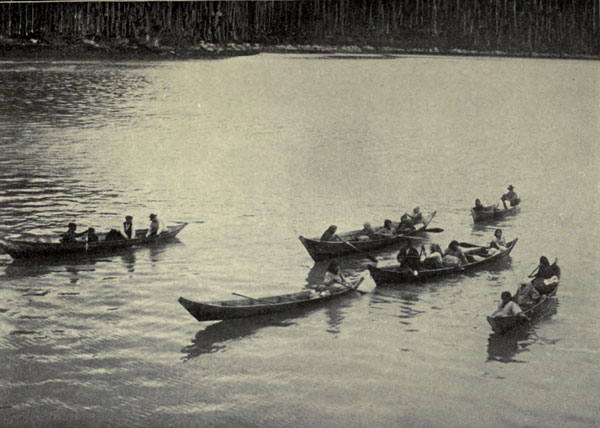
islands; the Indians with their canoes and baskets and blankets and berries;
the jet ravens, prying and flying about the streets and spruce trees; and the
bland, hushed atmosphere brooding tenderly over all.
How delightful it is, and how it makes one’s pulses bound to get back
into this reviving northland wilderness! How truly wild it is, and how joyously
one’s heart responds to the welcome it gives, its waters and mountains
shining and glowing like enthusiastic human faces! Gliding along the shores of
its network of channels, we may travel thousands of miles without seeing any
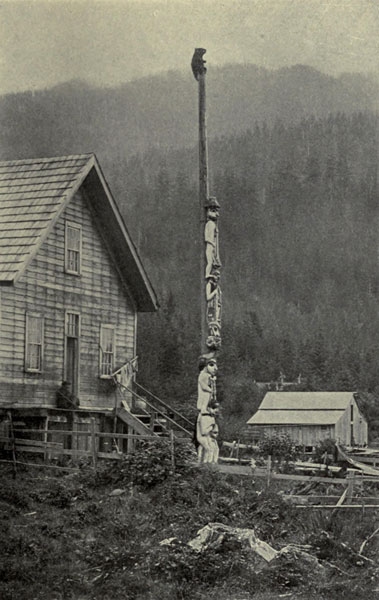
mark of man, save at long intervals some little Indian village or the faint
smoke of a camp-fire. Even these are confined to the shore. Back a few yards
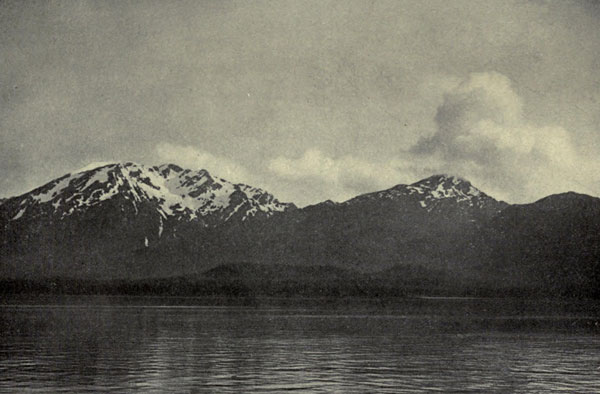
from the beach the forests are as trackless as the sky, while the mountains,
wrapped in their snow and ice and clouds, seem never before to have been even
looked at.
For those who really care to get into hearty contact with the coast region,
travel by canoe is by far the better way. The larger canoes carry from one to
three tons, rise lightly over any waves likely to be met on the inland
channels, go well under sail, and are easily paddled alongshore in calm weather
or against moderate winds, while snug harbors where they may ride at anchor or
be pulled up on a smooth beach are to be found almost everywhere. With plenty
of provisions packed in boxes, and blankets and warm clothing in rubber or
canvas bags, you may be truly independent, and enter into partnership with
Nature; to be carried with the winds and currents, accept the noble invitations
offered all along your way to enter the mountain fiords, the homes of the
waterfalls and glaciers, and encamp almost every night beneath hospitable
trees.
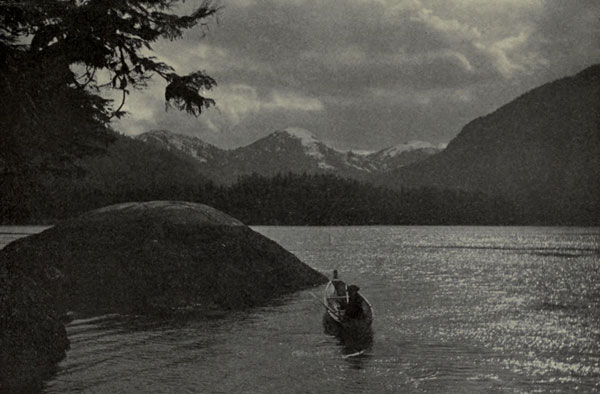
I left Fort Wrangell the 16th of August, accompanied by Mr. Young, in a canoe
about twenty-five feet long and five wide, carrying two small square sails and
manned by two Stickeen Indians—Captain Tyeen and Hunter Joe—and a
half-breed named Smart Billy. The day was calm, and bright, fleecy, clouds hung
about the lowest of the mountain-brows, while far above the clouds the peaks
were seen stretching grandly away to the northward with their ice and snow
shining in as calm a light as that which was falling on the glassy waters. Our
Indians welcomed the work that lay before them, dipping their oars in exact
time with hearty good will as we glided past island after island across the
delta of the Stickeen into Soutchoi Channel.
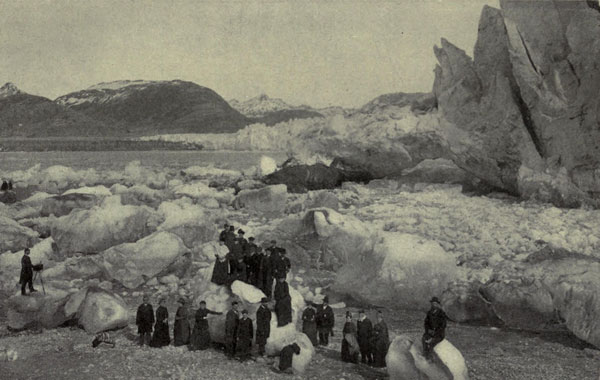
By noon we came in sight of a fleet of icebergs from Hutli Bay. The Indian name
of this icy fiord is Hutli, or Thunder Bay, from the sound made by the bergs in
falling and rising from the front of the inflowing glacier.
As we floated happily on over the shining waters, the beautiful islands, in
ever-changing pictures, were an unfailing source of enjoyment; but chiefly our
attention was turned upon the mountains. Bold granite headlands with their feet
in the channel, or some broad-shouldered peak of surpassing grandeur, would fix
the eye, or some one of the larger glaciers, with far-reaching tributaries
clasping entire groups of peaks and its great crystal river pouring down
through the forest between gray ridges and domes. In these grand picture
lessons the day was spent, and we spread our blankets beneath a Menzies spruce
on moss two feet deep.
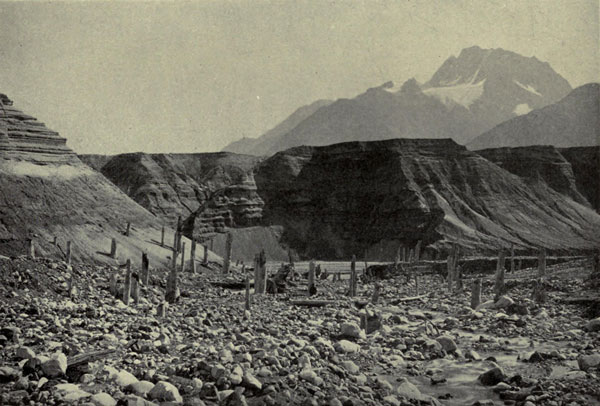
Next morning we sailed around an outcurving bank of boulders and sand ten miles
long, the terminal moraine of a grand old glacier on which last November we met
a perilous adventure. It is located just opposite three large converging
glaciers which formerly united to form the vanished trunk of the glacier to
which the submerged moraine belonged. A few centuries ago it must have been the
grandest feature of this part of the coast, and, so well preserved are the
monuments of its greatness, the noble old ice-river may be seen again in
imagination about as vividly as if present in the flesh, with snow-clouds
crawling about its fountains, sunshine sparkling on its broad flood, and its
ten-mile ice-wall planted in the deep waters of the channel and sending off its
bergs with loud resounding thunder.
About noon we rounded Cape Fanshawe, scudding swiftly before a fine breeze, to
the delight of our Indians, who had now only to steer and chat. Here we
overtook two Hoona Indians and their families on their way home from Fort
Wrangell. They had exchanged five sea-otter furs, worth about a hundred dollars
apiece, and a considerable number of fur-seal, land-otter, marten, beaver, and
other furs and skins, some $800 worth, for a new canoe valued at eighty
dollars, some flour, tobacco, blankets, and a few barrels of molasses for the
manufacture of whiskey. The blankets were not to wear, but to keep as money,
for the almighty dollar of these tribes is a Hudson’s Bay blanket. The
wind died away soon after we met, and as the two canoes glided slowly side by
side, the Hoonas made minute inquiries as to who we were and what we were doing
so far north. Mr. Young’s object in meeting the Indians as a missionary
they could in part understand, but mine in searching for rocks and glaciers
seemed past comprehension, and they asked our Indians whether gold-mines might
not be the main object. They remembered, however, that I had visited their
Glacier Bay ice-mountains a year ago, and seemed to think there might be, after
all, some mysterious interest about them of which they were ignorant. Toward
the middle of the afternoon they engaged our crew in a race. We pushed a little
way ahead for a time, but, though possessing a considerable advantage, as it
would seem, in our long oars, they at length overtook us and kept up until
after dark, when we camped together in the rain on the bank of a salmon-stream
among dripping grass and bushes some twenty-five miles beyond Cape Fanshawe.
These cold northern waters are at times about as brilliantly phosphorescent as
those of the warm South, and so they were this evening in the rain and
darkness, with the temperature of the water at forty-nine degrees, the air
fifty-one. Every stroke of the oar made a vivid surge of white light, and the
canoes left shining tracks.
As we neared the mouth of the well-known salmon-stream where we intended making
our camp, we noticed jets and flashes of silvery light caused by the startled
movement of the salmon that were on their way to their spawning-grounds. These
became more and more numerous and exciting, and our Indians shouted joyfully,
“Hi yu salmon! Hi yu muck-a-muck!” while the water about the canoe
and beneath the canoe was churned by thousands of fins into silver fire. After
landing two of our men to commence camp-work, Mr. Young and I went up the
stream with Tyeen to the foot of a rapid, to see him catch a few salmon for
supper. The stream ways so filled with them there seemed to be more fish than
water in it, and we appeared to be sailing in boiling, seething silver light
marvelously relieved in the jet darkness. In the midst of the general auroral
glow and the specially vivid flashes made by the frightened fish darting ahead
and to right and left of the canoe, our attention was suddenly fixed by a long,
steady, comet-like blaze that seemed to be made by some frightful monster that
was pursuing us. But when the portentous object reached the canoe, it proved to
be only our little dog, Stickeen.
After getting the canoe into a side eddy at the foot of the rapids, Tyeen
caught half a dozen salmon in a few minutes by means of a large hook fastened
to the end of a pole. They were so abundant that he simply groped for them in a
random way, or aimed at them by the light they themselves furnished. That food
to last a month or two may thus be procured in less than an hour is a striking
illustration of the fruitfulness of these Alaskan waters.
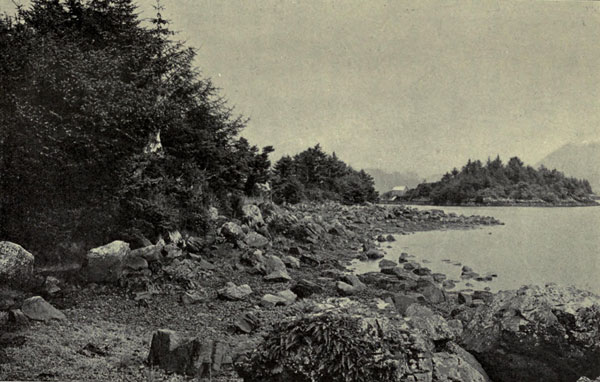
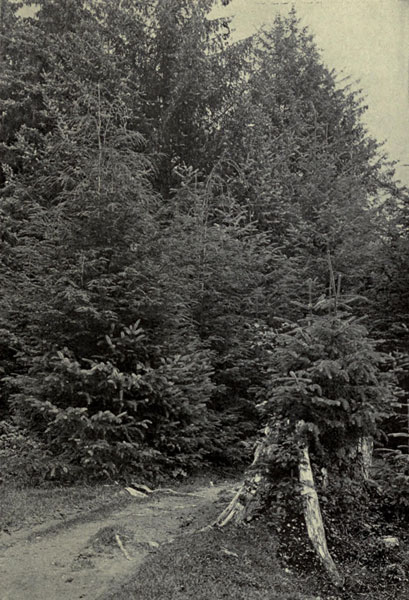
Vegetation at High-Tide Line, Sitka Harbor.
Our Hoona neighbors were asleep in the morning at sunrise, lying in a row, wet
and limp like dead salmon. A little boy about six years old, with no other
covering than a remnant of a shirt, was lying peacefully on his back, like Tam
o’ Shanter, despising wind and rain and fire. He is up now, looking happy
and fresh, with no clothes to dry and no need of washing while this weather
lasts. The two babies are firmly strapped on boards, leaving only their heads
and hands free. Their mothers are nursing them, holding the boards on end,
while they sit on the ground with their breasts level with the little
prisoners’ mouths.
This morning we found out how beautiful a nook we had got into. Besides the
charming picturesqueness of its lines, the colors about it, brightened by the
rain, made a fine study. Viewed from the shore, there was first a margin of
dark-brown algæ, then a bar of yellowish-brown, next a dark bar on the
rugged rocks marking the highest tides, then a bar of granite boulders with
grasses in the seams, and above this a thick, bossy, overleaning fringe of
bushes colored red and yellow and green. A wall of spruces and hemlocks draped
and tufted with gray and yellow lichens and mosses embowered the campground and
overarched the little river, while the camp-fire smoke, like a stranded cloud,
lay motionless in their branches. Down on the beach ducks and sandpipers in
flocks of hundreds were getting their breakfasts, bald eagles were seen perched
on dead spars along the edge of the woods, heavy-looking and overfed, gazing
stupidly like gorged vultures, and porpoises were blowing and plunging outside.
As for the salmon, as seen this morning urging their way up the swift
current,—tens of thousands of them, side by side, with their backs out of
the water in shallow places now that the tide was low,—nothing that I
could write might possibly give anything like a fair conception of the
extravagance of their numbers. There was more salmon apparently, bulk for bulk,
than water in the stream. The struggling multitudes, crowding one against
another, could not get out of our way when we waded into the midst of them. One
of our men amused himself by seizing them above the tail and swinging them over
his head. Thousands could thus be taken by hand at low tide, while they were
making their way over the shallows among the stones.
Whatever may be said of other resources of the Territory, it is hardly possible
to exaggerate the importance of the fisheries. Not to mention cod, herring,
halibut, etc., there are probably not less than a thousand salmon-streams in
southeastern Alaska as large or larger than this one (about forty feet wide)
crowded with salmon several times a year. The first run commenced that year in
July, while the king salmon, one of the five species recognized by the Indians,
was in the Chilcat River about the middle of the November before.
From this wonderful salmon-camp we sailed joyfully up the coast to explore icy
Sum Dum Bay, beginning my studies where I left off the previous November. We
started about six o’clock, and pulled merrily on through fog and rain,
the beautiful wooded shore on our right, passing bergs here and there, the
largest of which, though not over two hundred feet long, seemed many times
larger as they loomed gray and indistinct through the fog. For the first five
hours the sailing was open and easy, nor was there anything very exciting to be
seen or heard, save now and then the thunder of a falling berg rolling and
echoing from cliff to cliff, and the sustained roar of cataracts.
About eleven o’clock we reached a point where the fiord was packed with
ice all the way across, and we ran ashore to fit a block of wood on the
cutwater of our canoe to prevent its being battered or broken. While Captain
Tyeen, who had had considerable experience among berg ice, was at work on the
canoe, Hunter Joe and Smart Billy prepared a warm lunch.
The sheltered hollow where we landed seems to be a favorite camping-ground for
the Sum Dum seal-hunters. The pole-frames of tents, tied with cedar bark, stood
on level spots strewn with seal bones, bits of salmon, and spruce bark.
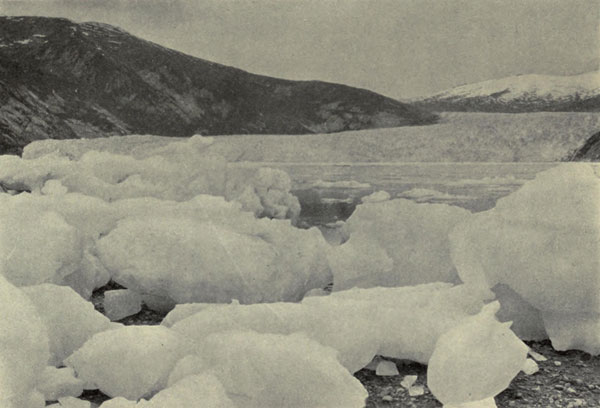
We found the work of pushing through the ice rather tiresome. An opening of
twenty or thirty yards would be found here and there, then a close pack that
had to be opened by pushing the smaller bergs aside with poles. I enjoyed the
labor, however, for the fine lessons I got, and in an hour or two we found
zigzag lanes of water, through which we paddled with but little interruption,
and had leisure to study the wonderful variety of forms the bergs presented as
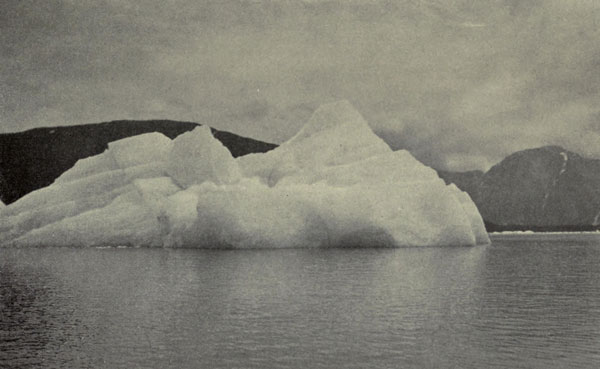
we glided past them. The largest we saw did not greatly exceed two hundred feet
in length, or twenty-five or thirty feet in height above the water. Such bergs
would draw from one hundred and fifty to two hundred feet of water. All those
that have floated long undisturbed have a projecting base at the water-line,
caused by the more rapid melting of the immersed portion. When a portion of the
berg breaks off, another base line is formed, and the old one, sharply cut, may
be seen rising at all angles, giving it a marked character. Many of the oldest
bergs are beautifully ridged by the melting out of narrow furrows strictly
parallel throughout the mass, revealing the bedded structure of the ice,
acquired perhaps centuries ago, on the mountain snow fountains. A berg suddenly
going to pieces is a grand sight, especially when the water is calm and no
motion is visible save perchance the slow drift of the tide-current. The
prolonged roar of its fall comes with startling effect, and heavy swells are
raised that haste away in every direction to tell what has taken place, and
tens of thousands of its neighbors rock and swash in sympathy, repeating the
news over and over again. We were too near several large ones that fell apart
as we passed them, and our canoe had narrow escapes. The seal-hunters, Tyeen
says, are frequently lost in these sudden berg accidents.
In the afternoon, while we were admiring the scenery, which, as we approached
the head of the fiord, became more and more sublime, one of our Indians called
attention to a flock of wild goats on a mountain overhead, and soon afterwards
we saw two other flocks, at a height of about fifteen hundred feet, relieved
against the mountains as white spots. They are abundant here and throughout the
Alaskan Alps in general, feeding on the grassy slopes above the timber-line.
Their long, yellowish hair is shed at this time of year and they were snowy
white. None of nature’s cattle are better fed or better protected from
the cold. Tyeen told us that before the introduction of guns they used to hunt
them with spears, chasing them with their wolf-dogs, and thus bringing them to
bay among the rocks, where they were easily approached and killed.
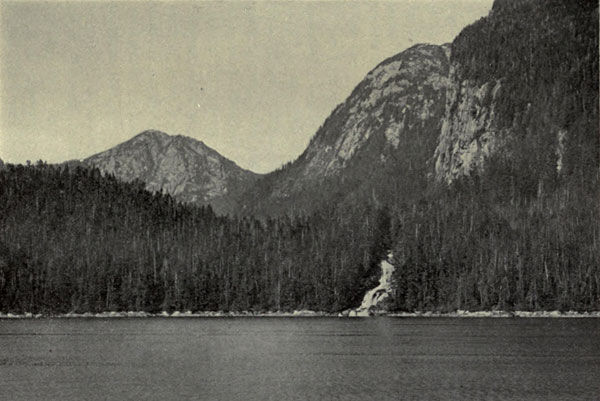
The upper half of the fiord is about from a mile to a mile and a half wide, and
shut in by sublime Yosemite cliffs, nobly sculptured, and adorned with
waterfalls and fringes of trees, bushes, and patches of flowers; but amid so
crowded a display of novel beauty it was not easy to concentrate the attention
long enough on any portion of it without giving more days and years than our
lives could afford. I was determined to see at least the grand fountain of all
this ice. As we passed headland after headland, hoping as each was rounded we
should obtain a view of it, it still remained hidden.
“Ice-mountain hi yu kumtux hide,”—glaciers know how to hide
extremely well,—said Tyeen, as he rested for a moment after rounding a
huge granite shoulder of the wall whence we expected to gain a view of the
extreme head of the fiord. The bergs, however, were less closely packed and we
made good progress, and at half-past eight o’clock, fourteen and a half
hours after setting out, the great glacier came in sight at the head of a
branch of the fiord that comes in from the northeast.
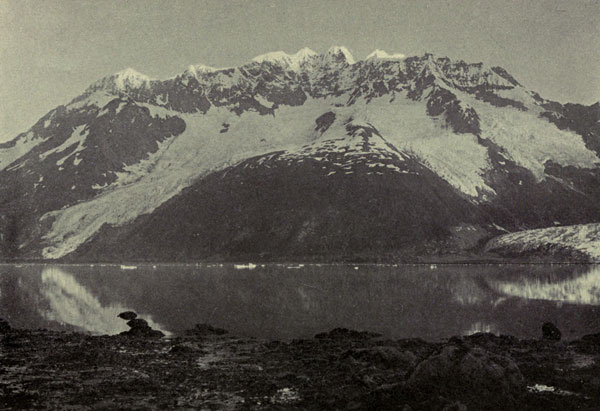
The discharging front of this fertile, fast-flowing glacier is about three
quarters of a mile wide, and probably eight or nine hundred feet deep, about
one hundred and fifty feet of its depth rising above the water as a grand blue
barrier wall. It is much wider a few miles farther back, the front being jammed
between sheer granite walls from thirty-five hundred to four thousand feet
high. It shows grandly from where it broke on our sight, sweeping boldly
forward and downward in its majestic channel, swaying from side to side in
graceful fluent lines around stern unflinching rocks. While I stood in the
canoe making a sketch of it, several bergs came off with tremendous dashing and
thunder, raising a cloud of ice-dust and spray to a height of a hundred feet or
more.
“The ice-mountain is well disposed toward you,” said Tyeen.
“He is firing his big guns to welcome you.”
After completing my sketch and entering a few notes, I directed the crew to
pull around a lofty burnished rock on the west side of the channel, where, as I
knew from the trend of the cañon, a large glacier once came in; and what
was my delight to discover that the glacier was still there and still pouring
its ice into a branch of the fiord. Even the Indians shared my joy and shouted
with me. I expected only one first-class glacier here, and found two. They are
only about two miles apart. How glorious a mansion that precious pair dwell in!
After sunset we made haste to seek a camp-ground. I would fain have shared
these upper chambers with the two glaciers, but there was no landing-place in
sight, and we had to make our way back a few miles in the twilight to the mouth
of a side cañon where we had seen timber on the way up. There seemed to
be a good landing as we approached the shore, but, coming nearer, we found that
the granite fell directly into deep water without leading any level margin,
though the slope a short distance back was not very steep.
After narrowly scanning the various seams and steps that roughened the granite,
we concluded to attempt a landing rather than grope our way farther down the
fiord through the ice. And what a time we had climbing on hands and knees up
the slippery glacier-polished rocks to a shelf some two hundred feet above the
water and dragging provisions and blankets after us! But it proved to be a
glorious place, the very best camp-ground of all the trip,—a perfect
garden, ripe berries nodding from a fringe of bushes around its edges
charmingly displayed in the light of our big fire. Close alongside there was a
lofty mountain capped with ice, and from the blue edge of that ice-cap there
were sixteen silvery cascades in a row, falling about four thousand feet, each
one of the sixteen large enough to be heard at least two miles.
How beautiful was the firelight on the nearest larkspurs and geraniums and
daisies of our garden! How hearty the wave greeting on the rocks below brought
to us from the two glaciers! And how glorious a song the sixteen cascades sang!
The cascade songs made us sleep all the sounder, and we were so happy as to
find in the morning that the berg waves had spared our canoe. We set off in
high spirits down the fiord and across to the right side to explore a
remarkably deep and narrow branch of the main fiord that I had noted on the way
up, and that, from the magnitude of the glacial characters on the two colossal
rocks that guard the entrance, promised a rich reward for our pains.
After we had sailed about three miles up this side fiord, we came to what
seemed to be its head, for trees and rocks swept in a curve around from one
side to the other without showing any opening, although the walls of the
cañon were seen extending back indefinitely, one majestic brow beyond
the other.
When we were tracing this curve, however, in a leisurely way, in search of a
good landing, we were startled by Captain Tyeen shouting, “Skookum chuck!
Skookum chuck!” (strong water, strong water), and found our canoe was
being swept sideways by a powerful current, the roar of which we had mistaken
for a waterfall. We barely escaped being carried over a rocky bar on the
boiling flood, which, as we afterwards learned, would have been only a happy
shove on our way. After we had made a landing a little distance back from the
brow of the bar, we climbed the highest rock near the shore to seek a view of
the channel beyond the inflowing tide rapids, to find out whether or no we
could safely venture in. Up over rolling, mossy, bushy, burnished rock waves we
scrambled for an hour or two, which resulted in a fair view of the deep-blue
waters of the fiord stretching on and on along the feet of the most majestic
Yosemite rocks we had yet seen. This determined our plan of shooting the rapids
and exploring it to its farthest recesses. This novel interruption of the
channel is a bar of exceedingly hard resisting granite, over which the great
glacier that once occupied it swept, without degrading it to the general level,
and over which tide-waters now rush in and out with the violence of a mountain
torrent.
Returning to the canoe, we pushed off, and in a few moments were racing over
the bar with lightning speed through hurrahing waves and eddies and sheets of
foam, our little shell of a boat tossing lightly as a bubble. Then, rowing
across a belt of back-flowing water, we found ourselves on a smooth mirror
reach between granite walls of the very wildest and most exciting description,
surpassing in some ways those of the far-famed Yosemite Valley.
As we drifted silent and awe-stricken beneath the shadows of the mighty cliffs,
which, in their tremendous height and abruptness, seemed to overhang at the
top, the Indians gazing intently, as if they, too, were impressed with the
strange, awe-inspiring grandeur that shut them in, one of them at length broke
the silence by saying, “This must be a good place for woodchucks; I hear
them calling.”
When I asked them, further on, how they thought this gorge was made, they gave
up the question, but offered an opinion as to the formation of rain and soil.
The rain, they said, was produced by the rapid whirling of the earth by a stout
mythical being called Yek. The water of the ocean was thus thrown up, to
descend again in showers, just as it is thrown off a wet grindstone. They did
not, however, understand why the ocean water should be salt, while the rain
from it is fresh. The soil, they said, for the plants to grow on is formed by
the washing of the rain on the rocks and gradually accumulating. The grinding
action of ice in this connection they had not recognized.
Gliding on and on, the scenery seemed at every turn to become more lavishly
fruitful in forms as well as more sublime in dimensions—snowy falls
booming in splendid dress; colossal domes and battle meets and sculptured
arches of a fine neutral-gray tint, their bases raved by the blue fiord water;
green ferny dells; bits of flower-bloom on ledges; fringes of willow and birch;
and glaciers above all. But when we approached the base of a majestic rock like
the Yosemite Half Dome at the head of the fiord, where two short branches put
out, and came in sight of another glacier of the first order sending off bergs,
our joy was complete. I had a most glorious view of it, sweeping in grand
majesty from high mountain fountains, swaying around one mighty bastion after
another, until it fell into the fiord in shattered overleaning fragments. When
we had feasted awhile on this unhoped-for treasure, I directed the Indians to
pull to the head of the left fork of the fiord, where we found a large cascade
with a volume of water great enough to be called a river, doubtless the outlet
of a receding glacier not in sight from the fiord.
This is in form and origin a typical Yosemite valley, though as yet its floor
is covered with ice and water,—ice above and beneath, a noble mansion in
which to spend a winter and a summer! It is about ten miles long, and from
three quarters of a mile to one mile wide. It contains ten large falls and
cascades, the finest one on the left side near the head. After coming in an
admirable rush over a granite brow where it is first seen at a height of nine
hundred or a thousand feet, it leaps a sheer precipice of about two hundred and
fifty feet, then divides and reaches the tide-water in broken rapids over
boulders. Another about a thousand feet high drops at once on to the margin of
the glacier two miles back from the front. Several of the others are upwards of
three thousand feet high, descending through narrow gorges as richly feathered
with ferns as any channel that water ever flowed in, though tremendously abrupt
and deep. A grander array of rocks and waterfalls I have never yet beheld in
Alaska.
The amount of timber on the walls is about the same as that on the Yosemite
walls, but owing to greater moisture, there is more small
vegetation,—bushes, ferns, mosses, grasses, etc.; though by far the
greater portion of the area of the wall-surface is bare and shining with the
polish it received when occupied by the glacier that formed the fiord. The
deep-green patches seen on the mountains back of the walls at the limits of
vegetation are grass, where the wild goats, or chamois rather, roam and feed.
The still greener and more luxuriant patches farther down in gullies and on
slopes where the declivity is not excessive, are made up mostly of willows,
birch, and huckleberry bushes, with a varying amount of prickly ribes and rubus
and echinopanax. This growth, when approached, especially on the lower slopes
near the level of the sea at the jaws of the great side cañons, is found
to be the most impenetrable and tedious and toilsome combination of fighting
bushes that the weary explorer ever fell into, incomparably more punishing than
the buckthorn and manzanita tangles of the Sierra.
The cliff gardens of this hidden Yosemite are exceedingly rich in color. On
almost every rift and bench, however small, as well as on the wider table-rocks
where a little soil has lodged, we found gay multitudes of flowers, far more
brilliantly colored than would be looked for in so cool and beclouded a
region,—larkspurs, geraniums, painted-cups, bluebells, gentians,
saxifrages, epilobiums, violets, parnassia, veratrum, spiranthes and other
orchids, fritillaria, smilax, asters, daisies, bryanthus, cassiope,
linnæa, and a great variety of flowering ribes and rubus and heathworts.
Many of the above, though with soft stems and leaves, are yet as brightly
painted as those of the warm sunlands of the south. The heathworts in
particular are very abundant and beautiful, both in flower and fruit, making
delicate green carpets for the rocks, flushed with pink bells, or dotted with
red and blue berries. The tallest of the grasses have ribbon leaves well
tempered and arched, and with no lack of bristly spikes and nodding purple
panicles. The alpine grasses of the Sierra, making close carpets on the glacier
meadows, I have not yet seen in Alaska.
The ferns are less numerous in species than in California, but about equal in
the number of fronds. I have seen three aspidiums, two woodsias, a lomaria,
polypodium, cheilanthes, and several species of pteris.
In this eastern arm of Sum Dum Bay and its Yosemite branch, I counted from my
canoe, on my way up and down, thirty small glaciers back of the walls, and we
saw three of the first order; also thirty-seven cascades and falls, counting
only those large enough to make themselves heard several miles. The whole bay,
with its rocks and woods and ice, reverberates with their roar. How many
glaciers may be disclosed in the other great arm that I have not seen as yet, I
cannot say, but, judging from the bergs it sends down, I guess not less than a
hundred pour their turbid streams into the fiord, making about as many joyful,
bouncing cataracts.
About noon we began to retrace our way back into the main fiord, and arrived at
the gold-mine camp after dark, rich and weary.
On the morning of August 21 I set out with my three Indians to explore the
right arm of this noble bay, Mr. Young having decided, on account of mission
work, to remain at the gold-mine. So here is another fine lot of Sum Dum
ice,—thirty-five or forty square miles of bergs, one great glacier of the
first class descending into the fiord at the head, the fountain whence all
these bergs were derived, and thirty-one smaller glaciers that do not reach
tidewater; also nine cascades and falls, large size, and two rows of Yosemite
rocks from three to four thousand feet high, each row about eighteen or twenty
miles long, burnished and sculptured in the most telling glacier style, and
well trimmed with spruce groves and flower gardens; a’ that and more of a
kind that cannot here be catalogued.
For the first five or six miles there is nothing excepting the icebergs that is
very striking in the scenery as compared with that of the smooth unencumbered
outside channels, where all is so evenly beautiful. The mountain-wall on the
right as you go up is more precipitous than usual, and a series of small
glaciers is seen along the top of it, extending their blue-crevassed fronts
over the rims of pure-white snow fountains, and from the end of each front a
hearty stream coming in a succession of falls and rapids over the terminal
moraines, through patches of dwarf willows, and then through the spruce woods
into the bay, singing and dancing all the way down. On the opposite side of the
bay from here there is a small side bay about three miles deep, with a showy
group of glacier-bearing mountains back of it. Everywhere else the view is
bounded by comparatively low mountains densely forested to the very top.
After sailing about six miles from the mine, the experienced mountaineer could
see some evidence of an opening from this wide lower portion, and on reaching
it, it proved to be the continuation of the main west arm, contracted between
stupendous walls of gray granite, and crowded with bergs from shore to shore,
which seem to bar the way against everything but wings. Headland after
headland, in most imposing array, was seen plunging sheer and bare from dizzy
heights, and planting its feet in the ice-encumbered water without leaving a
spot on which one could land from a boat, while no part of the great glacier
that pours all these miles of ice into the fiord was visible. Pushing our way
slowly through the packed bergs, and passing headland after headland, looking
eagerly forward, the glacier and its fountain mountains were still beyond
sight, cut off by other projecting headland capes, toward which I urged my way,
enjoying the extraordinary grandeur of the wild unfinished Yosemite. Domes
swell against the sky in fine lines as lofty and as perfect in form as those of
the California valley, and rock-fronts stand forward, as sheer and as nobly
sculptured. No ice-work that I have ever seen surpasses this, either in the
magnitude of the features or effectiveness of composition.
On some of the narrow benches and tables of the walls rows of spruce trees and
two-leaved pines were growing, and patches of considerable size were found on
the spreading bases of those mountains that stand back inside the
cañons, where the continuity of the walls is broken. Some of these side
cañons are cut down to the level of the water and reach far back,
opening views into groups of glacier fountains that give rise to many a noble
stream; while all along the tops of the walls on both sides small glaciers are
seen, still busily engaged in the work of completing their sculpture. I counted
twenty-five from the canoe. Probably the drainage of fifty or more pours into
this fiord. The average elevation at which they melt is about eighteen hundred
feet above sea-level, and all of them are residual branches of the grand trunk
that filled the fiord and overflowed its walls when there was only one Sum Dum
glacier.
The afternoon was wearing away as we pushed on and on through the drifting
bergs without our having obtained a single glimpse of the great glacier. A Sum
Dum seal-hunter, whom we met groping his way deftly through the ice in a very
small, unsplitable cottonwood canoe, told us that the ice-mountain was yet
fifteen miles away. This was toward the middle of the afternoon, and I gave up
sketching and making notes and worked hard with the Indians to reach it before
dark. About seven o’clock we approached what seemed to be the extreme
head of the fiord, and still no great glacier in sight—only a small one,
three or four miles long, melting a thousand feet above the sea. Presently, a
narrow side opening appeared between tremendous cliffs sheer to a height of
four thousand feet or more, trending nearly at right angles to the general
trend of the fiord, and apparently terminated by a cliff, scarcely less abrupt
or high, at a distance of a mile or two. Up this bend we toiled against wind
and tide, creeping closely along the wall on the right side, which, as we
looked upward, seemed to be leaning over, while the waves beating against the
bergs and rocks made a discouraging kind of music. At length, toward nine
o’clock, just before the gray darkness of evening fell, a long,
triumphant shout told that the glacier, so deeply and desperately hidden, was
at last hunted back to its benmost bore. A short distance around a second bend
in the cañon, I reached a point where I obtained a good view of it as it
pours its deep, broad flood into the fiord in a majestic course from between
the noble mountains, its tributaries, each of which would be regarded elsewhere
as a grand glacier, converging from right and left from a fountain set far in
the silent fastnesses of the mountains.
“There is your lost friend,” said the Indians laughing; “he
says, ‘Sagh-a-ya’” (how do you do)? And while berg after berg
was being born with thundering uproar, Tyeen said, “Your friend has klosh
tumtum (good heart). Hear! Like the other big-hearted one he is firing his guns
in your honor.”
I stayed only long enough to make an outline sketch, and then urged the Indians
to hasten back some six miles to the mouth of a side cañon I had noted
on the way up as a place where we might camp in case we should not find a
better. After dark we had to move with great caution through the ice. One of
the Indians was stationed in the bow with a pole to push aside the smaller
fragments and look out for the most promising openings, through which he guided
us, shouting, “Friday! Tucktay!” (shoreward, seaward) about ten
times a minute. We reached this landing-place after ten o’clock, guided
in the darkness by the roar of a glacier torrent. The ground was all boulders
and it was hard to find a place among them, however small, to lie on. The
Indians anchored the canoe well out from the shore and passed the night in it
to guard against berg-waves and drifting waves, after assisting me to set my
tent in some sort of way among the stones well back beyond the reach of the
tide. I asked them as they were returning to the canoe if they were not going
to eat something. They answered promptly:—
“We will sleep now, if your ice friend will let us. We will eat
to-morrow, but we can find some bread for you if you want it.”
“No,” I said, “go to rest. I, too, will sleep now and eat
to-morrow.” Nothing was attempted in the way of light or fire. Camping
that night was simply lying down. The boulders seemed to make a fair bed after
finding the best place to take their pressure.
During the night I was awakened by the beating of the spent ends of berg-waves
against the side of my tent, though I had fancied myself well beyond their
reach. These special waves are not raised by wind or tide, but by the fall of
large bergs from the snout of the glacier, or sometimes by the overturning or
breaking of large bergs that may have long floated in perfect poise. The
highest berg-waves oftentimes travel half a dozen miles or farther before they
are much spent, producing a singularly impressive uproar in the far recesses of
the mountains on calm dark nights when all beside is still. Far and near they
tell the news that a berg is born, repeating their story again and again,
compelling attention and reminding us of earthquake-waves that roll on for
thousands of miles, taking their story from continent to continent.
When the Indians came ashore in the morning and saw the condition of my tent
they laughed heartily and said, “Your friend [meaning the big glacier]
sent you a good word last night, and his servant knocked at your tent and said,
‘Sagh-a-ya, are you sleeping well?’”
I had fasted too long to be in very good order for hard work, but while the
Indians were cooking, I made out to push my way up the cañon before
breakfast to seek the glacier that once came into the fiord, knowing from the
size and muddiness of the stream that drains it that it must be quite large and
not far off. I came in sight of it after a hard scramble of two hours through
thorny chaparral and across steep avalanche taluses of rocks and snow. The
front reaches across the cañon from wall to wall, covered with rocky
detritus, and looked dark and forbidding in the shadow cast by the cliffs,
while from a low, cavelike hollow its draining stream breaks forth, a river in
size, with a reverberating roar that stirs all the cañon. Beyond, in a
cloudless blaze of sunshine, I saw many tributaries, pure and white as
new-fallen snow, drawing their sources from clusters of peaks and sweeping down
waving slopes to unite their crystal currents with the trunk glacier in the
central cañon. This fine glacier reaches to within two hundred and fifty
feet of the level of the sea, and would even yet reach the fiord and send off
bergs but for the waste it suffers in flowing slowly through the trunk
cañon, the declivity of which is very slight.
Returning, I reached camp and breakfast at ten o’clock; then had
everything packed into the canoe, and set off leisurely across the fiord to the
mouth of another wide and low cañon, whose lofty outer cliffs, facing
the fiord, are telling glacial advertisements. Gladly I should have explored it
all, traced its streams of water and streams of ice, and entered its highest
chambers, the homes and fountains of the snow. But I had to wait. I only
stopped an hour or two, and climbed to the top of a rock through the common
underbrush, whence I had a good general view. The front of the main glacier is
not far distant from the fiord, and sends off small bergs into a lake. The
walls of its tributary cañons are remarkably jagged and high, cut in a
red variegated rock, probably slate. On the way back to the canoe I gathered
ripe salmon-berries an inch and a half in diameter, ripe huckleberries, too, in
great abundance, and several interesting plants I had not before met in the
territory.
About noon, when the tide was in our favor, we set out on the return trip to
the gold-mine camp. The sun shone free and warm. No wind stirred. The water
spaces between the bergs were as smooth as glass, reflecting the unclouded sky,
and doubling the ravishing beauty of the bergs as the sunlight streamed through
their innumerable angles in rainbow colors.
Soon a light breeze sprang up, and dancing lily spangles on the water mingled
their glory of light with that burning on the angles of the ice.
On days like this, true sun-days, some of the bergs show a purplish tinge,
though most are white from the disintegrating of their weathered surfaces. Now
and then a new-born one is met that is pure blue crystal throughout, freshly
broken from the fountain or recently exposed to the air by turning over. But in
all of them, old and new, there are azure caves and rifts of ineffable beauty,
in which the purest tones of light pulse and shimmer, lovely and untainted as
anything on earth or in the sky.
As we were passing the Indian village I presented a little tobacco to the
headmen as an expression of regard, while they gave us a few smoked salmon,
after putting many questions concerning my exploration of their bay and bluntly
declaring their disbelief in the ice business.
About nine o’clock we arrived at the gold camp, where we found Mr. Young
ready to go on with us the next morning, and thus ended two of the brightest
and best of all my Alaska days.