Travels and Discoveries in North and Central Africa
Whole book · 54 sections
BARTH’S TRAVELS IN NORTH AND CENTRAL AFRICA
The Minerva Library OF FAMOUS BOOKS.
Edited by G. T. BETTANY, M.A.
1. CHARLES DARWIN’S JOURNAL during a
Voyage in the ‘Beagle.’
2. THE INGOLDSBY LEGENDS.
3. BORROW’S BIBLE IN SPAIN.
4. EMERSON’S PROSE WORKS.
5. GALTON’S TROPICAL SOUTH AFRICA.
6. MANZONI’S THE BETROTHED LOVERS.
7. GOETHE’S FAUST (Complete). Bayard Taylor.
8. WALLACE’S TRAVELS ON THE AMAZON.
9. DEAN STANLEY’S LIFE OF DR. ARNOLD.
10. POE’S TALES OF ADVENTURE, MYSTERY,
AND IMAGINATION.
11. COMEDIES BY MOLIÈRE.
12. FORSTER’S LIFE OF GOLDSMITH.
13. LANE’S MANNERS AND CUSTOMS OF THE
MODERN EGYPTIANS.
14. TORRENS’ LIFE OF MELBOURNE.
15. THACKERAY’S VANITY FAIR.
16. BARTH’S TRAVELS IN NORTH AND
CENTRAL AFRICA.
London: Ward, Lock & Co.
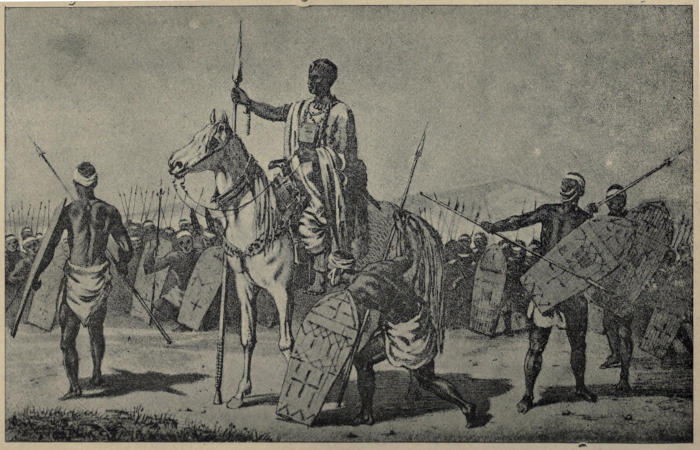
KANEMBU CHIEF.
THE MINERVA LIBRARY OF FAMOUS BOOKS. Edited by G. T. BETTANY, M.A., B.Sc.
TRAVELS AND DISCOVERIES IN NORTH AND CENTRAL AFRICA.
INCLUDING ACCOUNTS OF TRIPOLI, THE SAHARA, THE REMARKABLE KINGDOM OF
BORNU, AND THE COUNTRIES AROUND LAKE CHAD.
BY HENRY BARTH, Ph.D., D.C.L.
With Full-page Illustrations and the Original Woodcut Illustrations,
and a Memoir of the Author.
WARD, LOCK, AND CO.,
LONDON, NEW YORK, AND MELBOURNE.
1890.
[All rights reserved.]
INTRODUCTION.
The travels of Dr. Barth in Northern and Central Africa rank
among the foremost of the enterprises which have illuminated our
ignorance about Central Africa. They have an especial value, too,
as being almost the sole record of a state of things which has considerably
changed since his time, and will no doubt rapidly change
still further.
Henry Barth was born in Hamburg on February 16th, 1821.
During his education at the Johanneum he showed a special taste
for languages and history. In the autumn of 1839 he entered at
the University of Berlin, studying philology under Böckh. While
attending Carl Ritter’s geographical lectures, he displayed a predilection
for the countries surrounding the Mediterranean, which
he continued to manifest throughout his whole life. In August
1840 he went to Italy, travelling from Venice as far as Sicily.
In 1841, after many fluctuations of mind, he fixed his attention
definitely on the classical Mediterranean basin, and especially the
history and influence of the Greek colonies. He took his degree
in the summer of 1844 with an essay on the commercial history
of the Corinthians, and in January 1845 started for three years’
travels in the Mediterranean. He traversed France, Spain, the
northern coast of Africa, the peninsula of Sinai, Palestine, Syria,
Cyprus, Asia Minor, and thence returned through Greece to
Berlin just before the events of March 1848. Notwithstanding
the political troubles, he gained the right of giving public lectures;
and in the summer of 1849 he gave a course “On the Topography
of Some of the Most Renowned Nations of Antiquity.” Then
followed the message from Baron Bunsen which is detailed in
the author’s preface, and the great journey which is here described.
In it he travelled from Tripoli to Bórnu, then through Ádamáwa,
Baghirmi, Sókoto, etc., to Timbúktu, finally returning to Tripoli
in August 1855, after nearly six years’ absence. His great book,
published in 1857 in German and English in five volumes, is
the most important work ever written on the districts of which
it treats. We here present the first half, with the original wood
engravings and reproductions of some of the lithographic plates.
Barth not being a naturalist, his work differs considerably from
those of Darwin and Wallace; but to make up for this he is
extremely rich in topographical, historical, and anthropological
details.
On his return Barth found plenty of work to do. From 1863
he was Professor of Geography in the University. He founded
the Carl Ritter Institute, and was President of the Geographical
Society. On completing his book on Africa, he carried his
researches farther among the Mediterranean lands. In the
autumn of 1858 he travelled over the northern half of Asia Minor,
from Trebizond through Cæsarea to Scutari. In 1861 he visited
Spain; in 1862, the interior of Turkey in Europe; 1863, the
Alps; 1864, Italy; 1865, Turkey again. In that year he died
(November 25) after two days’ illness, in the midst of most zealous
work. He wrote, beside the present work, “Travels, in the Coasts
Bordering the Mediterranean,” vol. i., 1849; “Journey from Trebizond
to Scutari,” 1860; “Journey through the Interior of
Turkey in Europe,” 1864. His great philological work on the
vocabularies of Central Africa was left incomplete, only two parts
having been published, 1862-63.
G. T. B.
PREFACE.
On the 5th of October, 1849, at Berlin, Professor Carl Ritter
informed me that the British Government was about to send Mr.
Richardson on a mission to Central Africa, and that they had
offered, through the Chevalier Bunsen, to allow a German traveller
to join the mission, provided he was willing to contribute two
hundred pounds for his own personal travelling expenses.
I had commenced lecturing at the University of Berlin on comparative
geography and the colonial commerce of antiquity, and
had just at that time published the first volume of my “Wanderings
Round the Mediterranean,” which comprised my journey through
Barbary. Having undertaken this journey quite alone, I spent
nearly my whole time with the Arabs, and familiarized myself with
that state of human society where the camel is man’s daily companion,
and the culture of the date-tree his chief occupation. I
made long journeys through desert tracts; I travelled all round the
Great Syrtis, and, passing through the picturesque little tract of
Cyrenaica, traversed the whole country towards Egypt; I wandered
about for above a month in the desert valleys between Aswán and
Kosér, and afterwards pursued my journey by land all the way
through Syria and Asia Minor to Constantinople.
While traversing these extensive tracts, where European comfort
is never altogether out of reach, where lost supplies may be easily
replaced, and where the protection of European powers is not quite
without avail, I had often cast a wistful look towards those unknown
or little-known regions in the interior, which stand in frequent,
though irregular, connection with the coast. As a lover of ancient
history, I had been led towards those regions rather through the
commerce of ancient Carthage, than by the thread of modern discovery;
and the desire to know something more about them acted
on me like a charm. In the course of a conversation I once held
with a Háusa slave in Káf, in the regency of Tunis, he, seeing the
interest I took in his native country, made use of these simple but
impressive words: “Please God, you shall go and visit Kanó.”
These words were constantly ringing in my ears; and though overpowered
for a time by the vivid impressions of interesting and
picturesque countries, they echoed with renewed intensity as soon
as I was restored to the tranquillity of European life.
During my three years’ travelling I had ample opportunity of
testing the efficacy of British protection; I experienced the kindness
of all Her Britannic Majesty’s consuls from Tangiers to Brúsa, and
often enjoyed their hospitality. It was solely their protection which
enabled me to traverse with some degree of security those more
desert tracts through which I wandered. Colonel Warrington,
Her Majesty’s consul in Tripoli, who seems to have had some
presentiment of my capabilities as an African explorer, even promised
me his full assistance if I should try to penetrate into the
interior. Besides this, my admiration of the wide extension of the
British over the globe, their influence, their language, and their
government, was such that I felt a strong inclination to become the
humble means of carrying out their philanthropic views for the progressive
civilization of the neglected races of Central Africa.
Under these circumstances, I volunteered cheerfully to accompany
Mr. Richardson, on the sole condition, however, that the exploration
of Central Africa should be made the principal object of the
mission, instead of a secondary one, as had been originally contemplated.
In the meantime, while letters were interchanged between Berlin,
London, and Paris (where Mr. Richardson at that time resided),
my father, whom I had informed of my design, entreated me to
desist from my perilous undertaking, with an earnestness which
my filial duty did not allow me to resist; and giving way to Dr.
Overweg, who in youthful enthusiasm came immediately forward
to volunteer, I receded from my engagement. But it was too late,
my offer having been officially accepted in London; and I therefore
allayed my father’s anxiety, and joined the expedition.
It was a generous act of Lord Palmerston, who organized the
expedition, to allow two foreign gentlemen to join it instead of one.
A sailor was besides attached to it; and a boat was also provided,
in order to give full scope to the object of exploration. The choice
of the sailor was unfortunate, and Mr. Richardson thought it best
to send him back from Múrzuk; but the boat, which was carried
throughout the difficult and circuitous road by Múrzuk, Ghát, Aïr,
and Zínder, exciting the wonder and astonishment of all the tribes
in the interior, ultimately reached its destination, though the
director of the expedition himself had in the meanwhile unfortunately
succumbed.
Government also allowed us to take out arms. At first it had
been thought that the expedition ought to go unarmed, inasmuch as
Mr. Richardson had made his first journey to Ghát without arms.
But on that occasion he had gone as a private individual, without
instruments, without presents, without anything; and we were to
unite with the character of an expedition that of a mission,—that
is to say, we were to explore the country while endeavouring at the
same time to establish friendship with the chiefs and rulers of the
different territories. It may be taken for granted that we should
never have crossed the frontier of Aïr had we been unarmed; and
when I entered upon my journey alone, it would have been impossible
for me to proceed without arms through countries which
are in a constant state of war, where no chief or ruler can protect
a traveller except with a large escort, which is sure to run away as
soon as there is any real danger.
It may be possible to travel without arms in some parts of
Southern Africa; but there is this wide difference, that the natives
of the latter are exclusively Pagans, while, along all those tracts
which I have been exploring, Islamism and Paganism are constantly
arrayed against each other in open or secret warfare, even
if we leave out of view the unsafe state of the roads through large
states consisting, though loosely connected together, of almost
independent provinces. The traveller in such countries must carry
arms; yet he must exercise the utmost discretion in using them.
As for myself, I avoided giving offence to the men with whom I had
to deal in peaceful intercourse, endeavouring to attach them to me
by esteem and friendship. I have never proceeded onwards without
leaving a sincere friend behind me, and thus being sure that, if
obliged to retrace my steps, I might do so with safety.
But I have more particular reason to be grateful for the opinion
entertained of me by the British Government; for after Mr. Richardson
had, in March 1851, fallen a victim to the noble enterprise to
which he had devoted his life, Her Majesty’s Government honoured
me with their confidence, and, in authorizing me to carry out the
objects of the expedition, placed sufficient means at my disposal for
the purpose. The position in which I was thus placed must be my
excuse for undertaking, after the successful accomplishment of
my labours, the difficult task of relating them in a language not
my own.
In matters of science and humanity all nations ought to be united
by one common interest, each contributing its share in proportion
to its own peculiar disposition and calling. If I have been able to
achieve something in geographical discovery, it is difficult to say
how much of it is due to English, how much to German influence;
for science is built up of the materials collected by almost every
nation, and, beyond all doubt, in geographical enterprise in general
none has done more than the English, while, in Central Africa in
particular, very little has been achieved by any but English travellers.
Let it not, therefore, be attributed to an undue feeling of nationality
if I correct any error of those who preceded me. It would be
unpardonable if a traveller failed to penetrate further, or to obtain a
clearer insight into the customs and the polity of the nations visited
by him, or if he were unable to delineate the country with greater
accuracy and precision, than those who went before him.
Every succeeding traveller is largely indebted to the labours of
his predecessor. Thus our expedition would never have been able
to achieve what it did, if Oudney, Denham, and Clapperton had not
gone before us; nor would these travellers have succeeded so far,
had Lyon and Ritchie not opened the road to Fezzán; nor would
Lyon have been able to reach Tejérri, if Captain (now Rear-Admiral)
Smyth had not shown the way to Ghírza. To Smyth, seconded by
Colonel Warrington, is due the merit of having attracted the attention
of the British Government to the favourable situation of Tripoli
for facilitating intercourse with Central Africa; and if at present
the river-communication along the Tsádda or Bénuwé seems to
hold out a prospect of an easier approach to those regions, the
importance of Tripoli must not be underrated, for it may long
remain the most available port from which a steady communication
with many parts of that continent can be kept up.
I had the good fortune to see my discoveries placed on a stable
basis before they were brought to a close, by the astronomical observations
of Dr. Vogel, who was sent out by Her Britannic Majesty’s
Government for the purpose of joining the expedition; and I have
only to regret that this gentleman was not my companion from the
beginning of my journey, as exact astronomical observations, such
as he has made, are of the utmost importance in any geographical
exploration. By moving the generally-accepted position of Kúkawa
more than a degree to the westward, the whole map of the interior
has been changed very considerably. The position assigned by
Dr. Vogel to Zínder gives to the whole western route, from Ghát
through the country of Ásben, a well-fixed terminating point, while
at the same it serves to check my route to Timbúktu. If, however,
this topic be left out of consideration, it will be found that the maps
made by me on the journey, under many privations, were a close
approximation to the truth. But now all that pertains to physical
features and geographical position has been laid down, and executed
with artistic skill and scientific precision, by Dr. Petermann.
The principal merit which I claim for myself in this respect is that
of having noted the whole configuration of the country; and my
chief object has been to represent the tribes and nations with whom
I came in contact, in their historical and ethnographical relation to
the rest of mankind, as well as in their physical relation to that tract
of country in which they live. If, in this respect, I have succeeded
in placing before the eyes of the public a new and animated picture,
and connected those apparently savage and degraded tribes more
intimately with the history of races placed on a higher level of
civilization, I shall be amply recompensed for the toils and dangers
I have gone through.
My companion, Dr. Overweg, was a clever and active young
geologist; but, unfortunately, he was deficient in that general knowledge
of natural science which is required for comprehending all the
various phenomena occurring on a journey into unknown regions.
Having never before risked his life on a dangerous expedition, he
never for a moment doubted that it might not be his good fortune to
return home in safety; and he therefore did not always bestow that
care upon his journal which is so desirable in such an enterprise.
Nevertheless, almost all his observations of latitude have been found
correct, while his memoranda, if deciphered at leisure, might still
yield a rich harvest.
One of the principal objects which Her Britannic Majesty’s
Government had always in view in these African expeditions was the
abolition of the slave-trade. This, too, was zealously advocated by
the late Mr. Richardson, and, I trust, has been as zealously carried
out by myself whenever it was in my power to do so, although, as
an explorer on a journey of discovery, I was induced, after mature
reflection, to place myself under the protection of an expeditionary
army, whose object it was to subdue another tribe, and eventually to
carry away a large proportion of the conquered into slavery. Now,
it should always be borne in mind that there is a broad distinction
between the slave-trade and domestic slavery. The foreign slave-trade
may, comparatively speaking, be easily abolished, though
the difficulties of watching over contraband attempts have been
shown sufficiently by many years’ experience. With the abolition
of the slave-trade all along the northern and south-western coast of
Africa, slaves will cease to be brought down to the coast; and in this
way a great deal of the mischief and misery necessarily resulting
from this inhuman traffic will be cut off. But this, unfortunately,
forms only a small part of the evil.
There can be no doubt that the most horrible topic connected with
slavery is slave-hunting; and this is carried on not only for the
purpose of supplying the foreign market, but, in a far more extensive
degree, for supplying the wants of domestic slavery. Hence it was
necessary that I should become acquainted with the real state of
these most important features of African society, in order to speak
clearly about them; for with what authority could I expatiate on
the horrors and the destruction accompanying such an expedition,
if I were not speaking as an eye-witness? But having myself
accompanied such a host on a grand scale, I shall be able to lay
before the public a picture of the cheerful comfort, as well as the
domestic happiness, of a considerable portion of the human race,
which, though in a low, is not at all in a degraded state of civilization,
as well as the wanton and cruel manner in which this happiness is
destroyed, and its peaceful abodes changed into desolation. Moreover,
this very expedition afforded me the best opportunity of
convincing the rulers of Bórnu of the injury which such a perverse
system entails upon themselves.
But besides this, it was of the utmost importance to visit the
country of the Músgu; for while that region had been represented
by the last expedition as an almost inaccessible mountain-chain,
attached to that group which Major Denham observed on his enterprising
but unfortunate expedition with Bú-Khalúm, I convinced
myself on my journey to Ádamáwa, from the information which I
gathered from the natives, that the mountains of Mándará are
entirely insulated towards the east. I considered it, therefore, a
matter of great geographical importance to visit that country, which,
being situated between the rivers Shárí and Bénuwé, could alone
afford the proof whether there was any connection between these
two rivers.
I shall have frequent occasion to refer, in my journal, to conversations
which I had with the natives on religious subjects. I may
say that I have always avowed my religion, and defended the pure
principles of Christianity against those of Islám; only once was I
obliged, for about a month, in order to carry out my project of
reaching Timbúktu, to assume the character of a Moslem. Had I
not resorted to this expedient, it would have been absolutely impossible
to achieve such a project, since I was then under the protection
of no chief whatever, and had to pass through the country of the
fanatic and barbarous hordes of the Tuarek. But though, with
this sole exception, I have never denied my character of a Christian,
I thought it prudent to conform to the innocent prejudices of the
people around me, adopting a dress which is at once better adapted
to the climate and more decorous in the eyes of the natives. One
great cause of my popularity was the custom of alms-giving. By
this means I won the esteem of the natives, who took such a lively
interest in my well-being that, even when I was extremely ill, they
used to say, “ʿAbd el Kerím[1] shall not die.”
I have given a full description of my preparatory excursion through
the mountainous region round Tripoli; for though this is not
altogether a new country, any one who compares my map with that
of Lyon or Denham, will see how little the very interesting physical
features of this tract had been known before, while, at a time when
the whole Turkish empire is about to undergo a great transformation,
it seems well worth while to lay also the state of this part of its
vast dominions in a more complete manner before the European
public.
Of the first part of our expedition there has already appeared the
Narrative of the late Mr. Richardson, published from his manuscript
journals, which I was fortunately able to send home from Kúkawa.
It is full of minute incidents of travelling life, so very instructive to
the general reader. But from my point of view, I had to look very
differently at the objects which presented themselves; and Mr.
Richardson, if he had lived to work out his memoranda himself,
would not have failed to give to his Journal a more lasting interest.
Moreover, my stay in Ágades afforded me quite a different insight
into the life, the history, and geography of those regions, and
brought me into contact with Timbúktu.
Extending over a tract of country of twenty-four degrees from
north to south, and twenty degrees from east to west, in the broadest
part of the continent of Africa, my travels necessarily comprise
subjects of great interest and diversity.
After having traversed vast deserts of the most barren soil, and
scenes of the most frightful desolation, I met with fertile lands
irrigated by large navigable rivers and extensive central lakes, ornamented
with the finest timber, and producing various species of
grain, rice, sesamum, ground-nuts, in unlimited abundance, the
sugar-cane, etc., together with cotton and indigo, the most valuable
commodities of trade. The whole of Central Africa, from Bagírmi
to the east as far as Timbúktu to the west (as will be seen in my
narrative), abounds in these products. The natives of these regions
not only weave their own cotton, but dye their home-made shirts
with their own indigo. The river, the far-famed Niger, which gives
access to these regions by means of its eastern branch, the Bénuwé,
which I discovered, affords an uninterrupted navigable sheet of water
for more than six hundred miles into the very heart of the country.
Its western branch is obstructed by rapids at the distance of about
three hundred and fifty miles from the coast; but even at that point
it is probably not impassable in the present state of navigation, while,
higher up, the river opens an immense highroad for nearly one
thousand miles into the very heart of Western Africa, so rich in
every kind of produce.
The same diversity of soil and produce which the regions traversed
by me exhibit is also observed with respect to man. Starting from
Tripoli in the north, we proceed from the settlements of the Arab
and the Berber, the poor remnants of the vast empires of the middle
ages, into a country dotted with splendid ruins from the period of
the Roman dominion, through the wild roving hordes of the Tuarek,
to the Negro and half-Negro tribes, and to the very border of the
South African nations. In the regions of Central Africa there exists
not one and the same stock, as in South Africa; but the greatest
diversity of tribes, or rather nations, prevails, with idioms entirely
distinct. The great and momentous struggle between Islamism and
Paganism is here continually going on, causing every day the most
painful and affecting results, while the miseries arising from slavery
and the slave-trade are here revealed in their most repulsive
features. We find Mohammedan learning engrafted on the ignorance
and simplicity of the black races, and the gaudy magnificence and
strict ceremonial of large empires side by side with the barbarous
simplicity of naked and half-naked tribes. We here trace a historical
thread which guides us through this labyrinth of tribes and overthrown
kingdoms; and a lively interest is awakened by reflecting on their
possible progress and restoration, through the intercourse with more
civilized parts of the world. Finally, we find here commerce in
every direction radiating from Kanó, the great emporium of Central
Africa, and spreading the manufactures of that industrious region
over the whole of Western Africa.
I cannot conclude these prefatory remarks without expressing my
sincere thanks for the great interest shown in my proceedings by so
many eminent men in this country, as well as for the distinction of
the Victoria medal awarded to me by the Royal Geographical Society.
As I may flatter myself that, by the success which attended my
efforts, I have encouraged further undertakings in these as well as
in other quarters of Africa, so it will be my greatest satisfaction,
if this narrative should give a fresh impulse to the endeavours to
open the fertile regions of Central Africa to European commerce and
civilization.
Whatever may be the value of this work, the Author believes that
it has been enhanced by the views and illustrations with which it is
embellished. These have been executed with artistical skill and
the strictest fidelity, from my sketches, by Mr. Bernatz, the well-known
author of the beautiful “Scenes in Æthiopia.”
I will only add a few words relative to the spelling of native
names,—rather a difficult subject in a conflux of languages of very
different organization and unsettled orthography. I have constantly
endeavoured to express the sounds as correctly as possible, but in
the simplest way, assigning to the vowels always the same intonation
which they have in Italian, and keeping as closely as possible to the
principles adopted by the Asiatic Society. The greatest difficulty
related to the “g” sound, which is written in various ways by the
Africans, and puzzled even the Arabic writers of the middle ages.
While the “k” in North Africa approaches the g in “give,” it takes
the sound of it entirely in the Central African languages. On this
ground, although I preferred writing “Azkár,” while the name
might have been almost as well written “Azgár;” yet further into
the interior the application of the g, as in “Ágades,” “Góber,”
and so on, was more correct. The ع of the Arabs has been expressed,
in conformity with the various sounds which it adopts, by
ʿa, ʿo and ʿu; the غ by gh, although it sounds in many words like an
r; ج by j; the چ, which is frequent in the African languages,
by ch.
The alphabet, therefore, which I have made use of is the
following:—
Transcriber’s Note: The author’s orthography is not always consistent.
Accents, spelling, hyphenation etc in his transcriptions of the languages
of Africa have been retained as printed, except in the Index, where, if a
spelling was used that appeared nowhere else in the book, the assumption
has been made that the form in the main text is the correct one and the
index entry has been changed to match that. Some obvious printer errors
in English words have been corrected.
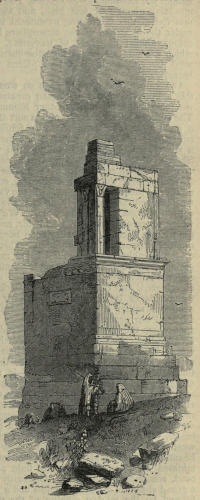
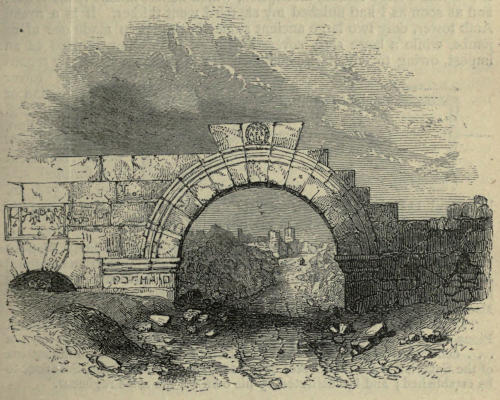
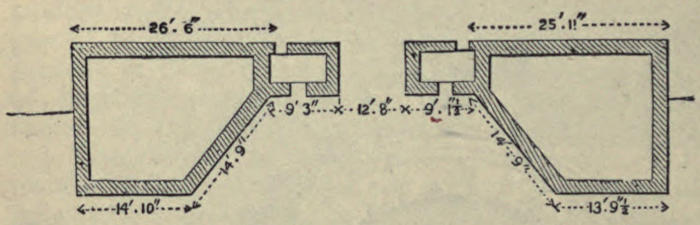
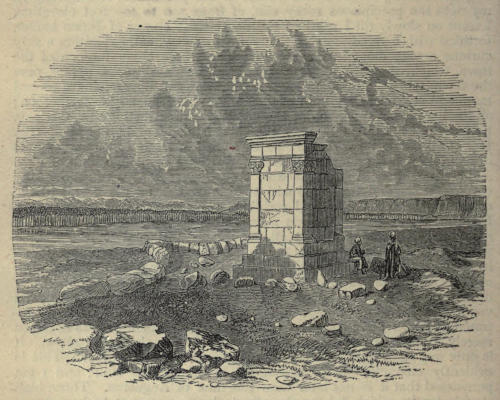
Roman Sepulchre in Wady Talha—Wady Tagíje—Remarkable Monument—Description
of Monument—Wady Zemzem—Roman Sepulchres at
Taboníye—Gharíya—Roman Gateway—Arab Tower—Roman Inscription—Gharíya
eʾ sherkíya—The Hammáda—Storms in the Desert—End of the
Hammáda—El Hasi, “the Well.”
Wady Sháti, or Shiyáti—Éderí and its Gardens—Wady Shiúkh—Sandy
Region—Reach the Wady—Ugréfe—Jerma Kadím—The Last Roman
Monument—The Groves of the Wady—End of the Wady—Arrival at
Múrzuk.
Setting out from Múrzuk—Tiggerurtín, the Village of the Tinýlkum—Gathering
of the Caravan—Tasáwa—Arrival of the Tuarek Chiefs—Reformation
of Islám—Return to Múrzuk—Move on finally—Sháraba—Wady Aberjúsh—Rate
of Travelling—Join the Caravan—Tesémmak—Wady Eláwen—Hatíta’s
Intrigues.
CHAPTER IX.
SINGULAR SCULPTURES IN THE DESERT—THE MOUNTAIN PASS
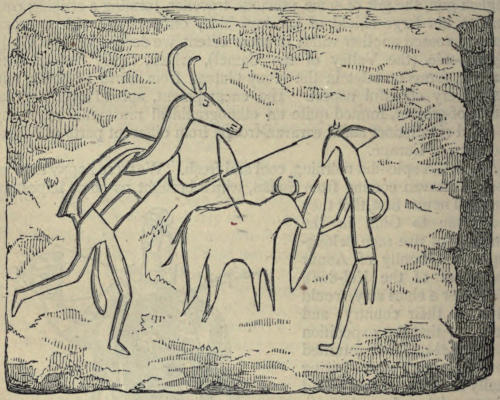
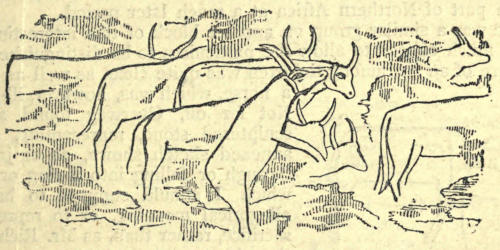
Hatíta—Sculptures in Telísaghé—Subject of Sculptures, Two Deities
Fighting about a Bull—Herd of Bulls—Cattle formerly Beasts of Burden
in the Desert—Fine Valleys—Breaking up of the Plateau—The Narrow
Gutter-like Pass of Ralle—Téliya—Sérdales—Valley Tánesof—Mount
Ídinen—The Traveller’s Mishap—Astray in the Desert—The Wanderer
found—Arrival at Ghát.
Fezzán, a Berber Country—The Berbers—Their Real Name Mázigh; the
Name Tuarek of Arab Origin—The Azkár—History of the Azkár—The
Hadánarang—Degraded Tribes—The Imghád—The Kél—View of the
Valley of Ghát.
CHAPTER XI.
CROSSING A LARGE MOUNTAIN-RIDGE, AND ENTERING ON THE OPEN GRAVELLY DESERT
The Town of Bárakat—The Date-groves of Bárakat and their Inhabitants—Alpine
Lake—The Tawáti—High Mountain Pass—Deep Ravine of Égeri—Threatened
Attack—Region of Granite Commences—Desert Plain of
Mariaw—Afalésselez—Approach to Tropical Climes—Wild Oxen (“bagr
el wahsh”) in the Desert—Nghákeli, New Vegetation (Balanites Ægyptiaca).
Picturesque Peak—Valley of Arókam—Caravan of Merábetín—Aséttere—The
Guinea Worm—The Caravan (at Aísala)—Berber Inscription—Ikadémmelrang—Peculiar
Mounts—Marárraba, the Halfway—Bóro’s Threats—First
View of Ásben—Asïu—Approach of the Enemy—Valley Fénorang—The
Freebooters’—Timázkaren—Máket-n-Íkelán, the Slaves’ Dance—Continued
Alarms—The Valley of Jínninau—Pleasant Valley of Gébi—The
Capparis sodata.
Tághajít—Character of the Borderers—New Alarms—Order of Battle—Mohammed
Bóro—A Tardy Acknowledgment—Formidable Threats—The
Compromise—Mountains of Ásben—Valley of Tídik—Sad Disappointment—Definitive
Attack—The Pillage—Cucifera Thebaïca—Selúfiet—Tintagh-odé,
the Settlement of the Merábetín—Short State of Supplies—A Desert
Torrent—Arrival of the Escort—Valley of Fódet—Camel-Races—Parting
of Friends—Valley of Afís—New Troubles—Arrival at Tin-téllust—The
English Hill.
The Name Aïr or Ahír—Country of the Goberáwa—The Kél-owí—Recent
Conquest—Descent in the Female Line—Mixed Population—Language-Sections
of the Kél-owí—The Irólangh—Tribe of the Sheikh Ánnur—The
Ikázkezan—The Kél-n-Néggaru—The Éfadaye—League of the Kél-owí
with the Kél-gerés and Itísan—The Kél-fadaye—The Word “Mehárebí”—The
Kél-ferwán—The Itísan and Kél-gerés—Population of Ásben—The
Salt Trade.
Attempt at Bullock-riding—Tuarek Blacksmiths—The Double Horn of
Mount Cheréka—Ásodi and its Ruins—Mounts Eghellál, Bághzen, and
Ágata—Mounts Belásega and Abíla—The Valley Tíggeda—The Picturesque
Valley of Ásada—The Valley of Tághist with the Ancient Place of Prayer—Picturesque
Valley of Aúderas with the Forest of Dúm-palms—Barbarity—Valley
Búdde—The Natron—The Feathered Bur—Imghád of the Valleys—Fertile
Valley Bóghel—The Large Báure-tree—Arrival near Ágades—The
Troopers—Entrance into the Town.
The Retail Traders from Tawát—The Learned ʿAbdallah—Aspect of the
Town—The Sultan’s Quarter—Interview with the Chief—Mohammed
Bóro’s House and Family—Markets of Ágades—Manufactures—Native
Cavalry—View of the Town—The Kádhi—Interior of Ágades—Various
Visitors—The “Fúra,” a Favourite Drink—Manners and Customs—A
Misadventure—Language of Ágades the same as that of Timbúktu—My
Friend Hamma—The Fatal Dungeon—Ceremony of Investiture—The Procession—Visitors—Rumours
of War—On Rock-Inscriptions—Visitors
again—Episode—Parting with Bóro—Tailelt (Guinea-fowl) Tobes—Áshu’s
Garden—Letters from the Sultan—Military Expedition—Results of the
Expedition—Interior of a House—The Emgedesi Lady—Ruinous Quarter—Wanton
Manners—The Mosque and Tower—Interior of the Mosque—Hostile
Disposition of the Kádhi—Other Mosques in Ágades—Enlightened
Views—Preparations for Departure.
Ágades not identical with Aúdaghost—Meaning of the Name—The Songhay
Conqueror Háj Mohammed Askiá (Leo’s Ischia)—The Associated Tribes—Leo’s
Account of Ágades—The Ighedálen—Tegídda or Tekádda—Gógó
and the Ancient Gold Trade—Position of the Ruler of Ágades—The Sultan
and his Minister—Meaning of the word “Turáwa”—The Town, its Population—Period
of Decline—Ground-Plan and Quarters of the Town—Decline
of Commerce—Market Prices.
Abortive Commencement of Journey—The Valley Tíggeda full of Life—Tin-téllust
deserted—Arrival in Tin-téggana—Stay in Tin-téggana—Mohammed
el Gatróni—Turbulent State of the Country—Conversation on
Religion—Poor Diet—Prolonged Delay—Preparations for Starting.
Taking Leave of Tin-téggana—Trachytic Peak of Teléshera—Valley of
Tánegat—The Salt Caravan—Wild Manners of the Tuarek—Mount Mári—Richer
Vegetation—Well Álbes—Tebu Merchants—Chémia—Mount
Bághzen—Camels lost—Rich Valley Unán—Stone Dwellings of Kél-gerés—Christmas
Day—Taking Leave of Hamma.
Travelling in Earnest—Home of the Giraffe and Antilope leucoryx—The
Mágariá—The Cornus nabeca and the Feathery Bristle—Princely Present—Animals
(Orycteropus Æthiopicus)—The Tagáma; their Peculiar Character—The
Tarki Beauty—New Plants—Steep Descent—Ponds of Stagnant
Water—Cornfields of Damerghú—The Warlike Chief Dan Íbra—Ungwa
Sámmit—Negro Architecture—Name of the Hut in Various
Languages—Animal and Vegetable Kingdoms—Horses grazing—Arrival
in Tágelel—The Ikázkezan Freebooter—Niggardliness of the Chief—Towns
and Villages of Damerghú—The Haunts of the Freebooters—Market
of Tágelel—The “Devil’s Dance.”
CHAPTER XXII.
SEPARATION OF THE TRAVELLERS—THE BORDER DISTRICTS OF THE INDEPENDENT PAGAN CONFEDERATION—TASÁWA
Dissembling of the Chief—His steadfast Character—Mr. Richardson’s
Health—Separation—Different Roads to Kanó—Animated Intercourse—Native
Warfare—The First Large Tamarind-tree—Villages and Wells—Separation
from Mr. Overweg—Improved Scenery—Encampment at
Gozenákko—Lively Camp Scene—Native Delicacies—Revenues of Tasáwa—Astounding
Message—Visit to Tasáwa—The Market in Tasáwa—Náchirá,
Ánnur’s Estate—Character of the People and their Dwellings—Intrigue
defeated—Counting Shells—A Petty Sultan—Dyeing-Pits.
An African Dandy—My Protector Elaiji—Camp Life—Fortifications and
Market of Gazáwa—March resumed—Desolate Wilderness—Site of Dánkama—Struggle
between Islámism and Paganism—Encampment near
Kátsena—Estimate of Salt Caravan—Negro Horsemen—Equestrian Musicians—The
Governor of Kátsena—Detained by him—The Governor’s
Wiles—Disputes—Who is the “Káfer”?—Clapperton’s Companion—The
Tawáti Bel-Ghét conciliated—Extortionate Demands—Subject about the
Káfer resumed—The Presents—Promenade through the Town—The
Governor’s Wishes—Taking Leave of him.
CHAPTER XXIV.
HÁUSA—HISTORY AND DESCRIPTION OF KÁTSENA—ENTRY INTO KANÓ
The Name Háusa—Origin of the Háusa Nation—The Seven States—Origin
of the Town of Kátsena—The Mohammedan Missionary Ben Maghíli—Kings
of Kátsena—The First Moslim—The Oldest Quarter—Magnitude of
the Town—Its Decline—Salubrious Site and Favourable Situation of
Kátsena—Departure from Kátsena—Wild State of the Country—Shibdáwa—Rich
Scenery—Kusáda—The Bentang Tree—Women with Heavy Loads—Beehives—Gúrzo—Approach
to Kanó—Straggling Villages—Composition
of our Troop—First View of Dalá—Entering Kanó.
CHAPTER XXV.
RESIDENCE IN KANÓ—VIEW OF ITS INTERIOR—ITS HISTORY AND PRESENT STATE—COMMERCE
My Situation in Kanó—Debts—Projects—The Commissioner—Difficulties—Sickness—Interior
of Kanó; Animated Picture—The Quarters of the Conquered
and the Ruling Race—The “Serkí” and the Gháladíma—The
Audience—Presents—Plan of Kanó—Street Groups—Industry—View from
Mount Dalá—Acquaintances in Kanó—Meditated Departure—Historical
Sketch of Kanó—Growth of the Town—The Quarters of the Town—Ground-plan
of my House—Population—Commerce—Various Kinds of
Zénne—Export of Cloth—Grand Character of Trade—Produce—The
Guinea-fowl Shirt—Leather Work—Kola-nut—Slaves—Natron, Salt, Ivory
Trade—European Goods in Kanó—The South-American Slave-traders—Small
Quantity of Calico—Silk—Woollen Cloth—Beads—Sugar—Firearms—Razors—Arab
Dresses—Copper—The Shells and the Dollar—Markets of
Kanó—Revenues—Administration—The Conquering Tribe.
Leaving Kanó quite by myself—My Trooper—Get off later—Domestic
Slavery—Gezáwa—My Runaway Servant ʿAbdallah—The Sheríf and his
Attendants—Mules in Negroland—Kúka Mairuwá—Insecurity—Scarcity
of Water—Natron Trade—Endurance and Privations of the Traveller—Arrival
at Gerki—Take Leave of Háusa—Gúmmel—Housebuilding—Antidote—Market
at Gúmmel—Magnitude of Ilóri—Two Spanish Dollars—Depart
from Gúmmel—Benzári—The Rebel Chief Bokhári—His Exploits—The
Governor of Máshena—Letter-carrier’s Mistake—Curious Talisman—Manga
Warriors—Wuëlleri—Scarcity of Water again—Town of Máshena—State
of the Country—Cheerful, Out-of-the-way Place—Álamáy—Búndi
and the Gháladíma—The Kárda—Route from Kanó to Álamáy by Way of
Khadéja.
Intercourse—Change of Life in Negroland—Region of the Dúm-palm—The
Kúri Ox—The River Wáni—Enter Bórnu Proper—Zurríkuló—News of
the Death of Mr. Richardson—Sandy Downs—Déffowa—Industry—The
Stray Camel—Town of Wadi—Good Market and no Provisions—Hospitable
Treatment—The Banks of the Wáni—Locusts and Hawks—Ngurútuwa;
Grave of Mr. Richardson—The Tuarek again—Aláune—The
Jungles of the Komádugu—Ruins of Ghámbarú—A Forest Encampment—Nomadic
Herdsmen—Abundance of Milk—Ford of the Komádugu—Native
Ferry-boats—Khér-Álla, the Border-warfarer—Changing Guides—The
Runaway Horse—A Domestic Quarrel.
Peculiar Character of the Alluvial Plains of Bórnu—The Attentive Woman—Entrance
into Kúkawa—Servants of the Mission—Debts of the Mission—Interview
with the Vizier—Sheikh ʿOmár—Mr. Richardson’s Property—Amicable
Arrangements.
CHAPTER XXIX.
AUTHENTICITY AND GENERAL CHARACTER OF THE HISTORY OF BÓRNU
Documents—Beginning of written History—Pedigree of the Bórnu Kings—Chronology—Harmony
of Facts—The Séfuwa Dynasty—Ébn Khaldún—Makrízí
and Ébn Batúta—Surprising Accuracy of the Chronicle of Bórnu—Statement
of Leo Africanus—Berber Origin of the Séfuwa—Form of
Government—The Berber Race—The Queen Mother—Indigenous Tribes—The
Tedá or Tebu—The Soy—Epochs of Bórnu History—Greatest
Power—Decline of the Bórnu Empire—The Kánemíyín.
My Friends—The Arab Áhmed bel Mejúb—The Púllo Íbrahím from the
Senegal—Dangerous Medical Practice—Áhmed the Traveller—My Bórnu
Friends—The Vizier el Háj Beshír; his Career; his Domestic Establishment;
his Leniency—Debts of the Mission paid—The English House—Plague
of Insects—Preparations for a Journey—Character of Kúkawa—The
Two Towns—The Great Market—Business and Concourse—Defective
Currency—Prices of Provisions—Fruits—Camels—Horses—Want of
Native Industry—Bórnu Women—Promenade.
Character of the Road to Ngórnu—Ngórnu—Searching the Tsád—Longer
Excursion—Character of the Shores of the Tsád—The Búdduma and their
Boats—Fresh Water—Swampy Plains—Boats of the Búdduma again—Maduwári—Dress
of the Sugúrti—Account of the Lake—Shores of the
Creek—Sóyorum—Káwa—Return to Kúkawa—Servants Dismissed—Mohammed
Titíwi the Auspicious Messenger—Slave Caravan—Announcement
of Rainy Season—Ride to Gawánge—Mr. Overweg’s Arrival—Meeting—Property
restored—Mercantile Intrigues—The Sheikh’s Relatives—Messengers
from Ádamáwa—Anticipated Importance of the Eastern
Branch of the Niger—Proposed Journey to Ádamáwa.
CHAPTER XXXII.
SETTING OUT ON MY JOURNEY TO ÁDAMÁWA—THE FLAT, SWAMPY GROUNDS OF BÓRNU
Leaving Kúkawa—The Road Southwards—Inhospitality near the Capital—Buying
with a Shirt—The Winter Corn—The Shúwa Arabs—Múngholo
Gezáwa—Fair Arabs—Magá District—The Gámerghú District—District of
Ujé—Fine Country—Mábaní—Pilgrim Traders, Banks of the Yáloë—First
View of the Mountains—Fúgo Mozári—Market of Ujé—Aláwo—Approach
to Mándará.
Question about Snowy Mountains—The Blacksmith—Shámo District—A
Storm—Molghoy—The Southern Molghoy—Large Kúrna-trees—Structure
of the Huts—Deviations from Negro Type—The Marghí, their Attire and
Language—Edible Wild Fruits—The Baobab—Beautiful Scenery—Íssege—Spirit
of the Natives—Degenerate Fúlbe—The Lake—View of Mount
Míndif—Wándalá Mountains—Route to Sugúr—The Marghí Tribe—Scientific
Dispute—Unsafe Wilderness—Unwholesome Water—The Return
of the Slave Girl—The Bábir Tribe—Laháula—The Idol—Alarm—Abundance
of Vegetable Butter—Serious March—The Báza Tribe—The
Dividing Range—Úba—The New Colony.
CHAPTER XXXIV.
ÁDAMÁWA—MOHAMMEDAN SETTLEMENTS IN THE HEART OF CENTRAL AFRICA
The Conquering Tribe—The Granite Hills—Valley and Mountain Chain—Isolated
Mountain Groups—Múbi—The Surrounding Country—Origin of
the Fúlbe—Bágma and Peculiar Structures—Camels a Novelty—Compliment
paid to the Christian—Mbutúdi—Fúlbe Way of Saluting—The Déléb-palm
(Borassus flabelliformis?) and its Fruit—The Granite Mount—Simplicity
of Manners—Mount Hólma—Legéro—Edible Productions—Ground-nut
Diet—Badaníjo—Fertile Vale—Temporary Scarcity—Kurúlu—Red
and White Sorghum—Saráwu Beréberé—Comfortable Quarters—Accurate
Description—Important Situation of Saráwu—Tebu Traders—Fair
Negroes—Market of Saráwu—Saráwu Fulfúlde—The Mansion—The
Blind Governor—Principal Men in Yóla—Mount Konkel—Bélem—An
Arab Adventurer—Rich Vegetation—The Young Púllo—Old Mallem Dalíli—Arab
Colony—A Country for Colonies—Ruined Village (Melágo)—Gastronomic
Discussion—Máyo Tíyel—The Bátta Tribe—Sulléri—Inhospitable
Reception.
Approach to the River—Mount Alantíka and the Bénuwé—The Tépe or
“Junction”—The great Arm of the Kwára—The Traveller’s Pursuits—Highroad
of Commerce—The Frail Canoes—Bathing in the Bénuwé—The
Passage—The River Fáro; its Current—Floods and Fall of the River—Chabajáure—Densely
inhabited District—Mount Bágelé—The Backwater—Ribágo—Cultivation
of Rice—The Bátta Language—Inundation—Yebbórewó—Mount
Bágelé and Island—Reach Yóla.
Inauspicious Entrance—Curiosity of Natives—Quarters—An Arab Traveller
to Lake Nyassa—The Governor Mohammed Láwl—The Audience—The
Mission repulsed—The Governor’s Brother Mansúr—Ordered to withdraw—Begin
my Return Journey—Character of Yóla—Slavery—Extent of
Fúmbiná—Elevation and Climate—Vegetable and Animal Kingdom—Principal
Chiefs of the Country—Tribes; the Bátta, the Chámba, and
other Tribes.
Start from Ribágo—Hospitable Treatment in Sulléri—Demsa-Póha—The
Memorable Campaign Southward—View of a Native Settlement—Beautiful
Country—Bélem again—Mʿallem Dalíli and his Family—Múglebú—Múbi—My
Quarters—Household Furniture—Uba—Unsafe Boundary District—Laháula—Íssege—Iron
Ornaments of the Marghí—Funeral Dance—Ordeal—Feeling
of Love—A Party going to Sacrifice—Arrival at Yerímarí—Villages
of the Gámerghú—Ujé Kásukulá—Difference of Climate—Plants—Huts—Plains
of Bórnu Proper—Seizing a Hut—African Schoolboys—A
wandering Tribe—Town and Country—Guinea Worm—Thunderstorm—People
returning from Market—Múnghono—Return to Kúkawa.
Supplies—The Herbage—Tropical Rains—Mr. Vogel’s Statement—The
Winged Ant—Various Kinds of Cultivation—Intended Excursion to Kanem—Mr.
Overweg’s Memoranda—Political Situation of Bórnu—The Turks in
Central Africa—Sókoto and Wadáÿ—The Festival—Ceremonies of Festivity—Dependent
Situation—My Horse.
Money Matters settled—A Repentant Servant—Delights of Open Encampment—Dawerghú—Treatment
by Slaves—Variety of Trees—Scarcity of
Water—The Town of Yó—Marriage Customs—Character of the Country—Arrival
of Mr. Overweg—Banks of the River—Character of our Freebooting
Companions—Crossing the River—Town of Báruwa—View of the
Tsád—Native Salt—Desolate Country—Ninety-six Elephants—Another
Scene of Plunder—Arrival at Berí—Importance of Berí—Fresh-water Lakes
and Natron—Submerged in a Bog—A Large Snake—The Valleys and Vales
of Kánem—Arrival at the Arab Camp.
The Welád Slimán—Their Power—Slaughter of the Welád Slimán—Interview
with Sheikh Ghét—Interview with ʿOmár—Specimen of Predatory
Life—Runaway Female Slave—Rich Vales—Large Desertion—A Jewish
Adventurer—Musical Box—False Alarm.
CHAPTER XLI.
SHITÁTI—THE EASTERN, MORE FAVOURED, VALLEYS OF KÁNEM
Bír el Ftáim—The Fugábú—Projects frustrated—Kárká and the Keghámma—Elephant’s
Track—Bóro—Bérendé—Towáder—Beautiful Vale—Preparations
for Attack—Left behind—Regularly formed Valley—Hénderi Síggesí—Attack
by the Natives—Much Anxiety—Join our Friends—Encampment
at Áláli Adia—Visited by the Keghámma—Camp taken—Restless Night—Fine
Vale Tákulum—Vales of Shitáti—Return to the Principal Camp—Wadáÿ
Horsemen—Set out on Return to Kúkawa—Departure from Kánem—Alarms—The
Komádugu again—Return to Kúkawa.
Set out on another Expedition—The Camp, or Ngáufate—The Chef de Police
Lamíno—Army in Motion—Lamíno again—Major Denham’s Adventure—The
Town of Márte—Ála—Encampment at Díkowa—Firearms and
Civilization—Slavery and Slave-trade—The Shúwa—The Interior of Díkowa—Industry—Banks
of the Yálowe—Cotton Plantations—The Camp Market—Friendly
Services—Important Information—Háj Edrís.
News from Mándará—Áfagé—Thieves forced to fight—The Sweet Sorghum—Variations
of Temperature—Shallow Watercourses—Subjection of Mándará—Extensive
Rice-fields—Hard Ground—Elephants—The Court of Ádishén—The
Army on the March—The Súmmoli—The Army badly off—Entering
the Músgu Country—Industry pillaged—Native Architecture—Affinity of
the Músgu—Their Chief Places—The Adventurous Chieftain—Ádishén—Christmas
Events.
CHAPTER XLIV.
THE COUNTRY OF THE SHALLOW RIVERS—WATER-PARTING BETWEEN THE RIVERS BÉNUWÉ AND SHÁRÍ
The Deléb-palm—New Features—Worship of Ancestors—Cut off from the
Army—Spoil and Slaughter—Alarm and Cowardice—Músgu Weapons—The
Túburi not attacked—Ngáljam of Démmo—Destruction—New Year—Pagan
Chiefs and Priests—Fine Landscape—The River of Logón—Singular
Water Combat—The Túburi and their Lake—The Swampy Character of
the Ngáljam—The River again—Water Communication—Plucky Pagans—Balls
and Stones—Consequences of Slave Hunts—Penetrating Southward.
Another Alarm—Policy of Negroland—Cattle Indigenous or Imported—Another
District Plundered—The Músgu Slave—Narrow Escape—Attack
by Bees—African Netherlands—Miseries of Slave Hunts—Barren Country—Residence
of Kábishmé—Native Architecture—Ground-plan of a Dwelling—Amount
of Booty—Wáza—Encampment at Wáza—Re-arrival at
Kúkawa.
LIST OF PLATES AND ILLUSTRATIONS. — LIST OF PLATES. — ILLUSTRATIONS IN THE TEXT.
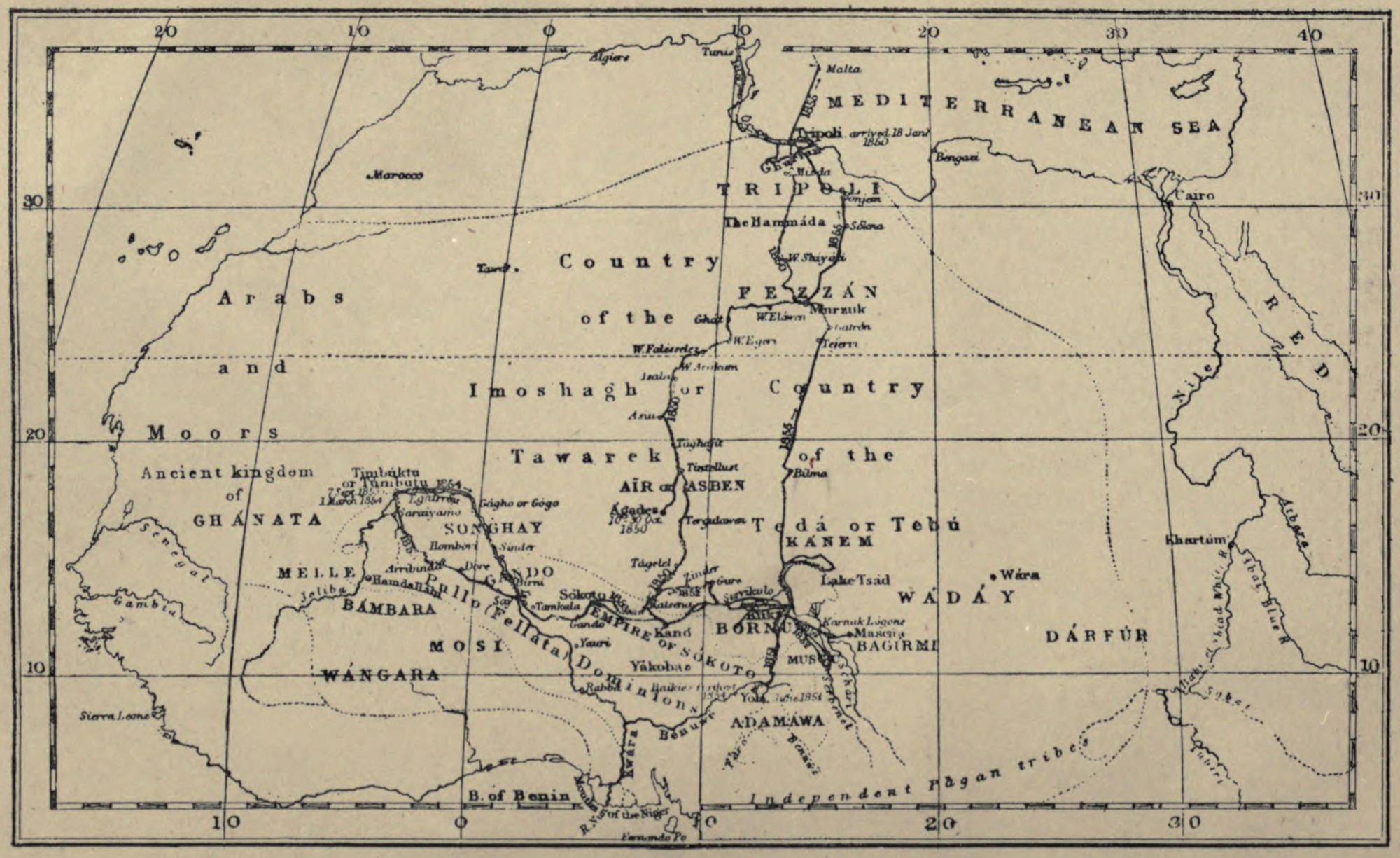
MAP OF NORTH AND CENTRAL AFRICA, SHOWING DR. BARTH’S ROUTES.
TRAVELS AND DISCOVERIES IN AFRICA. — CHAPTER I. FROM TUNIS TO TRIPOLI.
Mr. Richardson was waiting in Paris for despatches, when Mr.
Overweg and I reached Tunis, by way of Philippeville and Bona, on the
15th of December, 1849; and having, through the kind interference of
Mr. Ferrier, the British vice-consul, been allowed to enter the town after
six days’ quarantine, we began immediately to provide ourselves with
articles of dress, while in the meantime we took most interesting daily
rides to the site of ancient Carthage. Having procured many useful
articles for our journey, and having found a servant, the son of a freed
slave from Gober, we left Tunis on the 30th of December, and passed
the first night in Hammám el Enf. Early next morning we followed the
charming route by Krumbália, which presents a no less vivid specimen
of the beauty and natural fertility of the Tunisian country than of the
desolate state to which it is at present reduced. We then passed the fine
gardens of Turki, a narrow spot of cultivation in a wide desolate plain
of the finest soil; and leaving el Khwín to our right, we reached el
Arbʿain.
Both these places enjoy a peculiar celebrity with the natives. El
Khwín is said to have been once a populous place; but nearly all its
inhabitants were destroyed by a spring of bituminous water, which
according to tradition, afterwards disappeared. El Arbʿain, the locality
of the “forty” martyrs, is a holy place; and ʿAli, our muleteer, in his
pious zeal, took up a handful of the sacred earth and sprinkled it over
us. It is a most picturesque spot. Keeping then along the wild plain
covered with a thick underwood of myrtle, we beheld in the distance
the highly picturesque and beautiful Mount Zaghwán, the Holy Mountain
of the ancient inhabitants, which rose in a majestic form; and we
at length reached Bir el buwíta, “the well of the little closet,” at one
o’clock in the afternoon. The “little closet,” however, had given place
to a most decent-looking whitewashed khán, where we took up our
quarters in a clean room. But our buoyant spirits did not allow us
long repose; and a quarter before eleven at night we were again on
our mules.
I shall never forget this, the last night of the year 1849, which opened
to us a new era with many ordeals, and by our endurance of which we
were to render ourselves worthy of success. There were, besides
ourselves, our servants, and our two muleteers, four horsemen of the
Bey, and three natives from Jirbi. When midnight came my fellow
traveller and I saluted the new year with enthusiasm, and with a cordial
shake of the hand wished each other joy. Our Mohammedan companions
were greatly pleased when they were informed of the reason
of our congratulating each other, and wished us all possible success for
the new year. We had also reason to be pleased with them; for by
their not inharmonious songs they relieved the fatigue of a long,
sleepless, and excessively cold night.
Having made a short halt under the olive-trees at the side of the
dilapidated town of Herkla, and taken a morsel of bread, we moved on
with our poor animals without interruption till half an hour after noon,
when we reached the funduk (or caravanserai) Sidi Bú Jʿafer, near Súsa,
where we took up our quarters, in order to be able to start again at
night, the gates of the town being kept shut till morning. Starting
before three o’clock in the morning, we were exactly twelve hours in
reaching el Jem, with the famous Castle of the Prophetess, still one
of the most splendid monuments of Roman greatness, overhanging the
most shabby hovels of Mohammedan indifference. On the way we had
a fine view, towards the west, of the picturesque Jebel Trutsa, along
the foot of which I had passed on my former wanderings, and of the
wide, out-stretching Jebel Useleet.
Another ride of twelve hours brought us, on the 3rd of January, 1850,
to Sfákes, where we were obliged to take up our quarters in the town,
as our land-journey was here at an end, and we were to procure a
vessel to carry us either direct to Tripoli, or to some other point on the
opposite side of the Lesser Syrtis. The journey by land is not only
expensive, particularly by people who are encumbered with a good deal
of luggage, as we then were, and very long and tedious, but is also very
unsafe, as I found from experience on my former journey. The island
of Jirbi, which forms the natural station of the maritime intercourse
between the regency of Tunis and that of Tripoli, had been put under
the strictest rules of quarantine, rather from political considerations
than from those of health, all intercourse with the mainland having
been cut off. It was therefore with great difficulty that we succeeded
in hiring a “gáreb” to carry us to Zwára, in which we embarked in the
forenoon of Saturday the 5th of January.
During our two days’ stay in Sfákes we made the acquaintance of a
Jew calling himself Baránes, but who is in truth the Jew servant named
Jacob who accompanied Denham and Clapperton, and is several times
mentioned in the narrative of those enterprising travellers as self-conceited
and stubborn; yet he seems to be rather a clever fellow, and
in some way or other contrives to be on the best terms with the
governor. He communicated to us many anecdotes of the former expedition,
and, among other things, a very mysterious history of a Danish
traveller in disguise whom they met in Bórnu coming all the way from
Dar-Fúr through Wadaï. There is not the least mention of such a
meeting in the journal of the expedition, nor has such an achievement
of a European traveller ever been heard of; and I can scarcely believe
the truth of this story, though the Jew was quite positive about it.
The vessel in which we embarked was as miserable as it could
be, there being only a small low cabin as high as a dog-kennel, and
measuring, in its greatest width, from six to seven feet, where I and my
companion were to pass the night. We thought that a run of forty-eight
hours, at the utmost, would carry us across the gulf; but the
winds in the Lesser Syrtis are extremely uncertain, and sometimes so
violent that a little vessel is obliged to run along the coast. At first we
went on tolerably well; but the wind soon became unfavourable,
and in the evening we were obliged to cast anchor opposite Nekta,
and, to our despair, were kept there till the afternoon of Tuesday, when
at length we were enabled to go forward in our frail little shell, and
reached Méheres—not Sidi Méheres, as it is generally called in the
maps—in the darkness of night. Having made up our minds rather to
risk anything than to be longer immured in such a desperate dungeon
as our gáreb, we went on shore early on Wednesday morning with
all our things, but were not able to conclude a bargain with some
Bedouin of the tribe of the Léffet, who were watering their camels at
the well.
The majestic ruins of a large castle, fortified at each corner with a
round tower, give the place a picturesque appearance from the seaside.
This castle is well known to be a structure of the time of
Ibrahim the Aghlabite. In the midst of the ruins is a small mosque.
But notwithstanding the ruinous state of the place, and the desolate
condition of its plantations, there is still a little industry going on,
consoling to the beholder in the midst of the devastation to which the
fine province of Byzacium, once the garden of Carthage, is at present
reduced. Several people were busily employed in the little marketplace
making mats; and in the houses looms, weaving baracans, were
seen in activity. But all around, the country presented a frightful
scene of desolation, there being no object to divert the eye but the two
apparently separate cones of Mount Wuedrán, far in the distance to
the west, said to be very rich in sheep. The officer who is stationed
here, and who showed us much kindness, furnishing us with some
excellent red radishes of extraordinary size, the only luxury which the
village affords, told us that not less than five hundred soldiers are
quartered upon this part of the coast. On my former journey I had
ample opportunity to observe how the Tunisian soldiery eat up the
little which has been left to the peaceable inhabitants of this most
beautiful, but most unfortunate country.
Having spent two days and two nights in this miserable place without
being able to obtain camels, we resolved to try the sea once more,
in the morning of the 11th, when the wind became northerly; but
before the low-water allowed us to go on board, the wind again
changed, so that, when we at length got under weigh in the afternoon,
we could only move on with short tacks. But our captain, protected
as he was by the Promontory of Méheres, dared to enter the open
gulf. Quantities of large fish in a dying state, as is often the case in
this shallow water when the wind has been high, were drifting round
our boat. The sun was setting when we at length doubled the promontory
of Kasr Unga, which we had already clearly distinguished
on the 8th. However, we had now overcome the worst; and when
on the following morning I emerged from our suffocating berth, I saw,
to my great delight, that we were in the midst of the gulf, having left
the coast far behind us. I now heard from our raïs that, instead of
coasting as far as Tarf el má (“the border of the water”), a famous
locality in the innermost corner of the Lesser Syrtis, which seems to
preserve the memory of the former connection between the gulf and the
great Sebkha or Shot el Kebír (the “palus Tritonis”), he had been so
bold as to keep his little bark straight upon the channel of Jirbi.
Our voyage now became interesting; for while we were advancing
at a fair rate, we had a charming view of the mountain-range, which in
clear contours extended along in the distance behind the date-groves on
the coast, seen only in faint outlines. The western part of the chain is
very low, and forms almost a group apart, but after having been intersected
by a gap or “gate,” the chain rises to greater elevation, being
divided, as it would seem from hence, into three separate ranges
enclosing fine valleys.
We had hoped to cross the difficult channel to-day; but the wind
failing, we were obliged to anchor and await the daylight, for it is not
possible to traverse the straits in the night, on account of their extreme
shallowness. Even in the light of the following day, when we at length
succeeded, our little bark, which drew only two or three feet, struck
twice, and we had some trouble to get afloat again. On the conspicuous
and elevated promontory the “Jurf,” or “Tarf el jurf,” stood in ancient
times a temple of Venus, the hospitable goddess of the navigator. Here
on my former journey I crossed with my horses over from the main to
the Island of Jirbi, while from the water I had now a better opportunity
of observing the picturesque character of the rugged promontory. After
traversing the shallow basin or widening, we crossed the second narrowing,
where the castles which defended the bridge or “kantara,” the
“pons Zitha” of the Romans, now lie in ruins on the main as well as
on the island, and greatly obstruct the passage, the difficulty of which
has obtained celebrity from contests between Islam and Christianity in
comparatively modern times.
Having passed safely through this difficult channel, we kept steadily
on through the open sea; and doubling Rás Mʿamúra, near to which
our captain had a little date-grove and was cheerfully saluted by his
family and friends, we at length entered the harbour of Zarzís, late in
the afternoon of Sunday, and with some trouble got all our luggage
carried into the village, which is situated at some distance. For
although we had the worst part of the land journey now before us, the
border-district of the two regencies, with the unsafe state of which I
was well acquainted from my former journey, and although we were
insufficiently armed, we were disposed to endure anything rather than
the imprisonment to which we were doomed in such a vessel as our
Mohammed’s gáreb. I think, however, that this nine days’ sail between
Sfákes and Zarzís, a distance of less than a hundred and twenty miles,
was on the whole a very fair trial in the beginning of an undertaking
the success of which was mainly dependent upon patience and resolute
endurance. We were rather fortunate in not only soon obtaining
tolerable quarters, but also in arranging without delay our departure
for the following day, by hiring two horses and three camels.
Zarzís consists of five separate villages—Kasr Bú ʿAli, Kasr Mwanza,
Kasr Welád Mohammed, Kasr Welád Sʿaid, and Kasr Zawíya; the
Bedouin in the neighbourhood belong to the tribe of the Akára. The
plantation also is formed into separate date-groves. The houses are in
tolerable repair and neatly whitewashed; but the character of order and
well-being is neutralised by a good many houses in decay. Near the
place there are also some Roman ruins, especially a cistern of very
great length; and at some distance is the site of Medinet Ziyán, of
which I have given a description in the narrative of my former journey.
Besides the eight men attached to our five animals, we were joined
here by four pilgrims and three Tripolitan traders; we thus made up a
numerous body, armed with eight muskets, three blunderbusses, and
fourteen pistols, besides several straight swords, and could venture
upon the rather unsafe road to the south of the Lake of Bibán, though
it would have been far more agreeable to have a few trustworthy
people to rely on instead of these turbulent companions. Entering
soon, behind the plantation of Zarzís, a long narrow sebkha, we were
struck by the sterile and desolate character of the country, which was
only interrupted by a few small depressed localities, where a little corn
was cultivated. Keeping along this tract of country, we reached the
north-western corner of the Lake of Bibán, or Bahéret el Bibán, after a
little more than eight miles. This corner has even at the present day
the common name of Khashm el kelb (the Dog’s Nose), while the former
classical name of the whole lake, Sebákh el keláb, was only known to
Tayyef, the more learned of my guides, who, without being questioned
by me, observed that in former times towns and rich cornfields had
been where the lake now is, but had been swallowed up by a sinking
of the ground. The real basin has certainly nothing in common with a
sebkha, which means a shallow hollow, incrusted with salt, which at
times is dry and at others forms a pool; for it is a deep gulf or fiord of
the sea, with which it is connected only by a narrow channel called
Wád mtʿa el Bibán. The nature of a sebkha belongs at present only
to its shores, chiefly to the locality called Makháda, which, indenting
the country to a great distance, is sometimes very difficult to pass, and
must be turned by a wide circuitous path, which is greatly feared on
account of the neighbourhood of the Udérna, a tribe famous for its
highway robberies. Having traversed the Makháda (which at present
was dry) without any difficulty, we entered upon good arable soil, and
encamped, after sunset, at about half a mile distance from a Bedouin
encampment.
Starting from here the following day, we soon became aware that
the country was not so thinly inhabited as we had thought; for numerous
herds covered the rich pasture-grounds, while droves of gazelles, now
and then, attested that the industry of man did not encroach here upon
the freedom of the various orders of creation. Leaving the path near
the ruins of a small building situated upon a hill, I went with Tayyef
and the Khalífa to visit the ruins of a Roman station on the border of
the Bahéra, which, under the name of el Medaina, has a great fame
amongst the neighbouring tribes, but which, with a single exception,
are of small extent and bad workmanship. This exception is the quay,
which is not only of interest in itself, formed as it is of regularly hewn
stones, in good repair, but of importance as an evident proof that the
lake was much deeper in ancient times than it is now. Traversing
from this spot the sebkha, which our companions had gone round, we
soon overtook them, and kept over fine pasture-grounds called el Fehén,
and further on, Súllub, passing, a little after noon, a group of ruins
near the shore, called Kitfi el hamár. At two o’clock in the afternoon,
we had directly on our right a slight slope which, according to the
unanimous statement of our guides and companions, forms the frontier
between the two regencies; and keeping along it we encamped an
hour afterwards between the slope and the shore, which a little further
on forms the deep gulf called Mirsá Buréka.
Starting at an early hour, we reached after a march of ten miles the
ruins of a castle on the sea-shore, called Búrj el Melha, to which those
of a small village, likewise built of hewn stone, are joined, while a long
and imposing mole called el Míná juts out into the gulf. Four and
a half miles further on we reached the conspicuous hill on the top of
which is the chapel of the saint Sidi Sʿaid ben Salah, sometimes called
Sidi Gházi, and venerated by such of the natives as are not attached to
the Puritan sect of el Mádani, of which I shall speak hereafter. All
our companions went there to say a short prayer. Here we left the
shore, and, having watered our animals near a well and passed the
chapel of Sidi Sʿaid, close to which there are some ruins, we passed
with expedition over fine meadows till we approached the plantation of
Zowára, when, leaving Mr. Overweg and my people behind, I rode on
with the Khalífa, in order to procure quarters from my former friend
Sʿaid bu Semmín, who, as I had heard to my great satisfaction, had
been restored to the government of that place. He had just on that
very day returned from a visit of some length in the capital, and was
delighted to see me again; but he was rather astonished when he
heard that I was about to undertake a far more difficult and dangerous
journey than my former one along the coast, in which he well knew
that I had had a very narrow escape. However, he confided in my
enterprising spirit and in the mercy of the Almighty, and thought if anybody
was likely to do it, I was the man.
We had now behind us the most dreary part of our route, having
entered a district which in ancient times numbered large and wealthy
cities, among which Sabratha stands foremost, and which even in the
present miserable state of the country is dotted with pleasant little
date-groves, interrupted by fine pasture-grounds. In the westernmost
part of this tract, however, with the exception of the plantation of
Zowára, all the date-groves, as those of Rikdalíye, Jemíl, el Meshíah,
and Jenán ben Síl, lie at a considerable distance from the coast, while
the country near the sea is full of sebkhas, and very monotonous, till the
traveller reaches a slight ridge of sand-hills about sixteen miles east
from Zowára, which is the border between the dreary province of that
government and a more favoured tract belonging to the government of
Bú-ʿAjíla, and which lies a little distance inland. Most charming was
the little plantation, of Kasr ʿalaiga, which exhibited traces of industry
and improvement. Unfortunately our horses were too weak and too
much fatigued to allow us to visit the sites either of Sabratha or
Pontes. The ruins of Sabratha are properly called Kasr ʿalaiga, but
the name has been applied to the whole neighbourhood; to the ancient
Pontes seem to belong the ruins of Zowára eʾ sherkíyeh, which are
considerable. Between them lies the pretty grove of Om el hallúf.
About four o’clock in the afternoon we traversed the charming little
valley called Wady bú-harída, where we watered our horses; and then
following the camels, and passing Asermán with its little plantation,
which is bordered by a long and deep sebkha, we took up our quarters
for the night in an Arab encampment, which was situated in the midst
of the date-grove of ʿUkbah, and presented a most picturesque appearance,
the large fires throwing a magic light upon the date-trees. But
there are no roses without thorns: we were unfortunately persuaded
to make ourselves comfortable in an Arab tent, as we had no tent of
our own; and the enormous swarms of fleas not only disturbed our
night’s rest, but followed us to Tripoli.
We had a long stretch the following day to reach the capital, which
we were most anxious to accomplish, as we expected Mr. Richardson
would have arrived before us in consequence of our own tedious
journey; and having sent the Khalífa in advance to keep the gate open
for us, we succeeded in reaching the town after an uninterrupted march
of thirteen hours and a half, and were most kindly received by Mr.
Crowe, Her Majesty’s consul-general, and the vice-consul Mr. Reade,
with whom I was already acquainted. We were surprised to find that
Mr. Richardson had not even yet been heard of, as we expected he would
come direct by way of Malta. But he did not arrive till twelve days
after. With the assistance of Mr. Reade, we had already finished a
great deal of our preparations, and would have gladly gone on at once;
but neither the boat, nor the instruments, nor the arms or tents had as
yet arrived, and a great deal of patience was required. However,
being lodged in the neat house of the former Austrian consul, close to
the harbour, and which commands a charming prospect, our time
passed rapidly by.
On the 25th of January Mr. Reade presented Mr. Overweg and me
to Yezíd Bashá, the present governor, who received us with great
kindness and good feeling. On the 29th we had a pleasant meeting
with Mr. Frederic Warrington on his return from Ghadámes, whither
he had accompanied Mr. Charles Dickson, who on the 1st of January
had made his entry into that place as the first European agent and
resident. Mr. F. Warrington is perhaps the most amiable possible
specimen of an Arabianized European. To this gentleman, whose zeal
in the objects of the expedition was beyond all praise, I must be allowed
to pay my tribute as a friend. On setting out in 1850, he accompanied
me as far as the Ghurián; and on my joyful return in 1855 he received
me in Murzuk. By the charm of friendship he certainly contributed
his share to my success.
CHAPTER II. TRIPOLI.—THE PLAIN AND THE MOUNTAIN-SLOPE; THE ARAB AND THE BERBER.
As soon as it became apparent that the preparations for our final departure
for the interior would require at least a month, Mr. Overweg and I
resolved to employ the interval in making a preliminary excursion through
the mountainous region that encompasses Tripoli in a radius of from
sixty to eighty miles. With this view, we hired two camels, with a
driver each, and four donkeys, with a couple of men, for ourselves and
our two servants, Mohammed Belál, the son of a liberated Háusa slave,
and Ibrahim, a liberated Bagirmi slave, whom we had been fortunate
enough to engage here; and through the Consul’s influence we procured
a shoush, or officer, to accompany us the whole way. Neither the instruments
provided by Her Majesty’s Government, nor the tents and arms,
had as yet arrived. But Mr. Overweg had a good sextant, and I a good
chronometer, and we were both of us provided with tolerably good
compasses, thermometers, and an aneroid barometer. Mr. Frederic
Warrington, too, was good enough to lend us a tent.
We had determined to start in the afternoon of the 4th of February,
1850, so as to pass the first night in Ghargásh; but meeting with delays,
we did not leave the town till after sunset. We preferred encamping,
therefore, in the Meshíah, a little beyond the mosque, under the palm-trees,
little knowing at the time what an opportunity we had lost of
spending a very cheerful evening. Soon after starting, we emerged from
the palm-groves which constitute the charm of Tripoli, and continued
our march over the rocky ground. Being a little in advance with the
shoush, I halted to wait for the rest, when a very peculiar cry, that issued
from the old Roman building on the roadside, called “Kasr el Jahalíyeh,”
perplexed us for a moment. But we soon learnt, to our great surprise,
not unmixed with regret, that it was our kind friend Frederic Warrington,
who had been waiting for us here the whole night. From the top of the
ruin, which stands on an isolated rock left purposely in the midst of a
quarry, there is a widely extensive view. It appears that, before the
Arabs built the castle, this site was occupied by Roman sepulchres. A
little further on we passed the stone of Sidi ʿArífa. This stone had fallen
upon the head of a workman who was digging a well. The workman,
so runs the legend, escaped unhurt; and at Sidi ʿArífa’s word the stone
once more sprung to the surface. Further on, near the sea-shore, we
passed the chapel of Sidi Salah, who is said to have drawn by magic to
his feet, from the bottom of the sea, a quantity of fish ready dressed.
From this point our kind friend Mr. Frederic Warrington returned with
his followers to the town, and we were left to ourselves. We then turned
off from the road, and entered the fine date-plantation of Zenzúr, celebrated
in the fourteenth century, as one of the finest districts of Barbary,
by the Sheikh eʾ Tijáni, passing by a great magazine of corn, and a
mouldering clay-built castle, in which were quartered a body of horsemen
of the Urshefána. Fine olive-trees pleasingly alternated with the
palm-grove, while the borders of the broad sandy paths were neatly
fenced with the Cactus opuntia. Having passed our former place of
encampment in Sayáda, we were agreeably surprised to see at the
western end of the plantation a few new gardens in course of formation;
for there is a tax, levied not on the produce of the tree, but on the tree
itself, which naturally stands in the way of new plantations. Having
halted for a short time at noon near the little oasis of Sidi Ghár, where
the ground was beautifully adorned with a profusion of lilies; and having
passed Jedaim, we encamped towards evening in the wide courtyard of
the Kasr Gamúda, where we were kindly received by the Kaimakám
Mustapha Bey, whom I was providentially destined to meet twice again,
viz. on my outset from, and on my final return to, Fezzan. The whole
plantation of Zawíya, of which Gamúda forms a part, is said to contain
a hundred and thirty thousand palm-trees.
Ibrahim gave me an interesting account to-day of Negroland. Though
a native of Bagirmi, he had rambled much about Mandara, and spoke
enthusiastically of the large and strong mountain-town Karawa, his
report of which I afterwards found quite true; of the town of Mendif,
situated at the foot of the great mountain of the same name; and of
Mora, which he represented as very unsafe on account of bands of
robbers,—a report which has been entirely confirmed by Mr. Vogel. Our
chief interest at that time was concentrated upon Mandara, which was
then supposed to be the beginning of the mountainous zone of Central
Africa.
While the camels were pursuing the direct track, we ourselves, leaving
our former road, which was parallel to the sea-coast, and turning
gradually towards the south, made a circuit through the plantation, in
order to procure a supply of dates and corn, as we were about to enter
on the zone of nomadic existence. The morning was very fine, and the
ride pleasant. But we had hardly left the plantation, when we exchanged
the firm turf for deep sand-hills which were broken further on by a more
favoured soil, where melons were cultivated in great plenty; and again,
about four miles beyond the plantation, the country once more assumed
a genial aspect. I heard that many of the inhabitants of Zawíya habitually
exchange every summer their more solid town residences for lighter
dwellings here in the open air. A little before noon we obtained a fine
view over the diversified outlines of the mountains before us. In the
plain there are many favoured spots bearing corn, particularly the
country at the foot of Mount Mʿamúra, which forms a very conspicuous
object from every side. As we advanced further, the country became
well inhabited, and everywhere, at some distance from the path, were
seen encampments of the tribe of the Belása who occupy all the grounds
between the Urshefána and the BuʿAjíla, while the Urjímma, a tribe
quite distinct from the Urghámma, have their settlements south-west,
between the Nuwayíl and the BuʿAjíla. All these Arabs hereabouts
provide themselves with water from the well Núr eʾ dín, which we left
at some distance on our left.
The encampment near which we pitched our tent in the evening
belonged to the chief of the Belása, and consisted of seven tents, close
to the slope of a small hilly chain. We had scarcely pitched our tent
when rain set in, accompanied by a chilly current of air which made
the encampment rather uncomfortable. The chief, Mohammed Chélebi,
brought us, in the evening, some bazín, the common dish of the Arab
of Tripoli. We wanted to regale him with coffee, but, being afraid
of touching the hot drink, and perhaps suspicious of poison, he ran
away.
Continuing our march southward through the fine and slightly undulating
district of el Habl, where water is found in several wells, at the
depth of from fifteen to sixteen fathoms, we gradually approached the
mountain-chain. The strong wind, which filled the whole air with
sand, prevented us from obtaining a very interesting view from a considerable
eminence called el Ghunna, the terminating and culminating
point of a small chain of hills, which we ascended. For the same
reason, when I and Ibrahim, after lingering some time on this interesting
spot, started after our camels, we lost our way entirely, the tracks of
our little caravan being totally effaced, and no path traceable over the
undulating sandy ground. At length we reached firmer grassy soil,
and, falling in with the path, overtook our people at the “Bir el
Ghánem.”
Hence we went straight towards the slope of the mountains, and
after little more than an hour’s march reached the first advanced hill of
the chain, and began to enter on it by going up one of the wadys which
open from its flanks. It takes its name from the ethel (Tamarix
orientalis), which here and there breaks the monotony of the scene, and
gradually widens to a considerable plain bounded by majestic ridges.
From this plain we descended into the deep and rugged ravine of the
large Wady Sheikh, the abrupt cliffs of which presented to view
beautiful layers of red and white sandstone, with a lower horizontal
layer of limestone, and we looked out for a well-sheltered place, as the
cold wind was very disagreeable. The wady has its name from its
vicinity to the chapel, or zawíya, of the Merábet Bu-Máti, to which is
attached a large school. On setting out from this hollow we ascended
the other side, and soon obtained an interesting view of the varied
outlines of the mountains before us, with several half-deserted castles
of the Arab middle ages on the summits of the hills. The castle of the
Welád Merabetín, used by the neighbouring tribes chiefly as a granary,
has been twice destroyed by the Turks; but on the occasion of nuptial
festivities, the Arabs, in conformity with ancient usage, still fire their
muskets from above the castle. The inhabitants of these mountains,
who have a strong feeling of liberty, cling to their ancient customs with
great fondness.
We descended again into Wady Sheikh, which, winding round,
crossed our path once more. The regular layers of limestone, which
present a good many fossils, with here and there a layer of marl, form
here, during heavy rains, a pretty little cascade at the foot of the cliffs.
We lost much time by getting entangled in a branch of the wady, which
had no outlet, but exhibited the wild scenery of a glen, worn by the
torrents which occasionally rush down the abrupt rocky cliffs. Having
regained the direct road, we had to cross a third time the Wady Sheikh
at the point where it is joined by Wady Ginna, or Gilla, which also we
crossed a little further on. In the fertile zone along the coast, the
monotony of the palm-groves becomes almost fatiguing; but here we
were much gratified at the sight of the first group of date-trees, which
was succeeded by others, and even by a small orchard of fig-trees.
Here, as we began to ascend the elevated and abrupt eastern cliffs of
the valley, which at first offer only a few patches of cultivated plateau,
succeeded further on by olive-trees, a fine view opened before us,
extending to the south-east as far as the famous Roman monument called
Enshéd eʾ Sufét, which is very conspicuous. Having waited here for
our camels, we reached the first village, whose name, “Ta-smeraye,”
bears, like that of many others, indubitable proof that the inhabitants of
these mountainous districts belong originally to the Berber race, though
at present only a few of them speak their native tongue. These people
had formerly a pleasant and comfortable abode in this quarter, but
having frequently revolted against the Turks, they have been greatly
reduced, and their villages at present look like so many heaps of ruins.
Having passed some other hamlets in a similar state of decay, and
still going through a pleasant but rather arid country, we reached the
oppressor’s stronghold, the “Kasr il Jebel,” as it is generally called,
although this part of the mountains bears the special name of Yefren.
It lies on the very edge of the steep rocky cliffs, and affords an extensive
view over the plain. But though standing in a commanding position, it
is itself commanded by a small eminence a few hundred yards eastward,
where there was once a large quadrangular structure, now in ruins.
The castle, which at the time of our visit was the chief instrument in
the hands of the Turks for overawing the mountaineers, contained a
garrison of four hundred soldiers. It has only one bastion with three
guns, at the southern corner, and was found by Mr. Overweg to be 2,150
feet above the level of the sea. The high cliffs inclosing the valley are
most beautifully and regularly stratified in layers of gypsum and limestone;
and a man may walk almost round the whole circumference of
the ravine on the same layer of the latter stone, which has been left
bare,—the gypsum, of frailer texture, having been carried away by the
torrents of rain which rush violently down the steep descent. From the
little eminence above mentioned, there is a commanding view over the
valleys and the high plain towards the south.
After our tent had been pitched, we received a visit from Haj Rashíd,
the Kaimakám or governor, who is reckoned the second person in the
Bashalík, and has the whole district from Zwára as far as Ghadámes
towards the south-west and the Tarhóna towards the south-east, under
his military command. His salary is 4,600 mahhbúbs annually, or about
720l. He had previously been Basha of Adana, in Cilicia; and we
indulged, to our mutual gratification, in reminiscences of Asia Minor.
Early in the morning I walked to a higher eminence at some distance
eastward from the castle, which had attracted my attention the day
before. This conspicuous hill also was formerly crowned with a tower
or small castle; but nothing but a solitary rustic dwelling now enlivens
the solitude. The view was very extensive, but the strong wind did not
allow of exact compass observations. While my companion remained
near the castle, engaged in his geological researches, I agreed with our
shoush and a Zintáni lad whom I accidentally met here, and who on our
journey to Fezzan proved very useful, to undertake a longer excursion
towards the west, in order to see something more of this interesting
and diversified slope of the plateau.
I was anxious to visit a place called Ta-gherbúst, situated on the
north side of the castle, along the slope of a ravine which runs westward
into the valley; accordingly, on leaving the site of our encampment,
we deviated at first a little northwards. Ta-gherbúst is said to
have been a rich and important place in former times. Some of its
inhabitants possessed as many as ten slaves; but at present it is a heap
of ruins, with scarcely twenty-five inhabited houses. From hence,
turning southward, we descended gradually along the steep slope,
while above our heads the cliffs rose in picturesque majesty, beautifully
adorned by scattered date-trees, which, at every level spot, sprung forth
from the rocky ground, and gave to the whole scene a very charming
character. A fountain which gushed out from a cavern on a little terrace
at the foot of the precipice, and fed a handsome group of date-trees, was
one of the most beautiful objects that can be imagined.
The Turks, two years ago, made a small path leading directly down
from the castle to this fountain, which supplies them with water.
After sketching this beautiful spot while the animals were watering,
we followed a more gradual descent into the valley of el Ghasás,
which here with a rough level widens to a plain, while its upper
or southern part, called Wady Rumíye, forms a very narrow and
picturesque ravine. We then continued our march in a westerly
direction, having on our right the plain extending, with slight undulations,
towards the sea, and on our left the majestic offshoots of the
plateau jutting into the plain like vast promontories, with a general
elevation of two thousand feet. This grand feature is evidently due
to the waters which, in ancient times, must have rushed down the
slope of the plateau in mighty streams. At present, the chief character
of the country is aridity. On asking my guide whether great torrents
are not still occasionally formed along those ravines strong enough
to reach the sea, he replied, that once only—forty-four years ago—such
a torrent was formed, which, passing by Zenzúr, gave a red colour to
the sea as far as the Island of Jirbi. He also informed me that, in
general, all the waters from the ridge joined the Wady Haera.
On our left, in the valley Khalaifa, a group of date-trees, fed by an
abundant spring called Ain el Wuaníye, forms a conspicuous and
interesting object; while, in general, these valleys or ravines exhibit,
besides small brushwood, only trees of the siddre (Rhamnus nabeca),
jári, and batúm tribe. The batúm-tree (Pistacia Atlantica) produces
the fruit called gatúf, which is used by the Arabs for a great variety
of purposes. Small brushwood or gandul, also, and various sorts of
herbage, such as sebót, shedíde, and shʿade, enliven the ground.
As we advanced, we changed our direction gradually to the south-west,
and entered the mountainous region. On our right there extended
far into the plain a steep narrow promontory, which had served as
a natural fortress to the mountaineers in the last war with the Turks;
but no water being found near it, its occupants were soon reduced to
extremities. Having gone round the last promontory on our left,
we entered the picturesque valley “Welád ʿAli,” once adorned with
orchards and groves of date-trees, but at present reduced to a desolate
wilderness, only a few neglected fig-trees and scattered palms still
remaining to prove how different the condition of this spot might be.
After we had commenced our ascent along the side of the ravine,
in order to return upon the level of the plateau, we made a short halt
near a cluster of about eighty date-trees. But the ascent became
extremely steep, especially near the middle of the slope, where the
water, rushing down in cascades, has laid bare the limestone rock, and
formed a sort of terrace. Here, on the east side of the cascade,
is a spring in a well, called ʿAin el Gatár mtʿa Welád ʿAli. On both
of the summits overlooking the slope are two villages of the Riaina,
the eastern one a little larger than the other, but at present not
containing more than about thirty stone-built cottages. In both we
tried in vain to buy a little barley for our cattle, as we knew not
whether, at our halting-place for the night, we might be able to obtain
any; but we got plenty of dried figs for ourselves. This slope, with
its ravines and valleys, might certainly produce a very considerable
quantity of fruit; and in this respect it resembles in character that of
the so-called Kabylia in Algiers. The rearing of fruit-trees seems to
be a favourite occupation of the Berber race, even in the more favoured
spots of the Great Desert.
Continuing our march on the summit of the plateau, we reached the
village Kasr Shellúf, which exhibited far greater opulence, as it had
escaped being ransacked by the Turks in the last war. Most probably
in consequence of this circumstance, its inhabitants are more hospitably
disposed than those of Riaina: but the cave or cellar in which they
wanted to lodge me, had nothing very attractive for a night’s quarters,
so that I urged my two companions onward. Having continued our
south-westerly direction for awhile, and passed another village, we
thought it safer to turn our steps eastwards, and took the direction
of the zawíya or convent situated on the summit of the promontory;
but when we reached it, just after dusk, the masters or teachers of
the young men, who are sent to this holy place for education, refused
to admit us for the night, so that we were obliged to go on and try
to reach one of the five villages of Khalaifa. At length, after a very
difficult descent down the steep rocky slope in the dark, we succeeded
in reaching the principal village, and, after some negotiation, occasioned
by the absence of the Kaid Bel Kasem, who is chief of the Khalaifa
as well as of the Wuërje, we at length obtained admission, and even
something to eat, my companions (rather against my will) representing
me as a Turk.
Our route on leaving the village was very pleasant, winding round
the sloping sides of several ravines, among which that formed by the
rivulet Wuaniye, and adorned with date-trees, was the most beautiful.
Ascending gradually, we reached again the level of the plateau, and
obtained an extensive prospect, with the remarkable monument Enshéd
eʾ Sufét as a conspicuous and attractive landmark in the distance. The
elevated level had a slight undulation, and was clothed with halfa
(Cynosurus durus) and gedím. However, we did not long continue
on it, but descended into the well-irrigated valley Rumíye, which is
extremely fertile, but also extremely unhealthy, and notorious for its
fevers. The beauty of the scenery, enlivened as it is by a considerable
torrent foaming along the ravine, and feeding luxuriant clusters of palm,
pomegranate, fig, and apricot trees, surpassed my expectation.
Having kept awhile along this picturesque ravine, we ascended its
eastern side, and then followed the very edge of the steep, directly for
the castle; but before reaching our tent we were obliged to cross a
deep branch of the ravine. There was some little activity to-day about
the castle, it being the market-day; but the market was really miserable,
and the Turkish troops, exercising outside the castle, could ill supply
the want of national welfare and prosperity. If a just and humane
treatment were guaranteed to these tribes, even under a foreign rule,
the country might still enjoy plenty and happiness. Most of the tribes
westward from the Riaina—namely, the Zintán, who formerly were
very powerful, and even at present hold some possessions as far as
Fezzan, the Rujbán, the Fissátu, the Welád Shebel, the Selemát, the
Arhebát, the Harába, the Génafíd, the Kabáw, and the Nalúd, belong
to the Berber race.
After a friendly parting from the Kaimakám, we broke up our
encampment near the kasr, in the afternoon, in order to continue our
tour eastward along the varied border of the plateau, under the guidance
of a faithful black servant of the governor, whose name was Barka.
Having passed several smaller villages, we reached Um eʾ Zerzán, a
considerable village, situated on a round hill in the midst of a valley,
ornamented with fine olive-trees, and surrounded by fine orchards.
Um eʾ Zerzán is well known among the mountaineers as a centre of
rebellion. The neighbourhood is full of reminiscences of the late war,
and about two miles in the rear of the village are the remains of strong
walls called el Matarís, behind which the Arabs made some stand
against the Turks. Having passed a solitary rustic dwelling surrounded
with a thriving olive-plantation, we reached the ruins of a castle or
village from which the Roman sepulchre, known among the Arabs by
the name Enshéd eʾ Sufét, burst suddenly upon our view.
After an extremely cold night on this high rocky ground, the thermometer
in the morning indicating only 5° above freezing-point, with
the dawn of day I mounted the hill opposite to the monument, commanding
an extensive view.[4] It was a level tableland, uninterrupted
by any higher eminence; but the landscape seemed to me highly
characteristic, and I made a sketch of it.
Upon this hill there was formerly a castle built of hewn stone. The
foundation walls, which are still traceable, show that it faced the east,
the eastern and the western sides measuring each 57 ft. 8 in., the
northern and southern, not more than 54 ft. On the eastern side
there was a strong outwork protecting the gate, and measuring 16 ft.
11 in. on the north and south sides, and 12 ft. 1 in. on the east
side, where there was a large gate 9 ft. 1 in. wide. This outwork
juts off from the castle at 17 ft. 6 in. from the south corner. It was
evidently a Roman castle; but after the dominion of the Romans
and Byzantines had passed away, the Berbers appear to have
strengthened it by adding another outwork on the west side, not, however,
in the same grand style as the Romans, but with small irregular
stones, putting bastions to the corners, and surrounding the whole
castle with considerable outworks on the slope of the hill.
The Roman castle has been swept away; but the Roman sepulchre
is still preserved, with almost all its architectural finery, and is still
regarded by the surrounding tribes with a certain awe and reverence.[5]
It was most probably the sepulchre of a Roman commander of the
castle in the time of the Antonines; hence, in my opinion, the name
Sufét, by which the natives have distinguished it. It is certainly not a
Punic monument, though it is well known that the Punic language was
generally spoken in several towns of this region much later than the
second century after Christ. The style of its architecture testifies that
it belongs to the second century; but no inscription remains to tell its
story.
This interesting monument is situated on an eminence a little less
elevated than that on which the castle is built, and south-westward from
it. Its whole height is about 36 ft. The base or pedestal measures 16
ft. 8¾ in. on the west and east,
and 16 ft. north and south. Its
elevation varies greatly from
east to west, on account of the
sloping ground, the eastern
side measuring 3 ft. 2 in., the
western 5 ft. 7 in. In the interior
of this base is the sepulchral
chamber, measuring 7 ft.
1 in. from north to south,
and 6 ft. 6 in. from east to
west, and remarkable for
the peculiar construction
of the
roof. Upon this
lowest part of
the base rises a
second one 15 ft.
9 in. west and east, 14 ft.
3¾ in. north and south, and
2 ft. 1 in. high; and on this a
third one, measuring 14 ft.
7½ in. west and east, 13 ft.
10¼ in. north and south, and
1 ft. 7 in. in height. Upon this
base rose the principal part
of the monument, 13 ft. 7 in.
high, and measuring at its foot
13 ft. 11½ in. west and east,
decorated at the corners with
pilasters, the feet of which
measure 1 ft. 1¾ in., and the
shaft 9¾ in. The moulding is
handsomely decorated. Upon
this principal body of the
monument is constructed the
upper story, about 10 ft. high,
decorated with pilasters of
the Corinthian order. On the
south and west sides the walls
are plain; but on the east
side they are ornamented with
a bow window enclosed with
pilasters of the same order,
and on the north side with a
plain window running up the
whole height of the body.
Inside of this chamber stood, probably, the statue of the person in whose
honour the monument was erected. The upper compartment has a plain
moulding about four feet high, and surmounted by a cornice. The
material of this interesting monument is a very fine limestone, which
under the influence of the atmosphere has received a vivid brownish
colour, almost like that of travertine. It was taken from a quarry,
which extends all round the monument, and is full of caverns now
used by shepherds as resting-places when they tend their flocks
hereabouts.
Our camels had already gone on some time before we parted from
this solitary memorial of Roman greatness; and after a little distance
we passed the ruins of another Roman fort called Hanshír Hámed.
The country hereabouts, forming a sort of bowl or hollow, and absorbing
a great deal of moisture, is very fertile, and is also tolerably well
cultivated; but after a while it becomes stony. Having here passed
a village, we reached a beautiful little valley, the head of the Wady
Sheikh, which is irrigated by two springs, that feed a splendid little
orchard with all sorts of fruit. Here lies Swédna, a considerable village
spreading over the whole eminence, and known on account of the
murder of Mohammed Efendi. As the valley divides into two branches,
we followed the main wady, and afterwards crossed it, where it formed
a pretty brook of running water. We then wound along a narrow
valley overgrown with halfa and sidr, and, changing our direction, took
the road to Kikla. The valley soon became decked with olives, which
gradually formed a fine plantation. This is the chief branch of industry
of the inhabitants, the ground being rather stony, and not so fit for
grain. The district of Kikla contains numerous villages, all of which
suffered much from the last war, when a great number of people were
slaughtered, and their dwellings ransacked, by the Turks. Several of
these villages lay in small hollows, or on the slope of ravines, and
exhibited rather a melancholy appearance. After some delay, we
resumed our easterly direction towards Rabda, and soon came to the
spot where the elevated ground descends abruptly into the deep and
broad valley called Wady Rabda, over which we obtained an interesting
view. To the left the slope broke into a variety of cones and small
mounts, among which the Tarhóna—“the mill,” so called from a mill
that stood formerly on its summit—is remarkable for its handsome
shape; while in front of us rose an almost perpendicular cliff of limestone,
on a turn of which, in a very commanding position, lies the
village Jáfet, enclosed, and naturally defended, on every side by a deep
ravine. Here we commenced our descent, which took us a whole hour;
on the middle of the slope we passed a kiln for preparing gypsum. At
length we reached the side valley, which joins the main wady on the
west. It was ornamented with a few solitary date-trees, and the
beautifully shaped slopes and cones of the Tarhóna were just illuminated
by a striking variety of light and shade. The soil, a fertile
marl, remained uncultivated. Gradually we entered the main valley,
a grand chasm of about four miles and a half in width, which has been
formed by the mighty rushing of the waters down the slope of the
plateau. In its upper part it is called Wady Kérdemín, in its lower
part Wady Sert. The industry of man might convert it into a beautiful
spot; but at present it is a desolate waste, the monotonous halfa being
the only clothing of the ground.
The eastern border presents a perpendicular rocky cliff about 1,500
feet high, on the brink of which lies the village Misga. The western
border consists of a cluster of detached mounts and rocks. Among
these a black cone, which attracted Mr. Overweg’s attention, was found
on examination to be pure basalt, with certain indications of former
volcanic action. From beyond this remarkable cone, a mount was
visible crowned with a castle. As we proceeded, the valley became
enlivened by two small Arab encampments. Here we gradually
obtained a view of the date-grove of Rabda, which, from the foot of the
steep eastern cliffs, slopes down into the bottom of the valley, and is
overtopped, in the distance, by the handsome bifurcated Mount Manterús.
But Rabda was too far off to be reached before sunset; and we
encamped in the wady, near a group of five tents inhabited by Lasába
or el Asába Arabs, whose chief paid us a visit and treated us with
bazín, but declined tasting our coffee, probably thinking with his fellow-chief
the other day, that we were in the service of the Turks, and
wanted to poison him. All the people of these regions regard strangers
with suspicion.
Soon after we had started we entered upon cultivated ground,—the
first trace of industry we had seen in this spacious valley. The eastern
cliffs formed here a wide chasm, through which a lateral valley joined
the Wady Sert. On the southern shore of this valley lies the Kasr
Lasába, from which a torrent that came forth from it, and crossed
our route, presented a refreshing spectacle. Emerging gradually from
the valley, we obtained an extensive view over the plain called el
Gatís. Westward, as far as the well called Bír el Ghánem, little was
to be seen which could gladden the eye of the husbandman. Towards
the north-east the level is interrupted by a small range of hills, the
culminating points of which, called el Guleát and Mʿanmúra, rise to a great
elevation. Beyond this range the plain is called Shefána, the country
of the Ur-shefána. At nine o’clock we reached the fine date-grove of
the westernmost village of Rabda. It is fed by a copious spring, which
arrested our attention. Following it up to trace its source, we were
greatly surprised to find, in the heart of some date-trees, a basin fifty
feet in length, and about thirty in breadth, in which the water was continually
bubbling up and sending forth a considerable stream to spread
life and cheerfulness around. The water gushed up at a temperature
of 72° Fahr., while that of the air was only 52°. Besides dates, a
large quantity of onions is produced in this fertile spot. The village
itself was in former times the residence of Hamíd, a powerful Arab
chieftain, who at one time ruled the whole mountainous district, but
was obliged to yield to the Turks, and lives at present about Beni-Ulíd,
where I had to deal with him on my home-journey in 1855.
The groves of the two villages of Rabda are not far apart. On the
north-eastern side of the village are seven holy chapels called el
Hararát. The eastern village lies upon a hill, over a hollow, in which
spreads a date-grove, likewise fed by a spring called ʿAin Rabda eʾ
sherkíyeh. On crossing a brook we obtained a view of the Jebel
Shehésh, which, attached to the Tarhóna, stretches a long way westward,
and even el Gunna was seen faintly in the distance. Thus we
approached gradually the interesting bicorn of the dark-coloured Jebel
Manterús, which we were bent on ascending. Alighting at the foot of
the mount, near the border of a deep channel, we sent the camels on,
but kept the shoush and our guide back to wait for us. It took me
twenty-five minutes to reach the eastern and higher summit, on which
there is the tomb of a merábet, a holy shepherd called Sidi Bu-Mʿaza;
but I was disappointed in my expectation of obtaining a great extent
of view, the cone of Mount Tekút and other mountains intervening.
Towards the south only, a peep into the Wady el Ugla, bordered by
high cliffs, slightly rewarded me for my trouble; and the mount itself
is interesting, as it exhibits evident traces of volcanic action.
I had reached the western lower cone in descending, when I met my
companion in his ascent, and, being anxious to overtake the camels,
I started in advance of him, accompanied by the guide, along the Wady
el Ugla. But my companions did not seem to agree as to the path to
be pursued; and my guide, overlooking on the rocky ground the footsteps
of the camels, which had taken the direct path to the Kasr
Ghurián, wanted to take me by the wady, and, instead of ascending the
eastern cliffs of the ravine, kept along it, where, from being narrow and
rocky—the mere bed of a torrent,—it widens to a pleasant, cultivated,
open valley, with rich marly soil, and adorned with an olive-grove. On
a hill in the centre lies the first village of the district Ghurián.
We had begun to leave the principal valley by a lateral opening,
when the shoush, overtaking us, led us back to the more northern and
more difficult but shorter path which our camels had taken. The
ascent was very steep indeed; and the path then wound along the
mountain-side and across ravines, till at length we reached the olive-grove
which surrounds the Kasr Ghurián; but in the dark we had some
difficulty in reaching it, and still more in finding our companions, who
at length, however, rejoined the party. In order to obtain something
to eat, we were obliged to pay our respects to the governor; but the
Turks in the castle were so suspicious that they would scarcely admit
us. When at last they allowed us to slip through the gate in single
file, they searched us for arms; but the governor having assured himself
that we had no hostile intention, and that we were furnished with
a letter from the basha, sent a servant to procure us a lodging in the
homestead or housh of a man called Ibrahim, where we pitched our
tent. It was then nine o’clock; and we felt quite disposed to enjoy
some food and repose.
We paid a visit to the governor, who, as well as the aghá, received
us with the civility usual with Turks, and, in order to do us honour,
ordered the garrison, consisting of two hundred men, to pass in review
before us. They were good-looking men and well conditioned, though
generally rather young. He then showed us the magazines, which are
always kept in good order, for fear of a revolt, but will be of no avail
so long as the command rests with ignorant and unprincipled men.
It is built on a spur of the tableland, commanding on the south and
south-west side the Wady Rummána and the highroad into the interior.
Towards the north the lower hilly ground intervenes between it and
Mount Tekút.
Having returned to our quarters, we started on foot a little after
mid-day, on an excursion to Mount Tekút, which, from its elevation
and its shape, appeared to us well worth a visit. Descending the slope
by the “trík tobbi,” a road made by the Turks, we reached the eastern
foot of the mountain, after an hour and a half’s expeditious march
through the village Gwásem, and olive-groves, and over a number of
subterranean dwellings. My companion went round to the south side
in search of an easier ascent. I chose the cliff just above us, which,
though steep, indeed, and difficult on account of scattered blocks and
stones, was not very high. Having once climbed it, I had easier work,
keeping along the crest, which, winding upwards in a semicircle,
gradually led to the highest point of the mountain, on the north side,
with an absolute elevation of about 2,800 feet. On the top are the
ruins of a chapel of Si Ramadán, which, I think, is very rarely visited.
The crest, which has fallen in on the south-east side, encloses a perfectly
circular little plain, resembling an amphitheatre, and called
Shʿabet Tekút. The mount appears evidently to have been an active
volcano in former times, yet my companion declared the rock not to be
pure basalt. The view was very extensive, and I was able to take the
angles of several conspicuous points. After we had satisfied our
curiosity, we descended along the northern slope, which is much more
gradual, being even practicable for horses, and left the “Shʿabet” by
the natural opening. Thence we returned along the path called Um
eʾ Nekhél, which passes by the Roman sepulchre described by Lyon in
general terms, and situated in a very conspicuous position.
Accompanied by the shoush, I made an excursion in a south-westerly
direction. The villages, at least those above the ground, are generally
in a wretched condition and half deserted; still the country is in a
tolerable state of cultivation, saffron and olive-trees being the two
staple articles of industry. Passing the little subterranean village of
Shuedeya, we reached the Kasr Teghrínna, originally a Berber settlement,
as its name testifies, with a strong position on a perfectly
detached hill. At present the kasr, or the village on the hill-top, is
little more than a heap of ruins, inhabited only by a few families. At
the northern foot of the hill a small village has recently been formed,
called Menzel Teghrínna. On the west and east sides the hill is
encompassed by a valley with a fine olive-grove, beyond which the
Wady el Arbʿa stretches westwards; and it was by this roundabout
way that my guide had intended to take me from Wady el Ugla to
Kasr Ghurián. Protected by the walls, I was able to take a few
angles; but the strong wind which prevailed soon made me desist.
From this spot I went to the villages called Ksúr Gamúdi. These
once formed likewise a strong place, but were entirely destroyed in the
last war, since which a new village has arisen at the foot of the rocky
eminence. A few date-trees grow at the north foot of the hill, while
it is well known, that the palm is rare in the Ghurián. As I was taking
angles from the top of the hill, the inhabitants of the village joined me,
and manifested a friendly disposition, furnishing me readily with any
information, but giving full vent to their hatred of the Turks. As the
most remarkable ruins of the time of the Jahalíyeh—or the pagans, as
the occupants of the country before the time of Mohammed are called,—they
mentioned to me, besides Ghirze, a tower or sepulchre called
Metuïje, about two days’ journey south-east; Beluwár, another tower-like
monument at less distance; and in a south-west direction ʿAmúd,
a round edifice which has not yet been visited by any European.
The valley at the foot of the Ksúr Gamúdi is watered by several
abundant springs, which once supplied nourishment for a great variety
of vegetables; but the kitchen-gardens and orchards are at present
neglected, and corn alone is now cultivated as the most necessary want.
The uppermost of these springs, which are stated to be six in number,
is called Sma Rhʿain—not an Arabic name. Beyond, towards the south,
is Jehésha, further eastward Usáden, mentioned by Lyon, with a chapel,
Geba with a chapel, and, going round towards the north, Shetán, and
further on Mésufín. The country beyond Kuléba, a village forming the
southern border of the Ghurián, is called Ghadáma, a name evidently
connected with that of Ghadámes, though we know the latter to be at
least of two thousand years’ standing.
Continuing our march through the valley north-east, and passing the
village Bu-Mát and the ruined old places called Hanshír Metelíli and
Hanshír Jamúm, we reached the ruins of another old place called Hanshír
Settára, in the centre of the olive-grove. The houses, which in general are
built of small irregular stones, present a remarkable contrast to a pair of
immense slabs, above ten feet long and regularly hewn, standing upright,
which I at first supposed to be remnants of a large building; but having
since had a better opportunity of studying this subject, I concluded that
they were erected, like the cromlechs, for some religious purpose. On
the road back to our encampment, the inhabitants of Gamúdi, who were
unwilling to part company with me, gave vent to their hatred against the
Turks in a singular way. While passing a number of saffron-plantations,
which I said proved the productiveness of their country, they maintained
that the present production of saffron is as nothing compared to what
it was before it came into the impious hands of the Osmanlis. In former
times, they said, several stems usually shot forth from the same root,
whereas now scarcely a single sample can be found with more than one
stalk,—a natural consequence of the contamination or pollution (nejes)
of the Turks, whose predominance had caused even the laws of nature
to deteriorate. In order to prove the truth of this, they went about the
fields and succeeded in finding only a single specimen with several stems
issuing from the same root.
KASR GHURIAN.
Passing the subterranean villages of Suayeh and Ushen, and further
on that called Housh el Yehúd, which, as its name indicates, is entirely
inhabited by Jews, we reached our encampment in the housh of Ibrahím.
The subterranean dwellings which have been described by Captain Lyon,
seem to me to have originated principally with the Jews, who from time
immemorial had become intimately connected with the Berbers, many
of the Berber tribes having adopted the Jewish creed; and just in the
same way as they are found mingling with the Berbers in these regions—for
the original inhabitants of the Ghurián belong entirely to the Berber
race—on friendly terms, so are they found also in the recesses of the
Atlas in Morocco.
I then went to see the market, which is held every Thursday on the
open ground at the east side of the castle, close to the northern edge of
the ridge. Though much better supplied than that near Kasr Jebel, it
was yet extremely poor; only a single camel was offered for sale. This
results from the mistrust of the inhabitants, who, in bringing their produce
to the great market at Tripoli, are less exposed to vexations than
here. When taking leave of the Kaimakám, we found the whole castle
beset by litigants. I saw in the company of the governor the chief of
the Haj caravan, the Sheikh el Rakeb, of whose grand entrance into the
town I had been witness. The aghá, wanting to show us their little paradise,
accompanied us into the Wady Rummána, which, in a direction from
south-east to north-west, winds along the southern foot of the ridge on
which the castle is situated. Though it looks rather wild and neglected,
it is a charming retreat for the leisure hours of a governor of a place like
this. It is irrigated by a very powerful spring issuing from the limestone
rock in a channel widened by art, and then dividing into several little
rills, which are directed over the terraces of the slope. These, of course,
have been raised by art, and are laid out in orchards, which, besides the
pomegranates which have given their name to the valley, produce sferéj
(sfarájel)—the Malum Cydonium—of an excellent quality, figs, grapes,
and almonds. A path, practicable even for horses, leads down from the
castle to the spring. Before I left this charming spot, I made a sketch
of the valley, with the castle on the cliffs.
CHAPTER III. FERTILE MOUNTAIN REGION RICH IN ANCIENT REMAINS.
It was past three in the afternoon of Thursday, February 14th, when we
started from the dwelling of our host, in order to pursue our route in a
south-easterly direction. We were agreeably surprised to see fine
vineyards at the village called Jelíli; but the cultivation of olive-trees
seemed almost to cease here, while the country became quite open, and
afforded an unbounded prospect towards the distant southern range,
with its peaks, depressions, and steep slopes. But the fine olive-groves
of Sgáif proved that we had not yet reached the limit of this useful tree.
We were just about to descend the slope into the broad valley called
Wady Rán, when, seeing darkness approaching, and frightened by the
black clouds rising from the valley, together with a very chilly stream
of air, we began to look seriously about for some secure shelter for the
night. To our right we had a pleasant little hollow with olive-trees;
but that would not suffice in such weather as was apparently approaching,
and we therefore descended a little along the cliffs on our left,
where our shoush knew that there were caverns called Merwán.
Scarcely had we pitched our tent on the little terrace in front of these,
when the rain began to pour down, and, accompanied with snow, continued
the whole night.
When we arose next morning, the whole country was covered with
snow about an inch deep, and its natural features were no longer
recognisable. Placed on the very brink of a bank partly consisting of
rocky ground, with many holes, partly of marly soil and accordingly
very slippery, we could not think of starting. At half-past six, the
thermometer stood at 34° Fahr. Fortunately our tent, which had been
fitted by Mr. Warrington for every kind of weather, kept the wet out.
The caverns were very irregular excavations, used by the shepherds as
temporary retreats, and full of fleas. The snow did not melt till late in
the afternoon, and the rain fell without intermission the whole night.
In the morning the bad weather still continued, but the cold was not
quite so severe. Tired as we were of our involuntary delay in such
a place, we decided upon starting; but it was difficult to get our half-frozen
people to go to work. At length we set out, accompanied by
an old man, whom we hired as guide, on the deep descent into Wady
Rán. The soil was often so slippery that the camels could scarcely
keep their feet; and we were heartily glad when, after an hour and a
quarter’s descent, we at length reached stony ground, though still on the
slope. Here the valley spread out before us to right and left, with the
village Usíne, inhabited by the Merabetín Selahát, situated on the top
of a hill, and distinguished for the quality of its dates, which are of a
peculiar kind, short and thick with a very broad stone,—while at the
foot of the western heights another village was seen, and on the top of
them the castle Bústam. Here the great valley is joined by a smaller
ravine, called Wady Nkhal, with a small village of the same name. We
crossed two paths leading to Beni Ulíd, passing by Wady Rán, which
went parallel to our course on the right, and where there are two springs
and a date-grove, while to the left, we obtained a view of Sedi-úris,
situated on a cone overtowering the northern end of Wady Kominshát.
We then approached closely the steep glen of Wady Rán, and, after
some turnings, crossed the small rivulet which flows through it, and,
a little further on, recrossed it. Then, traversing the valley called Wady
Marníyeh, we entered a fine fertile plain surrounded on all sides by
heights, among which the Kelúba Naʿame was conspicuous on our right.
But the camels found the marly soil, fully saturated as it was with rain,
very difficult, especially after we had entered the “Shʿabet sóda.” For
this reason, also, we could not think of following the direct path, which
leads over the hills. At the western end of the shʿabet are the villages
Deb Beni ʿAbas and Suadíyeh, with olive-groves. All the waters of the
district are carried into Wady Rán, which joins the Wady Haera.
The country begins to exhibit decidedly a volcanic character, and from
all the heights rise bare basaltic cones, while the lower part is covered
with halfa. This character of the country seems to have been well
understood by the Arabs, when they gave to these basins, surrounded
by basaltic mounts, the name “Shʿabet,” which we have already seen
given to the crater of the Tekút. Here, at a short distance on our left,
we passed “another Shʿabet,” distinguished as “el Akhera.” At length
we found an opening through the hilly chain on our right, behind an
indented projection of the ridge called “Sennet el Osis,” and then suddenly
changed our course from north-east to south-east. As soon as we
had made the circuit of this mount, we obtained a view of the highest
points of the Tarhóna, and directed our course by one of them, Mount
Bíbel, which is said to be sometimes visible from Tripoli. Tales of deadly
strife are attached to some localities hereabouts; and, according to our
guide, the torrent which we crossed beyond Wady Ruéra poured down,
some years ago, a bloody stream. But at present the scene wants
life, the Kasr Kuséba, situated on the apex of a cone, being almost the
only dwelling-place which we had seen for five hours. Life has fled
from these fertile and pleasant regions; and the monotonous character
which they at present exhibit necessarily impresses itself on the
narrative of the traveller.
At length, after having entered the gorges of the mountains, we
reached the encampment of the Merabetín Bu-ʿAáysha, and pitched our
tent at a short distance from it. These people have considerable herds
of camels and sheep; as for cattle, there are at present very few in the
whole regency of Tripoli, except in the neighbourhood of Ben-gházi.
Their chief, ʿAbdallah, who lives in Tripoli, is much respected. The
valleys and plains hereabouts, when well saturated with rain, produce
a great quantity of corn, but they are almost entirely destitute of trees.
Having been thoroughly drenched to-day by heavy showers, we were in
a very uncomfortable condition at its close.
About an hour before sunrise, when the thermometer stood at 41°,
I set out to ascend an eminence north from our tent, which afforded
me an excellent site whence to take the bearings of several prominent
cones. After my return to the tent, we started together in advance of
the camels, that we might have time to ascend the broad cone of Jebel
Msíd, which had arrested our attention. We soon passed a well, or
rather fountain, called Bir el ʿAr, which gives its name to some ancient
monument (“sanem,” or idol, as it is called by the Arabs) at a little
distance, and which the guide described as a kasr tawíl Beni Jehel,
“a high fortress of the Romans.” The country was varied and pleasant,
and enlivened, moreover, by flocks; but we saw no traces of agriculture
till we reached the well called Hasi el abiár, beyond which we entered
upon a volcanic formation. As we ascended along a small ravine, and
entered another irregular mountain-plain of confined dimensions, we
found the basalt in many places protruding from the surface. The
more desolate character of the country was interrupted in a pleasant
way by the Wady Nekhél, which has received its name from the number
of palm-trees which grow here in a very dwarfish state, though watered
by a copious spring. Following the windings of another small valley,
we reached a plain at the foot of Mount Msíd, while on the right a large
ravine led down from the heights. Here we commenced our ascent of
the cone; and on the slope of the mountain we met with large pillars
similar to those which I had seen in the ruins of Hanshír Settára.
The pillars succeeded each other at regular distances up the slope,
apparently marking the track to be followed by those ascending for
religious purposes. The ascent was very gradual for the first twelve
minutes; and twelve minutes more brought us to its summit, which
was crowned with a castle of good Arabic masonry of about the
thirteenth century. Its ruined walls gave us a little protection against
the very strong blasts of wind; but we found it rather difficult to take
accurate angles, which was the more to be regretted as a great many
peaks were visible from this beautifully shaped and conspicuous
mount.
It was a little past noon when we pursued our journey from the
western foot of this once holy mount, and, turning its southern side,
resumed our north-easterly direction. We then soon came to the
“Wady hammám,” which forms here a wider basin for the brook running
along it towards Mejenín, so as to produce a pleasant and fresh
green spot. Having watered our animals, we entered a plain from
which detached basaltic hillocks started up; and some ruins of regularly
hewn stones, scattered about, bore testimony that the Romans
had deemed the place worthy of fixed settlements. A small limestone
hill contrasts handsomely with these black basaltic masses, among
which the Leblú, the highest summit of a larger group to our right, is
particularly remarkable. At the foot of the Jebel Jemmʿa was an
encampment of the Welád ʿAli; but I cannot say in what degree they
are connected with the family which has given its name to the valley
in the Yefren. From this side in particular, the Jebel Msíd presents the
form of a beautiful dome, the most regular I remember to have ever seen.
It seems to rise with a proud air over its humbler neighbours. Having
then passed a continuous ridge of cones stretching south-south-east,
and cleared the basaltic region, we entered a wide plain covered with
halfa, and, cutting right across it, we reached the fertile low plain Elkeb,
where another encampment of the Welád ʿAli excited the desire of our
people to try their hospitality for our night’s quarters; but some distance
to the left two enormous pillars were to be seen standing upright,
and thither we repaired. Here I had an opportunity of accurately investigating
a very peculiar kind of ancient remains, giving a clue, I hope, to
the character of the religion of the early inhabitants of these regions,
though it seems impossible to give a satisfactory explanation respecting
all the details of their structure.
It consists of a pair of quadrangular pillars erected on a common
basis, which is fixed into the ground, and measures 3 ft. 1⁵⁄₁₂ in. in length,
and 2 ft. 10 in. in width. The two pillars, which measure 2 ft. on each
side, being 1 ft. 7²⁄₁₀ in. asunder, are 10 ft. high. The western pillar has
three quadrangular holes on the inside, while the corresponding holes
in the eastern pillar go quite through; the lowest hole is 1 ft. 8 in. above
the ground, and the second 1 ft. ½ in. higher up, and so the third above
the second. The holes are 6 in. square.
Over these pillars, which at present lean to one side, is laid another
enormous stone about 6 ft. 6½ in. long, and of the same width as the
pillars, so that the whole structure bears a surprising resemblance to
the most conspicuous part of Stonehenge and other ruins in Malabar.
But besides these, there are other very curious stones of different
workmanship, and destined evidently for different purposes; some of
them are large, flat, and quadrangular, very peculiarly worked, and
adapted, probably, to sacrifices. One of them is 3 ft. in length and
breadth, but with a projection on one side, as is represented in the
woodcut, and 1 ft. 2 in. high. On the surface of this stone, and parallel
to its sides, is carved a channel 4⁸⁄₁₀ in. broad, forming a quadrangle;
and from this a small channel branches along the projecting part.
Several stones of similar workmanship lie about. There is also the
remnant of an enormous stone 3 ft. 7½ in. at the back and across,
but rounded off at the corners, looking like a solid throne, excepting
that on the upper side there is an excavation measuring 1 ft. 3²⁄₁₀ in.
at the back, 9⁶⁄₁₀ in. on the front, and 1 ft. 1²⁄₁₀ in. across, and about
10 in. deep, with a small opening. This stone looks very peculiar,
and probably formed an altar. These ruins are certainly very remarkable.
Any one who looks at them without prejudice or preconceived
opinion, will be impressed with the belief that they belonged to a place
of worship; though how this peculiar structure could be adapted to
religious purposes, I will not undertake to decide. I will only say that
my distinct impression on the spot was, that the structure was a rude
kind of sundial, combining the vertical with the horizontal principle.
That it could not be intended as a common doorway, even if it were
connected with another building, is evident from the narrowness of the
passage; but it may have had the purpose of serving as a sort of
penitential or purgatory passage in consecrating and preparing the
worshippers, previous to their offering sacrifices, by obliging them to
squeeze themselves through this narrow passage, the inconvenience of
which was increased by the awful character attributed to this cromlech.
The religious character of the whole structure can scarcely be doubtful,
from the nature of the flat stone, the channel in which was certainly
intended to carry off the blood of the victim.
It must strike the observer, in regarding these ruins, that while they
are so rude in principle, their style of execution evidently bears traces
of art; and I think it not improbable that the art may be ascribed to
Roman influence. We shall further on see another specimen of these
curious pillars combined with the ground-plan of an almost regular
Roman temple. But from whatever quarter this artistic influence may
have proceeded, there cannot be the least doubt that the character of
the structure is, on the whole, not Roman, but indicates quite another
race; and if we take into regard what I have just said about the influence
of art visible in this structure, and that such influence could
scarcely proceed from any other quarter than that of the Carthaginians
or the Romans, we must attribute these remains to the Berber race,
who, during the historical period, were the exclusive possessors of
these inland regions. Analogous structures have been found, however,
not only in England and Ireland on the one side, and in several parts
of India, principally in the Nilgherries, on the other, but also in Circassia,
Southern Russia, on the South Arabian coast, and in the Somali
country.
These remarkable ruins are at a short distance from the foot of a
fortified hill, which is crowned with ancient fortifications of hewn stone,
to which are added later works of small stones. Other ruins of cut-stone
buildings lie about; and on an eminence at a little distance
eastward is a small castle belonging to the earlier times of the Arabs,
while on the highest top of the hilly chain behind the Arab encampment,
and which is called Gábes, are likewise ruins. The ruins of a
whole village, partly built of regularly cut stone, and even exhibiting
the ornament of a column, were found the next morning near our
encampment, which our people had placed on the slope of the hills
bordering the plain towards the north-east. All these ruins are evident
proofs that the fertile plain Elkeb, and the adjoining one, called Madher,
were once well cultivated and thickly inhabited. Their situation is
very favourable, as the direct road from Tripoli to Beni Ulíd and Sokna,
by way of the valley Melgha, passes close by. We had here descended
to an average height of about one thousand feet above the level of
the sea.
During the night there was heavy rain, which lasted till morning, and
delayed our starting till rather late. After about a mile and a half’s
march, we ascended a little from the plain to the undulating pastures
of the Dháhar Tarhóna, which soon became enlivened by the tents and
herds of the Megaigera, and where I was glad to see at length a few
cows. The ground, though scantily covered with herbage, was dotted
with lilies, which my companion called balúdt, though this name is
generally understood to signify the ash-tree. Our guide from Meruán
informed me here that the water of this district takes its course not
towards the north, as might be expected, but towards the south-east,
running from hence to Temásla, on this side of Beni Ulíd, thence into
the Wady Merdúm, and thence into Wady Sofejín, which, as is well
known, descends towards Tawárgha. A little further on we left, on a
small eminence to the left, another hanshír surrounded by cultivated
ground. It had been an inconsiderable place, built chiefly of small
stones; but even here two enormous pillars or slabs were to be seen
standing in the midst of the rubbish. There were two holes in each
of these pillars, going quite through, and widening on one side.
At half-past nine o’clock, when passing the Hanshír Bu-Trehébe, at
a distance of more than two miles on our left, we had a fine retrospective
view of the various peaks of the Ghurián range, while on our
left a lower range approached more and more, with two summits rising
from it to a greater elevation. About noon we passed another site,
called Hanshír Suán, where are the remains of a large castle, with an
inner and outer fortification, built of small stones, but in a very neat
and regular style. The country, chiefly owing to the murkiness of the
sky, had begun to assume a very sombre character, and was crossed by
stripes of red sand, which, however, affords the best soil for the growth
of the pumpkin; but in the afternoon it improved greatly, showing fine
pasture-ground and ample corn-fields and, among the ruins of ancient
times, the rare example of a well-proportioned and neatly worked Ionic
capital, which I found at the border of a ravine. Further on, upon a
detached low rock, which had been hewn into rectangular walls, and
surrounded with a ditch, were seen ruins of cut stone, very similar in
appearance to those of Kasr Jahalíyeh, near Gargash. We at length
found traces of living beings, in an Arab encampment situated in a
green hollow, where we learnt that the Kaïd or governor of Tarhóna,
whose residence we were in search of, was at present encamped near
the spring called ʿAin Shershára.
The country gradually assumes a more diversified aspect, agreeably
succeeding its former monotony. A considerable mountain-range, with
manifold crags, peaks, and ravines, approaches from the south-south-west
and, turning north-east, presents an insurmountable barrier to an
advance in that direction, while the plain sweeps nicely in a concave
towards its foot; but it is quite bare and desolate, and only now and then
is seen a poor remnant of the large olive-grove, consisting, according
to the statement of our shoush, of 10,000 trees, which Bey ʿAbd
Allah, in Masráta, my host on my former journey, had ventured to
plant here five years ago. My people maintained, whether correctly
or not I cannot say, that the strong gales which prevail in this plain did
not allow the young olive-tree to thrive. I think the failure is due
rather to the character of the inhabitants, who, unaccustomed to this
branch of culture, have not paid the necessary attention to the young
trees.
Having passed a small wady, we came in sight of the encampment
of the governor, which stretched out in front of us in a well-chosen
situation at the southern foot of a small cone. A Turkish officer’s
green tent, pitched a little in advance, was surrounded by several
smaller ones, while another group of twelve Bedouin tents, in a higher
position up the slope of the mount, contained the household. The
governor received us in a very friendly but rather affected manner,
which seemed peculiar to him, and might even be thought becoming
in a man who has assisted his country’s foes in exterminating all the
members of his family, formerly one of the foremost in the country.
His friends, who try to represent him as an honest man, say that he
was forced to the deed, after having once entered into Turkish service.
This man, Bel Kásem el Lohéshi Mahmúdi, has since played a conspicuous
part in the present revolution; for he it was who led the
Turkish force last year against Ghóma, his near relative but most
bitter enemy, who, having been a prisoner in Trebizond for many years,
suddenly made his escape from thence during the Russian war, and,
issuing from the Tunisian frontier, appeared in Jebel Yefren. El
Lohéshi was routed, and taken prisoner, and, according to the first
report, slain by the successful rebel. When we visited el Lohéshi, he
had occupied his new post only for the last year, having been before
governor of the Jebel. During all the period he had been in Tarhóna,
he assured us he had not moved his encampment from this place;
which I can well understand, as it is a very pleasant spot. His
principal business, of course, consists in collecting the tithes, in
registering which he was busily employed. He knew very little of the
province under his government; and it was to other men that I had to
look for information.
Having pitched our tent near that of the governor, we proceeded
to make ourselves acquainted with the locality, and, a few paces north
from our encampment, stumbled upon the famous brook called ʿAin
Shersher, or ʿAin Shershára, which, proceeding from the junction of
three springs, forms here a cascade of about twenty-five feet over the
firm calcareous rock. Running west a short distance, it then turns
north and, breaking through the mountain-slope in a deep picturesque
glen, takes the direction of the Wady Ramle, which, however, it only
reaches during great floods.
It seems as if this pleasant spot had already been a favourite
residence in the Roman times, as is amply shown by the fine ruins
of a large building of hewn stone, which the torrent has rent asunder
and scattered on both sides. From this place, ascending the side
of a very wild ravine, we reached the height which overlooks the
Bedouin encampment, and on the morning of the following day made
a more distant excursion to the mount called Bu-tauwíl, about three
miles north, which was represented to us as affording a very distant
prospect, and the name of which seemed to promise more than ordinary
elevation.
As to the view we were rather disappointed; yet we were well
repaid for our trouble from the character of the country traversed,
and the unexpectedly pleasing aspect of the terrace spread out at the
western foot of the mountain, which must have formed a favourite
retirement in the times of the Romans, so literally strewn is it with the
ruins of buildings of hewn stone. In descending it, about three hundred
feet below the summit, we first came to a Roman tomb, 8 ft. 7 in. long,
and 7 ft. 9 in. broad, rising in two stories, the lower being about
10 ft. high from the base to the moulding, and ornamented with
pilasters at the corners. A little further on, to the west, was another
tomb, just on the brink of the slope into the valley below; but it has
been destroyed, and at present the chief interest attaches to a
monumental stone, which most probably stood upright on its top, and
fell down when the monument went to pieces, so that it now lies
in a merely casual position on the floor of the sepulchre, which has
been repeatedly rifled by greedy hands. This stone is 7 ft. 2 in. long,
and has on one side, in high relief, the figure of a man, of natural
size, clothed in a toga. The workmanship is good, and certainly
not much later than the time of Severus. Close at hand are other
ruins lying about; and further west are several groups of buildings.
Three olive-trees and a palm-tree adorned this beautiful retired spot.
Having returned to our encampment, I and my companion resolved
to separate for a few days, Overweg wishing to examine the neighbourhood
of the ʿAin Shershára for geological purposes, while I was rather
bent upon executing the original plan of our route all round the mountain-range.
We agreed to meet again at the castle called Kasr el Jefára in
the plain near the sea-shore. We borrowed another tent from the
governor for Mr. Overweg during his stay at this place, while I procured
a horseman, with whom, together with Ibrahím, our shoush, and one of
the camel-drivers, I was ready for starting an hour before noon; for the
heat of the sun was not much to be dreaded at this season of the year.
Overweg accompanied me as far as Kasr Dóga.
Winding along narrow ravines, after about one mile’s march we
passed, on an eminence to our right, another specimen of large pilasters
with an impost, and ruins of buildings of large square stones close by.
After much winding, we cleared the narrow channel ascending the hills,
which were covered with halfa; but here too there was not a single tree
to be seen, and my guide said that there were no olive-trees in the
Tarhóna except in Máta, a place situated between Mount Bu-tauwíl and
Kasr Jefára, from which the tribe Máta derives its name. I have noticed
before, as remarkable, the three olive-trees near Bu-tauwíl. It was
about one o’clock in the afternoon when we came in sight of the Roman
monument called Kasr Dóga; and its brown colour almost induced us
to conclude that it was of brick; but on approaching nearer, we found
that it was built of hewn stone. We were astonished at the grand
dimensions of the monument, as it appeared evident that it was
originally a mere sepulchre, though in after times blocked up by the
Arabs, and converted into a castle.
The front of the monument faces the south with ten degrees of deviation
towards the west. The whole body of the building, rising upon a
base of three steps, measures 47 ft. 6 in. in length, and 31 ft. 4 in. in
breadth. The entrance or portal, equidistant from both corners, was
12 ft. 6 in. wide; but it has been entirely blocked up with hewn stone,
so that it is now impossible to get into the interior of the monument
without great labour, and only a glimpse can be obtained of a kind of
entrance-hall of small dimensions. Of the interior arrangement, therefore,
nothing meets the view; but on the top of the solid mass of
building, rising to a height of 28 ft. 10 in., the ground-plan of the third
story, which has been demolished to obtain materials for closing the
entrance is distinctly visible. Here the vestibule measures 10 ft. 10 in.,
the wall of the interior chamber or cell being adorned with two columns,
which are no less than 3 ft. 10 in. apart: the inner room itself measures
22 ft. 4 in. in length within the walls. The monument, although more
massive than beautiful, is a fair proof of the wealth of this district in
ancient times. Opposite to it, on a limestone hill of considerable elevation,
is another specimen of the cromlech kind in good preservation,
besides other ruins. In the hollow at the south-east side of the sepulchre
there are six deep and spacious wells sunk in the rock.
Here my companion left me, and I continued my route alone, passing
through a well-cultivated tract, till I reached an encampment of the
Welád Bu-Séllem, where we pitched our tent. Here I met a cousin of
Haj ʿAbd el Hádi el Meráyet, who had once been master of half the
Tarhóna district, but was made prisoner by the Turks, and sent to
Constantinople. This man also reappeared on the stage last year.
We set out early in the morning, the country continuing flat as far as
the chapel of Sidi ʿAli ben Salah, which, standing on a hill, is a conspicuous
object for many miles round. At a short distance from this
chapel, I observed the ruins of a castle built of large square stones taken
from older buildings; it measures 42 ft. in every direction, and exhibits
a few bad but curious sculptures, among others an ass in relief. Around
are the ruins of a small village, and flat stones of immense size, similar
in workmanship to those described above,
but no upright pillars.
Beyond the chapel of the saint the
country became more hilly, and after some
time we entered a ravine joining the Wady
Gedaera, which exhibited the remains of
three broad and firmly constructed dykes,
crossing the ravine at the distance of about
eight hundred yards from each other.
They were built of small stones, and
were evidently intended to exclude the
water from the lower part of the valley.
Another eight hundred yards below the
innermost dyke, the ravine widens out
into a fine verdant hollow, stretching from
west to east, and provided with several
wells. On a detached hill rising in the
midst of this basin, is situated the Kasr
Dawán, built partly of older materials of
hewn stone, partly of small stones, and
probably of the same age as the dykes.
The whole floor of the basin is strewn with ruins; and a considerable
village seems to have extended round the castle: where the ground
was free from stones, it was covered with ranunculuses. Altogether,
this spot was interesting—the stronghold of a chieftain who appears
to have had energy and foresight, but whose deeds are left without a
record.
As soon as we emerged from this ravine the whole character of the
country changed, and through a pleasant valley we entered a wider
plain, bordered in the distance by a high range of mountains, among
which the Jebel Msíd, crowned with a zawíya or convent, is distinguished
by its height and its form.
The fine pasturage which this plain affords to the cows of the Mehaedi
enabled their masters to regale us with fine fresh sourmilk, which
interrupted our march very pleasantly. On the site of an ancient
village, near the margin of a small torrent, I found the above curious
specimens of upright pilasters, together with the impost, remarkable for
their height as well as for the rough sculpture of a dog, or some other
animal, which is seen on the higher part of one of them. About seven
hundred yards beyond the torrent called Ksaea, we had on our right a
large building of hewn stone about 140 yards square, besides six pairs
of pilasters together with their imposts; but some of them are lying
at present on the ground. These structures could never have been
intended as doors or passages; for the space between the upright
stones is so narrow, that a man of ordinary size could hardly squeeze
his way through them. Other ruins are on the left.
Here we entered the mountain-chain which forms the natural boundary
between the district of Tarhóna and that of Meselláta, and at the present
time separates scenes of nomadic life from fixed settlements. The
highest part of the chain round the Jebel Msíd remained on our left,
while the height on the right decreased in elevation. The chain has
little breadth; and we hardly reached its crest when the country that
presented itself to our view had quite a different appearance from that
just left behind, presenting among other objects the castle of Meselláta,
surrounded by an olive-grove. In this spot ancient sites and modern
villages with stone houses are intermixed, while thick olive-groves
enliven the whole, and constitute the wealth of the inhabitants.
Having passed a village called Fatír, lying in a ravine that runs south-west,
we soon descried, in a hollow at the southern foot of the Kasr
Sʿaade (a small ancient fortress), the first olive-plantation and the first
orchards belonging to Meselláta. From this place onward they succeed
each other at short intervals. Having passed a small eminence, with a
fine olive-grove in the hollow at its foot, we entered the beautiful and
well-inhabited plain of Meselláta. Here a great deal of industry was
evinced by the planting of young cuttings between the venerable old
olive-trees, or ghúrs Faraón as the Arabs call them. My shoush
affirmed that the inhabitants of Meselláta are the most industrious and
diligent people in the whole regency, taking good care of their plantations,
and watering them whenever they need it. The whole country
has here a different character from that of Tarhóna, the naked calcareous
rock protruding everywhere, while in Tarhóna the plains generally
consist of a clayey soil. This district is only about one thousand feet
above the sea, while the average height of the Jebel (Yefren) and the
Ghurián is about two thousand feet. Here the olives had been collected
a month ago; in the former districts they remained still on the
tree.
Cheered by the spectacle of life and industry around us, we continued
our pleasant march, and having crossed an open space of rough
rocky ground filled with cisterns, we reached the castle of Meselláta,
an edifice of little merit, built with square stones from old ruins, and
lying at the northern end of the village Kúsabát, which properly means
“the Castles.” While my people were pitching my tent behind the
castle, on the only spot which would allow of the pegs being driven
into the ground, I went to pay a visit to Khalíl Aghá, who resided in
the castle; but I found it to be so desolate and comfortless that I left
it immediately, taking with me the sheikh Mesʿaud and a shoush named
Ibrahím Tubbát, in order to view the Kalʿa or Gellʿah, a very conspicuous
object, visible even from the sea. Keeping along the western side of
the village, which consists of from three hundred to four hundred cottages
built of stone, and occupies a gentle slope towards the south, the
highest point of which, near the mosque, is 1,250 feet above the level
of the sea, we reached a pleasant little hollow adorned with gardens,
which being fenced with hedges of the Indian fig-tree, rendered the
spot extremely picturesque. From hence we ascended the naked
calcareous eminence, from the top of which the fortress overlooks a
great extent of country. Going round its demolished walls, from east
to west, I was able to descry and to take the bearings of a great number
of villages belonging to the district of Meselláta, some of them peeping
out of olive-groves, others distinguishable only by the smoke rising up
from them.
The fortress itself is evidently a work not of Mohammedans, but of
Europeans, and was most probably constructed by the Spaniards in the
first half of the sixteenth century. It is built in the form of a triangle,
one side of which, running north-west and south-east, measures about
108 yards; another, running east-north-east and west-south-west,
measures 78½ yards, and the third, S. 5 W. and N. 5 E., 106½ yards.
At the corner between the first and the second wall, is a polygonal
bastion; between the second and third a round bastion, and a small one
also between the third and the first wall. Descending from the fortress,
I went with Mesʿaud through the village, the dwellings of which are
built in a much better style than is usual in the regency. It is also
stated that, in comparison with the rest of the country, its inhabitants
enjoy some degree of wealth, and that the market is well supplied.
I rose at an early hour, in order to continue my route, and entered
a very pleasant country, rendered more agreeable in appearance by the
fineness of the morning. Winding along through hilly slopes covered
with luxuriant corn-fields and wide-spreading olive-trees, we reached at
half-past eight o’clock an interesting group of ruins consisting of
immense blocks, and amongst them one like the flat quadrangular
stones represented above, but having on its surface, besides the little
channel, a large hole; also a block of extraordinary dimensions, representing
a double altar of the curious massive sort described above.
Close to these remarkable ruins, in a fine corn-field, is a small castle,
situated upon a natural base of rock, in which subterranean vaults have
been excavated in a very regular way. Towards the south, at the
distance of about half an hour’s march, the large castle of Amámre rises
into view. We then reached the fine plantation of Rumíyeh, while on
a hill to the left lie other scattered ruins.
We met a good many people going to the Thursday market at
Kúsabát. Further on, near another little grove, we found a small
encampment of the Jehawát, a tribe which claims the possession of
this whole district. We then passed a castle irregularly built of large
square stones about twelve yards square. Having crossed a hollow,
we obtained a good view over the country, in which the “Merkeb Sʿaid
n ʿAli” (the most advanced spur of this chain towards the coast) formed
a distinguished point, while we had already reached the last low breaks
of the mountain-country towards the east. Meanwhile the greater
dimensions of the ruins remind the traveller that he is approaching the
famous remains of Leptis. I found here, a little to the right of our
path, near a Bedouin encampment, the ruins of a temple of large
proportions, called Sanem ben Hamedán, and of rather curious arrangement,
the front, which faces the north and recedes several feet from the
side-walls, being formed by double ranges of enormous stones standing
upright—they can scarcely be called pilasters,—while the inner part
is ornamented with columns of the Ionic order. The whole building is
about forty paces long, and thirty-six broad; but the architectural merit
of its details is not sufficient to repay the trouble of exact measurements.
About a thousand yards further on, to the east, are the ruins of another
still larger monument, measuring about seventy-seven paces in every
direction, and called by the Arabs Kasr Kérker. It has several compartments
in the interior—three chambers lying opposite to the entrance,
and two other larger ones on the east side. Nearly in the middle of
the whole building, there is a large square stone like those mentioned
above, but having on one of
its narrow sides a curious
sculpture in relief.
The camels having been
allowed to go on, I
hastened after them with
my shoush as fast as my
donkey could trot, and
passed several sites of ancient villages or castles, and numerous fine
hollows with luxuriant olive-trees. I scarcely ever remember to have
seen such beautiful trees. The country continues undulating, with
fertile hollows or depressions. We reached the camels at Wady
Lebda, which I found perfectly dry.
Close to our left we had cultivated ground and ruins. Near the
sea-shore, the spacious and pleasant site of Leptis spread out on the
meadow-land, while a little further, on rose a small ridge, on the top
of which is situated the village Khurbet Hammám. After we had
passed a pleasant little hollow, the plain became for a while overgrown
with thick clusters of bushes; but on reaching the plantation of Swail,
an almost uninterrupted line of villages stretched along the sahel (sea-shore)
amid corn-fields and groves of olive and date-trees. According
to my shoush, a great deal of corn is cultivated also in the valleys
behind this plain; and numerous well-trodden paths were seen leading
from the sahel into the hilly country on its southern side. After
plentiful rains, this part of the plain is inundated by the waters of the
Wady Bondári, which is called after the general name of the low range
bordering the plain. Having passed several little villages of the sahel,
and paid my due tribute of veneration to “el Dekhaele” (the oldest
and tallest palm-tree in the whole district), a little before five o’clock
in the afternoon I reached the village called Zawíya Ferjáni, where we
pitched our tent in the stubble-field near a date-grove, and rested
from our pleasant day’s march, experiencing hospitable treatment from
our hosts.
The country hereabouts is regarded as tolerably healthy, but ʿAbd eʾ
Saʿade, a village a little further eastward, has suffered greatly from
malignant fevers, which are attributed to the unwholesomeness of the
waters of the Wady Kʿaám, as I noticed on my former journey; hence
the population has become rather thin, and industry has declined. At
some distance from the wady, cultivation ceases entirely, and, instead of
groves and gardens, a wide and wild field of disorder and destruction
meets the eye. This rivulet, which is identical with the Cinyps, was in
great vogue with the ancients, who knew how to control and regulate
its occasional impetuosity. Immense walls, which they constructed as
barriers against destructive inundations, remain to testify to their
activity and energy. Of these one group, forming a whole system of
dykes, some transverse, some built in the form of a semi-circle, is seen
near the spot, where a beautiful subterranean aqueduct which supplied
Leptis issues from the wady; another enormous wall, 650 yards long,
and from 4 to 4½ yards thick, stands about three quarters of a mile
higher up the valley.
Having started in the afternoon from the mouth of the wady, I re-entered
Zawíya ʿAbd el Ferjáni from the rear, but finding that my
people had gone on to Leptis, I followed them, after a little delay, by
the way of Wady Súk, where every Thursday a market is held (“Súk el
khamís,” a name applied by Captain, now Rear-Admiral, Smyth to the
neighbouring village), and then over the open meadow-plain, having
the blue sea on my right, and came up with my people just as they
were about to pitch my tent at the foot of an enormous staircase leading
to some undefined monument in the eastern part of the ancient city
of Leptis. During the forenoon I was busily employed in a second
investigation of some of the ruins of Leptis, which have been so well
described and illustrated by Admiral Smyth. Near the small creek
called Mirsá Legátah, and a little east of the chapel of the Merábet
ben Shehá, a small castle has been lately built by the Turks, about a
hundred paces square. It has quite a handsome look with its pinnacles
and small bastions.
Leaving the site of this celebrated city, we proceeded, early in the
afternoon, through a diversified hilly country, till we reached the high
hill or mount of Mérkeb Sʿaid-n-ʿAli, which is visible from a great
distance. This I ascended in order to correct some of my positions,
particularly that of el Gellʿah in Meselláta, but found the wind too
violent. Passing an undulating country, overgrown with the freshest
green, and affording ample pastures to the herds of numerous Arab
encampments, I pitched my tent near a small dowar of the Beni
Jéhem, who treated us hospitably with sour milk and bazín.
The country continued varied, hill and dale succeeding each other;
but beyond Kasr Aláhum (an irregular building of a late age), it became
more rough and difficult, especially near the steep descent called
Negási. Soon after this we descended into the plain, not far from the
sea-shore, where we crossed several flat valleys. From the Wady Bú
Jefára, where a small caravan going from Zlíten to the town overtook
us, a monotonous plain, called Gwaea mtʿa Gummáta, extends to the
very foot of the slope of Meselláta. Having traversed the desolate
zone called el Míta mtʿa Terúggurt, whence may be descried the
“úglah” near the shore, the residence of my old friend the sheikh
Khalífa bú-Ruffa, we reached the broad and rock-bound valley
Terúggurt itself, probably the most perfect wady which this part of the
coast exhibits. To my great satisfaction, I met Overweg at the Kasr
Jefára.
K. Jefára is also called Karabúli, from the name of a Mamlúk who,
in the time of Yusuf Basha, built here a sort of convent or chapel. It
is rather a “funduk,” or caravanserai, than a “kasr,” or castle, and the
gates are always left open; but its situation is important, and it is the
residence of a judge or kaíd. A battle between Ghóma and the Turks
was fought in 1855 at no great distance from it. The country around
is a monotonous plain, enlivened only by three small clusters of palm-trees
towards the north. The following morning we proceeded, and
encamped on the eastern side of Wady Raml. On Tuesday we returned
to Tripoli well satisfied with our little excursion, and convinced that
the Regency of Tripoli is not by any means so poor and miserable as
it is generally believed to be.
CHAPTER IV. DEPARTURE FOR THE INTERIOR.—ARRIVAL AT MIZDA.—REMAINS OF A CHRISTIAN CHURCH.
Meanwhile the instruments provided by Government had arrived,
and proved in general well adapted for their purposes.[6] But the tents
and arms had not yet reached us; and I thought it better to provide
a strong, spacious, and low tent, which, even after the Government
tents arrived, did not prove superfluous, although perhaps rather too
heavy. All tents intended for travellers in hot climates should be
well lined, and not high. Those which we received were quite unfit
for the country whither we were going, and while they were so light
that they could hardly withstand a strong blast of wind, they scarcely
excluded the sun, particularly after a little wear and tear. All the
tents ought also to have top-ropes, which can alone secure them in a
tornado such as are common in those climates. Mr. Richardson was
soon obliged to provide himself with another tent, so that in the course
of our journey we had altogether five tents, but generally pitched only
two, or, where we encamped for a greater length of time, four.
Mr. Overweg and I sustained a heavy loss in the secession of our
black servant Ibrahím, who might have proved of great service to us
in the interior, as he spoke the Bórnu and Bagrímma languages,
and had himself wandered about a good deal in those little-known
districts between Mándara and Bagírmi. But he declared that he
could not remain in our service along with our servant Mohammed ben
Belál, the son of a liberated Góber slave, who was a very clever but
unscrupulous and haughty fellow, and bore the character of a libertine.
But another cause of detention was the protest of his wives, who
would not allow him to go unless he divorced them. We tried every
means of settling the matter, but without success; so that we had
only two servants, one of whom, Mohammed eʾ Zintáni, the lad I have
mentioned before, would certainly not go further than Fezzán.
At length all was ready for our outset, except the boat, which
caused Mr. Richardson a great deal of trouble, as it had been divided
in Malta into two pieces instead of four. I proposed that we should
pitch our tents for some days at ʿAin Zára, in order that we might
be duly seasoned for our long journey. I would advise every
traveller, who would calculate upon all the means of ensuring success,
to adopt a similar course. A few days’ stay in his tent will familiarize
him with the little store which is henceforward to form his principal,
if not his only resource, and will enable him to bear the heat of the
sun with ease.
It was late in the afternoon of the 24th of March, 1850, when
Overweg and I, seated in solemn state upon our camels, left the town
with our train, preceded by the consul, Mr. Crowe, in his carriage, by
Mr. Reade, and by Mr. Dickson and his family, of whom we took
a hearty leave under the olive-trees near Kasr el Haeni. We then
continued our route, and in fine moonlight pitched our tent on the
border of ʿAin Zára. This locality takes its name from a broad
swampy hollow or depression to the south, thickly overgrown with
reeds and rushes. At present no one lives in it; the wells are filled
up with earth, and the date-trees, cared for by nobody, are partly overwhelmed
by the sand which has accumulated in large mounds. Still
it is an attractive spot, having just a little of cultivation and a little of
sandy waste. A few olive-trees spread their fresh cool shade over a
green meadow, forming a very pleasant resting-place. It was at this
very spot that, in August 1855, on my joyful return, I again met Mr.
Reade the vice-consul, and passed a night there.
Here we remained encamped till Friday the 29th. In the afternoon
of the 27th, Mr. Frederic Warrington, who wished to escort us for a
few days, came out, accompanied by the American consul Mr. Gaines,
and brought us the satisfactory news, that on the following Friday
Mr. Richardson would move from the town, and that we should meet
him at Mejenín. I and my countryman required eight camels for our
luggage, besides the two which we rode ourselves, and which were
our own. I had been so fortunate as to procure an excellent Arab
camel of the renowned breed of the Bú-Saef, which was my faithful
companion as far as Kúkawa; and Mr. Warrington had made me a
present of a handsome Ghadamsi saddle or basúr, with pillows and
Stambúli carpet, so that I was comfortably mounted.
After a great deal of trouble (the camel-drivers and our men being
as yet unaccustomed to our unwieldy luggage), we at length succeeded
in making a start. After leaving the olive-trees and the little palm-grove
of ʿAin Zára, we very soon entered deep sand-hills, which
sheltered us from the strong wind; and after more than two hours we
came upon pasture-grounds, which furnished our camels with a variety
of herbs and gramineæ, such as the shʿade, the shedíde, and various
others unknown to me. The progress of an Arab caravan (where the
camels march each after its own inclination, straying to the right and to
the left, nipping here a straw, and there browsing on a bush) must be
rather slow in districts where the stubborn animal finds abundance of
food. This way of proceeding is extremely tedious and fatiguing to
the rider; and to obviate it the Tuarek, the Téb, and the people in
the interior fasten all the camels one behind the other. Owing to our
slow progress, the sun was almost setting when we overtook Mr.
Warrington, who had pitched his tent on a fine pasture-ground near
Bir Sbaea. The last hour and a half’s ride from the well Jenáwa lay
along well-cultivated and flourishing corn-fields extending along the
narrow wady of Mejenín, and intermingled with a rich profusion of
flowers, principally the beautiful blue “khobbés.”
Having indulged for some hours in the quiet enjoyment of a fine
morning and an open green country, I went with the shoush to look
after Mr. Richardson’s party. After an hour’s ride through luxuriant
corn-fields, and pasture-grounds enlivened by the horses of the Turkish
cavalry, we found Mukni, the sailor, and all Mr. Richardson’s baggage;
but he himself had not yet come up. I could not persuade the people
to remove to our encampment; so I returned, after having paid a
visit to the binbásha of the cavalry, who had been stationed here for
the last seventeen years. He had contrived to procure himself a cool
retreat from the sultry hours, by forming a regular tank, about two feet
and a half square, in the midst of his tent, and keeping it always full of
water. In the afternoon I made a long excursion with my Zintáni
through the plain, beyond the chapel of Sidi Bargúb, in order to buy a
sheep; but though the flocks were numerous, none of the shepherds
would sell, as pasturage was abundant and every one had what he
wanted.
Foggy weather indicated that rain was approaching; and just in time
Mr. Richardson with his party arrived, and pitched his enormous lazaretto
tent opposite our little encampment. Mr. Reade also had come
from the town, in order to settle, if possible, the misunderstanding with
our servant Mohammed, and see us off. It is an agreeable duty for
me to acknowledge the many services rendered us during our stay in
Tripoli. Our whole party was detained here the following day by the
heavy rains; and Overweg and I were happy to get hold of the black
servant of the ferocious pseudo-sheríf mentioned by Mr. Richardson,
when that troublesome fellow was sent back to town, as we were much
in want of another servant.
We fairly set out on our exhibition. The country became more
diversified as we approached the defile formed by the Bátes and
Smaera, two advanced posts of the mountain-chain, while the varied
forms of the latter, in high cones and deep abrupt valleys, formed an
interesting background. But the country hereabouts is cultivated with
less care than Wady Mejenín; and the ground being more stony, presents
of course more obstacles than the latter, while both districts are
inhabited by the same tribes, viz. the Urgáat and the Akára. Even
here, however, in the circle formed by the surrounding heights, was a
fine extent of plain covered with corn-fields. Just at the entrance of
the pass there is a well, where the road divides; and after a little consultation,
we took the western branch, as our people feared that on the
eastern we should not find water before night. Changing, therefore,
our direction, we seemed awhile to keep off entirely from the mountain-range
till we reached the wide but very rugged and rocky Wady Haera,
which it was our object to reach at this spot, in order to fill our water-skins
from the pools formed by the rains. The wady, indeed, looked
as if it sometimes bore in its floods a powerful body of water; and a
considerable dyke had been constructed in the early times of the Arabs,
extending for two hundred paces from the wady eastward; but it has
fallen to ruin, and the path leads now through the breach.
Resuming our march, after a good deal of delay, we turned sharp off
towards the mountains, and at an early hour encamped on a very
pleasant spot adorned with numerous sidr-trees (Rhamnus Nabeca);
but instead of enjoying it in quiet, Overweg and I felt disposed to
direct our steps towards a hill called Fulíje, about half an hour’s walk
eastward, which promised to be a convenient point for obtaining correct
angles of the prominent features of the chain, and proved to be so in
reality. Having executed this task, therefore, we returned to our companions
well satisfied, and spent the evening in the comfortable tent of
Mr. Warrington. We had now reached the slope of the chain, where
some of our people supposed that the boat would cause difficulties;
but it could not well do so after being cut into quarters, which fitted to
the sides of the camels rather better than the large quadrangular boxes.
The most troublesome parts were the long oars and poles, which caused
the camel much exhaustion and fatigue, by constantly swaying backwards
and forwards.
The ground, soon after we had started the next morning, became
stony, and, at three miles distance, very rugged and intersected by a
number of dry watercourses. The landscape was enlivened not only
by our own caravan, composed of so many heterogeneous elements,
but also by some other parties who happened to be coming down the
slope: first the Kaimakám of the Jebel, then a slave caravan, consisting
of about sixty of these poor creatures, of whom the younger, at least,
seemed to take a cheerful interest in the varied features of the country.
The Wady Bú Ghelán, where the ascent commences, is here and there
adorned with clusters of date-trees. In about an hour the first camels
of our party reached the terrace of Beni ʿAbbás; and till the whole had
accomplished the ascent, I had leisure to dismount from my tractable
Bú-saefi, and to sit down quietly under a fine olive-tree near the chapel
of the Merábet Sámes, watching them as they came up one by one, and
cheered by the conviction that the expedition was at length in full train.
The country was here hilly, and the path very often narrow and deeply
cut in the marly soil. Further on, Overweg and I, together with our
shoush, turned off a little to the right from the great caravan-road, and,
passing through fine corn-fields interspersed with flowers of different
kinds, reached the village Gwásem, lying at a short distance from the
eastern foot of Mount Tekút, where we were treated with sourmilk by
a friend of our companions. When we had overtaken our caravan, I
found time to pay a visit to the Roman sepulchre, and ascertained
that the base measured 24 ft. in every direction, the principal body
of the monument, containing the sepulchral chamber, having fallen in
entirely. From this point we began to ascend the second terrace, and
reached the level of the plateau at two o’clock in the afternoon. The
country had now a much more interesting appearance than when I was
here two months before, being at present all covered with green corn.
Having started in the direction of the castle, we descended, a little
before reaching it, along the shelving grounds towards Wady Rummána,
and encamped on the spot where the troops usually bivouac.
Here we remained the following day, when, in order to settle formally
the demands of our camel-drivers, we had all our things accurately
weighed by the officials of the castle. The little market did not grow
busy till ten o’clock. The chief articles for sale were three head of
cattle, one camel, some sheep and goats, a few water-skins, some
barley, a few eggs, and sandals; but at noon it was moderately
thronged. In the afternoon we paid a visit to several subterranean
dwellings, but were disappointed in not getting access into an entirely
new structure of this kind, formed of a much harder sort of clay. Our
cheerful friend Mr. Warrington, in order to treat our party before he
separated from it for a length of time which nobody could foresee, got
an immense bowl of kuskus prepared, seasoned in the most savoury
manner; and our whole party long indulged in the remembrance of this
delicate dish as a luxury beyond reach. The site of our encampment
was most pleasant: below us the wady, rich with varied vegetation;
while towards the north the Tekút, with its regularly shaped crater
towering proudly over the lower eminences around, formed a most
interesting object. Though busy at an early hour, we did not get off
till late; for many things were still to be settled here. We separated
from Mr. Warrington: and of the three travellers I was the only one
whom he was ever to see again.
Our path was at first very winding, as we had to turn round the deep
indentation of the Wady Rummána, after which it took a straighter
course, passing through several villages, with their respective olive-groves,
till we reached Bu Sriyán, where the cultivation of the olive-tree
ceased entirely for some distance, and the country became more open.
Here we made another considerable deviation from our southerly
direction, and followed a wide valley with much cultivated ground.
Having reached the village Sémsa, situated upon an eminence to our
right, we turned off eastward into a very pleasant ravine with an olive-grove,
and then began the steep ascent towards the height Kuléba,
which forms the passage over this southern crest of the plateau. While
the camels in long rows moved slowly onwards, with their heavy loads,
on the narrow and steep rocky path, I, allowing my camel to follow the
rest, ascended directly to the village, which is situated round the
eastern slope, and is still tolerably well inhabited, although many a
house has fallen to ruin; for it has a considerable extent of territory;
and owing to its situation as the southernmost point of Ghurián, the
inhabitants are the natural carriers and agents between the northern
districts and the desert. On the highest crest, commanding the village,
there was formerly a castle; but it has been destroyed by the Turks.
Having descended a little into the barren valley, we encamped, at
two o’clock in the afternoon, on the slope of the western hills, near the
last scanty olive-trees, and not far from the well, from which we
intended to take a sufficient supply of water to last us till we reached
Mizda. While our people, therefore, were busy watering the camels
and filling our water-skins, Overweg and I, accompanied by two of the
inhabitants of the village, who had followed us, ascended a conspicuous
mount, Jebel Toëshe, the highest in the neighbourhood, on the top of
which a village is said to have existed in former times. We took
several angles; but there is no very high point about Mizda which
could serve as a landmark in that direction. The country through
which we were marching, along irregular valleys, mostly of limestone
formation, exhibited scattered patches of corn for about the first three
miles, after which, almost every sign of cultivation suddenly ceased, and
the “Twél el Khamér,” stretching from north-west to south-east, about
two miles distant on the right, formed, as it were, the northern
boundary of the naked soil. On its slope a few trees of the kind called
radúk by the Arabs were seen from the distance. We then entered
desolate stony valleys, famous for the bloody skirmishes which are said
to have once taken place there between the Urfílla and the Welád Bu
Séf, in the time of ʿAbd el Jelíl. Refreshing, therefore, was the aspect
of Wady Ranne, which, extending from east to south-west, was overgrown
with green herbage, and had two wells.
A little beyond, near the hill, or rather slope, called Shʿabet el Kadím,
the latter part of which name seems, indeed, to have some reference to
antiquity, we found the first Roman milestone, with the inscription now
effaced: but further on, Mr. Overweg, who went on foot and was far
behind the main body of our caravan, succeeded in discovering some
milestones with inscriptions, which he regretted very much not being
able to show me. Hereabouts commences the region of the batúm-tree,
which, with the fresh green of its foliage, contributes a good deal
to enliven and adorn some favoured spots of this sterile, gravelly tract.
To the left of our path were some remarkable basaltic cones, starting
up from the calcareous ridge. The ground was strewn with numerous
flint-stones. About four o’clock P.M. I went to look at a curious
quadrangular and regularly hewn stone, three feet in breadth and
length, but only eight inches thick, which was standing upright at some
distance from the caravan. It was evidently meant to face the west;
but no trace of an inscription was to be seen. About a mile further on
we encamped at the foot of the western chain, which rose to a height
of about three hundred feet, and formed a narrow cleft with the eastern
chain, which at this point closes upon it. In this corner (which collects
the humidity of two valleys), besides several batúm-trees, a little corn
had been sown. Panthers are said to be numerous in this region.
The next day we directed our march towards the pass, crossing the
dry beds of several small torrents, and a broader channel bordered by
plenty of batúm-trees. After an hour’s march, we had reached the
summit of the pass, which now began to widen, the heights receding
on each side, and a more distant range bounding the view. We found
in the holes of the rocky bottom of Wady Mezummíta, which we crossed
about half-past eight, several pools of rain-water, affording us a most
refreshing drink; but it was quite an extra treat, owing to recent heavy
rains which had fallen here, for in general the traveller cannot rely on
finding water in this place. The ground becoming very stony and
rugged, our progress was excessively slow—not above half an English
geographical mile in seventeen minutes. The hills on our right
displayed to the view regular layers of sandstone. Another long defile
followed, which at length brought us to a plain called Wady Lilla,
encompassed by hills, and offering several traces of former cultivation,
while other traces, further on, bore testimony to the industry of the
Romans. A small herd of goats, and the barking of a dog, showed that
even at present the country is not wholly deserted. In our immediate
neighbourhood it even became more than usually enlivened by the
passage of a slave-caravan, with twenty-five camels and about sixty
slaves, mostly females.
After having passed a small defile, we at length emerged into the
north-west branch of the valley of Mizda, called here Wady Udé-Sheráb,
the channel of which is lined with a considerable number of batúm-trees.
Crossing the stony bottom of this plain, after a stretch of three
miles more we reached the western end of the oasis of Mizda, which,
though my fancy had given it a greater extent, filled me with joy at the
sight of the fine fields of barley, now approaching maturity—the crop,
owing to the regular irrigation, being remarkably uniform—while the
grove of date-trees encompassed the whole picture with a striking and
interesting frame. So we proceeded, passing between the two entirely
separated quarters, or villages, distinguished as the upper, “el fók,” and
the lower, “el utah,” and encamped on the sandy open space a little
beyond the lower village, near a well which formerly had irrigated a
garden. People going to Tripoli encamp at the other end of the oasis,
as was done by a caravan of Ghadamsi people with slaves from Fezzán,
on the following day.
Mizda, most probably identical with the eastern “Musti kome” of
Ptolemy, appears to have been an ancient settlement of the indigenous
inhabitants of North Africa, the Berbers, and more particularly of a
family or tribe of them called “Kuntarár,” who even at present, though
greatly intermixed with Arabs, have not entirely forgotten their Berber
idiom. The oasis lies in the upper part of Wady Sofejín, or rather a
branch of it, stretching out from south-west to north-east, which has in
some parts a great breadth. The natural advantage, or productive
principle, of the locality seems to lie in the circumstance that the
humidity carried down by the Wady Sheráb is here arrested by a hill,
and absorbed by the clayey soil. This hill is of a lengthened form,
and consists entirely of gypsum.
The wells have little depth, and the water is drawn to the surface by
means of oxen; but there being at present only three specimens of this
precious animal in the place, the wells are far from being made use of
to the extent which is practicable and has been once practised, as may
be concluded from the pillars which extend to a considerable distance
on the plain. The town, as I said, consists of two distinct quarters or
villages, of which the western one, situated at the eastern foot of the
hill, is by far the larger; it is built exactly in the character of the ksúr
of the Algerian Sahara, with high round towers decreasing a little in
width towards the upper part, and furnished with several rows of
loopholes. The wall, purposely built with a great many salient and
retiring angles, is in a state of decay, and many of the houses are in
ruins; but the village can still boast a hundred full-grown men able
to bear arms. The chief of this village always resides in it, while that
of the other generally lives at some distance under tents. The circumference
of the village, together with the palm-grove attached to its
eastern side, and consisting of about two hundred trees, is 2,260 paces.
The lower or south-eastern village, the circumference of which is
600 paces, is separated from the former by an interval of about 400
paces, and has at present no palm-grove, all the gardens having been
destroyed or ruined by neglect, and only twenty or thirty palm-trees
now remaining scattered about the place. About 100 paces further
down the declivity of the valley, is a group of three small gardens
surrounded by a wall, but in bad condition; and at about the same
distance beyond, another in the same state. The only advantage
peculiar to this quarter is that of a large “zawíya,” the principal
articles in the inventory of which are eight holy doves. But this also
has now become but an imaginary advantage, as, according to its learned
keeper’s doleful complaints, it is very rarely visited. In this as well as
in the other quarter, all the houses are built of gypsum. As Mizda is
a very remarkable feature in the country, I thought it worth while to
make a particular sketch of the oasis also from this side.
This oasis is very diminutive; but two caravan-routes, one from
Murzuk and one from Ghadámes, join at this point. The inhabitants
are of a mild disposition, and enjoy the fame of strict honesty. Everything
is here considered as secure; and the camels which cannot find
food in the neighbourhood, are driven into the green valley at four or
five minutes’ distance, and left there without a guardian. I make these
statements advisedly, as reflections of a different kind have been made
on their character. The people seem to suffer much from sore eyes.
When we asked them about the most remarkable features of the road
before us, they spoke of a high mount, Teránsa, which, however, we
did not afterwards recognize.
In the afternoon I made an excursion with Overweg to Jebel Durmán,
situated at the distance of a mile and a half south-east. It is rather a
spur of the plateau jutting out into the broad valley, and, with its steep,
precipitous, and washed walls, nearly detached and extremely narrow
as it is—a mere neck of rock—looks much like a castle. Upon the
middle of its steep side is a small zawíya belonging to the Zintán. The
prospect from this steep and almost insulated pile could not, of course,
be very extensive, as the mount itself is on the general level of the
plateau; but we obtained a fine view over the sea of heights surrounding
the broad valley and the several tributaries of which it is formed.
Night was setting in, and we returned to our tent.
Having heard our Zintáni make frequent mention of an ancient castle
with numerous sculptures, and situated at no great distance, I resolved
to visit it, and set out tolerably early in the morning of the 9th of April,
accompanied by the Arab and one of our shoushes. We had first to
send for one of our camels, which was grazing at about three miles’
distance, in the sandy bottom of the wady south-east from our encampment.
It was only on this occasion that I became aware of the exact
nature of the valley of Mizda, and its relation to the Wady Sófejín; for
we did not reach this latter wady until we had traversed the whole
breadth of the sandy plain, and crossed a mountain-spur along a defile
called Khurmet bu Mátek, at the distance of at least eight miles from our
encampment. This is the famous valley mentioned, in the eleventh century,
by the celebrated Andalusian geographer El Bekri. Figs and olive-trees
adorn its upper part, which is said to stretch out as far as Erhebát,
a district one day and a half beyond Zintán; barley is cultivated in its
middle course, while wheat, from which the favourite dish ʿajín is made,
is grown chiefly in its lower part near Tawárgha. The valley seems
worthy of better fortune than that to which it is reduced at present;
for when we marched along it, where it ran S. 20 W. to N. 20 E.,
we passed ruins of buildings and water-channels, while the soil
exhibited evident traces of former cultivation. I listened with interest
to the Zintáni, who told me that the valley produced an excellent kind
of barley, and that the Kuntarár, as well as the people of Zintán, his
countrymen, and the Welád Bu-Séf, vied with each other in cultivating
it, and, in former times at least, had often engaged in bloody contests
for the proprietorship of the ground. When I expressed my surprise at
his joining the name of his countrymen with those of the other tribes
hereabouts, he gave me the interesting information that the Zintán had
been the first and most powerful of all the tribes in this quarter before
the time of the Turks, and held all this country in a state of subjection.
Since then their political power and influence had been annihilated, but
they had obtained by other means right of possession in Mizda as well
as in Gharíya, and still further, in the very heart of Fezzán, by lending
the people money to buy corn, or else corn in kind, and had in this way
obtained the proprietorship of a great number of the date-trees, which
were cultivated and taken care of by the inhabitants for a share of the
produce. Formerly the people of Zintán were in possession of a
large castle, where they stored up their provisions; but since the time
of the Turkish dominion, their custom has been to bring home the fruits
of their harvests only as they want them. In Wady Sháti we were to
meet a caravan of these enterprising people.
While engaged in this kind of conversation we entered a smaller
lateral valley of Wady Sófejín, and reached the foot of a projecting hill
on its western side, which is crowned with a castle. Here it was that
I was to find marvellous ancient sculptures and drawings; but I soon
perceived that it would be as well not to cherish any high expectations.
The castle, as it now stands, is evidently an Arab edifice of an early
period, built of common stones hewn with some regularity, and set in
horizontal layers, but not all of the same thickness. It forms almost a
regular square, and contains several vaulted rooms, all arranged with
a certain degree of symmetry and regularity. But while we pronounce
the main building to be Arab, the gateway appears to be evidently of
Roman workmanship, and must have belonged to some older edifice
which the Arab chieftain who built this castle probably found in the
place,—a conjecture which seems to be confirmed by several ornamental
fragments lying about.
It is a pity that we know so little of the domestic history of these
countries during the period of the Arab dynasties, though a step in
advance has been made by the complete publication of Ebn Khaldún’s
history; else we should regard with more interest these relics of their
days of petty independence. This castle, as well as another, the
description of which I shall subjoin here, though it was visited some
days later, is called after a man named Khafáji ʿAámer, who is said to
have been a powerful chief of great authority in Tunis no less than in
Tarábolus (Tripoli).
The other ruin, related to this one as well by name as by the style
of its workmanship—but in many respects more interesting, having
been evidently once a place of Christian worship—stands on a narrow
and detached neck of rock in the Shʿabet Um el Kharáb, and, from its
whole plan, appears to have been originally and principally a church
about forty-three feet square, sufficiently large for a small congregation,
and with more art and comfort than one can easily suppose a Christian
community in these quarters ever to have possessed. Hence greater
interest attaches to this building than it would otherwise deserve. It
closes with a plain apsis, in which there are two openings or doorways
leading into an open room stretching behind it and the side-naves, and
is divided into three naves, the middle one of which is eight paces,
and the lateral ones six and a half wide. The naves are divided from
one another by columns with differently ornamented capitals supporting
arches, all in the so-called round style of architecture. I made purposely
a sketch of two different capitals, in order to show their designs;
and I think they are very characteristic. But it is curious to observe
that the walls also appear to have been originally painted on stucco,
though at present but a small piece of it remains near the corner;
hence I conclude that the date of the painting was later than that of
the erection of the church.
The front of the building has suffered in some degree from the
depredations of the Arabs, who are said to have carried away a great
many sculptures from this place—as much, indeed, a man from Mizda
would have made me believe, as fifty-five camel-loads. However
exaggerated this statement may be, it is evident that the whole layer
over the entrance was originally covered with ornamental slabs, while
now only two remain to the left of the doorway; and these, though in
the same style of sculpture as the capitals, would rather seem to have
been taken from another edifice. There are many debatable points
involved in the consideration of this building. The first fact clearly
shown is the existence of a Christian community or a monastery in
these remote valleys, as late as the twelfth century at least, under the
protection of a powerful chief; and this is not at all improbable, as
we know that Mohammed expressly ordered that zealous priests and
monks should be spared, and as we find so many monasteries in several
other Mohammedan countries. That it was not merely a church, but
a monastery, seems plainly indicated by the division into apartments
or cells, which is still clearly to be seen in the upper story. Attached
to the north side of the church was a wing containing several simple
apartments, as the ground-plan shows; and on the south corner of the
narrow ridge is a small separate tower with two compartments. Near
this ruin there is another, which I did not visit, called Ksaer Labayed
mtʿa Derayer, while a third, called Ksaer el Haemer, has been destroyed.
CHAPTER V. SCULPTURES AND ROMAN REMAINS IN THE DESERT—GHARÍYA.
We lost the best part of the morning, our men not being able to find
their camels, which had roamed over the whole wady. Our road was
almost the same as that by which I had returned the previous day;
and we encamped in the Wady Sófejín, on a spot free from bushes.
From this place, accompanied by the Zintáni, I visited, the next morning,
the castle or convent in Shʿabet Um el kharáb, which I have
described, and thence struck across the stony plateau in order to overtake
our caravan. It was a desolate level, rarely adorned with humble
herb or flower; and we hastened our steps to reach our companions.
Here I heard, from the Zintáni, that his father came every year about
this season, with his flocks, to the valleys east of our road, and that he
would certainly be there this year also. He invited me to go thither
with him, and to indulge in milk to the extent of my wishes; as for
myself, I declined, but allowed him to go, on condition that he would
return to us as soon as possible.
Even after we had overtaken the caravan, the country continued in
general very bare; but we passed some valleys affording a good deal
of herbage or adorned with some fine batúm-trees. About five o’clock
P.M. we encamped in Wady Talha, not far from a Roman castle or
tower on a hill to our left. On visiting the ruin, I found it built of
rough stones without cement, being about twenty feet square in the
interior, with rounded corners, and with only one narrow gate, towards
the east. But this was not the only remnant of antiquity in the
neighbourhood, for in front of us, on the plateau, there appeared something
like a tower of greater elevation; and proceeding early the next
morning, when our people had only begun to load, to examine it, I
found it to be a Roman sepulchre, originally consisting apparently of
three stories; but of these only the base and the first story remain,
while the stones belonging to the upper one are now scattered on the
ground, and show that it was ornamented with small Corinthian
columns at the corners. Even in the most desolate spot, everything left
by the Romans has a peculiar finish. The first story, being all that
at present remains, measures 5 ft. 4 in. on the east and west, and 5 ft.
9 in. on the north and south sides. Not far from this sepulchre are the
ruins of another one, of which, however, nothing but the base remains,
if, indeed, it was ever completed. By the time my drawing was finished,
the caravan had come up.
I then passed several detached cones, the steep precipitous sides of
which, formed by the breaking away of the strata, looked like so many
castles, and traversing Wady Marsíd, reached the camels. They
marched to-day at a very good rate, the quickest we had as yet observed
in ordinary travelling—namely, half a mile in twelve minutes,
making a little less than two and a half miles an hour; but we afterwards
found that this had now become our usual rate, whereas before reaching
Mizda we had scarcely ever exceeded two miles an hour. The load of
the camels, of course, had been heavier in the beginning; but this can
hardly be the only reason of the difference. The greater dreariness of
the country, and the impulse of our camel-drivers and their beasts to get
to their homes, must be taken into account. I must here observe that
Overweg and I measured our rate repeatedly, with a chain provided by
Government, although it was a very fatiguing labour, and injurious to
our dignity in the eyes of our people. Gradually the day grew very
uncomfortable, a hot west wind driving the sand into our faces, and
totally obscuring the sky. Keeping along the Wady Téroth, sometimes
more than a mile wide, we had on our left a broad mount, rising first
with a gradual ascent, but in its upper part forming a steep and lofty
wall called el Khaddamíyeh. Here, too, according to the information
of my faithful Arab, there is said to be a Roman sepulchre. Having
passed a small defile, and crossed another valley, we had other Roman
ruins on our right, a castle as it seemed, and near it something like
a sepulchre; but the sand-storm hardly allowed us to look, still less to
go in that direction.
At three o’clock in the afternoon we turned off to the west into Wady
Tagíje, and encamped near the bed of a torrent eight feet deep, which
amply testifies that, at times, a considerable stream is formed here, a
fact confirmed by the fresh and luxuriant herbage springing up in many
parts of the valley among thick bushes and brushwood. Nor was it
quite desolate even now; for the flocks of the Welád Bu-Séf were
seen, and their tents were said to be not far off. The upper part of the
valley is called el Khúrub.
This hot day proved a dies ater to my Arab, who had gone to visit
his family. Having brought his old father with him, together with a
goat, as a present, and a skin of milk, he unluckily arrived too late in
the morning at our last night’s encampment. He then sent his father
back with the goat, and began to follow us in the hope of soon overtaking
the caravan; but he was obliged to march the whole intensely
hot day without water, and he could not drink the milk in the skin,
which became quite hot, so that he suffered greatly, and arrived in a
very exhausted state.
The fine herbage procured us a whole day’s rest, as the camel-drivers
were in no haste to bring up their camels. Not knowing this, but yet
convinced that we should not start at an early hour, as the well was
at some distance, and following the information received from the
Zintáni, who was himself too lame to accompany me, I had taken my
gun and pistols at an early hour in the morning, and gone in the
direction of the valley to look after a monument. After nearly two
hours’ march I distinguished something like a high pillar, and, proceeding
straight towards it, found it to be one of the richest specimens of this
kind of monument bequeathed to us by antiquity, and an indisputable
proof that these regions, now so poor, must have then supported a
population sufficiently advanced in taste and feeling to admire works
of a refined character.
The monument rises, upon
a base of three steps and in
three stories, nearly to a
height of forty-eight feet.
The base contains a sepulchral
chamber 4 ft. 10⅓ in.
long, and 4 ft. ⅛ in. broad,
with three niches, one on the
north, and two on the east
side. This side was the
principal face of the monument,
forming its most ornamented
part. The first story
measures at its base on the
east and west sides 5 ft 5⅜ in.,
and on the north and south
sides 4 ft. 10⅛ in.: it consists
of six layers of stones, on the
lowest of which is represented
a pair of wild animals, probably
panthers, with their
fore legs or paws resting upon
a sepulchral urn, as if they
were watching it; on the next
layer above is seen the handsome
bust of a young female;
two layers intervene without
sculpture; and the fifth is
ornamented on all the four
sides with hunting-scenes.
The frieze on every side is
formed by four rosettes; but
that on the north side has
some additional decoration,
the second rosette on that
side, from the east, exhibiting
a group of centaurs, and the
fourth a cock. Upon this
part of the frieze is a garland
of clusters of grapes; then
follows the moulding.
In the second story the
third layer forms the sill and
lower part of a false door very
richly ornamented, and on the
fifth layer a pair of genii hold
a coronal over the door of
the sepulchre, a representation
which seems to intimate
Christian ideas. Above it a niche contains the busts of a man and
his wife; but on the north side an elderly woman occupies a niche
with her bust, probably in her character as proprietress of the single
sepulchral niche of the tomb below. Above is an ornament with
two bunches of grapes; and then follows the frieze, of the common
Ionic order. The moulding is surmounted by a pyramidal roof about
twelve feet high, which has lost its summit; otherwise the whole monument,
with the exception of the sepulchral chamber, which has been
broken up in search of treasures, is in the best state of preservation,
notwithstanding its very slender proportions,—a circumstance very
remarkable, after a lapse of at least more than sixteen centuries. No
wonder that the natives of these regions now regard these tall sepulchral
monuments, so strange at present in this land of desolation, as
pagan idols, and call them “sanem;” for I myself, when alone in front
of the monument in this wide, solitary valley, and under the shadow
of the deep, precipitous side of a plateau adjoining the Khaddamíye
on the east, felt impressed by it with a certain degree of awe and
veneration.
My sketch being finished, I was still attracted to a greater distance
up the valley by something which seemed at first to be another monument;
but it was only a mark fixed by the Arabs, and served but to
lengthen my march back, which was more slow, as the heat had set in.
But I was well satisfied with my morning’s work; and my companions
were greatly astonished when they saw the sketch. In the afternoon
I made with Overweg another excursion in the opposite direction, when
after an hour’s march we ascended a height and obtained a most interesting
view over this singular tract, which seems to be the fragmentary
border of a plateau torn and severed by ravines and precipices, so that
only wall-like cliffs, rising like so many islands out of a sea of desolation,
indicate its height. A high craggy ridge towards the west, with
precipitous pinnacled walls, looked like a castle of the demons. Just
in a ravine on the border of this wild scene of natural revolutions, my
companion had the good luck to find some very interesting fossils, particularly
that beautiful specimen which after him has been called
Exogyra Overwegi; but our zeal had carried us too far, and it grew
dark as we commenced our return, so that we had some difficulty in
groping our way back to our encampment, where we arrived weary and
fatigued, after having caused our people a good deal of apprehension.
We were roused from our refreshing sleep as early as two o’clock
after midnight; but this was a mere sham of our camel-drivers, who
feigned making up for the loss of yesterday, and after all we did not
get off early. Our road carried us from wady to wady, which were
generally separated from each other by a defile, occasionally presenting
some difficulty of passage. We left a castle of Roman workmanship,
as it seemed, in the distance to the left, and further on to the right a
slight stone wall called Hakl el Urínsa, dating from the petty wars
between the Arab tribes. We had already passed a few small ethel-bushes;
but now we came to a most venerable-looking old tree called
Athelet Si Mohammed fi Useát, spreading out its weather-beaten
branches to a considerable distance: under this I sat down quietly for
a while, waiting for our people, who were still behind. The caravan at
length came up; and continuing our march, we soon passed on our
right hand the chapel of a great Merábet of the Welád Bu-Séf, called
Si Rashedán. The Welád Bu-Séf in general enjoy great authority with
the other tribes for their sanctity of life and purity of manners; they
allow no stranger to come near their villages, but pitch a tent for him at
a distance, and treat him well.
The Welád Bu-Séf are remarkable for the excellent breed of their
camels, which they treat almost as members of their families. It is
curious that this tribe, intent upon right and justice, has waged war
incessantly from ancient times with the Urfílla, the most warlike and
violent of the tribes of these regions. It is difficult to make out whether
they are related to the Welád Bu-Séf of the western part of the desert,
who are likewise distinguished by their peculiar manners, but who it
seems would scruple, on religious grounds, to call a man ʿAbd eʾ nebi
(Slave of the Prophet), which is the name of the ancestor of the Eastern
Bu-Séf.
Emerging from a defile, upon high ground, early in the afternoon, we
obtained a view over Wady Zémzem, one of the most celebrated valleys
of this part of North Africa. It runs in general from west to east-north-east,
and is furnished with a great many wells, the most famous of
which are el Abiadh, Sméla, Nákhala, Urídden, Halk el Wady, and, a
little further down, Téder. In half an hour we encamped in the valley,
full of herbage and with a goodly variety of trees. A caravan coming
from the natron-lakes, and carrying their produce to Tripoli, was here
encamped. I could not withstand the temptation of ascending, in the
afternoon, a projecting eminence on the south side of the valley, which
was broken and rent into a great variety of precipices and ravines; but
its summit, being on a level with the plateau, did not afford me such a
distant view as I had expected. The cliff was formed of strata of marl
and gypsum, and contained many fossil shells.
As soon as we left the bottom of the valley, the path, which became
rugged and stony, led up the southern cliffs, went round the east side
of the conspicuous promontory, and then continued to wind along
between the slopes of the higher level of the plateau. A hill, distinguished
from among the surrounding heights by the peculiar shape
of its cone, has here received the significant name Shúsh el ʿabíd—the
Slaves’ Cap. A little further on, the roads separate, that to the left
leading along the principal branch of the valley to the little town
Gharíya, while the eastern goes to the well Taboníye. One might
suppose that in a desolate country like this, and just at the entrance
into a desert tract of great extent, the caravans would gladly avail
themselves of those abodes of life which still exist: but this is not the
case; they avoid them intentionally, as if a curse were attached to
them, and those places, of course, fall every day more and more into
decay. After a little consultation, the path by Taboníye was thought
preferable, and we took it. The rough and stony character of the
country ceased, and we gradually entered a fine valley, called Wady
Tolágga, richly clothed with
a variety of trees and bushes,
such as the sidr, the ethel,
the ghurdok, and several
others. After meeting here
with a caravan, we caught
the gladdening and rare sight
of an Arab encampment, belonging
to the Urínsa, and
obtained some milk. Without
crossing any separation
or defile, but always keeping
along the same valley, we approached
the well Taboníye.
But near it the vegetation is
less rich; the soil is intermixed
with salt, and covered
with a peculiar kind of low
tree called by the present
inhabitants of the country,
frʿo,—a term which in pure
Arabic would only mean “a
branch.”
While our people were
busily employed pitching the
tents, I went at once to
examine a monument which,
for the last hour of our march,
had stood as a landmark
ahead of us. I reached it at
the distance of a mile and a
quarter from our encampment,
over very stony and
rugged ground. It was well
worth the pains I had taken;
for, though it is less magnificent
than the monument in
West Tagíje, its workmanship
would excite the interest of
travellers, even if it were
situated in a fertile and well-inhabited
country, and not in
a desolate wilderness like
this, where a splendid building
is of course an object of
far greater curiosity. It is a
sepulchre about twenty-five
feet high, and rising in three
stories of less slender proportions than the monument above described,
and is probably of a later period. The sketch on the preceding page
will suffice to give an exact idea of it.
Near this is another sepulchre, occupying a more commanding
situation, and therefore probably of older date, but it is almost entirely
destroyed; and a third one in an equally ruinous state, but of larger
proportions than either, is seen further south-east. These monuments
serve to show that the dominion of the Romans in these regions was
not of momentary duration, but continued for a length of time, as the
different styles of the remains clearly proves. It may be presumed
that no common soldier could pretend to the honour of such a tomb;
and it is probable that these sepulchres were destined to contain the
earthly remains of some of the consecutive governors or officers
stationed at the neighbouring place, which I shall soon describe.
Like a solitary beacon of civilization, the monument rises over this
sea-like level of desolation, which, stretching out to an immense distance
south and west, appears not to have appalled the conquerors of the
ancient world, who even here have left behind them, in “lithographed
proof,” a reminiscence of a more elevated order of life than exists at
present in these regions. The flat valley below, with its green strip
of herbage, stretches far into the stony level; and beyond, north-eastwards,
the desolate waste extends towards Gharíya.
I returned to the encampment, which meanwhile had sprung up
on the open space round the well, and was anxious to quench my
thirst with a draught of the precious liquid; but the water was rather
salt, and disagreed with me so long as I continued to use it,—that is,
for the next seven days. That we might make good use of our
leisure hours, all three of us went the next day to Gharíya, or rather
Gharíya el gharbíya—i.e., western, to distinguish it from the more
distant eastern place of the same name.
Cheerfully as we set forward, we were heartily glad when, after
a three hours’ march, we saw the northern tower of the place become
visible over the monotonous stony plain, the wide and unbounded
expanse of which seemed to indicate something above a single day’s
excursion. After having also descried the half-ruined dwellings of the
village, we were eagerly looking out for the palm-grove, when we
suddenly reached the brink of a deep ravine, in which, on our left, the
fresh green plantation started forth, while all around was naked and
bare. We crossed the ravine, leaving the grove on our left, and
ascended the opposite cliffs towards the ruined cluster of miserable
cottages, when, having traversed the desolate streets, we encamped
outside the Roman gate, the massive and regular architecture of which
formed a remarkable contrast to the frail and half-ruined structures of
the village. We were greatly astonished to find such a work here.
It has but little resemblance to the Roman castle or station at
Bonjem, such as it is seen in Captain Lyon’s drawing; for while the
latter represents a single gateway flanked by two quadrangular towers,
the building at Gharíya consists of three archways, flanked by towers
with receding walls. The two smaller gateways have been almost
entirely filled with rubbish; the upper layer likewise is gone, and
only those stones which form the arch itself are preserved, the centre
stone above the principal arch, bearing the inscription “PRO. AFR.
ILL.” (provincia Africæ illustris), encircled by a coronal, while that
above the eastern side-gate is ornamented with a large sculpture, the
lower part of which it is difficult to make out distinctly, except the
trace of a chariot and a person in curious attire following it, while the
upper part represents two eagles in a sitting posture, with half-extended
wings, holding a coronal, and at each end a female genius, in a flying
posture, stretching out a larger and a smaller coronal. Besides this,
and a few Berber names, there is no inscription now on the building;
but an inscription found in another place, which I shall soon mention,
and which was probably originally placed over the small archway
on the right, seems to leave no doubt that this fortification dates from
the time of Marc. Aurel. Severus Antoninus, and if not built in the
years between 232 and 235 after Christ, at least was then in existence.
As the ground-plan, which is here subjoined, evidently shows, this is
not by itself a complete building, and could only afford quarters to a
very limited number of soldiers acting as a guard: in fact it can only be
the well-fortified entrance into the Roman station; but of the station
itself I was unable to discover any traces, though a great quantity of
stones from some building lie scattered about in the village. The only
ancient building which I was able to discover, besides the gate, was
a cistern at the north-west corner of the wall, near the slope into the
wady, which is here very precipitous. It was probably 60 ft. long,
for at 30 ft. there is an arch dividing it; but one half of it, except
a space of about 8 ft., has been filled with rubbish: its breadth is
5 ft. 3½ in. Perhaps the whole fortification was never finished; the
inner edge of the stones would seem to intimate that not even the
gateway received its entire ornament.
While I was busy making a drawing of the ruins, Overweg, who, in
order to measure the elevation of the place by boiling water, had
directed his steps to a rising ground at some distance north of the
village, which was crowned with a tower, sent to inform me that on the
tower was a large Roman inscription, which he was unable to make out;
and as soon as I had finished my sketch I went thither. It is a round
Arab tower, only two large ancient stones having been made use of as
jambs, while a large slab, covered with an inscription, is used as an
impost, owing to which circumstance the inhabitants generally regard
even the tower
as a Christian or
Roman building.
The inscription,
which was evidently
taken from
the fortified station,
is 32⁷⁄₁₂ in.
long, and 15¹⁰⁄₁₂ in. high, and consists of nine lines. It has been read
and interpreted by Mr. Hogg in the following manner.
I(mperatori) Caes(ari) M. Aurelio Severo Alexandro P(atri) P(atriæ)
P(i)o Felici Aug(usto) Et pagus et senatus et castr(um) [or castrum munitum]
et municipium ... d. d.; poni curavit Severianæ P. Nero situs vexillationis
leg(ioni)s IV. S(cythicæ); [or legionis XXI. Victricis Severianæ] dec(urio)
Maurorum e(t) solo (o)pere (e)andem vexillationem instituit.
“To the Emperor Cæsar M. Aurelius Severus, Father of his Country,
Pious, Happy, Augustus, the district, the senate, the camp, and free town of
... dedicate (this).... P. Nero Decurion of the Moors, caused the station
of the Severian regiment (horse) of the 21st Legion, Victorious, Severian, to
be established; and he instituted by his own act the same regiment.”
As for the tower, or nadhúr, it was evidently erected in former times
in order to give timely notice when a band of freebooters—“el jaesh”
(the army), as they are called here—was hovering around the solitary
village; for this seems to have been the chief cause of its destruction,
the Urfílla being said to have been always watching and lying in ambush
round this lonely place, to attack and rob small parties coming from or
going to it; they are said even to have once captured the whole place.
The consequence is, that it has now scarcely thirty male inhabitants to
bear arms, and is avoided by the caravans as pestilent, the water, they
say, being very unwholesome. The small remnant of the inhabitants
have a very pale and ghastly appearance, but I think this is owing
rather to the bad quality of their food than to that of the water. In
former times it is said to have been celebrated on account of a merábet
of the name of Sidi Mʿadi.
As soon as I had sufficiently examined the ruins and the village,
I hastened to the bottom of the ravine. The contrast between the
ruined hovels of the village, perched on the naked rock, and the green,
fresh plantation, fed by a copious supply of water, is very great. Thick,
luxuriant, and shady clusters are here formed, principally around the
basin filled by the spring, which rushes forth from beneath a rock, and
gives life to the little oasis; its temperature I found, at half-past one
o’clock P.M., 70½° Fahr., while that of the air was 70°. The number of
the date-trees, though small, is nevertheless larger than in Mizda, and
may be nearer to 350 than to 300. The water of the ravine after a
heavy fall of rain joins the Wadi Zemzem, the principal valley of this
whole district, which together with Wady Sófejín and Wady Beï,
carries all the streams collected hereabouts to the sea.
According to our Zintáni, the path leading to Taboníye from the
western village first lies over the hammáda, then crosses a ravine called
Wady Khatab, leads again over the plateau, crosses another wady, and
at length, after about ten miles, as it seems, reaches the ravine of
Gharíya eʾ sherkíya, stretching from west to east, the grove, of about
the same extent as in the other oasis, being formed at the north and west
bases of the rocky height upon which the place stands. At the side of
the village there is, he said, a large Roman castle, far larger than that
in the western one, of about eight or ten feet elevation at present, but
without an arched gateway of that kind, and without inscriptions. On
the east side of the eminence are only a few palms, and on the south
side none. The village is distinguished by a merábet called Bu-Sbaeha.
Neither from the Zintáni nor from anybody else did I hear that the
inhabitants of these two solitary ksúr are called by the peculiar name
Warínga; I learnt it afterwards only from Mr. Richardson’s statement,
and I have reason to think that the name was intended for Urínsa.
We returned by a more northern path, which at first led us through a
rather difficult rocky passage, but afterwards joined our path of yesterday.
Overweg and I had no time to lose in preparing for our journey
over the hammáda, or plateau, while Mr. Richardson was obliged, by
the conduct of the ill-provided and ill-disciplined blacks who accompanied
him, to follow us by night. We therefore got up very early next
morning, but lost a good deal of time by the quarrels among our camel-drivers,
who were trying, most unjustly, to reserve all the heavy loads
for the camels of the inexperienced Tarki lad ʿAli Karámra, till they
excited his indignation, and a furious row ensued. This youth, though
his behaviour was sometimes awkward and absurd, excited my interest
in several respects. He belonged to a family of Tawárek, as they are
called, settled in Wady el Gharbi, and was sent by his father to Tripoli
with three camels, to try his chance of success, although members of
that nation, with the exception of the Tinylkum, rarely visit Tripoli.
He was slender and well-formed, of a glossy light-black complexion,
and with a profile truly Egyptian; his manners were reserved, and
totally different from those of his Fezzáni companions.
At length we were under way, and began gradually to ascend along
the strip of green which followed the shelving of the plateau into the
valley, leaving the Roman sepulchre at some distance to our right. The
flat Wady Labaerek, which is joined by Wady Shák, was still adorned
with gattúf and rétem. It was not till we had passed the little hill
called Lebaerek, and made another slight ascent, that we reached the
real level of the terrible Hammáda; the ascent, or shelving ground,
from Taboníye to this point being called el Mudhár mtʿa el Hammáda,
and the spot itself, where the real Hammáda begins, Bú-safár, a name
arising from the obligation which every pilgrim coming from the north,
who has not before traversed this dreaded district, lies under, to add a
stone to the heaps accumulated by former travellers.
But, notwithstanding all the importance attached to the dreary
character of this region, I found it far less naked and bare than I had
imagined it to be. To the right of our path lay a small green hollow, of
cheerful appearance, a branch of which is said, probably with some
degree of exaggeration, to extend as far as Ghadámes; but the whole
extent of the Hammáda is occasionally enlivened with small green
patches of herbage, to the great relief of the camel. And this, too, is
the reason why the traveller does not advance at a rate nearly so expeditious
as he would expect. In the latter part of our preceding journey
we generally had made almost as much as two and a half miles an
hour; but we scarcely got over two on this level open ground. Of
course, the wider the space the wider the dispersion of the straggling
camels; and much time is lost by unsteady direction. At the verdant
hollow called Garra mtʿa eʾ Nejm the eastern path, which is called Trík
el mugítha (via auxiliaris), and passes by the village of Gharíya, joined
our path.
At Wady Mʿamúra I first observed the little green bird generally called
asfír, but sometimes mesísa, which lives entirely upon the caravans as
they pass along, by picking off the vermin from the feet of the camels.
In the afternoon we observed, to our great delight, in the green patch
called el Wueshkeh, a cluster of stunted palm-trees. Hereabouts the
camel-drivers killed a considerable number of the venomous lizard
called bu-keshásh; and the Tarki in particular was resolute in not
allowing any which he saw to escape alive. After a moderate
march of little more than ten hours and a half, we encamped in a
small hollow called, from a peculiar kind of green bush growing in it, el
Jederíya. A strong cold wind, accompanied by rain, began to blow
soon after we encamped. The tent, not being sufficiently secured,
was blown down in the night; and we had some trouble in pitching it
again.
Continuing our march, we passed, about ten o’clock in the morning, a
poor solitary talha-tree bearing the appellation of el Duhéda. Further
on we found truffles, which in the evening afforded us a delicious
truffle-soup. Truffles are very common in many parts of the desert;
and the greatest of Mohammedan travellers (Ebn Batúta) did not forget
them in relating his journey from Sejelmása to Waláta, in the middle
of the fourteenth century. The sky was very dark and hazy; and the
moon had an extraordinary “dára,” or halo. We slept this night without
a tent, and felt the cold very sensibly.
The march of the following day was a little enlivened by our meeting
with two small caravans: the first, of five camels; the second, belonging
to Ghadámsi people, and laden with ivory, of fifteen. With the
latter was also a woman, sitting quite comfortably in her little cage.
Shortly after half-past one o’clock in the afternoon, we had reached the
highest elevation of the Hammáda, indicated by a heap of stones called,
very significantly, Rejm el erhá, 1,568 feet above the level of the sea.
We encamped soon after, when a very heavy gale began to blow from
the north-north-west driving the swallows, which had followed our
caravan, into the tent and the holes formed by the luggage; but the
poor things found no protection, for our tent, which was light and high-topped,
was blown down again during the night, while a heavy rain
accompanied the storm, and we as well as our little guests were left
awhile without shelter, in a very uncomfortable situation.
We started rather late the following morning, entering now upon the
very dreariest part of the Hammáda, called el Hómra. So far there
had been only one track over this stony plateau; but in the afternoon a
path, called Msér ben Wáfi, branched off towards the left. This path,
which leads to the eastern parts of Wady Sháti, formed formerly the
common road to Fezzán, the road by way of el Hasi being considered
as too insecure, on account of the robberies of the Urfílla. Hence the
latter is still called the new road, “Trík el jedíd.” Richardson, who
had had enough of the inconveniences of travelling by night, easily got
in advance of us this morning, after our short march of yesterday, and
had advanced a good way by daytime. We were therefore anxious to
come up with him; and on our way we encountered a heavy shower of
rain before we pitched our tent. The whole caravan being once more
united, the increased variety of our own party relieved a good deal of
the feeling of monotony arising from the desolate character of the
country through which we travelled. After marching about seven miles,
we arrived at the greenest and largest hollow of the Hammáda, called
Wady el Alga, which we ought to have reached yesterday, in order to be
able to get this day as near the well as possible.
As it was, when we encamped in the afternoon, we had still a long
day’s march before us, and therefore the next day, from general impulse,
in order to make sure of our arrival at the well, we started at an early
hour, keeping the caravan together by repeated shouting. After a
march of about twelve miles, we reached the first passage leading down
from the Hammáda and called Tníe Twennín; but it was too steep and
precipitous for our rather heavily laden caravan, and we had to continue
till we reached the Tníe el ʿArdha, a little after eleven o’clock,
when we began to descend from the plateau along a rough winding
pass. The sandstone of which it is formed presented to us a surface so
completely blackened, not only in the unbroken walls of the ravine, but
also in the immense blocks which had been detached from the cliffs,
and were lying about in great confusion, that at first sight anybody
would have taken it for basalt; but when the stones were broken, their
real nature became apparent. Over this broad layer of sandstone,
which in some places covered a bed of clay mixed with gypsum, there
was a layer of marl, and over this, forming the upper crust, limestone
and flints.
After a winding course for an hour, the narrow ravine, shut in by
steep, gloomy-looking cliffs, began to widen, and our direction varied
less; but still the whole district retained a gloomy aspect, and the
bottom of the valley was strewn with masses of black sandstone, while
the country ahead of us lay concealed in a hazy atmosphere, which did
not admit of an extensive view. Eager to reach the well, the caravan
being scattered over a great extent of ground, we three travellers, with
one of the shoushes, pushed on in advance, the south wind driving the
sand, which lay in narrow strips along the pebbly ground, into our
faces. We cherished the hope of finding a cool little grove, or at least
some shade, where we might recline at ease after our fatiguing march;
but, to our great disappointment, the sand became deeper, and nothing
was to be seen but small stunted palm-bushes. But even these ceased
near the well, which was dug in the midst of the sandy waste, and had
once been protected by an oval-shaped building, of which nothing but
crumbling ruins remained.
It was a cheerless encampment after so fatiguing a march; but there
was at least no more fear of scarcity of water, for the well had an abundant
supply. No name could be more appropriate to this place than el
Hasi (the well). There is no need of any discriminating surname; it is
“the Well”—the well where the traveller who has successfully crossed
the Hammáda may be sure to quench his own thirst and that of his
animals. But it is not a cheerful resting-place, though it is the great
watering-place on this desert road, as he has to cross the fearful
“burning plain” of the Hammáda before he reaches the spot. There
are several wells hereabouts, which might easily supply with water the
largest caravan in an hour’s time; for the water is always bubbling up,
and keeps the same level.
The well at the side of which we had encamped is rather narrow and
deep, and therefore inconvenient for a large party; but it is, though
slightly, protected by the ruins around against the wind, which is often
very troublesome, and was particularly so on the evening of our arrival.
Formerly there was here a sort of fortified khan, such as is very rarely
seen in these parts, built by the tribes of the Notmán and Swaíd, in
order to protect their caravans against the pillaging parties of the
Urfílla, originally a Berber tribe. This building consisted of simple
chambers, twenty, as it seems, in number, lying round an oval court
which has entrances from north and south. It is thirty paces long by
sixteen wide, the centre being occupied by the well, which, as it is dug
in the sandy soil, bears the general name Hasi. It has a depth of five
fathoms; and its temperature was found to be 71⅗° Fahr. The quality
of the water, in comparison with that of Taboníye, was very good. The
elevation of this place was found by Overweg to be 696 feet; so that
we had descended from the highest point of the Hammáda 742 feet.
As it was, we felt heartily glad when our steady and heavy Tripolitan
tent being at length pitched, we were able to stretch ourselves without
being covered with sand. All the people were greatly fatigued, and
required repose more than anything else. Out of regard to the men
as well as to the camels, we were obliged to stay here the following
day, though the place was comfortless in the extreme, and did not
offer the smallest bit of shade. Scarcely any of our places of encampment
on the whole journey seemed to me so bad and cheerless as this.
If I had had an animal to mount, I would have gone on to a cluster of
three or four date-trees, which are said to be at the distance of about
three miles west from the well, and belong to the people of Zintán,
to enjoy a little shade; but our camels were too much distressed.
CHAPTER VI. WADY SHATI.—OLD JERMA.—ARRIVAL IN MÚRZUK.
There are three roads from el Hasi: the westernmost called Trík eʾ
duésa, after a small cluster of palm-trees; the second, called Trík eʾ
safar, stony and more desolate than the former, but half a day shorter;
and the third, or eastern, leading directly to Bírgen. When we at
length left our uncomfortable encampment at el Hasi, our camel-drivers
chose the middle road, which proved to be dismal and dreary. But
the first part of it was not quite so bad, the appearance of granite
among the rocks causing a little variety, while tamerán and shíʿah
clothed the bottoms of the valleys; and we had a single specimen of
a beautiful and luxuriant batúm-tree. When, however, we began to
enter the region of the sand-hills, intermixed with rocky ridges and
cliffs, the character of the country became desolate in the extreme.
We travellers, being in advance, chose our resting-place for the first
night near a high rocky mass called el Medál, against the wish of the
camel-drivers, who would rather have encamped in the Shʿabet eʾ talha,
further on. The summit of the rocky eminence afforded a very interesting
prospect over this singular district; and our younger shoush
discovered, lower down, some scrawled figures. He came running up
to inform me of his discovery; but it was of no interest, a cow and
a sheep being the only figures plainly recognizable. The Fezzáni
people come hither in spring, when the rain-water collects in the
cavities of the rocks, and stay some months, in order to allow the
camels to graze on the young herbage, which then shoots up here
in profusion. Ben Sbaeda during such a stay here had lost a son,
near whose tomb the camel-drivers said a prayer, or zikr, early the
next morning.
Continuing our march, we soon came to the Shʿabet eʾ talha, the
bottom of which is clothed with the brushwood called arfísh, and with
the rétem, or broom. Further on, when we came upon the higher
rocky ground, the country grew more sterile, though we were so
fortunate as to catch two gazelles. Black masses of sandstone jutted
out on all sides, and gave a wild air to the desolate region through
which we were passing. The sterile character of the scene underwent
no change till next morning, when, on advancing about a mile and a
half, we came to the Wady Siddre, which was enlivened by a few
talha-trees. A narrow defile led us from this place to the Wady
Boghár, whence we entered another defile. Mid-day was past, when
we obtained a distinct view of the date-grove in Wady Sháti, and the
high sand-hills which border the valley on the south. Towards the
north it was rather open, and we hastened on to escape from the hot
desert through which we were marching; but a good while elapsed
before we reached the border of the valley, which on this side abounded
in herbage. After a mile and a half we reached the first wild palm-trees,
thriving in separate and casually formed groups. Then followed
a belt of bare black ground, covered with a whitish crust of salt. The
town, on the top of a broad terraced rock, seemed as far off as ever.
But I urged on my Bu-Séfi along the winding path over the hard
ground; Richardson and Overweg followed close behind, while the
camel-drivers had fallen back to exchange their dirty costume for one
more decent. At length we reached the north-western foot of the
picturesque hill, and chose our camping-ground beyond the shallow
bed of a torrent between the date-trees and the corn-fields, near the
largest fountain,—a very agreeable resting-place, after the dreary
desert which we had traversed.
We had felt tired so long as the place was yet ahead of us; but we
had no sooner reached it than all fatigue was gone, and Overweg and I,
under the guidance of a mʿallem, went forth to view the interesting
features of the locality. It is certainly a very rare spectacle in this
quarter of the world, to see a town on the top of a steep terraced hill
in the midst of a valley, and occupying an advantageous position which
might be supposed to have given the place great importance from very
ancient times. Éderi seems to have been a considerable place till
fourteen years ago, when the independent spirit of its inhabitants was
broken by the despotism of ʿAbd el Jelíl ben Séf eʾ Nasr, the famous
chief of the Welád Slimán. The old town on the top of the hill having
been destroyed, and there being no longer a necessity for a fortified
residence, under the civilized though exhausting government of the
Turks, the new village was built at the northern foot of the hill, on
which side lies the chapel of the Merábet Bu-Derbála, and another of
less fame, a little east of the former, called Sidi ʿAbd eʾ Salám.
The new village has two gates. Crossing it, we ascended the steep
narrow streets of the old town, which seems to have been densely
inhabited, and from the highest part, which is one hundred and ninety
feet above the bottom of the valley, obtained a very interesting view
over a great part of the wady, with its varied features,—here, black
sandstone, which in several places forms hills of considerable extent;
there, green fields of wheat and barley; then, again, a large grove of
date-trees scattered in long narrow strips behind the high sand-hills
bordering the valley on the south. The black ground, covered with a
whitish crust, lay bare and naked in many parts, while in others it was
entirely overgrown with herbage. Towards the south the slope of the
rock on which, the town stands is rather steep and precipitous. On
this side lies the caverns which have been already noticed by Oudney,
and which are interesting only on account of the oval-shaped form in
which they have been excavated, as they are neither remarkable
for dimensions nor for regularity; their general
shape is this. A larger group of caverns has been made
in a detached rocky eminence, upon which at present
the cemetery is situated; but it is only seventy-two feet
in length, and its ground-plan is far from being regular.
From this place I went through the adjoining grove, which, with a
little more care, might easily become a very beautiful plantation; for
there are a great many wells of very little depth, and the water is led
through the channels with slight trouble. Our encampment in the
beautiful moonlight, with not a breath of wind to disturb the tranquillity
of the scene, was pleasant in the extreme, and we all felt much delighted
and greatly restored.
Early on Sunday morning, after having finished my sketch of the
village on the hill, with our encampment in the foreground, I took a
walk all round the scattered groups of the plantation, which must have
suffered a great deal from ʿAbd el Jelíl, even though the number of six
thousand trees, which he is said to have cut down, be an exaggeration.
Towards the east side the salt crust is still thicker than on the west,
and is very unpleasant for walking. I found here that, in addition to
wheat and barley, much amára was cultivated in the garden-fields,
besides a few figs; but I saw no grapes. Several families were living
here outside in light huts or sheds made of palm-branches, and seemed
to enjoy some degree of happiness. At the south-east end of the
plantation rose a hill also formed of marl, and very similar to that on
which the town is situated. The names of the villages along the valley,
proceeding from west to east, are the following: after Éderi, Témesán;
then Wuenzerík, Berga (a couple of villages distinguished as B. el foka
and B. el utíyah), Gúta, Turut, El Ghurda, Meherága, Agár, Gógam,
Kosaer Sellám, Támezawa, Anerúya, Zeluáz, Abrák, Gíreh, Debdeb,
and Ashkiddeh. The valley has two kaíds, one of whom, ʿAbd el
Rahmán, resides at present in Temesán, while the residence of the
other ʿAgha Hassan eʾ Rawi, is in Támezawa. Meherága seems to be
the most populous of the villages. Abrák has the advantage of a
school.
We left our picturesque encampment in order to commence the passage
over the sand-hills which separate the shallow “rent” of Wady
Shiyáti from the deeper valley the Wady el Gharbi, the great valley
par excellence. It is rather singular that even the higher ground, which
is elevated about fifty feet above the bottom of the valley, is entirely
covered with a crust of salt. Having traversed this, we began the
ascent of the sand-hills, which in several favoured spots presents small
clusters of palm-trees, which too have their proprietors. Mukni, the
father of Yusuf, Mr. Richardson’s interpreter, is said to have killed a
great many Welád Slimán hereabouts. The most considerable of the
depressions or hollows in the sand, which are decked with palm-trees,
is the Wady Shiúkh, which afforded in truth a very curious spectacle,—a
narrow range of palm-trees half-buried between high sand-hills,
some of them standing on the tops of hillocks, others in deep hollows,
with the head alone visible. At length after a good deal of fatigue, we
encamped in Wady Góber, another shallow cavity between sand-hills
with brackish water and a few palm-trees. Here our camel-drivers
themselves possessed a few trees, and, of course, were more interested
in the inspection of their own property than in starting at an early hour
the next day.
When we resumed our march we found our work more difficult than
before, the sand-hills assuming a steepness most trying for the camels,
particularly at the brink of the slopes. We were several times obliged
to flatten away the edges with our hands, in order to facilitate the
camel’s ascent. I went generally a little in front, conducted by
Mohammed ben Sbaeda, one of our camel-drivers, who, from the
moment we had entered Fezzán, had exchanged the quarrelsome character
by which he had made himself disagreeable to us, for very
obliging and pleasing manners, and was anxious to give me every
information. He told me that this belt of sand extended in south-west
and north-east direction from Dwésa as far as Fukka, a place, according
to him, five days’ march on this side of Sókna. He added, that, however
high and steep we might think these sand-hills, they were nothing
in comparison with those in the direction of the natron-lakes; but, in
making this remark, I think he wanted to excuse himself and his companions
for taking us this long way round by the west. He knew that
it was our desire to visit the natron-lakes, and that our direct way to
Murzuk led by those lakes, while their object was to take us to their
native village Ugréfe. Mohammed stated that each district in Fezzán
has its own peculiar dialect; and he contended that, while the inhabitants
of Wady Sháti speak a good sort of Arabic, similar to that spoken
in Mizda, the people of the great wady (Wady el Gharbi) make use of
a corrupt dialect.
Meanwhile the caravan remained very far behind, and we thought
it prudent to wait for them in Wady Tawíl, particularly as the path
divided here. It was so hot that my camel, when I let it loose to
browse a little would not touch anything. When the other camel-drivers
at length came up, there was a dispute as to the path to be
followed; but the truth was, that while there could be no doubt about
the direct road to Múrzuk, some of the camel-drivers wished to take us
to Ubári. But at length the other party, interested only in carrying us
westward as far as Ugréfe, which was a great deal out of our route, got
the upper hand, and we left the road to Ubári, which passes only two
wadys, or hollows, called Tekúr and Uglah, both with bad water, to the
west, and followed the road to Ugréfe.
About four o’clock in the afternoon we encamped in the Wady
Mukméda, near the sand-hills bordering its southern side, under the
shade of a wild palm-bush. Close to it was very good water only two
feet below the surface; but as the hole had only just been made, it
contained much sulphuretted hydrogen. The following day we crossed
several smaller valleys with a few palm-trees (but a larger grove adorned
the Wady Jemál), all belonging to one of our camel-drivers of the name
of Bu Bakr. He also possessed here a magazine, built of bricks, and
probably several centuries old, but entirely covered with sand, where
he had deposited forty camel-loads of dates. They were of the kind
called tefsirt, of very large size and exquisite taste, and were eagerly
devoured by our people. After having refreshed ourselves for a moment,
we went on, having just before us the very steepest ascent that occurs
on the whole road. I was obliged to dismount from my beautiful
Bu-Séfi in order to get him over it. This ridge being once behind us,
we were told that all the “wár” was over; there were, however, still
a few “difficult passes” before us. In the Wady Gellah, which we
next crossed, we found the footsteps of a flock of sheep and of a single
camel, which latter animal finds plenty of food in this sandy district,
and, at the shallow well in Wady Uglah, is able to quench its thirst
without the assistance of man. Thence we descended into Wady
Tigidéfa, where we encamped near a couple of palm-trees, the only
ones in the wady; a copious well of very good water was near them,
overshadowed by a thick cluster of palm-bushes. It was altogether a
very satisfactory camping-ground, except that it swarmed with camel-bugs,
as such places in the desert generally do.
With a general impulse of energy, we started this morning at a very
early hour,—twenty minutes past two o’clock in the morning—in order to
get out of the sands, and to arrive in “the Wady.” After seven hours’
constant march, we at length got a fine view of the steep cliffs which
enclose the Wady on the south side, and which contrasted marvellously
with the white sand-hills in the foreground; for, stretching out in a
horizontal dark line which faded away at each end, they exhibited an
illusive picture of a lake spread out before us in the remote distance.
The cool east wind, which had blown in the morning, and promised a
fine day, changed, as is very common in these regions, towards noon
into a hot south wind, and made us very uncomfortable and susceptible
of the fatigue of a long march, particularly as the distance proved much
greater than we had expected. Indeed it was not till nearly two
o’clock in the afternoon, that Mr. Richardson and I, who were much in
advance of the caravan, reached the border of the Wady, and shortly
afterwards the well Moghrás, at the foot of two tall palm-trees, where
we found a woman with two neatly dressed children. They belonged
to the Azkár-Tuarek, who, leaving their miserable abodes, migrate to
these more fertile districts, where they build themselves light cottages
of palm-branches, and indulge in a patriarchal life, breeding camels and
rearing sheep. Near almost every village in the Wady, outside the
palm-grove, in the bare naked bottom of the valley, these poor people
form a sort of suburb of frail huts; but nevertheless they keep up family
ties with their brethren near Ghát, and respect in some degree the
authority of the chief Nakhnúkhen. That this state of things might
become very unfavourable to Fezzán in an outbreak of hostilities
between the Turks and the Tuarek, is obvious; I shall have occasion
to say more on this subject further on. A belt of saline incrustation,
of more than half a mile in breadth, runs through the middle of the
valley, forming a line of demarcation between the separate palm-groups
and the continuous grove.
On reaching this grove we soon caught sight of the famous village
Ugréfe, the residence of our camel-drivers, which was to them the
grand point of attraction, and in truth the only cause of our taking this
westerly route. It consisted of about thirty light and low dwellings
made of clay and palm-branches, and lay near an open space where we
were desired to encamp: but longing for shade, we went a little further
on, and encamped near two splendid ethel-trees (Tamarix orientalis),
the largest I ever saw before I reached Égeri. When the camels came
up and the tents were pitched, the encampment proved most agreeable.
Early next morning I was again in motion, roving over the plantation,
and was very much pleased with its general character. The corn,
which was a fine crop, was just ripe and about to be harvested; and
close to our camping-ground two negro slaves were employed in cutting
it, while three or four negresses carried it away to the stores. The
negroes were powerful young fellows; the women were rather ugly,
excepting one, who had a very handsome figure, and by coquettish
demeanour tried to make herself more attractive. All of them accompanied
their work with singing and wanton movements, and gave
distinct manifestations of the customs of this district, which is notorious
for the familiarity of its female inhabitants with the large caravans of
pilgrims who annually pass through the Wady on their way to or from
Mekka. The fields are watered from large holes or wells, which are
sunk through layers of variegated marl.
Being anxious to visit Old Jerma, and to convince myself of its
identity with the Garama of the Romans, I hired a miserable little
donkey, and, accompanied by the stupid young son of Sbaeda, set out
on an exploring expedition into the eastern part of the valley. Keeping
in general along the southern border of the plantation, and having on
my right the precipitous rocky cliff, of from 300 to 400 feet elevation,
I went on slowly till I reached the south-west corner of Jerma kadím,
fortified with a quadrangular tower built of clay, and exhibiting a very
curious arrangement in its interior. The whole circumference of the
town, which was deserted long ago, is about 5,000 paces. Here, near
the town, there are no Roman ruins whatever, but the remains of several
large and strong towers built of clay are to be seen a little further on;
and being unable to make out the sepulchre described by Dr. Oudney,
I was obliged to go to Tawásh, the village inhabited by the Merabetín.
It is divided into three distinct parts, a Tarki village, consisting of huts
of palm-branches, an outer suburb of scattered dwellings built of clay,
and a small quadrangular place of very regular shape, surrounded by
earthen walls, and furnished with two gates, one on the east, and the
other on the west side, and regular streets crossing at right angles.
Having here obtained a guide from Háj Mohammed Sʿaídi, a wealthy
man and the owner of almost all our camels, I started for the Roman
monument, situated in a wide opening of the southern recess. I found
it in tolerably good preservation, and without delay made a sketch of it,
as it seemed to me to be an object of special interest as the southernmost
relic of the Roman dominion. It is a remarkable fact, that several
years before the beginning of our era the Romans should have penetrated
as far as this place; and that their dominion here was not of a
merely transitory nature, this monument seems clearly to show. It
is only one story high, and seems never to have been loftier. This is
evidently characteristic of the age in which it was built; and I am
persuaded that it is not later than the time of Augustus. Those high
steeple-tombs which I have described above, seem not to have come
into fashion before the middle of the second century after Christ. The
base measures 7 ft. 9½ in. on the west and east sides, and at least
7 ft. 4 in. on the other two sides, including a spacious sepulchral
chamber or burial-room; but while the base forms almost a quadrangle,
the sides of the principal structure are of very different dimensions,
measuring not more than 5 ft. 8½ in. on the north and south, and 7 ft.
on the west and east sides. It is adorned with pilasters of the
Corinthian order. The whole monument is covered with Tefínagh or
Berber writing, which was not only intelligible to me, but also to our
young camel-driver ʿAli Carámra, whose family lives in this part of the
wady, in a homely little dwelling of palm-leaves. However, as the
writing was very careless, and my time was fully taken up with sketching
the more important subjects, I did not copy the inscriptions, which
indeed are only names; but of course even names might contribute
something towards elucidating the history of the country.
By a direct path I returned from this place to our encampment, and
felt rather fatigued, having been in motion during all the heat of the day.
The south wind still increased in the evening; and we could distinctly
see that it was raining towards the longed-for region whither we were
going, while we had nothing from it but clouds of sand. Overweg,
meanwhile, had ascended in the morning the highest cliff of the sandstone
rocks forming the southern border of the valley, and had found it
to be 1,605 feet high or 413 feet above the ground at our encampment.
Having heard, the day before, in the village of Merabetín, that Háj
Mohammed, the owner of our camels, ordered the boy who was with
me to tell Sbaeda, his father, that they should not start before this
evening, I was not surprised at our camel-drivers not bringing the
camels in the morning. It was almost four o’clock in the afternoon
when Overweg and I at length pushed on, entering the extensive grove
of New Jerma,—a miserable place, which being entirely shut in by the
palm-grove, is almost deserted. The grove, however, exhibited a very
interesting aspect, all the trees being furnished with a thick cluster of
palm-bush at their roots, while the old dry leaves were left hanging
down underneath the young fresh crown, and even lower down the
stem, not being cut off so short as is customary near the coast. But
picturesque as the state of the trees was, it did not argue much in
favour of the industry of the inhabitants; for it is well known to
Eastern travellers that the palm-tree is most picturesque in its wildest
state. Beyond the town the grove becomes thinner, and the ethel-tree
predominates over the palm-tree; but there is much palm-bush.
We entered another grove, which stretches far northward into the
valley, its produce being, according to our camel-drivers, entirely reserved
for the poor. Having passed Tawásh, with its little grove, we
entered the fine plantation of Brék, enlivened by the bleating of sheep
and goats. Here, in the small fields where corn is cultivated, the ground
is thickly encrusted with salt and soda. We at length encamped near
the grove of Tewíwa, close to the village of the same name, and to the
north side of the Merábet Sidi eʾ Salám.
The next morning, while the camels were loading, I visited the
interior of the village. The walls have given way in several places, and
the whole made the impression of a half-deserted place; but the little
kasbah, which is never wanting in any of these towns, was in tolerable
condition. One of the inhabitants, on being asked why the village was
so much decayed, told me that a torrent had destroyed a great portion
of it nine years ago, in consequence of which the greater part of its
population had dispersed abroad, only about twenty families now
remaining. But this is the condition of nearly all the places in Fezzán;
and it can be partially accounted for only by supposing that many of
the male inhabitants go off to Negroland, to avoid being made soldiers.
A very extensive grove belongs to Tewíwa; but the plain between the
village and the rocks is rather open, only a few patches of corn-field
being scattered thereabouts. Three vast and detached buttresses, which
jut out from the cliffs into the plain, give a very picturesque appearance
to the groves and villages which we passed on our route. We were
just proceeding in the best manner, when a halt was ordered, from very
insufficient reasons, a little south from the village Tekertíba, where we
were to pass the heat. Meanwhile I ascended a ridge of rocks which,
a little further down, crossed the valley from the southern border.
The ridge was a narrow, steep, wall-like cliff, which afforded a very
interesting view of the end, or rather beginning, of the fertile Wady,
which was close at hand.
From the highest point of the ridge I descended northwards, crossing
a small defile, which is formed between the two rocky buttresses to the
north and south, the latter being the more considerable. Along it runs
a path, connecting the two valleys. Here I obtained a view of the fresh
green valley on the one side, and the destructive sand-hills on the
other, and directed my steps to the plantation, where young people
were busily engaged in drawing water from the large pond-like wells.
The beams, by means of which the water is drawn up, require to be
strongly constructed, the whole of the khattár having the height of from
sixty to eighty feet. These draw-wells are always placed in pairs; and
a couple of miserable asses, partners in suffering, do all the work. The
young male labourers all wore straw hats, and had an energetic
appearance.
The northern border of the plantation is now menaced by the
approach of the sand-hills, which have already overwhelmed the last
range of palm-trees. There is a curious tradition in Tekertíba, that
from the highest peak of the cliffs bordering the valley on the south
side, a rivulet or brook, issuing from a spring, runs down into the
valley underground. There were, it is related, originally several canals
or stream-works leading down to this subterranean aqueduct; but they
have been all filled up. The village itself, on the south border of the
plantation, is tolerably large, but is inhabited by only forty families at
the utmost, though it is the most populous place in the valley next to
Ubári.
By the exertion of much energy, I at length succeeded in the afternoon
in getting our little caravan again under way; and we left the
Great Wady through the defile, which appears to have been once
defended by walls, and, having crossed some irregular depressed plains,
encamped at seven o’clock in the evening in a wady with a moderate
supply of herbage. Starting on the following morning, at an early hour,
we soon emerged into a more open level, beautifully adorned with fine
talha-trees, and having with difficulty dragged on our camel-drivers,
who shortly afterwards wanted to encamp in Wady Resán, we entered
a dreary wilderness, from which we did not emerge till we arrived at
the plantation of Aghár, where we encamped.
All the people were eager to reach to-day the first great station of our
journey; but owing to the straying of some of the camels, we were
unable to start quite as early as we wished. The country in general
was very sterile, presenting only a few small date-groves, which we
passed at greater or less distance, and at length, when we reached the
plantation of Múrzuk itself, we were far from finding in it that picturesque
and refreshing character which we had admired in the palm-groves
of the Wady. These had formed a dense beautiful shade and
fine groups; while the plantation of Múrzuk was scattered about in
thin growth, so that it was scarcely possible to determine exactly where
it began or where it ended. Thus we reached the wall of the town,
built of a sort of clay glittering with saline incrustations; and going
round the whole western and northern sides, which have no gate wide
enough for a caravan, we halted on the eastern side of the town, not
far from the camp of the pilgrims who were returning from Egypt to
Marocco and Tawát, till Mr. Gagliuffi came out of the town, and
brought us in. Mr. Richardson had arrived about an hour before us.
I was lodged in a cool and airy room on the north-east corner of Mr.
Gagliuffi’s house, which had within the court a very pleasant half-covered
hall. Mr. Gagliuffi treated us with all possible hospitality, and
did all in his power to render our stay in the town agreeable.
MURZUK.
CHAPTER VII. RESIDENCE IN MURZUK.
Unfortunately our stay in Múrzuk seemed likely to become a very
long one, as the chiefs from Ghát, who were to take us under their
protection, were not yet sent for; the courier with our letters, to which
was added a missive from the acting governor, promising perfect
security to the chiefs, did not set out till the 8th of May. No doubt, in
order to visit Aïr, a country never before trodden by European foot,
with any degree of safety, we wanted some powerful protection; but it
was very questionable whether any of the chiefs of Ghát could afford us
such, while the sending for them expressly to come to Múrzuk to fetch
us would, of course, raise their pretensions very high, and in the same
degree those of other chiefs whose territory we should enter hereafter.
Be this as it may, this mode of procedure having been once adopted,
the question arose, whether all three of us should proceed to Ghát;
and it was decided, the very next day after our arrival, that the director
of the expedition alone (Mr. Richardson) should touch at that place, in
order to make, if possible, a treaty with the chiefs in that quarter, while
Mr. Overweg and I were to proceed with the caravan by the southern
route directly to the well Arikím, and there to await Mr. Richardson.
Providentially, a man had been sent to act as mediator between us
and the countries to which we were about to direct our steps. He had
been recommended to us in the very strongest terms by Hassan Bashá,
the former governor of Fezzán, whom we had frequently seen in Tripoli,
and who knew something about the men of influence and authority in
Negroland. This man was Mohammed Bóro, who, with the title Serki-n-turáwa,
“Lord of the Whites,” resided generally in Ágades, but had
also a house and many connections in Sókoto, and at present was on
his home-journey from a pilgrimage to Mekka.
Mohammed Bóro called upon us on the 8th of May at Gagliuffi’s
house. He was an elderly, respectable-looking man, wearing a green
bernús over white under-clothes. He could speak but little Arabic,
but received Mr. Gagliuffi’s empty and rather ironical assurances, that
the whole welfare and success of the expedition were placed in his
(Mohammed Bóro’s) hands, with a continual strain of “el hamdu
lilláhi”s. In his company were his eldest son and another man of
Asben. He afterwards sent us some gúro, or kola-nuts, of which he
seemed to have a great stock, and which he also sold in the market.
Gagliuffi sent him, as an acknowledgment, a very lean sheep, which,
with a small loaf of sugar, was all he got from us in Múrzuk. Instead
of gaining his friendship, this treatment served only to irritate
him, and was productive of some very bad consequences for us. This
interesting person will appear in his true character and importance in
the course of this narrative.
The appearance of Múrzuk is rather picturesque; but its extreme
aridity is felt at once; and this feeling grows stronger on a prolonged
residence. Even in the plantation which surrounds it there are only a
few favoured spots where, under the protection of a deeper shade of
the date-trees, a few fruit-trees can be cultivated, such as pomegranates,
figs, and peaches. Culinary vegetables, including onions, are extremely
scarce; milk, except a little from the goats, is of course quite out of the
question.
The town lies in a flat hollow, “Hófrah,” which is the appropriate
native name of the district, but nevertheless at the considerable elevation
of 1,495 ft., surrounded by ridges of sand; and in this hollow lies
scattered the plantation, without the least symmetry of arrangement or
mark of order. In some places it forms a long narrow strip extending
to a great distance, in others a detached grove, while on the south-east
side of the town the desert approaches close to the walls in a deep
inlet. Towards the east a little grove apart forms as it were an
advanced post. The densest and finest part of the grove is towards the
north, where also are the greatest number of gardens and fields in
which wheat, barley, gédheb (or rather kédheb), and a few vegetables,
are cultivated with much labour. In the same quarter also the greatest
number of cottages are to be found, including huts (large and small)
made of palm-branches,—the former consisting of several apartments
and a small courtyard, the latter having generally only one room of
very narrow dimensions.
In the midst of this plantation lies Múrzuk. It is situated so as not
to face the cardinal points, but with a deviation from them of thirty
degrees, the north side running N. 30° E., S. 30° W., and so on: it
is less than two miles in circumference. The walls, built of clay
with round and pointed bastions, but partly in bad repair, have,
two gates, the largest on the east, and the other on the west side.
There is only a very small gate on the north side, and there is none
towards the south. This quarter of the town has been greatly contracted
by ʿAbd el Jelíl, as the remains of the old wall of the time of
Mukni clearly show; but the town is still much too large for its scanty
population, which is said now to amount to 2,800, and the greatest
part of it, especially in the quarters most distant from the bazar, is
thinly inhabited and half in ruins. The characteristic feature of the
town, which shows that it has more points of relation with Negroland
than with the lands of the Arabs, is the spacious road or “dendal”
stretching out from the eastern gate as far as the castle, and making
the principal part of the town more airy, but also infinitely more
exposed to the heat.
The bazar, of course, is the most frequented part of the town. It
lies nearly halfway between the east and west gates, but a little nearer
to the former, and affords, with its halls of palm-stems, a very comfortable
place for the sellers and buyers. The watch-house at the
east end of the bazar, and almost opposite Mr. Gagliuffi’s house (from
the terrace of which a view was taken), is ornamented with a portico of
six columns; which adds to the neat appearance of this quarter of the
town. The kásbah is the same as in Captain Lyon’s time, with its immense
walls and small apartments; but the outer court has been much
improved by the building of a barrack or kishlah, which now forms its
northern portion. It is a large quadrangular building, with a spacious
esplanade in the interior, around which are arranged the principal
apartments. The building is said to be capable of containing two
thousand men, though at present there are but four hundred in the
garrison, who are well lodged and fed.
The accompanying sketch of a ground-plan will give a tolerably exact
idea of the whole character of the town.
1, Custom-house; 2, Guard-house; 3, Watch-house;
4, Mr. Gagliuffi’s house; 5, Garden;
6, House of the agent of Bórnu; 7, Mosque;
8, First courtyard of kásbah; 9, Kishlah; 10, Staircase
leading to the upper apartments.
With regard to commerce, the condition of Múrzuk is very different
from that of Ghadámes. The
latter is the residence of
wealthy merchants, who embark
all their capital in commercial
enterprises, and bring
home their own merchandise.
But Múrzuk is rather the
thoroughfare than the seat
of a considerable commerce,
the whole annual value of
imports and exports amounting,
in a round sum, to
100,000 Spanish dollars; and
the place, therefore, is usually
in great want of money, the
foreign merchants, when they
have sold their merchandise,
carrying away its price in
specie,—the Mejábera to Jálo,
the Tébu to Bílma and Bórnu,
the people of Tawát and
Ghadámes to their respective
homes. Few of the principal
merchants of Múrzuk are natives of the place. The western or Sudán
route is more favourable to commerce than the route to Bórnu. On the
latter the Tuarek are always ready to furnish any number of camels
to carry merchandise, and to guarantee their safety, while the road to
Bórnu, which is the nearest for Múrzuk, is in such a precarious state,
that the merchant who selects it must convey his merchandise on his
own camels and at his own risk. As for the routes through Fezzán,
the Hotmán, the Zwáya, and the Megésha are the general carriers of
the merchandise; while, on the route to Sudán, the conveyance at
present is wholly in the hands of the Tinýlkum.
As soon as Gagliuffi learned distinctly the plan of our expedition, he
made an agreement with these people to take our things as far as
Selúfiet; and they were anxious to be off. After much procrastination,
they fixed upon the 6th of June for taking away the merchandise with
which we had been provided here. We were to follow on the 12th;
but the luggage not being ready at an early hour, our final departure
was fixed for the 13th.
CHAPTER VIII. THE DESERT.—TASÁWA.—EXACTIONS OF THE ESCORT.—DELAY AT ELÁWEN.
Accompanied by Mr. Gagliuffi, the Greek doctor, and the Bin-básha,
we left Múrzuk by the western gate. My parting from Mr. Gagliuffi
was cordial. He had received us and treated us hospitably, and had
shown an earnest desire to further our proceedings, and to secure if
possible the success of our expedition; and, if in his commercial
transactions with the mission he did not neglect his own advantage,
we could not complain, though it would have been infinitely better
for us if we had been provided with a more useful sort of merchandise.
In leaving the town we kept, in general, along the same path by
which we had first entered it, and encamped during the hot hours of
the day in the scanty shade afforded by the trees of Zerghán, the well
close by affording us delicious draughts of cool water, not at all of
that brackish insipid taste which is common to the water of Fezzán.
We had started in the belief that we should find our luggage in Óm el
hammám; but in this place we learned from the poor ragged people
who come occasionally hither to take care of the trees, that it was gone
on to Tigger-urtín. Not knowing, however, the road to the latter place,
we took the path to Óm el hammám, and encamped about seven
o’clock in the afternoon a little north of it.
Om el hammám is a half-decayed and deserted village, built of clay,
which is strongly incrusted with salt, the inhabitants at present living
entirely in huts made of palm-branches. The plantation being intermixed
with a large number of ethel-trees (Tamarix orientalis), and
interspersed with gardens, exhibited a more varied aspect than is
generally the case with these groves; and having pitched our tent
near a large ethel-bush, we felt very comfortable, especially as we had
the good luck to obtain a few eggs, which, fried with plenty of onions,
made a very palatable supper.
Next morning we directed our course to Tigger-urtín, making almost
a right angle towards the north, and crossing a desolate plain incrusted
with salt, after we had left the fine plantation of Óm el hammám.
Having reached the village of our camel-drivers, which consists entirely
of huts of palm-branches, we looked long in vain for a tolerable
camping-ground, as the strong wind filled the whole air with sand. At
length we pitched our tents a few paces south from the well. It was
an extremely sultry and oppressive day, and the wind anything but
refreshing. In the afternoon we went to pay our compliments to
Mohammed Bóro, who had left Múrzuk several days before us. He
informed us that he had consumed all his provisions, and that he would
have left to-day for Tasáwa, in order to replenish his stores, if he had
not seen us coming. We consoled him with the intimation that we
hoped our whole party would be soon ready for starting, and sent him
a quantity of dates and corn. The next day I went roving through
the valley, which a little further to the north-west was much prettier,
and had several fine clusters of palm-trees; but the most picturesque
object was the old village, built of clay, now entirely in decay, but
surrounded by a dense group of fine date-trees. Subjoined is a sketch
of it.
At the south-west end of the grove also is a little village, likewise
deserted. Here I met a Felláta or Pullo slave, a full-grown man, who,
when a young lad, had been carried away from his native home, somewhere
about Kazaure, and since then had been moiling and toiling here
in this half-deserted valley, which had become his second home. He
told me that fever had driven away the old inhabitants of the village
long ago, after which the Tinýlkum seem to have taken entire possession
of it, though it is remarkable that its name seems rather to belong to
the Berber language, its original form being Tigger-odén (ŏdē means
the valley), which has been changed into the more general form Tigger-urtín.
The whole valley, which makes a turn towards the south-west,
is full of ethel-bush, and affords shelter to a number of doves. Groups
of palm-trees are scattered about.
In the morning I took a walk round the village of the Tinýlkum,
which exhibited some lively and interesting scenes. All the men were
saying their prayers together upon a sand-hill on the north side of the
principal cluster of cottages, while the women were busy in getting
ready the provisions for the long journey about to be undertaken by
their husbands, and the children were playing among them. About
fifty or sixty huts were lying hereabouts, most of them formed into
groups; others more detached. Some of them had pointed roofs, while
others were flat-roofed; but all of them had a neat and orderly appearance.
Besides camels, which constitute their principal wealth, as
by means of them they are enabled to undertake those long annual
journeys to Sudán, they possess a good many sheep. Two of our
camel-drivers, Ibrahím and Slimán, whom I shall have occasion to
mention repeatedly, together with their mother and sister, were in
possession of a flock of about two hundred head, which they were sending
to the fine pasture-grounds of Terhén in Wady Berjúsh. Besides the
latter valley, the Tinýlkum also use the valley Táderart as their chief
pasture-grounds.
On the east-north-east side of the village rose a hill about one hundred
feet high, and affording a fine view over the valley-plain. From its highest
summit, where a niche for prayers has been laid out with stones on
the ground, it stretches from east to west, and forms a kind of separation
in the flat valley, limiting the ethel-tree to its western part, all the
sand-hills in the eastern prolongation being covered with palm-bushes,
which, from a distance, have the appearance of a thick grove. Descending
from this hill northwards, I came to the handsomely decorated
sepulchre of Háj Sálemi, the brother of the sheikh, who resides in
Múrzuk, and further on met a party of Tinýlkum en route for the wady,
where numbers of them are residing. Another division dwells about
Sebhha; but the whole body of the tribe comprises from 350 to 400
families, which are united by the closest bonds, and act as one body—“like
meal” (to use their own expression) “falling through the numerous
holes of a sieve into one pot.” About noon arrived the pilgrim-caravan
of the Tawáti, which had been long encamped near Múrzuk, on their
way home; it had been this year only 114 persons strong, with 70
muskets, while sometimes it musters as many as 500 persons. Their
chief, or sheikh el rákeb, was an intelligent person of the name of
ʿAbd el Káder, a native of Timímun, who had been leader of the
caravan several times. They encamped at no great distance from us
on the open ground.
Being obliged to buy another camel for myself (in order to be able to
mount our servant Mohammed el Túnsi on a camel of our own, the
Tinýlkum being very particular about their beasts, and not liking to
see a man often mounting them), I bought, in the afternoon, a fine tall
méheri from Háj Mohammed, for 69 Fezzán riyals or 55 Spanish dollars.
I made a longer excursion along the eastern part of the wady, which
here, where it is lower and collects more humidity, is adorned with
some beautiful wild groups of palm-trees left quite to themselves; the
valley extends towards Wady Ghodwa, which it joins. Keeping on in
that direction, I came to a poor hamlet called Márhhaba inhabited by
a few families, who bitterly complained of their poverty. Here was
formerly a village built of clay, and a large spacious castle about sixty-five
paces square. All is now deserted; and only a small part of the
available ground is under culture, forming about six or seven small
fields. The same picture is met with all over Fezzán, where the only
places exhibiting to the eye some degree of life and prosperity are
Sokna and Múrzuk. The population of this wide expanse of country
falls short of even sixty thousand souls.
The heat of the day had already set in, when I returned to the tents,
where I was extremely rejoiced to see the different members of our
caravan collecting at last, so as to afford a fair prospect of our soon
setting out for unknown and more interesting regions. There had
arrived Mohammed el Sfaksi, a man with whom Mr. Gagliuffi had
entered into a sort of partnership for a commercial journey to Negroland,
and whom he had supplied with a tolerable amount of merchandise;
and in the afternoon came the boat. The following day Yusuf Mukni,
Mr. Richardson’s interpreter, came with the rest of the luggage, so
that gradually everything fell into its right place, and nothing was now
wanting but the Tuarek chiefs to set our whole body in regular
motion. We therefore procured a load of dates from Aghár, and,
getting everything ready, roused our spirits for the contemplation of
novelties and the encountering of difficulties; for the latter could certainly
not be wanting where the former were at hand.
June 19.—While the greater part of the caravan took the direct road
to the well Sháraba, Mr. Overweg and I, with the remainder, chose the
road to Tessáwa, or rather, more accurately, Tasáwa; but though our
party formed but a small body of people, yet it presented a very animated
spectacle. The lazy Arab mode of letting the camels go singly, as they
like, straggling about right and left, strains and fatigues the traveller’s
attention; but his mind is stimulated and nerved to the contemplation
of great distances to be traversed when he sees a long line of camels
attached one to the other, and led by a man at a steady pace without
any halt or interruption. As for myself, riding my own méheri, I was
quite at liberty to go before or fall behind, just as the circumstances of
the road called for observation, or presented something worthy of
attention.
Having passed some tolerably deep sand-hills accumulated in the
wady, we obtained a sight of an advanced spur of the plantation of
Aghár to our left, when the ground became firm, and the country more
open. Then, keeping along the southern border of the principal plantation,
we passed the village and our former camping-ground, and
having left further on some deserted villages and a few scattered huts
of palm-leaves, still inhabited, a little on one side, about noon we again
entered a sandy region with a few detached palm-groups. Here I
observed a specimen of a very rare sort of bifurcated or divided palm-tree
(not the dúm, which is generally so), with two distinct tufts hanging
down on the opposite sides: this is the only specimen I ever saw.
We then passed the village of Tasáwa, which, with its clay walls and
towers, looks much more considerable from afar than it appears when
viewed from among the deserted houses within it; still it is one of the
more wealthy and important places in the country. A little beyond it
we encamped on the open sandy ground, when, as our small tent had
by mistake gone on in advance, and our large tent was too bulky to be
pitched for one night’s rest, we contrived a very tolerable airy shade
with our carpets.
We had scarcely made ourselves comfortable, when we received the
joyful news that Hatíta, with two sons of Sháfo, had just arrived from
Ghát, and were about to call on us. Their arrival of course had now
become a matter of the utmost importance, as Mr. Richardson had made
his mind up not to start without them, though it might have been clear,
to every one well acquainted with the state of things in the interior,
that their protection could not be the least guarantee for our favourable
reception and success in the country of Aïr or Asben, inhabited and
governed by an entirely distinct tribe. And, on the other hand, the
arrival of these chiefs made our relation to Mohammed Bóro extremely
disagreeable, for, after waiting so long for us, he now clearly saw that
Mr. Gagliuffi, in declaring that we relied entirely on him for our success,
while we were in fact placing ourselves wholly at the disposal of the
chiefs of Ghát, was only trifling with him. He therefore flew into a
violent passion, threatening openly before the people that he would
take care that we should be attacked on the road by his countrymen;
and these were not empty threats.
After a hot day followed a very fine evening, with a beautifully clear
moonlight; and cherishing the fervent hope that, with the assistance
of the Almighty, I should succeed in my dangerous undertaking, I lay
down in the open encampment, and listened with hearty sympathy to
the fervent prayers of the Tinýlkum, which in melodious cadence, and
accompanied with the sound há, há, sometimes in a voice of thunder,
at others in a melancholy unearthly plaint, were well adapted to make
a deep impression upon the mind, the tall palm-trees forming majestic
groups, and giving a fanciful character to the landscape in the calm
moonlight.
It is a remarkable fact that, while the Mohammedan religion in
general is manifestly sinking to corruption along the coast, there are
ascetic sects rising up in the interior which unite its last zealous followers
by a religious band. The particular sect to which belong the
Tinýlkum, who in general are Máleki, has been founded by Mohammed
el Médani, who established a sort of convent or oratory (zawíya) near
Masráta, and endowed it with a certain extent of landed property, from
the produce of which he fed many pilgrims. The best feature of this
creed is the abolition of the veneration of dead saints, which has sullied
in so high a degree the purity of Islám. Mohammed el Médani is said
to have died a short time ago; but his son continues the pious establishment.
It is a sort of freemasonry, and promises to make a great
many proselytes. In Tasáwa also reside a few Tinýlkum, who, however,
have been intimately intermixed with the Arabs, while the others
in general keep their blood pure, and do not intermarry with the people
of Fezzán.
Having assured ourselves that, owing to the arrival of the Tuarek
chiefs, we should have to make some stay here, we determined to pitch
our large tent early the next morning, while the chiefs had a long dispute
with Mohammed eʾ Sfaksi, the subject of which I must relate, as
it throws some light on the history and the present state of this country.
The northern Tuarek, when they occupied the country round Ghát,
established a sort of tribute, or gheráma, to be paid by merchants
passing through their territory, and on payment of which the trader
should be no further molested, but enjoy full protection. At that time
the Masráta—a section of a very powerful Berber tribe—had made, as
we shall see, a colonial settlement in Ágades, and, owing to their great
power, commercial activity, and near connection with the Tuarek,
were considered wholly exempt from any tribute, while the inhabitants
of Tunis, who seem to have exhibited the jealousy or hostility of the
great lords of the desert, were subjected to the highest personal exaction,
viz. ten dollars a head. Now Gagliuffi’s partner was a native of
Sfákes; but having long resided in Masráta, he insisted upon being
free from tribute, like the inhabitants of the latter place; but our friends
were not to be cheated out of their right, and made him pay as a
Tunisian.
Having settled this little business, they came to us. There were
Hatíta Inek (the son of) Khóden of the Manghásatangh, Utaeti (the
eldest son of Sháfo), a younger son of the latter, and several more.
The first, who had enjoyed the friendship of Captain Lyon, behaved
throughout like a man well acquainted with Europeans; but Utaeti
conducted himself like a strict Tarki, neither showing his face nor
speaking a single word. Hatíta expressed the wish that we should not
proceed until he returned from Múrzuk, where he assured us he would
remain but a very short time; and we engaged to do our best to keep
back the camel-drivers, who were but little inclined to stay here long.
In consequence of this state of things, I determined to return to the
town, in order to ascertain the terms entered into between the parties;
and accordingly, starting at five in the evening, and resting a few hours
after midnight in Zerghán, I reached Múrzuk on Friday morning at
seven o’clock. I found that Mr. Gagliuffi had been very ill during the
hot weather of the last few days; but to-day he was fortunately a little
better.
Having waited in vain for the chiefs the whole of Saturday, we
received a visit from them on Sunday, when they appeared in the
finery with which they had been dressed by Mustapha Bey, but
would not come to any terms; and it was not till Monday, when they
took up their residence in the house belonging formerly to Mukni, but
now to the Wakíl of Borno, that they concluded an arrangement. The
sum which they then received would have been moderate, had they
undertaken to see us safe under the protection of Annur, the chief of
the Kél-owí. I urged, with Mr. Gagliuffi, the necessity of having
a written copy of the agreement; but to this the chief would not
listen, and thus confessed that there was really no distinct contract,
as we had been given to understand, to the effect that Utaeti should
not leave us till he had committed us to the care of the chief, Annur.
This business being concluded, I was in great haste to return to
Tasáwa, and starting immediately afterwards, at one o’clock in the
afternoon, arrived at our tent a little before midnight. Our tent,
indeed, was still there; but all the Tinýlkum (Músa alone excepted),
and all our things, were gone on, and Overweg and I were obliged to
follow the next day without waiting for Mr. Richardson.
Accordingly, on the 25th of June we left Tasáwa, and after having
crossed some sand-hills, entered upon harder soil, with ethel-bushes
crowning the little hills,—the whole scene making the impression that
a considerable current of water had at one period flowed along here
and carried away the soil, which had once extended to the top of the
hills. The whole district, which is a narrow and very long strip of
land, affording a little herbage for cattle and sheep, bears the name
of Wady Aberjúsh, or Berjúsh, and soon exhibits a more pleasant
character; the encircling borders increase a little in height, while the
sand ceases and a great deal of herbage begins to cover the soil.
But after about another hour’s march, we entered upon pebbly ground
like that of the Hammáda, and continued descending through a bare
country till we reached the well Sháraba, where we encamped a little
to the north, near a talha-bush. It is an open well, only three feet
below the surface of the ground, which here forms a very remarkable
hollow, almost six hundred feet below the level of Múrzuk, but
nevertheless contains water only for two or three months in the year.
It is, however, evident that in case of heavy rains a large pond or lake
must be temporarily formed here by the torrent, which, sweeping along
Wady Berjúsh, finds no outlet.
Towards evening the locality was enlivened for a short time by
a small slave-caravan, led by Mohammed Trumba, or ʿAkerút, an
active, energetic man, whom I met several times in the course of my
travels, and incurred some obligation towards him, as it was he who,
on my setting out from Zinder to Timbúktu in the beginning of 1853,
brought me a supply of one thousand dollars, without which I could
scarcely have succeeded in my undertaking. He had come in only
sixty-five days from Zinder, and thirty-three from Asben, having been
obliged to pursue his journey as fast as possible, because, owing to
the expedition of the Kél-owí against the Welád Slimán, provisions
were very scarce in Asben. He estimated the number of fighting men
who had gone on that expedition at seven thousand, and stated that
the Tuarek were acting in concert with the Dáza, a tribe of Tébu,
whose real name is Búlgudá. He stated that eʾ Núr (or Annur, as the
name is pronounced), the chief of the Kél-owí, was at present in
Tasáwa (that is to say, the town of that name on the borders of
Negroland), but would soon return to Asben. He confirmed the
report of plenty of rain having fallen in the desert, in consequence
of which the wells were full; but he begged me to beware of the cold
during the nights, which he represented as very intense. He had
twenty-three female slaves with him and only five camels, and hastened
on to Tasáwa, in order to obtain dates for his famished people.
June 26.—Owing to the camels having strayed, it was very late when
we left our encampment, and entered a sort of flat valley, from which we
ascended to a higher level. From this we obtained a distant glance,
towards the west-south-west, of the ruins of a fortress called Kasr
Sháraba, the history of which, as it is connected with the struggles of
yore between the Tébu and the inhabitants of Fezzán, would be full
of interest, if it could be made out distinctly. Towards noon the
country wore a more genial aspect, being adorned with several groups
of palm-trees. We had to go round a rather steep hill, about three
hundred and fifty feet high, from the summit of which I obtained an
interesting view over the desert. The whole country presented a very
irregular structure, and scarcely allowed the continuous line of the Wady
Berjúsh to be traced by the eye, hills of considerable height and black
pebbly tracts succeeding each other. Over such a desert we continued
our march until, late in the afternoon, we reached a spot where the
sight of a true wady, full of herbage and bordered by a strip of
talha-trees, gladdened our hearts, and we encamped. It was a pleasant
open ground; and the night being cool and refreshing, we felt very
much invigorated when we rose the next morning to continue our
march.
The talha-trees continued; but the herbage was principally limited
to resú, an herb which has a very strong taste, and is not relished
by camels for any length of time. The green strip took an irregular,
winding course, sometimes approaching the sand-hills which we had
always on our left at a certain distance, sometimes keeping more to
our right; and Músa, our grave but cheerful camel-driver, dwelt in
terms of the highest praise on the great superiority of this wady, which
he said is joined by as many as a hundred smaller branches. It
evidently forms the natural high road between Fezzán and the western
desert, and about a month ago must have exhibited a more varied
aspect, enlivened as it then was by a considerable torrent sweeping
along it. In the afternoon we saw several spots where the eddying
stream had formed itself a bed about five feet deep, and had turned
up the ground all around; the crust of mire which covered the bed of
the torrent had not yet dried. We encamped on a pleasant spot
called Hamáwa, without pitching our tent, so delighted were we to
enjoy the fresh air of the desert. Here we were joined by a man from
Tasáwa, who wanted to seize a debtor who had attached himself to
Bóro’s party in order to make his escape into Sudán—a practice very
common with the people of Fezzán. By repeated measuring with our
chain, we had found that, on tolerably even ground, our ordinary rate
as the Tawárek travel was half an English geographical mile in
thirteen minutes. It is the general custom of these people, who do not
allow their camels to feed on the march, to leave them the whole night
on the pasture, and not to fetch them till morning, for which reason
they never start very early, and often at a rather late hour.
June 28.—About an hour after we had begun our march along the line
of green herbage, we came to a temporary well called Ahitsa, containing
very fine rain-water, but only for a period of about two months in the
year. Having filled two of our water-skins, we continued our march,
and soon, to our great joy, got sight of two white tents, belonging the one
to Mohammed Bóro, the other to Mohammed eʾ Sfaksi, and pointing
out to us the encampment of the caravan. It had been pitched on open
ground, in the midst of the strip of green herbage, and surrounded with
a rich border of talha-trees. The place offered good pasture for the
camels; and a small encampment of other Tinýlkum not belonging
to our caravan, but merely pasturing their camels and goats here,
had been formed near the trees. The whole presented an animated
picture. Our camel-drivers are said to possess, in the sand-hills
bordering this valley on the south side, considerable stores of dates and
corn, and to have taken from thence their supplies for the road. The
whole character of this landscape appeared to me so peculiar that, the
following morning before we started, I made a sketch of it from the
elevated stony ground to the north of the channel, which here exhibited
evident traces of a small waterfall formed by the heavy rains.
Stones had been laid here in the form of a circle, as a place of prayer.
The whole valley was about four miles broad; the locality is called
Tesémmak.
When we started next morning, we formed a tolerably large party,
with sixty-two camels, which were arranged in four strings, one of
which consisted of thirty-three animals, each fastened to the tail of the
preceding one. The valley was enlivened by a small herd of gazelles,
which Overweg and I tried for a moment to pursue. Having passed a
well called Tafiyúk, at a place where the sand-hills jut out into the
valley, we encamped about half an hour beyond, near another well
containing rain-water for a short time of the year, and called Em-éneza.
Two branches of the wady unite here, and distinct traces of the great
force of the last torrent remained in the broken condition of the ground.
Here we remained encamped for the two following days, in order to
allow Mr. Richardson and the Azkár chiefs to come up. I spent the
time sometimes writing and studying, at others roving about or musing
while seated on some elevated rocks at the border of the rising ground.
Músa was our constant visitor, and gave us all the information required,
though he was not very intelligent. There had been some small
differences between us and our camel-drivers, who, though in other
respects not uncouth or uncivil, had, from religious principles, sometimes
assumed a rather hostile position towards us. We now effected a
general reconciliation, and there was every reason to believe that we
should go on well with them.
July 2.—Being informed that our companions were near, we moved on
a little, and at length got out of the eternal Wady Aberjúsh, with all its
little side-branches, which are divided from the main wady by a gently
rising ground covered with black pebbles. Then after a little we reached
the Wady Eláwen, forming a broad depression running from the north,
where it is joined by several branch channels descending from the
plateau towards the sand-hills on the south, and encamped on its
western side, between tall sebót shooting up from the sandy ground,
and near some fine talha-trees. We soon discovered, to our great
delight, that only two hundred paces above our encampment the floods,
descending from the higher ground in two large branches, and carrying
down with them bushes and brushwood in abundance, had formed a
pond at present about 100 ft. long and 50 ft. broad, which contributed
greatly to enliven the district. All the world was bathing and playing
about the water; and flights of thirsty birds, of the kinds Numida and
Pterocles, were hovering about, watching a favourable moment to come
in for their share. Everywhere in the bottom of the valley there was
water at a little depth; and we obtained excellent potations from a well
dug by our people close below our tents.
About five o’clock in the afternoon we were at length joined by Mr.
Richardson and the chiefs of the Azkár; but the unsatisfactory way in
which the business had been concluded with these chiefs in Múrzuk
led to a break-up sooner even than I had suspected. The next evening
Hatíta summoned us to a divan, and declared distinctly that he required
a month’s time to make the necessary preparations for the
journey to Aïr. Hence it would be necessary for us to separate from
the caravan, and, taking our luggage with us to Ghát, to hire or buy
other camels there. In reply to this unjust and absurd demand, we
declared that we had no other choice but to follow the direct Sudán
road in the company of the caravan, and that it was our firm intention
at any rate not to lose more than seven days in Ghát. Hatíta having
left us rather dissatisfied at our decision, our servants, who would
gladly have idled away one or two months in Ghát as they had done
in Múrzuk, insolently told us that we were very much mistaken in
thinking that the road to Aïr was in any degree open to us, for it
would first be necessary to send a courier to ask the permission of the
chiefs of that country to enter it, and we must wait for the answer.
While remaining firm in our resolution, we of course consented to go
to Ghát, and tried at the same time to come to some final arrangement
with our camel-drivers, promising them a small allowance for every day
they should wait for us. They at length promised to spend ten days on
the way to Arikím, a well three days’ march south from Ghát, where
they would wait six days, and then go on directly to Aïr. Attacking the
old chief, therefore, on his weakest side, we sent him word the next
morning that, as we had but little money with us, he would not succeed
in getting anything of value from us, if he should try to keep us in
Ghát for any length of time; and I insisted, with Yusuf Mukni, upon
the dishonesty of the chief’s conduct, in trying to make an entirely new
bargain after he had got all he demanded. His answer was satisfactory;
and with the fervent hope that we should not be baffled in our attempt
to discover new regions and new tribes of men, we left the further
development of the affair to time.
While these disputes were going on, I employed my leisure hours in
roving about our encampment, in different directions, up and down the
valley. The eastern of the two branches, which by their junction
form the valley, was peculiarly rich in herbage, and commanded by a
hill starting up from the plateau, which afforded a very interesting view
around, though this was almost surpassed by the prospect from a
mound a little to the west-south-west of our tent. The lower part of
the valley was more diversified by numerous branches, which joined
it on the south-east side. One of these, which was bordered by high
ridges of sandstone, was evidently a favourite playground of the
gazelles, the fresh footmarks of which chequered its sandy bottom like
a net. Pursuing this direction, I approached the sand-hills which
form the southern border of this whole district. Fatigued by my long
walk, I was the more able in the evening to do full justice to our supper,
which was diversified by a variety of birds that had been shot in the
course of the day near the pond.
CHAPTER IX. SINGULAR SCULPTURES IN THE DESERT.—THE MOUNTAIN-PASS.
July 5.—We had to separate from the Tinýlkum, and from our luggage,
without having any certainty as to where and when we might overtake
them. The chiefs of Ghát, too, had started in advance. The country
had been rising all the way from Wady Sháraba, which seems to form
the lowest point in this whole region, and we ascended to-day very considerably.
Pushing on in advance of our little troop, and passing a small
caravan, which was laden with provisions and merchandise belonging to
the pilgrim-caravan of the Tawáti, I soon came up with Hatíta and his
companions. They were civil and kind, but the old friend of the
English, who had an eye to a new marriage with some pretty Amóshagh
girl some forty or fifty years younger than himself, gave me sundry
expressive hints that I should spare him something of my outfit,—either
a pair of pistols, or a carpet, or a bernús, or any other little article.
My refusal in no wise rendered him uncivil. While he was riding by
my side, I took the opportunity of making a slight sketch of him,—his
English gun, the gift of some previous traveller, forming a striking contrast
to his large shield of antelope-hide, ornamented with a cross.
Having crossed another valley of some extent, we descended into Wady
Elghom-udé (the Valley of the Camel), which, richly clothed with
herbage, forms an inlet in the stony plateau from north to south, and
has a very cheerful aspect. The encampment, spread over a great
extent of ground, formed quite an ethnographical museum, comprising
as it did six distinct small caravan-troops from different parts of Africa,
and even of Europe.
July 6.—A splendid morning, cool and fresh. We were happy to meet
a small caravan coming from Sudán, which brought us some important
pieces of news: first, that they
had come to Ghát in the
company of five men belonging
to the family of Ánnur
(the chief of the Kél-owí),
who, after a short stay, would
return to their country; and
secondly, that the expedition
of the Kél-owí had returned
from Kánem, after having
totally annihilated the Welád
Slimán. They brought with
them seventeen slaves, among
whom were fifteen females,
one with a very engaging
countenance. After less than
three miles’ march, our companions looked about in the Wady Telísaghé
for a camping-ground. The valley proved of more than ordinary
interest. It was hemmed in by steep cliffs of rock, and adorned with
some fine talha-trees. With no great reluctance we followed the
Tuarek chiefs, who kept along its steep western border, and at length
chose the camping-ground at a spot where a western branch joins the
principal wady. Scarcely had we pitched our tents, when we became
aware that the valley contained some remarkable sculptures deserving
our particular attention.
The spot where we had pitched our tents afforded a very favourable
locality for commemorating any interesting events, and the sandstone
blocks which studded it were covered with drawings representing
various subjects, more or less in a state of preservation. With no pretensions
to be regarded as finished sculptures, they are made with a
firm and steady hand, well accustomed to such work, and, being cut to
a great depth, bore a totally different character from what is generally
met with in these tracts. The most interesting sculpture represented
the following subject, the description of which I am unfortunately able
at present to accompany with only an imperfect woodcut.
The sculpture represents a group of three individuals of the following
character and arrangement:—
To the left is seen a tall human figure, with the head of a peculiar kind
of bull, with long horns turned forward and broken at the point; instead
of the right arm, he has a peculiar organ terminating like an oar, while
in the left hand he carries an arrow and a bow—at least such is the
appearance, though it might be mistaken for a shield; between his legs
a long tail is seen hanging down from his slender body. The posture
of this figure is bent forward, and all its movements are well represented.
Opposite to this curious individual is another one of not less remarkable
character, but of smaller proportions, entirely human as far up as
the shoulders, while the head is that of an animal which reminds us of
the Egyptian ibis, without being identical with it. The small pointed
head is furnished with three ears, or with a pair of ears and some other
excrescence, and beyond with a sort of hood (which, more than any
other particular, recalls the idea of Egyptian art), but it is not furrowed;
over the fore part of the head is a round line representing some ornament,
or perhaps the basilisk. This figure likewise has a bow in its
right hand, but, as it would seem, no arrow, while the left hand is
turned away from the body.
Between these two half-human figures, which are in a hostile attitude,
is a bullock, small in proportion to the adjacent lineaments of the human
figure, but chiselled with the same care and the same skilful hand, with
the only exception that the feet are omitted, the legs terminating in
points, a defect which I shall have occasion to notice also in another
sculpture. There is another peculiarity about this figure, the upper
part of the bull, by some accident, having been hollowed out, while in
general all the inner part between the deeply chiselled outlines of these
sculptures is left in high relief. The animal is turned with its back
towards the figure on the right, whose bow it seems about to break.
The block on which it was sculptured was about four feet in breadth,
and three in height. It was lying loose on the top of the cliff.
No barbarian could have graven the lines with such astonishing firmness,
and given to all the figures the light, natural shape which they
exhibit. The Romans, who had firmly established their dominion as
far as Garama, or Jerma, might easily have sent emissaries to this point,
and even further; but the sculptures have nothing in them of a Roman
character. Some few particulars call to mind the Egyptian sculptures.
But on the whole it seems to be a representation of a subject taken
from the native mythology, executed by some one who had been in
intimate relation with the more advanced people on the coast, perhaps
with the Carthaginians. Be this as it may, it is scarcely doubtful that
the subject represents two divinities disputing over a sacrifice, and that
the figure at the left is intended for the victor.
On the cliff itself there is another sculpture on a large block which,
now that the western end is broken off, is about twelve feet long and
five feet high. The surface of the block is quite smooth, protected as it
has been, in some degree, by the block above, which projects considerably;
nevertheless the sculpture has suffered a good deal. It bears
testimony to a state of life very different from that which we are
accustomed to see now in these regions, and illustrates and confirms
St. Augustine’s statement that the ancient kings of this country
made use of bulls for their conveyance. It represents a dense group
of oxen in a great variety of positions, but all moving towards the right,
where probably, on the end of the stone which is now broken off, the
pond or well was represented from which the beasts were to be watered.
Some of these bulls are admirably executed, and with a fidelity which
can scarcely be accounted for, unless we suppose that the artist had
before his eyes the animals which he chiselled. My sketch gives only
a faint idea of the design, which is really beautiful. The only defect,
as I have already remarked above, is in the feet, which, from some
reason or other, have been negligently treated.
If we consider that the sculpture described is close to a watering-place
on the high road to Central Africa, we are reduced to the conjecture
that at that time cattle were not only common in this region, but even
that they were the common beasts of burden instead of the camel,
which we here look for in vain. Not only has the camel no place
among these sculptures, but even among the rude outlines which at a
much later period have been made on the blocks around, representing
buffaloes, ostriches, and another kind of birds, there are no camels;
and it is a well-known fact that the camel was introduced into the
western part of Northern Africa at a much later period.
There was a similar group on another block of this interesting cliff,
but too much effaced to allow the particulars to be distinguished; but
the figure of an ass among the oxen was quite clear, as well as that of
a horse, which was, however, ill-drawn.
Not far off, Overweg found another
sculptured stone, representing, as the
annexed sketch shows, an ox jumping
through or falling into a ring or hoop,
which I should suppose to have an
allegorical meaning, or to represent a
sacrifice, rather than, as Mr. Richardson
thought, to represent any games of the
circus. There was a circle regularly laid
with large blocks of rock, at the south-western
slope of the cliff; these, I should suspect, belong to the same,
period as the sculptures before mentioned.
To a later period belong innumerable inscriptions in Tefínagh, with
which the cliffs on the other side of the valley and overhanging the
waterpond are covered. These are mere scribblings, and are interesting
merely as they serve to render evident, by contrast, the superior merit
and age of the adjacent sculptures. It appeared to me remarkable that
on this side, where the water now principally collects, not a single
drawing should be seen; and I formed the conclusion that in more
ancient times the water collected on the other side.
The valley is formed by the junction of two branches coming from
the north, of which the western is the more considerable, being joined
by some smaller wadys. Just at the place of our encampment it
changed its direction, and extended from west to east, having run in
its upper course from north-west to south-east. After the junction, the
valley runs from north to south, and loses for a moment almost the
character of a wady, while running over pebbly ground; but it soon
becomes once more well-bordered and adorned with fine groups of
talha-trees, and in some places exhibits a river-bed eight feet deep, and
still wet. Near a shepherd’s cave there was a very luxuriant tree,
under whose shade I lay down. Towards evening the pilgrim-caravan
of Haj ʿAbd el Káder, which had delayed so long in the wady, arrived.
The whole valley resounded with the cries of the men and their camels,
who were all eagerly pressing towards the pond at the foot of the steep
cliffs. Fortunately we had already laid in a supply of water, else we
should not have been able to obtain any fit to drink.
July 7.—Owing to the camels having strayed to a great distance, we
started at a late hour, still leaving the Tuarek chiefs behind, who
wanted to settle some business with the Tawáti, and for this purpose
had changed their dirty travelling-dress for showy caftans and bernúses.
We ascended the higher level, and continued along it, crossing some
small beds of watercourses overgrown with herbage, till, after a little
more than four miles, we had to descend into a deep and wild ravine
which led us to a vale. Having again ascended, we then came to the
wide and regular valley called Erazar-n-Hágarné, bordered by steep cliffs
from 150 to 200 feet high, and richly clothed with herbage. Following
the windings of this large wady, which evidently has received its name
from the circumstance that the Hogár or Hágara pasture their camels
chiefly hereabouts, we reached the point where it is joined by the valley
called Áman sémmedné, and encamped near a fine talha-tree in order
to allow Hatíta to come up. This valley has its name from the cold
water which at times descends from the plateau in floods, of which the
deeply worn channel bears evident traces; it is joined at this place by
an important branch valley and several smaller ravines.
When the heat of the sun began to decline, I took a walk through
the valley, and being attracted by a circle laid out very regularly with
large slabs like the opening of a well, I began to ascend the steep cliffs
opposite the mouth of the valley of Áman sémmedné, rising to a
height of about 500 feet, and which, as I clearly saw, had been repeatedly
ascended. The cliffs are here, as is usual in this formation,
broken into regular strata, and steep flat blocks standing upright give
them an imposing appearance. My search here, however, led only to
the discovery of the well-chiselled form of a single bullock, in exactly
the same style as that in Wady Telísaghé, though it had suffered a
little from its exposed situation; but the whole appearance of the
locality shows that in former times it contained more of this kind. On
the plain above the cliffs is another circle regularly laid out, and, like
the many circles seen in Cyrenaica and in other parts of Northern
Africa, evidently connected with the religious rites of the ancient
inhabitants of these regions. Quartz pebbles were scattered about
this part of the valley.
Our people meanwhile had been busy laying in provision of dry
herbage for the next marches, during which we were told our camels
would scarcely find anything to feed upon; and our Tuarek friends,
when they at length arrived for their supper, did the same.
The caravan of the Tawáti having passed by our encampment at an
early hour, we followed betimes, having an interesting day’s march
before us. For the first three miles we still kept along the large
valley, into which masses of sand had been driven down from the
plateau by the strong east winds; further on it became dry and bare.
To this succeeded an irregular knot of hollows and plains between the
sides of the plateau, which in some places formed imposing promontories
and detached buttresses, all on one and the same level. We
then began to ascend along a sort of broad valley, which gradually
assumed a regular shape, and bore the name of Tísi. The slope of the
plateau was shaped into regular strata, the uppermost of which form
steep precipices like the wall of a castle; the lower ones slope, down
more gradually. Here we discovered ahead of us, at the foot of the
southern slope, the encampment of the pilgrim-caravan, who were
resting during the heat of the day. We continued our march, always
ascending, till a little after noon we reached the edge of the pass, a
perfect watershed, of more than 2,000 feet elevation, descending more
gradually towards the east as far as the well of Sháraba, while towards
the west is formed a steep precipice, passable only along a most interesting
gully cut into it by the water towards the Valley of Ghát. The
higher level, which rises above the pass about 300 feet, seems to be
considerably depressed in this place, where it collects large floods of
water, such as could alone cut the remarkably wild passage through
the sandstone cliffs which we were about to descend: it is called
Rálle.
The first part of it was more rough than wild, and the cliffs of the
sandstone rather rugged and split than precipitous and grand; but after
half an hour’s descent it bore evident traces of the waters that descend
from the heights, and which being here collected into one mighty stream,
with enormous power, force their way down through a narrow channel.
The defile was here encompassed by rocky walls about a hundred feet
high, half of which consisted of sandstone, while the other half was
formed by a thick deposit of marl; and a little further down it was not
more than six feet wide, and the floor and the walls were as smooth as
if they had been cut by the hand of man; but the course of the defile
was rather winding and not at all in a straight line, forming altogether
a pass easily to be defended by a very small power, and affording the
Tuarek a stronghold against any designs of conquest on the side of
the Turks, although it does not form the frontier, but is regarded as
entirely belonging to Fezzán. At the narrowest point Tuarek as well
as Arab travellers had recorded their names.
Where the channel began to widen there were some curious narrow
gaps or crevices on both sides, the one to the right, with its smooth
rounded surface, bearing a great similarity to the famous Ear of Dionysius
in Syracuse. The walls contained strata of chalk and ironstone,
and Overweg found here some interesting petrifactions. The crevice
to the left was less deep, and rather resembled a cell or chamber.
Having here waited some time for the boat to come up, we started
together, but had still to get through two more narrow passes of the
wady, and at four o’clock in the afternoon entered another very narrow
defile, the steep cliffs forming it being covered with inscriptions. At
length, after a descent of altogether four hours, we emerged into the
open plain some 600 feet below, and had a wide view of the high precipitous
cliffs of the plateau, stretching out in several buttresses into
the plain, which is interrupted only by detached hills. Amongst these
was a rather remarkable one upon a terrace-like base, and opening with
three caverns towards the roadside. Ascending the terrace, I found the
westernmost of the caverns vaulted, as if by art, in the shape of a large
niche, but it was a little filled with sand; I found, however, no inscriptions
nor anything but four round holes, about nine inches in diameter,
hollowed out in a slab on the terrace in front of the cavern. Beyond
this hill, where Hatíta told us that he had once passed the heat of the
day with ʿAbd Allah (Clapperton) and the tabíb (Oudney), the country
is quite open towards the north. About sunset we encamped in the
deep Erazar-n-Tese; there were a few talha-trees and some herbage.
The following day our route lay over the dreary plain, where nothing
but the varied form of the rocky buttresses projecting from the plateau
into the plain interrupted the monotony of the prospect. Near the
slope the country seems a little less desolate, and the valley Támelelt,
which extends between two of the promontories, has even a great reputation
among the natives. In the afternoon we entered a sandy region,
when we began to ascend gradually till we reached the summit of the
sand-hills. We then continued on the higher level, where chalk protruded
to the surface. After a long march we encamped on stony
ground, covered only with a scanty growth of sebót.
On the 10th we descended a good deal from this higher ground. At
first the descent was gradual; but beyond the valley In-kássewa, which,
running through high rocky ground, is not so poor in herbage, we
descended about two hundred feet by steep terraces, having before us
the peculiarly serrated crest of the Akakús, and in front of it some
lower offshoots covered with sand. The bottom of the plain was a
broad and entirely naked level, with hard calcareous soil, surrounded
by irregular half-decayed hilly ridges. It forms the boundary between
Fezzán and the country of the Hogár. The character of the country
underwent no change till we reached the valley Telíga, where, at an
early hour in the afternoon, we encamped near a group of talha-trees,
not far from the well, and remained for the next two days at an elevation
of 1,435 feet.
The valley is very shallow, now and then interrupted by some sand-hills
and adorned with some fine specimens of the ethel-tree, while
broad strips of herbage cover the more favoured spots. It runs north-west,
nearly parallel with the range of the Akakús, which remained at
a distance of three miles. It joins the valley Ilághlaghén, which again
unites with the Titábtarén; and this valley runs towards a favoured
spot called Sérdales, which we were unfortunately prevented from
visiting, as Hatíta thought we should be annoyed by the begging propensities
of the people. Copious springs, from which the whole locality
takes the name of el Awenát, irrigate and fertilize the soil, and support
a village of about the same size as Tigger-odé, inhabited by about a
hundred families, while in the gardens corn, melons, and ghédeb are
produced in tolerable quantity. The water of the springs is said to be
warm. We saw a party of Hágara from that place, who called on our
friends; they were fine men and neatly dressed.
The water of our well was not very good; from being at first discoloured,
it gradually acquired a taste like that of ink, and when
boiled with tea became entirely black. Late in the evening our best
and most steady servant, Mohammed from Gatrón, was wounded, but
whether stung by a scorpion or bitten by a snake he knew not, and was
much alarmed. We applied spirits of hartshorn to the wound; but he
was very ill for the next twenty-four hours, and totally disabled, so that
we were obliged to bind him on the camel during the next day’s march.
July 13.—There had been much talk for some days to the effect
that we travellers, together with Hatíta, should take the nearer but
more difficult road to Ghát across the range, while our luggage should
go by the longer but smoother road round the mountains; but it was
at length decided that we should all go by the longer road, and none
but the Sfaksi, who was anxious to overtake the caravan as soon as
possible, took the more difficult path, which, for geological observations,
might have proved the more interesting. Going sometimes on
pebbly, at others on sandy ground, after five miles we reached the
shallow valley, Ilághlaghén, running from east to west, and handsomely
overgrown with bushes; and after another stretch of about the same
length, we entered the range of mountains, consisting of remarkably
cragged and scarred rocks, with many narrow defiles. Altogether it
presented a very curious spectacle.
When the rocks assumed a smoother appearance, we suddenly
descended into a deep ravine, which, at the first glance, appeared to
be of a volcanic nature; but, on closer inspection, all the black rocks
composing these dismal-looking cliffs, proved to consist of sandstone,
blackened by the influence of the atmosphere; further on it was
disposed in regular strata very much like slate. The western and
highest part of the range seems to consist of clay-slate. The valley
changed its character in some degree after its junction with a side-valley
called Tipérkum, which bears distinct marks of great floods
occasionally descending along its channel from the mountains. Here
we collected some firewood, as we were told that further on we should
find none, and then entered a defile or glen with an ascent of about a
hundred feet above the bottom of the valley. Beyond this the scene
grew more open, and irregular plains, interrupted by steep buttresses,
succeeded each other.
At half-past four o’clock in the afternoon we had gradually begun to
change our direction from north-west by west to south. The valley
was bordered by a deep chasm and craggy mountain to the right, and
a range of grotesque promontories towards the left, the slope of which
was broken into a variety of terraces, with several cones rising from
them. At length, turning round the edge of the mountain range, we
entered the broad valley of Tánesof, having before us the isolated and
castellated crest of Mount Ídinen, or Kasr Jenún, and on our left the
long range of the Akakús,
beautifully illuminated by the
setting sun, and forming a
sort of relief in various
colours, the highest precipitous
crest, with its castles and
towers, being white, while the
lower slope, which was more
gradual and rugged, disclosed
regular strata of red marl.
Towards the west the valley,
about five miles broad,
was bordered by sand-hills,
whence the sand was carried
by the wind over its whole
surface. We ourselves encamped
at length on sandy
soil without the least herbage,
while at the distance of about
two miles a strip of green was
seen running along the valley.
SKETCH OF THE IDINEN.
Starting at an early hour
the next day, we kept along
the broad barren valley
straight for the Enchanted
Castle, which the fanciful
reports of our companions
had invested with great interest.
Notwithstanding, or
perhaps in consequence of,
the warnings of the Tuarek
not to risk our lives in so
irreligious and perilous an
undertaking as a visit to this
dwelling of the demons, I
made up my mind to visit
it, convinced as I was that
it was an ancient place of
worship, and that it might
probably contain some curious
sculptures or inscriptions.
Just at noon the naked bottom
of the valley began to be
covered with a little herbage,
when, after another mile,
beyond a depression in the
ground which had evidently
at one time formed a considerable
water-pond, talha-trees and ethel-bushes broke the monotony
of the landscape, while between the sand-hills on our right a broad
strip of green was seen, coming from the westernmost corner of the
Ídinen. Keeping still on for about five miles, we encamped in the
midst of a shallow concavity of circular shape, surrounded by herbage,
and near a large mound crowned by an ethel-tree. At some distance
south-east we had the well Táhala, the water of which proved very
good. As it was too late to visit the Ídinen to-day, I sat down in
the shade of a fine talha, and made the subjoined sketch of it. In
the evening we received a visit from two men belonging to a caravan
laden with merchandise of Ghadamsíyin (people of Ghadámes), which
was said to have come, by the direct road through the wady, in thirty
days from Tripoli.
July 15.—This was a dies ater for me. Overweg and I had determined
to start early in the morning for the remarkable mountain; but we had
not been able to obtain from the Tuarek a guide to conduct us from
thence to the next well, whither the caravan was to proceed by the
direct road. Hatíta and Utaeti having again resisted all our solicitations
for a guide, I at length, determined as I was to visit the mountain
at any cost, started off in the confidence of being able to make out the
well in the direction indicated to me. By ill-luck, our provision of
zummíta (a cool and refreshing paste on which we were accustomed to
breakfast) was exhausted the day before, so that I was obliged to take
with me dry biscuit and dates, the worst possible food in the desert
when water is scarce.
But as yet I needed no stimulus, and vigorously pushed my way
through the sand-hills, which afforded no very pleasant passage. I
then entered a wide, bare, desolate-looking plain, covered with black
pebbles, from which arose a few black mounds. Here I crossed the
beginning of a fiumara richly overgrown with herbage, which wound
along through the sand-hills towards the large valley-plain. It was the
abode of a beautiful pair of maraiya (Antelope Soemmeringii), which,
probably anxious for their young ones, did not make off when roused
by my approach, but stopped at a short distance, gazing at me and
wagging their tails. Pursuing my way over the pebbly ground, which
gradually rose till it was broken up by a considerable ravine descending
from the western part of the mount, I disturbed another party of three
antelopes, which were quietly lying down under the cover of some large
blocks. At last I began to feel fatigued from walking over the sharp-pointed
pebbles, as the distance proved to be greater than I had
originally imagined, and I did not seem to have got much nearer to
the foot of the Enchanted Mountain. In fact it proved that the crest
of the mount formed a sort of horseshoe, so that its middle part, for
which I had been steering all the time, in order to gain a depression
which seemed to afford an easy ascent, was by far the remotest. I
therefore changed my course and turned more eastward, but only met
with more annoyance, for, ascending the slope which I hoped would
soon convey me to the summit, I suddenly came to the steep precipice
of a deep ravine, which separated me from the crest.
Being already fatigued, the disappointment, of course, depressed my
spirits, and I had to summon all my resolution and energy in order
to descend into the ravine and climb the other side. It was now past
ten o’clock; the sun began to put forth its full power, and there was
not the slightest shade around me. In a state of the utmost exhaustion
I at length reached the narrow pinnacled crest, which was only a few
feet broad, and exhibited neither inscriptions nor sculptures. I had a
fine prospect towards the south-west and north-east, but I looked
around in vain for any traces of our caravan. Though exposed to the
full rays of the sun, I lay down on my high barbacan to seek repose;
but my dry biscuit or a date was quite unpalatable, and being anxious
about my little provision of water, I could only sip an insufficient
draught from my small water-skin. As the day advanced I feared
that our little band, thinking that I was already in advance, might
continue their march in the afternoon, and, in spite of my weakness,
determined to try to reach the encampment. I therefore descended
the ravine, in order to follow its course, which, according to Hatíta’s
indications, would lead me in the direction of the well. It was very
hot, and being thirsty, I swallowed at once the little water that
remained. This was about noon, and I soon found that the draught
of mere water, taken upon an empty stomach, had not at all restored
my strength.
At length I reached the bottom of the valley. Hatíta had always
talked as if they were to encamp at no great distance from the mountain;
yet, as far as I could strain my view, no living being was to be
seen. At length I became puzzled as to my direction, and hurrying
on as fast as my failing strength would allow, I ascended a mound
crowned with an ethel-bush, and fired my pistols; but I waited in vain
for an answer: a strong east wind was blowing dead against me.
Reflecting a moment on my situation, I then crossed the small sand-hills,
and, ascending another mound, fired again. Convinced that there
could be nobody in this direction, at least at a moderate distance, I
bethought myself that our party might be still behind, and, very
unluckily, I kept more directly eastward.
The valley was here very richly overgrown with sebót, and to my
great delight I saw at a distance some small huts attached to branches
of the ethel-tree, covered on the top with sebót, and open in front.
With joy in my heart I hastened on towards them, but found them
empty; and not a living being was to be seen, nor was there a drop of
water to be got. My strength being now exhausted, I sat down on the
naked plain, with a full view before me of the whole breadth of the
wady, and with some confidence expected the caravan. I even thought,
for a moment, that I beheld a string of camels passing in the distance.
But it was an illusion; and when the sun was about to set, not being
able to muster strength enough to walk a few paces without sitting
down, I had only to choose for my night’s quarters between the deserted
huts and an ethel-tree which I saw at a little distance. I chose the
latter, as being on a more elevated spot, and therefore scrambled to the
tree, which was of a respectable old age, with thick tall branches, but
almost leafless. It was my intention to light a fire, which promised
almost certain deliverance; but I could not muster sufficient strength to
gather a little wood. I was broken down and in a feverish state.
Having lain down for an hour or two, after it became quite dark I
arose from the ground, and, looking around me, descried, to my great
joy, a large fire south-west down the valley, and, hoping that it might be
that of my companions, I fired a pistol, as the only means of communicating
with them, and listened as the sound rolled along, feeling sure
that it would reach their ears; but no answer was returned. All
remained silent. Still I saw the flame rising towards the sky, and
telling where deliverance was to be found, without my being able to
avail myself of the signal. Having waited long in vain, I fired a second
time—yet no answer. I lay down in resignation, committing my life
to the care of the Merciful One; but it was in vain that I tried to sleep,
and, restless and in a high fever, I tossed about on the ground, looking
with anxiety and fear for the dawn of the next day.
At length the long night wore away, and dawn was drawing nigh.
All was repose and silence, and I was sure I could not choose a better
time for trying to inform my friends, by signal, of my whereabouts. I
therefore collected all my strength, loaded my pistol with a heavy
charge, and fired—once—twice. I thought the sound ought to awaken
the dead from their tombs, so powerfully did it reverberate from the
opposite range and roll along the wady; yet no answer. I was at a
loss to account for the great distance apparently separating me from my
companions, who seemed not to have heard my firing.
The sun that I had half longed for, half looked forward to with terror,
at last rose. My condition, as the heat went on increasing, became
more dreadful; and I crawled around, changing every moment my
position, in order to enjoy the little shade afforded by the leafless
branches of the tree. About noon there was of course scarcely a spot
of shade left—only enough for my head—and I suffered greatly from
the pangs of thirst, although I sucked a little of my blood till I became
senseless, and fell into a sort of delirium, from which I only recovered
when the sun went down behind the mountains. I then regained some
consciousness, and crawled out of the shade of the tree, throwing a
melancholy glance over the plain, when suddenly I heard the cry of a
camel. It was the most delightful music I ever heard in my life; and
raising myself a little from the ground, I saw a mounted Tarki passing
at some distance from me, and looking eagerly around. He had found
my footsteps in the sandy ground, and losing them again on the pebbles,
was anxiously seeking traces of the direction I had taken. I opened
my parched mouth, and crying, as loud as my faint strength allowed,
“Áman, áman” (Water, water), I was rejoiced to get for answer “Íwah!
íwah!” and in a few moments he sat at my side, washing and sprinkling
my head, while I broke out involuntarily into an uninterrupted
strain of “El hamdu lilláhi! el hamdu lilláhi!”
Having thus first refreshed me, and then allowed me a draught,
which, however, I was not able to enjoy, my throat being so dry, and
my fever still continuing, my deliverer, whose name was Musa, placed
me upon his camel, mounted himself in front of me, and brought me to
the tents. They were a good way off. The joy of meeting again, after
I had been already despaired of, was great; and I had to express my
sincere thanks to my companions, who had given themselves so much
trouble to find me. But I could speak but little at first, and could
scarcely eat anything for the next three days, after which I gradually
recovered my strength. It is, indeed, very remarkable how quickly the
strength of a European is broken in these climes, if for a single day he
be prevented from taking his usual food. Nevertheless I was able to
proceed the next day (the 17th), when we kept more towards the slope
of the Akakús, and here passed a broad lateral valley, rich in herbage,
called Ádar-n-jelkum, after which we descended about a hundred feet,
from the pebbly ground into sandy soil forming a sort of valley called
Ighelfannís, and full of ethel-trees and sebót. In such a locality we
encamped two hours after noon, near splendid ethel-trees; but the
strong north-easterly wind, enveloping ourselves and baggage in thick
clouds of sand, banished all enjoyment.
July 18.—We continued our march with the sure expectation of soon
reaching Ghát, the second great station on our journey. The valley after
some time became free from ethel-trees, and opened a view of the little
town, situated at the north-western foot of a rocky eminence jutting out
into the valley, and girt by sand-hills on the west. Its plantation extends
in a long strip towards south-south-west, while another group, formed
by the plantation and by the noble-looking mansion of Háj Ahmed,
appears towards the west. Here we were joined by Mohammed Sheríf,
a nephew of Háj Ahmed, in a showy dress, and well mounted on a
horse; and we separated from Hatíta in order to take our way round
the north side of the hill, so as to avoid exciting the curiosity and importunity
of the townspeople. But a good many boys came out of the
town, and exhibited quite an interesting scene as they recognized
Yakúb (Mr. Richardson), who had visited this place on his former
journey. Many people came out to see us, some offering us their
welcome, others remaining indifferent spectators.
Thus we reached the new plantation of Háj Ahmed, the Governor,
as he is called, of Ghát, and found, at the entrance of the outbuilding,
which had been destined for our use, the principal men of the town,
who received us with great kindness and politeness. The most
interesting among them was Háj Ahmed himself, a man of grave and
dignified manners, who, although a stranger to the place, and a native
of Tawát, has succeeded, through his address and his mercantile
prosperity, in obtaining for himself here an almost princely position,
and has founded in reality a new town, with large and splendid
improvements, by the side of the old city. His situation as Governor
of Ghát, in reference, and in some degree in opposition, to the Tuarek
chiefs, is a very peculiar one, and requires, on his part, a good deal of
address, patience, and forbearance. I am convinced that when we
first arrived he did not view us with displeasure, but, on the contrary,
was greatly pleased to receive under his roof a mission of Her Britannic
Majesty’s Government, with whose immense influence and power, and
the noble purpose of whose policy, he was not entirely unacquainted;
but his extraordinary and precarious situation did not allow him to act
freely, and besides I cannot say that he received from us so warm
an acknowledgment as his conduct in the first
instance seemed to deserve.
Besides him, the chief parties in our first
conversation were his nephew Ahmed Mohammed
Sheríf (the man who came to meet
us), a clever but forward lad, of pleasant manners—whom
in the course of my travels I met
several times in Sudán—and Mohammed Káfa,
a cheerful, good-humoured man. Our quarters,
of which the accompanying woodcut gives the
ground-plan, were certainly neither airy nor agreeable, but the hot
sand wind which blew without made them appear to us quite
tolerable.
CHAPTER X. THE INDIGENOUS BERBER POPULATION.
There can be no doubt that even Fezzán, in ancient times, had
a population entirely different from that dwelling near the coast; but
the original black inhabitants of that country have been swept away,
or mixed up entirely with the Arabs, who seem to have invaded this
country not earlier than the fifteenth century of our era, for in Makrizi’s
time Fezzán was still a Berber country. But few names now remain
which evidently bespeak a Central African origin, such as those
terminating in awa, as Tasáwa or Tessáwa (a town already mentioned
by Edrísi), Portukawa, and others. But in the country of Ghát, which
we have now entered, the case is very different; for here the former
state of things has not been so entirely altered as not to leave some
unmistakable testimonies behind it.
All the original population of North Africa appear to have been a
race of the Semitic stock, who, by intermarriage with tribes which
came from Egypt, or by way of it, had received a certain admixture.
The consequence was that several distinct tribes were produced,
designated by the ancients as Libyans, Moors, Numidians, Libyphœnicians,
Getulians, and others, and traced by the native historians
to two different families, the Beránes and the Abtar, who, however,
diverge from one common source, Mazigh or Madaghs. The native
widespread African race, either from the name of their supposed
ancestor, Ber, which we recognize in the name Afer, or in consequence
of the Roman term barbari, has been generally called Berber, and in
some regions Shawi and Shelluh. The general character and language
of these people seem to have been the same, while the complexion
alone was the distinguishing point of difference.
How far southward the settlements of this North African race
originally extended, it is difficult to say; but it may be gathered, even
from ancient writers, that they did not extend to the very border
of the naked desert, and that they were bounded on the south by
a region occupied by Æthiopian races,—an observation which is confirmed
by the present state of things. Wárgela evidently belonged
originally to the dominion of the Blacks, as well as Tawát. The
Berbers seem in general to have kept within their borders till driven
from their native seats by the Arabs; for they had been mildly treated
by the former conquerors of the country (the Phœnicians, the Romans,
Vandals, and Byzantines), and they appear even to have partly embraced
Christianity.
In the central part of Barbary the flight of the Berbers seems to have
been connected with that numerous immigration of Arab families into
North Africa which took place in the first half of the eleventh century,
in the time and at the instigation of Ahmed ben ʿAli el Jerjeráni, who
died in A.H. 436, or 1044-5 of our era. The fugitives pushed forward
in several great divisions, which it is not essential here to enumerate,
as, with a few exceptions, they have become extinct. It seems only
necessary to advert here to the fact that of all the reports handed down
to us by the ancient Arab historians and geographers respecting the
different Berber nations existing in the desert, the name of Tarki, or
Tuarek, by which they are at present generally designated, occurs only
in Ebn Khaldún, under the form Tarká or Táriká; and after him Leo
Africanus is the first who, in mentioning the five great tribes, names
one of them Terga. This name, which has been given to the Berber
inhabitants of the desert, and which Hodgson erroneously supposed to
mean “tribe,” is quite foreign to them. The truly indigenous name by
which these people call themselves is the same by which they were
already known to the Greeks and Romans, and which was given to
their ancestors by Ebn Khaldún and other Arabic writers, viz. Amázigh,
Mázigh, Mazix, Masix, Mazys, Mazax, and even Maxitanus in the
singular form. The general form now used in these regions is
Amóshagh in the singular, Imóshagh in the plural, and Temáshight in
the neutral form. This is the native name by which the so-called
Tawárek designate their whole nation, which is divided into several
great families. And if the reader inquires who gave them the other
name, I answer, with full confidence, the Arabs; and the reason why
they called them so was probably from their having left or abandoned
their religion, from the verb “tereku dínihum;” for, from evidence
which I have collected elsewhere, it seems clear that a great part of the
Berbers of the desert were once Christians (they are still called by
some Arabs “the Christians of the desert”), and that they afterwards
changed their religion and adopted Islam; notwithstanding which they
still call God “Mesí,” and an angel “anyelús,” and have preserved many
curious customs which bear testimony to their ancient creed.
The tribe which now possesses the country, the Imóshagh or Tuarek
of Ghát, are generally called Azkár or Azgar; but they are named also
Hogár or Hágara, though the latter name is very often employed to
denote another tribe. Upon this point, also, we have received full and
credible information from Ebn Khaldún, who tells us that the name
Hogár was formed from that of Hauwára, and served to designate that
section of the great Berber tribe which had retired into the desert about
Gógó; and it is very remarkable that the Hogár were described just
about the same time, in those same regions, by the traveller Ebn
Batúta. Hogár therefore seems to be the more general name, while
Azkár serves to designate a section of this tribe. However, this name
also appears to be an ancient one, being mentioned already by Edrísi
(A.H. 453) as the name of a tribe evidently identical with that of which
we are speaking, the settlements of which he indicates as being distant
twelve days’ journey from Tasáwa, and eighteen from Ghadámes. It is
mentioned about a century later by Ebn Sʿaid as dwelling in the same
place. The Tinýlkum Ibrahim was of opinion that Azkár means that
section of the Hogár who had remained (at some period unknown to us)
“faithful to the established authority.” But this interpretation of the
name, if we consider the early period at which it occurs, does not seem
quite probable, and I suspect that those may be right who give to the
name a more general meaning.
At present the Azkár form but a small part of the population of the
country which they rule, namely, the region enclosed between the
desert bordered by Wady Talíya in the east, the valleys Zerzúwa and
Áfara in the west, the well of Asïu towards the south, and Nijbertín
towards the north, and are not able to furnish more than about five
hundred armed men. In fact, they form a warlike aristocracy of five
families, divided into thirty divisions or fayas, each of which has an
independent chief. The names of the five families are Urághen,
Ímanang, Ífogas, Hadánarang, and Manghássatang. The Urághen
or Aurághen, meaning the “Yellows,” or “golden” (in colour), who
seemed to have once formed a very powerful family, and have given
their name to one of the principal dialects of the Tarkíye or Temáshight,
are at present much dispersed, many of them living among the Awelímmiden,
on the northern shore of the Isa or Niger, where I shall have
more to say about them. Even among the Azkár they still form the
most important division, and count at least a hundred and fifty full-grown
men. A large body of them is settled in and about the valley
of Arikím, on the direct road from Múrzuk to Sudán, and about fifty
miles to the south of Ghát. Their original abode is said to have been
at a place called Asáwa, to the south of Irálghawen. But the tribe that
formerly possessed the greatest authority, and which on this account is
still called Amanókalen, or the Sultan tribe, is that of the Ímanang, who
are at present reduced to extreme poverty, and to a very small number,
said not even to reach ten families. But they have still a very large
number of Imghád under their command. Their women are celebrated
for their beauty. They are most of them settled in the valley of Díder.
The third division of the Azkár, to which Hatíta, the friend of the
English, belongs, are the Manghássatang, or Imaghássaten, whose leather
tents are generally pitched in the valley of Zerzúwa, on the road from
Ghát to Tawát, about six days’ journey from the former.
The three clans, or “Tiyúsi,” which I have mentioned, constitute at
present, strictly speaking, the family of the Azkár, the other two
divisions, viz. the Ífogas and the Hadánarang, having separated from
the rest, and broken in some way the national bond which formerly
united them with the others. One of them, the Ífogas, are scattered
over the whole desert, some having settled among the Kél-owí at a
place called Tórit, on the road to Damerghú; another section dwells
in the more favoured valleys to the east of Mabrúk; while a small
portion of this tribe remains in the territory of the Azkár, where they
have their abode in the valley of Áfara, about half-way between Ghát
and Tawát. The second of these tribes, viz. the Hadánarang, is settled
in a place called Ádemar, not far from the southern frontier of the
territory of the Azkár, in the midst of the Imghád. They are, to some
extent at least, migratory freebooters; and to them belonged those
robbers who, soon after we had fortunately got out of their clutches,
murdered two Tébu merchants on the road from Aïr to Ghát, carrying
away their whole caravan, with no less than thirty-three slaves.
I was assured by Hatíta that there were not less than thirty subdivisions
of the larger clans, called “faya,” in Temáshight; but I could
only ascertain the names of four of them; viz. the Izóban and the
Okéren, living in the Wady Irárarén, and probably belonging to one
and the same family (I believe the Ímanang); the Degárrab, probably
a section of the Hadánarang, living in a place called Tárat, together
with some Imghád; and finally the Ihiyáwen or Ihéwan, a portion of
whom dwell in Titarsén, while another section has settled near Tasáwa
in Fezzán, forming the last link of the chain which connects the Imghád
and the Azkár. Another link is formed by the Makéresang, who, like
the former, submit to the authority of the chief Nakhnúkhen; then
follows the Ifélelen, who are settled in Tasíl with the Imghád. The
least degenerate of these half-caste tribes, who hold a middle place
between the Imóshagh and the Imghád, or between the free and the
servile, is said to be the section of the Mateghílelen, now settled in the
Wady el Gharbi, in Fezzán, while their kindred certainly belong to the
Imghád. This is the best proof that the name Ámghi does not express
national descent, but social condition. Another section or tribe loosely
connected with the Azkár, but not regarded as noble, although as strict
ascetics they are much respected, and are enabled to carry on almost
undisturbed the commerce between Fezzán and Negroland, are the
Tinýlkum, of whom I have already had occasion to speak repeatedly.
At present they are settled partly in the valley Tigger-odé, where their
chief the Háj ʿAli resides, partly in Wady el Gharbi and around Tasáwa;
but their ancient seats were to the south of Ghát, and even in the town
of Ghát itself, they having been called in to decide the quarrel between
the former inhabitants of that place, the Kél-tellek and the
Makamúmmasen.
As I said above, the ruling class of the Azkár constitutes by far the
smaller part of the population of the country, while the great mass of
the population of these regions consists of a subject or degraded tribe
called Imghád, or, in the Arabic form, Merátha, or even Metáthra. This
I formerly considered to be a Gentile name; but I found afterwards that
it is a general epithet, used by all the different tribes of the Imóshagh
to denote degraded tribes. The singular form of the name is Ámghi,
which is the counterpart of Amóshagh, as it means “servile,” while the
latter means “free.” The Imghád of the Azkár differ a great deal from
the ruling tribe, particularly the women; for while the Imóshagh are
tolerably fair, a great many of the former are almost black, but nevertheless
well made, and not only without negro features, but generally
with a very regular physiognomy, while the women, at least in their
forms, approach more to the type of the negro races. But as for their
language, I must confess that I am not able to decide with confidence
whether it sprang originally from a Berber dialect or the Háusa
language:[7] many of the people, indeed, seem to be bilingual; but by
far the greater part of the men do not even understand the Háusa
language. I am persuaded that they were originally Berbers who have
become degraded by intermixture with the black natives.
The Imghád of the Azkár, who altogether form a numerous body,
being able to furnish about five thousand armed men, are divided into
four sections—the Batánatang or Ibétnaten, the Fárkana or Aférkenén,
Segígatang, and Wárwaren, which latter name, I think, very naturally
calls to mind the Latin “Barbari,” a name which, according to some
ancient authors, belonged to certain tribes of Northern Africa, and may
fairly explain the origin of the name Berber, though it is to be remarked
that “war,” a syllable with which a great number of Berber names
begin, seems to signify “man.” Of these four divisions the last three
seem to live principally in and around the small town of Bárakat, a few
miles south of Ghát, and in and around Jánet or Yánet, about thirty
miles south-south-west from Égeri. Neither the population of the
town of Ghát nor that of the town of Bárakat is at present formed by
these Imghád; but I should suppose that in former times they were
also the privileged inhabitants of Ghát itself, which at present is occupied
by a very mixed race, so well described by the late Mr. Richardson.
These two favoured spots of the desert seem to be left entirely to these
people as tenants, on condition that they take care of the plantations
and of the gardens, and gather the fruit, of which they are bound to
give a portion to their masters. Some of the noble Imóshagh, indeed,
seem to have a great many of these people at their disposal. The
Batánatang or Ibétnaten reside principally in a valley called Tesíli,
while another section of them have their abode amongst the Hogár, in
a district called Tehellahóhet, on the road from Asïu to Tawát. A
portion of the last tribe (viz. the Fárkana or Aférkenén) dwell in a
valley called Tárat, about a day’s journey north-west from Nghákeli.
Besides these four great divisions, there are many other sections of
the Imghád. The names of these, as far as they became known to me,
are as follows: the Dik-Surki, settled in the territory of the Azkár, in
a place called Édehi; the Kél-n-tunín, living in Aderár; the Amatghílelen,
who have their abode in the same spot; the Kél-áhenet, living
in Hágara; the Akeshemáden, in the valley called Atúl; the Íkelan,
who have their dwelling-places in Zerzer; the Kélghafsa, in Ífak; the
Kél-ífis, in Temághaset; and finally, the Ijrán.
The ruling race of the Imóshagh subsist entirely on the labour of
this depressed class, but still more upon the tribute or gheráma which,
as I mentioned above, they raise from the caravans—a custom already
mentioned by Leo Africanus. Without some such revenue they could
not trick themselves out so well as they do, though when at home in
their “tekábber” they live at a very little expense, particularly as they
are not polygamists. The Imghád are not allowed to carry an iron
spear nor to wear a sword, which is the distinction of the free man, nor
any very showy dress. Most of them may be regarded as settled, or
as “Kél,” that is to say as the constant, or at least as the ordinary,
inhabitants of a given place; and this indeed, it seems, is even to be
said of a great many of the Azkár themselves, who seem to hold a
middle place between the nomadic and the settled tribes. The consequence
is that many of them do not live in leather tents, or “éhe,”
but in round conical huts called tekábber, made of bushes and dry
grass.
The town of Ghát (the favoured locality of which might be presumed to
have attracted a settlement at a very early age) is not mentioned by any
Arabic author except the traveller Ebn Batúta, in the fourteenth century,
and seems never to have been a large place. Even now it is a small
town of about two hundred and fifty houses, but nevertheless of considerable
commercial importance, which would become infinitely greater
if the jealousy of the Tawáti would allow the opening of the direct road
from Timbúktu, which seems to be under the special protection of the
powerful chief Gemáma.
The view from the rocky hill which reaches its greatest elevation
just over the town, and, together with a cistern, offers a few Berber
and Arabic inscriptions to the curious traveller, proved far less extensive
and picturesque than that from a sand-hill a little distance
westward from the house of Háj Ahmed. I ascended this little hill in
the afternoon of the 22nd, and, screened by an ethel-bush, sketched
the whole oasis—the separate strips of palm-trees, the wide desolate
valley, bordered by the steep slope of the Akakús-range, with its regular
strata of marly slate and its pinnacled crest of sandstone; the little
town on the left, at the foot of the rocky hill, contrasting with the few
and frail huts of palm-branches scattered about here and there; the
noble and spacious mansion of the industrious Háj Ahmed in the foreground,
on the northern side of which was the flat dwelling assigned to
us. When descending from this hill towards the south, I was greatly
pleased with the new improvements added by Háj Ahmed to his
plantation. The example of this man shows how much may be achieved
by a little industry in these favoured spots, where cultivation might be
infinitely increased. In the southernmost and most recent part of the
plantation a large basin, about 100 feet long and 60 feet broad, had been
formed, receiving a full supply of water from the northern side of the
sand-hills, and irrigating kitchen-gardens of considerable extent. Thus
the wealthy Governor makes some advance every year; but, unfortunately,
he seems not to find many imitators.
Our negotiation with the Tuarek chiefs might have been conducted
with more success if a letter written by Her Majesty’s Government to
the chief Jabúr had not been produced at the very moment when all
the chiefs present were ready to subscribe the treaty. But their attention
was entirely distracted from the object in view. This letter
made direct mention of the abolition of the slave-trade; hence it became
a very difficult and delicate matter, especially as Mr. Richardson’s
supplies of merchandise and presents at that moment were entirely in
the hands of the merchant Háj Ibrahim, who, even if liberal enough to
abstain from intrigue against admitting the competition of English
merchants, would be sure to do all in his power to prevent the abolition
of the slave-trade.
It was a serious undertaking to enter into direct negotiation with
these Tuarek chiefs, the absolute masters of several of the most important
routes to Central Africa. It required great skill, entire confidence,
and no inconsiderable amount of means, of which we were
extremely deficient. To this vexation let there be added the petulant
and indiscreet behaviour of our servants, who were exasperated by the
sufferings of the Rámadán during the hottest season of the year, and
were too well aware of the insufficiency of our means to carry out the
objects of our mission, and the reader will easily understand that we
were extremely glad when, after repeated delays, we were at length
able to leave this place in the pursuance of our journey.
CHAPTER XI. CROSSING A LARGE MOUNTAIN RIDGE, AND ENTERING ON THE OPEN GRAVELLY DESERT.
On the morning of the 26th of July I once more found myself on the
back of my camel, and from my elevated seat threw a last glance over
the pleasant picture of the oasis of Ghát. There is an advanced spur
of the plantation about two miles south from the town, called Timéggawé,
with a few scattered cottages at its southern end. Having left this
behind us, we came to the considerable plantation of Íberké, separated
into two groups, one on the west, and the other on the east side, and
kept along the border of the western group, which forms dense clusters,
while that to the east is rather thin and loosely scattered. The town of
Bárakat, lying at the foot of a sandy eminence stretching north and
south, became now and then visible on our right, glittering through the
thinner parts of the plantation.
Being prepared for a good day’s march, as not only the Tinýlkum
were reported to have left Arikím several days ago, but as even the
little caravan of Kél-owí, with whom we had made arrangements for
protection and company on the road, was a considerable way in advance,
we were greatly astonished when ordered to encamp near the scattered
palm-trees at the extreme eastern end of the plantation. Utaeti, who
had accompanied us all the way from Ghát on foot, chose the camping-ground.
Mr. Richardson, who had been behind, was not less astonished
when he found us encamped at so early an hour. But our camels,
which seemed to have been worked during our stay at Ghát, instead of
being allowed to recover their strength by rest and pasture, were in
great want of some good feeding, and there was much aghúl (Hedysarum
Alhajji) about our encampment. Towards noon we were
visited by several Hogár, or rather Azkár, who proved a little troublesome,
but not so much so as the townspeople, who caused us a great
deal of annoyance, both during the evening and on the following
morning, and gave us some idea of what might await us further on.
Being annoyed at our delay here, I accompanied two of Mr. Richardson’s
people and the young son of Yusuf Mukni, who wished to go
into the town to buy a fowl. We were followed by two men from
among the townspeople, who wanted to extort a present from me, and
one of whom, by bawling out the characteristic phrase of his creed,
made me fear lest he might succeed in exciting all the people against
me. The town was distant from our encampment a mile and a quarter;
and having once reached its wall, I determined to enter it. The town,
or ágherim, forms a tolerably regular quadrangle, on an open piece of
ground at the eastern foot of the sandy eminence, and is enclosed by
a wall (agadór), built of clay, about five-and-twenty feet high, and
provided with quadrangular towers. We entered it by the eastern
gate, which, being defended by a tower, has its entrance from the side,
and leads first to a small court with a well, from which another arched
passage leads into the streets. Here several women, of good figure
and decently dressed, were seated tranquilly, as it seemed, enjoying
the cool air of the afternoon, for they had no occupation, nor were they
selling anything. Although I was dressed in a common blue Sudán
shirt, and tolerably sunburnt, my fairer complexion seemed to alarm
them, and some of them withdrew into the interior of the houses
crying “Lá ilah.” Still I was not molested nor insulted by the people
passing by, and I was pleased that several of them courteously
answered my salute. They were apparently not of pure Berber blood.
It appeared that a good many of the inhabitants had gone to their date-groves
to look after the harvest, as the fruit was just about to ripen;
hence the place, though in good repair and very clean, had a rather
solitary appearance. There is no commerce in this place as in Ghát,
the whole wealth of the inhabitants consisting in their plantations. Yet
they are said to be better off than the population of Ghát, who are
exposed to great and continual extortions from the Tuarek on account
of their origin, while the people of Bárakat enjoy certain privileges.
The houses were all two or three storeys high, and well built, the clay
being nicely polished. A few palm-trees decorate the interior of the
town. It is of still more diminutive size than Ghát, containing about
two hundred houses; but it is built with great regularity. Having
stuck fast awhile in a lane which had no thoroughfare, we at length got
safely out of the little town of Bárakat by the south gate. It has, I
believe, four gates, like Ghát. On this side of the town, inside of the
walls, stands the mosque, a building of considerable size for so small
a place, neatly whitewashed, and provided with a lofty minaret.
Leaving the town, we took a more southern and circuitous road than
that by which we had come, so that I saw a good deal of the plantation.
The soil is for the most part impregnated with salt, and the wells have
generally brackish water. There was much industry to be seen, and
most of the gardens were well kept; but the wells might easily be
more numerous, and only a small quantity of corn is cultivated. The
great extent to which dukhn, or Guinea corn (“éneli” in Temáshight),
or Pennisetum typhoïdeum, is cultivated here, as well as near Ghát, in
proportion to wheat or barley, seems to indicate the closer and more
intimate connection of this region with Negroland. Some culinary
vegetables also were cultivated, and some, but not many, of the gardens
were carefully fenced with the leaves of the palm-tree. The grove was
animated by numbers of wild pigeons and turtle-doves, bending the
branches of the palm-trees with their wanton play; and a good many
asses were to be seen. Cattle I did not observe.
But far more interesting were the scenes of human life that met my
eyes. Happiness seemed to reign, with every necessary comfort, in
this delightful little grove. There was a great number of cottages, or
tekábber, built of palm-branches and palm-leaves, most of them of
considerable size, and containing several apartments; all of them had
flat roofs. They are inhabited by the Imghád, or Merátha. A great
many of the men seemed at present to be busy elsewhere; but these
lightly built, straggling suburbs were full of children, and almost every
woman carried an infant at her back. They were all black, but well
formed, and infinitely superior to the mixed race of Fezzán. The men
wore in general blue shirts, and a black shawl round the face; the
women were only dressed in the túrkedi, or Sudán-cloth, wound round
their body, and leaving the upper part, including the breasts, uncovered.
They understood generally nothing but Temáshight, and only a few of
them spoke the Háusa language. The men were nearly all smoking.
Having returned to our tent from this pleasant ramble, I did not stay
long in it, but stealing off as secretly as possible, I walked to the
eastern side of the valley, which is here locked up by the steep slope
of the Akakús range. The plain on this side, being much interrupted
by hills crowned with ethel-trees, does not afford a distant prospect.
In this quarter, too, there are a few scattered gardens, with melons and
vegetables, but no palm-trees.
In the evening we were greatly annoyed by some Imghád, and
between one of them and our fiery and inconsiderate Tunisian shushán
a violent dispute arose, which threatened to assume a very serious
character. We were on the watch the whole night.
Having waited a long time for Utaeti, we at length started without
him, passing on our right a beautiful palm-grove, with as many as ten
thousand trees, while our left was bordered by scattered gardens, where
the people were busy, in the cool of the morning, irrigating the corn and
vegetables, with the assistance of Sudán oxen. They came out to see
us pass by, but without expressing any feeling, hostile or otherwise.
After a mile and a half the plantation ceased, at the bed of a torrent
which contained a pond of rain-water collected from the higher rocky
ground, which here terminates. Further on we passed another small
channel, overgrown with bushes, and remarkable for nothing but its
name, which seems plainly to indicate that this country originally
belonged to the Góber or Háusa nation, for it is still called Korámma,
a word which in the Háusa language denotes the bed of a torrent. To
this watercourse particularly the general designation was most probably
assigned, because in its further progress it widens very considerably,
and in some degree appears as the head of the green bottom of the
Valley of Ghát.
But a more luxuriant valley, from three to four miles broad, begins
further on, rich in herbage, and full of ethel-trees, all crowning the tops
of small mounds. Here we encamped, near a pond of dirty rain-water,
frequented by great flocks of doves and waterfowl, and a well
called Ízayen, in order to wait for Utaeti. The well was only about
three feet deep, but the water brackish and disagreeable. Our friend
came at length, and it was then decided to march during the night,
in order to reach the Kél-owí; we therefore left our pleasant camping-ground
about half-past nine in the evening, favoured by splendid
moonlight. So interesting was the scene that, absorbed in my
thoughts, I got considerably in advance of the caravan, and, not
observing a small path which turned off on the right, I followed the
larger one till I became conscious of my solitary situation, and, dismounting,
lay down in order to await my companions. Our caravan,
however, had taken the other path, and my fellow-travellers grew
rather anxious about me; but my camel, which was evidently aware
of the caravan ahead of us, would not give up this direction, which
proved to be the right one, and after I had joined the caravan we were
obliged to return to my former path.
Here we found the small Kél-owí caravan encamped in the midst of
a valley well covered with herbage, near the well Karáda. Our new
companions were perfect specimens of the mixed Berber and Sudán
blood, and, notwithstanding all their faults, most useful as guides. It
was two hours after midnight when we arrived, and after a short
repose we started again tolerably early the next morning. For the
first hour we kept along the valley, when we began to ascend a narrow
path winding round the slope of a steep promontory of the plateau.
The ruins of a castle at the bottom of the valley formed an object of
attraction. The ascent took us almost an hour, when the defile
opened to a sort of plateau, with higher ground and cones to the left.
After another ascent four miles further on, over a rocky slope about
180 feet high and covered with sand, we encamped at an early hour,
as the heat was beginning to be felt, in a valley with sidr-trees and
grass, called Erázar-n-Ákeru.
A large basin of water, formed by the rains in a small rocky lateral
glen joining the large valley on the west side, afforded a delightful
resting-place to the weary traveller. The basin, in which the negro
slaves of our Kél-owí swam about with immense delight, was
about 200 feet long and 120 feet broad, and very deep, having been
hollowed out in the rocks by the violent floods descending occasionally
from the heights above. But on a terrace about 200 feet higher up
the cliffs I discovered another basin, of not more than about half
the diameter of the former, but likewise of great depth. All along
the rocky slope between these two basins, cascades are formed during
heavy rains, which must render this a delightfully refreshing spot.
We soon emerged from the valley, and entered a district of very
irregular character, but affording herbage enough for temporary
settlements or encampments of the Imghád, whose asses and goats
testified that the country was not quite uninhabited. Some people
of our caravan saw the guardians of these animals—negroes, clad
in leather aprons. Against the lower part of the cliffs, which rise
abruptly on all sides, large masses of sand have accumulated, which,
as in the case of the upper valley of the Nile, might induce the
observer to believe that all the higher level was covered with sand,
which from thence had been driven down; but this is not by any
means the case.
I had a long conversation this morning with the Tawáti ʿAbd el
Káder, who had come with the pilgrim-caravan as far as Ghát, and,
together with another companion, had attached himself to the Kél-owí,
in order to go to Ágades. He was a smart fellow, of light complexion
and handsome countenance, but had lost one eye in a quarrel. He
was armed with a long gun with a good English lock, of which he
was very proud. He had, when young, seen the Raïs (Major Laing)
at Tawát, and knew something about Europeans, and chiefly Englishmen.
Smart and active as this fellow was, he was so ungallant as to
oblige his young female slave, who was at once his mistress, cook,
and servant, to walk the whole day on foot, while he generally rode.
A little after noon we encamped in the corner of a valley rich in
sebót, and adorned with some talha-trees, at the foot of cliffs of
considerable height, which were to be ascended the following day.
We began our task early in the morning. The path, winding along
through loose blocks on a precipitous ascent, proved very difficult.
Several loads were thrown off the camels, and the boat several times
came into collision with the rocks, which, but for its excellent
material, might have damaged it considerably. The whole of the
cliffs consisted of red sandstone, which was now and then interrupted
by clay slate, of a greenish colour. The ascent took us almost two
hours, and from the level of the plateau we obtained a view of the
ridge stretching towards Arikím, the passage of which was said to be
still more difficult. Having successively ascended and descended
a little, we then entered a tolerably regular valley, and followed its
windings till about noon, when we once more emerged upon the
rugged rocky level, where Amankay, the well-travelled búzu or mulatto
of Tasáwa, brought us a draught of deliciously cool water, which he
had found in a hollow in the rocks. Here our route meandered in a
very remarkable way, so that I could not lay aside my compass for
a moment; and the path was sometimes reduced to a narrow crevice
between curiously terraced buttresses of rocks.
The ground having at length become more open, we encamped about
a quarter past three o’clock, in a small ravine with a little sprinkling of
herbage.
Here we had reached an elevation of not less than four thousand feet
above the sea, the greatest elevation of the desert to be passed, or rather of
that part of Africa over which our travels extended. The rugged and
bristling nature of this elevated tract prevented our obtaining any
extensive views. This region, if it were not the wildest and most
rugged of the whole desert, limiting vegetation to only a few narrow
crevices and valleys, would be a very healthy and agreeable abode for
man; but it can only support a few nomadic stragglers. This, I am
convinced, is the famous mountain Tántanah, the abode of the Azkár
mentioned by the early Arabic geographers, although, instead of placing
it to the south-west of Fezzán, they generally give it a southerly direction.
I am not aware that a general name is now given to this region.
But this highest part of the tableland rather forms a narrow “col”
or crest, from which, on the following morning, after a winding march
of a little more than three miles, we began to descend by a most
picturesque passage into a deeper region. At first we saw nothing but
high cones towering over a hollow in the ground; but as we advanced
along a lateral wady of the valley which we had entered, the scenery
assumed a grander aspect, exhibiting features of such variety as we
had not expected to find in this desert country. While our camels
began slowly to descend, one by one, the difficult passage, I sat down
and made the accompanying sketch of it, which will convey a better
idea of this abrupt cessation of the high sandstone level, with the
sloping strata of marl where it is succeeded by another formation, that
of granite, than any verbal description would do.
The descent took us two hours, when we reached the bottom of a
narrow ravine about sixty feet broad, which at first was strewn with
large blocks carried down by occasional floods, but a little further on
had a floor of fine sand and gravel. Here the valley is joined by a
branch wady, or another ravine, coming from the north. Near the
junction it is tolerably wide; but a few hundred yards further on it
narrows between steep precipitous cliffs, looking almost like walls
erected by the hand of man, and more than a thousand feet high,
and forms there a pond of rain-water. While I was sketching this
remarkable place, I lost the opportunity of climbing up the wild ravine.
The locality was so interesting that I reluctantly took leave of it, fully
intending to return the following day, with the camels, when they were
to be watered; but, unfortunately, the alarming news which reached
us at our camping-ground prevented my doing so. I will only observe
that this valley, which is generally called Égeri, is identical with the
celebrated valley Amaïs or Maïs, the name of which became known in
Europe many years ago.
A little beyond the junction of the branch ravine the valley widens to
about one hundred and fifty feet, and becomes overgrown with herbage,
and ornamented with a few talha-trees, and after being joined by
another ravine, exhibits also colocynths, and low but widespreading
ethel-bushes, and, what was more interesting to us, the ʿashur (or, as
the Háusa people call it, “tunfáfia,” the Kanori “krunka,” the Tuarek
“tursha”), the celebrated, widespread, and most important Asclepias
gigantea, which had here truly gigantic proportions, reaching to the
height of twenty feet; and being just then in flower, with its white
and violet colours it contributed much to the interest of the scene.
Besides, there was the jadaríyeh, well known to us from the Hammáda,
and the shiʿa or Artemisia odoratissima, and a blue crucifera identical,
I think, with the damankádda, of which I shall have to speak repeatedly.
Having gone on a little more than three miles from the watering-place,
we encamped; and the whole expedition found ample room under the
widespreading branches of a single ethel-tree, the largest we had yet
seen. Here the valley was about half a mile broad, and altogether had
a very pleasant character.
I was greatly mortified on reflecting that the uncertainty of our
relations in the country, and the precarious protection we enjoyed,
would not allow me to visit Jánet, the most favoured spot in this
mountainous region; but a great danger was suddenly announced to
us, which threatened even to drive us from that attractive spot. An
expedition had been prepared against us by the mighty chieftain Sídi
Jáfel ínek (son of) Sakertáf, to whom a great number of the Imghád
settled thereabouts are subject as bondmen or serfs.
Upon the circumstances of this announcement and its consequences
I shall not dwell, but will only observe that this transaction made us
better acquainted with the character of each of our new friends. There
were three principal men in the Kél-owí caravan with which we had
associated our fortunes—Ánnur (or properly Eʾ Núr), Dídi, and Fárreji.
Ánnur was a relative of the powerful Kél-owí chief of the same name,
and, in order to distinguish him from the latter, was generally called
Ánnur karamí, or the little Ánnur. He was of agreeable, prepossessing
countenance, and of pleasing manners, but without much energy, and
anything but warlike. Dídi and Fárreji were both liberated slaves, but
of very different appearance and character. The former was slim, with
marked features, indicating a good deal of cunning; the latter was a
tolerably large man, with broad, coarse features, which well expressed
his character, the distinguishing trait of which was undisguised malice.
When a new demand was to be put forth Fárreji took the lead, and,
with an impudent air, plainly state the case; Dídi kept back, assisting
his companion underhand; and Ánnur was anxious to give to the
whole a better appearance and to soothe our indignation.
The whole affair having been arranged, and the stipulation being
made that in case the direct road should become impracticable our
Kél-owí were to lead us by a more eastern one, where we should not
meet with any one, we started in good spirits on the morning of the
1st of August, and soon emerged from the valley by a southern branch,
while the surrounding cliffs gradually became much lower and flatter.
Here we observed that granite had superseded the sandstone, appearing
first in low, bristled ridges, crossing the bottom of the valley in
parallel lines running from west-north-west to east-south-east, and
gradually accompanying the whole district, while the sand, which before
formed the general substance of the lower ground, was succeeded by
gravel. Our path now wound through irregular defiles and small plains,
enclosed by low ridges of granite blocks, generally bare, but in some
places adorned with talha-trees
of fine fresh foliage.
The whole country assumed
quite a different aspect.
Our day’s journey was
pleasantly varied by our
meeting with the van of a
large caravan belonging to
the wealthy Fezzáni merchant
Khweldi, which had
separated in Aïr on account
of the high prices of provisions
there. They carried
with them from forty to fifty
slaves, most of them females,
the greater part tolerably well made. Each of our Kél-owí produced
from his provision-bags a measure of dates, and threw them into a
cloth, which the leader of the caravan, a man of grave and honest
countenance, had spread on the ground. A little before noon, we encamped
in a sort of wide but shallow valley called Ejénjer, where,
owing to the junction of several smaller branch vales collecting the
moisture of a large district, a little sprinkling of herbage was produced,
and a necessary halting-place formed for the caravans coming from the
north, before they enter upon the naked desert, which stretches out
towards the south-west for several days’ journey. The camels were
left grazing the whole night, in order to pick up as large a provision as
possible from the scanty pasture.
August 2.—We entered upon the first regular day’s march since we left
Ghát. After a stretch of nine miles, an interesting peak called Mount
Tiska, rising to an elevation of about six hundred feet, and surrounded
by some smaller cones, formed the conspicuous limit of the rocky ridges.
The country became entirely flat and level, but with a gradual ascent, the
whole ground being formed of coarse gravel; and there was nothing to
interrupt the monotonous plain but a steep ridge, called Mariaw, at the
distance of about five miles to the east.
The nature of this desert region is well understood by the nomadic
Tuarek or Imóshagh, who regard the Mariaw as the landmark of the
open, uninterrupted desert plain, the “ténere;” and a remarkable song
of theirs, which often raised the enthusiasm of our companions, begins
thus: “Mariaw da ténere nís” (We have reached Mariaw and the
desert plain). The aspect of this uninterrupted plain seemed to inspire
our companions, and with renewed energy we pursued our dreary path
till after sunset, when we encamped upon this bare gravelly plain,
entirely destitute of herbage, and without the smallest fragment of wood
for fuel; and I was glad to get a cup of tea with my cold supper of
zummíta. Even in these hot regions the European requires some warm
food or beverage.
The next morning, all the people being eager to get away from this
dreary spot, every small party started as it got ready, without waiting
for the rest, in order to reach as soon as possible the region of the sand-hills,
which we saw before us at the distance of a little more than five
miles, and which promised to the famished camels at least a slight
repast. Herbage was scattered in bunches all about the sides of the
sand-hills, and a number of butter- and dragon-flies greatly relieved the
dreary scene. After a while the sand-hills ranged themselves more on
both sides, while our road led over harder sandy soil, till the highest
range crossed our path, and we began to ascend it, winding along its
lower parts. Granite, lying a few feet under the surface, in several
spots chequered the sand, tinged with a pretty blue.
A little after mid-day we emerged from the sand-hills, and entered
a plain from two to three miles wide, bounded on both sides by sand-hills,
and were here gratified with the view of shifting lakes which the
mirage set before our eyes. Then followed another narrow range of
sand-hills, succeeded by a barren open plain, and then another very
considerable bank of sand, leaning on a granite ridge. After a steep
ascent of forty-five minutes, we reached the highest crest, and obtained
an extensive prospect over the country before us—a desert plain, interspersed
by smaller sand-hills and naked ledges of rock, and speckled
with ethel-bushes half overwhelmed by sand, at the foot of a higher
range of sand-hills. For sand-hills are the landmark of Afalésselez,
and the verse of the desert song celebrating Mariaw as the landmark of
the open gravelly desert plain is succeeded by another, celebrating the
arrival at Afalésselez and its sand-hills: “In-Afalésselez da jéde nís.”
Having long looked down from this barbacan of sand, to see whether all
was safe near that important place whence we were to take our supply
for the next stretch of dry desert land, we descended along the south-western
slope, and there encamped.
After a march of little more than four miles the next morning, we
reached the well Falésselez, or Afalésselez. This camping-ground had
not a bit of shade, for the few ethel-bushes, all of them starting forth
from mounds of not less than forty feet elevation, were very low, and
almost covered with sand. Besides, the gravelly ground was covered
with camels’ dung and impurities of a more disagreeable nature, and
there was not a bit of herbage in the neighbourhood, so that the camels,
after having been watered, had to be driven to a distance of more than
eight miles, where they remained during the night and the following
day till noon, and whence they brought back a supply of herbage for
the next night.
But, notwithstanding its extraordinary dreariness, this place is of the
greatest importance for the caravan trade, on account of the well, which
affords a good supply of very tolerable water. At first it was very dirty
and discoloured, but it gradually became clearer and had but little
after-taste. The well was five fathoms deep, and not more than a foot
and a half wide at the top, while lower down it widened considerably.
It is formed of the wood of the ethel-tree. The temperature of the
water, giving very nearly the mean temperature of the atmosphere in
this region, was 77°.
After the camels had gone, our encampment became very lonely and
desolate, and nothing was heard but the sound of ghussub-pounding.
The Kél-owí had encamped at some distance, on the slope of the sand-hills.
It was a very sultry day, the hottest day in this first part of our
journey, the thermometer, in the very best shade which we were able
to obtain, showing 111·2° heat, which, combined with the dreary
monotony of the place, was quite exhausting. There was not a breath
of air in the morning; nevertheless it was just here that we remarked
the first signs of our approaching the tropical regions, for in the
afternoon the sky became so thickly overcast with clouds that we
entertained the hope of being refreshed by a few drops of rain. In
the night a heavy gale blew from the east.
Next day came Utaeti. On his fine méheri, enveloped as he was in
his blue Sudán-cloth, he made a good figure. The reply which he
made, when Mr. Richardson asked him how his father had received the
present of the sword which H.B.M.’s Government had sent him, was
characteristic: the sword, he said, was a small present, and his father
had expected to receive a considerable sum of money into the bargain.
He informed us also that, by our not coming to Arikím, we had greatly
disappointed the Tuarek settled thereabouts.
Tuesday, August 6.—The sand-hills which we ascended after starting
were not very high, but after a while we had to make another ascent.
Sometimes small ridges of quartzose sandstone, setting right across our
path, at others ethel-bushes, gave a little variety to the waste, and at the
distance of about eight miles from the well singularly shaped conical
mounts began to rise. The eastern road, which is a little more circuitous,
is but a few hours’ distance from this; it leads through a valley at the
foot of a high conical mount, with temporary ponds of rain-water, and
herbage called Shambakésa, which about noon we passed at some
distance on our left. In the afternoon we came in sight of a continuous
range of heights ahead of us. The whole region exhibited an interesting
intermixture of granite and sandstone formation, white and red sandstone
protruding in several places, and the ground being strewn with
fragments of granite and gneiss. Passing at one time over gravel, at
another over rocky ground strewn with pebbles, we encamped at
length in a sort of shallow valley called Taghárebén, on the north side
of a very remarkable mass of curiously shaped sandstone blocks,
heaped together in the most singular manner, and rising altogether to
a height of about one hundred and fifty feet. On inspecting it more
closely, I found that it consisted of four distinct buttresses, between
which large masses of loose sand had collected, the sandstone being
of a beautiful white colour, and in a state of the utmost disintegration.
After a weary day’s march, the camping-ground, adorned as it was
with some fine talha-trees, and surrounded with small ridges and
detached masses of rock, on which now depended the beauty of the
scene, cheered our minds, and fitted us for another long day’s work.
Soon after we started the ground became rugged and stony, and full
of ridges of sandstone, bristling with small points and peaks. In this
wild and rugged ground our people amused themselves and us with
hunting down a lizard, which tried to escape from the hands of its
pursuers in the crevices of the rocky buttresses. Then followed broad,
shallow valleys, at times overgrown with a little herbage, but generally
very barren; winding along them we turned round a larger cluster
of heights which seemed to obstruct our route. Bare and desolate as
the country appears, it is covered, as well as the whole centre of the
desert, with large herds of wild oxen (Antilope bubalis), which rove
about at large, and, according as they are more or less hunted, linger
in favoured districts or change their haunts. Our men tried to catch
them, but were unsuccessful, the animal, clumsy and sluggish as it
appears, climbing the rocks with much more ease than men unaccustomed
to this sort of sport, and, owing to the ruggedness of the ground,
being soon lost sight of.
At five o’clock in the afternoon the heights on our left rose to a
greater elevation, as much as a thousand feet, bristling with cones, and
formed more picturesque masses. Resting on the spurs of the mountain
range was a peculiar knot of cliffs, ridges of rocks, and isolated
perpendicular pillars, through which our road led with a gradual ascent
till we reached the highest ground, and then descended into a shallow
valley furnished with a tolerable supply of herbage and a few talha-trees,
some of which, with their young leaves, soon attracted the
attention of the famished camels. The poor animals were left grazing
all night, which recruited their strength a little. These long stretches
were fatiguing both for man and beast, and they were the more trying
for the traveller as, instead of approaching by them in long strides the
wished-for regions to the south, there was scarcely any advance at all
in that direction, the whole route leading to the west.
Thursday, August 8.—After a mile and a half’s march the country
became more open and free, and those ridges of granite rock which had
been characteristic of the region just passed over ceased; but ahead of
us considerable mountain masses were seen, the whole mountainous
district, in which the long range called Isétteti is conspicuous, being
named Ánahef. After a march of about ten miles, a path branched off
from our road towards the west, leading to a more favoured place, called
Tádent, where the moisture collected by the mountain masses around
seems to produce a richer vegetation, so that it is the constant residence
of some Azkár families; it is distant from this place about sixteen miles.
Here some advanced heights approach the path, and more talha-trees
appear; and further on the bottom of the fiumara was richly overgrown
with bú rékkebah (Avena Forskalii), grass very much liked by the
camels, and which we had not observed before on our route. The
country ahead of us formed a sort of defile, into which I thought we
should soon enter, when suddenly, behind the spur of a ridge projecting
into the plain on our left, we changed our direction, and entering
a wide valley enclosed by two picturesque ranges of rock, we there
encamped.
The valley is called Nghákeli, and is remarkable as well on account
of its picturesque appearance as because it indicates the approach to a
more favoured region. Besides being richly overgrown with luxuriant
herbage of different species, as sebót, bú rékkebah, shiʿa, and adorned
with fine talha-trees, it exhibited the first specimens of the Balanites
Ægyptiaca (or “hajilíj” as it is called by the Arabs, “áddwa” by the
Háusa people), the rope-like roots of which, loosened by the torrent
which at times sweeps along the valley, grew to an immense length
over the ground. I walked up the valley to a distance of two miles.
Compared with the arid country we had been travelling over latterly, it
made upon me just the same impression which the finest spots of Italy
would produce on a traveller visiting them from the north of Europe.
The Kél-owí had chosen the most shady talha-tree for a few hours’
repose, and I sat down a moment in their company. They gave me a
treat of their palatable fura, or ghussub-water, the favourite (and in a
great many cases the only) dish of the Absenáwa.
In the evening Mr. Richardson bought from some sportsmen a quantity
of the meat of the wadán, or (as the Tuarek call it) aúdád (Ovis
tragelaphos), an animal very common in the mountainous districts of
the desert, and very often found in company with the wild ox. As for
myself, I kept my tent, filling up from my memorandum-book my last
day’s journal, and then, full of the expectation that we were now about
to enter more pleasant regions, lay down on my hard couch.
CHAPTER XII. DANGEROUS APPROACH TO ASBEN.
Friday, August 9.—There had been much talk about our starting at
midnight; but, fortunately, we did not get off before daylight, so that I
was able to continue my exact observations of the route, which was now
to cross the defile observed yesterday afternoon, which already began to
impart quite a characteristic aspect to the country. There were some
beautifully shaped cones rising around it, while beyond them an uneven
tract stretched out, crowded with small elevations, which gradually rose
to greater height; among them one peak, of very considerable elevation,
was distinguished by its graceful form, and seemed worthy of a sketch.
Attached to it was a lower rocky range, with a very marked horizontal
crest, while running parallel to our path were small ledges of gneiss.
After a march of seven miles and a half, we ascended a considerable
range of rugged eminences, from the crest of which we followed a steep
descent into an uneven rocky tract intersected by several shallow beds
of torrents; and then, just as the heat began, we reached the valley of
Arókam, where we encamped at about half an hour’s distance from the
well, and opposite to a branch wady through which lay our next day’s
route. In the afternoon I climbed the highest of the cones rising above
the cliffs, but without obtaining any distant prospect.
Saturday, August 10.—The active buzu Amankay, who early in the
morning went once more to the well in order to fill a few water-skins,
brought the news that a considerable caravan, consisting chiefly of
Aníslimen or Merabetín from Tintaghodé, had arrived at the well the
evening before, on their
road to Ghát, and that
they protested against our
visiting their country, and
still more against our
approaching their town.
Notwithstanding the bad
disposition of these people
towards us, I managed to
induce one of them, who
visited our encampment,
to take charge of letters
addressed by me to Háj
Ibrahim, in Ghát, which I
am glad to say arrived
safely in Europe. Amankay reported to us that on his way to the well
he had observed a small palm-tree.
We started rather late in the morning, entering the branch wady,
which proved to be far more considerable than it seemed, and rich in
talha-trees. In this way we kept winding along several valleys, till,
after a march of three miles, we ascended and crossed a very interesting
defile, or a slip in the line of elevation, bordered on both sides by a
terraced and indented slope, the highest peaks of the ridge rising to not
less than a thousand feet, while their general elevation was about six
hundred feet. Mr. Overweg recognized this as gneiss. Close beyond
this defile, at the foot of mounds of disintegrated granite, we encamped,
to our great astonishment, a little after eight o’clock in the morning;
but the reason of this short march was that our companions, on account
of the arrival of the caravan above mentioned, did not choose to stop
at our former encampment, else they would have rested there to-day.
In the afternoon a high wind arose, which upset our tent.
Sunday, August 11.—After a march of little more than two miles over
an irregular tract of granite, in a state of great disintegration, intersected
by crests of gneiss, we obtained from a higher level an interesting view
over the whole region, and saw that beyond the hilly ground of broken
granite a large plain of firm gravelly soil spread out, surrounded by a
circle of higher mounts. Then followed a succession of flat, shallow
valleys, overgrown with sebót- and talha-trees, till the ridges on the right
and left (the latter rising to about eight hundred feet) approached each
other, forming a sort of wider passage or defile. The spur of the range
to the left, with its strongly marked and indented crest, formed quite an
interesting feature.
Beyond this passage we entered a bare gravelly plain, from which
rose a few detached mounts, followed by more continuous ranges,
forming more or less regular valleys. The most remarkable of these is
the valley Aséttere, which in its upper course, where it is called Ákafa,
is supplied by the famous well Tajétterat; but as we were sufficiently
supplied with water from Arókam, and as the well Aïsalen was near,
we left it on one side.
We encamped at length in a valley joined by several branch vales,
and therefore affording a good supply of herbage, which the Kél-owí
were anxious to collect as a supply for the journey over the entirely
bare tract to Asïu. As for ourselves, one of our servants being utterly
unfit for work, we could not lay in a supply. We had been rather unfortunate
with this fellow; for having hired him in Múrzuk, he was laid
up with the guinea-worm from the very day that we left Ghát, and was
scarcely of any use at all. This disease is extremely frequent among
people travelling along this route; Amankay also was suffering from it,
and at times became quite a burden. It attacked James Bruce even
after his return to Europe; and I always dreaded it more than any
other disease, during my travels in Central Africa; but, fortunately, by
getting a less serious one, which I may call sore legs, I got rid of the causes
which, I am sure, when acting in a stronger degree, produce the vena.
About sunset I ascended the eastern cliffs, which are very considerable,
and from the highest peak, which rose to an elevation of more than
twelve hundred feet above the bottom of the valley, obtained an extensive
view. The whole formation consists of granite, and its kindred forms
of mica, quartz, and felspar. The bottom of the valley bore evident
traces of a small torrent which seems to refresh the soil occasionally,
and the same was the case with several small ravines which descend
from the south-eastern cliffs.
Monday, August 12.—Our route followed the windings of the valley,
which, further on, exhibited more ethel- than talha-trees, besides detached
specimens of the Asclepias. After a march of four miles and a half, we
came to two wells about four feet deep, and took in a small supply of
water. The granite formation at the foot of the cliffs on our left was
most beautiful, looking very like syenite. While we were taking in the
water, flocks of wildfowl (Pterocles) were flying over our heads, and
expressed by repeated cries their dissatisfaction at our disturbing their
solitary retreat. The ethel, the talha, and the áddwa, or abórak, enliven
these secluded valleys.
Delighted by the report of Amankay, who came to meet us, that he
had succeeded in detaining the caravan of the Tinýlkum at Aïsala,
where they were waiting for us, we cheerfully continued our march;
but before we reached the place the whole character of the country
changed, the cliffs being craggy and split into huge blocks heaped upon
each other in a truly Cyclopean style, such as only Nature can execute,
while the entire hollow was covered with granite masses, scarcely
allowing a passage. Descending these, we got sight of the encampment
of the caravan, in a widening of the hollow; and after paying our compliments
to all the members of this motley band, we encamped a little
beyond, in a recess of the western cliffs.
The Tinýlkum as well as Bóro Serki-n-turáwa were very scantily
provided. They had lost so much time on the road on our account
that it was necessary, as well as just, to leave them part of the provisions
which they were carrying for us. All our luggage we found in
the best state. Very much against their will, our companions had been
supplied on the road with the flesh of nine camels, which had succumbed
to the fatigues of the march; and some of them, and especially our
energetic friend Háj ʿOmar, had obtained a tolerable supply by hunting:
besides wadáns, they had killed also several gazelles, though we had
scarcely seen any.
They had been lingering in this place four days, and were most
anxious to go on. But we had a great deal to do, for all our luggage
was to be repacked, all the water-skins to be filled, and herbage and
wood to be collected for the road. Besides Ibrahim, who was lame
and useless, Overweg and myself had only two servants, one of whom
(Mohammed, the liberated Tunisian slave) was at times a most insolent
rascal.
Besides, we were pestered by the Kél-owí and by Utaeti, and I got
into a violent dispute with Fárreji, the shameless freed-slave of Lusu;
still I managed on the morning of the following day to rove about a
little. Just above the well rises a confused mass of large granite blocks,
the lowest range of which was covered with Tefínagh inscriptions, one
of which I copied. It was written with uncommon accuracy and neatness,
and if found near the coast would be
generally taken for Punic. I was obliged to
be cautious, as there was a great deal of
excitement and irritation in the caravan, and from what had previously
taken place all the way from Múrzuk, everybody regarded us as the
general purveyors, and cherished the ardent hope that at last it would
be his good fortune, individually, to get possession of our property.
In the afternoon the Tinýlkum started in advance, and we followed
them, the hollow gradually widening and becoming clothed with large
knots of low ethel-bushes. At the point where this valley joins another,
and where a large quantity of herbage bedecked the ground, we found
our friends encamped, and chose our ground a little beyond them, near
a low cliff of granite rocks. All the people were busily employed
cutting herbage for the journey, while Mr. Richardson at length
succeeded in satisfying Utaeti, who was to return. He had been
begging most importunately from me, and by way of acknowledging
my obligations to him I presented him, on parting, with a piece of
white muslin and a red sash, together with something for Hatíta.
These parties were scarcely quieted when others took their place,
urging their pretensions to our acknowledgments; and we had just
started the next day when Bóro Serki-n-turáwa despatched, underhand,
my smart friend the Tawáti ʿAbd el Káder, with full instructions to give
me a lecture on his boundless power and influence in the country which
we were fast approaching. I was aware of this before, and knew that,
in our situation as unprotected travellers in a new country, we ought to
have secured his friendly disposition from the beginning; but the means
of our expedition being rather limited, Mr. Richardson had made it a
principle never to give till compelled by the utmost necessity, when the
friendly obligation connected with the present was, if not destroyed,
at least greatly diminished.
The structure of the valley soon became irregular, and the character
of the country more desolate, a circumstance which seems to be
expressed by its name, Ikadémmelrang. All was granite, in a state of the
utmost disintegration, and partly reduced to gravel, while detached
cones were rising in all directions. Marching along over this dreary
and desolate country, we reached, at half-past two in the afternoon,
after a gradual and almost imperceptible ascent, the highest level of the
desert plain, from whence the isolated rocky cones and ridges look like
so many islands rising from the sea. A sketch which I made of one
of these mounts will give an idea of their character.
After a march of twelve hours and a half, which I would have gladly
doubled, provided our steps had been directed in a straight line towards
the longed-for regions of Negroland, we encamped on hard ground, so
that we had great difficulty in fixing the pegs of our tents. The sky
was overcast with thick clouds, but our hopes in a refreshing rain were
disappointed.
Thursday, August 15.—The character of the country continued the
same, though the weather was so foggy that the heights at some distance
were quite enveloped, and became entirely invisible. This was a sure
indication of our approaching tropical climes. After a march of three
miles and a half, the ground became more rugged for a short time, but
was soon succeeded by a gravelly plain. The sky had become thickly
clouded, and in the afternoon a high wind arose, succeeded, about two
o’clock, by heavy rain, and by distant thunder, while the atmosphere
was exceedingly heavy, and made us all feel drowsy.
It was three o’clock when we arrived at the Marárraba, the “halfway”
between Ghát and Aïr, a place regarded with a kind of religious awe by
the natives, who in passing place each a stone upon the mighty granite
blocks which mark the spot. To our left we had irregular rocky ground,
with a few elevations rising to greater height, and ahead a very
remarkable granite crest, sometimes rising, at others descending, with
its slopes enveloped in sand up to the very top. This ridge, which is
called Giféngwetáng, and which looks very much like an artificial wall
erected between the dry desert and the more favoured region of the
tropics, we crossed further on through an opening like a saddle, and
among sand-hills where the slaves of our companions ran about to pick
up and collect the few tufts of herbage that were scattered over the
surface, in order to furnish a fresh mouthful to the poor wearied
animals. At four o’clock the sand-hills ceased, and were succeeded by
a wide pebbly plain, on which, after six miles travelling, we encamped.
Our encampment was by no means a quiet one, and to any one who paid
due attention to the character and disposition of the people serious
indications of a storm, which was gathering over us, became visible.
Mohammed Bóro, who had so often given vent to his feelings of revenge
for the neglect with which he had been treated, was all fire and fury,
and stirring up the whole encampment, he summoned all the people to
a council, having, as he said, received intelligence that a large party of
Hogár were coming to Asïu. Not having paid much attention to the
report about Sídi Jáfel’s expedition, I became anxious when made
aware of the man’s fury, for I knew the motives which actuated him.
Friday, August 16.—We started early. Gravelly and pebbly grounds
succeeded each other, the principal formation being granite; but when,
after a march of about thirteen miles, we passed the narrow sandy spur
of a considerable ridge approaching our left, a fine species of white marble
became visible. We then passed a rugged district, of peculiar and desolate
appearance, called Ibéllakang, and crossed a ridge of gneiss covered
with gravel. Here, while a thunder-storm was rising in the east, our
caravan, to our great regret, divided, the Tinylkum turning off towards
the east, in order, as we were told, to look for a little herbage among
the sand-hills. Meanwhile thick, heavy clouds, which had been discharging
a great quantity of rain towards the east, broke over us at a
quarter past four o’clock in the afternoon, when we were just in the act
of crossing another rocky crest covered with gravel. A violent sand-storm,
followed by heavy rain, which was driven along by a furious
gale, soon threw the caravan into the utmost confusion, and made all
observation impossible; but fortunately it did not last long. It was on
descending from this crest, while the weather cleared up, that the
Háusa slaves, with a feeling of pride and joy, pointed out in the far
distance “dútsi-n-Absen” (Mount Absen). Here the granite formation
had been gradually succeeded by sandstone and slate. This district,
indeed, seems to be the line of demarcation between two different
zones.
At twenty minutes past six o’clock we at length encamped, but were
again in the saddle at eleven o’clock at night, and in pale moonlight,
sleepy and worn out as we were, began a dreadful night’s march. But
altogether it proved to be a wise measure taken by the Kél-owí, who
had reason to be afraid lest the Hogár, of whom they appeared to have
trustworthy news, might overtake us before we reached the wells of
Asïu, and then treat us as they pleased. Our companions, who were
of course themselves not quite insensible to fatigue, as night advanced,
became very uncertain in their direction, and kept much too far to the
south. When day dawned our road lay over a flat, rocky, sandstone
surface, while we passed on our left a locality remarkable for nothing
but its name, Efínagha. We then descended from the rocky ground
into the extremely shallow valley of Asïu, overgrown with scanty herbage
of a kind not much liked by the camels. Here we encamped, near
a group of four wells, which still belong to the Azkár, while a little
further on there are others which the Kél-owí regard as their own property.
How it was that we did not encamp near the latter I cannot
say. But the people were glad to have got so far. The wells, or at
least two of them, afforded an abundant supply of water; but it was
not of a good quality, and had a peculiar taste, I think on account of
the iron ore with which it was impregnated.
This, then, was Asïu, a place important for the caravan trade at all
times, on account of the routes from Ghadámes and from Tawát joining
here, and which did so even as far back as the time when the famous
traveller Ebn Batúta returned from his enterprising journey to Sudán
homewards by way of Tawát (in the year 1353-4). Desolate and
melancholy as it appeared, it was also an important station to us, as we
thought that we had now left the most difficult part of the journey
behind us. For though I myself had some forebodings of a danger
threatening us, we had no idea that the difficulties which we should
have to encounter were incomparably greater than those which we
had passed through. Mr. Richardson supposed that because we had
reached the imaginary frontier of the territories of the Azkár and Kél-owí,
we were beyond the reach of any attack from the north. With the
utmost obstinacy he reprobated as absurd any supposition that such a
frontier might be easily crossed by nomadic roving tribes, asserting that
these frontiers in the desert were respected much more scrupulously
than any frontier of Austria, notwithstanding the innumerable host of
its land-waiters. But he was soon to be undeceived on all the points of
his desert diplomacy, at his own expense and that of us all.
There was very little attraction for roving about in this broad gravelly
plain. Now and then a group of granite blocks interrupted the monotonous
level, bordered on the north by a gradually ascending rocky
ground, while the southern border rose to a somewhat higher elevation.
Desolate as the spot was, and gloomy as were our prospects, the
arrival of the Tinýlkum in the course of the afternoon afforded a very
cheerful sight, and inspired some confidence, as we felt that our little
party had once more resumed its strength. All the people, however,
displayed an outward show of tranquillity and security, with the exception
of Serki-n-turáwa, who was bustling about in a state of the utmost
excitement. Watering the camels and filling the water-skins employed
the whole day.
Sunday, August 18.—After a two hours’ march we began to ascend,
first gradually, then more steeply, all the rocks hereabouts, consisting of
slate, greatly split and rent, and covered with sand. In twenty-five
minutes we reached the higher level, which consisted of pebbly ground,
with a ridge running, at the distance of about four miles, to the west.
While we were quietly pursuing our road, with the Kél-owí in the
van, the Tinýlkum marching in the rear, suddenly Mohammed the Sfaksi
came running behind us, swinging his musket over his head, and
crying lustily, “He awelád, awelád bú, ʿadúna já!” (“Lads, lads, our
enemy has come!”), and spreading the utmost alarm through the whole
of the caravan. Everybody seized his arms, whether musket, spear,
sword, or bow, and whosoever was riding jumped down from his camel.
Some time elapsed before it was possible, amid the noise and uproar,
to learn the cause of the alarm. At length it transpired. A man named
Mohammed, belonging to the caravan, having remained a little behind
at the well, had observed three Tuarek, mounted on mehára, approaching
at a rapid rate; and while he himself followed the caravan, he left his
slave behind to see whether others were in the rear. The slave, after a
while, overtook him, with the news that several more camels had become
visible in the distance; and then Mohammed and his slave hurried on
to bring us the intelligence. Even Mr. Richardson, who, being rather
hard of hearing, judged of our situation only from the alarm, descended
from his slender little she-camel and cocked his pistols. A warlike
spirit seemed to have taken possession of the whole caravan, and I
am persuaded that had we been attacked at this moment, all would
have fought valiantly. But such is not the custom of freebooting parties;
they will cling artfully to a caravan, and first introduce themselves in a
tranquil and peaceable way, till they have succeeded in disturbing the
little unity which exists in such a troop, composed as it is of the most
different elements; they then gradually throw off the mask, and in
general attain their object.
When at length a little tranquillity had been restored, and plenty of
powder and shot had been distributed among those armed with firelocks,
the opinion began to prevail that, even if the whole of the report
should be true, it was not probable that we should be attacked by daylight.
We therefore continued our march with a greater feeling of
security, while a body of archers was despatched to learn the news of
a small caravan which was coming from Sudán, and marching at some
distance from us, behind a low ridge of rocks. They were a few Tébu,
with ten camels and between thirty and forty slaves, unconsciously
going to meet a terrible fate; for we afterwards learned that the Imghád
of the Hogár, or rather the Hadánara, disappointed at our having passed
through their country without their getting anything from us, had
attacked this little troop, murdering the Tébu, and carrying off their
camels and slaves.
While the caravan was going slowly on, I was enabled to allow my
méheri a little feeding on the nesí (Panicum grossularium, much liked
by camels), in a spot called Tahasása. At noon we began to ascend
on rocky ground, and, after a very gradual ascent of three miles, reached
the higher level, strewn with pebbles, but exhibiting further on a rugged
slaty soil, till we reached the valley Fénorang. This valley, which is a
little less than a mile in breadth and two in length, is famous for its
rich supply of herbage, principally of the kind called bú rékkebah, and
the far-famed el hád (the camel’s dainty), and is on this account an
important halting-place for the caravans coming from the north, after
having traversed that naked part of the desert, which produces scarcely
any food for the camel. Notwithstanding, therefore, the danger which
threatened us, it was determined to remain here not only this, but also
the following day.
As soon as the loads were taken off their backs, the half-starved
camels fell to devouring eagerly the fine herbage offered them. Meanwhile
we encamped as close together as possible, preparing ourselves
for the worst, and looking anxiously around in every direction. But
nobody was to be seen till the evening, when the three men on their
mehára made their appearance, and, being allowed to approach the
caravan, made no secret of the fact that a greater number were behind
them.
Aware of what might happen, our small troop had all their arms
ready, in order to repulse any attack; but the Kél-owí and the few
Azkár who were in our caravan kept us back, and, after a little talk,
allowed the visitors to lie down for the night near our encampment,
and even solicited our hospitality in their behalf. Nevertheless, all of
them well knew that the strangers were freebooters, who could not but
have bad designs against us; and the experienced old Awed el Khér,
the sheikh of the Káfila, came expressly to us, warning and begging us
to be on our guard, while Bóro Serki-n-turáwa began to play a conspicuous
part, addressing the Kél-owí and Tinýlkum in a formal speech,
and exhorting them to stand by us. Everybody was crying for powder,
and nobody could get enough. Our clever but occasionally very
troublesome servant Mohammed conceived a strategical plan, placing
on the north side of the two tents the four pieces of the boat, behind
each of which one of us had to take his station in case of an attack.
Having had some experience of freebooters’ practices in my former
wanderings, I knew that all this was mere farce and mockery, and that
the only way of ensuring our safety would have been to prevent these
scouts from approaching us at all. We kept watch the whole night;
and of course the strangers, seeing us well on our guard, and the whole
caravan still in high spirits and in unity, ventured upon nothing.
Monday, August 19.—In the morning our three guests (who, as I made
out, did not belong to the Azkár, but were Kél-fadé from the northern
districts of Aïr) went slowly away, but only to join their companions, who
had kept at some distance beyond the rocky ridge which bordered or,
rather, interrupted the valley to the westward. There some individuals
of the caravan, who went to cut herbage, found the fresh traces of nine
camels. In spite of outward tranquillity, there was much matter for
anxiety and much restlessness in the caravan, and suddenly an alarm was
given that the camels had been stolen, but fortunately it proved to be
unfounded. ʿAbd el Káder, the Tawáti of whom I have spoken above,
trying to take advantage of this state of things, came to Mr. Overweg, and
urgently pressed him to deposit everything of value with Awed el Khér,
the Kél-owí, and something, “of course,” with him also. This was truly
very disinterested advice; for if anything had happened to us, they would
of course have become our heirs. In the evening we had again three
guests, not, however, the same as before, but some of their companions,
who belonged to the Hadánara, one of the divisions of the Azkár.
Tuesday, August 20.—At an early hour we started, with an uneasy feeling.
With the first dawn the true believers had been called together to
prayer, and the bond which united the Mohammedan members of the
caravan with the Christian travellers had been loosened in a very conspicuous
manner. Then the encampment broke up, and we set out—not,
however, as we had been accustomed to go latterly, every little party starting
off as soon as they were ready, but all waiting till the whole caravan
had loaded their camels, when we began our march in close order, first
along the valley, then entering upon higher ground, sometimes gravelly,
at others rocky. The range to our right, here a little more than a mile
distant, bears different names, corresponding to the more prominent
parts into which it is separated by hollows or saddles, the last cone
towards the south being called Timázkaren, a name most probably connected
with that of the Azkár tribe, while another is named Tin-dúrdu-rang.
The Tarki or Amóshagh is very expressive in names; and whenever
the meaning of all these appellations shall be brought to light, I
am sure we shall find many interesting significations. Though I paid a
good deal of attention to their language, the Tarkíyeh or Temáshight,
I had not leisure enough to become master of the more difficult and
obsolete terms; and, of course, very few even among themselves can
at present tell the exact meaning of a name derived from ancient times.
At length we had left behind us that remarkable ridge, and entering
another shallow valley full of young herbage, followed its windings, the
whole presenting a very irregular structure, when suddenly four men
were seen ahead of us on an eminence, and instantly a troop of lightly
armed people, amongst them three archers, were despatched, as it
seemed, in order to reconnoitre, marching in regular order straight for
the eminence.
Being in the first line of our caravan, and not feeling so sure on the
camel as on foot, I dismounted, and marched forward, leading my
méheri by the nose-cord, and with my eyes fixed upon the scene before
us. But how much was I surprised when I saw two of the four unknown
individuals executing a wild sort of armed dance together with the Kél-owí,
while the others were sitting quietly on the ground! Much perplexed,
I continued to move slowly on, when two of the men who had
danced suddenly rushed upon me, and grasping the rope of my camel,
asked for tribute. Quite unprepared for such a scene under such
circumstances, I grasped my pistol, when, just at the right time, I learnt
the reason and character of this curious proceeding.
The little eminence on the top of which we had observed the people,
and at the foot of which the armed dance was performed, is an important
locality in the modern history of the country which we had reached.
For here it was that when the Kél-owí (at that time an unmixed and
pure Berber tribe, as it seems) took possession of the country of Old
Góber, with its capital, Tin-shamán, a compromise or covenant was
entered into between the red conquerors and the black natives, that the
latter should not be destroyed, and that the principal chief of the
Kel-owí should only be allowed to marry a black woman. And as a
memorial of this transaction, the custom has been preserved that when
caravans pass the spot where the covenant was entered into, near the
little rock Máket-n-ikelán, “the slaves” shall be merry and be authorized
to levy upon their masters a small tribute. The black man who
stopped me was the “serki-n-baï” (the principal or chief of the slaves).
These poor, merry creatures, while the caravan was proceeding on its
march, executed another dance; and the whole would have been an
incident of the utmost interest, if our minds and those of all the well-disposed
members of the caravan had not been greatly oppressed and
vexed with sad forebodings of mishap. The fear was so great that the
amiable and sociable Slimán (one of the Tinýlkum, who at a later
period manifested his sympathy with us in our misfortunes) begged me
most urgently to keep more in the middle of the caravan, as he was
afraid that one of those ruffians might suddenly rush upon me, and
pierce me with his spear.
The soil hereabouts consisted entirely of bare gravel; but farther on
it became more uneven, and broken by granite rocks, in the cavities
among which our people found some rain-water. The tract on our
right was called Tisgáwade, while the heights on our left bore the name
Tin-ébbeke. I here rode awhile by the side of Émeli, a Tarki of the
tribe of the Azkár, a gentleman both in his dress and manners, who
never descended from the back of his camel. Although he appeared
not to be very hostile to the robbers on our track, and was certainly
aware of their intention, I liked him on account of his distinguished
manners, and, under more favourable circumstances, should have been
able to obtain a great deal of information from him. But there was
with him a rather disagreeable and malicious fellow named Mohammed
(or, as the Tuarek pronounce it, Mokhammed), from Yánet or Jánet,
who, in the course of the difficulties which befell us, did us a great deal
of mischief, and was fully disposed to do us much more.
The country, which in the meantime had become more open, after
a while became bordered ahead by elevations in the form of a semicircle,
while we began to ascend. The weather had been extremely
sultry and close the whole day, and at last, about three o’clock in the
afternoon, the storm broke out, but with less violence than on the day
before our arrival at Asïu. We encamped at length on an open gravelly
plain, surrounded by ridges of rocks, without pitching our tents; for our
unwished-for guests had in the face of the Tinýlkum openly declared
that their design was to kill us, but that they wanted first to get more
assistance. Notwithstanding this, Mr. Richardson even to-night was
obliged to feed these ruffians; such is the weakness of a caravan—although
in our case the difference of religion, and consequent want of
unity, could not but greatly contribute to paralyze its strength. I here
heard that some of the party were Imghád, from Tádomat. Under such
circumstances, and in such a state of feeling, it was impossible to enjoy
the sport and frolics of the slaves (that is, of the domestic slaves) of the
Kél-owí, who with wild gestures and cries were running about the
encampment to exact from all the free individuals of the caravan their
little Máket-n-ikelán tribute, receiving from one a small quantity of
dates, from another a piece of muslin or a knife, from another a shirt.
Everybody was obliged to give something, however small. Notwithstanding
our long day’s march, Overweg and I found it necessary to be
on the watch the whole night.
Wednesday, August 21.—Starting at an early hour, we ascended very
rugged ground, the rocky ridges on both sides often meeting together and
forming irregular defiles. After a march of five miles and a half, we
reached the highest elevation, and obtained a view over the whole
district, which, being sprinkled, as it were, with small granitic mounds,
had a very desolate appearance; but in the distance to our left an
interesting mountain group was to be seen, of which the accompanying
sketch will give some idea.
Having crossed several small valleys, we reached, a little before ten
o’clock, one of considerable breadth, richly overgrown with herbage,
and exhibiting evident traces of a violent torrent which had swept over
it the day before, while with us but little rain had fallen. It is called
Jínninau, and improved as we advanced, our path sometimes keeping
along it, sometimes receding to a little distance; in some places the
growth of the trees, principally the Balanites or abórak, was indeed
splendid and luxuriant. Unfortunately we had not sufficient leisure
and mental ease to collect all the information which, under more
favourable circumstances, would have been within our reach. Thus,
I learnt that magnetic ironstone was found in the mountains to our left.
After noon the valley divided into three branches, the easternmost of
which is the finest and richest in vegetation, while the western one,
called Tiyút, has likewise a fine supply of trees and herbage; we took
the middle one, and a little further on, where it grew narrower,
encamped.
It was a very pretty and picturesque camping-ground. At the foot of
our tents was a rocky bed of a deep and winding torrent, bordered
by most luxuriant talha- and abórak-trees (Balanites Ægyptiaca), and
forming a small pond where the water, rushing down from the rocks
behind, had collected; the fresh green of the trees, enlivened by recent
rains, formed a beautiful contrast with the dark-yellowish colour of the
rocks behind. Notwithstanding our perilous situation, I could not help
straying about, and found, on the blocks over the tebki or pond, some
coarse rock-sculptures representing oxen, asses, and a very tall animal
which, according to the Kél-owí, was intended to represent the giraffe.
While I was enjoying the scenery of the place, Dídi stepped suddenly
behind me, and tried to throw me down, but not succeeding, laid his
hands from behind upon the pistols which I wore in my belt, trying, by
way of experiment, whether I was able to use them notwithstanding his
grasp; but turning sharply round, I freed myself from his hold, and told
him that no effeminate person like himself should take me. He was
a cunning and insidious fellow, and I trusted him the least of our
Kél-owí friends. Ánnur warned us that the freebooters intended to
carry off the camels that we ourselves were riding, in the night; and it
was fortunate that we had provided for the emergency, and were able
to fasten them to strong iron rings.
While keeping the first watch during the night, I was enabled by the
splendid moonlight to address a few lines in pencil to my friends at
home.
Thursday, August 22.—The Kél-owí having had some difficulty in
finding their camels, we did not move at an early hour. To our great
astonishment, we crossed the rocky bed of the torrent, and entered an
irregular defile, where a little further on we passed another pond of
rain-water. When at length we emerged from the rocks, we reached a
very high level, whence we had a clear prospect over the country before
us. Four considerable ranges of mountains were clearly distinguishable
in the distance, forming an ensemble of which the accompanying sketch
will give an idea. We then entered valleys clothed with a fine fresh
verdure sprinkled with flowers, and with a luxuriant vegetation such as
we had not seen before. The senna-plant (Cassia senna) appeared in
tolerable quantity. Mountains and peaks were seen all around, in a
great variety of forms; and at twenty minutes past nine we had a larger
mountain mass on one side, from which a dry watercourse, marked by
a broad line of herbage issued and crossed our route.
Having here allowed our camels a little feeding, we entered upon
gravelly soil with projecting blocks of granite, and then went on
ascending through a succession of small plains and valleys, till we
reached Erazar-n-Gébi, among the splendid vegetation of which we
first observed the abísga, or Capparis sodata, called siwák or lirák by
the Arabs, an important bush, the currant-like fruit of which is not only
eaten fresh, but also dried, and laid up in store, while the root affords
that excellent remedy for the teeth which the Mohammedans, in imitation
of their prophet, use to a great extent. The root, moreover, at
least on the shores of the Tsád, by the process of burning, affords a
substitute for salt. It is the most characteristic bush or tree of the
whole region of transition between the desert and the fertile regions of
Central Africa, between the twentieth and the fifteenth degree of
northern latitude; and in the course of my travels I saw it nowhere of
such size as on the northern bank of the Isa or Niger, between Timbúktu
and Gágho, the whole ground which this once splendid and rich capital
of the Songhay Empire occupied being at present covered and marked
out by this celebrated bush. As for the camels, they like very well to
feed for a short time upon its fresh leaves, if they have some other herb
to mix with it; but eaten alone it soon becomes too bitter for them. In
this valley the little berries were not yet ripe; but further on they were
ripening, and afforded a slight but refreshing addition to our food.
Leaving the pleasant valley of Gébi by a small opening bordered with
large blocks of granite, while peaks of considerable elevation were seen
towering over the nearer cliffs, we entered another large valley, called
Tághajít, but not quite so rich in vegetation, and encamped here, on an
open space, a little after noon. The valley is important as being the
first in the frontier region of Aïr or Asben where there is a fixed
settlement—a small village of leathern tents, inhabited by people of the
tribe of Fade-ang, who preserve a certain independence of the Kél-owí,
while they acknowledge the supremacy of the Sultan of Ágades, a state
of things of which I shall have occasion to say more in another place.
CHAPTER XIII. INHABITED BUT DANGEROUS FRONTIER REGION.
The sensations of our guides and camel-drivers had been uneasy from
the very moment of our encamping; and Mr. Richardson, at the
suggestion of Ánnur, had on the preceding day sent Émeli and
Mohammed in advance, in order to bring to us the chief of Fade-ang.
This person was represented to us as a man of great authority in this
lawless country, and able to protect us against freebooting parties, which
our guests of the other day, who had gone on in advance, were sure to
collect against us. But Mohammed, as I have observed above, was a
great rascal himself, who would do all in his power to increase our
difficulties, in order to profit by the confusion. The chief was accordingly
reported as being absent, and a man who was said to be his
brother was to take his place. This person made his appearance,
accompanied by some people from the village; but it became immediately
apparent that he had no authority whatever, and one of the
Imghád of Tádomat, who had stuck to us for the last two days, in order
to show us what respect he had for this man, struck him repeatedly
with his spear upon the shoulder. Among the companions of our new
protector was a Taleb of the name of Buhéda, distinguished by his
talkativeness and a certain degree of arrogance, who made himself
ridiculous by trying to convince us of his immense learning. What an
enormous difference there was between these mean-looking and degraded
half-castes and our martial pursuers, who stood close by! Though I
knew the latter could and would do us much more harm than the
former, I liked them much better.
Overweg and I had sat down in the shade of a talha-tree at a little
distance from our tent, and had soon a whole circle of visitors around
us, who in the beginning behaved with some modesty and discretion,
but gradually became rather troublesome. I gave them some small
presents, such as scissors, knives, mirrors, and needles, with which they
expressed themselves well pleased. Presently came also several
women, one with the characteristic features called in Temáshight
“tebúllodén,” which may be translated by the words of Leo, “Le parti
di dietro pienissime e grasse,” and another younger one, mounted upon
a donkey. The whole character of these people appeared very degraded.
They were totally devoid of the noble and manly appearance which the
most careless observer cannot fail to admire even in a common Tarki
freebooter, and the relations between the sexes appeared in a worse
light than one would expect in such a situation as this. However, we
have ample testimony in ancient Arabian writers that licentious manners
have always prevailed among the Berber tribes on the frontier of the
desert; and we found the same habits existing among the tribe of the
Tagáma, while not only Ágades, but even the little village of Tintéllust
was not without its courtesans. This is a very disheartening phenomenon
to observe in so small a community, and in a locality where nature
would seem peculiarly favourable to purity and simplicity of manners.
The names of some of these Tághajít beauties—Telíttifók, Tatináta, and
Temétilé—are interesting for the character of the language.
We were anxious to buy some of the famous Aïr cheese, for which
we had been longing the whole way over the dreary desert, and had
kept up our spirits with the prospect of soon indulging in this luxury;
but we were not able to procure a single one, and our endeavours to
buy a sheep or a goat were equally fruitless. Instead of the plenty
which we had been led to expect in this country, we found nothing but
misery. But I was rather surprised to find here a very fine and strong
race of asses. We were tolerably composed, and reclining at our ease
(though our weapons were always at hand), when we were a little
alarmed by a demand of six riyals for the use of the pond in Jínninau.
Our amiable but unenergetic friend Ánnur seconded the demand, by
way of satisfying in some way the intruders upon our caravan. These
claims were scarcely settled when a dreadful alarm was raised, by the
report that a body of from fifty to sixty Mehára were about to attack
us. Though no good authority could be named for this intelligence,
the whole caravan was carried away by excitement, and all called out
for powder and shot. Bóro Serki-n-turáwa once more delivered
eloquent speeches, and exhorted the people to be courageous; but
many of the Tinylkum, very naturally, had a great objection to come to
open hostilities with the Tuarek, which might end in their being
unable to travel any longer along this route.
In this moment of extreme excitement Khweldi arrived, the chief
merchant of Múrzuk, whom we had not expected to see, though we
knew that he was on his way from Sudán to the north. We were in
a situation wherein he was able to render us the most material service,
both by his influence upon the individuals of whom our caravan was
composed, and by his knowledge of the country whose frontier territories
we had just entered. But unfortunately, though a very experienced
merchant, he was not a practical, sharp-sighted man; and instead of
giving us clear information as to the probable amount of truth in the
reports, and what sort of difficulties we might really have to encounter,
and how by paying a sort of passage-money to the chiefs we might get
over them, he denied in private the existence of any danger at all, while
openly he went round the whole caravan extolling our importance as
a mission sent by a powerful government, and encouraging the people
to defend us if we should be in danger. In consequence of his exhortations,
the Tinýlkum took courage, but had the imprudence and
absurdity to supply also the three intruders with powder and shot, who,
though protesting to be now our most sincere friends, of course made
no other use of the present than to supply their band with this material,
which alone gave us a degree of superiority and constituted our
security.
Any one accustomed to look closely at things could not be at all
satisfied with the spirit of our caravan, notwithstanding its noise and
waste of powder, and with its entire want of union; but the scene
which followed in the bright moonlight evening, and lasted throughout
the night, was animating and interesting in the extreme. The whole
caravan was drawn up in line of battle, the left wing being formed by
ourselves and the detachment of the Kél-owí who had left their own
camping-ground and posted themselves in front of our tent, while the
Tinýlkum and the Sfaksi formed the centre, and the rest of the Kél-owí
with Bóro, the right wing, leaning upon the cliffs, our exposed left being
defended by the four pieces of the boat. About ten o’clock a small
troop of Mehára appeared, when a heavy fusillade was kept up over
their heads, and firing and shouting were continued the whole night.
Our situation remained the same the whole of the following day;
and it became very tedious, as it prevented us from making excursions,
and becoming acquainted with the features of the new country which
we had entered. Another alarm having been raised in vain, the leaders
of the expedition which was collecting against us came out, with the
promise that they would not further molest the caravan if the Christians
were given up to them. This demand having been at once rejected,
we were left in tolerable tranquillity for a while, as the freebooters now
saw that in order to obtain their object, which was plunder, they should
be obliged to bring really into the field the whole force they had so
long boasted of. Khweldi paid us another visit in the afternoon; and
as he wanted to make us believe that there was really no danger in
this country, so he did not fail to represent the state of things in Sudán
as the most favourable we could have wished for. He also sought to
sweeten over any remnant of anxiety which we might have, by a dish
of very delicious dates which he had received from his friend Háj
Beshír, in Iferwán, and which gave us a favourable idea of what the
country before us was able to produce. Altogether Khweldi endeavoured
to be agreeable to everybody; and on a later occasion, in 1854, when
I was for some time without means, he behaved towards me in a very
gentlemanlike manner. In his company was a brother of our quiet
and faithful servant Mohammed, from Gatrón, who was now returning
home with his earnings.
Not being able to refrain wholly from excursions, I undertook in the
afternoon to visit the watering-place situated up a little lateral nook of
the valley, adorned with very luxuriant talha-trees, and winding in a
half-circle by south-east to north-east. First, at the distance of about a
mile, I came to a hole where some of the Tinýlkum were scooping
water; and ascending the rocky bed of the occasional torrent, I found a
small pond where the camels were drinking; but our faithful friend
Músa, who was not at all pleased with my having ventured so far, told
me that the water obtained here did not keep long, but that higher up
good water was to be found in the principal valley. I had from the
beginning attentively observed the character and proceedings of Bóro
Serki-n-turáwa, and feared nothing so much as his intrigues; and at my
urgent request, Mr. Richardson to-night made him a satisfactory present
as an acknowledgment of the courage which he had lately shown in
defending our cause. Of course the present came rather late; but it
was better to give it now, in order to avert the consequences of his
intrigues as much as possible, than not at all. Had it been given two
months ago, it might have saved us an immense deal of difficulty,
danger, and heavy loss.
Saturday, August 24.—We left at length our camping-ground in
Tághajít, and soon passed Khweldi’s encampment, which was just
about to break up.
Rocky ground, overtopped by higher mountain-masses or by detached
peaks, and hollows overgrown with rich vegetation, and preserving for
a longer or shorter time the regular form of valleys, succeed by turns,
and constitute the predominant feature of the country of Asben. But
instead of the fresh green pasture which had delighted and cheered us
in some of the northern valleys, the herbage in some of those which we
passed to-day was quite dry.
Early in the afternoon we encamped in the valley Imenán, a little
outside the line of herbage and trees, on an open spot at the southern
foot of a low rocky eminence. The valley, overgrown as it was with
large talha-trees and the oat-grass called bú rékkebah, of tall, luxuriant
growth, was pleasant, and invited us to repose. But before sunset our
tranquillity was greatly disturbed by the appearance of five of our well-known
marauding companions, mounted on camels, and leading six
others. They dismounted within less than a pistol-shot from our tents,
and with wild ferocious laughter were discussing their projects with the
Azkár in our caravan.
I could scarcely suppress a laugh when several of the Tinýlkum
came and brought us the ironical assurance that there was now perfect
security, and that we might indulge in sound sleep. Others came with
the less agreeable but truer warning that we ought not to sleep that
night. The greatest alarm and excitement soon spread through the
caravan. Later in the evening, while our benevolent guests were
devouring their supper, Mohammed el Túnsi called me and Overweg
aside, and informed us that we were threatened with great danger
indeed, these Hogár, as he called them, having brought a letter from
Nakhnúkhen, authorizing them to collect people in the territory of the
Kél-owí, and there to despatch us in such a way that not even a trace
of us should be found, but not to touch us so long as we were within
the confines of the Azkár.
I was convinced that this account, so far as it regarded Nakhnúkhen,
was an absurd fiction of our persecutors; and I tried to persuade our
servant to this effect. When he returned from us to the caravan, a
council of war was held, and a resolution passed, that if a number of
from twenty to thirty people came to attack us they would undertake to
defend us, but if we should be threatened by a more numerous host
they would try to make a compromise by yielding up a part of our
goods. In consequence of this resolution, all possible warlike preparations
were made once more, and Bóro delivered another speech; but it
seemed rather irreconcilable with such a state of things that while we,
as well as the Tinýlkum, brought all our camels close to our tents at an
early hour, the Kél-owí left theirs out the whole night. Perhaps, being
natives of the country, they did not expect that the freebooters would
seize their animals.
Be this as it may, great anxiety arose when early in the morning it
was found that the camels were gone; and when day broke our guests
of last night, who had stolen away before midnight, were seen riding
down from the rocky ridge on the south, and with a commanding air
calling the principal men of the caravan to a council. Then followed
the scenes which Mr. Richardson has so graphically described.
I will only mention that Bóro Serki-n-turáwa, sword in hand, led us
on with great energy. He called me to keep close to him; and I think
that now (when we had atoned for the neglect with which he had been
treated by us, by assuring him that we were convinced of his high
position and influence in the country) he had the honest intention to
protect us. Of the Tinýlkum only our faithful Músa and the amiable
young Slimán adhered to us and of the other people, the Tawáti and
Mohammed eʾ Sfaksi, although the latter trembled with fear and was
as pale as death, Yusuf Mukni remained behind. Fárreji on this
occasion behaved with great courage, and bravely challenged the enemy.
What frightened the latter most were the bayonets on our guns, as they
saw that, after having received our fire, they would not yet have done
with us, but would still have a weapon to encounter at least as formidable
as their own spears. As soon as the enemy had protested that he
was only come against us as Christians, all sympathy for us ceased in
the caravan. All expected that we would become Moslemín without
great difficulty; and our servant Mohammed, when we rejected this
condition as an impossibility, immediately relapsed into his ordinary
impudence, laughing in our faces because, forsooth, we were so absurd
as still to think of some other expedient. This clever but spoiled
youngster was a protégé of the British consulate in Tunis.
At length all seemed to be settled. The whole host of the enemy,
besides its rich booty, had been treated with an enormous quantity of
mohamsa, and we had repeatedly been assured that now we might be
certain of reaching the chief Ánnur’s residence without any further
disturbance, when the little Ánnur, a man of honest but mild character,
came to beg us most earnestly to be on our guard, lest behind the rocks
and ridges there might still be some persons in ambush. At length we
left this inhospitable place; but we were far from being at ease, for it
was clear that there was still a cloud on the horizon, which might
easily gather to another storm. After a short march, we encamped in a
small valley without pitching our tents. The Merábet who had accompanied
and sanctioned the expedition against us was now in our
company, and that was thought to be the best means of preventing
any further molestation. This man, as I made out afterwards, was no
other than Ibrahím Aghá-batúre (the son of Háj Beshír, a well-known
and influential person settled in Ferwán, or Iferwán), who, in consequence
of these proceedings, was afterwards punished severely by
the Sultan of Ágades. With Aghá-batúre himself I met accidentally at
a later period, in 1853, near Zinder, when he was greatly astonished to
see me still alive, notwithstanding all the hardships I had gone through.
Bóro, who passed the evening with him in reading the Kurán, treated
him hospitably—with Mr. Richardson’s mohamsa.
Monday, August 26.—After a march of three miles and a half, having
ascended a little, we obtained a clear view of the great mountain mass
which, lying between Tídik, on the north and Tintagh-odé on the west,
seems not to be marked with a collective proper name, although it is very
often called by the people Mount Absen. But I cannot say whether this
name, which is the old Góber name for the whole country called the
Berbers Aïr, belonged originally only to these mountains, or whether it
is now given to them merely on account of their being the conspicuous
elevation of the country so named, to people coming from the north;
for this, according to the unanimous statement of the Kél-owí, is the
frontier of Sudán, to which neither Tághajít nor even Tídik belongs.
The Tuarek, it would seem, have no indigenous proper name for
Sudán (properly Beled eʾ sudán) or Negroland; most of them call it
Agús (the south). Nevertheless Tekrúr seems to be an ancient Libyan
name for Negroland.
A remarkable peak called Téngik or Tímge towers over this mountain
mass, being, according to the intelligent old chief Ánnur (who ought
to be well acquainted with his own country), the most elevated
point in the whole country of Aïr. Unfortunately our situation in the
country was such that we could not think of exploring this very interesting
northern barrier, which must be supposed to possess many
beautiful glens and valleys. But we were still at some distance from
these picturesque mountains, and had to cross a very rugged and
dreary waste, where, however, we caught sight of the first ostrich as
yet seen on our journey. We encamped at length in a shallow valley
devoid of any interesting features.
During the night, while I was on the first watch, walking round the
encampment of the caravan, it struck me that at one end of it, beyond
the Kél-owí, a small party was separately encamped. When I went
there the first time all was quiet; but a little after eleven o’clock (for
in general, on such a journey, every one lies down at an early hour),
hearing a noise on that side, and turning thither, I saw two armed
Tuarek saddle their mehára, and make off in the gloom of night.
From this circumstance I concluded that something was still going on
against us; but as it appeared useless to make an alarm, I only took
the precaution to put Overweg, who succeeded me on the watch, upon
his guard.
Tuesday, August 27.—We started at a very early hour; but fortunately
the moonlight was so clear and beautiful that I was not interrupted for a
moment in marking down all the features of the country—at least along
our route, for our situation was now too precarious to allow of our
observing angles to fix the exact position of mountains lying at some distance
from us. The road in general continued rugged for the first six
miles, and formed at times very difficult passes; but, notwithstanding
these obstacles, the whole caravan kept as close together as possible, and
so frustrated the plans of our persecutors, who, as we concluded from the
appearance of several Mehára in the distance, intended to attack us on
the road, if occasion offered. There are two roads, the easternmost of
which passes further on through a remarkable gorge in the mountains,
which we had for a long time ahead of us. Here, where we turned off
with a westerly deviation, beautiful white marble, but slightly weatherworn
on the surface, appeared between the nodules of granite and
gneiss, while on our right we had a rocky ridge called Itsa, the crest of
which was indented in a most remarkable way. Further on, where for
a while we entered on a gravelly soil, the whole ground was covered
with fresh footsteps of camels and men, and there was not the least
doubt that another host was gathering against us.
Mount Kadamméllet, with its tapering double peak, at a greater
distance in the west, formed an interesting object, while the country
was gradually improving. While turning round the lower offshoots of
the large mountain mass which we had now approached, we entered
a rather narrow but very rich valley, adorned with most luxuriant talha-trees
completely enwrapped and bound together by creepers, while the
ground was richly clothed with herbage. This is the valley of Tídik;
the village of that name, which is situated in a recess of the mountains
on our left, remained invisible. It is said to consist of huts formed of a
kind of long dry grass, and therefore makes some approach to the
fashion of Sudán; these huts are called tághamt, or táramt, by the
Southern Imóshagh. But at present the village was desolate, all the
inhabitants, the Kél-tídik (people of Tídik), having gone for a while to
the fine valleys in the west, which appear to be richer than those to the
east. Further on we crossed the bed of a considerable torrent, the
valley terminating in a narrow passage, which, though generally considered
as the very entrance into the region of Sudán, led us once more
into a desolate rocky district, at times widening to dry hollows. Here
Mount Kadamméllet, of which only the double peak had been previously
visible, exhibited to us its ample
flanks. The country became so
extremely rugged that we advanced
but slowly; and having here received
distinct information which
fully confirmed our apprehension
of another predatory expedition
against us, we marched in order
of battle. Thus we reached a
pond of rain-water in the narrow rugged hollow Tároï, where we
filled our water-bags. We found here several donkeys of a
remarkably fine breed, belonging to the men who had brought us the
news. The country beyond this place became more interesting and
even picturesque at times, several fine glens descending one after the
other from the beautifully indented mountains on our left, which now
rose into full view, as the offshoots had gradually receded.
We were only about eight miles from Selúfiet, where we might
expect to be tolerably safe; and we had not the least doubt that we
were to sleep there, when suddenly, before noon, our old Azkár mádogu
Awed el Khér turned off the road to the right, and chose the camping-ground
at the border of a broad valley richly overgrown with herbage.
As if moved by supernatural agency, and in ominous silence, the whole
caravan followed; not a word was spoken. It was then evident that
we were to pass through another ordeal, which, according to all appearance,
would be of a more serious kind than that we had already undergone.
How this plot was laid is rather mysterious; and it can be
explained only by supposing that a diabolical conspiracy was entered
into by the various individuals of our caravan. Some certainly were in
the secret; but Ánnur, not less certainly, was sincere in our interest,
and wished us to get through, safely. But the turbulent state of the
country did not allow this weak, unenergetic man to attain his object.
Blackmail had been levied upon us by the frontier tribes; here was
another strong party to be satisfied, that of the Merábetín or Aníslimen,
who, enjoying great influence in the country, were in a certain degree
opposed to the paramount authority of the old chief Ánnur in Tintéllust;
and this man, who alone had power to check the turbulent spirit of
these wild and lawless tribes, was laid up with sickness. In Agades
there was no Sultan, and several parties still stood in opposition to each
other, while by the great expedition against the Welád Slimán all the
warlike passions of the people had been awakened, and their cupidity
and greediness for booty and rapine excited to the utmost pitch. All
these circumstances must be borne in mind in order to form a right
view of the manner in which we were sacrificed.
The whole affair had a very solemn appearance from the beginning,
and it was apparent that this time there were really other motives in
view besides that of robbing us. Some of our companions evidently
thought that here, at such a distance from our homes and our brethren
in faith, we might yield to a more serious attack upon our religion, and
so far were sincerely interested in the success of the proceeding; but
whether they had any accurate idea of the fate that awaited us, whether
we should retain our property and be allowed to proceed, I cannot say.
But it is probable that the fanatics thought little of our future destiny;
and it is absurd to imagine that, if we had changed our religion as we
would a suit of clothes, we should have thereby escaped absolute ruin.
Our people, who well knew what was going on, desired us to pitch
only a single tent for all three of us, and not to leave it, even though a
great many people should collect about us. The excitement and anxiety
of our friend Ánnur had reached the highest pitch, and Bóro was
writing letter after letter. Though a great number of Merábetín had
collected at an early hour, and a host of other people arrived before
sunset, the storm did not break out; but as soon as all the people of
our caravan, arranged in a long line close to our tent, under the guidance
of the most respected of the Merábetín as Imám, had finished their
Mughreb prayers, the calm was at an end, and the scene which followed
was awful.
Our own people were so firmly convinced that, as we stoutly refused
to change our religion, though only for a day or two, we should immediately
suffer death, that our servant Mohammed, as well as Mukni,
requested us most urgently to testify, in writing, that they were innocent
of our blood. Mr. Richardson himself was far from being sure that the
sheikhs did not mean exactly what they said. Our servants, and the
chiefs of the caravan, had left us with the plain declaration that nothing
less than certain death awaited us; and we were sitting silently in the
tent, with the inspiring consciousness of going to our fate in a manner
worthy alike of our religion and of the nation in whose name we were
travelling among these barbarous tribes, when Mr. Richardson interrupted
the silence which prevailed, with these words: “Let us talk
a little. We must die; what is the use of sitting so mute?” For some
minutes death seemed really to hover over our heads, but the awful
moment passed by. We had been discussing Mr. Richardson’s last
propositions for an attempt to escape with our lives, when, as a forerunner
of the official messenger, the benevolent and kind-hearted
Slimán rushed into our tent, and with the most sincere sympathy
stammered out the few words, “You are not to die.”
The amount of the spoil taken from us was regulated by the sum
which we had paid to our Kél-owí escort, the party concerned presuming
that they had just the same demands upon us as our companions.
The principal, if not the only, actors in this affair were the Merábetín;
and Ánnur, the chief of Tin-téllust, afterwards stated to us that it was to
them we had to attribute all our losses and mishaps. There was also
just at this period a young sheríf from Medína at Tintagh-odé, with
whom we afterwards came into intimate relations, and who confessed to
us that he had contributed his part to excite the hatred of the people
against the Christian intruders. Experienced travellers have very truly
remarked that this sort of sherífs are at the bottom of every intrigue.
To the honour of Bóro Serki-n-turáwa, I have to state that he was
ashamed of the whole affair, and tried to protect us to the best of his
power, although in the beginning he had certainly done all that he could
to bring us into difficulties.
It was one of the defects of the expedition that our merchandise,
instead of comprising a few valuable things, was for the most part
composed of worthless bulky objects, and that it made the people
believe that we were carrying with us enormous wealth, while the whole
value of our things scarcely amounted to two hundred pounds. We
had besides about ten large iron cases filled with dry biscuit, but which
all the ignorant people believed to be crammed with money. The consequence
was that the next morning, when all the claims had at length been
settled, and we wanted to move on, there was still great danger that the
rabble, which had not yet dispersed, would fall upon the rest of our
luggage; and we were greatly obliged to the Sfaksi, who not only passed
some of our luggage as his own, but also dashed to pieces one of the
iron cases, when, to the astonishment of the simple people, instead of
heaps of dollars, a dry and tasteless sort of bread came forth from the
strong enclosure.
Meanwhile the persecuted Christians had made off, accompanied by
some of the Kél-owí; and at length the whole caravan collected
together. The valley was here very beautiful, and having crossed
some smaller hollows, we reached the fine valley of Selúfiet, rich in
trees and bushes, but without herbage; while at the distance of less
than a mile on our left the high peak of the Tímge stood erect.
Towards the west the valley forms a deep gap behind a projecting mass
of granite blocks, and it was here that I met again my old acquaintance
from the Sʿaid and Nubia, the dúm-tree or Cucifera Thebaïca, here
called gáriba, after the Háusa name góreba. From the Kél-owí I could
not learn the proper Berber name of this tree, but the Western
Imóshagh call it akóf. Even the Capparis sodata seems to be called,
by the Berber conquerors of this country, only by the Háusa name
abísga, while their western brethren call it téshak. Besides the
Cucifera, or fan-palm, there were here also a few isolated specimens
of the date-palm.
The village of Selúfiet itself, consisting of sixty or seventy grass huts
of peculiar shape, lies on the southern side of a broad valley running
here from east to west, and richly overgrown with górebas, abísgas, and
talha-trees, but without any grass, for which the ground seems too
elevated and stony. Our camping-ground also was of this bare character,
and not at all pleasing; it was protected in the rear by large
buttresses of rock. We had not yet enjoyed much tranquillity and
security, and we here felt its want the more keenly as, our camel-drivers
having been hired only as far as this place, we had henceforth
to take charge of all our things ourselves. A large mob of lawless
people came about us in the course of the night, howling like hungry
jackals, and we were obliged to assure them, by frequent firing, that
we were on the watch. We had been obliged to leave our camels to
the care of the Kél-owí; but the freebooters having succeeded in dispersing
the camels in every direction, our friends were unable in the
evening to collect either their own animals or ours, and in the night
they were all driven away, as we were told, by the Merábetín themselves,
who so repeatedly assured us of their protection.
In the letters which we sent to Europe during our next day’s halt in
this place, by a caravan of Arabs and Kél-owí, the largest part of which
was already in advance, we were unable to give a perfectly satisfactory
account of our progress; nevertheless we had made a great step in
advance, and were justified in hoping that we should be able to overcome
whatever difficulties might still await us, and the more so as we
were now able to place ourselves in direct communication with the chief
of Tin-téllust, from whom we might soon expect to receive an escort.
Thursday, August 29.—Some of the stolen camels having been recovered,
though fifteen were still wanting, we were enabled to move from
this uncomfortable place the next day, leaving behind us, however, the
boat and some other things, which were valueless to any but ourselves.
Pleased as we were with our onward movement, we were still more
cheered when we observed in the fine valley, which here seems to bear
the name Érasa, or rather Érazar, some small fields with a fresh
green crop of negro millet—a delicious sight to travellers from the
desert, and the best assurance that we had entered cultivable regions.
The fields or gardens were watered by means of a kind of khattára of
very simple construction, a simple pole, with a longer cross pole, to
which the bucket is fastened. A little further on the whole valley was
clothed with fine widespreading bushes of the abísga or Capparis; but
it soon narrowed, while we marched straight upon the high pointed
peak overtowering Tintagh-odé, which forms an interesting object.
The valley of Selúfiet seems to have no connection with that of the
latter place; at least, the principal branch, along which our route lay,
was entirely separated from it by rocky ground. Here a broad gap
dividing the mountain mass allows a peep into the glens formed by the
several ridges of which it consists, and which seem to rise to greater
elevation as they recede. The slope is rather precipitous, and the
general elevation of this mountain mass seems scarcely less than 3,300
feet above the bottom of the valley, or about 5,000 feet above the level
of the sea.
We soon descended again from the rocky ground into a hollow plain
richly clothed with vegetation, where, besides the abísga, the tunfáfia or
Asclepias gigantea, which we had entirely lost sight of since leaving
Égeri, appeared in great abundance. Here also was a new plant which
we had not seen before—the “állwot,” with large succulent leaves and
a pretty violet flower. The camels devoured it most eagerly, and, in
the whole district of Aïr, preferred it to any other kind of food. It has
a great resemblance to the poisonous damankádda, which in Sudán is
often the cause of dangerous disease, and even of death, to the camel.
After marching along this valley for two miles, we encamped on an
open space encircled with the green spreading bushes of the abísga, a
little beyond Tintagh-odé, the village of the Merábetín or Aníslimen,
which is spread in a long line over the low offshoots of the mountain
range, and contains about a hundred light huts, almost all of them being
made of grass and the leaves of the dúm-palm, a few only being built of
stones. Small as this village is, it is of very great importance for the
intercourse between Central Africa and the northern region beyond the
desert; for under the authority of these learned and devout men,
commerce is carried on with a security which is really surprising, if
regard be had to the wild and predatory habits of the people around.
As these Aníslimen belong to a tribe of the Kél-owí, we may infer that
their settlement here was contemporaneous with the conquest of the
country by the latter tribe, a conclusion favoured by the narrative of
Ebn Batúta, who does not appear to have found any settlements in this
quarter.
The Aníslimen, however, though they style themselves “devout men,”
have not therefore relinquished all concern about the things of this
world, but, on the contrary, by their ambition, intrigues, and warlike
proceedings, exercise a great influence upon the whole affairs of the
country, and have placed themselves, as I have already mentioned, in a
sort of opposition to the powerful chief of Tin-téllust. Recently,
however, a great calamity had befallen them, the Awelímmiden (the
“Surka” of Mungo Park, the dreaded enemies of the Kél-owí) having
by a sudden inroad carried away all their camels; and it may have been
partly the desire to make use of the opportunity afforded them by the
arrival of some unprotected infidels, to repair their losses in some
measure, which made them deal so hostilely with us.
As we encamped, the boys of the village hovered around us in great
numbers; and while we kept a good look out to prevent their pilfering,
we could not but admire their tall, well-formed figures and their light
colour, the best proof that this little clan does not intermarry with the
black race. They wore nothing but a leather apron; and their hair was
shorn on the sides, leaving a crest in the middle. When we had made
ourselves somewhat comfortable we were desirous of entering into some
traffic with the people, in order to replace our provisions, which were
almost wholly exhausted; but we soon had reason to be convinced how
erroneous were the ideas which we had formed from reports as to the
cheapness of provisions in this country, and that we should have very
great difficulty in procuring even the little that was absolutely necessary.
Of butter and cheese we were unable to obtain the smallest quantity,
while only very small parcels of dukhn, or gero (millet or Pennisetum
typhoïdeum), were offered to us, and greatly to our disadvantage, as the
articles we had to barter with, such as bleached and unbleached calico,
razors, and other things, were estimated at a very low rate. A common
razor brought us here ten zekka of millet, worth, according to the
estimate of the country, one-third of a mithkál, equal to 333 kurdi, or
about sixpence-halfpenny. I learnt from Émeli that the Sakomáren, a
tribe of Imóshagh possessing large flocks of sheep and even much cattle,
bring almost every year a considerable supply of butter to this country,
a statement which was soon confirmed by my own experience.
The man just mentioned, who had something extremely noble and
prepossessing about him, was about to return to Ghát, and I confided
to him a letter for Europe. In all probability this is the letter which was
afterwards found in the desert, and was brought by Nakhnúkhen (the
chief of the Azkár) himself to Mr. Dickson, Her Majesty’s agent in Ghadámes,
who from its fate drew some sinister conclusions as to my own.
Sunday, September 1.—Several other people having left us, we
remained in tolerable quiet and repose the whole day; but it was
reported that the next day, during which we should be obliged to stay
here in order to wait for the restitution of our camels, there would be a
great concourse of Mehára to celebrate a marriage in the village; but
fortunately the immense quantity of rain which fell in the whole of
the neighbourhood, and which on the 1st of September changed our
valley into the broad bed of a rapid river, placing all our property in the
utmost danger, prevented this design from being executed, and, while it
seemed to portend to us a new misfortune, most probably saved us from
a much greater mischief.
Having just escaped from the dangers arising from the fanaticism
and the rapacity of the people, it was a hard trial to have to contend
again against an element the power of which, in these border regions
of the desert, we had been far from appreciating and acknowledging.
We had no antecedents from which to conclude the possibility that in
this region a valley, more than half a mile wide, might be turned, in
twenty-four hours, into a stream violent enough to carry away the
heaviest things, not excepting even a strong, tall animal like the camel;
and it was with almost childish satisfaction that, in the afternoon of
Saturday, we went to look at the stream, which was just beginning to
roll its floods along. It was then a most pleasant and refreshing sight;
the next day it became a grand and awful picture of destruction, which
gave us no faint idea of a deluge. To the description of the flood
itself, as it is given by Mr. Richardson, I shall not add anything; but
I have to mention the following circumstances, which seem not to have
been placed in their true light.
Half an hour after midday, the waters began to subside, and ceased
to endanger our little island, which, attacked on all sides by the
destructive fury of an impetuous mountain torrent swollen to the
dimensions of a considerable river, was fast crumbling to pieces, and
scarcely afforded any longer space enough to hold our party and our
things. Suddenly, on the western shore, a number of Mehára were
seen; at the same time the whole population of Tintagh-odé, in full
battle-array, came from the other side, and formed themselves in regular
groups, partly round our hill, and partly opposite to the Tinýlkum.
While we looked with distrust upon these preparations, most of our
muskets having been wetted, the mischievous Mohammed approached
our hill and, addressing me with a very significant and malevolent look,
cried out, “Lots of people!” The previous afternoon, when I had
requested him, while squatting himself insolently upon my carpet, to
leave this only piece of comfort for my own use, he threatened me in
plain terms, and in the coolest manner, that the following night I
should lie on the bottom of the wady, and he upon my carpet. Not put
out by his malice, though I was myself rather doubtful as to the
friendly intentions of all these people, I told him that the Mehára were
our friends, sent by the chief Ánnur as an escort to conduct us safely
to Tin-téllust. With a threatening gesture he told me I should be sadly
disappointed, and went away. Fortunately, it turned out that the
people mounted on camels were really Annur’s escort; but at the
same time a large band of robbers had collected, in order to make a
last effort to take possession of our property before we should obtain
the protection of Ánnur, and only withdrew reluctantly when they saw
that they should meet with a strong opposition.
We were then justified in hoping that we had at length entered a
harbour affording us a certain degree of security, and with thankful
and gladdened hearts we looked forward to our further proceedings.
Our present situation, however, was far from being comfortable: almost
all our things were wet; our tents were lying in the mud at the bottom
of the stream; and our comfortable and strong, but heavy, Tripolitan
tent was so soaked with water and earth that a camel could scarcely
carry it. Leaving at length our ill-chosen camping-ground, Overweg
and I were passing the principal torrent (which was still very rapid),
when the camels we rode, weakened by the dreadful situation they had
been in the whole day, were unable to keep their feet, and, slipping on
the muddy bottom, set us down in the midst of the stream. Soaked
and barefoot, having lost my shoes, I was glad to reach in the dark the
new encampment which had been chosen on the elevated rocky ground
a little beyond the border of the valley. Our beds were in the most
cheerless condition, and in an unhealthy climate would certainly have
been productive of bad consequences. Aír, however, in every respect
may be called the Switzerland of the desert.
Monday, September 2.—Fortunately the weather on the following
morning cleared up, and, although the sun came forth only now and
then, a fresh wind was very favourable for drying; and it was pleasant
to see one thing after another resume a comfortable appearance. The
whole encampment seemed to be one large drying-ground.
Having recovered a little from the uncomfortable state in which we
had passed the night, we went to pay a visit to the principal men of our
new escort, who had seated themselves in a circle, spear in hand, with
their leader, Hámma (a son-in-law of the chief Ánnur) in the midst of
them. Entire strangers as both parties were to each other, and after
the many mishaps we had gone through, and the many false reports
which must have reached these men about our character, the meeting
could not fail to be somewhat cool. We expressed to the leader our
sincere acknowledgment of the service which the chief Ánnur had
rendered us, and begged him to name us to such of his companions as
were related to the chief. On this occasion Mohammed, the chief’s
cousin, who afterwards became a great friend of mine, made himself
remarkable by his pretensions and arrogance. They were all of them
tolerably good-looking, but they were not at all of the same make as
the Azkár and the people living near the border of Aïr. They were
blacker, and not so tall, and, instead of the austere and regular northern
features, had a rounder and more cheerful, though less handsome
expression of countenance. Their dress also was more gay, several of
them wearing light blue, instead of the melancholy-looking dark blue
tobes.
At about ten o’clock we at length moved on, and chose the western
of the two roads, leading hence to Tin-téllust, by way of Fódet; the
eastern one passes through Tágo and Táni. Leaving the large green
valley of Tintagh-odé on our left, we kept on more uneven ground,
passing some smaller glens, till we reached the commencement of the
fine broad valley Fódet, and encamped near the cliffs bordering its
eastern side. Here the water, rushing down from the rocks in a sort
of cascade, had formed a pond, which, however, was not destined to
remain long.
Tuesday, September 3.—We made a very interesting march through a
country marked with bold features, and showing itself in more than one
respect capable of being the abode of man. Turning away from the
eastern border, we kept more along the middle of the valley, till we
reached the most picturesque spot, where it divided into two branches,
the eastern of which, bordered by several imposing mountain spurs,
presented a very interesting perspective, of which the accompanying
sketch, drawn as it was on the back of my camel, will give only a faint
idea.
The whole bottom of the valley, where, the day before yesterday, a
mighty torrent had been foaming along, was now glittering with fragments
of minerals. We then passed the ruins of some houses carried
away by the floods, and met further on a little troop of asses laden with
éneli. Our whole caravan was in good spirits; and our escort, in order
to give us a specimen of their horsemanship, if I may so call it, got up
a race, which, as may be readily imagined, proved a very awkward
affair. Two or three of the riders were thrown off, and the sport soon
came to an end. The swift camel is excellent for trotting, but it can
never excel in a gallop. In our ascent we had reached very considerable
mountain masses on our right, when some of our old companions,
who had come with us from Ghát, separated from us, in order to go to
their village, Túngadu. Among these was Ákshi, a very modest and
quiet man, who alone of all these people had never begged from me
even the merest trifle, though he gave me some information, and I might
have learnt much more from him if I had seen him more frequently.
But I had the good fortune to meet with him again at a later period.
The country here became very mountainous, and the ascent steep,
till we reached a valley called by some of the Kél-owí the upper course
of the valley of Tin-téllust. Having reached the crest of the elevation,
we began to descend, first gradually along smaller valleys, afterwards
more steeply into a deep ravine, while in the distance towards the
south-west, above the lower hills, a ridge of considerable elevation
became visible. Gradually the ravine widened, and became clothed
with fine herbage. Here, to our great disappointment, the little Ánnur,
Dídi, Fárreji, and several of the Tinýlkum (among them the intelligent
and active Ibrahím) left us in order to reach their respective residences.
Of course Ánnur ought to have seen us safe to the chief’s residence;
but being without energy, he allowed our new companions, with whom
we had not yet been able to become acquainted, to extort from us
what they could, as the Fade-ang and the Aníslimen had done before.
Keeping along some smaller valleys, we reached, about noon, a considerable
pond of rain-water, where I watered my thirsty camel.
Almost all the smaller valleys through which we passed incline towards
the west.
Much against our wish, we encamped a little after three o’clock P.M.,
in a widening of the valley Afís, near the southern cliffs (which had a
remarkably shattered appearance), there being a well at some little
distance. We had scarcely encamped when a troublesome scene was
enacted, in the attempt to satisfy our escort, the men not being yet
acquainted with us, and making importunate demands. But there was
more turmoil and disturbance than real harm in it; and though half of
the contents of a bale of mine were successfully carried off by the
turbulent Mohammed, and a piece of scarlet cloth was cut into numberless
small shreds in the most wanton manner, yet there was not much
to complain of, and it was satisfactory to see Hámma (Ánnur’s son-in-law,
and the chief of the escort) display the greatest energy in his
endeavours to restore what was forcibly taken.
Wednesday, September 4.—We were glad when day dawned; but
with it came very heavy rain, which had been portended last night by
thickly accumulated clouds and by lightning. Rain early in the morning
seems to be rather a rare phenomenon, as well in this country as all
over Central Africa, if it be not in continuation of the previous night’s
rain; and it was probably so on this occasion, rain having fallen during
the whole night in the country around us.
Having waited till the rain seemed to have a little abated, we started
at seven o’clock, in order to reach the residence of the powerful chief
Ánnur, in whose hands now lay the whole success of the expedition.
Though all that we had heard about him was calculated to inspire us
with confidence in his personal character, yet we could not but feel a
considerable degree of anxiety. Soon emerging from the valley of Afís,
we ascended rocky ground, over which we plodded, while the rain
poured down upon us with renewed violence, till we reached the commencement
of another valley, and a little further, on its northern side,
the small village Sárara, or Asárara, divided into two groups, between
which we passed. We then crossed low rocky ground intersected by
many small beds of torrents descending from the mountains on our left,
which rise to a considerable elevation. All these channels incline
towards the south, and are thickly clothed with bushes.
It was half-past nine o’clock, the weather having now cleared up,
when we entered the valley of Tin-téllust, forming a broad sandy
channel, bare of herbage, and only lined with bushes along its border.
On the low rocky projections on its eastern side lay a little village,
scarcely discernible from the rocks around; it was the long and
anxiously looked-for residence of the chief Eʾ Núr or Ánnur. Our
servants saluted it with a few rounds. Leaving the village on the
eastern border of the sandy bed, we went a little further to the south,
keeping close to the low rocky projection on our right, at the foot of
which was the little tebki or water-pond, and encamped on a sand-hill
rising in a recess of the rocky offshoots, and adorned at its foot with
the beautiful green and widely spreading bushes of the Capparis sodata,
while behind was a charming little hollow with luxuriant talha-trees.
Over the lower rocky ground rose Mount Tunán, while towards the
south the majestic mountain group of Búnday closed the view. As for
the prospect over the valley towards the village, and the beautiful
mountain mass beyond, it is represented in the annexed sketch, made
at a later period, and for the accuracy of which I can answer.
Altogether it was a most beautiful camping-ground, where in ease
and quiet we could establish our little residence, not troubled every
moment by the intrusion of the townspeople; but it was rather too
retired a spot, and too far from our protector, being at least eight
hundred yards from the village, in a country of lawless people not yet
accustomed to see among them men of another creed, of another complexion,
and of totally different usages and manners.
This spot being once selected, the tents were soon pitched; and in a
short time, on the summit of the sand-hill, there rose the little encampment
of the English expedition, consisting of four tents forming a sort
of semi-circle, opening towards the south, the point to which all our
arduous efforts were directed, Mr. Richardson’s tent towards the west,
Overweg’s and mine adjoining it towards the east, and each flanked by
a smaller tent for the servants. Doubtless this sand-hill will ever be
memorable in the annals of the Asbenáwa as the “English Hill,” or the
“Hill of the Christians.” But before I proceed to relate the incidents
of our daily life while we stayed here, it will be well to introduce the
reader to the country and the people with whom we have come in
contact.
CHAPTER XIV. ETHNOGRAPHICAL RELATIONS OF AÍR.
The name Aír, exactly as it is written and pronounced by the natives
at the present day, first occurs in the description of Leo, which was
written in 1526. The country Káher, mentioned by the traveller Ebn
Batúta on his home journey from Tekádda by way of the wells of Asïu,
is evidently somewhere hereabouts, but seems rather to denote the
region a few days’ journey west from Tin-téllust, and to be identical with
the “Ghir” of Leo, though this extended more to the south-west. The
name being written by the Arabs with an h (Ahír), most historical
geographers have erroneously concluded that this is the true indigenous
form of the name.
Aïr, however, does not appear to be the original name of the country,
but seems to have been introduced by the Berber conquerors, the former
name being Asben or Absen, as it is still called by the black and the
mixed population. Asben was formerly the country of the Góberáwa,
the most considerable and noble portion of the Háusa nation, which
does not seem to belong to the pure Negro races, but to have originally
had some relationship with North Africa; and from this point of view
the statement of Sultan Bello cannot be regarded as absurd, when in the
introduction to his historical work on the conquests of the Fulbe,
“Infák él misúri fi fat hah el Tekrúri,” he calls the people of Góber
Copts, though only one family is generally considered by the learned
men of the country as of foreign origin. The capital of this kingdom of
Asben, at least since the sixteenth century, was Tin-shamán, at present
a village a little to the west of the road from Aúderas to Ágades, and
about twenty miles from the latter place. The name is evidently
a Berber one; and the Berber influence is still more evident from the
fact that a portion, at least, of the population of the town were Masúfa,
a well-known Berber tribe who in former times were the chief guides on
the road from Sejilmésa to Waláta. Be this as it may, several learned
men, inhabitants of this place, are mentioned by the native historians of
Negroland, which shows that there existed in it some degree of comparative
civilization. In the middle of the fourteenth century not only
Tekádda, but even Káhír was in the hands of the Berbers, as we see
from Batúta’s narrative; and this eminent traveller mentions a curious
custom with regard to the Berber prince, whom he styles el Gérgeri, or
Tegérgeri, which even at the present moment is in full operation in this
country, viz. that the succession went not to his own sons, but to his
sister’s sons. This remarkable fact is a certain proof that it was not
a pure Berber state, but rather a Berber dominion engrafted upon
a Negro population, exactly as was the case in his time in Waláta.
Leo, who first calls the country by its present Berber name Aïr, states
also expressly that it was then occupied by Tuarek, “Targa populo;” and
we learn also from him that the ruler of Ágades (a town first mentioned
by him) was likewise a Berber; so that it might seem as if the state of
the country at that time was pretty nearly the same as it is now; but
such was not the case.
The name of the Kél-owí is not mentioned either by Leo or any other
writer before the time of Horneman, who, before he set out from
Fezzán on his journey to Bórnu, obtained some very perspicuous information
about these people, as well as about their country, Asben. At
that time, before the rise of the Fulbe under their reformer (el Jihádi),
Othmán, the son of Fódiye, it was a powerful kingdom, to which Góber
was tributary. From Horneman’s expression it would seem that the
Kél-owí had conquered the country only at a comparatively recent date;
and this agrees perfectly with the results of my inquiries, from which
I conclude that it took place about A.D. 1740. However, we have seen
that four centuries before that time the country was in the hands of the
Berbers.
It appears that the Kél-owí are traceable from the north-west, and
the nobler part of them belong to the once very powerful and numerous
tribe of the Aurághen, whence their dialect is called Auraghíye even at
the present day. Their name signifies “the people settled in (the
district or valley of) Owí;” for “kél” is exactly identical with the
Arabic word áhel, and seems besides to be applied with especial propriety
to indicate the settled, in opposition to the nomadic tribes. For
in general the characteristic mark of the Kél-owí and their kinsmen is,
that they live in villages consisting of fixed and immovable huts, and
not in tents made of skins, like the other tribes, or in movable huts
made of mats, like the Tagáma and many of the Imghád of the Awelímmiden.
With this prefix kél may be formed the name of the inhabitants
of any place or country: Ferwán, Kél-ferwán; Bághzen,
Kél-bághzen; Afélle (the north), Kél-afélle, “the people of the north,”
whom the Arabs in Timbúktu call Áhel eʾ Sáhel; and no doubt a
Targi, at least of the tribe of the Awelímmiden or Kél-owí, would call
the inhabitants of London Kél-london or Kél-londra, just as he says
Kél-ghadámes, Kél-tawát.
But there is something indeterminate in the name Kél-owí, which has
both a narrower and a wider sense, as is frequently the case with the
names of those tribes which, having become predominant, have grouped
around them and, to a certain extent, even incorporated with themselves
many other tribes which did not originally belong to them. In this
wider sense the name Kél-owí comprises a great many tribes, or rather
sections, generally named after their respective settlements.
I have already observed that the Berbers, in conquering this country
from the Negro, or I should rather say the sub-Libyan race (the Leucæthiopes
of the ancients), did not entirely destroy the latter, but rather
mingled with them by intermarriage with the females, thereby modifying
the original type of their race, and blending the severe and austere
manners and the fine figure of the Berber with the cheerful and playful
character and the darker colour of the African. The way in which they
settled in this country seems to have been very similar to that in which
the ancient Greeks settled in Lycia. For the women appear to have
the superiority over the male sex in the country of Asben, at least to a
certain extent; so that when a ba-Ásbenchi marries a woman of another
village she does not leave her dwelling-place to follow her husband,
but he must come to her in her own village. The same principle is
shown in the regulation that the chief of the Kél-owí must not marry
a woman of the Targi blood, but can rear children only from black
women or female slaves.
With respect to the custom that the hereditary power does not
descend from the father to the son, but to the sister’s son—a custom
well known to be very prevalent not only in many parts of Negroland,
but also in India, at least in Malabar—it may be supposed to have
belonged originally to the Berber race; for the Azkár, who have preserved
their original manners tolerably pure, have the same custom,
but they also might have adopted it from those tribes (now their subjects—the
Imghád) who conquered the country from the black natives. It
may therefore seem doubtful whether, in the mixed empires of Ghánata,
Melle, and Waláta, this custom belonged to the black natives or was
introduced by the Berbers. Be this as it may, it is certain that the
noble tribe of the Awelímmiden deem the custom in question shameful,
as exhibiting only the man’s mistrust of his wife’s fidelity; for such is
certainly its foundation.
As for the male portion of the ancient population of Asben, I suppose
it to have been for the most part exterminated, while the rest was
degraded into the state of domestic slavery, with the distinct understanding
that neither they nor their children should ever be sold out of
the country. The consequence of this covenant has been an entire
mixture between the Berber conquerors and the female part of the
former population, changing the original Berber character entirely, as
well in manners and language as in features and complexion. Indeed,
the Háusa language is as familiar to these people as their Auraghíye,
although the men, when speaking among themselves, generally make
use of the latter. The consequence is that the Kél-owí are regarded
with a sort of contempt by the purer Berber tribes, who call them
slaves (íkelán). But there is another class of people, not so numerous,
indeed, in Asben itself as in the districts bordering upon it; these are
the Búzawe, or Abogelíte, a mixed race, with generally more marked
Berber features than the Kél-owí, but of darker colour and lower
stature, while in manners they are generally debased, having lost almost
entirely the noble carriage which distinguishes even the most lawless
vagabond of pure Targi blood. These people, who infest all the regions
southwards and south-eastwards from Asben, are the offspring of
Tuarek females with black people, and may, belong either to the
Háusa or to the Sónghay race.
What I have here said sets forth the historical view of the state of
things in this country, and is well known to all the enlightened natives.
The vulgar account of the origin of the Kél-owí from the female slave
of a Tinýlkum who came to Asben, where she gave birth to a boy who
was the progenitor of the Kél-owí, is obviously nothing but a popular
tale, indicating, at the utmost, only some slight connection of this tribe
with the Tinýlkum.
Having thus preliminarily discussed the name of the tribe and the
way in which it settled in the country, I now proceed to give a list, as
complete as possible, of all the divisions or tiúsi (sing. tausit) which
compose the great community of the Kél-owí.
The most noble (that is to say, the most elevated, not by purity of
blood, but by authority and rank) of the subdivisions of this tribe at the
present time are the Irólangh, the Amanókalen or Sultan family, to
which belongs Ánnur, with no other title than that of Sheikh or Elder
(the original meaning of the word)—“sófo” in Háusa, “ámaghár” or
“ámghár” in Temáshight. The superiority of this section seems to date
only from the time of the present chief’s predecessor, the Kél-ferwán
appearing to have had the ascendency in earlier times. Though the
head of this family has no title but that of Sheikh, he has nevertheless
far greater power than the amanókal or titular Sultan of the Kél-owí,
who resides in Ásodi, and who is at present really nothing more than a
prince in name. The next in authority to Ánnur is Háj ʿAbdúwa, the
son of Ánnur’s eldest sister, and who resides in Táfidet.
The family or clan of the Irólangh, which, in the stricter sense of the
word, is called Kél-owí, is settled in ten or more villages lying to the
east and the south-east of Tin-téllust, the residence of Ánnur, and has
formed an alliance with two other influential and powerful families,
viz. the Kél-azanéres, or people of Azanéres, a village, as I shall have
occasion to explain further on, of great importance, on account of its
situation in connection with the salt lakes near Bilma, which constitute
the wealth and the vital principle of this community. On account of
this alliance, the section of the Kél-azanéres affected by it is called
Irólangh wuén Kél-azanéres; and to this section belongs the powerful
chief Lúsu, or, properly, el Úsu, who is in reality the second man in the
country on the score of influence.
On the other side, the Irólangh have formed alliance and relationship
with the powerful and numerous tribe of the Ikázkezan, or Ikéshkeshen,
who seem likewise to have sprung from the Aurághen; and on this
account the greater, or at least the more influential, part of the tribe,
including the powerful chief Mghás, is sometimes called Irólangh wuén
Ikázkezan, while, with regard to their dwelling-place, Támar, they bear
the name Kél-támar. But this is only one portion of the Ikázkezan.
Another very numerous section of them is partly scattered about
Damerghú, partly settled in a place called Elákwas (or, as it is generally
pronounced, Alákkos), a place between Damerghú and Múnio, together
with a mixed race called Kél-elákwas. The Ikázkezan of this latter
section bear, in their beautiful manly figure and fine complexion, much
more evident traces of the pure Berber blood than the Irólangh; but
they lead a very lawless life, and harass the districts on the borders of
Háusa and Bórnu with predatory incursions, especially those settled in
Elákwas.
There are three tribes whose political relations give them greater
importance, namely, the Kél-táfidet, the Kél-n-Néggaru, and the Kél-fares.
The first of these three, to whom belongs the above-mentioned Háj
ʿAbdúwa, live in Táfidet, a group of three villages lying at the foot of a
considerable mountain chain thirty miles to the south-east of Tin-téllust,
and at the distance of only five good days’ march from Bilma. The
Kél-n-Néggaru form an important family originally settled in Néggaru, a
district to the north of Selúfiet; but at present they live in Ásodi and
in the village Eghellál, and some of them lead a nomadic life in the
valleys of Tin-téggana and Ásada. On account of the present Sultan
(who belongs to them) being called Astáfidet, they are now also named
Aushi-n-Astáfidet (the tribe of Astáfidet). The Kél-fares, to whom
belongs the great, mʿallem Azóri, who, on account of his learning, is
respected as a prince in the whole country, live in Tin-téyyat, a village
about thirty-five miles east-north-east from Tin-téllust.
The nominal chief of the Kél-owí is the amanókal residing in Asodi;
but there is now another greater association or confederation, formed
by the Kél-owí, the Kél-gerés, and the Itísan, and some other smaller
tribes combined together; and the head of this confederation is the
great amanókal residing in Ágades. This league, which at present
hardly subsists (the Kél-gerés and Itísan having been driven by the
Kél-owí from their original settlements, and being opposed to them
almost constantly in open hostility), was evidently in former times very
strong and close.
But before speaking of the Kél-gerés and their intimate friends the
Itísan, I shall mention those small tribes which, though not regarded as belonging
to the body of the Kél-owí and placed under the special and direct
supremacy or government of the Sultan of Ágades, are nevertheless
more intimately related to them than to the other great tribes. These
are, besides the Ém-egédesen, or the inhabitants of Ágades or Agadez,
of whom I shall speak in the account of my journey to that interesting
place, the three tribes of the Kél-fadaye, the Kél-ferwán and the
Izeráren.
As for the Kél-fadaye they are the original and real inhabitants of
the district Fáde-ang, which lies round Tághajít; while the Éfadaye,
who have been called after the same district, are rather a mixture of
vagabonds flocking here from different quarters, and principally from
that of the Azkár. But the Kél-fadaye, who, as well as their neighbours
the Éfadaye, took part in the ghazzia against the expedition on the
frontiers of Aïr, are a very turbulent set of people, being regarded in
this light by the natives themselves, as appears from the letter of the
Sultan of Ágades to the chiefs Ánnur and Lúsu, of which I brought
back a copy, wherein they are called Mehárebín, or freebooters.
Nevertheless they are of pure and noble Berber blood, and renowned
for their valour; and I was greatly astonished to learn afterwards from
my noble and intimate friend and protector the sheikh Sídi Ahmed el
Bakáy, that he had married one of their daughters, and, had long resided
amongst them. Even from the letter of the Sultan of Ágades it appears
that they have some relations with the Awelímmiden. The name of
their chief is Shúrwa.
The Kél-ferwán, though they are called after the fine and fertile place
Iferwán, in one of the valleys to the east of Tintágh-odé, where a good
deal of millet is sown, and where there are plenty of date-trees, do not
all reside there at present, a numerous portion of them having settled in
the neighbourhood of Ágades, whence they make continual marauding
expeditions, or “égehen,” upon the Timbúktu road, and against the
Awelímmiden. Nevertheless the Kél-ferwán, as the kinsmen of the
Aurághen, and the Amanókalen (that is to say the clan to which,
before the different tribes came to the decision of fetching their Sultan
from Sókoto, the family of the Sultan belonged) are of nobler and purer
blood than any of the rest. As an evidence of their former nobility, the
custom still remains that when the Sultan of Ágades leaves the town
for any length of time his deputy or lieutenant in the place is the chief
of the Kél-ferwán.
The third tribe of those who are under the direct authority of the
Sultan of Ágades, viz. the Izeráren, live between Ágades and Damerghú.
But I did not come into contact with them.
The Kél-gerés and Itísan seem to have been originally situated in the
fertile and partially beautiful districts round the Bághzen, or (as these
southern tribes pronounce the name in their dialect) Mághzem, where,
on our journey towards Damerghú, we found the well-built stone houses
in which they had formerly dwelt.
On being driven out of their original seats by the Kél-owí, about
twenty-five or thirty years ago, they settled towards the west and south-west
of Ágades, in a territory which was probably given them by the
Awelímmiden, with an intention hostile to the Kél-owí. From that
time they have been alternately in bloody feud or on amicable terms
with the Kél-owí; but a sanguinary war has recently (in 1854) broken
out again between these tribes, which seems to have consumed the very
sources of their strength, and cost the lives of many of my friends, and
among them that of Hámma, the son-in-law of Ánnur. The principal
dwelling-place of the Kél-gerés is Arar, while their chief market-place is
said to be Jóbeli, on the road from Ágades to Sókoto.
The Kél-gerés and the Itísan together are equal in effective strength
to the Kél-owí, though they are not so numerous, the latter being
certainly able to collect a force of at least ten thousand armed men, all
mounted, besides their slaves, while the former are scarcely able to
furnish half as many. But the Kél-gerés and Itísan have the advantage
of greater unity, while the interests of the various tribes of the Kél-owí
are continually clashing, and very rarely allow the whole body to
collect together, though exceptions occur, as in the expedition against
the Welád Slimán, when they drove away all the camels (according to
report, not less than fifty thousand), and took possession of the salt
lakes near Bilma.
Moreover, the Kél-gerés and Itísan, having preserved their Berber
character in a purer state, are much more warlike. Their force consists
for the greater part of well-mounted cavalry, while the Kél-owí, with the
exception of the Ikázkezan, can muster but few horses; and of course
the advantage of the horseman over the camel-driver is very great
either in open or close fight. The Kél-gerés have repeatedly fought
with success even against the Awelímmiden, by whom they are called
Aráuwen. They have even killed their last famous chief, Eʾ Nábegha.
The Kél-gerés came under the notice of Clapperton, on account of the
unfortunate expedition which they undertook against the territories of
the Fulbe in the year 1823, though it seems that the expedition consisted
chiefly of Tagáma, and that they were the principal sufferers in that
wholesale destruction by Sultan Bello.
Their arms in general are the same as those of the Kél-owí, even
the men on horseback bearing (besides the spear, the sword, and the
dagger) the immense shield of antelope-hide with which they very
expertly protect themselves and their horses; but some of them use
bows and arrows even on horseback, like many of the Fulbe, in the
same way as the ancient Assyrians. A few only have muskets, and
those few keep them rather for show than for actual use.
The Itísan (who seem to be the nobler tribe of the two, and, as far
as I was able to judge, are a very fine race of men, with expressive,
sharply cut features, and a very light complexion) have a chief or
amanókal of their own, whose position seems to resemble closely that
of the Sultan of the Kél-owí, while the real influence and authority
rests with the war-chiefs, támbelis, or támberis, the most powerful
among whom were, in 1853, Wanagóda, who resides in Tswáji, near
Góber, on the side of the Kél-gerés, and Maiwa, or Mʿoáwíya, in
Gulluntsúna, on the side of the Itísan. The name of the present
amanókal is Ghámbelu.
I must here state that, in political respects, another tribe at present
is closely related with the Kél-gerés, viz. that section of the Awelímmiden
(the “Surka” of Mungo Park) which is called Awelímmiden
wuén Bodhál; but as these belong rather to the Tuarek or Imóshagh
of the west, I shall treat of them in the narrative of my journey to
Timbúktu. Other tribes settled near Ágades, and more particularly
the very remarkable tribe of the Íghdalén, will, in consequence of the
influence exerted on them by the Sónghay race, be spoken of in my
account of that place.
Many valleys of Aír or Asben might produce much more than they
do at present; but as almost the whole supply of provision is imported,
as well as all the clothing material, it is evident that the population
could not be so numerous as it is were it not sustained by the salt
trade of Bilma, which furnishes the people with the means of bartering
advantageously with Háusa. As far as I was able to learn from
personal information, it would seem that this trade did not take the
road by way of Ásben till about a century ago, consequently not before
the country was occupied by the Kél-owí. It is natural to suppose
that so long as the Tébu, or rather Tedá, retained political strength,
they would not allow strangers to reap the whole advantage of such
natural wealth. At present the whole authority of Ánnur as well as
Lúsu seems to be based upon this trade, of which they are the steady
protectors, while many of their nation deem this trade rather a
degrading occupation, and incline much more to a roving life. I now
return to our encampment near Tin-téllust, reserving a brief account of
the general features of the country till the moment when we are about
to leave it.
CHAPTER XV. RESIDENCE IN TIN-TÉLLUST.
Thursday, September 5.—We saw the old chief on the day following
our arrival. He received us in a straightforward and kindly manner,
observing very simply that even, if as Christians, we had come to his
country stained with guilt, the many dangers and difficulties we had gone
through would have sufficed to wash us clean, and that we had nothing
now to fear but the climate and the thieves. The presents which were
spread out before him he received graciously, but without saying a single
word. Of hospitality he showed no sign. All this was characteristic.
We soon received further explanations. Some days afterwards he
sent us the simple and unmistakable message, that if we wished to
proceed to Sudán at our own risk, we might go in company with the
caravan, and he would place no obstacle in our way; but if we wanted
him to go with us and to protect us, we ought to pay him a considerable
sum. In stating these plain terms he made use of a very expressive
simile, saying that as the leffa (or snake) killed everything that she
touched, so his word, when it had once escaped his lips, had terminated
the matter in question—there was nothing more to be said. I do not
think this such an instance of shameful extortion as Mr. Richardson
represents it, considering how much we gave to others who did nothing
for their pay, and how much trouble we caused Ánnur. On the
contrary, having observed Ánnur’s dealings to the very last, and having
arrived under his protection safely at Kátsena, I must pronounce him a
straightforward and trustworthy man, who stated his terms plainly and
drily, but stuck to them with scrupulosity; and as he did not treat us,
neither did he ask anything from us, nor allow his people to do so. I
shall never forgive him for his niggardliness in not offering me so much
as a drink of fura or ghussub-water when I visited him, in the heat of
the day, on his little estate near Tasáwa; but I cannot withhold from
him my esteem both as a great politician in his curious little empire,
and as a man remarkable for singleness of word and purpose.
Having come into the country as hated intruders, pursued by all
classes of people, we could not expect to be received by him otherwise
than coldly; but his manner changed entirely when I was about to set
out for Ágades, in order to obtain the good-will of the Sultan of the
country. He came to our encampment to see me off, and from that
day forth did not omit to visit us every day, and to maintain the most
familiar intercourse with us. So it was with all the people; and I
formed so many friendships with them that the turbulent Mohammed,
Ánnur’s cousin, used often to point to them as a proof how impossible
it was that he could have been the instigator of the misdeeds perpetrated
on the night preceding our arrival in Tin-téllust, when we were treated
with violence, and our luggage was rifled. Still we had, of course,
many disagreeable experiences to make before we became naturalized
in this new country.
Monday, September 9.—It was the rainy season, and the rain, setting
in almost daily, caused us as much interest and delight (being a certain
proof that we had reached the new regions after which we had so long
been hankering) as served to counterbalance the trouble which it occasioned.
Sometimes it fell very heavily, and, coming on always with a
dreadful storm, was very difficult to be kept out from the tent, so that
our things often got wet. The heaviest rain we had was on the 9th of
September, when an immense torrent was formed, not only in the chief
valley, but even in the small ravine behind our encampment. Yet we
liked the rain much better than the sand-storm. In a few days nature
all around assumed so fresh and luxuriant a character that so long as we
were left in repose we felt cheered to the utmost, and enjoyed our
pleasant encampment, which was surrounded by masses of granite blocks,
widespreading bushes of the abísga, and large luxuriant talha-trees, in
wild and most picturesque confusion. It was very pleasant and interesting
to observe, every day, the rapid growth of the little fresh leaves and
young offshoots, and the spreading of the shady foliage.
Tuesday, September 17.—Monkeys now and then descended into the
little hollow beyond our tents to obtain a draught of water; and
numbers of jackals were heard every night roving about us, while the
trees swarmed with beautiful ringdoves, and hoopoes, and other smaller
birds. The climate of Aïr has been celebrated from the time of Leo,
on account “della bontá e temperanza dell’ aere.” But unfortunately
our little English suburb proved too distant from the protecting arm
of the old chief, and after the unfortunate attack in the night of the 17th
of September, which if made with vigour would inevitably have ended
in our destruction, we were obliged to remove our encampment, and,
crossing the broad valley, pitch it in the plain near the village.
But the circumstances connected with this attack were so curious
that I must relate them, in a few words. The rain, which had wetted
all our things, and made us anxious about our instruments and arms,
seemed to abate; and Overweg and I decided, the very day preceding
the attack in question, on cleaning our guns and pistols, which had been
loaded for some time; and having cleaned them, and wishing to dry
them well, we did not load them again immediately. In the afternoon
we had a visit from two well-dressed men, mounted on mehára; they
did not beg for anything, but inspected the tents very attentively, making
the remark that our tent was as strong as a house, while Mr. Richardson’s
was light and open at the bottom.
The moon shed a splendid light over the interesting wilderness, and
our black servants being uncommonly cheerful and gay that night, music
and dancing were going on in the village, and they continued playing till
a very late hour, when they fell asleep. Going the round of our
encampment before I went to lie down, I observed at a little distance a
strange camel, or rather méheri, kneeling quietly down with its head
towards our tents. I called my colleagues, and expressed my suspicion
that all was not right; but our light-hearted and frivolous servant
Mohammed calmed my uneasiness by pretending that he had seen the
camel there before, though that was not true. Still I had some sad
foreboding, and, directing my attention unluckily to the wrong point,
caused our sheep to be tied close to our tent.
Being uneasy, I did not sleep soundly, and a little after two o’clock
I thought I heard a very strange noise, just as if a troop of people were
marching with a steady step round our tents, and muttering in a jarring
voice. Listening anxiously for a moment, I felt sure that there were
people near the tent, and was about to rush out; but again, on hearing
the sound of music proceeding from the village, I persuaded myself that
the noise came from thence, and lay down to slumber, when suddenly I
heard a louder noise, as if several men were rushing up the hill, and,
grasping a sword and calling aloud for our people, I jumped out of the
tent; but there was nobody to be seen. Going then round the hill to
Mr. Richardson’s tent, I met him coming out half-dressed, and begging
me to pursue the robbers, who had carried away some of his things.
Some of his boxes were dragged out of the tent, but not emptied. None
of his servants were to be seen except Sʿaid, all the rest having run
away without even giving an alarm; so that all of us might have been
murdered.
But immediately after this accident we received the distinct assurance
of protection both from the Sultan of Ágades and from the great
mʿallem Azóri; and I began to plan my excursion to Ágades more
definitely, and entered into communication with the chief on this point.
Meanwhile I collected a great deal of information about the country,
partly from a Tawáti of the name of ʿAbd el Káder (not the same who
accompanied us on the road from Ghát), and partly from some of the
Tinýlkum, who, having left us the day after our arrival in Tin-téllust,
had dispersed all over the country, some pasturing their camels in the
most favoured localities, others engaged in little trading speculations,
and paying us a visit every now and then. Small caravans came and
went, and among them one from Sudán, with its goods laden almost
entirely on pack-oxen—a most cheerful sight, filling our hearts with
the utmost delight, as we were sure that we had now passed those
dreary deserts where nothing but the persevering and abstemious camel
can enable man to maintain communications. At length, then, we were
enabled to write to Government, and to our friends in Europe, assuring
them that we had now overcome, apparently, most of the difficulties
which appeared likely to oppose our progress, and that we felt justified
in believing that we had now fairly entered upon the road which would
lead directly to the attainment of the objects of the expedition.
With regard to our provisions, Overweg and I were at first rather ill
off, while Mr. Richardson, although he had been obliged to supply food
on the road to troops both of friends and foes, had still a small remnant
of the considerable stores which he had laid in at Múrzuk. We had
been led to expect that we should find no difficulty in procuring all
necessaries, and even a few luxuries, in Asben (and carriage was so
dear that we were obliged to rely upon these promises); but we were
now sadly disappointed. After a few days, however, the inhabitants
being informed that we were in want of provisions, and were ready to
buy, brought us small quantities of Guinea corn, butter—the botta (or
box made of rough hide, in the way common over almost the whole of
Central Africa) for two or two and a half mithkáls—and even a little
fresh cheese; we were also able to buy two or three goats, and by
sending Ibrahím, who had now recovered from his guineaworm, to
Ásodi, where provisions are always stored up in small quantities, we
obtained a tolerable camel-load of durra or sorghum.
But I could not relish this grain at all, and as I was not able to
introduce any variety into my diet, I suffered much; hence it was
fortunate for me that I went to Ágades, where my food was more
varied, and my health consequently improved. I afterwards became
accustomed to the various preparations of sorghum and Pennisetum,
particularly the asída or túvo, and found that no other food is so well
adapted for a hot climate; but it requires a great deal of labour to
prepare it well, and this of course is a difficult matter for a European
traveller, who has no female slave or partner to look after his meals.
Our food during our stay in Asben was so ill prepared (being generally
quite bitter, owing to the husk not being perfectly separated from the
grain) that no native of the country would taste it.
Meanwhile my negotiation with the chief, with regard to my going to
Ágades, which I managed as silently and secretly as possible, went on
prosperously; and on the 30th of September I took my leave of him,
having with me on the occasion a present for himself, worth about
eighty riyáls, or eleven pounds sterling, and the presents intended for
the Sultan of Ágades, in order that he might see what they were and
express his opinion upon them; and I was greatly pleased to find that
he was satisfied with both. He promised me perfect safety, although
the undertaking looked a little dangerous, and had a letter written to
ʿAbd el Káder (or, in the popular form, Kádiri—this was the name of
the new Sultan), wherein he recommended me to him in the strongest
terms, and enumerated the presents I meant to offer him.
But as soon as my intention transpired, all the people, uninvited as
well as invited, hastened to give me their best advice, and to dissuade
me from embarking in an undertaking which would certainly be my
ruin. Conspicuous among these motley counsellors was a son of Háj
ʿAbdúwa, the presumptive heir of Ánnur, who conjured me to abandon
my design. These people, indeed, succeeded in frightening Yusuf
Mákni, Mr. Richardson’s interpreter, whom the latter wished to send
with me; but as for myself, I knew what I was about, and had full
confidence in the old chief’s promise, and was rather glad to get rid of
Mákni, whom I well knew to be a clever but no less malicious and
intriguing person. With difficulty I persuaded Mohammed, our Tunisian
shushán, to accompany me; and I also succeeded in hiring Amánkay,
Mr. Richardson’s active black Búzu servant, who, however, on this
trip proved utterly useless, as we had no sooner set out than he began
to suffer from his old complaint of guineaworm, and was the whole
time too lame for service.
I then arranged with Hámma, Ánnur’s son-in-law, under whose
especial protection I was to undertake my journey, but whom I had to
pay separately. I gave him the value of eleven mithkáls, or about one
pound sterling, for himself, and hired from him two camels, each for
six mithkáls. After various delays, which, however, enabled me to
send off two more of my journals, together with letters, to Múrzuk, by
the hand of a half-caste Kél-owí of the name of Báwa Amákita, our
departure was definitively fixed for the 4th of October.
CHAPTER XVI. JOURNEY TO ÁGADES.
Friday, October 4.—At length the day arrived when I was to set out on
my long-wished-for excursion to Ágades. For although at that time I
was not aware of the whole extent of interest attaching to that place, it
had nevertheless been to me a point of the strongest attraction. For
what can be more interesting than a considerable town, said to have
been once as large as Tunis, situated in the midst of lawless tribes, on
the border of the desert and of the fertile tracts of an almost unknown
continent, established there from ancient times, and protected as a place
of rendezvous and commerce between nations of the most different
character, and having the most various wants? It is by mere accident
that this town has not attracted as much interest in Europe as her sister
town, Timbúktu.
It was a fine morning, with a healthy and refreshing light
breeze, invigorating both body and mind. The old chief, who had
never before visited our encampment, now came out to pay us his
compliments, assuring me once more that “my safety rested upon his
head.” But his heart was so gladdened at witnessing our efforts to
befriend the other great men of his country that his habitual niggardliness
was overcome, and with graceful hospitality he resigned one of his
bullocks to our party. The little caravan I was to accompany consisted
of six camels, five-and-thirty asses, and two bullocks, one of which was
allotted to me, till my protector Hámma should be able to hire a camel
for me. But although well accustomed to ride on horseback as well as
on a camel, I had never yet in my life tried to sit astride on the broad
back of a bullock; and the affair was the more difficult as there was no
saddle, nor anything to sit upon, except parcels of luggage not very
tightly fastened to the animal’s back and swinging from one side to the
other.
After the first bullock had been rejected, as quite unfit, in its wild,
intractable mood, to carry me, or indeed anything else, and when it had
been allowed to return to the herd, the second was at length secured,
the luggage fastened somehow on his back, and I was bid to mount. I
must truly confess that I should have been better pleased with a horse,
or even an ass; but still, hoping to manage matters, I took my seat, and,
bidding my fellow-travellers farewell, followed my black companions up
the broad valley by which we had come from the north. But we soon
left it, and ascended the rocky ground, getting an interesting view of the
broad and massive Mount Eghellál before us. Having at first thought
my seat rather too insecure for making observations, I grew by degrees
a little more confident, and, taking out my compass, noted the direction
of the road, when suddenly the baggage threatened to fall over to the
right, whereupon I threw the whole weight of my body to the left, in
order to keep the balance; but I unluckily overdid it, and so all at once
down I came, with the whole baggage. The ground was rocky, and I
should inevitably have been hurt not a little if I had not fallen upon the
muzzle of my musket, which I was carrying on my shoulder, and which
being very strong, sustained the shock, and kept my head from the
ground. Even my compass, which I had open in my left hand, most
fortunately escaped uninjured, and I felt extremely glad that I had
fallen so adroitly, but vowed never again to mount a bullock.
I preferred marching on foot till we reached the valley Eghellúwa,
where plenty of water is found, in several wells. Here we halted a
moment, and I mounted behind Hámma on the lean back of his camel,
holding on by his saddle; but I could not much enjoy my seat, as I was
greatly annoyed by his gun sticking out on the right, and at every
moment menacing my face. I was therefore much pleased when we
reached the little village of Tiggeréresa, lying on the border of a broad
valley well clothed with talha-trees, and a little further on encamped in
a pleasant recess formed by projecting masses of granite blocks; for
here I was told we should surely find camels, and in fact Hámma hired
two for me, for four mithkáls each, to go to and return from Ágades.
Here we also changed our companions, the very intelligent Mohammed,
a son of one of Ánnur’s sisters, returning to Tin-téllust, while the turbulent
Mohammed (I called him by no other name than Mohammed
bábo hánkali), our friend from Afís, came to attend us, and with him
Hámmeda, a cheerful and amiable old man, who was a fair specimen of
the improvement derivable from the mixture of different blood and of
different national qualities; for while he possessed all the cheerfulness
and vivacity of the Góber nation, his demeanour was nevertheless
moderated by the soberness and gravity peculiar to the Berber race,
and though, while always busy, he was not effectively industrious, yet
his character approached very closely to the European standard. He
was by trade a blacksmith, a more comprehensive profession in these
countries than in Europe, although in general these famous blacksmiths
have neither iron nor tools to work with. All over the Tuarek
country the “énhad” (smith) is much respected, and the confraternity
is most numerous. An “énhad” is generally the prime minister of
every little chief. The Arabs in Timbúktu call these blacksmiths
“mʿallem,” which may give an idea of their high rank and respected
character. Then there is also the “mʿallema,” the constant female
companion of the chief’s wife, expert above all in beautiful leather
work.
In order to avoid, as much as possible, attracting the attention of the
natives, I had taken no tent with me, and sheltered myself at night under
the projecting roof of the granite blocks, my Kél-owí friends sleeping
around me.
Saturday, October 5.—Hámma was so good as to give up to me his fine
tall méheri, while he placed his simple little saddle or “kíri” on the back
of the young and ill-trained camel hired here, a proceeding which in the
course of our journey almost cost him his ribs. In truth I had no
saddle, yet my seat was arranged comfortably by placing first two
leathern bags filled with soft articles across the back of the camel, and
then fastening two others over them lengthwise, and spreading my
carpet over all. Even for carrying their salt, the Kél-owí very rarely
employ saddles, or if they do, only of the lightest description, made of
straw, which have nothing in common with the heavy and hot “hawiya”
of the Arabs.
The country through which we travelled was a picturesque wilderness,
with rocky ground intersected at every moment by winding valleys and
dry watercourses richly overgrown with grasses and mimosas, while
majestic mountains and detached peaks towered over the landscape, the
most interesting object during the whole day being Mount Cheréka,
with its curious double peak, as it appeared from various sides, first
looking as if it were a single peak, only bifurcated at the top, then after
a while showing two peaks, separated almost to the very base, and
rising in picturesque forms nearly to the same elevation. Unfortunately
our road did not lead us near it, although I was as anxious to explore
this singular mountain as to visit the town of Ásodi, which some years
ago attracted attention in
Europe. We had sent a
present to Astáfidet, the
chief of the Kél-owí residing
here, and probably
I should have been well
received; but Hámma
would not hear of our
going there now, so we left
the town at no great distance
to the right, and I
must content myself with
here inserting the information obtained from other people who had
been there repeatedly.
Ásodi, lying at no great distance from the foot of Mount Cheréka,
which forms the most characteristic feature of the surrounding landscape,
was once an important place, and a great resort for merchants, though
as it is not mentioned by any Arabic writer, not even by Leo, it would
seem to be of much later origin than Ágades. Above a thousand
houses built of clay and stone lie at present in ruins, while only about
eighty are still inhabited; this would testify that it was once a comparatively
considerable place, with from eight to ten thousand inhabitants.
Such an estimate of its magnitude is confirmed by the fact that there
were seven tamizgídas, or mosques, in the town, the largest of which
was ornamented with columns, the “mamber” alone being decorated
with three, while the naves were covered in partly with a double roof
made of the stems of the dúm-tree, and partly with cupolas. The town,
however, seems never to have been enclosed with a wall, and in this
respect, as well as in its size, was always inferior to Ágades. At
present, although the population is scattered about, the market of Ásodi
is still well provided with provisions, and even with the more common
merchandise. The house of the amanókal of the Kél-owí is said to
stand on a little eminence in the western part of the town, surrounded
by about twenty cottages. There is no well inside, all the water being
fetched from a well which lies in a valley stretching from north to
south.
Conversing with my companions about this place, which we left at
a short distance to our right, and having before us the interesting
picture of the mountain range of Búnday, with its neighbouring heights,
forming one continuous group with Mount Eghellál, we reached the
fine valley Chizólen, and rested in it during the hottest hours of the
day, under a beautiful talha-tree, while the various beasts composing
our little caravan found a rich pasturage all around.
Having taken here a sufficient supply of very good water from
hollows scooped in the sand, we continued our march over rocky ground
thickly covered with herbage, and surmounted on our right by the
angular outlines and isolated sugar-loaves of a craggy ridge, while on our
left rose the broad, majestic form of Mount Eghellál. As evening came
on I was greatly cheered at the sight of a herd of well-fed cattle returning
from their pasture-grounds to their night quarters near the village
of Eghellál, which lies at the foot of the mountain so named. They
were fine, sturdy bullocks, of moderate size, all with the hump, and of
glossy dark-brown colour. In the distance, as the Eghellál began to
retire, there appeared behind it, in faint outlines, Mount Bághzen, which
of late years has become so famous in Europe, and had filled my
imagination with lofty crests
and other features of romantic
scenery. But how disappointed
was I when,
instead of all this, I saw it
stretching along in one almost
unbroken line! I soon
turned my eyes from it to
Mount Eghellál, which now
disclosed to us a deep chasm or crevice (the channel of powerful
floods), separating a broad cone, and apparently dividing the whole
mountain mass into two distinct groups.
At six o’clock in the evening we encamped in the shallow valley of
Eghellál, at some distance from the well, and were greatly delighted at
being soon joined by Háj ʿAbdúwa, the son of Fátima (Ánnur’s eldest
sister), and the chief’s presumptive heir, a man of about fifty years of
age, and of intelligent and agreeable character. I treated him with a
cup or two of coffee well sweetened, and conversed with him awhile
about the difference between Egypt, which he had visited on his
pilgrimage, and his own country. He was well aware of the immense
superiority even of that state of society; but on the other hand he had
not failed to observe the misery connected with great density of population,
and he told me, with a certain degree of pride, that there were
few people in Aïr so miserable as a large class of the inhabitants of
Cairo. Being attacked by severe fever, he returned the next morning
to his village, Táfidet, but afterwards accompanied the chief Astáfidet
on his expedition to Ágades, where I saw him again. I met him also
in the course of my travels twice in Kúkawa, whither he alone of all
his tribe used to go in order to maintain friendly relations with that
court, which was too often disturbed by the predatory habits of roving
Kél-owí.
Sunday, October 6.—Starting early, we soon reached a more open
country, which to the eye seemed to lean towards Mount Bághzen;
but this was only an illusion, as appeared clearly from the direction of
the dry watercourses, which all ran from east to west-south-west. On
our right we had now Mount
Ágata, which has given its
name to the village mentioned
above as lying at its
foot. Here the fertility of
the soil seemed greatly increased,
the herbage becoming
more fresh and
abundant, while numerous
talhas and abísgas adorned
the country. Near the foot
of the extensive mountain
group of Bághzen, and close
to another mountain called
Ajúri, there are even some
very favoured spots, especially a valley called Chímmia, ornamented
with a fine date-grove, which produces fruit of excellent quality. As we
entered the meandering windings of a broad watercourse we obtained
an interesting view of Mount Belásega. The plain now contracted,
and, on entering a narrow defile of the ridges, we had to cross a small
pass, from the top of which a most charming prospect met our eyes.
A grand and beautifully shaped mountain rose on our right, leaving,
between its base and the craggy heights, the offshoots of which we
were crossing, a broad valley running almost east and west, while at
the eastern foot of the mountain a narrow but richly adorned valley
wound along through the lower rocky ground. This was Mount Abíla,
or Bíla, which is at once one of the most picturesque objects in the
country of Aír, and seems to bear an interesting testimony to a connection
with that great family of mankind which we call the Semitic; for
the name of this mountain, or rather of the moist and “green vale”
at its foot (throughout the desert, even in its most favoured parts, it is
the valley which generally gives its name to the mountain), is probably
the same as that of the well-known spot in Syria from which the
province of Abilene has been named.
A little beyond the first dry watercourse, where water was to be
scooped out a few feet under the surface of the ground, we rested for
the heat of the day; but the vegetation around was far from being so
rich here as in the valley Tíggeda, at the eastern foot of the picturesque
mountain, where, after a short march in the afternoon, we encamped
for the night. This was the finest valley I had yet seen in the country.
The broad sandy bed of the torrent, at present dry, was bordered with
the most beautiful fresh grass, forming a fine turf, shaded by the richest
and densest foliage of several kinds of mimosa, the tabórak or Balanites,
the tághmart, the abísga, and tunfáfia, while over all this mass of
verdure towered the beautiful peaks which on this side start forth from
the massive mountain, the whole tinged with the varied tints of the
setting sun. This delicious spectacle filled my heart with delight, and
having sat down a little while quietly to enjoy it, I made a sketch of
the beautiful forms of the mountain peaks. Just before encamping we
had passed a small chapel in ruins, surrounded by a cemetery. At that
time I thought this valley identical with the Tekádda (as the name is
generally spelt), mentioned by Ebn Khaldún and by Ebn Batúta as an
independent little Berber state between Gógo and Káhir, lying on the
road of the pilgrims; but I found afterwards that there is another
place which has better claims to this identification.
Monday, October 7.—We began a most interesting day’s march,
winding first along the valley Tíggeda (which now, in the cool of the
morning, was enlivened by numerous flocks of wild pigeons), and then
over a short tract of rocky ground entering the still more picturesque
“Erázar-n-Ásada,” on the west only lined by low rocky ridges, but
bordered towards the east by the steep massive forms of the Dógem.
Here, indeed, a really tropical profusion of vegetation covered the whole
bottom of the valley, and scarcely left a narrow low passage for the
camels, the rider being obliged to stoop every moment to avoid being
swept off his seat. The principal tree here is the dúm-tree, or
Cucifera Thebaïca, which I had not seen since Selúfiet; but here it
was in the wild picturesque state into which it soon relapses if left to
nature. There was, besides, a great variety of the acacia tribe, all
growing most luxuriantly, and interwoven with creepers, which united
the whole mass of vegetation into one thick canopy. I regret that there
was no leisure for making a sketch, as this valley was far more
picturesque even than Aúderas, of which I have been able to give the
reader a slight outline.
In this interesting valley we met two droll and jovial-looking musicians,
clad in a short and narrow blue shirt, well fastened round their loins,
and a small straw hat. Each of them carried a large drum, or tímbali,
with which they had been cheering the spirits of a wedding-party, and
were now proceeding to some other place on a similar errand. We
then met a large slave-caravan, consisting of about forty camels and
sixty slaves, winding along the narrow path, hemmed in by the rank
vegetation, and looking rather merry than sad, the poor blacks
gladdened, doubtless, by the picturesque landscape, and keeping up a
lively song in their native melody. In the train of this caravan, and
probably interested in its lawless merchandise, went Snúsi and Awed
el Khér, two of the camel-drivers with whom we had come from
Múrzuk, and who probably had laid out the money gained from the
English mission in the very article of trade which it is the desire of the
English Government to prohibit. This is a sinister result of well-meant
commercial impulses, which will probably subsist as long as the
slave-trade itself exists on the north coast of Africa.[8]
On emerging from the thick forest, we obtained the first sight of the
majestic cone of the Dógem, while a very narrow ravine or cleft in the
steep cliffs on our left led to the village, Ásada. We then began to
ascend, sometimes along narrow ravines, at others on sloping rocky
ground, all covered with herbage up to the summits of the lower
mountains. In this way we reached the highest point of the pass,
about 2,500 feet, having the broad cone of the Dógem on our left,
which I then thought to be the most elevated point in Aír, though, as I
mentioned above, the old chief Ánnur maintained that the Tímge is
higher. This conspicuous mountain most probably consists of basalt;
and, from what I shall observe further on, it may be inferred that the
whole group of the Bághzen does so too. From this pass we descended
into the pebbly plain of Erázar-n-Déndemu, thickly overgrown with
small talha-trees, and showing along the path numerous footprints of
the lion, which are extremely common in these highland wildernesses,
which, while affording sufficient vegetation and water for a variety of
animals, are but thinly inhabited, and everywhere offer a safe retreat.
However, from what I saw of him, he is not a very ferocious animal
here.
The weather meanwhile had become sultry; and when, after having
left the plain, we were winding through narrow glens, the storm, the
last of the rainy season, broke out; and through the mismanagement
of the slaves, not only our persons, but all our things were soaked with
the rain. Our march became rather cheerless, everything being wet,
and the whole ground covered with water, which along the watercourses
formed powerful torrents. At length we entered the gloomy, rugged
valley of Tághist, covered with basaltic stones, mostly of the size of a
child’s head, and bordered by sorry-looking rocky hills.
Tághist is remarkable as the place of prayer founded by the man
who introduced Islám into Central Negroland,[9] and thus gave the first
impulse to that continual struggle which, always extending further and
further, seems destined to overpower the nations at the very equator, if
Christianity does not presently step in to dispute the ground with it.
This man was the celebrated Mohammed ben ʿAbd el Kerím ben
Maghíli, a native of Búda, in Tawát,[10] and a contemporary and intimate
friend of the Sheikh eʾ Soyúti, that living encyclopædia and key-stone,
if I may be allowed the expression, of Mohammedan learning.
Living in the time when the great Sónghay empire began to decline
from that pitch of power which it had reached under the energetic sway
of Sónni ʿAli and Mohammed el Háj Áskia, and stung by the injustice
of Áskia Ismʿaíl, who refused to punish the murderers of his son, he
turned his eyes on the country where successful resistance had first
been made against the all-absorbing power of the Asáki, and which,
fresh and youthful as it was, promised a new splendour, if enlightened
by the influence of a purer religion. Instigated by such motives, partly
merely personal, partly of a more elevated character, Mohammed ben
ʿAbd el Kerím turned his steps towards Kátsena, where we shall find
him again; but on his way thither he founded in this spot a place of
prayer, to remain a monument to the traveller of the path which the
religion of the One God took from the far east to the country of the
blacks. The “msíd,” or “mesálla,” at present is only marked by
stones laid out in a regular way, and enclosing a space from sixty to
seventy feet long, and fifteen broad, with a small mehhráb, which is
adorned (accidentally or intentionally, I cannot say) by a young talha-tree.
This is the venerated and far-famed “Makám eʾ Sheikh ben
ʿAbd el Kerím,” where the traveller coming from the north never omits
to say his prayers; others call it Msíd Sídi Baghdádi, the name Baghdádi
being often given by the blacks to the Sheikh, who had long
resided in the east.
At length we descended from the rugged ground of Tághist into the
commencement of the celebrated valley of Aúderas, the fame of which
penetrated to Europe many years ago. Here we encamped, wet as we
were, on the slope of the
rocky ground, in order to
guard against the humidity
of the valley. Opposite to
us, towards the south, on
the top of a hill, lay the
little village Aërwen wan
Tídrak. Another village,
called Ífarghén, is situated
higher up the valley, on the road from Aúderas to Damerghú. On
our return I saw in this valley a barbarous mode of tillage, three slaves
being yoked to a sort of plough, and driven like oxen by their master.
This is probably the most southern place in Central Africa where the
plough is used; for all over Sudán the hoe or fertaña is the only instrument
used for preparing the ground.
Tuesday, October 8.—While the weather was clear and fine, the valley,
bordered on both sides by steep precipices, and adorned with a rich
grove of dúm-trees, and bush and herbage in great variety, displayed its
mingled beauties, chiefly about the well, where, on our return journey,
I made the accompanying sketch. This valley, as well as those succeeding
it, is able to produce not only millet, but even wheat, wine, and
dates, with almost every species of vegetable; and there are said to be
fifty garden fields (gónaki) near the village of Ífarghén. But too soon
we left this charming strip of cultivation, and ascended the rocky ground
on our right, above which again rose several detached hills, one of
which had so interesting and well-marked a shape that I sketched its
outlines. The road which we followed is not the common one. The
latter, after crossing very rugged ground for about fifteen miles, keeps
along the fine deep valley Télwa for about ten miles, and then ascending
for about an hour, reaches Ágades in three hours more. This
latter road passes by Tímelén, where at times a considerable market is
said to be held. Having descended again, we found the ground in
the plain covered with a thin crust of natron, and further on met people
busy in collecting it; but it is not of very good quality, nor at all comparable
to that of Múnio or to that of the shores of Lake Tsád. There
are several places on the border between the desert and the fertile
districts of Negroland which produce this mineral, which forms a most
important article of commerce in Middle Sudán. Another well-known
natron district is in Zabérma; but in Western Sudán natron is almost
unknown, and it is only very rarely that a small sample of it can be got
in Timbúktu. Many of the Kél-owí have learnt (most probably from
the Tedá or Tébu) the disgusting custom of chewing tobacco intermixed
with natron, while only very few of them smoke.
The monotony of the country ceased when we entered the valley
Búdde, which, running in the direction of our path from south-south-west
to north-north-east, is adorned with a continuous strip of dúm-trees,
besides abísga and talha; but the latter were of rather poor
growth in the northern part of the valley. Having crossed at noon the
broad sandy watercourse, which winds through the rich carpet of vegetation,
and where there happened to be a tolerably large pond of water,
we encamped in the midst of the thicket. Here the mimosas attained
such an exuberance as I had scarcely observed even in the valley Ásada,
and being closely interwoven with “gráffeni” or climbing plants, they
formed an almost impenetrable thicket. From the midst of this thorny
mass of vegetation a beautiful ripe fruit, about an inch and a half long,
of the size of a date and of dark-red colour, awakened the desire of the
traveller; but having eaten a few, I found them, though sweet, rather
mawkish.
Here too I first became acquainted with the troublesome nature of
the “karéngia,” or Pennisetum distichum, which, together with the ant,
is to the traveller in Central Africa his greatest and most constant inconvenience.
It was just ripe, and the little burr-like seeds attached
themselves to every part of my dress. It is quite necessary to be
always provided with small pincers, in order to draw out from the
fingers the little stings, which, if left in the skin, will cause sores.
None even of the wild roving natives is ever without such an instrument.
But it is not a useless plant; for, besides being the most nourishing
food for cattle, it furnishes even man with a rather slight, but by no
means tasteless food. Many of the Tuarek, from Bórnu as far as
Timbúktu, subsist more or less upon the seeds of the Pennisetum
distichum, which they call “úzak.” The drink made of it is certainly
not bad, resembling in coolness the fúra or ghussub-water.
From the circumstance that our Kél-owí were here cutting grass for
the camels, I concluded that the next part of our journey would lead
through an entirely sterile tract; but though the herbage was here
exuberant, it was not at all wanting further on. Having left the valley
awhile to our right, we soon re-entered it, and crossed several beautiful
branches of it very rich in vegetation. We then encamped on an open
place beyond the southernmost branch, close to a cemetery of the
Imghád who inhabit a small village to the east called Tawár Nwaijdúd,
and further on some other villages, called Téndau, Tintabórak, and
Emélloli. While, with the rest of our companions, we tried to make
ourselves comfortable on the hard ground and under the open canopy
of heaven, Hámma and Mohammed took up their quarters with the
Imghád, and, according to their own statement on their return the
following morning, were very hospitably treated, both by the male and
female part of the inhabitants. As for the Imghád who live in these
fertile valleys round Ágades, they are divided into numerous sections,
of which I learnt the following names: the Ehér-heren, the Kél-chísem,
the Taranaiji, the Edárreban, the Yowúswosan, the Efeléngeras, the
Éheten, the Tariwáza, the Ihíngemángh, the Egemmén, the Edellén,
the Kél-tédele, and the Ikóhanén.
Wednesday, October 9.—Our route led us over stony ground till we
reached another favoured valley, called Tefárrakad, where, owing to the
watercourse being divided into several branches, vegetation is spread
over a larger space. Here, while our Kél-owí hung a little behind, two
Imghád, mounted on camels, attached themselves to us and became
rather troublesome; but they looked so famished and thin that they
awakened pity rather than any other feeling, their dress and whole attire
being of the poorest description. Further on, when we had left the
valley and ascended rocky ground, we met a small caravan of the same
mixed kind as our own troop—camels, bullocks, asses, and men on
foot; they were returning to their village with provision of Negro millet,
which they had bought in Ágades.
We had scarcely advanced three miles when we descended again
into another long, beautiful hollow in the rocky ground, the valley
Bóghel, which, besides a fine grove of dúm-trees, exhibits one very
large and remarkable specimen of the tree called baure[11] in Háusa, a
large ficus with ample fleshy leaves of beautiful green. This specimen,
so far to the north, measured not less than twenty-six feet in circumference
at the height of eight feet from the ground, and was certainly
eighty feet high, with a full, widespreading crown. I scarcely remember
afterwards to have seen in all Sudán a larger baure than this. Here,
for the first time, I heard the Guinea-fowl (“táliat” or “tailelt” in
Temashight, “zabó” in Háusa); for I did not see it, the birds keeping
to the thick and impenetrable underwood which filled the intervals
between the dúm-trees.
At noon the wood, which was rather more than half a mile in breadth,
formed one continued and unbroken cluster of thicket, in the most
picturesque state of wild luxuriance, while further on, where it became
a little clearer of underwood, the ground was covered with a sort of
wild melon; but my friend the blacksmith, who took up one of them
and applied his teeth to it, threw it away with such a grimace that I
rather suspect he mistook a colocynth, “jan-gunna,” for a melon,
“gunna.” Numbers of the Asclepias gigantea, which never grows on
a spot incapable of cultivation, bore testimony to the fertility of the soil,
which was soon more clearly demonstrated by a small corn-field still
under cultivation. Traces of former cultivation were evident on all
sides. There can scarcely be the least doubt that these valleys, which
were expressly left to the care of the degraded tribes or the Imghád, on
condition of their paying from the produce a certain tribute to their
masters, once presented a very different aspect; but when the power of
the ruler of Ágades dwindled away to a shadow, and when the Imghád,
who received from him their kaid or governor, “tágaza,” ceased to fear
him, preferring robbery and pillage to the cultivation of the ground, these
fine valleys were left to themselves, and relapsed into a wilderness.
We encamped at an early hour in the afternoon near the watercourse,
but did not succeed in obtaining water by digging, so that we could not
even cook a little supper. Further down the valley there had been
a copious supply of water; and we had passed there a numerous
caravan of asses near a large pool; but my companions, who were
extremely negligent in this respect, would not then lay in a supply.
Several Tuarek, or rather Imóshagh and Imghád, encamped around us
for the night, and thus showed that we were approaching a centre of
intercourse.
Thursday, October 10.—Owing to our want of water, we started at a
very early hour, and, ascending gradually, after a little more than three
miles, reached the height of the pebbly plateau on which the town of
Ágades has been built. After having received several accounts of this
naked “hammáda” or “ténere” stretching out to the distance of several
days, I was agreeably surprised to find that it was by no means so
dreary and monotonous as I had been led to expect, forming now and
then shallow depressions a few feet only lower than the pebbly surface,
and sometimes extending to a considerable distance, where plenty of
herbage and middle-sized acacia were growing. The road was now
becoming frequented, and my companions, with a certain feeling of
pride, showed me in the distance the high “Mesállaje,” or minaret,
the glory of Ágades. Having obtained a supply of water, and quenched
our thirst, to my great astonishment we proceeded to encamp at half-past
seven in the morning in one of these shallow hollows; and I learnt that
we were to stay here the whole day till near sunset, in order to enter
the town in the dark.
We were here met by two horsemen from Ágades (the son of the
kádhi and a companion), who, I suppose, had come out on purpose
to see us. They had a very chevaleresque look, and proved highly
interesting to me, as they were the first horsemen I had seen in the
country. The son of the kádhi, who was a fine, tall man, was well
dressed in a tobe and trousers of silk and cotton; he carried only an
iron spear besides his sword and dagger, but no shield. But for me
the most interesting part of their attire was their stirrups, which are
almost European in shape, but made of copper. Of this metal were
made also the ornaments on the harness of their horses; their saddles
also were very unlike what I had yet seen in these countries, and nearly
the same as the old Arab saddle, which differs little from the English.
While encamped here, I bought from Hámma a black Sudán tobe,
which, worn over another very large white tobe or shirt, and covered
with a white bernús, gave me an appearance more suited to the country,
while the stains of indigo soon made my complexion a few shades
darker. This exterior accommodation to the custom of the natives my
friend Hámma represented as essential for securing the success of my
undertaking; and it had, besides, the advantage that it gave rise to the
rumour that the Sultan of Ágades himself had presented me with this
dress.
At length, when the sun was almost down, and when it was known
that the Kél-gerés and Itísan (who had come to Ágades in very great
numbers, in order to proceed on their journey to Bilma after the
investiture of the new Sultan) had retreated to their encampments at
some distance from the town, we started, and were soon met by several
people, who came to pay their compliments to my companions. On
entering the town, we passed through a half-deserted quarter, and at
length reached the house of Ánnur, where we were to take up our
abode. But arriving in a new place at night is never very pleasant, and
must be still less so where there are no lamps; it therefore took us some
time to make ourselves tolerably comfortable. But I was fortunate in
receiving hospitable treatment from our travelling companion ʿAbd el
Káder, who, being lodged in a chamber close to mine, sent me a well-prepared
dish of kuskusu, made of Indian corn. I could not relish the
rice sent by one of Ánnur’s wives, who resides here, owing to its not
being seasoned with any salt, a practice to which I became afterwards
more accustomed, but which rather astonished me in a country the
entire trade of which consists in salt.
Having spread my mat and carpet on the floor, I slept well, in the
pleasing consciousness of having successfully reached this first object of
my desires, and dreaming of the new sphere of inquiry on which I had
entered.
CHAPTER XVII. AGADES.
Friday, October 11.—Early in the morning the whole body of people
from Tawát who were residing in the place, ʿAbd el Káder at their head,
paid me a visit. The Tawátíye are still, at the present time (like their
forefathers more than three hundred years ago), the chief merchants in
Ágades; and they are well adapted to the nature of this market, for,
having but small means, and being more like pedlars or retail dealers,
they sit quietly down with their little stock, and try to make the most of
it by buying negro millet when it is cheap, and retailing it when it
becomes dear. Speculation in grain is now the principal business
transacted in Ágades, since the branches of commerce of which I shall
speak further on, and which once made the place rich and important,
have been diverted into other channels. Here I will only remark that
it is rather curious that the inhabitants of Tawát, though enterprising
travellers, never become rich. Almost all the money with which they
trade belongs to the people of Ghadámes; and their profits only allow
them to dress and live well, of which they are very fond. Till recently,
the Kél-owí frequented the market of Tawát, while they were excluded
from those of Ghát and Múrzuk; but at present the contrary takes place,
and, while they are admitted in the two latter places, Tawát has been
closed against them.
Several of these Tawátíye were about to return to their native country,
and were anxiously seeking information as to the time when the caravan
of the Sakomáren, which had come to Tin-téllust, intended to start
on their return journey, as they wished to go in their company. Among
them was a man of the name of ʿAbdallah, with whom I became afterwards
very intimate, and obtained from him a great deal of information.
He was well acquainted with that quarter of the African continent
which lies between Tawát, Timbúktu, and Ágades, having been six
times to Ágades and five times to Timbúktu, and was less exacting
than the mass of his countrymen. The most interesting circumstance
which I learnt from them to-day was the identity of the Emgédesi
language with that of Timbúktu, a fact of which I had no previous
idea, thinking that the Háusa language, as it was the vulgar tongue of the
whole of Asben, was the indigenous language of the natives of Ágades.
But about this most interesting fact I shall say more afterwards.
When the Tawátíye were about to go away, Ámagay, or Mággi, as
he is generally called, the chief eunuch of the Sultan, came; and I was
ordered by my Kél-owí companions, who had put on all their finery, to
make myself ready to pay a visit to the Sultan. Throwing, therefore,
my white heláli bernús over my black tobe, and putting on my richly
ornamented Ghadámsi shoes, which formed my greatest finery, I took
up the letters and the treaty, and solicited the aid of my servant
Mohammed to assist me in getting it signed; but he refused to perform
any such service, regarding it as a very gracious act on his part that he
went with me at all.
The streets and the market-places were still empty when we went
through them, which left upon me the impression of a deserted place
of bygone times; for even in the most important and central quarters of
the town most of the dwelling-houses were in ruins. Some meat was
lying ready for sale, and a bullock was tied to a stake, while numbers
of large vultures, distinguished by their long naked neck, of reddish
colour, and their dirty-greyish plumage, were sitting on the pinnacles of
the crumbling walls, ready to pounce upon any kind of offal. These
natural scavengers I afterwards found to be the constant inhabitants of
all the market-places, not only in this town, but in all places in the
interior. Directing our steps by the high watch-tower, which, although
built only of clay and wood, yet, on account of its contrast to the low
dwelling-houses around, forms a conspicuous object, we reached the
gate which leads into the palace or fáda, a small separate quarter, with a
large, irregular courtyard, and from twenty to twenty-five larger and
smaller dwellings. Even these were partly in ruins; and one or two
wretched conical cottages built of reeds and grass, in the midst of them,
showed anything but a regard to cleanliness. The house, however, in
which the Sultan himself dwelt proved to have been recently repaired,
and had a neat and orderly appearance; the wall was nicely polished,
and the gate newly covered in with boards made of the stem of the
dúm-tree, and furnished with a door of the same material.
We seated ourselves apart, on the right side of a vestibule, which, as
is the case of all the houses of this place, is separated from the rest of
the room by a low balustrade, about ten inches high, and in this shape:
Meanwhile, Mággi had announced us to his Majesty,
and, coming back, conducted us into the adjoining room,
where he had taken his seat. It was separated from the vestibule by
a very heavy wooden door, and was far more decent than I had expected.
It was about forty or fifty feet in every direction, the rather
low roof being supported by two short and massive columns of clay,
slightly decreasing in thickness towards the top, and furnished with a
simple abacus, over which one layer of large boards was placed in
the breadth, and two in the depth of the room, sustaining the roof,
formed of lighter boards. These are covered in with branches, over
which mats are spread, the whole being completed with a layer of clay.
At the lower end of the room, between the two columns, was a heavy
door giving access into the interior of the house, while a large opening
on either side admitted the light.
ʿAbd el Káderi, the son of the Sultan el Bákiri, was seated between
the column to the right and the wall, and appeared to be a tolerably
stout man, with large, benevolent features, as far as the white shawl
wound around his face would allow us to perceive. The white colour
of the lithám, and that of his shirt, which was of grey hue, together
with his physiognomy, at once announced him as not belonging to the
Tuarek race. Having saluted him one after the other, we took our
seats at some distance opposite to him, when, after having asked
Hámma some complimentary questions with regard to the old chief,
he called me to come near to him, and in a very kind manner entered
into conversation with me, asking me about the English nation, of
which, notwithstanding all their power, he had, in his retired spot,
never before heard, not suspecting that “English powder” was derived
from them.
After explaining to him how the English, although placed at such an
immense distance, wished to enter into friendly relations with all the
chiefs and great men on the earth, in order to establish peaceable and
legitimate intercourse with them, I delivered to him Ánnur’s and Mr.
Richardson’s letters, and begged him to forward another letter to ʿAlíyu,
the Sultan of Sókoto, wherein we apologized for our incapability, after
the heavy losses and the many extortions we had suffered, of paying
him at present a visit in his capital, expressing to ʿAbd el Káder, at the
same time, how unjustly we had been treated by tribes subject to his
dominion, who had deprived us of nearly all the presents we were
bringing with us for himself and the other princes of Sudán. While
expressing his indignation on this account, and regretting that I should
not be able to go on directly to Sókoto, whither he would have sent me
with the greatest safety, in company with the salt-caravan of the
Kél-gerés, and at the same time giving vent to his astonishment that,
although young, I had already performed journeys so extensive, he
dismissed us, after we had placed before him the parcel containing the
presents destined for him. The whole conversation, not only with me,
but also with my companions, was in the Háusa language. I should
have liked to have broached to him the treaty at once, but the moment
was not favourable.
On the whole, I look upon ʿAbd el Káder as a man of great worth,
though devoid of energy. All the people assured me that he was the
best of the family to which the Sultan of Ágades belongs. He had
been already Sultan before, but, a few years ago, was deposed, in order
to make way for Hámed eʾ Rufäy, whom he again succeeded; but in
1853, while I was in Sókoto, he was once more compelled to resign in
favour of the former.
While returning with my companions to our lodging, we met six of
Bóro’s sons, among whom our travelling companion Háj ʿAli was
distinguished for his elegance. They were going to the palace in order
to perform their office as “fadáwa-n-serkí” (royal courtiers), and were
very complaisant when they were informed that I had been graciously
received by his Majesty. Having heard from them that Bóro, since his
return, had been ill with fever, I took the opportunity to induce my
followers to accompany me on a visit to him. Mohammed Bóro has
a nice little house for a town like Ágades, situated on the small area
called Erárar-n-sákan, or “the Place of the Young Camels.” It is
shown in the accompanying sketch. The house itself consists of two
storeys, and furnishes a good specimen of the better
houses of the town; its interior was nicely whitewashed.
Bóro, who was greatly pleased with our
visit, received us in a very friendly manner, and
when we left accompanied us a long way down the
street. Though he holds no office at present, he is nevertheless a very
important personage, not only in Ágades, but even in Sókoto, where he
is regarded as the wealthiest merchant. He has a little republic of his
own (like the venerable patriarchs), of not less than about fifty sons,
with their families; but he still possesses such energy and enterprise
that in 1854 he was about to undertake another pilgrimage to Mekka.
When I had returned to my quarters, Mággi brought me, as an
acknowledgment of my presents, a fat, large-sized ram from ʿAbd el
Káder, which was an excellent proof that good meat can be got here.
There is a place called Aghíllad, three or four days’ journey west from
Ágades, which is said to be very rich in cattle. On this occasion I gave
to the influential eunuch, for himself, an aliyáfu, or subéta, a white
shawl with a red border. In the afternoon I took another walk through
the town, first to the Erázar-n-sákan, which, though it had been quiet
in the morning, exhibited now a busy scene, about fifty camels being
offered for sale, most of them very young, and the older ones rather
indifferent. But while the character of the article for sale could not be
estimated very high, that of the men employed in the business of the
market attracted my full attention.
They were tall men, with broad, coarse features, very different from
any I had seen before, and with long hair hanging down upon their
shoulders and over their face, in a way which is an abomination to the
Tuarek; but upon inquiry I learnt that they belonged to the tribe of
the Ighdalén, or Éghedel, a very curious mixed tribe of Berber and
Sónghay blood, and speaking the Sónghay language. The mode of
buying and selling, also, was very peculiar; for the price was neither
fixed in dollars, nor in shells, but either in merchandise of various
descriptions, such as calico, shawls, tobes, or in Negro millet, which is
the real standard of the market of Ágades at the present time, while,
during the period of its prime, it was apparently the gold of Gágho.
This way of buying or selling is called “kárba.” There was a very
animated scene between two persons, and to settle the dispute it was
necessary to apply to the “serki-n-káswa,” who for every camel sold in
the market receives three “réjel.”
From this place we went to the vegetable-market, or “káswa-n-delélti,”[12]
which was but poorly supplied, only cucumbers and molukhia
(or Corchorus olitorius) being procurable in considerable plenty.
Passing thence to the butchers’ market, we found it very well supplied,
and giving proof that the town was not yet quite deserted, although
some strangers were just gathering for the installation of the Sultan, as
well as for the celebration of the great holiday, the ʿAid el kebír, or
Salla-léja. I will only observe that this market (from its name, “káswa-n-rákoma,”
or “yóbu yoëwoëni”) seems evidently to have
been formerly the market where full-grown camels were
sold. We then went to the third market, called katánga,
where, in a sort of hall supported by the stems of the
dúm-tree, about six or seven women were exhibiting, on a
sort of frame, a variety of small things, such as beads
and necklaces, sandals, small oblong tin boxes such as
the Kél-owí wear for carrying charms, small leather boxes of the shape
here represented, but of all possible sizes, from the diameter of an inch
to as much as six inches. They are very neatly made, in different
colours, and are used for tobacco, perfumes, and other purposes, and
are called “botta.” I saw here also a very nice plate of copper, which
I wanted to buy the next day, but found that it was sold. A donkey-saddle,
“ákomar,” and a camel-saddle, or “kíri,” were exposed for sale.
The name “katánga” serves, I think, to explain the name by which
the former (now deserted) capital of Yóruba is generally known; I
mean Katúnga, which name is given to it only by the Háusa and
other neighbouring tribes.
I then went, with Mohammed “the Foolish” and another Kél-owí, to
a shoemaker who lived in the south-western quarter of the town, and I
was greatly surprised to find here Berbers as artisans; for even if the
shoemaker was an Ámghi, and not a free Amóshagh (though from his
frank and noble bearing I had reason to suspect the latter), at least he
understood scarcely a word of Háusa, and all the conversation was
carried on in Uraghíye. He and his assistants were busy in making
neat sandals; and a pair of very handsome ones, which indeed could
not be surpassed, either in neatness or in strength, by the best that are
made in Kanó, were just ready, and formed the object of a long and
unsuccessful bargaining. The following day, however, Mohammed
succeeded in obtaining them for a mithkál. My shoes formed a great
object of curiosity for these Emgédesi shoemakers, and they confessed
their inability to produce anything like them. On returning to our
quarters we met several horsemen, with whom I was obliged to enter
into a longer conversation than I liked, in the streets. I now observed
that several of them were armed with the bow and arrow instead of the
spear. Almost all the horses are dressed with the “karaúrawa”
(strings of small bells attached to their heads), which make a great
noise, and sometimes create a belief that a great host is advancing, when
there are only a few of these horsemen. The horses in general were in
indifferent condition, though of tolerable size; of course they are ill fed,
in a place where grain is comparatively dear. The rider places only his
great toe in the stirrup, the rest of the foot remaining outside.
The occurrences of the day were of so varied a nature, opening
to me a glance into an entirely new region of life, that I had ample
material for my evening’s meditation, when I lay stretched out on my
mat before the door of my dark and close room. Nor was my bodily
comfort neglected, the Sultan being so kind and attentive as to send
me a very palatable dish of “finkáso,” a sort of thick pancake made
of wheat, and well buttered, which, after the unpalatable food I had
had in Tintéllust, appeared to me the greatest luxury in the world.
Saturday, October 12.—Having thus obtained a glance into the interior
of the town, I was anxious to get a view of the whole of it, and ascending,
the following morning, the terrace of our house, obtained my
object entirely, the whole town being spread out before my eyes, with
the exception of the eastern quarter. The town is built on a level, which
is only interrupted by small hills formed of rubbish heaped up in the
midst of it by the negligence of the people. Excepting these, the line
formed by the flat-terraced houses is interrupted only by the mesállaje
(which formed my basis for laying down the plan of the town), besides
about fifty or fifty-five dwellings raised to two storeys, and by three
dúm-trees and five or six talha-trees. Our house also had been
originally provided with an upper storey, or rather with a single garret—for
generally the upper storey consists of nothing else; but it had
yielded to time, and only served to furnish amusement to my foolish
friend Mohammed, who never failed, when he found me on the terrace,
to endeavour to throw me down the breach. Our old close-handed
friend Ánnur did not seem to care much for the appearance of his
palace in the town, and kept his wife here on rather short allowance.
By-and-by, as I went every day to enjoy this panorama, I was able
to make a faithful view of the western quarter of the town as seen from
hence, which gives a more exact idea of the place than any verbal
description could do.
About noon the amanókal sent his musicians to honour me and my
companions with a performance; they were four or five in number, and
were provided with the instruments usual in Sudán, in imitation of the
Arabs. More interesting was the performance of a single “maimólo,”
who visited us after we had honourably rewarded the royal musicians,
and accompanied his play, on a three-stringed “mólo,” or guitar, with
an extemporaneous song.
My companions then took me to the house of the kádhi, after having
paid a short visit to the camel-market. The kádhi, or here rather alkáli,
who lives a little south-west from the mosque, in a house entirely
detached on all sides, was sitting with the mufti in the vestibule of his
dwelling, where sentence is pronounced, and after a few compliments,
proceeded to hear the case of my companions, who had a law-suit
against a native of the town, named Wá-n-seres, and evidently of
Berber origin. Evidence was adduced to the effect that he had sold
a she-camel which had been stolen from the Kél-owí, while he (the
defendant) on his part proved that he had bought it from a man who
swore that it was not a stolen camel. The pleas of both parties having
been heard, the judge decided in favour of Wá-n-seres. The whole
transaction was carried on in Temáshight, or rather in Uraghíye. Then
came another party, and while their case was being heard we went
out and sat down in front of the house, under the shade of a sort of
verandah consisting of mats supported by long stakes, after which we
took leave of the kádhi, who did not seem to relish my presence, and
afterwards showed no very friendly feelings towards me.
While my lazy companions wanted to go home, I fortunately persuaded
Mohammed, after much reluctance, to accompany me through
the southern part of the town, where, lonely and deserted as it seemed
to be, it was not prudent for me to go alone, as I might have easily
got into some difficulty. My servant Amánkay was still quite lame
with the guineaworm; and Mohammed, the Tunisian shushán, had
reached such a pitch of insolence when he saw me alone among a
fanatical population that I had given him up entirely. First, leaving
the fáda to our right, we went out through the “kófa-n-Alkáli;” for
here the walls, which have been swept away entirely on the east side
of the town, have still preserved some degree of elevation, though in
many places one may easily climb over them. On issuing from the
gate I was struck with the desolate character of the country on this side
of the town, though it was enlivened by women and slaves going to
fetch water from the principal well (which is distant about half a mile
from the gate), all the water inside the town being of bad quality for
drinking. At some distance from the gate were the ruins of an extensive
suburb called Ben Gottára, half covered with sand, and presenting a
very sorry spectacle. It was my design to go round the southern part
of the town; but my companion either was, or pretended to be, too
much afraid of the Kél-gerés, whose encampment lay at no great
distance from the walls. So we re-entered it, and followed the northern
border of its deserted southern quarter, where only a few houses are
still inhabited. Here I found three considerable pools of stagnant
water, which had collected in deep hollows from whence, probably, the
materials for building had been taken, though their form was a tolerably
regular oval. They have each a separate name, the westernmost being
called from the Masráta, who have given their name to the whole
western quarter, as well as to a small gate still in existence; the next,
southwards from the kófa-n-Alkáli, is called (in Emgedesíye) “Masráta-hogú-me,”
for the three languages—the Temáshight or Tarkíye, the
Góber or Háusa language, and the Sónghay- or Sonrhay-kini—are very
curiously mixed together in the topography of this town, the natural
consequence of the mixture of these three different national elements.
This mixture of languages was well calculated to make the office of
interpreter in this place very important, and the class of such men a
very numerous one.
In the Masráta pool, which is the largest of the three, two horses
were swimming, while women were busy washing clothes. The water
has a strong taste of salt, which is also the case with two of the three
wells still in use within the town. Keeping from the easternmost pool
(which is called, like the whole quarter around, Terjemáne, from the
interpreters whose dwellings were chiefly hereabout) a little more to
the south-east, I was greatly pleased at finding among the ruins in the
south-eastern quarter, between the quarters Akáfan árina and Imurdán,
some very well-built and neatly polished houses, the walls of which
were of so excellent workmanship that even after having been deprived
of their roofs, for many years, perhaps, they had sustained scarcely any
injury. One of them was furnished with ornamented niches, and by
the remains of pipes, and the whole arrangement bore evident traces
of warm baths. Music and song diverted us in the evening, while we
rested on our mats in the different corners of our courtyard.
Sunday, October 13.—My Kél-owí companions regaled me with a
string of dates from Fáshi, the westernmost oasis of the Tébu, or, as
the Tuarek call them, Berauni. But instead of indulging myself in this
luxury, I laid it carefully aside as a treat for my visitors, to whom I
had (so small were my means at present) neither coffee nor sugar to
offer. I then accompanied my friends once more to the Alkáli; but the
litigation which was going on being tedious, I left them, and returned
quite alone through the town, sitting down a moment with the Tawatíye,
who generally met at the house of the Emgédesi Ídder, a sort of Tawáti
agent and an intelligent man.
When I returned to our house I found there a very interesting young
man of the tribe of the Ighdalén, with a round face, very regular and
agreeable features, fine lively black eyes, and an olive complexion only
a few shades darker than that of an Italian peasant. His hair was
black, and about four inches long, standing upright, but cut away all
round the ears, which gave it a still more bristling appearance. I hoped
to see him again, but lost sight of him entirely. The Arabs call these
people Arab-Tuarek, indicating that they are a mixed race between
the Arab and Berber nation; and their complexion agrees well with this
designation, but it is remarkable that they speak a Sónghay dialect.
They possess scarcely anything except camels, and are regarded as a
kind of Merábetín. I afterwards went to call upon our old friend Ánnur
Karamí, from Aghwau, who had come to Ágades a day or two before us,
and had accompanied me also on my visit to the Sultan. He lived,
together with my amiable young friend the Tinýlkum Slimán, in the
upper storey, or soro, of a house, and when I called was very busy
selling fine Egyptian sheep-leather called kurna (which is in great
request here, particularly that of a green colour) to a number of lively
females, who are the chief artisans in leather-work. Some of them
were of tolerably good appearance, with light complexion and regular
Arab features. When the women were gone Ánnur treated me with
fura or ghussub-water; and young Slimán, who felt some little remorse
for not having been able to withstand the charms of the Emgédesíye
coquettes, told me that he was about to marry a Ma-Ásbenchi girl, and
that the wedding would be celebrated in a few days. As to the fura,
people who eat or rather drink it together squat down round the bowl,
where a large spoon, the “lúdde,” sometimes very neatly worked, goes
round, everybody taking a spoonful and passing the spoon to his neighbour.
On the previous page is a drawing of this drinking-spoon, as
well as of the common spoon, both of ordinary workmanship.
The houses in Ágades do not possess all the conveniences which one
would expect to find in houses in the north of Europe; but here, as in
many Italian towns, the principle of the da per tutto, which astonished
Göethe so much at Rivoli, on the Lago di Garda, is in full force, being
greatly assisted by the many ruined houses which are to be found in
every quarter of the town. But the free nomadic inhabitant of the
wilderness does not like this custom, and rather chooses to retreat into
the open spots outside the town. The insecurity of the country and
the feuds generally raging oblige them still to congregate, even on such
occasions. When they reach some conspicuous tree the spears are all
stuck into the ground, and the party separates behind the bushes; after
which they again meet together under the tree, and return in solemn
procession into the town.
By making such little excursions I became acquainted with the
shallow depressions which surround Ágades, and which are not without
importance for the general relations of the town, while they afford
fodder for any caravan visiting the market, and also supply the inhabitants
with very good water. The name of the depression to the north
is Tagúrast, that to the south-west Mérmeru; towards the south-east
Amelúli, with a few kitchen-gardens; and another a little further on,
south-south-east, Tésak-n-tálle; while at a greater distance, to the west,
is Tára-bére (meaning “the wide area,” or plain, “babá-n-sarari”).
Unfortunately, the dread my companions had of the Kél-gerés did not
allow me to visit the valleys at a greater distance, the principal of which
is that called el Hakhsás, inhabited by Imghád, and famous for its
vegetable productions, with which the whole town is supplied.
Mohammed the Foolish succeeded in the evening in getting me into
some trouble, which gave him great delight; for seeing that I took more
than common interest in a national dance, accompanied with a song,
which was going on at some distance east-north-east from our house,
he assured me that Hámma was there, and had told him that I might
go and join in their amusement. Unfortunately, I was too easily
induced; and hanging only a cutlass over my shoulder, I went thither
unaccompanied, sure of finding my protector in the merry crowd. It
was about ten o’clock at night, the moon shining very brightly on the
scene. Having first viewed it from some distance, I approached very
near, in order to observe the motions of the dancers. Four young men,
placed opposite to each other in pairs, were dancing with warlike
motions, and, stamping the ground violently with the left foot, turned
round in a circle, the motions being accompanied by the energetic
clapping of hands of a numerous ring of spectators. It was a very
interesting sight, and I should have liked to stay longer; but finding
that Hámma was not present, and that all the people were young, and
many of them buzawe, I followed the advice of ʿAbdu, one of Ánnur’s
slaves, who was among the crowd, to withdraw as soon as possible. I
had, however, retraced my steps but a short way when, with the war-cry
of Islam, and drawing their swords, all the young men rushed after
me. Being, however, a short distance in advance, and fortunately not
meeting with any one in the narrow street, I reached our house without
being obliged to make use of my weapon; but my friends the Kél-owí
seeing me in trouble, had thrown the chain over the door of our house,
and, with a malicious laugh, left me outside with my pursuers; so that I
was obliged to draw my cutlass in order to keep them at bay, though, if
they had made a serious attack, I should have fared ill enough with my
short, blunt European weapon, against their long, sharp swords. I was
rather angry with my barbarous companions, particularly with Mohammed,
and when after a little delay they opened the door, I loaded my
pistols and threatened to shoot the first man that troubled me. However,
I soon felt convinced that the chief fault was my own; and in
order to obliterate the bad impression which this little adventure was
likely to make in the town, particularly as the great Mohammedan feast
was at hand, which of course could not but strengthen greatly the prejudice
against a Christian, I resolved to stay at home the next few days.
This I could do the more easily as the terrace of our house allowed me
to observe all that was going on in the place.
I therefore applied myself entirely for a few days to the study of the
several routes which, with the assistance of ʿAbdallah, I had been able to
collect from different people, and which will be given in the Appendix,
and to the language of Ágades. For though I had left all my books
behind at Tin-téllust, except that volume of “Prichard’s Researches”
which treats of Africa, I had convinced myself, from the specimens
which he gives of the language of Timbúktu, that the statement of my
friends from Tawát with regard to the identity of the languages of the
two places was quite correct, only with this qualification, that here
this language had been greatly influenced by intercourse with the
Berbers, from whom sundry words were borrowed, while the Arabic
seemed to have had little influence beyond supplanting the numerals
from 4 upwards. I was also most agreeably surprised and gratified
to find this identity confirmed by the fact that the people of Ágades
give the Tuarek in general the name under which that tribe of them
which lives near Timbúktu and along the Niger had become known to
Mungo Park in those quarters where the language of Timbúktu is
spoken. This was indeed very satisfactory, as the native name of that
powerful tribe is entirely different; for the Surka, as they are called by
Mungo Park, are the same as the Awelímmiden, of whom I had already
heard so much in Asben (the inhabitants of which country seemed to
regard them with much dread), and with whom I was afterwards to
enter into the most intimate relations.
While residing in Ágades I was not yet aware of all the points
of information which I have been able to collect in the course of my
travels, and I was at a loss to account for the identity of language in
places so widely separated from each other by immense tracts of desert,
and by countries which seemed to have been occupied by different
races. But while endeavouring, in the further course of my journey, to
discover as far as possible the history of the nations with whom I had
to deal, I found the clue for explaining this apparently marvellous
phenomenon, and shall lay it before my readers in the following chapter.
To the Tawáti ʿAbdallah I was indebted for information on a variety of
interesting matters, which I found afterwards confirmed in every respect.
In a few points his statements were subject to correction, and still more
to improvement, but in no single case did I find that he had deviated
from the truth. I state this deliberately, in order to show that care
must be taken to distinguish between information collected systematically
by a native enjoying the entire confidence of his informant, and
who, from his knowledge of the language and the subject about which
he inquires, is able to control his informant’s statements, and that which
is picked up incidentally by one who scarcely knows what he asks.
But to return to my diary, the visits paid me by the other people of
Tawát became less frequent, as I had no coffee to treat them with; but
I was rather glad of this circumstance, as my time was too short for
labouring in that wide field of new information which opened before
me, and it was necessary to confine myself at present to narrower limits.
In this respect I was extremely fortunate in having obeyed my impulse
to visit this place, which, however desolate it may appear to the traveller
who first enters it, is still the centre of a large circle of commercial
intercourse, while Tin-téllust is nothing but a small village, important
merely from the character of the chief who resides in it, and where
even those people who know a little about the country are afraid to
communicate that very little. I would advise any traveller who should
hereafter visit this country to make a long stay in this place, if he can
manage to do so in comfort; for I am sure that there still remains to
be collected in Ágades a store of the most valuable and interesting
information.
In the afternoon of the 15th of October (the eve of the great holiday)
ten chiefs of the Kél-gerés, on horseback, entered the town, and towards
evening news was brought that Astáfidet, the chief of the Kél-owí
residing in Ásodi, was not far off, and would make his solemn entry
early in the morning. My companions, therefore, were extremely busy
in getting ready and cleaning their holiday dress, or “yadó,” and
Hámma could not procure tassels enough to adorn his high red cap, in
order to give to his short figure a little more height. Poor fellow! he
was really a good man, and one of the best of the Kél-owí; and the
news of his being killed, in the sanguinary battle which was fought
between his tribe and the Kél-gerés in 1854, grieved me not a little. In
the evening there were singing and dancing (“wargi” and “wása”) all
over the town, and all the people were merry except the followers of
Mákita, or Ímkiten, “the Pretender,” and the Sultan ʿAbd el Káder
was obliged to imprison three chiefs of the Itísan, who had come to
urge Mákita’s claims.
It was on this occasion that I learnt that the mighty King of Ágades
had not only a common prison, “gida-n-damré,” wherein he might
confine the most haughty chiefs, but that he even exercised over them
the power of life and death, and that he dispensed the favours of a
terrible dungeon, bristling with swords and spears standing upright,
upon which he was authorized to throw any distinguished malefactor.
This latter statement, of the truth of which I had some doubt, was
afterwards confirmed to me by the old chief Ánnur. In any case, however,
such a cruel punishment cannot but be extremely rare.
Wednesday, October 16.—The 10th of Dhú el kádhi, 1266, was the
first day of the great festival ʿAid el kebír, or Salla-léja (the feast of the
sacrifice of the sheep), which in these regions is the greatest holiday
of the Mohammedans, and was in this instance to have a peculiar
importance and solemnity for Agades, as the installation of ʿAbd el
Káder, who had not yet publicly assumed the government, was to take
place the same day. Early in the morning, before daylight, Hámma
and his companions left the house and mounted their camels, in order
to pay their compliments to Astáfidet, and join him in his procession;
and about sunrise the young chief entered and went directly to the
“fáda,” at the head of from two hundred to three hundred Mehára,
having left the greater number of his troop, which was said to amount
to about two thousand men, outside the town.
Then, without much ceremony or delay, the installation, or “sarauta”
of the new Sultan took place. The ceremonial was gone through inside
the fáda, but this was the procedure: First of all, ʿAbd el Káder was
conducted from his private apartments to the public hall. Then the
chiefs of the Itísan and Kél-gerés, who went in front, begged him to
sit down upon the “gadó,” a sort of couch or divan made of the leaves
of the palm-tree, or of the branches of other trees, similar to the angaríb
used in Egypt and the lands of the Upper Nile, and covered with mats
and a carpet. Upon this the new Sultan sat down, resting his feet on
the ground, not being allowed to put them upon the gadó, and recline in
the Oriental style, until the Kél-owí desired him to do so. Such is the
ceremony, symbolical of the combined participation of these different
tribes in the investiture of their Sultan.
This ceremony being concluded, the whole holiday procession left
the palace on its way to a chapel of a merábet called Sídi Hammáda,
in Tára-bére, outside the town, where, according to an old custom, the
prince was to say his prayers. This is a rule prevailing over the whole
of Mohammedan Africa, and one which I myself witnessed in some of
the most important of its capitals—in Ágades, in Kúkawa, in Más-eña,
in Sókoto, and in Timbúktu; everywhere the principle is the same.
Not deeming it prudent on such an occasion to mix with the people, I
witnessed the whole procession from the terrace of our house, though
I should have liked to have had a nearer view. The procession having
taken its course through the most important quarter of the town, and
through the market-places, turned round from the “káswa-n-delélti” to
the oldest quarter of the town, and then returned westward, till at last
it reached the above-mentioned chapel or tomb of Sídi Hammáda,
where there is a small cemetery. The prayers being finished, the
procession returned by the southern part of the town, and about ten
o’clock the different parties which had composed the cortège separated.
In going as well as in returning the order of the procession was as
follows: In front of all, accompanied by the musicians, rode the Sultan,
on a very handsome horse of Tawáti breed, wearing, over his fine Sudán
robe of coloured cotton and silk, the blue bernús I had presented to
him, and wearing on his side a handsome scimitar with gold handle.
Next to him rode the two sáraki-n-turáwa—Bóro, the ex-serki, on his
left, and Ashu, who held the office at the time, on his right—followed
by the “fádawa-n-serki,” after whom came the chiefs of the Itísan and
Kél-gerés, all on horseback, in full dress and armour, with their swords,
daggers, long spears, and immense shields.
Then came the longer train of the Kél-owí, mostly on mehára, or
swift camels, with Sultan Astáfidet at their head; and last of all
followed the people of the town, a few on horseback, but most of them
on foot, and armed with swords and spears, and several with bows and
arrows. The people were all dressed in their greatest finery, and it
would have formed a good subject for an artist. It recalled the martial
processions of the Middle Ages, the more so as the high caps of the
Tuarek, surrounded by a profusion of tassels on every side, together
with the black “tesílgemist,” or lithám, which covers the whole face,
leaving nothing but the eyes visible, and the shawls wound over this
and round the cap, combine to imitate the shape of the helmet, while
the black and coloured tobes (over which on such occasions the principal
people wear a red bernús thrown across their shoulders) represent
very well the heavier dress of the knights of yore. I will only add
that the fact of the Sultan wearing on so important and solemn an
occasion a robe which had been presented to him by a stranger and a
Christian had a powerful influence on the tribes collected here, and
spread a beneficial report far westward over the desert.
Shortly after the procession was over, the friendly Haj ʿAbdúwa,
who, after he had parted from us in Eghellál, had attached himself to
the troop of Astáfidet, came to pay me a visit. He was now tolerably
free from fever, but begged for some Epsom salts, besides a little gunpowder.
He informed me that there was much sickness in the town,
that from two to three people died daily, and that even Astáfidet was
suffering from the prevalent disease. This was the small-pox, a very
fatal disease in Central Africa, against which, however, several of the
native Pagan tribes secure themselves by inoculation, a precaution
from which Mohammedans are withheld by religious prejudice. I
then received a visit from the sons of Bóro, in their official character
as “fádawa-n-serki.” They wished to inform themselves, apparently,
with reference to my adventure the other night, whether the townspeople
behaved well towards me; and I was prudent enough to tell
them that I had nothing to complain of, my alarm having been the
consequence of my own imprudence. In fact the people behaved
remarkably well, considering that I was the first Christian that ever
visited the town; and the little explosions of fanaticism into which the
women and children sometimes broke out, when they saw me on our
terrace, rather amused me. During the first days of my residence in
Ágades they most probably took me for a Pagan or a Polytheist, and
cried after me the confessional words of Islam, laying all the stress
upon the word Allah, “the One God;” but after a few days, when
they had learnt that I likewise worshipped the Deity, they began to
emphasize the name of their Prophet.
There was held about sunset a grave and well-attended divan of all
the chiefs, to consult with respect to a “yáki,” or “égehen,” a ghazzia
to be undertaken against the Mehárebín or freebooters of the Awelímmiden.
While we were still in Tin-téllust the rumour had spread of
an expedition undertaken by the latter tribe against Aïr, and the people
were all greatly excited. For the poor Kél-owí, who have degenerated
from their original vigour and warlike spirit by their intermixture with
the black population and by their peaceable pursuits, are not less
afraid of the Awelímmiden than they are of the Kél-gerés; and old
Ánnur himself used to give me a dreadful description of that tribe, at
which I afterwards often laughed heartily with the very people whom
he intended to depict to me as monsters. By way of consoling us for
the losses we had sustained, and the ill-treatment we had experienced
from the people of Aïr, he told us that among the Awelímmiden we
should have been exposed to far greater hardships, as they would not
have hesitated to cut the tent over our heads into pieces, in order to
make shirts of it. The old chief’s serious speeches had afterwards the
more comical effect upon me as the tent alluded to, a common English
marquee, mended as it was with cotton strips of all the various fashions
of Negroland, constantly formed a subject of the most lively scientific
dispute among those barbarians, who, not having seen linen before,
were at a loss to make out of what stuff it was originally made. But,
unluckily, I had not among the Kél-owí such a steadfast protector and
mediator and so sensible a friend as I had when, three years later, I
went among the Awelímmiden, who would certainly have treated me
in another way if I had fallen into their hands unprotected.
The old and lurking hostility amongst the Kél-owí and Kél-gerés,
which was at this very moment threatening an outbreak, had been
smoothed down by the influential and intelligent chief Sídi Ghalli el
Háj Ánnur (properly Eʾ Núr), one of the first men in Ágades; and those
tribes had sworn to forget their private animosities, in order to defend
themselves against, and revenge themselves upon, their common enemy
the Awelímmiden. Hámma was very anxious to get from me a good
supply of powder for Sídi Ghalli, who was to be the leader of the
expedition; but I had scarcely any with me. While I was reclining in
the evening rather mournfully upon my mat, not having been out of the
house these last few days, the old friendly blacksmith came up, and
invited me to a promenade, and with the greatest pleasure I acceded
to the proposal. We left the town by the eastern side, the moon
shining brightly, and throwing her magic light over the ruins of this
once wealthy abode of commerce. Turning then a little south, we
wandered over the pebbly plain till the voices heard from the encampment
of the Kél-gerés frightened my companion, and we turned more
northwards to the wells in Amelúli; having rested here awhile, we
returned to our quarters.
Thursday, October 17.—Ánnur karamí, our amiable and indolent
attendant, left this place for Tin-téllust with a note which I wrote to my
colleagues, informing them of my safe arrival, my gracious reception,
and the general character of the place. To-day the whole town was
in agitation in consequence of one of those characteristic events which,
in a place like Ágades, serve to mark the different periods of the
year; for here a man can do nothing singly, but all must act together.
The salt-caravan of the Itísan and Kél-gerés had collected, mustering,
I was told, not less than ten thousand camels, and had encamped in
Mérmeru and Tesak-n-tállem, ready to start for the salt-mines of Bilma,
along a road which will be indicated further on. However exaggerated
the number of the camels might be, it was certainly a very large
caravan, and a great many of the inhabitants went out to settle their
little business with the men, and take leave of their friends. Ghámbelu,
the chief of the Itísan, very often himself accompanies this expedition,
in which also many of the Tagáma take a part.
In the course of the day I had a rather curious conversation with
a man from Táfidet, the native place of Háj ʿAbdúwa. After exchanging
compliments with me, he asked me, abruptly, whether I always
knew where water was to be found; and when I told him that though
I could not exactly say in every case at what depth water was to be
found, yet that, from the configuration of the ground, I should be able to
tell the spot where it was most likely to be met with, he asked whether
I had seen rock inscriptions on the road from Ghát; and I answered
him that I had, and generally near watering-places. He then told me
that I was quite right, but that in Táfidet there were many inscriptions
upon rocks at a distance from water. I told him that perhaps at an
earlier period water might have been found there, or that the inscriptions
might have been made by shepherds; but this he thought very improbable,
and persisted in his opinion that these inscriptions indicated
ancient sepulchres, in which, probably, treasures were concealed. I
was rather surprised at the philosophical conclusions at which this
barbarian had arrived, and conjectured, as was really the case, that he
had accompanied Háj ʿAbdúwa on his pilgrimage and on his passage
through Egypt, and had there learned to make some archæological
observations. He affected to believe that I was able to read the
inscriptions, and tell all about the treasures; but I assured him that
while he was partially right with regard to the inscriptions, he was quite
wrong so far as regarded the treasures, as these rock inscriptions, so
far as I was able to decipher them, indicated only names. But I was
rather sorry that I did not myself see the inscriptions of which this man
spoke, as I had heard many reports about them which had excited my
curiosity, and I had even sent the little Fezzáni Fáki Makhlúk expressly
to copy them, who, however, brought me back only an illegible scrawl.
Friday, October 18.—The last day of the Salla-léja was a merry day
for the lower class of the inhabitants, but a serious one for the men of
influence and authority; and many councils were held, one of them in
my room. I then received a visit from a sister’s son of the Sultan,
whose name was Alkáli, a tall, gentlemanlike man, who asked me why
I did not yet leave Ágades and return to Tin-téllust. It seemed that
he suspected me of waiting till the Sultan had made me a present in
return for that received by him; but I told him that, though I wished
ʿAbd el Káder to write me a letter for my Sultan, which would
guarantee the safety of some future traveller belonging to our tribe,
I had no further business here, but was only waiting for Hámma, who
had not yet finished his bartering for provisions. He had seen me
sketching on the terrace, and was somewhat inquisitive about what I
had been doing there; but I succeeded in directing his attention to
the wonderful powers of the pencil, with which he became so delighted
that when I gave him one he begged another from me, in order that
they might suffice for his lifetime.
Interesting also was the visit of Háj Beshír, the wealthy man of
Iferwán whom I have already mentioned repeatedly, and who is an
important personage in the country of Aïr. Unfortunately, instead of
using his influence to facilitate our entrance into the country, his son
had been among the chief leaders of the expedition against us. Though
not young, he was lively and social, and asked me whether I should not
like to marry some nice Emgedesíye girl. When he was gone I took
a long walk through the town with Hámma, who was somewhat more
communicative to-day than usual; but his intelligence was not equal to
his energy and personal courage, which had been proved in many a
battle. He had been often wounded, and having in the last skirmish
received a deep cut on his head, he had made an enormous charm,
which was generally believed to guarantee him from any further wound;
and in fact, if the charm were to receive the blow, it would not be altogether
useless, for it was a thick book. But his destiny was written.
There was a rather amusing episode in the incidents of the day. The
ex-Sultan Hámed eʾ Rufäy, who had left many debts behind him, sent
ten camel-loads of provisions and merchandise to be divided among his
creditors; but a few Tuarek to whom he owed something seized the
whole, so that the other poor people never obtained a farthing. To-day
the great salt-caravan of the Kél-gerés and Itísan really started.
Saturday, October 19.—Hámma and his companions were summoned
to a council which was to decide definitively in what quarter the arm
of justice, now raised in wrath, was to strike the first blow; and it was
resolved that the expedition should first punish the Imghád, the
Ikázkezan, and Fádë-ang. The officer who made the proclamation
through the town was provided with a very rude sort of drum, which
was, in fact, nothing but an old barrel covered with a skin.
Sunday, October 20.—The most important event in the course of the
day was a visit which I received from Mohammed Bóro, our travelling
companion from Múrzuk, with his sons. It was the best proof of his
noble character, that before we separated perhaps never to meet again,
he came to speak with me, and to explain our mutual relations fairly.
He certainly could not deny that he had been extremely angry with
us; and I could not condemn him on this account, for he had been
treated ignominiously. While Mr. Gagliuffi told him that we were
persuaded that the whole success of our proceedings lay in his hands,
he had been plainly given to understand that we set very little value on
his services. Besides, he had sustained some heavy losses on the
journey, and by waiting for us had consumed the provisions which he
had got ready for the march.
Although an old man, he was first going with the expedition, after
which he intended accompanying the caravan of the Kél-gerés to Sókoto
with his whole family; for Sókoto is his real home. The salt-caravan
and the company of this man offered a splendid opportunity for reaching
that place in safety and by the most direct road; but our means did
not allow of such a journey, and after all it was better, at least for myself,
that it was not undertaken, since, as matters went, it was reserved
for me, before I traced my steps towards the western regions, to discover
the upper navigable course of the eastern branch of the so-called Niger,
and make sundry other important discoveries. Nevertheless, Bóro expressed
his hope of seeing me again in Sókoto, and his wish might
easily have been accomplished. He certainly must have been, when in
the vigour of life, a man, in the full sense of the word, and well
deserved the praise of the Emgedesíye, who have a popular song beginning
with the words, “Ágades has no men but Bóro and Dahámmi.”
I now also became aware why he had many enemies in Múrzuk, who
unfortunately succeeded in making Gagliuffi believe that he had no
authority whatever in his own country; for as serki-n-turáwa he had to
levy the tax of ten mithkáls on every camel-load of merchandise, and
this he is said to have done with some degree of severity. After a long
conversation on the steps of the terrace, we parted, the best possible
friends.
Not so pleasant to me, though not without interest, was the visit of
another great man—Belróji, the támberi or war-chieftain of the Ighólar
Im-esághlar. He was still in his prime, but my Kél-owí (who were
always wrangling like children) got up a desperate fight with him in my
very room, which was soon filled with clouds of dust; and the young
Slimán entered during the row, and joining in it, it became really frightful.
The Kél-owí were just like children; when they went out they
never failed to put on all their finery, which they threw off as soon as
they came within doors, resuming their old dirty clothes.
It was my custom in the afternoon, when the sun had set behind the
opposite buildings, to walk up and down in front of our house; and
while so doing to-day I had a long conversation with two chiefs of the
Itísan on horseback, who came to see me, and avowed their sincere
friendship and regard. They were fine, tall men, but rather slim, with
a noble expression of countenance and of light colour. Their dress
was simple but handsome, and arranged with great care. All the
Tuarek, from Ghát as far as Háusa, and from Alákkos to Timbúktu,
are passionately fond of the tobes and trousers called “tailelt” (the
Guinea-fowl), or “fílfil” (the pepper), on account of their speckled
colour. They are made of silk and cotton interwoven, and look very
neat. The lowest part of the trousers, which forms a narrow band
about two inches broad, closing rather tightly, is embroidered in different
colours. None of the Tuarek of pure blood would, I think, degrade
themselves by wearing on their head the red cap.
Monday, October 21.—Early in the morning I went with Hámma to
take leave of the Sultan, who had been too busy for some days to favour
me with an audience; and I urged my friend to speak of the treaty
though I was myself fully aware of the great difficulty which so complicated
a paper, written in a form entirely unknown to the natives, and
which must naturally be expected to awaken their suspicion, would
create, and of the great improbability of its being signed while the
Sultan was pressed with a variety of business. On the way to the fáda
we met Áshu, the present serki-n-turáwa, a large-sized man, clad in an
entirely white dress, which may not improbably be a sign of his
authority over the white men (Turáwa). He is said to be a very
wealthy man. He replied to my compliments with much kindness,
entered into conversation with me about the difference of our country
and theirs, and ordered one of his companions to take me to a small
garden which he had planted near his house in the midst of the town,
in order to see what plants we had in common with them. Of course
there was nothing like our plants; and my cicerone conceived rather
a poor idea of our country when he heard that all the things which
they had we had not—neither senna, nor bamia, nor indigo, nor
cotton, nor Guinea-corn, nor, in short, the most beautiful of all trees
of the creation, as he thought—the talha, or Mimosa ferruginea; and
he seemed rather incredulous when told that we had much finer plants
than they.
We then went to the fáda. The Sultan seemed quite ready for starting.
He was sitting in the courtyard of his palace, surrounded by a
multitude of people and camels, while the loud murmuring noise of a
number of schoolboys who were learning the Kurán proceeded from the
opposite corner, and prevented my hearing the conversation of the
people. The crowd and the open locality were, of course, not very
favourable to my last audience, and it was necessarily a cold one.
Supported by Hámma, I informed the Sultan that I expected still to
receive a letter from him to the Government under whose auspices I
was travelling, expressive of the pleasure and satisfaction he had felt
in being honoured with a visit from one of the mission, and that he
would gladly grant protection to any future traveller who should happen
to visit his country. The Sultan promised that such a letter should be
written; however, the result proved that either he had not quite understood
what I meant, or, what is more probable, that in his precarious
situation he felt himself not justified in writing to a Christian government,
especially as he had received no letter from it.
When I had returned to my quarters, Hámma brought me three
letters, in which ʿAbd el Káder recommended my person and my
luggage to the care of the Governors of Kanó, Kátsena, and Dáura,
and which were written in rather incorrect Arabic, and in nearly the
same terms. They were as follows:—
“In the name of God, etc.
“From the Emír of Ahír, ʿAbd el Káder, son of the Sultan Mohammed el
Bákeri, to the Emír of Dáura, son of the late Emír of Dáura, Is-hhák. The
mercy of God upon the eldest companions of the Prophet, and His blessing
upon the Khalífa; ‘Amín.’ The most lasting blessing and the highest wellbeing
to you without end. I send this message to you with regard to a
stranger, my guest, of the name of ʿAbd el Kerím, who came to me, and is
going to the Emír el Mumenín [the Sultan of Sókoto], in order that, when
he proceeds to you, you may protect him and treat him well, so that none
of the freebooters and evil-doers may hurt him or his property, but that he
may reach the Emír el Mumenín. Indeed, we wrote this on account of the
freebooters, in order that you may protect him against them in the most
efficacious manner. Farewell.”
These letters were all sealed with the seal of the Sultan.
Hámma showed me also another letter which he had received from
the Sultan, and which I think interesting enough to be here inserted, as
it is a faithful image of the turbulent state of the country at that time,
and as it contains the simple expression of the sincere and just
proceedings of the new Sultan. Its purport was as follows, though the
language in which it is written is so incorrect that several passages
admit of different interpretations:—
“In the name of God, etc.
“From the Commander, the faithful Minister of Justice, the Sultan ʿAbd
el Káder, son of the Sultan Mohammed el Bákeri, to the chiefs of all the
tribe of Eʾ Núr, and Hámed, and Sëis, and all those among you who have
large possessions, perfect peace to you.
“Your eloquence, compliments, and information are deserving of praise.
We have seen the auxiliaries sent to us by your tribe, and we have taken
energetic measures with them against the marauders, who obstruct the way
of the caravans of devout people, and the intercourse of those who travel,
as well as those who remain at home. On this account we desire to receive
aid from you against their incursions. The people of the Kél-fadaye, they
are the marauders. We should not have prohibited their chiefs to exercise
rule over them, except for three things: first, because I am afraid they will
betake themselves from the Aníkel [the community of the people of Aír] to
the Awelímmiden; secondly, in order that they may not make an alliance
with them against us, for they are all marauders; and thirdly, in order that
you may approve of their paying us the tribute. Come, then, to us quickly.
You know that what the hand holds it holds only with the aid of the
fingers; for without the fingers the hand can seize nothing.
“We therefore will expect your determination, that is to say your coming,
after the departure of the salt-caravan of the Itísan, fixed among you for
the fifteenth of the month. God! God is merciful and answereth prayer!
Come therefore to us, and we will tuck up our sleeves, and drive away
the marauders, and fight valiantly against them as God (be He glorified!)
hath commanded.
“Lo, corruption hath multiplied on the face of the earth! May the Lord
not question us on account of the poor and needy, orphans and widows,
according to His word: ‘You are all herdsmen, and ye shall all be
questioned respecting your herds, whether ye have indeed taken good care
of them or dried them up.’
“Delay not, therefore, but hasten to our residence, where we are all
assembled; for ‘zeal in the cause of religion is the duty of all;’ or send thy
messenger to us quickly with a positive answer; send thy messenger as
soon as possible. Farewell!”
The whole population was in alarm, and everybody who was able
to bear arms prepared for the expedition. About sunset the “égehen”
left the town, numbering about four hundred men, partly on camels,
partly on horseback, besides the people on foot. Bóro as well as Áshu
accompanied the Sultan, who this time was himself mounted on a
camel. They went to take their encampment near that of Astáfidet, in
Tagúrast, ʿAbd el Káder pitching a tent of grey colour, and in size like
that of a Turkish aghá, in the midst of the Kél-gerés, the Kél-ferwán,
and the Emgedesíye; while Astáfidet, who had no tent, was surrounded
by the Kél-owí. The Sultan was kind and attentive enough not to
forget me even now; and having heard that I had not yet departed,
Hámma not having finished his business in the town, he sent me some
wheat, a large botta with butter and vegetables (chiefly melons and
cucumbers), and the promise of another sheep.
In the evening the drummer again went his rounds through the town,
proclaiming the strict order of the Sultan that everybody should lay
in a large supply of provisions. Although the town in general had
become very silent when deserted by so many people, our house was
kept in constant bustle, and in the course of the night three mehára
came from the camp, with people who could get no supper there,
and sought it with us. Bóro sent a messenger to me early the next
morning, urgently begging for a little powder, as the “Mehárebín” of
the Imghád had sent off their camels and other property, and were
determined to resist the army of the Sultan. However, I could send
him but very little. My amusing friend Mohammed spent the whole
day with us, when he went to join the ghazzia. I afterwards learnt
that he obtained four head of cattle as his share. There must be
considerable herds of cattle in the more favoured valleys of Asben; for
the expedition had nothing else to live upon, as Mohammed afterwards
informed me, and slaughtered an immense quantity of them. Altogether,
the expedition was successful, and the Fádë-ang and many tribes of
the Imghád lost almost all their property. Even the influential Háj
Beshír was punished, on account of his son having taken part in the
expedition against us. I received also the satisfactory information
that ʿAbd el Káder had taken nine camels from the man who retained
my méheri; but I gained nothing thereby, neither my own camel being
returned nor another given me in its stead. The case was the same
with all our things; but nevertheless the proceeding had a good effect,
seeing that people were punished expressly for having robbed Christians,
and thus the principle was established that it was not less illegal to
rob Christians than it was to rob Mohammedans, both creeds being
placed, as far as regards the obligations of peace and honesty, on
equally favourable terms.
Tuesday, October 22.—I spent the whole of Tuesday in my house,
principally in taking down information which I received from the
intelligent Ghadámsi merchant Mohammed, who, having left his native
town from fear of the Turks, had resided six years in Ágades, and was
a well-informed man.
Wednesday, October 23.—My old friend the blacksmith Hámmeda,
and the tall Elíyas, went off this morning with several camels laden
with provisions, while Hámma still stayed behind to finish the purchases;
for on account of the expedition, and the insecure state of the road
to Damerghú, it had been difficult to procure provisions in sufficient
quantity. Our house therefore became almost as silent and desolate as
the rest of the town; but I found a great advantage in remaining
a few days longer, for my chivalrous friend and protector, who, as long
as the Sultan and the great men were present, had been very reserved
and cautious, had now no further scruple about taking me everywhere,
and showing me the town “within and without.”
We first visited the house of Ídder, a broker, who lived at a short
distance to the south from our house, and had also lodged Háj ʿAbdúwa
during his stay here. It was a large, spacious dwelling, well arranged
with a view to comfort and privacy, according to the conception and
customs of the inhabitants, while our house (being a mere temporary
residence for Ánnur’s people occasionally visiting the town) was a dirty,
comfortless abode. We entered first a vestibule, about
twenty-five feet long and nine broad, having on each
side a separate space marked off by that low kind of
balustrade mentioned in my description of the Sultan’s
house. This vestibule or ante-room was followed by a
second room of larger size and irregular arrangement;
opposite the entrance it opened into another apartment,
which, with two doors, led into a spacious inner courtyard,
which was very irregularly circumscribed by several rooms projecting
into it, while to the left it was occupied by an enormous
bedstead (1). These bedsteads are a most characteristic article of
furniture in all the dwellings of the Sónghay. In Ágades they are
generally very solidly built of thick boards, and furnished with a strong
canopy resting upon four posts, covered with mats on the top and on
three sides, the remaining side being shut in with boards. Such a
canopied bed looks like a little house by itself. On the wall of the first
chamber, which on the right projected into the courtyard, several lines
of large pots had been arranged, one above the other (2), forming so
many warm nests for a number of turtle-doves which were playing all
about the courtyard; while on the left, in the half-decayed walls of two
other rooms (3), about a dozen goats were fastened each to a separate
pole. The background of the courtyard contained several rooms, and
in front of it a large shade (4) had been built of mats, forming a rather
pleasant and cool resting-place. Numbers of children were gambolling
about, who gave to the whole a very cheerful appearance. There is
something very peculiar in these houses, which are constructed evidently
with a view to comfort and quiet enjoyment.
We then went to visit a female friend of Hámma, who lived in the
south quarter of the town, in a house which likewise bespoke much
comfort; but here, on account of the number of inmates, the arrangement
was different, the second vestibule being furnished on each side
with a large bedstead instead of mats, though here also there was in
the courtyard an immense bedstead. The courtyard was comparatively
small, and a long corridor on the left of it led to an inner courtyard or
“tsakangída,” which I was not allowed to see. The mistress of the
house was still a very comely person, although she had borne several
children. She had a fine figure, though rather under the middle size,
and a fair complexion. I may here remark that many of the women of
Ágades are not a shade darker than Arab women in general. She wore
a great quantity of silver ornaments, and was well dressed in a gown
of coloured cotton and silk. Hámma was very intimate with her, and
introduced me to her as his friend and protégé, whom she ought to
value as highly as himself. She was married, but her husband was
residing in Kátsena, and she did not seem to await his return in the
Penelopean style. The house had as many as twenty inmates, there
being no less than six children, I think, under five years of age, and
among them a very handsome little girl, the mother’s favourite; besides,
there were six or seven full-grown slaves. The children were all naked,
but wore ornaments of beads and silver.
After we had taken leave of this Emgedesíye lady, we followed the
street towards the south, where there were some very good houses,
although the quarter in general was in ruins; and here I saw the very
best and most comfortable-looking dwelling in the town. All the
pinnacles were ornamented with ostrich eggs. One will often find in
an eastern town, after the first impression of its desolate appearance is
gone by, many proofs that the period of its utter prostration is not yet
come, but that even in the midst of the ruins there is still a good deal of
ease and comfort. Among the ruins of the southern quarter are to be
seen the pinnacled walls of a building of immense circumference and
considerable elevation; but unfortunately I could not learn from Hámma
for what purpose it had been used; however, it was certainly a public
building, and probably a large khán rather than the residence of the
chief. With its high, towering walls, it still forms a sort of outwork
on the south side of the town, where in general the wall is entirely
destroyed, and the way is everywhere open. Hámma had a great
prejudice against this desolate quarter. Even the more intelligent
Mohammedans are often afraid to enter former dwelling-places of men,
believing them to be haunted by spirits; but he took me to some
inhabited houses, which were all built on the same principle as that
described, but varying greatly in depth and in the size of the courtyard;
the staircases (abi-n-háwa) leading to the upper story are in the courtyard,
and are rather irregularly built of stones and clay. In
some of them young ostriches were running about. The inhabitants
of all the houses seemed to have the same cheerful
disposition, and I was glad to find scarcely a single instance
of misery. I give here the ground-plan of another house.
The artisans who work in leather (an occupation left
entirely to females) seem to live in a quarter by themselves,
which originally was quite separated from the rest of the town by a
sort of gate; but I did not make a sufficient survey of this quarter to
mark it distinctly on the ground-plan of the town. We also visited
some of the mat-makers.
Our maimólo of the other day, who had discovered that we had
slaughtered our sheep, paid us a visit in the evening, and for a piece
of meat entertained me with a clever performance on his instrument,
accompanied with a song. Hámma spent his evening with our friend
the Emgedesíye lady, and was kind enough to beg me to accompany
him. This I declined, but gave him a small present to take to her.
I had a fair sample of the state of morals in Ágades the following day,
when five or six girls and women came to pay me a visit in our house,
and with much simplicity invited me to make merry with them, there
being now, as they said, no longer reason for reserve, “as the Sultan
was gone.” It was indeed rather amusing to see what conclusions they
drew from the motto “Serki yátafi.” Two of them were tolerably
pretty and well-formed, with fine black hair hanging down in plaits or
tresses, lively eyes, and very fair complexion. Their dress was decent,
and that of one of them even elegant, consisting of an under-gown
reaching from the neck to the ankles, and an upper one drawn over the
head, both of white colour; but their demeanour was very free, and I
too clearly understood the caution requisite in a European who would
pass through these countries unharmed and respected by the natives, to
allow myself to be tempted by these wantons. It would be better for
a traveller in these regions, both for his own comfort and for the respect
felt for him by the natives, if he could take his wife with him; for these
simple people do not understand how a man can live without a partner.
The Western Tuarek, who in general are very rigorous in their
manners, and quite unlike the Kél-owí, had nothing to object against
me except my being a bachelor. But as it is difficult to find a female
companion for such journeys, and as by marrying a native he would
expose himself to much trouble and inconvenience on the score of
religion, he will do best to maintain the greatest austerity of manners
with regard to the other sex, though he may thereby expose himself to
a good deal of derision from some of the lighter-hearted natives. The
ladies, however, became so troublesome that I thought it best to remain
at home for a few days, and was thus enabled at the same time to note
down the information which I had been able to pick up. During these
occupations I was greatly pleased with the companionship of a diminutive
species of finches which frequent all the rooms in Ágades, and, as
I may add from later experience, in Timbúktu also; the male, with its
red neck, in particular looks extremely pretty. The poults were just
about to fledge.
Sunday, October 27.—There was one very characteristic building in
the town, which, though a most conspicuous object from the terrace of
our house, I had never yet investigated with sufficient accuracy. This
was the mesállaje, or high tower rising over the roof of the mosque.
The reason why this building in particular (the most famous and remarkable
one in the town) had been hitherto observed by me only from
a distance, and in passing by, must be obvious. Difference of religious
creed repelled me from it; and so long as the town was full of strangers,
some of them very fanatical, it was dangerous for me to approach it
too closely. I had often inquired whether it would not be possible to
ascend the tower without entering the mosque; but I had always
received for answer that the entrance was locked up. As soon, however,
as the Sultan was gone, and when the town became rather quiet,
I urged Hámma to do his best that I might ascend to the top of this
curious building, which I represented to him as a matter of the utmost
importance to me, since it would enable me not only to control my
route by taking a few angles of the principal elevations round the valley
Aúderas, but also to obtain a distant view over the country towards the
west and south, which it was not my good luck to visit myself. To-day
Hámma promised me that he would try what could be done.
Having once more visited the lively house of Ídder, we took our way
over the market-places, which were now rather dull. The vultures
looked out with visible greediness and eagerness from the pinnacles of
the ruined walls around for their wonted food—their share of offal
during these days, when so many people were absent, being of course
much reduced, though some of them probably had followed their
fellow-citizens on the expedition. So few people being in the streets,
the town had a more ruined look than ever, and the large heap of
rubbish accumulated on the south side of the butchers’ market seemed
to me more disgusting than before. We kept along the principal street
between Dígi and Arrafíya, passing the deep well Shedwánka on our
right, and on the other side a school, which resounded with the shrill
voices of about fifty little boys repeating with energy and enthusiasm
the verses of the Kurán, which their master had written for them upon
their little wooden tablets. Having reached the open space in front of
the mosque, and there being nobody to disturb me, I could view at my
leisure this simple but curious building, which in the subsequent course
of my journey became still more interesting to me, as I saw plainly that
it was built on exactly the same principle as the tower which rises over
the sepulchre of the famed conqueror Háj Mohammed Áskiá (the
“Ischia” of Leo).
The mesállaje starts up from the platform or terrace formed by the
roof of the mosque, which is extremely low, resting apparently, as we
shall see, in its interior, upon four massive pillars. It is square, and
measures at its base about thirty feet, having a small lean-to, on its
east side, on the terrace of the mosque, where most probably there was
formerly the entrance. From this the tower rises (decreasing in width,
and with a sort of swelling or entasis in the middle of its elevation, something
like the beautiful model adopted by nature in the deléb palm, and
imitated by architects in the columns of the Ionic and Corinthian orders)
to a height of from ninety to ninety-five feet. It measures at its summit
not more than about eight feet in width. The interior is lighted by
seven openings on each side. Like most of the houses in Ágades, it is
built entirely of clay; and in order to strengthen a building so lofty and
of so soft a material, its four walls are united by thirteen layers of
boards of the dúm-tree, crossing the whole tower in its entire breadth
and width, and coming out on each side from three to four feet, while
at the same time they afford the only means of getting to the top. Its
purpose is to serve as a watch-tower, or at least was so at a former
time, when the town, surrounded by a strong wall and supplied with
water, was well capable of making resistance, if warned in due time of
an approaching danger. But at present it seems rather to be kept in
repair only as a decoration of the town.
The mesállaje in its present state was only six years old at the time
of my visit (in 1850), and perhaps was not even quite finished in the
interior, as I was told that the layers of boards were originally intended
to support a staircase of clay. About fifty paces from the south-western
corner of the mosque, the ruins of an older tower are seen still rising
to a considerable height, though leaning much to one side, more so than
the celebrated Tower of Pisa, and most probably in a few years it will
give way to an attack of storm and rain. This more ancient tower
seems to have stood quite detached from the mosque.
Having sufficiently surveyed the exterior of the tower, and made a
sketch of it, I accompanied my impatient companion into the interior
of the mosque, into which he felt no scruple in conducting me. The
lowness of the structure had already surprised me from without; but I
was still more astonished when I entered the interior, and saw that it
consisted of low, narrow naves, divided by pillars of immense thickness,
the reason of which it is not possible at present to understand, as they
have nothing to support but a roof of dúm-tree boards, mats, and a layer
of clay; but I think it scarcely doubtful that originally these naves were
but the vaults or cellars of a grand superstructure, designed but not
executed; and this conjecture seems to be confirmed by all that at
present remains of the mosque. The gloomy halls were buried in a
mournful silence, interrupted only by the voice of a solitary man, seated
on a dirty mat at the western wall of the tower, and reading diligently
the torn leaves of a manuscript. Seeing that it was the kádhi, we went
up to him and saluted him most respectfully; but it was not in the
most cheerful and amiable way that he received our compliments—mine
in particular—continuing to read, and scarcely raising his eyes from the
sheets before him. Hámma then asked for permission to ascend the
tower, but received a plain and unmistakable refusal, the thing being
impossible, there being no entrance to the tower at present. It was
shut up, he said, on account of the Kél-gerés, who used to ascend the
tower in great numbers. Displeased with his uncourteous behaviour,
and seeing that he was determined not to permit me to climb the tower,
were it ever so feasible, we withdrew and called upon the imám, who
lives in a house attached to these vaults, and which looked a little
neater from having been whitewashed; however, he had no power to
aid us in our purpose, but rather confirmed the statement of the kádhi.
This is the principal mosque of the town, and seems to have been
always so, although there are said to have been formerly as many as
seventy mosques, of which ten are still in use. They deserve no
mention, however, with the exception of three, the Msíd Míli, Msíd
Éheni, and Msíd el Mékki. I will only add here that the Emgedesíye,
so far as their very slender stock of theological learning and doctrine
entitles them to rank with any sect, are Malekíye, as well as the Kél-owí.
Resigning myself to the disappointment of not being able to ascend
the tower, I persuaded my friend to take a longer walk with me round
the northern quarter of the town. But I forgot to mention that besides
Hámma, I had another companion of a very different character. This
was Zúmmuzuk, a reprobate of the worst description, and whose features
bore distinct impress of the vile and brutal passions which actuated
him; yet being a clever fellow, and (as the illegitimate son, or “dan
néma,” of an Emgédesi woman) fully master of the peculiar idiom of
Ágades, he was tolerated not only by the old chief Ánnur, who employed
him as interpreter, but even by me. How insolent the knave
could be I shall soon have occasion to mention. With this fellow,
therefore, and with Hámma, I continued my walk, passing the kófa-n-alkáli,
and then, from the ruins of the quarter Ben-Gottára, turning to
the north. Here the wall of the town is in a tolerable state of preservation,
but very weak and insufficient, though it is kept in repair, even to
the pinnacles, on account of its surrounding the palace of the Sultan.
Not far from this is an open space called Azarmádarangh, “the place of
execution,” where occasionally the head of a rebellious chieftain or a
murderer is cut off by the “dóka;” but as far as I could learn, such
things happen very seldom. Even on the north side, two gates are in
a tolerable state of preservation.
Having entered the town from this side, we went to visit the quarter
of the leather-workers, which, as I stated before, seems to have formed
originally a regular ward; all this handicraft, with the exception of
saddle-work, is carried on by women, who work with great neatness.
Very beautiful provision-bags are made here, although those which I
brought back from Timbúktu are much handsomer. We saw also some
fine specimens of mats, woven of a very soft kind of grass, and dyed of
various colours. Unfortunately, I had but little with me wherewith to
buy; and even if I had been able to make purchases, the destination of
our journey being so distant, there was not much hope of carrying the
things safely to Europe. The blacksmiths’ work of Ágades is also interesting,
although showy and barbarous, and not unlike the work with
which the Spaniards used to adorn their long daggers.
Monday, October 28.—During all this time I prosecuted inquiries with
regard to several subjects connected with the geography and ethnography
of this quarter of the world. I received several visits from Emgédesi
tradesmen, many of whom are established in the northern provinces of
Háusa, chiefly in Kátsena and Tasáwa, where living is infinitely cheaper
than in Ágades. All these I found to be intelligent men, having been
brought up in the centre of intercourse between a variety of tribes and
nations of the most different organization, and, through the web of routes
which join here, receiving information of distant regions. Several of
them had even made the pilgrimage, and thus come in contact with the
relatively high state of civilization in Egypt and near the coast; and I
shall not easily forget the enlightened view which the mʿallem Háj
Mohammed ʿOmár, who visited me several times, took of Islamism and
Christianity. The last day of my stay in Ágades, he reverted to the
subject of religion, and asked me, in a manner fully expressive of his
astonishment, how it came to pass that the Christians and Moslemín
were so fiercely opposed to one another, although their creeds, in
essential principles, approximated so closely. To this I replied by
saying that I thought the reason was that the great majority both of
Christians and Moslemín paid less regard to the dogmas of their creeds
than to external matters, which have very little or no reference to religion
itself. I also tried to explain to him that in the time of Mohammed
Christianity had entirely lost that purity which was its original character,
and that it had been mixed up with many idolatrous elements,
from which it was not entirely disengaged till a few centuries ago, while
the Mohammedans had scarcely any acquaintance with Christians except
those of the old sects of the Jacobites and Nestorians. Mutually pleased
with our conversation, we parted from each other with regret.
In the afternoon I was agreeably surprised by the arrival of the
Tinýlkum Ibrahim, for the purpose of supplying his brother’s house
with what was wanted; and being determined to make only one day’s
stay in the town, he had learned with pleasure that we were about to
return by way of Áfasás, the village whither he himself was going. I
myself had cherished this hope, as all the people had represented that
place as one of the largest in the country, and as pleasantly situated.
Hámma had promised to take me this way on our return to Tin-téllust;
but having stayed so much longer in the town than he had intended,
and being afraid of arriving too late for the salt-caravan of the Kél-owí
on their way to Bilma, which he was to supply with provisions, he
changed his plan, and determined to return by the shortest road.
Meanwhile he informed me that the old chief would certainly not go
with us to Zínder till the salt-caravan had returned from Bilma.
Fortunately, in the course of the 29th a small caravan with corn
arrived from Damerghú, and Hámma completed his purchases. He
had, however, first to settle a disagreeable affair; for our friend
Zúmmuzuk had bought, in Hámma’s name, several things for which
payment was now demanded. Hámma flew into a terrible rage, and
nearly finished the rogue. My Arab and Tawáti friends, who heard
that we were to start the following day, though they were rather busy
buying corn, came to take leave of me, and I was glad to part from all
of them in friendship. But before bidding farewell to this interesting
place, I shall make a few general observations on its history.
CHAPTER XVIII. HISTORY OF ÁGADES
Previously to Mr. Cooley’s perspicuous inquiries into the Negroland
of the Arabs, this place was identified with Aúdaghost, merely on
account of a supposed similarity of name. But Ágades, or rather
Égedesh, is itself a pure Berber word, in no way connected with
Aúdaghost. It is of very frequent occurrence, particularly among the
Awelímmiden, and means “family,” and the name was well chosen
for a town consisting of mixed elements. Moreover, while we find
Aúdaghost in the far west in the twelfth century, we have the distinct
statement of Marmol that Ágades was founded a hundred and sixty years
before the time when he wrote (that is to say, in 1460), the truth of
which statement, harmonizing as it does with Leo’s more general
account, that it was a modern town, we have no reason to doubt.
Neither of these authors tells us who built it; but as we know that the
great Sónghay conqueror Háj Mohammed Áskiá, who conquered the
town of Ágades in the year of the Hejra 921, or 1515 of our era, expelled
from it the five Berber tribes who, according to the information
collected by me during my stay in Ágades, and which I shall soon lay
before my readers, must have been long resident in the town, it appears
highly probable that these Berbers were its founders. And if this be
assumed, there will be no difficulty in explaining why the language of
the natives of the place at present is a dialect of the Sónghay language,
as it is most probable that this great and enlightened conqueror, after
he had driven out the old inhabitants, established in this important
place a new colony of his own people. In a similar way we find the
Sónghay nation, which seems not to have originally extended to a great
distance eastward of Gágho or Gógo, now extending into the very heart
of Kébbi, although we shall find other people speaking the same
language in the neighbourhood of Ágades, and perhaps may be able in
the course of our researches to trace some connection between the
Sónghay and ancient Egypt.
It is therefore highly probable that those five Berber tribes formed
the settlement in question as an entrepôt for their commerce with
Negroland, though the foundation of such a grand settlement on the
border of the desert presumes that they had at that time a preponderating
influence in all these regions; and the whole affair is so peculiar
that its history could not fail to gratify curiosity if more could be known
of it. From Bello’s account, it would appear that they, or at least one
of these tribes (the Aújila), conquered the whole of Aïr.
It is certainly remarkable to see people from five places, separated
from each other by immense tracts, and united only by the bond of
commerce and interest, founding a large colony far away from their
homes and on the very border of the desert. For, according to all
that I could learn by the most sedulous inquiries in Ágades, those tribes
belonged to the Gurára of Tawat, to the Tafimáta, to the Beni Wazít
and the Tésko of Ghadámes, to the once powerful and numerous tribe
of the Masráta, and finally to the Aújila; and as the names of almost
all these different tribes, and of their divisions, are still attached to
localities of the town, we can scarcely doubt the correctness of this
information, and must suppose that Sultan Bello was mistaken in
referring the five tribes (settled in Ágades) to Aújila alone.
Though nothing is related about the manner in which Háj Mohammed
Áskiá took possession of the town, except that it is stated distinctly
that he drove out the five tribes, it seems, from the traditions current in
Ágades, that a considerable number of the Berbers, with five hundred
“jákhfa” (cages mounted on camels, such as only wealthy people can
afford to keep for carrying their wives), left the town, but were all
massacred. But no one who regards with the least attention the
character of the present population of the town can doubt for a
moment that a considerable number of the Berber population remained
behind, and in course of time mixed with the Sónghay colonists; for,
even if we set aside the consideration of the language (which is greatly
intermixed with Berber words), there is evidently much Berber blood in
the population even at the present day, a fact which is more evident
in the females than in the males.
It is a pity that Leo says nothing about the language spoken in
Ágades; for he lived just at the very period during which the town,
from a Berber settlement, became a Negro town. His expression
certainly implies that he regarded it as a Negro town. But, while well-informed
in general respecting the great conquests of Mohammed
Áskiá (or, as he calls him, Ischia, whom he erroneously styles King of
Timbúktu), he does not once mention his expedition against Ágades, of
which he might have heard as easily as of those against Kátsena and
Kanó, which preceded the former only by two years. From his account
it would seem that the town was then in a very flourishing state, full of
foreign merchants and slaves, and that the king, though he paid a
tribute of one hundred and fifty thousand ducats to the King of Timbúktu
(Gágho), enjoyed a great degree of independence, at least from that
quarter, and had even a military force of his own. Besides, it is stated
expressly that he belonged to the Berber race. But it would almost seem
as if Leo, in this passage, represented the state of things as it was when
he visited the town, before Áskiá’s time, and not at the date when he
wrote, though the circumstance of the tribute payable to that king may
have been learnt from later information. In general, the great defect in
Leo’s description is that the reader has no exact dates to which to refer
the several statements, and that he cannot be sure how far the author
speaks as an eye-witness, and how far from information.
Of course it is possible that the Berbers found a Sónghay population,
if not in the place itself, which most probably did not exist before the
time of their arrival, yet in the district around it; and it would seem
that there existed in ancient times, in the celebrated Valley of Ír-n-allem,
a small town of which some vestiges are said to remain at the present
day, as well as two or three date-trees, the solitary remains of a large
plantation. From this town, tradition says, the present inhabitants of
Ágades were transplanted. But be this as it may, it is certain that the
same dialect of the Sónghay language which is spoken in Ágades is
also still spoken in a few places in the neighbourhood, by the tribe of
the Íghdalén, or Ighedálen, whose whole appearance, especially their
long hair, shows them to be a mixed race of Sónghay and Berbers, and
there is some reason to suppose that they belonged originally to the
Zenága or Senhája. These people live in and around Íngal, a small
town four days’ journey from Ágades, on the road to Sókoto, and in and
around Tegídda, a place three days’ journey from Íngal, and about five
from Ágades west-south-west. This latter place is of considerable interest,
being evidently identical with the town of the same name mentioned by
Ebn Khaldún and by Ebn Batúta as a wealthy place, lying eastward
from Gógo, on the road to Egypt, and in intimate connection and
friendly intercourse with the Mzáb and Wárgela. It was governed by a
Berber chief, with the title of Sultan. This place, too, was for some
time subject to Gógo, or rather to the empire of Méle or Málli, which
then comprised Sónghay, in the latter part of the fourteenth century;
and the circumstance that here too the Sónghay language is still
spoken may be best explained by referring it to colonization, since it is
evident that Áskiá, when he took possession of Ágades, must have
occupied Tegídda also, which lay on the road from Gógo to that place.
However, I will not indulge in conjectures, and will merely enter into
historical questions so far as they contribute to furnish a vivid and
coherent picture of the tribes and countries with which my journey
brought me into contact. I will therefore only add that this place,
Tegídda or Tekádda, was famous, in the time of Ebn Batúta, for its
copper mines, the ores of which were exported as far as Bórnu and
Góber, while at present nothing is known of the existence of copper
hereabouts; but a very good species of salt of red colour (já-n-gísherí),
which is far superior to that of Bilma, is obtained here, as well as in
Íngal. But I recommend this point to the inquiry of future travellers. I
have mentioned above the presence of loadstone on the border of Aír.
Having thus attempted to elucidate and illustrate the remarkable
fact that the language of Ágades is derived from and akin to the
Sónghay—a fact which of course appeared to me more surprising
before I discovered, in the course of 1853, that this language extends
eastward far beyond the so-called Niger—I return once more to the
settlement of the Berbers in Ágades. It is evident that this settlement,
if it was of the nature described above, was made for the purpose of
serving as a great commercial entrepôt for the commerce with another
country; and if we duly consider the statements made by el Bekri,
Ebn Batúta, Leo, Ca da Mosto, and by the author of the “History of
Sónghay,” with regard to the importance of the market of Gógo, and if
we pay due attention to that circuitous route which led from Gógo by
way of Tegídda, not only to Egypt, but even to Tawát, there cannot be
the least doubt that Ágades was founded by those Berber tribes with
the distinct purpose that it might serve them as a secure abode and
fortified magazine in their commercial intercourse with that splendid
capital of the Sónghay empire, the principal article of which was gold,
which formed also the chief article in the former commerce of Ágades.
For Ágades had its own standard weight of this precious metal, the
mithkál, which even at the present day regulates the circulating medium.
And this mithkál of Ágades is totally different from the standard of the
same name which is in use in Timbúktu, the latter being, in regard
to the value of the Spanish dollar, as 1⅓ to 1, and the former only
as ⅖ to 1. But for wholesale business a greater weight was in use,
called “kárruwe,” the smaller kárruwe containing thirty-three mithákel,
or mithkáls, and a third, equal to two rottls and a sixth, while the
larger kárruwe contained a hundred mithkáls, and was equal to six
rottls and a half.
The importance of the trade of Ágades, and the wealth of the place
in general, appear very clearly from the large tribute, of a hundred and
fifty thousand ducats, which the King of Ágades was able to pay to
that of Sónghay, especially if we bear in mind that Leo, in order to
give an idea of the great expense which this same King of Sónghay had
incurred on his pilgrimage to Mekka, states in another passage that
having spent all he took with him, he contracted a debt amounting to
that very sum. As for the King of Ágades, his situation was at that
time just what it is now; and we cannot better describe his precarious
position, entirely dependent on the caprice and intrigues of the influential
chiefs of the Tuarek, than by using the very words of Leo, “Alle
volte scacciano il re e pongono qualche suo parente in luogo di lui, nè
usano ammazzar alcuno; e quel che più contenta gli abitatori del
diserto è fatto re in Agadez.”
Unfortunately, we are not able to fix a date for that very peculiar
covenant between the different tribes with regard to the installation of
the Sultan of Ágades, and the establishing of the principle that he must
belong to a certain family, which is regarded as of sheríf nobility, and
lives not in Ágades, nor even in the country of Aír, but in a town of
Góber. I was once inclined to think that this was an arrangement
made in consequence of the power and influence which the Emír of
Sókoto had arrogated to himself; but I have now reason to doubt this,
for even the grandfather of ʿAbd el Káder was Sultan. Certainly even
now, when the power of the Fulfúlde or Féllani empire is fast crumbling
to pieces, the Emír of Sókoto has a certain influence upon the choice
of the Sultan of Ágades. Of this fact I myself became witness during
my stay in Sókoto in April, 1853, when Hámed eʾ Rufäy was once more
sent out to succeed ʿAbd el Káder. Indeed, Ittegáma, ʿAbd el Káder’s
brother, who thought that I enjoyed the favour and confidence of the
Emír, called upon me (as I shall relate in due time) expressly to entreat
me most urgently to exert my influence in order to restore my former
host to his authority.
I have described already in what way the union of the tribes of the
Itísan, the Kél-gerés, and the Kél-owí is expressed in installing the
Sultan; but though without the presence and assent of the former
the new prince could never arrive at his place of residence, the final
decision seems to rest with the chief Ánnur, the inhabitants of the town
having no voice in the matter. The Sultan is rather a chief of the
Tuarek tribes residing in Ágades than the ruler of Ágades. How
difficult and precarious his position must be may be easily conceived
if it be considered that these tribes are generally at war with one
another; the father of Hámed eʾ Rufäy was even killed by the Kél-gerés.
Nevertheless, if he be an intelligent and energetic man, his influence in
the midst of this wild conflict and struggle of clashing interests and
inclinations must be very beneficial.
What the revenue of the Sultan may at present amount to it is difficult
to say. His means and income consist chiefly in the presents
which he receives on his accession to authority, in a contribution of
one bullock’s hide or kulábu (being about the value of half a Spanish
dollar) from each family, in a more considerable but rather uncertain
tribute levied upon the Imghád, in the tax of ten mithkáls or four
Spanish dollars which he levies on each camel-load of foreign merchandise
which enters the town of Ágades (articles of food being exempt
from charge), in a small tribute derived from the salt brought from
Bilma, and in the fines levied on lawless people and marauders, and
often on whole tribes. Thus it is very probable that the expedition
which ʿAbd el Káder undertook immediately after his accession, against
the tribes who had plundered us, enriched him considerably. As for
the inhabitants of Ágades themselves, I was assured that they do not
pay him any tribute at all, but are only obliged to accompany him on
his expeditions. Of course in earlier times, when the commerce of the
town was far greater than at present, and when the Imghád (who had
to provide him with cattle, corn, fruit, and vegetables) were strictly
obedient, his income far exceeded that of the present day. When
taken altogether it is certainly considerably under twenty thousand
dollars. His title is Amanókal, or Amanókal Imakóren, in Temáshight,
Kókoy bére in the Emgédesi, and Babá-n-Serkí in the Háusa language.
The person second in authority in the town, and in certain respects
the Vizier, is now, and apparently was also in ancient times, the “kókoy
gerégeré” (i.e. master of the courtyard or the interior of the palace).
This is his real indigenous character, while the foreigners, who regarded
him only in his relation to themselves, called him Sheikh el ʿArab, or,
in the Háusa language, Serkí-n-turáwa (the Chief of the Whites), and
this is the title by which he is generally known. For it was he who
had to levy the tax on the merchandise imported into the town, an
office which in former times, when a considerable trade was carried on,
was of great importance. But the chief duty of the “serkí-n-turáwa,”
at the present time, is to accompany annually the salt-caravan of the
Kél-gerés, which supplies the western part of Middle Sudán with the
salt of Bilma, from Ágades to Sókoto, and to protect it on the road as
well as to secure it against exorbitant exactions on the part of the
Fúlbe of Sókoto. For this trouble he receives one “kántu,” that is to
say the eighth part (eight kántu weighing three Turkish kantars or
quintals) of a middle-sized camel-load, a contribution which forms a
considerable income in this country, probably of from eight to ten
thousand Spanish dollars, the caravan consisting generally of some
thousand camels, not all equally laden, and the kántu of salt fetching in
Sudán from five thousand to seven and eight thousand kurdí or shells,
which are worth from two to three dollars. Under such circumstances
those officers, who at the same time trade on their own account, cannot
but amass considerable wealth. Mohammed Bóro as well as Áshu are
very rich, considering the circumstances of the country.
After having escorted the salt-caravan to Sókoto, and settled the
business with the Emír of this place, the serkí-n-turáwa in former times
had to go to Kanó, where he received a small portion of the six hundred
kurdí, the duty levied on each slave brought to the slave-market, after
which he returned to Ágades with the Kél-gerés that had frequented
the market of Kanó. I had full opportunity, in the further course of
my journey, to convince myself that such is not now the case; but I
cannot say what is the reason of this custom having been discontinued,
though it may be the dangerous state of the road between Sókoto and
Kanó. Mohammed Bóro, the former serkí-n-turáwa, has still residences
as well in Kanó and Zínder as in Sókoto and Ágades. From what I
have said it is clear that at present the serkí-n-turáwa has much more
to do with the Tuarek and Fúlbe than with the Arabs, and at the same
time is a sort of mediator between Agades and Sókoto. Of the other
persons in connection with the Sultan, the “kókoy kaina” or “bába-n-serkí”
(the chief eunuch), at present Ámagay, the fádawa-n-serkí (the
aides-de-camp of the Sultan), as well as the kádhi or alkáli, and the
war-chief Sídi Ghalli, I have spoken in the diary of my residence in the
place.
I have already stated above that the southern part of the town,
which at present is almost entirely deserted, formed the oldest quarter,
while katánga, or “báki-n-bírni,” seems to have been its northern limit.
Within these limits the town was about two miles in circuit, and when
thickly peopled may have contained about thirty thousand inhabitants;
but after the northern quarter was added the whole town had a circuit
of about three miles and a half, and may easily have mustered as many
as fifty thousand inhabitants, or even more. The highest degree of
power seems to have been attained before the conquest of the town by
Mohammed Áskiá in the year 1515, though it is said to have been a
considerable and wealthy place till about sixty years ago (reckoned
from 1850), when the greatest part of the inhabitants emigrated to the
neighbouring towns of Háusa, chiefly Kátsena, Tasáwa, Marádi, and
Kanó. The exact circumstances which brought about this deplorable
desertion and desolation of the place I was not able to learn; and the
date of the event cannot be made to coincide with the period of the
great revolution effected in Middle Sudán by the rising of the Jihádi,
“the Reformer,” ʿOthmán da-n-Fódiye, which it preceded by more than
fifteen years; but it coincides with or closely follows upon an event
which I shall have to dwell upon in the further course of my proceedings.
This is the conquest of Gʿao, or Gógo (the former capital of the Sónghay
empire, and which since 1591 had become a province of the empire of
Morocco), by the Tuarek. As we have seen above that Ágades had
evidently been founded as an entrepôt for the great trade with this most
flourishing commercial place on the Ísa, or Niger, at that time the centre
of the gold trade, of course the ransacking and wholesale destruction of
this town could not but affect in the most serious manner the wellbeing
of Agades, cutting away the very roots through which it received life.
1, House where I lodged; 2, Great Mosque, or Mesállaje; 3, Palace, or Fáda;
4, Káswa-n-delélti, or Tama-n-lókoy; 5, Káswa-n-rákoma; 6, Katánga; 7, Erárar-n-zákan;
8, Mohammed Bóro’s house; 9, House of the Kádhi; 10, Well Shedwánka;
11, Pools of Stagnant Water; 12, Kófa-n-Alkáli; 13, Masráta Hogúme; 14, Suburb of
Ben Gottára.
At present I still think that I was not far wrong in estimating the
number of the inhabited houses at from six hundred to seven hundred,
and the population at about seven thousand, though it must be borne in
mind that, as the inhabitants have still preserved their trading character,
a great many of the male inhabitants are always absent from home, a
circumstance which reduces the armed force of the place to about six
hundred. A numerical element, capable of controlling the estimated
amount of the population, is offered by the number of from two hundred
and fifty to three hundred well-bred boys, who at the time of my visit
were learning a little reading and writing, in five or six schools scattered
over the town; for it is not every boy who is sent to school, but only
those belonging to families in easy circumstances, and they are all about
the same age, from eight to ten years old.
With regard to the names of the quarters of the town, which are interesting
from an historical point of view, I was not able to learn exactly
the application of each of the names; and I am sure very few even of
the inhabitants themselves can now tell the limits of the quarters, on
account of the desolate state of many of them. The principal names
which can be laid down with certainty in the plan are Masráta,
Gobetáren, Gáwa-Ngírsu, Dígi or Dégi, Katánga, Terjemán, and Arrafía,
which comprise the south-western quarter of the town. The names of
the other quarters, which I attempted to lay down on the plan sent to
Government together with my report, I now deem it prudent to withdraw,
as I afterwards found that there was some uncertainty about
them. I therefore collect here, for the information of future travellers,
the names of the other quarters of the place, besides those mentioned
above and marked in the plan—Lárelóg, Churúd, Hásena, Amaréwuël,
Imurdán (which name, I was assured afterwards, has nothing in common
with the name of the tribe of the Imghád), Tafimáta (the quarter where
the tribe of the same name lived), Yobímme (“yobu-mé” meaning the
mouth of the market), Dégi-n-béne, or the Upper Dégi, and Bosenrára.
Kachíyu (not Kachín) seems to have been originally the name of a pool,
as I was assured that, besides the three ponds still visible, there were
formerly seven others, namely Kudúru, Kachíyu, Chikinéwan, Lángusúgázará,
Kurungúsu, and Rabafáda, this latter in the square of the palace.
The whole ground upon which the town is built (being the edge of a
tableland which coincides with the transition from granite to sandstone)
seems to be greatly impregnated with salt at a certain depth, of
which not only the ponds, but even the wells bear evidence, two of the
three wells still in use having saltish water, and only that of Shedwánka
being, as to taste, free from salt, though it is still regarded as unwholesome,
and all the water used for drinking is brought from the wells
outside the walls. Formerly, it is said, there were nine wells inside
the town.
From what I have said above, it may be concluded that the commerce
of Ágades is now inconsiderable. Its characteristic feature is that no
kind of money whatever is current in the market—neither gold, nor
silver, nor kurdí, nor shells; while strips of cotton, or gábagá (the Kanúri,
and not the Háusa term being employed in this case, because the small
quantity of this stuff which is current is imported from the north-western
province of Bórnu), are very rare, and indeed form almost as merely
nominal a standard as the mithkál. Nevertheless the value of the
mithkál is divided into ten rijáls, or érjel, which measure means eight
drʿa, or cubits, of gábagá. The real standard of the market, I must
repeat, is millet or dukhn (“géro” in Háusa, “éneli” in Temáshight,
Pennisetum typhoïdeum), durra, or Holcus sorghum, being scarcely ever
brought to market. And it is very remarkable, that with this article a
man may buy everything at a much cheaper rate than with merchandise,
which in general fetches a low price in the place; at least it did so
during my stay, when the market had been well stocked with everything
in demand, by the people who had come along with us. English
calico of very good quality was sold by me at 20 per cent. less than
it had been bought for at Múrzuk. Senna in former times formed an
article of export of some importance; but the price which it fetches on
the coast has so decreased that it scarcely pays the carriage, the distance
from the coast being so very great; and it scarcely formed at all an
article in request here, nor did we meet on our whole journey a single
camel laden with it, though it grows in considerable quantities in the
valleys hereabouts.
Ágades is in no respect a place of resort for wealthy merchants, not
even Arabs, while with regard to Europe its importance at present consists
in its lying on the most direct road to Sókoto and that part of Sudán.
In my opinion it would form for a European agent a very good and
comparatively healthy place from which to open relations with Central
Africa. The native merchants seem only to visit the markets of Kátsena,
Tasáwa, Marádi, Kanó, and Sókoto, and, as far as I was able to learn,
never go to the northern markets of Ghát or Múrzuk, unless on a
journey to Mekka, which several of them have made. Neither does
there seem to exist any intercourse at present with Gágho, or Gógo, or
with Timbúktu; but the Arabs of Azawád and those parts, when
undertaking a pilgrimage, generally go by way of Ágades.
I must here add, that I did not observe that the people of Ágades use
manna in their food, nor that it is collected in the neighbourhood of the
town; but I did not inquire about it on the spot, not having taken
notice of the passage of Leo relating to it.
My stay in Ágades was too short to justify my entering into detail
about the private life of the people, but all that I saw convinced me that,
although open to most serious censure on the part of the moralist, it presented
many striking features of cheerfulness and happiness, and nothing
like the misery which is often met with in towns which have declined
from their former glory. It still contains many active germs of national
life, which are most gratifying to the philosophic traveller. The situation,
on an elevated plateau, cannot but be healthy, as the few waterpools,
of small dimensions, are incapable of infecting the air. The
disease which I have mentioned in my diary as prevalent at the time of
my sojourn was epidemic. Besides, it must be borne in mind that the
end of the rainy season everywhere in the tropical regions is the most
unhealthy period of the year.
CHAPTER XIX. DEPARTURE FROM ÁGADES.—STAY IN TIN-TÉGGANA.
Wednesday, October 30.—We at length left Ágades. I felt as if I had
enjoyed a glimpse of a totally different world, a new region of life,
many relations of which were as yet obscure to me. Timbúktu, which
was in the background of this novel and living picture, seemed an
almost unattainable object. An acquaintance with it would not fail to
throw light upon this advanced post of Sónghay nationality, and its
state of civilization; but at that time I little expected that it would be
my destiny to dwell a year in that mysterious place, and I had even
reason to doubt the possibility of reaching it from this quarter. All my
thoughts were bent on the south; and although at present retracing my
steps towards the north, yet, as it carried me back to our headquarters,
whence I might soon expect to start for the southern regions, I regarded
it as a step in advance.
But the commencement of the journey was most abortive, and made
me rather regret that I had not spent the day in the town. Hámma
was unable to find some of the asses belonging to the caravan, for the
simple reason that our friend Zúmmuzuk had sold them; and the whole
day was lost, so that we encamped after a march of scarcely two miles
and a half. Here we were joined by Ibrahím and by a very amiable,
intelligent Kél-owí of the name of Rábbot, who informed me that to the
east of the valley Tefárrakad there were several other valleys not at all
inferior to it in exuberance and variety of vegetation. As the most
important among them, he named to me Ámdegra, Edob, Téwarni,
Tíndawén, and Aságatay.
When at length, on Thursday morning, we fairly began our journey,
we followed entirely our old road, Hámma being anxious to get home;
but nevertheless, as the mountains and ridges which characterize this
region now met the eyes from the other side, the scenery was a good
deal varied, and I had frequent opportunities of completing my map of
this part of the country. Besides, we chose our encampments in new
localities; and many little incidents varied our journey, the most interesting
of which was the approach of a party of five lions in the valley
Búdde, when Hámma called us to arms. He, Rábbot, Mohammed, and
I advanced to meet them, but they soon turned their backs, leaping over
the rocky ground towards their mountain retreat. The lion of Aír does
not seem to be a very ferocious animal, and, like those of all this
border-region of the desert, has no mane—that is to say, as compared
with other lions. The maneless lion of Guzerat is well known, but
a similar species seems also to occur in Sind and Persia. The lion of
Central Africa, at least of Bórnu and Logón, has a beautiful mane; and
the skin of a lion of that region, which I took with me on my journey to
Western Sudán, excited the admiration of all who saw it.
The valley Tíggeda had now a very different aspect from that which
it wore when we were going to Ágades; for while at that time, beautiful
as it was, it was not enlivened by a single human being, now at its very
head we met a considerable caravan of Kél-owí, laden with salt, and
accompanied by a herd of young camels, to be bartered in the market
of Ágades for corn, and further on we found a herd of from sixty to
seventy head of cattle, and numerous flocks of goats, indulging in the
rich herbage which had previously excited my astonishment. Our
minds likewise were excited by the important news that the old chief
of Tin-téllust had started for Sudán, not only with my fellow-travellers,
but with the whole caravan; but while my fiery and frivolous
Mohammed heaped conjecture upon conjecture, meditating how we
should be able to reach them, Hámma, who knew his father-in-law
better, and who was conscious of his own importance and dignity,
remained incredulous. We had some very pretty mountain views from
this side, especially when we approached Mount Eghellál, behind which
the Búnday and other mountains rose into view.
On the morning of the 5th of November, which was to be the day
of our arrival in Tin-téllust, it was so cold that we started rather late,
Hámma simply declaring that the cold did not allow him to go on—“Dári
yahánna fataúchi.” Having started at length, we made a long
day’s march, and after eleven hours and a half travelling reached the
well-known sand-hill opposite Tin-téllust, where our encampment had
stayed so long, not by the great road along the valley, but by “the
Thief’s Passage,” in order to observe before we were observed. But
the residence of the great chief Ánnur was buried in the deepest silence;
the courtiers, the blacksmiths, all the great men and ladies, had gone
away. Hámma went to see if anybody remained behind, while we
cooked our rice, and prepared to make ourselves comfortable for the
night. That, however, was out of the question, for when he returned
he ordered us to decamp at once; and though nothing is more dreadful
than a night’s march, particularly when it succeeds to a long day’s
journey, yet in the enthusiasm awakened by the thought of going southwards
I with all my heart joined in the exclamation “Sé fataúchi sé
Kanó” (“No rest before Kanó”—properly, “Nothing but travelling,
nothing but Kanó”)!
It was ten o’clock in the evening when we started again along the
broad valley, taking leave for ever of “the English Hill;” but I soon
began to suffer from the consequences of fatigue. In order to avoid
falling from my camel in my drowsy state, I was obliged to drag myself
along, great part of the night, on foot, which was not at all agreeable,
as the ground was at times very rugged, and covered with long grass.
Having crossed a rocky flat, we entered, about four o’clock in the
morning, the wide plain of Tin-téggana, stumbling along through the
thick cover of bú rékkebah and other sorts of herbage, till dawn, coming
on with rather chilly air, revealed to our benumbed senses the encampment
of the caravan. Having therefore made repeated halts, to give the
people time to recognize us, in order not to occasion any alarm, as our
leader Hámma was not with us, but had lain down at the road-side to
get a few hours’ rest, we made straight for the two European tents
which showed us precisely the residence of my fellow-travellers. The
old chief Ánnur was up, and received me with great kindness—more
kindly, I must say, than my colleagues, who apparently felt some
jealousy on account of the success which had attended my proceedings.
Having once more taken possession of the well-known home of our little
tent, I preferred looking about the encampment to lying down; for
sleeping after sunrise is not agreeable to me.
The valley Tin-téggana, wherein Ánnur, with his people, was encamped,
is in this place about three miles broad, being bordered towards
the east by a low range of hills with the small cone of Ádode rising to
a greater elevation, towards the west by the Búnday and some smaller
mountains; towards the south, where the ground rises, it is lined by
more detached peaks; while on the north side an open view extends
down the valley as far as the large mountain mass which borders the
valley of Tin-téllust on the north. Altogether it was a fine, open landscape,
embracing the country which forms the nucleus, if I may say so,
of the domain of the old chief, whose camels pasture here the whole
year round, while he himself usually takes up his residence in this place
about this season, when nature is in its prime, and the weather becomes
cool, in order to enjoy the country air.
We ourselves had as yet no idea of making a long stay here, but
indulged in the hope of starting the next day, when all of a sudden
about noon our old friend declared solemnly that he was unable to go
with us at present, that he himself was obliged to wait for the salt
caravan, while his confidential slave Zinghína was now to go southwards.
He said that, if we chose, we might go on with the latter. He
supposed, perhaps, that none of us would dare to do so; but when I
insisted upon it afterwards he as well as Zinghína declared that the
attempt was too dangerous, and it would have been absurd to insist
on accompanying the slave. For the moment such a disappointment
was very trying. However, I afterwards perceived that, though we had
lost more than a month of the finest season for travelling, we had
thereby acquired all possible security for safely attaining the object of
our journey; for now we were obliged to send off all our luggage with
Zinghína in advance, and might fully expect to travel with infinitely
more ease and less trouble, when no longer encumbered with things
which, though of little value, nevertheless attracted the cupidity of the
people. At the time, however, even this was not at all agreeable, as
Overweg and I had to part with almost all our things, and to send them
on to Kanó, to the care of a man of whose character we knew nothing.
Friday, November 8.—Nearly all the Arabs and many of the Kél-owí
started, and it awakened some feeling of regret to see them go and to
be ourselves obliged to stay behind. Our friend Músa, who had been
the most faithful of our Tinýlkum camel-drivers, who had visited us
almost daily in our tent, and from whom we had obtained so much
valuable information, was the last to take leave of us. But as soon
as the caravan was out of sight I determined to make the best possible
use of this involuntary leisure, by sifting elaborately the varied information
which I had been able to collect in Ágades, and by sending a full
report to Europe, in order to engage the interest of the scientific public
in our expedition, and to justify Her Majesty’s Government in granting
us new supplies, without which, after our heavy losses, we should be
obliged to return directly, leaving the chief objects of the expedition
unattained. Owing to this resolution, our quiet life in Asben was not,
I hope, without its fruits.
Our encampment, too, became more cheerful and agreeable when, on
the following day, we transferred it to the korámma Ofáyet, a beautiful
little branch wady of the spacious valley Tin-téggana, issuing from a
defile (a “kógo-n-dútsi”) formed by the Búnday and a lower mount to the
south, along which led the path to Ásodi. It was most densely wooded
with talha-trees, and overgrown with tall bú rékkebah and allwot, and
was thinned only very gradually, as immense branches and whole trees
were cut down daily to feed the fires during the night; for it was at
times extremely cold, and we felt most comfortable when in the evening
we stretched ourselves in front of our tents, round an enormous fire.
The tall herbage also was by degrees consumed, not only by the camels,
but by the construction of small conical huts; so that gradually a varied
and pleasant little village sprang up in this wild spot, which is represented
in the accompanying woodcut. The time which we were
obliged to stay here would indeed have passed by most pleasantly but
for the trouble occasioned to Overweg and myself by our impudent and
dissolute Tunisian half-caste servant, who had become quite insupportable.
Unfortunately we did not find an opportunity of sending him
back; and I thought it best to take him with me to Kanó, where I was
sure to get rid of him. Our other servant, Ibrahím, also, though much
more prudent, was not at all trustworthy, which was the more to be
regretted as he had travelled all over Háusa, and even as far as Gónja,
and might have proved of immense service. But fortunately I had
another servant, a thin youth, of most unattractive appearance, but who
nevertheless was the most useful attendant I ever had; and though
young, he had roamed about a great deal over the whole eastern half of
the desert, and shared in many adventures of the most serious kind.
He possessed, too, a strong sense of honour, and was perfectly to be
relied upon. This was Mohammed el Gatróni, a native of Gatrón, in
the southern part of Fezzán, who, with a short interruption (when I sent
him to Múrzuk with the late Mr. Richardson’s papers and effects),
remained in my service till I returned to Fezzán in 1855.
The zeal with which I had commenced finishing my report was well
rewarded, for on the 14th the Ghadámsi merchant Abu Bakr el
Wákhshi (an old man whom I shall have occasion to mention repeatedly
in the course of my journey) came to Ánnur to complain of a robbery
committed upon part of his merchandise at Tasáwa. But for this
circumstance he would not have touched at this place, and his people,
whom he was sending to Ghadámes, would have travelled along the
great road by Ásodi without our knowing anything about them. Being
assured by the trustworthy old man that the parcel would reach
Ghadámes in two months, I sent off the first part of my report.
In the course of the 15th, while sitting quietly in my tent, I
suddenly heard my name, “ʿAbd el Kerím,” pronounced by a well-known
voice, and looking out, to my great astonishment saw the little
sturdy figure of my friend Hámma trotting along at a steady pace, his
iron spear in his hand. I thought he was gone to Bilma, as we had
been told; but it appeared that, having come up with the salt caravan
at the commencement of the Hammáda, he only supplied them with
more corn, and having conferred with them, had come back to assist
his old father-in-law in the arduous task of keeping the turbulent tribes
in some state of quiet. The degree of secrecy with which everything is
done in this wild country is indeed remarkable, and no doubt contributes
in a great measure to the influence and power of the sagacious chief of
Tin-téllust.
Four days later came my other friend, the foolish Mohammed, who
had accompanied the expedition of the Sultan of Ágades, and who was
full of interesting details of this little campaign. Neither Astáfidet, the
Prince of the Kél-owí, nor ʿAbd el Káder, the Sultan residing in Ágades,
actually took part in the attack, or “súkkua,” but kept at a distance.
On asking my merry friend what was the result of the whole, and
whether the state of the country to the north was now settled, and the
road secure, he exclaimed, with a significant grimace, “Bábu dádi” (Not
very pleasant); and to what extent strength was sacrificed to euphony
in this expression we were soon to learn, for the next day the “makéria,”
the wife of the “mákeri” Elíyas, came to tell us that a ghazzia of the
Éfadaye had suddenly fallen upon Tintagh-odé, and had carried off two
large droves (gérki) of camels and all the movable property. Such is
the state of this country, where the chiefs, instead of punishing systematically
the rebels and marauders, regard such instances of crime only
as opportunities for enriching themselves with plunder. The Éfadaye
do not muster more than from two hundred to three hundred spears,
but they are generally assisted by the Ígammén and Édelén, two of the
tribes of the Imghád whom I mentioned above.
The next day the old chief, accompanied by Hámma and seven other
trusty companions, set out for Tintéyyat, in order to consult with the
old mʿallem Azóri, “the wise man of Aír,” about the means of preventing
the bad consequences likely to arise from the turbulent state into which
the country had fallen just when he was about to set out for Sudán.
The old chief, on his return from his important consultation, gave us
some interesting information about “the Lion of Tintéyyat” (Azóri).
Azóri, he said, had attained the highest degree of wisdom and learning,
comprehending all Divine and human things, without ever leaving the
country of Aír. He was now nearly blind, though younger in years than
himself. His father had likewise been a very wise man. Formerly,
according to our friend, there was another great mʿallem in the country,
named Hámi, a native of Tintagh-odé, and as long as he lived the
Aníslimen, his fellow-citizens, had been good people and followed the
way of justice, while at present their name, “Aníslim,” was become a mere
mockery, for they were the worst of the lawless, and had lost all fear
of God; indeed almost all the troubles into which the country had been
plunged might be ascribed to their agency and intrigues. Here the old
chief had touched on his favourite theme, and he gave vent to all his
anger and wrath against those holy men, who were evidently opposed to
his authority.
The old man was, in fact, on the most friendly terms with us, and
instead of being suspicious of our “writing down his country,” was
anxious to correct any erroneous idea which we might entertain respecting
it. I shall never forget with what pleasure he looked over my
sketch of the route from Tin-téllust to Ágades, while I explained to him
the principal features of it; and he felt a proud satisfaction in seeing
a stranger from a far distant country appreciate the peculiar charms of
the glens and mountains of his own native land. He was, in short, so
pleased with our manners and our whole demeanour that one day,
after he had been reposing in my tent and chatting with me, he sent for
Yusuf, and told him plainly that he apprehended that our religion was
better than theirs; whereupon the Arab explained to him that our
manners indeed were excellent, but that our religious creed had some
great defects, in violating the unity of the Almighty God, and elevating
one of His prophets from his real rank of servant of God to that of His
Son. Ánnur, rising a little from his couch, looked steadily into Yusuf’s
face, and said, “Hákkanánne?” (Is it so?) As for me, in order not to
provoke a disputation with Yusuf, who united in himself some of the
most amiable with some of the most hateful qualities, I kept silence as
long as he was present; but when he retired I explained to the chief
that, as there was a great variety of sects among the Mohammedans,
so there was also among the Christians, many of whom laid greater
stress upon the unimpaired unity of the Creator than even the Mohammedans.
So much sufficed for the justification of our religion; for the
old man did not like to talk much upon the subject, though he was
strict in his prayers, as far as we were able to observe. He was a man
of business, who desired to maintain some sort of order in a country
where everything naturally inclines to turbulence and disorder. In
other respects he allowed every man to do as he liked; and notwithstanding
his practical severity, he was rather of a mild disposition, for
he thought Europeans dreadful barbarians for slaughtering without pity
such numbers of people in their battles, using big guns instead of
spears and swords, which were, as he thought, the only manly and
becoming weapons.
The 25th of November was a great market-day for our little settlement,
for on the preceding day the long-expected caravan with provisions
arrived from Damerghú, and all the people were buying their necessary
supply; but we had much difficulty in obtaining what we wanted, as
all our things, even the few dollars we had still left, were depreciated,
and estimated at more than 30 per cent. less than their real value.
After having recovered in Ágades a little from the weakness of my
stomach, by the aid of the princely dishes sent me by ʿAbd el Káder, I
had, notwithstanding the fine cool weather, once more to suffer from
the effects of our almost raw and bitter dishes of Guinea-corn, and the
more so as I had no tea left to wash down this unpalatable and indigestible
paste; and I felt more than common delight when we were
regaled on the 27th by a fine strong soup made from the meat of the
bullock which we had bought from Ánnur for twelve thousand kurdí.
It was a day of great rejoicing, and a new epoch in our peaceful and
dull existence, in consequence of which I found my health greatly
restored.
Our patience, indeed, was tried to the utmost, and I looked for
some moments with a sort of despair into Hámma’s face, when, on his
return from a mission to the Éfadaye, which seemed not to have been
quite successful, he told me on the 28th of November that we should
still make a stay here of twenty-five days. Fortunately he always
chose to view things on the worst side, and I was happy to be assured
by the old chief himself that our stay here would certainly not exceed
fifteen days. Nevertheless, as the first short days of our sham travelling
afterwards convinced me, the veracious Hámma, who had never deceived
me, was in reality quite right in his statement. My friend
came to take leave of me, as he was to absent himself for a few days,
in order to visit an elder sister of his, who lived in Telíshiet, further up
the valley of Tin-téggana; and of course I had to supply him with some
handsome little production of European manufacture.
We had full reason to admire the energy of the old chief, who on the
30th of November went to a “privy council” with Mʿallem Azóri and
Sultan Astáfidet, which was appointed to be held in some solitary glen,
half-way between Tin-téggana and Asodi, and, after he had returned
late in the evening of the 1st of December, was galloping along our
encampment in the morning of the 2nd, in order to visit the new
watering-place lower down in the principal valley, the former well
beginning to dry up, or rather requiring to be dug to a greater depth,
as the moisture collected during the rainy season was gradually receding.
This was the first time we saw our friend on horseback; and though he
was seventy-six years of age, he sat very well and upright in his saddle.
Overweg went on one of the following days to see the well (which was
about four miles distant from our encampment, in a west-north-west
direction, beyond a little village of the name of Óbrasen), but found
it rather a basin formed between the rocky cliffs, and fed, according to
report, by a spring.
Meanwhile I was surprised to learn from Mohammed Byrji, Ánnur’s
grandson, and next claimant to the succession after Háj ʿAbdúwa, that the
last-named, together with el Usu or Lúsu, the influential chief of Azanéres,
and el Hossén, had started for the south six days previously, in order
to purchase provisions for the salt caravan. In this little country something
is always going on, and the people all appear to lead a very restless
life; what wonder, then, if most of them are the progeny of wayfarers,
begotten from fortuitous and short-lived matches? Perhaps in no
country is domestic life wanting to such a degree as among the Kél-owí
properly so called, but it would be wrong to include in this category
the tribes of purer blood living at some distance from this centre of the
salt trade.
At length, on the 5th of December, the first body of the salt caravan
arrived from Bilma, opening the prospect of a speedy departure from
this our African home; but although we were very eager to obtain a
glance at them, they did not become visible, but kept further to the
west. The following evening, however, several friends and partisans
of the old chief arrived, mounted on mehára, and were received by
the women with loud, shrill cries of welcome (“tirlelák” in Temáshight),
very similar to the “tehlíl” of the Arabs.
Saturday, December 7.—Preparations were now gradually made for our
setting out; but previously it was necessary to provide a supply of water,
not only for the immediate use of the numerous salt caravan, but for the
constant one of those people who were to remain behind during the
absence of their chief and master. Accordingly, on the 7th of December
the old chief left our encampment, with all his people, in solemn procession,
in order to dig a new well; and after having long searched with a
spear for the most favourable spot, they set to work close to the entrance
of a small branch wady, joining the main valley from the east side, not
far from Ádode; and having obtained a sufficient supply of water, they
walled the well in with branches and stones, so that it was capable of
retaining water at least till the beginning of the next rainy season,
when, most probably, the floods would destroy it. There are, indeed,
in these countries very few undertakings of this kind the existence of
which is calculated upon for more than a year.
Meanwhile, during our long, lazy stay in this tranquil alpine retreat
of the wilderness, after I had finished my report on Ágades, I began to
study in a more comprehensive way the interesting language of that
place, and in order to effect that purpose had been obliged to make a
sort of treaty with that shameless profligate Zúmmuzuk, who for his
exploits in Ágades had received severe punishment from his master.
The chief conditions of our covenant were, that he was to receive every
day a certain allowance, but that during his presence in my tent he
was not to move from the place assigned him, the limits of which were
very accurately defined—of course at a respectful distance from my
luggage; and if he touched anything I was officially permitted by
Ánnur to shoot him on the spot. Notwithstanding the coolness and
reserve which I was obliged to adopt in my intercourse with this man,
I was fully capable of estimating his veracity, and in the course of my
journey and my researches I convinced myself that in no one instance
did he deviate from the truth.
Going on in this way, I had completed, by the 8th of the month, an
exact and full vocabulary of the Emgédesi language, and could with
more leisure indulge in a conversation with my friend Ámagay, the
chief eunuch and confidential servant of the Sultan of Ágades, who paid
me a visit, and brought me the most recent news from the capital.
Affairs were all in the best state, his business now being merely to
arrange a few matters with Ánnur before the latter set out for Sudán.
He informed me that the salt caravan of the Kél-gerés and Itísan had
long ago returned from Bilma, taking with them our letter to the Sultan
of Sókoto, and accompanied by Mohammed Bóro, who had taken all
his children with him except those who were still attending school.
Ámagay had also brought with him the curious letter from Mustapha,
the Governor of Fezzán, which is spoken of by Mr. Richardson. I
treated him with some coffee (which was now with me a very precious
article, as I had but little left), and made him a small present.
CHAPTER XX. FINAL DEPARTURE FOR SUDÁN.
Thursday, December 12.—At length the day broke when we were
to move on and get nearer the longed-for object of our journey, though
we were aware that our first progress would be slow. But before we
departed from this region, which had become so familiar to us, I wished
to take a last glimpse down the valley towards Tin-téllust, and wandered
towards the offshoots of Mount Búnday, which afforded me a fine
prospect over the whole valley up to that beautiful mountain mass
which forms so characteristic a feature in the configuration of the whole
country. The hills which I ascended consisted of basalt, and formed
a low ridge, which was separated from the principal mountain mass
by a hollow of sandstone formation. Having bade farewell to the blue
mountains of Tin-téllust, I took leave of the charming little valley
Ofáyet, which, having been a few moments previously a busy scene of
life, was now left to silence and solitude.
Late in the morning we began to move, but very slowly, halting
every now and then. At length the old chief himself came up, walking
like a young man before his méheri, which he led by the nose-cord,
and the varied groups composing the caravan began to march more
steadily. It was a whole nation in motion, the men on camels or on
foot, the women on bullocks or on asses, with all the necessaries of the
little household, as well as the houses themselves, a herd of cattle,
another of milk-goats, and numbers of young camels running playfully
alongside, and sometimes getting between the regular lines of the laden
animals. The ground was very rocky and rugged, and looked bare and
desolate in the extreme, the plain being strewn for a while with loose
basaltic stones, like the Plain of Tághist.
Several high peaks characterize this volcanic region, and after having
left to our right the peak called Ebárrasa, we encamped, a little before
noon, at the north-eastern foot of a very conspicuous peak called
Teléshera, which had long attracted my attention. We had scarcely
chosen our ground when I set out on foot in order to ascend this high
mountain, from which I expected to obtain a view over the eastern side
of the picturesque mass of the Eghellál; but its ascent proved very
difficult, chiefly because I had not exerted my strength much during
our long stay in this country. The flanks of the peak, after I had
ascended the offshoots, which consisted of sandstones, were most precipitous
and abrupt, and covered with loose stones, which gave way
under my feet, and often carried me a long way down. The summit
consisted of perpendicular trachytic pillars, of quadrangular and almost
regular form, 2½ ft. in thickness, as if cut by the hand of man, some of
them about one hundred feet high, while others had been broken off at
greater or less height. It is at least fifteen hundred feet above the
bottom of the valley. The view was interesting, although the sky was
not clear. I was able to take several angles, but the western flank of
the Eghellál, which I was particularly anxious to obtain a sight of, was
covered by other heights.
Beyond the branch wady which surrounds this mountain on the south
side, there is a ridge ranging to a greater length, and rising from the
ground with a very precipitous wall; this was examined by Mr. Overweg,
and found to consist likewise of trachyte interspersed with black basaltic
stone and crystals of glassy felspar. Having attained my purpose, I
began my retreat, but found the descent more troublesome than the
ascent, particularly as my boots were torn to pieces by the sharp stones;
and the fragments giving way under my feet, I fell repeatedly. I was
quite exhausted when I reached the tent, but a cup of strong coffee
soon restored me. However, I never afterwards on my whole journey
felt strong enough to ascend a mountain of moderate elevation.
Friday, December 13.—Starting rather late, we continued through
the mountainous region, generally ascending, while a cold wind made
our old friend the chief shiver and regard with feelings of envy my
thick black bernús, although he had got bernúses enough from us not
only to protect him against cold, but us too against any envious feeling
for the little which was left us. Further on, in several places, the
granite (which at the bottom of the valley alternates with sandstone)
was perfectly disintegrated, and had become like meal. Here the
passage narrowed for about an hour, when we obtained a view of a
long range stretching out before us, with a considerable cone lying in
front of it. Keeping now over rocky ground, then along the bottom of
a valley called Tánegat, about half a mile broad, where we passed a
well on our right, we at length reached a mountain spur starting off
from the ridge on our right, and entered a beautiful broad plain, stretching
out to the foot of a considerable mountain group, which was capped
by a remarkable picturesquely indented cone called Mári. Here we
saw the numerous camels of the salt caravan grazing in the distance to
our left; and after having crossed a small rocky flat, we encamped in
the very channel of the torrent, being certain that at this season no such
danger as overwhelmed us in the valley Éghazar was to be feared.
Ámagay, who was still with us, paid me a visit in the afternoon, and
had a cup of coffee; he also came the next morning. Near our encampment
were some fine acacia-trees of the species called gáwo, which I
shall have to mention repeatedly in my travels.
Saturday, December 14.—We started early, but encamped, after a
short march of about six miles, on uneven ground intersected by
numbers of small ridges. The reason of the halt was that the whole
of the caravan was to come up and to join together; and our old chief
here put on his official dress (a yellow bernús of good quality), to show
his dignity as leader of such a host of people.
Salt forms the only article conveyed by this caravan. The form of
the largest cake is very remarkable; but it must be borne in mind that
the salt in Bilma is in a fluid state, and is formed into this shape by
pouring it into a wooden mould. This pedestal or loaf of salt (kántu)
is equal to five of the smaller cakes, which are called áserím; and each
áserím equals four of the smallest cakes, which are called fótu. The
bags, made of the leaves of the dúm-palm (or the “kábba”), in which
these loaves are packed up, are called “tákrufa.” But the finest salt
is generally in loose grains, and this is the only palatable salt, while
the ordinary salt of Bilma is very bitter to the European palate, and
spoils everything; but the former is more than three times the value
of the latter. The price paid in Bilma is but two zékkas for three
kántus.
In the evening there was “urgí,” or “éddil” (playing), and “ráwa,”
or “adéllul” (dancing), all over the large camp of the salt caravan, and
the drummers, or “masugánga,” were all vying with each other, when
I observed that our drummer, Hassan, who was proud of his talent, and
used to call for a little present, was quite outdone by the drummer of
that portion of the caravan which was nearest to us, who performed his
work with great skill, and caused general enthusiasm among the dancing
people. The many lively and merry scenes, ranging over a wide
district, itself picturesque, and illuminated by large fires in the dusk
of evening, presented a cheerful picture of animated native life, looking
at which a traveller might easily forget the weak points discoverable in
other phases of life in the desert.
Sunday, December 15.—The general start of the united “aïri,” or
caravan, took place with great spirit; and a wild, enthusiastic cry, raised
over the whole extent of the encampment, answered to the beating of
the drums. For though the Kél-owí are greatly civilized by the
influence of the black population, nevertheless they are still “half
demons,” while the thoroughbred and freeborn Amóshagh (whatever
name he may bear, whether Tárki, ba-Ásbenchi, Kindín, or Chapáto) is
regarded by all the neighbouring tribes, Arabs as well as Africans, as a
real demon (“jin”). Notwithstanding all this uproar, we were rather
astonished at the small number of camels, laden with salt, which formed
Ánnur’s caravan; for they did not exceed two hundred, and their loads
in the aggregate would realize in Kanó at the very utmost three thousand
dollars, which, if taken as the principal revenue of the chief, seems
very little. The whole number of the caravan did not exceed two
thousand camels.
However enthusiastically the people had answered to the call of the
drums, the loading of the camels took a long time, and the old chief
himself had remarkably few people to get ready his train; but the
reason probably was that he was obliged to leave as many people
behind as possible for the security of the country. When at length we
set out, the view which presented itself was really highly exciting; for
here a whole nation was in motion, going on its great errand of supplying
the wants of other
tribes, and bartering for
what they stood in need
of themselves. All the
drums were beating, and
one string of camels after
the other marched up in
martial order, led on by
the “mádogu,” the most
experienced and steadfast
among the servants or
followers of each chief.
It was clear that our last
night’s encampment had
been chosen only on account
of its being well protected all around by ridges of rock; for on
setting out to-day we had to follow up, in the beginning, a course due
west, in order to return into our main direction along the valley. We
then gradually began to turn round the very remarkable Mount Mári,
which here assumed the figure shown in the sketch. Further on I
saw the people busy in digging up a species of edible bulbous roots
called “adíllewan” by the Kél-owí. This, I think, besides the “bába,”
or “níle” (the Indigofera endecaphylla) the first specimens of
which we had observed two days ago shooting up unostentatiously
among the herbage, was the most evident proof that we had left the
region of the true desert, though we had still to cross a very sterile
tract.
Having changed our direction from south to south-west, about noon
we entered the high road coming directly from Ásodi, but which was, in
fact, nothing better than a narrow pathway. Here we were winding
through a labyrinth of large detached projecting blocks, while Mount
Mári presented itself in an entirely different shape. Gradually the
bottom of the valley became free from blocks, and we were crossing
and recrossing the bed of the watercourse, when we met a small
caravan belonging to my friend the Emgédesi Ídder, who had been to
Damerghú to buy corn. Shortly afterwards, we encamped at the side
of the watercourse, which is called Adóral, and which joins, further
downwards, another channel, called Wéllek, which runs close along the
western range. Here we saw the first specimens of the pendent nests
of the weaver bird (Ploceus Abyssiniacus).
While I was filling up my journal in the afternoon I received a visit
from Mohammed Byrji, who had this morning left Tin-téggana; he
informed me that the women and the old men whom we had left there
had not returned to Tin-téllust, but had gone to Tintághalén. All the
population of the other villages in the northern districts of Aír were
likewise retreating southwards during the absence of the salt caravan.
Monday, December 16.—On starting this morning we were glad to
find some variety in the vegetation; for instead of the monotonous
talha-trees, which with some justice have been called “vegetable
mummies,” the whole valley-plain was adorned with beautiful spreading
addwa- or tabórak-trees (the Balanites Ægyptiaca), the foliage of
which often reached down
to the very ground, forming
a dense canopy of the
freshest green. After winding
along and crossing and
recrossing the small channel,
the path ascended the
rocky ground, and we soon
got sight of the mountains
of Bághzen, looking out from
behind the first mountain
range, from whose southern
end a point called Ánfisék
rises to a considerable elevation.
This higher level,
however, was not bare and naked, but overgrown with the “knotted”
grass bú rékkebah, and with the addwa- and gawo-tree, while on our
left the broad but nevertheless sharply marked peak of Mount Mári
towered over the whole, and gave to the landscape a peculiar character.
At an early hour we encamped between buttresses of scattered blocks
shooting out of the plain, which seems to stretch to the very foot of
the Bághzen, and to be noted pre-eminently as the Plain, “erárar.”
In the afternoon I walked to a considerable distance, first to a hill
south-west from our camp, from which I was able to take several
angles, and then to the well. The latter was at the distance of a mile
and a half from our tent in a westerly direction, and was carefully
walled up with stones; it measured three fathoms and a half to the
surface of the water, while the depth of the water itself was at present
little less than three fathoms, so that it is evident that there is water
here at all seasons. Its name is Albes. As, on account of our slow
travelling, we had been four days without water, the meeting with a well
was rather agreeable to us. Between the well and the foot of the
mountain there was a temporary encampment of shepherds, who sent a
sheep and a good deal of cheese to the old chief.
Here we remained the two following days, in order to repose from
the fatigue of our sham travelling! I went once more all over my
Emgédesi collection, and made a present to the servants of the mission,
of twenty-two zékkas of Bílma dates, which I bought from the people
of the caravan; they were all thankful for this little present. I was
extremely glad to find that even the Tunisian shushán, when he had to
receive orders only from me, behaved much better; and I wrote from
his recital a Góber story which, as being characteristic of the imagination
of the natives, and illustrating their ancient Pagan worship of the dodó,
might perhaps prove of interest even to the general reader. The
several divisions of the “aïri” came slowly up; among them we
observed the Kél-azanéres, the people of Lúsu, the chief himself having
gone on in advance, as I observed above.
Thursday, Dec. 19.—Our heavy caravan at length set out again, the
camels having now recovered a little from the trying march over the
naked desert which divides the mountainous district of Asben from the
“hénderi-Tedá,” the fertile hollow of the Tébu country. It attracted
my attention that the shrubby and thick-leaved “allwot” (the blue
Cucifera mentioned before) had ceased altogether; even the eternal
bú rékkebah began to be scarce, while only a few solitary trees were
scattered about. While marching over this dreary plain, we noticed
some Tébu merchants, natives of Dírki, with only three camels, who had
come with the salt caravan from Bílma, and were going to Kanó; from
them we learnt that a Tébu caravan had started from Kawár for Bórnu
at the time of the ʿAïd el kebír. The example of these solitary
travellers, indeed, might perhaps be followed with advantage by
Europeans also, in order to avoid the country of the Azkár and the
insecure border districts of the Kél-owí, especially if they chose to stay
in the Tébu oasis till they had obtained the protection of one of the
great men of this country. For a little while the plain was adorned
with talha-trees; but then it became very rugged, like a rough floor of
black basalt, through which wound a narrow path, pressing the whole
caravan into one long string. At length, at half-past two o’clock in the
afternoon, after having traversed extremely rugged ground, we began to
descend from this broad basaltic level, and having crossed the dry
watercourse of a winter torrent, entered the valley Télliya, which has a
good supply of trees, but very little herbage. A cemetery here gave
indication of the occasional or temporary residence of nomadic
settlers.
On ascending again from the bottom of the valley to a higher level,
and looking backwards, we obtained a fine view of Mount Ajúri, at the
foot of which lies Chémia, a valley and village celebrated for its date-trees.
It was not our fate to see any of those places in Asben which
are distinguished by the presence of this tree—neither the valley just
mentioned, nor Iferwán, nor Ir-n-Allem; and a visit to them will form
one of the interesting objects of some future traveller in this country.
Having kept along the plain for an hour, we encamped at a little
distance west from the dry
bed of a watercourse running
from north to south along the
eastern foot of a low basaltic
ridge, with a fine display of
trees, but a scanty one of
herbage. I went to ascend
the ridge, supposing it to be
connected with the Bághzen,
but found that it was completely
separated from the
latter by a depression or hollow
quite bare and naked.
This was the best point
from whence to obtain a
view over the eastern flank of
Mount Bághzen, with its deep
crevices or ravines, which
seemed to separate the mountain
mass into several distinct
groups; and in the evening I
made the sketch of it given
here.
However, we had full
leisure to contemplate this
mountain, which is not distinguished
by great elevation,
the highest peaks being little
more than two thousand feet
above the plain; but it is
interesting, as consisting probably
of basaltic formation.
We stayed here longer than
we desired, as we did not
find an opportunity to penetrate
into the glens in its interior,
which, from this place
seem excessively barren, but
are said to contain some
favoured and inhabited spots,
where even corn is reared.
But our companions spoke
with timorous exclamations
of the numbers of lions which
infest these retired mountain
passes, and not one of them
would offer himself as a companion.
The reason of our
longer stay in this place was that our camels had strayed to a very
great distance southwards, so that they could not be found in the forenoon
of the following day. The blame of letting them stray was thrown
upon Hassan, whose inferiority as a drummer I had occasion to notice
above. How he was punished Mr. Richardson has described; and I
will only add that the handkerchief which he paid was to be given to
the “serkí-n-kárfi” (“the taskmaster,” properly “the master of the
iron” or “of the force”); but the whole affair was rather a piece of
pleasantry.
In the morning Mghás, the chief of Téllwa, a fine, sturdy man,
mounted upon a strong grey horse, passed by, going southward, followed
by a long string of camels; and shortly afterwards a small caravan of
people of Selúfiet, who had bought corn in Damerghú, passed in the
opposite direction.
Saturday, Dec. 21.—The weather was clear and cheerful, and the
sun was warmer than hitherto. We went on, and approached a
district more favoured by nature, when, having passed an irregular
formation in a state of great decomposition, we reached, about ten
o’clock, the valley Unán, or rather a branch wady of the chief valley of
that name, where dúm-palms began to appear, at first solitary and
scattered about, but gradually forming a handsome grove, particularly
after the junction with the chief valley, where a thick cluster of verdure,
formed by a variety of trees, greeted the eye. There is also a village
of the name of Unán, lying on the border of the principal valley a little
higher up, and wells occur in different spots. But the valley was not
merely rich in vegetation—it was the richest, indeed, as yet seen on this
road—it was also enlivened by man; and after we had met two
Íghdalén whom I had known in Ágades, we passed a large troop of
Ikádmawen, who were busy watering their camels, cattle, and goats at
one of the wells. We also saw here the first specimens of stone
houses which characterize the district to which the valley Unán
forms the entrance-hall, if I may use the expression. On its western
side is an irregular plain, where a division of the salt caravan lay
encamped.
Proceeding then, after midday we passed by a low white cone on our
left, after which the valley, with its variety of vegetation, and animated
as it was by numerous herds of goats, made a cheerful impression.
Here the remains of stone dwellings became numerous, and further on
we passed an entire village consisting of such houses, which, as I was
distinctly informed, constituted in former times one of the principal
settlements of the Kél-gerés, who were then masters of all the territory
as far as the road to Ágades. The whole valley here formed a thick
grove of dúm-palms, and stone houses, entire or in ruins, were scattered
all about. About three o’clock in the afternoon we left it for an hour,
traversing a rocky flat with a low ridge of basalt ranging on our right,
when we descended again into the dúm valley, which had been winding
round on the same side, and encamped, at half-past four o’clock in the
afternoon, in the midst of very wild and rank vegetation, nourished by
an immense torrent, which occasionally rolls its floods along the channel,
and which had left, on the stems of the baggarúwa-trees with which it
was lined, evident traces of the depth which it may sometimes attain.
The bed of the torrent was thickly overgrown with wild melons.
Although there is no well in the neighbourhood, we were to stay here
the two following days, in order to give the camels a good feed. A
well, called Tánis-n-tánode, lies lower down the valley, but at a considerable
distance. The valley itself runs south-westward: by some
it is said to join the Erázar-n-Bargót; but this seems scarcely possible.
Numerous flocks of wild pigeons passed over our heads the following
morning, looking for water. The monotony of the halt was interrupted,
in the course of the day, by the arrival of Hámma, who had been to
Afasás, and by that of Astáfidet, the young titular Kél-owí chief residing
in Ásodi, among whose companions or followers was a very intelligent
and communicative man of the name of el Hasár, who gave me
a great deal of interesting information. All the eminences in the
neighbourhood consist of basaltic formation.
Tuesday, Dec. 24.—We again moved on a little, following the rich
valley, which in some places reminded me of the scenery of the
Upper Nile, the only difference being that here the broad sandy bottom
of the watercourse takes the place of the fine river in the scenery of
Nubia. We made a short halt on the road, in order to supply ourselves
with water from the well which I mentioned before. About
noon the fresh, fleshy allwot, which had not been observed by us for
several days, again appeared, to the great delight of the camels, which
like it more than anything else, and, having been deprived of it for
some time, attacked it with the utmost greediness. Two miles and a
half further on, where the valley widened to a sort of irregular plain
with several little channels, we encamped; there was a profusion of
herbage all around.
It was Christmas Eve, but we had nothing to celebrate it with, and
we were cast down by the sad news of the appearance of the cholera
in Tripoli. This we had learned during our march, from a small
caravan which had left that place three months previously without
bringing us a single line, or even as much as a greeting. The eternal
bitter “túwo” was to be devoured to-day also, as we had no means
of adding a little festivity to our repast. We remained here the two
following days, and were entertained on the morning of Christmas Day
by a performance of Astáfidet’s musicians. This was a somewhat
cheerful holiday entertainment, although our visitors had not that object
in view, but merely plied their talents to obtain a present. There were
only two of them, a drummer and a flautist; and though they did not
much excel the other virtuosi of the country, whose abilities we had
already tested, nevertheless, having regard to the occasion, we were
greatly pleased with them. Here I took leave of my best Kél-owí
friend, Hámma, a trustworthy man in every respect—except, perhaps,
as regards the softer sex—and a cheerful companion, to whom the
whole mission, and I in particular, were under great obligations. He,
as well as Mohammed Byrji, the youthful grandson of Ánnur, who
accompanied him on this occasion, were to return hence with Astáfidet,
in order to assist this young titular prince in his arduous task of
maintaining order in the country during the absence of the old chief
and the greater part of the male population of the north-eastern districts.
They were both cheerful, though they felt some sorrow at
parting; but they consoled themselves with the hope of seeing me
again one day. But, poor fellows, they were both doomed to fall in
the sanguinary struggle which broke out between the Kél-gerés and
the Kél-owí in 1854.
CHAPTER XXI. THE BORDER REGION OF THE DESERT.—THE TAGÁMA.
Friday, Dec. 27.—At length we were to exchange our too easy wandering
for the rate of real travelling. Early in the morning a consultation
was held with the elder men of the Kél-táfidet, who had come from
their villages. We then set out, taking leave of the regions behind
us, and looking forward with confidence and hope to the unknown or
half-known regions before us. The valley continued to be well clothed
with a profusion of herbage, but it was closely hemmed in on both
sides; after a march, however, of four miles and a half, it widened
again to more than a mile, and began gradually to lose its character
of a valley altogether; but even here the allwot was still seen, although
of a stunted and dry appearance. We then left the green hollow
which is the valley Bargót, and I thought we should now enter upon
the Hammáda, or “ténere;” but after a while the valley again approached
close on our left. To my disappointment, we encamped even
before noon, at the easy northern slope of the rocky ground, where
there is a watering-place called Aghálle. The afternoon, however, passed
away very pleasantly, as I had a conversation with the old chief, who
honoured me with a visit, and touched on many points of the highest
interest.
Saturday, Dec. 28.—Starting at a tolerably early hour, we ascended
the slope; but no sooner had we reached the level of the plain than
we halted, beating the drum until all the different strings of camels
had come up; we then proceeded. At first the plain consisted almost
exclusively of gravel overgrown with herbage and allwot, with only
now and then a rock seen projecting; but gradually it became more
pebbly, and was then intersected by a great many low crests of rock,
consisting chiefly of gneiss. We gradually ascended towards a low
ridge called Abadárjen, remarkable as forming in this district the
northern border of the elevated sandy plain which seems to stretch
across a great part of the continent, and forms the real transition land
between the rocky wilderness of the desert and the fertile arable zone
of Central Africa. This sandy ledge is the real home of the giraffe
and of the Antilope leucoryx. Just about noon we entered upon this
district, leaving the rocky range at less than a mile on our left, and
seeing before us a sandy level, broken only now and then by blocks
of granite thickly overgrown with the “knotted” grass called bú
rékkebah, and dotted with scattered talha-trees. Two miles further on
we encamped. A very long ear of géro (Pennisetum typhoïdeum),
which was broken from a plant growing wild near the border of the
path, was the most interesting object met with to-day, while an ostrich
egg, though accidentally the very first which we had yet seen on this
journey, afforded us more material interest, as it enabled us to indulge
our palates with a little tasteful hors d’œuvre, which caused us more
delight, perhaps, than scientific travellers are strictly justified in deriving
from such causes. Our caravan to-day had been joined by Gajére, a
faithful servant of Ánnur, who was coming from Ágades, and who,
though a stranger at the time, very shortly became closely attached to
me, and at present figures among the most agreeable reminiscences of
my journey.
Sunday, Dec. 29.—When we started we were surprised at the
quantity of hád with which the plain began to be covered. This
excellent plant is regarded by the Arab as the most nutritious of all the
herbs of the desert, for the camel, and in the western part of that arid
zone it seems to constitute its chief food. Numerous footprints of
giraffes were seen, besides those of gazelles and ostriches, and towards
the end of the march those of the Welwaiji, the large and beautiful
antelope called leucoryx, from the skin of which the Tuarek make their
large bucklers. Further on, the plain presented some ups and downs,
being at times naked, at others well wooded and overgrown with grass.
At length, after a good day’s march, we encamped. To-day we made
the acquaintance of another native of Middle Sudán, the name of which
plays a very important part in the nomenclature of articles of the daily
market in all the towns and villages. This was the mágaria (called by
the Kanúri “kúsulu”), a middle-sized tree, with small leaves of olive-green
colour, and producing a fruit nearly equal in size to a small
cherry, but in other respects more resembling the fruit of the cornel
(Cornus), and of light-brown colour. This fruit, when dried, is pounded
and formed into little cakes, which are sold all over Háusa as “túwo-n-magária,”
and may be safely eaten in small quantities even by a
European, to allay his hunger for a while, till he can obtain something
more substantial; for it certainly is not a very solid food, and if eaten
in great quantities has a very mawkish taste.
While the cattle and the asses went on already in the dark, the
camels were left out during the night to pick up what food they
could; but early in the morning, when they were to be brought back, a
great many of Ánnur’s camels could not be found. Hereupon the old
chief himself set his people an example, and galloping to the spot
where their traces had been lost, he recovered the camels, which were
brought in at an early hour. Meanwhile, however, being informed how
difficult it would be to obtain water at the well before us, in the
scramble of people which was sure to take place, I arranged with
Overweg that while I remained behind, with Mohammed and the things,
he should go on in advance, with the Gatróni and Ibrahim, to fill the
water-skins; and we afterwards had reason to congratulate ourselves
on this arrangement, for the well, though spacious and built up with
wood, contained at the time but a very moderate supply of muddy
water for so large a number of men and beasts. Its name is Terguláwen.
This locality, desolate and bare in the extreme, is considered
most dangerous on account of the continual ghazzias of the Awelímmiden
and Kél-gerés, who are sure to surprise and carry off the
straggling travellers who, if they would not perish by thirst, must
resort to this well. Our whole road from our encampment, for more
than seven hours and a half, led over bare, barren sand-hills. The
camping-ground was chosen at no great distance beyond the well, in
a shallow valley or depression ranging east and west, and bordered by
sand-hills on its south side, with a little sprinkling of herbage. The
wind, which came down with a cold blast from the north-north-east,
was so strong that we had great difficulty in pitching the tent.
Tuesday, Dec. 31.—Last day of 1850. A cold day, and a mountainous
country. After we had crossed the sand-hills, there was nothing before
us but one flat expanse of sand, mostly bare, and clothed with trees
only in favoured spots. The most remarkable phenomenon was the
appearance of the feathery bristle, the Pennisetum distichum, which on
the road to Ágades begins much further northwards. Indeed, when we
encamped we had some difficulty in finding a spot free from this
nuisance, though of course the strong wind carried the seeds to a great
distance. All our enjoyment of the last evening of the old year centred
in an extra dish of two ostrich eggs.
Wednesday, Jan. 1, 1851.—This morning the condition in which the
people composing the caravan crawled out of their berths was most
miserable and piteous; and moreover, nobody thought of starting early,
as several camels had been lost. At length, when the intense cold
began to abate, and when the animals had been found, everybody
endeavoured to free himself and his clothing from the bristles, which
joined each part of his dress to the others like so many needles; but
what one succeeded in getting rid of was immediately carried by the
strong wind to another, so that all were in every respect peevish when
they set out at half-past nine o’clock. Nevertheless the day was to be
a very important one to me, and one on which princely favour was
to be shown to me in a most marked manner.
I have remarked above that on the day I started for Ágades the old
chief made a present of a bullock to the other members of the mission;
but in this present I myself did not participate, and I had not yet
received anything from him. Perhaps he was sensible of this, and
wanted to give me likewise a proof of his royal generosity; but I am
afraid he was at the same time actuated by feelings of a very different
nature. He had several times praised my Turkish jacket, and I had
consoled him with a razor or some other trifle; he had avowedly
coveted my warm black bernús, and had effected, by his frank intimations,
nothing more than to make me draw my warm clothing closer
round my body. In order to bear the fatigue of the journey more
easily, he had long ago exchanged the little narrow kígi, or méheri-saddle,
for the broad pack-saddle, with a load of salt, as a secure
seat.
He was one of the foremost in his string, while I, mounted upon my
Bu-Séfi (who, since the loss of my méheri, had once more become my
favourite saddle-horse), was riding outside the caravan, separated from
him by several strings of camels. He called me by name; and on my
answering his call, he invited me to come to him: to do this I had
to ride round all the strings. At length I reached him. He began to
complain of the intense cold, from which he was suffering so acutely,
while I seemed to be so comfortable in my warm clothes; then he asked
if the ostrich eggs of yesterday evening had pleased us, whereupon I
told him that his people had cheered us greatly by contributing, with
their gift, to enable us to celebrate our chief festival. He then put his
hand into his knapsack, and drawing forth a little cheese, and lifting it
high up, so that all his people might see it, he presented the princely
gift to me, with a gracious and condescending air, as a “mágani-n-dári”
(a remedy against the cold), words which I, indeed, was not sure
whether they were not meant ironically, as an intimation that I had
withheld from him the real mágani-n-dári, my black bernús.
We were gladdened when, about noon, the plain became clothed
with brushwood, and after a while also with bú rékkebah. Large troops
of ostriches were seen—once a whole family, the parents, with several
young ones of various ages, all running in single file, one after the other.
We encamped at half-past three in the afternoon, on a spot tolerably
free from karéngia, where we observed a great many holes of the fox,
the fének, or ñauñáwa (Megalotis famelicus), particularly in the neighbourhood
of ant-hills. There were also the larger holes of the earth-hog
(Orycteropus Æthiopicus), an animal which never leaves its hole
in the daytime, and is rarely seen even by the natives. The holes,
which are from fourteen to sixteen inches in diameter, and descend
gradually, are generally made with great accuracy.
The following day the country during the first part of our march
continued rather bare; but after half-past two in the afternoon it became
richer in trees and bushes, forming the southern zone of this sandy
inland plateau, which admits of pastoral settlements. The elevation of
this plain or transition zone seems to be in general about two thousand
feet above the level of the sea. We encamped at length in the midst
of prickly underwood, and had a good deal of trouble before we could
clear a spot for pitching the tent.
Friday, Jan. 3.—Soon after setting out on our march, we met a
caravan consisting of twenty oxen laden with corn, and further on
passed a herd of cattle belonging to the Tagáma, a most cheerful sight
to us. We then encamped, before ten o’clock, a little beyond a village
of the same tribe, which, from a neighbouring well, bears the name
In-asámet. The village consisted of huts exactly of the kind described
by Leo; for they were built of mats (stuore) erected upon stalks
(frasche), and covered with hides over a layer of branches, and were
very low. Numbers of children and cattle gave to the encampment a
lively aspect. The well is rather deep, not less than seventeen fathoms.
We had scarcely encamped, when we were visited by the male
inhabitants of the village, mounted upon a small, ill-looking breed of
horses. They proved to be somewhat troublesome, instigated as they
were by curiosity, as well as by their begging propensities; but in order
to learn as much as possible, I thought it better to sacrifice the comfort
of my tent, and converse with them. They were generally tall men,
and much fairer than the Kél-owí; but in their customs they showed
that they had fallen off much from ancient usages, through intercourse
with strangers. The women not only made the first advances, but,
what is worse, they were offered even by the men—their brethren or
husbands. Even those among the men whose behaviour was least vile
and revolting did not cease urging us to engage with the women, who
failed not to present themselves soon afterwards. It could scarcely be
taken as a joke. Some of the women were immensely fat, particularly
in the hinder regions, for which the Tuarek have a peculiar and expressive
name—tebúllodén. Their features were very regular, and their
skin was fair. The two most distinguished amongst them gave me their
names as Shabó and Támatu, which latter word, though signifying
“woman” in general, may nevertheless be also used as a proper name.
The wealthier among them were dressed in black túrkedí and the
zénne, the poorer in white cotton. The dress of most of the men was
also white, but the chief peculiarity of the latter was, that several of
them wore their hair hanging down in long tresses. This is a token of
their being Aníslimen, or Merábetín (holy men), which character they
assume notwithstanding their dissolute manners. They have no school,
but pride themselves on having a mʿallem appointed at their mesállaje,
which must be miserable enough. Having once allowed the people
to come into my tent, I could not clear it again the whole day. The
names of the more respectable among the men were Kílle, el Khassén,
Efárret, Cháy, Ríssa, Khándel, and Amaghár (properly “the Elder”).
All these people, men and women, brought with them a variety of
objects for sale, and I bought from them some dried meat of the
welwaiji (Antilope leucoryx), which proved to be very fine, as good as
beef; others, however, asserted that it was the flesh of the “rákomi-n-dáwa,”
or giraffe.
Hunting, together with cattle-breeding, is the chief occupation of the
Tagáma, and they are expert enough with their little swift horses to
catch the large antelope as well as the giraffe. Others engage in the
salt trade, and accompany the Kél-gerés on their way to Bilma, without,
however, following them to Sókoto, where, for the reason which I shall
presently explain, they are not now allowed to enter; but they bring
their salt to Kanó. In this respect the Tagáma acknowledge also, in a
certain degree, the supremacy of the Sultan of Agades. Their slaves
were busy in collecting and pounding the seeds of the karéngia, or
úzak (Pennisetum distichum), which constitutes a great part of their
food. Whatever may be got here is procurable only with money;
even the water is sold, the waterskin for a zekka of millet; but of
course grain is here very much cheaper than in Aír, and even than in
Ágades. Altogether the Tagáma form at present a very small tribe,
able to muster, at the utmost, three hundred spears; but most of them
are mounted on horseback. Formerly, however, they were far more
numerous, till Íbram, the father of the present chief, undertook, with
the assistance of the Kél-gerés, the unfortunate expedition against
Sókoto (then governed by Bello), of which Clapperton has given a
somewhat exaggerated account. The country around is said to be
greatly infested by lions, which often carry off camels.
Saturday, Jan. 4.—Our setting out this morning, after the camels
were all laden and the men mounted, was retarded by the arrival of a
queen of the desert, a beauty of the first rank, at least as regarded her
dimensions. The lady, with really handsome features, was mounted
upon a white bullock, which snorted violently under his immense
burden. Nevertheless this luxurious specimen of womankind was
sickly, and required the assistance of the tabíb, or “ne-meglán,” a title
which Overweg had earned for himself by his doctoring, though his
practice was rather of a remarkable kind; for he used generally to
treat his patients, not according to the character of their sickness, but
according to the days of the week on which they came. Thus he had
one day of calomel, another of Dover’s powder, one of Epsom salts,
one of magnesia, one of tartar emetic, the two remaining days being
devoted to some other medicines; and it of course sometimes happened
that the man who suffered from diarrhœa got Epsom salts, and he who
required opening medicine was blessed with a dose of Dover’s powder.
Of course my friend made numerous exceptions to this calendary
method of treating disease, whenever time and circumstances allowed
him to study more fully the state of a patient. However, in the hurry
in which we just then were he could scarcely make out what the
imaginary or real infirmity of this lady was, and I cannot say what she
got. She was certainly a woman of great authority, as the old chief
himself was full of kind regard and deference to her. We were rather
astonished that he exchanged here his brown mare for a lean white
horse, the owners of which seemed, with good reason, excessively
delighted with their bargain. At length we got off, proceeding towards
the land of promise in an almost direct southerly course. After three
miles’ march, the thick bush “dílu” made its appearance in the denser
underwood, and the country became more hilly and full of ant-holes,
while in the distance ahead of us, a little to our left, a low range
became visible, stretching east and west. Suddenly the ground became
a rocky flat, and the whole caravan was thrown into disorder. We did
not at first perceive its cause, till we saw, to our great astonishment,
that a steep descent by a regular terrace was here formed, at least a
hundred feet high, which conducted to a lower level—the first distinct
proof that we had passed the Hammáda. The vegetation here was
different, and a new plant made its appearance, called “ágwau,” a
middle-sized bush, consisting of a dense cluster of thick branches of
very white wood, at present without leaves, the young shoots just
coming out; melons also were plentiful here, but they had no taste.
The rocky descent only extended to a short distance towards the west,
when it broke off, while on our left it stretched far to the south-east.
When we had kept along this plain for a little more than two miles, we
passed, a short distance on our right, a large pond, or “tébki,” of water,
called “Fárak,” spreading out in a hollow. I had here a long conversation
with my frolicsome friend Mohammed Ánnur’s cousin, who was
also going to Sudán; I told him that his uncle seemed to know his
people well, and showed his wisdom in not leaving such a wanton
youngster as himself behind him. He was, as usual, full of good
humour, and informed me that Ánnur’s troop was almost the first,
being preceded only by the caravan of Sálah, the chief of Égéllat. He
prided himself again on his exploits in the late ghazzia, when they had
overtaken the Éfadaye marauders in Tálak and Búgarén. Further on
we passed the well called Fárak, which was now dry, and encamped
two miles beyond it in a district thickly overgrown with karéngias.
Sunday, Jan. 5.—We had scarcely started, when I observed an
entirely new species of plant, which is rather rare in Central Negroland,
and which I afterwards met in considerable quantities along the north
shore of the so-called Niger, between Timbúktu and Tosáye. It is
here, in Háusa, called “kumkúmmia,” a euphorbia growing from one
and a half to two feet in height, and is very poisonous; indeed, hereabouts,
as in other districts of Central Africa, it furnishes the chief
material with which arrows are poisoned. The principal vegetation
consisted of “árza” (a species of laurel) and dílu; and further on
parasitical plants were seen, but not in a very vigorous state. Altogether
the country announced its fertility by its appearance, and a
little before noon, when low ranges of hills encompassed the view on
both sides, and gave it a more pleasant character, we passed, close on
our left, another pastoral settlement of half mat and half leather tents,
enlivened by numerous cattle and flocks, and leaning against a beautiful
cluster of most luxuriant trees. But more cheerful still was the aspect
of a little lake or tank of considerable extent, and bordered all around
with the thickest grove of luxuriant acacias of the kind called “baggarúwa,”
which formed overhead a dense and most beautiful canopy.
This little lake is called “Gúmrek,” and was full of cattle, which came
hither to cool themselves in the shade during the hot hours of the day.
In this pleasant scenery we marched along, while a good number of
horsemen collected around us, and gave us a little trouble; but I liked
them far better, with their rough and warlike appearance, than their
more civilized and degraded brethren of the day before. At about half-past
two we encamped on the border of a dry watercourse with a white
sandy bed, such as we had not seen for a long time. But here we
made the acquaintance of a new plant and a new nuisance; this is the
“aidó,” a grass with a prickly involucrum of black colour, and of larger
size and stronger prickles than the karéngia (or Pennisetum distichum),
and more dangerous for naked feet than for the clothes. A new string
of camels joined us here, led on by Mohammed Ánnur.
Monday, Jan. 6.—We were greatly surprised at the appearance of
the weather this morning; the sky was covered with thick clouds,
and even a light rain fell while the caravan was loading. We felt some
fear on account of the salt; but the rain soon ceased. In the course
of my travels, principally during my stay in Timbúktu, I had more opportunities
of observing these little incidental rainfalls of the cold season,
or “the black nights,” during January and February; and further on, as
occasion offers, I shall state the result of my observations.
At a little more than a mile from our camping ground, the aspect of
the country became greatly changed, and we ascended a hilly country
of a very remarkable character, the tops of the hills looking bare, and
partly of a deep, partly of a greyish black, like so many mounds of
volcanic débris, while the openings or hollows were clothed with underwood.
Here our companions began already to collect wood as a
provision for the woodless corn-fields of Damerghú; but we were as
yet some distance off. Ascending gradually, we reached the highest
point at nine o’clock, while close on our right we had a hill rising to
greater elevation, and here we obtained an interesting view, just as the
sun burst through the clouds, over the hilly country before us, through
which a bushy depression ran in a very winding course. Along this
tortuous thread of underwood lay our path. As we were proceeding,
Ibrahím, our Furáwi freeman, who was a very good marksman for a
black, brought down a large lizard (Draconina) “demmó,” or, as the
Arabs call it, “wárel,” which was sunning itself on a tree; it is regarded
by the people as a great delicacy. A little before noon the country
seemed to become more open, but only to be covered with rank reeds
ten feet high—quite a new sight for us, and a great inconvenience to the
camels, which stumbled along over the little hillocks from which the
bunches of reeds shot forth. Further on, the ground (being evidently
very marshy during the rainy season) was so greatly torn and rent by
deep fissures that the caravan was obliged to separate into two distinct
parties. The very pleasant and truly park-like hilly country continued
nearly unchanged till one o’clock in the afternoon, when, at a considerable
distance on our left, we got sight of the first corn-fields of Damerghú,
belonging to the villages of Kulakérki and Banuwélki.
This was certainly an important stage in our journey. For although
we had before seen a few small patches of garden-fields, where corn
was produced (as in Selúfiet, Áuderas, and other favoured places), yet
they were on so small a scale as to be incapable of sustaining even
a small fraction of the population; but here we had at length reached
those fertile regions of Central Africa which are not only able to
sustain their own population, but even to export to foreign countries.
My heart gladdened at this sight, and I felt thankful to Providence that
our endeavours had been so far crowned with success; for here a more
promising field for our labours was opened, which might become of
the utmost importance in the future history of mankind.
We soon after saw another village, which several of our companions
named Olalówa, and which may indeed be so called, although I thought
at the time they applied to it the name of the more famous place
further on, with which they were acquainted, and I afterwards convinced
myself that such was really the case. The country became open
and level, the whole ground being split and rent by fissures. While I
was indulging in pleasing reveries of new discoveries and successful
return, I was suddenly startled by three horsemen riding up to me and
saluting me with a “Lá ílah ilá Allah.” It was Dan Íbra (or Íbram, the
“Son of Ibrahím”), the famous and dreaded chief of the Tamizgída,
whom the ruler of Tin-téllust himself in former times had not been able
to subdue, but had been obliged to pay him a sort of small tribute or
transit-money, in order to secure the unmolested passage of his
caravans on their way to Sudán. The warlike chief had put on all his
finery, wearing a handsome blue bernús, with gold embroidery, over a
rich Sudán tobe, and was tolerably well mounted. I answered his
salute, swearing by Allah that I knew Allah better than he himself,
when he became more friendly, and exchanged with me a few phrases,
asking me what we wanted to see in this country. He then went
to take his turn with Mr. Richardson. I plainly saw that if we had
not been accompanied by Ánnur himself, and almost all our luggage
sent on in advance, we should have had here much more serious
colloquies.
After having ascended a little from the lower ground, where evidently,
during the rains, a large sheet of water collects, and having left on our
right a little village surrounded by stubble-fields, we passed along the
western foot of the gently sloping ground on whose summit lies the
village (“úngwa”) Sámmit. It was past four o’clock in the afternoon
when we encamped upon an open stubble-field, and we were greatly
cheered at observing here the first specimen of industry in a good sense;
for of industry in a bad sense the Tagáma had already given us some
proof. As soon as we were dismounted two muscular blacks, girded
with leather aprons round their loins, came bounding forward, and in
an instant cleared the whole open space around us, while in a few
minutes several people, male and female, followed, offering a variety of
things for sale, such as millet, beans (of two sorts), and those cakes
called dodówa, which were duly appreciated by the late Captain
Clapperton for the excellent soup made of them. Of their preparation
I shall speak when we meet the first tree of that species, the dorówa,
the name of the cake and that of the tree being distinguished by the
change of a consonant. The cakes obtained here, however, as I afterwards
learned, were of a most inferior and spurious character—of that
kind called “dodówa-n-bósso” in Háusa, and in some districts “yákwa.”
We felt here the benefit of civilization in a most palpable way, by
getting most excellent chicken broth for our supper. Our servants,
indeed, were cooking the whole night.
Tuesday, Jan. 7.—There were again a few drops of rain in the
morning. Soon after starting, we were greeted by the aspect of a few
green kitchen-gardens, while we were still gradually ascending. On
reaching the highest level, we obtained a sight of the mountains of
Damerghú (“dúwatsu-n-Damerghú,” as they are called), a low range
stretching parallel with the road towards the east, while ahead of us,
and westward, the country was entirely open, resembling one unbroken
stubble-field. Having crossed a hollow with a dry pond and some
trees, we had at about eight o’clock a village close on our right, where,
for the first time, I saw that peculiar style of architecture which, with
some more or less important varieties, extends through the whole of
Central Africa.
These huts, in as far as they are generally erected entirely with the
stalks of the Indian corn, almost without any other support except that
derived from the feeble branches of the Asclepias gigantea, certainly do
not possess the solidity of the huts of the villages of Asben, which are
supported by a strong framework of branches and young trees; but
they greatly surpass them in cleanliness, on account of the large available
supply of the light material of which they are built. It is, however, to
be remarked that the inhabitants of this district depend in a great
measure for their fuel, too, upon the stalks of the Indian corn. The
huts in general are lower than those in Asben, and are distinguished
from them entirely by the curved top of the thatched roof, which
sustains the whole. In examining these structures one cannot but feel
surprised at the great similarity which they bear to the huts of the
aboriginal inhabitants of Latium, such as they are described by
Vitruvius and other authors, and represented occasionally on terra-cotta
utensils, while the name in the Bórnu or Kanúri language, “kósi,” bears
a remarkable resemblance to the Latin name “casa,” however accidental
it may be. It is still more remarkable that a similar name, “kúde,” is
given to a cottage in the Tamil and other Asiatic languages.
More remarkable and peculiar than the huts, and equally new and
interesting to us, as the most evident symptom of the great productiveness
of this country, were the little stacks of corn scattered among the
huts, and in reality consisting of nothing but an enormous basket made
of reeds, and placed upon a scaffold of thick pieces of wood about two
feet high, in order to protect the corn against the “kúsu” and the
“gará” (the mouse and the ant), and covered over on the top with a
thatched roof, like that of the huts. Of these little corn-stacks we shall
find some most interesting architectural varieties in the course of our
travels. The “gará,” or white ant (Termes fatalis), is here the greatest
nuisance, being most destructive to the corn, as well as to all softer
kinds of house-furniture, or rather to the houses themselves. Every
possible precaution must be taken against it. The “kúsu,” or mouse,
abounds here in great numbers, and of several species: particularly
frequent is the jerbóa (dipus) which for the traveller certainly forms a
very pleasant object to look at as it jumps about on the fields, but not so
to the native, who is anxious about his corn.
While reflecting on the feeble resistance which this kind of architecture
must necessarily offer in case of conflagration, particularly as water is at
so great a distance, I perceived almost opposite to this little hamlet a
larger one, called Mája, on the other side of the road, and shaded by
some thorn-trees. From both villages the people came forth to offer
cheese and Indian corn for sale. They differed widely from the fanatical
people among whom we had been travelling; most of them were Pagans
and slaves. Their dress was mean and scanty; this of course is an
expensive article in a country where no cotton is produced, and where
articles of dress can only be obtained in exchange for the produce of
the country. On a field near the path the Guinea-corn was still lying
unthreshed, though the harvest had been collected two months before.
The threshing is done with long poles. The whole of Damerghú produces
no durra or sorghum, but only millet or Pennisetum typhoïdeum,
and all, as far as I know, of the white species. Further on, the
stubble-fields were pleasantly interrupted by a little pasture-ground,
where we saw a tolerably large herd of cattle. Then followed a tract of
country entirely covered with the monotonous Asclepias gigantea, which
at present is useful only as affording materials for the framework of the
thatched roofs, or for fences. It is worthless for fuel, although the pith
is employed as tinder. The milky juice (which at present is used
by the Pagan natives, as far as I know, only to ferment their gíya, and
which greatly annoys the traveller in crossing the fields, as it produces
spots on the clothes, and even injures the hair of the horses) might become
an important article of trade. The cattle, at least in districts where
they have not good pasturage, feed on the leaves of the asclepias.
We were gradually ascending, and reached at about a quarter past
ten o’clock the summit of a rising ground the soil of which consisted of
red clay. Altogether it was an undulating country, appearing rather
monotonous, from its almost total want of trees, but nevertheless of the
highest interest to one just arrived from the arid regions of the north.
Having passed several detached farms, which left a very agreeable
impression of security and peacefulness, we came upon a group of wells,
some dry, but others well filled, where besides cattle, a good many
horses were led to water, a cheerful and to us quite a novel sight;
many more were seen grazing around on the small patches of pasture-ground
which interrupted the stubble-fields, and some of them were
in splendid condition—strong and well-fed, and with fine, sleek coats;
all of them were of brown colour. But there was another object which
attracted our attention; the trough at the well was formed of a tortoise-shell
of more than two feet in length, and on inquiry we learnt that
this animal, of a large size, is not at all rare in this district. It was
already mentioned, as common in these regions, by the famous Andalusian
geographer el Bekri.
Villages, stubble-fields, tracts covered with tunfáfia (the Asclepias),
detached farms, herds of cattle, and troops of horses tranquilly grazing
succeeded each other, while the country continued undulating, and was
now and then intersected by the dry bed of a watercourse. Having
passed two divisions of the aïr, or aïri, which had preceded us, and had
encamped near some villages, we obtained quite a new sight—a large
quadrangular place called Dam-mágaji (properly Dan Mágaji, “the Son
of the Lieutenant,” after whom it is called), surrounded with a clay wall,
spreading out at a short distance on our left, while in the distance before
us, in the direction of Zínder, a high cone called Zozáwa became visible.
Leaving a village of considerable size on our right, at a quarter to three
o’clock we reached a small hamlet, from which numbers of people were
hurrying forward, saluting us in a friendly and cheerful manner, and
informing us that this was Tágelel, the old chief’s property. We now
saw that the village consisted of two distinct groups, separated from
each other by a cluster of four or five tsámias, or tamarind-trees, the
first poor specimens of this magnificent tree, which is the greatest
ornament of Negroland. Our camping-ground was at first somewhat
uncomfortable and troublesome, it being absolutely necessary to take all
possible precautions against the dreadful little foe that infests the ground
wherever there is arable land in Sudán—the white ant; but we gradually
succeeded in making ourselves at home and comfortable for the next
day’s halt.
The greatest part of the following day was spent in receiving visits.
The first of these was interesting, although its interest was diminished
by the length to which it was protracted. The visitor was a gallant
freeborn Ikázkezan, of a fine, though not tall figure, regular, well-marked
features, and fair complexion, which at once bespoke his noble birth;
he was clad in a very good red bernús, of the value of seventy thousand
kurdí in Kanó, and altogether was extremely neatly and well dressed.
He came first on horseback with two companions on camels, but soon
sent his horse and companions away, and squatted down in my tent,
apparently for a somewhat long talk with me, and he remained with
me for full three hours. But he was personally interesting, and a very
fine specimen of his tribe, and the interest attaching to his person was
greatly enhanced by his having accompanied the expedition against the
Welád Slimán, which none of our other friends the Kél-owí had done.
On this account I was greatly pleased to find that his statements confirmed
and corroborated the general reports which we had heard before. He
was all admiration at the large fortification which, as soon as they heard
that the Tuarek intended an expedition against them, the Arabs had
constructed at Késkáwa, on the shore of Lake Tsád (carrying trees of
immense size from a great distance), and where they had remained for
two months awaiting the arrival of their enraged foe. He expressed his
opinion that nothing but the great God Himself could have induced
them to leave at length such a secure retreat and impregnable stronghold,
by crazing their wits and confounding their understandings. I
also learnt that these daring vagabonds had not contented themselves
with taking away all the camels of the Kél-owí that came to Bilma for
salt, but, crossing that most desolate tract which separates Kawár or
Hénderi Tedá (the Tébu country) from Aír, pursued the former as far
as Agwáu.
At the time I conversed with my Ikázkezan friend about this subject
I was not yet aware how soon I was to try my fortune with the shattered
remains of that Arab horde, although its fate had formed an object of
the highest interest to the expedition from the beginning. As for
ourselves, my visitor was perfectly well acquainted with the whole
history of our proceedings, and he was persuaded that, out of any
material, we were able to make what we liked, but especially fine
bernúses—an opinion which gave rise to some amusing conversation
between us.
This interesting visitor was succeeded by a great many tiresome
people, so that I was heartily glad when Overweg, who had made
a little excursion to a great pond of stagnant water, at the foot of the
hill of Farára, the residence of Mákita, returned, and, lying outside the
little shed of tanned skins, which was spread over his luggage, drew
the crowd away from my tent. Overweg, as well as Ibrahím, who had
accompanied him, had shot several ducks, which afforded us a good
supper, and made us support with some degree of patience the trying
spectacle of a long procession of men and women laden with eatables,
passing by us in the evening towards the camping-ground of the chief,
while not a single dish found its way to us; and though we informed
them that they were missing their way, they would not understand the
hint, and answered us with a smile. Many severe remarks on the
niggardliness of the old chief were that evening made round our fire.
While music, dancing, and merriment were going on in the village,
a solitary “maimólo” found his way to us, to console the three forsaken
travellers from a foreign land, by extolling them to the skies, and
representing them as special ministers of the Almighty.
Wednesday, Jan. 8.—Aír, or rather Asben, as we have seen above,
was originally inhabited by the Góber race—that is to say, the most
noble and original stock of what is now, by the natives themselves,
called the Háusa nation; but the boundaries of Asben appear not to
have originally included the district of Damerghú, as not even those of
Aír do at the present day, Damerghú being considered as an outlying
province and the granary of Aír. On the contrary, the name of Damerghú
(which is formed of the same root as the names Daw-erghú,
Gam-erghú, and others, all lying round Bórnu proper) seems to show
that the country to which it applied belonged to the Kanúri race, who
are in truth its chief occupants even at the present day, the Bórnu
population being far more numerous than the Háusa; and though
a great many of them are at present reduced to a servile condition, they
are not imported slaves, as Mr. Richardson thought, but most of them
are serfs or prædial slaves, the original inhabitants of the country. It
is true that a great many of the names of the villages in Damerghú
belong to the Háusa language, but these I conceive to be of a former
date. The district extends for about sixty miles in length, and forty in
breadth. It is altogether an undulating country, of very fertile soil, capable
of maintaining the densest population, and was in former times certainly
far more thickly inhabited than at present. The bloody wars carried on
between the Bórnu king ʿAli ʿOmármi on the one side, and the Sultan of
Ágades and the Tuarek of Aír on the other, must have greatly depopulated
these border districts.
I shall first mention five places which owe their celebrity and importance,
not to their size or the number of their inhabitants, but rather
to their political rank, being the temporary residences of the chiefs.
I name first Kúla-n-kérki—not the village mentioned above as being
seen in the distance, but another place, half a day’s journey (“wúëni,”
as the Háusa people say) east from Tágelel—of considerable size, and
the residence of the chief Músa, who may with some truth be called
master of the soil of Damerghú, and is entitled serkí-n-Damerghú in
the same sense in which Mazáwaji was formerly called serkí-n-Asben;
and to him all the inhabitants of the district, with the sole exception of
the people of the three other chiefs, have to do homage and present
offerings. Olalówa, about three miles or three miles and a half south-west
of Tágelel, is rather smaller than Kúla-n-kérki. It is the residence
of Mazáwaji, a man of the same family as Ánnur, who, till a short time
before our arrival in Aír, was “amanókal-n-Kél-owí,” residing in Ásodi,
in the place of Astáfidet. Though he has left Aír voluntarily, he still
retains the title “serkí-n-Kél-owí,” and is a friendly and benevolent old
man. Olalówa has a market-place provided with rúnfona, or rúnfas
(sheds), where a market is held every Sunday; but it is not well
attended by the inhabitants of the other places, owing to the fear entertained
of Mazáwaji’s slaves, who seem (mild as their master is) to be
disposed to violence. Farára, the residence of Mákita, or Ímkiten, the
man who played the chief part during the interregnum, or rather the
reign of anarchy in Ásben, before the installation of ʿAbd el Káder,
is situated about two miles from Tágelel, on the west side of the road
which we were to take, on the top of a hill, at the foot of which is a
very extensive lagoon of water, from which the inhabitants of Tágelel
also, and of many surrounding villages, draw their supply. Tágelel, the
residence of Ánnur, although of small size (the two groups together
containing scarcely more than a hundred and twenty cottages), is nevertheless
of great political importance in all the relations of this distracted
country. Here also I will mention Dankámsa, the residence of an
influential man of the name of Úmma, which in a certain respect enjoys
the same rank as the four above-named villages.
I will also add in this place the little which I was able to learn about
the mixed settlements of Tuarek and black natives between Damerghú
and Múniyo. As these places are the chief centres whence
proceed the predatory excursions which are carried on continually
against the northern districts of Bórnu, information with regard to them
is not easily obtained. The chief among them is the principality of
Alákkos, or Elákwas, about three (long) days north-east from Zínder,
and two from Gúre, the present residence of Muniyóma. The ruling
class in this sequestered haunt of robbers and freebooters seems to
belong to the tribe of the Tagáma, and the name of the present chief
is Abu-Bakr, who can lead into the field perhaps two hundred horsemen.
The chief place bears the same name as the whole principality,
and besides it there are but a few small places, among which I learnt
the name of Dáucha. Alákkos is celebrated among the hungry inhabitants
of the desert, on account of its grain, and in the desert-song
the verse which celebrates the horse of Tawát is followed by another
one celebrating the grain of Alákkos, “tádak Elákwas.”
Quite apart seems to be a place called Gáyim, which is governed
by a chief called Kámmedán, and I know not whether another place
called Kárbo be comprised in the same principality or not. These are
the great haunts of the freebooters, who infest the border districts,
from Damerghú to the very heart of Kánem.
Thursday, Jan. 9.—This was the great market-day in Tágelel, on
which account our departure was put off till the following day; but
the market did not become thronged until a late hour. I went there
in the afternoon. The market-place, which was about eight hundred
yards distant from our encampment, towards the west, upon a small
hilly eminence, was provided with several sheds or rúnfas. The
articles laid out for sale consisted of cotton (which was imported),
tobacco, ostrich eggs, cheese, mats, ropes, nets, earthenware pots, gúras
(or drinking-vessels made of the Cucurbita ovifera and C. lagenaria)
and kórios (or vessels made of a fine sort of reed, for containing fluids,
especially milk); besides these there were a tolerable supply of vegetables,
and two oxen, for sale. The buyers numbered about a hundred.
In the afternoon two magozáwa, or Pagans, in a wild and fanciful
attire (the dry leaves of Indian corn or sorghum hanging down from
their barbarous headdress and from the leather apron which was
girt round their loins and richly ornamented with shells and bits of
coloured cloth), danced in front of our tents the “devil’s dance,” a
performance of great interest in regard to the ancient Pagan customs
of these countries, and to which I may have occasion to revert when I
speak about Dodó, or the evil spirit, and the representation of the
souls of the dead.
Tágelel was a very important point for the proceedings of the mission,
on several accounts; for here we had reached the lands where
travellers are able to proceed singly on their way, and here Overweg
and I were to part from Mr. Richardson, on account of the low state
of our finances, in order to try what each of us might be able to
accomplish single-handed and without ostentation, till new supplies
should arrive from home.
CHAPTER XXII. SEPARATION OF THE TRAVELLERS.—THE BORDER DISTRICTS OF THE INDEPENDENT PAGAN CONFEDERATION.—TASÁWA.
Friday, Jan. 10.—The important day had arrived when we were to
separate not only from each other, but also from the old chief Annur,
upon whom our fortunes had been dependent for so long a period.
Having concealed his real intentions till the very last moment, he at
length, with seeming reluctance, pretended that he was going first to
Zínder. He confided me, therefore, to the care of his brother Elaiji,
a most amiable old man, only a year younger than himself, but
of a very different character, who was to take the lead of the salt
caravan to Kanó, and he promised me that I should arrive there in
safety.
I had been so fortunate as to secure for myself, as far as that place,
the services of Gajére, who was settled in Tágelel, where he was
regarded as Ánnur’s chief slave, or overseer (“babá-n-báwa”). This
man I hired, together with a mare of his, for myself, and a very fine
pack-ox for that part of my luggage which my faithful camel, the Bu-Séfi,
was unable to carry. Ánnur, I must say, behaved excellently
towards me in this matter; for, having called me and Gajére into his
presence, he presented his trusty servant, before all the people, with
a red bernús on my account, enjoining him in the strictest terms to see
me safe to Kanó.
And so I separated from our worthy old friend with deep and sincere
regret. He was a most interesting specimen of an able politician and
a peaceful ruler, in the midst of wild, lawless hordes; and I must do
him the justice of declaring that he behaved, on the whole, exceedingly
well towards us. I cannot avoid expressing the sorrow I afterwards
felt on account of the step which Mr. Richardson thought himself
justified in taking as soon as he had passed from the hands of Ánnur
into those of the authorities of Bórnu, viz., to urge the sheikh of that
country to claim restitution from the former, not only for the value of
the things taken from us by the bordering tribes of the desert, but even
of part of the sum which we had paid to Ánnur himself. Such conduct,
it appeared to me, was not only impolitic, but unfair. It was impolitic,
because the claim could be of no avail, and would only serve to alienate
from us a man whom we had succeeded in making our friend; and it
was unfair, for, although the sum which we had given to the chief was
rather large in proportion to our limited means, we were not compelled
to pay it, but were simply given to understand that, if we wanted the
chief himself to accompany us, we must contribute so much. I became
fully aware of the unfavourable effect which Mr. Richardson’s proceedings
in this respect produced, on the occasion of a visit which I
paid the old chief in the beginning of the year 1853, when passing
through Zínder on my way to Timbúktu. He then mentioned the
circumstance with much feeling, and asked me if, judging from his
whole behaviour towards us, he had deserved to be treated as a
robber.
But to return to Tágelel, when I shook hands with the “sófo” he
was sitting, like a patriarch of old, in the midst of his slaves and free
men, male and female, and was dividing amongst them presents, such
as shawls and turkedies, but principally painted arm-rings of clay,
imported from Egypt, and of which the women of these districts are
passionately fond. Mr. Richardson being ready to start, I took a
hearty farewell of him, fixing our next place of meeting in Kúkawa,
about the 1st of April. He was tolerably well at the time, although
he had shown evident symptoms of being greatly affected by the change
from the fine fresh air of the mountainous district of Aír to the sultry
climate of the fertile lands of Negroland; and he was quite incapable
of bearing the heat of the sun, for which reason he always carried an
umbrella, instead of accustoming himself to it by degrees. There was
some sinister foreboding in the circumstance that I did not feel sufficient
confidence to intrust to his care a parcel for Europe. I had sealed
it expressly that he might take it with him to Kúkawa, and send it
off from that place with his own despatches immediately after his
arrival; but at the moment of parting I preferred taking it myself to
Kanó. All my best friends amongst the Kél-owí were also going to
Zínder, in order, as they said, to accompany their master, although
only a small part of the salt caravan followed that route. Overweg and
I remained together for two or three days longer.
I felt happy in the extreme when I found myself once more on
horseback, however deficient in beauty my little mare might be; for
few energetic Europeans, I think, will relish travelling for any length of
time on camel’s back, as they are far too dependent on the caprice of
the animal. We set out at half-past seven o’clock, and soon passed
on our right a village, and then a second one, which I think was Dákari,
where a noble lady of handsome figure, and well mounted upon a
bullock, joined the caravan. She was seated in a most comfortable
large chair, which was fastened on the bullock’s back.
We afterwards passed on our right the town of Olalówa,
situated on a low range of hills. In the lower plain,
into which we next descended, I observed the first
regular ant-hill. Small groups of corn-stacks, or rumbús,
further on, dotted a depression or hollow, which was
encompassed on both sides with gently sloping hills.
Here I had to leave the path of the caravan with my new companion
Gajére, who was riding the bullock, in order to water our two beasts,
a duty which now demanded our chief attention every day.
At length we reached the watering-place of Gílmirám, consisting of
a group of not less than twenty wells, but all nearly dry. The district
of Damerghú must sometimes suffer greatly from drought. The horses
and cattle of the village were just coming to be watered; what time
and pains it must take to satisfy a whole herd, when we were scarcely
able to water our two animals! Passing along through thick underwood,
where the “kálgo,” with its large dry leaves of olive hue, and its
long red pods similar to those of the kharúb-tree, but much larger,
predominated almost exclusively, and leaving the village Maihánkuba
on our right, we at last overtook the caravan; for the Ásbenáwa pack-oxen
are capable of carrying heavy loads at a very expeditious pace,
and in this respect leave far behind them the pack-oxen of the fertile
regions of Negroland. We now kept along through the woody region,
where the tree “góshi,” with an edible fruit, was most frequent. We
encamped in a thickly wooded hollow, when my sociable companion
Gajére, as well by the care he took for our evening fire (which he
arranged in the most scientific way) as by the information he gave me
with regard to the routes leading from Zínder to Kanó, contributed
greatly to the comfort and cheerfulness of our bivouac. I first learned
from him that there are four different routes from Zínder to Kanó, one
route, the westernmost, passing by Dáura; the second, passing by
Kazáure; the third, by Garú-n-Gedúnia; the fourth, by Gúmmel (or,
as he pronounced it, Gúmiel), gari-n-serki-n-Da-n-Tanóma, this being
the easternmost and longest route. Gajére himself was only acquainted
with the third route, the stations of which are as follows.
Starting from Zínder, you sleep the first night in Gógo, the second in
Mokókia, the third in Zólunzólun, the fourth in Magária, the fifth in
Túnfushí, the sixth in Garú-n-Gedúnia, from whence it is three days’
journey to Kanó.
Saturday, Jan. 11.—My people, Gajére, and myself started considerably
in advance of the caravan, in order to water the animals at our
leisure, and fill the water-skins. It was a beautiful morning, and our
march a most pleasant one; a tall sort of grass, called “gámba,” covered
the whole ground. Thus we went on cheerfully, passing by a well at
present dry, situated in a small hollow, and surrounded with fine trees
which were enlivened by numbers of Guinea-fowl and wild pigeons.
Beyond this spot the country became more open, and about five miles
from the well we reached the pond, or “tébki-n-rúwa Kúdura,” close on
the right of our path. It was already partly dried up, and the water
had quite a milky colour, from the nature of the ground, which consists
of a whitish clay; but during the rainy season, and for some time
afterwards, when all the trees which surround it in its dry state stand
in the midst of the water, it is of considerable size. There are a great
many kálgo-trees here. We also met a small troop of men very
characteristic of the country we had entered, being wanton in behaviour
and light in dress, having nothing on but short shirts, the colour of
which had once been dark blue, and diminutive straw hats, while all
their luggage consisted of a small leathern bag with pounded “géro”
or millet, some gourd bottles to contain the fura, besides two or three
drinking-vessels. One of them, an exceedingly tall fellow, rode a horse
scarcely able to carry him, though the cavalier was almost as lean as
his Rosinante. Soon afterwards the pond became enlivened by the
arrival of a caravan of pack-oxen, everything indicating that we had
reached a region where intercourse was easy and continuous.
We remained here nearly two hours, till the “aïri” came up, when
we joined it, and soon discovered the reason of their being so long;
for in the thick underwood the long strings of camels could not proceed
fast, and the stoppages were frequent. We then met another small
caravan. At a quarter past four in the afternoon we encamped in a
locality called Amsúsu, in the midst of the forest. We were busy
pitching the tent, when a body of about sixteen horsemen came up, all
dressed in the Tuarek fashion, but plainly indicating their intermixture
with the Háusa people by their less muscular frame and by the variety
of their dress; and in fact they all belonged to that curious mulatto
tribe called Búzu (pl. Búzawe). They were going on a “yáki,” but
whether against the Awelímmiden or the Féllani I could not learn at
the time; the latter, however, proved to be the case.
The earth hereabouts was filled with a peculiar kind of small worms,
which greatly annoyed any person lying on the bare ground, so that
I was very fortunate in having my “gadó” with me. A bedstead of
some kind is a most necessary piece of furniture for an African traveller,
as I have already remarked on a previous occasion; but it should be
of a lighter description than my heavy boards, which, notwithstanding
their thickness, were soon split, and at length smashed to pieces, in the
thick forests through which we often had to pass. Our bivouac in
the evening round our fire was exceedingly agreeable, the staid and
grave demeanour of my burly and energetic companion imposing even
upon the frivolous Mohammed, who at this time behaved much better
than usual. Gajére informed me that the direct western road from
here to Tasáwa passed by the village Gárari, the pond Úrafa, the well
Jíga, and by Birni-n-Tázin, while we were to follow an eastern road.
Not far from our encampment, eastward, was a swamp named Tágelel.
Sunday, Jan. 12.—Several camels were missing in the morning, as
was indeed very natural in a country like this, thickly covered with
trees and underwood. Soon, however, a tremendously shrill cry,
passing from troop to troop, and producing altogether a most startling
effect, announced that the animals had been found; and a most interesting
and lively scene ensued, each party, scattered as the caravan was
through the forest, beginning to load their camels on any narrow open
space at hand. The sky was thickly overcast, and the sun did not break
forth till after we had gone some three or four miles. We passed a
beautiful tsámia, or tamarind-tree, which was, I think, the first full-grown
tree of this species we had seen, those in Tágelel being mere
dwarfs. Having descended a little, we passed at eleven o’clock a small
hamlet or farming village called Kauye-n-Sálakh, and I afterwards
observed the first tulip-tree, splendidly covered with the beautiful flower,
just open in all the natural finery of its colours, while not a single
leaf adorned the tree. I think this was the first tree of the kind
we had passed on our road, although Overweg (whose attention I
drew to it) asserted that he had seen specimens of it the day before;
nevertheless I doubt their having escaped my observation, as I took the
greatest interest in noting down accurately where every new species
of plant first appeared. At four o’clock in the afternoon we saw the
first cotton-fields, which alternated with the corn-fields most agreeably.
The former are certainly the greatest and most permanent ornament of
any landscape in these regions, the plant being in leaf at almost every
season of the year, and partly even in a state of fructification; but a
field of full-grown cotton-plants, in good order, is very rarely met with
in these countries, as they are left generally in a wild state, overgrown
with all sorts of rank grass. A little beyond these fields we pitched
our tent.
Monday, Jan. 13.—We started at rather a late hour, our road being
crossed by a number of small paths which led to watering-places; and
we were soon surrounded by a great many women from a neighbouring
village called Baíbay, offering for sale, to the people of the caravan,
“godjía,” or ground-nuts, and “dákkwa,” a sort of dry paste made
of pounded Guinea-corn (Pennisetum), with dates and an enormous
quantity of pepper. This is the meaning of dákkwa in these districts;
it is however, elsewhere used as a general term signifying only paste,
and is often employed to denote a very palatable sort of sweetmeat
made of pounded rice, butter, and honey. We then passed on our left
the fields of the village, those near the road being well and carefully
fenced, and lying around the well, where half the inhabitants of the
place were assembled to draw water, which required no small pains,
the depth of the well exceeding twenty fathoms. Attempting to water
the horse, I found that the water was excessively warm; unfortunately,
I had not got my thermometer with me, but resolved to be more careful
in future. On passing the village, we were struck by the neatness with
which it was fenced on this side; and I afterwards learned by experience
what a beautiful and comfortable dwelling may be arranged with
no other material than reeds and corn-stalks. The population of these
villages consists of a mixture of Mohammedans and Pagans, but I
think the majority of the inhabitants are Mohammedans.
After a short interval of woody country, we passed a village of the
name of Chirák, with another busy scene round the well. In many
districts in Central Africa the labour of drawing water, for a portion of
the year, is so heavy that it occupies the greater part of the inhabitants
half the day; but fortunately, at this season, with the exception of
weaving a little cotton, they have no other employment, while during
the season when agricultural labours are going on water is to be found
everywhere, and the wells are not used at all. Búzawe are scattered
everywhere hereabouts, and infuse into the population a good deal of
Berber blood. Very pure Háusa is spoken.
It was near Chirák that Overweg, who had determined to go directly
to Tasáwa, in order to commence his intended excursion to Góber and
Marádi, separated from me. This was indeed quite a gallant commencement
of his undertaking, as he had none of Ánnur’s people with
him, and besides Ibrahím and the useful snake-like Amánkay (who had
recovered from his guineaworm), his only companion was a Tébu who
had long been settled in Asben, and whom he had engaged for the
length of his intended trip. At that time he had still the firm intention
to go to Kúkawa by way of Kanó, and begged me to leave his things
there. He was in excellent health, and full of an enthusiastic desire
to devote himself to the study of the new world which opened before
us; and we parted with a hearty wish for each other’s success in our
different quarters before we were to meet again in the capital of Bórnu;
for we did not then know that we should have an interview in
Tasáwa.
I now went on alone, but felt not at all depressed by solitude, as I
had been accustomed from my youth to wander about by myself among
strange people. I felt disposed, indeed, to enter into a closer connection
with my black friend Gajére, who was very communicative, but oftentimes
rather rude, and unable to refrain from occasionally mocking the
stranger who wanted to know everything, and would not acknowledge
Mohammed in all his prophetic glory. He called my attention to
several new kinds of trees while we were passing the two villages
Bagángaré and Tangónda. There was the “baushi,” the “karámmia,”
and the “gónda,” the last being identical with the Carica Papaya, and
rather rare in the northern parts of Negroland, but very common in the
country between Kátsena and Núpe, and scattered in single specimens
over all the country from Kanó and Gújeba southwards to the river
Bénuwé; but at that time I was ignorant that it bore a splendid fruit,
with which I first became acquainted in Kátsena. The whole country,
indeed, had a most interesting and cheerful appearance, villages and
corn-fields succeeding each other with only short intervals of thick,
underwood, which contributed to give richer variety to the whole landscape,
while the ground was undulating, and might sometimes even be
called hilly. We met a numerous herd of fine cattle belonging to
Gozenákko, returning to their pasture-grounds after having been watered,
the bulls all with the beautiful hump, and of fine strong limbs, but of
moderate size and with small horns. Scarcely had this moving picture
passed before our eyes, when another interesting and characteristic
procession succeeded—a long troop of men, all carrying on their heads
large baskets filled with the fruit of the góreba (Cucifera, or Hyphæne
Thebaïca), commonly called the gingerbread-tree, which, in many of the
northern districts of Negroland, furnishes a most important article of
food, and certainly seasons many dishes very pleasantly, as I shall have
occasion to mention in the course of my narrative. Further on, the
fields were enlivened with cattle grazing in the stubble, while a new
species of tree, the “kírria,” attracted my attention.
Thus we reached Gozenákko; and while my servants Mohammed
and the Gatróni went with the camel to the camping ground, I followed
my sturdy overseer to the village in order to water the horse; for though
I might have sent one of my men afterwards, I preferred taking this
opportunity of seeing the interior of the village. It is of considerable
size, and consists of a town and its suburbs, the former being surrounded
with a “kéffi,” or close stockade of thick stems of trees, while
the suburbs are ranged around without any enclosure or defence. All
the houses consist of conical huts, made entirely of stalks and reeds,
and great numbers of little granaries were scattered among them. As
it was about half-past two in the afternoon, the people were sunk in
slumber or repose, and the well was left to our disposal; afterwards,
however, we were obliged to pay for the water. We then joined the
caravan, which had encamped at no great distance eastward of the
village, in the stubble-fields. These, enlivened as they were by a
number of tall fan-palms, besides a variety of other trees, formed a very
cheerful open ground for our little trading-party, which, preparing for
a longer stay of two or three days, had chosen its ground in a more
systematic way, each person arranging his “tákrufa,” or the straw sacks
containing the salt, so as to form a barrier open only on one side, in the
shape of an elongated horseshoe, in the recess of which they might
stow away their slender stock of less bulky property, and sleep themselves,
while, in order to protect the salt from behind, a light stockade
of the stalks of Guinea-corn was constructed on that side; for having
now exchanged the regions of highway robbers and marauders for those
of thieves, we had nothing more to fear from open attacks, but a great
deal from furtive attempts by night.
Scarcely had our people made themselves comfortable, when their
appetite was excited by a various assortment of the delicacies of the
country, clamorously offered for sale by crowds of women from the
village. The whole evening a discordant chime was rung upon the
words “nóno” (sour milk), “may” (butter), “dodówa” (the vegetable
paste above mentioned), “kúka” (the young leaves of the Adansonia,
which are used for making an infusion with which meat or the “túwo”
is eaten), and “yáru da dária.” The last of these names, indeed, is one
which characterizes and illustrates the cheerful disposition of the Háusa
people; for the literal meaning of it is “the laughing boy,” or “the boy
to laugh,” while it signifies the sweet ground-nut, which if roasted is
indeed one of the greatest delicacies of the country. Reasoning from
subsequent experience, I thought it remarkable that no “túwo” (the
common paste or hasty pudding made of millet, called “fufu” on the
western coast), which forms the ordinary food of the natives, was offered
for sale; but it must be borne in mind that the people of Asben care
very little about a warm supper, and like nothing better than the fura or
ghussub-water, and the corn in its crude state, only a little pounded.
To this circumstance the Arabs generally attribute the enormous and
disgusting quantity of lice with which the Kél-owí, even the very first
men of the country, are covered.
I was greatly disappointed in not being able to procure a fowl for my
supper. The breeding of fowls seems to be carried on to a very small
extent in this village, although they are in such immense numbers in
Damerghú that a few years ago travellers could buy “a fowl for a
needle.”
Tuesday, Jan. 14.—Seeing that we should make some stay here, I
had decided, upon visiting the town of Tasáwa, which was only a few
miles distant to the west, but deferred my visit till the morrow, in order
to see the town in the more interesting phase of the “káswa-n-Láraba,”
or the Wednesday market. However, our encampment, where I quietly
spent the day, was itself changed into a lively and bustling market,
and even during the heat of the day the discordant cries of the sellers
did not cease.
My intelligent and jovial companion meanwhile gave me some valuable
information with regard to the revenue of the wealthy governor of
Tasáwa, who in certain respects is an independent prince, though he
may be called a powerful vassal of the king or chief of Marádi. Every
head of a family in his territory pays him three thousand kurdí, as
“kurdí-n-kay” (head-money or poll-tax); besides, there is an ample
list of penalties (“kurdí-n-laefi”), some of them very heavy: thus, for
example, the fine for having flogged another man, or most probably for
having given him a sound cudgelling, is as much as ten thousand kurdí;
for illicit paternity, one hundred thousand kurdí—an enormous sum
considering the economic condition of the population, and which, I
think, plainly proves how rarely such a thing happens in this region;
but of course where every man may lawfully take as many wives as he
is able to feed there is little excuse for illicit intercourse. In case of
wilful murder the whole property of the murderer is forfeited, and is of
right seized by the governor.
Each village has its own mayor, who decides petty matters, and is
responsible for the tax payable within his jurisdiction. The king, or
paramount chief, has the power of life and death, and there is no
appeal from his sentence to the ruler of Marádi. However, he cannot
venture to carry into effect any measure of consequence without asking
the opinion of his privy council, or at least that of the ghaladíma or
prime minister, some account of whose office I shall have an opportunity
of giving in the course of my narrative. The little territory of Tasáwa
might constitute a very happy state if the inhabitants were left in quiet;
but they are continually harassed by predatory expeditions, and even
last evening, while we were encamped here, the Féllani drove away
a small herd of ten calves from the neighbouring village of Kálbo.
About noon the “salt” of the serkí-n-Kél-owí arrived with the people
of Olalówa, as well as that of Sálah Lúsu’s head man, who before had
always been in advance of us. In the evening I might have fancied
myself a prince, for I had a splendid supper, consisting of a fowl or
two, while a solitary maimólo cheered me with a performance on his
simple three-stringed instrument, which, however monotonous, was
still expressive of much feeling, and accompanied with a song in my
praise.
Wednesday, Jan. 15.—At the very dawn of day, to my great
astonishment, I was called out of the tent by Mohammed, who told me
that Fárraji, Lúsu’s man, our companion from Ghát, had suddenly
arrived from Zínder with three or four Bórnu horsemen, and had
express orders with regard to me. However, when I went out to
salute him, he said nothing of his errand, but simply told me that he
wanted first to speak to Elaíji, the chief of the caravan. I therefore
went to the latter myself to know what was the matter, and learnt from
the old man that though he was not able to make out all the terms
of the letters of which Fárraji was the bearer, one of which was written
by the sheríf, and the other by Lúsu, he yet understood that the horsemen
had come with no other purpose but to take me and Overweg to
Zínder, without consulting our wishes, and that the sheríf as well as
Lúsu had instructed him to send us off in company with these fellows,
but that they had also a letter for Ánnur, who ought to be consulted.
As for himself, the old man (well aware of the real state of affairs, and
that the averment of a letter having arrived from the consul at Tripoli,
to the effect that till further measures were taken with regard to our
recent losses we ought to stay in Bórnu, was a mere sham and fabrication)
declared that he would not force us to do anything against our
inclination, but that we ought to decide ourselves what was best to
be done.
Having, therefore, a double reason for going to Tasáwa, I set out
as early as possible, accompanied by my faithless, wanton Tunisian
shushán, and by my faithful, sedate Tageláli overseer. The path
leading through the suburbs of Gozenákko was well fenced, in order
to prevent any violation of property; whereas on the western side of the
village there was scarcely any cultivated ground, and we soon entered
upon a wilderness where the “dúmmia” and the “karása” were the
principal plants, when, after a march of a little more than three miles,
the wild thicket again gave way to cultivated fields, and the town of
Tasáwa appeared in the distance, or rather (as is generally the case
in these countries, where the dwellings are so low, and where almost
all the trees round the towns are cut down, for strategical as well
as economical reasons) the fine shady trees in the interior of the town
were seen, which make it a very cheerful place. After two miles more,
we reached the suburbs, and, crossing them, kept along the outer ditch
which runs round the stockade of the town, in order to reach Al Wáli’s
house, under whose special protection I knew that Mr. Overweg had
placed himself.
My friend’s quarters, into which we were shown, were very comfortable,
although rather narrow. They consisted of a courtyard, fenced
with mats made of reeds, and containing a large shed, or “runfá,”
likewise built of mats and stalks, and a tolerably spacious hut, the
walls built of clay (“bángo”), but with a thatched roof (“shíbki”).
The inner part of it was guarded by a cross wall from the prying of
indiscreet eyes.
Overweg was not a little surprised on hearing the recent news, and
we sent for el Wákhshi, our Ghadámsi friend from Tin-téggana, in
order to consult him, as one who had long resided in these countries,
and who, we had reason to hope, would be uninfluenced by personal
considerations. He firmly pronounced his opinion that we ought not
to go, and afterwards, when Fárráji called Mánzo and Al Wáli to his
aid, entered into a violent dispute with these men, who advised us to
go; but he went too far in supposing that the letter had been written
with a malicious intention. For my part, I could well imagine that the
step was authorized by the Sheikh of Bórnu, or at least by his vizier,
who might have heard long ago of our intention to go to Kanó, as it
had been even Mr. Richardson’s intention to go there, which indeed
he ought to have done in conformity with his written obligations to
Mohammed eʾ Sfáksi; they might therefore have instructed the sheríf to
do what he might think fit to prevent us from carrying out our purpose.
However, it seemed not improbable that Lúsu had something to do
with the affair. But it was absolutely necessary for Mr. Overweg and
myself, or for one of us at least, to go to Kanó, as we had several debts
to pay, and were obliged to sell the little merchandise we had with us,
in order to settle our affairs.
We were still considering the question, when we were informed that
our old protector the chief Ánnur had just arrived from Zínder; and I
immediately determined to go to see him in his own domain at Náchira,
situated at a little more than a mile north-east from Tasáwa. In passing
through the town I crossed the market-place, which at that time, during
the hot hours of the day, was very well frequented, and presented a
busy scene of the highest interest to a traveller emerging from the
desert, and to which the faint sparks of life still to be observed in
Ágades cannot be compared. A considerable number of cattle were
offered for sale, as well as six camels, and the whole market was surrounded
by continuous rows of runfás or sheds; but provisions and
ready-dressed food formed the staple commodity, and scarcely anything
of value was to be seen. On leaving the town I entered an open
country covered with stubble-fields, and soon reached that group of
Náchira where the chief had fixed his quarters. In front of the yard
was a most splendid tamarind-tree, such as I had not yet seen. Leaving
my horse in its shade, I entered the yard, accompanied by Gajére, and
looked about for some time for the great man, when at length we
discovered him under a small shed, or runfá, of a conical form, so low that
we had passed it without noticing the people collected in its shade.
There he lay, surrounded by his attendants, as was his custom in general
when reposing in the daytime, with no clothing but his trousers, while
his shirt, rolled up, formed a pillow to rest his left arm upon. He did
not seem to be in the best humour—at least he did not say a single
cheerful word to me; and though it was the very hottest time of the
day, he did not offer me as much as a draught of water. I had expected
to be treated to a bowl of well-soaked “fura” seasoned with cheese.
But what astonished me more than his miserly conduct (which was
rather familiar to me) was that I learned from his own mouth that he
had not been to Zínder at all, whither we had been assured he had
accompanied Mr. Richardson, but that he had spent all the time in
Tágelel, from which place he had now come direct. I was therefore
the more certain that Lúsu had some part in the intrigues. Ánnur,
who had not yet received the letter addressed to him from Zínder,
knew nothing about it, and merely expressed his surprise that such a
letter had been written, without adding another word.
Seeing the old chief in a very cheerless humour, I soon left him, and
took a ramble with Gajére over the place. The estate is very extensive,
and consists of a great many clusters of huts scattered over the fields,
while isolated dúm-palms give to the whole a peculiar feature. The
people, all followers and mostly domestic slaves of Ánnur, seemed to
live in tolerable ease and comfort, as far as I was able to see, my
companion introducing me into several huts. Indeed, every candid
person, however opposed to slavery he may be, must acknowledge that
the Tuarek in general, and particularly the Kél-owí, treat their slaves
not only humanely, but even with the utmost indulgence and affability,
and scarcely let them feel their bondage at all. Of course there are
exceptions, as the cruelty of yoking slaves to a plough, and driving
them on with a whip (which I had witnessed in Aúderas), is scarcely
surpassed in any of the Christian slave-states; but these exceptions
are extremely rare.
When I returned from my ramble, Mr. Overweg had also arrived, and
the old chief had received the letter; and though neither he nor any
of his people could read it, he was fully aware of its contents, and
disapproved of it entirely, saying that we should act freely, and according
to the best of our knowledge. I then returned with my countryman
into the town, and remained some time with him. In front of his
dwelling was encamped the natron caravan of Al Wáli, which in a few
days was to leave for Núpe, or (as the Háusa people say) Nýffi. We
shall have to notice very frequently this important commerce, which is
carried on between the shores of the Tsád and Nýffi.
I left the town at about five o’clock, and feeling rather hungry on
reaching the encampment in Gozenákko, to the great amusement of our
neighbours, parodying the usual salute of “Iná labári” (What is the
news?) I asked my people immediately the news of our cooking-pot,
“Iná labári-n-tokónia” (What news of the pot?) I was greatly
pleased with my day’s excursion, for Tasáwa was the first large
place of Negroland proper which I had seen, and it made the most
cheerful impression upon me, as manifesting everywhere the unmistakable
marks of the comfortable, pleasant sort of life led by the natives:
the courtyard fenced with a “dérne” of tall reeds, excluding to a
certain degree the eyes of the passer-by, without securing to the interior
absolute secrecy; then near the entrance the cool shady place of the
“runfá,” for ordinary business and for the reception of strangers, and
the “gída,” partly consisting entirely of reed (“dáki-n-kára”) of the
best wickerwork, partly built of clay in its lower parts (“bóngo”),
while the roof consists of reeds only (“shíbki”), but of whatever
material it may consist, it is warm and well adapted for domestic privacy,
the whole dwelling shaded with spreading trees, and enlivened with
groups of children, goats, fowls, pigeons, and, where a little wealth had
been accumulated, a horse or a pack-ox.
With this character of the dwellings, that of the inhabitants themselves
is in entire harmony, its most constant element being a cheerful temperament,
bent upon enjoying life, rather given to women, dance, and
song, but without any disgusting excess. Everybody here finds his
greatest happiness in a comely lass, and as soon as he makes a little
profit he adds a young wife to his elder companion in life, yet a man
has rarely more than two wives at a time. Drinking fermented liquor
cannot be strictly reckoned a sin in a place where a great many of the
inhabitants are Pagans; but a drunken person, nevertheless, is scarcely
ever seen; those who are not Mohammedans only indulge in their
“gíya,” made of sorghum, just enough to make them merry and enjoy
life with more light-heartedness. There was at that time a renegade
Jew in the place, called Músa, who made spirits of dates and tamarinds
for his own use. Their dress is very simple, consisting, for the man, of
a wide shirt and trousers, mostly of a dark colour, while the head is
generally covered with a light cap of cotton cloth, which is negligently
worn, in all sorts of fashions. Others wear a rather closely fitting cap
of green cloth, called báki-n-záki. Only the wealthier amongst them
can afford the “zénne,” or shawl, thrown over the shoulder like the
plaid of the Highlanders. On their feet the richer class wear very neat
sandals, such as we shall describe among the manufactures of Kanó.
As for the women, their dress consists almost entirely of a large
cotton cloth, also of dark colour—the “túrkedi,” fastened under or
above the breast—the only ornament of the latter in general consisting
of some strings of glass beads worn round the neck. The women are
tolerably handsome, and have pleasant features; but they are worn out
by excessive domestic labour, and their growth never attains full and
vigorous proportions. They do not bestow so much care upon their
hair as the Féllani or some of the Bagírmi people.
There are in the town a good many “Búzawe,” or Tuarek half-castes,
who distinguish themselves in their dress principally by the “ráwani,”
or tesílgemíst (the lithám), of white or black colour, which they wind
round their head in the same way as the Kél-owí; but their mode of
managing the tuft of hair left on the top of the head is not always the
same, some wearing their curled hair all over the crown of the head,
while others leave only a long tuft, which was the old fashion of the
Zenágha. The Pagan inhabitants of this district wear, in general, only
a leathern apron (“wuélki”); but, with the exception of young children,
none are seen here quite naked. The town was so busy, and seemed
so well inhabited, that on the spot I estimated its population at fifteen
thousand; but this estimate is probably too high.
Thursday, Jan. 16.—We still remained near Gozenákko, and I was
busy studying Temáshight, after which I once more went over the letter
of the Sheríf el Fási, Háj Beshír’s agent in Zínder; and having become
fully aware of the dictatorial manner in which he had requested Elaíji
to forward me and Mr. Overweg to him (just as a piece of merchandise),
without asking our consent, I sat down to write him a suitable answer,
assuring him that, as I was desirous of paying my respects to the son
of Mohammed el Kánemi and his enlightened vizier, I would set out
for their residence as soon as I had settled my affairs in Kanó, and that
I was sure of attaining my ends without his intervention, as I had not
the least desire to visit him.
This letter, as subsequent events proved, grew into importance, for
the sheríf, being perplexed by its tone, sent it straight on to Kúkawa,
where it served to introduce me at once to the sheikh and his vizier.
But the difficulty was to send it off with the warlike messengers who
had brought the sheríf’s letters, as they would not go without us, and
swore that their orders, from the sheríf as well as from Serk’ Ibrám,
were so peremptory that they should be utterly disgraced if they
returned empty-handed. At length, after a violent dispute with Fárráji
and these warlike-looking horsemen, the old chief, who took my part
very fairly, finished the matter by plainly stating that if we ourselves,
of our own free will, wanted to go, we might do so, but if we did not
wish to go, instead of forcing us, he would defend us against anybody
who should dare to offer us violence. Nevertheless the messengers
would not depart, and it seemed impossible to get rid of them till I
made each of them a present of two mithkáls, when they mounted their
horses with a very bad grace, and went off with my letter. The energetic
and straightforward but penurious old chief left us in the afternoon,
and rode to Kálgo, a village at no great distance.
Friday, Jan. 17.—Still another day of halt, in order, as I was told,
to allow Háj ʿAbdúwa’s salt caravan to come up and join us. Being
tired of the camp, I once more went into the town to spend my day usefully
and pleasantly; leaving all my people behind, I was accompanied
by some of my fellow-travellers of the caravan. Arriving at Overweg’s
quarters, what was my surprise to find Fárráji not yet gone, but
endeavouring to persuade my companion, with all the arts of his barbarous
eloquence, that though I should not go, he at least might, in which
case he would be amply rewarded with the many fine things which
had been prepared in Zínder for our reception. The poor fellow was
greatly cast down when he saw me, and soon made off in very bad
humour, while I went with Overweg to el Wákhshi, who was just
occupied in that most tedious of all commercial transactions in these
countries, namely, the counting of shells; for in all these inland countries
of Central Africa the cowries, or kurdí (Cypræa moneta), are not, as is
customary in some regions near the coast, fastened together in strings
of one hundred each, but are separate, and must be counted one by
one. Even those “tákrufa” (or sacks made of rushes), containing
twenty thousand kurdí each, as the governors of the towns are in the
habit of packing them up, no private individual will receive without
counting them out. The general custom in so doing is to count them by
fives, in which operation some are very expert, and then, according to
the amount of the sum, to form heaps of two hundred (or ten háwiyas[13])
or a thousand each. Having at length succeeded, with the help of some
five or six other people, in the really heroic work of counting five hundred
thousand shells, our friend went with us to the sick Sultan Mazáwaji;
I say Sultan, as it is well for a traveller to employ these sounding titles
of petty chiefs, which have become naturalized in the country from very
ancient times, although it is very likely that foreign governments would
be unwilling to acknowledge them. The poor fellow, who was living
in a hut built half of mud, half of reeds, was suffering under a dreadful
attack of dysentery, and looked like a spectre; fortunately my friend
succeeded in bringing on perspiration with some hot tea and a good
dose of peppermint, in the absence of stronger medicines. We then
went to the house of Amánkay, that useful fellow so often mentioned
in the Journal of the late Mr. Richardson, and by myself. He was a
“búzu” of this place, and had many relatives here, all living near him.
His house was built in the general style, but the interior of the courtyard
was screened from profane eyes. Fortunately I had taken with me
some small things, such as mirrors, English darning-needles, and some
knives, so that I was able to give a small present to each of his kinsmen
and relatives, while he treated us with a calabash of fura.
In the afternoon we strolled a long time about the market, which, not
being so crowded as the day before yesterday, was on that account far
more favourable for observation. Here I first saw and tasted the bread
made of the fruit of the magária-tree, and called “túwo-n-magária,”
which I have mentioned before, and was not a little astonished to see
whole calabashes filled with roasted locusts (“fará”), which occasionally
form a considerable part of the food of the natives, particularly if
their grain has been destroyed by this plague, as they can then enjoy
not only the agreeable flavour of the dish, but also take a pleasant
revenge on the ravagers of their fields. Every open space in the midst
of the market-place was occupied by a fireplace (“maidéffa”) on a
raised platform, on which diminutive morsels of meat, attached to a
small stick, were roasting, or rather stewing, in such a way that the fat,
trickling down from the richer pieces attached to the top of the stick,
basted the lower ones. These dainty bits were sold for a single shell,
or “urí,”[14] each. I was much pleased at recognizing the red cloth
which had been stolen from my bales in the valley of Afís, and which
was exposed here for sale. But the most interesting thing in the town
was the “máriná” (the dyeing-place), near the wall, consisting of a
raised platform of clay with fourteen holes or pits, in which the mixture
of indigo is prepared, and the cloths remain for a certain length of time,
from one to seven days, according to the colour which they are to attain.
It is principally this dyeing, I think, which gives to many parts of Negroland
a certain tincture of civilization, a civilization which it would be
highly interesting to trace, if it were possible, through all the stages of
its development.
While rambling about, Overweg and I for a while were greatly
annoyed by a tall fellow, very respectably and most picturesquely
dressed, who professed himself to be a messenger from the governor
of Kátsena, sent to offer us his compliments and to invite us to go to
him. Though the thing was not altogether impossible, it looked rather
improbable; and having thanked him profusely for his civility, we at
length succeeded in getting rid of him. In the evening I returned to
our camping ground with Ídder, the Emgédesi man mentioned in a
preceding part of my narrative, and was very glad to receive reliable
information that we were to start the following day.
CHAPTER XXIII. GAZÁWA.—RESIDENCE IN KÁTSENA.
Saturday, Jan. 18.—We made a good start with our camels, which,
having been treated to a considerable allowance of salt on the first day
of our halt, had made the best possible use of these four days’ rest to
recruit their strength. At the considerable village of Kálgo, which we
passed at a little less than five miles beyond our encampment, the
country became rather hilly, but only for a short distance. Tamarinds
constituted the greatest ornament of the landscape. A solitary traveller
attracted our notice on account of his odd attire, mounted as he was on
a bullock with three large pitchers on each side. Four miles beyond
Kálgo the character of the country became suddenly changed, and dense
groups of dúm-palms covered the ground. But what pleased me more
than the sight of these slender forked trees was when, half an hour after
mid-day, I recognized my splendid old friend the bóre-tree, of the valley
Bóghel, which had excited my surprise in so high a degree, and the
magnificence of which at its first appearance was not at all eclipsed by
this second specimen in the fertile regions of Negroland. Soon afterwards
we reached the fáddama of Gazáwa; and, leaving the town on
our right hidden in the thick forest, we encamped a little further on in
an open place, which was soon crowded with hucksters and retailers.
I was also pestered with a visit from some half-caste Arabs settled in
the town; but fortunately, seeing that they were likely to wait in vain
for a present, they went off, and were soon succeeded by a native
mʿallem from the town, whose visit was most agreeable to me.
About sunset the “serkí-n-turáwa,” or consul of the Arabs, came to
pay his regards to Elaíji, and introduced the subject of a present, which,
as he conceived, I ought to make to the governor of the town as a sort
of passage-money; my protector, however, would not listen to the
proposal, but merely satisfied his visitor’s curiosity by calling me into
his presence and introducing him to me. The serkí was very showily
and picturesquely dressed—in a green and white striped tobe, wide
trousers of a speckled pattern and colour, like the plumage of the
Guinea-fowl, with an embroidery of green silk in front of the legs.
Over this he wore a gaudy red bernús, while round his red cap a red
and white turban was wound crosswise in a very neat and careful
manner. His sword was slung over his right shoulder by means of
thick hangers of red silk ornamented with enormous tassels. He was
mounted on a splendid charger, the head and neck of which was most
fancifully ornamented with a profusion of tassels, bells, and little
leather pockets containing charms, while from under the saddle a
shabrack peeped out, consisting of little triangular patches in all the
colours of the rainbow.
This little African dandy received me with a profusion of the finest
compliments, pronounced with the most refined and sweet accent of
which the Háusa language is capable. When he was gone my old
friend Elaíji informed me that he had prevented the “consul of the
Arabs” from exacting a present from me, and begged me to acknowledge
his service by a cup of coffee, which of course I granted him
with all my heart. Poor old Elaíji! He died in the year 1854, in the
forest between Gazáwa and Kátsena, where from the weakness of age
he lost his way when left alone. He has left on my memory an image
which I shall always recall with pleasure. He was certainly the most
honourable and religious man among the Kél-owí.
The market in our encampment, which continued till nightfall,
reached its highest pitch at sunset, when the people of the town brought
ready-made “túwo,” each dish, with rather a small allowance, selling
for three kurdí, or not quite the fourth part of a farthing. I, however,
was happy in not being thrown upon this three-kurdí supper; and
while I indulged in my own home-made dish, Gajére entertained me
with the narrative of a nine days’ siege, which the warlike inhabitants
of Gazáwa had sustained, ten years previously, against the whole army
of the famous Bello.
Sunday, Jan. 19.—We remained encamped, and my day was most
agreeably and usefully spent in gathering information with regard to
the regions which I had just entered. There was first Maʿadi, the
slave of Ánnur, a native of Bórnu, who when young had been made
prisoner by the Búdduma of the lake, and had resided three years
among these interesting people, till having fallen into the hands of the
Welád Slimán, then in Kánem, he at length, on the occasion of the
great expedition of the preceding year, had fallen into the power of
the Kél-owí. Although he owed the loss of his liberty to the freebooting
islanders, he was nevertheless a great admirer of theirs, and a
sincere vindicator of their character. He represented them as a brave
and high-spirited people, who made glorious and successful inroads
upon the inhabitants of the shores of the lake with surprising celerity,
while at home they were a pious and God-fearing race, and knew
neither theft nor fraud among themselves. He concluded his eloquent
eulogy of this valorous nation of pirates by expressing his fervent hope
that they might for ever preserve their independence against the ruler
of Bórnu.
I then wrote, from the mouth of Gajére and Yáhia (another of my
friends), a list of the places lying round about Gazáwa, as follows:
On the east side, Mádobí, Maíjirgí, Kógena na kay-debu, Kórmasa,
Kórgom, Kánche (a little independent principality); Gumdá, half a
day east of Gazáwa, with numbers of Ásbenáwa; Démbeda, or Dúmbida,
at less distance; Shabáli, Babíl, Túrmeni, Gínga, Kandémka, Sabó-n-kefí,
Zángoni-n-ákwa, Kúrni, Kurnáwa, Dángudaw. On the west side,
where the country is more exposed to the inroads of the Fúlbe or
Féllani, there is only one place of importance, called Tindúkku, which
name seems to imply a close relation to the Tuarek. All these towns
and villages are said to be in a certain degree dependent on Raffa, the
“babá” (i.e. great man or chief) of Gazáwa, who, however, himself
owes allegiance to the supreme ruler of Marádi.
There was an exciting stir in the encampment at about ten o’clock
in the morning, illustrative of the restless struggle going on in these
regions. A troop of about forty horsemen, mostly well mounted, led
on by the serkí-n-Gumdá, and followed by a body of tall, slender archers,
quite naked but for their leathern aprons, passed through the different
rows of the áïri, on their way to join the expedition which the prince
of Marádi was preparing against the Féllani.
About noon the natron caravan of Háj Al Wáli, which I had seen
in Tasáwa, came marching up in solemn order, led on by two drums,
and affording a pleasant specimen of the character of the Háusa people.
Afterwards I went into the town, which was distant from my tent about
half a mile. Being much exposed to attacks from the Mohammedans,
as the southernmost Pagan place belonging to the Marádi-Góber Union,
Gazáwa has no open suburbs outside its strong stockade, which is
surrounded by a deep ditch. It forms almost a regular quadrangle,
having a gate on each side, built of clay, which gives to the whole
fortification a more regular character, besides the greater strength
which the place derives from this precaution. Each gateway is twelve
feet deep, and furnished on its top with a rampart sufficiently capacious
for about a dozen archers. The interior of the town is almost of the
same character as Tasáwa; but Gazáwa is rather more closely built,
though I doubt whether its circumference exceeds that of the former
place. The market is held every day, but, as might be supposed, is
far inferior to that of Tasáwa, which is a sort of little entrepôt for
the merchants coming from the north, and affords much more security
than Gazáwa, which, though an important place with regard to the
struggle carried on between Paganism and Islamism in these quarters,
is not so with respect to commerce. The principal things offered for
sale were cattle, meat, vegetables of different kinds, and earthenware
pots. Gazáwa has also a máriná, or dyeing-place, but of less extent
than that of Tasáwa, as most of its inhabitants are Pagans, and wear
no clothing but the leathern apron. Their character appeared to me
to be far more grave than that of the inhabitants of Tasáwa, and this
is a natural consequence of the precarious position in which they are
placed, as well as of their more warlike disposition. The whole
population is certainly not less than ten thousand.
Having visited the market, I went to the house of the mʿallem, where
I found several Ásbenáwa belonging to our caravan enjoying themselves
in a very simple manner, eating the fruits of the kaña, which are a little
larger than cherries, but not so soft and succulent. The mʿallem, as I
had an opportunity of learning on this occasion, is a protégé of Elaíji,
to whom the house belongs. Returning with my companions to our
encampment, I witnessed a very interesting sort of dance, or rather
gymnastic play, performed on a large scale by the Kél-owí, who being
arranged in long rows, in pairs, and keeping up a regular motion,
pushed along several of their number under their arms—not very unlike
some of our old dances.
Monday, Jan. 20.—Starting early in the morning, we felt the cold
very sensibly, the thermometer standing at 48° Fahr. a little before
sunset. Cultivated fields interrupted from time to time the underwood
for the first three miles, while the “ngílle,” or “kába,” formed the most
characteristic feature of the landscape; but dúm-palms, at first very
rarely seen, soon became prevalent, and continued for the next two
miles. Then the country became more open, while in the distance to
the left extended a low range of hills. New species of trees appeared,
which I had not seen before, as the “kókia,” a tree with large leaves
of a dark-green colour, with a green fruit of the size of an apple, but
not eatable. The first solitary specimens of the gigiña, or deléb-palm,
which is one of the most characteristic trees of the more southern
regions, were also met with.
Moving silently along, about noon we met a considerable caravan,
with a great number of oxen and asses led by two horsemen, and
protected in the rear by a strong guard of archers; for this is one of the
most dangerous routes in all Central Africa, where every year a great
many parties are plundered by marauders, no one being responsible for
the security of this disputed territory. We had here a thick forest on
our left, enlivened by numbers of birds; then about two o’clock in the
afternoon we entered a fine undulating country, covered with a profusion
of herbage, while the large gámshi-tree, with its broad fleshy
leaves of the finest green, formed the most remarkable object of the
vegetable kingdom. All this country was once a bustling scene of life,
with numbers of towns and villages, till, at the very commencement of
this century, the “Jihádi,” or Reformer, rose among the Fúlbe of Góber,
and, inflaming them with fanatic zeal, urged them on to merciless
warfare against Pagans as well as Mohammedans.
It was here that my companions drew my attention to the tracks of
the elephant, of whose existence in the more northern regions we had
not hitherto seen the slightest trace; so that this seems to be the limit
of its haunts on this side; and it was shortly afterwards that Gajére
descried in the distance a living specimen making slowly off to the east;
but my sight was not strong enough to distinguish it. Thus we entered
the thicker part of the forest, and about half-past four in the afternoon
reached the site of the large town of Dánkama, whither Mágajin
Háddedu, the king of Kátsena, had retired after his residence had been
taken by the Fúlbe, and from whence he waged unrelenting but
unsuccessful war against the bloody-minded enemies of the religious as
well as political independence of his country. Once, indeed, the Fúlbe
were driven out of Kátsena; but they soon returned with renewed zeal
and with a fresh army, and the Háusa prince was expelled from his
ancient capital for ever. After several battles, Dánkama, whither all
the nobility and wealth of Kátsena had retired, was taken, ransacked,
and burnt.
A solitary colossal kúka (baobab), representing in its huge, leafless,
and gloomy frame the sad recollections connected with this spot, shoots
out from the prickly underwood which thickly overgrows the locality,
and points out the market-place, once teeming with life. It was a most
affecting moment; for, as if afraid of the evil spirits dwelling in this
wild and deserted spot, all the people of the caravan, while we were
thronging along the narrow paths opening between the thick prickly
underwood, shouted with wild cries, cursing and execrating the Féllani,
the authors of so much mischief; all the drums were beating, and every
one pushed on in order to get out of this melancholy neighbourhood as
soon as possible.
Having passed a little after sunset a large granitic mass projecting
from the ground, called Korremátse, and once a place of worship, we
saw in the distance, in front, the fires of those parties of the aïri which
had preceded us; and greeting them with a wild cry, we encamped on
the uneven ground in great disorder, as it had become quite dark.
After a long march I felt very glad when the tent was at length pitched.
While the fire was lighted, and the supper preparing, Gajére informed
me that, besides Dánkama, Bello destroyed also the towns of Jankúki
and Madáwa in this district, which now presents such a frightful
wilderness.
In the course of the night the roar of a lion was heard close by our
encampment.
Tuesday, Jan. 21.—We started, with general enthusiasm, at an early
hour; and the people of our troop seeing the fires of the other divisions
of the salt caravan in front of us still burning, jeered at their laziness,
till at length, on approaching within a short distance of the fires, we
found that the other people had set out long before, leaving their fires
burning. A poor woman, carrying a load on her head, and leading a
pair of goats, had attached herself to our party in Gazáwa; and though
she had lost her goats in the bustle of the previous afternoon, she continued
her journey cheerfully and with resignation.
After five hours’ march the whole caravan was suddenly brought to a
stand for some time, the cause of which was a ditch of considerable
magnitude, dug right across the path, and leaving only a narrow passage,
the beginning of a small path which wound along through thick, thorny
underwood. This, together with the ditch, formed a sort of outer
defence for the cultivated fields and the pasture-grounds of Kátsena,
against any sudden inroad. Having passed another projecting mass of
granite rock, we passed two small villages on our left, called Túlla and
Takumáku, from whence the inhabitants came out to salute us. We
encamped at length in a large stubble-field, beyond some kitchen-gardens,
where pumpkins (dúmma) were planted, two miles north-east
from the town of Kátsena. While we were pitching my tent, which was
the only one in the whole encampment, the Sultan or Governor of
Kátsena came out with a numerous retinue of horsemen, all well dressed
and mounted; and having learnt from Elaíji that I was a Christian
traveller belonging to a mission (a fact, however, which he knew long
before), he sent me soon afterwards a ram and two large calabashes or
dúmmos filled with honey—an honour which was rather disagreeable to
me than otherwise, as it placed me under the necessity of making the
governor a considerable present in return. I had no article of value
with me, and I began to feel some unpleasant foreboding of future
difficulties.
An approximative estimate of the entire number of the salt caravan,
as affording the means of accurately determining the amount of a great
national commerce carried on between widely separated countries, had
much occupied my attention, and having in vain tried on the road to
arrive at such an estimate, I did all I could to-day to obtain a list of
the different divisions composing it; but although Yáhia, one of the
principal of Ánnur’s people, assured me that there were more than
thirty troops, I was not able to obtain particulars of more than the
following; viz. encamped on this same ground with us was the salt
caravan of Ánnur, of Elaíji, of Hámma with the Kél-táfidet, of Sálah, of
Háj Makhmúd with the Kél-tagrímmat, of Ámaki with the Amákita, of
the Imasághlar (led by Mohammed dan Ággeg), of the Kél-azanéres, of
the Kél-ínger (the people of Zingína), of the Kél-ágwau, and finally that
of the Kél-chémia. No doubt none of these divisions had more than
two hundred camels laden with salt, exclusive of the young and the
spare camels; the whole of the salt, therefore, collected here at the
time was at the utmost worth one hundred millions of kurdí, or about
eight thousand pounds sterling. Beside the divisions of the aïri which
I have just enumerated as encamped on this spot, the Erázar were still
behind, while the following divisions had gone on in advance: the
Kél-n-Néggaru; the Iseráraran, with the chief Bárka and the támberi
(war chieftain) Nasóma; and the Ikázkezan, with the chiefs Mohammed
Irólagh and Wuentúsa.
We may therefore not be far from the truth if we estimate the whole
number of the salt caravan of the Kél-owí of this year at two thousand
five hundred camels. To this must be added the salt which had gone
to Zínder, and which I estimate at about a thousand camel-loads, and
that which had been left in Tasáwa for the supply of the markets of the
country as far as Góber, which I estimate at from two hundred to three
hundred camel-loads. But it must be borne in mind that the country
of Ásben had been for some time in a more than ordinarily turbulent
state, and that consequently the caravan was at this juncture probably
less numerous than it would be in quiet times.
Being rather uneasy with regard to the intention of the governor of
the province, I went early the next morning to Elaíji, and assured him
that besides some small things, such as razors, cloves, and frankincense,
I possessed only two red caps to give to the governor, and that I could
not afford to contract more debts by buying a bernús. The good old
man was himself aware of the governor’s intention, who, he told me,
had made up his mind to get a large present from me, otherwise he
would not allow me to continue my journey. I wanted to visit the
town, but was prevented from doing so under these circumstances, and
therefore remained in the encampment.
The governor, who spends a great deal of his time in a country house
which he has recently built outside the town, about noon held a sort of
review of several hundred horsemen, whose horses, in general, were in
excellent condition. They were armed with a straight sword hanging
on the left, a long heavy spear for thrusting, and a shield, either of the
same description as that of the Tuarek, of oblong shape, made of the
hide of the large antelope (Leucoryx), or else of bullock’s or elephant’s
hide, and forming an immense circular disc of about five feet in
diameter; some of them wore also the dagger at the left arm, while I
counted not more than four or five muskets. Their dress was picturesque,
and not too flowing for warlike purposes, the large shirt, or
shirts (for they generally wear two), being fastened round the breast
with an Egyptian shawl with a red border; and even those who were
dressed in a bernús had it wound round their breasts. Most of them
wore black “ráwani,” or shawls, round their faces, a custom which the
Féllani of Háusa have adopted from the Tuarek merely on account of
its looking warlike; for they have no superstitious reason for covering
the mouth. The harness of the horses was all of Háusa manufacture,
the saddles very different from those of the Tuarek (which seem to
be identical with the old Arab saddles). The stirrups formed a very
peculiar kind of medium between the large, unwieldy stirrups of the
modern Arab and the small ones of the Tuarek and Europeans,
the sole of the stirrup being long, but turned down at both
ends, while it is so narrow that the rider can only thrust the
naked foot into it. I could not understand the principle upon which
this kind of stirrup is made. It appeared to me a most absurd specimen
of workmanship.
The Féllani in Kátsena have good reason to be on their guard against
the Kél-owí, who, in an underhand way, are always assisting the
independent Háusa states of Góber and Marádi in their struggle, and
might some day easily make common cause with them to drive out
these arrogant intruders from the conquered provinces. In fact they
have done all in their power to attain this object; and Ánnur’s policy
is so well known to the Féllani that once when he came to Kátsena he
received most shameful treatment at their hands. Afterwards I was
visited by el Wákhshi, and paid him in return a visit at that part of
the encampment where some of his merchandise was deposited, for he
himself was living in the town. Here he introduced to me a person
who was very soon to become one of my direst tormentors, the bare
remembrance of whom is even now unpleasant; it was the háj Bel-Ghét,
a man born in Tawát, but who had long been settled in Kátsena,
and though not with the title, yet in reality holding the office of a
“serkí-n-turáwa.”
A troop of eight mounted royal musicians (“masukídda-n-serkí”),
who had been playing the whole day before the several divisions of the
“aïri,” came likewise to my tent in the course of the afternoon, and
gratified my ears with a performance on their various instruments.
There was the drum, or “ganga,” very much like our own instrument of
that kind, and of about the same size as the common regimental drum;
the long wind instrument, or “pampámme;” a shorter one, a sort of
flute, or “elgaita;”[15] a sort of double tambourine, or “kalángo;” a
simple tympanum, or “koso;” a sort of double Egyptian darabúka,
called “jójo;” and a small horn, or “kafó.” The most common among
them is the “jójo,” which in Háusa is the chief instrument made use of
in an expedition, and, if accompanied by the voice, is not disagreeable.
With these various instruments the well-mounted horsemen made a
pretty good noise; but it was neither harmonious nor characteristic:
to all this pompous imitative music I prefer a few strains with natural
feeling by a solitary maimólo. I was obliged to reward my entertainers
with a large quantity of cloves, as I had scarcely anything else left.
I was rather astonished to hear that the Ásbenáwa do not pay passage-money
to the governor according to the number of their camels, but that
every freeman among them makes him a present of one kántu of salt.
For every beast of burden, be it pack-ox or donkey, five hundred kurdí
are generally paid.
Thursday, Jan. 23.—Having assorted such a present as I could afford,
I protested once more to Elaíji that, my other luggage having gone on
in advance to Kanó, I had but very little to offer the governor.
I went about noon with my protector and a great number of Ásbenáwa
to offer the governor my compliments and my present. Sitting down
under a tree at a considerable distance from the spot where he himself
was seated, we waited a little, till we should be called into his presence,
when his brother, who held the office of ghaladíma, came to us—a man
of immense corpulency, resembling a eunuch. Indeed, nothing but the
cut of his face, his aquiline nose and rather light colour, and the little
goatlike beard which ornamented his chin could expose him to the
suspicion of being a Púllo or Ba-Féllanchi.[16] He wanted to treat my
business apart from that of Elaíji, who, however, declared that he had
come only for my sake. While the fat ghaladíma was returning to
inform his brother of what he had heard, a troop of well-mounted Kélesárar
(who, as I was told, are settled at present in the province of
Kátsena) came up at full speed. It was not long before a servant came
from the serkí, inviting me alone into his presence.
Mohammed Béllo Yeríma, the eldest son of the former well-known
governor, Mʿallem Ghomáro,[17] was seated under a widespreading and
luxuriant tamarind-tree, dressed simply in a large white shirt with a
black ráwani round his face. The Ásbenáwa, who formed a large
semicircle around him, were dressed most gaudily. Stepping into the
opening of the semicircle, I saluted the governor, telling him that as I
and my companions had lost, on the border of Asben, almost all the
valuable property we had brought with us, and as the few things left
to me had gone on to Kanó, he ought to excuse me for being unable at
the present moment to offer him a present worthy of his high position;
that it was my desire to go on without delay to Kanó, in order to
settle my affairs, and to proceed to Bórnu, where we expected to
receive fresh supplies, after which one of our party certainly would
go to Sókoto, in order to pay our respects to the Emír el Múmenín.
The governor answered my address with much apparent kindness,
telling me that I was now in his “imána,” or under his protection, and
that he had no other purpose but to do what would be conducive to
my advantage. He then asked the news of my companions, though
he knew all about them, and did not appear to take the least offence at
Mr. Overweg’s going to Marádi, although the people and the ruler of
that place were his most inveterate enemies. But things must not be
looked upon here as they would be in Europe; for here people are
accustomed to see strangers from the north pay visits to all sorts of
princes, whatever may be their policy. However, while he spoke in
rather friendly terms to me, and while my presents were received
thankfully by the servants, he declared to the people who were sitting
near him that as the ruler of Bórnu had laid hold of one of my companions,
and that of Marádi of the other, he should be a fool if he
were to let me pass out of his hands. I therefore took leave of him
with no very light heart.
My present consisted of two fine red caps, a piece of printed calico
which I had bought in Múrzuk for four Spanish dollars, but which was
of a pattern not much liked in Sudán, an English razor and scissors,
one pound of cloves, another of frankincense, a piece of fine soap, and
a packet of English needles. Though it certainly was not a very
brilliant present, yet, considering that I did not want anything from him,
it was quite enough; but the fact was that he wanted something more
from me, and therefore it was not sufficient.
Early the following morning, while it was still dark, a servant of the
governor came with Elaíji to my tent, requesting me to stay voluntarily
behind the caravan. Though this would have been the best plan, had I
known that the governor had set his heart upon keeping me back, yet
I could not well assent to it, as I had nothing at all with me, not even
sufficient to keep me and my people for a short time from starving. I
therefore told him that it was impossible for me to stay behind, and
prepared to go on with the caravan which was setting out. This, however,
Elaíji would not allow me to do, but while all the divisions of the
aïri started one after the other, he himself remained behind with several
of the principal men of the caravan, till Háj Bel-Ghét came and announced
that it was necessary for me to go to the town, there to await
the decision of the governor. Seeing that nothing was to be done but
to obey, and having in vain shown my letter of recommendation from
the Sultan of Ágades, from which, as I had feared from the beginning,
nothing was inferred but that I had been directly forwarded by him
to the Governor of Kátsena in order to see me safe to Sókoto, I took
leave of Elaíji, thanking him and his friends for their trouble, and
followed Bel-Ghét and his companion Músa into the town.
The immense mass of the wall, measuring in its lower part not less
than thirty feet, and its wide circumference, made a deep impression
upon me. The town (if town it may be called) presented a most
cheerful rural scene, with its detached light cottages, and its stubble-fields
shaded with a variety of fine trees; but I suspect that this ground
was not entirely covered with dwellings even during the most glorious
period of Kátsena. We travelled a mile and a half before we reached
the “zínsere,” a small dwelling used by the governor as a place of
audience—on account, as it seems, of a splendid widespreading fig-tree
growing close to it, and forming a thick shady canopy sufficient for a
large number of people.
I, however, was conducted to the other side of the building, where a
quadrangular chamber projects from the half-decayed wall, and had
there to wait a long time, till the governor came into town from his
new country seat. Having at last arrived, he called me, and, thanking
me for remaining with him, he promised that I should be well treated
as his guest, and that without delay a house should be placed at my
disposal. He was a man of middle age, and had much in his manners
and features which made him resemble an actor; and such he really is,
and was still more so in his younger days.
Taking leave of him for the present, I followed Bel-Ghét to my
quarters; but we had still a good march to make, first through detached
dwellings of clay, then leaving the immense palace of the governor on
our left, and entering what may be strictly called the town, with connected
dwellings. Here I was lodged in a small house opposite the
spacious dwelling of Bel-Ghét; and though on first entering I found
it almost insupportable, I soon succeeded in making myself tolerably
comfortable in a clean room neatly arranged. It seemed to have once
formed the snug seat for a well-furnished harím; at least the dark
passages leading to the interior could not be penetrated by a stranger’s
eye. We had scarcely taken possession of our quarters when the
governor sent me a ram and two ox-loads of corn—one of “dáwa,” and
the other of “géro.” But instead of feeling satisfied with this abundant
provision, we were quite horrified at it, as I with my three people might
have subsisted a whole year on the corn sent us; and we began to have
uneasy forebodings of a long detention. Indeed, we suspected, and were
confirmed in our suspicion by the statements of several people, that
it was the governor’s real intention to forward me directly to Sókoto,
a circumstance which alienated from me my servants—even the faithful
Mohammed el Gatróni, who was much afraid of going there.
However, my new protector, Bel-Ghét, did not leave me much time
for reflection, but soon came back to take me again to the governor.
Having sat awhile in the cool shade of the tree, we were called into his
audience-room, which was nothing more than the round hut or dérne
(“zaure” in Kanúri) which generally forms the entrance and passage-room
in every Púllo establishment. Besides myself, the háj Bel-Ghét,
and his constant companion Músa, there was also the wealthy merchant
Háj Wáli, whom I had seen in Tasáwa, when he tried to persuade me
to follow the men sent to take me to Zínder, while he now sought to
represent the governor of Kátsena as the greatest man in all Negroland,
and the best friend I could have. The governor soon began to display
his talent as an actor, and had the unfortunate letter from the Sultan
of Ágades read, interpreted, and commented upon. According to the
sagacious interpretation of these men, the purport of the letter was to
recommend me expressly to this governor as a fit person to be detained
in his company. All my representations to the effect that my friend
ʿAbd el Káder had recommended me in exactly the same terms to the
governors of Dáura and Kanó, and that I had forwarded a letter from
Ágades to the Emír el Múmenín, in Sókoto, informing him that as soon
as we had received new supplies from the coast one of us at least would
certainly pay him a visit, which under present circumstances, robbed
and destitute as we were, we could not well do, were all in vain; he
had an answer for every objection, and was impudent enough to tell me
that a message had been received from Marádi, soliciting me to go
thither; that as Bórnu had laid hold of one of my companions, and
Marádi of the other, so he would lay hold of me, but of course only in
order to become my benefactor (“se al khére”). Seeing that reply was
useless, and that it was much better to let this lively humourist go
through his performance, and to wait patiently for the end of the
comedy, I took leave of him, and returned to my quarters.
Late in the evening the governor sent for Mohammed, who could
scarcely be expected, with his fiery and inconsiderate behaviour, to
improve the state of things; and as the governor’s dwelling was a good
way off, I was obliged to allow him to go armed with a pair of pistols,
which soon attracted the attention of our host, who complained bitterly
that while all the petty chiefs had received from us such splendid
presents, he, the greatest man in Negroland, had got nothing.
Mohammed having told him that the pistols belonged to me, he wanted
me to present them to him; but this I obstinately refused, as I was
convinced that the whole success of our further proceedings depended
on our firearms.
I was rather glad when el Wákhshi called upon me the following
morning, as I trusted he might help me out of the scrape. After conversing
with him about my situation, I went out with him to stroll about
the town. We had gone, however, but a little way when Bel-Ghét saw
us, and reprimanded me severely for going out without asking his
permission. Growing rather warm at such humiliating treatment, I told
him, in very plain terms, that as long as the governor refrained from
posting soldiers before my door I would regard myself as a free man,
and at liberty to go where I chose. Seeing that he could not wreak his
anger directly upon me, he tried to do it indirectly, by reprimanding my
companion for going about with this “káfer,” and confirming the
“káfer” in his refractoriness against the will of the Sultan. Not
feeling much honoured with the title thus bestowed on me, I told him
that as yet nobody in the whole town had insulted me with that epithet,
but that he alone had the insolence to apply it. When the miserable
fellow saw me irritated he did not hesitate to declare that, though well
versed in the Kurán, he had been entirely unaware of the meaning of
“káfer,” and begged me to give him full information about the relations
of the English to the various Mohammedan states. When I came to
speak about Morocco he interrupted me, as, being a native of Gurára,
he might be presumed to know the relations of those countries better
than I did; and he insisted that the English were not on good terms
with the Emperor of Morocco and were not allowed to visit Fás (Fez).
I then declared to him that there could scarcely be a more unmistakable
proof of the friendly relations existing between the English and Mulʿa
ʿAbd eʾ Rahmán than the present of four magnificent horses, which the
latter had lately sent to the Queen of England. He then confessed that
he was more of an antiquarian, and ignorant of the present state of
matters; but he was quite sure that during the time of Mulʿa Ismʿaíl it
certainly was as he had stated. To this I replied, that while all the
Mohammedan states, including Morocco, had since that time declined in
power, the Christians, and the English in particular, had made immense
steps in advance. We then shook hands, and I left the poor Moslim to
his own reflections.
Proceeding with el Wákhshi on our intended promenade, and laughing
at the scrape into which he had almost got by changing (in the
dispute with Bel-Ghét) the honorary title of the latter, “Sultàn ben eʾ
Sultán” (Sultan, son of Sultan), into that of “Shitán ben eʾ Shitán”
(Satan, son of Satan), we went to the house of a ghadámsi, where we
found several Arab and native merchants collected together, and among
them a ghadámsi who bore the same name as that which, for more
friendly intercourse with the natives, I had adopted on these journeys,
namely, that of ʿAbd el Kerím. This man had accompanied ʿAbd Allah
(Clapperton) on his second journey from Kanó to Sókoto, and was
well acquainted with all the circumstances attending his death. He
was greatly surprised to hear that “Ríshar” (Richard Lander), whom
he had believed to be a younger brother of Clapperton, had not only
successfully reached the coast, after his circuitous journey to Danróro,
and after having been dragged back by force from his enterprising
march upon Fanda, but had twice returned from England to those
quarters before he fell a victim to his arduous exertions.
I then returned, with my old Ghadámsi friend, to my lodgings, where
Bel-Ghét came soon after us, and once more begged my pardon for
having called me “káfer.”
Afterwards el Wákhshi brought me a loaf of sugar, that I might
make a present of it to Bel-Ghét. On this occasion he cast his eyes on
a small telescope which I had bought in Paris for six francs, and
begged me to give it to him for the loaf of sugar which he had just lent
me. I complied with his wish. Taking the loaf of sugar with me, and
the two other letters of the Sultan of Ágades, as well that addressed
to the Governor of Dáura, as that to the Governor of Kanó, I went to
Bel-Ghét, and, presenting him with the sugar as a small token of my
acknowledgment for the trouble he was taking in my behalf, I showed
him the letters as a proof that the Sultan of Ágades never intended to
forward me to his friend the Governor of Kátsena as a sort of “abenchí”
or a tit-bit for himself, but that he acknowledged entirely my liberty
of action, and really wished to obtain protection for me wherever I
might choose to go. Bel-Ghét, being touched by the compliments I
paid him, affected to understand now for the first time the real circumstances
of my case, and promised to lend me his assistance if I would
bind myself to return to Kátsena from Bórnu, after having received
sufficient supplies from the coast. This I did to a certain degree,
under the condition that circumstances should not prove unfavourable
to such a proceeding; indeed I doubted at that time very much whether
I should be able to return this way again. But when I did re-visit
Kátsena in the beginning of 1853, with a considerable supply of
presents, and met before the gates of the town this same man, who had
been sent to compliment me on the part of the same governor, it was
a triumph which I could scarcely have expected. The old man was on
the latter occasion almost beside himself with joy, and fell upon my
neck exclaiming, over and over again, “ʿAbd el Kerím! ʿAbd el Kerím!”
while I told him, “Here I am, although both my companions have
died; I am come to fulfil my promise. I am on my way to Sókoto,
with valuable presents for the Emír el Múmenín.”
Leaving Bel-Ghét in better humour, I went with el Wákhshi to his
house, where he treated me and two Ásbenáwa with a dish of roasted
fowl and dates, after which I proceeded with him through the decayed
and deserted quarter where the rich Ghadámsíye merchants once lived,
and through some other streets in a rather better state, to the market-place,
which forms a large regular quadrangle, with several rows of
sheds, or runfá, of the same style as those in Tasáwa, but much better
and more regularly built. Of course there was here a better supply of
native cotton cloth and of small Nuremberg wares, in the market, than
in the former place; but otherwise there was nothing particular, and
altogether it was dull, showing the state of decay into which this once
splendid and busy emporium of Negroland had fallen.
The most interesting thing I observed in the market were limes, of
tolerably large size and extremely cheap, and the beautiful large fruit
of the gónda (Carica Papaya), which had just begun to ripen; however,
the latter was rather dear, considering the low price of provisions in
general, a fine papaw being sold for from twenty-five to thirty kurdí,
a sum which may keep a poor man from starvation for five days. In
Kanó I afterwards saw this fruit cut into thin slices, which were
sold for one “urí” (shell) each. Having sat for a long time with el
Wákhshi in a runfá, without being exposed to any insult whatever,
though I was necessarily an object of some curiosity, I returned home
and passed the evening quietly with my people, Gajére giving me
reason all the time for the utmost satisfaction with his faithful and
steadfast behaviour. Besides being sincerely attached to me, he was
persuaded that he possessed influence enough to get me out of my
scrape; and thus he informed me, as a great secret, that he had
forwarded a message to Ánnur, giving him full information of my case,
and that in consequence I might give myself no further trouble, but
rely entirely upon that chief’s assistance. While he was thus cheering
my spirits in the evening, as we lay round the fire in our courtyard, he
frequently repeated the words, “Kasó mutúm dondádi uyátaso, kádda
kakíshi da kúmmia,” contrasting his own faithfulness with the faithless,
frivolous behaviour of Mohammed el Túnsi, whom he called “mógo
mutúm” (a bad sort of fellow). But Gajére also had his own reasons
for not being so very angry at our delay, as the lean mare which I had
hired of him had a sore back and was in a rather weak state, so that
a little rest and a full measure of corn every day was not so much
amiss for her.
El Wákhshi returned the same evening, giving me hope that I might
get off the next day. However, this proved to be empty talk; for the
following day my business with the pompous Béllo made no progress,
he demanding nothing less from me than one hundred thousand kurdí
or cowries—a sum certainly small according to European modes of
thinking, barely exceeding 8l., but which I was quite unable to raise at
the time. Béllo was mean enough to found his claims upon his noble
but quite uncalled-for hospitality, having given me, as he said, two
rams, two vessels of honey, and two loads of corn, altogether worth
from eleven to twelve thousand cowries; and I now felt myself fully
justified in changing his noble title “Sultán, ben Sultán” into that of
“Dellál, ben dellál” (Broker, son of a broker). Even my old friend
el Wákhshi took the occasion of this new difficulty of mine to give
vent to his feelings as a merchant, saying that this was the “dʿawa”
(the curse) attending our (the English) proceedings against the slave-trade.
And it must be confessed that the merchants of Ghadámes have
suffered a great deal from the abolition of the slave-trade in Tunis,
without being compensated for this loss by the extension or increased
security of legitimate commerce. Seeing that the slave-trade is still
carried on in Núpe or Nýffi, where, they are persuaded, the English
could prevent it if they would, and that it is there carried on not by
Mohammedans but by Christians, they have plausible grounds for being
angry with the English nation.
I had a highly interesting discussion with my old fanatical friend Bel-Ghét.
It seems that after I had protested against his calling me “káfer”
the other day, he had held a consultation on this subject with some
people of his own faith; and his zeal being thus revived, he returned
to-day to urge the point. He began with questioning me about the
different nations that professed Christianity, and which among them
were the “kofár;” for some of them, he was quite sure, were, and
deserved to be, so called. I replied that the application of the word
depended on the meaning attached to it, and that if he understood by
the word káfer anybody who doubted of the mission of Mohammed, of
course a great many Christians were kofár; but if, with more reason, he
called by this name only those who had no idea of the unity of God,
and venerated other objects besides the Almighty God, that it could
then be applied only to a few Christians, particularly to those of the
Greek, and to the less enlightened of the Catholic Church, though even
these venerated the crucifix and the images rather as symbols than as
idols. But I confessed to him that, with regard to the unity of the
Divine Being, Islám certainly was somewhat purer than the creeds of
most of the Christian sects; and I acknowledged that, just at the time
when Mohammed appeared, Christianity had sunk considerably below
the level of its pristine purity. The old man went away pleased with
what I had told him, and swore that he would not again call the
English kofár, but that, with my permission, he would still apply that
name to the “Mósko” (the Russians).
In the afternoon his son, a man of about five and thirty, came to
visit me, accompanied by a sheríf from Yeman, who had been to
Bombay, and was well acquainted with the English; he was now on
his way to Timbúktu, in order to vindicate his right of inheritance to the
property of a wealthy merchant who had died there. In this, however,
he was unsuccessful; and when I reached Timbúktu in September,
1853, he had left it some time previously with broken spirits and in
great distress. He perished on his way home. He was an amiable
and intelligent man, and visited me several times. From him and
his companion I received intimation of a large “Christian book,” bound
in leather, with edges and lock made of metal, in the possession of a
Púllo or Ba-Féllanchi in the town; but no one could tell me whether
it was manuscript or print, and although I offered to pay for a sight of
it, I never succeeded in my object. It might be one of those heavy
books which Clapperton, when dying, told Lander rather to leave
behind than take with him to England.
Tuesday, Jan. 28.—I at length succeeded in arranging matters with
the governor. Early in the morning I sent Mohammed to el Wákhshi
in order to try and settle the business, telling him that I was ready to
make any possible sacrifice; and he sent me a bernús for fifty-two
thousand kurdí. While I was hesitating about contracting a new debt
of such magnitude (in my poor circumstances), Bel-Ghét, who evidently
feared that if I gave one large present to the governor, he himself
would get nothing, intimated to me that it would be better to choose
several small articles. El Wákhshi therefore procured a caftan of very
common velvet, a carpet, a sedríye or close waistcoat, and a shawl,
which altogether did not exceed the price of thirty-one thousand kurdí; so
that I saved more than twenty thousand. In order, however, to give
to the whole a more unpremeditated, honorary, and professional appearance,
I added to it a pencil, a little frankincense, and two strong doses
of Epsom salts.
While Bel-Ghét was engaged in negotiating peace for me with the
eccentric governor, I went with el Wákhshi and Gajére to the market,
and thence proceeded with the latter, who, stout and portly, strode
before me with his heavy spear, like a stately bodyguard or “kavás,”
to the house of Mánzo, an agent of Masáwaji, who always lives here,
and paid him our compliments. Passing then by the house of the
Sultan of Ágades (“gída-n-serkí-n-Agades”), who occasionally resides
here, we went to the “kófan Gúga” (the north-western gate of the
town), which my companion represented to me as belonging entirely to
the Ásbenáwa; for as long as Kátsena formed the great emporium of
this part of Africa the aïri used to encamp in the plain outside this
gate. The wall is here very strong and high, at least from without,
where the height is certainly not less than from five and thirty to forty
feet, while in the interior the rubbish and earth has accumulated against
it to such a degree that a man may very easily look over it; the consequence
is that during the rains a strong torrent, formed here, rushes out
of the gate. On the outside there is also a deep, broad ditch. We
returned to our lodging by way of the “máriná” and the market, both
of which places were already sunk in the repose and silence of night.
I had scarcely re-entered my dark quarters, when Bel-Ghét arrived,
telling me that the governor did not want my property at all; however,
to do honour to my present, he would condescend to keep the caftan
and the carpet, but he sent me back the sedríye and the shawl—of
course to be given as a present to his agent and commissioner, my noble
friend from Gurára. The governor, however, was anxious to obtain some
more medicines from me. He at the same time promised to make me a
present of a horse. Although I had but a small store of medicines with
me, I chose a few powders of quinine, of tartar-emetic, and of acetate
of lead, and gave him a small bottle with a few drops of laudanum,
while it was arranged that on the following morning I should explain to
the governor himself the proper use of these medicines.
The next morning, therefore, I proceeded with Bel-Ghét, to whose
swollen eye I had successfully applied a lotion, and whose greediness
I had satisfied with another small present on the way to the “zínsere.”
He wished to show me the interior of the immense palace, or the “fáda;”
but he could not obtain access to it, and I did not see it till on my
second visit to Kátsena.
Béllo received me in his private apartment, and detained me for
full two hours while I gave him complete information about the use of
the medicines. He wanted, besides, two things from me, which I could
not favour him with—things of a very different character, and the most
desired by all the princes of Negroland. One of these was a “mágani-n-algúwa”
(a medicine to increase his conjugal vigour); the other, some
rockets, as a “mágani-n-yáki” (a medicine of war), in order to frighten
his enemies.
Not being able to comply with these two modest wishes of his, I had
great difficulty in convincing him of my goodwill; and he remained
incredulous to my protestations that we had intentionally not taken
such things as rockets with us, as we were afraid that if we gave such
a thing to one prince, his neighbour might become fiercely hostile to us.
But he remarked that he would keep such a gift a secret. I was very
glad he did not say a word more about the pistols; but in order to give
me a proof that he knew how to value fine things, he showed me the
scissors and razor which I had given him the other day, for which he
had got a sheath made, and wore them constantly at his left side. He
then told me he would make me a present of an “abi-n-háwa” (something
to mount upon), intimating already by this expression that it would
not be a first-rate horse, as I had not complied with his heart’s desire,
but that it would be furnished with saddle and harness, and that besides
he would send me a large “hákkori-n-gíwa” (an elephant’s tooth) to
Kanó. This latter offer I declined, saying that, though my means were
very small at present, I did not like to turn merchant. He reminded
me then of my promise to return; and we parted the best of friends.
Notwithstanding the injustice of every kind which he daily commits, he
has some sentiment of honour; and feeling rather ashamed for having
given me so much trouble for nothing, as he was aware that it would
become known to all his fellow-governors, and probably even to his
liege lord, the Emír el Múmenín, he was anxious to vindicate his
reputation. It was from the same motive that he begged me most
urgently not to tell anybody that I had made him the presents here,
adding, that he would afterwards say that he had received them from
me from Kanó.
Having returned home, I thankfully received the compliments which
were made me from different quarters on account of the fortunate issue
of my affair with this “munáfekí,” or evil-doer; and although the horse,
which was not brought till next morning after we had been waiting for
it a long while, proved rather ill-looking and poor, being scarcely worth
more than ten thousand kurdí, or four dollars, and though the saddle
was broken and harness wanting altogether, I was quite content, and
exulted in my good fortune. But before leaving this once most important
place I shall try to give a short historical sketch of its past, and an
outline of its present state.
CHAPTER XXIV. HÁUSA.—HISTORY AND DESCRIPTION OF KÁTSENA.—ENTRY INTO KANÓ.
In order to render intelligible the anterior history of Kátsena, it will be
necessary to enter into some preliminary explanation respecting the
whole country of Háusa. The name Háusa was unknown, as it seems,
to Leo Africanus; else instead of saying that the inhabitants of Zária,
Kátsena, and Kanó spoke the language of Góber, he would have said
that they spoke the Háusa language. But we have no right to conclude
from this circumstance that the practice of giving the name Háusa, not
only to the widely diffused language, but also to the countries collectively
in which it prevails, is later than Leo’s time; on the contrary, I
must acknowledge the improbability of such an assumption. It is true
that, with the faint light available, we are unable to discern quite
distinctly how the Háusa nation originated; but we may positively
assert that it was not an indigenous nation, or at least that it did not
occupy its present seat from very ancient times, but that it settled in the
country at a comparatively recent date. As to one of the associated
states, and the most prominent and noble amongst them (I mean Góber),
we know positively that in ancient times it occupied tracts situated
much further north;[18] and I have been assured that the name Háusa
also proceeded from the same quarter—an opinion which seems to
be confirmed by the affinity of that language with the Temáshight.[19]
Whether the name was originally identical with the word “Áusa,”
which, as we shall see, is used by the Western Tuarek and the
people of Timbúktu to denote the country on this the northern side
of the Great River, in opposition to “Gúrma,” the country on its
southern side, I am unable to say.
Sultan Béllo’s statement that the Háusa people originated from a
Bórnu slave, deserves very little credit. It is to be considered as
merely expressive for his contempt for the effeminate manners of the
Háusa people in his time. But their language, though it has a few
words in common with the Kanúri, is evidently quite distinct from it,
as well in its vocabulary as in its grammar. What Béllo says may be
correct in a certain sense with regard to the population of Kanó, which
indeed seems to consist, for the greater part, of Bórnu elements, though
in course of time the people have adopted the Háusa language; and this
may be the case also with other provinces, the original population having
been more nearly related to the Manga-Bórnu stock. The name “Báwu,”
which occurs in the mythical genealogy of the Háusa people as that of
the ancestor of most of the Háusa states, can hardly be supposed to be
a mere personification representing the state of slavery in which the
nation formerly existed; the name for slave in the Háusa language is
báwa, not báwu. It is, however, remarkable that this personage is said
to be the son of Karbágarí, whose name evidently implies “the taking
of a town,” and might be derived from the capture of the town of Bíram,
which is universally represented as the oldest seat of the Háusa people,
a tradition which is attested by a peculiar usage even at the present
day. This town of Bíram is situated between Kanó and Khadéja, and
is often called “Bíram-ta-ghabbes,” in order to distinguish it from a
more westerly town of the same name. Bíram, the personification of
this town, is said to have been, by his grandson, Báwu (the son of
Karbágarí), the progenitor of the six other Háusa states (likewise personified):
viz. Kátsena and Zégzeg, who are represented as twins;
Kanó and Ranó, another pair of twins; Góber and Dáura. However,
it seems almost universally acknowledged that of all these children
Dáura was the eldest.[20]
More important in a historical point of view, and confirming what
has been said above, appears to be the statement that the mother of
these children belonged to the Déggara or Díggera, a Berber tribe at
present established to the north of Múniyo, and once very powerful.
Bíram, Dáura, Góber, Kanó, Ranó, Kátsena, and Zégzeg, are the well-known
original seven Háusa states, the “Háusa bókoy” (the seven
Háusa), while seven other provinces or countries, in which the Háusa
language has spread to a great extent, although it is not the language
of the aboriginal inhabitants, are called jocosely “bánza bókoy” (the
upstart, or illegitimate); these are Zánfara, Kébbi, Núpe or Nýffi,
Gwári, Yáuri, Yóruba or Yáriba, and Korórofa.
As for the six children of Báwu, they are said to have had each his
share assigned to him by his father in the following way: Góber was
appointed the “serkí-n-yáki” (the war-chief), in order to defend his
brethren, Kanó and Ranó being made “sáraki-n-baba” (the ministers
of the “máriná,” that peculiar emblem of the industry of Háusa), and
Kátséna and Dáura “sáraki-n-káswa” (the ministers of intercourse and
commerce), while Zégzeg is said to have been obliged to provide his
brethren with those necessary instruments of social life in these regions,
namely, slaves, becoming the “serkí-n-baÿ.” Ranó, which at present
has been greatly reduced, though it is still a considerable place, situated
south-west from Kanó, was originally, like each of the other towns, the
capital of an independent territory, though not mentioned hitherto by
any traveller who has spoken of Háusa.
If we credit Leo’s description, we must conclude that when he
visited these regions, towards the end of the fifteenth century of our era,
there was no capital in the province of Kátsena, the whole country being
inhabited in “piccoli casali fatti a guisa di capanne.” For with respect
to later events, which happened after he had left the country, and while
he was writing his description, very imperfect information appears to
have reached him. Now, the list of the kings of Kátsena, from a
remote period, is still tolerably well preserved, together with the length
of their respective reigns; and there is no reason whatever to doubt
their general accuracy, as the history of the state has been in writing at
least since the middle of the sixteenth century of our era, and we have
something to control this list, and to connect it with facts gleaned from
other quarters. This regards the period of the reign of the king Ibrahím
Máji, who, as we know, lived in the time of the famous Tawáti
Mohammed ben ʿAbd el Kerím ben Maghíli, the friend and contemporary,
as I have said above,[21] of the great encyclopædist Abu ’l Fadhl
Jelál eʾ dín ʿAbd eʾ Rahmán el Khodairi eʾ Soyúti, commonly known
under the name of Eʾ Sheikh eʾ Soyúti; and his connection with the
King of Kátsena we are able to fix with tolerable certainty by his
relation to the Sónghay king Is-hák, who is said to have excited his
severest indignation by refusing to punish the people who had murdered
his son in Gógó.[22] And although we can scarcely believe that the ruin
of the Sónghay empire, and the rise of that of Kátsena, was the
consequence of this holy man’s curse, nevertheless we are justified in
presuming that after he had received offence from the king Is-hák, by
being refused satisfaction, he began to cultivate friendly relations with
the King of Kátsena, a country then rising into importance.
We are therefore justified in placing Ibrahím Máji (the King of
Kátsena, whom the fanatic Moslim converted to Islám) about the middle
of the tenth century of the Hejra. Now, if we count backwards from
this period, adding together the years attributed to each reign, to
Komáyo, the man who is universally stated to have founded Kátsena, we
obtain at least three hundred and fifty years, which would carry back
the political existence of the state of Kátsena to the beginning of the
seventh century of the Hejra. In this computation we reduce the reign
of the first two kings, or chiefs (of whom Komáyo is said to have reigned
a hundred years, and his successor ninety), to about twenty years each.
Excepting this little exaggeration, which is such as we find recurring in
the early history of almost every nation, I do not see any reason for
rejecting the list of the kings of this country, as it is preserved not only
in the memory of the people, but even in written documents, though,
indeed, it is to be lamented that the books containing a comprehensive
history of this nation have been destroyed intentionally by the Fúlbe, or
Féllani, since the conquest of the country, in order to annihilate, as far
as possible, the national records.
The dynasty founded by Komáyo comprised four kings in succession,
besides its founder, namely, Rámba, Téryau, Jerinnáta, and Sanáwu.
Sanáwu, after a reign of thirty years, is said to have been killed by
Koráwu, who came from a place named Yendútu, and founded a new
dynasty (if we count backwards from the time of Ibrahím Máji) about
the year 722 of the Hejra; but, of course, I do not pretend to any
exactness in these dates. Whether Ibrahím Máji belonged to the
same dynasty which Koráwu had founded, I am not able to say.
About thirty years before the time of Ibrahím Máji, in the year 919
A.H., or 1513 A.D., occurred that eventful expedition of the great
Sónghay king Háj Mohammed Áskiá which threw all these countries
into the greatest confusion. According to Leo, at that time Kátsena
acknowledged the supremacy of Kanó, having been subjected for only
a short time to the sway of the King of Sónghay, and afterwards most
probably to that of the energetic and successful King of Kébbi, who
repulsed the great Áskiá. Kátsena must have fallen very soon under
the supremacy of the empire of Bórnu. About fifty years after the
beginning of the reign of the first Moslim king, a new dynasty
commenced, that of the Hábe,[23] which, as it is unanimously stated to
have ruled for a hundred and sixty-nine years, and as it was driven out
by the Fúlbe in the year of the Hejra 1222, must have commenced
about the year 1053 (A.D. 1643). In this latter dynasty, however, there
seem to have been two factions (or families), which are noticed already
in the preceding dynasty, one of which was called Chagarána, and the
other Káryaghíwá.[24] But before speaking of the struggle between the
Fúlbe and the Hábe, I shall say a few words about the town of
Kátsena.
The town, probably, did not receive the name of the province till it
had become large and predominant; which event, if Leo be correct, we
must conclude did not happen much before the middle of the sixteenth
century of our era, while in early times some separate villages probably
occupied the site where, at a later period, the immense town spread
out. The oldest of these villages is said to have been Ambutéy or
Mbutéy, where we must presume Komáyo and his successors to have
resided. After Gógó had been conquered by Muláy Hámed, the
Emperor of Morocco, and, from a large and industrious capital, had
become a provincial town, great part of the commerce which formerly
centred there must have been transferred to Kátsena, although this
latter place seems never to have had any considerable trade in gold,
which formed the staple of the market of Gógó. Thus the town went
on increasing to that enormous size, the vestiges of which still exist at
the present time, although the quarter actually inhabited, comprises
but a small part of its extent.
The town, if only half of its immense area were ever tolerably well
inhabited, must certainly have had a population of at least a hundred
thousand souls; for its circuit is between thirteen and fourteen English
miles. At present, when the inhabited quarter is reduced to the
north-western part, and when even this is mostly deserted, there are
scarcely seven or eight thousand people living in it. In former
times it was the residence of a prince, who, though he seems never
to have attained to any remarkable degree of power, and was indeed
almost always in some degree dependent on, or a vassal of, the King
of Bórnu, nevertheless was one of the most wealthy and conspicuous
rulers of Negroland.[25] Every prince at his accession to the throne had
to forward a sort of tribute or present to Birni Ghasréggomo, the
capital of the Bórnu empire, consisting of one hundred slaves, as a
token of his obedience; but this being done, it does not appear that
his sovereign rights were in any way interfered with. In fact Kátsena,
during the seventeenth and eighteenth centuries of our era, seems to
have been the chief city of this part of Negroland, as well in commercial
and political importance as in other respects; for here that
state of civilization which had been called forth by contact with the
Arabs seems to have reached its highest degree, and as the Háusa
language here attained the greatest richness of form and the most
refined pronunciation, so also the manners of Kátsena were distinguished
by superior politeness from those of the other towns of
Háusa.
But this state of things was wholly changed, when, in the very
beginning of the present century, in the year 1222 of the Hejra, or 1807
of our era, the Fúlbe, called Féllani by the Háusa, and Felláta by the
Bórnu people, raised to the highest pitch of fanaticism by the preaching
of the Reformer or Jihádi ʿOthmán dan Fódiye, and formed into the
religious and political association of the Jemmáʿa, or, as they pronounce
it, Jemmára, succeeded in possessing themselves of this town. However,
while Kanó fell ingloriously, and almost without resistance, into
the hands of Slimán (the Háusa king el Wáli having escaped to Zária),
the struggle for Kátsena was protracted and sanguinary. Indeed
Mʿallem Ghomáro had carried on unrelenting war against the town for
seven years, before he at length reduced it by famine; and the distress
in the town is said to have been so great that a dead “ángulú” or
vulture (impure food which nobody would touch in time of peace)
sold for five hundred kurdí, and a kadángeré or lizard for fifty. But
the struggle did not cease here; for the “Hábe” succeeded once more
in expelling the conquerors from the town, without, however, being able
to maintain their position, when Mʿallem Ghomáro returned with a fresh
army. Five princes of Kátsena, one after the other, fell in this struggle
for religious and national independence; and the Púllo general was
not quite secure of his conquest till after the total destruction of the
town of Dánkama, when Mágajin Háddedu was slain only four months
after his predecessor Mahamúdu had succumbed in Sabóngarí. Even
then the new Háusa prince Benóni, who still bore the title of “serkí-n-Kátsena,”
did not lay down his arms, but maintained the contest till
he likewise was conquered and slain in Túntuma.
1, House where I was lodged during my first stay in Kátsena in 1851; 2, House
belonging to the quarter Dóka where I was lodged in 1853; 3, The Zénsere; 4, Palace
of the governor; 5, Market-place; 6, Old mosque; 7, Kofa-n-Gúga; 8, Kofa-n-Yendúkki;
9, Kofa-n-Koya; 10, Kofa-n-Gazúbi; 11, Kofa-n-Káura; 12, Kofa-n-Marúsa; 13, Kofa-n-Dúrdu;
14, Kofa-n-Samrí; 15, A brook formed by a spring; 16, Former place of encampment
of salt caravan.
From this time the town declined rapidly, and all the principal
foreign merchants migrated to Kanó, where they were beyond the
reach of this constant struggle; and even the Ásbenáwa transferred
their salt-market to the latter place, which now became the emporium
of this part of Negroland, while Kátsena retained but secondary importance
as the seat of a governor. This is indeed to be lamented, as the
situation of the town is excellent, and, both on account of its position to
the various routes and of its greater salubrity, is far preferable to Kanó.
However, as matters stand, unless either the Fúlbe succeed in crushing
entirely the independent provinces to the north and north-west (which,
in the present weak state of the empire of Sókoto, is far from probable),
or till the Goberáwa and Mariadáwa, whose king still bears the title of
serkí-n-Kátsena, reconquer this town, it will continue to decline and
become more desolate every year. In fact Mohammed Béllo, the
present governor, had conceived the design of giving up this immense
town altogether, and of founding a new residence of smaller compass
in its neighbourhood; but his liege lord, Alíyu, the Emír el Múmenín,
would not allow him to do so.
The only inhabited part of the town at present is the north-west
quarter, although any one who should omit to take into account the
population scattered over the other parts, principally round about the
residence of the governor, and the people settled in the hamlets near
the gates, would make a great mistake. Here it may be added, that
most of the importance which Kátsena has still preserved, in a commercial
aspect, is due to its position with respect to Núpe, with which
it keeps up a tolerably lively intercourse, the route from it to that
industrious but most unfortunate country being practicable even for
camels, while the road from Kanó can only be travelled with horses and
asses. Almost all the more considerable native merchants in Kátsena
are Wangaráwa (Eastern Mandingoes).
The province of Kátsena was formerly far more extensive than it is at
present, but it has been curtailed, in order not to leave its governor too
much inducement to make himself independent. Besides, many parts
of it, being much exposed to the continual incursions of the independent
Háusáwa, have greatly suffered, so that probably the population of the
whole province does not now exceed three hundred thousand souls, of
whom only about one-half seem to pay tribute. Every head of a family
has to pay here two thousand five hundred kurdí-n-kassa, or ground-rent,
and the whole of the kurdí-n-kassa of the province is estimated by those
best acquainted with the affairs of the country at from twenty to thirty
millions; a tax of five hundred kurdí is levied also on every slave.
The military force of the province consists of two thousand horsemen,
and about eight thousand men on foot, most of them archers. Altogether
the province of Kátsena is one of the finest parts of Negroland,
and being situated just at the water-parting between the basin of the
Tsád and that of the Kwára, at a general elevation of from twelve
hundred to fifteen hundred feet, it enjoys the advantage of being at once
well watered and well drained, the chains of hills which diversify its
surface sending down numerous rapid streams, so that it is less insalubrious
than other regions of this continent. Its productions are
varied and rich, though its elevated situation seems unfavourable to the
growth of cotton. But, on the other side, useful trees seem to be more
numerous in this district than in any other under the same latitude;
and the áyaba or banana, and the gónda or papaya, are found in many
favoured spots, while the dorówa or Parkia, the tsámia or tamarind,
and the kadeña, or the Shea butter-tree (Bassia Parkii), are the most
common trees everywhere, and very often form thick clusters.
Thursday, Jan. 30.—I was extremely glad when, after a long delay—for
we had been obliged to wait more than an hour for the poor nag
presented to me by the governor,—we reached the south-eastern gate
of the town, the “kófa-n-Káura.” It was as if I had just escaped from
a prison, and I drew my breath deeply as I inhaled the fresh air outside
the wall. I should have carried with me a very unfavourable impression
of Kátsena, if it had not been my destiny to visit this place again under
more favourable circumstances; and I should have obtained a very false
idea of the character of the Fúlbe, if, from the little experience which I
had acquired in this place, I had formed a definitive judgment of them.
On the southern side of the town there is at present no cultivated
ground; but the whole country is in a wild state, covered with brushwood.
What we saw also of the traffic on the path seemed to be not
of a very peaceable kind; for we met nothing but armed foot and
horsemen hastening to Kátsena on the news of the expedition in course
of preparation by the people of Marádi. But further on, the aspect of
the country became a little more peaceful; and after a march of three
miles we passed a well, where the women from a neighbouring village
were offering for sale the common vegetables of the country, such as
gowáza or yams, dánkali or sweet potatoes, kúka, the leaves of the
monkey bread-tree, dodówa or the vegetable cakes mentioned above,
ground nuts, beans, and sour milk. Nevertheless the whole country,
with its few fortified villages, its little cultivation, and the thick forests
which separated the villages one from another, left the impression of a
very unsettled and precarious existence. I observed that brushwood,
where it is not interrupted by larger trees, is always a proof of cultivation
having been carried on at no distant period. In the midst of a
wild thicket, which deranged all my things, we met a long warlike-train
of several hundred horsemen, who perhaps might have incommoded us
on the narrow path, if the strange appearance of my luggage had not so
frightened the horses, that they rather chose to carry their riders through
the very thickest of the covert than to fall in with us. Dúm-palms now
began to appear; and beyond the considerable village Bay, cultivation
became more extensive. Besides the fan-palm, the dumma and kaña,
and the immense monkey bread-tree, with its colossal (now leafless)
branches, from which the long heavy “kauchi” were hanging down on
slender mouse-tail stalks, were the prevalent trees.
By degrees the country became more beautiful and cheerful, exhibiting
a character of repose and ease which is entirely wanting in the northern
parts of the province; separate comfortable dwellings of cattle-breeding
Féllani were spread about, and the cornfields were carefully fenced
and well kept. I was greatly astonished when Gajére with a certain
feeling of national pride, pointed out to me here the extensive property
of Sídi Ghálli el Háj Ánnur, the man whom I had occasion, in my
description of Agades, to mention amongst the most respectable people
of that town. It is astonishing how much property is held in these
fertile regions by the Tuarek of Asben; and to what consequences this
may eventually lead, everybody will easily conjecture.
A little before four o’clock in the afternoon we encamped close to a
village called Shibdáwa, the celebrated town of Dáura being distant
two days’ march.
Friday, Jan. 31.—It was a most beautiful morning; and I indulged in
the feeling of unbounded liberty, and in the tranquil enjoyment of the
beautiful aspect of God’s creation. The country through which we
passed on leaving Shibdáwa, formed one of the finest landscapes I ever
saw in my life. The ground was pleasantly undulating, covered with
a profusion of herbage not yet entirely dried up by the sun’s power;
the trees, belonging to a great variety of species, were not thrown
together into an impenetrable thicket of the forest, but formed into
beautiful groups, exhibiting all the advantage of light and shade.
There was the kaña, with its rich dark-tinged foliage; the kadeña, or
butter-tree, which I here saw for the first time, exhibiting the freshest
and most beautiful green; then the marké, more airy, and sending out
its branches in more irregular shape, with light groups of foliage;
young tamarind-trees rounding off their thick crown of foliage till it
resembled an artificial canopy spread out for the traveller to repose in
its shade, besides the gámji, the shéria, the sokútso, the turáwa, and
many other species of trees unknown to me; while above them all, tall
and slender górebas unfolded their fan-crowns, just as if to protect the
eye of the delighted wanderer from the rays of the morning sun, and
to allow him to gaze undisturbed on the enchanting scenery around.
Near the village Káshi even the gónda-tree, or Carica Papaya, which is
so rarely seen in these quarters, enlivened the scenery. The densely
luxuriant groves seemed to be the abode only of the feathered tribe,
birds of numberless variety playing and warbling about in the full
enjoyment of their liberty, while the “serdi,” a large bird with beautiful
plumage of a light-blue colour, especially attracted my attention. Now
and then a herd of cattle was seen dispersed over the rich pasturage
grounds, all of white colour, and the bulls provided with a large fat
hump or “tózo” hanging down on one side. But in this delightful
spectacle objects of destruction also were not wanting, the poisonous
plant “túmnia” starting forth everywhere. Cotton and karásia fields
interrupted the parklike scenery; and near Kámri, a small place surrounded
with a low clay wall, we were delighted with the view of a
green patch of low ground laid out into beds, and with the help of
a number of drawbeams, “khattatír,” or “lámbuna,” producing wheat
and onions. This ground too is only worked with the gélma and the
fertáña or small hoe.
Granite rock was protruding in several places; and a little after midday
we had a detached range of hills on our right stretching east and
west. Soon afterwards, near the village Temma, we passed a small
market-place consisting of about eight sheds, and shaded by a number
of wide-spreading tamarind-trees, where I was astonished at the number
of cattle and horses assembled, but heard on inquiry that they were
not intended for sale. Further on, after we had passed the fields of
Gógó, plenty of cattle and goats were seen browsing everywhere about.
All the cattle were of a white, and all the goats of a coffee-brown
colour. Having passed the encampment of the Tin-néggaru or Kél-néggaru,
and crossed a dale fringed with small fresh patches of wheat,
which were watered by way of the said “lámbuna” from wells in the
hollow, we encamped a quarter before four o’clock close to the fence
of the village Bógo; for the whole country swarms with thieves, and
great caution is necessary at night: the Tin-néggaru last night killed
a thief who was attempting to carry off a loaf of salt.
Saturday, Feb. 1.—After a march of about two miles and a half
over clayey ground greatly broken up by the rains, we reached the
north-west corner of the considerable town Kusáda, and continued along
its western wall, where a group of very tall and majestic rimis (Bombax
or Eriodendron Guineense), though at present leafless, formed a most
conspicuous object. It is very singular and highly characteristic, that
this tree (the bentang-tree of Mungo Park) generally grows near the
principal gate of the large towns in Háusa, while otherwise it is not
frequent, at least not the large full-grown specimens; and it is not
improbable that the natives purposely planted them in those places as
a kind of waymark—or perhaps it may be a remnant of their pagan
customs, this tree being deemed holy by several pagan tribes. It is
almost incredible at what an immense distance these stupendous trees,
the tallest of the vegetable kingdom, may be seen.
Kusáda is a town of importance, and is very little less than Gazáwa,
though not so thickly inhabited; the wall of the town is in tolerably
good repair, and the interior is rich in trees, making it look very cheerful
and comfortable. Most of the huts consist of clay walls, with a thatched
roof, which is certainly the mode of architecture best adapted to the
climate and the whole nature of the country.
When leaving the south side of this town we were joined by a troop
of women very heavily laden, each carrying upon the head from six to ten
enormous calabashes filled with various articles: but they did not prove
to be agreeable company; for not being able to walk steadily for any
length of time with their loads, they stopped every few minutes, and
then went on at a running pace, till they were obliged again to halt, so
that they came frequently into collision either with my camel or with the
bullock. It is really incredible what loads the native women of Negroland
can carry on their heads, but I think no other tribe is equal in this
respect to the Tápua or Nyffáwa. The country through which we had
to pass along for the first two miles was overgrown with underwood,
and much broken up by the rains, till we reached the stubble-fields of
Kaférda, where my attention was attracted again by a few scattered
specimens of the gigiña, or deléb-palm, which, in these districts, seems
to be extremely rare. Descending then a little, the country assumed
once more that delightful parklike appearance which had so charmed
me the previous day; and the variety of the vegetation was extraordinary,—góreba,
jéja, gámji, rími, and dóka being the principal trees.
The industry of the natives was also well represented; for soon after
we had met a troop of men carrying home loads of indigo-plants, in
order to prepare them in their simple way, we passed over extensive
tobacco-fields, which had very nearly reached maturity. Rich aromatic
bushes were growing everywhere in the fields, affording most nourishing
food for bees, for which purpose hives, formed of thick hollow logs,
were fastened to the branches of the colossal kúka-trees. We here
passed a most curious specimen of vegetable intercourse in the thorough
intermixture of a gigiña with another tree. In the course of my travels
my attention was drawn to the interesting attraction which exists
between the tamarind-tree and the kúka, both of which trees I very
often found linked together in the closest embraces. This district was
greatly enlivened also by a rich variety of the feathered tribe, but the
beautiful serdi was not seen; the káló and the tsírna now taking its place.
A quarter of an hour after noon we passed the considerable place
Dan-Sábua, defended only by a stockade, and, with the exception of
a small market-place, giving very little proof of any kind of industry
existing among its inhabitants. When I passed the place three years
later, it even seemed almost deserted. About two miles further on we
passed a small round hill covered with underwood up to its very
summit, and remarkable enough for being taken as a boundary mark
between the provinces of Kátsena and Kanó; in 1854, however, the
frontier was carried further north-west, near Kaférda. We encamped
early in the afternoon near the village Gúrzo, separated from it only by
a dell laid out in small garden-fields with wheat and onions, and
obtained a good supply of the latter, but nothing else. In the night
a thief almost succeeded in carrying off some of our luggage, but had to
run very hard for his life.
Early the next morning we started with an enthusiastic impulse, in
order to reach before night the celebrated emporium of Central Negroland.
Kanó, indeed, is a name which excites enthusiasm in every
traveller in these regions, from whatever quarter he may come, but
principally if he arrives from the north. We thus started in the twilight,
passing in the bush some herds of cattle remaining out in the pasture-grounds,
and meeting several troops of travellers, which made us fancy
the capital to be nearer than it really was. We listened to the tales of
our comely and cheerful companion, the “babá-n-báwa” of Tágelel,
who detailed to us the wonders of this African London, Birmingham,
and Manchester—the vastness of the town, the palace and retinue of the
governor, the immense multitudes assembled every day in its marketplace,
the splendour and richness of the merchandise exposed there for
sale, the various delicacies of the table, the beauty and gracefulness of
its ladies. At times my fiery Tunisian mulatto shouted out from mere
anticipation of the pleasures which awaited him.
Keeping steadily along, we reached, after about five miles, the very
considerable town of Béchi, the well-kept high clay walls of which
started forth suddenly from a most luxuriant mass of vegetation, where
we saw again the beautifully feathered serdi fluttering about from
branch to branch.
The town is very remarkable, as exhibiting the peculiar circumstances
of the social state in this country; for it belongs partly to the Tuarek
tribe of the Itísan, whose búgaje or serfs—properly half-castes, born of
free mothers, but slaves from the father’s side—live here, cultivating
for their lords the fields around the town. Thus we see Tuarek everywhere,
not only as occasional merchants, but even as settlers and
proprietors. The town has but one gate; and a great many of the
houses are of the kind described above. Beyond the town the country
becomes less cultivated, and is mostly covered with the wild gónda-bush,
which bears a most delicious fruit, richly deserving to be called
the cream-apple. I suspected it for some time to be identical with the
custard-apple; but I afterwards assured myself that it is not. I call
the attention of every African traveller to this fruit, which affords the
greatest relief after a long day’s journey; but it does not grow on the
flat clayey plains of Bórnu proper.
Beyond the little market-place of Budúmme we met the first strings of
empty camels belonging to the aïri with which we had been travelling.
They were returning from Kanó, where they had carried the salt,
in order to retrace their steps to good pasture-grounds, while their
masters remained in the capital to sell their merchandise. The drivers
confirmed the information we had already received, that our protector
Elaíji had not as yet arrived in the town. For he likewise possesses a
large property near Kazáure, whither he had gone after parting from
me at Kátsena. The country again assumed a more cheerful character;
we passed several villages, and even a máriná, or dyeing-place, and the
path was well frequented. Almost all the people who met us saluted
us most kindly and cheerfully; and I was particularly amused by the
following form of salutation: “Bárka, sanú sanú; hm! hm!” “God
bless you, gently, gently; how strange!” Only a few proud Féllani,
very unlike their brethren in the west, passed us without a salute. The
villages are here scattered about in the most agreeable and convenient
way, as farming villages ought always to be, but which is practicable
only in a country in a state of considerable security and tranquillity.
All their names, therefore, are in the plural form, as Tarauráwa, Jimbedáwa,
Bagadáwa. The idea of a great degree of industry was
inspired by the sight of a máriná near Jimbedáwa, comprising as many
as twenty dyeing-pots; and here also a little market was held by the
women of the district. About half-past one in the afternoon we entered
the rich district of Dáwano, which almost exclusively belongs to the
wealthy Dan Mália, and is chiefly inhabited by Féllani. There was
here a large market-place, consisting of several rows of well-built sheds,
and frequented by numbers of people. A few market-women attached
themselves to our little troop, giving us assurance that we should be
able to reach the “bírni” to-day, but then added that we ought to
arrive at the outer gate before sunset, as it is shut at that time.
We accordingly pressed on with our varied little caravan, consisting
of a very lean black horse, covered with coarse wool-like hair, worth
four dollars, or perhaps less; a mare, scarcely worth more in its present
condition; a camel, my faithful Bú-Séfi, evidently the most respectable
four-footed member of the troop, carrying a very awkward load, representing
my whole travelling household, with writing-table and bedding-boards;
a sumpter-ox, heavily laden; then the four human bipeds to
match, viz. one half-barbarized European, one half-civilized Góberáwi
Tunisian mulatto, a young lean Tébu lad, and my stout, sturdy, and
grave overseer from Tágelel. As we then entered some fields of
sesamum, or “nóme” (quite a new sight for me in this country, but
which was soon to become of very common occurrence), Gajére
descried in the distance between the trees the top of the hill Dála, and
we all strained our eyes to get a first glimpse of this hill, which is the
real landmark of Kanó.
The country hereabouts exhibited a new feature, some of the fields
being enclosed with a bush which I had not seen before, and which
was called by my intelligent guide “fidde serewukka.” In Múniyo,
where I afterwards saw it used for the same purpose, it is called
“mágara.” It is a kind of broom, growing to the height of ten or
twelve feet, and has a milky juice, which is slightly poisonous, but by
some people is employed as a cure for wounds caused by thorns. A
little while afterwards we saw the first single date-palm, a tree also most
characteristic of Kanó; and now, the country becoming clear, we
obtained a full sight of both the hills, Dalá and Kógo-n-dútsi, which
rise from the flat level of the plain; but nothing was as yet visible of
the town, and we had but faint hopes of reaching it before sunset.
However, we went on, though a little disheartened, as we had some
foreboding that we should incur the displeasure of the governor; and
passing through the gate, in front of which part of the aïri were
encamped, without stopping, as if we were natives of the country, went
on across open fields. It took us forty minutes to reach the house of
Báwu from the gate, though this lies near the very outskirts of Dalá, the
northernmost quarter of the town. It was quite dark, and we had some
trouble in taking possession of the quarters assigned to us by our host.
Kanó had been sounding in my ears now for more than a year; it
had been one of the great objects of our journey as the central point
of commerce, as a great storehouse of information, and as the point
whence more distant regions might be most successfully attempted.
At length, after nearly a year’s exertions, I had reached it.
CHAPTER XXV. RESIDENCE IN KANÓ.—VIEW OF ITS INTERIOR.—ITS HISTORY AND PRESENT STATE.—COMMERCE.
Kanó for us was a station of importance not only from a scientific, but
also from an economical point of view. Instead of being provided
with ready cash, we had received in Múrzuk, on account of the British
Government, merchandise which, we had been assured, would not only
be safer than money, but would also prove more advantageous for us.
In consequence of the heavy extortions to which we were subjected on
the road to Aír, and of our long delay in that country, we had been
deprived of the small articles which we carried for barter, so that we
were entirely thrown upon the merchandise which we had forwarded
in advance from Tintéggana; and I for my part, on my arrival in Kanó,
had to liquidate a debt of not less than 112,300 kurdí: viz. 55,000 for
the carriage of this very merchandise from Tintéggana to Kanó; 8,300
as my share of the presents or passage-money given on the road;
18,000 to Gajére, as hire for the mare and bullock; and 31,000 to a
man of the name of Háj el Dáwaki, on account of Abú-Bakr el Wákhshi,
for the articles bought from him in Kátsena, in order to satisfy the
governor of that place. Besides, I was aware that I had to make a
considerable present to the governor of Kanó; and I was most desirous
to discharge Mohammed eʾ Túnsi, whom I had discovered to be utterly
useless in these countries, and who, besides his insupportable insolence,
might bring me into trouble by his inconsiderate and frivolous conduct.
These were material calls upon my encumbered property. On my
mind, too, there were claims of a not less serious character; for from
my very outset from Europe, I had steadily fixed my eyes upon that
eastern branch of the Kwára, or so-called Niger, which Laird, Allen,
and Oldfield had navigated for the distance of some eighty miles, and
which the former (although he himself did not penetrate further than
Fánda) had, with reasons decisive in my eyes, and which could not be
overthrown in my opinion by Captain William Allen’s ingenious but
fanciful hypothesis, concluded to have no communication whatever
with Lake Tsád, but to proceed from another and very different
quarter.[26]
I had therefore cherished the hope, that I should be capable of penetrating
from Kanó in the direction of Ádamáwa, a country wherein I
was sure that the question respecting the course of the river would be
decided; but obviously such an undertaking could not be engaged in
without pecuniary means, and all therefore depended on my success
in selling advantageously the merchandise with which I was provided.
For all these reasons, nothing could be more disagreeable and disheartening
to me, though I was not quite unprepared for it, than the
information which I received the very evening of my arrival in Kanó,
that the price of merchandise such as I had was very low. In the next
place, I soon found that Báwu, Mr. Gagliuffi’s agent, whom in compliance
with his recommendation we had made also our commissioner,
was not to be implicitly relied on. He was the second son of Háj Hát
Sáleh, the man so well known from the narrative of Captain Clapperton,
towards whom he seems to have behaved with honesty and fairness,
and by this means perhaps he had recommended himself to Mr.
Gagliuffi; but Báwu was not the right man to be entrusted with discretionary
power over the property of a foreign merchant residing at a
great distance, and belonging even to another religion, or to be the
commissioner for European travellers. Young and ambitious as he was,
he had no other object but to insinuate himself into the good graces of
the governor at the expense of those who had been foolish enough to
trust themselves into his hands. Besides, he had upon his hand a host
of younger brothers, who all wanted to “eat.” Though Háj Hát Sáleh
seems to have been a respectable man, he must have paid very little
attention to the education of his children.
It will scarcely be believed that this man, although he had two
camel-loads of goods of mine in his hands, yet left me without a single
shell, “ko urí gudá,” for a whole fortnight, so that I was glad to borrow
two thousand kurdí—less than an Austrian dollar, from Mohammed
eʾ Sfáksi, in order to defray the most necessary expenses of my
household.
Besides, this agent urged the absolute necessity of making a considerable
present not only to the governor, which I was quite prepared
to do, but another of nearly the same value to the ghaladíma or first
minister, who happened to be the governor’s brother, and enjoyed quite
as much authority and influence. The consequence was that I was
obliged to give away the few articles of value in my possession merely
for being tolerated and protected. The second day after my arrival,
the governor received a message from Mr. Richardson, forwarded from
Zínder, intimating that, after he should have received new supplies
from the coast, he would not fail to come to Kanó; whereupon he sent
me word that I had done very wrong to enter his town without giving
him previous information, whereas my countryman had already forwarded
a notice that at some future period he was likely to pay him a
visit. Besides concluding, from the fact that I was not mentioned at
all in that letter, that I was travelling on my own account, he made also
greater pretensions with regard to a present.
Being lodged in dark, uncomfortable, and cheerless quarters, which I
was forbidden to leave before the governor had seen me, destitute of a
single farthing in cash, while I was daily called upon and pestered by
my numerous creditors, and laughed at on account of my poverty by
an insolent servant, my readers may fancy that my situation in the
great far-famed entrepôt of Central Africa, the name of which had
excited my imagination for so long a time, was far from agreeable.
Partly from anxiety, partly from want of exercise, in the course of a few
days I had a very severe attack of fever, which reduced me to a state of
great weakness. Fortunately, however, I mustered sufficient strength
to avail myself of a summons which called me at length into the
presence of the governor, on the 18th of February; and by sacrificing
what few things remained to me, I paved the road for my further
proceedings, while the degree of exertion which was necessary to
undergo the fatigue of the visit carried me over my weakness, and
restored me gradually to health. The distances in Kanó, though less
than those of London, are very great; and the ceremonies to be gone
through are scarcely less tedious than those at any European court.
KANÓ, FROM MOUNT DALÁ.
Clothing myself as warmly as possible in my Tunisian dress, and
wearing over it a white tobe and a white bernús, I mounted my poor
black nag, and followed my three mediators and advocates. These
were Báwu, Elaíji, and Sídi ʿAlí. Elaíji had arrived three days after
me from his estate, and had continued to show me the same disinterested
friendship which I had experienced from him before. Sídi
ʿAlí was the son of Mohammed, the former Sultan of Fezzán, and last
of the Welád Mohammed, who was killed by Mukni, the father of
Yusuf, Mr. Richardson’s interpreter.
This man, whom it would have been far better for us to have
employed as our agent from the beginning, had testified his interest in
my welfare by sending me a fat ram as a present, and now accompanied
me most kindly, in order to exert his influence in my behalf with the
governor. On my second visit to Kanó, on my return from Timbúktu
in the latter part of 1854, when I was still more destitute than in 1851,
I placed myself directly under his protection, and made him my agent
at the moment when the state of my affairs rendered considerable
credit desirable.
It was a very fine morning; and the whole scenery of the town in its
great variety of clay houses, huts, sheds, green open places affording
pasture for oxen, horses, camels, donkeys, and goats, in motley confusion,
deep hollows containing ponds overgrown with the water-plant
the Pistia stratiotes, or pits freshly dug up in order to form the material
for some new buildings, various and most beautiful specimens of the
vegetable kingdom, particularly the fine symmetric gónda or papaya,
the slender date-palm, the spreading alléluba, and the majestic rími or
silk cotton-tree (Bombax)—the people in all varieties of costume, from
the naked slave up to the most gaudily dressed Arab,—all formed a
most animated and exciting scene. As far as the market-place I had
already proceeded on foot; but Báwu, as soon as he saw me, had
hurried me back to my lodgings, as having not yet been formally
received by the governor. But no one on foot can get a correct idea
of an African town, confined as he is on every side by the fences and
walls, while on horseback he obtains an insight into all the courtyards,
becomes an eye-witness of scenes of private life, and often with one
glance surveys a whole town.
Passing through the market-place, which had only begun to collect
its crowds, and crossing the narrow neck of land which divides the
characteristic pool “Jákara,” we entered the quarters of the ruling race,
the Fúlbe or Féllani, where conical huts of thatchwork, and the gónda-tree,
are prevalent, and where most beautiful and lively pictures of
nature meet the eye on all sides. Thus we proceeded, first to the house
of the gadó (the Lord of the Treasury), who had already called several
times at my house, and acted as the mediator between me and the
governor.
His house was a most interesting specimen of the domestic arrangements
of the Fúlbe, who, however civilized they may have become, do
not disown their original character as “berroróji,” or nomadic cattle-breeders.
His courtyard, though in the middle of the town, looked like
a farmyard, and could not be conscientiously commended for its
cleanliness. Having with difficulty found a small spot to sit down upon
without much danger of soiling our clothes, we had to wait patiently
till his Excellency had examined and approved of the presents.
Having manifested his satisfaction with them by appropriating to
himself a very handsome large gilt cup, which with great risk I had
carried safely through the desert, he accompanied us on horseback to
the “fáda,” “lamórde,” or palace, which forms a real labyrinth of
courtyards, provided with spacious round huts of audience, built of clay,
with a door on each side, and connected together by narrow intricate
passages. Hundreds of lazy, arrogant courtiers, freemen and slaves,
were lounging and idling here, killing time with trivial and saucy
jokes.
We were first conducted to the audience-hall of the ghaladíma, who,
while living in a separate palace, visits the “fáda” almost every day, in
order to act in his important and influential office as vizier; for he is
far more intelligent, and also somewhat more energetic, than his lazy
and indolent brother ʿOthmán, who allows this excessively wealthy and
most beautiful province, “the garden of Central Africa,” to be ransacked
with impunity by the predatory incursions of the serkí Ibrám of Zínder,
and other petty chiefs. Both are sons of Dábo and Shékara—the latter
one of the celebrated ladies of Háusa, a native of Dáura, who is still
living, and has three other children, viz. a son (Makhmúd) and two
daughters, one of them named Fátima Záhar, and the other Sáretu.
The governor was then eight and thirty, the ghaladíma seven and
thirty years of age. They were both stout and handsome men, the
governor rather too stout and clumsy. Their apartments were so
excessively dark that, coming from a sunny place, it was some time
before I could distinguish anybody. The governor’s hall was very
handsome, and even stately for this country, and was the more imposing
as the rafters supporting the very elevated ceiling were concealed, two
lofty arches of clay, very neatly polished and ornamented, appearing to
support the whole. At the bottom of the apartment were two spacious
and highly decorated niches, in one of which the governor was reposing
on a “gadó,” spread with a carpet. His dress was not that of a simple
Púllo, but consisted of all the mixed finery of Háusa and Barbary; he
allowed his face to be seen, the white shawl hanging down far below
his mouth over his breast.
In both audiences (as well that with the ghaladíma as with the
governor) old Elaíji was the speaker, beginning his speech with a
captatio benevolentiæ, founded on the heavy and numerous losses sustained
on the road by me and my companions. Altogether he performed
his office very well, with the exception that he dwelt longer
than was necessary on Overweg’s journey to Marádi, which certainly
could not be a very agreeable topic to a ba-Féllanchi. Sídi ʿAlí also
displayed his eloquence in a very fair way. The ghaladíma made some
intelligent observations, while the governor only observed that, though
I had suffered so severely from extortion, yet I seemed to have still
ample presents for him. Nor was he far wrong; for the black “kabá”
(a sort of bernús, with silk and gold lace, which I gave him) was a
very handsome garment, and here worth sixty thousand kurdí: besides,
he got a red cap, a white shawl with red border, a piece of white
muslin, rose oil, one pound of cloves, and another of jáwi or benzoin,
razor, scissors, an English clasp-knife, and a large mirror of German
silver. The ghaladíma got the same presents, except that, instead of
the kabá, I gave him a piece of French striped silk worth fifty thousand
kurdí.
However, our audience did not go off so fast as I relate it, for, after
being dismissed by the ghaladíma, we were obliged to wait full two
hours before we could see the governor; yet although we returned to
our quarters during the very hottest hour of the day, I felt much better,
and in the evening was able to finish a whole chicken, and to enjoy
a cup of Cyprian wine, for which I felt very grateful to Mr. and Mrs.
Crowe, who had supplied me with this cheering luxury.
Having now at length made my peace with the governor, and seeing
that exercise of body and recreation of mind were the best medicines
I could resort to, I mounted on horseback the next day again, and,
guided by a lad well acquainted with the topography of the town, rode
for several hours round all the inhabited quarters, enjoying at my
leisure, from the saddle, the manifold scenes of public and private life,
of comfort and happiness, of luxury and misery, of activity and laziness,
of industry and indolence, which were exhibited in the streets, the
market-places, and in the interior of the courtyards. It was the most
animated picture of a little world in itself, so different in external form
from all that is seen in European towns, yet so similar in its internal
principles.
Here a row of shops filled with articles of native and foreign produce,
with buyers and sellers in every variety of figure, complexion, and
dress, yet all intent upon their little gain, endeavouring to cheat each
other; there a large shed, like a hurdle, full of half-naked, half-starved
slaves torn from their native homes, from their wives or husbands,
from their children or parents, arranged in rows like cattle, and staring
desperately upon the buyers, anxiously watching into whose hands it
should be their destiny to fall. In another part were to be seen all
the necessaries of life, the wealthy buying the most palatable things
for his table, the poor stopping and looking greedily upon a handful
of grain; here a rich governor dressed in silk and gaudy clothes,
mounted upon a spirited and richly caparisoned horse, and followed
by a host of idle, insolent slaves; there a poor blind man groping his
way through the multitude, and fearing at every step to be trodden
down; here a yard neatly fenced with mats of reed, and provided with
all the comforts which the country affords—a clean, snug-looking
cottage, the clay walls nicely polished, a shutter of reeds placed against
the low, well-rounded door, and forbidding intrusion on the privacy of
life, a cool shed for the daily household work,—a fine spreading
alléluba-tree, affording a pleasant shade during the hottest hours of
the day, or a beautiful gónda or papaya unfolding its large feather-like
leaves above a slender, smooth, and undivided stem, or the tall date-tree,
waving over the whole scene; the matron in a clean black cotton
gown wound round her waist, her hair neatly dressed in “chókoli” or
bejáji, busy preparing the meal for her absent husband, or spinning
cotton, and at the same time urging the female slaves to pound the
corn; the children naked and merry, playing about in the sand at the
“urgi-n-dáwaki” or the “da-n-chácha,” or chasing a straggling stubborn
goat; earthenware pots and wooden bowls, all cleanly washed, standing
in order. Further on a dashing Cyprian, homeless, comfortless, and
childless, but affecting merriment or forcing a wanton laugh, gaudily
ornamented with numerous strings of beads around her neck, her hair
fancifully dressed and bound with a diadem, her gown of various
colours loosely fastened under her luxuriant breast, and trailing behind
in the sand; near her a diseased wretch covered with ulcers, or with
elephantiasis.
1, My own quarters in Dalá. During my second stay in Kanó, I also resided in
Dalá, at a short distance from my old quarters; 2, Great market-place; 3, Small
market-place; 4, Palace of Governor; 5, Palace of Ghaladíma; 6, Kofa Mazúger;
7, Kofa-n-Adama; 8, Kofa-n-Gúdan; 9, Kofa-n-Kansákkali; 10, Kofa-n-Limún, or
Káboga: 11, Kofa-n-Dakanye, or Dukánie; 12, Kofa-n-Dakaina; 13, Kofa-n-Naísa;
14, Kofa-n-Kúra; 15, Kofa-n-Nasaráwa; 16, Kofa-n-Máta; 17, Kofa-n-Wambay;
18, Kofa-n-Magardi; 19, Kofa-n-Rúa (at present shut); 20, Mount Dalá; 21, Mount
Kógo-n-dútsi.
Now a busy “máriná,” an open terrace of clay, with a number of
dyeing-pots, and people busily employed in various processes of their
handicraft; here a man stirring the juice, and mixing
with the indigo some colouring wood in order to give it
the desired tint; there another, drawing a shirt from the
dye-pot, or hanging it upon a rope fastened to the trees;
there two men beating a well-dyed shirt, singing the
while, and keeping good time; further on, a blacksmith
busy with his rude tools in making a dagger which will
surprise, by the sharpness of its blade, those who feel
disposed to laugh at the workman’s instruments, a formidable
barbed spear, or the more estimable and useful
instruments of husbandry; in another place, men and
women making use of an ill-frequented thoroughfare,
as a “kaudi tseggenábe,” to hang up, along the fences,
their cotton thread for weaving; close by, a group of
indolent loiterers lying in the sun and idling away their
hours.
Here a caravan from Gónja arriving with the desired kola-nut, chewed
by all who have “ten kurdí” to spare from their necessary wants, or
a caravan laden with natron, starting for Núpe, or a troop of Asbenáwa
going off with their salt for the neighbouring towns, or some Arabs
leading their camels, heavily laden with the luxuries of the north and
east (the “káya-n-ghábbes”) to the quarter of the Ghadamsíye; there,
a troop of gaudy, warlike-looking horsemen galloping towards the
palace of the governor to bring him the news of a new inroad of serkí
Ibrám. Everywhere human life in its varied forms, the most cheerful
and the most gloomy, seem closely mixed together; every variety of
national form and complexion—the olive-coloured Arab, the dark
Kanúri, with his wide nostrils, the small-featured, light, and slender
ba-Féllanchi, the broad-faced ba-Wángara (Mandingo), the stout, large-boned,
and masculine-looking Núpe female, the well-proportioned and
comely ba-Háushe woman.
Delighted with my trip, and deeply impressed by the many curious
and interesting scenes which had presented themselves to my eyes,
I returned by way of the “úngwa-n-makáfi,” or “belád el amiyán” (the
village of the blind), to my quarters, the gloominess and cheerlessness
of which made the more painful impression upon me from its contrast
with the brightly animated picture which I had just before enjoyed.
The next day I made another long ride through the town; and being
tolerably well acquainted with the topography of the place and its
different quarters, I enjoyed still more the charming view obtained from
the top of the Dalá.
I had just descended from the eminence beneath which spread this
glorious panorama, when I heard a well-known voice calling me by my
name; it was ʿAbdallah the Tawáti, my friend and teacher in Ágades,
who, after residing some time in Tasáwa, had come to try his fortune in
this larger sphere of action. I had besides him some other acquaintances,
who gave me much interesting information, particularly a young ba-Háushe
lad of the name of Íbrahíma, who gave me the first tolerably
correct idea of the road to Yóla, the capital of Adamáwa, although he
was puzzled about the direction of the Great River, which he had
crossed, supposing that it flowed eastward instead of westward.
I derived also a great deal of information from a less agreeable man
named Mohammed, with the surname “el Merábet” (reclaimed), rather
antithetically, as “lucus à non lucendo,” for he was the most profligate
drunkard imaginable, and eventually remained indebted to me for
several thousand cowries.
I was much worried during my stay in Kanó by a son of the governor
of Zária, who, suffering dreadfully from stricture or some other obstruction,
had come expressly to Kanó in the hope of being relieved by me;
and it was impossible for me to convince him that I had neither the
knowledge nor the instruments necessary for effecting the cure of his
disease. It would, no doubt, have been of great service if I had been
able to cure him, as he was the son of one of the most powerful princes
of Negroland; but as it was, I could only afford him a little temporary
relief. My intercourse with this man was indeed most painful to me, as
I felt conscious of entire inability to help him, while he conjured me, by
all that was dear to me, not to give him up and abandon him. He died
shortly afterwards. More agreeable to me was a visit from the eldest
son of the governor of Kanó, who, accompanied by two horsemen, came
to call upon me one day, and not finding me at home, traced me whither
I had gone, and having met me, followed silently till I had re-entered
my quarters. He was a handsome, modest, and intelligent youth of
about eighteen years of age, and was delighted with the performance
of my musical-box. I gave him an English clasp-knife, and we parted
the best of friends, greatly pleased with each other.
I had considerable difficulty in arranging my pecuniary affairs, and
felt really ashamed at being unable to pay my debt to the Háj el
Dáwaki till after el Wákhshi himself had arrived from Kátsena. After
having sold, with difficulty, all that I possessed, having suffered a very
heavy loss by Báwu’s dishonesty, paid my debts, and arranged my
business with Mohammed el Túnsi, who, suffering under a very severe
attack of fever, wanted most eagerly to return home, I should scarcely
have been able to make the necessary preparations for my journey to
Bórnu if the governor had not assisted me a little. He had hitherto
behaved very shabbily towards me, not a single dish, not a sheep or
other token of his hospitality having been sent me during my stay in
the town. I was therefore most agreeably surprised when, on the
morning of the 2nd of March, old Elaíji came and announced to me that,
in consequence of his urgent remonstrances, the governor had sent me
a present of sixty thousand kurdí. He told me, with a sort of pride,
that he had severely reprimanded him, assuring him that he was the
only prince who had not honoured me. I should have been better
pleased if the governor had sent me a pair of camels or a horse; but I
was thankful for this unexpected supply, and giving six thousand to the
officer who had brought the money, and as much to Elaíji, and dividing
eight thousand between Báwu and Sídi ʿAlí, I kept forty thousand for
myself.
With this present I was fortunately enabled to buy two camels instead
of sumpter-oxen, which give great trouble on the road during the
dry season, especially if not properly attended to, and prepared everything
for my journey; but the people in these countries are all cowards,
and as I was to go alone without a caravan, I was unable to find a good
servant. Thus I had only my faithful Tébu lad Mohammed whom I
could rely upon, having besides him none but a debauched young
Fezzáni, Makhmúd, who had long lived in this town, and a youth
named ʿAbdallah. Nevertheless I felt not a moment’s hesitation, but,
on the contrary, impatiently awaited the moment when I should leave
my dingy and melancholy quarters, full of mice and vermin.
I had hoped to get off on the 6th; but nothing was heard from the
governor, and it would have been imprudent to start without his permission.
With envious feelings I witnessed the departure of the natron
caravan for Núpe or Nýffi, consisting of from two to three hundred
asses. With it went Mohammed Ánnur, a very intelligent man, whom
I had endeavoured by all possible means to hire as a servant, but could
not muster shells enough. However, the exploration of all those more
distant regions I was obliged in my present circumstances to give up,
and to concentrate my whole energies on the effort to reach Kúkawa,
where I had concerted with Mr. Richardson to arrive in the beginning
of April. I had had the satisfaction of sending off a long report and
several letters to Europe on the 1st of March (when the Ghadamsíye
merchants despatched a courier to their native town), and felt therefore
much easier with regard to my communication with Europe. My delay
also had given me the great advantage of making the acquaintance of a
man named Mohammed el ʿAnáya, from the Dʿara el Takhtaníye, to the
south of Morocco, who first gave me some general information about
the route from Timbúktu to Sókoto, which in the sequel was to become
a new field for my researches and adventures.
I became so seriously ill on the 8th, that I looked forward with
apprehension to my departure, which was fixed for the following day.
But before leaving this important place, I will make a few general
observations with regard to its history and its present state.
The town of Kanó, considered as the capital of a province, must be
of somewhat older date than Kátsena, if we are to rely on Leo’s accuracy,
though from other more reliable sources (which I shall bring to light in
the chapter on the history of Bórnu) it is evident that even in the second
half of the sixteenth century there could have been here only the fortress
of Dalá, which, at that period, withstood the attacks of the Bórnu king.
I think we are justified in supposing that, in this respect, Leo (when,
after an interval of many years, he wrote the account of the countries
of Negroland which he had visited) confounded Kanó with Kátsena.
The strength of the Kanáwa, that is to say, the inhabitants of the province
of Kanó, at the time of the Bórnu king Edrís Alawóma, is quite
apparent from the report of his imám; but from that time forth the
country seems to have been tributary to Bórnu; and the population of
the town of Kanó is said, with good reason, to have consisted from the
beginning mostly of Kanúri or Bórnu elements. However, the established
allegiance or subjection of this province to Bórnu was evidently
rather precarious, and could be maintained only with a strong hand;
for there was a powerful neighbour, the King of Korórofa or Júku, ready
to avail himself of every opportunity of extending his own power and
dominion over that territory. We know also that one king of that
country, whose name, however, I could not obtain, on the entry of a
new governor into office in Kanó, made an expedition into that country,
and installed his own representative in the place of that of Bórnu, and
though the eastern provinces of Korórofa itself (I mean the district
inhabited by the Koána or Kwána) became afterwards tributary to
Bórnu, yet the main province (or Júku proper) with the capital Wukári,
seems to have always remained strong and independent, till now, at
length, it seems destined to be gradually swallowed up by the Fúlbe,
if the English do not interfere. But to return to our subject. As long
as Kátsena continued independent and flourishing, the town of Kanó
appears never to have been an important commercial place; and it was
not till after Kátsena had been occupied by the Fúlbe, and, owing to its
exposed position on the northern frontier of Háusa, had become a very
unsafe central point for commercial transactions, that Kanó became the
great commercial entrepôt of Central Negroland. Before this time, that
is to say, before the year 1807, I have strong reason to suppose that
scarcely any great Arab merchant ever visited Kanó, a place which
nevertheless continues till this very day to be identified with Ghána or
Ghánata, a state or town expressly stated by Arab writers of the eleventh
century to have been the rendezvous for Arab merchants from the very
first rise of commercial connections with Negroland. And all regard to
historical or geographical facts is put aside merely from an absurd
identification of two entirely distinct names such as Kanó and Ghána
or Ghánata.
As to the period when the Kánawa in general became Mohammedans,
we may fairly assume it to have been several years later than the time
when Máji, the prince of Kátsena, embraced Islám, or about the seventeenth
century, though it is evident that the larger portion of the population
all over Háusa, especially that of the country towns and villages,
remained addicted to paganism till the fanatic zeal of their conquerors
the Fúlbe forced them to profess Islám, at least publicly. Nevertheless
even at the present day there is a great deal of paganism cherished, and
rites really pagan performed, in the province of Kanó as well as in that
of Kátsena,—a subject on which I shall say something more on another
occasion.
With regard to the growth of the town, we have express testimony
that Dalá was the most ancient quarter. The steep rocky hill, about
120 feet high, naturally afforded a secure retreat to the ancient inhabitants
in case of sudden attack; but it is most probable that there was
another or several separate villages within the wide expanse now
encompassed by the wall, which rather exceeds than falls short of
fifteen English miles, and it seems inconceivable why the other hill,
“Kógo-n-dútsi” (which is enclosed within the circumference of the
walls), though it is not quite so well fortified by nature, should not
have afforded a strong site for another hamlet. We have, indeed, no
means of describing the way in which the town gradually increased to
its present size; this much, however, is evident, that the inhabited
quarters never filled up the immense space comprised within the walls,
though it is curious to observe that there are evident traces of a more
ancient wall on the south side, which, as will be seen from the plan,
did not describe so wide a circumference, particularly towards the
south-west, where the great projecting angle seems to have been added
in later times, for merely strategical purposes. The reason why the
fortifications were carried to so much greater extent than the population
of the town rendered necessary, was evidently to make the place
capable of sustaining a long siege (sufficient ground being enclosed
within the walls to produce the necessary supply of corn for the inhabitants),
and also to receive the population of the open and unprotected
villages in the neighbourhood. The inhabited quarter occupies at
present only the south-eastern part of the town between Mount Dalá
and the wall, which on this side is closely approached by the dwellings.
On the northern margin of the Jákara is the market-place, forming
a large quadrangle, mostly consisting of sheds built in regular rows
like streets; but the westernmost part of it forms the slaughtering-place,
where numbers of cattle are daily butchered, causing an immense
quantity of offal and filth to accumulate, for which there is no other
outlet than the all-swallowing Jákara. It is the accumulation of this
filth in the most frequented parts of the town which makes it so unhealthy.
On the north-east side of the sheds is the camel-market,
where also pack-oxen are sold. The shed where the slaves are sold is
at the north-west corner; and thence, along the principal street, which
traverses the market, is the station of the people who sell firewood. The
market is generally immensely crowded during the heat of the day, and
offers a most interesting scene.
The wall, just as it has been described by Captain Clapperton, is
still kept in the best repair, and is an imposing piece of workmanship
in this quarter of the world. This wall, with its gates, I have not been
able to lay down with much exactness; but, from my observations on
my later visit in 1854, being aware of the great inaccuracy of the little
sketch of the town given by Clapperton, who himself pretends only to
give an eye-sketch, I thought it worth while, with regard to a place like
Kanó (which certainly will at some future period become important
even for the commercial world of Europe), to survey and sketch it
more minutely; and I hope my plan, together with the view taken from
Mount Dalá of the southern and really inhabited quarter of the town,
will give a tolerably correct idea of its character.
The market-place is necessarily much less frequented during the
rainy season, when most of the people are busy with the labours of the
field. A great part of the market-place during that time is even inundated
by the waters of the pond Jákara.
I now proceed to enumerate the quarters, the names of which are
not without their interest. I must first observe, that the quarters to
the north of the great and characteristic pond Jákara, which intersects
the town from east to west, are chiefly inhabited by Háusa people,
or, as they are called by their conquerors, “Hábe,” from the singular
“Kádo,” while the southern quarters are chiefly, but not at all exclusively,
inhabited by the Fúlbe (sing. Púllo), called Féllani (sing.
ba-Féllanchi) by the conquered race.
Beginning with Dalá, the oldest quarter of the town, and which in
commercial respects is the most important one, as it is the residence
of almost all the wealthy Arab and Berber (principally Ghadamsíye)
merchants, I shall first proceed eastwards, then return by south to
west, and so on. East-south-east, the quarter called Déndalin (the
esplanade) borders on Dalá, then Kutumbáwa, Gérke, Mádabó, Ya-n-tándu,
Adakáwa, Kóki, Zéta, Límanchí (or the quarter of the people of
Tóto, a considerable town not far from Fánda); south from the latter,
Yandówea, and thence, returning westward, Jibdji-n-Yél-labu, another
Límanchí (with a large mosque), Masu-kiyáni (the quarter near the
“kaswa” or market-place), Túddu-n-mákera (the quarter of the blacksmiths)
on the west side of the market, Yámroché, “Marárraba bókoy”
(the seven crossways), “Báki-n-rúa” (the waterside—that is, the quay
along the Jákara, not very neat nor fragrant, and in this respect
deserving to be compared, with the quays of the Thames, which
may be called, just with the same reason, the great sink of London, as
the Jákara is that of Kanó, the difference being only that the Thames
is a running stream, while the Jákara is stagnant), “Runfáwa” (the
quarter of the sheds), Yéllwá. Here, turning again eastwards, we come
first to the quarter Ríma-n-jirájiré, then enter Mággoga, then Maggógi,
Ungwa-n-kári, Déndali-n-Wáre, Límanchí (a third quarter of this name),
Dukkuráwa, Rúffogí, Dérma. All these are quarters of the Hábe,
where no Púllo, as far as I am aware, would deign to live. Beyond
the Jákara we now come to the quarters of the ruling race, proceeding
from west to east.
Yaálewa, Mármara, Ágadesáwa (a quarter belonging originally to the
natives of Ágades), Yóla—the princely quarter of the town, and called
on this account “mádaki-n-Kanó.” It is interesting also as having
given its name to the new capital of Ádamáwa (the natives of Negroland
being not less anxious than Europeans to familiarize the new
regions which they colonize by names taken from their ancient homes);
el Kántara (so called from a rough kind of bridge, or kadárko, thrown
over one of those numerous pools which intersect the town), Wuaitákka,
Go-shérifé-dodó (a quarter, the name of which is taken from the ancient
pagan worship of the “dodó),” Tókobá, Dukkáwa, Zaghidámse,
Sháfushí. Returning from east to west we have the quarters Shérbalé,
Mádaté, Kúrna, Sheshé, “Dirmí (or dírremi)-kay okú” (called from a
tree of the dírremi species, with three separate crowns), Lelóki-n-lemú,
Kóllwá al héndeki, Sóra-n-dínki, Rími-n-kóro, Tojí, Yárkasá, Mándáwari,
Mármara (different from the quarter mentioned above), Dantúrku,
Sabansára, Kudedefáwa, Jingo, Doséyi, Warúre, Gʿao (an interesting
name, identical with that of the capital of the Sónghay empire), Kurmáwa,
Háusáwa, Ungwa Mákama, Ghaladánchi (the quarter wherein
resides the ghaladíma), Shúramchí (the quarter where lives the eldest
son of the governor, whose title chiróma—a Kanúri name—in the
corrupted form of “shúromo” has furnished the name of the quarter),
Ye-serkí, Kurmáwa (not identical with the above), “Kusseráwa” (the
corner), Udeláwa. South from the palace of the governor, Rími-n-kerá,
Káraká, Dugeráwa, Yákase, Naseráwa (most probably destined to be
hereafter the quarter of the Nasára or Christians), and ʿAbdeláwa.
All over the town, clay houses and huts, with thatched conical roofs,
are mixed together; but generally in the southern
quarter the latter prevail. The clay houses, as
far as I have seen them in Dalá, where of course
Arab influence predominates, are built in a most
uncomfortable style, with no other purpose than
that of obtaining the greatest possible privacy
for domestic life, without any attempt to provide
for the influx of fresh air and light, although I
must admit that a few houses are built in somewhat
better taste; but invariably the courtyard
is extremely small, and in this respect the houses
of Kanó are very inferior to those of Ágades and
Timbúktu, which are built almost on the same
principle as the dwellings of the ancient Greeks
and Romans. I here give the ground plan of
the house in which I lodged in 1851.
Almost all these houses have also a very irregular
upper story on a different level, and very
badly aired. Many of the Arabs sleep on their terraces.
1, Large public yard common
to the two houses with
two huts; 2, Irregular apartment,
where I was to reside,
as it was least wanting in
light and air; 3, Dark room
without any current of air,
but to which I was obliged
to withdraw when suffering
from fever; 4, Storeroom;
5, Inner private yard; 6,
Closet.
In estimating the population of the town at 30,000, I am certainly
not above the truth. Captain Clapperton estimated it at from 30,000
to 40,000. The population, as might be expected in a place of great
commercial resort, is of a rather mixed nature; but the chief elements
in it are Kanúri or Bórnu people, Háusáwa, Fúlbe or Féllani, and
Nyffáwa or Núpe; a good many Arabs also reside there, who by their
commerce and their handicraft contribute a great deal to the importance
of the place. The influx of foreigners and temporary residents is
occasionally very great, so that the whole number of residents during
the most busy time of the year (that is to say from January to April)
may often amount to 60,000. The number of domestic slaves, of course,
is very considerable; but I think it hardly equals, certainly does not
exceed, that of the free men, for while the wealthy have many slaves,
the poorer class, which is far more numerous, have few or none. It
would be very interesting to arrive at an exact estimate of the numbers
of the conquering nation, in order to see the proportion in which they
stand to the conquered. As for the town itself, their whole number,
of every sex and age, does not, in my opinion, exceed 4,000; but with
regard to the whole country I can give no opinion.
The principal commerce of Kanó consists in native produce, namely,
the cotton cloth woven and dyed here or in the neighbouring towns, in
the form of tobes or rígona (sing. ríga); túrkedí, or the oblong pieces of
dress of dark-blue colour worn by the women; the zénne[27] or plaid
of various colours; and the ráwani bakí, or black lithám.
The great advantage of Kanó is, that commerce and manufactures
go hand in hand, and that almost every family has its share in them.
There is really something grand in this kind of industry, which spreads
to the north as far as Múrzuk, Ghát, and even Tripoli; to the west, not
only to Timbúktu, but in some degree even as far as the shores of the
Atlantic, the very inhabitants of Arguin dressing in the cloth woven and
dyed in Kanó; to the east, all over Bórnu, although there it comes
in contact with the native industry of the country; and to the south it
maintains a rivalry with the native industry of the Ígbira and Ígbo,
while towards the south-east it invades the whole of Ádamáwa, and is
only limited by the nakedness of the pagan sans-culottes, who do not
wear clothing.
As for the supply sent to Timbúktu, this is a fact entirely overlooked
in Europe, where people speak continually of the fine cotton cloth
produced in that town, while in truth all the apparel of a decent
character in Timbúktu is brought either from Kanó or from Sansándi;
and how urgently this article is there demanded is amply shown by the
immense circuit which the merchandise makes to avoid the great dangers
of the direct road from Kanó to Timbúktu travelled by me, the merchandise
of Kanó being first carried up to Ghát and even Ghadámes,
and thence taking its way to Timbúktu by Tawát.
I make the lowest estimate in rating this export to Timbúktu alone at
three hundred camel-loads annually, worth sixty million kurdí in Kanó—an
amount which entirely remains in the country, and redounds to the
benefit of the whole population, both cotton and indigo being produced
and prepared in the country. In taking a general view of the subject,
I think myself justified in estimating the whole produce of this manufacture,
as far as it is sold abroad, at the very least at about three hundred
millions; and how great this national wealth is, will be understood by my
readers when they know that, with from fifty to sixty thousand kurdí, or
from four to five pounds sterling a year, a whole family may live in that
country with ease, including every expense, even that of their clothing: and
we must remember that the province is one of the most fertile spots on the
earth, and is able to produce not only the supply of corn necessary for
its population, but can also export, and that it possesses, besides, the
finest pasture-grounds. In fact, if we consider that this industry is not
carried on here, as in Europe, in immense establishments, degrading
man to the meanest condition of life, but that it gives employment and
support to families without compelling them to sacrifice their domestic
habits, we must presume that Kanó ought to be one of the happiest
countries in the world; and so it is as long as its governor, too often
lazy and indolent, is able to defend its inhabitants from the cupidity of
their neighbours, which of course is constantly stimulated by the very
wealth of this country.
Besides the cloth produced and dyed in Kanó and in the neighbouring
villages, there is a considerable commerce carried on here with the
cloth manufactured in Nýffi or Núpe, which, however, extends only to
the first and the third of the articles above mentioned, viz. the “ríga,” or
shirt worn by men, and the “zénne,” or plaid; for the Nyffáwa are
unable to produce either túrkedí or ráwaní—at least for export, while
they seem, with the exception of the wealthier classes, to supply their
own wants themselves. The tobes brought from Nýffi are either large
black ones, or of mixed silk and cotton.
With regard to the former, which are called “gíwa” (the elephant’s
shirt), I am unable to say why the Kanáwa are not capable of manufacturing
them themselves; but it seems that, while they thoroughly
understand how to impart the most beautiful dye to the túrkedí, they
are unable to apply the same to the ríga—I do not know why.
Of the latter kind there are several varieties: the ríga sáki, the small
squares blue and white, as if speckled, and therefore called by the Arabs
“fílfil” (pepper), and by the Tuarek, who, as I have mentioned, esteem
it more than any other kind, the “Guinea-fowl shirt” (tekátkat taílelt),
as shown in the woodcut on page 301, is very becoming, and was my
ordinary dress from the moment I was rich enough to purchase it, as
a good one fetches as much as from eighteen to twenty thousand kurdí;
then the tob-harír, with stripes of speckled cast like the taílelt, but
intermixed with red; the jellába, red and white, with embroidery of
green silk, and several others. Specimens of all these I have brought
home and delivered to the Foreign Office.[28]
The chief articles of native industry, besides cloth, which have a wide
market, are principally sandals. The sandals are made with great
neatness, and, like the cloth, are exported to an immense
distance; but being a cheap article (the very best, which
are called “táka-sárakí,” fetching only two hundred kurdí),
they bear of course no comparison in importance with the
former. I estimate this branch at ten millions. It is very
curious that the shoes made here by Arab shoemakers,
of Sudán leather, and called “bélghʿa,” are exported in
great quantities to North Africa. The “nesísa,” or
twisted leather strap, is a celebrated article of Kanó
manufacture, and “jebíras,” richly ornamented, as the
woodcut on page 303 shows, are made by Arab workmen.
The other leather-work I will not mention here, as it
does not form a great article of commerce; but tanned
hides (“kulábu”) and red sheepskins, dyed with a juice extracted from
the stalks of the holcus, are not unimportant, being sent in great quantities
even as far as Tripoli. I value the amount of export at about five
millions.[29]
Besides these manufactures, the chief
article of African produce in the Kanó market
is the “gúro,” or kola-nut: but while on the
one hand it forms an important article of
transit, and brings considerable profit, on the
other large sums are expended by the natives
upon this luxury, which has become to them
as necessary as tea or coffee to us. On
another occasion I shall enumerate the different
kinds of this nut, and the seasons when
it is collected. The import of this nut into
Kanó, comprising certainly more than five
hundred ass-loads every year, the load of each,
if safely brought to the market—for it is a very
delicate article, and very liable to spoil—being
sold for about two hundred thousand kurdí,
will amount to an average of from eighty to
one hundred millions. Of this sum, I think
we shall be correct in asserting about half to
be paid for by the natives of the province,
while the other half will be profit.
But we must bear in mind that the greater
part of the persons employed in this trade are
Kanáwa, and that therefore they and their
families subsist upon this branch of trade.
A very important branch of the native commerce
in Kanó is certainly the slave-trade;
but it is extremely difficult to say how many of
these unfortunate creatures are exported, as a greater number are carried
away by small caravans to Bórnu and Núpe than on the direct road to
Ghát and Fezzán. Altogether, I do not think that the number of slaves
annually exported from Kanó exceeds five thousand; but of course a
considerable number are sold into domestic slavery either to the
inhabitants of the province itself, or to those of the adjoining districts.
The value of this trade, of which only a small percentage falls to the
profit of the Kanáwa, besides the tax which is levied in the market, may
altogether amount to from a hundred and fifty to two hundred millions
of kurdí per annum.
Another important branch of the commerce of Kanó is the transit of
natron from Bórnu to Núpe or Nýffi, which here always passes into
other hands, and in so doing leaves a considerable profit in the place.
The merchandise is very cheap; but the quantity is great, and it
employs a great many persons, as I shall have ample occasion to
illustrate in the course of my proceedings. Twenty thousand loads, at
the very least, between pack-oxen, sumpter-horses, and asses, of natron
must annually pass through the market of Kanó; which, at five hundred
kurdí per load, merely for passage-money, would give ten millions
of kurdí.
I here also mention the salt-trade, which is entirely an import one,
the salt being almost all consumed in the province. Of the three
thousand camel-loads of salt which I have above computed as comprising
the aïri with which I reached Kátsena, we may suppose one-third
to be sold in the province of Kanó; and therefore that hereby
a value of from fifty to eighty millions annually is drained from the
country. But we must not forget that the money which is paid for
this requisite (and not only for that consumed in Kanó, but also in
other provinces) is entirely laid out by the sellers in buying the produce
of Kanó; viz. cloth and corn. Here, therefore, is an absolute balance—a
real exchange of necessaries and wants.
As for ivory, at present it does not form a very important branch of
the commerce of Kanó; and I scarcely believe that more than one
hundred kantárs pass through this place. The lowest price of the
kantár is in general thirty dollars, or seventy-five thousand kurdí; but
it often rises to forty dollars, or one hundred thousand kurdí, and even
more, though I have seen it bought with ready money for twenty-five
dollars.
Of European goods the greatest proportion is still imported by the
northern road, while the natural road, by way of the great eastern
branch of the so-called Niger, will and must, in the course of events,
be soon opened.
But I must here speak about a point of very great importance for
the English, both as regards their honour and their commercial activity.
The final opening of the lower course of the Kwára has been one of
the most glorious achievements of English discovery, bought with the
lives of so many enterprising men. But it seems that the English are
more apt to perform a great deed than to follow up its consequences.
After they have opened this noble river to the knowledge of Europe,
frightened by the sacrifice of a few lives, instead of using it themselves
for the benefit of the nations of the interior, they have allowed it to fall
into the hands of the American slave-dealers, who have opened a
regular annual slave-trade with those very regions, while the English
seem not to have even the slightest idea of such a traffic going on.
Thus American produce, brought in large quantities to the market
of Núpe, has begun to inundate Central Africa, to the great damage
of the commerce and the most unqualified scandal of the Arabs, who
think that the English, if they would, could easily prevent it. For this
is not a legitimate commerce; it is nothing but slave-traffic on a large
scale, the Americans taking nothing in return for their merchandise and
their dollars but slaves, besides a small quantity of natron. On this
painful subject I have written repeatedly to H.M.’s consul in Tripoli,
and to H.M.’s Government, and I have spoken energetically about it to
Lord Palmerston since my return. I principally regret in this respect
the death of Mr. Richardson, who, in his eloquent language, would
have dealt worthily with this question. But even from his unfinished
journals as they have been published, it is clear that during his short
stay in the country before he was doomed to succumb, he became well
aware of what was going on.[30]
The principal European goods brought to the market of Kanó are
bleached and unbleached calicoes, and cotton prints from Manchester;
French silks and sugar; red cloth from Saxony and other parts of
Europe; beads from Venice and Trieste; a very coarse kind of silk
from Trieste; common paper with the sign of three moons, looking-glasses,
needles, and small ware, from Nuremberg; sword blades from
Solingen; razors from Styria. It is very remarkable that so little
English merchandise is seen in this great emporium of Negroland, which
lies so near to the two branches of “the Great River” of Western
Africa, calico and muslins (or tanjips, as they are called by the merchants)
being almost the only English articles. Calico certainly is not the
thing most wanted in a country where home-made cloth is produced at
so cheap a rate, and of so excellent a quality; indeed the unbleached
calico has a very poor chance in Kanó, while the bleached calico and
the cambric attract the wealthier people on account of their nobler
appearance. In Timbúktu on the contrary, where the native cloth is
dearer, unbleached calico is in request; and it would be so in an
extraordinary degree, if it were dyed dark blue. It is very interesting
to observe that a small proportion of the calico imported into Kanó is
again exported, after having been dyed, returning even the long way to
Ghadámes. I estimate the whole amount of Manchester goods imported
into Kanó at about forty millions; but it may be somewhat more.
The sale of tanjips is very considerable; and the import of this article
into Kanó certainly equals in value that of the former.
The very coarse silk, or rather refuse, which is dyed in Tripoli, is
imported to a very considerable amount, this forming the principal
merchandise of most of the caravans of the Ghadamsíye merchants, and
about one-third of their whole commerce, amounting certainly to not
less than from three to four hundred camel-loads annually, worth in
Kanó each about two hundred thousand kurdí; this would give a value
of about seventy millions imported. But according to some well-informed
people, even as many as one thousand loads of this article
pass annually through Ghadámes; so that, if we take into consideration
that the supply of the northerly markets (as Tasáwa, Zínder) may well
be compensated by what is brought by way of Múrzuk, the value of the
import of this article into Kanó may be much more. A great deal of
this silk, I have no doubt by far the greatest part, remains in the
country, being used for ornamenting the tobes, sandals, shoes, and
other things.
Woollen cloth of the most ordinary quality, chiefly red, but about one-third
of the whole amount of green colour, was formerly imported to
a great extent; but it has gone out of fashion, and I think a better
quality, like that with which the market of Timbúktu is supplied by way
of Mogador or Swaira, would succeed. I estimate this branch at
present at only fifteen millions.
Beads, in very great variety,[31] form an important article of import;
but the price has become so low of late years that there has been very
little profit, and the supply has been kept back to raise the prices.
The import of this article certainly amounts to more than fifty
millions of kurdí, of which sum the value of twenty may remain in the
country.
Of sugar, I think about one hundred camel-loads are imported every
year, each containing eighty small loaves, of two and a half pounds each,
which are sold in general at fifteen hundred kurdí; so that the import of
this article would amount to about twelve millions. It is very remarkable
that in all Central Negroland the large English sugar-loaf is scarcely
ever seen, while it is the only one seen in Timbúktu. However, I was
greatly surprised when, on my return from that place in 1854, ʿAlíyu,
the Emír el Mumenín of Sókoto, presented to me an English loaf of
sugar; and I heard that he had received several of them as presents
from a merchant of Tawát. The small loaf has certainly a great
advantage in such a country, where money is scarce; and I found in
1854 that its weight had even been reduced to two pounds.
Common paper, called on the coast “tre lune,” from the mark of
three moons which it bears, is imported in great quantity, being used
for wrapping up the country cloth; but it is a bulky, heavy article, and
in larger quantities is sold at a very cheap rate. The whole amount of
this import may be about five millions of kurdí.
Needles, with the emblem of the pig,[32] and small looking-glasses
called “lemmʿa” in boxes, form important but very cheap articles, and
I think their amount together will not much exceed the value of eight
millions. Generally, the needles in large quantities are sold for one
“urí” or shell each, but often even cheaper; and I was obliged to sell
a thousand for six hundred kurdí. Also, fine needles for silk-work are
in request, but only in small quantity, while large darning-needles are
not at all wanted here, where the cotton cloth is fine, but are the
most profitable thing in Eastern Negroland, from Bagírmi inclusive to
Abyssinia.
Sword-blades, which are set here, are imported in considerable
quantity; as not only the Kél-owí and the neighbouring Tárki tribes,
but also the Háusáwa, Fúlbe, Nyffáwa, and Kanúri or Bórnu people,
are supplied from this market. Fifty thousand may be the general
annual amount of this article, which produces (the blade being reckoned
at one thousand kurdí) fifty millions. Almost all of them that I saw,
not only here, but even among the Tuarek near Timbúktu, were from
Solingen. Only a small proportion of the import remains in the country;
but the setting of the blades, which are again exported, secures a great
profit to the natives.
Very few firearms, as far as I became aware, are imported into this
market, although common muskets have begun to be imported by way
of Nýffi at extraordinarily cheap prices by the Americans. Pistols and
blunderbusses are privately sold by the merchants to princes or great men.
The common razors made in Styria, with black, wooden handles,
bad as they are, are very much liked by the inhabitants, who know
how to sharpen them most beautifully, and strengthen the wretched
handle with a guard of copper. I had a tolerable supply of English
razors, and found that those bought for sixpence at home would sell
profitably, but that nobody would give, for a good razor, though ever so
excellent, more than one thousand kurdí; however, the better sort are
very fit for presents to men of importance, who know well their value.
In any case the handles ought to be strong, and not likely to break.
This commodity does certainly not much exceed two or three millions.
French silks, called “hattáya,” were formerly in great request, but at
present seem to be a little out of vogue; and most of what is imported
here is exported again by second-hand buyers to Yóruba and Gónja.
The amount of this import into the Kanó market, I think, does not
exceed twenty millions.
An important branch of import is formed by articles of Arab dress,
chiefly bernúses, caftans, sedríyas, trousers, red caps, red sashes,
shawls. It is difficult to state, even approximately, the value of these
articles; but it cannot certainly be much less than fifty millions altogether.
The sort of dress most in request comes from Tunis, but a
good deal also from Egypt; and from the latter country come all the
white shawls with red borders, called “subéta” in Arabic, “aliyáfu” in
Háusa, and very much liked by the negroes as well as by the Tuarek.
The import of this article alone exceeds the value of ten millions. The
common articles of dress, of coarser workmanship, are made in Tripoli.
Red caps of very coarse description are now imported from Leghorn,
and find a sale, but are not liked by the free people.
Frankincense and spices—principally jáwi, benzoin, the resin obtained
from a species of styrax, “símbil” or Valeriana Celtica, and cloves—form
a not inconsiderable article of import, perhaps amounting to
fifteen millions. However, I exclude from this sum the value of the
rose oil which is annually imported in considerable quantity, and begin
a dear article, forms also an important one; but very little of it comes
into the general trade, almost all of it being disposed of privately to the
princes and great men, or given to them in presents. I am inclined to
estimate the value of this article imported at about forty millions.
Tin and many other smaller articles may together be estimated at ten
millions.
In the trade of Kanó there is another very interesting article, which
tends to unite very distant regions of Africa; this is copper—“ja-n-kárfi.”
A good deal of old copper—say fifty loads, together with about twenty
loads of zinc—is imported from Tripoli; but a considerable supply
of this useful and handsome metal is also imported every year by
the Jellába of Nímro in Wadáy, who bring it from the celebrated
copper-mine, “el hófra,” situate to the south of Dar-Fúr, of which
I shall have occasion to speak later.[33] I estimate the whole import
of this metal at about from fifteen to twenty millions; but it is to be
remarked that, so far from being to the disadvantage of the Kanáwa,
it proves a new material of industry, while only the smaller part remains
in the country.
With regard to the precious metals, a small supply of silver is
imported by the merchants, but rather exceptionally, most of the latter
being but agents or commissioners engaged to effect the sale of the
merchandise forwarded from Tripoli and Fezzán. The silver likewise
supplies a branch of industry, the silversmiths, who are generally
identical with the blacksmiths, being very clever in making rings and
anklets. In Kanó scarcely any tradesman will object to receive a
dollar in payment. With regard to iron, which forms a very considerable
branch of industry in the place, I will only say that it is far
inferior to that of Wándala or Mándara and Bubanjídda, which I shall
mention in the course of my proceedings. Spears, daggers, hoes, and
stirrups are the articles most extensively produced in iron.
As for gold, though a general standard, of the mithkál at four thousand
kurdí, is usually maintained, in Timbúktu its price greatly varies,
from three thousand five hundred up to four thousand five hundred
kurdí; but this unreasonable fluctuation is but nominal, gold being
scarcely ever bought in Timbúktu for ready money, but for túrkedís, when
a túrkedí bought in Kanó for eighteen hundred, or at the utmost two
thousand, fetches there a mithkál. One hundred mithkáls of gold may
easily be bought in Kanó at any time. Even the common currency of
the Kanó market, the “urí” (pl. kurdí) or shell (Cypræa moneta), two
thousand five hundred of which are equal to the Spanish or Austrian
dollar,[34] forms an important article of import and commerce, though I
have not been able to ascertain that a large quantity is ever introduced at
a time. Nevertheless that must sometimes happen, as a great amount
of shells has been exported to Bórnu, where they have been recently
introduced as currency; and this obviously explains why since the year
1848 the demand for these shells has so greatly increased on the coast.
These merely approximative figures cannot be reduced to the form of
a balance-sheet; but they will give a general idea of the commercial
activity of the place. I will conclude these few remarks by observing
that the market of Kanó is better supplied with articles of food than
any other market in Negroland; but meat as well as corn is dearer here
than in Kúkawa, particularly the latter. Besides the great market-place,
there are several smaller ones dispersed through the town, the most
noted of which are the káswa-n-kurmí, Mandáweli, Hanga, káswa-n-máta,
káswa-n-áyagi, káswa-n-Jírba, káswa-n-Yákase, káswa-n-kófan
Wámbay, and the káswa-n-kófan Náyisa.
The province of Kanó, which comprises a very fertile district of
considerable extent, contains, according to my computation, more than
two hundred thousand free people, besides at least an equal number of
slaves; so that the whole population of the province amounts to more
than half a million; though it may greatly exceed this number. The
governor is able to raise an army of seven thousand horse, and more
than twenty thousand men on foot. In the most flourishing state of
the country, the governor of Kanó is said to have been able to bring
into the field as many as ten thousand horse.
The tribute which he levies is very large, considering the state of the
country, amounting altogether to about one hundred millions of kurdí,
besides the presents received from merchants. The most considerable
item of his revenue consists in, the “kurdí-n-kása” (what is called in
Kanúri “lárderám”), or the ground-rent. It is said to amount to ninety
millions, and is levied, both here and in the province of Kátsena, not
from the ground under cultivation, but every head of a family has to
pay two thousand five hundred kurdí, or just a Spanish dollar; in the
province of Zégzeg, on the contrary, the kurdí-n-kása is a tax of five
hundred kurdí levied on every fertáña or hoe, and a single hoe will
cultivate a piece of ground capable of producing from one hundred to
two hundred “démmi” or sheaves of grain (sorghum and pennisetum),
each of which contains two kél, while fifty kél are reckoned sufficient
for a man’s sustenance during a whole year. Besides the kurdí-n-kása,
the governor levies an annual tax called “kurdí-n-korófi,” of seven
hundred kurdí[35] on every dyeing-pot or korófi, of which there are
more than two thousand in the town alone; a “fítto” of five hundred
kurdí on every slave sold in the market; an annual tax, “kurdí-n-debíno,”
of six hundred kurdí on every palm-tree, and a small tax called
“kurdí-n-ráfi” on the vegetables sold in the market, such as dánkali or
sweet potatoes, gwáza or yams, rísga, rógo, etc. This latter is very
singular, as the meat, or the cattle brought into the town, as far as I
know, does not pay any tax at all. Clapperton was mistaken in stating
that all the date-trees in the town belong to the governor, which is not
more true than that all the sheds in the market belong to him.
The authority of the governor is not absolute, even without considering
the appeal which lies to his liege lord in Sókoto or Wúrno, if the
subjects’ complaints can be made to reach so far; a sort of ministerial
council is formed, to act in conjunction with the governor, which in
important cases he cannot well avoid consulting. At the head of this
council stands the ghaladíma, whose office originated, as we shall see,
in the empire of Bórnu, and who very often exercises, as is the case in
Kanó, the highest influence, surpassing that of the governor himself;
then follows the “serkí-n-dáwakay” (the master of the horse), an important
charge in barbarous countries, where victory depends almost
always on the cavalry; then the “bánda-n-Kanó” (a sort of commander-in-chief);
then the “alkáli” or chief justice, the “chiróma-n-Kanó”
(the eldest son of the governor, or some one assuming this title),
who exercises the chief power in the southern part of the province; the
“serkí-n-báy” (properly, the chief of the slaves), who has the inspection
of the northern districts of the province as far as Kazáure; then the
“gadó” or lord of the treasury, and finally the “serkí-n-sháno” (the
master of the oxen, or rather the quartermaster-general), who has all
the military stores under his care; for the ox, or rather the bull, is the
ordinary beast of burden in Negroland. It is characteristic that, when
the governor is absent paying his homage to his liege lord, it is not
the ghaladíma, but the gadó and the serkí-n-sháno who are his lieutenants
or substitutes.
With regard to the government in general, I think, in this province,
where there is so much lively intercourse, and where publicity is given
very soon to every incident, it is not oppressive, though the behaviour
of the ruling class is certainly haughty, and there is, no doubt, a great
deal of injustice inflicted in small matters. The etiquette of the court,
which is far more strict than in Sókoto, must prevent any poor man
from entering the presence of the governor. The Fúlbe marry the
handsome daughters of the subjugated tribe, but would not condescend
to give their own daughters to the men of that tribe as wives. As far
as I saw, their original type has been well preserved as yet, though, by
obtaining possession of wealth and comfort, their warlike character has
been greatly impaired, and the Féllani-n-Kanó have become notorious
for their cowardice throughout the whole of Negroland.
CHAPTER XXVI. STARTING FOR KÚKAWA.—THE FRONTIER DISTRICT.
Sunday, March 9.—The traveller who would leave a place where he
has made a long residence, often finds that his departure involves him
in a great deal of trouble, and is by no means an easy affair. Moreover
my situation when, after much delay, I was about to leave Kanó, was
peculiarly embarrassing. There was no caravan; the road was infested
by robbers; and I had only one servant upon whom I could rely, or who
was really attached to me, while I had been so unwell the preceding
day as to be unable to rise from my couch. However, I was full of
confidence; and with the same delight with which a bird springs forth
from its cage, I hastened to escape from these narrow, dirty mud-walls
into the boundless creation.
There being scarcely anyone to assist my faithful Gatróni, the loading
of my three camels took an immense time, and the horseman destined
to accompany me to the frontier of the Kanó territory grew rather
impatient. At length, at about two o’clock in the afternoon, I mounted
my unsightly black four-dollar nag, and following my companion, who
(in a showy dress, representing very nearly the German costume about
the time of the Thirty Years’ War, and well mounted), gave himself all
possible airs of dignity, started forth from the narrow streets of Dalá,
into the open fields.
I felt my heart lightened, and, forgetting what had passed, began to
think only of the wide field now opening before me, if fresh means
should reach us in Kúkawa. We had taken a very circuitous road in
order to pass through the widest of the fourteen gates of the town; but
the long passage through the wall was too narrow for my unwieldy
luggage; and my impatient, self-conceited companion fell into despair,
seeing that we should be unable to reach the night’s quarters destined
for us. At length all was again placed upon the patient animals; and
my noble Bú-Séfi taking the lead of the short string of my caravan, we
proceeded onwards, keeping at a short distance from the wall, till we
reached the highroad from the Kófa-n-Wámbay. Here too is a considerable
estate belonging to a ba-Ásbenchí (a man from Asben), who
has a company of slaves always residing here. Going slowly on through
the well-cultivated country, we reached a small watercourse. Being
anxious to know in what direction the torrent had its discharge, and
unable to make it out from my own observation, I took the liberty of
asking my companion; but the self-conceited courtier, though born
a slave, thought himself insulted by such a question, and by the presumption
that he ever paid attention to such trivial things as the direction
of a watercourse, or the name of a village!
Having watered our horses here, I and my friend went on in advance,
to secure quarters for the night, and chose them in a small hamlet,
where, after some resistance, a mʿallem gave us up part of his courtyard
surrounded with a fence of the stalks of Guinea-corn. When the
camels came up we pitched our tent. The boy ʿAbdallah, however,
seeing that my party was so small, and fearing that we should have
some misadventure, had run away and returned to Kanó.
Though there was much talk of thieves, who indeed infest the whole
neighbourhood of this great market-town, and, excited by the hope of
remaining unpunished under an indolent government, very often carry
off camels during the night even from the middle of the town, we passed
a tranquil night, and got off at a tolerably early hour the next morning.
The character of the country is almost the same as that during our last
day’s march in coming from Kátsena, small clusters of huts and detached
farms being spread about over the cultivated country, where we observed
also some tobacco-fields just in flower: my attention was more attracted
by a small range of hills in the distance on our left. I was also
astonished at the little traffic which I observed on this route, though we
met a considerable natron-caravan coming from Zínder, the ass and the
bullock going on peaceably side by side, as is always the case in Negroland.
The country continued to improve; and the fields of Charó,
shaded as they were by luxuriant trees, looked fertile and well cared
for, while the clusters of neat huts scattered all about had an air of
comfort. Here we ought to have passed the previous night; and my
companion had gone in advance to deliver his order, and probably to
get a good luncheon instead of his missed supper. Beyond this village,
or rather district, cultivation seemed to be less careful; but perhaps the
reason was only that the villages were further from the road.
The quiet course of domestic slavery has very little to offend the mind
of the traveller; the slave is generally well treated, is not overworked,
and is very often considered as a member of the family. Scenes caused
by the running away of a slave in consequence of bad and severe treatment
occur every day with the Arabs, who generally sell their slaves,
even those they have had some time, as soon as occasion offers; but
with the natives they are very rare. However, I was surprised at
observing so few home-born slaves in Negroland—with the exception
of the Tuarek, who seem to take great pains to rear slaves—and I
have come to the conclusion that marriage among domestic slaves is
very little encouraged by the natives; indeed I think myself justified in
supposing that a slave is very rarely allowed to marry. This is an
important circumstance in considering domestic slavery in Central
Africa; for if these domestic slaves do not of themselves maintain their
numbers, then the deficiency arising from ordinary mortality must constantly
be kept up by a new supply, which can only be obtained by
kidnapping or, more generally, by predatory incursions, and it is this
necessity which makes even domestic slavery appear so baneful and
pernicious. The motive for making these observations in this place
was the sight of a band of slaves, whom we met this morning, led on
in two files, and fastened one to the other by a strong rope round
the neck.
Our march was to be but a short one, as we were to pass the remainder
of the day and the following night in Gezáwa; and as it was still
long before noon, and we had the hottest time of the day before us, I
was anxious to encamp outside the town in the shade of some fine
tree, but my escort would not allow me to do so. We therefore entered
the town, which is surrounded with a clay wall in tolerable repair, and
moreover by a small ditch on the outside; but the interior presents a
desolate aspect, only about a third part of the space being occupied by
detached cottages. Here I was lodged in a small hot shíbki (reed hut),
and passed the “éni” most uncomfortably, cursing my companion and
all the escorts in the world, and resolved never again to take up my
quarters inside a town, except where I was to make a stay of some
length. I was therefore delighted, in the course of the afternoon, to
hear from the man who had taken the camels outside the town upon the
pasture-ground, that the sheríf Konché had arrived and sent me his
compliments.
I had once seen this man in Kanó, and had been advised to wait for
him, as he was likewise on his way to Kúkawa; but knowing how slow
Arabs are, and little suspecting what a sociable and amiable man he
was, I thought it better to go on; whereupon he, thinking that my
company was preferable to a longer stay, hastened to follow me. To-day,
however, I did not see him, as he had encamped outside the
town; still I had already much reason to thank him, as he had brought
back my fickle runaway servant ʿAbdallah, whom after some reprimand,
and a promise on his side to remain with me in future, I took back, as
I was very much in want of a servant. He was a native of the country,
a Baháushe with a little Arab blood in him, and had been reduced to
slavery. Afterwards, in Bórnu, a man claimed him as his property.
His mother, who was living not far from Gérki, was also about this time
carried into slavery, having gone to some village where she was kidnapped.
Such things are of daily occurrence in these countries on the
borders of two territories. The lad’s sister had a similar fate.
The inhabitants of Gezáwa seem to be devoted almost entirely to
cattle-breeding; and in the market which was held to-day (as it is every
Monday) outside the town, nothing else was offered for sale but cattle
and sheep, scarcely a piece of cotton cloth being laid out, and very little
corn. Also round the town there are scarcely any traces of cultivation.
The mayor seemed not to be in very enviable circumstances, and bore
evident traces of sorrow and anxiety; indeed the laziness and indolence
of the governor of Kanó in neglecting the defence of the wealth and the
national riches of his province are incredible, and can only be tolerated
by a liege lord just as lazy and indifferent as himself. But at that period
the country still enjoyed some tranquillity and happiness, while from the
day on which the rebel Bokhári took possession of Khadéja, as I shall
soon have occasion to relate, the inhabitants of all the eastern part of
this beautiful province underwent daily vexations, so that the towns on
this road were quite deserted when I passed a second time through this
country, in December 1854.
Early next morning we loaded our camels and left the town, in order
to join our new travelling companion, who by this time had also got
ready his little troop. It consisted of himself on horseback, his “sirríya,”
likewise on horseback, three female attendants, six natives, and as many
sumpter-oxen. He himself was a portly Arab, with fine, sedate manners,
such as usually distinguish wealthy people of the Gharb (Morocco); for
he was a native of Fás, and though in reality not a sheríf (though the
title of a sheríf in Negroland means scarcely anything but an impudent,
arrogant beggar), yet, by his education and fine, noble character, he deserved
certainly to be called a gentleman. The name “Konché” (Mr.
Sleep) had been given to him by the natives, from his very reasonable
custom of sleeping, or pretending to sleep, the whole day during the
Ramadan, which enabled him to bear the fasting more easily. His
real name was ʿAbd el Khafíf.
Our first salutation was rather cold; but we soon became friends;
and I must say of him that he was the most noble Arab merchant I
have seen in Negroland. Though at present he had not much merchandise
of value with him, he was a wealthy man, and had enormous
demands upon several governors and princes in Negroland, especially
upon Múniyóma, or the governor of Múniyo, who was indebted to
him for about thirty millions—shells, of course, but nevertheless a very
large sum in this country. Of his “sirríya,” who always rode at a
respectful distance behind him, I cannot speak, as she was veiled from
top to toe; but if a conclusion might be drawn from her attendants, who
were very sprightly, well-formed young girls, she must have been
handsome. The male servants of my friend were all characteristically
dressed, and armed in the native fashion with bows and arrows,—knapsacks,
water-bottles, and drinking vessels all hanging around them
in picturesque confusion; but among them there was a remarkable
fellow, who had already given me great surprise in Kanó. When lying
one day in a feverish state on my hard couch, I heard myself saluted in
Romaic or modern Greek. The man who thus addressed me had long
whiskers, and was as black as any negro. But I had some difficulty in
believing him to be a native of Negroland. Yet such he was, though by
a stay in Stambúl of some twenty years, from his boyhood, he had not
only learned the language perfectly, but also adopted the manners, and
I might almost say the features, of the modern Greeks. In such
company we continued pleasantly on, sometimes through a cultivated
country, at others through underwood, meeting now and then a motley
caravan of horses, oxen, and asses, all laden with natron, and coming
from Múniyo. Once there was also a mule with the other beasts of
burden; and on inquiry, on this occasion, I learnt that this animal,
which I had supposed to be frequent in Negroland, is very rare, at least
in these parts, and in Kanó always fetches the high price of from sixty
to eighty thousand kurdí, which is just double the rate of a camel. In
Wángara and Gónja the mule seems to be more frequent. But there is
only one in Kúkawa and in Timbúktu, the latter belonging to one of the
richest Morocco merchants.
Animated scenes succeeded each other:—now a well, where the
whole population of a village or zángo were busy in supplying their
wants for the day; then another, where a herd of cattle was just being
watered; a beautiful tamarind-tree spreading a shady canopy over a
busy group of talkative women selling victuals, ghussub-water, and
sour milk, or “cotton.” About ten o’clock detached dúm-palms began
to impart to the landscape a peculiar character, as we approached the
considerable but open place Gabezáwa, which at present exhibited the
busy and animated scene of a well-frequented market. In this country
the market days of the towns succeed each other by turns, so that all
the inhabitants of a considerable district can take advantage every day
of the traffic in the peculiar article in which each of these places
excels.
While pushing our way through the rows of well-stocked sheds, I
became aware that we were approaching the limits of the Kanúri
language; for being thirsty, I wished to buy ghussub-water (“furá”
in Háusa), but in asking for it, received from the woman fresh butter
(“fulá” in Kanúri), and had some difficulty in making them understand
that I did not want the latter. Continuing our march without stopping,
we reached at noon the well-known (that is to say, among the travelling
natives) camping ground of Kúka mairuá, an open place surrounded
by several colossal specimens of the monkey-bread-tree, kúka or
Adansonia digitata, which all over this region of Central Africa are
not of that low, stunted growth which seems to be peculiar to them
near the coast, but in general attain to a height of from sixty to eighty
feet. Several troops of native traders were already encamped here,
while a string of some thirty camels, most of them unloaded, and
destined to be sold in Kanó, had just arrived. A wide-spreading
tamarind-tree formed a natural roof over a busy market-scene, where
numbers of women were selling all the eatables and delicacies of the
country. The village lay to the south-east. Here we pitched our
tents close together, as robbers and thieves are very numerous in the
neighbourhood; and I fired repeatedly during the night, a precaution
which the event proved to be not at all useless. The name of the
place signifies “the Adansonia with the water.” However, the latter
part of the name seemed rather ironical, as I had to pay forty kurdí
for filling a water-skin, and for watering my horse and my camels; and
I would therefore not advise a future traveller to go to a neighbouring
village, which bears the name of “Kúka maífurá,” in the belief that
he may find there plenty of cheap furá or ghussub-water.
Wednesday, March 12.—Our encampment was busy from the very
first dawn of day, and exhibited strong proof of industry on the part of
the natives; for even at this hour women were offering ready-cooked
pudding as a luncheon to the travellers. Some of our fellow-sleepers
on this camping-ground started early; and the two Welád Slimán also,
who led the string of camels, started off most imprudently in the
twilight. As for us we waited till everything was clearly discernible,
and then took the opposite direction through underwood; and we had
advanced but a short distance when a man came running after us,
bringing us the exciting news that a party of Tuarek had fallen upon
the two Arabs, and after wounding the elder of them, who had made
some resistance, had carried off all their camels but three. I expressed
my surprise to my horseman that such a thing could happen on the
territory of the governor of Kanó, and urged him to collect some
people of the neighbouring villages, in order to rescue the property,
which might have been easily done; but he was quite indifferent, and
smiling in his self-conceit, and pulling his little straw hat on one side
of his head, he went on before us.
Small villages belonging to the district of Zákara were on each side,
the inhabitants indulging still in security and happiness; the following
year they were plunged into an abyss of misery, Bokhári making a
sudden inroad on a market-day, and carrying off as many as a thousand
persons. I here had a proof of the great inconvenience which many
parts of Negroland suffer with regard to water, for the well at which
we watered our horses this morning measured no less than three and
thirty fathoms; but I afterwards found that this is a very common thing
as well in Bórnu as in Bagírmi, while in other regions I shall have to
mention wells as much as sixty fathoms deep. Beyond this spot we
met a very numerous caravan with natron, coming from Kúkawa; and
I therefore eagerly inquired the news of that place from the horsemen
who accompanied it. All was well; but they had not heard either of
the arrival or of the approach of a Christian. This natron, which is
obtained in the neighbourhood of the Tsád, was all in large pieces like
stone, and is carried in nets, while that coming from Múniyo consists
entirely of rubble, and is conveyed in bags, or a sort of basket. The
former is called “kílbu tsaráfu,” while the name of the latter is “kílbu
bóktor.” We soon saw other troops laden with this latter article; and
there were even several mules among the beasts of burden. The commerce
of this article is very important; and I counted to-day more than
five hundred loads of natron that we met on our road.
I then went on in advance with “Mr. Sleep,” and soon reached the
village Dóka, which by the Arabs travelling in Negroland is called, in
semi-barbarous Arabic, “Súk el karága,” karága being a Bórnu word
meaning wilderness. The village belongs to the ghaladíma. Here
we sat tranquilly down near the market-place, in the shade of some
beautiful tamarind-trees, and indulged in the luxuries which my gentlemanlike
companion could afford. I was astonished, as well as
ashamed at the comfort which my African friend displayed, ordering
one of the female attendants of his sirríya to bring into his presence
a basket which seemed to be under the special protection of the latter,
and drawing forth from it a variety of well-baked pastry, which he
spread on a napkin before us, while another of the attendants was
boiling the coffee. The barbarian and the civilized European seemed
to have changed places; and, in order to contribute something to our
repast, I went to the market and bought a couple of young onions.
Really is incredible what a European traveller in these countries has
to endure; for while he must bear infinitely more fatigue, anxiety, and
mental exertion than any native traveller, he is deprived of even the
little comfort which the country affords—has no one to cook his supper,
and to take care of him when he falls sick, or to shampoo him;
“And, ah! no wife or mother’s care
For him the milk or corn prepare.”
Leaving my companion to indulge in the “kief” of the Osmánli, of
which he possessed a great deal, I preferred roving about. I observed
that during the rainy season a great deal of water must collect here,
which probably explains the luxurious vegetation and the splendid
foliage of the trees hereabouts; and I was confirmed in my observation
by my companion, who had travelled through this district during the
rainy season, and was strongly impressed with the difficulties arising
from the water, which covers a great part of the surface.
Having allowed our people, who by this time had come up, to have
a considerable start in advance of us, we followed at length, entering
underwood, from which we did not emerge till we arrived near Gérki.
According to instructions received from us, our people had already
chosen the camping ground on the north-west side of the town; but
my horseman, who had gone in advance with them, thought it first
necessary to conduct me into the presence of the governor, or rather
of one of the five governors who rule over this place, each of them
thinking himself more important than his colleague. The one to whom
he presented me was, however, a very unprepossessing man, and not
the same who on my return from the west in 1854 treated me with
extraordinary respect. Yet he did not behave inhospitably to me: for
he sent me a sheep (not very fat indeed), with some corn and fresh
milk. Milk during the whole of my journey formed my greatest luxury;
but I would advise any African traveller to be particularly careful with
this article, which is capable of destroying a weak stomach entirely; and
he would do better to make it a rule always to mix it with a little water,
or to have it boiled.
The town of Gérki is a considerable place, and under a strong
government would form a most important frontier-town. As it is, it
may probably contain about fifteen thousand inhabitants; but they
are notorious for their thievish propensities, and the wild state of the
country around bears ample testimony to their want of industry. The
market, which is held here before the south-west gate, is of the most
indifferent description. The wall with its pinnacles is in very good
repair. In order to keep the thievish disposition of the natives in check,
I fired some shots late in the evening; and we slept undisturbed. On
my return journey, however, in 1854, when I was quite alone with my
party, I was less fortunate, a most enterprising thief returning thrice to
his task, and carrying away, one after the other, first the tobe, then the
trousers, and finally the cap from one of my people.
Thursday, March 13.—Not waiting for the new horseman whom I was
to receive here early in the morning, I went on in advance with my
companion, in order to reach Gúmmel before the heat of the day; and
we soon met in the forest a string of twelve camels, all laden with
kurdí or shells, and belonging to the rich Arab merchant Bú-héma, who
resides in Múniyo, and carries on a considerable commerce between
Kanó and Kúkawa. I will here mention, that in general one hundred
thousand kurdí are regarded as a camel-load; a fine animal, however,
like these will carry as much as a hundred and fifty thousand, that is,
just sixty dollars or twelve pounds’ worth. It is easy to be understood
that, where the standard coin is of so unwieldy a nature, the commerce
of the country cannot be of great value.
About two miles before we reached the frontier town of the Bórnu
empire in this direction, we were joined by the horseman of the governor
of Gérki; and we here took leave of Háusa with its fine and beautiful
country, and its cheerful and industrious population. It is remarkable
what a difference there is between the character of the ba-Háushe and
the Kanúri—the former lively, spirited, and cheerful, the latter melancholic,
dejected, and brutal; and the same difference is visible in their
physiognomies—the former having in general pleasant and regular
features, and more graceful forms, while the Kanúri, with his broad
face, his wide nostrils, and his large bones, makes a far less agreeable
impression, especially the women, who are very plain and certainly the
ugliest in all Negroland, notwithstanding their coquetry, in which they
do not yield at all to the Háusa women.
Birmenáwa is a very small town, but strongly fortified with an
earthen wall and two deep ditches, one inside and the other outside,
and only one gate on the west side. Around it there is a good deal of
cultivation, while the interior is tolerably well inhabited. Konché, who
was in a great hurry to reach Gúmmel, would have preferred going on
directly without entering the town: but as I was obliged to visit it in
order to change my horseman, it being of some importance to me to
arrive in Gúmmel with an escort, he accompanied me. The population
consists of mixed Háusa and Kanúri elements.
Having obtained another man, we continued our march through a
country partly under cultivation, partly covered with underwood, and
were pleased, near the village Tókun, to find the Háusa custom of a
little market held by the women on the roadside still prevailing; but
this was the last scene of the kind I was to see for a long time. We
reached the considerable town of Gúmmel just when the sun began to
shine with great power; and at the gate we separated, the sheríf taking
his way directly towards his quarters in the southern part of the town,
while I was obliged to go first to the house of the governor, the famous
Dan-Tanóma (the son of Tanóma, his own name being entirely unknown
to the people); but on account of his great age, neither on this nor on
a later occasion did I get a sight of him. Indeed, he was soon to leave
this world, and by his death to plunge not only the town wherein he
resided, but the whole neighbouring country, into a destructive civil war
between his two sons.
However, on my first visit Gúmmel was still a flourishing place, and
well inhabited, and I had to pass through an intricate labyrinth of
narrow streets enclosed between fences of mats and reeds surrounding
huts and courtyards, before I reached the dwellings of the few Arabs
who live here: and after looking about for some time I obtained
quarters near the house of Sálem Maidúkia (the Rothschild of Gúmmel),
where my Morocco friend was lodged. But my lodgings required
building in the first instance, as they consisted of nothing but a courtyard,
the fence of which was in a state of utter decay, and a hut entirely
fallen in, so that there was not the least shelter from the sun, whereas
I had to wait here two days at least for my new friend, whose company
I was not inclined to forego, without very strong reasons, on my journey
to Kúkawa.
However, building is not so difficult in Negroland as it is in Europe;
and a most comfortable dwelling, though rather light, and liable to
catch fire, may be erected in a few hours; even a roof is very sufficiently
made, at least such as is here wanted during the dry season, with those
thick mats, made of reed, called “síggedi” in Bórnu. But most
fortunately Sálem had a conical roof just ready, which would have
afforded satisfactory shelter even from the heaviest rain. I therefore
sent immediately my whole remaining supply of kurdí to the market
to buy those mats and sticks; and getting four men practised in this
sort of workmanship, I immediately set to work, and, long before my
camels arrived, had a well-fenced private courtyard, and a splendid
cool shade, while my tent served as a store for my luggage, and as a
bedroom for myself.
Having, therefore, made myself comfortable, I was quite prepared
to indulge in the luxurious luncheon sent me by the maidúkia, consisting
of a well-cooked paste of Negro millet with sour milk; after
which I received visits from the few Arabs residing here, and was
pleased to find one among them who had been Clapperton’s servant,
and was well acquainted with the whole proceedings of the first
expedition. He had been travelling about a good deal, and was able,
with the assistance of a companion of his, to give me a tolerably
complete itinerary of the route from Sókoto to Gónja, the gúro-country
and the northern province of Asianti. These Arabs necessarily lead
here a very miserable sort of existence; Sálem, however, a native of
Sókna, has succeeded in amassing a considerable fortune for these
regions, and is therefore called by the natives maidúkia. He had a
freed slave of the name of Mohammed Abbeakúta, who, though not at
all an amiable man, and rather self-conceited, nevertheless gave me
some interesting information. Among other things, he gave me a very
curious list of native names of the months, which are not, however,
those used by the Háusáwa, nor, I think, by the Yórubáwa, he having
been evidently a native of Yóruba. He also gave me the following
receipt for an antidote in the case of a person being wounded by
poisoned arrows: a very young chicken is boiled with the fruits of the
chamsínda, the áddwa (Balanites), and the tamarind-tree; and the
bitter decoction so obtained, which is carried in a small leathern bag
ready for use, is drunk immediately after receiving the poisonous
wound, when, as he affirmed, the effect of the poison is counteracted
by the medicine. The chicken would seem to have very little effect in
the composition, but may be added as a charm. The next morning I
went with ʿAbd el Khafíf to pay our compliments to old Dan-Tanóma.
His residence, surrounded by high clay walls, and including, besides
numbers of huts for his household and numerous wives, some spacious
halls of clay, was of considerable extent; and the courtyard, shaded
by a wide-spreading, luxuriant tamarind-tree, was a very noble area.
While we sat there awaiting the governor’s pleasure, I had a fair
insight into the concerns of this little court, all the well-fed, idle
parasites coming in one after the other, and rivalling each other in
trivial jokes. The Háusa language is the language of the court; and
the offices are similar to those which I mentioned above with regard to
Kanó. Having waited a long time in vain, the weak old man sending
an excuse, as he could not grant us an interview, we returned to our
quarters.
To-day being Friday was market-day; and in order to see the
market in its greatest activity I mounted at noon on horseback, and
went out. In all these parts of Negroland, the customs of which are
in every respect so different from those of Yóruba and the neighbouring
countries, the market (in Kúkawa and Maseña, as well as in Kanó,
Sókoto, and even in Timbúktu) is always most frequented and most
busy in the hottest hours of the day, notwithstanding the great fatigue
which all the people, and particularly the strangers, have to undergo.
The market of Gúmmel is held outside the town, between the two
gates on the west side, but nearer to the “chínna-n-yalá.”[36] (the
northern gate), which is remarkable on account of its well-fortified
condition.
Though I had heard a good deal about Gúmmel, I was nevertheless
surprised at the size and the activity of the market, although that held
on Saturday is said to be still more important. Gúmmel is the chief
market for the very extensive trade in natron, which as I have mentioned
above, is carried on between Kúkawa and Múniyo on one side,
and Núpe or Nýffi on the other; for this trade passes from one hand
into another, and the Bórnu people very rarely carry this merchandise
further than Gúmmel. Large masses of natron, certainly amounting to
at least one thousand loads of both qualities mentioned above, were
offered here for sale—the full bullock’s load of the better quality for five
thousand, an ass’s load of the inferior sort for five hundred kurdí.
There were also about three hundred stalls or sheds, but not arranged in
regular rows, where a great variety of objects were offered for sale,—all
sorts of clothing, tools, earthenware pots, all kinds of victuals, cattle,
sheep, donkeys, horses—in short, everything of home or foreign produce
which is in request among the natives.
The Arabs have their place under a wide-spreading fig-tree, where
I was greatly pleased to make the acquaintance of a very intelligent
man called ʿAzi Mohammed Moníya, who gave me some valuable information,
particularly with regard to the route from Kanó to Tóto, and
that from Sókoto to Gónja. He also gave me the first accurate description
of the immense town Alóri, or Ilóri, the great centre of the
conquering Fúlbe in Yóruba, which I shall have frequent opportunity
of mentioning in the course of my proceedings. This man, who was
really very intelligent, had travelled a great deal, and had made a long
stay in Stambúl, assured me that Alóri was, without the least doubt,
larger than the latter city. Yet this immense town, of which the first
accounts are due, I think, to Captain Clapperton, is sought for in vain
in many of our most recent maps.
Greatly delighted with my visit to the market, though not a little
affected by the exposure to the sun during the hot hours, I returned to
my quarters; for though a practised traveller will bear very well the
most scorching power of the sun, if he sets out in the morning and by
degrees becomes inured to greater and greater heat, he may suffer fatally
from exposing himself for a long time to the midday sun, after having
spent the morning in the shade. Later in the afternoon, the governor
sent, as a gift to me and ʿAbd el Khafíf, through his principal courtiers
(such as the ghaladíma, the chiróma, and others, who were accompanied
by a long train of followers), a young bullock, they being instructed at
the same time to receive in return the present, or “salám,” as it is
generally called, which we had prepared for him. I gave them a subéta
and a small flask with rose oil, which is an article in great request with
the fashionable world in Háusa and Bórnu. In the evening, we received
also corn for our horses.
Saturday, March 15.—This was a most fortunate and lucky day for
me; for suddenly, when I least expected it, I was visited by an Arab
from Sókna, of the name of Mohammed el Mughárbi, who had just
arrived with a little caravan of Swákena from Múrzuk, and brought me
a considerable number of letters from friends in Tripoli, England, and
Germany, after my having been deprived of news from them for ten
months. The letters gave me great delight; but besides the letters
there was something with them which touched me more sensibly, by
the providential way in which it supplied my most urgent wants.
I was extremely short of cash, and having spent almost my whole
supply of shells in fitting up my quarters, paying my guides, and discharging
Makhmúd, who had proved quite unfit for service, I had very
little left wherewith to provide for our wants on our long journey to
Kúkawa. How surprised and delighted was I, then, on opening Mr.
Gagliuffi’s letter, at the unexpected appearance of two Spanish dollars,
which he forwarded to me in order to make good an error in my account
with him. Two Spanish dollars! it was the only current money I had
at that time; and they were certainly more valuable to me than so many
hundreds of pounds at other times. However, the rascal who brought
me the letters had also merchandise on the account of the mission, to
the value of one hundred pounds; but, either because he wished to
deliver it to the director himself, or in order to obtain also the hire
stipulated for him if he should be obliged to carry the merchandise
on to Kúkawa, he declared that the things had gone on in advance to
Kanó,—an evident falsehood, which eventually caused us much unnecessary
expense, and brought Mr. Overweg and myself into the
greatest distress; for I did not, in fact, receive this merchandise till
after my return from Ádamáwa—having subsisted all the time upon
“air and debts.”
This and the following day I was busy answering my letters, and I
will only mention here that from this place I intimated to one of my
friends—Mr. Richard Lepsius, of Berlin—my foreboding that it might
be my destiny, after trying in vain to penetrate to any great distance in
a south-eastern direction, to turn my steps westwards, and to fill up my
researches into the regions about Timbúktu by my personal experience.
Having finished my parcel of letters, I gave it to the Mughárbi to take
with him to Kanó, and entrust it to the care of one of my Tinýlkum
friends, who would soon forward it to Múrzuk. Having been thus
freshly imbued with the restless impulse of European civilization, and
strengthened with the assurance that highly respected persons at such
a distance took a deep interest in the results of our proceedings, I
resolved not to linger a moment longer in this place, but rather to
forego the company of my amiable friend, particularly as I knew that
he was going to Múniyo, and therefore, after a few days’ march, would
at all events separate from me. And I did well; for my friend did not
reach Kúkawa before the middle of May, that is, six weeks after me.
Such are the Arabs, and woe to him who relies upon them! The same
thing happened to me on my successful return from Bórnu to the coast
in 1855. Everybody assured me that the caravan was to leave immediately:
but I went on alone in May, and reached Tripoli in August,
while the caravan did not reach Múrzuk before March 1856. I therefore
sent to Dan-Tanóma, begging him to furnish me with a horseman
who would escort me to Máshena, and he assented. It was a hazardous
and troublesome undertaking: I had only one servant, faithful, but
young, and who had never before travelled this road; besides a little
boy, delicate in body and unsteady in mind, and I was sure that
I myself should have to do half the work, as well in loading and
unloading the camels as in pitching the tent, and looking after
everything.
Monday, March 17.—Having, taken a hearty leave of ʿAbd el Khafíf,
I followed my camels and—my good luck. This was the first time on
my journey that I travelled quite alone, and I felt very happy, though, of
course, I should have been glad to have had one or two good servants.
The country on the east side of Gúmmel, at least at this time of the
year, presented a very dull and melancholy appearance, and the most
decided contrast to that cheerful and splendid scenery which is peculiar
to the landscape round Kanó. Nevertheless, it seemed to be well
inhabited, and we passed several places, some of them of tolerable size,
and surrounded with earthen walls, of very inconsiderable elevation,
and ditches; the courtyards, especially in the first town which we
passed, the name of which is Kadángaré, “the lizard” in Háusa, were
wide and spacious. A little later in the season the drought must be
terribly felt in these quarters; for even at present we had great
difficulty in watering our horses and filling a water-skin. Trees of good
size became continually more scarce, but the country was still well
inhabited, and after ten o’clock, near the little town Gósuwa, surrounded
likewise by a low earthen wall, we reached a small market-place,
consisting of about thirty stalls, where a market is held every Sunday;
the town, however, was not thickly inhabited, and near its north-east
corner especially there were large empty spaces.
Beyond this place the country became a little richer in trees, and we
here passed a large village called Gáreji, where a path branches off
leading to Maimágariá, a road generally taken by caravans. The
population of all these places is composed of Bórnu and Háusa people,
and many particular customs might be observed hereabouts, which
are rather peculiar to the latter race. Dull as the country appeared,
a feeling of tranquillity and security was communicated by the sight of
little granaries, such as I have described above, scattered about without
any protection in the neighbourhood of some villages. After we had
passed the empty market-place of the little walled town Kábbori, the
surface of the ground had a very peculiar look, being covered entirely
with colocynths, which were just in maturity. About a mile and a half
further on we took up our quarters in Benzári, a town belonging to the
province of Máshena, or Másena, and were well received and hospitably
treated by the ghaladíma. The town is separated into two parts by a
spacious opening, wherein is the principal well which supplies almost
the whole population, but its depth is considerable, being more than
twenty fathoms. Here we filled our water-skin the next morning before
we set out.
Tuesday, March 18.—Scarcely had we left Benzári behind us when
my ears were struck by the distant sound of drums and singing, and I
learnt on inquiry that it was Bokhári, or, as the Bórnu people call him,
Bowári, the deposed governor of Khadéja and the brother of Áhmedu,
the present ruler of that town. Bokhári’s name was then new, not only
to me, but even to the natives of the neighbouring provinces. He had
been governor of Khadéja, but being a clever and restless man he, or
rather his jealous brother, had excited the suspicion of his liege lord
ʿAlíyu, the ruler of Sókoto, who had deposed him and given the government
to his brother Áhmedu, whereupon Bokhári had nothing else to
do but to throw himself upon the hospitality and protection of the
Bórnu people, who received him with open arms, the governor of
Máshena, with the sanction of his liege lord the sheikh of Bórnu,
assigning to him a neighbouring place, Yerímarí, for his residence.
This is an incident of very frequent occurrence in these loosely
connected empires; but it is particularly so with the Fúlbe, among
whom one brother often cherishes the most inveterate hatred against
another. Exactly the same thing we have seen already in Kátsena.
Bokhári having remained some time quietly in this place, strengthening
his party and assisted underhand with arms and men by the vizier of
Bórnu, had just now set out to try his fortune against his brother, and
was beating the drums in order to collect as many people as possible.
Predatory incursions are nothing new in these quarters, where several
provinces and entirely distinct empires have a common frontier; but
this, as the event proved, was rather a memorable campaign for the
whole of this part of Negroland, and was to become “the beginning of
sorrows” for all the country around. For Bokhári having taken the
strong town of Khadéja, and killed his brother, was not only able to
defend himself in his new position, vanquishing all the armies sent
against him, and amongst them the whole military force of the empire
of Sókoto, which was led on by the vizier in person, ʿAbdu the son of
Gedádo, Clapperton’s old friend, but spread terror and devastation to
the very gates of Kanó. Indeed, on my second journey through these
regions, I shall have the sad duty of describing the state of misery into
which districts, which on my former visit I had found flourishing and
populous, had been reduced by this warlike chieftain, who instead of
founding a strong kingdom and showing himself a great prince, chose
rather, like most of his countrymen, to base his power on the destruction
and devastation of the country around him, and to make himself a slave-dealer
on a grand scale. Tens of thousands of unfortunate people,
pagans as well as Mohammedans, unprotected in their wellbeing by
their lazy and effeminate rulers, have from the hands of Bokhári passed
into those of the slave-dealer, and have been carried away from their
native home into distant regions.
Kept in alarm by the drumming, and making some not very tranquillizing
reflections on the weakness of our little band, which consisted of
three men and a boy, in the turbulent state of the country through
which we were passing, we continued silently on, while the character
of the landscape had nothing peculiarly adapted to cheer the mind.
Cultivation beginning to cease, nothing was to be seen but an immense
level tract of country covered with the monotonous Asclepias gigantea
with only a single poor Balanites now and then. But the scene became
more animated as we approached Chifówa, a considerable town surrounded
by a low earthen wall, which I was greatly astonished to hear
belonged still to the territory of Gúmmel, and was also assigned to
Bokhári during his exile. The boundary between the provinces must
run here in a very waving line.
All that I observed here testified that the Háusa population still
greatly predominated; and as we had to turn close round the place
on the north side, where the ground rose, we had a fine view over the
whole interior of the town. It presented a very animated spectacle;
and a large number of horsemen were assembled here, evidently in
connection with the enterprise of Bokhári, while men and women were
busy carrying water into the town from a considerable distance. Of
cultivation, however, very few traces appeared; but a good many cattle
and sheep, and even some camels, were seen grazing about. In Kaselúwa
also, the next town, we were complimented with the usual Háusa
salute. Having then passed through a monotonous tract of country
covered with tall reed-grass and with the Asclepias, we reached the
town of Yélkazá at half-past nine o’clock in the morning. Here the
governor of the province of Máshena, who generally has his residence
in the town of the same name, was staying at present, apparently on
account of the expedition of Bokhári, which he was assisting underhand;
and I accordingly had to pay him my compliments, as my
horseman, who was a servant of Dan-Tanóma, could not well conduct
me any further. We therefore entered the town by the north gate, and
found people very busy repairing the fortification, consisting of two
walls and three ditches of considerable depth, two of which ran outside
round the outer wall, while the third was enclosed between the two
walls.
Having presented ourselves at the residence of the governor, which
was situated in the middle of the town, and consisted altogether of reed-work,
we obtained good quarters, with a spacious and cool shed, which
was the only thing we wanted; for being anxious not to lose any more
time, I had resolved to start again in the afternoon. In order, therefore,
to obtain a guide as soon as possible, I went to pay my compliments
to the governor, whose name was Mohammed. After a little delay, he
came out of the interior of his reed-house into the audience-hall, which
likewise consisted entirely of reed-work, but was spacious and airy;
there he sat down upon a sort of divan, similar to the ánkaréb used
in Egypt, and made of the branches of the tukkurúwa, which had been
brought in expressly for the purpose. My interview, however, was
short, for neither was he himself a lively or inquisitive man, nor was
my Tébu servant, whom, as I myself was not yet able to speak Kanúri
with tolerable fluency, I was obliged to employ as interpreter, at all
distinguished either by eloquence or by frankness, though in other
respects he was an excellent lad.
I obtained, however, all that I wanted, the governor assigning me
immediately a man who should accompany me to ghaladíma ʿOmár,
the governor of Búndi, and I was glad that he did not grumble at my
present, which consisted only of a small phial of rose oil and a quarter
of a pound of cloves. The best and most usual present for the
governors on this road, who are justly entitled to some gift, as no tolls
are to be paid, is a subéta, or white shawl with red or yellow border,
such as are brought from Egypt, which may be accompanied with some
spices. The old man also sent me, after a little while, when I had
returned to my quarters, a dish which at least was not richer than my
present, consisting in a very unpalatable paste of Negro corn, with a
nasty sauce of míya, or molukhíya. Háusa with its delicacies was
behind us; and I was unable to procure, either for hospitality’s sake
or for money, a dish of “fúra,” which I had become very fond of.
The heat was very great, though a light fresh breeze from the east
made it supportable; and my new guide seemed by no means so anxious
to go on as I was, so that I was obliged to search for him a long while.
Having at length laid hold of him we started, passing through an
undulating country without cultivation, and covered only with brushwood,
and with the dreadfully monotonous káwo or Asclepias, when
after three miles it became a little varied by underwood, the scene
being enlivened by a karábka, or káfila, with nine camels coming from
Kúkawa.
Thus we approached Taganáma, a considerable town, enclosed with
a wall and a double ditch. We were obliged, however, to go round the
whole town, the western gate being closed, and a sort of outwork, such
as is very rare in these countries, consisting in a cross ditch projecting
to a great distance, being made at its north-east corner. At length we
reached the eastern gate, and entered the town. Its interior left on us
an impression of good order and comfort; all the fences of the courtyards
were in excellent repair, the huts large and spacious, and a certain
air of wellbeing was spread over the whole place. Having obtained
tolerable quarters, and corn for my guide’s horse and my own, we lay
down early, in order to continue our journey with the first dawn next
morning, but were aroused at midnight by some people arriving and
stating, with an air of great importance, that they had letters for me.
Greatly surprised, and wondering what these important despatches
could be, I got up, but found, when I had kindled a light, that the letters
were not for me at all but addressed to persons in Kúkawa unknown to
me, by others in Kanó not better known. These unknown friends most
probably, after I had fairly set out, had determined not to let slip this
excellent opportunity of communicating with their friends in Kúkawa.
However, the carriers of the letters thinking, and perhaps expressly
made to think, that they had brought some important message for me,
expected a handsome present; and I had some difficulty in persuading
them that they were only giving me trouble for the sake of other people.
Nevertheless, as they were unprovided with food, I ordered Mohammed
to cook a supper for them; and after having disturbed my night’s rest by
their noisy conversation, they made off again long before daylight. For
in this whole district, where so many different nationalities border close
together, the greatest insecurity reigns, and the inhabitants of one town
cannot safely trust themselves to those of a neighbouring place without
fear of being sold as slaves, or at least of being despoiled of the little
they have.
My fine lancer, with whose manly bearing I had been very much
pleased yesterday, appeared to have thought that, instead of exposing
himself alone, by accompanying me further through a disturbed and
infested district, he would do better to retrace his steps in the company
of these people; for the next morning he was gone, and no trace of
him was to be found. Perhaps he was anxious to join the expedition
against Khadéja, where the soldier might make his fortune, while with
me he could only expect to gain a few hundred shells; but whatever
was his reason for decamping, he left me in a state of great perplexity,
as I was in a hurry to go on as fast as possible; and in a country where
there are no highroads, but where even tracks so important as that from
Kanó to Kúkawa are nothing but small paths leading from one village
or from one town to another, I could not well dispense with a guide.
As regards security, I could only rely upon Providence and my own
courage. Having in vain searched for my man, I loaded the camels,
and mounting my horse, proceeded to the residence of the governor,
who is the vassal of the ruler of Máshena. He, having been informed
by his servants, soon came forth, a tall imposing figure, and seeing that
my complaint was just, his liege lord having expressly assigned me the
horseman in order to conduct me to Búndi, he assured me that he would
find another guide for me; but as it would take some time, he ordered
one of his servants to lead me out of the town to a place where the
camels meanwhile might graze a little. Seeing that he was a just
and intelligent man, I thanked him for his kindness, and followed
his servant, who conducted us a few hundred yards from the town,
where there was most excellent pasturage for the camels.
While we were waiting here for the guide, my companion, who was
a sociable sort of man, helped me pass the time most agreeably with
his instructive talk. I had observed a very curious object at the
governor’s house—a leathern parcel of considerable dimensions, tied
up with great care and hung on a long pole, and I had fancied that it
contained the body of a criminal exposed there to every man’s sight as
a warning example of severe punishment; but to my great astonishment
I now learned that it was a powerful talisman suspended in order to
protect the town against the Felláta, as the Bórnu people call the Fúlbe,
whose inroads were greatly feared. He likewise informed me that four
years ago there was a desperate struggle for Taganáma, when that town
very narrowly escaped falling into the hands of those fanatical invaders.
He praised his master, whose name as I now learned was Ísa. The
cheerful aspect of the town seemed fully to confirm his praises, and
I expressed my hope that his watchfulness and energy might be a better
safeguard to the inhabitants than that monstrous talisman, the dimensions
of which were really frightful. I was greatly pleased also to
observe here the very first signs of preparing the ground for the
approaching season, the slaves being busy clearing the soil with a sort
of strong rake provided with four long wooden teeth, called “kámga”;
but this is very rarely done, and the preparatory labours of agriculture
must differ more or less in different districts according to the peculiar
nature of the ground.
At length we saw the guides coming towards us. Instead of a horseman
there were two archers on foot, short muscular men, clad only with
a leathern apron round their loins, and for arms bearing, besides bow
and arrows, the peculiar little Mánga battle-axe, which they carry on
their shoulders, while a good sized leathern pocket for carrying provisions,
and several diminutive garra bottles hung down by their sides. In
short, they were real Mánga warriors, though they certainly did not
inspire us with all the confidence which we should have wished to
repose in a guide. However, having made them promise in the presence
of the governor’s servant, who professed to know them well, that they
would accompany me to Búndi, I started with them.
Having lost the finest hours of the morning, I was naturally anxious
not to waste more time; and I was glad to perceive that the fine
eastern breeze, which had prevailed for some days, greatly lessened the
power of the sun. Soon afterwards we met the brother of the governor
of Máshena, with a troop of twelve horsemen, hastening towards the
point where the memorable campaign of Bokhári was to commence.
The country was very monotonous, being soon covered with a forest of
mean growth, uninterrupted by any tree of larger size, except the bare
dismal-looking kúka or monkey-bread-tree, and presented evident signs
of destructive warfare waged throughout it; we passed the former sites
of several small towns and villages. The soil consisted here of deep
white sand. After a march of about eight miles, however, the vegetation
began to assume a different character, the ngílle or dúm-bush first
appearing, then a karáge or gáwo (the locust-tree) being seen now and
then, after which the dúm-palm began to prevail entirely. The substratum
of this district is evidently granite, which seems to lie very close
to the surface, as about noon a large mass of this rock projected near
our path. A little beyond this point the wilderness was agreeably
interrupted by an opening with stubble-fields, about which were
scattered small granaries, producing, at such a distance from any
inhabited place and without guardians, an agreeable feeling of security.
Half an hour afterwards we reached the stockade of Wuélleri, and
proceeded directly to the house of the bíllama or mayor, as I wished to
obtain here another guide, for it was only with the greatest difficulty
that I succeeded in dragging on thus far my two archers, who had
shown signs of the greatest anxiety during the latter part of the march,
and had tried several times to turn their backs; but further they would
not go on any account, and I was therefore obliged to dismiss them,
paying them three hundred shells. Unfortunately the bíllama was not
at home, and his brother proved to be a morose and surly fellow.
I wished to stay here only during the hot hours of the day, and to
proceed in the evening after having watered the camels; but he represented
to me that the town of Máshena was too distant to be reached
before night, if I did not go on directly. As this was impossible,
I resolved to stay here for the night, and pitched my tent in an open
place in front of a cool shed. However, we found great difficulty in
watering our animals, the Mánga pretending that there was no water,
though we ourselves had passed the well where the cattle had just been
watered. Certainly the aquatic element was very scarce; and, after
much debate, I was at length obliged to pay one hundred and fifty
shells—an enormous charge, if the general price of the necessaries of
life in this country be considered. Thus our poor camels got at length
something to drink, and, with a good feed in the afternoon, were prepared
for a long march the following day. However, we still wanted
a guide; and, notwithstanding our begging, promising, and threatening,
we were unable to persuade any one to accompany us on to Búndi.
The reason of this, however, was not only on account of the absence of
the governor of Máshena from his capital, but likewise owing to the
unsettled state of the country, and the fear entertained by these people
of being caught and sold into slavery. Indeed, between all these towns,
there was scarcely any mutual intercourse kept up by the natives
themselves.
Thursday, March 20.—Having exerted myself to the utmost to obtain
a guide, I found myself obliged to start alone with my two young lads,
the eldest of whom was eighteen, and the other not more than thirteen
or fourteen years of age. Field and forest succeeded alternately to each
other; and after a little less than two miles, we passed on our left a
small village lightly fenced. Here we met also a small caravan, as a
faint symptom of peaceable intercourse, though its array (covered as it
went by an advanced guard of three archers marching at some distance,
and performing at the same time the office of scouts, and by a rearguard
of two more) showed clearly their sense of insecurity. The country
now began to improve considerably; and a beautiful tamarind-tree vested
in the richest foliage, and closely embracing a colossal leafless Adansonia,
formed the beginning of a finer vegetation, while two mounts,
one on our right hand and the other on our left, interrupted the monotonous
level through which we had been travelling. Further on, granitic
masses projected on all sides, and a solitary date-palm spread a peculiar
charm over the landscape.
Having watered my horse at a well in the hollow between the two
mounts, I reached, with my camels, the ditch and thorny fence then
forming the only fortification of the town of Máshena, which place was
strengthened, in the following year, with a clay wall. It lies on the
gentle southern slope of an eminence, the top of which is crowned with
a rocky crest, and is a considerable place for this country, having a
population of certainly not less than ten thousand souls, but without the
least sign of industry. A small káfila of Tébu and Arab merchants were
encamped here; but although we arrived at the very hottest time of the
day, I was too anxious to proceed to think of staying here; and having
only asked the news from Kúkawa, and heard that all was well, I continued
my march. It shows the slowness of intercourse in this country,
that these people were ignorant of Mr. Richardson’s death, although he
had died twenty days before at a place only six days’ march on this
side of Kúkawa.
Keeping steadily on, first over open pasture-grounds, then through a
country well wooded, we reached, after a march of about seven miles,
a village, and entered it cheerfully with the intention of spending the
night there, but were greatly disappointed on discovering that it was
entirely deserted, and did not contain a living creature. Fortunately,
however, after consulting what was to be done, we found a traveller
who showed us a small path which was to lead us to the town of
Alamáy. He also informed us that the inhabitants of this village, the
name of which was Jáwel, had formed a new village further south. The
little path pointed out, however, was so overgrown and slightly marked
that we soon became doubtful and perplexed. I went, therefore, to
inquire of a shepherd whom we saw at some little distance on the
right of our path; but no sooner did he observe me approaching than
he ran away, leaving his flock at our discretion.
The state of this country is very miserable indeed, all the petty
governors around, as soon as they have any debts to pay, undertaking
a predatory expedition, and often selling even their own subjects. However,
we were lucky in finding at last a more trodden path, which soon
brought us to an open, straggling village named Kárgímawa, which displayed
a most animated and cheerful picture of a wealthy and industrious
little community—the men sitting in the shade of some fine caoutchouc-trees,
some of them busy making mats others weaving, while the women
were carrying water, or setting the pot upon the fire for the evening
repast. Cattle, goats, and fowl roved about in considerable quantities.
Quite delighted at arriving (in consequence of having strayed from
the direct road) at this sequestered place, we pitched our tent with a
grateful sense of security, and squatted comfortably down, while the
camels found a rich repast in the fields. In one thing, however, I was
disappointed. The sight of so many cattle had led me to anticipate a
good draught of milk; but the cattle did not belong to the inhabitants,
and before sunset they were driven away. In other respects we were
hospitably treated, and four little dishes were brought us in the evening
from different huts, three of which contained paste of Guinea-corn, and
one beans. The latter always seemed to me an agreeable variety; but
a European must be very cautious how he indulges in them in these
regions, as they are apt to derange the stomach, and to bring on serious
illness.
Friday, March 21.—Very early in the morning a numerous troop of
small tradesmen, with pack-oxen, passed through the village while we
awaited daylight; and then having gratefully taken leave of the hospitable
villagers, we set out, accompanied by one of them, to show us the
road. Having passed the former site of a little town, we soon gained
the direct road, where we fell in with a motley gipsy-looking troop
of those Tébu-Jétko, who, after the almost total annihilation of the
commonwealth of Kánem, have immigrated into Bórnu. Those we met
here were coming from Zínder. They had a few horses, oxen, and
asses with them, but scarcely any luggage; and the whole attire of
men, women, and children was very poor. We then passed the little
town of Álamáy, surrounded not only with an earthen wall and ditch,
but also with a dense thorny fence some ten feet thick on the outside.
Here was exhibited the pleasant picture of a numerous herd of fine
cattle lying tranquilly on the spacious area inside the wall, ruminating
their last day’s repast, while a large extent of cultivated ground around
the town gave ample proof of the industry of the people. But the well-being
of the inhabitants of these regions has very little guarantee; and
when, toward the end of the year 1854, I again travelled this same road,
not a single cow was to be seen here, and the whole place looked
mournful and deserted, tall reed-grass covering the fields which had
been formerly cultivated.
Having then passed a thick forest of underwood, and some cultivated
ground, half an hour before noon we reached Búndi,[37] the residence of
the ghaladíma ʿOmár, fortified in the same way as Álamáy, and went
up directly to the house of the governor, which consists entirely of
reed-work. However, the mats (“lágará”) which surround the whole
establishment are of very great height, at least fifteen feet, and of considerable
thickness, made of a peculiar reed called “súgu,” and being
sustained by long poles, and kept in a good state of repair, do not
look ill. Besides, they are in general strengthened still further on the
outside by a fence of thorny bushes.
The ghaladíma,[38] or governor of the Gháladí, which (as we shall see
in the historical account of the Bórnu empire) comprised all the western
provinces of Bórnu from the komádugu Wáube (the so-called Yéou)
to the shores of the Kwára, having his residence in Bírni Ngurú, near
Mármar, in former times was an officer (or rather an almost independent
feudal vassal) of immense power; at present, however, he has sunk
to great insignificance, and in real power is much inferior to his neighbours
the governors of Múniyo, Zínder, and even that of Máshena.
But the present ghaladíma ʿOmár is an intriguing man; and it would
have been imprudent to pass on without paying him the compliment
of a visit; and I was justified in hoping that he would provide me with
a guide in order that I might reach as soon as possible the presence
of his liege lord the sheikh of Bórnu.
Not being able to see him directly, I was obliged to sacrifice half a
day, and to make up my mind to spend the night here. I therefore
asked for quarters, and was lodged in a spacious but dirty courtyard,
where I could procure but a very insufficient shade with my little
English bell-tent of thin canvas. Having passed two uncomfortable
hours without any refreshment, I was called in the afternoon into the
presence of the governor, and being obliged to leave my servant behind
to take care of my luggage while ʿAbdallah was pasturing the camels,
I went alone, and found the great man in a spacious room or hall
formed entirely of matwork, where he was lying upon an elevated
platform or divan spread with a carpet. He was a short, well-fed,
dark-coloured man, of about sixty years of age, his large, broad face
looking forth from the hood of a blue cloth bernús, with a neutral
expression indicating neither stupidity nor cleverness; his courtiers
were grouped around him on the ground. Having saluted him and
made the usual polite inquiries, I expressed my ardent desire to reach
Kúkawa as soon as possible, as the day which I had fixed with my
elder brother (Mr. Richardson) for a meeting in that place was drawing
nigh; and I begged him, therefore, to grant me a guide who might
conduct me there by the most direct road, of which I myself was
ignorant, much time having been already lost in groping my way from
one place to another. I then delivered my little present, consisting of
an English razor and clasp-knife, a large mirror of German silver, a
parcel of English darning-needles, half a pound of cloves, and a piece
of scented soap. Having looked at these things with satisfaction, he
asked me if I had not anything marvellous with me; and I consented
to return to my quarters and fetch my musical box, with the performance
of which the ghaladíma was highly pleased, but greatly desired
to see some other curious things, such as pocket-pistols, whereupon
I told him that I had nothing else calculated to gratify his curiosity. I
was much fatigued, and on returning to my tent was not at all pleased
to be still troubled by the governor’s servant, who came to ask, in the
name of his master, for calico, sugar, rose oil, and sundry other articles.
Búndi is a place of tolerable size, but with little industry; and the
province of which it is the capital is going to ruin more and more, on
account of the laziness and negligence of its governor,—a statement
which will be amply proved by the account of my journey through the
same district in 1854. The town probably contains eight or nine
thousand inhabitants, who belong to the Mánga nation, which seems to
be the chief element of the Kanúri, and preserves many very remarkable
customs. The special name of the clan of this tribe which dwells
hereabouts is Kárda. There is no market here of any importance; but
the inhabitants seem to be tolerably at their ease, and there was music
and racing, or “kadáske,” in the evening, accompanied by the joyous
shrill voices, the “wulúli,” of the women. We, however, seemed to be
forgotten; and it was nine o’clock at night, long after we had supped,
when we received a dish for ourselves, and corn for the horse. It
is rather remarkable that these western provinces of Bórnu were never
conquered by the Fúlbe or Felláta, though lying so much nearer to
those countries of which they have definitively taken possession than
that part of Bórnu situated between the old capital and the great
lagoon. The consequence is, that a certain degree of independence is
allowed to them, and that they do not pay any tithes to the sheikh.[39]
CHAPTER XXVII. BÓRNU PROPER.
Saturday, March 22.—The ghaladíma had promised to send me a
horseman last evening, as I wanted to start early in the morning; but
as we neither saw nor heard anything of him the whole night, I thought
it better not to lose any more time, but to rely upon my own resources,
and accordingly left the town quietly by the northern gate, while the
people, after last night’s merriment, were still buried in sleep.
Following the great road, we kept on through a light forest, at times
interrupted by a little cultivation. We met several parties—first of a
warlike character, armed, horse and foot, then a motley band of natron-traders
with camels, bulls, horses and asses, all laden with this
valuable article. Emerging at length from the forest, we came upon a
wide extent of cultivated land with a sandy soil, with hardly a single
tree at present, and, the labours of the field not having yet commenced,
still covered with the káwo or Asclepias, the characteristic weed of
Negroland, which every year, at the beginning of the agricultural
season, is cleared away, and which during the dry season grows again,
often to the height of ten or twelve feet. We then had a most interesting
and cheerful scene of African life in the open, straggling village of
Kálimarí or Kálemrí, divided into two distinct groups by a wide open
space, where numerous herds of cattle were just being watered at the
wells; but how melancholy, how mournful, became the recollection of
the busy animated scene which I then witnessed, when three years and
a half later, as I travelled again through this district, the whole village,
which now presented such a spectacle of happiness and well-being, had
disappeared, and an insecure wilderness, greatly infested by robbers,
had succeeded to the cheerful abode of man.
But inviting as the village was for a halt during the heat of the day,
we had, as conscientious and experienced travellers, the stomachs of
our poor animals more at heart than our own; and having watered the
horse and filled our skins, we continued on for a while, and then halted
in very rich herbage, where, however, there was scarcely a spot free
from the disagreeable “ngíbbu,” the Pennisetum distichum. On starting
again in the afternoon, the country began to exhibit a greater variety of
bush and tree; and after a march of two hours, we reached the village
Dármagwá, surrounded with a thorny fence, and encamped near it, not
far from another little trading-party. We were soon joined by a troop
of five Tébu merchants with two camels, a horse, and two pack-oxen,
who were also going to Kúkawa, but who, unfortunately, did not suit
me as constant companions, their practice being to start early in the
morning long before daylight, which was against my principle, as well
in a scientific as in a material point of view; for neither should I have
been able to lay down the road with correctness, nor would even the
best arms have guaranteed my safety while marching in the dark. We
therefore allowed them next morning to have the start of us for full two
hours, and then followed.
Sunday, March 23.—We now entered a district which may be most
appropriately called the exclusive region of the dúm-palm or Cucifera
Thebaïca in Negroland; for though this tree is found, in large clusters
or in detached specimens, in many localities of Central Africa, yet it
is always limited to some favoured spot, especially to the bank of a
watercourse, as the komádugu near the town of Yo, and there is no
other district of such extent as this tract between Kálemrí and Zurríkulo
where the Cucifera Thebaïca is the characteristic and almost the only
tree. My Gatróni thought that the trees would perhaps not bear fruit
here; but on my second journey, in the month of December, they were
loaded with fruit.
The country has a very peculiar open character, a sandy level very
slightly undulating, covered thinly with tall reed-grass shooting forth
from separate bunches, the line of view broken only now and then by
a cluster of slender fan-palms, without a single trace of cultivation. I
was anxious afterwards to know whether this tract has always had this
monotonous, deserted character, or whether it had contained formerly
any towns and villages; and from all that I could learn, the former
seems to be the case. However, our road was frequented, and we met
several little troops of native travellers, with one of whom I saw the
first specimen of the “kúri,” a peculiar kind of bull of immense size
and strength, with proportionately, large horns of great thickness and
curving inwards. They are almost all of white colour. Their original
home is Kárgá, the cluster of islands and swampy ground at the
eastern corner of the Tsád.
After five hours’ marching, when we had just traversed a small
hollow full of herbage, the dúm-palm was for a moment superseded by
other trees, chiefly by the gáwo or karáge; but it soon after again
asserted its eminence as the predominating tree. We encamped at
length, ignorant as we were of the country, a few minutes beyond a
small village, the first human abode we had met with since we had left
Dármagwá, half an hour before noon, in the shade of a tamarind-tree,
surrounded by a thick cluster of dúm-palms. Certainly the tamarind-tree
indicated that water was near: but I was not a little surprised,
when ʿAbdallah, who was tending the camels, brought me the news that
a considerable river, now stagnant, was close behind us. It was, as I
afterwards learnt, the “Wáni,” that branch of the komádugu Wáube
(erroneously called “Yéu”) which runs past Khadéja and joins the
other branch which comes from Katágum. We therefore watered our
camels here without being obliged to pay a single shell, and gave them
a good feed, after which we resumed our march, and were not a little
astonished when, having crossed the komádugu where it formed a
narrow meandering channel about fifty yards broad, and bordered on
both sides with trees, we discovered the town of Zurríkulo at a short
distance before us. Going round the north side of the town, we entered
the dilapidated wall on the eastern side, where there was an open
space, and pitched my tent close to the Tébu, who had arrived already
in the forenoon. Soon after, there arrived also a káfila, with twelve
camels and a number of oxen and asses, from Kúkawa, and I was
anxious to obtain some news of Mr. Richardson; but these people
were utterly ignorant of the actual or expected arrival of any Christian
in that place. They told me, however, what was not very agreeable,
that the sheikh of Bórnu was about to undertake a pilgrimage to Mekka;
but fortunately, though that was the heart’s desire of that mild and
pious man, he could not well carry it into execution.
I had now entered Bórnu proper, the nucleus of that great Central
African empire in its second stage, after Kánem had been given up.
It is bordered towards the east by the great sea-like komádugu the
Tsád or Tsáde, and towards the west and north-west by the little
komádugu which by the members of the last expedition had been called
Yéou, from the town of that name, or rather Yó, near which they first
made its acquaintance on their way from Fezzán. I had now left
behind me those loosely attached principalities which still preserve
some sort of independence, and henceforth had only to do with Bórnu
officers. Not feeling very well, I remained in my tent without paying
my compliments to the officer here stationed, whose name is Kashélla
Sʿaid, with whom I became acquainted on another occasion, but the
good man being informed by the people that a stranger from a great
distance, who was going to visit his liege lord, had entered his town,
sent his people to welcome me, and regaled me with several bowls of
very good paste, with fresh fish, and a bowl of milk.
Zurríkulo was once a large town, and at the time of the inroad of
Wadáÿ revolted from the sheikh, but was obliged to surrender to his
brother ʿAbd eʾ Rahmán. Since then it has gradually been decaying,
and is now half deserted. The neighbourhood of the town is full of
wild animals; and great fear was entertained by my companions for
our beasts, as we had no protection in our rear. The roaring of a lion
was heard during the night.
Monday, March 24.—Next morning, when we resumed our march, the
fan-palm for some time continued to be the prevailing tree; but some
kúkas also, or Adonsonia digitata, and other more leafy trees began to
appear, and after a while a thick underwood sprang up. Then followed
a few scattered, I might say forlorn, date-trees, which looked like
strangers in the country, transplanted into this region by some accident.
The sky was clear; and I was leaning carelessly upon my little nag,
musing on the original homes of all the plants which now adorn different
countries, when I saw advancing towards us a strange-looking person
of very fair complexion, richly dressed and armed, and accompanied by
three men on horseback, likewise armed with musket and pistols.
Seeing that he was a person of consequence, I rode quickly up to him
and saluted him, when he, measuring me with his eyes, halted and
asked me whether I was the Christian who was expected to arrive from
Kanó; and on my answering him in the affirmative, he told me distinctly
that my fellow-traveller Yakúb (Mr. Richardson) had died before reaching
Kúkawa, and that all his property had been seized. Looking him
full in the face, I told him that this, if true, was serious news; and then
he related some particulars, which left but little doubt as to the truth
of his statement. When his name was asked, he called himself Ismʿaíl;
I learned, however, afterwards, from other people, that he was the
Sheríf el Habíb, a native of Morocco, and really of noble blood, a very
learned, but extremely passionate man, who, in consequence of a dispute
with Mʿallem Mohammed had been just driven out of Kúkawa by the
sheikh of Bórnu.
This sad intelligence deeply affected me, as it involved not only the
life of an individual, but the whole fate of the mission; and though
some room was left for doubt, yet in the first moment of excitement,
I resolved to leave my two young men behind with the camels, and to
hurry on alone on horseback. But Mohammed would not hear of this
proposal; and indeed as I certainly could not reach Kúkawa in less
than four days, and as part of the road was greatly infested by the
Tuarek, such an attempt might have exposed me to a great deal of
inconvenience. But we determined to go on as fast as the camels
would allow us. We halted at eleven o’clock, shaded by the trunk of
an immense leafless monkey-bread-tree, a little behind the walled place
Kábi, the southern quarter of which is alone inhabited, and where our
friends the Tébu had encamped. Starting then together with them at
two o’clock in the afternoon, we took the road by Déffowa, leaving on
our right that which passes Donári, the country now assuming a more
hospitable and very peculiar character.
For here begins a zone characterized by sandy downs from one
hundred to one hundred and twenty feet high, and exhibiting on their
summits a level plain of excellent arable soil, but with few trees, while
the dells separating these downs one from the other, and which often
wind about in the most anomalous manner, are in general richly overgrown
with a rank vegetation, among which the dúm-palm and the
dúm-bush are predominant. This curious formation, I fancy, has some
connection with the great lagoon, which in a former period must have
been of much greater extent.
The intercourse on the road this afternoon was exceedingly animated;
and one motley troop followed another,—Háusa fatáki, Bórnu traders
or “tugúrchi,” Kánembú Tébu, Shúwa Arabs, and others of the roving
tribe of the Welád Slimán, all mixed together,—while their beasts of
burden formed a multifarious throng of camels, oxen, horses, and asses.
The Welád Slimán, who were bringing camels for sale to the market of
Kanó, were greatly frightened when I told them what had happened to
their brethren near Kúka mairuá, as they were conscious that most of
the camels now with them were of the number of those which two
years ago had been taken from the Kél-owí in Bilma. As evening came
on, the dells which we had to traverse were thronged with thousands
of wild pigeons, carrying on their amorous play in the cool twilight of
approaching night. All was silent with the exception of a distant hum,
becoming more and more distinct as we wound along the side of an
exuberant meandering valley. The noise proceeded from the considerable
town of Déffowa, which we reached at a quarter past seven
o’clock, and encamped at a little distance to the north. Lively music
never ceased in the town till a late hour.
Tuesday, March 25.—All was still silent in the place when, early in the
morning, I set out with my little troop to follow the track of our temporary
companions the Tébu. The village was surrounded only by a light
thorny fence; but it seemed to be prosperous and densely inhabited.
The country continued similar in character, but better cultivated than the
tract we had traversed the day before; and the immense multitude of wild
pigeons, which found a secure and pleasant haunt in the rank vegetation
of the hollows, made it necessary to resort to some expedient to
keep them off. High platforms were therefore erected in the fields, in
the shade of some tree; and ropes drawn from them were fastened to
poles and coated with a peculiar vegetable extract, which caused them,
if put into motion by a person stationed upon the platform, to give
forth a loud sound, which kept the birds at a respectful distance.
We saw here also a small cotton-field. If the country were more
densely inhabited and the people more industrious and better protected
by their slave-hunting governors, all the lowlands and valley-like
hollows, which during the rainy season form so many water-channels,
and retain a great degree of moisture during the whole year, would
afford the most splendid ground for this branch of cultivation.
The repeated ascent and descent along steep slopes of deep sandy
soil more than a hundred feet high was very fatiguing for the camels.
While ascending one of these ridges, we had a very charming view over
the whole of the neat little village of Kálowa, lying along the slope and
in the hollow to our left. It was rather small, containing about two
hundred huts, but every yard was shaded by a korna or bíto-tree
(Balanites); and comfort (according to the wants felt by the natives)
and industry were everywhere manifested. In the midst was a large
open space, where the cattle were collecting round the wells to be
watered, while the people were drawing water to fill the large round
hollows, “kéle nkíbe,” made with little clay walls to serve as troughs.
The blacksmith was seen busy at his simple work, making new hoes
for the approaching season; the weaver was sitting at his loom; several
were making mats of reed; some women were carrying water from the
wells, some spinning or cleaning the cotton, while others pounded corn
for their daily consumption. The little granaries, in
order to preserve the stock of corn from the danger
of conflagration, which every moment threatens these
light structures of straw and reed, were erected on
a sandy level near the edge of the slope. Even the
fowls had their little separate abodes, also of reed,
very thrifty and neat, as the accompanying woodcut
will show. Such was the simple but nevertheless
cheerful picture which this little village exhibited. My two boys were
a long way ahead of me when I awoke from my reverie and followed
them.
It was shortly before we came to this village that we passed the
enormous skeleton of an elephant,—the first trace of this animal which
I had seen since Gazáwa (I mean the independent pagan place of that
name between Tasáwa and Kátsena). The road was frequented;
early in the morning we had met a party of tugúrchi with pack-oxen,
who had been travelling a great part of the night, as they generally do
on account of this beast of burden bearing the heat of the day very
badly. About an hour’s march beyond Kálowa we met a party of
horsemen coming from Kúkawa; and as their head man appeared to
be an intelligent person, I approached him, and asked him the news
of the place. He most probably took me for an Arab, and told me that
all was well, but that the Christian who had been coming from a far
distant country to pay his compliments to the sheíkh had died more
than twenty days ago, in a place called Ngurútuwa, before reaching
Kúkawa. There could now be no more doubt of the sad event; and
with deep emotion I continued my march, praying to the Merciful to
grant me better success than had fallen to the lot of my companion,
and to strengthen me, that I might carry out the benevolent and
humane purposes of our mission.
This district also has a very scanty supply of water; and it took us
more than half an hour to collect, from four wells near another small
village, a sufficient supply for my horse; but as to filling our water-skins,
it was not to be thought of. The wells were ten fathoms deep.
We halted half an hour before noon, not far from another well, at the
foot of a sandy swell upon which the little village “Mʿallem Kerémerí”
is situated. Here, as well as in the village passed in the morning, we
could not obtain beans, though the cultivation of them is in general
carried on to a great extent; but this district seemed to produce millet
or Pennisetum typhoïdeum almost exclusively—at least no sorghum
was to be seen. Keeping generally along a hollow, which however
was not much depressed, and which consisted of arable sandy soil with
a few bushes and trees, we reached the little town or village Dunú,
surrounded with a ditch and earthen wall in decay, so that the gate had
become useless. There was a large open space inside, and as the
inhabitants, who gave us a very cheerful welcome, advised us not to
encamp outside, on account of the number of wild beasts infesting the
neighbourhood, we pitched the tent inside the wall. We might have
passed a very comfortable evening with the natives, who took great
interest in me, had it not been for my faithful old companion the Bú-Séfi,
the best (or rather the only good one) of my three camels, which, when
it was growing dark, and ʿAbdallah went to bring the animals back
from their pasture, could not be found. The careless boy had neglected
to fasten the camel’s legs; and being very hungry, it had gone in search
of better herbage. This was a very disagreeable accident for me, as
I was in the greatest hurry; and my two young lads, who were well
aware of it, went for several hours, accompanied by the inhabitants of
the place, in every direction, through the whole tract where the camels
had been grazing, lighting the ground with torches, but all in vain.
Wearied and exhausted, they returned about midnight and lay down
to sleep, the music and dance also, which the cheerful natives had kept
up, dying away at the same time. About an hour later, being too
much excited from anxiety to obtain sleep, I went out once more to
see if all was right, when I saw my favourite coming slowly along
towards the tent; and on reaching it he laid down by the side of his
two inferior companions. There was no moonlight; the night was very
dark; evidently only the brightness of the well-known white tent
guided the “stupid” animal. But this was no great proof of stupidity;
and I am rather afraid that Europeans often make camels stupid by
their own foolish treatment of them, whereas I was wont to treat this
noble animal, which had carried myself or the heaviest of my things
all the way from Tripoli, as a sensible companion, giving it in the
beginning the peel of the oranges I was eating, of which it was
particularly fond, or a few of my dates (for which it did not fail to turn
round its beautiful neck), or granting it a little extra feed of Negro
millet which it ate like a horse. Rejoiced at seeing my favourite, the
absence of which had created such anxiety, returning of its own accord
to my tent, and lying down near it, I aroused my servant from his
sleep to tell him the joyful news. I wanted to reward it with some
corn, but it had taken such good care of itself, that it refused its
favourite food.
I was much grieved in consequence of being obliged to part with
my old companion; but camels from the coast will not stand the effects
of a rainy season in Negroland. I hoped it would safely return to its
native country; but the Arab who bought it from me, went first to
Kanó when the rainy season was already setting in, and the poor
animal died not far from the place where Mr. Richardson had succumbed.
Its fidelity will ever remain in my memory as one of the pleasantest
recollections of my journey.
Having thus got back our best carrier, though we had lost a good
night’s rest, we started early next morning over the same sort of ground
we had been traversing the last few days, and in two hours reached the
little town of Wádi, the noise from which, caused by the pounding of
grain, had been heard by us at the distance of almost a mile. Indeed
the pounding of grain has betrayed many a little village and many a
caravan. The town is considerable, but properly consists of two different
quarters walled all round, and separated from each other by a
wide open space where the cattle rest in safety. Approving very much
of this way of building a town in these turbulent regions, we kept along
the open space, but were greatly perplexed from the number of paths
branching off in every direction, and scarcely knew which road to take.
It had been my intention originally to go to Borzári, in the hope of
obtaining from the governor of that town a horseman to carry the news
of my approach to the sheikh of Bórnu; but being here informed that I
should be obliged to make a great circuit in order to touch at that place,
I changed my plan, and took another and more direct road, which
in the beginning seemed a well-trodden highroad, but soon became
a narrow footpath, winding along from village to village without any
leading direction. However, we met several small caravans as well of
Arabs, who were going to Kanó, as of native traders or tugúrchi with
natron. Passing now over open cultivated ground, then through a
bushy thicket, we reached, about ten o’clock in the morning, the considerable
open village Kábowa, where a well-frequented and very noisy
market was being held, and halted during the heat of the day under
a shady tamarind-tree about five hundred yards to the south, near a
“kaudi” or “kabéa tseggénabé” (a yard for weaving cotton).
We had scarcely unloaded our camels, when one of the weavers
came, and, saluting me most cordially, begged me to accept of a dish of
very well prepared “fúra” or “tiggra,” with curdled milk, which evidently
formed their breakfast. The market was very partially supplied,
and did not furnish what we wanted. Natron, salt, and túrkedí, or the
cloth for female dress made in Kanó, constituted the three articles
which were plentiful; also a good many cattle, or rather pack-oxen,
were there, besides two camels and abundance of the fruit of the dum-palm;
but meat was dear, onions extremely scarce, and beans not to be
got at all, and, what was worse, the people refused to accept shells
(“kúngona” in Kanúri), of which we had still a small supply, and
wanted gábagá, or cotton stripes, of which we had none. Our camels,
therefore, which hereabouts found plenty of their favourite and nourishing
food, the aghúl or Hedysarum Alhaggi, fared much better than we
ourselves. The neighbourhood had rather a dreary aspect; the east
wind was very high and troublesome; the well was distant, and, with a
depth of eight fathoms, did not furnish the supply necessary for the
numerous visitors to the market. Early in the afternoon we continued
our march, first in the company of some market-people returning to
their native village, then left to our judgment to discriminate, among
the numberless footpaths which intersected the country in every direction,
the one which was most direct or rather least circuitous; for a
direct highroad there is none. We became at length so heartily tired
of groping our way alone, that we attached ourselves to a horseman
who invited us to accompany him to his village, till, becoming aware
that it lay too much out of our way, we ascended the slope of a sandy
ridge to our right, on the summit on which was situated the village
Lúshiri, where we pitched our tent.
Here also the inhabitants behaved hospitably; and I had scarcely
dismounted, when a woman from a neighbouring hut brought me a bowl
of ghussub-water as a refreshment. We succeeded also in buying here
a good supply of beans and sorghum—or ngáberi, as it is called in
Kanúri; for my Kátsena horse refused to eat the millet or argúm, and
sorghum is very scarce in all this part of the country as well as in many
other districts of Bórnu, especially in the district of Koyám. The women
of the village, who were very curious to see the interior of my tent,
were greatly surprised to find that I was a bachelor, and without
a female partner, accustomed, as they were, to see travellers in this
country, at least those tolerably at their ease, with a train of female
slaves. They expressed their astonishment in much diverting chat with
each other. I got also milk and a fowl for my supper, and the bíllama
afterwards brought some “ngáji” (the favourite Kanúri dish) for my
men. As the situation of the village was elevated, it was most interesting
to see in the evening the numerous fires of the hamlets and small
towns all around, giving a favourable idea of the local population.
Thursday, March 27.—Early in the morning we continued our march;
but we lost a great deal of time through ignorance of the direct way.
Some of the paths appear, at times, like a well-frequented highroad,
when suddenly almost every trace of them is lost. At length, at the
walled town of Gobálgorúm, we learned that we were on the road to
Kashímma; and we determined to keep on as straight as possible.
The country which we traversed early in the morning consisted of stiff
clayey soil, and produced ngáberi; but this was only a sort of basin of
no great extent, and the landscape soon changed its character. After
we had passed Gobálgorúm, the country became much richer in trees;
and this circumstance, as well as the increased number of waterfowl,
indicated plainly that we were approaching a branch of the wide-spreading
net of the komádugu of Bórnu.
First we came to a hollow clothed with a great profusion of vegetation
and the freshest pasturage, but at present dry, with the exception of a
fine pond of clear water on our left; and we marched full three miles
through a dense forest before we came to the real channel, which here,
running south and north, formed an uninterrupted belt of water as far as
the eye could reach, but at present without any current. It looked just
like an artificial canal, having almost everywhere the same breadth of
about fifty yards, and, at the place where we crossed it, a depth of two
feet and a half. We halted during the heat of the day, on its eastern
shore, in the shade of one of the small gáwo-trees which border it on
this side; and after our dreary and rather uninteresting march from
Kanó, I was greatly delighted with the animated and luxuriant character
of the scene before us. The water of this komádugu, moreover, though
it was fully exposed to the power of the sun’s rays, was delightfully cool,
while that from the wells was disagreeably warm, having a mean temperature
of 77°, and quite unfit to drink until allowed to cool. The
river was full of small fish; and about twenty boys from the village of
Shógo, which lay upon the summit of the rising ground before us, were
plashing about in it in playful exercise, and catching the fish with a large
net of peculiar make, which they dragged through the water. This
komádugu too is called Wáni; and I think it more probable that this
is the continuation of the branch which passes Katágum, than that the
latter joins the branch of Khadéja to the southward of Zurríkulo.
While we were resting here, I was pestered a little by the curiosity of
a company of gipsy-like Jétko, who, with very little luggage, traverse the
country in every direction, and are the cleverest thieves in the world.
A native of the village, whom we had met on the road, came afterwards,
with his wife, and brought me a dish of well-cooked hasty-pudding;
and on my complaining that, though in great haste, we were losing so
much time, owing to our being unacquainted with the nearest road, he
promised to serve us as a guide: but unfortunately I made him a present
too soon; and as he did not keep his word, we preferred groping our
way onwards as well as possible. Our camels had meanwhile got a
good feed in the cool shade of the trees; for if exposed to the sun, these
animals will not eat during the heat of the day, but prefer lying down.
With fresh spirit and energy we started, therefore, at half-past two in
the afternoon, ascending the considerable slope of the ridge upon which
the village stands. At this hour the sun was very powerful, and none
of the inhabitants were to be seen, with the exception of an industrious
female who, on a clean open spot near the road, was weaving the cotton
threads into gábagá. Opposite the village to the north of the path, was
a round cluster of light Kánembú cottages formed in a most simple way,
with the long stalks of the native corn bent so as to meet at the top,
and fastened with a few ropes. Descending immediately from this
considerable ridge, we entered a dale thickly overgrown with trees,
where I was greatly astonished to see a herd of cattle watered, with
great trouble, from the wells, while the river was close at hand; but on
addressing the neatherds, I was informed by them that the stagnant
water of the komádugu at this season is very unwholesome for cattle.
All the trees hereabouts were full of locusts, while the air was
darkened by swarms of hawks (Cenchreis), which, with a singular
instinct, followed our steps as we advanced; for on our approaching
a tree, the locusts, roused from their fatal repose and destructive
revelling, took to flight in thick clouds, when the birds dashed down to
catch them, often not only beating one another with their wings, but
even incommoding us and our animals not a little.
The peculiar character of lofty sandy ridges and thickly overgrown
hollows continued also in this district; no dúm-palm was to be seen,
but only the dúm-bush, called ngílle by the Bórnu people. About two
miles and a half behind Shógo we passed a wide and most beautiful
basin, with rich pasture-grounds enlivened by numbers of well-fed
cattle. Stubble-fields, with small granaries such as I have described
above, were scattered about here and there. Then keeping on through
a more level country with patches of cultivation, we reached the fields
of Bandégo. The village introduced itself to our notice from afar by
the sound of noisy mirth; and I was surprised to hear that it was
occasioned by the celebration, not of a marriage, but of a circumcision.
This was the first and last time during my travels in Negroland that I
saw this ceremony performed with so much noise.
We were quietly pitching our tent on the east side of the village, and
I was about to make myself comfortable when I was not a little affected
by learning that the girls, who had been bringing little presents to the
festival, and who were just returning in procession to their homes,
belonged to Ngurútuwa, the very place where the Christian (Mr.
Richardson) had died. I then determined to accompany them, though
it was late, in order to have at least a short glimpse of the “white man’s
grave,” and to see whether it were taken care of. If I had known,
before we unloaded the camels, how near we were to the place, I
should have gone there at once to spend the night.
Ngurútuwa,[40] once a large and celebrated place, but at present somewhat
in decay, lies in a wide and extensive plain, with very few trees,
about two miles north-east from Bandégo; but the town itself is well
shaded, and has, besides kórna and bíto, some wide-spreading umbrageous
fig-trees, under one of which Mr. Richardson had been buried.
His grave, well protected with thorn bushes, appeared to have remained
untouched, and was likely to remain so. The natives were well aware
that it was a Christian who had died here; and they regarded the tomb
with reverence. The story of his untimely end had caused some sensation
in the neighbourhood. He arrived in a weak state in the evening,
and early the next morning he died. The people had taken great
interest in the matter, and the report they gave me of the way in which
he was buried agreed in the main circumstances with that which I
afterwards received from his servants, and of which I forwarded an
account from Kúkawa. Unfortunately I had no means of bestowing
gifts on the inhabitants of the place where my companion had died.
I gave, however, a small present to a man who promised to take especial
care of the grave; and I afterwards persuaded the vizier of Bórnu to
have a stronger fence made round it.
It was late in the evening when I returned to my tent engrossed with
reflections on my own probable fate, and sincerely thankful to the
Almighty Ruler of all things for the excellent health which I still
enjoyed notwithstanding the many fatigues which I had undergone.
My way of looking at things was not quite the same as that of my late
companion, and we had therefore often had little differences; but I
esteemed him highly for the deep sympathy which he felt for the
sufferings of the native African, and deeply lamented his death. Full
of confidence I stretched myself upon my mat, and indulged in my
simple supper, accompanied with a bowl of milk which the inhabitants
of Bandégo had brought me. The people were all pleased with us;
only the cattle, when returning from their pastures, took offence at my
strange-looking tent, which I had pitched just in the path by which they
were accustomed to return to their usual resting-place.
Friday, March 28.—At an early hour we were again on the march,
conducted a little while by an inhabitant of the village, who undertook
to show us the direct road, which passes on its south side. He
represented the road which we were about to take as much infested
by the Kindín or Tuarek at that moment; and he advised us, as we
went on from one place to another, to make strict inquiries as to the
safety of the road before us. With this well-meant advice he left us
to our own discretion; and I pursued my way with the unsatisfactory
feeling that it might be again my fate to come into too close contact
with my friends the Tuarek, whom I had been so glad to get rid of.
Saddened with these reflections, my two young companions also seeming
a little oppressed, and trudging silently along with the camels, we
reached Aláune, once a considerable town, but now almost deserted,
and surrounded by a clay wall in a state of great decay. Accosting the
people, who were just drawing water from the well inside the wall,
and asking them about the state of the road, we were told that, as far
as Kashímma, it was safe; but beyond that they pronounced it decidedly
dangerous. We therefore continued our march with more confidence,
particularly as we met some market-people coming from Kashímma.
Aláune is the same place which, by the members of the last expedition,
has been called Kabshári, from the name of the then governor of the
town—Bu-Bakr-Kabshári—after whom the place is even at present
often called “bílla Kabsháribe” (the town of Kabshári). Keeping on
through a country partly cultivated, partly covered with thick underwood,
which was full of locusts, we were greatly delighted by obtaining
at about eight o’clock a view of a fine sheet of water, in the dale before
us, surrounded with a luxuriant vegetation, and descended cheerfully
towards its shore, where two magnificent tamarind-trees spread their
canopy-like foliage over a carpet of succulent turf. While enjoying this
beautiful picture, I was about to allow my poor horse a little feed of the
grass, when a woman, who had come to fetch water, told me that it was
very unwholesome.
This is the great komádugu of Bórnu, the real name of which is
“komádugu Wáube,” while, just from the same mistake which has
caused Aláune to be called Kabshári, and the river of Zyrmi, Zyrmi, it
has been called Yeou; for though it may be called the river of Yeou, or
rather of Yó, particularly in its lower course, where it passes the town
of this name, it can never be called “the river Yó,” any more than the
Thames, on account of its flowing through London, can be called the
river London.
While ordering ʿAbdallah to follow with the camels along the lower
road, I ascended with Mohammed the steep slope of the sandy swell,
rising to about three hundred feet, on the top of which Kashímma is
situated in a fine healthy situation commanding the whole valley. It is
an open place, consisting entirely of huts made of cornstalks and reeds,
but is of considerable size and well inhabited. However, I was not
disposed to make any halt here; and learning, to my great satisfaction,
that no Kindín had been seen as far as the Eastern Ngurútuwa, I determined
to go on as fast as possible, and persuaded a netmaker to point
out clearly to me the road which we were to take; for we had now
rather difficult ground before us—the wide bottom of the valley, with its
thick forest and its several watery channels.
The path led us gradually down from the eminence upon which
Kashímma is situated, into the bushy dale with a great quantity of ngílle,
and also a few dúm-palms. Here we saw numerous footprints of the
elephant, and some of enormous size; and truly the wanderer cannot
be surprised that this colossal animal has taken possession of these
beautiful, luxuriant shores of the komádugu, from which the native in
his inborn laziness has despairingly retired, and allowed them to be
converted into an almost impenetrable jungle. The thicket became for
a while very dense, a real jungle, such as I had not yet seen in Negroland,
when a clearer spot followed, overgrown with tall coarse grass ten
feet high, fed by the water which after the rainy season covers the whole
of this low ground, and offering a rich pasture to the elephant. Then
we had to traverse a branch of the real komádugu, at present very
shallow, but at times, to be crossed only with the aid of a “mákara.”
In the thick covert which bordered upon this channel the dúm-palm was
entirely predominant.
Though the thicket was here so dense, the path was well trodden, but
as soon as we reached a place which had been cleared for cultivation
we lost all traces of it, and then turned off to our right, where we saw
a small village and a farm situated in the most retired spot imaginable.
Here we found a cheerful old man, the master of the farm, who, on
hearing that we too were going eastward, begged us, very urgently, to
spend the remainder of the day in his company, adding that he would
treat us well and start early the next morning with us for Ngurútuwa;
but, however delightful it might appear to me to dream away half a day
in this wilderness, my anxiety to reach Kúkawa compelled me to reject
his proposal. However, the thicket became so dense, that we had the
utmost difficulty in getting my bulky luggage through it.
Having made a short halt about noon to refresh ourselves and our
animals, we continued our march through the forest, which here consisted
principally of dúm-palms, farʿaón, kálgo, tʿalha-trees, and a little
siwák or Capparis sodata. The ground was covered with the heavy
footprints of the elephant, and even at this season it retained many ponds
in the channel-like hollows. A solitary maráya or mohhor (Antilope
Soemmeringii) bounded through the thicket; indeed antelopes of any
species are rare in these quarters, and on the whole road I had seen but
a single gazelle, near the village Díggere-báre. But it seems remarkable
that from the description of the natives there cannot be the least doubt
that that large and majestic variety of antelope called addax, which is
very much like a large stag, is occasionally found here. A fine open
space with rich pastures and with hurdle-enclosures interrupted the
thicket for about a mile, after which we had to traverse, another thick
covert, and emerging from it were agreeably surprised at beholding a
lake of considerable dimensions on our left, and after a short interval
another still more considerable approaching from the north and turning
eastward, its surface furrowed by the wind and hurrying along in little
billows which dashed upon the shore. On its eastern side lie the ruins
of the celebrated town Ghámbarú, which although not the official residence
of the kings of Bórnu, was nevertheless their favourite retreat
during the flourishing period of the empire; and those two lakes,
although connected with the komádugu and fed by it, were artificial
basins, and seem to have considerable depth; else they could scarcely
have presented such a magnificent sheet of water at this season of
the year. But at present all this district, the finest land of Bórnu in the
proper sense of the word, which once resounded with the voices and
bustle of hundreds of towns and villages, has become one impenetrable
jungle, the domain of the elephant and the lion, and with no human
inhabitants except a few scattered herdsmen or cattle-breeders, who are
exposed every moment to the predatory inroads of the Tuarek. This
condition of the finest part of the country is a disgrace to its present
rulers, who have nothing to do but to transfer hither a few hundreds of
their lazy slaves, and establish them in a fortified place, whereupon the
natives would immediately gather round them and change this fine
country along the komádugu from an impenetrable jungle into rich fields,
producing not only grain but also immense quantities of cotton and indigo.
The town of Ghámbarú was taken and destroyed by the Jemáʿa of the
Fúlbe or Felláta at the same time with Ghasréggomo, or Bírni, in the
year of the Hejra 1224, or 1809 of our era, and has not been since
reoccupied, so that the ruins are thickly overgrown and almost enveloped
in the forest. Although I had not leisure to survey attentively the
whole area of the town, I could not help dismounting and looking with
great interest at a tolerably well-preserved building, evidently part of a
mosque, at the south-eastern corner of the wall. I knew, from the
report of the last expedition, that there were here remains of brick
buildings; but I did not expect to find the workmanship so good. The
bricks are certainly not so regularly shaped as in Europe, but in other
respects they seemed quite as good. It is indeed a source of mournful
reflection for the traveller to compare this solid mode of building practised
in former times in this country, at least by its rulers, with the frail
and ephemeral architecture of the present day; but this impression of
retrograding power and resources is caused also by the history of the
country, which we shall soon lay before our readers. Even in the half-barbarous
country of Bagírmi we may still find the remains of very
extensive brick buildings.
Overtaking the two young companions of my adventurous journey, I
travelled on through an interesting but wild country, when at five o’clock
in the afternoon a branch of the river once more approached on our left,
and soon cut across our path, leaving no trace of it. I felt sure that
the track crossed the river here, but unfortunately allowed myself
to be overruled by my servant (who was in truth an experienced
lad); and accordingly we kept along the sandy border of the channel,
following the traces of cattle till we became assured that there was
no path in this place. Having searched for about two hours, we were
at last compelled, by the darkness which had set in, to encamp in the
midst of this dense forest; and I chose a small hillock on the border
of the river, in order to protect myself, as well as possible, from the
noxious exhalations, and spread my tent over my luggage, in the midst
of which I arranged my bed. I then strewed, in a circle round our
little encampment, dry wood and other fuel, to be kindled in case of an
attack of wild beasts, and, taking out a parcel of cartridges, prepared
for the worst. However, we passed a quiet night, disturbed only by
the roaring of a lion on the other side of the river, and by a countless
multitude of waterfowl of various species, playing and splashing about
in the water the whole night.
Saturday, March 29.—Having convinced myself that the river could
be crossed by the path only at the place where we first came upon it,
I mounted early in the morning, after we had loaded the camels, and
returned to that spot, when, having crossed the stream, I found the
continuation of the path on the other side. At length we were again
en route, having lost altogether about three hours of our precious time.
However, my companions thought that nevertheless we should not have
been able the previous evening, in the twilight, to reach the next station,
the name of which is also Ngurútuwa; so dense was the forest in some
places, and such difficulty had we in getting through with our luggage,
so that we were at times almost reduced to despair.
Beyond the village mentioned we should not have succeeded in finding
an outlet, had we not met with some shepherds who were tending
numerous flocks of sheep and goats. All was one thorny covert, where
kaña and bírgim, the African plum-tree, were, together with mimosa, the
predominant trees. Near the village, however, which lies in the midst
of the forest, very fine fields of wheat occupied a considerable open space,
the corn standing now about a foot and a half high, and presented a most
charming sight, particularly when compared with the scanty industry
which we had hitherto observed in this, the finest part of the country.
Keeping then close to the narrow path, we reached, half an hour
before noon, an open place of middle size called Míkibá, and halted
between the village and the well, which, being in a hollow, is only
three fathoms deep. Being obliged to allow the camels a good feed,
as they had got nothing the previous evening, we did not start again
till four o’clock in the afternoon; and it was in vain that I endeavoured
to buy some provisions from the inhabitants with the few indifferent
articles which I had to offer them: the small fancy wares of Nuremberg
manufacture proved too worthless and frail even for these barbarians.
The people, however, endeavoured to frighten us by their accounts of
the roads before us—and indeed, as it afterwards appeared, they were
not quite wrong; but we could not stay a night with people so inhospitable,
and, besides, I had lost already too much time.
Confiding, therefore, in my good luck, I was again in the saddle by
four o’clock, the country being now clearer of wood, though generally
in a wild, neglected state. After a little more than two miles’ march,
near a patch of cultivated ground I saw a group of three monkeys of
the same species, apparently, as those in Asben. In general, monkeys
seem not to be frequent in the inhabited parts of Negroland. The day
with its brightness was already fading away, and darkness setting in
filled us with anxiety as to where we might pass the night with some
security, when, to our great delight, we observed in the distance to our
right the light of some fires glittering through a thicket of dúm-palms,
tamarinds, and other large trees. We endeavoured, therefore, to open
a path to them, cheered in our effort by the pleasing sound of dance
and song which came from the same direction.
It proved to be a wandering company of happy herdsmen, who bade
us a hearty welcome after they had recognized us as harmless travellers;
and, well satisfied at seeing our resolution thus rewarded, we pitched
our tent in the midst of their huts and numerous herds. Entering then
into conversation with them, I learnt to my astonishment that they were
neither Kanúri nor Háusa people, but Felláta, or Fúlbe of the tribe of
the Óbore, who, notwithstanding the enmity existing between their
kinsmen and the ruler of Bórnu, are allowed to pasture their herds here
in full security, so far as they are able to defend themselves against
the robberies of the Tuarek, and without even paying any tribute to
the sheikh. However, their immigration into this country does not
date from very ancient times; and they appear not to have kept their
stock pure from intermixture, so that they have lost almost all the
national marks of the Fulfúlde race.
They seemed to be in easy circumstances, the elder men bringing
me each of them an immense bowl of milk, and a little fresh butter
as cleanly prepared as in any English or Swiss dairy. This was a
substantial proof of their nationality; for all over Bórnu no butter is
prepared except with the dirty and disgusting addition of some cow’s
urine, and it is all in a fluid state. The hospitable donors were greatly
delighted when I gave to each of them a sailor’s knife; but on our part
we were rather perplexed by their bounty, as I and my two boys might
easily have drowned ourselves in such a quantity of milk. Meanwhile,
as I was chatting with the old people, the younger ones continued their
singing and dancing till a late hour with a perseverance most amusing,
though little favourable for our night’s rest; moreover, we were startled
several times by some of the cattle, which lay close to our tent, starting
up occasionally and running furiously about. There was a lion very
near; but the blaze of the fires kept him off. Our friends did not
possess a single dog—but this was another mark of nationality; they
rely entirely upon their own watchfulness.
In consequence of our disturbed night’s rest, we set out at rather a
late hour, accompanied by two of our friends, in order to show us the
ford of the komádugu, which, they told us, ran close to their encampment.
And it was well that we had their assistance; for though the
water was but three feet deep at the spot where they led us through,
it was much deeper on both sides, and we might easily have met with
an accident. It was here about five and thirty yards across, and was
quite stagnant. It is, doubtless, the same water which I had crossed
at Kashímma, where, with its several branches, it occupied an immense
valley, and again just before I came to the Eastern Ngurútuwa.
Our hospitable friends did not leave us till they had assisted us
through the extremely dense covert which borders the eastern bank of
the river. They then returned, recommending us very strongly to be
on our guard, as we should have the komádugu always on our left,
where some robbers were generally lurking. We had not proceeded
far when we met an archer on horseback following the traces of a band
of Tuarek, who, as he told us, had last night made an attack upon
another encampment or village of herdsmen, but had been beaten off.
He pursued his way in order to make out whether the robbers had
withdrawn. An archer on horseback is an unheard-of thing not only
in Bórnu, but in almost all Negroland, except with the Fúlbe; but even
among them it is rare. Fortunately the country was here tolerably
open, so that we could not be taken by surprise, and we were greatly
reassured when we met a troop of native travellers, three of whom were
carrying each a pair of bukhsa or ngibú, immense calabashes joined at
the bottom by a piece of strong wood, but open on the top.
These are the simple ferry-boats of the country, capable of carrying
one or two persons, who have nothing besides their clothes (which they
may deposit inside the calabashes), safely, but certainly not dryly,
across a stream. In order to transport heavier things, three pairs,
joined in the way I shall have an opportunity of describing at another
time, will form a sufficiently buoyant raft. This would form the most
useful expedient for any European traveller who should undertake to
penetrate into the equatorial regions, which abound in water; but if
he has much luggage, he ought to have four pairs of calabashes, and a
strong frame to extend across them.
The great advantage of such a portable boat is, that the parts can be
most easily carried on men’s backs through the most rugged and
mountainous regions, while the raft so formed will be strong enough,
if the parts are well fastened together, for going down a river; but of
course, if they came into contact with rocks, the calabashes would be
liable to break. Horses must swim across a river in these countries;
but even their crossing a powerful stream safely would be greatly
facilitated if they were protected against the current by such a float
lying along their sides. On my succeeding journeys I often wished to
be in the possession of such a boat.
Amusing myself with such thoughts, and indulging in happy anticipations
of future discoveries, I continued my solitary march cheerfully
and with confidence. To our left the channel of the komádugu once
approached, but soon receded again and gave way to the site of a
considerable deserted town, containing at present but a small hamlet of
cattle-breeders, and called significantly “fáto ghaná” (few huts). The
country was here adorned with trees of fine foliage, and was enlivened
besides by large flocks of goats and sheep, and by a small caravan
which we fell in with. We then passed, on our right, a considerable
pool of stagnant water, apparently caused by the overflowing of the
komádugu, and further on observed a few patches of cotton-ground
well fenced and protected from the cattle. Then followed stubble-fields
adorned with fine trees, in the shade of which the cattle reposed
in animated groups. The soil consisted of sand, and was burrowed
throughout in large holes by the earth-hog (Orycteropus Æthiopicus).
Thus about half-past ten we reached the neat little village Ájirí, and
encamped at a short distance from it, under a cluster of beautiful and
shady tamarind-trees, not knowing that, as the cemetery of some
venerated persons, it was a sanctified place; however, on being
informed of this circumstance, we were careful not to pollute it. I now
learned that I had not followed the shortest track to Kúkawa, which
passes by Kamsándi, but that Yusuf (Mr. Richardson’s interpreter),
with the Christian’s property, had also taken this road. I might therefore
have pursued my journey directly to that residence, and should
have had the company of a corn-caravan, which was about to set
forward in the afternoon; but as it was absolutely necessary that I
should send word to the sheikh that I was coming, and as there was no
other governor or officer on the track before me from whom I might
obtain a decent and trustworthy messenger, I preferred going a little
more out of my way in order to visit the Kashélla Khér-Alla, an officer
stationed by the sheikh in the most exposed place of this district, in
order to protect it against the inroads of the Tuarek.
Having, therefore, taken a hearty leave of the villagers, who had all
collected round me, listening with astonishment and delight to the
performance of my musical box, I started again at an early hour in the
afternoon, accompanied, for a little while, by the bíllama, and continuing
in a north-easterly direction. The country in general presented
nothing but pasture-grounds, with only some cultivation of grain and
patches of cotton-fields near the hamlet Yerálla, which, after a little
more than three miles, we passed on our left. Further on, the komádugu
again approached on the same side; and we were obliged to go
round it at a sharp angle to reach the village where the Kashélla had his
residence.
Having pitched the tent, I went to pay him my compliments, and had
the satisfaction to find him a friendly, cheerful person, who at once
ordered one of his best men to mount and to start for Kúkawa, in order
to carry to the vizier the news of my arrival. He is a liberated slave,
who, having distinguished himself by his valour in the unfortunate
battle at Kúsuri, has been stationed here at the vizier’s suggestion.
His power, however, is not great, considering the wide extent of the
district which he has to protect, as he has only seventy horsemen under
his command, twenty of whom are constantly employed in watching the
motions of the predatory bands of the Tuarek. These are chiefly the
inhabitants of the little principality of Alákkos, of which I have had
occasion to speak above, who, like all the Tuarek, in general are not
very fond of serious fighting, but rather try to carry off a good booty, in
slaves or cattle, by surprise. Khér-Alla has already done a great deal
for the security and welfare of the district where he resides, the population
of which is intermixed with Tébu elements, and cannot be trusted;
but he evidently cannot extend his protecting hand much further westward
than Ájiri.
Feeling deeply the disgraceful state of this the finest portion of
Bórnu, I afterwards advised the vizier to build watch-towers all along
the komádugu, from the town Yó, as far as the western Ngurútuwa, the
place where Mr. Richardson died, which would make it easy to keep off
the sudden inroads of these predatory tribes, and, in consequence, the
whole country would become the secure abode of a numerous population;
but even the best of these mighty men cares more for the silver
ornaments of his numerous wives than for the welfare of his people.
I presented Khér-Alla with a red cap, a pair of English scissors, and
some other small things; and he spent the whole evening in my tent,
listening with delight to the cheerful Swiss air played by my musical box.
Monday, March 31.—At a tolerably early hour, I set out to continue
my march, accompanied by a younger brother and a trusty servant of
the kashélla, both on horseback, and traversed the entire district. It
is called Dúchi, and is well inhabited in a great number of widely
scattered villages. The soil is sandy, and cornfields and pasture-grounds
succeed each other alternately; but I did not see much cattle.
I was astonished also to find so little cultivation of cotton. Having
met a small troop of tugúrchi with pack-oxen, we made a halt, a little
after eleven o’clock, near the first village of the district, Dímberwá.
My two companions wanted to obtain here a guide for me, but were
unsuccessful; however, after we had started again at three o’clock, they
procured a man from the bíllama of the next village, and then left me.
I wished to obtain a guide to conduct me at once to Kúkawa; but I was
obliged to submit to this arrangement, though nothing is more tedious
and wearisome than to be obliged to change the guide at every little
place, particularly if the traveller be in a hurry. It might be inferred,
from the number of little paths crossing each other in every direction,
that the country is thickly inhabited; and a considerable troop of
tugúrchi gave proof of some intercourse. Dark-coloured, swampy
ground, called “ánge,” at times interrupted the sandy soil, which was
covered with fine pasture; and we gradually ascended a little. I had
already changed my guide four times, when, after some trouble, I
obtained another at the village Gúsumrí; but the former guide had
scarcely turned his back, when his successor in office decamped, most
probably in order not to miss his supper, and, after some useless
threatening, I had again to grope my way onward as well as I could.
Darkness was already setting in when I encamped near the village
Bággem, where I was treated hospitably by the inhabitants of the
nearest cottage.
Tuesday, April 1.—Keeping through an open country with sandy
soil and good pasture, we reached, a little after nine o’clock, the well of
Úra, a village lying at some distance to the left of the path, and here
filled a water-skin, and watered the horse; but, hurrying on as we were,
perhaps we did not allow the poor beast sufficient time to fill his
stomach. Having then marched on through an open country, where
large trees cease altogether, only detached clusters of bushes appearing
here and there, and where we saw a large herd of ostriches and a troop
of gazelles, we halted a little before noon in the scanty shade of a small
Balanites.
About two o’clock in the afternoon, after man and beast had enjoyed
a little repose and food, we prepared to continue our march; and my
horse was already saddled, my bernús hanging over the saddle, when
I perceived that my two youngsters could not manage our swift
and capricious she-camel, and that, having escaped from their hands,
although her forelegs were tied together, she baffled all their efforts to
catch her again. Confiding, therefore, in the staid and obedient disposition
of my horse, I ran to assist them, and we at length succeeded
in catching the camel; but when I returned to the place where I had
left my horse, it was gone, and it was with some difficulty that we
found its tracks, showing that it had returned in the direction whence
we had come. It had strayed nearly as far as the well of Úra, when
it was most fortunately stopped by some musketeers marching to
Kúkawa, who met my boy, when he had already gone halfway in
pursuit of it.
In consequence of this contretemps, it was five o’clock when we again
set out on our march; and in order to retrieve the lost time, I kept
steadily on till half an hour before midnight. At seven o’clock we
passed a considerable village, called Búwa, where the troops, horse and
foot, which had passed us some time before, had taken up their quarters,
and two miles further on we had villages on our right and left; but still
there were few signs of population, probably because, owing to the
lateness of the hour, the fires were extinguished. We encamped, at
length, near a small village, but had reason to repent our choice; for
while we were unable to procure a drop of water, the inhabitants being
obliged to bring their supply from a considerable distance, we were
annoyed the whole night by a violent quarrel between a man and his
two wives. But here I must remark that I very rarely witnessed such
disgusting scenes during the whole of my travels in Negroland.
CHAPTER XXVIII. ARRIVAL AT KÚKAWA.
Wednesday, April 2.—This was to be a most momentous day of my
travels; for I was to reach that place which was the first distinct object
of our mission, and I was to come into contact with those people on
whose ill or goodwill depended the whole success of our mission.
Although encamped late at night, we were again up at an early hour;
but in endeavouring to return to the track which we had left the preceding
night, we inadvertently crossed it, and so came to another village,
with a very numerous herd of cattle, where we became aware of our
error, and then had to regain the main road. Two miles afterwards
there was a very great change in the character of the country; for the
sandy soil which had characterized the district all along the komádugu
now gave way to clay, where water is only met with at a considerable
depth. We met a troop of tugúrchi, who informed us that none of the
villages along our track at the present moment had a supply of water,
not even the considerable village Kangáruwa, but that at the never-failing
well of Beshér I should be able to water my horse. This news
only served to confirm me in my resolution to ride on in advance, in
order as well to water my poor beast before the greatest heat of the
day, as to reach the residence in good time.
I therefore took leave of my two young servants, and, giving Mohammed
strict orders to follow me with the camels as fast as possible, I hastened
on. The wooded level became now interrupted from time to time by
bare naked concavities, or shallow hollows, consisting of black sedimentary
soil, where, during the rainy season, the water collects and, drying
up gradually, leaves a most fertile sediment for the cultivation of the
másakwá. This is a peculiar kind of holcus (Holcus cernuus), which
forms a very important article in the agriculture of Bórnu. Sown soon
after the end of the rainy season, it grows up entirely by the fructifying
power of the soil, and ripens with the assistance only of the abundant
dews, which fall here usually in the months following the rainy season.
These hollows, which are the most characteristic natural feature in the
whole country, and which encompass the south-western corner of the
great lagoon of Central Africa throughout a distance of more than
sixty miles from its present shore, are called “ghadír” by the Arabs
“fírki,” or “ánge,” by the Kanúri. Indeed they amply testify to the
far greater extent of the lagoon in ante-historical times.
Pushing on through a country of this description, and passing several
villages, I reached about noon Beshér, a group of villages scattered
over the cornfields, where numerous horsemen of the sheikh were
quartered; and being unable myself to find the well, I made a bargain
with one of the people to water my horse, for which he exacted from
me forty “kúngona” or cowries. However, when I had squatted down
for a moment’s rest in the shade of a small talha-tree, his wife, who
had been looking on, began to reprove him for driving so hard a
bargain with a young inexperienced stranger; and then she brought
me a little tiggra and curdled milk diluted with water, and afterwards
some ngáji, or paste of sorghum.
Having thus recruited my strength, I continued my march; but my
horse, not having fared so well, was nearly exhausted. The heat was
intense; and therefore we proceeded but slowly till I reached Kálilwá,
when I began seriously to reflect on my situation, which was very
peculiar. I was now approaching the residence of the chief whom the
mission, of which I had the honour to form part, was especially sent
out to salute, in a very poor plight, without resources of any kind, and
left entirely by myself owing to the death of the director. I was close
to this place, a large town, and was about to enter it without a single
companion. The heat being just at its highest, no living being was to
be seen either in the village or on the road; and I hesitated a moment,
considering whether it would not be better to wait here for my camels.
But my timid reluctance being confounded by the thought that my
people might be far behind, and that if I waited for them we should
find no quarters prepared for us, I spurred on my nag, and soon
reached the western suburb of Kúkawa.
Proceeding with some hesitation towards the white clay wall which
encircles the town, and which from a little distance could scarcely be
distinguished from the adjoining ground, I entered the gate, being
gazed at by a number of people collected here, and who were still more
surprised when I inquired for the residence of the sheikh. Then
passing the little daily market (the dyrríya), which was crowded with
people, I rode along the déndal, or promenade, straight up to the
palace, which borders the promenade towards the east. It is flanked
by a very indifferent mosque, built likewise of clay, with a tower at
its north-west corner, while houses of grandees enclose the place on
the north and south sides. The only ornament of this place is a fine
chédia or caoutchouc-tree in front of the house of ʿAli Ladán, on the
south side: but occasionally it becomes enlivened by interesting groups
of Arabs and native courtiers in all the finery of their dress, and of
their richly caparisoned horses.
The sheikh, though he usually resides in his palace in the eastern
town, was at present here; and the slaves stared at me, without
understanding or caring to understand, what I wanted, until Díggama,
the storekeeper, was called, who, knowing something of me as ʿAbd el
Kerím, ordered a slave to conduct me to the vizier. Though I had
heard some account of the sheikh living out of the western town, I was
rather taken by surprise at seeing the large extent of the double town;
and I was equally astonished at the number of gorgeously dressed
horsemen whom I met on my way.
Considering my circumstances, I could not have chosen a more
favourable moment for arriving. About two hundred horsemen were
assembled before the house of the vizier, who was just about to mount
his horse in order to pay his daily visit to the sheikh. When he came
out, he saluted me in a very cheerful way, and was highly delighted
when he heard and saw that I had come quite alone. He told me he
had known me already, from the letter which I had sent to his agent
in Zínder stating that I would come after I had finished my business,
but not before. While he himself rode in great state to the sheikh, he
ordered one of his people to show me my quarters. These were
closely adjoining the vizier’s house, consisting of two immense courtyards,
the more secluded of which enclosed, besides a half-finished clay
dwelling, a very spacious and neatly built hut. This, as I was told,
had been expressly prepared for the mission before it was known that
we were without means.
I had scarcely taken possession of my quarters when I received
several visits from various parties attached to the mission, who all at
once made me quite au fait of all the circumstances of my not very
enviable situation as one of its surviving members. The first person
who called upon me was Ibrahím, the carpenter, who, at Mr. Richardson’s
request, had been sent up from Tripoli, at the monthly salary of
twenty mahbúbs besides a sum of four dollars for his maintenance.
He was certainly a handsome young man, about twenty-two years of
age, a native of “the holy house” (Bét el mogaddus) or Jerusalem,
with big sounding phrases in his mouth, and quite satisfied to return
with me directly to Fezzán without having done anything. Then came
his more experienced and cheerful companion, ʿAbd eʾ Rahmán, a real
sailor, who was not so loud in his clamours, but urged more distinctly
the payment of his salary, which was equal to that of Ibrahím.
After I had consoled these dear friends, and assured them that I had
no idea at present of returning northward, and that I should do my best
to find the means of satisfying the most urgent of their claims, there
arrived another of the bloodsuckers of the mission, and the most thirsty
of them all. It was my colleague, the bibulous Yusuf, son of Mukni the
former governor of Fezzán, accompanied by Mohammed ben Bu-Sʿad,
whom Mr. Richardson, when he discharged Yusuf in Zínder, had taken
into his service in his stead, and by Mohammed ben Habíb, the least
serviceable of Mr. Richardson’s former servants. Yusuf was mounted
upon a fine horse, and most splendidly dressed; but he was extremely
gracious and condescending, as he entertained the hope that my boxes
and bags, which had just arrived with my faithful Gatróni, were full of
shells, and that I should be able to pay his salary at once. He was
greatly puzzled when I informed him of my extreme poverty. Mr.
Richardson’s other servants, to my great regret, had gone off the day
before, unpaid as they were, in order to regain their various homes.
I now ascertained that the pay due to Mr. Richardson’s servants
amounted to more than three hundred dollars; besides which there was
the indefinite debt to the Sfáksi, amounting in reality to twelve hundred
and seventy dollars, but which, by the form in which the bill had been
given, might easily be doubled. I did not possess a single dollar,
a single bernús, nor anything of value, and moreover was informed by
my friends that I should be expected to make both to the sheikh and to
the vizier a handsome present of my own. I now saw also that what
the Sheríf el Habíb had told me on the road (viz. that all Mr. Richardson’s
things had been divided and squandered) was not altogether
untrue. At least, they had been deposited with the vizier on very
uncertain conditions, or rather had been delivered up to him by the two
interpreters of our late companion, intimating to him that I and Mr.
Overweg were quite subordinate people attached to the mission, and
that we had no right to interfere in the matter.
Seeing how matters stood, I thought it best, in order to put a stop to
the intrigues which had been set a going, to take Mohammed ben Sʿad
into my service on the same salary which he had received from Mr.
Richardson. Besides, I pledged my word to all that they should each
receive what was due to him, only regretting that the rest of Mr. Richardson’s
people had already gone away. After all these communications,
fraught with oppressive anxiety, I received a most splendid supper as
well from the sheikh as from the vizier, and, after the various exertions
of the day, enjoyed a quiet night’s rest in my clean cottage.
Thus strengthened, I went the next morning to pay my respects to
the vizier, taking with me a small present of my own, the principal
attractions of which lay in a thick twisted lace of silk of very handsome
workmanship, which I had had made in Tripoli, and a leathern letter-case
of red colour, which I had brought with me from Europe. Destitute
as I was of any means, and not quite sure as yet whether Her Britannic
Majesty’s Government would authorize me to carry out the objects of
the mission, I did not deem it expedient to assume too much importance,
but simply told the vizier that, though the director of the mission had
not been fortunate enough to convey to him and the sheikh with his own
mouth the sentiments of the British Government, yet I hoped that, even
in this respect, these endeavours would not be quite in vain, although at
the present moment our means were so exhausted that, even for executing
our scientific plans, we were entirely dependent on their kindness.
The same reserve I maintained in my interview with the sheikh on
the morning of Friday, when I laid little stress upon the object of our
mission (to obtain security of commerce for English merchants), thinking
it better to leave this to time, but otherwise dwelling upon the friendship
established between the sheikh’s father and the English, and
representing to them that, relying upon this manifestation of their
friendly disposition, we had come without reserve to live awhile among
them, and under their protection and with their assistance to obtain an
insight into this part of the world, which appeared so strange in our eyes.
Our conversation was quite free from constraint or reserve, as nobody
was present besides the sheikh and the vizier.
I found the sheikh (ʿOmár, the eldest son of Mohammed el Amín el
Kánemy) a very simple, benevolent, and even cheerful man. He has
regular and agreeable features, rather a little too round to be expressive;
but he is remarkably black—a real glossy black, such as is rarely seen
in Bórnu, and which he has inherited undoubtedly from his mother,
a Bagírmaye princess. He was very simply dressed in a light tobe,
having a bernús negligently wrapped round his shoulder; round his
head a dark-red shawl was twisted with great care; and his face was
quite uncovered, which surprised me not a little, as his father used to
cover it in the Tuarek fashion. He was reclining upon a divan covered
with a carpet, at the back of a fine airy hall neatly polished.
My presents were very small, the only valuable article among them
being a nice little copy of the Kurán, which on a former occasion I had
bought in Egypt for five pounds sterling, and was now carrying with me
for my own use. That I made a present of this book to the prince may
perhaps be regarded with an unfavourable eye by some persons in this
country; but let them consider it as a sign of an unprejudiced mind, and
of the very high esteem in which he held me, that, although knowing me
to be a Christian, he did not refuse to accept from my hands that which
was most holy in his eyes. On the whole I could not have expected
a more friendly reception, either from the sheikh or from his vizier.
But there was a very delicate point which I was obliged to touch upon:
what was to become of Mr. Richardson’s property?
In the afternoon I went again to the vizier, and requested to see the
inventory of all that my late companion had left; and he showed it to
me and read it himself. He then ordered the box to be opened, which
contained clothes and papers; and I was glad to see that not only the
journals, upon the keeping of which Mr. Richardson had bestowed great
care, but also all his other collectanea, were safe. Having taken the
inventory with me, I sent Mohammed the following day to him with the
request that Mr. Richardson’s property should be delivered to me.
Having been desired to call myself at noon, I went, but was surprised
to find only Lamíno (properly el Amín), the vizier’s confidential officer,
of whom I shall have occasion to speak hereafter. I was still more
surprised when only some of Mr. Richardson’s boxes were brought in,
and I was desired to select what I wanted, and leave the rest behind.
This I refused to do, and asked where the other things were, when
Lamíno did not hesitate to declare that the ornamented gun and the
handsome pair of pistols had been sold. Upon hearing this, though I
had been treated very kindly and hospitably on my arrival, and had
received immense quantities of provision of every kind, I could not
refrain from declaring that if in truth they had behaved so unscrupulously
with other people’s property I had nothing more to do here,
and returned to my quarters immediately.
My firmness had its desired effect; and late in the evening I received
a message from the vizier, that if I wanted to have a private interview
with him I might come now, as during the daytime he was always
troubled by the presence of a great many people. The person who
brought me this message was Háj Edrís, a man of whom in the course
of my proceedings I shall have to speak repeatedly. Satisfied with
having an opportunity of conversing with the vizier without reserve, I
followed the messenger immediately, and found Háj Beshír quite alone,
sitting in an inner court of his house, with two small wax candles by his
side. We then had a long interview, which lasted till midnight, and
the result of which was that I protested formally against the sale of
those things left by Mr. Richardson, and insisted that all should be
delivered to me and to Mr. Overweg as soon as he should arrive, when
we would present to the sheikh and to the vizier, in a formal manner
all those articles which we knew our companion had intended to give to
them. Besides, I urged once more the necessity of forwarding the
news of Mr. Richardson’s death, and of my safe arrival as soon as
possible, as, after our late misfortunes in Aír, Her Britannic Majesty’s
Government, as well as our friends, would be most anxious about our
safety. I likewise tried to persuade my benevolent and intelligent host
that he might do a great service to the mission, if he would enable us to
carry out part of our scientific purposes without delay, as Government
would certainly not fail to honour us with their confidence, if they saw
that we were going on. Having carried all my points, and being
promised protection and assistance to the widest extent, I indulged in a
more friendly chat, and, delighted by the social character of my host,
and full of the most confident hopes for my future proceedings, withdrew
a little after midnight.
Having in this way vindicated the honourable character of the mission,
and my own, I applied myself with more cheerfulness to my studies
and inquiries, for which I found ample opportunity; for many distinguished
personages from distant countries were staying here at this
time, partly on their journey to or from Mekka, partly only attracted by
the fame of the vizier’s hospitable and bounteous character. But before
I give any account of my stay in Kúkawa previous to my setting out for
Ádamáwa, I think it well to try to impart to the reader a more lively
interest in the country to which he has thus been transferred, by laying
before him a short account of its history, as I have been able to make it
out from original documents and from oral information.
CHAPTER XXIX. AUTHENTICITY AND GENERAL CHARACTER OF THE HISTORY OF BÓRNU.
The documents upon which the history of Bórnu is based, besides
the scanty information contained in the narratives of recent explorers,
are—
1. A chronicle (“diván”), or rather the dry and sterile abridgment of
a chronicle, comprising the whole history of Bórnu, from the earliest
time down to Ibrahím, the last unfortunate offspring of the royal family,
who had just ascended the crumbling throne of the Bórnu empire when
the last English expedition arrived in that country. 6 pp. 4to.[41]
2. Two other still shorter lists of the Bórnu kings.
3. A detailed history of the first twelve years of the reign of the king
Edrís Alawóma, consisting of two parts, in my copy one of 77 and
the other of 145 pages, and written by a contemporary of the above-mentioned
king, the Imám Ahmed, son of Sofíya. Of this very interesting
and important history a copy was forwarded by the late vizier of
Bórnu, Háj Beshír ben Tiráb, at my urgent request,[42] to Her Britannic
Majesty’s Government, and is now in the Foreign Office; another copy
I myself have brought back.
4. A few facts regarding the history of this country, mentioned by
Arabic writers, such as Ebn Sáid (A.D. 1282), Ebn Batúta (A.D. 1353),
Ebn Khaldún (A.D. 1381-2), Makrízí (about A.D. 1400), and Leo Africanus
(A.D. 1528).
5. A short document containing information about embassies sent
to Tripoli by some Bórnu kings, and published in the “Bulletin de la
Société Géographique de Paris,” 1849, 252 ff.
I now proceed to inquire into the character of the first of these
documents, which is the only one among them comprising the whole
history of Bórnu, and which therefore forms the basis of our tables.
The most momentous question is,—upon what authority this document
rests, and when it was compiled. As for the first point, I have been
assured by Shitíma Makarémma (a man intimately connected with the
old dynasty, who made the two copies for me, and of whom some
notice will be found in my journal) that it is a mere extract from a
more voluminous work, which he represented as still existing, but
which I was unable to procure, as it is carefully concealed. The whole
business of collecting documents and information relative to the history
of the old dynasty was most difficult, and demanded much discretion,
as the new dynasty of the Kánemíyín endeavours to obliterate as much
as possible the memory of the old Kanúri dynasty, and has assiduously
destroyed all its records wherever they could be laid hold of.
As regards the time when the chronicle, of which the manuscript in
question is a very meagre and incorrect abridgment, was written, it is
stated that the various parts of it were composed at different times, at
the beginning of every new reign; and the question is, when the Kanúri
people, or rather their ʿulama, began to commit to writing the most
important facts of their history. This question we are fortunately
enabled, from Imám Ahmed’s work, to answer satisfactorily; namely,
that there existed no written record whatever of the history of his
country previous to the king Edrís Katakarmábi, whose reign falls in
the first half of the sixteenth century of our era. For when that writer
refers to facts of the older history, he is only able to recite as his
authority oral information received from old men versed in historical
tradition; and he evidently mentions as the oldest author of a written
history, the fákih Masfárma ʿOmár ben ʿOthmán, who wrote the history
of the king in question.
The annals, therefore, of the time preceding the period of this king
and of his predecessor ʿAli Gajidéni, appear to be based entirely upon
oral information, and cannot but be liable to a certain degree of inaccuracy
as to the actions attributed to each king, the length of their
respective reigns, and even the order of succession where it was not
dependent on genealogy or descent. For it would be the extreme of
hypercriticism to deny that the royal family of Bórnu, in the middle of
the sixteenth century, could not or may not justly be supposed to have
preserved with great precision their line of descent for fifteen or twenty
generations; and in this respect the chronicle No. 1 is entirely confirmed
and borne out by Imám Ahmed, who, in the introduction to his History,
gives the pedigree of his master Edrís Alawóma up to his first royal
ancestor, while the difference in the form of the names, and one slight
variance in the order of succession, as given by these two documents,
is a plain proof that they have not been borrowed from each other, but
have been based on independent authorities.
The disagreement in question is certainly a remarkable one; but it
is easily explained. For Makrízí, in harmony with the extract from
the chronicle, names the father of the kings Edrís and Dáúd (whose
reign he places about the year 700 of the Hejra), Ibrahím, while Imám
Ahmed calls them sons of Nikále son of Ibrahím; and this is the general
statement of the natives of the country even at the present time, every
educated man knowing “Dáúd tata Nikálebe,” or Dáúd Nikálemi. The
fact is, that the name Bíri, which the chronicle attributes to the father
of Ibrahím the grandfather of Edrís and Dáúd, being a variation of the
form Bíram, is identical with Ibrahím; whence it appears that Nikále
was another name of Ibrahím the son of Bíri. The same is the case
with regard to the names Ahmed and Dúnama, which are identical, if
not with regard to their meanings, at least with regard to their applications,
as well as the names Sélma or Sélmama and ʿAbd el Jelíl.
This general harmony between the pedigree of the Bórnu kings
as given by the chronicle No. 1 and the Imám Ahmed, a learned and
clever man in a high position, and in constant connection with the court,
is, I think, very satisfactory, and the more so if we take into consideration
that, from a reason which I shall soon mention, and which at
the same time is a strong argument in favour of the authenticity of these
two documents, the pedigree as given by them is not the only one current
in Bórnu, but the line of descent and succession varies greatly in one of
the two other short chronicles which are mentioned in No. 2, while the
third one, which does not appear to make any pretensions to completeness,
cannot be taken into account here. Hence, as far as regards the
line of descent or succession, I have not thought these two lists worthy
of attention, except only with regard to the reign following that of the
fifty-eighth king, if we count the reign of the usurper Sʿaíd ʿAlí, the son
of Háj ʿOmár. For here the chronicle No. 1 has omitted, by mistake or
negligence, the well-established reign of Edrís ben ʿAli, who succeeding
to his father ʿAlí, preceded his younger brother Dúnama ben ʿAlí, and
reigned twenty years.[43]
What I have here said with regard to the authenticity of the chronicle
refers only to the line of descent and succession of the kings mentioned;
but, of course, it is quite another question, if we take into view the
length of time attributed to the reign of each succeeding king. But
even here the dates of the chronicle are confirmed in a most surprising
and satisfactory manner by the history of Imám Ahmed, who, in
relating the successful expedition of Edrís Aʿaishámi to Kánem, states
that from the time when Dáúd Nikálemi was obliged to leave his
capital Njímiye, down to the period when Edrís made his entrance into
it, 122 years had elapsed. Now, according to the dates of the chronicle,
between the end of the reign of Dáúd and the beginning of the reign of
Edrís, who is expressly stated by the historian to have undertaken that
expedition in the first year of his reign, there intervened exactly 121
years. And indeed we see from the Imám’s account, that most people
thought this was the real length of the period, and not 122 years;
so well were the educated inhabitants of Bórnu at that time acquainted
with the history of their country. Perhaps also Imám Ahmed wishes
here to refute Masfárma, the historian of Edrís Áʿaishámi, who adhered
to the general opinion.
Unfortunately, the length of the several reigns is our only guide with
regard to the chronology of this history, as neither the chronicle nor
even Imám Ahmed specifies particular years with reference to any of
the events which they mention. This is indeed a very great defect, not
so apparent in the dry chronicle as in the account of the learned priest;
and it seems almost inconceivable, as he is very particular, not only
with regard to seasons, but even to months and days, mentioning with
great exactness on what day of the month his master did so and so,
and even disputing, in this respect, slight variations of opinion. If he
had only given us the date of a single year, we should be much better
off as to the chronology of the history of Bórnu. As it is, if we put
out of account other chronological data which we are fortunately in
possession of, in order to reduce to chronology the events mentioned
by the chronicle, we can only reckon backwards the number of years
attributed by it to the reign of each successive king, commencing from
the death of Sultan Dúnama, who in the year A.H. 1233 was killed in
the battle at Ngála (written “Ghála” in Arabic, but called “Angala”
by the members of the former expedition).
If we now count together the years attributed to each reign, proceeding
in a backward order, and beginning with the end of the year H. 1233,
we obtain, in an inverse order, the following chronological dates for the
more important periods of the history of Bórnu.
A.H.
A.D.
Beginning of the reign of Ayúma
391
1000-1
Beginning of the reign of Humé, the first Moslim king
479
1086
Reign of Dúnama Díbalámi, the warlike and daring king
who spoiled the talisman of Bórnu
618-658
1221-1259-60
Beginning of the reign of Ibrahím Nikálemi
707
1307
Beginning of the reign of Edrís ben Ibrahím
754
1353
End of the reign of Dáúd, who succumbed to the Bulála
789
1387
End of the reign of ʿOthmán ben Edrís
795
1392-3
The reign of ʿOmʿar, who abandoned his residence in
Kánem altogether, ceding it to the Bulála
796-799
1393-1396
Beginning of the reign of ʿAlí Dúnamámi
877
1472
Beginning of the reign of Edrís Katarkamábi
911
1505
Beginning of the reign of Edrís Alawóma
980
1572
Beginning of the reign of Háj ʿOmár
1036
1626-7
Beginning of the reign of ʿAli ben Háj ʿOmár
1055
1645
Having obtained these dates, we have first to observe that to fill up
the period from Ayúma to Dhu Yazan, the presumed ancestor of the
Séfuwa, and even known as such to Abú ’l Fedá as well as to Makrízí,
and whose age (as being that of a man who predicted the coming of
the prophet) is fixed beyond all doubt, only six generations are left.
This is the circumstance which I mentioned above as speaking greatly
in favour of the authenticity of this chronicle and its genealogies, even
with regard to the more remote times. For if it had not been necessary
to preserve scrupulously a well-established line of succession, how easy
it would have been to introduce a few more individuals in order to fill
up this blank, as has been done in the other list (b), instead of admitting
the palpable nonsense of attributing to the two oldest kings a reign of
from two hundred and fifty to three hundred years. Even Séf and
Ibrahím, the first two princes of the line, are, I think, quite historical
persons, whose existence was so well established that a conscientious
chronicler could not change anything in the number of years attributed
to the length of their reigns.
Following, therefore, the hints given to us by the chronicle itself, we
fix the foundation of the dynasty of the Séfuwa in Kánem about the
middle of the third century after Mohammed, or a little before the year
900 of our era. We shall afterwards return to this circumstance.
Now we shall first see how triumphantly the authenticity of the
chronicle is confirmed in every respect by the occasional remarks made
by Makrízí and Ebn Batúta with regard to the history of Bórnu.
Unfortunately, the oldest date which Makrízí (on the authority, as it
would seem, of Ebn Sʿaíd) mentioned with regard to Kánem, namely,
an expedition made by its king into the fertile districts of Mábiná in the
year H. 650, cannot be used as a sufficient test of the authenticity of
the chronicle, as the historian does not mention the name of the king;
but the deed itself harmonizes exceedingly well with the warlike and
enterprising character of Dúnama Díbalámi, whose reign, according to
our chronicle, falls between the years 618 and 658. Just the same is
to be said of the fact mentioned by Ebn Khaldún, who, in his valuable
history of the Berbers, which has been recently made accessible to all,
relates the interesting fact that, among other valuable presents, a giraffe
was sent by the King of Kánem (to whom even at that early date he
gives the title of “master of Bórnu”) to Abú ʿAbdallah el Mostánser
the king of Tunis, in the year of the Hejra 655. The same historian, in
another passage of his work, referring to the year 656, mentions again
the king of Kánem as having caused the death of a son of Kárakosh el
Ghozzi el Modáfferi, the well-known adventurous chieftain who had
tried to establish himself in Wadán.
But fortunately we have other data which afford us a very fair test.
According to Makrízí, not long after the close of the seventh century of
the Hejra (fi hedúd sennet sebʿa mayet), the king of Kánem was Háj
Ibrahím; after him reigned his son, el Háj Edrís—the historian does
not say expressly that he immediately succeeded his father; then Dáúd,
the brother of Edrís, and another son of Ibrahím; then ʿOmár, the son
of Dáúd’s elder brother Háj Edrís; and then ʿOthmán, the brother of
the former, and another son of Edrís. Makrízí adds that this last-named
king reigned shortly before A.H. 800; and then he states that
the inhabitants of Kánem revolted against the successors of Ibrahím,
and made themselves independent, but that Bórnu remained their
kingdom.
All these dates given by Makrízí, as may be seen from the few most
important events which I have extracted from the chronicle, are in most
surprising harmony with the information conveyed in a dry and sterile
but uncorrupted way by the latter. Notwithstanding the slight discrepancy
in the order of succession of the later kings, whose reign was
of very short duration, and whose relationship is rather perplexing, is
it possible to find a harmony more complete than this, if we take into
consideration the only way in which Makrízí could have obtained his
information, that is to say, from merchants or pilgrims visiting Egypt
on their way to Mekka?
We now come to Ebn Batúta; and we again find the same surprising
harmony between the fact regarding Bórnu, as mentioned by him, and
the dates of the chronicle. The famous and enterprising traveller of
Tangiers, on his return-journey from his visit to Western Sudán, left
the capital of Mélle or Máli (that is, Mungo Park’s Jára) the 22nd of
Moharrem, 754, and, proceeding by way of Timbúktu or Túmbutu, and
thence down the Ísa or Niger to Gágho or Gógo, and thence to Tekádda,[44]
in speaking about the copper found in the mines near this town, relates
that the bars made of it were exported to Góber and Rágha (or rather
Ragháy), and also to Bórnu, and then adds the interesting fact that the
name of the ruling king of the latter country was Edrís.
Now if we follow implicitly the dates of the chronicle, Edrís ben
Ibrahím (Nikále) ascended the throne in that very year (753) when,
according to this precious and unimpeachable testimony of the illustrious
and intelligent traveller, he actually occupied the throne.
The very remarkable and really surprising harmony here shown to
exist between the chronicle and the dates which have come to our
knowledge from other sources, will, I hope, give to any unprejudiced
mind some degree of confidence in the authenticity of that document,
and will make him aware of its superiority over the information of a
man like Leo Africanus, or rather Hasen Ebn Mohammed el Wasas,
who, though he undoubtedly has, and will always have, the merit of
having given to Europe a clear general view of the political and linguistic
groups of Central Africa, yet, on account of the manner in which his
report was drawn up (merely from memory, after the lapse of many
years), cannot be a decisive authority on any special circumstance.
Hence, when he states that the name of the king of Bórnu, at the time
when he visited the country, was Abraham (Ibrahím), we may confidently
assume that he is wrong, and that he speaks of the illustrious
conqueror ʿAlí ben Dúnama, who restored peace and glory to that
distracted country, and, on account of his warlike character and his
various expeditions, obtained the surname el Gházi. I shall return to
this subject in the chronological table, in speaking of the reign of ʿAlí
ben Dúnama.
As for the document mentioned above as No. 5, it contains a few
valuable dates with regard to those Bórnu kings who reigned near the
time when the author obtained his information in Tripoli, while for the
older times, about which the people could only inform him “par tradition
des leurs pères,” his information is of little value. The most important
dates which it contains are those which have reference to the time
of the accession to the throne of the three Bórnu kings, ʿAbdallah ben
Dúnama, Háj ʿOmár, and Háj ʿAlí; and these vary but little from the
dates computed from the chronicle, and serve therefore to confirm its
accuracy.
However, it is not my design to vindicate this chronicle from all possibility
of error; but my object is to show that its general character,
dry and meagre as it is, has the strongest claim to authenticity. Indeed
I am sure that it can be fully relied upon, all uncertainty being reduced
to a space of one or two years; I may therefore be allowed to assert
that the chronological table, which I shall give in the Appendix, is
something more than a mere fairy tale. But in this place, I think it
well to offer a few general remarks on the characteristic features of the
history of Bórnu.
I have first to speak of the origin of the Séfuwa or Dúguwa. We
have already seen that the chronology of the Bórnu people, if palpable
absurdities be left out of consideration, does not carry their history
further down than the latter half of the ninth century of our era.
Accordingly there can be no further question as to whether Séf was
really the son of the celebrated Dhu Yazan, and identical with Séf Dhu
Yazan, the last native ruler of the Himyaritic kingdom, who celebrated
his accession to the throne in the famous castle of Gumdán, and with
the assistance of Khosru Parvis liberated Yeman from the dominion of
the Abyssinians. I frankly confess that, while Ibrahím the son of Séf,
as “father of the king” (as he appears to have been entitled occasionally),
seems to me to have a really historical character, I entertain
sincere doubts whether Séf be not a mere imaginary personage, introduced
into the pedigree expressly in order to connect it with Yeman.
Indeed, in one short list of Bórnu kings which I possess, several princes
are mentioned before Séf, whose names, such as Futírmi, Hálar Sukayámi,
Halármi, Bunúmi, Rizálmi, Mairími, have quite a Kanúri character.
As the reader will see, I do not at all doubt of some connection existing
between the ruling family of Bórnu and the Himyaritic or Kushitic
stock; but I doubt its immediate descent from the royal Himyaritic
family.
But be this as it may, I think that Leo Africanus, who is a very good
authority for general relations, is right in stating that the kings of
Bórnu originated from the Libyan tribe of the Bardoa, a tribe also
mentioned by Makrízí as Berdʿoa. That there is an ethnological
connection between the names Bérnu or Bórnu, Bórgu, Berdʿoa,
Berdáma, Berauni, Berber, can scarcely be doubted; but to many the
Berdʿoa might seem to have nearer relation with the Tedá or Tébu than
with the real Berber or Mazígh. Sultan Béllo certainly, in the
introduction to his history of the conquests of the Fúlbe, expressly says
that the Bórnu dynasty was of Berber origin; and it is on this account
that the Háusa people call every Bórnu man “ba-Bérberche,” and the
Bórnu nation “Bérbere.” This view of the subject is confirmed by the
distinct statement of Makrízí, who says that that was the common
tradition of the people at his time—“it is said that they are descended
from the Berbers,”—and moreover in another passage informs us that
the king of Kánem was a nomade, or wanderer; although it seems
that this statement refers properly to the Bulála dynasty.
Before the time of Sélma, or Sélmama, the son of Bíkoru, whose
reign began about A.H. 581, the kings are stated by the chronicle
to have been of a red complexion, like the Arabs; and to such an
origin from the red race, the Syrian-Berber stock, is certainly to be
referred their custom of covering the face and never showing the mouth,
to which custom Ebn Batúta adverts in speaking of King Edrís, who
ruled in his time. To this origin is also to be referred the custom, till
recently practised, of putting the new king upon a shield, and raising
him up over the heads of the people, as well as the polity of the
empire, which originally was entirely aristocratical, based upon a
council of twelve chiefs, without whose assent nothing of importance
could be undertaken by the king.
We have a very curious statement concerning the Bórnu empire,
emanating from Lucas, the traveller employed by the African Association,
and based on the authority of his Arab informants, principally Ben
ʿAlí, who no doubt was a very clever and intelligent man. He describes
the Bórnu kingdom as an elective monarchy, the privilege of choosing a
successor among the sons of a deceased king, without regard to priority
of birth, being conferred by the nation on three of the most distinguished
men of the country. He does not say whether these belonged to the
courtiers, or whether every private individual might be called upon
promiscuously to fulfil this important duty; but the strict etiquette of
the court of Bórnu makes it probable that the former was the case. Be
this as it may, the choice being made, the three electors proceeded to
the apartment of the sovereign elect, and conducted him in silence to
the gloomy place in which the unburied corpse of his deceased father
was deposited; for till this whole ceremony was gone through the
deceased could not be interred. There, over the corpse of his deceased
father, the newly elected king seems to have entered into some sort of
compromise sanctioned by oath, binding himself that he would respect
the ancient institutions, and employ himself for the glory of the
country.
I shall have to mention a similar custom still prevailing at the present
day in the province of Múniyó, which belonged to that part of the
empire called Yerí, while the dynasty of the Múniyóma probably
descended from the Berber race. Every newly elected Múniyóma, still
at the present day, is in duty bound to remain for seven days in a cave
hollowed out by nature, or by the hand of man, in the rock behind the
place of sepulchre of the former Múniyóma, in the ancient town of
Gámmasak, although it is quite deserted at present, and does not
contain a living soul.
But that not only the royal family, but even a great part of the whole
nation, or rather one of the nations which were incorporated into the
Bórnu empire, was of Berber origin, is still clear so late as the time of
Edrís Alawóma, that is to say, only two centuries and a half ago; for in
the report of his expeditions, constant mention is made of the Berber
tribes (“kabáíl el Beráber”) as a large component part of his army,
and constantly two parts of this army are distinguished as the Reds,
“el Áhhmar,” and the Blacks, “eʾ Súd.” This part of the population
of Bórnu has separated from the rest, I suspect in consequence of the
policy of ʿAlí, the son and successor of Háj ʿOmár, a very warlike prince,
who, in the second half of the seventeenth century, waged a long war
with Ágades.
Viewed in the light thus shed by past history, the continual and
uninterrupted warlike expeditions made by the Tuarek at the present
time against the northern regions of Bórnu and against Kánem assume
quite a new and far more interesting character. Now if it be objected
that the Kanúri or Bórnu language does not appear to contain any
Berber elements (which indeed it does not), I have only to adduce the
exactly parallel example of the Bulála, a brother dynasty of the Bórnu
royal family, descended from the same stock, who, having settled and
founded a dynasty among the tribe of the Kúka, in the territory of
Fíttri, still continue to speak their native language, that is the Kanúri,
in the time of Leo,[45] but have now entirely forgotten it, adopting the
language of the people over whom they ruled; and similar examples
are numerous.
A second point which deserves notice is, that the Kanúri even at the
present day call people in general, but principally their kings, always
after the name of their mother, and that the name of the mother’s tribe
is almost continually added in the chronicle as a circumstance of the
greatest importance. Thus the famous king Dúnama ben Selmʿaa is
known in Bórnu generally only under the name of Díbalámi, from the
name of his mother Díbala; and the full form of his royal title is
Díbalámi Dúnama Selmámi, his mother’s name, as the most noble and
important, preceding his individual name, which is followed by the name
derived from his father. It is also evident, even from the dry and jejune
report of the chronicle, what powerful influence the Walíde or “Mágira”—this
is her native title—exercised in the affairs of the kingdom; I need
only mention the examples of Gúmsu (“gúmsu” means the chief wife)
Fasámi, who imprisoned her son Bíri, when already king, for a whole
year, and of Áʿaishad or ʿAisa, the mother of Edrís, who for a number
of years exercised such paramount authority, that in some lists, and even
by many ʿulama at the present time, her name is inserted in the list of
the sovereigns of the country.
These circumstances may be best explained by supposing that a kind
of compromise took place between the strangers—Berbers, or rather
Imóshagh (Mazígh) from the tribe of the Berdʿoa—and the tribe or tribes
among whom they settled, just in the same manner as we have seen
that a stipulation of the same kind was probably made between the
conquering Kél-owí and the ancient inhabitants of Aír of the Góber
race; and the same circumstances, with similar results, are observable
in ancient times, in the relations subsisting between the Grecian colonists
and the original inhabitants of Lycia.
The most important among the indigenous tribes of Kánem are the
Kíye or Beni Kíya, also mentioned in the time of Edrís Alawóma, the
Meghármah, who may possibly be identical with the Ghemármah, the
Temághera (evidently a Berber name), the Débiri, the Kúnkuna, at
present established in Kárgá, and finally the Tébu or Tubu, or rather
Tedá. Of all these the last-named constituted by far the most important
and most numerous tribe. To them belonged the mother of Dúnama
ben Humé, the most powerful of the older kings of Bórnu, who appears
to have thrice performed the pilgrimage to Mekka. Indeed it would
seem that the real talisman which Díbalámi Dúnama Selmámi spoiled
consisted in the friendly relation between the Berauni or Kanúri and the
Tébu, which was so intimate that the name of Berauni, which originally
belonged to the inhabitants of Bórnu, is still at present the common
name given by the Tuarek to the Tébu; or rather, the latter are a race
intimately related to the original stock of the Kanúri, as must become
evident to every unprejudiced mind that investigates their language.
How powerful a tribe the Tedá were, is sufficiently shown by the
length of the war which they carried on with that very king Dúnama
Selmámi, and which is said to have lasted more than seven years.
Indeed, it would seem as if it had been only by the assistance of this
powerful tribe that the successors of Jíl Shikomémi were able to found
the powerful dynasty of the Bulála, and to lay the foundation of the
great empire called by Leo Gaoga, comprehending all the eastern and
north-eastern parts of the old empire of Kánem, and extending at times
as far as Dóngola, so that in the beginning of the sixteenth century it was
larger than Bórnu. Even in the latter half of the sixteenth century, the
Tedá appears to have constituted a large proportion of the military force
of the Bulála in Kánem; and great numbers of them are said, by the
historian of the powerful king Edrís Alawóma, to have emigrated from
Kánem into Bórnu, in consequence of the victories obtained by that
prince over the Bulála. At that time they seem to have settled principally
in the territories of the Koyám, a tribe very often mentioned in the
book of Imám Ahmed as forming part of the Bórnu army, and with whom
at present they are completely intermixed. It is very remarkable, that
neither by the chronicle, nor by the historian of Edrís Alawóma, the
large tribe of the Mánga, which evidently formed a very considerable
element in the formation of the Bórnu nation, is ever once mentioned.
While the tribes above enumerated were more or less absorbed by
the empire of Kánem, and, in the course of time, adopted the Mohammedan
religion professed by its rulers, there was on the other hand a
very numerous indigenous tribe which did not become amalgamated
with the conquering element, but, on the contrary, continued to repel it
in a hostile manner, and for a long time threatened its very existence.
These were the “Soy” or “Só,” a tribe settled originally in the vast
territory enclosed towards the north and north-west by the komádugu
Wáube, erroneously called the Yeou, and towards the east by the
Shári, and divided, as it would seem, into several small kingdoms.
This powerful tribe was not completely subjugated before the time
of Edrís Alawóma, or the latter part of the sixteenth century; and it
might be matter of surprise that they are not mentioned at all by the
chronicle before the middle of the fourteenth century, if it were not
that even circumstances and facts of the very greatest importance are
passed over in silence by this arid piece of nomenclature. It would
therefore be very inconsistent to conclude from this silence, that before
the period mentioned the princes of Kánem had never come into contact
with the tribe of the Soy; the reason why the chronicle, sparing as
it is of information, could not any longer pass them over in silence, was
that in the space of three years they had vanquished and killed four
successive kings. The places mentioned in the list, where the first
three of these princes were slain, cannot be identified with absolute
certainty; but as for Nánighám, where Mohammed ben ʿAbdallah was
killed, it certainly lay close to, and probably in, the territory of the Soy.
After this period we learn nothing with regard to this tribe until the
time of Edrís Alawóma, although it seems probable that Edrís Nikálemi,
the successor of Mohammed ben ʿAbdallah, and the contemporary of
Ebn Batúta, had first to gain a victory over the Soy, before he was able
to sit down quietly upon his throne.
Altogether, in the history of Bórnu we can distinguish the following
epochs. First, the rise of power in Kánem, Njímiye being the capital
of the empire, silent and imperceptible till we see on a sudden, in the
beginning of the twelfth century, the powerful prince Dúnama ben
Humé start forth under the impulse of Islám, wielding the strength
of a young and vigorous empire, and extending his influence as far as
Egypt. The acme, or highest degree of prosperity, of this period coincides
with the reign of Díbalámi Dúnama Selmámi, in the middle of the
thirteenth century, during the prime of the dynasty of the Beni Háfis in
Tunis. But this reign already engendered the germs of decay; for
during it the two cognate elements of which the empire consisted,
namely the Tedá and the Kanúri, were disunited, and it yielded too
much influence to the aristocratical element, which was represented by
the twelve great offices, an institution which seems to deserve particular
attention.
The consequence was, that a series of civil wars and regicides ensued,
interrupted only by the more tranquil reign of Ibrahím Nikálemi in the
first half of the fourteenth century, which was followed, however, by the
most unfortunate period of the empire, when the great native tribe of
the Soy burst forth and killed four kings in succession. Then followed
another respite from turmoil, just at the time when Ebn Batúta visited
Negroland; but the son of the very king who in the time of that
distinguished traveller ruled over Bórnu fell the first victim in the
struggle that ensued with a power which had arisen from the same
root, had gained strength during the civil wars of Bórnu, and which now
threatened to swallow it up altogether. This was the dynasty of the
Bulála, which, originating with the fugitive Bórnu prince Jíl Shikomémi,
had established itself in the district of Fíttri over the tribe of the Kúka,
and from thence spread its dominion in every direction till, after a
sanguinary struggle, it conquered Kánem, and forced the Kanúri dynasty
to seek refuge in the western provinces of its empire, about the year
1400 of our era.
The Bórnu empire (if we may give the name of empire to the
shattered host of a belligerent tribe driven from their home and
reduced to a few military encampments) for the next seventy years
seemed likely to go to pieces altogether, till the great king ʿAli
Dúnamámi opened another glorious period; for having at length
mastered the aristocratical element, which had almost overwhelmed the
monarchy, he founded as a central point of government a new capital
or “bírni,” Ghasréggomo, the empire having been without a fixed
centre since the abandonment of Njímiye. It was in his time that Leo
Africanus visited Negroland, where he found the Bulála empire (Gaoga)
still in the ascendant: but this was changed in the beginning of the
sixteenth century, even before the publication of his account; for in the
hundred and twenty-second (lunar) year from the time when ʿOmár
was compelled to abandon his royal seat in Njímiye, ceding the rich
country of Kánem, the very nucleus of the empire, to his rivals, the
energetic king Edrís Katakarmábi entered that capital again with his
victorious army, and from that time down to the beginning of the
present century Kánem has remained a province of Bórnu, although it
was not again made the seat of government.
Altogether the sixteenth century is one of the most glorious periods
of the Bórnu empire, adorned as it is by such able princes as the two
Edrís and Mohammed, while in Western Negroland the great Sónghay
empire went to pieces, and was finally subjugated by Mulay Hámed el
Mansúr, the Emperor of Morocco. Then followed a quieter period,
and old age seemed gradually to gain on the kingdom, while pious and
peaceful kings occupied the throne, till in the middle of the last century
the energetic and enterprising king ʿAli ʿOmármi began a violent struggle
against that very nation from which the Bórnu dynasty had sprung, but
which had now become its most fearful enemy—the Imóshagh or
Tuarek. He made great exertions in every direction; but his efforts
seem to have resembled the convulsions of death, and being succeeded
by an indolent king, for such was Ahmed, the fatal hour, which was
to accomplish the extinction of the dynasty of the Séfuwa, rapidly
approached. At last, when the very centre of the empire had already
fallen a prey to a new nation which had started forth on a career of
glory, the Fúlbe or Felláta, there arose a stranger, a nationalized Arab,
who, in saving the last remains of the kingdom, founded a new dynasty,
that of the Kánemíyín, which, after having shone forth very brightly
under its founder, was recently reduced by civil discord, and seems now
destined to a premature old age.
CHAPTER XXX. THE CAPITAL OF BÓRNU.
I shall now give an account of my stay in Kúkawa before setting out on
my journey to Ádamáwa. Regarding Kúkawa only as the basis of my
further proceedings, and as a necessary station already sufficiently known
to the European public by the long stay of the former expedition, I
endeavoured to collect as much information as possible with regard to
the surrounding countries. Two of my friends were distinguished by a
good deal of Mohammedan learning, by the precision with which they
recollected the countries they had wandered through, and by dignified
manners; but they differed much in character, and were inclined to
quarrel with each other as often as they happened to meet in my
house.
These two men, to whom I am indebted for a great deal of interesting
and precise information, were the Arab Ahmed bel Mejúb, of that
division of the tribe of the Welád bu-Sebʿa who generally live in the
Wady Sákiyet el Hamra, to the south of Morocco, and the Púllo
Ibrahím son of the Sheikh el Mukhtár, in Kaháide on the Senegal, and
cousin of the late Mohammed el Amín, the energetic prince of Fúta-Tóro.
Ahmed had travelled over almost the whole of Western Africa,
from Arguín on the ocean as far as Bagírmi, and had spent several years
in Ádamáwa, of which country he first gave me an exact description,
especially with regard to the direction of the rivers. He was a shrewd
and very intelligent man; yet he was one of those Arabs who go round
all the courts of the princes of Negroland, to whatever creed or tribe
they may belong, and endeavour to obtain from them all they can by
begging and by the parade of learning. I esteemed him on account of
his erudition, but not in other respects.
Quite a different person was the Púllo Ibrahím—a very proud young
man, fully aware of the ascendency, and strongly marked with the
distinguishing character, of the nation to which he belonged. He had
performed the pilgrimage to Mekka, crossing the whole breadth of Africa
from west to east, from warm religious feeling mixed up with a little
ambition, as he knew that such an exploit would raise him highly in the
esteem of his countrymen, and secure to him a high position in life.
He had been two years a hostage in Ndér (St. Louis), and knew something
about the Europeans. It had struck him that the French were
not so eager in distributing bibles as the English, while he had truly
remarked that the former were very sensible of the charms of the softer
sex, and very frequently married the pretty daughters of the Dembaséga.
He obtained from me, first the Zabúr, or the Psalms of David, which
even the Arabs esteem very highly, and would esteem much more if
they were translated into a better sort of Arabic, and afterwards the
whole Bible, which he wished to take with him on his long land journey.
The Arabs and the Fúlbe, as is well known, are in almost continual
warfare all along the line from the Senegal as far as Timbúktu; and it
was most interesting for me to see him and Ahmed in violent altercation
about the advantages of their respective nations, while I was thereby
afforded an excellent means of appreciating their reports with regard
to the state of the tribes and countries along the Senegal. The way
in which they began to communicate to me their information was in
itself expressive of their respective characters, Ahmed protesting that,
before he dared to communicate with me, he was compelled to ask the
permission of the vizier, while Ibrahím laughed at him, declaring that
he felt himself fully authorized to give me any information about Negroland.
Ibrahím became an intimate friend of mine, and took a lively
interest in me, particularly commiserating my lonely situation in a
foreign country, far from home, without the consolations of female
companionship.
As an example of the risks which European travellers may incur by
giving medicines to natives to administer to themselves at home, I will
relate the following incident. Ibrahím told me one day that he wanted
some cooling medicine; and I gave him two strong doses of Epsom
salts, to use occasionally. He then complained the following day that
he was suffering from worms; and when I told him that the Epsom
salts would not have the effect of curing this complaint, but that worm-powder
would, he begged me to give him some of the latter; and I
gave him three doses to use on three successive days. However, my
poor friend, though an intelligent man, thought that it might not be
amiss to take all this medicine at once, viz. four ounces of Epsom salts
and six drachms of worm-powder; and the reader may imagine the
effect which this dose produced upon a rather slender man. Unfortunately,
I had just taken a ride out of the town; and he remained
for full two days in a most desperate state, while his friends, who had
sent in vain to my house to obtain my assistance, were lamenting to all
the people that the Christian had killed their companion, the pious
pilgrim.
Besides these two men, there were many interesting strangers at that
time in Kúkawa, from whom I learnt more or less. Some of them I
shall here mention, as their character and story will afford the reader
a glance at one side of life in Negroland. A man who had performed
travels of an immense extent, from Khórasán in the east as far as
Sansándi in the west, and from Tripoli and Morocco in the north as
far as Asiantí and Jenakhéra and Fertít towards the south, would have
been of great service, if he had preserved an exact recollection of all
the routes which he had followed in his devious wanderings; but as
it was, I could only gather from him some general information, the
most interesting part of which had reference to Mósi or rather Móre,
a large and populous country known by name already, from Sultan
Béllo’s curious communications to Captain Clapperton, but always
misplaced in the maps, and its capital Wóghodoghó.
This enterprising man, who generally travelled as a dervish, had
gone from Sofára on the Máyo balléo or Niger, between Hamdalláhi
and Ségo, across a most unsettled country, to Wóghodoghó; but he
was unable to give me any precise details with regard to it, and I never
met another person who had travelled this dangerous route. He had
also travelled all along the pagan states to the south of Bagírmi and
Wadáy, and advised me strongly, if it were my plan to penetrate to
the Upper Nile (as, indeed, I then intended, notwithstanding my total
want of means), to adopt the character of a dervish, which he deemed
essential for my success. But while such a character might, indeed,
insure general success, it would preclude the possibility of making any
accurate observations, and would render necessary the most painful, if
not insupportable, privations. And on the whole this poor fellow was
less fortunate than I; for in the year 1854 he was slain on that very
route from Yóla to Kúkawa which I myself had twice passed successfully.
He was a native of Baghdád, and called himself Sheríf Ahmed
el Baghdádi.
There was another singular personage, a native of Sennár, who had
been a clerk in the Turkish army, but, as malicious tongues gave out,
had been too fond of the cash entrusted to his care, and absconded.
He afterwards resided some years in Wadáy, where he had drilled a
handful of the sultan’s slaves, had come to this kingdom to try his
fortune, and was now about to be sent to Wadáy by the sheikh of
Bórnu, as a spy, to see if the prince of that country had still any design
of recommencing hostilities. From all persons of this description the
traveller may learn a great deal; and, intriguing fellows as they
generally are, and going from court to court spreading reports everywhere,
prudence requires that he should keep on tolerably good terms
with them.
Most interesting and instructive was a host of pilgrims from different
parts of Másena or Mélle, partly Fúlbe, partly Sónghay, who having
heard of the white man, and of his anxiety to collect information
respecting all parts of the continent, came repeatedly to me to contribute
each his share. I used to regale them with coffee, while they
gave me ample opportunities of comparing and testing their statements.
The most interesting and best informed amongst them, were Bu-Bakr,
a native of Hamdalláhi, the capital of the sheikh (sekho) Ahmedu ben
Ahmedu, who, having made a pilgrimage to Mekka, had long resided
in Yeman, and was now returning homeward with a good deal of
knowledge; and another cheerful and simple-hearted old man from
Sá on the Ísa or Niger, between Hamdalláhi and Timbúktu. Indeed,
as the report of Ahmed bel Mejúb about Ádamáwa had confirmed
me in my determination to sacrifice everything in order to visit that
country as soon as possible, so the manifold information of these
people with respect to the countries on the middle course of the so-called
Niger excited in me a most ardent desire to execute the design,
previously but vaguely entertained, of accomplishing also a journey
westward to Timbúktu.
Among my Bórnu friends at this time, the most instructive were
Shitíma Makarémma and Ámsakay. The former, who had been a
courtier under the old dynasty, and who had saved his life by his
intrigues, was a very intelligent old man, but an acknowledged rascal
to whom unnatural vices, which seem in general entirely unknown in
these regions, were imputed. Nevertheless he was the only man who
was master of all the history of the old dynasty; and he spoke the
Kanúri language with such exquisite beauty as I have never heard from
anybody else. He had two very handsome daughters, whom he
succeeded in marrying, one to the vizier and one to his adversary, ʿAbd
eʾ Rahmán; but in December 1853 he was executed, together with the
vizier, but on totally different grounds, as having long forfeited his life.
Quite a different sort of man was Ámsakay, a simple Kánemma chief,
who has been represented in one of my sketches. He had formerly
distinguished himself by his expeditions against the Búdduma, till
those enterprising islanders succeeded in conciliating him by the gift
of one of their handsome daughters for a wife, when he became half
settled amongst them.
I had also some interesting pagan instructors, among whom I will
only mention Agíd Búrku, a very handsome youth, but who had
undergone the horrible process of castration. The abolition of this
practice in the Mohammedan world ought to be the first object of
Christian governments and missionaries, not merely on account of the
unnatural and desecrated state to which it reduces a human being,
but on account of the dreadful character of the operation itself, which,
in these countries at least, is the reason why scarcely one in ten
survives it. With extreme delight Agíd Búrku dwelt upon the unconstrained
nudity in which his countrymen indulged, and with great
naïveté described a custom of the Pagans, which is identical with a
custom of the civilized Europeans, but is an abomination in the eyes
of every Mohammedan. He had wandered about a good deal in the
southern provinces of Bagírmi and Wadáy, and gave me the first
information about the interesting mountain-group near Kénga Matáya.
But I must principally dwell upon my relations to the vizier el Háj
Beshír ben Ahmed Tiráb, upon whose benevolent disposition the whole
success of the mission depended, as he ruled entirely the mind of the
sheikh, who was more sparing of words, and less intelligent. Mohammed
el Beshír, being the son of the most influential man in Bórnu after the
sheikh, enjoyed all the advantages which such a position could offer for
the cultivation of his mind, which was by nature of a superior cast.
He had gone on a pilgrimage to Mekka in the year 1843, by way of Ben-Gházi,
when he had an opportunity both of showing the Arabs near the
coast that the inhabitants of the interior of the continent are superior to
the beasts, and of getting a glimpse of a higher state of civilization than
he had been able to observe in his own country.
Having thus learned to survey the world collectively from a new
point of view, and with an increased eagerness after everything foreign
and marvellous, he returned to his native country, where he soon had an
opportunity of proving his talent, his father being slain in the unfortunate
battle at Kúsuri, and Sheikh ʿOmár, a fugitive in his native country,
having much need of a faithful counsellor in his embarrassed situation.
The sheikh was beset by a powerful and victorious host, encamping
in the largest of the towns of his kingdom, while the party of the old
dynasty was rising again, and not only withdrawing from him the best
forces wherewith to face the enemy, but threatening his very existence,
at the same time that a brother was standing in fierce rivalry to him at
the head of a numerous army. Sheikh ʿOmár was successful, the host
of Wadáy was obliged to withdraw, and, abandoning the purpose for
which they had come, namely, that of re-establishing the old dynasty,
commenced a difficult retreat of many hundred miles at the beginning
of the rainy season; the partisans of the old dynasty were entirely
crushed, the last prince of that family slain, the residence of the sultans
levelled to the ground, and even the remembrance of the old times was
almost effaced. There remained to be feared only his brother ʿAbd eʾ
Rahmán. ʿAbd eʾ Rahmán was a good soldier, but a man of a very
loose and violent character. When a youth he had committed all sorts
of violence and injustice, carrying off young brides by force, to indulge
his passions: he was besides a man of little intelligence. But being
but a few months younger than ʿOmár, he thought himself equally
entitled to the succession; and if once admitted into a high position in
the empire, he might be expected to abuse his influence on the very
first opportunity.
Sheikh ʿOmár, therefore, could not but choose to confide rather in the
intelligent son of his old minister, the faithful companion in the field
and counsellor of his father, than in his own fierce and jealous
brother; and all depended upon the behaviour of Háj Beshír, and upon
the discretion with which he should occupy and maintain his place as
first, or rather only minister of the kingdom. Assuredly his policy
should have been to conciliate, as much as possible, all the greater
“kokanáwa” or courtiers, in order to undermine the influence of ʿAbd
eʾ Rahmán, whom it might be wise to keep at a respectful distance.
But in this respect the vizier seems to have made great mistakes, his
covetousness blinding him to his principal advantages; for covetous he
certainly was—first, from the love of possessing, and also in order to
indulge his luxurious disposition, for he was certainly rather “kamúma,”
that is to say, extremely fond of the fair sex, and had a harím of from
three to four hundred female slaves.
In assembling this immense number of female companions for the
entertainment of his leisure hours, he adopted a scientific principle; in
fact, a credulous person might suppose that he regarded his harím only
from a scientific point of view;—as a sort of ethnological museum—doubtless
of a peculiarly interesting kind—which he had brought
together in order to impress upon his memory the distinguishing features
of each tribe. I have often observed that, in speaking with him of the
different tribes of Negroland, he was at times struck with the novelty of
a name, lamenting that he had not yet had a specimen of that tribe in
his harím, and giving orders at once to his servants to endeavour to
procure a perfect sample of the missing kind. I remember, also, that
on showing to him one day an illustrated ethnological work in which
he took a lively interest, and coming to a beautiful picture of a
Circassian female, he told me, with an expression of undisguised
satisfaction, that he had a living specimen of that kind; and when,
forgetting the laws of Mohammedan etiquette, I was so indiscreet as to
ask him whether she was as handsome as the picture, he answered only
with a smile, at once punishing and pardoning my indiscreet question.
I must also say that, notwithstanding the great number and variety
of the women who shared his attention, he seemed to take a hearty
interest in each of them: at least I remember that he grieved most
sincerely for the loss of one who died in the winter of 1851. Poor Háj
Beshír! He was put to death in the last month of 1853, leaving
seventy-three sons alive, not counting the daughters, and the numbers
of children which may be supposed to die in such an establishment
without reaching maturity.
But to return to his political character. I said that he neglected
to attach to himself the more powerful of the courtiers, with whose
assistance he might have hoped to keep the rival brother of Sheikh
ʿOmár at some distance; indeed, he even alienated them by occasional,
and sometimes injudicious use of his almost unlimited power, obliging
them, for instance, to resign to him a handsome female slave or a fine
horse. If he had possessed great personal courage and active powers,
he might have mastered circumstances and kept his post, notwithstanding
the ill-will of all around him; but he wanted those qualities,
as the result shows: and yet, well aware of the danger which threatened
him, he was always on his guard, having sundry loaded pistols and
carbines always around him, upon and under his carpet. Shortly
before I arrived, an arrow had been shot at him in the evening, while he
was sitting in his courtyard.
I have peculiar reason to thank Providence for having averted the
storm which was gathering over his head during my stay in Bórnu, for
my intimacy with him might very easily have involved me also in the
calamities which befell him. However, I repeat that altogether he was
a most excellent, kind, liberal, and just man, and might have done much
good to the country, if he had been less selfish and more active. He
was incapable, indeed, of executing by himself any act of severity, such
as in the unsettled state of a semi-barbarous kingdom may at times be
necessary; and, being conscious of his own mildness, he left all those
matters to a man named Lamíno, to whom I gave the title of “the
shameless left hand of the vizier,” and whom I shall have frequent
occasion to mention.
I pressed upon the vizier the necessity of defending the northern
frontier of Bórnu against the Tuarek by more effectual measures than
had been then adopted, and thus retrieving, for cultivation and the
peaceable abode of his fellow-subjects, the fine borders of the komádugu,
and restoring security to the road to Fezzán. Just about this time the
Tuarek had made another expedition into the border-districts on a large
scale, so that Kashélla Belál, the first of the war chiefs, was obliged to
march against them; and the road to Kanó, which I, with my usual
good luck, had passed unmolested, had become so unsafe that a
numerous caravan was plundered, and a well-known Arab merchant,
the Sheríf el Gháli, killed.
I remonstrated with him on the shamefully neglected state of the
shores of the lake, which contained the finest pasture-grounds, and
might yield an immense quantity of rice and cotton. He entered with
spirit into all my proposals; but in a short time all was forgotten. He
listened with delight to what little historical knowledge I had of these
countries, and inquired particularly whether Kánem had really been in
former times a mighty kingdom, or whether it would be worth retaking.
It was in consequence of these conversations that he began to take an
interest in the former history of the country, and that the historical
records of Edrís Alawóma came to light; but he would not allow me to
take them into my hands, and I could only read over his shoulders.
He was a very religious man; and though he admired Europeans very
much on account of their greater accomplishments, he was shocked to
think that they drank intoxicating liquors. However, I tried to console
him by telling him that, although the Europeans were also very partial
to the fair sex, yet they did not indulge in this luxury on so large a
scale as he did, and that therefore he ought to allow them some other
little pleasure.
He was very well aware of the misery connected with the slave-trade;
for on his pilgrimage to Mekka, in the mountainous region
between Fezzán and Ben-Gházi he had lost, in one night, forty of his
slaves by the extreme cold, and he swore that he would never take
slaves for sale, if he were to travel again. But it was more difficult
to make him sensible of the horrors of slave-hunting, although, when
accompanying him on the expedition to Músgu, I and Mr. Overweg
urged this subject with more success, as the further progress of my
narrative will show. He was very desirous to open a commerce with
the English, although he looked with extreme suspicion upon the form
of articles in which the treaty was proposed to be drawn up; but he
wished to forbid to Christians the sale of two things, viz. spirituous
liquors and bibles. He did not object to bibles being brought into the
country, and even given as presents; but he would not allow of their
being sold. But the difficulties which I had to contend with in getting
the treaty signed will be made more conspicuous as my narrative
proceeds.
The most pressing matter which I had with the vizier in the first
instance, after my arrival, was to obtain some money, in order to settle,
at least partly, the just claims of the late Mr. Richardson’s servants, and
to clear off debts which reflected little credit on the Government which
had sent us. I could scarcely expect that he would lend me the money
without any profit, and was therefore glad to obtain it at the rate of
1000 cowries, or kúngona as they are called in Bórnu, for a dollar,
to be paid in Fezzán; and I lost very little by the bargain, as the
creditors, well aware of the great difficulty I was in, and acknowledging
my desire to pay them off, agreed to receive for every dollar of the sum
which they claimed, only 1,280 cowries, while in the market the dollar
fetched a much higher price. Indeed it was most grateful to my feelings
to be enabled, on the 13th of April, to distribute among the eight creditors
70,000 shells; and it was the more agreeable, as the more arrogant
among them, seeing my extreme poverty, had assumed a tone of great
insolence towards me, which I found it difficult to support in silence.
Being now relieved a little in circumstances, I immediately rid myself
of the carpenter, the grandiloquent Son of Jerusalem, and sent him
away. He died on the road before reaching Múrzuk—a fact which the
natives attributed to the curse which I had given him for having stolen
something from my house.
My household now became more comfortable. Already, on the 10th
of April, late in the evening, I had removed my quarters from the large
empty courtyard in the eastern town, or bílla gedíbe, to a small clay
house in the western, or bílla futébe. This dwelling consisted of several
small but neatly made rooms, and a yard. Afterwards we succeeded
in obtaining in addition an adjoining yard, which was very spacious, and
included several thatched huts; and all this together formed “the English
house,” which the sheikh was kind enough to concede to the English
mission as long as anybody should be left there to take care of it. Its
situation was very favourable, as will be seen from the plan on page
380, being situated almost in the middle of the town, and nevertheless
out of the way of the great thoroughfares; the internal arrangement
is shown in the woodcut on next page.
1. Segífa, or “sóro chínnabe,”
into which a person
coming from the small yard
before the house first enters
through the principal gate.
In the corner there is a
spacious clay bench, “dágali,”
raised three feet from
the ground. 2. Small open
courtyard, with a very fine
chédia or caoutchouc-tree
(3), in which we had
generally a troop of monkeys,
while at the bottom
a couple of squirrels
(Sciurus) were living in
a hole. 4. A second courtyard
with a henhouse (5).
6. Inner segífa, where, in
the beginning, the servants
loitered, and which was
afterwards changed into a
simple dining-room. Here
generally the water-jars
were kept. 7. Small courtyard,
with water-jar. 8.
Inner room, where I used
to live, and afterwards, Mr.
Vogel. 9. Inner large courtyard,
where, in the corner,
the kitchen was established.
10. Room with a
large claybank, where Mr.
Overweg used to recline in
the daytime. 11. Bedroom
of Mr. Overweg, and afterwards
of the Sappers,
Corporal Church and Macguire.
12. Small back courtyard.
13. Storeroom. 14.
Outer enclosure of great
courtyard in the beginning
of our residence in Kúkawa.
This wall we afterwards
pulled down, when we obtained a very large yard for our horses and cattle. We, at
times, had six horses and five or six cows. 15. Very large well-built conical hut, with
clay wall and thatched roof. In the interior there were two spacious raised claybanks
of the kind called “dagáli” and “zinzin,” and in the background a raised recess,
separated by a wall two feet high, for luggage or corn. This hut I occupied during
my last stay in Kúkawa after my return from Timbúktu, when I built in front of it a
large shed with that sort of coarse mats called síggedí. 16. Hut occupied by Maʿadi,
a liberated slave, first in the service of Mr. Richardson, afterwards in that of Mr.
Overweg, and lastly, Mr. Vogel’s head servant. Having been wounded in the service
of the expedition, a small pension has been granted to him. 17. Hut occupied by
another servant. 18. Place for our cattle. 19. A well. The sandy soil, as I have
said, obliged us to change the place of our well very often, and we had great trouble in
this respect. 20. A clayhouse which, during the latter part of our stay, fell to ruins.
I immediately took possession of the room No. 8, which, although very
small, was altogether the best, and was very cool during the hot hours
of the day. Mr. Vogel too, when he afterwards arrived, immediately
fixed upon this room. There was a most splendid kórna-tree in the
neighbouring courtyard, which spread its shade over the terrace of this
room, and over part of the small courtyard in front of it. In our own
yard we had only a very fine specimen of a chédia or caoutchouc-tree
(in the first yard, No. 3), which was afterwards a little damaged by
Mr. Overweg’s monkeys, besides two very small kórna-trees in the great
yard around the huts Nos. 16 and 17. Having thus made myself as
comfortable as possible, I began without delay to dig a well in the small
court before the house, as we had to fetch the water from another
well at some distance, which was much used by the people. My
attempt caused some amusement to the vizier, who soon heard of it,
and recognized in it a feature of the European character; for digging a
well is no small undertaking in Kúkawa, although water is to be found
at only nine fathoms depth; for the ground, consisting of loose sand
under an upper thin layer of clay, is very apt to fall in, while the slender
boughs with which the shaft is upheld, offer but little resistance. We
had a great deal of trouble with our well, not only in constantly
repairing it, but in the course of our stay we were thrice obliged to
change the spot and dig a new well altogether. We should have been
glad to set an example to the natives by building up our shaft with
bricks; but with our scanty means, or rather our entire want of means,
we could scarcely think of undertaking such a costly work. At a later
period Mr. Overweg found a layer of shell lime in a spot of our courtyard,
and got our house neatly whitewashed. The great point in this
place is to protect oneself against the countless swarms of fleas which
cover the ground, the best preservative being considered a frequent
besmearing of the walls and the floor with cowdung. The large white
ant too is most troublesome; and sugar particularly is kept with
difficulty from its voracious attacks. Our rooms swarmed also with
bugs, “bermáde,” but I am almost afraid that we ourselves imported
them with our books. The bug, however, in Bórnu is not regarded as
that nasty insect which creates so much loathing in civilized countries;
on the contrary, the native thinks its smell aromatic.
My poor Kátsena nag, the present of the extraordinary governor of
that place, almost against my expectation, had successfully carried me
as far as Kúkawa, but at that point it was quite exhausted, wanting at
least some months’ repose. I was, therefore, without a horse, and was
obliged at first to walk on foot, which was very trying in the deep sand
and hot weather. I had once entreated the vizier to lend me a horse,
but Lamíno had in consequence sent me such a miserable animal that I
declined mounting it. The sheikh being informed afterwards that I was
bargaining for a horse, sent me one as a present; it was tall and well-formed,
but of a colour which I did not like, and very lean, having just
come from the country where it had got no corn, so that it was unfit for
me, as I wanted a strong animal, ready to undergo a great deal of
fatigue. I was already preparing for my journey to Ádamáwa, and
having made the acquaintance of Mʿallem Katúri, a native of Yákoba, or
rather, as the town is generally called, Garún Báuchi, and an excellent
man, who had accompanied several great ghazzias in that country, and
particularly that most remarkable one of Amba-Sambo, the governor of
Chámba, as far as the Igbo country, at the delta of the Niger, I hired
him and bought for his use a strong good travelling horse. I bought
also a tolerable pony for my servant, Mohammed ben Sʿad, so that,
having now three horses at my command, I entered with spirit upon my
career as an explorer of Negroland. All this of course was done by
contracting a few little debts.
The vizier, who was well aware of the difficulties and dangers
attending my proposed excursion to Ádamáwa, was rather inclined to
send me to the Músgu country, whither it was intended to dispatch an
expedition, under the command of Kashélla Belál; but fortunately for
me, and perhaps, also, for our knowledge of this part of the continent,
the design was frustrated by an inroad of the Tuarek, which demanded
the presence of this officer, the most warlike of the empire. This
incursion of the plundering Kindín was made by a considerable body of
men; who, having in vain tried to surprise some town on the frontier of
Bórnu, turned their march towards Kánem, and went as far as Báteli,
where, however, they met with but little success.
Having now a horse whereon to mount, I rode every day, either into
the eastern town to pay a visit to the sheikh, or to the vizier, or roving
around the whole circuit of the capital, and peeping into the varied
scenes which the life of the people exhibited. The precincts of the
town with its suburbs are just as interesting as its neighbourhood
(especially during the months that precede the rainy season) is monotonous
and tiresome in the extreme. Certainly, the arrangement of the
capital contributes a great deal to the variety of the picture which it
forms, laid out as it is in two distinct towns each surrounded with its
wall, the one, occupied chiefly by the rich and wealthy, containing very
large establishments, while the other, with the exception of the principal
thoroughfare, which traverses the town from west to east, consists of
rather crowded dwellings, with narrow winding lanes. These two
distinct towns are separated by a space about half a mile broad, itself
thickly inhabited on both sides of a wide open road which forms the
connection between them, but laid out less regularly, and presenting to
the eye a most interesting medley of large clay buildings and small
thatched huts, of massive clay walls surrounding immense yards, and
light fences of reeds in a more or less advanced state of decay, and with
a variety of colour, according to their age, from the brightest yellow
down to the deepest black. All around these two towns there are small
villages or clusters of huts, and large detached farms surrounded with
clay walls, low enough to allow a glimpse from horseback over the
thatched huts which they enclose.
In this labyrinth of dwellings a man, interested in the many forms
which human life presents, may rove about at any time of the day with
the certainty of finding never-failing amusement, although the life of the
Kanúri people passes rather monotonously along, with the exception of
some occasional feasting. During the hot hours, indeed, the town and
its precincts become torpid, except on market-days, when the market-place
itself, at least, and the road leading to it from the western gate,
are most animated just at that time. For, singular as it is, in Kúkawa,
as well as almost all over this part of Negroland, the great markets do
not begin to be well attended till the heat of the day grows intense; and
it is curious to observe what a difference prevails in this as well as in
other respects between these countries and Yóruba, where almost all the
markets are held in the cool of the evening.
The daily little markets, or durríya, even in Kúkawa, are held in the
afternoon, and are most frequented between the ʿaser (lásari) and the
mughreb (almágribu) or sunset. The most important of these durríyas
is that held inside the west gate of the bílla futébe; and here even
camels, horses, and oxen are sold in considerable numbers; but they are
much inferior to the large fair, or great market, which is held every
Monday on the open ground beyond the two villages which lie at a short
distance from the western gate. Formerly it was held on the road to
Ngórnu, before the southern gate; but it has been removed from thence
on account of the large pond of water formed during the rainy season in
the hollow close to this gate.
1. English house, of which a
special plan is given on page 377. 2. Palace, “fáto maibe,” of the sheikh, in the
western town or bílla futébe, with the mosque, “máshidí,” at the corner. 3. Minaret
of mosque. 4. Square at the back of the palace, with a most beautiful caoutchouc-tree,
the finest in Kúkawa. 5. Déndal, or principal street. 6. Area before the southern
gate, where all the offal and dead bodies of camels and cattle, and sometimes even of
slaves, are thrown, and which, during the rainy season, is changed into a large and
deep pond. 7. Palace of the sheikh in the eastern town, or bílla-gedíbe. 8. Palace of
the vizier el Háj Beshír. 9. House where I was first lodged on my arrival, afterwards
occupied by Lamíno the vizier’s head man. 10. (The house west from this) Palace
belonging to Ábú-Bakr, the sheikh’s eldest and favourite son, with a very large
caoutchouc-tree in front. 11. House belonging to Abba Yusuf, second brother of the
sheikh. 12. House occupied, during my later stay, by Lamíno. 13. Hollows from
whence the clay has been taken for building material, and which, during the rainy
season, are changed into deep pools of stagnant water. 14. Cemetery.
I visited the great fair, “kásukú letenínbe,” every Monday immediately
after my arrival, and found it very interesting, as it calls together the
inhabitants of all the eastern parts of Bórnu, the Shúwa and the Koyám,
with their corn and butter; the former, though of Arab origin and still
preserving in purity his ancient character, always carrying his merchandise
on the back of oxen, the women mounted upon the top of it, while the
African Koyám employs the camel, if not exclusively, at least with
a decided preference;[46] the Kánembú with their butter and dried fish,
the inhabitants of Mákari with their tobes (the kóre berné): even
Búdduma, or rather Yédiná are very often seen in the market, selling
whips made from the skin of the hippopotamus, or sometimes even
hippopotamus meat, or dried fish, and attract the attention of the
spectator by their slender figures, their small handsome features
unimpaired by any incisions, the men generally wearing a short black
shirt and a small straw hat, “súni ngáwa,” their neck adorned with
several strings of kúngona, or shells, while the women are profusely
ornamented with strings of glass beads, and wear their hair in a very
remarkable way, though not in so awkward a fashion as Mr. Overweg
afterwards observed in the island Belárigo.
On reaching the market-place from the town, the visitor first comes to
that part where the various materials for constructing the light dwellings
of the country are sold, such as mats, of three different kinds, the thickest,
which I have mentioned above as lágará, then síggedí, or the common
coarse mat made of the reed called kalkálti, and the búshi, made of
dúm-leaves, or “ngílle,” for lying upon; poles and stakes; the framework,
“léggerá,” for the thatched roofs of huts, and the ridge-beam or
“késkan súmo”; then oxen for slaughter “fé debáterám,” or for carrying
burdens, “knému lápterám”; further on, long rows of leathern bags filled
with corn, ranging far along on the south side of the market-place, with
either “kéwa,” the large bags for the camel, a pair of which form a
regular camel’s load, or the large “jerábu,” which is thrown across the
back of the pack-oxen, or the smaller “fállim,” a pair of which constitute
an ox-load, “kátkun knémube.” These long rows are animated not only
by the groups of the sellers and buyers, with their weatherworn figures
and torn dresses, but also by the beasts of burden, mostly oxen, which
have brought the loads and which are to carry back their masters to
their distant dwelling-places; then follow the camels for sale, often as
many as a hundred or more, and numbers of horses, but generally not
first-rate ones, which are mostly sold in private. All this sale of horses,
camels, etc., with the exception of the oxen, passes through the hands
of the dilélma or broker, who, according to the mode of announcement,
takes his percentage from the buyer or the seller.
The middle of the market is occupied by the dealers in other merchandise
of native and of foreign manufacture, the “amagdí” or tob from
Ujé, and the kóre, or rébshi; the farásh, or “fetkéma,” and the
“selláma,” the people dealing in cloths, shirts, túrkedí, beads of all
sizes and colours, leatherwork, coloured boxes of very different shape
and size, very neatly and elegantly made of ox-hide. There are also
very neat little boxes made of the kernel, or “náge,” of the fruit of the
dúm-tree. Then comes the place where the kómbuli disposes of his
slaves.
There are only a few very light sheds or stalls (“kaudi”), erected
here and there. In general, besides a few of the retail dealers, only the
dilélma, or broker, has a stall, which, on this account, is called diléllam;
and, no shady trees being found, both buyers and sellers are exposed
to the whole force of the sun during the very hottest hours of the day,
between eleven and three o’clock, when the market is most full and
busy, and the crowd is often so dense that it is difficult to make one’s
way through it: for the place not being regularly laid out, nor the
thoroughfares limited by rows of stalls, each dealer squats down with
his merchandise where he likes. There are often from twelve to fifteen
thousand people crowded together in the market; but the noise is not
very great, the Kanúri people being more sedate and less vivacious than
the Háusáwa, and not vending their wares with loud cries. However,
the wanzám or barber, going about, affords amusement by his constant
whistling, “kangádi.” In general, even amusements have rather a
sullen character in Bórnu; and of course, in a place of business like the
market, very little is done for amusement, although sometimes a serpent-tamer
(“kadíma”), or a story-teller (“kosgolíma”), is met with. Also
the luxuries offered to the people are very few in comparison with the
varieties of cakes and sweetmeats in the market-places of Háusa; and
“kólché” (the common sweet ground-nut), “gángala” (the bitter
ground-nut), boiled beans or “ngálo,” and a few dry dates from the
Tébu country, are almost the only things, besides water and a little
nasty sour milk, offered as refreshment to the exhausted customer.
The fatigue which people have to undergo in purchasing their week’s
necessaries in the market is all the more harassing, as there is not at
present any standard money for buying and selling; for the ancient
standard of the country, viz., the pound of copper, has long since fallen
into disuse, though the name, “rotl,” still remains. The “gábagá,” or
cotton-strips, which then became usual, have lately began to be supplanted
by the cowries or “kúngona,” which have been introduced, as it
seems, rather by a speculation of the ruling people, than by a natural
want of the inhabitants, though nobody can deny that they are very
useful for buying small articles, and infinitely more convenient than cotton
strips. Eight cowries or kúngona are reckoned equal to one gábagá,
and four gábagá, or two-and-thirty kúngona, to one rotl. Then, for
buying larger objects, there are shirts of all kinds and sizes, from the
“dóra,” the coarsest and smallest one, quite unfit for use, and worth six
rotls, up to the larger ones, worth fifty or sixty rotls. But while this is
a standard value, the relation of the rotl and the Austrian dollar, which
is pretty well current in Bórnu, is subject to extreme fluctuation, due,
I must confess, at least partly, to the speculations of the ruling men,
and principally to that of my friend the Háj Beshír. Indeed, I cannot
defend him against the reproach of having speculated to the great
detriment of the public; so that when he had collected a great amount
of kúngona, and wished to give it currency, the dollar would suddenly
fall as low as to five-and-forty or fifty rotls, while at other times it
would fetch as much as one hundred rotls, or three thousand two
hundred shells; that is, seven hundred shells more than in Kanó. The
great advantage of the market in Kanó is, that there is one standard
coin, which, if a too large amount of dollars be not on a sudden set in
circulation, will always preserve the same value.
But to return to the market. A small farmer who brings his corn to
the Monday market, or the “kásukú létenínbe,” in Kúkawa, will on no
account take his payment in shells, and will rarely accept of a dollar:
the person, therefore, who wishes to buy corn, if he has only dollars,
must first exchange a dollar for shells, or rather buy shells; then with
the shells he must buy a “kúlgu,” or shirt; and after a good deal of
bartering he may thus succeed in buying the corn, be it some kind of
argúm, wheat, or rice. However, these two latter articles are not
always to be got, while more frequently they are only in small quantities.
The rice sold in Kúkawa is wild rice, the refuse of the elephants, and of
a very inferior description.
The fatigue to be undergone in the market is such that I have very
often seen my servants return in a state of the utmost exhaustion.
Most of the articles which are sold at the great Monday fair may also
be found in the small afternoon markets or durríya, but only in small
quantity, and at a higher price, and some articles will be sought for
there in vain. But while there is certainly a great deal of trouble in the
market of Kúkawa, it must be acknowledged that the necessaries of life
are cheaper there than in any other place which I have visited in
Central Africa, almost half as cheap again as in Kátsena and Sókoto,
a third cheaper than in Kanó, and about a fourth cheaper than in
Timbúktu. About the cheapness of meat and corn in the latter place,
which is indeed a very remarkable fact, and struck me with the utmost
surprise when I first reached that celebrated town, I shall speak in the
proper place. But I must remark that dukhn, argúm móro, or millet
(Pennisetum typhoïdeum), is in greater quantity, and therefore cheaper,
in Kúkawa than the durra or sorghum, “ngáberi,” just as it is in
Timbúktu and Kanó, while in Bagírmi durra is much cheaper. The
ngáberi of Bórnu, however, particularly that kind of it which is called
matíya, and which is distinguished by its whiteness, is most excellent;
and the “senásin,” a kind of thin pancake prepared from this grain, is
the lightest and best food for a European in this country.
Of course the price of corn varies greatly according to the season,
the lowest rates ruling about a month or two after the harvest, when
all the corn in the country has been thrashed, and the highest rates just
about the harvest time. In general, a dollar will purchase in Kúkawa
three ox-loads, “kátkun knémube,” of argúm; a dollar and a half will
buy a very good ox of about six hundred pounds’ weight; two dollars
fetch a pack-ox (“knému”), or a milch cow (“fé mádarabé”); one
dollar, two good sheep; from seventeen to twenty rotls, a “téndu” of
butter, containing about four pounds’ weight. For wheat and rice the
general rule in Negroland is, that they fetch double the price of the
native corn. Rice might seem to be indigenous in Central Africa, growing
wild everywhere, as well in Bághena, in Western Africa, as in
Kótoko or Bagírmi. Wheat, on the contrary, was evidently introduced
some hundred years ago, together with onions, the favourite food of the
Arab, to the merits of which the native African is insensible, although
it is a most wholesome article of diet in this climate, as I shall have
repeatedly occasion to state.
Of fruits the most common are—the two sorts of ground-nut, “kólché”
and “gángala,” the former of which is a very important article of food,
though by no means on so large a scale as in the eastern parts of
Ádamáwa; the “bíto,” the fruit of the hajilíj or Balanites Ægyptiaca
(which is so much valued by the Kanúri that, according to a common
proverb, a bíto-tree and a milch-cow are just the same,—“Késka bítowa
féwa mádarabé kal”); a kind of Physalis, the native name of which I
have forgotten; the bírgim, or the African plum, of which I shall speak
further on; the kórna, or the fruit of the Rhamnus lotus; and the fruit
of the dúm-palm, “kírzim” or Cucifera Thebaïca.
Of vegetables, the most common in the market are—beans of various
descriptions, which likewise form a very important article of food in
many districts, certainly as much as the third of the whole consumption;
onions, consumed in great quantity by the Arabs, but not by the natives,
who prefer to season their food with the young leaves of the monkey-bread-tree,
“kálu kúka,” or the “karás,” or with a sauce made from
dried fish. There are no sweet potatoes and no yams in this part of
Bórnu, the consequence of which is that the food of the natives is less
varied than in Háusa, Kébbi, or Yóruba. Yams are brought to this
country as rarities, and are given as presents to influential persons.
Camels sell at from eight to twenty dollars. When there is no
caravan in preparation, a very tolerable beast may be about for the
former price; but when a caravan is about to start, the best will fetch
as much as twenty dollars—very rarely more; and a good camel may
always be had for about fifteen dollars. Some camels may be bought
for four or five dollars each, but cannot be relied on. Very strong
travelling horses for servants were during my first visit purchasable for
from six to eight dollars, while an excellent horse would not fetch more
than thirty dollars; but in the year 1854 the price had risen considerably,
in consequence of the exportation of horses, which had formerly been
forbidden, having been permitted, and great numbers having been exported
to the west—chiefly to Múniyo, Kátsena, and Márádi. A first-rate
horse of foreign race, however, is much dearer, and will sometimes
fetch as much as three hundred dollars. I shall have another opportunity
of speaking of the horses of Bórnu, which is rather an interesting and
important subject, as the breed is excellent, and, besides being very
handsome and of good height, they bear fatigue marvellously—a fact
of which one of my own horses gave the best proof, having carried me
during three years of almost incessant fatigue on my expedition to
Kánem, to the Músgu country, to Bagírmi, to Timbúktu, and back to
Kanó, where my poor dear companion died in December 1854: and let
it be taken into consideration that, though I myself am not very heavy,
I constantly carried with me a double-barrelled gun, one or two pairs
of pistols, a quantity of powder and shot, several instruments, my
journals, and generally even my coffee-pot and some little provision.
But to return to the picture of life which the town of Kúkawa
presents. With the exception of Mondays, when just during the hottest
hours of the day there is much crowd and bustle in the marketplace,
it is very dull from about noon till three o’clock in the afternoon; and
even during the rest of the day, those scenes of industry, which in the
varied panorama of Kanó meet the eye, are here sought for in vain.
Instead of those numerous dyeing-yards or máriná full of life and
bustle, though certainly also productive of much filth and foul odours,
which spread over the town of Kanó, there is only a single, and a very
poor máriná in Kúkawa; no beating of tobes is heard, nor the sound of
any other handicraft.
There is a great difference of character between these two towns;
and, as I have said above, the Bórnu people are by temperament far
more phlegmatic than those of Kanó. The women in general are much
more ugly, with square short figures, large heads, and broad noses,
with immense nostrils, disfigured still more by the enormity of a red
bead or coral worn in the nostril. Nevertheless they are certainly quite
as coquettish, and, as far as I had occasion to observe, at least as
wanton also, as the more cheerful and sprightly Háusa women. I have
never seen a Háusa woman strolling about the streets with her gown
trailing after her on the ground, the fashion of the women of Kúkawa,
and wearing on her shoulders some Manchester print of a showy
pattern, keeping the ends of it in her hands, while she throws her arms
about in a coquettish manner. In a word, their dress, as well as their
demeanour, is far more decent and agreeable. The best part in the
dress or ornaments of the Bórnu women is the silver ornament (the
“fállafálle kélabé”) which they wear on the back of the head, and
which in taller figures, when the hair is plaited in the form of a helmet,
is very becoming; but it is not every woman who can afford such an
ornament, and many a one sacrifices her better interests for this
decoration.
The most animated quarter of the two towns is the great thoroughfare
which, proceeding by the southern side of the palace in the western
town, traverses it from west to east, and leads straight to the sheikh’s
residence in the eastern town. This is the “déndal” or promenade, a
locality which has its imitation, on a less or greater scale, in every town
of the country. This road, during the whole day, is crowded by
numbers of people on horseback and on foot; free men and slaves,
foreigners as well as natives, every one in his best attire, to pay his
respects to the sheikh or his vizier, to deliver an errand, or to sue for
justice or employment, or a present. I myself very often went along
this well-trodden path—this highroad of ambition; but I generally went
at an unusual hour, either at sunrise in the morning, or while the heat
of the mid-day, not yet abated, detained the people in their cool haunts,
or late at night, when the people were already retiring to rest or, sitting
before their houses, beguiling their leisure hours with amusing tales or
with petty scandal. At such hours I was sure to find the vizier or the
sheikh alone; but sometimes they wished me also to visit and sit with
them, when they were accessible to all the people; and on these occasions
the vizier took pride and delight in conversing with me about
matters of science, such as the motion of the earth, or the planetary
system, or subjects of that kind.
CHAPTER XXXI. THE TSÁD.
My stay in the town was agreeably interrupted by an excursion to
Ngórnu and the shores of the lake.
Thursday, April 24:—Sheikh ʿOmár, with his whole court, left
Kúkawa in the night of the 23rd of April, in order to spend a day or
two in Ngórnu, where he had a tolerably good house; and, having been
invited by the vizier to go there, I also followed on the morning of the
next day. This road to Ngórnu, is strongly marked with that sameness
and monotony which characterize the neighbourhood of Kúkawa. At
first nothing is seen but the melancholy “káwo,” Asclepias procera or
gigantea; then “ngílle,” low bushes of Cucifera, appear, and gradually
trees begin to enliven the landscape, first scattered here and there,
further on forming a sort of underwood. The path is broad and well-trodden,
but consists mostly of deep sandy soil. There are no villages
on the side of the road, but a good many at a little distance. In the
rainy season some very large ponds are formed by its side. Two miles
and a half before the traveller reaches Ngórnu—the trees cease again,
being only seen in detached clusters at a great distance, marking the
sites of villages, while near the road they give way to an immense
fertile plain, where beans are cultivated, besides grain. However, this
also is covered at this season of the year with the tiresome and endless
Asclepias. Among the sites of former towns on the east side of the
road is that of New Bírni, which was built by the Sultan Mohammed,
when residing in Berberuwá, about the year 1820, and destroyed by
Háj Beshír in the year 1847, and does not now contain a living soul.
Further on is a group of kitchen-gardens belonging to some grandees,
and adorned with two or three most splendid tamarind-trees, which in
this monotonous landscape have a peculiar charm.
It was about one o’clock in the afternoon when I entered Ngórnu, the
town of “the blessing.” The heat being then very great, scarcely anybody
was to be seen in the streets; but the houses, or rather yards,
were full of people, tents having been pitched to accommodate so many
visitors, while fine horses looked forth everywhere over the low fences,
saluting us as we passed by. Scarcely a single clay house was to be
seen, with the exception of the house of the sheikh, which lies at the
end of the déndal; but nevertheless the town made the impression of
comfort and ease, and every yard was neatly-fenced with new “síggedí”
mats, and well shaded by kórna-trees, while the huts were large and
spacious.
Having in vain presented myself at the house of the vizier, where the
people were all asleep, and wandered about the town for a good while,
I at length took up my quarters provisionally with some Arabs, till the
cool of the afternoon aroused the courtiers from their long midday
slumber, which they certainly may have needed, inasmuch as they had
been up at two o’clock in the morning. But even after I had the good
fortune to see Háj Beshír, I found it difficult to obtain quarters, and I
was obliged to pitch my tent in a courtyard.
Being tired of the crowd in the town, I mounted on horseback early
next morning in order to refresh myself with a sight of the lake, which
I supposed to be at no great distance, and indulged beforehand in
anticipations of the delightful view which I fondly imagined was soon
to greet my eye. We met a good many people and slaves going out to
cut grass for the horses; and leaving them to their work we kept on
towards the rising sun. But no lake was to be seen, and an endless
grassy plain without a single tree extended to the furthest horizon. At
length, after the grass had increased continually in freshness and luxuriance,
we reached a shallow swamp, the very indented border of which,
sometimes bending in, at others bending out, greatly obstructed our
progress. Having struggled for a length of time to get rid of this
swamp, and straining my eyes in vain to discover the glimmering of an
open water in the distance, I at length retraced my steps, consoling
myself with the thought that I had seen at least some slight indication
of the presence of the watery element, and which seemed indeed to be
the only thing which was at present to be seen here.
How different was this appearance of the country from that which it
exhibited in the winter from 1854 to 1855, when more than half of the
town of Ngórnu was destroyed by the water, and a deep open sea was
formed to the south of this place, in which the fertile plain as far as the
village of Kúkiya lay buried. This great change seems to have happened
in consequence of the lower strata of the ground, which consisted of
limestone, having given way in the preceding year, and the whole shore
on this side having sunk several feet; but even without such a remarkable
accident, the character of the Tsád is evidently that of an immense
lagoon, changing its border every month, and therefore incapable of being
mapped with accuracy. Indeed, when I saw to-day the nature of these
swampy lowlands surrounding the lake, or rather lagoon, I immediately
became aware that it would be quite impossible to survey its shores,
even if the state of the countries around should allow us to enter upon
such an undertaking. The only thing possible would be on one side to
fix the furthest limits reached at times by the inundation of the lagoon,
and on the other to determine the extent of the navigable waters.
Having returned to the town, I related to the vizier my unsuccessful
excursion in search of the Tsád, and he obligingly promised to send
some horsemen to conduct me along the shore as far as Káwa, whence
I should return to the capital.
Saturday, April 26.—The sheikh, with his court, having left Ngórnu
before the dawn of day, on his return to Kúkawa, I sent back my camel,
with my two men also, by the direct road; and then having waited
awhile in vain for the promised escort, I went myself with Bu-Sʿad, to
look after it, but succeeded only in obtaining two horsemen, one of
whom was the Kashélla Kótoko, an amiable, quiet Kánemma chief, who
ever afterwards remained my friend, and the other a horseguard of the
sheikh’s, of the name of Sále. With these companions we set out on
our excursion, going north-east: for due east from the town, as I now
learned, the lagoon was at present at more than ten miles’ distance.
The fine grassy plain seemed to extend to a boundless distance, uninterrupted
by a single tree, or even a shrub; not a living creature was to
be seen, and the sun began already to throw a fiery veil over all around,
making the vicinity of the cooling element desirable. After a little more
than half an hour’s ride we reached swampy ground, and began to make
our way through the water, often up to our knees on horseback. We
thus came to the margin of a fine open sheet of water, encompassed
with papyrus and tall reed, of from ten to fourteen feet in height, of two
different kinds, one called “méle,” and the other “bóre,” or “bóle.” The
méle has a white tender core, which is eaten by the natives, but to me
seemed insipid; the bóre has a head like the common bulrush, and its
stalk is triangular. The thicket was interwoven by a climbing plant
with yellow flowers, called “bórbuje” by the natives, while on the surface
of the water was a floating plant called, very facetiously, by the natives,
“fánna-billa-bágo” (the homeless fánna). This creek was called
“Ngíruwá.”
Then turning a little more to the north, and passing still through deep
water full of grass, and most fatiguing for the horses, while it seemed
most delightful to me, after my dry and dreary journey through this
continent, we reached another creek, called “Dímbebér.” Here I was
so fortunate as to see two small boats, or “mákara,” of the Búdduma,
as they are called by the Kanúri, or Yédiná, as they call themselves, the
famous pirates of the Tsád. They were small flat boats, made of the
light and narrow wood of the “fógo,” about twelve feet long, and
managed by two men each; as soon as the men saw us, they pushed
their boats off from the shore. They were evidently in search of human
prey; and as we had seen people from the neighbouring villages, who
had come here to cut reeds to thatch their huts anew for the rainy
season, we went first to inform them of the presence of these constant
enemies of the inhabitants of these fertile banks of the lagoon, that they
might be on their guard; for they could not see them, owing to the
quantity of tall reeds with which the banks and the neighbouring land
was overgrown.
We then continued our watery march. The sun was by this time
very powerful; but a very gentle cooling breeze came over the lagoon,
and made the heat supportable. We had water enough to quench our
thirst—indeed more than we really wanted; for we might have often
drunk with our mouth, by stooping down a little, on horseback, so
deeply were we immersed. But the water was exceeding warm, and
full of vegetable matter. It is perfectly fresh, as fresh as water can be.
It seems to have been merely from prejudice that people in Europe
have come to the conclusion that this Central African basin must either
have an outlet, or must be salt. For I can positively assert that it has
no outlet, and that its water is perfectly fresh. Indeed I do not see
from whence saltness of the water should arise in a district in which
there is no salt at all, and in which the herbage is so destitute of this
element, that the milk of the cows and sheep fed on it is rather insipid,
and somewhat unwholesome. Certainly, in the holes around the
lagoon, where the soil is strongly impregnated with natron, and which
are only for a short time of the year in connection with the lake, the
water, when in small quantity, must savour of the peculiar quality of
the soil; but when these holes are full, the water in them likewise is
fresh.
While we rode along these marshy, luxuriant plains, large herds of
“kelára” started up, bounding over the rushes, and sometimes swimming,
at others running, soon disappeared in the distance. This is a peculiar
kind of antelope, which I have nowhere seen but in the immediate
vicinity of the lake. In colour and size it resembles the roe, and has
a white belly. The kelára is by no means slender, but rather bulky,
and extremely fat; this, however, may not be a specific character, but
merely the consequence of the rich food which it enjoys here. It may
be identical with, or be a variety of the Antilope Arabica, and the
Arabs, and those of the natives who understand a little Arabic, call
both by the same name, “el áriyel.”
Proceeding onwards, we reached about noon another creek, which
is used occasionally by the Búdduma as a harbour, and is called
“Ngúlbeá.” We, however, found it empty, and only inhabited by
ngurútus, or river-horses, which, indeed, live here in great numbers,
snorting about in every direction, and by two species of crocodiles. In
this quarter there are no elephants, for the very simple reason that they
have no place of retreat during the night; for this immense animal (at
least in Africa) appears to be very sensible of the convenience of a
soft couch in the sand, and of the inconvenience of mosquitoes too;
wherefore it prefers to lie down on a spot a little elevated above the
swampy ground, whither it resorts for its daily food. On the banks of
the northern part of the Tsád, on the contrary, where a range of low
sandhills and wood encompasses the lagoon, we shall meet with
immense herds of this animal.
Ngúlbeá was the easternmost point of our excursion; and turning
here a little west from north, we continued our march over drier
pasture-grounds, placed beyond the reach of the inundation, and, after
about three miles, reached the deeply indented and well-protected
creek called “Ngómarén.” Here I was most agreeably surprised by
the sight of eleven boats of the Yédiná. Large, indeed, they were
considering the shipbuilding of these islanders; but otherwise they
looked very small and awkward, and, resting quite flat on the water,
strikingly reminded me of theatrical exhibitions in which boats are
introduced on the stage. They were not more than about twenty feet
long,[47] but seemed tolerably broad; and one of them contained as many
as eleven people, besides a good quantity of natron and other things.
They had a very low waist, but rather a high and pointed prow. They
are made of the narrow boards of the fógo-tree, which are fastened
together with ropes from the dúm-palm, the holes being stopped with
bast.
The Kánembú inhabitants of many neighbouring villages carry on
trade with the islanders almost uninterruptedly, while elsewhere the
latter are treated as most deadly enemies. Two parties of Kánembú
happened to be here with argúm or millet, which they exchange for the
natron. They were rather frightened when they saw us, the Búdduma
being generally regarded as enemies; but the sheikh and his counsellors
are well aware of this intercourse, and, wanting either the spirit or the
power to reduce those islanders to subjection, they must allow their
own subjects, whom they fail to protect against the continual inroads
of the Búdduma, to deal with the latter at their own discretion. It was
my earnest wish to go on board one of the boats, and to examine their
make attentively; and, with the assistance of Kashélla Kótoko, who
was well known to the Búdduma, I should perhaps have succeeded, if
Bú-Sʿad, my Mohammedan companion, had not behaved like a madman:
indeed I could scarcely restrain him from firing at these people, who
had done us no harm. This was certainly a mere outbreak of fanaticism.
When the people in the boats saw my servant’s excited behaviour, they
left the shore, though numerous enough to overpower us; and we then
rode on to another creek called Méllelá, whence we turned westwards
and in about an hour, partly through water, partly over a grassy plain,
reached Maduwári.
Maduwári, at that time, was an empty sound for me—a name
without a meaning, just like the names of so many other places at
which I had touched on my wanderings; but it was a name about to
become important in the history of the expedition, to which many a
serious remembrance was to be attached. Maduwári was to contain
another white man’s grave, and thus to rank with Ngurútuwa.
When I first entered the place from the side of the lake, it made a
very agreeable impression upon me, as it showed evident signs of ease
and comfort, and, instead of being closely packed together, as most of
the towns and villages of the Kanúri are, it lay dispersed in eleven or
twelve separate clusters of huts, shaded by a rich profusion of kórna
and bíto-trees. I was conducted by my companion, Kashélla Kótoko,
to the house of Fúgo ʿAli. It was the house wherein Mr. Overweg, a
year and a half later, was to expire; while Fúgo ʿAli himself, the man
who first contracted friendship with me, then conducted my companion
on his interesting navigation round the islands of the lake, and who
frequented our house, was destined to fall a sacrifice in the revolution
of 1854. How different was my reception then, when I first went to
his house on this my first excursion to the lake, and when I revisited
it with Mr. Vogel in the beginning of 1855, when Fúgo ʿAli’s widow was
sobbing at my side, lamenting the ravages of time, the death of my
companion, and that of her own husband!
The village pleased me so much that I took a long walk through it
before I sat down to rest; and after being treated most sumptuously
with fowls and a roasted sheep, I passed the evening very agreeably in
conversation with my black friends. The inhabitants of all these
villages are Kánembú,[48] belonging to the tribe of the Sugúrti, who in
former times were settled in Kánem, till by the wholesale devastation of
that country they were compelled to leave their homes and seek a
retreat in these regions. Here they have adopted the general dress of
the Kanúri; and only very few of them may at present be seen
exhibiting their original native costume, the greatest ornament of which
is the headdress, while the body itself, with the exception of a tight
leathern apron, or “fúno,” is left naked. This is a remarkable peculiarity
of costume, which seems to prevail among almost all barbarous
tribes. The original headdress of the Sugúrti, that is to say, of the
head men of the tribe, consists of four different articles: first, the
“jóka,” or cap, rather stiff, and widening at the top, where the second
article, the “ariyábu” (aliyáfu), is tied round it; from the midst of the
folds of the ariyábu, just over the front of the head, the “múllefu”
stands forth, a piece of red cloth, stiffened, as it seems, by a piece of
leather from behind; and all round the crown of the head a bristling
crown of reeds rises with barbaric majesty to a height of about eight
inches. Round his neck he wears a tight string of white beads or
“kulúlu,” and hanging down upon the breast, several small leather
pockets, containing written charms or láya, while his right arm is ornamented
with three rings, one on the upper arm, called “wíwi or bíbi,”
one made of ivory, and called “chíla,” above the elbow, and another,
called “kúllo,” just above the wrist. The shields of the Sugúrti, at
least most of them, are broad at the top as well as at the base, and
besides his large spear or kasákka, he is always armed with three or four
javelins, “bállem.” But besides the Sugúrti there happened to be just
then present in the village some Búdduma, handsome, slender, and
intelligent people, their whole attire consisting in a leathern apron and
a string of white beads round the neck, which, together with their white
teeth, produces a beautiful contrast with the jet-black skin. They gave
me the first account of the islands of the lake, stating that the open water,
which in their language is called “Kalilémma,” or rather Kálu kemé,
begins one day’s voyage from Káya, the small harbour of Maduwári,
stretching in the direction of Sháwi, and that the water is thenceforth
from one to two fathoms deep. I invariably understood from all the
people with whom I spoke about this interesting lake, that the open
water, with its islands of elevated sandy downs, stretches from the
mouth of the Sháry towards the western shore, and that all the rest of
the lake consists of swampy meadow-lands, occasionally inundated.
Indeed Tsád, or Tsáde, is nothing else but another form for Sháry,
Shárí, or sárí. I shall have occasion to speak again about this point
when briefly reporting my unfortunate companion’s voyage on the lake.[49]
Having closed my day’s labour usefully and pleasantly, I lay down
under a sort of shed, but had much to suffer from mosquitoes, which,
together with fleas, are a great nuisance near the banks of the lagoon.
Sunday, April 27.—Before sunrise we were again in the saddle,
accompanied by Fúgo or Púfo ʿAli, who had his double pair of small
drums with him, and looked well on his stately horse. It was a beautiful
morning, and I was delighted with the scene around. Clear and
unbroken were the lines of the horizon, the swampy plain extending
on our right towards the lake, and blending with it, so as to allow the
mind that delights in wandering over distant regions a boundless expanse
to rove in—an enjoyment not to be found in mountainous regions, be the
mountains ever so distant. For
“’Tis distance lends enchantment to the view.”
Thus we went on slowly northwards, while the sun rose over the
patches of water, which spread over the grassy plain; and on our left
the village displayed its snug yards and huts, neatly fenced and shaded
by spreading trees. We now left Maduwári, and after a little while
passed another village called Dógoji, when we came to a large hamlet
or “berí” of Kánembú cattle-breeders, who had the care of almost all
the cattle of the villages along the shores of the lake, which is very
credibly reported to amount together to eleven thousand head. The
herd here collected—numbering at least a thousand head, most of them
of that peculiar kind, called kúri, mentioned before—was placed in the
midst, while the men were encamped all around, armed with long spears
and light shields; at equal distances long poles were fixed in the ground,
on which the butter was hung up in skins or in “kórió,” vessels made of
grass. Here we had some delay, as Fúgo ʿAli, who was the inspector
of all these villages, had to make inquiries respecting three head of cattle
belonging to the vizier, which had been stolen during the night. On
our left the considerable village of Bínder, which is at least as large as
Maduwári, exhibited an interesting picture; and I had leisure to make
a sketch.
Having here indulged in a copious draught of fresh milk, we resumed
our march, turning to the eastward; and having passed through deep
water we reached the creek “Kógorám,” surrounded by a dense belt of
tall rushes of various kinds. We were just about to leave this gulf,
when we were joined by Zíntelma, another Kánemma chief, who ever
afterwards remained attached to me and Mr. Overweg, with five horsemen.
Our troop having thus increased, we went on cheerfully to another
creek called Tábirám, whence we galloped towards Bolé, trying
in vain to overtake a troop of kelára (the antelope before mentioned),
which rushed headlong into the water and disappeared in the jungle.
Before, however, we could get to this latter place, we had to pass very
deep water, which covered my saddle, though I was mounted on a tall
horse, and swamped altogether my poor Bú-Sʿad on his pony; nothing
but his head and his gun were to be seen for a time. But it was worth
while to reach the spot which we thus attained at the widest creek of
the lake as yet seen by me,—a fine open sheet of water, the surface of
which, agitated by a light east wind, threw its waves upon the shore.
All around was one forest of reeds of every description, while the water
itself was covered with water-plants, chiefly the water-lily or Nymphæa
lotus. Numberless flocks of waterfowl of every description played
about. The creek has an angular form; and its recess, which makes a
deep indentation from E. 30 N. to W. 30 S., is named Nghélle.
Having made our way through the water and rushes, and at length got
again on firm ground, we made a momentary halt to consider what next
to do. Háj Beshír had taught me to hope that it would be possible to
reach on horseback the island Sóyurum, which extends a long way into
the lake, and whence I might have an extensive view over the Kálu
kemé and many of the islands; but my companions were unanimously
of opinion that the depth of the water to be crossed for many miles
exceeded the height of my horse; and although I was quite ready to
expose myself to more wetting, in order to see a greater portion of this
most interesting feature of Central Africa, I nevertheless did not think
it worth while to ride a whole day through deep water, particularly as
in so doing I should not be able to keep my chronometer and my
compass dry; for these were now the most precious things which I had
on earth, and could not be replaced and repaired so easily as gun and
pistols. But moreover my horse, which had never been accustomed to
fatigue, and had not been well fed, had become quite lame, and seemed
scarcely able to carry me back to Kúkawa. I therefore gave up the
idea of visiting the island, which in some years, when the lake does not
rise to a great height, may be reached with little inconvenience,[50] and
followed my companions towards the large village of Káwa.
Passing over fields planted with cotton and beans, but without native
corn, which is not raised here at all, we reached Káwa after an hour’s
ride, while we passed on our left a small swamp. Káwa is a large
straggling village, which seems to enjoy some political pre-eminence
above the other places hereabouts, and on this account is placed in a
somewhat hostile position to the independent inhabitants of the islands,
with which the Kánembú in general keep up a sort of peaceful intercourse.
What to me seemed the most interesting objects were the
splendid trees adorning the place. The sycamore under which our
party was desired to rest in the house of Fúgo ʿAli’s sister was most
magnificent, and afforded the most agreeable resting-place possible, the
space overshadowed by the crown of the tree being enclosed with a
separate fence, as the “fágé,” or place of meeting. Here we were
feasted with a kind of “boló-boló,” or water mixed with pounded
argúm or dukhn, sour milk, and meat, and then continued our march to
Kúkawa, where we arrived just as the vizier was mounting on horseback
to go to the sheikh. Galloping up to him, we paid him our respects;
and he expressed himself well pleased with me. My companions told
him that we had been swimming about in the lake for the last two days,
and that I had written down everything. The whole cavalcade, consisting
of eight horsemen, then accompanied me to my house, where I
gave them a treat.
I returned just in time from my excursion; for the next day the
caravan for Fezzán encamped outside the town, and I had to send off
two of my men with it. One of them was the carpenter Ibrahím, a handsome
young man, but utterly unfit for work, of whom I was extremely
glad to get rid; the other was Mohammed el Gatróni, my faithful
servant from Múrzuk, whom I dismissed with heartfelt sorrow. He had
had a very small salary; and I therefore promised to give him four
Spanish dollars a month, and to mount him on horseback; but it was all
in vain; he was anxious to see his wife and children again, after which
he promised to come back. I, therefore, like the generals of ancient
Rome, gave him leave of absence—“pueris procreandis daret operam.”
On the other side, it was well worth a sacrifice to send a trustworthy
man to Fezzán. The expedition had lost its director, who alone was
authorized to act in the name of the Government which had sent us
out; we had no means whatever, but considerable debts, and without
immediate aid by fresh supplies, the surviving members could do no
better than to return home as soon as possible. Moreover, there were
Mr. Richardson’s private things to be forwarded, and particularly his
journal, which, from the beginning of the journey down to the very
last days of his life, he had kept with great care,—more fortunate he,
and more provident in this respect than my other companion, who
laughed at me when, during moments of leisure, I finished the notes
which I had briefly written down during the march, and who contended
that nothing could be done in this respect till after a happy return home.
I therefore provided Mohammed, upon whose discretion and fidelity I
could entirely rely, with a camel, and entrusted to him all Mr. Richardson’s
things and my parcel of letters, which he was to forward by the
courier, who is generally sent on by the caravan after its arrival in the
Tébu country.
There were two respectable men with the caravan, Háj Hassan,
a man belonging to the family of el Kánemi, and in whose company
Mr. Vogel afterwards travelled from Fezzán to Bórnu, and Mohammed
Titíwi. On the 2nd of May, therefore, I went to pay a visit to these
men, but found only Titíwi, to whom I recommended my servant. He
promised to render him all needful assistance. I had but little intercourse
with this man, yet this little occurred on important occasions,
and so his name has become a pleasant remembrance to me. I first
met him when sending off the literary remains of my unfortunate
companion. I at the same time ventured to introduce myself to Her
Majesty’s Government, and to try if it would so far rely upon me, a
foreigner, as to entrust me with the further direction of the expedition,
and to ask for means; it was then Titíwi again who brought me the
most honourable despatches from the British Government, authorizing
me to carry out the expedition just as it had been intended, and at the
same time means for doing so. It was Titíwi, who on the day when I
was leaving Kúkawa on my long adventurous journey to Timbúktu,
came to my house to wish me success in my arduous undertaking;
and it was Titíwi again, who, on the 2nd of August, 1855, came to
the consul’s house, in Tripoli, to congratulate me on my successful
return from the interior.
He was an intelligent man, and being informed that I was about to
undertake a journey to Ádamáwa, the dangers of which he well knew,
he expressed his astonishment that I should make the attempt with
a weak horse, such as I was then riding. My horse, though it had
recovered a little from its lameness, and was getting strength from a
course of dumplings made of the husk of Negro corn mixed with natron,
which it had to swallow every morning and evening, was anything but
a good charger; and having previously determined to look about for
a better horse, I was only confirmed in my intention by the observation
of the experienced merchant.
This was one of the largest slave caravans which departed during my
stay in Bórnu; for, if I am not mistaken, there were seven hundred
and fifty slaves in the possession of the merchants who went with it.
Slaves are as yet the principal export from Bórnu, and will be so till
the slave-trade on the north coast is abolished.
Overweg had not yet arrived, although we had received information
that he was on his way directly from Zínder, having given up his
intention of visiting Kanó. Before I set out on my journey to Ádamáwa,
it was essential that I should confer with him about many things, and
particularly as to what he himself should first undertake, but the rainy
season was fast approaching even here, while in Ádamáwa it had set
in long ago, and it seemed necessary that I should not delay any
longer. In the afternoon of the 5th of May, we had the first unmistakable
token of the rainy season—a few heavy claps of thunder
followed by rain. But I did not tarry; the very same day I bought in
the market all that was necessary for my journey, and the next day
succeeded in purchasing a very handsome and strong grey horse, “keri
bul,” for twelve hundred and seventy rotls, equal at that moment to
two-and-thirty Austrian dollars, while I sold my weak horse which the
sheikh had given me for nine hundred rotls, or twenty-two dollars and
a half.
Having also bought an Arab saddle, I felt myself quite a match for
anybody, and hearing in the afternoon that the sheikh had gone to
Gawánge, a place two miles and a half east from the town towards the
lake, I mounted my new steed, and setting off at a gallop, posted myself
before the palace just when ʿOmár was about to come out with the
flourishing of the trumpets, sounding the Háusa word “gashí, gashí,”
“Here he is, here he is.” The sheikh was very handsomely dressed in
a fine white bernús over another of light blue colour, and very well
mounted on a fine black horse “fir kéra.” He was accompanied by
several of his and the vizier’s courtiers, and about two hundred horsemen,
who were partly riding by his side, partly galloping on in advance
and returning again to the rear, while sixty slaves, wearing red jackets
over their shirts, and armed with matchlocks, ran in front of and behind
his horse. The vizier, who saw me first, saluted me very kindly, and
sent Hámza Weled el Góni to take me to the sheikh, who made a halt,
and asked me very graciously how I was going on, and how my
excursion to the lake had amused me. Having then taken notice of
my sprightly horse, the vizier called my servant, and expressed his
regret, that the horse which they had presented to me had not proved
good, saying that I ought to have informed them, when they would have
given me a better one. I promised to do so another time, and did not
forget the warning.
Wednesday, May 7.—Mr. Overweg arrived. The way in which he
was announced to me was so singular as to merit description. It was
about an hour before noon, and I was busy collecting some interesting
information from my friend Ibrahím el Futáwi about Tagánet, when
suddenly the little Maʿadi arrived. This lad, a liberated slave, had been
Mr. Richardson’s servant, and is frequently mentioned in that gentleman’s
journal. As he had been among those of my companion’s people who,
to my great regret, had left Kúkawa the day before I arrived without
having their claims settled, I was very glad when he came back, but
could not learn from him how it happened that he returned; when, after
some chat, he told me, incidentally, that the tabíb (Mr. Overweg) was
also come, and was waiting for me in Kálilwá. Of course it was the
latter who, meeting the lad on the road, had brought him back, and had
sent him now expressly to inform me of his arrival. This dull but
good-natured lad, who was afterwards severely wounded in the service
of the mission, is now Mr. Vogel’s chief servant.
As soon as I fully understood the purport of this important message,
I ordered my horse to be saddled, and mounted. The sun was extremely
powerful, just about noon, shortly before the setting in of the rainy
season, and as I had forgotten, in the hurry and excitement, to wind a
turban round my cap, I very nearly suffered a sunstroke. A traveller
cannot be too careful of his head in these countries.
I found Overweg in the shade of a nebek-tree near Kálilwá. He
looked greatly fatigued and much worse than when I left him, four
months ago, at Tasáwa: indeed, as he told me, he had been very sickly
in Zínder—so sickly, that he had been much afraid lest he should soon
follow Mr. Richardson to the grave. Perhaps the news which he just
then heard of our companion’s death made him more uneasy about his
own illness. However, we were glad to meet again alive, and expressed
our hopes to be able to do a good deal for the exploration of these
countries. He had had an opportunity of witnessing, during his stay in
Góber and Marádi, the interesting struggle going on between this noblest
part of the Háusa nation and the Fúlbe, who threaten their political as
well as religious independence; and he was deeply impressed with the
charming scenes of unrestrained cheerful life which he had witnessed in
those pagan communities; while I, for my part, could assure him that
my reception in Bórnu seemed to guarantee success, although, under
existing circumstances, there seemed to be very little hope that we
should ever be able to make a journey all round the Tsád; but I thought
that, with the assistance of those people in Bínder and Maduwári whom
I had just visited, and who appeared to be on friendly terms with the
islanders, it might be possible to explore the navigable part of the
lagoon in the boat.
Mr. Overweg was, in some respects, very badly off, having no clothes
with him except those which he actually wore, all his luggage being still
in Kanó, though he had sent two men to fetch it. I was therefore
obliged to lend him my own things, and he took up his quarters in
another part of our house, though it was rather small for our joint
establishment. The vizier was very glad of his arrival, and, in fulfilment
of his engagement to deliver all the things left by Mr. Richardson
as soon as Mr. Overweg should arrive, he sent all the half-empty boxes
of our late companion in the evening of the next day; even the gun and
pistols, and the other things which had been sold, were returned, with
the single exception of Mr. Richardson’s watch, which, as the sheikh was
very fond of it, and kept it near him night and day, I thought it prudent
to spare him the mortification of returning.
Mr. Overweg and I, having then made a selection from the articles
that remained to us, presented to the vizier, on the morning of the 9th,
those destined for him, and in the afternoon we presented the sheikh
with his share. These presents could not now be expected to please
by their novelty, or to awaken a feeling of gratitude in the receivers,
who had long been in possession of them; but although made to understand
by Mr. Richardson’s interpreters that he alone had been authorized
by the British Government, Mr. Overweg and I not being empowered to
interfere, and that consequently they might regard themselves as legitimate
possessors of our deceased companion’s property, they must yet
have entertained some doubt about the equity of their claim; and as
soon as I arrived, and began to act with firmness, they grew ashamed
of having listened to intriguing servants. In short, though we had put
them to shame, they esteemed us all the better for our firmness, and
received their presents in a very gracious manner.
We now spoke also about the treaty, the negotiation of which, we
said, had been specially entrusted to our companion, but now, by his
death, had devolved on us. Both of them assured us of their ardent
desire to open commercial intercourse with the English, but at the same
time they did not conceal that their principal object in so doing was
to obtain firearms. They also expressed their desire that two of their
people might return with us to England, in order to see the country and
its industry, which we told them we were convinced would be most
agreeable to the British Government. Our conversation was so unrestrained
and friendly, that the sheikh himself took the opportunity of
excusing himself for having appropriated Mr. Richardson’s watch. But
the following narrative will show how European travellers, endeavouring
to open these countries to European intercourse, have to struggle
against the intrigues of the Arabs; who are well aware that as soon as
the Europeans, or rather the English, get access to Negroland, not only
their slave-trade, but even their whole commerce, as they now carry it
on, will be annihilated.
We had scarcely re-entered our house when, the rumour spreading
through the Arab quarter of the manner in which we had been received,
and of the matters talked of, el Khodr, a native of Dar-Fúr, and the
foremost of the native traders, went to the sheikh with the news that
seven large vessels of the English had suddenly arrived at Nupe, and
that the natives were greatly afraid of them. This announcement was
soon found to be false, but nevertheless it served its purpose, to cool a
little the friendly and benevolent feeling which had been manifested
towards us. The following day we went to pitch the large double tent,
which we had given to the sheikh, on the open area before his palace in
the eastern town; and having fully succeeded in arranging it, although
a few pieces were wanting, it was left the whole day in its place, and
made a great impression upon the people. At first it seemed rather
awkward to the natives, whose tents, even if of large size, are mere
bell-tents; but in the course of time it pleased the sheikh so much,
that when I finally left the country, he begged me to entreat the
British Government to send him another one like it.
We also paid our respects to the principal of the sheikh’s brothers,
as well as to his eldest son. Having obtained permission, we visited
ʿAbd eʾ Rahmán, the brother and rival of the sheikh, as we could not
prudently be wanting in civility to a person who might soon get the
upper hand. We presented him with a fine white heláli bernús, and
sundry small things; he received us very graciously, and laughed and
chatted a good deal with us on the first as well as on a second visit,
when I was obliged to show him the pictures in Denham’s and
Clapperton’s work, and the drawing I had myself made of his friend,
the Kánemma chief, Ámsakay, of which he had heard; but his manners
did not please us very much. His countenance had a very wild
expression, and he manifested little intelligence or princely demeanour,
wrangling and playing the whole day with his slaves. Besides, we
were obliged to be cautious in our dealings with him; for we had
scarcely made his acquaintance, when he sent us a secret message,
begging for poison, with which he most probably wished to rid himself
of his deadly enemy the vizier. Quite a different man was Yúsuf, the
sheikh’s second brother, with whom, during my last stay in Kúkawa, in
the beginning of 1855, I became intimately acquainted. He was a
learned and very religious man, always reading, and with a very acute
sense of justice; but he was not a man of business. As for Bú-Bakr,
the eldest son of ʿOmár, who now unfortunately seems to have the best
claim to the succession, he was a child, devoid of intelligence or noble
feelings. Twice was I obliged to have recourse to his father to make
him pay me for some articles which he had bought of me.
The much-desired moment of my departure for Ádamáwa drew
nearer and nearer. The delay of my starting on this undertaking,
occasioned by the late arrival of Mr. Overweg, had been attended with
the great advantage that, meanwhile, some messengers of the governor
of that country had arrived, in whose company, as they were returning
immediately, I was able to undertake the journey with a much better
prospect of success. The subject of their message was, that Kashélla
ʿAlí Ladán, on his late predatory incursion into the Marghí country, had
enslaved and carried away inhabitants of several places to which the
governor of Ádamáwa laid claim, and it was more in order to establish
his right, than from any real concern in the fate of these unfortunate
creatures, that he was pleased to lay great stress upon the case. Indeed,
as the sequel shows, his letter must have contained some rather harsh
or threatening expressions, to which the ruler of Bórnu was not inclined
to give way, though he yielded[51] to the justice of the specific
claim. At first these messengers from Ádamáwa were to be my only
companions besides my own servants, and on the 21st of May I was
officially placed under their protection in the house of the sheikh by
several of the first courtiers or kokanáwa, among whom were the old
Ibrahím Wadáy, the friend and companion of Mohammed el Kánemi
in his first heroical proceedings, Shítima Náser, Hámza, and Kashélla
ʿAli, and the messengers promised to see me safe to their country, and
to provide for my safe return.
Íbrahíma, the head man of these messengers, who were all of rather
inferior rank, was not such a man as I wished for; but fortunately there
was among them another person named Mohámmedu, who, although
himself a Púllo by descent, had more of the social character of the
Háusa race, and was ready to gratify my desire for information. He
proved most useful in introducing me into the new country which I was
to explore, and would have been of immense service to me if I had been
allowed to make any stay there.
After much delay, and having twice taken official leave of the sheikh
in full state, I had at length the pleasure of seeing our little band ready
for starting in the afternoon of Thursday, the 29th May, 1851. Rather
more, I think, with a view to his own interest, than from any apprehension
on my account, the sheikh informed me, in the last interview which
I had with him, that he would send an officer along with me. This move
puzzled me from the beginning, and caused me some misgiving; and
there is not the least doubt, as the sequel will show, that to the company
of this officer it must be attributed that I was sent back by Mohammed
Láwl, the governor of Ádamáwa, without being allowed to stay any
time in the country; but, for truth’s sake, I must admit that if I had
not been accompanied by this man, it is doubtful whether I should have
been able to overcome the very great difficulties and dangers which
obstruct this road.
CHAPTER XXXII. SETTING OUT ON MY JOURNEY TO ÁDAMÁWA.—THE FLAT SWAMPY GROUNDS OF BÓRNU.
Thursday, May 29.—At four o’clock in the afternoon I left the “chínna
ánumbe,” the southern gate of Kúkawa, on my adventurous journey to
Ádamáwa. My little troop was not yet all collected. For being extremely
poor at the time, or rather worse than poor, as I had nothing but considerable
debts, I had cherished the hope that I should be able to carry
all my luggage on one camel; but when the things were all packed up,
provisions, cooking utensils, tent, and a few presents, I saw that the
one weak animal which I had was not enough, and bought another of
Mr. Overweg, which had first to be fetched from the pasture-ground. I
therefore left two servants and my old experienced Háusa warrior, the
Mʿallem Katúri, whom, as I have stated above, I had expressly hired for
this journey, behind me in the town, in order to follow us in the night
with the other camel.
Mr. Overweg, attended by a spirited little fellow, named ʿAli, a native
of Ghát, who had brought his luggage from Kanó, accompanied me.
But the most conspicuous person in our troop was Bíllama,[52] the officer
whom the sheikh had appointed to accompany me, a tall, handsome
Bórnu man, mounted on a most splendid grey horse of great size, and
of a very quick pace. He had two servants with him, besides a man of
Mʿala Ibrám, likewise mounted on horseback, who was to accompany us
as far as the Marghí country. The messengers from Ádamáwa, as we
proceeded onward, gradually collected together from the hamlets about,
where they had been waiting for us, and the spearmen among them
saluted me by raising their spears just in my face, and beating their
small round hippopotamus shields; Mohámmedu was armed with a sword
and bow and arrows. They had not been treated so well as, with
reference to my prospects, the sheikh ought to have treated them, and
Íbrahíma, instead of a handsome horse which was promised to him,
had received a miserable poor mare, quite unfit for himself, and scarcely
capable of carrying his little son and his small provision bag.
As soon as I had left the town behind me, and saw that I was fairly
embarked in my undertaking, I indulged in the most pleasant feelings.
I had been cherishing the plan of penetrating into those unknown countries
to the south for so long a time, that I felt the utmost gratification
in being at length able to carry out my design. At that time I even
cherished the hope that I might succeed in reaching Báya, and thus
extend my inquiries even as far as the equator; but my first design
was, and had always been, to decide by ocular evidence the question
with regard to the direction and the tributaries of the great river which
flowed through the country in the south.
Leaving the Ngórnu road to our left, we reached the village Kába at
sunset, but were received so inhospitably, that, after much opposition
from a quarrelsome old woman, we took up our quarters not inside, but
outside, her courtyard, and with difficulty obtained a little fire, with
which we boiled some coffee, but had not firewood enough for cooking
a supper, so that we satisfied our appetite with cold “díggwa,” a sweetmeat
made of meal, honey, and butter. The inhabitants of the villages
at no great distance from the capital are generally very inhospitable;
but the traveller will find the same in any country.
Friday, May 30.—At an early hour we were ready to resume our
march, not having even pitched a tent during the night. The morning
was very fine; and, in comparison with the naked and bare environs of
the capital, the country seemed quite pleasant to me, although the flora
offered scarcely anything but stunted acacias of the gáwo and kindíl
kind, while dúm-bush and the Asclepias procera formed the underwood,
and coarse dry grass full of “ngíbbu” or Pennisetum distichum covered
the ground. Now and then a fine tamarind-tree interrupted this monotony,
and formed a landmark; indeed both the well which we passed
(Tamsúkú-korí) and the village Tamsúkwá, have received their names
from this most beautiful and useful tree, which in Kanúri is called
tamsúku or temsúku.
After only four hours’ march we halted near the village Pírtwa, as
Mr. Overweg was now to return, and as I wished my other people now
to come up. Having long tried in vain to buy some provisions with
our “kúngona” or shells, Mr. Overweg at length succeeded in purchasing
a goat with his servant’s shirt. This article, even if much
worn, is always regarded as ready money in the whole of Negroland;
and as long as a man has a shirt he is sure not to starve. Afterwards
the inhabitants of the village brought us several bowls of “bírri,” or
porridge of Negro corn; and we employed ourselves in drinking coffee
and eating, till it was time for Mr. Overweg to depart, when we
separated with the most hearty wishes for the success of each other’s
enterprise: for we had already fully discussed his undertaking to
navigate the lagoon in the English boat.
We then started at a later hour, and, following a more westerly path,
took up our night’s quarters at Dýnnamarí, the village of Dynnama or
Ámade. Instead of this most westerly road, my people had taken the
most easterly; and we at length joined them, a little before noon of
the following day, at the village Úlo Kurá, which, with the whole
district, belongs to the “Mágirá” (the mother of the sheikh), and so
forms a distinct domain called “Mágirári.” But the country for thirty
or forty miles round Kúkawa is intersected by so many paths, that it
is very difficult for parties to meet, if the place of rendezvous has not
been precisely indicated. The country hereabouts at this time of the
year presents a most dreary appearance, being full of those shallow
hollows of deep-black argillaceous soil called “fírki” by the Kanúri,
and “ghadír” by the Arabs, which during the rainy season form large
ponds of water, and when the rainy season draws to an end, and the
water decreases, afford the most excellent soil for the cultivation of the
“másakwá,” a species of holcus (H. cernuus), which constitutes a very
important article of cultivation in these alluvial lowlands round the
Tsád, or even for wheat. At a later season, after the grain is harvested,
these hollows, being sometimes of an immense extent, and quite bare
and naked, give the country a most dismal appearance. The water in
Úlo Kurá was extremely disagreeable, owing to this nature of the ground.
Continuing our march in the afternoon, after the heat had decreased,
we passed, after about four miles, the first encampment of Shúwa, or
berí Shúwabe, which I had yet seen in the country. Shúwa is a
generic name, denoting all the Arabs (or rather eastern Arabs) settled
in Bórnu, and forming a component part of the population of the
country; in Bagírmi they are called Shíwa. No Arab from the coast
is ever denoted by this name; but his title is Wásirí, or Wásilí. This
native Arab population appears to have immigrated from the east at
a very early period, although at present we have no direct historical
proof of the presence of these Arabs in Bórnu before the time of Edrís
Alawóma, about two hundred and fifty years ago.
Of the migration of these Arabs from the east, there cannot be the
least doubt. They have advanced gradually through the eastern part
of Negroland, till they have overspread this country, but without proceeding
further towards the west. Their dialect is quite different from
the Mághrebí, while in many respects it still preserves the purity and
eloquence of the language of Hijáz, particularly as regards the final
vowels in the conjugation. Many of their national customs, also, still
point to their ancient settlements, as we shall see further on. I became
very intimate with these people at a later period, by taking into my
service a young Shúwa lad, who was one of my most useful servants
on my journey to Timbúktu. These Shúwa are divided into many
distinct families or clans, and altogether may form in Bórnu a population
of from 200,000 to 250,000 souls, being able to bring into the field
about 20,000 light cavalry. Most of them have fixed villages, where
they live during the rainy season, attending the labours of the field,
while during the remaining part of the year they wander about with
their cattle. I shall say more about them in the course of my proceedings,
as opportunity occurs. The clan, whose encampment or berí we
passed to-day, are generally called Kárda by the Bórnu people—I
cannot say why,[53]—while their indigenous name, “Bajáudi,” seems to
indicate an intermixture with the Fúlbe or Felláta, with whom the
Shúwa in general are on the most friendly terms, and may often be
confounded with them on account of the similarity of their complexion
and manners. In fact, there is no doubt that it was the Shúwa who
prepared and facilitated the settlement of the Fúlbe or Felláta in
Bórnu.
We took up our quarters for the night in one of the four clusters of
huts which form the village Múngholo Gezáwa, and which, by the
neatness and cleanliness of its yards and cottages, did honour to its
lord, the vizier of Bórnu. It was here that I first observed several small
pools of rain-water, which bore testimony to the greater intensity and
the earlier setting in of the rainy season in these regions. There were
also great numbers of waterfowl seen hereabouts.
Sunday, June 1.—When we left our quarters in the morning we
hesitated a while as to what road to take, whether that by “Múbiyó,” or
that by “Úda” or “Wúda”; but at length we decided for the latter.
The country exhibited a peculiar but not very cheerful character, the
ground consisting, in the beginning, of white clay, and further on of a
soil called “gárga” by the Kanúri people, and now and then quite arid
and barren, while at other times it was thickly overgrown with prickly
underwood, with a tamarind-tree shooting up here and there. We then
came to a locality covered with a dense forest, which at a later period
in the rainy season forms one continuous swamp, but at present was dry,
with the exception of some deep hollows already filled with water.
Here we found some of the inhabitants of the district, all of whom are
Shúwa, busy in forming watering-places for their cattle, by enclosing
circular hollows with low dykes. One of these people was of a complexion
so light as to astonish me; indeed, he was no darker than my
hands and face, and perhaps even a shade lighter: his features were
those of the Shúwa in general, small and handsome; his figure slender.
The general size of these Arabs does not exceed five feet and a half,
but they look much taller, on account of the peculiar slenderness of
their forms; for although I have seen many specimens of stout Fúlbe,
I have scarcely ever seen one robust Shúwa. The forest was enlivened
by numberless flocks of wild pigeons.
We then emerged into a more open country, passing several villages
of a mixed population, half of them being Shúwa, the other half Kanúri.
All their huts have a thatched roof of a perfectly spherical shape, quite
distinct from the general form of huts in this country, the top, or “kógi
ngímbe,” being entirely wanting. One of these villages, called Dásedísk,
is well remembered by the people on account of the sheikh, Mohammed
el Kánemi, having been once encamped in its neighbourhood. At a
rather early hour we halted for the heat of the day in a village called
Ménoway, where an old decrepit Shúwa from Úda, led by his equally
aged and faithful better-half, came to me in quest of medicine for his
infirmities. To my great vexation, a contribution of several fowls was
laid by my companions upon the villagers for my benefit; and I had to
console an old blind man, who stumbled about in desperate search
after his cherished hen. There was a numerous herd of cattle just
being watered at the two wells of the village. Starting again in the
afternoon, we reached one of the hamlets forming the district Magá just
in time to avoid the drenching of a violent storm which broke forth in
the evening. But the lanes formed by the fences of the yards were so
narrow that we had the greatest difficulty in making our camels pass
through them—an inconvenience which the traveller experiences very
often in these countries, where the camel is not the indigenous and
ordinary beast of burden. The well here was nine fathoms deep.
Monday, June 2.—Starting tolerably early, we reached, after two
miles, an extensive fírki, the black boggy soil of which, now dry, showed
a great many footprints of the giraffe. This I thought remarkable at the
moment, but still more so when, in the course of my travels, I became
aware how very rarely this animal, which roams over the extensive and
thinly inhabited plains on the border of Negroland, is found within the
populous districts. This “fírki” was the largest I had yet seen, and
exceeded three miles in length. Much rain had already fallen hereabouts;
and further on, near a full pond, we observed two wild hogs
(gadó), male (bí) and female (kúrgurí), running one after the other.
This also was a new sight for me, as heretofore I had scarcely seen a
single specimen of this animal in this part of the world; but afterwards
I found that, in the country between this and Bagírmi, this animal lives
in immense numbers. We here overtook a small troop of native traders,
or “tugúrchi,” with sumpter-oxen laden with natron, while another with
unloaded beasts was just returning from Ujé. A good deal of trade is
carried on in this article with the last-named place.
Having gone on in advance of the camels with Bíllama and Mʿallem
Katúri, I waited a long time under a splendid “chédia,” or “jéja” (the
Háusa name), the caoutchouc-tree, indicating the site of a large town of
the Gámerghú, called Muná (which has been destroyed by the Fúlbe or
Felláta), expecting our people to come up, as we intended to leave the
direct track and go to a neighbouring village, wherein to spend the hot
hours of the day; but as they delayed too long, we thought we might
give them sufficient indication of our having left the road by laying a
fresh branch across it. This is a very common practice in this country;
but it requires attention on the part of those who follow, and may sometimes
lead to confusion. On one occasion, when I had, in like manner,
gone on in advance of my people, a second party of horsemen, who had
likewise left their people behind, came between me and my baggage-train,
and, as they were pursuing a bye-way, they laid a branch across
the chief road; my people, on coming up to the branch, thought that
it was laid by me, and, following the bye-way, caused much delay.
Other people make a mark with a spear. I and my horsemen went to
the village and lay down in the cool shade of a tamarind-tree; but we
soon became convinced that our people had not paid attention to the
mark. With difficulty we obtained something to eat from the villagers.
The heat had been very oppressive; and we had just mounted our
horses when a storm broke out in the south, but fortunately without
reaching us. Proceeding at a swift pace, we found our people encamped
in a village called Íbramrí, and, having roused them, immediately continued
our march. Beyond this village I observed the first cotton-field
occurring on this road. The country was thickly inhabited, and gave
evidence of a certain degree of industry; in the village Bashírorí I
observed a dyeing-place. The country was laid out in cornfields of
considerable extent, which had just been sown. All this district then
belonged to Mestréma, as an estate in fee; but after the revolution
of 1854, this man was disgraced and the estate taken from him.
I had already felt convinced that the kúka, or Adansonia digitata,
is one of the commonest trees of Negroland; but all the numerous
specimens which I had hitherto seen of this colossal tree were leafless,
forming rather gloomy and unpleasant objects: here, however, I saw it
for the first time adorned with leaves; and though the foliage seemed
to bear no proportion to the colossal size of the boughs, yet the tree
had a much more cheerful aspect. We took up our quarters for the
night in Ujé Maídugurí, a large and comfortable-looking place, such as
I had not yet met with since I left Kúkawa; but the yard, which was
assigned to us by the slaves of Mestréma, was in the very worst state,
and I was obliged to pitch my tent. However, we were hospitably
treated, and fowls and a sheep, as well as bírri, were brought to us.
We had now reached one of the finest districts of Bórnu, which is
collectively called Ujé, but which really comprises a great many places
of considerable size. This was once the chief province of the Gámerghú,
a tribe often mentioned in the history of Edrís Alawóma, and who, as
their language shows, are closely related to the Wándalá or, as they
are generally called, Mándara.[54] This tribe has at present lost all
national independence, while its brethren in Morá and the places
around, protected by the mountainous character of the country, still
maintain their freedom against the Kanúri and Fúlbe, but, as it seems,
will soon be swallowed up by the latter. While the greater part of the
Gámerghú have been exterminated, the rest are heavily taxed, although
the tribute which they have to deliver to the sheikh himself consists
only in butter. Every large place in this district has a market of its
own; but a market of very considerable importance is held in Ujé, and
is from this circumstance called Ujé Kásukulá—“kásukú” means “the
market.” In Ujé Maídugurí a market is held every Wednesday on the
west side of the town, where a small quadrangular area is marked out
with several rows of stalls or sheds. The place was once surrounded
by an earthen wall, the circumference of which seems to show its
greater magnitude in former times.
Escorted by a troop of Mestréma’s idle servants, we entered, on the
following morning, the fine open country which stretches out on the
south side of Maídugurí. The whole plain appeared to be one continuous
cornfield, interrupted only by numerous villages, and shaded here and
there by single monkey-bread-trees, or Adansonias, and various species
of fig-trees, such as the ngábbore, with their succulent dark-green
foliage, and báure with large fleshy leaves of a bright-green colour.
Since I left Kanó I had not seen so fine a country. The plain is
traversed by a large fiumara or komádugu, which comes from the
neighbourhood of Aláwó, where there is a great collection of water,
and reaches the Tsád by way of Díkowa, Nghála, and Mbulú. At the
three latter places I have crossed it myself in the course of my travels;
and between Ujé and Díkowa it has been visited by Mr. Vogel, but I do
not know whether he is able to lay down its course with accuracy.
We had to cross the watercourse twice before we reached Mábaní,
a considerable place situated on a broad sandy hill, at a distance of
little more than four miles from Maídugurí. To my great astonishment,
at so early an hour in the morning, my party proceeded to take up
quarters here; but the reason was, that the messengers from Ádamáwa
had to inquire hereabouts for some of the people, who, as I have stated
before, had been carried away by Kashélla ʿAli. However, in the
absence of the bíllama or head man of the town, a long time elapsed
before we could procure quarters; but at length we succeeded in
obtaining a sort of open yard, with two huts and two stalls, or “fáto
síggidibé,” when I gave up the huts to my companions, and took
possession of the best of the stalls, near which I pitched my tent.
The town covers not only the whole top of the hill, but, descending its
southern slope, extends along its foot and over another hill of less
size. It may contain from nine to ten thousand inhabitants, and seems
to be prosperous; indeed all the dwellings, despicable as they may
appear to the fastidious European, bear testimony to a certain degree
of ease and wealth; and few people here seem destitute of the necessaries
of life. Besides agriculture, there appears to be a good deal of
domestic industry, as the market-place, situated on the eastern slope
of the hill, and consisting of from a hundred and fifty to two hundred
stalls, and a dyeing-place close by it, amply testify. I have already
mentioned in another place the shirts which are dyed in this district,
and which are called “ámaghdí.”
When the heat had abated a little I made a pleasant excursion on
horseback, accompanied by Bíllama and Bú-Sʿad, first in an easterly
direction, through the plain to a neighbouring village, and then turning
northward to the komádugu, which forms here a beautiful sweep, being
lined on the north side by a steep grassy bank adorned with fine trees.
The southern shore was laid out in kitchen-gardens, where, a little
further in the season, wheat and onions are grown. In the bottom of
the fiumara we found most delicious water only a foot and a half
beneath the surface of the sand, while the water which we obtained in
the town, and which was taken from the pools at the foot of the hill,
was foul and offensive. These pools are enlivened by a great number
of waterfowl, chiefly herons and flamingoes.
The forenoon of Wednesday also I gave up to the solicitation of my
Ádamáwa companions, and usefully employed my time in writing
“bolíde Fulfúlde,” or the language of the Fúlbe, and more particularly
the dialect spoken in Ádamáwa, which is indeed very different from the
Fulfúlde spoken in Góber and Kébbi. Meanwhile old Mʿallem Katúri
was bitten by a scorpion, and I had to dress the wound with a few
drops of ammonia, for which he was very grateful.
In the afternoon we pursued our march; and I then became aware
that we had made a great détour, Maídugurí, as well as Mábaní, not
lying on the direct route. We had been joined in the latter place by a
party of “pilgrim traders” from the far-distant Másena, or, as in
European maps the name is generally written, Massina, on their home-journey
from Mekka, who excited much interest in me. The chief
person among them was a native of Hamd-Alláhi, the capital of the new
Púllo kingdom of Mélle, or Másena, who carried with him a considerable
number of books, which he had bought in the east more for the
purposes of trade than for his own use. He was mounted on a camel,
but had also a pack-ox laden with salt, which he had been told he
might dispose of to great advantage in Ádamáwa. Thus pilgrims are
always trading in these countries. But this poor man was not very
successful; for his books were partly spoiled in crossing the river
Bénuwé, and his camel died during the rainy season in Ádamáwa.
However, he thence continued his journey homewards, while his four
companions returned eastward and met with me once more in Logón,
and the last time on the banks of the Shári. Two of them were
mounted on fine asses, which they had brought with them from
Dár-Fúr.
Our way led us through a populous and fertile country, first along the
meandering course of the komádugu, which was here lined with
ngábbore or ficus, and with the birgim or diña (as it is called in Háusa),
a tree attaining a height of from thirty to forty feet, but not spreading
wide, with leaves of a darkish green, and fruit like a small plum, but
less soft, and of a black colour, though it was not yet ripe. Here I was
greeted by the cheerful sight of the first corn-crop of the season which
I had yet seen—having lately sprung up, and adorning the fields with
its lively fresh green. Rain had been very copious hereabouts; and
several large pools were formed along the komádugu, in which the
boys of the neighbouring villages were catching small fish three or four
inches long, while in other places the banks of the river were overgrown
with beautifully fresh grass. Having crossed and re-crossed the fiumara,
we ascended its steep left bank, which in some places exhibited regular
strata of sandstone. Here we passed a little dyeing-yard of two or
three pots, while several small patches of indigo were seen at the foot
of the bank, and a bustling group of men and cattle gathered round the
well. Villages were seen lying about in every direction; and single
cottages, scattered about here and there, gave evidence of a sense of
security. The cornfields were most agreeably broken by tracts
covered with the bushes of the wild gónda, which has a most delicious
fruit, of a fine cream-like taste, and of the size of a peach, a great part
of which, however, is occupied by the stone. The country through
which we passed was so interesting to me, and my conversation with
my Háusa mʿallem about the labours of the field so animated, that we
made a good stretch without being well aware of it, and took up our
quarters in a place called Pálamarí when it was already dark. However,
our evening rest passed less agreeably than our afternoon’s ride, owing
to a violent conjugal quarrel in an adjoining cottage, the voices of the
leading pair in the dispute being supported by the shrill voices of
village gossips.
Thursday, June 5.—In riding through the village, as we set out in the
morning, I observed that the yards were unusually spacious, and the
cottages very large; but it struck me that I did not see a single “bóngo,”
or hut of clay walls, and I thought myself justified in drawing the conclusion
that the inhabitants must find shelter enough under their light
thatched walls, and consequently that the rainy season is moderate here.
We had scarcely emerged from the narrow lanes of the village, when
I was gratified with the first sight of the mountainous region; it was
Mount Deládebá or Dalántubá, which appeared towards the south, and
the sight of which filled my heart with joyous anticipations not unlike
those with which, on my first wandering in 1840, I enjoyed the distant
view of the Tyrolean Alps from the village Semling, near Munich.
But our march was but a pretence; we had not been a full hour on
the road, crossing a country adorned chiefly with the bushes of the wild
gónda, when Bíllama left the path and entered the village Fúgo Mozári.
The reason was, that to-day (Thursday) the market was held in the
neighbouring Ujé Kasúkulá, and it was essential that some of our party
should visit, or (to use their expression) “eat” this market.
However, I did not stay long in our quarters, which, though comfortable,
were rather close, and of an extremely labyrinthine character,
being divided into several small yards separated from each other by
narrow passages enclosed with high síggedí mats. After a brief delay
I mounted again with Bíllama and Bú-Sʿad and after two miles reached
the market-town, crossing on our path a shallow branch of the
komádugu, overgrown with succulent herbage, and exhibiting a scene
of busy life.
The market was already well attended, and answered to its fame.
As it is held every Thursday and Sunday, it is visited not only by
people from Kúkawa, but also from Kanó, for which reason European
as well as Háusa manufactures are often cheaper in Ujé than in Kúkawa.
This we found to be the case with common paper, “tre lune.” The
articles with which the market is provided from Kúkawa are chiefly
natron and salt; and I myself bought here a good supply of this latter
article, as it has a great value in Ádamáwa, and may be used as well
for buying small objects as for presents. Ujé, however, derives also
great importance from the slave-trade, situated as it is on the border of
several pagan tribes; and I have often heard it said that in the neighbourhood
of Ujé a husband will sell his wife, or a father his child, when
in want of money; but this may be an exaggeration. It is true, however,
that slaves who have run away from Kúkawa are generally to be
found here. There might be from five to six thousand customers; but
there would be many more, if any security were guaranteed to the
visitors, from the many independent tribes who are living round about,
especially the Marghí, Bábir, and Kerékeré. But, as it is, I did not
see a single individual in the market who by his dress did not bear
testimony to his Mohammedan profession.
Making several times the round of the market, I greatly excited the
astonishment of the native traders, who had never seen a European.
I then started with Bíllama on an excursion to Aláwó, the burial place
of the great Bórnu king Edrís Alawóma, although the weather was
extremely sultry, and the sun almost insupportable. The whole country
is densely inhabited; and my companion, who had formerly been
governor of the district, was everywhere kindly saluted by the inhabitants,
particularly the women, who would kneel down by the roadside to pay
him their respects. However, I was prevented from seeing the sepulchre
itself by an immense morass extending in front of the town of Aláwó,
and the turning of which would have demanded a great circuit. Numberless
flocks of waterfowl enlivened it, while rank herbage and dense
forest bordered it all round.
We therefore thought it better to return, particularly as a storm was
evidently gathering; but we first went to an encampment of Shúwa,
where we found a numerous family engaged, under the shade of a wide-spreading
ngábbore, in all the various occupations of household work;
but we were very inhospitably received when we begged for something
to drink. I shall often have occasion to mention the inhospitality
of these people, whom I was sometimes inclined to take for Jews by
descent, rather than real Arabs. Passing then the village Pálamarí,
and keeping along the lovely bed of the fiumara, bordered by fine wide-spreading
trees, and richly overgrown with succulent grass, upon which
numbers of horses were feeding, we reached our quarters just in time;
for shortly afterwards the storm, which had been hanging in the air the
whole day, and had made the heat about noon more insupportable than
I ever felt it in my life, came down with considerable violence. The
consequence was that I was driven from the cool shed which I had
occupied in the morning, into the interior of a hut, where flies and bugs
molested me greatly. The sheds or stalls, which are often made with
great care, but never waterproof, have the great inconvenience in the
rainy season, that while they do not exclude the rain, they retain the
humidity, and at the same time shut out the air from the huts to which
they are attached.
In the course of the day we obtained the important news, that
Mohammed Láwl, the governor of Ádamáwa, had returned from his
expedition against the Bána, or rather Mbána, a tribe settled ten days’
march north-eastward from Yóla, but at less distance from Ujé. Bíllama
gave me much interesting information about the country before us,
chiefly with reference to Sugúr, a powerful and entirely independent
pagan chief in the mountains south from Mándará. With regard to
this latter country, I perceived more clearly, as I advanced, what a small
province it must be, comprehending little more than the capital and
a few hamlets lying close around. There came to me also an intelligent-looking
Púllo merchant, who was trading between Kanó and Ujé along
the route indicated above; but unluckily he did not call on me until
sunset, just as the prayer of the almákárifú was approaching, and he
did not return in the evening as I wished him to do.
CHAPTER XXXIII. THE BORDER-COUNTRY OF THE MARGHI.
Friday, June 6.—We now commenced travelling more in earnest.
Íbrahíma had been busy looking after his master’s subjects, who had
been carried away into slavery, all about the villages in the neighbourhood,
but with very little success. Our road passed close by Ujé
Kásukulá, which to-day looked quite deserted; and then through a
populous country with numerous villages and fine pasture-grounds,
where I saw the plant called “wálde” by the Fúlbe.
I had taken great pains in Kúkawa, while gathering information
about the country whither I was going, to ascertain from my informants
whether snow ever lies there on the tops of the mountains or not; but
I could never get at the truth, none of the natives whom I interrogated
having ever visited North Africa, so as to be able to identify what he
saw on the tops of the mountains in his country with the snow seen
in the north. Áhmedu bel Mejúb, indeed, knew the Atlas, and had
seen snow on some of the tops of that range; but he had paid little
attention to the subject, and did not think himself justified in deciding
the question. Now this morning, when we obtained once more a sight
of Mount Dalántubá, marking out, as it were, the beginning of a mountainous
region, we returned again to the subject; and all that my
companions said led me to believe that I might really expect to see
snow on the highest mountains of Ádamáwa. But after all I was
mistaken; for they were speaking of clouds. Unfortunately Bíllama
had taken another path, so that to-day I had no one to tell me the
names of the villages which we passed. Some geographers think this
a matter of no consequence—for them it is enough if the position of
the chief places be laid down by exact astronomical observation; but
to me the general character of a country, the way in which the population
is settled, and the nature and character of those settlements
themselves, seem to form some of the chief and most useful objects
of a journey through a new and unknown country.
Having marched for more than two hours through an uninterrupted
scene of agriculture and dense population, we entered a wild tract
covered principally with the beautiful large bush of the tsáda, the fruit
of which, much like a red cherry, has a pleasant acid taste, and was
eaten with great avidity, not only by my companions, but even by
myself. But the scene of man’s activity soon again succeeded to this
narrow border of wilderness; and a little before we came to the village
Túrbe, which was surrounded by open cultivated country, we passed
a luxuriant tamarind-tree, in the shade of which a blacksmith had
established his simple workshop. The group consisted of three persons,
the master heating the iron in the fire; a boy blowing it with a
small pair of bellows, or “búbutú,” and a lad fixing a handle in a
hatchet. On the ground near them lay a finished spear. Riding up
to salute the smith, I asked him whence the iron was procured, and
learnt that it was brought from Madégelé, in Búbanjídda. This is considered
as the best iron hereabouts; but a very good sort of iron is
obtained also in Mándará.
We halted for the hot hours of the day near a village belonging to
the district Shámo, which originally formed part of the Marghí country,
but has been separated from it and annexed to Bórnu, its former inhabitants
having either been led into slavery or converted to Islám—that
is to say, taught to repeat a few Arabic phrases, without understanding
a word of them. The inhabitants of the village brought us paste of
Guinea-corn and milk, which, mixed together, make a palatable dish.
From this place onward, ngáberi, or holcus, prevails almost exclusively,
and argúm móro, or Pennisetum typhoïdeum, becomes rare.
Some native traders, armed with spears and driving before them
asses laden with salt, here attached themselves to our troop; for the
road further on is so much infested by robbers, that only a large body
of men can pass it in safety. The country which we now entered bore
but too evident proofs of the unfortunate condition to which it is reduced,
forming a thick forest, through which nevertheless, here and
there, the traces of former cultivation and the mouldering remains of
huts are to be seen. According to Bíllama, as late as a few years ago
a large portion of this district was inhabited by Kanúri and Gámerghú,
the latter, most probably, having taken possession of the lands abandoned
by the Marghí; but ʿAli Déndal, who has ruled it for Abú Bakr,
the son of ʿOmár, a youth without intelligence, and only anxious to
make the most of his province, has ruined it by his rapacity: he,
however, was soon to be ruined himself. There was a small spot
where the forest had been cleared away for cultivation,—a proof that
the natives, if they were only humanely treated by the government,
would not be wanting in exertion.
The forest was partly filled up by a dense jungle of reed-grass, of
such a height as to cover horse and rider. The soil is of a black, boggy,
argillaceous nature, and full of holes, which make the passage through
this tract extremely difficult in the latter part of the rainy season. My
companions also drew my attention to the bee-hives underground, from
which a peculiar kind of honey is obtained, which I shall repeatedly
have occasion to mention in the course of my narrative.
After three hours’ march through this wild and unpleasant country, we
reached a small village called Yerímarí, which, according to Bíllama, had
formerly been of much greater size; at present it is inhabited by a few
Marghí Mohammedan proselytes. There being only one hut in the yard
assigned to us, I preferred pitching my tent, thinking that the storm
which had threatened us in the afternoon had passed by, as the clouds
had gone westwards. However, I soon learned that, in tropical climes,
there is no certainty of a storm having passed away, the clouds often
returning from the opposite quarter.
We had already retired to rest when the tempest burst upon us with
terrible fury, threatening to tear my weak little tent to pieces. Fortunately
the top-ropes were well fastened; and, planting myself against
the quarter from whence the wind blew, I succeeded in keeping it
upright. The rain came down in torrents; and, though the tent excluded
it tolerably well from above, the water rushed in from below and wetted
my luggage. But as soon as it fairly begins to rain, a traveller in a
tolerable tent is safe; for then the heavy gale ceases. Sitting down
upon my camp-stool, I quietly awaited the end of the storm, when I
betook myself to the hut, where I found Mʿallem Katúri and Bú-Sʿad
comfortably stretched.
Saturday, June 7.—We set out at a tolerably early hour, being all very
wet. The rain had been so heavy that the labours of the field could be
deferred no longer; and close to the village we saw a couple sowing
their little field, the man going on in advance, and making holes in the
ground at equal distances with a hoe of about five feet long (the “kíski
kúllobe”), while his wife, following him, threw a few grains of seed into
each hole. These people certainly had nothing to lose; and in order
not to risk their little stock of seed, they had waited till the ground was
thoroughly drenched, while some people commit their grain to the ground
at the very setting in of the rainy season, and risk the loss of it if the
rains should delay too long. After we had passed a small village called
Keríkasáma, the forest became very thick; and for a whole hour we
followed the immense footprints of an elephant, which had found it
convenient to keep along the beaten path, to the great annoyance of
succeeding travellers, who had, in consequence, to stumble over the
deep holes made by the impression of its feet.
About eleven o’clock we reached the outskirts of Molghoy, having
passed, half an hour before, a number of round holes, about four feet
wide and five feet deep, made intentionally, just at the spot where the
path was hemmed in between a deep fiumara to the left and uneven
ground to the right, in order to keep off a sudden hostile attack, particularly
of cavalry. Molghoy is the name of a district rather than of a
village; as the pagan countries, in general, seem to be inhabited, not in
distinct villages and towns, where the dwellings stand closely together,
but in single farms and hamlets, or clusters of huts, each of which contains
an entire family, spreading over a wide expanse of country, each
man’s fields lying close around his dwelling. The fields, however, of
Molghoy had a very sad and dismal aspect, although they were shaded
and beautifully adorned by numerous karáge-trees. Though the rainy
season had long set in, none of these fine fields were sown this year,
but still presented the old furrows of former years; and all around was
silent and inert, bearing evident signs, if not of desolation, at least of
oppression.
I had already dismounted, being a little weak and fatigued after my
last sleepless night’s uncomfortable drenching, hoping that we should
here pass the heat of the day; but there seemed to be nothing left for us
to eat, and after some conversation with a solitary inhabitant, Bíllama
informed me that we were to proceed to another village, which likewise
belongs to Molghoy. We therefore continued our march, and soon after
entered a dense forest, where we had more enjoyment of wild fruits,
principally of one called “fóti,” of the size of an apricot, and with three
large kernels, the pulp of which was very pleasant. Behind the little
hamlet Dalá Dísowa I saw the first specimen of the sacred groves of the
Marghí—a dense part of the forest surrounded with a ditch, where, in
the most luxuriant and widest-spreading tree, their god “Tumbí” is
worshipped.
It was one o’clock in the afternoon when we reached the village where
we expected to find quarters. It also is called Molghoy, and is divided
into two groups by a watercourse or komádugu (as the Kanúri, dílle as
the Marghí call it) about twenty-five yards wide, and enclosed by steep
banks. My kashélla, deprived of his former irresistible authority, was
now reduced to politeness and artifice; and having crossed the channel,
which at present retained only a pool of stagnant water, and was richly
overgrown with succulent grass, we lay down on its eastern bank in the
cool shade of some luxuriant kúrna-trees, the largest trees of this species I
have ever seen, where we spread all our luggage, which had been wetted
the preceding night, out to dry, while the horses were grazing upon the
fresh herbage. In this cool and pleasant spot, which afforded a view
over a great part of the village, I breakfasted upon “chébchebé,” a light
and palatable Kanúri sweatmeat, and upon “núfu,” or habb’ el azíz, dug
up in large quantities almost over the whole of Bórnu.
By-and-by, as another storm seemed impending, we looked about for
quarters, and I with my three servants and Mʿallem Katúri took possession
of a small courtyard enclosed with a light fence four feet high
composed of mats and thorny bushes, which contained four huts, while
a fifth, together with the granary, had fallen in. The huts, however,
were rather narrow, encumbered as they were with a great deal of
earthenware, besides the large “gébam” or urn, containing the necessary
quantity of corn for about a week, and the “bázam” or the water-jar;
and the doors—if doors they could be called—were so extremely small,
while they were raised about a foot from the ground, that a person not
accustomed to the task had the greatest difficulty to creep in. These
narrow doors were direct proofs of the great power of the rains in these
climes, against which the natives have to protect themselves, as well as
the raised and well-plastered floors of the huts, while reed is still the
prevalent and almost exclusive material for the whole building. As for
my own hut, it had the advantage of a contrivance to render the passage
of the opening a little more easy, without diminishing the protection
against the inclemency of the weather; for that part of the front of the
hut which intervened between the doorway and the floor of the hut was
movable, and made to fold up. Each family has its own separate
courtyard, which forms a little cluster of huts by itself, and is often a
considerable distance from the next yard. This kind of dwelling has
certainly something very cheerful and pleasant in a simple and peaceable
state of society, while it offers also the great advantage of protecting
the villages against wholesale conflagrations, but it is liable to a very
great disadvantage in a community which is threatened continually by
sudden inroads from relentless enemies and slave-hunters.
The storm luckily passing by, I walked through the village, and visited
several courtyards. The inhabitants, who, at least outwardly, have become
Mohammedans, go entirely naked, with the exception of a narrow
strip of leather, which they pass between the legs and fasten round their
waist. But even this very simple and scanty covering they seem to
think unnecessary at times. I was struck by the beauty and symmetry
of their forms, which were thus entirely exposed to view, and by the
regularity of their features, which are not disfigured by incisions, and
in some had nothing of what is called the Negro type; but I was
still more astonished at their complexion, which was very different
in different individuals, being in some of a glossy black, and in others
of a light copper, or rather rhubarb colour, the intermediate shades
being almost entirely wanting. Although the black shade seemed
to prevail, I arrived at the conclusion that the copper colour was
the original complexion of the tribe, the black shade being due to
intermixture with surrounding nations. But the same variety of shades
has been observed in many other tribes, as well on this continent as
in Asia.
Being allowed to stray about at my leisure, I observed in one house
a really beautiful female in the prime of womanhood, who, with her
son, a boy of about eight or nine years of age, formed a most charming
group, well worthy of the hand of an accomplished artist. The boy’s
form did not yield in any respect to the beautiful symmetry of the most
celebrated Grecian statues, as that of the praying boy, or that of the
diskophóros. His legs and arms were adorned with strings of iron
beads, such as I shall have occasion to describe more distinctly further
on, made in Wándalá, which are generally worn by young people; his
legs were as straight as possible: his hair, indeed, was very short, and
curled, but not woolly. He, as well as his mother and the whole family,
were of a pale or yellowish-red complexion, like rhubarb. His mother,
who was probably twenty-two years of age, was a little disfigured by
a thin pointed metal plate about an inch long, of the figure
represented here, which was stuck through her under lip.
This kind of barbarous ornament is called in the language of
these people “seghéum,” and is very differently shaped, and
generally much smaller than that worn by this woman; indeed
it is often a mere thin tag. It is possible that its size varies
according to the character of the females by whom it is worn.
However small it may be, it can hardly be fastened in the
lip without being very inconvenient, and even painful, at least
at first; at any rate it is less monstrous than the large bone
which is worn by the Músgu women in the same way. These simple
people were greatly amused when they saw me take so much interest in
them; but while they were pleased with my approval, and behaved very
decently, they grew frightened when I set about sketching them. This
is the misfortune of the traveller in these regions, where everything is
new, and where certainly one of the most interesting points attaches to the
character of the natives,—that he will very rarely succeed in persuading
one of them to stand while he makes an accurate drawing of him. The
men are generally tall, and, while they are young, rather slender; some
of the women also attain a great height, and in that state, with their
hanging breasts, form frightful objects in their total nakedness, especially
if they be of red colour.
In another courtyard, I saw two unmarried young girls busy at housework:
they were about twelve years of age, and were more decently
clad, wearing an apron of striped cotton round their loins; but this was
evidently a result of Mohammedanism. These also were of copper
colour; and their short curled hair was dyed of the same hue by
powdered camwood rubbed into it. They wore only thin tags in their
under lips, and strings of red glass beads round their neck. Their
features were pleasing, though less handsome than those of the woman
above described. They were in ecstasies when I made them some
little presents, and did not know how to thank me sufficiently.
I had scarcely returned from my most interesting walk when the
inhabitants of the neighbouring yards, seeing that I was a good-natured
sort of man who took great interest in them, and hearing from my
people that in some respects I was like themselves, sent me a large
pot of their intoxicating beverage, or “komíl,” made of Guinea-corn,
which, however, I could not enjoy, as it was nothing better than bad
muddy beer. Instead of confusing my brains with such a beverage,
I sat down and wrote about two hundred words in their own language,
which seemed to have no relation to any of the languages with which
I had as yet become acquainted, but which, as I found afterwards, is
nearly related to, or rather only a dialect of the Bátta language, which
is spread over a large part of Ádamáwa or Fúmbiná, and has many
points of connection with the Músgu language, while in certain general
principles it approaches the great South African family. Having received,
besides my home-made supper of mohámsa, several bowls of “déffa,”
or paste of Guinea-corn, from the natives, I had a long pleasant chat in
the evening with the two young girls whom I have mentioned above,
and who brought two fowls for sale, but were so particular in their
bartering, that the bargain was not concluded for full two hours, when
I at length succeeded in buying the precious objects with shells, or
kúngona, which have no more currency here than they had since we
left Kúkawa, but which these young ladies wanted for adorning their
persons. They spoke Kanúri with me, and their own language between
themselves and with some other women who joined them after a while.
In vain I tried to get a little milk; although the inhabitants in general
did not seem to be so badly off, yet they had lost all their horses and
cattle by the exactions of Bórnu officers. Indeed it is really lamentable
to see the national wellbeing and humble happiness of these pagan
communities trodden down so mercilessly by their Mohammedan
neighbours. The tempest which had threatened us the whole afternoon
discharged itself in the distance.
Sunday, June 8.—We set out at a tolerably early hour, to pass a
forest of considerable extent. In the beginning it was rather light, such
as the Kanúri called “dírridé,” and at times interrupted by open
pasture-ground covered with the freshest herbage, and full of the
footprints of elephants of every age and size. Pools of stagnant water
were seen in all directions, and flowers filled the air with a delicious
fragrance; but the path, being full of holes, and of a miry consistence,
became at times extremely difficult, especially for the camels. As for
ourselves we were well off, eating now and then some wild fruit, and
either sucking out the pulp of the “tóso,” or devouring the succulent
root of the “katakírri.”
The tóso is the fruit of the Bassia Parkii, called kadeña by the Háusa
people, and consists almost entirely of a large kernel of the colour
and size of a chestnut, which is covered with a thin pulp inside the
green peel: this pulp has a very agreeable taste, but is so thin that it
is scarcely worth sucking out. The tree in question, which I had lost
sight of entirely since I left Háusa, is very common hereabouts; and
the people prepare a good deal of butter from the kernel, which is not
only esteemed for seasoning their food, but also for the medicinal
qualities ascribed to it, and which I shall repeatedly have occasion to
mention. As for the katakírri, it is a bulbous root, sometimes of the
size of a large English potato, the pulp being not unlike that of a large
radish, but softer, more succulent, and also very refreshing and nutritious.
The juice has a milky colour. A man may easily travel for a whole
day with nothing to eat but this root, which seems to be very common
during the rainy season in the woody and moist districts of Central
Africa—at least as far as I had occasion to observe. It is not less
frequent near the Niger and in Kébbi than it is here; but I never
observed it in Bórnu, nor in Bagírmi. It requires but little experience
to find out where the bulbous root grows, its indication above ground
being a single blade about ten inches high; but it sometimes requires
a good deal of labour to dig up the roots, as they are often about a foot
or a foot and a half under ground.
The soil gradually became worse; the trees were of a most uniform
description, being all mimosas, and all alike of indifferent growth, while
only here and there a large leafless Adansonia stretched forth its
gigantic arms as if bewailing the desolation spread around, where
human beings had formerly subsisted: for the kúka or baobab likes
the dwelling of the Negro, and he, on the other hand, can scarcely live
without it; for how could he season his simple food without the baobab’s
young fresh leaves, or sweeten and flavour his drink without the slightly
acid pulp wherein the kernels are imbedded? The herbage was
reduced to single tufts of coarse grass four or five feet high; and the
path became abominable, not allowing a moment’s inattention or
thoughtful abstraction, from fear of being thrown off, the next minute,
into a swampy hole.
Thus we went on cheerlessly, when about eleven o’clock the growth
of the trees began to improve, and I observed a tree, which I did not
remember to have seen before, of middle size, the foliage rather thin
and of light-green colour; it is called “kamándu” in Kanúri, and
“bóshi” in Háusa. The country, however, does not exhibit a single
trace of habitation, either of the past or present time; and on our right
no village was said to be nearer than Díshik at the distance of half a
day’s journey, and even that was reported to be now deserted by its
inhabitants. At length the monotonous gloomy forest gave way to
scattered clusters of large trees, such as generally indicate the neighbourhood
of man’s industry, and we soon after emerged upon beautiful
green meadow-lands stretching out to the very foot of the Wándalá
mountains, the whole range of which, in its entire length from north
to south, lay open to view. It was a charming sight, the beautiful
green of the plain against the dark colour of the mountains, and the
clear sunny sky; and I afterwards regretted deeply that I had not
made a slight sketch of the country from this spot, as near the village
the same wide horizon was no longer visible.
It was one o’clock in the afternoon when we reached the first cluster
of huts belonging to the village or district or Ísge, or Íssege, which
spread to a considerable extent over the plain, while horses and sheep
were feeding on the adjacent pastures, and women were cultivating the
fields. A first glance at this landscape impressed me with the conviction
that I had at length arrived at a seat of the indigenous inhabitants,
which, although it had evidently felt the influence of its overbearing and
merciless neighbours, had not yet been altogether despoiled by their
hands. Vigorous and tall manly figures, girt round the loins with a short
leathern apron, and wearing, besides their agricultural tools, the “danísko”
(handbill), or a spear, were proudly walking about or comfortably squatting
together in the shade of some fine tree, and seemed to intimate
that this ground belonged to them, and that the foreigner, whoever he
might be, ought to act discreetly. As for their dress, however, I almost
suspected that, though very scanty, it was put on only for the occasion;
for, on arriving at the first cluster of huts, we came abruptly upon a
hollow with a pond of water, from which darted forth a very tall and
stout bronze-coloured woman, totally naked, with her pitcher upon her
head,—not only to my own amazement, but even to that of my horse,
which, coming from the civilized country of Bórnu, which is likewise the
seat of one of the blackest races in the interior, seemed to be startled
by such a sight. However, I have observed that many of those simple
tribes deem some sort of covering, however scanty it might be, more
essential for the man than the woman.
We first directed our steps towards the western side of the village,
where in a dense cluster of huts was the dwelling of the nominal
“bíllama,” that is to say, of a man who, betraying his native country, had
placed himself under the authority of the Bórnu people, in the hope
that, with their assistance, he might gratify his ambition by becoming
the tyrant of his compatriots. Here we met Íbrahíma, who with his
countryman had arrived before us. Having obtained from the important
bíllama a man who was to assign us quarters, we returned over the wide
grassy plain towards the eastern group, while beyond the quarter which
we were leaving I observed the sacred grove, of considerable circumference,
formed by magnificent trees, mostly of the ficus tribe, and
surrounded with an earthen wall.
At length we reached the eastern quarter; but the owners of the
courtyards which were selected for our quarters, did not seem at all
inclined to receive us. I had cheerfully entered with Bú-Sad the courtyard
assigned to me, in order to take possession of it, and my servant
had already dismounted, when its proprietor rushed furiously in, and,
raising his spear in a most threatening attitude, ordered me to leave his
house instantly. Acknowledging the justice of his claims to his own
hearth, I did not hesitate a moment to obey his mandate; but I had
some difficulty in persuading my servant to go away peaceably, as he
was more inclined to shoot the man. This dwelling in particular was
very neatly arranged; and I was well able to sympathize with the proprietor,
who saw that his clean yard was to be made a stable and
littered with dirt. The yards contained from five to seven huts, each
of different size and arrangement, besides a shed, and gave plain
indications of an easy and comfortable domestic life.
Bíllama, that is to say, my guide, who seemed not to have been more
fortunate than myself in his endeavour to find a lodging, being rather
crestfallen and dejected, we thought it best to give up all idea of
sheltered quarters, and, trusting to our good luck, to encamp outside.
We therefore drew back altogether from the inhabited quarter, into
the open meadow, and dismounted beneath the wide-spreading shade
of an immense kúka, or “bokki,” at least eighty feet high, the foliage of
which being interwoven with numbers of climbing plants, such as I very
rarely observed on this tree, formed a most magnificent canopy. While
my tent was being pitched here, a number of natives collected round
us, and squatting down in a semicircle eyed all my things very attentively,
drawing each other’s attention to objects which excited their
curiosity. They were all armed; and as there were from thirty to forty,
and hundreds more might have come to their assistance in a moment,
their company was not so agreeable as under other circumstances it
might have been. The reason, however, why they behaved so inhospitably
towards me evidently was, that they took me for an officer of the
king of Bórnu: but this impression gave way the longer they observed
my manners and things; indeed, as soon as they saw the tent, they
became aware that it was not a tent like those of their enemies, and
they came to the same conclusion with regard to the greater part of my
luggage. In many places in Negroland I observed that the bipartite
tent-pole was a most wonderful object to the natives, and often served
to characterize the Christian. This time, however, we did not come to
friendly terms; but the reader will be gratified to see how differently
these people treated me on my return from Fúmbiná.
While our party was rather quietly and sullenly sitting near the
tent, a number of Fúlbe, who had been staying in this district for some
time, came to pay their respects to me. They were a very diminutive
set of people, and, excepting general traits of resemblance and language,
were unlike those proud fellow countrymen of theirs in the west; but
I afterwards found that the Fúlbe in the eastern part of Ádamáwa are
generally of this description, while those about the capital have a far
more noble and dignified appearance. I think this may be not so
much a mark of a difference of tribe, as a consequence of the low
circumstances of those settled at a great distance from the seat of
government, who, being still engaged in struggling for their subsistence,
have not raised themselves from their original condition of humble
cattle-breeders, or “berroróji,” to the proud rank of conquerors and
religious reformers. Their colour certainly was not the characteristic
rhubarb-colour of the Fúta Púllo, nor the deep black of the Toróde,
but was a greyish sort of black, approaching what the Frenchmen call
the chocolat-au-lait colour, while their small features wanted the expressiveness
which those of the light Púllo generally have. They all
wore shirts, which however were deficient in that cleanliness which
in general is characteristic of this race. These simple visitors might
perhaps have proved very interesting companions, if we had been able
to understand each other; but as they spoke neither Arabic, nor Háusa,
nor Kanúri, while I was but a beginner in their language, our conversation
flowed but sluggishly.
I had observed in all the dwellings of the natives a very large species
of fish laid to dry on the roofs of the huts; and being not a little
astonished at the existence of fish of such a size in this district, where
I was not aware that there existed any considerable waters, I took the
earliest opportunity of inquiring whence they were brought, and, having
learnt that a considerable lake was at no great distance, I intimated to
Bíllama my wish to visit it. I therefore mounted on horseback with
him in the afternoon, and then passing behind the eastern quarter of
Íssege, and crossing a tract covered with excellent herbage, but so full
of holes and crevices that the horses had great difficulty in getting
over it, we reached a fine sheet of water of considerable depth, stretching
from west to east, and full of large fish. All along the way we were
met by natives returning from fishing, with their nets and their spoil.
The fish measure generally about twenty inches in length, and seem
to be of the same kind as that caught in the Tsád. The banks of the
water, except on the west side, where we stood, were so hemmed in
with rushes that I could not form a satisfactory estimate of its magnitude
and real character; but it seems to be a hollow which is filled by the
rivulet or torrent which I surveyed in its upper course the following
day, and which seems to pass at a short distance to the east of this
lake. The latter, however, is said always to contain water, which, as
far as I know, is not the case with the river; but certainly even the
lake must become much shallower in the dry season.
A small torrent joins the lake near its south-western corner; and on
the banks of this torrent I observed a rounded mass of granite rising
to the height of about fifteen feet, this being the only eminence in the
whole plain. Though it was not elevated enough to allow me a fair
survey of the plain itself, it afforded a splendid and interesting panorama
of the mountains. The whole range of mountains, which forms
the western barrier of the little country of Wándalá, lay open before
me at the distance of about twenty miles, while behind it, towards the
south, mountains of more varied shape, and greater elevation, became
more visible. It was here that I obtained the first view of Mount
Méndefi, or Míndif, which, since it was seen by Major Denham on his
adventurous expedition against some of the Felláta settlements to the
south of Morá, has become so celebrated in Europe, giving rise to all
sorts of conjectures and theories. It might, indeed, even from this
point be supposed to be the centre of a considerable mountain mass,
surrounded as it is by several other summits of importance, particularly
the Mechíka and Umshi, whilst it is in reality nothing more than a
detached cone starting up from a level plain, like the Mount of Mbutúdi
on a smaller scale, or that of Tákabéllo, with both of which Íbrahíma
used to compare it, or the Alantíka on a larger scale. Its circumference
at the base certainly does not exceed probably from ten to twelve miles,
as it is partly encompassed by the straggling village of the same name,
which seems to stretch out to a considerable length, or rather to be
separated into two or three distinct clusters. The place has a market
every Friday, which is of some importance.
From my position the top of the mount presented the shape here
delineated; and even through the telescope the Míndif, as well as the
singular mount of Kamálle, of which I shall soon have to speak, seemed
to be of a whitish or greyish colour, which led me to the conclusion
that it consisted of a calcareous rock. It was not till a much later
period that I learnt, from a native of the village of Míndif, that the
stone was originally quite black, not only on the surface, but all through,
and extremely hard, and that the white colour is merely due to immense
numbers of birds, which habitually frequent it, being nothing else than
guano. I think, therefore, that this mount will eventually prove to
be a basaltic cone, an ancient volcano—a character which seems to be
indicated by the double horn of its summit. Its height scarcely exceeds
five thousand feet above the surface of the sea, or less than four thousand
feet above the plain from which it rises.
But while my attention was engaged by this mountain, on account
of its having been so much talked of in Europe, another height
attracted my notice much
more, on account of its
peculiar shape. This was
Mount Kamálle, which just
became visible behind the
continuous mountain-chain
in the foreground, like a
columnar pile rising from a
steep cone; it likewise
seemed of a greyish colour.
Between this remarkable
peak and Mount Míndif
several cones were descried
from a greater distance, while west from the latter mountain the elevated
region seemed to cease.
The highest elevation of the Wándalá range, which is called Magár,
I estimated at about three thousand feet, while the chain in general did
not rise more than two thousand five hundred feet above the level of
the sea, or about one thousand five hundred feet above the plain. This
part of the mountain-chain forms the natural stronghold of a pagan
king whom my Kanúri companion constantly called “Mai Sugúr,” but
whose proper name or title seems to be “Lá.”
Overjoyed at having at length reached the region of the famous
Míndif, and full of plans for the future, I remounted my horse. While
returning to our encampment, my companion, who was altogether a
sociable and agreeable sort of person, gave me some more information
with regard to the Marghí, whom he represented as a numerous tribe,
stronger even at the present time than the Manga, and capable of
sending thirty thousand armed men into the field. He told me that
it was their peculiar custom to mourn for the death of a young man,
and to make merry at the death of an old one—an account which I
found afterwards confirmed, while his statement that they buried the
dead in an upright position together with their weapons, furniture, and
some paste of Indian corn, did not prove quite correct. In many
respects they claim great superiority over their neighbours; and they
practise even to a great extent inoculation for small-pox, which in
Bórnu is rather the exception than the rule.
Fortunately for us in our out-of-doors encampment, the sky remained
serene; and while, after a very frugal supper, we were reclining on our
mats in the cool air of the evening, an interesting and animated dispute
arose between Bíllama, Mʿallem Katúri, and Mohámmedu—the Ádamáwa
messenger whom I have represented above as a very communicative,
sociable person—about the water of Íssege, whence it came,
and whither it flowed. Mohámmedu, who notwithstanding his intelligence
and sprightliness was not free from absurd prejudices, contended,
with the utmost pertinacity, that the water in question issued from the
river Bénuwé at Kobére and ran into the Sháry, a river with which he
was acquainted only by hearsay. But my prudent and experienced old
Mʿallem contested this point successfully, demonstrating that the river
rose in the mountains far to the north of the Bénuwé. Thus we spent
the evening quite cheerfully; and the night passed without any accident,
all the people sleeping in a close circle round my tent.
Monday, June 9.—At an early hour we set out on our journey, being
joined by several of the Fúlbe, who had come the day before to salute
me, while only one of our caravan remained behind, namely the horseman
of Malá Ibrám. This whole district had formerly belonged to the
last-named person; but he had lately ceded it to Abú-Bakr, the son of
Sheikh ʿOmár: but we have seen what a precarious possession it was.
The country through which we passed was varied and fertile, although
the sky was overcast; and I was struck with the frequency of the
poisonous euphorbia, called “karúgu” by the Kanúri. Further on, the
crop stood already a foot high, and formed a most pleasant object. We
then entered a dense forest, where the danger became considerable, an
evident proof of the lawless state of the country being seen in the
village Yésa, which was in some degree subject (“imána,” as the people
call it, with an Arabic name) to the Sheikh ʿOmár, but had been
ransacked and burnt about forty days previously by the tribe of the
Gulúk. It was the first village on this road the huts of which were
entirely of the construction called by the Kanúri “bóngo.”
Having stopped here a few minutes to allow the people to recruit
themselves, we pushed on with speed, and soon passed the site of
another village, which had been destroyed at an earlier period, having
close on our left a fertile plain in a wild state, over which the mountain
chain was still visible, with a glance now and then at the Míndif and
Kamálle. Suddenly there was visible on this side a river from thirty to
forty yards broad, and enclosed by banks about twelve feet high, with
a considerable body of water, flowing through the fine but desolate
plain in a northerly direction, but with a very winding course and a
moderate current; and it henceforth continued on our side,—sometimes
approaching, at others receding, and affording an agreeable cool draught,
instead of the unwholesome stagnant water from the pools, impregnated
with vegetable matter, and very often full of worms, and forming
certainly one of the chief causes of disease to the foreign traveller.
In this part of the forest the karáge was the most common tree,
while besides it there was a considerable variety,—the tosó or
kadeña, the koráwa, the kabúwi, the zíndi, and the acacia-like paipáya;
the fruit of the tóso, or rather its thin pulp, and the beautiful cream-fruit
of the gónda-bush (Annona palustris?) remaining our favourite
dainties.
Suddenly the spirit of our little troop was roused; some naked
pagans were discovered in the bushes near the stream, and so long as
it was uncertain whether or not they were accompanied by a greater
number, my companions were in a state of fright; but as soon as it was
ascertained that the black strangers were but few, they wanted to rush
upon and capture them as slaves; but Íbrahíma, with a dignified air,
cried out, “Imána, imána,” intimating that the tribe was paying tribute
to his master the governor of Yóla; and whether it was true or not,
certainly he did well to keep these vagabonds from preying upon other
people while their own safety was in danger.
At a quarter past eleven o’clock we reached the outskirts of Kófa, a
village, which had been ransacked and destroyed entirely by Kashélla
ʿAli,—the very act which had given rise to the complaints on the side of
the governor of Ádamáwa, who claimed the supremacy over this place.
Several huts had been already built up again very neatly of bongo; for
this had now become the general mode of architecture, giving proof of
our advancing into the heart of the tropical climes. And as the dwellings
were again rising, so the inhabitants were likewise returning to
their hearths.
A most interesting and cheerful incident in these unfortunate and
distracted lands, where the traveller has every day to observe domestic
happiness trodden under foot, children torn from the breasts of their
mothers, and wives from the embraces of their husbands, was here
exhibited before us. Among the people recovered from slavery by
Íbrahíma’s exertions was a young girl, a native of this village, who, as
soon as she recognized the place from which she had been torn, began
to run as if bewildered, making the circuit of all the huts. But the
people were not all so fortunate as to see again those whom they had
lost; there were many sorrowful countenances among those who
inquired in vain for their sons or daughters. However, I was pleased
to find that Bíllama was saluted in a friendly way by the few inhabitants
of the place, proving, as I thought, that, when governor of this southernmost
district of Bórnu, he had not behaved so cruelly.
The country hereabouts showed a far more advanced state of
vegetation than that from whence we had come, the young succulent
grass reaching to the height of a foot and a half, while the corn (dáwa,
or holcus) in one field measured already thirty inches in height. The
fresh meadow grounds were interspersed with flowers; and a beautiful
specimen of the “kangel,” measuring eight inches in diameter, was
brought to me by Bíllama, being the only specimen which I have ever
observed of this peculiar flower. Mr. Vogel, however, told me afterwards
that he had occasionally observed it in Mándará (Wándalá).
Having dismounted under a tamarind-tree for the hot hours of the
day, Bíllama, with the assistance of my old Mʿallem, gave me a list of
some of the larger places in the Marghí country. West-south-west from
the Marghí live the Bábur or Bábir, scattered in small hamlets over a
mountainous basaltic district, with the exception of their principal seat
Biyú, which is called after the name, or probably rather the title, of
their chief. This place is said to be as far from Kófa as Kúkawa is
from the same place, and is reported to be of large size. The Bábur
have in certain respects preserved their independence, while in others,
like the Marghí, they have begun to yield to the overwhelming influence
of their Mohammedan neighbours. But the Marghí claim superiority
over their kinsmen in point of personal courage; for of their relationship
there can be no doubt.
When the sun began to decline, we pursued our march, in order to
reach Laháula, where we were to pass the night. The unsafe state of
the country through which we were passing was well indicated by the
circumstance that even the circumspect Íbrahíma mounted the poor mare
given to him by Sheikh ʿOmár, which he had spared till now. He
moreover exchanged his bow for a spear. A thick tempest was
gathering on the Wándalá mountains, while our motley troop wound
along the narrow path,—at times through forest or underwood, at
others through fine cornfields; but the country afforded a wilder and
more varied aspect after we had crossed a little watercourse,—rocks
projecting on all sides, sandstone and granite being intermixed, while in
front of us a little rocky ridge, thickly overgrown with trees and bushes,
stretched out, and seemed to hem in our passage. Suddenly, however,
a deep recess was seen opening in the ridge, and a village appeared,
lying most picturesquely in the natural amphitheatre, thus formed by
the rocks and trees protruding everywhere from among the granite
blocks, and giving a pleasant variety to the whole picture.
This was Laháula; but we had some difficulty in getting into it,
the entrance to the amphitheatre being closed by a strong stockade,
which left only a very narrow passage along the cliffs on the eastern
side, not nearly large enough for camels; and while our troop, pushing
forward in vain, fell into great confusion, the storm came on, and the
rain poured down upon us in torrents. Fortunately, the shower,
although heavy, did not last long, and we succeeded at length in getting
in, and soon reached the first huts of the village; but our reception
was not propitious. The first person who came to meet us was a
mother, roused by the hope of seeing her son return as a free man from
Kúkawa, where he had been carried into slavery, and filling the whole
village with her lamentations and curses of the Kanúri, when she heard
that her beloved had not come back, and that she should never see him
again. This of course made a bad impression upon the inhabitants,
and while ʿAshi, their chief, a man who, after an unsuccessful struggle
with my companion Bíllama, when governor of these districts, had
submitted to the sheikh, received us with kindness and benevolence,
his son, in whose recently and neatly built hut the old man wished to
lodge me, raised a frightful alarm, and at length, snatching up his
weapon, ran off with the wildest threats. I therefore thought it best
not to make use of the hut unless forced by another storm, and notwithstanding
the humidity, I took up my quarters under a shed before
the hut, spreading my carpet and jirbíye—woollen blanket from Jirbi—over
a coarse mat of reed, as unfortunately at that time I had no sort
of couch with me. There was an object of very great interest in our
courtyard. It was a large pole about nine feet high above the ground,
with a small cross pole which sustained an earthen pot of middling size.
This was a “sáfi,” a sort of fetish, a symbolic representation, as it
seems, of their god “féte,” the sun. It was a pity that we were not
placed in a more comfortable position, so as to be enabled to make
further inquiries with regard to this subject.
ʿAshi was kind enough to send me a large bowl of honey-water, but
I was the only one of the caravan who received the least proof of
hospitality; and I made myself quite comfortable, though we thought
it best to look well after our firearms. During the night we were
alarmed by a great noise, proceeding from the frightful shrieks of a
man; and, on inquiry, we found that he had been disturbed in his
sleep by a hyæna catching hold of one of his legs. Íbrahíma informed
us the next morning, that a very large party among the inhabitants had
entertained the design of falling during the night upon our troop and
plundering us; and that nothing but the earnest representations of ʿAshi
had restrained them from carrying out their intention,—the old man
showing them how imprudent it would be, by one and the same act
to draw upon themselves the vengeance of their two overwhelming
neighbours, the sheikh of Bórnu in the north, and the governor of
Fúmbiná in the south. Altogether the night was not very tranquil; and
a storm breaking out at some distance, I crept into the hut, but there
was no rain, only thunder and lightning. All the huts here are provided
with a serír, or diggel, made of branches, upon which a coarse mat of
reeds is spread.
The village seems not to be very large, containing certainly not more
than about five hundred single huts, but the situation is very advantageous,
enabling the inhabitants in an instant to retire upon the
natural fortress of blocks overhead. They possess scarcely a single
cow, but seem to prepare a great deal of vegetable butter. At least
large heaps of the chestnut-like kernels of the Bassia Parkii were lying
about in the courtyards. They have also a great deal of excellent
honey.
Tuesday, June 10.—Leaving our quarters early, and emerging from
the rocky recess by the same opening through which we had entered
it the preceding evening, we halted a short time in order that the whole
caravan might form closely together, for we had now the most dangerous
day’s march before us, where stragglers are generally slain or carried
into slavery by lurking enemies. Our whole troop was not very
numerous, consisting of five horsemen and about twenty-five armed
men on foot, with three camels, six sumpter-oxen, and three asses, our
strength consisting entirely in my four muskets and four pairs of pistols.
It was a very fine morning, and after the last night’s storm the whole
country teemed with freshness and life. Moreover, it was of a varied
nature, the ground consisting, at times, of bare granite, with large
blocks of quartz, at others covered with black vegetable soil, with
ironstone here and there, and torn by numerous small periodical watercourses
descending from the rocky chain on our right, and carrying the
moisture of the whole region towards the river, which still flowed on
the left of our track; while granite-blocks and small ridges projected
everywhere, the whole clothed with forest more or less dense, and with
a great variety of foliage. Having kept on through this kind of country
for about two miles and a half, we reached the deserted “ngáufate,”
or encampment of Bú-Bakr, a brother of Mohammed Láwl, the governor
of Ádamáwa, who had last year made an expedition into these districts,
and stationing his army on this spot, had overrun the country in all
directions. The encampment consisted of small round huts made of
branches and grass, such as the guro-caravan generally erects daily on
its “zango” or halting-place. Here we began to quicken our pace, as
we were now at the shortest distance from the seats of the Báza, a
powerful and independent pagan tribe, with a language, or probably
dialect, of their own, and peculiar customs, who live at the foot of the
eastern mountain-chain, while we left on our right Kibák and some
other Marghí villages. In order to lessen a little the fatigue of the
march, my attentive companion Bíllama brought me a handful of
“gaude,” a yellow fruit of the size of an apricot, with a very thick peel,
and, instead of a rich pulp, five large kernels filling almost the whole
interior, but covered with a thin pulp of a very agreeable taste, something
like the gónda.
At half-past nine, when the forest was tolerably clear, we obtained
a view of a saddle-mount at some distance on our right, on the other
side of which, as I was informed, the village Womde is situated:
further westward lies Úgu, and, at a still greater distance, Gáya. Meanwhile
we pushed on with such haste—the old Mʿallem and Bú-Sʿad, on
horseback, driving my two weak camels before them as fast as they
could—that the line of our troop became entirely broken; the fatáki, or
tugúrchi, with their pack-oxen, and several of the dangarúnfu—namely
the little tradesmen who carry their small parcels of merchandise on
the head—remaining a great distance behind; but although I wished
several times to halt, I could not persuade my companions to do so;
and all that I was able to do for the safety of the poor people who had
trusted themselves to my protection, was to send Bíllama to the rear
with orders to bring up the stragglers. I shall never forget the euphonious
words of the old Mʿallem with which he, though usually so humane,
parried my entreaties to give the people time to come up; mixing
Háusa with Kanúri, he kept exclaiming, “Awennan karága babu dádi”
(“This is by no means a pleasant forest”), while he continued beating
my poor camels with his large shield of antelope’s hide. At length,
having entered a very dense thicket, where there was a pond of water,
we halted for a quarter of an hour, when Bíllama came up with the
rear, bringing me, at the same time, a splendid little gónda-fruit, which
he knew I was particularly fond of.
Continuing then our march with our wonted expedition, we reached
a little before one o’clock cultivated fields, where the slaves—“field
hands,” as an American would say—of the people of Úba were just
resting from their labour in the shade of the trees. As the slaves of
Mohammedans, they all wore the leathern apron. Here we began to
ascend, having a small rocky eminence on our right, and a more considerable
one on our left, while in the distance, to the west, various
mountain groups became visible. This line of elevation might seem to
form the water partition between the basin of the Tsád and that of the
Great River of Western Africa, but I am not sure of it, as I did not
become distinctly aware of the relation of the rivulet of Múbi to that of
Báza.
Be this as it may, this point of the route probably attains an elevation
of about two thousand feet, supposing that we had ascended
about eight hundred feet from Ujé, the elevation of which is twelve
hundred feet above the level of the sea. Having then crossed, with
some difficulty, on the part of the camels, a rugged defile, enclosed
by large granite blocks, we began to descend considerably, while Mohámmedu
drew my attention to the tree called “bijáge” in Fulfúlde,
which grows between the granite blocks, and from which the people of
Fúmbiná prepare the poison for their arrows. However I was not near
enough to give even the most general account of it; it seemed to be a
bush of from ten to twelve feet in height, with tolerably large leaves of
an olive colour.
Emerging from this rocky passage, we began gradually to overlook
the large valley stretching out to the foot of the opposite mountain
chain, which seemed from this place to be uninterrupted. Its general
elevation appeared to be about eight hundred feet above the bottom of
the valley. We then again entered upon cultivated ground, and turning
round the spur of the rocky chain on our right, on the top of which we
observed the huts of the pagans, we reached the wall of Úba at two
o’clock in the afternoon.
The eastern quarter of this town, the northernmost Púllo settlement
in Ádamáwa on this side, consisting of a few huts scattered over a wide
space, has quite the character of a new and cheerless colony in Algeria;
the earthen wall is low, and strengthened with a light double fence of
thorn bushes. The western quarter, however, is more thickly and comfortably
inhabited; and each cluster of huts, which all consist of bongo,
or rather búkka bongo, “jwarubokáru,” is surrounded with a little corn-field.
It was pleasant to observe how the fences of mats, surrounding
the yards, had been strengthened and enlivened by young living trees
of a graceful slender appearance, instead of dull stalks, giving to the
whole a much more cheerful character than is generally the case with
the villages in other parts of Negroland, particularly in Bórnu proper,
and promising in a short time to afford some cool shade, which is rather
wanting in the place.
Passing the mosque, the “judírde,” a spacious quadrangular building,
consisting entirely of halls built of mats and stalks, which must be
delightfully cool in the dry season, but extremely damp during the
rains, and including a large open space, we reached the lamórde (the
house of the governor, or lámido); it lies on one side of a small square,
or “belbel.” Bíllama and Bú-Sʿad having here fired a couple of rounds,
we were soon shown into our quarters. These were of rather an
indifferent description, but lying at the northern border of the inhabited
quarter, and not far from the foot of the rocky ridge, they had the
advantage of allowing us freedom of movement.
CHAPTER XXXIV. ÁDAMÁWA.—MOHAMMEDAN SETTLEMENTS IN THE HEART OF CENTRAL AFRICA.
We had now reached the border of Ádamáwa, the country after which
I had been panting so long, and of which I had heard so many interesting
accounts, a Mohammedan kingdom engrafted upon a mixed stock
of pagan tribes,—the conquest of the valorous and fanatic Púllo chieftain,
Ádama, over the great pagan kingdom of Fúmbiná.
I was musing over the fate of the native races of this country, when
the governor, with a numerous suite, came to pay me a visit. Neither
he nor any of his companions were dressed with any degree of
elegance, or even cleanliness. I had endeavoured in vain to obtain
information from my companions as to the period when the Fúlbe had
begun to emigrate into this country; but they were unable to give me
any other answer, than that they had been settled in the country from
very ancient times, and that not only the fathers but even the grandfathers
of the present generation had inhabited the same region as
cattle-breeders, “berroróji.” Neither the governor nor any of his
people were able to give me more precise information, so that I was
obliged to set my hopes upon the capital, where I was more likely to
find a man versed in the history of his tribe. I then communicated to
my visitor my wish to ascend the ridge, which overlooks the place, and
on the top of which, according to Mohámmedu, a spring bubbled up
between the rocks. The governor advised me to defer the excursion
till the morrow, but as the weather was fine at the time, and as at this
season it was very doubtful whether it would be so the next morning,
I expressed a wish to obtain at once a view at least over the opposite
mountain-chain. He then told me that I might do as I liked, and
followed me with his whole suite. The ridge, on this side at least,
consisted entirely of enormous blocks of granite heaped one upon
the other in wild confusion, and making the ascent extremely difficult,
nay, impossible, without ropes, so that, with the utmost trouble, we
reached the height of a little more than a hundred feet, which gave me,
however, an advantageous position for obtaining a view over the broad
valley and the mountain range beyond, of which, on my return journey,
I made a sketch, which is represented in the woodcut on page 429.
Some of the governor’s
people, however, were very
agile in climbing these blocks,
and they need to be so if they
wish to subject the native
inhabitants, who, when pursued,
retire to these natural
strongholds, which are scattered
over nearly the whole of
this country.
We had scarcely returned to
our quarters, when a storm
broke out, but it was not
accompanied with a great
quantity of rain. Our cheer
was indifferent; and we passed
our evening in rather a dull
manner.
Wednesday, June 11.—Seeing
that the weather was
gloomy, and being afraid of
the fatigue connected with the
ascent of the ridge even along
a more easy path, as I was
well aware how much my constitution
had been weakened,
I preferred going on, and gave
orders for starting. On leaving
the western gate of the town,
which is formed of very large
trunks of trees, we entered on
a tract of cornfields in a very
promising condition, while at
the same time a number of
young jet-black slave girls,
well fed, and all neatly dressed
in long aprons of white clean
gábagá, and having their necks
adorned with strings of glass
beads, were marched out to
their daily labour in the field.
The town formerly extended
much further in this direction,
till it was ransacked and plundered
by Ramadan, a slave
and officer of the sheikh Mohammed
el Kánemi. Before
the Fúlbe occupied these regions,
the slave-hunting expeditions
of the people of Bórnu often extended into the very heart
of Ádamáwa. The Fúlbe certainly are always making steps towards
subjugating the country, but they have still a great deal to do before
they can regard themselves as the undisturbed possessors of the soil.
Even here, at no great distance beyond the little range which we
had on our right, an independent tribe called Gílle still maintains
itself, and on my return journey I shall have to relate an unsuccessful
expedition of the governor of Úba against the Kilba-Gáya.
Our camels, “gelóba,” began now to be objects of the greatest
curiosity and wonder to the natives; for it happens but rarely that this
animal is brought into the
country, as it will not bear
the climate for any length of
time. This is certainly a
circumstance not to be lost
sight of by those who contemplate
trade and intercourse
with the equatorial regions;
but of course the European,
with his energy and enterprise, might easily succeed in acclimatizing
the camel by preparing himself for great losses in the beginning.
When the range on our right terminated, our view extended over a
great expanse of country, from which several mountain groups started
up, entirely detached one from the other and without any connecting
chain, and I sketched three of
them, which are represented
above. Of the names of the
first two, my companions were
not quite sure; but they all
agreed in calling the last Kilba-Gáya.
In front of us a
considerable mountain mass
called Fingting developed itself,
and behind it another with the summits Bá and Yaurogúdde.
Keeping along the plain, sometimes over fine pasture-grounds, at other
times over cultivated fields, and crossing several little streams, we at
length came to a brook or rivulet of a somewhat larger size, which is
said to issue from Mount Gúri towards the south-east, and receiving
another brook coming from Mount Dáwa, runs westward.
Having here considered whether we should go on or take up our
quarters in Múbi, which was close by, we decided upon the latter, and
entered the place. But we had to wait a long while in front of the
governor’s house, and were at length conducted into quarters so
insufficient that we preferred encamping outside the town, and pitched
our tent near a tree, which promised to afford us a shady place during
the hot hours of the day. But we had scarcely made ourselves comfortable
when the governor’s servants came and requested me most urgently
to come into the town, promising us good lodgings; I therefore gave way,
and told them that I would go to my promised quarters towards night.
As long as the weather was dry, the open air was much more agreeable;
and I turned our open encampment to account by taking accurate
angles of all the summits around; but a storm in my small and weak
tent was a very uncomfortable thing, and I gladly accepted the offer of
good quarters for the night.
In the course of the afternoon almost the whole population of the
town came out to see me and my camels, and the governor himself
came on horseback, inviting me into his own house, when I showed
him my chronometer, compass, and telescope, which created immense
excitement, but still greater was the astonishment of those particularly
who knew how to read, at the very small print in my Prayer-Book. The
amiable side of the character of the Fúlbe is their intelligence and
vivacity, but they have a great natural disposition to malice, and are not
by any means so good-natured as the real Blacks; for they really are—certainly
more in their character than in their colour—a distinct race
between the Arab and Berber on the one side and the Negro stock on
the other, although I would not suppose that the ancients had taken
their prototype of Leucæthiopes from them. However striking may be
the linguistic indications of a connection of this tribe with the Kaffers
of South Africa, there can be no doubt that historically they have proceeded
from the west towards the east. But of this more on another
occasion.
I stayed out till the sun went down, and before leaving my open
dwelling sketched the long range of mountains to the east, together with
the Fingting.
Between Mount Meshíla and Mount Kírya a road leads to the seats
of the Komá.
The whole plain affords excellent pasture, and the town itself is a
straggling place of great extent. That part of the governor’s house which
he assigned to me consisted of a courtyard with a very spacious and
cool hut, having two doors or openings, and the ground-floor was strewn
with pebbles instead of sand, which seems to be the custom here
throughout the rainy season. My host spent a great part of the evening
in our company. I made him a present of ten sheets of paper, which,
as a learned man in a retired spot who had never before seen so much
writing material together, caused him a great deal of delight, though he
seemed to be of a sullen temper. He informed me that the Fúlbe
settled here belonged to the tribe of the Híllega.
Thursday, June 12.—Although the weather was very gloomy, we set
out in the morning through the rich grassy plain,
which only round the settlements was laid out in
cultivated fields; we crossed and re-crossed the
river of the day before, which keeps meandering
through the plain. When we reached the village
Bagma, which was cheerfully enlivened by a
numerous herd of cattle, I was struck with the
size and shape of the huts, which testified to the
difference of the climate which we had entered,
not less than to the mode of living of the inhabitants.
Some of these huts were from forty
to sixty feet long, about fifteen broad, and from
ten to twelve high, narrowing above to a ridge,
and thatched all over, no distinction being made
between roof and wall; others had a very peculiar
shape, consisting of three semicircles.
The reason for making the huts so spacious
is the necessity of sheltering the cattle, particularly
young cattle, against the inclemency of
the weather. Some of them were nothing better
than stables, while others combined this distinction
with that of a dwelling-house for the
owner. The village is separated into two quarters
by the river, and is inhabited entirely by Mohammedans.
The news of a marvellous novelty soon
stirred up the whole village, and young and old,
male and female, all gathered round our motley
troop, and thronged about us in innocent mirth,
and as we proceeded the people came running
from the distant fields to see the wonder; but
the wonder was not myself, but the camel, an
animal which many of them had never seen,
fifteen years having elapsed since one had passed
along this road. The chorus of shrill voices,
“gelóba, gelóba,” was led by two young wanton
Púllo girls, slender as antelopes, and wearing
nothing but a light apron of striped cotton round
their loins, who, jumping about and laughing at
the stupidity of these enormous animals, accompanied
us for about two miles along the fertile
plain. We passed a herd of about three hundred
cattle. Gradually the country became covered
with forest, with the exception of patches of
cultivated ground, and we entered between those
mountains which had been during the whole
morning in front of us; here also granite prevailed,
and all the mountains were covered with
underwood.
About nine o’clock the path divided, and my
companions for a long time were at a loss to decide which of the
two they should follow; Bíllama having some objection to pass the
night in Mbutúdi, which he thought was only inhabited by pagans, and
preferring Múglebú, where he had acquaintances; but at length the
people of Ádamáwa carried their point, and we chose the westernmost
road, which passes by Mbutúdi. The wilderness now gave way
to open pastures, and we passed some cornfields when we came to
the farm of a wealthy Púllo named Alkáso, who in the midst of a
numerous family was leading here the life of a patriarch. Hearing
that a stranger from a far-distant country was passing by, the venerable
old man came out of his village to salute me, accompanied by his sons,
and two of the latter, who had evidently no idea of the heresy of the
Christian religion, ran a long distance by the side of my horse, and
did not turn back till I had given them my blessing. Pleasant as
was their innocent behaviour, showing a spirit full of confidence, I
was rather glad when they were gone, as I wished to take some angles
of the mountains which appeared scattered through the wild and gloomy
plain on our right.
After a while the low chain of hills on our left was succeeded by a
range of higher mountains attached to the broad cone of the Fáka. A
little before we had obtained a view of the rocky mount of Mbutúdi,
and we now observed the first gigiña (“dugbi” in Fulfúlde), or deléb-palm,
the kind of Hyphæna which I have already occasionally mentioned
as occurring in other localities, but which distinguishes this place in a
most characteristic way. The ground was covered with rich herbage,
from which numerous violets peeped forth.
We had now reached Mbutúdi, a village situated round a granite
mount of about six hundred yards’ circumference, and rising to the
height of about three hundred feet. It had been a considerable place
before the rise of the Fúlbe, encompassing on all sides the mount,
which had served as a natural citadel; but it has been greatly reduced,
scarcely more than one hundred huts altogether now remaining; and
were it not for the picturesque landscape—the steep rocky mount
overgrown with trees, and the slender deléb-palms shooting up here
and there, and forming some denser groups on the south-east side,—it
would be a most miserable place.
My companions were greatly astonished to find that, since they went
to Kúkawa, some Fúlbe families had settled here: for formerly none
but native pagans lived in the village. It was, therefore, necessary that
we should address ourselves to this ruling class; and after we had
waited some time in the shade of some caoutchouc-trees, a tall, extremely
slender Púllo, of a very noble expression of countenance, and dressed
in a snow-white shirt, made his appearance, and after the usual exchange
of compliments, and due inquiry on the part of my companions after
horse, cattle, mother, slaves, and family[55], conducted us to a dwelling
not far from the eastern foot of the rock, consisting of several small
huts, with a tall gigiña in the middle of its courtyard, which was never
deserted by some large birds of the stork family,—most probably some
European wanderers. However, it had the great disadvantage of being
extremely wet, so that I preferred staying outside; and going to some
distance from the huts, I laid myself down in the shade of a tree, where
the ground was comparatively dry. The weather had been very cool
and cheerless in the morning, and I was glad when the sun at length
came forth, increasing the interest of the landscape, of which I took
a view.[56]
I here tried, for the first time, the fruit of the deléb-palm, which were
just ripe; but I did not find it worth the trouble, as it really requires a
good deal of effort to suck out the pulp, which is nothing but a very
close and coarse fibrous tissue, not separating from the large stone, and
having a mawkish taste, which soon grows disagreeable. It cannot be
at all compared with the banana, and still less with the fruit of the
gónda-tree. It is, when full grown, from six to eight inches long and
four inches across, and of a yellowish-brown colour; the kernel is
about two inches and a half long and one inch thick. However, it is
of importance to the natives, and, like the fruit of the dúm-palm, it
yields a good seasoning for some of their simple dishes. They make
use of the stone also, breaking and planting it in the ground, when, in
a few days, a blade shoots forth with a very tender root, which is eaten
just like the kelingoes; this is called “múrrechi” by the Háusa people,
“báchul” by the Fúlbe, both of whom use it very extensively. But it
is to be remarked that the gigiña, or deléb-palm, is extremely partial in
its local distribution, and seems not at all common in Ádamáwa, being,
as my companions observed, here confined to a few localities, such as
Láro and Song; while in the Músgu country it is, according to my own
observation, the predominant tree; and, from information, I conclude
this to be the case also in the southern provinces of Bagírmi, particularly
in Sómray and Day. However, the immense extension of this palm,
which, probably, is nearly related to the Borassus flabelliformis, through
the whole breadth of Central Africa, from Kordofán to the Atlantic, is
of the highest importance.
While resting here I received a deputation of the heads of families
of the Fúlbe, who behaved very decently, and were not a little excited
by the performances of my watch and compass. I then determined to
ascend the rock, which commands and characterises the village, although,
being fully aware of the debilitated state of my health, I was somewhat
afraid of any great bodily exertion. It was certainly not an easy task,
as the crags were extremely steep, but it was well worth the trouble,
although the view over an immense expanse of country was greatly
interrupted by the many small trees and bushes which are shooting out
between the granite blocks.
After I had finished taking angles I sat down on this magnificent
rocky throne, and several of the natives having followed me, I wrote
from their dictation a short vocabulary of their language, which they
call “Záni,” and which I soon found was intimately related to that of
the Marghí. These poor creatures seeing, probably for the first time,
that a stranger took real interest in them, were extremely delighted in
hearing their words pronounced by one whom they thought almost as
much above them as their god “féte,” and frequently corrected each
other when there was a doubt about the meaning of the word. The
rock became continually more and more animated, and it was not long
before two young Fúlbe girls also, who from the first had cast a kindly
eye upon me, came jumping up to me, accompanied by an elder married
sister. One of these girls was about fifteen, the other about eight or
nine years of age. They were decently dressed as Mohammedans, in
shirts covering the bosom, while the pagans, although they had dressed
for the occasion, wore nothing but a narrow strip of leather passed between
the legs, and fastened round the loins, with a large leaf attached
to it from behind; the women were, besides, ornamented with the
“kadáma,” which is the same as the seghéum of the Marghí, and worn
in the same way, stuck through the under lip, but a little larger. Their
prevailing complexion was a yellowish-red, like that of the Marghí, with
whom, a few centuries ago, they evidently formed one nation. Their
worship, also, is nearly the same.
At length I left my elevated situation, and with a good deal of trouble
succeeded in getting down again; but the tranquillity which I had before
enjoyed was now gone, and not a moment was I left alone. All these
poor creatures wanted to have my blessing; and there was particularly
an old blacksmith, who, although he had become a proselyte to Islám,
pestered me extremely with his entreaties to benefit him by word and
prayer. They went so far as to do me the honour, which I of course
declined, of identifying me with their god “féte,” who, they thought,
might have come to spend a day with them, to make them forget their
oppression and misfortunes. The pagans, however, at length left me
when night came on, but the Fúlbe girls would not go, or if they left
me for a moment, immediately returned, and so stayed till midnight.
The eldest of the unmarried girls made me a direct proposal of marriage,
and I consoled her by stating that I should have been happy to accept
her offer if it were my intention to reside in the country. The manners
of people who live in these retired spots, shut out from the rest of the
world, are necessarily very simple and unaffected; and this poor girl
had certainly reason to look out for a husband, as at fifteen she was as
far beyond her first bloom as a lady of twenty-five in Europe.
Friday, June 13.—Taking leave of these good people, the girl looking
rather sorrowful as I mounted my horse, we resumed our march the
following morning, first through cornfields,—the grain here cultivated
being exclusively géro or Pennisetum,—then over rich and thinly wooded
pastures, having the mountain-chain of the “Fálibé” constantly at some
distance. The atmosphere was extremely humid, and rain-clouds hung
upon the mountains. Further on the ground consisted entirely of red
loam, and was so torn up by the rain, that we had great difficulty and
delay in leading the camels round the gaps and ravines. Dense underwood
now at times prevailed, and a bush called “baubaw,” producing
an edible fruit, here first fell under my observation; there was also
another bulbous plant, which I had not observed before. The karáge
here, again, was very common. Gradually the whole country became
one continuous wilderness, with the surface greatly undulating, and
almost hilly; and here we passed a slave village, or “rúmde,” in ruins,
the clay-walls being all that remained.
The country wore a more
cheerful appearance after nine
o’clock, when we entered on
a wide extent of cultivated
ground, the crops standing
beautifully in the fields, and
the village or villages of Segéro
appearing higher up on the
slope of the heights, in a
commanding situation. Segéro
consists of two villages separated by a ravine, or hollow with a watercourse,
the northernmost of them, to which we came first, being inhabited
jointly by the conquering tribe of the Fúlbe and the conquered
one of the Holma, while the southern village is exclusively occupied by
the ruling race. To this group we directed our steps, passing close by
the former, where I made a hasty sketch of the outlines of Mount
Holma.
The lámido, or mayor, being absent at the time, we dismounted
under the public shade in front of his house, till a comfortable spacious
shed in the inner courtyard of his dwelling was placed at my disposal;
and here I began immediately to employ my leisure hours in the study
of the Fulfúlde, as I became fully aware that the knowledge of this language
was essential to my plans, if I wished to draw all possible
advantage from my proceedings. For these simple people, who do not
travel, but reside all their life long in their secluded homes, with the
exception of a few predatory expeditions against the pagans, know no
other language than their own; several of them, however, understand
the written Arabic tolerably well, but are unable to speak it. Meanwhile,
a large basketful of ground-nuts, in the double shell, just as they
came from the ground, was placed before us; and after a while, three
immense calabashes of a thick soup, or porridge, made of the same
material, were brought in for the refreshment of our whole troop.
Ground-nuts form here a very large proportion of the food of the
people, just in the same proportion as potatoes do in Europe, and the
crops of corn having failed the last year, the people had very little
besides. Ground-nuts, that is to say the species of them which is called
“kolche” in Kanúri, and “biríji” in Fulfúlde, which was the one grown
here, as it seems, exclusively, I like very much, especially if roasted,
for nibbling after supper, or even as a substitute for breakfast on the
road, but I should not like to subsist upon them. In fact, I was scarcely
able to swallow a few spoonfuls of this sort of porridge, which was not
seasoned with honey; but I must confess that the spoons, which the
people here use for such purposes, are rather large, being something
like a scoop, and made likewise of a kind of gourd; the half of the
Cucurbita lagenaria split in two, so that the handle at the same time
forms a small channel, and may be used as a spout. Nature in these
countries has provided everything; dishes, bottles, and drinking-vessels
are growing on the trees, rice in the forest, and the soil without any
labour produces grain. The porridge can certainly be made more
palatable by seasoning; and, if boiled with milk, is by no means disagreeable.
The other kind of ground-nut, the “gángala,” or “yerkúrga,”
which is far more oily, and which I did not see at all in Ádamáwa, I
do not like; though the people used to say that it is much more
wholesome than the other kind. For making oil it is evidently the
more valuable of the two. I will only add, that on this occasion I
learned that the Fúlbe in this part of the country make also a similar
porridge of sesamum, which they call “marasíri,” and even of the habb
el ʿazíz, or the gojíya of the Háusa—the nebú of the Bórnu people.
Sesamum I have frequently eaten in Negroland as a paste, or hasty
pudding, but never in the form of a porridge.
The reason why the corn had failed was, that most of the men had
gone to the war last year; the turbulent state of the country thus
operating as a great drawback upon the cultivation of the ground. I
must also observe how peculiarly the different qualities of the soil in
neighbouring districts are adapted for different species of grain; while
in Mbutúdi, as I said, millet, géro, or Pennisetum typhoïdeum, was cultivated
almost exclusively, here it was the dáwa, “báiri” in Fulfúlde, or
sorghum, and principally the red sort, or “báiri bodéri.” Having
restored our vital strength with this famous pap of ground-nuts, and
having filled our pockets, and the nose-bags of the horses too, with the
remains of the great basket, we set out again on our journey in the
afternoon, for it appeared to me evident that none of my companions
was fond of a strict ground-nut diet, and hence would rather risk a
storm than a supper of this same dish. It had become our general rule
to finish our day’s journey in the forenoon, as the tempest generally set
in in the afternoon.
The fields were well cultivated; but the corn on the more elevated
spots stood not more than a foot high. The ground-nuts are cultivated
between the corn, the regular spaces which are left between each stalk
being sufficient for growing a cluster of nuts underground; just in the
same way as beans are cultivated in many parts of Negroland. The
fields were beautifully shaded and adorned by the butter-tree, “tóso,”
or, as the Fúlbe call it, “kárehi,” in the plural form “karéji,” which
was here the exclusively predominant tree, and of course is greatly
valued by the natives. Everywhere the people were busy in the fields;
and altogether the country, enclosed by several beautifully shaped
mountain ranges and by detached mountains, presented a most cheerful
sight, all the patches of grass being diversified and embellished with
a kind of violet-coloured lily.
We now gradually approached the foot of Mount Holma, behind
which another mountain began to rise into view; while on our left we
passed a small “rúmde,” or slave-village, and then entered a sort of
defile. We were greatly afraid lest we should be punished for the
gastronomic transgression of our travelling rule, as a storm threatened
us from behind; but we had time to reach Badaníjo in safety. Punished,
however, we were, like the man who despised his peas; for, instead of
finding here full bowls of pudding, we could not even procure the poor
ground-nuts; and happy was he who had not neglected to fill his
pockets from the full basket in Segéro.
We had the utmost difficulty in buying a very small quantity of grain
for the horses; so that they also came in for a share in the remains of
the ground-nuts of Segéro; and my host especially was such a shabby,
inhospitable fellow, that it was painful to speak a word to him. However,
it seemed that he had reason to complain, having been treated
very harshly by oppressive officers, and having lost all his cattle by
disease. Not a drop of milk was to be got in the village, all the cattle
having died. The cattle, at least those of the large breed, which apparently
has been introduced into the country by the Fúlbe, seem not yet
quite acclimatized, and are occasionally decimated by disease.
Badaníjo is very picturesquely situated in a beautiful irregularly
shaped valley, surrounded on all sides by mountains, which are seen
from the interior of the valley. The scarcity of provisions was entirely
due to the great expedition of last year, which had taken away all hands
from the labours of the field; for the land around here is extremely
fertile, and at present, besides sorghum or holcus, produced dánkali, or
sweet potatoes, góza, or yams, manioc, and a great quantity of gunna,
a large variety of calabash (Fueillea trilobata, Cucurbita maxima?).
Badaníjo is also interesting and important to the ethnologist, as being
the northernmost seat of the extensive tribe of the Falí, or Farí, which,
according to the specimens of its language which I was able to collect,
is entirely distinct from the tribe of the Bátta and their kinsmen the
Záni and Marghí, and seems to have only a remote affinity with the
Wándalá and Gámerghú languages. At present the village is principally,
but not exclusively, inhabited by the ruling race, and I estimated
the population at about three thousand.
Saturday, June 14.—After we had left the rich vegetation which surrounds
the village, we soon entered a wild and hilly district, and while
passing over the spur of a rocky eminence on our left, observed close to
the brink of the cliffs overhanging our heads the huts of the pagan village
Búggela, and heard the voices of the natives, while at some distance on
our right detached hills, all of which seemed to consist of granite, rose
from the rugged and thickly wooded plain. The rugged nature of this
country increases the importance of Badaníjo in a strategical point of
view. The country became continually more rocky and rugged, and
there was scarcely a narrow path leading through the thick underwood,
so that my friend the pilgrim from Mélle, who rode his tall camel, had
the greatest possible trouble to make his way through; however, I had
reason to admire his dexterity. All through Negroland, where so many
extensive tracts are covered with forest, travelling on camel’s back is
very troublesome. It was certainly very lucky for us that for the last
five days scarcely any rain had fallen, otherwise the path would have
been extremely difficult.
However, when we reached the village Kurúlu, the country improved,
spreading out into wide pastures and cultivated fields, although it
remained hilly and rather rugged; even close to the village a lower
range appeared, and granite masses projected everywhere. A short
distance further on I sketched Mount Kurúlu and the heights near it.
Several of our party had gone into the village, and obtained some
cold paste, made of a peculiar species of sorghum, of entirely red
colour. This red grain, “ja-n-dáwa,” or “báiri bodéri,” which I have
already had occasion to mention, is very common in the southern parts
of Negroland, below the tenth degree of latitude, and in some districts,
as in the Músgu country, seems to prevail almost exclusively; but it
was at the time new to me, and I found it extremely nauseous. The
paste of white durra, “fári-n-dáwa,” or “báiri dhannéri,” is generally
so well cooked in Ádamáwa, being formed into large rolls of four inches
in length, and from two to three inches thick in the middle, that even
when cold it is quite eatable, and in this state generally formed my
breakfast on the road; for my palatable chébchebé from Kúkawa, like
all nice things in the world, were soon gone.
Gradually we entered another rugged wilderness, from which we did
not emerge till a quarter before ten o’clock, when a máriná, or dyeing-place,
indicated the neighbourhood of a centre of civilization unusual
in this country. A few minutes more, and we reached the northern
village of Saráwu, which is inhabited almost exclusively by Bórnu
people, and is therefore called Saráwu Beréberé. On the side from
which we arrived the village is open, and does not seem to be thickly
inhabited, but further to the south the population is denser. Having
halted some time on a small open space in the middle of the village in
the shade of a small terebinth, we were conducted into very excellent
quarters, which seem to deserve a short description.
It was a group of three huts, situated in the midst of a very spacious
outer yard, which was surrounded by a light fence of corn-stalks. The
huts consisted of clay walls with a thatched roof of very careful workmanship,
and were joined together by clay
walls. The most spacious of these huts
(a), of about twelve feet in diameter, formed
the entrance-hall and the parlour, being
furnished with two doors or openings, one
on the side of the outer, and the other on
the side of the inner courtyard, from which
the two other huts (b and c), destined for the
women, had their only access. The outer
opening or door of the chief hut (a), therefore,
although rather small according to our
ideas, was very large considering the general
custom of the country, measuring three feet
and a half in height, and sixteen inches in the widest part, its form
being that of an egg.
In this hut there was only one very large couch measuring seven feet
and a half in length by five in width, and raised three feet above the
floor, made of clay over a frame of wood, on the right side of the door,
where the landlord used to receive his guests, the remaining part of the
hut being empty, and capable of receiving a good many people. Between
the couch and the door there was a fireplace, or fúgodí, or fúgo
kánnurám in Kanúri, “hobbunírde” in Fulfúlde, formed by three
stones of the same size. Of this airy room I myself took possession,
spreading my carpet upon the raised platform, while the Mʿallem, my
servants, and whosoever paid me a visit, found a place on the floor.
The wall, which was rather thicker than usual, was all coloured with
a reddish-brown tint, and upon this ground several objects had been so
unartistically delineated, that, with the exception of wooden tablets,
“alló,” such as the boys here use in learning to write, it was impossible
to tell what they were intended for.
The hut opposite this parlour (b), which was smaller than (a) but
larger than (c), seemed intended for the ordinary dwelling of the landlady,
being ornamented in the background with the “gángar,” as it is
called in Kanúri, “nanne” in Fulfúlde, a raised platform or sideboard
for the cooking utensils; here four large-sized new jars were placed,
as in battle array, surmounted by smaller ones. With regard to the
other arrangements the two huts were of similar construction, having
on each side a couch, one for the man and the other for his wife. In
both the woman’s couch was the better one, being formed of clay on
a wooden frame, and well protected from prying eyes by a thin clay
wall, about five feet high, and handsomely ornamented in the following
way: running not only along the side of the door, but enclosing also
half of the other side, it excluded all impertinent curiosity; while the
man’s couch, which was less regular and comfortable, reached to the
very border of the door, and on this side had the protection only of a
thin clay wall, without ornaments. With the privacy thus attained, the
size of the doors was in entire harmony, being of an oval shape, and
very small, particularly in (c),
measuring only about two feet in
height, and ten inches in width, a
size which I am afraid would refuse
a passage to many a European
lady; indeed, it might seem rather
intended to keep a married lady
within doors, after she had first
contrived to get in.
Notwithstanding the scanty light
falling into the interior of the hut,
through the narrow doorway, it was also painted, (c) in this respect
surpassing its sister hut in the harmony of its colours, which formed
broad alternate bands of white and brown, and gave the whole a very
stately and finished character. The whole arrangement of these two
huts bore distinct testimony to a greatly developed sense of domestic
comfort. In the wall of the courtyard, between (b) and (c), there was
a small backdoor, raised above the ground, and of diminutive size (f),
apparently intended for admitting female visitors, without obliging them
to pass through the parlour, and at the same time showing much confidence
in the discretion of the female department. In the courtyard
were two large-sized jars, (g) the larger one being the bázam or corn-jar,
and the smaller (d) the gébam or water-jar. In the corner, formed
between the hut (a) and the wall of the courtyard, was the “fúgodí,”
or kitchen, on a small scale.
The house belonged to a private man, who was absent at the time.
From the outer courtyard, which, as I have observed, was spacious, and
fenced only with corn-stalks, there was an interesting panorama over
a great extent of country to the south, and I was enabled to take a
great many angles. From this place also I made the sketch of a cone
(page 442) which seemed to me very picturesque, but the exact name
of which I could not learn.
Saráwu is the most elevated place on the latter part of this route,
although the highest point of the water-partition, between the basin
of the Tsád and that of the so-called Niger, as I stated before, seems
to be at the pass north of Úba. The difference between the state of
the corn here and in Múbi and thereabout was very remarkable. The
crop stood here scarcely a few inches above the ground.[57] The soil
also around the place is not rich, the mould being thin upon the surface
of the granite, which in many places lies bare. The situation of Saráwu
is very important on account of its being the point where the road from
Logón and all the north-eastern part of Ádamáwa, which includes some
very considerable centres of industry and commerce, particularly
Fátawel, the entrepôt of all the ivory trade in these quarters, joins the
direct road from Kúkawa to the capital. Cotton is cultivated here to
some extent. Ádamáwa is a promising country of colonies.
Saráwu, too, was suffering from dearth from the same reason which
I have explained above; the second crop, which is destined to provide
for the last and most pressing period, while the new crop is ripening,
not having been sown at all last year on account of the expedition, so
that we had great difficulty in obtaining the necessary corn for our five
horses. It would, however, have been very easy for me to obtain a
sufficient supply if I had demanded a small fee for my medical assistance,
as I had a good many patients who came to me for remedies;
but this I refrained from doing. I had here some very singular cases,
which rather exceeded my skill; and among others there was a woman
who had gone with child full two years, without any effort on the part
of her imaginary offspring to come forth, and who came to me now
with full confidence that
the far-famed stranger
would be able to help her
to motherhood. Among
the people who visited
me there was also a
Tébu, or rather Tedá,
who in his mercantile
rambles had penetrated
to this spot; indeed
these people are very
enterprising, but in general their journeys lie more in the direction of
Wándalá, where they dispose of a great quantity of glass beads. This
man had resided here some time, but was not able to give me much
information. He, however, excited my curiosity with regard to two
white women, whom I was to see in Yóla, brought there from the
southern regions of Ádamáwa, and who he assured me were at least
as white as myself. But, after all, this was not saying much; for
my arms and face at that time were certainly some shades darker
than the darkest Spaniard or Italian. I had heard already several
people speak of these women, and the natives had almost made them
the subject of a romance, spreading the rumour that my object in going
to Yóla was to get a white female companion. I shall have occasion
to speak about a tribe of lighter colour than usual in the interior, not
far from the coast of the Cameroons, and there can be no doubt about
the fact. My short and uncomfortable stay in the capital of Ádamáwa
deprived me of the opportunity of deciding with regard to the exact
shade of these people’s complexion, but I think it is a yellowish-brown.
Sunday, June 15.—Having been busy in the morning writing Fulfúlde,
I mounted my horse about ten o’clock, accompanied by Bíllama and
Bú-Sʿad, in order to visit the market, which is held every Thursday and
Sunday, on a little eminence at some distance from the Bórnu village,
and close to the south-east side of Saráwu Fulfúlde, separated from the
latter by a ravine. The market was furnished with thirty-five stalls
made of bushes and mats, and was rather poorly attended. However,
it must be taken into consideration, that during the season of field-labours
all markets in Negroland are much less considerable than at
other seasons of the year. There were a good many head of cattle for
sale, while two oxen were slaughtered for provision, to be cut up and
sold in small parcels. The chief articles besides were ground-nuts,
butter, a small quantity of rice, salt, and soap. Soap, indeed, is a very
important article in any country inhabited by Fúlbe, and it is prepared
in every household; while very often, even in large places inhabited by
other tribes, it is quite impossible to obtain this article, so essential for
cleanliness. No native grain of any kind was in the market,—a proof
of the great dearth which prevailed throughout the country. A few
túrkedí were to be seen; and I myself introduced a specimen of this
article, in order to obtain the currency of the country for buying small
matters of necessity.
The standard of the market is the native cotton, woven, as it is, all
over Negroland, in narrow strips called “léppi,” of about two inches
and a quarter in width, though this varies greatly. Shells (“kurdí,” or
“chéde”) have no currency. The smallest measure of cotton is the
“nánandé,” measuring ten “drʿa” or “fóndudé” (sing. “fóndukí”),
equal to four fathoms, “káme” or “nándudé” (sing. “nándukí”).
Seven nánandé make one “dóra”—meaning a small shirt of extremely
coarse workmanship, and scarcely to be used for dress; and from two
to five dóra make one thób or “gaffaléul” of variable size and quality.
The túrkedí which I introduced into the market, and which I had
bought in Kanó for 1800 kurdí, was sold for a price equivalent to 2500
shells, which certainly is not a great profit, considering the danger of
the road. However, it must be borne in mind that what I bought for
1800, a native certainly would have got for 1600, and would perhaps
have sold for 2800 or more.
Having caused some disturbance to the usual quiet course of business
in the market, I left Bú-Sʿad behind me to buy some articles which
we wanted, and proceeded with my kashélla towards the ravine, and
ascending the opposite bank, entered the straggling quarter of the
Fúlbe, which, in a very remarkable manner, is adorned with a single
specimen of the charming gónda-tree, or “dukúje” (the Carica papaya),
and a single specimen of the gigiña or dugbi, the Hyphæna which I
have frequently mentioned; at all events not more than these two
specimens are seen rearing their tapering forms above the huts and
fences. Then we directed our steps towards the dwelling of the
governor, which impressed me by its magnificence when compared
with the meanness of the cottages around. A very spacious oblong
yard, surrounded with a high clay wall, encircled several apartments,
the entrance being formed by a round cool hut of about twenty-five feet
diameter, the clay walls of which, from the ground to the border of the
thatched roof, measured about ten feet in height, and had two square
doors of about eight feet in height, one towards the street, and the other
on the inside,—altogether a splendid place in the hot season. Here,
too, the floor was at present thickly strewn with pebbles.
But the master of this noble mansion was an unhappy blind man,
who, leaning upon the shoulders of his servants, was led into the room
by a mʿallem or módibo, one of the finest men I have seen in the
country, and more like a European than a native of Negroland, tall and
broad-shouldered, and remarkably amiable and benevolent. The
governor himself, also, was remarkably tall and robust for a Púllo.
The módibo, who spoke Arabic tolerably well and officiated as interpreter,
had heard a good deal about me, and was most anxious to see
those curious instruments which had been described to him; and as I
wore the chronometer and compass constantly attached to my waist,
I was able to satisfy his curiosity, which, in so learned a man, was less
vain and more interesting than usual. But the poor blind governor felt
rather uneasy because he could not see these wonders with his own
eyes, and endeavoured to indemnify himself by listening to the ticking
of the watch, and by touching the compass. But he was more disappointed
still when I declared that I was unable to restore his sight,
which after all the stories he had heard about me, he had thought
me capable of doing; and I could only console him by begging him to
trust in “Jaumiráwo” (the Lord on High). As, on setting out, I did
not know that we were going to pay our respects to this man, I had no
present to offer him except a pair of English scissors, and these of
course, in his blindness, he was unable to value, though his companion
found out immediately how excellent they were for cutting paper. The
governor is far superior in power to his neighbours, and besides
Saráwu, Kurúndel, or Korúlu, and Bíngel are subject to his government.
While recrossing the ravine on my return to Saráwu Beréberé, I
observed with great delight a spring of water bubbling up from the soil,
and forming a small pond—quite a new spectacle for me. After I had
returned to my quarters I was so fortunate as to make a great bargain
in cloves, which I now found out was the only article in request here.
The Bórnu women seemed amazingly fond of them, and sold the
nánandé of léppi for thirty cloves, when, seeing that they were very
eager to buy, I raised the price of my merchandise, offering only twenty-five.
I had also the luck to buy several fowls and sufficient corn for
three horses, with a pair of scissors; and as my mʿallem Katúri had
several old female friends in the village who sent him presents, we all
had plenty to eat that day. But nevertheless my old friend the mʿallem
was not content, but, in the consciousness of his own merits, picked a
quarrel with me because I refused to write charms for the people,
while they all came to me, as the wisest of our party; and had I done
so, we might all have lived in the greatest luxury and abundance.
In the evening, while a storm was raging outside, Bíllama gave me a
list of the most important persons in the capital of the country which we
were now fast approaching. Mohammed Láwl, the son of Mʿallem
Ádama, has several full-grown brothers, who all figure occasionally as
leaders of great expeditions, and also others
of more tender age. The eldest of these is
Bú-bakr (generally called Mʿallem Bágeri), who
last year conducted the great expedition towards
the north; next follows Aíjo; then
Mʿallem Mansúr, a man whom Bíllama represented
to me as of special importance for me,
on account of his being the favourite of
the people, and amicably disposed towards
Bórnu, ʿOmáro, Zubéru, Hámidu. Of the
other people, he represented to me as the
most influential—Móde Hassan, the kádhi;
Móde ʿAbdallahi, the secretary of state; and
the Ardo Ghámmawa, as commander of the
troops. As the most respectable Háusa people
settled in Yóla, he named Káiga Hámma Serkí-n-Góber,
Mai Konáma, Mágaji-n-Hadder, Mai
Hadder, and Búwári (Bokhári). I introduce
this notice, as it may prove useful in case of
another expedition up the river Bénuwé.
Monday, June 16.—Starting at an early hour
we passed the market-place, which to-day was
deserted, and then left the Púllo town on one
side. The country being elevated, and the
path winding, we had every moment a new
view of the mountains around us; and before
we began to descend I made the accompanying
sketch of the country behind us, stretching
from N. 30 E. to E. 20 N.
The country continued rugged and rocky,
though it was occasionally interrupted by
cultivated ground, and a mountain group of
interesting form, called Kónkel, stood out on
our right.
Having entered at eight o’clock upon cultivated
ground of great extent, we reached a
quarter of an hour afterwards Bélem, the
residence of Mʿallem Dalíli, a man whom I
had heard much praised in Saráwu. Bíllama
wished to spend the day here, but I was very
anxious to proceed, as we had already lost the
preceding day; but at the same time I desired
to make the acquaintance of, and to pay my
respects to, a person whom every one praised
for his excellent qualities. I therefore sent
forward the camels with the men on foot,
while I myself entered the village with the
horsemen. Crossing a densely inhabited
quarter, we found the mʿallem sitting under a
tree in his courtyard, a venerable and benevolent-looking old man, in
a threadbare blue shirt and a green “báki-n-záki.” We had scarcely
paid our respects to him, and he had asked a few general questions in
Arabic, when an Arab adventurer from Jedda, with the title of sheríf,
who had roved a good deal about the world, made his appearance,
and was very inquisitive to know the motives which had carried me
into this remote country; and Bú-Sʿad thought it prudent to pique his
curiosity, by telling him that we had come to search for the gold and
silver in the mountains. Old Mʿallem Dalíli soon after began to express
himself to the effect that he should feel offended if I would not
stay with him till the afternoon; and I was at length obliged to send
for the camels, which had already gone on a good way.
A rather indifferent lodging being assigned to me, I took possession
of the shade of a rími, or béntehi,—the bentang-tree of Mungo Park
(Eriodendron Guineense), of rather small size, and there tried to resign
myself quietly to the loss of another day, while in truth I burned with
impatience to see the river which was the first and most important
object of my journey. However, my quarters soon became more interesting
to me, as I observed here several peculiarities of arrangement,
which, while they were quite new to me, were most characteristic of
the equatorial regions which I was approaching. For while in Bórnu
and Háusa it is the general custom to expose the horses, even very fine
ones, to all changes of the weather,—which on the whole are not very
great,—in these regions, where the wet season is of far longer duration
and the rains much heavier, it is not prudent to leave the animals
unsheltered, and stables are built for them on purpose,—round spacious
huts with unusually high clay walls; these are called “debbíru” by the
Fúlbe of Ádamáwa, from the Háusa word “débbi.” Even for the cattle
there was here a stable, but more airy, consisting only of a thatched
roof supported by thick poles, and enclosed with a fence of thorny
bushes.
The vegetation in the place was very rich, and an experienced
botanist might have found many new species of plants, while to me the
most remarkable circumstance was the quantity of Palma Christi
scattered about the place, a single specimen of the gónda-tree, and the
first specimen of a remarkable plant which I had not observed before
on my travels,—a smooth soft stem about ten inches thick at the bottom,
and shooting up to a height of about twenty-five feet, but drawn downwards
and inclined by the weight and size of its leaves, which measured
six feet in length and about twenty inches in breadth. The Háusa
people gave it the name “alléluba,” a name generally given to quite
a different tree which I have mentioned in speaking of Kanó. The
plant bears some resemblance to the Musa, or banana; fruits or flowers
it had none at present.
I had been roving about for some time when the sheríf, whom I
mentioned above, came to pay me a visit, when I learned that he had
come to this place by way of Wadáy and Logón, and that he had been
staying here already twenty days, being engaged in building a warm bath
for the mʿallem, as he had also done for the sultan of Wadáy.
The reader sees that these wandering Arabs are introducing civilization
into the very heart of this continent, and it would not be amiss if
they could all boast of such accomplishments; but this rarely happens.
Even this very man was a remarkable example of these saintly adventurers
so frequently met with in Negroland, but who begin to tire out
the patience of the more enlightened princes of the country. He
brought me a lump of native home-made soap, with which, as he said,
I might “wash my clothes, as I came from the dirty, soapless country of
Bórnu.” This present was not ill-selected, although I hope that the
reader will not thence conclude that I was particularly dirty,—at least,
not more so than an African traveller might be fairly expected to be.
I had laid in a good store of cloves, which, as I have had already
occasion to mention, are highly esteemed here, so I made him very
happy by giving him about half-a-pound weight of them.
More interesting, however, to me than the visit of this wandering son
of the East was the visit of two young native noblemen, sons of the
Ardo Jídda, to whom belongs the country between Sugúr and Wándalá
or Mándará, and the younger of whom was a remarkably handsome
man, of slender form, light complexion, and a most agreeable expression
of countenance. This, however, is a remark which I have often made
on my travels, that the males among the Fúlbe are very handsome till
they reach the age of about twenty years, when they gradually assume
an apish expression of countenance, which entirely spoils the really
Circassian features which they have in early life. As for the females,
they preserve their beauty much longer. While these young men were
giving unrestrained vent to their admiration of my things, the old
mʿallem came with a numerous suite of attendants; whereupon they
drew shyly back, and sat silently at a distance. In this part of the
world there is a great respect for age.
The mʿallem and his companions were not only astonished at my
instruments, but manifested much curiosity about the map of Africa,
which I unfolded before their eyes, being greatly struck by the extent
of the continent towards the south, of which they had previously no
idea. I shall show in another part of this work how far the Fúlbe have
become acquainted with the regions about the equator, and how a faint
rumour of the strong pagan kingdom of Muropúwe has spread over the
kingdoms of North Central Africa. Their esteem for me increased
when I showed them my little Prayer-Book, which I wore in a red case
slung round my shoulders, just as they wear their Kurán; indeed a
Christian can never be more sure of acquiring the esteem of a Moslim—at
least of a learned one—than when he shows himself impressed with
the sentiments of his religion; but he must not be a zealous Roman
Catholic, nor broach doctrines which seem to deny the Unity of God.
He took great delight in hearing a psalm of the well-known “nebí
Dáúd” (David) read in English. He, as well as almost all his companions,
spoke Arabic; for, as Saráwu Beréberé is a colony of Bórnu
people, Bélem is a pure Arabic colony, that is to say, a colony of the
Sálamát, a tribe widely scattered over Bórnu and Wadáy. Mʿallem
Óro, or, as he is popularly called, on account of his humility and
devotedness, Mʿallem Dalíli, was born in Wadáy, but settled in Bórnu,
from whence at the time of the conquest of the country by the Fúlbe or
Felláta (in the year 1808) he fled to avoid famine and oppression, like
so many other unfortunate inhabitants of that kingdom, and founded a
village in this promising region. This is the country for colonies, and
I do not see why a colony of the liberated slaves of Sierra Leone might
not be advantageously established here. All these people wear indigo-coloured
shirts, and in this manner, even by their dress, are distinguished
from the Fúlbe. They are tolerated and protected, although a Púllo
head man has his residence here, besides the mʿallem.
We were to start in the afternoon; but my stupid Fezzáni servant,
Mohammed ben Habíb, had almost killed himself with eating immoderately
of ground-nuts, and was so seriously ill that I was reduced to the
alternative either of leaving him behind or waiting for him. Choosing
the latter, I made a day of feasting for the whole of my little company,
the mʿallem sending me a goat for my people, a couple of fowls for
myself, and corn for my horses; besides which, I was so fortunate as to
buy a supply of rice. In consideration of his hospitable treatment, I
sent the old mʿallem a bit of camphor and a parcel of cloves. Camphor
is a most precious thing in these regions, and highly esteemed by the
nobler classes, and I cannot too strongly recommend a traveller to
provide himself with a supply of it. It is obvious that a small quantity,
if well kept, will last him a long time. He may find an opportunity of
laying a man of first-rate importance under lasting obligations by a
present of a small piece of camphor.
Tuesday, June 17.—We at length set out to continue our journey.
The morning was beautifully fresh and cool after the last night’s storm,
the sky was clear, and the country open and pleasant. A fine grassy
plain, with many patches of cultivated ground, extended on our right
to the very foot of Mount Kónkel, which as I now saw is connected by
a lower ridge with Mount Holma. We passed the ruins of the village
Bíngel, the inhabitants of which had transferred their settlement nearer
to the foot of the mountains. Then followed forest, interrupted now
and then by cornfields. My friends, the young sons of Ardo Jídda,
accompanied me for full two hours on horseback, when they bade me a
friendly farewell, receiving each of them, to his great delight, a stone-set
ring, which I begged them to present to their ladies as a memorial of
the Christian traveller. I now learnt that the young men were already
mixing a good deal in politics; the younger brother, who was much the
handsomer, and seemed to be also the more intelligent of the two, had
till recently administered the government of his blind father’s province,
but had been deposed on account of his friendly disposition towards
Wándalá, having married a princess of that country, and the management
of affairs had been transferred to his elder brother.
Forest and cultivated ground alternately succeeded each other; a
little after nine o’clock we passed on our left a small “rúmde,” or slave-village,
with ground-nuts and holcus in the fields, and most luxuriant
pasture all around. The country evidently sloped southwards, and at
a little distance beyond the village I observed the first watercourse,
running decidedly in that direction; on its banks the corn stood already
four feet high. The country now became quite open to the east and
south, and everything indicated that we were approaching the great
artery of the country which I was so anxious to behold. In the distance
to the west a range of low hills was still observable, but was gradually
receding. About ten o’clock we passed the site of a straggling but
deserted village, called Melágo, the inhabitants of which had likewise
exchanged their dwelling-place in this low level country for a more
healthy one at the foot of the mountains, where there is another village
called Kófa, homonymous with that in the Marghí country; for this
district belongs to the country of the Bátta, a numerous tribe nearly
related, as I have stated above, to the Marghí. All the ruins of the
dwellings in Melágo were of clay, and the rumbú or rumbúje—the
stacks of corn—were of a peculiar description; fine cornfields spread
around and between the huts.
Having rested about noon for a little more than two hours on a rather
damp and gloomy spot near a dirty pond, we continued our march, the
country now assuming a very pleasant park-like appearance, clothed in
the most beautiful green, at times broken by cornfields, where the corn—Pennisetum
or géro—stood already five feet high. We soon had to
deliberate on the very important question which way to take, as the
road divided into two branches, the northern or western one leading by
way of Búmánda, while the southern or eastern one went by way of
Sulléri. Most of my companions were for the former road, which they
represented as much nearer, and as I afterwards saw, with the very
best reason; but fortunately the more gastronomic part of the caravan,
headed by Bíllama, who was rather fond of good living, rejected
Búmánda, as being inhabited by poor inhospitable pagans, and decided
for the promising large dishes of Mohammedan Sulléri. This turned
out to be a most fortunate circumstance for me, although the expectations
of my friends were most sadly disappointed. For if we had
followed the route by Búmánda, we should have crossed the Bénuwé
lower down, and I should not have seen the “Tépe,” that most interesting
and important locality, where the Bénuwé is joined by the Fáro,
and swelled to that majestic river which is at least equal in magnitude
to the Kwára. Of this circumstance I was then not aware, else I
should have decided from the beginning for the route by Sulléri.
Unfortunately, owing to my very short stay in the country, I cannot say
exactly where Búmánda lies; but I should suppose that it is situated
about ten miles lower down, at a short distance from the river, like the
place of the same name near Hamárruwa,[58] and I think it must lie
opposite to Yóla, so that a person who crosses the river at that place
goes over directly to the capital, without touching either at Ribáwo, or
at any of the neighbouring places.
Having, therefore, chosen the eastern road, we soon reached the
broad, but at present dry sandy channel of the Máyo Tíyel, which runs
in a south-westerly direction to join the Bénuwé; water was to be found
close underneath the surface of the sand, and several women heavily
laden with sets of calabashes, and belonging to a troop of travellers
encamped on the eastern border of the watercourse, were busy in
scooping a supply of most excellent water from a shallow hollow or
“kénkenu.” The banks of the river, or rather torrent, were lined with
luxuriant trees, amongst which I observed the dorówa or meráya
(Parkia) in considerable numbers.
Forest and cultivated ground now succeeded alternately, till we
reached a beautiful little lake called “gére[59] Páriyá” by the Bátta, and
“barre-n-dáke” by the Fúlbe, at present about fourteen hundred yards
long, and surrounded by tall grass, everywhere impressed with tracks
of the hippopotami or “ngábba,” which emerge during the night from
their watery abode to indulge here quietly in a rich pasturage. This is
the usual camping-ground of expeditions which come this way. A
little beyond this lake a path branched off from our road to the right,
leading to Ródi, a place of the Bátta, whose villages, according to
Mohámmedu’s statement, are all fortified with stockades, and situated
in strong positions naturally protected by rocky mounts and ridges.
There had been a storm in the afternoon at some distance; but when
the sun was setting, and just as we began to wind along a narrow path
through a thick forest, a black tempest gathered over our heads. At
length we reached the fields of Sulléri, and, having stumbled along
them in the deepest darkness, illumined only at intervals by flashes of
lightning, we entered the place and pushed our way through the narrow
streets, looking round in vain for Íbrahíma, who had gone on to procure
quarters.
To our great disappointment we found the house of the governor
shut up; and notwithstanding our constant firing and knocking at the
door, nobody came to open it, while the heavy clouds began to discharge
their watery load over our heads. At length, driven to despair,
we turned round, and by force entered his son’s house, which was
situated opposite to his own. Here I took possession of one side of
the spacious, clean, and cool entrance-hall, which was separated from
the thoroughfare by a little balustrade raised above the floor. Spreading
my mat and carpet upon the pebbles with which, as is the general
custom here, it was strewn, I indulged in comfort and repose after the
fatiguing day’s march, while outside the tempest, and inside the landlord,
were raging; the latter being extremely angry with Bíllama on
account of our forced entry. Not the slightest sign of hospitality was
shown to us; and instead of regaling themselves with the expected
luxurious dishes of Sulléri, my companions had to go supperless to
bed, while the poor horses remained without anything to eat, and
were drenched with the rain.
CHAPTER XXXV. THE MEETING OF THE WATERS.—THE BÉNUWÉ AND FÁRO.
Wednesday, June 18.—At an early hour we left the inhospitable place
of Sulléri. It was a beautiful fresh morning, all nature being revived
and enlivened by the last night’s storm. My companions, sullen and
irritated, quarrelled among themselves on account of the selfish behaviour
of Íbrahíma. As for me, I was cheerful in the extreme, and
borne away by an enthusiastic and triumphant feeling; for to-day I
was to see the river.
The neighbourhood of the water was first indicated by numbers of
high ant-hills, which, as I shall have occasion to observe more fully in
the course of my narrative, abound chiefly in the neighbourhood of
rivers: they were here ranged in almost parallel lines, and afforded a
very curious spectacle. We had just passed a small village or rúmde,
where not a living soul was to be seen, the people having all gone forth
to the labours of the field, when the lively Mohámmedu came running
up to me, and exclaimed, “Gashí! gashí! dútsi-n-Alantíka kè nan”
(“Look! look! that is Mount Alantíka”). I strained my eyes and saw,
at a great distance to the south-west, a large but insulated mountain
mass, rising abruptly on the east side, and forming a more gradual
slope towards the west, while it exhibited a rather smooth and broad
top, which certainly must be spacious, as it contains the estates of
seven independent pagan chiefs. Judging from the distance, which
was pretty well known to me, I estimated the height of the mountain
at about eight thousand feet above the plain, or about nine thousand
feet of absolute elevation; but it may be somewhat less.
Here there was still cultivated ground, exhibiting at present the finest
crop of masr, called “bútalí” by the Fúlbe of Ádamáwa; but a little
further on we entered upon a swampy plain (the savannas of Ádamáwa),
overgrown with tall rank grass, and broken by many large hollows full
of water, so that we were obliged to proceed with great caution. This
whole plain is annually (two months later) entirely under water. However,
in the middle of it, on a little rising ground which looks as if it
were an artificial mound, lies a small village, the abode of the ferrymen
of the Bénuwé, from whence the boys came running after us—slender,
well-built lads, accustomed to fatigue and strengthened by daily bathing;
the younger ones quite naked, the elder having a leathern apron girt
round their loins. A quarter of an hour afterwards we stood on the
bank of the Bénuwé.[60]
It happens but rarely that a traveller does not feel disappointed when
he first actually beholds the principal features of a new country, of
which his imagination has composed a picture from the description
of the natives; but although I must admit that the shape and size of
the Alantíka, as it rose in rounded lines from the flat level, did not
exactly correspond with the idea which I had formed of it, the appearance
of the river far exceeded my most lively expectations. None of
my informants had promised me that I should just come upon it at that
most interesting locality—the Tépe[61]—where the mightier river is joined
by another of very considerable size, and that in this place I was to
cross it. My arrival at this point, as I have stated before, was a most
fortunate circumstance. As I looked from the bank over the scene
before me, I was quite enchanted, although the whole country bore the
character of a desolate wilderness; but there could scarcely be any
great traces of human industry near the river, as, during its floods, it
inundates the whole country on both sides. This is the general
character of all the great rivers in these regions, except where they
are encompassed by very steep banks.
The principal river, the Bénuwé, flowed here from east to west, in
a broad and majestic course, through an entirely open country, from
which only here and there detached mountains started forth. The
banks on our side rose to twenty-five, and in some places to thirty feet,
while just opposite to my station, behind a pointed headland of sand,
the Fáro rushed forth, appearing from this point not much inferior to
the principal river, and coming in a fine sweep from the south-east,
where it disappeared in the plain, but was traced by me, in thought,
upwards to the steep eastern foot of the Alantíka. The river, below
the junction, keeping the direction of the principal branch, but making
a slight bend to the north, ran along the northern foot of Mount Bágelé,
and was there lost to the eye, but was followed in thought through the
mountainous region of the Báchama and Zína to Hamárruwa, and
thence along the industrious country of Korórofa, till it joined the great
western river the Kwára or Niger, and, conjointly with it, ran towards
the great ocean.
On the northern side of the river another detached mountain, Mount
Taife, rose, and behind it the Bengo, with which Mount Fúro seemed
connected, stretching out in a long line towards the north-west. The
bank upon which we stood was entirely bare of trees, with the exception
of a solitary and poor acacia, about one hundred paces further up the
river, while on the opposite shore, along the Fáro and below the
junction, some fine clusters of trees were faintly seen.
I looked long and silently upon the stream; it was one of the happiest
moments in my life. Born on the bank of a large navigable river, in
a commercial place of great energy and life, I had from my childhood
a great predilection for river-scenery; and although plunged for many
years in the too exclusive study of antiquity, I never lost this native
instinct. As soon as I left home, and became the independent master
of my actions, I began to combine travel with study, and to study while
travelling, it being my greatest delight to trace running waters from their
sources, and to see them grow into brooks, to follow the brooks, and see
them become rivers, till they at last disappeared in the all-devouring
ocean. I had wandered all around the Mediterranean, with its many
gulfs, its beautiful peninsulas, its fertile islands—not hurried along by
steam, but slowly wandering from place to place, following the traces of
the settlements of the Greeks and Romans around this beautiful basin,
once their terra incognita. And thus, when entering upon the adventurous
career in which I subsequently engaged, it had been the object
of my most lively desire to throw light upon the natural arteries and
hydrographical network of the unknown regions of Central Africa.
The great eastern branch of the Niger was the foremost to occupy my
attention; and although for some time uncertain as to the identity of the
river of Ádamáwa with that laid down in its lower course by Messrs.
W. Allen, Laird, and Oldfield, I had long made up my mind on this
point, thanks to the clear information received from my friend Ahmed
bel Mejúb. I had now, with my own eyes, clearly established the
direction and nature of this mighty river; and to an unprejudiced mind
there could no longer be any doubt that this river joins the majestic
watercourse explored by the gentlemen just mentioned.[62] Hence I
cherish the well-founded conviction, that along this natural highroad
European influence and commerce will penetrate into the very heart of
the continent and abolish slavery, or rather those infamous slave-hunts
and religious wars, destroying the natural germs of human happiness,
which are spontaneously developed in the simple life of the pagans,
and spreading devastation and desolation all around.
We descended towards the place of embarkation, which at this season
of the year changes every week, or even more frequently. At present
it was at the mouth of a small, deeply worn channel, or dry watercourse,
descending from the swampy meadow-grounds towards the river, and
filled with tall reed-grass and bushes. Here was the poor little naval
arsenal of the Tépe, consisting of three canoes, two in good repair, and
a third one in a state of decay, and unfit for service.
It was now that for the first time I saw these rude little shells,
hollowed out of a single trunk—for the boats of the Búdduma are more
artificial, being made of a number of boards joined together: and I soon
began to eye these frail canoes with rather an anxious feeling, as I was
about to trust myself and all my property to what seemed to offer very
inadequate means of crossing with safety a large and deep river. They
measured from twenty-five to thirty feet in length, and only from a foot
to a foot and a half in height, and sixteen inches in width; and one of
them was so crooked, that I could scarcely imagine how it could stem
the strong current of the river.
On the river itself two canoes were plying; but, notwithstanding our
repeated hallooing and firing, the canoemen would not come to our side
of the river; perhaps they were afraid. Roving about along the bushy
watercourse, I found an old canoe, which being made of two very large
trunks joined together, had been incomparably more comfortable and
spacious than the canoes now in use; although the joints being made
with cordage just like the stitching of a shirt, and without pitching the
holes, which were only stuffed with grass, necessarily allowed the water
to penetrate continually into the boat; it, however, had the great
advantage of not breaking if it ran upon a rock, being in a certain degree
pliable. It was about thirty-five feet long, and twenty-six inches wide
in the middle; but it was now out of repair, and was lying upside down.
It was from this point, standing upon the bottom of the boat, that I made
the sketch of this most interesting locality.
The canoemen still delaying to come, I could not resist the temptation
of taking a river bath, a luxury which I had not enjoyed since bathing in
the Eurymedon. The river is full of crocodiles; but there could be little
danger from these animals after all our firing and the constant noise of
so many people. I had not yet arrived at the conviction, that river-bathing
is not good for a European in a tropical climate, but this was the
first and last time that I bathed voluntarily, with a single exception, for
when navigating the river of Logón on a fine day in March 1852, I could
not help jumping overboard, and on my return from Bagírmi, in August
1853, I was obliged to do it.
The bed of the river, after the first foot and a half, sloped down very
gradually, so that at the distance of thirty yards from the shore I had not
more than three feet and a half of water, but then it suddenly became
deep. The current was so strong, that I was unable to stem it; but my
original strength, I must allow, was at the time already greatly reduced.
The only advantage which I derived from this feat was that of learning
that the river carries gold with it; for the people, as often as I dipped
under water, cried out that I was searching for this metal, and when I
came out of the water, were persuaded that I had obtained plenty of it.
However, the river was already too full for investigating this matter
further.
At length a canoe arrived, the largest of the two that were actually
employed, and a long bargaining commenced with the eldest of the
canoemen, a rather short and well-set lad. Of course, as the chief of
the caravan, I had to pay for all, and, there being three camels and five
horses to be carried over, it was certainly a difficult business. It cannot,
therefore, be regarded as a proof of exorbitant demands, that I had
to pay five “dóras,” a sum which in Kúkawa would buy two ox-loads
of Indian corn. I allowed all the people to go before me, in order to
prevent the canoemen from exacting something more from them.
There was considerable difficulty with my large camel-bags, which
were far too large for the canoes, and which several times were in
danger of being upset; for they were so unsteady that the people were
obliged to kneel down on the bottom, and keep their equilibrium by
holding with both hands on the sides of the boat. Fortunately I had
laid my tent-poles at the bottom of the canoe, so that the water did not
reach the luggage; but owing to the carelessness of the Hajji’s companions,
all his books were wetted, to his utmost distress, but I saw
him afterwards shedding tears while he was drying his deteriorated
treasures on the sandy beach of the headland. The horses as they
crossed, swimming by the sides of the canoe, had to undergo great
fatigue; but desperate was the struggle of the camels, which were too
obstinate to be guided by the frail vessels, and had to be pushed through
alone, and could only be moved by the most severe beating; the camel
of the Hajji was for a while given up in despair by the whole party.
At length they were induced to cross the channel, the current carrying
them down to a great distance, and our whole party arrived safe on the
sandy beach of the headland, where there was not a bit of shade. This
whole headland for two or three months every year is covered with
water, although its chief part, which was overgrown with tall reed-grass,
was at present about fifteen feet above the surface.
The river, where we crossed it, was, at the very least, eight hundred
yards broad, and in its channel generally eleven feet deep, and was
liable to rise, under ordinary circumstances, at least thirty, or even at
times fifty feet higher. Its upper course at that time was known to me
as far as the town of Géwe on the road to Logón; but further on I had
only heard from the natives that it came from the south, or rather from
the south-south-east.
It was a quarter before one o’clock when we left the beach in order
to cross the second river, the Fáro, which is stated to come from Mount
Lábul, about seven days’ march to the south. It was at present about
six hundred yards broad, but generally not exceeding two feet in depth,
although almost all my informants had stated to me that the Fáro was
the principal river. The reason of this mistake was, I think, that they
had never seen the two rivers at this place, but observed the Fáro near
Gúrin, where, a little later in the season, it seems to be of an immense
breadth, particularly if they crossed from Bundang; or they were swayed
by the great length of the latter river, which they were acquainted with
in its whole course, while none of them had followed the upper course
of the Bénuwé.
Be this as it may, the current of the Fáro was extremely violent, far
more so than of the Bénuwé, approaching, in my estimation, a rate of
about five miles, while I would rate the former at about three and a
half miles an hour, the current of the Fáro plainly indicating that the
mountainous region whence it issued was at no great distance. In
order to avoid the strongest part of the current, which swept along the
southern shore, we kept close to a small island, which, however, at
present could still be reached from this side with dry feet. We then
entered upon low meadow-land, overgrown with tall reed-grass, which
a month later is entirely inundated to such a depth that only the crowns
of the tallest trees are seen rising above the water, of which they bore
unmistakable traces, the highest line thus marked being about fifty feet
above the present level of the river; for of course the inundation does
not always reach the same height, but varies according to the greater
or less abundance of the rains. The information of my companions, as
well as the evident marks on the ground, left not the least doubt about
the immense rise of these rivers.[63]
For a mile and a half from the present margin of the river, near a
large and beautiful tamarind-tree, we ascended its outer bank, rising to
the height of about thirty feet, the brink of which is not only generally
reached by the immense inundation, but even sometimes overflowed,
so that the people who cross it during the height of the inundation,
leaving the canoes here, have still to make their way through deep
water, covering this highest level.
My companions from Ádamáwa were almost unanimous in spontaneously
representing the waters as preserving their highest level for
forty days, which, according to their accounts, would extend from about
the 20th of August till the end of September. This statement of mine,
made not from my own experience, but from the information of the
natives, has been slightly, but indeed very slightly, modified by the
experience of those eminent men who, upon the reports which I forwarded
of my discovery, were sent out by Her Majesty’s Government in
the Pleiad and who succeeded in reaching the point down to which
I had been able to delineate the course of the river with some degree of
certainty. That the fall of the river at this point of the junction begins
at the very end of September, has been exactly confirmed by these
gentlemen, while with regard to the forty days they have not made any
distinct observation, although there is evidence enough that they experienced
something confirmatory of it.[64]
On leaving the outer bank of the river, our way led through a fine
park-like plain, dotted with a few mimosas of middling size, and clear
of underwood. The sides of the path were strewn with skeletons of
horses, marking the line followed by the late expedition of the governor
of Yóla, on its return from Lére, or the Mbána country. Having then
entered upon cultivated ground, we reached the first cluster of huts of
the large straggling village Chabajáure, or Chabajáule, situated in a most
fertile and slightly undulating tract; and having kept along it for a little
less than a mile and a half, we took up our quarters in a solitary and
secluded cluster of huts, including a very spacious courtyard.
It was a sign of warm hospitality that, although the whole caravan
had fallen to the charge of a single household, sufficient quantities not
only of “nyíro,” the common dish of Indian corn, but even of meat,
were brought to us in the evening. While passing the village, I had
observed that all the corn on the fields was “geróri,” or Pennisetum
(millet—dukhn), a kind of grain originally, it would seem, so strange to
the Fúlbe, that they have not even a word of their own for it, having
only modified a little the Háusa word “géro”; not a single blade of
“baíri,” or sorghum, was to be seen. The scarcity was less felt here
than in the northern districts of the country, and we bought some grain
for our horses as a supply for the next day.
Thursday, June 19.—We started early in the morning, continuing
along the straggling hamlets and rich cornfields of Chabajáule for a
mile and a half; when we passed two slave villages, or “rúmde,” belonging
to a rich Púllo, of the name of Hanúri. All the meadows were
beautifully adorned with white violet-striped lilies. We then entered
a wooded tract, ascending at the same time considerably on the hilly
ground which juts out from the foot of Mount Bágelé, and which allowed
us a clearer view of the geological character of the mountain. Having
again emerged from the forest upon an open, cultivated, and populous
district, we passed the large village of Dulí, and, having descended and
reascended again we obtained a most beautiful view near the village
Gúroré, which lies on rising ground, surrounded by a good many large
monkey-bread-trees, or bodóje (sing. bokki). For from this elevated
spot we enjoyed a prospect over the beautiful meadow-lands sloping
gently down towards the river, which from this spot is not much more
than five miles distant, taking its course between Mounts Bengo and
Bágelé, and washing the foot of the latter, but not visible to us. The
country continued beautiful and pleasant, and was here enlivened by
numerous herds of cattle, while in the villages which we had passed I
had seen none, as the Fúlbe drive their cattle frequently to very distant
grazing grounds.
While marching along at a good pace, Mohámmedu walked up to me,
and with a certain feeling of pride showed me his fields, “gashí gonakína.”
Though a poor man, he was master of three slaves, a very small
fortune in a conquered and newly colonized country, like Ádamáwa,
based entirely upon slavery, where many individuals have each more
than a thousand slaves. I was greatly surprised to see here a remarkable
specimen of a bokki or monkey-bread-tree, branching off from the
ground into three separate trunks; at least, I never remember to have
seen anything like it, although the tree is the most common representative
of the vegetable kingdom through the whole breadth of Central Africa.
All the ground to the right of the path is inundated during the height of
the flood.
We had now closely approached the Bágelé, the summit of which,
though not very high, is generally enveloped in clouds, a fact which,
when conveyed to me in the obscure language of the natives, had led
me to the misconception, while writing in Kúkawa my report of the
provisional information I had obtained of the country whither I was
about to proceed, that this mountain was of volcanic character. It
seems to consist chiefly of granite, and has a very rugged surface,
strewn with great irregular blocks, from between which trees shoot up.
Nevertheless, stretching out to a length of several miles from south-south-east
to north-north-west, it contains a good many spots of arable
land, which support eighteen little hamlets of independent pagans.
These, protected by the inaccessible character of their strongholds, and
their formidable double spears, have not only been able hitherto to repulse
all the attacks which the proud Mohammedans, the centre of whose
government is only a few miles distant, have made against them, but, descending
from their haunts, commit almost daily depredations upon the
cattle of their enemies.[65] One of their little hamlets, perched on the top of
steep cliffs, we could plainly distinguish by the recently thatched roofs
of the huts, the snow-white colour of which very conspicuously shone
forth from the dark masses of the rock. The country was always
gaining in interest as we advanced, the meadow-lands being covered
with living creatures of every description, such as cattle, horses, asses,
goats, and sheep, and we reached the easternmost cluster of huts of the
large straggling village or district of Ribáwo or Ribágo,[66] stretching out
on our left on a little rising ground. The district is not only rich in
corn and pasturage, but also in fish, which are most plentiful in a large
inlet or backwater, “illágul,” as it is called by the Fúlbe, branching off
from the river along the north-east foot of the Bágelé, and closely
approaching the village. In this shallow water the fish are easily
caught.
Numbers of inquisitive people of every age and sex gathered round
us from the neighbouring hamlets; but while hovering round me and
the camels with great delight, they behaved very decently and quietly.
They followed us till we took up our quarters a little before ten o’clock,
with a friend of Bíllama’s, in a large group of huts lying close to the
path, and shaded by most luxuriant trees. Although there were several
clean huts, I preferred the cool and ventilated entrance hall of the same
description as I have mentioned above, and remained here even during
the night, although a most terrible storm, which broke out at six o’clock
in the evening, and lasted full four hours, flooded the whole ground,
and rendered my resting-place rather too cool. I would advise other
travellers not to follow my example during the rainy season, but rather
to make themselves comfortable in the warm interior of a well-protected
hut.
In our last march through these rich low grounds, which are every
year flooded by the river, I had not observed the least traces of the
cultivation of rice, for which they seem to be so marvellously adapted,
the cultivation round Ribágo being almost exclusively limited to maiwa
or maiwári, a peculiar species of sorghum called “matëa” in Kanúri.
On inquiring why these people did not grow rice, I learnt that the
Fúlbe hereabouts had all migrated from Bórnu after the downfall of
their jemmára and dominion in that country, when not only were the
new political intruders repulsed, but even the old settlers, who had
been established in that country from very ancient times, were obliged
to emigrate. In Bórnu, however, as I have had occasion to mention
before, no rice is cultivated, so that these people, although at present
established in regions where rice would probably succeed much better
than millet and Indian corn, abstain entirely from its cultivation. On
the other hand, in the western parts of Adamáwa and in Hamárruwa,
whither the Fúlbe had migrated from Háusa, rice is cultivated to a
considerable extent. On a former occasion I have already touched on
the question, whether rice be indigenous in Negroland or not. It has
evidently been cultivated from time immemorial in the countries along
the middle course of the Ísa, or Kwára, from Kébbi up to Gágho, or
Gógó; but this might seem to be in consequence of a very ancient
intercourse between those regions and Egypt, which I hope to be able
to establish in the course of my narrative. It grows, however, wild in
many parts, from the southern provinces of Bórnu, Bagírmi, and Wadáy,
as far north as el Haúdh and Bághena, on the border of the western
desert.
Another important point of which I here became aware was, that the
Bátta language, which, among the numerous languages of Ádamáwa, or
rather Fúmbiná, is the most extensively spoken, has two very different
dialects; for, being anxious to finish my small vocabulary of this
language, which I had commenced in Kúkawa with the assistance of
Mohámmedu, I soon found that the dialect spoken here differed considerably
from that of which I had previously written specimens. The
Bátta language, as I have stated above, is intimately related to the
Marghí and Záni idiom, and bears several points of resemblance to the
Músgu language, which is itself related to the various dialects of Kótoko.
All these languages have some general points of affinity to the South
African languages.
At present, however, the indigenous population is almost totally
extinct in this district, which is exclusively inhabited by the conquerors,
who have here found an abode remarkably suited to their mode of
living. The whole place has not less than six thousand inhabitants.
Friday, June 20.—We started early in order to reach the capital,
if possible, before noon, and passed through several hamlets, all
belonging to the extensive village or district of Ribágo, and interrupted
here and there by projecting masses of schistose rock, while the concavity
between this rising ground and Mount Bágelé was fast filling
with the flood from the river, and presented already a considerable
sheet of water. The country, after we had passed this populous district,
became thickly wooded, which I had not expected to find so near the
capital; and, on account of some ravines which intersect it, and of the
neighbourhood of the inlet of the river, it certainly cannot afford a very
easy passage towards the end of the rainy season. Here also the rock
projects above the plain in many places.
About eight o’clock, when we had travelled round the south-western
foot of Mount Bágelé, we passed through a number of small hamlets,
which however did not exhibit any traces of cultivation, and then again
entered upon a wild tract, while we obtained a glance at a picturesquely
seated place before us, which I unhesitatingly took for Yóla, but which
proved to be a small village situated at a considerable distance from
the capital. Before we reached it, we had to cross a sheet of water
nearly five feet deep, and called by my companions “Máyo Bínti,”
which caused us a great deal of trouble and delay, and wetted almost
all my luggage. The water, which at present had no current, skirts the
foot of the rocky slope on which the village is situated, the name of
which is Yebbórewó. Here our camels created an extraordinary interest,
and a great many women, although we did not attend to their wish
to stop, managed to pass under the bellies of these tall creatures, in the
hope of obtaining their blessing, as they thought them sacred animals.
Having kept along the rising ground, and passed several little
hamlets adorned with monkey-bread-trees, we had to cross very difficult
swampy ground, which, a little later in the season, must be avoided
by a long circuit. Two months later Mount Bágelé must look almost
like an island, so surrounded is it on all sides by deep inlets and
swamps. The detached cone of Mount Takabéllo, rising to a height
of about a thousand feet above the plain, for some time formed a
conspicuous object in front of us on our winding path, till at length, a
little before noon, we reached the outskirts of the capital in a state of
mind not exempt from anxious feeling.
CHAPTER XXXVI. MY RECEPTION IN YÓLA.—SHORT STAY.—DISMISSAL.
At length I had reached the capital of Ádamáwa, having had altogether
a very lucky and successful journey; but now all depended upon the
manner in which I should be received in this place: for although it was
quite enough to have successfully penetrated so far, after having discovered
and crossed the upper course of that large river, about the
identity of which with the Chadda there could be little doubt, I entertained
the hope that I might be allowed to penetrate further south, and
investigate at least part of the basin of the river. I had heard so much
about the fertile character of those regions, that I was intensely
desirous to see something of them.
It was an unfavourable circumstance that we arrived on a Friday,
and just during the heat of the day. The streets were almost deserted;
and no person met us in order to impart to us, by a friendly welcome,
a feeling of cheerfulness and confidence.
Yóla is a large open place, consisting, with a few exceptions, of
conical huts surrounded by spacious courtyards, and even by cornfields,
the houses of the governor and those of his brothers being alone built
of clay. Keeping along the principal street, we continued our march
for a mile and a quarter before we reached the house of the governor,
which lies on the west side of a small open area, opposite the mosque,
a flat oblong, building, or rather hall, enclosed with clay walls, and
covered with a flat thatched roof a little inclined on one side. Having
reached this place, my companions fired a salute, which, considering
the nature of Bíllama’s mission, and the peculiar character of the
governor, which this officer ought to have known, and perhaps also
since it happened to be Friday, was not very judicious.
Be this as it may, the courtiers or attendants of the governor,
attracted by the firing, came out one after another, and informed us
that their master must go to the mosque to say his midday prayers[67]
before he could attend to us or assign us quarters. We therefore dismounted
and sat down in the scanty shade of a jéja or caoutchouc-tree,
which adorns the place between the palace and the mosque, while a
great number of people, amounting to several hundreds, gradually
collected, all eager to salute me and shake hands with me. Fortunately,
it was not long before Láwl came out of his palace and went
into the mosque; and then I obtained a few moments’ respite, the
people all following him, with the exception of the young ones, who
very luckily found the camels a worthier object of their curiosity than
me. It had been my intention to salute the governor when he was
crossing the place, but I was advised not to do so, as it might interfere
with his devotional feelings.
The prayer was short; and when it was over I was surrounded by
much larger numbers than before, and, being fatigued and hungry, I
felt greatly annoyed by the endless saluting and shaking of hands. At
length we were ordered to take up our quarters in the house of Ardo
Ghámmawa, a brother of our fellow-traveller Íbrahíma; but this being
close to the east end of the town, we were not much pleased with the
arrangement, as it not only obliged us for the moment to return the
whole way we had come, but also for the future deprived us of an
unreserved and friendly intercourse with the governor. This was not
calculated to inspire us with confidence as to the success of our proceedings.
It was past two o’clock in the afternoon when at length I reached my
quarters and took possession of a large, well-ventilated, and neat
“záure,” or hall, the walls of which were all painted. In the inner
courtyard there was also a very neat and snug little hut, but that was
all, and we had great trouble in obtaining quarters for Bú-Sʿad and
the Mʿallem in some of the neighbouring courtyards. I felt rather
fatigued and not quite at my ease, and therefore could not much enjoy
a dish of an extremely good pudding of bairi or sorghum, with excellent
clear butter, and a large bowl of milk; but nevertheless, although a
storm, accompanied with much rain, broke out in the evening and
rendered the air rather humid, I remained the whole night where I was,
instead of retiring into the well-protected though rather sultry hut.
Saturday, June 21.—In the morning I selected my presents for the
governor, the principal part of which consisted of a very handsome red
cloth bernús, which we had found among the things left by the late Mr.
Richardson; but when we were ready to go we received the information
that Láwl was in his fields, and that we could not see him.
Meanwhile I received a visit from an Arab from the far-distant west,
with whom I had made acquaintance in Kúkawa, and who had given
me some very valuable information. It was el Mukhtár, of the tribe of
the Idésan in Bághena, who had previously paid a visit to Ádamáwa,
and was well acquainted with the country. It is always very pleasant
for a traveller to meet another roving spirit somewhere again, particularly
in a country like Central Africa. Having acknowledged his visit
by the gift of a knife and a little frankincense, I presented our host, the
Ardo Ghámmawa, with a fine “ríga gíwa” (an “elephant-shirt”)—that
is to say, one of those enormous wide black shirts made only in Núpe,
and which was one of the few articles which I had been able to provide
in Kanó for the furtherance of my plans. The family of the Ardo had
formerly been settled in Ghámmawa, in the south-western province of
Bórnu, but, when the Fúlbe were driven back from that country,
emigrated and settled here. But this man still bears the title “Ardo
Ghámmawa”—“the mayor of (the Fúlbe community of) Ghámmawa.”
Having been told that the governor had returned to his palace, we
mounted on horseback about ten o’clock, and, preceded by the Ardo
Ghámmawa, returned the long way to the lamórde or palace; but after
waiting on the damp ground, exposed to the sun for more than an hour,
we were told that we could not see him, and were obliged to return
with our present. I was greatly vexed, and felt, in consequence, my
fever increasing, especially as another very heavy storm broke out
in the afternoon, when the air became quite chilly. However, I was
somewhat cheered by making acquaintance in the afternoon with an
Arab from Mokha, of the name of Mohammed ben Áhmed, who styled
himself sheríf, most probably rather pleonastically; but, apart from
such pretension, he was an amiable and most interesting man, who had
travelled for many years over the whole eastern coast of the continent
between Mombása and Sofála. He was the first to satisfy my curiosity
with a description of the celebrated Lake Nyassa as an eyewitness.
He had even visited Bombay and Madras.
Sunday, June 22.—In consequence of the information received from
Ardo Ghámmawa that to-day we were certainly to see the governor,
we got ready at an early hour, taking with us also a present for his
brother Mansúr, who had made himself expressly a candidate for a
present, by sending me, the day before, a small pot of honey. While
we were passing his house, he was coming out to pay his respects to
his brother. We made a short halt and exchanged compliments with
him; and when, on reaching the area before the governor’s house, we
had dismounted and were sitting down in the shade of the tree, he
walked most benignly and frankly up, and sat down in front of me.
We then entered the palace; and having waited a short time in the
segífa or záure, which here was formed by a spacious flat-roofed room
supported by massive square pillars, we were called into the presence
of the governor.
Mohammed Láwl, son of Mʿallem Ádama, was sitting in a separate
hall, built of clay, and forming, for this country,
quite a noble mansion. From without especially,
it has a stately, castle-like appearance, while inside,
the hall was rather encroached upon by quadrangular
pillars two feet in diameter, which supported
the roof, about sixteen feet high, and consisting of
a rather heavy entablature of poles in order to withstand the violence
of the rains. The governor was very simply dressed, and had nothing
remarkable in his appearance, while his face, which was half covered
by a somewhat dirty shawl, had an indifferent expression. Besides
him there were none present but Mansúr and a mʿallem.
Having, as the first European that had ever visited his country with
the distinct purpose to enter into friendly relations with him, paid him
my respects on behalf of my countrymen, I delivered my letter of
introduction from Sheikh ʿOmár, who in a few but well-chosen lines
introduced me to him as a learned and pious Christian, who wandered
about to admire the works of the Almighty Creator, and on this account
cherished an ardent desire to visit also Adamáwa, of the wonders of
which I had heard so much. Láwl read it, and, evidently not quite
displeased with its contents, although he took umbrage at some of the
expressions, handed it silently over to the mʿallem and Mansúr. Hereupon
Bíllama delivered his letters, of which not only the contents, but
even the very existence had been totally unknown to me. They were
three in number, one from the sheikh himself, one from Malá Ibrám,
the former possessor of the southern province of Bórnu, and one from
Kashélla ʿAli Déndal, or Ladán, the officer who by his late predatory
incursion had given grounds for complaint.
As soon as these various letters were read, all of which laid claim, on
the side of Bórnu, to the territory of Kófa and Kóbchi, a storm arose,
and in a fit of wrath Láwl reproached my companion with daring to
come forward with such pretensions—he, who was himself well acquainted
with the country and with the point in dispute. If Sheikh
ʿOmár wished for discord, well: he was ready; and they would harass
each other’s frontier-provinces by reciprocal incursions. Having given
vent to his feelings towards Bíllama, his anger turned upon me; and he
told me to my face that I had quite different reasons for coming into
his country from those stated in Sheikh ʿOmár’s letter; referring to
some ambiguous words in Malá Ibrám’s writing in which that officer
stated “that, with regard to me, the objects of my journey to Ádamáwa
were a perfect secret to him.” Now I must confess, after all my acquaintance
with the politics of these people, and notwithstanding all
Háj Beshír’s kindness and benevolence towards me, that I think the
Bórnu diplomatists quite capable of a little double dealing; that is to
say, I suspect that they were willing to make use of me to frighten the
governor of Ádamáwa. Perhaps also they were afraid lest, if I should
succeed in Ádamáwa, I might not return to their country. I shall have
to mention similar circumstances on my journey to Bagírmi. Viewing
matters in this light, I wrote from Kúkawa, requesting Her Majesty’s
Government to inform the Sheikh of Bórnu that it was their distinct
desire that we should penetrate onwards, and that he would confer an
obligation upon them by facilitating the execution of our plans.
Be this as it may, after a long dispute with regard to the boundaries,
in which my friend from Mokha, and a learned native of Wadáy, Móde
ʿAbd Alláhi, who was employed by Láwl as a sort of secretary of state
for foreign affairs, took part, I, with my party, was ordered to withdraw
for a time. After sitting for full two hours on the damp ground outside,
we received an intimation that we might return home. Thus I had to
return with my presents a second time to my quarters; and of course
I was greatly vexed. However, several people who saw my emotion
endeavoured to console me; and Mansúr, who before we left came out
of his brother’s audience-hall, entered into conversation with me, and
assured me that this unkind treatment in no way related to me, but that
it was only intended for Bíllama, the officer of Bórnu. There was
present also the very amiable mʿallem whom I had met in Saráwu
Fulfúlde, and who had come after us; and I felt sorry that I was
not disposed to answer his well-meant discourse in the manner it
deserved.
When we reached Mansúr’s house he invited us to dismount, and
entering the interior of his wide and neat dwelling we had a long and
animated conversation, when I explained to him in a deliberate manner
that such treatment did not offend me on my own account, but on
account of the Government—the very first and most powerful in the
world—which had sent me; that instead of coming with hostile intentions,
as was imputed to me, I had come with the friendly design of
paying my respects to the governor on behalf of the British sovereign,
and to present him with a few specimens of our products and manufactures;
that I had, no doubt, at the same time an intense desire to see
their country, as it was the avowed purpose of Europeans in general,
and of the English in particular, to become acquainted, and to open
intercourse, with all parts of God’s creation.
Mansúr explained to me, in return, that they well knew that I had
not come to make war upon them, although Láwl, in the first fit of his
anger, scarcely seemed to suspect anything less than that, “but that
they were vexed because I had come to them under the protection of
the Bórnu people, their enemies.” A letter from the Sultan of Stambúl,
or even from my own sovereign, would have recommended me much
more advantageously. The sheikh had expressly designated me as one
recommended and protected by the Porte, and Bú-Sʿad had mentioned,
with a slight disregard of the real facts, that through inadvertence only
I had left both letters, as well that from the Sultan of Stambúl, as
from the English sovereign, in Kúkawa. Now I certainly had with me
a treaty written in Arabic, such as it was desirable that the governor
of Ádamáwa should subscribe; but to produce this under existing
circumstances would have been absurd, especially as it did not emanate
directly from the Government, and was not authenticated, either by
seal or in any other way, and I thought it better not to mention it.
It was no bad policy on the part of Bú-Sʿad to represent me as sent on
a special mission by the British Government to the Fúlbe princes, and
as obliged only by the death of my companion to deviate from my
intended course, in order to supply his place in Kúkawa.
Meanwhile it was past midday; and after a stormy night the sun
shone forth with overpowering force, while we sat all the while in an
open courtyard without the least protection. On reaching my quarters,
I was so exhausted and ill that I thought I could do nothing better
than take without delay a powerful emetic, after which I felt much
better, but rather weak. Having somewhat restored my spirits by a
conversation with Mohammed ben Áhmed, I retired into the close hut,
and had a sound sleep.
Monday having passed quietly, with the exception of a great many
people calling for “laiya” or charms, and for medicines, Tuesday the
24th arrived, when it was my destiny to leave this country, which I
had but just entered, and to retrace my steps over the long and infested
road which I had lately travelled.
I felt tolerably well in the morning, but afterwards became very ill,
and unfortunately took too weak a dose of medicine. In this state I
had a visit from two very handsome and amiable young Fúlbe, and in
my rather morose mood refused their urgent request, made in the most
simple and confidential way, to say the “fat-ha,” or the opening prayer
of the Kurán, with them. I have always regretted my refusal, as it
estranged from me a great many people; and although many Christians
will object to repeat the prayer of another creed, yet the use of a prayer
of so general an import as the introductory chapter to the Kurán ought
to be permitted to every solitary traveller in these regions, in order to
form a sort of conciliatory link between him and the natives.
After some other visitors had come and gone, I received, about ten
o’clock, a formal visit from Móde ʿAbdalláhi, the foreign secretary, and
my friend from Mokha, in the name of the governor. Having moistened
their organs with a cup of coffee, they acquitted themselves of their
message in the following terms: “The sultan”—all these provincial
governors bear the title of sultan—“had ordered them,” they said, “to
beg me to accept his most respectful regards, and to inform me that he
was nothing but a slave of the sultan of Sókoto, and that I was a far
greater man than himself. As such a man had never before come to
his country, he was afraid of his liege lord, and begged me to retrace
my steps whither I had come; but if in course of time I should return
with a letter from Sókoto, he would receive me with open arms, would
converse with me about all our science, and about our instruments,
without reserve, and would show me the whole country.”
To this message, which was certainly couched in very modest and
insinuating terms, I answered that Mohammed Láwl, so far from being
a slave of the sultan of Sókoto, was renowned far and wide as the
almost independent governor of a large province; that the fame of his
father Ádama, as a nobly born, learned Púllo, extended far and wide
throughout Tekrúr, or Negroland, and had even reached our own
country; that it was absurd to argue that I was greater than himself,
and that on this account he could not receive me on his own responsibility,
but was obliged to refer my suit to his liege lord in Sókoto.
I brought forward the examples of Kátsena and Kanó, especially the
latter place, in which, though it was the seat of a governor dependent
on the Emír el Múmenín, in the same way as the governor of Ádamáwa,
I had long resided, without any representations being made to
the sovereign lord. “Oh! but the relations of Kátsena and Kanó,”
said the messengers of the governor, “are entirely different from
those of this province. These are large and busy thoroughfares for
all the world, while Ádamáwa is a distant territory in the remotest
corner of the earth, and still a fresh unconsolidated conquest.” There
was certainly some truth in this last remark; and whatever I might
say to the contrary, the question was decided, and all reasoning was
vain.
The two messengers having gone through their business in this way,
informed me that they were only the forerunners of the real messenger,
Mansúr, the brother of the governor. This was very pleasant news to
me; and although, after this shock of disappointment, I felt extremely
ill and weak, I rose from my couch, and went to receive Mansúr when
he arrived at the door of the hut. He then officially, and in a very
feeling manner, confirmed all that Móde ʿAbdalláhi and the sheríf
Mohammed had said, and expressed his deep regret that I was not
allowed to stay. When he was going, I handed to his servants the
little present destined for him, which consisted of twenty-five drʿa of
striped Manchester, a pair of English razors, scissors, a looking-glass,
a parcel of cloves, a little jáwi, or benzoin, and a small piece of
camphor.
Mansúr had been gone a little while when I received information
that the governor had sent me a horse and two slaves as a present, with
the intimation that I might likewise let him have the present which I
had brought with me for him. But this I refused to do, declaring that
I could not, under the present circumstances, either accept from him or
give him anything, not having come as a merchant, to barter with him,
but as the messenger of another powerful sovereign, to treat with him
on friendly terms. My servant, Bú-Sʿad, who, in the covetousness of his
heart, already fancied himself in the possession of the two slaves, whom
he knew well I myself could not accept, but whom he thought I would
give up to him, went so far as to declare that, as the present had come
from my sovereign, I had no alternative but to bestow it. But seeing
that I was firm, the messengers went away, and soon after a horseman
arrived with the order for me to leave the town instantly.
Meanwhile, during all this negotiation and dispute, I had become
extremely weak, and the excitement had brought on a very severe fit
of fever. Indeed, I scarcely thought that I should be able to sit on
horseback, and to bear the sun, it being then just noon, and the sun
shining forth with great power. Nevertheless I got my things ready;
but having left my quarters a little too soon, and being obliged to wait
some time for the other people, I became so weak that I could no
longer keep on my feet, but lay down on the ground till my companions
arrived. Sitting then firmly in my large Arab stirrups, and holding on
to the pommel, I proceeded; and though I fainted twice, I soon regained
some strength, a slight breeze having arisen, which greatly mitigated
the burning heat.
Numbers of people accompanied me, expressing their grief and
sorrow at my abrupt departure. By my refusing to write laiya, or to
say the fat-ha, I had estranged many a friendly disposed native, and by
my obstinacy I had incurred the displeasure of their master; yet many
of the people openly disapproved of his conduct towards me.
An immense quantity of rain having fallen during my stay here, the
country appeared to me much more beautiful now than when we came,
and full of fine cattle; and I felt so refreshed that I considered myself
able to go as far as Ribágo, a ride of six hours, at a slow rate.
Bíllama behaved exceedingly well; for when my treacherous servant
Bú-Sʿad, who was afraid lest Mohammed Láwl should wreak his anger
upon me on the road, intimated to him that, “if anything of that sort
should happen, they of course were Moslemín”—thus indicating that
they could not defend me against those of their own creed, but should
leave me to my fate,—he indignantly left his company, and rode up to
me. Thus, without any accident, except that all my luggage was once
more wetted through while passing the deep water of the Máyo Bínti,
we reached the friendly village, where without ceremony I took up my
quarters in the well-known courtyard of our former host. But, before
proceeding further on my journey back, I must try to make the reader
better acquainted with the country, though the abrupt way in which I
was obliged to leave it allows me only, in most cases, to speak from
the information of the natives.
Yóla is the capital of an extensive province, called by foreigners
generally, and by the conquering Fúlbe in diplomatic language, Ádamáwa,
but the real name of which is Fúmbiná. Indeed Ádamáwa is quite a
new name given to the country (exactly as I stated in my report sent to
Europe some years ago) in honour of Mʿallem Ádama, the father of the
present governor, who succeeded in founding here a new Mohammedan
empire on the ruins of several smaller pagan kingdoms, the most considerable
of which was that of Kókomi. Whether what the people
used to say be true, that the name of the wife of this officer was Ádama
too, I am not able positively to decide.[68]
Yóla is quite a new settlement, called by this name after the princely
quarter of the town of Kanó,—the former capital, of which Denham’s
expedition heard some faint report, being Gúrin. Yóla is situated in a
swampy plain, and is bordered on the north side by an inlet of the river,
the inundation of which reaches close to that quarter where I was
living. The town is certainly not less than three miles long from east
to west. It seems probable that there are different names for the
different quarters; but my stay was too short to allow me to learn them.
The courtyards are large and spacious, but often contain only a single
hut, the whole area being sown with grain during the rainy season. All
the huts are built with clay walls, on account of the violence of the
rains, and are tolerably high. Only the governor and his elder brothers
possess large establishments, with dwellings built entirely of clay. Notwithstanding
its size, the place can hardly contain more than twelve
thousand inhabitants.
It has no industry; and the market, at least during the time of my
stay there, was most insignificant and miserably supplied; but certainly
during the season of field labours, as I have already had occasion to
observe, all the markets in Negroland are less important than at other
times of the year. The most common objects in the market, which find
ready sale, are túrkedí, beads, and salt,[69] while other articles, such as
striped Manchester, calico, cloth bernúses, are generally sold privately
to the wealthier people. The only articles of export at present are
slaves and ivory. Four good túrkedí, bought in Kanó for 1800 or 2000
kurdí each, will generally purchase a slave; and a túrkedí will often buy
an elephant’s tusk of tolerable size.
Slavery exists on an immense scale in this country; and there are
many private individuals who have more than a thousand slaves. In
this respect the governor of the whole province is not the most powerful
man, being outstripped by the governors of Chámba and Kóncha—for
this reason, that Mohammed Láwl has all his slaves settled in rúmde
or slave-villages, where they cultivate grain for his use or profit, while
the above-mentioned officers, who obtain all their provision in corn from
subjected pagan tribes, have their whole host of slaves constantly at
their disposal; and I have been assured that some of the head slaves of
these men have as many as a thousand slaves each under their command,
with whom they undertake occasional expeditions for their
masters. I have been assured also that Mohammed Láwl receives
every year in tribute, besides horses and cattle, about five thousand
slaves, though this seems a large number.
The country of Fúmbiná is about two hundred miles long in its
greatest extent, running from south-west to north-east, while its shortest
diameter seems to reach from north-west to south-east, and scarcely
ever exceeds seventy or eighty miles; but this territory is as yet far
from being entirely subjected to the Mohammedan conquerors, who in
general are only in possession of detached settlements, while the intermediate
country, particularly the more mountainous tracts, are still in
the hands of the pagans. The people in this part of the country are
engaged in constant warfare. While the country north from the
Bénuwé, between Yóla and Hamárruwa, is entirely independent, and
inhabited by warlike pagan tribes, the best-subjected tract seems to be
that between the Wándalá and the Músgu country, where the settlements
of the conquering tribe are very compact. I must observe,
however, that I am not quite clear as to the exact manner in which those
distant settlements are dependent on the governor of Ádamáwa. That
part of the country seems to deserve a great deal of interest, and to be
destined to become a province by itself. It is sometimes designated
by the special name of “Jemmára,” a name certainly of general import,
and meaning nothing but “the congregation”—a corruption, in short,
of Jemmáʿa.
The country is certainly one of the finest of Central Africa, irrigated
as it is by numerous rivers, among which the Bénuwé and the Fáro are
the most important, and being diversified with hill and dale. In general,
however, it is flat, rising gradually towards the south, from an elevation[70]
of about eight hundred feet, along the middle course of the Bénuwé,
to fifteen hundred feet or more, and broken by separate hills or more
extensive groups of mountains; but, as far as I know, there is not here
a single example of large mountain masses. Mount Alantíka, of which
I had a fine view from several points, though at a considerable distance,
is considered as the most massive and elevated mountain in the whole
country; and this is an entirely detached mountain, at the utmost fifty
miles in circumference, and elevated certainly not more than eight
thousand five hundred or nine thousand feet above the plain from which
it rises. No doubt the Bénuwé may be presumed to have its sources
in a mountainous tract of country; but of the uppermost course of this
river I was not able to obtain the least information, while I have been
able to lay down its lower course with great approximative certainty.[71]
Yet, although the elevation of the country is in general the same, the
nature of the different districts varies greatly: thus in Chámba, apparently
on account of the neighbourhood of Mount Alantíka, which attracts
the clouds, the rainy season is said to set in as early as January, so
that by the end of April or beginning of May the first crop is ripe, while
in Yóla, and in the country in general, the rains rarely begin before
March.
The grain most commonly grown in the country is Holcus sorghum;
but in this respect also there is a great difference between the districts.
Thus, the country of the Mbúm round Ngáundere scarcely produces
anything but rógo, or yams, which form the daily, and almost sole food
of the inhabitants. Meat is so dear there that a goat will often fetch the
price of a female slave. Ground-nuts (Arachis hypogæa) are plentiful
both in the eastern and the western districts. A tolerable quantity of
cotton called “póttolo” in Ádamáwa, is cultivated: but indigo or
“chachári” is very rare, and is hardly cultivated anywhere but in
Saráwu and Máruwa; and this is very natural, as the Fúlbe do not value
coloured shirts.
With regard to exuberance of vegetation, Tibáti seems to be one of
the richest places; there both kinds of the banana, or ayabáje, the gónda,
or papaya, “du-kúje,” several species of the gúro tree, the Pandanus,
the Kajilia, the monkey-bread tree, or Adansonia, the “rími,” or Bombax,
and numerous other kinds are found. Of the palm tribe, the deléb-palm,
or gigiña, and the Elaïs Guineensis, are frequent, but strictly limited to
certain localities, while the date-tree (called by the Fúlbe of Ádamáwa
by the beautiful name “tannedaráje”[72]) is very rare, and, except a few
specimens in Yóla and Búndang, scarcely to be met with. Among the
bushes, the Palma Christi or Ricinus, is extremely common. Altogether,
the predominant tree in the southern provinces of Ádamáwa seems to
be the banana. There are hot springs in the country of the Bakr Yemyem,
about three days’ south from Kóncha, which are said to issue from the
west foot of a mountain stretching from east to west, and to have a very
high temperature; the water is reported to be palatable.
Of animals, the elephant is exceedingly frequent, not only the black
or grey, but also a yellow species. The rhinoceros is often met with,
but only in the eastern part of the country. East from the Bénuwé the
wild bull is very common. The most singular animal seems to be the
ayú, which lives in the river, and in some respects resembles the seal;[73]
it comes out of the river in the night, and feeds on the fresh grass
growing on its banks.
With regard to domestic animals, cattle were evidently introduced by
the Fúlbe some two or three hundred years ago. There is an indigenous
variety of ox, but quite a distinct species, not three feet high, and of
dark-grey colour; this is called máturú. The native horse is small and
feeble; the best horses are brought from the northern districts, chiefly
from Úba.
I now proceed to mention the names of the most powerful Fúlbe governors
of the country, to which I shall subjoin a list of the native tribes, over which
the conquerors are gradually extending their sway, and which they may
even partially succeed in exterminating. Of those who are bound to the
governor of Ádamáwa in due allegiance—that is to say, who send him a
certain present and assist him in his warlike expeditions, the governors of
Chámba and Kóncha take the first rank. The present governor of Chámba,
Ámba (properly Mohammed) Sámbo, who is now a very old man, has made
himself extremely famous by his daring and distant expeditions, and more
especially that to the Íbo country and to Mbáfu, which he undertook three
years ago, and through which he has succeeded in extending not only the
influence, but even the dominion of the conquerors, in a certain degree, as
far as the Bight of Benín. I have some reason to suspect that it was partly
owing to this expedition, which brought the Fúlbe into contact with tribes
on the coast, who, on account of their dress, furniture, and many of their
customs, were regarded by them as Christians, that Mohammed Láwl
looked upon my presence with distrust; for there were still some hundreds
of slaves of those so-called Christian tribes scattered over Ádamáwa.
Mohammed dan Jóbdi also, the governor of Kóncha, has made some very
interesting expeditions, the itineraries of some of which I shall give in the
Appendix.
More powerful certainly than these two, and in a state of quasi-dependence
on the governor of Yóla only, though at present in open hostility with him,
is Búba, the governor of Búbanjídda. The name of this province also is
entirely new, and is formed in a very remarkable way, being compounded
of the name of the conqueror himself (Búba) and of that of his mother
(Jídda). Búbanjídda is an extensive province, including the districts on the
upper course of the Bénuwé; and its capital is called Ray-Búba. The
governor is so powerful that, having in vain solicited the Emír el Múmenín,
his sovereign lord, to make him a chief vassal, like the governor of Hamárruwa,
so as to be independent of the governor of Ádamáwa, he has placed himself
in open opposition to both. It is also very remarkable that Ray-Búba (that
is to say, the town which at present bears this name) was, with the exception
of Tibáti, the only walled town which the Fúlbe found in the country; and
it took them three months of continual fighting to get possession of it. I
have already mentioned, in another place, that this country produces the
best sort of iron; and it is not improbable that the more warlike spirit of
its inhabitants, the Dáma, is in some degree connected with this circumstance.
Less powerful than the three governors just mentioned, but nevertheless
mighty vassals, and most of them valiant champions of the faith, are the
following chiefs: Bákari (properly Bú-Bakr), governor of Ribágo, north
from Búbanjídda; Ardo Badéshi, governor of the territories of the Falí;
Mʿallem Sudé, governor of Holma; Mʿallem Hámma, governor of Song; the
governor of Súmmo;[74] Mahmúd, governor of Kílba; Mʿallem Dáuraka,
governor of the large settlement of Máruwa or Marba; Mʿallem Yúsufa, the
pious old governor of Bínder; Mʿallem Ádama, the dashing governor of
Agúrma in the territory of the Dáma; Ardo ʿOmáro, seignior of Sabóngi,
near Búbanjídda; Mʿallem Mústafa, the pious old lord of Míndif; Ardo Gári,
the energetic and learned master of Bógo, whose people joined the Bórnu
army on the expedition to Músgu which I shall describe later; the lord
of Kafta-Báudi; Húrsu, or Khúrsu, master of Pédde or Fétte.
The dominion of the Fúlbe is generally centred in single settlements,
which are of various descriptions, comprising not only large towns, where a
numerous host of these intruders, and a powerful chief, reside, but also
more private settlements, such as country seats of governors, “ribádo” or
“ribágo”; seats of mere petty chiefs, or “jóro”; farm villages, or “úro”;
slave villages, or “rúmde.” But the Fúlbe are continually advancing, as
they have not to do with one strong enemy, but with a number of small tribes
without any bond of union. It remains to be seen whether it be their destiny
to colonize this fine country for themselves, or in the course of time to be disturbed
by the intrusion of Europeans. It is difficult to describe how a
Christian government is to deal with these countries, where none but
Mohammedans maintain any sort of government. It cannot be denied that
they alone here succeed in giving to distant regions a certain bond of unity,
and in making the land more accessible to trade and intercourse.
The most numerous among the native tribes, as I have already stated
above, are the Bátta, whose prince, Kókomi, was, previous to the conquest
of the Fúlbe, the most powerful chief in the country. They are divided into
several great families, speaking also various dialects, which in some cases
differ from each other very widely, and are closely related to the Marghí.
Many of the names of their districts serve to designate the territories as well
as the tribes settled in them, of which several are still entirely independent
of the Fúlbe.
The Bátta inhabit not only all the country on the middle course of the
Bénuwé and along the Fáro for some distance beyond Mount Alantíka, but
also the whole region north from these rivers as far as the southern
boundaries of Bórnu. It is in their language that the river has received the
name Bé-noë, or Bé-nuwé, meaning “the Mother of Waters.”
The tribe which ranks next in number and importance is the Falí, settled
between the upper course of the Bénuwé and the southern provinces of
Bagírmi, of whose families and territories (the same name generally indicating
both) I learnt the following names: Safaláwa, Yamyam (probably not an
original name), Gidér, Débba, Múndam, with the chief place Lére, the
residence of the powerful pagan prince (kówa) Gónshomé, Mámbay, Dáma,
Láme, Láka, Durú, Nánigi, not far east from Chámba, and Bóka. Their
idiom seems to be quite distinct from that of the Bátta; but it shows some
affinity with other neighbouring tongues.[75] Among the few people belonging
to this tribe with whom I came into contact, I observed some of very
light colour. Then follow the Mbúm, living to the south from the Bátta and
south-west from the Falí, and partly subjected, the Fúlbe conquerors being
principally established in the place called Ngáundere. There is another
large place, called Bére. As separate divisions of the Mbúm, I learnt the
names of the Máiwa, Wúna, and Buté. South-east from the Mbúm live the
Yángeré, and still further on in that direction the Báya. In what relation
the Chámba, after whom the large place at the southern foot of Mount
Alantíka is called, stand to the above-named tribes, I cannot say. The
Chámba are said to have driven from these seats the Kóttofo, who dwell at
present further south. Then there are several other tribes, ranked by my informants
as separate nations, the independence or relation of which to the rest
I am not able to determine, as I have not obtained specimens of their languages.
These are the Holma, the Zummáwa, the Gudá, the Kílba, Honá, Búza, the
Bá, Múchelár, Hína, Búla, Múkubá,[76] all of whom live in the mountainous
region to the south-west from Mount Míndif, and no doubt are partially
cognate with other tribes; but in order to group them, it is necessary to
collect specimens of their languages.
Around Ádamáwa, partly within, partly beyond its boundaries, but in a
certain degree of subjection, are the following tribes: the Tikár (by this
name, at least, they are called by the Fúlbe, though they have, probably,
another name for themselves, as by this they do not seem to be known near
the coast), the Yétem,[77] the Dókaka, the Batí, a tribe of rather light colour,
the Dáka, the Wére, the Díngding (partly armed with muskets, and regarded
by the Fúlbe as Christians), the Mbáfu. Then the Wága, the Yángur, and
the Róba. With most of these tribes the reader will be brought into nearer
contact by the itineraries subjoined in the Appendix, where I shall have
occasion to add a few remarks with regard to information obtained by
Europeans near the coast. Here, however, it will be not without interest
to compare with this list of tribes the following list of languages spoken in
Ádamáwa which Mohámmedu gave me: Battanchi,[78] Damanchi, the idiom
spoken in the province of Búbanjídda; Falanchi, Bumanchi, or perhaps
more correctly Mbumanchi, the language of the Mbúm and of the people of
Báya; Butanchi, Tekarchi, Mundanchi, Marghanchi,[78] Kilbanchi, Yangurchi,
Gudanchi, Chambanchi, Kotofanchi, Weranchi, Duranchi, Wokanchi,
Toganchi, Lekamchi, Parparchi, Kankamchi, Nyangeyárechi, Musganchi,[78]
Mandaranchi,[78] or rather “Ára Wándalá,” Gizaganchi, Rumanchi,
Giderchi, Dabanchi, Hinanchi, Muturwanchi, Zinanchi, Zaninchi, Momoyëenchi,
Faninchi, the idiom of Fani, the dominion of Hajji Ghálebu,
Nyaganchi, Dewanchi, Lallanchi, Doganchi, Longodanchi.
CHAPTER XXXVII. MY JOURNEY HOME FROM ÁDAMÁWA.
Having made these few remarks with regard to the interesting work of
conquest and colonization which is going on in Ádamáwa, I now return
to my quarters in Ribágo, in order to carry the reader with me on my
journey back from that country to Kúkawa.
Wednesday, June 25.—Our luggage had been so wetted on the
preceding afternoon, while crossing the Máyo Bínti, that we were
obliged to stay in Ribágo the whole morning, in order to dry it. The
horseman who had escorted me out of the town had returned; and in
his stead Íbrahíma, with a companion on foot, had made his appearance,
with orders from the governor to escort me to the very frontiers of the
country. In order to render him a more sociable companion, I thought
it well to make him a present of a túrkedí. My mʿallem had not come
along with us; and I could not be angry with him for not desiring to
return to Kúkawa, where he had been detained against his will. The
horse on which I had mounted him he had well deserved for his trouble.
Íbrahíma told me that Katúri had come after me as far as Yébborewó,
thinking that I would pass the night there, but that the governor would
not let him go further.
Before starting in the afternoon, I made our landlady, the wife of the
Ardo of Ribágo, very happy by a few presents, as an acknowledgment
of her hospitality in having twice entertained us in her house. After
a short march of a few miles, we took up our quarters for the night in
Duló, where the landlord, who a few days ago had been deprived of his
office of mayor, received us at first rather unkindly, but afterwards
assigned me a splendid hut, where the ganga or large drum, the ensign
of his former authority, was still hanging from the wall. I was greatly
in want of rest, and was obliged to keep my head always wet, and to
abstain entirely from food.
Thursday, June 26.—I thought we should certainly cross the Bénuwé
to-day; but, as if in defiance of the governor of the country, Bíllama
desired to move on as slowly as possible, and took us to our well-known
quarters in Chabajáure. But this slow progress was certainly
better for me, as I had this day arrived at a crisis, and was dreadfully
weak. Taking small doses of quinine the whole of the afternoon, I
strengthened myself for the next day’s work, when after five miles’
march we reached the Tépe.
Friday, June 27.—The Fáro had only risen a little more than twenty
inches since the 18th—that is to say, two inches and a half per day;
nevertheless we had great difficulty in fording it. The Bénuwé had
risen more rapidly; and of course in July both rivers rise at a very
different rate. When the rainy season is at its height, the sandy beach
of the headland at the junction is almost completely under water; and
this was the case with our old place of embarkation on the northern
bank of the Bénuwé, so that I was obliged to creep up the steep
bank.
In order to withstand the fatigue, I continued taking quinine the
whole day long, and was glad when in the evening we reached Sulléri,
where, to my astonishment, we were this time exceedingly well received.
The mayor of the place would not allow me to start the following day,
although my camels were already laden, and a beautiful fine morning
invited us to travel. After a good deal of resistance, I at length gave
way to his entreaties, under the condition that he would construct for
me a cool shed wherein to spend the heat of the day; and in twenty
minutes a lofty hall had risen from the earth. Thus I spent the day
very comfortably; and although I was unable to alleviate the pains
suffered by my host from an arrow-wound in one of his eyes, or to
give him a charm to prevent the death of his cattle, I was so fortunate
as to effect a splendid cure on one of his sons, which procured me great
fame.
Saturday, June 28.—On leaving Sulléri in the morning, we took a
different route from that previously traversed, and which proved infinitely
more interesting, although in the morning, after we had passed a
small farm-village where all the field-labourers were at work, we had
to cross a very extensive forest, and I became greatly exhausted. Having
passed about noon several villages, which proved to be all slave-villages
with the exception of one, which contained a lord’s mansion of neat
appearance, suddenly the character of the country changed entirely,
and we came to a wide depression or hollow, from one hundred to one
hundred and twenty feet deep, which, winding round on our left,
formed a fine green vale, bordered on the other side by a picturesque
cone[79] rising abruptly, and forming on the east side a wooded terrace,
while on the west it displayed a steep bare rocky bank of horizontal
strata, and on this side, after a small interruption, a low ridge attached
to it encircling the hollow on all sides.
Having reached the south-eastern foot of the cone by a gradual
ascent, we obtained a view over the varied and rich scenery before us,
a luxuriant mass of vegetation broken at intervals by comfortable-looking
little hamlets, and bounded in the distance by a cone stretching
out to a great length. Having crossed a small watercourse, and wound
along between erractic blocks of granite, scattered about in wild disorder,
and interrupted, wherever the ground offered a small level, by
rich crops of grain, we reached the first hamlet of this most picturesque
locality. It is one of the chief seats of the Démsa, or rather comprises
two distinct villages, namely, Démsa-Póha and Démsa-Mésu.
It was indeed a most charming sight when we made our way along a
broad well-trodden path, surrounded on both sides by neatly fenced
clusters of large huts, encompassed by waving corn and picturesque
clusters of trees. Thus we reached the “lamórde,” the residence of
the governor, which is situated at a short distance from the southern
foot of the large granitic
cone; but he was absent,
having gone on an expedition
against the Fúri, an
independent pagan tribe in
the neighbourhood, and we
had to wait some time
before his servants undertook
to assign us quarters,
when we had to retrace our
steps to the southern part
of the village. It was half-past four in the afternoon when, feverish
and extremely weak as I was, I at length found rest, but while reclining
at full length in a cool shade, I listened with delight to Íbrahíma’s chat,
who, in order to cheer my spirits, gave me an account of that famous
expedition to the far south which the Fúlbe of Ádamáwa undertook a
few years ago, and to which I have already alluded.
This memorable campaign having proceeded from Búbanjídda, none
of the people of Ádamáwa, whose acquaintance I was able to make
during my short stay in the country, had participated in it, so that all
the accounts which I received of it were extremely vague. The expedition,
after a march of almost two months, is said to have reached an
unbounded expanse of unbroken plain, and, having kept along it for a
day or two, to have arrived at an immense tree, in the shade of which
the whole host found sufficient room. Here they found two natives of
the southern regions, who informed them that they were the subjects of
a powerful queen that resided in a vast town of two days’ march in
circumference. These people, they say, were of short stature, and wore
long beards. Frightened by these reports, and by the waterless tract
before them, the expedition retraced their steps. Similar reports with
regard to a very powerful female sovereign towards the south are also
current in Bagírmi and all the adjacent country; but I am not able to
determine whether they originate in faint rumours, spread so far north,
of the powerful kingdom of Muata-ya-Nvo, or—of Queen Victoria.
To my great satisfaction, we were obliged to stay here the next day,
in order to await the arrival of the lámido, when, feeling greatly recruited
by a good night’s and half-a-day’s rest, I crept out of my well-polished
round little clay hut in the afternoon, and, crossing the neatly fenced
promenade of the straggling village, ascended a neighbouring eminence
formed by an irregular mass of granite blocks, to the north of our
quarters. Here I spent two delicious hours in the tranquil contemplation
of the picturesque scenery, which I thought the most interesting I
had yet seen in this quarter of the world. The view I took presents
but a very faint idea of its peculiar features; but I hope it will
give some conception of the nature of this country in general,
which enables the pagan natives between this district and Hamárruwa
to defend their liberty and independence against the Mohammedan
intruders. These tribes are, after the Démsa, who seem to form a
tolerably numerous body, first, the Mbulá, probably the same who have
given their name to the place situated at some distance from Mount
Míndif, and mentioned above; then, further west, or north-west, the
Báchama, and still further west the Tángalé, with both of whom Mr.
Vogel, on his recent journey from Yákuba to Hamárruwa, has come in
contact.
Tuesday, July 1.—We made a short but highly interesting march to
the place of our old friend the Mʿallem Delíl. The scenery was rich and
beautiful, the crops of Guinea-corn standing from four to five feet high,
alternating with fields where góza, a kind of yams, were grown, and
adorned with fine spreading trees, amongst which the tármu and the
kúka or monkey-bread-tree predominated; even the rocky eminences
were all overgrown with fresh vegetation. We then passed a sort of
shallow river, or sél, which is called by the Kanúri “ngáljam,” and
forms a characteristic feature of Démsa, while on our right it expanded
to a conspicuous sheet of water, bordered by blocks and masses of
rocks full of vegetation. It was overgrown with rank reed at the spot
where we crossed it.
Only a few minutes beyond this almost stagnant water on green
meadow-land, we crossed the broad and clear torrent of the Máyo
Tíyel, rushing ahead over a gravelly bottom, and at times rolling along
a considerable quantity of water. According to my guides, it is formed
by three branches, one issuing from Báses towards the north-east, the
other coming from the neighbourhood of Bélem, and the third from the
north-west from Bíngel. Only a few hundred yards further on, we
passed on our left another broad sheet of water, apparently of great
depth, which is said to preserve the same level at all times of the year.
It is full of crocodiles, and bordered by the richest vegetation, and, being
apparently quite isolated, has a very curious appearance. Perhaps it
is fed by subterranean sources. It is surrounded by beautiful pasture-grounds.
We then traversed a fine open country, passing some villages, while
the road was enlivened by a troop of travellers (colonists from Bórnu),
among whom there were some remarkably handsome women mounted
on bullocks, who bore sufficient testimony to the fact that the more
elevated districts of Ádamáwa are salubrious and favourable for man.
We reached Bélem at about two o’clock; but before we arrived there a
circumstance happened which I must not omit to mention, as it is rather
characteristic: for suddenly two of Mohammed Láwl’s servants appeared
with the horse which Bíllama had sold to the governor for
the price of twenty slaves, returning it under some pretext, but in
reality for no other reason than because he was afraid lest it might
operate by way of charm, and injure him. Bíllama was to have received
the slaves in the towns still before us.
We stayed in Bélem this day and the following; and I was pestered
a little by the family of old Mʿallem Delíl, but particularly by his
daughter, rather a handsome person, who had been divorced from her
former husband (I think Mansúr, the younger brother of Mohammed
Láwl), and wanted me by all means to write her a charm to get her another
husband after her heart’s desire. She was a very passionate sort of
woman, and when smelling, against my wish, from my phial of hartshorn,
was seized with such violent convulsions, that she was carried senseless
out of my tent, and remained in this state for nearly an hour. The stay
here was the more disagreeable to me as it was caused partly by the
trading propensities of my servant Bú-Sʿad; and not only did he buy
ivory, which he had the insolence to add to the loads of my weak
camels, but even three slaves, so that I was obliged to dismiss him
instantly from my service, although I had nothing wherewith to pay him
off. It is extremely difficult for a single European to proceed in these
countries with hired servants, as he loses all control over them. This
man, who had been the late Mr. Richardson’s servant as well as mine,
turned out like Mukni, Mr. Richardson’s interpreter, a great slave-dealer,
and in 1855, when I was leaving Central Africa, collected a numerous
gang of slaves in this very country, which he had before visited as my
servant.
Thursday, July 3.—We at length resumed our journey, but only to
reach Saráwu Beréberé, where we took up our quarters in the comfortable
courtyard which I have described on our outward journey. I will
only record the pleasing fact, that, as soon as the news spread in the
town of my having returned, a man whom I had cured of disease during
my former stay brought me a handsome gazelle-skin as an acknowledgment.
The next day we followed our ancient road by Badaníjo, and reached
Segéro; but on Saturday, after having passed Mbutúdi without any
other delay than that of buying with beads a little milk from our Fúlbe
friends, we took a more easterly path, which brought us to Múglebú, a
village which exhibited to us an interesting picture of the exuberance
that reigns in these regions at this time of the year. The huts were
scarcely visible, on account of the rich crops of grain which surrounded
them on all sides, while Palma Christi formed thick clusters of bushes,
and a few specimens of a remarkable tree which I had never observed
before, besides isolated bananas, rose above the rich mass of vegetation,
and gave to the whole the charm of novelty; but the weather was so
wet that I could make but a very slight sketch, and was wholly prevented
from rambling about, the rain continuing the whole of the afternoon.
Besides, all my energy was required to assist my three servants, who
were all severely ill; and while I administered to two of them emetics,
I had to soothe ʿAbdallah with a dose of laudanum. It was very fortunate
indeed that I myself felt a little better. In short, our stay here
was anything but agreeable, and I was worried by several people with
demands which exceeded my power—such as to drive out devils, relieve
impotency, and so on; but the mayor sent me a goat, fowls, milk, and a
little butter. The village, which consisted of about two hundred huts,
seemed to be in good circumstances.
Sunday, July 6.—When we started at a tolerably early hour in the
morning, the weather was clear and favourable; but after we had
crossed the little mountain-chain which surrounds the village of Múglebú
at some distance to the east and north, and reached a small hamlet
presenting signs of very careful cultivation, and numerous herds of
cattle, we were drenched by a heavy shower. It is generally supposed
that storms in the tropical climes break forth in the afternoon, or in the
course of the night—and this certainly is the general rule; but if there
has been a storm the day before, or during the night, and the weather
has not cleared up, there can be no certainty that it will not come on
again in the course of the morning. It is rather a rare phenomenon in
these regions for a storm to gather in the morning on a clear sky;
but nevertheless several examples even of this will be found in my
meteorological tables. The natives are not at all insensible to rain;
and while the Kánembú who had attached themselves to our caravan in
Badaníjo were protecting their persons with their light wooden shields,
the natives of the country collected thick bushes, and formed a sort of
natural umbrella over their heads. To protect the head at least from
wet is most essential in these climes. On another occasion, when I
come to speak about the prevailing kinds of disease, I shall have to
mention how dreadfully the Fulbe sometimes suffer from the maladies
of the rainy season, when employed on their warlike expeditions.
Early in the morning we reached Múfi or Múbi, but were received so
inhospitably that we had great difficulty in obtaining quarters, for which
we were obliged to keep fighting the whole day, as a quarrelsome
mʿallem wished to dislodge me from the hut of which I had taken
possession. Fortunately his better half bore the inconvenience with
more equanimity; and I put up cheerfully with the little trouble which
she gave me from time to time by calling at the door and begging me to
hand to her some little articles of her simple household furniture. My
three people were so sick that they lay like so many corpses on the
ground; and their condition prevented us from setting out even the
following day, notwithstanding the inhospitable manner in which we
were treated here, so that I had ample leisure to study minutely the
architecture of my residence, of which I subjoin a ground-plan.
The hut, measuring about twelve feet in diameter, was built in the
manner most usual in these regions—namely, of clay walls, with a
thatched roof. The door, a little elevated above the floor, was three
feet high, and fifteen inches wide, and not at all adapted for very stout
persons. From the wall at the right of the
door (a) ran another wall, “gáruwel súdo,” of
the same height, but unconnected with the
roof, right across the hut in an oblique line, to
the length of about six feet, separating one
part of the dwelling, and securing to it more
privacy. In this compartment was the bed (c),
consisting of a frame made of branches, and
spread over pilasters of clay about three feet
high. In the most sequestered part of the
hut, in the corner formed by the round enclosing
wall and the oblique one, at the top of
the bed—“kéla kagá,” as the Kanúri say—stood the corn-urn (d), about
six feet high, and, in its largest part, two feet wide, destined to keep
a certain provision of corn always at hand; besides this, there was a
smaller one (fe) at the foot of the bed—“shí kagá.” At the side of
this smaller urn were two small pedestals of clay (g), serving the
purpose of a sideboard, in order to place upon them pots or other
articles. Then followed the kitchen, “defforíde” (h), still under cover
of the oblique wall, but exactly on a line with it, so that the smoke
might more easily find its way through the door, and consisting of a
narrow place enclosed on each side by a low wall, to protect the fire,
between which three stones, or rather small clay mounds like fire-bricks,
supported the cooking-pot, while a small
wooden footstool (i) accommodated the industrious
landlady when busy with her most important culinary
employment. While to all this part of the hut a certain degree of
privacy was secured by the oblique wall, a considerable space to the
left of the door remained unprotected; and here stood the large water-urn
(f), which, always remaining in its place, is filled by means of
smaller portable urns or pitchers.
Tuesday, July 8.—It seemed almost as if we were destined to stay
another day in this place; for just when we were about to start, a most
violent shower came down, and lasted full two hours. When at length
we were able to set out on our road to Úba, it was excessively wet, the
streams greatly swollen, and the weather still anything but bright and
clear. At Úba, again, we remained much longer than I wished. In
the evening, after our arrival, the governor went on an expedition
against the Kílba-Gáya. Falling suddenly upon the poor pagans at
early dawn, he captured a good many slaves; but the persecuted natives
rallied, and, taking advantage of a defile through which he had to pass
on his return to his residence, suddenly attacked him, and succeeded
in rescuing all their countrymen from the hands of their relentless
enemies. During my absence the corn had almost ripened; and the
fields afforded a spectacle of the utmost exuberance. Almost all the
grain here is sorghum, and mostly of the white kind; the average height
of the stalks was from nine to ten feet. The whole area of the town
was clothed in the richest vegetation, of great variety, where a botanist
might have made a numerous collection.
Thursday, July 10.—Íbrahíma, the principal of the two men whom
Mohammed Láwl had appointed to escort me to the frontier of his
province, accompanied me a short distance when we left Úba. This
man, who, perhaps because he was not well treated in Kúkawa, behaved
rather sullenly on our journey to Ádamáwa, had become infinitely more
amiable after the governor of that country had sent me back. He not
only manifested on every occasion his heartfelt sorrow on account of
my having been disappointed in the expectation of travelling over that
interesting country in every direction, but he still more lamented that
his countrymen had been deprived, by the imprudence of their ruler, of
the advantage of my presence in the country. I have had occasion to
observe repeatedly, that there is a great deal of republican spirit in
Fúlbe, and that they have in general the air and manners of freeborn
men, though I shall have to dwell upon the deterioration of this original
character in the case of the inhabitants of Sókoto.
The commencement of our march through the unsafe and infested
boundary-district from Úba northward was not very auspicious; and
I was almost afraid lest, after having been allowed to reach the frontier
unmolested, we were doomed to some insidious treachery in these
lawless lands. The original arrangement was, that some other people
should succeed to Íbrahíma, in order to see me safe to Íssege; but they
never made their appearance, and we had scarcely parted from Íbrahíma
when all sorts of alarms frightened and disturbed our little band. First
a dreadful noise was heard from above the rocks at the foot of which
lay our road; but it was found to proceed only from a countless
multitude of birds of prey enjoying their liberty in noisy mirth. Then,
when we reached the fields of corn within this rocky passage, which on
our outward journey we had seen under cultivation, we were prevented
by armed men from passing through them, and were obliged to make
a long circuit. A little further on, people came running after us, and
attempted to take away by force two of the slaves whom some of our
companions were leading along; and when resisted, they raised a
dismal cry for help, which was heard resounding to a great distance
through the wild country. Serious quarrels seemed imminent; but
fortunately no one came to their assistance.
About thirty travellers, all of them armed either with spears or with
bows and arrows, had attached themselves to our troop. I got ready
all my cartridges; and we were well on our guard. We had advanced
about five miles from Úba, and were in the middle of the forest, when
a more serious alarm arose, several people being seen lurking among
the trees,—an unmistakable proof that they meditated an attack, if we
should exhibit any signs of weakness. We therefore rallied a moment,
and formed in front, the most sturdy of our spearmen gathering round
me, and begging me to take steady aim when they should point out to
me the chief men. But the natives, belonging most probably to the
tribe of the Báza, who always infest this road, seeing that we were
prepared to receive them, did not dare to quit their ambush; and
having continued awhile along the path, we thought it wiser to leave it,
and struck off to the west into the thickest covert of the wood, where
the camels with their luggage had some difficulty in passing
through, especially as the soil was cracked and rent in all
directions. Having trudged on in this way for about two
hours, and feeling sure that we were not pursued, we returned
to the path, but left it again about noon, and, pursuing another
track, reached Laháula, a village of unlucky memory, on the
western side. But this time we were well received, not only
by ʿAisha, but also by his wild and passionate son, who became
a great friend of mine, and, having received from me a
present of a knife, brought me three fowls in return, while his
father sent túwo for all my people. I sketched the danísko, or handbill
of my friend, which was of a peculiarly regular shape.
Friday, July 11.—On leaving Laháula in the morning, we again
preferred the covert to the beaten path; but after we had gone round
Kófa, which Bíllama thought it better to avoid, we returned to our well-known
road parallel to the river and the mountain-chain beyond, and
reached Íssege without any accident, early in the afternoon. There,
too, my reception was very different from that which I had experienced
on my going; and I was received with the utmost kindness and
hospitality into the house of a wealthy family at the northern end of
the village, and quartered in a neat little hut, the walls of which consisted
of thatch, like the roof, but were plastered over with clay. The
little hut, which scarcely measured seven feet in diameter, contained
two couches, one raised above the ground to the right, and the other
on the level of the ground on the left of the entrance. Three spears, a
common shield, and a large shield called “chággo” by the Marghí,
“kutufáni” by the Kanúri, consisting of a thick texture of reed, and big
enough to protect two or three persons, a basket and a net, “úturu,”
hanging from the roof, formed the furniture of this little dwelling, which
was the apartment of the youngest son of the family, a fine, tall, and
slender young man, with a very pleasant expression of countenance.
Except that he wore the “funó,” a small leathern apron, round his waist,
he was quite naked, but loaded with coquettish ornaments. Round his
neck he wore a double string of red beads, a little lower another set of
three strings of corals, and still lower again a set of two strings of iron
beads; on his left shoulder he wore four broad iron rings, or “kégelá;”
on his elbow two other narrow iron rings (barachággo) very neatly worked
like beads; on his wrist six narrow and one broad iron ring, or “únzo,”
and above them an ivory ring, or “yécho.” The right arm was not so
richly endowed with ornaments, having only four iron rings at the
upper part, and two on the wrist. Below his knee he wore a chain of
cotton very neatly twisted—this is called “shishídderi,”[80]—and on his
foot-joint a narrow iron ring called “míltedo.” However, I observed
afterwards, that this young man did not wear all the national ornaments
of his tribe; for I saw others who wore in addition an iron chain round
their loins, which is called “shushú.” All these iron articles are very
neatly made by the people of Wándalá, Morá being only two days’
march from this; and I only regret that I was not able to bring some
of these articles home as specimens of the industry of the natives, as
well as of the excellent quality of iron which they possess. This young
man did not wear the “sér,” as they call it, a small reed or feather in
the left ear.
I delighted my youthful host by the present of a mirror; and I gave
a knife to his father, when he returned from the labour of the field.
My little hut was not without a crowd of visitors the whole of the
afternoon, all the friends of my host coming to see me. They were
admitted in a regular way, five at a time, and behaved very decently,
while they admired the few curious things which I had to show them.
I was greatly amused by the simplicity of my young host and one of
his brothers, who, when I presented them with small bits of sugar,
gradually nibbled them away, and at the same time compared their
size continually, till they were reduced to very diminutive morsels,
when they agreed between them to give the remnants to a sister.
The language of these people, which, as I have stated, is intimately
related to that of the Bátta, seems to show that they belong rather to the
family of South African tribes, than to the group of neighbouring tribes
of Central Negroland.
We had plenty of good fare in the evening, the Bórnu titular mayor
of the place sending me a sheep, besides corn for the horses, and our
hosts preparing a fowl for myself, and several dishes of hasty-pudding,
with fish-sauce, for my people. The evening being clear, and illuminated
by splendid moonlight, I sat a long time outside—perhaps too
long in my precarious state of health—enjoying the sound of music and
dancing which came from the opposite quarter of the village; but I was
not a little astonished when I heard from my young friend, whom I
asked why he did not go to join in the merriment, that it was not an
ordinary amusement, but a religious dance to celebrate the death of an
old man; for if a person in old age dies, his death is deemed a cause
of satisfaction and mirth, while that of a young one is lamented with
tears.
I have already noticed some peculiar customs of the Marghí; but I
must say a few words about their curious ordeal on the holy granite
rock of Kóbshi. When two are litigating about a matter, each of them
takes a cock which he thinks the best for fighting; and they go together
to Kóbshi. Having arrived at the holy rock, they set their birds
a-fighting, and he whose cock prevails in the combat is also the
winner in the point of litigation. But more than that, the master of the
defeated cock is punished by the divinity, whose anger he has thus
provoked; and on returning to his village he finds his hut in flames.
It is evident that this tribe, as well as many of the neighbouring
ones, venerate their forefathers, in which respect they closely resemble
the South African tribes, although the Berbers also seem originally
to have had this sort of worship as well as the Háusa people. The
Marghí do not practise circumcision; but, what seems very remarkable,
they practise inoculation for the small-pox, at least to a considerable
extent.
As I was sitting outside the courtyard, by degrees a great many
natives collected round me, when a young man took me aside and
entreated me earnestly to give him a remedy against the dislike of
people. I, however, soon succeeded in making him confess that he
meant only the dislike of one girl, who, he said, did not relish his
haughty demeanour, and that he was reduced to a state of desperation,
and wished for nothing but to die in battle. This example shows that
even these simple people have some sentiment of love.
Saturday, July 12.—I had some difficulty in persuading Bíllama to
leave this hospitable place; but I was ashamed to cause these good
people, who had been robbed and despoiled a short time ago by
Kashélla ʿAlí, any more trouble. We took a more easterly path than
that by which we had travelled before, but nearly of the same character—full
of holes and crevices, and covered with thick forest, while the
nutritive root “katakírri” employed the several members of our caravan
continually, particularly a Púllo pilgrim from the far west near
the coast, who was indefatigable in digging as well as in
eating. We had only proceeded a few miles when we met
a troop of Marghí, who were going to perform a sacrifice in
the holy grove of Íssege, one of them carrying a sheep and
another a fowl. One of them had ornamented his shield
with red lines, which on the black ground of the elephant’s hide were
quite becoming; but I do not think that this custom is general; perhaps
it had some connection with the sacrifice.
After a march of eight hours, we reached the first cluster of huts of
the Northern Molghoy, where we wished to find quarters; but the unfortunate
people, by the recent exactions and contributions levied on them
by the Kanúri, were driven to a state of despair, and obstinately refused
to receive us. There remained, therefore, no alternative but to continue
our march, and to try to reach Yerímarí; but the effort was too
much for me, and had the worst consequences in my reduced state of
health. I was for some time quite senseless when, after a ride of
thirteen hours, I succeeded in reaching the well-known place, and threw
myself flat upon the ground of my little hut. Scarcely had my luggage
arrived, when a storm, which the whole afternoon had been hanging
over our heads, broke forth, and continued till midnight with unabated
violence.
Man as well as beast was so exhausted that we remained here the
following day, when I felt strength enough to walk out a little into the
fields. There was an extraordinary difference between the advanced
state in which I had left the crops in Ádamáwa and that in which I
found them here. The reader will remember that the fields round this
place were just being sown on the day of my leaving it; and during the
time of my absence rain must have been rather scanty, so that the crops
were scarcely twenty inches above the ground. In the afternoon,
Bíllama, who was always obliging, gave me some information with
regard to the adjacent country.
Monday, July 14.—We continued our march, and, with a halt during
the hot hours, reached Ujé Kasúkulá in the evening. The aspect of the
country offered unmistakable proof of our advance northwards. Even
the grass here was barely an inch or two above the ground; the crops,
where most advanced, were ten or twelve inches high, while other fields
were still covered with the tunfáfia, or Asclepias gigantea,—a sure
proof that they had not yet been brought under cultivation. We passed
a good many cotton-fields. I reached the place in a state of the utmost
exhaustion, and was obliged to stay here three days to recruit my
strength, taking hardly any food but quinine, and placing a plaster of
cantharides on my chest. The governor of the place, Kashélla ʿAlí
Aláwó, treated my party very hospitably and kindly, and showed
sincere compassion for my feeble condition. I learnt from him, to my
great satisfaction, that Mr. Overweg had really embarked in the boat on
the Tsád, and was gone to the Búdduma.
Friday, July 18.—At length we set out again; but though I felt a little
better, I was glad when, after a short march of three hours through a
very pleasant and populous country, we took up our quarters in a place
called Gúlfo, a great proportion of the inhabitants of which are Shúwa.
Having passed the hot hours in a spacious and cool hut, I enjoyed for
a while the freshness of the evening outside, in my courtyard, delighted
at the same time by the sight of the herds of cattle returning from their
pastures.
Shortly before we reached Gúlfo, we had passed a village entirely
inhabited by Shúwa, and even called Shúwarám.
Though we had now reached the monotonous alluvial plains of Bórnu
proper, yet the following day’s march in the company of my friend
Bíllama, who, after we had become better acquainted, was anxious to
gratify my desire for information in every respect, was highly interesting.
Although the vegetation was very poor in comparison with that of the
more southern districts, yet there was plenty of underwood, and we
observed the small bush called “kúmkum,” the berries of which taste
very like coffee, and which in reality may be a kind of Coffea. On our
right we left a path leading by Yámaké, Tangállanda, and Kirbáje, to
Kabé-Ngáwa, a place famous on account of its neighbourhood affording
the “fógo,”—wood from which the shields (ngáwa) of the Kánembú are
made: it lies on the road to Díkowa, passing by a place called Ájowa.
The spears of the natives (kasékka) are made from the root of the kindíl
or talha, but the javelin (béllam) from that of the kúrna; the shafts of
arrows are made from the “kabílla”-bush, which hereabouts grows in
great abundance. Cultivated and pasture-ground alternately succeeded
each other, and I was astonished to see that the produce of this district
was exclusively argúm móro, or Pennisetum, while ngáberi, or Holcus
sorghum, is a much more general grain in Bórnu, with the exception of
the country of the Koyám. A little before eleven o’clock we finished
our day’s march in a small village called Múnghono-Mabé, where I took
possession of a large hut constructed in the peculiar style of the Shúwa,
the roof being of an oval shape, without the characteristic top or head,
the “kogí ngímbe,” and supported by a pole, “dúngulis,” in the middle
of the hut, while the thatch is made in a very irregular and hasty
manner, the compactness of wickerwork being insufficiently supplied by
a heap of reeds thrown upon the roof and fastened with ropes.
Sunday, July 20.—I felt much better; and after a beautiful moonlight
night, we started earlier than usual, “dúnia kéte.” The morning was
very fine; but the sun soon became rather powerful and troublesome.
We passed a considerable pool of stagnant water surrounded by fine
trees, tamarinds, and sycamores, such as in this district, where stunted
mimosas form the predominant feature of the vegetation, are only seen
in very favoured spots; it is called “kúlugu Hámtigu.” On the path
itself also, deeply cut as it was in the sandy soil, there was a good deal
of water. We passed the site of a large town named Dóngo, which
had been destroyed by the Fúlbe or Felláta some forty years ago, but
of which the circumference of the wall was still visible, the gate being
marked by a colossal monkey-bread-tree or Adansonia, the constant
follower of human society, spreading its gigantic branches out like an
immense candelabrum. Bíllama brought me the berries of a bush
called “búlte,” the taste of which was very much like currants; and
further on he presented me with a “fitó,” a red fruit looking exactly
like red pepper, with numbers of small kernels, and of a somewhat
acidulous taste.
We rested a little more than three hours, during the heat of the day,
near a pond of stagnant water, in a district rich in pastures, where,
among numerous herds of the Shúwa, the cattle of Háj Beshír were
also grazing. But the ground hereabouts seemed to be nothing but one
continuous world of ants, which did not allow us a moment’s undisturbed
repose, and even during our short stay they made several
successful attacks not only upon part of our luggage, but even of my
dress.
When we set out again, at an early hour in the afternoon, numerous
pools of water along the road testified to the presence of the rainy
season; and the village Máska, which we passed soon afterwards, was
surrounded with corn and cotton-fields as well as by rich green pasture-grounds.
The path was well frequented. We met first a horseman
of the sheikh sent as a messenger to Ujé, with the order to call in the
numerous horse of that district; and Bíllama was of opinion that his
master had thoughts of arranging the affairs of Khadéja. Further on
we met a troop of Shúwa women, who, in a mournful song, lamented
the death of one of their companions. They passed us too rapidly to
allow the words of their song to be distinctly heard.
The country on our left, and that on our right, showed a remarkable
contrast; for while, on our left, cornfields, fine pasture-grounds, and
villages succeeded each other, on the right an immense ghadír, or fírki,
still dry, and only sparingly covered here and there with a little coarse
herbage, stretched out to an immeasurable distance. At an early hour
in the afternoon, deviating a little from the path, we turned into the
village of Káliluwá Grémarí, which belongs to ʿAbd eʾ Rahmán, the
second brother of Sheikh ʿOmár, and found the male inhabitants of the
village sitting in the shade of a chédia or caoutchouc-tree, busily employed
in making wicker-work. However, they proved too clearly that
we had entered the inhospitable zone in the neighbourhood of the
capital; observing, with great coolness, that the sun was as yet high,
and would enable us still to make a good march to some other place,
they would hear nothing of our quartering in their village. But Bíllama
was not the man to be laughed at; and, riding through the midst of
them, he took possession for me of one of the best huts. I could not,
in truth, approve of this despotical mode of dealing; but I was too
weak to run the risk of spending a night in my tent on the damp ground.
The villagers seemed to be drained to the utmost by their gracious
lord, and did not possess a single cow; even fowls were scarcely to
be seen.
In the evening I was greatly amused, at first, by the noisy hum of a
“mákaranchí,” or school, close to my hut, where, round a large fire,
some six or seven boys were repeating, at the highest pitch of their
voices, and with utter disregard of the sense, a few verses of the Kurán,
which in the daytime they had been taught to read by their master,
who, doubtless, understood them as little as the boys themselves; but
by degrees the noise became almost insupportable. It is generally
thought in Europe, that a schoolboy is too much tormented; but these
poor African boys, for the little they learn, are worried still more—at
least, I have often found them in the cold season, and with scarcely a
rag of a shirt on, sitting round a miserable fire as early as four o’clock
in the morning, learning their lessons. Besides, they have to perform
all sorts of menial service for the master, and are often treated no better
than slaves.
Monday, July 21.—The country which we passed in the morning
presented more pasture-grounds than cultivated lands; and after a little
while I turned, with my companion, out of our path, to the left, towards
a small encampment or “berí Shúwabe” of the Kohálemí, a Shúwa or
Arab tribe, where, for three large beads, called “nejúm,” we bought a
little fresh milk. On this occasion I learned from Bíllama, that the
Shúwa or native Arabs settled in the district of Ujé belong to the tribe
of the Sáraji, while the Sugúla and the Sálamát have their camping-grounds
further east.
The country became rather dreary, black “fírki”-ground and sandy
soil alternately succeeding each other; and traffic there was none.
But when we reached the well of Maira, a considerable place which
we passed on our left hand, the path became animated from an interesting
cause, a whole village or “berí” of wandering Arabs passing through
in search of fresh pasture-grounds to the west. Each mistress of a
family was sitting on the top of her best household furniture, which was
carefully packed on the backs of the cattle, and covered with hides,
while a female slave followed her, sitting astride on the less valuable
gear and the poles with pots and other such utensils; but, distinguished
above all by the harness of her bullock, the neat arrangement of her
seat, a leather tent-like covering over her head, and the stoutness of
her own person, sat the wife of the chief. Most of these women, however,
were rather slender than otherwise, testifying to the sound and
well-preserved national taste of these Arabs. They never veil the face,
and their dress is simple and decent; but they are not nearly so tidy
as the Fulfúlde ladies. Most of the men followed at a great distance
with the flocks of goats and sheep.
When this interesting procession had passed by, the monotony of the
country was more intensely felt. The proud Kanúri of the towns mock
the inhabitants of these districts, who have nothing but a few cattle
and goats, with the verse: “Sémma bíllani—berí kaní” (“This is the
whole of my town—cattle and goats;” or, in other words, “The town
and moat, two cows and a goat”). The poor stunted mimosas had
been cut down in many places, in order that the whole tract being
changed into a quagmire or swamp, it might be sown with the peculiar
kind of holcus called “másakwá” (Holcus cernuus); and then these
black, dismal-looking plains become one field of life and wealth. This
remarkable change in the aspect of the country, and this second harvest,
which takes place in the middle of the cold season, and by which the
fírki, or fírgi, becomes a fírgi mosogábe (másakwábe), I shall have to
describe in another place.
We then entered a well-cultivated and thickly inhabited district
called Yelé, where it was a novelty to be obliged to draw water from
the well or barrem Yelé; for since reaching Ujé on our journey out
we had constantly met waterpools or small rivulets, from which we took
our supply, and even the well at Maira was rendered quite superfluous
by a large tank close by. However, I have already had occasion to
observe that the water from these stagnant pools is anything but wholesome,
particularly after the rainy season, when they receive no further
supply; and I have no doubt that the drinking of such water is the
principal, if not the only cause of that dreadful and widespread disease
(the “fárantít” or “ʿarúg”—“ngíduwí” in Kanúri—“the misery”)
which disables the working man, and makes him a poor wretched being—the
guineaworm, which is sure to be met with in at least one out of
three persons who travel a great deal through the whole of Central
Africa. I never met with an instance of this disease in a woman. It
seemed to me, too, as if the pagans, whose nakedness exposed all their
limbs to view, suffered less from it.
There seemed to be no superfluous supply of water in the district
through which our road then lay, which appeared as dry as I had left
it, only thinly scattered and lonely blades of grass shooting up here
and there; but yet there was a favoured spot where the road from
Márte to Alárge crossed our path, adorned with fine wide-spreading
tamarind-trees, and rain-clouds were approaching from the east to
fertilize the soil, and make it capable of production. We therefore
hurried on, and took shelter in the village Mʿallem-Shíshi, in order to
let the storm pass over; our hut, however, was so incapable of resisting
heavy rain, that as soon as the storm broke out we were almost
swamped. The carelessness with which the houses of the natives are
built in this region is an unmistakable evidence of the difference of the
climate; on the other side, we have seen the neat huts of the people of
Fúmbiná, and we shall see those of the despised pagan natives of
Músgu. The people assured me that this was the first regular rain
which they had had this year, the first preparatory shower having fallen
thirty days ago, and the second two days ago.
The clouds having taken a southerly direction, we started forth in
the afternoon, after some hesitation, but had scarcely been an hour on
the march, and were just in the middle of a wide dismal-looking ghadír
or fírki, when the clouds, having gathered again over our heads, poured
down violent torrents of rain, so that in a few moments the whole
country looked like a lake, and our progress was excessively difficult.
At length, after an hour and a half, in the most uncomfortable state we
reached the village Kiryúmmuwa, where I was quartered in a rather
magnificent but as yet unfinished hut of clay, and endeavoured to dry
my wet clothes as well as I could.
We were now only one day’s march from Kúkawa; and we started
early the next morning, in order to reach home before night. The
neighbourhood of the capital had been sufficiently indicated already
during the last day’s march by the dúm-bushes, which, with the melancholy
Asclepias gigantea, might well decorate the scutcheon of Kúkawa—with
more justice, indeed, than the kúka, or monkey-bread-tree, from
which the name was taken, but of which but a few poor stunted specimens
are to be seen in the courtyard of the palace in the eastern
town.
We had scarcely gone a mile when we met the first body of Shúwa,
men and women, who were returning with their unloaded pack-oxen
from the great Monday market of the capital; and then the string of
market-people on their way to their respective homes was almost uninterrupted.
While our people followed the road, Bíllama and I turned
off a little to the left, in order to pay a visit to the mayor of Múnghono
and obtain a cool drink; for since I had had the fever I suffered greatly
from thirst, and the water from the wells in general, as preserving a
mean temperature of about eighty degrees, was quite tepid. The place
lies in an elevated position; and on its south side there is a hollow,
where wheat and onions are cultivated
after the rainy season, while
another cavity surrounding it on the
north and east sides, and where at
present only small separate water-pools
are collecting, forms, later in the season, one continuous lake.
There is a great deal of iron-stone, “kau súwa,” hereabouts; and it
is used by the native blacksmiths, though it affords but an inferior
sort of metal—far inferior to the excellent iron, the “sú-búltu,” of
Búbanjídda. While passing through the place, I was greatly struck
with the variety which the roofs of the huts exhibited, and made a
slight sketch of them (see previous page).
Múnghono, which is likewise the name of the whole district, has
been a place of importance from early times, and is often mentioned in
the history of the Bórnu kings. After the richness of natural forms
which I had beheld in Ádamáwa, the country seemed extremely
monotonous, there being nothing whatever to cheer the eye except the
blossom of the mimosas, which spread a sweet scent all around. We
encamped during the hot hours of the day near the well of Káine,
where we had great difficulty in supplying ourselves with water from
the well, while a little later in the season a large lake is formed here:
for Africa is the region of contrasts as well in nature as in human
life.
When we set out again from this place, people from the town, who
had been informed of our approach, came to meet us; and I heard, to
my great satisfaction, that the crafty Arab Mohammed el Mughárbi,
whom I had already met in Gúmmel, had at length arrived with the
merchandize confided to his care, the nominal value of which was one
hundred pounds sterling, so that there was at least some hope of being
able to carry on the mission on a small scale.
But I could not but feel pleased with my reception on returning to
headquarters in this part of the world; for when we approached the
southern gate of the town, three horsemen, who were stationed there,
came galloping up to me, and having saluted me with their spears
raised, placed themselves in front, and in stately procession led me
through the town to my house, where I was soon regaled with a plentiful
supper sent by the vizier. I afterwards perceived that he had
expected me to pay him my respects the same evening; but, as I felt
very weak, I deferred the visit till the next morning, when, on his
return from an early visit to the sheikh, he gave me an audience in
the presence of all the people. Having expressed his sorrow at my
reduced state, and having inquired how I had been received in Ádamáwa,
he entered, with apparent delight, into a long conversation with me
respecting the form of the earth and the whole system of the world.
On being asked what I now intended to do, I replied that it was my
design, after having made the tour of the lake, to try to penetrate into
the regions south of Bagírmi. He immediately expressed his doubts
as to the possibility of going round the lake as far as the Bahar el
Ghazál, but promised to further my plans as far as possible, although
he thought that I had done enough already, and should rather think of
returning home safely with the results of my labours; for seeing me so
weak during the first rainy season which I was spending in these regions,
he was afraid that something might happen to me.
Well satisfied with this audience, I returned to my quarters and
wrote a short report to H.M.’s Government, of the results of my journey,
informing them that my most deeply cherished hopes with regard to
that river in the south had been surpassed, and requesting them to
send an expedition in order to verify its identity with the so-called
Chadda. This report, which was sent off by a courier a day or two
before Mr. Overweg’s return from his navigation of the lake, and which
was overtaken by a messenger with a short account of his survey,
created general satisfaction in Europe, and procured for me the confidence
of H.M.’s Government. Meanwhile I endeavoured to arrange
the pecuniary affairs of the mission as well as I could.
CHAPTER XXXVIII. RAINY SEASON IN KÚKAWA.
I had left Kúkawa on my journey to Ádamáwa in the best state of
health, but had brought back from that excursion the germs of disease;
and residence in the town, at least at this period of the year, was not
likely to improve my condition. It would certainly have been better
for me had I been able to retire to some more healthy spot; but trivial
though urgent business obliged me to remain in Kúkawa. It was
necessary to sell the merchandize which had at length arrived, in order
to keep the mission in some way or other afloat, by paying the most
urgent debts and providing the necessary means for further exploration.
There was merchandize to the value of one hundred pounds sterling;
but, as I was obliged to sell the things at a reduced rate for ready
money, the loss was considerable; for all business in these countries
is transacted on two or three months’ credit, and, after all, payment is
made, not in ready money, but chiefly in slaves. It is no doubt very
necessary for a traveller to be provided with those various articles which
form the presents to be made to the chiefs, and which are in many
districts required for bartering; but he ought not to depend upon their
sale for the supply of his wants. Altogether it is difficult to carry
on trade in conjunction with extensive geographical research, although
a person settling quietly down in a place, and entering into close relations
with the natives, might collect a great deal of interesting information,
which would probably escape the notice of the roving traveller,
whose purpose is rather to explore distant regions. Besides, I was
obliged to make numerous presents to my friends, in order to keep them
in good humour, and had very often not only to provide dresses for
themselves and their wives, but even for their domestic retainers; so
that, all things considered, the supply of one hundred pounds’ worth of
merchandize could not last very long.
I have remarked that, when I re-entered Kúkawa, the cultivation of
the ground had not yet begun; indeed, the whole country was so
parched, that it became even a matter of perplexity to find sufficient
fodder for the horses; for the whole stock of dry herbage was consumed,
and of young herbage none was to be had. It is stated in my memoranda,
that on the 5th of August I paid twelve rotl for a “kéla kajímbe,”
or large bundle of dry grass; an enormous price in this country, and
sufficient to maintain a whole family for several days; but that was the
most unfavourable moment, for in a few days fresh herbage sprang up
and made good all deficiencies. While speaking on this subject, I may
also mention, that the herbage of Kúkawa, being full of “ngíbbi,” or
Pennisetum distichum, horses brought from other countries generally
fare but badly on it, as they are reluctant to fill their mouths with its
small prickles.
Rain was very plentiful this year (1851), and I am sure would, if
measured, have far exceeded the quantity found by Mr. Vogel in 1854.
Indeed, there were twelve very considerable falls of rain during the
month of August alone, which together probably exceeded thirty inches.
It must be borne in mind, moreover, that the fall of rain in Kúkawa
does not constitute the rule for the region, but is quite exceptional,
owing to the entire absence of trees and of heights in the neighbourhood.
Hence, the statement of Mr. Vogel in one of his letters, that the
line of tropical rains only begins south of Kúkawa, must be understood
with some reserve; for if he had measured the rain in the woody
country north of that capital, between Dáwerghú and Kalíluwá, he
would, in my opinion, have obtained a very different result. It is
evident that all depends upon the meaning of the expression, tropical
rain. If it imply a very copious fall of rain, Kúkawa certainly does
not lie within the limit of tropical rain; but if we are to understand by
it the regularly returning annual fall of rain, produced by the ascending
currents of heated air, it certainly does. There was a very heavy fall
of rain on the night of the 3rd of August, which not only swamped our
courtyard, but changed my room, which lay half a foot lower, and was
protected only by a low threshold, into a little lake, aggravating my
feverish state very considerably, and spoiling most of my things.
On the 5th of August rain fell for the first time unaccompanied by a
storm, though the rainy season in general sets in with dreadful tornadoes.
The watery element disturbed the luxurious existence of the “kanám
galgálma,” the large termites, which had fed on our sugar and other
supplies, and on the 6th they all of a sudden disappeared from the
ground, and filled the air as short-lived winged creatures, in which
state they are called by the people “tsútsu,” or “dsúdsu,” and, when
fried, are used as food. Their tenure of life is so precarious, and they
seem to be so weak, that they become very troublesome, as they fall in
every direction upon man and his food. Of each swarm of these insects
only one couple seems destined to survive; all the rest die a
violent death.
The town now began to present quite a different appearance; but
while it was agreeable to see the dryness relieved, and succulent grass
and fresh crops springing up all around, and supplanting the dull uniformity
of the Asclepias gigantea, on the other hand, the extensive
waterpools formed everywhere in the concavities of the ground, were
by no means conducive to health, more especially as those places were
depositories of all sorts of offal, and of putrefying carcasses of many
kinds. The consequence was that my health, instead of improving,
became worse, although I struggled hard, and as often as possible rode
out on horseback. All the people were now busy in the labours of the
field, although cultivation in the neighbourhood of the town is not of a
uniform, but of a varied character; and a large portion of the ground,
consisting of “ánge” and “fírki,” is reserved for the culture of the
masákuwá (Holcus cernuus), or winter-corn, with its variety the kérirám.
On the 8th of August the neighbourhood presented a very animated
spectacle, the crownlands in Gawánge being then cultivated by a great
number of people, working to the sound of a drum. Their labours
continued till the 15th; on which day Mr. Overweg had the honour of
presenting his Búdduma friends to the sheikh of Bórnu. All nature
was now cheerful; the trees were putting forth fresh leaves, and the
young birds began to fledge. I took great delight in observing the little
household of a family of the feathered tribe; there were five young ones,
the oldest and most daring of which began to try his strength on the
12th of August, while the other four set out together on the 14th.
Marriages are not frequent about this time, on account of the dearness
of corn; but matches are generally made after the harvest has been
got in, and while corn is cheap. I shall speak in another place of the
marriage ceremonies of this country.
On the 5th of September we obtained the first specimen of new
“argúm móro,” white Negro millet, which is very pleasant to the taste
when roasted on the fire; but this is regarded as a rarity, and new corn
is not brought into the market in any great quantities before the end of
November, or rather the beginning of December, when all the corn,
which has been for a long time lying in the fields in conical heaps, called
“búgga,” is threshed out.
My friend, the vizier, whose solicitude for my health I cannot acknowledge
too warmly, was very anxious that I should not stay in the town
during the rainy season; and knowing that one of our principal objects
was to investigate the eastern shore of lake Tsád, sent me word, on the
11th of August, that I might now view the Bahar el Ghazál, an undertaking
which, as I have already mentioned, he had at first represented
as impossible. The news from Kánem, however, was now favourable;
but as I shall speak in another place of the political state of this distracted
country, and of the continual struggle between Bórnu and
Wadáÿ, I need only mention here that the Welád Slimán, who had
become a mercenary band attached to the vizier, had been successful
during their last expedition, and were reported on the very day of
my return from Ádamáwa to have made a prize of one hundred and
fifty horses and a great many camels, which, however, was a great
exaggeration.
We were well acquainted with the character of these people, who
are certainly the most lawless robbers in the world; but as it was the
express wish of the British Government that we should endeavour to
explore the regions bordering on the lake, there was no course open to
us, but to unite our pursuits with theirs; besides, they were prepared
in some measure for such a union, for, while they inhabited the grassy
lands round the great Syrtis, they had come into frequent contact with
the English. We had no choice, for all the districts to the north-east
and east of the Tsád were at present in a certain degree dependent on
Wadáÿ, then at war with Bórnu, and we were told at the commencement
that we might go anywhere except to Wadáÿ. Instead of fighting
it out with his own people, which certainly would have been the most
honourable course, the vizier had ventured to make use of the remnant
of the warlike, and at present homeless, tribe of the Welád Slimán, in
the attempt to recover the eastern districts of Kánem from his eastern
rival; or at least to prevent the latter from obtaining a sure footing in
them; for this object he had made a sort of treaty with these Arabs,
undertaking to supply them with horses, muskets, powder and shot.
Thus, in order to visit those inhospitable regions, which had attracted
a great deal of attention in Europe, we were obliged to embrace this
opportunity. Under these circumstances, on the 16th of August, I
sent the vizier word that I was ready to join the Welád Slimán in
Búrgu; whereupon he expressed a wish that Mr. Overweg might likewise
accompany us; the stay in Kúkawa during the rainy season being
very unhealthy.
Mr. Overweg had returned on the 9th to Maduwári from his interesting
voyage on the Tsád, of which every one will deeply regret that he
himself was not able to give a full account. Traversing that shallow
basin in the English boat, which we had carried all the way through
the unbounded sandy wastes and the rocky wildernesses of the desert,
he had visited a great part of the islands, which are dispersed over its
surface, and which, sometimes reduced to narrow sandy downs, at
others expanding to wide grassy lowlands, sustain a population in their
peculiar national independence, the remnant of a great nation which
was exterminated by the Kanúri. It was a little world of its own with
which he had thus come into contact, and into which we might hope to
obtain by degrees a better insight. He enjoyed excellent health, far
better than when I saw him before, on his first rejoining me in Kúkawa;
and as he was well aware of the strong reasons which our friend the
vizier had for wishing us not to stay in the swampy lowlands round the
capital during the latter part of the rainy season, he agreed to join me
on this adventurous expedition to the north-east.
Those regions had, from the very beginning of our setting out from
Múrzuk, attracted Mr. Overweg’s attention, and while as yet unacquainted
with the immense difficulties that attend travelling in these
inhospitable tracts, he had indulged in the hope of being able, at some
future time, to ramble about with our young Tébu lad, Mohammed el
Gatróni, among the fertile and picturesque valleys of Búrgu and Wajánga.
For this reason, as well as on account of my debility, which left me,
during the following expedition, the exercise of only a small degree
of my natural energy, it is greatly to be regretted that my unfortunate
companion, who seemed never fully aware that his life was at stake,
did not take into consideration the circumstance that he himself might
not be destined to return home, in order to elaborate his researches.
If all the information which he occasionally collected were joined to
mine, those countries would be far better known than they now are; but
instead of employing his leisure hours in transcribing his memoranda
in a form intelligible to others, he left them all on small scraps of
paper, negligently written with lead pencil, which, after the lapse of
some time, would become unintelligible even to himself. It is a pity
that so much talent as my companion possessed was not allied with
practical habits, and concentrated upon those subjects which he professed
to study.
The political horizon of Negroland during this time was filled with
memorable events, partly of real, partly of fictitious importance. Whatever
advantages Bórnu may derive from its central position, it owes to
it also the risk of being involved in perpetual struggles with one or
other of the surrounding countries. And hence it is that, under a weak
government, this empire cannot stand for any length of time; it must
go on conquering and extending its dominion over adjacent territories,
or it will soon be overpowered. Towards the north is the empire of
the Turks, weak and crumbling in its centre, but always grasping with
its outlying members, and threatening to lay hold of what is around;
towards the north-west, the Tuarek, not forming a very formidable
united power, but always ready to pounce upon their prey whenever
opportunity offers; towards the west, the empire of Sókoto, great in
extent, but weak beyond description in the unsettled state of its loosely
connected provinces, and from the unenergetic government of a peacefully
disposed prince; for while one provincial governor was just then
spreading around him the flames of sedition and revolt, towards the
south another vassal of this same empire was disputing the possession
of those regions whence the supply of slaves is annually obtained; and
towards the east, there is an empire strong in its barbarism, and containing
the germs of power, should it succeed in perfectly uniting those
heterogeneous elements of which it is composed—I mean Wadáÿ.
With regard to the Turks, the state of affairs at this time was
peculiar. Bórnu, as we have seen in the historical account of that
empire, once embraced the whole region as far as Fezzán,—nay, even
the southern portion of Fezzán itself, and even Wadán; but since the
decline of the empire in the latter half of the last century these limits
had been abandoned, and the communication with the north had, in
general, become extremely unsafe. This state of things is necessarily
disadvantageous to a country which depends for many things on the
supplies conveyed from the north; and the authorities naturally wish
that, since they themselves, in their present condition, are unable to
afford security to this important communication, somebody else may do
it. Hence it was that, after my arrival in April, when the vizier was
conversing with me about the prospects of a regular commercial intercourse
with the English, he declared that he should be much pleased
if the Turks would occupy Kawár, and more particularly Bilma; and by
building a fort and keeping a garrison near the salt-mines of that place,
exercise some control over the Tuarek of Aír, and make them responsible
for robberies committed on the Fezzán road. It was in consequence
of this communication that I begged Her Majesty’s Government
to enter into communication upon this point with the Porte.
But the matter was of a very delicate nature with regard to Bórnu.
Indeed, it seemed questionable whether the Turks, if once firmly
established in Bilma, would not think fit to exercise some control over
the latter country. Nay, it was rather to be feared that they might try
to obtain there a firm footing, in order to extend their empire; and
when the news arrived in Bórnu that the ambitious Hassan Bashá had
returned to his post as governor of Fezzán, with very ample instructions,
the whole court of Bórnu became alarmed. The effect of this news
upon the disposition of the sheikh and the vizier to enter into friendly
relations with the British Government was remarkable. On the 5th of
August they were not able to conceal their fear lest a numberless host
of Englishmen might come into their country, if, by signing the treaty,
access was once allowed them, as proposed by Her Majesty’s Government.
For although they were conscious of the poverty of their
country in comparison with Europe, at times they were apt to forget it.
In the afternoon of the 6th the courier arrived, and the same evening
Háj Beshír sent me word that they were ready to sign the treaty; and
afterwards they were very anxious that the English Government should
endeavour to prevent the governor of Fezzán from carrying out the
ulterior objects of his ambition. At that time I had assured myself that
a northern road through the desert was not suitable for European commerce,
and that a practicable highroad, leading several hundred miles
into the interior of the continent and passing to the south of Kanó, the
great commercial entrepôt of Central Africa, and only about two
hundred miles in a straight line to the south of Kúkawa, had been
found in the river Bénuwé.
With regard to the empire of Sókoto, there happened at this time
a catastrophe which, while it was an unmistakable proof of the debility
of that vast agglomeration of provinces, proved at the same time
extremely favourable to Bórnu. For on the 1st of August the news
arrived that Bowári or Bokhári, the exiled governor of Khadéja, who
had conquered the town and killed his brother, had thrown back, with
great loss, an immense army sent against him by ʿAlíyu, the emperor
of Sókoto, under the command of his prime minister, ʿAbdu Gedádo,
and composed of the forces of the provinces of Kanó, Báuchi, Katágum,
Mármar, and Bobéru, when several hundreds were said to have perished
in the komádugu, or the great fiumara of Bórnu. In the spring, while
Mr. Overweg was staying in Góber, the Mariadáwa and Goberáwa had
made a very successful expedition into Zánfara; and the emperor of
Sókoto could take no other revenge upon them, than by sending orders
to Kanó that my friends the Asbenáwa, many of whose brethren had
taken part in the expedition, should be driven out of the town, which order
was obeyed, while only the well-known Kandáke, the same man whom
Mr. Richardson, on his former journey into the desert, has so frequently
mentioned, was admitted into the town through the intercession of the
people of Ghadámes.
The immediate consequence of these circumstances was, that the
court of Bórnu tried to enter into more friendly relations with the
Asbenáwa, or the Tuarek of Asben, with whom at other times they
were on unfriendly terms, and the prisoners whom they had made on
the last expedition were released. The coalition extended as far as
Góber; and the most ardent desire of the vizier was to march straight
upon Kanó. To conquer this great central place of commerce was the
great object of this man’s ambition; but for which he did not possess
sufficient energy and self-command. However, the governor of that
place, terrified by the victory of Bokhári, who was now enabled to carry
on his predatory expeditions into that rich territory without hindrance,
distributed sixty bernúses and three thousand dollars among the
Mʿallemín, to induce them to offer up their prayers to Allah for the
public welfare.
We have seen above, that the Bórnu people had given to their
relations with Ádamáwa a hostile character; but from that quarter they
had nothing to fear, the governor of their province being too much
occupied by the affairs of his own country.
I will now say a word about Wadáÿ. That was the quarter to which
the most anxious looks of the Bórnu people were directed. For, seven
years previously, they had been very nearly conquered by them, and
had employed every means to get information of what was going on
there. But from thence also the news was favourable. For although
the report of the death of the Sultan Mohammed Sheríf, in course of
time, turned out to be false, still it was true that the country was
plunged into a bloody civil war with the Abú-Senún, or Kodoyí, and
that numbers of enterprising men had succumbed in the struggle. The
business of the town went on as usual, with the exception of the ʿaid el
fotr, the ngúmerí ashám, the festival following the great annual fast,
which was celebrated in a grand style, not by the nation, which seemed
to take very little interest in it, but by the court. In other places, like
Kanó, the rejoicings seem to be more popular on this occasion; the
children of the butchers or “masufauchi” in that great emporium of
commerce mounting some oxen, fattened for the occasion, between the
horns, and managing them by a rope fastened to the neck, and another
to the hind leg. As for the common people of Bórnu, they scarcely
took any other part in this festivity than by putting on their best dresses;
and it is a general custom in larger establishments that servants and
attendants on this day receive a new shirt.
I also put on my best dress, and mounting my horse, which had
recovered a little from the fatigue of the last journey, though it was not
yet fit for another, proceeded in the morning to the eastern town or
“billa gedíbe,” the great thoroughfare being crowded with men on foot
and horseback, passing to and fro, all dressed in their best. It had
been reported that the sheikh was to say his prayers in the mosque,
but we soon discovered that he was to pray outside the town, as large
troops of horsemen were leaving it through the north gate or “chinna
yalábe.” In order to become aware of the place where the ceremony
was going on, I rode to the vizier’s house, and met him just as he came
out, mounted on horseback, and accompanied by a troop of horsemen.
At the same time several cavalcades were seen coming from various
quarters, consisting of the kashéllas, or officers, each with his squadron,
of from a hundred to two hundred horsemen, all in the most gorgeous
attire, particularly the heavy cavalry; the greater part being dressed in
a thick stuffed coat called “degíbbir,” and wearing over it several tobes
of all sorts of colours and designs, and having their heads covered with
the “búge,” or casque, made very nearly like those of our knights in
the middle age, but of lighter metal, and ornamented with most gaudy
feathers. Their horses were covered all over with thick clothing called
“líbbedí,” with various coloured stripes, consisting of three pieces, and
leaving nothing but the feet exposed, the front of the head being protected
and adorned by a metal plate. Others were dressed in a coat
of mail, “síllege,” and the other kind called “komá-komí-súbe.” The
lighter cavalry was only dressed in two or three showy tobes and
small white or coloured caps; but the officers and more favoured
attendants wore bernúses of finer or coarser quality, and generally of
red or yellow colour, slung in a picturesque manner round the upper
part of their body, so that the inner wadding of richly coloured silk was
most exposed to view.
All these dazzling cavalcades, amongst whom some very excellent
horses were seen prancing along, were moving towards the northern
gate of the “bílla gedíbe,” while the troop of the sheikh himself, who
had been staying in the western town, was coming from the south-west.
The sight of this troop, at least from a little distance, as is the case
in theatrical scenery, was really magnificent. The troop was led by a
number of horsemen; then followed the livery slaves with their matchlocks;
and behind them rode the sheikh, dressed as usual in a white
bernús, as a token of his religious character, but wearing round his
head a red shawl. He was followed by four magnificent chargers
clothed in líbbedí of silk of various colours, that of the first horse being
striped white and yellow, that of the second white and brown, that of
the third white and light green, and that of the fourth white and cherry-red.
This was certainly the most interesting and conspicuous part of
the procession. Behind the horses followed the four large ʿalam or
ensigns of the sheikh, and the four smaller ones of the musketeers, and
then a numerous body of horsemen.
This cavalcade of the sheikh’s now joined the other troops, and the
whole body proceeded in the direction of Dawerghú to a distance of
about a mile from the town. Here the sheikh’s tent was pitched, consisting
of a very large cupola of considerable dimensions, with blue and
white stripes, and curtains, the one half white and the other red; the
curtains were only half closed. In this tent the sheikh himself, the
vizier, and the first courtiers were praying, while the numerous body of
horsemen and men on foot were grouped around in the most picturesque
and imposing variety.
Meanwhile I made the round of this interesting scene, and endeavoured
to count the various groups. In their numbers I was certainly disappointed,
as I had been led to expect myriads. At the very least,
however, there were three thousand horsemen, and from six thousand
to seven thousand armed men on foot, the latter partly with bow and
arrow. There were besides a great multitude of spectators. The
ceremony did not last long; and as early as nine o’clock the ganga
summoned all the chiefs to mount, and the dense mass of human beings
began to disperse and range themselves in various groups. They took
their direction round the north-western corner of the east town, and
entered the latter by the western gate; but the crowd was so great that
I chose to forego taking leave of the sheikh, and went slowly back over
the intermediate ground between the two towns in the company of
some very chevalieresque and well-mounted young Arabs from Ben-Gházi,
and posted myself at some distance from the east gate of the
western town, in order to see the kashéllas, who have their residence
in this quarter, pass by. There were twelve or thirteen, few of whom
had more than one hundred horsemen, the most conspicuous being
Fúgo ʿAlí, ʿAlí Marghí, ʿAlí Déndal, ʿAlí Ladán, Belál, Sálah, Kandíl,
and Jerma. It was thought remarkable that no Shúwa had come to
this festivity; but I think they rarely do, although they may sometimes
come for the ʿAíd-el-kebír, or the “ngúmerí layábe.” It is rather
remarkable that even this smaller festivity is celebrated here with such
éclat, while in general, in Mohammedan Negroland, only the “láya”
is celebrated in this way; perhaps this is due to Egyptian influence,
and the custom is as old at least as the time of the King Edrís
Alawóma.
I had the inexpressible delight of receiving by the courier, who arrived
on the 6th of August, a considerable parcel of letters from Europe,
which assured me as well of the great interest which was generally felt
in our undertaking, although as yet only very little of our first proceedings
had become known, as that we should be enabled to carry out our
enterprise without too many privations. I therefore collected all the
little energy which my sickly state had left me, and concluded the
report of my journey to Ádamáwa, which caused me a great deal of
pain, but which, forwarded on the 8th of August, together with the
news of Mr. Overweg’s successful navigation, produced a great deal of
satisfaction in Europe. Together with the letters and sundry Maltese
portfolios, I had also the pleasure of receiving several numbers of the
Athenæum, probably the first which were introduced into Central Africa,
and which gave me great delight.
Altogether our situation in the country was not so bad. We were on
the best and most friendly terms with the rulers; we were not only
tolerated, but even respected by the natives, and we saw an immense
field of interesting and useful labour open to us. There was only one
disagreeable circumstance besides the peculiar nature of the climate;
this was the fact, that our means were too small to render us quite
independent of the sheikh and his vizier, for the scanty supplies which
had reached us were not sufficient to provide for our wants, and were
soon gone. We were scarcely able to keep ourselves afloat on our
credit, and to supply our most necessary wants. Mr. Overweg, besides
receiving a very handsome horse from them, had also been obliged to
accept at their hands a number of tobes, which he had made presents
of to the chiefs of the Búdduma, and they looked upon him as almost
in their employment. He lost a great deal of his time in repairing, or
rather trying to repair, their watches and other things. Such services I
had declined from the beginning, and was therefore regarded as less
useful; and I had occasionally to hear it said, “ʿAbd el Kerím faidanse
bágo,”—“ʿAbd el Kerím is of no use whatever;” nevertheless, I myself
was not quite independent of their kindness, although I sacrificed all I
could in order to give from time to time a new impulse to their favour
by an occasional present.
The horse which they had first given me had proved incapable of
such fatigue as it had to undergo, and the animal which I had bought
before going to Ádamáwa had been too much knocked up to stand
another journey so soon: and after having bought two other camels and
prepared myself for another expedition, I was unable, with my present
means, to buy a good horse. Remembering, therefore, what the vizier
had told me with regard to my first horse, I sent him word that he
would greatly oblige me by making me a present of one, and he was
kind enough to send me four animals from which to choose; but as
none of these satisfied me, I rejected them all, intimating very simply
that it was impossible, among four nags, “kádara,” to choose one horse,
“fir.” This hint, after a little further explanation, my friend did not
fail to understand, and in the evening of the 7th of September he
sent me a horse from his own stable, which became my faithful and
noble companion for the next four campaigns, and from which I did
not part till, after my return from Timbúktu, in December 1854, he
succumbed to sickness in Kanó.
He was the envy of all the great men, from the Sultan of Bagírmi to
the chiefs of the Tademékket and Awelímmiden, near Timbúktu. His
colour was a shade of grey, with beautiful light leopard-like spots; and
the Kanúri were not unanimous with regard to the name which they
gave it, some calling it “shéggará,” while others thought the name “kerí
sassarándi” more suitable to it. In the company of mares he was incapable
of walking quietly, but kept playing in order to show himself
off to advantage. The Bórnu horses in general are very spirited and
fond of prancing. He was an excellent “kerísa” or marcher, and “doy”
or swift in the extreme, but very often lost his start by his playfulness.
Of his strength, the extent of the journeys which he made with me
bears ample testimony, particularly if the warlike, scientific, and victualling
stores which I used to carry with me are taken into account. He
was a “ngírma,” but not of the largest size. Mr. Overweg’s horse was
almost half a hand higher; but, while mine was a lion in agility, my
companion’s horse was not unlike a hippopotamus in plumpness.
With such a horse I prepared cheerfully for my next expedition, which
I regarded in the light both of an undertaking in the interests of science,
and as a medicinal course for restoring my health, which threatened to
succumb in the unhealthy region of Kúkawa. Besides two Fezzáni
lads, I had taken into my service two Arabs belonging to the tribe of
the Welád Slimán, and whose names were Bú-Zéd and Hasén ben Hár.
CHAPTER XXXIX EXPEDITION TO KÁNEM.
Thursday, Sept. 11.—Having decided upon leaving the town in advance
of the Arabs, in order to obtain leisure for travelling slowly the first few
days, and to accustom my feeble frame once more to the fatigues of a
continual march, after a rest of forty days in the town, I ordered my people
to get my luggage ready in the morning. I had plenty of provisions,
such as zummíta, dwéda or vermicelli, mohámsa, and nákia, a sort of
sweetmeat made of rice with butter and honey; two skins of each
quality. All was stowed away with the little luggage I intended taking
with me on this adventurous journey, in two pairs of large leathern
bags or kéwa, which my two camels were to carry. When all was
ready, I went to the vizier, in order to take leave of him and arrange
with my former servant, Mohammed ben Sʿad, to whom I owed thirty-five
dollars. Háj Beshír, as usual, was very kind and amiable; but as
for my former servant, having not a single dollar in cash, I was obliged
to give him a bill upon Fezzán, for seventy-five dollars. There was
also a long talk on the subject of an enormous debt due to the Fezzáni
merchant Mohammed eʾ Sfáksi; and as it was not possible to settle it
at once, I was obliged to leave its definite arrangement to Mr. Overweg.
All this disagreeable business, which is so killing to the best hours,
and destroys half the energy of the traveller, had retarded my departure
so long that the sun was just setting when I left the gate of the town.
My little caravan was very incomplete; for my only companion on
emerging from the gate into the high waving fields of Guinea-corn,
which entirely concealed the little suburb, was an unfortunate young
man whom I had not hired at all, my three hired servants having stayed
behind on some pretext or other. This lad was Mohammed ben
Áhmed, a native of Fezzán, whom I wanted to hire, or rather hired, in
Gúmmel, in March last, for two Spanish dollars a month, but who,
having been induced, by his companions in the caravan with which he
had just arrived from the north, to forego the service of a Christian, had
broken his word, and gone on with the caravan of the people from
Sókna, leaving me with only one useful servant. But he had found
sufficient leisure to repent of his dishonourable conduct, for, having
been at the verge of the grave in Kanó, and being reduced to the
utmost misery, he came to Kúkawa, begging my pardon, and entreating
my compassion; and, after some expostulation, I allowed him to stay
without hiring him, and it was only on seeing his attachment to me in
the course of time, that I afterwards granted him a dollar a month, and
he did not obtain two dollars till my leaving Zínder, in January 1853,
on my way to Timbúktu, when I was obliged to augment the salary of
all my people. This lad followed me with my two camels.
All was fertility and vegetation, though these fields near the capital
are certainly not the best situated in Bórnu. I felt strengthened by the
fresh air, and followed the eastern path, which did not offer any place
for an encampment. Looking round, I saw at length two of my men
coming towards us, and found to the left of the track, on a little sandy
eminence, a convenient spot for pitching my tent. I felt happy in
having left the monotony and closeness of the town behind me.
Nothing in the world makes me feel happier than a wide, open country,
a commodious tent, and a fine horse. But I was not quite comfortable;
for, having forgotten to close my tent, I was greatly annoyed by the
mosquitoes, which prevented my getting any sleep. The lake being
very near, the dew was so heavy that next morning my tent was as wet
as if it had been soaked with water.
Friday, Sept. 12.—Notwithstanding these inconveniences, I awoke in
the morning with a grateful heart, and cared little about the flies, which
soon began to attack me. I sat down outside the tent to enjoy my
liberty: it was a fine morning, and I sat for hours tranquilly enjoying
the most simple landscape (the lake not being visible, and scarcely
a single tree in sight) which a man can fancy. But all was so quiet,
and bespoke such serenity and content, that I felt quite happy and
invigorated. I did not think about writing, but idled away the whole
day. In the evening my other man came, and brought me a note from
Mr. Overweg, addressed to me “in campo caragæ Æthiopiensis”
(karága means wilderness).
Saturday, Sept. 13.—I decided late in the morning, when the dew
had dried up a little, upon moving my encampment a short distance,
but had to change my path for a more westerly one, on account of the
large swampy ponds, formed at the end of the rainy season in the
concavity at the foot of the sandhills of Dawerghú. The vegetation is
rich during this season, even in this monotonous district. Having at
length entered the corn, or rather millet-fields of Dawerghú, we soon
ascended the sandhills, where the whole character of the landscape is
altered; for, while the dum-bush almost ceases, the rétem, Spartium
monospermum, is the most common botanical ornament of the ground
where the cultivation of the fields has left a free spot, whilst fine
specimens of the mimosa break the monotony of the fields. Having
passed several clusters of cottages forming an extensive district, I saw
to the right an open space descending towards a green sheet of water,
filling a sort of valley or hollow where, a short time afterwards, when
the summer harvest is over, the peculiar sort of sorghum called másakwá
is sown. Being shaded by some fine acacias, the spot was very inviting,
and, feeling already tired, sick and weak as I was, though after
a journey of only two hours, I determined to remain there during the
heat of the day. I had scarcely stretched myself on the ground, when
a man brought me word that a messenger, sent by Ghét, the chief of
the Welád Slimán, had passed by with the news that this wandering
and marauding tribe had left Búrgu and returned to Kánem. This was
very unpleasant news, as, from all that I had heard, it appeared to me
that Búrgu must be an interesting country, at least as much so as
Asben or Aír, being favoured by deep valleys and ravines, and living
sources of fine water, and producing, besides great quantities of excellent
dates, even grapes and figs, at least in some favoured spots.
The morning had been rather dull, but before noon the sun shone
forth, and our situation on the sloping ground of the high country, overlooking
a great extent of land in the rich dress of vegetable life, was
very pleasant. There was scarcely a bare spot: all was green, except
that the ears of the millet and sorghum were almost ripe, and began
to assume a yellowish-brown tint; but how different is the height of
the stalks, the very largest of which scarcely exceeds fifteen feet, from
those I saw afterwards on my return from Timbúktu, in the rich valleys
of Kébbi. Several Kánembú were passing by, and enlivened the
scenery. When the heat of the sun began to abate, I set my little
caravan once more in motion, and passed on through the level country,
which in the simplicity of my mind I thought beautiful, and which I
greatly enjoyed. After about an hour’s march, we passed a large pond
or pool, situated to the left of the road, and formed by the rains,
bordered by a set of trees of the acacia tribe, and enlivened by a large
herd of fine cattle. Towards evening, after some trouble, we found a
path leading through the fields into the interior of a little village, called
Alairúk, almost hidden behind the high stalks of millet. Our reception
was rather cold, such as a stranger may expect to find in all the villages
situated near a capital, the inhabitants of which are continually pestered
by calls upon their hospitality. But, carrying my little residence and
all the comforts I wanted with me, I cared little about their treatment;
and my tent was soon pitched in a separate courtyard. But all my
enjoyment was destroyed by a quarrel which arose between my horseman
and the master of the dwelling, who would not allow him to put
his horse where he wished: my horseman had even the insolence to
beat the man who had received us into his house. This is the way in
which affairs are managed in these countries.
Sunday, Sept. 14.—After a refreshing night I started a little later
than on the day previous, winding along a narrow path through the
fields, where, besides sorghum, karás (Hibiscus esculentus) is cultivated,
which is an essential thing for preparing the soups of the natives, in
districts where the leaves of the kúka, or monkey-bread-tree, and of the
hajilíj, or Balanites, are wanting; for though the town of Kúkawa has
received its name from the circumstance that a young tree of this
species was found on the spot where the Sheikh Mohammed el Kánemi,
the father of the ruling sultan, laid the first foundation of the present
town, nevertheless scarcely any kúka is seen for several miles round
Kúkawa.
The sky was cloudy, and the country became less interesting than
the day before. We met a small troop of native traders, with dried
fish, which forms a great article of commerce throughout Bórnu; for,
though the Kanúri people at present are almost deprived of the dominion,
and even the use, of the fine sheet of water which spreads out in the
midst of their territories, the fish, to which their forefathers have given
the name of food (bú-ni, from bú, to eat), has remained a necessary
article for making their soups. The fields in this part of the country
were not so well looked after, and were in a more neglected state; but
there was a tolerable variety of trees, though rather scanty. Besides
prickly underwood of talhas, there were principally the hajilíj or bíto
(Balanites Ægyptiaca), the selím, the kórna, the serrákh, and the
gerredh or Mimosa Nilotica. Further on, a short time before we came
to the village Kalíkágorí, I observed a woman collecting the seeds of
an eatable Poa, called “kréb” or “kashá,” of which there are several
species, by swinging a sort of basket through the rich meadow-ground.
These species of grasses afford a great deal of food to the inhabitants
of Bórnu, Bagírmi, and Wadáÿ, but more especially to the Arab settlers
in these countries, or the Shúwa; in Bórnu, at least, I have never seen
the black natives make use of this kind of food, while in Bagírmi it
seems to constitute a sort of luxury even with the wealthier classes.
The reader will see, in the course of my narrative, that in Máseñá I
lived principally on this kind of Poa. It makes a light palatable dish,
but requires a great deal of butter.
After having entered the forest and passed several small waterpools,
we encamped near one of these, when the heat of the sun began to
make itself felt. This district abounded in mimosas of the species
called gerredh, úm-el-barka, or “kingar,” which affords a very excellent
wood for saddles and other purposes, while the coals prepared from it
are used for making powder. My old talkative, but not very energetic
companion Bu-Zéd, was busy in making new pegs for my tent, the
very hard black ground of Bórnu destroying pegs very soon, and in the
meantime, assisted by Hosén ben Hár, gave me a first insight into
the numerous tribes living in Kánem and round the Bahar el Ghazál.
The fruits of the gerredh, which in their general appearance are very
like those of the tamarind-tree, are a very important native medicine,
especially in cases of dysentery; and it is, most probably, to them that
I owed my recovery when attacked by that destructive disease during
my second stay in Sókoto in September 1854. The same tree is
essential for preparing the water-skins, that most necessary article for
crossing the desert. The kajíji was plentiful in this neighbourhood.
The root of this little plant, which is about the size of a nut, the natives
use in the most extensive way for perfuming themselves with.
Late in the afternoon we continued our journey through the forest,
which was often interrupted by open patches. After having pursued
the path for some miles, we quitted it, and travelled in a more easterly
direction through a pleasant hilly country, full of verdure, and affording
pasturage to a great many cattle; for the Kánembú, like the Fúlbe, go
with their herds to a great distance during certain seasons of the year,
and all the cattle from the places about Ngórnu northwards is to be
found in these quarters during the cold season. But not being able to
find water here, we were obliged to try the opposite direction, in order
to look for this element so essential for passing a comfortable night.
At length, late in the evening, traversing a very rugged tract of country,
we reached the temporary encampment, or berí, of a party of Kánembú
with their herds, whilst a larger berí was moving eastward. Here
also we were unable to find water, and even milk was to be got but
sparingly.
Monday, Sept. 15.—Before we were ready to move, the whole nomadic
encampment broke up, the cattle going in front, and the men, women,
and children following with their little households on asses. The
most essential or only apparatus of these wandering neatherds are the
tall sticks for hanging up the milk to secure it; the “sákti” or skins for
milk and water, the calabashes, and the kórió. The men are always
armed with their long wooden shields, the “ngáwa fógobe,” and their
spears, and some are most fantastically dressed, as I have described on
a former occasion. After having loaded our camels, and proceeded
some distance, we came to the temporary abode of another large herd,
whose guardians at first behaved unfriendly, forbidding our tasting a
drop of their delicious stuff; but they soon exchanged their haughty
manners for the utmost cordiality when Mʿadi, an elder brother of Fúgo
ʿAlí, our friend in Maduwári, recognized me. He even insisted on my
encamping on the spot, and staying the day with him; and it was with
difficulty that he allowed me to pursue my march, after having swallowed
as much delicious milk as my stomach would bear. Further on we
joined the main road, and found to the left of it a handsome pool of
muddy water, and filled two skins with it. Certainly there is nothing
worse for a European than this stagnant dirty water; but during the
rainy season, and for a short time afterwards, he is rarely able to get
any other.
Soon after, I had another specimen of the treatment to which the
natives are continually exposed from the king’s servants in these countries;
for, meeting a large herd of fine sheep, my horseguard managed
to lay hold of the fattest specimen of the whole herd, notwithstanding
the cries of the shepherd, whom I in vain endeavoured to console by
offering him the price of the animal. During the heat of the day, when
we were encamped under the scanty shade of a few gáwo, my people
slaughtered the sheep; but, as in general, I only tasted a little of the
liver. The shade was so scanty, and the sun so hot, that I felt very
weak in the afternoon when we went on a little.
Tuesday, Sept. 16.—I felt tolerably strong. Soon after we had
started, we met a great many horses which had been sent here for
pasturage, and then encountered another fish kafla. My horseman
wanted me all at once to proceed to the town of Yó, from whence he
was to return; and he continued on without stopping, although I very
soon felt tired, and wanted to make a halt. The country, at the distance
of some miles south from the komádugu, is rather monotonous
and barren, and the large tamarind-tree behind the town of Yó is seen
from such a distance that the traveller, having the same conspicuous
object before his eyes for such a length of time, becomes tired out
before he reaches it. The dúm-palm is the principal tree in this flat
region, forming detached clusters, while the ground in general is
extremely barren.
Proceeding with my guardian in advance, we at length reached the
town, in front of which there is a little suburb; and being uncertain
whether we should take quarters inside or outside, we entered it. It
consisted of closely packed streets, was extremely hot, and exhaled such
an offensive smell of dried fish, that it appeared to me a very disagreeable
and intolerable abode. Nevertheless we rode to the house of the
shitíma, or rather, in the full form, Shitíma Yóma (which is the title the
governor bears), a large building of clay. He was just about taking
another wife; and large quantities of corn, intended as provision for
his new household, were heaped up in front of it.[81] Having applied to
his men for quarters, a small courtyard with a large hut was assigned
to us in another part of the town, and we went there; but it was
impossible for me to make myself in any way comfortable in this
narrow space, where a small gáwo afforded very scanty shade. Being
almost suffocated, and feeling very unwell, I mounted my horse again
and hastened out of the gate, and was very glad to have regained the
fresh air. We then encamped about six hundred yards from the town,
near a shady tamarind tree; and I stretched my feeble limbs on the
ground, and fell into a sort of lethargy for some hours, enjoying a
luxurious tranquillity; I was so fatigued with my morning’s ride, that
I thought with apprehension on what would become of me after my
companions had joined me, when I should be obliged to bear fatigue
of a quite different description.
As soon as I felt strong enough to rise from my couch, I walked a
few paces in order to get a sight of the river or “komádugu.” It was
at present a fine sheet of water, the bed entirely full, “tsimbúllena,”
and the stream running towards the Tsád with a strong current; indeed,
I then scarcely suspected that on another occasion I should encamp
for several days in the dry bed of this river, which, notwithstanding the
clear and undoubted statements of the members of the former expedition
with regard to its real character, had been made by Captain W. Allen
to carry the superfluous waters of the Tsád into the Kwára. The
shores of the komádugu near this place are quite picturesque, being
bordered by splendid tamarind-trees, and “kínzim,” or dúm-palms,
besides fine specimens of the acacia tribe on the northern shore. At
the foot of the tamarind-trees a very good kind of cotton is grown, while
lower down, just at this season of the year, wheat is produced by irrigating
regularly laid out grounds by way of the shadúf or “lámbuna.”
Cotton and small quantities of wheat are the only produce of this
region, besides fish and the fruit of the Cucifera or dúm-palm, which
forms an essential condiment for the “kunú,” a kind of soup made of
Negro millet; for the place is entirely destitute of any other Cerealia,
and millet and sorghum are grown only to a small extent. Cattle also
are very scarce in Yó; and very little milk is to be procured. Fish is
the principal food of the inhabitants, of which there are several very
palatable species in the river, especially one of considerable size, from
eighteen to twenty inches long, with a very small mouth, resembling
the mullet.
I saw also a specimen of the electric-fish, about ten inches long, and
very fat, which was able to numb the arm of a man for several minutes.
It was of an ashy colour on the back, while the belly was quite white;
the tail and the hind fins were red. Mr. Overweg made a slight sketch
of one.
During the night a heavy gale arose, and we had to fasten the ropes
attached to the top of the pole; but the storm passed by, and there was
not a drop of rain; indeed the rainy season, with regard to Bórnu, had
fairly gone by.
Wednesday, Sept. 17.—Enjoyed in the morning the scenery and the
fresh air of the river. Men were coming to bathe, women fetching
water, and passengers and small parties were crossing the river,
swimming across with their clothes upon their heads, or sitting on a
yoke of calabashes with the water up to their middle. A kafla or
“karábka” of Tébu people from Kánem had arrived the day before,
and were encamped on the other side of the river, being eager to cross;
but they were not allowed to do so till they had obtained permission;
for, during several months, this river or valley forms annually a sort
of quarantine line, whilst, during the other portion of the year, small
caravans, at least, go to and fro at their pleasure.
The only boat upon the water was a mákara, formed by several yokes
of calabashes, and of that frail character described by me in another
part of this work, in which we ourselves were to cross the river. Unfortunately
it was not possible to enjoy quietly and decently the beautiful
shade of the splendid tamarind-trees, on account of the number of
waterfowl and pelicans which reside in their branches.
On removing some of my luggage, I found that the white ants were
busy destroying, as fast as possible, my leather bags and mats; and we
were accordingly obliged to remove everything, and to place layers of
branches underneath. There are great numbers of ants hereabouts;
but only moderately sized ant-hills are seen; nothing like the grand
structures which I afterwards saw in Bagírmi.
Thursday, Sept. 18.—About two hours after midnight Mr. Overweg
arrived, accompanied by one of the most conspicuous of the Welád
Slimán, of the name of Khálef-Allah, announcing the approach of our
little troop; which did not, however, make its appearance until ten
o’clock in the morning, when the most courageous and best mounted of
them galloped up to my tent in pairs, brandishing their guns. There
were twenty-five horsemen, about a dozen men mounted upon camels,
and seven or eight on foot, besides children. They dismounted a little
to the east of our tents, and formed quite an animated encampment;
though of course quarrels were sure to break out soon.
Feeling a little stronger, I mounted with my fellow-traveller in the
afternoon, in order to make a small excursion along the southern shore
of the river, in a westerly direction. The river, in general, runs from
west to east; but here, above the town, it makes considerable windings,
and the shore is not so high as at the ford. The vegetation was beautiful;
large tamarind-trees forming a dense shade above, whilst the
ground was covered with a great variety of plants and herbs just in
flower. On the low promontories of the shore were several small fishing
villages, consisting of rather low and light huts made of mats, and
surrounded by poles for drying the fish, a great many of which, principally
of the mullet kind, were just suspended for that purpose. Having
enjoyed the aspect of the quiet river-scenery for some time, we returned
round the south side of the town. The ground here is hilly; but I think
the hills, though at present covered with verdure, are nothing more
than mounds of rubbish formed in the course of time round the town,
which appears to have been formerly of greater extent.
Friday, Sept. 19.—Overweg and I, accompanied by Khálef-Allah
and a guide, made an excursion down the river, in order, if possible,
to reach its mouth; but the experiment proved that there is no
path on the southern shore, the track following the northern bank: for
on that side, not far from the mouth, lies a considerable Kánembú place
called Bóso, though, in the present weak state of the Bórnu kingdom,
much exposed to the incursions of the Tuarek. Having penetrated as
far as a village, or rather a walled town, named Fátse, the walls of
which are in a decayed state, and the population reduced to a dozen
families, we were obliged to give up our intended survey of the river.
As for myself, I was scarcely able to make any long excursion; for on
attempting to mount my horse again, I fainted, and fell senseless to the
ground, to the great consternation of my companions, who felt convinced
my end was approaching. We therefore returned to our encampment.
In the evening I had a severe attack of fever.
Saturday, Sept 20.—It had been determined the day before that
we should cross the river to-day, and the governor’s permission had
been obtained; but as the vizier’s messenger had not yet arrived, we
decided upon waiting another day. Feeling a little better, I made a
rough sketch of the town, with the dúm-palms around it, and prepared
myself, as well as I was able, for the fatiguing march before me. We
had a good specimen to-day of the set of robbers and freebooters we
had associated with in order to carry out the objects of the mission.
The small Tébu caravan, which I mentioned above as having arrived
from Kánem, and which had brought the news that the people of
Wadáÿ had made an alliance with all the tribes hostile to the Welád
Slimán, in order to destroy the latter, had not been allowed to cross the
river until to-day. They were harmless people, carrying very little
luggage (chiefly dates) upon a small number of oxen; but as soon as
they had crossed, our companions held a council, and, the opinion of
the most violent having gained the upper hand, they fell upon the poor
Tébu, or Kréda, as they call them, and took away all their dates by
force. The skins were then divided: and the greater part of them had
already been consumed or carried away, when an old Arab arrived, and,
upbraiding his companions with their mean conduct, persuaded them
to collect what remained, or that could be found, and restore it to
the owners. In the evening the vizier’s messenger arrived, and the
crossing of the river was definitely fixed for the next day.
Monday, Sept. 22.—Rose early, in order to get over in time, there
being no other means of crossing than two mákara, each consisting
of three yokes of calabashes. The camels, as is always the case,
being the most difficult to manage, had to cross first; and after much
trouble and many narrow escapes (owing principally to the unevenness
of the bottom of the valley, the water channel having formed a deep
hollow—at present from ten to eleven feet deep—near the southern
shore, while in the middle the bottom rises considerably, leaving a depth
of only six or seven feet) they all got safely over, and were left to
indulge in the foliage of the beautiful mimosas which embellish the
northern border of the river. The horses followed next, and lastly we
ourselves with the luggage.
About nine o’clock in the morning I found myself upon the river on
my three-yoked “mákara,” gliding through the stream in a rather
irregular style of motion, according as the frail ferry-boat was drawn or
pushed by the two black swimmers yoked to it. It was a beautiful day,
and the scenery highly interesting; but, having been exposed to the
sun all the morning, I was glad to find a little shade. When all the
party had successively landed, and the heat of the day had abated, we
loaded our camels and commenced our march. We were now left
entirely to the security and protection which our own arms might afford
us; for all the country to the north of the komádugu has become the
domain of freebooters, and though nominally Sheikh ʿOmár’s dominion
stretches as far as Berí, and even beyond that place, nevertheless his
name is not respected here, except where supported by arms.
The country through which we were passing bore the same character
as that for some miles round the capital; a very stiff, black soil, clothed
with short grass and a few trees far between. Having encountered a
flock of sheep, our friends gave chase; and after they had laid hold of
three fat rams, we decided to encamp.
Tuesday, Sept. 23.—For the first four hours of our march the character
of the surrounding country remained nearly the same; it then opened,
and became better cultivated; and soon after we saw the clay walls of
Báruwa, though scarcely to be distinguished, owing to the high mounds
of rubbish imbedding them on all sides. Near the south-west gate of
the town the road leads over the high mound (which destroys entirely
the protection the wall might otherwise afford to the inhabitants), and
lays its whole interior open to the eyes of the traveller. It consists of
closely packed huts, generally without a courtyard, but shaded here
and there by a mimosa or kúrna, and affords a handsome specimen
of a Central African dwelling-place. The inhabitants, whose want of
energy is clearly seen from the nature of the mounds, do not rely upon
the strength of their walls; and to the disgrace of the sheikh of Bórnu,
who receives tribute from them, and places a governor over them, they
likewise pay tribute to the Tuarek. They belong in general to the
Kánembú tribe; but many Yédiná, or Búdduma, also are settled in the
town. Their principal food and only article of commerce is fish, which
they catch in great quantities in the lake, whose nearest creeks are,
according to the season, from two to three miles distant, and from
which they are not excluded, like the inhabitants of Ngórnu and other
places, on account of their friendly relations with the warlike pirates of
the lake. As for corn, they have a very scanty supply, and seem not
to employ the necessary labour to produce it, perhaps on account of
the insecure state of the country, which does not guarantee them the
harvest they have sown. Cotton they have none, and are obliged to
barter their fish for cotton strips or articles of dress. Indeed, gábagá
or cotton strips, and kúlgu or white cotton shirts, are the best articles
which a traveller, who wants to procure fish for his desert journey by
way of Bilma (where dry fish is the only article in request), can take
with him.
At the well on the north side of the town, which does not furnish
very good water, the horsemen belonging to our troop awaited the
camels. Only a few scattered hajilíj (Balanites Ægyptiaca) and stunted
talha-trees spread a scanty shade over the stubble-fields, which were
far from exhibiting a specimen of diligent cultivation; and I was very
glad when, having taken in a small supply of water, we were again in
motion. We soon left the scanty vestiges of cultivation behind us, and
some bushes of the siwák (Capparis sodata) began to enliven the
country. At eleven o’clock, having mounted a low range of sand-hills,
we obtained a first view of the Tsád, or rather of its inundations. The
whole country now began to be clothed with siwák. Having kept for
about half-an-hour along the elevated sandy level, we descended, and
followed the lower road, almost hidden by the thickest vegetation.
This lower road, as well as our whole track to Ngégimi, became entirely
inundated at a later period (in 1854), and will perhaps never more be
trodden: in consequence, when I came this way in 1855 we were
obliged to make a circuit, keeping along the sandy level nearer to the
site of the ancient town of Wúdi.
Shortly afterwards we encamped, where the underwood had left a
small open space, at the eastern foot of a low hill. The prickly jungle
was here so dense that I searched a long time in vain for a bare spot to
lie down upon, when, to my great satisfaction, I found Bú-Zéd clearing
me a place with his axe. The swampy shore of the lake was only
about four hundred yards from our resting-place; but the spot was
not well chosen for an encampment, and it was found necessary to
place several watches during the night, notwithstanding which, a skin
of mine, full of water, disappeared from the stick upon which it was
suspended, and the Arabs tried to persuade me that a hungry hyæna
had carried it off; but it was most probable that one of themselves had
been in want of this necessary article of desert travelling.
Wednesday, Sept. 24.—We continued our march through the luxuriant
prickly underwood, full of the dung and footsteps of the elephant.
Here and there the capparis had been cut away, and large fireplaces
were to be seen, where the roots had been burnt to ashes. The tripods,
of which several were lying about, are used for filtering the water
through these ashes, which takes from them the salt particles which
they contain. This water is afterwards boiled, and thus the salt
obtained. This salt is then taken to Kúkawa by the Kánembú whilst
those who prepare it are Búdduma.
On our return from Kánem we met large numbers of this piratical
set of islanders; and on my home journey in 1855, I saw them in the
full activity of their labours. This salt, weak and insipid as it is, is at
least of a better quality than that which the people in Kótoko prepare
from neat-dung. In Míltu, on the Upper Shári, or Bá-busó, salt of a
tolerable quality is obtained from a peculiar species of grass growing
in the river. The Músgu, as we shall see, prepare this necessary
article (or at least something like it) from the ashes of the stalks of
millet and Indian corn.
After we had emerged from the underwood into the open country,
we passed a considerable salt manufactory, consisting of at least twenty
earthen pots. Large triangular lumps of salt were lying about, which
are shaped in moulds made of clay. Several people were busy carrying
mud from an inlet of the lake which was close at hand, in order to make
new moulds. Keeping close along the border of the latter, and enjoying
the fresh breeze which had before been kept from us by the forest,
we halted early in the afternoon. A small Tébu caravan was also
encamped here, no doubt with the intention of passing the night; but
they did not like the neighbourhood of our friends, and, loading immediately,
started off.
Our path now lay through fertile pasture-grounds, with a line of
underwood to our left. It was a fine cool morning. We passed a large
pool of fresh water, frequented by great numbers of waterfowl of various
species. Overweg, on his fine and tall, but rather heavy and unwieldy
charger, made an unsuccessful attempt to overtake a pair of kelára
(Antilope Arabica?Aigocerus ellipsiprymnus?), who scampered playfully
away through the fine grassy plain. At nine o’clock we reached
the far-famed place Ngégimi, and were greatly disappointed at finding
an open, poor-looking village, consisting of detached conical huts, without
the least comfort, which, even in these light structures, may well be
attained to a certain degree. The hungry inhabitants would not receive
anything in exchange for a few fowls which we wanted to buy, except
grain, of which we ourselves, in these desolate regions, stood too much
in need to have given it away without an adequate substitute.
The situation of this place is very unfavourable, since the ruler of
Bórnu has restricted his real dominion within the border of the komádugu,
and the poor inhabitants are constantly in fear of being molested by a
ghazzia of the Tuarek. Indeed, two years later, this village was
plundered by these freebooting hordes; and some months afterwards,
in the year 1854, the remainder of the population, who had not been
carried away into captivity, were obliged, by the high floods of the
lagoon, to leave their old dwelling-place altogether, and build a new
village on the slope of the sand-hills, where I found it at the end of
May 1855. As for Wúdi (a large place, once an occasional residence
of the Bórnu kings) and Lári, both mentioned by Denham and Clapperton,
they have long been deserted, Wúdi having been taken and ransacked
by the Tuarek in the year 1838, and Lári a little later. At present
only a few palm-trees (said to yield a kind of date far superior to the
little black Kánem dates) in the sand-hills about eight miles south-west
from Ngégimi, indicate the site of the once celebrated Wúdi. Ngégimi
was then nominally under the control of Kashélla Hasen or Hassan.
Plunged into sad reflections on the fate of this once splendid empire
of Kánem, and the continued progress of the Berber race into the heart
of Sudán, I hung listlessly upon my horse, when, on leaving this uncomfortable
dwelling-place, we took our course over the unbroken
plain, once no doubt the bottom of the lake, and soon to become once
more a part of it. Sometimes it was dry and barren, at others clothed
with rich verdure, while on our left it was bordered by a range of sand-hills,
the natural limit of the lagoon. At a little before noon we came
to a deep inlet of the lake, spreading the freshest verdure all around in
this now desolate country. Having watered our horses, and taken in
a sufficient supply of this element for the night, we crossed the plain,
here not more than a thousand yards wide, and ascended a broad promontory
of the range of sand-hills, where we encamped.
It was a delightful spot, where the heart might have expanded in the
enjoyment of freedom. In front of us to the south-east, the swampy
lands of the lagoon, one immense ricefield (as it ought to be at least),
spread out to the borders of the horizon; but no “white water,” or
open sea, was to be seen, not even as much as connected channels,
nothing but one immense swampy flat, stretching out as far as the eye
could reach. To the south the green pasturages, along which we had
come, extended far beyond Ngégimi. It was a picture of one of the
most fertile spots of the earth doomed to desolation. But there was a
feeble spark of hope in me that it would not always be so; and I flattered
myself that my labours in these new regions might contribute to sow
here the first germs of a new life, a new activity.
My companions and friends did not seem to share in my feelings:
for, wholly intent upon mischief, they had been roving about, and having
fallen in with some Kánembú cattle-breeders, they had plundered them
not only of their milk, but also of the vessels which contained it; and
in the afternoon some respectable old men applied to Mr. Overweg and
myself, the only just people they were sure to find amongst this wild
band of lawless robbers, for redress, and we were happy, not only to
restore to them their vessels, but also to make them a few small
presents.
Thursday, Sept. 25.—Descending from our lofty encampment, we
continued our march in the narrow grassy plain, between the sand-hills
to the north, and another blue inlet of the lake to the south, where the
rich pasture-grounds extended further into the lake. It was about
seven o’clock in the morning when we had the good fortune to enjoy
one of the most interesting scenes which these regions can possibly
afford. Far to our right was a whole herd of elephants, arranged in
regular array, like an army of rational beings, slowly proceeding to the
water. In front appeared the males, as was evident from their size, in
regular order; at a little distance followed the young ones; in a third
line were the females; and the whole were brought up by five males of
immense size. The latter (though we were at some distance, and proceeding
quietly along) took notice of us, and some were seen throwing
dust into the air; but we did not disturb them. There were altogether
ninety-six.
The fine fresh pasture-grounds some time afterwards gave way to a
drier plain, covered with a species of heath, and the country presented
rather a melancholy appearance. A little before ten o’clock we came
to a large herd of cattle or “berí,” collected round a small hamlet or
dawar, consisting of light, high-topped huts of corn-stalks, fastened
together by three rings of straw, and lightly plastered with a little cowdung.
But although we obtained some milk, some of our friends, not
content with filling their stomachs, laid hold of a fine pony and carried
it off, under the pretext that it belonged to the Búdduma, who, as they
asserted, were the enemies of the sheikh; and when we had started
again, and encountered a small caravan of oxen laden with dates, not
only were all the skins containing the dates taken, but another ruffian
laid hold of one of the beasts of burden and dragged it away with him,
notwithstanding the lamentations of its owner. And yet the people who
were thus treated were subjects of the king of Bórnu, and the Welád
Slimán were his professed friends and hirelings.
Fine fresh pasture-grounds, and melancholy tracts clothed with
nothing but heath, succeeded each other, whilst not a single tree broke
the monotony of the level country. At length we encamped near a
deserted village of cattle-breeders, consisting of about twenty small
conical huts, built in the form of a large circle. We had scarcely begun
to make ourselves comfortable, when a noisy quarrel arose about the
dates so unjustly taken from their owners, and some of the Arabs concerned
in the dispute came to my tent in order to have their claims
settled, when the whole particulars of the shameless robberies committed
in the course of the day, came under my notice, and especially that of
the horse. But this was a delicate subject, and one that excited the
angry passions of those concerned—so much so that one of them,
named Ibrahím, came running with his loaded gun straight into my tent,
threatening to blow out the brains of anybody who spoke of injustice or
robbery. As for Bakhér, and ʿAbd eʾ Rahmán, who were the actual
possessors of the horse, they were about to leave by themselves.
The violent proceedings of our protectors had spread such terror
throughout these almost desolate regions, that in the evening, solely
from fear, two oxen and a quantity of milk were sent from a neighbouring
berí as presents. The night was fresh, but not cold, and a
very heavy dew fell.
Friday, Sept. 26.—Reached about noon the first large cluster of huts
of the village of Berí, after having followed a very numerous and fine
herd of cattle (one of the finest I saw in the interior of the continent)
for awhile, with the urgent desire of obtaining a drink of fresh milk,
and then crossed a tolerably deep inlet of the lagoon. Here we
encamped on a terribly hot sandy spot, without any shade, some two
hundred yards from the village, which stretches in a long line from
north to south.
Berí is a place of importance, at least since the date of the greatest
splendour of the Bórnu kingdom, and is frequently mentioned in the
history of the great king Edrís Alawóma, written during his lifetime by
his chief Imám Ahmed. Its situation is such as to render it of great
importance as a station; for here the army proceeding from Bórnu to
the interior of Kánem leaves the shore of the lagoon, and has generally
to make a long stay, in order to regain strength for the ensuing march,
and to supply itself with fresh provisions. Till a few years previously,
a Bórnu governor of the name of Shitíma Aba had been residing here;
but he had given up the place, and preferred living in the capital.
But here I must add, that there are two places called Berí, distant
from each other a few miles, the one where we were encamped being
called Berí-kurá, the Great Berí, the other with the surname “futé”
(the western), from its more westerly situation; but it is at present
greatly reduced, and we had left it unobserved on one side. The
greater part of the inhabitants of Berí are Kánembú, and belong to the
clan of the Sugúrti, a large division of that tribe, which, however, in the
last struggle of the old dynasty, suffered greatly. Besides these, a good
many Búdduma are settled here.
I was very glad when, after another severe quarrel, the young horse
was at length given up by the robbers, as likewise the beast of burden.
One of the oxen sent yesterday as a present was slaughtered to-day,
and divided amongst the whole band. As for myself, I made merry on
a little fresh milk; for though the people are, and appear to have been
from their birth (for “berí” means cattle-herd), in possession of
numerous herds of cattle, nevertheless, in the village, as is often the
case, there is very little milk—only just as much as is required for the
use of the owners themselves—the cattle being at a great distance.
Very little can be obtained here, and corn is scarcely cultivated, owing
to the insecure and desperate state of the country. The inhabitants
are in continual intercourse with the Yédiná, that section of the Kótoko
who inhabit the islands in the lake, and who are generally called
Búdduma. But of course the distance of their village from the lagoon
varies considerably; and the nearest branch or inlet at present was that
which we had crossed in the morning, and from which the inhabitants
supplied themselves with water. The want of firewood is greatly felt;
scarcely a single tree is to be met with in the neighbourhood.
Saturday, Sept. 27.—We now left the shores of the lake, ascending
a little, but had a difficult march this morning in order to avoid the
many small boggy inlets and natron-lagoons which are formed by the
lake, and wind along through the sand-hills. With regard to these
natron-lakes, which, after the report of Major Denham, have led to
many erroneous conjectures respecting Lake Tsád, I have to observe
that the natron or soda is not originally contained in the water, but in
the ground, and that all the water of Lake Tsád is fresh; but when a
small quantity of water, after the lake has retired from the highest
point of its inundation, remains in a basin the soil of which is filled
with soda, the water of course becomes impregnated with this quality.
The consequence is, that there are many basins round Lake Tsád
which, according to the season, are either fresh or brackish; for the
soda contained in the ground has very little effect so long as the basin
is deep, and does not begin to make itself felt till the water becomes
shallow. Of this same character seems to be Lake Bóro in Kánem,
which I shall mention hereafter. I here remind the reader of what I
have stated above with regard to the importance of the natron-trade
between Bórnu and Núpe or Nýffi.
Having no guide—for who would willingly trust himself in the hands
of such lawless robbers as our companions?—we found it rather difficult
work to get out of this labyrinth of lagoons; and after a few miles we
came to a narrow but very boggy inlet, which it was thought necessary
to cross.
Riding a lively horse, an excellent “sayár,” I was rather in advance,
and had only three horsemen in front of me; on coming to the bog, the
nature of which it was easy to perceive, we rode one after the other,—Khálef-Allah
being in front of me. The first horseman went in, made
a few steps, and then came down; but he got his horse upon his legs
again, went on, and again sunk into the bog, but being near the firm
ground, got over tolerably well. As soon as those who were before me
saw this they stopped their horses short, and wanted to return, pressing
my horse upon his side, who, being annoyed by the morass, made a
vacillating movement forward, and fell upon his knees; upon being
raised he made some wild exertions to get through, but after two or
three ineffectual attempts, he again fell on his side, and I under him.
The morass here was about four feet deep; and I received several
smart blows from the forelegs of my horse, upon the head and shoulders,
before I was fortunate enough to extricate myself from this interesting
situation. Being clad in a white bernús over a Nýffi tobe, with a pair
of pistols in my belt, my appearance may be easily conceived when,
after a great deal of labour, I succeeded in reaching firm ground. I had
still the difficult task of extricating my horse, which, after wild and
desperate exertions, lay motionless in the bog. I had on this occasion
a good specimen of the assistance we were likely to receive from our
companions in cases of difficulty; for they were looking silently on
without affording me any aid. Mr. Overweg was some distance behind,
and, when he came up, was enabled to supply me with dry clothing.
The spot would have been quite interesting but for this accident, as
there was here, favoured by the rich soil and this very morass, a beautiful
plantation of red ngáberi or sorghum, of that peculiar kind called
mósogá, or rather, másakwá, in the highest state of exuberance, and
just beginning to ripen; it was the finest specimen I saw on my whole
journey. Fortunately the sun was moderately warm, as I began to feel
very chilly after my involuntary bath. We continued our march at first
along another hollow containing fresh water, and then, ascending a little,
came upon a sandy level well clothed with herbage and trees of the
mimosa kind. Here we seemed to be entirely out of reach of the lake;
and great was our astonishment when, a little after nine o’clock, we
came close upon another fine sheet of fresh, blue water. It was a
great satisfaction to me, in the state I was in, that we encamped at so
early an hour on its northern border, where some serrákh afforded a
tolerable shade. I was busy drying my clothes, arms, saddle-cloths, and
journals, when there appeared certain indications of an approaching
storm; and in order to avoid being wetted twice in the same day, I got
my tent pitched. After a furious gale the rain poured down, and about
a dozen of my companions took refuge in my small, frail dwelling; but
all were not so fortunate as to escape a wetting, for the rain, being very
heavy, came in at the door. The storm lasted more than an hour; and
everything, including horses and camels, being thoroughly soaked, it
was decided to remain here for the night.
Sunday, Sept. 28.—For some reason or another, but chiefly in order
to slaughter the other ox, divide it, and cut it up into “gedíd,” we
remained here the whole morning; and the sun had long passed into
zawál (past noon) when we started through the sandy and slightly
undulating country full of herbage, principally of the plant called “nesí,”
besides bú rékkebah or Avena Forskalii, the bur-feathered prickle (Pennisetum
distichum), and various kinds of mimosa, chiefly consisting of
the talha, and úm-el-barka (Mimosa Nilotica.) Our companions found
several ostrich-eggs, and met a large troop of gazelles. The country
then became more thickly wooded, and, where we encamped for the
night, presented a very interesting character; but the danger from wild
beasts was considerable, and the roar of a lion was heard throughout
the greater part of the night.
Monday, Sept. 29.—Started early: the character of the country continued
the same as yesterday, and presented beautiful specimens of the
mimosa, here breaking down from age, at another place interwoven
with creepers, one species of which produces the red juicy fruit called
“fito” by the Kanúri, and has been mentioned by me before. It was
nearly eight o’clock when, proceeding in groups, two of our horsemen,
on passing near a very large and thick gherret, suddenly halted, and
with loud cries hastened back to us. We approached the spot, and
saw a very large snake hanging in a threatening attitude from the
branches of the tree; on seeing us it tried to hide itself; but after firing
several balls, it fell down, and we cut off its head. It measured 18 ft.
7 in. in length, and at the thickest part 5 in. in diameter, and was of a
beautifully variegated colour. Two natives, who had attached themselves
to our troop the day before, cut it open and took out the fat,
which they said was excellent.
The ride was truly interesting; but by degrees it became too much
for me, and after seven hours’ march I was so utterly exhausted as to be
obliged to halt, and lie down. Most of the Arabs remained with us;
others, with ʿAli ben ʿAisa, went on to the well. When we pursued
our march in the afternoon, the country for the first three hours was
more level, but then became very hilly; and at five o’clock we ascended
a considerable elevation to our left, the highest point in the whole
country, but perhaps not more than six or seven hundred feet above
the level of the Tsád. From here we crossed two very pretty valleys,
or dells, especially the second one, where there were very curious
hilly projections of a calcareous stone. But these valleys were very
poor indeed, in comparison with the valley or hénderi Fóyo, situated
at some distance from the well where we encamped for the night;
for its bottom presented one uninterrupted mass of vegetation, impenetrable
in many spots. Here the botanist might be sure to find some
new species, although the principal trees were the kúrna (Cornus),
serrákh, úm-el-barka or Mimosa Nilotica, hajilíj or Balanites, and the
talha (M. ferruginea), but all interwoven with creepers, and offering the
most delightful shade. These valleys, which afford the only watering-places,
must of course be very dangerous during the night, on account
of the wild beasts, principally lions, of which there are great numbers
hereabouts. Here our companions received a messenger from Ghét, the
young chief of the Welád Slimán.
Tuesday, Sept. 30.—We remained in the forenoon and during the
heat of the day in our encampment. While stretched out in the shade
of a fine mimosa, I obtained some valuable information regarding
the various tribes dwelling in Kánem, and the districts of their settlements.
But it will be better, instead of inserting it here, to collect all
the information I received at different times into one general account,
which shall be given in the Appendix.
In the afternoon the camels and the heavier portion of the troop were
allowed to start in advance, and the horsemen followed about half-an-hour
afterwards, after having watered the horses; but instead of taking
care to follow the footsteps of the camels in a wild country where there
was no regular path, they rode on negligently, and soon became aware
that they had missed the track. There now began a very disorderly
riding in all directions. This fatigued me greatly, for nothing is so
vexing to a weak man as to ramble about without knowing when he is
likely to reach the place of repose so much looked for. After sending
scout after scout, we at length found the track, and reached our men in
the dark.
Wednesday, Oct. 1.—Having set out early, after nearly two hours
ride we were met by a single horseman coming towards us from the
encampment of the Welád Slimán, and bidding us welcome to their
wild country. They kept starting up from the thicket on our right and
left, firing their muskets and saluting us with their usual war-cry, “Yá
riyáb, yá riyáb.” Having thus advanced for about half-an-hour, we
came to a halt, in order to receive in a more solemn form the warlike
compliments of a larger troop of horsemen, led on by a person of some
importance.
The dust raised by the horsemen having subsided a little, and the
country being clearer of wood, we now saw before us the whole cavalry
of the Welád Slimán drawn up in a line in their best attire, their chief
Ghét the son of Séf el Nasr ben Ghét, and his uncle ʿOmár the son of
Ghét and brother of ʿAbd el Jelíl, in the midst of them. This stately
reception, not having been anticipated by Overweg and myself, made a
great impression upon us; but we were not left to gaze long, but were
desired by our Arab companions to ride in advance of the line in
compliment to the chiefs. We accordingly put our steeds into a gallop,
and riding straight up to our new friends, saluted them with our pistols.
Having answered our compliments, and bidding us welcome to their
wild abode, the young Ghét galloping along at the head of his squadrons,
his sword drawn, and with the continuous cry “Yá riyáb, yá riyáb,”
they led us to the encampment, and we had a place shown to us where
we might pitch our tents.
CHAPTER XL. THE HORDE OF THE WELÁD SLIMÁN.
We had now joined our fate with that of this band of robbers, who,
in consequence of their restless habits, having been driven from their
original dwelling places in the Syrtis, after a great variety of events
have at length established themselves in this border region between the
desert and the fertile regions of Negroland, under the guidance of
Mohammed the son of ʿAbd el Jelíl, on the ruins of the old kingdom of
Kánem, very much in the same way as in the west the Welád Ammer
(Ludamar) have established themselves on the ruins of the empire of
Mélle. At that time they mustered a considerable force, and being
joined by a great many adventurers from all the Arab tribes from the
Ríf as far as Fezzán, were able to bring into the field from nine hundred
to one thousand horsemen. They then turned their attention towards
our friends the Kél-owí, and began to seize upon their camels, which
came to Bilma for the salt-trade; these, as the reader has seen from my
previous account, are always proceeding in large caravans; but it is
almost impossible to give implicit credit to the statement which was
made to us by several individuals, that the Welád Slimán had taken
from the Tuarek more than thirty thousand camels in the course of two
or three years.
If they had continued in this way for a short time, they would have
brought about an immense revolution in the whole of Central Africa;
for the Kél-owí would of course not have been able to provide Háusa
with salt, after having lost their camels, and thus, having no salt for
bartering, would have remained without the most necessary articles of
subsistence: they would accordingly have been obliged either to starve
or to emigrate into, and take possession by force of, the more fertile
districts of Sudán. But before they were driven to this extreme, they
made one energetic effort against their enemies, and succeeded; for,
having summoned the contingents of all the different tribes inhabiting
Aír or Asben, they collected a host of at least seven thousand men,
chiefly mounted on camels, but comprising also a considerable number
of horsemen, and proceeded to attack the lion in his den, in the
beginning of the year 1850.
I am almost inclined to suspect that the people of Bórnu had a hand
in this affair; at least, the existence of such a warlike and restless
horde of men, and mustering considerable forces, as the Welád Slimán
were then, under the guidance of Mohammed, and in such a neighbourhood,
could not be wholly indifferent to any ruler of Bórnu possessed
of prudence and foresight. Of course, since its power had decreased to
such a degree that it could not of itself make the necessary resistance
against the daily encroachments of the Tuarek, it was of great service
to Bórnu to have such a strong and energetic auxiliary to keep them
down. But, be this as it may, the Arabs left their very strong entrenchments
at Késkawa (which, at the first news of the intended expedition,
they had formed on the border of the Tsád, and which the Tuarek
themselves confessed to me they would never have been able to
conquer), and separated, not thinking that their enemies were able to
carry out their intention; for all those tribes which had come to join
them, as the Gedádefa, the Ferján, the Urfílla, the Ftáim, Swási,
Temáma, and Dhóhob, after having enriched themselves with the spoils
of the Tuarek, were anxious to carry away their booty in safety, and
proceeded on their home-journey by way of Kúffara. They were just
encamped in the Wady ʿAlála, where my readers will soon have to
accompany me, when a scout brought the news that a very large host
of the Tuarek was close at hand; but they say that his report did not
find credit, and that on this account the Arabs had no time to make any
preparations, but were all on a sudden surrounded on all sides by the
numerous host of their enemy. It is moreover to be understood that
the greater part of this band were merely armed with guns, which are
very useful in a skirmish of horsemen, who can retreat after having
fired them off, but of very little use in close combat; few of them were
armed with pistols, and still fewer with swords. But the Kél-owí, in
addition to their numbers, had also the advantage of superior arms,
having spear, sword, and dagger, even if we do not take into account
their muskets, which they rarely know how to use. The consequence
was, that the Arabs, after having killed a small number of their enemies
in the foremost lines, were soon overpowered and massacred, not half
of them succeeding in making their escape. Their chief Mohammed
himself made his way through the host very severely wounded, and
was slain, according to report, shortly after by a Tébu woman who
recognized him. Sʿaid, the most valiant of all the Welád Slimán, but
also the most violent, was killed on the spot, together with the bravest
champions of the little horde; and a very considerable booty was made
by the Tuarek, not only in camels and slaves, but also in silver, the
chiefs having amassed a great deal of property. Thus the flower
of this troop was destroyed, and only the least brave and youngest
were left.
The vizier of Bórnu then took the young man, to whom very little
power and property were left, under his special protection, entering
with him and the remaining part of the tribe into a contract, to the
effect that he would furnish them with horses and muskets, as far as
they should stand in need of them, on condition of their delivering
to him a certain share of their booty in every expedition. Of course,
such a troop of swift horsemen armed with muskets, if kept in strict
subjection and subordination, might have proved exceedingly useful
on the northern borders of Bórnu, on the one side as a check upon the
Tuarek, on the other upon Wadáy. But the great difficulty, which
the vizier appears not to have overcome, was to subject the predatory
excursions of such a set of people to some sort of political rule.
With this view he sent the young chief, who was scarcely more than
twenty years of age, to Kánem with all that were left of the Welád
Slimán, keeping back in Kúkawa, as hostages for his proceedings, his
mother and the wives and little children of some of the principal men.
But from the beginning there was a strong party against the young
chief, who had not yet achieved any exploit, and whose sole merit consisted
in his being the nearest relation of ʿAbd el Jelíl. ʿOmár, his
uncle, who from his youth had given himself up to a life of devotion,
and was called a Merábet, had a considerable party; and there were,
besides, several men who thought themselves of as much importance
as their chief. In the absence of individual authority in a small band
like this, which only numbered two hundred and fifty horsemen, no
great results could be produced. All the tribes settled in Kánem and
the adjacent districts were their natural enemies: the Nóreá or Nuwárma,
and the Shendákóra and Médema, the Sákerda and Karda in the
Bahar el Ghazál, the Búltu, the Woghda, the Welád Ráshid, the
Díggana or Dághana, the Welád Hamíd, the Hommer and the Máhamíd
in Khúrma, all were bent upon their destruction, while none but the
Lasálʿa or el Asálʿa beyond Kárká, and the Kánembú tribe of the
Fugábú, were attached to them. All the tribes around call them only
by the name Mínnemínne, or Menémené (“the Eaters”), which name,
although it seems to have arisen in the real gluttony of these Arabs,
might be referred appropriately to their predatory habits.
In the course of these broils and petty intrigues the most respectable
among them took to commerce, while others formed the design of
returning; and when I left Bórnu in May 1855, the rest of the little
band had separated into two distinct camps, and the dissolution or
ruin of their community was fast approaching. This was the horde
with which, in order to carry out the objects of our mission to the
utmost of our power, Mr. Overweg and I were obliged to associate our
fate; but, unfortunately, we were unprovided with that most essential
article for exciting a more than common interest in ourselves personally,
or the objects of our mission, namely, valuable presents.
While our people pitched our tents, Mr. Overweg and I went to pay
our compliments to Sheikh Ghét and ʿOmár, and to have a friendly talk
with them before we proceeded to more serious business. They seemed
to expect this compliment, having lain down in the shade of a tree at a
short distance from our place of encampment. Ghét, who was smoking
a long pipe, was a tolerably handsome young man; but his pronunciation
was, very defective, and he had nothing very commanding in his
manner. Having exchanged a few compliments, and asked some
general questions, we withdrew, and soon after received a present of
dates and milk. A great many of the Arabs paid us a visit; and a
renegade Tripolitan Jew, ʿAbdallah, with the surname “el Musulmáni,”
who would not leave us for a moment, kept telling us of his adventures
and his importance, and assuring us of his most disinterested affection
for us. Though his former religion differed from ours, and he had
again exchanged this for another from mere worldly motives, he nevertheless
thought himself entitled to the claim of brotherhood, and was
gracious enough to call us sometimes his cousins (welád ʿamí). There
was another man who tried to make himself as agreeable as possible to
us, and endeavoured to obtain our friendship; this was an Egyptian
named Ibrahím, a fine tall man who evidently belonged originally to a
good family; but he had run away from home, and was now leading,
in company with this little horde, a restless, remorseful, and wearisome
life.
When the heat of the day had a little abated, we prepared the small
present we had to give to Sheikh Ghét, and which consisted of a red
cloth bernús of good workmanship, a pound of cloves, a pound of jáwi
or benzoin, and a razor. We were well aware that it was rather a
trifling gift, considering the assistance we required from these people to
carry out our object; but we knew also that it was rather a favour
bestowed upon us by the vizier of Bórnu, who regarded these people as
in his service. Referring therefore to the friendship which existed of
old between their tribe, when still in their old settlements in the Syrtis,
and the English consul in Tripoli, and delivering a letter from Mr.
Frederick Warrington, who was personally well known to the chief
men, we openly professed that the object of our coming was to try,
with their assistance, to visit the eastern shore of the lake, and especially
the Bahar el Ghazál, which had formed a remarkable object of curiosity
in our country for some time. But Sheikh Ghét without hesitation
declared it was impossible for them to take us to that place, the most
dangerous locality in all these quarters, on account of the many predatory
expeditions which were made to that spot from different quarters,
and by tribes hostile to them. After some commonplace talk about the
English, we left him, and went to his uncle with a present of precisely
the same kind, and began here to urge the distinct object of our coming
in a more positive way. I expressed the opinion that, as they would
render acceptable service to the British Government, if they were to
enable us to investigate the connection between the Bahar el Ghazál
and the lake, so, on the other hand, a great portion of the blame, if we
should not be able to carry out our design, would certainly fall upon
them, inasmuch as they had always professed to be under great
obligations towards the English. ʿOmár ben Ghét ben Séf eʾ Nasr
acknowledged all this; but he doubted very much if the band, in its
present reduced state, would be able to carry us to those quarters,
which were entirely under the sway of Wadáy. The Bahar el Ghazál
having given an opportunity of speaking about the river-system between
the Tsád and the Nile, our friend came forward with a most confused
statement, which it would not be worth while to explain. But with
regard to that large wady itself we found that he, as well as the experienced
men among these Arabs, asserted that it took its course not
towards, but from the lake.
We then took our leave of ʿOmár, and returned to our tents. The
place of the encampment was a fine, open, sandy, undulating level,
commanding the vale, where are the wells Yongo or Bú-Halíma, covered
with verdure, and richly adorned with scattered mimosas. The tents
and sheds of the Arabs were spread over a great space; and no precaution
was taken to obtain some degree of security by means of fences
and stockades. The sun having set, I lay down outside my tent to
enjoy the coolness and tranquillity of the evening after a hot and troublesome
day. All seemed calm and tranquil, when suddenly a terrible
screaming and crying arose from the women in the west part of the
encampment. We hurried to our arms, thinking that an enemy had
entered the place. The cry “ʿAlá eʾ dhahar! ʿalá eʾ dhahar” (“Mount!
mount!”)—properly speaking, “In the saddle! in the saddle!”—sounded
from all sides, and the horsemen hurried past us; but it was
only a small party of freebooters, who, in the twilight of the evening,
had made an attack upon the camels, and after having put to flight two
or three men and killed a horseman, had driven off a part of the herd.
Our friends pursued the robbers at full speed, and soon overtook them,
when they retreated into the thicket, and gave up their booty. In this
way we had a specimen of the character of our present expedition
the very first day we had joined this little horde; and the lamentations
of the females, on account of the man who had been slain, sounded
wofully through the night, and brought before our minds the fate which,
in a very short time, might befall ourselves. Late in the night, when
the alarm had subsided, Sheikh Ghét sent us a heifer as a present.
Thursday, Oct. 2.—We remained quietly in our encampment, and
obtained a great deal of valuable information respecting the south-eastern
part of the lake and the districts adjacent. Thus the day passed
by most pleasantly. Nothing remarkable happened to us on the following
day, except the arrival of the important news that the Agíd of
Wadáy, who had resided in Mʿawó, on the report of an attack intended
to be made by the Arabs upon that town, had fled. This news, if it
proved true, held out, of course, a feeble ray of hope that we might
be able to penetrate to the eastern shore of the lake; and the Arabs
formed schemes accordingly. As Háj ʿAbbás, who had come with us
in order to raise from the Arabs Háj Beshír’s share in the spoil of their
last predatory excursions, was to return to Kúkawa in a few days, I
wrote a letter to the vizier concerning the prospect we had of probably
not being able to accomplish the whole of our design. The rest of the
day I enjoyed in comfort, stretched quietly in the shade of a tree; but
my tranquillity was a little disturbed by disputes that arose amongst
my men.
Saturday, Oct. 4.—Very early in the morning, when all was quiet, I
was aroused from my sleep by the mournful song of an Arab, who,
between the different stanzas of his dirge, seemed to give vent to his
tears. The impression made by this song, which was full of deep feeling,
among such a horde of lawless people, where generally only the
meanest side of man was exhibited, was charming; but as the singer
was at some distance from my tent, I could not distinctly make out
what was the cause of his grief, neither was I able to learn it afterwards:
the thoughts of the Arabs were taken up by another affair. The
most handsome among the female slaves who composed part of the spoil
that was to be taken to the vizier by his officer Háj ʿAbbás, had made
her escape during the night; they were eagerly searching from dawn of
day, but could not find her. At length they discovered her necklace and
clothes, and the remains of her bones,—evident proofs that she had fallen
a prey to the wild beasts. She belonged to the Yédiná or Búdduma,
and was represented as having been possessed of considerable charms;
and it was supposed that her loss would affect the vizier greatly, who,
as I have before observed, was rather fond of an ethnological variety of
female beauty. There was a great deal of unpleasant conversation
about this affair, the girl not yet having been delivered up to Háj ʿAbbás
when she made her escape.
But there were many other causes of discord among this little horde,
and when the vizier’s officer set out, a great many more of the Arabs
made use of this opportunity to go to Kúkawa than had been agreed
upon. The most serious loss to us was certainly the departure of
Sheikh ʿOmár, Ghét’s uncle, who, on account of his experience and
knowledge of the English, which much exceeded that of his youthful
nephew, might have been of considerable service to us. At any rate he
ought to have informed us of his intention to leave, as by his accepting
our present, it was understood that he undertook the obligation of assisting
us in carrying out our project; and having nothing to spare, we felt
rather disappointed. But although our prospects were not too flattering,
at least we had hopes of moving a little onwards, as our departure from
this place was fixed for the following day.
Sunday, Oct. 5.—When the camels, guarded by the men on foot,
had left in the morning, we went first with the other horsemen to the
well, in order to water our horses. We had not visited it before, as it
was at some distance from our tents. The vale was of that general
wild and luxuriant character which distinguishes the valleys of Kánem;
but it was even more wild and picturesque than usual, and a chill
draught of air met us proceeding from the richly wooded dale, where
the sun’s rays never penetrated. There were several wells, which
exhibited a busy and interesting scene, the horsemen in their picturesque
attire (a mixed dress of their native abode and their present
adopted home) thronging around these sources and centres of life, in
order to water their poor-looking but persevering nags. When we
returned to the place of our former encampment all was desolate, and
loneliness and silence had succeeded to the animated dwelling-place of
a quarrelsome multitude of people. We hurried on over undulating
sandy ground, richly overgrown with trees, and soon overtook our
camels: the place of our destination was not far off; and at noon we
were already encamped on a fine sandy level, rising over another
luxuriant hollow or vale especially rich in kúrna-trees, whence the well
“Bír el Kúrna” has received its name. It was a spacious encampment,
with Arabs and Tébu intermixed, and could not but be very salubrious,
although we found afterwards, just in this elevated position, the difference
between the cold of the night and the heat of the day extraordinary.
Our appetite being rather keen, we indulged in the luxury of some
turtle-soup: for turtles are by no means a rarity in these districts,
although in general they seem to be of a rather small size. I do not
remember to have seen or heard in this quarter of such large specimens
as seem to be common in the country round Aír.
Monday, Oct. 6.—The day of the ʿAíd el kebír. I went in the
morning, as soon as the sun began to shine forth, to a place in a cool
shade a little south from our encampment, without knowing that this
was the very spot which the Arabs had chosen for their holiday prayers.
In general only a few of them were praying; but to-day the leading
persons among them, who came here with Sheikh Ghét, offered up
their prayer with solemnity and apparent fervour. This proved an
unlucky day to us, and very unfavourable to our design to penetrate
into those dangerous districts on the east side of the lake; for a considerable
portion of the tribe (one hundred and fifty men with about
seventy horses) left that day for Kúkawa, to our great surprise and
mortification, and, as it would seem, also to the mortification of the
young chief, a circumstance of which we became fully aware when we
paid him a visit about noon. Of course, with our very small means,
and the poor and insignificant character of our mission, we could not
expect that this unsettled horde should have a scrupulous regard to our
wishes and designs in arranging their affairs. It was quite evident
that their proceeding was the mere effect of a stubborn sense of independence
and jealousy; and it seemed to be done in open opposition
to the wish of their young chief. About one o’clock in the afternoon
they left; and we forwarded a short note with them expressive of our
dissatisfaction at this state of things, which filled us with the saddest
forebodings as to the success of our mission. But while thus disappointed
in more important matters, we felt tolerably well off in material
comforts; for in the morning a party of Fugábú arrived with a number
of sheep for sale, selling two for a dollar, and thus enabled us to gratify
the religious longing of our servants for an extra dish on this their
holiday. In the course of the evening, a numerous caravan of oxen
laden with grain, or rather Negro millet, arrived from Bórnu, which
made provisions a little cheaper. The grain grown in the country, in
its present wild and desolate state, is not sufficient for the population,
though so greatly reduced; and the last season had been rather an
unfavourable one. In consequence of the arrival of this caravan, we
not only had the opportunity of buying corn at a cheaper rate, but we
also got some from the chief as a present.
Everything in Kánem is bought with the common white Bórnu shirts,
which form the general dress of the people, black tobes being worn
only by richer persons. Even the general dress of the Arabs settled
here in Kánem consists of these white tobes and a háík made of the
same stuff, only the wealthier individuals being able to buy a woollen
plaid. The dress of the females, too, is made of these very tobes,
which are cut into the regular oblong pieces of which they consist, and
sewn together lengthwise.
Tuesday, Oct. 7.—Being obliged to remain here without the certain
prospect of doing anything worth while, we at least thought we had
some right to the hospitality of our hosts; and we expressed our desire
to obtain a little more milk, as we ourselves possessed neither cows nor
she-camels. Our request was complied with. Thus we accustomed
ourselves entirely to camel’s milk, and found it by degrees more
palatable and wholesome than the milk of cows. I attribute the
recovery of my strength principally to this sort of diet. There was
always some milk brought into the encampment by the daughters of
the Bení Hassan; but this was generally milk in an unpleasant intermediate
state between sweet and sour, and the vessels (the kórió, made
of the leaves of the palm-tree) in which it was carried had usually a bad
smell, which they communicated to the milk. As the renegade Jew
ʿAbdallah (el Musulmáni) was the medium through which all our
business with the chief was transacted, I made him to-day a present of
a red sash, and continued to keep him in good humour by occasional
small presents. This man was a curious specimen of a Jewish adventurer.
He was by birth a Tripolitan, but had been obliged to leave his
native home on account of a murder which he had committed. He
then betook himself to the tribe of the Welád Slimán, exchanging his
Jewish creed for that of Mohammed, and obtained protection. When
he had gained a good deal of property as a silversmith, his new companions
stripped him of his treasures: he then for a time separated
from them, and in company with two other renegade Jews, Músa and
Ibrahím, made a journey to Negroland—a memorable event, as they
were the first of their nation who trod this road. On his receiving news
of the prosperity of the Welád Slimán in Kánem, he once more joined
them, and became a freebooter. He was a very good horseman; but
that was all, his horsemanship but badly supplying his want of courage.
However he was useful to us in many respects, although we had to take
care that the people did not confound us with these Jewish adventurers.
I began this day my little vocabulary of the Tébu language, or rather
the “módi Tedá,” and provisionally that dialect of this language which
is spoken by the inhabitants of Búrgu, and which varies considerably
from the language as it is spoken by the inhabitants of Bilma, and in
the south of Fezzán. Already at that early period I became aware
that this language is nearly related to the Kanúri, while it has scarcely
any link whatever which externally connects it with the Berber language.
Wednesday, Oct. 8.—The only thing which happened this day worth
mentioning was the arrival of Hallúf, a warlike Tébu chieftain, with
seventeen horsemen of the Fugábú Tébu, who rode up in a very spirited
manner to the tent of Sheikh Ghét. Hallúf, a man of great bodily
size and strength, and renowned in these quarters on account of his
valour, had formerly been the enemy of Bórnu, but had now been won
over to its interest. However, he was still too much afraid of the
Bórnu people to join the Welád Slimán, as long as Háj ʿAbbás the
vizier’s messenger was present; but he came as soon as he heard that
he was gone. He was not a very scrupulous man, as I soon convinced
myself, when he with the Fugábú called upon us, and as soon as he
had introduced himself began begging for poison. We of course cut
his demand short. He then sat quietly down with his companions, and
took great delight in the performances of my musical box, which I really
found, together with the watch, the most useful instrument for demonstrating
to the people the great superiority of European genius and
handicraft. These people were not without sympathy for those lively
airs which the little instrument was capable of performing, and would
sit down quietly for a great length of time enjoying this mysterious
music. The rumour soon spread, and Sheikh Ghét likewise desired to
be made acquainted with the mysterious little box. But the day did
not end so harmlessly; for bad tidings arrived. Háj ʿAbbás, on his
way to Bórnu, had seen a troop of Kindín near Ngégimi, and warned
the Arabs to beware of a sudden attack. Thus uneasiness and anxiety
spread through the encampment, and scouts were sent out to scour the
country in every direction.
Friday, Oct. 10.—News having been brought in the morning that three
Tuarek on horseback, and five on camels, had been seen at a neighbouring
well, an alarm was raised immediately. All the Arabs mounted;
and we followed their example, though I felt extremely weak, while
my horse, having had rest and good food for several days, and seeing
so many companions galloping and capering about, was almost unmanageable.
The whole encampment presented a very warlike
appearance; but it turned out to be a false alarm. We therefore returned
into the encampment, and began to arrange our luggage, as we
were to leave here the heaviest part of our things, and take only as
little as possible with us in our progress further eastward; for the Arabs
had conceived the hope of plunder, the news having been brought that
the Khalífa of Wadáy had left his residence Mʿawó, and that nobody
was there to defend that quarter against their inroads. At the same
time, our friends cast a longing look towards Báteli, the celebrated
pasture-grounds in the northern course of the Bahar el Ghazál, two
days’ march beyond Egé, where numbers of camels were reported to
be collected at the time. Of course they did not want it to become
known where they intended to direct their foray, and therefore spoke
now of this, then of that quarter, as likely to be the object of their
expedition.
CHAPTER XLI. SHITÁTI.—THE EASTERN, MORE FAVOURED, VALLEYS OF KÁNEM.
Saturday, Oct. 11.—With the rest of our people, and with the remaining
two camels carrying the smaller part of our luggage, we accompanied
the following day the more active part of the horde, while the older
men were left behind for the defence of the encampment, with their
families and property. The country through which our way led was
entirely of the same character as that which I have already described,
a sandy level adorned with trees of moderate size, almost all of the
genus Mimosa, and in favourable seasons well adapted for the cultivation
of Indian corn—now and then broken by deep hollows of larger
or smaller extent, generally with a sufficient supply of water to produce
fine plantations or cornfields, and overgrown with more luxuriant vegetation.
We crossed a fine vale of this description about eight miles from
our starting-point, and chose our camping-ground on the higher level
commanding the “Bír el Ftáim.” The hollow, however, which contains
this well is rather of a peculiar kind; for, unlike the other basins, which
afford sufficient space for cultivation, it is extremely narrow, while the
encompassing slopes, at least that on the north side, rise to a greater
altitude than the general level of the country. I made a sketch of it.
On this commanding point there was a village of the Fugábú Kóbber;
and Overweg and I, before we went to our encampment, which was
chosen on the southern slope, paid these people a visit, dismounting
under a tree at some distance from their light huts, and were well
received. They brought us immediately a dish made of the meal of
Indian corn and sour milk, and sat down cheerfully, questioning us as
to the difference between their country and ours, and asking, with
regard to the politics of England, whether we were the friends or
enemies of Dár-Fúr and Wadáy (which countries, together with Bórnu,
comprised their political horizon), and expressed great astonishment at
our instruments. They brought us a lion’s skin, and soon after another
very palatable dish of deshíshe made of wheat, with very good butter,
which had nothing of that nasty taste peculiar to the butter of Bórnu
and the surrounding countries: the dish was seasoned with dates.
It would have been far more instructive and agreeable to us to be
in the constant company and under the protection of these people, the
natives of the country, who would have made us acquainted with its
characteristic features so much better than that band of lawless robbers
who took no real interest in it, except as regarded the booty which it
afforded them. But they had neither power nor authority; and we
were satisfied that where the Arabs were not able to conduct us, these
people never could. Notwithstanding their alliance with the Arabs,
they are treated with contempt by the latter, and the Arabs never omit
to add a sneer when they speak of the “damned” (“ám bú”) Keráda;
for so they call the Fugábú. Of course the intercourse of these two
different people can neither be sincere nor intimate, and the natives
were only waiting for their day of revenge. A storm gathering and
threatening to burst upon us, we hastened away from this spot; but
there was only a little rain. In the evening there arrived two Shúwa
from the villages of the Woghda, and were thrown into irons, in order
not to betray the approach of the Arabs.
Sunday, Oct. 12.—We went on a short distance to another well
situated in a considerable hollow or basin, which might afford, and has
once afforded, a splendid place for cultivation, but which at present
was entirely blocked up and made really impassable by rank and wild
vegetation. With great trouble we penetrated with the first horsemen
to the well. Nobody had made use of it for a long period. The water
was very bad and unwholesome. The Arabs had not encamped at this
place for at least seven years; hence there was a rich abundance of
excellent food for the camels; but the danger from beasts of prey was
also very great. The ground was full of elephants’ dung; and wild
pigeons were hovering about in great numbers.
The place for our encampment was chosen on the level commanding
the rich basin on the eastern side, and descending into it by a steep
slope of from three hundred to four hundred feet. Here I laid myself
down in the cool shade of a luxuriant serrákh not far from the slope,
and surveyed the trains of the Fugábú, who in the course of the day
arrived with their little movable household, having left their former
residence near Bír el Ftáím. In the evening we paid a visit to the
sheikh, and as usual were obliged to give him and his companions some
account of European matters, though it would have been far more
interesting for us to listen to their own stories, so full of incidents of a
wild restless life.
Monday, Oct. 13.—The weather was cool, and a strong north wind
made it rather chilly. Having been told that we were not to leave the
next day, I purchased a ram, with a white tobe which I had bought for
about forty rotl in Kúkawa, receiving, besides the ram, one sʿaa or zékka
of Guinea-corn to complete the bargain. I afterwards got a fine fat goat,
which we slaughtered to-day, and found its meat pretty good. Hallúf
came while I was lying in the shade of my serrákh of the preceding day,
which I had nicely cleaned, and sat down to a chat; he assured me
that he was able to bring us to Kárká or Kargha, the swampy country
in the south-east corner of the lake, which forms an archipelago of
small islands, and would offer his services for that purpose, but that
he was afraid of Sheikh Ghét’s jealousy. He then went with me over
my little Tébu vocabulary, and corrected some slight mistakes. He
was quite a sociable man; but Overweg, as well as I, doubted much
whether he could be trusted.
Having consulted what course to take, we went to the sheikh and
asked him whether he really thought Hallúf would be able to take us
with any degree of safety to Kárká. He did not hesitate to declare that
Hallúf was unable to accomplish what he had boasted of, and begged
us to have patience till news should arrive from Bórnu, where he had
sent to ask for advice with regard to our design of visiting the eastern
side of the lake, and respecting his own proceedings. We rather
imagined that the vizier had given him orders, at the same time that he
sent us out to Kánem, to assist us in carrying out our project in every
respect; and we could scarcely hope for any favourable result by their
asking advice at such a distance. We therefore complained to ʿAbdallah
of the sheikh’s lukewarmness; and presuming that he was not
content to leave us under the protection of Hallúf because he expected
that the latter would get some handsome present from us, we told him
that even if we were to go with Hallúf, we should regard ourselves as
still under the protection of the sheikh, to whom we were entirely
indebted for Hallúf’s acquaintance, and would make him a valuable
present if we should not fail in our enterprise. This seemed to take
effect; and we received the satisfactory message in the evening, that
we should be allowed to go with Hallúf, but that we must make a
handsome present to the sheikh, besides the large tent which I had
prepared for myself in Tripoli. Being willing to make any sacrifice in
order to carry out the express wish of the Government who had sent us,
and elated by the prospect that something might be done, we paid
another visit to Sheikh Ghét in the evening, but could not arrive at any
definite arrangement. There was a great deal of talk about a certain
Keghámma, who alone had the power to take us to Kárká, while Hallúf
at best was said to be able to conduct us to Mʿawó; but at that time
we could not make out distinctly who this Keghámma was, except that
we learnt that he resided in a place called Kárafu, in the direction of
Mʿawó.
Tuesday, Oct. 14.—The strong wind making it rather uncomfortable
outside, I remained in my tent studying the Tébu language, and conversing
with the fáki ʿOthmán, a man who, by his mild conduct, formed
a curious contrast to the lawless and quarrelsome character of this
band of robbers, besides being possessed of less prejudice and superstition.
In the afternoon several Fugábú paid us a visit; they all
behaved well, and were not troublesome. It was at length decided
that we should leave the second day following, with Hallúf, for the
Bahar el Ghazál and Kárká; and although we were sorry at not having
brought the affair to a more definite conclusion, we yet indulged in the
hope that we should be able to attain our object, when suddenly in the
evening we received information that Hallúf had receded from his
engagement, and that therefore no further idea of our going with him
could be entertained. What the reason was for this sudden change of
proceeding I cannot say; but all our arguments, of course, were faulty,
as we were unable to give them sufficient weight by good presents.
That the tidings of the carrying off of three herds of cattle from a village
at a few miles’ distance from Yó, by the Tuarek, which arrived this
evening, could have had any influence upon this course of policy was
rather improbable.
Wednesday, Oct. 15.—I was so happy as to collect a good deal of
information about the country of Shitáti, which we had now entered,
once densely inhabited in large and populous cities, and passed the day
quietly and usefully. We heard, to our great joy, that we were to go
on the next day with the whole expedition.
Thursday, Oct. 16.—We had scarcely left the place of our encampment
when we fell in with an elephants’ track, apparently leading to
the well, and followed it for a long distance; it was well trodden, and
was an undoubted proof that these huge animals abounded in this wild
deserted region, where man had left scarcely any trace of his presence.
Having proceeded at a swift rate, we crossed, at the distance of about
six miles, a very fine hollow or vale stretching south and north, and
capable of producing everything, and even at that time exhibiting a few
vestiges of human activity and industry in a small field of wheat, irrigated
from those wells called “kháttatír” by the Arabs, which name is
given by them also to the spot irrigated in this way. Its native name,
if I am not mistaken, is “Yakállogo.”
We then came to another hollow, formed like an ancient circus, and
having its soil richly impregnated with natron; it is called Bérendé.
After a short halt here, we continued our march; and Overweg and I,
while our men and camels followed the direct road, turned off towards
the south, and visited another hollow, called “Bóro,” in whose deep
bottom a lake is formed, which, according to the season and to the
quantity of water it contains, like several other water-basins round the
lake, may be termed a fresh or brackish-water lake.
During the last rainy season but very little rain had fallen in Kánem;
and consequently this lake was of rather small extent, being about one
mile and a half round, and limited to the more deeply depressed southern
corner of the basin, while its northern corner, which is rarely inundated,
was thickly wooded. There was formerly much cultivation here, and a
small village stood on the border of the lake. Now all is desolate; and
our Kánemma guide, Músa Bedé, unwilling to make a longer stay in
such a spot, hurried on, ascending the steep eastern slope, which is at
least three hundred feet high. Here we obtained a view over a great
extent of country; but it was all one desolate wilderness, and nothing
particular to be seen, excepting a party of five men watching our movements,
and keeping parallel with us. We therefore returned to our
troop and informed them of the circumstance; and a body of horsemen
were sent in pursuit. We then, about half an hour before noon, crossed
another hollow or vale, called Towáder, with the dry basin of a lake in
its southernmost part, on whose border were several wells; the ground
was thickly overgrown with underwood. Continuing our march, we
reached, after noon, a more extensive and extremely beautiful vale,
richly clothed with vegetation, but not in so wild a state, and not of the
same impenetrable character, as many of those which we had seen;
the reason seemed to be, that it was less deep, being only about one
hundred and fifty feet under the higher level.
Here the troop halted during the heat of the day, the groups being
scattered over the whole extent of the hollow; but it was not a fit spot
for a night’s encampment, as well on account of the wild beasts, as of
the danger of a sudden attack from hostile men. Sweet as repose was
here in the cool shade of a luxuriant serrákh or a kúrna, the ground
was full of scorpions; and my bodyguard, Bú-Zéd, was severely stung
by one. Accordingly, when the dhohor had passed by, the order was
given for decamping, and we kept along the vale and ascended the
eastern slope, when, on an entirely open ground almost bare of trees,
we chose a place for our night’s encampment. The Arabs here brought
us a young ostrich which they had caught in the valley; and we had a
long unprofitable conversation with them in endeavouring to obtain
their goodwill.
Friday, Oct. 17.—We started very early, for a long day’s fatiguing
ride; for, notwithstanding all the care I took of myself, I could not
recover from my sickly state, and was extremely sensitive of fatigue.
The country in the beginning of our march was less adorned with trees
than usual; but it became more densely wooded after we had passed
the vale called Asfúra. This hollow, of small extent, and enclosed all
around by steep slopes, is provided with a great number of wells of
excellent water; but its bottom, being in most parts stony, is almost
bare of vegetation, with the exception of here and there a dúm-bush.
While the men made a short halt for taking in a supply of water, I
went a little in advance with Abdallah; but I soon found that he did
not know the road at all, keeping far too much to the south, and I
thought it wiser to return to our people, and march along with them.
The country here offers a great variety in its configuration; and, instead
of an extensive level, as before, hill and dale succeed each other.
Having passed several smaller concavities, we reached a more considerable
valley, called Jená ú Shelúkko, which contained corn, or rather
durra fields, but they were entirely destroyed by the elephants. Grain
had also been cultivated at the foot of the slope; but it had failed
entirely, on account of the scarcity of rain. There were no vestiges of
human habitations.
Our people had begun to make themselves comfortable in this fine
valley for passing the heat of the day, when suddenly orders were given
for continuing our march. The country now became more hilly. Having
passed en route a hollow provided with wells and called Aghó, once
one of the most famous places of Kánem, we made, after noon, a short
halt in the flat dell called Núndul, in which are several kháttatír, or
draw-wells, and stubble-fields, in order to provide ourselves with water,
and also to water our horses. There was a great bustle and confusion,
everybody wanting to get first to the wells, and proceed with the
principal troop, as we were now approaching a hostile territory. My
she-camel, which was a very fine little animal, but rather too heavily
laden for such an expedition, was among the last that arrived; and,
starting after the others, was soon left behind the whole troop; and I
endeavoured in vain to bring her up.
The country here was more level than it had been in the latter part
of our route; and we left on our right only one vale, which is called
Maínasa. Fortunately for me, the whole host made a longer halt at
two o’clock in the afternoon, in one long line, in order to exhort the
little band to valour, and to give them some instructions in case of a
conflict with the enemy. No quarter was to be given, and any one of
them who should lose his horse or camel was to be indemnified for the
loss. But a great deal was proclaimed besides, which, as I was at the
very end of the line, I could not make out. Two horsemen were
galloping along the line and brandishing white banners, such as I had
not observed before. There was a good deal of parade in the whole
scene; and at the end of it several small troops of horsemen galloped
out in advance of the line as “imán,” that is to say, as bound by an
oath either to be victorious or to die.
At length we pursued our course, the line breaking up into small
irregular detachments, as chance or attachment grouped the people
together; but we soon came to another halt, and much conversation
ensued, in consequence of which, three of the Fugábú horsemen were
despatched to the south, to bring up an experienced guide. Having
at length resumed our march through a fine undulating and well-wooded
country, we chose about sunset an open place for our encampment,
where we were told we should rest till the moon had risen. Strict
orders were given not to light a fire, in order that the enemy might not
become aware of our approach. But as soon as it became dark, very
large fires were seen to the south-east, forming one magnificent line of
flame; and as it was clear that these were not common fires for
domestic use, but appeared rather to be beacons, it was conjectured
that the enemy had tidings of our coming, and were calling together
their people. An order was therefore immediately given to proceed;
but scarcely were the loads put upon the camels, and everything ready
for the march, when a counter-order was received, that we were to
remain. We then began to make ourselves comfortable, when a third
order was given to load immediately and to pursue the march.
This ordering and countermanding seemed to arise rather from the
bad organization of a band subject to no strict authority, but where
every man of any experience and a little valour had something to say,
than with the intention of misleading a lurking spy; but, whatever the
cause, it was rather trying, and my two men, Bú-Zéd and Ahmed,
neither of whom was very energetic, could scarcely be persuaded to
load a second time, while all the people were getting ready with great
expedition, and marched off as soon as they were ready. We therefore
remained behind from the beginning. Unfortunately the load was so
badly adjusted that several things soon fell down and had to be
replaced; and this happening more than once, the distance between us
and the host became so great, that at last not even the slightest noise
could be heard of the troop before us to direct our course; but having
once noticed the direction by the stars, I was able to guide my servants.
To make matters worse, the ground was covered with high grass, and
it was not easy to proceed at a rapid rate. Trees were very scanty
here.
At length the Arabs became aware of my having been left at a great
distance behind, and about midnight made a halt, when I overtook
them. After having lightened my camel, we proceeded with expedition
through the dark night, illuminated only by the distant fires, which gave
a painful idea of the resistance we were to meet with, till after two
o’clock in the morning of the 18th, when we reached a rising ground,
and, dismounting, lay down near our wearied horses to get an hour’s
rest.
We then continued our march with great alacrity for an hour, when we
came to a halt on undulating sandy ground thickly covered with bushes.
The horsemen galloped on in advance, while Overweg and I remained
with the train, consisting of from sixty to seventy camels mounted by
young men, and boys not more than ten years old, who were looking
forward with such avidity for prey that they could scarcely be kept
back. At length we began to proceed slowly, but soon came to another
halt, as till now we had not heard a single shot; but when the day
dawned, the greedy multitude could not be kept back any longer, and
on we went.
We here obtained a faint view of an irregular valley-formation ahead
of us, adorned with a few palm-trees, which, in the dubious light of
the dawn, gave to the country an interesting and entirely new appearance.
Crossing this valley-plain, we gradually ascended higher ground,
and reached a small deserted village, consisting of large spacious huts.
But though we turned off from it to the north, in order to prevent our
little troop from dispersing to make booty, the best-mounted and most
daring of them started off on their light mehára to see if something
might not have been left to suit them.
Some little cultivation was to be seen around the village; but in
general the country continued to bear the most evident traces of desolation.
At length its dreary aspect became relieved, and we descended
into a regularly formed valley called Gésgi, about five hundred yards
broad, and enclosed between high cliffs of sandstone. This was the
first regular valley-formation which we saw on our journey to Kánem;
for as yet all depressions in the ground presented rather the character
of hollows without a regular shelving or sloping in any direction. This
valley, on the contrary, extending from north to south, was apparently
the occasional channel of a small torrent, and, on account of the
moisture extending over the whole of it, was adorned with several
groups of palm-trees, and in several places with cornfields.
But while this valley presented great attraction to the European
traveller, it was not less attractive to the covetous Arab freebooter; and
all order ceasing in our little troop, the young inexperienced lads who
composed our cortége dispersed in all directions. Some small flocks of
sheep had been observed in the valley; and they were now pursued by
part of our companions, while others ransacked the huts of a small
hamlet situated on the western brow of the vale. It was very fortunate
for us that no natives were lurking hereabouts, as they might have done
immense mischief to our troop, scattered as it was about the country.
Overweg and I were almost left alone, when, after having looked about
in vain for traces of the footsteps of the horsemen who had gone in
advance, we ascended the eastern slope, which was extremely steep
and very difficult for the camels. Gradually our companions, fearing
to expose themselves by staying behind, collected around us, and we
proceeded in a south-easterly direction, when we soon came to another
and more favoured valley, called Hénderí Síggesí, its bottom adorned
with a thicker grove of date-trees and with beautiful cornfields—that is
to say, fields of wheat with their golden stalks waving in the wind—while
the high ground, being elevated above the bottom of the valley about
one hundred and twenty feet, was planted near the brow with fields of
millet, which was just ripe, but not yet reaped. What with the rich
vegetation, the steep cliffs, the yellowish crop, the burning hamlet, and
the people endeavouring to make their escape, it formed a very interesting
scene.
Keeping along the western brow, which in some places, where the
rock lay bare, was extremely steep, we observed that several natives,
including even two or three horsemen, had taken refuge in the thickest
part of the date-grove, watching our motions. A small hamlet of straw
huts of a peculiar shape, not unlike those of the Koyám described on a
former occasion, and lying at the very brink of the steep rocky declivity,
had been set on fire. Our wild, lawless companions now began to
descend into the valley at a spot where the slope was more gradual,
raising a war-cry in order to frighten those people who were hid in the
grove. Five good horsemen would have sufficed to overthrow this
whole troop of young unbearded lads, who were snapping their firelocks
without being in general provided with balls. It was very lucky, indeed,
that Overweg and I with our people kept well together in the foremost
part of the train, for the natives, rushing suddenly out from their hiding
place upon the stragglers, laid hold of two camels, with which they immediately
made good their retreat, their young riders, who a moment
before had shown such courage, having betimes jumped off their
animals and run away. Our companions were now full of gesticulations
and warlike threats; but nobody dared to attack the small body of men,
and dispute with them their booty. We soon reached the level on the
eastern side of the valley; but if we had hesitated before what course
to pursue, we were now quite puzzled to find the whereabouts of the
horsemen. Wandering thus up and down without any distinct direction,
we of course, as it was not safe for us to dismount and take a
moment’s rest, suffered great fatigue, after a whole day and night’s
journey. Meanwhile the sun had almost reached the zenith, and I felt
extremely weak and exhausted.
At length some of the horsemen were seen, at a great distance beyond
a more shallow dell, driving before them a herd of cattle; and rescued
at length from the dangerous position in which we had been, destitute
as we were of any sufficient protection, we hastened to cross the valley,
and to join our more warlike and experienced friends. Falling in with
them, we went together to a place a little further down this wide flat
valley, where there were a small hamlet and stubble-fields. Here at
length I hoped to get a little rest, and lay down in the scanty shade of
a talha; but unfortunately there was no well here, and after a very
short halt and a consultation, the order was given to proceed. I was
scarcely able to mount my horse again and to follow the troop. The
Arabs called this valley, which was very flat and produced no date-trees,
Wády el Ghazál, but what its real name is I did not learn; it has of
course nothing to do with the celebrated and larger valley of this name.
The well was not far off, in another fine valley, or rather hollow, deeper
than Wády el Ghazál, but much flatter than either Síggesí or Gésgí, and
called Msállat or Amsállat. It was adorned with a wild profusion of
mimosa, and in its deepest part provided with “kháttatír” or draw-wells,
irrigating a fine plantation of cotton, the first we had yet seen in
Kánem.
The Arabs had not made a very considerable booty, the Woghda
having received intelligence of their approach and saved what they
could. The whole result of the expedition was fifteen camels, a little
more than three hundred head of cattle, and about fifteen hundred
sheep and goats. The Arabs were for some time in great anxiety about
Ghét, and a party of horsemen who had gone with him to a greater
distance; but he joined us here, driving before him a large flock of
sheep. We were busy watering our horses, and providing ourselves
with this necessary element. But there was not much leisure; for
scarcely had we begun to draw water, when the alarm was given that
the Woghda were attacking us, and three bodies of horsemen were
formed in order to protect the train and the booty. The main body
rushed out of the valley on the south-east side, and drove the enemy
back to a considerable distance; but the intention of encamping on the
slope near this well was given up as too dangerous, and it was decided
to go to a greater distance, though the intention of penetrating to Mʿawó
seemed not as yet entirely to be abandoned. It took us a considerable
time to get out of this wooded valley, the Arabs being afraid of being
attacked and losing their booty.
At length, the cattle and flocks having been driven in advance, we
started, and, leaving the vale, ascended elevated rocky ground, from
which, following a south-westerly direction, we descended, a little
before two o’clock in the afternoon, into the narrower eastern part of
a deep and beautiful valley, which here is adorned by a pretty grove of
date-trees, while its western part expands into fine cultivated ground.
Here we made a halt of about half an hour, in order to water the
animals and replenish our skins; for not even here was it thought
advisable to encamp, as it is regarded as a very inauspicious place, this
being the spot where, in 1850, the Kél-owí fell upon the Welád Slimán
and almost exterminated them. After so short a halt we again pursued
our march. I was now so totally exhausted that I was obliged to dismount
at short intervals and lie down for a moment; and once when
left alone, it was only with the utmost exertion that I was able to mount
my horse again; but nevertheless I managed to drag myself along. At
length, about sunset, we chose a place for our encampment on the brow
of the slope descending into a deep valley. Having now been thirty-four
hours on horseback with only short and insufficient intervals, I fell
senseless to the ground, and was considered by Mr. Overweg and our
people as about to breathe my last. But after an hour’s repose I
recovered a little, and, having had a good night’s rest, felt myself much
stronger on the following morning, so that I could even undergo some
exertion which was not exactly necessary.
Monday, Oct. 20.—Descended with our people into the valley when
they went to fetch water. It is called Áláli Ádia, or Jerád, from a small
hamlet lying on the highest ground, and called Áláli. The well was
very rich and plentiful; but no traces of cultivation appeared at the foot
of the date-trees. The slope was rather steep, and about one hundred
and thirty feet high. The Arabs, who had contracted their encampment
or “dowar” within the smallest possible compass, barricading it with
their baggage, as all the empty bags which they had taken with them
on the expedition were now full of corn from the magazines of the
enemy, were not at all at their ease, and seemed not to know exactly
what course to take, whether to penetrate further in advance or to return.
Several Fugábú and people belonging to Hallúf came to pay their
respects to Sheikh Ghét; and a person of considerable authority, called
Keghámma, or rather Keghámma-futébe (Seraskier of the West), the
very man of whom we before had heard so much talk, came also and
paid me a visit in my tent; for, being in a weak state, I had been
obliged, when the sun became oppressive, to pitch my tent, as there
was no shade. There being no other tent in the encampment, I received
visits from several parties who wished to breakfast a little at their ease,
and among others from a man called Kédel Batrám, Hallúf’s brother.
Keghámma stated that he was certainly able to bring us to Kárká; but
this was a mere pretence, and he himself retracted his promise shortly
afterwards before the sheikh. Our cherished object lay still before us,
at a considerable distance; but our friend Ghét thought that he had
brought us already far enough to deserve some more presents, and
plainly intimated as much to us through ʿAbdallah. Fortunately I had
a handsome yellow cloth caftan with me, embroidered with gold, and
towards evening, when I had recovered from a severe fit of fever which
had suddenly attacked me in the afternoon, we went to pay our compliments
to the chief, and begged him to accept of it; at the same time
we told him we should be satisfied if we were enabled to visit the
district belonging to the Keghámma. But the situation of the Arabs
soon became more dangerous, and nothing was thought of but to retrace
our steps westward with the greatest possible expedition.
I was lying sleepless in my tent, in a rather weak state, having
scarcely tasted any kind of food for the last few days on account of my
feverish state, when, in the latter part of the night, a great alarm was
raised in the camp, and I heard the Arabs mount their horses and ride
about in several detachments, raising their usual war-cry, “Yá riyáb, yá
riyáb;” but I remained quietly on my mat, and was not even roused
from my lethargical state when I received the intelligence that a
numerous hostile army, consisting of the Woghda, the Médelé, the
Shíri, and the people of the Eastern Keghámma, was advancing against
the camp. I received this news with that indifference with which a sick
and exhausted man regards even the most important events. Neither
did I stir when, with the first dawn of day on the 21st, the enemy
having actually arrived within a short distance, our friends left the camp
in order to offer battle. I heard about ten shots fired, but did not think
that the Arabs would be beaten. Suddenly Overweg, who had saddled
his horse at the very beginning of the alarm, called out anxiously to me
that our friends were defeated, and, mounting his horse, started off at a
gallop. My mounted servant, Bú Zéd, had long taken to his heels; and
thus, while Mohammed was hastily saddling my horse, I flung my
bernús over me, and grasping my pistols and gun, and throwing my
double sack over the saddle, I mounted and started off towards the west,
ordering Mohammed to cling fast to my horse’s tail. It was the very
last moment, for at the same time the enemy began to attack the east
side of the camp. All the people had fled, and I saw only the chief
slave of Ghét, who, with great anxiety, entreated me to take his master’s
state sword with me, that it might not fall into the hands of the
enemy.
But I had not gone a great distance when I heard firing close behind
me, and, turning round, saw the Arab horsemen rallying, and with the
cry, “He keléb, keléb,” turn round against the enemy, who had dispersed
in order to collect the spoil. I went on in order to inform Mr.
Overweg, who, together with the Arabs who were mounted on camels,
and even several horsemen, had fled to some distance and posted themselves
on a hill. Assuring him that the danger was over, I returned
with him to the camp, where we were rather surprised to find that not
only all our luggage was gone, but that not even a vestige of my tent
was left.
The enemy, attracted only by the English tent and Sheikh Ghét’s
baggage, had scarcely touched the effects of the other people, but considered
my tent as a fair prize and ran away with it. But the Arabs
pursuing them, we got back most of our things. A leathern English
bag of mine which contained some articles of value had been cut open,
just, as it seemed, at the moment when our friends came up with the
enemy. Our chief loss consisted in our cooking utensils and provisions;
I also much regretted the loss of an English Prayer-Book, which had
belonged to Mr. Richardson. Four of the Arabs had been killed, and
thirty-four of the enemy. Mr. Overweg was busily employed in dressing
some severe wounds inflicted on our friends. The Arabs were
furious at the insolence, as they called it, of the enemy who had dared
to attack them in their own encampment, and they swore they would
now go and burn down all their hamlets and their corn. The horsemen
actually left, but returned in the course of the afternoon rather silently,
with a sullen face and unfavourable tidings; and before sunset they
were once more obliged to defend their own encampment against
another attack of the energetic natives; they, however, succeeded in
beating them off. Hallúf distinguished himself greatly by his valour,
killing three or four of the enemy with his own hand.
But notwithstanding this little victory, the forebodings for the night
were very unfavourable, and our friends would certainly have decamped
immediately if they had not been afraid that in the darkness of the
night the greater part might take to their heels, and that a shameful
flight would be followed by great loss of life and property. Accordingly
they determined to remain till the next morning. But an anxious and
restless night it was; for they had received authentic news that a body
of from thirty to forty Wadáy horsemen were to join their enemies that
night and to make a joint and last attack upon them; and they were
well aware that the enemy had only been beaten from want of horses.
All the horses remained saddled, and the whole night they sounded the
watchcry; but the most restless was the renegade Jew ʿAbdallah, who
felt convinced that this would be his last night, and was most anxious
to get a razor in order to shave his head before the hour of death.
Wednesday, Oct. 22.—The night passed on without the enemy appearing,
and with the dawn of day the sign for decamping was given, when
everybody endeavoured to get in advance of his neighbour. The enemy,
as was positively stated afterwards, arrived there about an hour later;
but seeing that we were gone, did not choose to pursue us. Thus we
left the most interesting part of Kánem behind us, the country once
so thickly studded with large populous and celebrated towns, such as
Njímiye, Agháfi, and all those places which I shall describe in the
Appendix from the account of the expeditions of Edrís Alawóma, with
many rich valleys full of date-trees.
Keeping first in a westerly, and afterwards in a more south-westerly
direction, through a rather uninteresting country, we arrived about
eight o’clock in the morning in a wide vale called Tákulum, full of rich
succulent herbage and fine trees, where, it being supposed that we were
out of danger, it was decided to give the horses and camels a feed after
having watered them. I, for my part, was extremely thankful for
getting a few hours’ rest in the shade of a venerable acacia, near the
gentle slope surrounding the hollow. But just in the greatest heat of
the day we left this pleasant resting-place, near which is the ordinary
residence of the keghámma, in the valley Kárafu, and followed a more
north-westerly direction, ascending gradually from the vale, and entering
a well-wooded district, where all the grass had recently been burnt, or
was still burning; and in one place it was even with some danger that
we found our way through the flames. This burning of the grass, as I
have stated above, seems to be a general practice all over Negroland.
Towards evening the country became quite open, and ahead of us a
small range was seen, at the western foot of which our resting-place
was said to be; but it seemed very distant, and it was quite dark when
we made halt in two separate encampments, not being able to reach the
point of destination. Our supper was very simple indeed; for, having
lost all our provisions at the taking of the camp at Áláli, we were
obliged to content ourselves with a few bad dates, the only thing we
were able to obtain from our friend Sheikh Ghét.
Thursday, Oct. 23.—While our camels and people kept along the
direct road, together with the train and part of the horsemen, Overweg
and I, following Sheikh Ghét and his troop, took a more northerly
direction, and passed the heat of the day in a fine valley. It was certainly
one of the finest vales we had seen in the country, except that it
did not produce date-trees. But the district of Shitáti, which we again
had entered here, seems not to be favourable for that tree, while Shíri
and the neighbourhood of Mawó is very productive in date-trees. Part
of the bottom was laid out in cornfields, irrigated from Kháttatír, near
which some huts were standing, while a larger village, at present
deserted, is situated on the brow of the slope dominating the valley.
It is called Burka-drússo, or Burka-drústo. Here we enjoyed a few
hours of tranquil repose; but with the exception of this our enjoyment
was very scanty, having nothing to breakfast upon but a handful of
dates and some water. But our material wants were inconsiderable in
comparison with the disappointment which we felt, as we clearly saw
that all hope of reaching the Bahar el Ghazál, or even Mʿawó, was to
be given up, and the hope of attaining those districts had been the only
reason which had induced us to join our fate with this band of freebooters.
We had spent all the property that remained to us to enable
us to undertake this expedition, and our reflections therefore were far
from pleasant.
When the heat of the day had passed by, the Arabs pursued their
march, and we followed them, re-ascending the higher level and marching
over a pleasant country well adorned with trees and bushes, while
we left a hollow called Núkko on our left, one of the three vales of
Shitáti which bear this name, and further on crossing another one called
Arnánko. When night approached, our companions began to put their
horses into a gallop in order to arrive betimes, while we preferred going
on more slowly.
The country here became more undulating, and afterwards even
rugged, and we made our way as well as we could in the dark, stumbling
along over a rugged ground in a north-westerly direction, and were
not a little delighted when at length we saw the fires of the encampment,
which this time had not been pitched on the highest level, but
rather in a hollow not far from the well. Its name is Bír el Hamésh,
or Yégil, or, as it is generally pronounced, Yíggeli. We were the more
delighted to reach it, as we found here, not only all our people and
luggage, but also provisions, and we were nearly famished. Of course,
we were most cheerfully hailed by those of our servants whom, with
the remainder of the Arabs, we had left at the Bír el Kúrna, and who
had felt the greatest anxiety about our safety, on account of the many
unfavourable rumours which had reached them with regard to the
proceedings and sufferings of our party. They had transported the
camp from Bír el Kúrna to this place several days previously, and were
looking forward to our return most anxiously. We immediately attacked
a bowl of camel’s milk, and, thus materially comforted, rested outside
our tents enjoying the freshness of the evening. The camp or dowar
was rather narrow, being encumbered by the booty which had been
taken from the enemy; and the people, dreading lest the enemy might
follow them, all huddled closely together, and kept strict watch. In
such circumstances the wailings of the women over the dead, which
sounded through the night, accompanied by loud, mournful strokes on
the great drum, could not fail to make a deep impression. However,
we passed here tranquilly the following day, and enjoyed rest and
repose the more as the weather was very oppressive.
We received here the positive news that the body of Wadáy horsemen
who had come to the assistance of the Woghda, and had caused
the Arabs so much fear and anxiety the day before, had returned to
Mʿawó; and a very curious story was told with regard to them, which
at once shows how highly these horsemen of Wadáy are respected by
the Arabs, and the esteem which they themselves entertain for the
latter. Thirty Wadáy horsemen were said to have arrived with the
Woghda in consequence of their entreaties, and to have followed with
them the traces of our friends, the Woghda representing to them that
many of the latter had been killed. Thus they arrived in the morning
when we had just left the camp at Áláli, and the dust raised by
our host was plainly visible in the distance; but when the Woghda
instigated the Wadáy people to go and attack that host, they wanted to
assure themselves how many of the Arabs had fallen in the last battle,
in which thirty-four of the Woghda were said to have been slain, and
when they found only two tombs, the latter told them that in each there
were ten bodies; but the Wadáy people, being anxious to make sure of
the valour of their friends, had the tombs dug up, and found only two
buried in each. Whereupon they stigmatized the Woghda as liars, and
felt little inclined to follow the valiant robbers who had killed so many
of the enemy, while they had lost so few of their own. But this
story may have been adorned by our friends the Welád Slimán, who
could not even deny that, besides a great deal of other booty from their
own camp, which the enemy had succeeded in carrying away, the chief
of the Woghda could pride himself on the red bernús which we had
given as a present to Sheikh Ghét; nay, he could even boast of four
horses taken from the Arabs.
Sunday, Oct. 26.—This and the following day the Arabs were all busy
in writing, or getting letters written, to Kúkawa, as a courier was to
leave. I myself was almost the only person who did not get a note
ready; for I could not muster sufficient energy to write a letter. Had
I been strong enough, I should have had sufficient leisure to make up
the whole journal of my excursion to the eastern parts of Kánem; but
I was quite unable, and the consequence was, that this part of my diary
always remained in a very rough state. Sheikh Ghét, who thought
that we were greatly indebted to him for having seen so much of the
country, sent for a variety of things; but we were only able to comply
with very few of his wishes. On our telling him that we were not at all
satisfied with what we had seen, and that, in order not to waste more
time, we had the strongest wish to return to Kúkawa as soon as possible,
he wanted to persuade us that he himself was to leave for the capital
of Bórnu in five or six days. But we prudently chose to provide for
ourselves, and not rely upon his promise.
Monday, Oct. 27.—The courier for Kúkawa left in the morning, and
in the evening a party of freebooters made an attack upon the camels
of the Arabs, but, being pursued by the horsemen, whose great merit it
is to be ready for every emergency, they were obliged to leave their
booty, and be contented to escape with their lives. The vale in which
the well is situated is rather more exuberant than is the case generally,
and there were several pools of stagnant water, from which the cattle
were watered. There was even a real jungle, and here and there the
den of a ferocious lion, who did not fail to levy his tribute on the
various species of animal property of our friends, and evinced rather a
fancy for giving some little variety to his meals; for a horse, a camel,
and a bullock became his prey.
Tuesday, Oct. 28.—Seeing that there was a caravan of people
forming to go to Kúkawa, while the Arabs intended once more to
return to Burka-drússo, we at once went to the chief to inform him
that we had made up our minds to go with the caravan. A chief of
the Haddáda, or rather Búngo, arrived with offerings of peace on the
part of the Shíri, and came to see us, together with the chief mentioned
above, Kédel Batrám who was the father-in-law of the khalífa of Mʿawó;
Kóbber, or rather the head man of the Kóbber, and other great men of
the Fugábú; and I amused them with my musical box. Overweg and
I, disappointed in our expectations of penetrating further eastward,
prepared for our return journey, and I bought a small skin of tolerable
dates for half a túrkedí; while to ʿAbdallah, who had been our mediator
with the chief, I made a present of a jeríd, in order not to remain his
debtor.
All this time I felt very unwell, which I attribute principally to the
great changes of atmosphere, the nights being cool and the days very
warm.
Friday, Oct. 31.—Though we were determined to return to Kúkawa,
we had yet once more to go eastward. The Arabs removed their
encampment to Arnánko, the hollow which we passed on our way from
Burka-drússo to Yégil. There had been a great deal of uncertainty and
dispute amongst them with reference to the place which they were to
choose for their encampment; but though, on the following day, very
unfavourable news was brought with regard to the security of the road
to Bórnu, the departure of the caravan nevertheless remained fixed for
the 2nd November; for in the morning one of the Welád Slimán arrived
from Kúkawa, accompanied by two Bórnu horsemen, bringing letters
from the vizier, requesting the Arabs, in the most urgent terms, to
remove their encampment without delay to Késkawa, on the shore of
the lake, whither he would not fail to send the whole remainder of their
tribe who at that time were residing in Kúkawa; for he had positive
news, he assured them, that the Tuarek were meditating another
expedition against them on a large scale.
The report seemed not without foundation; for the three messengers
had actually met, on their road between Bárrowa and Ngégimi, a party
of ten Tuarek, three on foot, and the rest on horseback, and had only
escaped by retreating into the swamps formed by the lake. This news,
of course, spread considerable anxiety amongst the Arabs, who were
still more harassed the same day by information received to the effect
that a party of fifteen Wadáy horsemen were lying in ambush in a
neighbouring valley; and a body of horsemen were accordingly sent
out to scour the country, but returned without having seen anybody.
Sunday, Nov. 2.—The day of our departure from Kánem at length
arrived. Sorry as we were to leave the eastern shore of the lake unexplored,
we convinced ourselves that the character of our mission did
not allow us to risk our fate any longer by accompanying these freebooters.
The camels we had taken with us on this expedition were so
worn out that they were unable to carry even the little luggage we had
left, and Sheikh Ghét made us a present of two camels, which, however,
only proved sufficient for the short journey to Kúkawa; for the one
fell a few paces from the northern gate on reaching the town, and the
other a short distance from the southern gate on leaving it again on
our expedition to Músgu.
The caravan with which we were to proceed was numerous; but the
whole of the people were Kánembú, who carried their little luggage on
pack-oxen and a few camels, while, besides ourselves, there were only
two horsemen. But there were some respectable people among them,
and even some women richly adorned with beads, and, with their fine
regular features and slender forms, forming a strong contrast to the
ugly physiognomy and square forms of the Bórnu females. The difference
between the Bórnu and Kánembú is remarkable, although it is
difficult to account for by historical deduction.
We were so fortunate as to perform our home-journey without any
serious accident, although we had some slight alarms. The first of
these occurred when we approached the town of Berí, and found all
the inhabitants drawn up in battle-array, at a narrow passage some
distance from the town; and at the first moment there was considerable
alarm on both sides: but we soon learned that they had taken us for
Tuarek, of whom a numerous freebooting party, consisting of two
hundred camels and about as many horses, had a short time previously
carried away all the cattle belonging to the place. The state of the
country was so insecure that the inhabitants would not allow Mr.
Overweg to stay here, notwithstanding his earnest protestations, so
that he was obliged to make up his mind to proceed with the caravan,
although he was sensible of the danger connected with such an undertaking;
and certainly, if we had met with a tolerably strong party of
the Tuarek, our companions would have afforded us very little protection.
We were so fortunate, however, as to pass through this infested
track just at the time when an expedition, laden with booty, had
returned homewards.
We, however, met more than forty Búdduma half a day’s journey
beyond Ngégimi, armed with spears and shields, and clad in nothing
but their leather apron. They had been occupied in preparing salt
from the roots of the siwák or Capparis sodata; and when they saw
the first part of our caravan coming through the thick forest, they commenced
an attack, so that Overweg and I were obliged to fire a few
random shots over their heads, when, seeing that we were stronger
than they had supposed, and recognizing some friends among the
Kánembú, they allowed us to pass unmolested. But our whole march
from Ngégimi to Bárrowa, through the thick underwood with which
the shores of the lake are here overgrown, resembled rather a flight
than anything else.
On the 10th we reached the komádugu; and after some lively negotiation
with the governor or shitíma, who resides in the town of Yó, I
and my companion were allowed to cross the river the same afternoon;
for it has become the custom with the rulers of Bórnu to use the river
as a sort of political quarantine, a proceeding which of course they can
only adopt as long as the river is full. During the greater part of the
year everybody can pass at pleasure. Even after we had crossed, we
were not allowed to continue our journey to the capital, before the messenger,
who had been sent there to announce our arrival, had returned
with the express permission that we might go on. The shores round
the komádugu were greatly changed, the river being now at its highest.
Extensive patches were cultivated with wheat, being regularly laid out
in small quadrangular beds of from four to five feet in diameter, which
were watered morning and evening from the river by means of buckets
and channels.
We reached Kúkawa on the 14th, having met on the road a party of
about fifty Welád Slimán, who were proceeding to join their companions
in Kánem. We were well received by our host, the vizier of Bórnu.
We had already heard from the governor of Yó, that the sheikh and his
vizier were about to leave in a few days on an expedition; and, being
desirous of employing every means of becoming acquainted with new
regions of this continent, we could not but avail ourselves of this opportunity,
however difficult it was for us, owing to our entire want of
means, to make the necessary preparations for another campaign, and
although the destination of the expedition was not quite certain.
CHAPTER XLII. WARLIKE PREPARATIONS AGAINST MÁNDARÁ.
Tuesday, Nov. 25.—Ten days after having returned to our headquarters,
from the wearisome journey to Kánem, I left Kúkawa again, in order
to join a new warlike expedition. The sheikh and his vizier, with the
chief part of the army, had set out already, the previous Saturday.
The route had not yet been determined upon—it was, at least, not
generally known; but Wándalá, or, as the Kanúri call it, Mándará was
mentioned as the direct object of the march, in order to enforce obedience
from the prince of that small country, who, protected by its
mountains, had behaved in a refractory manner. The chief motive of
the enterprise, however, consisted in the circumstance of the coffers
and slave-rooms of the great men being empty; and, a new supply
being wanted, from whence to obtain it was a question of minor importance.
There was just then much talk about a final rupture between
ʿAbd eʾ Rahmán and the vizier, the former having intimate relations
with the prince of Mándará; and it was for that reason that Mr. Overweg
had at first thought it better to remain behind.
My means were scanty in the extreme, and did not allow me to have
a mounted servant, my camp-followers consisting merely of the same
naga or “jíge,” as the Kanúri call the female camel, which had proved
of the highest value to me on the journey to Kánem, and of two very
indifferent Fezzáni lads, weak in mind and body,—Mohammed ben
Habíb and Mohammed ben Ahmed. The weather being temperate,
and my spirits excellent, I followed cheerfully the Ngórnu road, with
which I was well acquainted. The country looked much more interesting
now than three months before, on my return from Ádamáwa.
Then all was dry and barren, scarcely a single fresh blade had started
from the ground, and I was obliged to draw with immense exertion my
supply of water from a deep well near Kaine; now the ground was
covered with young herbs, the trees were in foliage, and, near the very
place of Kaine where the sheikh with his camp-followers had rested the
first night, a large lake had been formed by the rains. This lake, which
is surrounded by shady trees, retains its water until two or three months
after the rainy season, when it begins gradually to dry up. I was
therefore enabled to water my horse without any further trouble, after
which I followed my people, who were in advance. Here I met with
my friend Háj Edrís and Shitíma Makarémma, who were just returning
from the camp. They told me that the sheikh had encamped that day
at Kúkia, beyond Ngórnu. I therefore made a short halt at noon on
this side of that town, in order to reach the camp during the evening
without staying in the place; for the city, on all sides, at about an hour’s
distance, is almost entirely surrounded by fields devoid of trees. After
I had enjoyed about an hour’s rest, Overweg arrived with the disagreeable
tidings that his camel, soon after leaving the gate, had fallen, and
was unable to get up again even after the luggage had been removed.
He therefore sent his servant Ibrahím in advance, in order to procure
another camel from the vizier, while he remained with me. When we
set out again we took the direct route to the camp, the road being
enlivened by horsemen, camels, and pedestrians. The country on this
side was only cultivated in some places; we perceived, however, two
miles behind Ngórnu a carefully kept cotton-plantation, and the fields
near the village of Kúkia were well cultivated. The whole of this
fertile plain became a prey to the inundations of the Tsád in the year
1854, caused by a sinking of the ground, when the whole country was
changed in the most marvellous way. Here we obtained a first view of
the camp with its tents; but it made no remarkable impression upon
me, being still in an unfinished state, including only those people who
were in the most intimate connection with the court.
The “ngáufate” having its fixed arrangements, our place was assigned
near the tents of Lamíno, at some distance east from those of Háj
Beshír. As the greater part of the courtiers were taking at least a
portion of their harím with them to the “kerígu,” a simple tent was not
sufficient for them; but by means of curtains made of striped cotton-stuff,
a certain space is encompassed in order to insure greater privacy.
For the sheikh and the vizier, as long as we remained in the Bórnu
territories, at every new encampment an enclosure of matting was
erected; for it is not the custom, as has been asserted, to separate the
royal camp from that of the rest, at least not on expeditions into a
hostile country, nor has it been so in former times. The common
soldiers had no further protection, except some light and small huts
with high gables, which some of them had built with the tall stalks of
the Indian corn, which lay in great abundance on the stubble-fields.
But I shall first say a few words about our friend Lamíno, whom I
have already occasionally mentioned, and with whom on this expedition
we came into closer contact. This man furnishes an example how in
this country, notwithstanding the immense difference of civilization, in
reality matters take the same course as in Europe, where notorious
rogues and sharpers often become the best police functionaries. Lamíno,
originally “el Amín,” had formerly been a much-dreaded highway-robber,
but had now become chef de police, or, as the Háusa people
would say, “serkí-n-karfi,” being, in consequence of his hard-heartedness
and total want of the gentler feelings, of the greatest importance
to the vizier, whose mild character did not allow him personally to
adopt severe measures. Imprisoning people and ordering them to be
whipped constituted one of Lamíno’s chief pleasures. He could, however,
at times be very gentle and amiable; and there was nothing which
afforded greater amusement to my companion and me than to hear him
talk in the most sentimental manner of the favourite object of his affections,
a woman whom he carried with him on this expedition. It
caused us also great delight to witness the terror he felt at our comparing
the shape of the earth to an ostrich’s egg; for he seemed to be
quite at a loss to understand how he should be able to preserve his
balance on such a globe, with his great heaviness and clumsiness.
Wednesday, Nov. 26.—Early in the morning the signal for the
decampment of the army was given in front of the tent of the sheikh,
by the sound of the great drum; and in broad battle-array (“báta”) the
army with its host of cavalry moved onwards over the plain, which was
covered with tall reeds, and showed only here and there a few signs of
cultivation. This time I still remained with the camels and the train-oxen,
which, mixed with pedestrians and some single horsemen in long
unbounded lines, kept along the road, while single troops of Kánembú
spearmen, in their light fanciful garments, mostly consisting of a small
apron of rags, or a hide tied round the loins, and armed with their light
wooden shields, passed the luggage-train, shouting out in their wild
native manner. Thus, after a march of about eleven miles, we reached
the cotton-fields of Yédi, a town of considerable magnitude, surrounded
by a clay wall in a state of good repair. We passed it on a rising
ground to our left, while the country on the north-western side spread
out in one continuous sandy plain, dotted here and there by a few dúm-bushes
(ngílle) and by a few single dúm-palms. On this side of the
town, at about a quarter of an hour’s distance, after the autumnal rains,
a large pond is formed, on the borders of which gardens of onions are
planted by the inhabitants of Yédi, and irrigated with the aid of
khattatír.
The sun was intensely hot; and the heat at noon was very great.
Strange to say, during all this time I neglected to make thermometrical
observations; and as far as I am aware Overweg did not pay more
attention to this subject than myself: but the reason of this neglect was,
that we usually started early in the morning, and seldom had shade in
the neighbourhood of our tents at noon; for these, which by this time
were so much worn that every object inside cast a shadow as well as
outside, could give us, of course, no measure for the temperature of the
air. Our protector Lamíno afterwards sent us an excellent dish of rice
boiled in milk and covered with bread and honey. The rice was of a
whiteness unusual in this country. Having received likewise a dish of
bread and honey from the vizier, we thought it our duty to pay him a
visit, and through his mediation to the sheikh also. The sheikh had
alighted at his spacious clay mansion outside the walls of the city; and he
was just occupied with granting a grand reception to the townspeople.
After the usual exchange of compliments, our discourse turned upon
Captain Denham (Ráís Khalíl), who had once taken the same road in
conjunction with Kashélla Bárka Ghaná, and with Bú-Khalúm. On
this occasion also the manner in which old Mʿallem Shádeli or Chádeli,
then a simple fáki, who was present, behaved towards that Christian
was mentioned. We related to them what a faithful description Major
Denham had given, in the narrative of his adventures, of the hostile
disposition of the fáki, when the old mʿallem, who was now one of the
grandees of the empire, in order to revenge himself upon Major Denham
and ourselves, described to the assembly, with sundry sarcastic hints,
how he had seen the Major, after his shameful defeat at Musfáya, half
dead and stripped of his clothes, and exhibiting to uninitiated eyes all
the insignia which mark the difference between the faithful and unfaithful.
The whole spirit in which the story was told bore evidence of the
enlightened character and the tolerance of these gentlemen.
All the people behaved very friendly; and the sheikh sent us in the
evening two sheep, a load of “ngáberí” or sorghum, besides two dishes
of prepared food. We were also entertained by a young musician, who
had accompanied Mr. Overweg during his voyage on the Tsád; and in
this way there was no end of feasting. Nor was there any want of
intellectual food, the inquisitive and restless vizier being desirous of
learning from us as much as possible on this expedition, where he
enjoyed plenty of leisure. Here we remained also the following day, as
some more detachments were to join the army.[82]
Friday, Nov. 28.—The ngáufate advanced as far as the town of
Márte. Not far from Yédi there extends in a southerly direction, a
very expansive plain devoid of any sort of vegetation except some
mimosas. This is the beginning of the “fírki” ground, which comprises
so large a space in the southern regions of Bórnu, and of which I have
repeatedly spoken on former occasions; but the plantation of the
Holcus cernuus, called “másakwá” or “mósogá” (which is limited to
this peculiar territory), had not turned out well this year, in consequence
of the scarcity of rain. I had marched in advance with my camel, when
the vizier got sight of me, and begged me to come to the sheikh. After
having saluted me in the most friendly way, he asked me why I always
wore my pistols in my belt round the waist, instead of fixing them at the
saddle-bow; but he praised my foresight when I appealed to the example
of Ráís Khalíl, who, when thrown from his horse, on his unlucky expedition
to Mándará, remained without a weapon in his hand. However,
he was of opinion that at present, with such a large army, no danger of
this kind was to be feared. He showed me also, in the most flattering
manner, that he had imitated my example of having my chronometer
continually girded around my waist; and he assured me that he found
it very convenient.
The troop was here proceeding in stately order, and a broad line of
battle deployed, one officer, with the title of jérma, riding in advance,
and being followed by the four fan-bearers of the sheikh, in full array;
but a little further on, a small tract of underwood compelled them to
change their order of march, and proceed in one long line. The vizier
was kind enough to send me a message to the effect that I had better
get in front, so as not to be in the midst of the confusion. The place
of encampment was chosen on the north-west side of the town of Márte;
and when the sheikh had dismounted, in order to take possession of the
mat house which had been prepared for him, the whole host of cavalry
galloped up in the fiercest manner, before I was able to get out of their
way, so that I received a very severe shock from a horseman, who struck
against me with great violence.
In the afternoon my friend and companion on my journey to Ádamáwa,
Kashélla Bíllama, called on me; and we mounted on horseback, in order
to pay a visit to the market, which is held every Friday outside the
western gate of the town, where an open area surrounded by several
wells spreads out. But the market, at least that day, was very insignificant:
it was not furnished with a single shed or stall, and not a single
article of manufacture was exposed, Negro millet, butter, and wooden
bowls being almost the only articles offered for sale; and sellers, as
well as buyers, were very few in number. The town contains about
four thousand inhabitants, and, taking into account the strategical art
of this country, possesses proper defences, the clay wall being in a
good state of repair, and having a gate on each side excepting the side
of the market, where there are two. Towards the east there is a little
cultivated ground, and on the north a small suburb, consisting of large,
conical, thatched huts, where, besides Kanúri, several Fúlbe or Felláta
families are living. The interior of the town consists of narrow lanes;
and most of the houses are clay buildings. There was nothing interesting
to be seen; but I was agreeably surprised when my companion,
who was a native of this place, took me to pay my compliments to his
mother, who kept a small shed, or rather, as we should say, a shop, in
the little market-place inside the town. It was certainly a trait of a
good-natured and friendly disposition.
We remained here the following day; but our stay was not at all
pleasant, there being very little shade near the encampment, while our
tents were so worn that they scarcely afforded any protection against
the sun. Owing to the smallness of my means, I had been obliged to
leave my large tent in Kúkawa.
Sunday, Nov. 30.—The following morning I was obliged to remain
behind the army a considerable time, in order to allow the air to acquire
a more genial temperature. I enjoyed the more the beautiful morning,
although the country did not possess many attractions. Here, also, it
exhibited that black boggy soil, called “fírki,” which is peculiar to the
southern parts of Bórnu, though near the village of Little Márte, or
“Márte ghaná,” some slight variation was seen, in a crop of Indian
corn or “holcus” still standing in the fields; the ears, however, were
quickly plucked off by the undisciplined army. Further on I reached a
group of villages ornamented by a cluster of beautiful tamarind-trees,
and here lay down awhile to enjoy the delicious shade. Numbers of
people were resting here and there, in order to partake of the hospitality
of the villagers; for, to the ruin of the country there is no
commissariat in these armies to provide for the wants of the private
individual, and every one must supply himself with food in the best
manner he can.
Our march, however, was very short, the encampment having been
chosen on the west side of the town of Alá. This town also is of some
importance, and surrounded by a wall in good repair, with two gates
on the north and west sides and only one on the south and east. The
interior is enlivened by large trees, consisting of chédia (elastic gum),
and kúrna-trees, while the huts are remarkable for their high conical
roof, the thatch of which, in a great many instances, is interlaced by
the clasps of the Cucurbita lagenaria, the whole looking very cheerful.
The sheikh having requested me repeatedly to give my compass up to
him, as he imagined it would be sufficient for one of us to possess such
an instrument, I thought it prudent to offer him my musical box as a
present, remarking that I would willingly give away such articles, but
not scientific instruments. Several hares had been caught in the course
of the day; and in the evening we had some of them very palatably
dressed by the experienced female slave of Lamíno.
Monday, Dec. 1.—Soon after starting, early in the morning we had
to traverse some underwood, which caused a great rush and much confusion
among the undisciplined army, so that two or three horsemen
were seriously injured. On such occasions, as well as in the thick
covert of the forest, I had a full opportunity of testing the valuable
properties of the Arab stirrups, which protect the whole leg, and, if
skilfully managed, keep every obtruder at a respectful distance; indeed
I am almost sure that if, on these my African wanderings, I had made
use of English stirrups I should have lost both my legs. Our way
afterwards led over monotonous fírki ground, where we were cheered
by the sight of some fine crops of sorghum. Detached hamlets were
seen in every direction, even where the country did not present any
traces of cultivation; but with the exception of the Shúwa villages,
this province does not contain many small hamlets, the population
being concentrated in larger places. Underwood succeeded to the fírki
ground, and extended to the very walls of the large town of Díkowa.
The sight of this town, with its walls over-towered by the regularly
shaped crowns of magnificent fig-trees, was very imposing. The
western wall, along which our road lay, was covered with women and
children, and we met a numerous procession of females in their best
attire, who were going to salute their sovereign upon his arrival at the
encampment; and coming from the capital, which is distinguished by
the ugliness of its female inhabitants, I was agreeably surprised at their
superior countenance and figure. But though the observer might be
gratified with the personal appearance of the natives, their industry was
questionable; for only a small tract of cultivated ground was to be
seen on this side of the town, girt by a forest of mighty trees.
The encampment, or “ngáufate,” began to form close to the southern
wall of the town, amidst sandy ground free from trees, and completely
surrounded by a thick covert. Although it was December, the sun was
very powerful; and, until the camels arrived, I sat down in the shade
of a “bíto,” or Balanites, while the encampment was spreading out in
all directions, and approached the edge of the covert. I then gave up
my shady place to Kashélla Játo, an officer of the musketeers, who, in
acknowledgment, offered me a clear piece of delicious gum, just taken
from the tree and full of sweet fluid; in which state it is certainly a
delicacy, and is so esteemed here as well as in Western Negroland.
The encampment springing up gradually from the ground, with its
variety of light dwellings built only for the moment—the multifarious
appearance of armed people—the number of horses of all colours, some
of the most exquisite beauty—the uninterrupted train of beasts of
burden, camels, and pack-oxen, laden with the tents, furniture, and
provisions, and mounted by the wives and concubines of the different
chiefs, well dressed and veiled,—altogether presented a most interesting
picture; for now almost the whole host or “kebú,” had collected, and
twenty thousand men, with ten thousand horses, and at least as many
beasts of burden, were no doubt assembled on this spot. At length
our two tents also were pitched, and we could make ourselves as comfortable
as the scanty shade which they afforded allowed us.
In the evening, our conversation with the vizier turning upon the
means which remained for Bórnu to attain once more to her former
greatness, these devastating expeditions and slave-hunts fell under discussion;
and I took the liberty to indicate, in opposition to such a
system, the necessity of a well-established government, with a strong
military force capable of extending their dominion. I also called the
attention of the vizier to the point, that, as they could never rely upon
the Turks, who might easily cut off all supplies of foreign merchandize,
it was greatly to their interest to keep open to themselves that large
river which passed a short distance to the south of their dominions, and
which would enable them to supply themselves with every kind of
European manufacture at a much cheaper rate than they were able to
obtain them by the northern route. He did not hesitate to throw the
whole blame upon the former sultans; but those poor men, when they
possessed the dominion of the Kwána tribe, probably had no idea that
the river which ran through their territory joined the sea; and even if
they had, the relation between Islam and Christianity at that period
was of so hostile a character, that, for the very reason that this stream
might open to the Christians a more easy access to their country, they
shunned any nearer connection with it as dangerous. However, under
the present entirely altered state of affairs, there is no question that
an energetic native chief, basing his power on a supply of European
merchandize, as facilitated by the river Bénuwé, might easily dominate
a great part of Central Africa; but energy is just the very thing these
people are wanting in.
From this point of our discourse there was an easy transition to that
of the abolition of slavery; and here my late lamented friend Mr.
Overweg made a most eloquent speech on this important question.
The vizier could not bring forward any other argument in his defence,
than that the slave-trade furnished them with the means of buying
muskets; and, lamentable as it is, this is certainly the correct view of
the subject, for even on the west coast the slave-trade originated in the
cupidity of the natives in purchasing the arms of Europeans. Such is
the history of civilization! If the poor natives of Africa had never
become acquainted with this destructive implement of European ingenuity,
the slave-trade would never have reached those gigantic proportions
which it has attained. For at first the natives of Africa wanted
firearms as the surest means of securing their independence of, and
superiority over, their neighbours; but in the further course of affairs,
these instruments of destruction became necessary, because they enabled
them to hunt down less favoured tribes, and, with a supply of
slaves so obtained, to procure for themselves those luxuries of European
civilization with which they had likewise become acquainted. This is
the great debt which the European owes to the poor African, that, after
having caused, or at least increased, this nefarious system on his first
bringing the natives of those regions into contact with his state of
civilization, which has had scarcely any but a demoralizing effect, he
ought now also to make them acquainted with the beneficial effects
of that state of society. Entering, therefore, into the views of our
hosts, I told them that their country produced many other things which
they might exchange for firearms, without being forced to lay waste the
whole of the neighbouring countries, and to bring misery and distress
upon so many thousands.
I informed them of the last negotiations of Her Britannic Majesty’s
messengers with the King of Dahomé, when our friend, listening with
the greatest interest to the account of these noble endeavours of Her
Majesty’s Government, which he could not but admire, declared, in the
most distinct manner, that, if the British Government were able to
furnish them with a thousand muskets and four cannons, they would
be willing to subscribe any obligatory article for abolishing the slave-trade
in their country—of course not including, all at once, domestic
slavery; for such a measure would scarcely be feasible in a country
where all the relations of domestic life are based upon this system.
But the abolition of the foreign slave-trade would be the beginning of
a better system. However, I told them that, supposing Government
were to entertain such a proposal, the first thing for them to do was
to open themselves a road to the river Bénuwé, as it would be difficult,
not only with respect to the state of the country to be traversed, but
also on account of the suspicions of the Turks, to provide them with
such a military store by way of the desert. But at present this whole
question has been superseded; the vizier himself has succumbed, and
his master, the Sheikh ʿOmár, although he has been fortunate enough
once more to usurp the sovereign authority, seems scarcely sufficient
to hold out any guarantee of the stability of his dynasty. Moreover,
the slave-trade at present is, in fact, abolished on the north coast;
and this circumstance must eventually exercise a great influence over
the destinies of Bórnu, on account of its central situation, especially if
at length a regular intercourse be established on the river Bénuwé.
It was our lot to remain here several days; for while the Kanúri
people, who were expected to join the expedition, had already assembled
in sufficient numbers, only a very small portion of the indigenous Arab
or Shúwa population had as yet come up; for almost all of them live
in the south-eastern parts of the country, where they have taken possession
of the deserted seats of former tribes, which were annihilated
or weakened in the relentless wars between Islamism and Paganism.
On the first day of our arrival, our encampment was very comfortable;
but every day that we stayed here it became more confined, owing
principally to the numerous cavalry of these Arab tribes, almost all of
whom are mounted; and many a newcomer was seen hurrying about
without being able to find a spot to lie down, or to meet with friends
to treat him. I myself had to entertain a respectable man among these
Shúwa, of the name of Háj Hamadán, belonging to the tribe of the
Hasúnna.
This man, who generally had his settlement far to the east, in the
Wady Guskáb, had come some time previously to Logón in order to
pay a visit to some relations of his, and had now joined this expedition.
But one must be very careful with these Shúwa; for, to use a common
expression, if you give them an inch, they are wont to take an ell. But
for their Jewish character, I should have liked to enter into more intimate
relations with them than I actually did.
Their emigration into these regions, at least several centuries ago, is
certainly not without interest; and, as I have already had occasion to
observe in another place, they preserve the characteristic type of their
race very distinctly—a middle-sized, slender figure (which, however, is
apt to become fuller as they advance in years), small pleasing features,
and a dark olive complexion. Their dialect is very peculiar; and while
it lays claim to a far greater purity than belongs to the dialects of the
coast, by the profusion of vowels which it has preserved, its character
is deteriorated, and becomes nearly ridiculous, by the continued repetition
and insertion of certain words. A Shúwa is not able to say three
words without inserting his favourite term “kúch, kúch,” which corresponds
to the English word “thorough,” but which is not Arabic at
all. When they omit the word “kúch,” they make use of another term,
“bérketek,” “your worship,” which at once bears testimony to the
servile and degraded position which they occupy in Negroland, although
in Bórnu they are still treated with some indulgence and lenity, especially
since the time when Mohammed Tiráb, the father of the present
vizier, who belonged to the tribe of the Sálamát, attained the highest
degree of power and influence in the country. In Wádáy again, even
at the present time, they are treated very badly.
Of Kanúri people, besides a few smaller bodies of troops, only two
officers, or kashéllas, ʿAlí Marghí and Jérma, were wanting. All the
officers and bodies of troops on this side of the komádugu of Bórnu,
the so-called Yeou, were collected together, the only exception being
Kashélla Mánzo, my hospitable host in Zurríkulo, whose presence at
his post was required on account of the Tuarek; for, as regards the
officers and chiefs of the provinces on the other side of the komádugu,
nobody is required to take part in these expeditions of the sheikh, every
officer remaining at his post, except when his master enters upon a war
in his own quarters.
While the encampment itself presented considerable interest, as
being the temporary abode of so many people, the town of Díkowa,
near which we were encamped, seemed well deserving some attention,
as having been repeatedly the residence of the rulers of the country,
and being still one of the largest towns in the kingdom. I therefore
paid a visit to it in the afternoon of the second day of our stay, being
accompanied by my friend Bíllama. We entered the town by the
western gate; and I saw that the walls were about thirty feet high,
and terraced on the inside like those of the capital, and of considerable
breadth at the base: they were in a state of good repair. I was struck
by the height and round shape of the huts, which entirely wanted the
characteristic top, or, as the Kanúri people call it, kógi ngímbe, and
were of the same kind as I had observed in the other towns of this
southern province. Every hut had its little courtyard, in some of which
vegetation was seen, mostly karás.
The further we proceeded, the more I was pleased with the general
appearance of the town, the exterior of which had made a favourable
impression upon me on our first arrival. Large, beautiful, wide-spreading
fig-trees, ngábore, chédia or elastic gum-trees, and kórna-trees,
spread their shade all around, and two or three isolated papaw-trees,
or as the Kanúri call them, bambús-másarbe, with their remarkable
feathery crowns and their smooth virgin-like stems, formed a lively
contrast to the broad-leafed canopy of the other trees, while the hedges
and fences of the courtyards were partly enlivened by a luxurious
creeper called “dagdágel” by the natives. The real nucleus of the
town seemed to consist entirely of clay houses.
After a very pleasant ride, we reached the house of the “maínta,”
or governor, who still enjoys a certain degree of independence. The
chief ornament of the place in front of his house was the most splendid
caoutchouc-tree I have ever seen; indeed I can scarcely imagine that
the diameter of its crown, which was so regularly and symmetrically
shaped that it appeared as if effected by art, measured less than from
seventy to eighty feet. It really formed a beautiful fáge, or, as the
Háusa people call it, íchenbatú, or open council-hall, such as are
common in these places; but at present no political business of any
importance was transacted here, and it formed a favourite lounge for
idle people, amongst whom there was a troop of musicians, playing
lustily upon their instruments to console the petty chief for the loss of
his former power, which had dwindled away to a mere shadow. I
would gladly have paid him a visit; but, poor as I was at the time, and
without a single article worthy of acceptance, I was rather glad that
I was under no obligation to him. The interruption in the daily course
of life of the inhabitants, by the presence of the army, was the more to
be lamented, as it prevented me from becoming an eyewitness to the
chief industry of the natives, which consists in weaving, and manufacturing
into shirts, the cotton which they grow; for they are almost
exclusively cotton-growers, and have very little corn. But, although
they are able to produce a fine sort of texture, they are very badly off
for dyeing, and in this respect are far outstripped by the inhabitants of
Ujé and Mákari. Instead of the beating of shirts, which forms so
pleasant a sound in many other industrial towns of Negroland, there
was nothing to be heard but the sound which proceeded from the
powder-mill, if I may be allowed to give this grand name to a yard in
which eight slaves were employed in pounding powder in large wooden
mortars; for this is the way in which powder is prepared in Negroland,
and during my stay in Bagírmi every time I had my coffee pounded
(as I did not possess a coffee-mill), I excited the suspicion that I was
preparing powder. Of course the presence of the army was the reason
why so little activity was to be seen at present, and the little market, or
durríya, which is held in the afternoon, was very badly attended; but
the size and populousness of the town made such an impression upon
me, that I thought myself justified in rating the number of inhabitants
at about twenty-five thousand.
Altogether I was so much pleased with the character of the place,
that on expressing my satisfaction to one of the inhabitants who came
to salute my companion, with the words, “Átema bílla ngílla” (“This
is a fine town”), he replied, with conscious pride, “Áte bílla déka gení;
áte bílla maíwa” (“This is not a country town; this is a royal residence”).
We reached the gate on the north-west side of the town, just
at the moment when ʿAbd eʾ Rahmán, the eldest brother of the Sheikh
ʿOmár, arrived with a party of horsemen. What his business was I
do not know; but before the expedition left the town, there had been
a great many unfavourable rumours concerning his ambitious designs,
and the malcontents expected that he would avail himself of this opportunity
for striking a blow at the vizier, in order to prevent the expedition
from proceeding against Mándará, as he himself was supposed to be on
friendly terms with the chief of that country. But whatever may have
been his intentions, he found his rival still too strong; and, after a
friendly parting from his brother, he retraced his steps.
The view over the encampment, which presented itself when from
the north I turned to the south-west side of the town, was extremely
interesting; and I kept along the higher ground formed by the rubbish
which had accumulated at the foot of the wall. Tents of every description
and size—light sheds constructed with the long stalks of Indian
corn, supported by four poles, and connected lightly at the top and
forming high-topped gables—horses and men, all in the greatest confusion,
presented a busy scene of animated life; but the place where
our tents were pitched had become so confined, that I was glad to avail
myself of any opportunity which presented itself of roving about in the
neighbourhood.
The most attractive place was the komádugu, or watercourse, which
passes at some distance to the south of the town, and is distinguished
by the special name of Yálowe. It was a very charming spot, winding
along through a rich and varied forest, bordered by an uninterrupted line
of the finest fig-trees, principally of the kind called “ngábore.” The
channel itself was only about forty yards wide, encompassed by banks of
from twelve to fifteen feet in height, and at present it was not enlivened
by a continuous stream, but contained several detached pools of stagnant
water. Although the water was cool, and not disagreeable to the taste,
still it was not very pure, and could not but contain the germs of much
disease. This is the same komádugu with which, in its upper course
in the territory of Ujé, I had become acquainted on my journey to
Ádamáwa. The banks all around were enlivened by horses and pack-oxen,
who were enjoying the rich verdure; and there was not a shady
tree but had been taken possession of by a troop of Kánembú or Kanúri,
in order to find that comfortable repose which the noisy encampment
could not afford.
Having heard that the wealth of the inhabitants of Díkowa consisted
of cotton, I expected to find extensive well-kept cotton-plantations; but,
although the article was cultivated to a great extent, I was astonished
at the neglected appearance which it exhibited, the cotton-fields being
almost buried beneath the thicket, and overgrown not only with rank
grass, but even with trees and bushes, so that scarcely any space was
left for the plants to spread out; nevertheless their luxuriant growth
bore ample testimony to the rich nature of the soil, and gave an idea
of the wealth that lies buried in these regions. I have already observed,
on another occasion, that the natives of Negroland take very little care
of their cotton-plantations; and there is no doubt that, if sufficient care
was bestowed, quite a different quality might be produced.
I roved about in this wild and fertile region till I was entirely hemmed
in by an impenetrable thicket. While returning hence to our encampment
by a more westerly path, I was ruminating in my mind how the
former rulers of this country had evinced so much more feeling for the
bounty and beauty of nature than its present possessors; for, while
these have chosen for their residence the most monotonous district of
the empire, the former selected those parts which nature itself had
embellished—the shores of the so-called Yeou, or the komádugu Wáube,
and this fine watercourse of Díkowa; and they not only chose the most
interesting spots, but they even embellished them by art, as the large
artificial basins in the neighbourhood of Ghasréggomo, Ghámbarú, and
Dámasak amply testify. In this respect it is not uninteresting that we are
informed by the Imám Áhmed, the historian of the King Edrís Alawóma,
that his master, when he visited the town of Fíka, could not forego the
pleasure of paying a visit to the famous little alpine lake which lies at
some distance from that town. Although the country of Bórnu is far
from being the most favoured part of Negroland, yet the shores of
these watercourses are very rich indeed, and capable of maintaining
a numerous population.
In returning to our encampment, I passed the market, or durríya,
which was held every afternoon on the west side of the encampment.
It was really a busy scene, not yielding in importance to the little daily
market of the capital; and this was not at all marvellous, as a greater
crowd of people, and a far greater number of horses, were gathered
here than the average population of Kúkawa. Not only were provisions,
such as meat, grain, beans, ground-nuts, and other articles of a like
description, offered for sale, but even small luxuries; and there was
a good deal of bartering, as the buyers were destitute of currency—kúngona,
or cowries, as well as gábagá, or cotton strips. I also observed
that the encampment, especially on this side, where it was skirted by
a thick covert of trees, was encircled by a living wall of light Kánembú
spearmen, who were keeping watch; for although the army was still
in its own territory, yet, in the weak state of the government, a certain
degree of insecurity already commences here; and the very first
evening of our being encamped on this spot, the ngáufate was roused
by the gangéma, or announcement by beat of drum, to the effect that
everybody should be on his guard against horse-stealers.
While the country around presented interesting features, and the
encampment itself exhibited a scene of great variety, the time we spent
here passed away comfortably and agreeably, with the sole exception
that the space allotted to us was too confined to be comfortable. We
were on the most friendly terms with the sheikh as well as with his
vizier; and all court etiquette was dispensed with. This went so far
that I and my companion accommodated our noble and princely friends
with our woollen jackets and drawers; for they began to feel the cold
at night very severely, and on these occasions the very respectable Háj
Edrís had to play the part of a royal laundress.
Already, during our hibernal stay in the country of Aír, we had been
obliged to accommodate our old and austere friend Ánnur and his
numerous relatives with our Turkish waistcoats: but we had not yet
condescended to give away our under-clothing; and being ourselves
extremely poor and destitute in every respect, it was certainly not a
little privation we imposed upon ourselves. The clothes of the sheikh
and his vizier were all very wide, and not fit for keeping out the cold.
I have repeatedly had occasion to mention how sensitive the Africans
are to cold; and I am persuaded that, in the burning regions of Central
Africa, a good cargo of warm under-clothing would find a ready sale,
especially if it should arrive in the months of December and January.
But neither did our noble hosts, on their part, fail to do everything in
their power to render our situation as comfortable as possible; and it
was very satisfactory to see how anxious the vizier was to supply us
with all desirable information.
One evening, at a late hour, when I was reposing in my tent and
about to go to bed, he sent for me in the greatest hurry, as if my life or
death were at stake; and upon hastening thither, anxious to hear what
was the matter, I was told that the vizier had been informed of a person
being in the encampment who, like my old friend the mʿallem Katúri,
had accompanied the memorable expedition of Ámba Sámbo, the warlike
chief of Chámba, towards the country of Ígbo on the sea-coast.
But while the latter had gone to Mbáfu with the main body of the army,
the adventurous proceedings of that person had not even been limited
by the boundaries of the sea; and he informed me, in the most positive
and conclusive manner, that the body of troops which he accompanied
had sailed along a rocky coast for fifteen days, when they unexpectedly
met with an island, where they took possession of a number of muskets;
their owners, who were all dressed in jackets, having taken refuge in
their large vessel.
He did not doubt that these people were Christians, and according to
the description which he gave me of the vessel, there can scarcely be
any doubt that it was a European one; but I did not feel quite certain
as to the point whether he had navigated a large river, or the open sea,
though I think it probable they went down the Niger, and surprised one
of the European traders at the mouth of the river. At any rate, however,
this is an extremely interesting circumstance. I apprehend that
the chiefs of Ádamáwa will hesitate in future to extend their expeditions
so far, after an English steamer has gone up the river to the very heart
of their own country. It was this same Bórnu horseman who informed
me that, on that expedition, all the horses had died from a disease proceeding
from worms.
While chatting together upon these subjects till after midnight, I had
an opportunity of giving the vizier some little information regarding the
peculiar character of the maritime power of the Imám of Maskat, of
which he had never heard before, and which interested him exceedingly.
With the Arabs of Timbúktu, also, this subject formed a topic of the
highest interest, as they had no idea that there were people of the same
faith living on the eastern shores of this continent; and they delighted
in the thought, that even in those regions there were Moslems, who
were not quite destitute of political power. For, although the famous
traveller Ebn Batúta has given to his countrymen an account of these
regions, it was only in Sókoto that I met with a man, the learned Káderi
dan Táffa, who knew Sofála by name.
My friend Bíllama also frequently called on me, and furnished me
with a variety of information, while I applied myself strenuously to the
study of the Kanúri language, which had discouraged me at first, owing
to the difficulties of its grammatical structure: and I could scarcely have
had a better teacher than our friend Háj Edrís; for, being of Kanúri
origin, he had lived a great many years in the east, especially in Medína,
and had become almost an Arab. He was certainly an intelligent and
honest man; and in the course of our stay we became indebted to him
in many respects. Of course we could not expect him to render his
service gratuitously, as he himself was not in affluent circumstances,
though as a courtier he had to keep up a good appearance; but being
myself very poor at the time, I could do nothing but place him upon a
needle-pension, the needles being very useful in the encampment for
buying provisions.
CHAPTER XLIII. THE BORDER-REGION OF THE SHÚWA.
Saturday, Dec. 6.—At length, after a protracted stay, we left our encampment
at Díkowa, though still in complete uncertainty whether the
expedition was directed against Mándará or not; for as yet the chief of
that little country (which, through the adventures of Major Denham, has
obtained in Europe a greater share of attention than it really deserves),
relying upon the natural strength of his mountains, had not yet made
his submission. The rumours which we heard from thence were of the
most contradictory nature; and it seemed as if Abú Bakr, which is the
name of the present chief, had made up his mind to a determined
resistance, having retired into his mountain fastnesses, to the great disappointment
of the vizier, who repeatedly asked me and my companion,
with great anxiety, what was to be done, and how it was possible for
the cavalry to attack the enemy in his mountainous retreat: for, whatever
military strength the Kanúri may still possess, it is almost solely
to be looked for in their cavalry. The former excellence of the Kánembú
spearmen, resulting from their enthusiastic devotion to their leader, has
disappeared long ago, at least since the overthrow of the old dynasty;
and the vizier had to expect very little sympathy from this body, as
most of them were decidedly favourable to the interest of his adversary,
ʿAbd eʾ Rahmán. As far as I had been able to learn the nature of those
rocky mountains on my journey to Yóla, I could not but think that not
only the cavalry of Bórnu, but even the Kánembú spearmen, accustomed
as they were to the level plains of their country, would be incapable of
climbing those rocky cliffs.
The whole country was enveloped in a thick fog when we started in
the morning; so that the passage of the komádugu, with its steep banks,
caused a considerable crowding and pushing, which was far from agreeable.
When we had got safely over, we had to pass a thick forest,
consisting of “bíto” and “kindín,” or talha-trees; and on our left
appeared the large walled place of Áfagé, a considerable town, but not
so large as Díkowa. After only a short interval, we saw another town
on our right, called Kodége, the walls of which were in an advanced
state of decay, but were at present adorned with living battlements of
male and female spectators.
Proceeding a short distance onward, we encamped at an early hour
to the westward of another walled town, called Zógoma. The whole
of this district, favoured as it is by nature, seems to have been once
in a very flourishing condition. It was, however, rather odd that we
should have encamped here, as the horses had to be led back to Áfagé
for water.
I had scarcely pitched my tent, when that cruel minister of police,
Lamíno, a man whose character my friend Háj Edrís used significantly
to describe in the few words, “Kárgo díbbi, kíndi díbbi” (“Bad in heart,
and bad in deed”), brought into my presence a famous cut-throat of the
name of Barka-ngólo, whose neck was secured in a large machine called
“bégo,” consisting of two pieces of wood from four to five feet in
length, and very heavy, so that every movement was accompanied with
the greatest pain. Nevertheless my mischievous friend persuaded himself
that it would gratify me to see this miserable wretch fight with
another culprit secured in the same manner, by giving to each of them
a long whip of hippopotamus-hide, and forcing them by threats to flog
each other. It was a horrible sight; and I had great difficulty in convincing
my cruel friend that such a scene was far from being agreeable
to me. In order to get rid of him, I presented him with a quantity of
cloves to give to his beloved ʿAáisha, of whose culinary powers we had
already had several proofs. He was greatly pleased with my present;
and with an amorous smile he described to me how deeply he was in
love with his darling, saying that he loved her, and she loved him also:
“and,” added he, in a very sentimental way, “such a mutual love is the
greatest bliss on earth.” Europeans must not fancy that there is no
such feeling among these Africans as love, although it is not quite so
ethereal as it sometimes seems to be with us. Notwithstanding these
amorous declarations, which sounded very ridiculous coming from such
a mass of flesh as he was, I was glad when he was gone.
We were now approaching hostile territory, and in the evening a
“gangéma,” or proclamation accompanied by beat of drum, was made
throughout the whole encampment, to the effect that the train of camels
and pack-oxen, which previously had greatly hemmed in the cavalry,
should not start until after the former had moved on. Zógoma is the
farthest town of the Bórnu territory in this direction; and the following
day we encamped in a district of the name of Mása, close to a swamp,
thickly covered with water-plants, principally the Pistia stratiotes.
Several Shúwa villages were lying about at short distances from each
other.
On the road we passed some cotton-plantations and stubble-fields.
The chief agricultural produce of Mása consisted of “sábade,” the sweet
sorghum or Sorghum saccharatum. This sort of grain I had not yet
seen in the course of my journey; but in Díkowa my friend Malá
Ibrám had sent me a large quantity of it, in order that I might indulge
in this African luxury. At that period I was surprised at the great
length of these stalks, some of which measured fourteen feet; but how
astonished was I afterwards, when, in the course of my travels in the
luxuriant valleys of Kebbi, I found specimens of twice that length!
This evening the vizier treated us with the marrow of the “sábade,”
which, in snow-white pieces of about eight inches in length, were neatly
placed upon a straw cover or “féfe,” such as are used in the country.
While indulging in this simple African dainty, our conversation, very
naturally, turned upon the cultivation as well as the preparation of
sugar, which is one of those articles of European industry that most
excites the admiration of the natives of this country. But when they
learn in what a filthy manner it is refined, they become horrified, and
hesitate whether they shall say farewell to this indulgence, or overcome
the scruples and prejudices of their creed.
There is no doubt that the “sábade” would yield a rich produce of
sugar; but it is not necessary to have recourse to this expedient, as the
sugar-cane itself grows wild in several regions of Negroland, and we
shall actually find a small plantation of it, and boiling-houses, on a
small scale, carried on by a native in the neighbourhood of Sókoto.
Our conversation at these African soirées with the vizier became sometimes
so learned, that even Ptolemy with his “Mandros oros” was
quoted. But, sad as it must seem to all who, like myself, delight in
going back into remote antiquity, this famous mountain, which at the
first sight seems to be an ancient memorial of the Mándará mountains
of some seventeen hundred years standing, appears to belong entirely
to Western Africa. Our kind host always found great delight in every
kind of information; it was only a pity he was wanting in manly energy
to carry out his good projects.
Monday, Dec. 8.—Woe to those regions through which an army takes
its march in these parts of the world, were it even their own country.
We passed this morning some very extensive cornfields, the crops of
which were of the most luxuriant growth; but notwithstanding the
piteous clamours, and even the threats of the slaves who were watching
on the highly raised platforms in order to keep away the birds from the
corn, the rich ears fell a prey to the hungry horsemen, for their own
sustenance and that of their animals. These raised platforms are here
called “górgo”; and the ropes which were fastened between them and
the trees were provided with small hollow gourds, “káre,” filled with
stones, which, when set in motion, were intended to frighten away the
birds. After a tolerable march, we took up our encampment near the
straggling hamlet Delhé, a locality touched at by Major Denham, on
his unfortunate expedition to Mándará, but placed by him much too far
southward.
All the cottages in these Shúwa villages have a conical roof rising
to a great elevation, and tapering like a sugar-loaf,—the thatch being
put on in a very irregular way, and fastened with ropes, though it is
pleasantly and cheerfully adorned by the climbers of the “ságade” or
“kubéwa,” a species of the Cucurbita melopepo (squash gourd), if not
identical with it, the fruit of which, when boiled, has a very pleasant
taste, and in some regions of Negroland, as far as Timbúktu, forms the
principal vegetable for seasoning food.
The long duration of the rainy season here, as well as in Ádamáwa,
renders sheds for the cattle necessary; and these consist of huts constructed
similarly to the dwellings of man, but more spacious, with the
exception that the walls consist merely of trunks of trees. The Shúwa
of this village, as well as those of a neighbouring one, which after the
name of a chief is called Háj Amaka, belong to the tribe of the Bulgówa,
or ʿAwisíya. The place where we encamped was full of brushwood;
and it took us a long time to pitch our tents. The variation of the
temperature was so great, that I caught a severe cold; it was therefore
agreeable to me that we remained here the following day: for while,
during the greatest heat, at two o’clock P.M., the thermometer in the
ventilated tent showed often from 93° to 96° Fahr., during the night it
generally fell to between 50° and 53°. The vizier was kind enough,
when I did not come to his soirée, to send one of his young slaves with
a censer; but I was so unfortunate as to excite the anger of the little
tyrannical messenger, who wanted me to imitate their own custom,
which is, to place the censer under their wide shirt, and, by drawing
the opening close over the head, to concentrate the fumes arising from
the incense under their shirt, and receive it into the face, while I,
thinking this rather too much, was satisfied with holding my face over it.
Wednesday, Dec. 10.—We made a short march in advance, and
transferred our encampment to Díggera, through a country where
wilderness and cultivated ground alternated. Here we remained the
five following days; and I had sufficient leisure to regret that I was
not better provided with books. Anxious to employ my time usefully,
I began, with the assistance of two Mándará, or rather Wándalá slaves,
to write down a vocabulary of the language of that country, which by
the natives themselves is called “Ára-Wándalá,” as they call their
country “Khakh-Wándalá,” or “Khákh-Úndalá.”
The cold which we experienced during our stay here we considered
very severe—at least from an African point of view and feeling; for in
Europe it would have been thought very moderate. Fortunately our
encampment was more comfortable than it had been at Delhé, and
presented features of considerable interest; for here we saw the first
complete example of those shallow stagnant watercourses which are so
highly characteristic of the equatorial regions of this continent, and
explain at the same time the conflicting statements with regard to the
direction of so many watercourses in these regions. However, there
are two different kinds of these shallow waters: first, such as are in
immediate connection with larger rivers, and often run parallel to them,
and which most appropriately deserve to be called backwaters; and,
secondly, those which are quite independent, and form a small water-system
by themselves. To the latter kind seems to belong this swampy
sheet of water, or “ngáljam,” of Díggera, although I heard some Shúwa
affirm that it extended to the Tsád.
I first turned my steps eastward, where the encampment extended
to the very foot of the beautiful trees, which, forming a rich border of
the finest embroidery from the hand of nature, girt the water. Most
of them were either fig (sycamore) or tamarind-trees. The aspect of
the scenery was most interesting, and under almost every tamarind-tree
a group of people was encamped. The cavity where this sheet of water
had collected formed a very slight depression in the meadow-ground,
it being almost flat; the water, to all appearance, had already decreased
considerably, and only in a few places presented an open sheet, being
in general closely overgrown with rank grass and tall reeds. I followed
it to a considerable distance towards the north-north-west, till I was
obliged by the thick covert to retrace my steps, and then turned westward.
The far larger extension of the water during the rainy season
was sufficiently indicated by the luxuriant growth of trees. I crossed
it at a spot where it was not so extensive, and found the bottom of it
extremely muddy, which made the passage rather difficult, though the
water was only two and a half feet deep. The indented outlines of its
shores greatly distinguished it from those more complete and regular-shaped
ngáljams, which, in the course of time, I had an opportunity of
visiting, not only in those extensive plains between the river Bénuwé
and Shári, but also in the regions of the middle course of the so-called
Niger; for, in the quarters just mentioned, these shallow waters, or
meadow-waters, often stretch out, in a straight or regularly sweeping
line, like artificial canals, to an immense distance,—especially that most
interesting sheet of water three days west of Timbúktu, the “Áraf-n-áman,”
or Rás el má.
Of quite a different nature is the character of the famous Bahar el
Ghazál, which joins the Tsád on the north-eastern side, being a broad
sandy valley girt by a rich border of vegetation. This peculiar valley,
which it was not our destiny to become acquainted with by ocular
inspection, formed the subject of conversation with the vizier on Sunday
evening; and a disputation arose, of so scientific a character that it
might have silenced all those who scoff at the uncivilized state of the
population of these regions. To be sure, the two principal persons in
this conversation were Arabs; but their forefathers had been settled in
these regions for at least ten generations.
Here in Díggera, where we were only one good day’s march distant
from the capital of Mándará, our friends were obliged to come to a
decision upon the future destination of the expedition. After the news
which had arrived some days previously, that the petty chief of
Mándará, whose ancestor once completely defeated a countless host
of the Bórnu people, had decided upon making resistance, they had
been very silent and dejected, and were therefore extremely delighted
when at length, to-day, a servant of the obstinate vassal made his
appearance with a present of ten beautiful female slaves, and the offer
of complete submission. So at least we were told; but the affair
seemed very doubtful, and a native of Mándará, or, as they say, Ár-Wándalá,
afterwards assured me that his master, the powerful “Tuksé”
of Khákh-Úndala, had been so far from making his submission to the
insolent “Móthaké” (by this name they call the Bórnu people), that,
on the contrary, he had treated them with contempt. Which of the
two assertions was correct I do not know; but it is probable that the
chief of Mándará thought it prudent to consent to some sort of compromise—perhaps
through the intermediation of ʿAbd eʾ Rahmán, the
sheikh’s brother.
Whatever may have been the case, the vizier informed us in the
evening, in a very cheerful manner, that the affair with Mándará had
taken the most favourable turn, and that in consequence the sheikh,
with a small part of the army, was to retrace his steps, while he himself,
with the far larger portion, was to undertake an expedition into the
Músgu country, and that we, of course, were to accompany him. Now
we were well aware that the object of this expedition was partly to
make slaves, and that, in our character as messengers of the British
Government, we ought to endeavour to keep aloof from anything connected
with the infamous subject of slavery; but as we could not hinder
it if we kept back, and as by accompanying the expedition we might
prevent a deal of mischief, and might likewise have a fair opportunity
of convincing ourselves whether what was related of the cruelty of the
Mohammedans in these expeditions was true or exaggerated, we decided
upon accompanying the vizier. At the same time it was of the utmost
importance to visit that very region which was the object of the expedition,
as it was the only way to decide upon the relation between the
central basin of the Tsád and the great western river, with its eastern
branch, while there was no possibility of visiting it by ourselves. We
had already convinced ourselves that the country of the Músgu is not,
as Major Denham has represented it, a mountainous, inaccessible tract;
but we were puzzled at the number of watercourses of which our
informants had spoken, and we could not have the least idea how fertile
a country it was, and how far remote its inhabitants were from that
state of barbarism which had been imputed to them. We therefore,
although reluctantly, and not without scruple, at length determined
upon accompanying the expedition; and I hope that every considerate
person who takes into account all the circumstances in which we were
placed, will approve of our resolution.
Wednesday, Dec. 17.—At length we proceeded onwards, entering new
regions never trodden by European foot. Our departure having been
delayed in the morning, owing to the separating of the army, we started
rather late, leaving the sheikh, with the rest of the “kebú,” behind.
The country at once presented a new and interesting feature. Already
in Bórnu a considerable proportion of our diet had consisted of native
rice, and we had been rather astonished at its black colour and bad
quality. We had heard that it grew wild in the southern provinces of
the country; but we had never yet seen it, and it was only this morning,
after we had left Díggera and had traversed extensive stubble-fields of
millet intermixed with beans, that we obtained a first view of a “shinkáfaram,”
or wild rice-field, in the midst of the forest. We were then
no longer surprised at the quality of the rice brought to the market in
Kúkawa being so bad, as we felt justified in presuming that the
elephant would have sense enough to take the best for himself, and
leave the rest for the people. As we proceeded we found the whole
wilderness, although not thickly wooded, full of pools of water and
dense rice-fields.
The country to-day presented a truly tropical aspect; and our encampment,
lying near an extensive pond, or small lagoon, surrounded with a
luxuriant growth of rice and a dense border of spreading trees, was so
full of the footprints of the elephant, that scarcely a level spot of two or
three feet in diameter could be found. This was by no means pleasant,
in our present mode of living, as we were without a camp-stool, or anything
to sit or lie upon; for the argillaceous soil is so excessively hard,
that the borders of these holes produced by the unwieldy foot of the
elephant cause a great deal of pain to a person lying on the ground with
nothing but a mat or carpet. The most essential instrument on this
whole journey was the “láteram,” the digging-instrument (from “langin,”
“I dig”), consisting of a large piece of wood about three feet long, with
a heavy iron point; for without the láteram it would have been impossible
to fix the dáteram (from “dangin,” “I fasten, stop”), or the
pole to which the horses are fastened during the night. In general,
every horseman digs the hole in which the pole is fastened with his own
spear; but this soil was so hard that it was scarcely possible to make
the smallest hole in it. Of course, during the rainy season, it is just as
soft and muddy as it is hard in the dry season, and scarcely passable in
consequence.
A giraffe was caught to-day. I had been of opinion that this timorous
animal was not found in the thickly inhabited regions near the equator;
but I soon learned from experience that it is not at all rare in the
wildernesses which alternate with the densely populated regions of
these districts. The elephant, however, is the predominant animal of
these quarters; and the large market-place, Fátawel, which I have
mentioned on my journey to Ádamáwa, and the Logón town Jéna, or
rather Jínna, seem to be of considerable importance for their ivory-trade.
In the evening I had the misfortune to be stung by a scorpion, which
had got into my bernús. As I had not noticed the animal in the dark,
and thinking that it was nothing but one of the formidable black ants,
the bite of which is very painful, I neglected the wound at first, so that
the poison penetrated to the shoulder, and rendered my right arm
useless for two days.
Thursday, Dec. 18.—Seeing that we were now entirely in the hands
of the vizier, my companion and I used to present ourselves at his tent
every morning, and to ride for some time near him. I, however, soon
found it pleasanter to keep more in the rear of the army, a little in
advance of his female slaves; and in the narrow paths in the midst of
the forest, where the crowding became very disagreeable, I used to keep
behind his led-horses. Of female slaves on horseback and led-horses
the vizier had with him the moderate number of eight of each kind,
while the sheikh had twelve; but this appeared to me a small number
when I afterwards saw the king of Bagírmi returning from the expedition
with a string of forty-five mounted female partners. These black
damsels were all clothed in white woollen bernúses, with their faces
completely veiled, and were closely watched. To-day we had a more
complete specimen of that peculiar kind of shallow water which I have
mentioned above; and the army, while they were winding around it on
the fresh green meadow-lands, closely hemmed in on their left by a
grove of fine trees, presented a highly interesting scene. From thence,
passing through a thick covert, we entered the beautiful open district of
Wolóje, which comprises several hamlets. Here I was amused at
seeing the head man of a village successfully putting to flight, with a
large branch of a tree, a troop of pilfering horsemen. A little beyond
these hamlets the encampment was chosen, at some little distance from
a very extensive “ngáljam.”
Our conversation with the vizier in the evening again took a geographical
turn, owing to the presence of his spy or scout, who had just
returned from delivering his message to the Músgu prince Ádishén.
The vizier was as yet undecided in which direction to turn his steps;
and we heard a native chief, of the name of Puss, or Fuss, mentioned
in a manner that assured us our friends were afraid to attack him.
Ádishén, the chief just mentioned, was in a certain degree subject to the
rulers of Bórnu; but it seemed rather an ironical assertion that this
prince would be pleased with the arrival of the expedition. While
describing his reception at the court of the chief, the scout indulged in
a lively description of the customs prevalent among these people, whose
chief had only outwardly adopted Islám. His Majesty, he said, used to
indulge in amorous intercourse with his female slaves, of whom he had
two hundred, before the eyes of his people; an account which was
rather confirmed by Kashélla Belál, who had been his host several
times. Belál, who was a very jovial old fellow, also stated that this
little prince was not jealous of the favours bestowed by his female
partners upon his guests; but, on the contrary, that he himself voluntarily
gave them up to them. Such a degrading custom may indeed be
followed by this petty chief, who has betrayed his country in order that,
by the influence of his more powerful neighbours, he might rule over
his countrymen; but we need not draw a conclusion from him as to the
customs of the whole tribe, although, of course, they regard the relation
of the sexes in a simpler point of view than we do.
Friday, Dec. 19.—The country through which we passed, on leaving
our encampment in the morning, was most charming, and of a most
expansive bound, and exactly suited for pastoral tribes like the Shúwa
and Fúlbe; but traces of cultivation also, and even of cotton-fields,
were not wanting: while further on, the dúm-bush appeared, and was
after a while succeeded by the tall fan-shaped dúm-palm itself. The
country being open, and without any obstruction whatever, the “kibú,”
or army, marched in an extended line of battle, “báta,” separated into
groups of the most varied description in attire and appearance: the
heavy cavalry, clad in thick wadded clothing, others in their coats of
mail, with their tin helmets glittering in the sun, and mounted on large
heavy chargers, which appeared almost oppressed by the weight of
their riders and their own warlike accoutrements; the light Shúwa
horsemen, clad only in a loose shirt, and mounted upon their weak
unseemly nags; the self-conceited slaves, decked out gaudily in red
bernúses or silken dresses of various colours; the Kánembú spearmen,
almost naked, with their large wooden shields, their half-torn aprons
round their loins, their barbarous head-dresses, and their bundles of
spears; then, in the distance behind, the continuous train of camels
and pack-oxen: all the people full of spirits, and in the expectation of
rich booty, pressing onward to the unknown regions towards the
south-east.
It was an exalted feeling of unrestrained liberty which animated me
while, mounted on my noble charger, I rode silently along at the side
of this motley host, contemplating now the fine, beautiful country, now
the rich scenes of human life, which were illumined by a bright morning
sun. As yet no blood had been shed by this army, and neither misery,
devastation, nor the horrors of people torn from their homes, cried out
against it. Every one seemed to think only of sport and amusement.
Now and then a stir would be raised in the whole army when a gazelle
started forth from the thicket, endeavouring to escape from her pursuers,
but soon found herself hemmed in on every side, while Shúwa horsemen
and Kánembú spearmen, each endeavouring to possess himself of the
prize, cried out to his rivals in the pursuit, “Kólle, kólle!” (“Leave off,
leave off!”) as if the prey was already his own, while others animated
their companions by shouting out, “Góne, góne!” (“Chase, chase!”) the
sounds re-echoing from one troop to another; or when a fat Guinea-fowl,
“káji,” or a partridge, “kwíye,” roused from its secure covert, took to
its wings, but, trying to fly over those widely scattered troops of hostile
men, and frightened by their cries, was soon obliged to look for a
moment’s respite, and, after a vain struggle, fell a prey to its pursuers,
who often, while they laid hold of it, tore it actually into pieces.
The wide open country seemed to invite the traveller into the far
distance; but to-day our march was only of short duration, and before
eight o’clock in the morning a new encampment, upon a fresh spot, was
again springing up. This whole country is still included in the extensive
district of Wolóje; but the water, which was close to the side of
the encampment, has the peculiar name of Kodásalé. The whole of
the inhabitants of the district belong to the Shúwa tribe of the Bénesé.
To the east of Kodásalé lies the place Lawári, towards the west
Súggemé, beyond Úlba, and south-west of the latter Memé, and north-west
Momó. All these villages are inhabited by Shúwa and Kanúri in
common; beyond is the wilderness or karága.
I, too, had my little daily “nógona,” or divan, in which Kashélla
Bíllama, my friend from Ádamáwa, and Háj Edrís, formed my principal
courtiers, or “kokanáwa,” though occasionally other people attended.
All these people I kept attached to me by presents of a few needles,
with which they supplied their wants in the neighbouring villages.
Bíllama informed me to-day that for three needles he had bought sufficient
provision for his horse for one day; for two he had bought
a wooden bowl, or “búkuru”; and for six more a good supply of
meat. Thus this insignificant production of European industry became
of the highest value to me; and it obtained still more value and
importance, in the course of my journey to Bagírmi, when it constituted
my only wealth, and in consequence procured me the noble
title of “needle-prince,” (“malaríbra”). We remained here the following
day, as the army had to provide itself with corn, or rather Negro grain,
as we were told that we should enter upon a wild uncultivated tract,
the border-region between the seats of the Mohammedans and those
of the pagan tribes, which, as is generally the case in these parts of the
world, has been reduced to desolation.
Each of the surrounding villages had to send two ox-loads of grain,
which, however, did not benefit the army in general, but fell entirely to
the share of the friends and followers of Lamíno, the remainder of this
immense host being thrown upon their own resources. All the grain
was carried on asses. It was in this encampment that the vizier made
a present to Mr. Overweg of a small lion. He had given him, on a
former occasion, a “súmmoli.” This is a very ferocious cat, of rather
rare occurrence, which is said not only to attack gazelles, but young
cattle or calves. It was of a light brown colour, the hind part, however,
being black, and had very pointed, upright ears, “súmmo,” a circumstance
from which the name has been derived. The ears, moreover,
are ornamented with a black stripe. A great many curious stories are
related by the people with regard to the ferocity of this animal, and
from what we ourselves had an opportunity of observing, it seems to be
a marvellous little creature: for, though still very young and small, it
was nevertheless extremely fierce, and was quite master of the young
lion. Both animals were fed with boiled milk, of which they were very
fond; but the continual swinging motion which they had to endure on
the back of the camels in the heat of the day, caused their death very
soon.
Sunday, Dec. 21.—The crowding and thronging was excessive when
we started in order to pursue our march. The wilderness at first was
tolerably clear, being at times evidently a place of resort for numerous
herds of elephants, as the quantity of dung, and the uninterrupted
tracks of deep footprints, which gave to the soil the appearance of a
colossal chessboard, amply testified. After a march of about six miles
the wilderness became more thickly overgrown, and presented a fine
forest scenery; but, as is generally the case on such warlike expeditions,
there is no leisure to pay attention to special phenomena, especially as
the Bórnu horses are in general very wild and vicious, and in the throng
everybody was continually liable to come into collision with his neighbour’s
horse, which, perchance, might be a furious kicker.
The general character of this jungle was this. The ground was
covered with dúm-bush, which formed a thick brushwood, and here and
there with rank grass, while the forest in general consisted of middle-sized
trees, chiefly mimosas and kálgos, though there were other specimens,
especially the kókia-tree, which I had first seen on my journey
from Gezáwa to Kátsena, the trees of smaller size being separated into
groups by large spreading specimens of the vegetable kingdom, mostly
of the ficus kind; for monkey-bread-trees seemed to be wanting entirely,
and altogether I saw few specimens of this tree in the Músgu country.
Very remarkable nests of birds, suspended from the branches, were
observed, not unlike a purse, with a long narrow neck hanging down
and forming the entrance; or rather like a chemist’s retort suspended
from the head, the shank being several inches long, and the whole
beautifully fabricated with the most surprising skill. Of the skilful
manufacturers of these fine dwellings we did not obtain a sight; but
probably it is a species of loxia. In this thick covert, several young
elephants were hunted down, and even the giraffe seemed frequent.
The place which we chose for our encampment was adorned by
numerous fan-palms, which, although in general identical with the
species called Chamærops humilis, nevertheless by their height appeared
to be a distinct variety, and gave to the encampment a very picturesque
appearance. This forest was here so dense, that only the spot where
the vizier himself encamped together with his own followers was free
from brushwood, while all the other people were first obliged to clear
the ground with much trouble. This was the first day, since our setting
out, that we made a tolerable march. The whole manner in which the
expedition was conducted was an unmistakable proof of an effeminate
court, especially if we take into account the principle of carrying on war
in these countries, where only sudden inroads can insure any great
success. In the evening there arrived a small complimentary present
from Ádishén, the tributary Músgu chief, consisting of five horses and
twenty oxen. But while in this manner the more influential men in the
army were well supplied with food, the greater part were very badly
off, and most of them were reduced to the core of the dúm-bush or
ngílle, which by the Bórnu people is facetiously called “kúmbu bíllabe”
(“the food of the country town”). But a good sportsman might have
obtained better food for himself, and we even got a small ostrich egg
from the vizier.
It was a great pity that we had purposely avoided the more frequented
and general road, which passes by several settlements of the
Fúlbe or Felláta, in order not to give any trouble to the latter; for no
doubt that tract would have been far more interesting, as well from a
natural point of view, as with regard to the political state of the country,
as it would have given us the clearest insight into the way in which
that enterprising and restless people is pushing on every day more and
more, and strangling, as it were, the little kingdom of Mándará.
Monday, Dec. 22.—Dense forest continued to prevail during the first
five miles of our march. It then cleared, and was succeeded by considerable
fields of wild rice, most of which was burnt down; for, as
I have repeatedly had occasion to mention, all these wildernesses of
Central Africa are set on fire after the rainy season. The whole ground
in this district was one uninterrupted succession of holes made by the
foot of the elephant, which obstructed the march of the army very considerably,
and was the reason of several horses being lamed. Sálah, a
younger brother of the vizier, a very intelligent man, broke his arm. A
herd of six elephants was in the neighbourhood, and after a great deal
of confusion, one animal, which got between the horsemen, was killed.
It is no wonder that these regions are so frequented by them, as they
find here plenty of the choicest food. The jungles of wild rice were
only interrupted for a short time by a tract covered with dúm-bush.
Water was plentiful, every now and then a considerable pond appearing,
girt by beautiful trees, and at present enlivened by groups of
horsemen, who were watering their animals.
After a march of about fifteen miles we encamped close to a larger
sheet of water, which was full of fish of the species called “bégeli,”
and enabled us to give to our food that day more variety, the forest, as
well as the water, contributing its share; for, besides the fish, we had
roast hare and elephant’s flesh, which was very palatable, and much
like pork.
Tuesday, Dec. 23.—Three heavy strokes upon the drum, at the dawn
of day, set our motley host once more in motion. It was an important
day, and many of the principal people had exchanged their common
dress for a more splendid attire. We entered the Músgu country, and
at the same time came into contact with fragments of that nation, who,
having spread from the far west over the one-half of Africa, are restlessly
pushing forward and overwhelming the pagan tribes in the interior.
These are the Fúlbe or Felláta, the most interesting of all African tribes,
who, having been driven from Bórnu, have here laid the foundation of a
new empire.
Twice on our march we were obliged to make a halt: the first time
owing to the arrival of Ádishén, the Músgu chief, with a troop of naked
horsemen mounted on a breed of small, unseemly, but strong ponies,
without saddles and bridles, and presenting altogether a most barbarous
and savage spectacle. The second halt was caused by the appearance
of a Púllo or Felláta chief, with two hundred horsemen of his nation,
who, by their shirts and shawls, their saddles and bridles, certainly
claimed a higher degree of civilization, but who, nevertheless, were far
from exhibiting a grand appearance. This chief was an officer of
Khúrsu, the ruler of the town or principality of Fétte or Pétte, which
we had left at a short distance to the west. He came to join this expedition,
the object of which was to weaken the Músgu tribes, who,
behind their natural defences of rivers and swamps, had hitherto been
able to maintain their independence. Of course, on this occasion the
policy of these Fúlbe chiefs went hand in hand with that of the Bórnu
people, although it is not a little remarkable, and serves to show the
slight political unity existing between the integral parts of these empires,
that while the governor of Ádamáwa was at present on a hostile footing
with the ruler of Bórnu, one of his vassals was allowed to enter into an
alliance with the latter.
After these interruptions we pursued our march, and reached, about
half an hour before noon, the northernmost of the Músgu villages, which
is called Gábari, surrounded by rich fields of native grain; but everything
presented a sad appearance of pillage and desolation. None of
the inhabitants were to be seen; for, although subjects of Ádishén, who
enjoyed the friendship and protection of the rulers of Bórnu, they had
thought it more prudent to take care of their own safety by flight than
to trust themselves to the discretion of the undisciplined army of their
friends and protectors. The preceding evening the order had been
issued through the encampment that all the property in the villages of
Ádishén should be respected, and nothing touched, from a cow to a
fowl, grain only excepted, which was declared to be at the disposal of
everybody.
It was rather remarkable that the greatest part of the crops were still
standing, although we had been lingering so long on our road, and had
given sufficient time for the people to secure them for themselves. All
the grain consisted of the red species of holcus, called by the Bórnu
people “ngáberi kemé,” which grows here to the exclusion of the white
species and that of millet. All the people of the army were busy
in threshing the grain which they had just gathered at the expense of
their friends, and loading their horses with it. Even the fine nutritive
grass from the borders of the swamp, which, woven into long festoons,
the natives had stored up in the trees as a provision against the dry
season, was carried off, and, notwithstanding the express order to the
contrary, many a goat, fowl, and even articles of furniture which had
been left behind by the natives, fell a prey to the greedy host.
The spectacle of this pillage was the more saddening, as the village
not only presented an appearance of comfort, but exhibited in a certain
degree the industry of its inhabitants. In general each courtyard contained
a group of from three to six huts, according to the number of
wives of the owner. The walls of the dwellings, without a single
exception, were built of clay, which in the courtyards
of the richer people even formed the building
material of the fences. The roofs of the cottages
were thatched with great care, and at least as well
as in any house or village in Bórnu, and far superior
to the thatching of the Shúwa. The roofs even exhibited
traces of various styles, and perhaps a certain
gradation in the scale of society. Almost every
courtyard enclosed a shed, besides the huts, and
one granary built of clay, and from twelve to fifteen
feet high, with an arched roof, likewise of clay,
there being an opening at the top which was protected
by a small cover of thatching, as the accompanying
woodcut shows. The way in which the
natives had stored up their supply of hay for the dry season was
very remarkable, the rank grass being woven into festoons of about
fifteen feet in length, and hung up in the kórna-trees which adorned
the fields.
Having roved about at my leisure, I pursued my march, and, emerging
from the cornfields, entered upon open meadow-grounds, partly under
water, which spread out to a considerable extent, and which, with their
fresh green turf, formed a beautiful contrast to the tall yellow crops
which I had just left behind. Ascending a little, we kept straight towards
a group of splendid trees which adorned the fields in front of
another village. The village was called Kórom, and belonged to a
chief under the authority of Ádishén, while Kadé, the residence of the
latter, was only at a short distance. In these fields the vizier had dismounted
and chosen the place for the encampment; and it was with a
sad, sympathetic feeling that I witnessed the lopping of the rich branches
of the fine trees, which were without doubt, the most splendid specimens
of the karáge-tree which I had seen in Negroland, not excepting those
in the Marghí country. The largest among them measured not less
than eighty feet in height, and the diameter of their crown could scarcely
be less; but the foliage of this tree is by no means so dense and so
regularly shaped as that of the fig or tamarind-tree. None of these fine
trees, which had adorned the landscape, escaped destruction, in order
to provide fences for the larger tents; but the few monkey-bread-trees
which here appeared, owing to the scanty foliage with which their
gigantic branches were decked out, escaped unhurt. Here we remained
the two following days, and the encampment became very confined,
the more so as the ground was rather uneven. The delay could scarcely
be defended in a strategical point of view, as it could not but serve
to put all the neighbouring chiefs, who were hostile to Ádishén, on
their guard against any sudden inroad. But it was well that they did
so, as by a sudden inroad the poor persecuted natives might have been
totally annihilated.
In order to employ my leisure hours, I looked about for information
respecting the country we had just entered, and was fortunate enough
to collect some valuable data.
The Músgu, or Músekú, are a division of the great nation of the
Mása, which comprises the Kótoko, or Mákari, the people of Logón, or
Lógone, the Mándará, or Úr Wándalá, with the Gámerghú, and the
large tribe of the Bátta, and probably even that of the Mbána. Of
these tribes the most intimately related to the Músgu are the people of
Logón, who, as we shall soon have occasion to show, are nothing but
a section which has quite recently separated from the parent stock, and
constituted itself as a distinct community, owing to its higher state of
civilization. Amongst the various divisions of the Kótoko, Ngála and
Klésem seem to be most nearly related to the Músgu.
However insignificant the tribe of the Músgu may appear in the eyes
of the European, the dialects of the various communities into which it
is split, owing to the hostile manner in which they are opposed to one
another, and their entire want of friendly intercourse, differ so much
that, as I was assured the people of Lúggoy have great difficulty in
understanding those of Wúliya and Démmo. Unfortunately I had no
opportunity of collecting specimens of the other dialects besides that
spoken by the people of Lúggoy. Their principal “sáfi,” or fetish,
consists in a long spear-like pole, similar to that of the Marghí; but
nevertheless there seems to be a considerable difference in their superstitious
worship, for, while with the Marghí the pole appears to be
rather a symbol than an image of the deity, and the real worship is
attached to the sacred locality, with the Músgu tribes I did not see a
single specimen of a sacred grove. The Músgu call their fetish “kefé.”
In the afternoon I attended some time at the vizier’s, and here made
the acquaintance of an interesting and adventurous old man of the name
of Mʿallem Jémme, or Jýmma, who took the principal part in the
conversation. The history of this man is highly characteristic, as
showing what a large field is open to the ambition of enterprising
Mohammedans in the pagan states to the south. Threatened with
capital punishment by the old sheikh, that is to say, Mohammed el Amín
el Kánemi, on account of his disobedience, this Shúwa chieftain had fled
to the pagans, and had there succeeded in establishing gradually, by his
own energy and mental superiority, a small principality; but at present,
for some reason or other, he had been expelled and had recourse to
the vizier of Bórnu for assistance to recover his former power. His
great knowledge of the country and the different tribes which inhabited
it, made him a welcome guest; but as for himself, he did not succeed
in his ambitious projects. In reference to my expedition to Ádamáwa,
I have already made use of the authority of this man, in giving an
account of the route which connects the southernmost point on our
expedition to Músgu with the places fixed by me along the river
Bénuwé.
The mʿallem was not very communicative; and unfortunately I had
no handsome present to make him, or else I might have learned from
him an immense deal with regard to the geography and character of
these countries, which I have no doubt, not long hence, will become
of considerable importance to Europeans. For while these regions,
situated between the rivers Bénuwé and Shári, seem to be extremely
rich and fertile, and capable—on account of the uniform level of their
unbroken plains—of the highest state of cultivation, they are the most
accessible on account of the extensive water-communication, which,
rendered available by the application of a very small degree of art and
industry, will open an easy access into the heart of Central Africa. Of
course, after the rainy season, when all these countless watercourses,
which intersect the country in every direction, and, without any apparent
inclination, inundate the country, the climate in the plains cannot be
very healthy; but isolated mountains and hills are scattered by the
hand of nature through these luxuriant plains, capable of affording more
healthy localities for settlements.
Owing to the presence of the adventurer just mentioned, the conversation
that evening was very animated, till at length the courtiers, or
“kokanáwa,” withdrew behind the curtains of the vizier’s tent, in order
to take a little refreshment. I then took my leave; but I had only
gone a short distance when I was called back, being informed that it
would no doubt be interesting to me to witness an audience of Ádishén,
the Músgu chief, who was just about to pay his respects to the commander-in-chief.
I therefore returned to the vizier’s tent, where the
courtiers had again taken their post, according to their rank and station,
on each side of their leader.
After a short time the Músgu chief arrived, accompanied by his three
brothers, mounted, as is their custom, upon horses without saddle or
bridle. Great numbers of people had collected in front of the tent, and
saluted him with scoffs and importunities; but the pagan chief did not
allow himself to be put out of countenance by the insolence of the
slaves, but preserved his princely dignity. At length the curtains of
the spacious tent were drawn back, and in came the native prince. He
was of a short stout figure, and rather mild, but not very prepossessing
features, and apparently between fifty and sixty years of age. He
wore a black tobe, but no trousers, and was bare-headed. Kneeling
on the ground, and clapping his hands, while he repeated the complimentary
words, “Alla ngúbberu degá!” (“God give you long life”),
according to the custom of the “katí gótsin,” he took up sand and
sprinkled it upon his head; but as soon as he had gone through this
form of abject submission, he assumed his character as a native chief.
Thus, at once he complained of his western neighbours, the Fúlbe or
Felláta, or, as the Músgu people call them, Chógchogo; for they, he
said, had anticipated the vizier of Bórnu, carrying off cattle and other
things from his territory. The Bórnu chief assured him that for the
future he should not be exposed to such injustice, but that he was
entirely under the protection of Bórnu. He then made a sign, and
some parcels were opened, and Ádishén was officially installed as a
vassal and officer of Bórnu. First, he was dressed in an elephant-shirt—the
large black shirt from Núfe,—over which a rich silk tobe was
thrown, and over all an Egyptian shawl, while the self-conceited courtiers,
in their proud consciousness of a higher state of civilization, treated
him with contempt and scorn. My cheerful old friend Kashélla Belál,
who had decked him out in this finery, paid him the usual compliments,
exclaiming “Ngúbberu degá maína, ngúbberu degá maína,” maína
being the title of the governor of a province.
Thus this petty pagan chief had become, in an official style, a kind of
officer of Bórnu, and in this manner was alone capable of preserving
his unenviable existence, at what sacrifices we shall soon see. The
Músgu nation is situated so unfavourably, surrounded by enemies on
all sides, that, even if they were linked together by the strictest unity,
they would scarcely be able to preserve their independence. How,
then, should they be able to withstand their enemies, separated as they
are into numerous petty dominions, and having no further object than
to enslave and pillage their neighbours and kinsmen? Nothing but the
number of swampy watercourses which intersect the country in all
directions, and during the greater part of the year render it impassable
for hostile armies, while even during the remaining part the principal
rivers afford natural lines of defence, behind which the inhabitants may
seek refuge, can explain how the country is so well peopled as it is,
although the intervening tracts have been already laid waste.
Towards the north there are the Kanúri, powerful by their numerous
cavalry and the advantage of firearms; towards the west and south-west
the restless Fúlbe continually advancing; towards the north-east
the people of Logón, originally their near kinsmen, but at present
opposed to them by difference of religion; towards the east, the wild
Bágrimma people, proud of their supposed pre-eminence in religion, and
eager for the profits of the slave-trade. All these people hunting them
down from every quarter, and carrying away yearly hundreds, nay even
thousands of slaves, must in the course of time exterminate this
unfortunate tribe.
To-day was Christmas-day; and my companion and I, in conformity
with a custom of our native town, tried in vain to procure some fish for
a more luxurious entertainment in the evening. The meat of giraffes,
which formed the greatest of our African luxuries, was not to be
obtained; and as for elephant’s flesh, which we were able to get,
although we both liked it, we had too sadly experienced its bad effect
upon the weak state of our bowels to try it again. Hence, in order to
celebrate the evening, we were reduced to coffee and milk, with which
we regaled ourselves. We remained here the following day, under the
pretext that the Fúlbe, who had joined us, had not yet had an audience;
but although the effeminate courtiers were averse to any great exertion,
the bulk of the army, who had neither pay, nor were allowed to plunder
in order to obtain their necessary supplies, were not very well pleased
with this delay, and caused a great uproar while marching in battle-order
before the tents of their chiefs, and giving vent to their feelings by
shaking and beating their shields. On former expeditions the light
troops of the Shúwa and Kánembú had always been allowed to march
some distance in advance of the army in order to supply their wants;
but on this occasion a strict order had been issued that no one should
go in advance.
In the afternoon Mr. Overweg went to pay a visit to Ádishén at his
residence in Kadé, which was about half-an-hour’s march distant
towards the south. He returned in the evening with a present of a
goat, but did not seem to be greatly pleased with his excursion; and it
could scarcely be otherwise, for while these pagans, who were obliged
to disown all national feeling, could scarcely show themselves in their
true character, and unreserved in their national manners, in the presence
of such an army, it could not but lower us in the eyes of our companions
to have too many dealings with these pagans, as they were apt
to confound us with them. To be regarded as a “kerdi” my companion
cared little about: but I was not much inclined to be identified as such,
and it could certainly reflect no honour on the character of our mission.
CHAPTER XLIV. THE COUNTRY OF THE SHALLOW RIVERS.—WATER-PARTING BETWEEN THE RIVERS BÉNUWÉ AND SHARI.
Friday, Dec. 26.—At length we went onward to pursue our march,
turning considerably out of our road towards the east, in order to avoid
the residence of Ádishén, and to prevent its being pillaged. The army,
proceeding in several large detachments, presented an interesting
aspect. Here also green crops of the winter corn, or “másakwá,” were
still standing in the fields. Further on we came to open pasture-grounds,
and after a march of about ten miles we reached a village
called Bógo, where we encamped. All the inhabitants had made their
escape, although their chief, whose name is Bakshámi, was an ally and
friend of Ádishén. The cottages were well built, but there was a great
scarcity of trees. Amongst the furniture was a fishing-basket, or, as
the Kanúri call it, “káyan”; and some of them were filled with dry
paste of the red species of holcus, which however the people were afraid
to touch, lest it might be poisoned. On a former expedition several
people had been poisoned by a pot of honey which had been left
behind, on purpose, by the natives in their flight. Already on this day’s
march we had observed, in the distance towards the west, an isolated
rocky mount; and here we saw it in more distinct outlines, while
beyond, at a greater distance, the continuous mountain chain of Mándará
became slightly visible.
Saturday Dec. 27.—Our march at first led through a dense forest,
after which we emerged upon more open swampy meadow-lands
covered with rank grass, and full of holes caused by the footprints of
the elephant. Great quantities of Guinea-fowl were caught. Only here
and there an isolated mimosa interrupted the unbroken line of the
savanna. It was after a march of six miles that we obtained a sight
of the first deléb-palm in the Músgu country. Already repeatedly in
the narrative of my travels I have called the attention of the reader to
this beautiful fan-palm; but in all the localities where I had before
observed it, it was rather isolated. Even in Ádamáwa it is limited to
peculiarly favoured localities, while in some extensive provinces of that
country, such as Búban-jídda, it is wanting entirely. But here we had
reached the country where this beautiful and useful tree, probably only
a variety of the famous Borassus flabelliformis, is the most common
and predominant representative of the vegetable kingdom. The Músgu
call it in their language “úray.” From the Músgu country it seems to
spread in an almost uninterrupted and unbroken line through the
southern provinces of Bagírmi and Wadáy, as far as Kordofán, sending a
few scouts and forerunners to adorn the capital of Bagírmi and the
watercourse of the Bat-há.
We chose our encampment in a village called Bárea, consisting of
scattered huts, and surrounded by rich stubble-fields, which were
shaded by large wide-spreading karáge trees, presenting a most cheerful
and comfortable scene. But we soon became aware that the fertility
and beauty of this district were due to the neighbourhood of a large
sheet of water full of crocodiles and river horses or “ngurútu,” and
enlivened even by a few small canoes. It had been indicated already
on our march by the flight of numerous waterfowl passing over our
heads. Beautiful as the country was, however, the place was deserted,
the inhabitants having given up their cheerful homes, and left the tombs
of their worshipped ancestors to the discretion of the hostile army, in
order to seek safety in flight. The village is the residence of a chieftain
of the name of Musíkko, who acknowledges Kábishmé, the chief
mentioned above, as his sovereign lord.
In the afternoon I received a short visit from a rather shabby sort
of man, the chief of a place called Médebé, but who was an object
of interest to me, as he had been sent as a messenger to the prince of
Mándará, and had just arrived in the encampment from the capital of
that little country. Travelling at a comfortable rate, he had arrived
in three days from Morá, sleeping the first night in the place called
Mókoshi, the second in Fétte, the place above-mentioned, and from
thence to-day had reached this place; but the whole journey, in an
expeditious march, may easily be accomplished in two days. Difficult
as it would be to me to impart to the reader the delight which I
always felt in tracing my routes from one point to another, and joining
two places with which I had become acquainted, by new itineraries
he may forgive me for sometimes troubling him with these geographical
details.
MÚSGU.
Sunday, Dec. 28.—We did not spend our Sunday in a quiet contemplative
manner; but nevertheless we spent it worthily, employing
it in a good day’s march, which opened out to us new and important
features of the character of the new region we had just entered. It
was a pity we were not allowed by circumstances to proceed in our
real character of peaceful travellers, anxious to befriend all the people
with whom we came in contact, instead of being obliged to join this
host of merciless and sanguinary slave-hunters, who, regardless of the
beauty of the country and the cheerful happiness of the natives, were
only intent upon enriching themselves with the spoil of the inhabitants.
After a march of a little less than five miles, we emerged from the
thick forest, and entered upon stubble-fields with numerous groups
of huts and wide-spreading trees, whose branches were all used for
storing up the ranks of nutritious grass of these swampy grounds, for
a supply in the dry season. The country was pleasant in the extreme.
Several artificial ponds enlivened the hamlet, and called to mind
similar scenes in my native country, except that ducks and geese were
wanting. The only scenes of active life which were at present to be
seen were those of pillage and destruction.
The architecture of the huts, and the whole arrangement of the yards,
was very similar to that of the village we had first seen on entering the
country. But the tops of the granaries in general were here provided
with a sort of “fennel,” covered in by a roof of straw. Broad well-trodden
paths, lined by thick fences of a peculiar bush called “mágara”
in Kanúri, which I have mentioned in another locality, were winding
along through the fields in every direction. But there was one object
which attracted my attention in particular, as it testified to a certain
degree of civilization, which might have shamed the proud Mohammedan
inhabitants of these countries. For while the latter are extremely
negligent in burying their dead, leaving them without any sufficient
protection against the wild beasts, so that most of them are devoured
in a few days by the hyænas, here we had regular sepulchres, covered
in with large well-rounded vaults, the tops of which were adorned by
a couple of beams cross-laid, or by an earthen urn. The same sort of
worship as paid by these pagans to their ancestors prevails in a great
part of Africa, and however greatly the peculiar customs attached to
the mode of worship may vary, the principle is the same; but I nowhere
more regretted having no one at hand to explain to me the customs
of these people, than I did on this occasion. The urn most probably
contains the head of the deceased; but what is indicated by the cross-laid
beams I cannot say.
I was so absorbed in contemplating this interesting scene, that I
entirely forgot my own personal safety; for the vizier, without my
becoming aware of it, had pursued the track on his powerful charger at
an uncommonly quick rate, and was far in advance. Looking around
me, I found only a small number of Shúwa horsemen near me, and
keeping close to them pursued the path; but when we emerged from
the thick forest, and entered another well-cultivated and thickly-peopled
district, every trace of a trodden footpath ceased, and I became aware
that I was entirely cut off from the main body of the army. A scene of
wild disorder here presented itself. Single horsemen were roving about
to and fro between the fences of the villages; here a poor native,
pursued by sanguinary foes, running for his life in wild despair; there
another dragged from his place of refuge; while a third was observed
in the thick covert of a ficus, and soon became a mark for numerous
arrows and balls. A small troop of Shúwa horsemen were collected under
the shade of a tree, trying to keep together a drove of cattle, which they
had taken. In vain did I address Shúwa and Kanúri, anxiously inquiring
what direction the commander-in-chief had taken; nobody was able
to give me any information with regard to his whereabouts. I therefore
scoured the village in all directions, to see if I could find by myself the
track of the army; but the traces ran in every direction.
Here I fell in with several troops of horsemen, in the same state of
uncertainty as myself, and joined one of them, where there were some
heavy cavalry; neither the attendants of the vizier, nor the man who
carried his carpet, could tell which direction he had taken. While
anxiously looking about, I suddenly heard behind us the beating of a
drum or “gánga,” and following the sound found a considerable number
of horsemen, of every description, collected on an open area; and here
I received the exciting news that the pagans had broken through the
line of march at the weakest point, and that while the vizier had pursued
his track, the rear had been dispersed. If these poor pagans, who
certainly are not wanting in courage, were led on by experienced
chieftains, and waited for the proper opportunity, they would be able,
in these dense forests, where cavalry is scarcely of any use, to do an
immense deal of damage to this cowardly host, and might easily disperse
them altogether. But the principal reason of the weakness of
these Músgu tribes is, that they have only spears and the “góliyó,” and
no arrows; else they would certainly be able to keep these troublesome
neighbours at a respectful distance. Of what little use even the firelock
is to the latter, I had ample opportunity of judging, several musketeers
having come to me anxiously entreating me to provide them with flints,
as their own had been lost or had proved useless.
At length the motley host moved on without order or array; but their
irresolution and fear, owing to a few pagans who were concealed in a
thicket, were so great, that after a while we retraced our steps. Having
then taken a more easterly direction, we reached, through a thick forest,
a large swampy piece of water in low meadow-grounds, not less than
a mile in breadth, covered with rank grass, the dry ground in some
places intervening. Here I found a considerable part of the cavalry,
drawn up in a line and watering their horses, and I learned that the
encampment was near. It would have been very unsatisfactory to be
exposed to a serious attack in the company of the disorderly host in
which I had lately found myself.
ENCAMPMENT IN THE FOREST.
Having watered my horse, I followed the deep sound of the big drum
of the vizier, and found the body of the army a few hundred yards from
the eastern border of this ngáljam, in rich stubble-fields shaded by
beautiful trees; but as yet no tent was pitched, and a great deal of
anxiety prevailed, the first camels having arrived without their loads,
which they had thrown off, their drivers having taken to flight; but this
circumstance ensured the safety of the greater part of the train, as the
commander immediately despatched two officers with their squadrons
to bring up the rear. To this circumstance we were indebted for the
safety of our own camels, which had been in imminent danger, the
pagans having collected again in the rear of the principal body of the
army. The Bórnu camels are half mehára, and, while they surpass in
strength the camels of the desert, possess a great deal of their swiftness.
Not only does the camel which carries the war-drum always follow
close behind the commander, at whatever rate he may pursue his
march, but even his other camels generally keep at a very short
distance, and the best camels of the courtiers follow close behind.
The village we had just reached was named Kákalá, and is one of the
most considerable places in the Músgu country. A large number of slaves
had been caught this day; and in the course of the evening, after some
skirmishing, in which three Bórnu horsemen were killed, a great many
more were brought in: altogether they were said to have taken one
thousand, and there were certainly not less than five hundred. To our
utmost horror, not less than one hundred and seventy full-grown men
were mercilessly slaughtered in cold blood, the greater part of them
being allowed to bleed to death, a leg having been severed from the
body. Most of them were tall men, with not very pleasing features.
Their forehead, instead of shelving backwards, was generally very high,
and the line of the face straight; but their thick eyelashes, wide, open
nostrils, thick lips, high cheek-bones, and coarse bushy hair, gave them
a very wild appearance. The proportions of the legs, with the knee-bone
bent inward, were particularly ugly; and on the whole they were
more bony than the Marghí. They were all of a dirty black colour,
very far from that glossy lustre which is observed in other tribes. Most
of them wore a short beard. The ears of several were adorned with
small copper rings, while almost all of them wore round their necks a
thick rope made of the dúm-bush or ngílle, coarsely twisted, as a sort
of ornament.
Monday, Dec. 29.—Soon after setting out from the place of encampment,
we had to cross the ngáljam, which here also was thickly overgrown
with rank grass, and the passage of which was very difficult,
owing to the countless holes caused by the footprints of the elephant.
We then entered a dense forest, where I saw again, for the first time,
my old Háusa acquaintance, the kókia, a middle-sized tree with large
leaves and with a fruit of the size of an apple, which at present was
green, but even when ripe is not edible. This tree, in the course of the
expedition, I found to be very common in the wilds of this country.
The unwarlike spirit of our large army became more apparent than
ever by to-day’s proceedings: for a vigorous commander would certainly
have accelerated his march through this forest, in order to take the
enemy unawares; but long before noon a halt was ordered in the midst
of the forest—certainly against the inclination of the majority. There
was a great deal of indecision; and in truth there seemed to be many
who wished rather that the enemy should have time to escape, than to
incite him to make a desperate struggle for his safety. The neighbouring
pond (where, on our arrival, a herdsman who had come to water his
cattle had been slain), we were told, did not contain a sufficient supply
of water for the wants of the whole army; and when at length we had
fairly dismounted, the rank grass being burnt down in order to clear the
ground, and the fire being fed by a strong wind, a terrible conflagration
ensued, which threw us into the greatest confusion, and obliged us to
seek our safety in a hasty retreat. Nevertheless, after a great deal of
hesitation, it was at length determined to encamp here. There was no
scarcity of water—for the pond proved to be very spacious and of great
depth; but the grass having been burned, the whole ground was covered
with a layer of hot ashes, which blackened everything.
By-and-by the camels arrived, the encampment was formed, and
every one had given himself up to repose of mind and body, when suddenly
the alarm-drums were beaten, and everybody hastened to arms,
and mounted his horse. It seemed incredible that an enemy whose
movements were uncombined, and not directed by any good leaders,
should attack such an army, of more than ten thousand cavalry, and a
still greater number of foot, although I am persuaded that a resolute
attack of a few hundred brave men would have defeated the whole of
this vain and cowardly host. The alarm, as was to be expected, proved
unfounded; but it showed the small degree of confidence which the
people had in their own strength. Three pagan women had been seen
endeavouring to reach the water by stealth; and this gave rise to the
conclusion that the enemy was near, for the dense forest all around
hemmed in the view entirely.
When at length the encampment had resumed its former state of
tranquillity, the prince Ádishén, with a numerous suite of naked
followers, came to my tent, and I requested him to enter; there was,
however, nothing attractive or interesting about him, and I was glad
to get rid of him with a few presents. The difference between the
Marghí and Músgu, notwithstanding the affinity indicated by their
language and some of their manners, is indeed great, and is, as I have
already intimated above, rather to the disadvantage of the latter, whose
forms exhibit less of symmetry, and whose features have a very wild
and savage appearance. Neither in these Músgu courtiers, nor in the
common people, had I observed any of those becoming ornaments,
especially those iron arm-rings, which I have mentioned in describing
the Marghí.
Ádishén had shaved his head, in order to give to himself the appearance
of a Moslim, and wore a tobe; but of his companions, only one had
adopted this foreign garment, all the others having their loins girt with
a leather apron. In order to keep themselves on horseback, they have
recourse to a most barbarous expedient. They make a broad open
wound on the back of their small sturdy ponies, in order to keep their
seat; and, when they want to ride at full speed, they often scratch or
cut their legs, in order to glue themselves to the horse’s flanks by means
of the blood which oozes from the wounds; for, as I have stated above,
they have neither saddle, stirrups, nor bridle, and they use nothing but
a simple rope to guide their animals. They generally carry only one
spear, but several “góliyós” or handbills, the latter being evidently
their best weapon, not only in close fight, but even at a distance, as they
are very expert in throwing this sharp and double-pointed iron sideways,
and frequently inflict severe wounds on the legs of horses as well
as of men. Some of their chiefs protect their persons with a strong
doublet made of buffalo’s hide, with the hair inside.
Tuesday, Dec. 30.—This was the last day’s march which our expedition
was to make towards the south, or rather south-east. For the first
ten or eleven miles we kept through dense forest, the thick covert of
which rendered it difficult for us to make our way, while the restless
and vicious Bórnu horses, crowded together and hemmed in by the
thicket, repeatedly came into most unpleasant collision; and here again
I was much indebted to my massive stirrups, which bravely kept their
ground against bush and man. The whole forest consisted of middle-sized
trees, the kókia being predominant, while scarcely a single tree of
larger size was to be seen. It seemed very natural that all the wild
animals should flee before such a host of people; but I was astonished
at the scarcity of ant-hills, notwithstanding the great degree of moisture
which prevails in these extensive levels, and which is so favourable to
the existence of this insect. Our march the whole morning had been
straight for Dáwa, the village of the Túfuri or Túburi, a section of the
great tribe of the Farí or Falí, of which I have spoken in a former part
of my narrative.
There had been a great deal of discussion in the last day’s council
as to the expediency of attacking this place, the subjection, or rather
destruction of which was of great importance, not only to Mʿallem
Jýmma, but even to the Fúlbe settled in the eastern districts of
Ádamáwa in general. This party at last had gained the upper hand
over the greater part of the cowardly Kanúri courtiers; but at present,
when we approached the seat of this tribe, who are well known to be
warlike, and when the question arose whether we should engage in
battle with these people in three or four hours’ time, it became rather
a serious affair. When, therefore, after a march of four hours, we
reached a beautiful fresh meadow-water or “ngáljam” overgrown with
rank grass, surrounded by large spreading ngábbore trees, which
pleasantly diversified the monotonous forest, we made a halt, and while
the horsemen watered their animals, an animated “nógona,” or council,
was held in the shade of a beautiful fig-tree. Here it was decided that,
at least to-day, we should not march against Dáwa and the Túburi, but
were to change our course more to the eastward in the direction of
Démmo. It is probable that the vizier on this occasion promised to his
friends, that after he had taken up his headquarters at Démmo, and
deposited safely, in the fortified encampment, the spoil that he had
already made in slaves and cattle, he would march against Dáwa; but
unfortunately, or rather luckily for the inhabitants, it was not our destiny
to visit that interesting and important place, as I shall soon have occasion
to mention.
During our halt here I contemplated, with the most lively and intense
interest, the rich and animated scene which presented itself before my
eyes,—a mass of some thousand horsemen, dressed in the most varied
manner and in the most glowing colours, with their spirited chargers of
every size, description, and colour, crowded together along the green
margin of a narrow sheet of water, skirted by a dense border of large
trees of the finest foliage.
After a halt of about a quarter of an hour we were again in the
saddle, and pursued our march, but now in an entirely different direction,
keeping almost due east, and crossing the shallow watercourse,
which stretched from north to south a little below our halting-place,
the place where we crossed it being quite dry, and full of holes caused
by the footsteps of the elephant. The wilderness for a while was
clearer; but after a march of about two miles we reached a very thick
covert, where it was found necessary to send out scouts, in order to
see if the enemy was lying in ambush. It is a great pity that these
poor natives do not know how to avail themselves, against their cruel
and cowardly enemies, of the fastnesses with which nature has endowed
these regions. Of course these immense forests, which separate one
principality, and I might say one village, from another, are themselves
a consequence of the want of intelligence and of the barbarous blindness
of these pagan tribes, who, destitute of any common bond of national
unity, live entirely separated from, and even carry on war against each
other.
Scarcely had we made ourselves a path through the thicket, when we
reached another meadow-water, which at present, however, looked
rather like a bog, and offered some difficulties to the passage of the
horses. Having then for some time kept upon dry ground, about noon
we had to cross another swamp; but beyond this the country became
open. Having now reached the place of our destination, the banners
were unfolded, the drums beaten, and the greater part of the cavalry
hurried on in advance ready for fighting, or rather for pillage, for no
enemy was to be seen. Immediately afterwards we reached the village
of Démmo, and marched slowly along, looking out for the best place for
encamping. Numerous deléb-palms became visible behind the shady
acacias, when suddenly we obtained sight of a broad shallow watercourse,
larger than any we had yet seen in this country—more than two
miles in width, with a considerable sheet of open water, where two
pagan canoes were seen moving about.
Greatly interested in the scene, we closely approached the edge of
the water, which seemed to be of considerable depth, although a
number of hungry Kánembú had passed the first open sheet, and were
fishing in its more shallow part, which divided the open water into two
branches. From beyond the opposite shore a whole forest of deléb-palms
were towering over the other vegetation of lower growth, as if
enticing us to come and enjoy their picturesque shade. The direction
of the watercourse at this spot was from south-west to north-east; and,
according to the unanimous statement of those who had any knowledge
of these regions, it joins the Serbéwuel, that is to say the upper course
of the river or “éré” of Logón.
Here we stood awhile, and looked with longing eyes towards the
opposite shore; it was a most interesting and peculiar scenery, highly
characteristic of these level equatorial regions of Africa. What an
erroneous idea had been entertained of these regions in former times!
Instead of the massive Mountain range of the Moon, we had discovered
only a few isolated mounts; instead of a dry desolate plateau, we had
found wide and extremely fertile plains, less than one thousand feet
above the level of the sea, and intersected by innumerable broad watercourses
with scarcely any inclination. Only towards the south-west, at
the distance of about sixteen miles, the low rocky mount of the Túburi
was seen.
But not less interesting than the scenery of the landscape was the
aspect of the host of our companions, who were here crowded together
at the border of the water. Only very few of them had penetrated as
far before; and they looked with curiosity and astonishment upon this
landscape, while most of them were rather disappointed that the water
prevented them from pursuing the poor pagans, the full-grown amongst
whom, with few exceptions, had just had time to escape. But a considerable
number of female slaves and young children were captured;
for the men did not take to flight till they became aware, from the thick
clouds of dust which were raised by the army, that it was not one of
the small expeditions which they were accustomed to resist, that was
coming to attack them. Besides the spoil in human beings, a considerable
number of colts and cattle were brought in.
Having indulged in the aspect of this rich scene, which formed such
a contrast to the monotonous neighbourhood of Kúkawa, we retraced
our steps, in order to encamp at some distance from the water, which
of course gives life to millions of mosquitoes, and encamped amongst
the smouldering ruins of the huts. The whole village, which only a
few moments before had been the abode of comfort and happiness,
was destroyed by fire and made desolate. Slaughtered men, with their
limbs severed from their bodies, were lying about in all directions, and
made the passer-by shudder with horror. Such is the course of human
affairs in these regions! Small troops of light cavalry tried to pursue
the enemy; and there was some fighting in the course of the afternoon,
when a few men of the Bórnu army were killed.
Wednesday, Dec. 31.—We remained here this and the following day,
it being the intention of the Bórnu people, according to their own statement,
to reduce this country to subjection; and I deeply regretted that
the circumstances under which we visited this region did not allow me
to collect all the information I wished. But roving about the encampment,
I endeavoured to pick up what I could. All the huts had clay
walls, which were from four to six inches thick, and had resisted the
conflagration, the roofs, consisting of beams and reed, having fallen in.
The diameter of the huts varied from eight to twelve feet. Each hut
contained a large jar for holding water, and some had a peculiar fireplace,
enclosed by separate walls, and not unlike an oven; but, although
in general the arrangements of the huts was comfortable, I found the
dwellings in other villages of this country far superior, nor did I observe
here such large courtyards as I had seen elsewhere. In the centre of
the village there were some extensive tanks, or pools of water, which
seemed to be made by the hand of man. The whole encampment, or
“ngáufate,” was surrounded with a strong fence of thorny bushes, rather
for the purpose of preventing the slaves from escaping, than to defend
the encampment against an enemy. Having wandered about amidst
this scene of destruction, I went in the afternoon to the border of the
“ngáljam,” which was enlivened by horses and cattle grazing, and
people quietly reclining here and there, or bathing in the water. I then
wandered along the bank to some distance, where the sheet of open
water on this side was entirely interrupted, while on the other shore a
considerable strip of water stretched out before the view.
Here, in Démmo, the year 1852 opened to me, in the course of which
I at that time entertained a hope of returning homewards, not fancying
that I was to remain three years more in these barbarous countries,
amidst constantly varying impressions of discovery, of disappointment,
of friendly and hostile treatment, and under all sorts of affliction, distress,
and sickness. Our stay here was varied by a few interesting
incidents, one of which I will relate. The intriguing Shúwa chief
Mʿallem Jýmma, whose ambitious designs did not allow him any rest,
had not only persuaded the head man of Démmo, who had made his
escape, but even the chief of the nearest village on the other side of the
ngáljam, to make his subjection publicly, and to seek the protection of
Bórnu. They were therefore introduced this day into the nógona or
council, and threw dust upon their heads. But when they had to confirm
their subjection by an oath, the pagan prince of Démmo indeed took
an oath, raising a handful of earth, and allowing it to glide through his
fingers, but the chief from the other side of the ngáljam refused to take
the oath, under the pretext that this earth was not fit for his vow, not
being his own soil; he said he must first bring a handful of earth from
his own country. An oath taken upon earth that belonged to their
native soil was also common among the ancients.
Both chiefs had made their appearance in their native attire, that is
to say, quite naked with the exception of a narrow leather strip round
their loins; and it caused great merriment to the courtiers, that when,
in consequence of their subjection, they were officially dressed in black
tobes as a sort of investiture, the chief of Démmo drew his shirt over
his head, reckless whether the lower parts were covered or not. In
order to amuse the assemblage, they also blew their little horn, an
instrument which every Músgu grandee carries with him, and which
bears a great resemblance to a bugle; but in this accomplishment a
priest who accompanied them was more clever than themselves, producing
melodious and sonorous sounds from this simple and uncouth
instrument.
This was the first and only time that I became aware that these pagan
tribes had separate priests; and I felt greatly disappointed that I did
not come into closer contact with them, nor was able to learn from
other people what were their peculiar duties. But, in general, I think
I am not mistaken in supposing that the sacerdotal functions with these
tribes of the interior are less developed than those on the coast, for as
yet I had seen very little of real fetishism. In general, the office of
priest seems to be connected with that of chief. This man also received
a shirt as a present; but it was only a white one of inferior quality, and
I do not think he kept it very long after he had left the assemblage of
these civilized people. As the price of the benevolent reception which
the prince of Démmo had experienced, he, as is generally the case in
these distracted communities, betrayed the interests of his countrymen,
promising that he would lead the army to a large walled town (so, at
least, he was understood to say), where they were to find plenty of
booty and spoil. Accordingly, an expedition on a large scale, which
was to be led by the vizier in person, was fixed for the next day.
Friday, Jan. 2.—Having remained quiet for some hours in the
morning, probably to make the neighbouring chieftains believe that we
had no intention of moving, we suddenly set out, with almost the whole
of the cavalry and a portion of the Kánembú spearmen, led on by our
new ally the chief of Démmo, who, mounted on a little pony, clad in
his new black garment, presented a very awkward and ridiculous
appearance.
The first village which we reached, after about an hour’s march
through a clear forest, was quite deserted; and it was but natural that
all the people around should be upon their guard. The landscape was
exceedingly beautiful, richly irrigated and finely wooded, while, to our
great astonishment, the ground was so carefully cultivated that even
manure had been put upon the fields in a regular manner, being spread
over the ground to a great extent—the first example of such careful
tillage that I had as yet observed in Central Africa, both among
Mohammedans and pagans. The inhabitants had had so much leisure
to make their escape, that they had left very little behind to satisfy the
greediness of the enemy; and we therefore continued our march without
delay, in a north-easterly direction. This whole fertile district bears
the name of Wúliya; but I did not learn the peculiar name of this
village.
After a march of about four miles, we crossed another watercourse,
at present only from ten to fifteen inches deep, and surrounded by
beautiful pasture-grounds, which during part of the year are inundated,
and must then present the appearance of an extensive lake. This fresh
green basin was adorned all around by luxuriant fig and “karáge”-trees,
and slender detached dúm-palms towered picturesquely above the
green foliage, but no deléb-palms were to be seen. Then followed
another village, likewise deserted by its unfortunate inhabitants, and
then again open meadow-lands, intersected by a narrow channel-like
watercourse, in a direction from south-west to north-east.
The watercourse was from sixty to seventy yards broad, and enclosed
so regularly between its banks, which were about ten feet high, that it
had quite the appearance of an artificial canal,—a peculiarity which in
the course of time I frequently observed, not only here, but also in the
similar watercourses along the Niger. At the point where we crossed
it, the sheet of water was entirely broken by a small sandbank, so that
we went over without wetting our feet. However, I conjectured that
this was an artificial dyke thrown up by the persecuted natives, in
order to keep open an easy connection with the river, on which alone
their safety depended. Without any delay the expedition pushed on,
in the hope of overtaking the fugitives before they had crossed the
river; for here we were quite close to the western shore of the river of
Logón, which is generally, but erroneously, called Shári, while this
name, which belongs to the language of the Kótoko, and means “river”
in general, applies more properly to the larger eastern branch below
Klésem, which is inhabited by Kótoko, and to the united stream lower
down below the junction of the two branches. In this place the river,
or “éré,” is called Serbéwuel, I think, in the Músgu language; higher
up, where we shall make its acquaintance in the course of our further
researches, it is called Bá-Gun and Bá-Bay, “bá” being the general
name for river in the language of Bagírmi and the native tribes of the
Sóm-ray, as well as in the language of the Manding or Mandingoes.
After a short time we stood on the banks of the stream. It was a
considerable river even at the present moment, although it was greatly
below its highest level, and probably represented the mean depth of
the whole year. At present it was about four hundred yards wide, and
so deep that six Shúwa horsemen, who, in their eager desire for spoil,
had ventured to enter it, were carried away by the stream, and fell an
easy prey to about a dozen courageous pagans, who, in a couple of
canoes, were gliding up and down the river to see what they could lay
their hands upon. They felt that we were unable to follow them
without canoes, although for any active body of men it would have
been an easy affair to construct a few rafts for crossing over, there
being a plentiful supply of timber.
The banks of the river on this side were at present about twenty-five
feet high. The opposite shore was not so steep, and from its rich
vegetation had a very inviting appearance; but I was glad, for the sake
of the poor natives, that we were unable to reach it, and I think even
our friend the Háj Beshír looked at this interesting landscape rather
with a degree of scientific interest than with anger and disappointment.
Unfortunately, on this occasion I had not taken my telescope with me,
but I was so fortunate as still to get a sight of this river a little lower
down. Having stood here for a few minutes on the steep bank, looking
down into the stream, which rolled unceasingly along, cutting off our
further progress, we turned our horses’ heads in the direction from
which we had come, while our friends endeavoured to soothe their
disappointment by saying, that if the pagans had escaped from their
hands, they would certainly not fail to fall into the power of their
enemies, viz. the pagans who lived on the other side of the river under
the protection of Bagírmi.
We thus turned our backs upon the river, my European companion
and I greatly satisfied with our day’s work, which had afforded us a
sight of this fine stream, but our companions, in sullen silence and
disappointed, on account of the expected spoil having escaped from
their hands. Indeed, where they had expected to find that “El
Dorado,” that walled town full of male and female slaves, I never succeeded
in ascertaining. The whole day’s spoil was limited to a handful
of slaves—unfortunate creatures whom sickness or ill-advised courage
prevented from leaving their native villages,—besides a couple of
cattle, a few goats, fowls, and a little corn, but principally ground-nuts,
of which large quantities were carried off by the hungry Kánembú
spearmen.
INTERIOR OF MÚSGU DWELLING.
The whole army was in such a mood as to be glad to find any object
on which to vent its anger; and such a one soon presented itself, for
when we again reached that channel-like watercourse which I have
mentioned above, and were watering our horses, four natives were seen,
who, evidently confiding in their courage and their skill in swimming,
had here taken refuge in the deepest part of the water, in order to give
information to their countrymen of the retreat of the enemy. As soon
as our friends caught sight of this little troop of heroes, they determined
to sacrifice them to their vengeance. With this view, the whole of the
cavalry arranged themselves in close lines on each side of the water.
But the task was not so easy as it appeared at first; and all the firing
of the bad marksmen was in vain, the Músgu diving with remarkable
agility. When the vizier saw that in this way these heroes could not
be overpowered, he ordered some Kánembú to enter the water; and a
very singular kind of combat arose, the like of which I had never seen
before, and which required an immense deal of energy, for, while these
people had to sustain themselves above the water with the help of their
feet, they had at the same time to jump up, throw the spear, and parry
the thrusts of their adversaries. The poor Músgu people, on their side,
were not only fighting for their lives, but even, as it were, for their
national honour. They were of large and muscular frame, single-handed
far superior to the Kánembú; but at length, after a protracted struggle,
the superior numbers of the Kánembú got the upper hand, and the
corpses of three of the Músgu were seen swimming on the surface of
the water. But the fourth and last appeared to be invincible, and the
Kánembú, who had lost two of their companions, gave him up in
despair. After this inglorious victory we pursued our march homewards,
keeping a little more to the north than when we came. This
part of the country exhibited the same fertile and pleasant character as
that we had seen before. It was densely inhabited and well cultivated,
even tobacco being grown to a great extent. As for the villages themselves,
they afforded the same appearance of comfort and cheerfulness
which we had observed in the others. But all these abodes of human
happiness were destroyed by fire.
After having accomplished these great deeds, we returned to our
encampment. Here we remained during the two following days, while
the most important business was transacted. This was the partition
of the slaves who had been taken during the expedition; and the proceeding
was accompanied by the most heartrending scenes, caused by
the number of young children, and even infants, who were to be distributed,
many of these poor creatures being mercilessly torn away
from their mothers, never to see them again. There were scarcely any
full-grown men.
More interesting to me than this horrible affair was the sending of a
messenger to Kúkawa; and it was doubly so on account of the roundabout
way which this man had to pursue, the track by which we had
come being at present greatly infested by the desperate pagans, who
very recently had massacred a whole troop of horse and foot who had
come from Kúkawa, with the exception of one, who had succeeded in
making his escape. The messengers, therefore, who were now sent,
were obliged to take the road leading past the villages of the Fúlbe,
going from Démmo to Káfta, which I have previously mentioned,
and from thence to Bógo, whence they were to follow the general
track, which I have described on a former occasion. An escort of
fifteen Kanúri and two Fúlbe accompanied the two messengers, as
their first day’s march was very dangerous.
For the last few days there had been a great talk of an expedition,
on a large scale, against the Túburi, whither it was said we were to
transfer the whole encampment; and I and my companion already
anticipated a great deal of delight, as the isolated rocky mount which
we had seen on the day of our arrival seemed to be well worthy of
notice. But, as I have already stated, the Bórnu people were greatly
afraid of this place, the real reason probably being, that they apprehended
the pagans might retire upon the top of the mountain, and,
having abundance of water in the neighbourhood, offer a successful
resistance, although we were told that, on a former occasion, a single
kashélla, ʿAlí Fugomámi, had extended his expedition as far as that
place.
The Fúlbe, by whom this free pagan community was regarded with
great hatred, urged the expedition with the greatest energy; but the
cunning vizier pretended afterwards, in a conversation which he had
with Overweg and me, that it was purposely, from motives of policy,
that he did not accede to this scheme, as he did not want to exterminate
this tribe, being unwilling to pull down with his own hands this last
barrier to the restless spirit of conquest which the Fúlbe or Fellatá
displayed. The usurper ʿAbd eʾ Rahmán, evidently from a motive of
ambition, in order to be enabled to say that he had penetrated further
than his late rival the vizier, whom he had successfully crushed, in the
beginning of the rainy season of 1854 pushed on into the very country
of the Túburi, and thus enabled Dr. Vogel to lay down that most
interesting point by astronomical observation, although the great lake
which my friend thought to find there was apparently nothing but a
widening of that stagnant watercourse which forms the north-eastern
branch of the Bénuwé, namely the Máyo Kébbi, and was laid down by
me in the map of Central Africa, which I sent home from Kúkawa.
Monday, Jan. 5.—It was at a very early hour on Monday morning,
a little after midnight, when the guide of the expedition came to my
tent, and, while I was just dreaming of the rocky mountain of the
Túburi, whispered in my ear that a distant expedition was to be undertaken
that very day, but not into the country of the Túburi, and that
the baggage was to remain here. Although I should rather have preferred
visiting the latter tract, situated at the north-eastern branch of
the basin of the Niger, I nevertheless was determined not to let any
opportunity pass by of extending my geographical knowledge as much
as possible, and therefore ordered my horse to be saddled. Mr. Overweg
meanwhile, when he heard that the vizier was not to lead the expedition
in person, but that the young Bú-Bakr, son of the sheikh, was to
take the command, remained behind; and as I had no mounted servant,
and could not expect that a man on foot would accompany me to a
great distance, I was obliged to go quite alone. Meanwhile the bugles
of Bú-Bakr called the warriors together with a soft subdued sound, in
order not to allow treachery to spread the news of their plan beforehand.
Having passed with some difficulty the narrow gate of the
stockade, the expeditionary army formed outside, when we pushed on
in a north-easterly direction. But Nature has provided so well for the
defence of these poor pagans, that they are not easily taken by surprise.
We succeeded, with the dawn of day, in passing the first broad sheet
of water of the wide “ngáljam” of Wúliya, but found great difficulty
in passing another water with a deep, argillaceous soil of so boggy a
nature that several of the horses fell, even those whose riders had
dismounted; and I felt not a little anxiety on account of my own
restless and fiery horse, which was snorting like a hippopotamus. At
length we left also this morass behind us, and indulged in the hope of
having overcome every difficulty, when suddenly we had before us
another and far deeper water, which delayed us for a long time. But
bad as was our situation whilst we were thus sticking fast in the mud,
I could scarcely help laughing heartily, as this very delay enabled the
poor pagans to escape with their wives and property to a place of safety.
As for most of the horses, the water went over their backs, while I on
my stately charger had the water three inches above my knee. A
courageous enemy, led on by a clever commander, might at this moment
have easily captured most of the horses, and put all the host to flight.
At length, after two hours’ exertion, we emerged from this broad sheet
of water, which, when full, must present the appearance of an extensive
central lake three or four miles in breadth, and many more in length,
and now entered upon green pasture-ground, which, however, during
the highest state of the inundation is itself under water. Here the
army divided into three bodies, and pushed on vigorously, although a
great many had retraced their steps upon seeing the deep water.
Proceeding in this way, we reached the first hamlets, and here
formed a regular line of battle, while the greater part of the army
rushed on in advance, at the sound of the drum and the horns of the
kashéllas, to see if there was anything left for them; but all the inhabitants
had made their escape. Another delay occurred owing to
one of the followers of Bú-Bakr falling into a ditch or hollow twelve
feet in depth and the same in breadth, from which he was extricated
with some difficulty, while the horse died on the spot. But there was
plenty of leisure, the pagans having long ago had sufficient time to
make their escape beyond the river. If those simple people had
followed the same stratagem which the Bórnu people employ against
the Tuarek, digging a quantity of holes and covering them over
with bushes, they might have done a great deal of mischief to the
cavalry.
This whole tract of country still belongs to the extensive district of
Wúliya; but the villages have separate names, which, owing to the
unfortunate circumstances under which I visited the country, I was not
able to learn. Having passed a considerable village, we reached, a
little before eleven o’clock, the furthermost line which the waters of the
river Serbéwuel attain during its highest state of inundation, while
when they recede they leave extensive ponds of stagnant water behind,
which nourish a rich supply of the most succulent herbage. The shore
was here about eight feet high, while at the other point, where we had
visited the river a few days previously, it was not so well marked. Of
course, where the inner shore consists of steeper banks, so that the
river does not rise over the higher level to a considerable height, the
outward shore cannot be marked so distinctly.
About thirteen hundred yards beyond this grassy outward shore we
reached the inner bank of the river, which consisted of sand, and was
here only ten feet high. The river at present was confined to this
bank, running at this spot from S. 25° E.; but a little lower down it
changed its direction, running west by north. Higher up, the opposite
shore was richly overgrown with trees, among which deléb- and dúm-palms
were conspicuous; but no villages were to be seen, although a
place named Kár is said to lie on the eastern shore. The reason we
had directed our march to this point seemed to be, that the river is here
rather broad, being about eight hundred yards across, and forming a
large sandbank, so that my friends had entertained the hope that they
would be enabled to ford it, which in some years, when the rains have
not been very considerable, may be possible at this season, and even
this year might probably be effected in two months’ time. But at
present this was not the case, and the rapacious Shúwa Arabs were
hurrying about in despair, to and fro, between the island and the
western shore.
I too took the direction of the island, as the most interesting point,
although I became aware that it was not possible to penetrate further
on. The first branch of the river on this side of the island, which was
the broader of the two, was not more than from eighteen to nineteen
inches deep, and could not but become dry in a short time, when the
island, or rather sandbank, should form the knee of the bend of the
river; but the eastern branch, though apparently only about one hundred
and twenty or one hundred and thirty yards broad, seemed to be of
considerable depth, running along with a strong current, and my old
friend Abú Dáúd, one of the principal Shúwa chiefs, whom I encountered
at the southern point of the sandbank, with a sad countenance, indicated
the whole nature of this stream with the laconic and significant expression,
“Yákul” (“It eats”),—that is to say, it is not fordable.
It would have been the more dangerous to attempt to force the
passage, as the opposite shore, which was so near, and only four feet
high, was occupied by a number of stalwart pagans, who mocked at our
inability to cross the river, and seemed to be quite ready to receive in
a satisfactory manner anybody who should make the attempt. It
would have been easy to have blown away these people, and thus to
clear the place of descent; but for such an undertaking my friends had
not sufficient courage or energy. I did not see a single Kanúri on the
island, but only Shúwa, who always expose themselves to the greatest
risk, and push on the furthest. The pagans had not only occupied the
opposite bank, but even kept afloat four canoes at some distance above
the island, in order to run down, with the assistance of the current,
any one who should dare to cross the river. Three of these canoes were
small; but the fourth was of a larger size, and manned by ten Músgu.
These canoes were the only craft visible on the river, and probably
constituted the whole naval force of these pagans. Of course in a
country politically rent into so many petty principalities, where every
little community, as in ancient times in Latium and Greece, forms a
separate little state in opposition to its neighbours, no considerable
intercourse is possible, and those natural highroads with which Nature
has provided these countries, and the immense field therefore which is
open in these regions to human industry and activity, must remain
unproductive under such circumstances; but it will be turned to account
as soon as the restless spirit of the European shall bring these countries
within the sphere of his activity. This period must come. Indeed I
am persuaded that in less than fifty years European boats will keep up
a regular annual intercourse between the great basin of the Tsád and
the Bay of Biyáfra.
An almost uninterrupted communication has been opened by Nature
herself; for, from the mouth of the Kwára to the confluence of the
river Bénuwé with the Máyo Kébbi, there is a natural passage navigable
without further obstruction for boats of about four feet in depth, and
the Máyo Kébbi itself, in its present shallow state, seems to be navigable
for canoes, or flat-bottomed boats like those of the natives, which I
have no doubt may, during the highest state of the inundation, go as
far as Dáwa in the Túburi country, where Dr. Vogel was struck by that
large sheet of water which to him seemed to be an independent central
lake, but which is in reality nothing but a widening of the upper part
of the Máyo Kébbi.
It is very probable that from this place there may be some other
shallow watercourse, proceeding to join the large ngáljam of Démmo,
so that there would exist a real bifurcation between the basin of the
Niger and that of the Tsád. But even if this should not be the case,
the breadth of the water-parting between these two basins at the
utmost cannot exceed twenty miles, consisting of an entirely level flat,
and probably of alluvial soil, while the granitic region attached to that
isolated rocky mountain which I have mentioned above may, most
probably, be turned without difficulty. The level of the Tsád and that
of the river Bénuwé near Géwe, where it is joined by the Máyo Kébbi,
seem to be almost identical; at least, according to all appearance, the
Bénuwé at the place mentioned is not more than eight hundred and fifty
or nine hundred feet above the level of the sea. All this bounty of
Nature will, I trust, one day be turned to account, though many changes
must take place in this country before a regular and peaceful intercourse
can be established. The very scenes which I witnessed are an unmistakable
proof of the misery into which these regions are plunged.
But, as I have carried away the reader’s attention from the thread
of the narrative, so I myself had almost forgotten where I was, and it
required an admonition from my friend Abú Dáúd to induce me to look
after my own safety; for already the greater part of the Shúwa had
returned to the western shore, and threatened to leave us alone, and it
did not seem very agreeable to be taken in the rear by the pagans, and
perhaps even to be cut off by the boats. I therefore returned to the
western shore, where the army was scattered about, not knowing what
to do, being rather disinclined to retrace their steps without having
enriched themselves with booty of some kind.
Following then the course of the river, I witnessed an interesting and
animated scene,—a dozen courageous natives occupying a small elevated
island, with steep banks, separated from the shore by a narrow but
deep channel, setting at defiance a countless host of enemies, many of
whom were armed with firearms. But African muskets are not exactly
like Minié rifles, and a musketeer very often misses his aim at a distance
of thirty or forty yards. It was astonishing to see that none of this
small band of heroes was wounded, notwithstanding the repeated firing
of a number of Kanúri people. Either the balls missed their aim
entirely, or else, striking upon the shields of these poor pagans, which
consisted of nothing but wickerwork, were unable to pierce this slight
defence; for not only was the powder of a bad quality, making a great
deal of noise without possessing any strength, but even the balls were
of extremely light weight, consisting of pewter, as is generally the case
here. However, it was not prudent of me to witness this scene (which
was so little flattering to my friends) for too long a time; for when they
saw that I had my gun with me, they called upon me urgently to fire at
these scoffers, and when I refused to do so, reproached me in terms
which very often fell to my lot—“ʿAbd el Kerím fáida nsé bágo,” meaning
that I was a useless sort of person.
It is a remarkable fact that in almost the whole of the Músgu country,
except near a few isolated granite mountains, there is not a single
stone, else it would have been almost more profitable to have thrown
stones at these people, than to fire at them with the pewter balls.
With regard to those peculiar shields of wickerwork with which these
courageous Músgu people managed to protect themselves so adroitly,
I had afterwards an opportunity of examining them, and found them to
be about sixteen inches broad at the top, twenty-two at the bottom, and
about forty in length, but hollow. The material consists of the same
kind of reed with which their huts are thatched.
About noon the army began its march homewards. Certainly it was
not overburdened with spoil; for scarcely fifteen slaves had been taken,
mostly decrepit old women, who either could not or would not leave
their comfortable cottages. The anger and disappointment of the army
was vented upon the habitations of these people; and all the cheerful
dwellings which we passed were destroyed by fire. This certainly was
a heavy loss to the inhabitants, not so much on account of the huts,
which they might easily rebuild, as on account of the granaries, the
grain having been harvested some time previously; and, as far as I
became aware, there being no subterranean magazines or catamores, as
I had observed with the Marghí, and the fugitives in the hurry of their
escape mostly probably having only been able to save a small portion
of their store. In estimating, therefore, the miseries of these slave-hunts,
we ought not only to take into account the prisoners led into
slavery, and the full-grown men who are slaughtered, but also the
famine and distress consequent upon these expeditions, although nature
has provided this peculiar tribe with innumerable shallow watercourses
swarming with fish, which must tend greatly to alleviate their sufferings
under such circumstances. The forest intervening between these
villages consisted almost exclusively of “kindín” or talha-trees, which
were just in flower, diffusing a very pleasant fragrance, while here and
there they were overshadowed by isolated dúm-palms. As for déleb-palms,
I did not observe a single specimen in the whole of this district;
but beyond the river to the south-east, as I have mentioned above, I
had seen several in the distance.
After a march of four hours, we again reached the broad ngáljam of
Démmo, but at a different point from where we had crossed it in the
morning with so much delay. It seemed almost providential that we
had not taken this route in the morning, as the poor Músgu people
would have had less time to make their escape. Leaving the main
body of the cavalry behind me, I pursued my march towards my homely
tent without delay; for, having been on horseback for more than twelve
hours without anything to eat, I was quite ready for some repose and
refreshment. But it took me full an hour and a half to cross this
peculiar basin, which at present was dry in most places, and overgrown
with tall rank grass, but swampy in some parts, and intersected by
holes caused by the footprints of the elephant. A mile further along
the north-western border of this swamp brought me to my tent, and to
the several dishes which awaited me; and this was one of those rare
occasions, during my travels in Negroland, on which I dined with a
truly European appetite.
The vizier was very gracious, and praised my courage in having
accompanied this distant expedition quite by myself; but the Kanúri,
who had taken part in it, detracted from my praise, using the very terms
which I have mentioned above—“Fáida nsé bágo.” Indeed, this became
one of my nicknames during my stay in Bórnu, and was the reason why
I was less popular with most of the people than my companion. It is
very natural that the motto “Afí fáida nsé?” (“Of what use is he?”)
should be the guiding principle, not only of Europeans, but barbarians
and semi-barbarians.
The following day we remained on the same spot, probably for no
other purpose than to give some repose to the people who had accompanied
the expedition the preceding day; and the vizier, who was fully
aware of my ardent desire to push further southward, at least as far as
the equator, took occasion to make merry at my expense, and, to the
great horror of the effeminate courtiers, suddenly proclaimed that it was
his firm intention to lead the expedition into those unknown regions in
the interior. At times, indeed, he could be exceedingly amiable; and
he was clever enough to conceive how Europeans could be induced to
undertake such hazardous journeys, although he was scarcely able to
appreciate the amount of courage which such an undertaking is able
to inspire. He had often spoken with me concerning my project of
pushing on towards the east coast; and he thought that a troop of ten
Europeans would be able to accomplish it, though he anticipated great
obstructions from the quantity of watercourses in those equatorial
regions; and there can be no doubt that this would be one of the
greatest obstacles to such an undertaking.
In order to console me, and soothe my disappointment on finding
that this was to be the furthest point of the expedition, and that we
should retrace our steps from hence without even visiting the country of
the Túburi, he ordered Mʿallem Jýmma to be called, in order to inform
me how far the enterprising Púllo conqueror Búba had penetrated
beyond Búban-jídda; but he found that I was already fully acquainted
with this fact from other sources. The very interesting route of the
Mʿallem Jýmma from Démmo, by the village of the Túburi to Láka and
Láme, I have already communicated on a former occasion. It is to be
hoped that these regions will soon become better known, when English
steamers shall go annually up the river Bénuwé, and enable travellers
to start afresh from thence for those inland regions.
CHAPTER XLV. RETURN TO BÓRNU.
Wednesday, Jan. 7.—This was the day when we were to bid farewell
to all projects of penetrating further towards the south or south-east.
It was rather remarkable, that, early in the morning, at the very moment
when the drum was beating, the moon was eclipsed; but our commander-in-chief
was too much enlightened to be frightened at such a
phenomenon like the Athenian general before Syracuse. He requested
Mr. Overweg to explain it to him; but otherwise he was not much concerned
about it.
We this time kept a little more towards the east than on our outward
march, approaching closer to the river of Logón. Only a short tract of
clear forest separated the cultivated grounds of Démmo from another
village, where, besides Negro corn, we found tobacco and cotton in
friendly community on the same piece of ground. We had already seen
much cultivation of tobacco in this country, and were impressed with
the opinion, however strange it may seem, that it was an indigenous
plant, and not introduced at a recent period; we had moreover been
informed, that not only the men, but even the women in this country,
are passionately fond of smoking. But as for cotton, we had not yet
seen any in the whole tract of the Músgu country which we had travelled
over; and its appearance here seemed to be a step in advance towards
civilization, caused, probably, by the influence of the neighbouring town
of Logón.
After a short interruption, there followed another village, which was
succeeded by forest, and then another swamp, at present dry, and overgrown
with tall rank grass, but difficult to pass on account of innumerable
holes. Shortly afterwards the country on our right assumed an
open and very pleasant appearance, a river with a clear sheet of water,
but apparently without a current, winding through it in tortuous meanderings,
and closely approaching the higher ground along which the
numerous host was pursuing its march. The slope was adorned with
wild fig-trees and acacias, which were overshadowed by two fine deléb-palms.
This open country was succeeded by the well-cultivated and
shaded fields which lay stretched out between the scattered courtyards
of another village; and here we encamped, my companion and
I pitching our tents near a beautiful sort of fig-tree of the species
called “báure” by the Háusa, and “kágo” by the Kanúri, or at least
the Mánga.
The whole village was deserted; only a few neglected members of
the poultry tribe were running about, endeavouring to escape from the
hands of their greedy pursuers. It was a very hot day, the hottest we
had on this expedition, the thermometer, at half-past one in the afternoon,
indicating 100° in the cool shade of our fine fig-tree. The encampment
was cheerful and pleasant; but in the evening a frightful alarm
arose—the rumour being spread that the pagans were attacking the
“ngáufate,”—the great drum of the commander-in-chief keeping up a
tremendous din, and all the people hurrying along in every direction.
The alarm was so great that my companion gave up his tent, and
retreated with his people to that of the vizier; and I found myself
obliged to allow my two servants to follow him also. As for myself,
I remained where I was, for I felt little inclination to have my tent once
more plundered, as had been the case on our expedition to Kánem. It
soon proved to be nothing but a false alarm.
In these predatory incursions, the rapacious Shúwa suffer the greatest
loss, as it is they who always push on furthest, and run the greatest
risk; but, on the other hand, they also succeed in carrying off secretly
a great deal of spoil to their native villages without its becoming subject
to the general partition. None of them have firelocks, being only armed
with missiles usually consisting of one large spear, or kasákka, and four
small javelins, or bállem; very few of them have shields.
Thursday, Jan. 8.—The country through which we passed was extremely
fertile and beautiful, the scenery during the first part of our
march preserving in general the same features which it exhibited on the
preceding day. We ourselves kept along the high ground, at the foot
of which a clear open sheet of water was meandering along, while
beyond, towards the east, an unbounded grassy plain stretched out,
with a scanty growth of trees in the background, and only broken
towards the south-east by a low chain of hills. At the distance of a
mile we reached some hamlets where dúm- and deléb-palms were
grouped together in a remarkable manner, starting forth from, and
illuminated by, the sea of flames which was devouring the village, the
whole forming a very picturesque spectacle.
Further on we made a halt on the slope of the rising ground, the
various troops, distinguished by the diversity of colours of their dresses,
grouping themselves around some buildings which were almost consumed
by the flames, while I found leisure to sketch the fertile country
before us. The people themselves were struck with its beauty; and
when we continued our march, I took an opportunity to enter into a
conversation with our friend the vizier, with regard to the policy which
they pursued with these people, and the way in which they desolated
these regions; and I asked him whether they would not act more
prudently in allowing the natives to cultivate their fertile country in
tranquillity, only levying a considerable tribute upon them. But the
vizier answered me, that it was only by the most violent means that
they were able to crush these pagans, who cherished their independence
and liberty above everything, and that this was the reason why he burnt
all the granaries, in order to subdue them by famine; and he added
that even of famine they were less sensible than he could wish, as the
water in this region afforded them an unlimited supply of fish.
Slaves are the only articles which the conquerors want from the subjected
tribes; by carrying into slavery great numbers of them they force
them into subjection, and even the tribute which they levy, after having
subdued them, consists of slaves. All this will be changed as soon as
a regular and legitimate intercourse has been opened along the river
Bénuwé into the heart of these regions, when the natural produce of
the soil will be in constant request—such as cotton, indigo, vegetable
butter, ground-nuts, ivory, rhinoceros’ horns, wax, hides, and many
other articles. The vizier himself, although a strict Moslim, was too
enlightened to lay much stress upon the spreading of Islám; but nevertheless
the idea that these unfortunate creatures fully deserve such
treatment, in their character as pagans (kofár or “kérdi”), blunted his
feelings to their sufferings.
Further on we crossed the water where it was shallower, and, a little
beyond, another meadow-water of greater breadth but not so deep, and
then entered a fine undulating country, while an arm of the water
remained on our left. The whole country was extremely well cultivated,
and densely inhabited, village succeeding village, while large trees,
mostly of the ngábbore and karáge kind, enveloped the whole in the
finest vegetation. Some of the huts were distinguished by a natural
ornamental network or covering, formed by that kind of Cucurbitacea
which I have mentioned before as named “ságade” by the natives, and
which is probably identical with the species called Melopepo. The
aspect of the country was the more pleasing, and left the impression of
a certain degree of industry, owing to the tobacco-plants just standing
in flower.
Amidst such scenery, we took up our encampment at an early hour
in the morning, a beautifully winding watercourse, which was bordered
by a fine grassy slope about twenty feet high, closely approaching on
our right. The watercourse was about sixty yards broad, but of considerable
depth, at least in this place, and full of clear fresh water,
which was gently gliding along, and disappeared further down in the
plain. Here I lay down for an hour in the cool shade of a large karáge-tree,
and allowed myself to be carried away by the recollections caused
by the ever-varying impressions of such a wandering life, which repays
the traveller fully for all the hardships and privations which he has to
endure, and endows him with renewed energy to encounter fresh
dangers.
I have before observed what trouble the hard alluvial soil caused us
in pitching our tents; but here the argillaceous soil was succeeded by
loose sand, which forms the border of the river. The light troops, soon
after our arrival to-day, had dispersed in all directions and brought a
considerable quantity of cattle from the neighbouring villages; the
cattle, however, hereabouts are only of middle size, and the cows yield
little milk, and that of very poor quality.
It seems remarkable that the Músgu, as well as the Marghí, and
several divisions of the kindred Kótoko, call the cattle by a name which
closely approaches that given to it by the Háusa people, while the Bátta
call it by a name which is certainly derived from the Fulfúlde, or the
language of the Fúlbe. Such linguistic relations are not without interest,
as they afford some little insight into the history of the civilization
of these regions. A little variety was given to the monotonous proceedings
of our rather inglorious expedition, by the fact of one of the
Shúwa, who was supposed to have been killed a few days previously,
being found under a tree in the forest, severely wounded, but still alive,
after having undergone great hardships and privations.
Friday, Jan. 9.—The whole district in which we had been roving
about since the 30th December belongs to Wúliya, which is decidedly
one of the most fertile and best-irrigated regions in the world.
A desolate border-district, consisting at times of green swampy ground
uprooted by the footprints of the elephant, and on this account affording
a very difficult passage for cavalry, at others of dense forest, the one
following the other in rapid succession, separated Wúliya from another
principality, of the name of Bárea, and inhabited by a tribe of the
Músgu of the name of Ábare. It was characteristic of the little peaceful
intercourse which exists among these various petty tribes, that the
Ábare did not seem to have had the slightest information of the approach
of the expedition, till we suddenly came upon them through the dense
forest, so that they had scarcely time to escape with their families from
the village, and endeavour to hide themselves in the dense covert of
the forest towards the east. They were pursued and overpowered,
after a short resistance, by the continually increasing numbers of the
enemy; and the booty of that day, chiefly in cattle, was rather considerable.
Slaves were also brought in in considerable numbers, principally
young boys and girls. The distance of the field of battle spared us the
sight of the slaughter of the full-grown men.
We chose our camping-ground on the stubble-fields between the
straggling groups of the village, which were beautifully adorned by
some fine specimens of the deléb-palm; and I took the opportunity of
making a sketch of this scene of natural fertility, and wanton destruction
of human happiness. The huts in general were of the same construction
and arrangement as those described above; but in one
of them I found a kind of three-pointed harpoon or spear very
similar to a hay-fork, with this difference, that the middle point
was rather longer. The handle also was rather long, measuring
about eight feet. It probably was used for catching fish, rather
than as a weapon, otherwise it would scarcely have been left
behind; but it may easily have served both purposes.
Thus by very short marches we again approached Bórnu,
keeping mostly at a short distance eastward from our former
route, and encamped the following day in the midst of another
straggling village, the fields of which were especially shaded by
fine bíto-trees (Balanites Ægyptiaca), the soil being as hard as
iron. I had scarcely pitched my tent when Hámed, the son of
Íbrahím Wádáy, one of the courtiers with whom I was on friendly
terms, sent to me, begging I would pay him a visit; and, upon
complying with his wish, he introduced into my presence a
female slave who had been taken the day before, telling me that I might
make a drawing of her; for he knew that I was making strict inquiries
after the origin and customs of these tribes, and that I was making
occasional sketches. This female slave was certainly worthy of a sketch,
as she was one of the most stately women I saw here. But I entertained
some suspicion that she was not of Músgu origin, but belonged
to the Marghí; for in the whole of the Músgu country I had not observed
a single individual of red colour, but all were of the same dirty black,
approaching to what the French call café-au-lait, while this woman was
of a red complexion. She certainly wore in her under lip the large
bone, the national emblem of the Músgu females; but this custom she
might have adopted. As for herself, she would neither give me any
information with respect to her origin, nor sit still in order to allow
me to finish my sketch. She was tall and well grown, with the exception
of the legs, which were rather crooked; and being still a young
woman, her breasts had not attained that bag-like shape which is so
disgusting in the elder females of this country. Her features were only
a little disfigured by the bone in the under lip. Her neck was richly
ornamented with strings of beads; but these were as little peculiar to
her as the cotton cloth round her loins, having been given her by the
new master into whose hands she had fallen. The national dress of
the Músgu females consists of nothing but a narrow bandage, formed
of bast, twisted like a rope, which is fastened between the legs and
round the waist like a T bandage.
A circumstance happened here which caused a great sensation,
particularly among the courtiers. The last messengers who had been
sent from Kúkawa with despatches for the commander-in-chief, as I
have observed, had been destroyed by the pagans; and it was on this
day, and in this place, that, while all the cottages were being pillaged
and ransacked, three of the letters of which those messengers had been
the bearers, were found in the pocket of a shirt which had been hid in
a clay jar. This was evidently the shirt of the messenger himself; and
the blood with which it had been stained had been washed out without
taking the letters out of the pocket. Devoid as the expedition was of
feats of valour and interest, the greatest importance was attached to
this little incident.
Sunday, Jan. 11.—When we left this place our friends just barely
escaped punishment for their barbarous proceeding of burning the
villages, in which we had encamped, as soon as we left them; for the
conflagration spread before we had gained the open country, and a most
horrible crushing took place among the burning huts. Had there been
any wind, great part of the army might have been severely scorched.
The country which we passed to-day was intersected by numerous
watercourses; and we had to cross and recross them several times.
Here we passed a place where the poor natives, in the consciousness of
their weakness, seemed to have been aroused to new and unwonted
energy for building a large fortification, but had been obliged to leave
it half finished. Our march was extremely short, and scarcely extended
to three miles, when we encamped in a village which seemed to have
been ransacked at a former period. It lay straggling over a wide extent
of ground, in separate groups of cottages, which were surrounded by
stubble-fields shaded by karáge-trees of a richness and exuberance
which I had not seen before, and surpassing even those fine trees of the
same species which I have described near the village Kadé.
Of course every one was desirous of having his tent pitched in the
shade of one of these beautiful trees, when suddenly the intruders were
attacked by swarms of large bees, which, settling behind their ears,
tormented them to the utmost, as if they wanted to take revenge for
the mischief that had been done to their masters, and to defend their
favourite resting-places, against these cruel intruders. It is well known
that swarms of bees had almost caused the destruction of Mungo
Park’s, as well as Major Gray’s expedition; but here a whole army
was running away from these little creatures. Even those who had
encamped at a greater distance were only able to protect themselves
by the large volumes of smoke which issued from the fires they had
lighted. Before this, we had not observed the rearing of bees in this
country; but here the larger trees were full of beehives, made of large-sized
blocks. Even flocks of turtle-doves were not wanting in this
fertile region so rich in water and vegetation.
In this pleasant spot we remained encamped the following day, while
part of the army was sent out in a southerly direction towards our
former encampment, Kákala, which was only at a few miles’ distance, in
order to try their fortune thereabouts; but the pagans being upon their
guard, they returned empty-handed in the evening. Our food to-day
was varied, to our great satisfaction, by an excellent fish of considerable
size, which we obtained from the neighbouring pond. Fish seems to
be plentiful in this quarter; but whether the number of small ridges
and channels which we observed on our march the following day were
intended for catching fish, which might enter them at the highest level
of the inundation, or for preparing the fields for cultivation, I am not
quite sure; but the former seemed to be the case, there being no signs
whatever of the fields being brought under labour. Dense forest and
open pasture-ground alternated, the forest, consisting of middle-sized
acacias, interrupted now and then by the kálgo-tree, with its ash-coloured
leaves and its dark red pods, or by the kókia.
The country, however, became exceedingly interesting and pleasant
when we reached one of the numerous watercourses of these African
Netherlands, an open and clear river about seventy yards broad, which
being fringed on each bank with a border of slender deléb-palms, or
kamelútu, in the clear magnificent morning sky, afforded a most picturesque
view. We here crossed this water, and passed a village on our
left, and, keeping along the fresh turf of the western bank a mile further
on, reached a spot where another branch, running eastward apparently,
though no current is visible, and fringed likewise by palms of the same
description, joins the main channel. The country being without any
perceptible inclination, it is extremely difficult, nay almost impossible,
to decide about the direction of these watercourses, except during the
period of their highest inundation. But the fertile and picturesque
landscape beyond this narrow sheet of water, which stretched along in
a regular line like an artificial canal, did not seem at all to be deserted,
natives being seen in every direction. The commander of the expedition
therefore ordered a short halt, the army presenting their front to
the enemy, and preventing the stragglers from crossing the river, which,
owing to their greediness for spoil, they seemed to have not a little
inclination to do. But the great men of Bórnu at the present day do
not like any unusual exertion; and it was decided to await the arrival
of the camels, to encamp at ease, and to take luncheon. We then
turned off a little to the westward, entered a village, and encamped in
the stubble-fields.
Suddenly, just about noon, without my having any previous knowledge
of it, the vizier and his officers mounted on horseback, in order
to attack the pagans on the other side of the water; but these poor
people, to whom had been given full opportunity of estimating the
strength of the army, had thought it prudent to make use of the leisure
thus afforded them, not by the mercy, but by the cowardly disposition
of their enemies, to convey their families and property into a place of
safety; for the river of Logón passed at a distance of only four miles
from this place, and in its present state was capable of affording perfect
security to the persecuted natives, their pursuers having no boats. But
although the army did not go to a great distance, and returned after an
absence of three hours, I was rather sorry for having neglected this
opportunity of obtaining a sight of the river of Logón again at another
place, and likewise of visiting once more that picturesque district, so
rich in deléb-palms, which was evidently one of the finest in the whole
country. Mr. Overweg, who had received previous information of the
intention of the vizier, was this time more fortunate than myself, and
afterwards informed me that they had been obliged to keep first along
the smaller river, in order to reach the ford where we had crossed it in
the morning. The great river, which they reached about three miles
beyond, exhibited a single bed, and was not fordable.
While remaining behind in the empty encampment, I lamented the
misery of accompanying such an expedition; for nothing can be more
disheartening to the feelings of a traveller who is desirous of knowledge,
than to visit these beautiful countries under such circumstances, when
the original inhabitants are either exterminated, or obliged to seek their
safety in flight, when all traces of their cheerful life are destroyed, and
the abodes of human happiness converted into desolation, when no one
is left to acquaint him with all the significant names which the various
characteristic features of the country must necessarily bear, especially
those numberless creeks, swamps, and rivers which intersect this
country in all directions. The stranger who intrudes upon the natives
in this hostile manner is scarcely able to make out a few dry names of
the principal dwelling-places, and, being placed under such disadvantageous
circumstances, is at least justified in speaking more emphatically
of the endless misery into which the finest and most populous regions
of this continent are plunged by these slave-hunting expeditions of their
merciless Mohammedan neighbours. This fertile district, which is
enclosed by the river of Logón on the east, and by the narrow channel-like
watercourse on the west side, seems to be that very dominion of
“Fúss,” the power of which, as I have related before, was greatly
dreaded by our friends.
This was the coolest day we had as yet experienced on our expedition,
the thermometer, in the cool shade of a tree, at half-past one
o’clock in the afternoon, indicating only 84°. This was probably attributable
to the fresh northerly breeze which sprung up about noon; for
during the night it was not so cold as we felt it afterwards, the thermometer
during this time indicating, at sunrise, between 56° and 59°, and
at sunset between 74° and 77°.
Wednesday, Jan. 14.—We made a longer march than usual, while
the character of the country changed entirely, and not, as it seemed, to
its advantage; for instead of a fertile landscape, clothed with rich
verdure, we entered upon bleak alluvial plains scantily overgrown with
stunted mimosas, and to all appearance almost unfit for producing grain.
It was one of those remarkable days in January which, in the whole
of Central Africa, form a distinct season by themselves. A thick fog
enveloped the whole country, and excluded any distant view, and, while
subsequently it helped to increase the dismal character of the country,
in the beginning of our march it prevented us from enjoying once more
the rich scenery of the preceding day; for we had first to return to the
bank of that beautiful clear sheet of water along which our march had
led the day before. Its banks here also were quite flat, but the sheet
of water was wider than at the place where we had seen it before.
Proceeding a little in advance of the army, I obtained a sight of a river-horse
just at the moment when it raised its immense head above the
surface of the watery element.
But as soon as we left this fine clear sheet of water the character
of the country changed entirely, assuming an exceedingly sombre aspect,
and we passed a hamlet more cheerless and miserable than any I had
seen in the whole of this country. Not a single trace of cultivation was
seen on the bleak, black, argillaceous soil; and it was evident that the
inhabitants of this hamlet subsisted solely on the fish which they were
able to catch; and these may be abundant, as the whole configuration
of the ground evidently shows that this entire tract is reached by the
inundation during the rainy season.
The country preserved the same aspect as we proceeded onwards;
and the hamlets which we passed were not of a more inviting appearance
than the first. Only now and then an isolated deléb-palm, or kamelútu,
raised its magnificent tuft into the air, and served, by the contrast it
afforded, to make this spot appear more gloomy. A large piece of
ground was entirely covered with aghúl (Hedysarus alhajji) which
seemed to me not a little remarkable, as I did not remember to have
seen this plant, which is so much liked by the camel, since I had left
Taganáma.
The country assumed more and more the appearance of a swamp at
present dry; and we were even obliged to change our direction frequently,
in order to avoid spots where the bog had not dried up, while
everywhere we observed the same kind of small ridges which I have
mentioned before. Further on, the ground became a little drier, but
presented only a monotonous waste, with detached bunches of rank
grass, overshadowed now and then by scanty and stunted karáge-trees
scarcely fifteen feet high, while we had been accustomed, in the Músgu
country, to see this kind of tree assume the size of the most magnificent
specimens of the vegetable kingdom, with an elevation of from seventy
to eighty feet, and a crown of not less diameter. As far as the eye
could reach, the character of the country presented the same poor
appearance; but, as I have mentioned before, the sky was not very
clear, and the view was therefore rather limited. The bush of the
fan-palm seemed to be quite solitary, without there being a full-grown
specimen to be seen.
At length this swampy ground seemed to have an end; but nothing
but poor stubble-fields, where the crop had failed, took its place, with
here and there a few detached poor-looking huts, the few trees which
were visible exhibiting the same scanty growth that we had observed in
the district through which we had just passed. At last the eye, fatigued
by the length of this gloomy tract, was refreshed by the sight of a field
with a fresh crop of másakuwá, or Holcus cernuus, though it was far
from being a rich one. Already here, besides the huts common in this
country, others, of a remarkable and peculiar style, became visible, such
as I shall describe further on, and as only the most excellent clay soil
can enable the natives to build.
Entering for a while a grassy plain, we reached an open water, such
as the Kanúri people call komádugu, about thirty yards broad, but
apparently of considerable depth, being enclosed by banks ten feet high,
and winding through the plain in a fine meandering course. The water,
at present, had no current; and we found a spot where it was totally
broken, and were enabled to cross it with dry feet.
A few hundred yards on the other side of this watercourse were the
ruins of Bága, the residence of the chief Kábishmé (or, as the Kanúri
call him, Kabshimé), which had been ransacked last year by Kashélla
ʿAlí Fúgomámi. Among these ruins the vizier, by the advice of Ádishén,
who wanted to keep the undisciplined host from his own fertile territory,
had chosen the encampment. Thither I directed my steps, while the
main body of the cavalry were scattered about the cornfields, in order
to gather the half-ripe ears of grain for themselves and their half-starved
horses; and he was lucky who arrived first, those who came afterwards
either finding nothing at all, or only green, unwholesome corn.
The whole district where the encampment was chosen was bare and
desolate in the extreme, especially on the eastern side, where it was
only bordered by stunted mimosas a considerable distance off. But the
village itself, and particularly the dwelling of the chief Kábishmé, was
calculated to create a great deal of interest, as well on account of the
finished and careful execution of the buildings as owing to a certain
degree of comfort and homeliness which was evident in the whole
arrangement; and in this respect it was very fortunate that, immediately
after our arrival, before the train came up, I directed my attention
towards these buildings, for afterwards the deserted palace of the Músgu
chief became a harím, or prohibited spot, the vizier finding its architectural
arrangements very useful and convenient for his own domestic
purposes.
The palace must have afforded a very different spectacle in former
times, when it was inhabited, it being at present in such a state of ruin
that several features in its arrangement could not
be distinctly made out, almost everything that
was liable to take fire having been destroyed, and
especially the sheds and inner courtyards, which
are so characteristic of the domestic life of these
people. At present it was an empty courtyard of
a tolerably round shape, and of large circumference,
surrounded by huts more or less destroyed, and
adorned at the four corners, if we may speak of
corners in a building of almost round shape, by
buildings of a very peculiar and remarkable character,
which at once attracted my attention, as they bore testimony
to a degree of order, and even of art, which I had not expected to find
among these tribes.
They were small round rumbú, about eight feet in diameter, and at
least twelve feet high to the apex of the cupola, the clay walls of which
were very neatly polished; the entrance formed a projecting portal
about six feet high, four feet deep, and not more than fourteen inches
wide. The exterior, to the very top of the cupola, was ornamented in
a very peculiar manner by regular lines of projecting ribs running
round the building in the way represented in the woodcut. These
very remarkable rooms, although at present empty, from their analogy
with several buildings described above, and according to the statements
of the people, were nothing but well protected granaries,
although they might have served occasionally in the cold season as
bedrooms or sleeping-rooms. They were exactly the same at each
of the four corners; but the north-east corner of the yard claimed particular
attention, owing to another very remarkable apartment being
there joined to the granary, which, as it is best adapted to give a clear
idea of the homely comfort of these people, however low the scale of
their civilization may be, has been made use of to represent, in the
plate opposite, a scene of the domestic life of these people, besides
that its ground-plan is given in the accompanying woodcut.
It was a round uncovered apartment of about twenty-four feet in
diameter, inclosed by a clay wall of about seven feet high, and a foot
in thickness, and carefully polished at the corners. The doorway was
about four feet high by about
two feet wide; entering through
this you had on your left a bank
of clay running parallel with the
wall, and enclosing a space of
about two and a half feet in
breadth. It was a foot and a
quarter high, and one foot broad,
and ran round more than half the
circumference of the room, but,
in order to afford easy access to
the narrow space between it and the wall, had an opening in the centre,
both ends of the banks thus formed having a regularly shaped projection.
The space included between the bank and the wall formed
a sort of stable, as was evident from three stakes placed in the ground
at equal distances from each other. Probably it was the place for three
head of cattle or goats. The clay bank, therefore, served two purposes,
partly as a separation of the stable from the inner apartment, and partly
as a seat. The centre of the apartment was formed by a shed about
eight feet by six, and consisting of a roof of reeds and grass,
supported by four stakes, and furnishing an evident proof that the
apartment had never been covered in, but formed an open little
courtyard sub dio.
On the right of this shed was the cooking-place or kitchen, enclosed
by two very low clay walls, and formed by four projections of clay in
the shape of large round stones, which in a very simple manner formed
two fireplaces, each of which, if detached, would have required three
stones. Between the kitchen, the shed, and one end of the clay bank,
and divided from the former by a separate wall, appeared a broad
entrance to the adjoining building, which we have recognized as a
granary; but at present it was walled up, and formed a recess for some
purpose or other. Between the kitchen and the gateway was another
place enclosed between two thin clay walls, which was most probably
destined to contain the water-jar.
The four well-built and well-secluded rooms, which had been
intended originally as granaries, seemed very desirable to the vizier
in the cold weather, as he was able to lodge there, very comfortably,
himself and his female slaves; for the cold in this open spot, which was
not protected either by vegetation or by any rising of the ground, was
so severe that not only the whole black world, but the two whites also,
that is to say Mr. Overweg and myself, natives of the north of Europe,
suffered severely from its intensity. Indeed it was most distressing
during the night to hear the shrieks of the poor naked Músgu slaves,
who had been torn from their warm huts; and it was not till about noon
that they seemed to revive a little. Nevertheless the thermometer at
six o’clock in the morning of the 15th, indicated as much as 51°, which
was the greatest amount of cold we had during this expedition, and
at noon it even rose to 87°.
We were obliged to remain in this uncomfortable place several days,
owing to the circumstance that the whole of the spoil was to be
divided here before we left the hostile territory; for an undisciplined
host like this, of course, cannot be controlled except by fear, and if
the people were allowed to regain their own territory with what they
had taken in slaves and cattle, they would go to their own homes without
contributing anything to the common share of the army. This is
also the custom in Wádáy as well as in Dár Fúr, the spoil being
divided before the expedition re-enters the friendly territory. Although
on the present occasion the expedition had not been eminently successful
in the different places, nevertheless the whole booty, besides about
ten thousand head of cattle, amounted to a considerable number of
slaves. The leaders boasted that they had taken not less than ten
thousand slaves; and although I was glad to find that this number was
exaggerated, I convinced myself that they numbered not less than
three thousand.
By far the largest proportion of this number consisted of aged women,
who had not been able to join in the hasty flight, and of children under
eight years of age. There were some women so decrepit that they
were scarcely able to walk—mere skeletons, who in their almost total
nakedness, presented a horrible sight. All the full-grown men who had
been taken prisoners, with the exception of a few cowards who had not
made any resistance, had been slaughtered; but their number scarcely
exceeded three hundred, almost the whole full-grown male population
of the country having had time to escape. Of these three thousand
slaves, the commander-in-chief received a third part; but he also claimed
for himself the whole amount of the slave-hunt which was made into
the territory of Ádishén, and which constituted a sort of tribute.
In the afternoon of the 17th, two officers had left the encampment,
under the pretext of gathering fodder from the neighbouring villages,
but in the evening returned with about eight hundred slaves, and a
considerable number of cattle; and we were given to understand that
this foray was executed with the consent of the chief himself,—to such
degrading means did this despicable chief resort in order to preserve
his authority, however precarious it was. Of course he selects as a
sacrifice such of his subjects as are not his zealous followers; but it is
almost incredible how such a government can exist, as his dominion
scarcely extends over a tract of country more than fifteen miles in
every direction. At any rate, his subjects seem to be fully justified in
taking care of themselves; and they had succeeded, in the darkness,
in getting back part of the spoil which had been taken from them.
The vizier himself pretended to behave in a very gracious manner
towards the submissive vassal, returning to him about two hundred of
the oldest and most decrepit women, who, he most probably thought,
would succumb to the fatigues of the march, observing, in a tone of
friendly irony, that they were to cultivate the country, and that when
he should return he would eat of the produce of their labour. On other
occasions the vizier had expressed himself to me to the effect that he
wished Ádishén strong and powerful, in order that, as a faithful vassal,
he might oppose the progress of the Felláta in these regions; for in his
heart he was the most inveterate enemy of that enterprising nation, and
certainly he had ample reason to be so. It was on this occasion I
heard that this renegade Músgu chief had never been rebellious to his
Bórnu sovereign (which, from information I had received previously, I
concluded to have been the case), but that occasionally he was obliged
to make reprisals against the Shúwa, who were making plundering
expeditions into his territory. We have already noticed the peculiar
situation of this Músgu chief, separated from the interests of his
countrymen, and opposed to them in a hostile manner. He has to
defend his position against all the people around him, while his rear is
very badly protected by his very friends the Bórnu people, even the
Shúwa Arabs, who are subjected to the former, infesting his territory.
Only with his kinsmen, the people of Logón, he seemed to be at the
time on friendly terms.
Monday, Jan. 19.—We at length set out on our return to Kúkawa.
We first returned to the ford of shallow water, and then continued
through a fine grassy plain, passing one or two hamlets and a few fields
of native corn. We then encamped, after a march of about ten miles.
Already this day, in the distance towards the west, we had observed
some small elevations; but, proceeding at a slow rate, and making very
short days’ marches, we did not reach the district of Wáza, which is
distinguished by its rocky mounts, till the 22nd, when, after a march of
about fifteen miles, we encamped between those two rocky eminences
which form the most characteristic feature of this locality.
It gave us extraordinary pleasure, after having traversed the flat
alluvial plains of Bórnu and Músgu, to find ourselves once more opposite
to some elevation of even a moderate altitude. These eminences
assumed a very picturesque appearance. The valley between the two
rocky mountains where we were encamped was rather bare of trees;
but there were some beautiful wild fig-trees at the north-eastern foot of
the western eminence, where a pond was formed in a deep hollow. To
this spot I turned my steps immediately after our arrival, before the
camels had joined us, and spent here a delightful hour, all the horses
belonging to the army being brought here to be watered, and forming
a varied and highly interesting scene, with the rich verdure of the trees
around, and the steep rocky cliffs above them, while fresh parties were
continually arriving from the camp.
Having made a sketch of this locality, I went to join my companion,
and we decided upon ascending the more elevated of the two eminences;
but having attained to the height of some hundred feet, I felt
quite exhausted, especially as I had a severe cold, and gave it up; but
Mr. Overweg ascended to the top, which rises to about seven hundred
feet above the plain.[83] These rocky mounts abound with a species of
black monkey, while even beasts of prey generally have their haunts
here. The crevices formed by the granite blocks are adorned with small
trees and shrubs. The view from here, over the immense plain towards
the south, girt as it was by a continuous band of middle-sized timber, was
very characteristic, the uniform line being relieved in the foreground by
the other rocky mount. This place belongs already to the territory of
Logón, and consists of several small hamlets inhabited by Shúwa, but
governed by a chief, or “lawán,” who belongs to the tribe of the Fúlbe.
It was here that we received the news that a courier had arrived from
Fezzán, but that he had been plundered, by the Tuarek, of the letters
and articles which he was carrying for us. This, of course, was sad
news, although we did not expect to receive money, or anything of
great value, at the time.
Wednesday, Jan. 22.—After a long delay, caused by the straying of
the vizier’s favourite horse, which he rode every day, and which had
most mysteriously disappeared during the night, from the midst of the
encampment, we left this interesting spot, and after a good ride over a
very rich though insufficiently cultivated tract of country, encamped at
a short distance from a broad shallow water adorned with the finest
trees; it is called Zéngiri. From here we reached Díggera, and took
up our quarters in our old camp, pitching our tents on the very spot
where they had stood two months previously; and from this point
onwards, we stopped each day at the same place where we had
encamped on our outward journey.
Saturday, Feb. 1.—On our re-entering the capital there was a good
deal of ceremony and etiquette observed, when the whole army, at least
that part which had not yet been disbanded, was formed into one compact
line of battle, in order to receive in a suitable manner the military
salutes which were paid to the commander-in-chief on his successful
return. Distinguished above all those who came to meet us and pay
their compliments to the commander, was Ghét, the chief of the Welád
Slímán, who, a few days previously, had arrived from Kánem, where
we left him, and from whence he had made a successful expedition
against the Kúnkuna in Kárká. Galloping up with the utmost speed, at
the head of his little band of from twenty to thirty horsemen clad in
their picturesque attire, this petty Arab chief exhibited an interesting
and animated specimen of horsemanship, which presented a remarkable
contrast to the unwieldy movements of the clumsy and sluggish figures
of the negroes. Returning to our old quarters in the town, we were
treated with a peculiar dainty of the Kanúri, consisting of the fresh
seeds of the grain called masr (Zea maïs), which are roasted in a
peculiar way.
Thus ended this expedition, which opened to us a slight glimpse into
the richly watered zone of the equatorial regions, which had been supposed
to form an insurmountable barrier of a high mountain chain, and
brought us into contact with tribes whose character has been represented
as almost approaching to that of wild beasts. We had certainly
not entered those regions under such circumstances as were most
desirable to us; but on the contrary, we had been obliged to associate
ourselves with an army whose only purpose was to spread devastation
and misery over them. Nevertheless, situated as we were, while we
could not prevent this mischief, we were glad that we had been enabled
to see so much. We were without any means, no further supplies
having arrived; but I did not despair, and in order still to be able to
try my fortune once more in another direction before I returned home,
besides other articles, I even sold my large tent, and employed part of
the proceeds to line my small tent, which was fast wearing out, and
neither excluded rain nor sun.
FOOTNOTES
[1] “ʿAbd el Kerím,” meaning “Servant of the Merciful,” was the name
which I thought it prudent to adopt.
[2] p, ph, f, in many African languages, are constantly interchanged, the
same as r and dh, r and l.
[3] No distinction has been made between the different sounds of j.
[4] Mr. Overweg, who made a hypsometrical observation by boiling water,
found the elevation of this spot just the same as that of Mount Tekút, viz.
2,800 feet.
[5] In el Bekri’s time (eleventh century) all these Roman monuments
hereabout were still the objects of adoration.
[6] Unfortunately the minimum and maximum thermometers were so
deranged that Mr. Overweg was unable to repair them. We had no
barometer, and the only aneroid barometer with which we had been provided,
and which had been under the care of my companion, was damaged
on our first excursion; so that nothing was left to us but to find the
elevation of places by the boiling-point of water.
[7] Hatíta told us expressly that if any of the Imghád should trouble us we
should say, “Bábo.” Now “Bábo” is neither Arabic nor Temáshight, but
the Háusa word for “There is none.”
[8] At the moment I am revising this I am happy to state that the slave-trade
is really abolished.
[9] I trust my readers will approve of my using the expression Western
Negroland to denote the countries from Fúta as far as Sókoto; Middle Sudán,
or Central Negroland, from Sókoto to Bagírmi; and Eastern Negroland,
comprising Wadäy, Darfúr Kordofán, and Sennár. However, here, when I
say that Mohammed ben ʿAbd el Kerím introduced Islám into Central Negroland,
I exclude Bórnu, where the Mohammedan religion is much older.
[10] He may have been born in Telemsán; but at least from very early youth
he was settled in Tawát.
[11] This tree has nothing in common with the Adansonia, with which it
has been supposed to be identical.
[13] “Háwiya” means twenty, and seems originally to have been the highest
sum reached by the indigenous arithmetic.
[14] “Kurdí” (shells) is the irregular plural of “urí” (a single shell).
[15] All sorts of wind instruments, the flute included, are called by the
Háusa people “bushé-bushé,” from which word the Féllani-n-Háusa have
formed “fufefuféji.”
[16] This is the only correct Háusa form for the singular of Féllani.
[17] The Fúlbe generally change the ʿain into ghain, and therefore say
Ghomáro instead of Omáro.
[19] There is evidently some relation between the Háusa, the Berber, and
the Coptic languages, not in the general vocabularies, but chiefly in the
demonstratives, such as “me,” “hakka,” and the prepositions, such as
“ná,” “dá,” “gá,” “dága,” “garé.” See the excellent analysis of the
Berber language by Newman, in “Zeitschrift für Kunde des Morgenlandes,”
vol. vii. a. 1845, pp. 268, 277, 278; (on the feminine forms “ita,” “ta,”)
pp. 282, 291, 296. Many more specimens, however, may now be added.
[20] It is also a very remarkable fact, that Dáura claims the glory of having
had an apostle of its own, Mohammed ʿAli el Baghdádi; and with this fact
the circumstance, that the holy place which I noticed on my tour from Tin-téllust
to Ágades is called by some “msíd Sídi Baghdádi,” may probably be
connected. Whether Dáura be identical with el Bekri’s Daur, or Daw, is
a question of some importance, since, if it really be so, it would appear to
have been a considerable place at a very early period; but I prefer not to
enter here upon the slippery ground of comparative geography.
[22] In Timbúktu I was enabled to peruse a long letter from Maghíli to
Is-hák about points of religion. This is the only work of Maghíli, which I
was able to discover in Negroland. There were two Sónghay kings of the
name of Is-hák—the first, who ruled from A.H. 946-956, and the second,
who was the last king of the dynasty, when Gógho or Gógó was conquered
by the Basha Jodár the 17th Jumad eʾ tháni, 999; but there is no doubt that
the first is meant. What I have said about the grandson of Maghíli’s dispute
with Is-hák is the common tradition in Negroland, and, I think, deserves
more confidence than what M. Cherbonneau has made out in Constantine.
See Journal Asiatique, 1855. He says, “Après cet horrible massacre, el
Mʿrili quitta Touat pour s’enfoncer dans le cœur du Soudan. Il parcourut
successivement Tekra (? Tirka), Kachène et Kanou. Dans les deux premières
villes il enseigna publiquement la science du Koran; dans l’autre il
fit un cours de jurisprudence. De là il passa à Karou (ou Tchiarou, suivant
la prononciation locale), et fut invité par el Hadj Mohammed, qui en était le
gouverneur, à rédiger une note sur différentes questions de droit. Il était
depuis peu dans cette ville, lorsqu’on vint lui apprendre que son fils avait
été assassiné par les juifs de Touat. Il repartit et mourut presque au
moment de son arrivée.”
[23] “Hábe,” plural of the singular “Kádo,” is a general term now applied
by the Fúlbe to the conquered race; but in this instance the application is
different. It is not improbable that the conquerors extended the meaning of
this term, which originally applied only to one dynasty, to the whole
conquered nation.
[24] This name, in the corrupted form “Kilinghiwa,” Mr. Cooley has connected
with the Berbers, in his excellent little work on the Negroland of
the Arabs.
[25] It was most probably a king of Kátsena, whom Makrízi entitled King of
Áfunú (Hamaker, Spec. Cat., p. 206), remarking the jealousy with which
he watched his wives, although the name Mastúd which he gives to him,
does not occur in the lists of the kings of Kátsena which have come to my
knowledge, and does not even seem to be a true native name. The power
of the Prince of Kátsena towards the end of the last century (Lucas,
Horneman) seems to have been rather transient being based on the then
weakness of Bórnu.
[26] Laird’s and Oldfield’s Narrative, vol. i., p. 233. As this clear and rational
conviction, which the meritorious man who has laboured so long for that
part of Africa entertained, has been entirely confirmed by my succeeding
discovery, I think it well to give to it all the publicity which it deserves.
The two learned geographers of Africa, Mr. Cooley and MacQueen, concurred
entirely in this opinion.
[27] There is a great variety of this article, of which I shall enumerate a few
kinds:—“farí-n-zénne,” the white undyed one; “zénne déffowa,” of light-blue
colour; “fessagída,” with a broad line of silk; “hammakúku,” with less
silk, sold generally for three thousand kurdí; “mailémú,” sold for two
thousand five hundred; “zelluw-ámi,” a peculiar zénne with a silk border;
“jumáda,” another similar kind; “da-n-katánga,” once a very favourite
article of female dress, and therefore called “the child of the market” (of
the word katánga, I have spoken on a former occasion), with red and black
silk in small quantity, and a little white; “albáss-n-Kwára,” a very peculiar
name, chosen to denote a kind of zénne of three stripes of mixed colours;
“gódo,” white and black and of thick thread; “alkílla,” white and black
chequered “sáki,” silk and cotton interwoven, and forming small squares black
and white; “kéki,” half túrkedí (that is to say indigo-coloured), half “sáki,”
or silk and cotton interwoven; “kéki serkí bókoy,” four kinds. Besides,
there are ten kinds of zénnwa entirely of silk, but these are made better in
Núpe than in Kanó. One of these, called “biní da gáni” (follow me and look),
a name which is also given to a conspicuous kind of beads, is distinguished
by three colours—yellow, red, and blue. Then there is a zénne made of atlas,
called “massarchí”; another of coloured Manchester; and the simple one of
Manchester, which is called “béfta.”
[28] Among these specimens is also an undyed and a dyed specimen of the
“ríga tsámia,” which seems to deserve a good deal of interest, as it consists
half of home-made silk, obtained from a peculiar kind of silkworm, which
lives on the tamarind-tree. I also sent home from Kúkawa, at a former
period, a piece of native cloth of the Kwána, a tribe of the Korórofa.
[29] There are many other branches of manufacture in Kanó which are too
minute to be enumerated here. I will only mention the framing of the little
looking-glasses, called lemmʿa, imported from Tripoli, and the immense
variety of bótta or múrta, small leathern boxes. There is also a kind of
small box made with great neatness from the kernel of the dúm-fruit.
[30] I need only refer to the memorable passage in his Journal, vol. ii., p.
203: “The best of the slaves now go to Niffee, to be there shipped for
America. They are mostly males, and are minutely examined before
departure.” (This latter circumstance agrees exactly with my own observations.)
“From all reports there is an immense traffic of slaves that way
exchanged against American goods, which are driving out of the markets all
the merchandise of the north.” But another passage is not less clear, p.
228 f.: “Slaves are sent from Zínder to Niffee. Indeed it now appears that
all this part of Africa is put under contribution to supply the South American
market with slaves.”
[31] The names of the different kinds of beads, of which I have collected
thirty-five, bear evident testimony to the imaginative powers and lively
character of the Háusáwa.
[32] Originally these came from Nuremberg, but of late they have been also
produced in Leghorn.
[33] I will here only mention, that the profit on the copper for the Jellába,
if they do not go themselves to the hófra, but buy it in Dar-Fúr, is as
follows:—In Fúr they buy the kantár of copper for one sedáshi (slave),
equal to the value of a kantár of ivory, and sell it in Kúkawa for four
thousand rottls, equal to two kantárs of ivory. In Kanó the price is about
the same.
[34] There is no difference made between these two coins, women in general
even preferring Maria Theresa to the columns on the Spanish dollar, which
they fancy to represent cannon.
[35] Other people have stated to me that the kurdí-n-korófi did not exceed
five hundred kurdí.
[36] “Chínna-n-yalá” is an interesting specimen of the corruption of a
language in the border-districts; for while the words are Kanúri, they are
joined according to the grammar of the Háusa language, for in Kanúri the
expression ought to be “chínna yalabe.”
[37] “Búndi,” in Kanúri, means “wild beasts.” The inhabitants still bear
the particular name of Ngúru-bú, plural of Ngúru-ma, from the name of the
place or district Ngurú, generally called Ángarú.
[38] The termination-ma in Kanúri signifies the possession of a thing, and is
equivalent to the mai- in Háusa, placed before a word. Thus bílla-ma is
exactly identical with maí-gari, fír-ma with mai-dóki (the horseman), and so
on. With this termination almost all the names of offices are formed in
Kanúri, as yerí-ma, chiró-ma, kasél-ma, and so on. Thus also the governor
of the province Múniyo or Mínyo bears the title Muniyó-ma or Minyó-ma,
a name entirely misunderstood by Mr. Richardson. I will only add here
that the title of the governor of the Gháladí in the Bórnu empire, on account
of the immense extent of the latter, has been introduced into the list of offices
of all the courts of Central Negroland, and that we find a ghaladíma in
Sókoto as well as in every little town of Ádamáwa. The same is to be
said of some offices originally belonging only to the court of the empire of
Mélle, such as that of feréng or fárma, mánso, and others.
[39] Here I will give the route from Kanó to Álamáy, near Búndi, by way
of Khadéja, as it determines approximately the position of this town, which
has been also mentioned by Clapperton as a place of importance. But its
peculiar political situation, forced upon it by the events of this period, when
it became the residence of a rebel chief waging war on all around, prevented
my visiting it at a future period.
1st day. On leaving Kanó, sleep in Gógia, where the governor of Kanó
has a house, and where you arrive about two o’clock in the afternoon.
2nd. Gáya, another town of the province of Kanó, where you arrive about
the same hour, having crossed in the forenoon the bed of a torrent with water
only in the rainy season.
3rd. Dúchi or Dútsi; arrive about the ʿaser, having crossed in the
morning a torrent called Dedúrra, and passed about noon a half-deserted
place called Katákatá.
4th. Zogó, a large open place; about ʿaser. Many small villages on the
road.
5th. Khadéja, a large town surrounded with a beautiful and very strong
double clay wall, and well inhabited, the courtyards being enclosed with clay
walls, but containing only reed huts. The inhabitants employ themselves
exclusively in warlike expeditions, and have no industry; but nevertheless
there are still to be seen here a few dyeing-pots, marking the eastern limit of
this branch of industry. On the south side of the town is a kogí, or komádugu
with a stream of running water in the rainy season, but with only
stagnant pools in summer, along which a little wheat is cultivated. It is
generally called Wáni.
6th. Garú-n-ghábbes, a middle-sized walled town, the first place of
Bórnu, on this side, with a good deal of cultivation around. Though
without importance in other respects, it is so in an historical point of view;
for this place being identical with the town Birám tá ghábbes, mentioned
above, is regarded as the oldest place of the seven original settlements of the
Háusa nation.
7th. Álamáy, the place which I passed by this morning; arrive about ʿaser.
Country in a wild state; no cultivation.
[40] Ngurútuwa, properly meaning the place full of hippopotami, is a very
common name in Bórnu, just as “Rúóa-n-dorina” (the water of the hippopotami)
is a widespread name given by Háusa travellers to any water which
they may find in the wilderness.
[41] Of this document I have sent a copy from Kúkawa to the Leipsic
Oriental Society; and a translation of it has been published in the Journal
(Zeitschrift) of that society in the year 1852, p. 305 ff., with notes by M.
Blau.
[42] See a letter of mine from Kúkawa, Nov. 20th, 1852, addressed to Chevalier
Bunsen, and published in Petermann’s Mittheilungen 1855, p. 7.
[43] Indeed, in the copy which I sent to Europe, the copyist has corrected
this error; but unfortunately, instead of inserting this reign in the right
place, he has added the twenty years to the thirty-three years of the reign of
the elder Edrís ben ʿAlí.
[44] The forty days’ journey stated by Ebn Batúta to intervene between
Tekádda and Bórnu are to be counted, as it seems, to Njímiye, the old
capital of Kánem; Bírni, or rather Ghasréggomo, at least, not being founded
at that time.
[45] Leo, when he says that the language of Gaogo is identical with the
Bórnu language, does not speak of the language of the whole nation, but
only of that of the ruling tribe, the Bulála.
[46] This custom, I think, confirms the opinion that the Koyám migrated from
Kánem into Bórnu. They are expressly called “áhel el bil.”
[47] This certainly did not belong to the largest craft of the islanders; for
one of the boats which accompanied Mr. Overweg afterwards on his voyage
on the lake was almost fifty feet long, and six and a half wide.
[49] The Yédiná named to me the following islands as the largest and most
important:—Gúriyá, Yíwaa Dóji, Belárge, Húshiyá Billán, Purrám, Maibuluwá,
Fidda, Kóllea Dallabórme, Turbó Dakkabeláya, Fujiá Chílim, and
Bréjaré, the latter having many horses. Almost all these names have been
since confirmed by Mr. Overweg, although he spells some of them in a
different way, and perhaps less accurately, as he obtained all his information
from his Kanúri companions; indeed, notwithstanding his long sojourn
among the islanders, he did not even learn their real name, viz.—Yédiná.
The Yédiná belong evidently to the Kótoko, and are most nearly related
to the people of Nghála; they are probably already indicated by Makrizí
under the name اتعنا and their language was originally entirely distinct
from the Kanúri, although in process of time they have adopted many of their
terms.
[50] The distance of the western shore of this island cannot be more than at
the utmost thirty miles from the shore of the lagoon, at least at certain
seasons. Mr. Overweg’s indications in respect to this island, which he
would seem to have navigated all round, are very vague. At all events, I
think it must be considerably nearer the shore than it has been laid down
by Mr. Petermann, but it is difficult, nay impossible, to fix with precision the
form or size of these islands, which, according to season, vary continually.
[51] I will here give verbatim a few extracts of my despatch to Government,
dated Kúkawa, May 24, 1851, from which it will be seen how sure I was
already at that time of the immense importance of the river which I was
about to discover.
“My Lord,—I have the honour to inform your Lordship that, on Tuesday
next, I am to start for Ádamáwa, as it is called by the Fellátah (Fullan), or
Fúmbiná, a very extensive country, whose capital, Yóla, is distant from here
fifteen days south-south-west, situated on a very considerable river called Fáro,
which, joining another river not less considerable, and likewise navigable,
called Bénuwé, falls into the Kwára, or Niger, at a place between Kakanda
and Adda, not more than a few days’ distant from the mouth of that celebrated
river.” “My undertaking seemed to me the more worthy, as it has
long been the intention of Government to explore that country; for orders had
been given to the Niger expedition to turn aside, if possible, from the
course of that river, and to reach Bórnu by a southern road, which it was
presumed might be effected partly or entirely by water, etc. As for my part,
I can at present certify, with the greatest confidence, that there is no connection
whatever between those two rivers, the Chadda, which is identical with the
Bénuwé, on the one, and the Sháry, the principal tributary of Lake Tsád,
on the other side. Nevertheless, the Fáro as well as the Bénuwé seem to
have their sources to the east of the meridian of Kúkawa; and the river
formed by these two branches being navigable for large boats into the very
heart of Ádamáwa, there will be a great facility for Europeans to enter that
country after it shall have been sufficiently explored.” After speaking of the
northern road into the interior by way of Bílma, I concluded with these
words:—
“By-and-by, I am sure, a southern road will be opened into the heart of
Central Africa, but the time has not yet come.”
[52] “Bíllama” properly means mayor, from “bílla,” a town; but in many
cases it has become a proper name.
[53] Kárda is properly the name of that division of the Mága which is settled
in the province of Máshena.
[54] The Mándara people, or rather Ur-wándalá, called the Gámerghú
Múks-amálguwá, which I think is a nickname, the word múkse meaning
woman; but the latter part of the name, Amálguwá, may be the original
form of Gámerghú. I had no opportunity of asking the people themselves
about the original name.
[55] The Fúlbe of Ádamáwa are especially rich in compliments, which,
however, have not yet lost their real and true meaning. Thus the general
questions, “Num báldum” (Are you well?), “Jám wáli” (Have you slept?),
are followed by the special questions, “No yímbe úro” (How is the family?),
“No inna úro” (How is the landlady?), “To púchu máda,” or “Kórri púchu
májám” (How is your horse?), “To erájo máda” (How is your grandfather?),
“To máchudo máda” (How is your slave?), “To bíbe máda” (And your
children?), “To sukábe máda” (How are your lads?), “Bíbe hábe májám”
(How are the children of your subjects?), “Korri nay májám” (How are
your cattle?); all of which in general are answered with “Se jám.” Between
this strain occasionally a question about the news of the world—“Tó hábbarú
dúnia;” and with travellers at least a question as to the fatigue—“Tó
chómmeri”—is inserted. There is still a greater variety of compliments,
the form of many, as used in Ádamáwa, varying greatly from that usual in
other countries occupied by the Fúlbe, and of course all depends on the
time of the day when friends meet.
[56] Unfortunately, I had not energy enough to finish it in detail; so that
many little interesting features were not expressed.
[57] I made some observations with the boiling-water instrument on this
road, but unfortunately my thermometers for this purpose were entirely out
of order.
[58] Búmánda probably means a ford, or rather place of embarkation. It can
scarcely have any connection with the Kanúri word “mánda,” meaning salt,
though salt is obtained in the western place of this name.
[59] This word “gére” is identical with “éré,” or “arre,” the name the
Músgu give to the river of Logón.
[60] I heard the name pronounced in this way, but lower down it may be
pronounced Bí-nuwé. However, I have to remark that Mr. Petermann
changed the é into an í, from mere mistake; and I do not know whether the
members of the Chádda expedition had sufficient authority for writing the
name in this way. The word belongs to the Bátta language, where water
is called “beé,” or “bé”; but in kindred dialects it is called “bí.” “Nuwé”
means the mother; and the whole name means “mother of water.” The
name, therefore, properly is of the feminine gender.
[61] “Tépe” is a Púllo or rather Fulfúlde word meaning “junction,” “confluence,”
which by the Western Fúlbe would be called “fottérde máje.” In
Háusa the name is “magángamú.”
[62] That this river is anywhere really called Chádda, or even Tsádda, I doubt
very much; and I am surprised that the members of the late expedition in
the Pleiad do not say a word on this point. I think the name Chádda was
a mere mistake of Lander’s, confirmed by Allen, owing to their fancying it an
outlet of Lake Tsád.
[63] This immense rise of the river agrees perfectly with the experience of
Messrs. Laird and Oldfield, who, from absolute measurement, found the difference
in the level of the water at Idda in the course of the year nearly sixty feet.
See their Journal, vol. ii., p. 276, and p. 420, note, “fifty-seven to sixty feet.”
[64] There was a very serious discrepancy amongst those gentlemen with
regard to the fall of the river. Dr. Baikie states, in his Journal, which
recently appeared, p. 230, that “the water first showed decided signs of
falling about the 3rd of October, and by the 5th the decrease was very perceptible.”
If, therefore, the river began to fall at Zhibu on the 3rd of
October, the fall would commence at the Tépe, more than two hundred miles
higher up along the windings of the river, at least three days before, if we
take the current at three miles an hour. My statement, therefore, that the
river begins decidedly to fall at the confluence at the very end of September,
has been singularly confirmed. But that there is also some truth with regard
to the long continuance of the highest level is evident from the conflicting
observations of the party. (See Baikie’s Journal, p. 217.) Indeed the
sailor-master insisted that the river had fallen long before; and all the
people were puzzled about it. From all this I must conclude that my statement
with regard to the river, instead of having been considerably modified
by the expedition, has been confirmed by their experience in all its principal
points. We shall see the same difficulty recur with regard to a maximum
level preserved for forty days by the western river, although the time when
it begins to fall is entirely different; and as to the latter river, not only I,
but the natives also were mistaken with respect to its presumed time of
falling. The same is the case with the (river) Shári, and is natural enough,
considering the extensive inundations with which the rise of these African
rivers is attended. This state of the rivers in the tropical climes is so irregular,
that Leo Africanus has made quite the same observation. (L. i. c. 28,
“Descrizione dell’ Africa.”)
[65] I leave this passage as it stood in my journal, although it describes a
state of things which now, in 1857, belongs to the past. This stronghold
also has at length been taken by the intruders, and the seat of happiness
and independence converted into a region of desolation. In 1853, two years
after my journey to Ádamáwa, Mohammed Láwl left his residence with a
great host, having sworn not to return before he had reduced Bágelé. After
a siege of almost two months, with the assistance of a few muskets, he succeeded
in conquering the mountaineers, and reducing them to slavery. The
chief of the pagans of the Bágelé, who belong to the Bátta tribe, in the
height of his power exercised paramount authority over the neighbouring
tribes, and is said to have even had the “jus primæ noctis.”
[66] Ribágo, sometimes contracted to the form Ribáwo, means “a governor’s
country-seat.”
[67] With regard to the Fúlbe, the prayers of dhohor (“zúhura,” or “sallifánna”)
may rightly be called midday prayers, as they are accustomed to
pray as soon as the zawál has been observed. But in general it would be
wrong to call dhohor noon, as is very often done; for none of the other
Mohammedans in this part of the world will say his dhohor prayer before
two o’clock P.M. at the very earliest, and generally not before three o’clock.
[68] Adamáwa is certainly not quite identical with Fúmbiná, as it denotes
only those regions of the latter which have been conquered by the Fúlbe,
while many parts are as yet unsubdued.
[69] With regard to salt, I will observe that the greater part of it is brought
from Búmánda, on the Bénuwé, near Hamárruwa, where it seems to be
obtained from the soil in the same way as I shall describe the salt-boiling in
Fóga, although in Búmánda there is no valley-formation, and Mr. Vogel,
who lately visited this place, may be right in stating that the salt is merely
obtained from ashes by burning the grass which grows in that locality.
[70] It is a great pity that the members of the Bénuwé expedition were not
able to measure the elevation of the river at the furthest point reached. My
thermometer for measuring the boiling-point of water was so deranged, that
my observation at the Tépe is without any value. Till further observations
have been made, I think it may be assumed to be from 800 to 850 feet.
[71] It would be rather more appropriate to give the name of Lower Bénuwé
to that part of the river below, and that of Upper Bénuwé to the part above
the confluence, than to call Upper Bénuwé the part of the river visited by
Dr. Baikie.
[72] This name is evidently connected with that of the Balanites, which they
call “tanní”; and several Negro nations compare the date with the fruit of
that tree.
[73] Mr. Vogel, who has succeeded in obtaining a sight of this animal, found
that it is a Mammal like the Manatus Senegalensis. The South African rivers
also have these Mammals, and the ayú is not less frequent in the Ísu near
Timbúktu than it is in the Bénuwé.
[75] The numbers “three” (tan) and “four” (nan) seem to point to the
Fulfúlde as well as to the Kaffir languages.
[76] It is probable that this tribe is indicated by the مكبا of Makrízi (Hamaker,
Spec. Catal. p. 206), although there are several other localities of the same
name.
[77] Probably their real name is Tiká. See Appendix.
[78] The termination nchí is nothing but the Sónghay word ki, which in
several dialects is pronounced as chí, and means “language.” On account
of this termination being added to the original name, I have purposely not
marked the accents in this list. The languages thus marked are spoken
only partly in Ádamáwa, the tribes to whom they are peculiar being for the
greatest part independent.
[79] In the following sketch, made just at the moment, I aimed only at giving
the outlines of the mount, without any pretension to represent the country
around. The foreground, therefore, is left quite level.
[81] The marriage (nigá) ceremonies in this country fill a whole week. The
first day is dedicated to the feasting on the favourite “nákia,” the paste
mentioned before; the second to the “tíggra,” a dried paste made of millet,
with an immense quantity of pepper; the third to the “ngáji,” the common
dish made of sorghum, with a little fish sauce, if possible; the fourth day is
called “líktere,” I think from the taking away the emblems of the virginal
state of the bride, “larússa”; the fifth, the bride is placed on a mat or
búshi, from which she rises seven times, and kneels down as often; this is
called “búshiro,” or “búchiro genátsin”; the next day, which must be a
Friday, her female friends wash her head while singing, and in the evening
she is placed upon a horse and brought to the house of the bridegroom,
where the final act of the nigrá is accomplished. The Kanúri are very
peculiar in the distinction of a marriage with a virgin, “féro,” or “féro
kuyánga,” or a widow, or “kámo záwar.”
[82] Between Yédi and the Tsád, the following places are situated—Léga, a
considerable town surrounded by a wall; Díbbuwa, Jíggeri, Manawáze,
Górdiná, and Mógolám.
[83] Mr. Vogel, who likewise visited this spot in 1854, found the plain
elevated 920 feet above the level of the sea, while the two mounts attained
the respective heights of 1,300 and 1,600 feet.