In the latter part of this day, July 15th,
I set out on my return from the low grounds
of Norway. The heat was very powerful
as we began to ascend the mountains.
When we reached what had seemed to us
from below the summit of a hill, we saw
just as lofty an eminence before us, and
this was the case nine or ten successive
times. I had no idea of such mountains
before. The elevation of this hill cannot
be taken by any geometrical instrument,
as the summit is not visible, even at some
miles distance. I believe its height must
exceed a Swedish mile, but to climb it was
worse than going two miles any other way.
Had we not frequently met with such abundance
of water, we should have been overcome
with fatigue. In this ascent I found
the little Astragalus (alpinus) with a white
flower, and the Little Gentian (Gentiana
nivalis).
Our clothes, which were wet quite
through with perspiration, in consequence
of the heat we had encountered in the beginning
of our journey, were now frozen
stiff upon our backs by the cold. We determined
to seek for a Laplander's hut. In
order to get at one, we were obliged to
descend so steep a hill, that, being unable
to walk down it, I lay down on my back
and slid along, with the rapidity of an arrow
from a bow. I avoided with difficulty
the large snow torrents that every now and
then came in my way, and which were
sometimes within an ell of me.
On reaching this hut, I noticed some of
the reindeer whose horns were not above
half an inch long, the Brom-fly (Oestrus
Tarandi) having bitten them while quite
tender; for these insects are, in the Norwegian
alps, worse than the gnats of Swedish Lapland.
I here obtained a curious piece of information
respecting the mode of castrating the
reindeer. When the animal is two years and a
half old, its owner, about a fortnight before
Michaelmas, getting a person to assist him
by holding it fast by the horns, places himself
betwixt its hind legs. He then applies
his teeth to the scrotum, so as to bruise its
contents, but not so as to break the skin,
for in that case the reindeer would die.
He afterwards bruises the part still more
effectually between his fingers. The same
operation is performed on both sides, if the
reindeer remains quiet long enough for the
purpose at one time. The animal is in
consequence rather indisposed for a while,
so that he can hardly keep up with the rest
of the herd, but he usually recovers perfectly
in a week's time. This is certainly
an art, no less curious than remarkable, and
merits further consideration.
The girls here, especially when they wish
to appear to advantage, divide their hair
into two braids, one above each ear, which
braids are tied together, at the hind part
of the head, so as to hang down the back.
A tuft of ribands is appended to the extremity
of each braid.
We undertook to cross the ice-mountain.
Having proceeded some way on our journey,
we observed a dense cloud to the north-east.
It was visible both above and below
us, and at length approached us in the form
of a thick mist, which moistened our clothes,
and rendered even our hair thoroughly wet.
It so completely obliterated our horizon,
that we could neither see sun nor moon,
nor the summits of the neighbouring hills.
We knew not whither to turn our steps,
fearing on the one hand to fall down a precipice
and lose our lives, as actually happened,
a few years ago, to a Laplander
under the same circumstances; or on the
other to be plunged into the alpine torrent,
which had worn so deep a channel through
the snow, as to make any one giddy,
looking upon it from above. We could
now not distinguish any thing a couple of
ells before us. Our situation was like that
of an unskilful mariner at sea without a
compass, out of sight of land, and surrounded
by hidden rocks on every side.
The Laplanders themselves consider the
situation we were in as one of the worst
accidents that can ever befall them. We,
however, though destitute of a guide, were
fortunate enough to discover the track of a
reindeer, and of some kind of carriage in
which goods had probably been lately conveyed
towards Norway. This track directed
us safely to one of the Lapland
moveable tents.
All the Laplanders are usually blear-eyed,
so that one would think the word
Lappi (Laplanders) was derived from lippi
(blear-eyed). The causes of this inconvenience
are various, but chiefly the following.
1. The sharp winds. In the early part
of my journey, repeated exposure to stormy
weather rendered my eyes sore, so that I
became unable to open them wide, and was
obliged to keep them half shut. How
much more must this be the case with those
who dwell on the alps, where there is a
perpetual wind!
2. The snow, the whiteness of which,
when the sun shone upon it, was very troublesome
to me. To this the alpine Laplanders
are continually exposed.
3. The fogs. This day I found myself
very comfortable in my walk over the icy
mountain, till the fog, mist, or cloud,
whichever it might be called, came about
me, rendering the eyes of my interpreter, as
well as my own, so weak and relaxed, that
we could not open them wide without an
effort. Such must often be the case with
the Laplanders.
4. Smoke. How is it possible that these
people should not be blear-eyed, when they
are so continually shut up in their huts,
where the smoke has no outlet but by the
hole in the roof, and consequently fills every
body's eyes as it passes!
5. The severity of the cold in this country
must also contribute to the same inconvenience.
The mountain Laplanders, or those who
live in the alps, build no huts; they have
only tents made in the following manner.
The first figure represents two connected
beams, which compose the frame-work of
one side of the hut; and these meet at the
top with two similar ones, forming the opposite
side. A solitary beam is placed on
each side, in the middle of the arch formed
by these four, so that the whole edifice has
six angles. Two more slender sticks, but
equally tall, are then erected between every
two angles, or main ribs, of the building.
Over the whole is spread the covering of
the tent (made of walmal cloth). The
usual height of the structure is about a
fathom and half, and the breadth two fathoms.
A flap of cloth is left, so as to
open and shut by way of a door, between
two of the main beams.
When they lie down to rest, and are fearful
of being incommoded by heat, they fix
a hook through the middle of the coverlet,
which raises it perhaps an ell and a half
above them, and under this canopy they
repose.
The women wear several things attached
to their belt, as a leather bag, fig. 1, containing
a spoon, as well as a pipe, fig. 3.
Fig. 2. A knife in a case.
4. A thimble made of
leather, which goes round
the finger.
5. A pin-cushion, with
a brass cover which pulls
down over it like a cap.
6. Several large brass
rings.
The belt itself is ornamented
with tin or silver
embroidery, and pearls.
The men wear, instead
of the above, a kind of bag,
hanging down exactly in
front. This is divided internally
into two pockets,
containing their tobacco-pipe,
tinder-box, tobacco,
and a spoon made of reindeer's
horn, of an oblong
flattish shape.
The women often wear a
similar bag, but of a smaller
size.
When the reindeer are milked, as they
cast their coat during the whole course of
the summer, the hair flies about very inconveniently,
often covering the milk in
the pail. Some hair sticks also to the dugs
of the animal, and it is found necessary to
clean and soften them before the milking
is begun. This is generally done by dipping
the fingers into the milk which may
be in the pail already, and washing them
therewith. Whenever it happens that one
of the reindeer strays from its master's
herd to that of a neighbour, the person to
whom it comes milks it, without any offence
to the proper owner. Such an accident
often happens; for these animals love society,
and the more of them there are together,
the better they thrive and enjoy
themselves. They are marked at the ears,
like cows, that every person may know his
own.
The furniture of these Laplanders consists
of kettles and pots, made sometimes
of brass, sometimes of copper; rarely of
stone, on account of the weight. They
have also hemispherical bowls, with handles,
generally made of the hard knotty
excrescences of the birch. These are often
large enough to hold four or five cans, (of
three quarts each,) and formed so neatly,
that any one would believe them to be turned.
Into these they pour what is to be
served up at their meals. Plates they have
none, but in their stead boards, of an oblong
shape, are used for meat; which, previous
to its distribution among the guests,
is served up in round pails. Closely platted
baskets, or tubs, always circular, are
used to keep cheese in. There is moreover
an oblong barrel, for the purpose of holding
jumomjolk (vol. 1. p. 273).
Within the tent are spread on each side
skins of reindeer, with the hairy part uppermost,
on which the people either sit or lie
down, for the tent is not lofty enough to
allow any one to stand upright. In the
centre of the whole is the fire-place, or a
square enclosure of low stones about the
ash-heap. The back part of the tent, behind
the fire-place, is entirely occupied
either with brush-wood or branches of trees,
behind which, or, most commonly, before
it next the fire, the household furniture is
placed. In the roof are two racks, suspended
over the reindeer skins on each side,
upon which cheeses are laid to dry, and
before these, towards the entrance, hang
rennet-bags, filled with milk, preserved for
winter use.
The annexed figure is a sort of plan of
the floor of one of these Lapland tents.
a is the fire-place. b, b, reindeer skins, six
in number, three at the right hand, on entering
the tent, and as many at the left.
c large fire-wood. d cheese-vessels. e
kettle, with its lid. f, behind the first reindeer
skin, is the place of the harness. g
a barrel or cask. h a store of skins and
hair of the reindeer. i the milk-strainer,
with its flat cover.
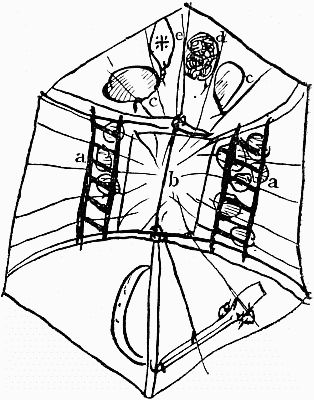
The following figure represents the roof
of the tent, as seen from below. a, a, are
the racks on which the cheeses are ranged.
b outlet for the smoke. c, c, rennet-bags
containing milk. d plat of hair from the
reindeer's tail, to strain milk through. e
the flat cover of the milk-strainer; see i
in the former figure.
Such was the dwelling, and I shall now
describe some of its inhabitants. I sat
myself down at the right hand of the entrance,
with my legs across. Opposite to
me sat an old woman, with one leg bent,
the other straight. Her dress came no
lower than her knees, but she had a belt
embroidered with silver. Her grey hair
hung straight down, and she had a wrinkled
face, with blear eyes. Her countenance was
altogether of the Lapland cast. Her fingers
were scraggy and withered. * * * * Next
to her sat her husband, a young man, six-and-thirty
years of age, who, for the sake
of her large herds of reindeer, had already
been married ten years to this old hag.
When the Laplanders sit, they either cross
their legs under them, or one knee is bent,
the other straight.
As a defence against wind and snow, a
sort of hood, called nialmiphata, is worn
over the cap. It is made of red cloth, of
the shape of a truncated cone, dilated at
the bottom, and is four palms high, three
palms in circumference at the upper part,
and six at the bottom. This covers the
cheeks, as well as the neck and shoulders,
the eyes and mouth only being exposed.
In the back part, at bottom, is a loop,
through which goes a riband to secure the
whole from being blown off, by being tied
round the body under the arms.
In winter-time the women wear breeches,
made exactly like those worn by the men,
as well as boots, though the latter come no
higher than the knees. It is wonderful
how they are able, in the severity of winter,
to follow the reindeer, which are never at
rest, but keep feeding by night as well as
by day. They have indeed small sheds or
huts, here and there, into which they occasionally
drive their reindeer, but with the
greatest difficulty.
During the night we passed over the
beautiful lake of Wirisiar. The weather
was very cold and foggy.
In the morning we arrived at the abode
of Mr. Kock, the under bailiff, where I
could not but admire the fairness of the
bodies of these dark-faced people, which
rivalled that of any lady whatever.
Here I saw some Leming Rats, called in
Lapland Lummick. The body of these
animals is grey; face and shoulders black;
the loins blackish; tail, as well as ears,
very short. They feed on grass and reindeer-moss
(Lichen rangiferinus), and are
not eatable. They live, for the most part,
in the alps; but in some years thousands
of them come down into the woodland
countries, passing right over lakes, bogs,
and marshes, by which great numbers
perish. They are by no means timid, but
look out, from their holes, at passengers,
like a dog. They bring forth five or six at
a birth. Their burrows are about half a
quarter (of an ell?) deep.
Here I found the little Gentian, or Centaury,
with a hyacinthine flower in five
notched segments (Gentiana nivalis).
I gathered and examined the little
Catchfly, which resembles the common one
(Lychnis Viscaria) except in being smaller,
and not at all viscid. (L. alpina; see
v. 1. p. 302. n. 46.) The root is perennial.
Leaves oblong-lanceolate, approaching to
linear. Stem simple, round, smooth, bearing
two, three, or four pairs of opposite
leaves. From the uppermost pair springs
one flower-stalk on each side, bearing a
single flower, between two small opposite
purple leaves. A little higher up, two other
simple flower-stalks come forth in the same
manner, with two coloured leaves at their
base, the stem being thus extended straight
upwards. Calyx ovate, erect, coloured,
with five teeth. Petals five, their disk
cloven half way down; the crown with two
teeth. Stamens 10. Pistils 5.
After passing the alps, we grew thirsty;
but the water we met with proved less pleasant
than usual, having an earthy taste,
although it flowed from plentiful stores of
ice and snow. My Laplander took his
knife and cut out a lump of ice, which he
sucked by way of refreshment. I found
this mode of drinking agreeable enough,
the ice being very palatable, and we both
partook of it largely. He told me it was
considered very wholesome for the chest.
Indeed I learned, both from the Laplanders
and my own experience, that pure water,
however cold, is never hurtful, provided
it be taken in moderation.
I was desirous of having my linen washed;
but the people understood my request
as little as if I had spoken Hebrew, not a
single article of their own apparel being
made of linen. As their food is of animal
origin, so is their clothing, which consists
either of skins, the produce of the country,
or of the woollen cloth called walmal,
which they purchase. In the winter they
wear Lapland boots, which come up as
high as the middle of the thighs, without
any stockings, only the feet are protected
with what they term Skogras (Carex sylvatica
Fl. Brit.), as already mentioned.
Next to the body they wear a jacket of
walmal, and above that a lappmudd, or
coat of reindeer skin, with the hairy side
turned inwards. In summer they turn
that side outwards. The boots used by
the women do not reach higher than the
knee.
I remarked with astonishment how greatly
the reindeer are incommoded in hot weather,
insomuch that they cannot stand still
a minute, no not a moment, without changing
their posture, starting, puffing and
blowing continually, and all on account of a
little fly. Even though amongst a herd of
perhaps five hundred reindeer there were not
above ten of these flies, every one of the
herd trembled and kept pushing its neighbour
about. The fly meanwhile was trying
every means to get at them; but it no
sooner touched any part of their bodies,
than they made an immediate effort to
shake it off. In one respect this season is
peculiarly propitious to the insect, as the
reindeer's coat is now very thin, most of the
hair of last year's growth being fallen off.
I caught one of these insects as it was flying
along with its tail protruded, which had
at its extremity a small linear orifice, perfectly
white. The tail itself consisted of
four or five tubular joints, slipping into
each other, like a pocket spying-glass, which
this fly, like others, has a power of contracting
at pleasure. See what I have already
mentioned (vol. 1. p. 280), concerning the
spots in the reindeer skins, as caused by
this insect (Oestrus Tarandi).
When the Lapland children are laid into
the cradle, they seldom cry, although their
hands are confined down to their sides.
If they cry, it is generally from hunger.
The cradle is placed in a sloping position,
so that the child's head is half upright.
The bottom of the cradle is hollowed out
of a piece of fir wood, consequently not
very heavy. Over the head of the child is
a hoop forming an arch, to which a transverse
bow is fixed, the whole being covered
with cloth, like the rest of the cradle. In
summer the child lies without any covering
of reindeer hair, only having under its head
and body either some walmal cloth, fur, or
moss.
The Laplanders use a curious kind of
box or basket, which they call kisa, for
keeping or carrying various articles. It is
of an oval form, with the bottom and sides
made of fir, like a box, being about a foot
and half long, a foot broad, and six inches
deep, with a transverse opening in the bottom
to admit a part of the saddle of the
reindeer. The contents are confined by a
lacing of cords, that goes from side to side
across the top, which is otherwise open.
Two such boxes, each weighing about two
pounds, are placed like panniers upon the
reindeer; for that animal cannot carry
above four or five pounds weight, and the
castrated males only are used as beasts of
burthen at all. A leather thong crosses
the saddle, connected with another longer
one, which goes round the chest of the
animal at one part, and round its thighs,
like the breechings of a horse, at the other.
A pack-saddle, made either of reindeer
skin, or of walmal cloth, with a bow of
spruce fir, goes across the back, and is connected
with the leather thongs just mentioned,
being further secured by a girth
under the belly. Against the sides of this
pack-saddle the above-described boxes or
baskets are hung and fastened, the transverse
chink in the bottom of each being
fitted to the saddle.
I observed that the Laplanders, both
men and women, after borrowing a lighted
pipe, and passing it from one to another,
retain a mouthful of smoke as long as
possible, that they may enjoy as much of
the flavour as they can. Old men chew
tobacco.
The tendons in the legs of the reindeer
serve to make thread or cord. In each hind
leg are two tendons, one before the other;
in each fore leg one behind and two or
three before it. These the Laplanders lay
hold of with their mouths, split and moisten
them, rubbing them from time to time with
reindeer marrow, preserved in bladders for
that use, in order to render them as supple
as possible. Each string is made sharp
at both ends, and drawn through holes of
various sizes in an instrument made on purpose
(of wood or metal) to render it as fine
and smooth as they can. Two such threads
are then twisted together by means of the
hand upon the thigh or knee. They are
generally held with the left hand, and twisted
with the right upon the left knee,
proceeding downwards, the thread being
moistened from time to time with saliva.
In this part of the country the Empetrum
(Crow- or Crake-berry) serves for firing.
Otherwise the most common fuel is the
dwarf Birch (Betula nana), and the Willow
with lanceolate white hairy leaves (Salix
lapponum), so very abundant on the Lapland
alps. The dwarf birch bears very
small leaves in these elevated regions.
When the children are taken out of the
cradle, which I have already described
(vol. 2. p. 23), they are dressed in a small
garment of reindeer skin. They are usually
able to stand on their legs by the time they
are four months old, and turn their head
and eyes about with a degree of intelligence
hardly ever seen in our children at that
early age.
I never met with any people who lead
such easy happy lives as the Laplanders.
In summer they make two meals of milk
in the course of the day, and when they
have gone through their allotted task of
milking their reindeer, or making cheese,
they resign themselves to indolent tranquillity,
not knowing what to do next. In winter
their food is cheese, taken once or twice a
day, but in the evening they eat meat. A
single reindeer supplies four persons with
food for a week.
This animal has no gall-bladder, nor
could I discover the insertion of the biliary
duct. The liver however is of a large size.
The first stomach is large, with a thick orifice,
and lined with a fine cellular network
like that of a cow, being moreover longitudinally
plaited. The Laplanders are curious
dissectors. They take out each of
the stomachs separately, with as much care
as a professed anatomist.
The thread made of sinews, as above
described, is never used for sewing walmal,
which makes their summer clothing, but
only for garments composed of fur or leather.
Their shoes indeed are mended, as
well as made, with it. This last business
falls to the lot of the women. The leather
is purchased.
A good ox may be bought in Norway
for three rix-dollars; a female reindeer for
one rix-dollar; a castrated male for from
twelve to eighteen dollars, silver coin; and
a fawn is worth from twelve to eighteen
dollars of copper money. Three reindeer,
therefore, are but equal to the value of a
common ox.
I left this place in the evening, proceeding
on my journey on foot, and walking all
night long, till three o'clock in the afternoon
of the following day. Thus I walked
six miles at a stretch, before I arrived at
another Lapland hut.
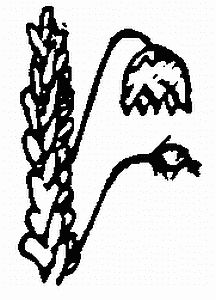
Nothing occurred particularly worth noticing
by the way, except an Andromeda
(tetragona) with quadrangular shoots, and
flowers from the bosoms of the leaves. The
stem is woody, procumbent, naked, thread-shaped,
variously divided. Branches partly
erect, entirely covered with leaves, which
are oblong, obtuse, somewhat rounded,
concave, keeled, sessile, disposed in an
imbricated manner. Flower-stalks solitary,
from the bosoms of the leaves, erect, thread-shaped,
whitish, each bearing a drooping
flower. Calyx five-cleft, purplish, with
ovate straight segments. Petal one, half-ovate
or bellshaped, exactly resembling the
lily of the valley, cut half way down into
five erect acute segments. Stamens ten,
very short, with horned anthers, scarcely
longer than the calyx. Pistil simple, the
length of the calyx. Pericarp roundish,
with five obtuse angles, erect, of five cells,
with several seeds[1].
The people here use a kind of bread
called Blodbrod (Blood Bread), made of
small fresh fish, bruised and mixed with a
little quantity of flour. This is baked or
roasted on a jack before the fire, but it is
used only in hard times.
There are no common flies, bugs, nor
snakes, on these Alps.
The Laplanders however abound with
lice, which in winter are allowed to freeze,
when they turn red, and are easily killed.
In summer they come forth from the clothes,
if exposed to the sun, and are then destroyed
with the nails, these people having
no firelock to shoot them with[2].
I was informed that in this neighbourhood
the inoculated small-pox is remarkably
fatal. If the patients have but seventy
or eighty pustules, they die of it as of the
plague. They fly to the mountains, when
infected, and die. The same is the case
with the measles. It appears that both
these diseases are aggravated by the violent
cold, whence the patients die in so
miserable a manner[3].
Swelled necks (goitres) are frequent.
Sore eyes are universal, especially in the
spring, when the Laplanders remove towards
the Alps. The glittering of the
snow has then a pernicious effect on their
eyes. Aged people are very often blind.
Female obstructions are rare, though
sometimes met with among the better sort
of people; neither are the catamenia immoderate,
nor in common so copious as
with us. The Lapland women are entirely
ignorant of the leucorrhœa.
Of hysterics I met with but two cases.
One maid-servant, twenty-four years of age,
had the complaint about once a year;
another, about thirty, was attacked with
it monthly during the summer.
Epilepsy sometimes occurs. Headachs
are frequent; hence the forehead is often
seen full of scars (from the application of
their toule, or moxa; see vol. 1. p. 274).
Elderly people are often hard of hearing.
The sleep of the Laplanders is commonly
sound, and they are in the habit of sleeping
or waking whenever they please.
A swelling, or falling down, of the uvula
is not uncommon, in which case they frequently
cut off the part affected.
When children are troubled with swellings
in the glands about the throat, the
usual remedy is to prick the part, and suck
out the blood, which is considered as a
speedy and effectual cure. If this method
be not adopted, they suppose the blood
would rise to the head, and cause cutaneous
eruptions there.
Coughs are of very rare occurrence, notwithstanding
the constant practice of drinking
snow- and ice-water, even after swallowing
pure grease or fat, which perhaps may
prevent its bad consequences. However
this may be, the Laplanders seldom die
from catching cold. Cases of phthisis, or
consumption, do indeed now and then occur
among them, and pleurisies are very
common, especially in spring and autumn.
Lumbago, or pain in the back, is most prevalent
during the summer. For this, as I
have already mentioned, vol. 1. p. 274,
actual cautery, by means of their toule, or
moxa, is often applied.
Bleeding at the nose chiefly happens
among those Lapland women who are in
the service of the colonists, and who, in
consequence of certain obstructions, are
subject also to œdematous swellings of the
feet.
I have not heard of a single instance of
jaundice.
Some elderly people are afflicted with
asthma; and hoarsenesses now and then
occur in the winter and spring.
The stone and gout are entirely unknown
amongst the Laplanders.
Swellings of the lower extremities are
uncommon, as these people are in the habit
of swathing their legs, which renders them
all slender and well shaped. All dropsical
complaints indeed are very rare, though I
did meet with one case of this kind.
Of tenesmus I happened to hear of but
a single instance, though the Laplanders
eat so much cheese and drink water.
Disorders in the stomach are not uncommon,
which are frequently attended
with diarrhœa, and in some years this disease
is contagious.
The specimens of minerals which I had
collected in the course of my tour were
now become numerous, and consisted of
the following articles.
1. An alum, as I presume, of a club
shape, without any taste, seeming as it
were dissolved in fluor, from the mountains
to the north of the lake Skalk, near Kiomitis.
(See vol. 1. p. 267.)
2. Native alum in its own matrix; from
the same place. (Alumen nativum. Syst.
Nat. vol. 3. 101).
3. Native alum, rough and green, separate
from its matrix; from the same mountains.
4. Alum like the former in appearance,
but not salt, perhaps a calcareous stone;
found not far from the same place.
5. Various alpine micaceous stones.
6. Marle from Lapland.
7. Quartz from Lapland.
8. Silver ore from Kiurivari.
9. Silver ore from Nasaphiel in Pithœan
Lapland.
10. Sandstone containing three per cent.
of iron.
11. Black slate from the alps.
12. Petrified corals from Norway.
13. Iridescent fluors from the alps.
The fish called by the Laplanders Sijk
(the Gwiniad, or Salmo Lavaretus,) is
taken in their lakes. Its head terminates
in an obtuse point. The upper jaw is the
longest. Mouth without teeth. Iris of
the eye silvery, with a blackish upper
edge, and a black pupil. The whole body
is silvery, blackish about the back, eleven
inches long and two deep. Head two inches
long at the sides; from the snout to the
dorsal fin four inches and a half. The dorsal
fin consists of thirteen rays, of which the
first is by far the largest, and the last
cloven or interrupted. The soft fat fin is
in its proper place.
The following are the disorders or inconveniences
to which the reindeer are subject.
When the frost is so intense as to form an
impenetrable crust on the surface of the
snow, so that the animal cannot break it
with his feet, to get at the Lichen on which
he feeds, he is frequently starved to death.
This misfortune is as dreadful to the Laplanders
as any public or national calamity
elsewhere; for, when his reindeer are killed,
he must himself either starve to death, beg
for his livelihood, or turn thief.
The hoofs of the reindeer are not uncommonly
affected with a swelling at the edge
where they are attached to the skin, at
which part they consequently become ulcerated,
and are seldom healed. The creature
thus grows lame, and cannot keep up
with the herd.
These animals are sometimes attacked
with a vertigo, or giddiness in the head,
which causes them to run round and round
continually. The people assured me, that
such of them as run according to the course
of the sun may be expected to get the
better of the disorder; but those which
turn the contrary way, being supposed incurable,
are immediately killed. The recovery
of the former is thought to be promoted
by cutting their ears, so as to cause
a great discharge of blood.
The Kurbma, or ulceration caused by
the Gad-fly, (see vol. 1. p. 280.) takes place
every spring, especially in the younger
fawns. Such as are brought forth in the
summer season are free from this misfortune
the ensuing spring, but in the following
one many of them lose their lives by it.
When come to their full size and strength,
the consequences are less fatal; but no reindeer
is entirely exempt from the attacks of
this pernicious insect.
The fawns are of a reddish hue the first
season, during which they cut their foreteeth.
In the autumn they turn blackish,
and have fodder given them. They are
when young frequently afflicted with a
soreness in the mouth, so as to be unable
for a while to eat.
Reindeer are subject to a disease called
by the Laplanders Pekke Kattiata, accompanied
with ulcerations of the flesh, which
however often heal by a sloughing of the
part affected. This is an epidemic disorder.
It is believed that if any of the
ulcerous part, which is cast off, be swallowed
by the animal, in licking his own
coat, or that of any other of the herd labouring
under this malady, it proves fatal
by corroding the viscera.
The dugs of the female often become
chapped or sore, so as to bleed whenever
they are milked.
The male reindeer in his natural state is
fatter than such as are castrated, except
the latter be kept without work, in which
case they become the fattest. Such as are
castrated and allowed to run wild, become
considerably larger, as well as tamer, in
consequence.
The rutting season lasts but a fortnight,
that is, from about a week preceding the
feast of St. Matthew (Sept. 21.) to Michaelmas
day, during which period the
male is savage and dangerous. Immediately
afterwards he casts his coat and horns,
and not unfrequently becomes so emaciated,
that, in many instances, death is
the consequence.
Towards the feast of St. Eric (May 18.)
in the following year, or within a fortnight
of that period, very rarely later, the females
bring forth their young. They do not copulate
the first year, and seldom before
the third, their progeny being found the
better for this delay. Indeed neither the
males nor females arrive at their full growth
and perfection before they are towards three
years old.
The fawn, whether male or female, is
called the first year mesk; the second season
the male is called orryck, and the female
whenial. In the third year the latter, if she
has been covered, is known by the appellation
of watja or waja, which means a
wife; if otherwise, she goes by the name of
whenial-rotha, the three-year old male being
called wubbers. In his fourth year the
male is termed koddutis; in the following
one kosittis; in the sixth machanis, and in
the seventh namma lappotachis. After that
period no male is kept, they all perishing in
consequence of the exhaustion above mentioned,
but the castrated ones live to a more
advanced age. None of these animals
however survive beyond their twelfth or
fourteenth year. When the castrated males
become very fat towards autumn, and show
signs of old age; or the females, having
become barren, appear otherwise to be on
the decline, they are killed, by the knife,
in the close of the year; from an apprehension
that they might otherwise perish
of themselves from infirmity, in the course
of another season.
Such of the male reindeer as are destined
to serve for a stock of provision, are killed
before the rutting-time, and their carcases
hung up to be exposed to the air and frost
before flaying. The flesh is smoked and a
little salted, and then laid upon sledges to
dry in the sun, that it may keep through
the winter till spring. About the feast of
St. Matthias (Feb. 24.) the reindeer begin
to be so incommoded with the gad-fly, that
they are not in a fit condition to be slain
for eating. From that period therefore,
till the milking season, the Laplanders are
obliged to live on this stock of preserved
meat. At other times of the year the females
are killed for immediate use, according
as they are wanted. The blood is kept
fresh in kegs, or other vessels, and serves
for food in the spring, being added to the
välling (see vol. 1. p. 129), with a small
proportion of milk and water. The blood
of these animals is thick in consistence, like
that of a hog. The Laplanders carry a
portion of it along with them from place to
place, in bladders or some kind of vessels.
A stock of this and all other necessaries is
collected as late as possible, before the
melting of the snow, while there still remains
a track for the sledges.
A kind of blood pudding or sausage is
made, in general without flour, and with
a large proportion of fat. This the Laplanders
call marfi.
The liver of the reindeer, which is of a
considerable bulk, is boiled and eaten fresh.
The lungs, being salted and moderately
dried, are eaten occasionally, or else given
to the dogs. The intestines, which abound
with fat, are cut open, washed, and boiled
fresh; nor are they unpalatable. The brain
and testicles are never eaten. The foot is
flayed down to the fetlock joint, beyond
which the hair cannot, by scalding or any
other contrivance, be separated, without
the cuticle and skin coming along with it.
Even when the feet are boiled, the hair never
comes off without the skin. Thus the
animal when living is the more firmly protected
against the snow. The hoofs are
thrown away as useless.
The dung of the reindeer in summer is
almost as large as cow-dung, but in winter
it more resembles that of the goat.
Each individual reindeer does not bear
horns of precisely the same shape every
year. The points are very liable to be deformed,
in consequence of the animal's
scratching them, while in a growing state,
with its feet; they being in that state much
inclined to itch, and as tender as the flesh
of a fresh fish.
These animals are afflicted with maggots
called kornmatskar in their noses and
gums, from which they relieve themselves
in the spring by snorting and blowing.
When the insects lodge on their backs and
form pustules there, the people make a
practice of squeezing them out, to prevent
the reindeer from being too much irritated
by them. (This species is the Oestrus
nasalis, though the account here given is
not very clear; but in the first edition only
of the Fauna Suecica Linnæus says, on
the authority of a gentleman named Friedenreich,
that "this Oestrus lodges its
eggs in the frontal sinus of the reindeer in
Lapland, and is frequently cast out by
them as they travel along in the spring.")
When the skin is stripped from the
carcase of the reindeer, it is immediately
spread out, and stretched as much as possible,
by means of a longitudinal pole, and
a transverse stick at each end of the skin,
these sticks being pulled asunder with a
strong cord. Several more transverse twigs
are placed between these two sticks, so as
to extend every part of the edges of the
hide, which in this position is allowed to
dry.
The Laplanders' gloves are made of skin
taken from the legs of the animal; their
hairy shoes, of that from its forehead between
the horns, such being worth two
dollars, copper money; while those made
from the skin of the legs, being much
thinner, are of very little or no value.
A Laplander never goes barefoot, though
he has nothing to serve him for stockings
but hay (Carex sylvatica, Fl. Brit.). Sometimes
he buys leather for shoes or boots
from his neighbours.
The people of this country boil their
meat in water only, without any addition
or seasoning, and drink the broth. Jumomjölk
(see vol. 1. 278.) kept for a whole
year is delicate eating. Berries of all kinds
are boiled in it. Some persons make a
practice of boiling those berries by themselves,
preserving them afterwards in small
tubs, or other wooden vessels. They boil
their fish more thoroughly than their meat,
over a slow fire, drinking likewise the water
in which it has been drest. The meat is
never so much boiled as to separate from
the bone. Fresh fish is sometimes roasted
over the fire. Few people dry and salt it,
though that method is sometimes practised.
Meat is dried by the air, sun and
smoke all together, being hung up in the
chimney, or rather hole by which the
smoke escapes through the roof.
The Laplanders never eat of more than
one dish at a meal.
By way of dainty, the women occasionally
mix the berries of the Dwarf Cornel
(Cornus suecica) with Kappi (see vol. i.
p. 281.), which is made of whey boiled till
it grows as thick as flummery. To this they
moreover add some cream. That fruit
is entirely neglected in the country of
Medelpad.
In Dalecarlia the people generally keep
their cattle up in the mountains, twelve or
sixteen miles from their own dwellings, on
account of gad-flies and other stinging insects.
There they have their dairies, and
make cheese. The remaining whey is
boiled till two thirds are wasted, when it
becomes as thick as flummery. This is
sometimes eaten instead of butter, sometimes
mixed with dough, or serves for food
in various other manners.
The wind is excessively powerful in this
alpine region, so that sometimes it is impossible
to stand against it, both men and
sledges being overturned by its violence.
It blew so hard at the place where I
now was, that one of the windows of the
curate's house was blown in upon the floor.
Every Laplander constantly carries a
sort of pole or stick, tipped with a ferule,
and furnished with a transverse bit of
wood. Whenever he is tired, he leans his
arms and nose against it to rest himself.
Such as live in the forests are dexterous
marksmen, but not those who inhabit the
alps. Nevertheless, they all contrive, by
means of their wooden bows, to procure,
in the course of the winter, a considerable
number of Squirrels (Sciurus vulgaris) in
their grey or winter clothing, for the sake
of their skins.
In the winter season also they go in pursuit
of their most cruel enemies the wolves.
One of these animals will sometimes kill
twenty or thirty reindeer at a time, if
he comes into the enclosure where they are.
The wolf often runs away before the Laplander
can get near enough to fire at him.
A bear can hardly catch a reindeer, except
by coming upon it unawares, the
latter being much the most swift of foot;
but if he gets into any of the store-houses,
he does a great deal of mischief, turning
every thing topsy-turvy. Bears are also
very dangerous in the fissures of rocks
and mountains, where they usually conceal
themselves.
The Glutton (Mustela Gulo) does most
harm in the pantry or store-house. He
never meddles with the reindeer.
A part of the employment of the men
is to make sledges, or other machines of
wood for carriage. They cut rough wood
in the forests for the boxes which they
carry with them into the alps.
The duty of the women is to mend
the clothes of the whole family.
Laplanders have several plays or amusements.
Children make of the dwarf birch (Betula
nana) something like reindeer's horns,
with which they gore one another in sport.
They amuse themselves frequently by
building little huts of stone.
Grown-up people play very well at tennis,
but they seldom partake of that diversion.
More common amusements are
blindman's buff, and drawing gloves.
Here I think it worth while to observe,
that the alpine Laplanders are more honest,
as well as more good-natured, than those
who dwell in the woodlands. Having
acquired more polish from their occasional
intercourse with the inhabitants of towns,
the latter have, at the same time, learned
more cunning and deceit, and are frequently
very knavish. The inhabitants of the alps
dwell in villages formed of their tents,
living together, as I have already related,
in great comfort and harmony. Those
who occupy the woody parts of the country
live dispersed.
The Laplanders know no musical instrument
except the lur (a sort of trumpet),
and pipes made of the bark of the quicken
tree or mountain ash. They are not accustomed
to sing at church, except those
who are reckoned among the great or
learned of the community.
The inhabitants of this country are
not more troubled with chilblains than
those of other places. They do not mind
having their cheeks frost-bitten. The women
wear an embroidered band round
the head, which affords no protection in
this respect; but the men have a loose
band of skin with the hair on, which can
be pulled down occasionally over their cap,
when the cold is intolerable.
(But to proceed with a further account
of the diversions of the people I am describing).
Spetto, one of their games, is played, by
men as well as women, in the following
manner. They prepare from thirty to fifty
or sixty pieces of wood, a hand's breadth in
length, which are spread upon the extended
skin of a reindeer. One of the
players takes a ball made of stone or
marble, larger than a boy's playing marble,
which he throws up into the air about an
ell high. While the ball is up, he snatches
away one of the sticks, but in such a
manner as not to miss catching the ball
in its fall, holding the stick in the same
hand. He subsequently gathers together,
in his other hand, as many of the sticks
as he has thus been able to procure. If
he fails in any respect, another person is
to take the ball, and proceed in the same
manner, the former player resigning up
to him one of the sticks every time the
ball is thrown, till no more remain in his
own possession. He who can take up all
the sticks wins the game.
The following rules are to be observed.
1. He who catches the ball, but not
one of the sticks, must resign the ball to
another player, as well as he who has
let it fall.
2. He who takes up more than one
stick at a time, must return what he has
taken.
3. The adversary, that is, the last
player, who could not succeed in taking
up all the sticks, is allowed to lay down
as many as he pleases of the sticks he has
collected, and may arrange them according
to his fancy. It is usual to lay one upon
another, in order to render the game
more difficult, the player being obliged to
snatch up each separately; which is not
easy without taking two, when so situated,
at once.
4. When at length one person has taken
up all the sticks, his adversary is permitted
to replace the two last of them upon the
skin in any manner he chooses. He commonly
separates them as widely as possible.
The person who had previously gained the
whole, is then required to take up both
these sticks at one throw of the ball, and
if he fails he must give up the game.
Thus the victory is often lost by means of
these two last sticks.
5. When the adversary fails of his aim,
the other player is to take all the sticks
lying on the field, as well as those which,
after having been laid down by himself,
were won by the other person, and the
whole are to be laid down again directly,
in order to be taken up according to the
above rules. But he is no longer under
any obligation himself to take up the
sticks which he has thus laid for his companion.
The game called Tablut is played with
a checkered board, and twenty-five pieces,
or men, in the following manner.
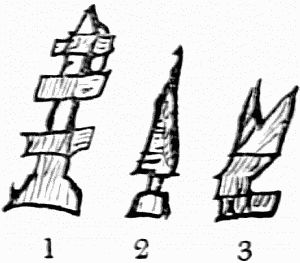
Fig. 1, is the king, whose station is in
the central square or royal castle, called
konokis by the Laplanders, to which no
other person can be admitted.
Fig. 2, represents one of the eight Swedes
his subjects, who, at the commencement
of the game, are stationed in the eight
squares, adjoining to the royal castle,
marked 2 and 3.
Fig. 3, is one of sixteen Muscovites,
their adversaries, who occupy the sixteen
embroidered squares, (some of them marked
4 in the cut,) situated four together in
the middle of each side of the field.
The vacant squares, distinguished by
letters, may be occupied by any of the
pieces in the course of the game.
1. Any piece may move from one square
to another in a right line, as from a to c;
but not corner-wise, or from a to e.
2. It is not allowed to pass over the heads
of any other pieces that may be in the
way, or to move, for instance, from b to
m, in case any were stationed at e or i.
3. If the king should stand in b, and
no other piece in e, i, or m, he may escape
by that road, unless one of the Muscovites
immediately gets possession of one of the
squares in question, so as to interrupt him.
4. If the king be able to accomplish
this, the contest is at an end.
5. If the king happens to be in e, and none
of his own people or his enemies either in
f or g, i or m, his exit cannot be prevented.
6. Whenever the person who moves the
king perceives that a passage is free, he
must call out raichi, and if there be two
ways open, tuichu.
7. It is allowable to move ever so far
at once, in a right line, if the squares in
the way be vacant, as from c to n.
8. The Swedes and the Muscovites take
it by turns to move.
9. If any one man gets between two
squares occupied by his enemies, he is
killed and taken off, except the king, who
is not liable to this misfortune.
10. If the king, being in his own square
or castle, is encompassed on three sides
by his enemies, one of them standing in
each of three of the squares numbered 2, he
may move away by the fourth. If one
of his own people happens to be in this
fourth square, and one of his enemies in
number 3 next to it, the soldier thus enclosed
between his king and the enemy is killed.
If four of the enemy gain possession of the
four squares marked 2, thus enclosing the
king, he becomes their prisoner.
11. If the king be in 2, with an enemy
in each of the adjoining squares, a, A and
3, he is likewise taken.
12. Whenever the king is thus taken or
imprisoned, the war is over, and the
conqueror seizes all the Swedes, the conquered
party resigning all the Muscovites
that he had taken.
The Laplanders use the middle bark of
the elm for dressing their reindeer skins,
but merely by chewing it, and rubbing
their saliva on the skins.
They also tan with birch bark, but do
not suffer the skins to remain long under
the operation, which they say would render
them rotten and apt to rend, neither can
they spare them very long.
White walmal cloth is procured from
Russia, but for want thereof they commonly
wear a light grey cloth of the same kind.
Ropes are made of roots of spruce fir
in the following manner. Choosing the
most slender roots, they scrape off the
bark, while fresh, with the back of a knife,
holding the roots against the thigh. Afterwards
each root is first split with the knife
into three or four parts, which are then by
degrees separated into a number of very
slender fibres; and these, being wrapped
round the hand like a skain of thread,
are tied together. They are then boiled
in a kettle for an hour or two, with a
considerable quantity of wood ashes.
While still soft from this boiling, they are
laid across the knee, and scraped three or
four times over with a knife. At last they
are twisted into small ropes. Birch roots
serve in like manner to afford cordage for
the Laplanders, but more rarely. The
latter are more generally used, without
being split, for basket-work. For various
articles of furniture the roots of Tall
(Scotch Fir, Pinus sylvestris) are cut into
small boards. The wood of that tree
serves for inferior kinds of work, and,
amongst other things, for cheese-vats.
The Laplanders scrape with a knife the
young and tender stalks of the plant called
Jerja, (Sonchus alpinus, Sm. Plant. Ic.
t. 21.) and eat them as a delicacy, like
those of the great Angelica (A. Archangelica),
which in the first year of their
growth are termed Fatno.
A Laplander always places himself at
the further part of his hut, and his guest
is seated next to him on a skin spread
on purpose. The master of the hut is by
this means enabled to reach the vessel in
which water is kept for drink, and which
always stands in the upper part of the hut.
The river Hyttan flows in a perpetual
stream both summer and winter. Now if,
according to the general opinion, the water
of this river were derived from exhalations
of the great ocean, collected by the
alps of this country, it should cease to
run when all the alpine tracts are frozen.
The stream must therefore be constantly
fed by neighbouring springs.
The names by which the Laplanders
distinguish the several times of the day or
night are as follows.
Midnight is called in their language
kaskia. The remainder of the night before
dawn, pojela kaskia. The morning
dawn, theleeteilyja. Sun-rise, peivimorotak.
Two or three hours after sun-rise, areiteet.
The hour of milking the reindeer, which
is about 8 or 9 o'clock, arrapeivi. Noon,
or dinner time, kaskapeivi. About 5 or 6
o'clock in the afternoon, eketis peivi. Sunset,
peiveliti. Night, iä.
The days of the week are named as
follows.
Sunday, Sotno peivi.
Monday, Mannutaka.
Tuesday, Tistaka.
Wednesday, Kaska vacku, or middle of
the week.
Thursday, Tourestaka.
Friday, Perietaka.
Saturday, Lavutaka.
They have no names for the months,
but certain weeks are distinguished by the
following appellations.
Midsummer week, Midtsomarvacku.
St. Peter's week, June 29, Pelasmassu vacku.
Goose week, Gassa vacku.
In the middle of the summer, Gaskakis.
St. Margaret's, July 20, Marcrit.
St. Olaus' mass, July 29, Vollis.
(No date mentioned here.) Vehak.
St. Laurence, Aug. 10, Lauras.
Reindeer-fawn week, Orryk. When in a
fawn two years old the horns begin to bud.
St. Bartholomew, Aug. 24, Barti.
(No date.) Hoppmil.
St. Mary, Sept. 8, Margi.
Holy Cross, Sept. 14, Behawis.
St. Matthew, Sept. 21, Matthus.
St. Michael, Sept. 29, Michel.
(St. Faith, Oct. 6?) Perkit.
(Middle of Oct.) Talvi.

The annexed figure represents
a Laplander's staff.
It is tipped with a blade of
iron, as thick as the thumb.
With this weapon he attacks
the bear and wolf in the
time of deep snow. On the
lower part of the shaft is
a sort of hoop, six inches in
diameter, made of root of fir,
and fastened with thongs of
reindeer skin, one of which
passes through a hole in the
staff. At the bottom it is
mounted with iron. The
use of this hoop is to prevent
the staff from sinking
into the snow, when used
as a walking-stick. The
shaft itself, made of birch
wood, is about four feet
long, and an inch and half
thick.

This sketch is taken from
one of their snow shoes,
made of wood. Its length
is six feet, from h to i;
breadth, from k to g, five
inches. The hind part, i,
is rather more obtuse than
the other end, h, which
last is elevated about two
or three inches. From h
it gradually widens to f.
The part from c to d, where
the foot stands, is about
eight inches; its breadth
three. The under part of
the shoe is convex, and
furrowed lengthwise; the
upper flattish, raised about
ten lines, and the edge all
round is sharp. At b is a
band, made of fir root twisted,
serving to tie the shoe
fast round the ancle. The
general thickness of the shoe
throughout is from three to
four lines.
Some people wear a pair of the same
size; others have the left shoe smaller
than the right. Each is often lined or
covered, about the central part, with a
piece of hairy reindeer skin, to prevent
the foot slipping about upon the shoe, and
give a firmer step in walking over the
snow. This is most practised in Kimi-Lapmark,
where the wild reindeer are
most abundant.
The Lapland thread is made out of the
tendons of reindeer fawns half a year old.
Such thread is covered with tin foil for
embroidery, its pliability rendering it peculiarly
fit for the purpose. The tendons
are dried in the sun, being hung over a
stick. They are never boiled.
To show to what a high degree of perfection
these people have arrived in the
art of making such thread, I brought
away a sample of it, which I believe none
of our ladies could match.
Shoes and baskets made of birch bark
are used both in Angermanland and Helsingland,
as well as ropes of the same
material, which will not sink in water, but
these are not in general use.
The bows which serve the Laplanders
for shooting squirrels are composed of
two different kinds of wood, laid parallel
to each other. The innermost is birch,
the outermost of what they term kior,
kioern or tioern. (This is procured from
a tree of the Common Fir, Pinus sylvestris,
that happens to grow in a curved form,
usually in marshy places, or on the banks
of rivers, and whose contracted side is hard
like box: see vol. i. p. 255; also Fl. Lapp. n.
346, λ.) If this be not practised, the bows
are more apt to snap. Each layer of wood
is externally convex, yet not so much as
to render the bow quite cylindrical.
When the Laplanders expect any visitors,
they are particularly careful to have plenty
of ris (branches of the dwarf birch) spread
on the floor, under the reindeer skins on
which they sit; otherwise they would be
thought deficient in civility, and the mistress
of the family would be censured as
a bad manager, when the guests returned
to their own homes.
The mode of their entertainment is as
follows.
First, if the stranger arrives before their
meat is set over the fire to boil, they present
him either with iced milk, or with
some kind of berries mixed with milk, or
perhaps with cheese, or with kappi, (see
vol. i. p. 281.) Afterwards, when the meat is
sufficiently cooked, and they have taken
it out of the pot, they put into the water,
in which it has been boiled, slices of cheese
made of reindeer milk. This is a testimony
of hospitality, and that they are disposed
to make their guest as welcome as they
can. They next serve up some of their
dry or solid preparations of milk.
The marriages of the Laplanders are
conducted in the following manner. (This
subject was treated in vol. i. p. 276, like
Sterne's "history of the king of Bohemia
and his seven castles," no doubt to the
great dismay of the curious reader. We
ought to have warned him of its being
resumed in a subsequent part of the work,
but in truth we had not then ourselves
proceeded so far in deciphering the original
manuscript.)
1. In the first place the lover addresses
his favourite fair-one in a joking manner, to
try whether his proposal be likely to prove
acceptable or not. Perhaps he even goes
so far as to speak once or twice to her
father upon the subject. He then takes
his leave, either fixing a time for his return,
or not, as it may happen.
2. The lover next takes with him such
of his nearest relations as live in the neighbourhood,
who, as well as himself, all carry
provisions with them, to the hut of his
mistress, he going last in the procession.
3. When the party arrive at the place of
their destination, they all, except the lover,
walk in. If there happen to be any other
huts near at hand, it is usual for the
damsel to retire to one of them, that she
may not be obliged to hear the conversation
of the visitors. Her admirer either
remains on the outside of the door, amongst
the reindeer, or goes into some neighbouring
hut. There are usually two or three
spokesmen in the party, the principal of
whom is called Sugnovivi. When they are
all seated, the young man's father first
presents some brandy to the father of the
young woman; upon which the latter asks
why he treats him with brandy? The former
replies, "I am come hither with a
good intention, and I wish to God that it
may prosper." He then declares his errand.
If the other party should not be favourably
inclined to the proposal, he rejects it, at
the same time thanking the person who
made it. Upon this, all who are present
endeavour to prevail upon him to give his
consent to the marriage. If they succeed,
or in case the offer has from the first been
accepted, the friends of the lover fetch
whatever they have brought along with
them, consisting of various utensils, and
silver coin, which they place on a reindeer
skin, spread in the hut, before the father
and mother of the intended bride. The
father or the mother of the bridegroom
then distributes the money between the
young woman and her parents. If the sum
be thought too small, the latter ask for
more, and it frequently happens that much
time is spent in bargaining, before they
can come to a conclusion. When the parties
concerned cannot obtain so large a sum
as they think themselves entitled to, they
often reject the whole, and return the
money to those who brought it. But if,
on the contrary, matters are brought to a
favourable conclusion, the parents allow
their daughter to be sent for. Two of the
bridegroom's relations undertake this office.
If the bride has any confidential female
friend, or a sister, they walk arm and arm
together; and in this case the mother of
the bridegroom is required to make a present
of a few brass rings, or something of
that kind, to this friend or sister, who keeps
lamenting the loss of her companion.
When the bride enters the hut, her
father asks whether she is satisfied with
what he has done? To which she replies,
that she submits herself to the disposal of
her father, who is the best judge of what
is proper for her. The mother of the
bridegroom then presents the bride with
the sum allotted for her, laying it in her
lap. If it proves less than she had expected,
she shows her dissatisfaction by
various gestures, and signs of refusal, in
which case she may possibly obtain at least
the promise of a larger sum. All these
gifts become her own property.
When such pecuniary matters are finally
arranged, the father and mother of the
bridegroom present him and his bride with
a cup of brandy, of which they partake
together, and then all the company shake
hands. They afterwards take off their caps,
and one of the company makes an oration,
praying for God's blessing upon the new-married
couple, and returning thanks to
him who "gives every man his own wife,
and every woman her own husband."
The parents of the bridegroom next
partake of some brandy, and the whole
stock of that liquor which they had brought
with them is fetched for the company.
All the relations of the bridegroom then
come forward with their provisions, which
generally consist of several cheeses, and a
piece of meat dried and salted. The latter
is roasted before the fire, while the company
is, in the mean while, regaled with
some of the solid preparations of milk, the
bride and bridegroom eating by themselves,
apart from the rest.
Two stewards are next chosen, one of
them from the bride's party, the other
from that of the bridegroom. The last-mentioned
party are then required to furnish
a quantity of raw meat, amounting to
about a pound and half to each person.
This the stewards immediately set about
boiling, and their duty moreover is to serve
it round to all present. This meat is dressed
in several separate pots, two only in
each hut, if there be any neighbours whose
huts can serve to accommodate the party
on this occasion; for each Laplander has
never more than one hut of his own. The
fat part of the broth is first served up in
basons. Afterwards various petticoats or
blankets, of walmal cloth, are spread on
the floor, by way of a table-cloth, on
which the boiled meat is placed. The
chief persons of the company then, as
many as can find room, take their places
in the hut of the bride's family, sitting
down round the provision, while the children
and inferiors are accommodated in
the neighbouring huts. Grace is then said.
The bride and bridegroom are placed near
together, for the most part close to the
door, or place of entrance. They are
always helped to the best of the provision.
The company then serve themselves, taking
their meat on the points of their knives,
and dipping each morsel into some of the
fat broth, in which the whole has been
boiled, before they put it into their mouths.
Numbers of people assemble from the
neighbourhood, to look in upon the company
through the door; and as they expect
to share in the feast, the stewards
give them two or three bits of meat, according
as they respect them more or less.
What remains after every body is satisfied,
is put together, and wrapped up in the
blankets or cloths, that part of it which
is left by the new-married couple being
kept separate from the rest, as no other
person is allowed to partake of their share.
The dinner being over, the whole company
shake hands and return thanks for their
entertainment. They always shake hands
with the bride and bridegroom in the first
place, and then with the rest, saying at
the same time kussl[)a]n.
After taking some brandy, the whole
party go to bed. The herd of reindeer
had been turned out to pasture from the
time when the meat was put into the pot.
The bride and bridegroom sleep together
with their clothes on.
When the company rise in the morning,
if the bridegroom's father and their party
have any thing left, they treat the others
with it; for the family of the bride have
seldom any preparation made, not expecting,
or not being supposed to expect, such
company, and they never keep any brandy
by them, but purchase it for every occasion.
Whatever cold meat therefore remains
is brought forward, to which the
bride's party indeed add cheese, and any
other preparation of milk they may have
in store, as well as any dried meat; such
things being usually kept by them. With
these the party regale themselves by way
of breakfast. Afterwards the family of the
bride boil some fresh meat, as a final repast
for their guests, who, after partaking
of it, take their leave.
The banns are usually published once.
The marriage ceremony, which is very
short, is performed after the above-mentioned
company is departed. This being
over, the bridegroom either takes his wife
immediately home with him, or he goes to
his own hut alone, and stays there from
one to five days, after which he returns to
her residence, bringing with him his herd
of reindeer, and stays there for some time
with her.
Such of the Laplanders as are rich
enough to afford it, make their wives a
present of a coverlet; a petticoat made of
cloth, without any gathers, as usual among
these people; a small silver beaker or cup;
several rix-dollars and silver rings; a spoon,
&c.; so that many a bride costs her husband
more than a hundred dollars, copper
money. To the mother he perhaps gives
a silver belt, as well as a cloth petticoat.
I have already mentioned that the Laplanders
eat Angelica (sylvestris) in a raw
state. This plant, which the inhabitants
of Westbothland call Bioernstut, has so
many names among the Laplanders, according
to the different stages of its growth,
as to cause much confusion to a stranger.
The first year of its growth they term the
root Urtas, and the leaves Fadno; but the
second year the plant is known by the
name of Posco or Botsk. When the stalk
is dried, or eaten raw, they call it Rasi,
that is, grass. They say, when any one
has eaten more of this plant than is good
for him, "Elli rasi ist purro etnach," the
meaning of which is, "Thou hast overloaded
thyself with such a quantity of grass."
Another herb of which they are very
fond is the Sowthistle with a simple stem,
known by the name of Jerja. (Sonchus
alpinus. Fl. Lapp ed. 2. 240. Sm. Pl. 1c.
t. 21. S. lapponicus. Willd. Sp. Pl. v. 3.
1520.) This has a perennial root. The
stem is erect, round, green, smooth, except
a few soft scattered hairs, which are most
remarkable towards the top and bottom,
and is almost as tall as a man. Leaves
about twelve or fourteen, half clasping the
stem, gradually smaller upwards, nearly
the shape of Dandelion, or of the common
Sowthistle, one half of each leaf, consisting
of the terminal lobe, making exactly an
acute triangle, toothed at the edges; from
that part downwards the leaf contracts,
but not to the main rib, and then again
expands into two narrow appendages, as it
were, equal in breadth, but unequal in
length, which are crenate at their edges.
From thence begins the stalk of the leaf,
which is winged and toothed, and half
embraces the stem. The leaves are thin
and smooth, with a rib purple on the upper
side, and the upper ones are the least divided,
as well as the bluntest. The flowers
are collected into a corymbus, somewhat
like Butterbur, but more loosely, especially
in the lower part, each supported by a very
short stalk, accompanied by a very narrow
oblong leaf which extends beyond the
flower. The calyx consists of several oblong,
narrow, acute, imbricated leaves,
varying in number from fourteen to twenty,
the outermost gradually shortest, but the
ten innermost are equal in length, and
blunter than the rest, composing two rows;
the calyx altogether is shorter than the
corolla, tubular, swelling, and downy. Florets
equal in number to the leaves of the
calyx. Germen short, square, crowned
with long white radiating down. Petal
flat, cut away on one side, violet-coloured,
five-toothed. Stamens five, white, their
apex (anther) cylindrical, five-sided, white,
marked with five blue lines. Pistil one,
forked at the top. Receptacle naked, dotted.
This plant grows among trees at the
sides of mountains, along with the narrow-hooded
Aconite (Aconitum lycoctonum),
flowering at the end of July or beginning
of August. The stem, which is milky, is
eaten by the Laplanders in the same manner
as Angelica. The taste was to me very
bitter, but the people of the country do
not find it so, though they confessed that
it appeared bitter to them when they first
learned to eat it. As soon as the plant
shows its flowers, the stalk becomes woody,
and no longer eatable.
The sinews of which the fine thread is
made that, when covered with tin, serves
for embroidery, and is called tentråd (tin-thread),
are taken from the feet of the
reindeer, or of oxen, boiled; though sometimes
the feet of sea-fowl are chosen for
this purpose. Old women and girls are
employed in preparing this thread, by
drawing it through holes made in a piece
of reindeer's horn. They wind it round
their hands and feet as they form it, and
smear it with fat extracted from the foot
of the animal, to make it more supple, as
they proceed.
Hay is made in different modes in various
parts of Sweden. In Westbothland
the fresh-cut grass is heaped together over
night, that it may get a heat. Next day
it is spread out, and by this method its
quality is supposed to become richer and
stronger. The same is practised with hops
in Jamtland, where the fresh-gathered hops
are packed together, as hard as possible,
till they become warm; after which they
are spread out to dry. Their strength is
by this means improved.
The people of Scania having mowed their
grass, let it lie till dry, when they rake it
together.
The Smolanders dry it in a kind of shed.
The East Gothlanders range it in heaps,
two and two together, in a long row.
In Upland the new-mown grass is tied
up in bundles, and collected into cocks.
In Angermannia the whole year's crop is
laid by upon a kind of raised floor.
In Westbothland, after being dried in
the shed, the hay is kept there for use, being
laid crosswise, and cut when wanted[4].
This evening I took leave of the alpine
part of Lapland, and returned by water
from Hyttan towards Lulea.
The White, or Mountain, Fox (Canis lagopus)
lives among the alps, feeding on the
Lemming Rat or Red Mouse, (Mus Lemmus,)
as well as on the Ptarmigan (Tetrao
Lagopus). This White Fox is smaller than
the common kind. The Ptarmigan, which
the Laplanders call Cheruna, feeds on the
Dwarf Birch (Betula nana), which for that
reason is called Ryprys, or Ptarmigan-bush.
At night this bird lies squat upon the snow,
in the same posture as the Wood Grous
(Tetrao Urogallus, see vol. 1. 179): hence
a great deal of its dung is seen in the prints
it makes in the snow. This mode of roosting
renders the Ptarmigan an easy prey to
the Fox.
The Lemming or Red Mouse, see p. 18,
(Mus Lemmus,) in some seasons entirely
overruns the country; devouring the corn
and grass: but though these animals thus
occasionally appear by millions at a time,
they subsequently depart and disappear as
unaccountably, so that nobody knows what
becomes of them. They do no mischief in
the houses.
The Ermine (Mustela Erminea) is white
in winter, red in summer. This animal is
seldom met with on the alps, but is very
plentiful in the forests. Foxes and Wolves
have destroyed the chief of the Hares.
The Wolves indeed kill the Foxes.
The Shrew Mouse (Sorex araneus) and
Common Small Mouse (Mus Musculus) are
found in Lapmark, but no Rats (Mus
Rattus).
Hunting the Bear is often undertaken
by a single man, who, having discovered
the retreat of the animal, takes his dog
along with him and advances towards the
spot. The jaws of the dog are tied round
with a cord, to prevent his barking, and
the man holds the other end of this cord
in his hand. As soon as the dog smells
the bear, he begins to show signs of uneasiness,
and by dragging at the cord informs
his master that the object of his
pursuit is at no great distance. When the
Laplander by this means discovers on which
side the bear is stationed, he advances in
such a direction that the wind may blow
from the bear to him, and not the contrary;
for otherwise the animal would by the scent
be aware of his approach, though not able
to see an enemy at any considerable distance,
being half blinded by the sunshine.
When he has gradually advanced to within
gunshot of the bear, he fires upon him;
and this is the more easily accomplished in
autumn, as the bear is then more fearless,
and is continually prowling about for berries
of different kinds, on which he feeds
at that season of the year. Should the
man chance to miss his aim, the furious
beast will directly turn upon him in a rage,
and the little Laplander is obliged to take
to his heels with all possible speed, leaving
his knapsack behind him on the spot. The
bear coming up with this, seizes upon it, biting
and tearing it into a thousand pieces. While
he is thus venting his fury, and bestowing all
his attention, upon the knapsack, the Laplander
takes the opportunity of loading his
gun, and firing a second time; when he is
generally sure of hitting the mark, and the
bear either falls upon the spot or runs away.
In the huts of this neighbourhood I
observed an instrument which I had no
where noticed before, consisting of an oblong
board, placed transversely at the end
of a pole. Its use is to stir the pot while
boiling.
Directly opposite to Hyttan towards the
west, and on the south of the mountain of
Wallivari, is a vein of fine iron ore, but
hardly worth working while the roads, by
which it must be conveyed to Lulea, are
in so bad a state.
This night I beheld a star, for the first
time since I came within the arctic circle.
Nevertheless the darkness was not considerable
enough to prevent my reading or
writing whatever I pleased.
One of the Laplanders had caught a
quantity of the fish called Sikloja (Salmo
Albula) of a large size. He stuck about
twenty of them on one spit, the back of
each being placed towards the belly of the
next, and they were thus roasted before
the fire. These fish had previously been
dried, though not at all salted.
The glue used by the Laplanders for
joining the two portions of different woods
of which their bows are made (see p. 66,)
is prepared from the Common Perch (Perca
fluviatilis) in the following manner. Some
of the largest of this fish being flayed,
the skins are first dried, and afterwards
soaked in a small quantity of cold water,
so that the scales can be rubbed off. Four
or five of these skins being wrapped up
together in a bladder, or in a piece of birch
bark, so that no water can get at them,
are set on the fire in a pot of water to boil,
a stone being laid over the pot, to keep in
the heat. The skins thus prepared make a
very strong glue, insomuch that the articles
joined with it will never separate again.
A bandage is tied round the bow while
making, to hold the two parts the more
firmly together.
When these people undertake a short
journey only, they carry no bag for provisions,
the latter being stored between
their outer and inner jackets, which are
always bound with a girdle, being wide,
and formed of numerous folds, both above
and below it.
The Purple Willow-herb, or Epilobium
(angustifolium?) made the fields at this
time very beautiful. The Golden-rod (Solidago
Virgaurea) was likewise here in blossom,
though not yet upon the alps, where
it flowers later.
I have never yet seen any animal swim
so light as the reindeer. During the dogdays
the herds of reindeer, belonging to
the inhabitants of the woody parts of Lapland,
are very badly off for want of snow,
with which those animals refresh themselves
in hot weather upon the alps. Hence they
constitute a more valuable and thriving property
to the alpine Laplanders than to any
others. In the winter time, when the favourite
Lichen of the reindeer (L. rangiferinus)
cannot be got at, their keepers fell
trees laden with filamentous Lichens, to
serve them for food; but it scarcely proves
sufficient.
The rivulet near Kiomitis Trask has a
very white appearance, as if milk had been
mixed with it. This the inhabitants term
kalkwatter, or lime-water, from the colour,
not from any knowledge of its cause or
origin. This rivulet they told me came
from the alps. It empties itself into the
great river near Kiomitis, and renders the
water of that river white for the space of
four or five miles. I noticed a similar
phænomenon at Wirijaur.
I was amused with the mode in which
these Laplanders take brandy. After they
have laid hold of the mug, they dip their
forefingers into the liquor, and rub a little
on their foreheads, as well as on the middle
of their bosoms. On inquiring the reason,
I was told their intention was that the
brandy might not prove hurtful either to
the head or breast.
Some people here were regaling themselves
with fresh fish, of the kind lately
mentioned (Salmo Albula), which having
boiled into a mass like pap or flummery,
they were eating out of their hands.
The dress of the Laplanders is, in one
particular at least, very wisely contrived.
Their thick collars effectually protect the
throat and breast, which being furnished
with numerous nerves and small muscles,
and being the seat of the windpipe and of
many principal veins and arteries, are very
important and susceptible parts. The neck
moreover, from its slender shape, is peculiarly
exposed to cold. Hence the protection
of clothing is found very necessary
to the parts in question. For want of it
our young women suffer much injury, which
our youths avoid by running into the contrary
extreme of tying their neckcloths
so tight as to make themselves as red in
the face as if they were half strangled.
We Swedes are accustomed to have all
our clothing made very tight. Not only
the neckcloth, but the coat, waistcoat,
breeches, stockings, sleeves, &c., must all
stick close to the body, and the tighter
they are the more fashionable. The Laplanders,
on the contrary, wear only two,
and those slight, bandages about them,
which moreover are broad, and therefore
less injurious than a narrow bandage in any
part. Those to which I allude are the
waistband and knees of their breeches, both
made sufficiently loose and easy.
To-day I gathered the following plants.—A
reed-like panicled Grass, with a very
slender branched stem. (This appears to
have been Arundo Calamagrostis, Fl. Lapp.
n. 42.)
A great aquatic Carex, with inflated,
whitish, pendulous spikes. In more dry
situations they were upright and shorter,
but in every other particular the same. (C.
vesicaria.) A grass with a slender dark-coloured
panicle, approaching the stem.
(Agrostis rubra, Fl. Lapp. n. 46.)
The lakes in this part of the country did
not afford me so many plants as further
south. Their bottoms were quite clear, and
destitute of vegetation. Their shores were
no less barren. No Water-lilies (Nymphææ),
no Water-docks, &c., (different species of
Rumex,) grew about their borders, but the
surface of the water itself was covered with
the Water Ranunculus (R. aquatilis), bearing
round as well as capillary leaves, and
whitening the whole with its blossoms. I
could not but wonder to see these broad
patches of white spread over the lakes,
though, when I passed up the country but
a fortnight before, I had not perceived the
least appearance of even the herbage of the
Ranunculus that composed them. Now its
branches, an ell in length, swam on the
surface. The growth of the stem must be
very rapid, as it often proceeded from a
depth of three fathoms. Some of the plants
thrown up on the shore had capillary leaves,
as are all those which grow under the water.
The root resembles that of the Iris.
I noticed also the Pondweed with leaves
clasping the stem (Potamogeton perfoliatum,
rare in Lapland); and a very large
branched floating Water-grass, with cylindrical
spikes, which I hesitate whether to
separate from the Gramen aquaticum geniculatum
spicatum, (of Bauhin and Rudbeck.
Alopecurus geniculatus of Linnæus.
The grass of which he here speaks is n. 38
of his Flora Lapponica. A. geniculatus β,
Sp. Pl. 89.)
The annexed figure represents the Norwegian
cross-bow, used for shooting squirrels,
which it will hit at the distance of
twenty or thirty paces as certainly as a gun.
It was curious to observe the dexterity
with which one of the Laplanders hit
a small fly, which I had set up for a mark,
at the distance of thirty paces.
The bow itself, a, a, a, made of steel, is
two feet and a half long, two inches wide
in the middle, gradually sloping off to the
extremities, which are only one inch in
width. Each end is rounded, with a notch,
where the cord is fixed, which, when the
bow is drawn, seems in danger of immediately
slipping off, but it never does. The
whole bow when at rest makes a curve of
two inches; when strongly bent it forms
one of seven.
The cord b, fixed on at the ends b, b, is
made of twisted hemp, as thick as one's
finger, bound round with hempen thread,
especially in the middle, where it is to receive
the bolt.
The stock c, c, made of wood ornamented
with inlaid work of bone, is two feet and a
half long, and half a palm broad, being half
an inch thick towards the top, and an inch at
the base. Its upper side is entirely covered
with the above-mentioned inlaying, and
quite even or flat, except towards the base
or handle, where it is slightly concave.
The part marked d on the bow, and D
on a larger scale annexed, is the catch, like
a pulley, which turns on an iron pin, and
in the side of which is a projection, with a
rectangular notch, see fig. 1 and 2. When
the bow is bent, the angle at fig. 2 catches
the cord, and is let go by means of the
apparatus represented at c, c, by the side.
As no human being is sufficiently strong
to draw this bow with the hands alone, a
strap of leather is fixed round the loins,
ending in two iron hooks, which lay hold
of the cord. One foot is put into the strap
at the top of the bow, h, and then, by the
exertion of the body, the bow is drawn till
the cord catches the angle of the pulley D.
The annexed cut represents
the bolt of this Norwegian crossbow,
which is a foot and half
long, an inch thick. From the
extremity, which is thicker and
blunt, to the feathered part, is
about a foot. The feathers, taken
from the wing of the great Grous
or Cock of the wood, (Tetrao
Urogallus,) are stripped from
the quill, and placed erect in
three longitudinal rows; and after
being bound on with thread, the
part by which they are attached
is smeared with pitch, to fix
them the more firmly. The
whole bolt is made of birch
wood. Its base is compressed,
naked and smooth, formed with a
groove to receive the bow-string.
This more finished and elaborate
sort of bow is principally
used in Westbothnia. The whole
cost of one, with all its appurtenances,
amounts to fifteen dollars, copper
money. The Laplanders therefore content
themselves with a far more rude and simple
apparatus, consisting of such a wooden
bow made of birch, as I have already described,
with a string fitted to it. Or they
merely cut a branch of fir in the forest,
and with any bit of cord that happens to
come in their way, kill abundance of squirrels,
holding the bow with their left hand,
and drawing it with their right by means of
a small cleft stick. Thus they will, as I
have witnessed, take successful aim at the
Emberiza nivalis, or Snow Bunting, sitting
on the tops of the most lofty pines.
It is commonly reported that no clay is
to be found in Lapland, but I met with
some in two different places; in each instance
indeed it was at the bottom of a
lake, as at Rondijaur and Sckalka trask,
the shores being of sand though the bottom
was clay.
Nets are set in the lakes in winter to
catch the Sijk fish (Salmo Lavaretus, or
Gwiniad.) Holes are made for this purpose
in the ice, and the nets are dragged with a
string. This is done from St. Andrew's
day, (Nov. 30th,) to Christmas.
The Laplanders make their sledges serve
for chests, when they are not used for their
proper purpose, by constructing a sort of
roof or convex covering, with an opening
in the middle, to admit whatever they
choose to store up within. This opening
shuts with a moveable lid. Sledges in this
state occasionally serve for the conveyance
of goods from one place to another, the
covering keeping them dry.
Caps are made of the skin of the Colymbus
arcticus, (Black-throated Diver,) which
is very tough when properly prepared.
This bird has a grey ring round its neck, as
described by Wormius.
I met with a Carex, bearing round capsules,
full of black powder. (Probably
Carex panicea, whose seeds are often infected
with the ustilago or smut.)
I shall here give a description of the
Achier or sledge. This is a kind of travelling
machine invented by the Laplanders,
drawn along the ground like other sledges,
and made of birch wood. The back part
is upright, or nearly so, the lower part only
being somewhat sloping inwards, and its
form is roundish, the height a foot, the
breadth a foot and a half. The body of
the machine is like the hulk of a boat, with
an obtuse keel, and consists of five longitudinal
boards on each side, lying one
over the edge of another; that which forms
the keel being about an inch thick, and
lying flat like the others. Each board is not
externally plane, but convex, so that as the
carriage is drawn over the snow it leaves
several tracks or lines where it goes, the
board which forms the keel only being
quite flat. The boards, which are fixed at
one extremity in a circular manner to the
roundish board that makes the back, (or as
it were the stern,) are collected by their
points at the other, and all bound together
with a rope, for there are no nails to fasten
them. The whole carriage is six feet in
length, and from the back part to within
two feet of the front its breadth is all the
way about four feet. From that spot the
keel begins to curve upwards, and the
transverse dimensions are contracted gradually
to a point. This sledge is drawn by
a rope that goes through a hole in the front
of the keel. The edges or sides of the
machine do not curve outwards, but rather
inwards. When any covering is to be put
on, which is always done in part when any
person is to travel sitting in this carriage,
and entirely, from one end to the other,
when it is intended to be used for the conveyance
of goods, two or three semicircular
or archlike bows are erected, fixed by their
ends within the edges of the carriage,
which serve to support a covering of seal-skin,
or cloth, whose margin next the back
is loose, and so far distant from that part
as to allow the traveller to sit upright,
his legs lying under the cover, while the
said margin is tied round his waist, like an
apron, serving to keep the snow out of the
hollow part of the machine. The person
of the traveller is further secured by
strings fixed to the edges of the carriage,
which lace around him across the top, so as
to prevent his being thrown out by any
oblique or unexpected movement. Each
board, which composes the body of the
sledge, is somewhat convex on the inside,
but still the whole internal surface is sufficiently
smooth and even. The point in
front sometimes projects a foot beyond the
hollow part[5].
It is worthy of notice that the Laplanders
use no almanack, but in its stead
only a kind of instrument like the ancient
runic calendar of the Goths, composed of
seven small splinters or boards. They
have indeed names to mark some periods,
as already mentioned p. 62; but they do
not, like us, compute time by the month,
but by the course of their various holidays.
They have also a name for every week.
They are unable to tell when an eclipse of
the sun or moon is to be expected. The
year begins, by their reckoning, on the
Friday before Christmas day.
The people in the part of the country
where I was now travelling wear, in summertime,
either a coat of walmal cloth next the
skin, or no coat at all, only a lappmudd as
they call it, (or garment of reindeer-skin,)
stripped of its hair.
At sun-set we reached Purkijaur, where
we in vain attempted to procure a boat.
We had no resource but to make ourselves
a float or raft, on which we committed our
persons and all our property to the guidance
of the current of the river. The night
proved very dark in consequence of a thick
fog, insomuch that we could not see before
us to the distance of three fathoms. After
a while we found ourselves in the middle of
the stream, and it was not long before the
force of the water separated the timbers of
our raft, and we were in imminent danger
of our lives. At length however, with the
greatest difficulty, we reached a house situated
on an island, after a voyage of half
a mile from where we embarked[6].
At Purkijaur I hired a man to show me
the manner of fishing for pearls, for which
I agreed to pay him six dollars. He made
a raft of five timbers as thick as my body,
and two fathoms in length. At each end
was a staple to which the anchor was attached.
This anchor was nothing more
than a stone, tied round with twigs of birch
that it might not be lost, to which he fastened
a cord, about two fathoms in length,
made of birch twigs. He was likewise furnished
with a pole of the same length,
which served him to steer his raft, as it
floated along the strong current. The
bottom of the river is not easily seen at any
great depth; but when he could distinctly
perceive it, he dropped his stone anchor,
fixing the upper end of the rope to the
staple on the raft, by which it became stationary.
Whenever he wished to examine
another spot, he weighed anchor, and resigned
himself to the force of the current.
Where the water was shallow, he stood upright
on his raft; but where the depth was
considerable, he lay at full length, with his
face downwards, looking over the edge of
the raft.
By means of a pair of wooden pincers,
two fathoms in length, he laid hold of the
pearl oysters (rather muscles, Mya margaritifera,)
and drew them up. The part
of the pincers below the joint or hinge was
about a span long, and of three fingers
breadth, hollowed out at the points, one of
which was curved, the other flat. Taking the
other end of these pincers in his hands, he
easily directed them to the spot where he
saw the shells lying.
The latter were generally open, so that
they might readily be discerned by the
whiteness of their inside; but when the
water is very much agitated, the animals
immediately close their shells, though destitute
of eyes or ears.
The form of the shell is elliptic-oblong,
with a contraction, or shallow notch as it
were, about the middle of their outer margin.
The man opened them by means of
a whilk shell, which he thrust with violence
between the valves, for it is impossible to
effect this with the finger only. He introduced
the point of the whilk in the centre
of the base, or broader end, of the muscle,
searching for the pearls chiefly towards the
other end, on the inside of the valve. If
the inside of the latter be white, the pearl
is white; but if dark or reddish, the pearl is
of the same colour.
When it was first discovered that this
neighbourhood produced pearls, the river
at Purkijaur was the place where the principal
pearl-fishery was established. But
now it is nearly exhausted. When the
discovery of this bed of pearl muscles was
first made, it is said the shells were in such
abundance that nobody could reach the
bottom of them, which is far from being
the case at present.
There is no external sign about the shell,
by which it is possible to know whether
it contains a pearl or not. Consequently
many thousands are destroyed to no purpose
before one pearl is found. It is also a
great pity that all the muscles are killed in
consequence of this examination. Each
pearl is either attached to the shell, or loose.
They are found at all seasons of the year,
and are sometimes thrown out of the shell
spontaneously by its inhabitant.
I witnessed at this place what appeared
to me a very extraordinary phenomenon,
a pike in whose stomach, when opened, was
found a young duck entire. The peasant
who was my companion told me he had
many times seen the same thing.
The reindeer fed with evident avidity on
the great water Horsetail (Equisetum fluviatile),
which the Laplanders call Aske,
though it was in a dry state, and though
they will not eat common hay. How unaccountably
negligent are the Laplanders,
not to collect in the course of summer a
stack of this plant and of the Reindeer-moss
(Lichen rangiferinus) for winter fodder!
They would then have some provision for
the herd, when the country is covered with
an impenetrable crust of frozen snow, and
not hazard the loss of all they are worth
in the world.
The inhabitants of Westbothnia, to defend
themselves against the bites of gnats,
besmear their skin with a mixture of tar
and fish-grease, or some other kind of fat.
They keep this composition in a horn which
hangs at their side. The Laplanders however
give themselves no trouble about any
such matter.
In order to add to the pungency of the
tobacco which they are in the habit of
chewing, the Laplanders mix with it the
root of Angelica. (A. Archangelica is preferred,
but when that is not at hand, the
sylvestris is used, as appears from the Flora
Lapponica.)
The women wear their belts in the same
manner as the men, except when they are
big with child, in which case the belt must
necessarily be placed much higher than
ordinary.
This day I found the little heart-leaved
Ophrys (O. cordata) growing, as it usually
does, amongst the Rubus Chamæmorus,
whilst I was gathering the fruit of the latter.
Also the least Pinguicula (P. villosa); but
its leaves were withered, and the fruit was
ripe, which is heartshaped and emarginate,
of two valves and one cell. The last-mentioned
plant grew among White-moss
(Sphagnum palustre. These specimens are
still preserved in the Linnæan herbarium.)
The bird called (by the Swedes) Lappskata,
Rödfogel in Westbothland, Gvousach
in Lapland, (Corvus infaustus, Faun. Suec.
32. Lath. Ind. 159. Lanius infaustus,
Syst. Nat. v. 1. 138,) is of a small size,
but it audaciously lays hold of any thing it
can find, being so far from timid that it
flew away with part of our provisions as
we sat at table. This bird seems nearly
allied to the Jay (Corvus glandarius).
It is only in winter the clothes of the
Laplanders have any sort of lining, except
that these people generally wear, next the
stomach, the skin of a young reindeer fawn.
The sleeves of their coats are not fixed
to the jacket, or body of the garment.
The part which covers the shoulder folds
over the top of the sleeve, in the shape of
a wedge. A seam reaches the whole length
of the jacket, from top to bottom, on each
side, the jacket becoming gradually wider,
downward. It reaches as low as the middle
of the leg. The collar is for the most
part blue, stitched with white thread.
The reindeer are not slaughtered in the
same manner as cattle usually are either at
Stockholm or in Smoland. The animal
being secured with a halter, the Laplander
takes his spear and sticks it into the thorax
behind the shoulder, so as to pierce the
heart. By this means the blood collects
in the cavity of the thorax, none of it appearing
externally. After the skin is flayed
off, the blood is found coagulated in the
thorax, from whence it is extracted, and
bruised into a soft mass. With this the
poorer sort of people make a kind of soup,
by boiling along with it the brains of the
animal, which the rich do not eat. The
testicles are never eaten by any sort of
people. The penis serves to make a thong
to draw the sledges.
Such of the Laplanders as inhabit the
forests go to the alps at midsummer and
return about St. Laurence's day (August
10th); and the mountain Laplanders
descend into the lower country between the
first of November and Christmas, and go
back again about Lady-day.
All kinds of clothing made of skins
are sewed with sinews of animals, as before
described; but those of walmal cloth,
with hempen thread purchased from the
neighbouring countries.
To-day I found the Pseudo-helleborine;
(possibly Cypripedium Calceolus, not before
mentioned in this journal.)
All the little rills and rivulets hereabouts
produced a Potamogeton, which I was
doubtful whether to distinguish from the
common kind, as it varies excessively in appearance,
but the leaves are more grassy.
(P. gramineum, as appears from the Flora
Lapponica, yet nothing can be less like the
"common kind," if by the latter be meant
the natans, which, with the perfoliatum
and gramineum, compose the catalogue of
species in Fl. Lapp.)
Hereabouts grew the Juncus with three
seeds (capsules) at the top of the stem, which
also I observed to be sometimes reflexed.
(J. triglumis; see Fl. Lapp. ed. 2. 90.)
Several days ago the forests had been set
on fire by lightning, and the flames raged
at this time with great violence, owing to
the drought of the season. In many different
places, perhaps in nine or ten that
came under my notice, the devastation extended
several miles' distance. I traversed a
space three quarters of a mile in extent which
was entirely burnt, so that Flora, instead
of appearing in her gay and verdant attire,
was in deep sable, a spectacle more abhorrent
to my feelings than to see her clad in
the white livery of winter, for this, though
it destroys the herbage, leaves the roots in
safety, which the fire does not. The fire
was nearly extinguished in most of the spots
we visited, except in ant-hills, and dry
trunks of trees. After we had travelled
about half a quarter of a mile across one
of these scenes of desolation, the wind began
to blow with rather more force than it
had done, upon which a sudden noise arose
in the half-burnt forest, such as I can only
compare to what may be imagined among
a large army attacked by an enemy. We
knew not whither to turn our steps. The
smoke would not suffer us to remain where
we were, nor durst we turn back. It seemed
best to hasten forward, in hopes of
speedily reaching the outskirts of the wood;
but in this we were disappointed. We ran
as fast as we could, in order to avoid being
crushed by the falling trees, some of which
threatened us every minute. Sometimes
the fall of a huge trunk was so sudden,
that we stood aghast, not knowing whither
to turn to escape destruction, and throwing
ourselves entirely on the protection of Providence.
In one instance a large tree fell
exactly between me and my guide, who
walked not more than a fathom from me,
but, thanks to God! we both escaped in
safety. We were not a little rejoiced when
this perilous adventure terminated, for we
had felt all the while like a couple of outlaws,
in momentary fear of surprise.
I have long ago related my sufferings
from gnats in the course of my Lapland
expedition. In this place I was still more
incommoded by some very small flies,
about a line in length and very narrow.
Their breast was of a blueish grey. Front
of the head whitish, with black eyes. Wings
pellucid. Body greyish, oblong and narrow.
A white scale was placed on each
side at the insertion of the wings. The
legs were black, with a white joint in the
middle of each, the base being speckled.
The hind part of the shoulders was whitish.
Antennæ simple, minute, parallel, and pointing
right forward. The wings lay one over
the other so as to resemble a single one,
notched at the extremity, when the insect
was at rest. Each of us was beset by a
whole legion of these flies towards sun-set.
What rendered them peculiarly troublesome
was their manner of running over
the face, and flying into the nose, mouth
and eyes. When they were approaching
in order to inflict their bite, they were not
to be driven away by our blowing ever so
hard. The Laplanders call these insects
Mockere, alluding to the smallness of their
head; the Swedes Knott. (Culex reptans.
Linnæus mentions in the Fauna Suecica
the extremely tiresome noise made by these
gnats in their approach.) They covered
our linen so as to render it quite black. It
was to no purpose to attempt to drive them
away. (See v. 1. 208.)
I visited the Laxholms, islands so called
from the salmon fishery. Here the Common
Salmon (Salmo Salar, named Lax by
the Swedes,) is found with the under jaw
occasionally hooked, which variety is termed
Kroklax, or Hooked Salmon. I inquired
whether this hooked kind was esteemed a
distinct species, or whether a difference
arising from age; to both which questions
I was answered in the negative. I was
shown fish of the smallest size, which had
in proportion as large a hook to the lower
jaw as the largest. Bonge has therefore
fallen into an error in his dissertation upon
salmon. (Daniel Bonge, Dissertatio de
Salmonum naturâ, corumque apud Ostrobothnienses
piscatione, Upsal. 1730. 4to.
under the presidency of Professor Roberg,
with wooden cuts.) I inquired whether
the hooked salmon were furnished with roe
or with milt. I was answered that they
had always milt. On opening seven of
them I found this verified, whereas four
salmon which were not hooked had all of
them roes. The hooked (or male) salmon
is so called, because the point of its lower
jaw is bent inward, and has a taper form,
resembling a finger; while on the contrary
the upper is furnished with a cavity to receive
that point, embracing it like a sheath,
for about half its length. The female fish
has a more obtuse lower jaw, but not less
inflexed, there being only a very slight
furrow in the upper one; so that the two
sexes may be distinguished from each other
by these marks from the earliest age.
Those who fish for salmon come to this
place about a fortnight before midsummer,
and remain till St. Bartholomew's day,
August 24th, as during that space of time
the salmon keep ascending the river. After
the day last mentioned none of the fishermen
remain. Few of the fish escape being
taken, so as to return down the river.
At Michaelmas the fishermen come here
again, when they catch a smaller sort of
salmon.
This day I observed the harvest beginning.
The corn now cutting, though sown
but a few days before midsummer, was
nevertheless quite ripe. The lent rye was
not yet ripe enough to be cut, but the
winter rye ripens some time before the
other corn. Thus it appears that corn
(barley) springs up and ripens at this place
in the space of sixty days.
In my walks I gathered the berries of
the Strawberry-leaved Bramble (Rubus
arcticus), which proved delicious. They
have somewhat of the flavour of Blackberries
(Rubus fruticosus), but are more
agreeable. This fruit does not separate
from its calyx like other specie of its genus.
It is a compound berry, in size and
structure somewhat between what the Smolanders
call Kodden (Rubus saxatilis), and
Raspberries (R. idæus). Its colour is a
brownish crimson.
The (Pedicularis) Sceptrum Carolinum
is perennial, with scales, not a fibrous tuft or
beard, at the root[7]. The stem is round, not
quadrangular. Calyx five-cleft[8]. Lower lip
regular, divided into three equal segments.
Pedicularis with a purple head (Bartsia
alpina. Linn. Sp. Pl. 839. Engl. Bot.
t. 361. Euphrasia. Fl. Lapp. n. 246.)
shows an affinity to the Crista Galli (Rhinanthus)
in its calyx, which is divided into
four equal acute segments. The fruit is
ovate and acute, compressed at the point.
Lower lip straight. All the other Pediculares,
except Sceptrum Carolinum, have an
oblique fruit.
Here and there grew specimens of Heath
(Erica vulgaris) with tufted branches,
looking like a pruned spruce fir, and very
beautiful.
The water of the river now began to decrease,
in consequence of which it became
clearer, and it was more difficult to catch
any fish.
Scarcely any species of Carex was to be
found this season but what had some degree
of smut or ustilago about its spikes,
consisting of little globular black bodies,
changing to dust.
Tanning of leather is thus performed by
the Laplanders.
The scaly cuticle of the birch being first
stripped off, the bark is then scraped from
the tree and boiled fresh in water, for about
as long a time as is requisite to boil fish;
being afterwards set by to cool, to a certain
degree, that it may not injure the hide
by being too hot. The latter, having previously
been scalded, by dipping into luke-warm
water, is then soaked in the decoction
of bark, and the vessel containing it
sunk into a hole dug in the ground, at the
extremity of the hut. The hide is taken
out every day, and softened in luke-warm
water, till the hair becomes loose, when it
is scraped off by such a knife as tanners
use. The skin is then replaced in the tan
when cool, without any previous drying,
till the third day after the hair comes off,
when it is hung up to dry in the shade.
When the leather is but half dry, they
often cut it up for shoes, which are always
made by the women, without any last.
The thread used for the purpose is that
made of tendons.
Some persons never scald the hide, but
scrape off the hair with a knife, soak it a
little in water, and then plunge it into the
tan.
Near Swartlär I noticed a mineral spring,
but whatever may be its qualities, nobody
has yet made any inquiries concerning
them.
The river Lulea divides into two branches,
not far above the bounds of Lapmark
and Westbothnia, one of which is called
the little river Lulea, whose origin is among
the mountains towards Hyttan, the other
Stor Lulea, running from the alps in Nörbattra.
On examining the cultivated Hop (Humulus
Lupulus), I found the structure of
the female as follows. Calyx consisting of
an universal involucrum of four leaves, and
a partial one, likewise of four ovate leaves,
containing eight florets, each of which has
an ovate spatha, of a very large size with
respect to the rudiments of the fruit. Petals
none. Pistils two, horn-like. Stigmas
acute. Seed-vessel none, the base of the
spatha enclosing the seed, which is solitary.
The shore of the river Lulea produced,
in excessive abundance, the Water Sedum
(Tillæa aquatica); likewise the Aquatic
Dwarf Plantain (Limosella aquatica). The
Spiked Water-grass, with a bent stem, here
grew above other plants, twisting its leaves
round them, like a sort of bindweed. (Alopecurus
geniculatus β. Sp. Pl. 89. See
Fl. Lapp. n. 38.)
The Water Sedum (Tillæa aquatica)
proved no less plentiful by the sides of the
roads.
In the river I gathered an herb, which
I was doubtful whether to refer to Stellaria
(Callitriche), to Potamogeton, or to the
Aponogeton of Pontedera. (This appears to
have been the latter, Zannichellia palustris.)
I reached the old town of Lulea in the
evening.
It rained and thundered violently during
the whole night.
This day I had intended to prosecute my
journey towards Tornea, but a heavy rain,
with tremendous thunder and lightning,
confined me entirely to the house.
The wife of the principal clergyman of
Lulea, on whose accuracy I have the greatest
possible dependance, assured me that
she had, at the posthouse of Biorsiö, in the
parish of Torp, in Medelpad, seen large
quantities of the Yellow Aconite (Aconitum
lycoctonum; see vol. 1. 36), collected and
boiled for the use of the table, like cabbage.
This astonished her very much, as she
knew it to be used in Jemtland to poison
flies. When she expressed her apprehensions
about eating of this herb, the maid-servant
laughed at her, telling her it was
much too good to be so slighted.
Hares are always hunted in this part of
the country, and the dogs are trained not
to bark. If they offend in this respect they
are sure of a beating.
I found some Truffles (Lycoperdon Tuber)
between Heden and Swartlä.
Near the road grew Glaux (maritima),
as well as the Narrow-leaved Sea Plantain
(Plantago maritima), and Small-leaved
Angelica (A. sylvestris). On a bank I observed
Triticum maritimum. (This last is
thought by Dr. Afzelius to be Elymus arenarius.
See Fl. Lapp. ed. 2 n. 34.)
Here various plants, which I had found
blossoming at Umœa, were now laden with
fruit, as the Mesomora (Cornus suecica),
Vaccinia (Whortle-berries), Chamæmorus
(Rubus Chamæmorus, Cloud-berry), and
Chamærubus (R. saxatilis, Stone Bramble),
all which vied with each other in the profusion
of their berries. But little Ling
(Erica) was to be seen.
The hills are but trifling. Rising grounds,
which had partly been burnt, were covered
with Spruce firs, and even with Reindeer-moss
(Lichen rangiferinus).
Towards evening I arrived at Tornea.
The weather was fine.
Near Grotnäs, situated opposite to the
church of Calix, is a ferry to convey passengers
to this church, adjoining to which
the inhabitants of Lulea and Tornea keep
a fair.
The river produces abundance of Flote-grass,
which at this time bore its spikes or
heads of flowers. I had long been acquainted
with the plant, it being very abundant
in this country as well as in Smoland, and
had wondered what species it could be;
especially as I never heard of any botanist
who had met with the fructification. It is
a Sparganium, whose leaves are very long,
reaching a fathom or two, according to the
depth of the water, and floating on its surface.
They are convex at their back, except
in the lower part, which is flat on
both sides. (This plant named Flotagræs,
or Flote-grass, in Linnæus's native country
of Smoland, is the Sparganium n. 345* of
Fl. Lapp., in the second edition of which
work I have called it S. natans, on his own
authority in the Flora Suecica and Species
Plantarum; but in English Botany, v. 4.
273, and Fl. Brit. 962, this error is corrected,
so far at least as concerns the original
Lapland specimen, which is unquestionably
S. simplex, Engl. Bot. v. 11.
t. 745, a species he did not, in his works,
distinguish from our common S. ramosum,
t. 744. I am now persuaded he confounded
this simplex with the natans in his Lapland
tour, as well as in his herbarium,
where the original specimens of the two are
pinned together.)
They dry their corn upon drying sheds
as is practised in Smoland. The cross
piece is turned towards the south, but the
method here differs from that of the Smolanders
in one respect. The latter place one
sheaf on the top of another, but the inhabitants
of Westbothnia lay the sheaves cross-wise,
in an alternate order, each thinking
their own method the best for procuring
the most complete ventilation. In this
country fifteen sheaves are lodged under
each shed, without supporters; but in Smoland
twelve only, ten of which are in the
main pile and two at the sides. The Smolanders
therefore are able to reach high
enough to place their uppermost sheaves by
hand, but the inhabitants of Westbothnia
find it necessary to be provided with what
they term a Skyllkrok, or Rick-hook, consisting
of a round pole, with a transverse
projecting piece of wood, (like a direction-post
in England, as appears by the sketch
in the manuscript,) by means of which each
sheaf is lifted up.
On a heath very near the river Sangis I
noticed some earth of a red colour. The
dry part of the forest which had been burnt
down, produced Reindeer-moss (Lichen
rangiferinus) in such abundance, that the
whole face of the ground was covered with
it.
The evening was fine when I reached
Zangis (or Sangis), where I took leave of
my native tongue.
At sun-rise the marshes were all white
with hoar frost. In the preceding night
winter had paid his first visit, and slept in
the lap of the lovely Flora. I did not observe
that she had suffered from her rude
visitor, except with regard to the Dracontium
(Calla palustris), the leaves of which
assumed a pallid aspect. The plants latest
in bloom at this place, are Erica (vulgaris),
the Red-flowered Persicaria (Polygonum
Persicaria), and Hieracium præmorsum
(Leontodon autumnale, Sp. Pl. 1123.
Hedypnois autumnalis, Fl. Brit. 826.
Engl. Bot. t. 830.)
On leaving Sangis, I left my mother-tongue
behind me. At Saris I met with
native Finlanders only, whose language was
unintelligible to me.
Here grew the Masarooth (Selinum palustre)
with a proliferous umbel.
The mouse-traps used here are made
like those for catching squirrels; which I
have already described.
Between Zeivis (perhaps Saris) and Tornea
are three ferries to pass. In my way I
noticed a new species of Stellaria (Callitriche),
of a small size, not leafy at the top,
erect, not creeping like the S. minor; (see
Fl. Lapp. n. 2. var. γ.) It had the appearance
of Potamogeton graminifolium
(gramineum). (What particular state or
appearance of the Callitriche this might be,
does not appear, nor is it mentioned in Fl.
Lapp.)
I reached Tornea by three o'clock.
A reindeer may be driven in a carriage
twelve (Swedish) miles in a day, or, at the
utmost, fifteen; but the animal is generally
killed immediately afterwards with the Laplanders'
spears, and eaten.
The Laplanders are perhaps so called
from the (Swedish) word lappa, to sew or
patch together, because their garments
usually answer to that description.
The degree of cold is certainly greater on
the alps than in less elevated regions; for
instance, it is colder in Jamtland than at
Tornea, though the former lies about one
hundred miles further south. Thus it
appears that the cause of the severity of
the cold does not depend so much on the
approach towards the pole, as on the elevation
of the ground, which ought to be
carefully observed. Hence the plants of
the north of Lapland are such only as are
capable of resisting the most severe and
long-continued cold, and hence snow lies
on the alps of Italy.
Alpine plants are, for the most part,
perennial, except the Little Blue Centaury
(Gentiana nivalis), and perhaps the Single-flowered
Lychnis (apetala). I wish botanists
would endeavour to discover and make
known any new kinds of pulse or grain, especially
such as are of a hardy constitution,
and not likely to suffer from the severity of
winter. Some are perhaps to be found
among the grasses. It is necessary to ascertain
what degree of northern latitude
they would bear, and whether they are capable
of growing within the frigid zone.
It is worthy of inquiry in what respects
the Alps, properly so called (of Switzerland,)
agree with ours of Lapland, as well
as how far, and by what means, they are
susceptible of culture. The descriptions
that have been given of them may be consulted.
The Greenland alps would also be
worth examining, to see how far these different
countries agree in their native plants,
in varieties of situation, and in plenty of
soil, compared with the proportion of rocks
or large stones. Do they all agree in the
diminutive stature of their plants?
The tranquil existence of the Laplanders
answers to Ovid's description of the golden
age, and to the pastoral state as depicted
by Virgil. It recalls the remembrance of
the patriarchal life, and the poetical descriptions
of the Elysian fields.
So many Finlanders crowded about me,
that I scarcely knew what to do. They
were all blear-eyed to such a degree as to
be nearly blind. Many of them were perfectly
deprived of sight, and ninety-nine
out of a hundred that were so had their
eyes shut. It seems in vain to prescribe
any remedy for this evil, so long as its
cause is every where so prevalent. This
consists in their smoky dwellings. If I had
the management of these Finlanders, I would
tie them up to the wall and give them fifteen
pair of lashes apiece till they made
chimneys to their huts, especially as they
have such plenty of fire-wood. This improvement
in the comfort of their dwellings
might surely be accomplished by the authority
of the chief magistrate, for I have
not been able to learn any sufficient reason
for their adherence to their old way of
building. If people thirty or forty years
of age are thus afflicted, what must become
of them by the time they are seventy?
The Finlander's scythe is represented in
the annexed figure.
The handle is rather above two feet in
length, straight for about the space of a
foot from the part where the blade is
bound on. Afterwards it is slightly curved
outwards, and then again, towards the
apex, in some degree inwards so as to
make a straight line with the base. The
top is thicker than any other part. The
blade of the scythe is, like that used in our
country, about a foot and a half long,
and an inch and half broad, very slightly
curved. Its back is, like that of our scythes,
thickened on one side. The mower takes
hold of the top with his left hand, so that
the back of the scythe is uppermost, but
grasps with his right the part where the
above-described curvature ends, so as to
be able to give the edge a turn upwards.
As he moves forward, he mows first on the
right, and then on the left, only turning
his hands, and not lifting the scythe, but
merely presenting each side of its blade
alternately to the ground.
On the south-west side of the town,
across a small bay, lies a mineral spring.
The water is not ill-tasted. Indeed this is
one of the best mineral waters I have met
with in the north; but it lies very low, appearing
to derive its origin from a stream
that runs above, so that its water comes
out soiled, as it were, from the earth, and
is covered with scum.
Every body at Tornea was continually
talking to me of a distemper to which their
horned cattle are subject, and which kills
many of them in the course of the winter,
but especially in the spring, when they lose
from fifty to a hundred head of cattle almost
every year. On walking to examine
the meadow into which they are first turned
out to grass, I found it a bog or marsh,
where the Water Hemlock, Cicuta aquatica,
(C. virosa, Sp. Pl. 366. Fl. Lapp.
n. 103. Engl. Bot. t. 479.) grew in abundance,
and had evidently been cropped
plentifully by the animals in feeding. It
seemed probable therefore that they eat it
most in the spring, when first turned into
this pasture; whence it proves so much
more extensively fatal than in summer,
when perhaps they only pick up a plant
here and there. It grows in all the moist
meadows which are mown for hay; consequently
the cattle take it likewise in their
winter food, and therefore perish, more or
less, during that time of the year. We
learn from Wepfer's experiments, who gave
it to various kinds of animals, what violent
symptoms it occasions. See his book. Nothing
appeared to me so interesting, during
my visit to Tornea, as to examine into the
cause and remedy of this evil. If my ideas
be right, the whole might be prevented by
employing a woman for a month to eradicate
all the Cicuta; by which this town,
small as it is, might save above two hundred
silver dollars. I was informed that
the cattle dying from this cause become so
infectious, that they cannot be flayed without
great danger. The persons employed
in that business have their hands greatly
swelled by touching the carcase, and several
have lost their lives in consequence.
The plant in question, therefore, agrees in
qualities with the Œnanthe, as it does likewise
in place of growth and outward appearance,
especially in the pinnæ of its
leaves.[9]
The meadows hereabouts, among the
thickets towards the shore of the bay, afforded
me the following plants.
1. Veronica (maritima), with an erect
stem, branched in the upper part, and
bearing numerous spikes. Lower leaves
acute, cordate-oblong, sharply serrated, the
upper ones lanceolate, serrated, two, three,
or four together, opposite on the stalk. Corolla
tubular, divided two thirds of its length
into two lips, of which the upper is the broadest,
ovate, obtuse, and nearly erect; the
lower three-cleft, the middle segment narrowest,
but all of equal length. Stamens two,
very long, awlshaped, situated at the separation
of the two lips. Hence the flower is of
the personate kind. Pistil reflexed. Capsule
heartshaped, narrow at the upper edge.
The flowers are numerous in each spike.
2. Selleri, (Apium graveolens[10],) unless
I am much mistaken. The petals are white,
spreading, and acute. The partial umbels
are broad. The general one has very rarely
one or two (leaves of an involucrum?).
3. Galium parisiense (uliginosum), with
a square, furrowed, procumbent stem. The
leaves are lanceolate, broader towards the
extremity, acute, armed with little prickles
as well as the stem. The flower is not tubular,
nor the seeds prickly. The latter
are white, as is also the flower. Four
leaves grow together in the lower part of
the stem, but in the upper part six. Under
the little umbels of flowers are either four
or two.
4. Galium album (boreale). Stem square,
erect, branched, especially in the upper
part. Leaves four together, sessile, rather
broader towards their base, three-nerved,
slightly reflexed at the margin. There are
two leaves to each of the lesser umbels.
Seeds two, roundish, joined into a didymous
shape, downy. Flower not tubular.
5. Cruciata, if I am not mistaken. (Galium
palustre, that is, Cruciata palustris
alba of Tournefort.) Leaves four, ovate-oblong,
bluntish, narrower towards their
base. Flower, I believe, not tubular. See
what I gathered in the woody parts of
Lulean Lapland. (This was the same species,
as appears by the Fl. Lapp.)
6. Clymenum parisiense (Lathyrus palustris).
Stem triangular, two of its angles
ending in wings, or having a dilated compressed
border. There are two little oblong
pointed angular leaflets at the insertion
of the leaves, which latter are pinnated,
ending in a tendril, and composed of two
or three pair of nearly lanceolate pinnæ.
The flowers are violet-coloured, three or
four on each common stalk.
7. Angelica tenuifolia (sylvestris), which
I would define A. umbellulis globosis. The
general umbel, though often naked, is
commonly furnished with one, two, or as
far as five, very slender leaves; each partial
one has often as many as eight. It is curious
that when the plant blooms vigorously,
none of the stalks of the umbel can be
seen, but the flowers form a complete ball,
like the Double Guelder-rose (Sambucus
Opulus, flore pleno,) or the Globe Thistle
(Echinops Sphærocephalus). The petals are
lanceolate and spreading. Stem striated,
or slightly furrowed.
8. Cicuta aquatica of Wepfer (C. virosa
above mentioned). I am disposed to refer
this plant to Œnanthe, on account of its
external aspect, which is wonderfully like
the last-mentioned genus. I must examine
whether their flowers agree. The footstalks
are hollow, inflated, and erect. Pinnæ three,
rarely four, pair, of a narrow lanceolate
shape. Those on the stem have from three
to seven serratures each, but the radical
ones have more, all distinct; and sometimes
the lowermost serrature, at the lower
edge, grows out into a sort of spurious
pinnula. The top of the stem bears from one
to three umbels; the general umbel being
naked, or rarely furnished with a solitary
leaflet[11]. The partial ones have seven short,
narrow, acute leaflets. The tips of the petals
are inflexed.
9. (Pedicularis) Sceptrum Carolinum.
Its capsules are rose-coloured, its flowers
yellowish white tipped with flesh-colour,
and obtuse. The capsules are about equal
to the interstices of the spike, which all
together is about four inches long.
The day of the holy sabbath, and therefore
a day of recreation for both mind and
body. I saw in the church (of Tornea) a
memorial of King Charles the XIth's own
observation of the sun on the 14th of June,
1694. The sun was visible on that night
till very near twelve, when a small cloud
hid it from the sight. It was however above
the horizon[12]. In winter the sun does not
rise above the horizon, but at the solstice
it becomes visible. Could it be seen from
the pole?
The young women in Finland have much
more swelling bosoms than those of Lapland;
the latter accord best with the description
of the poet,
"Quales cruda viro puella servat."
(Mart. lib. 8. ep. 63.)
The town of Tornea stands on a small
island, inhabited close to the shore on the
south-west side. I call it an island, because
it is bounded on the north by a
swamp; on the south-east by the great river
of Tornea; on the west and south-west
by an arm of the sea, like a large river in
appearance, but so shallow that no vessel
can approach within a mile of the town on
that side. This arm of the sea was formerly
the king's road, (a channel obliged
to be kept open,) but now it is almost dry
in summer time, on the north side, towards
the swamp.
I ascended the steeple from whence his
majesty king Charles the Eleventh saw the
sun at midnight on the 14th of June, 1694.
Nothing worth notice occurred.
Leaving Tornea, I proceeded to Kimi,
where is a large salmon fishery, for which
this place is remarkable, as Liminge is for
its meadows, and Storlionis for its cornfields,
but the last yield the greatest profit.
I stayed at the house of the principal clergyman
in Kimi till the 11th. This day I
gathered a sort of Pink, Caryophyllus,
with reflexed petals of a purplish colour,
divided into many segments almost to their
base. The claws, not contracted at the
summit, bear on the upper side, at the
bend, a tuft of dull-coloured hairs. (This
was the beautiful and fragrant Dianthus
superbus.) Also a Salix with appendages
at the base of its leaves. (What species
this was, does not appear.) At the shore
of the great river grew Alsine repens, foliis
gramineis, (Stellaria uliginosa, Fl. Brit.
476. Engl. Bot. t. 1074.)
Lying-in women at this place are accustomed
to drink brandy seasoned with
pepper, partly for the sake of its intoxicating
quality, by way of a narcotic, and
partly to bring on the labour pains. The
clergyman's wife told me an infallible method,
as she said, to prevent the pains
which often follow childbirth. When the
woman's first child is born, and the umbilical
cord divided, a spoonful of the blood
is given her to swallow. This is to be practised
at every succeeding labour, and I was
assured that each would be rendered more
easy, without any after pains.
In East Bothnia, as well as in Medelpad,
it is customary to have the dairy superintended
by a superior female servant, called
the fäbodar, who receives for each cow
one pound of butter and one of cheese, besides
a pound of mesosmör. (See v. 1. 197.)
To obtain a greater quantity of butter,
the milk is set by, either in a cellar or in
a double-walled house, to be kept as cold
as possible, for at least two days, or so
long as that it will not stick to the finger.
The milk will not turn sour, but will become
very thin and blue, while the cream
collects on the top, of considerable thickness
and in great perfection. The cream
being taken off, and put into the churn,
often proves so rich, that after it has been
churned but a short time, if the churn be
laid on one side nothing will run out. It is
no small labour to churn such cream.
Of the remaining milk cheese is made, being
warmed before it is coagulated. If the
milk has begun to turn sour, it will not do
for this purpose. Such thin milk as this is
not very fit for eating, but the whey which
separates from it in the making of cheese, is
by some people made into syra. (See v. 1.
243. n. 11.) This is done merely by putting
it, when cool, into a vessel or cask,
when, if set by for a considerable time, it
will become extremely tough. Most usually
however it is boiled, and then kept for
two or three days, when, some new milk
being added, it is boiled up again to the
consistence of flummery, and then set by
in some kind of vessel. If it remains for
a long while without being touched, it
grows hard, and becomes mesosmör. (v. 1.
243. n. 12.) The blue milk above mentioned
may be boiled like fresh milk, and
does not readily turn sour.
Gos-mjölk, or rather Gäs-mjölk, (from
the Swedish verb gäsa, to work or ferment,)
is made as follows. The butter-milk is set
by in a tub till it begins to ferment, when
about a third or fourth part of the quantity
of fresh milk is added, the whole being allowed
to work once more. A serum by
this time is formed at the bottom, which
is drawn off by means of a cock or tap, in
the bottom of the tub, and used immediately
for food. A similar portion of fresh
milk is then put to the remainder, when
more whey is, in due time, deposited. This
practice is repeated from time to time for
the space of a fortnight, at the end of
which the milk in the tub becomes of a
thick consistence, and is excellent eating.
Servet-mjölk (Napkin Milk) is made by
taking a quantity of sour milk just beginning
to ferment, when bubbles, like hydatids
as it were, are formed between the
cream and the milk. This is cut across in
various directions, and the thicker substance
taken off and hung up in a napkin,
that the liquid part may drain away. What
remains in the napkin acquires a firm consistence,
and is eaten along with fresh
sweet cream.
I departed from the house of the chief
clergyman of Kimi, whose name is Forbus
or Forbers, and that of his wife Christian.
Here I observed the Lumme of Wormius,
(Colymbus arcticus; see v. 1. 27.) Its
outermost toes were largest, and most
naked; the next, or middlemost, smaller;
the thumb, or inner most, very small.
A skin of a squirrel, that had been
caught in winter, was white towards the
end of the rump, as were also the outermost
toes, and the ears.
In my journey this day I met with the
Stratiotes (aloides), and the Butomus (umbellatus);
as well as the Mesomora (Cornus
suecica), the spotted Palma Christi (Orchis
maculata), and the Gnidium. (This last could
be no other than the Mezereon, Daphne
Mezereum, formerly called Coccognidium.)
I found also the Ladies' Slipper (Cypripedium
Calceolus), but it was almost out
of flower.
The calyx consists of four long, coloured,
lanceolate leaves, two of which, the
upper and lower, are longer and broader
than the two lateral ones. Petals two, the
uppermost inversely ovate, reflexed, bearing
the anthers. Is it the pistil? The lowermost
inflated, obtuse, about an inch long.
Anthers two. Fruit below the flower, of
one cell, oval, with three principal and
three smaller angles, splitting laterally into
three valves, having a central column between
them. The seeds adhere longitudinally
to the middle of the placenta (or
receptacle). The herb has the aspect of
Veratrum.
The forests hereabouts are composed of
Birch and Spruce fir mixed with Pine (Pinus
sylvestris), and a little Juniper (Juniperus
communis). The herbaceous plants grow
luxuriantly in these woods, and attain a remarkable
height. Berries of the Wild
Vine (Rubus saxatilis), the Vaccinium
(Whortleberry), Mesomora (Cornus suecica),
Empetrum (Crow or Crake-berry), and
(Rubus) Chamæmorus, are here in abundance.
The (Pedicularis) Sceptrum Carolinum
presents itself every where in the
highway.
The pales, with which the fields are
fenced off, are placed horizontally against
upright posts.
The houses, or rather smoke-huts, are
called Pyrter in this part of the country.
In these there is no proper fire-place, but
the whole is an oven, as it were, consisting
of the four walls of the house, with a flat
cieling. In the latter is a hole by way of
chimney, but not partially covered by any
kind of lid, or trap-door, as in Norway,
(see vol. 1. 357,) so that when the fire,
made on a hearth under this opening, is
very smoky, it might be entirely opened
to let out the smoke. There is indeed a
sort of wooden window in the roof, but it
is rarely opened. The people think themselves
the warmer because the smoke can
escape by the door only, and are persuaded
that they should be frozen to death
if they had a chimney; which opinion seems
to me altogether absurd. Would it not be
better to have chimneys, with a moderate
degree of warmth, than a heat like that of
a bagnio, with blind and sore eyes, and a
black sooty house? They lie on the floor
in the midst of this smoke, and that is their
only bed. Notwithstanding their opinion,
I cannot help thinking that full as much
cold air enters by the door, as there could
by a chimney. They are so anxious to
keep themselves warm, that they do not
venture to have any windows, only shutters
in their stead; indeed they seem to be as
fond of darkness as owls. I peeped into
one of these houses through a shutter, and
within was perfect darkness. Nevertheless
there were several children and other persons
in the dwelling. I could distinguish
nothing but what seemed to me a pair of
glaring fiery eyes, like the devil, in a sort
of large jug. On looking more attentively,
I perceived that the object before me was
actually a jug or pot, in which I had already
remarked that they were accustomed
to carry lighted embers, when wanted, to
their neighbours.
I am sure the peasants of Smoland often
make a fire sufficient to roast them alive,
though their houses are furnished with
chimneys, and their fires are made, as at
this place, with small pieces of wood. To
say the truth, few persons can be of opinion
that such excessive heat, in the winter
of this very severe climate, can be wholesome.
I have already mentioned that the inhabitants
of these smoky dwellings have no
beds, but actually sleep on the floor. In
the summer season, however, they generally
sleep in their barns. Round the inside
of the above-described hut or cottage,
are ranged various tubs or wooden vessels.
In one corner, opposite to the spot where
the fire is made, stands a table.
As it would be impossible to bear a fire
in these dwellings during the heats of summer,
their owners have another building
which serves them for a kitchen. This is
almost of the shape of the Laplanders'
huts, but double their width and height,
consisting of cloven beams or posts, such
as are used for the fences of the fields, only
not covered in, like the dwellings of the
Laplanders. In the centre, where all the
posts meet at the top, the pot is suspended
over the fire. Here they boil their provisions,
distil brandy, &c.
The stage-houses[13] are constructed like
those seen at some posthouses in our part
of the country, having the centre of the
roof raised on longitudinal timbers. They
are lofty, but narrow. The wooden walls
curve outwards towards the top.
This year the crops of corn proved very
bad in this neighbourhood, so that the
inhabitants were obliged to chop their
chaff, with the upper part of the straw,
as fine as possible, of which, when ground,
they made bread. Others preferred the
bark of Pine-trees (Pinus sylvestris) for
this purpose. The fields of rye, sown in
the autumn, were at this time quite green.
The winter rye, sown last year, was not
yet cut. The sheaves are not laid upon
any stage, or under any cover, but are
placed ten together in a heap, standing
nearly upright, the uppermost sheaf being
laid across, so as to shelter the others.
They are afterwards carried into the kilns,
which at this place have exactly the appearance
of bagnios, with ovens built of
boulder stones.
The fastenings of the doors are quite different
here from those used in Smoland,
which are fixed into the floor, and capable
of being raised or depressed at pleasure.
The fastening here is a kind of long button
upon the door, on the side where the hinges
are fixed, which being turned horizontally
over the door-post, prevents the opening of
the door.
By the road side grew an Amanita
(Agaric) with a stalk two inches high, and
as thick as a goose-quill. Its head was
hemispherical; pale above; concave beneath,
with loose gills. (Probably Agaricus
n. 499. Fl. Lapp. ed. 2. 373. Fl. Suec.
n. 1217. ed. 2. 446.)
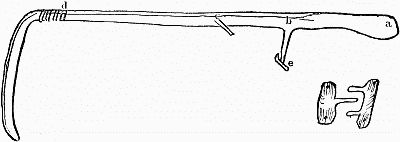
The scythes used in this country nearly
resemble those of the Norwegians, but differ
in this respect, that the upper projection
from the handle stands out horizontally,
see figure e, b, while the lower, c, is perpendicular,
and the top, a, which rests
against the arm, is flattened. The mower
is therefore obliged to take hold of the
foremost projection, with his left hand,
under the main handle. The advantage of
this is, that he is able to move forward in a
nearly upright posture. The Norwegian
however walks still more erect in mowing.
The proportions of this Kimi scythe are as
follows: From a to b one foot and a half;
b to c two palms and a half; c to d two
feet; the breadth at b two inches in a right
line. The length of the projection b is
three inches; and of c the same. The blade
is like our Smoland ones, but stands at an
acute angle with the handle.
The harrow consists of four or five links,
in each of which are twelve joints. These
have alternately one and two projecting
pieces each. (See the figure annexed to
the scythe just described, p. 159)
In the stage-houses (see p. 156,) boilers
are fixed in the walls, for boiling horse-dung,
which is given as food to the cattle;
as well as to heat water for pouring on reindeer
moss (Lichen rangiferinus), which is
also used for the same purpose; but such
diet gives a loathsome taste to their milk.
In the roof of these houses hams and salmon
are smoke-dried.
During the winter the people are obliged
to work in their miserable cabins or Pyrter,
when they open their shutters; but
nevertheless find themselves sufficiently
warm.
The annexed cut represents a sort of
plough, used at Kimi.
a, the base, is three palms long and one
broad.
b, b, handles, each a palm in length.
c, d, shafts, six feet long, and of a round
figure.
e, e, chains by which the shafts are attached
to the collar or yoke. The distance
betwixt e and e is three feet.
f, f, a straight or flat cross bandage.
g, m, the base of the plough-share, three
feet in length, and two palms and a half
broad.
h, h, points of the share, five palms long;
distant at their base one foot three inches,
at their extremities two feet.
i, i, a chain of long links, fastened to a ring
that embraces the base of each point of
the share, into which chain, at k, is introduced
the handle l; this acts so as to
bring the points together rather than to
separate them.
It must be observed that the inner edge
of these points is turned downward, so
that when the handle or spatula l is put in
at k, and is laid upon one of them, the
earth is thrown on one side, and this is
done alternately with the two points. The
part m is slightly curved, as well as the
points proceeding from it. When it is intended
to make a deep trench, as in cutting
through turf in the marshes, l is laid
parallel to m, while the rings at f, f, as well
as at i, i, prevent the plough-share from
going too far downward.
No kind of plough is used at Tornea, all
the ground being turned over with the
spade. The same is the case at Kimi, except
in the fields where rye is sown, and
these are ploughed with the plough just
described.
It is a common custom at Kimi to furnish
out a table with five or six plates, and
as many spoons, napkins, &c., though only
one or two persons are expected to dinner.
There is at the post-house a free table (or
ordinary).
In the land belonging to the clergyman
of Kimi, I found the (Lythrum) Salicaria
with a very unusual aspect, having alternate
leaves, and a solitary flower in the
bosom of each. (The original specimens in
the Linnæan herbarium have two or more
flowers to the upper leaves.)
My intention was to have extended my
journey into the province of East Bothnia;
but on applying at the post-house, I could
neither procure a horse, nor any thing to
eat, for the inhabitants either could not, or
would not, understand me. I therefore
took leave of them the same day I arrived,
and turned my steps backward.
The Finlanders in East Bothland are
dressed very much like the Laplanders,
and therefore agree with them in general
appearance. Their dress is the same with
respect to their cap, their light-grey jacket,
their breeches reaching down to the feet,
their half-boots, their belt into which they
stick their knife, and the use of hooks and
eyes upon their clothes instead of buttons.
But they differ in not having a high collar,
and in wearing a shirt and neckcloth, as
well as in having their coat open before.
They stick nothing into their girdle but a
knife, though some people carry a key at
the end of it. Their breeches are tied
round the knees.
At church I observed some men with a
girdle of black list, just as it was rent from
the cloth, wound two or three times round
the waist, which formed a contrast with
their grey jackets. The women however
dress in articles purchased from other countries,
and make quite a different appearance
from the Lapland females.
East Bothnia, being a low country,
abounds in marshes, bogs, and fens. The
grass is tall; but still there is such a deficiency
of hay, that they buy up horse-dung
at Tornea, and boil it, as I have said, in
the boilers built up in some of their houses;
in which also they boil water to pour over
the reindeer moss.
The bread used by the inhabitants of
this country in the present season of scarcity
was made principally of chaff cut fine
and ground.
The winter rye, sown but this day se'n-night,
had already sprung up, and made
the fields quite green.
I returned back to Tornea in the evening.
This being a fast day, I heard a sermon
in the Finnish tongue, preached at the
church of Tornea. A lawful wife was
churched, after her lying-in; which ceremony
was performed in the choir, near the
elevated part. The women in general had
either naturally white hair, or hair that
had once been brown, now turned grey.
Very few had it red. They wear their hair
rather straight.
The physiognomy of both men and women
is phlegmatic and stupid; the body
clumsy, the complexion bad, and the features
destitute of all delicacy of form or
expression.
The boundary between West Bothnia
and East Bothnia is not formed by the
river of Kimi, but by another smaller
stream, not far distant, on the left.
They catch Sijk (Salmo Lavaretus) in a
curious manner at this place. These fish,
like the common salmon, swim against the
stream, and for that reason are to be caught
only near large falls of the river, which
they are unable to ascend. The fisherman,
being furnished with a net fixed at the end
of a long pole, strips himself naked up to
the waist, and walks into the middle of the
strongest cascade. To prevent accidents
from the force of the water, a rope is often
tied round his waist, the other end of
which is held fast by a friend on shore.
Thus they catch the fish below the fall.
Seals are taken by various means, being
either shot with fire-arms, or caught in a
net. The latter, three or four fathoms
high, is made of hempen cord, as thick as
a goose-quill, each mesh being two spans
wide. This net is kept upright in the water
by means of oblong floats of wood, and
has no stones at the bottom. Four or five
such nets are frequently tied to the ends of
each other, and a large stone is attached
to the last, bound about with willow or
osier, which serves to keep the nets steady.
These are set in places where the seals are
known to hide themselves, for those animals
do the fishermen great damage, not
only by devouring fish, but by tearing the
fishing nets, from the destruction of which
the haunts of the seals are discovered.
When a seal comes in the way of the above-described
nets, he either thrusts his head
between the meshes, getting more and
more entangled the more he pushes forward,
or, as often happens, he is caught
by the foot.
On a sand-hill near the church at Tornea,
grew, in great abundance, Gramen
spicâ triticeâ maritimum, (Triticum radice
repente, foliis rigidis; Fl. Lapp. n. 34,
which, in the second edition of that work,
p. 23, I have, by the persuasion of my intelligent
friend Dr. Afzelius, referred to
Elymus arenarius, and what Linnæus here
says, confirms this determination.) Its blue
leaves looked quite different from all others,
and very handsome. I picked some seeds
from the spikes, which were as large as
grains of rye. Hence I was induced to
consider whether this plant might not serve
as a kind of corn, to be cultivated on such
dry and blowing sands, provided the proper
method of managing it could be discovered,
which surely would not be a very
difficult task. The advantage of this would
be that, by such means, many sandy tracts,
where nothing else will grow, might be
turned to advantage; and the perennial
roots, which no other corn has, would of
course save the trouble of sowing it annually.
Perhaps even these roots themselves
might, in hard times, serve for food.
The tall Finlander Daniel Cajanus, at
Stockholm, born in this part of East Bothland,
was the son of a clergyman. At his
birth he was no bigger than the generality
of children, and his health was very indifferent,
particularly with regard to his chest,
till the age of twelve or fifteen years.
I was informed that the inhabitants of
this neighbourhood often hear thunder in
the alps during winter.
In the alps of Tornea cold is brought by
a south wind, and mild weather comes
from the north, because of the sea.
The Laplanders consult several natural
objects by way of compass as they travel.
1. Large Pine-trees, which bear more
copious branches on their southern side
than towards the north.
2. Ant-hills, the south sides of which
bear grass, the northern whortle-berries.
3. Aspen trees, whose bark is rough on
the north side, smooth on the opposite
part.
4. Old withered Pines are clothed, on
the north side, with the black Usnea, or
filamentous Lichen (L. jubatus).
By such marks as these they are able to
find their way through pathless forests.
Have we any guides so certain?
When these people kill any wild reindeer
with fire-arms in summer, they lodge
the carcase in a cold cellar, and cut it up
as they want it for provision.
I observed a curious kind of lime-stone
burnt at Kimi, Tornea, and other places
round the neighbouring sea-coast.
A very rainy day. A silver ore from Hjortot
has been assayed by the Mineral Board,
and found to contain forty per cent. lead,
but only three or four of silver.
Near the ferry at Tornea I picked up
the Fresh-water Sponge, Spongia lacustris
of Newton, (S. lacustris; Syst. Nat. v. 1.
1299. Linnæus here refers to Mr. Newton,
the friend of Ray, who found the
Sponge in question in the Norwich river,
where it still exists. It is however denominated
in Ray's Synopsis, S. ramosa fluviatilis,
not lacustris. Linnæus quoted
from memory.)
In dissecting the flower of Artemisia
(vulgaris), I was struck with its very curious
conformation. (This alludes to the
want of a limb to the corolla of the female
or marginal florets. See Fl. Lapp. ed. 2.
244.)
I went by sea from Tornea to Calix. The
wind proved contrary. The islands abounded
with Whortle-berries, and with the fruit of
Rubus saxatilis. On one called Korsholm
I met with a sort of Behen. Can it be the
same with that which grows in cornfields?
Their different parts are tolerably alike.
This grew among the pebbles of the beach.
Its calyx is oblong. Leaves narrow. Stem
erect. Fruit of one cell. In other respects
it resembles Behen. (This was Cucubalus
(Behen) variety the third, or γ, Fl. Lapp.
n. 180. ed. 2. 149. Silene maritima, Fl.
Brit. 468. Engl. Bot. t. 957. We have
found it remain for many years unchanged
in a garden, propagating itself by seed,
though Linnæus reports that the third year
he could not distinguish his from our common
Silene inflata, his Cucubalus Behen.)
The soil is various, sometimes clay,
sometimes sand. The corn-fields are sown
every other year, and lie fallow the intermediate
seasons, half of each field lying
fallow, while the other half is cultivated.
The former is ploughed during the whole
summer, to prevent the growth of grass or
weeds, which might exhaust it. Barley is
sown in these open fields only. Rye is cultivated
on land that has recently been
cleared of its wood by burning, but not in
any great quantities. Turnips and Rye are
sown together in one crop, and not, as
usual in other places, Turnips one year
and Rye the other. Rye bread is reserved
to treat visitors. Barley bread is of three
different qualities; 1. made of the unmixed
barley; 2. of a mixture of barley
and chaff; 3. of chaff without any addition,
except now and then a handfull or
two of barley. This last is their Spis-bröd,
or household-bread.
The plough is of the same construction
as that used in Westbothland.
Almost every person, except such as are
very poor, catches as many of the small
kind of Herrings, called Strœmming (Clupea
Harengus β, Membras of old authors,) as
are necessary for the support of his family.
Those who are not otherwise employed in
spring and autumn, catch them for sale
afterwards to such as have not time to take
any for themselves. These fish begin to
spawn about the 18th of May, and continue
till about the 16th of June. After
the latter period they go into the small inlets
among the rocks, and are taken by
means of large nets till St. Peter's day,
June 29th. This is called the large Strœmming
fishery. From St. Peter's day till St.
Bartholomew's (Aug. 24th), or even later,
they are taken likewise with nets in their
usual haunts. These fish are found with
milt as well as roe throughout the summer.
One barrel of sour Strœmming is as valuable
as two of the salted sort, the former
being greatly preferred. A peasant whose
family consists of a dozen people, takes
half a barrel of salt Strœmming for his
whole supply, and this is used to make a
kind of soup when boiled with turnips; but
he takes a barrel and three quarters of sour
Strœmming, which is eaten without any
preparation, like smoked and salted meat.
If the director of the family is a good œconomist,
he will never allow it to be boiled
or roasted. They let the fish which is to
make sour Strœmming lie for three or four
hours only before they take out the entrails,
after which it is washed in a small coarse
sieve, till most of the blood is removed.
It is then salted, in the proportion of
thirty pounds of ordinary salt to each barrel
of fish. The fish destined to make salt
Strœmming must be much more carefully
washed, for if the least drop of blood remains
it will turn sour. Every barrel of
this requires a quarter of a barrel of salt
which is disposed in layers, alternately
with layers of fish. Each layer of fish and
salt are rubbed together with the hands,
till a sort of scum rises on the top.
Another way of preparing salt Strœmming
is to make so strong a brine that the
entire fish, thrown into the tub, will not
sink. They put in only so many of the
fish as can readily be stirred about in the
brine. If the tub be so full that the brine
does not entirely cover the Strœmming,
more is added, and the whole is suffered to
remain for some days. The fish is afterwards
gutted in the following manner. A
person puts ten or twelve of them on the
thumb of his left hand, in such a manner
that the back of each fish is turned towards
the palm. He then very dexterously
loosens the gills with his right hand,
pinching out the gills and intestines at
once; which is performed with great quickness.
The fish are then put into a rope
basket, and salted as before. When they
have remained thus for a couple of days,
they are put into other baskets, in order
that the brine may drain away, and finally
are packed up in new kegs for keeping,
without any further salting. A hole is
bored in each tub, just above the lowermost
hoop, to draw off the brine, which is
always collecting from the fish, and if permitted
to remain, will cause the whole to
turn sour; but the same method is not
practised for the sour Strœmming. This
last is in its greatest perfection about St.
James's day (July 25th).
These people have three meals a day in
summer, besides breakfast, and the sour
Strœmming always makes a part of their
dinner, as well as of the preceding refreshment.
The fish, after being repeatedly
squeezed, is laid between two slices of
bread, and so eaten. After it they take
some sour preparation of milk, without
cream. Sometimes indeed they eat a bit
of cheese, or bread and butter; but they
never eat meat after the sour Strœmming.
Their vegetable food consists of cabbage,
pease, or turnips, the first being generally
eaten on Sundays. Pease are eaten once
a week, except when the cabbage is deficient,
and then they supply its place.
Turnips and salt Strœmming are generally
eaten in a morning, in the following manner.
When the turnips are boiled nearly
enough, the fish is put to them, but not
before, lest it should be broken to pieces.
To this some flour is added; and they
drink sour milk after it. Their supper
always consists of flummery, made of barley-meal.
Before they first go out in a
morning they eat either bread and butter,
or bread and cheese, but they prefer the
former. The mixed bread (made of corn
and chaff) is their ordinary portion; good
bread, made entirely of corn, they seldom
or ever taste. It is reserved for visitors, or
for very extraordinary occasions. Their
mixed or household bread, being baked in
cakes as thin as paper, is eaten by laying
four or five such cakes together upon each
other. They are never unprovided with ale
in their cellars, to treat visitors, though their
ordinary drink is table beer. In summer
time they always drink Syra, (see vol. i.
p. 243.)
The peasants themselves eat but very
little of their own mutton, and chiefly the
shoulder and brisket. The rest they sell;
scarcely any is kept in the house but the
above parts, with the marrow-bones, which
they break to get at the marrow. The
heads and feet of sheep, goats, and hogs,
are salted and dried, being, when wanted,
boiled with pease, and not ill-tasted. The
legs of sheep, cut off at the knee, are often
boiled fresh; the fat which floats on the top
being collected and preserved in a horn or
pot, as very useful to grease small ropes,
and wheels. The legs and feet thus boiled
are afterwards thrown away, not eaten.
The head and feet of a calf are usually
pickled.
For fire-wood these people use birch-wood.
They burn no candles in their
houses. They go to smoke themselves
with the Finlanders in their huts.
The hay is mown here in the same manner
as in Upland, and the corn is managed
in the same way as in Smoland. When the
season is dry, they prefer drying the corn
in heaps in the open air, as before described;
but in wet weather they have recourse
to sheds. The hay is spread out
till dry, and afterwards carried, without
being made into cocks.
They raise as many hops as are wanted
for each family, and have perhaps a few
pounds over, for sale.
Their pales are high, made of pine-wood,
and placed sloping.
The milk is set in the cellar, in deep tubs
made of alder wood, by which they obtain
a great proportion of cream, even two fingers'
thick. This cream is stirred up with
the milk, warmed, and then coagulated, for
making cheese. Another mode is with butter-milk,
to which they add a sixth part of
fresh milk, that has stood one day and
been skimmed. This mixture, being first
warmed, is then coagulated. The cheese
thus made is preferred to the former, and
often eaten in preference to butter.
Between Midsummer and St. James's day
(July 25th), the whey is collected, after the
cheese is made; which, after boiling for
some hours, is set by to cool. When cold,
it is barrelled up for winter use. Poor
people and old women beg or buy it, a
small bottle-full at a time. To one pot of
sour milk they add a fourth part of Syra;
and these together have the taste of what
they term Filbunke, which is sour milk
with the cream on, just beginning to ferment,
and of which they make Servet-mjölk;
(see p. 150.)
Thick milk (perhaps Mesosmör, see vol. i.
p. 243,) is often kept in barrels till winter,
as is the meal made of fir-bark, when both
serve for winter provision.
Syra is so very sour as not to be eatable
by itself. When they have no milk to dilute
it with, they add an equal quantity of
water to the Syra, and mix the whole with
flummery, which mixture they prefer to
small beer.
Butter is now and then made of goat's
milk; but it is very strong, and quite as
white as that made of the milk of the
rein-deer.
On islands near the shore I saw a Salix
with leaves like the cultivated olive. It is
a shrub three feet high, but growing in a
spreading manner. Stem grey, with roundish
dusky solitary buds, of a very large size, in
proportion to the plant. Leaves gradually
larger (upwards?), oblong-lanceolate, bluntish,
on scarcely perceptible footstalks, furnished
with an obtuse longitudinal rib beneath,
but no veins. Their upper surface
is green, sprinkled all over with minute
white dots; very slightly channelled, and
paler, along the nerve. (This appears to
have been S. rosmarinifolia.)
At the fair of Calix I obtained some information
concerning the commerce of this
country, which is very different from that
of almost every place in the world besides,
insomuch that I am unable to determine
which party makes his market of the other.
The townsman thinks it is himself who
cheats the peasant, but I verily believe he
is the party who is cheated.
1. The general plan of traffic here is
bartering one article for another.
2. The merchant generally carries his
goods home to the peasant's residence in
the country, at whatever distance it may
be, or else conveys them to the fair, from
whence the purchaser is to fetch them.
3. When a townsman sets up trade as a
merchant, his principal aim is to get as
many country-people to connect themselves
with him as possible, who are to supply him
with their produce. These are termed
Gield-bonder, or creditors.
4. The advantage the peasants have in
thus confiding to the merchant the whole
of their goods, is, that the latter pays their
taxes for them to the collector, which must
be done either in ready money, or bills of
exchange.
5. When the merchant receives the goods
from the countryman, no price is fixed upon
them between the parties; but when the
former returns from Stockholm, he sets
down in his accompt-book nearly the sum
for which he has disposed of the articles
there. In this the peasant trusts to the
honour of the merchant, and is paid accordingly.
6. These prices are not communicated
to the countryman immediately, nor does
he know the price of the salt, tobacco,
corn, and other articles, with which the
merchant supplies him in return, till they
settle accompts; which does not take place
till the end of every year, or perhaps not so
frequently.
7. As long as a peasant keeps to one
merchant, he is allowed credit, and obtains
advances of any money for which he may
have occasion, even although the goods delivered
do not amount to the interest of the
sum lent, which is sometimes equal to 1000
dollars. But if he carries any of his goods
to another merchant, he must immediately
pay what he owes to his original correspondent,
or suffer a sequestration of his property.
8. The countryman never brings his
own goods to market, unless he happens
to be going that way, in which case he
usually takes them with him, but otherwise
it is expected the merchant should fetch
them.
9. When the towns of this part of the
country were first built, each had certain
parishes appropriated to it, and these were
called the trading district of each town, in
which no person who did not belong to the
town had a right to trade. These exclusive
privileges were subsequently annulled
by royal authority, and free markets were
established, where strangers as well as the
neighbouring inhabitants were equally permitted
to trade. This open trade has not
however taken place at Calix, partly because
the peasants are situated at so great
a distance from one another, and partly
because the merchants in the town conceive
that such a plan would ruin them,
they being in that case obliged to buy and
sell for ready money.
10. Here are no free markets, properly
speaking, but only Upbördsmoten (periodical
meetings of the collectors of the revenues
with the peasants). At these times
the townsmen and the peasants meet together
at the place of rendezvous, as at Calix
every year on the 19th of August, and at
Tornea in the depth of winter.
The inconveniences of the above plan of
trade are,
1. The merchant lays considerable sums
fast, with which he might otherwise extend
his commerce.
2. He has the trouble of carrying his
goods to the house of the peasant, where-ever
it may be, up the country, and of
bringing what he takes in exchange from
the place of rendezvous to his own house in
town.
3. The consequence of such a plan is,
that many a merchant has outstanding
debts to the amount of 100,000 dollars,
the greater part of which he may never
get paid.
The inconveniences to the countryman
are,
1. He runs in debt more than he can
ever pay.
2. The merchant has the advantage of
fixing what price he chooses on his goods.
3. He is not allowed to take any measures
for his own profit.
The collar of the shirts, worn by the inhabitants
of Finland and East Bothland
in this neighbourhood, resembles ours,
their sleeves being more like those of a
woman's shift.
Young women here commonly wear the
bosom open, and have nothing over their
shift, which is gathered round the waist
like a petticoat.
The country of East Bothland is chiefly
inhabited about the sea-coast, and on the
banks of rivers.
An Aurora borealis was seen in the night
of the 18th of August, and had been visible
for a week past, so early does it begin here.
The rowers of the boat in which I pursued
my progress had blisters on their hands
caused by pulling at the oars. Their specific
was the ladle with which they had just
been stirring the pot where fish was boiling.
This they applied, hot as it was, to
the part affected, and the blisters disappeared.
What is here called Taim is a sort of
salmon, two spans in length at most, the
tail scarcely cloven, the mouth not hooked,
but otherwise like the common kind. (This
is probably the Salmo salar in a young
state; and may perhaps be the Laxunge,
or Salmo minor, vulgari similis, Artedi
Spec. 50, not 80, mentioned in Fauna
Suecica, ed. 2. 122, though Linnæus has
no allusion there to the Taim.)
As soon as the corn is carried from the
field, it is usual to thrash it slightly, that
whatever is loose may come away, and
not be lost in the barn, as also that the
coarser part may be separated from the
finer.
The flail is about a yard long, and rather
thick.
The roofs in this part of the country are
made of the bark of birch-trees, not covered
over with any turf, but held fast by
round poles, as thick as one's arm, whose
upper extremities, alternately longer and
shorter, reach to the ridge, and being
bored through, are fastened to it, in such
a manner that their ends project about a
span each way beyond the ridge, crossing
each other. Being thicker at their lower
ends, they lie almost close together. Within
this there is often a false roof, like a cieling,
covered over with birch-bark and earth;
but this is only when the house is wished
to be very warm.
At the residence of the Governor of the
Province at Calix, I saw three swans, which,
having been taken when young, were as
tame as domestic geese, to which these
birds are so much alike in every respect,
that I can have no doubt of their belonging
to one genus. Their bill is flat, and
black at the extremity, as well as the
margins, convex and somewhat angular in the
middle, so far at least that the swelling
part terminates in an angle. The middle
is fleshy, where the oblong nostrils are situated;
the base flat or quadrangular, with
two sinuses pointing upwards, and pale-coloured.
The margin is toothed just like the
Concha Veneris (Cypræa).
A carriage called Stotting is used here,
for bringing home wood for fuel in winter,
over the ice and snow. It is made of birch-wood,
and resembles a sledge.
The length of this machine from a to b
is three feet and a half, the breadth of each
beam four inches and a half; their thickness
two inches, except in the middle, at d,
where it is three inches and a half, though
in all the other parts of equal dimensions.
The transverse bar, c, is one foot and a half
long, three inches and a half broad, and is
elevated four inches above the longitudinal
pieces. e, e, are two slender triangular
pieces, two feet in length, and two inches
in thickness. f, f, are about one palm and
a half each in length and breadth. h is
curved upwards about two palms and a
half out of the straight line. g is two feet
long between the main beams, three inches
and a half broad, but scarcely one in
thickness.
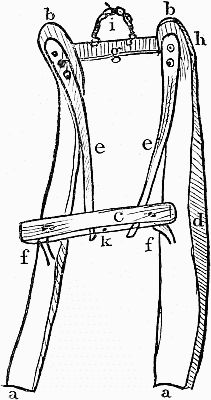
The sledges, or beams, a, b, differ from
the common ones in being broader, and in
the elevation or thickness of each at d.
The transverse beam c, on which the load
is laid, is bored through at each end, to receive
the supporting pieces. The slender
bars e, e, which may be termed clavicles,
are broadest in the fore part, where they
also are bored through, and fastened with
pegs, serving to give stability to the cross
beam c. Two of these carriages are tied
together, one behind the other, through the
hole in the cross beam, at k. The loop, i,
is made of birchen twigs.
At Calix I found the Hippuris (vulgaris)
with forked branches; Pentaphylloides
facie fragariæ, (Potentilla rupestris?);
and Eruca foliis sinapeos. (What this was
does not appear.)
I noticed lime-stone in the cliff at Calix
and Tornea.
The scythe which serves at Cronby in
East Bothland, for mowing barley, is made
exactly like the common one of the Finlanders,
with the foremost handle underneath,
but, that nothing may be wasted or
lost, the machine b c is fixed to the scythe,
b being stuck into the hole at a, and fastened
with a pin through it at the other
side. A cord is tied from the other end c
to the handle d, before the scythe is used.
The lower, or shortest, bar of this appendage
scarcely extends beyond the extremity
of the scythe at f. Its position is
regulated by a cord, according to the inclination
of the blade f g.
The length of the main handle of the
scythe, e f, is two ells.
I collected and described various species
of Fungi.
(Here follow descriptions or characters
of several species of Agaricus, Boletus and
Hydnum, given more correctly in the Flora
Lapponica.)
I stood sponsor to the son of the Burgomaster
Geyer Svanberg, who was born the
preceding night, or rather between one and
two in the morning. He was named Geyer.
Mr. Svanberg told me the (Cotyledon)
Umbilicus Veneris grew on a hill called
Karvick, near Wallivari to the north.
(This probably was not confirmed, as the
plant does not occur in Flo. Suecica.)
I went to Biorknas, in order to be instructed
in the art of assaying.
I examined the fish called in West Bothland
Natting, (Petromyzon fluviatilis.) Its
upper jaw is acutely notched, resembling
two teeth. The lower has seven small
teeth, of which the two outermost are
largest. Mouth in the under side of the
head, gaping, oval, rather compressed.
There are seven openings in a row behind
the eyes, gradually larger as they recede
from thence. The fins have no visible
rays, but merely streaks, yet they are not
adipose, or fat, fins. There is a prominent
orifice on the top of the head. The pericardium
is cartilaginous. The fish is a span
long. Its hind fin triangular.
These (lampreys) are caught at this time
of the year, when the nights grow dark, in
hollow timbers of a conical shape, resembling
the wicker baskets used for catching
eels. The entrance is made smooth and
even. These timbers are laid, at the depth
of two ells, in the river, and kept down with
stones, the opening being turned to meet
the current.
Some such traps are made of willow-twigs
not bigger than goose-quills, platted
close together into the same shape, and are
two ells in length.
I was told that the Laplanders are accustomed
to preserve blood of the reindeer
in rennet-bags through the winter till
spring, when they boil it with water, and
drink it.
Tar is obtained in the following manner.
A cavity, of an inversely conical shape, is
dug in a hill, and then lined with hewn
timbers, nine ells in length each, so as to
form a sort of funnel. This again is lined
with bark of pine-trees, so as to prevent the
tar draining away into the ground between
the timbers. At the bottom is another
funnel or vessel of wood to receive the tar,
which runs from thence into a trough, closed
on all sides, except a hole where the point
of the said funnel is inserted, and another
at the extremity, closed with a moveable
plug, from which the tar is received into
vessels and taken away. Roots of fir, cut
to pieces, are placed upright in the large
funnel above, so as to leave a convexity
over the bottom, and the whole being covered
with turf is set on fire, against the
wind. Care is taken, by varying the admission
of air, to prevent its burning too
fast, or unequally; and by this means they
procure both tar and charcoal.
I took my leave of Biorknas. The weather
was cold and rainy. Such of the forest
trees as are of a deciduous nature had
now assumed a pallid hue, in consequence of
the cold nights; but the evergreens, with
their needle-shaped leaves, standing among
them, seemed to defy the cold, and were rendered
conspicuous by their dark-green colour.
The high wind scattered the withered
leaves over my path. How useful are the
usual storms of autumn to disperse ripe
seeds, and plant colonies far from the parent
trees! The hills appeared sandy; and such
places as had been burnt were now perfectly
white with Reindeer Moss, (Lichen
rangiferinus,) which grew so close together,
as hardly to leave any room for the
Ling. It ornamented the sides of the roads
like the Iceland Moss, (Lichen islandicus.)
Some part of the road consisted of a
reddish-brown earth, such as I had observed
in the early part of my journey
near Umœa. I was told that it was excellent
for red paint. At length I reached
Zingis, and in the evening arrived at Tornea,
entirely wet through.
I observed how they manage their corn
at this season. They have no barns to lay
it into, but it is placed between poles, all
the ears directed to one side, in stacks two
or three ells long, and very high. If the
corn be not quite dry, it is first spread
abroad. Afterwards it is dried in a kiln,
and thrashed on a floor. How liable must
it be to take fire, and how much must unavoidably
be spilt in consequence of such
management!
I received 100 dollars, of copper-money,
from the chief clergyman.
I learned here that Tansy (Tanacetum
vulgare) and Mugwort (Artemisia vulgaris)
are used to make a fomentation or
bath, wonderfully useful for women in labour,
who are accustomed to sit over the
steam of these herbs. I had observed the
people at every house drying Tansy, but
could meet with nobody who would inform
me to what use it was destined.
This day I again left Tornea for Kimi.
There are six ferries between these two
places, over the river Kokama, which passes
near Kimi. Two miles from hence are the
boundaries of East and West Bothnia.
Lime-stone attracted my notice all the way
along the road to Norbotn; it was yellow
on the outside, whitish within.
I departed from the posthouse of Kimi.
The weather was unfavourable, for it rained
all day long. I took up my lodging in the
evening at the posthouse of Jö. This part
of the country lies very low, abounding with
marshes and numerous small rivulets, but
few hills. There is plenty of grass. The
buildings are bad. The forests consist
chiefly of Birch, intermixed with the acifoliæ
(slender-leaved evergreens). Of these last
the Juniper was remarkable for its abundance
and large size, so as to be almost arborescent.
The Birch and the dwarf Willows
had now become pale, but the Sorbus
(Mountain ash, Pyrus aucuparia, Fl. Brit.)
had assumed a red hue, as well as all the
mosses. (Pedicularis) Sceptrum Carolinum
appeared every where by the roadside.
Thalictrum (flavum) and Scutellaria
(galericulata) were less frequent, but Golden-rod
(Solidago Virga aurea), Trollius
(europæus), (Spiræa) Ulmaria, and Epilobium
(palustre?) were plentiful, as was the
sweet Milium (effusum), with the Gramen
ramosum (probably Aira cæspitosa.)
The inhabitants were in their smoky
huts, with their eyes full of smoke, and the
tears running from them. Nevertheless
they seemed more studious of warmth than
careful of their eyesight.
The same sort of plough is used here as
at Kimi.
I had frequent views of the sea through
the woods on the right hand. Wherever the
waves had thrown up sand-hills grew a pea
with a triangular stem, a white creeping
perennial root, and thick leaves alternately
pinnate, (Pisum maritimum).
Near Jö I noticed a pit-fall designed to
catch wolves. This was dug in a hill, at
no great distance from the house. Around
it within were eleven pales or stakes, placed
upright and close together. In the centre
stood a pole, which, as well as the pales,
was on a level with the surface of the
ground. The pole supported a wheel, over
which were laid boards, so as entirely to
cover it, in such a manner that if the wolf,
when caught, should be able to climb up
as high as the wheel, he might not get any
further.
The peasants of this upper part of East
Bothnia, children of darkness in their houses,
are no less so in their slovenly appearance,
chiefly owing to their uncombed hair. Their
breeches reach as low as the feet, and are
white, and they wear a sort of short cloak,
sewed together in front.—Their disposition
is quarrelsome. Their habitations are infected
with a smell of sour fish, like sour
Strœmming, for they are kept very dirty.
These people speak no other language than
the Finlandish.
Here and there by the road I had this
day travelled, I noticed the Sea Wheat-grass,
(Elymus arenarius. See Fl. Lapp.
ed. 2. n. 34.)
I travelled from Jö to Ulaborg. The
rye was bound into sheaves, ten of which
were piled up together in a heap, the ears
at the top of each being brought close
together, and another sheath being placed,
in an inverted position, upon them, the
whole was sheltered from wet. The barley
was not set upright, but laid on one
side, in such a manner that the ears were
all turned inward, and the straw stood outward
all round. On the top of each little
stack thus formed, a reversed sheath was
put, as a kind of covering.
The villages consisted of the same kind
of smoky huts I have already described.
(The annexed cut seems to be a representation
of one of these dwellings, at which
Linnæus was so indignant.)
Near the ferry of Haukipudas, stones are
collected from the shore, which, though
nothing but concretions of sand and small
pebbles, are so firm as to serve for the construction
of ovens. At one spot, where the
river had excavated the sandy bank, it was
evident that the cement, which combines
these particles together, is no other than a
rust of iron. The stones in general hereabouts
are very fine-grained, and break
easily. They have all the appearance of
containing a portion of iron. Some were
more rugged and rusty than the rest.
A kind of boats used here to navigate
rapid and dangerous parts of the rivers,
are made of thin planks of spruce fir, and
are four or five fathoms long, and about
one broad in their middle. The sides are
five or six quarters of an ell deep; the extremities
compressed. The middle of the
boat is nearly semicylindrical, the keel
being raised up, or hollowed as it were by
the dilatation of the sides, in which all the
importance and peculiarity of the contrivance
consists, for without this the vessel
would be much more easily overset in rapid
and shelvy places. Some of these boats
have no prominent keel at all; others are
furnished with a slight one, chiefly in their
forepart, which is a little the highest, in
order to bear the better any shocks from
striking against stones; so that if this
part be able to pass, the rest of the vessel
may go in safety.
One sort of nets used for catching Sijk-fish,
(Salmo Lavaretus, or Gwiniad, before
mentioned) are five spans high, and of a
considerable length, the meshes very small.
There are loop-holes at the top, large
enough to admit two fingers, bordered with
birch bark, whose edges are sewn together.
(See 1, 2, 3, 4 in the figure.) The stones
(5, 6, 7) at the bottom are but small, covered
with birch bark. The nets are set
near the sandy shore.
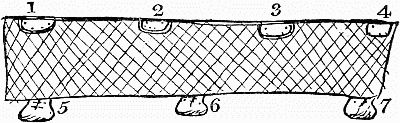
Another kind of net, used for catching
the same fish, is placed in the strongest
part of a current or water-fall. It resembles
a receiving net, except being not so deep.
The length is three ells, breadth two, and
depth one. This is fixed very steadily, by
means of poles, in the middle of the very
strongest and most confined current, against
the stream, so that when the fish attempts
to pass upwards, by the narrow passages on
each side the net, he finds it impracticable,
and is thrown back by the force of the
water, generally into the net, out of which
he can never escape, but is taken out at
leisure.
Near Ulaborg is a mineral spring, not yet
made any use of. The taste of the water
seemed good. This spring is situated close
to the town, on a small island, where there
is a sawing-mill.
In the church I noticed the monument
of Messenius, with his effigy made to the
life. He is actually buried here[14]. This
church is one of the longest I ever saw
built of wood, but its height is not correspondent.
The arms of the town are displayed
on the pulpit. Ulaborg is almost as
large as Lund.
After attending divine service I left this
place. Sledges in use here are constructed
with a cross board to rest the feet against.
(a, seems to be a bandage or belt, to keep
the traveller from being suddenly jolted out
of this vehicle, and b is the part to rest the
back or head against; but there are no references
in the manuscript to these letters
of the sketch.)
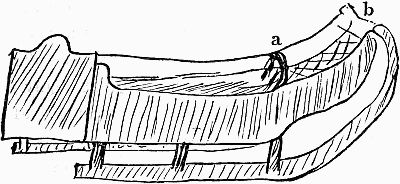
I now came in sight of the extensive
meadows of Limingo, more spacious than
all the meadow-ground of Tornea and Rödbeck
together. (Tuneld says in his Geography,
that the meadows of Limingo,
and cornfields of the neighbouring parish
of Storkyrro, are famous to a proverb for
their great extent.) At first the land seemed
a perfect marsh, filled with Horsetail (Equisetum
fluviatile), and especially with Reed,
Arundo (Phragmites), which last grew in
such abundance as to resemble a forest.
The Water Hemlock, Cicutaria aquatica,
Cicuta virosa; (see p. 136), was very plentiful
by the road-side. This led me to inquire
whether the cattle ever fed there?
I was answered by the peasants in the affirmative,
with a question in my turn, whether
I could give them any advice on the
subject, for they had lost a great many;
adding similar particulars to what I had
heard at Tornea.
Red Currants (Ribes rubrum) grew all
the way by the road, as well as Lenticula
(Lemna or Duck-weed), and the Lichenoides
of which powder is made was observable
on the trees. (Lichen prunastri, said
to have been used for hair-powder.)
The meadow of Limingo is two miles
in length. The best part of the land, near
the village of that name, was now occupied
by the horned cattle. The land here is
more elevated and less marshy, though
somewhat impaired by tumps (of Carex
cæspitosa). If but a third part of it were
cultivated, according to the Scanian mode
of husbandry, it would be of more value
than the whole is at present. I was told
that the whole marsh might be laid dry,
by cutting a channel down to the seashore;
but it was feared that the land
might in consequence become covered
with White Moss (Sphagnum palustre),
which would render it altogether unprofitable.
About a thousand hay-cocks were now
before me on the meadow, but none of
them consisting of more than a horse could
draw. They never here use more than a
single horse or ox at a time for draught.
Each of these cocks was raised from the
ground on a kind of scaffold, supported by
several cross poles. Some of the Water
Iris (Iris Pseud'acorus) was mixed with
the hay.
The milk-strainers are made of straw,
and not very clean.
Brabestad, not far distant, is a small
town, though twice the size of Tornea,
standing on a peninsula by the sea.
In the hospital of Cronby are many maniacs,
whose insanity is said to have arisen
from jealousy of the conduct of their wives.
One of them, whose wife was a very old
woman, took this fancy, supposing her to
intrigue with several other men. Possibly
in these cases impotence, or perhaps some
fantastic concupiscence, may have been a
cause of the derangement.
About this neighbourhood it is the custom
to administer to women in labour a
very nauseous medicine, which is called
Hittatran, or Casual Train-oil; so termed
because it is obtained from the carcases of
such seals as, having been killed early in
the spring, have been left among the broken
ice till they are by chance cast upon
the shore. They are consequently putrid,
and the oil is so offensive, that few persons,
except such as are in great extremity, or
not very nice, can be brought to take it.
In general Castor is here considered as a
sheet-anchor in such cases, as being found
by long experience very effectual in bringing
on the labour-pains. Others take saffron
infused in wine. For after-pains they swallow,
as at Kimi, a few drops of blood
from the umbilical cord, not only in the
woman's first lying-in, but every subsequent
one.
Some Finlanders, as I was told, have a
method by which they pretend to catch
bears, with a sort of magic. This is done
by procuring some of the bear's dung, fresh
and warm if possible, and mixing it with
that of one of their own cows. The consequence
is said to be, that the bear will be
attracted by sympathy to come after the
cow; an effect certainly not more wonderful
than many sympathies upon record.
There is a fish in the lakes near Pyhejorki
which is called Muicu. Bishop Terserus,
a Dalecarlian, bishop of Abo, says
that he has seen at this place a fish named
Muicu, which is no other than the Blikta,
taken in the lake of Silian in his native
country. How true this may be I know
not, but I saw plainly that this Muicu is
the Small Sijk (Salmo Albula), such as is
found in Smoland.
The following figure represents a plough
used here, drawn by an ox. The share, a,
is of iron, a span long. The part b is four
spans high; c is four spans long; d and e,
three spans each; f, g, four spans. The
ends of the shafts are connected by a curved
piece of wood, which keeps them from
the shoulders of the animal, and supports
them.
Being the feast of St. Matthew the apostle,
I went to church at Gambla Carleby.
Here is an introductory school, to prepare
children for that at Cronby.
I passed on to Jacobstadt, which has a
remarkably good harbour. Ships are able
to load and unload close to the quay.
Leaving Jacobstadt, I arrived at the town
of New Carleby, which is nearly as big as
Wexiö. Every one of the streets is laid
with timbers, placed cross-wise, instead of
stones, like a bridge, which has a handsome
appearance. The harbour of this
place is near the river, a quarter of a mile
from the town. Vessels when laden indeed
can scarcely come within half a mile.
On the shore lay vast piles of wood, destined
to be conveyed to Stockholm for
fuel.
The country-people have, in every one of
their mills, an instrument made of six or
seven blades or hatchets, serving to cut
chaff into small pieces in a trough, in order
to grind it afterwards with their barley.
Rotkäl (Brassica oleracea κ, Sp. Pl.
932, Napo brassica, or Stalk-cabbage) is
dried for winter use; when it is boiled, and
given with the liquor to the cattle.
The women at this place wear a hood, or
neckcloth, as they call it, of grey walmal
cloth, but only in bad weather. It is tied
with a black ribband in the fore part.
When they ride on horseback, they carry
the whip slung at their back.
To stir up the pot, when boiling, they
use a stick with several projecting bits of
wood at the bottom, (not unlike a chocolate-mill,)
which is rolled between their
hands.
In the evening of this day I arrived at
Wasa.
I went to church at Wasa, and visited
also the palace, situated on the south-west
side of the city, the school, and other
public buildings. This is a handsome little
town enough. It is the residence of the
governor.
Not far from the town, and indeed close
to the walls, is a reputed copper-mine, the
working of which was discontinued, after an
excavation had been made to the depth of
five or six fathoms. The ore has a glittering
micaceous appearance, and gives a stain
like black lead. The sand about it is a
loose talc, as if spontaneously decomposed.
I do not indeed believe that it contains any
copper or other metal; which seems to have
been the opinion of those who so soon gave
over the pursuit.
The rustics here trust to three doctors,
Beaver's-gall, Bear's-gall, and Pallavinus.
(By a chemical sign annexed, it appears
that Linnæus here meant brandy, but the
word itself is not explained.)
This day being Sunday, I saw the girls
all going bare-headed to church. They
each, however, carried an oblong-oval hat,
supported by broad coloured ribbands, the
ends of which hung down.
In my way from New Carleby to this
place (the day before yesterday) I had observed
a kind of plough in use, different
from any I had before seen. This was almost
always drawn by a horse, seldom by
an ox. The latter, when used, had the
same harness as the horse, but without a
girth. Over its back indeed passes a band
like a saddle-girth, which is kept upon the
neck of the animal to prevent the harness
sliding forward; but for horses they use no
such thing. See the figure.
The shoes worn at this place in some measure
resemble half-boots. The soles are of
untanned leather, with the hair upon it;
the upper leathers made of tanned seal-skin,
and tied round the ankle with strings.
(A representation of one of these shoes accompanies
the last figure.)
Hypericum (perforatum), Scrophularia
(nodosa), Bidens (cernua?) occurred to me
here, for the first time in all my journey.
The three species of Ribes (rubrum, alpinum
and nigrum,) were in prodigious
abundance.
At sun-rise I took my departure from
Wasa. The pines in the forest were stripped
of their bark, so that vast tracts were
covered with nothing but such naked trees.
No more was left on each trunk, to the
height of three ells or three and a half,
than a small strip of bark, about the breadth
of four fingers, generally on the north side,
to prevent its being ... (here is a word not
to be decyphered). The trees are left standing
for six or seven years afterwards, and
are then cut down close to the roots, being
also headed a little above the naked part.
The heads or branches either serve for
firing, or, as often happens, are left to rot
on the ground.
Three miles below Wasa I recognised
the Climbing Nightshade (Solanum Dulcamara).
In the town itself I had noticed
(Leonurus) Cardiaca, and Henbane (Hyoscyamus
niger). Near the shore grew
Salix oleæfolia with its berries, (Hippophaë
rhamnoides). It is known by the name
of Finnbær or Surbær, (Finn-berries, or
Sour berries). The fruit is situated below
the leaves, as in the Alder. The
footstalks are two lines long. Berries
bluntly oval, of a tawny orange-colour,
three or four lines long, smooth, sour, having
a watery pulp mixed with ochraceous
matter. Seed solitary, roundish-oblong,
slightly compressed, obtuse, attached by
its lower edge to a membrane which enfolds
it. When this cover is removed, the
seed itself appears brown and polished,
having a longitudinal groove at each side.
The fishermen eat these berries bruised,
by way of sauce to their fresh fish, but I
thought them rather too acid.
I passed Christina (Christinestadt), but
before coming to that place, noticed at
Nerpis a very extensive tract of land, which
had formerly been a fine meadow, the soil
being extremely good. But at present it
was so entirely overrun with tumps (originally
perhaps formed of Carex cæspitosa)
that it produced little or nothing. These
tumps were crowded almost over one another,
and were overgrown by Polytrichum
(Hair-moss), which had come to its full stature,
and rendered most of them nearly
black. There was scarcely room for the
cattle to make their way to any food between
the tumps.
In the passages of all the houses hung
nets, used for catching bears. These are
made of ropes of Lindenbast, (the inner
bark of the lime-tree, Tilia europæa,) full
as thick as a bridle or rein. The meshes
when stretched are each three quarters of
an ell wide. The height of the net is equal
to the stature of a man. Such nets, supported
by poles, are set up in a line of one
hundred fathoms in extent, the lower side
close to the ground. The bear is driven
into them by the people hunting him on all
sides.
This day I observed a mode of brewing
in a kneading trough, which stood on a
table, and its end being made so as to
slide up and down, the wort is easily poured
out.
Below the town of Christina, I first found
the Lathyrus viciæformis (L. palustris),
and Water Cresses, (Sisymbrium Nasturtium);
also Campanula persicifolia and
(Sedum) Telephium.
I was glad when I had done with the
very bad road which extends from the
Lappfierd near Christina, to Hwisbofiahl,
towards Biorreborg; a highway it cannot
be called, for it is exactly like the road between
the town of Umoea and Granoen.
(See v. 1. 141.)
Near Sastmola I first recognised the
Acer (platanoides) and Filix fœmina ramosa
(Aspidium Filix-fœmina?)
The road from Hwisbofiahl to Giolbohl
lies along the coast. The grass here was
remarkably tall, and full of all sorts of
plants; as the Ribes insipidum (alpinum),
called by the inhabitants Degbaer, in the
greatest abundance. (Viburnum) Opulus
and (Lonicera) Xylosteum here first re-appeared
after my long absence.
N. B. The shrub which Mr. Hojer informs
us grows on this island, with blackish-brown
berries, may perhaps be the Xylosteum,
as the colour of the leaves seemed to
agree very well. (Were it not for the above
indication of the colour of the berries, it
might, from the Flora Suecica, be suspected
that Linnæus had, in these two paragraphs,
written by mistake Xylosteum for
Periclymenum.)
The alpine Stone Bramble, Rubus saxatilis,
was extremely plentiful; and the Cultivated
Hop (Humulus Lupulus), growing
wild, afforded me great pleasure, as I contemplated
its ingenious manner of curling
round the Aspen trees (Populus tremula).
Here also (Anemone) Hepatica, and the
Cracca with toothed wings (stipulæ) and
striated flowers, (Vicia sylvatica,) as well
as the Orobus vernus, once more greeted
me. The grass with a dense spike-like panicle,
whose stems serve for cleaning the
inside of tobacco-pipes, (Agrostis arundinacea,)
grows copiously in this part of the
country; and reached higher than my
head. The marshes abound with Iris
(Pseud-acorus) and with Cyperus (probably
Scirpus maritimus).
The greater part of the road I had travelled
hitherto from Kimi lay so near the
shore, that, even in the woody parts of it,
the sea was frequently visible through the
forests.
I travelled the whole of Michaelmas-day.
When a Finlander has fired at a bear, he
immediately runs to one side, for the animal,
if not killed, is sure to run directly
forward, towards the smoke; by which
means the man escapes out of his reach.
The peasants who reside near the cliffs
or rising ground judge by the crows (Corvus
Cornix), of the approach of bad weather;
for these birds seek the marshy
country in the evening, before it comes on.
Ulvila churchyard seemed to abound
with sculls. I reckoned forty of them in
one heap. This churchyard is built round,
after the old fashion.
On entering one of the stove-huts of the
inhabitants here, it was so hot, that I
thought my nose would have been burnt
off. Nevertheless, the people within seemed
comfortable enough, and the boys, clad
in skins, were running up and down the
couch. The stove is constructed like that
of a bagnio in Smoland, but upon it is
piled a great heap of flat stones, to the
height of a man. The old women sit in
these huts half naked.
Between Hyfoeda and Taftnen is a river
almost navigable. In some parts, as I was
told, it is nine fathoms deep, and in one
place is a ferry across this river. Half a
mile from hence southward, close to the
road, between two small bridges which are
near each other, I noticed a sand-hill of
very fine sand, in differently-coloured strata,
some white, others reddish-purple.
In the evening I arrived at the town of
Abo, which is as large as Orebro, and well
built. It has often been ruined by the
enemy, and often burnt down by accidental
fires, which, if not occasioned otherwise,
might easily happen from the stoves of the
huts. I remarked that these stoves were
less lofty than some I had seen, and that
several stones lay loosely piled on one another
above the opening, which serve to
retain the heat.
The Finnish liquor called Lura is prepared
like other beer, except not being
boiled, instead of which red-hot stones are
thrown into it. Hence its purgative quality
from the iron.
Here I saw a flying squirrel (Sciurus
volans) from Tavasthia.
The long black rat, with a white lower
lip, catches birds, both on trees and in the
water. He holds fast by his claws, and
bites with his four prominent teeth. The
Finlanders call this animal Mink. (This
seems to be Viverra Lutreola, Faun. Suec.
ed. 2. 5.)
A quarter of a mile from the city is a
mineral spring, of which Tillands has taken
notice. (See v. 1. 43, note.) It is older
than that of Medevi (near Vadstena). The
current is so strong that one of the burghers
of the city has built a mill, to which the
water is led, but it does not always go.
Near the town a mine has lately been
opened, containing iron here and there,
with small quantities of pyrites. The
mountain itself is a black mica, immediately
adjoining to the city.
The library here is miserable. There
are two colleges close together.
I departed from Abo. The corn-fields
of Finland are beautiful, and resemble
those of East Gothland in their wide extent
and level surface.
There are regular ferry boats at stated
times to take passengers to the isle of
Aland.
I arrived at the place, near Brandoen,
where I was to go on board the ferry-boat.
The shore is a red rock. Passed over to
the island of Aland, the whole of which consists
of the same kind of red rock. The
palace of Castelholm, at present falling fast
into ruins, is built of this sort of stone.
The women use for dyeing a sort of rock
Lichenoides, of a brown stercoraceous colour,
(perhaps Lichen stygius, or omphalodes,)
which they boil in water with alum.
But Walmal cloth, and stockings, are dyed
without alum. Some add a little Arnotto
(Bixa Orelana).
Shoes like short half-boots are worn here
made of seal-skin.
In the evening of this day I passed over
the plain of Aland. There were abundance
of Finn-berries (Hippophaë rhamnoides)
by the road.
I sailed over the sea of Aland.
Near Esbro an iron mine has lately been
opened. About the church are sundry
sepulchral monuments. I noticed on the
small surrounding hills, as well as at Musangen,
very fine and lofty plants of juniper
resembling cypresses, the branches
erect and close, assuming a conical or pyramidal
figure.
About one o'clock in the afternoon I arrived
safe at Upsal.
To the Maker and Preserver of all things
be praise, honour and glory for ever!
Some observations relative to the Seal,
Phoca vitulina.
There are two kinds (or varieties) of
this animal. The Gr[)a] Si[)a]l (Grey Seal) is
the largest, of a grey colour, lighter, and
slightly clouded on the back. The Wikare
Si[)a]l (Creek Seal) is smaller, black on
the back, and very cloudy or wavy at the
sides. Otherwise there is no difference
between them.
The whelp at its birth is perfectly white,
being covered with white hair about an
inch long, which it loses in four or five
weeks, and becomes quite black. At the
same period it acquires more activity and
shyness than at first. The upper fore teeth
are six, very small, resembling those of a
dog. The eye-teeth slightly enlarged at
their outer edge, as in the dog, and furnished
with a little notch at their base.
Grinders six. Whiskers remarkably large.
There are two nipples a little below the
navel, which the female has a power of
drawing in, so as to leave holes large
enough to admit the finger. She lets them
out at pleasure to her young one.
The seal lies on its back while sleeping,
either on the ice or on rocks. They couple
soon after the feast of St. Matthew, September
21; and the grey seal brings forth
its young in January, the creek seal in February.
The male runs round and round
the female many times, with a yelping
noise, being very careful not to be observed.
When the female has young, the male is
very savage, and continually attends to
protect her. She brings forth but one at
a birth, which at first is dull and stupid,
easily caught. If thrown into the water,
however, he exerts himself with some activity,
and returns to the shore, not having
as yet acquired any shyness. But by the
time all his first coat of white hair is fallen
off, he begins to be timid. The growth
of the young seals is very rapid.
The seal, when out of the water, can
hardly distinguish objects at half a quarter
of a mile's distance at the utmost. But
in foggy and dull weather he sees better
than in sunshine. He never remains in
the water during moon-light nights. His
hearing is acute though he has no external
ears, and his scent is also very quick. He
can remain under water for nearly half
a quarter of an hour; but by that time
he must, at the peril of his life, come to
the surface to breathe, which he often does
within a fathom of the shore, and he afterwards
spouts out water.
Nets for catching seals are set right out
into the sea, from some promontory, to the
distance of twenty fathoms. These are
examined every morning, to see what is
caught. They are chiefly set from St. Bartholomew
(August 24), when the moon is
in her wane, till over St. Matthew's day,
September 21.
Grey seals are hunted in winter till
Lady-day. They lie upon the ice, often in
great numbers, close to a hole which they
have made in it. When they come out of
the water by this opening upon the surface
of the ice, the water they bring with them
freezes about its margin, so that in time
the edges become elevated, and it looks
like a well. If it should freeze over, they
travel to the south-west, till they can get
at water, always proceeding straight forward,
even though they meet with mountains
in their way; and they return in the
same direct line back again. The hunters
go with large poles, carefully approaching
the creek seal till they get near enough to
fire at him before he is aware. The grey
seal is taken with a sort of hook or harpoon.
The seals are able to penetrate through
the ice from beneath, lying on their backs
under water, be it ever so thick, but cannot
make their way into it from above.
END OF THE TOUR.