This war is being fought out, not in great
open battles, but in successive conflicts
from the security of trenches in what
"Papa Joffre" has called the "nibbling process."
It is not simple work but such as calls
for healthy bodies, trained minds, and steady
nerves. Quick action is often necessary. Independence
of thought, ingenuity and personal
courage, combined with implicit obedience,
make up the ideal soldier.
The training through which a civilian must
go, then, will be such as to develop these qualities.
Every syllabus of training must be drawn
up with this in view, and all the time the attention
of the officers must be kept on the fact that
the training must be such as to make soldiers
who will be efficient in the kind of war that is
being waged. Much that has been written in the
text books for armies has had to be discarded
as out of date. It is no exaggeration to say that
the British knew very little about modern warfare
when we went to France, in spite of the
fact that we had, during this century, waged a
war in South Africa, not to mention the numerous
border engagements in India. We did not
know the tremendously important part that artillery
was to play; we knew practically nothing
of the use of bombs; we had never made gas and
did not know its constitution; and in the work
of trench construction we were in the kindergarten
class. Our enemy taught us many of
these things and we learned them slowly. Now
we have reached his standard and gone past him
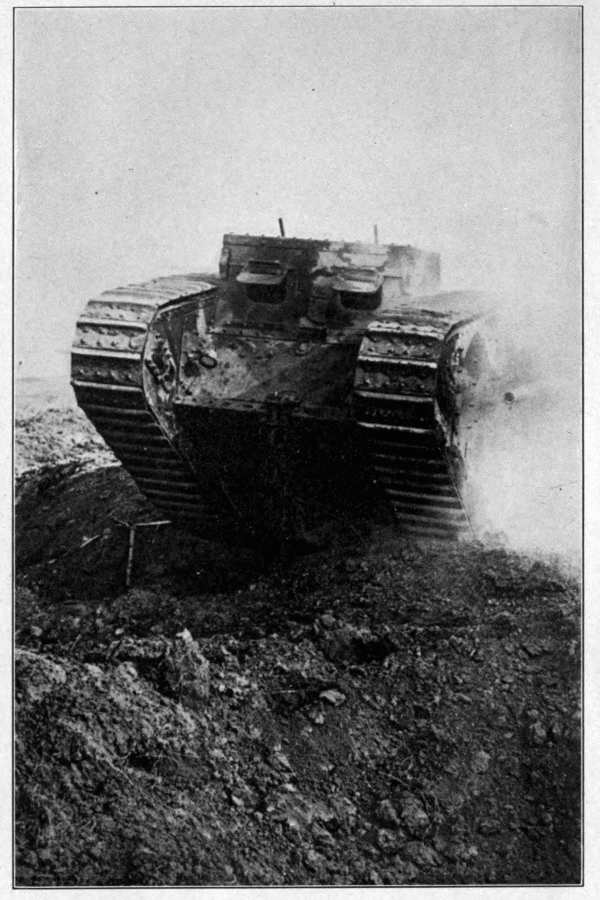
as the Tanks testify. But in pure frightfulness
we can never compete with him and never intend
to.
Eight hours a day of hard but varied training
was our rule with frequent evening lectures.
Conditions were arranged as much like those on
active service as possible, even to the use of
"live" bombs. Men are very reluctant at first
to handle these explosive little instruments of
war, and they must be given confidence in themselves
long before they reach the firing line.
There they are used as freely as a mechanic
uses a machine.
It is said that one general who was training
his men in the Midlands of England had a difficulty
in getting them to keep their heads down.
They could not see the necessity for it and always
wanted to see all that was going on. Now
in actual warfare the individual soldier is able
to see very little of what is transpiring round
about him, and he has to be content to come
through with a whole head. Accordingly the
General served out to a few trustworthy men a
number of live, ball cartridges. During the
manœvres the men who would put their heads
up heard some of these missiles singing round
their ears, and soon learned that it was unwise
to be too curious. I am not sure that I would
recommend this method—for were an accident
to happen it would bring disgrace and dismissal
to the officer who had employed it—but it is
certainly an effective means.
One of the first things to be insisted upon in
training a man is that he learn the use of Cover.
He must learn not only that cover is necessary,
but also what constitutes effective cover of various
materials. The most common form of cover
is that afforded by piled up earth. A rifle bullet
fired at short range will pierce about forty
inches of earth so that nothing less than
thirty-six inches can be considered as giving
protection from ordinary bullets. Where sand
can be obtained ten inches less will suffice.
Ordinary turf is not nearly so good and nothing
less than five feet in thickness is sufficient.
Bricks are effective. If they are placed end
on giving a thickness of nine inches this will
be found sufficient so that a man can feel fairly
secure from rifle bullets standing behind an
ordinary brick wall. Where wood is used much
depends on its degree of hardness; thirty inches
for hardwood and forty-five for softwood can
be taken as affording complete protection. Any
of the harder substances such as iron and steel,
etc., are preferable, but they can seldom be obtained.
Of ordinary iron plate three-fourths
inch is necessary and less for the different varieties
of steel. Usually several of these media
must be used. Boards can be arranged with
stones and sand or litter, etc., between them.
The point to be remembered is that the required
thickness must be obtained, not at the base of
the cover but at the top, to support which a
much larger base will usually be required.
When a man has learnt what thickness of materials
he needs to have to protect his life, it will
be a good thing to take him out and let him see
how far bullets are able to pierce these media
by actually firing at them from point blank
range. That will give him a respect for bullets
and impress the lesson on him.
But he must also be told that cover that protects
is only half what is required. It must be
such as to allow him to become offensive while
giving him defence. The problem is a simple
one in actual trenches, where he has no alternative
but to build them continuously and then
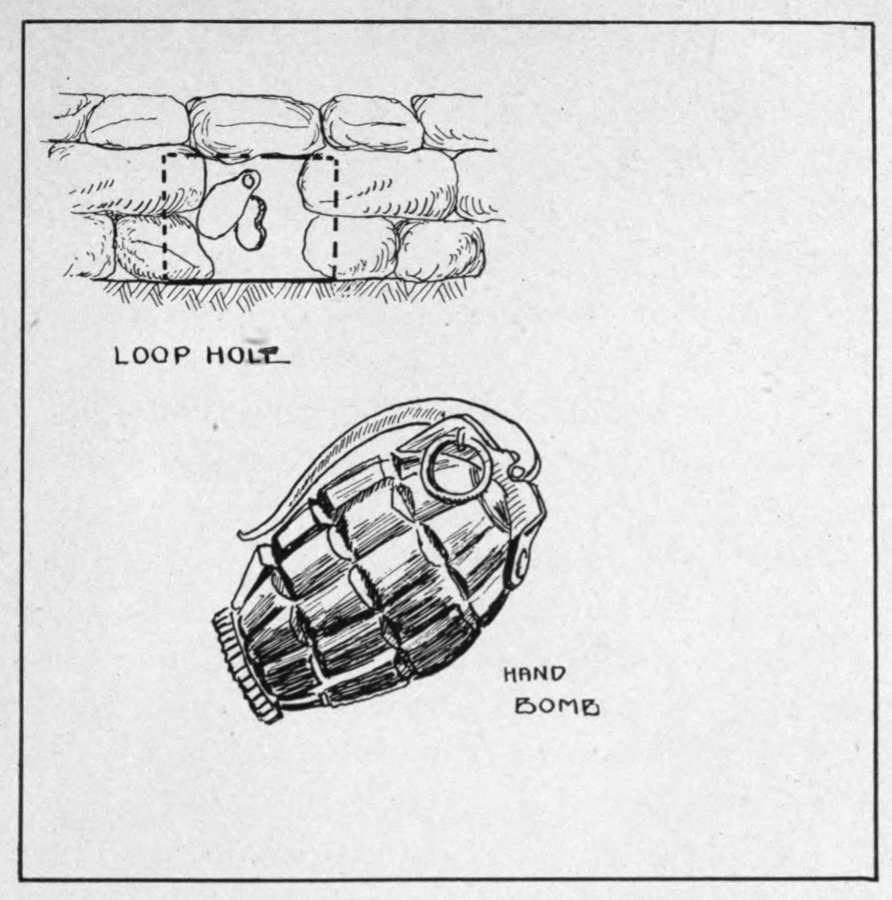
fire over the top or through loopholes of steel.
But when more open fighting develops he must
learn that his business is not only to get reasonable
protection for his own body but to be able
to bring his rifle to bear on the enemy. This
necessitates a certain amount of exposure.
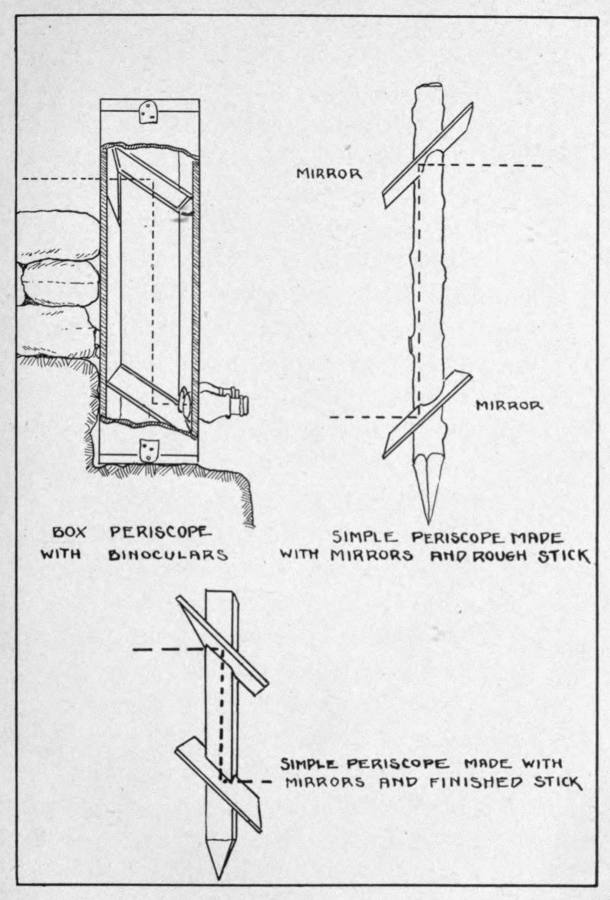
Certain devices have been developed during this
war to allow a man to fire his rifle from beneath
the parapet of the trench by means of specially
adapted periscopes. These are of great use for
snipers but cannot be used by all the men.
In open fighting men often make the mistake
of seeking cover in what is obviously the most
protected place from rifle bullets, but equally
obvious to those of experience as the most likely
place for the enemy to choose as marks for his
artillery. Orchards, woods, houses, etc., come
within this category, and it is only experience
that will teach a man what places to choose and
what places to avoid. Wherever the enemy can
view the approaches to these shelters, either by
direct vision from their positions or by means
of aeroplanes or observation balloons, they become
dangerous as cover.
Modern trenches are intended to give cover
from fire and from view. They are seldom
roofed over, so that, as a matter of fact, they
can be seen from the air, but it is not by any
means an easy task either for an aeroplane to
drop bombs there (a ditch three feet wide) nor
yet for the artillery to hit them. But we seldom
are able to inherit trenches—they usually have
to be dug under cover of darkness while the
enemy is sniping. For this purpose each man
in the British army carries a small entrenching
tool on his back, as well as two sandbags.
Every man is trained in the use of this valuable
little tool, and soon learns never to be without
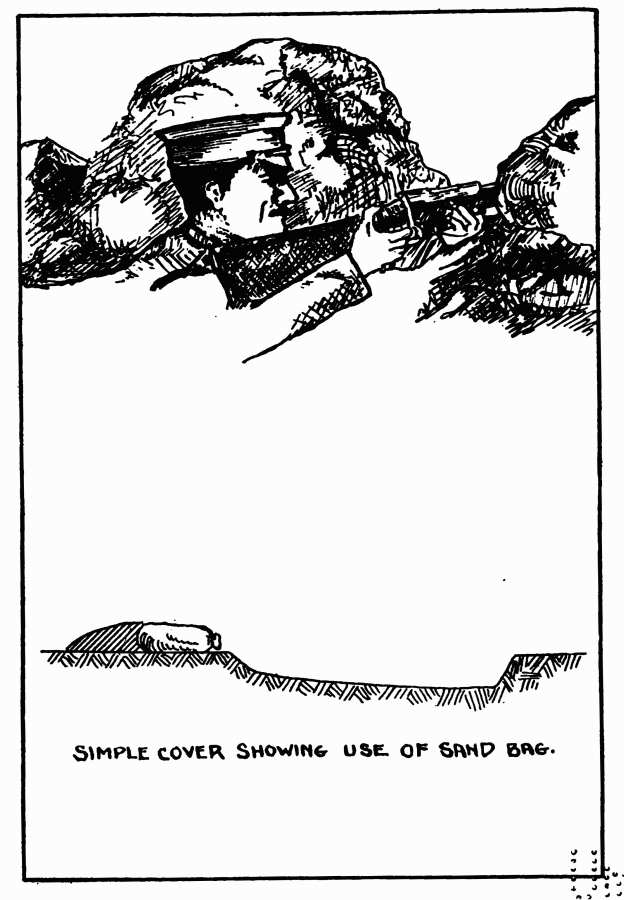
it. When, during an advance, he needs to provide
cover for himself, he throws himself down
on the ground placing his rifle at his left side,
and begins to dig away the earth at his right
side, throwing the loose earth up in front of
him. Just as soon as he can he takes the sandbags
from his back and fills them, placing them
in front of him. Under this imperfect cover he
proceeds to deepen the hole till he can roll his
body into it. This miniature trench should be
two feet wide and three feet long. Then if time
permits he should add small comforts such as a
recess for his feet, drainage for water, etc. He
will find that he needs to dig down to about two
feet, all the time throwing the earth out in
front and occasionally pushing it out a little so
as to make it of sufficient width, for, of course,
he will be seeking to get a parapet of about a
yard in thickness at the top. If he has an opportunity
of firing he should do so, not over the
top of his cover but round the right side of it.
To fire over it is to ask for trouble. The body
and legs should be placed in such a position that
they are covered as much as possible by the
earth thrown up in front.
If an advance has to be made from this position,
the small trench will have served its purpose
in giving temporary shelter. But there
are times when troops have to consolidate positions
won in this way, and on the site of these
primitive trenches, more elaborate ones have to
be made. At the battle of Neuve Chapelle the
troops took up a certain line, dug themselves
in in a rough way, and then during the night
they set to work to construct the very trenches
that still shelter them to this day. But it was
due to the entrenching tools and the few sand
bags that they were able to hold the line during
the hours of daylight, and when the next morning
dawned they had a fairly adequate protection.
While the question of cover is very important,
I do not wish to convey the impression that men
should have this subject always in their minds.
To use a rock or a tree or a mound of earth as a
temporary shelter is one thing; but to continue
to hide behind it at the time an advance is
needed, is another. The man who hesitates to
go forward when he has recovered his wind, but
who takes care of his precious skin by remaining
under cover, is worse than useless. The object
of all troops must be to get into touch with
the enemy and drive him out with the bayonet.
Cover will help to keep a man alive for a little
while to be able to do that work.
When through adverse circumstances—usually
the presence of the enemy in superior force—an
army has to go to ground, it sets to work
in dead earnest to build its trenches. We have
learned that the best fortifications that can be
got are those that are constructed in the earth.
The guns of Verdun have practically never been
in operation—indeed at the present time there
are no guns in the old forts—and the reason for
this is that earth works of such strength were
thrown up at a distance from the forts that the
Germans were never able to get their heavy
guns to bear on them. The forts of Liége, and
Namur, and Antwerp all fell before the great
howitzers, but the earth works of Verdun were
too much for them. It is doubtful if large forts
will ever again be used in inland places, for the
earthworks have proved their great superiority.
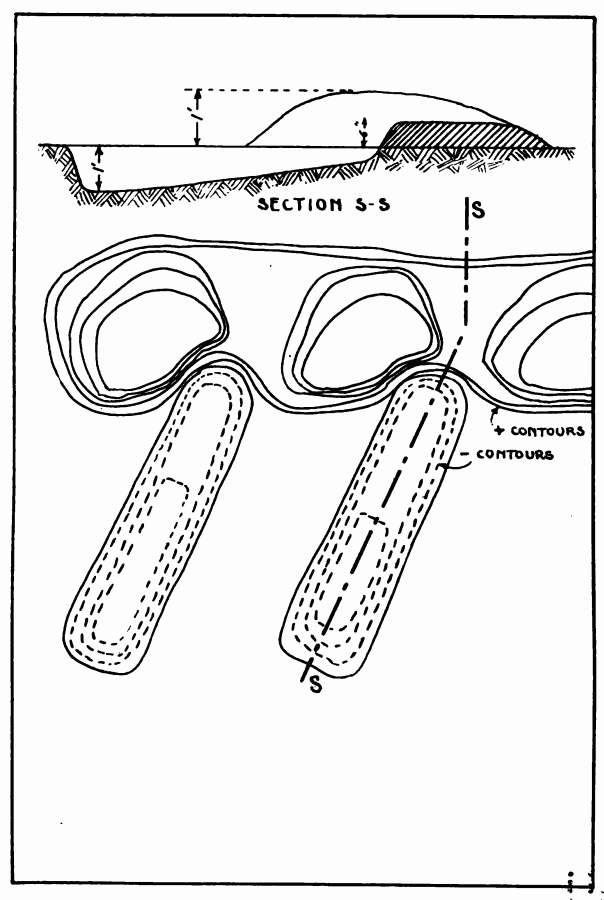
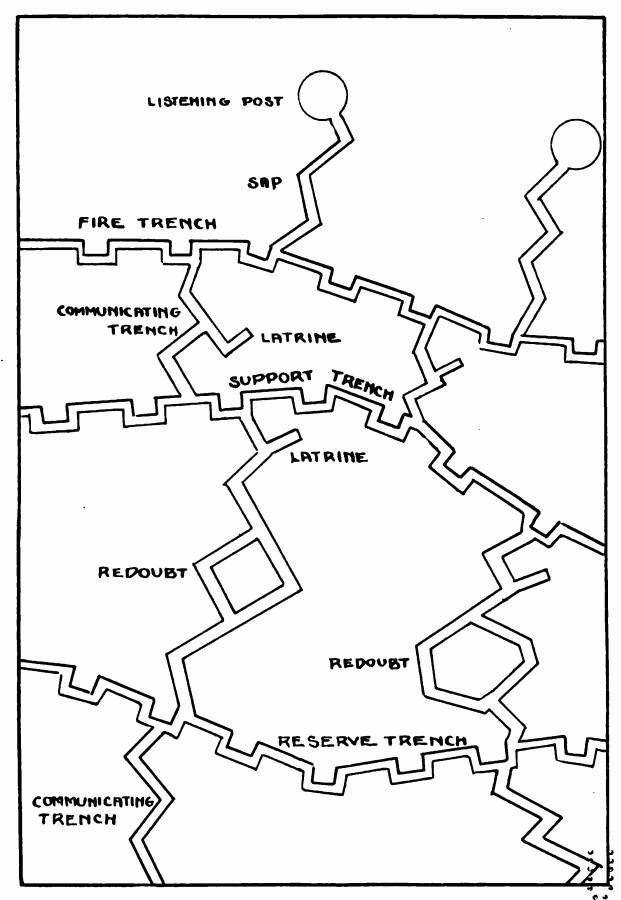
Trenches are laid out and dug as shown in the
accompanying diagram [Figure 4]. They do not
consist of one long straight line, but what may be
described as a succession of little rooms, about
twenty feet long, seven feet deep and three feet
broad. They are seldom roofed over. Each
little room is connected to the ones on either
side by a trench that runs behind the four-feet-square
traverse that is of solid earth and
which serves the purpose of localising the effect
of shells, bombs, etc. If the trenches were in
one straight line, a shell that fell there would
be liable to injure a great many men; whereas
under the present system the traverse acts as
a buffer and limits the radius of its explosive
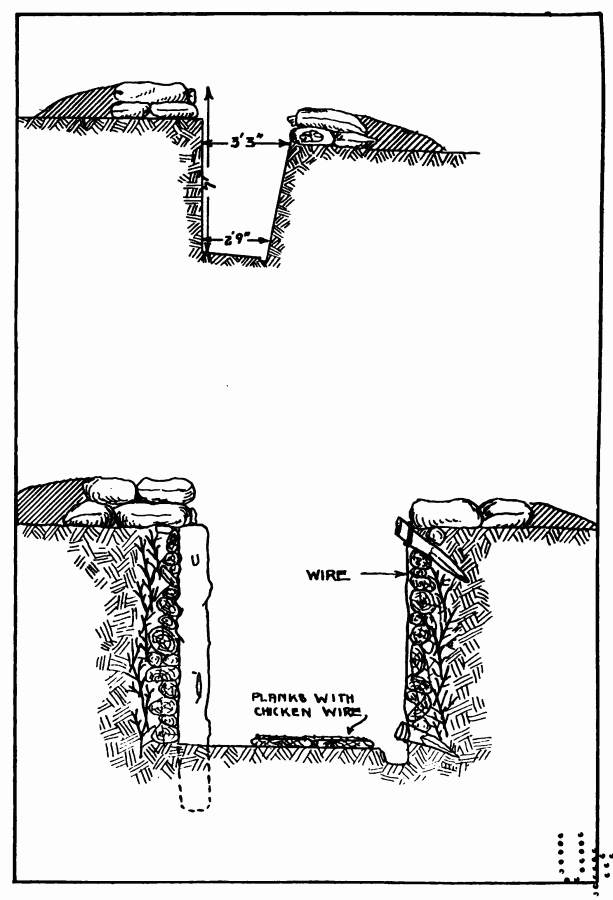
force. The trench itself is dug about three feet
deep, care being taken to lift off the top layer
of grass and keep it aside to place over the
front of the earth on completion of the trenches,
to render them less visible. As the earth is
lifted out it is thrown to the front and rear, and
some of it put into sandbags which are then
laid like stones as shown. The front part of the
trench is then called the parapet and the rear
part the parados. Both must be made strong,
the parapet for reasons already given, and the
parados in order to protect the men from the
force of shells that fall just behind the trenches.
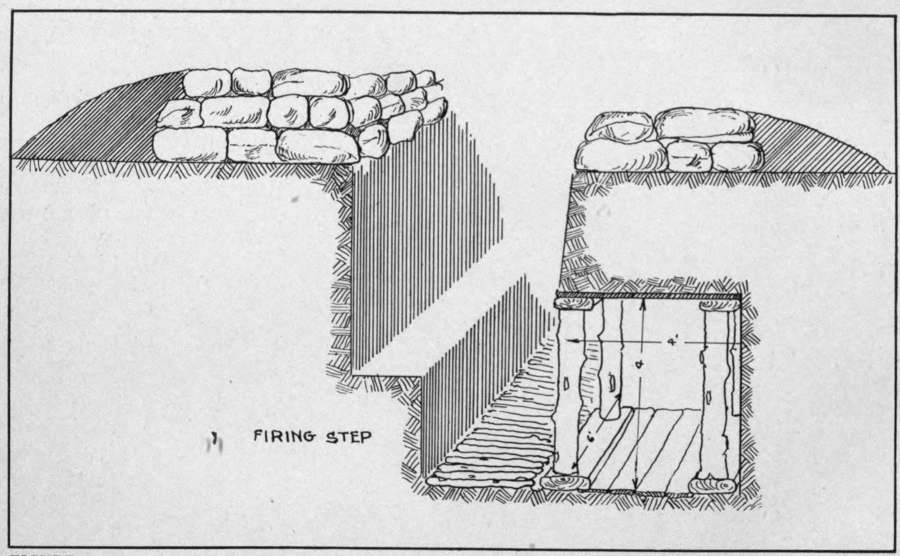
About a foot from the ground there is placed a
board that is called the "firing step," on which
the men stand when they are about to fire. I
have said that there is seldom any roof over the
trenches. It is difficult to cover in the trenches
because of the limited supply of materials.
Then again it is questionable if roofing pays;
for, admitting that they may be able to keep
out small bombs and rifle bullets, they can never
hope to be able to keep out shells. The Germans
used to roof in a great deal—but then
they were there to wage a defensive war and did
not propose to move for a good while.
In some ground the earth will "hold itself
up" at the sides of the trenches, in other ground
it will have to be revetted. This is done with
chicken wire, or with willows or old staves
where they can be had. It is important to have
the sides firm, or else in wet weather especially,
they will prove a nuisance to the occupants of
the trenches.
Some kind of floor should be provided for the
trenches. The simplest and best are made in
the following way: Take two seven-inch boards
about ten feet in length, nail them together to
make a fourteen-inch plank, and then cover the
whole with fairly fine chicken wire. Place these
boards on the ground with the side on which
the wires are joined downwards. They keep
the feet from slipping, are easily cleaned by
being upended when they are dry, and allow the
space under them to be reached easily to pick
up scraps of food, etc. There is nothing more
heart breaking than having to pursue your
weary course for miles, sometimes, up trenches
with slippery sides and sloping, wet, treacherous
bottoms.
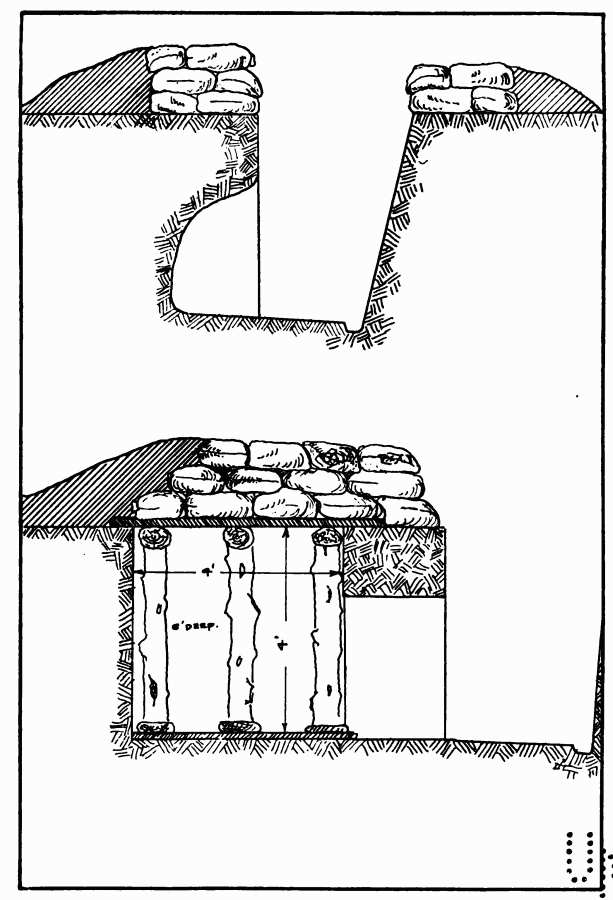
In each trench there must be dugouts for the
men to sleep in. The first ones that are made
will be very primitive, and will be very much
like a fireplace in a room—simply excavations in
the back wall of the trench almost on a level with
the bottom of it. At first they used to be dug
in the front of the trench, but this practice was
discontinued as it was found to weaken the
power of resistance of the very important parapet.
In the course of time more labour can be
expended upon the dugouts, and it will be found
advisable to construct them of uniform size, six
feet long by four feet wide by four feet high.
By having them uniform we give the engineers
a chance to make frames that can be used to
support the roof and the sides and bring them
well from the rear to construct the dugouts.
These dimensions do not make a very commodious
home for four men, but never more
than three of a section (of four) are off duty
at the same time, and besides there is considerable
danger in having large dugouts, as they
present a correspondingly larger target for the
guns. A direct hit on a large dugout will often
bring the whole thing crashing about the ears of
the inhabitants. My own adjutant and one of
my brother officers were killed by falling beams
in large dugouts. The entrance to the dugouts
must be kept as small as possible so as to protect
the occupants from shells that fall just
outside.
The Germans used to follow the custom of
digging many of their "funk holes," as they
were called, many feet underground. Sometimes
they went down twenty and even thirty
feet. The idea of this was that they could retreat
into these secure places during a bombardment
and then emerge with their machine guns
as soon as the attacking infantry had started to
approach over "No Man's Land." We never
followed that custom, for while it will work at
times, yet the attacking infantry may be upon
you before you are aware of it and have you at
their mercy with bayonets and bombs from the
parapet. This the Germans have learnt to
their cost many times on the Somme.
Many efforts have been made to construct
dugouts, reasonably near the surface, that
would be shell proof. This is a most difficult
matter. It is easy enough to make them shrapnel-proof.
A layer of galvanised iron on the
roof covered with a foot of loose earth will accomplish
this for the velocity of shrapnel is not
great. But with high explosive shells it is different.
It was seen at Liége and Namur what
terrific effects high explosive shells fired from
howitzers could have even on re-enforced concrete.
I am told that at Port Arthur, a Russian
General was killed in a shelter that was covered
with over twelve feet of concrete. The closest
we can approach to a shell-proof dugout on the
field is as follows: Dig an approach trench
about ten feet deep, leading into a hole of this
depth, by any dimensions you may choose—say
six feet square. Put in supports for the roof
that shall be four feet from the floor. Roof in
with steel rails, such as are used on railroads,
then cover them with two or three layers of
bricks that have been broken into small pieces.
Leave a five-foot air space and then place an
exactly similar roof above and cover the whole
with earth. Small shells will be stopped at the
first set of rails, while large ones may possibly
pierce them. But the effect of the explosion
will mostly be taken up in the airchamber and
the dugout itself protected. The reader will
readily perceive the difficulty of constructing
such dugout on the field and they can certainly
not be provided for the accommodation of the
common soldier however precious his life
may be.
As the days go by, every effort must be made
to improve the trenches. This can be done in
many ways, some of which will be obvious. The
front line is, of course, the most important one,
and the greatest amount of work has to be done
there. But support and reserve lines as well
must be constructed and many communicating
trenches. Support lines were usually dug at a
distance of thirty to eighty yards from the firing
line. In them we kept a few men to be used
in case of emergency. This line was an exact
duplicate of the front line and was intended to
be used in case we were pushed back. The reserve
line was about five to eight hundred yards
back from the front line and was not brought to
any very great degree of completion. Interspersed
between these three lines were many
redoubts, or especially strong points containing
machine guns, etc., whose defenders were expected
to hold on to the very last and take advantage
of their more secure position to make
the attacker pay dearly for his advance. All
these lines had to be linked up by communicating
trenches, which started about a mile in the
rear of the front line and went up in zigzag
lines to the latter position, crossing the other
trenches on their way. These communicating
trenches are used for the purpose of bringing
up troops and supplies, etc., and for taking to
the rear the men that have been wounded. It is
usually arranged to have some of these trenches
"Up" and some of them "Down" roads. Each
line of trenches (except of course the "communicating")
contain dugouts for the use of
the troops that hold them. The distance between
the communicating trenches varies from
twenty-five yards to three or four hundred according
to the state of perfection of the trench
system.
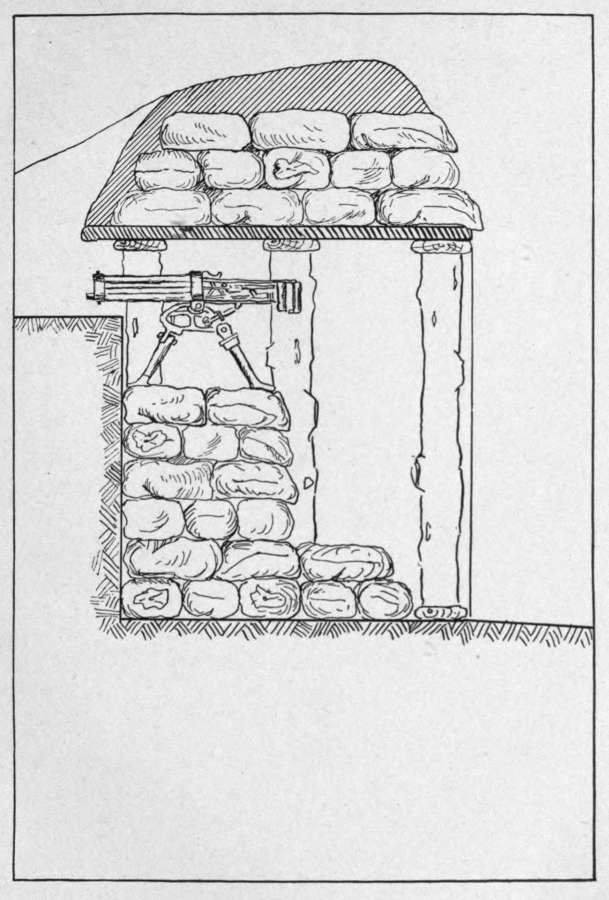
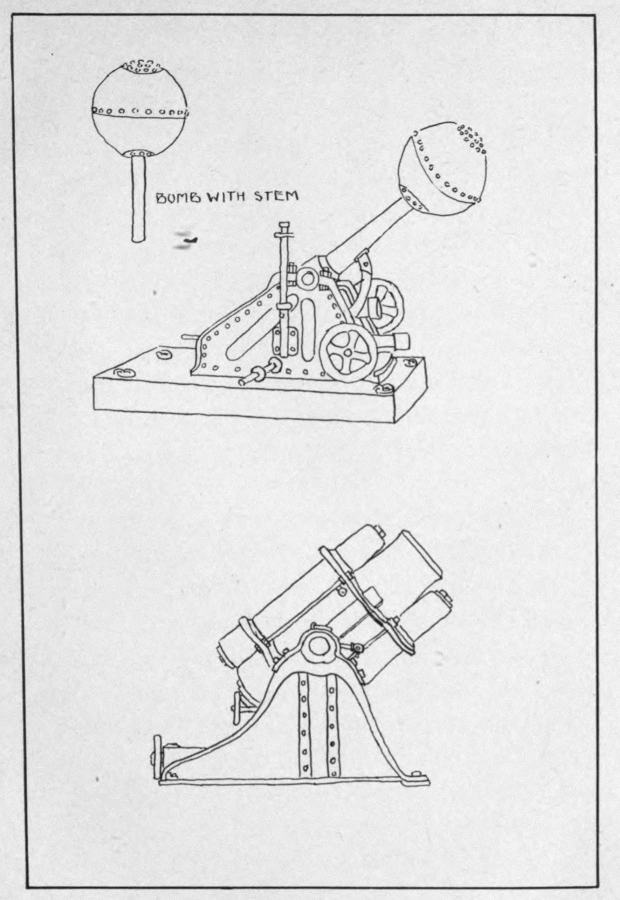
For special weapons such as machine guns
and bomb guns, special shelters have to be
made. Extra strong parapets are provided as
well as head cover of railroad ties, and every
effort is made to keep the exact position of the
machine guns secret from the enemy. We soon
learnt that he was very anxious to find our machine
guns and would shell us liberally in the
hope of being able to locate them.
Care must be given to the question of drainage.
Small ditches should be dug at intervals
of a few yards to lead the water to pits in the
rear. In Flanders, where we were very near
river level, we installed hand and power pumps
to keep the water from taking possession of
the trenches. Even then, on rainy days we
sometimes were in water up to our waists.
Great care must also be taken in the construction
of latrines. The method that was followed
was to dig a short "blind alley" trench at right
angles to one of the communicating trenches,
and at a distance of twelve or fifteen yards from
the front line. Starting from the end of this
blind alley, the trench was gradually filled in
with earth as it was used. In other cases biscuit
tins were used as receptacles and the ordinary
sanitary squads emptied them at specified
times into a fairly deep pit. These latrines
should be well protected with sandbags to keep
the enemy from finding them and training a machine
gun on them, in the knowledge that they
were very likely to get some of the men who
used them during the day.
This, I believe, gives the principal points in
the construction of the trenches. Men should
be taught to dig them in broad daylight at first
and then when they have learnt the knack, they
should be set to dig them at night. From time
to time during their training they should be
made to return—preferably to the same sections
of the trenches—to improve them and maintain
them. An excellent scheme is to arrange competitions
among the men to spur them on to invent
ingenious devices for protecting themselves
and their fellows during their occupation
of them. At certain times they should also be
made to spend a night and then several nights
there, going through the regular routine of sentry
duty, stand to arms, etc., just as they will
have to do in real warfare. Another scheme is
to choose opposing sides with trenches within
easy reach, say, twenty-five yards apart. Arrange
a three-day tour of the trenches, and let
each side attempt to surprise the other. Umpires
can be stationed in No Man's Land to
decide as to the relative merits of the two sides.
At certain times, additional interest can be
given to the conflict by some harmless missiles
such as sand bags (without the sand!) rolled up
and made into a ball the size of a base ball with
string. These will also give excellent practice
in bomb throwing.
The rules of the trenches can be summed up
in a few words: "Keep your spirits up and
your head down."
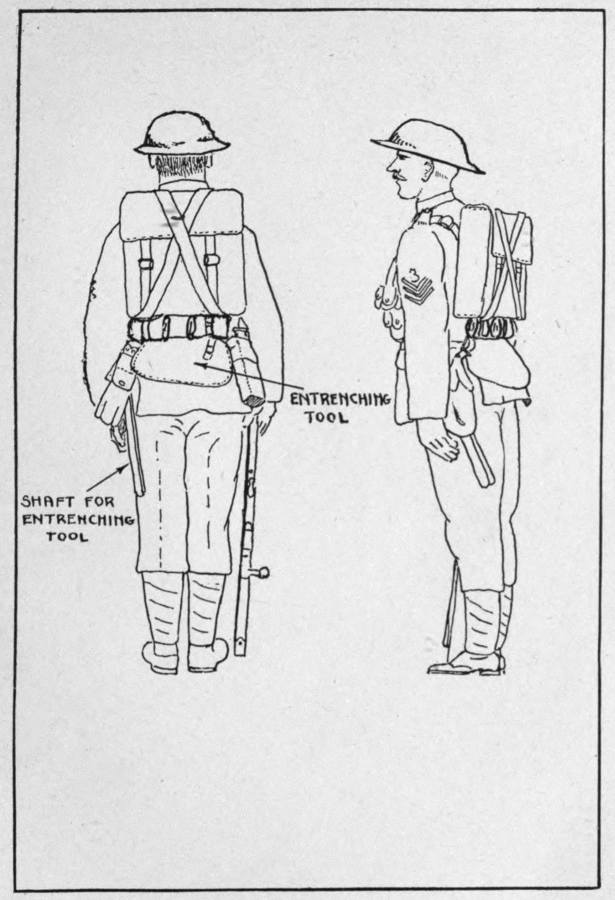
FIGURE 17:
British soldier fully equipped with pack, entrenching tool, sandbags
and steel helmet.